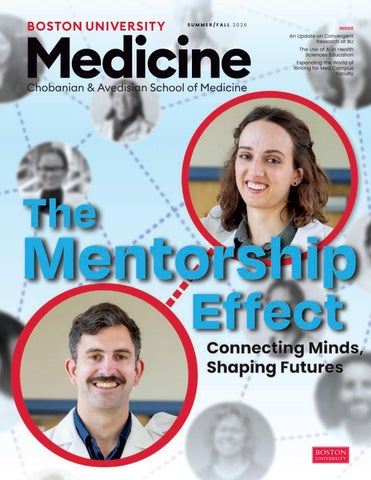
SUMMER/FALL 2026
INSIDE
An Update on Convergent Research at BU
The Use of AI in Health Sciences Education
Photo courtesy of
Expanding the World of Writing for Med Campus Faculty
Message From The Dean Dear Alumni, Friends, and Colleagues, Welcome to the start of yet another academic year! The campus is bustling with activity as our students, faculty, and staff settle into the 2026-27 academic year. It has been my pleasure serving as dean ad interim, since July 1, 2025, while the search for a permanent dean continues. This issue of BU Medicine has many interesting articles on a variety of topics. Our cover story focuses on the effect of mentorship and the important role it plays in academic life. And while that story discusses faculty-student mentorship, we also present a sidebar story on the PRoF program, which exists to help our early-career faculty advance in their professional development and scholarly projects. We celebrate our graduating classes of 2026, the annual faculty and staff award winners, the outstanding graduate student achievement awardees, our research symposiums held for medical, graduate, and postdoctoral students, plus the annual McCahan Medical Campus Education Conference, which focused on artificial intelligence (AI) in health sciences education. We provide an update on convergent research at BU in an informative Q&A with Darrell Kotton, MD, co-chair of the University task force. We feature two stories on chief resident immersion training—one that helps chief residents from all around the country diagnose, treat, and teach about addiction, and another focused on helping Boston Medical Center chief residents learn how to care for older adults. We highlight a faculty development program on narrative medicine, which has become one of our most popular offerings on the Medical Campus, with more than 100 participants over the past seven years who have produced 38 published works, from opinion pieces to books and poems, both fiction and nonfiction.
Boston University Medicine is published by the Chobanian & Avedisian School of Medicine Communications Office. Maria Ober Associate Dean, Communications design & production
Mallory Perry Rice
contributing writers
Gina DiGravio, Doug Fraser, Sarah Rowan photography
Mike Cohea, Zoë Farr, Jake Mackey, Cydney Scott Please direct any questions or comments to: Maria Ober Communications Office Boston University Medical Campus 85 East Newton Street, M810H Boston, MA 02118 P 617-358-7869 | E mpober@bu.edu 0926
Our Giving section highlights two fundraising challenges to expand opportunities for PhD students. Our Alumni section announces our Alumni Award recipients. Mardia Stone, MD (CAMED’79), will receive the Advocacy, Equity and Social Justice in Medicine Award. Michael Sherman, MD (CAMED’15), will receive the Emerging Leaders Alumni Award. Tamara Fitzgerald, MD, PhD (CAMED’04), will receive the Humanitarian Award. Omid Farokhzad, MD (CAMED’99), will receive the Distinguished Alumni Award, and Tara Moore, PhD (CAMED’00), will receive the GMS Distinguished Alumni Award. The recipients will be recognized at a ceremony and luncheon on September 18 as part of our Alumni Weekend festivities. Please enjoy this issue of BU Medicine. Best Regards,
Hee-Young Park, PhD Dean Ad Interim, Chobanian & Avedisian School of Medicine Associate Dean of Faculty Affairs Carolann S. Najarian Professor and Chair, Medical Sciences & Education Professor of Dermatology
Mike Cohea
Boston University Medicine
contents
SUMMER/ FALL 2026
COVER STORY | PAGE 32
THE MENTORSHIP EFFECT CONNECTING MINDS, SHAPING FUTURES
Ashley St. John, graduate program in neuroscience, receives her PhD hood from her research mentor Ian Davison, PhD, associate professor of biology, BU College of Arts & Sciences
2
Campus News
28 Faculty News
DEPARTMENTS
40 Research 42 Giving
44 Alumni News
SUMMER/FALL 2026 | bumc.bu.edu/camed
1
Graduates Step into Their Futures at Annual Convocation Ceremonies Advised of the importance of trust, class members urged to make the world a better place
Chinyere Kemet, PhD, receives congratulations from her hooder and mentor Hui Feng, MD, PhD.
F
amilies and friends marked the passage of hundreds of Chobanian & Avedisian School of Medicine graduates into the worlds of medicine and science in two separate ceremonies held May 14 at BU’s Track & Tennis Center. In his address at the afternoon MD/PhD convocation, invited speaker Atul Gawande, MD, MPH, renowned surgeon, professor, and former assistant administrator for global health at USAID, spoke of the fundamental trust that must exist between patient and 2
Boston University Chobanian & Avedisian School of Medicine
doctor. Trust, Gawande advised, is won with competence, integrity, and benevolence. “In this tricky moment in history, it can seem that the virtues of competence, integrity, and benevolence are not valued. But people are hungrier for them now than ever before. They will remain the keys to your success,” he said. “If you consistently demonstrate over time, not only that you can and will do what you say, but also that you truly
ON THE WEB
mean well by people…that you understand where they’re coming from and genuinely put their priorities first, then they will come to believe in you.” That ceremony awarded 161 degrees, including 132 MDs, 22 PhDs, five MD/PhDs, and one each MD/MBA and MD/MPH. Jenna Libera was the first of two student speakers. Chosen by her classmates to address the convocation, Libera received her PhD in pharmacology and works at pharmaceutical giant Eli Lilly. She spoke about the rewards and lessons of a life devoted to discovery. “As we celebrate the completion of our journey at Boston University, may we remember to embrace the spirit of discovery in the future seasons of our life, in our career ambitions and personal endeavors, continuing to marvel at the wonders that are yet to be discovered around us and within us.” Selected by medical students as their speaker, Amos Mwaura discussed the constantly evolving field of medicine and the hope inherent in scientific discoveries, the need to find common ground with patients, and the necessity of finding a work-life balance. “Why should I worry when, time and time again, my peers have demonstrated that we are capable of being outstanding physicians, that we are driven to provide exceptional care…and most importantly,
facebook.com/ BUMedicine
instagram.com/ BUMedicine
Invited MD and PhD Convocation speaker Atul Gawande, MD, MPH, surgeon, professor, former assistant administrator for global health at USAID, documentary film producer and writer.
“Your hard work here has prepared you, and we are confident that you have the will, the courage, and the tools that are necessary to make a difference in all of our futures.”
Mike Cohea
C. JAMES MCKNIGHT, PHD
Yerke Suleimenova (holding her child) receives her diploma from Hee-Young Park, PhD, dean ad interim.
that we are ready to improve the health of our communities one patient at a time?” said Mwaura. C. James McKnight, PhD, associate dean of graduate medical sciences (GMS), told master’s degree students at their morning convocation to continue making a difference. “Your hard work here has prepared you, and we are confident that you have the will, the courage, and the tools that are necessary to make a difference in all of our futures,” said McKnight. There were 42 MA, 334 MS, and eight combined degrees awarded at the morning ceremony. “The world is undergoing profound and rapid change with the impacts of artificial intelligence, a constantly shifting political and policy arena, and changes to federal research funding,” said Hee-Young Park, PhD, dean ad interim. She urged GMS graduates SUMMER/FALL 2026 | bumc.bu.edu/camed
3
Amos Mwaura, MD’26, receives congratulations from his classmates after delivering the MD student speaker address.
to continue what they’d done during their graduate education. “You remained focused. You stayed determined. You continued your pursuit of knowledge with purpose,” she said.
Ainsleigh Scott, a 2026 MAMS graduate, is hooded by program director and Associate Professor of Medicine Gwynneth Offner, PhD.
4
“This is exactly how you will make the world better.” Farihah Chowdhury was the first of three students chosen by their peers to speak at the GMS convocation. The child of immigrants from Bangladesh, Chowdhury cited her parents’ determination to build a better life in the US for their family, instilling in her a profound sense of duty to serve others. She also spoke of the 18 months she spent volunteering in the hematology and oncology unit at Boston Medical Center learning valuable life lessons. “My time volunteering at the hospital has helped me realize the importance of the smallest acts of kindness and what it feels like to play an essential part in someone’s larger medical journey,” said Chowdhury, who received an MS in medical sciences. Headed to the University of Massachusetts Chan Medical School with an MS in pathology laboratory science, Samuel Camilli chose to reflect on what he’d learned from failure, not success. The Sarasota, Florida, native said he was disappointed when he couldn’t meet the rigorous demands of working a hospital night shift while attending graduate school. He also internalized the rejection he invariably received when applying to medical schools. But Camilli discovered three things that
Boston University Chobanian & Avedisian School of Medicine
carried him forward: being fully present, being deliberative in how he spent his time, and observing and learning from the unexpected. “Take time to look over your shoulder at the road behind you. See the victories and the failures, the highs and the lows,” he told classmates. “Use that information in the present to adjust; not to panic…but to make a thoughtful next step.” The transition from small-town Virginia to Boston and BU’s physician assistant program was initially daunting for convocation speaker Paige Conner, who found Bostonians were reserved, made only brief eye contact, and favored quick conversation. But that changed
“Take time to look over your shoulder at the road behind you. See the victories and the failures, the highs and the lows. Use that information in the present to adjust; not to panic…but to make a thoughtful next step.” GMS STUDENT SPEAKER SAMUEL CAMILLI
Mike Cohea
GMS student speaker Farihah Chowdhury, MS’26
when she met her friendly and supportive classmates and found that kindness takes many forms. “Sometimes it’s quiet. Sometimes it’s just someone showing up,” said Conner, who is returning to Virginia to begin practicing as a physician assistant. “Even in the most ordinary moments we have the ability to impact someone in ways we may never fully realize.” Conner also observed that healthcare professionals tend to meet patients on what may be the worst day of that patient’s life. “What they’ll remember won’t always be the diagnosis or the treatment,” she said. They’ll remember how we made them feel. As we move forward, don’t underestimate the impact of how you show up—for your patients, your colleagues, each other, and yourself.” ●
GMS student speaker Samuel Camilli, MS’26.
Osaretin Aimufua receives congratulations from her hooder and sister Esosa Aimufua.
SUMMER/FALL 2026 | bumc.bu.edu/camed
5
MD Class of 2026 Matches into Residency Training Programs
J
oshua Lepson was 15 and in the middle of swim practice at Brookline High School when he experienced the worst headache of his life. He’d lost his sense of balance and orientation and had to be helped out of the pool. When he got home, his mother Johanna Klein, MD’94, a primary care physician, recognized something was terribly wrong. Joshua was rushed to the hospital with a brain hemorrhage that affected his motor skills and required years of rehabilitation to recover. “The sense of my body in space was completely disrupted,” Lepson said. “It was definitely a profound disruption to my life.” He went from active teen to relearning how to walk. Despite his hardships and long absences from the classroom, Lepson kept up with his schoolwork. When his prospects looked dim, he relied on a will fueled by what he calls “delusional self-belief.”
Joshua Lepson, who matched into the internal medicine residency program at Beth Israel Deaconess Medical Center, with his wife Arielle, father Robert, and mother Johanna Klein, MD’94. Photo by Jake Mackey
6
Members of the MD Class of 2026 reach for the envelopes that will reveal which residency training program they matched into. Photo by Zoë Farr
“I thought, ‘Why can’t I get back to the way I was? Why not me?’” he recalled. “I think that shaped the way I view any challenge now.” On Friday, March 20, Lepson was one of more than 15,000 fourth-year medical students from across the country—including 135 at the Chobanian & Avedisian School of Medicine—who opened envelopes to discover where they would be spending the next three to seven years. Gathered in the George Sherman Union’s Metcalf Hall on the Charles River Campus, families and friends celebrated as the soon-to-be MDs matched to the residency training programs where they would learn their specialties, under the supervision of experienced physicians. “My top two choices were a coin flip, so I’m very happy,” said Lepson, who matched into the internal medicine residency program at Beth Israel Deaconess Medical Center. Match Day traditionally falls on the third Friday in March, which this year also was the first day of spring: a day of new beginnings. Organized by the Student Affairs Office and the Student Match Day Committee, the event was the public part of a process overseen by the National Resident Matching Program, which uses an algorithm to pair students with residency programs according to preference lists developed by the students and the programs. Priya Garg, MD, associate dean of medical education, congratulated the class on being
Boston University Chobanian & Avedisian School of Medicine
the first to fully experience a new teambased learning curriculum across their years of education and noted that class feedback reflected the great value they placed on working collaboratively. “Medicine is about connections; it’s about the people and support systems that keep you well; it’s about the small moments with your patients and your soon-to-be fellow residents, your colleagues,” said Garg. Angela Jackson, MD, associate dean of student affairs, counseled the class to be humble and kind. “You know a lot. You will learn even more. Your skills will grow. But remember to stay humble and teachable,” she said. “Listen to the nurses, to your peers, and to the medical students you will be working with and teaching, and not just to those who outrank you. Be kind always…to everyone, but especially to yourself.” The kindness, commitment, and care the doctors and other healthcare professionals demonstrated while tending to his sister, who has cerebral palsy, inspired Jeet Kothari to become a doctor. Kothari matched into a pediatric residency at C.S. Mott Children’s Hospital, University of Michigan Ann Arbor. Kothari’s parents—his father is a homebuilder and his mother a pulmonologist—immigrated to the US from India. His mother’s dedication to her profession and patients during the COVID-19 pandemic impressed on him the sense of purpose and
Students Matching in Primary Care INTERNAL MEDICINE
28 Students 21% PEDIATRICS
11 Students 8% INTERNAL MEDICINE/PEDIATRICS Youssef Younossi (center, with classmates) is headed to the neurology resident program at Thomas Jefferson University Hospital in Philadelphia. Photo by Jake Mackey
sacrifice imbued in a medical career. Following his second rigorous year in medical school, Kothari decided to take a year off and went home to Atlanta, where he did some research and worked as an Uber driver. He also reconnected with his sister’s experience and her caregivers. “In that process, I rediscovered why I wanted to do medicine and ultimately pediatrics,” he said. “Her physicians saw her as a person—a human and not the sum of her conditions—and that made me want to be that type of pediatrician.” Youssef Younossi is headed into the neurology resident program at Thomas Jefferson University Hospital in Philadelphia. “I’m over-the-moon happy,” said Younossi, whose parents immigrated from Afghanistan. Growing up with several physicians in the family, Younossi was acquainted with the realities of a medical career but wanted to be sure it was right for him before committing to medical school. He’d enjoyed finance as an undergraduate, but after three years at a private equity firm in Washington, D.C., the joy was gone. “I didn’t feel like I was making the impact I wanted to make,” he said. “So, I turned back to medicine, because I knew that in medicine, you never question your purpose. There’s a lot of tough aspects to it, but I think most people don’t ask, ‘What am I doing here?’ and it’s very clear what your impact will be.” Heather Miselis, MAMS’00, MPH’00,
MD’04, associate dean of alumni affairs, told the assembled students that she and other alumni appreciate the importance and excitement of the day, citing “the mix of emotions, the thrill of discovering your match, the relief of knowing your hard work and commitment to the study of medicine have paid off.” “We also remember the uncertainty that accompanies such a significant transition,” she said. “Remember that you are part of a
4 Students 8% FAMILY MEDICINE
4 Students 8% network of engaged and supportive alumni who have walked this path and stand beside you, ready to encourage and guide you.” ●
Jeet Kothari (far right) with his family after learning he’d matched into a pediatric residency at C.S. Mott Children’s Hospital, University of Michigan Ann Arbor. Photo by Jake Mackey
SUMMER/FALL 2026 | bumc.bu.edu/camed
7
Celebrating the 2026 GMS Outstanding Student Achievement Award Winners Graduate Medical Sciences presents four high-achieving graduates with Student Achievement Awards for Outstanding Research, Community Service
Meagan V. Lauber
PhD in Neuroscience Outstanding Research: PhD Category Lauber matriculated into the Graduate Program for Neuroscience (GPN) in 2021 and successfully defended her dissertation in March 2026. During her time in GPN, her research used machine learning and artificial intelligence to develop novel precision medicine approaches in Alzheimer’s disease. Lauber’s main project used a pioneering machine learning and computational neuroscience modeling approach to quantify how amyloid burden influences the emergence and acceleration of the spread of tau. Amyloid burden is the first pathology to occur in Alzheimer’s disease, while tau is the second pathology that causes cognitive decline and widespread damage. “For a long time, we’ve known that there is this relationship between the two pathologies,” Lauber said. “A lot of these models are done in mice or cells. This was the first time, quantitatively, that we have shown in living 8
humans that this suspected mechanism is in action.” Using data from over 800 patients, Lauber’s project was the first large-scale and quantitative confirmation in humans that tau becomes more efficient because of a higher amyloid burden. Lauber’s drive to study Alzheimer’s is personal. As a teenager, Lauber’s grandmother was diagnosed with Alzheimer’s, and witnessing her mother act as a primary caregiver motivated Lauber to work in this area. As an undergraduate student, Lauber researched neurodegenerative movement disorders, an interest driven by her grandmother’s experience with polio-associated neurodegenerative disease later in her life. “It was really about having that firsthand experience with people in my life being affected by these diseases, and also being interested in the space,” Lauber said. “It felt very motivating at the time to see so much happening in terms of Alzheimer’s innovation, even compared to 10 years ago when my grandmother was going through it.” Lauber hopes to continue her work using this model and its applications to ongoing Alzheimer’s clinical efforts to intervene early and preserve as much brain health as possible. The model is also applicable to any tau-driven disease, such as frontotemporal dementia, Down syndrome, and chronic traumatic encephalopathy. Lauber feels grateful for open data sharing initiatives, both at BU and generally, that have continued to shape her research. Lauber urges women entering STEM spaces to recognize the value of their voices and their right to take up space. “Don’t doubt
Boston University Chobanian & Avedisian School of Medicine
your right to be in that room,” Lauber said. “Don’t doubt your right to belong there, and don’t doubt the worth of your perspective.”
Sai Sankeerth Madakasira
MS in Clinical Research Outstanding Research: Master’s Category Madakasira matriculated into the Master of Science in Clinical Research Program in January 2024 and graduated in January 2026. Madakasira’s Outstanding Student Achievement award stems from two projects that shaped his research journey at BU. For one of the projects, part of his practicum with Assistant Professor of Surgery Crisanto Torres, MD, MPH, Madakasira used a national database to explore the impact of full blood transfusion in traumatic intracranial hemorrhage (tICH). Published in the Journal of the American College of Surgeons, the study compared whole blood (WB) resuscitation to plasma-based resuscitation in adult trauma
patients with tICH. It found that WB resuscitation was associated with a lower 30-day mortality as compared to plasma-based resuscitation. Madakasira presented this research at multiple conferences. “The WB work contributes to an actively evolving area in trauma resuscitation, where surgeons across the country are working to refine treatment protocols and improve outcomes,” Madakasira said. “Working with Dr. Torres, one of the pioneers in the field, has shown me the huge body of work left to do in this area.” The second project, Madakasira’s capstone, studied representation in Exception from Informed Consent (EFIC) emergency clinical trials across the United States. Mentored by Professor of Medical Sciences & Education Susan Fish, PharmD, MPH, and Professor of Biostatistics and MSCR Director Janice Weinberg, ScD, MS, Madakasira investigated conduct of such studies using EFIC, a federal pathway for clinical trials to occur without prior consent. This analytical observational study at the intersection of research ethics, emergency care, and concerns of minority overrepresentation was recently presented at the 2026 Society for Academic Emergency Medicine New England Regional Meeting. “My focus on EFIC trials is a novel approach to trial design,” Madakasira said. “I think there’s a significant opportunity to expand this work and contribute meaningfully to improving how these studies are designed and conducted.” Madakasira arrived at BU knowing that he wanted to be a surgeon-scientist, having received his medical degree and practiced in India. His medical training, combined with his multiple fellowships and research projects, solidified his desire to continue incorporating research into improving systems of care. Madakasira expressed gratitude for the mentorship that defined his time at BU. “What really helped was having strong mentorship,” Madakasira said. “I was able to discuss ideas openly, get feedback, and refine my scientific approach. That support made a huge difference in building confidence and navigating challenges effectively.”
Cheyanne Frosti
PhD in Biochemistry & Cell Biology, Program in Biomedical Sciences (PiBS) Community Service: PhD Category Frosti matriculated into the PhD Program in Biomedical Sciences (PiBS) in 2021 before joining the department of biochemistry & cell biology. She successfully defended her dissertation in March 2026. Rather than a singular community service project, Frosti’s award recognizes her ongoing commitment to mentorship and community building across multiple spaces on campus, such as PiBS, Graduate Women in Science and Engineering, Summer Training as Research Scholars, and BU FitRec. Across these programs and campus institutions, Frosti has focused on making the graduate training experience more transparent, supportive, and accessible for incoming and prospective PhD students. She has participated as mentor and panelist in trainee-focused programs to help demystify aspects of graduate school that are often unclear, like applying, choosing a lab, navigating funding, and identifying career paths. “At its core, this work is about reducing the uncertainty that many trainees face and helping to build a more equitable and welcoming training environment, one where students have access to clear guidance and the resources they need to succeed, regardless of their background,” Frosti said. Frosti’s drive toward mentorship stems from her own transition into graduate school. She found applying to PhD programs challenging because she didn’t understand
how to navigate the system or seek out the support she needed. This experience showed Frosti how critical early sustainable mentorship and transparency are in the PhD program experience. “I became motivated to help create a more supportive and accessible environment so that future trainees could feel more confident, informed, and welcomed from the start,” Frosti said. One of Frosti’s most meaningful interactions involved prospective and first-year students during PiBS interviews and Accepted Students Days. She found the opportunity to answer questions candidly, discuss her own experiences, and ease prospective students’ uncertainty rewarding, especially when those students later shared that their conversations were helpful to them. As she navigates the next stage of her career, Frosti plans to continue engaging in mentorship for trainees transitioning into graduate school or careers beyond academia. She is most interested in supporting initiatives that bridge science with broader career pathways, including industry, policy, and finance. “I’m passionate about encouraging trainees to begin career development earlier in their graduate education,” Frosti said. “I believe this will improve training environments and equity in STEM.”
Yusra Yusuf
MS in Genetic Counseling Community Service: Master’s Category Yusuf matriculated into the MS in Genetic Counseling Program in 2024, and graduated (Continued on page 11) SUMMER/FALL 2026 | bumc.bu.edu/camed
9
Symposium Showcases Variety, Depth of GMS Student & Postdoctoral Research
N
ow in her fourth year as an MD/PhD student, Texas native Brittny Garcia thought she’d made her peace with New England winters. Despite the snowstorms and bitter cold, which sometimes made her long for warmer places, she didn’t second-guess her decision to choose Boston University’s combined program—four years toward a medical degree sandwiching four years of PhD research. “I really fell in love with the mission of the Medical Campus, the research being done here, and the mentors,” said Garcia, one of six students and postdoctoral researchers selected as Research Talk Awards winners at the second Annual Graduate Medical Sci10
ences Research Symposium held April 9 in Hiebert Lounge. An estimated 200 students, faculty, and staff in attendance heard presentations by the Research Talk Awards winners and viewed nearly 100 poster displays showcasing the wide range of work being done by postdoctoral fellows and MD/PhD, PhD, and MS students. The symposium helps students become better communicators and gives faculty the opportunity to learn about the research and methods at various labs on the Medical and Charles River Campuses, VA Boston Healthcare, and Boston Medical Center. “This event gives you an idea of the breadth and depth of the research on the Medical Campus and the strength of the
Boston University Chobanian & Avedisian School of Medicine
programs in general,” said Thomas Clarke, PhD, an assistant professor of pathology & laboratory medicine and one of the volunteer judges of the poster presentations. “You can see techniques that you’re maybe thinking about incorporating into your research that other labs are already doing, and it can spur collaborations.” Fourth-year biomolecular pharmacology PhD student Andre Krunic honed his Research Talk Awards presentation at department seminars and the Society for Neuroscience annual meeting last year. His research exploring the use of microRNAs for early diagnosis and treatment of Alzheimer’s disease was published recently in the journal Alzheimer’s & Dementia.
Zoë Farr
A full house at the GMS Research Symposium, including Associate Dean C. James McKnight, PhD, MA, center, hears award winners present their research.
˝This event gives you an idea of the breadth and depth of the research on the Medical Campus and the strength of the programs in general.˝ Research Talk Awards winner and fourth-year PhD student Andre Krunic.
Students spend the first year of a PhD program in the classroom, rotating into various labs to find a good match for their research interests. Though he was interested in neuroscience, Krunic was undecided at first as to which research specialty he would choose. The reputation of the Alzheimer’s Disease Research Center and BU’s affiliation with the famed Framingham Heart Study (FHS), the longest-running longitudinal study in the US, attracted Krunic to the school. “When I first came here, I wasn’t set on Alzheimer’s disease. However, when I joined the lab and learned about the novel
THOMAS CLARKE, PHD
approaches we were researching to prevent it, such as using microRNAs, I started to become really invested in the field,” said Krunic. “BU is really an excellent place to do Alzheimer’s and dementia research.” The FHS also was a big draw for Bahar Bakhshi, MS. Originally from Iran, Bakhshi is a third-year PhD candidate in molecular & translational medicine. Her research investigates how to better utilize data from continuous glucose monitoring to predict diabetes and cardiovascular disease risk. “I’m really interested in diet and other lifestyle interventions. I’m hoping to build a
Third-year PhD student Bahar Bakhshi, MS, right, explains her research on continuous glucose monitoring.
career that leverages these different tools to come up with better ways of self-monitoring for individuals who are at risk for chronic diseases like diabetes and cardiovascular disease,” said Bakhshi. ●
GMS Awardees, continued from page 9 from the program in May 2026. During her time in the program, she centered her community service work on expanding access to, and awareness of, genetic counseling among underrepresented communities. “For me, patient care and support extend far beyond the clinic,” Yusuf said. “Getting involved in community service is one way to accomplish that.” Yusuf has supported several outreach initiatives across Massachusetts and New England, including volunteering with the Achieve Program, where she presented to middle and high school students on genetics and genetic counseling. She has also volunteered with the Massachusetts Sickle Cell Association, where she helped to support the Walk for Sickle Cell. As part of this initiative, Yusuf engaged youth
participants in fun and interactive activities while navigating conversations about their experiences with sickle cell disease. “Through mentorship, educational outreach, and patient-centered resources, my goal has been to make these spaces more accessible and inclusive,” Yusuf said. “These experiences have shaped my commitment to ensuring genetic counseling is both equitable and culturally informed. “As a first-generation student, I see community service as both a responsibility and a form of advocacy,” Yusuf continued. “Learning that Black genetic counselors make up only 2% of the workforce further strengthened my dedication to representation and advocacy within the field.” During her time at BU, Yusuf and three classmates coordinated a fundraiser with four
other genetic counseling programs supporting Boston-based women’s center Rosie’s Place that raised over $600 and contributed to 24 care packages for the organization. She also was involved in community-engaged research with Somali, Hmong, Black/ African American, and Latine communities to better understand what members of these communities prioritize in a genetic counseling toolkit. “In the future, I hope to contribute to mentorship and community engagement efforts that support individuals from underrepresented backgrounds entering the field,” Yusuf said. “I aim to work toward a genetic counseling profession that reflects the diversity of the communities it serves.” ●
SUMMER/FALL 2026 | bumc.bu.edu/camed
11
Annual Medical Student Research Symposium Spotlights BU’s Rich Research Ecosystem
I
n her introductory remarks at this year’s Medical Student Research Symposium, Hee-Young Park, PhD, dean ad interim, pointed to the school’s strategic plan’s goal of “build[ing] a world-class collaborative research ecosystem that drives innovation, enabling breakthrough science to treat and cure illness and advance wellness for people around the world.” “Areas of research now span across basic science and basic bench research, to translational, computational, and socially relevant studies,” said Park. “Today, we’re going to be learning from, and be exposed to, a range of important research done by our medical students.” Held February 13 in Hiebert Lounge, the annual symposium showcased a wide array of poster displays and had 90 abstracts submitted for consideration. A faculty panel selected six student speakers (out of 40 applicants) to give brief talks on their
research, and judges chose 10 students to receive Serchuck Poster Awards. “Doing a presentation in this format to a more general audience is really good practice because students need to explain the importance of what they’re doing to people who aren’t experts in the field,” said Medical Student Summer Research Program (MSSRP) Director Shannon Fisher, MD, PhD, associate professor of pharmacology, physiology & biophysics and director of the third-year research selective and fourth-year research elective. “They’re amazing students and I love hearing about their research,” said poster contest judge Tara Moore, PhD, associate dean of research ad interim and professor of anatomy & neurobiology. “I find the students do such a great job describing their projects. I’m a neuroscientist and most of the posters are not about neuroscience, but it’s an opportunity (for me) to learn new things.”
Students and faculty viewing symposium research posters.
12
Boston University Chobanian & Avedisian School of Medicine
“It is terrific to see the breadth and depth of research that our students are engaging in,” said Matthew Layne, PhD, associate professor of biochemistry & cell biology and assistant dean of research. “We are also very grateful for all the terrific mentors that make these research projects possible.” Students can select from various research options. A yearlong research option adds a year to medical school. They can choose the Learn, Experience, Advocate, Discover and Serve (LEADS) research track. Third-year students may pick a four-week research block selective, and fourth-year students can choose from 4-, 8-, or 12-week research electives. The MD/PhD program includes extensive research and clinical experience. Second-year medical student Jessica Czapla participated in research over the summer as one of the students selected for the MSSRP. “Being at the forefront of research is really important to me,” said Czapla, who
Jake Mackey
Students selected by a faculty panel to present their research at the symposium included (left to right): Kevin Chen, Erika Minetti, Aryan Wadhwa, Sabrina Mellinghoff, Willa Molho, and Sydni Britton.
described herself as a lifelong learner and presented a study on the link between communication and screening frequency for highrisk prostate cancer patients. “I really enjoy not only being able to share my results but learning about other research.” Riya Manchanda’s research led her to consider a career in stroke neurology. The second-year medical student works with José Romero, MD, associate professor of neurology, using Framingham Heart Study data to understand how lifetime trends in cholesterol and triglyceride levels correlate with stroke rates. “We found that high levels of LDL cholesterol over an individual’s lifetime almost double the stroke risk even when they’re healthy at baseline—even when they have nothing else wrong with them,” Manchanda said. “While it doesn’t directly translate into a change in clinical guidelines yet, the research does raise questions like, should we be putting people on statins earlier? Should we be putting them on statins for longer time periods?” The six students selected to present their research at the symposium were first-year student Erika Minetti on the cardiovascular health effects of e-cigarettes; second-year MSSRP student Sabrina Mellinghoff discussing the impact of disadvantaged neighborhoods on breast cancer risk and mortality in Black women; second-year MSSRP student Willa Molho on infant feeding choice in postpartum, HIV mothers; second-year LEADS
research track student Sydni Britton describing her work on genetic detection of senescent fibroblasts that drive chondrogenic extracellular matrix abnormalities; third-year research selective student Aryan Wadhwa explaining cerebral cavernous malformation-related epilepsy maps; and MD/PhD student Kevin Chen on the restoration of cystic fibrosis transmembrane conductance regulator function using airway basal cell transplantation.
The winners of the Serchuck Poster Awards were first-year student Pratham Bhatt; second-year students Samra Beyene, Kylie Tang, Jingtong Huang, Sarah Chang, Joshua Kim, and Benjamin Chun; third-year students Rohini Kambhampti and Ashley Bodnar; and MD/PhD student Rose Zhao. The award honors the late Jerome Serchuck, a longtime MSSRP donor. ●
During the symposium, second-year medical student Stuart Sommers explains his research.
SUMMER/FALL 2026 | bumc.bu.edu/camed
13
Convergent Research at BU: A Q&A with Task Force Co-Chair Darrell Kotton, MD
I
n her inaugural presidential address, Boston University President Melissa Gilliam, MD, cited convergence as “our North Star.” “Convergence is in our past, our present, and our future. Convergence is the key to who we are, and who we can be,” Gilliam said. Since its inception, the Center for Regenerative Medicine (CReM) at BU and Boston Medical Center (BMC) has been deeply involved in convergent research, including a cross-campus project to regenerate lung tissue damaged by disease. CReM Founding Director Darrell Kotton, MD, co-chairs the University task force that identified eight priority areas of convergent research, including three where the Medical Campus could make a direct contribution: health across the lifespan; infection, inflammatory, and immune disorders; and artificial intelligence, data science, and computing. Kotton shares his views on what convergent research is and how the University can promote and sustain it. His answers have been edited for brevity.
Does convergent research already exist on the Medical Campus? It does exist already today, and some of our most successful and exciting programs involve convergent research approaches that have naturally evolved very successfully. The challenge for our task force was how to come 14
Boston University Chobanian & Avedisian School of Medicine
Cydney Scott
What is convergent research? Convergent research is an approach where normally disparate fields or disciplines come together to address a problem or advance research education in a way that’s impactful to society. It is multidisciplinary, but it’s more; it’s not just bringing different tools to research, it’s bringing together very different approaches, perspectives, backgrounds in a way that’s greater than the sum of the parts.
up with a strategic plan; initiatives and support that don’t just rely on happenstance but augment the chances this will happen. Are there any major barriers to convergence on campus, and how will the University overcome them? The task force identified several barriers. One is the structure of academia that is built on departments and schools, that was once so effective in organizing people and research but now can result in silos. Because [convergent] research is so cross-disciplinary, across schools and across departments, the model of [research] centers has emerged as one way to break those silos. There are also institutional barriers, and I think everyone is interested in more integration between BU and BMC on health-related convergent themes. Does this approach unlock new funding opportunities or give researchers better access to existing funding? In a time of scarce federal resources, it’s important to work more efficiently. Bringing people together in a way where you can be greater than the sum of the parts makes researchers work more efficiently with the funding they have. It also helps them compete for national grants. But researchers need to have preliminary data with some progress and some groundwork already laid out, otherwise they won’t get funded. University planning grants, small grants, seed grants, and clustered hiring initiatives can really build the foundation locally when money is scarce federally. Can you talk about the CReM/(global biopharma company) GSK pulmonary fibrosis collaboration as an example of how this convergent research approach works? Traditional research involves one team working with one tool in one department or school. For pulmonary fibrosis, that hasn't worked to develop particularly effective drugs. The GSK collaboration was the result of many years of laying a foundation that was convergent, not only across the school but across institutions, bringing BMC together
with Boston University. Building biobanks that were based on patient samples, advancing research that involved many disciplines—from molecular biology to clinicians to physicists and bioinformaticians—built a foundation that resulted in a very large, sponsored research agreement with GSK to develop drugs for pulmonary fibrosis. I think it’s a good example of how laying the foundation in the broadest, not only cross-disciplinary but cross-institutional way pays off in the long run. The return on investment can be excellent, and ultimately the return for our patients’ well-being we hope will be better. What about convergence with the Charles River Campus? It exists to some degree, but it could definitely be augmented and supported more. I think that the convergence of biomedical engineering—with the center of that program located on the Charles River Campus, but working with BMC databases and AI resources from the Charles River Campus— interacting with the molecular biologists across the campuses is really a great example of how convergence has already succeeded at BU, and I think there’s a lot more of that to come. What changes do you see on the Medical Campus going forward? My hope is that in following this approach on the Medical Campus, both research and medical and research education will be elevated from already excellent status to being even better, more effective, more efficient, more synergistic. We already have initiatives that have worked on a local level. The department of medicine has Affinity Research Collaboratives that really have propelled and funded multidepartmental, multicampus initiatives that have been highly successful. What I think we’ll see is more of that but aligned on a scale that involves educational initiatives and clustered hiring initiatives across these themes. The research centers will be elevated, the silos and barriers will be minimized, and I think you’ll see a lot more
alignment of education, research, promotions, and hiring. The other aspects I think are important to emphasize are individual faculty discovery and basic science research. Those will always be important, and this initiative in no way detracts from them. In fact, without individual, traditional faculty members doing their own research in their own areas, this initiative can’t work. That always must be bedrock and must be maintained. The individual investigator’s presence on campus should always be a priority and partnered with these kinds of new strategic initiatives. Does this approach help students to position themselves for the world out there, the world that exists now? I think students are really hungry for this. Fifty years ago, students trained in one discipline, and they learned as best they could in their area. One gene, one hypothesis, a few techniques that could be mastered and handled by one lab. The world is different today, and the students know that. A graduate student wants to learn bioinformatics, wants to be familiar with and use AI techniques, wants to study all the genes simultaneously in all the cells, in a way that you need big data and computing resources to understand, in addition to learning bench techniques. Likewise, the doctors of today are hungry to participate in a variety of techniques beyond their clinical discipline. They want to bring AI in, they want to contribute to large databases, and they also want some familiarity with bioinformatics and a variety of research techniques, whether that’s implementation sciences, traditional molecular biology, or bioinformatics. The best students in the country are going to be looking for the schools that lead the way in strategically offering those experiences. It’s going to be an exciting time, and I think you’ll see students really clamoring to get admitted to BU’s programs to experience our convergence initiatives. ●
SUMMER/FALL 2026 | bumc.bu.edu/camed
15
Denny DesRosiers explains the workings of the Healthy Streets van to some chief residents.
Immersion Training Helps New Chief Residents Diagnose, Treat, and Teach About Addiction
D
enny DesRosiers pulled up in front of the Wylie Inn and Conference Center and threw open the rear doors of his van, revealing what could easily be mistaken for a tradesman’s wall of shelves and bins. But these containers were not filled with pipe clamps or nuts and bolts. Standing at the open doors, Kiara Taquechel, MD, took a heroin “cooker” from DesRosiers, a harm reduction specialist for Healthy Streets Outreach Program providing HIV/AIDS prevention and overdose prevention services to North Shore residents with active substance use, and their families. The cooker, used to dissolve powdered or solid drugs into an injectable solution, looked like a votive candle tin; Taquechel listened as DesRosiers explained that it wasn’t per16
fect—people could burn their fingers using it—but it was more sanitary than using bottlecaps or other things found on the street. “We meet people where they’re at. We do everything from blood draws to wound care out of the van. We give out supplies, anything from injection, smoke, to sniff supplies,” said DesRosiers. “We’re not doctors, but we try to take care of people the best we can.” Of course, Taquechel is a doctor, a newly selected chief resident in internal medicine at Beth Israel Deaconess Hospital in Boston. Along with 23 other incoming chief residents and three faculty mentors from all over the US, they were getting firsthand experience talking to those with substance use disorders, combined with lectures, attending mutual support meetings (Alco-
Boston University Chobanian & Avedisian School of Medicine
holics Anonymous) and skills training, at the 25th Annual Chief Resident Immersion Training (CRIT) in Addiction Medicine, held May 4–6 on the campus of Endicott College in Beverly, Massachusetts. The Fellow Immersion Training program for clinical subspecialty fellows and the CARE Faculty Scholars program for residency program faculty also were held at the same time, with nine fellows and 12 faculty scholars participating. CRIT began in 2002, led by Jeffrey Samet, MD, MA, MPH, professor of medicine, and Daniel Alford, MD, MPH, professor of medicine and associate dean of the Center for Continuing Education at BU’s Chobanian & Avedisian School of Medicine. With faculty drawn mainly from Boston Medical Center (BMC) and BU’s medical
Doug Fraser, Jake Mackey
Chief Resident Immersion Training (CRIT) program celebrates 25th anniversary
CRIT by the Numbers CHIEF RESIDENT PARTICIPANTS NEARLY 600
FACULTY MENTOR PARTICIPANTS
165 RESIDENCY PROGRAMS REPRESENTED MORE THAN 250 STATES REPRESENTED NEARLY 40
CRIT co-founder Daniel Alford, MD, MPH, delivers lecture at this year’s immersion training session.
“Some of the most innovative and creative things come out of the communities that face the most stigma and adversity. People find a way to do their best to meet the needs of the people they’re trying to take care of.” ALEXANDER WALLEY, MD, MSC
school, it is funded by the NIH/National Institute on Drug Abuse. “I joined the faculty at BU in ’89, and I was interested in addiction and HIV, but there weren't too many of my colleagues with those interests,” said Samet. “Our CRIT program has proven to be highly effective in teaching the teachers creative approaches for elevating physicians’ care of patients with alcohol and drug problems. The path is steep and long, but rewards are very satisfying—for patients, physicians, and faculty.” “I was a chief resident and new faculty member at BU in ’96 when Jeffrey introduced me to the field of addiction medicine and the need for educating others about this important area of clinical care,” said Alford. The two decided to focus on training incoming chief residents, who are selected as outstanding clinician educators by their residency program directors, to spend a year training residents and medical students. “It’s a clever, inspirational idea of how to
be really creative in a system that’s often not very creative,” said Taquechel. Over the past 25 years, nearly 600 chief residents have participated in CRIT, as well as 165 of their faculty mentors, hailing from more than 250 residency programs and nearly 40 states. “We have physicians [attending the training] who are pretty well-versed in addiction medicine, but want to learn more; and then we have folks who come from areas where there are very few addiction medicine champions and they’re here to try to be one of the emerging champions at their institution,” said CRIT faculty member Hallie Rozansky, MD, assistant professor of medicine, associate director for the BMC Internal Medicine Residency Program and a CRIT alumna from 2020. “I’ve always had an interest in addiction medicine, but no formal training,” said Kellner Pruett, MD, who works at
Cone Health Family Medicine in Greensboro, North Carolina, and was attending CRIT as a CARE (Clinical Addiction Research and Education) Faculty Scholar. The main “deliverable” coming out of the immersion training is a project proposed by each participant as a prerequisite for admission, and refined over the threeday program, that will enhance addiction training for their residents and medical students. “One of [Cone Health’s] biggest needs was an addiction medicine curriculum,” said Pruett, and her project for the training program reflected that. “We’re instituting a protocol for opioid use disorder (OUD) screenings so that when someone screens positive for OUD, we’ll have a plan in place for the residents to know the medicines to prescribe, where to send patients, and what community resources are available.” “I think it’s important for us to show SUMMER/FALL 2026 | bumc.bu.edu/camed
17
18
DesRosiers, a harm reduction specialist for the Healthy Street Program, explains the outreach project to chief residents.
cine at Rutgers’ University Hospital in Newark, New Jersey, Nicholas Imperato, MD, said around one-quarter of their patients have substance use issues. Even so, the CRIT training was an eye-opener. “There were so many different topics, areas of research and treatments and resources,” Imperato said. “Even though we see a lot of patients with alcohol- and opioid-related complications, there are so many other resources and treatments I wasn’t aware of that we can offer patients dealing with substance use.” “When you’re dealing with patients who have these issues, it’s empowering to know how to address them and how to treat them, what resources are available,” said Chelsea Palmer, MD, a new internal medicine chief resident working at University of Utah Health. “I came here to get training in how to teach
Boston University Chobanian & Avedisian School of Medicine
an addiction medicine curriculum to our interns, but also to be able to provide treatment for my patients.” According to a recent Massachusetts General Hospital Research Recovery Institute study, one in five people with substance use disorders discharged from emergency rooms returned within 30 days. Recidivism can be discouraging, even for a seasoned care provider, and CRIT exposed participants to new approaches and innovative programs. “This is a very challenging patient population to work with, but it was very encouraging for me to see that the system can work, the medications can work, our training can work, even if it doesn’t always feel that way on a daily basis,” said Rutgers’ University Hospital emergency medicine physician Anita Mudan, MD. She came to CRIT with Imperato as his faculty mentor working on their project to
Doug Fraser
what we’re able to do in Boston and Massachusetts, but it’s equally as important for us to hear how people are doing what they can do where they live,” said Alexander Walley, MD, MSc, professor of medicine, who was a CRIT participant as a chief resident in 2003, and is now the program’s co-principal investigator with Samet. “Some of the most innovative and creative things come out of the communities that face the most stigma and adversity. People find a way to do their best to meet the needs of the people they’re trying to take care of,” he said. CRIT faculty member Jessica Calihan, MD, also is a 2020 alumna. She recalled working as a medicine-pediatrics resident at Johns Hopkins Hospital in Baltimore, Maryland, when her chief resident returned from CRIT with a project that changed how they treated patients with substance use disorders. “It was really transformative,” said Calihan, now a pediatrician at Massachusetts General Hospital specializing in adolescent and addiction medicine and an instructor at Harvard Medical School. “I think it is so helpful for people to come and learn from experts, and then bring it home to their institution, where there may not be the expertise that exists in a place like Boston Medical Center.” “We are [at BMC] to take care of some of the most medically and socially complex patients, and we love that, we get joy from it, are really good at it,” said Rozansky. For her project, Taquechel focused on a curriculum for residents on how to manage opioid withdrawal in the hospital that included learning-based lectures and interactive case-based workshops with expert consultants. Reviews of her project by CRIT faculty prompted Taquechel to focus on how to ensure her program continued after her year as chief resident was completed. She decided to create a teaching guide, record the training process, and publish training materials online for future chief residents to use. “I was struck by the generosity of the [CRIT] faculty,” said Taquechel. “They shared their materials with us; they shared their time. The goal is education without ego, and I’m really grateful for that.” New chief resident of emergency medi-
Participants at the 25th Annual Chief Resident Immersion Training pose for group shot at Endicott College’s Wylie Inn and Conference Center.
“I was struck by the generosity of the [CRIT] faculty. They shared their materials with us; they shared their time. The goal is education without ego, and I’m really grateful for that.” KIARA TAQUECHEL, MD
integrate more addiction medicine training into the first-year EM residents’ addiction medicine rotation through an online course on substance use disorders that residents can work on in their downtime. Lectures and skills practice are valuable, Taquechel said, but what she found particularly enriching were the first-person interactions—including the Healthy Streets van, the recovery support meetings, and other opportunities CRIT provided—that offered direct engagement with people with substance use problems. She also appreciated the knowledge and compassion CRIT faculty brought to their work. “I left this week feeling invigorated as CRIT crystallized how education can be a powerful advocacy tool,” said Taquechel. “I’m returning home excited to strengthen our addiction curriculum with the goal that every patient, no matter where they are in their journey, is met with dignity, compassion, and thoughtful care.” ●
CRIT founders Jeffrey Samet, MD, and Daniel Alford, MD, standing in front of photos of 25 years of participants.
SUMMER/FALL 2026 | bumc.bu.edu/camed
19
Hollis Day, MD, MS, MHPE, BMC chief of geriatrics, giving a talk to chief residents on geriatric care.
BMC Chief Residents Learn How to Care for Older Adults 21st year of groundbreaking program duplicated nationally
I
n her talk welcoming Boston Medical Center (BMC) chief residents, program directors, and faculty mentors to the 21st annual Chief Resident Immersion Training (CRIT) in the Care of Older Adults, co-director Lisa Caruso, MD, MPH, laid out the crisis in US geriatric care with 62 million people over the age of 65 on Medicare, and only 7,300 certified geriatricians. “Even if you consider only the neediest, those who have comorbidities, disabilities, the sickest of that group, there still are not enough geriatricians to take care of them,” said Caruso, on the first of the three-day training session held May 29–31 at Ocean Edge Resort in Brewster, Massachusetts. Although the number of people in the US over 65 increased by 60% from 2000 to 2022, the number of board-certified geriatricians declined by 28%, according to Ameri20
can Medical Association analysis. “We’re seeing those challenges now. I think that’s only going to get worse,” said CRIT faculty member Hollis Day, MD, MS, MHPE, BMC chief of geriatrics since 2015. “My goal has always been to teach people from other disciplines how to take better care of older adults,” said Day. Geriatricians typically treat patients over the age of 65 who have multiple chronic medical conditions. “We are able to handle the complexity of care, and we are specialists in transitions of care; whether it’s outpatient to inpatient, or inpatient to a rehab stay, helping people stay in place and live longer in the community through home care, or ultimately, whether they need to be in long-term care facilities, smoothing those transitions so that things don’t fall through the cracks and people end
Boston University Chobanian & Avedisian School of Medicine
up in the hospital again,” said Day. The Chief Resident Immersion Training in the Care of Older Adults program began in 2005 as an innovative way to address the geriatrician shortage by having experts educate chief residents. Caruso, who has been with the program since its inception, said they focused on chief residents because of their role teaching residents and medical students. Modeled after BU and BMC’s CRIT in Addiction Medicine that marked its 25th anniversary this spring, the geriatrics conference taps into the teaching and administrative roles of chief residents through lectures, skills training, and group discussions to inform them about the principles of caring for older adults as well as strengthening leadership, teaching skills, and collaboration across disciplines. Funded by BMC’s Office of Graduate Medical Education, the CRIT geriatric program originated at BU/BMC and has since gone national with 34 hospitals adopting similar immersion training programs. The core principles of geriatric care include matching treatment to patient’s desired health outcomes and care preferences;
Doug Fraser
Chief residents combined lectures with skills training and group discussions during immersion training.
prescribing medications that are not riskier than necessary and don’t interfere with other treatment goals; putting an emphasis on helping patients move safely every day; and identifying, preventing, and managing dementia, depression, and delirium. It’s a holistic approach that geriatricians say helps make their jobs feel satisfying. “Medicine in general is very algorithmic: someone has a problem, you do something to make it better,” said CRIT faculty Nicole Mushero, MD, PhD, assistant professor of medicine at the Chobanian & Avedisian School of Medicine, and a BMC geriatrician. But older adults are more at risk for bad outcomes, adverse effects of medications and treatments, and there is a heightened need to consider each patient on an individual basis. “Maybe they don’t want the surgery. Maybe they don’t want this procedure. Maybe they don’t want this medication. We need to understand what is right for their goals and health outcomes,” said Mushero. “I always say, ‘I love not doing things.’ That’s one of my favorite things about geriatrics.” “This conference helped reinforce best practices for approaching geriatric patients— it’s not a one-size-fits-all approach,” agreed Eric Beltrami, MD, a dermatology chief resident. As chief resident, he is responsible for 15 residents in that specialty, and Beltrami said he appreciated both the leadership and practical skills components of the training. BMC is considered a leader in geriatric care. Named one of the top programs in the country by U.S. News & World Report for the last two years, it has the nation’s oldest home-based geriatric primary care program. Integral to CRIT training are modules
where groups of chief residents, led by faculty, follow the case study of a fictional patient from admission to discharge. “We see a lot of geriatric patients, in both the outpatient and inpatient settings, but there’s often not that much time to talk in depth about their issues and the different ways that you may want to treat them that you wouldn’t think about with younger patients,” said family medicine chief resident Anna Rahrick, MD. Concentrating on one fictional patient through the stages of hospitalization gives chief residents the time to consider options and alternatives that they normally don’t have the opportunity to explore, said Caruso. “They don't have 16 patients that they’re trying to manage. They just have one over a two-day span,” said Caruso. “They can take their time to consult their peers and expert geriatricians to consider the best ways to manage this complicated fictional patient.” There were seven medical specialties represented at this year’s CRIT, with 19 chief residents and three program director/faculty mentors. In the case study modules, the chief residents heard patient progress analyzed from many more viewpoints than they would in a real patient conference. Specialists discussed post-surgery delirium, continued pain, medications, and discharge options that might otherwise be handled by a case manager or passed on to another physician. “It gives depth to their specialty that they typically don’t have the time to appreciate,” said Caruso. And it cultivates teamwork. “I think probably the most useful thing, long term, is realizing what my resources are. Who can I call? Who can I ask for help?
What resources and policies does the hospital have that I can draw on,” said OB/GYN chief resident Navya Kumar, MD. CRIT faculty praised program directors who oversee chief residents in each specialty and encouraged them to attend the immersion training. “The program directors have been invested. They have adopted different action plans and quality projects and taken the curriculum back to their own programs and promoted it,” said Caruso. They send their chief residents to CRIT each year to fill education gaps in their residency programs and to help prepare them to teach residents. Monica Hogan, NP, is a certified gerontological nurse practitioner in BMC’s homebased geriatric primary care program. She has been a CRIT faculty member for 18 years and has seen a heightened awareness by health professionals of the special needs of the geriatric community. She said CRIT training has had an impact. “I definitely see there are many more providers who are geriatric friendly…thinking of what matters most to the patient and the goals of care,” she said. “You see it reflected in the way residents are trained. I feel we have some really strong advocates in the medical specialties.” ●
Nineteen chief residents from seven medical specialties attended this year’s CRIT.
SUMMER/FALL 2026 | bumc.bu.edu/camed
21
Expanding the World of Writing for Medical Campus Faculty
I
n April, Pria Anand, MD, an assistant professor of neurology and attending neurologist at Boston Medical Center (BMC), received the prestigious PEN/E.O. Wilson Literary Science Writing Award for her critically acclaimed debut book, The Mind Electric: A Neurologist on the Strangeness and Wonder of Our Brains. According to Anand, her impressive writing career has been shaped in part by the Medical Campus Faculty Development & Diversity Narrative Writing Program. “It helped me connect with the world of writing, editing, and publishing,” she said. Established in 2018 by Emelia Benjamin, MD, ScM, interim associate dean of faculty development; Sarah Wingerter, MD, assistant professor of pediatrics; and Christy Di Frances Remein, PhD, MA, now a clinical assistant professor at George Washington University School of Medicine and Health Sciences, the Narrative Writing Program consists of 10 monthly sessions with approximately a dozen participants who discuss and analyze assigned literary texts and engage in prompted writing exercises, along with writing workshops where they read and discuss their works in progress. The program is open to faculty across the Medical Campus and has become one of faculty development’s most popular offerings, with more than 100 participants over the past seven years producing 38 published works, from opinion pieces to books and poems, both fiction and nonfiction. “There was this sense of community, of people across the Medical Campus who were interested in a narrative or who had stories to tell,” said Anand. A story she shared in a writing session about an exceedingly rare type of pregnancy was subsequently published in a magazine and caught the attention of a literary agent, helping to launch her writing career. “A lot of Medical Campus faculty, particularly clinicians, are not comfortable with writing, and it actually impedes their career advancement,” said Benjamin, who has pub22
Pria Anand, MD
lished more than 900 peer-reviewed articles. Writing also benefits personal health and well-being, she said. Medical professionals experience heartbreak, tragedies, and miracles every day working in a hospital, said Anand. “You’re confronted with the whole of
Boston University Chobanian & Avedisian School of Medicine
human experience in this claustrophobic space,” she said. “Writing for people who are not doctors forces you to take a step back and try to describe it, to realize what is wondrous about it, or what is strange about it.” “We know…that telling stories can help relieve stress and trauma,” said Suzanne
Koven, MD, at her lecture in Hiebert Lounge on March 10. The inaugural Writer-in-Residence at Mass General Brigham and the 2026 AΩA Visiting Professor, Koven is known both for her essays and her teaching in narrative medicine. “We can use storytelling to inform the public and ourselves,” said Koven. “We can use storytelling for advocacy; to argue for change. And we can tell stories to make beauty out of the bleakest subject matter.” “I’m still writing about the Boston Marathon bombing; that has not been excised from my psyche,” said narrative writing program alumna Elizabeth Mitchell, MD, who was working in a medical tent at the finish line when the two bombs detonated, killing three people and injuring 500 in 2013. A
“We can use storytelling for advocacy; to argue for change. And we can tell stories to make beauty out of the bleakest subject matter.” SUZANNE KOVEN, MD
prizewinning poet and essayist, Mitchell is a clinical professor of emergency medicine with more than three decades of experience as an attending physician in BMC’s Emergency Department. “Writing is a coping mechanism for me, much like therapy; it allows me to get some perspective and insight. But it never takes those things entirely away—those things are always with you,” she said. Benjamin said a lot of clinicians are increasingly feeling sidelined by politicians, hospital administration, and the insurance and healthcare industries. A program goal is to make sure that people have a sense of their own voice and are comfortable speaking up. “We can write our papers and we can get promoted. At the end of the day, we also need to effect other things,” she said. “We need to be able to talk about our science in a way that somebody not in medicine, somebody who’s got a high school education or
less can understand and not feel like we’re talking down to them.” Writing is a skill that many physicians and researchers left behind as they progressed through their graduate education into labs, teaching, and medical practices. “I have always loved writing but left it on the sidelines when I was going through medical training,” said alumna Katherine Gergen Barnett, MD, who has published many stories and essays, both personal and advocational, in local and national outlets and is a regular guest on WGBH radio. “It was a totally different way of using my brain. [The Narrative Writing Program] allowed me the time to come back to writing,” said Gergen Barnett, the daughter of the late David Gergen, adviser to four US presidents and national political commentator. The program came into her life at an ideal time: when she was comfortable with the science of medicine and realized that she wanted to come back to writing to leverage advocacy efforts to help her patients and the community. “It’s one thing for the public to hear what’s happening to the homeless in Boston, or what’s happening with food insecurity, or in the school system, as an intellectual activity, but once you share the stories of the ways that this is affecting real people in everyday life, I think that is what really gets people to care,” said Gergen Barnett, an associate professor of family medicine and vice chair of primary care innovation and transformation in the department of family medicine. Writing program codirector Jennifer Beard, PhD, MA, MPH, came into the program through a different door. Now a clinical professor of global health at the School of Public Health, Beard already had a PhD in English literature when she discovered, while editing a colleague’s papers, that a public health career allowed her to connect with human experience in a way that was deep, immediate, and meaningful. She received a Master of Public Health degree from BU and joined the SPH faculty in 2006. After years of academic writing, editing, and teaching, Beard reconnected with her interest in narrative writing first as a program participant, then as a codirector with Wingerter.
Jennifer Beard, PhD, MA, MPH
“We’re providing people with a refuge and an outlet; a place where they can come and do something completely for themselves; where they can explore their creative side,” said Beard. “We’re trying to plant the seed that there is this alternative way to express yourself and to talk about who you are and about your work.” Like Beard, Wingerter came from a literary background. She was a voracious reader who also wanted to be a doctor. “I think there’s a lot of overlap between what makes someone choose a career in medicine or healthcare and what makes someone a writer,” said Wingerter. “I think that curiosity, being a close observer of life and of people and asking questions, was what drew me to my specialties in pediatric emergency medicine and infectious diseases.” Wingerter receives joy both from writing and teaching writing to others. “There’s something meaningful to me seeing people who haven’t ever thought of themselves as writers recognize that they can express themselves—that it can be a way of connecting with other people, or making sense of their own experiences,” she said. ●
SUMMER/FALL 2026 | bumc.bu.edu/camed
23
Armenian Healthcare Summit Spotlights Boston University/HENAR Programs
T
he World Health Organization and the nonprofit Health Network for Armenia (HENAR) Foundation convened a Healthcare Policy Summit in January 2026 in the capital city of Yerevan. Participants in the summit included representatives from the Boston University-Armenia Medical Partnership (BU-AMP), a multidisciplinary program coordinating collaboration between the Chobanian & Avedisian School of Medicine and health policy and healthcare entities in Armenia; the Armenian ministries of health and education; Yerevan State Medical University; the Armenian National Institute of Health; the Asian Development Bank; and many Yerevan hospitals focused on linking Armenia’s universal healthcare and primary healthcare reform agendas to health workforce development by upgrading postgraduate medical education. Founded in 2021, the HENAR Foundation is working to deliver better value, better care, and better health for current and future generations of Armenians. Cofounder Arman Voskerchyan opened the summit, pointing out the importance of identifying key gaps and bottlenecks related to healthcare standards, training environments, licensing, accreditation, faculty capacity, and healthcare workforce distribution. The initial phase of the country’s universal healthcare plan rolled out in January. Armenian First Deputy Minister of Health Lena Nanushyan told the summit the government now provides many healthcare services free of charge for the disabled, children under 18, the poor, and those over 65, but still cannot afford to pay for key services including most lab draws, x-rays and advanced imaging, and all but very basic medications. Nanushyan explained that plans for the next several years are to gradually extend the range of services to these groups and then slowly 24
First Deputy Minister of Health Lena Nanushyan (left) and Deputy Minister of Education Sargis Hayotsyan (right)
expand coverage to all Armenians. “The Armenian government has been continuously working to address gaps in healthcare…and we have learned that you cannot tackle large problems in isolation; activities are interconnected, requiring a systems change,” said Nanushyan. “We want to ensure physicians graduate with strong, practical skills, so they can effectively address patients’ needs and deliver high-quality care.” A key priority is competency-based medical residency programs. Sargis Hayotsyan, Armenia’s deputy minister of education and chairman of the country’s Higher Education and Science Committee, said his ministry’s main goal at the summit was “to better understand how residency education is perceived within the policymaker community and among our
Boston University Chobanian & Avedisian School of Medicine
international partners, and to present the regulatory provisions outlined in the Law on Higher Education and Science.” Jeff Markuns, MD, associate professor of medicine and executive director of the BU family medicine department’s Global Health Collaborative, outlined a phased strategy for healthcare personnel capacity building by first developing a core group of educational “champions” made up of postdoctoral faculty and healthcare leaders, then helping them design and oversee new competency-based curricula while strengthening faculty through targeted development programs. Markuns stressed the importance of having measurable goals and evaluations, strong accreditation systems, and mechanisms to sustain skills over time. Henry Louis, MD, HENAR’s director of the master’s degree in health professions
Armenian Healthcare Policy Summit, Yerevan
“The Armenian government has been continuously working to address gaps in healthcare… and we have learned that you cannot tackle large problems in isolation; activities are interconnected, requiring a systems change.” LENA NANUSHYAN, FIRST DEPUTY MINISTER OF HEALTH
education program in Armenia, noted the program’s success in training faculty to introduce and apply the principles and practices of a competency-based medical education across residency disciplines as diverse as pediatric infectious diseases, family medicine, and orthopedic surgery. Recently, Boston University, working with HENAR, BU-AMP, and the Armenian-American Medical Association of Greater Boston, launched two new programs. A Rural Family Medicine Fellowship initiated in 2024 provides additional training to new doctors working in rural areas, and a master’s degree program started in 2025 trains healthcare leaders and medical school faculty on effective medical education. The HENAR Foundation also recently announced expansion of their Community Health Worker Program in the southernmost
province of Armenia. What started with three villages in 2024 now includes four additional villages, thanks to funding from the John and Hasmik Mgrdichian Foundation. A full-day’s journey from Yerevan, the villages sit close to the borders with Azerbaijan and Iran. Community health workers are community members trained to provide health services and bridge gaps between communities and formal healthcare systems. They directly represent the communities in which they work, providing basic medical and psycho-social services. “Community health worker programs are so important to delivering quality healthcare in underserved areas,” said Aram Kaligian, MD, director of the BU-AMP. ●
SUMMER/FALL 2026 | bumc.bu.edu/camed
25
Thomas “TJ” McKenna, PhD, a clinical assistant professor of science education, giving his keynote address.
2026 McCahan Medical Education Conference Focuses on AI in Health Sciences Education Artificial Intelligence Can Be a Significant Tool for Educators
26
McKenna is focused on how artificial intelligence can support, not replace, teacher expertise. His lecture, “Learning Endures, Tools Evolve: Teaching and Learning in the Age of AI,” made the case that decisions about AI should start with how people learn, not with what the technology can do. Noting that some in his audience quickly turned to their phones for the answer, McKenna likened that to employing a robot to do your gym workout. “You’re not going to get muscles. The work still happens, but it’s not me doing it, and it’s not me benefiting from it,” he said. The John F. McCahan Medical Campus Education Conference is an annual two-day event highlighting research in health sciences education and held to honor McCahan, who served as associate dean for academic affairs at the medical school for three decades. This year’s theme focused on the use of artificial intelligence in health sciences education.
Boston University Chobanian & Avedisian School of Medicine
AI use in education is often perceived as a monolithic entity, but McKenna said it is composed of different tools with varied purposes and outcomes. The architecture of an AI model—what it was built to answer and how it gets its answers—is itself a pedagogical choice, McKenna said, and faculty need to be involved in design and procurement decisions rather than serve as end users of choices made elsewhere.
Interim Dean Hee-Young Park, PhD, participates in the keynote speaker’s puzzle game.
Mike Cohea
I
f you were a little late to the 21st Annual McCahan Day keynote lecture on artificial intelligence, you would have encountered the sound of metal rings clanking on tabletops. You might have wondered if you’d accidentally wandered into a meeting of amateur magicians as more than 100 attendees, mostly PhDs, struggled to figure out the “magic” of a ring sliding down a metal chain suspended from the magician’s fingers that stops short of the tabletop—held fast by a knot that mysteriously appears at the last second. This is not math, just a simple sleight of hand and the value is not in finding the answer, but in the process of discovery, said keynote speaker Thomas “TJ” McKenna, PhD, a clinical assistant professor of science education, program director of AI and Education, and director of the Center for STEM Professional Learning at Scale at BU’s Wheelock College of Education & Human Development.
A full house audience, including Dominique Couturier (center), Alumni Library assistant director, listened to presentations.
McKenna, who received Boston University’s 2026 Gitner Family Award for Innovation in Teaching with Technology, speaks from experience as a designer. He has built AI coaching tools used by science educators in more than 33 states that demonstrate his central argument: design decides pedagogy. Some coaching tools provide answers using only expert-vetted curriculum knowledge, while other tools are built to sustain inquiry, coaching teachers and students to stay in the question to better understand its complexity and layers. “The educational unit of value moves away from a polished answer into something where you can feel comfortable staying in the question long enough for something deeper to emerge, and to be comfortable engaging, talking, arguing with people to get to those answers,” said McKenna. “Think of AI as a moderator, a dialogue coach, a critic, and not just as an answer machine.” Caroline Brinkert, MS, CCC-SLP, a lecturer at BU’s Sargent College of Health & Rehabilitation Sciences, along with Benjamin Keating,
PhD, David Farelo, PhD, and Erin Baumann, PhD, from BU’s Institute for Excellence in Teaching & Learning, discussed “Creating a Game Plan for AI in Teaching and Learning.” Through lectures, a case study, and a roundtable discussion, they presented the TILT framework (Transparency in Learning and Teaching) as a tool to ensure that students understand the rationale behind assignments, how an assignment is relevant to their learning, what steps are needed to complete the assignment, and how the work will be evaluated. Brinkert’s case study used the AI Assessment Scale, supplemental to the TILT framework, to openly communicate with students about the role of AI in a given assignment and the rationale for accepted use. McCahan Day includes faculty, fellows, and students from the Chobanian & Avedisian School of Medicine, Goldman School of Dental Medicine, and School of Public Health. The first day was devoted to online presentations by educational AI vendors. The second day included lectures, workshops, vendor exhibits, and awards presentations. Workshops included: • LLMs Go Head-to-Head: Large Language Models vs. Legitimate Librarian Methods for Advanced Database Searching. • When the Algorithm Disagrees: Teaching Clinical Judgement in the Age of AI. • Integrating Artificial Intelligence into Health Sciences Education: A Framework for Teaching and Learning. • Funding Health Professions Education Innovation & Shipley Academic Innovation Fund. ●
John McCahan Award Winners
Graduate Medical Sciences Faculty Recognition Award Sean Tallman, PhD, associate professor of anatomy & neurobiology Henry M. Goldman Faculty Appreciation Award, Predoctoral Category Bruce Robinson, DDS, clinical assistant professor of general dentistry Henry M. Goldman Faculty Appreciation Award, Postdoctoral Category Reem Mohamad Al Shaltoni, DDS, DAGS, MSc, clinical assistant professor of restorative sciences & biomaterials Crest Oral-B P&G Professional Oral Health Excellence in Teaching the Basic Sciences Award Monica Pessina, PhD, clinical associate professor of anatomy & neurobiology SPH Educational Innovation Award Emily Goldmann, PhD, clinical associate professor of epidemiology Chobanian & Avedisian SOM Affiliate Teaching Award Travis Braithwaite, MD, assistant professor of medicine Kaiser Permanente Silicon Valley Affiliate Teaching Award Alec Uy, MD Best Student Abstract “A Pilot Pre-Post Study of Applied Improvisation to Enhance Psychosocial Skills in Genetic Counseling Students,” Chloe Evans, BS Best Resident Abstract “Integrating Point-of-Care Ultrasound Curriculum into a Fourth-Year Internal Medicine Internship Preparation Course,” Jaeine Lee, MD Best Faculty/Staff Abstract “Preparing Students to Utilize Artificial Intelligence in Clinical Decisions,” John Weinstein, PhD, MS
Jaeine Lee, MD, discussing her research, which was named the best abstract by a resident or fellow
SUMMER/FALL 2026 | bumc.bu.edu/camed
27
Meet the 2026 Faculty and Staff Award Recipients At the end of each academic year, the school recognizes excellence in teaching, mentoring, and service with faculty and staff awards. The school community submits nominations, from which recipients are chosen by the school’s Awards Committee. Stanley L. Robbins Award for Excellence in Teaching Paige Curran, MA An assistant professor of medical sciences & education, Curran is a dedicated leader in medical education and student development. She brings more than a decade of experience advancing medical student success through innovative academic support programs, mentorship, and institutional leadership. Curran is the founding director of the Academic Enhancement Office, which develops comprehensive academic support systems— including board preparation programs, peer tutoring initiatives, and individualized learning plans—that have significantly improved student outcomes. She also provides holistic support to medical students, guiding them through academic, professional, and personal challenges while fostering a supportive learning environment. Curran recognizes that every student learns differently. “She tailors her approach to each student, helping them to find a way
28
of learning that works for them. Unlike most educators, she is not solely a deliverer of content but also teaches students how to learn,” said a colleague.
Leonard Tow Humanism in Medicine Christine Campbell Reardon, MD A clinical professor of medicine in the section of pulmonary, allergy, sleep & critical care medicine, Campbell Reardon is a pulmonologist and intensivist at Boston Medical Center, where she cares for patients in the medical intensive care unit. Said a colleague, “Campbell Reardon best demonstrates the Gold Foundation’s ideals of integrity, excellence, collaboration, compassion, altruism, respect, resilience, empathy, and service as shown by her outstanding compassion in the delivery of care and respect for patients, their families, and healthcare colleagues. She serves as a role model for students and other trainees. “For nearly 30 years, she has provided pulmonary care at Pappas Rehabilitation Hospital for Children (formerly the Massachusetts Hospital School) in Canton, Massachusetts. In this historically undercompensated role, she has provided sustained care to children with complex disabilities and chronic respiratory needs. She has continued this work out of deep moral commitment, often taking on additional clinical responsibilities elsewhere to subsidize her ability to serve this vulnerable population.”
Boston University Chobanian & Avedisian School of Medicine
Educator of the Year Awards Preclerkship Ruby Bartolome, DO An assistant professor of pediatrics at the school and a board-certified clinical neonatologist at Boston Medical Center, Bartolome serves as codirector of the longitudinal embryology course for first- and second-year medical students, assistant director for the pediatrics clerkship, and director of the neonatology sub-internship. According to a colleague, Bartolome embodies the ideals of an exceptional educator through her sustained record of excellence in didactic and clinical teaching: “Consistently excellent student evaluations bear testament to her ability to engage learners, demonstrating that she not only conveys important knowledge but also sparks curiosity and fosters critical thinking.”
Clinical Radha Govindraj, MD An assistant professor of medicine, Govindraj is an inpatient hospitalist who admits and sees patients on the adult hospitalist service at Boston Medical Center, where she completed her internal medicine residency training. She has been an academy of medical educator for approximately six years, nocturnist lead for the Hospital Medicine Unit for five years, and associate director for the internal medicine clerkship for four years. According to her nominator, “Govindraj is an accomplished hospitalist, leader, and clinician educator. By sharing her clinical expertise and providing thoughtful men-
torship, she has left a lasting impact on residents, medical students, and colleagues. She has a boundless enthusiasm for education, as reflected by the remarkable array of different educational roles.”
MA/MS Programs Vanessa Xanthakis, PhD An associate professor of medicine, Xanthakis is a biostatistician with training in applied mathematics and statistics and a strong commitment to clinical epidemiological research. An investigator for the Framingham Heart Study, she serves as principal investigator for BU’s NHLBI-funded T32 program in cardiovascular epidemiology and for the Promotion of Research in Medical Residency (R38) program. “Dr. Xanthakis is an exceptional educator whose impact extends far into her students’ and trainees’ careers,” said a nominator. “Through her mentorship, leadership, and commitment to inclusive, rigorous education, she has shaped the careers of countless trainees and exemplifies the highest standards of professionalism and teaching excellence.”
PhD Programs Matthew Jones, PhD An associate professor of pulmonary, allergy, sleep & critical care medicine and director of the molecular and translational medicine program, Jones’ areas of expertise are innate immunology, pulmonary epithelial and lymphatic biology, and posttranscriptional mechanisms of gene expression. His research is broadly focused on the host inflammatory response to acute bacterial pneumonia. “While Matt is an active principal investigator and researcher, I perceive that education is his greatest source of job satis-
faction. He provides tremendous energy and enthusiasm to PhD training and cares deeply for the students at our school, and he has worked tirelessly to improve their training and outcomes,” said a nominator. .
Resident Educator Cassandra Chua, MD Chua is a second-year internal medicine resident at Boston Medical Center. A double Terrier, in 2020 she earned her undergraduate degree in biomedical engineering from the College of Engineering. As a sophomore, she was accepted into the Modular Medical Integrated Curriculum, an early assurance program at the school of medicine; she graduated in 2024 and began her residency in internal medicine. With a passion for medical education, she plans to work as a clinician-educator. Described as engaging, enthusiastic, and passionate, Chua exemplifies professionalism. According to her nominator, “She is an exceptional educator, clinician, and role model. Her positive energy and sense of humor uplifted the team and set the tone for a joyful, supportive learning environment.”
Excellence in Research Mentorship, PhD Programs Andrew Henderson, PhD A professor of medicine and virology, immunology & microbiology, Henderson’s research focuses on cellular mechanisms that regulate HIV replication and transcription. His interests include mechanisms that contribute to HIV-associated inflammation. In addition to his research, he is proactive in undergraduate and graduate training, developing and providing leadership for PhD
pipeline programs and in training international researchers. A nominator said, “One of the remarkable aspects of Dr. Henderson’s mentorship style is his capacity to tailor his mentorship to each student. He has always endeavored to help each trainee reach their individual career aspirations.”
Excellence in Research Mentorship, MD Program Thanh N. Nguyen, MD A professor of neurology, neurosurgery, & radiology, Nguyen is director of interventional neurology/neuroradiology at Boston Medical Center. Her clinical and research interests include brain aneurysm coiling/flow diversion and acute endovascular therapy for stroke. According to a nominator, Nguyen has been an outstanding mentor, an unwavering supporter, and a researcher and physician role model. “Dr. Nguyen has given me opportunities to work on projects that match my interests and to develop projects based on my own ideas, while providing enough support for me to succeed. Whenever our research group is considering a new project, she always asks two questions: ‘Do you want this?’ and ‘How can I support you?’”
Excellence in Faculty Mentorship, Early Career Faculty Kirsten Austad, MD, MPH An assistant professor of family medicine and hospitalist at Boston Medical Center, Austad is an implementation scientist with expertise in qualitative methods and novel mixed methods approaches. As codirector of the Evans Center for Implementation & Improvement Sciences, Austad provides mentorship to early career faculty completing the implementation science fellowship, education on implementa-
SUMMER/FALL 2026 | bumc.bu.edu/camed
29
tion science, and consultations for those on campus looking to integrate implementation science into their research and practice. According to Austad’s nominator, “She brings the same clarity, rigor, and intentionality to mentoring that she brings to her science. She has an unusual ability to teach, particularly in implementation science, a field that can feel opaque and intimidating to newcomers. She breaks complex ideas into their essential components without oversimplifying them, and she does so in a way that empowers rather than intimidates.”
Excellence in Faculty Mentorship, Senior Faculty Elisha M. Wachman, MD A professor of pediatrics and neonatologist at Boston Medical Center, Wachman is an internationally recognized clinical and translational researcher with expertise in neonatal opioid withdrawal syndrome (NOWS) and substance use disorders in pregnancy. Her specific research interests include the genetics and epigenetics of NOWS, treatments for opioid use disorder in pregnancy, and the use of nonpharmacologic care methods to improve NOWS outcomes. Wachman is principal investigator on multiple National Institutes of Health studies examining opioid use disorder in pregnancy, placental biomarkers, and longterm infant outcomes. She also is one of the leaders of the BU BIRCWH K12 program, a career development grant for faculty pursuing women’s health research. According to a nominator, Wachman is the epitome of an ideal and effective mentor: efficient, warm, nonjudgmental, direct, incredibly knowledgeable, and always open to novelty of thought. “What makes her unique, however, is that she is this way for not only her primary mentees at the school, in the Boston Combined Residency Program in Pediatrics, or on the faculty, but to every single person at the Medical Campus she encounters. It’s just in her nature to mentor!”
30
Community Service & Engagement Sabrina A. Assoumou, MD, MPH
The Louis W. Sullivan, MD, Professor of Medicine, Assoumou is an attending infectious diseases physician at Boston Medical Center. A clinician-investigator who cares for patients with human immunodeficiency virus (HIV), her research focuses on medical complications of substance use including HIV and Hepatitis C virus (HCV). She also is interested in models of care and improving the continuum of care for individuals with HIV and/or HCV. As part of the NIH-funded Massachusetts Community Engagement Alliance (MA-CEAL), and the “Trust the Facts, Get the Vax” Commonwealth of Massachusetts public awareness campaign, Assoumou contributed to COVID 19-related efforts, and Mayor Michelle Wu appointed her to the City of Boston’s COVID-19 Advisory Committee. According to her nominator, Assoumou is the ideal recipient of this award through her extraordinary contributions to mentorship, community engagement, educational innovation, and impactful scholarship. “She exemplifies the impact that dedicated faculty can have on individuals, communities, and institutions.”
Community Service & Engagement Raymond C. James, RN, MSCR A clinical research nurse specialist in the Parkinson’s Disease & Movement Disorders Center and a nurse since 2009, James has cared for patients with Parkinson’s, Huntington’s, and other movement disorders, including essential tremor, progressive supranuclear palsy, corticobasal degeneration, and multiple system atrophy.
Boston University Chobanian & Avedisian School of Medicine
James has worked in the movement disorder field of neurology since 2005, assisting and managing more than 40 clinical trials. He is a member of both the Parkinson’s and Huntington’s Study Groups, organizations that work to collaborate on a variety of important observational and interventional research studies. A nominator said, “He does an excellent job training and mentoring study staff such that they feel supported and empowered to advance in their capabilities over time. He has served as a mentor and sponsor to many junior research coordinators and graduate students.”
Above and Beyond Staff Award Raymond Nicks, MS A neuropathology research fellow at the Alzheimer’s Disease Research Center, Nicks joined the BU Chronic Traumatic Encephalopathy (CTE) Center in 2016 and now leads day-to-day operations at the Brain Bank, overseeing the intake and processing of brain and CNS tissue. He performs detailed neuropathological dissections and is a critical part of the 24/7 brain donation program, routinely processing cases during late nights, weekends, and holidays. His work demands precision, composure, and an unwavering commitment to honoring each donor’s contribution to science. He sets the highest standards of reliability and excellence within the program. He created a virtual brain cutting program that has grown into a widely recognized educational platform, reaching more than 20 universities and institutions, including multiple medical schools. His nominator said, “He has made contributions that strengthen our research mission, elevate education across institutions, and support families who generously donate to science.”
Above and Beyond Staff Award Nichole Ciccarelli, EdM Director of MD student affairs, Ciccarelli has been with Boston University since 2019, first as a graduate student in the Higher Education program and then as BU’s COVID-19 compliance manager. During the first year of the pandemic, she assisted University leadership in designing and implementing procedures for COVID-19 testing and vaccination for all 30,000 students. She then moved to the medical school, where she became director of student affairs for medical students in 2022. As director, Ciccarelli oversees the operations of the Student Affairs Office, including student advising, activities, wellness, compliance, workshops, and career development programming. Her background in restorative justice and mediation directly influences her approach to both student development and community at the medical school. According to her nominator, Ciccarelli consistently goes above and beyond normal job requirements: “Her work ethic is astounding, and her attention to detail is remarkable, particularly given the wide variety of tasks and events she is juggling at any given moment.” ●
Monica A. Pessina, PhD, Receives Prestigious Boston University Metcalf Award for Excellence in Teaching
C
linical Associate Professor of Anatomy & Neurobiology Monica A. Pessina, PhD’05, has received the 2026 Metcalf Award for Excellence in Teaching. Pessina specializes in the connection between human anatomy and professional practice across healthcare, rehabilitation, and forensic science. She teaches in the MD program, multiple master’s programs, and Sargent College’s occupational therapy doctoral program. She also serves as an MS course director in the forensic anthropology program and at the Henry M. Goldman School of Dental Medicine. An innovative educator, Pessina continually refines her teaching, employing clear conceptual models and drawings, group projects that simulate real-world clinical and diagnostic challenges, and varied instructional approaches that support multiple ways of learning. Anatomy & Neurobiology Chair Tarik Haydar, PhD, said, “Dr. Pessina has the experience and flexibility to know which aspects of the learning environment to change and which to preserve…by paying attention to new approaches and meticulously planning her courses.” Pessina embraces student participation while ensuring that her classroom is supportive. One student said, “The most profound measure of Dr. Pessina’s excellence is her ability to maintain warmth, kindness, and humanity in an environment that can often feel emotionally demanding.” Pessina is a double Terrier with a BS in occupational therapy (Sargent’90) and PhD (CAMED’05) in anatomy & neurobiology. She earned her MEd from Northeast-
Monica A. Pessina, PhD
ern University. Prior to her appointment at BU, she worked at Massachusetts General Hospital treating patients with orthopedic, neurological, and burn injuries. She is the former director of rehabilitation at Shriners Burns Institute and continues to work as an advocate for burn survivors. Her current research focuses on upper extremity function following cortical injury. Her numerous honors include the Procter & Gamble Outstanding Basic Sciences Faculty Award and GSDM’s Spencer N. Frankl Award for Excellence in Teaching. ●
SUMMER/FALL 2026 | bumc.bu.edu/camed
31
TKTKTK
32
Boston University Chobanian & Avedisian School of Medicine
COVER STORY
Investing in the Future Matching Students and Mentors for Success By Doug Fraser Photos by Mike Cohea
COVER STORY
Mentor Thomas Clarke, PhD, assistant professor of pathology & laboratory medicine, in his lab with mentee Isabelle Joy, a third-year medical student.
W
HEN SHE ENROLLED AT THE CHOBANIAN & AVEDISIAN SCHOOL OF MEDICINE, third-year medical student Isabelle Joy wanted to continue working in research as she had as a BU undergrad. Her interest in molecular biology matched nicely with the Clarke Laboratory’s focus on the mechanisms of DNA repair—and the mentoring style of Thomas Clarke, PhD, assistant professor of pathology & laboratory medicine, sealed the deal. “If you invest the time teaching, training, mentoring, and creating a supportive environment, people are more likely to stay in your lab, and that longevity is really important because they can learn techniques, learn the research, and really understand the projects they’re working on,” said Clarke.
34
Boston University Chobanian & Avedisian School of Medicine
From the outside, the process of scientific research and discovery might appear to be a solitary endeavor, but while the research lab often bears a single person’s name, teamwork is the engine driving the research—and an important part of that support structure is the mentor/mentee relationship. “I think investing the time to mentor and train people moves the science along quicker,” Clarke said. There are many different mentoring styles, and Matthew Layne, PhD, assistant dean of research and director of the Medical Student Research program, describes the process of pairing students with labs and mentors as “matchmaking.” Mentors need to recruit students who will pair well with them and other team members working in wet labs or in public health, translational
medicine and data sciences, while students seek a relationship that is a good fit with their work style and will give them the tools they need for career success—particularly critical for PhD students who spend most of their time doing hands-on research and relatively little time in the classroom. “When students come in the first year, they are often undifferentiated. They don’t know which lab or program they’re going to go into,” said Christopher Gabel, PhD, associate professor of pharmacology, physiology & biophysics, and director of the Program in Biomedical Sciences (PiBS). The
average PhD student takes five and a half years to complete a degree; in the first year, they are in the PiBS, taking courses and doing three seven-week rotations in labs they select. In the second year, students choose a specialty, a lab, and take a few more courses plus a qualifying exam. “For the rest of their time, the focus is on research,” said Gabel. “In the matching process, we emphasize that students make sure that the mentor/mentee relationship is ideal, because how well that relationship works is where the rubber meets the road. Students do the best when that’s a really good match.” All students engaged in research— including medical, graduate, and PhD students—need mentors to direct their research, secure funding that pays them for their work, and show them how a professional lab works. Many mentors also provide career advice and sponsorship. “There’s so much more involved in flourishing and staying in research than the knowledge base. There’s also a lot of practical knowledge, and part of your toolbox in being a mentor is career building,” said Natalia Morone, MD, MS, associate professor of medicine. Deeply involved in mentorship at the school, Morone runs “Mentoring the Mentors,” an annual case-based seminar for faculty.
“I think investing the time to mentor and train people moves the science along quicker.” THOMAS CLARKE, PHD
SUMMER/FALL 2026 | bumc.bu.edu/camed
35
COVER STORY
“I do think that the assumption that you can mentor just because you’ve been mentored is a fallacy,” said Morone. “I think the reason the program is so well received by the people who go through it is that it’s very helpful to talk through cases with other people to see how they would handle it.” Third-year medical student Kylie Tang worked in a lab throughout her BU undergraduate years and decided to continue doing research as a medical student in the lab of plastic and reconstructive surgeon Daniel Roh, MD, PhD. Her first undergraduate lab experience involved developing research skills and building strong relationships. As a medical student, Tang appreciated Roh’s approach, which considered the interests and needs of the mentee. She recalled a time in the lab when Roh, who knew she wanted to become a surgeon, took the time to show her how to suture. “I had never had a spontaneous moment when a mentor remembered what I was interested in and then took it upon himself to further my interests,” she said. Roh encouraged her to present to residents at Boston Medical Center, and critiqued her presentations at the 2025 Evans Days poster competition—where she took third place in the
basic science category—and at the 2026 Medical Student Research Symposium, where she won a Serchuck Poster Award. Roh’s work ethic and enthusiasm for science and research impressed her. “I think, in his mind, research is not work; it’s something he enjoys, and I really want to have that enjoyment in my future too,” she said. Both Joy and Tang participate in the medical school’s Learn, Experience, Advocate, Discover and Serve research track. Joy was supported by the Karin Grunebaum Cancer Research Foundation for the Medical Student Summer Research Program and placed first in the Basic Science category of the 2025 Evans Days poster contest. Clarke envisions Joy having her own lab eventually. “There’s a certain amount of idealism when you mentor; it feels very satisfying to see people succeed, whether in publications or when they get grants and start getting recognition and leadership positions. It’s very, very satisfying,” said Morone. ●
Plastic and reconstructive surgeon Daniel Roh, MD, PhD, discusses research and career goals with third-year medical student Kylie Tang.
36
Boston University Chobanian & Avedisian School of Medicine
Medical student Kylie Tang (right) with mentor Daniel Roh, MD, PhD, assistant professor of surgery.
SUMMER/FALL 2026 | bumc.bu.edu/camed
37
Mentorship Program Helps Junior Faculty Climb the Academic Ladder Assistant professors paired with senior faculty mentors who understand the path to promotion
Assistant Professor Marisol Lopez, PhD, MS (left), being mentored by Professor Judith Linden, MD.
M
arisol Lopez, PhD, MS, came to Boston University four years ago as an assistant professor of physiology. In the decade prior to her hiring, she’d worked her way up the academic ladder from public school teacher to teaching physiology to graduate, dental, and medical students after earning both her master’s and doctoral degrees. Never one to rest on her laurels, Lopez now is working on the next rung—a promotion to associate professor. It’s the biggest step of her career thus far, requiring her to have a national reputation in her field,
38
backed by letters written by fellow experts attesting to her standing. “Getting to the associate professor level is going to be hard. It takes a lot of effort and dedication,” said Lopez. Arriving at BU from a faculty position at a small Wisconsin college, she had to learn the language of academic promotion at a large, research-oriented institution. “I was not familiar with, for example, the 'arm’s-length letter' [an impartial evaluation from an external expert with no close personal or professional ties],” she said. “I needed to increase my involvement with professional societies to be able to develop
Boston University Chobanian & Avedisian School of Medicine
those relationships.” As a participant in the Propelling Rise of Faculty (PRoF) program, Lopez gained a partner in that effort when she was paired with mentor Judith Linden, MD, professor of emergency medicine, executive vice chair in the department of emergency medicine, and a teacher at the school for 32 years. Initiated in 2022 by Dean Ad Interim and Associate Dean of Faculty Affairs Hee-Young Park, PhD, the program pairs an early career faculty member, with five or fewer years as an assistant professor, with a faculty mentor who supports their professional development, research grant applications, and efforts to
Elaine Lee, PhD, director of the Grants Strategy Office.
Mike Cohea
become associate professor. The program focuses on publications and scholarly projects, establishing collaborations at the University and around the country, gaining sponsorship from senior faculty, and managing work-life balance. “Dean Park had noticed that clinicians and clinician educators weren’t getting promoted as frequently. To design PRoF, we looked at what they needed to know, and how could we amplify their record so we could get those promotions to go through,” said Elaine Lee, PhD, director of the Grants Strategy Office and clinical associate professor of medical sciences & education. The academic ladder progresses from assistant professor to associate professor and, finally, to full professor. In its first three years, PRoF had 93 participants, expanding exponentially from its initial 2022 cohort of six participants. Of those, 24 received grant funding and seven attained the rank of associate professor, typically a fourto-five-year process. David Greer, MD, professor and chair of neurology and a PRoF mentor, said publishing impactful research at a national level is fundamental to promotion. Receiving federally funded grants and presenting at national conferences are also connected to national recognition. “The most important thing for the University is that the [arm’slength] letter writers from outside peer institutions speak to your
“Dean Park had noticed that clinicians and clinician educators weren’t getting promoted as frequently. To design PRoF, we looked at what they needed to know, and how could we amplify their record so we could get those promotions to go through.”
national reputation. Importantly, they need to say not only that you meet the criteria for promotion at BU, but you meet criteria for promotion at their institution,” said Greer. “That tells BU that you have a national reputation, because you would meet the bar for promotion at any place you could go.” “It’s a really tough road, and it’s good to have someone who understands the process,” said Lopez. But why climb that ladder? “As you increase your academic status, it enhances your professional satisfaction and career longevity, also opening up additional leadership opportunities,” said Linden. Still it can be difficult to balance the daily demands of teaching, research, and clinical work with the extracurricular effort required for promotion. “One of the things that I’ve done [with Lopez] is talk about how she can leverage what she needs to do for the medical school, for her curriculum development and students, by collaborating with national partners who are doing similar work,” said Linden. “Specifically, I’ve encouraged her to utilize national societies to form working groups to publish collaborative research, guidelines, etcetera. I’ve encouraged her to pursue leadership opportunities within these societies.” One of PRoF’s requirements is that the mentor must be from a different department than the mentee. Greer enjoys this approach to mentoring and advising participants on how to advocate to their chairs. “I’m somebody totally removed from your department who can give you unbiased advice. As a department chair, being able to give that perspective, I think, is particularly valuable,” he said. "Your chair may not even know that you’re doing X, Y, or Z. You should let them know, and maybe they can give you the resources to be able to develop in that area. Those are the reasons that I really love the program.” ●
David Greer, MD
ELAINE LEE, PHD
SUMMER/FALL 2026 | bumc.bu.edu/camed
39
● Study Identifies CTE as Cause of Dementia
● New Study Investigates How Diet May Slow Normal Brain Aging
As the brain ages, cells in the central nervous system experience metabolic dysfunction and increased oxidative damage, issues that impair the ability to maintain the myelin sheath (the protective covering around nerve fibers), leading to age-related white matter degradation. While microglia activation is a normal response to injury or infection, in conditions like aging or Alzheimer’s, microglia—the brain’s primary immune cells—can become chronically activated, leading to a harmful inflammatory state that damages neurons. The precise reasons for this occurrence are not yet fully understood. A recent study done using an experimental model closely related to humans and published in the journal Aging Cell found that consuming 30% fewer calories than usual for more than 20 years can slow down signs of aging in the brain. The researchers used a technique known as single nuclei RNA sequencing to assess the molecular profile of individual brain cells. They compared the brain cells from subjects who ate a normal diet to the calorierestricted diet, which allowed them to see how eating fewer calories influenced the expression of genes and activity of pathways linked to aging in brain cells. The calorie-restricted brain cells were metabolically healthier and more functional, exhibiting increased expression of myelin-related genes and enhanced activity in key metabolic pathways (glycolytic and fatty acid biosynthetic) that are crucial for myelin production and maintenance. According to the researchers, these findings support that long-term dietary interventions can shape the trajectory of brain aging on a cellular level. “This is important because these cellular alterations could have implications that are relevant to cognition and learning. In other words, dietary habits may influence brain health, and eating fewer calories may slow some aspects of brain aging when implemented longterm,” says coauthor Tara L. Moore, PhD, professor of anatomy & neurobiology and ad interim associate dean of research. ●
40
Boston University Chobanian & Avedisian School of Medicine
The research studied 614 brain donors who had been exposed to repetitive head impacts.
The largest study of its kind from the Boston University Chronic Traumatic Encephalopathy (CTE) Center reveals that CTE should be recognized as a new cause of dementia. The research, published in Alzheimer’s & Dementia: The Journal of the Alzheimer’s Association, studied 614 brain donors, primarily contact sport athletes, that had been exposed to repetitive head impacts. By isolating 366 brain donors that had only CTE—meaning they had CTE in the absence of any other progressive brain disease—compared to 248 donors without CTE, researchers found those with the most advanced form of CTE had four times increased odds for having dementia, odds that are similar to the strength of the relationship between dementia and advanced Alzheimer’s disease pathology, the leading cause of dementia. “This study provides evidence of a robust association between CTE and dementia as well as cognitive symptoms, supporting our suspicions of CTE being a possible cause of dementia,” said corresponding and senior author Michael Alosco, PhD, associate professor of neurology and codirector of clinical research at the BU CTE Center. “Establishing that cognitive symptoms and dementia are outcomes of CTE moves us closer to being able to accurately detect and diagnose CTE during life, which is urgently needed.” The study also reveals that dementia due to CTE is often misdiagnosed during life as Alzheimer’s disease, or not diagnosed at all. Among those who received a dementia diagnosis during life from a healthcare provider, 40% were told they had Alzheimer’s disease despite showing no evidence of Alzheimer’s disease at autopsy. An additional 38% were told the causes of their loved one’s dementia were unknown or could not be specified. ●
● Hospice Use after ICU Admission Increased Across the US from 2011 to 2023
● Large Patient Population Study Finds Weight
Top Left aamulya/Adobe Stock, Bottom Left: Sergey Nivens/Adobe Stock Top Right: peterschreiber.media/Adobe Stock, Bottom Right: kittyfly/Adobe Stock
Gain Increases Risk for Low Back Pain
Low back pain (LBP) is a prevalent condition associated with disability, work loss, and economic burden to healthcare. Significant risk factors include poor sleep, physical and psychological stress, inactivity, advanced age, and smoking. The contribution of greater weight and body mass index (BMI) to LBP risk is less clear. In a study in the journal Pain Medicine, researchers found individuals who are overweight or obese have a significantly higher risk of developing LBP compared to those with a normal BMI. “Low back pain is one of the most common complaints patients have for their medical providers. While medications, formal physical therapy, and other treatments can help, correcting risk factors, such as smoking or deconditioning, also help LBP. This study suggests weight control and maintaining a lower BMI in the healthy range can be beneficial for LBP symptoms as well,” said corresponding author Michael D. Perloff, MD, PhD, assistant professor of neurology. The researchers found the prevalence of patients reporting LBP increased with weight from a low healthy weight or BMI 18 (or 90 pounds) up to an obese weight of BMI 35 (or 240 pounds). For BMIs beyond 35, the prevalence of LBP did not continue to increase but stayed the same. For the range of BMI 18–35, researchers found that for every increased unit of BMI (or 10 pounds), the prevalence of LBP increased by 7%. ●
Low back pain is one of the most common medical complaints.
In recent years, medical guidelines and national policies have pushed hospitals to offer more palliative care to patients who are seriously ill. This has led to a major rise in palliative care use, especially among those treated in ICUs. Although past research suggested that palliative care can help patients transition to hospice, the actual trends in hospice use after critical illness have not been described. In a recent study that appeared in the Annals of the American Thoracic Society, BU researchers found that more older adults in the US are being discharged to hospice after ICU stays than in the past, with the increase occurring even as overall short-term death rates stayed stable. This research is the first to quantify hospice use after ICU stays on a national scale and suggests a significant shift in how end-of-life care is delivered to the seriously ill. “This finding matters because millions of families face decisions about end-of-life care every year. ICU care is intense and invasive, and many of the life-sustaining treatments offered long-term may not be what patients want near the end of life. Seeing more people move to hospice suggests that hospitals may be focusing more on helping patients at high risk of death choose comfortfocused care,” explained corresponding author Anica Law, MD, MS, assistant professor of medicine. The researchers analyzed Medicare data from all feefor-service Medicare patients—more than 10 million people—over the age of 65 who were admitted to an ICU between 2011 and 2023 and measured rates of discharge to hospice, short-term death, do-not-resuscitate (DNR) orders, and palliative care use in the hospital. They then assessed how these rates changed from year to year to understand whether hospice use was increasing and if hospitals were handling end-of-life transitions differently over time. ●
SUMMER/FALL 2026 | bumc.bu.edu/camed
41
giving
Two Fundraising Challenges Expand Opportunities for PhD Students
A
s essential members of labs that drive academic research, doctoral students play a critical role in medical research and represent the future of biomedical science, which relies on ongoing generations of highly trained investigators. Recognizing the critical importance of the scientific workforce, an anonymous local foundation and the BU trustees have extended generous challenge grants to support PhD students. Both commitments come at a time when federal support for research has wavered, and new and secure sources of funding are needed to maintain the pipeline of scientists and the research ecosystem they sustain. “PhD students are the lifeblood of a university’s research programs. If we reduce their number, we reduce the opportunities for life-changing research and discovery,” says C. James McKnight, PhD, associate dean of graduate medical sciences. Like many universities across the country, 42
in 2025 the medical school made the difficult decision to reduce the number of admitted PhD students from 48 to 20 for the foreseeable future. However, thanks to the vision of generous donors, we have the opportunity to reverse course.
Anonymous foundation challenge: funding for PhDs and neurodegeneration research
An anonymous foundation has pledged $1.5M in current-use funds for PhDs pursuing neurodegeneration research; to secure the full amount, the school must raise $1.5M in new philanthropic support. In doing so, the school will be able to admit an additional four PhD students training in internationally recognized programs such as the Alzheimer’s Disease Research Center, the Chronic Traumatic Encephalopathy (CTE) Center, and other labs that are investigating the mechanisms of neurodegenerative diseases and the development of effective diagnostics.
Boston University Chobanian & Avedisian School of Medicine
BU Trustee challenge: endowed support for PhD fellowships
For every $600,000 commitment, University trustees will provide a 1:1 match to create $1.2M in endowed fellowships providing five years of support for stipends and health insurance in addition to a full-tuition scholarship. One of three fundraising priorities of BU’s You Are Why initiative, this plan reflects the University’s commitment to nurture the next generation of researchers. Medical school leaders are eager to leverage this opportunity to establish a PhD fellowship that will be fully supported in perpetuity. ●
Individuals, foundations, and corporations interested in supporting either challenge can contact Associate Dean of Advancement Suzanne Maselli at smaselli@bu.edu.
Dean’s Advisory Board Gathers for Spring Meeting
T Jessica O’Donnell
he Dean’s Advisory Board (DAB) held its annual spring meeting in a hybrid format on April 30.
BU President Melissa Gilliam, MD, addressed the trajectory of the University and other subjects specifically relevant to the medical school. She spoke of the new Provost and Chief Academic Officer Colin Duckett, PhD, who comes to BU from Duke University’s medical school, where he served as executive vice dean of basic science research; the continued strengthening of the relationship with Boston Medical Center; her North Star Vision for the University and its commitment to strategic collaboration through the lens of convergent research; the creation of a strategic framework versus
a strategic plan and the various programs underway; and what it means to be an intellectual and academic destination. Board members heard updates from Chobanian & Avedisian School of Medicine Dean Ad Interim Hee-Young Park, PhD, and Associate Dean of Advancement Suzanne Maselli. DAB member and alumna Shamim Dahod, MD, CGS’76, CAS’78, CAMED’87, shared a testimonial message as to why she gives back to the University and the school. Members also heard from a panel of three graduating fourth-year medical students moderated by Associate Dean of Student Affairs Angela Jackson, MD. An informative discussion was held on the current research taking place at the Fram-
ingham Heart Study (FHS) with Director of the Framingham Center for Population and Prevention Science and Professor of Preventive Medicine & Epidemiology Donald LloydJones, MD, and Rhoda Au, PhD, MBA, an FHS investigator and professor of anatomy & neurobiology, medicine, and epidemiology. Those attending in person also participated in an interactive demonstration at the Rod Hochman Family Clinical Skills & Simulation Center. ●
SUMMER/FALL 2026 | bumc.bu.edu/camed
43
Greetings, Alumni and Friends,
E
VERY STUDENT WHO WALKS THROUGH CHOBANIAN & AVEDISIAN SCHOOL OF MEDICINE STANDS ON THE FOUNDATION BUILT BY THOSE WHO CAME BEFORE THEM, INCLUDING YOU. Thank you for coming together on Giving Day, and thank you to our Giving Day ambassador and Alumni Board President, Sasha Chudnovsky, MD'01, who highlighted the importance of staying engaged with our alma mater. We raised more than $55,000, 47% of which came from alumni like you. Alumni supported scholarships and wellness, including resources to help build a new student Medical Campus fitness center, a priority identified through campus surveys and student leadership groups. Your generosity makes a meaningful difference in our community, and we are deeply grateful for your continued commitment to the Chobanian & Avedisian School of Medicine.
44
What a year it has been for our community. One filled with milestones, proud traditions, and exciting evolution. We celebrated the MD and PhD Class of 2026 at commencement with renowned surgeon and public health researcher Atul Gawande, MD, MPH, as the keynote speaker. In August, we welcomed the MD Class of 2030 to campus, where the physicians-in-training participated in the annual White Coat ceremony. We were proud to celebrate alongside them as they recited the Hippocratic Oath and began their journey in the study of medicine. Thank you to the alumni who shared personal words of wisdom and encouragement to our incoming students. Your messages helped welcome them into our profession and inspired them at the very start of their journey. This year also brought an important and exciting transition for our Alumni Association leadership team. Our Alumni Board has officially become the Alumni Association Advisory Council. More than a name change, this transformation reflects the expanded vision of those who serve and represents a renewed commitment to engagement and broader representation at the Chobanian & Avedisian School of Medicine. The Advisory Council is already leading the way, bringing fresh ideas and a vision for what alumni engagement should look like in the years ahead. Stay tuned for more information, and if you’re interested in learning more, please email us at alumcamed@bu.edu. This year we also said farewell to longtime colleagues and dedicated alumni relations team members Holly Lindner and Tim Fitzgerald who have moved on to new chapters in their lives. They helped shape the experiences of countless alumni and friends, and we thank them for their many contributions to our community. Our office continues to create opportunities for alumni to reconnect with one another
Boston University Chobanian & Avedisian School of Medicine
and engage with current students. We invite you to come back to campus and participate in local events, host alumni gatherings in your community, and submit class notes for this magazine. Congratulations to our 2026 Alumni Award recipients: Omid Farokhzad, MD’99, Tamara Fitzgerald, MD, PhD’04, Tara Moore, PhD’00, Michael Sherman, MD'15, and Mardia Stone, MD'79. Their commitment and achievements inspire us. We look forward to honoring their distinguished careers at the Alumni Awards Luncheon during Alumni Weekend, September 17–19. We welcome all alumni back on campus to join us in this celebration and we encourage you to consider nominating a classmate or colleague for one of our prestigious awards. We hope to see you for Alumni Weekend and look forward to hearing from you soon. Best wishes,
Heather Miselis, MAMS’00, MPH’00, MD’04 Associate Dean of Alumni Affairs
Alumni Awards Submission
alumni news | class notes
1965
John Hermos of Brookline, Massachusetts, writes, “Hello ‘65 classmates, my wife Rosalie and I are still in our Brookline home, 55 years now, in reasonably good health but keeping a slew of doctors productively employed. We are in the same neighborhood where Ted Parsons, Peter Clark, Milt Pettapiece and I roomed together during our 3rd and 4th years at BUSM. I am saddened by the recent deaths of our classmates, long-term personal and family friend Bob Kenerson and our inestimable class leader Liz Dooling. I am still barely hanging on in the BU medical family through work with the VA Cooperative Studies Program, where, after retiring from my clinical work in 2001, I was a researcher and study director. I am very grateful to the Boston VA, BUSM, and BUSPH, where I tried to be a productive clinician, researcher, and teacher, for their support, and indulgence. On the home front, our daughter Becky and her daughter Rosalie, 11, share our Brookline home, a real blessing in keeping us active. Little Rosalie is a terrific athlete; baseball and basketball are her favorite team sports (as they were mine way, way back). I try not to push her too hard, but it’s difficult not to try to have her make up for what I was pretty bad at. Go, go Little Rosalie! The Hermos family sends you all our very best wishes for health and happiness.”
live and raise the family with Judy, who just retired after many decades of social work administration, lastly at Kukui Children’s Center. Our ‘kids’ Mimi and Martin are doing well, Mimi here as executive director of a social agency, with Daniel, our grandson, now a junior in high school, and Martin in LA as VP of a software company. Life is pleasant, with golf, tennis, travel, seeing family, and so on. Soon, we’ll be moving into a senior residence and simplifying our lives a bit, without having the responsibilities of maintaining a house. Looking forward to maybe seeing my classmates at a future reunion. Aloha.”
1967
Meyer Lifschitz of Jerusalem, Israel, writes, “Liz and I have been happily married for over 58 years and have been living in Jerusalem for over 23 years. When COVID came, I stopped practicing nephrology and turned to learning in Yeshiva Ohr Somayach full time. We are fortunate to have our children, their children, and a growing group of great-grandchildren all living within easy visiting distance. The future of medicine and how it will be affected by AI, ChatGPT, and similar things makes me concerned for the way life and medicine will be managed, but it is unlikely that I can influence this issue. I am grateful to Drs. Relman, Levinsky, and Alexander for setting me in the direction of nephrology. If any classmates come in this direction, I would be happy to get together with them.”
1968
Carol O’Neil, MD’71
1972
Russell Jaffe of Vienna, Virginia, writes, “We
have four books in press: Joy in Living the Alkaline Way; Better Bones, Better Bodies; Bhante Dharmawara: A Remarkable Monk; and Thriving in the 21st Century. I am participating in a documentary about my life called Unbound.”
1974
Alice Rothchild of Seattle, Washington, writes, “Another busy year has flown by. I continue to do book readings from my memoir, Inspired and Outraged: The Making of a Feminist Physician, and I have been recording it for an audiobook (alicerothchild.com). Also other talks and writing related to my novels for children, Old Enough to Know and Finding Melody Sullivan (alicerothchildbooks.com), and my work on health and human rights issues in Israel/Palestine, particularly in
Charles Hamon of Poulsbo, Washington, writes, “Dear BU School of Medicine, my husband, Charles Hamon, died September 6, 2025. He had a private internal medicine practice in Washington state for 21 years, followed by 13 years of locum tenens work, including five years at the NATO Health Clinic in Brussels, Belgium. Pam Hamon.” John Hermos, MD’65
1966
Dennis Lind of Honolulu, Hawaii, writes, “I retired from psychiatry after 51 years, including my four-year hitch at Hickam AF Base here in Honolulu. It’s been a great place to
1971
Carol O’Neil of Walpole, Massachusetts, writes, “Having turned 80, 12 years after officially retiring from being a PCP for 41 years, I enjoy good health and keep very active. Love using my judgment and experience to advise friends and family on medical issues.”
Alice Rothchild, MD’74
SUMMER/FALL 2026 | bumc.bu.edu/camed
45
alumni news | class notes Gaza, with the Jewish Voice for Peace Health Advisory Council (jvphealth.org). I am currently researching and writing a book about the homebirth movement in Seattle, a fascinating feminist history that is of interest to folks working to improve the birthing experience or just trying to have a baby in the US. When I am overwhelmed by the politics in this country, I have two grandchildren in the house four afternoons a week, reminding me about the joy, craziness, and constant discoveries of childhood.”
1975
1977
Steve Rosenberg of Redondo Beach, California, writes, “After finishing residency in 1981 at Martin Luther King Jr. General Hospital, I have been in solo practice OB/GYN in Torrance since 1991—I just retired but will still do a few shifts. I fondly remember our years at BUSM. Fellow graduates from BU at my retirement party included James Grove, Brian Schneider, Fred Levin, and Paul Krivitsky.”
emeritus faculty at Sinai Hospital of Baltimore, engaged in teaching, research, publishing, and international mission work. In the past two years, I have volunteered in Nepal, Liberia, Honduras, Ukraine, and Israel.”
Gary Stanton of Concord, Massachusetts, writes, “Still working full time in neurology and sleep medicine at Emerson Hospital in Concord, Massachusetts. My big news is that I became a grandfather last year to a little boy, Rex.”
Stephen Saris, MD’79
Meredith Halks Miller of Lahaina, Hawaii, writes, “Aloha Classmates, Well, after five years here on Maui we are still loving it, playing pickleball and ‘farming.’ Yesterday we harvested over 200 bananas (and survived without acquiring a single machete cut). Two downsides: far from the grandkids and really poor healthcare on island, but we wind up just traveling a lot. We had a great time at the 50th reunion last September. Terry still sees patients by Zoom a few days per week, but I have given up my biopharma consulting jobs. For me it’s ‘been there done that’—now, what’s next? I started substitute teaching at a local intermediate school. Gosh, 12- to 14-year-olds can be a real challenge! I am also working on getting funding for a muchneeded local ER/10-bed rural critical care hospital here on West Maui (the Lahaina area that was devastated by the fire almost three years ago). When disaster strikes and the only road out closes, we are pretty much on our own here, but it’s super beautiful and full of friendly people. Enclosing a picture of a sunset from our lanai.”
46
Gary Stanton, MD’77
1979
John Herzenberg of Boulder, Colorado, writes, “I retired two years ago and moved to Boulder, where we have two daughters and three granddaughters. Currently
Stephen Saris of Sharon, Massachusetts, writes, “After over 40 years of neurosurgical practice, I stopped operating a few months ago. I continue to see patients in clinic, but I am winding down toward full retirement. It’s been quite the ride since medical school, and I always felt that my training at BUSM was excellent and prepared me for the next professional steps in my career. Most people look forward to retirement, but I have a bit of trepidation. Fortunately, I still do a fair amount of consulting, and have good health, sports, and multiple grandchildren to keep me busy.”
Gail Schonfeld, MD’79 (left)
John Herzenberg, MD’79 (right)
Boston University Chobanian & Avedisian School of Medicine
Gail Schonfeld of East Hampton, New York, writes, “I had the honor of being this year’s recipient of the Buzzy Vancheire Award from the American Academy of Pediatrics.”
1983
Jeffrey Jay of Greenwich, Connecticut, writes, “My wife Mary Ellen and I had dinner with Sting at his home in Wiltshire, England, where we discussed global healthcare challenges in geographies ranging from England to the Amazon rain forests.”
system and medical cannabis. Our work now spans from New York to Hawaii, where we deliver the state-required courses for healthcare professionals, and beyond—an exciting and deeply meaningful endeavor. Related to this work, we were honored to receive the Special Award for Medical Cannabis Education from the International Association of Cannabinoid Medicine (IACM). Outside of work, I stay active through sports, travel, and, of course, by driving my nitrous oxide–fuel-injected cars on international speedways…which somehow seems fitting for an anesthesiologist!" Mubin Syed, MD’89
Jeffrey Jay, MD’83 (left)
Ronald Lindsay of Saint Johns, Florida, writes, “After retiring from clinical practice, I’ve stepped into a new chapter of advocacy focused on dignity-centered neurodevelopmental care. What began as a personal transition has grown into the Coalition for Dignity in Neurodevelopmental Care, a national effort aimed at elevating autonomy, agency, and humanity in systems that serve neurodivergent individuals and their families. This past year has been one of unexpected acceleration—new collaborations, published essays, and a deepening sense of purpose as I work to bring testimony and lived experience into public conversations about care. I remain grateful for the foundation BU provided, and for the values that continue to guide my work in this next phase.”
1986
Stephen Corn of Norton, Massachusetts, writes, “Greetings. We are all doing really well, and 'overnight' our wonderful son has become a first-year law student at his first-choice school. We are confident that he will help make the world a better place! Having served over 25 years on the faculty of Harvard Medical School clinically and as 'Director of Clinical Innovation' at two Harvard-affiliated teaching hospitals, I continue to oversee several companies based on my inventions and lead TheAnswerPage. com, the website I founded in 1998. Through TheAnswerPage.com, my amazing wife and I provide multi-accredited continuing medical education focused on the endocannabinoid
Stephen Corn, MD’86
1987
Tod Cooperman of Scarsdale, New York, writes, “I was overjoyed to be back in Boston for the wedding of our daughter Hannah to Charles Elkhoury, both MD’19, graduates of the Chobanian & Avedisian School of Medicine and Henry M. Goldman School of Dental Medicine and practicing pediatric and general dentists, respectively, in the Boston area.”
international attention and was featured in a UK Guardian video that has been viewed over one million times. Building on that momentum, I recently published a book, Healing from Our History: How Colonial-Era Famines Led to a Modern South Asian Health Crisis. I appeared as a guest in a Council on Foreign Relations video discussing how food is being weaponized in Gaza, Sudan, and Ukraine—drawing parallels between historical famines and the politics of hunger today. While my research centers on South Asian communities, my broader mission is to educate and empower everyone to achieve their best health, particularly those of South Asian origin, who carry a unique historical and genetic legacy of resilience and risk.”
1989
Mubin Syed of Springfield, Ohio, writes, “I began researching the link between the devastating colonial-era famines and today’s epidemic of diabetes and heart disease in South Asian communities, an exploration that revealed how intergenerational trauma and forced nutritional deprivation have shaped our collective health. This work led to an invitation to deliver a TEDx talk in India, where I shared how historical hunger and survival adaptations may still influence our metabolism today. The research gained
Joseph Sidari, MD’92
1992
Joseph Sidari of Sudbury, Massachusetts, writes, “I was one of the three Third Quarter winners in the Writers of the Future contest, organized by Galaxy Press. My story, "A Girl and Her Dragon: A Life in Four Parts," is feaSUMMER/FALL 2026 | bumc.bu.edu/camed
47
alumni news | class notes tured in their April 2026 anthology (Volume 42). This is one of the oldest fantasy and science fiction contests for amateur writers, and 12 winners are selected every year from thousands of entries. The winners are flown out to Hollywood for a weeklong master class in speculative fiction writing taught by many of the contest judges, culminating in a black tie awards ceremony in April 2027.”
1993
Sundeep Dev of Minneapolis, Minnesota, writes, “I am now president/CEO of Retina Consultants of Minnesota, a 21-physician group specializing in retinal surgery and diseases.”
2000
Natalie (Block) Bene of York, Pennsylvania, writes, “I am a board-certified dermatologist and fellowship-trained Mohs Micrographic Surgeon with more than 20 years of experience, and sold my practice to Dermatology Partners, a privately owned, physician-led dermatology group serving the Mid-Atlantic region. I will continue to lead the practice and my existing clinical team will also remain in place, ensuring continuity of care for patients while gaining access to Dermatology Partners’ expanded resources, technology, and collaborative physician network.”
1998
Susan McLaughlin Beltz of Hudson, New Hampshire, writes, “For the past 24 years, I have owned and operated the Neurodevelopmental Institute of New Hampshire, an outpatient clinic providing Qeeg, neurofeedback, OT, speech/language therapy, mental health therapy, and neuropsychological evaluations. Since 2008, we have done an annual mission trip to Rwanda, where we provide care to orphans and widows, as well as genocide survivors and those with HIV/AIDS. This is a project I have a passion for since completing my doctorate in neuroscience with a research focus in pediatric HIV/AIDS. We always welcome new members to join us in this experience; once you go, you will want to return every year.”
Adam Lowenstein, MD’15
2022
Natalie (Block) Bene, MD’00
2015
Adam Lowenstein of Wellesley, Massachusetts, writes, “Inductee, Tufts University School of Dental Medicine, Robert R. Andrews Honor Society, recognized for excellence in research and scholarship. Fellow, American College of Dentists, honored for leadership, ethics, and meritorious achievement. Recipient, American Dental Association 10 Under 10 Award, one of 10 early-career dentists nationally recognized for excellence in education, research, leadership, and service. Recipient, Incisal Edge 40 Under 40: Top Dentists in America, acknowledged for clinical excellence, leadership, and innovation. President, New England Dental Society, elected to lead the professional dental organization, promoting collaboration, education, and advancement in the field.”
Susan McLaughlin Beltz, PhD’98
48
Ryan Lim of Sacramento, California, writes, “I’m a PGY4 diagnostic radiology resident in California. I was in The Gambia last year doing global health work. Working with underserved populations is something that was nurtured during my time at BU for undergrad and medical school, and I am so grateful for my education.”
Boston University Chobanian & Avedisian School of Medicine
Ryan Lim, MD’22
SUMMER/FALL 2026 SUMMER | bumc.bu.edu/camed 2023 | bumc.bu.edu
49
alumni news | in memoriam
1959
1 9 67 Arcangelo “Lino” Mariano of Canton,
Joseph Halperin of West Harrison, New
Massachusetts, passed away on November 2, 2025.
York, passed away on November 10, 2025.
1 970 Alfred Tenaglia of Danbury, Connecticut, passed away on March 1, 2026.
Robert Valerio of Weston, Massachusetts, passed away on February 12, 2026.
1962 Merwyn Bagan of Concord, New Hamp-
vencav/Adobe Stock
shire, passed away on February 27, 2026.
50
Boston University Chobanian & Avedisian School of Medicine
Act today for better tomorrows With one simple move, you can change the lives of BU students for generations to come—and save money for your loved ones, too. Your unused retirement assets—an IRA, 401(k), 403(b), or other tax-deferred plan—could be a substantial legacy. But leaving them to your family may trigger substantial income taxes. Instead, you could provide for your loved ones with other assets and consider naming BU as a beneficiary of your retirement accounts. It’s easy to do, and we’ll be happy to help. To learn more, please contact Boston University Planned Giving at 800-645-2347 or opg@bu.edu, or visit bu.edu/plannedgiving. Download a complimentary copy of our Estate Planning Guide at bu.edu/estateguide.
Nonprofit US Postage
PAID
Boston MA Permit No. 1839
72 East Concord Street Boston, Massachusetts 02118