Volume 65 Issue 4 July/August 2026
1 Building Services Engineering I July/August 2026
Inspiring Future Female Engineers Heather Holt, WiBSE
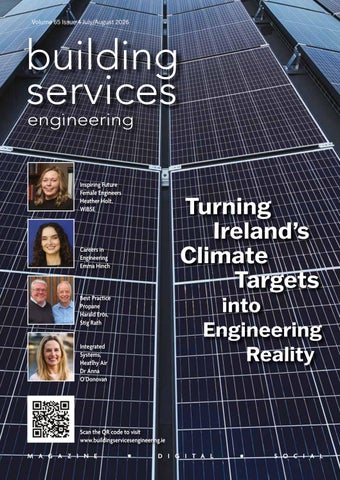
Turning Ireland’s Climate Targets
Careers in Engineering Emma Hinch
into Engineering Reality
Best Practice Propane Harald Erös, Stig Rath Integrated Systems, Heatlhy Air Dr Anna O’Donovan
Scan the QR code to visit www.buildingservicesengineering.ie M A G A Z I N E
D I G I T A L
S O C I A L
Building Services Engineering I November/December 2025 1
Five-Star Solution for the Five-Star Europe Hotel & Resort Renowned for setting the standard in luxury hospitality, The Europe Hotel & Resort has taken a major step forward behind the scenes. A transformative project, centred on sustainability, enhanced guest comfort, and long-term performance, saw Mitsubishi Electric Ireland & Diamond Quality Partner Brian Scully Services Ltd. deliver a bespoke climate control solution powered by Hybrid VRF technology.
Watch the full case study here
les.mitsubishielectric.ie
Building Services Engineering July/August 2026 1
Contents editorial
PROPANE HEAT PUMPS AND CHILLERS:
T
he latest assessment from the Climate Change Advisory Council lays bare a monumental challenge and an unprecedented opportunity for the building services engineering sector. The assessment states that while Ireland’s emissions may be heading in the right direction, the recent drop is an illusion caused by mild weather and should not be celebrated as a victory. With commercial buildings projected to overshoot upcoming carbon budgets by 62% and residential homes by 22%, the mandate for the construction and engineering industry is definitively clear. Delivery is the vital new watchword. We remain drastically behind on critical infrastructure. Heat pump installations sit at a mere fraction of the 400,000 required by 2030, district heating projects are being stalled by regulatory delays, while deep retrofits are simply missing targets. Our government needs to provide the right frameworks to enable successful delivery. For engineering professionals, this is a clarion call. The transition away from fossil fuels demands massive scaling of technical expertise, from designing complex district heating networks to integrating solar panels and ensuring that buildings are resilient to extreme weather. In this issue of Building Services Engineering, we explore the critical hurdles shaping our transition to sustainability—and highlight the groundbreaking innovations and technology driving real progress across the sector.
What best practice looks like: – An introduction to best practice for R-290 and A3 refrigerants in building services – Harald Erös and Stig Rath
30
Critical infrastructure projects 2 Hevac Qvantum QE New Heat Bill advanced 4 Balancing indoor air CIBSE WLC certifications 6 ILEA: Retrofitting lifts Hotel Europe retrofit 6 ISOPARTNER Precision Panasonic heat pumps 7 Ecoline: Pioneering the flow Wilo’s NovaCON system 11 Buildings harnessing solar CIBSE President appointed 13 Data Centres Ireland 2026 Versatile Zehnder Comfo Q 14 Professional lighting course Sisk at London Irish Centre 16 HP compressor technologies CIBSE Annual Lunch 21 ATP celebrates 25 years Fast-track offshore wind 24 AECI electrical apprentices Grant’s cylinder investment 26 EFCA & water resilience WiBSE Dinner Night 28 Appointments
33 36 42 46 48 50 52 55 56 60 61 62 64
Robbie Cousins Editor MOVING THE NEEDLE:
25
ACTIONS NEEDED TO DRIVE DIVERSITY IN
45 61
IRISH ENGINEERING
Heather Holt, Chair, WiBSE Ireland, on her career to date and goal to inspire the next generation of engineering talent
18
Published under license by Tower Media Ltd 11 Hunter’s Leap, Newcastle, Co Wicklow. A63 D983 Tel: (01) 661 6448 Email: robbie@buildingservicesengineering.ie www.buildingservicesengineering.ie Editor: Robbie Cousins Design: Joanne Birmingham Advertising: Philip McGaley (087 266 6568), Joe Connolly (086 396 6158) Printed by: W&G Baird ISSN 2712-0198 Vol 65 No 4 © 2026 [JPR Partnership]. All rights reserved.
28
CAREERS IN ENGINEERING
Emma Hinch, Mechanical Package Manager, Jones Engineering
58
2 Building Services Engineering I July/August 2026
NEWS AND PRODUCTS Priority fast-track: first tranche of critical infrastructure projects designated
Ireland’s building services and MEP engineering sector faces a major statutory shift following the Department of Public Expenditure’s designation of nine flagship transport, water and energy schemes under the Critical Infrastructure Act 2026. Announced by Minister Jack Chambers, this initial tranche legally mandates all public bodies, including An Coimisiún Pleanála, the EPA, and local authorities, to prioritise these projects “at the top of the queue.” The legislation forces state agencies to streamline consent processes, run parallel authorisations and dedicate specialised administrative and technical resources to eliminate procedural inertia.
For building services engineers, MEP consultants and infrastructure specialists, this fast-tracking directly removes major bottlenecks in planning, grid connections and environmental licensing. Priority schemes include major MEP-heavy developments: • Transport: MetroLink, the Cork Area Commuter Rail Programme and the Galway City Ring Road. • Water & Wastewater: The Water Supply Project for the Eastern & Midlands Region, Greater Dublin Drainage, and the Limerick (Bunlicky) WWTP Upgrade & Bioresource Centre. • Energy Infrastructure: The North South 400 kV Interconnector, Moneypoint 400 kV Series Capacitor, and Letterkenny 110 kV Redevelopment. By accelerating statutory approvals and environmental consents (such as MARA and EPA licensing for Greater Dublin Drainage), the Act unlocks
Honeywell refocuses on pure-play automation data centre and healthcare facilities
Building services engineers designing and managing critical infrastructure across European data centre, healthcare and pharmaceutical hubs should take note: Honeywell Technologies is ramping up its focus on high-growth building and process automation solutions following the spinoff of its aerospace division. Operating as a streamlined automation specialist, Honeywell reported a 9% organic
Minister for Finance Jack Chambers.
essential capacity in energy, water and transport networks. Crucially, the minister highlighted that expanding this foundational infrastructure is vital to support wider national priorities— most notably housing development and net-zero carbon targets. With further designation orders expected throughout 2026, building services engineering teams should prepare for accelerated project delivery timelines across public sector capital works.
growth in its building systems segment for Q2 2026, driven by a 13% jump in order demand. CEO Vimal Kapur confirmed plans to roll out new automation products targeting mission-critical facilities in the second half of the year. A key highlight for European data centre consultants is Honeywell’s expanding role in liquid cooling architecture. As power densities rise, the company is collaborating directly with OEMs to supply critical process automation sensors required for advanced liquid cooling loops. Simultaneously, Honeywell is pushing further integration via its AI-assisted Forge cloud platform. Designed to pull building management systems (BMS) and environmental controls into a unified dashboard, the platform offers engineering teams enhanced predictive analytics for stringent environmental compliance in healthcare and pharma facilities. For engineers delivering high-performance, energy-efficient assets across Europe, Honeywell’s focused strategy signals greater availability of specialised sensors, smarter controls and scalable software for complex critical environments.
OpenAI leases Tropical Fruit Warehouse for EU HQ
OpenAI has leased IPUT Real Estate’s landmark 88,000-sq-ft Tropical Fruit Warehouse in Dublin’s docklands for its new European headquarters. Scheduled for relocation in late 2026, the facility will accommodate an expanding workforce, with 250 new roles being created. Supported by IDA Ireland, this highlights Dublin’s continued status as a premier global tech hub.
Pioneering for You
Building Services Engineering I January/February Building Services Engineering II March/April 3 Building Services Engineering July/August 2026 7
he intelligent system solution for a smart sewage pump station.
Go from ‘know-do’ to ‘can-do’ with our CPD training courses. Stay up to date with industry standards, regulations and best practice with Wilo.
BOOK YOUR FREE CPD SEMINAR TODAY!
We offer a range of CIBSE accredited CPD seminars that can be delivered at your premises or ours, or online. Courses available: ƒ ƒ ƒ ƒ ƒ
Degassing systems High efficiency pumping Pressure boosting and surge protection Expansion and pressurisation Rainwater harvesting www.wilo.ie T: +353 1 426 0000 E: sales.ie@wilo.com @Wilo Ireland
4 Building Services Engineering I July/August 2026
Pauline O’Reilly, CEO, Irish District Energy Association.
NEWS AND PRODUCTS Cabinet advances new Heat Bill as industry calls for a €100m support boost for district heating
The government has advanced the new Heat Bill, clearing the path for its introduction to the Oireachtas later this year. The legislation will unlock the rollout of district heating across the country. According to Climate and Energy Minister Darragh O’Brien, research indicates that district heating could supply about 80% of Dublin’s total heat demand by 2050. Following the move, the Irish District Energy Association (IrDEA) has urged the government to increase supports for district heating, calling it an “unrivalled opportunity” to reduce Ireland’s vulnerability to fossil fuel price spikes and supply disruptions. District heating utilises centralised, domestic sources – such as waste heat from data centres or pharma companies – to heat multiple buildings. Although it serves 80 million people across Europe, district heating currently meets less than 1% of Irish heat demand. However, a Sustainable Energy Authority of Ireland (SEAI) study found it could supply over 50% of national heat. With 300,000 homes planned by 2030, IrDEA CEO Pauline O’Reilly emphasises this “once-in-a-generation” chance for secure, low-cost energy. The Tallaght District Heating Scheme already successfully utilises waste heat from an Amazon data centre. To scale this industry, IrDEA is requesting an additional €100m in capital grant
support. It is also appealing for a VAT reduction on renewable heat from 13.5% to 9%, bringing it into parity with gas and electricity. IrDEA estimates district heating is 40% cheaper than heat pumps, potentially saving a standard Irish family €632 annually. The IrDEA Annual Conference takes place on 30 September next at the Radisson Blu Royal Hotel, Dublin 2. Speakers will include Minister Darragh O’Brien, Department of Climate, Energy and Environment (DCEE); Brian Carroll, Asst Secretary General, DCEE; Dr Matt Kennedy, Global Head of Client Transformation, IDA; Phil Hemmingway, Director of Decarbonisation, CRU; and Séan Kinsella, Principal Officer, Renewable Heat, DCEE. To learn more or book your place, visit www.districtenergy.ie
Further consolidation in Ireland’s built environment as AtkinsRéalis completes TOBIN acquisition In a significant move for Ireland’s engineering and built environment sectors, AtkinsRéalis has acquired Galwayheadquartered Patrick J Tobin & Co Ltd (TOBIN). AtkinsRéalis has operated in Ireland for
more than 25 years, delivering major programmes across transport, water, energy and the built environment. With headquarters in Dublin and offices in Cork, Galway and Dundalk, the acquisition of TOBIN further enhances its capacity to
Pictured (l to r): Mike McNicholas, CEO, UK & Ireland, AtkinsRealis; Ciaran McGovern, Managing Director, TOBIN; and Martina Finn, Managing Director, Ireland, AtkinsRéalis.
support Ireland’s ambitious infrastructure pipeline. TOBIN, founded in 1952, has a 70-year legacy of delivering major projects across Ireland. Headquartered in Galway, the firm employs around 200 people across five offices, including Dublin, Castlebar, Limerick and Sligo. Its multidisciplinary expertise spans civil and structural engineering, water and utilities, environmental and planning services, transport and quantity surveying. Completed on 06 July 2026, the acquisition marks a major milestone in AtkinsRéalis’ national growth strategy. For building services engineers and infrastructure specialists across the country, this consolidation signals a serious boost to local technical capability and project delivery capacity.
SOMETHING NEW IS COMING…
Building Services Engineering I July/August 2026 5
Designed for the Future. Built to Perform. Designed specifically for Irish apartments R290 heat pump with a capacity of 3.2kw Connected by 150mm round ducting or 220mm x 90mm flat pack ducting Flexible design – position up to 10m from the outside wall Fully app enabled Comes with a 200ltr pre-plumbed cylinder
Another Game Changer from
Discover our full service portfolio at
www.pipelife.ie
6 Building Services Engineering I July/August 2026
NEWS AND PRODUCTS CIBSE launches new Whole Life Carbon Certification
CIBSE Certification has officially launched its Whole Life Carbon Assessor (WLCA) scheme, establishing the first rigorous, independent professional register to verify competence in measuring full lifecycle building emissions. Aligned with the globally recognised RICS Whole Life Carbon Assessment 2nd Edition standard, the scheme validates an engineer’s capability to calculate both operational and embodied carbon from a building’s initial construction through to its eventual demolition. While developed in the UK, the launch carries immense strategic importance for CIBSE Ireland members, mechanical and electrical (M&E) consultants and building service engineers operating across Ireland. Navigating the 2026 EPBD Transposition The certification arrives at a critical regulatory turning point for Ireland. Under the EU’s updated Energy Performance of Buildings Directive (EPBD), Ireland is legally mandated to begin measuring and capping lifecycle carbon emissions. With the EPBD being transposed into Irish law, local authorities and planning bodies, such as Dublin City Council, are increasingly requesting comprehensive whole-lifecycle carbon reports for major planning applications. CIBSE Ireland members holding this new certification will possess immediate, verified compliance status to sign off on these complex statutory assessments.
Tackling the building services “data gap” A major hurdle for Irish building services has been the historic deficit of Environmental Product Declarations (EPDs) for complex M&E equipment. Historically, operational energy captured the focus of Irish regulations, leaving the carbon-heavy manufacturing stages unregulated. The new CIBSE Certification Framework directly relies on the standardisation of data collection. For engineers in Ireland, this bridges the gap between local green building drives—like the Irish Green Building Council (IGBC)’s Community of Practice—and standardised methods such as CIBSE TM65 for calculating building services equipment emissions. Cross-border mobility and career advantage Thanks to the robust cross-border professional architecture between the UK and Ireland, the certification offers seamless mobility. • Mutual recognition: CIBSE Chartered Engineers (CEng) can leverage the statutory Washington Accord path to gain dual Chartered Engineer status with Engineers Ireland, making this qualification globally valid. • Commercial edge: As local public procurement tenders shift to reward circular-economy design, certified Irish members can bid competitively for major state and private commercial infrastructure projects. CIBSE Ireland members can access the prerequisite pathway online, beginning with foundation modules on the CIBSE portal.
CIBSE TM71: Measuring heat transfer coefficients in buildings’
CIBSE, supported by Innovate UK, has released ‘CIBSE TM71: Measuring heat transfer coefficients in buildings’. Led by experts from Loughborough University and Build Test Solutions, this framework provides guidance on measuring, interpreting, and reporting Heat Transfer Coefficients (HTC) to shift the industry from theoretical assumptions toward verified real-world performance. While HTC values are traditionally calculated to size heating systems and plan retrofits, TM71 details modern in-situ measurement methods—expanding on traditional co-heating tests. Comparing calculated values with real-world measurements helps identify gaps in design assumptions, construction quality, and energy modelling. The publication applies to both domestic and non-domestic buildings. It serves building professionals, developers, landlords, contractors, and regulatory bodies seeking standardised reporting and reliable data. By formalising HTC measurement, TM71 advances accountability and helps bridge the gap between building design intent and operational reality.
Building Services Engineering I July/August 2026 7
The Europe Hotel & Resort in Killarney, Co Kerry, where luxury hospitality meets innovative, energy-efficient climate control solutions.
A five-star solution for the five-star Europe Hotel & Resort An award-winning Irish hotel overcomes legacy infrastructure challenges with a discreet, futureproof climate control system to blend elegance, energy efficiency and guest comfort.
A
s part of a multi-million-euro redevelopment, the luxury Killarney-located Europe Hotel & Resort partnered with Mitsubishi Electric and Diamond Quality Partner Brian Scully Services to upgrade its HVAC infrastructure. The phased project future-proofs the fivestar destination by boosting guest comfort, lowering operating costs and reducing environmental impact. Michael Foley, Director of Engineering for Killarney Hotels Ltd and Maintenance Manager for The Europe Hotel & Resort, said: “We looked at the whole thing of the green agenda and comfort of our guests. Then the bottom line; the economics of the whole thing and the running costs, and the Mitsubishi Electric systems come out on top.”
The challenge Delivering a modern HVAC solution within a long-established luxury hotel presented a number of challenges. Years of expansion had created irregular spaces, limited ceiling voids and restricted service routes, while installation work had to be completed with minimal disruption to hotel operations. Stephen McGrath, Area Sales Manager, Mitsubishi Electric, explained: “An existing building that’s operational is always going to be a much more difficult install than a new build.” The solution also had to support the hotel’s sustainability ambitions, comply with evolving F-Gas regulations and provide discreet operation without compromising guest experience. Kevin Scully, Managing Director,
Brian Scully Services, added: “We were confident from the outset that our experience and technical knowhow, coupled with that of Mitsubishi Electric and their innovative product portfolio, would result in a unique customised solution that would meet the project’s demanding criteria.” The solution The project centred on the installation of Mitsubishi Electric’s Hybrid VRF (HVRF) technology, including the first application of Mitsubishi Electric’s 50kW (21HP) R32 heat recovery outdoor unit. Using low-GWP R32 refrigerant, the system delivers a significantly lower environmental impact compared to previous-generation VRF technologies while helping future-proof the hotel against changing regulations. Mitsubishi Electric’s Hybrid HVRF system provided the ideal solution for the resort, with water instead of refrigerant in guest rooms. This eliminated the need for bedroom leak detection, simplified installation and allowed the use of low-GWP R32 refrigerant. The phased project integrated HVRF, heat pumps, ventilation and custom-concealed vanity units across the property, offering guests simple controls and enabling centralised remote monitoring for maintenance. Partnership The project’s success relied on the strong partnership between Mitsubishi Electric and Brian Scully Services, a family-owned Irish business with nearly 40 years of expertise and 2025 Mitsubishi Electric Diamond Quality Partner status.
Discreetly integrated Mitsubishi Electric Hybrid VRF technology delivers tailored comfort and silent operation in every guest room.
“Being part of the Mitsubishi Electric Diamond Quality Partner programme is invaluable,” said Kevin Scully. “They’re always on the end of the line for a query or an issue. It’s absolutely vital to have someone like Mitsubishi Electric as part of your team.” The results The completed installation has delivered exceptional results for guests and hotel management. The system provides quiet operation, responsive room-by-room temperature control and improved energy efficiency throughout the resort. “The energy bills: there was a marked improvement on those. The overall energy consumption on a room-by-room basis is definitely quite noticeable on the bottom line,” said Michael Foley. “The most positive return we’ve seen is the feedback from our guests about the comfort of the suites and rooms.” The adoption of low-GWP R32 refrigerant technology has also helped future-proof the property against upcoming regulatory changes, providing long-term operational confidence. Watch the full case study here: https://les.mitsubishielectric.ie/casestudies/the-europe-hotel-killarney or scan the QR code
8 Building Services Engineering I July/August 2026
Irish Green Building Council
IGBC launches new website as knowledge hub for sustainable built environment
T
he Irish Green Building Council (IGBC) has launched a redesigned website, positioning the new platform as a central knowledge hub for everything related to green building in Ireland. The revamp of the IGBC’s website comes as demand grows across the construction and engineering sectors for clear, reliable information on sustainability and decarbonisation in the built environment. With regulatory pressure increasing and more developers, contractors, engineers and design teams seeking to embed sustainable practices into their projects, IGBC says the new site was built to make trusted knowledge easier to find and use. Content organised by thematic area One of the most significant changes is how content is structured. Previously, publications, guides, project case studies, news and events were somewhat separate across the site. Now, all resources are tagged by thematic area, making it far simpler for users to locate exactly what they need. The five thematic areas are: • Circularity • Carbon emissions • Health and wellbeing • Climate adaptation and resilience • Biodiversity This tagging system means a user researching, for example, embodied carbon can pull together relevant guides, case studies, news articles and upcoming events on that topic in
one place, rather than searching the site section by section. New AI Tool answers questions using IGBC content only A standout feature of the new platform is the integration of an AI-powered tool designed to answer user questions directly. Unlike general AI assistants, this tool draws exclusively from IGBC’s own content, meaning answers are grounded in material the organisation has vetted and published itself. For industry professionals, this offers a quick way to get accurate, sector-specific answers without having to scan multiple documents, while still being confident the information reflects IGBC’s own guidance and standards. The process is simple: users type their question into the search bar. If a user is looking for a specific document, topic, or acronym (for example, HPI), they can switch to Classic Search and search using relevant keywords. Built for every device The new website has also been built with a responsive design, meaning it functions smoothly across desktop, tablet and mobile devices. This is a practical improvement for professionals working on-site or moving between meetings, who need to access guidance or resources on the go rather than only at a desk. Personalised dashboards for members IGBC members enrolled on the website also gain access to a new private dashboard. This personal space allows users to: • Save content for later • Personalise their profile • Set and change their specific interests The dashboard effectively tailors the website experience to each member’s priorities. A step forward for industry-wide knowledge sharing The new website is an important step in making sustainability knowledge more accessible across the construction industry. In this way, the IGBC aims to support professionals at every level, from those new to green building principles to specialists seeking guidance. As the construction sector continues to adapt to tighter environmental regulations and rising expectations around sustainable building practices, resources like this are likely to play an increasingly important role. A centralised, reliable source of information can help reduce duplication of effort, improve consistency in how sustainability principles are applied, and support better-informed decision-making across projects of all sizes. To learn more, visit www.igbc.ie
Building Services Engineering I July/August 2026 9
PANASONIC
Europe’s heat pump market returns to growth
P
anasonic Heating & Cooling Solutions is highlighting new figures from the European Heat Pump Association (EHPA) that show how far the technology has come across Europe. With 29.3 million residential heat pumps now installed and sales returning to growth in 2025, millions of households are already heating and cooling their homes with far less exposure to the fossil fuel price swings that follow global events. Busting the cold climate myth Sales across 21 European countries rose 13% in 2025 to reach 2.9 million units, a clear signal of renewed confidence among homeowners and installers. The strongest adoption is happening in some of the continent’s coldest climates. Norway now has 650 heat pumps for every 1,000 households and Finland more than 540, the highest densities anywhere in Europe, putting to rest the long-held myth that the technology struggles in low temperatures. A proven solution for 30 million homes Enrique Vilamitjana, Managing Director, Panasonic Heating & Cooling Solutions Europe, and a member of the EHPA Board of Directors, commented, “What these figures show is that heat pumps have moved from promise to proven. Nearly 30 million European homes are already heating and cooling themselves with less exposure to volatile fuel prices, and that number grew again last year. As a member of the EHPA board, I see the policy debate every day, but the real story is in those homes. Our job now is to make that choice easy for the next 30 million.” Europe’s heat pump market breakdown: Germany, France, and beyond The momentum is visible market by market. Germany saw sales grow 50% in 2025, with heat pumps accounting for half of all new heating systems sold for the first time, while Denmark grew 36%. France remains Europe’s largest market, with 528,000 units sold and around seven million now installed, followed by Italy with 423,000 sold. Collectively, EHPA estimates that Europe’s installed heat pumps avoided around €9.7 bn in
Enrique Vilamitjana, Managing Director, Panasonic Heating & Cooling Solutions Europe, and a member of the EHPA Board of Directors.
energy import costs in 2025, savings that ultimately reach the households and businesses that own them. Electrification Action Plan With the European Commission preparing the Electrification Action Plan, an upcoming proposal to speed up electrification and address the price of electricity compared to gas, and member states being encouraged to reduce tax and VAT on heat pumps and electricity, the conditions are in place for further growth. Panasonic continues to invest across its European network to help installers and homeowners make the switch to efficient, lower-carbon heating and cooling. European Heat Pump Association Paul Kenny, Director General, European Heat Pumps Association surmised that every heat pump installed is another bolt in the door of European energy security, and Europeans know it. He commented, “The EU and governments’ job is to make turning to residential, commercial and industrial heat pumps as easy and affordable as possible. The forthcoming EU Electrification Action Plan - and its future implementation at national level - will be pivotal to making this happen.” (Editor’s note: According to the CSO, Ireland has an estimated 83 heat pumps per thousand households and overall sales of 37,600 heat pump units in 2025, bringing Ireland’s cumulative installed stock to over 153,500 units)
10 Building Services Engineering I July/August 2026
NEWS AND PRODUCTS EDC launches “EDC 2030” strategy to triple revenue
Engineering Design Consultants (EDC) has unveiled its ambitious EDC 2030 growth strategy, setting out a roadmap to triple company revenue by 2030 and solidify its position as a leading sustainable MEP engineering consultancy across Ireland and the UK. Building on a workforce that has grown over 120% since 2020 to 125 employees across Ireland, the UK and Turkey, the strategy will drive significant further recruitment in engineering, sustainability, digital delivery, and leadership. The plan responds directly to evolving market demands, including building decarbonisation, digital advances, project complexity, and emerging sectors like mission-critical infrastructure and modern methods of construction (MMC). Over 88% of EDC’s revenue stems from repeat business across the residential, commercial, healthcare, education, life sciences and infrastructure sectors. To steer this next growth phase, EDC has established a new executive leadership team (ELT), led by CEO Richard O’Farrell alongside executive directors Robert Higgins, Sara
EDC executive leadership team and advisory board.
Steele, Gareth Murphy and Richard Coughlan. Additionally, EDC appointed an advisory board to provide strategic guidance, featuring Chair, Brian Cremin, CEO, 3SIXTY; Anne O’Leary, Growth advisor; and Michael Fenlon former ELT Member at Etex Group. Speaking about EDC 2030, Richard O’Farrell said, “EDC 2030 gives us a clear framework for where we are going, how we intend to grow, and the type of company we want EDC to be over the next decade. The construction and engineering sectors are changing rapidly. Clients are demanding more technical certainty, greater
EU targets 46% electrification by 2040 in major energy shift
The European Commission’s new landmark Electrification Action Plan aims to double electricity’s share of final energy consumption from 23% to 46% by 2040. Designed to slash reliance on imported fossil fuels, the initiative could save the EU €260bn annually in import costs. For building services engineers and installers, the plan signals massive operational shifts. A headline target seeks to double heat pump installations in buildings by 2030 compared to 2025 levels. To lower upfront technology costs and accelerate adoption, the
sustainability expertise, stronger digital delivery and better collaboration across projects. Our responsibility is to evolve ahead of that demand while continuing to protect the culture and values that brought us to this point. This strategy is ultimately about building a stronger business for our clients, our people and the wider industry.” Founded in 2003, EDC operates across Ireland and the UK. With offices in Cork, Dublin, Galway, Midwest, London and Istanbul, EDC delivers integrated engineering solutions across a diverse range of sectors.
EU will introduce a Clean Heat Market Mechanism alongside a proposed Construction Services Act, streamlining certifications for energy-efficient building installations. Key regulatory measures aim to make power more competitive against natural gas by addressing high network charges and allowing member states to reduce electricity taxes. The plan also emphasises smarter energy use—promoting smart meters, grid flexibility and dynamic data exchange. To address critical installer shortages, the EU will boost investments in sector-specific skills and facilitate cross-border qualification portability for electricians. Energy and Housing Commissioner Dan Jørgensen summarised the strategy’s core directive by saying, “With this plan, we are putting Europe on a course to become the world’s first electrocontinent. The message we are sending today is very clear: Choose electricity over fossil fuels. Choose green, home-grown, cheaper electrons over black, imported, expensive molecules. Choose independence over vulnerability. An accelerated clean energy transition coupled with electrification is the answer to Europe’s challenges in terms of security, competitiveness and decarbonisation.”
Building Services Engineering I July/August 2026 11
WILO
Wilo ensures simple and flexible condensate management with the launch of a new solution Engineered for both efficiency and ease of use, Wilo’s new NovaCON system provides a dual-connection solution for managing condensate and PRV discharge, effectively reducing on-site complexity while protecting equipment from corrosion and damage.
W
ilo has launched a new condensate management system designed to safely and efficiently remove condensate from condensing boilers. NovaCON has been developed as a compact, plug-and-play solution that provides reliable discharge of condensate into the drainage system. Effective condensate management Effective condensate management is essential to maintaining system performance and extending equipment lifespan. Condensing boilers and air conditioning units produce acidic condensate that must be removed correctly to prevent corrosion, leaks and costly damage. Proper drainage supports efficient operation, protects surrounding building materials and helps ensure compliance with installation standards.
Built-in safety features The system ensures safe and dependable performance through features such as an integrated float switch to prevent overflow and a non-return valve, which stops backflow. Dual connection flexibility In addition to a standard condensate drain outlet, NovaCON offers increased installation flexibility through the option to connect to the boiler pressure relief valve, or PRV. This capability creates a single, integrated discharge point, simplifying installation, reducing pipework requirements and supporting the safe, compliant routing of both condensate and PRV discharge. Richard Swinburne, Managing Director, Wilo Ireland, said, “Managing condensate is often an overlooked part of an installation, yet it can have a significant impact on long-term Wilo NovaCON plug-and-play condensate solution for condensing boilers
Richard Swinburne, Managing Director, Wilo Ireland.
system reliability. With NovaCON, we wanted to give installers a straightforward, dependable solution that removes complexity on site and helps avoid common issues further down the line.” Designed with installers in mind NovaCON is engineered for quick installation and quiet operation. It can be installed either on the floor or mounted on a wall, and it includes a volt-free connection for alarm systems, making it suitable for a wide range of applications. The system is compatible with a broad range of condensing boilers, including models up to 50 kW. For more information about Wilo Ireland, click here: https://wilo.com/ie/en/
12 Building Services Engineering I July/August 2026
NEWS AND PRODUCTS VERDE Energy Group and Aurivo begin construction of 5 MW Roscommon solar farm
VERDE Energy Group, backed by Octopus Energy Generation, has commenced construction on a 5 MW ground-mounted solar farm at Aurivo’s Ballaghaderreen facility in Co Roscommon. Delivered under a long-term Power Purchase Agreement (PPA), the €5m-plus initiative represents one of Ireland’s largest privately funded commercial and industrial solar developments. Equipped with 7,784 solar panels, the site will generate approximately 4.7 million kWh of clean electricity annually. This renewable power will offset around 1,053 metric tonnes of carbon emissions each year while significantly reducing Aurivo’s reliance on grid electricity. Construction is expected to complete in late 2026. Beyond Ballaghaderreen, VERDE is also delivering additional grid resilience and energy
Pictured announcing that construction has begun on the 5 MW ground-mounted solar farm (l - r): Denis Hadzialic, Engineering Manager, VERDE Energy Group; Marty Dervin, Project Manager, Aurivo; and Paul Martin, CEO, VERDE Energy Group.
infrastructure projects across several Aurivo sites to support the co-operative’s broader energy strategy. By utilising a PPA framework, Aurivo secures renewable infrastructure without requiring major upfront capital investment. Both VERDE CEO Paul Martin and Aurivo
Global HVACR Women Week invites international sector to build one connected community
The inaugural Global HVACR Women Week (25 – 31 October) will connect local voices and foster international relationships across the HVACR sector. Organised under the central message, “Local voices. Global connections. One HVACR community”, it provides a shared focal point for activities created by networks, employers, trade bodies
Project Manager Marty Dervin emphasise that this flexible commercial model provides immediate energy price certainty, protects operations against future market volatility, and establishes a practical pathway for Irish businesses striving to accelerate decarbonisation.
and individuals worldwide. Rather than a single central event, participants are encouraged to adapt existing meetings, host webinars or profile local talent while reaching beyond their usual circles to involve another generations, organisations or countries. The campaign centres on three key actions: • Show up – Support and attending activities • Speak up: Share technical expertise and experiences • Lift others: up Create opportunities for emerging voices.x Initiated by World Refrigeration Day founder Stephen Gill, the week places women’s contributions at its heart while inviting the entire sector to participate. The dates will move annually to honour pioneering women in the field. The 2026 week begins on 25 October, the birthday of Margaret Ingels – the first American woman to receive a professional Mechanical Engineer degree and an early pioneer in air conditioning and indoor air quality research. For Irish building services engineers, contractors and educators, the week offers a timely platform to highlight local talent and build global connections. So far in Ireland, Mitsubishi Electric is planning an online panel discussion on ‘Women in the Irish HVACR Industry’ on Friday 30 October. If you or your company is planning an event, register now by visiting www.globalhvacrwomenweek.com
Building Services Engineering I July/August 2026 13
CIBSE
Dave Cooper, President, CIBSE.
Dave Cooper appointed CIBSE President
The Chartered Institution of Building Services Engineers (CIBSE) has appointed Dave Cooper as President for 2026–2027, following his inauguration at the CIBSE Annual General Meeting 2026, held at CIBSE’s headquarters in London recently.
CIBSE Ireland’s latest ‘Bringing Buildings Alive’ podcasts
In an industry defined by rapid technological shifts, staying ahead is a professional necessity. CIBSE Ireland’s flagship podcast, “Bringing Buildings Alive,” delivers a vital monthly tactical briefing for engineers navigating the modern frontiers of building services. Released on the first Monday of every month, the series moves beyond daily project grinds to explore future-proof solutions. The seven expert-led episodes currently available include: • Tallaght District Heating Success: John O’Shea (Codema) and James Porter (Euro Gas) break down utilising data centre
Dave Cooper succeeds Vince Arnold, and he brings more than four decades of experience in the lift and escalator industry. Dave has exceptional technical expertise, leadership experience and a strong commitment to the engineering profession. Throughout his distinguished career, he has built a reputation as an engineer, educator, author and advocate for safety, making a significant contribution to the industry and CIBSE. A longstanding and highly respected member of the Institution, Dave has played a pivotal role in the development of multiple editions of CIBSE Guide D: Transportation Systems in Buildings, one of the industry’s most influential technical publications. His contributions to
•
•
•
•
•
•
engineering and professional practice have been recognised through the award of a CIBSE Silver Medal and an MBE. In addition to his new role, Dave continues to hold a wide range of positions across industry, academia and charitable organisations. He has been a professor at the University of Northampton, where he was involved with the MSc in Lift Engineering programme and is currently serving as a visiting professor at the University of East London. Dave also sits on the executive committee and membership panel of the Society of Vertical Transportation and chairs the Institute of Healthcare Engineering and Estate Management Lift Panel for Authorising Engineers.
waste heat. Digital Buildings as a Process: Stephen Weir (Hereworks) and David Hegarty (Arup) discuss smart infrastructure workflow. Ethical AI Adoption: Paul Tighe (Ethos Engineering) and Maryrose Lyons (AI Institute) map out autonomous workflows. Harmonising EU Lighting Regulations: Gavin Edwards (Fagerhult), Elena Scaroni (Lighting Europe), and Dave Murphy (LAI) discuss net-zero compliance. ESG in Engineering Decisions: Laura McMahon (CIBSE Ireland Chair) and Kayleigh-Ann Myles (Lawler Sustainability) focus on project site sustainability. YEN Careers: Practical advice for new graduates transitioning from academic theory to real-world engineering. Light - Beyond The Lux: Prof Kevin Kelly and Dr James Duff (Arup) explore holistic, evidence-based lighting design.
Equip yourself with the market intelligence needed to design high-performing buildings. Scan the QR code or catch up and subscribe on Spotify, Apple Podcasts, or Podfollow: https://podfollow. com/cibse/view
CIBSE launches TM 39, TM 71, and TM 59 to bridge the building performance gap
The Chartered Institution of Building Services Engineers (CIBSE) has published three critical Technical Memoranda—TM39, TM71, and TM59 – designed to bridge the building performance gap using real-world data. These documents introduce standardised protocols for energy metering (TM39), heat loss measurement (TM71), and overheating risk assessment (TM59). By launching these documents simultaneously, CIBSE equips building services engineers, sustainability managers, and policymakers with the tools they need to ensure long-term structural resilience. This trifecta ensures that buildings are metered correctly (TM39), insulated effectively in practice (TM71), and structurally adapted to combat future climate challenges (TM59). More information is available from the CIBSE Knowledge Portal. Turn to page 6 for more details on TM71.
14 Building Services Engineering I July/August 2026
VERSATILE
Specifying next-generation MVHR: The Versatile Zehnder Comfo Q range
D
esigning high-performance ventilation systems for modern, airtight buildings requires balancing optimal indoor air quality with strict energy-efficiency targets. The Versatile Zehnder Comfo Q series delivers an intelligent MVHR solution engineered to reduce carbon emissions while maintaining acoustic comfort and superior heat recovery. Core MVHR units • Zehnder Comfo Q350: Delivering up to 350 m³/h airflow, this compact MVHR unit is optimised for medium-sized residential builds and high-density apartment projects. • Zehnder Comfo Q450: Designed for larger residential dwellings, the Q450 provides an increased
Buy with confidence from Versatile, Ireland’s official Zehnder partner As Ireland’s sole authorised Zehnder distributor, Versatile provides full manufacturer-backed warranties, cutting-edge products, and lifetime support for your ventilation system. Whether you’re an architect, contractor, consultant, developer or homeowner, our expert team provides guidance at every stage—from initial specification and selection to seamless installation and beyond. By partnering with Versatile, you gain: • Official manufacturer-backed warranties • Tailored technical expertise and advice • Access to the latest Zehnder innovations • Dedicated local after-sales support Experience peace of mind and reliable performance with trusted local service. Contact our team today to get started!
capacity of 450 m³/h with whisper-quiet operational acoustics. • Zehnder Comfo Q600: Built for high-duty demands up to 600 m³/h, the Q600 easily handles large one-off houses, multifamily developments, or light commercial spaces. Add-on modules & enhancements • Zehnder ComfoClime: Operating alongside the Comfo Q600 or Q450, this air-temperature module uses inverter heat-pump technology to temper supply air, mitigating summer overheating and reducing humidity. • Zehnder ComfoFond-L Eco: This sub-soil earth-brine heat exchanger leverages constant 8–12°C ground temperatures to naturally pre-heat or pre-cool incoming air prior to MVHR intake. • Zehnder Enthalpy Exchanger: Designed for moisture balance, this recovers both sensible heat and latent moisture from wet rooms to prevent indoor air from drying out during winter heating months.
From single-dwelling specifications to large-scale residential developments, Versatile provides full technical guidance and official manufacturer-backed support across the entire Zehnder ecosystem. To learn more about how Versatile can support your project, visit www.versatile.ie or contact our engineering team at sales@versatile.ie
CIBSE TM59: Mitigating overheating in homes CIBSE TM59 is the industry-standard methodology for assessing overheating risk in UK and Irish homes (houses, apartments, student accommodation and care homes). Driven by rising global temperatures and increasingly airtight, well-insulated modern building designs, TM59 provides dynamic thermal simulation guidelines to ensure homes remain safe and comfortable year-round. It uses dynamic thermal modelling to evaluate overheating risk under realistic occupancy scenarios. The framework tests two key scenarios: • Naturally ventilated homes (evaluating exceedance of adaptive thermal comfort thresholds), and • Mechanically ventilated homes (setting a strict maximum limit of 26°C for occupied spaces). By identifying thermal risks during the design stage, CIBSE TM59 helps architects and engineers implement effective shading, optimised ventilation, and passive cooling strategies before construction begins. Versatile has a range of energy-efficient ventilation solutions that can help support the mitigation of overheating in homes on your new or existing building project.
Building Services Engineering I July/August 2026 15
16 Building Services Engineering I July/August 2026
NEWS AND PRODUCTS Sisk appointed lead contractor for £38m London Irish Centre redevelopment
The London Irish Centre has appointed Sisk as main contractor for a £36m–£38m overhaul of its Camden Square premises, addressing critical requirements for modern accessibility, environmental sustainability, and functional efficiency. Construction begins in January 2027, targeting a Q1 2029 completion. Designed by Coffey Architects, the complex scheme involves retaining the original three-storey facade while expanding the adjacent Murray Street terrace to three storeys. From a building services perspective, the multi-use development presents diverse MEP and acoustic challenges. Key spaces demanding specialised environmental controls and acoustic performance include: • A flexible 600 standing-capacity, two-tiered performance space and 250-seat café and banqueting suite • A 130-seat raked studio theatre and dedicated cinema
Community spirit in action in Bray
The team at Wavin was delighted and privileged to have been able to get involved, in a small way, with a very special DIY SOS: The Big Build Ireland project in Bray, Co Wicklow, recently. Watching a community come together to support a family who has gone through the unimaginable was something very special. Wavin was delighted to donate product to the project and sends warm congratulations to everyone involved, who, in just nine days, created something really special for an incredibly brave family. Keep an eye out for the episode on RTE One this autumn
Minister of State at the Department of Foreign Affairs and Trade Neale Richmond (centre) visited the London Irish Centre for the announcement.
space • A heritage archive centre and public library housing 7,000 Irish literary works requiring precise humidity and temperature control • Upgraded welfare facilities, creative studios and social hubs. Supported by a €6.75m Irish government allocation, the work will include replacing ageing infrastructure with high-efficiency MEP systems tailored for varied occupancy profiles across cultural, welfare and commercial zones. Sisk will execute the build while the charity maintains off-site operations throughout the two-year construction phase.
Finalists announced for 2026 Octabuild Builders Merchant Excellence Awards The finalists for the 2026 Octabuild Builders Merchant Excellence Awards have been officially revealed, following a record-breaking number of entries from across the island of Ireland. A total of 22 builders’ merchants are competing across eight categories, alongside nine Rising Star and 23 Unsung Hero nominees. Celebrating four decades of recognising trade performance, the awards benchmark operational standards across key industry pillars—including digital integration, customer service, and environmental sustainability. The shortlist highlights merchants making significant strides in modernising supply chains, improving energy efficiency within their operations and expanding
their offerings of sustainable materials and MEP-adjacent solutions. Contenders for the Sustainable Business Excellence Award include Chadwicks (Galway and Robinhood Road), JP Corry (Springfield Road), and Stakelums Home & Hardware (Thurles). Independent judges Phil Derby and Steve Collinge noted that merchants are actively investing in store infrastructure, digital capabilities and technical expertise to support evolving building regulations and trade demands. Organised by Octabuild members—including Grant Engineering, Kingspan Insulation, Etex Ireland, and Gyproc—the winners will be announced on 01 October 2026 at the Mansion House in Dublin.
Building Services Engineering I July/August 2026 17
NEWS AND PRODUCTS
Michael Kelly, General Manager, FAIN Ireland.
FAIN Ireland launches ultra-low energy lift system
FAIN Ireland has unveiled ION Green, a breakthrough lift system engineered to eliminate the electrical and structural barriers typically associated with building retrofits. Operating on a standard single-phase 230V supply with an operational draw of just 400W, ION Green removes the need for costly electrical grid upgrades in existing residential, commercial and healthcare facilities. At the core of the system is advanced regenerative technology, similar to Formula One KERS, that captures, stores and reuses energy generated during descent and braking. This delivers energy savings of up to 96% compared to hydraulic lifts and over 80% compared to conventional electric systems, achieving the highest energy classification under ISO 25745. The oil-free, recyclable construction further reduces lifecycle environmental impact. Beyond energy efficiency, ION Green features integrated
Firethorn and Stewart top out Folk Dublin development Firethorn has reached a key construction milestone at its Folk Dublin development in the city centre, with a topping-out ceremony marking completion of the site’s structural framework. Located off O’Connell Street, the site will operate as a ‘hybrid hotel’, providing 138 rooms with capacity for up to 716
battery storage capable of powering over 100 trips during a mains blackout. Building management and safety are enhanced via the FAIN 360° platform, which enables continuous remote diagnostics, predictive maintenance, and live video emergency assistance.
guests. Designed to help address the city’s shortage of affordable tourist accommodation, the development will include a vibrant bar, café and lounge open to both guests and the wider public. Work commenced last summer, following Firethorn’s purchase of the site in 2024, marking its debut development outside of the UK. With the structural frame now complete, Folk Dublin is on track for completion in March 2027, with Stewart Construction delivering the project. Paul Martin, Head of Development at
Firethorn and Stewart Construction mark structural completion of Folk Dublin with topping-out ceremony.
Firethorn, said, “Topping out at Folk Dublin is a significant milestone for Firethorn and demonstrates our ability to deliver high-quality buildings efficiently and at scale.” Paul Stewart, Managing Director at Stewart Construction, commented, “Watching Folk Dublin rise to become part of the Dublin skyline is a proud moment for everyone involved. The topping out ceremony is a testament to the hard work, collaboration, and shared vision that have brought us to this milestone.”
18 Building Services Engineering I July/August 2026
Moving the needle: WiBSE Ireland Chair Heather Holt on the actions needed to drive greater diversity in Irish engineering With over a decade of experience navigating the dynamic world of building services engineering, HEATHER HOLT, Engineering Manager at Tech Refrigeration & Air Conditioning, is a strong advocate for change, visability and inclusion in the sector. She balances a complex, multi-faceted technical role with her position as the new Chairperson of Women in Building Services Engineering (WiBSE) Ireland. She speaks with ROBBIE COUSINS about her professional journey and discusses the concrete actions needed to inspire the next generation of engineering talent.
W
hat is your current job, and what does your work involve? “I work as an Engineering Manager with Tech Refrigeration & Air Conditioning. What I enjoy most about the role is the variety it offers — from technical design and contract negotiation through to engineering management and client engagement. My role has taken me all over the country and has given me the opportunity to work alongside a wide range of industry professionals, including design consultants, mechanical contractors and building end users. Every project brings different challenges and opportunities to learn. “I’m also very appreciative to work for a company that fully supports my involvement in industry institutions such as CIBSE Ireland and WiBSE, which have played a huge role in my professional development.”
How did you first get involved with WiBSE? “When I first started with Tech, my director, Paul Byrne, contacted Mitsubishi Electric to jointly host the first Women in HVACR event in Ireland. Through his championing of women in the industry, I made my first WiBSE connections. Shortly afterwards, I received an invitation to my first WiBSE event through our own CIBSE champion, Pat Lehane, and my good friend, Orlaith Gillen. I attended this event in 2022, and from
and connect women within building services engineering at every stage of their careers. It is about creating a visible and supportive network that encourages diversity, promotes inclusion and helps women feel represented within the industry. Equally important is ensuring that the next generation can see engineering as an exciting and achievable career path. By promoting visibility, mentorship, and professional development, WiBSE plays an important role in shaping a more inclusive future for the sector.”
Heather Holt, Chairperson, WiBSE Ireland.
there, the rest is history. “Since then, I’ve been involved in a range of networking and industry events that have helped grow the visibility of women within building services engineering. One of the most rewarding aspects has been helping to create spaces where women can connect, share experiences and support each other professionally.”
How would you define WIBSE’s core mission within the Irish BSE sector? “As WiBSE Chair, I’m grateful for the opportunity to give back to an industry that has been so good to me over the past 10 years. “At its core, WiBSE exists to support
What WiBSE events are in the pipeline for the coming year? “We are looking forward to another busy year of events and initiatives focused on networking, professional development and industry engagement. The committee is particularly focused on continuing to grow the WiBSE network and creating opportunities for members to connect through technical and social events. We also want to strengthen collaboration with industry partners, educational institutions and other professional organisations to help promote engineering careers to young people. “A key priority for us is maintaining momentum around visibility and representation within the industry, while continuing to foster an environment where people feel supported, encouraged and empowered to progress in their
Building Services Engineering I July/August 2026 19
“At its core, WiBSE exists to support and connect women within building services engineering at every stage of their careers. It is about creating a visible and supportive network that encourages diversity, promotes inclusion and helps women feel represented within the industry.” careers. “Some events we have in the calendar so far for 2026: • Annual Golf Outing – 28 August, Luttrellstown Castle, Dublin. • WiBSE La Peniche Boat Trip – 11 September
Mona Duff, ImmediatePast Chairperson, WiBSE Ireland; and Heather Holt, Chairperson, WiBSE Ireland.
• CIBSE Ireland Annual Lunch – 11 December, Mansion House, Dublin.”
Why should women working in the building services industry in Ireland join WIBSE? “Joining WiBSE means becoming part of a supportive network that champions women in building services engineering. It offers opportunities for mentoring, networking,visibility and career support, while helping you connect with industry leaders and peers who genuinely want to see more women thrive and lead within the profession. Whether you are just starting out in your career or are already established in the industry, WiBSE provides a welcoming space to learn, grow, and build meaningful professional connections. “Anyone interested, get in touch, we would love to hear from you.” What are the most pressing challenges facing women in the engineering profession today? “While the industry has made
significant progress in recent years, there are still challenges around representation, visibility, and confidence, particularly in traditionally male-dominated environments. “For many women entering engineering, it can still be difficult to see clear role models or pathways into leadership positions. Retention is also an important conversation — ensuring that women feel supported, valued and encouraged to progress throughout their careers. “I think continued focus on mentorship, inclusion, flexible career development and visible representation is essential to ensuring the industry continues moving in the right direction.”
Diversity is a major talking point in the industry, but what concrete actions have you seen in the sector and would you like to see happening to move the needle and attract more young women into engineering? “I believe the construction industry as a whole has made huge advances in
20 Building Services Engineering I July/August 2026
WiBSE Movie Night and Cocktail Club networking event in association with CIBSE Ireland and Daikin.
moving to a more diverse workforce in recent years. The variety of roles available across the sector means there is genuinely something for everyone. The increase in womenfocused industry events has been a strong indicator of the industry’s desire to attract and support more women. Continued focus and momentum are needed through initiatives such as school outreach programmes, career days, mentoring, internships and work experience opportunities. “I also firmly support the core philosophy –‘You can’t be what you can’t see’. This is something WiBSE Lattes & Pilates morning.
Annual ‘Women in HVAC&R’ event, a CIBSE Ireland, WiBSE and Mitsubishi Ireland collaboration.
I came across while completing the STEMAZING school outreach programme. Visibility matters. By supporting the women already within the industry and giving them opportunities to be visible as leaders and role models, we can help inspire and encourage the next generation to pursue careers in engineering.”
What advice would you offer to any young person, regardless of gender, who is just beginning their career in the BSE sector? “Make the most of every opportunity that comes your way and never
underestimate the value of the network around you. Some of the best learning opportunities come from the experienced people you work alongside every day. Be willing to ask questions, stay curious and get involved wherever you can. This is an industry where hard work, attitude and consistency are recognised, and over time you will see the results of the effort you put in.” If you are interested in joining WiBSE Ireland, email cibseirelandsec@ gmail.com to learn more and get involved
Building Services Engineering I July/August 2026 21
CIBSE
Luttrellstown Castle Resort Golf Course.
CIBSE Ireland Annual Golf Outing and Annual Lunch 2026
A
s we went to press, the CIBSE Ireland Annual Golf Outing – to be held at Luttrellstown Castle Resort, Dublin, on Friday, 28 August – was sold out, with a capacity of 24 teams participating. This event offers the perfect blend of spirited competition and high-level networking for professionals across the industry. The day begins with registration between 11 am and 12.15 pm, setting the stage for a 1 pm shotgun start. Teams will compete in an engaging four-person scramble format, ensuring a lively and inclusive afternoon of golf for all skill levels. In addition to providing essential funding for CIBSE Ireland’s technical programme, a portion of the proceeds also benefits the vital work of Cancer Trials Ireland. The proceedings conclude with a sitdown meal and the official prizegiving ceremony. Sponsor on the day is Daikin. CIBSE Ireland Annual Lunch Looking ahead to Q4, bookings are now open for the CIBSE Ireland Annual Lunch. This represents the premier networking opportunity of the year for all involved in building services engineering. It is an unparalleled occasion to reconnect with industry colleagues, solidify longstanding professional relationships, and forge new connections within a vibrant and engaging environment. The change of venue to The Round Room within the Mansion House, Dublin, proved extremely popular, and so it
CIBSE Ireland Lunch at The Round Room in The Mansion House, Dublin.
remains for the forthcoming event on Friday, 11 December 2026. The sponsor is Lindab Ireland. The afternoon begins with the Chairperson’s Reception at 12 noon, with formal proceedings commencing at 12:30 pm. As one of the highlights of the industry calendar, the event serves as the perfect setting to entertain guests and broaden your professional horizons.
Book your place Demand for places is exceptionally high, and with capacity strictly limited to 350 attendees, tables are expected to sell out quickly. To ensure your attendance, simply email James Porter at james.porter@eurogas.ie today. James will arrange an invoice and provide the necessary CIBSE Ireland bank details to facilitate payment via direct transfer.
22 Building Services Engineering I July/August 2026
Building Services Engineering I July/August 2026 23
24 Building Services Engineering I July/August 2026
NEWS AND PRODUCTS Kingspan anchors €3m research partnership to decarbonise the built environment
Kingspan has announced a multi-year €3m collaboration with Innovate for Ireland, a public-private initiative positioning Ireland as a global hub for doctoral research. Over the next decade, the building materials leader will fund multiple PhD iScholars tackling critical industry challenges, including climate action, green materials and sustainable construction. The initiative’s inaugural Kingspan-sponsored scholar, Abhishek Kaitheri Edathil, based at TUS Athlone and Kingspan’s IKON Innovation Centre, will focus on recycling solutions for Polyurethane (PUR) and Polyisocyanurate (PIR) insulation waste across the building lifecycle. Sandra Del Bove, Group Head of Innovation, Kingspan, highlighted that access to top-tier research talent is vital for developing advanced solutions to decarbonise the built environment. Sandra Del Bove commented: “We are proud to partner with Innovate for Ireland and are delighted to support an initiative that is building Ireland’s next generation of sustainability and innovation leaders while strengthening the country’s position as a world-class innovation ecosystem.” Sandra Del Bove, Group Head of Innovation, Kingspan.
Andrew Brownlee, Chief Executive, Construction Industry Federation.
Construction costs surge as sector warns of delivery risks
Construction costs are steadily rising, with 96% of firms anticipating further hikes driven by soaring labour and material expenses, according to the CIF Q2 2026 Construction Outlook Survey. Based on responses from 138 companies, 94% reported raw material price increases early this year. Construction Industry Federation (CIF) Chief Executive Andrew Brownlee noted that while firms remain cautiously optimistic, cost pressures and structural constraints threaten infrastructure and housing delivery. He urged immediate reforms, particularly in public works, where low margins and heavy bureaucracy currently deter participation—nearly half of the surveyed firms did not engage in public contracts last quarter. Despite flat recent orders, expectations for future project pipelines remain positive, led by civil engineering and specialist contracting. Meanwhile, employment remains stable, with 22% of firms planning to hire. Export activity also provided a bright spot, showing positive turnover growth.
Ireland urged to fast-track offshore wind energy projects
The National Competitiveness and Productivity Council (NCPC) Ireland has warned that Ireland must drastically accelerate the development of its offshore wind energy infrastructure to maintain economic competitiveness. There are pressing concerns surrounding Ireland’s green energy rollout. The NCPC’s call to action follows the closure of the Arklow Bank Wind Park last year, which had previously served as the nation’s sole operational offshore wind farm. Slow planning processes, regulatory hurdles, and grid connection delays pose major risks to the country’s energy transition. As neighbouring European nations rapidly expand their offshore capacities, the NCPC warns that Ireland risks falling behind. Accelerating these offshore projects is considered vital not only for meeting national climate targets, but also for securing long-term energy independence, attracting foreign investment, and maintaining economic resilience.
Building Services Engineering I July/August 2026 25
NEWS AND PRODUCTS Ethos Engineering acquires Hanley Pepper
Ethos Engineering has announced the acquisition of Hanley Pepper Consulting Engineers, an Ireland-based team of civil and structural engineers with 39 years’ experience supporting the delivery of data centres and critical infrastructure. Civil and structural engineering is fundamental to data centre delivery, from the structural integrity of buildings to the increasingly complex underground infrastructure required to accommodate the extensive arrangement of services critical to data centre operations. Bringing Hanley Pepper into the group allows Ethos to deliver civil and structural engineering services as part of one unified offering. Ethos has many clients in common with Hanley Pepper and has worked alongside them on projects across 11 different
Pictured (l to r): Joe Ryan, Managing Director, Hanley Pepper; Greg Hayden, CEO, Ethos; and Michael Jackson, Director, Hanley Pepper.
jurisdictions. The acquisition is the fourth Ethos has made as part of its strategy to broaden
EFCA report calls for a new approach to strengthen Europe’s water resilience
The European Federation of Engineering Consultancy Associations (EFCA) has released a new Future Trends Report, ‘Engineering the Resilience and Sustainable Development of the European Water Infrastructure’. The report highlights growing threats to Europe’s water systems, including extreme weather (droughts and floods), deteriorating infrastructure, rising demand and emerging security risks. To ensure long-term resilience, EFCA advocates integrating engineering expertise, digital tools, and nature-based solutions, supported by updated regulations, quality-based procurement, and long-term investment.
and enhance its service offering. Ethos now employs over 400 people and operates in 21 countries across EMEA.
EFCA President Inés Ferguson stressed the urgency of action. She commented, “Europe’s water sector needs a profound change to confront extreme climate, increasing water demands and ageing infrastructure designed for very different conditions. Water resilience requires new systems that integrate engineered reliability with ecological adaptability and data-driven management. Consulting engineers are the best placed to design, implement, and monitor these systems, and EFCA members stand ready to collaborate with public administrations in delivering the solutions that meet today’s social, industrial, and environmental demands.” Emmanuelle Frénéat, Chair, EFCA’s Future Trends Committee, highlighted the need for a new engineering approach. She said, “Water resilience is no longer just an environmental issue – it is both an engineering and a governance challenge. Moreover, it is a strategic imperative for Europe’s security, competitiveness and quality of life. Solutions exist, and European engineers are ready to provide them. The challenge now is to implement them at the scale and speed required.” EFCA calls for immediate, close collaboration between policymakers, public authorities and consulting engineers to rapidly scale sustainable water solutions across the continent. Scan the QR code to download the report
26 Building Services Engineering I July/August 2026
Grant invests €8 million in next-generation cylinder range and expands manufacturing capability for both new build and deep retrofit applications, the cylinders provide flexibility across a broad range of residential projects.
Grant Founder, Stephen Grant (left) and Niall Fay, CEO.
L
eading manufacturer of sustainable home heating solutions, Grant has launched a new generation of hot water cylinders, designed to optimise the performance of modern heat pump systems. Designed and manufactured at Grant’s state-of-the-art facilities in Birr, Co. Offaly, the new Quick Recovery Cylinder range is backed by an €8 million investment in product development and a significant expansion of the company’s production facilities. This investment strengthens Grant’s manufacturing capability, while supporting growing demand for highperformance, heat pump-ready hot water solutions in Ireland, the UK and Europe. Designed specifically for heat pump performance Unlike standard cylinders adapted for renewable systems, the new Grant Quick Recovery Cylinder range has been developed specifically for low-temperature operation, enabling installers and specifiers to maximise the efficiency and output of air source heat pumps, including the Grant Aerona R290 heat pump range. Featuring high-efficiency heat exchange coils and optimised internal design, the cylinders are engineered to deliver rapid heat-up times and consistent hot water availability, even
under demanding usage profiles. The range also supports faster recovery and improved system responsiveness key requirements for modern, wellinsulated homes. Performance-led engineering The new Grant Quick Recovery cylinders have been developed to meet the practical and technical requirements of today’s heating professionals, combining strong thermal performance with long-term reliability. Key technical features include: • High surface area heat exchange coils to maximise heat transfer from low-temperature heat sources • Large internal coil constructed from DN25 stainless steel tubing to support rapid recovery performance • Advanced insulation to minimise standing heat loss and improve overall system efficiency • Duplex stainless steel inner shell for enhanced durability and corrosion resistance • Optimised for integration with renewable heating systems The Quick Recovery Cylinder range is available in capacities from 150 – 300 litres, with standard, slimline, Smart pre-plumbed and Smart integrated configurations to suit a wide variety of installation requirements. Suitable
Installer-focused design Ease of installation has been a key consideration throughout the development of the new range. The cylinders incorporate practical, installer-friendly features designed to streamline handling, positioning and system integration on site. Smart pre-plumbed models further simplify installation through factoryfitted components, helping to reduce time on site and support consistent system set-up. Combined with Grant’s established technical and training support, the new cylinders provide a dependable, straightforward solution for specifying and installing heat pump systems. Supporting a fully integrated heating solution The launch further strengthens Grant’s integrated approach to home heating, offering installers a complete system solution including heat pumps, cylinders and controls - all designed to work seamlessly together. This single-manufacturer approach simplifies specification and installation while helping to ensure optimal system performance. Commenting on the launch, Stephen Grant, Founder of Grant said, “As heat pump adoption continues to grow, the role of the cylinder in overall system performance has never been more important. Our new Quick Recovery cylinders have been specifically developed to work in harmony with low-temperature systems, delivering the recovery performance, efficiency and reliability that installers and homeowners expect. Our investment in design and manufacturing reflects our long-term commitment to innovation and to supporting the heating industry with high-quality, future-ready solutions.” Visit www.grant.ie for more information on Grant’s range of innovative heating solutions. Follow Grant on Facebook @GrantIRL, Instagram @grant_irl, LinkedIn @GrantEngineeringULC and YouTube @GrantEngineeringIE.
Building Services Engineering I July/August 2026 27
The smarter choice for heat pump systems Introducing the new Grant Quick Recovery cylinder range - designed for seamless integration with the Grant Aerona R290 heat pump. Designed to support efficient low-temperature heating performance. - Rapid heat recovery - Optimised for low-temperature systems - Smart pre-plumbed options available - Seamless Aerona R290 heat pump integration - Backed by Grant technical support
Discover the QR Cylinder Range
www.grant.ie
28 Building Services Engineering I July/August 2026
SOCIAL All aboard for the WiBSE Grand Canal Dinner & Cruise Networking evening WiBSE Ireland is thrilled to announce the return of our popular Grand Canal Dinner and Cruise, hosted in partnership with Mitsubishi Electric Ireland and CIBSE Ireland. Join WiBSE members for an unforgettable evening of delicious food, great conversation and valuable connection-making while floating down Dublin’s iconic Grand Canal. Whether you’re looking to expand your network, catch up with peers or simply enjoy a unique evening on the water, this event is not to be missedx Event Details • Date: Friday, 11 September • Venue: La Peniche, Mespil Road Jetty, Dublin 4
Schedule: • 5:00 PM: Boarding & Networking Kicks Off • 5:30 PM – 8:00 PM: Dinner Cruise on the Grand Canal • 8:00 PMish: Disembarkation Reserve Your Spot Spaces on board are limited! Secure your place today by emailing: cibseirelandsec@gmail.com Results Category Overall Winner (Captain’s Prize) Past Captains’ Prize Class 1 1st: J Porter 2nd: D O’Keeffe 3rd: M Duffy Class 2 1st: V Broderick 2nd: T Glynn 3rd: J Lavelle
Overall winner Barry Steele receives his prize from BTU Golf Society captain Maurice Kelly.
(35 pts) (32 pts) (32 pts) (28 pts) (28 pts) (27 pts)
Class 3 1st: F Lynch (31 pts) 2nd: D Lambert (31 pts) 3rd: M Fitzpatrick (29 pts)
Steele takes the silverware at BTU Captain’s Outing
A mix of bright sunshine and testing, breezy conditions greeted members and guests of the BTU Golf Society for the highly anticipated Captain’s Outing at Beech Park Golf Club in Rathcoole, Co Dublin. BTU Captain Maurice Kelly welcomed a strong turnout to the picturesque course. With manicured fairways and immaculate greens, Beech Park provided a stern but fair test for all involved, demanding accurate shot-making through the wind. Rising to the occasion was Barry Steele, who claimed the coveted Captain’s Prize with an impressive round of 36 points to take home the silverware. Elsewhere on the leaderboard, Dave Daly delivered a solid performance to secure the Past Captains’ Trophy with 30 points.
Des Brindley addresses the room as captain, Maurice Kelly, looks on.
Winner Barry Steele Dave Daly
Score 36 pts 30 pts
Other Prizes Front 9: P Gillen Back 9: B Harrison Nearest to the Pin (4th Hole): K Kelly Nearest to the Pin (15th Hole): V Broderick Visitors 1st: K Kelly 2nd: J Bennett 3rd: A Nicolas
(18 pts) (17 pts)
Building Services Engineering I July/August 2026 29
SOCIAL
RACGS hosts stunning summer outing at Killarney
M
embers and guests of the Refrigeration Air Conditioning Golfing Society (RACGS) gathered on Friday, 26 June for one of the most highly anticipated fixtures on the annual calendar: the summer outing at the world-renowned Killarney Golf & Fishing Club. Set against the breathtaking backdrop of Lough Leane and the McGillycuddy’s Reeks, the day delivered fantastic competition, warm camaraderie, and impressive scoring across every category. A huge debt of gratitude goes out to the generous sponsors, Hevac, RDL and Hiilife, who helped make the day a resounding success. The performance of the day belonged to John Ryan, who delivered a standout round to claim the coveted title of Overall Winner. Not content with just taking home the main prize, John also
showcased his serious power off the tee by claiming the Longest Drive award. In the main categories, JJ Quinn produced a fine round to secure first place in Class 1, holding off tight competition from Liam Hoctor and Stuart Gaffney. In Class 2, Martin Baneham led the pack with a stellar victory ahead of Fergus Daly and David Killalea. The visitors’ category proved equally competitive, with Tony Aherne putting on a brilliant performance to take first place among the guests. Full Results Overall Winner
John Ryan
Class 1 1st 2nd 3rd
JJ Quinn Liam Hoctor Stuart Gaffney
Class 2 1st 2nd 3rd
JJ Quinn Fergus Daly David Killalea
Visitors 1st 2nd 3rd
Tony Aherne Brian McNally Stephen Heffernan
Other Prizes Longest Drive Nearest the Pin Front 9 Winner Back 9 Winner
John Ryan Kevin McGourty Tom O’Dowd Kevin McGourty
A massive congratulations to all the prize winners and to everyone who took part in making the event such a memorable outing on one of Ireland’s finest courses.
30 Building Services Engineering I July/August 2026
FOCUS
Propane heat pumps and chillers: What best practice looks like – Introduction to best practice for R-290 and A3 refrigerants in building services As tightening regulations drive the shift toward eco-friendly R-290 refrigerants, industry experts STIG RATH and HARALD ERÖS, authors of the book ‘Propane, naturally safe!’, explain why true best practice for propane heat pumps and chillers goes far beyond a CE mark – requiring a comprehensive, design-first safety concept from day one.
P
ropane (R-290) combines excellent thermodynamic performance with close-to-zero global warming impact. As restrictions on synthetic refrigerants tighten, it is becoming an increasingly important option for heat pumps and chillers in buildings. Its flammability classification means that fire and explosion safety must be addressed from the earliest design stage. Best practice is not simply a matter of selecting a CE-marked appliance: it requires a complete safety concept covering the product, its location, the installation, commissioning, operation and service. Start with the operator’s risk assessment The process should begin with a site-specific risk assessment once the building design and proposed plant location have been determined. The assessment should become incorporated into the project specification, defining what the manufacturer and installation contractor must demonstrate regarding fire and explosion protection. Two different approaches to risk Risk assessment can follow two fundamentally different lines of reasoning. One is to conclude that the overall risk is acceptably low, provided that the equipment is correctly installed, operated and maintained. The other is to design the equipment and installation so that a reasonably foreseeable fault does not result in the formation of
an explosive atmosphere, propane reaching an ignition source, or any other dangerous situation. Best practice is not to choose between good design and correct use. It is to use inherently safer design as the first line of defence, supported by competent installation, operation and maintenance. Indoor and outdoor installations require different solutions Applying this design-first approach leads to different solutions for indoor and outdoor installations. Outdoor installation normally provides better natural dispersion and reduces the consequences of a release. It does not, however, make the risk disappear. A unit placed beside an air intake or above a drain or other low point may allow propane to accumulate or enter the building. External ignition sources may also be present nearby, such as lighting and other technical installations. Indoor installations demand greater control because a release is contained by the building. A common solution for liquid-to-liquid heat pumps and chillers is a ventilated enclosure. Potential release points are enclosed, air is continuously extracted to a safe outdoor location, and the enclosure is maintained at negative pressure. The enclosure, fan, ductwork, airflow monitoring, shutdown functions and power supply must be designed as one safety system. The key question is therefore not whether the unit is installed indoors or outdoors, but whether any released
propane can disperse and dilute safely without forming an explosive atmosphere or reaching an ignition source. The refrigerant circuit is a fundamental design choice A hermetically sealed refrigerant circuit is an important preventive measure because it removes release sources from the area-classification assessment. For such equipment, additional measures may include natural ventilation, continuous mechanical ventilation or ventilation initiated by gas detection, depending on the product design and installation conditions. A non-hermetic circuit contains potential release points. Best practice must then prioritise prevention of accumulation through enclosure design, continuous ventilation or reliable natural dispersion. Where an explosive atmosphere can still form, ignition sources must be controlled, and equipment within the classified area must be suitable for that zone. Gas detection is a valuable reactive measure, but it should not be used as a substitute for prevention where ventilation is needed continuously. Assess each release scenario separately Three locations deserve particular attention: • the enclosure or compartment containing potential release points; • the outlet from any mechanical extraction system; and,
Building Services Engineering I July/August 2026 31
Harald Erös and Stig Rath, authors of the book ‘Propane, naturally safe!’.
• the discharge from pressure-relief valves. They can produce hazardous areas of very different sizes and shapes. For outdoor installations, the arrangement of multiple units must also be considered, as discharge air from one unit may be drawn into the electrical switchboard air intake of another
A parallel arrangement prevents electrical switchboards from drawing in exhaust air containing propane from adjacent units. Illustration by Katrine Kalleklev. © Propanistas GesBr
Figure: A parallel arrangement prevents electrical switchboards from drawing in exhaust air containing propane from adjacent units. Illustration by Katrine Kalleklev. © Propanistas GesBr. The manufacturer should provide a clear hazardous area drawing based on credible release assumptions. The operator remains responsible for verifying that the specified zones are compatible with the actual site, although the verification may be performed by a
consultant. Safety functions need a reliable power supply Gas detection, extraction ventilation and automatic shutdown cannot be relied upon if they all lose power under the same fault condition that creates the risk. Where continued ventilation or detection is necessary for safe shutdown or dilution, an independent power supply shall be required. EN 378 and CE marking are not the whole answer EN 378 is an important refrigeration safety standard, but safe use of R-290 cannot be reduced to refrigerantcharge limits and CE marking. Where an explosive atmosphere may form, hazardous-area classification and ignition-source control must also be addressed using the relevant explosionprotection standards and workplace requirements. Product documentation does not always contain everything needed for the site-specific assessment. Before specifying a unit, consultants and operators should ask: – Is the refrigerant circuit hermetically sealed? – Can an explosive atmosphere form? – Is the enclosure continuously ventilated? – What happens if ventilation or power fails? – Is equipment inside any classified area suitably protected? – Has the manufacturer documented the hazardous areas around the enclosure, ventilation outlet and
pressure-relief discharge? Technical and organisational measures must work together The operator is not expected to be a refrigeration or explosion-protection specialist but remains responsible for appointing competent people and setting appropriate requirements. Independent review can be valuable where the manufacturer’s assessment is also being used to justify the product selection. Safe operation also depends on competent commissioning and maintenance, clear service procedures, access control, warning signs and periodic testing of detectors, fans, alarms and shutdown functions. Even a well-designed installation can become unsafe through disabled alarms, obstructed ventilation, unauthorised modifications or poorly controlled service work. In conclusion Propane can be used safely and effectively in indoor and outdoor heat pumps and chillers when the installation is based on realistic release scenarios, prevention of accumulation, safe discharge locations, ignition-source control and reliable organisational measures. The safest and least costly solutions are achieved when these requirements are defined before the equipment is selected. For further practical guidance, real-world examples, hazardousarea assessments, and checklists for manufacturers, consultants, installation contractors, and operators, see the guidebook ‘Propane, naturally safe!’ by Stig Rath and Harald Erös. Copies are available from RSL Group Wholesalers at https:// www.rslgroupwholesalers.com/pages/ propane-naturally-safe-book or scan the QR code.
32 Building Services Engineering I July/August 2026
¡
Building Services Engineering I July/August 2026 33
SUPPLIED BY HEVAC IN IRELAND, QVANTUM QE IS PERFECT FOR BOTH NEW CONSTRUCTION PROJECTS AND THE UPGRADE OF EXISTING PROPERTIES WITH SUSTAINABLE, COST-EFFECTIVE TECHNOLOGY…
Qvantum QE: The future of smart home comfort Your customers demand solutions that seamlessly blend efficiency with comfort. The Qvantum QE Exhaust Air Heat Pump rises to meet this challenge, delivering an all-in-one system that revolutionises how homes handle heating, ventilation and hot water production.
• Designed and made in Sweden • App controlled • 4 and 6kW output • Automatic updates over the web • Domestic hot water is produced without risk of Legionella via a heat exchanger, and you don’t have to choose corrosion protection based on water quality • A patented new solution where the built-in accumulator tank can be used as a thermal battery which means that your heat pump is adapted for the flex market
INTELLIGENT ENGINEERING FOR EVERY HOME Engineered with precision, the Qvantum QE is available in 4kW and 6kW configurations, making it the perfect fit for homes up to 200sqm. At its heart lies an advanced inverter-controlled compressor that intelligently modulates output to match real-time demand, eliminating energy waste while maintaining optimal comfort throughout living spaces.
ADVANCED FEATURES THAT MAKE THE DIFFERENCE • Future-ready connectivity: Built with tomorrow in mind, ensuring your investment remains relevant for years to come. • Superior hot water performance: Features an integrated thermal battery with impressive storage capacity, coupled with innovative heat exchanger technology that delivers instant hot water while completely eliminating Legionella risk. • Universal compatibility: Engineered without the need for corrosion protection, making installation straightforward regardless of your local water quality conditions. • Whisper-quiet operation: Sophisticated noise reduction technology ensures the system integrates seamlessly into daily home life without disturbance. • Enhanced efficiency option: The optional QS accessory provides preheated supply air, further boosting system performance and energy savings.
• Smart controls and future-proof connectivity The QE series supports remote monitoring and control, allowing installers and homeowners to track performance and diagnose issues from anywhere. As Qvantum’s software evolves, the QE will receive automatic updates, ensuring long-term adaptability.
SMART ENERGY RECOVERY The QE’s intelligent design captures and repurposes energy from outgoing ventilation air, ensuring that no valuable heat escapes your home. This makes it an ideal solution not only for new construction projects but also for contractors and installers upgrading existing properties with sustainable, costeffective technology.
MORE THAN JUST A HEAT PUMP With its compact footprint, intuitive user interface and virtually silent performance, the Qvantum QE transcends traditional heat pump boundaries. It represents a comprehensive investment in healthier indoor air quality, smarter energy management and enhanced living comfort. Help your clients transform their homes into efficient, comfortable sanctuaries that are ready for the future. Ready to learn more? Contact Anthony Harte, Specification Sales Manager at Hevac: T: +353 (0)1 419 1919 M: +353 (0)86 203 2737 E: Anthony.Harte@hevac.ie tender.enquiry@hevac.ie www.hevac.ie
34 Building Services Engineering I July/August 2026
C&F QUADRANT
C&F Quadrant: Rebranded, Refurbished, Ready Rebranding to align with the rapid electrification of the Irish heating landscape, C&F Quadrant Ltd has also embarked on an extensive refurbishment of its Dublin and Belfast premises. Managing Director EMMET DUFFY outlines how these changes reflect a broader commitment to environmental responsibility, enhanced customer experiences and long-term industry partnerships.
T
he Irish heating sector is undergoing a profound transformation, moving rapidly away from fossil fuels toward lowcarbon technologies. For C&F Quadrant, ensuring the company’s public identity accurately reflects this evolution was the natural catalyst for a brand refresh. Emmet Duffy, Managing Director of C&F Quadrant Ltd, explains its recently revamped logo and brand image dated back to 1992 when C&F Ltd and Quadrant Engineers merged,” He explains: “Those were very different times when it came to heating standards, product offerings, and what was then a dominant fossil fuel-based landscape. The last number of years have seen environmental considerations come right to the forefront of all our lives, starting with more efficient products coming to market and now electrification driving continuous innovation – particularly in heat pump technology for both domestic and commercial applications.” As global manufacturing partners transition to sustainable technologies, C&F Quadrant recognised the need to mirror that shift internally. “Our brand owners are moving with these times by developing new products, and it was important for us to not only represent these solutions but for our core image to begin to reflect this change and our new collective purpose,” Emmet notes. “Adopting a greenthemed, modern identity is essential as we deliver these progressive solutions across the Irish heating landscape.” Upgrading the Dublin headquarters Alongside the visual rebranding, C&F Quadrant has undertaken a comprehensive redesign of its flagship premises in Cherry Orchard Industrial Estate, Dublin, where the business has
Emmet Duffy, Managing Director, C&F Quadrant.
been based for a quarter of a century. “We have been in our current location for 25 years now and are fortunate with the space we have available for warehousing, office infrastructure, trade counter facilities and showrooms,” he says. “Our showrooms have taken many forms over that time, but product changes and industry direction meant we had to take a fresh approach for the future.” C&F Quadrant Trade Counter.
Training provision Training has always formed a core pillar of the merchant’s value proposition. Working closely with long-standing partners such as the Vaillant Group, C&F Quadrant has fully redesigned its dedicated training spaces to feature the latest boiler and renewable systems from both the Glow-worm and Vaillant portfolios. “We are very fortunate to have the services of the Vaillant Group and their specialist staff delivering first-class training sessions on-site, in a location that is exceptionally convenient to access,” Emmet says. “In addition, our updated facilities now include a dedicated area for commercial heating. With industry-leading brands spanning commercial boilers, heat pumps, burners, calorifiers, pumps, gas detection and safety systems, we are delighted to offer hands-on training and CPD sessions directly on our premises.” The facility update also caters to the company’s extensive white goods operation. “Our business embraces not
Building Services Engineering I July/August 2026 35
just heating, but also white goods, where we represent many leading brands and serve a substantial customer network across Ireland,” he highlights. “We incorporated this into our showroom redesign, creating an exclusive white goods area that showcases the full portfolio of our manufacturing partners. This space is open to our trade customer network for both retail support and product training.” Doubling trade counter operations For day-to-day trade customers, the physical upgrades in both Dublin and Belfast deliver immediate operational benefits, improving customer flow and expanding available support services. “Our staff have always been the backbone of the business, and we are incredibly proud of all we have achieved together. This refurbishment both for Dublin and Belfast is also important in elevating our work environment for our staff and delivering a workplace that staff are proud to work in. “We have a very busy trade counter in Dublin with a loyal and growing customer base, but we were previously facing space restrictions in terms of movement both in front of and behind the counter,” Emmet explains. “Our new counter area has effectively doubled in size, providing ample room for customers, along with dedicated scope for regular product promotions and trade breakfast mornings, which we plan to schedule on a routine basis.” Customer experience remains central to the company’s daily operations. “Trained, experienced staff are on-site from early in the morning right through the day to assist with stock availability, technical advice, and product awareness. Our new coffee dock is also up and running, ready to help customers kickstart their morning.” C&F Quadrant conference room.
C&F Quadrant Training Centre.
Meanwhile, operations in Northern Ireland have received a matching overhaul. “Our trade counter in Belfast is busier than ever as we continue to stock and supply critical spares for the wide variety of commercial brands we support,” adds Emmet Duffy. “That location has also received a new look to align with our overall refurbishment theme and elevate the overall customer experience.” Evolving portfolios and supporting the trade As one of Ireland’s largest independent heating merchants and distributors, C&F Quadrant maintains a unique position within the supply chain, balancing established market needs with modern low-carbon hardware. “Our products and brand portfolio evolve every year as we adapt to industry shifts,” he observes. “We have seen the electrification of heat drive requirements from traditional boilers toward advanced heat pump systems. Simultaneously, we see changing consumer preferences in white goods appliances. Given our market position, we must stock and plan strategically
to accommodate both traditional maintenance needs and new, low-carbon technologies.” That ability to pivot relies heavily on deep-rooted commercial partnerships built over decades. “We are fortunate to serve a widespread customer base across all sectors of our business. Our model is unique because we maintain exclusive relationships with many top-tier brands – relationships that in some cases span up to 50 years. Through these long-standing arrangements, we have built a depth of technical knowledge and a skillset that sets us apart.” “We believe our upgraded training, showroom, and trade counter facilities will appeal strongly to both existing and prospective customers, helping us support them directly in growing their own businesses,” he adds. Looking ahead With internal facility upgrades complete, C&F Quadrant is turning its attention to broader operational updates and longterm sustainability measures across its infrastructure. “There are still some exterior enhancements to complete, and we plan to host a formal open day and relaunch event later in the year,” Emmet Duffy concludes. “Beyond the physical site, our roadmap includes expanding our online customer portal and transitioning other operational areas toward a greener remit – including investing in solar PV to meet our own energy needs and reviewing sustainable transport options.” Contact Information C&F Quadrant, Unit L40, Cherry Orchard Industrial Estate, Dublin 10, D10 DE26 Tel: +353 (0)1 630 5757 | Email: sales@cfquadrant.ie | Web: www.cfquadrant.ie
36 Building Services Engineering I July/August 2026
FOCUS
Rooftop mechanical ventilation equipment serving a commercial building.
Working as one: How the building envelope, ventilation and filtration support healthy indoor air Indoor air pollution is often two to five times higher than outside, impacting everything from daily focus to long-term respiratory health. DR ANNA O’DONOVAN explores why building performance and occupant well-being are inseparable—and how a whole-system approach creates healthier indoor spaces.
H
ealthy indoor air results from decisions taken across the design, construction, operation and maintenance of a building. Three elements are especially important here: a well-designed envelope, a ventilation strategy that brings in and distributes fresh air, and filtration and air cleaning that remove contaminants. These elements are interdependent. A tight envelope without adequate ventilation can trap pollutants; ventilation without effective filtration can introduce outdoor contaminants; and filtration alone cannot fully compensate for uncontrolled leakage. As we increasingly expect buildings to support occupant health and wellbeing, it’s time we look at them from the perspective of a healthier indoor environment. Why indoor air quality matters We spend roughly 90% of our time indoors, making indoor air quality a significant daily health factor. Indoor pollutant
Building Services Engineering I July/August 2026 37
levels are consistently two to five times higher than outdoors, and during activities such as painting or chemical cleaning, concentrations can spike to a thousand times background outdoor levels. Hundreds of compounds have been identified in indoor air and dust, showing how complex these exposures have become. Health effects associated with indoor pollutants include irritation of the eyes, nose and throat; headaches, dizziness and fatigue; and, with longer exposure, respiratory disease, heart disease and even cancer. Particularly worrisome are PM2.5 and smaller particles, which can penetrate deep into the respiratory system, may enter the bloodstream and, because of their large surface area relative to their size, can carry other toxins with them. Indoors, they can remain suspended for hours. According to the World Health Organization (WHO), exposure to indoor allergens, such as dust mite allergen, pet dander and mould, together with pollen, increases the risk of developing asthma. In Ireland, radon also deserves attention: the Environmental Protection Agency (EPA) identifies it as the second biggest cause of lung cancer after smoking. Thankfully, there is a positive side too, because healthy air supports how well people think and work. In a controlled Harvard study led by Joseph G Allen, average cognitive scores in office settings were 61% higher under low-VOC ‘green’ conditions (VOCs, or volatile organic compounds, are gases released by many paints, adhesives, cleaning products and furnishings) than under conventional office conditions, with still higher scores when ventilation was increased. The envelope: where healthy air begins A high-performance envelope is designed to minimise infiltration, and modern assemblies do this well. But no envelope is perfectly airtight. Pressure differences created by wind, stack effect, mechanical systems or entrances will draw some outdoor air inward, carrying in whatever it holds. So we must accept that air will get in. This is why the envelope cannot be considered separately from how air is delivered and cleaned. A well-sealed envelope reduces leakage around windows and service penetrations. Air entering through a designed ventilation path can be filtered before it reaches occupants; air seeping through cracks bypasses supply-air filtration. Once indoors, particles carried in by leakage may still be removed by recirculating HVAC filtration or a suitable portable air cleaner, but even so, reducing leakage remains the more predictable, energyefficient starting point. The tighter the envelope, the more indoor air quality depends on a deliberate strategy rather than chance. This is especially pertinent in Ireland, where Part L of the Building Regulations is driving greater airtightness, while Part F sets the corresponding ventilation obligations. Ventilation: diluting and removing what accumulates Once a building is tightly sealed, ventilation carries much of the responsibility for keeping the air healthy. In a leaky older building, air changed itself, however wastefully and unpredictably. In a modern airtight one, carbon dioxide, moisture, VOCs, and other chemicals accumulate unless
Dr Anna O’Donovan. Image: Roger Kenny Photography
ventilation removes them. Basically, good ventilation turns a tight building into a healthy, or healthier, one rather than a stuffy one. Part F and ASHRAE Standard 62.1 For Irish projects, Part F of the Building Regulations is the starting point. ASHRAE Standard 62.1-2025: Ventilation for Indoor Air Quality is also an influential international benchmark for commercial and public buildings. It defines acceptable indoor air quality as air containing no known contaminants at harmful concentrations, and with which most occupants express no dissatisfaction. It requires outdoor air to be assessed and treated where necessary, with intakes away from sources such as flues, loading areas and cooling towers. HVAC systems have rightly been called the lungs of a building; when poorly maintained, they can circulate dust, moisture and microbial contamination as easily as prevent it. Filtration: Managing what remains in the air Filtration cleans the air that passes through it. In a central system, this may be outdoor supply air, recirculated air or both. Portable air cleaners draw in room air and return it after filtration. They can therefore capture particles generated indoors and those entering through leakage, provided the unit is appropriately selected, positioned and operated. Filters deal with a wide range of particle sizes, from pollen and dust mite allergen down to PM2.5 and smaller. Coarser particles are captured more readily, but they matter too, particularly for people whose asthma or allergies are triggered by pollen, mould and dust mite allergen. Filters rated ISO ePM1 50% or higher under EN ISO 16890 (broadly comparable to MERV 13 and above in US literature although not directly interchangeable) can capture a substantial proportion of fine particles, including PM2.5. Higher-efficiency filtration may increase airflow resistance and fan energy, or reduce airflow, so efficiency, pressure drop and
38 Building Services Engineering I July/August 2026 Healthy indoor air is not the product of any single component. It results from the interaction of the envelope, mechanical systems, occupants and materials.
system capacity should be considered together. ASHRAE Standard 241 Importantly, ASHRAE Standard 241, developed to reduce airborne disease transmission, introduced equivalent clean airflow. It recognises that clean air can be delivered through outdoor air, filtered recirculated air, or technologies including portable air cleaners. This gives filtration a recognised role alongside outdoor-air ventilation and makes clear that room air, including air entering through leakage, can be cleaned. Standard 241 concerns infectious aerosols, however, and supplements rather than replaces normal ventilation and indoor-air-quality requirements. A whole-system approach, validated by evidence Healthy indoor air is not the product of any single component. It results from the interaction of the envelope, mechanical systems, occupants and materials. The strategy may be best seen as complementary approaches: source control through low-emission materials and careful product selection; improved ventilation; and filtration and air cleaning to remove airborne particles. It is worth noting that central to this whole-system approach is confidence that products and systems perform as claimed. Whether through certification against published standards or bespoke laboratory testing, verified performance, preferably by an independent third party, allows specifiers and facilities teams to stand over the systems in their care, rather than relying on self-declared claims or marketing language. As the building-services sector continues to deliver the airtight, energy-efficient buildings the climate demands, the parallel task is to ensure those buildings support healthier air. That whole-system approach is the thinking behind the proposed ASHRAE Standard 235P, still at a very early stage of development, which would address indoor environmental
quality as a whole, spanning air quality, thermal comfort, lighting and acoustics rather than treating ventilation in isolation. This is good news for occupants because it brings healthier indoor air and day-to-day building performance into the same domain. Given how much of our lives is spent indoors, air quality deserves the same considered attention we give to energy performance. In conclusion Ultimately, modern buildings shouldn’t just shelter us or save energy—they must actively support occupant health and well-being. Emerging frameworks like the proposed ASHRAE Standard 235P signal a crucial shift toward viewing indoor environmental quality as a complete ecosystem, bringing air quality, acoustics, lighting and thermal comfort under one unified umbrella. Achieving this vision requires a coordinated strategy across every phase of a building’s lifecycle, from initial design to daily facility management. When building envelopes, ventilation and filtration operate as one, we don’t just build smarter, more efficient structures, we create healthier, happier, and more productive spaces for everyone inside.
About the Author
Dr Anna O’Donovan is a medical and lifestyle author who translates complex scientific research into engaging, evidencebased content that helps businesses and consumers understand the critical role of indoor environments in human health. With a clinical background in both medicine and dentistry, and more than six years of writing experience focused on healthier indoor environments, she brings a unique perspective to her work. Her focus lies at the intersection of health, air quality, and the built environment.
Building Services Engineering I July/August 2026 39
We specialize in the distribution, conversion and production of innovative solutions for technical insulation. With a focus on professional advice, standard and customized insulation solutions and excellent logistics, ISOPARTNER is your ideal partner for a wide variety of insulation applications.
Thermal insulation
Passive Fire Protection
High temperature insulation
Contact us for more info and request a quote www. isopartner.ie
Noise control
Made to measure
40 Building Services Engineering I July/August 2026
Mitsubishi Electric Launches City Multi R32 YXM VRF System, Redefining Sustainable Commercial Heating and Cooling
M
itsubishi Electric has introduced its new City Multi R32 YXM VRF air conditioning range, delivering a future ready solution designed to support more sustainable, efficient and flexible heating and
cooling in commercial buildings. As the market transitions toward lower GWP refrigerants, the YXM range has been engineered to support BS EN 378 compliance design, combining integrated safety measures with dedicated accessory options, to give consultants, contractors and building owners a clear pathway to safe, practical system design Available in Heat Pump and Heat Recovery configurations, the City Multi R32 YXM range offers system capacities from 22kW to 112kW, making it suitable for a wide variety of new build and retrofit commercial applications. A Fully Engineered Approach to EN378 Supported Design The introduction of R32 (A2L) refrigerant brings specific safety considerations under BS EN 378, including leak detection, alarms, shut off capability and, where appropriate, independent power supply and ventilation considerations. The system incorporates integrated low level refrigerant leak detection, complete with a dedicated power supply, audible and visual alarms, and intelligent system response. In the event of a detected leak, only the affected indoor unit is isolated, while the remainder of the system continues to operate, maintaining comfort and minimising disruption. The leak detection system is engineered for exceptional longevity, offering an estimated 30 year operational lifespan, unless the alarm is activated, which then would require replacing, significantly reducing long term maintenance requirements compared with conventional 10 year sensors, significantly reducing the need for replacement over the building’s life cycle and providing long term reassurance for building owners and facilities managers.
Mitsubishi Electric City Multi YXM- Future Proofed by Design: Engineered for Performance, Compact Flexibility and Long Term Assurance
Designed for Sustainability and Performance The City Multi R32 YXM has been completely re engineered to deliver improved performance over previous
Building Services Engineering I July/August 2026 41
The patented Vertical Flat Tube Heat Exchanger delivers even refrigerant distribution and higher seasonal efficiency in a compact, modern coil design. Its reduced internal volume also lowers refrigerant charge while enhancing both heating and cooling performance.
VRF generations. A key contributor to this uplift is Mitsubishi Electric’s patented Vertical Flat Tube (VFT) Heat Exchanger, which enhances refrigerant distribution and seasonal efficiency and reduces internal volume, helping to lower total refrigerant charge compared with R410A systems. Additional performance enhancements include Next generation defrost technology, Refined compressor operation and extended heating performance down to –25°C. The system uses lower global warming potential (GWP) R32 refrigerant, and can deliver measurable performance improvements, including reduced running costs and operational carbon, alongside enhanced seasonal efficiency, supporting organisations in meeting evolving environmental standards and decarbonisation targets. Compact, Flexible and Easy to Specify Designed with modern commercial buildings in mind, the City Multi R32 YXM features an ultra-compact modular chassis, offering a smaller footprint and helping to simplify installation in spaceconstrained locations.
Mitsubishi Electric’s patented 2-pipe design reduces refrigerant volume, minimises brazing points and saves valuable riser space while also streamlining installation and design. The system can support up to 50 indoor units from a single outdoor unit, delivering high levels of flexibility and scalability, extended height separation up to 113 metres, supporting taller and more complex buildings and a fivestep low noise mode, enabling project specific acoustic optimisation Select MS indoor units have been designed for dual compatibility with both the existing R410A YNW VRF and the new R32 YXM range, making the transition effortless for consultants and contractors These enhancements give designers greater flexibility in meeting project requirements across offices, education facilities, hospitality venues, healthcare environments and mixed-use developments. A Future Ready VRF Solution Commenting on the launch, Morgan Treacy, Commercial Product Manager at Mitsubishi Electric Ireland, said, “City
Multi YXM represents a major step forward for our VRF offering. Our focus was not just on introducing an R32 VRF system, but on delivering a modern, low GWP solution with a pathway engineered to support EN 378 compliance and long term performance. With its compact footprint, expanded design flexibility and advanced safety integration, YXM gives consultants, installers and building owners a VRF system they can specify with confidence.” The City Multi R32 YXM range is now available to specify, with units available for installation from Summer 2026, providing a future-ready VRF solution that brings together performance, sustainability and enhanced safety integration. For more information visit: https://les.mitsubishielectric.ie/ products/airconditioning/ city-multi-vrf or scan the QR code
42 Building Services Engineering I July/August 2026
FOCUS
Retrofitting of modern lifts into existing buildings: How to avoid regulatory delays Retrofitting lifts into Ireland’s historic buildings is vital for modern accessibility. SHAY GARLAND, General Secretary, Irish Lift & Escalator Association, writes that successful navigation of the mandatory Department of Enterprise, Tourism and Employment derogation process requires early consultation to prevent project delays, manage active sites and achieve sustainable compliance.
R
etrofitting standard passenger lifts into Ireland’s existing and historic building stock is increasingly essential to meet modern accessibility goals. However, developers, architects and consulting engineers frequently run into structural and regulatory roadblocks around vertical transportation. Central to this challenge is harmonising strict European safety mandates—specifically EN 81-20 and its retrofit counterpart, EN 81-21 (governing vertical lifts), alongside EN 81-22 (governing inclined lifts)—with the physical reality of older infrastructure. These standards strictly dictate permanent “safety cube” clearances in the lift headroom and pit to protect service technicians and include “refuge” spaces to prevent crushing. Where architectural limits, solid rock foundations or conservation restrictions make these clearances physically impossible, a formal derogation from the Department of Enterprise, Tourism and Employment (DETE) must be secured before installation can proceed. DETE has published a guidance
document ‘Derogation from the requirement to provide a permanent “refuge” space when installing lifts’, which outlines the procedure for requesting exemptions from standard lift safety requirements. Unoccupied sites vs occupied sites: Tackling the main retrofit challenges The Irish Lift and Escalator Association (ILEA) serves as the primary advisory body for compliance and safety within the Irish vertical transport industry. For building owners, design teams, engineers and contractors navigating the complex derogation process, ILEA offers critical practical advice. Issues in relation to the retrofitting of passenger and goods/passenger lifts in existing buildings fall into two main categories: • Where there is a new lift shaft being constructed and the lift shaft is to be constructed in compliance with the current lift standards EN 81-20/ EN-50 and building regulations, this is straight forward and once the information required is sought and discussed to ensure the correct type
and capacity and meeting the enduser requirements, ILEA members will provide the information based on building usage and the capacity taking into the account safety, reliability and performance. • For existing buildings, the issues that cause most concern start with whether a building is occupied and in use. There must be clear access to site storage capacity on site in the vicinity of the lift shaft to allow for ease of access to move heavy material into the lift shaft for installation. It is also vital to have safe and secure lockable hoardings on each landing entrance prior to the installation beginning on site. Finally, an Approved Form 2 (AF2) covering all of this must be completed and submitted to the Health and Safety Authority (HSA). Vertical transportation standards EN 81-20 and EN 81-50 are the primary European safety standards for vertical transportation design and testing. EN 81-20 dictates the manufacturing and construction requirements (what to build), while EN 81-50 specifies the corresponding design calculations, testing, and component verifications (how to prove it works). EN 81-21:2022 is the European safety standard that specifies alternative rules for installing new passenger and goods lifts in existing buildings where strict compliance with standard lift dimensions—such as EN 81-20:2020—is impossible due to structural building constraints.
Building Services Engineering I July/August 2026 43
Image courtesy of Ascension Lifts.
The standard is used to address and resolve specific architectural limitations, including: • Reduced Space – Alternative solutions for shafts with restricted headroom, pit depth, or machine/ pulley room dimensions • Clearance Issues – Rules for tight spaces causing reduced distances between the lift car, counterweights, or balancing weights • Access Restraints – Solutions for reduced landing door heights, trap door sizes, or limited car roof balustrade dimensions • Perforated Wells & Separate Wells – Requirements for accommodating existing open/perforated lift well walls or counterweights situated in separate historical wells. The retrofitting of vertical transport becomes an issue where the existing shaft or new shaft being constructed cannot meet the requirements of EN8120 /EN81-50, even with the introduction of EN81-21:2022. Until recently, it was thought that the three standards were applicable in all cases in the Republic of Ireland, based on advice from DETE, which stated that once the standards were harmonised, a derogation was not required. However, in October 2025, DETE stated that written pre-approval was required prior to “any installation work commencing”. Therefore, an application for a
“Where lifts are installed, and modernisation is being considered, there is a possibility of retaining many of the heavy steel components, saving costs and carbon emissions.” derogation in the case of retrofitting vertical transportation elements in an existing building must be submitted by the building owner or lift designer/ installer as early as possible to avoid project delays.
Giles Lord, Chair, ILEA, and Managing Director, Byrne Lifts.
Even with the harmonisation of EN8121:2022 and the vertical transportation meeting those requirements, there is no guarantee that a derogation will be granted. That is why full details must be submitted with the application for the derogation, which will require consultation with the full design team. We must advise that there will be additional costs associated where a lift has to be installed in compliance with EN-21:2022, as there are a number of additional mechanical components and electrical enhancements to ensure the safety spaces can meet within EN8121:2022. In addition, the lift has to be tested by the installer and then inspected and signed off by the installer’s notified
44 Building Services Engineering I July/August 2026
Image courtesy of Orona MidWestern.
body. These l costs are in addition to the lift cost. Don’t wait for the quote: The hidden cost of late consultation According to ILEA, the key issue that often arises is that the vertical transportation suppliers are not informed that an issue may prevail in an existing building until they are required to quote to supply. Then, when an issue arises, there is a substantial delay incurred, and the cost of this cannot be borne by the manufacturer. This could be mitigated with earlier consultation with the relevant project team members, specifically the lift manufacturer. Reducing your carbon footprint via smart modernisation Where lifts are installed, and modernisation is being considered, there is a possibility of retaining many of the heavy steel components, saving costs and carbon emissions. ILEA members have a full elemental product range available, and can replace equipment and carry out works that include: • Fitting of a new lift car into the existing lift car sling • Supplying and fitting new equipment, controllers, lift car controls and indicators • Car doors, landing doors, as well as retaining guides, where existing machines can be reused. • Many modern lift packages can now provide energy efficiency options;
traction lifts can offer potential energy savings of up to 30% on older hydraulic systems. Some of the features available with traction lift systems would include the following: • Gearless motors • VVVF drives • LED car lift shaft lighting • Lifts will automatically go into standby mode when not in use A traffic analysis can be carried out to determine if a regeneration drive can offer greater energy savings than the energy features detailed above ILEA advice ILEA recommends that, prior to any decisions being made, a thorough survey should be conducted by an ILEA member on each lift in an existing building. This can help reduce a building’s carbon footprint and project costs, as well as ensure that all necessary information is available should a derogation be required. Upgrading only the necessary equipment elements can also provide significant energy savings. Modern lift and escalator equipment can include regenerative lift control systems that can connect to the building energy systems. ILEA emphasises the need for early communication and discussion with lift contactors to achieve the best possible outcome for developers and end users. ILEA members will provide all required technical and logistical support needed to deliver successful retrofit projects. Irish Lift and Escalator Association The Irish Lift and Escalator Association
(ILEA) is the trade association and advisory body representing the vertical transport industry in Ireland. It is responsible for over 80% of lifts and escalators operating in Ireland, providing more than six million passenger journeys each day. Its chairperson is Giles Lord (Byrne Lifts); Declan McKenna (Fain Ireland) is its treasurer, and Niall Whitty (Orona Mid Western Lifts) is a director. ILEA members include Accel Lifts Ltd, Ascension Lifts, Byrne Lifts, Fain Lifts, Infinity Lifts, Kone, Orona Mid Western Lifts, Schindler, and the Wittur Group. To learn more about ILEA, email info@ilea.ie or phone 01 639 2994. To download the DETE guidance document, visit https://enterprise.gov.ie/en/ publications/application-install-alift-restrictedheadroomrefuge-space. html or scan the QR code
Applying for a vertical transportation clearance derogation
All applications for derogations from the requirement to provide permanent “refuge “ spaces for passenger lifts must be applied for directly through the Department of Enterprise, Tourism and Employment. Information on the process and contact details are available through the Department. If you require more information on derogations, email healthandsafetypolicy@enterprise.gov.ie
Building Services Engineering I July/August 2026 45
FOCUS Changes to the international standard governing the repair, overhaul and reclamation of equipment used in hazardous areas Recent updates to IEC 60079-19 – the international standard governing the repair, overhaul, and reclamation of Ex Equipment (Protected Equipment) used in hazardous areas – have significantly expanded the “Responsible Person” role. KARL METCALFE, Technical Support, Association of Electrical and Mechanical Trades (AEMT), explains what end-users and repair specialists need to know about these changes.
H
istorically, the Responsible Person (RP) was often treated as a checkbox requirement, with the role’s scope largely interpreted through the competence expectations of Annex B of IEC 60079-19 – the international standard governing the repair, overhaul and reclamation of Ex Equipment. The latest 2025 update changes this. The RP is now integrated throughout the standard, establishing them as the central figure ensuring all repair work is safe, compliant and correctly executed. Mandatory management authority The update clarifies that the RP must sit within the management structure and possess the genuine authority to make key decisions. This is no longer optional. And, it is not simply a matter of job title. The RP shall be able to: • Agree the scope of work with the end-user • Approve or reject repair methods • Make decisions when work changes during the repair process • Ensure that all procedures comply with the standard • Be part of internal audits • Review quality management systems • Oversee operatives’ work The use of the word ‘shall’ in the
standard is deliberate. It removes any ambiguity. The responsible person must have this authority; it is not optional. If a repair specialist assigns the RP title to someone without this decisionmaking power, they will fail to meet the standard. Essential technical competence The revised standard clarifies that the RP cannot hold a purely administrative role. They must possess competence at a “craftsperson level”. While they do not need to perform every repair themselves, they must be able to understand repair procedures, interpret measurements and test results and verify that work has been completed correctly. Office-based or non-technical managers will no longer qualify unless they can demonstrate this practical technical knowledge. Full-process accountability Rather than being linked to isolated sign-off tasks, the RP’s responsibility now spans the entire repair process. Their expanded duties include: • Defining the initial work scope • Approving repair techniques • Supervising operatives and overseeing inspections and testing • Verifying final documentation and
participating in audits. Because all operatives must be closely monitored and supervised by the RP, the role must remain deeply connected to workshop activity. No RP, no release Crucially, work cannot be released without an RP in place. While the standard allows for short-term cover across multiple sites, this is strictly a temporary measure and is only permitted if a common Quality Management System (QMS) is used across those sites. If no RP is available, the work cannot be signed off. Evidenced competence Competence must now be documented rather than assumed. Repair specialists must maintain clear training records and matrices, providing evidence of relevant training (such as AEMT courses) and upto-date knowledge. This documentation is crucial for satisfying auditors and serves as a vital legal defence if a safety issue arises. Ultimately, the updated standard shifts the RP role from a nominal title to one of genuine accountability, backed by authority, technical expertise and verifiable proof.
46 Building Services Engineering I July/August 2026
Precision with Purpose: Engineering Technical Insulation Solutions for a More Sustainable Future
P
recision with purpose reflects the approach ISOPARTNER brings to every project, conversion process and insulation solution delivered across Ireland. Every cut, every component and every engineered detail is created with a clear objective: to enhance performance, minimise waste, streamline installation and help customers achieve more successful project outcomes. The Growing Demand for HighPerformance Technical Insulation The construction and building services sector is facing an increasingly demanding set of challenges. Engineers, consultants and contractors are expected to deliver buildings that meet ever-higher regulatory standards of energy efficiency, fire safety and sustainability while also reducing programme durations and controlling costs. At the same time, the industry is under pressure to minimise material waste, improve resource utilisation and adopt more efficient methods of construction. Technical insulation has a critical role to play in meeting these objectives. Insulation systems are essential for reducing heat loss, controlling condensation, protecting process temperatures, improving acoustic performance and enhancing the overall efficiency of mechanical and industrial installations. Yet despite significant advances in insulation materials, many projects still rely heavily on time-consuming on-site cutting and modification. Leading manufacturers such as Insul-phen®, ISOVER, Siderise, Paroc, Armacell and others continue to develop high-performance insulation products capable of meeting increasingly stringent thermal, acoustic and fire-performance requirements. Their extensive product portfolios provide engineers and contractors with Insulation for a wide range of applications, from HVAC systems and pipework to industrial process plant and specialist technical installations. The Shift Towards Prefabricated Insulation Solutions However, even the broadest Insulation
product range cannot account for the complexity of modern plant rooms, process systems and prefabricated mechanical assemblies. Installers frequently spend considerable time on-site cutting, trimming, and adapting insulation materials around valves, vessels, boilers, pumps, pipe supports, and custom-built skids. While waste materials are disposed of responsibly, the process can generate significant offcuts, increase labour costs and extend installation programmes. The industry is therefore moving towards a different model, one based on prefabrication and off-site manufacturing. Instead of delivering standard insulation products that require extensive modification on site, contractors increasingly benefit from made-to-measure insulation components manufactured to precise dimensions before arriving on site. This approach reduces installation time, improves consistency and significantly decreases material waste. Over 30 Years of Insulation Conversion Expertise In Ireland, ISOPARTNER has been at the forefront of this transformation for more than three decades. Since the introduction of its first specialist
cutting and foaming equipment over 30 years ago, the company has continually invested in insulation conversion technologies that transform standard insulation materials into bespoke, project-specific solutions. Working closely with customers, OEM manufacturers, consulting engineers and leading insulation producers, ISOPARTNER has developed a manufacturing capability focused on precision, repeatability and efficiency. One of the company’s earliest successes was the production of made-to-measure mineral wool insulation sheets for heating equipment manufacturers in Ireland. By supplying
Building Services Engineering I July/August 2026 47
accurately cut insulation ready for installation, manufacturers were able to reduce production time while achieving higher quality and consistency across their products. Building on this expertise, ISOPARTNER expanded into phenolic foam conversion with the development of the successful INSUL-PHEN range of Phenolic insulated pipe sections and insulated pipe supports. These products continue to provide mechanical contractors with reliable, thermally efficient solutions that minimise heat loss while simplifying installation on site. Today, ISOPARTNER’s conversion capabilities extend across a wide range of technical insulation materials, including Foamglas®, phenolic foam, calcium silicate and mineral wool. The company manufactures bespoke insulation sections, thermal break plates, insulated pipe supports, fabricated insulation components and custom thermal covers, all produced to exact dimensions and tolerances. By delivering semi-finished and fully prefabricated insulation solutions, ISOPARTNER enables contractors to install systems more quickly, with greater accuracy and with less waste. The benefits extend beyond the construction phase. Factory-controlled manufacturing improves quality assurance, reduces material consumption and supports project sustainability targets. Contractors benefit from lower labour requirements, manufacturers achieve greater production efficiency and building owners receive made-tomeasure insulation systems for long-term operational performance. Supporting Energy Efficiency Through TIPCHECK Assessments ISOPARTNER is also an active member of the European Industrial Insulation
Foundation (EiiF), an organisation dedicated to promoting technical insulation as one of the most costeffective methods of reducing industrial energy consumption and carbon emissions. also supports customers in improving the performance and efficiency of existing insulation systems through specialist energy assessment services. One of the key services offered is TIPCHECK (Technical Insulation Performance Check), an internationally recognised assessment programme that evaluates the energy performance of insulated systems within industrial and commercial facilities. Using thermal imaging technology and engineering calculations, TIPCHECK identifies areas where damaged, missing or poorly performing insulation is causing unnecessary energy losses. Customers receive detailed reports quantifying potential energy savings, reductions in CO₂ emissions and estimated financial payback periods, enabling informed decisions on insulation upgrades and maintenance strategies. By combining world-class materials from specialist partners, technical support and energy performance assessment services, ISOPARTNER supports customers throughout the entire lifecycle of their insulation systems, from design and manufacture through installation, optimisation and long-term operation.
The Future of Technical Insulation As building services engineering continues to evolve, collaboration across the supply chain is becoming increasingly important. The future of technical insulation lies not only in better materials, but in delivering those materials in forms that improve productivity, reduce waste and support modern methods of construction. ISOPARTNER’s solutions are now used throughout Ireland across commercial buildings, industrial facilities, pharmaceutical manufacturing, healthcare, food production and OEM equipment manufacturing. From bespoke pipe supports and thermal break solutions to complex prefabricated insulation assemblies and energy performance assessments, every project reflects the same commitment to precision, quality and customer success. The future of technical insulation is not simply about supplying materials; it is about delivering engineered solutions that enable faster construction, lower environmental impact and higherperforming buildings. At ISOPARTNER, that future is already being built, one precision-engineered solution at a time Contact us, we are ready to help! sales@isopartner.ie fire@isopartner.ie +353 1 8829990 www.isopartner.ie.
48 Building Services Engineering I July/August 2026
Pioneering the flow: Shaping the future of district heating As Ireland looks to district heating to tackle its urban carbon emissions, Italian pre-insulated pipe pioneers Ecoline and Ecotech bring nearly 50 years of regional expertise to the Irish market. Mauro Basilico and Andrea Ferrari speak with ROBBIE COUSINS about how the company’s dual-track approach to rigid and flexible piping can help the country avoid costly pitfalls, harness waste heat and future-proof emerging energy networks.
D
riven by the push for greater energy efficiency, district heating is gaining traction as a solution option to help meet Ireland’s carbon reduction challenges. Two interconnected Italian companies belonging to the same group operating 20 km apart in Cremona and Mantova, in northern Italy, Ecoline and Ecotech, are looking to bring their experience of manufacturing and supplying rigid and flexible insulated pipework to ensure that Ireland avoids unnecessary pitfalls as the rollout of district heating networks gets off the ground in the coming years. While Ecoline, established in 1980, specialises in pre-insulated rigid steel pipes, Ecotech, founded in 2015, focuses on flexible PE, PEX and a unique Forte 16 polymer pipe solution for district heating networks and other heat delivery systems. Forte 16 pipe has an operating temperature higher than standard polymer pipework, up to 115C, and has a higher operating pressure of up to 16 bar under certain conditions. Ecoline provides full preinsulated pipe system solutions for pre-insulated district energy piping networks, district cooling, industrial process piping, oil and gas applications and other renewable energy networks. Ecotech delivers flexible insulated pipework used for small district heating networks, building connections, heat pump distribution, biomass heating, geothermal systems and district cooling. Mauro Basilico explains that the group can deliver optimal hybrid
Ecoline pre-insulated rigid pipes.
solutions for customers when needed. He comments, “Rather than merging, our companies purposely maintain specific expertise in their fields with dedicated teams. But they operate as a joint entity with the objective of delivering the best solution to the customer and not preferring one product line over the other, ie rigid versus flexible or vice versa. Depending on the urban layout and the technical requirements temperature, pressure, diameters, etc - a project might require solely steel, exclusively flexible pipes or a hybrid layout combining both. By maintaining two specialised tracks, we can evaluate a project holistically and deliver the ideal solution without pushing a single product line.”
The economic realities of modern networks Building a district heating network requires balancing environmental ideals with strict financial constraints. Andrea Ferrari explains, “In northern Italy, where the annual heating season is relatively short, utilities accept a maximum break-even period of just seven years. Because heating demands are concentrated almost entirely in the northern regions and are virtually unnecessary south of Rome, optimisation is critical. Achieving a return on investment within this tight window requires intimate collaboration between manufacturers, designers and utility engineering offices.” He adds that this economic landscape contrasts sharply with northern Europe and Scandinavia. “In those regions, lower average temperatures and prolonged heating seasons naturally yield much higher returns, allowing for longer amortisation timelines.” A 50-year legacy of innovation Northern Italy boasts a deep historical connection to district heating, pioneered by the city of Brescia, which introduced its first network in 1973. In those early days, workers manually insulated steel pipes directly on construction sites; pre-insulated technology did not emerge until the 1980s. Today, the industry has come full circle, with companies like Ecoline and Ecotech actively replacing infrastructures that have run successfully for 40 to 50 years. Mauro explains, “While Italy’s
Building Services Engineering I July/August 2026 49
ECOPEX® flexible pre-insulated tubes from Ecotech.
district heating national market coverage sits at a modest 4% to 5%, Ecoline and Ecotech dominate the domestic landscape with over 70% of the market share. “Simultaneously, international expansion is accelerating. Exporting accounts for 20% of our business, and it is growing, with flexible pipe technology driving growth in France, Spain, Germany, Switzerland, the UK and Ireland. This is due in no small part to the significantly lower transport costs for flexible pipe products over rigid pipe products.” Roadmap for emerging markets: The Irish frontier As Ireland begins to develop district heating infrastructure, comprehensive early-stage planning will be vital. Ecoline and Ecotech have made significant inroads in the Irish market, notably supplying the Emmet Road housing project for the Dublin City Council—one of the country’s largest installations by pipe volume— alongside commercial rollouts like the internal flexible pipework in the Moxy Hotel, East Wall, Dublin, and an insulated pipe network for a private clinic. Andrea offers this advice: “For countries establishing new networks, the path forward relies on three strategic pillars: • “Securing political backing: Robust political support is essential to educate the public and dispel
misconceptions regarding a loss of individual energy independence. • “Comprehensive planning: Network rollouts should never be rushed. Strategic design should focus on hybrid networks that pair rigid and flexible pipes, integrated with modern alarm wire systems to pinpoint leakages instantly. • “Harnessing waste heat: Layouts must be strategically mapped around existing, predictable waste energy sources, such as waste incinerators and data centres.” Navigating the roadblocks The environmental transition is not without friction. Replacing individual domestic oil or gas boilers with a central power plant outside city limits drastically improves urban air quality. Mauro offers this final observation: “District heating shifts energy management away from traditional local service businesses and into the hands of major utilities. Replacing domestic burners with simple, low-maintenance heat exchangers makes sound, financial, as well as sustainable, sense. It frees up valuable space taken up by boilers and removes maintenance costs. But there will be resistance. As EU measures move us away from boilers to more sustainable heat sources, district heating is an ideal solution for densely populated and busy business districts as network starting points. It is for this reason that it
should become part of the model in urban energy changes as a necessary evolution for the modern, climateconscious city.” In conclusion As many of Europe’s leading cities — from the historic streets of Brescia to emerging networks in Dublin— look to decarbonise, the groundwork is literally being laid beneath our feet. Ecoline and Ecotech’s pragmatic, dual-technology approach demonstrates that the future of urban heating relies not on a single silver bullet, but on adaptable, highly engineered solutions. While transitioning away from traditional domestic boilers will inevitably face resistance, the environmental and efficiency gains of district heating and other sustainable energy solutions are too significant to ignore. Ultimately, the shift toward centralised, waste-heat-driven networks represents more than just a change in infrastructure; it is a fundamental reimagining of how we heat and protect our cities for generations to come. The full Ecoline and Ecotech product ranges are distributed in Ireland by their official Irish agent Greentherm. To learn more, visit www.ecoline.it, phone: 01 531 4781 or email info@greentherm.ie
50 Building Services Engineering I July/August 2026
The Next Phase of Ireland’s Energy Transition – Why building design has become one of Ireland’s most important energy decisions RONAN POWER, CEO, Solar Ireland, writes that for much of the past decade, Ireland’s energy conversation has centred on one fundamental question: how do we generate enough renewable electricity to meet our climate ambitions while supporting economic growth? It was the right question. Today, however, we face a different one.
I
reland has demonstrated that it can deploy renewable energy at pace. The next phase of the transition is about designing the energy system that allows it to deliver its full value. As solar deployment accelerates, electricity demand becomes increasingly electrified and new technologies reshape how energy is produced and consumed, the challenge is no longer generation alone. It is ensuring that our buildings, electricity network and supporting infrastructure evolve quickly enough to unlock the full value of that transition. The buildings being designed today will still be operating well beyond 2050. They will influence not only how efficiently we use energy, but how resilient our electricity system becomes, how attractive Ireland remains for investment and how successfully we deliver a competitive, low-carbon economy. In many respects, some of Ireland’s most important energy decisions are now being made long before a building is occupied.
Success creates new challenges Ireland’s progress in solar over the past three years has been remarkable. By June 2026, connected solar capacity had reached approximately 2.7 GW, representing almost 300% growth since 2023, while almost 190,000 rooftop installations were connected across businesses, public buildings, schools, homes and farms. More recently, solar supplied a record 37.1% of Ireland’s electricity demand at peak daytime output, demonstrating just how rapidly our electricity system is changing. These achievements are worth celebrating, but they also change the conversation. Every additional rooftop installation and every new megawatt of renewable generation increases the importance of flexibility, storage, intelligent demand management and a modern electricity network capable of responding to changing patterns of generation and consumption. The challenge is no longer simply installing more renewable energy. It is designing an energy system capable of making the best possible use of it. Buildings are becoming strategic energy infrastructure For decades, buildings were designed around a relatively simple assumption: electricity arrived from the grid, building services distributed it efficiently, and performance was measured largely through energy consumption. That model is changing. Today’s buildings increasingly generate electricity through rooftop solar, integrate battery storage, support electric vehicle charging, accommodate electrified heating and cooling systems, and use sophisticated controls to optimise energy use. We often describe buildings as the places where life happens. Increasingly, they are also becoming the places where the energy transition happens. Commercial offices, manufacturing facilities, schools, hospitals and public buildings are no longer simply
Building Services Engineering I July/August 2026 51
electricity consumers. They are becoming strategic energy assets, capable of generating renewable electricity, supporting grid flexibility and strengthening national energy resilience. The question is no longer whether buildings consume less energy. It is whether they can actively strengthen the energy system around them. Competitiveness starts with the built environment Ireland competes internationally for investment, innovation and enterprise. Increasingly, access to clean, reliable and affordable electricity is becoming a competitive advantage. Businesses are seeking greater certainty around energy costs, while investors are placing increasing emphasis on resilience alongside sustainability. Many of the sectors driving Ireland’s economy require energy infrastructure that is reliable, flexible and capable of supporting longterm growth. The quality of our built environment therefore has implications far beyond individual developments. Buildings designed to integrate onsite generation, battery storage, intelligent controls and future electrification will reduce operating costs, improve resilience and strengthen Ireland’s attractiveness as a place to invest and do business. Conversely, buildings designed only to meet today’s minimum requirements risk becoming tomorrow’s retrofit challenge. Designing for an integrated energy system A consistent message emerged from Solar Ireland Conference 2026: Ireland’s next challenge is not deploying renewable technologies in isolation, but integrating them into a single, intelligent energy system. Solar deployment depends on investment in electricity networks. Network performance increasingly depends on flexibility. In turn, flexibility depends on storage, intelligent controls and buildings capable of responding to changing conditions. Each part of the system reinforces the others. We are already seeing this transition take shape. Battery storage, which traditionally charged overnight when electricity demand was lower, is increasingly charging during daylight hours to capture abundant solar generation. While this may appear to be a relatively small operational change, it reflects a much bigger shift. Renewable generation is beginning to shape the operation of the electricity system itself. For designers, engineers and developers, this changes the conversation. Rooftop solar, battery storage, electric vehicle infrastructure, heat pumps and intelligent building management systems should no longer be viewed as separate engineering disciplines. Together, they form an integrated energy ecosystem that enables buildings to adapt, respond and create value throughout their lifetime. Beyond compliance The recast Energy Performance of Buildings Directive establishes an important new baseline for building performance and accelerates the integration of renewable energy technologies into the built environment. It is a significant step forward, but compliance should be viewed as the starting point rather than the destination. The buildings currently being designed will operate
Ronan Power, CEO, Solar Ireland.
through decades of technological change. During that time, Ireland’s electricity system will become more renewable, more decentralised and increasingly electrified. The question is not whether those changes will happen. The question is whether the buildings we deliver today will be capable of evolving alongside them. That requires us to think beyond individual technologies and design around integrated energy systems. Decisions about electrical capacity, roof design, digital controls, battery readiness and future flexibility are no longer optional considerations. They are becoming fundamental to delivering buildings that remain efficient, resilient and commercially valuable throughout their lifetime. Building Ireland’s next energy system Every generation leaves behind infrastructure that shapes the country’s future. Previous generations built our transport networks, expanded the electricity grid and invested in the communications infrastructure that underpins today’s economy. Our generation has the opportunity to deliver something equally significant: an energy system that is cleaner, smarter, more resilient and better equipped to support Ireland’s economic ambitions. The next phase of the energy transition will not be won only in power stations and substations. It will also be won in plant rooms, roof spaces and design offices across the country. The buildings we design today will determine not only how efficiently they operate, but how effectively Ireland generates, manages and uses renewable electricity for decades to come. If we get that right, we will do far more than reduce emissions. We will strengthen energy security, improve competitiveness, support economic growth and create a built environment ready for the opportunities of the decades ahead.
52 Building Services Engineering I July/August 2026
Registration Is Now Open for DataCentres Ireland 2026
D
ataCentres Ireland returns to the RDS, Dublin, on 18 - 19 November 2026, bringing together the industry leaders, innovators and decisionmakers shaping the future of data centres and critical environments. Meet leading suppliers and service providers and explore the latest developments across the sector. This dedicated infrastructure event is for all those involved in planning, building, specifying, retrofitting, maintaining and operating data centres, server rooms and other mission-critical environments. With four months still to go, the exhibition and conference is already taking shape. More than 130 exhibitors are confirmed and will showcase thousands of products, services and solutions. Exhibitors include Siemens and Schneider Electric, alongside leading specialists in power, cooling, ventilation, HVAC, standby power, and more. The exhibition provides engineers, consultants, contractors and operators an opportunity to explore the technologies required to meet increasing capacity and performance demands without compromising resilience or efficiency. Featuring a wide range of products, tools, technologies and services, it provides a dedicated platform to discuss your requirements directly with suppliers and service providers who can help you achieve your project and operational objectives. The multi-stream conference programme will address the strategic and operational issues affecting the data centre sector. More than 25 expert speakers and industry leaders are already confirmed, including representatives from Echelon Data Centres, Equinix, Google and Oracle, with further speakers still to be announced. This year’s programme will explore topics including: • Leading HVAC and cooling technologies for evolving data centre requirements
•
Private Wire and its growing relevance as a viable energy solution • Sustainability in next-generation data centres supporting the AI agenda • How Ireland can move LEAP from plans on paper to practical delivery Through a combination of panel discussions and presentations, the conference will address energy, heat, cooling, ventilation, resilience, infrastructure design and much more. This dedicated two-day data centre infrastructure exhibition and conference is free to attend.
Register to attend today
Online registration is now open; register today at www.datacentres-ireland.com
Interested in exhibiting?
At the time of writing, only six stands remain available within the existing exhibition space. But we will be opening up an expansion area to accommodate additional companies and organisations that wish to exhibit. To secure your preferred stand from the remaining options, contact us now at datacentres@stepex.com or call +44 (0) 1892 570513. With four months still to go, DataCentres Ireland 2026 continues to grow. Don’t miss your opportunity to take part.
R
E
ME
OU Y T
E RK
MA
T
Building Services Engineering I July/August 2026 53
RDS, Dublin: 18-19 Nov 2026
Infrastructure • Services • Solutions DataCentres Ireland combines a dedicated exhibition and multi-streamed conference to address every aspect of planning, operating and managing your Data Centre, Server/ Comms room and Digital storage solutions – Whether internally, outsourced or in the Cloud. DataCentres Ireland is the largest and most complete event in the country. It is where you will meet the key decision makers as well as those directly involved in the day to day operations.
EVENT HIGHLIGHTS INCLUDE: Multi Stream Conference
Entry to ALL aspects of DataCentres Ireland is FREE • Market Overview • Power Sessions • Regional Developments • Updating Legacy Data Centres • Resilience and Operational Readiness • Renewable Energy • Standby Generation
25 Hours of Conference Content International & Local Experts 60+ Speakers & Panellists 140+ Exhibitors
Invest the time... Benefit from the experience
Networking Reception Lanyard Sponsor
Bag Sponsor
For the latest information & to register online visit
www.datacentres-ireland.com
54 Building Services Engineering I July/August 2026
Building Services Engineering I July/August 2026 55
FOCUS Paul O’Connor, Education & Training Officer, Lighting Association Ireland.
Professional and intuitive lighting design course
With more and more lighting designers now gravitating towards ReluxDesktop, Lighting Association Ireland (LAI) has devised a course to equip lighting designers, building services engineers and other system designers make the change. Two Relux courses are being provided, split over consecutive days – Relux Access (introductory module) and Relux Interior (intermediate module). • Dates: Tuesday, 29 September and Wednesday, 30 September. • Venue: The Aspect Hotel, Park West, Dublin 24. • Presenter: Nigel Monaghan, FSLL, IDA and Senior Lighting Consultant. • Cost: €455 per person (thanks to a Skillnet subsidy) to cover all tuition, tea/coffee breaks and lunch.
Relux Access course This course delivers a detailed and comprehensive introduction to Relux software, focusing on set-up, settings, luminaires and light calculations. It is perfect for beginners looking to gain a solid foundation in lighting design. Relux Interior course This course delves deeper into interior lighting design with practical tasks, including working with CAD plans, sensors and real-time rendering. This is ideal for those professionals focusing on workplace
LightingEurope standardises life cycle assessment rules for light sources
LightingEurope has released a new open Technical Memorandum establishing standardised rules for conducting life cycle assessments (LCAs) and creating Environmental Product Declarations (EPDs) for general lighting light sources. The technical publication provides vital
lighting and interior spaces.
About Relux ReluxDesktop is a powerful and intuitive application for the simulation of artificial light and daylight. It allows lighting designers to plan individual rooms, entire floors, industrial halls, or outdoor areas such as car parks, sports facilities, and roads – all in just one piece of software. Users can calculate absolute values according to national and international standards, while it is also compatible with CAD and BIM systems. It also supports the import and export of different formats, making planning emergency lighting particularly easy and precise. industry guidance by defining key standardised parameters, including Functional Units, Reference Service Life, Reference Flow Descriptions, and Extrapolation Rules tailored specifically to light sources. Designed to complement existing core Product Category Rules (PCRs) and harmonise with the luminaire standard (PEP PSR0014), the framework addresses the lighting industry’s growing demand for transparent environmental metrics. By making this technical memorandum
Software is free of charge Thanks to the support of industry partners, ReluxDesktop can be downloaded free of charge and used for personal, educational and commercial purposes. A large number of luminaires and sensors are provided by Relux members on the database ReluxNet .
Book your place To book your place on either course, contact Paul O’Connor, LAI Education & Training Officer. Tel: 087 226 7807, Email: paul@acec.ie See the full Relux range at https://reluxnet.relux.com/en/search/ luminaires/IE/ freely available to Standards Development Organisations and EPD programme operators, LightingEurope aims to resolve rule fragmentation across European markets. The initiative connects light source evaluations with existing frameworks for control gears and luminaires, ensuring consistent, comparable sustainability reporting across the sector. To learn more, visit https://www.lightingeurope.org
56 Building Services Engineering I July/August 2026
Compressor technologies – The heart of the heat pump Greentherm Managing Director ENDA RUXTON continues his series of articles on evolving heat pump technologies, looking at heat pump compressor technologies for air-to-water and water-to-water configurations.
T
he compressor is the heart of any heat pump system. Compressors are mechanical devices that compress and circulate gaseous media. Although structurally similar to air conditioning compressors, heat pump compressors operate under distinct thermal loads and environmental conditions. Ultimately, they serve two primary functions: maintaining refrigerant circulation and increasing system pressure. Commercial heat pumps rely on four primary compressor types to determine system efficiency, noise levels, and capacity suitability. Selecting the appropriate technology requires balancing factors like part-load efficiency, reliability, and operating pressure ratios to meet specific commercial application requirements. Commercial heat pumps utilise four principal compressor types: • Scroll • Screw • Reciprocating • Centrifugal Each has distinct characteristics that make it better suited to particular applications and capacity ranges.
Scroll compressors Scroll compressors are the dominant technology in commercial heat pumps from 5 kW to approximately 150–200 kW per compressor stage. They operate through the orbiting of an involute spiral against a fixed scroll, progressively reducing the volume of refrigerant gas pockets from the periphery to the centre, compressing the gas to condenser pressure. Scroll compressors are renowned for their smooth operation, with very few moving parts and no reciprocating forces, resulting in low vibration and quiet operation. Noise levels from modern inverterdriven scroll compressors in an ATW heat pump are typically in the range of 55–65 dB(A) at one metre, making them suitable for urban installations. Variable-speed (inverter-driven) scroll compressors are now standard in quality commercial products, allowing modulation of heating capacity from approximately 25% to 100% of rated output. This partload capability is critical for seasonal efficiency (SCOP), since heating loads vary enormously with outdoor temperature. The COP at part load with inverter scroll compressors is typically higher than at full load,
Scroll compressors on a Hiref TPL unit.
as the pressure ratio and motor losses reduce at lower speeds. Scroll compressors are generally considered highly reliable, with service intervals of 20,000–40,000 hours and Mean Time Before Failure (MTBF) records well established across millions of field installations. Disadvantages include a relatively limited pressure ratio per stage, which restricts their use in high-temperature lift applications without compound or cascade arrangements. Screw compressors Twin-screw compressors are the preferred technology for commercial and industrial heat pumps in the 200 kW to 2 MW percircuit range. They consist of two helical rotors - one male and one female - that mesh together within a high-tolerance housing, trapping and compressing refrigerant as the rotors turn. Screw compressors can achieve high pressure ratios and handle a wide range of operating conditions, including high condensing temperatures, making them wellsuited to high-temperature heat pumps. Noise and vibration from screw compressors are higher than from scroll units, with typical sound power levels of 75–85 dB(A), necessitating acoustic enclosures or isolated plant rooms in noise-sensitive locations. Capacity modulation is achieved through a slide valve mechanism, allowing turndown to around 25–30% of full load. The efficiency of screw compressors at part load via slide valve unloading is generally lower than that of inverter-driven scroll technology, though variable-speed screw compressors are increasingly available. Maintenance requirements are more intensive than for scrolls, due to complexity and interval checks.
Building Services Engineering I July/August 2026 57
Reciprocating (piston) compressors Reciprocating compressors, though now largely supplanted by scroll technology in new commercial heat pump designs, remain in service in a significant installed base of older equipment and continue to be specified in certain industrial applications where robustness and field-serviceability are prioritised over noise or efficiency. They operate through the reciprocating motion of pistons within cylinders, with suction and discharge valves controlling gas flow. Semi-hermetic reciprocating compressors are particularly valued in industrial settings because they can be fully overhauled on site valves, pistons, rings, and bearings are all individually replaceable, offering a level of repairability that hermetic scroll and screw units cannot match. The drawbacks of reciprocating compressors in heat pump applications include higher vibration and noise (typically 70–80 dB(A)), lower volumetric efficiency due to clearance volume, and capacity modulation limited to coarse step unloading via cylinder bypassing. Part-load COP is generally inferior to inverter scroll or variable-speed screw alternatives. They remain relevant in refrigeration-derived industrial heat pumps and in applications requiring multi-stage compression with liquid injection intercooling for hightemperature lifts.
kW per stage, for refrigerants such as R-134a or R-1234ze. Their primary advantages are exceptionally smooth, vibration-free operation; high reliability with minimal moving parts (one or two rotating assemblies); and excellent efficiency under design conditions. But the Achilles’ heel of centrifugal compressors in heat pump applications is surge, an unstable operating condition that occurs when the pressure ratio exceeds the stable operating range of the impeller at a given flow rate. Surge can cause severe mechanical damage and limit the turndown ratio, typically to around 40–50% without capacity control devices such as inlet guide vanes or variable diffuser geometry. This means that centrifugal compressors are only suited to specific applications, such as large water-to-water systems, such as district heating. In conclusion Selecting the right compressor technology requires a careful balance of capacity, noise constraints and part-load efficiency to ensure optimal seasonal performance. Comparative Summary
Centrifugal compressors Centrifugal (turbo) compressors use high-speed impellers to impart velocity to refrigerant vapour, converting kinetic energy to pressure through a diffuser. They are uniquely suited to very large-capacity applications, typically above 500 Two screw compressors mounted on a HIref XVA unit.
Enda Ruxton, Managing Director, Greentherm.
Matching the mechanics to the specific building load profile – whether utilising scroll, screw, reciprocating or centrifugal systems – guarantees long-term reliability and reduced operational costs.
58 Building Services Engineering I July/August 2026
Careers in Engineering – Emma Hinch, Mechanical Package Manager, Jones Engineering EMMA HINCH, Mechanical Package Manager, Jones Engineering and Vice Chair, CIBSE YEN, answers some questions about what she values about being an engineer. What is your current job and with what company? I’m currently a mechanical package manager with Jones Engineering working on large-scale data centres in Belgium. What drew you to the field of engineering, more specifically building services, and what was your path to becoming an engineer and developing your earlier career? My interest in engineering started from a young age. At school, I naturally gravitated towards maths, physics and technical graphics, and during my fifth and sixth year, I volunteered as an assistant teacher for first-year Technical Graphics classes. It was during that time that I realised engineering was the career I wanted to pursue. I went on to complete a Bachelor’s degree in Mechanical Engineering at TU Dublin. Although building services wasn’t originally on my radar, both my dad and brother worked in the industry, so when it came to starting my career, it felt like a natural place to begin. What surprised me most was how varied the work in the industry is. I always imagined engineering as being heavily technical, but I quickly realised that building services is just as much about collaboration, communication and problem-solving. I’ve always been a people person,
so finding a career that combines technical engineering with working alongside different teams was something I really connected with. The creativity, scale and variety of projects in building services continue to surprise me. No two projects are ever the same, and that’s one of the things I enjoy most. Even now, I’m still learning with every project, which is what keeps the industry so exciting. Among your various responsibilities, what would you say is your favourite part of the job, and why? My favourite part of the job is solving problems. Every project presents its own challenges, and there’s a real sense of achievement in working through them as a team. There’s no better feeling than seeing something that started as drawings on paper become a finished building. I also enjoy seeing everything that goes into making a project successful. From design through to delivery, every stage relies on people with different skills working together towards the same goal. Being part of that process and seeing it all come together is incredibly rewarding.
Emma Hinch, Mechanical Package Manager, Jones Engineering and Vice Chair, CIBSE YEN.
“I always imagined engineering as being heavily technical, but I quickly realised What stands out as career highlights that building to date? The real “I’ve made it” moments services is just haven’t been project completionsthey’ve been when younger engineers have come to me for advice. Knowing as much about collaboration, communication and problemsolving.”
Emma with CIBSE YEN members and other participants at a CIBSE YEN Touch Rugby event.
Building Services Engineering I July/August 2026 59
CIBSE Ireland committee members, Standing (l to r): Sean McMahon, Dylan Ryan, Michael McDonald, Michael Curran, David Doherty, Debo Adeduntan, Ryan Loney and Pat Lehane. Seated (l to r): James Porter, Sarah Boylan, Laura McMahon, Emma Hinch and Stephen Weir.
that my own experiences can help someone else navigate their career is incredibly rewarding. Looking ahead, what aspects of your work or the broader engineering landscape genuinely excite you for the future? What excites me most is the challenges still to come. Every project brings something new to learn, which is what keeps the work interesting. As technology continues to evolve and expectations around sustainability, digitalisation and smarter buildings grow, I’m excited to see how our industry adapts. Building services is constantly evolving, and I think that’s one of its biggest strengths. There’s always an opportunity to improve how we design, build and deliver projects, and being part of that progression is something I really look forward to. Who or what are your primary sources of support, both professionally and personally (networks), as you navigate your engineering career? I was fortunate to begin my career with T Bourke, where there was a genuine open-door culture. Everyone was approachable and willing to share their knowledge, which gave me a great foundation early in my career. Today, a lot of my support comes from being involved with CIBSE Ireland. I joined around five years ago to connect with other young engineers and women in the industry, and over the past three years, as part of the committee, I’ve
built friendships, found mentors and developed a network that has supported me both professionally and personally. Those connections have shown me the value of having people you can learn from, ask questions and share experiences with. Engineering is a collaborative profession, and having a strong support network has been just as important to my career as developing my technical skills. What bodies are you a member of, and how important is this to you? I am currently Vice Chair of CIBSE YEN Ireland and part of the CIBSE YEN global communications team. I’m also a member of Engineers Ireland, where I stay involved with the Women in Engineering network. Joining WIBSE around five years ago was one of the best personal and professional decisions I’ve made. It gave me a platform to grow beyond the boundaries of my own company and become more involved in the wider building services industry. Through WIBSE, I built friendships, found mentors and connected with people from across the industry who have supported me both professionally and personally. That involvement opened the door to becoming part of the CIBSE Ireland committee, serving as Vice Chair of CIBSE YEN Ireland, and now contributing to the CIBSE YEN Global Communications Team. Those opportunities have allowed me to develop skills and experiences that I may never have gained through my day job alone.
Emma Hinch on site in Belgium with Jones Engineering.
If you could offer one piece of advice to a younger person reading this who is at an earlier stage of their career in engineering, what would it be? Believe in yourself and invest in yourself, not just in your engineering knowledge. Take every opportunity to learn, build your network and connect with people who will challenge and support you throughout your career. Starting out can feel daunting, and it’s easy to question whether you’re ready. The truth is, confidence doesn’t come before experience; it grows because of it. Every project, every challenge and every conversation helps build that confidence. Trust the work you’re putting in. Keep asking questions, keep learning and don’t be afraid to put yourself out there. The more you invest in yourself, the more your work will speak for itself.
60 Building Services Engineering I July/August2026
PRODUCTS AND SERVICES
Advanced Technical Products (ATP) celebrates 25 years in business
A
s Advanced Technical Products (ATP) marks its silver anniversary, the company’s co-founder Dave Daly reflects on a quarter-century of transformation from a small family startup into a major force in the building services sector. Founded in August 2001 by Dave Daly and Aislinn Dempsey, ATP has spent the last 25 years establishing a reputation for quality, technical expertise and reliable supply. For the building services engineering community, ATP has become synonymous with robust engineered solutions, partnering with consultants and contractors to deliver on many of Ireland’s landmark construction projects. From humble beginnings to industry standard The ATP story began with a leap of faith. In 2001, backed by Dave’s 20-year background in mechanical contracting and heating distribution and Aislinn’s expertise in finance, the duo launched the business with a modest product portfolio. “When we decided to take the leap into self-employment, I assembled a small group of products, including calorifiers, trench heating and door curtains,” recalls Managing Director Dave Daly. “Like many small businesses starting out from scratch, we were lucky to get the support of the contacts I had made in my previous years in the business. “I am incredibly grateful to those contractors and end-users who set us up as vendors. We are equally grateful to
the many consulting engineers who put their faith in us and our products from the very start.” The company’s rapid growth soon dictated its geography. Beginning in small offices on the Nangor Road, Clondalkin, and later moving to Finglas, ATP quickly outgrew its early footprints. 29 March 2004 marked a critical milestone for the business when it moved to its current headquarters in Ballycoolin—a modern, combined office and warehouse facility designed to accommodate a rapidly expanding inventory and team. Operations Manager James Tattersall joined ATP in 2006, bringing vast experience in the industry. He is the first point of contact for technical sales enquiries. Engineering Dublin’s modern skyline As the team grew, so did ATP’s project portfolio. The company became a trusted supplier for large-scale, highspecification builds. Over the last two decades, ATP’s solutions have been integrated into an array of prestigious projects, including the Aviva Stadium, Mater Hospital, Dublin Airport Terminals 1 & 2, the Convention Centre Dublin and UCD Campus & Sports Centre, to name a few. In addition to public infrastructure and landmark commercial spaces, ATP positioned itself as a key supplier for the high-tech sector, delivering bespoke plant and equipment to the FDI clients on campus developments of global digital and tech giants.
Dave Daly and ATP Operations Manager James Tattersall.
Today ATP specialises in two markets: • New build development supply of plant and equipment • Maintenance supply and spare parts. Innovation, partnerships, and the future An early champion of pressureindependent control valve (PICV) technology, ATP’s forward-thinking secured long-standing partnerships with industry-leading brands, including SPC, FlowCon, Giacomini, Ormandy Rycroft, Keraflo, Tranter, SWEP and Arboles. Today, the company supports facilities managers and mechanical contractors across the entire building lifecycle. Reflecting on the 25-year milestone, Dave Daly concludes by saying, “We look back with pride, but more importantly, we look forward. Our commitment remains unchanged: To use our knowledge and experience to devise customised solutions for the next 25 years and beyond.” To learn more, visit www.atpireland.com email info@atpireland.com or phone 01 8853792
Building Services Engineering I July/August 2026 61
AECI
AECI and Schneider Electric partner to upskill Irish electrical apprentices
A
collaborative initiative between the AECI, EIFI and Schneider Electric Ireland provided promising electrical apprentices with an exclusive look into advanced manufacturing, smart technologies, and the future of energy management. The future of Ireland’s electrical and building services sector depends heavily on nurturing young talent and equipping them with cutting-edge knowledge. Recently, a group of ambitious Irish electrical apprentices gained invaluable insight into the evolving technological landscape during a dedicated Irish Apprentice Innovation Day. Organised by the Association of Electrical Contractors of Ireland (AECI) in conjunction with the Electrical Industries Federation of Ireland (EIFI), and supported and sponsored by Schneider Electric Ireland, the initiative took apprentices to visit Schneider Electric’s state-of-the-art manufacturing and innovation facilities in Telford and Coventry. Direct exposure to cutting-edge technologies From the moment the apprentices stepped into the UK facilities, they were immersed in an environment centred around digital transformation and modern energy solutions. The visit focused on smart energy management, digital automation and sustainable electrical systems, which are becoming fundamental components of Ireland’s transitioning energy infrastructure. A core highlight of the visit was the opportunity to engage directly with Schneider technical specialists Kieran, Ben and Lee. Through detailed technical demonstrations and interactive presentations, the experts showcased Schneider Electric’s latest hardware and integrated systems. Beyond technical mechanics, the experts shared their personal career journeys, providing apprentices with a realistic and inspiring outlook on potential progression pathways within the broader building services sector. The peer-to-peer discussions allowed trainees to ask practical questions and discover how their daily hands-on training directly aligns with global industry trends. Industry collaboration drives success Witnessing advanced automated manufacturing and live smart technology solutions gave participants a fresh perspective on the fast-paced evolution of electrical engineering. The success of the initiative was made possible through strong backing from proactive employers who invested in their staff’s professional development. Participating contracting firms included J Vaughan Electrical Contractors, Epower, A&L Electrical, H&F Electrical, Fantasy Lights and K&N Electrical. Reflecting on the event, Darren Kinsella, President of the AECI and Business Development Manager – New Energy Landscape at Schneider Electric Ireland, highlighted the crucial role of collaborative learning. He noted that feedback from apprentices was overwhelmingly positive and stressed that giving the next generation direct access to world-class manufacturing is essential for building a resilient, future-ready
workforce. He commented, “The feedback from the apprentices has been phenomenal. They loved every aspect of the visit. Providing our next generation of electrical contractors with access to world-class manufacturing and smart technology is incredibly valuable. The hospitality, expertise and commitment shown by the Telford and Coventry teams were outstanding. It is a brilliant example of what can be achieved when we work together to support the future of our industry.” Shaping the energy transition As the building services sector adapts to meet ambitious net-zero targets, demand is surging for professionals skilled in smart buildings, renewable integration, microgrids, and electric vehicle infrastructure. This initiative demonstrated that apprenticeships extend far beyond initial qualifications, serving as the launching pad for long-term careers that will shape the built environment for decades. By bridging the gap between trade training, leading manufacturers, and industry bodies, the Irish Apprentice Innovation Day established an effective benchmark for securing a highly skilled, innovative electrical workforce.
62 Building Services Engineering I July/August 2026
The Greater Dublin Area remains heavily dependent on the River Liffey, which supplies most of its drinking water, while population growth and economic expansion continue to place increasing pressure on existing infrastructure.
Ireland, Europe and the growing case for water resilience MIHAI BARCANESCU, Policy Manager, European Federation of Engineering Consultancy Associations (EFCA), outlines why Europe must treat water as a strategic economic asset, and how Ireland’s EU presidency can help mobilise the investment needed to future-proof its infrastructure.
F
or decades, Europe has regarded water policy largely as a national and local environmental issue, mostly addressed through pollution controls, river basin management and drinking water standards. Today, however, water is increasingly recognised as a strategic resource that underpins economic
competitiveness, public health, energy security and climate resilience. That shift in thinking is reflected both in the European Commission’s new Water Resilience Strategy and in EFCA’s recently published report, ‘Engineering the Resilience and Sustainable Development of the European Water Infrastructure’. This mindset change comes at a time when Europe is experiencing more frequent droughts, more severe flooding and growing pressure on outdated infrastructure. Furthermore, water demand is rising from industry, agriculture, energy production and expanding urbanisation. EU and national policymakers have thus started recognising the importance of water resilience, especially since reliable water supply is becoming a serious concern at EU level, and not only. From water management to water resilience The EFCA report argues that Europe requires a fundamental change regarding its water infrastructure. Most systems are old and had been designed for historical climate conditions, and therefore,
increasingly struggle to cope with the combined impacts of extreme weather, integration of new technologies over legacy systems, demographic change and new security risks. The broader water infrastructure solution that EFCA advocates for is a resilience-based approach that combines engineering expertise, digital technologies, nature-based solutions and long-term planning. This thinking aligns closely with the European Water Resilience Strategy adopted in 2025, which sets three overarching objectives: restoring and protecting the water cycle, building a water-smart economy, and securing access to clean and affordable water for all. Importantly, both the strategy and the EFCA report highlight the role of digital technologies as part of the necessary solutions. Smart monitoring systems, predictive maintenance, AI-supported planning and operations or advanced modelling tools can help public and private stakeholders manage and even expand increasingly complex water networks while improving their efficiency.
Building Services Engineering I July/August 2026 63
“The broader water infrastructure solution that EFCA advocates for is a resilience-based approach that combines engineering expertise, digital technologies, nature-based solutions and long-term planning.” Water and competitiveness A major feature of the new European debate is the recognition that water resilience is also an economic imperative. This is because sectors that are both strategic and waterintensive, such as agriculture and ICT (particularly data centres), are expected to increase their demand substantially in the coming years. Without reliable water systems, Europe’s ambitions for industrial competitiveness and strategic autonomy cannot come to fruition. Here one of the strongest messages emerging from EFCA’s report hits the mark: Resilient water infrastructure should be viewed as an enabling asset that supports economic growth, climate adaptation and public wellbeing, rather than the traditional utility service. Ireland’s EU presidency and its water reality These discussions are particularly relevant as Ireland has just taken over the presidency of the Council of the European Union for the second half of 2026. The Irish presidency has placed competitiveness, security and resilience at the centre of its programme. While water is not identified as a standalone priority, many of the presidency’s objectives – eg, infrastructure delivery, climate resilience and strengthening Europe’s competitiveness – are directly linked to the challenges highlighted in both the EFCA report and the European Water Resilience Strategy Moreover, important negotiations on European competitiveness, infrastructure investment and the next Multiannual Financial Framework (2028-2034) will take place during
these six months and will directly influence policy developments concerning water resilience, climate adaptation and environmental infrastructure. The Irish presidency will be involved in all of them, and therefore its influence on water-related topics is greater than it might appear. Aside from its Council presidency political obligations, the European agenda is particularly relevant for Ireland’s own national policies. Despite Ireland’s reputation as a water-rich country, recent drought conditions, conservation measures and supply constraints have highlighted significant vulnerabilities in the national system. The Greater Dublin Area remains heavily dependent on the River Liffey, which supplies most of its drinking water, while population growth and economic expansion continue to place increasing pressure on existing infrastructure. At the same time, in 2022 around 37% of treated water was still lost through leakage before reaching consumers, according to Uisce Éireann, Ireland’s national water utility. And climate change is increasing both flood risk and water scarcity pressures. Tackling these issues will require major investment in water networks, treatment capacity and long-term resource planning. Major projects such as Uisce Éireann’s National Water Resources Plan (Ireland’s first 25-year strategic water plan), the Greater Dublin Drainage Project (up to €2.3bn) and the proposed Eastern and Midlands Water Supply Project (up to €5.9bn) demonstrate the scale of the water infrastructure requirements in a country such as Ireland.
Mihai Barcanescu, Policy Manager, European Federation of Engineering Consultancy Associations.
The role of consulting engineers For consulting engineers, the water resilience agenda presents a significant opportunity. The solutions identified in the EFCA report, from digital asset management and climate adaptation strategies to naturebased solutions and integrated infrastructure planning, depend on engineering expertise. Engineers will play a critical role in designing resilient systems, supporting public authorities with evidence-based decision-making and ensuring that investment delivers long-term value rather than short-term fixes. With the current paradigm shift, the challenge is no longer simply about supplying water. It is about creating infrastructure systems capable of supporting economic growth, protecting communities and adapting to an increasingly uncertain future. The good news is that solutions already exist. The question now is whether Europe – and the Irish presidency – can mobilise the investment, policy commitment and engineering expertise needed to implement them at the required scale and speed. Turn to page 25 to read more about the EFCA’s new Future Trends Report, ‘Engineering the Resilience and Sustainable Development of the European Water Infrastructure’.
64 Building Services Engineering I July/August 2026
APPOINTMENTS Conor Gilligan appointed Managing Director of Glanua Municipal Ireland & UK Division
Infrastructure engineering contractor Glanua has announced the appointment of Conor Gilligan as managing director of its Municipal Ireland & UK Division. In his new role, Conor Gilligan will lead Glanua’s design, development, operation and maintenance of water and wastewater projects for public authorities in both Ireland and the UK. HE brings extensive experience and expertise to Glanua, having worked in the construction sector for over 35 years, almost 20 of which were spent as global chief executive of Roadbridge Civil Engineering Contractors. Commenting on the appointment, Karl Zimmerer, Group Managing Director,
Platmech strengthens leadership team with two senior appointments
Platmech has announced two senior leadership appointments as the company continues its expansion across Ireland and
John O’Shaughnessy, Commercial Director. Platmech.
Conor Gilligan, Managing Director, Municipal Ireland & UK Division, Glanua.
Glanua, said, “We are delighted to announce Conor’s appointment as managing director of our Municipal Ireland & UK division. He brings a wealth of experience and expertise in the delivery, development and operation of complex
engineering and infrastructure projects. He also has a proven track record in successfully managing and leading companies operating across a number of sectors and serving a diverse range of clients.”
the UK, welcoming Gerry McDonagh as Chairperson and John O’Shaughnessy as Commercial Director. Headquartered in Dublin, Platmech is a leading heat pump specialist operating across Ireland and the UK. Through its partnership with global manufacturer TCL, the company provides innovative heat pump technology supported by technical
expertise, product training and customer support. The appointments reflect Platmech’s continued investment in experienced leadership as demand for heat pump technology continues to grow across both markets. Gerry McDonagh brings more than 50 years of experience in the refrigeration, air conditioning and HVAC industry. After founding RSL Ireland in 1967, he spent decades building one of the sector’s most respected businesses and has played an influential role in the development of Ireland’s HVAC industry. As Chair, Gerry will provide strategic guidance to the board and senior leadership team as Platmech continues its ambitious growth plans. Joining as Commercial Director, John O’Shaughnessy brings almost 20 years of experience across the heating and HVAC sector. Having held senior commercial and leadership positions across manufacturing and distribution, his expertise spans business development, technical specification, commercial strategy and market development.
Gerry McDonagh, Chairperson, Platmech
Building Services Engineering I July/August 2026 1
It’s pretty black and white Always check for gas pipelines before you break ground
Visit www.gasnetworks.ie/dig
Building Services Engineering I November/December 2025 1
AQUA-G EVO Series Heating optimised solution for superior efficiency in low ambient climates.
R290
GWP 0,02
Compact, modular and easy to integrate, AQUA-G EVO Series delivers reliable performance while minimising installation space. Optimised for seamless integration with fan coil systems.
Commercial Smart Edge Multi-sites monitoring and management of allPanasonic HVAC systems, 24/7.
www.aircon.panasonic.eu