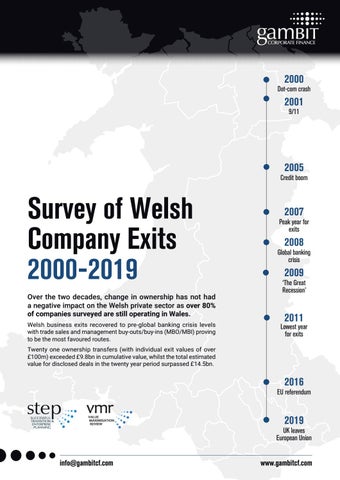
2000
Dot-com crash
2001 9/11
2005
Credit boom
Survey of Welsh Company Exits 2000-2019 Over the two decades, change in ownership has not had a negative impact on the Welsh private sector as over 80% of companies surveyed are still operating in Wales. Welsh business exits recovered to pre-global banking crisis levels with trade sales and management buy-outs/buy-ins (MBO/MBI) proving to be the most favoured routes.
2007
Peak year for exits
2008
Global banking crisis
2009
‘The Great Recession’
2011
Lowest year for exits
Twenty one ownership transfers (with individual exit values of over £100m) exceeded £9.8bn in cumulative value, whilst the total estimated value for disclosed deals in the twenty year period surpassed £14.5bn.
2016
EU referendum
2019
UK leaves European Union
info@gambitcf.com
www.gambitcf.com
Introduction Gambit Corporate Finance LLP has compiled and analysed a database of corporate exits involving Welsh companies spanning the first two decades of the 21st Century. Business exit volumes can be given context by the economic conditions which prevailed during the period under review. The twenty year horizon saw key economic drivers define the era, globally and in Wales, including the dot-com crash, 9/11, the Great Recession, Eurozone Crisis and Brexit. This survey’s timeframe excludes the Covid-19 pandemic and the UK’s prospective withdrawal from the European Union which will influence business transactions in 2020 and beyond. Gambit’s database includes transactions with undisclosed values and, where possible, market intelligence or in-house knowledge has been applied. The data has been adjusted to exclude nonindigenous companies (e.g. subsidiaries of overseas companies) and property transactions. Exits comprise of trade sales, buy-in/buy-outs and divestment. Initial Public Offerings (IPOs), although not strictly exits, represent a significant change in ownership and have therefore been included in the survey data. As have delistings which are sale induced outcomes for quoted companies. Transactions with deal values of over £100 million, albeit limited in number, skew the twenty year trend analysis as twenty one deals have a combined value of over £9.8bn. Most notably, the £2.9bn sale of Hyder Plc assets and the delisting of Gyrus Group Plc which was acquired by Olympus for over £1.1bn.
Of business exits were trade sales.
19% Increase in the number of deals transacted in 2019 as compared to the beginning of the millennium.
info@gambitcf.com
28%
Of exits were in manufacturing sectors.
The period between 2003-2007 were years of record economic growth globally and in Wales. The average consideration for disclosed deals between 2003-2007 was £10.1m. In the build up to the Great Recession deal volumes and values were trending upwards, peaking in 2007 with 133 reported exits achieving a cumulative total of £748m.
2000
During the Great Recession 2008-2011, the average year on year fall in deal volumes was c.25% while cumulative deal values fell year on year by c.50%. Business exits began to recover in 2015, with deal volumes returning to pre-crash levels in 2019, achieving a cumulative disclosed deal value of £332.6m; as the UK left the EU. Brexit’s influence is visible as cumulative disclosed deal values fell from £374.1m in 2017 to £179.1m in 2018. This is due to an increased volume of MBO/MBI exits while simultaneously higher value trade sale volumes fell.
2010
2015
1in3
Exits occurred outside the south eastern region.
2007 >80% Remains the year for the highest number of business exits in Wales.
1992
By removing these outliers, a clearer picture of Welsh corporate exits emerges. Against a backdrop of the Welsh economy recovering from the dot-com crash and 9/11 in the early 2000’s, an economic boom between 2003-07, the subsequent Great Recession and Brexit uncertainty the overall value of the remaining transactions, equates to over £4.7bn.
Below is a snapshot of our findings:
70%
Gambit’s notable Welsh deals
Of business surveyed are operational and remain in Wales.
>£100m Twenty one business exits were over £100m.
30% Fall in the cumulative value of disclosed deals between 2010-19 when compared to the previous decade.
www.gambitcf.com
2019
Welsh business exits As expected there is notable disparity across the Welsh regions. During the twenty year period, c.80% of exits occurred in south Wales of which 63% percent were in the south east. South Wales generated 89% of deal value of over £4.2bn. Notable deals that occurred in this geography included the trade sale of Hyder Plc and the institutional buy-out of PHS Group in 2005 for £732m. The largest exits outside south Wales were the delisting of Big Food Group Plc which was acquired by an investment consortium in 2004 for £688m and the flotation of Watkin Jones Plc in 2016 for £131m.
MBO led by Echelon Capital. Removing deal values of over £100m, business and IT services transaction’s cumulative value was £521.8m and wholesale and retail exits amounted to £485.4m, during the 20 year period.
It is anticipated that the impact of Covid-19 and Brexit could result in more localising of manufacturing which may influence cross-border transactions in years ahead.
Exit volume by region
15%
Manufacturing sub-sectors representation was significantly more widespread with the prevalent sub-sectors being machinery and equipment and food and drink, which accounted for just under 30% of total exits Service sector exits exceeded by number of transactions. manufacturing business exits which declined in number throughout the period. The largest business exit in food and drink South west Wales Around 40% of the total service sector was, again, the delisting of Big Food Group exits by volume took place in the wholesale Plc which was acquired by an investment and retail, business and IT services sub- consortium in 2004 for £688m, whilst, sectors. Significant deals included the the largest transaction in machinery and trade sale of Acano to CISCO Systems equipment was the trade sale of Invertek in 2015 for £518.9m and the delisting Drives, also in 2019, for £100m. of Peacock Plc in 2005 for £430.8m in a
North Wales
5%
17%
Highest cumulative disclosed deal value
Average consideration for disclosed deals
Central Wales
63%
South east Wales
Average number of deals per annum
£748m
£374m
£9.8m
£7.4m
70
67
2000-2009
2010-2019
2000-2009
2010-2019
2000-2009
2010-2019
Total number and value of disclosed deals occurring in Wales below £100m Peak year for exits Global banking crisis Credit boom
140
Number of exits
120 100 80
UK leaves European Union
The Great Recession Dot-com crash 9/11
Eurozone crisis Lowest year for exits
Trump elected
£800m £700m £600m £500m £400m
60
£300m
40
£200m
20
£100m
0
£0m
2000 2001 2002 2003 2004 2005 2006 2007 2008 2009 2010 2011 2012 2013 2014 2015 2016 2017 2018 2019 mil GBP No. of Deals
www.gambitcf.com
info@gambitcf.com
Welsh business exits
Looking forward
The most popular route to exit over the twenty year period was via a trade sale with 71.4% of shareholders choosing this transfer option. Removing deals over £100m, the average disclosed trade sale was over £11m. The second most prevalent route to exit was via an MBO/ MBI. Excluding deal value above £100m, the average value of an MBO/MBI transaction was c.£3.4m. Notable MBO/ MBI exits were the MBO of Bluestone Resort Ltd in 2013 for £87m and the MBI of Penn Pharmaceutical Services in 2007 for £67m.
Overseas purchasers accounted for 15% of total successful bidders while 8% were not disclosed.
Only 23 flotations have featured during the 21st Century, the largest of which were the IPO of Admiral Group Plc in 2004 for £385.6m followed by the IPO of Watkins Jones in 2016 for £131.3m. Excluding these two IPOs, the average value of Welsh IPOs was over £10.5m. Most notable listings were Diurnal Group Plc in 2016 for £24.8m and Brickability Group Plc in 2019 for £56.7m.
According to the latest data, in 2019, the average age of shareholders exiting via trade sale was 57 whereas by MBO/ MBI the age was slightly higher at 60. Overall, the average age of shareholders exiting was 58. The age of shareholders at exit has been increasing over the past decade as economic uncertainty and availability of finance, has resulted in exits being delayed while shareholders grow older.
Meanwhile, four delistings took place with an average value of £44.4m including BBI Holdings in 2007, privatised by the US based Inverness Medical Innovations for £73.5m and 3M’s acquisition of Biotrace International in 2006 for £57.8m. UK bidders comprised 77% of transaction acquirors with Welsh purchasers accounting for 46% of this percentage. The high proportion of Welsh acquirors can be attributed to the commensurate levels of MBO/MBI exits.
During 2000-2009, 55% of exits involved businesses that were less than ten years old which dropped to 43% in the following decade. This was symptomatic of the lack of available liquidity during the deep recession and the uncertainty around Brexit. Whilst companies of all ages were exited throughout the period, 35% of businesses had existed for between ten to twenty five years.
A review of the current ownership of exited companies over the twenty year period reveals that out of over 1,400 exits that have been collated and analysed, over 80% of the acquired companies still remain active in Wales, dismissing the notion that change of ownership has a negative impact on the Welsh private sector. Change of ownership for succession, new management and corporate longevity are indicative of a healthy and stable business sector.
This is our fourth publication on the ‘Survey of Welsh Company Exits’ which looks to examine changes of ownership in Wales. Looking forward, the Welsh private sector has to overcome the challenges of leaving the EU, Covid-19 pandemic and adapting to a ‘new normal’. The impact that Covid-19 had on Welsh business exits in the first half of 2020 was stark. Reported transactions have fallen dramatically as the country went into lockdown in late March 2020 and exits were delayed or put on hold. In the second half of 2020, it is uncertain how business exit values and volumes will recover, if at all, from the continued impact of the pandemic. The anticipated changes to Capital Gains Tax has the potential to encourage shareholders to exit, however these are likely to be concentrated in sectors that have been shielded from the stringent lockdown measures. Brexit uncertainty will continue to persist, peaking in Q4 2020, as the UK completes its own transfer out of the European Union. This may encourage overseas acquirors seeking to gain access to the UK market at favourable exchange rates for quality assets or distressed company acquisitions.
Total number of exits by transaction type
120
Trade Sale MBO/MBI IBO/LBO Flotation Delisting
Number of exits
100 80 60 40 20 0
2000 2001 2002 2003 2004 2005 2006 2007 2008 2009 2010 2011 2012 2013 2014 2015 2016 2017 2018 2019
J. Frank Holmes
Gambit Corporate Finance
T: +44 (0) 845 643 5500
23 Berkeley Square, London, W1J 6HE
Partner
M: +44 (0) 789 992 8029 jfrank.holmes@gambitcf.com
London Office
Cardiff Office 3 Assembly Square, Britannia Quay, Cardiff, CF10 4PL
www.gambitcf.com
This bulletin is not an offer to sell or solicit an offer to buy any security. It is not intended to be directed to investors for making an investment decision. This bulletin does not rate or recommend securities of individual companies, nor does it contain sufficient information upon which to make an investment decision. The information provided in this bulletin was obtained from sources believed to be reliable, but its accuracy cannot be guaranteed. It is not to be construed as legal, accounting, financial or investment advice. Information, opinions and estimates reflect Gambit Corporate Finance LLP’s judgement as of the date of publication and are subject to change without notice. Gambit Corporate Finance LLP undertakes no obligation to notify any recipient of this bulletin of any such change. This bulletin is not directed to, or intended for distribution to, any person in any jurisdiction where such distribution would be contrary to law or regulation, or which would subject Gambit Corporate Finance LLP to licensing or registration requirements in such jurisdiction.
info@gambitcf.com