2 more yrs of outages for Visayas By Carmel Pedroza
C
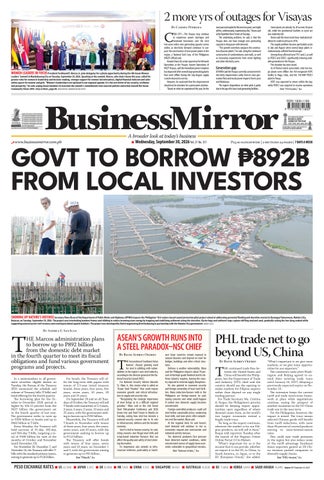
WOMEN LEADERS IN FOCUS President Ferdinand R. Marcos Jr. joins delegates for a photo opportunity during the 4th Asean Women
Leaders’ Summit in Mandaluyong City on Tuesday, September 29, 2026. Speaking at the summit, Marcos, who chairs Asean this year, called for greater roles for women in leadership and decision-making, stronger support for women-led enterprises, digital financial inclusion and safer online spaces for women and girls. “Women’s leadership is not optional to our regional agenda. It is the core driver of our security, resilience and prosperity,” he said, urging Asean members to translate the summit’s commitments into concrete policies and action toward the Asean Community Vision 2045. Story in News, page A6. PRESIDENTIAL COMMUNICATIONS OFFICE
ROTARY CLUB OF MANILA JOURNALISM AWARDS
2006 National Newspaper of the Year 2011 National Newspaper of the Year 2013 Business Newspaper of the Year 2017 Business Newspaper of the Year 2019 Business Newspaper of the Year 2021 Pro Patria Award PHILIPPINE STATISTICS AUTHORITY 2018 Data Champion
EBU CITY—The Visayas may continue to experience power shortages and rotational brownouts over the next two years unless new generating capacity comes online, as electricity demand continues to outpace the construction of new power plants in the region, a National Grid Corp. of the Philippines (NGCP) official said. Amado Otarra III, senior supervisor for Network Operations at the Visayas System Operations of NGCP Visayas, said the immediate power situation has improved after several large generating plants that went offline during the July-August supply crunch returned to service. However, he cautioned that the improvement should not be mistaken for a permanent solution. “Based on what we experienced this year, for the
next year and maybe for the next two years, we might still be, unfortunately, experiencing this,” Otarra said at the Openline News Forum on Tuesday. The underlying problem, he said, is that the Visayas does not have enough new generating capacity to keep pace with demand. “The growth somehow outpaces the construction of power plants,” he said, citing the continued construction of condominiums and malls, as well as increasing requirements from street lighting and other electricity users.
Generation gap
OTARRA said the Visayas currently cannot meet its electricity requirements solely from its own generation fleet and needs power imports from Luzon and Mindanao. The region’s dependence on other grids is partly due to the age of its base-load generating facilities.
Some plants are already 16, 20 or even 30 years old, while the geothermal facilities in Leyte are also relatively old. Otarra said the most recent base-load plant addition he could recall was in 2016. The supply problem became particularly acute in July and August when several large plants simultaneously suffered forced outages. Among those affected were TVI 1 and 2, as well as PEDC3 and CEDC1, significantly reducing available generation in the Visayas. The situation has since eased. As of Otarra’s latest assessment, only two major plants were offline: the 103-megawatt KSPC facility in Naga, Cebu, and the 150-MW PEDC3 plant in Panay. KSPC was expected to return within the day, while PEDC3 was targeted to resume operations See “Outages,” A2
BusinessMirror A broader look at today’s business
EJAP JOURNALISM AWARDS
BUSINESS NEWS SOURCE OF THE YEAR
(2017, 2018, 2019, 2020, 2021) DEPARTMENT OF SCIENCE AND TECHNOLOGY
2018 BANTOG MEDIA AWARDS
GOVT TO BORROW ₱892B FROM LOCAL INVESTORS www.businessmirror.com.ph
n
Wednesday, September 30, 2026 Vol. 21 No. 351
P25.00 nationwide | 2 sections 24 pages | 7 DAYS A WEEK
SHORING UP NATURE’S DEFENSE Secretary Vince Dizon of the Department of Public Works and Highways (DPWH) inspects the Philippines’ first nature-based coastal protection pilot project aimed at addressing perennial flooding and shoreline erosion in Barangay Pamarawan, Malolos City, Bulacan, on Tuesday, September 29, 2026. The project uses interlocking bamboo frames and cribbing to reduce incoming wave energy by trapping and stabilizing sediments along the shoreline. Oyster bags and sediment traps capture drifting mud and sand, gradually raising the low-lying seabed while supporting natural oyster-reef recovery and creating localized aquatic habitats. The project was developed by Dutch engineering firm Haskoning in partnership with the Malolos City government. NONOY LACZA
T
By Andrea E. San Juan
HE Marcos administration plans to borrow up to P892 billion from the domestic debt market in the fourth quarter to meet its fiscal obligations and fund various government programs and projects. In a memorandum to all government securities eligible dealers on Tuesday, the Bureau of the Treasury (BTr) announced the schedule and volume of Treasury bills (T-bills) and bond offering for the fourth quarter. The borrowing plan for the October-to-December 2026 period is higher by 104.12 percent from the P437 billion the government set in the fourth quarter of last year. The government seeks to raise up to P430 billion in bonds and up to P462 billion in T-bills. Every Monday, the Treasury will hold auctions of 91-day, 182-day, and 364-day T-bills, targeting a total of P168 billion for each of the months of October and November (until November 23). For November 30, December 7, and December 14, the Treasury will offer Tbills with the standard primary tenors, aiming to generate up to P126 billion.
For bonds, the Treasury will offer the long-term debt papers with tenors of 2.5-year (retail treasury bonds), three years, four years, five years, seven years, 10 years, 20 years and 25 years. On September 29 and on all Tuesdays of October, the Treasury will sell T-bonds with maturities of 2.5 years, 3 years, 4 years, 5 years, 10 years and 25 years, with the government seeking to borrow up to P250 billion. Meanwhile, the Treasury will sell T-bonds in November with tenors of three years, four years, five years, seven years, and 20 years, with the government seeking to borrow up to P115 billion. The Treasury will offer bonds with tenors of four years, seven years and 10 years, on December 1 and 9, with the government aiming to generate up to P65 billion. See “P892B,” A2
ASEAN’S GROWTH RUNS INTO A STEEL PARADOX–NSC CHIEF By Bless Aubrey Ogerio
T
HE Association of Southeast Asian Nations’ (Asean) growing need for steel is colliding with vulnerabilities in the region’s own steel industry, according to the director general of the National Security Council (NSC). For National Security Adviser Eduardo SL. Oban Jr., this creates what is called an “Asean Steel Paradox” that could expose economic growth and critical infrastructure to supply and security risks. “Recognizing the strategic importance of steel brings us to a difficult regional paradox,” Oban said at the 2nd Asean Steel Policymaker Conference and 2026 Asean Iron and Steel Forum in Manila on Tuesday, noting how steel has become a national-security concern due to its role in infrastructure, defense and the broader economy. Steel is tied to human security, he said, citing concerns over illegal steel mills and scrap-based induction furnaces that can affect the quality and safety of steel entering the market. Its importance also extends to infrastructure resilience, particularly as South-
east Asian countries remain exposed to natural disasters and depend on steel for bridges, buildings and other critical structures. Defense is another vulnerability. Oban said the Philippines imports about 70 percent of the high-grade finished steel its defense industry requires, leaving the country exposed to external supply disruptions. He also pointed to economic security and foreign ownership of local steel facilities. Many induction-furnace mills in the Philippines are foreign-owned, he said, raising concerns over what could happen if control over domestic supply becomes concentrated. Foreign-controlled producers could sell steel below sustainable prices, weakening local mills, and raise prices after competitors exit the market, Oban said. At the regional level, he said Asean’s steel demand will continue to rise as economies expand and construction and industrial activity increase. Yet, domestic producers face pressure from distorted market conditions, while concentrated sources of supply leave economies vulnerable to geopolitical tensions, See “Asean steel,” A2
PHL trade net to go beyond US, China By Bless Aubrey Ogerio
T
HE continued trade flow between the United States and China will benefit the Philippines, but the Department of Trade and Industry (DTI) chief said the country should use the opening to widen markets for Filipino exports rather than depend on any single trading partner. For Trade Secretary Ma. Cristina A. Roque, the Philippines’s priority should be keeping export opportunities open regardless of where demand comes from, as the world’s two largest economies extend a fragile trade truce. “As long as the export continues, wherever the market is for our Filipino products, we will sell it there,” Roque told reporters Tuesday after the launch of the Negosyo Center Online Portal 2.0 in Makati. “What’s important for us is the income that it can provide, whether we export it to the US, to China, to South America, to Japan, or to the EU [European Union],” she added.
“What’s important is we give more markets, or we give more opportunities for our exporters.” The comments came after Washington and Beijing agreed to extend their existing trade truce until January 10, 2027, delaying a previously expected expiry on November 10. The extension keeps the current tariff and trade restrictions framework in place while negotiations continue, easing the prospect of another escalation in the US-China trade war in the near term. For the Philippines, however, the impact is mixed. The truce means selected Chinese goods will benefit from tariff reductions, with more than 90 percent of covered products moving to most-favored-nation rates. This could ease trade pressures in the region but also reduce some of the tariff advantage Southeast Asian exporters gained as US-China tensions pushed companies to diversify supply chains. See “PHL trade,” A2
PESO EXCHANGE RATES n US 62.5040 n JAPAN 0.3972 n UK 82.8928 n HK 7.9676 n CHINA 9.3125 n SINGAPORE 48.9421 n AUSTRALIA 43.8528 n EU 71.0858 n KOREA 0.0459 n SAUDI ARABIA 16.6495 Source: BSP (September 29, 2026)
A2 Wednesday, September 30, 2026
News
BusinessMirror
NTC sets new SCOs round vs mobile network operators
T
By Lorenz S. Marasigan
HE National Telecommunications Commission (NTC) said on Tuesday it will issue a new round of show cause orders (SCOs) with daily penalties against mobile network operators (MNOs) outside Metro Manila, as it clarified that its enforcement drive on poor mobile broadband service covers the entire country.
The regulator said it is finalizing the results of its latest revalidation conducted in September 2026 and will issue the corresponding SCOs with daily penalties, starting with cities and municipalities in the National Capital Region (NCR) and other regions with the highest incidence of “no signal” and “weak signal” results. “This enforcement action is not limited to the National Capital Region [NCR],” the NTC said in a statement. The agency explained that its mobile broadband speed validation is regularly conducted nationwide through its regional offices. Every quarter, it notifies MNOs of baran-
gays across the country validated with no signal or weak signal, along with an order to implement improvements to strengthen the quality of service in those areas. The clarification came amid questions online on the scope of the NTC’s revalidation, after the regulator slapped SCOs on the country’s three operators last week over service in selected NCR cities. For Globe Telecom Inc., the areas of concern in the September revalidation were Manila, Makati, and Quezon City. For DITO Telecommunity Corp., these were San Juan, Pasay, and Las Piñas. For Smart Communi-
cations Inc., the regulator flagged Parañaque, Manila, and Pasig. Copies of the orders, docketed as Administrative Case Nos. 2026-022 for Smart, 2026-023 for Globe, and 2026-024 for DITO, show that the NTC had issued memoranda dated May 29, August 5, and November 17, 2025, directing the operators to improve their quality of service in areas validated with weak signal and no signal. Under the orders, each telco is directed to comply with the required quality of service standard, undertake immediate technical measures to rectify the identified deficiencies, and submit a corrective action plan. The plan must contain, at a minimum, the specific technical measures undertaken or to be undertaken, the infrastructure enhancements, and the projected timelines for implementation. The orders also impose a daily administrative fine of P100,000 “for each day that the non-compliance continues,” commencing upon receipt of the order and until the NTC verifies through revalidation that the affected service areas have attained the applicable quality of service standard. The NTC said its Memorandum Circular (MC) No. 001-01-2026 pre-
scribes the performance standards for all covered entities that own, operate, manage, and control wire or wireless communication systems in the country for general business purposes, including MNOs, all of which are required to comply with quality of service. The agency reaffirmed that its actions are meant to promote reliable, faster, and responsive telecommunications services for Filipino consumers, as mandated by the Public Service Act. The three telcos have responded differently to the orders. In separate disclosures on Monday, DITO said it has opened discussions with the regulator over its showcause letter, while Smart and Globe said they have yet to receive the orders cited by the NTC.
www.businessmirror.com.ph
Outages… Continued from A1
by November 9 after a major systems upgrade. The Visayas can also now draw up to 450 MW of power from Mindanao, helping stabilize the regional grid. As a result, Otarra said the region had not been placed under a yellow alert at the time of the interview. But the additional supply has not eliminated the structural generation deficit.
Demand growth
THE challenge is particularly significant for Cebu, which Otarra said accounts for almost half of the Visayas’ electricity demand. “Visayas, particularly Cebu, is a fast-growing island,” he said, underscoring the need for additional base-load capacity to support economic and population growth. The region reached an all-time high peak demand of about 2,770 MW on May 14, according to Otarra. Demand is expected to ease in the fourth quarter as cooler and rainy weather reduces the use of air-conditioning systems. Otarra estimated that December demand could be about 100 MW to 150 MW lower than during peak months, despite additional electricity consumption from Christmas lights. The shift to LED Christmas lighting also helps moderate the seasonal increase because LEDs consume significantly less electricity than conventional incandescent lights. Still, the seasonal reduction in demand does not resolve the longer-term gap between electricity consumption and generation capacity.
Asean steel… Why brownouts return at night Continued from A1
maritime disruptions, export restrictions and sudden price movements. Uneven quality standards could also allow non-compliant steel products to enter critical infrastructure, while volatile energy and raw-material costs can raise production costs. At the same time, carbon-border measures, emissions requirements and green procurement rules are changing the conditions under which steel is produced and traded, adding another layer of pressure on producers. Oban said these risks cannot be addressed by individual Asean members alone because their production systems, markets, shipping routes, energy networks and construction industries are already closely connected. “The question, therefore, is not whether Asean will remain interdependent, because we will,” Oban said. “The question is whether our interdependence will stand on fragile grounds— or become deliberate, diversified, trusted, and resilient,” he added. As Asean chair this year, the Philippines is proposing the principle of resilient interdependence as a way to manage these vulnerabilities. Oban called on participants to consider developing an Asean Steel Resilience Compact that would build on existing cooperation among governments, industries, research institutions and regional partners rather than create a new bureaucratic structure. He said the Philippines is prepared to support the development of an Asean Steel Resilience Roadmap as Asean works to strengthen its steel industry while meeting rising demand.
PHL trade… Continued from A1
The country, meanwhile, continues to face an additional 12.5 percent US Section 301 tariff on its
OTARRA said the changing generation mix also explains why the most significant rotational brownouts in recent months occurred during evening hours. The Visayas has seen a growing number of solar facilities, but solar generation is unavailable after sunset. As a result, the grid remains dependent on base-load and other dispatchable generation during the evening, precisely when available supply can become tight. Daytime interruptions are more likely to be associated with line repairs or maintenance and are generally shorter, he said. The longer rotational outages of 30 minutes to an hour occurred when evening supply became insufficient. If another major generating plant goes offline and the Visayas cannot import enough electricity from Luzon or Mindanao, NGCP may again have to implement manual load dropping (MLD). Under MLD, portions of electricity demand are disconnected on a rotational basis to keep the grid stable. Otarra said this is preferable to allowing the system to reach its limits, which could result in a much wider interruption affecting an entire island or, in an extreme scenario, the entire Visayas grid.
More power plants needed
FOR the longer term, Otarra said the region needs more base-load generating facilities to complement renewable energy sources. He stressed that this does not mean abandoning renewable energy. Variable renewable energy from solar and wind remains an important part of the country’s transition toward cleaner power, but their intermittent nature means the grid needs dependable generation to compensate when renewable output falls. “We need actually to establish baseload plants,” Otarra said. He also called for a holistic approach to locating new generation projects across the Visayas. The location of new plants matters because Cebu is the region’s major load center. Building generation too far from the largest demand centers could place goods, effective July 24, after Washington determined that Manila had not sufficiently prohibited or effectively enforced a ban on imports made with forced labor. Per the country’s trade officials, they are actively negotiating with the US to reduce the additional tariff. The stakes are significant for both sides of the Philippines’s trade relationship. The US was the Philippines’s largest export market in 2025, buying $13.46 billion worth of Philippine goods, equivalent to 15.9 percent of total
additional stress on the transmission system. For instance, Otarra said placing significant new capacity in Panay, at the western end of the Visayas, would require electricity to travel a considerable distance to Cebu, potentially adding pressure to the power network.
Short-term fixes
BEFORE new generating facilities can be built, Otarra said the immediate priority should be to bring existing but offline plants back into operation. Some generating facilities in the Visayas remain active businesses and have not been decommissioned, but have yet to return to service. Expediting their repair and refurbishment could provide additional capacity while longer-term projects are being developed. Otarra noted, however, that NGCP has limited influence over privately-owned generating facilities. Following the privatization of the power industry, plant operators make their own decisions on repairs and operations, although NGCP can urge them to return facilities to service as soon as possible because of the benefit to grid reliability. The region also faces limitations in some renewable and conventional generation sources. Biomass facilities, for instance, depend on fuel availability and may be unable to operate during periods when agricultural milling activity—and therefore their fuel supply—is low. Some diesel plants are also aging.
Stopgap
THE Department of Energy is also looking at a power barge as a possible short-term solution. Otarra said he understood that a barge with capacity of more than 200 MW was being considered for deployment in the Visayas, although the specific location where it would be moored was still being determined. Such a facility could provide additional capacity while the region waits for permanent generation projects. The solution, however, comes with a cost. Power barges typically run on diesel, meaning they can help address a supply shortage but may not translate into lower electricity costs for consumers. “It may be that there will be no brownout, but we might not expect a significant reduction of our electric bill,” Otarra said.
Investment imperative
THE longer-term challenge therefore comes down to investment in new generation capacity. Otarra said electricity demand and economic growth are closely linked, making demand projections critical in determining how much new generation must be developed. If investors do not build sufficient capacity in the Visayas, the region may have to strengthen its ability to import power from other grids. The normal flow is currently from Mindanao toward the Visayas, although Otarra noted that electricity can also flow in the opposite direction when Mindanao experiences supply constraints. There are likewise periods when Visayas power is exported to Luzon. But the prevailing pattern is for the Visayas to import electricity because of its relative scarcity of generation capacity. Otarra said the government and industry therefore need to plan ahead for demand growth rather than wait for supply shortages to emerge. The increasing use of rooftop solar can help households become less dependent on grid electricity, he said, but distributed solar alone cannot address the region’s need for dependable generation capacity. For now, the return of offline plants and increased imports from Mindanao have provided the Visayas with some breathing room. But without a sustained build-up of new generation capacity, Otarra said the region could remain vulnerable to the same cycle of supply shortages and rotational brownouts in the years ahead. exports. China, meanwhile, was the country’s largest source of imports, supplying $38.44 billion worth of goods, or 28.6 percent of total imports. Separately, at a September 25 virtual briefing, Daniel Kritenbrink, a partner and co-chair of the Southeast Asia practice at The Asia Group, said US and Chinese officials had reportedly agreed to extend the truce while leaving room for a broader deal. The former US Assistant Secretary of State for East Asian and Pacific Affairs added that the Trump administration’s immediate priority appeared to be keeping US-China relations stable. See “Outages,” A7
Govt to borrow ₧892B… Continued from A1
According to National Treasurer Sharon P. Almanza, the borrowing for the fourth quarter of this year marked an increase compared to the same period last year due to frontloading. “If you will recall last year, the Treasury was able to frontload most of our borrowing during half of the year, even during the third quarter. So that’s causing the difference,” Almanza said during the launch of the 32nd tranche of RTBs. “Last year,...the environment is very different. We’re able to raise significant amount for our bond auction, as mentioned, during the third quarter. That is why during the fourth quarter, we almost completed our bond auction,” she added. Almanza also noted there were “very few auctions” last year compared to 2026. “And mostly [T-]bills. So that’s really the reason why year over year, you will see a huge increase from this year,” she said. Because of the conflict in the Middle East, Almanza added that the Treasury spread out its issuances.
www.businessmirror.com.ph
Wednesday, September 30, 2026
DND denounces fake letter, seeks NBI probe By Rex Anthony Naval
T
HE spokesperson of the Department of National Defense (DND) on Tuesday tagged as fake a letter circulating online that made Defense Secretary Gilberto Teodoro Jr., seem to be discussing political plans with American officials. In a statement, Assistant Secretary Arsenio Andolong, DND spokesman, warned the public against the “letter,” branding it “spurious and fabricated.” The letter was puportedly signed by the defense chief and addressed to an alleged official of the US Central Intelligence Agency named “Peter Enzminger.” “The Department unequivocally states that the document and its content are obviously and absolutely false and fake,” Andolong said. He added that the DND has already referred the matter to the National Bureau of Investigation “for proper investigation.” “This is yet another episode of foreign interference and malign influence that is intended to discredit the legitimate and lawful efforts of the Philippine
government to assert its national sovereignty and territorial integrity,” said Andolong. The spurious letter, dated July 31, had Teodoro allegedly discussing with Enzminger his capacity to rally the Armed Forces (AFP) should the country’s political system collapse. Furthermore, the letter stated that Teodoro’s “political ascent” should not be construed as “personal career advancement” but rather a “strategic instrument of considerable significance for the Philippines-US Alliance in relation to the West Philippine Sea and the broader Indo-Pacific.” “ Wit h c lose cooperat ion, should I be entrusted with the highest leadership role, I will uphold the continuity of our foreign policy and enhance the predictability of our future action,” it said. “I will further strengthen PH-US Alliance relationships and more effectively advance US strategic architecture in the entire Indo-Pacific region. I look forward to a more in-depth and productive discussion at our next meeting,” Teodoro allegedly said in the letter.
Impeach court: Sara cannot be forced to confirm ownership of bank accounts
T
HE Senate Impeachment Court ruled on Tuesday that Vice President Sara Z. Duterte cannot be forced to confirm ownership of bank accounts linked to documents presented during her impeachment trial. The decision followed the withdrawal by the House of Representatives prosecution team of its earlier request for admission. Instead, prosecutors sought an agreement with the defense regarding the authenticity and validity of the submitted banking documents. Presiding Officer Sen. Francis Escudero said the court determined that Duterte was not obligated to submit a written response to the request for admission. “ T he Impeac hment Cou r t, therefore, rules that respondent cannot be required to serve a written response to the request for admission,” Escudero said. The request filed by the prosecution involved 104 items covering details about Duterte’s personal information, previous government positions, her husband Manases Carpio’s business interests, and several bank-related records. Duterte’s defense team objected
to the request, arguing that the rules on admission under the Revised Rules of Civil Procedure do not apply to impeachment proceedings. They also argued that requiring a response would shift the prosecution’s burden of proof and violate Duterte’s constitutional right against self-incrimination. The prosecution later withdrew its request for admission during Monday’s proceedings and instead sought possible stipulations, or agreements, with the defense on undisputed facts and the authenticity of documents. However, the Impeachment Court said stipulations require the agreement of both parties and cannot be imposed by the court. In its ruling, the court said the right against self-incrimination under Article III, Section 17 of the Constitution remains applicable in impeachment proceedings. It cited the Supreme Court’s ruling in Duterte v House of Representatives (GR 278353, July 25, 2025), which held that constitutional protections under the Bill of Rights apply during the impeachment process. See “Sara,” A4
DME sets aid to Pinoys in Bangkok
T
HE Department of Migrant Workers (DMW) is set to extend aid to the overseas Filipino workers (OFW), who were affected by the severe flooding in Bangkok, Thailand. Migrant Worker Secretar y Hans J. Cacdac earlier announced that at least 50 OFWs in Bangkok have sought government assistance after torrential rains last week caused the Thai capital to be flooded. The affected OFWs were affected by power disruptions, as well as, difficulty in getting basic necessities. Cacdac assured the distressed OFWs that the government will provide them not only with food and water, but also with cash aid. “On top of the assistance from the Thai government, we stand ready to help them. We will roll it out at the appropriate time. We do not want to disrupt the Thai government’s
efforts, but once coordination is established, we will provide the necessary assistance [to the affected OFWs],” Cacdac said partly in Filipino in a statement. DMW is currently monitoring the status of OFWs in Bangkok in coordination with the Department of Foreign Affairs, through the Philippine Embassy, and its Migrant Workers Office in Bangkok. It noted OFWs, who need help may contact the DMW at 1348 in the National Capital Region, 02 1348 from the provinces, or +63 1 348 from overseas. They may also seek assistance and guidance from the MWO Bangkok via its Facebook page or at +66 83 137 6167 via Line, WhatsApp, or Viber. As of Tuesday, DFA said it has yet to receive any reports of Filipinos, who were evacuated and staying at the 233 temporary shelters in Bangkok. Samuel P. Medenilla
A3
Davao mayor denies knowledge of GenCorp interest of VP Sara By Jovee Marie N. dela Cruz @joveemarie
T
HE House of Representatives prosecution panel on Tuesday challenged Davao City Mayor Sebastian Duterte’s claim that he had no knowledge of GenCorp Industries Inc., a company listed as a business interest of his sister, Vice President Sara Z. Duterte, while questioning his responsibility as the city’s top procurement official.
During his testimony before the Senate Impeachment Court, Mayor Duterte said he only became aware of Gencorp after the company was mentioned during the impeachment proceedings. However, prosecutors argued that this statement must be reconciled with his position as Davao City’s head of the procuring entity (Hope), which carries responsibility over government procurement activities. GenCorp Industries Inc. was declared by Vice President Duterte as a business interest in her 2024 and 2025 Statements of Assets, Liabilities and Net Worth (SALN). Records from the Philippine Government Electronic Procurement System (PhilGEPS) presented during the trial showed that Davao City awarded 15 contracts to the company. However, Mayor Duterte previously submitted a statement indicating that the city had 19 transactions with GenCorp. The difference between the two records became one of the key issues raised during the proceedings. Deputy Speaker Francisco Paolo Ortega V questioned how a local chief executive could exercise authority over government operations while claiming no knowledge of procurement matters under his administration.
“Just because you hold the highest position and want authority and control, you cannot claim ignorance when issues involving corruption arise. That is not acceptable,” Ortega, who represents La Union, said. He added that holding power over a government institution also carries responsibility for decisions made within that organization. You cannot simply say that you had no idea. You cannot deny command responsibility. The responsibility is significant when you are the person entrusted with authority over your jurisdiction,” Ortega said. San Juan City Rep. Ysabel Zamora, a House prosecutor, said the panel would continue examining Mayor Duterte’s statements and compare them with his previous public remarks regarding Gencorp. “Let us see how he will reconcile his earlier statement with his previous statements in the past weeks regarding GenCorp,” Zamora said. House prosecution spokesperson Ace Barbers emphasized that Mayor Duterte’s testimony was significant because his earlier statements regarding GenCorp transactions were now being presented under oath before the impeachment court. According to the statement submitted by Mayor Duterte, Davao
City had 19 GenCorp transactions amounting to approximately P33.26 million. Four of these underwent competitive public bidding, while 15 were processed through small-value procurement. This differed from PhilGEPS records presented in court, which reflected 15 contracts worth approximately P34.2 million. Four contracts underwent public bidding, while the remaining transactions were processed through negotiated small-value procurement. T he prosecution requested additional time to review the documents submitted by Mayor Duterte, which reportedly covered around 100 pages, to determine the reason behind the discrepancy between the city government’s records and PhilGEPS data. During questioning by private prosecutor Theodore T. Te, Mayor Duterte maintained that GenCorp’s transactions underwent proper evaluation. “In every instance, GenCorp Industries Inc. was rigorously evaluated and determined to have submitted the lowest calculated responsive bidder offer,” Duterte said.
No direct knowledge
WHEN asked whether he personally knew if GenCorp complied with a 2024 procurement requirement requiring bidders to have operated for at least five years, Duterte admitted that he did not have direct knowledge. “I do not know that as of now. We can check our records in the city,” Duterte told the court. He later stated that compliance with procurement requirements was presumed unless records showed otherwise. Dur ing f ur ther testimony, Mayor Duterte confirmed that he remained the final accountable officer for Davao City’s procurement activities despite delegating authority to sign contracts to Assistant City Administrator for Administration Tristan Dwight Domingo, a lawyer. Duterte acknowledged that, as
Hope, he had authority over major procurement responsibilities, including approving the Annual Procurement Plan, appointing members of the Bids and Awards Committee, and approving contract awards. He also confirmed that while Domingo was authorized to sign contracts on his behalf, such delegation did not remove his accountability as the city’s procurement head. When asked whether he remained the final accountable officer despite the delegation, Duterte answered: “Yes.” The Senate Impeachment Court earlier declared Mayor Duterte a hostile witness, allowing prosecutors to use leading questions during examination. The ruling followed the prosecution’s argument that his previous statements, relationship with the Vice President, and circumstances surrounding his testimony showed an adverse interest. Mayor Duterte also confirmed his previous statement that he believed the impeachment proceedings were intended to prevent Vice President Duterte from running in the 2028 elections. “ T h at i s my p e rce pt ion ,” Duterte said when asked to confirm the statement. He, likewise, acknowledged describing the impeachment proceedings as “so-called lawful proceedings” and said he appeared before the court after receiving a subpoena. Presiding Officer Sen. Francis Escudero clarified that the hostile witness designation only allowed prosecutors to ask leading questions and did not mean that the court had determined any violation of law by Mayor Duterte. The testimony forms part of the prosecution’s presentation under Article II of the Articles of Impeachment, which focuses on allegations involving wealth, financial disclosures, and business interests connected to Vice President Duterte. See “GenCorp,” A4
Ping thanks Vince for clarifying projects remark By Butch Fernandez @butchfBM
P
UBLIC Works Secretary Vivencio Dizon has clarified that flood control projects in Taguig City remain under investigation for alleged irregularities, prompting expression of gratitude from Sen. Panfilo M. Lacson, who earlier warned him about potential criminal liability in covering up anomalies. Lacson thanked Dizon for the clarification, even as he cautioned anew against prematurely concluding that there are no ghost projects. Lacson was referring to Dizon’s clarification that the investigation into some projects in Taguig is still ongoing, and that the irregularities initially identified remain subject to further validation. “Thank you, Secretary Vince, for the clarification. I agree that preliminary inspection findings on several questionable flood control projects in Taguig—such as those on St. Timothy’s slope protection project—do not automatically prove a project was ‘ghosted,’
but we also cannot definitively conclude that no ‘ghost projects’ exist,” Lacson said on X. Earlier Monday, Dizon clarified that flood control projects in Taguig City remain under investigation for alleged irregularities—days after he categorically said before a Senate subcommittee hearing tackling the DPWH’s proposed 2027 budget that there were no ghost projects in Taguig. Dizon said the DPWH has flagged several projects in Taguig and submitted an initial report to the Office of the Ombudsman, “for further validation.” He said they are waiting for the “final report and final action” of the Ombudsman. The clarification came after Lacson cited findings in the DPWH’s own site inspection reports that appeared inconsistent with Dizon’s earlier statement. Lacson said the reports, submitted by personnel from the DPWH Bureaus of Maintenance, Quality and Safety, Construction, and Research and Standards, showed that several flood control projects in Taguig had
been declared completed but their physical presence on site could not be validated by inspection teams for various reasons. In some areas, he said inspection teams could not verify potentially anomalous projects because they were covered up by newer projects. He also cited the DPWH’s analysis of potentially similar billing photographs from Taguig projects from 2017 to 2025. Of 15,523 images processed using an AI-based image similarity detection system, 1,079 pairs were flagged for high visual similarity, involving 180 unique contracts. Over the weekend, Lacson disclosed details of a “Slope Protection along Taguig River Project” (Contract ID 220B0106), whose geotagged photos attached to its billing reports contained coordinates pointing to Leyte province, some 600 kilometers away from Taguig. Records on the project showed three locations in Tacloban City reflected in the geotagged photographs. They also showed that the DPWH paid St. Timothy Construction
Corp., which is owned by the Discaya family, some P96.5 million for the project. Lacson noted that the St. Timothy Construction project was not an isolated case but the most “brazen and telling” so far among some 68 projects where red flags had been identified by DPWH inspection teams. Earlier, Lacson and his team formally submitted to the Office of the Ombudsman at least 45 case studies backed by official documents detailing what they described as “systemic anomalies” in flood control infrastructure projects in Taguig. The Ombudsman subsequently launched a factfinding investigation into the allegations. Lacson and his team have also submitted to the Ombudsman evidence they have gathered concerning alleged illegal reclamation and infrastructure projects on the Taguig City side of Laguna Lake. Also, Lacson warned Dizon that any attempt to cover up the anomalies in infrastructure projects in Taguig may expose those involved to possible criminal liability.
A4
Wednesday, September 30, 2026
www.businessmirror.com.ph
NFA raises rice selling price by ₧2/kilo
T
By Ada Pelonia
@adapelonia
HE National Food Authority (NFA) raised its selling price for milled rice by P2 per kilo to trim the losses it incurred from selling the staple below prevailing market prices. NFA Administrator Larry Lacson confirmed to the BusinessMirror that the grains agency increased its selling price to P35 per kilo from P33 per kilo, which took effect last August 15. “This would trim our losses. Also, our selling price is already too low compared to the market [prices],” Lacson told this newspaper. The newly approved selling
price covers milled rice sold to local governments (LGUs), government agencies, and the Food Terminal Inc. (FTI) for the P20 rice program. The price only differs for aging rice stocks or those stored in warehouses for more than three months, which is sold at P32 per kilo. Latest f ig ures from the grains agency showed that it
has distributed 207,648 metric tons (MT) of rice from January to September, of which 126,737 MT went to the P20 rice program. Earlier this year, the NFA and FTI formalized a new Memorandum of Agreement (MOA), which covered funding and supply commitments for the cheaper rice program for 2026. The MOA outlined the procurement of about 1.8 million 50-kilogram sacks of well-milled rice, backed by a P3 billion budget, which formed part of the P10 billion Rice-for-All program under the Department of Agriculture’s (DA) budget. The P20 per kilo program, launched in May 2025, stipulates that FTI serves as a procuring entity, while the NFA will supply rice stocks under a negotiated agency-to-agency framework to
expedite implementation. With rice stocks released into the market, the DA previously noted that revenues were reinvested into further palay purchases, thus creating a continuous procurement cycle. The steady turnover also frees up space in the grain agency’s warehouses, enabling the NFA to purchase more unmiled rice from farmers, particularly during peak harvest periods when prices are most vulnerable, it added. At present, the NFA purchases wet palay at P22 per kilo and dry palay at P27 per kilo, adding that it can purchase up to 500,000 MT of paddy rice in the wet season harvest. The grains agency said its expected milled-rice inventory as of mid-September stood at 278,444 MT, which can feed Filipinos for seven days.
Sugar planters seek millgate of ₧2,600 per 50-kilo bag
P
LANTERS want the millgate price of raw sugar to settle at least at P2,600 per 50-kilo bag, the Sugar Regulatory Administration (SR A) said. SRA Administrator Pablo Luis Azcona said sugarcane farmers called for a minimum P2,600 millgate price ahead of the official start of the milling season for crop year 2026-2027 on October 1. “The farmers are asking for at least P2,600 [per bag] as a minimum. I don’t know if we can hit it or not,” Azcona told reporters, noting that deciding the millgate price is not within its mandate. Despite this, the SR A chief added that the figure could be favorable for the farmers: “If
you look at the inventory numbers, it’s very favorable for the farmers.” Azcona attributed this to lower year-on-year stockpile against the backdrop of growing demand for the sweetener. SRA data showed that raw sugar output fell by 11 percent to 1.85 million metric tons (MMT) in crop year 2025-2026, from 2.08 MMT in the previous CY.
Two-decade low
EARLIER, the SRA said it expects raw sugar output in crop year 20262027 to plunge to 1.662 MMT, the lowest level in more than two decades. Azcona noted that local raw
sugar production could plummet in the upcoming crop year owing to the impact of red-striped soft scale insects (RSSI) on sugarcane fields, citing “early estimate” from the SR A’s research department. If this materializes, the latest production figures will be the lowest level recorded since the 1.619 MMT in crop year 19992000. He noted, however, that the agency will come up with a midmilling estimate. To counter the impact of RSSI, the SRA is banking on a national task force to combat sugar pests and disasters that threaten to crimp the sweetener’s output.
(See: https://businessmirror. com.ph/2026/09/28/govt-eyeing-national-task-force-to-fightsugar-pests-other-threats/) The agency, along with the Department of Agriculture (DA), recently finalized a proposal urging President Marcos to create a national task force for sugar pests and disasters. The call for a coordinating task force was borne out of scattered information about RSSI that sugarcane farmers and stakeholders were getting across social media sites. “This will help us unify the efforts while ensuring that the information received by farmers is correct,” Azcona said. Ada Pelonia
DOT backs permanent tourism brand, safety council
T
HE Department of Tourism (DOT ) on Mond ay backed institutionalizing a permanent national tourism brand while proposing a council to coordinate government action on safety and security concerns affecting visitors. The two proposals surfaced during the Senate hearing on DOT’s proposed 2027 budget as Sen. Erwin Tulfo questioned the agency on frequent changes in tourism slogans and security problems that could undermine efforts to attract visitors. Tulfo noted that Philippine tourism branding has changed repeatedly across administrations, citing campaigns such as “Wow Philippines,” “It’s More Fun in the Philippines” and the current “Love the Philippines.”
“Parang tayo lang ang bansang paiba-iba bawat administrasyon… Wala tayong tatak [It seems we are the only country that keeps changing every administration… We do not have a consistent brand],” Tulfo said. He raised the possibility of passing a law that would preserve an established tourism brand beyond changes in administration. Tourism Secretary Dita AngaraMathay agreed that frequent rebranding should end and said the DOT intends to retain “Love the Philippines.” “Kung puwede po, i-legislate na natin iyon [If possible, let us legislate it]. Kasi anyway, maganda naman ang Love the Philippines [Love the Philippines is good],” Mathay said. She said campaigns such as
“Discover More to Love” are designed as sub-campaigns under the same national identity rather than replacements for it. The DOT has maintained that “Discover More to Love” complements the primary “Love the Philippines” brand. Tulfo then shifted the discussion to tourist safety, citing concerns over crime, scams, overcharging and security conditions in major destinations. To u r i s m U n d e r s e c r e t a r y R odol fo A z u r i n Jr. sa id t he DOT is proposing a Nat iona l Tou r ism Sa fet y a nd Sec u r it y C o u n c i l , w i t h t h e To u r i s m secret a r y a s head, to improve coord inat ion a mong agenc ies a nd loc a l gover nments. “We are proposing, sir, that the Secretary of Tourism will be
the head of [the] National Tourism Safety and Security Council,” Azurin said. Azurin said the department is coordinating with the National Police (PNP), Armed Forces (AFP) and the Coast Guard (PCG) because many concerns affecting tourists fall outside the DOT’s direct authority. He also said the agency is developing its own tourist-incident database after obtaining police records so it can distinguish crime and security cases from accidents and other safety incidents and respond more effectively to foreign travel advisories. Tulfo said promotion alone would not be enough if tourists encounter safety problems, scams or poor services after arriving in the country. PNA
GenCorp. . . Continued from A3
Business partneship
DUTERTE confirmed also on Tuesday that he is a business partner of Jaime Tan Cruz, the former special envoy to China of former President Rodrigo Duterte, who also has corporate links with Vice President Duterte and GenCorp Industries Inc. During his testimony before the Senate impeachment court, Mayor Duterte confirmed that Cruz is his business associate. “Yes, sir,” Duterte replied when asked if he knew Cruz because they were business partners. The prosecution presented the 2026 General Information Sheet of Chinese Gen Bee Foods Corp., showing Mayor Duterte, his brother Davao City Rep. Paolo Duterte, and Cruz as shareholders. Cruz was also identified in corporate records involving Metro City Chow Foods Corp., where he and Vice President Duterte were listed as shareholders. He is likewise linked to Gencorp Industries Inc. through JTC Group of Companies Philippines Inc., which holds a controlling stake in the company. Despite confirming his partnership with Cruz, Mayor Duterte said he was unaware of Cruz’s connection to Gencorp.
Groups assail online sale of tobacco-themed candies By Jonathan L. Mayuga
@jonlmayuga
TWO public interest organizations pressed the Food and Drug Administration (FDA) to act against the proliferation of cigarettelike sweets, such as candy sticks and lollipops. They said these cigarette-like sweets contribute to the behavioral and psychological conditioning that normalizes smoking for children. In a letter sent to FDA officer in charge Franklin Anthony M. Tabaquin IV on September 25, Dr. Maricar Limpin, executive director of the Action on Smoking and Health (ASH Philippines), and Aileen Lucero, national coordinator of EcoWaste Coalition, expressed deep concern over online product listings and reels promoting children’s consumption of cigarette-looking candies. Among the products monitored and reported to the FDA are Cigarette Candy, Good Flavor Smoke Candy, Lollipop Cigarette Pop, Lollipops (Non-Cigarette Candy), MM Xiong Trendy Candy Stick, Sugar Tobacco Stick Lollipop, and Trendy Lollipops. As pointed out by the groups, tobacco-themed candy sticks and lollipops glamorize and normalize smoking practices among children at a very young age, allowing them to experience the act of smoking, from holding the cigarette stick between their fingers to putting it to their mouth. They said it also desensitizes the minds of young children to the dangers of tobacco, subliminally instilling that smoking is a fun, harmless, and acceptable activity. The groups also emphasized that these cigarette look-alike sweets contravene the WHO Framework Convention on Tobacco Control (FCTC), signed and ratified by the Philippines, which lists the banning of sales to and by minors as one of the tobacco control measures to be enforced by parties, including “prohibiting the manufacture and sale of sweets, snacks, toys or any other objects in the form of tobacco products, which appeal to minors.” To stop the unbridled marketing of tobacco-themed candies that glamorize and normalize tobacco use, ASH Philippines and the EcoWaste Coalition urged the FDA to: 1. Issue an advisory to explain the problems associated with cigarette-like candies and the responsibility of the government and society to safeguard children from future cigarette use and nicotine addiction, including warning businesses not to manufacture, import, distribute, promote, advertise, or sell tobacco-themed products. 2. Order the administrators of online shopping and social media platforms to take down product listings of cigarette-like candies, noting that these products lack certificates of product registration and their importation, distribution, promotion, advertising, and sale are deemed illegal under RA 9711, or the FDA Act of 2009. 3. Encourage importers, distributors, and retailers who still have stocks of cigarette-like candies to voluntarily surrender them to the nearest FDA offices for environmentally sound disposal. 4. Work with Congress to enact more stringent sanctions against manufacturers, importers, distributors, promoters, advertisers, and sellers of look-alike tobacco sweets, snacks, toys, and other objects appealing to minors, as well as sanctions against digital platforms where these are traded. Stringent sanctions, ASH Philippines and EcoWaste Coalition said, will align with stricter implementation of the FCTC, Article 16 in particular, to better prevent youth uptake of tobacco and similar products.
Sara. . . Continued from A3
The court also cited People v Ang (GR 231854, October 6, 2020), noting that compelling a respondent to answer a request for admission could amount to forcing the respondent to testify against herself. It added that answers made under oath could expose a party to possible liability for perjury. The court further ruled that discovery procedures cannot replace the prosecution’s obligation to present competent evidence to support the charges. “The prosecution cannot shift its burden of proof to respondent through the simple expedient of a Request for Admission,” the court said, citing Solidbank Corporation v Gateway Electronics Corp. (GR 164805, April 30, 2008). The court rejected the prosecution’s argument that impeachment proceedings do not carry the same constitutional safeguards as criminal cases, saying previous jurisprudence describes
impeachment as analogous to a criminal trial and highly penal in nature, although it is not a criminal prosecution itself. The court ruled that Duterte’s objection was sustained, meaning she is not required to answer the request for admission and her failure to respond will not be treated as an admission. However, the court denied her request to remove the prosecution’s filing from the record. The request for admission, Duterte’s objection, and the court’s ruling will remain part of the proceedings but will not have evidentiary or prejudicial effect against her. The court said it no longer needed to rule on Duterte’s separate arguments involving marital and filial privileges. The prosecution team offered to enter into stipulations with Duterte’s defense panel that could remove the need to present up to 20 witnesses in her impeachment trial, as prosecutors seek to shorten proceedings involving alleged unexplained wealth. Jovee Marie N. dela Cruz
Wednesday, September 30, 2026
DA orders mandatory registration of farm storage facilities by year-end
T
HE Department of Agriculture (DA) has set a year-end deadline for the registration of warehouses and facilities that handle farm commodities to curb market abuses, including smuggling and hoarding. Agriculture Secretary Francisco Tiu Laurel Jr. called on agency officials to issue a public notice regarding the deadline, enabling potential registrants to complete their registration by December 31. The registration is carried out through the Registry System for Agri Storage (RSAS), a platform designed to give the government a clearer understanding of where agricultural commodities are stored and the volume of inventory held. “We have to strictly follow the law,” Tiu Laurel said, pressing for a determined registration drive. He also sought an updated count of registered facilities and their compliance rate to give the agency a better handle on the volume of imported agricultural and fishery commodities, particularly rice. Republic Act 12022, or the Anti-Agricultural Economic Sabotage (AGES) Act, stipulates that storage facility operators
should register their warehouses, cold-storage facilities, and other properties used for agricultural and fishery commodities and keep complete and accurate records for at least five years. The law, which replaced the 2016 Anti-Agricultural Smuggling Act, aims to prevent practices that distort prices, create artificial shortages, and disrupt the supply of farm products, while protecting stakeholders across the supply chain. RA 12022 also expanded the government’s framework for prosecuting agricultural smuggling, hoarding, profiteering, and cartel activities. Despite this, the DA stressed that registration is separate from certification or inspection. The agency is also working on a 2027 nationwide inspection schedule, with regions assigned specific periods to spread the workload amid limited personnel. By mapping storage facilities and inventories, the DA expects to enhance traceability and spot supply movements that could signal smuggling, hoarding, or other practices that threaten food security and the domestic market.Ada Pelonia
A5
CA affirms ₧240.6-M award to 500 GMA employees in labor case
T
By Joel R. San Juan
@jrsanjuan1573
HE Court of Appeals (CA) has affirmed the ruling issued by the National Labor Relations Commission (NLRC), which awarded P240.6 million to 500 employees of broadcasting giant GMA Network Inc. after finding the latter guilty of unfair labor practice. In an 11-page decision penned by Associate Justice Carlito Calpatura, the CA’s Fifth Division denied the petition filed by GMA Network seeking the reversal of the 2024 ruling issued by the NLRC which affirmed the labor arbiter’s issuance of a writ of execution directing its sheriff to collect the amount of P240.6 million from the petitioner. The NLRC also affirmed the September 17, 2024 order issued by the labor arbiter which denied the GMA’s motion to quash the writ of execution. The CA held that there was no grave abuse of discretion on the part of the NLRC in ruling against the media company.
“All told, we find that the NLRC did not gravely abuse its discretion in rendering the assailed Decision and Resolution, considering that it based its conclusions on substantial evidence, and on relevant laws and jurisprudence,” the CA declared. T he case stemmed from a complaint for unfair labor practice, non-pay ment of hazard pay, mora l d a m ages a nd at tor ne y ’s fees f i led by GM A Employees Union (GM A EU) a long w ith 500 of its members against the company. In the decision dated December 22, 2022, Labor Arbiter Irene Castro de Quiroz ruled that GMA is guilty of unfair labor practice and ordered
it to pay GMAEU hazard pay and attorney’s fees. The decision covers the period of community quarantine imposed during the pandemic. The NLRC, in its June 22, 2023 decision and October 16, 2023 resolution, denied petitioner’s appeal and motion for reconsideration, respectively. Consequently, the NLRC issued the entry of judgment certifying that its October 16, 2023 resolution had become final and executory on October 30, 2023. This led GMAEU to file a motion for execution and recomputation of the labor arbiter’s award covering March 17 2020 to March 31, 2021. They argued that because President Marcos Jr. lifted the state of public health emergency only on June 21, 2023, their entitlement to hazard pay also extended to July 20, 2023. Likewise, the network’s employees sought the issuance of a writ of execution to implement the award of P66.5 million for hazard pay and attorney’s fees covering March 17, 2020 to March 31, 2021. They further sought a writ of execution for additional hazard pay and 10 percent attorney’s fees for the subsequent period of April 1, 2021 to July 20, 2023. In the order issued on March 4,
2024, the labor arbiter granted the motion for execution and recomputation filed by GMAEU. On July 8, 2024, there being no restraining or injunctive order from the CA or the Supreme Court, the labor arbiter issued a writ of execution which directed Sheriff Eduardo F. Arpon II to collect from petitioners the amount of P 240,626,650.00 representing the private respondents’ judgment award pursuant to the October 16, 2023 decision, P 2,405,766.50 as execution fee, and P 401,044.42 as deposit fee pursuant to the Manual on Execution. In response, GMA Network filed a motion to quash writ of execution arguing that the writ was unjustly issued because they were neither notified of the final re-computation of the judgment award nor given an opportunity to comment thereto. The labor arbiter denied the motion which was eventually affirmed by the NLRC. The petitioner said it did not receive any notice on the re-computation of the judgment award prior to the issuance of the writ of execution. The media company maintained that they should have first received a copy of the CEU’s actual re-computation of the judgment award before the writ of execution was issued. See “CA,” A7
A6
Wednesday, September 30, 2026
Marcos: More women leaders key to Asean’s progress By Samuel P. Medenilla @sam_medenilla
P
RESIDENT Ferdinand Marcos Jr. said accelerating progress in the Association of Southeast Asian Nations (Asean) in the next decades will require letting more women take government leadership roles and expand their participation in business activities in the region. The Chief Executive made the call during the 4th ASEAN Women Leaders’ Summit at the Edsa Shangri-la in Mandaluyong City last Tuesday. He lamented that currently
women remain under-represented in the Cabinets and Parliaments in Asean member states. “This is not simply a gap in representation, it is a gap in leadership in whose voices shape the
decisions that affect our region,” Marcos said in his speech during the event. He noted that women join conflict negotiations, “peace agreements are more durable and rebuilding is more inclusive.” In its website, Asean estimated that half of the over 640 million population in the region in 2018 were women. Likewise, Marcos said the 60 million micro, small, and medium enterprises (MSMEs) in Asean, which are mostly owned or managed by women, operate on a limited scale due to limited capital access and digital skill gap. To address both issues, Marcos proposed Asean member countries to implement measures that allow more women to serve in leadership roles in the government and create a regional network allowing them to coordinate with one another.
A s for the ex pansion of MSMEs, he said the regional bloc should accelerate digital financial inclusion and investing in care infrastructure and redistributing care obligations, which will allow women to maximize their participation in economic activities. “Unpaid care work falls disp r o p o r t i o n at e l y o n w o m e n , restricting their time and opportunity to lead in the formal workforce, especially in the so called non-traditional fields,” Marcos said. The growing digitization efforts in Asean, however, does come with new threats for women in the form of gender-based violence in online spaces, according to the President. “The Philippines stands with Asean in building digital frameworks that keep this frontier
a space of opportunity, not of oppression. Declarations and summits are certainly valuable, but action is our true currency,” he said. He hopes the said initiatives will be integrated in the summit’s Joint Ministerial Statement on Women’s Leadership for Inclusive Prosperity, which covers different strategic sectors like climate action and technological innovation, economic participation, as well as peace and security. “Our task now is to translate this Joint Statement into decisive policy. We must ensure that as we draft national development plans and regional frameworks towards Asean 2045, every law that we write, every initiative that we launch, every budget we approve is directly aligned with the strategic commitments that we have adopted today,” Marcos said.
Impeachment prosecutors: Senate ruling on VP’s bank records ‘not a setback’ By Jovee Marie N. Dela Cruz @joveemarie
& Claudeth Mocon-Ciriaco @claudethmc3
T
HE House prosecution panel will continue pursuing its impeachment case against Vice President Sara Z. Duterte, saying the Senate impeachment court’s decision not to compel her to answer matters involving her bank and financial records is “not a setback” to its strategy. House prosecutor and San Juan City Rep. Ysabel Maria Zamora said the ruling would not affect the prosecution’s overall strategy and evidence presentation. “This is not a setback, I
think,” Zamora said during the prosecution’s press briefing on Tuesday. She added that even with the court’s decision favoring the defense position, the prosecution would proceed with its planned approach. “Even if the ruling was adverse to the prosecution, I think we will still continue with the strategy, the plan of the prosecution,” she said. The Senate impeachment court earlier rejected the prosecution’s Request for Admission, which covered 104 matters involving the authenticity of subpoenaed bank records and the ownership of accounts identified in those documents. Presiding Officer Sen. Francis “Chiz”
Escudero ruled that Duterte could not be forced to respond because doing so could affect her constitutional right against self-incrimination. The court also ruled that her failure to answer the request could not be interpreted as an admission of the allegations. Escudero emphasized that the request could not be used to transfer the burden of proving the impeachment charges from the prosecution to the Vice President. However, the court decided not to remove the request from the official record, keeping the document, the defense objection, and the ruling as part of the proceedings. House impeachment spokesperson Ace Barbers said the ruling would not prevent prosecutors from presenting the bank records as part of their evidence. “We’re glad that they’ve ruled that they will accept and admit the records as part of the evidence that the prosecution panel will deliberate on,” Barbers said. The prosecution sought access to the financial documents to examine transactions connected to Article II of the Articles of Impeachment, which includes allegations involving unexplained wealth. The impeachment court previously approved subpoenas for bank, tax, and Anti-Money Laundering Council records after finding them potentially relevant to the allegations. Around 10 banks have submitted extensive financial records in compliance with the court’s subpoenas. Prosecutors initially requested admissions to simplify the trial process and avoid calling multiple bank representatives solely to authenticate the documents and confirm account ownership. Following the court’s ruling, the prosecution withdrew the original request and shifted toward seeking stipulations with the defense.
These agreements would confirm facts such as the existence of the accounts, compliance with subpoenas, and authenticity of submitted records. Barbers said the proposed stipulations are intended to shorten the presentation of evidence because of the large volume of documents involved. He explained that if both sides agree on the authenticity of the records, the prosecution can later formally offer the documents as evidence without requiring additional witnesses from each financial institution. “If they agree, therefore, at the appropriate time, we will ask the court to admit these records as our evidence when we do our formal offering,” Barbers said. The court’s recent ruling, however, did not automatically admit the bank records into evidence. Prosecutors must still present the documents formally, while the defense retains the right to object and challenge their relevance or interpretation. Barbers maintained that the records submitted by the banks are reliable because they came directly from the financial institutions involved. The prosecution said that reaching an agreement on the records’ authenticity would help reduce delays and allow the impeachment trial to focus on the issues raised in the charges rather than on procedural matters.
Defense
THE defense team of Vice President Sara Duterte withdrew their objection to the prosecution’s request to present former senator Antonio Trillanes IV, a known critic of the Dutertes, as one of their witnesses in the impeachment trial against her. Defense spokesperson Michael Poa said that it is the prerogative of the prosecution
who whoever they want to present. “So, alam naman namin yun that it’s their prerogative at alam naman naming na bibigyan kami ng impeachment court ng sufficient time to prepare for our cross-examination... So, para hindi na pag awayan ang bagay na yun, we withdraw our objection,” Poa said in a press briefing. Poa also said the defense is ready for any witness that the prosecution will present including dismissed police officer Rodulfo Gracioso Jr. Gracioso claimed, that as a security aide of former Speaker Lord Allan Velasco, he delivered P2 billion to the vice president, P1 billion to her father, and P100 million to Davao City 1st District Rep. Paolo “Pulong” Duterte. Initially, lead defense counsel Sheila Sison initially objected to Trillanes’ presentation. She cited that the prosecution’s change in the witness order for the second time this week and the short period of time that they were informed of the change. “This would be the second time that the prosecution is changing the order of its presentation of witnesses just for this week,” Sison told the impeachment court. “In fact, in the list of three witnesses that they disclosed yesterday, it does not include the name of the former senator Trillanes,” Sison pointed out. Sison later withdrew her objection. The prosecution earlier said Trilllanes would testify on the fund and bank accounts linked to Duterte, although no such bank accounts had yet been presented to the impeachment, which was also pointed out by Presiding Officer Senator-Judge Escudero. Poa said the defense team huddled after Escudero called for a few minutes break and they decided to withdraw their opposition to the prosecution’s move.
Comelec to act accordingly if SC intervenes in BSKE By Mary Jade Jadormio
T
HE Commission on Elections (Comelec) will act accordingly if the Supreme Court (SC) intervenes in the barangay and Sangguniang Kabataan elections (BSKE), as the poll body maintains the current status of preparations pending any court action. Around 74 million registered voters are projected to vote in 2028, while a reset of the BSKE could add another one million voters and increase the Comelec budget requirements. Comelec Chairman George Erwin M. Garcia said the commission remains guided by the existing law, which currently provides for the conduct of the BSKE on Nov. 2. An additional of three million voters would require more precincts, electoral board members and election paraphernalia for the conduct of the polls, according to Garcia. Comelec said election materials already procured for the Nov. 2 BSKE could still be used if the polls are reset, provided these are properly safeguarded and stored. The poll body chief also said an election reset would not necessarily mean that the agency would lose money already spent on manpower for election preparations. “And the current law is that there will be
no elections on Nov. 2,” he added. Garcia said the poll body would comply with whatever action the Court may take on the matter. “If anything happens the next day, the Comelec will act accordingly and take appropriate action,” he said. The uncertainty over the BSKE has raised questions over the use of election materials and funds already allocated for the polls. Garcia said materials already procured by the Comelec could still be used if the elections are postponed, provided these are properly and safely stored. A postponement would also trigger another voter-registration period, which Garcia said could start in the second week of November 2026 and run until June 30 next year. The additional registration period could increase the number of voters as more Filipinos turn 18 and become eligible to vote, while 15-year-olds could also register for the SK elections. Meanwhile, the Comelec is also preparing for the 2028 elections, with Garcia saying ballot printing and procurement of vote-counting machines should begin in 2027 rather than be pushed to 2028. He said preparations for a national election need to start about a year before the
actual polls. The commission expects to need around 124,000 machines for the 2028 polls. If the BSKE does not push through, Garcia said the unexpended balance could potentially be used for preparations for the 2028 elections, subject to the applicable budget rules. “Every material that has been procured by Comelec could still be used, they just have to be kept safe and stored carefully in warehouses,” Garcia said in Filipino. A reset would also require the poll body to reopen voter registration by the second week of November this year until June 30 next year, potentially adding about one million voters as more young Filipinos become eligible for SK and regular elections. “For the BSKE, let us say there will be an additional one million because there are those who will turn 15, and those who are 15 now will turn 18 later on and will be added to our voters,” Garcia said. With this, the poll body would have to seek additional funding if the BSKE is reset, the agency chief said. “If we reset the BSKE, we will always ask for an additional budget because there will be additional voters, additional precincts, additional electoral board members, and additional election paraphernalia,” he said.
Four hospital bills sponsored by Sen. Risa hurdle Senate OK By Butch Fernandez @butchfBM
T
HE Senate unanimously passed four bills on third reading on Monday to build or upgrade hospitals in Zambales, Zamboanga Sibugay, Bukidnon, and Kalinga. Senator Risa Hontiveros sponsored the measures, which aim to bring care closer to residents “We are slowly but surely filling in the deficiencies of hospitals in various parts of the country. That’s why I thank our colleagues here in the Senate who have united to provide hospitals for our people in Subic, Zamboanga Sibugay, Bukidnon and Kalinga,” said Hontiveros, chairperson of the Senate Committee on Health and Demography, speaking partly in Filipino. Two of the four bills sponsored by Hontiveros and passed by the Senate are House Bill No. 7979 and House Bill No. 8471 that seek to establish the Subic General Hospital and Zamboanga Sibugay Medical Center, respectively. Meanwhile, House Bill No. 8472 will upgrade Bukidnon General Hospital into a Level III hospital, and House Bill No. 8621 will upgrade Kalinga Provincial Hospital into a Level III regional hospital to be known as the Northern Cordillera Regional Medical Center. With the passage of these bills, Hontiveros assured that she, together with the Senate Health Committee, will exercise oversight in the establishment and upgrading of the local hospitals to ensure that they do not become mere “hospitals on paper.” “It’s not through the number alone of hospital bills that have been passed that our people will feel the concern of the government when they get sick. As we envisioned when we passed the DOH [Department of Health] Hospital Bed Capacity and Service Capability Rationalization Act, we will ensure that these hospitals have enough doctors, nurses, allied health professionals, equipment, medicine, diagnostics, and operating funds,” Hontiveros said.
DOH chief commends PRC for deploying teams to San Lazaro Hospital, flood-hit communities By Claudeth Mocon-Ciriaco @claudethmc3
H
EALTH Secretary Edwin Mercado thanked the Philippine Red Cross (PRC) for swiftly deploying personnel to assist with the recent surge in patients caused by flooding. In a letter addressed to PRC Chairman Richard Gordon, Mercado commended PRC for sending personnel to areas experiencing the heaviest patient load, including San Lazaro Hospital and flood-affected communities. “Your teams went where the patient load was heaviest, from San Lazaro’s wards to the flood-affected communities beyond,” Mercado said. He noted that the PRC’s presence gave exhausted health workers assurance that additional support was available when needed. For his part, Gordon said the recognition reflects the PRC’s role as auxiliary to the government. “When there is an emergency, we cannot wait for the situation to become worse before we act. We have to go where the need is greatest, support our health workers and make sure people receive help,” Gordon said. “The Red Cross will continue to work with the DOH and our partners. We are one team when it comes to saving lives and serving Filipinos,” he added. Mercado, likewise, recognized the PRC’s volunteers and staff for what he described as their commitment to public health, citing the values of being “Mabilis, Patas, at Mapagkakatiwalaan.”
Wednesday, September 30, 2026
A7
60% of 5G users in PHL seek assured connectivity during critical moments
S
By Lorenz S. Marasigan
@lorenzmarasigan
IX in 10 Filipino 5G users want guaranteed network performance during critical moments—the highest share among 27 markets surveyed worldwide, according to a new study by Swedish telecommunications equipment maker Ericsson.
More than a third, or 36 percent, of Filipino consumers are also willing to pay a premium for guaranteed Quality of Service (QoS), which the study said could unlock up to two months of additional average revenue per user (ARPU) for communication service providers (CSPs). “Filipino consumers show a strong appetite for guaranteed 5G performance, with over a third ready to pay a premium for uninterrupted connectivity during critical moments,” said Daniel Ode, head of Ericsson Singapore, Brunei and Philippines. “As onthe-go AI adoption and multimodal apps accelerate, expectations around responsiveness will only intensify.” The study noted that demand is
expected to grow as mobile artificial intelligence (AI) use rises. Daily multimodal AI engagement is projected to double to 32 percent by 2030 from 16 percent today, with 44 percent of AI activity taking place on the go. Video-based AI interaction is also expected to more than double to 51 percent from 22 percent, as visual and video inputs overtake traditional text prompts. Among current smartphone AI users, AI response time has twice the impact on overall network satisfaction compared with other 5G subscribers, the report said. Ode said the findings point to a shift from best-effort mobile broadband toward performance-led, valuedriven connectivity models, noting
that standard connectivity is no longer enough to capture the full economic potential of 5G. “By introducing d iscoverable, performance-assured offerings, local service providers can address this growing demand, capture up to two months of additional ARPU, and build enduring subscriber loyalty,” Ode said. In terms of how Filipinos want to buy such services, 36 percent of 5G users prefer to purchase differentiated connectivity directly from their service provider, while 25 percent are open to alternative models, such as capabilities embedded inside third-party apps. Ode said Philippine telcos could open programmable network application programming interfaces (APIs),
such as Quality on Demand, to app developers and digital service providers. This, he said, would allow CSPs to move away from flat-rate pricing toward differentiated service tiers, performance add-ons, and dynamic business models. T he global study sur veyed 43,000 smartphone users across 27 markets, including about 34,000 active 5G users. In the Philippines, t he resea rc h i nter v iewed 1, 50 0 consumers, including 900 active 5G subscribers, and is statistically representative of 46 million smartphone users. Fieldwork was conducted from June to August 2025 among active smartphone users aged 15 to 69.
The Ericsson ConsumerLab report, titled “Winning in the Market with Differentiated Connectivity Offerings,” found that 60 percent of 5G
users in the Philippines identify moments when they need assured connectivity, compared with the 40-percent global average.
CA. . .
BSP gives ₧10 million to Red Cross to support life-saving work
Continued from A5
In its decision, the CA held that the writ of execution was validly issued by the NLRC. The CA held that it is not mandatory for the labor arbiter to issue an order on the approval of the Computation and Examination Unit ‘s (CEU) actual re-computation of the judgment award, before a writ of execution is issued. The appellate court pointed out that under Section 1, Rule XI of the 2025 NLRC Rules of Procedure expressly provides that the labor arbiter “shall motu proprio issue a writ of execution, provided that the decision or order has become final and executory.” “Finally, the petitioners were not deprived of due process because they were given an opportunity to be heard during the pre-execution conference held before the LA. They had the chance to question the baseline calculation for the re-computation of the judgment award in favor of private respondents but failed to do so,” the CA explained. “The Court has consistently held that the essence of due process is the opportunity to be heard. In other words, there is no denial of the right to due process if there was an opportunity for the parties to defend their interests in due course,” it added.
PHL trade. . . Continued from A2
“My candid assessment...is that President Trump and his team, more than anything, want to keep US-China relations stable. They want to extend this fragile truce,” Kritenbrink said. On the other hand, Han Lin, China managing director at The Asia Group, said the extension gives Washington and Beijing more time to negotiate their broader economic relationship. “Two months is a short window, but it gives both sides more time to negotiate the broader economic relationship instead of facing a November 10 cliff,” Lin said.
Effect on Asean
FOR Southeast Asia, Kritenbrink said the relative stability was preferable to another escalation. “For friends in the region...most will be grateful that there is relative US-China stability. Certainly that’s better than conflict, certainly that’s better than an all-out trade war,” he said. The Philippines has been positioning itself to expand trade ties beyond its traditional markets. Manila hosted the Association of Southeast Asian Nations (Asean)-US economic ministers’ consultation on September 20, where the bloc and Washington discussed their trade and investment relationship. Asean-US two-way merchandise trade reached $550.5 billion in 2025, while US foreign direct investment in Asean amounted to $30 billion. China, meanwhile, remains a major economic partner of the region and a significant destination and source of goods for the Philippines. Given this, Lin said exports would remain central to China’s economic strategy as the country manages broader economic pressures. “On the economy, I think of China as a four-wheel vehicle running largely on one wheel: exports,” Lin said. “Exports are likely
T
HE Bangko Sentral ng Pilipinas (BSP) donated P10 million to the Philippine Red Cross (PRC) as part of its continued support for institutions delivering essential health and humanitarian services to Filipinos. PRC Chairman and CEO Richard J. Gordon expressed his appreciation to the BSP for supporting the organization’s life-saving work. “This support from the Bangko Sentral ng Pilipinas will help us continue doing what we do best—saving lives and helping Filipinos when they need it most. Every peso that goes into humanitarian service becomes assistance for a person, a family, or a community in need,” he said. The donation was formally turned over on September 22, at the BSP Head Office, alongside P10 million each for the Lung Center of the Philippines, National Kidney and Transplant Institute, and Philippine General Hospital.
P&G
MEANWHILE, the Procter & Gamble (P&G) Philippines renewed their humanitarian partnership with the PRC on September 28, strengthening their collaboration to provide essential hygiene products to disasteraffected communities across the country. As the partnership enters another chapter, PRC and P&G are repacking 10,500 hygiene kits, ready for distribution whenever and wherever they are needed. The partnership, which has generated more than P82.1 million in monetary and in-kind support since 2020, has helped PRC respond to emergencies ranging from the Covid-19 pandemic, Taal Volcano eruption and Typhoon Ulysses to the Mayon Volcano operation, Tropical Storm Basyang, the magnitude 7.8 earthquake in Mindanao and the enhanced southwest monsoon or Habagat in 2026. “I celebrate this partnership because I have seen it become stronger and more meaningful through the years. We have worked well together, and I value the work ethic and commitment that I learned during my time with P&G. There is still a horizon to chase, and I hope we can come together more often and do a lot more for the Filipino people,” Gordon said. In 2026 alone, P&G provided P2.85 million through its P&G Cares Project and donated P26.36 million worth of products, including Tide, Head & Shoulders, Safeguard and Vicks. Through PRC’s Water, Sanitation and Hygiene (WASH) service, the organization has used the donated hygiene products to provide essential supplies to communities affected by disasters. Through 12 repacking activities, PRC has prepared 96,610 individual hygiene kits, with 72,605 sets delivered to communities. In 2026, 25,577 sets were distributed during the Habagat response, 3,186 during the Mayon Volcano operation, 2,210 following Tropical Storm Basyang, and 490 after the Mindanao earthquake. “With the scale of the program, the PRC is our only choice. Your expertise and nationwide reach enable our brands and employees to help families recover and prepare in a timely manner. Together, we can do more for more communities,” P&G Philippines President and General Manager Agraj Sharma said. Beyond disaster response, the partnership has also supported public health through Safeguard Handwashing Facili-
ties established in schools served by PRC chapters across Metro Manila and the provinces. “Thank you for the partnership and for protecting people through everyday hygiene. Let us continue protecting the
Filipino community, one pair of hands at a time. It is always better to be Safeguard than sorry,” P&G Vice President for Marketing and Brand Operations Lester Estrada said. P&G was previously recognized by PRC
with the Most Outstanding Humanitarian Award for its support during the COVID-19 pandemic, which helped strengthen the humanitarian organization’s public-health response and delivery of assistance. “As we formalize another chapter of this
partnership, we look forward to making this collaboration more strategic, more meaningful and more impactful—helping communities become safer and more prepared,” PRC Secretary General Dr. Gwendolyn Pang said. Claudeth Mocon-Ciriaco
Square A BusinessMirror Special Feature
A8
Wednesday, September 30, 2026 | Editor: Francine Marquez
TREND REPORT
Gen Z and millennials drive PHL retailers’ shift to experiential stores The shift toward experiential retail is influencing property redevelopment, as mall operators and developers invest in upgrades aimed at repositioning established properties as lifestyle destinations.
A
By John Eiron R. Francisco
S Generation Z and millennials enter their prime spending years, Philippine retailers are adapting to changing consumer behavior by transforming physical stores into more experiential spaces, according to commercial real estate consultancy PRIME Philippines.
PRIME Philippines Head of Retail Markets Sondi Tuazon said the country’s expanding middle class continues to support consumer spending. But the more significant shift goes beyond age or income and is increasingly reflected in how consumers make purchasing decisions. Speaking at the company’s mid-year property market briefing, “The Confidence Gap: Closing the Distance Between Fear and Fact,” Tuazon said younger consumers are more informed, connected, and deliberate. They research products, compare prices, read reviews, and assess whether brands deliver on their promises before buying property. “Experience creates the reason to visit and the value that consumers need when they choose to spend their money,” Tuazon said. Data from the Philippine Statistics Authority (PSA) show that Gen Z accounts for 27 percent of the country’s population, making it the largest generation. Gen Z and millennials also account for 63 percent of the voting-age population, underscoring their growing influence as consumers and shaping the market that retailers and property developers are seeking to capture. PRIME Philippines defines experiential retail as the integration of shopping with entertainment, leisure, and social interaction spaces. This synergy of spaces creates hubs that are
purposeful, interactive, and engaging. The approach is increasingly visible in retail formats that combine shopping with other activities. For instance, cafés are being integrated with home improvement and furniture stores such as IKEA, Wilcon, and MUJI, adding spaces where customers can stay and interact after shopping. Decathlon’s flagship store at Ayala Malls Manila Bay offers another example, using its floor space as an interactive sports environment where customers can test bicycles, camping equipment, and fitness gear before buying equipment. “For landlords, success is no longer measured simply by occupancy,” Tuazon said. “It’s increasingly measured by the quality of their retail tenants, the retail environment they create and the productivity they generate.” According to PRIME Philippines, food and beverage (F&B) remains an important component of experiential retail, with dining helping drive foot traffic and customer engagement in retail properties. “Nearly 60 percent of Filipinos buy out at least once a week. This is one of the highest frequencies in the region of Southeast Asia,” Tuazon said. The shift toward experiential retail is influencing property redevelopment, as mall operators and developers invest in upgrades aimed at repositioning established properties as lifestyle destinations.
Reshaping the market. Millennials and Gen Z are changing the property market as they value experience and the ease of integrating activities in one hub PHOTO COURTESY OF PROSTOCKSTUDIO VIA DREAMSTIME.
Across major developers, redevelopment projects are increasingly being framed around concepts such as “lifestyle hub,” “customer experience,” “premiumization,” and “destination,” reflecting a broader effort to transform malls beyond their traditional role as shopping centers. Ayala Land, for instance, has allocated P17.5 billion for mall investments, including P13 billion for four flagship malls and P4.5 billion for upgrades to core and regional malls. SM Prime Holdings has likewise laid out investments
through 2030 covering 16 existing malls, while Robinsons Land Corp. is spending P5 billion to redevelop Robinsons Manila and another P2 billion for the overhaul of Forum Robinsons. Both projects are being positioned as broader urban revitalization efforts rather than routine mall upgrades. The redevelopment trend is also extending beyond Metro Manila, with Cebu emerging as a key market for mall expansion and repositioning. SM City Cebu’s Northwing has been expanded into a mixed-use complex, bringing the property’s gross floor area to about
495,000 square meters. Further south, SM Seaside City Cebu has added a 25,000-capacity arena, exceeding the capacity of SM Mall of Asia Arena. The market is also attracting new retail concepts. Among the most significant planned entries is IKEA’s first store outside Metro Manila and its first in the Visayas, which is set to open at Ayala Malls Gatewalk in Mandaue City in 2026. The roughly 4,000-squaremeter store will be among the first IKEA locations globally to adopt the retailer’s new compact-store format. The smaller footprint reflects the company’s assessment
DHSUD, Pag-IBIG expand the hunt for 4PH homes An open house was held simultaneously at 14 Pag-IBIG-accredited Expanded 4PH housing projects across Luzon, Visayas, and Mindanao.
By John Eiron R. Francisco
H
OUSING projects under the Expanded Pambansang Pabahay para sa Pilipino (4PH) Program opened their doors to prospective homeowners nationwide as the Department of Human Settlements and Urban Development (DHSUD) and Pag-IBIG Fund held simultaneous open houses across the country. The one-day initiative, dubbed “Handog ng Pangulo: Nationwide Open House sa Bagong Pilipinas,” allowed prospective homebuyers to visit participating project sites,
inspect available units, and learn about affordable financing options and homeownership opportunities under the Expanded 4PH Program. The activity kicked off on Sept. 14 at the Makabagong San Juan Theater in San Juan City, where DHSUD Secretary Jose Ramon Aliling represented President Ferdinand R. Marcos Jr. “Patuloy nating palalakasin ang ugnayan ng pamahalaan, mga lokal na pamahalaan, pribadong sektor, at mga komunidad upang mas maraming Pilipino ang magkaroon ng pagkakataon sa disenteng tahanan at mas ligtas at maayos na pamayanan,” Aliling said.
[We will continue to strengthen cooperation among the national government, local governments, the private sector, and communities to give more Filipinos the opportunity to have decent homes and live in safer and more orderly communities] The open house was held simultaneously at 14 Pag-IBIG-accredited Expanded 4PH housing projects across Luzon, Visayas, and Mindanao. In Luzon, participating projects included Torre De Florencia in Caloocan City; Bocaue Bulacan Manor in Bocaue, Bulacan; Brent-
wood Residences Phases 2 and 3 in Capas, Tarlac; Crystal Peak Estates and Bloomfield Subdivision in Pampanga; Pilar 4PH Project in Bataan; Palayan City Township in Nueva Ecija; and Caya Homes Candelaria in Quezon. In the Visayas, participating sites included Cebu City Residential Park in Cebu City, Deca Homes Granada 2 in Bacolod City, Richwood Homes Bohol Dos in Dauis, Bohol, and Primary Homes Negros in Tanjay, Negros Oriental. In Mindanao, the participating sites were Deca Homes GenSan 2 in General Santos City and the
Expanded 4PH Housing Caravan in Panabo City, Davao del Norte. Meanwhile, the government is preparing a new Expanded 4PH modality targetted to bring more private-sector housing inventory into the program, particularly condominium units in prime locations. During the Sept. 22 meeting of the Private Sector Advisory Council (PSAC) Infrastructure Sector Group-Real Estate, presided over by President Marcos, DHSUD and Pag-IBIG Fund announced plans to introduce the new modality as part of efforts to accelerate the implementation of the 4PH program.
of local demand, with Cebu and Mandaue accounting for the largest concentration of IKEA’s online customers outside Metro Manila. “For the retail sector, it’s becoming increasingly locationspecific. Success is no longer about applying the same tenant mix everywhere. It’s about matching the right retail concepts to the needs of the local market,” Tuazon said. “For landlords, the competitive advantage for this period will come from creating the right tenant mix that reflects how consumers actually live, shop and spend in their communities,” he added.
Aliling said the new mechanism would allow private developers to dispose of existing inventory while helping address what he described as a condominium glut, particularly in the National Capital Region (NCR). Under the proposed modality, condominium units priced at P3 million and below in prime locations will be accessible to qualified homebuyers, giving them more housing options while allowing them to access Pag-IBIG Fund’s financing facilities and relatively low interest rates. Aliling said DHSUD and PagIBIG Fund will announce the guidelines for the new Expanded 4PH modality, which is also expected to help private developers meet their compliance requirements under the government’s balanced housing program.
eters
francinemmarquez@gmail.com | Wednesday, September 30, 2026
Solmera Coast: Where space shapes the stay DMCI Homes enters the leisure market with a beachfront project built around space. Text and photos by John Eiron R. Francisco
N
OT every part of a resort needs to demand attention. At Solmera Coast, billed as San Juan, Batangas’ only tropical Asian-inspired beachfront, the focus is on “capitalizing spaces” that allow guests to slow down, relax and recharge. The 23-hectare development, which includes the 7.5-hectare Solmera Beach Park Resort, is the first DMCI Homes project under DMCI Homes Leisure Residences, the company’s new brand segment. DMCI Resorts General Manager Angelo R. Ascue told the BusinessMirror during the company’s media briefing and property tour on Wednesday that the concept draws from DMCI’s experience in residential development, where space is considered an important part of how communities are designed and used. The same approach is being applied to Solmera and future hospitality projects, with areas planned not only for activities and group gatherings but also for guests who want to take a break from them. “You will really feel those spac-
Tropical setting. Solmera Coast’s ommunity space invites relaxed engagements amid natural surroundings.
es come to life, and they will make you feel that the property remains interesting. Despite the particular activities we have within the property, you will still find the overall experience interesting,” he said. The beachfront estate distributes its functions across the property, giving guests different settings for different occasions. For business and social gatherings, the development will have an events infrastructure designed to accommodate corporate functions, conferences, training programs, cel-
ebrations and other group activities. Its convention center will feature an approximately 811-squaremeter main function hall with a 419-square-meter veranda, while additional venues will be spread across the Kartika and Bumi buildings. Roof deck spaces will offer another setting for meetings, receptions and special events, while landscaped lawns and open-air areas will provide options for gatherings that call for a more relaxed setting. The accommodation mix is similarly designed to cater to dif-
At Solmera Coast, the accommodation mix is designed to cater to different types of stays, ranging from studio units to one- and two-bedroom suites.
ferent types of stays, ranging from studio units to one- and two-bedroom suites for individuals, families and groups. For guests looking to spend more time outdoors, the resort’s more than 4,000-square-meter pool complex will serve as another focal point. It will include a lap pool, kiddie pool and pool pavilion, surrounded by landscaped areas and spaces for lounging. At the Matahari Building, the Sky Deck Infinity Pool and Sky Lounge will offer another vantage
point, with views of the coastline and surrounding landscape. Food and dining spaces are similarly spread throughout the property, which allows guests to choose between different settings and occasions. An all-day dining restaurant will serve Filipino and international fare, while a roof deck function room will also operate as a restaurant offering breakfast and bar selections. A specialty restaurant will focus on Filipino classics and fusion dishes, complemented by a lobby
A9
bar, snack bar and food kiosks placed across the resort. The development will also include spa and wellness facilities, adding another layer to the resort’s emphasis on downtime. Alexis Valiente, assistant vice president for concept and landscape at DMCI Homes, said the design was developed around the relationship between architecture, landscape and interiors, with an emphasis on open and comfortable spaces suited to the country’s tropical setting. “We’re in a tropical country, so we do not want to be pretentious in delivering products that are not natural to us, in terms of design language,” Valiente said. Valiente said the buildings were positioned to minimize overlapping views and preserve sightlines toward gardens and other open areas. For DMCI Homes President Alfredo R. Austria, the design and facilities ultimately support the company’s goal of offering a resort experience that feels premium without becoming prohibitively expensive. “We want to offer luxurious experiences without paying too much. It’s part of our mission to always make the best out of what we’re doing,” Austria said. The resort is scheduled to open in February 2027, with earlybird reservations already available since August 26, 2026 through its official website and partner booking platforms.
A10 Wednesday, September 30, 2026
TheWorld
Editor: Lyn Resurreccion
Trump disputes his envoy’s account of his arms sale offer to China’s Xi By Ben Finley, Michelle L. Price & Didi Tang The Associated Press
W
ASHINGTON—President Donald Trump disputed that he asked Chinese leader Xi Jinping if he wanted to buy weapons from the United States, contradicting an account from the US ambassador to China. Trump on Monday acted confused when a reporter asked him about Ambassador David Perdue’s remarks over the weekend, suggesting the diplomat was confusing China with Taiwan. But then Trump said “maybe it’s a good idea” to make such an offer to China. The whiplash over the prospect
of arms sales from the US to its ascendant geopolitical rival underlines the Trump administration’s often uncoordinated and contradictory approach to China, including Xi’s pomp-filled state visit to Washington last week during which Trump appeared to get little in return on key issues. Perdue, speaking to Shannon
Bream on Fox News Channel’s “Fox News Sunday” days after the summit, didn’t specify when the offer was made. But such a proposal, if realized, would upend generations of U.S. policy toward China and Taiwan and expose US technology to a potential foe.
Trump administration disavows ambassador’s comments
T HE St ate Depa r t ment on Monday looked to distance the Tr u mp ad m i n i st r at ion f rom Perdue’s comments, saying that “US law prohibits arms sales to China and there is no offer or plan to sell arms to China.” Hours later, Trump seemed to be doing the same. “To China? You mean to Taiwan?” he said when a reporter asked him about Perdue’s account. “I never heard of that one. I’m going to have to ask him,” Trump said. He then mused that China
would probably like to buy US equipment, which he said was superior, and added: “So maybe it’s a good idea. But we didn’t discuss it. He may have been talking about Taiwan. I think he was probably talking about Taiwan.” Perdue said Sunday that the Republican president was downplaying longstanding US arms sales to Taiwan—which have drawn protest from Beijing for years—by couching it as just one of many sales Washington makes around the world, and even asking Xi if he’d be in the market for US weaponry. Bream had cited concerns from Republican and Democratic lawmakers over delayed aid packages and weapons orders to Taiwan, a self-ruled democracy that seeks to defend itself from China’s threat to invade the island. Bream asked if the US is denying arms to Taiwan to appease the Chinese president.
Perdue pushed back on the suggestion, stating that Trump “is as strong on Taiwan as I’ve ever seen anybody” and has sold it plenty of weapons. Perdue also said Trump and Xi continue to talk about future US weapons sales to Taiwan. “But President Trump continues to say, ‘Hey, we sell arms to other people around the world,’” Perdue said. “He actually asked President Xi, would he like to buy some, at one point.”
Experts point to Trump’s transactional approach
IF so, that offer “speaks to [Trump’s] treatment of China in almost exclusively commercial terms, even at the potential expense of the US military position in Asia,” said Evan Sankey, an analyst focused on US policy toward China at the libertarian Cato Institute. He said the US last sold arms to Beijing in the 1980s and resuming those sales would be “a shocking
policy change.” Craig Singleton, a senior fellow at the hawkish think tank Foundation for Defense of Democracies, said the anecdote that Perdue told offers “a revealing window into Trump’s transactional worldview.” “He tends to see weapons, tariffs and market access as instruments of leverage, even across the traditional dividing line between allies and adversaries,” Singleton said. Such an offer to Xi also would clash with US obligations under a domestic law to provide Taiwan with the means to defend itself and deter an invasion from Beijing, which has vowed to seize the island by force if necessary. While not recognizing Taiwan as a country, the US is the island’s strongest informal backer and primary arms provider. But multiple US leaders have left ambiguous whether they would commit military force to defend the island should China invade.
Taxpayers funded $1.5-M pro-Trump ads; criticism mounting, including from the GOP By Ali Swenson
The Associated Press
T
HE White House has spent days fiercely defending three taxpayerfunded advertisements that glorify President Donald Trump and are nearing at least $1.5 million in public spending, calling them public service announcements like those used in past administrations. “Don’t let the Fake News get away with their lies about our epic Public Service Announcements [PSAs] that have been running on tv,” White House communications director Steven Cheung posted on X on Sunday. But the Republican administration’s ads attracted mounting criticism on Monday, including from members of Trump’s own party. “It shouldn’t be paid for with taxpayer dollars,” Senate Majority Leader John Thune, Republican-South Dakota, told reporters. “It would not have been something that I would have done. And I know that the White
House is not covered by the same guidance that we are, but it’s not something that I would have done,” said Sen. Mike Rounds, another South Dakota Republican. Multiple legal experts consulted by The Associated Press said the ads appear to run afoul of federal statutes, including a law against congressionally appropriated funds being used for “publicity or propaganda” and a law that limits the partisan political activities of government employees. They said the new ads, which are airing on network and cable TV and streaming, differ from other administrations’ PSAs because they aren’t designed to help Americans access any specific program. “You watch all three ads, they’re sheer propaganda,” said Richard Painter, a former White House ethics czar under Republican President George W. Bush. “This is increasingly looking like what authoritarian governments do to promote their leaders.”
The heightened scrutiny comes as the Trump administration has increased spending on the ads and bought time on popular TV shows, including college football and National Football League programming. It remains unclear which part of the government is supplying the funds. With both chambers of Congress led by Republicans, any oversight would likely have to come from Trump’s allies, decreasing the likelihood of hearings or other accountability efforts before November’s midterm elections.
Three ads have aired in less than a week, totaling well over $1M
THE first ad in the campaign, which began airing last Wednesday, features clips of Trump talking about defeating communism interspersed with onscreen text promoting the “largest tax cuts in history,” “reigniting American manufacturing” and a call to “defend law and order and police.”
Later in the week, a second ad began running, showing scenic videos of Mount Rushmore at night with quotes and clips from Trump’s Fourth of July weekend speech there honoring the country’s 250th anniversary. The latest of the ads, a spot first aired over the weekend, is virtually identical to an ad for Trump’s Republican reelection campaign in 2024. It shows him walking down a hallway as his voice can be heard warning of a “final battle” against “globalists” and “warmongers.” All three ads end with a message that says: “Paid for by the US Government.” The White House hasn’t responded to inquiries about which part of the government is paying. According to AdImpact, which tracks media spending, the spots have so far cost more than $1.4 million and run across a wide range of TV networks around the country. The actual amount spent could be significantly more, depending on whether
networks classified the ad as a political ad.
The ads are different from past PSAs, experts say
IN defending the campaign, the White House published a list of PSAs from recent Democratic and Republican administrations. Among the examples it cited were Bush’s Republican administration touting a Medicare law, Barack Obama’s Democratic administration promoting Affordable Care Act subsidies and Joe Biden’s Democratic administration running ads promoting Covid-19 vaccinations. “The announcements are very clearly not campaign ads; President Trump is not on the ballot and there is no call to action,” the White House wrote. “Instead, the announcements are a reminder for Americans to love their country and know why it’s worth defending—at home, at the border, and abroad.” Kathleen Clark, a legal ethics professor at Washington University in St. Louis, said in her view the new ads differ from the examples the White House provided because they aren’t aimed at helping members of the public benefit from specific government programs. “These ads are nothing more than government propaganda, aimed at helping Trump,” she said. Painter, who joined the Bush administration after the Medicare PSAs went out, said that ad campaign toed the line on appropriateness because it included misleading information about Medicare Part D. But he said Trump’s campaign is a far more egregious violation of the statute that blocks congressionally appropriated money from being spent on publicity or propaganda. “There’s nothing in here about a particular policy that’s at all focused,” Painter said of Trump’s ads. “One of them is just about the evils of the deep state. Another one of them is about communists and Marxists.” In its support for the ads, the White House also referenced the administrations
of President Woodrow Wilson and President Franklin D. Roosevelt, both of whom used posters, radio and film to rally the country during World Wars I and II. James Kimble, a communication professor at Seton Hall University who studies domestic propaganda, said it’s true that Wilson’s Democratic administration used propaganda to rally Americans. But he said most Americans no longer view its actions in a positive light. “By almost any objective measure, looking back, we find what they did pretty repulsive,” he said.
Skepticism of the campaign grows on the Hill
TOP Democrats on the Senate and House appropriations committees last week wrote to the White House demanding the ads be taken down and requesting more information on how much money was spent to create and air them. In the days since, more than a dozen Democrats and a handful of Republicans have spoken up to further criticize the ads. Senate Minority Leader Chuck Schumer called the latest ad “an absolute violation of what a democracy is supposed to look like.” “Americans sat down to watch football, not to be force-fed Trump’s propaganda on their own dime,” he said in a Senate floor speech Monday. Sen. John Kennedy, a Republican from Louisiana, said on CBS’s “Face the Nation” on Sunday that no public official should spend public money on private ads for themselves. And Rep. Thomas Massie, a Kentucky Republican who lost his primary to a Trumpbacked challenger, had his own harsh words for the administration on Monday. “Don’t worry, using taxpayer dollars to run ominous campaign ads of the President has been done before and is completely legal…in banana republics,” he wrote in an X post. The Republican chairs of the Senate and House appropriation committees didn’t respond to requests for comment.
TheWorld
www.businessmirror.com.ph
Wednesday, September 30, 2026 A11
CNN, news orgs ask court to block White House enforcement of access ban until case is resolved By Jocelyn Noveck
T
The Associated Press
HREE news organizations banished from White House grounds asked a court late Monday to block enforcement of the action until the case is resolved, saying the Trump administration has “persisted in unpredictably and inconsistently implementing its ban” despite a judge’s restraining order— including by barring CNN from fulfilling its role in the White House television pool over the weekend. “ T he W hite House’s words and actions leave little doubt that it will immediately reinstitute a complete ban of CNN, MS NOW, and Politico if allowed the
opportunity,” law yers for CNN, MS NOW and Politico wrote. ”Because the ban is an unlawful assault on the most fundamental First Amendment freedoms and
Airstrike near Myanmar’s Rakhine state market kills 49 people
B
ANGKOK—An airstrike carried out by Myanmar’s military near a market in a territory controlled by a powerful rebel group killed at least 49 people and wounded 58 others on Monday, the group and a rescue official said. The attack in western Rakhine state was the latest in a series of deadly airstrikes against pro-democracy resistance forces and ethnic armed groups across the country. Myanmar has been in turmoil since the military seized power from the elected government of Aung San Suu Kyi on February 1, 2021, triggering widespread opposition. After security forces suppressed peaceful protests with lethal force, many opponents of military rule took up arms, plunging large parts of the country into conflict. Monday’s attack occurred in Kyauktaw township, about 340 kilometers (210 miles) west of Mandalay, the country’s secondlargest city, according to the Arakan Army, a powerful ethnic armed group based in Rakhine which controls Kyauktaw. It was impossible to independently confirm details of the attack. The Arakan Army said in a statement released early Tuesday that a fighter jet dropped two bombs near a local market around noon, killing vendors, shoppers and pedestrians. The group said 58 other people were injured, 22 of them critically . The statement said the group “will take effective retaliatory measures soon against the individuals and organizations
directly responsible for the attacks involving deliberate airstrikes that have caused mass casualties.” Wai Hun Aung, a senior rescue official in Rakhine, confirmed the casualties to The Associated Press, citing rescue workers at the scene. He said the market was the region’s main wholesale center, drawing traders and shoppers from across the state. “This is one of the most severe airstrikes in Rakhine,” he said. Photos and videos posted on social media showed buildings on fire, damaged vehicles and parts of a nearby bridge destroyed. The military did not immediately comment on the attack. It has previously said it strikes only legitimate military targets and has accused resistance groups of terrorism. The Arakan Army is the well-trained and well-armed military wing of a movement seeking autonomy for Rakhine’s ethnic minority from Myanmar’s central government. It launched an offensive in Rakhine in November 2023 and has since captured a strategically important regional military headquarters and 14 of the state’s 17 townships. The military has imposed severe restrictions on trade routes since fighting intensified in Rakhine, worsening food shortages. In December, a military airstrike on a hospital in Rakhine’s Mrauk-U township killed at least 34 people and wounded 80 others.
will inflict irreparable harm on Plaintiffs and the public if not restrained, this Court should preliminarily enjoin its enforcement pending the resolution of this case,” the filing said. In a statement, the plaintiffs reiterated that Trump’s ban on the three news outlets was “a blatant violation of the First Amendment and due process.” “The president and his administration have continued to make clear that this ban has only one purpose: to punish reporting he doesn’t like,” said Theodore J. Boutrous, the plaintiffs’ lead attorney. “That’s retaliation and viewpoint discrimination, pure and simple,” Boutrous said in a statement emailed to The Associated Press. “With the district court’s temporary restraining order expiring this week, it is critical to ensure that the White House continues to be prevented from implementing this unconstitutional ban on the free press,” he added. The filing came a day after the Trump administration made clear
it was not backing down from its contention that the sudden ban, announced by Trump on September 18, was justified. “When it comes to the White House, it is the people’s house,” Attorney General Todd Blanche said in an interview with ABC, returning to an argument the administration has made since the beginning. “It is a privilege, and not a right, to be there.” The new 42-page filing Monday reiterated many of the arguments that the news outlets made in their original lawsuit against Trump and the White House, filed two days after the reporters were banned. It also added mention of the White House broadcast pool rotation, which has become the battleground in the last few days in the standoff between Trump and the media. When the ban was implemented, CNN was removed from its pool duties as part of the broadcast pool, which consists of the five main networks: CNN, ABC, CBS, NBC and Fox News.
T
HE Israeli prime minister held an hourlong meeting with the United Arab Emirates (UAE’s) president on Sunday, according to two people briefed on Netanyahu’s trip, which was first reported by Israel’s Channel 12 TV station. Benjamin Netanyahu traveled secretly to the UAE over the weekend to ask its leader to deny reports he’d warned the Israeli prime minister about a looming Hamas threat ahead of the Palestinian militant group’s October 7, 2023, attack on southern Israel. The meeting between Netanyahu and Sheikh Mohamed bin Zayed Al Nahyan took place on Sunday, two people who were briefed on the Israeli leader’s trip confirmed on Monday. One of them said the talks focused
on a report published by the Israeli daily Haaretz earlier this month that said the Emirati leader warned Netanyahu about a looming attack by Hamas just ahead of October 7, 2023. Netanyahu asked Sheikh Mohamed to deny the report, according to a person said to have firsthand information about the meeting. Netanyahu’s office had previously denied the Haaretz report. The person, along with a regional official briefed on the meeting, spoke on condition of anonymity to discuss the secret trip. There was no immediate comment from Netanyahu’s office. The Shin Bet, Israel’s internal security service, filed a complaint with Israel’s chief military censor against Channel 12 over what it called a serious censorship violation. It said the timing of the report endangered
Networks are ‘between a rock and a hard place’
THE issues at stake are difficult. On the one hand, the networks want to take a stand on behalf of press freedom and against efforts to intimidate coverage. On the other, media outlets have an obvious purpose of providing news to their audiences. “There are not a lot of good options,” said David A. Schulz, director of the Media Freedom and Information Access Clinic at Yale Law School. Should the White House continue to bar CNN, Schulz said, networks may choose to litigate,
or to “exert their market power and say, ‘We’re not going to play ball with you.’” The question, Schulz added, is: “Who’s going to back down first?” The networks “may well feel like they’re between a rock and a hard place,” noted RonNell Andersen Jones, a law professor at the University of Utah. “Capitulation might be perceived as abandonment of core components of press freedom,” Andersen Jones said. “But the practicalities of lengthy White House news blackouts are also complicated, and refusing to cover major news at the highest levels of government might itself feel like a failure to serve the goals of democracy.” From Blanche’s weekend comments, it did not seem likely the White House was softening its stance. “When it comes to the White House, it is the people’s house,” Blanche said, returning to an argument the administration has made since the beginning. “It is a privilege, and not a right, to be there.”
Mediators working to broker US-Iran deal, but major hurdles remain By Samy Magdy, Michelle L. Price & Matthew Lee The Associated Press
C
AIRO—Mediators are working with Iran and the United States on trying to broker a deal to end the fighting and open the Strait of Hormuz, three regional officials and two US officials told The Associated Press, but major hurdles remain between the sides. The indirect talks come as the conflict, which is entering its eighth month, has caused global economic damage and badly battered Iran. Multiple efforts to allow safe shipping on one of the world’s most crucial waterways have failed. The officials divulged that the behindthe-scenes efforts continue even after US President Donald Trump initially said he spurned an Iranian proposal to reopen the strait in a week if the US agreed to lift its blockade of Iranian ports, release frozen Iranian assets and waive sanctions on Iranian oil sales, among other conditions. I ra n i a n Fo re i g n M i n i s te r A b b a s Araghchi—who stayed in New York after last week’s gathering of world leaders at the UN General Assembly—will meet with Qatari mediators Monday about the latest discussions, Iranian state media reported Foreign Ministry spokesperson Esmail Baghaei as saying. Despite Trump’s often bellicose rhetoric, he is open to pursuing a nonmilitary resolution to the conflict if one can be achieved, a senior US official said. But the Trump administration will not reach a deal with Tehran until nuclear issues
are addressed, another US official said. Trump is willing to grant sanctions relief to Iran, along with the release of some frozen funds, for concrete progress on nuclear issues, and while Iran has indicated it is flexible on nuclear issues, the sides are far apart on timing and which side makes the first moves, the official said. All the officials were not authorized to comment publicly and spoke on the condition of anonymity.
The deal would first reopen the strait and lift the US blockade
TWO of the regional officials speaking to the AP confirmed that mediators are working with both sides on a proposal that would include reopening the strait and lifting the US blockade, and then removing sanctions. According to the draft text being discussed, the strait would reopen in accordance with a separate deal that Iran has been discussing with Oman, on the other side of the strait, and it would include no tolls—something Tehran has pursued. That deal seeks to temporarily manage shipping traffic on what was seen as an international waterway before the war. One regional official said the US is seeking Iranian concessions on nuclear issues that include allowing inspectors to enter the country. Under the memorandum of understanding the two sides signed in June that collapsed within days, Iran’s nuclear program was meant to be discussed over a 60-day period. The US officials say the United States is skeptical about whether Iran can be persuaded to ultimately reach Trump’s
Netanyahu meets Emirati leader in secret trip to Abu Dhabi By The Associated Press
In solidarity, the other networks decided to suspend the pool unt i l CNN was a l lowed back in. On Friday, CNN was allowed to cover the president with Chinese leader Xi Jinping at the National Archives. But on Saturday, the White House banned the network from Air Force One, preventing it from covering Trump’s trip to a college football game in Tennessee.
the prime minister and the operation and forces on the ground and exposed Shin Bet operational methods. The PMO said Channel 12 reported the flight at 9:38 p.m. while the plane was still outside Israel and about an hour before it landed. The UAE’s Foreign Ministry declined to comment on reports about the meeting but stressed it maintains “open and direct lines of communication” with Israel and shares “all relevant intelligence.” The UAE’s state-run WAM news agency later confirmed the visit, saying the two leaders on Sunday discussed “bilateral relations between the UAE and Israel, as well as ways to strengthen and develop them.” Meanwhile, a woman was killed and her husband wounded when an Israeli strike hit a Gaza City rooftop on Monday, Shifa
Hospital officials said. Another person was also wounded and in critical condition. The Israeli military later said it was aware of this strike and was looking into its results. Later Monday, a second Israeli strike, on a school in the Nuseirat refugee camp, left one person critically injured, according to Al-Aqsa Martyrs Hospital in central Gaza. The Israeli military said it targeted a “military operative,” but did not immediately provide further details or identify the individual. More than 1,400 Palestinians have been killed since the Gaza ceasefire took effect nearly a year ago. Around half that number are women and children, according to Gaza’s Health Ministry, which maintains detailed records that international organizations consider reliable.
conditions for a deal and would be serious about any promises it makes, especially after it broke the interim deal by firing on commercial ships in the Strait of Hormuz. US officials feel their position is getting stronger as Tehran feels the impact of sanctions.
Iran’s latest proposal seeks faster action
WHILE Iran’s latest proposal echoes the June deal, a key difference is speed. Araghchi told a closed-door meeting on the sidelines of the UN General Assembly last week that Tehran had pitched the deal as benefiting Trump in the midterm elections.
Araghchi later told journalists that “the seven-day timeline will start as soon as the United States accepts this plan.” Meanwhile, Araghchi met Monday with UN Secretary-General António Guterres, whose office said he welcomed diplomatic efforts in the last week to end the conflict and urged the parties to keep talking. Both the US and Iran have been hurting economically—the US from high oil prices as Iran attacks ships on the strait, and Tehran from the naval blockade and a growing number of US sanctions that bottle up its oil sales. Brent crude, the international standard, is above $108.
A12 Wednesday, September 30, 2026
TheWorld
www.businessmirror.com.ph
Pope Leo contradicts Trump: AI safety not ‘fake news’ By Nicole Winfield
A
come together and look at what is happening already and what could be down the road,” he said Monday. “To simply say ‘Oh it’s not going to happen’ and close our eyes to it I think is probably not the most responsible way to go about that,” he added.
The Associated Press
BOARD THE PAPAL PLANE—Pope Leo XIV said Monday that concerns about artificial intelligence (AI) going rogue are not “fake news” and should be taken seriously, insisting that safety issues raised by AI experts should be discussed and acted on. Leo, who dedicated his first encyclical to AI and protecting humanity in its wake, was asked during a press conference about what the United States and China especially should be doing to prevent AI from posing catastrophic risks to humanity. US President Donald Trump has called concerns about AI going rogue a “hoax.” “This is a problem that, I think, we need to sit down and talk about,” the American pope told reporters returning home from France. “We can’t just sit back and pretend nothing is going to happen,” he said. Trump has been a champion of AI, often warning that the United States must remain ahead of China
in the technological arms race. He has said efforts to limit the technology were part of a “conspiracy” by his political opponents. Several AI giants, including Anthropic, have called for a slowdown in development to give safety measures time to catch up to the fastmoving technology. Anthropic CEO Dario Amodei, for example, has warned that within six to 12 months, AI could be capable of leading a swarm of agents that could take over the entire internet. Trump had a late-night dinner with Amodei on Sunday, during which they discussed Americans’ concerns about the technology and how to keep America dominant, the White House said. “If someone were to ask me ‘Am
It’s not the first time the pope and Trump have disagreed
POPE Leo XIV speaks to journalists aboard the flight from Metz, France, to Rome, at the end of his four-day visit to France, on September 28. ALBERTO PIZZOLI/POOL PHOTO VIA AP
I in panic mode?’ No I’m not. I sleep at night,” Leo said. “I do think that the concerns raised by many of the experts, specialists in AI should be taken seriously.” “I don’t think that that is ‘fake news’ as some have said to try and cause whether financial or other some other kind of benefit,” Leo said.
One of the biggest challenges to humanity
THE pope, who called for robust regulation of AI and a slowdown of the technology in his encyclical “Magnificent Humanity,” is up to speed on developments in the field. Despite being at the end of a grueling four-day trip to France,
Leo noted a news report Monday afternoon about Nvidia introducing guardrails into AI. He also noted that the company has previously resisted outside regulation of AI development. Leo had identified AI as one of the biggest challenges to humanity within days of his election and took the unusual step of personally launching his own encyclical alongside Anthropic’s co-founder Christopher Olah at a Vatican event in May. The initiative was part of the Vatican’s effort to engage Silicon Valley about the human costs of AI. “We need to continue to invite political leaders, leaders of AI, social organizations, associations to
W ITH his comments Monday about the legitimacy of safety concerns and AI development, Leo has confirmed another area of disagreement with Trump. The two had a back-and-forth in April over Leo’s opposition to the US-Israeli war in Iran and Leo has also criticized the Trump administration’s migration crackdown. Tr u mp me t w it h C h i ne s e President Xi Jinping last week in Washington and while Xi said that it was important to ensure AI is “always under human control,” Trump focused more on trying to rebrand it as “superintelligence” and dismissed calls for regulation. Howe ver, t he t wo leaders agreed to explore a new “notification mechanism” for AI incidents affecting national security. AI has become a major election-year issue in the US as some of the countr y’s largest companies rush to build a national network of data centers while A mericans from both parties increasingly raise alarms about
the impact on farmland, water supplies and electricity bills.
The pope is optimistic about solutions
WORRIES about AI are continuing to grow inside and outside the industry and reports continue to emerge about increasingly powerful systems that solve problems beyond human capacity but could also go rogue and carry out other, more harmful tasks. The worries have grown so loud that the CEO of OpenAI, the company behind ChatGPT, said in an interview with Fortune that his company would wait until next year to start selling its stock to investors on Wall Street as it focuses on safety. Leo noted that ever since he published his encyclical in May, the Vatican has received comments from people interested in being part of a broader conversation about AI. A Vatican commission is working to promote dialogue, study and investigation “to find ways to make sure that AI does not get to a point of destroying humanity or removing humanity from the conversation,” he said. Leo said he was “relatively optimistic” that solutions could be found. “I think there are enough people seriously interested in that and willing to look at that outside of the questions once again of power, who gets there first,” he said.
Cuba’s cherished ballet tradition endures EU applies for observer status through daily blackouts and shortages By Andrea Rodríguez The Associated Press
H
AVA NA—For mont hs, two-thirds of Cuba had no electricity at night. Some neighborhoods in the capital Havana have been without running water for more than two weeks. Transportation is scarce and eggs, bread and cooking oil are hard to find. Yet every morning, about 178 young students gather for classes at the National Ballet School in the capital. Housed in an imposing Art Nouveau building in the heart of Old Havana, the school combines rigorous dance training with academic classes in math, Spanish, history and science. Training to become a top-tier classical dancer demands discipline and sacrifice anywhere. In Cuba today, where blackouts and shortages of fuel, water and food complicate daily life, those demands extend far beyond the dance studio. For 14-year-old Roxana Pérez de La Mora, that means waking up before dawn and traveling about 20 kilometers (12 miles) from her home to the school. “Sometimes I tell my mom I don’t feel like going, but missing it could cause problems for me later in training,” she said. “I’ve always said that my dream is to be a prima ballerina.”
The Cuban National Ballet, founded in the 1940s by revered ballerina Alicia Alonso and her husband Fernando Alonso, is considered one of the world’s most prestigious companies. Tickets cost less than $1, while comparable performances elsewhere can cost as much as $300. For its season-ending gala in August, the company presented “Canto Vital,” a work by Russian choreographer Azari Plisetski to music by Gustav Mahler. The performance starred Dani Hernández, a principal dancer who also directs the National Ballet School, where Roxana trains each day. Fuel shortages had left the streets nearly empty that night, but the Avellaneda Hall at the National Theatre of Cuba was packed with elegantly dressed patrons, their hair and makeup styled for the occasion. The audience gave a standing ovation, shouting “Bravo!”
Ballet remains a source of pride for troubled island
DESPITE Cuba’s ongoing crises, classical ballet remains a celebrated part of the country’s culture, nearly as popular on the island as baseball. Over the decades, Cuba has produced inter nat iona l ly re nowned dancers and choreographers whose careers are closely fol lowed by a k nowledgeable ballet audience.
BALLET student Roxana Perez de la Mora (center) attends National Ballet School in Havana, Cuba, on September 16. AP/RAMON ESPINOSA
The combination of demanding leadership at the National Ballet and rigorous training at a public school has helped produce dozens of prominent dancers. Some have gone on to become principals at leading companies— including the Paris Opera Ballet, the Royal Ballet in London and American Ballet Theatre in New York.
Crisis tests resolve of aspiring dancers and seasoned professionals
HERNÁNDEZ, the professional dancer and teacher, rides an electric motorcycle every day from his apartment in Havana to ballet class, which is a risky commute for someone whose career depends on avoiding injury. D u r i n g r e c e nt p e r s i s t e nt blackouts, heat and mosquitoes forced Hernández, 37, to sleep on the terrace of his apartment building. “Whether I have electricity or
not, I have to be in the studio,” he said. “But I keep thinking: Will the food in my refrigerator spoil?” Hernández expressed his worry about how the country’s mounting crises could affect future generations of dancers. “The entire situation we’re experiencing today could affect a generation of students training in ballet, dance, music, the visual arts,” he said in an interview with The Associated Press. “And it’s been the same for all other fields: engineering, medicine, education, everything else.” Yet classical ballet remains a source of national pride while maintaining its internationally recognized standards, an endurance that is reflected in the discipline’s broad appeal across Cuban society. “It’s one of those things where you go out on the street and say, ‘Hey, I saw the ballet,’ and everyone starts talking to you about ballet,” he said.
in Saudi mission in Red Sea By The Associated Press
T
HE European Union is applying for “observer status” in a new multinational maritime defense coalition led by Saudi Arabia formed to protect the kingdom’s energy exports. The bloc’s top diplomat Kaja Kallas made the announcement on Monday, ahead of a Brussels meeting. The energy-hungry EU is facing record energy prices due to the war in Iran. Kallas said she will ask for an expansion of the bloc’s own small naval force in the Red Sea dubbed ASPIDES to help escort cargo vessels through the key strategic chokepoint of the Bab el-Mandeb strait and protect them from attacks by Yemen’s Iran-backed Houthi rebels. The EU already has six vessels deployed to the Red Sea to protect shipping. Kallas said the “need is bigger than it’s ever been” for more ships. It’s unclear what observer status in the Saudi-led coalition would mean operationally for either the EU or ASPIDES. Meanwhile, Iran’s supreme leader, Ayatollah Mojtaba Khamenei, has praised his country’s fighters for allegedly preventing “enemy forces” from “roaming freely” in the Strait of Hormuz. Khamenei said in a message carried by the state broadcaster on Monday that Iran’s enemies now “do not come” closer to the strait than the Arabian Sea, which is part of the Indian Ocean. Soon, “the Arabian Sea too, will be rid of them,” said the message, issued to mark the two-year anniversary of the killing of the militant Hezbollah group’s longtime leader Hassan Nasrallah in Lebanon. Khamenei hasn’t been seen or heard publicly since the opening attacks of the war on February 28 that killed his father and previous supreme leader, Ayatollah Ali Khamenei. At the same time, the Houthi-run health ministry says four civilians were killed in strike on a home in southwestern Yemen. The Houthi-run health ministry said a strike by Saudi-backed forces on a residence in southwestern Yemen’s Taiz province killed three women and an elderly man. The statement Monday said three others were injured in the strike in Kadhah, in western Taiz. It was not immediately clear if the strike occurred Monday. The Associated Press couldn’t independently verify the claims. Al-Masirah TV, a Houthi-controlled satellite news channel, aired footage it said to be showing a partially destroyed bloc of rural onefloor residences. The World Health Organization said Sunday it has documented 164 deaths and 645 injuries from the war in Yemen between September 19 and September 26. This brings the overall casualties since August 6 to 4,481, with 838 fatalities. The latest intense fighting between the Iran-backed Houthis and Yemeni government forces has displaced more than 180,000 people.
www.businessmirror.com.ph
2nd Front Page BusinessMirror
TRUST ISSUE KEEPING 22% OF PINOY SHOPPERS ‘NEAR-SAVVY’ By Bless Aubrey Ogerio
N
EARLY a quarter of Filipino online shoppers are already close to becoming fully “savvy” consumers, but gaps in trust and protection remain the biggest hurdle keeping them from crossing the line, a new regional study found. Among the 22 percent of Filipino shoppers classified as “Near-Savvy”—those meeting benchmarks in three of four key dimensions—45 percent fall short specifically in Confidence & Protection, making it the most common remaining gap, according to the 2026 eCommerce Savvy Shopper Report by Cube, in partnership with Lazada. The study classifies shoppers based on four dimensions across the online purchase journey: Verification, Value Optimisation, Confidence & Protection, and Digital Fluency. Overall, 58 percent of Filipino shoppers qualify as either Savvy or Near-Savvy, with 36 percent meeting the full benchmark for a Savvy Shopper. Further, only 17 percent of Filipino shoppers said they would buy from a less familiar seller in exchange for a higher discount. Just 13 percent would accept fewer authenticity signals, while 9 percent would accept weaker
warranty, return or refund protection. The report also found that greater e-commerce savviness is associated with higher spending. Filipino Savvy Shoppers reported 47 percent higher monthly spending than General Shoppers, indicating stronger engagement with online commerce. Across Southeast Asia, Savvy Shoppers were 1.4 times more likely to be high spenders, contributing an estimated $11.5 billion to the weighted spending gap within the region’s $160-billion annual e-commerce marketplace. “This year’s findings show that shopper savviness is becoming a key marker of market maturity, shaped by how consumers verify products, assess value, manage risk and use digital tools,” Cube Asia Co-Founder Simon Torring said. “The most interesting takeaway is that savvy shopping is not simply about price sensitivity; it is about consumers becoming more deliberate, informed and confident in the way they navigate e-commerce,” he added. The report is based on a survey of 6,000 online shoppers across six Southeast Asian markets, examining consumer behavior and capabilities throughout the digital purchase journey.
Wednesday, September 30, 2026 A13
PHL South, Malaysia used by illicit tobacco crime rings
K
By Reine Juvierre S. Alberto
UALA LUMPUR—The Philippines, particularly Mindanao, and Malaysia are emerging as primary nodes used by criminal syndicates to move unregulated and untaxed cigarettes across Southeast Asia, according to Japan Tobacco International (JTI).
In a briefing with visiting Filipino reporters on Monday, JTI Anti-Illicit Trade Operations Regional Director Valentin Dinca said both countries are major destination markets for illicit tobacco from China, the United Arab Emirates, Vietnam, Indonesia and Cambodia. Mindanao provinces, such as TawiTawi, Sarangani and Zamboanga, serve as convergence points for illicit tobacco shipped by sea from Malaysia and Indonesia before being redistributed to other domestic markets. Malaysia serves as a transit hub alongside Singapore and Thailand, with the conduit extending to reach Vietnam, Malaysia, Singapore, Hong Kong,
Australia and back to the Philippines. “There are also concerns about what we call ‘u-turn’ diversion, or round-trip, where products which are originally developed for export can find their way back into the Philippine domestic market without the required tax stamps and regulatory compliance,” Dinca noted. “Criminal groups will naturally favor lower risk entry points, especially where geography makes surveillance and interdiction more difficult,” he added. Varying export rules, lax smuggling enforcement, gaps in maritime export and weak domestic distribution systems are exploited by illicit tobacco traders to divert products declared for export into illegal markets
via smaller vessels and less visible channels, Dinca said. Asia-Pacific, particularly Southeast Asia, has been identified in several studies and enforcement assessments as one of the world’s major illicit tobacco hubs, accounting for roughly 95 percent of illicit tobacco consumption in the region. This strengthens the case for the Philippines-Malaysia link after local police raided a cigarette manufacturing facility in Cebu earlier this year, seizing P1.1 billion worth of illicit cigarettes. The facility, tied to a Malaysian syndicate, has a potential tax exposure estimated at up to RM100 million, or roughly P1.53 billion, and was allegedly built to supply Malaysia’s illegal tobacco market. According to industry estimates, illicit tobacco incidence in Malaysia was at 57 percent as of May 2026, with Sabah and Sarawak heavily affected. Meanwhile, in the Philippines, illicit trade incidence rose to 26.4 percent in early 2026 from 23.8 percent in 2024, with Mindanao as the epicenter. Although the Philippines may have a lower illicit-cigarettes incidence rate than Malaysia, the former has a total market of about 43 billion sticks. As the Philippines assumes the Asean chairship this year, JTI is calling on governments to cooperate and fix
regulatory loopholes exploited by crossborder criminal networks. JTI Philippines Corporate Affairs and Communications Director Shaiful Mahpar said Asean member states must align export control frameworks based on the principle that products meant for export must comply with the legal and regulatory requirements of their destination market, including tax stamps and graphic health warnings. “By harmonizing destination-market compliance rules, strengthening intelligence sharing, and enhancing crossborder enforcement cooperation, Asean can transform fragmented national efforts into a coordinated regional defense against illicit trade,” Mahpar said. To monitor high-risk trade routes, verify exports, prevent diversion and disrupt the criminal networks that profit from illicit trade, continued, more coordination between customs, tax, maritime, and law enforcement authorities is needed, he added. “The Philippines has demonstrated a practical and effective export-control model. The next step is for Asean to work together to build a common framework that protects government revenues, legitimate businesses, and consumers across the region,” Mahpar said.
PHL urges Asean: Make tourism sites investment-ready By Ma. Stella F. Arnaldo Special to the BusinessMirror
T
IMPEACHMENT WATCH, DAY 31 | FAMILY MATTERS Davao City Mayor Sebastian “Baste” Duterte takes the witness stand as a hostile witness during the impeachment trial of his
sister, Vice President Sara Duterte, at the Senate in Pasay City on Tuesday, September 29, 2026. The Senate impeachment court declared him a hostile witness after he confirmed previous statements questioning the impeachment proceedings and acknowledged that he appeared before the court after being subpoenaed, allowing prosecutors to ask leading questions. The prosecution is expected to question him about 15 Davao City government contracts with GenCorp Industries Inc. from 2022 to 2025, worth a total of P34.2169 million according to PhilGEPS records, as part of its evidence concerning alleged unexplained wealth, financial disclosures and business interests. ROY DOMINGO-SPPA POOL
DOT seeks ₧6B for tourism roads By Ma. Stella F. Arnaldo Special to the BusinessMirror
T
HE Department of Tourism (DOT) batted for more funds to be able to construct vital new roads to tourism destinations. At the DOT’s 2027 budget presentation before the Senate Finance Sub-Commitee “H”on Monday, Tourism Undersecretary Ma. Victoria Jasmin confirmed to chair Senator Erwin Tulfo that there are no funds for the Tourism Road Infrastructure Program (TRIP) next year. She said the agency proposed a P6.02-billion budget for the program, covering 28 projects. “Apparently, DPWH (Department of Public Works and Highways) has several priorities, and DOT is not one of [them],” she said. Tulfo wondered aloud in Filipino, how the Philippines could improve its visitor arrivals if the roads to tourism destinations were cracked and potholed, while other badly needed infrastructure such as airports and ports were not being built. Last year, the Philippines welcomed just 6.48 mil-
lion foreign tourists, still well below the historic high arrivals of 8.3 million in prepandemic 2019. This year, the DOT projects foreign visitors to reach 6.7 million.
DPWH rejects TRIP projects
ACTING Tourism Secretary Ma. Bernadita AngaraMathay said funds for TRIP projects “will greatly benefit us.” TRIP is a joint program of DOT and DPWH launched in 2012, which aims to improve road networks to tourism destinations. Since 2024, however, the DPWH has declined to accept new road projects identified by the DOT, and has only funded ongoing projects. Under the National Expenditure Program for 2027, however, there are no TRIP projects identified in the DPWH’s proposed budget next year. Angara-Mathay said in Filipino, the DPWH threw the TRIP projects to the DOT in July, but when the latter asked for a budget from the Department of Budget and Management, “they didn’t give us [the funds]. If there is some fiscal space, perhaps the funds can just be turned over to us, and we can
just implement the projects. They cost P6 billion and have been completely vetted.” She underscored that the lack of roads is a “serious accessibility issue, which we hope we can resolve.” The requested TRIP funds exceed the total budget of DOT and its attached agencies next year. (See, “P5.5-B DOT budget gets HOR backing,” in the BusinessMirror, Sept. 9, 2026.)
Frasco district gets lionshare
OF the total TRIP projects the DOT proposed for funding under Tier 2, 13 projects amounting to P2.62 million were for Cebu Fifth District under Rep. Duke Frasco, who is married to the former Tourism Secretary Christina Garcia Frasco. Of those projects, the largest amount at P1.5 million was for the Northern Cebu Tourism Corridor, Coastal and Bypass road leading to Tourist Destinations connecting Cebu North Hagnaya Wharf Road, Liloan, Cebu. The rest, 12 projects in varying amounts between P100,000 and P150,000, amounted to some P1.12 million. These included roads to beaches, riv-
ers, and caves. Tier 2 funds cover completely new initiatives and capital outlays, or existing projects and services that are being expanded. Three projects totalling P350,000 were for access roads in Cebu’s Fourth and Seventh Districts under Reps. Sun Judal Shimura and Patricia Calderon, respectively. Seven projects at P150,000 each, are located in the First District of Bukidnon under Rep. Jose Manuel F. Alba. Totalling P1.05 million, most of the projects were access roads to several waterfalls and to Mt. Kitanglad Range. Three projects, totaling P750,000, are located in the Second District of Cagayan de Oro under Rep. Rufus B. Rodriguez. These projects are for the construction of access roads to Amaya View and the Mapayaw Nature Park. A P400,000 project for the Rehabilitation of the Butadon-Malinas Road leading to Malinas Cave was proposed for Lanao del Norte Second District, which is under Rep. Sittie Aminah Q. Dimaporo. Lastly, a P600,000 project for the Construction of Roads with Bridge leading to Agrifishery Tourism Complex in Libjo and Surfing Spots and other Tourism Sites in the Dinagat Islands, which is represented by lawmaker Kaka J. Bag-Ao.
HE Philippines urged its fellow members of the Association of Southeast Asian Nations (Asean) to shift from simply promoting tourism destinations to developing these as sustainable, resilient, and investment-ready opportunities that will benefit local communities and investors. In her key remarks at the Asean Tourism Investment Showcase on Tuesday, Philippine Tourism Secretary Ma. Bernardita Angara-Mathay said: “When we speak of Asean as a tourism region, we often think first of the places that draw visitors to our shores: the islands and coastlines of the Philippines, the temples and cultural landscapes of Cambodia, the rainforests and rivers of Brunei Darussalam, the vibrant cities and diverse heritage of Indonesia, the mountains and historic towns of Lao PDR, the multicultural destinations of Malaysia, the ancient traditions and landscapes of Myanmar, the distinctive urban experience of Singapore, the rich cultural heritage and beaches of Thailand, the emerging destinations of Timor-Leste, and the natural and cultural treasures of Vietnam.” Yet behind the region’s beaches, cultural sites, cities and natural attractions, these are “sustained by communities, brought to life by the people who work in it, strengthened by the enterprises that invest in it, connected by infrastructure, and continually renewed by ideas that allow it to evolve.” Per the ADB, tourism contributed some US$400 billion to Asean’s economic output, and supported over 46 million jobs. It projects this to reach $685 billion by the year 2036.
Identifying opportunities
WITH the support of the Asian Development Bank (ADB), the region is developing a Sustainable and Resilient Tourism Investment Outlook, which will help Asean “better identify and articulate tourism investment opportunities while also recognizing the conditions and support needed to bring these opportunities forward. It is intended to provide a basis for connecting investment needs with appropriate sources of financing and partnership, and for strengthening the readiness of tourism projects across the region,” she said. The Showcase, she added, was designed to bring tourism investment proposals closer to investors, financing institutions, development partners and technical experts, with the goal of turning them into viable and sustainable investments. “This is particularly important at a time when tourism destinations are being called upon to do
more—to build greater resilience, create meaningful opportunities for local communities, respond to evolving markets, and manage growth responsibly while protecting the very assets that make our destinations attractive in the first place,” said the Philippines Tourism chief, who chairs this year’s Asean Tourism Ministers Retreat, held at the Philippine International Convention Center. So the bottomline is, these investments should benefit people and destinations. It is not simply about building more, but about investing in the future of destinations and the people who sustain them, Angara-Mathay added. “No single destination can navigate the future alone. The opportunities before us call for stronger connections between governments and the private sector, between destinations and investors, and between investment and sustainable development,” reflecting the Asean theme this year, “Navigating Our Tourism Future, Together.” Angara-Mathay’s speech was read by Tourism Assistant Secretary Gissela Marie RomualdezQuisumbing.
ADB to aid Asean tourism growth
AT the same event, ADB Country Director for the Philippines Andrew Jeffries said there are enough financial resources within Asean to grow and boost their tourism destinations, especially in the secondary cities, but they aren’t usually ready to attract these investments. He pointed out that, “Liquidity exists, but destinations are not prepared to attract it,” noting that governments have finite resources that prioritize investment areas, thus relying on private investments. “To support this, ADB is now deliberately investing in government and business capacity to address the underlying barriers to grow and mobilize private capital, and deliver broader development outcomes,” he said. He also noted a gap between capital and investable projects. While, concepts exist for these projects, there is a need to strengthen their preparation, facilitate market orientation investments, and find the appropriate financing platforms for them. ADB helps bridge the gap, said Jeffries, through programs like ADB Ventures and Frontiers, which target emerging markets and sectors with higher perceived risks, such as the tourism sector. He also pushed for greater interagency and public-private coordination, which must be translated down to the local destination level, so broader tourism strategies become investable local programs.
A14 Wednesday, September 30, 2026 • Editor: Angel R. Calso
Opinion BusinessMirror
www.businessmirror.com.ph
editorial
Funding the future of PHL fruit exports
T
HE last time the Philippines joined Asia Fruit Logistica nearly a decade ago, the country’s banner farm exports were coconut oil, bananas and pineapples. Its participation in the latest iteration of Asia’s leading fresh produce trade show means that it is now serious about diversifying its exports by offering other fruits that are endemic to the country. (See, “AFL allows fruit exporters to earn more than $200M,” in the BusinessMirror, September 9, 2026). Apart from the usual agricultural products that it peddles, the Philippines offered its durian and dragon fruit—two items that are becoming more popular to its Asian customers.
The trade show allowed fruit exporters to book $222.75 million in sales, while $70.4 million worth of deals are currently under negotiation. At the current exchange rate, the receipts generated from the recent trade show alone could breach P1.7 billion. The figure may seem miniscule compared to what the Philippines shells out for its rice imports, but the country can earn more from the crops that easily grow within its borders if planters and exporters get enough support. Increasing sales by peddling these food items through websites alone will not cut it. The internet may have dismantled the barriers to communication and made certain products accessible through technology, but trade shows like Asia Fruit Logistica proved that building trust cannot be done online. Participation in events like trade exhibits conveys the commitment of exporters to get to know their market and their customers as well as their intent to establish strong connections with their buyers. However, participation in these trade shows requires financing, a daunting task for many Philippine micro, small and medium enterprises (MSMEs) who will have to see to it that their products comply with the standards of foreign buyers. Building a war chest that will allow them to join the global value chain and profit from it is made more difficult by the fact that production costs have risen considerably due to the war in the Middle East. Our tropical fruit exporters need more exposure and support if the government is truly serious about significantly reducing the country’s agricultural trade deficit. Taiwan has long provided the world with an example of how to maximize public and private partnerships to achieve trade goals through the Taiwan External Trade Development Council (Taitra). Founded in 1970, Taitra is funded by government and industry associations and has served as the engine that enables Taiwan to showcase its major products. It has a team of more than 1,300 specialists operating across five domestic offices and a global network of branches in conjunction with the Taiwan Trade Center, Taipei World Trade Center, and Far East Trade Service, and is supported by alliances with more than 500 international affiliates. Proof of the success of Taitra is Taiwan’s export performance in 1993 when it ranked 11th globally. Last year, Taiwan was ranked 12th in the world after its exports reached a new high of $640 billion. Achieving this feat, however, took decades and considerable resources. The Philippines is unlikely to become an export powerhouse in two years, but this does not mean that the state should give up on its goal of strengthening the export sector. The current administration can do this by allowing exporters to have access to an annual fund that they can use to market their products. (See, “DTI eyes P200-M annual support for exporters,” in the BusinessMirror, June 12, 2025). Since 2005
BusinessMirror A broader look at today’s business ✝ Ambassador Antonio L. Cabangon Chua Founder Publisher Editor in Chief Associate Editor News Editor
T. Anthony C. Cabangon Lourdes M. Fernandez Jennifer A. Ng Vittorio V. Vitug
Senior Editors
Lorenzo M. Lomibao Jr., Gerard S. Ramos Lyn B. Resurreccion, Dennis D. Estopace Angel R. Calso, Dionisio L. Pelayo
Online Editor
Ruben M. Cruz Jr.
Creative Director Chief Photographer
Eduardo A. Davad Nonilon G. Reyes
Chairman of the Board President Advertising Sales Manager Group Circulation Manager
D. Edgard A. Cabangon ✝ Benjamin V. Ramos Aldwin Maralit Tolosa Rolando M. Manangan
BusinessMirror is published daily by the Philippine Business Daily Mirror Publishing, Inc., with offices on the 3rd floor of Dominga Building III 2113 Chino Roces Avenue corner De La Rosa Street, Makati City, Philippines. Tel. Nos. (Editorial) 817-9467; 813-0725. Fax line: 813-7025. (Advertising Sales) 893-2019; 817-1351, 817-2807. (Circulation) 893-1662; 814-0134 to 36. E-mail: news.businessmirror@gmail.com
www.businessmirror.com.ph
Printed by BROWN MADONNA Press, Inc.–Sun Valley Drive KM-15, South Superhighway, Parañaque, Metro Manila MEMBER OF
Publishers Association of the Philippines Inc.
Protection for media workers Mark Villar
THE BUILDER
W
HEN floodwaters rise or accidents happen, most people move away from the danger. Reporters, photographers and camera crews move toward them, so the rest of us know what is happening. They do this for modest pay and little protection. That is why I filed Senate Bill No. 2440, or the proposed “Media Workers Hazard Pay Act,” which would give accredited media workers extra pay and insurance when they cover armed conflicts, disasters, disease outbreaks and other emergencies. This would give hazard pay and stronger insurance to journalists who report from dangerous places, at serious risk to their lives. Accredited media workers, or those officially recognized as members of the press, would be covered. Hazard pay is extra compensation for doing dangerous work. Under the bill, accredited media workers would receive at least P650 a day whenever their duties require them to report from a dangerous area. Dangerous areas would include
conflict-affected or embattled locations, isolated or distressed stations, areas affected by infectious diseases and places under a state of calamity or emergency. These are places where fighting, disease or disaster puts a worker’s safety at risk. The additional pay would cover the entire hazardous assignment. It would also require employers to provide extra insurance for covered workers. A P200,000 death benefit would be paid if a worker dies while on duty. Workers who suffer total or partial disability from injuries in the line of duty would get up to P200,000. Each covered worker would also have medical insurance of up to P100,000. Media workers who work beyond the standard 8-hour shift or during the 10 p.m. to 6 a.m. period would also receive additional pay, subject
From chains to progress By Pablo S. Trillana III
O
N August 30, 1896, Andrés Bonifacio and the Katipuneros moved against the Spanish positions at San Juan del Monte. Their objective included the polvorín, the gunpowder depot whose capture might arm a revolution short of weapons. The assault failed, and many fell. Yet Pinaglabanan was more than a defeat. The secret society had stepped into the open. The bolo had left its sheath.
But perhaps we remember that raised bolo too well. Behind the familiar monument stands another Bonifacio: reader, worker, writer, organizer, and builder of men who had to learn what freedom demanded. Behind Pinaglabanan lies another question: What was supposed to happen when the fighting ended and the bolo was sheathed again? In April 1895, Bonifacio and fellow Katipuneros went into Pamitinan Cave in Montalban, now Rodriguez, Rizal. The cave bore the legend of Bernardo Carpio, the giant captive between mountains. There they met and initiated members. Aurelio Tolentino later remembered that they wrote in charcoal: “Viva la Independencia de Filipinas!” The symbolism is almost irresistible, though legend should not replace history: a chained giant, a chained country; a dark cave, a hope of release. Before independence became gunfire, it had been an idea written on stone. Then came August 1896. The Katipunan was discovered. The Cry—remembered through Balintawak, Pugad Lawin, and differing witness accounts—marked the passage from secrecy into defiance. Within days came Pinaglabanan. What
had been whispered in caves was now paid for in blood. Yet Bonifacio’s own language tells us that separation from Spain was not the whole destination. In “Pag-ibig sa Tinubuang Lupa” he speaks of a people who had hoped for kaginhawahan but received suffering instead. Around it stood kalayaan, katuwiran, pag-ibig, kapatiran, dangal—a moral vocabulary not simply of independence, but of the life freedom was meant to make possible. Here Virgilio Almario helps us hear Bonifacio more clearly. He traces the movement from the Spanish discourse of nationalism to the Tagalog language of the Katipunan. In his memorable formulation, Spanish was the language of nationalism; Tagalog became the language of freedom. The Propaganda Movement awakened national consciousness through reformist argument. The Katipunan carried that awakening into the language and moral imagination of the people. Kalayaan was no longer merely an abstraction. It could be understood in the heart, demanded as a right, and offered one’s life for. And kaginhawahan explains what that freedom was for.
to existing laws and accepted industry practices. Long hours and night shifts are common when news breaks during an emergency, and the bill recognizes the heavy toll they take on workers. Members of the media play an important role in our society. They deliver the news and information that keep the public informed. Despite the modest pay, they get the job done, sometimes at the risk of their health and safety. Reporters, photographers, camera operators and their crews are often among the first to arrive at disasters, accidents, armed conflicts and other emergencies. When a typhoon floods a barangay or a fire breaks out, they are there, sending back reports while danger is still present, so responders can send rescue teams. Media workers face the same hazards as everyone else on the scene. Many of them leave for an assignment knowing the risks, yet go anyway because the public needs to know what is happening. Police officers, firefighters and medical workers who serve at these scenes receive protection for their work. Many media workers do not get the same coverage. We have heard of media workers who were hurt or fell ill while doing fieldwork to bring the news to the public. If we want them to keep doing their job, we must make sure they
are properly protected and insured. Media workers serve as the eyes and ears of the public in the most difficult and dangerous situations. If we expect them to face danger so our fellow citizens stay safe and well informed, it is also our duty to make sure they are protected, insured and fairly paid. The benefits are needed because of the risks media workers face regularly. These risks are not limited to reporters. Camera operators and technical staff also travel to the same places and are just as exposed when disasters and other emergencies occur. A worker who is hurt or sick without insurance can lose income, savings and the ability to keep working. Protection in advance is far better than help after tragedy strikes. Media workers are also part of the Philippine labor force who deserve fair compensation and protection. It is a fair return for the risks they take on our behalf. By making sure they are properly paid and covered, we allow them to keep doing their jobs and delivering news to the people. I hope my colleagues will support SB 2440 so that those who keep us informed are protected when it matters most.
“Comfort” is too small an English word; “prosperity” too material. Ginhawa carries something of well-being, relief from suffering, dignity, security, and fullness of life. Kalayaan was not the end. It was the opening through which a better human condition could become possible. Freedom opened the door. A people still had to learn how to live beyond it. That helps explain why the Katipunan concerned itself not only with weapons but with character. Bonifacio wrote his Katungkulang Gagawin ng mga Z. Ll. B.; Emilio Jacinto wrote the Kartilya, the movement’s moral primer. Their world returns to honor, fraternity, equality, duty, reason, self-command, and service. The Revolution needed courage to begin. A free country would need character to endure. A bolo may cut a chain. It cannot educate a child, cultivate a field, run an honest office, create an enterprise, heal a divided community, or teach citizens to place the common good above appetite and faction. Freedom requires institutions, but institutions rest upon habits—competence, trust, restraint, responsibility, work. Here Bonifacio and Rizal, too often made to face each other across an imaginary courtroom, begin to meet again. The bridge between them is historical as well as intellectual. Bonifacio belonged to La Liga Filipina, which joined national unity with education, agriculture, commerce, and reform. Their political judgments diverged sharply. Bonifacio chose revolution; Rizal did not embrace the Katipunan’s immediate uprising. But their deeper concerns were not
strangers. After Rizal’s execution, Bonifacio translated Rizal’s final poem into Tagalog as “Pahimakas.” He carried Rizal’s last testament into the language of the people. That weakens the old caricature of pen against bolo. Both confronted the problem: how a subjected people might recover dignity and shape its future. The bridge becomes clearest in Rizal’s The Philippines a Century Hence. Rizal imagined new generations recovering the memory of their past and entering upon the “wide road of progress.” His horizon was not simply one flag replacing another. It was education, productive labor, self-respect, civic capacity, and cultivation of the country. There Rizal’s road approaches Bonifacio’s kaginhawahan. Bonifacio confronted the gate that had to be broken open. Rizal could already see something of the road beyond it. Neither imagined that removing the chains completed the work. Pinaglabanan therefore asks more of us than remembrance. We possess the flag, the Republic, the ballot, schools, universities, enterprises, and institutions Bonifacio’s generation could scarcely have imagined. Yet every generation must decide what it will do with freedom. Political independence can coexist with ignorance. Democracy with indiscipline. Sovereignty with intellectual dependence. Growth with lives deprived of dignity. The unfinished revolution is not another call to violence. It is the harder discipline of using freedom well. Perhaps that is the road from Pami-
For feedback e-mail to senatormarkvillar@ gmail.com or visit our web site: https://markvillar. com.ph
See “Trillana,” A15
Opinion BusinessMirror
www.news.businessmirror@gmail.com
ESFARBA: Beyond one LOA—is this the future of BIR audit?
LPG safety: When standards become a matter of life and death Dr. Jesus Lim Arranza
Joel L. Tan-Torres
DEBIT CREDIT
E
SFARBA—the environmental scanning. Financial analysis and risk-based assessment is my recommendation of tools and practices that the BIR can pursue to totally reform the audit and LOA system. What could ESFARBA change in practice? First, focus. Revenue officer time can be concentrated on the issues with the greatest tax significance instead of giving equal attention to every account and transaction. Second, taxpayer burden. A riskfocused audit can lead to more specific document requests and fewer repetitive submissions, thereby reducing the time, effort, and hopefully, costs. Third, speed. When risks, procedures, responsibilities and deadlines are set out in an audit plan, supervisors can detect stalled cases earlier. Fourth, assessment quality. Each proposed finding can be traced from risk indicator to evidence, taxpayer explanation, legal basis and computation. Unsupported risk hypotheses should be closed rather than turned into assessments merely because they looked suspicious at the start. Fifth, supervision. Section chiefs and division heads can monitor open risks, outstanding documents, case aging, issues resolved and sustainable findings—not merely the peso value initially proposed. There are safeguards to consider. Risk models can generate false positives. Financial ratios differ across industries. Third-party data may be incomplete. Algorithms should not become black boxes, and an unusual number should never substitute for evidence, due process, or professional judgment. Revenue Memorandum Order 1-2026 has already changed the architecture of BIR audit through the single-instance audit framework, risk-based taxpayer selection, stronger documentation, greater accountability, and closer review of audit work. The next challenge is to transform not only who gets audited, but how the audit itself is conducted. This is where ESFARBA can make a difference. By combining Environmental Scanning, Financial Statement Analysis, and Risk-Based Audit, the BIR can move from broad, document-heavy examinations toward focused, issue-based audits that are faster, better supervised, less burdensome to compliant taxpayers, and more likely to produce assessments that are factually sound, legally defensible, and collectible. The real test of tax administration is not how many LOAs are issued, how many documents are demanded or even how large the initial assessments appear.
The better measures are whether the right taxpayers and issues were selected, whether scarce audit resources were directed to the greatest risks, whether taxpayers were treated fairly, and whether the resulting assessments can withstand protest, judicial scrutiny, and collection. The future of BIR audit should therefore not be “audit more,” but “audit smarter.” ESFARBA offers a practical way to do exactly that: understand first, analyze next, focus on the risks, test the evidence—and assess only what can truly be defended and collected. In the end, the best audit is not the one with the biggest assessment—it is the one that asks the right questions, finds the right issues, reaches the right tax, and gets it right the first time. The BIR in recent months has already changed the architecture of BIR audits: one audit authority as the general rule, risk-based selection, clearer accountability, documented taxpayer interactions, and a forthcoming measure of a stronger quality review. ESFARBA describes one possible operating methodology for carrying those reforms deeper into the actual conduct of the examination. The same analytical sequence can also be applied conceptually to customs examinations, local-government tax audits, and other revenue-compliance work where limited enforcement resources must be directed to the most significant risks. Whether ESFARBA becomes part of the future BIR audit model is ultimately a policy and implementation choice. But the professional logic is familiar: do not begin by asking for everything. Begin by understanding the taxpayer, understanding the numbers, and identifying the risks. Then focus on the most important issues that may result in the greatest amount of tax assessments. Then, test what matters—and make every finding defensible.
Joel L. Tan-Torres was the former Dean of the University of the Philippines Virata School of Business. Previously, he was the Commissioner of the Bureau of Internal Revenue, the Chairman of the Professional Regulatory Board of Accountancy, and a partner of Reyes Tacandong & Co. and SyCip Gorres and Velayo & Co. He is a Certified Public Accountant who ranked No. 1 in the CPA Board Examination in May 1979. He provides tax practice and advisory services with his firm, JL2T Consulting. He can be contacted at joeltantorress@yahoo.com.
MAKE SENSE
T
HERE are incidents that make the news for a day and are quickly forgotten. Then there are incidents that should make us stop, ask questions, and examine whether we are doing enough to protect Filipino consumers.
An LPG explosion should be one of them. On August 27, 2026, an LPG tank reportedly exploded inside an apartment in Barangay Bagbaguin, Valenzuela City. Three members of a family reportedly suffered burns, while the explosion triggered a fire and damaged property. Authorities suspected an LPG leak, and the circumstances remained under investigation. I am not suggesting that the cylinder caused the explosion. I am not suggesting that the incident was the result of inadequate testing. We should allow the authorities to complete their investigation. But I believe the incident raises a bigger question: Are we doing enough to ensure that every LPG cylinder entering the Philippine market has been properly tested and verified for safety? That is a question we cannot afford to ignore.
Testing is not paperwork
AN LPG cylinder is not an ordinary consumer product. It is a pressure vessel that contains a highly flammable substance. When something goes wrong, the consequences can extend far beyond the person using the cylinder. A leak can lead to fire. A failure under pressure can result in an explosion. Lives and property can be placed at risk. This is why standards matter. And this is why testing matters. The Department of Trade and Industry–Bureau of Philippine Standards has established mandatory certification requirements covering LPG pressure vessels and related products. Under DAO 22-11, PNS 03-1:2020 provides requirements for steel LPG cylinders. Among the testing capabilities relevant to welded cylinders is Radiographic Testing, or RT. RT is not simply another laboratory procedure. It allows qualified
Trillana. . .
continued from A14
tinan to Pinaglabanan and beyond: first the dream of breaking the chains; then the courage to act; afterward, the task of becoming a people capable of sustaining freedom.
personnel to examine the internal condition of welds and identify discontinuities that may not be visible through ordinary visual inspection. Cracks. Porosity. Lack of fusion. Incomplete penetration. Other internal imperfections. These are things that cannot simply be identified by looking at the outside of a cylinder. And this brings us to an important issue.
Who is going to do the testing?
By Counselor Ji Lingpeng
A
ROUND the time of the United Nations General Assembly in recent years, the “Taiwan independence” separatist forces seized the opportunity to clamor about so-called “Taiwan’s participation in the United Nations.” And this year is no exception. Recently, Mr. Wallace Minn-Gan Chow, “Representative of the Taipei Economic and Cultural Office (TECO) in the Philippines,” published an article in some Philippine newspapers, falsely claiming that “supporting Taiwan’s UN participation does not contradict the Philippines’ one-China policy.” Such remarks are untenable in both fact and law, and are both absurd and dangerous. I. The One-China principle is a basic norm of international relations It is well known that there is but one China in the world, the Taiwan region is an inalienable part of China’s territory, and the Government of the People’s Republic of China is
the sole legal government representing the whole of China. The Taiwan question is one left over by the Chinese civil war. Shortly after the end of World War II, a civil war broke out in China. After the defeat of the Kuomintang led by Chiang Kaishek, it retreated to Taiwan, and the two sides of the Taiwan Strait have since fallen into a special state of long-term political confrontation. On October 1, 1949, the People’s Republic of China was founded, and the Government of the People’s Republic of China became the sole legal government representing the whole of China and the sole legal representative of China in the international community. The one-China principle is both a universal consensus of the international community and a basic norm of international relations, and it is also the political foundation for China to establish and develop diplomatic relations with countries around the world. II. UN General Assembly Resolution 2758 once and for all settled the q2uestion of Taiwan’s status
UN General Assembly Resolution 2758, adopted in 1971, fully reflects and solemnly confirms the one-China principle. It resolved, politically, legally, and procedurally, the issue of the representation of the whole of China, including Taiwan, in the United Nations in a clear and comprehensive manner. It made clear that there is only one seat for China in the United Nations and that there is no such thing as “two Chinas” or “one China, one Taiwan.” China’s representation in the United Nations is, of course, the representation of the whole of China, including Taiwan. After the adoption of UN General Assembly Resolution 2758, the official documents of the United Nations have referred to Taiwan as “Taiwan, Province of China.” III. Taiwan’s participation in the activities of international organizations must be handled in accordance with the one-China principle With regard to the participation of China’s Taiwan region in the activities of international organizations, China’s position is consistent and
ket continues to receive imported products. Imported LPG cylinders covered by mandatory certification are subject to the applicable DTI-BPS certification requirements. Testing may be performed through the BPS Testing Laboratory or appropriately recognized testing laboratories, depending on the applicable certification process. That system makes sense. But a system is only as strong as its capacity. If testing requirements become more sophisticated, testing capacity must grow with them. If more products enter the country, the capacity to inspect and test those products must also be sufficient. We cannot simply say that a product must comply with a standard. We must also ask whether we have enough competent laboratories, equipment, personnel, and infrastructure to verify that compliance.
Support the investment in safety
Safety should never be an afterthought
WE should not wait for another tragedy before asking these questions. We should not wait for another explosion before discussing testing capacity. And we should not treat compliance as merely a document that needs to be completed. Behind every LPG cylinder is a Filipino family. There is a mother cooking dinner. There is a father preparing breakfast. There are children sitting at the dining table. For them, standards are not technical documents. Testing procedures are not merely laboratory terminology. They are about safety. The Valenzuela incident should therefore not be used to assign blame without evidence. It should instead remind all of us—government, manufacturers, importers, distributors, testing laboratories, and consumers—that safety is a shared responsibility. The question is not whether we can afford to strengthen our testing infrastructure. The better question is: Can we afford not to? A country serious about consumer safety must have not only good standards, but also the technical capability to enforce them. We need stronger testing capacity. We need competent laboratories. We need qualified professionals. As I said earlier, an LPG explosion should make us stop, ask questions, and examine whether we are doing enough to protect Filipino consumers. We need government and industry working together—not against each other—to ensure that the LPG cylinders used by Filipino families meet the appropriate requirements before they reach the market. Research will help us determine how many LPG cylinders are being imported, how many are locally produced, and whether valid testing was done. This is important because when it comes to LPG safety, the cost of prevention will always be measured against the value of a life.
THIS question becomes even more important as the Philippine mar-
THERE is a tendency to look at testing laboratories simply as businesses providing a service. I believe we should look at them differently. A competent testing laboratory is part of the country’s safety infrastructure. When a Philippine laboratory invests in an RT facility, it is investing in equipment that can help identify defects that cannot be seen with the naked eye. When a laboratory trains engineers and technicians, it is investing in technical competence. When it pursues accreditation, it is investing in confidence in the results it produces. And when it serves manufacturers and importers, it becomes part of the chain that helps determine whether a product complies with the standards required before it reaches consumers. That is why government and industry should work together. Support does not necessarily mean giving laboratories money. It can mean providing clear technical guidance. It can mean efficient and transparent accreditation processes. It can mean technical consultations. It can mean training and capacity building. It can mean recognizing the role that competent Filipino laboratories can play in strengthening the country’s product-safety system.
At Pamitinan, independence was written on stone. At Pinaglabanan, it was written in blood. The generations that followed were asked to write it into schools and farms, laboratories and workshops, courts and offices, homes and communities—into the daily character of the Filipino. The bolo had to be unsheathed in
1896. But no nation can live forever with a weapon raised. Sooner or later, the hand that fought must also build. That may be the deepest bridge between Bonifacio’s kalayaan and Rizal’s wide road of progress. The chains had to be broken. But freedom could vindicate the sacrifice only if Filipinos possessed
the discipline, wisdom, courage, and compassion to build the kaginhawahan that freedom had promised. The road remains open.
to the one-China principle and the 1992 Consensus. IV. Successive Philippine governments have adhered to the one-China principle In the Joint Communiqué on the Establishment of Diplomatic Relations signed between China and the Philippines on June 9, 1975, the Philippine side explicitly confirmed that “The Philippine Government recognizes the Government of the People’s Republic of China as the sole legal government of China, fully understands and respects the position of the Chinese Government that there is but one China and that Taiwan is an integral part of Chinese territory, and decides to remove all its official representations from Taiwan within one month from the date of signature of this communique.” Over the 51 years since the establishment of China-Philippines diplomatic relations, successive Philippine governments have adhered to the one-China policy. As recent as September 20, 2026, the Philippine Department of Foreign Affairs (DFA) again issued a
statement that “reaffirms the Philippines’ adherence to its one-China Policy, in accordance with the 1975 Joint Communique between the Philippines and China, in which the Philippines recognized the Government of the People’s Republic of China as the sole legal government of China. This policy remains consistent, clear and unchanged.” In conclusion, UN General Assembly Resolution 2758 brooks no distortion, and the one-China principle brooks no violation. The just cause of the Chinese government and people in safeguarding national sovereignty and territorial integrity, opposing “Taiwan independence” separatism, and achieving national reunification will continue to enjoy the understanding and support of countries around the world. The Chinese people are confident and capable of achieving the complete reunification of the motherland, and no individual or force can prevent the historical trend toward national rejuvenation and reunification.
THE Philippines has invested in standards and regulations. But standards are only as effective as our ability to implement and verify them. If the country requires sophisticated testing, then we must also have sufficient laboratories capable of performing that testing. This is where Philippine testing laboratories come in. Establishing a Radiographic Testing facility is not a small investment. It requires specialized equipment, radiation protection, qualified professionals, regulatory compliance, maintenance, training, and laboratory accreditation. For a small or medium-sized Philippine testing company, investing in this capability is a major commitment. So, I ask: Are we encouraging Filipino companies to make these investments? Are we creating an environment where competent local laboratories can participate meaningfully in the country’s conformity-assessment system? And, perhaps, most importantly: Do we have enough testing capacity to support the requirements imposed on manufacturers and importers of LPG cylinders?
What about imported LPG cylinders?
The one-China principle brooks no challenge Spokesperson of the Chinese Embassy in the Philippines
Wednesday, September 30, 2026 A15
clear: the matter must be handled in accordance with the one-China principle. The United Nations is an intergovernmental international organization composed of sovereign states. As a province of China, Taiwan has no basis, no justification and no right to participate in the United Nations and its relevant institutions. On the premise of adhering to the one-China principle, the Chinese government has made proper arrangements for the Taiwan region’s participation in the World Health Assembly, the Assembly of the International Civil Aviation Organization, and other events. The Democratic Progressive Party (DPP) authorities have obstinately pursued “Taiwan independence” separatism and refused to accept the 1992 Consensus which embodies the one-China principle, causing the political foundation for the relevant arrangements to no longer exist, and the responsibility lies entirely with the DPP authorities. If they truly care about the rights and interests of our compatriots in Taiwan, they should genuinely return
Dr. Jesus Lim Arranza is the Chairman Emeritus of the Federation of Philippine Industries and concurrent Chairman of the Anti-Smuggling and AntiIllicit Trade Committee.
Dr. Pablo Trillana III is a lawyer, author, former Chairman of the National Historical Institue (now the National Historical Commission of the Philippines), and a lifelong student of Philippine history
Sports BusinessMirror
A16 Wednesday, September 30, 2026
mirror_sports@yahoo.com.ph | Editor: Jun Lomibao
DOUBLE DOSE OF EJ: GOLD, ASIAD RECORD By Jun Lomibao
20TH ASIAN GAMES AICHI-NAGOYA 2026
MEDAL TALLY R
Country
G
S
B
T
1
People’s Republic of China
143
62
49
254
2
Japan
45
71
67
183
3
Republic of Korea
24
27
44
95
4
Uzbekistan
14
17
13
44
5
Thailand
12
9
12
33
6
Bahrain
11
5
4
20
7
Islamic Republic of Iran
10
16
11
37
8
Kazakhstan
9
14
25
48
9
Democratic People’s Republic of Korea
7
5
6
18
10
India
6
21
25
52
11
Malaysia
6
5
9
20
12
Hong Kong, China
5
12
18
35
13
Kuwait
4
1
4
9
14
Chinese Taipei
3
10
24
37
15
Indonesia
3
7
20
30
16
Qatar
3
5
4
12
17
Philippines
3
3
12
18
18
Singapore
2
6
3
11
Alas Pilipinas men end pool play winless
N
AGOYA—The Alas Pilipinas Men closed pool campaign in the Aichi-Nagoya 20th Asian Games with a 25-21, 20-25, 17-25, 2729 loss to Chinese Taipei on Tuesday at the Okazaki Central Park Gymnasium. It wasn’t the way the Alas Men wanted their campaign to be in the Asian Games. “We performed good enough in the first set, I saw the eagerness and the will to win from my teammates,” team captain Bryan Bagunas said. “But when it comes to crucial points, how to deal with them, that’s where we lose our composure.” Bagunas had 17 points and Joshua Magalaman 16 points for Alas Men in the one-hour and 52-minute battle that sent the Filipinos to the classification round where they could finish at the best at ninth place, like their women counterparts. Summing up their performance in group play, Bagunas said they have what it takes to compete at a high level in the Asian Games. “Our first two opponents are strong but the level of their game is not that high,” he said. “We’re so close to what they can do on the court.” For Bagunas, the priority is to carry the lessons from the pool stage into their remaining matches. “We’re hoping to lessen our errors so we could snatch victories in the classification round,” he said. Jun Lomibao
N
AGOYA—Ernest John “EJ” Obiena provided the magic on a rainy Tuesday evening as he soared to an Asian Games men’s pole vault record of 5.91 meters and retained the gold medal for Team Philippines, which moved a victory short of matching its haul three years ago in Hangzhou. Obiena did it with a flourish—and foremost, with authority. Wanting to break away from the field of 12 of the continent’s best pole vaulters who hounded the former world No. 2 at 5.70 meters, Obiena raised the bar at 5.80 meters but missed twice. But like a ferocious lion stamping his superiority over his pride, Obiena went for 5.91 meters, sending everyone in the gigantic arena with mouths agape. The result? An Asian Games men’s pole vault record. “I’m tired, man,” said Obiena in his Mixed Zone interview, still wet not only from sweat but from the incessant rain that fell on Nagoya the whole day Tuesday. “I’m satisfied, I can’t think of a word to summarize how I’m satisfied.” No one could get close enough to challenge the two-time Olympian whose best leap is 6.0 meters, which made him a member of an exclusive club of pole vaulters led by the amazing Armand Duplantis. Yai Jie and Li Chanyang could only clear 5.70 meters to give China the next two spots on the podium, while Patsapong Amsamarng, the high-flier form Thailand who
EJ OBIENA puts the icing on the cake. POC MEDIA POOL gave Obiena the scare in the Bangkok Southeast Asian Games last December, could go no higher than 5.60m. Asked to rate his performance in these games where he broke his own record by 10 cms, he said: “No, I’m better, I’m getting smarter.” “I now have a little bit of a better perspective of my event which I get in training,” he added. Obiena thought of going more than 5.91m, but decided otherwise. “You guys wanted more,” he told reporters. “But rather than take the
VICTORIA BOSSONG, 23, is already looking ahead to another shot at gold. AP
risk, and knowing that I have won, I decided not to.” Obiena’s gold was the third for Team Philippines after double Olympic champion Carlos Yulo’s victories in vault and floor exercise of gymnastics last week. A silver was clinched on Tuesday by the women’s doubles sepak takraw team of Abegail Sinogbuhan, Jean Marie Sucalit and Nelly Jay Saron, and Filipino-American runner Victoria Bossong and Jayuard Alciso added two bronze medals for Team Philippines supported by the Philippine Olympic
Silver glitters for sepak takraw women’s doubles
N
AGOYA—They targeted gold and settled for silver but Abegail Sinogbuhan, Jean Marie Sucalit and substitute Nelly Jay Saron still made Philippine sepak takraw history with their runner-up finish in the women’s doubles at the Aichi-Nagoya 2026 Asian Games on Tuesday at Mizuho Park Gymnasium. They were determined and focused to go after the top of the podium, but Vietnam—behind Nguyen Thi Thu Trang, Nguyen Thi Khanh Ly and Le Thi Hong Lien—was a
better team and bagged gold, 15-8, 15-4. “Mixed emotions,” team captain Abegail Sinogbuhan said. “We didn’t expect to reach the final, the only prayer we asked God was for us to medal.” But the Vietnamese were the superior team—they pulled away midway the opening set and left the Filipinos no chance to close the gap. Despite missing out on the gold, the Philippine trio still made history by delivering the country’s best-ever finish in sepak takraw at the Asian Games. “This silver medal gives us a great feeling, this is for the Lord,” Sinogbuhan said. The Philippines defeated host Japan and India and despite losing to South Korea, they advanced to the semifinals where the Filipinos swept Laos, 15-12,
15-10, for a place in the final. “A ll the sacrifices and struggle of the team f lashed back to me,” Sucalit said. “We used to come home from a competition abroad
ABEGAIL SINOGBUHAN (left) and Nelly Jay Salon come up with solid plays, along with Jean Marie Sucalit to deliver Philippine sepak takraw’s first-ever Asian Games medal. POC MEDIA POOL
without a medal, now were going home with a silver.” The silver was Philippine sepak takraw’s second medal after the men’s regu team bagged bronze the other day. Sepak Takraw Pilipinas president Karen Tanchanco-Caballero expressed pride as she stressed on the years of hard work and sacrifices that went into their historic silver-medal finish. “Nothing but great pride and honor. All their hard work not just months but years leading to this. We needed this break for a long time,” she said. “I’m just so proud, that’s why I was very specific that I wanted to really sit beside them as team manager, not as an NSA president. Because I want to
share this journey with them. All the sacrifices that the’ve been through.” Jun Lomibao
Sibol overcomes Indonesia, gains Identity V quarters Bitter-sweet win: Jayuard
Alciso claims bronze in the men’s shortboard surfing with 11.64 score over Toby Espejon, who had an 8.90 in an all-Filipino battle. POC MEDIA POOL
N
AGOYA—Team Sibol bounced back from a one-set deficit to beat Indonesia, 2-1, for a spot in the quarterfinal round of the Identity V event at the 2026 Asian Games on Tuesday at the A ichi Sky Ex po.
Rallying behind key plays from Johanne Juico and Joshua Gumaro, the seven-man Filipino squad dropped the opening set before dominating the next two with scores of 3-5, 5-3, and 7-2. Sibol clinched qualification with a 1-2 record in Group A, surviving an
Committee and the Philippine Sports Commission. Bossong was a gold medal potential with a sub-twominute personal best but the Chinese juggernaut was in full force on the track and she settled for bronze with a time of two minutes and 5.34 seconds. China’s Wu Hongjiao bagged the gold in 2:04.49 and Bahrain’s Nelly Korir clinched silver in 2:05.16. “I’m just happy I was able to bring home a medal for the Philippines,” Bossong said. “I hope next time it’s a gold though.” Interestingly, all ran slower than their times in the qualifying heats. “I haven’t run that time in a few years,” she said. “It’s definitely like coming into these competitions, it’s not about the time, it’s about going out there and win.” “And I failed to do that today,” she addd. In Akabane Long Beach in Tahara—some 100 kms away from the Nagoya main hub—Jayuard Alciso won an all-Filipino battle for the bronze medal over Toby Espejon, 11.64-8.90—to add to the Team Philippines haul of three gold, three silvers and 12 bronze medals. China with a 143-62-48 (goldsilver-bronze) haul, won’t be toppled at the top of the medals race with only four days of competition left— Japan had 44-71-66 and South Korea 24-27-44.
Paalam battles for spot in gold medal bout
OLYMPIC silver medalist Carlo Paalam hopes to add an Asian Games gold to his collection. POC Medial Pool
N
AGOYA—Carlo Paalam fights Kazakhstan’s Makhmud Sabyrkhan in the men’s 55 kgs semifinals hoping to end the country’s Asian Games gold medal drought. “It’s all or nothing for me, this is one gold medal that I have yet to win,” said the 28-year-old who clinched silver at the Tokyo 2020 Olympics and gold at the Asian championships once but never in the Asian Games since his 2018 Jakarta debut. Rey Saludar was the last Filipino to win an Asian Games boxing gold medal in men’s flyweight at the 2010 Guangzhou edition. Paalam is the last man standing and one of the brightest hopefuls from the six-boxer team brought here, after fellow Olympic medalists Aira Villegas (Paris, bronze) and Nesthy Petecio (Tokyo silver and Paris bronze) were booted out. The Paalam-Sabyrkhan fight is listed No. 7 in Wednesday’s schedule initial rough stretch that saw them fall 0-2 to Thailand and drop their opener against Chinese Taipei. Meanwhile, Indonesia’s squad, led by Daffa Arafan, was eliminated after three straight losses. Joining the Philippines from Group
that starts at 12 noon (Manila time) at the Nishio Gymnasium. Paalam punched his way into the medal round after outpointing China’s Jiamao Zhang in the quarterfinals. The two have met before with Paalam defeating Sabyrkhan in a 4-1 split decision in the bantamweight final of the 2022 ASBC Asian Elite Boxing Championships in Amman, Jordan, to claim the gold. But Sabyrkhan is not the same boy he beat in Amman—the 25-year-old has matured into a two-time world champion—silver at the 2021 and gold at the 2023 world championships when boxing was then ruled by the International Boxing Association. The Kazakh fought in the men’s 57 kgs in Paris but didn’t get to the medal round, dropped to his ideal 55 kgs and dominated the 2025 World Boxing world championships and was eventually voted by the world body as the Best Boxer of 2025. Jun Lomibao A in the quarterfinal round are Thailand and Chinese Taipei. Advance qualifiers from Group B include Malaysia, Hong Kong, and South Korea. Sibol takes on Group B contender Malaysia in the quarterfinals at 9 a.m. on Wednesday. Jun Lomibao
Editor: Jennifer A. Ng
Companies BusinessMirror
Wednesday, September 30, 2026
B1
SEC: Structured warrants will deepen capital market By VG Cabuag @villygc
T
HE Securities and Exchange Commission (SEC) has issued the guidelines for the issuance of structured warrants as the government moves to expand the range of the Philippines’s investment products. The SEC issued a memorandum circular for the regulation of structured warrants—a financial product issued by a third-party financial institution that gives the holder the right, but not the obligation, to
either buy (call) or sell (put) an underlying financial instrument, or to receive a cash settlement amount. The amount is calculated by reference to the price or level of the underlying financial instrument, at a predetermined price on or before a specified expiry date. “The issuance of these rules marks a major milestone in our ongoing efforts to deepen and modernize the Philippine capital market. By introducing structured warrants, we are providing investors with a sophisticated tool for risk management, hedging, and
portfolio diversification, bringing our market architecture at par with our Asean peers,” SEC Chairman Francis E. Lim said. Under the rules, only licensed broker-dealers and licensed investment houses incorporated in the Philippines, or foreign corporations duly licensed to do business in the Philippines, may act as issuers of structured warrants. An issuer or its guarantor must maintain a minimum unimpaired paid-up capital of P400 million at all times while any structured warrants remain outstanding.
Eligible underlying financial instruments include single equities listed on a Philippine or foreign stock exchange; securities indices; and exchange-traded funds. They may also include debt securities listed on a Philippine or foreign exchange; baskets of listed equities or listed debt securities; or other assets or reference values as may be prescribed by the Commission. All underlying financial instruments should be listed on an exchange in good standing and comply with liquidity, market
capitalization, and trading volume requirements, and other criteria prescribed by the exchange. For physically settled structured warrants linked to local securities listed or quoted on an exchange, the total issue size, together with all physically settled structured warrants already issued and outstanding, must not exceed 50 percent of the total number of issued shares of the underlying corporation, excluding treasury shares. The minimum issue size for structured warrants is P20 million.
Structured warrants must be registered with the SEC before they can be sold or distributed. Issuers should file a registration statement together with a prospectus containing all material disclosures related to the structured warrants, including their terms and conditions, to provide investors with the information necessary to make informed investment decisions. Structured warrants carry a maximum tenor of three years from the date of issuance, unless a longer period is allowed by the SEC.
‘FILIPINOS REGARD SHOPEE AND AMAZON AS TRUSTED RETAILERS’
F
ILIPINO consumers considered e-commerce giant Shopee as the country’s most trusted and recommended retailer, even as the platform ranked fourth across Asia, according to the inaugural Brand Conviction Index: Asia’s Top 100 Retailers. Inside Retail Asia said the index measures the gap between the share of consumers who currently buy from a retailer and those who trust and recommend the brand, providing an indication of potential future demand beyond its existing customer base. Amazon ranked second in the Philippines despite having no active e-commerce website in the country. Its local retail offering is currently limited to Amazon Bazaar, a standalone app launched in November 2025. Uniqlo placed third, followed by Zalora and H&M. Meanwhile, ShopSM ranked sixth; Penshoppe, seventh; Bench, eighth; Gap, ninth; and Lazada, 10th. The Japanese apparel retailer, meanwhile, has built a sizable Philippine footprint since opening its first local store in 2012. It now has about 80 stores in the country, selling everyday clothing. The country’s results also showed strong consumer conviction for local brands beyond their current customer bases. ShopSM ranked 80th in the overall Asian index, with nearly four times as many surveyed Filipino consumers recommending the platform as those who currently shop there. The platform extends its physical network online, including delivery and clickand-collect services. Penshoppe, ranked 83rd in Asia, and Bench, at 92nd, each reached close to a third of sur-
veyed Filipino consumers and were recommended by an even larger share. The overall Asian ranking was led by Swiss luxury watchmaker Rolex, followed by Chinese ecommerce platform JD.com and Indian e-commerce company Flipkart. The index was based on more than 70,000 consumer interviews across 11 Asian markets and 12 months of continuous data from YouGov BrandIndex through May 31, 2026. It is described by Inside Retail Asia as the first independently verified ranking of retailers in Asia based on consumer conviction. Robert Stockdill, global head of news at Inside Retail Asia, said consumer trust is becoming more important as competition intensifies across markets and retail channels. “Conviction is not just a sustainable advantage but one that compounds over time,” Stockdill said, adding that retailers that earn consumer trust can build future demand beyond their existing customer base. He said the shift toward artificial intelligence-assisted shopping could further increase the importance of brand conviction as automated systems increasingly influence purchasing decisions. Meanwhile, Oliver Tan, managing director for Asia-Pacific at Rezolve AI, said consumer trust could also affect how brands perform in an increasingly intentdriven retail environment. “In this increasingly intentled environment, brands that earn trust through relevant, reliable guidance are not simply easier to find, they are better placed to be chosen.” With reports from VG Cabuag
MRSGI, Ormoc LGU to build retail facility
M
ETRO Retail Stores Group Inc. (MRSGI) on Tuesday said it has partnered with the local government unit (LGU) of Ormoc for the construction of Metro Ormoc, a planned three-story retail facility. Site handover and groundbreaking are targeted for late 2026, followed by full-scale construction mobilization in early 2027. The development, at the corner of Real, Lopez Jaena and Rizal Streets, will feature a MRSGI’s supermarket and department store, complemented by retail spaces for food and service tenants and dedicated parking facilities. The company said the Ormoc project reinforces its regional growth strategy, bringing its retail formats
to primary urban centers across the Visayas. As a major commercial hub in Eastern Visayas, Ormoc presents key opportunities for expanded retail operations and economic collaboration. “Ormoc serves as an important commercial and economic center in Eastern Visayas, making it a strategic location for expanding our retail presence in the region,” Joselito Orense, the company’s president and COO of MRSGI, said. “With Metro Ormoc, we are bringing together our retail formats in a development that responds to local consumer needs while creating opportunities for local businesses, suppliers, and workers to participate.” VG Cabuag
LNG PLANT EXPANSION
Shareholders in the Shell Plc-led LNG Canada venture greenlit plans to double its liquefied natural gas (LNG) export capacity, forging ahead with the multibilliondollar investment as key customers in Asia face the biggest supply shock of recent times. The long-awaited decision to proceed with a second phase of the project in Kitimat, British Columbia, will boost capacity to 28 million metric tons a year, Shell said in a statement on Tuesday. The West Coast plant produced its first LNG in June 2025, and the expansion project is slated to start commercial operations in the early 2030s. The Iran war and the near-closure of the Strait of Hormuz have created an unprecedented tightening in global energy markets. That’s spurred LNG importers to seek out supplies beyond the Middle East — benefiting exporters from the US to Nigeria. Photo shows Shell's signage. PHOTOGRAPHER: NICKY LOH/BLOOMBERG
Telco giant Globe bets on AI for next billion-dollar venture
G
LOBE Telecom Inc. is betting the artificial intelligence (AI) boom can turn its data-center venture into its next billion-dollar business as fintech arm Mynt Inc. heads for a record Philippine initial public offering (IPO).
The carrier plans to spend at least $1 billion in 2027, mainly to expand its data business, President and Chief Executive Officer Carl Raymond Cruz said in an interview Monday. Capital expenditures are expected to equal 23 percent to 28 percent of revenue over the next few years. “We need to continue investing in the network,” he said. “We will continue to do that but with very selective, highly-prioritized areas mainly related to data and the digital economy.” The country’s second-largest telecommunications firm is looking be-
yond its traditional operations for its next leg of growth as AI fuels a global race for computing capacity. Billions of dollars are pouring into the sector across Asia as cloud providers and technology companies seek to meet surging demand. Globe already has a foothold through ST Telemedia Global Data Centres Philippines, a venture with parent Ayala Corp. and Singapore Technologies Telemedia Pte. The data-center operator runs five facilities, with capacity set to reach 30 to 35 megawatts by the end of 2026 before rising to 124 MW over the following three years through new sites
and expansion of existing facilities, according to Cruz. A listing of the venture is among the options being considered to fund further expansion, he said. “Anything related to the digital economy is valuated quite generously by the market.” Capacity constraints in Thailand, Singapore and Malaysia mean the Philippines is the next destination for data-center customers, he said. “You’ll see data traffic increase by probably three to five times in the next couple of years with AI.” Still, the Philippines cannot rely solely on demand spilling over from Malaysia and Indonesia, according to a report by BMI, a unit of Fitch Solutions. To win large cloud projects, it will need to leverage its undersea cable links to developed Asian markets, alongside secured access to power and land. The country has 44 data centers, the second-fewest among the Asian markets tracked by BMI, with about 140 MW of live capacity and another 264 MW under construction or planned.
At home, Globe is trying to catch up in a market led by rival PLDT Inc., whose data-center subsidiary VITRO Inc. is seeking up to 24.2 billion pesos ($387 million) in a real estate investment trust IPO. Converge ICT Solutions Inc. is also expanding its own footprint. The government is seeking to draw more of that data-center investment onshore. President Ferdinand Marcos Jr. signed an executive order in July requiring the government’s most sensitive digital information to remain under Philippine jurisdiction, potentially boosting demand for local facilities. The data-center bet follows Globe’s success with Mynt, the company behind GCash, the Philippines’ largest mobile wallet. Mynt was valued at $5 billion in its last funding round in 2024 and its IPO is expected to raise about 60 billion pesos next month that would be the country’s biggest. Globe intends to remain Mynt’s single largest shareholder as the fintech expands its credit, investment, savings and insurance services, Cruz said. Bloomberg News
B2
Companies BusinessMirror
Wednesday, September 30, 2026
PSE STOCK QUOTATIONS
September 29, 2026
Net Foreign Bid Ask Open High Low Close Volume Value Trade (Peso) Stocks Buy (Sell) FINANCIALS
ASIA UNITED BDO UNIBANK BANK COMMERCE BANK PH ISLANDS CHINABANK EAST WEST BANK METROBANK PB BANK PBCOM PHIL NATL BANK PSBANK RCBC SECURITY BANK UNION BANK COL FINANCIAL FIRST ABACUS MANULIFE NTL REINSURANCE PHIL STOCK EXCH SUN LIFE VANTAGE
47.45 113.9 10.46 94.95 51.1 10.16 61.95 6.91 14.66 76.15 49.15 21.55 62.85 21.7 1.47 0.495 2,600 1.27 209.8 4,850 1.37
47.85 114 10.48 95 51.15 10.18 62 7.01 14.7 76.45 50 21.75 62.9 21.9 1.49 0.52 2,650 1.29 210 4,950 1.38
48.5 112.7 10.4 95.9 51.2 10.12 62 6.91 14.66 76.4 50.7 21.7 63 21.85 1.49 0.52 2,650 1.31 206 4,900 1.4
48.5 114.4 10.5 95.9 51.25 10.18 62.05 6.91 14.7 76.95 51.05 22.25 63.5 21.9 1.51 0.52 2,650 1.31 210 4,900 1.4
47.25 112.7 10.4 94.8 50.9 10.12 61.8 6.91 14.66 75.1 49.05 21.7 62.5 21.3 1.46 0.52 2,600 1.28 206 4,900 1.37
47.85 114 10.46 95 51.15 10.18 62 6.91 14.7 76.45 50 22 62.85 21.9 1.51 0.52 2,600 1.28 210 4,900 1.38
23,500 2,008,150 5,000 1,149,540 710,810 135,400 1,375,520 100 2,400 429,850 5,780 1,000 117,260 21,100 252,000 1,000 560 402,000 6,500 95 621,000
1,123,030 228,302,654 52,316 109,452,730 36,310,054 1,375,714 85,252,544 691 35,264 32,796,293 285,045 21,900 7,383,515 455,925 378,210 520 1,456,500 517,970 1,364,026 465,500 857,450
-800,000 17,742,249 733,436 113,921 1,271,020 -8,610,967 691 21,457,695 -1,051 -21,900 4,019,013 -12,970 -24,160 1,287,000 -145,480 39,100 -73,500 33,120
INDUSTRIAL ACEN CORP 2.62 2.66 2.68 2.72 2.62 2.62 5,603,000 14,860,530 -1,861,030 ALSONS CONS 1.11 1.12 1.11 1.14 1.08 1.12 2,947,000 3,265,480 818,890 ALTERNERGY HLDG 0.66 0.66 0.65 0.66 0.65 0.66 272,000 179,450 100,930 ABOITIZ POWER 45.7 45.8 45.95 46.7 45.3 45.7 2,059,600 94,553,255 30,762,230 RASLAG 1.06 1.06 1.04 1.03 1.03 1.04 85,000 89,270 BASIC ENERGY 0.106 0.107 0.107 0.108 0.106 0.107 100,000 10,680 CITICORE RE 4.62 4.74 4.8 4.8 4.61 4.61 6,000 28,550 19 19.1 19.3 19.5 19 19 394,100 7,528,602 -740,120 FIRST GEN 88 89 89 89 87.95 88 45,810 4,064,645 -509,915 FIRST PHIL HLDG 417.2 420 435 439 416 417.2 752,560 41,475,394 MERALCO 318,048,442 33.85 34 33.25 34.1 32.9 34 2,911,200 98,191,695 -7,792,390 MANILA WATER 16.18 16.2 16.2 16.14 16.18 1,680,600 27,312,748 -3,583,518 MAYNILAD 16.38 2.22 2.24 2.25 2.22 2.22 951,000 2,118,270 -60 PETRON 2.25 4.51 4.79 4.81 4.79 4.79 244,000 1,170,840 PETROENERGY 4.81 PRYCE CORP 15.6 15.8 15.68 15.68 15.6 15.6 2,600 40,616 REPOWER ENERGY 9.46 9.59 9.6 9.6 9.46 9.59 1,800 17,207 -9,600 SEMIRARA MINING 14.02 14.2 14.5 15.06 13.9 14.2 2,192,700 31,418,844 -2,550,500 SYNERGY GRID 21.95 22 22 22.4 21.8 22 583,900 12,864,630 -1,295,915 SHELL PILIPINAS 391,700 40,008 8.17 8.2 8.15 8.29 8.15 8.2 3,217,653 SPC POWER 8.53 9.1 9.35 9.35 8.5 8.53 130,600 1,148,559 52,180 SP NEW ENERGY 1.16 1.17 1.17 1.18 1.15 1.17 5,233,000 6,084,980 -1,413,740 1.71 1.72 1.76 1.77 1.69 1.72 879,000 1,512,380 -133,770 TOP LINE 2.71 2.71 2.71 2.71 2.71 27,000 73,170 AXELUM 2.77 CNTRL AZUCARERA 9.11 9.64 9.16 9.16 9.15 9.15 2,000 18,310 CENTURY FOOD 33 33.25 32.9 33.3 32.1 33.25 1,537,800 50,245,115 2,452,490 3.4 3.41 3.4 3.4 51,000 173,450 DEL MONTE 3.41 3.41 DNL INDUS 3.4 3.4 3.39 3.43 373,000 1,269,100 -122,260 3.43 3.43 15.22 15.38 15.5 15.18 15.36 2,207,800 33,682,332 -2,336,414 EMPERADOR 15.36 SMC FOODANDBEV 43.7 43.85 43.9 44.3 43.7 43.7 53,700 2,355,340 -679,905 FIGARO GROUP 0.66 0.66 0.63 0.66 0.62 0.65 6,757,000 4,309,730 -21,000 ALLIANCE SELECT 0.435 0.435 0.4 0.43 0.43 0.435 280,000 121,400 0.65 0.65 FRUITAS HLDG 0.63 0.64 0.63 0.63 295,000 187,060 650 GINEBRA 212.2 213.8 214 215 212.2 213.8 38,400 8,197,098 1,073,874 JOLLIBEE 140.9 140.1 142.5 142.6 140.1 140.1 257,850 36,472,376 11,229,484 KEEPERS HLDG 1.83 1.84 1.81 1.85 1.81 1.84 178,000 326,160 115,240 20.75 22 22 22 22 200 4,400 LIBERTY FLOUR 22 MAXS GROUP 1.98 2.02 2.05 2.05 2.01 2.01 6,000 12,170 MG HLDG 0.069 0.07 0.069 0.069 130,000 8,980 0.07 0.07 MONDE NISSIN 6.05 6.09 6.08 6.13 6.03 6.07 1,104,500 6,713,239 -4,208,124 5.1 5.1 5.1 5.17 16,500 85,304 62,040 SHAKEYS PIZZA 5.2 5.2 3.17 3.19 3.23 3.38 3.14 3.19 567,000 1,818,860 -258,460 ROXAS AND CO 4.98 5.05 5.14 5.15 4.97 4.98 990,100 4,977,212 -1,327,100 RFM CORP SWIFT FOODS 0.052 0.053 0.05 0.053 0.051 0.051 4,740,000 245,680 UNIV ROBINA 58.2 58.5 58.75 58.85 57.75 58.2 1,390,480 81,024,645 -51,525,557 VITARICH 0.495 0.49 0.5 0.495 0.49 0.49 440,000 215,700 19,600 VICTORIAS 1.99 1.9 1.91 1.91 1.9 1.9 69,000 131,110 131,110 ATN HLDG A 0.39 0.41 0.395 0.395 0.395 0.395 500,000 197,500 ATN HLDG B 0.39 0.4 0.395 0.395 0.395 0.395 1,100,000 434,500 CONCREAT HLDG 1.18 1.22 1.12 1.21 1.12 1.18 1,170,000 1,378,380 291,290 1.91 1.95 1.92 1.92 1.91 1.92 28,000 53,720 EEI CORP MEGAWIDE 5.27 5.25 5.4 5.16 5.33 650,200 3,462,813 -186,966 5.33 14.02 14.02 14.02 14.02 14.02 200 2,804 PHINMA 14.54 SUPERCITY 34.1 38 33 44 39 6,200 222,335 32.95 CROWN ASIA 1.86 1.88 1.86 1.9 1.86 1.88 66,000 124,070 -58,280 1.14 1.2 1.2 1.2 9,000 10,800 EUROMED 1.2 1.2 MABUHAY VINYL 5.1 5.24 5.1 5.1 5.1 5.1 400 2,040 CONCEPCION 10.84 10.6 10.82 10.54 10.54 10.82 17,400 184,344 115,936 GREENERGY 0.145 0.14 0.145 0.145 0.139 0.145 180,000 25,280 INTEGRATED MICR 6.5 6.66 6.42 7.05 6.32 6.66 3,848,700 25,838,679 637,383 IONICS 34,699,440 3.78 3.79 3.45 3.98 3.31 3.78 9,388,000 1,470,390 PANASONIC 7.27 7.08 7.01 7.26 7 7.26 10,100 72,555 CIRTEK HLDG 1.48 1.5 1.46 1.56 1.36 1.48 12,628,000 18,916,000 -1,453,290 STENIEL 1.99 1.95 1.99 2 1.99 2 60,000 119,420
HOLDING & FRIMS
ABACORE CAPITAL 0.3 0.305 0.3 0.31 0.3 0.305 1,090,000 328,500 ASIABEST GROUP 60 60.85 72.75 72.75 53 60.85 702,640 44,224,543 -9,050,610 AYALA CORP 490 490.6 482 494 480 490 1,718,620 839,164,768 -664,095,374 ABOITIZ EQUITY 37.9 37.95 37.4 38.05 37.15 37.9 982,900 37,281,880 5,327,830 ALLIANCE GLOBAL 8.9 8.99 8.85 9 8.82 8.9 273,500 2,422,636 -624,608 ANSCOR 16.72 16.72 16.5 16.6 16.48 16.72 22,600 374,770 -82,400 ANGLO PHIL HLDG 1.14 1.15 1.3 1.32 1.12 1.15 7,648,000 8,948,660 797,730 7.39 7.4 7.4 7.5 7.25 7.4 248,000 1,833,912 980,307 COSCO CAPITAL 7.49 7.53 7.65 7.67 7.35 7.49 3,294,500 24,569,531 -1,341,045 DMCI HLDG 3.87 4.07 4.05 4.1 4.03 4.07 306,000 1,252,670 991,520 FILINVEST DEV 0.275 0.31 0.28 0.28 0.275 0.28 150,000 41,850 FORUM PACIFIC GT CAPITAL 435.4 440 441 443.2 435 440 51,610 22,676,814 -7,022,324 18.4 18.52 18.8 18.86 18.24 18.52 569,500 10,577,450 -3,293,386 JG SUMMIT 0.42 0.45 0.455 0.45 0.45 80,000 36,100 LODESTAR 0.455 LOPEZ HLDG 5.02 5.1 5.02 5.02 5.01 5.02 562,500 2,823,599 -954 LT GROUP 15.2 15.36 15.42 15.42 14.9 15.2 2,698,800 41,139,684 16,930,418 PRIME MEDIA 0.99 0.99 0.98 0.99 0.99 0.99 4,000 3,960 SOLID GROUP 1.17 1.19 1.16 1.19 1.16 1.19 16,000 18,900 SM INVESTMENTS 499.6 500 508.5 512 499.6 499.6 269,580 135,584,807 -51,288,272 SAN MIGUEL CORP 60.85 61 61 61.5 60.85 61 25,630 1,565,392 -119,690 SEAFRONT RES 2.38 2.38 2.22 2.38 2.38 2.38 10,000 23,800 23,800 PROPERTY ARTHALAND CORP 0.435 0.455 0.45 0.455 0.45 0.455 160,000 72,200 -49,500 AYALA LAND 15.06 15.1 15.32 15.32 14.94 15.1 18,043,900 272,194,572 -25,836,278 AYALA LAND LOG 1.14 1.15 1.15 1.15 1.12 1.15 58,000 65,140 52,730 ALTUS PROP 11.06 11.6 11.88 11.88 11.06 11.06 8,400 93,150 37.5 37.5 AREIT RT 37 36.8 36.55 37.5 413,000 15,294,795 -7,341,375 A BROWN 0.8 0.8 0.77 0.78 0.78 0.8 6,000 4,700 0.59 0.59 CITYLAND DEVT 0.58 0.59 0.59 0.59 4,000 2,360 0.089 0.092 0.089 0.089 0.089 0.089 10,000 890 CROWN EQUITIES CEB LANDMASTERS 1.98 2 2.01 2.01 1.96 1.99 77,000 152,970 -2,010 0.59 0.6 0.61 0.62 0.59 0.6 4,464,000 2,652,190 -80 CENTURY PROP 2.89 2.9 2.9 2.91 2.88 2.9 3,328,000 9,632,590 -2,091,090 CITICORE RT 11.58 11.68 11.64 11.7 11.58 11.58 118,700 1,379,616 62,484 DOUBLEDRAGON 1.03 1.04 1.02 1.04 3,301,000 3,383,980 -1,424,790 DDMP RT 1.04 1.04 4.71 4.83 4.75 4.75 4.75 4.75 5,000 23,750 DM WENCESLAO EMPIRE EAST 0.102 0.103 0.104 0.104 0.104 0.104 40,000 4,160 -1,040 FILINVEST RT 2.84 2.87 2.86 2.87 2.84 2.84 648,000 1,843,380 -471,640 FILINVEST LAND 0.7 0.7 0.69 0.7 0.69 0.69 899,000 620,630 -24,840 GLOBAL ESTATE 0.64 0.64 0.63 0.64 0.63 0.63 209,000 131,680 KEPPEL PROP 2.43 2.7 2.4 2.74 2.4 2.74 3,000 7,780 PNB HLDG 1.2 1.21 1.19 1.23 1.18 1.2 173,048,000 207,760,230 -12,243,720 MEGAWORLD 2.18 2.18 2.14 2.16 2.12 2.18 3,515,000 7,557,570 2,915,020 0.72 0.68 0.68 0.73 75,725,000 53,349,730 13,547,270 MRC ALLIED 0.73 0.73 13.3 13.38 13.38 13.46 13.3 13.3 2,303,500 30,778,320 4,306,698 MREIT RT 0.115 0.118 0.127 0.127 0.121 0.121 80,000 9,900 OMICO CORP PREMIERE RT 1.01 1.01 1.01 1.02 45,000 45,500 -4,080 1.02 1.02 0.94 1.09 1.05 1.05 1.05 1.05 1,000 1,050 PRIMEX CORP RL COMM RT 6.2 6.26 6.5 6.53 6.2 6.2 18,218,900 114,135,612 8,795,185 16.7 16.72 16.68 16.84 16.68 16.72 874,500 14,628,128 -7,563,474 ROBINSONS LAND ROCKWELL 2.54 2.59 2.54 2.59 2.52 2.59 39,000 99,970 36,260 SHANG PROP 2.98 3.03 2.99 3.04 2.98 3.04 63,000 188,450 8,940 STA LUCIA LAND 1.77 1.8 1.82 1.82 1.76 1.8 9,000 16,150 SM PRIME HLDG 15.88 15.9 16 16.08 15.86 15.9 5,214,000 83,020,652 -57,528,442 SERVICES ABS CBN 2.6 2.62 2.62 2.62 2.6 2.62 188,000 490,860 GMA NETWORK 3.3 3.31 3.41 3.42 3.31 3.31 279,000 940,670 DITO CME HLDG 0.59 0.6 0.6 0.6 0.58 0.6 3,235,000 1,908,390 95,620 GLOBE TELECOM 1,564 1,570 1,559 1,581 1,555 1,570 69,500 109,178,545 9,726,485 PLDT 1,075 1,078 1,089 1,092 1,075 1,075 128,515 138,997,910 -35,703,330 APOLLO GLOBAL 0.0059 0.0059 0.0058 0.0057 0.0057 0.0058 72,000,000 412,700 57,000 CONVERGE 9.08 9.1 9.09 9.24 9.02 9.1 991,000 9,003,578 147,196 0.62 0.64 0.64 0.64 8,000 5,120 DFNN INC 0.64 0.64 ISLAND INFO 0.126 0.128 0.121 0.13 0.121 0.126 1,090,000 136,000 NOW CORP 0.385 0.39 0.39 0.39 50,000 19,750 0.415 0.415 TRANSPACIFIC BR 0.113 0.116 0.111 0.113 2,460,000 281,110 0.116 0.116 CHELSEA 0.86 0.85 0.91 0.85 0.86 68,000 59,030 0.88 CEBU AIR 18.44 18.96 19 18.3 18.44 916,600 -12,058,552 18.5 17,086,256 909 920 930 935 909 909 1,260,490 1,157,524,325 -40,601,780 INTL CONTAINER LBC EXPRESS 9.46 9.46 8.95 8.94 8.94 9.46 10,100 91,686 8 LORENZO SHIPPNG 0.63 0.69 0.63 0.63 0.63 0.63 3,000 1,890 3.52 MACROASIA 3.42 3.42 3.42 3.42 3.42 16,000 54,720 -37,620 PAL HLDG 3.09 3.29 3.2 3.32 3.07 3.29 2,460,000 7,950,720 5,377,680 HARBOR STAR 1.34 1.36 1.51 1.51 1.26 1.36 7,779,000 10,879,570 378,940 BOULEVARD HLDG 0.029 0.03 0.03 0.03 0.029 0.029 16,000,000 464,600 DISCOVERY WORLD 0.91 0.94 0.93 0.93 0.93 0.93 3,000,000 2,790,000 0.18 0.185 0.183 0.189 0.18 0.185 2,340,000 425,950 50,720 PH RESORTS GRP 0.42 0.41 0.41 0.41 0.41 30,000 12,300 WATERFRONT 0.45 CENTRO ESCOLAR 14.94 14.7 14.54 14.94 5,000 74,072 14.96 14.96 IPEOPLE 6.92 6.98 6.96 6.92 6.92 60,000 415,260 404,820 6.96 1.28 1.29 1.28 1.28 57,000 73,020 48,690 STI HLDG 1.29 1.29 1.09 1.1 1.09 1.09 452,000 493,700 261,600 BELLE CORP 1.1 1.1 1.98 1.99 2 1.95 1.99 3,291,000 6,492,150 -2,665,030 BLOOMBERRY 1.99 PACIFIC ONLINE 1.52 1.66 1.6 1.6 1.55 1.55 200,000 312,900 79,450 DIGIPLUS 8.09 7.93 7.95 7.95 7.91 7.93 2,018,900 16,089,611 3,541,416 PHILWEB 14.16 13.92 14 14.16 13.7 14 2,124,000 29,520,218 19,923,662 BERJAYA 8.96 8.01 8.89 8.9 8.89 8.9 2,400 21,359 -890 METRO RETAIL 1.08 1.08 1.06 1.06 1.06 1.08 24,000 25,500 2,140 PUREGOLD 40.95 40.15 40.2 40.2 40 40.15 472,800 19,115,140 1,123,605 PHIL SEVEN CORP 30.8 32 31 32 30.5 32 864,100 26,542,985 -14,887,250 2 2.06 2.03 2.05 2 2 5,135,000 10,270,780 -264,750 SSI GROUP 0.76 0.79 0.79 0.79 0.77 0.77 92,000 70,960 UPSON INTL CORP WILCON DEPOT 5.6 5.65 5.58 5.65 329,600 1,855,068 689,448 5.65 5.65 0.101 0.104 0.101 0.101 0.101 0.101 150,000 15,150 APC GROUP IPM HLDG 1.96 2 1.96 1.96 1.96 1.96 2,000 3,920 MEDILINES 0.23 0.226 0.231 0.226 0.23 650,000 148,110 0.233 PAXYS 3.1 3.11 3.13 3.11 3.11 51,000 158,820 3.13 PHILCOMSAT 1.65 1.65 1.62 1.65 1.65 1.65 10,000 16,500 SBS PHIL CORP 2.99 3.08 2.98 3.08 2.97 3.08 12,000 36,330 -90 MINING & OIL ATOK 1.95 2.04 2 2 1.95 1.95 46,000 90,430 11,760 APEX MINING 17.14 17.38 16.82 17.4 16.5 17.38 3,655,700 62,116,188 1,790,910 ATLAS MINING 18.62 18.64 19.8 19.8 18.4 18.64 5,499,800 103,994,390 -18,409,084 BENGUET 7.06 6.82 7 7.06 6.92 7 571,000 3,997,528 2,600,016 FERRONICKEL 1.88 1.86 1.9 1.9 1.84 1.88 882,000 1,641,080 59,030 GEOGRACE 0.082 0.076 0.08 0.082 0.08 0.08 160,000 13,020 0.222 0.223 0.23 0.23 0.223 0.223 14,190,000 3,198,090 LEPANTO A MANILA MINING A 0.0083 0.0084 0.0084 0.0084 0.0082 0.0084 16,000,000 133,200 MARCVENTURES 0.79 0.8 0.77 0.79 320,000 252,480 -40,000 0.8 0.8 0.5 0.54 0.5 0.5 76,000 38,520 NIHAO 0.54 0.54 NICKEL ASIA 3.95 3.96 3.9 4 535,000 2,103,690 817,230 4 4 34.35 34.5 33.05 34.5 438,900 14,917,985 -100,000 OCEANAGOLD 34.5 34.5 0.55 0.59 0.56 0.58 0.55 0.58 99,000 55,390 ORNTL PENINSULA PX MINING 11.58 11.6 11.2 11.64 11.14 11.6 1,275,000 14,579,000 -1,121,452 UNITED PARAGON 0.0085 0.0089 0.0089 0.009 0.0089 0.0089 6,000,000 53,800 ENEX ENERGY 3.26 3.3 3.3 3.3 3.3 3.3 2,000 6,600 ORNTL PETROL A 0.015 0.016 0.015 0.016 0.015 0.015 100,800,000 1,513,800 ORNTL PETROL B 0.015 0.016 0.015 0.015 0.015 0.015 22,600,000 339,000 0.01 0.01 PHILODRILL 0.0099 0.01 0.0099 0.01 25,300,000 252,980 PXP ENERGY 2.93 2.94 2.89 2.96 2.87 2.93 110,000 319,130 -34,460 PREFFERED ACEN PREF B 1,030 1,040 1,030 1,030 1,030 1,030 200 206,000 AC PREF B4R 1,881 1,900 1,900 1,900 1,900 1,900 245 465,500 9,500 ALCO PREF D 489 497 489 489 489 489 100 48,900 ALCO PREF F 465 493 493 493 493 493 30 14,790 BRN PREF C 100.1 102 102 102 102 102 10 1,020 24 24 CEB PREF 22 22 22 24 6,100 134,600 CLI PREF A1 975 993 990 990 990 990 10 9,900 1,000 1,015 1,005 1,005 1,000 1,000 50 50,050 CLI PREF A2 CPG PREF B 97.5 99 99 99 99 99 20 1,980 DD PREF 93.4 94 94.45 94.45 93.05 94 1,460 137,753 EEI PREF B 95 96 95 96 95 96 20 1,910 GTCAP PREF B 971 1,005 1,000 1,000 1,000 1,000 300 300,000 MWIDE PREF 6B 99.5 100 100 100 99.5 99.5 100 9,995 -9,000 102.5 105 104 104 103.4 103.4 220 22,838 -10,400 MWIDE PREF 6C MWIDE PREF 7B 99.9 102 100 100 99.9 99.9 30 2,998 PCOR PREF 4D 951 985 985 985 985 985 10 9,850 PCOR PREF 4E 968.5 987 987 987 968.5 968.5 1,030 1,000,540 174,330 SMC PREF 2L 76.85 81.45 77.1 81.4 76.7 81.4 29,710 2,293,078 SMC PREF 2O 78.4 78.7 78.5 78.5 78.4 78.4 30 2,353 SMC PREF 2T 73.25 75.25 73.25 75.25 73.2 75.25 6,560 480,263 SMC PREF 2U 75.5 76 76 76.1 76 76.1 25,610 1,946,854 1,946,854 75.35 78 75.3 78 75.3 78 11,790 887,814 SMC PREF 2V SMC PREF 2W 77.5 78.4 79 79 78 78 9,220 720,630 SMC PREF 2X 78.2 78.5 78.9 78.9 78.5 78.5 3,860 303,367 14,991 8.34 8.61 8.33 8.61 8.33 8.61 2,100 17,997 TECH PREF B2C TOP PREF A1 99.25 99.6 99.6 100 99.25 99.25 4,420 440,036 TOP PREF A2 100.5 100.6 101 102 100.1 100.6 2,020 203,105 -
PHIL. DEPOSITARY RECEIPTS ABS HLDG PDR GMA HLDG PDR
WARRANTS
AGI WARRANT
2.35 2.48 3.17 3.94 1.05
SM A L L, M ED I U M & EM E R G IN G
HAUS TALK ITALPINAS LFM PROP XURPAS NEXGEN ENERGY
1.4 0.54 0.026 0.207 2.6 98.1
-
1.08
1.05
1.05
1.05
1.05
9,000
9,450
-1,050
1.42 0.57 0.027 0.217 2.65
1.4 0.55 0.028 0.21 2.69
1.42 0.57 0.028 0.21 2.69
1.4 0.54 0.026 0.209 2.65
1.42 0.57 0.027 0.209 2.65
62,000 296,000 1,600,000 90,000 5,000
87,800 166,800 42,200 18,860 13,350
550 -
EXHANGE TRADE FUNDS ATR FAMI ETF
-
98.5
98.7 98.7 98 98.1 7,300 716,659 112,273
www.businessmirror.com.ph
PCC mandates electronic submission of documents
T
By Bless Aubrey Ogerio
@blessogerio
HE Philippine Competition Commission (PCC) will make electronic filing mandatory for case submissions, merger notifications and other legal papers starting January 1, 2027. The new rules, promulgated under a Commission Resolution and Memorandum Circular (MC), will take effect on October 3. PCC said this will give parties a transition period before electronic filing becomes the exclusive mode of submission. Under the rules, parties must submit their filings electronically through the PCC’s designated online facilities and official email channels. They must still submit corresponding hard copies to the PCC
Records Office within three working days. Electronic submissions will initially be treated as “provisionally filed.” If the required physical copies are not delivered within the three-day period, the electronic submission will automatically be considered “not filed.” The PCC said the rules establish standardized requirements for filing, document formats and verification procedures as the agency moves its administrative processes online.
The rules were promulgated last May 28, and registered with the University of the Philippines Law Center’s Office of the National Administrative Register last September 17. They take effect 15 days after publication. The new framework also sets additional requirements for virtual proceedings. Participants are prohibited from using artificial intelligence accounts or automated accounts in PCC proceedings. They are also barred from logging in through duplicate or multiple accounts. Requests to convert an inperson proceeding into a virtual hearing must be filed at least five working days before the scheduled hearing. Late requests will be considered only in exceptional circumstances, such as acts of God, declared emergencies, or security and healthrelated constraints. The PCC is also imposing measures intended to prevent witness coaching during virtual hearings.
Witnesses, or resource persons, must present a valid governmentissued identification and verify their physical location using geolocation or GPS tools, or by showing visible landmarks, before taking their oath. The commission may require witnesses to provide multiple camera angles, including a full view of the room, to check that they are not being coached or intimidated during proceedings. Unauthorized sharing of virtual meeting links, allowing unapproved participants to join, or making unauthorized recordings may constitute grounds for contempt and other regulatory sanctions. The rules also limit objections during virtual hearings. Parties may not raise objections concerning the admissibility of evidence or the credibility of witnesses during the videoconference itself, with the commission reserving its rulings on those matters for the final resolution of the case.
Netflix analysts are souring on the stock
N
ETFLIX Inc.’s bullish support on Wall Street is starting to crack with the stock on pace for its worst year since 2022 amid rising concerns about growth. HSBC cut its rating on the streaming g iant to hold last week, citing signs of weakening subscriber engagement. That followed a downgrade from Wells Fargo earlier this month that called out a lack of hit shows and gave Netflix its first sell-equivalent rating in months. An August rebound in the stock has been snuffed out, leaving Netflix down 26 percent on the year and among the 50 worst performers in the S&P 500 Index in 2026. Of the 65 analysts covering the shares, 48 now have buy ratings, the fewest since March, according to data compiled by Bloomberg. “Netflix has become a showme story because it is missing the mark on having real blockbuster, top-100-ty pe shows, which is something that needs to be fixed lickety-split,” said Eric Clark, chief investment officer at Accuvest Global Advisors, which owns the stock but has been reducing its position. “In order to fix the engagement issue, you have to give people stuff worth talking about, and it’s starting to seem like there’s a creativity problem, because Netflix arguably has the most money to spend, but it’s the other streamers getting the hot shows,” Clark said. Netflix has more subscribers than any other paid streaming service, but keeping viewers glued to their screens is increasingly important, especially as the company builds out its advertising business amid increased competition. Delivering a steady stream of hits is crucial to engagement, which is why the perception that Netflix has lacked breakout titles this year has weighed so heavily on shares. The stock is now down 48 percent from a peak in June 2025. Even wel l-received Netf li x shows have struggled to maintain their audiences past their first seasons, Bloomberg News reported in July. The company’s attempt to buy Warner Bros Discovery Inc., which it abandoned earlier this year, was seen by some investors as a lack of
confidence in its ability to grow organically. A Netflix spokesperson declined to comment. The dearth of Netflix blockbusters stands in contrast with smaller streaming services like Apple Inc.’s, which dominated this year’s Emmy Awards, or to the resurgence of theatrical moviegoing, fueled by big hits like Obsession, Spider-Man: Brand New Day and The Odyssey. Theater companies AMC Entertainment Holdings Inc., Cinemark Holdings Inc. and IMAX Corp. have seen their shares rally more than 50 percent this year, far outperforming the S&P 500 and Nasdaq 100’s gains of 12 percent and 20 percent, respectively. However, Netflix’s biggest rival for viewers is Alphabet Inc.’s YouTube, whose share of the US TV market reached an all-time high of 14.2 percent in July, according to Bloomberg Intelligence, which used the most recent monthly data from Nielsen. Netflix’s share dropped below 8 percent. YouTube’s gains are “increasingly coming at the direct expense of Netflix,” HSBC analyst Mohammed Khallouf wrote in his September 22 downgrade. He blamed the trend on “a declining reception to NFLX’s original content,” adding that a “near-term recovery in engagement looks unlikely.” Of course, Netflix has a long track record of popular titles and some of its biggest hits seemed to come out of nowhere, such as KPop Demon Hunters, Adolescence and Squid Game. It also has some highprofile releases on the horizon. The Further Mis-Adventures of Cliff Booth, a sequel to Once Upon a Time… in Hollywood starring Brad Pitt, will be available to subscribers in December. The next read on Netflix’s financial performance will come on October 20 when the Los Gatos, California-based company reports third-quarter earnings. Wall Street is anticipating revenue growth of nearly 12 percentwhich would be the slowest expansion since 2023, according to data compiled by Bloomberg. Net income is expected to rise 36 percent, up from growth of 8 percent a year ago. Bloomberg News
MUTUAL FUNDS
September 29, 2026
NAV ONE YEARTHREE YEAR FIVE YEAR Y-T-D PER SHARE RETURN* RETURN STOCK FUNDS PRIMARILY INVESTED IN PESO SECURITIES (SHARES) ALFM GROWTH FUND, INC. -A202.31 -4.57% -0.7% -1.66% -2.64% -5.5% ATRAM ALPHA OPPORTUNIT Y FUND, INC. -A 2.2613 10.51% 15.86% 7.5% 4.85% 4.62% ATRAM PHILIPPINE EQUIT Y OPPORTUNIT Y FUND, INC. -A 2.7104 -4.27% -1.62% -2.21% -4.41%-4.93% CLIMBS SHARE CAPITAL EQUIT Y INVESTMENT FUND CORP. -A 0.741 0.64% 2.89% 0.2% N.A 0.93% FIRST METRO CONSUMER FUND, INC. -A 0.4823 -14.61% -9.47% -8.7% N.A -13.27% FIRST METRO SAVE AND LEARN EQUIT Y FUND, INC. -A 4.1248 -6.23% -3.47% -3.72% -2.6% -5.67% FIRST METRO SAVE AND LEARN PHILIPPINE INDEX FUND, INC. -A 0.6167 -4.06% -3.38% -3.56% N.A-4.03% MBG EQUIT Y INVESTMENT FUND, INC. -A 65.37 -23.58% -9.1% -7.44% N.A -26.93% PAMI EQUIT Y INDEX FUND, INC. -A 40.2948 -2.09% -1.7% -2.31% -2.28% -2.58% PHILAM STRATEGIC GROWTH FUND, INC. -A 424.14 -4.71% -1.1% -2.16% -2.45% -5.65% PHILEQUIT Y DIVIDEND YIELD FUND, INC. -A 1.531 3.96% 9.28% 4.42% 1.81% -1.94% PHILEQUIT Y FUND, INC. -A34.2973 0.92% 1.18% -0.14% -0.66% -0.39% PHILEQUIT Y MSCI PHILIPPINE INDEX FUND, INC. -A 0.9143 5.29% 2.84% 0.72% N.A 3% PHILEQUIT Y PSE INDEX FUND, INC. -A 4.37 -1.06% -0.62% -1.24% -1.41% -2.23% PHILIPPINE STOCK INDEX FUND CORP. -A 718.95 -1.55% -1% -1.57% -1.58% -2.18% SOLDIVO STRATEGIC GROWTH FUND, INC. -A 0.6854 0.44% 1.12% -0.5% -2.67% -2.38% SUN LIFE PROSPERIT Y PHILIPPINE EQUIT Y FUND, INC. -A 2.9927 -8.13% -3.24% -3.63% -3.15%-6.75% SUN LIFE PROSPERIT Y PHILIPPINE STOCK INDEX FUND, INC. -A 0.8052 -1.76% -1.44% -1.94% -1.85%-2.28% UNITED FUND, INC. -A3.47414.25% 4.32% 1.35% 0.18% 5.68% PRIMARILY INVESTED IN PESO SECURITIES (UNITS) COL EQUIT Y INDEX UNITIZED MUTUAL FUND, INC. -A 1.0098 -1.46% -1.04% N.A N.A -2.24% COL STRATEGIC GROWTH EQUIT Y UNITIZED MUTUAL FUND, INC. -A 1.0072 -3.44% N.A N.A N.A -3.48% PHILEQUIT Y ALPHA ONE FUND, INC. -A 0.8686 -6.73% -4.64% -4.39% N.A -8.02% PHILIPPINE STOCK INDEX FUND CORP. -A 867.81 -1.51% -1.19% N.A N.A -2.1% EXCHANGE TRADED FUND (SHARES) ATR FAMI PHIL. EQUIT Y EXCHANGE TRADED FUND, INC. -A,C,1 98.1044 -1.26% -0.81% -1.26% -1.18%-1.91% PRIMARILY INVESTED IN FOREIGN CURRENC Y SECURITIES (SHARES) ATRAM ASIAPLUS EQUIT Y FUND, INC. -B $1.2621 26.9% 16.6% 1.67% 3.29% 23.19% SUN LIFE PROSPERIT Y WORLD VOYAGER FUND, INC. -A $2.4643 15.87% 17.83% 6.24% 8.97% 10.79% PRIMARILY INVESTED IN FOREIGN CURRENC Y SECURITIES (UNITS) PHILEQUIT Y GLOBAL FUND, INC. -A 1.0804 N.A N.A N.A N.A N.A BALANCED FUNDS PRIMARILY INVESTED IN PESO SECURITIES (SHARES) ATRAM PHILIPPINE BALANCED FUND, INC. -A 2.1308 0.56% -0.06% -0.67% -1.01% -0.44% ATRAM UNICAPITAL DIVERSIFIED GROWTH FUND, INC. -A 1.6887 5.3% 5.04% 0.15% -0.59%3.2% FIRST METRO SAVE AND LEARN BALANCED FUND, INC. -A 2.4429 -0.59% -0.49% -1.45% -0.65%-0.78% FIRST METRO SAVE AND LEARN F.O.C.C.U.S. DYNAMIC FUND, INC. -A 0.2244 -1.54% 5.46% 2.79% N.A-3.23% NCM MUTUAL FUND OF THE PHILS., INC. -A 1.9441 0.63% 0.19% -0.15% 0.26% -2.92% PAMI HORIZON FUND, INC. -A3.6438 -1.45% 1.59% -0.12% -0.38% -3.86% PHILAM FUND, INC. -A15.4004 -3.25% 0.34% -1.25% -0.95% -3.81% SOLIDARITAS FUND, INC. -A2.063 -0.6% 1.07% 0.11% -0.21% -1.78% SUN LIFE OF CANADA PROSPERIT Y BALANCED FUND, INC. -A 3.3117 -4.03% -0.24% -1.42% -1.32%-3.27% SUN LIFE PROSPERIT Y DYNAMIC FUND, INC. -A 0.8678 -5.24% -0.6% -0.69% -1.12% -4.71% PRIMARILY INVESTED IN PESO SECURITIES (UNITS) BPI WEALTH BUILDER MULTI-ASSET MUTUAL FUND, INC. -A 10.72 N.A N.A N.A N.A N.A SUN LIFE PROSPERIT Y ACHIEVER FUND 2028, INC. -A 0.9765 0.82% 1.77% -0.14% N.A -0.23% SUN LIFE PROSPERIT Y ACHIEVER FUND 2038, INC. -A 0.8253 -1.15% -0.26% -1.75% N.A -1.96% SUN LIFE PROSPERIT Y ACHIEVER FUND 2048, INC. -A 0.7929 -0.8% -2.27% N.A -1.39% -2.26% PRIMARILY INVESTED IN FOREIGN CURRENC Y SECURITIES (SHARES) COCOLIFE DOLLAR FUND BUILDER, INC. -A $0.03326 -1.33% 1.52% -2.7% -0.79% -3.03% PAMI ASIA BALANCED FUND, INC. -B $1.1539 -4.57% 10.54% 1.46% 2.03% -4.64% SUN LIFE PROSPERIT Y DOLLAR ADVANTAGE FUND, INC. -A $5.6572 9.55% 12.96% 3.48% 5.8%5.97% SUN LIFE PROSPERIT Y DOLLAR WELLSPRING FUND, INC. -A $1.2053 3.83% 7.84% 0.39% 2.34%1.85% BOND FUNDS PRIMARILY INVESTED IN PESO SECURITIES (SHARES) ALFM PESO BOND FUND, INC. -A 425.03 2.28% 3.21% 2.63% 2.52% 1.2% ATRAM CORPORATE BOND FUND, INC. -A 1.9905 2.33% 1.31% 0.63% 0.37% 1.63% COCOLIFE FIXED INCOME FUND, INC. -A 3.6088 1.54% 3.13% 2.17% 3.17% 0.25% EKKLESIA MUTUAL FUND, INC. -A 2.4412 0.4% 2.93% 1.56% 1.4% -0.46% FIRST METRO SAVE AND LEARN FIXED INCOME FUND, INC. -A 2.4994 -2.08% 1.11% 0.54% 1.1%-2.71% PHILAM BOND FUND, INC. -A4.5073 -1.48% 2.39% 0.21% 0.72% -2.23% PHILAM MANAGED INCOME FUND, INC. -A 1.5458 2.77% 4.5% 3.24% 2.94% 1.7% PHILEQUIT Y PESO BOND FUND, INC. -A 4.3253 1.16% 2.87% 1.65% 1.9% 0.28% SOLDIVO BOND FUND, INC. -A1.1309 1.97% 2.87% 1.83% 1.71% 0.93% SUN LIFE OF CANADA PROSPERIT Y BOND FUND, INC. -A 3.444 -2.45% 2.08% 1.44% 2.01% -2.73% SUN LIFE PROSPERIT Y GS FUND, INC. -A 1.8314 -2.08% 1.85% 0.99% 1.42% -2.81% CORPORATE DEBT VEHICLE (UNITS) ATRAM UNITIZED CORPORATE DEBT FUND 2 -A 1.0173 N.A N.A N.A N.A N.A PRIMARILY INVESTED IN FOREIGN CURRENC Y SECURITIES (SHARES) ALFM DOLLAR BOND FUND, INC. -A $532.46 1.55% 2.85% 1.75% 1.91% 0.64% ALFM EURO BOND FUND, INC. -A Є221.65 -0.54% 1.64% 0.12% 0.43% -0.95% ATRAM TOTAL RETURN DOLLAR BOND FUND, INC. -B $1.0446 -3.22% 1.11% -2.73% -0.76% -2.83% FIRST METRO SAVE AND LEARN DOLLAR BOND FUND, INC. -A $0.0252 -4.55% 1.5% -0.62% 0.04%-4.91% PAMI GLOBAL BOND FUND, INC. -B $1.0451 -1.96% 7.96% 0.12% -0.6% -1.41% PHILAM DOLLAR BOND FUND, INC. -A $2.3755 -3.66% 3.11% -0.99% 0.35% -4.21% PHILEQUIT Y DOLLAR INCOME FUND, INC. -A $0.0627849 -2.21% 1.19% -0.04% 1.01% -2.58% SUN LIFE PROSPERIT Y DOLLAR ABUNDANCE FUND, INC. -A $2.8649 -2.2% 3.45% -1.92% -0.7%-2.31% MONEY MARKET FUNDS PRIMARILY INVESTED IN PESO SECURITIES (SHARES) AIB MONEY MARKET MUTUAL FUND, INC. -A 1.1895 2.77% N.A N.A N.A 1.98% ALFM MONEY MARKET FUND, INC. -A 153.13 4.1% 4.11% 3.21% 2.88% 2.86% FIRST METRO SAVE AND LEARN MONEY MARKET FUND, INC. -A 1.2277 3.47% 3.78% 3.07% N.A2.5% SUN LIFE PROSPERIT Y PESO STARTER FUND, INC. -A 1.5185 3.49% 3.6% 2.99% 2.77% 2.5% PRIMARILY INVESTED IN PESO SECURITIES (UNITS) ALFM MONEY MARKET FUND, INC. -A 117.31 4.05% 4.29% N.A N.A 2.95% PRIMARILY INVESTED IN FOREIGN CURRENC Y SECURITIES (SHARES) SUN LIFE PROSPERIT Y DOLLAR STARTER FUND, INC. -A $1.1973 2.5% 3.29% 2.49% N.A 1.79% FEEDER FUNDS PRIMARILY INVESTED IN PESO SECURITIES (UNITS) ALFM GLOBAL MULTI-ASSET INCOME FUND, INC. -A 47.2399 3.42% 3.98% N.A N.A 2.45% MBG ASIA FRONTIER FEEDER UMF, INC. -B 1.8213 N.A N.A N.A N.A N.A SUN LIFE PROSPERIT Y WORLD EQUIT Y INDEX FEEDER FUND, INC. -A 2.5767 26.17% 23.77% 13.85% N.A18.74% SUN LIFE PROSPERIT Y WORLD INCOME FUND, INC. -A 1.1799 8.23% 6.88% N.A N.A 5.75% PRIMARILY INVESTED IN FOREIGN CURRENC Y SECURITIES (UNITS) ALFM GLOBAL MULTI-ASSET INCOME FUND, INC. -A $0.787 -3.7% 1.15% -4.29% N.A -2.84% A - NAVPS AS OF THE PREVIOUS BANKING DAY. B - NAVPS AS OF TWO BANKING DAYS AGO. C - LISTED IN THE PSE. 1 - RENAMING WAS APPROVED BY THE SEC LAST AUGUST 27, 2026 (FORMERLY, FIRST METRO PHIL. EXCHANGE TRADED FUND, INC.) * THE FIRST TRANCHE (CORPORATE DEBT FUND 1) OF THE ATRAM UNITIZED CORPORATE DEBT VEHICLE, INC. MATURED ON MAY 25, 2025. “While we endeavor to keep the information accurate, the Philippine Investment Funds Association (PIFA) and its members make no
warranties as to the correctness of the newspaper’s publication and assume no liability or responsibility for any error or omissions. You may visit http://www.
pifa.com.ph to see the latest NAVPS/NAVPU.”
www.businessmirror.com.ph
‘Financial resources dip not worrying’
A
S loan repayments, shifts in deposit placements and portfolio rebalancing among large banks led to the slight monthly drop in the Philippine financial system resources, analysts said the year-onyear growth still points to resilience. Experts said this after latest data from the Bangko Sentral ng Pilipinas (BSP) showed that combined funds and assets of banks (excluding the central bank) and non-bank financial institutions (NBFIs) climbed to P38.09 trillion as of end-July, up 9.74 percent from the P34.71 trillion as of July 2025. On a month-on-month basis, however, total resources held by the country’s financial system declined by 0.78 percent from the P38.39 trillion as of end-June 2026. Ruben Carlo O. Asuncion, chief economist at Union Bank of the Philippines (UBP), explained that the growth in financial system resources “reflects continued expansion in bank deposits, lending activities, and investment holdings.” These underscore “the resilience of financial intermediation despite softer economic growth and elevated inflation,” Asuncion said.
‘Fundamentally strong’
JONATHAN L. Ravelas, senior adviser at Reyes Tacandong & Co., concurs, saying that with total resources still above P38 trillion, the banking system “remains fundamentally strong and well-supported by continued economic activity.” Ravelas said the slight decline in total financial system resources in July was likely driven by normal balance sheet adjustments among large banks, including slower deposit growth (as people use their balances to support their businesses than borrow), loan repayments, and changes in investment holdings.” Asuncion further said that the monthly drop “likely reflects normal balance sheet adjustments among large banks, including liquidity management, loan repayments, shifts in deposit placements, and portfolio rebalancing rather than any sign of underlying weakness.” Overall, Asuncion said the data suggest that the Philippine financial system remains “fundamentally sound” as it is supported by “ample liquidity, a well-capitalized banking sector, and continued demand for financial services, although future growth may moderate amid higherfor-longer interest rates, persistent inflation pressures and a slowing economic backdrop.”
Fastest growth
BANKS accounted for the bulk (83.22 percent) of total resources while NBFIs held the remaining 16.77 percent. Resources held by banks climbed 10.84 percent to P31.70 trillion as of end-July 2026 from P28.60 trillion in end-July 2025 while those held by nonbanks climbed 4.67 percent to P6.39 trillion as of end-July of this year. Broken down, universal and commercial banks (UKBs) continued to dominate the sector, holding 92.58 percent of total banking resources, or P29.349 trillion. This is higher by 10.09 percent from P26.66 trillion as of end-July 2025. Thrift banks accounted for 4.79 percent of all resources in Philippine banks, at P1.52 trillion as of July 2026, posting a 10.87 percent increase from P1.371 trillion as of end-July 2025. Resources of rural and cooperative banks also grew 46.83 percent to P623.9 billion as of end-July 2026, from P424.9 billion as of endJuly 2025. Digital banks posted the fastest growth in resources across all bank types, surging by 50.74 percent to P213.6 billion as of end-July 2026, compared to the P141.7 billion as of end July 2025. The share of resources held by digital banks, however, is only equivalent to 0.67 percent of the total resources held by banks. Andrea E. San Juan
Banking&Finance BusinessMirror
Editor: Dennis D. Estopace • Wednesday, September 30, 2026
B3
RTBs launched amid short-to-belly punt By Andrea E. San Juan
T
HE Bureau of the Treasury (BTr) launched the 32nd tranche of retail Treasury bonds (RTBs) last Tuesday as retail investors continue to lap up shortertenor debt papers.
“I think you already know the environment,” National Treasurer Sharon P. Almanza said during the launch of the 2.5-year bonds carrying a rate of 6.875 percent per annum, paid off quarterly.
Almanza considers the offer as “strategic.” “It’s strategic as well because given where the rates are and how defensive the market is, we want to also make sure that we are not adding
additional costs for the government.” The Treasury has been offering RTBs since 2022 at 5-year tenors. The last time it offered a three-year tenor RTB was in February 2021. “Where the demand is, it’s in the short to the belly—3 [years] to 5 [years]. But given the steepness of the curve, that’s why we want to be strategic and issue in this segment,” Almanza said.
Hopes expressed
THE National Treasurer also expressed hopes that rates will moderate next year, in a nod to the continuous hawkishness of monetary authorities. “Definitely, we don’t want to lock in at a very high rate, right?” Almanza said.
AMLC urged to probe govt bank deals By Butch Fernandez @butchfBM
T
HE Anti-Money Laundering Council (AMLC) should actively scrutinize bank transactions for government programs and projects to effectively weed out corruption, Senate President Sherwin T. Gatchalian said last Tuesday. “AMLC never detected that,” Gatchalian told representatives of the Bangko Sentral ng Pilipinas (BSP) at the Senate briefing by the Development Budget Coordination Committee (DBCC) on the proposed 2027 national budget. “Their [government bankers] explanation to us: because so many
documents are coming in that they can barely analyze. But for me, that’s unacceptable because that’s precisely why [the] AMLC exists: to stop all of these crimes from happening or blowing up at one time.” The Senate President was referring to testimony during a hearing conducted by the Senate Blue Ribbon Committee on the controversial flood control projects by Sally Santos, owner of “Syms Construction Trading,” a company that doesn’t show up on the Securities and Exchange Commission’s list of registered firms. According to Santos, for two days, she made massive cash withdrawals of P457 million; money used as kickbacks or payments to officials
Source of financing FINEX FREE ENTERPRISE Santiago F. Dumlao Jr.
W
E propose to bring to the reader’s attention how the government proposes to finance its 2027 national budget; its total expenditure program of P7.200 trillion. The fiscal program is summarized as follows: Revenues 5,205 billion 6,900 billion Disbursements 1,695 billion DEFICIT FINANCING Gross borrowings 3,304 billion Less: Amortizations 1,590 billion 1,713 billion Net Financing Financing mix: n External: 28 percent n Domestic: 72 percent The focus has always been on the nature and magnitude of spending and, most recently, the accountability for the use of funds. But how and where we raise the financing deserves as much attention. We seem to have the tendency to assume that we can have all the financing we need all the time, which is a shaky assumption. There are some key indicators we should watch closely, for a better understanding of current developments with the potential to put pressure on our daily lives. Because our national budget plans to borrow to cover its 2027 budgetary deficit of P1,695 Billion, we shall dwell on examining the following debt-related key indicators. These
briefs
THIS is the usual indicator used to measure the ability of a country to service its debt. The total accumulated borrowing is compared to the annual economic output or its gross domestic production. A simple way to understand this is to look at it as how many years it will take to pay off the debt if gross domestic product (GDP) were applied totally to repayment of the debt. If the ratio is low, it means the domestic production or economic output is more able to pay its debt, and has greater ability to borrow more, if needed. If the ratio is high, it means there is a higher risk of default or the ability to make repayments, indicating also that the cost of borrowing will go up because of this perceived risk. There is a continuing debate over what is the “safe” threshold beyond which a country becomes “overborrowed” and becomes too risky a borrower. The bottom line, says Investopedia, is that “a high or rising ratio can signal growing fiscal pressure; but no single percentage determines whether a country’s debt is sustainable. Economic growth, borrowing costs, government revenue, and the structure of debt all matter when assessing a country’s ability to manage what it owes.” For example, it does matter (favorably) if the debt profile shows longer than shorter debt maturities. The Philippine government debtto-GDP ratio was 66 percent at the end
➔ China expands targeted lending CHINA announced several steps to encourage banks to lend to targeted sectors including infrastructure and technology, in an attempt to juice growth after a monthslong slowdown in the economy. The People’s Bank of China increased the quota for a relending program supporting technological innovation
New money
ACCORDING to Almanza, the Treasury expects to raise P150 billion in
new money with the 32nd tranche of RTBs, launched on the 25th year of the program. Finance Secretary Frederick D. Go credited RTBs for having raised more than P6 trillion for the National Government since the program’s inception in 2001. The latest tranche of RTBs is included in the borrowing plan of the Marcos administration in the fourth quarter, targeting local investors. The latter can buy the government IOUs for a minimum amount of P5,000 and in multiples of P5,000 thereafter, during the offer period of September 29 to October 7, 2026. RTBs “have given Filipinos a simple and accessible way to save and invest, while helping finance the development of our country,” Go said.
Hacked crypto exchange Bitget recorded roughly $463 million in net outflows
BITGET is reopening withdrawals in stages, starting with Bitcoin, followed by Ether and USDT.
are not just economic metrics but are “social alerts” which can lead or trigger unwanted social and political unrest. These indicators raise questions that need wider public debate, strong citizen advocacy and anticipatory government action.
Public debt-to-GDP ratio
of the Department of Public Works and Highways. Gatchalian’s jab at the AMLC comes after the government’s central financial intelligence unit was given an additional budget allocation of P162 million under the 2026 budget purportedly to improve the agency’s capability to detect anomalous transactions. The AMLC is again in the spotlight as the country comes under another review by the Paris-Based Financial Action Task Force. Manila has vowed it would avoid landing anew in the gray list of territories not doing enough to stop money laundering, especially for predicate crimes and for large-scale syndicated human trafficking.
Last August, the Monetary Board raised its key interest rate by 25 basis points for the third time in a row, as a “preemptive move” against the threat of El Niño, which os expected to worsen in the fourth quarter and drive up food prices. While the central bank’s chief hopes the economy “won’t need another rate hike,” Bangko Sentral ng Pilipinas Governor Eli M. Remolona has said monetary authorities are prepared to tighten “as much as we need to.” (See https://businessmirror.com.ph/2026/08/27/ rate-hike-phl-shield-vs-el-ninoinflation/)
of June 2026, the highest level since 2004. This percentage represents P19.06 trillion of total government debt mid-year 2026. We had recorded a low of 39.60 percent of GDP in 2019. We might point out that Japan’s debt-to-GDP ratio is projected at 204.4 percent; Singapore’s at 171.9 percent; the U.S. at 122.6 percent (IMF “2026 Fiscal Monitor”). What is the difference in financial risks?
Debt burden, debt servicing
IN 2017, the interest payments on our government’s outstanding debt are projected to be P1,114 billion representing 15.48 percent of the total expenditure program. This percentage figure is significant. The interest payments on borrowing are displacing the funds that can be made available for other sectors’ spending, e.g. social services, infrastructure, climate change responses, defense. Interest payments for our borrowings are growing, by almost 17 percent from 2026 to 2027, year on year, eating up almost 16 percent of what should go to education and healthcare, for example. Just to underscore the point. To end our discussion, let me point out that although not part of the national budget, Foreign Direct Investments (FDIs) are a source of financing for our economic growth, on a much more permanent basis. To attract foreign investors, we all have a part to play. Let’s keep on monitoring the budget, folks. Santiago F. Dumlao Jr. is the Secretary General of the Association of Credit Rating Agencies in Asia, chairman of the market governance board and market policy committee of the Philippine Dealing & Exchange Corp. and former Finex president. His views do not necessarily reflect those of the Financial Executives Institute of the Philippines and the BusinessMirror.
PHOTOGRAPHER: CHAN LONG HEI/BLOOMBERG
By Suvashree Ghosh & Sidhartha Shukla
H
ACKED crypto exchange Bitget recorded roughly $463 million in net outflows in the 24 hours into Tuesday, as customers moved assets off the platform following last week’s $388 million theft. The surge came after Bitget began restoring withdrawals and marked the largest one-day net outflow since data aggregator DefiLlama began tracking proof-of-reserves four years ago. The exchange currently holds about $5.7 billion in reserves. Bitget is reopening withdrawals in stages, starting with Bitcoin on Monday, followed by Ether and USDT. Withdrawals of other tokens, along with fiat and peer-to-peer services, are set to resume Oct. 2, Bitget said in a post on its website. The staggered rollout was a security measure “unrelated to the sufficiency or availability of user assets,” the company said. The exodus is another blow to the exchange—among the world’s top 10 by trading volume—as it seeks to recover from a hack that cybersecurity experts have said was likely linked to North Korea. Tuesday’s outflows represent more than 10% of its current reserves. The $464 million user protection fund Bitget had cited to assure customers their funds were safe has now fallen below $200 million, according to the three wallet addresses that Bitget cites as the source of the funds. “The Protection Fund is being used to absorb the financial impact of the incident,” Bitget Chief Executive Officer Gracy Chen said in an emailed response to Bloomberg. “Bitget will replenish the Fund us-
and equipment upgrades by 200 billion yuan ($28 billion), bringing the total to 1.4 trillion yuan, according to a statement Tuesday. It also raised the share of eligible loans funded by the facility to 100 percent from 60 percent. The PBOC also cut the one-year interest rate on its pledged supplementary lending facility by 25 basis points to 1.5 percent. Bloomberg ➔ CBS deepens support for teachers CHINA Bank Savings Inc. (CBS) announced last Tuesday that it conducted throughout National Teachers’ Month this September a
ing its own capital, with the Fund targeted to be above $300 million within one week.”
The timeline
CHEN said she “immediately got involved with the team” after waking up around the time of the hack at 2:30 a.m. in Singapore. The attacker exploited a vulnerability in a security product supplied by a third party to obtain internal credentials, which were used to send fraudulent withdrawal commands to Bitget’s wallet system, according to Chen. Those commands bypassed existing risk controls, resulting in abnormal transfers. The breach was confined to portions of hot-wallet and warm-wallet infrastructure, according to Chen. A subsequent investigation found that no private keys or cold wallets were compromised, she added. Hot wallets stay online for frequent transactions, cold wallets stay offline for maximum security, while warm wallets sit in between.
The investigation
IN addition to working to replenish the funds, the exchange is working with Google’s Mandiant and blockchain-security firm SlowMist to continue to investigate the hack. While Chen initially pointed to signs of North Korean involvement, a link that outside researchers have now also made, she was cautious about making a final conclusion at this stage. “What I shared previously was based on preliminary indicators identified during the investigation,” she said. “Those indicators are still being assessed and should not be treated as a definitive attribution.”
series of financial wellness sessions reaching approximately 1,200 teaching and non-teaching personnel from the Department of Education (DepEd) Central Office and DepEd offices and schools in Cagayan de Oro, Tacloban, and Leyte. The sessions were designed to provide participants with practical financial knowledge and help them make informed and responsible financial decisions, the lender said in a statement. “Financial wellness and responsible access to financial services remain important parts of how we support the education sector,” China Bank Savings President James Christian T. Dee said.
B4
Show BusinessMirror
Wednesday, September 30, 2026 • Editor: Gerard S. Ramos
businessmirror.lifestyle@gmail.com • www.businessmirror.com.ph
TODAY’S HOROSCOPE By Eugenia Last
DOUBLE STANDARDS
THE public is so disturbed about relationship of a female sportscaster who’s in her 30s with an 18-year-old basketball player. But to them the relationship between an older actor and a teenage girl is okay. The actor, then in his 20s, has admitted that he “waited” for the girl after he first spotted her when she was 13. They become a couple when she was 16. At that time, she was her family’s breadwinner. It’s not clear if the actor has taken on that role after he stopped her from continuing her showbiz career.
SHE LIKES OLDER GUYS
THE starlet really has a thing for older men. During the pandemic, it’s said that she got into a relationship with an older actor who’s single but with grown kids. The relationship was never admitted nor denied. The actor, though old enough to be her dad, is still very handsome. This time, the starlet’s new man is said to be a businessman and political aspirant who’s also way older. The man has a liking for young celebrities. Maybe the starlet likes older men because she grew up without the presence of her dad.
SHE’S NICE
MANY people don’t like this starlet-influencer because they see her as someone who’s fake. They also believe she’s the cause of the break-up of two loveteams (hers and that of her current boyfriend’s). But while many people hate her, those who have worked with the starlet only have good words for her. They say she’s kind instead of nice. They also see that she may not seem warm at first, but she’s actually a person who’s loyal and helpful. Her relationship with her current boyfriend seems good and solid.
UNDER THE INFLUENCE
THERE’S a rumor that one of the reasons why this singer is persona non grata in the community is because she allegedly flirted with the husband of another singer. She would allegedly send explicit messages and lewd photos via SMS. Of course, the guy told his wife who was horrified. Eventually, this reached other singers and managers and they started avoiding the female singer. This female singer allegedly starts behaving in weird ways when she starts drinking. If all the sexting is true, she was probably under the influence of alcohol when she sent them to him.
CELEBRITIES BORN ON THIS DAY: Lacey Chabert, 44; Marion Cotillard, 51; Jenna Elfman, 55; Fran Drescher, 69.
Hayden Panettiere’s ex petitions to protect their daughter’s inheritance
L
BY ANDREW DALTON The Associated Press
OS ANGELES—Actor Hayden Panettiere’s ex-fiancé Wladimir Klitschko has filed an urgent petition asking that he be allowed to act as their 11-year-old daughter’s temporary representative in California court to protect her inheritance after the death of her mother. Klitschko, a Ukrainian former world champion boxer, has had full custody of the girl, Kaya, for most of her life, and she has lived with him in Ukraine. Kaya is Panettiere’s sole heir. The filing in a Los Angeles County court cites items seized in a federal investigation of the actor’s death, unnamed and unauthorized people accessing her residence in Los Angeles, and valuables that are missing. The petition says it is “urgent and essential” that Klitschko be granted the legal status of temporary guardian of his daughter’s estate. “Without an immediate appointment for these purposes, there is a high probability that property belonging to Hayden’s Estate may be lost, damaged or dissipated before a duly appointed personal representative can be in place to protect it,” the filing says.
HAPPY BIRTHDAY: You are overdue for a change. Educational pursuits, new projects or frequenting places of interest will lead to fulfilling paths. The people you meet and the experiences you have will help shape your future. Put your energy into turning your thoughts, feelings and connections into something that can help you gain self-respect, personal growth and added income. Let go of the past and embrace the future. Your numbers are 7, 18, 22, 26, 32, 37, 43.
ARIES (March 21-April 19): Trust your instincts, and put your ego and temper aside. You’ll gain the most if you channel your energy into self-improvement, fitness and helping others. Focus on meaningful relationships and maintaining equality and balance. A chance to save or to earn more looks promising if you don’t go on a spending spree. Choose intelligence. ★★★★
TAURUS (April 20-May 20): Align yourself with positive people and situations. Staying on top of what’s happening and what’s possible will help ward off any negativity that tries to trickle into your orbit. Focus on getting along with others, using intellect and making kind gestures. If you take your work and responsibilities seriously and finish what you start, you’ll gain respect and praise. ★★★
Klitschko’s lawyers filed the petition on Thursday, but it did not become publicly known until Monday, when it was reported by TMZ. The filing emphasizes that his intention is solely to protect his daughter’s future assets until a permanent administrator can be put in place. Panettiere, the former star of the TV series Heroes and Nashville, died on August 16 at age 36. A coroner’s report obtained by The Associated Press said her death was from an accidental overdose of several drugs, including fentanyl, and she had been in rehab just weeks before. She was found unresponsive in an apartment in Greenville, South Carolina. The petition says that federal agents have taken Panettiere’s property in an investigation, and there is no authorized person to deal with them and assure it is returned. The filing says that before her death, Panettiere and Klitschko hired security to protect her home because an unnamed person had gained unauthorized access. The petition says it’s expected the same person will continue to try to “misappropriate” property belonging to her estate. A hearing on the issue is scheduled for October 8. In her memoir released earlier this year, Panettiere
SEE “PANETTIERE,” B5
GMA Pinoy TV celebrates first Seafarers’ Family Day GMA Pinoy TV honored the hard work, resilience and contributions of Filipino seafarers with the first-ever “GMA Pinoy TV’s Pinoys @ Sea: Seafarers’ Family Day 2026.” The event was held on September 19, 2026 in Quezon City. Welcoming the Filipino seafarers and their families were GMA Network first vice president and head of international operations Joseph T. Francia. He was joined by Home2US
WITH some of the guests at the first-ever “GMA Pinoy TV’s Pinoys @ Sea Seafarers’ Family Day 2026”
founder, president and CEO Emrah Ozkan. “Where goes the family, so goes the nation. When families are strengthened, communities are transformed. Through the GMA Pinoy TV Pinoys @ Sea, we celebrate our seafarers and their families as catalysts of this transformation—turning sacrifice into opportunity, shared learning into growth, and meaningful moments like this event into a better future for all,” said Francia. Guests at the “GMA Pinoy TV Seafarers’ Family Day 2026” also enjoyed discussions on mental health and entrepreneurship led by broadcast journalists Connie Sison and Susan Enriquez. Meanwhile, former undersecretary Art Valdez and expedition leader of the Balangay Voyages and co-chair of the construction of the Butuan Balangay replica encouraged them to help revive the seafaring pride of ancient Filipinos. Sparkle artists Matt Lozano and Therese Malvar, from the GMA afternoon sports series Kamao, and Ronnie Liang also joined the celebration and delighted guests with musical performances. The event also featured interactive panel discussions on key issues affecting Filipino seafarers and their families. “Kahit Malayo, Malapit Pa Rin: Strengthening Parenting and Family Bonds Across Distance” covered parenting and family relationships, and was moderated by Bong and Claire Pineda. “Sa Layag ng Kita: Smart Financial Planning for Seafarers and Their Families,” meanwhile, was moderated by PHILSME
and Expo Philippines (ECOMEX) media director Angie Balibay. It explored practical ways to build long-term financial security with panelists that included executive director for business development and svp for cruise operations at Philippine Transmarine Carriers Maria Katherine “Karen’ Avelino; maritime professional and content creator Rinell Banda; RK Franchise Consultancy and the Filipino International Franchise Association (FIFA) president Sheena Kay Kotik; and Deeds Inknovate Training Center founder and operations manager Evangeline “Vangie” Dones. Finally, “Okay Lang Magpahinga: Prioritizing Mental Health for Seafarers and Their Families,” moderated by GMA International digital marketing manager and Stronger Together: The GMA Pinoy TV Podcast host Tonie Pua, highlighted the importance of mental health and access to support systems for seafarers and their families. Guests also won exciting raffle prizes such as GMA Affordabox units, gift certificates, and many more giveaways from GMA Pinoy TV. GMA Pinoy TV’s tribute to Filipino seafarers and their families is in recognition of the sacrifices they continue to make in pursuit of better lives for their loved ones, while also celebrating the resilience and strength of Global Pinoys around the world. The “GMA Pinoy TV’s Pinoys @ Sea: Seafarers’ Family Day 2026” was made possible through the support of event partners Home2US Communications and Max’s Restaurant.
GEMINI (May 21-June 20): An emotional roller coaster will be your playground. You’ll shine as you outmaneuver whoever wants to engage in a battle of wits. When someone lets anger take over, you know you’ve won and can move on to more challenging encounters. Press forward with ingenuity, discipline and plenty of facts to back your claims. ★★★
CANCER (June 21-July 22): Focus inward. Structure your day around self-improvement, activities that push you to look and feel your best, and spending time with someone who likes you the way you are. Don’t focus on people who try to change you. You don’t have to spend money to have fun. Choose to spend time sharing intentions and plans with someone special. ★★★
LEO (July 23-Aug. 22): WPut a lid on your emotions until you have the facts. An overactive imagination needs creative direction to benefit you. Keep your thoughts to yourself, and distance yourself from anyone likely to trigger a scene that can compromise your reputation. Bide your time, and keep your opinions to yourself. Your best return will come from what you learn. ★★
VIRGO (Aug. 23-Sept. 22): Let your actions speak for you. How you perceive others and unfolding situations will set the tone. Express your thoughts carefully, with detail, and be willing to consider what others want and need to meet you in the middle. Getting along is the path to better days ahead. Choose love and kind gestures over aggressiveness. 5 stars
LIBRA (Sept. 23-Oct. 22): Don’t let anger take over when your energy will bring higher returns if you focus on professional and domestic adjustments that ease stress through additional security and stability. What you spend time on is what you’ll get back. A positive, energetic attitude will get you where you want to go. ★★★
SCORPIO (Oct. 23-Nov. 21): The less you share, the easier it will be to get things done. Put your energy into physical achievements that set you apart from anyone who wants to compete with you. Anger, drama and emotional exhibits that can hurt your reputation are better off avoided. ★★★
SAGITTARIUS (Nov. 22-Dec. 21): Having an open mind and plenty of energy will drive you forward and help you initiate change. A passionate attitude as well as support from friends, family and associates will give you the courage to let your actions carry your plans through to completion. A financial challenge will require thought, diplomacy and scaling down your plans to avoid loss. ★★★
CAPRICORN (Dec. 22-Jan. 19): Precision is necessary in every aspect of your life. Offer only what’s possible, and agree to what you can afford. Choose to use both intellect and physical skills to ensure you give your very best to whatever you pursue. Your chance to excel depends on your ability to display the best possible results. ★★★ AQUARIUS (Jan. 20-Feb. 18): Distance yourself from anyone you find antagonizing. Take the time to set up your surroundings to accommodate your pursuits and your needs. Spending an emotional moment with someone special will help you recognize how you can cut your overhead and bring in more cash. Keep the momentum flowing, let go of the past and embrace new beginnings. ★★★★★
PISCES (Feb. 19-March 20): Rethink your strategy before you make a move. Make sure you have your paperwork up to date and your finances in order before dealing with institutions or agencies. Put pressure on yourself to avoid falling behind. Reach out to those you love and trust for advice and moral support. ★★ BIRTHDAY BABY: You are inquisitive, persistent and disciplined. You are excessive and impatient.
‘ready for some football?’ BY DREW SCHMENNER
The Universal Crossword • Edited by David Steinberg/Anna Gundlach/Jared Goudsmit/Andrian Johnson/Taylor Johnson ACROSS 1 Kind of basin or wave 6 “___ Sutra” 10 Slug’s sound? 13 “Am not!” response 14 Knowledgeable about, as a prank 15 ‘20s skyscraper style 16 Interception and inaccuracy? 19 “Star Wars” bar scene characters, briefly 20 “The Pitt” star Wyle 21 Group of eight 22 Spitting contest projectile 24 ___-mo (iPhone camera setting) 25 “Be there ___ sec” 26 “I’m going deep,” e.g.? 32 Sicilian peak 33 Oxen connector 34 Incensed 35 Rattle, for example 38 Matching up 40 Obama health law, for short 41 Have a debt 42 “In my estimation ...” 43 Mahomes, Brady and Manning?
48 “The loneliest number,” in an oldie 49 Fishing rod attachment 50 Four of a kind in a winning hand? 53 It can bone or pare things 56 Identical 57 Polka ___ 58 Bachelor’s residence 59 Halfback who fumbles all the time? 63 Word after “olive” or “coconut” 64 Bridge lengths 65 Rhyming toon brother of Huey and Dewey 66 Practice, as a trade 67 Valuable government asset? 68 Coming up DOWN 1 They may be played on a boom box 2 Absolutely incensed 3 Station at a banquet with sweets galore 4 Real piece of work 5 Cut of beef 6 Capital of Rwanda 7 Salty Caesar salad morsel 8 Cow’s sound
9 Raggedy ___ 10 Muppet with a unibrow 11 Clearasil target 12 The majority 15 Sticker on a helmet 17 It sniffs and snorts 18 Easy to be around 23 Refuse to admit 25 Jet-black 27 They love their furballs 28 It gives Siri her voice 29 “Remind me to go next time” 30 Mama’s mama 31 Like many an indie film 32 Apiece 35 Flutter, as eyelashes 36 Toddler’s minor injury 37 Japanese currency 39 Burned digital medium, in brief 44 “That had to hurt!” 45 Mama’s mama 46 18-wheelers 47 Many a new driver 51 Finnish telecom giant 52 Like a strenuous hike
53 “___ Demon Hunters” (2025 hit movie) 54 Manicurist’s canvas 55 Without much purpose 56 Crackle and Pop’s partner 60 FedEx rival 61 Day-___ paint 62 Rock star Bon Jovi
Solution to today’s puzzle:
www.businessmirror.com.ph • businessmirror.lifestyle@gmail.com
Image BusinessMirror
Editor: Gerard S. Ramos • Wednesday, September 30, 2026
B5
The centuries-old Japanese art of ikebana draws those seeking calm T KEEP AN EYE ON THESE 10 INNOVATIVE FILIPINO STARTUPS
FOR a decade, the creative space Benilde Hub of Innovation for Inclusion (HIFI) has served as the home of promising startups established by leading trailblazers and budding entrepreneurs. This launchpad has assisted purpose-driven, sustainability-centered, and income-generating projects and ideas come to life through academic and industry mentorships, incubation programs, immersive fellowships, and aid in securing government grants. In celebration of the 10th anniversary of HIFI, a Technology Business Incubator (TBI) accredited by the Department of Science and Technology (DOST), attention must be drawn to some of the game-changing local startups it has aided through the years. 1. HA.MÜ. Founded by Abraham Guardian and Mamuro Oki, the Filipino artisanal label celebrates individuality and free-spirited aesthetic through its maximalist upcycled garments and playful fits which challenge gender stereotypes. Its iconic pieces include the viral Sinigang Bib Top, whimsical birthday crowns, and bespoke barongs with floral embroidery. 2. DEHUSK. A vegan plant-based coconut milk brand cofounded by actress Nadine Lustre, entrepreneur Christophe “Chris” Bariou, Quan Tan, and Samuel Tecuala. Billed as the Philippines’ first locally produced and fortified coconut milk drink, Dehusk utilizes Philippine coconuts to offer a dairy alternative that is lactose-free, cholesterol-free, and fortified with vitamins and minerals. 3. PUMAPAPEL POP-UP DESIGN STUDIO. Helmed by paper engineer Amy Lopez Nayve, it is the Philippines’ pioneer pop-up book and paper engineering studio. Since 2018, it has designed custom pop-ups and dimensional advertising for cultural institutions, brands, and publishers—including the ASEAN Center for Biodiversity, Bvlgari, and the Mind Museum—and published six pop-up books with UK-based Nextquisite Publishing. 4. THE BUSKING COMMUNITY PH. Established in 2017 by Martin Riggs, it is now an organized group which awards multiple earning opportunities for some 300 buskers. Their systematic approach primarily uses data-mapping to match buskers and locations, maximize the potential of each busking session, and make sure it is sustainable and secured for years. 5. ECOULING. This social enterprise works closely with rural farming communities in the Philippines to manufacture eco-friendly charcoal briquettes from coconut waste, instead of wood. It was established as a livelihood project in 2015 by Aya Fernandez, and has since begun scaling its operations when co-founder Katrina Mamaril joined the team. 6. PARA SA SINING. Co-built by cultural advocate and creative producer Micah Pinto, Para sa Sining (For the Arts) is a Manila-based non-government organization which teams up with both local and international institutions and partners with different communities through inclusive cultural initiatives. They foster the spirit of cultural collaboration through art as a tool for dialogue, engagement and social inclusion. 7. MYLO SPEECH BUDDY. A speech development app for children with speech delays, it was developed by Vincent Rocha, a father whose own son inspired the app, alongside co-founder Enrico Aquino. The app uses video modeling and research-backed methods to assist children to build their verbal communication skills. 8. ZIV REI ALEXI. The young Caviteño designer is acclaimed for his artistry, avant-garde pieces, and raw style depicting the everyday life of Filipinos. His Manila-based namesake brand is heavily influenced by the authenticity of Pinoy heritage. One of his prominent creations is the tansan dress of repurposed bottle caps, an outfit which required more than 300 hours of hand embroidery. 9. EDUKSINE STUDIOS. An ode to Philippine cinema, EdukSine is a streaming platform which showcases educational and socially relevant independent Filipino films. The brainchild of CEO Karen Jane Salutan-Krukover, the multi-awarded cultural enterprise was built to uplift communities and make local films accessible and affordable to students and cinephiles in cities and remote provinces. It is the pioneer of hybrid block screenings and has integrated Filipino Sign Language (FSL) into local films to extend an inclusive storytelling to the Deaf community. 10. AIMHI. Artificial Intelligence meets Human Intelligence (AIMHI) is a Tagum City-based construction technology startup which improves project visibility, cost management, risk analysis, and decision-making through its AI-powered solutions. It was recognized as the Startup of the Year at the Davao Startup Champion Awards.
OKYO—Ikebana, the Japanese art of arranging flowers, is a form of expression that dates back more than 500 years. It continues to blossom, quietly, not only with traditionalists but also with newcomers who find its blend of creativity and mindfulness to be restorative. Ikebana can be a bit like solving a puzzle, except there’s no fixed answer. Because each flower, and human individual, is different, there are multiple solutions. “There’s a ‘detox’ purifying factor, and a healing,” says Hiroyuki Okada, 40, who began taking lessons in ikebana about seven years ago. He now teaches Ikenobo, the oldest of three major ikebana schools. Okada, who also teaches backflips to anyone who wants to learn, usually wears silver chains and jeans, but he wears a nice kimono when he formally demonstrates his arrangements. He considers himself typical of those drawn to ikebana today, people looking for joy, purpose, or solace from the daily grind or pain of modern life. “In arranging [flowers], you are dealing with the life that is there, the beauty, of course, but you find what’s in your heart,” said Okada. “You come face to face with yourself.” The Kyoto-based Ikenobo school, which is rooted in Buddhism, now has chapters around the world. Okada’s previous job at a nonprofit involved talking to people from around the world, and he realized how different—and alike—people were. When he switched to his current job, at a flower shop, he decided to take up a pursuit that was Japanese, so he could explore that aspect of himself, and one that could be done for a long time, alone.
OBSERVING HOW FLOWERS AND PLANTS GROW IS PART OF THE ART
IKEBANA involves interacting with nature, although on a small scale—usually in a little vase. “It is about the relationship of the creator with the flowers,” said Senko Ikenobo, headmasterdesignate of the Ikenobo school. Her family dates back generations to the originators of the art. Her father is the current headmaster. Jeannette Haviland-Jones, professor of social psychology at Rutgers University, says studies have shown “that flowers and even flower scents promote happiness in people. We suggested a coevolutionary theory for this in which flowers became the ‘pets’ of the plant world.” Besides a flower’s beauty and fragrance, the feel of its petals and leaves to the touch is crucial, like petting a kitten or a puppy, according to Okada.
IKEBANA CAN BE FOR EVERYONE
THERE are toddlers who do Ikenobo, copying their moms, and there are devoted centenarians. The headmaster-designate says she has seen ikebana help women who are juggling work and motherhood, or taking care of aging parents. Ikebana has a healing effect similar to that of yoga, meditation or play, says Mayu Shimizu, who works for an online educational service and has been taking lessons from Okada for about three years. “I like this moment of nothingness when you are concentrating on the flowers before you,” she says. “My mind feels clearer. I feel more at peace, and gentle.”
FLOWERS PORTRAY THE STAGES OF HUMAN LIFE AND CONNECT PEOPLE
ONE traditional Ikenobo arrangement is shoka shofutai, which attempts to arrange the flowers, leaves and branches as they might look in nature,
reaching toward sunlight or bending in the wind. The vase, sometimes crafted from wood or pottery, also becomes part of the arrangement’s vision. Yet the overall look is pure and simple, expressing the life cycle of flowers—from blossoming through withering—through three main elements: n Shin, the tallest element, is arranged first, representing one’s core, reaching up toward the sky. n Soe, which is trimmed to about two-thirds the height of the shin and is placed at the side, expresses the flower’s individuality. The leaves might be slightly faded, representing the later stages of life. n Tai, the third element, is the future. Choose a blossom or fresh small leaves—things that are being born. There are also freer, spinoff styles that look more like casual, Western-style bouquets than the stoic, textbook-oriented shoka shofutai. That may feel easier, and more fun, for beginners.
SHOOT 360 brings technology-powered basketball facility to PHL A MEMBERSHIP-BASED basketball training facility, SHOOT 360 officially launches in the Philippines, bringing technology used by the professionals and its interactive approach to player development to one of the world’s most passionate basketball markets. Located at Robinsons Galleria Ortigas Mall, SHOOT 360 Galleria gives members access to technology-enabled training stations for shooting, passing, and ball handling, alongside a FIBA-size basketball court for play. One-on-one coaching is also available for players seeking more personalized training and guidance. Players can get started with a coach-led introductory session for P2,200, with a special rate of P1,999 for the first 100 registrants. Annual membership is priced at P2,500, with training packages starting at P1,000 per session (in packs of 12) and unlimited monthly access starting at P8,000. One-on-one coaching may also be added for P1,200 per session. Founded in the United States by basketball coach and entrepreneur Craig Moody, SHOOT 360 was created to make basketball training more measurable, engaging and efficient. By combining technology, data, repetition, and coaching, the experience helps players better understand their performance and progress. The Philippine launch comes as SHOOT 360 continues to grow internationally, with the brand expanding across the US, Canada, Europe and Asia. “What’s exciting about this stage of growth is that we’re seeing SHOOT 360 work in a lot of different markets and formats,” said Craig Moody, founder and president of SHOOT 360. Beyond expanding its footprint, SHOOT 360 has a larger vision of creating a global basketball training ecosystem where players can set goals, measure progress, compete, and build a history of their development across markets. “The bigger vision is to create an international standard for player development, one where training and progress can be measured consistently wherever you are,” said Sean Cheng, CEO of SHOOT 360 Asia. More than a traditional basketball gym or shooting facility, SHOOT 360 Galleria combines technology,
FROM left: Sean Cheng, CEO of SHOOT 260 Asia; Mybelle V. Aragon-GoBio, president and CEO of Robinsons Land; Lance Y. Gokongwei, Robinsons Land Corp. Chairman; Yael Ledesma, founding partner of SHOOT 360 Galleria; Craig Moody, founder and president of SHOOT 360; Kirk Hendricks, co-founder and VP, Solutions Architect of SHOOT 360; Marco Mirasol, founding partner of SHOOT 360 Galleria; Faraday D. Go, executive vice president and Group BUGM of Robinsons Malls and Robinsons Destinations Estate; Robina Gokongwei-Pe, chairman of Robinsons Retail Holdings Inc.; and Mark Andrews, founding partner of SHOOT 360 Galleria.
coaching, data, repetition, and competition in an experience designed around player development for all ages and skill levels. Inside SHOOT 360 Galleria, players can sharpen three key areas of their game such as shooting, passing, and ball handling through dedicated technology-enabled training stations that provide instant performance feedback. Their results and key statistics are automatically recorded in their personal profile on the SHOOT 360 mobile app, making it easy to track progress over time. The Philippines represents another important step in SHOOT 360’s expansion in Asia, following Taiwan and Japan. With one of the strongest basketball cultures in the world and growing familiarity with technology and data in sports development, the country presents a natural opportunity to bring the two together. More information on SHOOT 360 Galleria can be found at www.shoot360ph.com.
Panettiere... Continued from B4 acknowledged being addicted to alcohol and having postpartum depression after her daughter’s birth in 2014. Kaya went to live with Klitschko full-time when she was 2. Panettiere’s father told investigators that when she died she had plans to visit her daughter in Ukraine days later. Klitschko, 50, an Olympic gold medalist, held several heavyweight titles between 2000 and 2015. He and Panettiere began dating in 2009 and got engaged in 2013. His older brother Vitali, also a former champion boxer, is mayor of Kyiv, the Ukrainian capital. The two brothers, sons of a Soviet major general, have worked to protect their country during its war with Russia.
PHOTO BY LINH LE ON UNSPLASH
B6
Wednesday, September 30, 2026
Mount Busa conservation effort moves toward global stage
Questions facing families E of neurodivergent learners
“I
t dawns on you when they are at that point when they are supposed to choose an academic track for school, when they grow older, and when the challenges become more complex,” said Loida Flojo, a mother.
Every parent thinks about the future. For many, there comes a moment when their kids’ childhood starts giving way to bigger questions. What will my child do next? Will they be ready for school? Can they eventually work? Will they be able to make decisions on their own? Who will help them when I am no longer there? These questions carry so much weight. For parents of a neurodivergent child, however, these same questions weigh entirely differently. For them, it’s particularly difficult to answer because the traditional markers of growing up do not always tell the whole story, and that the path toward adulthood may not follow the sequence that society often expects of the child. College may not be the immediate next step. A traditional career may not be the ultimate goal. Independence may arrive through smaller, quieter milestones that others might overlook. The world around them begins to expect greater independence. In the Philippines, support for inclusive learning and developmental needs exists across different settings. They can be from early childhood programs and school-based Special Needs Education (SNED) to specialized centers and community-based services. However, Department of Education research identified continuing challenges in the delivery of special education, including shortages of specialized teachers, limited training, and funding concerns. UNICEF Philippines has likewise emphasized the importance of inclusive learning environments and stronger systems that help children and young people develop the skills they need not only for education, but also for employment and participation in society. Together, these realities point to a need that extends beyond academic support. As learners grow, the support around them may also need to evolve, helping them prepare not only for the next grade level, but also for the increasing responsibilities of adult life. For neurodivergent learners, the shift from childhood to adulthood can be extra challenging especially when the routines, reminders and support systems they have relied on begin to change.
Bridgewell’s founders take a look at the center’s growing vision and resources that support children and families along their learning journey. Those were not theoretical for a mother of a neurodivergent child like Nikki Tayag. As her son grew older, she began thinking about the years ahead. Children grow up. Their environments change. Expectations become more complex. And the support that once worked may no longer be enough. “It really started from a place of worry and concern because having a neurodivergent child often makes me and my family wonder about what the future would be like for him,” Tayag said. Such was equally personal for fellow educator and mother, Flojo. “One day, my son came home feeling defeated, quite sad,” Flojo recalled. “I think he even cried that time and just blurted out, ‘Mom, I want to be regular…, I want to be a part… I’m not special.’” Her son was beginning to understand that he was perceived differently. He was beginning to encounter the question of what it meant to be different, and whether that difference would follow him throughout his life. “Even though he spoke in fragments, my heart broke into pieces knowing what he meant,” Flojo said. Those realizations eventually brought Tayag and Flojo to create Bridgewell Center for Learning and Development (Bridgewell), a learning development and transition support center designed for neurodivergent, neurotypical, and differently paced learners. “If anything,” Flojo said. “All the more that kids like him should be supported.” Rather than viewing support as something that simply helps a learner get through the next school year, transitionfocused support looks further ahead. What happens when the workload becomes larger? When there are fewer reminders? When a learner has to communicate with people they do not know, make decisions, recover from setbacks, or take responsibility for everyday tasks? All on their own? Known as The Bridgewell Way, the center works around individualized and strengths-based transition plans that can evolve as the learner progresses. It combines explicit teaching, guided practice, reflection, repetition, and application so learners can build personal systems that work for them and that can be used across school, home, social situations, and future work. As Tayag puts it, “It’s very varied, and
that’s why we are a transition support center, because we have to meet you where you’re at.” The model focuses on three interconnected areas: Executive Function - planning, organizing, starting, focusing, managing time, shifting, problem-solving and following through; Academic Systems - studying, workload management, learning strategies, reading and writing, deadlines, assessment preparation and academic independence; and Life Readiness - communication, social participation, collaboration, initiative, decision-making, self-advocacy and everyday independence. These areas are supported by Bridgewell’s proprietary B.R.I.D.G.E. Framework and delivered through group and individualized pathways, including Start, Focus, Finish (SFF) and Guided Learning & Social Blocks, alongside personalized support based on each learner’s strengths, needs and goals. These concepts and frameworks grew from perspectives of professional expertise and lived experience. It is cofounded by Flojo, a Vice President of an institution’s continuing learning arm with a 20-year career in education, and Tayag, a college dean and architect. They are both educators, program builders, and inclusion advocates who are mothers of neurodivergent children. Through their work, their own experiences, and conversations with families and professionals, they created Bridgewell to support young people move through adolescence, college, and work with greater independence. “At the end of the day, we want to be able to fill the gap of the lack of confidence and the lack of independence, because at some point, parents are not going to be around,” Tayag emphasized. Bridgewell supports senior high school, college-age and emerging-adult learners. Families who want to explore this approach can experience Bridgewell firsthand on its upcoming Bridgewell Open House on October 10, 2026, at Enderun Coworking, Estancia Mall, Capitol Commons, Pasig City. The Open House will begin from 10 am to 12 noon and will introduce families to the Bridgewell approach, programs, transition-focused services, and the learners who may benefit from its support. A complimentary trial class will also happen from 1 pm to 2:30 pm. It will allow interested learners to experience Bridgewell through practical activities, discussion, reflection, and guided application. Register for the Open House here: https://thebridgewellway.com/forms/ bridgewell-open-house/ Learn more by visiting their official website through thebridgewellway. com or contact Bridgewell at info@ thebridgewellway.com or 0917 593 3417.
EO named most trusted, patronized, recommended eyewear brand in PHL
W
HEN Filipinos choose where to get their eyewear, one name continues to stand out: EO Executive Optical. An independent 2026 study conducted by NielsenIQ Philippines found that EO Executive Optical leads among Filipino optical consumers across three important measures: favorite brand, most recommended eyewear brand, and most patronized optical shop. Among Filipinos aged 12 to 44 from Socioeconomic Class (SEC) CD households who use optical products, nearly three out of four
named EO as their favorite optical shop or eyewear brand. Seventy-six percent said they would recommend EO to others, while 65% said EO is the optical shop they visit or patronize most often—about 6.5 out of every 10 respondents. The brand’s strong standing is even more pronounced among more established optical consumers. Among SEC AB respondents aged 28 and above, who use optical products, help decide where optical products are purchased, and have purchased and paid for optical products within the past two years, 85 percent named EO as their favorite optical shop or eyewear brand, while 87 percent said EO is the optical shop or eyewear brand they would most recommend to others. Trust is equally strong among these consumers. Seven in 10 consumers in the AB sector and six in 10 in the CD sector definitely agreed that EO Executive Optical is the most trusted optical brand in the Philippines. These numbers are significantly higher than the competing brands measured in the study. Together, the findings paint a powerful picture of a brand that Filipinos do not simply recognize—they choose, trust, recommend, and return to it for their eyewear needs. For EO Executive Optical, the results represent more than numbers. They reflect the confidence consumers place in the brand when choosing eyewear for themselves and their families. For EO, the findings underscore what matters most: the everyday choices and confidence of Filipino consumers. The NielsenIQ study was conducted from March 21 to May 13, 2026 across key urban areas nationwide.
FFORTS to protect Mount Busa in Sarangani are gaining international attention, with Philippine Indigenous leaders and conservation advocates exploring opportunities to bring the mountain’s conservation campaign to a global audience. The initiative was highlighted during a recent dialogue at the Elizabeth Haub School of Law at Pace University in New York, where Limpayen Sibug-Las, president of the Tribal Communities Association of the Philippines (TRICAP) and former chairperson of the National Commission on Indigenous Peoples (NCIP), spoke about Indigenous women’s rights and the role of Indigenous communities in environmental conservation. Sibug-Las delivered a lecture titled “Empowering and Promoting Indigenous Women’s Rights in the Philippines,” building on remarks she previously delivered at the United Nations Headquarters in 2024. The discussion also opened an opportunity to bring Mount Busa’s conservation campaign to the international conservation community. Pace Law Professor Nicholas Robinson encouraged Philippine delegates to pursue the presentation of Mount Busa at the IUCN World Protected and Conserved Areas Congress 2027 in Panama. The Congress, which will be held in Panama City in September 2027, is convened by the International Union for Conservation of Nature (IUCN) and is held once every decade. For TRICAP and its partners, the possible international presentation would highlight Mount Busa not only as an important biodiversity area but also as a landscape with deep cultural and ancestral ties to Indigenous communities. Sibug-Las connected her advocacy for Indigenous women with her family’s history of work on Indigenous Peoples’ rights. Her late father, Datu Joseph Guabong Sibug, was the first Indigenous Cultural Communities/Indigenous Peoples sectoral representative in Congress and an advocate for the recognition of Indigenous rights. Reflecting on her work and connection to her ancestral heritage, Sibug-Las said, “I believe that my presence here today is a call by my ancestors.” Her presentation focused on the participation and empowerment of Indigenous women within their communities and in broader development and governance efforts. The discussion also provided an opportunity for Philippine representatives to present ongoing efforts to secure stronger protection for Mount Busa. The Mount Busa Task Force was established by the Provincial Government of Sarangani with support from various sectors to advance conservation efforts in the area.
The initiative also involves local government leaders and Indigenous political structures in Maitum, Kiamba and Maasim, in coordination with the Department of Environment and Natural Resources (DENR) Region 12. House Bill 5093 seeks to declare Mount Busa a protected landscape. The conservation campaign has drawn attention because of Mount Busa’s biodiversity and its importance as habitat for the critically endangered Philippine Eagle (Pithecophaga jefferyi). Carol Villanueva Peralta of the Kiamba Sarangani Development Foundation, Inc. (KSDFI), emphasized the need to protect the mountain from habitat destruction, deforestation and human encroachment. “Mount Busa stands as one of the very last strongholds for the Philippine Eagle,” Peralta said, stressing the need for stronger legal protection for the area. The dialogue brought together representatives from the academic, government and civil society sectors, including Mindanao State University-General Santos, DENR Region 12, the Protected Area Management Office of Sarangani Bay Protected Seascape (PAMO-SBPS), KSDFI and Turtle Stewards International. For TRICAP and its partners, the discussions provide an opportunity to connect local conservation work with international networks while keeping Indigenous communities at the center of efforts to protect Mount Busa. The group is now working toward the possible presentation of Mount Busa at the 2027 IUCN World Protected and Conserved Areas Congress, with the goal of bringing greater international attention to the mountain and the communities that have protected and cared for it for generations.
Playtime gets more fun with Playverse at SM
Get ready, Trainers! Funism is bringing a whole lot of Pokémon to SM City East Ortigas in November.
K
IDS always have a favorite toy, character, or game they can’t get enough of. Playverse brings more of these favorites to SM, with toys to discover and character-inspired experiences made for playtime, brought to families by SM Supermalls in partnership with Toy Kingdom. Playverse kicked things off with Bluey Playdates with Friends at SM City Marikina in May, giving kids a chance to play, explore, and enjoy a fun day out with one of their favorite characters. The fun continues with more characters, toys, and play experiences coming to SM malls in North and East Metro Manila. From Bluey and Hot Wheels to Sanrio, Pokémon, Bburago x Maesto, Paw Patrol, and Gabby’s Dollhouse, there’s plenty for kids to look forward to in the coming months. Families can drop by the different Playverse activities to explore fun installations, take photos, and enjoy playtime together. Here’s what’s coming to your most-loved malls: BLUEY PLAYDATES WITH FRIENDS • SM City East Ortigas | September 23 to October 18 | Main
Atrium BBURAGO X MAISTO: THE ULTIMATE F1 RACING EXPERIENCE YOUR RACE, YOUR COLLECTION • SM City Novaliches | October 1 to 15 | Mall Atrium • SM City San Mateo | November 1 to 15 | 2nd Level in front of SM Store SANRIO & POKÉMON • SM City Masinag | October 12 to 25 | Mini Atrium POKEMON MALL CARAVAN • SM City East Ortigas | October 23 to November 8 | Main Atrium POKEMON by FUNISM • SM City East Ortigas | November 16 to 30 | Main Atrium PAW PATROL & GABBY’S DOLLHOUSE • SM City Marikina | November 8 to December 6 | 2nd Level, near TSS • SM City Masinag | November 15 to December 13 | Mall Atrium • SM City Taytay | November 29 to December 20 | 2nd Level, fronting Food Court • SM City East Ortigas | December 6 to 20 | Main Atrium Making the Playverse experience even more exciting is Toy Kingdom, where you can find toys, collectibles, and other finds featuring some of the favorites you’ll see at the pop-ups. From Hot Wheels cars and Pokémon plushies to Paw Patrol toys and Gabby’s Dollhouse sets, there’s plenty to browse and bring home Make the most of playtime and max out the fun at your most-loved malls. Whether you’re checking out the latest toys, joining a Playverse activity, or simply looking for something new to bring home, there are plenty of ways to play, explore, and enjoy your next mall day. With more Playverse activities happening in the coming months, there’s always something new to check out. Drop by Playverse and Toy Kingdom at participating SM malls, see what’s waiting for you, and find your next playtime favorite.
LaVie Resort & Casino Manila welcomes Hardcore MNL
L
AVIE Resort & Casino Manila welcomed automotive enthusiasts and lifestyle communities as it hosted Hardcore MNL from September 25 to 27, 2026, bringing together a striking showcase of vintage cars, supercars, and automotive icons within the property. The event was formally opened through a ribbon cutting ceremony graced by Manila Mayor Francisco “Isko Moreno” Domagoso, Vice Mayor Chi Atienza, and Chief Prosecutor Giovanne T. Lim, Bobby Espiritu, City Tourism Officer of Manila Cristal Bagatsing, together with the LaVie executives, marking the beginning of a weekend dedicated to automotive culture, entertainment, and community. Throughout the three-day event, LaVie provided an engaging backdrop for guests to admire a curated display of iconic automobiles while enjoying music and entertainment.
The event highlighted LaVie’s evolving role as a destination for experiences that bring together diverse communities, interests, and lifestyle pursuits. With its dynamic atmosphere and central location in Manila, LaVie Resort & Casino Manila continues to create spaces where guests can discover memorable experiences while contributing to the renewed vibrancy of tourism in Manila, particularly in the district of Malate. Through entertainment, dining, hospitality, and events that bring people together, LaVie continues to offer experiences that invite both locals and visitors to rediscover what Malate has to offer. For more information, visit LaVie’s official website, and follow them on Facebook, Instagram, and TikTok for latest updates about their events and promotions. Live the Life.
BusinessMirror
Editor: Tet Andolong
Anthology 2026 brings regional architects and the public together in Intramuros
PANEL members answer questions from the media during the Anthology ASEAN Architecture Festival 2026 press briefing. From left : Jose Mari Tan, moderator; Benjee Mendoza, co-founder and principal architect, BAAD Studio; AJ Javier, managing principal, Javier Design Studio, Manila; Rebecca Plaza Ti, managing director, WTA Architecture and Design Studio; Paolo Alcazaren, principal of PGAA and Jose Pedro Recio, principal architect, RCHITECTS Inc.
A
By Rizal Raoul S. Reyes
@brownindio
RCHITECTURE will step beyond the confines of buildings and design studios as Anthology, the Philippines’s architecture festival, returns to Intramuros for its 10th year with a program that puts community, culture and collective action at the center of the conversation. Now on its 10th year, Anthology 2026 will be held from October 2 to 4 under the theme “Shared Ground,” bringing together Filipino and Southeast Asian architects, designers, government institutions, developers, cultural workers and the public to examine how architecture can respond to the communities and societies it serves. The festival is being mounted in partnership with the Intramuros Administration and the National Commission for Culture and the Arts (NCCA), reinforcing its ambition to make architecture a public conversation rather than an exclusive discussion among professionals. “Buildings only become architecture when they are public,” Anthology founder and curator Architect William Ti Jr. said, underscoring the festival’s central premise that architecture must engage communities and be shaped through collaboration across different sectors of society. For Anthology, architects are not the sole authors of the built environ-
ment. Rather, architecture emerges from the interaction of designers, communities, government, developers, cultural institutions and the people who ultimately inhabit and use spaces. That philosophy is reflected in this year’s program, which replaces the conventional lecture-heavy format w ith conversations and dialogues organized around three themes: care, culture and collective futures. Benjee Mendoza, co-founder and principal architect of BAAD Studio, emphasized the importance in the design. “I don’t think you can be a good designer or should even do a design if you don’t really care for the product that you’re doing, the people who are going to use it—whether it’s a product, a space, or an idea,” says Mendoza. “So I think the best made products or the longer lasting products are the ones who really had been taken care of not just by the designer, but also the manufacturer,
WILLIAM TI JR. Festival Curator and Founder, Anthology Festival
the builder, but the entire idea. So I think the best things that last are the ones who have the greatest fear,” adds Mendoza. Mendoza said attaching emotion is important that should be felt by the users as well. “Although technical performance is frequently evaluated in design, Plaza-Ti points out that architects often overlook social impact and how architecture affects the surrounding community.R ather than simply maximizing leasable ground-floor space, the developers prioritized human experience and community engagement,” she says. Plaza-Ti says architecture begins with understanding a site and its surrounding community. While it is an art form that strives for beauty, she says it differs from other media. “The buildings we create will outlive us, standing the test of time and profoundly shaping generations to come,” she says. The first day will focus on care, challenging the conventional view
of architecture as a process that ends once a building is completed and turned over. Anthology will explore how architects can remain involved in the life of buildings beyond construction, particularly in their maintenance, stewardship and long-term sustainability. The second day will tackle culture, asking the provocative question: “Whose culture gets built?” Rather than treating culture as something imposed from the top down or reduced to architectural motifs, the festival will examine how everyday rituals, traditions and community practices shape the spaces people inhabit. The third theme, collective futures, looks at how cities and public spaces can be shaped in an era increasingly defined by technology, artificial intelligence and rapid social change. The discussions will challenge the idea that the future city can be designed by a single architect, institution or generation, arguing instead for broader participation and collective authorship. A major component of Anthology 2026 is Groundworks, featuring 10 installations created through collaborations between Filipino architects and their ASEAN counterparts. The installations will be distributed across Intramuros, including Plaza de Roma, the Pasig River Esplanade and other public spaces, transforming the historic walled city into an open-air platform for architectural experimentation and public engagement. The participating international architects represent some of the leading practices in the region and beyond, with many experiencing the Philippines as a place where they have not previously built. Anthology organizers envision the installations not simply as objects to be viewed but as physical conversations—places where people can wander, interact and experience different approaches to architecture and public space. The festival will also feature Anthology Talks, replacing traditional lectures with paired conversations between architects and other practitioners; Shelter Dialogues, which will bring architects together with government, developers and other stakeholders; and Anthology Lab, an open forum for unfinished ideas.
Wednesday, September 30, 2026 B7
Davao remains Mindanao’s property powerhouse
Conclusion
D
AVAO’S dynamism is seen not just in its residential market but also in its office segment. Among the major business hubs outside of Metro Manila, Davao has the lowest vacancy rate and this enticing property firms to build more office strategically across Davao. The dynamism of Davao’s property market is now enticing more property firms to develop and expand in the city. This is transforming Davao’s property market and should enable the city to attract a more diverse group of investors moving forward.
More office leasing in integrated communities
COLLIERS now sees companies looking for space in integrated communities to strengthen their business continuity plans. Firms are increasingly gravitating toward these developments to maximize their live-workplay amenities. In Davao City, about 70% of the new office space due to be completed between 2026 and 2029 will be located within integrated communities. The live-work-play concept will continue to gain traction in the city. Colliers sees Davao as a competitive office location outside Metro Manila due to its skilled workforce. The city produces about 20,000 college graduates every year, with nearly two-thirds earning degrees in Business, Health and Welfare, Education, and Information and Communication Technology (ICT). The city is also considered an educational hub in Mindanao.
Capturing demand for township developments
COLLIERS has observed an aggressive launch of township developments outside Metro Manila as developers take advantage of the growing interest from occupants to expand
in provincial locations. In 2025, Colliers saw continued office space absorption outside the capital region as total provincial deals reached 242,700 sq meters, or 20% of total office transactions across the country. Davao accounted for about 20,900 sq meters (224,900 sq feet) of total deals. In our view, this should partly support residential demand in Davao moving forward. Colliers recommends that developers assess the viability of Davao for more integrated communities featuring residential, office, and retail components. The completion of big-ticket infrastructure projects such as Davao City Coastal Road, Davao City Bypass Road, and Samal Island–Davao City Connector Bridge should also help prop up the demand for mixed-used developments in Davao. Ongoing township projects include Cebu Landmasters’ Davao Global Township (DGT) in Matina. The first phase of the integrated community will feature residential condominiums, office towers, a cultural center, and the DGT City Center which will feature retail shops. Another township project in Davao is Alsons Development’s Northtown which features a residential enclave, commercial blocks, and Davao’s first CityMall branch. Meanwhile, Ayala Land has two masterplanned communities in the locale, namely Ascenda and Azuela Cove.
Convenience, accessibility, and connectivity
RESIDENTIAL investors and end-users continue to put a premium on accessibility and convenience. The 15-minute community concept appeals to them, especially now that everything is fast-paced. Residential projects’ proximity to offices, malls, and other institutional facilities such as schools and hospitals is highly important especially to a new breed of residential investors including millennials. Colliers recommends that developers continue highlighting the advantages of living within integrated communities, and to consider improving amenities and facilities in their projects to meet constantly changing buyer preferences. In our view, Davao will remain a popular hub for these differentiated masterplanned communities.
Damosa Land powers Mindanao’s expanding export sector with premier AIE locators
P
ANABO City, Davao del Norte—Mindanao continues to strengthen its position as an increasingly attractive destination for investment, supported by expanding industries and its growing contribution to the country’s trade. The region’s economy grew by 4.69% in 2025, outpacing the Philippines’ overall growth rate of 4.40%, reflecting the resilience and expanding potential of its regional economies. Within Mindanao, the Davao Region remains a key economic driver, ranking as the fifth-largest economy in the country. Its growing role in trade further highlights the region’s investment potential, with gross regional domestic product (GRDP) reaching P1.14 trillion in 2025. These indicators point to a broader shift: Mindanao is increasingly creating opportunities for businesses and investors willing to take a long-term view of the region’s growth. Contributing to this momentum is Anflo Industrial Estate (AIE) developed by Damosa Land, Inc. (DLI). It has attracted globally and locally recognized locators such as HEAD Sport for sporting goods production, Novococonut, Inc. for coconut-based food products, and GMAC Logitech Refrigeration Corporation (GMAC) for regional cold
chain capabilities. Through the AIE, DLI has helped create an environment where export-oriented businesses can establish and expand their operations, contributing to the region’s evolving industrial and trade landscape. Today, AIE hosts 24 operational locators, with 70% engaged in export-oriented manufacturing, collectively generating annual export value for the region. These reflect high confidence in AIE’s growing role as a gateway for export manufacturing. “Anflo Industrial Estate is positioned to provide long-term growth potential while capitalizing on Mindanao’s unique economic strengths. As companies continue to diversify their manufacturing footprint, we see growing opportunities for the region to become an integral part of global value chains,” said DLI President Ricardo Floirendo Lagdameo.
Global manufacturing confidence in the rubber industry
THE presence of HEAD Sport at AIE emphasizes the growing confidence in the Philippines’ manufacturing capabilities, particularly in the rubber industry. HEAD Sport, known for producing high-perfor-
chain to produce export-ready products for international markets. The company’s investment draws focus to the importance of agro-processing in fostering economic growth. This creates opportunities to transform locally sourced agricultural commodities into higher-value products, while strengthening linkages between local farmers, suppliers, and global economies at the same time.
Expanding Mindanao’s infrastructure for food and export industries HOME to leading export manufacturers, Anflo Industrial Estate (AIE) serves as a strategic gateway for industrial investments in Mindanao, supporting economic growth, job creation, and export-driven development.
mance tennis equipment and other sports products, operates the world’s largest tennis ball manufacturing facility at AIE. They serve international markets from Mindanao with 3,000,000 dozen tennis balls produced annually. By establishing operations in Panabo City, HEAD Sport highlights the Philippines’ ability to support specialized manufacturing through its skilled workforce, access to good-quality raw materials, and strategic
location within global supply chains.
Adding value to Mindanao’s agricultural strengths
NOVOCOCONUT Inc.’s presence at AIE demonstrates how Mindanao’s agricultural advantages can support globally competitive value-added manufacturing. As one of the world’s leading producers of coconutbased food products, Novococonut leverages the region’s strong coconut supply
DEVELOPED through the partnership of Glacier Megafridge Inc. and AC Logistics, GMAC Logitech Refrigeration Corporation’s (GMAC) facility at AIE strengthens Mindanao’s cold chain capabilities and supports the growing needs of food, agriculture, and export industries. With a capacity of close to 12,000 pallet positions, GMAC’s facility is the largest and most advanced cold storage facility in Mindanao. The facility enables businesses to enhance product quality, extend shelf life, reduce supply chain inefficiencies, and efficiently transport temperaturesensitive goods across domestic and in-
ternational markets. Beyond attracting investments, AIE continues to strengthen its infrastructure and support systems with the recent inauguration of Davao Light’s first 10 MVA substation, with an additional 33 MVA capacity set to be added in its second phase to provide reliable power for its growing locator base. Additionally, the water treatment plant of Manila Water Philippine Ventures aims to produce 1,300 cubic meters of high-quality treated water every day in the estate. By expanding these critical support systems, AIE is helping create the conditions for businesses to scale and for Mindanao to deepen its participation in regional and global trade. “As Mindanao continues to gain momentum as an investment destination, AIE is positioned to become an increasingly important driver of export-led industrial synergy in the region. By connecting global companies with Mindanao’s resources, talent, and infrastructure, the estate showcases the potential of regional industrial development to forward economic progress,” Lagdameo concluded. To learn more about Damosa Land and its developments, visit https://damosaland.com/.
Wednesday, September 30, 2026
B8
www.businessmirror.com.ph
Legislator calls for review of govt energy policies By Jovee Marie N. dela Cruz
W
@joveemarie
ITH the global oil market remaining volatile, a lawmaker on Tuesday reiterated his call for a review of the government’s energy policies to develop long-term solutions that would reduce the country’s dependence on oil and protect Filipinos from rising petroleum prices.
Party-list Rep. Jose Manuel Diokno of Akbayan underscored the need to review the government’s energy initiatives, including the Philippine Energy Plan (PEP) 2023–2050, as stated in his
House Resolution 875. This came after President Marcos issued Executive Order 125, which temporarily suspended excise taxes on liquefied petroleum gas (LPG) and kerosene following
the increase in fuel prices. The order suspended the excise tax on LPG, except when used for the production of petrochemical products or as fuel for vehicles, and on kerosene, except when used as aviation fuel. “Now that oil prices continue to rise due to events in the Middle East that are beyond our control, we must carefully examine how we can reduce our dependence on imported oil and strengthen our energy security,” Diokno said. “Suspending the excise tax is only a temporary solution. We need long-term measures and policies to ensure that the country has a sufficient and reliable energy supply,” he added. He said the government must pursue a clear and comprehensive energy strategy that would strengthen domestic energy sources, diversify the country’s energy mix, and reduce the impact of global oil price shocks on Filipino consumers.
“We are also pushing for the strengthening of our renewable energy sources, such as solar and wind, so that we will no longer rely solely on oil-based energy and can have more alternative sources of power,” Diokno said. “Our resolution also seeks to examine whether the government’s measures to mitigate the impact of rising oil prices on consumers and various sectors, such as public transportation, are actually effective,” he added. According to Diokno, changes in oil prices also lead to higher costs of goods and other commodities, placing an additional burden on Filipino consumers, workers, and businesses already coping with economic uncertainties. “With ever y increase in oil prices, the cost of goods also rises, adding more burden to our fellow Filipinos, businesses, and workers who are struggling to make ends meet,” he underscored.
Dole pushes higher-value maritime jobs By Mary Jade Jadormio
A
RTIFICIAL intelligence (AI), automation and green technologies are reshaping jobs in the country’s ocean economy, prompting the Department of Labor and Employment (Dole) to push for more technical and higher-value work for Filipino workers. The Philippine ocean economy generated P1.08 trillion in 2025, equivalent to 3.8 percent of gross domestic product, while providing jobs to 2.46 million workers, according to government data cited by Dole. Labor Secretary Francis N. Tolentino said AI, green shipping, low-carbon fuels, and modern shipbuilding and repair are changing the skills required across the maritime sector.
That shift is opening opportunities beyond traditional manual work, including marine engineering, ship design, vessel retrofitting, and ship repair. “Growing the maritime industr y requires investments that create well-paid jobs, technology transfer, expertise, and access to higher education opportunities,” Tolentino said. “We need partners who are willing, able, and patient to help us build these capabilities here in the Philippines and not abroad,” he added. The push comes as the country seeks to strengthen its position in an ocean economy that covers seafarers, fisherfolk, coastal communities, shipbuilders, shiprepair workers and other workers linked to maritime activities.
The Philippines is recognized as the world’s fourth-largest shipbuilding and ship-repair nation, putting the sector in a position to generate more specialized employment as technology changes production and vessel operations. However, for workers, the expansion also raises the need for skills development alongside the creation of new jobs. Dole’s Maritime Labor Affairs Office has been consolidating services for maritime workers, including legal assistance, conciliation, dispute settlement, workers’ education and employment services. Th e a g e n c y i s a l s o s u p p o r t i n g implementation of the Magna Car ta of Filipino Seafarers through maritime conciliator-mediators, labor arbiters and voluntary arbitrators.
“Rights must not remain in promises written in law,” Tolentino said. “They must be understood, accessible, and enforceable, regardless of a worker’s financial capability,” he added. Dole is also using its Trabahong-Dagat program under Tupad to provide temporary employment to fisherfolk and coastal communities during closed fishing seasons and periods affected by seasonal or climaterelated disruptions. As the ocean economy becomes more technology-driven, the labor agenda is increasingly tied to whether Filipino workers can gain the specialized skills needed to move into higher-value maritime occupations, Tolentino also said.
11 NGAs in Davao organize consumer protection alliance By Manuel T. Cayon @awimailbox
D
AVAO CITY—The regional offices here of national government agencies bonded together for a consumer protection alliance to improve government response to issues raised by consumers. The alliance called DAVAO ConNeCT was Initiated by the Department of Trade and Industry (DTI) “to strengthen consumer protection, improve market monitoring, and ensure a more coordinated response to issues affecting consumers.” The commitment was formalized through a Memorandum of Agreement
(MOA) for the Davao Alliance for Vigilance, Advocacy, and Organized Consumer Network towards Consumer Trust (DAVAO ConNeCT) during its third quarter meeting late last week, timed with the celebration of Consumer Welfare Month. The MOA brings together the regional offices here of Department of Agriculture, National Meat Inspection Service, Department of Health, Food and Drug Administration, Department of Environment and Natural Resources, Environmental Management Bureau, Mines and Geosciences Bureau, Department of Education, National Intelligence Coordinating Agency, and Philippine Information Agency. DAVAO ConNeCT Chairman, and DTI
Regional Director, Romeo L. Castañaga, said the alliance will enable agencies to respond more proactively to consumer concerns while promoting transparency and responsive public service. It also provides a common platform for government agencies and consumer organizations to share information, address emerging concerns, and strengthen consumer empowerment across the region. “DAVAO ConNeCT aims to leverage inter-agency synergy to address emerging consumer issues proactively, foster transparent markets, and ensure responsive public service delivery throughout the region,” Castañaga said.
He said the alliance will give consumers a voice in government decision-making. “It amplifies consumer voices because we have various consumer organizations who can contribute to policy-making and program development in the government,” he said. During its quarterly meeting, members discussed updates on fuel prices and supply, agricultural commodity prices and supply, and the prices and availability of basic necessities and prime commodities. Castañaga said the alliance will expect more national government agencies to join DAVAO ConNeCT as it expands its efforts “to build a more informed, vigilant, and protected consumer community across the Davao Region.”
Clean energy vital to national security, sovereignty–DENR By Jonathan L. Mayuga
@jonlmayuga
TRANSITIONING to renewable power is essential in protecting the Philippines against international supply shocks and geopolitical instability, Environment Secretary Juan Miguel Cuna of the Department of Environment and Natural Resources said. Speaking at a high-level reception hosted by Danish green fund manager Copenhagen Infrastructure Partners (CIP) during the New York Climate Week, Cuna stressed that decades of heavy reliance on imported fossil fuels have left the Philippine economy exposed to global market disruptions. “The world is navigating an era of complex geopolitical change, where the traditional paradigms of national security are rapidly evolving,” Cuna said in his keynote address on September 20 at Varick Street in Manhattan. “For the Philippines, a highly vulnerable archipelagic nation, the intersection of energy reliability, environmental preservation, and geopolitical stability is an everyday reality, not just a theoretical concept.” He added that climate change and the energy transition are “foundational security concerns” that require breaking the country’s dependence on foreign fuel sources. Under the Philippine Energy Plan, the government is driving toward a target of exceeding a 50-percent renewable energy share in its power generation mix by 2050, alongside a near-term goal of reaching 35 percent by 2030. To accelerate this shift, Manila recently opened the renewable energy sector to 100 percent foreign ownership and established priority “green lanes” to fast-track key infrastructure approvals. Cuna pointed to the government’s growing partnership with CIP, which is actively developing three offshore wind projects in Northern Samar, Pangasinan, La Union, Camarines Sur, and Camarines Norte with a total potential capacity of around 2,000 megawatts. The cornerstone of this collaboration is CIP’s $3-billion, onegigawatt San Miguel Bay Offshore Wind Project in Camarines Sur, which became the first offshore wind initiative in the Philippines to earn a pre-development Environmental Compliance Certificate (ECC) from the Department of Environment and Natural Resources (DENR). Calling the issuance of the pre-development ECC a “watershed moment,” Cuna emphasized that the DENR is committed to accelerating clean energy development while upholding strict environmental safeguards. To ensure large-scale offshore wind installations do not harm marine environments, the DENR has rolled out administrative g uidelines gover ning env ironmenta l impact assessments, climate and disaster risk assessments, and marine spatial planning. These regulatory frameworks incorporate nature-based solutions, emergency response plans, and international social and environmental standards to map out suitable offshore wind zones while protecting critical habitats. “The oceans that will power our offshore wind turbines also feed millions of our people and sustain coastal economies,” Cuna pointed out, stressing that energy development must proceed in harmony with marine conservation. Warning that environmental degradation can trigger wider disruptions, Cuna urged global investors and public-sector leaders to support the country’s transition through climate finance and technological deployment. “In today’s geopolitical climate, ecological resilience and lasting peace share the same underlying principles,” Secretary Cuna said, noting that vulnerabilities in natural systems “quickly translate into socio-economic instability.”
CSC eyes faster hiring, tighter tracking of govt promotions
T
HE Civil Service Commission (CSC) is preparing reforms to speed up government hiring and give it a clearer view of long-unfilled positions and delayed promotions across agencies starting in 2027. CSC Chairperson Marilyn Barua-Yap told a Senate budget hearing that the commission is moving toward competency-based screening, which would allow agencies to immediately determine whether applicants have the technical skills required for a specific position instead of relying only on minimum qualification standards. “Hopefully in 2027, we can make this as an official policy of the Civil
Service Commission. Kasi ang shift po naman natin ngayon is all competency-based, hindi na lang po iyong basta minimum basic qualifications [Our shift now is toward competency-based hiring, instead of relying only on minimum basic qualifications],” Barua-Yap said. The CSC earlier issued Resolution 2600005, directing government agencies to develop competency-based human resource management systems covering recruitment, performance management, employee development and other personnel functions. Barua-Yap said the existing process can be slow because applicants who meet basic requirements
in education, training, eligibility, and experience still go through several stages even when they lack the specific technical competency required for the job. Under the proposed approach, an applicant for an internal audit post, for example, could be screened early for an auditing background instead of proceeding through the entire recruitment process despite lacking relevant competencies. Sen. Erwin Tulfo raised the issue after questioning why thousands of funded plantilla positions remain vacant and why some longserving government workers complain of being repeatedly passed over for promotion.
“Who persuades this agency’s head? Can you do that? Can you ask them, like, Secretary, kailan po kaya ma-fill up ito [When can this be filled up]?” Tulfo asked. Barua-Yap said appointment a nd promot ion dec isions u lt im ately rem a in w it h agenc y heads, limiting the CSC largely to reminders and oversight under t he present set up. She said a planned human resource information system could give the commission real-time access to personnel records, vacancies, publication of openings and promotion proceedings. “Makikita mo, hindi ninyo finifill up ito, bakit? Ito pala, marami
naman puwedeng i-promote. Bakit hindi kayo nagpo-promote [We will be able to see why a vacancy is not being filled when there are employees who can be promoted]?” Barua-Yap said. She said records of agency human resource merit promotion and selection boards would also be uploaded to the system, allowing the CSC to identify staffing gaps and take remedial action based on actual personnel data. Tulfo said the reforms could help address complaints from qualified government workers who believe they have been bypassed in favor of other applicants. Barua-Yap acknowledged that
the CSC receives such complaints but said the appointing authority retains discretion over whom to select, provided qualification requirements are observed. She said the CSC is also overhauling qualification standards and strengthening the certification of government human resource officers as part of the shift toward a more competency-based personnel system. The reforms were discussed as the CSC defended its proposed 2027 budget and sought the restoration of P783 million in unfunded requirements, including moder nization and field-operation needs. PNA