‘Trade rebound may leave smaller firms behind’ By Bless Aubrey Ogerio
A
AFTER THE FLAMES This photo provided by the Philippine Coast Guard shows the charred
remains of the MV June Aster after it caught fire off Coron, Palawan, on Wednesday, September 9, 2026. The ferry was carrying 134 people—117 passengers and 17 crew—from Manila to Coron; at least five were dead and 43 rescued as of Thursday, with more than 80 still unaccounted for. The cause remained under investigation. Ferry travel is vital in the Philippines, an archipelago of more than 7,600 islands, but the country has a long history of maritime accidents linked to rough weather and safety-enforcement concerns. In 2023, the MV Lady Mary Joy 3 caught fire off Basilan, killing 33 people. The 1987 Doña Paz sinking remains the world’s deadliest peacetime maritime disaster, claiming an estimated 4,386 lives. PHILIPPINE COAST GUARD VIA AP
ROTARY CLUB OF MANILA JOURNALISM AWARDS
2006 National Newspaper of the Year 2011 National Newspaper of the Year 2013 Business Newspaper of the Year 2017 Business Newspaper of the Year 2019 Business Newspaper of the Year 2021 Pro Patria Award PHILIPPINE STATISTICS AUTHORITY 2018 Data Champion
TRADE rebound can look good on paper while leaving smaller businesses out in the cold, according to the United Nations Conference on Trade and Development (Unctad), which warned that recovery from global shocks could deepen the dominance of larger firms if small and medium-sized enterprises (SMEs) are pushed out of value chains. The warning carries particular weight for the Philippines, where more than 99 percent of establishments are classified as micro, small and medium enterprises (MSMEs), per government statistics data. In its latest report, Unctad said SMEs face a greater risk of exclusion from value chains even when global trade volumes recover from disruptions, partly because smaller firms have
fewer financial and operational buffers than larger companies. “Rising energy bills, freight rates, insurance premiums and financing constraints place heavier burdens on SMEs than on large firms,” Unctad said. The agency cited disruptions around the Strait of Hormuz as an example of how such pressures can widen the gap between large and small businesses. Larger companies, it said, can spread risks across suppliers, markets and financing sources, while SMEs typically have fewer alternatives, it said. The country is among the economies exposed to prolonged disruptions because it imports most of its crude oil from the Middle East, maintains limited strategic fuel reserves and has relatively little fiscal space to cushion external shocks.
For the UN trade and development body, SMEs are important links in global value chains because they provide inputs and services while contributing to entrepreneurship, innovation and economic diversification. Further, when smaller firms are pushed out of value chains, the consequences can extend beyond individual businesses. Unctad said this can contribute to higher unemployment, lower household incomes and greater social vulnerability. The agency pointed to previous shocks, including the Covid-19 pandemic, as evidence of the vulnerability of smaller businesses. Based on Unctad’s data, SMEs were more likely to experience declining sales during major disruptions, with declines tending to be larger among smaller firms in developing economies. Moreover, it said assessing trade resilience
should therefore go beyond headline trade flows and sales figures. Governments also need to consider whether SMEs can maintain their market connections and continue operating during and after disruptions.
Keeping SMEs in the chain
POLICY responses should address both the continuity of trade and the continued participation of SMEs in value chains, according to UNCTAD. It recommended closer monitoring of SME participation in trade during periods of disruption, including their ability to maintain relationships with suppliers and customers and resume operations after shocks. The agency also called for stronger access to trade finance, liquidity and working capital, which become more critical when higher See “Trade,” A2
BusinessMirror A broader look at today’s business
EJAP JOURNALISM AWARDS
BUSINESS NEWS SOURCE OF THE YEAR
(2017, 2018, 2019, 2020, 2021) DEPARTMENT OF SCIENCE AND TECHNOLOGY
2018 BANTOG MEDIA AWARDS
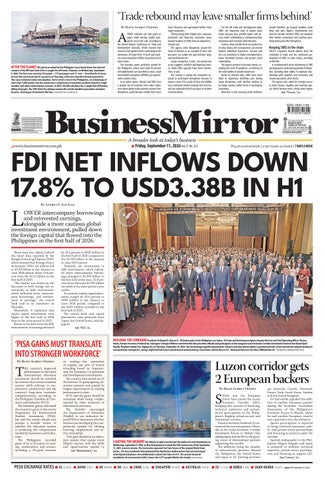
FDI NET INFLOWS DOWN 17.8% TO USD3.38B IN H1 www.businessmirror.com.ph
L
n
Friday, September 11, 2026 Vol. 21 No. 332
P25.00 nationwide | 2 sections 22 pages | 7 DAYS A WEEK
By Andrea E. San Juan
OWER intercompany borrowings and reinvested earnings, alongside a more cautious global investment environment, pulled down the foreign capital that flowed into the Philippines in the first half of 2026. These were the culprits behind the latest data reported by the Bangko Sentral ng Pilipinas (BSP), which showed that Foreign Direct Investment (FDI) net inflows fell to $3.38 billion in the January to June 2026 period, down 17.8 percent from the $4.12 billion in the first half of 2025. “The decline was driven by the decreases in both foreign net investments in debt instruments, which indicated lower intercompany borrowings, and reinvestment of earnings,” the central bank said in its statement on Thursday. Meanwhile, it explained that equity capital investments were higher in the first half of 2026 than in the same period in 2025. Based on the data from the BSP, reinvestment of earnings declined
by 19.4 percent to $829 million in the first half of 2026 compared to the $1.028 billion in the January to June 2025 period. Similarly, net investments in debt instruments, which indicated lower intercompany borrowings, plunged to $2.063 billion in the first half of the year, 25.8 percent lower than the $2.781 billion recorded in the same period a year earlier. In contrast, equity capital placements surged by 59.4 percent to $489 million in the January to June 2026 period, compared to the $307 million recorded in the first half of 2025. The central bank said capital placements came primarily from Japan, the United States, and Singapore. See “FDI,” A2
‘PISA GAINS MUST TRANSLATE INTO STRONGER WORKFORCE’ By Bless Aubrey Ogerio
T
HE country’s improved performance in the latest international education assessment should be matched by reforms that ensure students acquire skills relevant to employment, productivity and the country’s long-term economic competitiveness, according to the Philippine Chamber of Commerce and Industry (PCCI). The business group welcomed the country’s gains in the recent Programme for International Student Assessment (PISA), but said the results should also prompt a broader review of whether the education system is producing the competencies needed by businesses and industries. The Philippines recorded gains of 16 to 20 points in reading, mathematics and science, including a 20-point increase
in reading—the equivalent of roughly one year of formal schooling based on Organisation for Economic Co-operation and Development benchmarks. The country also moved out of the bottom 10 participating education systems and posted its largest improvement in reading performance to date. PCCI said the gains should be sustained while being complemented by other measures of educational outcomes. The chamber encouraged the Department of Education (DepEd) to use indicators beyond PISA to determine whether learners are developing the competencies needed for lifelong learning, employment and active citizenship. “Our goal should be an education system that equips every Filipino learner with the skills and opportunities needed to See “Workforce,” A2
BUILDING THE CORRIDOR President Ferdinand R. Marcos Jr., US Ambassador to the Philippines Lee Lipton, US Trade and Development Agency Deputy Director and Chief Operating Officer Thomas
Hardy, Finance Secretary Frederick Go, and Japan’s Chargé d’Affaires ad interim Ono Sho join other officials and participants at the inaugural Luzon Economic Corridor Investment Forum at the Grand Hyatt Manila, Bonifacio Global City, Taguig City, on Thursday, September 10, 2026. The forum brings together government, business and investment leaders to promote private-sector investment and partnerships in transportation and logistics, energy, digital infrastructure and advanced manufacturing. Story below; related story in A11, “Amid questions over Pax Silica, PBBM pitches LEC.” PRESIDENTIAL COMMUNICATIONS OFFICE
Luzon corridor gets 2 European backers By Bless Aubrey Ogerio
S
LIGHTING THE MEMORY The Tribute in Light is tested over the skyline of Lower Manhattan on Wednesday, September 9, 2026, as New York prepares to mark the 25th anniversary of the September 11, 2001, terrorist attacks. The two beams represent the Twin Towers of the original World Trade Center, 110-story landmarks that dominated the Manhattan skyline before they were destroyed when hijacked airplanes were deliberately crashed into them on 9/11. The annual memorial installation, first presented in 2002, honors the 2,977 people killed in the attacks. AP/ADAM GRAY
PAIN and the European Union have joined the Luzon Economic Corridor (LEC), bringing new sources of financing, technical assistance and privatesector participation to the Philippines’s flagship infrastructure and investment corridor. Finance Secretary Frederick Go announced the two new partners Thursday at the Luzon Economic Corridor Investment Forum in Makati City, adding Spain and the EU to the growing roster of international partners supporting the corridor. The additions bring the number of international partners beyond the Philippines, the United States and Japan to 10. Existing partners
are Australia, Canada, Denmark, France, Italy, South Korea, Sweden and the United Kingdom. Go had earlier signaled the addition of another European partner during the Economic Journalists Association of the Philippines’s Economic Forum in Manila, where he said another European country was expected to join the initiative. Spain’s participation is expected to bring technical assistance, public- and private-sector partnerships and financing to projects under the corridor. Spanish Ambassador to the Philippines Miguel Delgado said Spain is prepared to mobilize technical expertise, private-sector participation and financing to support LEC See “Luzon,” A2
PESO EXCHANGE RATES n US 62.4870 n JAPAN 0.4071 n UK 84.6949 n HK 7.9685 n CHINA 9.3166 n SINGAPORE 49.4398 n AUSTRALIA 45.0781 n EU 72.7224 n KOREA 0.0467 n SAUDI ARABIA 16.6472 Source: BSP (September 10, 2026)
News
BusinessMirror
A2 Friday, September 11, 2026
Balatukan… Continued from A11
added, “It is to make sure that tourism protects the qualities that make people want to visit in the first place. That means respecting carrying capacities, managing visitor numbers, supporting local enterprises, and making communities partners in tourism.” She cited Palawan, the Balinsasayao Twin Lakes in Negros Oriental, and Dinagat Islands, where this has become a reality. The DOT chief said it was vital that destinations prioritize sustainability, “build[ing] it from the beginning,” before it is overrun by tourists. She said this was the basis for the DOT’s Tourism Champions Challenge (TCC), where local government units have been asked to identify the obstacles faced by their tourism destinations, then propose practical solutions that involve their local communities. Among the recent TCC winners include a community-based tourism initiative in Silaki Island in Bolinao; an eco-heritage museum in Silago, Southern Leyte; and a mangrove boardwalk and gallery in Samal. With Asean being the most biologically diverse in the world, its ecosystems face growing pressures from climate change, biodiversity loss, pollution, and development. She enjoined forum participants to “work together toward an Asean where our forests continue to breathe, our reefs continue to flourish, our wildlife continues to thrive, and our communities continue to prosper alongside nature.” Ma. Stella F. Arnaldo
Workforce… Continued from A1
thrive and contribute meaningfully
www.businessmirror.com.ph
PHL bans exports of purple yam as global demand soars
T
By Ada Pelonia
HE Philippines slapped an indefinite ban on exports of fresh purple yam (ube) to safeguard the country’s planting material given the stiff competition among producers to meet booming global demand. The Bureau of Plant Industry (BPI) issued last mid-August a document, which temporarily suspended the outbound shipments of fresh purple yam, scientifically known as Dioscorea alata, effective immediately until further notice. Agriculture Secretary Francisco Tiu Laurel Jr. told the BusinessMirror that the temporary ban would protect the country’s planting material from a po-
tential wave of poaching among other nations. “We don’t want to export planting material. We severely lack it ourselves and other countries might use it to compete with us,” Tiu Laurel told this newspaper on Thursday. For its part, the BPI said ongoing policy reforms also prompted the agency to temporarily halt outbound shipments of the crop.
to national development,” PCCI President Ferdinand Ferrer said. PCCI said the recommendation was also outlined in its Education Task Force paper, Reform Our Education, Transform Our Future.
The country’s improved education performance, however, comes as the labor market continues to struggle to absorb workers. Recent statistics data showed that unemployment reached 6 percent in
“In view of ongoing discussions to explicitly include fresh purple yam [Dioscorea alata] among commodities subject to export restriction, and as an interim safeguard pending completion of the corresponding policy and regulatory processes, the export of fresh purple yam and its propagative planting materials is hereby temporarily suspended, effective immediately until further notice—regardless of the intended purpose of export, whether for consumption, planting, or research.” Given this, BPI ordered its Plant Quarantine Stations (PQS) to suspend the issuance of phytosanitary certificates (PCs) for shipments of the crop and its propagative planting materials. The Philippines has previously banned the export of raw commodities, such as mature coconuts, as part of government ef-
forts to protect these from being poached by other countries. The government has introduced a raft of efforts to boost the Philippine purple yam, as local production lags behind soaring domestic and global demand. This includes P300 million in funding allocated by the Department of Agriculture (DA) to boost the domestic purple yam industry in 2027. Several interventions to expand ube output are also in the pipeline, such as expanding production of planting materials through tissue culture, community-based nurseries, and the minisett propagation technique. Local purple yam stakeholders also recently created the United Ube PH Association Inc. to centralize initiatives that will strengthen local output and increase exports of the prized crop.
July, the highest since June 2022. Meanwhile, the January-to-July average rose to 5.2 percent from 4.1 percent a year earlier. For businesses, PCCI said that the issue extends beyond classroom performance. The quality and relevance of education affect the availability of workers who can meet the skills requirements of manufacturing, services and other industries, as well as the country’s ability to compete for investment and participate in global value chains. PCCI also called for a review of how the country’s trifocalized education system is aligned and coordinated. While basic education provides the foundation, the chamber said it must be better connected with technical-vocational education and training and higher education to create a more productive and equitable workforce. A stronger link across the three levels could help ensure that students move more effectively from
basic education into skills training, higher education and eventually the labor market, particularly as industries face changing skills requirements. PCCI also emphasized the need to sustain education reforms and accelerate implementation of recommendations from the Second Congressional Commission on Education (Edcom II). The chamber said continued reforms are needed to improve educational outcomes and strengthen the pipeline of skills available to the economy. For the business sector, the PISA results provide a measure of progress but not the full picture of whether the education system is preparing Filipinos for a changing economy. PCCI affirmed its commitment to work with DepEd and other stakeholders on reforms aimed at improving educational outcomes and developing a workforce capable of competing in domestic and global markets.
FDI net inflows down… Continued from A1
These funds, the BSP said, were funneled largely into the manufacturing, financial and insurance, and real estate industries.
Analysts’ take
RUBEN CARLO O. ASUNCION, chief economist at Union Bank of the Philippines (UBP), said the decline in net FDI inflows in the first half of 2026 was “driven mainly by lower intercompany borrowings and reinvested earnings, consistent with a more cautious global investment environment.” Explaining the month-on-month FDI decline—to $447 million investments in June alone, or down by nearly 30 percent compared to the $638 million in May 2026— Asuncion said this “likewise reflects the inherent volatility of FDI flows, particularly financing transactions between parent companies and their affiliates.” At the same time, he pointed out that June inflows of $447 million which were 35.1 percent higher than the $331 million in June 2025 suggest that “foreign investors are still identifying opportunities in the Philippines despite external uncertainties.”
Outlook
LOOKING ahead, Jonathan L. Ravelas, senior adviser at Reyes Tacandong & Co., said: “Near-term FDI flows may remain soft, but the longer-term story will depend on how effectively the country converts reforms into actual investment projects.” This was echoed by Michael L. Ricafort, chief economist at Rizal Commercial Banking Corporation (RCBC), who outlined the key reforms and initiatives needed to be put in place for the coming months and years to help attract more foreign direct investments into the country.
“For the coming months/years, preparations related to Pax Silica and Luzon Economic Corridor provide a source of hope/ bright spot for FDIs, in view of the framework approval during the Asean Leaders’ Summit in November 2026,” Ricafort said. He also raised the need to adopt measures that would improve governance to boost investor sentiment in the country. Also among the key measures that should be utilized, Ricafort noted, are the incentives being prepared for local electric vehicle (EV) production and other incentives in place including the (Corporate Recovery and Tax Incentives for Enterprises to Maximize Opportunities for Reinvigorating the Economy) CREATE MORE. Aside from merely implementing key reforms, Ricafort pointed to the need to lower the cost of business especially on electricity, which he described as “among the highest in Asean/Asia.” Ricafort also said the country is in need of “more predictable policies” especially on taxation, pointing out the importance of “not changing the rules in the middle of the game.” The chief economist of RCBC also emphasized the need for “continuity in policies even to the subsequent Philippine presidents/administrations.” Moving forward, Asuncion said: “FDI performance will likely remain influenced by global growth prospects, geopolitical developments, and investor sentiment.” “While ongoing conflicts, elevated global price pressures, and softer economic activity abroad could weigh on investment decisions, the Philippines’s relatively stable macroeconomic environment and continued investment opportunities should help support foreign investment inflows over the medium term,” added Asuncion.
Pax Silica… Continued from A11
Hyatt Hotel before Marcos delivered his speech at the Luzon Economic Corridor Investment Forum. According to reports, the Southern Police District arrested four individuals for allegedly forcibly trying to enter the venue to conduct the protest without a permit. The League of Filipino Students said it rejected the Pax Silica since they claim it will displace local farmers and national minorities, threaten water and energy supply, harm the environment and affected communities, and put the country at risk of being attacked. “We must firmly reject all fundamentally onesided and unfair projects and initiatives that pose threats to national sovereignty, natural resources, environment, and the lives and livelihoods of our fellow Filipinos,” it said.
Luzon…
Continued from A1
projects, particularly in areas such as railways, aviation, shipbuilding, airnavigation management, and renewable-energy connectivity. The European Union, meanwhile, could broaden the corridor’s access to European investors and businesses, with EU Ambassador to the Philippines Massimo Santoro highlighting the bloc’s trade and investment links with the country. The Philippines recorded a trade surplus with the EU, with bilateral trade reaching $15.5 billion in 2024, Santoro said in January. Trade with Spain has also expanded. Philippine government data showed total merchandise trade between the two countries rose 8.7 percent to $1.1 billion, driven by a 7.4-percent increase in imports to $734.3 million and an 11.8-percent rise in Philippine exports. The addition of the EU as a bloclevel partner is distinct from the participation of individual European countries already supporting the LEC, including France, Italy, Denmark and Sweden. The new arrangement potentially gives the corridor another channel for engagement with EU institutions and businesses beyond country-specific commitments. The Philippines, the US and Japan launched the LEC in April 2024 as the first Partnership for Global Infrastructure and Investment corridor in the Indo-Pacific. It links Subic Bay, Clark, Manila and Batangas, connecting major manufacturing, logistics and trade centers across Luzon. The government has described the LEC as the country’s main economic corridor, with the four areas accounting for about half of the Philippine economy. The September 10 investment forum brought together around 600 delegates and featured discussions on a pipeline of projects being developed along the corridor, as the government seeks to turn international commitments into infrastructure and investment activity.
Trade rebound may leave smaller firms… Continued from A1
costs, longer delivery times and extended payment cycles strain smaller firms. In addition, public support for trade and logistics services should likewise be strengthened, particularly in developing economies, Unctad said. This includes improving SMEs’ access to reliable and affordable logistics, trade facilitation, market information and other business support. For longer-term resilience, Unctad recommended measures that improve SME productivity and competitiveness while helping businesses maintain and diversify their supplier and customer relationships. Such support, it said, can help safeguard jobs, encourage innovation and improve businesses’ ability to withstand future disruptions. The recommendations are relevant to the Philippines, where MSMEs remain a major focus of the Department of Trade and Industry (DTI), which runs various programs aimed at supporting smaller businesses, including efforts involving financing, market access, entrepreneurship and trade promotion.
BusinessMirror
www.businessmirror.com.ph
Friday, September 11, 2026 A3
Feeling fine doesn’t always mean you’re well: Why accessible community healthcare matters
I
By Dr. Bless Bertos
N my years of running medical missions with SM Foundation, there’s one phrase I hear almost every time: “Wala naman akong nararamdaman.”
Understandably, when we wake up without pain and notice nothing unusual, it is easy to assume that everything inside our body is fine. But feeling well and being well are not always the same thing. Hypertension and diabetes can develop quietly, sometimes for years. A person may feel normal even while high blood pressure or elevated blood sugar is affecting blood vessels and placing the heart, kidneys, eyes, and other organs at risk. Left undetected or unmanaged, these conditions can lead to stroke, heart attack, kidney disease, and vision loss. I have seen firsthand how early screening can help patients manage these conditions before serious complications develop. This is why primary healthcare close to home matters. In communities where hospitals and other health facilities may be far from home, local health centers can be the first and most accessible point of care. Supporting this first line of care, SM Foundation works with communities to rehabilitate health facilities and complement these efforts with medical missions, bringing health services closer to vulnerable communities.
Early detection starts close to home
Depending on community needs, these rehabilitated facilities support consultations, maternal and child care, immunization, nutrition, family planning, health education, and monitoring of noncommunicable conditions such as hypertension and diabetes. Regular screening is important because both conditions may develop without noticeable symptoms. This is especially important for people with risk factors. For hypertension, adults aged 18 and above should have their blood pressure checked regularly, especially those with risk factors such as: n Family history of hypertension or heart disease n Overweight or obesity n Physical inactivity n Frequent intake of salty food or alcohol n High stress or inadequate sleep n A history of preeclampsia or gestational hypertension For diabetes, I generally recommend screening beginning at age 35, or earlier for people with risk factors, including:
n Family history of diabetes n Overweight or obesity n High blood pressure or cholesterol n Previous gestational diabetes n Polycystic ovary syndrome (PCOS) n Physical inactivity or unhealthy diet If your results are elevated, my advice is the same: do not panic or self-medicate. Consult a physician or qualified healthcare professional for proper assessment and guidance.
Begin with manageable routines
At Mabini Health Station in Bacolod City, a routine blood pressure check takes just minutes but can detect hypertension, a condition that often has no symptoms.
Managing your health does not require overnight transformation. Small, practical habits can become part of your daily routine: n Avoid highly processed foods; instead, increase your intake of plant-based diets. n Avoid alcohol, cigarettes, vapes, and illicit drugs. n Cut your sugar intake by staying away from sodas, frappes, powdered shakes, and iced teas. n Aim for eight hours of sleep. nDrink enough water throughout the day to stay hydrated. n Get at least 150 minutes of moderate-intensity physical activity each week. n Make time for prayer, meditation, and meaningful family time to help manage stress and support emotional well-being. If you have already been diagnosed with hypertension or diabetes, continue taking your prescribed medicines and attend follow-up appointments. Feeling better does not necessarily mean the disease is gone, and maintenance medicines should not be stopped without medical advice.
Improving access to care
For many Filipinos, the problem is not simply the unwillingness to seek care. Distance, cost, limited facilities, and shortages of healthcare professionals can make screening, diagnosis, treatment, and follow-up difficult, especially in underserved communities. As a physician, I believe screening should never end with finding an abnormal result. A patient with elevated blood pressure or blood sugar needs a place to return for assessment, treatment, monitoring, and follow-up. This is also where strengthened community Health Centers and SM Foundation’s medical missions can complement one another. Medical missions can reach people
Knowing your blood pressure numbers is a simple step toward taking charge of your health.
Diet is one of the few risk factors patients can control directly. Cutting back on processed foods, salt, and sugary drinks lowers the same two risks, high blood pressure and elevated blood sugar, that often go undetected for years.
SM Foundation’s Mobile Clinic brings health services closer to communities, complementing its Health and Wellness Centers that provide a permanent point of care for follow-ups and continuing treatment.
A finger-prick blood sugar test takes minutes and can flag diabetes risk on the spot. Screening is generally recommended starting at age 35, or earlier for those with risk factors like excess weight or a family history of the disease.
who may otherwise delay seeking care, while permanent community health facilities provide an accessible place where care can continue after the mission is over. A health check can be the first step, but care should not stop there. Strong primary healthcare means giving people a place close to home where they can seek help early and return for continuing care. Through medical missions and strengthened health centers, SM Foundation seeks to help make that pathway to care more accessible and lasting. Dr. Bless Bertos is a Senior Project Manager for SM Foundation’s Health and Medical Programs, helping bridge gaps in access to preventive health care for vulnerable communities.
Across SM Foundation’s Health and Wellness Centers, access to essential services and free medicines helps support continuous care for communities.
A4
Friday, September 11, 2026
www.businessmirror.com.ph
Chinese fire flares at unarmed Coast Guard observation plane
T
By Rex Anthony Naval
HE Coast Guard (PCG) on Thursday announced that China’s People’s Liberation Army (PLA) has fired multiple flares at its unarmed aircraft that was conducting routine maritime domain awareness (MDA) flight over the Kalayaan Island Group (KIG) in the West Philippine Sea (WPS) on September 7.
“Prior to landing on Pag-asa Island, the PCG aircraft was challenged over radio by Chinese forces illegally occupying Zamora [Subi]
Antigraft court orders Romualdez’s detention at QC jail By Joel R. San Juan
T
HE Sandiganbayan Third Division on Thursday ordered the detention of former speaker and Leyte Rep. Martin Romualdez at the Quezon City Jail Male Dormitory under the supervision of the Bureau of Jail Management and Penology (BJMP) instead of the National Police’s Criminal Investigation and Detection Group (PNP-CIDG). The commitment order was issued even as the Third Division has yet to decide if it would grant or deny Romualdez motion to be placed under hospital detention at the Cardinal Santos Medical Center (CSMC) in San Juan City, where he has been confined since the anti-graft court issued an arrest warrant against him in the P7.4 billion plunder case on September 7. Associate Justice Karl Miranda, chairperson of the Third Division, issued the order during Thursday’s hearing on Romualdez’s motion for hospital confinement. “Pursuant to the court’s Resolution and Warrant of Arrest both dated September 7, 2026 and issued on even date, we hereby COMMIT to you the living person of FERDINAND MARTIN GOMEZ ROMUALDEZ who is charged in the aforesaid case for the crime of PLUNDER, to be HELD therein as a detention prisoner and as such, the accused shall not be moved, removed, transferred, and/or otherwise be released therefrom unless ordered by the court,” the commitment order addressed to the BJMP read. See “Antigraft,” A5
Reef, which then fired f lares in its direction. Chinese forces illegally occupying Panganiban [Mischief ] Reef repeated the
same actions,” it added. On both occasions, the PCG aircrew responded over radio that the presence of Chinese forces on these illegally reclaimed features is a violation of international law, and that the MDA flight is a routine and legitimate operation. “ The aircrew, likewise, observed a considerable number of Chinese maritime militia vessels sheltered inside the lagoons of both features. No personnel were observed on the decks of these vessels or on the reclaimed facilities, and no vehicular movement was monitored anywhere on the illegally reclaimed artificial islands,” the PCG said. Meanwhile, the PCG commandant, Adm. Ronnie Gil Gavan, said the PLA’s conduct speaks for itself. “Flares were fired at an unarmed Coast Guard aircraft. The PCG does not need to characterize this behavior,” he added.
He added that the 2016 Arbitral Award is clear that Panganiban Reef is a low-tide elevation forming part of the exclusive economic zone and continental shelf of the Philippines, and that China’s reclamation activities there were carried out in violation of Philippine sovereign rights. “ T he d ischarge of f lares against an aircraft in f light endangers f light safety and disregards the duty of due regard that China owes under the Convention on International Civil Aviation,” Gavan said. Likewise, he said the PCG will continue to conduct MDA flights over the WPS undeterred, and will continue to document and expose China’s aggression and violations of international law, in pursuance to the commitment of President Marcos that the Philippines will never yield a single inch of territory to any foreign power.
5 confirmed killed, 43 rescued, 86 missing in Palawan ship fire
T
HE Coast Guard (PCG) on Thursday said that it is using all its available resources in ongoing search and rescue opeations for the still missing passengers of a passenger roll-on, roll-off vessel that caught fire off Coron, Palawan, late Wednesday night. As of press time, reports said f ive persons were conf ir med killed while 43 sur vivors have been rescued.
The ill-fated ship, identified as the M/V June Aster, owned and operated by the Atienza Interisland Shipping Line, was reportedly carrying some 117 passengers and 17 crew members at the time of the incident. “Time is of the essence. So we are putting all our available assets and resources in the area to locate these individuals,” the PCG spokesperson, Commo. Noemie Cayabyab, said in a radio interview.
On the 86 persons still being located, Cayabyab said this is “live data” and could change in the course of the search-and-rescue operations. She added that the “initial distress incident location” was some four nautical miles from barangay Turda, Coron. Cayabyab added that the PCG is still conducting an investigation to determine what caused the fire. Rex Anthony Naval
Impeach prosecution panel mulls calling Sara’s husband as witness By Jovee Marie dela Cruz
T
HE House of Representatives impeachment prosecution panel is considering calling lawyer Manases Carpio, husband of Vice President Sara Duterte, as a hostile witness in the Senate impeachment trial to clarify financial records connected to the allegation of unexplained wealth. House prosecutor and Party-list Rep. Terry Ridon of Bicol Saro said Carpio’s possible testimony is being studied in relation to Article II of the impeachment complaint, which accuses Duterte of allegedly accumulating unexplained wealth and failing to fully disclose her assets and liabilities. “If his name appears in certain bank accounts or documents, then he may rightfully be called to explain the truth behind those records,” Ridon said. However, Ridon clarified that Carpio is not yet part of the prosecution’s witness list and that discussions on including him
remain at an early stage. “We have not yet discussed including Attorney Carpio among our witnesses as a hostile witness, but this is something we can still consider,” he said. The initial prosecution witness list includes representatives from banks, the Office of the Ombudsman, the Bureau of Internal Revenue, and the Securities and Exchange Commission, who are expected to provide records related to Duterte and Carpio’s financial transactions, tax payments, and registered businesses. The prosecution has obtained documents requested by the Senate Impeachment Court, including bank records and corporate registration documents. It also has an Anti-Money Laundering Council (AMLC) report covering 663 transactions involving Duterte and Carpio amounting to approximately P6.77 billion over a 20-year period. Around P3.77 billion was linked to Duterte, while P2.99 billion was associated with Carpio. Prosecutors said some transactions were flagged by banks as covered or suspicious. Their initial review also found that 15 bank accounts connected to Duterte and Carpio matched accounts identified in AMLC records. Ridon said Carpio’s possible testimony would depend on whether prosecutors determine that his statements are necessary to clarify the financial records they will present in the impeachment proceedings.
Evidence presentation
THE prosecution is scheduled to begin presenting evidence for Article II on Monday, with Ridon and Party-list Rep. Jose Manuel Diokno of Akbayan leading the presentation. Prosecutors have also requested subpoenae for initial witnesses and filed a request for admission of evidence regard-
ing Duterte’s bank accounts and financial transactions. Diokno previously said that if Duterte confirms the existence of the accounts, the prosecution may no longer need to present at least 15 witnesses, which could help shorten the proceedings. Meanwhile, the complaint that Carpio filed against several lawmakers and government officials, including Ridon, over the disclosure of financial records involving him and Duterte was dismissed by the Quezon City Prosecutor’s Office “without prejudice due to jurisdictional issues.” Carpio’s camp said the dismissal did not resolve the merits of the complaint and that they may pursue the case before the Office of the Ombudsman. When the House prosecution panel begins presenting on Monday evidence for Article II of the impeachment complaint against Duterte, focusing on allegations involving unexplained wealth, inaccurate declarations in her Statement of Assets, Liabilities, and Net Worth (SALN), and possible prohibited business interests, retired Sandiganbayan Presiding Justice Amparo Cabotaje-Tang will be the first witness to testify before the Senate Impeachment Court. Ridon said Cabotaje-Tang is among the three witnesses named in the subpoenas requested by the prosecution. He said the former Sandiganbayan justice is expected to discuss the principles governing public accountability, integrity in public office, and mechanisms for addressing undisclosed wealth and prohibited business interests. “She will discuss the principles governing public accountability, integrity in public office, and the mechanisms for addressing undisclosed and unexplained wealth and prohibited business interests,” Ridon said. See “Impeach,” A5
Immigration confirms departure of Cayetanos By Butch Fernandez & Joel R. San Juan
T
HE Bureau of Immigrat ion ( BI ) on T hu rsd ay confirmed the departure of siblings Sens. Alan Peter and Pilar Juliana Cayetano from the country amid the government’s crackdown on political leaders for their alleged involvement in various irregularities. In a statement, the BI said the Cayetanos were allowed to leave the country since there were no hold departure orders or derogatory records against them. The BI, however, refused to divulge other travel details of the senator-siblings, citing their confidentiality under the Data Privacy Act of 2012. “The Bureau of Immigration [BI] confirms that Senators Alan Peter Cayetano and Pia Cayetano are currently out of the country,” the BI said in a statement. “In compliance with the Data Privacy Act of 2012, the Bureau cannot disclose specific details regarding their travel, including their itinerary or other related information,” it added. Alan Peter is being linked in anomalies involving flood control and other infrastructure projects in Taguig City by Sen. Panfilo Lacson. Lacson has submitted documents and other material evidence to the Ombudsman to aid in its investigation into the anomalous projects in Taguig City. The National Bureau of Investigation (NBI) earlier announced that charges would be filed against the Philippine Southeast Asian Games Organizing Committee (Phisgoc) in connection with alleged anomalies in the disbursement of funds for the construction of a sports complex in New Clark City for the 2019 Southeast Asia Games. Alan Peter served as the chairperson of Phisgoc. He is also facing a complaint of obstruction of justice for allegedly allowing Sen. Ronald dela Rosa to leave the Senate premises last May 13 despite an existing arrest warrant issued by the International Criminal Court against him in connection with the bloody antiillegal drug war campaign that he presided over during the Duterte presidency.
Opposition Sen. Robin Padilla is a co-respondent of Cayetano in the obstruction of justice case.
Cayetano trip welcomed
AT least for now, Sen. Alan Peter Cayetano’s trip abroad is not an issue and he should be allowed to take a break from the stress he himself created. Thus said Sen. Panfilo Lacson who, ironically, has been at loggerheads with the former Senate president whom he vowed to send to jail. Lacson also sincerely wished Cayetano well despite their differences, especially if Cayetano and his wife, Taguig Mayor Lani Cayetano, are traveling for healthrelated reasons. “This is not an issue as of the moment. Let’s make him [them] take a break from the stress caused by issues that he himself created. For all we know, Senator Alan’s and his wife’s trip has something to do with reproductive health, which Singapore is known for. If it is simply health related, I sincerely wish him well despite our animosities,” he said in a post on X. On Wednesday evening, photos circulated online of Cayetano at the Ninoy Aquino International Airport (Naia) Terminal 3, where he was seen lining up for a Singapore Airlines f light. Cayetano is currently being investigated by the Nationa l Bureau of Investigation and the Office of the Ombudsman in connection with alleged irregularities in the Philippines’ hosting of the 2019 Southeast Asian Games, where Cayetano was chairman of the Philippine Southeast Asian Games Organizing Committee (Phisgoc). Earlier, Lacson and his office formally submitted to the Office of the Ombudsman at least 45 case studies backed by official documents detailing “systemic anomalies” in flood control infrastructure projects in Taguig City, Cayetano’s bailiwick. The Office of the Ombudsman has since launched a fact-finding investigation into the allegations involving the projects in Taguig. Lacson has repeatedly raised questions about the projects and called for accountability for those responsible for alleged irregularities in the use of public funds.
Storms, habagat death toll now 44 By Jonathan L. Mayuga
T
HE National Disaster Risk Reduc tion and Management Council (NDRRMC) said the death toll of the series of storms that hit the country since August and the effects of the southwest monsoon or habagat that they enhanced has climbed to 44. In its 6:00 a.m. repor t on Thursday, the NDRRMC said five persons remain missing and still the subject of search operations, including two in Metro Manila— one each in Manila and Quezon City; one in Pampanga, and one each in Batangas and Rizal in the Calabarzon or Cavite, Laguna, Batangas, Rizal and Quezon Region. The southwest monsoon continues to drench parts of Luzon and will persist until the end of the week, the weather bureau said. The NDRRMC said the inclement weather triggered landslides and caused severe flooding, affecting close to three million families or 10.4 million persons. Although flooding in many areas has already subsided, 434 areas remain inundated. These include 70 areas in the Ilocos Region, 322 areas in Central Luzon, and 42 areas in Calabarzon. NDRRMC said 14,600 families or 60,900 persons remain in 654 evacuation centers. The floodings which started since storms Luis entered the Philippine Area of Responsibility on August 1 affected a
total of 6,900 barangays and damaged a total of 4,600 houses. Maymay, Neneng and Pilandok, and the prevailing southwest monsoon continued to drench Luzon, causing widespread flooding, including the National Capital Region. The NDRRMC said damage to public and private infrastructure has reached P8.3 billion while damage to crops have peaked to P4.38 billion. Acording to the NDRRMC, P2.46 billion worth of assistance has been provided by the government to affected families. Meanwhile, still reeling from the effects of the inclement weather, 188 cities and towns remain under a state of calamity. W h i l e we a t h e r c o n d i t i o n s h ave improved in many areas, the Philippine Atmospheric, Geophysical and Astronomical Services Administration (Pagasa) said some parts of Luzon remain under threat of rain that may trigger landslides in highly susceptible areas and localized flooding in low-lying areas, near rivers, and highly urbanized areas due to the prevailing southwest monsoon. In its 11 a.m. Weather Advisory on the Southwest Monsoon issued on Thursday, Pagasa said 50 to 100 millimeters of rain is forecast over La Union, Pangasinan, Benguet, Nueva Vizcaya, Quirino, Aurora, Zambales, Bataan, Tarlac, Pampanga, Nueva Ecija, Bulacan, Metro Manila, Rizal, Cavite, Batangas, Oriental Mindoro, and Occidental Mindoro.
www.businessmirror.com.ph
Impeach. . . Continued from A4
Unexplained wealth charge
ARTICLE II of the impeachment complaint accuses Duterte of allegedly acquiring unexplained wealth that is disproportionate to her lawful income as a public official. It also alleges that she made inaccurate declarations in her SALN and continued to maintain business interests while serving in government. The prosecution will also present lawyer Karen Batu, officer-in-charge of the Records Division of the Office of the Ombudsman, who is expected to testify regarding Duterte’s SALN submissions. Ridon said Batu’s testimony will focus on the details contained in the vice president’s official declarations. “The discussion will cover the specific details of the Vice President’s SALN, particularly her submitted declarations,” Ridon said. Another witness identified by the prosecution is lawyer Gerardo del Rosario, director of the Company Registration and Monitoring Department of the Securities and Exchange Commission (SEC). He will testify regarding the authentication and identification of corporate records connected to Duterte. The prosecution team, led by Ridon and Diokno, has reviewed several pieces of evidence, including bank transaction records, tax documents, and records from the SEC and the Anti-Money Laundering Council involving Vice President Duterte and her husband. Ridon said the prosecution’s unexplained wealth team is preparing for the presentation and hopes to complete the opening and closing arguments for the article within the scheduled time frame. “We are preparing the unexplained wealth team for the opening of this article. Hopefully, within the next two to three weeks, particularly if the proceedings become lengthy, we can finish the opening and closing of this unexplained wealth article before the middle of October or at the start of October,” Ridon said.
Increased public interest
THE prosecution expects increased public interest as the impeachment trial moves toward examining financial records and alleged inconsistencies in Duterte’s declared wealth. Manila Rep. Joel Chua said prosecutors would present selected bank accounts and documents that they believe are sufficient to establish their allegations. “Let us wait for how the prosecutors will present it, whether through public prosecutors or their counsels. But one thing is certain: many of our citizens will find this highly interesting,” Chua said. Chua explained that the prosecution would avoid presenting every financial record available because doing so could significantly delay the trial. Instead, prosecutors will focus on documents they consider essential in proving their claims. “If we present every bank account, the trial may end with the year already finished, and we still would not be done. That is why we will look at and select the important ones that we believe are enough to prove our point,” Chua said. House prosecution spokesperson Ace Barbers said the unexplained wealth presentation will compare Duterte’s declared assets with financial records obtained from government agencies and financial institutions. He said the main question is whether the Vice President’s declared wealth matches available records. “Some people project an image of a simple lifestyle. This is the big question of our citizens: Is that really true?” Barbers said. Meanwhile, the prosecution also questioned Duterte’s decision not to personally testify during the impeachment proceedings. Lanao del Sur Rep. Zia-ur Rahman Alonto Adiong said the Vice President’s absence from the witness stand could be interpreted as avoiding an opportunity to answer questions directly. “It means one thing: that she does not want to explain to the public what happened to the confidential funds. The questions remain unanswered, and this strengthens our allegation that accountability rests with her,” Adiong said. The defense team has maintained that Duterte is participating through her lawyers and has argued that she has constitutional protections against being forced to testify against herself. Adiong acknowledged that the final decision on how Duterte’s refusal to testify should be interpreted belongs to the senator-judges.
Friday, September 11, 2026
A5
AI should be strictly DICT raises cyber alert ‘monitored, evaluated’
A
LL national government agencies, government-owned and -controlled corporations (GOCCs), local governments (LGUs) and operators of Critical Information Infrastructure have been placed on heightened cyber vigilance and given 24 hours to complete a readiness assessment of their digital systems.
The directive was issued by the Department of Information and Communications Technology (DICT) and the Cybercrime Investigation and Coordinating Center (CICC) through a Joint Cybersecurity Advisory, which requires covered organizations to undertake prescribed security measures and submit to their agency head or chief executive a one-page cyber readiness assessment within 24 hours from receipt. That assessment must identify the organization’s most serious risks, the immediate actions it has taken, and the assistance it requires. Priority actions listed in the advisory include addressing critical vulnerabilities, enforcing multifactor authentication for critical and privileged accounts, removing unnecessary internet exposure, strengthening security monitoring, verifying that backups can actually be recovered, reviewing third-party access, and validating incident-response and servicecontinuity procedures. Readiness will be graded using a GREEN–AMBER–RED framework. Red conditions require immediate reporting and response, amber conditions require remediation and monitoring, while green requires continued vigilance—and, the agencies stressed, “does not mean zero risk.” Agencies were also told not to hold back on reporting while the assessment is ongoing. “Agencies must not wait for the completion of the 24-hour assess-
ment before reporting a potential compromise,” the advisory read, adding that suspected serious incidents must be escalated immediately. The two agencies were explicit that the deadline is not a finish line. “The 24-hour requirement is a deadline for urgent action and assessment – not an assurance that every cybersecurity risk has been eliminated,” they said, noting that assessments must accurately identify weaknesses, actions taken and unresolved concerns requiring assistance. “This exercise must produce protective action, not merely another compliance report.” Responsibility for implementation was placed squarely on agency leadership. “Agency heads and chief executives must lead implementation,” the DICT and CICC said. “Employee awareness remains essential, but it cannot substitute for proper system maintenance, effective security controls, and leadership accountability.” The advisory comes as the agencies acknowledged public concerns over the security of government digital systems, the protection of personal information and the continuity of essential services. Just recently, several websites of agencies were defaced by threat actors. The Maritime Industry Authority’s (Marina) portal for the issuance of critical documents for seamen was hacked almost a month ago and has yet to be fixed as of writing time.
“The Filipino people deserve more than assurances,” the DICT and CICC said. “They deserve reliable public services, clear and verified information, and accountable action.” The agencies said cybersecurity is an institutional obligation rather than a matter of individual caution. “Reminding employees and the public to exercise caution does not diminish the government’s obligation to protect the systems and information entrusted to it,” they said, adding that public concerns must be met with concrete protective measures, timely response and honest reporting. On disclosure, the DICT and CICC committed to coordinate with affected agencies to provide verified public updates on incidents affecting government services. These updates, they said, will distinguish confirmed findings from preliminary assessments and matters still under investigation, explain available service alternatives, and indicate when further information will be released. Statements on the possible exposure of personal information will reflect the scope and limitations of the technical assessment, while attribution to any individual, group or foreign actor “will be based on validated evidence – not speculation.” Sensitive technical details will be protected, the agencies said, without using the needs of an investigation as a blanket reason to withhold basic public-service information. The DICT said its Cybersecurity Bureau and National Computer Emergency Response Team, together with the CICC and cybersecurity and law-enforcement partners, will continue monitoring threats and coordinating defensive measures across government and critical infrastructure. “Our priority is to protect the Filipino people, preserve essential services, and earn public trust through measurable action and accurate information,” the agencies said. Lorenz S. Marasigan
Dole targets 10K BPO workers for AI upskilling By Mary Jade Jadormio
T
HE Department of Labor and Employment (Dole) is targeting 10,000 business process outsourcing (BPO) workers for artificial intelligence (AI) upskilling this year as the technology reshapes jobs in one of the country’s major employment-generating industries. Under the Technical Education and Skills Development Authority (Tesda), the slots will be delivered through enterprise-based training as part of the government’s AI upskilling roadmap. AI is changing jobs in the Philippine labor market rather than simply eliminating them, with BPO and information technology-business process management (IT-BPM) among the occupations being affected, Dole said. “In the Philippine labor market, we’re seeing that AI is transforming jobs rather than outright replacing them,” a Labor official said during the House of Repre-
Antigraft. . . Continued from A4
The hearing was set by the antigraft court to determine whether there is basis for Romualdez to remain at the hospital for alleged illnesses or order his immediate transfer to a regular detention facility. Among those summoned by the Sandiganbayan to attend Thurday’s hearing were the legilslator’s four attending
sentatives Committee on Appropriations’ hearing on the department’s proposed 2027 budget. Occupations affected by the shift include BPO and IT-BPM, clerical and administrative support, finance, accounting and related processing, as well as certain sales and service roles. New opportunities are also emerging, including specialized roles for engineers, AI trainers and auditors. “That’s why our upskilling and reskilling are very important because we have to upgrade the occupations of these jobs which are affected by AI,” Labor Undersecretary Carmela I. Torres said. Dole has been working closely with the Information Technology and Business Process Association of the Philippines (Ibpap) for two years to support training and identify skills needed by workers in the industry. Tesda said the BPO training is being designed with IBPAP based on industry requirements, particularly the skills workers
need as AI adoption expands. “They define for us what kind of upskilling their employees need in order to make sure that they are not disrupted by the AI that’s coming,” a Tesda official said. Beyond the 10,000 BPO slots, around 34,000 more are being delivered through partner technical-vocational institutions for AI and data upskilling. Institution-based training is also open to people who are employed or not employed, with modules covering engineering, data annotation and analytics. A convergence with the Department of Information and Communications Technology (DICT) is also being planned to expand AI adoption and worker transition next year. Tesda said its AI upskilling roadmap is intended to improve AI literacy and build a workforce capable of moving into highervalue roles as technology changes existing occupations. Project Unlad, a joint AI-upskilling initiative of Tesda and DICT, is expected to continue into 2027.
physicians—Rody Sy, Rogelio Libarnes, Kurt Allen V. Sibayan, and Rosalio P. Torres. Romualdez was also ordered to appear before the anti-graft court should his condition permit. H o w e v e r, h o u r s p r i o r t o t h e scheduled hearing, the PNP announced that Romualdez “is medically unfit to travel.” The arrest warrant stemmed from the complaint filed by the Office of the Ombudsman accusing Romualdez and several others of pocketing and receiving
kickbacks amounting to P7.4 billion from infrastructure and flood control projects of the government. The Ombudsman has also named former Party-list Rep. Elizaldy Co of Ako Bicol, Romualdez’s personal aide Joselyn Tragua Serenio, and the president of Samchan Foreign Exchange Corporation, Felicito Guevarra, as co-respondents in the plunder case. The Sandiganbayan has also issued arrest orders against Co, Serenio and Guevarra.
A
MID the growing use of artificial intelligence (AI), the country’s chief economist said that the government use of the technology should still be subjected to strict monitoring and evaluation to ensure it delivers public value. “AI can support monitoring and evaluation, but AI itself must also be monitored and evaluated,” Socio-economic Planning Secretary Arsenio M. Balisacan said. He said agencies should assess whether AI-supported systems achieve their intended results, work under actual conditions, perform fairly across groups and locations, and deliver benefits that justify their costs and risks. Balisacan explained that AI systems can reproduce errors and biases embedded in their data and design. “An output may appear precise and still be wrong. A system may perform well on average while producing poor results for particular groups or communities, deepening the very inequities that public policy seeks to address,” he added. The Philippines ranked 49th out of 195 countries in Oxford Insights’ 2025 Government AI Readiness Index, with a score of 57.76 out of 100, above the global average of 41.40. The country scored 69.17 in public-sector adoption, while it posted higher scores in policy capacity at 84.50 and governance at 70.84. Its scores were lower in AI infrastructure at 48.11 and development and diffusion at 42.46.
According to Balisacan, government’s adaptation to AI should also involve investing in reliable data systems, personnel who can critically evaluate AI outputs, and safeguards for privacy, fairness, transparency, and the integrity of public evidence. Before scaling an AI-enabled tool, he said agencies should define the problem and expected results, test the system, document its limitations, and identify who will be responsible for review and corrective action. “They must also know what data are being used, whether these are accurate and representative, who may access them, and how privacy and security are protected,” he said. Balisacan said these safeguards are particularly important as government M&E systems continue to face fragmented reporting, uneven data quality, manual processing, and delays in delivering information to decision-makers. AI could help agencies monitor programs more frequently, process field information faster, recognize patterns across large datasets and identify implementation concerns earlier, he said. The Department of Economy, Planning and Development earlier said the Marcos administration is finalizing its AI framework, which is expected to help streamline government processes and improve project monitoring. The framework is expected to be released this month. Justine Xyrah Garcia
DA seeks tariff change on imported pork jowls
T
HE Tariff Commission (TC) will conduct a public hearing this month on the Department of Agriculture’s (DA) petition seeking to modify the tariffs levied on frozen pork jowls. The TC issued a notice of public hearing on Thursday regarding the petition filed by the DA, requesting a distinct tariff line for frozen pork jowls and that these should be imposed with the same duties as swine meat. “Immediate extraction of a distinct national tariff line for frozen pork jowls to improve monitoring, trade surveillance, and tariff treatment of this commodity,” the TC said, citing the DA’s request. “The application of the tariff rate imposed on swine meat under AHTN Chapter 0203 to pork jowls, in recognition of their commercial use and substitutability with pork meat,” it added. Furthermore, the TC said the DA also wants to reclassify pork jowls, wherein pork jowl by itself would be categorized as swine meat while those attached to the head would remain sorted into edible offal. “Future review and re-classification of pork jowls in the next general tariff nomenclature review, such that standalone pork jowls presented separately from swine head may be classified under AHTN Chapter 0203 [swine meat], while pork jowls attached to the head
remain classified under Chapter 0206 [edible offal],” the agency said. “Consistent with the classification approach adopted by the European Union [EU] and aligned with domestic product standards and the commercial nature of the product, without prejudice to the Philippines’ consistency with the Asean [Association of Southeast Asian Nations] Harmonised Tariff Nomenclature [AHTN].” The TC set the public hearing on September 21 at 2:00 p.m., which will be conducted via videoconferencing. Interested parties have until October 1 to submit their position papers regarding the proposed tariff modification. “Interested parties shall be afforded the opportunity to be present and present evidence in support of their position’s on the subject matter,” The TC said. The DA recently explained that pork jowl, currently considered as offal and levied 5 percent, should be included in the same tariff line as pork shipments. “Jowls are the jaw of the pig. When the head is included, it’s offal, which has a tariff rate of 5 percent. But the jowl that arrives here already excludes the head. So, we think […] it’s a technicality in favor of those importing it.” The agency said it is working with the TC to close that loop, since the industry could get an additional P4 billion in revenues if pork jowls get reclassified. Ada Pelonia
ERC simplifies rules for old power plants
T
HE Energy Regulatory Commission (ERC) has put in place clearer and more practical Grid Compliance Test (GCT) requirements for older power plants that frequently experience outages. Resolution 27, Series of 2026, provides a defined pathway for qualified legacy plants— with Commercial Operation Dates (CODs) prior to the enactment of the Electric Power Industry Reform Act of 2001 (Epira)—to demonstrate their capability to safely and reliably operate within the power grid. The ERC recognized that certain older facilities may be unable to comply with some of the tests prescribed under the 2016 Philippine Grid Code due to outdated technology or because compliance may be technically, economically, or operationally impractical. Under the simplified rules, the required GCTs for legacy plants are limited to six key areas of testing: minimum and maximum stable load and ramp rates; reactive capability; governor control response; faststart capability; dispatch accuracy; and overand under-frequency relay testing. These tests are intended to verify the essential operational capabilities of legacy plants necessary to maintain the safety, reliability, and stability of the power system. Once a legac y plant successfully completes the required tests, the National Grid Corporation of the Philippines (NGCP), as system operator, shall issue the Final Certificate of Approval to Connect (FCATC) within the applicable timeline prescribed by
the Department of Energy (DOE). The FCATC is also among the requirements for the issuance of a Certificate of Compliance (COC) to generation facilities. “By establishing requirements that recognize the technical realities of legacy plants without compromising essential grid standards, we are providing greater regulatory clarity while safeguarding the reliability of the power system. Ultimately, a more reliable and secure grid helps protect consumers from disruptions and supports the continuous delivery of electricity,” said ERC Chairperson and Chief Executive Office Francis Saturnino C. Juan. For power generation companies, this provides a clearer and more workable compliance framework for qualified legacy plants. For NGCP, it establishes the specific tests to be completed before the FCATC may be issued. The ERC will also continue to review, monitor, and evaluate the performance and operation of these plants. For electricity consumers, the measure is intended to support system reliability by ensuring that legacy plants remain subject to essential technical tests while addressing requirements that may no longer be practical for older facilities. By providing a clearer compliance pathway, the resolution can help avoid regulatory obstacles to the continued operation of qualified existing generation capacity, while maintaining oversight of their performance and contribution to a stable grid. Lenie Lectura
A6
Friday, September 11, 2026
BusinessMirror
www.businessmirror.com.ph
Editor: Lyn Resurreccion
The World BusinessMirror
Friday, September 11, 2026 A7
Oil surges past $100 a barrel as US, Iran launch new attacks By Wyatte Grantham-Philips & Cathy Bussewitz
N
The Associated Press
EW YORK—Oil prices shot past $100 a barrel Wednesday as fighting between the US and Iran escalated, threatening to increase costs for consumers and businesses worldwide. Brent crude, the international standard, climbed into triple digits for the first time since July and settled at $101.21 a barrel. US benchmark crude was close behind, finishing at $96.05 a barrel a day after attacks on oil facilities and ships in the Middle East raised the risk of further disruptions to global supplies already constrained by war. New developments in the Middle East, prospects of both peace and renewed hostilities, have caused market whiplash throughout the conflict’s more than six months. Oil returning to the $100 mark raises concern because experts have warned that a prolonged period of steep prices would worsen the economic fallout. Crude is the main ingredient of widely used fuels like gasoline and diesel, both of which have become more expensive in recent weeks. Higher energy prices ripple through the global economy, adding to the cost of everything from producing and transporting food, medicines and household goods to daily commutes and air travel. “Brent breaking above $100 is a major psychological milestone for markets, but the bigger concern is what this means for inflation,” Lukman Otunuga, market research head at global broker FXTM, noted.
Political ramifications could pile up in the meantime. US President Donald Trump, who has repeatedly tried to downplay the war he co-launched, said Wednesday that oil prices likely won’t come down until after November’s midterm elections. Hopes for a lasting peace agreement and a plan to move oil safely out of the Persian Gulf caused the market to cool in the early summer, when prices fell closer to prewar levels of around $70 a barrel. Instead, new attacks mounted, talks between the US and Iran crumbled and oil went up again, albeit with some volatility. Before Wednesday, Brent last settled above $100 on one day in July but had not dropped below $90 since the end of August. Oil prices rose further Tuesday as hostilities intensified around the Persian Gulf, with US forces destroying five Iranian oil tankers and An Iranianbacked Houthi rebel group striking oil facilities in Saudi Arabia. R e c e n t a t t a c k s b y Ye m e n ’s Houthis could constrain global oil supplies even more because they targeted an alternative shipping route that Saudi Arabia has relied on to transport oil during the war. One of the most immediate consequences of higher oil prices is the cost
THE per-gallon price for regular unleaded fuel is displayed electronically on a sign outside a Conoco gasoline station on September 9 in Denver. AP/DAVID ZALUBOWSKI
of fuel. Drivers see and feel the impact when they fill up their tanks. More expensive diesel, jet fuel and bunker fuel add to transportation costs for goods hauled on trucks, trains, airplanes and ships. The effects have reached consumers, businesses and national economies in much of the world. Countries in Asia and Africa that rely more heavily on imports from the Middle East have experienced some of the starkest shocks over the course of the war. In Nigeria, diesel prices are more than 90% higher and gasoline prices are up nearly 58 percent, according to the latest data from energy tracker Global Petrol Prices. Countries including Indonesia (diesel up 87 percent and gas up 38 percent) and Lebanon (diesel up 80 percent and gas up 46 percent) have also seen steep spikes. In the U.S., the average price for a gallon of regular gasoline rose to $4.22 Wednesday, nearly 42 percent more than the national average of $2.98 before the war began, according to motor club AAA. Meanwhile, American diesel keeps setting new records; the average price for a gallon on Wednesday hit $5.94, an-
other all-time high without accounting for inflation and a 58 percent increase from the start of the war. The cost of diesel can have an outsize impact because the fuel powers long-haul trucks and farm equipment. Shoppers may see transportation and production costs show up on supermarket shelves, particularly for perishable products that need to be restocked frequently. Tractor-trailers that move parcels between distribution hubs also run on diesel, and some costs have been passed on to consumers in the form of added fees for online orders and mailed packages. Many airlines have cut f lights while raising fares and fees in response to rising jet fuel prices. More expensive oil could drive up costs for a long list of petroleum-derived products, including things made with rubber and clothes made with synthetic fabrics. The Strait of Hormuz also is a major route for liquefied natural gas, a key ingredient in the production of nitrogen fertilizer. With gas supplies constrained like oil, the United Nations has said the war could reduce agricultural yields and increase world hunger.
strike 1st time in 20 years: UN nuke Israeli in Gaza kills body reports Iran to UNSC 4, including By Stephanie Liechtenstein The Associated Press
V
IENNA —The UN atomic watchdog’s board on Wednesday reported Iran to the UN Security Council for the first time in 20 years, citing it for failure to cooperate in a long-running investigation into uranium traces detected by inspectors at undeclared sites. Western officials suspect that the traces could provide evidence that Iran had a secret nuclear weapons program until 2003. Iran says that it’s not pursuing nuclear weapons, and that its program is entirely peaceful. Reporting Iran to the Security Council opens the country to possible sanctions and asset freezes, though such punitive measures are unlikely because Iran’s allies Russia and China hold veto power on the panel. Twenty-three countries on the International Atomic Energy Agency ’s 35-member board of governors voted for Wednesday’s resolution at IAEA headquarters in Vienna. China, Russia and Niger opposed it, while eight countries abstained and one didn’t vote as it was in arrears, according to diplomats who spoke on condition of anonymity to describe the outcome of the closed-door vote. The resolution was put forward by the United States, Britain, France and Germany. The diplomatic move has been under consideration since June 2025, when the IAEA board found Iran officially in noncompliance with its nonproliferation obligations because of Tehran’s lack of cooperation in the investigation.
THE UN International Atomic Energy Agency flag flies during a special session of an IAEA Board of Governors meeting in Vienna, Austria, on March 2. AP/HEINZ-PETER BADER
Iran’s ambassador to the UN in Vienna, Reza Najafi, rejected the resolution, describing it as a “political tool” and saying that it ruined confidence in the IAEA’s “independence, impartiality and credibility.” He suggested that compliance with any obligation to allow UN inspections of nuclear sites inside Iran was, in any case, impossible at the moment because of the country’s continuing war with the US and Israel. The US this week destroyed five Iranian oil tankers and Tehran hit back at American targets in Jordan, the latest burst of back-and-forth strikes that have lurched the sides back toward open hostilities in a more than sixmonth-old war. The draft resolution, which was seen by The Associated Press, requested IAEA Director General Rafael Grossi to report the agency’s concerns “to the Security Council and the General Assembly of the United Nations, in accordance with the relevant provisions of the IAEA Statute.” The resolution also reiterated its call upon Iran “to urgently remedy its noncompliance” with previous agreements
and to take steps deemed necessary by the IAEA to assure “the nondiversion of nuclear material.” Since Israel and the US struck Iran’s nuclear sites during the 12-day war in June 2025, Iran hasn’t given IAEA inspectors access to nuclear sites that were affected by the strikes. The IAEA also has been unable to verify the status of Iran’s stockpile of near weapons-grade uranium since the June bombing. Najafi said that airstrikes by the U.S. and Israel made safe access for inspectors to Iran’s nuclear sites “materially impossible.” He said that Iran has “neither stopped nor suspended its safeguards obligations,” adding that “performance is currently impossible under continuing military operations and persistent threats.” Iran’s Deputy Foreign Minister Kazem Gharibabadi echoed that sentiment in an post on X. “They attack Iran’s safeguarded nuclear facilities, disrupt the normal verification process, and then use that very disruption as a pretext to pass a resolution at the IAEA Board of Governors,” he said. According to the IAEA, Iran maintains a stockpile of 440.9 kilograms (972 pounds) of uranium enriched up to 60 percent purity—a short, technical step away from weapons-grade levels of 90 percent. That stockpile could allow Iran to build as many as 10 nuclear bombs, should it decide to weaponize its program, Grossi warned in an interview last year with the AP. He said that it doesn’t mean that Iran has such a weapon.
children
By The Associated Press
A
N Israeli strike killed at least four people in northern Gaza, including two children. And a media outlet controlled by Iran-backed Houthi rebels claims Saudi-backed forces have launched airstrikes on several areas. Two children were among the dead after Israel carried out a new strike in the northern Gaza community of Beit Lahiya, according to Shifa hospital, where the bodies were taken. There was no immediate comment from the Israeli military on the strike early Thursday, but a new statement said its forces on Wednesday struck Hamas weapons storage facilities in three areas across Gaza. Israel’s military in the past has said it carries out strikes in response to threats against its forces under the fragile ceasefire that has been in place since October. Meanwhile, Al-Masirah TV, controlled by Iran-backed Houthi rebels in Yemen, claimed that Saudi-backed forces launched 40 airstrikes in recent hours in Taiz, Jawf, Hodeida and Marib provinces. The Associated Press couldn’t independently verify the Houthis’ claim as fighting with the Saudi-backed Yemeni government forces has heightened this week. There was no immediate comment from those forces. Warnings have been growing about a major escalation as the Houthis clash with Yemeni government forces while also attacking oil facilities and utilities in neighboring Saudi Arabia. The fighting puts further pressure on global oil shipments. The Houthis have been targeting shipping and infrastructure that help keep oil flowing through the Red Sea, while the US-Iran war has limited shipments through the Strait of Hormuz on the opposite side of the Arabian Peninsula.
A8 Friday, September 11, 2026
The World BusinessMirror
www.businessmirror.com
Trump’s latest threat to Canadian firms: ‘No reciprocity, no access’
S
By Mathieu Dion | Bloomberg
HARES of Canadian companies that do business with the US government fell following President Donald Trump’s threat to bar Canadianorigin products from being sold to federal contractors. “From now on, NO RECIPROCITY–NO ACCESS!” Trump said in a social media post Tuesday afternoon, saying Canadian and provincial governments ban US firms from winning contracts in the country. He directed the US General Services Administration (GSA) to work with the US Trade Representative to “take all necessary steps to REMOVE Canadian-origin products from GSA’s Mul-
tiple Award Schedules unless Canada restores full and fair reciprocity for American Farmers and Companies.” Share prices for IT consulting company CGI Inc., engineering firms WSP Global Inc., AtkinsRealis Group Inc. and Stantec Inc., and construction firm Aecon Group Inc. had all dropped by more than 2 percent in Toronto as of Wednesday afternoon. It’s not yet clear how “Canadian-or-
igin products” are defined, and whether the directive includes services or parent companies of US subsidiaries. CGI has “relatively material exposure” to US government contracts, National Bank of Canada analyst Doug Taylor wrote in a client note. “We estimate US government revenue could represent between 15 percent to 20 percent of CGI’s total revenue.” But the company primarily sells services, not goods, in the US, which means CGI may be “potentially more insulated than the current scope of the language implies,” Taylor said. “Risk would become more meaningful if restrictions instead apply based on Canadian [parent] ownership, e.g., if US-based subsidiaries of Canadian companies are also included.” CGI said in an emailed statement that CGI Federal, which serves US federal agencies, is a “US-based, whollyowned operating subsidiary,” and that
it employs over 8,000 people “who live and work across 60 US locations.” “CGI Federal is proud to provide US-originated technology services and core business platforms under a wide range of contract vehicles to support the federal government’s mission-critical objectives,” it added. Following the first round of US tariffs in 2025, the Canadian government introduced a policy that favors local businesses in federal procurement and prioritizes Canadian materials in major construction and defense projects. The move came alongside a push to make Canada more self-sufficient and sovereign in digital capabilities. Provinces have also announced limits to US procurement. The Quebec government said this week that it will reserve certain calls for tenders for Canadian firms, and Ontario has a policy that greatly restricts procurement from US businesses while preferring local firms.
Families’ interest in their kids’ education is falling worldwide as scores drop, test shows By Sharon Lurye The Associated Press
F
AMILIES’ interest in their kids’ education is falling in many high-income countries as school systems struggle with plung-
ing test scores, according to newly released results from a standardized test taken by 15-year-olds around the world. Over 760,000 teenagers in dozens of countries took the Programme for International Student Assessment (PISA) last year.
Results released Tuesday show average scores in math, reading and science are all at their lowest point in PISA history among highly developed economies. That includes continued declines in reading and math scores in the US. China, Singapore, Taiwan, Japan and South Korea scored the highest marks on the test. Estonia, the United Kingdom and New Zealand also did well. The key to why scores are falling so widely may be found in an accompanying survey taken by students. Compared with the 2022 results, almost every country saw a drop in families’ support for their kids’ education, especially for boys, as measured by questions about how often parents talk to their kids about their schoolwork or take an interest in their learning. “Parents see themselves more as a client of the school, not as someone who takes personal interest,” said Andreas Schleicher, director for education and skills for the Organization for Economic Cooperation and Development, which runs the PISA test. Students who said a family member asks them at least weekly what they did in school that day scored around 35 points higher on the PISA science test—equivalent to over a year and a half of learning— compared with students whose families take less interest. That number includes adjustments for socioeconomic differences. Digital distraction is another factor. Over a quarter of students in high-income countries complained their classmates got distracted by digital devices in most or every science class. In countries with strong policies controlling the use of cellphones in schools, distraction rates were lower. There’s undoubtedly a strong association between students using digital devices for leisure and lower test scores, Schleicher said. When tech is used for learning, however, the
results are more nuanced. Countries where high schoolers reported using digital devices for around two to three hours per day in school saw higher test scores, but scores fell once tech use climbed beyond that. Asia seems to have found the key to using technology in a way that benefits students. Fewer than 10 percent of tested students in Japan, Korea and mainland China complained of digital distraction in the classroom. (Only four provinces in China participated in testing, plus Hong Kong and Macao.) At the same time, Asia had some of the strongest schools in the world, with Japan, Korea, Taiwan, Singapore and the Chinese provinces ranking among the top 10 regions for math, science and reading. Almost 100 percent of all children in the Chinese provinces scored at or above baseline for math and reading. In the US, it was only 65 percent in math and 74 percent in reading. Experts worry China’s educational dominance over the US has serious political implications. “To win a technological race, you need the people with the science and the technology and the reading capabilities,” said Tracey Burns, chief of global strategy and research at the National Center for Education and the Economy, a group that researches high-performing education systems. The US scores for math were equal to the average among OECD countries that administered the test, and the US was ranked in the top 15 countries in the world for science, reading and computational problemsolving, a new category. However, those rankings benefited from other countries’ declines. US teens’ reading and math scores slid to the lowest point since the PISA test was first administered in the early 2000s.
PRESIDENT Donald Trump speaks at the Republican convention in Dallas, on September 9. AP/TONY GUTIERREZ
Trump pledges to give US adults $5,000 if GOP wins By Jonathan J. Cooper The Associated Press
P
RESIDENT Donald Trump pledged Wednesday to send every American adult $5,000 if Republicans retain control of the House and Senate in the midterm elections, an extraordinary gambit to reverse his party’s sagging fortunes in November. The dubious promise would likely cost more than $1 trillion and require congressional approval, and would further exacerbate the country’s nearly $1.8 trillion annual budget deficit and concerns about inflation. “If the Republicans win, you win with us and you get $5,000,” Trump said during the GOP’s midterm convention in Dallas. “It will be called the Trump Dividend.” He likened the payments to a corporation’s distributions to shareholders, citing “our tremendous strength and success economically.” Within an hour, Vice President JD Vance appeared to try to walk back Trump’s proposal—at least in part— by suggesting the dividend payments would not go to the wealthy. Vance suggested it could be paid for by US tariff revenues, though the suggested payment dwarfs what the US has taken in through the protectionist measures. The White House did not respond to a message seeking details. Congress would need to approve or otherwise acquiesce to the payment. The sum would far exceed US tariff revenues even before the Supreme Court tossed much of the president’s tariff program last year. The national debt last month topped $40 trillion for the first time. Trump has frequently lamented that, during the modern era, the president’s party almost always loses seats in Congress during the midterms, and he has looked for unorthodox ways to defy the trend, including this week’s convention. “We’re going to change that,” Trump said. “There’s no reason for it.” Marc Goldwein, the senior policy director at the Committee for a Responsible Federal Budget, a think
tank in Washington, said Trump has no authority to send money to Americans without approval from Congress. Goldwein added that dividends are something that companies pay when there’s a surplus, but the US is running $2 trillion annual deficits and has $40 trillion in debt. “The idea that we’ve had fiscal success is backwards and bordering on laughable,” he said. “We don’t have surpluses to give away.” The move was reminiscent of billionaire Elon Musk’s efforts to buy votes in last year’s Wisconsin state Supreme Court race, where he handed out million-dollar checks to voters to try to boost a candidate who ultimately lost. Trump has discussed the possibility before but has never tied it to his party’s electoral fortunes. Earlier this year, he proposed a $2,000 dividend and said he didn’t think he needed approval from Congress. Last year, Trump gave members of the military a $1,776 check that he called a “warrior dividend.” “I will get a bill ready so that we can get the Trump Dividend passed immediately after the November 3rd election,” Republican Sen. Bernie Moreno of Ohio wrote on X late Wednesday. “Because Republicans [and America] will win!” A $5,000 check would give each American more money than they received in direct government payments from Covid-19 relief measures during Trump’s first term. Trump’s proposal would be legal because the payment would go to everyone regardless of how they voted, or whether they voted at all, said New Mexico-based attorney John Day. “This is a campaign promise,” Day said. “It’s not a payment to individuals to try to get them to vote in a particular way.” Republicans are on defense as they look to defend their narrow House majority against strong headwinds. Trump is unpopular, and Americans overwhelmingly oppose the war in Iran. Even the Senate, which Republicans once were well-positioned to keep, is up for grabs.
The World BusinessMirror
www.businessmirror.com
Friday, September 11, 2026 A9
NYC officials fear liability over toxic air after 9/11 attacks By Myles Miller & María Paula Mijares Torres
N
Health Watch over documents concerning air quality and health risks. The initial release includes the socalled Harding Memo and records from 68 boxes that city officials said weren’t located until 2025 despite repeated public-records requests. “These are documents that show what the city knew about the toxic air around Ground Zero, when they knew it, and how they acted to limit liability,” Mamdani said. He said the records also show asbestos, a known human carcinogen, was found “nearly everywhere that inspectors tested.”
Bloomberg News
EW York City Mayor Zohran Mamdani released more than 170,000 pages of records about the aftermath of the September 11, 2001, attacks, including documents showing officials were weighing potential liability from toxic exposure while trying to reassure the public about the safety of Lower Manhattan. T he col l apse of t he World Trade Center’s t w in towers in the attacks created massive dust clouds that enveloped much of downtown, covering highly populated neighborhoods with ash, debris and harmful particles, according to the US Centers for Disease Control and Prevention. Fires in the towers’ debris piles
burned for months after the attacks, releasing carcinogenic byproducts. One memo prepared in October 2001 for Robert Harding, a deputy mayor under Rudy Guiliani, estimated that the city could face 35,000 potential plaintiffs and contemplated seeking federal protection from “toxic tort cases that might arise in the next few decades.”
FIREFIGHTERS walk towards one of the towers at the World Trade Center before it collapsed on September 11, 2001. BLOOMBERG
Another city document from May 2002 said that officials would avoid using the word “risk” in correspondence about a cleanup program because doing so “would defeat the purpose of creating public confidence.” An estimated 400,000 people, including first responders, were
exposed to toxic contaminants and other hazards in the days, weeks and months following the attacks, according to the CDC. The records were made public Tuesday, days before the 25th anniversary of the attacks, as the city settled two lawsuits brought by 9/11
Ex-gov. Pataki has lung harm from 9/11 toxins MEANWHILE, former New York governor George Pataki says he has lung disease from being exposed to toxins from the September 11, 2001, attacks on the World Trade Center, according to the New York Post. Pataki, a Republican who was governor between 1995 and 2006, said he was diagnosed with restrictive airway disease over the past five years.
He talked about his illness for the first time in an interview for the 25th anniversary of the terrorist attacks, the Post reported. “I just look at it as I’m one of the lucky ones,” Pataki, 81, told the Post. “The people who were with me at Ground Zero over and over for months after those attacks, many of them have serious illnesses, far more serious than anything I might be experiencing.” An estimated 400,000 people were exposed to massive dust clouds of toxic contaminants for months following the attacks, according to a Centers for Disease Control and Prevention program focused on the victims. More than 5,000 people have died from conditions related to the World Trade Center attacks, which themselves killed almost 3,000 people. After jetliners piloted by al-Qaeda terrorists hit the Twin Towers causing their collapse, hundreds of city blocks in New York were covered with ash, debris and other particles that were unsafe to breathe and caused long-lasting health effects.
Brazil’s Lula signs measures to cut fuel taxes, subsidize diesel Sweden election agenda set by far-right leader By Eléonore Hughes The Associated Press
R
IO DE JANEIRO—Brazilian President Luiz Inácio Lula da Silva signed a decree and a provisional measure Wednesday aimed at lowering fuel prices, weeks ahead of the presidential election and as the US-Iran war drives up the cost of filling the tank. The cost of fuel is a particularly sensitive issue for voters, who will decide in October whether to grant Lula a fourth, nonconsecutive term, or elect Sen. Flávio Bolsonaro, a son of former President Jair Bolsonaro. Brent crude, the international standard, surged above the $100 threshold on Wednesday for the first time since July, after attacks on oil
facilities and ships in the Middle East threatened to further strain an already weakened supply chain. “We’re not going to allow this irresponsible war to hit your pocket,” said Lula as he signed the measures, which extend policies to control fuel prices introduced at the beginning of the US-Iran war. T he measures announced Wednesday include tax cuts on the import and sale of ethanol, gasoline and gasoline blends (excluding aviation gasoline), effective for 30 days from September 10 to October 9. A provisional measure authorizes a subsidy of one Brazilian real ($0.19) per liter for producers and importers of road diesel. Crude oil prices shot up shortly after Israel and the US began their war
with Iran in late February, largely because the fighting halted most shipping through the Strait of Hormuz, a narrow waterway where roughly a fifth of the world’s oil supply passed before the conflict. Brazil is a major producer and exporter of crude oil, and its revenues from the sector have surged this year due to the hike in international prices. But the country still relies on imports to meet domestic demand for refined fuels. Stabilizing diesel prices is also critical to prevent truck driver strikes and keep food inflation in check. In 2018, a truckers’ strike caused food prices to spike, left grocery market shelves and gas stations depleted, and caused billions in losses,
underscoring the power of organized truckers. Former President Jair Bolsonaro, then a lawmaker and months away from winning the presidential election, was an outspoken supporter of the truckers, who later became an important constituency for him. Wednesday’s measures “have a significant electoral component,” according to Armando Castelar Pinheiro, an economics professor at the Federal University of Rio de Janeiro. If it weren’t for the political calendar, “there would be some subsidy, but it would likely be lower,” he said. Diesel in Brazil is 28 percent cheaper than international prices and gasoline is 21 percent cheaper, according to an Itaú BBA market analysis cited by local media Wednesday.
Vietnam’s mortgage rate surge putting homeownership out of reach By Cao Ban
Bloomberg News
W
OULD-BE homeowners in Vietnam are being hit by sharply higher mortgage rates as banks face growing pressure to fund the government’s ambitious nationwide infrastructure push. Mortgage rates have climbed steeply in recent weeks, with average charges now around 12 percent to 14 percent and floating rates reaching as high as 15 percent to 16 percent, the construction ministry said last month. That’s a sharp increase from 2025, when banks were offering buyers aged under 35 introductory rates of 5 percent to 7 percent. Vietnam’s push to build roads, railways and other infrastructure is putting added strain on banks as the government seeks to drive economic growth to 10 percent. As recently as August, financial institutions were lending faster than they were taking in deposits, intensifying competition for money and driving up borrowing costs. The funding shortfall last month was estimated at $77 billion. Meanwhile, loans to Vietnam’s real estate sector jumped 42 percent last year, more than twice the pace of overall credit growth, according to the World Bank. That surge in property lending, however, has only served to push up real estate prices rather than broader economic output, the bank said in a May report. Vietnam’s central bank has since urged lenders to rein in loans to the property sector, which already accounts for about a quarter of outstanding advances.
NEW homes in Ho Chi Minh City MAIKA ELAN/BLOOMBERG Nguyen Hong An, a 29-year-old office worker in Ho Chi Minh City, was considering a 3 billion dong ($115,000) apartment but with only around 1 billion dong in savings, he’s weighing putting those plans on hold. “I’ll see if I can borrow from my family and relatives for the purchase, otherwise I’d rather wait until rates cool down,” An said. He estimates his mortgage repayment would be about 30 million dong a month, more than he could afford. In Vietnam, homes cost more than 30 times annual household income for many citizens, well above t he inter nationa l af ford abi l it y benchmark of three to eight times, according to the World Bank. Younger Vietnamese seeking to get a foot on the property ladder are the most exposed as the triple threat of rising prices, a shortage of affordable housing and pricier mortgages forces many to put hopes of homeownership on hold. In an unusually stark message, the
State Bank of Vietnam warned last month the credit imbalance poses potential risks to the stability of the financial and monetary system. Lenders have been told to prioritize loans to small and medium-sized businesses as there is “very limited room” for monetary policy to support growth. Agribank, one of the country’s largest state-owned commercial banks, has also tightened scrutiny of property lending, including reviews of projects’ legal status and developers’ ability to repay. The bank said the move is to ensure capital is deployed safely and profitably. Social housing that meets genuine demand is being prioritized, rather than speculative or high-end developments that carry greater risk, it said. The combination of higher borrowing costs and limited affordable housing is already weighing on sales, which were down 36% in the second quarter from a year earlier, with about 100,000 transactions record-
ed. That’s putting pressure on developers’ cash flow and inventories, the construction ministry said. Vietnam’s residential real estate market, particularly in bigger cities, remains dominated by luxury developments. High-end apartments accounted for more than 70 percent of new supply in the first six months of 2026, according to the Vietnam Association of Real Estate Brokers. New affordable housing supply in the capital city of Hanoi, for example, has declined by about 28 percent each year since 2022, Savills Vietnam said. “The problem is that there’s a strong skew toward building highend homes that don’t match the social housing” people are looking for, said Willie Tanoto, senior director at Fitch Ratings. The shortage of affordable homes is being exacerbated by rising development costs, including land clearance expenses, and lengthy regulatory approvals. The supply imbalance meanwhile is fueling speculation and property flipping, pushing prices even higher, the construction minister said in parliament. For existing homeowners, the concern is what happens when borrowing costs rise. Nguyen Thi Ngoc Trinh, 33, an assistant manager at an insurance company, has a 2 billion dong mortgage at a fixed rate of 6.5 percent. Her loan is due to switch to a floating rate in October. “I’m worried my monthly payments could nearly double,” Trinh said. She plans to ask her bank for a grace period on principal repayments. “I may sell some of my gold to reduce the loan and keep monthly payments under control.”
By Charlie Duxbury Bloomberg News
J
IMMIE ÅKESSON won’t become prime minister in coming elections in Sweden but in a way he’s already won. For more than a decade now, the 47-year-old far-right populist has been steering the national conversation in one of most stubbornly progressive corners of Europe. So when Swedes vote this Sunday, it will be in a political landscape remade by the leader of the Sweden Democrats. With days left before ballots are cast, Åkesson is back in his hometown of Sölvesborg along the Baltic coast for one last push to take his party into government after 16 years in parliament. His look is smart but approachable: slicked back hair, neatly-trimmed beard, suit, no tie, unbuttoned collar. The crowd roars as he comes on stage with a laugh and swig from a water bottle in the late summer sun to deliver a stump speech on the grounds of a medieval castle. “We’ve pressed the other parties and now they all sound more or less like us,” Åkesson said in an interview at the August 29 event. “That is, of course, already a victory in itself.” Even so, his path to power is complicated. Polls suggest Åkesson will again outperform Prime Minister Ulf Kristersson’s center-right Moderate Party but that the opposition Social Democrats, who have stepped onto his turf with promises of tighter border controls, will win by a hair. Long ostracized because of their roots in Swedish neo-Nazi groups active in the 1980s, the Sweden Democrats have methodically worked their way in from the cold at a time when their ideological brethren are on the march. In Germany, the AfD just scored its best-ever result in a state election. In France, Marine Le Pen is hoping third time is the charm when she runs for president in 2027. In Italy, Giorgia Meloni now holds a record for leading the country’s longestserving government since World War II. The way the far right behaves in opposition
is different than how it does when it comes to power, observes Heather Grabbe of the Bruegel think tank in Brussels. “While they’re in opposition, the fear of them getting into power drives the center-right further to the right,” she said by phone. “Once in government, they tend to focus just on some issues and then they have a more targeted impact.” The 2015 migration crisis in Europe was a turning point for Åkesson and other nationalists. Viktor Orban erected barbed-wire fences and turned authoritarian. The UK’s Nigel Farage drove home Brexit while Angela Merkel’s embrace of 1 million Syrian refugees fueled the rise of the Alternative for Germany. The shock was seismic in Sweden, a liberal haven whose economic model was the envy of the world. A social safety net funded with high taxes buckled under the pressure of migrants drawn to its relaxed asylum rules. Crime rates soared alongside gang violence. As the prime minister of the time had to admit: “Sweden has been naive.” This was the moment when some politicians who had gained notoriety with their anti-immigration messaging chose to moderate their rhetoric, tacking to the center with a view to entering office one day. Le Pen cut ties with her Holocaust-denying father. Meloni assumed leadership of Brothers of Italy. To go from pariah to power broker, Åkesson moved to stamp out extremism and transform the party’s fortunes, according to Ann-Cathrine Jungar, a political scientist at Stockholm’s Södertörn University. Some steps were simple re-branding exercises, such as replacing the party’s flaming torch logo with a blue-and-yellow flower. Others were more wholesale, such as the expulsion of the radical youth wing. “This has a lot to do with Jimmie Åkesson’s leadership and the group around him,” Jungar said in an interview. “They have attempted to clean up the party.”
A10 Friday, September 11, 2026
Pampanga flood control: DPWH unveils immediate, medium, and long-term plans By Ashley J. Manabat
C
LARK FREEPORT, Philippines— The Department of Public Works and Highways is moving to expedite flood control measures in Pampanga as officials address recurring flooding in communities and major roads, while some permanent solutions could take up to 20 years to complete.
DPWH SecretaryVince Dizon saidWednesday, Sept. 9, that immediate, medium, and long term measures were identified during a meeting with Pampanga Gov. Lilia Pineda, local chief executives from flood-prone municipalities, and municipal disaster risk reduction and management officers. The mayors and other local officials represented Candaba, Masantol, Macabebe, San Simon, Sto. Tomas, Apalit, Minalin and San Luis. Fourth District Rep. Anna York Bondoc, who
previously strongly opposed a proposed waterimpounding project in Candaba, did not attend the meeting. Dizon said the government needs to move from planning to implementation after years of discussions on flood control in the province. “Tama na rin kwentuhan, tama na rin ang debate, magtrabaho na tayo,” Dizon said. “At lahat po ng pwede nating magawa ay gagawin natin at papabilisin natin ang ating
PISA gains prove reforms work, but basic education gaps remain—solon By Jovee Marie N. Dela Cruz @joveemarie
& Claudeth Mocon-Ciriaco @claudethmc3
T
HE Philippines’ improved performance in the 2025 Programme for International Student Assessment (PISA) proves that education reforms can deliver results, but the country must now confront the deeper challenge of ensuring that every learner builds a strong foundation before reaching higher education, a House leader said. House Committee on Higher and Technical Education Chairperson andTINGOG Party-list Rep. Jude Acidre welcomed the country’s progress, citing the improvement of Filipino learners’scores compared with 2022, with gains of 17 points in science, 16 points in mathematics, and 20 points in reading. The Philippines also improved its standing among participating countries across the three assessed learning areas. “These gains show that progress is possible when reforms are sustained, institutions work together, and our teachers, schools, families, and communities receive the support they need,” Acidre said. However, Acidre cautioned that improved international rankings should not be viewed as the final measure of success. Instead, he said the results should strengthen efforts to address long-standing learning gaps, particularly those formed during the early years of education. “The child who struggles to read and understand today may become the college student who finds it difficult to keep up tomorrow. A learner who does not develop a strong foundation in mathematics and science will carry that disadvantage not only into higher education but eventually into work and daily life,” Acidre said. “That is why education reform cannot begin only at the college gates,” he added. The lawmaker emphasized that improving basic education outcomes is essential to preparing Filipino learners for higher education, employment, and lifelong learning. “If we want Filipino students to enter college prepared, confident, and capable of succeeding, we must ensure that they receive the right support from the very beginning of their education,” Acidre said. He noted that this learner-centered approach has guided the work of the Second Congressional Commission on Education (EDCOM II), which examines education as a continuous system connecting early childhood education, basic education, higher education, technical-vocational training, workforce development, and national economic growth. According to Acidre, EDCOM II’s consultations and research have helped develop a more integrated reform agenda by recognizing that each stage of education directly influences the next. “The latest results should inspire confidence,
but they should also remind us that much work remains. Progress must be protected, expanded, and transformed into lasting improvements that Filipino learners can experience inside every classroom,” he said. For Acidre, the ultimate measure of education reform is not only how the Philippines performs in global assessments but also how these improvements translate into the daily realities of learners.
Secure and supportive learning ecosystem
EDUCATION Secretary Juan Edgardo “Sonny” Angara emphasized that learner determination must be matched by a secure and supportive learning ecosystem. “Our learners have proven that they have the grit, curiosity, and drive to improve, as shown by our gains across all PISA domains. However, our children must also feel safe... While we take note that physical bullying reports are down compared to 2018, the PISA findings reinforce that cyberbullying is a serious challenge that requires a firm, direct response. Our guidelines establish clear due process, but online cruelty will not be tolerated. Safe digital spaces are non-negotiable for basic education,” Angara emphasized. Department of Education (DepEd) Order No. 6, series of 2026, expand school authority over off-campus online conduct if it creates a hostile environment, violates a learner’s rights, or disrupts school operations. Severe cyberbullying, such as sharing degrading videos, circulating explicit content, or threatening learners and staff on social media, are classified as high-level offenses that trigger formal investigations and disciplinary actions ranging from suspension to non-readmission to full exclusion–dropping the learner from the school list into alternative education–along with potential legal liability. DepEd is embedding digital citizenship, socio-emotional learning, and strengthened values education directly into the basic education curriculum, backed by several co-curricular activities. In observance of Safer Internet Day, DepEd, in partnership with the Stairway Foundation Inc. (SFI), conducted classroom-based discussions on online risks and cyberbullying, reaching around 4.9 million participating learners. Through its Kaagapay Program, DepEd empowers parents and parent substitutes to recognize online threats and discuss these sensitive topics with their children. Furthermore, schools are encouraging participation in sports, youth formation programs, such as sports clubs, learner government, school clubs, scouting, journalism, and the arts to channel their energies into more productive and meaningful pursuits. Meanwhile, in line with efforts to protect schools from online threats, DepEd recently convened a high-level inter-agency meeting to establish a threat assessment and verification mechanism.
intervention para talagang makaraos na rin tayo dito,” he added.
Immediate measures
THE immediate measures include closing gaps along the Tulaoc River with FlexMac flood barriers, a rapidly deployable system used for flood protection, embankment raising and temporary structural support. Other measures include dredging waterways and deploying pumps to move accumulated floodwater into waterways. Officials also identified the San FernandoSanto Tomas-Minalin tail dike, a setback levee in San Simon, the Arnedo Dike in Macabebe and portions of MacArthur Highway in Apalit for funding and urgent intervention. A damaged tail dike in Minalin was also discussed. Minalin Mayor Philip Naguit said the damage could affect seven barangays and an estimated 20,000 to 30,000 residents. Flooding along Quezon Road was also raised during the meeting because the road serves as an alternative route when traffic is heavy or portions of the North Luzon Expressway become impassable because of flooding. Pampanga could also receive additional financial support from the national government through the Local Government Support Fund,
Dizon said. “Makakaasa po kayo sa todong suporta na ibibigay ng ating national government,” he said.
Medium term measures
FOR the medium term, DPWH plans to develop detention basins as part of the province’s flood control strategy. Dizon said four to five potential sites have been identified in San Simon and Sto. Tomas, while mayors of San Luis, Minalin, Candaba, Macabebe and Masantol have committed to identifying suitable areas in their municipalities. The basins would temporarily store excess floodwater before gradually releasing it into nearby waterways, following what officials described as a“store, drain and release”approach. Dizon, in a follow up interview on Thursday, said detention basins have long been part of Pampanga’s flood control master plan but that none of the plans had been implemented. He said Japanese consultants working on the flood control program have advocated building detention basins wherever feasible, rather than limiting them to previously proposed locations. “We will start designing and building these facilities immediately when the weather permits it,” Dizon said.
The current proposal follows a waterimpounding project in Candaba that drew strong opposition from Bondoc in 2023. A video documenting her opposition circulated widely at the time and resurfaced on social media this year. Dizon said potential sites would be selected based on their proximity to waterways and terrain suitable for drainage. Pumping systems could be used where necessary. The stored water could potentially supplement irrigation supplies, Dizon said.
Long term measures
AMONG the longer-term projects discussed were a proposed Central Luzon-Pampanga floodway of about 60 kilometers, a 12,000-hectare ring dike and silt or sabo dams in Nueva Ecija. A Manila Bay integrated flood-control, coastal defense and expressway project is also undergoing a pre-feasibility study, according to the provincial information office. Dizon said some of the major projects could take up to 20 years to fully implement. Pineda said the provincial government supports the proposed measures as local officials seek immediate relief and longer-term protection for communities that repeatedly experience flooding.
PHL exports fresh Hass avocados to South Korea in latest market push By Ada Pelonia @adapelonia
T
HE Philippines has exported over 3,000 kilos of Hass avocados to South Korea, further expanding its access to the Asian nation’s food market. The Bureau of Plant Industry (BPI) announced that the country, through Sumifru (Philippines) Corporation, exported 3,069 kilos of fresh Hass avocados to the Republic of Korea. The shipment comprises 502 cartons of avocados sourced from Capitan Juan, Lantapan, Bukidnon, Philippines, and consigned to Sumifru Korea Co. The BPI explained that the shipment departed Davao City on September 7, with expected arrival at the Port of Pyeongtaek, Korea, on September 13. Prior to shipment, the agency said its
Plant Quarantine Service–Davao (PQS Davao) supervised the required packing, inspection, and phytosanitary procedures. It added that PQS Davao officers closely monitored packing and loading operations to verify the consignment’s identity, condition, packaging, and compliance with Korea’s export phytosanitary requirements. “A milestone like this shows that Philippine growers and exporters can meet international phytosanitary standards and access competitive global markets,” the BPI said. “It also highlights the importance of strong government–industry collaboration in facilitating safe, compliant, and sustainable agricultural exports.” The agency noted that continued access to the Korean market creates new opportunities for the domestic avocado industry, including growers, producers, and exporters while encouraging improvements
in production, post-harvest handling, and quality management. “This shipment represents another step forward for Philippine Hass Avocado, demonstrating that through quality, compliance, and collaboration, Philippine agricultural products can successfully reach international markets.” The Philippines made its first-ever commercial shipment of Hass avocado to the Republic of Korea in 2023. This, after Seoul finally approved the grant of market access to the Hass avocado exports from the Philippines. The market access of Hass avocado to Korea was first requested by Manila in 2009 but was put on hold due to the one-at-a-time policy for Pest Risk Analysis. The PRA for Hass avocado resumed after the country’s success in securing market access for okra exports to Korea in 2021.
Taguig prosecutors dismisses VP’s perjury complaint vs Madriaga
T
HE Taguig City Prosecutor’s Office on Thursday dismissed the perjury complaint filed by Vice President Sara Duterte against detained leader of a kidnap-for-ransom group Ramil Madriaga. In a 19-page resolution, the Taguig city prosecutors held that the evidence submitted by Duterte is insufficient to establish the perjury offense under the prosecutorial standard. “In fine, while the complainant has presented evidence disputing respondents’ assertions, the evidence presently on record does not establish prima facie, with reasonable certainty of conviction, that respondent knowingly and willfully mane materially false statements under
oath. Accordingly, the complaint must be dismissed for insufficiency of evidence,” the resolution read. However, the prosecutors noted that the dismissal of the complaint does not mean that Madriaga’s allegations contained in his affidavit against the Vice President are truthful or factual. The prosecutors stressed that the dismissal signifies only that the evidence presented is insufficient to establish the crime of perjury. “Questions regarding the veracity of respondent’s allegations, his credibility as a witness, or the evidentiary value of his affidavit remain matters for determination by the appropriate tribunals in the proceedings where those issues are directly material,” the
prosecutors added. Furthermore, the prosecutors said the dismissal should have no bearing on the proceedings pending before the Office of the Ombudsman, the House of Representatives and the impeachment trial of the Vice President being conducted by the Senate as an impeachment court. “Those proceedings involve distinct causes of action, different legal standards, and separate evidentiary considerations,” the resolution stated. “The dismissal of this complaint neither precludes the presentation of respondent’s affidavit nor forecloses any challenge to its credibility or admissibility in those proceedings,” it added. Joel R. San Juan
Comelec revises BARMM party roster, drops Moro Ako By Mary Jade Jadormio
T
HE Commission on Elections (Comelec) has formally removed Moro Ako Party from the roster of major regional parliamentary political parties (RPPPs) for the Bangsamoro Parliamentary Elections after its cancellation became final and executory. In Resolution No. 11271 promulgated on Sept. 8, Comelec revised its earlier roster of accredited major RPPPs just days before the parliamentary elections in the Bangsamoro Autonomous Region in Muslim Mindanao (BARMM). The cancellation stemmed from a petition filed in SPP No. 26-00, where the Comelec En Banc on Aug. 4 granted the petition to cancel Moro Ako’s registration as an RPPP. Moro Ako’s motion for reconsideration was later denied on Aug. 27, with the Comelec affirming its earlier ruling. The poll body then issued a Certificate of Finality and Entry of Judgment on Sept. 7, declaring the earlier resolution immediately executory. With the cancellation final, Moro Ako “ceased to be qualified for accreditation as a Major RPPP,” prompting the poll body to strike it from the roster and revoke its accreditation. Only eight major RPPPs now remain, excluding the United Bangsamoro Justice Party (UBJP) and Bangsamoro Federal Party (BFP), whose accreditation and entitlements were not affected by the revision. Bangsamoro Party (BAPA) ranked first with a 81.94 rating, followed by the Bangsamoro Empowerment and Social Transformation Party with 78.32, Mahardika Party with 77.67, and Partido Bangon Bangsamoro with 75.93. Meanwhile, BARMM Grand Coalition ranked fifth with 64.81, followed by ISAMA with 44.06, MUSHAWARA with 43.70, and AL-ITTIHAD-UKB with 27.18. Moro Ako’s entitlements, including its 12th election-return copy and privilege to appoint watchers, were withdrawn, while the remaining copies were redistributed among the eight major RPPPs.
Election watchdog warns of voter confusion, disinformation
ELECTION watchdog Legal Network for Truthful Elections (Lente) urged stakeholders to make the “4-year wait worth it” as Bangsamoro voters prepare to elect their first Parliament on September 14. Lente warned that voters should be protected from“fear, intimidation, money, promise of money or good/program/ benefit, and undue influence”while urging parties and candidates to observe campaign rules through the campaign period. Its social media monitoring also identified widespread AI-generated and synthetic content, inflammatory and divisive narratives, and procedural misinformation about the parliamentary system and election day processes. The watchdog group said changes to electoral rules and procedures close to election day could limit the time available to educate voters, particularly as the parliamentary system remains new to many Bangsamoro voters.
DBM, DepEd clarify: No teacher hiring freeze in 2027 budget By Reine Juvierre S. Alberto @reine_alberto
T
HE Department of Budget and Management (DBM) and the Department of Education pushed back against reports of an education hiring freeze and clarified that P31.22 billion has been earmarked under the proposed 2027 national budget to recruit public school teachers. In a joint statement issued on Thursday, both agencies said the proposed budget will fund the filling of 64,530 authorized teaching positions, of which 31,614 are existing vacant teaching positions recorded in the Government Manpower Information System (GMIS) as of April 24, 2026, and 32,916 are newly created teaching positions approved by DBM in May 2026. This comes after reports that DepEd would
be unable to hire teachers next year because its request for 14,274 additional teaching positions, estimated at P4.29 billion, was excluded from the proposed budget. Budget Secretary Kim Robert C. De Leon said the government has authorized a pipeline of teaching positions that DepEd has yet to completely fill. About 31,614 teaching positions were vacant as of the April 2026 budget preparation cut-off. On top of these, DBM also approved the creation of 32,916 additional teaching positions last May 7, 2026. While the 2027 budget proposal does not propose creating a new batch of Teacher I positions, hiring will continue to absorb a massive existing pipeline of approved but open items, the two agencies said. “Let us be clear: hindi titigil ang hiring ng teachers. We have thousands of authorized
teaching positions that DepEd can continue to fill. The immediate task is to get qualified teachers into these vacant positions as quickly as possible and deploy them where they are needed most,” Education Secretary Juan Edgardo Angara said. DepEd said it had already filled 33,250 vacant teaching positions, leaving 25,019 open. It likewise filled 22,649 newly created positions from the 2026 batch, leaving 8,733 still to be recruited. Next year’s proposed budget also earmarks P840.589 million to create 2,135 non-teaching administrative items, including 1,000 School Principal I, 1,000 Project Development Officer I and 135 Administrative Officer II posts. Some P7.582 billion will also be provided for the hiring of substitute teachers when regular teachers are temporarily unavailable. An additional P801.583 million is allocated
for 2,021 school counseling posts, alongside P3.018 billion dedicated to professional training and development interventions. Aside from recruitment, next year’s proposed budget allocates P12.090 billion, nearly double the P6.148 billion set aside in 2026, for the Expanded Career Progression System, targeting 135,063 position reclassifications across Teacher I to VII and Master Teacher ranks. The proposed budget will also allot P10.364 billion for a P10,000 annual teaching allowance covering approximately 1.036 million personnel and P38.782 billion for statutory Magna Carta benefits These include P25.037 billion for Personnel Economic Relief Allowance, P7.302 billion for medical allowances, P5.795 billion for Special Hardship Allowance and P648.095 million for teaching overload honoraria. With Claudeth Mocon-Ciriaco.
www.businessmirror.com.ph
2nd Front Page BusinessMirror
MOUNT BALATUKAN TO BECOME 15TH ASEAN HERITAGE PARK
T
HE Philippines is preparing to welcome its 15th heritage park in the Association of Southeast Asian Nations (Asean). In a post on its Facebook page, the Department of Tourism (DOT) revealed that the Mount Balatukan Range Natural Park in Misamis Oriental has been endorsed by regional representatives to be the 70th Asean Heritage Park (AHP). It is up for formal approval at the next Asean Ministerial Meeting on the Environment in 2027. Speaking at the opening of the threeday AHP Forum, Acting Tourism Secretary Ma. Bernardita Angara-Mathay noted that of the 69 Asean Heritage Parks, spanning 12 million hectares, 14 are located in the Philippines. She also affirmed the DOT commitment to building a sustainable tourism industry that drives regional development and strengthens ecological conservation across the country’s protected areas. She likewise highlighted her agency’s ongoing initiatives to champion biodiversity conservation alongside sustainable tourism development, including the Tourism Champions Challenge.
14 AHPs so far
THE AHP Forum was organized by the Department of Environment and Natural Resources, in partnership with the Asean Center for Biodiversity. Held at the Seda Vertis North, Quezon City, from September 8-10, forum participants included park managers, policymakers, community leaders, and international development partners to realign regional conservation strategies.
Among the Asean Heritage Parks in the Philippines are: Mt. Apo Natural Park in Digos, Davao del Sur; Mts. Iglit–Baco Natural Park on Mindoro Island; Mt. Kitanglad Range Natural Park in Baungon, Bukidnon; Mt. Malindang Range Natural Park across Misamis Occidental, Zamboanga del Norte and Sur; Mount Makiling Forest Reserve in Calamba, Laguna; Mt. Hamiguitan Range Wildlife Sanctuary in Davao del Oriental; Tubbataha Reefs Natural Park in the Sulu; Mts. Timpoong–Hibok-Hibok Natural Monument on Camiguin Island; Agusan Marsh Wildlife Sanctuary in San Francisco, Agusan del Sur; Pasonanca Natural Park in Zamboanga City; Mt. Inayawan Range Natural Park in Lanao del Norte; the Apo Reef Natural Park in Occidental Mindoro; Balinsasayao Twin Lakes Natural Park in Negros Oriental; and Turtle Islands Wildlife Sanctuary in Tawi-Tawi. Speaking on behalf of President Ferdinand R. Marcos Jr. at the opening of the forum, Angara-Mathay underscored the importance of these heritage parks, especially to Filipinos. “These places protect nature, but they are also home to communities whose lives and livelihoods are closely connected to it. And this is where tourism has an important role. For tourism, nature is not just a backdrop. Nature is the destination,” she said. She stressed that for her agency, “sustainability is not separate from tourism development. It is part of it.”
Where sustainable tourism works
THE DOT isn’t just responsible for encouraging more visitors to the Philippines, she See “Balatukan,” A2
Friday, September 11, 2026 A11
Amid questions over Pax Silica, PBBM pitches LEC
W
By Samuel P. Medenilla
ner and a place where you can build, innovate, and grow for generations,” he added.
that will ensure better connectivity, reliable renewable energy, and modern digital infrastructure, which includes stronger cybersecurity and Artificial Intelligence (AI) regulations, in those areas. “This will reduce costs, support manufacturing and trade, and help Filipino enterprises reach larger markets,” Marcos said. The corridor will also have a competitive maritime hub with a skilled workforce for logistics and a developed critical minerals processing facilities. It is expected to generate 1 million employment opportunities. Of which, 130,000 will come from Pax Silica. “Our ambition goes beyond extracting and exporting raw resources. We want more value to be created here through domestic processing, manufacturing, research, innovation, with strong environmental safeguards and clear benefits for affected communities,” Marcos said.
Government support
Once-in-a-generation opportunity
ITH the already established infrastructure and policies creating a friendly business environment for the Luzon Economic Corridor, which includes the highly controversial Pax Silica initiative in Tarlac, President Ferdinand Marcos Jr. called on more foreign firms to put their trust in the initiative by investing in it. This as opposition against the Pax Silica project continues to mount—the latest being a protest at the start of the two-day Luzon Economic Corridor Investment Forum at the Grand Hyatt Manila in Taguig on Thursday. “Build your next enterprise in the Philippines. Bring your capital, technology, your expertise. Develop Filipino talent and local suppliers. Form lasting partnerships with our businesses and communities,” Marcos told the estimated 600 international investors, industry leaders, and government officials, who were at the event. “We want you to regard the Philippines not simply as another market, but as a trusted part-
THE corridor will link Subic, Clark, Metro Manila, Batangas, and surrounding areas into an “integrated economic hub.” It also includes the Pax Silica, a 1,600-hectare high tech manufacturing hub in Tarlac for semiconductor production, advanced manufacturing, and artificial intelligence. To support the joint initiative of the country, the United States, and Japan, Marcos said there are ongoing efforts to establish infrastructures
LAST Wednesday, Executive Ralph G. Recto urged investors during the inaugural of the Luzon Economic Corridor Investment Forum in Manila to start submitting project proposals for the Corridor, which he described as a “once-ina-generation opportunity” to strengthen the country’s regional supply chains. “Bring us your serious proposals. Bring us your biggest and most exciting ideas. And in return, you will find a Philippine Government
with the strong political will, the urgency, and the determination to help make them happen,” Recto said. He said there are also plans to expand the program in Visayas and Mindanao. Aside from the US and Japan, Marcos said the project has also generated interests from investors in Australia, Canada, Denmark, France, Italy, South Korea, Sweden, and the United Kingdom. “This growing interest reflects confidence in the Philippines as a reliable partner and an attractive destination for long-term investment,” Marcos said.
Redesigned supply chains
THE President said the Corridor comes at a crucial time as “global supply chains are being redesigned” prompting companies to look for reliable locations to set up their operations. “We offer a growing domestic market, access to major trade routes, a young and talented population, and strong economic relationships across the world,” Marcos said. Some groups, which include lawmakers and civic groups, continue to reject the Pax Silica out of concern that its AI data centers will consume large amounts of energy and water.
One-sided
AMONG those opposing the project are the members of the League of Filipino Students, who were able to hold a protest inside the Grand See “Pax Silica,” A2
Foreign publishers expand global presence at MIBF By John Eiron R. Francisco
N
FROM HOSPITAL TO COURT Medical personnel from Cardinal Santos Medical Center arrive at the Sandiganbayan in Quezon City on Thursday, September 10, 2026, as the anti-graft court hears former House Speaker Martin Romualdez’s plea to remain under hospital confinement. Romualdez, who faces a P7.4-billion plunder charge over alleged kickbacks linked to government flood-control projects, has been confined at Cardinal Santos since his arrest there on September 7. The Sandiganbayan ordered his doctors to testify on his medical condition and, on Thursday, issued a commitment order directing his detention at the New Quezon City Jail. Story in A4 Nation, “Antigraft court orders Romualdez’s detention at QC jail.” NONOY LACZA
PHL life expectancy seen rising, but... By Mary Jade Jadormio
L
IFE expectancy in the Philippines is projected to improve through 2035, but significant disparities between regions are expected to persist, according to the Philippine Statistics Authority (PSA). Filipino men are seen to have an average life expectancy of 70.42 years by 2035, while women are expected to live up to 77.06 years. PSA said the projections show a consistent improvement in life expectancy for both sexes from 2020 through 2035, except in 2021 when mortality patterns were greatly affected by the pandemic. Despite the projected gains,
the difference in life expectancy between the highest- and lowestranked regions is expected to remain at about nine years for both men and women by 2035. The National Capital Region (NCR) is projected to continue recording the highest male life expectancy, rising from 72.09 years in 2020 to 75.31 years by 2035. Cordillera Administrative Region (CAR) is expected to rank second, with male life expectancy increasing from 71.65 years to 74.95 years, while Cagayan Valley is projected to rank third, rising from 68.88 years to 72.68 years. Meanwhile, Soccsksargen is projected to remain the region with the lowest male life expectancy,
although it is expected to increase from 61.79 years in 2020 to 66.68 years. BARMM is seen to improve from 61.94 years to 66.81 years, while Mimaropa is expected to rise from 62.82 years to 67.56 years during the same period. For women, NCR is also projected to remain on top, with life expectancy expected to reach 82.04 years by 2035 from 79.42 years in 2020. CAR is projected to reach 81.70 years, while Cagayan Valley is expected to reach 79.39 years by 2035. At the lower end, female life expectancy in Soccsksargen is projected to increase from 68.51 years
in 2020 to 73 years by 2035. BARMM is expected to rise from 68.67 years to 73.13 years, while Mimaropa is projected to increase from 69.66 years to 73.95 years. Nationally, women are projected to continue living longer than men, although the gap is expected to narrow slightly from 7.09 years in 2020 to 6.64 years by 2035. Male life expectancy stood at 66.17 years in 2020, compared with 73.26 years for females, according to PSA figures. Under the projections, national life expectancy is estimated to reach 74.6 years for men and 81.3 years for women by 2055, representing gains of 8.4 years and eight years, respectively, from 2020.
EW international participants are adding to the foreign presence at this year’s Manila International Book Fair (MIBF), drawn by the Philippines’s growing readership and commercial potential in the local book market. Among them is the Thailand Book Pavilion, presented by the Publishers and Booksellers Association of Thailand (PUBAT), featuring titles from 10 of the association’s roughly 450 publishers across genres including children’s books, fiction, nonfiction, mystery, romance, boys’ love (BL), girls’ love (GL), and mythology. Duangporn Sushisomboon, vice president for international affairs of PUBAT, told the BusinessMirror that the association’s decision to participate in this year’s fair was influenced by its experience at the Asian Rights Fair held at the MIBF two years ago. “We attended the Asian Rights Fair two years ago, and we had a lot of customers and clients who were interested in buying the rights to Thai publications,” Sushisomboon said. She said Philippine publishers were particularly keen on acquiring Thai titles for translation into Filipino and other local languages, leading PUBAT to establish its own pavilion at this year’s MIBF. “We think this is the best fair that we can attend. So, every time when I came to the Philippines, like three [years] ago, we keep continuing. And we saw the readers [are] growing up every year. So, the book market of the Philippine publishers market is growing.” Sushisomboon said the association has observed annual growth of about 10 percent in the country’s reading culture and publishing sector. She added that they are looking to bring more titles for next year’s participation. Meanwhile, the Embassy of Sweden in Manila, in partnership with Fully Booked Philippines, is participating in the MIBF for the first time, showcasing a selection of Swedish literature for Filipino readers. The embassy’s “Read Sweden” booth features titles across literary fiction, contemporary fiction, Nordic noir and thrillers, and children’s books. “I’m happy that we can make Swedish books more available for Filipino readers. At the Embassy, my colleagues and I had a fun time choosing the books. These novels are well-liked in Sweden and in other countries, and we made sure that there’s a title that will cater to every reader,” Swedish Ambassador to the Philippines Anna Ferry said in a statement.
Featured authors include Fredrik Backman, Jonas Hassen Khemiri, David Lagercrantz, and Astrid Lindgren, whose works have been widely read in Sweden and abroad. The German Pavilion is also making its debut at the MIBF, featuring the prestigious Frankfurter Buchmesse, or Frankfurt Book Fair.
Returning foreign exhibitors
WHILE new participants are making their debut at the fair, other foreign exhibitors are returning. The Norwegian Embassy, for instance, is marking its fourth year at the MIBF. “We believe in Norwegian literature and the potential here. We have a lot of people who read, and we got the support from Norway,” Ana-Maria Francesca Florentino, senior adviser for business and trade at the Norwegian Embassy, told the BusinessMirror. She said the participation serves not only business and trade interests but also helps deepen cultural ties between the two countries, noting the longstanding connection between Norway and the Philippines through Filipino seafarers and overseas workers. “It’s really important to be here in a more cultural way,” Florentino said. Florentino said sales of Norwegian titles have remained steady since the embassy began participating in the fair, with Fully Booked adjusting the number of copies brought in according to demand. “It’s okay, it’s continuous,” she said, adding that the volume ordered indicates sustained market demand for the titles. The range has also broadened over the years, she added, from children’s books to comics, as the selection continues to find an audience in the Philippines. “We’re really happy that people are reading,” Florentino said. Other returning participants include Instituto Cervantes de Manila, which is taking part with the support of the Vibal Foundation, the Embassy of Spain in the Philippines and the Spanish Agency for International Development Cooperation (AECID). Its booth features activities promoting the Spanish language and Hispanic cultures, including children’s storytelling sessions in Tagalog, Spanish demonstration classes, interactive quizzes and book discussions. India is also among the countries maintaining a presence at this year’s fair. The 2026 MIBF runs from September 9 to 13 at the SMX Convention Center in Pasay City.
A12 Friday, September 11, 2026 • Editor: Angel R. Calso
Opinion BusinessMirror
www.news.businessmirror@gmail.com
editorial
Business confidence crumbles as external shocks expose PHL economy’s fragility
T
HE country’s economic recovery narrative has hit a sobering roadblock. The Bangko Sentral ng Pilipinas’ July 2026 Business Expectations Survey delivers a grim wake-up call: business sentiment has swung from neutral to decidedly pessimistic, with the confidence index plunging to -20.3 percent. (Read the BusinessMirror story: Mideast war, inflation woes turn biz mood to pessimism, September 4, 2026). The culprits behind this sentiment shift are familiar yet formidable. Renewed tensions in the Middle East have sent tremors through global energy markets, disrupting fuel shipments through the strategically vital Strait of Hormuz. For an import-dependent economy like the Philippines, where energy costs cascade through virtually every sector of production and distribution, this is nothing short of an economic gut-punch. When oil prices spike, the country does not just pay more at the pump—it pays more for everything. But what makes this downturn particularly concerning is its multifaceted nature. The pessimism is not rooted in a single variable that can be isolated and addressed; rather, it stems from a toxic combination of geopolitical risk, supply chain disruptions, and persistent inflationary pressures that refuse to abate. The Financial Conditions Index’s deterioration to -31.4 percent and the tightening credit access index at -7 percent reveal a business environment where liquidity is drying up just as costs are rising. This is the economic equivalent of a vice grip— squeezing enterprises from both sides. The forward-looking indicators are perhaps most troubling. The collapse of the three-month outlook from 18.8 percent to a mere 3.7 percent suggests businesses see no immediate relief on the horizon. Meanwhile, the 12-month outlook’s decline to 29.4 percent from 42.4 percent indicates that firms are bracing for a protracted period of uncertainty, with many citing concerns about a “protracted” Middle East conflict and governance-related issues dampening investor confidence. Perhaps most alarming is the inflation expectation of 5.6 percent—well above the BSP’s 4-percent tolerance ceiling. This represents a dangerous feedback loop. When businesses expect higher inflation, they adjust pricing and wage decisions accordingly, potentially embedding inflationary expectations into the economy’s DNA. The BSP now faces an unenviable dilemma: tighten monetary policy to combat inflation and risk choking off what little business confidence remains, or maintain accommodative conditions and watch price pressures spiral further out of control. The employment data adds another layer of concern. With fewer firms planning to hire over the next 12 months, the pessimism in boardrooms will soon translate to real pain in households. The only silver lining—that industry firms intend to expand operations—suggests that some sectors see opportunity in the chaos, possibly through import substitution or capturing market share from disrupted competitors. But this is cold comfort against the broader backdrop of retrenchment. What this survey ultimately reveals is the country’s persistent vulnerability to external shocks. Despite years of economic growth and development rhetoric, the economy remains hostage to events happening thousands of miles away. The Strait of Hormuz should not dictate the fate of Filipino businesses, yet here we are—again. The BSP’s acknowledgment that it monitors these developments for monetary policy setting is expected but insufficient. What businesses need is not just careful observation but decisive action and clear communication. They need to know that the central bank and fiscal authorities have credible plans to cushion the blow of external volatility, not just tools to react to it. The July survey is a wake-up call. We cannot continue to build our economic house on the shifting sands of global geopolitics. Diversifying energy sources, building strategic reserves, and strengthening domestic supply chains are no longer aspirational goals—they are existential necessities. Without such structural reforms, the country will remain perpetually one Middle East flare-up away from economic anxiety.
Since 2005
BusinessMirror A broader look at today’s business ✝ Ambassador Antonio L. Cabangon Chua Founder Publisher Editor in Chief Associate Editor News Editor
T. Anthony C. Cabangon Lourdes M. Fernandez Jennifer A. Ng Vittorio V. Vitug
Senior Editors
Lorenzo M. Lomibao Jr., Gerard S. Ramos Lyn B. Resurreccion, Dennis D. Estopace Angel R. Calso, Dionisio L. Pelayo
Online Editor
Ruben M. Cruz Jr.
Creative Director Chief Photographer
Eduardo A. Davad Nonilon G. Reyes
Chairman of the Board President Advertising Sales Manager Group Circulation Manager
D. Edgard A. Cabangon ✝ Benjamin V. Ramos Aldwin Maralit Tolosa Rolando M. Manangan
BusinessMirror is published daily by the Philippine Business Daily Mirror Publishing, Inc., with offices on the 3rd floor of Dominga Building III 2113 Chino Roces Avenue corner De La Rosa Street, Makati City, Philippines. Tel. Nos. (Editorial) 817-9467; 813-0725. Fax line: 813-7025. (Advertising Sales) 893-2019; 817-1351, 817-2807. (Circulation) 893-1662; 814-0134 to 36. E-mail: news.businessmirror@gmail.com
www.businessmirror.com.ph
Printed by BROWN MADONNA Press, Inc.–Sun Valley Drive KM-15, South Superhighway, Parañaque, Metro Manila MEMBER OF
Publishers Association of the Philippines Inc.
Beyond the headwinds: How tech brands can still thrive in the Philippines Dr. Ser Percival K. Peña-Reyes
EAGLE WATCH
U
NBOX Creator Network organized an economic briefing at Ember Studios in Greenhills Promenade on August 26, 2026. The audience was composed of marketing professionals from various tech brands selling gadgets in the Philippines. The talk had three objectives. One, it described the current state of the Philippine economy. Two, it identified significant trends to help tech businesses plan ahead. Three, it explained how tech businesses could thrive— not merely survive—under current market conditions.
In describing the economy, five indicators were highlighted. One, the economy has lost momentum, as gross domestic product growth has slowed down from 3.0 percent in Q4-2025 (4.4 percent for the whole year), to 2.8 percent in Q1-2026, and then to 2.3 percent in Q2-2026. Two, headline inflation stood at 6.2 percent in July 2026—averaging 5.0 percent from January to July this year. Although there has been a slowdown from the June figure of 6.4 percent, the headline inflation rate remains above the central bank target range of 2 to 4 percent. This implies that household purchasing power remains under pressure. Three, food inflation stood at 5.3 percent in July 2026. This implies that essentials continue to compete with discretionary spending, which includes spending for gadgets. Four, the consumer confidence index fell from -15.8 percent in Q1-2026 to
-42.0 percent in Q2-2026. This implies that households are still going to be unusually cautious. Last, the central bank raised its key policy rate to 4.75 percent in June, as the inflation outlook deteriorated amid higher global oil and non-oil prices and peso depreciation. In fact, the key policy rate was raised even further to 5.00 percent the day after the briefing. This implies that financing conditions will remain relatively tight. Against this broader economic backdrop, the briefing then discussed five significant trends that tech brands would probably need to consider. One, it would be helpful to expect that upgrade cycles will take longer. When budgets tighten, consumers do not necessarily abandon technology. They delay replacement. This means that the industry should convince consumers to buy a gadget not simply because it is a new model but because it actually offers
a meaningful improvement. Thus, having a better processor may not be enough. Having a battery that lasts an extra day would probably be more enticing. Two, value beats price. Consumers want to feel that they got a good deal. A P25,000 phone can be perceived as better value than a P15,000 phone if it offers longer usable life, a better camera, a better battery, stronger artificial intelligence (AI) functionality, better after-sales support, trade-in value, bundled accessories, financing, and software support. So, the battleground could be shifting from price to value. Three, affordability is increasingly becoming a product feature, not merely a price point. As Filipino consumers face tighter budgets, they increasingly value devices that deliver compelling functionality, durability, long-term value, and flexible payment options. For tech brands, winning demand means designing and marketing products around value for money, which makes affordability itself part of the proposition. Four, the midrange segment is becoming increasingly important as consumers balance aspirations with financial constraints. Rather than simply choosing the cheapest device, many Filipinos will seek premium features at attainable prices. This creates an opportunity for tech brands to bring formerly high-end capabilities—better cameras, AI, performance, and design—into more accessible price points that broaden demand. Five, consumers will likely spend when the purchase has a job. This is,
The quiet strength of public service By Bryan Jayson T. Borja
E
VERY September, the nation celebrates Civil Service Month— a fitting opportunity to recognize the men and women who quietly keep the machinery of government running. While the observance may not command the same attention as other national celebrations, its significance cannot be overstated. Behind every public program, every permit issued, every classroom opened, every patient cared for, every heritage site preserved, every tourist welcomed, and every community served are civil servants who have chosen a life dedicated to the Filipino people. Civil service is more than a profession. It is a commitment to place the public interest above personal gain. It demands integrity when no one is watching, compassion when the work becomes difficult, and excellence even when recognition is unlikely. At its core is the belief that public office is, and always should be, a public trust. Too often, government is judged through the lens of politics and personalities. But governments do not
function on elections alone. They function because millions of public servants report to work every day —implementing policies, delivering services, solving problems, and ensuring that institutions continue to work regardless of who occupies the highest offices. There is something particularly meaningful about this observance in Biñan. Among the city’s distinguished sons was Demosthenes Abelardo S. Subido (1912–1979), a poet,
journalist, lawyer, and public servant who served as Commissioner of Civil Service for eight and a half years in the 1960s. His life reminds us that public service can be enriched by intellect, culture, and a deep sense of responsibility to society. My own decade in government has allowed me to see another dimension of this work: the role of culture in public service. For the past 10 years, the City of Biñan, through the Biñan City Culture, History, Arts and Tourism Office (BCHATO), has demonstrated how local government can make culture part of governance and development. Through heritage programs, museums, festivals, tourism, the arts, cultural mapping, and community engagement, we have sought to make history and culture not merely something to preserve, but something communities can experience, value, and carry forward. This year, I will be recognized for
perhaps, the most interesting strategic point. People become more willing to spend when the gadget can be justified as productivity, education, income generation, content creation, communication, entertainment, safety, and convenience. So, instead of merely selling the newest smartphones, tech brands can sell devices that actually help people do something useful. This shifts the conversation from want to utility. Finally, in discussing how tech businesses could still thrive in the Philippines, the briefing challenged the audience to help buyers extract measurable economic or practical value from their devices. Gadgets should be seen as mission-critical, productive economic tools. Tech brands can take on a more missionary role in society by empowering and educating Filipinos on how they can earn and create value with their smartphones and laptops. Tech brands can help consumers learn skills by bundling devices with free online courses, AI tutorials, digital marketing courses, coding courses, language learning, financial literacy modules, photography/ video courses, and entrepreneurship programs. In a nutshell, tech brands should not just sell Filipinos gadgets. Instead, they should sell what these gadgets make possible so that these products pay for themselves. Dr. Ser Percival K. Peña-Reyes delivered the economic briefing. He teaches economics at the Ateneo de Manila University. He is also a Senior Research Fellow at the Ateneo Center for Economic Research and Development.
my 10th year in government service. I am also deeply grateful to have been a regional recipient of the Civil Service Commission Region IV’s Gawad PAGASA for work in arts and culture as an instrument of community development. I receive these milestones with humility because neither represents an individual achievement. Cultural and government work is always collective. Behind every successful program are colleagues, artists, researchers, technical and administrative personnel, community members, volunteers, partner institutions, and leaders who contribute in ways that are often unseen. I am simply one of them. Biñan LGU is likewise proud of its PRIME-HRM recognition from the Civil Service Commission—an affirmation of our commitment to meritocracy, professionalism, continuous learning, and excellence in See “The quiet,” A13
www.news.businessmirror@gmail.com
Global money trickles back to Indonesia as markets recover
By Prima Wirayani, Carolina Wilson & Abhishek Vishnoi
G
LOBAL investors are tiptoeing back into Indonesian markets after the turmoil witnessed earlier this year, drawn by a striking rebound in local assets as policymakers stepped in to restore stability.
Foreign funds are buying the nation’s bonds for a fourth straight month, the rupiah has appreciated more than 3.5 percent from June’s record low, and stocks look poised for their first quarterly inflow of 2026. Money managers including those at Invesco Ltd. and PPM America Inc. have trimmed their underweight positions in Indonesian assets. Helping draw investors back is a series of moves aimed at restoring market confidence. President Prabowo Subianto has pledged to rein in the budget deficit, regulators have rolled out more measures to address MSCI Inc.’s concerns over market transparency, and newly appointed Bank Indonesia Governor Destry Damayanti has signaled she will stay the course. Still, deeper doubts over policy execution mean few are rushing back in, with Prabowo’s interventionist agenda continuing to be a source of unease. A tougher global backdrop is raising the risks too, as renewed US-Iran hostilities drive up oil prices and bets grow on Federal Reserve interest-rate hikes. “We would need to see continued policy delivery and a somewhat more supportive external environment before rebuilding a more meaningful position,” said Yiping Liao, a Singapore-based fund manager at Templeton Global, who oversees $4.35 billion in assets. “I’m still fairly cautious. The key thing for us is execution.” The scars from the selloff run deep. Even as the Jakarta Composite Index has jumped 25 percent from a more than five-year low in early June, meeting the definition of a technical bull market, the benchmark is still down almost 23 percent for 2026— the steepest loss among more than 90 global indexes tracked by Bloomberg. And the rupiah remains among Asia’s worst-performing currencies this year. While global funds have bought $296 million of local stocks so far this quarter on a net basis, that’s barely dented year-to-date outflows of nearly $4 billion. Invesco has “modestly” cut its underweight position in equities as the risk-reward profile has improved, said William Yuen, a Hong Kong-based investment director at the firm, which oversees about $2.4 trillion in assets globally. “We will continue to monitor progress on the key issues and assess whether further adjustments are warranted,” he added. The picture is mixed even in the bond market, where the semblance of optimism is perhaps most evident. The return of foreign investors has been underpinned by BI’s measures to boost the appeal of local debt, and the pace of their purchases has slowed since June’s $1.3 billion inflow, which was the biggest in about a year. “The budget proposal is a step in the right direction, as are the initial signals from Damayanti. But you can see in Indonesia’s recent spread performance that the market still
The quiet. . .
continued from A12
human resource management. It recognizes a fundamental truth: if government wants to serve its people well, it must also value and develop the people who serve. And yet, there are days when serving in government is not easy. With the political divisions, controversies, and public distrust that often dominate our national conversation, one can sometimes wonder whether being a civil servant is still
has some skepticism in terms of this administration’s underlying policy orientation,” said Matthew Graves, a portfolio manager at PPM America. “The only way you really close that gap is by backing up words with actions.” Kieran Curtis, head of EM local currency debt at Aberdeen Group Plc in London, is more skeptical, and said the firm is underweight. “For me, I somewhat discount the fiscal news—policy is becoming less transparent because so much revenue and spending is being migrated to Danantara that isn’t part of the government’s budget reporting,” he said. “I also think the FX pressure will probably come back to some extent.” Danantara is the sovereign wealth fund Prabowo established last year.
Historic selloff
INDONESIA’S troubles began early in 2026, when index provider MSCI warned of a potential downgrade to frontier-market status, citing concerns over investability. The move triggered a historic rout that was exacerbated by fears of a sovereign rating cut, Prabowo’s populist policies and his push to exert greater control over the nation’s resourcerich export sector. Then came the turnaround, sparked by an off-cycle interest-rate hike by Bank Indonesia and other measures to shore up the rupiah. In late June, MSCI delayed its review on Indonesian equities, saying it needs more time to see efficacy of the transparency reforms announced. PT UOB Asset Management Indonesia has turned neutral toward stocks, said CIO Albert Budiman. Allianz Global Investors has “rebuilt a tactical overweight” position in front-end government bonds and the rupiah, said Ze Yi Ang, a senior portfolio manager, adding however that “policy continuity remains a key risk.”
‘Show us proof’
IN all, money managers want to see evidence of a lasting shift toward more predictable and constructive policymaking before returning in force. While Prabowo refrained from unveiling fresh populist measures in his budget speech last month, he said that Indonesia would open a new commodity exchange to exert greater influence over global prices—a reminder of the interventionist streak that continues to unsettle investors. Policy credibility aside, investors also want to see the outcome of MSCI’s November review and the Fed’s rate path as they weigh their exposure to Indonesian assets heading into the year-end. “Unfortunately, over the past couple of years, we’ve seen backand-forth moves,” said Natalia Gurushina, chief economist for emerging markets at Van Eck Associates in New York. “This is why some are rightly saying: ‘we’ve seen this movie before. Show us proof.’” With assistance
Opinion BusinessMirror
Friday, September 11, 2026 A13
Bessent’s ‘asymmetric information’ gambit gets tested by traders By Enda Curran, Greg Ritchie, Michael MacKenzie & Vinícius Andrade
O
VER and over again, Treasury Secretary Scott Bessent keeps warning investors that he’s going to burn them. Whether they’re bidding up the price of oil, pushing down the Japanese yen or, most importantly, driving up US Treasury yields, they’re making a big mistake, he insists, because he’s on the other side of the trade, armed with valuable information on government policy plans they don’t possess.
In the jargon of game theory, it’s called asymmetric information, as the former hedge-fund trader is fond of pointing out. He’s uttered it publicly at least four times in the past three weeks alone, including Tuesday, when he dared currency traders to “bet against me if you want.” They’re starting to—at least in the bond and oil markets, if not yet in the yen market, where the US has come rushing to the aid of Japanese officials. Since Bessent began jawboning those first two markets, both of which are crucial to the welfare of American households ahead of key mid-term elections, they have gone against him. Benchmark oil has jumped over $100 a barrel, pushing gasoline higher at the pump. And on Wednesday, after he rolled out his first ampedup bond buyback in a bid to push down benchmark 10-year Treasury yields—which set the baseline rate for mortgage loans and other types of borrowing—they shot up instead, extending a two-week selloff that sent them to a fresh three-year high of 4.85 percent. Those selloffs have, in turn, exposed the danger inherent to Bessent’s approach, which mirrors that of his boss, President Donald Trump. Verbal interventions only work as long as traders have faith they’ll be backed up by measures strong enough to keep overwhelming the market. And when it comes to perhaps the two most critical factors nudging bond yields and oil higher—the US budget deficit and the war in Ira—Bessent has limited influence. “The market has called his bluff,” said Mark Spindel, founder and chief investment officer at Potomac River Capital. He said the massive federal deficit, coupled with concerns about the Federal Reserve’s ability to tame inflation, are overshadowing Bessent’s maneuvers. “Those are all is-
sues that I think weigh more heavily on the market, notwithstanding Bessent’s bravado,” he said. Governments have staged plenty of successful interventions over the years. The so-called Plaza Accord in the 1980s pulled down the US dollar against other currencies. A faltering effort by European authorities to stabilize the euro after the Global Financial Crisis eventually worked in 2012 once the European Central Bank president vowed to do “whatever it takes.” Japan successfully deployed yield-curve control for years. But such forays have often been backed by central banks with virtually unlimited power to keep pushing markets their way, making it dangerous to bet against them. Bessent’s tools are far more limited. He’s boxed in by the Trump administration’s nearly $2 trillion deficit and the Iran war’s energy shock, both of which have been driving US bond yields higher and higher over the past six months. Bessent has emphasized that he’s not fixated on short-term market moves, explaining his aim has been to “speed things down” and make sure traders are “looking at fundamentals.” A Treasury spokesperson didn’t respond to a request for comment. White House spokesperson Kush Desai said that Bessent has shown a deft hand with financial markets, pointing to his successful moves last year to stabilize the Argentine peso. “Secretary Bessent is not only a maestro of the financial markets, but one of the most transformative treasury secretaries in modern history,” he said. “Secretary Bessent has consistently leveraged—and augmented—his gravitas and the power of the American economy to deliver for both President Trump and the American people.” But Bessent’s efforts to jawbone
the bond market have so far been met with skepticism on Wall Street, given that they aren’t tackling the forces pushing yields higher. After surprising the market last month by announcing plans to step up the Treasury’s bond buybacks, Bessent said in an interview on CNBC that the level of yields “don’t reflect the underlying fundamentals.” He said the administration would soon roll out fiscal plans, which has yet to happen, and spoke of saving “several hundred billion dollars” of fraud— echoing the prospect floated, briefly and chaotically, by Elon Musk’s budget cutters in early 2025, which never materialized. “He’s tried by my count three times to get the long end of the yield curve to do what he wants it to do and he has failed each time,” said Michael Strain, the director of economic policy studies at the rightleaning American Enterprise Institute. “He’s already lost credibility.” That’s not to say Bessent’s interventions have had no impact. Joining with Japan to prop up the yen has caused the currency to rally sharply, for now at least, and likely prevented Japanese authorities from selling Treasuries to raise dollars so they could defend the currency on their own. And he staved off a financial crisis in Argentina by wading into markets there last year. Moreover, the Treasury could continue to ramp up its bond buybacks or cut the size of its longer-term debt sales to try to keep yields from rising further. Bank of America Corp. strategists Ralph Axel and Katie Craig said the expanded buybacks are “likely the beginning of a deeper US policy” to cap longer-term yields. Others said Bessent would likely step up his efforts to keep the 30-year yield from pushing over 5.3 percent, which they called a line in the sand. It was at 5.29 percent late Wednesday. “The Treasury Secretary’s ‘put’ should be taken seriously,” said Citigroup Inc. strategists including Jason Williams. Moreover, Bessent is well aware of the perils of government interventions. More than three decades ago, he made his name by helping spearhead George Soros’ bet that the Bank of England’s defense of the pound was doomed to fail. And early last year,
he said the bond market would ultimately be the main measure of his success, saying 10-year yields would come down once the administration tamed the budget deficit and unleashed a period of low-inflation growth. While yields did come down, they starting shooting up again after Trump launched his war against Iran in late February. The selloff was kindled in July by doubts about new Fed Chairman Kevin Warsh’s inflation-fighting credibility. Bessent has also been thrust into the position of trying to use economic sanctions to hasten the Iran war’s end, billing it as an “economic outcast” plan that threatens banks and other entities around the globe with sanctions for maintaining business relationships with the Islamic republic. He compared the sanctions to the Normandy D-Day landings that helped end the Second World War. When discussing oil prices before rolling out his plan, he said markets were “misinterpreting” what was coming, saying “again, we have asymmetric information.” But since then, there’s been no significant action against Iran’s key trading partners like China, and oil prices have kept moving higher. Stephen Myrow, a managing partner at Beacon Policy Advisors and former Treasury official in the George W. Bush administration, said Bessent’s recent rhetoric echoes the style of Trump, who has repeatedly claimed imminent victory over Iran even as the war continues to drag on. He said that poses a risk if markets keep moving against him. “It’s not what the market likes,” Myrow said. “The market doesn’t want someone who’s perceived as weak, but they also don’t want someone who is theatric or melodramatic.” Nathan Thooft, the chief investment officer of the multi-asset solutions team at Manulife Investment Management, said he thinks that Bessent still has “enough credibility, policy tools, and market influence to make investors think twice before putting on crowded positions against him.” But, he added, “markets ultimately have a tendency to test policymakers and his firepower is not unlimited.” With assistance from Yash Roy, Alice Gledhill and Alice Atkins /Bloomberg
Chinese tech firms’ share sale spree sparks valuation concerns
C
from Winnie Hsu, Vinícius Andrade and Kevin Dharmawan/Bloomberg
HINESE firms are increasingly turning to equity fundraising to bankroll their AI ambitions, fueling investor concerns about earnings dilution and oversupply in an alreadyunderperforming market. Listed Chinese technology firms have raised over $41 billion through additional share offerings this year, set to be the most since at least 2020, according to data compiled by Bloomberg. Alibaba Group Holding Ltd. led the tally with its $10 billion equity placement last month, the biggest of its kind in Hong Kong’s market, with Z. AI Co., MiniMax Group Inc., and Shanghai Biren Technology Co. among the others. Alibaba’s surprise deal, quickly pulled off over a weekend, has raised the specter of similar moves by Chinese peers given the heated race for AI supremacy both domestically and with the US. Their preference for tapping the stock market also differs from American firms’ heavier
use of debt financing, a contrast that highlights Chinese companies’ focus on healthier balance sheets and the higher costs for them to issue bonds globally. “This is definitely a trend that should continue,” said Jason Lemire, chief investment officer at Bold Wealth Partners, citing Chinese AI firms’ aggressive capital expenditure plans and earlier rallies that may encourage companies to issue more shares. In comparison, “offshore [debt] financing rates are much more expensive,” he added. The chipmakers listed on Shanghai’s Nasdaq-style STAR board are prime candidates for equity offerings, while Hong Kong-traded tech giants including Tencent Holdings Ltd., Xiaomi Corp. and Meituan that may need bigger capital outlays are also names to watch, according to Lemire. The spending boom among Chinese AI-related firms may still have room to run. The country’s cloud providers’ capex equaled 25 percent of sales as of the
second quarter, well below 33 percent for their US peers, according to Jefferies. “The dependency on equity for Chinese companies to raise funds is because there’s a well-established supply demand playbook that investors can follow,” said Jason Lui, head of Asia-Pacific equity and derivatives strategy at BNP Paribas SA. “There’s less of those examples on the fixed income side.” The same pool of Chinese listed tech firms have issued around $15 billion worth of bonds this year, a six-year high but just a fraction of their equity financing, data compiled by Bloomberg show. In comparison, their US peers have raised $103 billion through follow-on stock sales this year, versus about $380 billion via bond sales. The relatively limited investor base for Chinese tech firms, which have predominantly sold bonds offshore, as well as the elevated dollar borrowing costs, are among hurdles for them to tap the
something to be proud of. I have asked myself that question. But then I remember a conversation I had with my friend and colleague, Jenny Anne Sarmiento, our HRD Officer, about why public service still matters. We talked about the things we witness in the course of our work: a child discovering history in a museum, a community taking pride in its heritage, a young artist finding a platform, and co-workers continuing to serve with honesty despite the frustrations. In that conversation, we were reminded of something fundamental: government is ultimately
not about the noise surrounding it. It is about the people who continue to show up, do the work, and choose to serve. The future of the Philippines cannot rest solely on elected leaders. It depends just as much on the teachers, nurses, engineers, social workers, police officers, librarians, cultural workers, tourism officers, accountants, administrative personnel, utility workers, and countless others whose names may never make the headlines but whose everyday work keeps the country moving. That is the nobility of civil service.
It is choosing to serve even when recognition is scarce. It is choosing integrity when compromise is easier. It is believing that institutions can be better because we choose to make them better. As we celebrate Civil Service Month, may we honor every government employee who continues to choose integrity over convenience, excellence over mediocrity, and service above self. There are times when the state of our country gives us reasons to hesitate. There are moments when public servants may question whether
their work still matters, or whether the institutions they serve are still worthy of their trust. But perhaps that is precisely when public service matters most. The Philippines does not need perfect civil servants. It needs people willing to keep showing up, doing the work, protecting the public interest, and believing that government can still be an instrument for good. Because if those who believe in honest and meaningful public service walk away, who will remain to make government better? Civil service is, after all, an act of
debt market more aggressively. “US firms optimize for capital efficiency, often using debt to boost return on equity,” said Jian Shi Cortesi, a fund manager at Gam Investment Management. “Chinese firms tend to be driven by a survival and flexibility mindset, prioritizing balance-sheet strength and cash reserves.”
Valuation overhang
THE equity financing spree among Chinese AI-linked firms has been a key factor behind the underperformance of the country’s two major tech gauges in recent months. The Hang Seng Tech Index in Hong Kong, which hosts the likes of Alibaba and MiniMax, has lost 20 percent so far this year. While the onshore STAR 50 gauge is up 18 percent, it’s 28 percent off its late-June peak. Those pale against the Philadelphia Stock Exchange Semiconductor Index’s 68 percent surge in 2026. Bloomberg
faith—a belief that institutions can improve, communities can prosper, and a nation can become better because people choose to serve. The country may test that faith. But the answer cannot always be to leave. Sometimes, love of country means staying at your desk, doing your work well, serving the next person who walks through the door, and quietly doing your part. The Philippines is worth serving. And as long as there are Filipinos willing to serve it with integrity, there is reason to hope.
A14 Friday, September 11, 2026 | Editor: Jun Lomibao
Sports BusinessMirror
mirror_sports@yahoo.com.ph
PSC SWEETENS DEAL FOR ASIAD ATHLETES the Yulo brothers [Carlos and Eldrew], Alex Eala, EJ Obiena, and our E-Sports. So again, no pressures. We can get eight,” Tolentino added. In the 2018 Asian Games in Indonesia, former national golfer Yuka Saso earned the individual gold and with Bianca Pagdanganan and Louise Kaye Go topped the team event, Hidilyn Diaz won in weightlifting, while Margielyn Didal shone in skateboarding.
ELENA RYBAKINA reaches the US Open round of four for the first time. AP
New World No. 1 Rybakina takes on Gauff in semis
N
EW YORK—Coco Gauff knows what she is up against in her US Open semifinal against Elena Rybakina, whose firepower has vaulted her to the top of the tennis rankings. “I know I’m going to have some aces hit on me and some winners hit on me, but I’m going to keep fighting and give it my all,” Gauff said. “That’s all I can do.” That’s how Gauff earned her first title in Flushing Meadows and why she’s still in the running for another. Gauff fought off a couple match points in a tiebreaker and beat Mirra Andreeva 2-6, 7-6 (7), 6-2 on Wednesday to set up matchup against the new No. 1 in women’s tennis. Gauff overcame a horrible start to give herself a chance at a second US Open trophy. She won the tournament in 2023, when she had to shake off a similar rough beginning against Aryna Sabalenka in the final. Andreeva, the French Open champion, won the first seven points and took the first set in 26 minutes before the No. 4-seeded Gauff regrouped. She said during the break after the first set she thought about fellow American Frances Tiafoe, who came from two sets down in his quarterfinal match a day earlier. “So, honestly I was just trying to literally leave the court with no regrets,” Gauff said. Rybakina edged Zheng Qinwen 3-6, 6-1, 6-4 earlier Wednesday, guaranteeing she will become No. 1 in the WTA rankings after the tournament. The top-ranked Sabalenka faces No. 3 Jessica Pegula in the other semifinal Thursday. But no matter what happens in the remaining matches, Rybakina will end Sabalenka’s 99-week stay at No. 1 when the new rankings are released Monday. “It’s just a number right now and of course I’m in the semis so my goal is to win the tournament,” Rybakina said. “It’s an amazing achievement but you know how quick everything can change in tennis, ranking-wise, during the match, so I feel like I just need to focus on my game, try to recover and enjoy tomorrow.” It’s the first time since 1975 that all four of the women’s top seeds reached the US Open semifinals. Gauff won a 39-shot rally to take a 5-3 lead in the tiebreaker, but Andreeva took the next three points to earn her first match point. Gauff erased that when the Russian sent a forehand long, then stopped Andreeva’s second chance at 7-6. Then it was mostly all Gauff in the third set en route to her seventh Grand Slam semifinal. AP
PHILIPPINE Olympic Committee president Abraham Tolentino waves the flag as Philippine Sports Commission chairman Patrick Gregorio stands in support during the send-off ceremony for the national team to the Asian Games. POC
By Josef T. Ramos
T
HE Philippine Sports Commission announced additional allowance will be given to every Filipino athlete competing at the Nagoya Asian Games, with more incentives awaiting the delegation if it surpasses its gold medal argets. “We will be giving P6,000 extra allowance per athlete in the Asian Games and there will be additional rewards for the athletes should we surpass the four gold medals (in the
Asiad) and 10 gold medals in the Asian Para Games. The 464-strong Philippine delegation to the Asiad includes 387 athletes. Philippine Olympic Committee (POC) President Abraham “Bambol” Tolentino is hoping the delegation can produce eight gold medals, identifying the elite athletes who can be counted on to deliver, while urging the others to give their best to chip in. “I am not pressuring anyone here but I am requesting each one of you to unleash your very best, give it all. Why? Because the next Asian Games will be five years from now in 2031 in
Que fires third straight 66 to stay in control
Doha, Qatar,” Tolentino said. “You must give your very best, and there is no pressure,” Tolentino added. “Eight gold medals. That’s doable. Four from the combat sports like jiu-jitsu and boxing, and then you have the non-combat sports in gymnastics,
A
Gilas opens title defense against Bahrain
G
ILAS Pilipinas begins its titleretention bid on Friday when it faces Bahrain at the AichiNagoya 20th Asian Games at the Aichi International Arena in Nagoya, Japan. According to reports, the Bahrain national team will parade four naturalized players headed by Jakarr Sampson, a 7-footer who previously player in the National Basketball Association, 6-foot-10 Uros Ilic,
6-foot-6 guard Austin Ajukwa, and 6-foot-11 Elijah Thomas. Despite playing without naturalized Filipinos Justin Brownlee and Ange Kouame, national coach Tim Cone and the rest of the players remain confident. “We have researched their additional players the best we can and prepared. We finally have the whole team here and intact. The guys feel ready, and are excited to represent,”
Cone told the BusinessMirror through a chat message. The Philippine team features RJ Abarrientos, Justin Arana, Adrian Nocum, Justine Baltazar, Brandon Rosser-Ganuelas, Sedrick Barefield, Jerrick Ahanmisi, Brandon Bates, Don Trollano, Zav Lucero and Calvin Oftana. “I think we progressed well after our losses to the South Korean national team,” he added.
Game time is set 12 p.m. Philippine time. The Philippines will meet Kazakhstan on Saturday at 6 p.m. and China on Monday at 12 p.m. to end Group C play. Groups winners advance directly to the quarterfinal round while the second and third placers will play in crossover knockout games. The bottom teams after the preliminaries will be eliminated. Josef T. Ramos
Avaricio rises to the summit, edges out Bisera
C
CHANELLE AVARICIO wins with rounds of 75-69-68. NONIE REYES
HANELLE AVARICIO fired a 68, finishing with a gutsy par to win by one stroke over Yvon Bisera in the International Container Terminal Services Inc. Summit Point Championship on Thursday in Lipa, Batangas. It was a huge result for Avaricio, who entered the Ladies Philippine Golf Tour event determined to get back on track after missing the cut in the China LPGA Tour event last week. Avaricio overcame Apple Fudolin’s early challenge and unleashed a decisive burst of birdies to pull away from the field as Yvon Bisera’s charge fell short. Winner at Pradera Verde, Bisera looked set for a huge comeback, trimming a six-stroke deficit to just one with nine holes left, turning what had looked like a stress-free march to the title into a pressure-packed finish.
Avaricio played steady, capping her round with a two-putt par on the 18th to with a four-under 212 total for P125,000. Bisera fired the day’s best 66 and wound up at 213. Avaricio’s win at Summit Point felt particularly meaningful, coming on a familiar course where she serves as golf ambassador. “It means a lot especially, being an ambassador of Summit Point. I practice here a lot. So, it means a lot to me. Kasi, you know, they help me and it’s like a home course.” “Going to the last day, I wasn’t so sure if I was going to win. But I just tried to focus on the moment, like every shot. That’s what I focused on,” said Avaricio, winner at Pinewoods in July. “Anything can happen here, so I just focused on every shot and tried not to get ahead of myself,” she added.
The country matched that haul in 2023 in China, with Asia’s No. 1 pole vaulter Obiena, the Philippine men’s basketball team and jiu-jitsu warriors Annie Ramirez and Meggie Ochoa winning their events. Tolentino also announced weightlifter Ian delos Santos and Paris boxing Olympics bronze medalist Aira Villegas as the flag bearers for the opening ceremony on Sept. 19 at the Paloma Mizuho Stadium in Nagoya, Japan. “Alex [Eala] was considered as flag bearer, but her father requested us to find another because she will be tired that day because she’ll be coming from the Singapore Open,” Tolentino said. “We also considered athletes who have no schedule the next day. For the closing ceremony, we will still decide.”
Avaricio matched Fudolin’s birdies on Nos. 2 and 3, keeping the one-stroke gap intact. Fudolin stumbled with bogeys on Nos. 5 and 7, while Avaricio responded with birdies on Nos. 8 and 9 to turn the closing stretch of the front nine into the decisive phase of the title fight. She made the turn in a sizzling 32, opening a four-shot cushion over Fudolin. The wind that had provided much of the challenge in the first two rounds largely stayed away during the final-round morning, leaving Summit Point’s softened fairways and greens primed for lower scores. Avaricio took full advantage, attacking when opportunities presented themselves and settling for pars when they did not. Fudolin could not summon another charge, and the rest of the field was left scrambling for second place.
NGELO QUE submitted another six-under 66, stretching his lead to five strokes heading into the final round of the International Container Terminal Services Inc. Summit Point Championship in Lipa, Batangas. This time, Que highlighted his round with a pitch-in eagle on the tricky par-4 No. 10. The three-time Asian Tour winner moved to 18-under 198, five shots clear of Justin Quiban, who also carded a 66 to keep himself within striking distance at 203. Que is not letting up as he seeks his second victory of the season and 21st career title. “It’s pretty satisfying, but, you know, even if you have a big lead, it’s not really a way for you to just relax. I’m still gonna play my game and try to play like normal pa rin,” said Que, who won the Caliraya Springs leg in dramatic fashion last May. Playing in practically calm conditions on a softened Summit Point course, Que continued to attack when the opportunity presented itself. He went out in 33 and then exploded into the back nine the eagle on No. 10 followed by a birdie, opening a sevenshot gap over the field. The veteran ace eventually gave back some of that advantage with a bogey and a par before closing with a birdie, settling for another 66 but retaining a formidable five-shot cushion. Que said his strategy for the final round will remain dictated by the situation rather than the size of his lead. “I’m still gonna play my own game, like normal game. If I know I can attack, I’ll attack. If it’s iffy, then I’ll play conservative,” said the 47-yearold Que.
Alcantara, Sornlaksup win doubles title at ITF M15 event in Thailand
F
FRANCIS CASEY “NIÑO” ALCANTARA (left) and Pawit Sornlaksup with their championship trophies. ITF PHOTO
RANCIS CASEY “NIÑO” ALCANTARA added another international doubles title to his belt after teaming up with Thailand’s Pawit Sornlaksup to win the recent International Tennis Federation (ITF) M15 Nonthaburi doubles championship. Alcantara and Sornlaksup beat India’s Maan Kesharwani and Manish Sureshkumar, 7-6(4), 5-7, 10-8, in a close final at the ALM x IMPACT Tennis and Sports Center in Nonthaburi. The Nonthaburi title was another strong international result for Alcantara, who entered the tournament
fresh from his Gentry Open doubles victory in Bulacan with FilipinoAmerican Christopher Papa. After taking the opening set in a tiebreak, the Filipino-Thai pair faced a deciding super tiebreak after the Indian pair won the second set. Alcantara and Sornlaksup surged to an 8-3 lead in the decider before holding off a late comeback to close out the championship, 10-8. The veteran doubles specialist, formerly ranked No. 162 in the world in men’s doubles, continues to build momentum on the international circuit.
Alcantara is also the first Filipino junior doubles Grand Slam champion, having won the 2009 Australian Open boys’ doubles title. Alcantara will reunite with Papa for back-to-back Association of Tennis Professionals Challenger events in Vietnam over the next two weeks. Alcantara is competing out of Cagayan de Oro since he was 12 years old and is supported by long-time tennis patron Romeo Chan, a support that helped him balance his secondary education at Xavier University–Ateneo de Cagayan while competing in junior
grand slams around the world. In 2009, he captured the Australian Open Junior title and climbed as high as No. 14 in the world junior rankings, laying the foundation for a successful pro career. Alcantara has since been a stalwart representative of the Philippines in the Southeast Asian Games, Asian Games, French Open, Australian Open, US Open and Wimbledon. He holds a world doubles ranking of No. 162 and is No. 1 in the Philippine Tennis Association in men’s doubles rankings.
ANGELO QUE is on track for his second title of the season. NONIE REYES
Editor: Jennifer A. Ng
Companies BusinessMirror
Friday, September 11, 2026
B1
Exec: Security Bank aiming to rejoin PSE index in 3 yrs M ID-SIZED lender Security Bank Corp. on Thursday said it is targeting to return to the benchmark Philippine Stock Exchange index (PSEi) at least in the next three years. Victor Lee Meng Teck, the company’s president and CEO, said the bank will have to grow its returns consistently over the three-year period.
Lee, who was hired early this year, said the bank’s main goal is to fortify its financials, which will help its share price rise. “Today, admittedly, our price to book is probably running at about 0.3 times. Some of the lowest amounts of our peer banks,” he said. “So for us, it’s imperative for us to deliver those double-digit returns moving into next year. And
if we are able to do that, I think investor confidence will come back. At a price to book of 0.3 times plus, it’s about confidence more than it is about performance.” Security Bank’s share price was being traded at P64.35 apiece. It has a market capitalization of P48.37 billion. One of the criteria for inclusion in the PSEi is that companies
should be at the top of market capitalization or volume-weighted average price multiplied by total shares. The last time the lender was part of the PSEi was back in 2022. “And if our price to book just doubles from 0.3 to 0.6, then we are seeing our share price double. And that will give us a good chance to get back in. Because I think the
last time when we were in the PSE index, we were probably opening at P120 pesos per share,” Lee said. He said the lender’s loan mix may not materially change this year, with retail consisting of 30 percent, while 70 percent goes to wholesale. “It’s still going to be a material piece of our upward growth. I’m a true believer in the flow. And what
I mean by the flow is that we follow where the markets, where growth really lies.” The bank has financed some P500 billion over the last few years. “There’s so much renewables, whether it’s solar, wind, and we want to be part of that flow. And when you are part of that flow, you’re not swimming upstream,” Lee said. VG Cabuag
PLEASED.COM PHL OFFICE TO HIRE MORE PINOY ENGINEERS By Lorenz S. Marasigan @lorenzmarasigan
C
USTOMER service software firm Pleased.com has opened its Philippine headquarters in Bonifacio Global City (BGC), targeting to hire as much as 110 employees in the country over the next 12 months, most of them in technology and product roles. The company was founded in Europe about four years ago and was run remotely until now, its founder and CEO Jonathan Sterling said. Pleased.com has already hired its administrative staff and about 10 engineers locally, and is targeting 50 engineers by the end of the year. Sterling said the hiring is aimed squarely at Filipino technical graduates who would otherwise look abroad. “I’m talking (about) engineers, people with bachelor’s and master’s degrees in STEM topics,” he said in his remarks, “then give them a high-quality job that they can do in the Philippines… You can make good money, but you can still stay in the culture that you love, and stay connected to
your family and friends.” Pleased.com sells live chat, email ticketing and voice support software to businesses, handling six to seven million customer contacts a year for enterprise clients that include Lithuanian credit institution Unlokk and African digital bank Tenn.io. About 75 percent of client contacts are currently resolved end to end by artificial intelligence (AI), Sterling said in an interview, with frustrated customers automatically routed to a human agent. He was careful, though, about how the company is labeled. “We’re kind of a blend of many things, but at our core we’re a customer service software company, and we use AI to deliver customer service at times, but not always,” he said. “AI is a tool that we use, but we are not an AI company.” The Philippine build-out supports the company’s next phase: opening the platform to small and mid-sized businesses, primarily in the United States. “We try to be, for customer service software, what Stripe was for payment software,” Sterling said. “It’s very easy to get set up and running… all on your own, all within 10 minutes.”
ACS Manufacturing taps clean energy from ACEN By Lenie Lectura @llectura
A
CS Manufacturing Corp. has signed a retail electricity supply (RES) agreement with ACEN RES, the retail electricity unit of ACEN Corp., to power its two manufacturing facilities in Laguna with renewable energy (RE). ACS is the manufacturer behind household names like Pride Detergent, Shield Bath Soap, and Unique Toothpaste. ACEN said Thursday that the partnership was enabled by the government’s Retail Competition and Open Access (RCOA) and Retail Aggregation Program (RAP). RCOA is a mechanism that allows large electricity consumers with a peak monthly demand of at least 100 kilowatts (kW) to choose their own supplier rather than being limited to the local franchise utility. RAP, meanwhile, allows a group of smaller facilities or end-users to combine their power requirements to reach the 100kW minimum demand required to participate in RCOA. Switching to renewable energy allows ACS to eliminate an estimated 4,270 metric tons of carbon dioxide equivalent (tCO2e) annually, which matches the carbon absorption capacity of over 193,000 trees. “Our switch to renewable energy for our Laguna plants is a strategic move to align our manufacturing processes with our com-
mitment to the environment,” said Mai Supetran, CEO of ACS Manufacturing. “We see this as a way to enhance our operational efficiency while tangibly reducing our carbon footprint.” ACEN RES continues to expand its footprint in the retail electricity market, supporting the national goal of increasing the share of renewables in the country’s energy mix while empowering businesses and institutions to exercise greater control over their power supply sourcing. The retail supplier has maintained its position as the leading green energy supplier in the country based on the Energy Regulatory Commission’s (ERC) latest report on the competitive retail electricity market (CREM). “We are proud to support ACS Manufacturing in this significant step of their sustainability journey,” said Tony Valdez, senior vice president at ACEN. “By choosing to switch to 100 percent renewable energy, companies like ACS Manufacturing empower ACEN to continue developing more renewable energy assets in the country. We remain committed to helping more eligible customers navigate the RCOA and RAP programs to realize both cost savings and a meaningful reduction in their environmental impact.”
BUYING BINGE
Airbus SE might resort to taking direct control of some suppliers to get a tighter grip on parts, after years of bottlenecks in subcontractor industry led to delays and missed delivery targets. Pointing to the partial takeover of Spirit AeroSystem Inc. as part of Boeing Co.’s purchase of the key supplier, such a move “can be the solution from time to time,” Robin Hayes, the chief executive officer of Airbus North America, said. Supply-chain constraints have remained a persistent roadblock in aircraft manufacturing for several years now, though Hayes said the issue has become more focused recently on some key parts, such as engines or cabin interiors. Airbus has long maintained a so-called watch tower system put in place to maintain better visibility of its suppliers and solve problems quickly. Photo shows an engine and landing gear of an Airbus A321 XLR passenger jet. BLOOMBERG
Del Monte Pacific fiscal Q1 profit surges as sales rise
C
By VG Cabuag
@villygc
AMPOS-LED Del Monte Pacific Ltd. (DMPL) nearly tripled its net income during its fiscal first quarter ending July 31 to $16.11 million (about P1 billion) from the previous year’s $5.5 billion on higher international sales. Sales for the period grew 9 percent to $222.05 million from the previous year’s $203.72 million. The Philippine market generated sales of $82.6 million during the fiscal quarter, up by a mere 2 percent year-on-year in peso terms but down 7 percent year-on-year in US dollar terms due to the local currency’s depreciation. “While sales had grown in the inflationary environment due to measured price increases, there was volume softness in the group’s core segments as consumers were impacted from economic volatility caused by
the US-Iran war,” the company said. International sales jumped by 21 percent year-on-year to $118 million led by higher volume of fresh pineapple, packaged products and fresh juice. Fresh pineapple maintained its strong momentum, rising by 20 percent on continued higher sales of the S&W Deluxe Pineapple variety. Exports of packaged pineapples also went up by 23 percent driven by higher volume and better sales mix, the company said. Del Monte said it will remain focused on its Asian operations, which is expected to drive long-
term growth and profitability. The company said it does not expect to declare dividends to its shareholders due to the existing negative equity as the capital deficit remains outstanding, mainly as a result of the impairment of its former US subsidiary. It said the performance of its Philippine unit is not sufficient to address the group’s total liabilities of $1.2 billion or the negative equity at the Del Monte parent level of $579 million. “No equity raise, by itself, is expected to turn DMPL’s equity position to positive. The restructuring is not premised on a single capital raising or other isolated transaction. Rather, management expects that a combination of measures--including debt restructuring, operational initiatives, asset monetization, shareholder support and other capital measures - will be required to address the group’s obligations and improve the position of its creditors and other stakeholders.” Del Monte said it will dispose some of its assets to simplify the business structure and generate liquidity.
AMTI to invest in electronics project By Bless Aubrey Ogerio @blessogerio
T
HE Philippine Economic Zone Authority (Peza) announced that a manufacturer of electronics and semiconductors is setting up shop in Laguna. Applied Mechatronics Tech Inc. (AMTI) registered with Peza last September 3 as an export enterprise engaged in electronics and semiconductor manufacturing. AMTI will undertake an Electrostatic Sensitive Device (ESSD) Automation Assembly project at Laguna Technopark Inc. in Biñan, Laguna, involving an investment of P60 million. The project is expected to generate more than 70 direct jobs when operations begin in the fourth quarter of 2026. Peza Director General Tereso Panga said the investment would add automation and assembly capabilities to the electronics manufacturing base in the agency’s economic zones. Separately, the investment promotion agency said it is exploring the development of the Seagate SMART Subsea Cable System and related digital infrastructure within or connected to Peza-administered and supervised economic zones with Seagate Networks Berhad.
B2
Companies BusinessMirror
Friday, September 11, 2026
PSE STOCK QUOTATIONS
September 10, 2026
Net Foreign Stocks Bid Ask Open High Low Close Volume Value Trade (Peso) Buy (Sell) FINANCIALS
ASIA UNITED BDO UNIBANK BANK COMMERCE BANK PH ISLANDS CHINABANK EAST WEST BANK METROBANK PBCOM PHIL NATL BANK PSBANK SECURITY BANK UNION BANK BRIGHT KINDLE COL FINANCIAL FERRONOUX HLDG LMG CORP MEDCO HLDG NTL REINSURANCE PHIL STOCK EXCH SUN LIFE VANTAGE
52.8 118.1 10.18 104 52.8 10.1 64.3 14.78 77.65 51.9 64 22.75 0.495 1.39 4.21 0.325 0.102 1.5 212.8 4,802 1.21
52.85 118.4 10.8 104.1 52.9 10.12 64.5 14.8 78 52 64.6 22.8 0.52 1.4 4.29 0.36 0.107 1.54 213 4,900 1.22
53.05 118.6 10.54 104 53.3 10.1 64.6 14.8 76.65 52 64.4 22.95 0.52 1.4 4.15 0.36 0.108 1.5 213 4,900 1.3
53.05 118.8 10.8 104.1 53.3 10.12 64.7 14.8 78.75 52.5 64.9 23.25 0.52 1.45 4.25 0.36 0.108 1.57 213.4 4,900 1.32
52.7 118.1 10.04 103 52 10.08 64.25 14.8 76.5 51.8 64 22.8 0.52 1.4 4.15 0.36 0.107 1.49 213 4,860 1.15
52.85 118.1 10.8 104.1 52.8 10.12 64.3 14.8 78 52 64 22.8 0.52 1.4 4.21 0.36 0.107 1.5 213 4,860 1.21
68,000 4,951,850 138,700 266,760 551,940 472,800 2,093,570 1,000 680,500 630 76,970 242,100 1,000 139,000 61,000 20,000 40,000 2,839,000 14,620 10 4,652,000
3,595,997 586,430,901 1,435,208 27,697,013 29,058,173 4,776,114 134,732,098 14,800 53,104,171 32,755 4,955,724 5,543,260 520 194,850 256,250 7,200 4,310 4,326,100 3,114,064 48,800 5,719,320
-1,603,649 -58,768,474 100,980 5,433,681 -13,813,141 -251,706 -71,769,490 5,427,745 -3,620 2,365,512 -3,923,360 788,920 1,143,810 -117,350
INDUSTRIAL
ACEN CORP 2.55 2.56 2.6 ALSONS CONS 1.29 1.3 1.21 0.72 0.73 0.74 ALTERNERGY HLDG 45.2 45.3 44.9 ABOITIZ POWER RASLAG 1.12 1.13 1.16 0.108 0.109 0.11 BASIC ENERGY CITICORE RE 4.87 4.95 4.88 FIRST GEN 26.8 26.9 26.1 99.9 100 99 FIRST PHIL HLDG 480 483 485.6 MERALCO MANILA WATER 35.8 35.85 36.1 18.4 18.52 18.66 MAYNILAD 2.31 2.32 2.3 PETRON PETROENERGY 4.61 4.76 4.4 9.7 9.74 9.7 REPOWER ENERGY SEMIRARA MINING 17.82 17.88 17.7 SYNERGY GRID 24.8 24.85 24.8 7.83 7.98 8 SHELL PILIPINAS 9.58 9.6 9.6 SPC POWER SP NEW ENERGY 1.19 1.2 1.2 1.65 1.66 1.69 TOP LINE AXELUM 2.84 2.91 2.81 CENTURY FOOD 31.8 32 32.35 3.55 3.72 3.79 DEL MONTE 3.48 3.49 3.49 DNL INDUS EMPERADOR 15.32 15.22 15.32 46.4 46.45 46.45 SMC FOODANDBEV 0.6 0.61 0.62 FIGARO GROUP ALLIANCE SELECT 0.325 0.33 0.295 0.64 0.65 0.64 FRUITAS HLDG GINEBRA 228 230 232 JOLLIBEE 148.7 148.5 152.9 1.87 1.86 KEEPERS HLDG 1.88 21 22.3 21.65 LIBERTY FLOUR MAXS GROUP 2.07 2.11 2.09 6.88 6.92 6.86 MONDE NISSIN 5.55 5.62 5.64 SHAKEYS PIZZA ROXAS AND CO 2.49 2.6 2.6 5.3 5.25 5.31 RFM CORP 0.053 0.054 0.054 SWIFT FOODS UNIV ROBINA 58.7 58.75 58.75 0.5 0.51 0.52 VITARICH ATN HLDG A 0.405 0.415 0.415 ATN HLDG B 0.405 0.41 0.415 54.05 58.05 58.05 CONCRETE A CONCRETE B 54.05 59.95 59.95 CONCREAT HLDG 1.4 1.43 1.43 1.91 1.92 1.9 EEI CORP 5.14 5.15 MEGAWIDE 5.25 CROWN ASIA 1.91 1.92 1.9 5.25 MABUHAY VINYL 5.1 5.25 10.5 11 10.54 CONCEPCION GREENERGY 0.162 0.163 0.155 INTEGRATED MICR 8.31 8.34 8.48 2.88 2.9 2.9 IONICS PANASONIC 7.15 7.26 7.27 CIRTEK HLDG 1.5 1.52 1.54
2.63 1.32 0.74 45.25 1.16 0.111 5 28 100.2 486 36.3 18.66 2.34 4.89 9.74 17.98 25.25 8.08 9.64 1.2 1.71 2.95 32.35 3.8 3.51 15.32 46.6 0.62 0.325 0.64 233 152.9 1.88 21.65 2.09 6.95 5.74 2.61 5.31 0.054 59.4 0.52 0.415 0.415 58.05 59.95 1.46 1.91 5.3 1.91 5.25 11 0.163 8.6 2.93 7.27 1.55
2.55 1.17 0.72 44.8 1.09 0.109 4.88 25.8 98.95 478.6 35.45 18.4 2.3 4.4 9.7 17.7 24.7 7.74 9.58 1.18 1.66 2.81 31.7 3.5 3.47 15.2 46.25 0.6 0.295 0.64 228 148.3 1.86 21 2.08 6.86 5.62 2.6 5.25 0.054 58.4 0.5 0.41 0.41 58.05 59.95 1.4 1.9 5.11 1.9 5.25 10.5 0.154 8.24 2.87 7.27 1.49
2.56 1.29 0.73 45.2 1.12 0.109 4.95 26.9 99.9 480 35.85 18.4 2.31 4.76 9.74 17.82 24.85 7.98 9.6 1.19 1.66 2.9 32 3.5 3.49 15.22 46.45 0.61 0.325 0.64 228 148.5 1.88 21 2.08 6.88 5.62 2.61 5.3 0.054 58.75 0.5 0.41 0.41 58.05 59.95 1.43 1.91 5.25 1.91 5.25 10.5 0.163 8.31 2.9 7.27 1.52
6,474,000 49,965,000 1,714,000 1,433,700 781,000 610,000 133,000 2,832,200 203,370 241,520 275,000 6,159,400 2,798,000 698,000 2,400 484,200 1,117,200 603,900 44,400 17,775,000 1,128,000 1,078,000 332,700 43,000 2,981,000 2,449,700 117,100 1,073,000 12,830,000 25,000 152,340 721,330 984,000 2,600 43,000 894,000 10,800 2,000 399,700 420,000 915,160 275,000 1,100,000 800,000 10 10 1,990,000 84,000 1,326,400 19,000 400 598,100 640,000 1,867,600 1,701,000 100 4,331,000
16,648,530 62,850,510 1,240,080 64,649,290 868,720 67,490 656,380 76,533,620 20,315,877 116,665,696 9,869,110 113,825,968 6,472,180 3,193,980 23,342 8,648,766 27,751,705 4,743,495 426,058 21,051,930 1,892,270 3,149,230 10,626,290 158,780 10,400,320 37,339,486 5,443,930 644,230 3,954,300 16,000 35,328,560 107,627,036 1,837,880 54,990 89,650 6,170,636 60,732 5,210 2,103,527 22,680 53,776,992 137,930 451,500 330,750 581 600 2,840,730 160,190 6,883,918 36,250 2,100 6,282,202 101,190 15,641,402 4,931,510 727 6,548,210
-1,892,580 -2,861,390 -717,080 21,605,665 17,370 -4,890 -5,668,800 -540,014 -12,556,366 -229,245 39,175,728 -2,618,320 -234,600 -127,354 -3,999,555 -1,599,681 192,000 -6,839,120 -17,030 -3,416,785 -70 -219,810 -13,228,776 -2,982,010 -10 -2,950 -14,348,876 -18,433,718 -823,710 16,640 1,477,223 -415,799 -33,158,537 -80,160 -38,000 355,606 1,745,100 -5,678,316 248,140 -685,980
HOLDING & FRIMS
ABACORE CAPITAL 0.33 0.335 0.325 0.335 0.325 0.335 3,410,000 1,122,100 33,500 ASIABEST GROUP 62.35 62.4 61.05 63 61 62.4 597,230 37,069,704 2,875,555 480.8 484 491 491 475 484 264,090 127,797,222 -81,303,820 AYALA CORP 37.15 36.75 36.2 37.4 1,282,300 47,543,595 8,544,660 ABOITIZ EQUITY 37.4 37.4 ALLIANCE GLOBAL 9.08 9.08 8.99 8.98 8.85 9.08 323,400 2,894,246 -1,451,085 16.92 17.3 17.3 17.3 700 12,110 ANSCOR 17.3 17.3 ANGLO PHIL HLDG 1.54 1.55 1.57 1.59 1.5 1.54 1,798,000 2,762,790 COSCO CAPITAL 7.89 7.9 7.88 7.89 7.82 7.89 257,300 2,023,617 -69,829 8.22 7.97 7.94 8.22 5,436,800 44,345,861 5,084,980 DMCI HLDG 8.25 8.25 3.8 3.84 3.62 3.79 3.62 3.79 13,000 48,380 -3,710 FILINVEST DEV GT CAPITAL 463 464.8 479 480 460.8 464.8 1,352,890 629,024,098 87,076,144 4.74 4.99 4.99 4.99 4.99 4.99 1,000 4,990 HOUSE OF INV JG SUMMIT 19.62 19.64 20.05 20.4 19.62 19.64 1,893,100 37,686,871 -10,447,937 LODESTAR 0.445 0.435 0.44 0.37 0.37 0.44 7,850,000 3,310,700 101,800 5.61 5.66 5.38 5.69 5.38 5.61 484,300 2,680,244 1,328,492 LOPEZ HLDG 15.08 15.2 14.98 15.22 14.96 15.2 2,119,900 32,034,392 12,108,412 LT GROUP MABUHAY HLDG 0.146 0.169 0.145 0.145 0.145 0.145 10,000 1,450 0.86 0.88 0.86 0.87 6,000 5,250 0.88 0.88 PACIFICA HLDG PRIME MEDIA 1.03 1.09 1.05 1.05 1.03 1.03 40,000 41,330 REPUBLIC GLASS 2.4 3.14 3 3 3 3 105,000 315,000 1.17 1.2 1.22 1.22 1.21 1.21 6,000 7,290 SOLID GROUP SM INVESTMENTS 539 539.5 555 555 535.5 539.5 445,860 241,471,185 -161,353,200 SAN MIGUEL CORP 61.95 62 61.95 62.2 60.8 62 230,010 14,210,361 1,507,126 51.35 55 52.45 52.45 52.45 52.45 2,590 135,846 TOP FRONTIER ZEUS HLDG 0.07 0.077 0.07 0.07 0.07 0.07 10,000 700 PROPERTY ARTHALAND CORP 0.44 0.465 0.465 0.465 0.465 0.465 70,000 32,550 AYALA LAND 14.7 14.74 14.74 14.88 14.64 14.7 13,521,200 198,952,576 -48,831,318 1.2 1.21 1.22 1.22 1.2 1.21 401,000 486,880 279,080 AYALA LAND LOG 12.14 12.2 12.44 12.44 12.18 12.2 18,900 230,788 -19,488 ALTUS PROP ARANETA PROP 0.28 0.28 0.275 0.28 0.28 0.28 10,000 2,800 37 37.3 37.3 37.45 36.8 37 1,774,500 65,806,580 16,417,625 AREIT RT 0.77 0.81 0.82 0.82 0.81 0.81 24,000 19,460 A BROWN CITYLAND DEVT 0.58 0.61 0.58 0.62 0.58 0.61 90,000 55,530 -1,220 0.088 0.091 0.091 0.091 10,000 910 CROWN EQUITIES 0.091 0.091 CEB LANDMASTERS 2 2.03 2.03 2.03 2 2.03 397,000 795,780 6,030 CENTURY PROP 0.62 0.63 0.64 0.64 0.62 0.63 1,706,000 1,071,750 3.15 3.18 3.2 3.2 3.15 3.15 2,090,000 6,610,130 -2,074,070 CITICORE RT 11.72 11.74 11.8 11.72 11.72 191,700 2,257,796 -300,750 DOUBLEDRAGON 11.86 DDMP RT 1.04 1.04 1.03 1.04 1.03 1.03 373,000 385,850 4.78 4.8 4.8 4.8 4.7 4.8 442,000 2,079,170 1,038,690 DM WENCESLAO 0.025 0.027 0.027 0.027 0.026 0.027 400,000 10,600 EVERWOODS EMPIRE EAST 0.099 0.099 0.098 0.099 0.099 0.099 30,000 2,970 2.89 2.9 2.9 2.9 2.86 2.9 379,000 1,091,160 26,090 FILINVEST RT 0.68 0.69 0.68 0.69 0.68 0.68 1,393,000 950,730 558,150 FILINVEST LAND GLOBAL ESTATE 0.62 0.62 0.61 0.61 0.61 0.62 120,000 73,600 2.22 2.21 2.24 2.19 2.22 2,653,000 5,868,160 292,950 2.23 MEGAWORLD 0.69 0.7 0.71 0.71 0.69 0.7 40,552,000 28,637,950 214,350 MRC ALLIED MREIT RT 13.86 13.9 13.9 13.92 13.86 13.9 705,700 9,801,106 4,464,454 0.103 0.102 0.102 0.104 180,000 18,660 OMICO CORP 0.104 0.104 PRMIERE HORIZON 0.172 0.179 0.17 0.173 0.17 0.172 70,000 12,050 PREMIERE RT 1.04 1.04 1.02 1.03 1.02 1.04 68,000 69,650 -1,040 0.98 1.04 0.98 1.08 0.98 1.04 144,000 142,420 2,940 PRIMEX CORP 6.75 6.76 6.82 6.88 6.72 6.76 4,936,000 33,394,342 -4,092,626 RL COMM RT ROBINSONS LAND 17.2 17.28 17.02 17.22 16.94 17.2 3,198,600 54,393,978 1,368,228 2.93 3 3.02 2.92 3 3,897,000 11,427,600 791,570 ROCKWELL 3.02 3.15 3.18 3.18 3.21 3.14 3.18 80,000 252,740 SHANG PROP STA LUCIA LAND 1.82 1.86 1.83 1.88 1.82 1.82 25,000 45,780 18,240 17.88 17.9 18.1 18.1 17.86 17.9 2,751,100 49,288,156 -25,459,972 SM PRIME HLDG 0.405 0.42 0.41 0.41 0.41 0.41 20,000 8,200 SUNTRUST RESORT SERVICES ABS CBN 3.5 3.55 3.61 3.63 3.49 3.5 355,000 1,258,500 GMA NETWORK 3.98 4 4 4.09 3.96 4 150,000 597,750 0.18 0.19 0.188 0.188 0.188 0.188 90,000 16,920 MANILA BULLETIN DITO CME HLDG 0.65 0.66 0.66 0.67 0.65 0.66 5,328,000 3,515,670 -962,370 GLOBE TELECOM 1,619 1,620 1,632 1,644 1,620 1,620 39,815 64,616,525 -11,583,640 1,125 1,130 1,145 1,145 1,121 1,130 62,405 70,497,605 -18,409,685 PLDT 0.006 0.006 0.0059 0.0061 192,000,000 1,147,800 120,000 APOLLO GLOBAL 0.0061 0.0061 CONVERGE 9.08 9.07 9.08 9.08 9.1 9.05 3,949,900 35,853,764 4,896,391 0.87 0.98 0.87 0.87 0.87 12,000 10,440 IMPERIAL 0.87 ISLAND INFO 0.126 0.13 0.13 0.132 0.125 0.13 3,440,000 438,900 3,900 NOW CORP 0.405 0.42 0.435 0.44 0.41 0.41 1,890,000 789,550 20,700 0.115 0.119 0.116 0.116 0.115 0.115 780,000 90,220 -51,940 TRANSPACIFIC BR 0.86 0.9 0.89 0.89 0.89 1,000 890 CHELSEA 0.89 CEBU AIR 27.45 27.5 27.55 27.6 27.3 27.45 406,600 11,182,645 -307,320 987 988 975 995 970 987 1,923,040 1,891,759,155 500,036,105 INTL CONTAINER 7.07 8.02 7.76 7.76 7.02 7.06 600 4,442 LBC EXPRESS MACROASIA 3.76 3.76 3.75 3.74 3.73 3.76 66,000 247,090 -112,340 2.95 2.96 3.02 3.03 2.88 2.96 1,805,000 5,339,110 991,920 PAL HLDG 1.85 1.86 1.86 1.87 1.78 1.86 2,982,000 5,481,960 1,430,680 HARBOR STAR BOULEVARD HLDG 0.033 0.034 0.034 0.035 0.033 0.033 26,400,000 884,400 9,900 0.95 0.97 0.95 0.95 0.95 0.95 1,000 950 DISCOVERY WORLD PH RESORTS GRP 0.176 0.181 0.213 0.222 0.175 0.181 73,450,000 13,356,080 -8,571,380 CENTRO ESCOLAR 15.16 15.16 15.1 15.16 15.16 15.16 2,200 33,352 6.92 7.2 7.2 7.2 7.2 100 720 -720 7.18 IPEOPLE 1.31 1.3 1.3 1.31 192,000 251,020 183,400 STI HLDG 1.32 1.32 BELLE CORP 1.12 1.14 1.14 1.15 1.12 1.12 477,000 535,590 25,300 2.24 2.3 2.32 2.22 2.24 8,666,000 19,591,970 -1,522,770 BLOOMBERRY 2.25 1.51 1.55 1.55 1.55 67,000 103,850 10,850 PACIFIC ONLINE 1.55 1.55 DIGIPLUS 9.46 9.06 9.1 9.46 9.05 9.06 8,948,300 81,765,674 -27,081,120 15.74 15.8 15.5 16 14.96 15.8 12,367,300 372,990 PHILWEB 193,442,632 1.07 1.09 1.1 1.1 1.1 1.1 1,000 1,100 METRO RETAIL PUREGOLD 40.3 39.95 40 40.3 40 40 1,929,200 77,205,315 -29,363,245 31.5 31.7 32 32.5 31 31.5 301,300 9,654,430 -4,720,955 PHIL SEVEN CORP 2.08 2.12 2.1 2.1 2.08 2.08 82,000 171,830 SSI GROUP UPSON INTL CORP 0.84 0.85 0.87 0.87 0.83 0.85 94,000 79,360 5,140 5.7 5.69 5.67 5.7 1,016,500 5,796,300 1,076,210 WILCON DEPOT 5.74 5.74 0.102 0.111 0.111 0.111 0.111 0.111 10,000 1,110 APC GROUP MEDILINES 0.232 0.214 0.231 0.231 0.202 0.221 1,280,000 274,480 -2,200 3.5 3.48 3.48 3.6 40,000 140,560 10,440 PAXYS 3.6 3.6 1.62 1.65 1.64 1.64 1.64 1.64 40,000 65,600 PHILCOMSAT SBS PHIL CORP 2.95 3.03 3 3 3 3 1,000 3,000 MINING & OIL 2.13 ATOK 2.01 2.1 2.1 2 2.11 67,000 136,240 18.2 18.24 17.9 19.2 17.8 18.2 21,061,600 386,120,096 192,511,018 APEX MINING 23.05 23.1 23.1 24 22.65 23.1 9,479,500 219,398,315 20,731,535 ATLAS MINING BENGUET A 7.74 7.74 7.7 7.61 7.61 7.74 7,700 59,207 7.61 7.61 7.6 7.6 2,400 18,281 7.75 7.75 BENGUET B CENTURY PEAK 2 2.27 2.27 2.27 1,000 2,270 2.27 2.27 DIZON MINES 4.25 4.79 4.8 4.8 4.79 4.79 2,000 9,590 0.395 0.4 0.385 0.4 850,000 336,800 -47,700 0.4 0.4 EC VULCAN 2.48 2.49 2.55 2.55 2.36 2.48 5,935,000 -7,793,960 FERRONICKEL 14,384,870 GEOGRACE 0.118 0.108 0.113 0.111 0.108 0.113 5,950,000 666,090 0.265 0.25 0.248 0.27 154,960,000 40,347,220 0.27 0.27 LEPANTO A LEPANTO B 0.26 0.265 0.248 0.26 0.248 0.26 24,660,000 6,253,390 1,494,450 MANILA MINING A 0.0092 0.0093 0.0092 0.0094 0.0092 0.0093 95,000,000 887,100 0.87 0.86 0.86 0.87 1,740,000 1,524,000 -204,570 0.89 0.89 MARCVENTURES 0.62 0.63 0.6 0.59 0.62 999,000 618,960 NIHAO 0.68 NICKEL ASIA 4.75 4.78 4.8 4.8 4.72 4.78 2,364,000 11,231,660 -360,530 38.95 39 39.5 38.15 39 1,479,900 57,704,250 -4,626,235 OCEANAGOLD 38.15 0.63 0.63 0.62 0.65 1,709,000 1,093,800 11,520 ORNTL PENINSULA 0.65 0.65 PX MINING 11.88 11.92 11.5 11.98 11.5 11.92 8,606,000 101,274,316 1,863,718 0.0089 0.0093 0.0094 0.0096 0.0088 0.009 27,000,000 249,200 -46,500 UNITED PARAGON 0.014 0.015 0.015 0.015 0.014 0.015 14,400,000 215,600 ORNTL PETROL A ORNTL PETROL B 0.014 0.015 0.014 0.014 0.014 0.014 100,000 1,400 0.0091 0.0092 0.0091 0.0091 22,000,000 202,300 0.0093 0.0092 PHILODRILL PXP ENERGY 3.19 3.2 3.24 3.26 3.17 3.2 298,000 953,240 PREFFERED ACEN PREF A 990 1,000 1,000 1,000 1,000 1,000 10 10,000 ACEN PREF B 1,030 1,035 1,030 1,030 1,023 1,023 2,760 2,826,585 2,472 2,498 2,472 2,472 2,472 2,472 10 24,720 AC PREF AR AC PREF B3R 1,830 1,938 1,951 1,951 1,800 1,800 18,880 34,498,710 92,500 AC PREF B4R 1,931 1,949 1,949 1,949 1,931 1,931 20 38,710 471 494 493 493 493 493 100 49,300 ALCO PREF F BRN PREF A 99 100 100 100 100 100 20 2,000 CEB PREF 27.05 28 28.25 28.25 28 28 21,600 606,715 1,005 1,010 1,010 1,010 1,010 1,010 65 65,650 CLI PREF A2 CPG PREF B 98.05 99 98.5 98.5 98.5 98.5 750 73,875 DD PREF 94 94.5 94.6 94.6 93.8 94.6 5,820 546,772 96.1 96.5 96.5 96.5 96.5 96.5 330 31,845 1,930 EEI PREF B 990 995 995 995 995 995 50 49,750 FDC PREF B MWIDE PREF 6C 103.1 104 103.1 103.1 103.1 103.1 500 51,550 100.6 101.3 100.6 100.6 100.6 100.6 80 8,048 MWIDE PREF 7A PCOR PREF 4A 968 985 964 993.5 963.5 993.5 160 154,480 105,985 PCOR PREF 4C 970 995 965.5 965.5 965.5 965.5 20 19,310 937 970 962 962 930 930 7,000 6,619,350 696,200 PCOR PREF 4D 990 994 999 999 994 994 190 189,160 PCOR PREF 4E SFI PREF 1.15 1.15 1.14 1.15 1.15 1.15 33,000 37,950 78 80.5 77.3 80.5 77.3 80.5 100,020 8,051,553 SMC PREF 2L SMC PREF 2N 77.35 78.5 77.2 78.9 77.2 78.9 6,080 469,393 -468,604 SMC PREF 2O 78.65 79 79 79 79 79 3,170 250,430 75 75.8 75 75 75 75 3,790 284,250 -284,250 SMC PREF 2P 73.8 74.9 74.9 74.9 74.9 74.9 70 5,243 SMC PREF 2S SMC PREF 2T 74.25 76.25 76.25 76.25 76.25 76.25 10 763 75.2 76 76 76 76 76 5,960 452,960 SMC PREF 2U SMC PREF 2V 78.5 78.9 78.2 78.5 78.2 78.5 230 18,013 6,280 SMC PREF 2W 78.05 79 78.05 79 78.05 79 260 20,464 79.7 79.75 79.7 79.8 79.7 79.8 1,010 80,541 SMC PREF 2X TOP PREF A1 100.8 101 100.4 101 100.4 101 220 22,174 TOP PREF A2 102.6 103 102.6 102.6 102.6 102.6 20 2,052 -
PHIL. DEPOSITARY RECEIPTS ABS HLDG PDR GMA HLDG PDR
WARRANTS
AGI WARRANT
3.13 3.5 4 4.19 -
1.06
SM A L L, M ED I U M & EM E R G IN G CTS GLOBAL HAUS TALK ITALPINAS LFM PROP MAKATI FINANCE XURPAS
0.35 1.36 0.64 0.019 1.83 0.211
103.9
-
1.15
1.14
1.14
1.13
1.13
6,000
6,810
-
0.36 1.39 0.68 0.02 1.9 0.224
0.345 1.38 0.66 0.02 1.9 0.205
0.36 1.39 0.68 0.02 1.9 0.224
0.345 1.36 0.64 0.019 1.9 0.205
0.35 1.36 0.68 0.019 1.9 0.224
610,000 1,286,000 9,000 2,000,000 6,000 250,000
216,450 1,753,440 5,930 38,800 11,400 53,460
47,600 -
EXHANGE TRADE FUNDS FIRST METRO ETF
-
104
104 104 103.9 104 770 80,052 3,117
www.businessmirror.com.ph
Dermacare owner arrested for syndicated estafa, fraud
T
By VG Cabuag
@villygc
HE owner and the finance manager of Dermacare, which operates dozens of skin, hair and wellness centers in the country, were arrested in connection with criminal cases involving alleged unauthorized investment solicitation, investment fraud and syndicated estafa. The Securities and Exchange Commission (SEC), along with the Criminal Investigation and Detection Group and Philippine Center on Transnational Crime Interpol
NCB Manila, said they facilitated the arrest of Dermacare owner Chanda P. Atienza and adminstative and finance manager Venus Eunizel P. Gonda last September
5 upon their arrival in the country after their apprehension by Malaysian authorities. Atienza owns Beyond Skin Care Ventures Inc., operating under the name Dermacare Face Body and Laser Center/Dermacare-Beyond Skin Care Solutions. The arrest of Atienza and Gonda stemmed from charges over their alleged solicitation and offering of investments to the public without the necessary registration, license, and authority from the SEC, the agency said. The SEC in 2024 filed criminal complaints against Dermacare and its officers. Atienza and Gonda are also facing separate charges for syndicated estafa. Under its scheme, the company
enticed the public to invest in its franchise partnership agreement for a promise of receiving a guaranteed return equivalent to 12.6 percent interest every quarter for a period of five years, with complimentary salon services. In February this year, the Branch 2 of the Regional Trial Court of Batangas City granted the motion of the SEC to cancel the passports of Atienza and Gonda who fled to Malaysia over their criminal charges. Following the court order, the International Criminal Police Organization issued a red notice against the Dermacare officers. The court order directing the cancellation of Atienza and Gonda’s passports served as the basis for their arrest by Malaysian authorities in August.
LRTA, Villar Group seal MOA for 7 lots By Lorenz S. Marasigan @lorenzmarasigan
T
HE Light Rail Transit Authority (LRTA) said on Thursday it will gain the right to enter seven properties needed for the Las Piñas Station of the Light Rail Transit Line 1 (LRT 1) Cavite Extension Project by October 11, clearing one of the remaining right-of-way hurdles to the railway’s completion. The entry rights stem from a Memorandum of Agreement (MOA) signed by the LRTA and the Villar Group covering the seven lots, six of which are being donated to the government. The seventh is covered by a rightof-way usage agreement. “By October 11, we will now have the right to enter,” LRTA Administrator Hernando Cabrera said. Two deeds of donation have already been signed, Cabrera said, although the properties they cover remain subject to the completion of title and other documentation requirements. Two other properties are awaiting release from a local bank. Those lots are expected to be re-
leased within September, the LRTA chief said. “They (Villar Group) are very confident regarding the property’s release this September,” Cabrera said. Under the MOA, the LRTA is expected to secure access to five of the seven properties, with the rest contingent on the completion of title documentation and the release of the mortgaged lots. The agreement also provides for the issuance of a permit to enter after a prescribed 30-day period. The LRTA said it will be allowed to enter the properties once the conditions under the agreement take effect. The agency has committed to completing the entire LRT 1 Cavite Extension before the end of the Marcos administration’s term in 2028. Phase 1 of the extension links Baclaran Station in Pasay City to Dr. Santos Station in Parañaque City through five operational stations: Redemptorist-Aseana, MIA Road, PITX, Ninoy Aquino Avenue and Dr. Santos. The remaining Cavite leg, covering Phases 2 and 3, includes three stations still to be built: Las Piñas, Zapote and Niog.
Execs of IBM, Vivant new trustees of PBSP
A
GENERAL manager of IBM Philippines and president of Vivant Corp. have been voted as the new trustee of Philippine Business for Social Progress, a business-led non-government organization. The group said they voted Leo L. Capinpin, country GM and technology leader of IBM Philippines, and Emil Andre M. Garcia, president of Vivant, a Cebu-based company mainly in the energy and water sectors. As a founding member, IBM Philippines has been a longstanding partner in advancing education and workforce development in the country. It brings together software, consulting and infrastructure to help clients address critical business challenges. Capinpin brings over 25 years of experience in IBM and leads business strategy, sales, and technical functions with his expertise in the financial services sector and IT services, including hardware and
software infrastructure technology solutions. “We likewise welcome Vivant Corp. as the new trustee representing members in the Visayas, and assuming the chairmanship of the Visayas Regional Committee,” the group said. Vivant holds investments across various segments of the power value chain, with a growing interest in infrastructure development. A PBSP member since 2009, Vivant has been a strong collaborator in reforestation projects in Cebu. Garcia joins the board following the conclusion of Jose Antonio Y. Aboitiz’s 18-year tenure representing Davao Light and Power Co. Inc. Among Aboitiz contributions were collaborative environmental initiatives, including the Aboitiz APark and other major rehabilitation efforts for the Buhisan Watershed Forest Reserve in Cebu. The group also recognized Aileen Judan-Jiao for her service and leadership as IBM Philippines representative in PBSP. VG Cabuag
MUTUAL FUNDS
September 10, 2026
NAV ONE YEARTHREE YEAR FIVE YEAR Y-T-D PER SHARE RETURN* RETURN STOCK FUNDS PRIMARILY INVESTED IN PESO SECURITIES (SHARES) ALFM GROWTH FUND, INC. -A213.11 -1.36% 2.04% -0.89% -2.2% -0.46% ATRAM ALPHA OPPORTUNITY FUND, INC. -A 2.3905 14% 17.66% 9.33% 5.52% 10.59% ATRAM PHILIPPINE EQUITY OPPORTUNITY FUND, INC. -A 2.8579 -1.46% 0.89% -1.34% -3.93%0.24% CLIMBS SHARE CAPITAL EQUITY INVESTMENT FUND CORP. -A 0.7603 0.77% 4.37% 0.56% N.A3.55% FIRST METRO CONSUMER FUND, INC. -A 0.508 -12.89% -7.55% -7.91% N.A -8.65% FIRST METRO SAVE AND LEARN EQUITY FUND, INC. -A 4.3432 -4.24% -0.9% -2.65% -2.1% -0.68% FIRST METRO SAVE AND LEARN PHILIPPINE INDEX FUND, INC. -A 0.6512 -0.41% -0.65% -2.65% N.A1.34% MBG EQUITY INVESTMENT FUND, INC. -A 71.44 -17.89% -6.25% -6.3% N.A -20.14% PAMI EQUITY INDEX FUND, INC. -A 42.61 1.88% 1.21% -1.33% -1.84% 3.02% PHILAM STRATEGIC GROWTH FUND, INC. -A 446.93 -1.57% 1.66% -1.39% -2.06% -0.58% PHILEQUITY DIVIDEND YIELD FUND, INC. -A 1.6177 6.47% 12.01% 6.07% 2.33% 3.61% PHILEQUITY FUND, INC. -A36.2699 4.82% 3.9% 0.91% -0.16% 5.34% PHILEQUITY MSCI PHILIPPINE INDEX FUND, INC. -A 0.9733 10.34% 6.12% 1.78% N.A 9.64% PHILEQUITY PSE INDEX FUND, INC. -A 4.6134 2.63% 2.2% -0.31% -0.95% 3.22% PHILIPPINE STOCK INDEX FUND CORP. -A 759.11 2.35% 1.86% -0.61% -1.15% 3.29% SOLDIVO STRATEGIC GROWTH FUND, INC. -A 0.718 2.47% 3.31% 0.24% -2.34% 2.26% SUN LIFE PROSPERITY PHILIPPINE EQUITY FUND, INC. -A 3.1565 -6.08% -0.64% -2.62% -2.7%-1.65% SUN LIFE PROSPERITY PHILIPPINE STOCK INDEX FUND, INC. -A 0.8508 2.19% 1.44% -0.98% -1.42%3.25% UNITED FUND, INC. -A3.674310.08% 7.01% 2.27% 0.69% 11.77% PRIMARILY INVESTED IN PESO SECURITIES (UNITS) COL EQUITY INDEX UNITIZED MUTUAL FUND, INC. -A 1.0662 2.5% 1.89% N.A N.A 3.22% COL STRATEGIC GROWTH EQUITY UNITIZED MUTUAL FUND, INC. -A 1.0555 -0.16% N.A N.A N.A 1.15% PHILEQUITY ALPHA ONE FUND, INC. -A 0.9255 -2.8% -1.93% -3.42% N.A -1.99% PHILIPPINE STOCK INDEX FUND CORP. -A 915.91 2.35% 1.64% N.A N.A 3.32% EXCHANGE TRADED FUND (SHARES) FIRST METRO PHIL. EQUITY EXCHANGE TRADED FUND, INC. -A,C 103.5906 2.66% 2.08% -0.3% -0.74%3.58% PRIMARILY INVESTED IN FOREIGN CURRENCY SECURITIES (SHARES) ATRAM ASIAPLUS EQUITY FUND, INC. -B $1.2829 32.96% 15.71% 1.21% 3.35% 25.22% SUN LIFE PROSPERITY WORLD VOYAGER FUND, INC. -A $2.473 17.26% 16.13% 5.92% 8.83% 11.18% PRIMARILY INVESTED IN FOREIGN CURRENCY SECURITIES (UNITS) N.A PHILEQUITY GLOBAL FUND, INC. -A,2 1.0715 N.A N.A N.A N.A BALANCED FUNDS PRIMARILY INVESTED IN PESO SECURITIES (SHARES) ATRAM PHILIPPINE BALANCED FUND, INC. -A 2.2011 2.31% 1.32% -0.13% -0.69% 2.84% ATRAM UNICAPITAL DIVERSIFIED GROWTH FUND, INC. -A 1.7299 7.65% 5.99% 0.59% -0.42%5.72% FIRST METRO SAVE AND LEARN BALANCED FUND, INC. -A 2.5193 0.82% 1.13% -0.81% -0.42%2.33% FIRST METRO SAVE AND LEARN F.O.C.C.U.S. DYNAMIC FUND, INC. -A 0.2314 -0.52% 6.94% 3.71% N.A-0.22% NCM MUTUAL FUND OF THE PHILS., INC. -A,1 2.0014 2.97% 1.35% 0.38% 0.48% -0.05% PAMI HORIZON FUND, INC. -A3.7623 0.96% 3.3% 0.33% -0.15% -0.73% PHILAM FUND, INC. -A15.8952-1.26% 2% -0.82% -0.73% -0.72% SOLIDARITAS FUND, INC. -A2.1215 1.26% 2.57% 0.55% 0.07% 1.01% SUN LIFE OF CANADA PROSPERITY BALANCED FUND, INC. -A 3.411 -2.49% 1.28% -0.91% -1.09%-0.37% SUN LIFE PROSPERITY DYNAMIC FUND, INC. -A 0.8951 -3.42% 1.09% -0.11% -0.88% -1.71% PRIMARILY INVESTED IN PESO SECURITIES (UNITS) BPI WEALTH BUILDER MULTI-ASSET MUTUAL FUND, INC. -A,3 10.77 N.A N.A N.A N.A N.A SUN LIFE PROSPERITY ACHIEVER FUND 2028, INC. -A 0.9761 0.38% 2.09% -0.25% N.A -0.28% SUN LIFE PROSPERITY ACHIEVER FUND 2038, INC. -A 0.8251 -2.8% 0.5% -1.91% N.A -1.98% -3.35% SUN LIFE PROSPERITY ACHIEVER FUND 2048, INC. -A 0.7928 -0.04% -2.41% N.A -2.27% PRIMARILY INVESTED IN FOREIGN CURRENCY SECURITIES (SHARES) COCOLIFE DOLLAR FUND BUILDER, INC. -A $0.03316 -1.22% 1.02% -2.86% -0.85% -3.32% PAMI ASIA BALANCED FUND, INC. -B $1.1627 -2.12% 9.62% 0.88% 2.03% -3.91% SUN LIFE PROSPERITY DOLLAR ADVANTAGE FUND, INC. -A $5.7095 10.84% 11.9% 3.38% 5.81%6.95% SUN LIFE PROSPERITY DOLLAR WELLSPRING FUND, INC. -A $1.2052 3.61% 6.81% 0.2% 2.25% 1.84% BOND FUNDS PRIMARILY INVESTED IN PESO SECURITIES (SHARES) ALFM PESO BOND FUND, INC. -A 424.79 2.37% 3.24% 2.62% 2.52% 1.14% ATRAM CORPORATE BOND FUND, INC. -A 1.9887 2.31% 1.3% 0.61% 0.43% 1.54% COCOLIFE FIXED INCOME FUND, INC. -A 3.6088 1.48% 3.03% 2.18% 3.19% 0.25% EKKLESIA MUTUAL FUND, INC. -A 2.4433 0.51% 3.05% 1.54% 1.43% -0.38% FIRST METRO SAVE AND LEARN FIXED INCOME FUND, INC. -A 2.5083 -1.82% 1.26% 0.54% 1.11%-2.36% PHILAM BOND FUND, INC. -A4.5372 -0.71% 2.73% 0.25% 0.72% -1.58% PHILAM MANAGED INCOME FUND, INC. -A 1.5445 2.87% 4.58% 3.19% 2.95% 1.61% PHILEQUITY PESO BOND FUND, INC. -A 4.3316 1.23% 3% 1.67% 1.95% 0.43% SOLDIVO BOND FUND, INC. -A1.1304 1.9% 2.89% 1.71% 1.67% 0.88% SUN LIFE OF CANADA PROSPERITY BOND FUND, INC. -A 3.4487 -2.43% 2.24% 1.37% 1.94% -2.6% SUN LIFE PROSPERITY GS FUND, INC. -A 1.8299 -2.24% 1.89% 0.87% 1.36% -2.89% CORPORATE DEBT VEHICLE (UNITS) ATRAM UNITIZED CORPORATE DEBT FUND 2 -A,5 1.0132 N.A N.A N.A N.A N.A PRIMARILY INVESTED IN FOREIGN CURRENCY SECURITIES (SHARES) ALFM DOLLAR BOND FUND, INC. -A $532.99 1.76% 2.85% 1.77% 1.93% 0.74% ALFM EURO BOND FUND, INC. -A Є223.05 0.06% 1.83% 0.21% 0.5% -0.33% ATRAM TOTAL RETURN DOLLAR BOND FUND, INC. -B $1.0544 -2.42% 0.35% -2.71% -0.66% -1.92% FIRST METRO SAVE AND LEARN DOLLAR BOND FUND, INC. -A $0.0257 -2.65% 1.88% -0.38% 0.2%-3.02% PAMI GLOBAL BOND FUND, INC. -B $1.0488 -1.56% 7.8% -0.05% -0.61% -1.06% PHILAM DOLLAR BOND FUND, INC. -A $2.4229 -1.44% 3.12% -0.88% 0.51% -2.3% PHILEQUITY DOLLAR INCOME FUND, INC. -A $0.0632917 -1.19% 1.46% 0.06% 1.07% -1.79% SUN LIFE PROSPERITY DOLLAR ABUNDANCE FUND, INC. -A $2.8631 -2.04% 2.2% -2.23% -0.75%-2.37% MONEY MARKET FUNDS PRIMARILY INVESTED IN PESO SECURITIES (SHARES) AIB MONEY MARKET MUTUAL FUND, INC. -A 1.1876 2.72% N.A N.A N.A 1.82% ALFM MONEY MARKET FUND, INC. -A 152.89 4.14% 4.11% 3.19% 2.87% 2.7% FIRST METRO SAVE AND LEARN MONEY MARKET FUND, INC. -A 1.2253 3.44% 3.78% 3.04% N.A2.3% SUN LIFE PROSPERITY PESO STARTER FUND, INC. -A 1.5162 3.55% 3.6% 2.98% 2.77% 2.34% PRIMARILY INVESTED IN PESO SECURITIES (UNITS) ALFM MONEY MARKET FUND, INC. -A 117.14 4.12% 4.32% N.A N.A 2.8% PRIMARILY INVESTED IN FOREIGN CURRENCY SECURITIES (SHARES) SUN LIFE PROSPERITY DOLLAR STARTER FUND, INC. -A $1.1958 2.5% 3.31% 2.47% N.A 1.66% FEEDER FUNDS PRIMARILY INVESTED IN PESO SECURITIES (UNITS) ALFM GLOBAL MULTI-ASSET INCOME FUND, INC. -A 48.2602 7.65% 4.21% N.A N.A 4.66% MBG ASIA FRONTIER FEEDER UMF, INC. -B,4 1.8678 N.A N.A N.A N.A N.A SUN LIFE PROSPERITY WORLD EQUITY INDEX FEEDER FUND, INC. -A 2.5952 31.19% 22.63% 14.13% N.A19.59% SUN LIFE PROSPERITY WORLD INCOME FUND, INC. -A 1.2036 12.8% 6.62% N.A N.A 7.88% PRIMARILY INVESTED IN FOREIGN CURRENCY SECURITIES (UNITS) ALFM GLOBAL MULTI-ASSET INCOME FUND, INC. -A $0.8044 -1.52% 1.27% -4.07% N.A -0.69% A - NAVPS AS OF THE PREVIOUS BANKING DAY. B - NAVPS AS OF TWO BANKING DAYS AGO. C - LISTED IN THE PSE. 1 - EFFECTIVE OCTOBER 1, 2025, ITS FUND MANAGEMENT IS WITH BPI WEALTH. 2 - LAUNCH DATE IS FEBRUARY 2, 2026. 3 - LAUNCH DATE IS DECEMBER 18, 2024. MEMBERSHIP WITH PIFA WAS OFFICIALLY APPROVED ON SEPTEMBER 12, 2025. 4 - MEMBERSHIP WITH PIFA WAS OFFICIALLY APPROVED ON MARCH 26, 2026. 5 - LAUNCH DATE IS APRIL 17, 2026, AND IT REPRESENTS THE SECOND TRANCHE OF THE ATRAM UNITIZED CORPORATE DEBT VEHICLE, INC. “While we endeavor to keep the information accurate, the Philippine Investment Funds Association (PIFA) and its members make no
warranties as to the correctness of the newspaper’s publication and assume no liability or responsibility for any error or omissions. You may visit http://www.
pifa.com.ph to see the latest NAVPS/NAVPU.”
www.businessmirror.com.ph
Banking&Finance
Security Bank far from financial stress—exec By Andrea E. San Juan
S
ECURITY Bank Corp. said it is not seeing signs of financial deterioration despite the compounded risks from the Middle East conflict this year and the flood control scandal. During a briefing on Thursday, Security Bank Chief Financial Officer John David G. Yap said its steady portfolio quality will allow the bank to dodge financial distress this year. “So, in the first quarter of 2026, our NPL [non performing loan] rate was 3.08 percent. In the second quarter of 2026, our NPL rate was 3.04 percent. Our portfolio quality remained flat over that period. That was when the Iran-US crisis started. And since December last year, we have been impacted by the flood control scandals,” Yap told reporters at a briefing in Makati City last Thursday. As such, Yap said the bank had to be “careful” in monitoring certain parts of their portfolio that may be at risk. He said there were certain credit actions that have been taken to “maintain” the bank’s exposure. “And also to improve the way we support our customers along the way,” added Yap. But with a steady ratio of bad loans, Yap said the bank is not expecting more financial deterioration. “Our NPL rate has still been holding steady at about 3 percent. So, we don’t expect more financial deterioration. And the bank’s model these days is also about what we call ECLs [Expected Credit Loss] which is really forward-thinking,” he said. “And if anything, we have been
taking a lot of forward-forecasting ECLs even as early as last year,” added Yap.
Three-year plan
AS the bank mapped out its threeyear strategy, Yap said the bank aims to raise “five key numbers” by 2029. “Starting with Return on Equity (ROE) from 8 percent level to 12 percent by 2029. From a return on asset (ROA), this would mean a return on asset from 1 percent to 1.7 percent,” added Yap. To achieve an ROA of 1.7 percent, he said the bank’s cost-to-income ratio must fall to 51 percent from the current 58.5 percent in three years. Moreover, he said credit cost has to improve from 180 basis points (180) to around 140 bps. “And doing all that, we want to keep our CET-1 ratio (at) around 12.5 percent to 13 percent,” he added. The banks’ finance head said these assumptions were kept at a “conservative” level given the “notso-great macroeconomic environment” to give the bank enough leeway to deliver its plan. “If the economy moves to do better, then of course there will be upside. But for now we keep it at the conservative level,” he said. For his part, Security Bank President and CEO Victor Lee Meng Teck said the bank is “not growing assets for the sake of growing assets.” “So, I don’t want to be actually tracked for growth of assets. You know, we are actually focused more on returns, in ROE, because the stakeholders we have …they want a path to double-digit ROE. That’s the first primary focus for us,” he said.
The future won’t wait: Leading associations in the age of AI Association World Octavio Peralta
W
HAT if the greatest risk facing associations today is not artificial intelligence (AI), but our reluctance to embrace it? For many association leaders, AI still feels like something distant, complicated, or perhaps even intimidating. We tell ourselves that we are too small, too busy, or too under-resourced to begin our digital journey. But what if the opposite were true? What if AI is precisely the tool that will allow associations to do more with less, serve members better, and lead with greater purpose and impact? These were some of my reflections after my conversation with Nicolas Pilavidis, FICM CCE CAE and CEO of the Australian Institute of Credit Management (AICM), on the last episode of the “Australia-New Zealand Insights” series of the Philippine Council of Associations and Association Executives “Association Matters” podcast. Nick did not speak about technology as an end in itself. Rather, he spoke about leadership, the kind that embraces change responsibly, learns continuously, and refuses to stand still while the world moves forward. His message was both simple and profound: technology should work for people, not people for technology. That philosophy could not be more relevant for associations. Across the Philippines and throughout the AsiaPacific region, many associations operate with small teams, limited resources, and growing expectations from members. Yet these constraints need not become excuses. In fact, they may become our greatest motivation to innovate. Nick shared that AI adoption at the AICM did not begin with a large budget or a grand digital transformation strategy. It began with curiosity, a willingness to learn, experiment, and improve. Today, their investment in AI remains remarkably modest. The larger investment has been in people, governance, and culture.
Therein lies an important lesson for association leaders. Digital transformation is not primarily a technology project. It is a leadership project. The question is not whether we can afford AI. More importantly, can we afford to ignore it? Of course, innovation must be accompanied by responsibility. Nick emphasized the importance of governance, clear policies on how AI should be used, board oversight, and internal champions who guide colleagues through the learning journey. Associations need not move recklessly, but neither should they remain paralyzed by uncertainty. We can start small, learn quickly, and adapt continuously. The insight that resonated most with me was Nick’s observation that AI is democratizing capabilities once reserved for large corporations. Data analytics, dashboards, real-time reporting, and better-informed decision-making are no longer beyond the reach of smaller organizations. AI is helping level the playing field. For association leaders, this represents more than an operational opportunity. It is a strategic one. Every hour saved from repetitive work is an hour that can be devoted to creating member value, strengthening communities, and advancing our missions. The future of associations will not be determined by the size of their budgets or the sophistication of their technologies. It will be determined by the courage of their leaders to learn, adapt, and innovate responsibly. After all, leadership has never been about predicting the future—it’s about preparing others for it. And perhaps that is our calling as association leaders today, not simply to keep pace with change, but to help shape it. Because the future will not wait. Neither should we. Octavio Peralta is founder and volunteer CEO of the Philippine Council of Associations and Association Executives (PCAAE), the “association of associations.” The PCAAE will hold its “14th Annual Associations Summit” on November 24, 2026, at the Asian Institute of Management. The views he expressed herein do not necessarily reflect those of the BusinessMirror. E mail: bobby@pcaae.org.
BusinessMirror
Editor: Dennis D. Estopace • Friday, September 11, 2026
B3
Monitor BSP policy signals, fixed-income investors told
A
By Reine Juvierre S. Alberto
S local bond yields rose, the recent weakening of the peso should be viewed as a temporary market adjustment rather than a structural risk to fixed-income assets, according to Manulife Investments Philippines.
“Not all peso depreciation episodes are equally disruptive for bonds. The key difference is whether the currency weakness reflects a temporary external shock or a deterioration in domestic fundamentals,” said Jean Olivia De Castro, head of fixed income, in a commentary on Thursday. The peso underwent a series of all-time lows in the past few days, falling to its weakest level at P62.625 per dollar last Tuesday--the fourth time in September that it hit a fresh all-time low. A combination of higher oil prices, a wider trade deficit, a stronger dollar and persistent global risk aversion weighed on the local currency,
De Castro said. “Today’s environment appears to be driven largely by external factors,” she said, “although markets are closely monitoring the trade deficit and reserve position.” Fixed income investors should watch inflation expectations, the policy credibility of the Bangko Sentral ng Pilipinas (BSP), reserve adequacy and whether foreign capital outflows become persistent, De Castro said. “As long as the BSP remains focused on containing excessive volatility and inflation expectations stay anchored, current currency pressures are more likely to be viewed as a market adjustment rather than
a structural threat to Philippine bonds,” she added. The Bureau of the Treasury had been partially awarding bids in its auctions of shorter- and longer-dated securities as investors asked for higher returns amid renewed fighting in the Middle East and elevated US Treasury yields. While the weaker peso does have inflation implications, De Castro said what matters for the bond market is investor confidence. De Castro said a “volatile” peso increases foreign-exchange risks for offshore investors, which can offset the attractive yield advantage of local bonds and reduce the willingness of foreign funds to hold peso-denominated assets. “Sustained currency weakness can lead investors to demand a higher risk premium, pushing local bond yields higher and increasing borrowing costs,” De Castro said. “That said, the Philippines continues to benefit from healthy reserve buffers, a credible central bank committed to managing excessive volatility, and relatively attractive real yields versus regional peers,” she added. Should oil prices stabilize, external balances improve and the BSP maintain its policy credibility, confi-
dence in the peso should be restored, supporting foreign participation in the local bond market. Foreign holdings of government securities rose to P600.03 billion in 2025, as bonds offered relatively high yields to offshore investors while maintaining investment-grade credit quality. De Castro said the country has continued to sustain investmentgrade ratings from major agencies, supported by stable institutions, manageable debt dynamics and a still-adequate reserve position despite recent currency pressures. “A weaker peso does not automatically imply deteriorating credit fundamentals,” she added. “Investors should focus on whether currency weakness is causing sustained inflation pressures, significant reserve depletion, or a deterioration in fiscal and external balances.” Japan-based credit raters Rating and Investment Information, Inc. and Japan Credit Rating Agency, Ltd. recently affirmed the Philippines’ “A-” investment-grade credit ratings. Moody’s Ratings also kept its “Baa2” rating. The Philippines also holds a “BBB+” investment-grade credit rating from S&P Global Ratings and “BBB” from Fitch Ratings.
PHL gets $60-M grant to fortify energy sector By Reine Juvierre Alberto @reine_alberto
T
HE Philippines and the United States signed a $60-million (roughly P3.68 billion) grant agreement to mobilize more investments in the energy sector and make electricity affordable and reliable. The Department of Finance (DOF) said Finance Secretary Frederick D. Go and US Ambassador to the Philippines Lee Lipton signed the Millennium Challenge Corporation (MCC) Threshold Program Grant Agreement (TPGA) on Thursday. The grant will bankroll a four-yearand-nine-month Threshold Program that will address policy and institutional gaps in the energy sector and strength-
en the country’s eligibility for the MCC Compact, a larger grant program that finances major economic development projects and policy reforms, the DOF said in a statement. The program will support two projects, particularly reforms under the Energy Development Governance Efficiency (Edge) Project and the American Investment Mechanism (Aim) Project. The Edge Project will be implemented by the Department of Energy, Energy Regulatory Commission, National Electrification Administration and National Power Corp. to create “a more reliable, efficient and responsive energy system.” One component, the Permitting and Approvals Reform for Efficiency, will speed up government approvals and reduce transaction costs associated with
BSP sets sights on ‘flexible’ rules for issuance of sukuk
T
HE Bangko Sentral ng Pilipinas (BSP) is set to adopt a “flexible” regulatory framework for issuance of sukuk as an Islamic alternative to bonds by eligible banks to promote Islamic finance in the Philippines and support efforts to deepen the domestic capital market. The central bank released a proposed circular on the guidelines on Sukuk Transactions, saying it “recognizes” that Shari’ah-compliant financial instruments, such as sukuk, “widen capital markets options, diversify funding sources, and facilitate the efficient mobilization of capital to productive sectors, including infrastructure and development.” The proposed circular, which has five salient features, introduces a “simplified” sukuk licensing framework for eligible banks. “Eligible banks may originate or issue sukuk for funding or operational purposes without prior BSP approval, subject to compliance with prudential criteria under Section 111 (Licensing) of the Manual of Regulations for Banks (MORB); and postissuance notification to the BSP, aligned with the SEC’s guidelines on sukuk transactions,” it read. Another salient feature prescribes the application requirements and prior Monetary Board (MB) approval for sukuk qualified either as Additional Tier 1 (AT1) or Tier 2 capital. “The features of sukuk shall comply with the criteria and conditions for inclusions as Additional Tier 1 or Tier 2 capital under Appendix 59 of the MORB,” it read. Accordingly, the draft circular said Section 101 is amended to clarify that prior MB approval is required only for sukuk issuances by Islamic banks and conventional banks with IBUs intended to qualify as regulatory capital, while sukuk issued for
funding or operational purposes shall not be subject to prior MB approval. The draft circular is also aiming to timebound incentives to support both sukuk issuance and investments. “These include an additional 15 percent single borrower’s limit to encourage banks’ investments in sukuk-related exposures and a zero percent reserve requirement rate to support sukuk issuances during the market’s formative stage,” it read. The central bank said these measures support the development of the Philippine sukuk market by reducing issuance and funding constraints, expanding financing capacity, and encouraging greater bank participation. Further, BSP said to leverage existing “expertise” and resources within banking groups, qualified financial institutions or investment banks affiliated with the originator or issuer bank may “underwrite, arrange, or manage the sukuk book-building and issuance process, subject to the full disclosure of the affiliation to investors and implementation of appropriate controls to manage potential conflict of interest.” However, it noted that the originator or issuer bank is “strictly prohibited” from investing and holding the sukuk or acting as a market maker. Another salient feature aims to replace references to “coupon” with “profits,” “distributable income,” or “distribution amounts.” “Relevant existing regulations that are made applicable to sukuk transactions will be aligned with Shari’ah principles by equally referring the term “coupon” with the terms “profits,” “distributable income,” or “distribution amounts” that reflect the underlying asset-based and profit-sharing nature of sukuk structures,” the draft circular also noted. Andrea E. San Juan
energy projects. The other, the Smart Utilities for Regional Growth in Energy component, will support electric cooperatives through power-grid digitalization and secure financing for strategic infrastructure investments. The reforms are expected to facilitate faster development of energy projects, reduce power disruptions and improve the affordability of electricity for consumers and businesses, the DOF said. Meanwhile, the Aim Project will receive funding to catalyze private sector investment and support coordinated investment with the US International Development Finance Corporation. It will also prepare high-impact projects for investment by funding feasibility studies, project design, market assess-
ments and other support needed to make projects ready for financing. “We extend our gratitude to the US government for approving a 60-millionUS dollar grant under the MCC Threshold Program. This support will help us address key policy and institutional gaps to strengthen the foundations of our energy sector,” Finance Secretary Frederick D. Go said. The Philippines is one of a limited number of countries selected to receive financial aid under the MCC Threshold Program. The MCC is an independent US Government international development agency that provides time-limited grants with the goal of promoting economic growth, reducing poverty and strengthening institutions.
ECB to hike interest rates again as Iran war fans inflation
T
HE European Central Bank (ECB) is set to raise borrowing costs for the second time since the Iran war sent energy prices soaring, with inflation locked well above target and the region’s economy proving surprisingly robust. The deposit rate will be lifted by a quarter-point to 2.5 percent on Thursday, according to all but one analyst in a Bloomberg poll. New quarterly forecasts will bolster the case for action by pointing to stronger inflation pressure alongside faster growth in the 21-nation euro area. Policymakers are battling consumer-price gains that breached 3 percent last month, an almost three-year high that’s unlikely to recede much in the months ahead. In a break from peers including the Federal Reserve and the Bank of England, the ECB increased rates in June, and there’s little disagreement over another move this week. What happens next is far less certain. Markets see two or more additional hikes, while economists are skeptical. ECB officials are divided too: Some say rates may need to rise further after this month, but others urge caution in the absence of second-round inflation effects and lingering risks from the Middle East and US trade. “The ECB will obviously hike this week,” said Jari Stehn, chief European economist at Goldman Sachs. “But huge uncertainty about the outlook and some signs of a split in the Governing Council mean it’s likely to leave the rate outlook completely open.” The policy announcement is due at 2:15 p.m. in Berlin, with this meeting being the one per year that the ECB holds outside its Frankfurt base. President Christine Lagarde will face
journalists in the German capital 30 minutes later.
Interest rates
OFFICIALS have widely telegraphed September’s rate increase, which will cement the ECB’s status as the most hawkish central bank within the Group of Seven. But divisions have emerged over what will follow. Lithuania’s Gediminas Simkus has said hiking to 2.5 percent won’t be enough to return inflation to 2 percent, citing firmer growth, among other factors. Executive Board member Piero Cipollone, meanwhile, has warned the ECB shouldn’t tighten excessively, to avoid economic harm. That’s partly because 2.5 percent is widely seen as the upper limit of a neutral range beyond which activity becomes restrained. Not everyone agrees, though. Ireland’s Gabriel Makhlouf argues restrictive territory would start only above 2.75 percent. Bundesbank President Joachim Nagel has said officials must also consider the recent rise in global bond yields, which “complicates the situation,” even as tighter financial conditions help the ECB curb inflation.
Economic outlook
NEW projections will be crucial for Thursday’s deliberations and the path for rates beyond. The ECB is also expected to publish alternative scenarios again, like it did in March and June. In terms of the baseline, analysts foresee an upward revision to next year’s inflation forecast, from 2.3 percent in June. For 2026, they anticipate an unchanged projection of 3 percent, and stronger economic expansion.
Bloomberg News
B4
Relationships
Friday, September 11, 2026 • Editor: Gerard S. Ramos
BusinessMirror
businessmirror.lifestyle@gmail.com • www.businessmirror.com.ph
‘Mayabang tayo, eh’
TODAY’S HOROSCOPE By Eugenia Last
CELEBRITIES BORN ON THIS DAY: Taraji P. Henson, 56; Harry Connick Jr., 59; Virginia Madsen, 65; Scott Patterson, 68.
PHOTO BY MICHEILE HENDERSON ON UNSPLASH
HAPPY BIRTHDAY: Pitch in and help, and the rewards will surpass your expectations. You’ll discover people and organizations that you can relate to and projects that encourage you to make exciting decisions. What you offer, you will get back twofold. Step into the spotlight and lead the way; you will enhance your reputation as well as your bank account. Your numbers are 1, 15, 22, 24, 31, 37, 44.
ARIES (March 21-April 19): An innovative idea will change how others view you. Don’t be afraid to speak your mind and to offer suggestions. Discipline will be necessary regarding domestic affairs and your personal habits. Setting a strict routine may seem boring to you, but the outcome will pay off. Eating well and exercising will contribute to what you achieve. ★★★
W
ITH that one short comment, Bangko Sentral ng Pilipinas Gov. Eli Remolona gave a catch-all explanation why our personal (and national government) finances are where they are. Basically in the dumps. Gov. Eli spoke at the recent presentation of the Development Budget and Coordinating Committee (DBCC) before the Senate Committee on Finance, laying the basis for the national government’s proposed P7.2 trillion budget for 2027. He and his colleagues informed lawmakers how the economy is performing right now, and DBCC’s projections for economic growth, average inflation, possible direction of the peso-dollar exchange, among others. His comment was in response to Sen. Erwin Tulfo’s question on how the country’s peso-dollar rate will improve, considering our exports are low. As of Wednesday, one US dollar was equivalent to P62.62. Oof! Gov. Eli pointed out that a long-term solution was to increase our savings. But we are unable to do so, because, “mahirap sabihin ‘to, Senator, pero mayabang tayo eh. We have a consumption culture,” he added. (By the way, I’m particularly pleased that Gov. Eli has started explaining economic concepts in Filipino, which he began with the reporters covering the central bank. I know he was trying hard to do the same with our lawmakers to help them comprehend what’s happening in the economy.) To explain further, high savings are important because banks can use this money to lend to companies to construct their factories, purchase needed equipment, and therefore create more jobs. These also result in better infrastructure, like roads, ports and bridges for the country, reducing government’s reliance on foreign debt. High savings also lowers the trade deficit, and thus protects the peso from “wild gyrations,” as our late colleague Ramon “Tommboy” Tomeldan described the instability in the foreign exchange rate once upon a time. According to the Philippine Statistics Authority, the country’s gross savings increased by some 9.4 percent to P8.4 trillion in 2025. Of those gross savings, households accounted for P973.14 billion, or just 11.6 percent of the total. Government, meanwhile, “recorded a dissaving of P23.61 billion.” Back in the day, when automated teller machines and mobile phones had yet to be invented, we all had to save money to buy the stuff we wanted. Mama was extremely fierce in this rule: if I wanted to get a fancy new dress from Rustans, a new pair of shoes from Shoemart, that cute stationery from National Bookstore, My Melody stickers from Gift Gate, or that big bag of Carol-Ann’s potato chips, I would have to pay for these from my own savings. So every week that I got my baon, I would set aside a few pesos in my ceramic piggy bank. And with every hard-earned purchase, it felt like such a huge accomplishment. In a way, this was how I learned to delay my gratification, something I still practice to this day. The only items Mama (and Lola) would not deprive me of were snacks, not chichiria, but food outside of the usual meal times. Whether it was the soft-serve
TAURUS (April 20-May 20): Be good to yourself. Relax, consider your options and begin your day with a plan and a smile. Put your energy where it counts, take care of loose ends and earn the right to enjoy your weekend without the weight of unfinished business. Listen carefully, get your facts straight and question anything that sounds too good to be true. ★★★
GEMINI (May 21-June 20): Let’s get this party started. Be the social butterfly who leads. Speak passionately about your intentions, and find out who is a candidate to come along for the ride. Broaden your options by clearing a space at home to embark on a project that excites you. You have plenty to gain if you are adamant about completing your mission. ★★★★★
CANCER (June 21-July 22): Ponder your next steps before deciding what to do first. The order in which you do things will have an impact on the results. Listen and observe before you get started, and you’ll draw the support you need to follow through. Put your energy toward setting the stage, and enjoy the process. ★★★★
LEO (July 23-Aug. 22): Look before you leap. Patience and planning are necessary to avoid insult or injury. A change of plans may be in your best interest, but don’t expect others to join in if you force your objective on them. Go about your business, do your own thing and avoid interference. More work for you means less aggravation from others. ★★★
ice cream or corn dog at the old Unimart, or a jumbo siopao from Kowloon, as in Papa’s case, I could have these. Now that we have credit cards and electronic wallets on our mobile phones, we can’t help but buy stuff. Of course, those impoverished can hardly save from their meager minimal wage earnings, so it’s understandable that they hardly have any money stashed away for a rainy day. (Although I suspect, the most resourceful of Nanays will have something set aside, even if these are not deposited in banks.) But for many of us especially in the middle class, we will often buy more than what we need. A new Apple iPhone drops, and we’re there first in line, credit card in hand. A new pair of Adidas trainers appears in their store, and there we go tapping away on our e-wallets. A Michelin-starred restaurant, you say? And we’re off paying P10,000-P12,000 a pop for a gustatory feast. Millennials, who absolutely must have their “worklife balance”, recharge by traveling abroad, so their harassed minds get a break by shopping for pre-loved bags at a vintage store in Tokyo. Never mind the huge bill they receive in their next SOA. As per BSP data, credit card receivables in June 2016 were P224.58 billion. Ten years later, the amount has jumped to P1.29 trillion, over a five-fold increase. The good news is, nonperforming loans have slipped to 5.28 percent of total credit card receivables in June 2026, from 6.14 percent in June 2016. Which means, consumers can still pay their credit card bills. The bad news is that while higher consumer spending from these never-ending swipes and taps keep businesses humming, it means most of our income goes to paying our debt rather than savings. Kasi, we like nice things. We like to eat well, travel, upgrade our phones even if the current one still works efficiently, wear the latest sneakers—and, apparently, we like doing all of these things even when the money to pay for them is still somewhere in the future. But perhaps “mayabang” isn’t really about wanting nice things. It’s about wanting to look like we can
afford them—even when our bank accounts might be telling a very different story. I remember when buying something meant first asking myself: Do I have the money to pay for this? If the answer was no, then it was back to the piggy bank. No tap, no swipe, no “Buy Now, Pay Later.” Just plain old “let’s wait muna.” And perhaps that’s the attitude we could use a little more of today—not just as individuals, but as a nation. There’s nothing wrong with enjoying the fruits of our labor. In fact, we should. But if every peso we earn is already spoken for by the next purchase, the next trip, the next upgrade, then maybe we aren’t really enjoying our money. We’re merely borrowing tomorrow’s money to impress today’s neighbors. So, yes, Gov. Eli, “mayabang tayo, eh.” But perhaps the bigger problem is that we’ve become so accustomed to looking rich that we’ve forgotten the quiet satisfaction of actually having money in the bank. And unlike a new iPhone or a designer bag, that’s one status symbol that doesn’t go out of style.
A THREE-PEAT!
CONGRATULATIONS are in order for Gov. Eli, who has just been graded “A-” by Global Finance, the third time he has received such a rating from the prestigious publication. Despite the low inflows of foreign direct investments, reduced incomes from exports and tourism spending, unusually high inflation rate, and weakening peso, Gov. Eli and the Monetary Board has managed to keep the economy from falling off a cliff. (And yes Juan, that’s why they are worth the huge salaries they are receiving. Not anyone can do their jobs.) Said Global Finance founder and editorial director Joseph Giarraputo: “[Our] A Grade Central Bank Governors are leaders who have demonstrated the discipline, independence, and sound judgment needed to deliver stability while guiding their economies through an always unpredictable environment.” So three cheers, Gov. Eli! Pa-Tsukiji ka naman! Hehe
VIRGO (Aug. 23-Sept. 22): Live and learn. How you succeed depends on what you know. Learning from experience and mistakes will teach you not to take anything or anyone for granted. Immerse yourself in situations that test you. Distance yourself from those who thrive on chaos. Invest in self-awareness and maintaining a good reputation. Truth matters. ★★★
LIBRA (Sept. 23-Oct. 22): Be a dreamer and let your imagination run wild. What you discover about your relationships will help set the stage for how you engage and who you offer your time and help to in the future. A positive change to your surroundings will teach you to be kinder to yourself and to start living life your way. ★★★
SCORPIO (Oct. 23-Nov. 21): Don’t let anger surface when it’s up to you to make your dreams come true and to choose what makes you happy. Pay attention to how you look, feel and treat others. Put your energy into learning, exploring and replacing what isn’t working for you with something new and exciting. Take charge, and let go of the past. ★★★★
SAGITTARIUS (Nov. 22-Dec. 21): Think before you push forward. An emotional twist will leave you questioning what’s best for you. A change of heart, position or reputation is looking good. If you are open to suggestions, your options will increase. A home-based business will do better than anticipated if you apply discipline and make it happen. Invest more time and money in yourself. ★★
CAPRICORN (Dec. 22-Jan. 19): Reason your way through any questionable situation you face today. Weigh the pros and cons, and think twice before making an investment or purchase that may put you in debt. Don’t take on someone else’s battle. Offer suggestions, not hands-on help. You must take care of your needs first. Don’t fear competition. ★★★★★
AQUARIUS (Jan. 20-Feb. 18): Use intelligence when dealing with contracts, investments or legal matters. Put your emotions and anger aside so you can do what’s best for everyone. Knowing what you can live with and being organized will make life easier. Declutter your mind, surroundings and lifestyle. Embrace tidiness, and discard what no longer matters. It’s time to pick yourself up, not let yourself go. ★★★
PISCES (Feb. 19-March 20): Being pampered will point you in the right direction if you don’t overspend. It’s on you to take responsibility for your happiness. Address physical and financial situations that are weighing you down. Address health or nutrition concerns by implementing a healthier lifestyle. Take care of payments before interest accumulates, and cancel subscriptions that don’t benefit you. ★★★ BIRTHDAY BABY: You are supportive, clever and unique. You are proactive and persistent.
‘letter rip’ BY JEFF CHEN
The Universal Crossword • Edited by David Steinberg/Anna Gundlach/Jared Goudsmit/Andrian Johnson/Taylor Johnson ACROSS 1 Siri’s company 6 Position 9 Muffles, as a piano string 14 Noodle 15 Be in the red 16 Arctic Indigenous group 17 What the queen might be doing around the hive? 19 Take the wheel 20 Winter hrs. in Pittsburgh 21 One might liken it to lichen 22 Deliberately misleads 23 Withdrawn 24 So far 25 Cozy room 26 “Hamilton” creator ___-Manuel Miranda 27 Puts down a new lawn 29 Castaway’s means of escape? 31 Fishing spot 33 More equitable 34 The pages about pod veggies in the Farmer’s Almanac? 37 “Of all the nerve!” 38 There’s no “I” in it
40 Summer shirt’s frills? 43 Antlered deer 45 Western Hemisphere grp. headquartered in D.C. 46 Show, as a show 47 Vote of support 50 Investment vehicle for one’s golden years: Abbr. 51 Film featuring Diana Ross and “Be a Lion” 53 Fashion designer Lagerfeld 54 Gamer’s setup 55 Fiery enthusiasm 56 Accolades for a female sheep? 58 Hanukkah potato pancake 59 Silently agree 60 Stand for a painter 61 Clogs or flats 62 Photo ___ (PR events) 63 ___ Dame DOWN 1 Sister in charge 2 Place for improving one’s driving? 3 Queso or guacamole 4 Pot cover 5 Foe
6 Supporter of the construction industry? 7 Has possession of 8 Plead 9 Cleanse of bacteria 10 Pay to play 11 Crunchy cereal mixture 12 It can be found below a crust 13 Like a dark and bitter cup of coffee, perhaps 18 Spherical sushi topper 22 Get a new skill 25 Less rainy 28 Flourish seen in Georgia and Garamond 29 Gives a hoot 30 Components of a rainforest 32 Venues for jousting and giant turkey legs 33 Indiana’s WNBA 38-Across 35 “___ Navidad” (Jose Feliciano hit) 36 Writer specializing in spoofs 39 Seattle baseballer 40 Sums 41 Enthusiastic, and then some 42 Familiar with
44 Flock of geese 47 Areas that might be surrounded by white picket fences 48 Stretch of history 49 E.T. or ALF 52 Came to 53 Seoul music 56 One, in Honduras 57 ___ Paulo, Brazil
Solution to today’s puzzle:
www.businessmirror.com.ph • businessmirror.lifestyle@gmail.com
JOHN MALKOVICH CANCELS PERFORMANCE IN ISRAEL OVER FABRICATED QUOTE CIRCULATED BY PROMOTERS
ABU SNAN, Israel John Malkovich has canceled a planned performance in Israel after promoters circulated a quote attributed to the American actor that he said was completely false. The producer of the show acknowledged the mistake, citing “human error.” Israel has faced growing cultural isolation in recent years over the war in Gaza, settler violence and its military occupation of the West Bank. A number of international artists have refused to perform in Israel, and the Israel Festival, an annual cultural event, went ahead without a single international act this year. Malkovich was slated to perform The Music Critic, a touring comedy featuring classical music and criticism of world-famous composers, in Tel Aviv in April. A recent press release quoted Malkovich as saying: “I am thrilled to return to Israel and am looking forward to meeting the warm Israeli audience once again, to whom I feel a strong closeness and solidarity.” The quote appeared in some Israeli and US media outlets. Malkovich told The Hollywood Reporter that he “never made the statements that were quoted, nor was I consulted before they were printed.” “I did not utter these phrases, and they most certainly are not approved by me, nor do they reflect my feelings,” he said. “For this reason, I have decided I cannot participate in the Tel Aviv performance.” Representatives for Malkovich did not immediately respond to a request for comment. Alon Yurik, the Israeli producer of the show, said in a statement that the quote was wrongly attributed to Malkovich because of “human error.” He said the production contacted media outlets to remove the quote and correct the reports, and that it had issued an apology. “I regret that the incident developed to the point of the performance being canceled,” Yurik said. Malkovich has performed in Israel before. He has said that performing in a country does not mean he agrees with its political leaders or their policies. Malkovich is a two-time Academy Award nominee whose film credits include Dangerous Liaisons, In the Line of Fire and Con Air. Malkovich stars alongside Sam Rockwell in this year’s Wild Horse Nine, a film centered on the CIA’s role in the 1973 military coup in Chile. AP
BAD ORAL HYGIENE
ACCORDING to rumors, the actress-influencer has bad oral hygiene habits and this is the reason why she has halitosis. It is not that the actress-socialite is unclean or lazy but her dependence on veneers has resulted in her being lazy about flossing and being fastidious about oral hygiene. One of the people spreading this rumor is said to be her husband’s new girlfriend so we kind of know where she got it from. If you look at the actress-influencer, it’s not obvious that she takes hygiene shortcuts. She looks clean.
INAPPROPRIATE
THE actor’s daughter is very talented but people are concerned that she is being made to wear clothes that are not age-appropriate. The dances she does on social media are also too sexy for her at her age. It’s not the girl’s fault but her parents’ because she does not know any better and thinks that because her adult idols do it, it is okay. It’s up to her parents to guide her on her clothing and other things.
THE SWIPER
THE young actress seems to have been “repackaged” well by her mentors but apparently that’s not the case in real life. According to sources, the young actress is suspected of taking things that aren’t hers during tapings and shoots. Sometimes, she takes stuff from her makeup artist, who can’t complain, or her hairstylist. But the problem is when she swipes stuff from her co-stars, who instantly know who did it. The young actress’ handlers should do something about this as it’s not a good reputation to have.
BASHED
A CERTAIN big influencer is being bashed online because after they lost weight seemingly with the help of medication, they don’t look attractive at all. The influencer is being bashed for looking unattractive, among other things. It does not help that they seem to be addicted to designer stuff, as if that would deflect the scrutiny of bashers. The thing is that the public is tired of influencers and their showing off hauls. Showing off PR hauls is fine but for the public, continuous hauls of designer stuff just leaves a bad taste in the mouth.
Show BusinessMirror
Editor: Gerard S. Ramos • Friday, September 11, 2026
Sharon Cuneta consistently shuns politics
M
EGASTAR Sharon Cuneta grew up in a political family. Her father Pablo Cuneta served as the mayor of Pasay City for four decades across multiple non-consecutive terms. Sharon’s husband Francis Pangilinan and her uncle Tito Sotto (husband of her mother Elaine’s sister Helen) both currently seat as a Senator. With her huge popularity, Sharon would have scored the easiest win in any electoral race at any given time. She is intelligent, smart, has the appeal for the masses, and is more than wise and wealthy to gather the best people to work in her office if she wanted to. But she never liked, never wished, never wanted to be a politician. Time and again, she’d be asked to run for political office, but she has consistently said no. Recently, Sharon was again asked the same question and her quick-witted reply was: “I would consider running...away from politics. Tatakbo ako palayo.” She said this with so much conviction, adding, “I will never have the stomach for it.” This kind of coherent firmness is commendable. With almost 50 glorious years as an entertainer, Sharon knows deep in her core that being a performing artist is what she does best, and what makes her happiest. “I literally grew up in this business. I fell in love, had my heartaches, endeared myself to people, got betrayed by people, established friendships, got married, separated, got married again, had children, all of my colorful life’s milestones, the inevitable ups and downs—all happened while I was in show business, and I’m still in this journey up to now. I am blessed beyond words and I am grateful that I continue to love this industry that I am, and I choose to be, part of.” Sharon, who turned 60 earlier this year, is back on the Prime Video streaming platform with the upcoming release of the limited drama series Honor Thy Mother, described as a fitting follow-up to the successful series Saving Grace, her first outing with Prime Video last year. After its exclusive streaming release, the series will be shown on GMA. For this one, Sharon gives life to a top, almost untouchable corporate executive whose routinary, tranquil life is jolted when her long-lost daughter (played by the wonderful Barbie Forteza) shows up and shakes the very core of her foundation both as a
business magnate and as a person. “I was so happy when I learned that I will be doing this project with Barbie. And while we were working on this, I realized that I so, so, so love her and I think she is one amazing actress. I also love my other baby, Khalil Ramos, and both of them will definitely surprise the viewers with their evocative and transformative performances,” said Sharon. She added, “This series is different in a way that it is not usually done in Philippine dramas, [where the] protagonist is usually sweet, you know, always the damsel in distress. Here, we’re both feisty—and for good reasons. And in a way, it’s changing for the better and I hope it contributes to the accolades for Filipino drama.” Sharon Cuneta is certainly at the top tier of showbiz hierarchy, and she has been there for some time now because she has worked hard for it and has made very good decisions in her career. She certainly does not need anything, especially politics, to alter that.
‘58TH’ WINS BIG AT 3RD MANILA INTERNATIONAL FILM FESTIVAL GMA Network’s groundbreaking animated documentary 58th continues its stellar international run, winning three major awards at the 3rd Manila International Film Festival (MIFF) in Hollywood, including the Best Picture Documentary Award. Produced by GMA Pictures and GMA Public Affairs, 58th tackles the Maguindanao Massacre in 2009—considered the deadliest attack on journalists in history. Combining animation and archival footage, it puts the spotlight on Reynaldo “Bebot” Momay, whose body was never found and whose family continues to seek official recognition as the massacre’s 58th victim. Acclaimed filmmaker Carl Joseph Papa won the Best Director award for the film. Meanwhile, the festival’s special Shining A Light award was presented to Momay’s daughter Reynafe Castillo for her invaluable involvement and dedication to the project. 58th also serves as the final film performance of the late Ricky Davao, who portrayed Reynaldo Momay. Leading the cast is Glaiza de Castro, alongside Mikoy Morales, Marco Masa, Zyren Dela Cruz and Biboy Ramirez. GMA Public Affairs SAVP for documentaries Johnson Tam, along with program manager Ian Simbulan, produced the film. The Manila International Film Festival serves as a premier platform celebrating the excellence, diversity, and cultural resonance of Filipino storytelling on the international stage. This latest triumph adds to an impressive and expanding trophy haul for 58th, which was previously recognized at the 2026 Doc Edge Festival in New Zealand. Earlier this year, 58th made its world premiere at the 2026 International Film Festival Rotterdam (IFFR), becoming the first GMA-produced
film to be screened at the prestigious festival and was later named one of the festival’s Top 10 Audience Choice Films. The film was also selected for the 2026 Annecy International Animation Film Festival in France under the Contrechamp Feature Films category, making history as the first GMA Network film to screen at the world’s most prestigious animation festival. It will screen next at the prestigious 31st Busan International Film Festival in South Korea this October. In the Philippines, 58th premiered at the 2026 Cinemalaya Film Festival in August. The animated film has been recently shortlisted as a contender for the country’s official submission to the Best International Feature Film category at the 99th Academy Awards.
A SCENE from the animated documentary 58th from GMA Pictures and GMA Public Affairs
Ashley St. Clair and Alex Gibney on AI and the dangers of Elon Musk VENICE, Italy—A new documentary about Elon Musk uses a CGI avatar and artificial intelligence voice syncing to simulate an interview with the SpaceX and Tesla CEO using things he’s really said in interviews. The choice, filmmaker Alex Gibney said on Tuesday in Venice before the film’s world premiere, was intentionally ironic. It both references Musk’s proposition that we’re all living in a simulation and pokes at his somewhat paradoxical and shifting views of the technology. Gibney said it is to convey the “reality of what he’s done and [the] unreality of his narrative.” The filmmakers consulted lawyers before going too far down the road and got the sign-off to use the Musk avatar. The Oscar-winning filmmaker was joined at the Venice Film Festival by Ashley St. Clair, once a conservative influencer, who shares a child with Musk and who appears in the film. She talks about their relationship, his character and the nondisclosure agreement she was asked, and refused, to sign to guarantee paternity support. “I was offered the opportunity not to speak for $40 million,” she said. St. Clair earlier this year also sued Musk’s AI company, saying its Grok chatbot allowed users to generate sexually exploitive deepfake images of her that have caused her humiliation and emotional distress. The film goes into Musk’s takeover of X and what Gibney says is the manipulation of the algorithm. “One thing that I didn’t properly understand when I started the film was how Musk tweaked algorithms at Twitter to, in fact, prioritize vitriol and hate over, you know, the town square,” Gibney said. Wired reporter Zoë Schiffer, who also appears in the film, added that “he has tweaked the algorithm, both to suppress mainstream journalism and then to augment some of the more inflammatory comments and voices on that platform.” St. Clair said she believes he’s stoking fires and “causing deliberate division that could be catastrophic if it’s not regulated or contained.” With a runtime of nearly four hours, Musk delves into his traumatic childhood, including an interview with his father, Errol Musk, and traces his early days in Silicon Valley through his DOGE work with the second Donald Trump administration and involvement in right-wing politics internationally. It was, Gibney said, going to be a much shorter film before Musk wrapped himself in Trump’s campaign AP
B5
B6
Friday, September 11, 2026
GSIS returns over P19B to members through Balik Ginhawa, gives families immediate spending power
T
he Government Service Insurance System (GSIS) has returned P19 billion directly to over 700,000 members through Balik Ginhawa as of August 31, 2026, putting money back into the hands of government workers when they need it most. For an ordinary government employee paying, for example, P20,000 a month in loan amortizations, six months of relief can mean as much as P120,000 in immediate purchasing power. That is money that no longer has to go to loan payments for the covered period. Instead, it can help pay tuition and school expenses, settle household bills, cover medical needs, buy groceries, repair a home, or simply give a family more financial breathing room. “Balik Ginhawa is about putting money back into the hands of our members and letting them decide where their families need it most. That can
make a real difference in a family’s life,” GSIS President and General Manager Wick Veloso said. The refunds cover nearly 1.3 million loan contracts. Of the P19 billion credited under the two programs, P8.9 billion came from the first Balik Ginhawa, while P10.1 billion was credited through the enhanced Balik Ginhawa 2. The amount brings GSIS closer to surpassing theP20-billion mark, with two
months remaining before the program closes on October 31, 2026. The first Balik Ginhawa began on March 1, 2026, followed by the enhanced Balik Ginhawa 2 on July 1, 2026. Both programs provide qualified members with refunds corresponding to loan payments covered by the moratorium. Unlike a new loan, the relief does not require members to borrow additional money simply to obtain funds for immediate needs. Veloso urged qualified members who have yet to avail themselves of Balik Ginhawa 2 to apply before the October 31, 2026, deadline. “We want every qualified member to benefit. There is still time to apply for Balik Ginhawa 2, and we encourage our members not to wait until the last minute,” Veloso said. Balik Ginhawa reflects GSIS’s broader thrust of translating the pension fund’s financial strength into benefits that members can experience in their everyday lives. “Our goal is not simply to build a stronger GSIS. Our goal is to make that strength felt by every member and every family we serve. Ang pondo ng GSIS ay para sa ginhawa ng ating mga miyembro [GSIS funds are for the comfort of our members],” Veloso said.
Honda Riders Convention carries the riding spirit to Visayas
F
OLLOWING the success of the Luzon leg, Honda Philippines, Inc. (HPI), the leading motorcycle manufacturer in the country, continued the momentum with the Honda Riders Convention – Visayas Leg, uniting Filipino riders for another celebration of growing community, collective passion, and riding excellence that inspire the new generation of Honda riders. “The Luzon leg gave us a great start after showing us how strong and passionate the riding community has become. Bringing this convention to Visayas is our way of continuing that celebration and extending our appreciation to more Honda riders from across the region,” said Takeshi Kobayashi, President of Honda Philippines Inc. The event brought together motorcycle enthusiasts, content creators, and media partners for a full throttle gathering that goes beyond the shared love for motorcycle riding. It offered exciting activities aimed at fostering meaningful connections, creating more experiences, and strengthening a more inclusive riding community. As part of the Riders Convention activities, the Corporate Social Responsibility (CSR) initiatives of HPI were incorporated for the first time. Carrying the banner of bayanihan, the convention featured a special Blood Letting Activity at the Main Hall of Mactan Expo. Honda riders, motorcycle club members, event partners, and attendees became real-life heroes as they donated blood that could save lives. More than just a gathering, the event captured the true joy of riding with a purpose – reinforcing Honda’s commitment to giving back to the community by creating a meaningful and sustainable CSR programs. To further enjoy the Honda experience, riders engaged in test rides, attended safety seminars, and offered Learn-to-Ride experience to strengthen the safety image of motorcycle riding and create confidence especially to female riders. Furthermore, the event re-introduced the convenience and latest innovations of the new Honda mobile application, the MyHonda+ Philippines. Various interactive activities were also conducted, each capturing the joy and excitement of riding, while showcasing how Honda brings together performance,
PHL MSMEs must embrace technology, says Converge BizKarteng Pinoy podcast
M
ICRO, Small, and Medium Enterprises, or MSMEs, are critical to the Filipino way of life. In fact, they comprise the backbone of the Philippine economy as they make up about 99 percent of all businesses in the country while providing some 60 to 63 percent of the nation’s total employment and accounting for about 36 percent of the gross domestic product or GDP. Unfortunately, this critical sector is beset with challenges that make it difficult for business owners at this level to stay open, much less thrive. Filipino MSMEs face multiple interconnected challenges, with technology and digitalization representing a major and persistent barrier that limits their productivity, competitiveness, and growth. In this day and age, Filipino MSMEs are no longer just competing with the business next door; they’re competing on a global stage—and they need innovation more than ever now. That reality anchors the Season 1 finale of “BizKarteng Pinoy Podcast,” the flagship business podcast launched in partnership with Converge SME Solutions. This final episode offers a clear message: adopting the right technology isn’t optional for entrepreneurs who want to scale beyond local markets. Instead, it’s a must. Since its launch, “BizKarteng Pinoy Podcast” has focused on real world Filipino entrepreneurship, featuring the growth journeys, setbacks, and eventual wins of local business owners and industry figures. Guests like Dawn Chang of DC Delights offered a firsthand look at how personal passions can be turned into scalable businesses. Others such as Char Tinio and Ned Adriano tackled the harder side of entrepreneurship, including recovering from failure, rebuilding, and managing the operational and financial pressures that come with running an MSME. Running through nearly every conversation was a common thread: technology adoption and reliable connectivity as tools that let local businesses compete and scale in a modern market, not as add-ons, but as infrastructure for growth. In other words, “BizKarteng Pinoy Podcast” touched on the real world applications of technology, digitalization, and connectivity in running a business. That thread is what Season 1 ultimately argues: MSMEs that treat technology adoption as central to their operations, not peripheral, are the ones positioned to grow beyond the domestic market and hold their own globally. Whether it’s the resilience required to survive a business failure, the operational discipline needed to manage finances, or the digital tools required to serve customers and scale, the season consistently points back to the same conclusion: competitiveness today is a function of how well a business leverages technology, not how big it already is.
Senior Vice President and Head of SME Business Group Dindo Marzan, Kaladkaren and Mikee Reyes Taken together, Season 1 paints a fuller picture of what it takes to build, maintain, and ultimately scale a Filipino small business today: the personal journeys behind the brands, the resilience required to survive setbacks, and the digital foundation—connectivity, tools, technology adoption—that determines whether a business can scale past its starting point. Rounding out the season’s expert commentary is Dindo Marzan, Senior Vice President and Head of SME Business Group at Converge ICT Solutions Inc. Marzan is known across the industry as “Mr. MSME,” and his insights on the broader MSME ecosystem and market challenges in the Philippines lend added weight to the season’s closing conversation. Marzan’s talking points touched on what that foundation actually requires. Among them: why internet connectivity should be treated as a business investment rather than a household utility, and what separates residential internet from a connection built for business use. He also underscores why businesses need dedicated, reliable connectivity to keep daily operations running. Put simply this is the kind of connectivity that supports everything from customer service and digital transactions to cloud-based tools and long-term scaling. Just as important, Marzan flags some of the common misconceptions MSMEs fall into when choosing an internet solution, often underinvesting in infrastructure and then struggling to keep pace with demand. In other words, Season 1’s finale delves deep into the backbone of today’s digital era: strong, reliable connectivity. Season 1 leaves Filipino entrepreneurs with a lot to chew on—real stories, hard-won lessons, and a clear reminder that going global starts with getting the fundamentals right at home. If you’re building something and wondering what’s next, this season’s a good place to start. Listen and follow the BizKarteng Pinoy Podcast across its available platforms.
As rains persist, Caltex offers motorists tips on how to keep water out of their fuel tank
I
In the photo are, from left, Reynold Casia, Department Manager-Visayas Field Sales; Virgilio Cachero Jr., General Manager-Customer Relations & SCM Office; Jomel Jerezo, Vice President/Operating Head-Sales & Customer Relations/SCM Operations; Takeshi Kobayashi, President; Kei Yanai, Executive Coordinator-Sales & Customer Relations/SCM Operations; Noelyn Quiaonza, National Sales Manager-MC Sales Department innovation, and quality in every ride. The Visayas Leg also served as the premier public launch of The Click125 Street. The latest model was introduced as the newest addition to the Click125 series, delivering The Game-Changer Upgrade made to redefine the riding experience, with its sporty style, performance, and advanced features. Through the Honda Riders Convention, it also celebrated the growing presence and influence of women on the road. During the program, female riders took center stage to share inspiring stories and experiences about their passion for motorcycle riding. They emphasized how motorcycle riding can be a source of empowerment, confidence, and freedom. More than fun-filled activities and a vehicle showcase, the event was a sincere way of gratitude and appreciation
for the riders’ continued trust and support for Honda. As HPI continues to build a stronger presence in the motorcycle industry, it looks forward to delivering more quality motorcycles and creating more opportunities that welcome more women and next-generation riders in the riding community. For more product information, visit www.hondaph. com. Stay updated on HPI’s newest products and promos by following Honda Philippines, Inc. on Facebook at facebook.com/hondaph, Instagram at instagram. com/hondaph_mc/, YouTube at Honda Philippines_ Motorcycle, and TikTok at tiktok.com/@hondaphilippines. For a more convenient and seamless Honda ownership experience, download the NEW MyHonda+ Philippines mobile app. For inquiries, contact (02)-85816700 to 6799, and 0917-884-6632.
TREYNA Group acquires Evident, expands PR capabilities
T
TREYNA Group Chairman and CEO Mike Trillana with Evident founder Cecile Dominguez-Yujuico
REYNA Group scales its offering with the acquisition of Evident, expanding its award-winning public relations practice by bringing in the corporate and advocacy communications specialist. From October 1, 2026, Evident will operate as TREYNA Evident, a business unit of TREYNA PR. The acquisition now positions TREYNA PR as one of the country’s most formidable PR agencies, with capabilities spanning consumer, brand, corporate, public affairs, and advocacy communications. TREYNA PR (previously MullenLowe MARC) has worked with major lifestyle and FMCG brands including Galderma, Monde Nissin, and Unilever. It has placed locally and regionally at multiple PR Agency of The Year award shows and continues to do so with its latest work for Galderma Cetaphil, Nutella, and Scoliosis Philippines. Evident adds deep experience in corporate and public affairs with a client portfolio spanning finance and capital markets, technology, transport, energy, telecommunications, and real estate. On the advocacy front, Evident works with
N a country where sudden downpours, monsoon surges, and typhoons can bring rain and flooding at different times of the year, motorists face a recurring but often overlooked risk: water finding its way into the fuel tank, where it can contaminate fuel and gradually affect engine performance. Caltex Philippines is offering drivers a quick checklist to help protect their vehicles from water contamination whenever wet weather and flooding occur. Here is how to keep water out of your fuel tank during the rainy season: • Inspect your fuel cap for cracks or signs of wear and ensure it is securely closed after every refueling. • Clear dirt, leaves, and other debris from around the fuel filler so rainwater drains away instead of pooling near the cap. • Park your vehicle under cover during heavy rain or flooding, and hold off refueling after heavy downpours, especially in flood-prone areas since rainwater can seep into the station’s fuel storage and dispensing equipment. • Keep your tank reasonably full to lessen the air space and help reduce condensation forming inside the tank. • If you frequently drive through flood-prone areas, consult your vehicle manufacturer or trusted mechanic for added precautions specific to your vehicle. Fuel quality matters too. Caltex fuels contain Techron, an active cleaning ingredient, which removes existing deposits and prevents new ones from forming resulting in a cleaner engine and reliable performance even in wet conditions. Even with precautions, it’s worth knowing the warning signs. Water in the fuel system often shows up as: • Your car feels shaky when driving, especially at lower speeds • Difficulty starting the engine, or the car stalling shortly after it starts • The car may feel sluggish or less responsive, even when driving on flat roads
• The car may produce rougher-than-usual exhaust and unusual engine noises, particularly after driving in heavy rain or wet conditions. If several of these symptoms show up together, especially after driving through heavy rain or flooding, it’s best to have the fuel system checked by your mechanic before continuing to drive. Catching water contamination early can prevent more costly damage to the engine down the line. “Rainy season driving can put extra strain on a vehicle’s fuel system, and it’s something a lot of motorists don’t think about until it becomes a problem,” said Caltex Philippines General Manager and Country Chairman Pongtorn “Bon” Tangmanuswong. “Our fuels are engineered to protect engines from deposit buildup, with strict quality controls ensuring water-free fuel. Our station teams are all ready to help with maintenance checks or any emergencies so drivers can enjoy their journey, rain or shine. Motorists can drop by any Caltex station with autoPro for a fuel cap and filler check as part of their rainy-season maintenance routine.
multilateral institutions and local and international nonprofits supporting work in sustainability, public health, gender, and climate resilience, among others. Their work has earned recognition from the Philippine and Asia Pacific Quill Awards, Anvil Awards, and Stevie Awards. “Evident was built for clients navigating complex regulatory, reputational and public interest terrain,” said Cecile Dominguez-Yujuico, founder of Evident. “Becoming part of TREYNA PR gives us the opportunity to bring that expertise into a broader communications offering and build even more meaningful work at scale together.” The combination brings together complementary PR strengths: TREYNA’s expertise in building brands and connecting with consumers, and Evident’s experience in navigating stakeholder engagement, public sector advocacies, behavior change communication, and complex issues. For TREYNA Group, the acquisition is the latest strategic move to build strong capabilities beyond its traditional advertising roots. Its M&A journey began with the acquisition of ARC Public Relations in 2018, followed by its investment in UX/UI specialist Quiddity in 2021 and the acquisition of Xiklab Digital’s digital advertising business in 2024.
With that pattern of expansion came a broader reinvention of the agency itself. Formerly known as MullenLowe TREYNA, the company recently rebranded as TREYNA Group in 2026, following the retirement of the MullenLowe brand – adding another chapter to a 48-year agency history that counted Lintas, Lowe, and MullenLowe among its identities. According to TREYNA Group Chairman and CEO Mike Trillana, the acquisition reflects the same philosophy that has guided the agency through successive transformations. “Our challenger mindset has always meant questioning what exists, adapting to where the industry is going, and having the courage to bet on what’s next,” Trillana said. “That means TREYNA Group constantly adds capabilities—such as the expertise afforded by Evident—rather than be relegated to what it has traditionally been.” With TREYNA PR now combining consumer, corporate, and advocacy expertise, the latest move signals an agency group still treating reinvention not as a response to change, but as part of its operating model. For more on TREYNA Group and its latest work, visit treynagroup.com or check out @TREYNAgroup on all major socials.
Motoring BusinessMirror
Henry Ford Awards Best Motoring Section 2007, 2008, 2009, 2010 2011 Hall of Fame
www.businessmirror.com.ph
Editor: Tet Andolong • Friday, September 11, 2026
B7
MG kicks off Multiply Greatness Tour 2026, rolls out the New MG S5 EV STO�Y AND PHOTO BY RANDY S. PEREGRINO
THE New MG S5 EV in Dover White color
M
G Motor Philippines has set the stage for its boldest push yet into electrified mobility. The Multiply Greatness Tour 2026, which opened at the Trinoma Activity Center, is more than a showcase—it is a declaration of intent. The nationwide roadshow brings MG’s expanding lineup of electrified vehicles closer to Filipino motorists, offering them the chance to see, touch, and drive the brand’s latest models firsthand. The tour is the latest expression of MG’s Multiply Greatness campaign, a philosophy that celebrates how design, technology, performance, and experience converge to create something greater. For MG, it is about possibilities: more choices in mobility, more technology to explore, and more opportunities to enjoy every journey.
INTRODUCING THE S5 EV
AT the heart of this chapter is the Philippine debut of the MG S5 EV, an all-electric compact SUV designed to make daily drives engaging, convenient, and connected. It embodies the promise of “Your Daily Drives, Fully-Charged,” combining sporty rear-wheel-drive performance with SUV practicality and intelligent technology. The S5 EV arrives as MG Motor Philippines broadens its New Energy Vehicle portfolio. Hybrid+, Plug-in Hybrid, and Battery Electric models now form an increasingly important part of the lineup, giving Filipino motorists freedom to choose the technology that suits their lifestyle—whether fully electric or hybrid flexibility. The S5 EV delivers 125 kW (equivalent to 170 hp) and 250 N-m of torque from its Permanent Magnet Synchronous Motor. Unlike many compact EVs, it channels power to the rear wheels, giving it a more dynamic character while retaining the versatility needed for commutes, errands, family trips, and weekend escapes. Drivers can select from Normal, Sport, Comfort, Snow, and Custom modes, tailoring the vehicle to different conditions and preferences.
BATTERY AND CHARGING
THE S5 EV is powered by a 49-kWh Lithium Iron Phosphate battery, capable of up to 120 kW DC fast charging. Under suitable conditions, the battery can charge from 10 percent to 90 percent in about 24 minutes. AC charging is supported at up to 7 kW. With a rated 415-kilometer NEDC range, the S5 EV offers flexibility for both everyday travel and longer journeys. Convenience is built into ownership. Features include scheduled charging,
battery thermal optimization, regenerative braking with multiple settings, and One-Pedal Drive. Its Vehicleto-Load capability adds versatility, allowing the SUV to supply power to compatible external devices when needed.
EV, MG RX9 PHEV, and MG HS PHEV. That means customers can enjoy the S5 EV at P1.398 million, bundled with P30,000 worth of charging equipment—a 7-kW wall charger and a 3.3-kW portable charger.
DIMENSIONS AND DESIGN
THE ROADSHOW EXPERIENCE
OUTSIDE, it reflects modern electric character, highlighted by 17-inch alloy wheels with aero fins, projector LED headlights, Racing Flag-design daytime running lights, gloss black mirrors, and a rear spoiler. Roof rails rated for 75 kilograms enhance practicality for active lifestyles. The EV measures 4,476 mm long, 1,849 mm wide, and 1,621 mm high, with a 2,730 mm wheelbase. Cargo space stands at 453 liters, expanding to 1,441 liters with the rear seats folded, plus underfloor storage. Inside, technology is within easy reach. A 10.25-inch digital instrument cluster pairs with a 12.8-inch touchscreen. Wireless Apple CarPlay and Android Auto ensure seamless connectivity. Comfort features include automatic climate control, Smart Entry, electronic parking brake with Auto Brake Hold, multiple USB ports, split-folding rear seats, and a PM2.5 cabin filter.
SAFETY AND DRIVER ASSISTANCE
THE S5 EV comes equipped with MG Pilot advanced driver assistance technologies: Front Collision Warning, Autonomous Emergency Braking with pedestrian and cyclist detection, Lane
Departure Warning, Lane Keeping Assist, Emergency Lane Keeping Assist, Blind Spot Detection, Lane Change Assist, Door Opening Warning, Rear Cross Traffic Alert and Braking, Rear Collision Warning, Adaptive Cruise Control, Traffic Jam Assist, Intelligent Headlight Control, Intelligent Speed Assistance, and Driver Monitoring System. Safety equipment includes seven airbags, ABS, Electronic Brake-Force Distribution, Brake Assist, Electronic Stability Program, Traction Control, Hill Start Assist, Hill Descent Control, Tire Pressure Monitoring System, rear parking sensors, and a rear-view camera
with dynamic guidelines. The S5 EV has earned five-star safety ratings from both EURO NCAP and ANCAP.
PRICING AND COLOR
COLOR options available are Desert Sand Beige, Andes Gray, Cosmic Silver, and Dover White. The suggested retail price is P1.448 million. An introductory discount of P40,000 brings the price to P1.408 million. Customers reserving during the Multiply Greatness Tour can avail of an additional P10,000 discount with a minimum reservation fee of P1,000. This promo applies to selected New Energy models, including the S5 EV, MG4 Urban
MEANWHILE, the Multiply Greatness Tour is designed to immerse visitors in MG’s electrified future. Displays include the MG Cyberster, S5 EV, MG4 Urban EV, MG G50 PHEV, MG RX9 PHEV, MG HS PHEV, MG3 Hybrid+, and MG ZS Hybrid+. Test drives are available for the MG4 Urban EV, RX9 PHEV, HS PHEV, G50 PHEV, and S5 EV, giving visitors firsthand experience of the different personalities and benefits of electric, plug-in hybrid, and hybrid mobility. Beyond vehicles, the tour offers exclusive giveaways and interactive experiences. Whether longtime MG enthusiasts, curious first-time EV drivers, or motorists seeking a lifestyle fit, the event is designed to engage. From the efficiency of Hybrid+ to the flexibility of Plug-in Hybrid and the seamless drive of full Battery Electric, the Multiply Greatness Tour demonstrates that there is no single way to embrace New Energy mobility. Every driver has a choice. As the roadshow travels to Pampanga, Laguna, and Cebu, MG Motor Philippines invites motorists to experience the next wave firsthand—from the vehicles and technology to the drive itself.
Iconic Pajero, first introduced in 1982, makes a grand comeback THE Mitsubishi Motors Corp. has unveiled the fully redesigned, all-new Pajero cross-country SUV, positioning it as a new generation flagship model that embodies the next chapter of the Mitsubishi Motors brand. Built at Mitsubishi Motors’ production base in Thailand, Jose Paolo Gabarda said the model will first be launched in the Thai market, followed by Japan and Australia. From fiscal 2027 onward, the company plans to launch the all-new Pajero in approximately 100 countries worldwide, including markets in ASEAN, Latin America and the Middle East. Introduced in 1982, the Pajero was developed as a cross-country 4WD that brought together authentic off-road performance and dependability with passenger-car-like comfort. It went on to earn widespread popularity, particularly among customers with a passion for the outdoors, and became one of the models that drove Japan’s RV boom in the 1990s.
3.29 MILLION
WITH total production across four generations exceeding 3.29 million units, the Pajero became one of Mitsubishi Motors’ most iconic models, earning a loyal following in more than 170 countries and regions. The all-new Pajero further evolves the long-standing product philosophy that has defined the model since its first generation, combining “Confidence,” embodied in its proven
off-road capability and reliability. Building on this enduring foundation, the all-new Pajero introduces a defining new dimension of “Prestige,” expressed through the premium quality expected of a flagship model. Together, these qualities represent a significant evolution across every aspect of the vehicle.
SIGNATURE MOTIFS
BOLD, commanding proportions characterized by strong horizontal lines are complemented by a functional, advanced and finely crafted interior. Inside and out, signature motifs from previous Pajero generations are woven throughout the vehicle, creating a design worthy of a new generation flagship.
The all-new Pajero offers a refined cabin in which every occupant can travel in comfort, while retaining dimensions that make it easy to maneuver. It is also equipped with Mitsubishi Motors’ Super-All Wheel Control (S-AWC), which integrates control of acceleration, cornering, and braking to deliver precise and intuitive vehicle behavior, as well as Super Select 4WD-II (SS4-II), which balances outstanding off-road performance with ease of use in everyday driving. Combined with a highly rigid, durable ladder frame and a carefully tuned suspension system that helps maintain tire contact with the road, these technologies encourage drivers to enjoy travel with confidence on any road and take the next step toward new adventures with peace of mind. “Under our Mid- to Long-Term Vision for the 2030s, we aim to enhance customer satisfaction and corporate value by developing distinctive products and strengthening our brand, while further reinforcing what makes Mitsubishi Motors unique,” said Keisuke Kishiura, president and chief operating officer of Mitsubishi Motors. “The all-new Pajero is the first model to bring this vision to life. As our flagship model, it will lead not only the Pajero series to follow, but the entire Mitsubishi Motors lineup. Evolved with a new level of refinement, the all-new Pajero is a premium cross-country SUV that drivers can rely on in any situation. We will introduce the model to markets around the world in phases, and we hope customers will look forward to its arrival.”
UNWANTED VIBRATIONS
BEYOND simply delivering exceptional off-road capability, the all-new Pajero was developed with occupant comfort during long journeys and on rough surfaces as a key goal. To achieve this, “off-road comfort” was established as a key development benchmark, with the aim of balancing off-road performance and on-road refinement at a high level. Strengthened body mounts suppress unwanted vibrations on rough roads while contributing to improved handling and ride comfort, further enhancing overall driving refinement. Indeed, with the coming of the new Pajero, a pioneer in high-clearance mobility platform, the SUV landscape has been enhanced once more—a sight to behold amid the flooding plaguing the metropolis.
PEE STOP Congratulations to Mitsubishi Motors
Philippines Corp. for being named by the Bureau of Customs among the Top 10 Importers for 2025 based on duties and taxes paid, according to Faye Alexis Marcelino. The list included companies from the oil, petroleum, and motor vehicle industries. MMPC ranked 7th overall, contributing P13.189 billion for the year. Cheers!...Allana Faith Rufo reports that the Toyota Gazoo Racing Philippine Cup Weekend Race 4, originally scheduled on September 12, has been postponed because of the massive flooding at Clark Speedway in Angeles, Pampanga. A new date will be announced soon.
INSIDE, technology is within easy reach, a 10.25-inch digital instrument cluster pairs with a 12.8inch touchscreen
Friday, September 11, 2026
B8
www.businessmirror.com.ph
Rehab of damaged Zambales dikes seen to cost ₧1.28 billion By Henry Empeño
I
BA, Zambales—The repair and rehabilitation of river dikes and other slope protection projects destroyed by storms and lahar flows in Zambales may balloon to a total of P1.28 billion, an amount more than double the aggregate price tags of the original structures. Reports compiled by the Provincial Disaster Risk Reduction and Management Office (PDRRMO) indicate that damage to river dikes and other protective structures in the province totaled P569.26 million. However, local engineering offices of the Department of Public Works
and Highways (DPWH) had placed the estimated reconstruction cost for the damaged structures at P1.28 billion, or almost 126 percent more than the total damage cost. The PDRRMO said river dikes and slope revetments in Zambales bore the brunt of floodings and lahar overflows,
PUBLIC Works and local disaster risk reduction workers place sandbags atop the damaged Bucao River Dike as a stop-gap measure to prevent further dike erosion from heavy lahar flow. Sheet piles were driven through the breached segment later. which brought a total of P592 million in infrastructure and agriculture damage across the province in August. Most of the destroyed dikes were in the northern towns, where a total of P472.41 million in damage was recorded.
In particular, nine sections of river dikes along the Bucao River in Botolan town, which channels lahar deposits downstream from Mount Pinatubo, were totally destroyed. The DPWH Zambales First Engineering District (1ED) reported an
estimated P932.33 million rehabilitation cost for these destroyed sections with a total length of 3,753 linear meters that originally cost a total of P375.3 million. Six other dikes in the Zambales 1ED with a total length of 863 linear meters were also destroyed, resulting in losses totaling P97.11 million and reportedly needing repairs worth P238.1 million. These are slope protection projects along the Tapuac River in Masinloc town; Tanguay River, Kiling River, and Dalayap Creek-2 in Cabangan; and Bancal River in Botolan. Down south, four river revetment projects in Subic and San Marcelino towns also collapsed, incurring total damage of P96.85 million over a total of 440 linear meters. The DPWH 2ED said it would cost a total of P114 million to rehabilitate the four slope protection structures. Meanwhile, the Provincial Engineering Office reported a total
of P4.41 million damages to three locally-funded infrastructure projects: the San Juan Sea Wall in Palauig town, worth P300,000; San Isidro Bridge in Botolan, P3.8 million; and Fiñones-Nanca Road in Barangay Rosete, San Felipe, at P310,000. Damages to locally-funded projects brought the total toll on government infrastructure in Zambales to more than P573.67 million. Following the breach of the Bucao River Dike on August 9, Gov. Hermogenes Ebdane Jr. called on the DPWH to prioritize the repair of river dikes, pointing out that lahar overflows from major river systems endanger nearby communities. Ebdane, a former Public Works secretary, also recommended that rehabilitation works be done “ by administration” through local governments. This, he said, would cut expenses to a third of the usual cost and enable the government to carry out more projects.
Updated Philippine NDC on the right track but... AC-heavy charging network By Jonathan L. Mayuga @jonlmayuga
A
KSYON Klima Pilipinas (AKP) on Thursday acknowledged that the 2026 Philippine Nationally Determined Contribution (NDC) as an improvement over the 2021 climate pledge and it trends in the right direction for raising national ambition in addressing
the climate crisis. However, the group said in a statement that the updated NDC “fails to present the needed urgency and presents an incomplete picture of the full potential of Philippine climate action for the next decade.” Aksyon Klima noted that the Philippine NDC now integrates a higher unconditional target and the inclusion of the forestry and other land use (Folu) sector while retaining
its target of largely avoiding greenhouse gas emissions by 75 percent from 2025 to 2035. However, it is missing many muchneeded pieces of the puzzle that would give a clear picture of the progress in national climate action and its vision for a low-emissions, climate-resilient future— from transitioning away from fossil fuels to aligning with the 1.5°C benchmark under the Paris Agreement, the group stressed.
More ‘unconditional’ actions
THE group said the higher unconditional target of the 2026 NDC is set at 7 percent, a massive improvement compared to the previous target of 2.71 percent. “This is not only a welcome sign in implementing more solutions to mitigate emissions, but also a sign of commitment to accountability and good governance,” the statement said. While the Philippines still needs finance, technologies, and capacity-building from developed countries that caused the climate crisis as a means of achieving justice, these countries have not given adequate support in recent years. Most of this financing has also come through loans, which only adds to our rising national debt and the burden that Filipinos should never have to carry in the first place. “While we fight to secure these means of implementation at the global arena, we cannot just wait for this to happen. A higher unconditional target means that the Philippines will implement more mitigation solutions on its own across the sectors of agriculture, waste, industrial processes and product use, transport, forestry and other land use [Folu], and energy,” it said.
Higher targets, higher allocations
AKSYON Klima said the country’s capacity to implement its own solutions has been depleted in recent years by corruption, as evidenced by the flood control scandals. “Through this lens, a higher unconditional target also means there must be higher allocations in the 2027 national budget and beyond to ensure proper implementation of identified NDC solutions—from nature-based solutions [NbS] to improved energy efficiency and conservation.” “After being left out of the 2021 pledge, the full integration of the Folu sector into the 2026 NDC could not have come at a timelier moment for our country. Its inclusion is a main driver for the higher unconditional target and the goal for the Philippines to be a net-sink by 2035, but its impacts will go beyond numbers.” Meanwhile, Aksyon Klima emphasized that public clamor for forests and ecosystems protection is at an all-time high after repeated extreme heat and flooding, resulting to disasters and losses and damages inflicted on millions of Filipinos. As such, including in the NDC a focus on NbS and restoring blue carbon is necessary for recognizing that the links between climate and nature must be integrated in national and local governance. It also signals that policymakers will shift away from overreliance on grey infrastructure that is prone to be flooded with corruption. It said the updated NDC remains incomplete, largely because there remain several missing components that are necessary for a climatevulnerable country like the Philippines to properly implement its NDC. One of the missing elements from the 2026 NDC is a decarbonization pathway aligned with the long-term goal of the Paris Agreement to limit warming to 1.5°C.
slows country’s shift to EV By Bless Aubrey Ogerio
T
HE country’s electric vehicle (EV) market is growing, but the charging network remains heavily reliant on slower alternating-current (AC) chargers, creating a hurdle for wider battery electric vehicle (BEV) adoption, according to BMI, a unit of Fitch Solutions. The Philippines has about 1,600 charging points, including 781 AC chargers, 291 directcurrent (DC) chargers and 528 battery-swapping stations, data from the Electric Vehicle Association of the Philippines (Evap) showed. The dominance of AC chargers means many EV users still face relatively long charging times, BMI said, potentially making plugin hybrid electric vehicles (PHEVs) more attractive to consumers who want the flexibility of an electric vehicle without relying entirely on public charging. This may be particularly relevant outside major urban centers, where charging facilities remain limited and motorists may have fewer options for recharging during longer trips. “Insufficient charging infrastructure will remain the main barrier to wider BEV adoption in the Philippines over the medium term,” BMI said. Although the charging network is expanding, facilities remain concentrated in major urban areas. This can make BEV ownership less practical for consumers without access to home charging and for motorists who regularly travel between cities or through areas with fewer charging facilities. The issue is not simply the number of chargers available. Their location, reliability and compatibility also affect how practical an EV is for everyday use, contributing to range anxiety among potential buyers. Road conditions and traffic congestion add to the challenge, while the popularity of sportutility vehicles (SUVs), crossovers and pickup trucks also shapes the market. Electric models are increasingly available in these segments, but their higher upfront prices and energy requirements may make consumers more cautious about
switching directly from internal combustion engine (ICE) vehicles to BEVs. More affordable electric models from Chinese brands such as BYD, MG, GAC Aion and Chery are helping narrow the price gap, particularly in the SUV and crossover segments. BMI expects this broader range of competitively priced models to support EV adoption over the medium term. Still, infrastructure development will need to keep pace with vehicle sales. BMI forecasts EV sales in the Philippines to rise from 32,776 units in 2026 to 51,666 in 2027, before reaching 65,432 units in 2028, 78,781 in 2029 and 91,730 in 2030. That represents average annual growth of 29.3 percent from 2026 to 2030. EV penetration is projected to rise from 7.7 percent of vehicle sales in 2026 to 17.3 percent by 2030. Meanwhile, ICE vehicle sales are expected to recover more gradually, rising from 390,974 units in 2026 to 438,106 units in 2030. The growing EV market, however, is not expected to immediately translate into a production boom. BMI senior analyst for autos Santiago Arieu previously told the BusinessMirror that additional incentives for EV and hybrid electric vehicle manufacturing could encourage local assembly and investment, but would likely have limited impact on industry output in 2026 and 2027. The industry is also seeking longer-lasting incentives to encourage both consumer adoption and investment in supporting infrastructure. Evap Vice President and ACMobility Mobility Infrastructure Head Carla Buencamino told reporters that the sector hopes incentives can remain in place through 2040, in line with the Department of Energy’s longer-term EV targets. Senate Bill 2270, filed by Senate President Sherwin Gatchalian, seeks to extend fiscal and non-fiscal incentives under Republic Act 11697, or the Electric Vehicle Industry Development Act, to 12 years from the current eight. It also proposes removing import duties on EVs and related equipment and infrastructure.