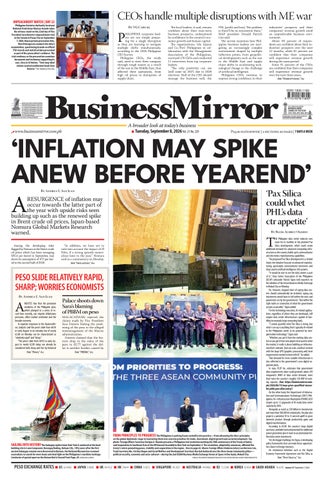
CEOs handle multiple disruptions with ME war
IMPEACHMENT WATCH | DAY 22
Philippine Statistics Authority Assistant National Statistician Marizza Grande takes the witness stand on the 22nd day of Vice President Sara Duterte’s impeachment trial at the Senate in Pasay City on September 7, 2026. House private prosecutor Atty. Mae Divinagracia conducts the direct examination, questioning Grande on official PSA records and statistical data presented as part of the prosecution’s evidence. The trial continues as the prosecution examines documents and testimony supporting its case. Story in A3 Nation, “‘Even long-dead infants received confidential funds from Duterte.’” ROY DOMINGO/SPPA POOL
ROTARY CLUB OF MANILA JOURNALISM AWARDS
2006 National Newspaper of the Year 2011 National Newspaper of the Year 2013 Business Newspaper of the Year 2017 Business Newspaper of the Year 2019 Business Newspaper of the Year 2021 Pro Patria Award PHILIPPINE STATISTICS AUTHORITY 2018 Data Champion
P
By VG Cabuag
HILIPPINE corporate leaders are not simply preparing for a single disruption as they are learning to navigate multiple shifts simultaneously, according to the 2026 Philippine CEO Survey. Philippine CEOs, the study said, need to steer their company through rough waters as a result of the war in the Middle East, that affected their operations, from high oil prices to disruption of supply chain.
The local leaders, it said, remain confident about their near-term business prospects, underpinned by confidence in the country’s economic growth and human capital. The organizations, Isla Lipana and Co./PwC Philippines in collaboration with the Management Association of the Philippines, surveyed 176 CEOs and conducted 11 interviews from top corporate leaders. “The only positivity can see [will come in] 2027, due to 2028 elections. Half of the CEO should manage the business well, the
PNL [profit and loss]. The problem is there’ll be no innovation there,” MAP president Donald Patrick Lim said. The survey examines how Philippine business leaders are navigating an increasingly complex environment shaped by multiple inflection points, from geopolitical developments such as the war in the Middle East and supply chain shifts to accelerating technological change or the challenge of artificial intelligence. Philippine CEOs continue to express strong confidence in their
industries’ prospects and their companies’ revenue growth amid an unpredictable business environment. About 83 percent of respondents are confident about their industries’ prospects over the next 12 months, while 81 percent are confident that their companies will experience revenue growth during the same period. Some 91 percent of the CEOs are confident that their companies will experience revenue growth over the next three years. See “Disruptions,” A2
BusinessMirror A broader look at today’s business
EJAP JOURNALISM AWARDS
BUSINESS NEWS SOURCE OF THE YEAR
(2017, 2018, 2019, 2020, 2021) DEPARTMENT OF SCIENCE AND TECHNOLOGY
2018 BANTOG MEDIA AWARDS
‘INFLATION MAY SPIKE ANEW BEFORE YEAREND’ www.businessmirror.com.ph
A
n
Tuesday, September 8, 2026 Vol. 21 No. 329
P25.00 nationwide | 2 sections 20 pages | 7 DAYS A WEEK
‘Pax Silica could whet PHL’s data ctr appetite’
By Andrea E. San Juan
RESURGENCE of inflation may occur towards the latter part of the year with upside risks seen building up such as the renewed spike in Brent crude oil prices, Japan-based Nomura Global Markets Research warned. Among the developing risks flagged by Nomura is the Brent crude oil prices which has been averaging $95.4 per barrel in September, way above its assumption of $72 per barrel in the second half of 2026.
By Bless Aubrey Ogerio
T
“In addition, we have yet to take into account the impact of El Niño, if a strong episode materializes later in the year,” Nomura said in a commentary on Monday. See “Inflation,” A2
PESO SLIDE RELATIVELY RAPID, SHARP; WORRIES ECONOMISTS By Andrea E. San Juan
A
Palace shoots down Sara’s blaming of PBBM on peso
NALYSTS fear that the persistent weakness of the Philippine peso, which plunged to a series of record lows recently, can reignite inflationary pressures, affect market sentiment and the broader economy. In separate responses to the BusinessMirror, analysts said the peso’s slide from 60.93 in early August to an intraday low of nearly 62.80 on Monday can be characterized as “relatively rapid” and “sharp.” “The peso’s slide from 60.93 in early August to nearly 62.80 today can already be considered both sharp and fast by historical
MALACAÑANG rejected the claims made by Vice President Sara Duterte linking the weakening of the peso to the alleged mismanagement of the Marcos administration. Duterte claimed that the historic drop in the value of the peso to 62.77 against the dollar is another burden caused by
See “Peso,” A2
See “PBBM,” A2
SAILING INTO HISTORY The balangay replica Sama Tawi-Tawi is anchored at the boatbuilding site in Luna Compound, Barangay Bading, Butuan City. Fifty years after the first ancient balangay remains were discovered in Butuan, the National Museum has resumed excavations to search for more boats and shed light on the Philippines’s maritime heritage. Conclusion of special report on the Butuan find in Second Front Page, A9. ERWIN MASCARIÑAS
FROM PRINCIPLES TO PROGRESS The Philippines is putting Asean centrality into practice—from advancing the bloc’s principles on the global diplomatic stage to translating them into concrete priorities for trade, investment, digital growth and social development. Top photo: Foreign Affairs Secretary Enrique A. Manalo presents a Philippines-led resolution marking the 50th anniversary of the Treaty of Amity and Cooperation in Southeast Asia at the UN General Assembly in New York on September 4. The resolution, adopted by consensus, affirmed the treaty’s role in promoting peace, stability and cooperation in the region. Story in page A2. Above: Foreign Affairs Undersecretary Leo Herrera-Lim, Trade Secretary Ma. Cristina Roque and Social Welfare and Development Secretary Rex Gatchalian discuss the three Asean Community pillars— political-security, economic and socio-cultural—during the 2nd ASEAN Business Media Exchange forum at Space in One Ayala, Makati City. PHOTOS: PHILIPPINE PERMANENT MISSION TO THE UNITED NATIONS IN NEW YORK/NONIE REYES
HE Philippine data center industry sees room for its facilities in the planned Pax Silica development, which could create additional demand for advanced computing infrastructure as the country builds up its semiconductor and electronics manufacturing capabilities. The proposed Pax Silica development is a United States-led initiative focused on advanced manufacturing, particularly semiconductor electronics and chips used in artificial intelligence (AI) systems. “It would be nice to see the data centers a part of it,” Data Center Association of the Philippines (DCAP) cofounder Patrick Signo told reporters on the sidelines of the Asean Business Media Exchange in Makati City on Monday. He, however, stopped short of saying data centers should automatically be included, saying any investment would have to fall within the rules and parameters set by the government. “But within the right realm or constraints of what the government accepts as possible,” Signo added. For the technology executive, AI-related applications, regardless of where they are developed, will require data center infrastructure capable of handling increasingly large computing loads. “I cannot quantify what Pax Silica is doing. But what I can say is anything that’s typically AI-related in the Philippines needs to be powered by nextgeneration technology,” Signo said. “Whether you get it from the existing data centers or you get it from new players that want to enter the market, it really is about building an infrastructure that’s relevant, that can scale, and that can deal with the large GPU [graphics processing unit]-level requirements needed to deal with AI,” he added. That demand for more scalable infrastructure is also reflected in the government’s own digital expansion plans. In June, PLDT Inc. estimates that government data requirements alone could generate about 270 megawatts (MW) of data center demand, more than twice the country’s roughly 120 MW of existing capacity. (See: https://businessmirror.com. ph/2026/06/15/mvp-gives-qualified-stancefor-pldts-pax-silica-entry/) On the other hand, the Department of Information and Communications Technology’s (DICT) Philippines AI+ Infrastructure Masterplan (PAIIM) 2033 targets up to 1.5 gigawatts of AI-ready data center capacity by 2033. Alongside as much as $30 billion in investments and more than 500,000 AI-related jobs, the plan also projects a potential 10 to 12 percent uplift in gross domestic product through productivity gains and digital transformation. According to DCAP, the country’s large digital user base, available land and potential for additional power generation give it room to accommodate further data center investment. Yet, the bigger challenge, for Signo, is developing policy frameworks that can make those opportunities clearer to foreign investors. He mentioned initiatives such as the Digital Economy Framework Agreement and Pax Silica as See “Pax Silica,” A2
PESO EXCHANGE RATES n US 62.4460 n JAPAN 0.4000 n UK 84.4332 n HK 7.9644 n CHINA 9.3053 n SINGAPORE 49.3021 n AUSTRALIA 44.9486 n EU 72.5248 n KOREA 0.0464 n SAUDI ARABIA 16.6310 Source: BSP (September 7, 2026)
News
BusinessMirror
A2 Tuesday, September 8, 2026
CEOs handle multiple disruptions… Continued from A1
This confidence also reflected in respondents’ expectations for the Philippine economy. At least 67 percent expect the country’s economic growth, as measured by the gross domestic product, to reach 3- to 4.5 percent this year, while 9 percent of them project 4.6-6 percent growth. These expectations are consistent with the government’s target of 3.5to 4.5 percent for 2026. In the interviews, business leaders consistently cited Filipino workers’ resilience, work ethic, and skills as key strengths that enable organizations to withstand challenges and compete on the global stage. “Despite persistent headwinds and various inflection points, it’s encouraging to see the resilience and confidence of Philippine CEOs. The survey findings and our conversations with business leaders reveal a shared confidence in the country’s long-term potential, even as they navigate challenges within their industries, the broader landscape, and the public sector,” Roderick Danao, chairman and senior partner of Isla Lipana, said. “The opportunity now is to convert this confidence into action through innovation, collaboration, and initiatives that promote sustainable growth and national progress,” Danao said.
www.businessmirror.com.ph
UN adopts PHL-led Asean Reso on treaty anniversary By Malou Talosig-Bartolome
T
HE United Nations General Assembly has adopted by consensus a Philippines-led resolution marking the 50th anniversary of the Treaty of Amity and Cooperation in Southeast Asia (TAC), Asean’s foundational peace pact. Philippine Permanent Representative to the UN Enrique A. Manalo introduced the resolution on behalf of Asean during the Philippines’s 2026 chairmanship of the regional bloc. The measure was adopted during the General Assembly’s 80th session on September 4. A total of 102 UN member states co-sponsored the resolution, including the five permanent members of the UN Security Council, signaling broad support for ASEAN and the treaty’s principles. Signed in Bali on February 24, 1976, the TAC lays
Peso…
Continued from A1
standards,” Jonathan L. Ravelas, senior adviser at Reyes Tacandong & Co. told the BusinessMirror in a Viber message on Monday. From August 3 to September 7, Ruben Carlo O. Asuncion, chief economist at Union Bank of the Philippines (UBP) told the BusinessMirror via e-mail that the peso already weakened by about 3 percent, which he said is a “relatively large move over a short period.” Both Asuncion and Ravelas pointed out that the
down the rules for relations among states, including respect for sovereignty, non-interference, peaceful dispute settlement and cooperation. Presenting the resolution before the 193-member assembly, Manalo said the treaty has served for five decades as “an important foundation for peaceful relations and cooperation in Southeast Asia.” He said the TAC remains relevant as the international community faces growing security challenges. “The experience of the TAC demonstrates that differences among states did not hinder cooperation and that sustained dialogue, mutual respect, and resorting to peaceful means in the settlement of disputes can help build and strengthen trust and stability,” Manalo told the assembly. The UN resolution reaffirmed the treaty’s role as “the key instrument in governing inter-State relations in the region and as a foundation for maintaining re-
gional peace and stability.” It also cited the TAC’s core principles, including “mutual respect for the independence, sovereignty, equality, territorial integrity and national identity of all nations,” “non-interference in the internal affairs of one another,” and the “settlement of differences or disputes by peaceful means.” Manalo noted that the treaty has expanded far beyond Southeast Asia. “Today, the Treaty has 62 high-contracting parties, including states from different regions and regional organizations whose members are sovereign states,” he said, describing the growing membership as evidence of the value of “dialogue, mutual respect, peaceful coexistence, and cooperation in relations among all states.” The treaty’s 62 High Contracting Parties
include the United States, China, Russia, India, Japan and the European Union, reflecting what the UN resolution describes as its “growing significance as a framework for peaceful relations, mutual respect and cooperation.” The UN resolution encourages countries to promote a better understanding of the treaty, use it as a platform for dialogue and cooperation, and support the accession of additional states. Ahead of the vote, Manalo said Asean hoped the resolution would raffirm “our shared commitment to the principles that have sustained peace, stability, and cooperation in Southeast Asia and which remain relevant to all members of the international community.” The General Assembly resolution recognizes the treaty’s “enduring contributions to peace, stability and cooperation in South-East Asia.”
local currency was among the weaker performers compared to its peers in the Southeast Asia region in recent weeks due to the country’s reliance on imports of fuel, food, and capital goods, while maintaining a persistent trade deficit. “It does not necessarily indicate a currency crisis or a deterioration in economic fundamentals. Rather, it suggests that the Philippines may currently be more sensitive than some of its regional peers to prevailing global and domestic headwinds,” Asuncion told this newspaper. The country’s dependence on imported fuel and other goods means periods of broad US dollar strength can exert greater pressure on the peso, he added.
Peso weakness on inflation
tence” of the depreciation. “Temporary currency weakness tends to have a limited effect, while a prolonged period of peso depreciation could generate stronger upward pressure on inflation, especially through higher fuel and transportation costs,” added Asuncion.
EVEN as the impact of the currency weakness on inflation occurs with a lag rather than immediately, Ravelas emphasized that if the weakness of peso persists especially alongside elevated commodity prices, “The inflationary effects could become more pronounced, like what we saw in March.” Citing Bangko Sentral ng Pilipinas’ (BSP) estimates, Ravelas said a one-peso depreciation in the USD/PHP exchange rate translates to roughly a 0.043 percentage point increase in inflation over time. However, he said the actual impact will depend on global oil prices, food costs, and domestic demand conditions. “The inflation impact is not immediate, but it is real. Exchange rate movements typically filter through to consumer prices with a lag of several months,” said Ravelas.
‘Bigger issue’
AT this point, Ravelas said the “bigger issue” is not the level of the peso but the speed of the depreciation. “Markets can live with a weaker currency if the adjustment is orderly. What they do not like is excessive volatility,” added the foreign exchange analyst. Asuncion pointed out that the “more noteworthy development” is the speed of the adjustment and the succession of record lows, which he said can have a greater influence on market sentiment and inflation expectations than a gradual weakening of the currency. Going forward, Ravelas said investors will be watching whether the peso stabilizes, whether inflation expectations remain anchored, and whether the country’s external accounts improve. “That’s ultimately what will determine if this is simply a currency adjustment or the start of a broader economic challenge,” Ravelas warned. Asuncion explained that while a weaker peso increases the domestic cost of imported goods, particularly fuel, food inputs, industrial raw materials, and other dollar-denominated products, he said overall inflation impact depends on both the “magnitude and persis-
PBBM…
Continued from A1
President Ferdinand Marcos, who has control over “senators, prosecutors, judges, and the police.” Castro denied the claim. She earlier said that the decline in the value of peso was caused by the strengthening value of the dollar and rising oil prices. “The movement [in the value] of the peso is not unique to the Philippines; we are also observing this in other countries due to developments in the global market,” Castro said in Filipino in a statement on Monday. “We are confident that the Bang-
Pax Silica… Continued from A1
frameworks that could eventually help attract investment. “The question is what frameworks can come into the Philippines to help accelerate that,” he said. He added that interest from foreign investors is already evident, although he declined to identify prospective entrants.
Weak peso: A symptom and signal
RAVELAS emphasized that a weak peso is “both a symptom and a signal.” “It reflects strong demand for dollars and investor caution over external vulnerabilities, but it also raises the cost of imports,” he explained further to this newspaper. Those who usually benefit from a weak peso are exporters, BPOs, and families receiving remittances. But, he pointed out: “The broader economy faces the risk of higher fuel [geopolitical risks,] transport, food and production costs.”
Latest data on peso
ON Monday, the Philippine peso opened at P62.62 against the dollar, hit an intraday low of 62.775, but strengthened later in the trading session as it closed at 62.586 against the greenback. The local currency strengthened by .4 centavos on Monday, compared to its previous finish of 62.59 against the dollar last Friday—the lowest on record. For his part, John Paolo Rivera, Senior Research Fellow at Philippine Institute for Development Studies (PIDS) said he expects the peso to “remain volatile and potentially test further lows in the near term” if pressures from external factors persist. “Peso remains under pressure still mainly from external factors, particularly higher oil prices amid renewed Middle East tensions, elevated global yields, and expectations of tighter US monetary policy. For an oil importing economy like the Philippines, higher crude prices also increase demand for dollars and add to inflation concerns,” he told this newspaper in a Viber message. Last week, the Philippine peso plunged to four fresh record lows against the greenback. ko Sentral is closely monitoring the situation and continues to take the necessary measures to maintain the stability of our prices and financial system,” she added. Castro noted that the government is open to such criticisms when it comes to its economic management. “Let's look at the data and the results.” Duterte has launched new tirades against the government after the Department of Justice filed grave threat charges against her in a Quezon City court over her livestreamed remarks in 2024 that she has talked to an assassin to takedown the President and his family in case an alleged plot against her succeeds.
Inflation… Continued from A1
While the moderation in headline inflation since May supports its view that inflation has already peaked, Nomura pointed out: “Newly emerging upside risks suggest a potential resurgence in coming months.” Nomura noted it is also penciling in a slight upward trajectory in core inflation through the fourth quarter, due to pass-through effects from “elevated” energy prices. While core inflation eased slightly to 4.1 percent in August from 4.2 percent in July, Nomura pointed out that the sources of downside surprise were “confined to recreational services and education.” However, it noted that other items that are “more sensitive” to high energy costs are still edging up, including personal care and other services. “This is consistent with our expectations and supports our view of still-significant passthrough effects,” Nomura emphasized. Outside of the core basket, Nomura said the combination of higher energy and rice prices suggests headline inflation will likely remain “sticky.” “Food inflation eased to 4.6 percent from 5.2 percent, led by surprisingly lower vegetable price inflation. However, rice price inflation picked up again to 19.4 percent from 17.1 percent, which is worrisome for policymakers, given recent weather-related disruptions that could worsen rice inflation ahead,” said Nomura. At the same time, transport inflation climbed to 13.5 percent from 11.9 percent, reflecting the “resurgence” in crude oil prices amid a re-escalation of the Middle East conflict. Meanwhile, Miguel Chanco, Chief Emerging Asia Economist at United Kingdom-based Pantheon Macroeconomics said in a commentary on Monday that the research institution has raised its 2026 and 2027 average inflation forecasts for the Philippines to 5.5 percent and 3.2 percent, respectively, from 5.3 percent and 2.7 percent. “This is to take into account the likely stickiness in global oil prices until the end of this year, owing to the low-level, but recurring, skirmishes between the US and Iran affecting flows from the Middle East,” Chanco said.
Mixed views on monetary policy path
PANTHEON, however, continues to believe that the Monetary Board’s tightening cycle is over even if a delay to oil-related disinflation will probably keep the headline rate sticky above the 6-percent mark at least until November. Meanwhile, Nomura expects the Bangko Sentral ng Pilipinas (BSP) to deliver another 25-basis-point hike to 5.25 percent at its October monetary policy meeting. Nomura said the 6.1-percent headline inflation in August “justifies BSP keeping a measured pace in its hiking cycle.” “BSP remains vigilant on inflation risks and its main goal is still to return inflation to target within the policy horizon,” added Nomura. In its latest statement following the August inflation outturn, the central bank said it will continue to closely monitor the impact of recent developments in the Middle East and weather-related disturbances. “Going forward, the BSP will remain guided by incoming data and its assessment of risks to the inflation outlook,” BSP also noted. Average headline inflation for the first eight months of 2026 settled at 5.2 percent. This is still above the BSP’s full-year target of 3-percent and the tolerance range of plus or minus 1 percentage point. Inflation has eased for the fourth straight month in August at 6.1 percent. The downtrend started after it eased from the 7.2 percent peak in April to 6.8 percent in May, slowing further to 6.4 percent in June and 6.2 percent in July.
Plan…
Continued from A9
facilities, according to Roque. The regional stockpiling initiative is being developed alongside existing Asean energy-security mechanisms, particularly the Asean Petroleum Security Agreement (APSA). Further, Eria’s August workshop also highlighted the need to work out governance, financing, stock-release mechanisms, allocation rules and infrastructure requirements before any regional arrangement can be implemented.
Samuel P. Medenilla
Catching up with the SEAblings
Boat…
THE Philippines has an opportunity to compete with established data center markets such as Malaysia and Singapore, particularly because of its greater availability of land and power for expansion, according to DCAP. Still, the organization’s cofounder said that the country needs to continue addressing the cost of power and other requirements involved in developing data center facilities. For now, Signo said the industry is focused on supporting existing operators while continuing to engage with government as sector policies evolve.
have a shared responsibility to protect them-not just as artifacts, but as an irreplaceable part of the story and identity of Filipinos. The Butuan boats sailed us in the past, continue to guide us in the present, and will carry our heritage into the future,” said Plaza. Plaza concluded that there is still so much we do not know about our ancient past, and every carefully documented finding brings us closer to understanding the remarkable maritime civilization of our ancestors and its place in the broader history of the Filipino people.
Continued from A9
The Nation BusinessMirror
www.businessmirror.com.ph
Tuesday, September 8, 2026
Sandiganbayan orders arrest of Romualdez, co-accused By Joel R. San Juan @jrsanjuan1573
T
HE Sandiganbayan Third Division issued yesterday an arrest warrant against former Speaker and incumbent Leyte Rep. Martin Romualdez, former Partylist Rep. Elizaldy Co of Ako Bicol and two others for allegedly pocketing and receiving kickbacks amounting to P7.4 billion from infrastructure and flood control projects of the government.
A lso covered by the a r rest wa r ra nt a re t heir co respondents—Josely n Tragua Serenio, Romualdez’s personal a ide, a nd Fel ic ito Gueva r ra, president of Samchan Foreign Exchange Corporation. In addition, the anti-graft court issued a hold departure order (HDO) against all the respondents. The crime of plunder is a nonbailable offense. “The issuance of a warrant of arrest signifies only that, after
personally evaluating the records, the Court found probable cause to believe that the accused committed the offense charged,” the Third Division said. “Probable cause for the issuance of a warrant of arrest exists when the facts and circumstances alleged by the prosecution would lead a reasonably discreet and prudent person to believe that an offense has been committed by the person sought to be arrested,” it added. The Sandiganbayan stressed that
the arrest order “does not constitute a determination of guilt.” The arrest warrant was issued several hours after the Ombudsman filed the plunder case. Ombudsman Jesus Crispin Remulla said more plunder and money laundering charges are still being prepared by the agency against Romualdez, whom he considered as the “biggest fish” that have been charged so far in connection with the flood control mess. The Ombudsman had previously charged former senator Ramon Revilla Jr. and Sen. Jose Pimentel Ejercito alias Jinggoy Estrada, several other lawmakers, present and former Public Works officials and contractors for their alleged involvement in the flood control scandal. Revilla, however, was allowed to postbailbytheSandiganbayanowing to the failure of the Ombudsman to present strong evidence of guilt during the bail hearings. Romualdez is being accused of manipulating and pocketing funds intended for f lood control projects of the government from 2022 to 2025 amounting to at least P56 billion. The plunder charge has been raffled off to the Sandiganbayan Third Division which is expected to
determine the existence of probable cause for the issuance of arrest warrant against the respondents.
Institutional influence
IN its resolution, the Ombudsman gave weight to Romu a ldez’s “institutional influence” in the House as Speaker which enabled him to commit plunder. “He held the highest level of power in the House—such as his roles in committees, the selection of Zaldy Co as Chairman of the Appropriations committee and his role and inf luences in the legislative and budget process,” the Ombudsman said. The Ombudsman also noted that Romualdez had “uninterrupted control and meaning f u l participation over the national budget” owing to his position and friendship with Co. On the other hand, Co then had control over the selection, prioritization and funding of projects. The Ombudsman said its investigation showed that Romualdez directly or indirectly received money from Co’s security escorts on at least 15 occasions as commissions, shares, percentages, kickbacks, commitments or other pecuniary benefits” amounting to P7.44 billion.
The amount includes monies derived from contractors, persons and entities involved in f lood control, infrastructure and other government projects under the General Appropriations Act for the period 2022 to 2025. The money were allegedly delivered to properties owned or associated with Romualdez and received by Serenio and other persons acting on his behalf. These deliveries, according to the Ombudsman, were part of the P2 billion monthly quota or collection that Romualdez imposed on Co. Out of the P7.4 billion illegally a m a ssed by R omu a ldez, t he Ombudsman said P5 billion was used to form shell or dummy companies such as Golden Pheasant Holdings Corporation, Braavos Holdings OPC of Valiant Consolidated Resources Inc. To conceal the trail, the money was exchanged into foreign currencies allegedly with the help of Guevarra’s foreign exchange company. “These shell companies were used to transfer funds and purchase properties and assets such as the P1.5 billion property on Tamarind Road in Forbes Park, Makati,” the Ombudsman said. See “Romualdez,” A6
‘Even long-dead infants received confidential funds from Duterte’ By Jovee Marie N. Dela Cruz @joveemarie
T
HE Phi l ippine Stat ist ics Authority (PSA) found that 1,685 out of 2,669 names listed as alleged recipients of confidential funds from the Office of the Vice President (OVP) and the Department of Education (DepEd) had no matching birth, marriage, or death records, while other names matched individuals who were already dead, including a recipient record linked to a person who died at only two months old in 1965. The findings were presented before the Senate Impeachment Court as part of the House of Representatives prosecution team’s effort to challenge the validity of confidential fund liquidation documents submitted under Vice President Sara Duterte. PSA Assistant National Statistician Marizza B. Grande testified that the agency verified 2,669 alleged payee
names, consisting of 1,992 names from the OVP and 677 names from DepEd. The verification involved searching the Civil Registry System (CRS) for birth, marriage, and death records associated with each name. Pr ivate prosecutor Mae Divinagracia said the largest group identified during the verification consisted of names with no available civil registry records. She stated that 1,287 names from the OVP list and 398 names from the DepEd list had no recorded birth, marriage, or death entries in the PSA database. The prosecution also presented at least 37 names that matched death records, including 32 from the OVP list and five from the DepEd list. Among these was the name Marlin Sunga, which matched a PSA death certificate showing that the individual died on November 2, 1965, at only two months old. Grande explained that the PSA
Sara has nothing to worry about the PNP
T
BY REX ANTHONY NAVAL
HE National Police (PNP) on Monday stressed its commitment to lawful and impartial operations following Vice President Sara Duterte’s claims that the service’s knowledge of her location supported her allegations of harassment and surveillance. In a statement, the PNP Chief, Gen. Jose Melencio Nartatez Jr. said they respect the Vice President’s sentiments and assured her that there was neither an order, nor an effort to harass and conduct surveillance on her. “We understand the Vice President’s concerns but I assure her that the PNP remains committed to lawful, professional, and impartial police operations. Our focus is always in maintaining peace and order and police actions are always guided by our duty to protect,” he said. The Vice President made the remark that she does not trust the courts or the police and does not feel safe as she posted bail for a case she is facing before the Regional Trial Court in Quezon City. Nartatez said she made the statement “under a situation that needs patience and understanding.” But he stressed that there were numerous stories of hard work and dedication, including some policemen making an ultimate sacrifice in the line of duty, that could speak for the dedication and professionalism of the police. Nartatez also directed all units to continue monitoring potential threats against the Vice President and her family, while reminding personnel that any security or threat-monitoring activity must be lawful, properly authorized, and professionally conducted. He also ordered that reported threats be assessed separately from lawenforcement actions related to the Vice President’s criminal case.
record showed Marlin Sunga as the youngest person identified during the verification process. “According to the death certificate, he or she died when he or she was only two months old,” Grande testified when asked about the youngest person found in the records. The prosecution said the Sunga record was significant because it appeared among names used in confidential fund documentation covering transactions decades after the recorded death. However, the PSA testimony focused only on the existence of the civil registry record and did not independently establish who used the name in the acknowledgement documents.
25 children
DIVINAGRACIA also cited 25 names matching children’s records, including several individuals whose ages raised questions regarding their inclusion on the confidential
fund recipient lists. The prosecution argued that these findings supported its challenge to the authenticity of some names appearing in liquidation reports. T he PSA ex plained that its verification process categorized names into three possible results: no matching record, multiple possible matches, or a single matching entry. Grande said that among the submitted names, 152 produced single-match entries that allowed the PSA to issue certified copies of corresponding civil registry documents. The defense questioned parts of the prosecution’s interpretation of the PSA findings, arguing that the witness could not provide conclusions beyond the official records. Defense counsel Justin Nicol Gular maintained that certain issues, particularly those involving signatures and document comparisons, required further examination. The prosecution responded that
Grande’s testimony was only one part of a larger body of evidence. Divinagracia saidthePSArecordsshouldbeconsidered together with other documents and testimonies already presented before the Impeachment Court. Grande further explained that PSA verification follows four procedures, beginning with receiving requests from agencies and processing the names through official databases. She sa id t he agenc y searched birth, marriage, and death records individually based on the information provided by government offices. The PSA emphasized that a missing record does not automatically prove that a person does not exist, just as a matching record does not alone identify the actual person who signed a receipt. The agency’s role was limited to verifying whether corresponding civil registry records existed. See “Infants,” A6
Floods persist in 385 Luzon areas By Butch Fernandez | @butchfBM & By Jonathan L. Mayuga | @jonlmayuga
A
TOTAL of 385 areas in Luzon that received aboveaverage rainfall induced by four tropical cyclones and the prevailing southwest monsoon remain flooded, the National Disaster Risk Reduction and Management Council (NDRRMC) said. In contrast, however, the number of localities under a state of calamity has increased to 188. As flooding subsides in some areas, affected families have also started to return to their homes, reducing the number of affected families being assisted in different evacuation centers across Luzon. Latest data on the combined effects of the enhanced southwest monsoon or habagat and tropical cyclones Luis, Maymay, Neneng and Pilandok as of 6:00 a.m. on September 7 showed that 16,900 families or 58,400 persons are still being assisted in 753 evacuation centers. Since August 1, upon entering Philippine Area of Responsibility (PAR), Tropical Cyclone Luis induced heavy rainfall that triggered floods in several areas. Three other severe weather disturbances—Maymay, Neneng and Pilandok—later entered PAR, worsening floods in the areas already submerged by Luis and inundating more areas in Luzon, including the National Capital Region (NCR), as well as triggering flashfloods and landslides that resulted in the death of 43 people. Search and retrieval operations continue for 5 other persons who were reported missing. Of the total number of fatalities, 15 are from Benguet, mostly due to landslides, followed by Rizal, again, mostly
due to rockslides in the town of Rodriguez. Aside from the number of dead due to landslides or drowning, 20 others—13 from Benguet—were injured. The NDRRMC said that after more than one month of moderate to heavy rain, the inclement weather affected a population of 2.9 million families or 10.2 million persons in 6,900 barangays. The landslide and severe flooding in many areas damaged a total of 4,500 houses. According to the NDRRMC, the damage to public and private infrastructure has already reached P7.95 billion, while damage to crops was placed at P4.11 billion. In addition, the NDRRMC said the cost of assistance provided to the affected families has already reached P2.29 billion. The Philippine Atmospheric, Geophysical and Astronomical Services Administration (Pagasa) said monsoon rains will prevail over Luzon until Wednesday, advising the public in areas susceptible to floods and landslides to remain alert and stay away from disaster-prone areas. Monsoon rains are forecast over Metro Manila, Ilocos Region, Abra, Benguet, the rest of Central Luzon, Calabarzon (Cavite, Laguna, Batangas, Rizal, and Quezon), and Mimaropa (Mindoro, Marinduque, Romblon, and Palawan).
Cayetano sends aid to Pampanga villages
THE emergency response team of Senate Minority Leader Alan Peter Cayetano brought food, water, and grocery packs to flood-hit communities and vulnerable sectors in Pampanga on September 4 and 5, 2026 as some areas remained submerged for nearly a month.
RESIDENTS of Macabebe, Pampanga, wade through thigh-deep water on Monday morning. Although the town experiences floods year-round, the recent heavy downpours have worsened the flooding. Drug stores in the area are making a killing in the same of anti-fungal creams and ointments as many residents are suffering from “alipunga.”
The team brought relief goods to the flood victims in the towns of Candaba and Macabebe on Friday before proceeding to the towns of Apalit, Sasmuan (formerly Sexmoan), Bacolor, and the City of San Fernando on Saturday. See “Floods,” A6
A3
BARMM polls path toward lasting peace, development —Moro scholar
T
HE h i stor ic pa rl i a ment a r y elections in the Bangsamoro Autonomous Region in Muslim Mindanao (BARMM) constitute an important step toward achieving the elusive peace and development in the region and across the Philippines, according to a Muslim scholar and advocate of peace and development. Dr. Acram A. Latiph, executive director of the Institute for Peace and Development in Mindanao at the Mindanao State University (MSU), said the elusive self-governance and autonomy in Muslim Mindanao is finally within reach – 50 years since the historic Tripoli Agreement, the first peace document signed between the government and leaders of the Moro secessionist movement. In an interview over the weekend, Latiph said the 50 years leading to the BARMM elections witnessed many political upheavals, historical milestones, and constitutional challenges, but the end is now in sight. Related story on page B8 The Tripoli Agreement was signed in 1976 under the administration of the late President Ferdinand E. Marcos. “Ang nagtanim ng puno ay iyong yumaong [President] Ferdinand E. Marcos Sr. At ngayon, after 50 years, iyong puno lumalaki na. Sa September 14… nag-bloom na siya for harvesting. Parang destiny. Ang nagsimula ay ang yumaong father ni PBBM, [iyong anak] ang mage-end ngayon. At makakamit na natin ang kapayapaan hindi lang dito sa Mindanao, sa buong Pilipinas na,” said Latiph. The MSU economics professor, who has a doctorate degree, recalled that the path to the monumental BARMM democratic exercise was arduous and difficult. Said Latiph: “It took a long while really kasi ang iniiwasan doon ay paano hindi magkakaroon ng malawakang hidwaan…para ma-preserve iyong society at iyong agreement na nagsimula sa Tripoli Agreement para matugunan iyong mga hinaing at adhikain ng mga Moro for self-autonomy and self-governance, na ngayon ay maisasakatuparan na.” Latiph said the implementation of the original peace accord had been difficult because of differences in its interpretation. “Tapos naging balakid rin iyong [pananaw] na kailangan…ng constitutional amendment para maisakatuparan ang nandoon sa agreement. Naging balakid ang pagkakaiba ng pagkaunawa sa Tripoli agreement,” he added. It took another 20 years for the Final Peace Agreement to be concluded in 1996—within the context of the 1987 Constitution—under the administration of President Fidel V. Ramos. The Muslim peace and development advocate also acknowledged that the sensitive issue between the Moro National Liberation Front and the Moro Islamic Liberation Front was a critical factor which slowed down the peace process. Latiph traced back the foundation for the BARMM elections, emphasizing that then President Marcos Sr. planted the seeds for achieving peace in Muslim Mindanao through the consequential forging of the Tripoli Agreement on December 23, 1976, which was mediated by Libya and the Organization for Islamic Cooperation (OIC), to address the aspirations of the Moro people for self-autonomy and self-governance. Highlighting the administration’s strong commitment to lasting peace, stability in Muslim Mindanao, democracy, and development, President Marcos Jr. recently urged the Bangsamoro people and voters to take control of and full responsibility for their future and political path. In a speech during the opening of the National Peace Consciousness Month, Marcos said, “Let this election show that the future of the Bangsamoro is shaped by the people themselves: through your voices, your choices, and your hopes for your respective communities.” President Marcos said the administration is fully ready for the September 14 BARMM parliamentary elections. “We are prepared for the first Parliamentary elections in the Bangsamoro Autonomous Region in Muslim Mindanao on September 14. Despite several postponements, the government never lost hope and remains fully committed to supporting this democratic exercise,” the President said. PNA
A4 Tuesday, September 8, 2026
Economy BusinessMirror
www.businessmirror.com.ph
DOE launches 4-pronged move to stabilize Visayas power grid D
Startup network to receive award By Manuel T. Cayon
By Lenie Lectura
T
@llectura
HE Department of Energy (DOE) is prioritizing the stabilization of the Visayas power grid to resolve ongoing rotational power outages.
To achieve this, the agency said on Monday that power generating units a re being brought bac k online, additional battery storage is being readied, and transmission constraints are being addressed, w h i l e t he p o w e r g e ne r at io n companies are being held accountable for recurring reliability issues. T his, as the Visayas power grid has been placed Monday on red alert for the 33th time and on yellow alert for the 96th time since the start of the year. The red alert takes effect from 1:00 p.m. to 8:00 p.m. while the yellow alert is effective from 12 noon to 1:00 p.m. and from 8:00 p.m. to 9:00 p.m. A red alert status is issued when power supply is insufficient to meet consumer demand and
the transmission grid’s regulating requirement. The yellow alert is issued when the operating margin is insufficient to meet the transmission grid’s contingency requirement. The grid’s available capacity stood at 2,284 MW while peak demand reached 2,470 MW. Eleven power plants are on forced outage this month, five plants are on forced outage since August 2026, one plant since July, two plants since June, seven plants since May, three plants since 2025, two plants since 2024, two plants since 2023, and one plant since 2021, while 15 plants are running on derated capacities, for a total of 919 MW unavailable to the grid. During a press briefing, Energy Secretary Sharon Garin said Cebu Energy Development Corporation
(CEDC) Unit 1 in Cebu, with 82 megawatts (MW), returned to service last September 5. “Our immediate focus is getting available power back into the system,” she said. “We cannot afford further delay. The Visayas needs stable power now. We need these power plants to come back online as fast as possible.” The Therma Visayas Unit 1, with 169 MW, is scheduled to return by September 15, while Panay Energy Development Corporation (PEDC) Unit 3, with 150 MW, is targeted to return by October 3. T he D OE i s a l s o c l o s e l y coordinating the return of generating u n it s i n Mi nd a n ao t h at c a n support the Visayas through the interconnected grid. Therma South Inc (TSI) Unit 2 in Davao, with 150 MW, is scheduled to return by September 8, followed by TSI Unit 1, also with 150 MW, by September 19, and GN Power Kauswagan (GNPK) Unit 2 in Lanao del Norte, with 103 MW by September 20. “At the same time, for the past months, the DOE has been working with power companies to deploy 253 megawatts of battery storage across Cebu, Panay, Leyte, and Negros—some facilities are already prepared to support the Visayas grid immediately. Based on our simulation, with the 253 megawatts, more than half
of the alerts will be gone. Magiging konti na lang ang red and yellow alerts. In fact, the red might be avoided basta pumasok lagi yung mga batteries natin,” Garin said. To ensure that this backup capacity is available when needed, the DOE has directed the National Grid Corporation of the Philippines (NGCP) to execute the outstanding ancillary services contracts required by the Visayas grid, including battery capacity. DOE Field Offices have been deployed on the ground to inspect and thoroughly investigate affected power plants. Building on the DOE circular on Generation Company Accountability issued in February, the agency is also auditing compliance with maintenance schedules and will require corrective action plans where necessary, issue show cause orders where warranted, and pursue sanctions when violations are established. Also, the DOE is accelerating long-term energy projects to boost dependable and renewable capacity across the Visayas, Mindoro, and Palawan regions. Add itiona l depend able and renewable energy capacity is expected for Cebu-Bohol and Panay-Negros beginning in 2028. See “DOE,” A6
@awimailbox Mindanao Bureau Chief
AVAO CITY—A consortium of ecosystem startups here is set to receive an award from a European awards body for initiating connection and partnership among local startup operations with investors and incubators. The Innovation and Development Accelerators Consortium for Startups (Ideas Davao) is one of the awardees at the 2026 Global Startup Ecosystem Awards in Tashkent, Uzbekistan, following Davao City’s recognition as one of the Top 3 Fastest-Growing Startup Ecosystems in the country, the Department of Science and Technology said. The awarding ceremony will be held during ICT Week Uzbekistan 2026 on September 23, it said. The DOST said that since it was established, Ideas Davao has served as a bridge between startups and mentors, investors, incubators, accelerators, academic institutions, government agencies, and industry partners. The consortium was being supported by the DOST’s Philippine Council for Industry, Energy and Emerging Technology Research and Development through the program called Regional Star t up Enabler for Ecosystem Development (Reseed).
Davao minimum-wage workers get second tranche of wage hike By Mary Jade Jadormio
Development of remaining geothermal reserves hangs M
T
HE National Geothermal Association of the Philippines ( N g a p) i s r e q u e s t i n g gover nment suppor t for the remaining geothermal reserves, which consist largely of mid-to-low potential resources. While Ngap has provided the Department of Energ y (DOE) with a list of support requirements to develop the remaining 2,000 megawatts (MW) of geothermal capacity, the remaining capacity consists of a mi x of high and mid-potentia l areas that require specialized, higher-cost technologies—such as downhole pu mps for lower -temperat u re fluids—which fall outside standard conventiona l development programs. NGAP president Jaime Jemuel Austria Jr. said there is a need to of f set t hese h i g her cost s t h roug h s pec i f ic gover n ment interventions, such as extending
the current seven-year income tax holiday and utilizing the Renewable Energy Trust Fund for technology research and development (R&D). “Right now, our development has been focused on the prime areas. So, what remains is a mixed reser ve a lready. T here’s highand-mid potential areas, and the mid-potential ones, for example, w i l l requ ire spec if ic t y pes of technology to be able to produce the resources,” he said. To incentivize that we need these targeted components. We informed the government that we need this to be able to develop the remaining untapped potential,” said Austria. Also, Austria said the industry is actively col laborating w ith the DOE and the Department of Science and Technology (DOST) to define which non-conventional geothermal projects will be eligible to tap into these research funds. In the previous third round of
the Green Energy Auction (GEA-3) for geothermal, only 30 MW out of the offered 100MW capacity was taken by the industry. Austria said a technical working group (TWG) under the NGAP has been reconvened to improve industry uptake ahead of GEA 9. He said the TWG is conducting a line-by-line review of the price determination mechanism—the framework used to calculate the cost per MW for geothermal energy. “So, we look at each item line by line and ask the companies, “are you okay with this,” and if they’re not okay with it, and that was the reason why they were not able to participate in the previous round, then we address it. We already have our comments on the previous GEA or the price determination mechanism, and we are going to give that to the DOE,” he said. A u s t r i a s a i d t h e c u r r e nt standard costing fails to account
for the unique, complex terrains of geothermal project sites. The TWG is adjusting the mechanism to include realistic costs for specialized infrastructure, such as uphill roads and rig pads, before submitting their recommendations to the DOE. “For example, the terrain, road. Let’s talk about something simple like road. If you use the standard costing for road, that’s a flat road. DPWH’s data, that’s for a flat road. But if you go to our project sites, the nearest one here is Tiwi, for example, it’s uphill terrain. So the cost of construction of an uphill road is very different from a flat road. And not only that, when you are going to develop a geothermal resource, going to that area needs a road, and you also need to develop a pad where you can put the rig. And that also costs money, he said. By Lenie Lectura
See “Development,” A6
With that support, the DOST said the consortium “continuously advanced its initiatives to cultivate an innovationdriven environment in the region.” “Thiscollectiveefforthascontributed significantly to Davao City’s rise as one of the country’s fastest-growing startup ecosystems,” it added. The DOST said that because of the collaborative startup activities of IDEAS Davao, Davao City experienced massive global leaps in 2024 (jumping 208 spots) and 2025 (jumping 163 spots). In 2025, it posted a 97.7 percent ecosystem growth rate, making it the fastestgrowing startup hub in the Philippines that year. Over the last five years, the city steadily climbed from being the 5th strongest startup ecosystem in the country to the third, overtaking cities like Cagayan de Oro. It has maintained its top 3 national position through 2026. The RESEED Program is one of DOST-PCIEERD’s flagship initiatives, alongside the Technology Business Incubation (TBI) Program and the Startup Grant Fund (SGF), designed to strengthen the country’s startup ecosystem. Through these programs, startups are provided with access to mentorship, research and development support, market validation, intellectual p ro p e r t y p rot e c t ion , i nv e s t or networks, and business development opportunities to help them grow and scale their ventures, it said.
INIMUM wage workers in the Davao Region began receiv ing higher pay on September 1, with the second tranche of the latest wage adjustment raising daily rates by P10 to P15. Agriculture workers now get P525 per day from P515, while those in non-agriculture industries receive P540 from P525. Wage Order RB XI-24 authorized the adjustment following consultations by the Regional Tripartite Wages and Productivity Board XI, including a public hearing held in February. The Department of Labor and Employment said labor inspectors will check establishments’ compliance with the new rates during routine inspections. Labor Secretary Francis N. Tolentino has also reminded employers to comply with prevailing wage and labor standards. Davao’s latest increase comes as wage adjustments continue to roll out across regions under the country’s decentralized wage-setting system. Meanwhile, Metro Manila workers are still waiting for the first tranche of the P85 daily wage increase approved under Wage Order NCR-27. The NCR order will raise minimum pay by P60 pesos, which should have
been rolled out by July 25, while the final tranche is set on January 20, 2027. However, t he Reg iona l Tr i a l Court in Pasig City issued a preliminar y injunction against the implementation of the wage order, effectively putting the Metro Manila increase on hold while the legal challenge is being resolved. Full implementation will bring the daily minimum wage in Metro Manila to P780 for non-agriculture workers. Agriculture workers, as well as those employed by small retail and service establishments and small manufacturing firms covered by the order, will eventually receive P743 per day. Labor groups have criticized the staggered implementation, saying workers will have to wait months before receiving the full adjustment. However, Dole has maintained that there is no legal basis to suspend the second tranche after the wage order completed the required process. Davao’s wage order excludes barangay micro business enterprises with valid Certificates of Authority issued by the Department of Trade and Industry under Republic Act 9178. Compliance with the new rates will be monitored through Dole’s regular inspection program, with covered employers required to observe the wage order starting September 1.
What can make or break your company’s reputation? Compliance!
F
By Henry J. Schumacher
OR many executives, compliance is something they know is important but do not deeply understand. Compliance is often viewed as a necessary evil that hinders business, rather than understanding that compliance is essential to your business’s success. Having strong compliance officers on staff to make sure regulations are followed is critical, but that does not mean the C-level executives can totally check out.
There are five essential things that top tech leaders must understand when it comes to compliance. What’s more, tech leaders can play an integral role in helping safeguard against misconduct at the top—often working alongside compliance officers to ensure the business has a strong regulatory structure with executive buy-in.
Five compliance essentials
1. Compliance is much more than just something that facilitates your business
RATHER than being viewed merely as a cost center, the compliance department provides real value by offering the business a more comprehensive cost-benefit analysis that incorporates compliance-related costs.
2. A lack of compliance can cost you millions in fines and brand damage FEES and fines can cost a company a lot of money if it is found to be noncompliant. The Data Privacy Law (DPA) levies criminal penalties and other government agencies hand down civil penalties for bribery, competition, labor, environment and accounting violations. Customers want to believe their information is protected and that they are doing business with companies practicing legally and ethically. Compliance violations can turn customers away. That makes it hard for a company to recover its reputation, as there are few to no new customers to vouch for the trustworthiness of your business. The damage to brand reputation can often cost even more than those fines. 3. Strong compliance can make your business more competitive IN today’s activist, social media-fueled culture, one ethical misstep can lead to ruin for your business. The flip side of that is compliance with regulations and ethics can serve as a differentiator from your competitors. Companies need to ensure that the third parties they work with aren’t going to get
them in trouble. And as a third party, being able to demonstrate compliance can help land that deal. In addition, strong compliance slashes business risk due to unvetted partners and can empower new revenue streams in new markets as that risk is reduced. This is an advantage over competitors who lack the ability to vet third parties well. 4. Not having an organized and systematic approach to compliance will cost you more in the long run THE upfront expenditures for an integrated compliance approach using advanced technology will end up costing less than the fines, fees and damage to brand reputation that can result from violations. Compliance is often very complicated, especially when grappling with regulations set by multiple countries. This is why having an organized and systematic approach is essential. It will ensure that nothing falls through
the cracks and that there is total visibility at all times, freeing compliance professionals to work on high-impact projects that protect the business. This systematic technology approach includes supporting compliance monitoring activity as well as communication and training activities. Compliance professionals can take advantage of the ubiquity of mobile devices to deliver ongoing training, alerts and reminders. In addition, data analytics can be a tremendous boon to the compliance department. This analysis can, among other things, help predict future compliance issues, improve the efficiency of compliance testing and conduct real-time monitoring of high-risk areas. 5. Having Compliance Officers (and a DPO) on staff is essential COMPLIANCE is a highly specialized arena within the organization. It requires time, effort, investment and a thorough programmatic approach. A professional compliance officer understands the various nuances that can ultimately protect your company from the problems described above and save your company’s bottom line and reputation. To take full advantage of this expertise, your head of compliance needs to be involved in strategic business decisions. This individual will need to understand and speak the language of business so that other leaders are willing to hear what needs to be said about the business
value of compliance. Then they will be able to embrace the critical nature of compliance and provide the buy-in that then trickles down through all levels of the business.
Working together
IN the fast-paced age of digital business, compliance is often thought of as a burden and a cost center. Yet with the right approach, it can be revealed for the cost- and reputation-saving function that it is. Compliance can provide the ethical center of gravity that influences the entire organization. Rather than merely enforcing policy, today’s compliance officers can help accelerate business by providing the information that lets business leaders make more informed decisions regarding the risk and expense of working with third parties. In this way, business and compliance need to converge rather than being at odds, and jointly they can create a firm foundation for success. You may have noticed that I kept AI out of this compliance discussion. But allow me to highlight a few AI compliance topics: 1. AI Risk Management – Preparing for the EU AI Act - Compliance while driving innovation. 2. Building the Foundation for an AI Compliant and Scalable Risk Management Program. 3. Scaling Enterprise AI with Enforceable Governance. Comments or assistance to achieve compliance are welcome—contact me at hjschumacher59@gmail.com
Tuesday, September 8, 2026
A5
Existing rail lines cut 74,781 tons of CO₂ annually–DOTr
T
By Lorenz S. Marasigan
@lorenzmarasigan
HE country’s four operational urban and commuter rail lines keep 74,781 tons of carbon dioxide (CO₂) out of the atmosphere each year, the Department of Transportation (DOTr) said. That’s about half the emissions the same passenger volume would have generated if commuters had taken private cars.
The Metro Rail Transit Line 7 (MRT 7), set to open in the second quarter of 2027, is expected to deliver a net reduction of around 58 percent, or more than 60,000 tons, against over 105,000 tons of cargenerated CO₂ per year. The Metro Manila Subway Project (MMSP), for its part, is seen cutting emissions by as much as 63 percent, equivalent to more than 70,000 tons of CO₂ yearly. “Ang bilin ng Pangulo, gawin nating sustainable ang ating transportasyon. Kaya tayo sa DOTr, isinusulong natin ang tinatawag na commuter-centric transport gaya ng mga tren kung saan mas marami ang nakakasakay,” Transportation Secretary Banoy Lopez said. “Kung mas maraming sasakay sa tren kaysa private vehicles, malaki ‘yung mababawas sa carbon emission sa kalsada.” The computations draw on National Rail UK’s Greener Travel data, which pegs car travel at
167 grams of CO₂ per kilometer against 35 grams per passengerkilometer for rail. Even at an average of two passengers per private vehicle, car travel emits roughly 83.5 grams of CO₂ per passenger-k i lometer—more than double that of rail. A case study on Metro Manila by the Association of Southeast Asian Nations (Asean) Climate Change and Energy Project said pr ivate car emissions in the Philippines “significantly worsen urban air quality, accelerate climate change, and pose severe public health risks, particularly in congested metropolitan areas like Metro Manila.” Citing a study by the Japan International Cooperation Agency (Jica), Lopez said the economy loses an estimated P3.5 billion a day to traffic, a figure that could climb to as much as P5.4 billion daily by 2035 absent government intervention.
The agency said the reduction covers the Metro Rail Transit Line 3 (MRT 3), Light Rail Transit Line 1 (LRT 1), Light Rail Transit Line 2 (LRT 2) and the Philippine National Railways (PNR), using private car travel as the baseline. Bigger cuts are expected once
the gover nment’s pipeline of rail projects comes online. The North-South Commuter Railway (NSCR) is projected to trim CO₂ emissions by more than 150,000 tons annually—over twice the combined savings of the four existing lines.
Marcoleta cleared of election offense, but donors still face probe–Comelec
Marcos to LGUs: Follow Marikina’s lead in turning waste into flood defenses
By Mary Jade Jadormio
T
HE Commission on Elections (Comelec) said the dismissal of Senator Rodante Marcoleta’s election case does not clear the three donors linked to the P75-million controversy. The poll body said it has already settled the election-offense issue involving Marcoleta. However, Comelec firmly said proceedings involving the donors remain ongoing. Marcoleta is facing a separate plunder case before the Sandiganbayan over the P75 million he received from former lawmaker Michael Defensor and businessmen Joseph Espiritu and Aristotle Viray. His camp has argued that the controversy falls under Comelec jurisdiction because it involves campaign contributions. Comelec said its mandate covers election offenses, including matters involving the Statement of Contributions and Expenditures (SOCE). The poll body added it already exercised that jurisdiction in determining Marcoleta’s liability. The case was dismissed after Comelec found that Marcoleta’s failure to disclose the contributor information was no longer a criminal offense under the amended election law. Meanwhile, the 1991 amendment removed the criminal penalty for a candidate’s failure to report the names of contributors. Comelec Chairman George Erwin M. Garcia said the violation may still carry administrative liability. “Whether they submit or not, reveal the name of the donor or contributor or not, it remains as a criminal case,” Garcia said. “The amendment changed the law concerning the failure of the politician or candidate to report, but not the failure of the donor or contributor of the candidate to report,” he added. Comelec said it must first complete its proceedings against the donors before determining whether any administrative liability remains. “The administrative liability, if any, will only be determined after we complete the criminal determination or election-offense proceedings involving the donors or contributors,” the poll body chief said. Comelec’s position comes as the Sandiganbayan considers Marcoleta’s argument that the case should instead be handled by the poll body. The poll body said it would still exercise its jurisdiction if the matter is eventually returned to it. “If it is suddenly returned to us, there is no problem,” Garcia said.
By Samuel P. Medenilla @sam_medenilla
P
RESIDENT Ferdinand Marcos Jr. called on local government units (LGU) to emulate the solid waste management initiatives of Marikina, which he said is a good example of a circular economy, to rid trash from their waterways as the government ramps up its anti-flooding campaign. The Chief Executive made the statement after he inspected ongoing construction of the Marikina River Linear Park and the and the Centralized Materials Recovery
Facility (MRF) in Barangay Sto. Niño, Marikina City last Monday. The 11-kilometer park will integrate 428.57 hectares of urban green spaces and will serve as bioshield, localized flood buffer and natural cooler, as well as physical barrier for illegal waste dumping to prevent flooding in Marikina. Marcos lauded the comprehensive flood control measures of Marikina, which includes implementing a no build zone, installation of trash catcher in the Marikina River, as well as composting or recycling waste. “Food waste is turned into compost, while plastics are used
to make bags and bricks,” he said in Filipino. The initiative is backed the Department of Environment and Natural Resources (DENR) in terms of the installation of the floating trash traps and the deployment of “estero” rangers for waterway clean up in 12 barangays in Marikina. Marcos said Marikina’s solid waste management initiatives is a good example of a circular economy, wherein the wastes are segregated and then reused, repaired, refurbished, and recycled. See “Marikina,” A6
DepEd seeks ₧145-B supplemental fund for unbudgeted ‘27 programs
E
DUCATION Secretary Juan Edgardo “Sonny” Angara on Monday appealed for a P145-billion supplemental fund to cover key “unbudgeted” programs, as the Department of Education (DepEd) presented its proposed P975.96billion budget for Fiscal Year (FY) 2027 before the House Committee on Appropriations. “For next year, we aim to build on the progress we have achieved over the past four years,” Angara said. While the budget proposal under the 2027 National Expenditure Program (NEP) safeguards key operations, Angara urged lawmakers to fill funding gaps for learning recovery, personnel hiring, and heightened school safety and security. Our FY 2027 budget proposal builds on the reforms we have already started and focuses on key investments needed to further improve the quality, accessibility, and efficiency of basic education for every Filipino Angara said, thanked President Ferdinand R. Marcos Jr. and Congress for the previous year’s historic P1.015 trillion allocation, which enabled DepEd to pursue critical reforms to improve learning outcomes and strengthen basic education support. Under the proposed NEP allocation, Personnel Services increased by 8.64 percent to P766.74 billion to cover salaries and career progression, while Maintenance and Other Operating Expenses (MOOE) declined by 15.94 percent to P174.32 billion, and Capital Outlay fell by 67.49 to P32.34 billion. The remaining P2.56 billion is divided among six attached agencies, including the National Museum of the Philippines at P1.56 billion; the Teacher Education Council at P360.28 million; National Academy of Sports at P258.48 million; the National Book Development Board
at P169.96 million; the Philippine High School for the Arts at P135.28 million; and the National Council for Children’s Television at P76.01 million. Under the core thrusts of the proposed 2027 budget, P12.09 billion is earmarked to promote over 135,000 teachers and school heads under the Expanded Career Progression (ECP) system; P17.31 billion to construct over 4,900 new classrooms; and P7.33 billion for 11,100 classroom repairs. DepEd has allocated P6.4 billion for textbooks and instructional materials; P10.81 billion for learning recovery under the Project for Learning Upgrade Support and Decentralization (PLUS-D) program; and P2.63 billion for Inclusive Education programs. For learner support and well-being, P11.43 billion is designated for the SchoolBased Feeding Program for 3.69 million learners including all Kindergarten learners and wasted/severely wasted learners from Grade 1 onwards, while P38.12 billion will support 2.32 million private education voucher and subsidy grantees. Meanwhile, P801.5 million will fund the hiring of 1,800 School Counselor Associates and 221 Schools Division Office Counselors. Angara highlighted that several critical programs remain unfunded under the 2027 NEP, prompting an appeal for P145.19 billion in additional funding for DepEd and P1.74 billion for attached agencies. “Ito po ang mga priority interventions na hindi na-accommodate sa FY 2027 NEP level budget ngunit mahalaga upang mas mapabilis ang ating mga reporma at mas mapabuti ang learning outcomes ng ating mga mag-aaral,” Angara explained. Primary among these is the Academic Recovery and Accessible Learning (ARAL) Program, which received no funding in
the 2027 NEP despite its positive results during School Year 2025–2026, which saw the number of struggling readers decrease from 6.7 million to 2.2 million, and the number of learners reaching grade-level reading readiness rise from 3.3 million to 5.8 million. Angara requested P15.98 billion for the ARAL Program to cover honoraria for teaching overload, training for DepEd tutors, external tutors’ compensation, learning resources, the ARAL Summer Program, learning recovery and remediation consultations, and program management, as well as P50 million for the Bayang Bumabasa initiative. In addition to learning recovery, DepEd’s supplemental request seeks P49.16 billion to hire 14,274 new teachers and around 59,000 non-teaching staff while providing teacher benefits, training, laptops, and other support mechanisms that will enable teachers to focus on teaching. DepEd is also requesting P37.75 billion to construct 1,500 new classrooms, repair and rehabilitate school buildings, provide learning materials, and undertake disaster preparedness. This includes P8.68 billion dedicated to school safety and security, which allocates P5.05 billion for school security guards, PH2.31 billion for metal detectors and walkthrough scanners, and P1.5 billion for perimeter fences. DepEd also requested P40.33 billion to expand the School-Based Feeding Program, learner assistance and subsidies, health and mental health services, guidance programs, and sports development. DepEd also requested P983.8 million to expand support for learners with special needs, learners in Madrasah schools, indigenous peoples learners, and those in hard-to-reach communities. Claudeth Mocon-Ciriaco
Prosecution shifts strategy in VP impeachment trial, advances ‘unexplained wealth’ evidence By Jovee Marie Dela Cruz @joveemarie
& Claudeth Mocon-Ciriaco @claudethmc3
T
HE House prosecution panel in the Senate impeachment trial of Vice President Sara Duterte announced on Monday a shift in strategy, deciding to advance its evidence on alleged unexplained wealth before presenting its final case on bribery. Lead prosecutor Rep. Gerville “Jinky Bitrics” Luistro clarified that changing the trial sequence does not mean prosecutors are dropping Article 3, which covers bribery allegations. “We understand that in the order of presentation of Article 2, unexplained wealth, it was placed at the last presentation by the prosecution,” Luistro told the court. “Nevertheless, Your Honor, consistent with the compliance and manifestation filed by the prosecution on June 22, 2026, the prosecution exercises its prerogative to advance the presentation of evidence for unexplained wealth,” she added. The clarification followed questions from Presiding Officer Sen. Francis Escudero regarding recent public statements from prosecutors suggesting the bribery charge might be abandoned to expedite the proceedings. The defense panel raised no objections to the adjustment, noting that the prosecution holds the prerogative to structure the sequence of its case. The trial resumes on Tuesday, with continued witness testimony on confidential fund liquidations. Expected witnesses include Philippine National Police (PNP) Major Magay—who is set to testify on acknowledgement receipts—alongside Atty. Sunshine Fajarda and Commission on Audit (COA) representative Bresildo Sabaldan. In other trial developments, Escudero granted a final extension until Thursday for several financial institutions—including
Manulife, Philippine National Bank (PNB), and UnionBank—to comply with court-issued subpoenas for financial records. To maintain evidentiary integrity, Escudero ordered all subpoenaed banks to submit documents directly to the clerk of court rather than directly to counsel. Court personnel will audit and distribute identical physical and digital record sets to both the prosecution and defense. Defense counsel formally reserved the right to request additional time to review any newly marked documents introduced during upcoming witness testimony.
‘Disbursed’
THE defense of Duterte on Monday insisted on the term “disbursed” after the prosecution maintained it should be “turned over,” to legally describe the transfer of Department of Education’s P112.5 million confidential funds to former security officer Col. Dennis Nolasco. “Your Honor, can we propose a different wording for this stipulation, Your Honor. The defense proposes that the stipulation be worded as [former] SDO [special disbursing officer] Mr. [Edward] Fajarda 'disbursed' said confidential funds to Col. Dennis Nolasco as designated security officer, Your Honor,” lawyer Lindon Bacquel said during the Day 22 of the trial. Bacquel requested that the word “disbursed” be used. However, the prosecution disagreed, noting there was no document showing payment or proper evidence for that specific term. With this, the defense subjected it to the court’s “determination” as to the propriety of the disbursement. To which, presiding officer Escudero asked if they could settle with the word “received by.” “Can we just say that the funds were received by Nolasco upon the instruction of the Vice President?” Escudero asked. Likewise, the defense and prosecution agreed on several points to streamline proceedings and avoid the need for the testimony of Fajarda, who is dealing with health concerns.
‘Not investing in health of children will lead to weak workforce’
F
AILING to invest in the health and protection of Filipino children does not leave the country standing still but actively erodes its future, the Council for the Welfare of Children (CWC) said, warning that unaddressed malnutrition and violence against minors could hand the Philippines a weakened workforce two decades from now. CWC Executive Director Angelo Tapales said in a forum on Friday the agency deliberately frames the issue around the cost of inaction rather than the more familiar appeal to invest in children. “If you do not invest in children now, it’s not zero. It’s negative. Because there is the cost of inaction,” he said. “If we do not invest in health, there are effects there which we cannot reverse. If we do not invest in child protection, there are effects there which you also cannot reverse.” Tapales noted that a study quantifying those losses exists, although he did not have the numbers on hand. “There has been a study really determining the pesos and cents of the loss that we will incur if we do not take care of children. It’s a lot, kumbaga, because it deals with our human capital,” he said. He pointed to stunting, obesity and wasting as the clearest example. “If we do not address this in 20 years, instead of having a strong workforce, we might be having a workforce who has problems because they have been exposed to conditions like stunting and, you know, they’re sickly, they’re not the smartest people,” Tapales said, adding that the outcome “can be a ticking time bomb.” Violence against children carries a similar drag, he said. Incidence has declined compared with the last decade but remains high, and exposure—including corporal punishment inside the home—leaves both mental and
physical marks that can be passed to the next generation. On online sexual abuse and exploitation of children (Osaec), Tapales cautioned against treating poverty as the sole driver. “It doesn’t account for Osaec cases involving the middle class or even the upper class,” he said. “So aside from poverty, there’s the lure of easy money also. Because some people self-generate.” He said the country has to secure four sets of rights: survival rights covering health, nutrition and access to healthcare; development rights, including education; protection rights against harm; and child participation rights. “A lot of people always say that ‘let us invest in children.’ That is right, because if you invest in children, of course, it will promote progress,” Tapales said. “But a lot of people forget that the youth— ang bata ay ang atin ding kasalukuyan [the children are also our present].” PLDT Inc. COO Butch Jimenez said the telecommunications group will look into offering parents tools to screen what their children access online. “I would think that there are certain platforms that we can share with parents that will help them either block or take a look at the certain sites that their children are going through. And then it’s their decision. So it’s parent-empowered, not telco-empowered,” he said, adding that he would check whether such solutions can be made available. Asked whether the push carries a commercial or branding upside for the group, Jimenez said any such benefit is incidental. “The reality is, there may be, but that isn’t the intent,” he said. “I will have to hand it to the team that pushed this forward that’s it’s really from their heart. That we gotta do this because we have to protect the kids.” Lorenz S. Marasigan
A6
Tuesday, September 8, 2026
Infants. . . Continued from A3
The prosecution said the PSA testimony was important because it addressed the identities appearing in confidential fund liquidation reports submitted by the OVP and DepEd. House prosecution spokesperson Robert Ace Barbers said the testimony would provide information that could help senator-judges evaluate the reliability of the submitted documents. The confidential fund issue forms part of Article I of the impeachment complaint, which involves allegations of misuse, misappropriation, and irregular liquidation of P612.5 million in confidential funds, including funds allocated to the OVP and DepEd during Duterte’s term as vice president and education secretary.
Prosecution waives Fajarda testimony
THE House prosecution panel is preparing to move forward with its confidential funds case without relying on the testimony of former Department of Education (DepEd) special disbursing officer Edward Fajarda, whose continued health issues may prevent him from appearing in court. Instead, prosecutors are turning to a set of proposed stipulations linking Duterte to the handling of P112.5 million in DepEd confidential funds. Private prosecutor Rey Robles presented 13 proposed stipulations covering Fajarda’s appointment, the withdrawal of funds, the transfer of money, and documents carrying Duterte’s signature. Robles said the request was made partly to spare Fajarda from further strain because of his health condition. “Your Honor, we are making this request for stipulation out of due consideration for the health and well-being of Mr. Fajarda,” he said. Fajarda’s testimony had earlier been postponed after he reportedly suffered a stroke. Senate medical personnel initially recommended two weeks of rest, allowing the court to reschedule his appearance for Monday. However, prosecutors later learned that doctors had advised him to undergo another 30 days of recovery. During Monday’s hearing, defense counsel Lindon Miguel C. Bacquel agreed to several key stipulations, including that Duterte appointed Fajarda as DepEd’s special disbursing officer for confidential funds in 2023. The defense also acknowledged that Fajarda encashed three checks worth P37.5 million each, totaling P112.5 million. The two sides also agreed to recognize the related checks and disbursement vouchers as common exhibits. However, a disagreement arose over how to describe the transfer of funds to Col. Dennis Nolasco, then deputy commander of the Vice Presidential Security and Protection Group.
Robles argued that Fajarda’s statement that he “turned over” the money should not automatically be interpreted as a formal disbursement. “He said that he turned it over. He did not say disbursed, Your Honor,” Robles told the court, referring to Fajarda’s earlier testimony before the House. The defense, however, pointed to the transcript of a previous hearing where Fajarda used the term “disbursed.” Senate Impeachment Court presiding officer Francis Escudero suggested a neutral wording, stating that the record could simply indicate that Nolasco received the funds while leaving the legal interpretation to the court. “I can confirm that as of now, no evidence has been presented that it was received by Mr. Nolasco,” Escudero said. The proposed stipulations also included Duterte’s alleged role in directing the transfer of the funds. While the prosecution linked the transaction to her instructions, the defense questioned whether documents directly established such direction. Robles maintained that the matter could be assessed based on the available records and testimony. Other stipulations involved Joint Circular 2015-01, which governs confidential and intelligence funds, as well as certifications signed by Fajarda and Duterte regarding the necessity and legality of the funds’ use. The defense also raised questions about Fajarda’s personal knowledge of how the confidential funds were ultimately utilized. Meanwhile, House prosecution spokesperson Robert Ace Barbers confirmed that Fajarda may no longer be presented as a witness because the panel cannot delay its timeline for completing Article I. “We don’t want to aggravate his situation. He’s not healthy, and we were told that,” Barbers said. Barbers explained that the prosecution has already presented most of its witnesses for the confidential funds allegation, including auditors, government officials, military personnel, and other individuals involved in the documentation and handling of the funds. He said the panel expects to complete Article I within the week. Although Fajarda may be removed from the prosecution’s witness list, Barbers emphasized that he could still appear later if called by the Impeachment Court or the defense. “Nothing prohibits him from being called by the impeachment court or the defense to present Mr. Fajarda,” he said, adding that his testimony could still be important because of his direct involvement in the funds. The prosecution is now moving to conclude its presentation on the confidential funds issue before deciding its next step in the impeachment trial, including whether to proceed with the bribery allegation or directly address the unexplained wealth charge against Duterte.
Senate OKs 5 treaties on aviation security, legal cooperation, space liability, education, and taxation
aviation-related security concerns. Senate Resolution No. 624 prov ides conc u r rence i n t he ratification of the PhilippineIndia Treaty on Mutual Legal Assistance in Criminal Matters, which establishes mechanisms for cooperation between the two countries in the investigation, prosecution and prevention of criminal offenses. The Senate also approved Senate Resolution No. 625, concurring in the ratification of the Convention on International Liability for Damage Caused by Space Objects. The convention provides the Philippines an international legal basis
and mechanism for claiming compensation in case of damage caused by space objects of other States, while also supporting commercial space activities by providing a legal framework for liability, insurance coverage, and indemnification. Meanwhile, Senate Resolution No. 626 seeks concurrence in the Philippines’ accession to the AsiaPacific Regional Convention on the Recognition of Qualifications in Higher Education. The agreement aims to facilitate the fair and transparent recognition of Philippine higher education qualifications abroad, thereby supporting the academic and professional mobility of Filipinos within the Asia-Pacific Region. The chamber, likewise, approved Senate Resolution No. 628, concurring in the ratification of the Philippines–Cambodia Agreement on the Elimination of Double Taxation and the Prevention of Fiscal Evasion with respect to Taxes on Income. The agreement seeks to mitigate the adverse effects of double taxation on individuals and business enterprises deriving income from cross-border activities and transactions, and enhance bilateral economic and trade relations between the Philippines and Cambodia.
of course, here in the NCR [National Capital Region],” Marcos said. He earlier said he wants LGUs to intensify their efforts in implementing the “no build zone: law, as well as solid waste segregation, to reduce incidents of flooding, which was worsened be-
cause of extreme weather caused by climate change. Palace Press Officer Claire Castro said the President ordered DENR to ensure LGUs comply with solid waste management and for the Department of the Interior and Local Government
to encourage local officials to repl ic ate t he model u sed by Marikina City. She sa id Ma rcos a l so empha si zed t he impor t a nt role of t he publ ic cooperat ion w it h aut hor it ies in ter ms of wa ste d isposa l.
investigation on the flood control scandal and revealed that he delivered several luggage containing money to Co’s residences in Pasig City and Romualdez’s residence on McKinley Road, Makati City. Guteza’s claim was supported by a group of 18 former soldiers who also served as security escorts of Co. They executed affidavits which they submitted to the Ombudsman. However, Guteza and four of the 18 former soldiers recanted their statements, In a statement, Romualdez lawyer Ade Fajardo said the legislator will face the charges against him in accordance with law. “We recognize the public interest surrounding this case. But ultimately, criminal liability must be determined by the evidence presented in court, under the rules and safeguards of our justice system,” Fajardo said.
Legarda, Leviste
“REPRESENTATIVE Romualdez asks for no
special treatment. He asks only for the same due process and fair hearing guaranteed to every Filipino,” Fajardo stressed. At a press briefing, Remulla expressed optimism that the plunder case against Romualdez and his co-respondents would prosper as it underwent a thorough review and had to pass several legal tests prior to its filing. “We don’t want to file a half-baked case. We want to have all our evidence ready,” Remulla stressed, At the same time, Remulla said he is scheduled to leave for France to warn authorities not to allow their country to serve as a safe haven for personalities who are being accused of plunder in the Philippines. “I will go to France in the coming days to talk to French authorities. France should not be a safe haven for plunderers,” Remulla said. Remulla noted that Co is currently hiding in France to evade prosecution in the country.
MW in 2029, 150 MW in 2030, and 135 MW in 2031. Another 100 MW of renewable energy is expected in 2028 and 270 MW in 2029. “The forecasts, investments, and additional capacity we need today should have been planned and put in place years ago. What we can do now is act with urgency: stabilize the Visayas grid, strengthen longoverdue oversight and accountability of our power plants and grid operator, and move the projects already in the pipeline,” Garin said.
The DOE is also advancing work on the long-term power requirements of Mindoro and Palawan, with efforts focused on putting in place the generation and transmission infrastructure needed to support their growing electricity requirements. For Mindoro, the DOE is accelerating the remaining legal, financial, regulatory, and procurement requirements for the One Mindoro Power Grid Development, targeted for completion by 2027.
For Palawan, the DOE will convene the Provincial Government, local governments, legislators, national agencies, and powersector stakeholders this month to present the draft Mainland Palawan Energy Masterplan. The masterplan covers renewable energy opportunities, the proposed 69-kV transmission project, and priority infrastructure needed to support Palawan’s growing energy requirements.
more representative price range of what really geothermal costs, which is what the Secretary mentioned the true cost of geothermal. “So, what we’re advocating to the ERC is it should be factored in. It’s not a fixed number. They should look specifically at the nature of the geothermal development,” the NGAP official explained. Last week, Energy Secretary Sharon Garin said the country would need “about P60 billion” worth of assistance to reduce financial barriers in early-stage geothermal
exploration, covering 2,000MW of potential geothermal capacity. There is already a P10-billion Philippine Geothermal Resource De-Risking Facility (PGRDF)—a risk-sharing mechanism that converts unsuccessful drilling costs into grants while turning successful exploration funds into repayable loans—that can cover roughly 300MW of new geothermal capacity. But the DOE said as much as 2,000MW more of geothermal capacity can be developed. Garin said the P10 billion is “good enough
only for 300 megawatts. Imagine if you want the whole 2,000 megawatts that would be P60 billion. That’s a huge amount,” she said. If and when the P10 billiion PGRDF is tapped out, Garin said there will be other financial institutions that would assist the DOE again. “Hopefully, there’s enough momentum in the industry that can encourage development even without the de-risking facility. But if it’s needed, we can always attempt to get more of that kind. It could be with the ADB or other types. I think if it’s successful, not just the ADB will offer,” she said.
@butchfBM
HE Senate has approved on final reading five resolutions concurring in the accession and ratification of international conventions and bilateral agreements covering aviation security, criminal justice cooperation, space activities, higher education, and taxation. At the chamber’s plenary session on Monday, September 7, 2026, senators approved Senate Resolution Nos. 622, 624, 625, 626, and 628, strengthening the Philippines’ cooperation with other countries and international organizations in various areas of mutual interest. Senate Resolution No. 622 seeks concurrence in the accession to the Protocol to Amend the Convention on Offences and Certain Other Acts Committed on Board Aircraft. The measure strengthens the international legal framework governing offenses committed aboard aircraft and supports efforts to address
Marikina. . . Continued from A5
“This should serve as the template—and is indeed becoming the template—for various cities across the Philippines, especially,
Romualdez. . . Continued from A3
Houses at Forbes Park
THE Ombudsman added that a house on Narra Street in Forbes Park was also purchased by Trans Middle East, a corporation established by the Romualdez family. The charges stemmed from the evidence and testimonies of state witnesses including former Department of Public Works and Highways (DPWH) undersecretary Roberto Bernardo, DPWH Bulacan District Engineer Henry Alcantara, several former security escorts of Co and other individuals. The Ombudsman said it is also in possession of are material evidence such as documents, titles, bank deposits and shares of stock in various corporations. It may be recalled that in September 2025, a former marine and security consultant of Co, Orly Guteza, appeared before the Senate Blue-Ribbon committee’s
DOE. . . Continued from A4
For Cebu-Bohol, this includes 150 MW of new baseload capacity in 2028 and 107 MW in 2029, together with 470 MW of additional renewable energy capacity in 2028 and another 60 MW in 2029. For Panay-Negros, the pipeline includes 135 MW of baseload capacity in 2028, 270
Development. . . Continued from A4
“So if the regulatory agency used city rates for those kinds of development, for example, I’m going to put a condo that’s flat in this area, that’s very different from flattening an area in the city compared to in the remote area, for example.” “So, those kinds of costs we explained to the ERC how this should be factored in to be able to come up with a good or a
Continued from A3
The outreach reached over 1,100 beneficiaries, including evacuees, vendors, transport workers, senior citizens, boat operators, rescuers, and other workers. In barangay San Agustin in Candaba, thousands of families were affected by what local officials described as the barangay’s worst flooding this year. Meanwhile, in barangay Paligui, the team met fish vendors and boat operators, including tricycle drivers who turn to operating boats when roads become impassable. In Macabebe, the team distributed 300 grocery packs and 300 six-liter water gallons to affected families, boat operators, rescuers, and volunteers. Flooding has disrupted government operations and suspended face-to-face classes for three weeks, prompting schools to shift to alternative learning modes. The following day, the team served hot meals and bottled water to over 350 evacuees in barangays San Juan and San Vicente in Apalit. Some evacuees have been displaced for two to three weeks. In barangay San Juan, neck-deep floods forced residents living near a creek in Northville Site to leave their homes. Residents said the water could take up to two months to fully subside. “We are grateful for your concern for our barangay. The food packs you gave are a big help for our evacuees,” San Vicente Barangay Chairperson Wilfredo Danting said. In Sasmuan, hot meals, bottled water, and grocery packs were distributed to affected families and boat operators, coursed through Vice Mayor Jhun Tamayo. In the City of San Fernando, grocery packs were also distributed to delivery riders, barkers, senior citizens, and pump attendants.
By Butch Fernandez
T
Floods. . .
Romualdez asks for due process
REMULLA also mentioned that Sen. Loren Legarda, who left the country amid investigation for plunder and graft, is also in France. Legarda went on medical leave last month to get treatment for lung problems. She and her son Batangas Rep. Leandro Leviste left the country on separate flights on August 2. Their departure came days after the Ombudsman announced that it is conducting a preliminary investigation into plunder and graft complaints filed against Legarda, her son former Energy secretary Alfonso Cusi for allegedly conspiring in awarding contracts for solar energy projects to the Leandro Leviste-owned Solar Energy Network. The Ombudsman said its investigators found that numerous exclusive solar energy service contracts were awarded to corporations within the alleged network, but many of the projects were never developed as promised. With Jovee Marie N. dela Cruz
With Carmel Pedroza
TheWorld
Editor: Lyn Resurreccion
Tuesday, September 8, 2026
A7
Nokor adds 2nd destroyer to bolster nuke naval force As the US, South Korea, Japan begin joint military training By Soo-Hyang Choi
N
Bloomberg News
ORTH KOREA has launched into service its second destroyer in less than three months as leader Kim Jong Un pushes to upgrade the country’s naval capabilities with nuclear weapons, even as President Donald Trump touted his “very positive” relationship with Kim. Kim attended a ceremony to mark the commissioning of the 5,000-ton-class destroyer Kang Kon in the eastern port city of Wonsan on Sunday, the official
Korean Central News Agency (KCNA) said. “The new-generation destroyer should deal a deadly retaliatory blow at the enemies as it is a force
involved in the state nuclear counteraction system,” KCNA reported. The move comes after North Korea launched into service its first 5,000-ton-class destroyer, Choe Hyon, in June. Kim has been stepping up efforts to beef up North Korea’s naval firepower in the Yellow Sea to the west and in waters toward Japan to the east. North Korea’s navy currently consists mainly of smaller vessels for coastal defense. “The mere announcement of the commissioning of this ship, which is effectively an offensive destroyer, will be enough to make our views and position known to the world,” Kim said. “We will exercise our lawful right of self-defense and respond as necessary.” The commissioning comes as Trump seeks to revive his personal diplomacy with Kim that defined
THE destroyer, Kang Kon, at a commissioning ceremony at a port in Wonsan, North Korea, on September 6. Independent journalists were not given access to cover the event. The content of this image is as provided and cannot be independently verified. KOREAN CENTRAL NEWS AGENCY/KOREA NEWS SERVICE VIA AP
the US president’s first term. While Kim has yet to publicly embrace Trump’s overtures, South Korea’s spy agency said
Zelenskyy: No fast end to war after talks with US envoys By Olesia Safronova & Volodymyr Verbianyi Bloomberg News
U
KRAINE is resigned to Russia’s war dragging on through another tough winter and is looking for a “package” from allies that would cover air defense reinforcements as well as energy, including US LNG. Ukraine President Volodymyr Zelenskyy spoke to reporters after talks in Kyiv with US President Donald Trump’s negotiating duo, Jared Kushner and Steve Witkoff, later joined by national security chiefs from the UK, France and Germany—whose attendance on Sunday hadn’t been previously announced. The US, Ukraine and Europe resolved to meet again at a time and place to be determined, Zelenskyy said.
UKRAINE President Volodymyr Zelenskyy (left), Steve Witkoff, and Jared Kushner in Kyiv, on September 6. ANDREW KRAVCHENKO/BLOOMBERG
“We had progress in Moscow. We have new ideas, and we brought them to Kyiv,” Witkoff said at the press briefing.
Zelenskyy declined to elaborate on any “new ideas” for bringing the conflict, now well into its fifth year, to an end—but said
Sunday’s talks also touched on a postwar “prosperity plan” for Ukraine. Territorial issues, such as Russia’s demand that Ukraine cede additional parts of its eastern Donbas region, should be resolved at the “leader level,” Zelenskyy said. Russian President Vladimir Putin insists Ukraine must surrender the remainder of its eastern Donetsk region as part of any deal to end the war. Ukraine has repeatedly rejected the demand to hand over a fortress belt of cities in that region, which Russian forces have failed to capture in fighting dating back to 2014. Sunday’s discussions followed the US officials’ more than three hours of talks in Moscow on Saturday that a Kremlin aide called “highly useful.” See “Zelenskyy,” A8
last week a summit between the two leaders could take place “at any time.” The White House has separately
said Trump remains open to talks with Kim without preconditions. The announcement also comes as the US, South Korea and Japan begin five days of joint training on Monday in international waters off South Korea’s southern resort island of Jeju. The training will involve the three countries’ maritime and aerial assets to boost deterrence against North Korean threats, South Korea’s Joint Chiefs of Staff said. In his speech, Kim said North Korea is implementing plans to strengthen its navy and that he will prove that to the world in eight months. He didn’t specify what would be revealed then. Kim has said North Korea plans to build two surface ships each year that are larger than the Choe Hyon class ship, inc lud ing a 10,000 -ton cruiser.
A8
Tuesday, September 8, 2026
TheWorld
www.businessmirror.com.ph
China piles pressure on Taiwan with new patrols off Pacific Coast By Andreo Calonzo
F
Bloomberg News
OR decades, China’s maritime pressure on Taiwan centered on the major shipping strait separating the two neighbors. Now, Beijing is piling unprecedented pressure on its Pacific coast—a vital lifeline with US allies. China has deployed on average two Coast Guard cutters per month east of Taiwan since June, after Japan and the Philippines announced plans to define their overlapping maritime border in the region. The appearance of those vessels marks
the first time such patrols have been reported in the area in data going back to January 2025. Patrols in these waters covered a vast area of 27,100 square nautical miles—more than twice the size of Taiwan—based on
Lavrov warns that Germany is moving toward war with Russia for its closure of diplomatic offices By Bloomberg News
R
USSIAN Foreign Minister Sergei Lavrov accused Germany of moving toward a direct confrontation with Russia as he criticized Berlin’s decision to close some diplomatic offices after a drone incident at Leipzig airport. “In general, this is, broadly speaking, kind of the beginning of a real war,” Lavrov said in comments published on Telegram by Russian state TV channel Vesti. “I remember that before the start of World War II, the Great Patriotic War, the Germans also closed their diplomatic missions,” Lavrov said. “They want war again.” Germany blamed Russia after a drone carrying an explosive device was discovered at the Leipzig airport last month. Russia denied the claim, with President Vladimir Putin instead accusing Germany of planting evidence. Moscow has been ramping up its
confrontational rhetoric as part of a campaign to increase pressure on the West, and Lavrov is known for being particularly combative. Germany ordered the closure of the Russian consulate general in Bonn and the Russian House, which had been a symbol of relations with postwar Germany. The government in Berlin said last week that an investigation found that Russia was behind a failed drone attack. The country will also tighten border controls for Russian nationals. In retaliation for the shuttering of the Russian facilities, the Kremlin said it will close branches of Germany’s Goethe Institut. European Union officials have warned that Russia’s escalating hybrid attacks represent one of the bloc’s most significant strategic threats. Chancellor Friedrich Merz is “essentially moving to declare war on us,” Lavrov said. Russia’s leadership “will draw the appropriate conclusions.”
Bloomberg calculations using ship-tracking data. Ships stayed 30 nautical miles from the island’s eastern coast, remaining outside Taiwan-claimed waters. Controlling the east would become essential to enforcing an effective blockade of Taiwan during a Chinese invasion of the island. Disrupting shipping off the Pacific coast would have global implications for commodities. Vessels ferrying oil, gas, iron ore and agricultural products made 527 transits through the east in June, exceeding the 420 through the generally busier Taiwan Strait, according to MarineTraffic data. “If the Taiwan Strait is the front door, the eastern waters have often been treated as the back door,” said Jing Ge, instructor at Florida International University’s politics and international relations department. “Beijing wants to demonstrate this back door is no longer uncontested.” While the Taiwan Strait handles almost
half the world’s container fleet, the island’s eastern coast holds strategic importance by forming a maritime link with the Philippines and wider Pacific. Sea lanes in the area lead to key ports and military facilities, where the US and its regional allies could deliver supplies, while its deeper waters are ideal for submarines and undersea surveillance. China’s Coast Guard has described such deployments as “routine law-enforcement” patrols, and has pledged to strengthen patrols to safeguard Beijing’s maritime rights. China has in the past also conducted military drills, including in this area, to rehearse encircling Taiwan, the self-governed island the Communist Party considers its own despite never having ruled it. China’s activity is an attempt to “leverage ‘law enforcement patrols’ to establish a new normal for its maritime presence in the waters east of Taiwan,” the Taiwan Coast Guard Administration said in an email.
Vessels have been dispatched in a timely manner in response, it added. The US has called China’s actions “deeply destabilizing.” Despite that opposition, China’s Coast Guard announced last week it had deployed a new set of vessels east of Taiwan, sustaining its presence in the area. The role of China’s Coast Guard has moved beyond traditional law enforcement in recent years. That was laid bare by the introduction of a Coast Guard Law in 2021, which expanded the agency’s reach by authorizing it to “take all necessary measures, including the use of weapons” to protect what Beijing defines as China’s sovereignty. Its new operations around Taiwan started on June 1, when China’s Coast Guard deployed two large patrol cutters—the 5,000-ton Daishan and the 3,000-ton Baita—to waters east of the island. Those vessels were previously used around the East China Sea, including the
Japanese-controlled Senkaku islands, which China also claims and calls the Diaoyus. Days earlier, Japan and the Philippines had announced plans to start negotiations to delimit their sea boundaries, as part of broader efforts from the two US allies to deepen their partnership. China opposed the talks, saying they’d interfered with its own maritime claims in that region. “Beijing is using the joint statement issued by Japan and the Philippines as a pretext for greatly expanding its presence in these waters,” said Ryan Martinson, assistant professor at the China Maritime Studies Institute of the US Naval War College. Later in June, China sent larger law enforcement ships, the 10,000-ton Haixun 09 and the 6,600-ton Haixun 06, to circle Taiwan. That rare multi-agency operation included China’s largest deep-sea survey ship and a rescue vessel.
Iran plans new ‘exclusion zone’ near Strait of Hormuz By Samy Magdy, Julia Frankel & Cara Anna
The Associated Press
C
AIRO—The new head of Iran’s Supreme National Security Council on Sunday said Tehran plans to announce an “exclusion zone” outside the Strait of Hormuz aimed at vessels it believes are attempting to transit the waterway. This came as the US military denied that Iran struck an uncrewed American military vessel in the Strait of Hormuz, calling the claim a “total lie.” Meanwhile, Israeli strikes in southern Lebanon killed seven people and leveled a vacant hospital, according to Lebanese authorities, near an area that has become a flash point in fighting between Israel and the Iran-backed militant group Hezbollah. Mohsen Rezaei’s comments to Iran’s state broadcaster came with few details, a day after the US struck three Iranian oil tankers in response to Tehran launching ballistic missiles at US warships. Experts called the launches a dangerous escalation
A MOTORBOAT passes a general cargo ship anchored in the Strait of Hormuz off Bandar Abbas, Iran, on September 6. AP/VAHID SALEMI
after Iran’s previous attacks at sea targeted commercial shipping. The new zone should be announced in the coming days and weeks and “will begin from the line of the US naval blockade, extend toward the Strait of Hormuz, and from this side continue into the Persian Gulf,” Rezaei said. “Any ship that enters this area with the intention of passing through the Strait of Hormuz and is identified will be placed on our sanctions list.”
It is not clear where Iran defines the location of the weekslong US blockade, which is aimed at Iranian ports and keeping Tehran from shipping out its oil. The US military has said over 20 warships are supporting the blockade, which as of Sunday had redirected 92 commercial ships and disabled three. The US has been introducing new measures to increase the economic pain on Iran after negotiations collapsed and no end to the intermittent fighting appears in sight. Meanwhile, Iran continues to attack some ships trying to transit the strait, which has become an important source of leverage for Tehran in the war that began February 28 with US and Israeli strikes. Iran earlier Sunday said it struck an unmanned U.S. vessel trying to enter the Strait of Hormuz, a claim that the U.S. military dismissed as a “total lie.” The United States and Iran resumed attacks last week, following a month of relative calm, with the Strait of Hormuz and areas along Iran’s southern coast again being targeted. At least five people were killed earlier in the week during a US bombardment that returned attention to the area where a school was hit in the war’s opening strikes. The Trump administration appears to have adopted a dual-prong approach to the conflict, responding militarily to attacks on the strait while going after foreign financial institutions that handle Iran’s money.
Zelenskyy. . . Continued from A7
Putin opened that meeting by describing the situation in Ukraine as “not a simple one.” Kremlin foreign policy aide Yuri Ushakov described the talks as “substantive, constructive, extremely frank and trusting,” While Witkoff and Kushner have traveled to Moscow often—Witkoff said Sunday he had been to the Russian capital eight times—Sunday’s was their first visit to Kyiv since being entrusted with leading negotiations on behalf of Trump. Speaking in the Oval Office on Friday, the US president said his envoys were “bringing with them a proposal to end the war,” without elaborating. Trump repeatedly pledged on the campaign trail in 2024 that he could find a fast solution to the conflict in Ukraine. But since returning to the White House in 2025,
But Tehran’s hard-line new senior leaders including Rezaei have signaled a willingness to dig in after weathering decades of sanctions. Iran has found ways over the years to circumvent sanctions, and now the US blockade of its ports, and get its oil to buyers to help ease growing economic pressures. On the the collapsed negotiations with the US, Rezaei on Sunday expressed wariness not only of the US but also of the mediators. The memorandum of understanding that the US and Iran signed in mid-June began to fall apart within days as each side accused the other of violations. “We had trusted our friends in Pakistan, Qatar or Oman, thinking that since they had stepped in as mediators, one of a mediator’s responsibilities is that if one side violates the agreement, they should stop them,” Rezaei said. “We are now pursuing diplomacy with guarantees.”
US says 9 million barrels of oil a day pass through the strait
THE Strait of Hormuz is crucial to global oil and natural gas shipments and was seen as an international waterway before the war began. On Sunday, US Energy Secretary Chris Wright said that on average, 9 million barrels of oil a day are getting through the strait, which should help to relieve pressure on energy prices. His estimate appeared to exceed average flows over the past 28 days through the strait, according to TankerTrackers.com and other sources. Wright told CNN that with oil also flowing through pipelines in the region, “we’re probably two-thirds or more of preconflict flows.” But those flows depend on the presence of the US Navy to help escort tankers and provide some protection against possible Iranian attack. Wright said he expected that other countries would eventually support the Navy’s efforts. Meanwhile, Iran’s Rezaei in his interview with state TV claimed that “every day we are selling one million, one and a half million [barrels], as if Iran’s oil production and trade are continuing as usual.” the longest war in Europe since World War II has proven tougher to resolve—and until this weekend, talks had been on ice since the US-led war on Iran started in late February. Witkoff and Kushner were earlier greeted by Zelenskyy at the historic St. Sophia’s Cathedral in central Kyiv after arriving in the capital by train. Rustem Umerov, head of Ukraine’s foreign intelligence service, posted a video on social media of the pair disembarking after their rail journey. “Ukraine has always been and will remain constructive,” Zelenskyy said on X ahead of the talks. “Security guarantees are needed. A dignified character of the postwar peace is needed. Our proposals are ready.” The US envoys’ visit follow days of almost around-the-clock airstrikes by Russia with new, jet-powered drones that have upended daily life, even by the standards of warhardened Kyiv. Russia and Ukraine called a temporary ceasefire this weekend from firing on the respective capitals.
www.businessmirror.com.ph
2nd Front Page BusinessMirror
5 ASEAN STATES LINE UP FOR REGIONAL OIL STOCKPILING PLAN By Bless Aubrey Ogerio
A
T least five members of the Association of Southeast Asian Nations (Asean) have expressed strong interest in joining a proposed regional oil stockpiling initiative as the bloc works on a voluntary framework for responding to future supply disruptions. Department of Trade and Industry (DTI) Secretary Ma. Cristina Roque identified Indonesia, Singapore, Malaysia, Thailand and Vietnam as the five countries that have signified interest in the initiative being developed with the Economic Research Institute for Asean and East Asia (Eria). According to Roque, the five countries could move ahead with the initiative even if the rest of Asean does not immediately participate, although the specific arrangements for storing, financing and releasing the oil are still being studied. “Even if not all the Asean countries agree, at least those countries that have already agreed can get started,” Roque told reporters on the sidelines of the Asean Business Media Exchange event in Makati City on Monday. Eria held a regional validation workshop in Jakarta in August as part of efforts to refine the Asean Oil Stockpiling Strategy. The study is examining several
possible arrangements, including national stockholding, joint stockpiling and “ticketing” arrangements, while keeping national reserves as the foundation of energy security. The proposed framework would allow Asean members to participate voluntarily based on their national circumstances and readiness. Eria is also considering a small-scale pilot, or “sandbox,” to test how such an arrangement could work before wider implementation. Roque said the study is expected to be completed by November. “Let’s wait for the studies,” she said, adding that Eria had briefed her on the initiative about two weeks ago. The proposal was pushed by President Ferdinand Marcos Jr. as Asean faces continuing risks to oil supplies and higher petroleum prices stemming from the conflict in the Middle East. The initiative seeks to give participating countries an additional regional buffer that could be tapped during an oil supply crisis. “So just in case there is an oil crisis again, we can rely on the different Asean countries for this,” Roque said. The United Arab Emirates (UAE), meanwhile, has also expressed willingness to supply oil to countries that want to establish storage See “Plan,” A2
Tuesday, September 8, 2026 A9
ADB says moving delayed infra works is key to growth
T
By Justine Xyrah Garcia
HE Philippines will have to turn delayed infrastructure projects into actual construction if it wants to get economic growth back on track, the Asian Development Bank (ADB) said. ADB President Masato Kanda said the Philippine economy could still grow by 3.8 percent this year, but only if public investment sees a “significant acceleration” in the second half. The forecast, while slower than the 4.4 percent growth recorded in 2025, remains within the government’s recalibrated 3.5- to 4.5-percent growth target for 2026. “The primary challenge facing infrastructure is increasingly related to execution rather than financing. Public construction fell in the second quarter, despite the budget being in place, largely due to the time abuse and oversight,” Kanda said during a media briefing on Monday. While stronger oversight of infrastructure projects is necessary, Kanda said this has also slowed project
implementation, making faster and more efficient delivery critical to sustaining public investment. “Oversight is the right direction. We’ve got to do that,” he added. The slowdown in project implementation came as the broader economy weakened further in the second quarter, with growth easing to 2.3 percent from 2.8 percent in the first quarter and 5.4 percent a year earlier. The weakness was reflected in both domestic demand and investment. Household consumption growth slowed to 2.8 percent, while investment contracted by 9.2 percent. Construction, in particular, became a major drag on growth, contracting by 14.8 percent yearon-year in the second quarter, sig-
nificantly steeper than the 4.3-percent decline in the previous quarter. Kanda said the multilateral lender is now working with the Department of Public Works and Highways and the Department of Transportation to improve project delivery, including procurement and contract management. The push to accelerate infrastructure spending, however, comes with external risks that could further weaken growth. Kanda said a resurgence of the conflict in the Middle East could weigh on the Philippine economy through higher energy, food and fertilizer prices, as well as tighter financial conditions. The conflict could also affect remittance flows and tourism, he said.
Addressing corruption
KANDA stressed that the push to accelerate project implementation must be matched by strong safeguards against corruption—a balance that ADB also applies to the projects it finances. He noted that the ADB maintains a strict zero-tolerance policy toward corruption in projects it finances, with risks managed through strong procurement systems, independent oversight and clear accountability.
He said the bank investigates issues when they arise and takes corrective action to ensure those responsible are held accountable. Beyond individual projects, Kanda said stronger public financial management is essential to preventing corruption by making government spending more transparent and easier to track. “A key component of this effort of the public financial management reform is strengthening transparency through the digitalization of the public sector management roadmap. By monitoring the system, we help ensure that public funds are budgeted, monitored, and spent transparently,” he added. Kanda said the ADB supports the Philippine government’s public financial management reforms as part of a longer-term effort to strengthen transparency and accountability in public spending. If public spending normalizes and inflation eases, Kanda said growth could accelerate to 5.3 percent in 2027. “Over the medium term, the growth outlook remains somewhat positive, supported by reforms, including expanding opportunities for foreign investment, which ADB will strongly support,” he said.
50 years after: New balanghay boat excavations in Butuan By Erwin M. MascariÑas
B
OMBUDSMAN FILES P56-B PLUNDER CASE Assistant Ombudsman Mico Clavano and members of his team arrive at the Sandiganbayan in Quezon City on Monday, September 7, 2026, to file a plunder case against former House Speaker Martin Romualdez. The Ombudsman alleges that Romualdez and former Ako Bicol Rep. Zaldy Co, acting in concert with others, unlawfully amassed approximately P56 billion in ill-gotten wealth from 2022 to 2025 in connection with the flood-control corruption scandal. Investigators also cited allegations that cash was delivered in suitcases by members of Co’s former security detail. Romualdez has denied wrongdoing. Story in A3 Nation, “Sandiganbayan orders arrest of Romualdez, co-accused.” NONOY LACZA
Bigger ‘NOAH’ funds to strengthen flood, climate change response
T
HE recently released P1 billion will further expand Project Nationwide Operational Assessment of Hazards (NOAH), focusing on strengthening flood management, hazard monitoring, and disaster risk reduction systems as the country confronts the effects of climate change, according to UP Resilience Institute (UPRI) Executive Director Mahar Lagmay. In various interviews with PCO-Integrated State Media and private media outlets, Lagmay, a UP geology professor, said he hopes that the government’s funding for UPRI “will continue to transform scientific knowledge into practical action that protects lives and helps build safer, more resilient, and sustainable communities.” President Ferdinand R. Marcos Jr.’s order to infuse a fresh P1 billion into Project NOAH, which UPRI manages, will boost impact-based forecasting developed by Project NOAH researchers using years of historical information, satellite images, rainfall data, and other datasets. The President’s directive to the Department of Budget and Management (DBM) is described as another critical move in his data-driven governance, which appreciates the vital role of hard science in statecraft,
notably the national infrastructure spending of the Department of Public Works and Highways (DPWH) being guided by scientific data from UPRI’s NOAH. Founded in 2012, NOAH seeks to assist the country in disaster risk reduction and management, climate change adaptation and mitigation efforts, and related activities through research, development, and extension services. The Department of Public Works and Highways has begun laying the technical foundation for future, science-backed flood management infrastructure to strengthen long-term disaster preparedness and climate change risk response nationwide. At President Marcos’s directive to enhance nationwide flood resiliency, Public Works Secretary Vince Dizon has ordered the updating of all flood management master plans to protect Filipinos from massive flooding year after year. To ensure these master plans reflect current climate realities, the agency is collaborating with UPRI’s Project NOAH, local government units, and key partner agencies to integrate detailed hazard mapping and scientific data before their implementation. On September 2, the President said the govern-
ment is now implementing a flood control master plan that has been in place for decades. “We already have a masterplan. It’s just never been executed. We are only executing it now,” President Marcos told reporters after inspecting repair works at a collapsed bridge in Tarlac. “We have had a master plan for decades pero walang ginawa. Ngayon lang natin sinisimulan. [but nothing was done. We are only starting it now],” the President said. The President’s remarks come as Central Luzon, Metro Manila, and other parts of Luzon grapple with widespread flooding brought by heavy monsoon rains. The administration has repeatedly called on national government agencies to implement long-term flood control measures, including de-clogging and dredging waterways, improving drainage systems, and proper land-use planning, as the government responds to increasingly intense rainfall linked to climate change.
NOAH aims for faster, more accurate forecasting
LAGMAY said NOAH’s impact-based forecasting system is projected to forecast, one day in advance, where
flooding may occur and its impact on roads, homes, buildings, and vehicular flow. “The P1-billion allocation for UPRI will be measured by better information, transparency, evidence-based governance and decision-making, effective flood management, and reduced disaster risks and losses,” Lagmay said. Of the total allocation, P935 million will support research services, while P65 million will fund general management and supervision of NOAH’s implementation. The allocation is part of the UP System’s built-in appropriation under the 2026 General Appropriations Act. Lagmay said UPRI’s budget will fund high-resolution mapping of major river basins, hazard assessments, land-use planning, and Oplan Kontra Baha initiatives, in coordination with the DPWH, Metropolitan Manila Development Authority, local government units, and private-sector partners. The allocation will also support Light Detection and Ranging (LiDAR) drone topographic surveys, capacitybuilding programs with state universities and colleges, native tree mapping, sediment erosion assessments, mapping of hidden waterways, nature-based solutions, and the use of artificial intelligence and analytics for disaster risk management. UP President Angelo Jimenez said the Marcos administration’s funding for UPRI is “an investment in the power of research and innovation to serve the nation.” “We do research because knowledge matters, and knowledge matters most when it can help us make better decisions, solve real problems, and improve the lives of our people,” Jimenez said.
Conclusion
UTUAN CITY—The Balangay boats remain among the Philippines’s most significant archaeological discoveries that connect the Philippines to its historic past before the Spanish colonization of the archipelago. The remains of the first boat, first unearthed in Barangay Libertad beginning in the 1970s, represent sophisticated plank-built, edge-pegged vessels dating from the 8th to 10th centuries CE, based on recalibrated radiocarbon dating. At least nine boats have been excavated, although historical records suggest there may have been as many as eleven. All the boats are found in a certain area relatively close to each other in Barangay Libertad. Through Proclamation No. 86 signed by then President Corazon Aquino, the Butuan boats were declared National Cultural Treasures. The discoveries have also demonstrated that ancient boat-building technology was widely shared across maritime Southeast Asia. “There are similar boat-building traditions in Malaysia, Indonesia and Thailand,” Nero M. Austero said. “This shows there was cultural exchange and the sharing of boat-building technology across the region.”
Searching for the missing boats
AFTER the last archaeological excavation in Butuan in 2012, the NMP resumed its archaeological investigations in Butuan in 2024, returning to previously recorded sites in an effort to identify some of the undocumented boats. In 2025, archaeologists excavated a portion of the Toyota property after consulting former National Museum personnel familiar with earlier excavations. Initially believed to contain the remains of Boat 3, the newly exposed timbers did not fully match historical records. “Based on our literature review and old photographs, we realized it was not the same boat,” Austero said. “We also cannot yet determine whether it belongs to one of the 11 reported boats because historical documentation remains incomplete.” The trenches nevertheless exposed approximately 10 meters of wooden planking featuring dowel holes and scarf joints, distinctive construction features of the ancient Butuan boats pointing to an estimated vessel size measuring 10 and 12 meters long.
A long-awaited excavation at Torralba
THE latest excavation focused on the Torralba prop-
erty, managed by Paz Torralba, where residents had long reported buried wooden remains. “Even back in 2024, many people were already telling us they could see a boat on the site,” Austero said. Because of limited access and time during the 2025 field season, archaeologists were unable to excavate the property and conducted only a site inspection. “This year we had time, so we divided the team,” Austero said. “Two members went to Ma’am Paz’s site and conducted a confirmatory excavation.”
Slow science beneath the mud
THE team explained that unlike treasure hunting, archaeological excavation is painstaking and systematic. Before they open a trench, researchers establish survey reference points, lay out excavation grids and carefully clean the site. On untouched archaeological deposits, excavation proceeds in 10-centimeter layers, with every change in soil, artifact and wooden feature carefully recorded before digging continues. Documenting the exact depth, the coordinates, and the position of every feature within the area. Researchers also used sounding rods to detect buried wood before excavation and screened excavated soil to recover even the smallest artifacts.
Protecting the discovery for future redicovery
ONCE documentation was completed, archaeologists reburied the excavation trenches to protect the fragile timbers. Unlike stone artifacts, ancient wood deteriorates rapidly once removed from the wet, oxygenpoor environment that preserved it for centuries. “The purpose of backfilling is conservation,” Austero said. “If the wood is left exposed without mud and silt covering it, it can deteriorate.” The NMP hopes to return to the Torralba site during a future field season to expose more of the vessel and determine whether it belongs to one of Butuan’s previously documented Balangay boats or represents an entirely new archaeological discovery. For the archaeological team, every newly exposed plank offers another glimpse into the sophisticated maritime civilization that once flourished along the Agusan River, one whose shipbuilders connected Butuan to the wider trading world of Southeast Asia more than a millennium ago. NMP-Butuan hopes that with the support of the local government unit of Butuan, the community, researchers and other stakeholders, more discoveries will be found that they hope would contribute and shed light on Butuan’s historic past. “If there are more boats beneath our feet, then we See “Boat,” A2
A10 Tuesday, September 8, 2026 • Editor: Angel R. Calso
Opinion BusinessMirror
www.news.businessmirror@gmail.com
editorial
Grid on the brink: When power fails, the economy pays
T
HE recent red and yellow alerts across Visayas and Mindanao expose a grid on the brink. With peak-hour supply falling short, the government now faces a credibility crisis that extends far beyond rotating brownouts and into the boardrooms of potential investors. (Read the BusinessMirror story: Massive forced outages trigger red alerts in Visayas, Mindanao, September 2, 2026).
The numbers tell an alarming story. In the Visayas, available capacity of 2,139MW falls short of peak demand at 2,555MW—a deficit that forces grid operators to issue emergency alerts. Mindanao fares slightly better on paper, with 2,526MW available against 2,545MW demand, but the razorthin margin leaves no room for error. When your operating buffer is measured in megawatts, not gigawatts, you are not managing a power grid; you are managing a crisis. What makes this situation particularly egregious is the chronic nature of the problem. The forced outage list reads like a catalog of neglect: plants offline since 2021, 2023, 2024, and 2025. When a generating facility remains out of service for years, not days or weeks, this ceases to be an operational hiccup and becomes institutional failure. Add to this the 14 plants in Visayas and 7 in Mindanao running at derated capacities, and the picture becomes clear—this is not a sudden emergency, but a slow-motion collapse that policymakers have watched unfold while offering little more than coordination meetings and press releases. The Department of Energy’s assurances of “active coordination” with market operators and regulators ring hollow against the reality of 840-855MW of unavailable capacity. Coordination does not generate electricity. Meetings do not spin turbines. The Filipino people, and potential investors, need megawatts, not memoranda of understanding. For an administration seeking to attract investment to the regions, this power crisis represents an existential threat to economic development. No serious investor—whether in manufacturing, business process outsourcing, or data centers—will commit capital to a region where electricity availability is intermittent and unpredictable. Power is the prerequisite for productivity. When the grid cannot guarantee stable supply, the country effectively disqualifies itself from the global investment race. The timing could not be worse. As neighboring countries streamline their energy infrastructure and embrace renewable transitions with reliable baseload support, the Philippines struggles to maintain even the most basic reliability standards. Red alerts signal not just technical failure, but governance failure—the inability to maintain critical infrastructure that underpins the entire economy. What is needed now is not more coordination, but accountability. The DOE and relevant agencies must answer why plants have been allowed to remain offline for years without replacement capacity coming online. They must explain why derated plants have not been repaired or decommissioned and replaced. They must justify the years of warnings ignored and contingency plans that clearly proved inadequate. The government has a choice: treat this as a temporary inconvenience to be managed through public relations, or as the structural crisis it truly is. The former path leads to continued investor skepticism and economic stagnation. The latter requires difficult decisions about energy mix, regulatory reform, and perhaps most importantly, honest assessment of whether the current energy bureaucracy is capable of managing a 21st-century grid. The lights are going out in Visayas and Mindanao. Until the government proves it can keep them on, the investment climate will remain just as dark.
Since 2005
BusinessMirror A broader look at today’s business ✝ Ambassador Antonio L. Cabangon Chua Founder Publisher Editor in Chief Associate Editor News Editor
T. Anthony C. Cabangon Lourdes M. Fernandez Jennifer A. Ng Vittorio V. Vitug
Senior Editors
Lorenzo M. Lomibao Jr., Gerard S. Ramos Lyn B. Resurreccion, Dennis D. Estopace Angel R. Calso, Dionisio L. Pelayo
Online Editor
Ruben M. Cruz Jr.
Creative Director Chief Photographer
Eduardo A. Davad Nonilon G. Reyes
Chairman of the Board President Advertising Sales Manager Group Circulation Manager
D. Edgard A. Cabangon ✝ Benjamin V. Ramos Aldwin Maralit Tolosa Rolando M. Manangan
BusinessMirror is published daily by the Philippine Business Daily Mirror Publishing, Inc., with offices on the 3rd floor of Dominga Building III 2113 Chino Roces Avenue corner De La Rosa Street, Makati City, Philippines. Tel. Nos. (Editorial) 817-9467; 813-0725. Fax line: 813-7025. (Advertising Sales) 893-2019; 817-1351, 817-2807. (Circulation) 893-1662; 814-0134 to 36. E-mail: news.businessmirror@gmail.com
www.businessmirror.com.ph
Printed by BROWN MADONNA Press, Inc.–Sun Valley Drive KM-15, South Superhighway, Parañaque, Metro Manila MEMBER OF
Publishers Association of the Philippines Inc.
The clock on the wall John Mangun
OUTSIDE THE BOX
T
HE first commercial internet cafes in Manila charged by the hour and kept a wall clock above the cashier. Teenagers watched the hands move while trying to stretch their pesos into one more round of Counter-Strike. Access was a privilege and supervised, not a birthright. The current talk of blocking Facebook for Filipinos under 16 wants that clock back.
Philippine authorities have raised the possibility of blocking Facebook nationwide to stop fake news, misinformation, and online abuse, with “saving democracy” in one breath and “protecting the children” in the next. Facebook became the successor to Friendster and Myspace in 2004. Apparently it has taken more than 20 years to figure out the general corrosion that comes from giving a billion-dollar engagement machine direct access to a child’s brain. But fake news is not the big reveal about Facebook. The chief priests in Matthew paid the guards at Jesus’ tomb to spread a story they knew was false, that “his disciples came during the night and stole him away while we were asleep.” The smartphone only spreads it faster. Public harassment is older still. Genesis records Potiphar’s wife pressing unwanted sexual advances
on Joseph and then falsely accusing him when he refused. What Facebook adds is that a billion people are reached at scroll speed. Societies understand that alcohol is profitable, socially embedded, and therefore legal. However, we also understand that you do not carelessly hand a bottle of gin to a 14-year-old. Age is supposed to be checked not because the state is almighty, but because a line has been drawn. Even if teenagers still drink, the line exists and it shapes behavior. Social media is in a similar place being an addictive and mood-altering product engineered to keep the user consuming. Manila’s own hesitation tells a story. Palace officials say there is “no FB ban now,” and Meta is “cooperating,” a generous word for a company still working out how to identify which of its users are minors in the first place. Meta agreed to pay as much as US$18
billion to settle claims brought by 29 American states, and to install curfews and daily caps for any account identified as belonging to someone 13 to 17 years old. The settlement gives Meta one year to figure out how to make that identification. But nobody currently knows how to guarantee a high level of proof-ofage success. The company’s options are a government identification document, a mandatory selfie, or an algorithm that estimates age from browsing behavior, each one gathering more of the personal data the lawsuit settlement exists to protect. In October 2025, a breach at a thirdparty customer-service provider exposed the government IDs of 70,000 Discord users, which is what happens when the fix for one failure becomes raw material for the next. Australia, Indonesia, Brazil, and Malaysia already enforce some nationwide restrictions on most social media accounts for minors. Australia bans outright, with proposed fines for noncompliant platforms up to A$99 million. Indonesia and Malaysia restrict under-16s from “high-risk” platforms. Brazil requires accounts for anyone under 16 to be linked to a parent or guardian. The four countries with new regulations are having problems with enforcement. Months after Australia barred anyone under 16 from holding a social media account, teenage usage rates of major social media apps has climbed back almost to where it was before the ban. Regulators
and researchers point to lying about age, age checks that fail, and VPNs. The common thread is that verifying a stranger’s age from behind a login screen remains effectively unsolved. The private-sector KnowYour-Customer systems were built for banks and never designed as a population-scale social media age gate. Any rule Manila writes will be as leaky as the rest. A Facebook ban will not fix the misinformation and online abuse problem. What it will do is hand the failure blame for a job Filipino parents, schools, and courts have been avoiding to an algorithm on a platform. Meta will sign whatever memorandum keeps the story off the front page and out of the courts. Its business model was built to maximize minutes watched, not minors protected, and no cooperation agreement rewrites that. The wall clock above the cashier never needed a law behind it. It needed a parent walking through the door at nine, asking why a 12-year-old was still there. No law reaches into that house, and neither does an algorithm. Manila can legislate an age floor and call it protection. The clock only worked because somebody at home was watching it, and that job was never Meta’s to begin with, or the government’s today. E-mail me at mangun@gmail.com. Follow me on Twitter @mangunonmarkets. PSE stock-market information and technical analysis provided by AAA Southeast Equities Inc.
US envoys due in Kyiv after Putin says ending war ‘not simple’
R
USSIAN President Vladimir Putin hosted US envoys Steve Witkoff and Jared Kushner for more than three hours of talks in Moscow that a Kremlin aide called “highly useful,” setting the stage for the pair’s planned trip to Kyiv to meet Ukrainian leaders on Sunday.
Putin’s meeting with President Donald Trump’s envoys was “substantive, constructive, extremely frank and trusting,” Kremlin foreign policy aide Yuri Ushakov said in comments distributed by Russian media. “Our president reaffirmed his readiness to continue working jointly with the Americans to seek political and diplomatic solutions.” They also discussed economic matters and potential Russian-US projects “in considerable detail,” Ushakov said. A White House official said the two sides discussed substantive plans for next steps, which will be announced in coming weeks. The trip by Witkoff and Kushner signaled a renewed attempt by Trump to stop a war that began with Russia’s full-scale invasion in early 2022 and that the US president once said he could swiftly end. Putin ordered Russian forces to pause airstrikes on Kyiv as the two envoys pre-
pared to visit the Ukrainian capital for the first time since the war began. Putin opened the talks by calling the situation the sides have to resolve “not a simple one” and asked the US envoys to pass on his best wishes to Trump. Yet multiple previous trips to Moscow by Witkoff and Kushner failed to yield progress and the Kremlin signaled no intention after the latest talks to back off its military goals in Ukraine. Putin is ready to stop the war only on his own terms, and Moscow’s demands are getting tougher because it believes it has the military edge over Ukraine, according to people close to the Kremlin, who asked not to be identified discussing sensitive matters. Ushakov said the “Russian side pointed to what it described as the Russian army’s tangible successes in advancing in the combat zone,
expressed confidence that the stated objectives would be achieved.” Witkoff and Kushner departed Moscow after the talks, the state-run Tass news agency reported. Kremlin spokesman Dmitry Peskov said earlier Saturday that the Kremlin had received information that Kyiv would also halt fire for three days. Ahead of the talks, Putin spent part of Saturday marking Moscow’s City Day. He appeared at the Zaryadye Park adjacent to Red Square with Mayor Sergei Sobyanin, congratulating him on being named a Hero of Labor, and met the five figures leading the United Russia party into the State Duma elections this month. Witkoff and Kushner had lunch at a Moscow restaurant with Kirill Dmitriev, Putin’s envoy for economic cooperation with the US, Russian media reported. Ukrainian President Volodymyr Zelenskyy said on X that he’d spoken with the US envoys after their arrival in Moscow. Kyiv’s goal is to make the visit “as constructive and substantive as possible,” he said. “From the moment of this conversation, we are ready to observe
a ceasefire in airstrikes against the cities involved in the negotiation process,” Zelenskyy said. “From now through the end of Saturday, as well as on Sunday and Monday, Ukraine is ready to refrain from strikes on Moscow, and we expect the Russians to do the same regarding Kyiv.” Despite the temporary halt in strikes floated by Putin, air-raid sirens sounded on and off in Kyiv on Saturday afternoon and an attack was reported in Khmelnyskyi in western Ukraine, with four people injured. Speaking in the Oval Office on Friday, Trump said his envoys were “bringing with them a proposal to end the war,” without elaborating. Alexey Gromyko, director of the Institute of Europe at the Russian Academy of Sciences, said there’s a chance the visit gives fresh impetus to efforts to reach mutually acceptable terms on Ukraine. The key question is whether Washington is prepared to engage with the negotiating process on an ongoing basis “rather than returning to it only once every six months,” he said. With assistance from Alberto Nardelli, Jeff Mason and Christina Ruffini /Bloomberg
www.news.businessmirror@gmail.com
Opinion BusinessMirror
Tuesday, September 8, 2026 A11
A passport to protection E-invoicing: Still a work in progress Siegfred Bueno Mison, Esq.
Atty. Jomel N. Manaig
THE PATRIOT
Conclusion
A
ND building a stronger justice system requires audacity. This country needs leaders who have the audacity to investigate their own allies, prosecute members of their own political machinery, and allow institutions to operate without political interference. We need leaders courageous enough to accept that the rule of law must apply even when the person being investigated is a friend, a relative, or a political ally. This is also where the professed Christianity of our leaders should mean something. Our politicians are fond of invoking God when convenient. They quote Scripture whenever they speak, as Senator Alan Peter Cayetano has been doing regularly. We see the Senate and almost every other government agency pray before meetings. Candidates boldly invoke Christian values during elections. But the Bible reminds us: “The eyes of the LORD are everywhere, keeping watch on the wicked and the good.” (Proverbs 15:3) Anyone who believes that leaving the country means leaving accountability behind ought to remember the omnipresence of Almighty God. They may temporarily evade a law enforcer just like Senator dela Rosa did within the Senate premises. They may evade a warrant similar to mother and son legislators Loren Legarda and Leandro Leviste. They may cross international borders in the same way former congressman Zaldy Co did pending an investigation. They may even find a government willing to give them refuge as former Cabinet Secretary Harry Roque has been trying to do. But they cannot be beyond the reach of God. Being unseen by government does not mean being unseen by God. That may be the reminder our politicians need most. Power and positions are temporary but accountability is not. The right to travel is not a constitutional passport to impunity. I agree that we should uphold all rights, whether to travel, to due process, or to the presumption of innocence. But we should protect the integrity of government processes with equal determination, especially against the powerful. Someone who claims innocence
must face the investigation, the charges, or the arrest, no matter how flawed the process may be. Someone who claims political persecution should be allowed to prove it through evidence, as former Senator Leila de Lima spent years doing before her acquittal. But nobody should accept that the Philippines is a country where the first response of the corrupt to any investigation is to look for the nearest airport. For believers, there is a destination from which nobody sinful can flee. There is no constitutional right to travel away from eternal judgment. No political connection can delay it without genuine repentance. No foreign passport can protect anyone from it. Unless, of course, one acquires that greater citizenship in God’s kingdom while still here on earth. And no lawyer or mediator can ultimately stand between anyone and that destination unless His name is Jesus Christ. For it is written: “I am the way and the truth and the life. No one comes to the Father except through me.” (John 14:6) Judgment Day has no immigration counter except Jesus Christ. Siegfred has a diversified set of education and experiences which has made him a game changer and a servant leader in organizations. His professional degrees came from the United States Military Academy at West Point in New York, Ateneo Law School, and University of Southern California, Los Angeles, USA. His corporate experiences include stints as general counsel for the country’s flag carrier, a food exporter with manufacturing plants in Davao and in Laguna, and a sports distributor company. Siegfred is a former soldier and a lawyer by profession, a teacher and inspirational speaker by passion, and a book author and a writer with a mission.
TAX LAW FOR BUSINESS
M
ORE and more things are going digital or electronic: government IDs and licenses, medical prescriptions, payments, and even notarization of documents—just to name a few. Not to be undone, the BIR is poised to increase its electronic footprint by mandating taxpayers to issue electronic invoices (“e-invoices”). Based on existing revenue issuances, we are on the cusp of its initial implementation. Last August 25, 2026, I participated in a public consultation held by the BIR on the draft revenue memorandum circular (RMC) prescribing the policies and guidelines on e-invoicing. While the draft RMC mirrored much of what was already stated in existing regulations, there are more than enough new content to raise new concerns and challenges. Let’s unpack some notable ones. FIRST. Covered taxpayers (i.e. those engaged in e-commerce/internet transactions, those within the jurisdiction of the Large Taxpayers Service, those that are classified as Large Taxpayers, and those using invoicing software) have only until December 31, 2026 to comply with the e-invoicing requirements. This has been known pretty much since earlier revenue issuances. However, not many details have emerged since then and the draft RMC contains much of what taxpayers need to know in order to comply with the e-invoicing requirement. Even if the draft RMC is finalized today, it would only give taxpayers barely four months to configure their systems or purchase systems capable of complying with the e-invoicing requirements. The four-month compliance period is an extremely tall order; so much so that requests for extension have been constantly raised in the public consultation. Unfortunately, the BIR wants to push for the December 31, 2026 deadline—at least for now. SECOND. In order to comply with the e-invoicing requirements, taxpayers may secure the services of an Electronic Invoicing Solution Provider (ESP). While it may be a
feasible and effective way for taxpayers to be able to comply, the ESP contemplated under the draft RMC is limited to domestic service providers. In other words, taxpayers cannot secure the services of foreign ESPs. This may be an issue especially for multinational corporations with centralized systems. It is highly likely that any ESP that these multinational corporations would employ are going to be foreign ESPs. Insisting on having only domestic ESPs would limit the choices available to taxpayers and possibly unduly affect how management maintain their centralized systems. THIRD. By definition, e-invoices are system-generated invoices that are electronically issued to the buyer. To ensure that these electronically-issued e-invoices are authentic, QR codes would be included in the e-invoice itself. The QR code shall serve as a verification feature and shall contain, at a minimum, the information necessary to validate the authenticity of the e-invoice. While adding security features on the e-invoice seems to be a very prudent measure, there are technical questions that are too basic to ignore. What would be shown when a QR code is scanned? What are these “information necessary to validate the authenticity of the e-invoice”? How can such information validate the e-invoice? Should the QR code instantly show the information or should it direct the scanner to a secure cloud database? If a cloud storage or database is needed, who will shoulder the cost of maintaining it? So far, there are no answers to these questions.
I am sure that the BIR has its own reasons for trying to stick to the December 31, 2026 deadline. Nonetheless, such deadline should be weighed together with reasonableness and the capacity of taxpayers to actually comply. FOURTH. In the event of circumstances that prevent the generation or issuance of an e-invoice, taxpayers would be required to use manual invoices that are duly authorized by the BIR. The words “duly authorized” mean that the manual invoice must be registered with the BIR by virtue of an Authority to Print. This means that ta xpayers mandated to adopt e-invoicing are also required to apply for an Authority to Print manual invoices. To put it differently, covered taxpayers are required to maintain the ability to issue both e-invoices and manual invoices. This puts additional administrative compliance burden on taxpayers since they will be required to simultaneously maintain two separate invoicing systems: electronic and manual. FIFTH. Existing regulations require the e-invoices to be in a structured electronic format, specifically JSON, XML, or other BIRprescribed format. On the other hand, the RMC seems to take a more liberal approach in that it allows file formats other than JSON that taxpayers are already using in their respective systems. The purpose of determining the specific file format for the invoice data is due to the ability of the BIR’s system to receive and read the information contained in such files. Incompatibility between the BIR’s system and the file format may result in failure to recognize the data. While it is welcome development to expand the acceptable file formats, it is yet unclear if the BIR’s system would be able to make actual use of structured invoice data in format other than those prescribed. If only limited types of file format would actually work, then taxpayers need to know immediately. SIXTH. Prior to being authorized to transmit e-invoices, the draft RMC requires taxpayers to
Trump’s embrace of AI data centers adds to GOP’s midterm peril By Courtney Subramanian, Jennifer A. Dlouhy & Steven T. Dennis
P
RESIDENT Donald Trump’s fervent support for artificial intelligence data centers has put him at odds with voters who increasingly oppose them and comes despite direct warnings that his stance threatens to deepen Republicans’ peril in the November midterm elections.
Over the past few months, political strategists have warned administration officials they were in danger of losing the public opinion war over data centers, people familiar with the matter said. Recent polling has shown around seven in 10 Americans don’t want the facilities built near them, and Democratic candidates have sought to outflank their GOP opponents by tying rapid growth in AI infrastructure to voter concerns about the cost of living. Trump has frequently boasted of American AI prowess and asserted that speedy development of the technology is essential to “beat China.” Yet administration officials were advised that the president needed to focus more on AI’s benefits, including for voters whose jobs might be at risk, said the people, who were granted anonymity to discuss private conversations. Rather than adjusting his approach, Trump has doubled down, claiming on social media this week that the only reason communities would oppose data centers is if they want to be “backwards and poor” and calling on the public to “let data reign.” On Friday, the president amplified his argument, framing it as
a choice for localities. “If you want to pay lower taxes, if you want to create tremendous wealth, if you want your house to be more valuable and everything else, you’re going to want a data center,” Trump told reporters in the Oval Office. “If you want to go through poverty, crime and squalor, I would say don’t approve data centers.” Commerce Secretary Howard Lutnick chalked up opposition to “propaganda by our adversaries” and said the benefits to communities are “obvious.” Trump’s former AI czar, David Sacks, asserted that “misinformation” was to blame for the backlash and said “no one is trying to force these data centers down anyone’s throats.” The dynamic shows how AI’s biggest boosters, including Trump, are confronting an awkward bind: The technology they’ve championed as essential to US economic growth depends on a massive buildout of data centers that has become deeply unpopular in cities and towns facing higher power bills, strained electric grids and hulking new infrastructure. That’s left proponents with few easy options. Slowing development
risks undercutting an industry they’ve cast as essential to the US’s great power competition with China, but admonishing Americans to embrace data centers could deepen the backlash and turn the facilities into an even bigger political liability. “It’s such a new issue that the politics of it are still developing,” said Republican strategist Alex Conant. “A lot of politicians reflect what their poll numbers tell them and clearly these AI companies can do a better job explaining the benefits of data centers.” The data-center issue threatens to add to the headwinds Republican candidates are facing, including Trump’s low approval ratings and the fallout from the war in Iran. In Ohio, Democrat Sherrod Brown has aired television ads blasting Republican Senator Jon Husted as the “face of data centers” for his past support for tax breaks to build them. Husted and other GOP candidates have tried to thread the needle by supporting the AI buildout while backing requirements to ease its burden on communities in the form of power and water concessions. Even in Texas, Republicans including Governor Greg Abbott and Attorney General Ken Paxton have broken with Trump. Abbott imposed a temporary moratorium and Paxton, the party’s Senate nominee, proposed his own plan in recent weeks. The pivot led to charges of flip-flopping by Paxton’s well-funded Democratic opponent, James Talarico.
Mike Rogers, the GOP’s Senate candidate in Michigan, also recently called for a one-year moratorium on data centers in his state, after facing attacks from Democrat Abdul El-Sayed, who has called for new standards for them. All three states, which Trump won in 2024, are rated as tossups by the Cook Political Report, and the outcomes could determine control of the upper chamber. If Democrats win a majority in Congress, it would stymie the president’s policy agenda and expose him and his administration to new investigations. Polling indicates Democrats see the issue as a potent one. There has been a 12-point shift against data centers since February and March, with opposition crossing party lines, according to a new national poll from the Annenberg Public Policy Center. So far this year, there were 15,000 broadcast airings amounting to $7.6 million in spending on ads about data centers, according to analytics firm AdImpact. Democrats made up 73 percent of estimated spending while Republicans were behind 26 percent of spending—with Brown as the top spender. The counsel the White House received starting earlier this year was straightforward: The president won’t prevail by telling people they have to shoulder a data center burden to help the tech industry, according to the people. Instead, the White House was told Trump should make clear how
much the technology promises to make life better, from helping generate bespoke cancer treatments to curing genetic diseases and providing children personalized tutoring. On Friday, the president acknowledged some of the promise offered by artificial intelligence. “This is a revolution, and I’ve seen some results that are incredible medically,” he said. “We’re coming up with things medically that we wouldn’t have, maybe in 100 years.” Trump’s support for unfettered AI development aligns with many Silicon Valley figures who are close to him and his administration. He signed an order last year to expedite permitting and provide financial support for AI infrastructure projects as well as allowing the use of federal land to build new data centers. The president has also convened industry leaders in the Oval Office to tout new data center investments. The president believes that his administration should not do anything to slow the development of AI and understands that data centers underpin the US economy and are crucial to winning the race against China, according to people familiar with the matter. Yet some inside the White House have grasped the political risks of data center construction, according to the people. Several officials view data centers as a distinct issue and they’re paying close attention to how they have shaped congressional races, according to the people.
first secure a Permit to Issue (PTI). The PTI shall serve as the official authorization to generate e-invoices through a duly registered and compliant invoicing system. While the BIR is trying to make the PTI application and issuance easy (through prescribing just a few documentary requirements and a quick processing period), it should be noted that the PTI is a separate permit from the Permit to Use (PTU) or Acknowledgment Certificate for a CAS/CBA. The draft RMC, therefore, adds another layer of administrative permit requirement on top of already existing ones. SEVENTH. Perhaps the most glaring issue pertaining to e-invoicing is the express delineation of e-invoicing and electronic sales (e-sales) transmission. While the two are closely related, existing revenue issuances and the draft RMC emphasizes that the policies and guidelines for e-sales reporting are to be provided in future issuances. In other words, all the preparations being done by taxpayers right now are solely for e-invoicing. Considering the significant effort and resources necessary to configure electronic systems, it may be more efficient to do configurations to accommodate both e-invoicing and e-sales reporting rather than treating them as separate requirements. Unless the BIR can ensure taxpayers that any configuration made to comply with e-invoicing would not be wasted when e-sales reporting is rolled out, I think doing both at the same time is significantly better. I am sure that the BIR has its own reasons for trying to stick to the December 31, 2026 deadline. Nonetheless, such deadline should be weighed together with reasonableness and the capacity of taxpayers to actually comply. The author is a partner of Du-Baladad and Associates Law Offices (BDB Law) (www. bdblaw.com.ph). The article is for general information only and is not intended, nor should be construed as a substitute for tax, legal, or financial advice on any specific matter. Applicability of this article to any actual or particular tax or legal issue should be supported, therefore, by a professional study or advice. If you have any comments or questions concerning the article, you may e-mail the author at jomel.manaig@ bdblaw.com.ph or call 8403-2001 local 140.
The White House understands that voters care more about whether a data center is erected in their backyard than the economic benefits and cybersecurity concerns surrounding the emerging technology’s rapid advances, one of the people said. “With this backlash on data centers, I think that it is downstream of the fact that the United States doesn’t build enough power, or at least it didn’t until about 18 months ago. But obviously, that stuff takes a little while to come online,” Vice President JD Vance told reporters on Thursday. “It’s going to come online really fast under the president’s leadership.” White House officials and the president’s allies contend he’s addressing local backlash by establishing his “Ratepayer Protection Pledge,” a nonbinding agreement with power utilities and data center developers to pay above and beyond normal rates to ensure that development costs are not passed on to households. But the initiative is voluntary and doesn’t speak to the intense and negative emotions votes are feeling toward data centers, according to Republican pollster Brent Buchanan. “The part that’s being missed by the White House is that they’re still seeing these arrangements as voluntary instead of strong-arming the data centers into paying the multiple types of costs for people around them,” Buchanan said. With assistance from Nancy Cook and Mia Kraus /Bloomberg
Sports BusinessMirror
A12 Tuesday, September 8, 2026 | Editor: Jun Lomibao
mirror_sports@yahoo.com.ph
BOXERS EYE ELUSIVE ASIAD GOLD MEDAL A LEAN team of six athletes—three of them Olympic medalists—will try to end a 16-year gold medal drought in Asian Games boxing later this month in Aichi and Nagoya. “We’re all aware of that,” Association of Boxing Alliances in the Philippines president Marcus Manalo said. “Who would know, those silvers could have been gold medals, but these Asian Games in Nagoya will be tough.” Flyweight Rey Saludar won the country’s last boxing gold medal in Guangzhou 2010 but in the succeeding games, the best Filipino boxers could bring home were silver medals—Charly Suarez (Incheon 2014),
PETECIO
PAALAM
Rogen Ladon (Jakarta 2018) and Eumir Felix Marcial (Hangzhou 2023). The best finish by any Philippine boxing team in the Asian Games were three gold medals in Hiroshima 1994 courtesy of light flyweight Mansueto “Onyok” Velasco, flyweight Elias Recaido and light welterweight Reynaldo Galido. Out to do battle in the 20th edition of the Asiad are Tokyo silver medalist and Paris bronze medalist
VILLEGAS
Nesthy Petecio, Tokyo silver medalist Carlo Paalam and Paris bronze medalist Aira Villegas. Paalam, 32, won in Tokyo as a flyweight but will be fighting as a bantamweight. “I really wanted to win the Asiad title because I have none of that,” said Paalam, who is also a two-time Southeast Asian Games gold medalist. Joining them are Petecio’s younger brother Norlan (light middleweight),
Focus on leg winners Bisera, Constantino, Avaricio
A
LL three winners in the first four legs of the Ladies Philippine Golf Tour (LPGT) brace for what promises to be a furious and spirited battle for another crown as the ICTSI Summit Point Championship blasts off Tuesday at the Summit Point Golf and Country Club in Lipa City. The monsoon rains that have drenched the course in recent weeks could add another layer to an already demanding test and although Summit Point is all-weather designed to withstand wet conditions, the softened fairways could alter the way the compact field attacks the layout, making distance control, approach shots and course management even more crucial in the P1-million championship. Leg winners Yvon Bisera, Harmie Constantino and Chanelle Avaricio are all primed to heat up the title chase, but they face former leg champions and emerging
TIFFANY LEE hopes to improve on her co-runnerup finish at Pinewoods. LPGT PHOTO
stars equally determined to break into the championship picture. Bisera comes in as the player to beat after scoring a runaway seven-shot victory over Chihiro Ikeda at Pradera Verde in the last LPGT leg. But Bisera expects an entirely different challenge at Summit Point, where the layout and playing conditions present a contrasting test and her rivals are all geared up for a much tighter fight. The Davaoeña star, who topped the kickoff leg at Lakewood, is also using the tournament as part of her buildup for her maiden Korean Ladies Professional Golf Association stint later this month, giving her added motivation to sharpen her game and sustain the momentum she has built on the local circuit. Constantino routed the field by six shots at Caliraya Springs to snap a long title drought, then followed it up with a joint runner-up finish with Tiffany Lee at Pinewoods before winding up third at Pradera Verde. Avaricio, meanwhile, seeks to flash the form that carried her to victory in the wild and tightly fought Pinewoods leg as she kept herself tournament-ready by competing in China two weeks. Reigning Order of Merit champion Sarah Ababa and fellow former leg winners Mafy Singson, Princess Superal, Ikeda and Lee are all primed for another title run, as well as Martina Miñoza, Pamela Mariano, Velinda Castil, Rev Alcantara, Angela Mangana, Gretchen Villacencio and Korean Seoyun Kim. Attention will also be on Daniella Uy, another multi-titled campaigner who emerged as the best Filipina finisher at joint 12th in the ICTSI Philippine Ladies Masters
held at this same Robert Trent Jones Jr.designed layout last February. With a third LPGT crown within sight and her first Korean LPGA appearance looming later this month, the 2025 Thailand Masters winner enters Summit Point with more than another championship at stake.
are going all out to prove that they really belong to the international stage,” Manalo said. Middleweight Weljon Mindoro was dropped from the roster after the professional boxer suffered a terrible first-round knockout loss to Carlos Campo of Mexico in Galen, California, last Sunday. Manalo said Marcial remains on the entry list but his competition depends on the outcome of his eighth professional fight in the US against American Omar Ulises Huerta which coincides with the Asian Games opening ceremony on September 19. Josef Ramos
YVON BISERA exudes a positive aura ahead of the first round. LPGT PHOTO
That stare down Kim Fajardo puts an exclamation point for PLDT as three Creamline aces—Jema Galanza, Kyle Negrito and Bea de Leon—hit the floor during the Premier Volleyball League Invitational the reigning champion High Speed Hitters won, 25-17, 23-25, 21-25, 25-23, 15-12, in a gripping two-hour and 23-minute battle on Sunday night at the Smart Araneta Coliseum. PLDT and Creamline meet again Tuesday in the battle for third place behind the championship match between EST Cola and Nxled. PVL IMAGES
Beyond the Raygun moment THERE are athletes who spend their entire lives chasing an Olympic moment. Rachael Gunn spent years becoming the kind of person who probably never imagined that an Olympic moment would chase her. Long before the world knew her as Raygun, Gunn was a dancer, an academic and a researcher fascinated by the culture surrounding breaking. Born in Sydney, she grew up dancing but did not follow the conventional path of an elite athlete. She studied at Macquarie University, eventually earning a PhD in cultural studies, with her research examining gender and the breaking scene in Sydney. Then came the unlikely second act. Gunn began seriously competing in breaking in her twenties, an age when many athletes in explosive sports are already considered veterans. She nevertheless immersed herself in the culture and developed into one of Australia’s leading female breakers. By the early 2020s, she was no longer simply an academic studying breaking from the outside. She was competing at international events, representing Australia at world championships and establishing herself within the country’s breaking community. Gunn’s route to Paris was legitimate. At 36, she won the Oceania Breaking Championships in 2023, earning Australia’s place in the women’s competition. Gunn produced a routine unlike anything most Olympic viewers had seen. There was the kangaroo-inspired movement. There was
Junmilardo Ogayre (lightweight) and Risa Pasuit (bantamweight). “But our boxers are all hungry for the gold. I believe we can win the gold after 16 years,” Manalo stressed. The team, according to Manalo, underwent a two-week training camp in Bangkok and are headed for a pregames camp in Nagoya before they check in to the Athletes Villages. The boxing competitions are set September 21 to October 2 at the Nishio Gymnasium in Aichi. They are coached by Ronald Chavez, Elmer Pamisa, Gerson Nietes and Mitchell Martinez and foreign consultant, Kevin Smith, from Great Britain. “Besides our three Olympians, Norlan, R isa and Ogayre
the sprinkler. There were moments when she appeared to deliberately abandon the conventional vocabulary of athletic competition. The judges did not reward it. Gunn lost all three of her Olympic battles and received no points. In the strange economy of the internet, however, losing became winning—at least in terms of attention. Within hours, Raygun was everywhere. For a brief moment, Raygun was arguably more recognizable than the Olympic champion. Gunn had not wandered into Paris by accident—she trained, competed internationally, studied the culture deeply and earned her place through the qualification system available to her. That does not mean her Olympic performance was beyond criticism. It wasn’t. Breaking is an especially subjective form of competition and Gunn’s performance was unconventional and the judges’ decision was unequivocal. The mistake was turning a disappointing
sporting performance into a verdict on the person. The internet rarely understands that distinction. The irony is almost impossible to miss. Gunn had spent years researching breaking, gender, identity and performance. She understood better than most that culture is complicated and that people construct identities through performance. Then she became the subject of the biggest global performance of all: the internet’s version of Raygun. The aftermath was brutal. The jokes continued long after the Olympic flame went out. False claims and conspiracy theories circulated about how she had qualified. Her husband and fellow breaker Samuel Free was dragged into the controversy despite the qualification process being legitimate. For Gunn, the Olympic experience became psychologically overwhelming. What had started as an extraordinary sporting opportunity turned into a level of global scrutiny she could not have anticipated. That part of the story matters. Because there is a tendency in sports to celebrate toughness while ignoring the human cost of fame. Athletes are expected to absorb criticism, laugh off failure and move on to the next event. For Gunn, breaking’s Olympic chapter ended almost as quickly as it began. The sport itself would not return at Los Angeles 2028, and Gunn eventually stepped away from competitive breaking. If anything, the strange Olympic experience gave Gunn another role to play—not as the athlete who failed on the biggest stage, but as someone trying to reclaim control of her own story. And perhaps that is the most interesting part of her career.
There is no conventional sporting redemption here. No comeback victory. No championship medal. No final-round triumph in which the critics are silenced. Instead, Gunn has had to live with something far more complicated: becoming famous for something she did not intend to become famous for. Two years after Paris, the world is still talking about her. A Netflix documentary has revisited the Olympic episode, bringing renewed attention to both the performance and its aftermath. But perhaps the most useful way to remember Raygun is not as the woman who went viral in Paris. Remember the journey instead, the dancer who started breaking relatively late, academic who studied a culture she also participated in. Remember the 36-year-old who qualified for an Olympic Games when most people her age had long since stopped imagining themselves as Olympic newcomers. And remember that, whatever anyone thought of her performance, she had the courage to walk onto that stage. Raygun’s Olympic performance will probably remain one of the most recognizable moments of the Paris Games. It may even be one of the most recognizable Olympic performances of the social-media era. But Rachael Gunn’s life is bigger than three battles in Paris. Sport has always produced heroes, villains, champions and disappointments. Every now and then, it produces something else: a person who becomes famous for reasons nobody could have predicted. Raygun was that person. The joke was immediate. The story was much longer.
ANGELO QUE is out to build on his clutch performance at Caliraya Springs. PGT PHOTO
Quiban, Que lead charge at Summit Pt
J
USTIN QUIBAN is back, Angelo Que is hungry for another title and a slew of power hitters and young guns will converge at the Summit Point Golf and Country Club in Lipa City on Tuesday at the start of the Philippine Golf Tour (PGT) ICTSI Summit Point Championship. Quiban returns to the local circuit after a stint overseas where he continued to sharpen his game following his stirring come-from-behind victory at Lakewood in the season’s opening leg. Que, meanwhile, is out to build on his clutch performance at Caliraya Springs where he scrambled his way to a dramatic last-hole escape over fellow veteran Tony Lascuña. And with Lloyd Go, winner of the last two legs at Pinewoods and Pradera Verde, opting to compete abroad in pursuit of added experience and game enhancement, the title chase has become even wider open. Keanu Jahns leads the power-hitting charge with renewed confidence after a respectable finish in a rare Asian Development Tour event last month. The Filipino-German Jahns, a four-time PGT leg winner who capped last season with the Match Play Championship, has been knocking on the door again and feels it is time to reclaim the spotlight. Jahns opened the season with a third-place finish at Lakewood, followed it with sixth at Caliraya Springs, fell to joint 28th at Pinewoods, then bounced back with another third-place showing at Pradera Verde. He now hopes to turn that rollercoaster run into another victory at Summit Point. Sean Ramos also enters the week with title aspirations as the young standout, who broke through for his first PGT victory in 2024, spent the last two months competing overseas, further honing a game that increasingly looks ready for another championship run in the P2.5 million event organized by Pilipinas Golf Tournaments Inc. Carl Corpus has another PGT title firmly in his sights after claiming the Valley Golf leg last year and with the Asian Games looming later this month, he’s using the event as an important tune-up to build form and confidence for the daunting Asiad challenge.
Samal 5150 caps Philippines Series
T
HE inaugural 5150 Triathlon Islands of the Philippines Series heads into its finale on September 20 with a deep field of veterans and emerging stars converging in Samal Island in Davao del Norte. The Damosa Land 5150 feafures a demanding Olympic-distance course— 1.5-km swim, 40-km bike and 10-km run—set against the backdrop of Samal’s white-sand beaches, smooth highways and strong community support. The series is supported by the Tourism Infrastructure and Enterprise Zone Authority and kicked off in Guimaras in March, moved to Camiguin in May and made its third stop in Bohol. Samal hosted the blue-ribbon event for the first time last year, producing a memorable debut as Eryk Omamdam and Natasha Doromal-Lim emerged as the overall champions. Omamdam also topped the men’s 20-24 age-group division, while DoromalLim ruled the women’s 30-34 category. Organized by Sunrise Events Inc., the 5150 Triathlon Islands Series forms a key component of the National Sports TourismInter Agency Council’s program to position the Philippines as a premier destination for world-class sporting events.
Companies BusinessMirror
Editor: Jennifer A. Ng
Tuesday, September 8, 2026
B1
Berong mine DOE: 12 firms keen on WTE DMCI: rehab on track for
T
By Lenie Lectura
@llectura
HE Department of Energy (DOE) has received 14 offers from 12 firms interested in joining the special Green Energy Auction (GEA) for waste-to-energy (WTE) projects.
Companies that submitted bids include Green Atom Renewable Energy Corp., LECRA Eco Sustain Philippines Inc.; Manila Integrated Environmental Corp., San Mateo Sanitary Landfill and Development Corp. (which submitted two offers), and International Solid Waste Integrated Management Specialist Inc. (also with two offers).
MetPower Venture Partners Holdings Inc., Prime Integrated Waste Solutions Inc., Forza Development Corp., North Maharlika Energy Corp., the City Government of Davao, and two offers from Pan Pacific Renewable Power Phils. Corp. (PPRPC) are also interested in the WTE auction. “We already released the list of
qualified GEA-WTE bidders last September 4. We have 14 projects and 11 qualified bidders. The prebid conference is on September 15, the auction proper is on October 13, and the issuance of the certificate of award will be from December 16 to 18,” DOE Undersecretary Rowena Guevarra said during an online press briefing held Monday. The DOE adjusted the installation target capacity from 230 megawatts (MW) to 400 MW. However, this adjustment does not automatically translate into project awards. The DOE said projects must demonstrate “an adequate and sustainable waste supply, technical and financial capability, environmental compliance, competitive costs, and the
ability to meet required development timelines. As an emerging renewable energy (RE) technology, WTE project development is one of the country’s strategies to address solid waste management, mitigate f loods, and provide additional clean energy. Metro Manila alone generates an estimated 9,000 metric tons of municipal solid waste daily. Based on DOE estimates, the current waste stream in the metropolis could support around 200 MW of WTE capacity, subject to the availability and suitability of feedstock and other technical requirements. The DOE said, however, that WTE is still subject to strict evaluation to ensure long-term viability and environmental safety.
PLDT unit to improve TSKI connectivity
M
ICROFINANCE institution Taytay sa Kauswagan Inc. (TSKI) has tapped PLDT Inc.’s enterprise unit to overhaul the connectivity behind its nationwide branch network, a shift the lender expects will speed up member transactions and steady its day-today operations as it expands. Under the partnership, PLDT Enterprise will supply connectivity
solutions covering TSKI’s fixed and wireless requirements, with the aim of strengthening business continuity across its branches. The arrangement is designed to deliver high-speed and reliable branch connectivity, faster member transactions and communications, and more dependable operations. The deal follows a period in which connectivity gaps across TSKI’s vari-
ous locations had started to weigh on communication, operational efficiency, and the delivery of services to members. The institution, which provides accessible financial services to underserved communities, went looking for a technology partner as the demands of its growing operations increased. “As we continue growing, having dependable connectivity across
our operations becomes increasingly important to the way we serve our members,” TSKI President Peter M. Montalban said. “This partnership helps us strengthen the infrastructure behind our branches so our teams can work more efficiently while we stay focused on expanding access to financial services for the communities that need them.” Lorenz S. Marasigan
completion in 2027 By VG Cabuag @villygc
B
erong Nickel Corp. (BNC), a unit of DMCI Mining Corp., is nearing completion of the rehabilitation of the depleted Berong Mine in Palawan, with only 13 percent of the mined-out areas remaining idle. “We measure our success by the forests we rebuilt, lives we empowered, communities we left stronger, and the lesson we learned moving forward,” DMCI Mining President and CEO Tulsi Das C. Reyes said. Since mining activities at the Berong Mine in Quezon, Palawan concluded in 2021, BNC has shifted its focus from mineral production to implementing a six-year Final Mine Rehabilitation and Decommissioning Plan. DMCI said this plan is the country’s first for a shuttered nickel mine and could become a benchmark on how to restore mined lands. Berong Mine covers a 288-hectare Mineral Production Sharing Agreement (MPSA) area. Of this, 130 hectares were previously utilized for mining operations, 7 hectares housed ancillary facilities, while the remaining 151 hectares were left undisturbed.
To date, 112 hectares have already been rehabilitated, with restoration work continuing across the remaining disturbed areas including 18 hectares of idle mined-out areas. The mining firm has invested approximately P160 million in rehabilitation activities, planted nearly 352,000 seedlings, with a 97 percent survival rate, and produced more than 497,000 seedlings in its nurseries, exceeding its year four targets under the six-year rehabilitation program. The program remains on track for completion in 2027, after which the rehabilitated area will be formally turned over to the government. In addition, it remitted P161 million in royalties to indigenous peoples, supporting the development of their communities. “Today, Berong’s rehabilitation demonstrates that responsible mining extends beyond mineral production. Through environmental restoration, biodiversity conservation, and investments in education, healthcare, livelihoods and essential infrastructure, BNC aims to leave behind safe, stable and productive lands that continue to benefit both people and the environment in Palawan,” Reyes said.
B2
Companies BusinessMirror
Tuesday, September 8, 2026
PSE STOCK QUOTATIONS
September 7, 2026
Net Foreign Stocks Bid Ask Open High Low Close Volume Value Trade (Peso) Buy (Sell) FINANCIALS
ASIA UNITED BDO UNIBANK BANK COMMERCE BANK PH ISLANDS CHINABANK EAST WEST BANK METROBANK PB BANK PBCOM PHIL NATL BANK PSBANK PHILTRUST RCBC SECURITY BANK UNION BANK BRIGHT KINDLE COL FINANCIAL FIRST ABACUS FERRONOUX HLDG LMG CORP MEDCO HLDG MANULIFE NTL REINSURANCE PHIL STOCK EXCH SUN LIFE
52.35 120 10.6 104.3 53 10.06 65.85 6.99 14.78 76 52.3 88.7 22.9 64.6 23.5 0.5 1.39 0.5 4.15 0.345 0.118 2,602 1.42 208 4,802
52.4 120.1 10.8 105.2 53.2 10.14 65.9 7 14.8 77 52.7 105 23 64.65 23.6 0.52 1.4 0.53 4.2 0.35 0.122 2,650 1.45 211.2 4,860
53.35 119.2 10.8 105.4 53.55 10.1 66 7 14.8 74.7 52.7 88.55 22.8 64.45 23.55 0.5 1.4 0.51 4.15 0.38 0.12 2,602 1.45 206.4 4,802
53.4 120.5 10.8 105.5 53.75 10.14 66.05 7 14.8 77 52.7 88.55 23 64.9 23.6 0.7 1.43 0.51 4.15 0.38 0.125 2,602 1.47 209.6 4,802
50.95 119.2 10.6 103.9 53 10 65.8 6.99 14.78 73.8 52.7 88.55 22.8 64.05 23.45 0.5 1.4 0.5 4.15 0.33 0.118 2,602 1.36 206.4 4,800
52.4 120.1 10.8 105.2 53 10.14 65.9 6.99 14.78 77 52.7 88.55 23 64.65 23.6 0.5 1.4 0.5 4.15 0.35 0.118 2,602 1.42 208 4,800
55,170 992,240 86,700 513,210 237,260 1,236,500 1,910,960 10,400 8,900 265,900 250 10 30,100 75,200 10,900 93,000 98,000 96,000 4,000 130,000 340,000 15 410,000 8,180 125
2,896,990 119,092,477 933,724 53,680,751 12,607,405 12,475,254 125,935,005 72,798 131,620 20,129,488 13,175 886 692,280 4,857,603 256,645 48,900 137,800 48,360 16,600 45,450 41,750 39,030 589,450 1,701,910 600,230
-236,935 -24,504,308 -47,700 17,474,187 -6,523,300 -243,166 -71,198,870 -699 124,220 -4,449,131 -7,905 -177,084 -77,845 -1,560 39,030 607,372 528,200
INDUSTRIAL ACEN CORP 2.66 2.7 2.7 2.75 2.65 2.7 5,910,000 15,835,060 -947,590 1.08 1.09 1.1 1.11 1.06 1.09 4,368,000 4,736,490 285,070 ALSONS CONS ALTERNERGY HLDG 0.73 0.74 0.75 0.75 0.73 0.74 429,000 319,050 -191,660 ABOITIZ POWER 45.5 45.75 45.3 45.9 44.9 45.75 582,600 26,453,680 4,143,740 1.13 1.15 1.18 1.13 1.13 659,000 748,040 197,630 RASLAG 1.18 0.107 0.111 0.112 0.112 0.107 0.111 2,570,000 278,370 BASIC ENERGY CITICORE RE 4.84 4.88 4.98 4.98 4.82 4.83 28,000 136,190 -4,830 26.85 27 26.2 27.55 26 26.85 1,818,800 49,142,075 -10,279,240 FIRST GEN 102.9 103 100.5 104 100 102.9 242,240 24,525,061 2,152,652 FIRST PHIL HLDG MERALCO 481.2 479.2 480 463 462.2 480 244,240 116,369,006 38,455,256 MANILA WATER 35.65 36 35.3 36.1 34.95 36 732,200 26,304,960 -3,658,900 18.74 18.68 18.8 18.6 18.78 1,515,300 28,365,874 7,766,606 MAYNILAD 18.78 2.3 2.29 2.29 2.32 404,000 933,790 -139,160 PETRON 2.32 2.32 PETROENERGY 4.18 4.17 4.19 4.19 4.12 4.17 178,000 738,140 12,330 15.2 15.26 15.2 15.2 15.2 15.2 17,500 266,000 235,600 PRYCE CORP 9.7 9.72 9.72 9.72 400 3,888 REPOWER ENERGY 9.72 9.72 SEMIRARA MINING 17.7 17.7 17.64 17.66 17.32 17.7 718,400 12,639,056 -685,970 SYNERGY GRID 25.65 25.8 25.85 25.9 25.65 25.65 2,062,700 53,143,445 -547,045 8.09 8.12 8.03 8.14 7.83 8.12 404,500 3,242,284 -1,641,169 SHELL PILIPINAS 9.6 9.69 9.63 9.9 9.4 9.65 60,200 580,107 SPC POWER SP NEW ENERGY 1.21 1.22 1.24 1.25 1.21 1.21 18,688,000 22,763,030 -4,810,550 1.71 1.72 1.7 1.73 1.69 1.71 781,000 1,331,160 -42,750 TOP LINE 2.9 2.95 2.91 2.97 2.9 2.95 566,000 1,651,990 396,890 AXELUM CNTRL AZUCARERA 9.3 9.81 9.35 9.6 9.3 9.3 4,100 38,294 935 CENTURY FOOD 32.15 32.2 32.2 32.3 32.1 32.15 274,100 8,807,710 -3,930,065 3.8 3.95 3.8 3.82 3.8 3.82 3,000 11,420 -3,800 DEL MONTE 3.56 3.57 3.54 3.59 3.54 3.57 593,000 2,108,450 -309,590 DNL INDUS EMPERADOR 15.44 15.44 15.3 15.4 15.2 15.3 2,411,400 37,026,212 -9,788,306 46.75 46.85 46.85 47 46.7 46.75 31,100 1,457,175 -276,095 SMC FOODANDBEV 0.61 0.62 0.62 0.63 0.6 0.62 1,778,000 1,079,370 157,830 FIGARO GROUP ALLIANCE SELECT 0.29 0.32 0.3 0.325 0.29 0.32 230,000 70,900 -2,900 FRUITAS HLDG 0.64 0.64 0.63 0.64 0.63 0.64 427,000 272,530 -33,280 230.8 231 232 230.4 231 139,980 32,464,880 -5,654,514 GINEBRA 232.4 JOLLIBEE 151.3 151.3 151 151 148.5 151 489,980 73,609,934 -26,096,321 KEEPERS HLDG 1.86 1.87 1.87 1.88 1.85 1.86 1,621,000 3,029,850 2,002,720 20.6 21 21 22.75 20.7 21 3,500 74,230 4,050 LIBERTY FLOUR 2.12 2.13 2.11 2.14 2.11 2.13 17,000 36,040 MAXS GROUP MONDE NISSIN 6.81 6.82 6.85 6.88 6.78 6.81 592,300 4,035,476 -892,563 SHAKEYS PIZZA 5.5 5.5 5.4 5.5 5.5 5.5 1,200 6,600 2.58 2.59 2.64 2.64 2.57 2.59 44,000 115,320 ROXAS AND CO RFM CORP 5.25 5.26 5.24 5.28 5.22 5.26 196,400 1,030,693 -432,074 SWIFT FOODS 0.056 0.056 0.054 0.056 0.055 0.055 200,000 11,020 58.85 58.9 58.7 59.1 58.5 58.9 948,050 55,797,666 -9,091,026 UNIV ROBINA 0.495 0.51 0.5 0.5 0.51 668,000 340,500 -3,030 VITARICH 0.52 ATN HLDG A 0.415 0.42 0.415 0.415 0.415 0.415 680,000 282,200 0.41 0.415 0.415 0.415 0.415 0.415 1,500,000 622,500 ATN HLDG B 54.05 57.95 57.95 57.95 57.95 57.95 20 1,159 CONCRETE A CONCRETE B 59.95 59.95 51.35 59.95 59.95 59.95 20 1,199 1.3 1.31 1.33 1.34 1.3 1.31 631,000 829,030 -59,850 CONCREAT HLDG 1.84 1.88 1.85 1.85 1.85 1.85 14,000 25,900 EEI CORP 5.14 5.2 5.3 5.1 5.24 987,600 5,103,372 189,099 MEGAWIDE 5.24 PHINMA 14.5 14.5 14.04 14.5 14.5 14.5 1,600 23,200 12.78 10.6 10.2 10.2 10.2 10.2 200 2,040 SUPERCITY 1.86 1.85 1.83 1.9 1,072,000 2,043,360 162,410 1.93 1.93 CROWN ASIA 1.12 EUROMED 1.1 1.11 1.11 1.11 1.11 43,000 47,780 5,550 MABUHAY VINYL 5.25 5.25 5.1 5.23 5.23 5.25 3,000 15,730 10.62 10.96 10.98 10.7 10.96 2,200 23,852 10,700 10.96 CONCEPCION 0.162 0.167 0.16 0.16 0.167 1,680,000 275,740 4,380 GREENERGY 0.169 INTEGRATED MICR 8.4 8.41 7.4 8.5 7.24 8.4 16,018,200 126,503,559 14,550,652 IONICS 2.83 2.84 2.6 2.85 2.58 2.84 4,831,000 13,300,340 1,894,670 7.05 7.27 7.3 7.3 7.05 7.27 4,900 35,064 PANASONIC CIRTEK HLDG 1.5 1.51 1.42 1.52 1.41 1.5 8,914,000 13,238,910 868,860
HOLDING & FRIMS
ABACORE CAPITAL 0.33 0.34 0.35 0.35 0.33 0.34 4,920,000 1,651,250 -350 61 61.5 62.2 62.3 61 61 476,530 29,166,141 8,621,381 ASIABEST GROUP AYALA CORP 500 502 500 509 494.8 500 245,550 123,176,346 -53,748,536 ABOITIZ EQUITY 37.05 37.2 37.5 37.5 37.05 37.2 151,300 5,625,100 2,174,505 9.15 9.2 9.14 9.27 9.06 9.2 1,074,700 9,867,871 -363,836 ALLIANCE GLOBAL 16.68 17.24 17.48 17.48 16.66 17.24 8,878,300 -18,336 ANSCOR 150,931,294 ANGLO PHIL HLDG 1.4 1.42 1.48 1.5 1.4 1.4 2,670,000 3,793,410 17,340 7.74 7.8 7.87 7.87 7.73 7.8 164,100 1,276,830 614,030 COSCO CAPITAL 7.88 7.93 7.98 7.98 7.85 7.88 1,509,400 11,949,387 -5,426,071 DMCI HLDG FILINVEST DEV 3.61 3.65 3.61 3.61 3.61 3.61 3,000 10,830 0.31 0.31 0.26 0.26 0.26 0.31 2,100,000 547,000 -3,100 FORUM PACIFIC 492.4 493.8 494 494.2 490 493.8 7,440 3,664,142 -207,714 GT CAPITAL 20.95 21 20.75 20.95 20.2 20.95 1,058,700 22,011,095 977,165 JG SUMMIT LODESTAR 0.365 0.35 0.36 0.36 0.36 0.36 200,000 72,050 5.5 5.56 5.47 5.5 5.38 5.5 207,800 1,137,293 18,305 LOPEZ HLDG 15.02 14.94 15.08 14.84 15.08 2,612,500 39,138,062 22,763,232 LT GROUP 15.08 MABUHAY HLDG 0.139 0.139 0.105 0.105 0.105 0.139 230,000 24,670 0.84 0.86 0.84 0.84 0.84 0.84 5,000 4,200 PACIFICA HLDG 1.02 1.14 1.14 1.14 1,000 1,140 1.14 1.14 PRIME MEDIA 1.15 1.15 1.15 1.18 12,000 14,100 SOLID GROUP 1.18 1.18 SM INVESTMENTS 560 561 562 565 555.5 561 270,560 151,472,180 -118,996,200 61.8 61.9 63 63 61.65 61.8 230,000 14,238,244 -8,155,169 SAN MIGUEL CORP 0.07 0.073 0.074 0.074 0.07 0.07 970,000 68,720 ZEUS HLDG PROPERTY AYALA LAND 15.1 15.12 15.28 15.28 14.92 15.1 6,555,700 98,583,508 -21,192,896 1.14 1.16 1.17 1.18 1.14 1.15 439,000 511,440 -43,410 AYALA LAND LOG ALTUS PROP 11.98 12.5 12.58 12.58 11.92 11.98 1,100 13,516 -1,250 ARANETA PROP 0.28 0.28 0.265 0.27 0.26 0.28 430,000 115,350 37.3 37.5 37.5 37.6 36.9 37.3 1,092,300 40,730,035 169,735 AREIT RT 0.76 0.78 0.78 0.79 0.78 0.78 40,000 31,210 A BROWN CITYLAND DEVT 0.56 0.6 0.62 0.62 0.6 0.6 31,000 18,660 0.088 0.095 0.088 0.088 0.088 0.088 10,000 880 CROWN EQUITIES 2.05 2.09 2.06 2.1 2.05 2.06 135,000 278,200 -12,350 CEB LANDMASTERS CENTURY PROP 0.64 0.64 0.63 0.63 0.63 0.64 3,135,000 2,004,930 22,680 CITICORE RT 3.21 3.22 3.2 3.26 3.2 3.22 1,749,000 5,641,830 -3,324,720 12 12.1 12.12 12 12 35,300 423,670 6,010 DOUBLEDRAGON 12.12 1.03 1.04 1.03 1.04 1,113,000 1,152,570 -21,840 DDMP RT 1.04 1.04 DM WENCESLAO 4.75 5.24 5.3 5.3 4.7 4.85 477,000 2,260,250 1,507,750 0.027 0.027 0.027 0.028 2,900,000 80,900 EVERWOODS 0.028 0.028 0.098 0.098 0.098 0.099 450,000 44,520 10,890 EMPIRE EAST 0.099 0.099 FILINVEST RT 2.89 2.9 2.9 2.91 2.89 2.9 256,000 742,280 -14,490 FILINVEST LAND 0.68 0.69 0.69 0.69 0.68 0.68 353,000 240,310 -10,200 0.61 0.63 0.61 0.61 0.61 0.61 4,000 2,440 GLOBAL ESTATE 1.83 1.84 1.84 1.84 1,000 1,840 -1,840 JACKSTONES 1.84 1.84 MEGAWORLD 2.28 2.26 2.27 2.25 2.25 2.26 2,461,000 5,572,490 1,437,210 0.7 0.71 0.69 0.71 13,906,000 9,735,640 1,400 MRC ALLIED 0.71 0.71 13.78 13.8 13.78 13.84 13.78 13.8 545,900 7,536,996 2,930,788 MREIT RT PRMIERE HORIZON 0.174 0.184 0.187 0.187 0.18 0.184 730,000 134,330 -1,800 PHIL ESTATES 0.4 0.42 0.4 0.4 0.4 0.4 210,000 84,000 1.01 1.03 1.04 1.04 1 1.03 490,000 498,820 7,150 PREMIERE RT 6.84 6.85 6.83 6.96 6.83 6.85 2,812,100 19,337,444 -773,414 RL COMM RT ROBINSONS LAND 17.5 17.6 17.56 17.72 17.46 17.5 527,800 9,277,762 -943,800 3 3.03 3.08 3 3 117,000 353,190 -149,680 ROCKWELL 3.08 3.18 3.2 3.25 3.29 3.2 3.28 483,000 1,564,140 304,320 SHANG PROP SM PRIME HLDG 18.1 18.26 18.2 18.38 18.08 18.26 2,432,200 44,348,988 3,804,712 SUNTRUST RESORT 0.405 0.425 0.405 0.43 0.405 0.43 50,000 20,500 -4,300 SERVICES ABS CBN 3.63 3.65 3.65 3.65 3.63 3.65 137,000 499,480 4.06 4.07 4.08 4.1 4.07 4.07 110,000 448,920 GMA NETWORK MANILA BULLETIN 0.182 0.187 0.188 0.189 0.188 0.188 80,000 15,060 5.49 5.49 5.01 5.49 5.49 5.49 300 1,647 MLA BRDCASTING 0.65 0.66 0.68 0.69 0.64 0.66 20,800,000 13,623,000 778,230 DITO CME HLDG 1,604 1,609 1,616 1,630 1,603 1,609 43,015 69,242,095 -33,897,190 GLOBE TELECOM PLDT 1,145 1,140 1,142 1,145 1,126 1,140 38,825 44,098,545 -7,694,225 0.0061 0.0062 0.0061 0.0062 21,000,000 128,900 APOLLO GLOBAL 0.0062 0.0062 9.13 9.14 9.22 9.27 9.11 9.14 2,054,800 -14,586,704 CONVERGE 18,782,556 DFNN INC 0.7 0.7 0.68 0.63 0.63 0.7 11,000 7,000 5,600 EASYCALL 2.3 2.36 2.28 2.3 2.28 2.3 4,000 9,150 0.13 0.135 0.135 0.136 0.13 0.135 1,930,000 259,520 ISLAND INFO 0.435 0.45 0.435 0.45 120,000 53,550 NOW CORP 0.45 0.45 TRANSPACIFIC BR 0.116 0.118 0.119 0.119 0.116 0.116 1,890,000 221,430 0.87 0.89 0.86 0.89 95,000 84,160 0.89 0.89 CHELSEA 27.6 27.65 27.75 28 27.65 27.65 454,500 12,585,190 -51,065 CEBU AIR INTL CONTAINER 933.5 935 943.5 947 929 933.5 591,620 554,049,785 46,704,505 LBC EXPRESS 7.06 8.02 7.01 7.06 7.01 7.06 1,200 8,426 705 0.65 0.69 0.69 0.7 51,000 35,670 LORENZO SHIPPNG 0.7 0.7 3.8 3.83 3.84 3.75 3.83 59,000 223,740 -11,560 MACROASIA 3.84 PAL HLDG 2.96 2.97 2.89 2.99 2.81 2.96 2,578,000 7,528,630 -19,160 2.01 2.02 1.97 2.05 1.97 2.02 1,658,000 3,337,620 60,500 HARBOR STAR 0.034 0.036 0.035 0.036 0.034 0.036 19,000,000 664,200 BOULEVARD HLDG DISCOVERY WORLD 0.9 0.93 1 1 0.9 0.9 201,000 181,060 3,610 GRAND PLAZA 5.01 5.02 5.02 5.02 5.01 5.01 1,900 9,521 14.96 15.22 15.22 15.22 14.9 15.22 1,000 15,156 CENTRO ESCOLAR 6.74 7.27 7.28 7.28 7.28 100 728 IPEOPLE 7.28 STI HLDG 1.32 1.32 1.31 1.3 1.3 1.31 491,000 644,000 485,160 1.14 1.15 1.14 1.15 45,000 51,670 BELLE CORP 1.15 1.15 2.31 2.32 2.31 2.36 2.26 2.31 8,143,000 -9,890,760 BLOOMBERRY 18,779,340 PACIFIC ONLINE 1.58 1.75 1.6 1.6 1.58 1.58 56,000 88,600 58,508,284 9.38 9.39 9.7 9.76 9.23 9.38 6,193,600 -36,567,877 DIGIPLUS 14.98 14.7 14.7 15 10,663,000 159,728,254 1,019,444 PHILWEB 15 15 BERJAYA 8.33 8.39 8.8 8.33 8.33 8.33 200 1,666 1.08 1.09 1.1 1.1 1.08 1.09 7,000 7,640 1,090 METRO RETAIL 40.15 40.5 40.5 40 40.15 290,200 11,652,685 -3,666,865 PUREGOLD 40.25 32.2 32.75 32.3 33 32.05 32.75 360,300 11,803,590 289,580 PHIL SEVEN CORP SSI GROUP 2.19 2.19 2.13 2.19 2.12 2.13 170,000 364,840 215,000 UPSON INTL CORP 0.79 0.81 0.83 0.86 0.76 0.79 592,000 473,130 41,360 5.79 5.73 5.73 5.88 922,700 5,329,626 1,156,914 WILCON DEPOT 5.88 5.88 APC GROUP 0.11 0.11 0.107 0.11 0.11 0.11 50,000 5,500 1.98 2.12 2.4 2.4 2.1 2.12 52,000 112,570 2,120 IPM HLDG 0.223 0.233 0.223 0.223 0.223 10,000 2,230 MEDILINES 0.223 3.44 3.87 3.9 3.33 3.79 107,000 379,840 -64,120 PAXYS 3.64 SBS PHIL CORP 3.05 3.14 3.01 3.14 3 3.14 9,000 27,610 -210 MINING & OIL ATOK 1.9 1.92 1.92 1.97 4,000 7,730 1.97 1.97 APEX MINING 17.28 17.3 16.84 17.28 16.7 17.28 5,149,500 87,520,196 20,883,012 ATLAS MINING 20.8 20.85 21.4 21.6 20.35 20.8 4,205,000 87,577,380 -9,242,020 7.61 7.75 7.61 7.77 7.61 7.75 27,100 206,501 BENGUET A 7.61 7.78 7.79 7.79 7.61 7.79 16,500 125,763 -41,094 BENGUET B DIZON MINES 4.23 4.79 4.78 4.78 4.78 4.78 1,000 4,780 0.345 0.36 0.36 0.365 0.35 0.355 3,790,000 1,333,750 24,650 EC VULCAN 2.49 2.5 2.31 2.31 2.5 26,114,000 63,399,470 -1,712,080 FERRONICKEL 2.52 GEOGRACE 0.113 0.113 0.109 0.11 0.106 0.113 670,000 72,940 0.25 0.25 0.249 0.245 0.245 0.249 34,990,000 8,690,520 LEPANTO A 0.24 0.247 0.249 0.25 0.247 0.247 3,250,000 810,720 LEPANTO B 0.009 0.0093 0.009 0.009 0.009 0.009 11,000,000 99,000 MANILA MINING A MARCVENTURES 0.86 0.82 0.83 0.85 0.82 0.82 1,915,000 1,606,890 -144,500 0.56 0.62 0.62 0.57 0.57 386,000 223,970 NIHAO 0.57 4.58 4.59 4.6 4.66 4.48 4.59 3,781,000 17,310,110 -5,284,540 NICKEL ASIA OCEANAGOLD 37 37 36.95 36.75 36.6 36.95 238,900 8,812,100 -469,995 ORNTL PENINSULA 0.6 0.61 0.62 0.64 0.61 0.61 1,129,000 699,120 11.3 11.36 11.24 11.4 11.12 11.3 7,305,200 82,569,890 3,122,080 PX MINING 0.0086 0.0088 0.0087 0.0087 34,000,000 296,500 UNITED PARAGON 0.0088 0.0088 ENEX ENERGY 3.08 3.25 3.28 3.28 3.28 3.28 2,000 6,560 0.014 0.015 0.014 0.015 0.014 0.015 48,800,000 690,400 ORNTL PETROL A 0.014 0.015 0.014 0.014 0.014 0.014 300,000 4,200 ORNTL PETROL B PHILODRILL 0.0094 0.0093 0.0093 0.0095 0.0092 0.0093 232,000,000 2,182,400 -122,500 PXP ENERGY 3.2 3.25 3.42 3.45 3.11 3.25 2,555,000 8,380,340 59,950 PREFFERED ACEN PREF A 985.5 990 990 990 985.5 990 4,350 4,305,165 -48,300 1,021 1,022 1,030 1,030 1,022 1,022 2,370 2,439,860 ACEN PREF B AC PREF AR 2,472 2,494 2,494 2,494 2,494 2,494 40 99,760 1,948 1,949 1,950 1,950 1,949 1,949 250 487,290 AC PREF B3R 1,940 1,949 1,949 1,949 1,940 1,949 45 87,570 AC PREF B4R 99 99.8 99 99 99 99 1,010 99,990 BRN PREF A BRN PREF B 100.1 103.7 100.9 101 100.9 101 200 20,183 13,120 101.5 102 101.7 101.7 101.6 101.6 1,390 141,275 BRN PREF C 28.45 28.7 28.7 28.7 200 5,740 CEB PREF 28.7 28.7 CLI PREF A1 970 977 970 977 970 977 190 184,870 29,250 CLI PREF A2 1,000 1,010 1,005 1,005 1,005 1,005 45 45,225 98.5 99.1 98.5 98.5 98.5 98.5 500 49,250 CPG PREF B 93.5 94.35 94.35 94.4 93.2 94.35 16,460 1,541,515 369,970 DD PREF EEI PREF B 96.5 97.45 96.9 97.25 96.9 97.25 200 19,384 905 989 950 950 950 950 50 47,500 FDC PREF A 990 995 995 995 995 995 10 9,950 FDC PREF B GLO PREF ANV 1,945 1,967 1,967 1,967 1,967 1,967 35 68,845 1,961 1,989 1,998 1,998 1,959 1,959 10 19,785 GLO PREF BNV 991.5 997 997 997 997 997 40 39,880 GTCAP PREF B 992 998 990 998 990 998 110 108,980 JFC PREF B MWIDE PREF 6C 103.1 105 105 105 105 105 500 52,500 99.5 100.3 99.5 99.5 99.5 99.5 200 19,900 MWIDE PREF 7A 963.5 994 994 994 994 994 50 49,700 PCOR PREF 4A PCOR PREF 4E 980 1,099 970 970 970 970 50 48,500 -19,400 SMC PREF 2L 77.3 80 80 80 80 80 50 4,000 77.3 78.9 78.9 78.9 78.9 78.9 500 39,450 SMC PREF 2N 78.3 79 79 79 79 79 16,450 1,299,550 SMC PREF 2O SMC PREF 2P 74.1 74.5 74 74 74 74 50 3,700 73.5 76 74 74 74 74 10 740 SMC PREF 2Q 73.3 74.95 74.95 74.95 74.95 74.95 10 750 SMC PREF 2S SMC PREF 2T 74.2 76.45 76.45 76.45 76.45 76.45 10 765 75 77 76.9 76.9 76.9 76.9 10 769 SMC PREF 2U 78 78.65 78.3 78.3 78 78 1,140 89,199 SMC PREF 2V SMC PREF 2W 77.9 78.05 78 78.05 78 78 1,600 124,801 79 79.85 79.75 79.9 79 79.9 10,110 803,951 SMC PREF 2X 100.2 100.4 100.2 100.9 100.2 100.4 2,720 272,970 -14,056 TOP PREF A1 101.7 102.2 101.9 102 101.9 102 2,060 210,111 TOP PREF A2
PHIL. DEPOSITARY RECEIPTS ABS HLDG PDR GMA HLDG PDR
WARRANTS
AGI WARRANT
3.37 3.89 3.36 3.99 3.36 3.36 21,000 72,750 4 4.15 3.96 4 3.95 4 36,000 143,270 1.05
SM A L L, M ED I U M & EM E R G IN G CTS GLOBAL HAUS TALK ITALPINAS KEPWEALTH LFM PROP MAKATI FINANCE XURPAS NEXGEN ENERGY
0.35 1.38 0.64 1.59 0.021 1.83 0.217 2.64
1.14
1.05
1.05
1.05
1.05
15,000
15,750
-
0.36 1.39 0.68 1.69 0.022 1.97 0.225 2.65
0.34 1.42 0.68 1.43 0.022 1.83 0.219 2.58
0.36 1.44 0.68 1.7 0.022 2 0.227 2.64
0.34 1.39 0.68 1.43 0.022 1.83 0.219 2.58
0.36 1.39 0.68 1.59 0.022 1.83 0.22 2.64
1,100,000 445,000 1,000 55,000 100,000 57,000 640,000 2,000
387,900 619,190 680 81,480 2,200 105,470 142,530 5,220
-2,640
EXHANGE TRADE FUNDS FIRST METRO ETF
103
51,350
103.1
103 103.1 102.8 103 1,710 176,122 -47,392
www.businessmirror.com.ph
Report: PHL vehicle output may fall due to weak peso
T
By Bless Aubrey Ogerio
@blessogerio
HE local automotive industry is facing currency headwinds which could lead to production declines as manufacturers are heavily reliant on imported components and raw materials, Fitch Solutions unit BMI said. As the Philippine peso fell to a record low of P62.59 against the US dollar on Friday, according to data from the Bankers Association of the Philippines (BAP), this adds to cost pressures for an industry already dealing with softer demand and higher operating expenses. In its latest outlook released Monday, BMI forecast total vehicle production to decline by 8.7 percent to 127,453 units this year from an estimated 139,606 units in 2025. Passenger vehicle production is expected to fall by 9.3 percent yearon-year to 58,157 units, while commercial vehicle output is projected to drop by 8.2 percent year-on-year to 69,296 units. BMI said weaker domestic demand, higher energy and transport costs and more expensive imported components would drive the contraction. Also, the fallout from the United States-Iran conflict has created a more difficult operating environ-
ment by raising fuel and energy costs, while weaker consumer confidence is weighing on vehicle purchases. The weaker peso adds another layer of pressure because much of the industry’s assembly operations depend on imported inputs. “As a result, vehicle manufacturers are expected to find it difficult to pass these cost increases fully to consumers because high borrowing costs and weaker household purchasing power are already constraining vehicle affordability,” BMI said. The production decline is broadly in line with BMI’s forecast for an 8.7-percent contraction in domestic vehicle sales this year, reflecting the industry’s relatively small scale and continued dependence on the local market. Data from the Chamber of Automotive Manufacturers of the Philippines Inc. (Campi) and the Truck Manufacturers Association (TMA) showed vehicle sales reached 241,725 units in January
Zeiss overhauls SAP cloud migration
G
ERMANY’S Zeiss Group, a key supplier to the global semiconductor industry, overhauled plans to move to a new cloud-based SAP SE software service after costs swelled to more than €200 million ($232 million) over several years. The precision optics maker will now use a so-called brownfield approach, which means moving its existing software systems to the cloud, in order to save money, according to people familiar with the matter who asked not to be identified because the information isn’t public. External consultancies are leading the transition, the people said. The initial attempts to build a new system from the ground up were more complicated than expected, they added. The decision offers a window into the complexity and expense of cloud transformations, a process that will drive SAP’s growth through the end of the decade. Starting in 2020, SAP Chief Executive Officer Christian Klein has pushed customers to move from locally hosted enterprise software to a subscription-based online service, which is more lucrative for the company and currently accounts for more than 60 percent of revenue. SAP is Europe’s largest software company and sells products to manage finances, supply chains and other core business functions. More than 90 percent of the Fortune 500 use its solutions. Moving to the cloud can be a complex process and many customers still haven’t completed the transition, even as SAP plans to end regular support for its legacy on-premise solutions by the end of next year. Cloud migration projects often involve external partners such as Accenture, EY or PricewaterhouseCoopers and take years and millions of
dollars to complete. Moving sensitive business data is a delicate operation and can cause critical disruptions if done poorly. US medical tech company Zimmer Biomet Holdings Inc. sued Deloitte last year over a botched implementation of SAP’s cloud platform. The complaint alleges the process “was a disaster” and the result “was an overly customized software system riddled with defects and functionality gaps.” Zimmer paid $94 million in fees, 36 percent more than Deloitte had represented, according to the complaint. Deloitte is fighting Zimmer Biomet’s “meritless claim,” according to a company spokesperson. A spokesperson for Zimmer Biomet declined to comment. Zeiss began planning its path to the cloud six years ago and has now reconfigured the migration of its enterprise resource planning, or ERP, software “to achieve faster progress,” a spokeswoman for the company said in a statement. She declined to comment on the investment or the project’s timeline. A spokesperson for SAP declined to comment on customers’ projects. Zeiss is the exclusive supplier of optics used in ASML Holding NV’s most sophisticated lithography machines, which make advanced semiconductors, including for Nvidia Corp. Based in the German city of Oberkochen, Zeiss is expanding its operations to meet booming demand from chipmakers, the head of its semiconductor division, Frank Rohmund, told Bloomberg last month. Zeiss initially planned a greenfield approach, which would have meant building the company’s core IT functions from scratch in the cloud, according to the people. Such projects seek to get rid of needlessly complex legacy processes and streamline systems. Bloomberg News
to July, down 10.2 percent from 269,207 units a year earlier.
Alternatives
INCREASING exports could eventually reduce the industry’s exposure to domestic demand, BMI said, although the Philippines still lacks the production scale and established regional supplier networks of larger Association of Southeast Asian Nations (Asean) automotive hubs. The latest trade data illustrate that gap. Philippine exports rose 10.8 percent year-on-year to $8.15 billion in July, but imports grew much faster at 19.8 percent year-on-year to $14.12 billion, leaving a merchandise trade deficit of about $5.97 billion. BMI expects vehicle production to rebound by 8.6 percent to 138,452 units in 2027 and reach 176,898 units by 2030. By 2035, output could climb to 233,103 units, although this would still trail regional producers such as Thailand and Indonesia. “The Philippines is therefore more likely to strengthen its competitiveness in selected vehicle and component segments rather than challenge the largest Asean manufacturing centers across all areas of automotive production.” The country is still trying to secure a foothold in these segments,
MUTUAL FUNDS
particularly in electric vehicles. Campi-TMA data showed sales of battery electric vehicles, hybrids and plug-in hybrids reached 38,286 units in January to July, up 136.4 percent from 16,195 units a year earlier. BMI, however, said Thailand and Indonesia are regarded as stronger contenders for EV and hybrid investment because of their supplier bases, production scale, domestic markets and, in Indonesia’s case, access to critical battery materials. The Philippines is pursuing local electric vehicle manufacturing through the Electric Vehicle Incentive Strategy (Evis), while the CREATE MORE Act and the Revitalizing the Automotive Industry for Competitiveness Enhancement (RACE) initiative are also intended to strengthen the investment environment. Still, BMI said the Philippines will need stronger local supplier networks, more reliable transport and energy infrastructure, and a stable long-term incentive framework to attract larger manufacturing commitments. “Without these improvements, the country may struggle to attract larger manufacturing commitments from global OEMs [Original Equipment Manufacturer].” September 7, 2026
NAV ONE YEARTHREE YEAR FIVE YEAR Y-T-D PER SHARE RETURN* RETURN STOCK FUNDS PRIMARILY INVESTED IN PESO SECURITIES (SHARES) ALFM GROWTH FUND, INC. -A212.56 -1.19% 1.66% -0.77% -2.29% -0.71% ATRAM ALPHA OPPORTUNIT Y FUND, INC. -A 2.3565 14.17% 17.07% 9.02% 5.28% 9.02% ATRAM PHILIPPINE EQUIT Y OPPORTUNIT Y FUND, INC. -A 2.8523 -1.03% 0.5% -1.25% -4.03%0.05% CLIMBS SHARE CAPITAL EQUIT Y INVESTMENT FUND CORP. -A 0.7635 1.58% 4.47% 0.67% N.A3.99% FIRST METRO CONSUMER FUND, INC. -A 0.5084 -12.42% -7.42% -7.77% N.A -8.58% FIRST METRO SAVE AND LEARN EQUIT Y FUND, INC. -A 4.3328 -3.74% -1.29% -2.56% -2.22% -0.91% FIRST METRO SAVE AND LEARN PHILIPPINE INDEX FUND, INC. -A 0.6482 -0.6% -1.1% -2.61% N.A0.87% MBG EQUIT Y INVESTMENT FUND, INC. -A 72.42 -16.92% -5.8% -5.93% N.A -19.05% PAMI EQUIT Y INDEX FUND, INC. -A 42.3887 1.71% 0.73% -1.31% -1.96% 2.49% PHILAM STRATEGIC GROWTH FUND, INC. -A 445.73 -1.44% 1.29% -1.27% -2.15% -0.84% PHILEQUIT Y DIVIDEND YIELD FUND, INC. -A 1.598 5.8% 11.42% 5.91% 2.15% 2.35% PHILEQUIT Y FUND, INC. -A36.1205 4.75% 3.46% 0.98% -0.25% 4.91% PHILEQUIT Y MSCI PHILIPPINE INDEX FUND, INC. -A 0.9593 9.15% 5.33% 1.6% N.A 8.07% PHILEQUIT Y PSE INDEX FUND, INC. -A 4.5888 2.49% 1.73% -0.28% -1.06% 2.67% PHILIPPINE STOCK INDEX FUND CORP. -A 755.2 2.19% 1.38% -0.58% -1.27% 2.75% SOLDIVO STRATEGIC GROWTH FUND, INC. -A 0.7153 3.53% 2.82% 0.32% -2.44% 1.88% SUN LIFE PROSPERIT Y PHILIPPINE EQUIT Y FUND, INC. -A 3.1576 -5.81% -0.91% -2.46% -2.77%-1.62% SUN LIFE PROSPERIT Y PHILIPPINE STOCK INDEX FUND, INC. -A 0.8463 2.01% 0.96% -0.96% -1.54%2.71% UNITED FUND, INC. -A3.692611.73% 6.97% 2.51% 0.67% 12.32% PRIMARILY INVESTED IN PESO SECURITIES (UNITS) COL EQUIT Y INDEX UNITIZED MUTUAL FUND, INC. -A 1.0607 2.27% 1.42% N.A N.A 2.69% COL STRATEGIC GROWTH EQUIT Y UNITIZED MUTUAL FUND, INC. -A 1.0588 0.55% N.A N.A N.A 1.47% PHILEQUIT Y ALPHA ONE FUND, INC. -A 0.9219 -2.89% -2.39% -3.35% N.A -2.37% PHILIPPINE STOCK INDEX FUND CORP. -A 911.22 2.18% 1.17% N.A N.A 2.79% EXCHANGE TRADED FUND (SHARES) FIRST METRO PHIL. EQUIT Y EXCHANGE TRADED FUND, INC. -A,C 103.0545 2.49% 1.6% -0.27% -0.85%3.04% PRIMARILY INVESTED IN FOREIGN CURRENC Y SECURITIES (SHARES) ATRAM ASIAPLUS EQUIT Y FUND, INC. -B $1.2609 32.88% 14.89% 0.71% 3.27% 23.07% SUN LIFE PROSPERIT Y WORLD VOYAGER FUND, INC. -A $2.4743 18.93% 15.95% 5.81% 8.93% 11.24% PRIMARILY INVESTED IN FOREIGN CURRENC Y SECURITIES (UNITS) N.A N.A N.A N.A N.A PHILEQUIT Y GLOBAL FUND, INC. -A,2 1.0824 BALANCED FUNDS PRIMARILY INVESTED IN PESO SECURITIES (SHARES) ATRAM PHILIPPINE BALANCED FUND, INC. -A 2.1938 2.95% 1.01% -0.14% -0.77% 2.5% ATRAM UNICAPITAL DIVERSIFIED GROWTH FUND, INC. -A 1.7312 8.67% 5.85% 0.61% -0.46%5.8% FIRST METRO SAVE AND LEARN BALANCED FUND, INC. -A 2.5113 0.83% 0.82% -0.77% -0.53%2% FIRST METRO SAVE AND LEARN F.O.C.C.U.S. DYNAMIC FUND, INC. -A 0.2309 0.04% 6.86% 3.73% N.A-0.43% NCM MUTUAL FUND OF THE PHILS., INC. -A,1 1.9961 2.85% 1.11% 0.39% 0.4% -0.32% PAMI HORIZON FUND, INC. -A3.7533 1.04% 3.07% 0.38% -0.22% -0.97% PHILAM FUND, INC. -A15.854-1.33% 1.74% -0.78% -0.8% -0.97% SOLIDARITAS FUND, INC. -A2.1126 0.92% 2.27% 0.54% -0.01% 0.59% SUN LIFE OF CANADA PROSPERIT Y BALANCED FUND, INC. -A 3.4027 -2.31% 1.03% -0.85% -1.15%-0.61% SUN LIFE PROSPERIT Y DYNAMIC FUND, INC. -A 0.8948 -2.96% 0.91% 0% -0.91% -1.75% PRIMARILY INVESTED IN PESO SECURITIES (UNITS) BPI WEALTH BUILDER MULTI-ASSET MUTUAL FUND, INC. -A,3 10.78 N.A N.A N.A N.A N.A SUN LIFE PROSPERIT Y ACHIEVER FUND 2028, INC. -A 0.9764 0.62% 1.99% -0.17% N.A -0.25% SUN LIFE PROSPERIT Y ACHIEVER FUND 2038, INC. -A 0.8254 -2.4% 0.28% -1.79% N.A -1.95% SUN LIFE PROSPERIT Y ACHIEVER FUND 2048, INC. -A 0.7931 -0.27% -2.29% N.A -2.9% -2.23% PRIMARILY INVESTED IN FOREIGN CURRENC Y SECURITIES (SHARES) COCOLIFE DOLLAR FUND BUILDER, INC. -A $0.03307 -0.42% 0.85% -2.92% -0.87% -3.59% PAMI ASIA BALANCED FUND, INC. -B $1.1638 -0.94% 9.51% 0.86% 2.12% -3.82% SUN LIFE PROSPERIT Y DOLLAR ADVANTAGE FUND, INC. -A $5.7091 12.22% 11.75% 3.28% 5.87%6.95% SUN LIFE PROSPERIT Y DOLLAR WELLSPRING FUND, INC. -A $1.2054 4.84% 6.69% 0.12% 2.3%1.86% BOND FUNDS PRIMARILY INVESTED IN PESO SECURITIES (SHARES) ALFM PESO BOND FUND, INC. -A 424.76 2.46% 3.24% 2.63% 2.53% 1.14% ATRAM CORPORATE BOND FUND, INC. -A 1.9882 2.31% 1.29% 0.61% 0.4% 1.52% COCOLIFE FIXED INCOME FUND, INC. -A 3.6099 1.65% 3.04% 2.19% 3.2% 0.28% EKKLESIA MUTUAL FUND, INC. -A 2.445 0.77% 3.07% 1.56% 1.42% -0.31% FIRST METRO SAVE AND LEARN FIXED INCOME FUND, INC. -A 2.5115 -1.51% 1.31% 0.57% 1.12%-2.24% PHILAM BOND FUND, INC. -A4.541 -0.4% 2.74% 0.26% 0.72% -1.5% PHILAM MANAGED INCOME FUND, INC. -A 1.5461 3.11% 4.58% 3.21% 2.96% 1.72% PHILEQUIT Y PESO BOND FUND, INC. -A 4.3319 1.38% 3% 1.69% 1.96% 0.44% SOLDIVO BOND FUND, INC. -A1.1306 2.21% 2.89% 1.71% 1.65% 0.9% SUN LIFE OF CANADA PROSPERIT Y BOND FUND, INC. -A 3.4513 -2.14% 2.27% 1.39% 1.96% -2.52% SUN LIFE PROSPERIT Y GS FUND, INC. -A 1.8303 -1.99% 1.9% 0.88% 1.38% -2.87% CORPORATE DEBT VEHICLE (UNITS) ATRAM UNITIZED CORPORATE DEBT FUND 2 -A,5 1.0121 N.A N.A N.A N.A N.A PRIMARILY INVESTED IN FOREIGN CURRENC Y SECURITIES (SHARES) ALFM DOLLAR BOND FUND, INC. -A $533.12 1.89% 2.86% 1.77% 1.95% 0.77% ALFM EURO BOND FUND, INC. -A Є223.1 0.25% 1.82% 0.21% 0.52% -0.3% ATRAM TOTAL RETURN DOLLAR BOND FUND, INC. -B $1.0542 -2.26% 0.29% -2.69% -0.66% -1.93% FIRST METRO SAVE AND LEARN DOLLAR BOND FUND, INC. -A $0.0258 -1.53% 2.02% -0.31% 0.28%-2.64% PAMI GLOBAL BOND FUND, INC. -B $1.0476 -1.66% 7.72% -0.13% -0.59% -1.17% PHILAM DOLLAR BOND FUND, INC. -A $2.4274 -0.6% 3.18% -0.86% 0.56% -2.12% PHILEQUIT Y DOLLAR INCOME FUND, INC. -A $0.063631 -0.48% 1.65% 0.16% 1.13% -1.27% SUN LIFE PROSPERIT Y DOLLAR ABUNDANCE FUND, INC. -A $2.8629 -1.02% 2.17% -2.26% -0.72%-2.38% MONEY MARKET FUNDS PRIMARILY INVESTED IN PESO SECURITIES (SHARES) AIB MONEY MARKET MUTUAL FUND, INC. -A 1.1871 2.73% N.A N.A N.A 1.77% ALFM MONEY MARKET FUND, INC. -A 152.82 4.18% 4.1% 3.18% 2.86% 2.65% FIRST METRO SAVE AND LEARN MONEY MARKET FUND, INC. -A 1.2248 3.45% 3.77% 3.04% N.A2.26% SUN LIFE PROSPERIT Y PESO STARTER FUND, INC. -A 1.5158 3.59% 3.59% 2.98% 2.76% 2.32% PRIMARILY INVESTED IN PESO SECURITIES (UNITS) ALFM MONEY MARKET FUND, INC. -A 117.08 4.15% 4.31% N.A N.A 2.75% PRIMARILY INVESTED IN FOREIGN CURRENC Y SECURITIES (SHARES) SUN LIFE PROSPERIT Y DOLLAR STARTER FUND, INC. -A $1.1954 2.51% 3.3% 2.46% N.A 1.62% FEEDER FUNDS PRIMARILY INVESTED IN PESO SECURITIES (UNITS) ALFM GLOBAL MULTI-ASSET INCOME FUND, INC. -A 48.4813 8.8% 4.24% N.A N.A 5.14% MBG ASIA FRONTIER FEEDER UMF, INC. -B,4 1.89 N.A N.A N.A N.A N.A SUN LIFE PROSPERIT Y WORLD EQUIT Y INDEX FEEDER FUND, INC. -A 2.6028 33.33% 22.3% 14.03% N.A19.94% SUN LIFE PROSPERIT Y WORLD INCOME FUND, INC. -A 1.2042 13.72% 6.2% N.A N.A 7.93% PRIMARILY INVESTED IN FOREIGN CURRENC Y SECURITIES (UNITS) ALFM GLOBAL MULTI-ASSET INCOME FUND, INC. -A $0.8071 -0.58% 1.34% -4.2% N.A -0.36% A - NAVPS AS OF THE PREVIOUS BANKING DAY. B - NAVPS AS OF TWO BANKING DAYS AGO. C - LISTED IN THE PSE. 1 - EFFECTIVE OCTOBER 1, 2025, ITS FUND MANAGEMENT IS WITH BPI WEALTH. 2 - LAUNCH DATE IS FEBRUARY 2, 2026. 3 - LAUNCH DATE IS DECEMBER 18, 2024. MEMBERSHIP WITH PIFA WAS OFFICIALLY APPROVED ON SEPTEMBER 12, 2025. 4 - MEMBERSHIP WITH PIFA WAS OFFICIALLY APPROVED ON MARCH 26, 2026. 5 - LAUNCH DATE IS APRIL 17, 2026, AND IT REPRESENTS THE SECOND TRANCHE OF THE ATRAM UNITIZED CORPORATE DEBT VEHICLE, INC. “While we endeavor to keep the information accurate, the Philippine Investment Funds Association (PIFA) and its members make no
warranties as to the correctness of the newspaper’s publication and assume no liability or responsibility for any error or omissions. You may visit http://www.
pifa.com.ph to see the latest NAVPS/NAVPU.”
www.businessmirror.com.ph
Banking&Finance BusinessMirror
Editor: Dennis D. Estopace • Tuesday, September 8, 2026
B3
Hike in borrowing costs ‘slight’ with PHL as UMIC
T
By Justine Xyrah Garcia
HE Philippines could face a slight increase in borrowing costs for very long-term loans after three years under its new uppermiddle-income country (UMIC) status, according to the Asian Development Bank (ADB).
ADB Philippines Country Director Andrew Jeffries said the change would only take effect after the Philippines maintains its UMIC status for three consecutive years and would
apply if the government chooses to take out very long-term loans from the multilateral lender. The increase would be around 0.1 percent, which Jeffries described as
“very slight.” “If the government chooses to borrow very long term, there’s an increase in the cost slightly. The government, when they borrow from [the] ADB, the repayment period can vary. It’s up to them to choose that,” Jeffries told reporters on the sidelines of a media briefing the ADB organized last Monday. The Philippines was upgraded to UMIC status by the World in July after the country purportedly reached a gross national income of $4,850 last year. The reclassification marks a development milestone but also puts the country on a transition toward greater reliance on market-based financing as it gradually loses access to some concessional financ-
ing from multilateral development institutions. Earlier, the Department of Economy, Planning, and Development (DepDev) confirmed that the Marcos administration is seeking to fast-track the approval of 20 to 30 additional infrastructure and socialsector projects eligible for concessional financing. (See: https://businessmirror.com.ph/2026/07/06/ phl-rushes-20-infra-projects-todraw-from-cheap-loans/) Jeffries, however, said the potential increase in ADB borrowing costs could be more than offset by other cost advantages associated with being a larger, higher-income economy. “Becoming a UMIC and being a bigger economy would probably lower some costs across the board.
Borrowing-wise, generally, that would more than offset that tiny thing,” he added. As the Philippines transitions toward greater reliance on marketbased financing, ADB President Masato Kanda said the lender is also looking to deepen its role in mobilizing private capital for the country. “We believe the Philippines has a huge potential, including the demographic dividend and the good infrastructure we are building up,” Kanda said during the briefing. Kanda said ADB has ambitions to expand its private-sector operations in the Philippines but declined to provide a specific financing target, noting that the size of the pipeline could be influenced by major projects,
Debt paper yields up amid investors’ rate hike bets By Reine Juvierre Alberto @reine_alberto
T
HE Bureau of the Treasury fell short of its planned borrowings during Monday’s sale of Treasury bills (T-bills) as yields spiked as investors expect further rate hikes from monetary officials amid sticky inflation. Results were mixed during the Tbills auction after the Treasury partially awarded bids for the 91- and 182-day debt papers while fully awarding bids for the 364-day tenor. The Treasury raised P38.690 billion out of the P45-billion program, as total demand reached P60.032 billion. Average rate on the 91-day securities rose by 17.8 basis points to 5.214 percent from the 5.036 percent recorded in last week’s auction. Yields for the tenor ranged from a low of 5.150 percent to a high of 5.298 percent. The 182-day T-bill yield jumped by
48.4 basis points to 5.622 percent from 5.138 percent a week ago. Accepted yields ranged from 5.520 percent to 5.750 percent. Investors’ asking yields for the 364-day debt papers averaged 5.807 percent, 29 basis points higher than 5.723 percent previously. The tenor fetched yields ranging from 5.748 percent to 5.865 percent. Average yields on all three tenors were higher than secondary market rates. The Philippine Bloomberg Valuation (PHP BVAL) rates for the comparable tenors were as follows: 5.114 percent for three-month, 5.480 percent for the six-month and 5.742 percent for 1-year. The increase in T-bill yields came as short-term PHP BVAL yields also rose week-on-week as investors continued to assess the possibility of further monetary tightening by the Bangko Sentral ng Pilipinas (BSP), according to Rizal Commercial Banking Corp.
Chief Economist Michael L. Ricafort. While easing to 6.1 percent in August from 6.2 percent in July, the inflation rate remains well above the BSP’s target range of 2 percent to 4 percent. “That [inflation], in turn, could still warrant further monetary tightening/rate hikes in the coming months to better manage inflation,” Ricafort said, noting that risks from a potential El Niño drought and wage increases could keep inflation elevated. The peso’s weakness and higher global oil prices could also add to inflationary pressures, Ricafort said. The peso recently weakened to a record P62.59 per US dollar last week, while crude oil prices rose after the conflict between Washington and Tehran resumed. The BSP could deliver two more 25-basis-point rate hikes in the remaining policy meetings this year, which could bring interest rates to 5.50 percent, said Bank of the Philip-
pine Islands Lead Economist Emilio S. Neri Jr. (See: https://businessmirror.com.ph/2026/09/07/weatherinflation-weak-peso-could-spur2-more-rate-hikes/) “With inflation still elevated and the outlook uncertain, keeping the door open to further rate adjustments may be necessary to keep inflation expectations anchored,” Neri said. This Tuesday, the Treasury will auction 7-year Treasury bonds to raise P30 billion. Gross borrowings by the national government reached P2.112 trillion as of end-July, equivalent to 77.27 percent of the borrowing target of P2.733 trillion for the year. Meanwhile, outstanding debt climbed to a new record of P19.39 trillion due to more domestic and external borrowings and a weaker peso. The debt-to-GDP ratio rose to 66 percent in the second quarter, the highest since 2004, after the economy grew by only 2.3 percent.
Beyond chatbots: How AI is being used in personal financial management
A
RTIFICIAL intelligence has quickly become one of the most talked-about technologies of the decade. While much of public conversation centered on AIgenerated images, viral social media content, and workplace automation, another application is quietly gaining traction: personal financial management. For individuals and households, managing money has traditionally required discipline, spreadsheets, and hours of manual analysis. Today, AIpowered tools are making that process more accessible by helping users organize information, identify spending patterns, and evaluate financial decisions with greater confidence. The technology does not replace financial expertise or guarantee better investment returns. Instead, its greatest value lies in simplifying complex information and enabling people to make more informed decisions.
Turning financial data into actionable insights
ONE of the biggest challenges in personal finance is not the lack of information. It is the inability to interpret it effectively. Many people know how much they earn each month, yet struggle to explain where their money actually goes. Expenses accumulate gradually through subscriptions, food deliveries, online purchases, and digital payments until cash flow becomes difficult to manage. AI excels at recognizing these patterns. By analyzing transaction histories or expense lists, AI tools can categorize spending, identify recurring costs, and highlight areas where unnecessary expenses are quietly eroding savings. What previously required hours of reviewing bank statements can now be completed in minutes. More importantly, these insights encourage objective decision-making. Rather than relying on assumptions, individuals can evaluate their financial behavior using actual data.
allowing borrowers to focus on execution instead of constantly recalculating payment strategies.
Fitz Gerard Villafuerte
PERSONAL FINANCE From financial goals to financial plans
SETTING financial goals is relatively easy. Executing them consistently is considerably harder. Whether the objective is building an emergency fund, saving for a home, or preparing for retirement, success depends on creating realistic milestones and maintaining discipline over time. AI can help bridge the gap between aspiration and execution by transforming broad objectives into measurable plans. Instead of asking, “How can I save more?” users can provide information about their income, expenses, and desired timeline. AI can then estimate monthly savings requirements, suggest possible spending adjustments, and model different scenarios based on changing assumptions. While the recommendations still require human judgment, they provide a structured starting point that many people struggle to create on their own.
Making debt more manageable
DEBT often becomes overwhelming because borrowers manage several obligations simultaneously, each with different interest rates, payment schedules, and balances. AI can simplify this complexity by comparing repayment strategies and illustrating the financial impact of prioritizing certain debts over others. Whether applying the avalanche method to minimize interest costs or the snowball approach to build momentum through early victories, borrowers gain a clearer understanding of the trade-offs involved. The technology cannot eliminate debt, but it can reduce uncertainty,
Demystifying investing
INVESTMENT products continue to expand in both number and complexity. Mutual funds, exchange-traded funds, dividend stocks, government securities, and retirement savings programs each serve different objectives and risk profiles. For first-time investors, understanding these choices can be intimidating. AI serves as an effective educational companion by translating technical concepts into straightforward language. Rather than replacing licensed financial advisers, it helps investors build foundational knowledge before making important decisions. This capability is particularly valuable for those who may hesitate to ask what they consider “basic” questions. AI offers immediate explanations without judgment, encouraging continuous learning and greater financial confidence.
Increasing income through better decision-making
FINANCIAL wellness is not solely about reducing expenses. Sustainable wealth creation also depends on expanding income opportunities. Here, AI extends beyond budgeting. Professionals are increasingly using AI to refine résumés, prepare for interviews, improve freelance proposals, conduct market research, and generate business ideas. Entrepreneurs can brainstorm marketing campaigns, evaluate pricing strategies, or draft business plans more efficiently. Rather than replacing creativity, AI often accelerates it by reducing the time required for research and first drafts.
A tool, not a substitute for judgment
DESPITE its capabilities, AI has important limitations. Its recommendations depend en-
tirely on the information provided, and it cannot fully account for an individual’s personal circumstances, emotional preferences, or long-term objectives. Financial decisions involving taxation, estate planning, insurance, or significant investments still require professional advice and careful due diligence. Privacy also deserves careful attention. Users should avoid uploading confidential financial records, passwords, or personally identifiable information into public AI platforms. Perhaps the greatest misconception is believing that AI can predict markets or consistently identify winning investments. It cannot. Successful investing continues to rely on sound financial principles, disciplined execution, diversification, and long-term thinking rather than technological shortcuts.
The bottom line
ARTIFICIAL intelligence is unlikely to revolutionize personal finance overnight. What it is doing, however, is lowering the barriers to better financial decision-making. By helping individuals understand spending habits, develop realistic savings strategies, evaluate debt repayment options, and learn investment concepts more efficiently, AI functions as an accessible decision-support tool rather than an autonomous financial adviser. In an environment where financial information is abundant but clarity is often scarce, that may prove to be its greatest contribution. The future of personal finance will not be determined by artificial intelligence alone. It will belong to people who combine technology with sound judgment, disciplined habits, and a clear understanding of their financial goals. Fitz Villafuerte is a Registered Financial Planner of RFP Philippines. The views and opinions he expressed herein do not necessarily represent the BusinessMirror’s. To learn more about personal financial planning, attend the 118th RFP program this October. Email info@rfp.ph or visit rfp.ph to learn more about the program.
particularly in utilities and power. He said ADB wants to play a more active role in private-sector development, but the country needs to improve its investment environment by strengthening productivity, credibility, and regulation. “I think one of the things we have to focus on is creating an enabling environment by good regulatory reform and cultivating the domestic capital market,” Kanda said. The ADB committed $143.3 million for private-sector operations in the Philippines last year, while another $109.4 million was mobilized alongside its financing. The Philippines is the secondlargest country partner of ADB, with the bank committing a total of $6.8 billion in support last year.
Manila woos investors to job-generating areas
T
HE Marcos government courted international investors in Hong Kong and pitched opportunities in semiconductors and electronics, mineral processing, pharmaceuticals and medical devices and steel, among other sectors. A statement issued by the Department of Finance (DOF) last Monday said economic managers took the country’s investment agenda to the “Philippine Economic Briefing” in China’s Special Administrative Region. The event, according to the DOF, gathered business leaders, investors, financial institutions, and entrepreneurs. The government wants to direct more investment toward industries that can generate quality jobs and strengthen domestic production, including semiconductors and electronics, mineral processing, pharmaceuticals and medical devices, food and agriculture, steel, renewable energy, infrastructure and tourism, the DOF said through its statement. The administration is also seeking to develop electric vehicles and shipbuilding as new engines of growth, it added. Government officials present during the briefing highlighted reforms they said were intended to make doing business in the Philippines easier and more predictable. The reforms cited in-
clude the Create More Act, the new Public-Private Partnership Code, longer investment lease terms, Green Lanes for Strategic Investments, right-of-way reforms, the Capital Markets Efficiency Promotion Act and the Enhanced Mining Fiscal Regime Act. The DOF also cited measures by its attached agencies to reduce business costs and streamline transactions, with the Bureau of Customs extending the validity of importer accreditation to three years and the Bureau of Internal Revenue reducing the creditable withholding tax rate for certain manufacturers and direct importers to 0.5 percent from 1 percent. Despite ongoing geopolitical tensions, the government said sustained growth in remittances, business process outsourcing, and exports is a source of economic support. The Philippines’s transition to upper-middle-income classification and recent affirmations of investment-grade credit ratings were also spotlighted during the briefing, the DOF statement read. The Hong Kong briefing follows earlier investment-promotion efforts, including the Big Bold Reforms event in Taguig City in January, the Philippine Economic Forum in San Francisco in April and a Philippine Economic Briefing in Davao City in August. Reine Juvierre S. Alberto
HSBC unit: AI turns BPOs into high-value providers
A
RTIFICIAL intelligence (AI) could push the Philippines’ business-process outsourcing (BPO) industry toward higher-value services instead of wiping out jobs, according to the Global Investment Research division of HSBC Holdings plc. In a commentary released last Monday, the HSBC unit said the Philippines’s business-services exports have continued to expand despite the emergence of generative AI, with “no collapse evident” since the release of ChatGPT 3.5 in November 2022. The bank’s analysts noted that exports of “other business services”—professional, consulting and research, and development services closely linked to the BPO industry—continued to rise in recent years. While average annual growth in the Philippines’s other business services exports slowed to about 14 percent after 2022 from roughly 27 percent in the three years before the pandemic, HSBC’s research unit said the sector continued to expand at a healthy pace. “The sector is still expanding at a healthy clip—and not stum-
bling as some might have feared,” it added. The lender’s researchers also emphasized that there has been no “apocalypse” in Philippine services jobs, with employment in information technology, professional, scientific and technical activities accelerating in recent years. The resilience of the sector suggests that AI has yet to trigger the widespread job losses feared for outsourcing economies such as the Philippines. HSBC’s Global Investment Research division cautioned, however, that the full impact of AI on the sector may not yet be visible. Nonetheless, the bank’s researchers said AI could also help sustain the competitiveness of BPO industries by improving how work is performed and enabling firms to deliver services more efficiently “It might be, of course, that AI has yet to make an impact. But, it might also be that AI actually supports BPO to economies like India and the Philippines by making local workers more productive, quality control easier, and remote processing even more feasible,” they added. Justine Xyrah Garcia
B4
Tuesday, September 8, 2026 • Editor: Gerard S. Ramos
Art
BusinessMirror
businessmirror.lifestyle@gmail.com • www.businessmirror.com.ph
TODAY’S HOROSCOPE
UNTITLED, Federico Aguilar Alcuaz, 1975, watercolor on paper, 12”x18” (left); Where the Streets Still Gather, Richard Arimado, acrylic on canvas, 30”x30”
By Eugenia Last
CELEBRITIES BORN ON THIS DAY: Pink, 47; David Arquette, 55; Brooke Burke, 55; Neko Case, 56. HAPPY BIRTHDAY: Pay more attention to your health and financial welfare this year. Having greater diversity in all aspects of life will offer more leverage. Don’t neglect your needs to take on problems that don’t belong to you. A practical approach to life and love will help you recognize when someone is trying to take advantage of you. Put your energy where it counts, and you’ll secure your position, maintain your reputation and attract success. Your numbers are 2, 15, 23, 28, 31, 35, 46.
ARIES (March 21-April 19): Stop overthinking and start doing. Put yourself out there, and connect with people who share your beliefs and enthusiasm. The thoughts you share will help you piece together a plan that will make your day easier. Be sure not to put off a domestic problem that needs immediate attention. If you try something new, it will help you advance. ★★★★★
TAURUS (April 20-May 20): Patience will be necessary. Domestic problems will escalate quickly if you let your emotions take over and your imagination turn a small problem into something gigantic. Your best recourse is to clean house, take care of your personal or professional responsibilities, and update how you handle your money. Set up interviews or send out your resume. ★★
‘Maestros Modernos and Futuros Maestros’ celebrates legacy
GEMINI (May 21-June 20): Think matters through, and finish what you start. Refuse to let what others do stand in your way. Be true to yourself, and let your instincts guide you forward in a positive and helpful manner. If your heart is in the right place, you’ll make a difference and feel good about what you accomplish. Personal growth is apparent. ★★★★
C
URRENT and next-gen masters in Philippine visual arts converge in an expansive group exhibition presented by Galerie Joaquin and Art Lounge Manila. Maestros Modernos and Futuros Maestros honors the legacy of some of the most distinguished names in Philippine art, from established names to mid-career talents. The showcase also serves as a homage to Galerie Joaquin’s journey as an acclaimed art space entering its 26th year. The show is on view until September 17 at Art Lounge Manila-The Podium in Ortigas. Among the show’s featured artists are some of the biggest names that Galerie Joaquin has worked with throughout the years, including National Artists Federico Aguilar Alcuaz, Abdulmari Imao, and Arturo Luz. Part of the showcase as well are Presidential Medal of Merit awardee Juvenal Sanso and masters Angelito Antonio, Eduardo Castrillo, Justin Nuyda, and Mario Parial. Joining this distinguished lineup are Presidential Medal of Merit awardee Ramon Orlina, along with celebrated artists Norma Belleza, Michael Cacnio, Lito
Carating, Raul Isidro, Carlo Magno, Kublai Millan, Lydia Velasco and Edwin Wilwayco. While the show honors the achievements of established icons, classified under Maestros Modernos, the exhibition also spotlights a new generation of artists. Comprising Futuros Maestros are Will Alvarez, Richard Arimado, Naomi Banal, Jo Balbarona, Jef Cablog, Katrina Cuenca, Bullet Dematera, Patrick Esmao, James Gabito, Binong Javier, and Aileen Lanuza. Also part of the fold: Nap Limaten, Christian Mirang, Almer Moneda, Francis Nacion, Jerry Morada, Roel Obemio, Oliver Ojeda, Marge Organo, Glenn Perez, Jay Ragma, Kankan Ramos, Jinggoy Salcedo, Ycoy Sitchon, CJ Tañedo, Joemike Tejido, JP Tiangco, Migs Villanueva, and Meneline Wong MD. By presenting their works alongside those of the country’s most revered artists, the showcase “underscores the continuity of artistic tradition while celebrating,” according to the exhibition note. The varied collection of talents features an even more diverse presentation of artworks, from landscapes to figurative artworks, from abstractions to sculptures. The selection highlights individual stylistic developments alongside broader shifts in Philippine art history. Beyond demonstrating technical execution, the collection “examines the lasting impact these artists have had on institution-building, private collections, and subsequent generations of art practitioners.” More information about Galerie Joaquin is available at www.galeriejoaquin.com; while for Art Lounge Manila, visit www.artloungemanila.com and www.gfemporium.com, as well as its socials at @artloungemanila.
EXPERIMENTAL SOUND COLLECTIVE IN FREE IMPROVISED PERFORMANCE
A PRODUCTION by wrong.orchestra, a collective experimental project, System: After Olafur Eliasson gathers practitioners across various media to explore the immersive experience of sound—both human-made and more-thanhuman. Part of the public programs for the ongoing exhibition Olafur Eliasson: your curious journey, the event was organized by creative collectives wrong.institute and et alt in collaboration with the Museum of Contemporary Art and Design (MCAD) and the Music Production Program of the De La Salle-College of Saint Benilde (DLS-CSB). In System: After Olafur Eliasson, wrong.orchestra views adaptation as a generative force and the only recourse within the present environmental and technological states. The performance seeks to answer: When control is seized, and the players become mutable, will the symphony continue? How long can adaptation sustain a system that keeps taking choices away? Completely improvised, each sound is formed and built upon by another, requiring each player to sense and listen. As it unfolds, the performance becomes a collective response to choice and the lack of it. The show will feature costume design by Carl Jan Cruz, dramaturgy by Emerging Islands, documentation by Tarzeer Pictures, and lighting by RSL Rhythm Sound and Light Trading Corp. (RSL). The initiative is supported by GoetheInstitut Philippinen. System: After Olafur Eliasson is free and open to the public. It is scheduled for September 12, 2026, 5 pm, at the 6th Floor, Black Box of the Benilde Design + Arts Campus, 950 Pablo Ocampo Street, Malate, Manila. More information can be found at www.facebook.com/ MCADManila or www.mcadmanila.org.ph.
Amid backlash, museum cancels planned Met Gala exhibit on fashion designer John Galliano NEW YORK—The Metropolitan Museum of Art is canceling its planned exhibit honoring British designer John Galliano—plans that had led to bitter backlash from the Jewish community and beyond because of the designer’s past antisemitic and racist statements. John Galliano: Horizons, the highprofile spring Costume Institute exhibit that was to be launched by the annual Met Gala next May, will be replaced by another exhibit, the museum said on Monday.
“Following thoughtful discussions with John Galliano, we have together decided not to proceed with the exhibition,” Max Hollein, director and CEO of the museum, announced in a statement. The designer joined in the statement, saying: “After much reflection and discussion with The Met and all those involved, I have decided, with great sadness, that it is best for the exhibition not to take place at this time. I remain fully
accountable for the pain caused by my words in the past, particularly the hurt I caused to the Jewish and Asian communities, and I remain deeply sorry for it.” Galliano was convicted in an antisemitism trial in France Galliano, long recognized as one of the fashion world’s biggest talents for his creatively flamboyant designs, was at the pinnacle of that world for years as creative director of Christian Dior. He was fired from
the post when a series of racist and antisemitic comments from 2010 and 2011 surfaced and went viral, leading to his conviction in an antisemitism trial in France. Among the remarks Galliano made to bar patrons, circulated on video, were “I love Hitler.” He also told patrons, who were Jewish, that their mothers and forefathers would have been “gassed.” He also made derogatory comments to an Asian patron. AP
CANCER (June 21-July 22): If something is bothering you, speak up. If you allow anger to set in first, you’ll make a scene you’ll soon regret. Having a disciplined approach and a willingness to meet in the middle will help you maintain a positive rapport and alleviate your anxiety. Overreacting will work against you; keep your dialogue simple, direct and loving. ★★★
LEO (July 23-Aug. 22): Set your course and don’t look back. It’s necessary to have proper preparation in place in order to avoid getting lost or forgetting to do something. Think big, but model your plans to suit your budget and demands. Take care of misunderstandings before they have a chance to spin out of control. Honesty wrapped in kindness is the best policy. ★★★
VIRGO (Aug. 23-Sept. 22): Put more thought and energy into making a difference, helping others and forming decisions that will help you reach your professional and financial expectations. Keep anyone who might weaken your plans at a distance. You’ll achieve the most if you work alone or handpick a team of like-minded people. Positive change begins with the decisions you make. ★★★
LIBRA (Sept. 23-Oct. 22): Relationships should be on your radar. Be aware of body language, how well you read whatever room you walk into and who you want to connect with most. Your charm will be hard to resist, but be careful what you allude to. Living up to your word will be crucial if you want to make a lasting impression. ★★★★
SCORPIO (Oct. 23-Nov. 21): Expectations will lead to disappointment if you believe what others tell you. There’s a lot of hype and little substance that comes your way today. Channel your energy into doing for yourself and those you care about most. Align yourself with people who share your concerns, and let your guidance, courage and strength lead the way. ★★
SAGITTARIUS (Nov. 22-Dec. 21): Research, then put a self-improvement plan that satisfies your soul in place. Working toward a concrete solution will help you see the light at the end of the tunnel. A chance to surpass your expectations is doable if you allow energy, willpower and charisma to lead you in a prosperous direction. Put yourself and your needs first. ★★★★★
CAPRICORN (Dec. 22-Jan. 19): Utilizing intelligence and following through with your plans will get you where you want to go. Don’t let the past stand in your way or allow someone to step in and redirect your focus. Don’t waste time on petty arguments or small talk when living up to the promises you make to yourself are important to your success. ★★★ AQUARIUS (Jan. 20-Feb. 18): Get in the groove and burrow your way forward with vengeance. Trust your instincts, and leave the past behind you. Venture down a path that enables you to grow mentally and love who you are and where you are heading. Opportunity knocks; recognize and take what’s yours. Romance is in the stars. ★★★
PISCES (Feb. 19-March 20): When one door closes, another will open. Living both in the past and the future won’t work. Pick a side and give it your all. Letting go of what isn’t working for you is necessary if you want to embrace the light and find the wherewithal to reach for the stars. Trust your instincts, and march forward with confidence. ★★★ BIRTHDAY BABY: You are witty, determined and precise. You are caring and kind.
‘it ties together’ BY MIKE GRACZYK
The Universal Crossword • Edited by David Steinberg/Anna Gundlach/Jared Goudsmit/Andrian Johnson/Taylor Johnson ACROSS 1 Wading bird 5 Nike competitor 10 “You bet, captain!” 13 Docile 14 It’s spotted in the Andes! 15 Peppa, for one 16 Say “I’ve had it!” 18 EMT procedure 19 Scintillate 20 Wet dirt 21 “Let’s roll the ___!” 22 People began searching for him in the 1980s 23 Meaty brunch offering 25 Morning hrs. (too early for me) 26 Mineral spring 28 Fairy-tale starter 29 Tourney ranking 31 Start to cycle? 33 “The Simpsons” character Szyslak 34 Group of instruments, and what can follow the starts of 16-, 23-, 48- and 58-Across 39 Well-suited 40 “lol my bad”
41 “The cheap yacht was on ___” (dad joke) 43 Food brand for Fido 45 Acquired 47 “Stop sharing!” 48 Sole proprietorship? 52 Exciting March Madness result 54 Hardly docile 55 Sorority letter hidden in “sisterhood” 56 Pass into law 57 PC key that would be handy in real life 58 Katniss’ battle gear 61 Salonga heard in “Mulan” (1998) 62 The fourth earl of Sandwich, for “sandwich” 63 Old Roman cover-up 64 Redone tennis serve 65 Packed with info 66 “Victory was mine!” DOWN 1 “___ be my pleasure!” 2 Darts and pool, for two 3 “Ready when you are!” 4 Left in stitches? 5 Amazing tennis serve
6 2014 Ava DuVernay film about an Alabama march 7 Troy, to the Romans 8 Complex residence 9 Sault-Marie connection 10 HS class that might push you to the limit! 11 “Huzzah!” 12 Wading bird 14 Unit of resistance 17 New Mexico art colony 21 Principles 22 Used to be 23 Chill 24 “Wuthering Heights” landform 27 Football kick 30 Like a 63-Across 32 Mensa measures 33 “Hold the ___!” 35 NYSE debuts 36 Impel 37 Consumes some humble pie 38 “Pack it up!” 42 Kindled 43 “OK, makes sense” 44 “I Can Has Cheezburger?” feline
46 Word with “melt” or “roll” 48 Peachy 49 Found family, e.g., to a film critic 50 “Now that’s impressive!” 51 Speckled steeds 53 First section of a novel 56 Rave music genre: Abbr. 58 Nickname that drops -jamin 59 Judge’s group, on scoreboards 60 Pallid Solution to today’s puzzle:
www.businessmirror.com.ph • businessmirror.lifestyle@gmail.com
GMA NEWS LAUNCHES ‘TEAM TOTOO,’ SHOWCASING ITS MOST EXPERIENCED AND CREDIBLE NEWS TEAM
GMA News further reaffirms its commitment to “Serbisyong Totoo” with its latest campaign, “Team Totoo,” bringing together its roster of seasoned journalists and highlighting the people behind the news Filipinos trust—truth-tellers, experts in their respective fields, and some of the most experienced journalists in the country. Anchored on the brand’s enduring promise (“Walang kinikilingan. Walang pinoprotektahan. Noon at ngayon, Serbisyong Totoo”), the campaign puts the spotlight on the journalists who relentlessly pursue the truth, wherever the story leads and whatever the subject may be. For Team Totoo, reporting the news goes beyond what is seen, heard, or trending. It means asking the questions that matter as they cover the full spectrum of news—from national issues, politics, business, and public affairs, to developments in entertainment, lifestyle, and popular culture. The team is armed with deep knowledge of their beats and years of experience in the field, bringing context, expertise and perspective to every story. Team Totoo is about the people behind every credible report. They are responsible journalists who diligently check information, verify claims, consult the right experts and sources, conduct research, seek answers, and pursue all sides of the story before it reaches the public. With more than 1,000 journalists, staff, and crew working across platforms, GMA News has one of the country’s largest and most experienced news organizations. Its journalists are in the know and on the ground where stories unfold, bringing Filipinos here and abroad news and information that is timely, relevant, verified, accurate and credible. Through Team Totoo, GMA News celebrates the collective experience and expertise of its journalists while reinforcing what has always set the organization apart: an unwavering commitment to truth and the responsibility that comes with informing the public. As the media landscape continues to evolve, GMA News continues to evolve with it—bringing its commitment to truth across television newscasts, regional newscasts, radio, digital platforms, and social media. Wherever Filipinos get their news, Team Totoo remains committed to informing, empowering and serving the public with journalism they can trust. More information can be found on www. gmanetwork.com/news, or the network’s social media pages on Facebook, Instagram, TikTok, X, and YouTube.
Show BusinessMirror
B5
Dingdong Dantes has mastered his creative craft
A
FTER roughly 30 years in the Philippine entertainment landscape, A-list celebrity Dingdong Dantes has truly mastered the art of balance in his many creative and business undertakings. “Many will reason that in this business, you have to strike while the iron is hot. I totally understand where that is coming from, because being in this industry gives you no real assurance that you will remain hot and sought-after for a long time. Lucky are the ones who survive and stay long. Luckier are they who have saved and invested, live to see these investments grow, and enjoy the benefits of their hard work,” said Dantes. He added, “But I always tell myself to take care of the basic needs first: proper rest, healthy eating, regular exercise, recreation, and quality time with family and those who matter most. These are your non-negotiable anchors because they keep you centered when life becomes demanding and overwhelming.” Dantes continues to discover and learn how to work with his “personal strengths.” His hosting skills on the GMA game show Family Feud are so polished now and he has successfully elevated communicating with his guests, plus both live and TV audiences, to a level that has become so natural, comfortable and effortless. “I am enjoying Family Feud so much, and I never feel drained even if we tape two to three episodes in a single day. I guess it’s because everything is spontaneous, and the answers of the guests add spice, depth and humor. That’s why the flow is so natural and so engaging,” Dantes revealed.
‘The Pitt’ wins 3 early Emmys including an acting trophy for 73-year-old Ernest Harden Jr. LOS ANGELES—The Pitt started raking in Emmys on Sunday at an early ceremony eight days before the main awards show and telecast, including a guest acting award for 73-year-old first-time nominee Ernest Harden Jr. HBO Max’s day-in-the-life medical series The Pitt—the year’s top nominee with 25 and the reigning best drama winner for its first season—also won on Sunday for its prosthetic makeup and its casting. Another top nominee, Apple TV’s first-year horror comedy Widow’s Bay, brought in four trophies of its own, including wins for production design and sound. Harden, who won for playing Louie Cloverfield, the emergency room’s constant presence and constantly struggling alcoholic on The Pitt, wept when his name was called. “I am just on cloud 25,” he said backstage
Editor: Gerard S. Ramos • Tuesday, September 8, 2026
at the Peacock Theater in Los Angeles. “I’m not saying it’s a complete surprise because The Pitt is such a powerful show to come from, but just to get it in your hands is unreal.” Harden’s first speaking role was in the 1975 Robert Redford-Faye Dunaway thriller Three Days of the Condor and he had a three-season role on the sitcom The Jeffersons in the 1970s, but has acted for decades without awards recognition. The Pitt dominated this year’s drama acting nominations for its second season. Harden’s category included fellow Pitt guest star Jeff Kober. Three women from the show were up for best guest actress in a drama, but all lost out to Shailene Woodley for her role on Paradise. AP
Then there’s the core of his being in this business: acting. Dantes plays the titular character in the toprating TV action drama series The Master Cutter, also on GMA, which has been extended to another season because of its wonderful ratings. Then there is the new movie with his wife Marian Rivera, titled Remember, shot partly on location in Canada. “Acting is in my core because I am one person who loves to create, and getting into a character allows me to be part of the creation process, of giving life to a fictional individual, giving him a wide range of emotions in the process, where real life is being imitated,” he explained. Dantes added, “You know what keeps me going? It’s the hunger to create. It’s thae same hunger to tell stories on different platforms, to different people; that kind of indescribable passion to create something meaningful, something relevant, something real. I feel that as long as I continue to search for meaning in everything I do, then only can I find true fulfilment and the drive to keep going.” Now comes the new season of The Voice Kids on GMA where Dantes is back as the show’s central host. “I get excited every time I work with kids. I am amazed by the amount of talent our country has when it comes to these children. I actually learn a lot from them—their sincerity, their rawness, their ability to adjust, their courage. That’s why I am back as host
because I cannot let this opportunity pass, even if my work schedule remains very tight at this time,” he said. The Voice Kids premieres on Sunday, September 13, on GMA. His integrity in the workplace all these years has certainly resulted in both respect and abundance, not only in showbiz circles but also in many societies. Dantes is a major proponent of the league of actors known as Aktor PH, an organization that protects actors’ rights and safeguards their work conditions. He also champions environmental protection and preservation, disaster resilience, youth empowerment, and work-life balance through various organizations and foundations where he is actively involved. “It’s not difficult to lend your voice and your presence. It is my privilege to be a blessing to others in my own small way. I continue to be grateful because I am blessed beyond measure,” he told us. Dingdong Dantes’ current state of abundance in the many aspects of his personal and professional life emanates and grows from within, then manifests outwardly in the most organic ways. He continues to cultivate abundance because he is centered in gratitude, work ethics, service and generosity. And he has truly mastered the art of balance in living his beautiful life.
‘Spider-Man: Brand New Day’ makes it 6 weeks in a row at No. 1 as Hollywood wraps a banner summer
By Jake Coyle The Associated Press NEW YOR —Spider-Man: Brand New Day remained the No. 1 movie in theaters over the weekend, becoming just the second film this decade to top the box office for six straight weeks. Since the end of July, the Sony superhero movie has ruled over cinemas with rare dominance. The last release to enjoy such a long stretch leading the box office was 2022’s Avatar: The Way of Water. Brand New Day, the fourth standalone Spider-Man film starring Tom Holland, collected $18 million over the weekend, according to studio estimates on Sunday. Sony is forecasting $23.3 million for the four-day holiday weekend. Brand New Day has grossed $2.4 billion worldwide. Universal Pictures’ The Odyssey, as it has for much of the Spider-Man run, remained in second
place. Christopher Nolan’s epic added $13 million domestically over the weekend, bringing its global haul to $1.63 billion. More than $1 billion of that has come from overseas sales, making The Odyssey the first to achieve that international milestone since 2009’s Avatar. Both blockbusters—Spider-Man: Brand New Day and The Odyssey—helped lead Hollywood to its best summer since before the pandemic. Through August 31, the domestic box office totaled $4.6 billion for the season, according to Rentrak, an increase of 26.1 percent from 2025 and just shy of 2013’s record summer. On Sunday, Rentrak forecast that, including the Labor Day weekend, the summer will end up with $4.759 billion, a whisker above the $4.758 billion of summer 2013. That time frame, though, spans 130 days this year, compared with 123 days in 2013. Accounting for inflation and higher ticket prices, Hollywood’s summer wasn’t quite so historically sensational. Admissions are still well below prepandemic marks. But it’s nevertheless a remarkable rebound for a film industry that has struggled to string together such a hit-filled summer through the pandemic, labor strife and the expansion of streaming. Labor Day weekend is typically a sleepy time in theaters. And neither new release—Paramount’s By Any Means and A24’s Onslaught—made much of a mark. One of the weekend’s best performers was Coyote vs. Acme, the hybrid live-action-animated
Looney Tunes movie. It dipped a modest 29 percent to gross $11.3 million in its second weekend. Coyote vs. Acme is turning out to be a good
investment for Ketchup Entertainment. The indie distributor acquired the film for approximately $50 million after Warner Bros., which produced the $70 million film, opted to can it. In two weeks, Coyote vs. Acme has ridden strong reviews and good word-ofmouth to $33.8 million domestically. By Any Means, a 1960s-set civil rights action thriller starring Mark Wahlberg and Yahya Abdul-Mateen II, opened with $7.4 million. Paramount is projecting $9.2 million for the four-day holiday weekend. Audiences gave it a “B+” CinemaScore. Onslaught, however, flopped with $1.9 million on 1,918 screens for the three-day weekend and a projection of $2.3 million for the four-day weekend. The A24 release, directed by Adam Wingard, stars Adria Arjona as a former Army sniper who defends her trailer park home from three escaped, experimental super soldiers. Onslaught cost a modest $15 million to make. But reviews (57 percent fresh on Rotten Tomatoes) and audience scores (a “C” CinemaScore) weren’t good. Meanwhile, Buddy, a low-budget dark comedy, has turned into a surprise success. Made for just $3 million, the film, directed by Casper Kelly and from the producers of Weapons, is about a group of children trapped inside a surreal 1990s children’s television series. After overperforming in its opening weekend, Buddy actually increased its ticket sales over its second weekend. The film grossed $5.7 million, up 5 percent, to bring its two-week total to $14.3 million.
THE latest SpiderMan movie, Brand New Day remains at the top of the North American box office, only the second film in the decade to top the tills for six straight weeks.
B6
Tuesday, September 8, 2026
PHL’s biggest book fair returns to ‘Get Lit’
PLDT Group named Company of the Year at 22nd Philippine Quill Awards with 21 wins
T
he PLDT Group was named Company of the Year at the 22nd Philippine Quill Awards, capping a strong showing with 21 wins — eight Awards of Excellence and 13 Awards of Merit — for communication programs and initiatives across the organization.
The Philippine Quill achievements of the PLDT Group reflect the collaboration behind the initiatives, with teams and partners coming together to address real needs and deliver results for customers, communities, and the country. The wins span asset protection and business resilience, brand and corporate communications, corporate social responsibility, customer experience and stakeholder engagement, reflecting the breadth of initiatives led by teams across PLDT and Smart and their partner organizations. Among the group’s winning entries were: Awards of Excellence #BeCyberSmart: Protecting and Empowering Filipinos in the Digital Age Digital Farmers Program & eBizNovation: Building #FarmSmart and #MSMEmpowered Communities Through Strategic Partnerships The #LearnSmart App Initiative: Empowering Filipino Children through Inclusive, Culture-Centric Literacy Panahon Mo Na: How PLDT Home Engineered a Cultural Shift for Filipina Mompreneurs PLDT Home’s Madiskarte Moms PH: Driving Digital Literacy and Economic Resilience for Filipina Mompreneurs Smart CX Learning Experience: CARE Flix Instructional Design Series TNT Anibersaya 25: Celebrating 25 Years of SAYA, Loyalty, and Engagement Transforming Connectivity Into Culture: The PLDT Home Fiber Netflix Omnichannel Campaign Awards of Merit BeCyberSmart Against Online Scams Video Series: Pushing Digital Safety Beyond the Screen
Beyond the Screen: The PLDT Home Fiber Netflix Korea Experience Building Customer Loyalty Through LifeChanging Rewards: The PLDT Home One Mega Giveaway CX in Action: Inspiring a Customer-First Culture From Advocacy to Action: How PLDT Home Engaged Employees to Support Madiskarte Moms PH From Championship to Community: Transforming a Historic Volleyball Victory into a Shared Stakeholder Innovation Generation 4: Driving YouthLed Inclusive Solutions PEG-Usapan Natin Sessions: Empowering Confident Communicators within the PLDT Group Project Bayanihan: Protecting What Connects Us Resilient Citizen Program: Building Preparedness for Employees, Families, and Communities Smart Cares: Beyond Service – The Smart Cares Experience Sumakses Na! Enabling Success, One Connected Home at a Time We Are Here for You: How PLDT Home Turned Malasakit into Customer Trust “A winning entry is work that makes a meaningful difference. It starts with a real need, understands the people it needs to reach, and uses communication to create change that matters,” said Richard Arboleda, President of IABC Philippines. He emphasized that
strong communication work rarely happens in isolation, noting that it takes people with different perspectives, experience, and judgment working together to challenge ideas, make them better, and ultimately deliver impact. The PLDT Group also earned nominations in the Top Division Awards under Communication Management and Communication Training and Education. The evening’s highest honor came at the close of the program, when the PLDT Group was named Company of the Year. The award is given to an organization whose initiatives demonstrate excellence in communication, advance business objectives, and make a positive difference in the communities it serves. “At PLDT and Smart, we’d like to think that this is not just about communication, but really about recognition for the fact that we are with our communities. We are carrying here not just our storytelling, but the stories of Filipinos all over the country, and all over the world,” said Roby Alampay, PLDT and Smart FVP and Group Head of Public Engagement. Organized by the International Association of Business Communicators (IABC)Philippines,thePhilippineQuillAwards is the country’s premier awards program for excellence in business communication and public relations. Now in its 22nd year, this year’s theme, “SOAR: Shaping Outcomes, Advancing Reputations,” highlights the role of purposeful communication in shaping outcomes and strengthening organizations and the communities they serve.
Tea, reimagined: Discover CBTL’s Frozen Fruit Teas exclusively at SM Store
S
OMETIMES, the most refreshing thing on the menu isn’t what you usually order. This September 10, 2026, SM Store and The Coffee Bean & Tea Leaf (CBTL) invite shoppers to discover a new way of drinking tea with the launch
of three Frozen Fruit Tea drinks, available exclusively at CBTL locations inside SM Store branches nationwide. Fruity, frozen, and refreshingly unexpected, the new lineup combines highquality tea, real fruit flavors, and an icy
blended texture rarely found in traditional tea beverages. The result is a vibrant, thirstquenching drink experience that reimagines how tea can be enjoyed. The series features three distinct flavors. The Frozen Berry Burst Tea blends juicy berries for a bright, expressive drink with a naturally tart finish. The Frozen Pink Drop Tea brings delicate dragon fruit notes, offering a light, crisp, and subtly sweet refreshment. Meanwhile, the Frozen Peach Pop Tea delivers the gentle sweetness of peach, balanced by a soft fragrance and smooth finish. Whether you’re taking a break between errands or looking for something different to sip while you shop, the Frozen Fruit Teas offer a refreshing alternative to your usual café order. Tea tastes even better when it’s frozen, fruity, and completely unexpected. And with CBTL’s Frozen Fruit Teas exclusively available at SM Store, every shopping trip comes with a refreshingly different way to pause, recharge, and enjoy the moment.
T
HE Manila International Book Fair (MIBF), the Philippines’ longest running and most highly anticipated literary event, returns to the SMX Convention Center Manila, Pasay City, from September 9 to 13, 2026. This year’s grand five-day fair embraces the energetic theme “Get Lit: Reading in a New Light,” welcoming visitors daily from 10 am to 8 pm for an unforgettable showcase of books, creative culture, and learning. Organized by Primetrade Asia, Inc, MIBF 2026 promises a vibrant atmosphere packed with massive book discounts, author signings, and interactive showcases from top local and international publishers. Returning alongside the main fair is the School World segment, a dynamic hub designed to give educators, academic leaders, and students direct access to the latest educational technologies, learning materials, and modern teaching tools. This year’s massive floor plan boasts a powerhouse roster of participating companies and exhibitors ready to offer exclusive deals and fresh releases. Attendees can look forward to exploring giant retail spaces and flagship booths from major bookstore chains and educational publishers, including Fully Booked and National Book Store, as well as 19th Avenida Publishing House, Abiva Publishing House, Adarna House, Anvil Publishing, and Ateneo de Manila University Press. Also joining the extensive lineup are C&E Adaptive Learning Solutions, Central Book Supply, Lampara Publishing House, Megatexts Phil., Milflores Publishing, Rex Education, Scholastic Philippines, and the Vibal Group. Fans of pop culture, comics, and contemporary fiction will be thrilled by the collections from Comic Odyssey, Komiket Studios, Precious Pages, Psicom Publishing, and Summit Publishing. For those seeking spiritual and inspirational reads, exhibitors like Bayard Assumption Media Foundation, Claretian Communications Foundation, OMF Literature, Paulines, and St Pauls will be present. The international literary scene and specialty publications will also be well-represented, with major
players and organizations like Alkem & Penguin Random House SEA, Cengage Learning Asia Pte Ltd., the Cultural Center of the Philippines, the Komisyon sa Wikang Filipino, and the National Historical Commission of the Philippines bringing a wide selection of global bestsellers and essential heritage materials. To help fairgoers navigate the packed schedule and discover participating vendors, the newly refreshed MIBF website is now officially live at www. manilabookfair.com. Visitors can easily browse full exhibitor lists, event timings, and venue details to plan their ultimate book fair itinerary. Tickets for MIBF 2026 can be secured online via the SM Tickets website, with entrance passes also available directly at the venue throughout the event. Onsite admission is priced at P50 for regular attendees, while students and senior citizens can enjoy a discounted rate of P35 upon presenting a valid ID at the counter. In honor of educators, MIBF proudly supports National Teachers Month (NTM), themed “My Teacher, My Hero,” by offering free admission to all teachers upon presenting a valid School ID at the counter. In line with this celebration, Metrobank Foundation, the lead proponent of NTM, will also be hosting special activities for teachers at their booth throughout the fair. The MIBF is mounted in cooperation with the Asian Catholic Communicators, Inc. (ACCI), Book Development Association of the Philippines (BDAP), Overseas Publishers Representatives’ Association of the Philippines (OPRAP), Philippine Booksellers Association, Inc. (PBAI), and the Philippine Educational Publishers Association (PEPA). The event is also proudly championed by its supporting organizations, the National Book Development Board (NBDB) and My Teacher, My Hero. Helping bring the joy of reading to wider audiences are MIBF’s official media partners Philippine Daily Inquirer, The Manila Times, Manila Bulletin, Manila Standard, BusinessMirror, Lifestyle Inquirer, GMA, Philippine Graphic, Click the City, and Arkadymac.com.
Over 70 land titles awarded to Marikina families by SHFC, DHSUD
T
HE Social Housing Finance Corporation (SHFC) and the Department of Human Settlements and Urban Development (DHSUD) awarded Transfer Certificates of Title (TCTs) to over 70 member-beneficiaries across three homeowners’ associations in a ceremony held on August 27, 2026, at the Fortune Barangay Hall, Marikina City. The awarding marks a significant step in SHFC’s continuing efforts to empower low-income communities by helping families secure affordable, decent, and resilient shelter under President Ferdinand Marcos Jr.’s Expanded Pambansang Pabahay para sa Pilipino (4PH) Program, implemented by the DHSUD. DHSUD Secretary Jose Ramon Aliling, alongside SHFC President and CEO Federico Laxa and Marikina 2nd District Representative Miro Quimbo led the ceremony. The event formed part of the month-long celebration of the 38th Community Mortgage Program (CMP) anniversary, which carries the theme, “Bahay, Buhay, Magandang Kinabukasan.” The 73 newly titled beneficiaries are members of Solid Santan HOA, Inc., Samahang Pinagkaisang Maralita ng Santan HOA, Inc., and Juancho Pacheco HOA, Inc. They are former informal settler families who were relocated to Barangay Fortune under Marikina’s in-city resettlement program in the 1990s. Laxa said title-awarding ceremonies are among his favorite occasions as they allow him to witness firsthand the joy of families finally securing proof of homeownership. “Dito ko talaga nakikita na napakasaya ng mga tao. Very appreciative ang mga benepisyaryo— nakikita mo talagang nakangiti sila at masayang-masaya sa pagkuha
ng titulo [This is where I really see people being very happy. The beneficiaries are very appreciative—you can see them really smiling and very happy about getting the title],” he said. Meanwhile, Quimbo reiterated the importance of providing families with a home they can truly call their own. “Ang pabahay talaga ang pinakaimportanteng bagay para sa ating lahat. Bagamat mas marami tayong natatanggap na batikos kaysa papuri, isipin na lang natin na sa bawat tahanan at bawat bahay, nandito ’yung walang humpay na kaligayahan at katahimikan na dinadala ng ating programa [Housing is truly the most important thing for all of us. Although we receive more criticism than praise, let us just think that in every home and every house, there is the unending happiness and peace that our program brings],” he said. Established in 1998, the CMP is a people-led housing finance and community development program implemented by SHFC. It assists legally organized associations of low-income groups in acquiring and developing a tract of land under the concept of community ownership. For the families of Barangay Fortune, the awarding of land titles marks the realization of a long-awaited dream of secure homeownership. More than a document of ownership, the titles signify stability, dignity, and a stronger foundation for their families and community—a fitting embodiment of this year’s CMP anniversary theme. For more information on SHFC projects and application procedures, please visit www.shfc.gov.ph or call (02) 5322-7300.
LGU of Del Carmen honored at 2026 Freedom Flame Awards
T
RUE democratic resilience is built at the grassroots level, in the coastal communities, island municipalities, and local councils that choose open, inclusive governance over top-down authority. This philosophy took center stage at the 2026 Freedom Flame Awards, held at the Decagon Events Place in Pasig City, where the Local Government Unit of Del Carmen in Siargao Island, Surigao del Norte was officially recognized as a regional benchmark for participatory leadership. Organized by the Friedrich Naumann Foundation for Freedom (FNF) Philippines under the theme “Kalayaan Noon, Ngayon at Bukas – 40 Years of Freedom in Action,” the annual awards honor institutions and leaders who actively defend human dignity and broaden civic space. Led by Mayor Alfredo “JR” Coro II, the LGU of Del Carmen was celebrated for showing how local leadership can transform ordinary public
administration into a living, participatory democracy. “By opening more spaces for public participation and encouraging collaboration between citizens and local leaders, the Municipality of Del Carmen has demonstrated that democracy is not just about representation, but it is about ensuring that every voice has a place in shaping decisions that matter,” the FNF Philippines official citation read. By bringing citizens directly into decision-making processes, the LGU of Del Carmen provides a replicable roadmap for municipalities across the Philippines, proving that transparency and active community engagement strengthen local resilience. The citation for Del Carmen was presented by Edson Alijo of the Commission on Human Rights Caraga Region. Del Carmen stood along with a distinguished group of fellow awardees representing diverse sectors of civic defense, namely Angat Buhay, CHR Philippines, Council
of Asian Liberals and Democrats, and Kaya Natin! Movement for Good Governance and Ethical Leadership. Former Rep. Lorenzo “Erin” Tañada III, the event’s keynote speaker, reminded attendees that democratic spaces disappear if they are not continuously tended. “When one candle lights another, nothing is taken away from the first. The light expands... precisely because it has been shared,” Tañada noted. Del Carmen’s recognition highlights a crucial direction for FNF Philippines as it enters its fifth decade in the country, prioritizing partnerships with local government units to build accountable, open governance frameworks. For the island municipality of Del Carmen, the Freedom Flame Award validates an ongoing commitment that true freedom thrives when every citizen has a voice in shaping their community’s future.
Municipal Mayor Alfredo M. Coro II delivers a speech on behalf of the Local Government Unit of Del Carmen
World Features BusinessMirror
www.businessmirror.com.ph • Editor: Lyn Resurreccion
UK hiring accelerates, first time in 4 years By Irina Anghel Bloomberg News
U
NITED KINGDOM firms increased their hiring of full-time staff in August, according to a survey that’s watched closely by Bank of England policymakers. The Recruitment and Employment Confederation’s (REC) index tracking permanent staff appointments pointed to growth for the first time since September 2022. Recruiters said it reflected a rise in business optimism as firms are winning new contracts and taking on more work. Employers had been leaning on temporary hires in recent months to adapt to a more volatile world. August’s uptick in permanent hiring alongside temp recruitment suggests “confidence is beginning to return to the market,” said Jon Holt, group chief executive at KPMG UK. The survey adds to evidence that the labor market is holding up in the face of a global energy shock and elevated interest rates, ahead of the next BOE decision on September 17. Policymakers have so far voted to keep interest rates on hold as they weigh the risk of renewed inflation from the war in the Middle East against a weak economic backdrop. The jobs recovery in REC’s report remains fragile. The pickup in hiring was concentrated in London and the Midlands, and permanent staff appointments continued to decline across the rest of England. Employers refrained from adding staff amid an unpredictable economic outlook and questions over policy changes ahead of Chancellor of the Exchequer John Healey’s first budget. Vacancies fell for a thirty-fourth month while the pool of available workers grew, with recruiters citing redundancies, fewer openings and worries about job security. A separate poll, published by the BOE last week, showed firms turned more optimistic about hiring in August, expecting employment to edge up over the coming year after previously forecasting a decline. Wage growth expectations, meanwhile, held steady, suggesting second-round effects from the energy shock haven’t materialized so far. “With the budget next month, the government has the opportunity to turn these green shoots into sustained positive momentum,” Holt said.
Tuesday, September 8, 2026
B7
Germany’s far right wins in regional election but falls short of majority By Geir Moulson & Kerstin Sopke
M
The Associated Press
AGDEBURG, Germany— The far-right Alternative for Germany (Alternative für Deutschland, or AfD) party surged to a resounding victory in a regional election Sunday, but fell a little short of winning a majority in its quest to form the country’s first far-right state government since World War II. The party of Germany’s unpopular leader, Chancellor Friedrich Merz, slumped to a disastrous result in the eastern state of Saxony-Anhalt. The anti-migration and Russiafriendly AfD’s candidate for governor said that “we have written history” and the party had a clear mandate to govern. Ulrich Siegmund, 35, told public broadcaster ARD that voters had sent a signal that “things cannot carry on like this.” He said that “a very good campaigner for us in this election campaign was Friedrich Merz.” AfD was seeking an absolute majority in the state legislature to govern alone and overcome the so-called firewall of mainstream parties’ refusal to work with AfD. Final results showed AfD falling three seats short, with 39 lawmakers in an 83-member parliament. Siegmund said it wouldn’t engage in “games” such as a minority government. But it wasn’t evident how its divided opponents could assemble any stable government without it. A first state government would be the biggest prize in the antimigration party’s 13-year history, at a time of widespread discontent with a national government that has yet to persuade voters that
it can get the country’s sluggish economy moving. Whether or not AfD ends up governing, the result is a blow to Merz, whose center-right party has led Saxony-Anhalt for 24 years. Unlike other countries in Europe, modern Germany hasn’t yet had a far-right or right-wing populist party leading a national, state or major-city government. AfD is the biggest opposition party in Germany’s national parliament and is strongest in the formerly communist and less prosperous east, where Saxony-Anhalt is located. Its regional branch in SaxonyAnhalt is one of several classified as a proven right-wing extremist group by the domestic intelligence agency, which points to members’ denigration of migrants from Muslim countries among other things. The party talks of “remigration,” a politically charged term for the deportation of immigrants. Its leader in a neighboring state appealed two convictions for knowingly using a Nazi slogan. AfD vehemently rejects accusations of extremism and says they’re politically motivated. AfD won 43.8 percent of the vote, more than double its showing five years ago in the region of
TOP candidate Ulrich Siegmund shows thumbs up beside party leaders Tino Chrupalla and Alice Weidel (from left) at an election party of the “Alternative for Germany” after the Saxony-Anhalt state elections in Magdeburg, eastern Germany, on September 6. AP/MATTHIAS SCHRADER
2.1 million people west of Berlin. That was far ahead of Merz’s Chr istian Democratic Union, which polled 17.2 percent—losing about half its support—and won 15 seats. The center-left Social Democrats polled 9.3 percent, the Greens 8.9 percent and the Left Party 8.6 percent, winning eight seats apiece. The BSW party, which has said it wouldn’t elect either Siegmund or incumbent Sven Schulze as governor but criticizes the “firewall” against AfD, took 5.3% and five seats. Turnout was very high at 77.8%. AfD appeared to have won over many people who didn’t vote at all five years ago. AfD’s national co-leader, Alice Weidel, described the result as “sensational.” She said the party’s “hand is outstretched to all who want to make Saxony-Anhalt better and move Germany forward.” It may hope to attract defectors from other parties. Schulze congratulated A f D on becoming the state’s strongest political force and said that “we as the CDU will also have to deal with this result,” without
specif ying how. Franziska Hoppermann, the national general secretar y of Merz’s party, rejected backing off its refusal to deal with AfD. “AfD is a right-wing extremist party. It wants to leave the euro; that would be economic downfall...it works closely together with Russia, it wants a completely different social model,” she said. “We will not work with them.” Once previously AfD won a state election but didn’t end up governing. That was two years ago in neighboring Thuringia, where a CDU governor took power with a minority government, but AfD was much further short of a majority there. Any attempt by Schulze to put together an alliance against AfD would be delicate because it would require at least some tacit support from the Left Party, a hard-left party with which the CDU refuses to form coalitions.
Germany’s states have extensive powers
GERMANY’S 16 states have extensive powers, for example in overseeing security matters and
Oil traders head for Singapore as new risks build By Serene Cheong & Yongchang Chin Bloomberg News
G
LOBAL oil markets are showing fresh signs of strain after months of war, as conflict-weary traders, anxious buyers, and under-pressure executives huddle in Singapore for the region’s main industry gathering. More than six months after the USIran conflict erupted, Brent crude is threatening to spike back above $100 a barrel, fresh vessel attacks in the Strait of Hormuz are jeopardizing a further recovery in flows, and among products, diesel faces extreme tightness. The outlook for Chinese demand—a key swing factor in the global market—remains murky, complicating forecasts. Crude markets have been stresstested in 2026 by the hostilities in the Middle East, as well as the conflict between Russia and Ukraine. With oil inventories being drawn down, winter now approaching in the Northern Hemisphere, and inflation concerns picking up, all those issues—and more—will be on the agenda at this year’s Asia Pacific Petroleum Conference (APPEC) by S&P Global Energy, which kicks off on Tuesday and runs through most of the week. “Conversations will no doubt center around the lack of inventory buffers, ‘unsolvable’ diesel markets,
Hormuz transits, and the Middle Eastern and Russia-Ukraine conflicts,” said Amrita Sen, founder and director of Energy Aspects Ltd., and a veteran market analyst who’ll be attending APPEC. Singapore makes for a natural venue as the region’s principal crude-trading hub, as well as being a major center for refining, financing and logistics. Import-reliant Asian economies sit at the heart of the unfolding energy-market stress as they were most vulnerable when Iran choked off energy flows through the Strait of Hormuz. The subsequent US blockade of the Islamic Republic’s ports has also been disruptive, particularly for main buyer China. With Brent currently above $97 a barrel and freight rates booming, participants will come to APPEC with very different perspectives. While international traders, nonMiddle East producers and shippers are enjoying fat profits, the situation has been far more challenging for buyers, especially in Asia.
Goldman’s Warning
WITH attacks rising, “events over the last few days do suggest that the risk of shipping disruptions broadening and intensifying is an important one,” Goldman’s Daan Struyven—who’ll be on an APPEC panel—told Bloomberg TV. The bank sees a rally to as high as $120
a barrel, although that’s not its base case, said Struyven, co-head of global commodities research. What delegates will address is a market still in flux. Greater volumes of crude have been covertly ferried through Hormuz in recent weeks under US protection, the Trump administration has claimed repeatedly. Still, alternative barrels including Russia’s ESPO, US West Texas Intermediate, and African grades are still being bid up, with interest from India and some European buyers. Beyond the plenary sessions, and the myriad, sought-after roof-top parties, much of APPEC’s value lies in sideline sessions between producers and buyers. This year, Persian Gulf suppliers like Iraq and Saudi Arabia will likely face negotiations with long-term customers over cancellations and costly diversions to far-away ports, as well as arrangements for next year’s cargoes. “This year may well redefine oilmarket pricing and relationships between key producers and consumers, with Hormuz flows unlikely to ever get back to pre-conflict levels,” said Energy Aspects’ Sen. Since the outbreak of the war, market relationships and pricing structures have shifted. The United Arab Emirates made the shock move to quit the OPEC cartel. Shortly afterward, Abu Dhabi National Oil Co. - the nation’s lead
producer—implemented a new pricing methodology that stands to alter regional trading dynamics.
‘The Biggest Thing’
At the same time, the magnitude of China’s appetite—or relative lack of—for oil will also be crucial to the outlook for balances and prices. In the early months of the war, Beijing scaled back monthly purchases, helping to rein in global demand and preventing prices from staying above $100 a barrel for long. “The biggest thing learnt over the last six months is the adaptability of the oil market, which has been possible largely due to China,” said Warren Patterson, head of commodities strategy at ING Groep NV. “Had China not demonstrated its ability to be a swing buyer, the market would look very different.” Among products, diesel’s predicament stands to be a significant talking point, with a Russian export ban curbing global flows, while Hormuz transits remain problematic. Highlighting the squeeze, retail nationwide pump prices for the industrial fuel in the US have rallied to a record. “Asia faces a difficult journey in a return to normalcy as it tries to restore oil supply lines,” said Patterson. “Supply from the Middle East is now irrevocably riskier, and as much as there’s been a push for diversification, refiners are still coming back to oil from the Persian Gulf.”
running the education system. Siegmund has listed among his top priorities “a deportation offensive” and dropping incentives for people to come to Germany and “exploit our social system.” He wants to initiate a long process to withdraw Saxony-Anhalt from the regional public broadcaster, citing concerns about “disinformation.” AfD in Saxony-Anhalt wants to allow home schooling, which so far isn’t permitted in Germany. It pledges to ban schools from officially raising the rainbow flag, which it says “stands for the devaluation of the family,” and ensure they fly the national flag. It opposes taxpayers’ money being “given away” to Ukraine and says it would push to lift sanctions against Russia, but that isn’t a matter state governments can decide. The 16 states’ governments also sit in Germany’s upper house of parliament, which has to approve some government legislation. The influence there of Saxony-Anhalt, one of the smaller states in a nation of 83.5 people, is limited—it controls four of the 69 votes.
Palm oil climbs as Indonesian forest fires put supply at risk By Kanupriya Kapoor & Mary Hui Bloomberg News
P
ALM oil rose as traders weighed the risk of supply disruptions from forest fires raging across Indonesia, the world’s biggest producer. Benchmark futures climbed as much as 0.9 percent to 4,975 ringgit ($1,229) per ton in Kuala Lumpur as acrid haze from the fires blanketed large parts of Southeast Asia. Some harvesting has been disrupted, with farm workers drafted into firefighting efforts, while palm fruit growth can also be affected by smoke and reduced sunlight. The latest price move “reflects the haze situation in Indonesia, which is getting worse,” said David Ng, a senior trader at Iceberg X Sdn. The market is “concerned about the dry and hazy situation affecting output,” he said, adding that the tropical commodity was also supported by higher crude and vegetable oil prices. Elevated crude prices tend to make biofuels more competitive, boosting demand for palm oil. While forest fires and the accompanying haze are a regular occurrence in Southeast Asia, often attributed to traditional and commercial land-clearing practices, this year’s severe El Niño weather pattern is intensifying and prolonging the adverse impacts.
B8
Tuesday, September 8, 2026
Fatal Pampanga manhole incident prompts relief of two engineers
P
UBLIC Works Secretary Vivencio Dizon has relieved two district engineers in Pampanga for their alleged failure to implement road safety measures along a highway in Angeles City following the death of a man who fell into an open manhole. “In view of your failure to comply with the required safety standards, among other infractions, you are hereby relieved of your duties as Officers-in-charge, Office of the District Engineer and Office of the Assistant District Engineer, Pampanga Third District Engineering Office,” Dizon said in a memorandum released on Sunday night and addressed to Pampanga 3DEO officerin-charge Aser Mallari and OIC Assistant District Engineer Augustin Dagsaan Jr. The order takes effect immediately. He also ordered both officials to conduct an inventory, accomplish, complete and sign all pending documents and deliverables, and formally turn over all official documents to the appropriate office to ensure the uninterrupted delivery of public service. The victim, Reiner Novero, died after falling into a flooded, open drainage canal along Fil-Am Friendship Highway, barangay Cutcut, Angeles City on August 28. The incident was captured via a closedcircuit television camera and went viral on social media. PNA
www.businessmirror.com.ph
fishers slam Cops heighten security Bulacan Manila Bay reclamation ahead of BARMM polls By Jonathan L. Mayuga @jonlmayuga
T
HE National Police (PNP) on Monday reiterated its commitment to secure the first Bangsamoro Autonomous Region in Muslim Mindanao (BARMM) parliamentary elections through intensified operations to prevent election-related violence and empower voters to exercise their right to suffrage.
Gen. Jose Melencio Nartatez Jr., National Police chief, also said the organization is closely monitoring incidents of gun-related violence reported in BARMM amid the enforcement of the election gun ban. “We will not allow violence or the proliferation of loose firearms to undermine the upcoming elections. We have directed our units in BARMM to intensify enforcement of the election gun ban and strengthen coordination
with other security agencies,” Nartatez said in a statement. A monitoring report by Climate Conflict Action Asia and the Early Response Network cited political rivalries, clan feuds, and land disputes as key drivers of violence, including the August 15 ambush of Bangsamoro Interim Chief Minister Abdulraof Macacua. Despite these developments, Nartatez maintained that the situation in
the BARMM remains under control. “Our personnel are on alert and are focused on preventing electionrelated violence, particularly in areas with known political, clan, and security concerns,” he said. The Commission on Elections (Comelec) earlier said that it had already deployed 7,000 automated counting machines and other election paraphernalia to local hubs, with delivery to 105 municipalities and two cities expected to be completed before September 8. The BARMM elections will have 5,212 voting precincts and 2.393 million registered voters. The PNP earlier announced that it had already mobilized adequate police personnel to secure the elections, including personnel who would serve as election board inspectors in emergencies. Police forces are backed by personnel from the Armed Forces (AFP) and supported by various local stakeholders. “We assure the people of BARMM that the PNP is prepared to protect their safety and ensure that they can exercise their right to vote freely and peacefully. We will maintain police visibility and strengthen security in polling areas and other critical locations,” Nartatez said. Likewise, the PNP chief called on police commanders and personnel in the BARMM to remain vigilant, impartial and responsive. “We must maintain the highest level of professionalism and ensure that every voter, candidate and election worker is protected throughout the electoral process,” Nartatez said.
F
ISHERMEN from Bulacan belonging to the Pambansang Lakas ng Kilusang Mamamalakaya ng Pilipinas (Pamalakaya), together with allies from Samahan ng Mandaragat ng Bulacan (Sama-Bulacan), held a coastal protest action in barangay Binuangan, Obando, Bulacan, to denounce the reclamation projects in Manila Bay. The protesters said reclamation and other coastal development projects have reduced their traditional fishing grounds, forcing them to compete for limited space in rivers and travel farther from their communities in search of fish. “We are experiencing increasing difficulty in sustaining our families as our catch and income decline. The situation becomes even harder during adverse weather conditions, including strong waves brought by habagat. Despite the risks, many of us continue to go out to sea because fishing remains our primary source of livelihood,” the groups said. The protest focused on an approximately 36-hectare fishpond in
Binuangan, part of more than 600 hectares of fishpond areas in Bulakan and Obando acquired by San Miguel Corporation (SMC) as part of its 2,500-hectare New Manila International Airport (Nmia) project. Sama-Bulacan said the fishpond areas have remained idle while small-scale fishermen continue to lose access to productive fishing grounds. “Ramon Ang and the San Miguel Corporation must be held accountable for their plunder of our environment and fisheries. While fishermen continue to be deprived of their livelihood and fishing grounds, vast areas of our coastlines are being seized and destroyed for the interests of large corporations,” Pamalakaya Vice Chairperson Ronnel Arambulo said. The groups called for the productive use of the idle fishponds for the benefit of local fishing communities and reiterated their demand to stop reclamation projects that threaten fisherfolk livelihoods and coastal ecosystems across Manila Bay. Pamalakaya also reiterated its call for the immediate halt of all reclamation projects and sand dredging activities at Manila Bay.
Pledge of commitment AS this developed, Secretary Mel Senen Sarmiento, chief of the Office of the Presidential Adviser on Peace, Reconciliation and Unity (Opapru), lauded the Moro Islamic Liberation Front (MILF) for taking part in the Joint Pledge of Commitment, signed also by the government, which aims to ensure a peaceful, orderly, and credible conduct of the BARMM polls. “The parties have also agreed on the Guidelines for Mutual Understanding between the Coordinating Committees on the Cessation of Hostilities and the Ad Hoc Joint Action Group of the Government and the MILF to govern ceasefire-related functions during the upcoming polls in the BARMM,” Sarmiento, who is also the chairman of the Government Peace Implementing Panel, said in a statement late Sunday. He added that the recent signing of these agreements underscores the Parties’ serious commitment to protect and insulate the gains of the Bangsamoro Peace Process from any untoward election-related incidents. “As the head of the Opapru, which is mandated to ‘manage, direct, integrate, and supervise all aspects of the comprehensive Philippine Peace Process,’ I call on all political parties to strictly abide by Comelec [Commission on Elections] orders and protocols, particularly the gun ban,” Sarmiento said. He also lauded President Marcos for reaffirming his support for the upcoming elections through his statement at the start of National Peace Month: “Be assured that this Administration will do everything within our mandate to ensure that the elections are safe, peaceful, and credible.” Likewise, Sarmiento said that they will protect the right of every Bangsamoro voter to cast a ballot freely and without fear. Rex Anthony Naval with PNA
GOVERNMENT workers and volunteers form a human chain to load supplies on an Air Force helicopter bound for upland Aeta communities in Botolan, Zambales.
Air Force delivers food supply to remote Botolan Aeta villages By Henry Empeño
B
OTOLAN, Zambales—Aeta communities in the hinterlands of this town received badly-needed help from the provincial government on Sunday, as upland farming villages reeled from heavy rains from the southwest monsoon or habagat. Gov. Hermogenes Ebdane Jr. said at least 2,282 families in the “Baytan” (eastern) area of Botolan received food packs airlifted by the Air Force (PAF) from an open field in barangay San Juan here. The Baytan villages, which are located 25 to 30 kilometers from the town proper and populated by indigenous Aeta residents, are barangays previously scattered in the Aeta ancestral domain but relocated to a cluster after the Mount Pinatubo eruption in 1991. These include the 11 communities of Villar, Moraza, Belbel, Burgos, Nacolcol, Palis, Maguisguis, Cabatuan, Owaog Nebloc, Malomboy, and Poonbato. The resupply was supervised by Provincial Disaster Risk Reduction and Management Office (PDRRMO) head Rolex Estella and Botolan MDRRMO head Andy Divino in coordination with Maj. Michael Vincent Perandos, acting deputy group commander of the PAF, and Lt. Col. Mark Anthony Ruelos, commander of the Philippine Army’s 69th Infantry Battalion that is deployed in Zambales.
Ebdane said Sunday’s relief operation provided immediate response to the needs of Baytan residents whose livelihoods were disrupted by heavy rains. He said the Aeta communities mostly relied on farming, but cannot bring their homegrown produce to lowland markets owing to the swollen Bucao River that drains lahar from Pinatubo. Ebdane had also ordered on Friday a close watch of lahar channels in the province following an advisory from the Philippine Atmospheric, Geophysica l and A stronomica l Services Administration (Pagasa) that the province will continue to receive from 50 to 100 millimeters of rainfall. Zambales, which lies on the western flank of Pinatubo, has three major river channels that drain lahar: Bucao River in Botolan town, which includes tributaries like the Maraunot River and the Balin Baquero River; Santo Tomas-Marella River, which drains into the towns of San Marcelino and Castillejos; and Maloma River, a smaller system in San Felipe town that has also become silted with volcanic sediments. A total of 14 storm-related deaths had been recorded in the province since August, all from drowning. The latest toll was that of two Aeta residents of barangay Palis in this town—a father and his son— who were swept away by strong river current at the upland village of Malomboy on September 1.