BOI needs another ₧100B for ’26 target T By Bless Aubrey Ogerio
HE Board of Investments (BOI) has approved P900.06 billion in investments as of September, leaving it about P100 billion short of its P1trillion full-year target with three months remaining in 2026. Investment approvals rose 53.05 percent from P588 billion in the same nine-month period last year, according to the BOI. The approved projects are expected to generate 21,524 jobs. September approvals alone reached P278.21 billion, nearly five times the P56.49 billion re-
WORLD » A5
TRUMP TO EASE OIL WELL METHANE CURBS IN BID TO CUT ENERGY COSTS
ROTARY CLUB OF MANILA JOURNALISM AWARDS
2006 National Newspaper of the Year 2011 National Newspaper of the Year 2013 Business Newspaper of the Year 2017 Business Newspaper of the Year 2019 Business Newspaper of the Year 2021 Pro Patria Award PHILIPPINE STATISTICS AUTHORITY 2018 Data Champion
corded a year earlier, as 27 projects worth of investments were approved, with the potential to create 2,068 jobs. Trade Secretary and BOI Chairperson Ma. Cristina A. Roque attributed the increase to growing investor interest in the Philippines as a location for business expansion. “The surge in investment approvals recorded during the first nine months of 2026 reflects growing investor interest in the Philippines as a premier destination for growth and expansion,” Roque said. Electricity, gas, steam and air-
conditioning supply accounted for the bulk of approved investments, attracting P740.14 billion, or 82.23 percent of the total. This was 75.2 percent higher than the P422.34 billion recorded in the sector a year earlier, with projects expected to generate 1,903 jobs. The sector’s approvals included major hydropower, wind, solar and other energy projects. Other leading sectors were real estate, with P46.66 billion in approvals; transportation and storage, P36.47 billion; information and communication, P18.36 billion; and manufacturing, P14.86
billion. Investment approvals in information and communication increased 96.47 percent year on year. Several smaller sectors also posted sharp increases. Approvals for accommodation and food services rose 265.5 percent to P8.13 billion, while water supply, sewerage and waste management investments jumped 3,116.6 percent to P6.75 billion from P209.73 million. Wholesale and retail trade, including motor vehicle and motorcycle repair, climbed 314.7 percent to P3.75 billion. See “BOI,” A2
BusinessMirror A broader look at today’s business
EJAP JOURNALISM AWARDS
BUSINESS NEWS SOURCE OF THE YEAR
(2017, 2018, 2019, 2020, 2021) DEPARTMENT OF SCIENCE AND TECHNOLOGY
2018 BANTOG MEDIA AWARDS
PRESSURE NOT EASING, PESO BREACHES 64:$1 www.businessmirror.com.ph
A
n
Wednesday, October 28, 2026 Vol. 22 No. 21
P25.00 nationwide | 3 sections 26 pages | 7 DAYS A WEEK
By Andrea E. San Juan @andreasanjuan
N economist has warned that the pressure on the Philippine peso, which weakened past the P64-per-dollar level on Tuesday, is likely to persist, with October and November inflation potentially approaching 8-percent and thirdquarter gross domestic product (GDP) possibly falling below 3 percent. Domini S. Velasquez, Group Chief Economist of China Banking Corporation (Chinabank), said this
on Tuesday after the local currency breached the P64-per-dollar level See “Peso,” A2
GARIN ON ENERGY PROBLEMS: ‘NOT THE BEST TIME’ TO BE CHIEF
S
By Lenie Lectura
INGAPORE—“This is not the best time to be secretary.” This was the reply of Energy Secretary Sharon Garin when asked how the agency will respond to the ongoing oil crisis, the El Niño phenomenon, and the continued weakening of the Philippine peso—all of which are factors in determining fuel and electricity prices. “We have the oil crisis, we have the currency issues, we have El Niño , and the coming summer. This is not the best time to be secretary. We are trying to work as much as possible to minimize the impact. Now, because of the regulations we have, that’s how the prices will be,” Garin told report-
ENERGY Secretary Sharon Garin
ers on the sidelines of an energy conference here. The Philippine peso sank to a historic low of P63.859 against the US dollar on Tuesday. See “Garin,” A2
REMEMBERING, RAIN OR SHINE (Above photos) Relatives clean and repaint tombs at Manila South Cemetery on Tuesday, October 27, 2026, ahead of Undas, as families prepare to honor their departed loved ones on All Saints’ Day and All Souls’ Day. (Top photo) In flood-prone Masantol, Pampanga, a groundskeeper cleans a submerged grave at Holy Spirit Memorial Park, where floodwaters add to the challenges of preparing for the annual observance. ROY DOMINGO (MANILA), NONOY LACZA (PAMPANGA)
Maize imports raised to blunt shortage By Samuel P. Medenilla
W
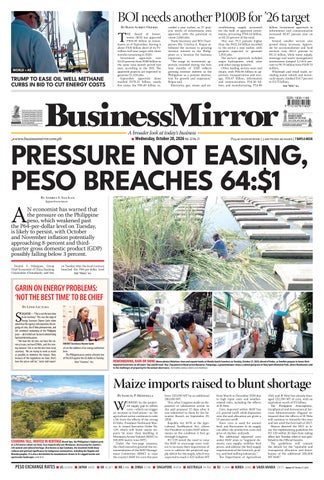
STANDING TALL, ROOTED IN HERITAGE Mount Apo, the Philippines’s highest peak at 2,954 meters above sea level, rises majestically over Mindanao, showcasing the country’s rich natural and cultural heritage. Also known as Apo Sandawa, the mountain holds deep cultural and spiritual significance for Indigenous communities, including the Bagobo and Manobo peoples. It is also a destination for mountaineers drawn to its rugged terrain and spectacular landscapes. NONIE REYES
ORRIED by the projected supply gap in yellow corn—which can trigger an increase in food prices—as the agriculture sector continues to take a hit from the effects of the strong El Niño, President Ferdinand Marcos Jr. issued Executive Order No. 129, which will boost maize imports by more than doubling it Minimum Access Volume (MAV) to 500,000 metric tons (MT). Under the two-page issuance, the chief executive granted the recommendation of the MAV Management Committee (MMC) to raise the county’s MAV for corn this year
from 220,000 MT by an additional 280,000 MT. This, after Congress made no dispositive or substantive action on the said proposal 15 days after it was submitted to them by the Executive Branch on September 29, 2026. Republic Act 8178 or the Agricultural Tariffication Act, allows the President to make MAV adjustments on the condition it first go through Congress. EO 129 noted the need to raise the MAV to encourage more traders to increase their importation of corn to address the projected supply deficit for the staple, which was expected to reach 1.422 million MT
from March to December 2026 due to high input costs and weatherrelated risks, including the effects of El Niño. Corn imported within MAV has a 5- percent tariff, while shipments over the said allocation are given a 15-percent tariff. Since corn is used for animal feed, any fluctuation in its supply can affect the production costs and price of chicken and pork. The additional imported corn under MAV aims to “augment domestic corn supply, stabilize feed prices, and address the feed supply requirements of the livestock, poultry, and feed milling industries.” The Department of Agriculture
(DA) said El Niño has already damaged 132,290 MT of corn, with an equivalent worth of P5 billion. The Philippine Atmospheric, Geophysical and Astronomical Services Administration (Pagasa) estimated that the effects of El Niño will continue to intensify this year and last until the first half of 2027. Marcos directed the MCC to issue the implementing guidelines for EO 129 within 30 days from taking effect last Tuesday when it was published in the Official Gazette. The guidelines will contain the details for the “equitable and transparent allocation and distribution of the additional 280,000 MT MAV.”
PESO EXCHANGE RATES n US 63.8590 n JAPAN 0.4055 n UK 85.2071 n HK 8.1406 n CHINA 9.5748 n SINGAPORE 49.8704 n AUSTRALIA 44.7843 n EU 71.3944 n KOREA 0.0482 n SAUDI ARABIA 17.0173 Source: BSP (October 27, 2026)
News
BusinessMirror
A2 Wednesday, October 28, 2026
BOI…
Continued from A1
Domestic investors accounted for P808.96 billion, or 89.88 percent, of total approvals, up 60.5 percent from P503.95 billion in January to September 2025. Foreign investment approvals reached P90.40 billion. Singapore was the largest source of foreign investment approvals at P42.71 billion, followed by South Korea at P27.44 billion, China at P4.07 billion, Japan at P3.11 billion, the Netherlands at P2.15 billion, Australia at P1.57 billion and the United States at P1.33 billion. South Korean investment approvals surged 10,332.7 percent from P263 million a year earlier, while approvals from Australia rose 657.3 percent to P1.57 billion and those from China increased 348.1 percent to P4.07 billion. The Cordillera Administrative Region attracted the highest regional total at P218.48 billion, followed by the Ilocos Region at P199.75 billion, Central Luzon at P130.81 billion, Eastern Visayas at P76.84 billion, Calabarzon at P58.37 billion and the National Capital Region at P49.88 billion. Caraga recorded the fastest growth, with approvals rising 1,731.5 percent to P16.94 billion from P924.7 million. The Ilocos Region’s approvals grew 136.6 percent to P199.44 billion, while Western Visayas posted a 296.5-percent increase to P42.77 billion. “We remain optimistic that investment momentum will continue through the remainder of the year,” Trade Undersecretary and BOI Managing Head Ceferino S. Rodolfo said.
www.businessmirror.com.ph
As heat index rises, DOLE orders breaks, work tweaks
E
By Mary Jade Jadormio
MPLOYERS must reassess, reschedule or halt work when heat index levels reach extreme danger and workplace risks cannot be controlled, according to the Department of Labor and Employment (DOLE) as the country begins to feel the impact of a strong El Niño. The Labor advisory sets out safety measures based on four heat-index categories, culminating in the suspension, relocation or rescheduling of work when temperatures reach 52 degrees Celsius and above and risks cannot be adequately controlled. At the caution level of 27 to 32 degrees Celsius, employers must provide adequate drinking water, shaded or ventilated rest areas, hydration reminders and training on heat-stress symptoms and first aid. Once the heat index reaches 33 to 41 degrees Celsius, employers must enforce mandatory rest-shift-hydration cycles, establish cooling areas with measures such as mechanical ventilation or air-conditioning, and
provide appropriate personal protective equipment. Companies must also implement peer monitoring to detect early signs of heat-related illness and ensure workers have immediate access to trained occupational safety and health first-aiders equipped with rapid cooling packs. At the danger level of 42 to 51 degrees Celsius, employers must arrange flexible work schedules to reduce heat exposure, including avoiding outdoor work between noon and 3 p.m., transferring work to cooler periods or locations, or adopting alternative work arrangements where feasible. Workers required to remain on-site must have reduced work intensity and
heat exposure, appropriate workrest cycles, access to cool or shaded recovery areas and frequent access to drinking water. At the extreme danger level of 52 degrees Celsius and above, employers must immediately reassess affected work and suspend, relocate, reschedule or substantially modify operations whenever the risk cannot be adequately controlled or an imminent danger exists. For essential services such as public utilities, health services and emergency response, employers must maintain only the minimum workforce needed for safe operations and strengthen protections through shorter exposure periods, additional staffing or rotation, reliable hydra-
tion and cooling, and emergency transport arrangements. The advisory also requires employers to assess workplace-specific heat risks, monitor official forecasts from the Philippine Atmospheric, Geophysical and Astronomical Services Administration, and integrate heat-stress contingencies into occupational safety and health programs. Employers must record workrelated heat illnesses in establishment medical logs and include them in annual medical reports, while serious occupational incidents involving hospitalization, permanent disability or death must be reported to the concerned DOLE regional office within 24 hours.
Garin…
Before, they used to have the freedom to determine how much it should be. And now, we have been prescribing and they follow that.” The energy chief added, “Now, [for] the staggering, we will ask them. Normally, they follow but hopefully, it won’t be necessary anymore.” Oil companies raised diesel and kerosene prices by P1.20 per liter and P0.50 per liter, respectively. DOE Undersecretary Alessandro Sales earlier said the country is expanding its Strategic Petroleum Reserve (SPR) by adopting a “ticketing” system to secure offshore oil supplies amid the Middle East conflict, overcoming its domestic storage capacity limitations. “We are currently engaging with two private companies, through the PNOC-EC [Philippine National Oil Company—Exploration Corp.], to begin negotiations on these ticketing arrangements to secure offshore supplies. Garin said the proposed ticketing system may cost around P15 million. “We make these reservations, which grant us the right to have the supplies shipped to the Philippines at any time. However, we will only pay for the product itself once it is released from their storage,” Garin said. Aside from the ticketing or reservation system, the Philippines continues to negotiate via PNOC-EC with two private companies to reserve crude oil and petroleum products in existing overseas storage facilities. Backed by the Japanese government, the country is discussing the creation of a regional oil hub with Saudi Arabia and the UAE for forward stockpiling. “Our goal is to increase our reserves; however, the limitation lies in the Philippines’s storage capacity. The solution we have identified is to store these supplies abroad. We are working to finalize these arrangements as soon as possible. We believe it is time to take action to ensure that stocks are available to the Philippines at any given time. Once the contracts are finalized and the necessary approvals from all relevant agencies are secured, we will proceed with this initiative,” Garin had said.
Continued from A1
In the Philippines, while the Energy Regulatory Commission (ERC) directly regulates transmission and distribution rates, the generation charge, which is the largest component of most electricity bills, is largely influenced by global fuel prices, foreign exchange movements, and supply and demand conditions. “Indirectly it [peso slide] will affect it because...well, it will affect coal, it will affect diesel, it will affect LNG because in dollar terms. So, P64 is really one of the, probably the highest we have now. It will impact the rate of electricity because it passes through, so it will impact the cost per kilowatt hour. “Currently, I need to see ERC Chair Nino Juan and we’ll check if there is any way we can delay or lessen the impact. But that is something I have to discuss with the ERC because they determine the rates,” said Garin. The energy chief said the Philippine government is actively working to minimize the economic impacts of the current oil crisis, currency fluctuations, El Niño, and summer arriving in a few months. ”If there’s really the impact of El Niño and all else, it will require a whole-of-government approach because that will be in the ‘Uplift’ in the El Niño activities of the government. So, if the impact is really big, then we can report that to the committee, to the Cabinet, and then maybe through DENR or DA or DOTr and subsidies can be given. But right now, there is no report on that side.” On rising fuel prices, Garin said her office has yet to determine if it is necessary to spread out the price adjustments. She said the government will review the cost computations this week to determine the economic impact before officially asking oil companies to implement changes gradually. “I have to already thank the oil companies because they’ve complied with the limited limits on the range prescribed by the DOE.
WB flags… Continued from A11
councils, local governments and other stakeholders earlier in preparing budget proposals for 2028. De Leon said consultations must take place while priorities are still being shaped, rather than
after decisions have already been made. The WB’s report, titled “From Cities to Corridors: Unlocking the Philippines’ Urban Growth Potential,” identifies 190 urban local government units and 26 multi-local government agglomerations with potential to support growth beyond traditional economic centers.
Vietnam, China gain Filipino… Continued from A11
non-traditional destinations such as New Zealand, which was up 29.4 percent; India +29.75 percent; Greece +35.55 percent; and Hungary +63.6 percent. “So we’re quite optimistic that the second half of the year will remain strong for outbound travel,” said Ho. Total outbound travel in 2025 reached 7.65 million, up 11.7 percent, yoy. For his part, Tuaño said the con-
tinued increase in outbound travel despite the weak peso also suggests that the travelers may have already booked and bought their airfare and hotels earlier, thus locking in cheaper rates. “It’s possible because Filipinos have learned to book ahead of time,” he said. The DOT figures are based on the e-travel forms filled out by Filipinos leaving the Philippines for leisure or work.
Peso…
Continued from A1
for the first time. Data from the Bankers Association of the Philippines (BAP) showed the peso sank to a new historic low of P64.17 against the greenback, 22 centavos weaker than its P63.95 finish against the dollar on Monday. Ultimately, Velasquez said, the key question is “how quickly the Philippine economy can recover amid heightened uncertainty.” “Pressure on the currency is likely to persist, with October and November inflation potentially approaching 8 percent and Q3 GDP growth possibly falling below 3 percent,” the Chinabank’s group chief economist pointed out. She added that financial markets could also remain volatile in early November as investors assess incoming economic data and the outlook for economic recovery. Velasquez is pinning her hopes, however, on seasonal dollar inflows, particularly remittances in November and December, which she said could provide some support to the peso. “However, uncertainty over the pace of economic recovery appears to be offsetting the seasonal support from remittances,” added Velasquez. If the peso remains near P64 per dollar, she said it could recover “modestly” to around P63 by year-end, although “downside risks” remain.
Rate hike alone not enough
MEANWHILE, she explained that the peso hitting a record low past the P64per-dollar level despite the Bangko Sentral ng Pilipinas’ (BSP) surprise 50-basis-point hike on October 22 “reinforces” the bank’s view that rate hikes alone may not be enough to reverse the peso’s depreciation. For his part, John Paolo R. Rivera, Senior Research Fellow at Philippine Institute for Development Studies (PIDS) said the recent depreciation of the peso past the P64-per-dollar level reflects “persistent external pressures” including strong dollar demand, elevated oil prices, geopolitical uncertainty and the widening balance-of-payments (BOP) deficit. He also pointed out that external pressures are “greater than the effect of the policy rate hike.” “While 64 is a significant psychological threshold, the greater concern is sustained depreciation, which raises import costs, adds to inflationary pressures, and erodes household purchasing power,” added Rivera. He said the central bank’s tighter monetary stance can help moderate volatility, but “lasting stabilization” will also depend on improvements in global conditions, the country’s external position, and trust or confidence in the economy.
DMW’S advice to OFWs
AS the value of the peso dropped to a new historic low of P64 against the dollar, the Department of Migrant Worker (DMW) urged overseas Filipino workers (OFW) and their families to take advantage of the increasing value of their remittances, by properly investing it. In a media forum, DMW Secretary Hans J. Cacdac said they have ramped up their efforts of providing financial education to OFWs and their loved ones by partnering with the Bangko Sentral ng Pilipinas (BSP) and academic institutions such as the Ateneo De Manila. He said their financial education sessions have already been produced in the Middle East, Americas, and Europe. “We need to emphasize that the financial education also applies to the families here so that they can also monitor the remittances which I said are increasing because of their loved ones,” Cacdac said. The DMW chief noted they mounted campaigns to encourage the families of OFWs not to waste the remittances by promoting catchphrases like “Ipon [savings], not iPhones.” He said they also support the pending bills in the House of Representatives and the Senate, which will institutionalize financial education for OFWs and their families. The weaker peso is expected to benefit exporters since it will make their products cheaper abroad as well as OFWs since it will increase the value of their remittances. BSP reported that the cash remittances from overseas Filipinos during the first eight months of the year rose by 2.2 percent to US$23.424 billion from $22.909 billion year-on-year. With a report by Samuel P. Medenilla
The Nation
www.businessmirror.com.ph
‘Foolish proposition’: Lacson scorns Cayetano proposal By Butch Fernandez @butchfBM
S
EN. Panfilo Lacson on Tuesd ay pu l led no pu nc hes, branding as “foolish” a proposal urging his fellow senatorjudges to commit to turning down a possible appointment as Vice President should Vice President Sara Duterte-Carpio be convicted and removed from office. Lacson openly questioned the gall of Minority Leader Alan Peter Cayetano for making the suggestion. At the same time, the veteran lawmaker firmly underscored that his own Senate mandate runs until 2031, making any talk of the vice presidency entirely off his radar. “Somebody had the gall to suggest that my Senate colleagues should decline a Vice Presidential appointment from President Marcos if the impeachment trial ends in conviction. W hile ‘no comment’ would be the most appropriate response to such a nonsensical idea, silence might be misconstrued as interest in the position,” Lacson wrote in a post on X (formerly Twitter). “Let me be clear: I have a mandate to fulfill until 2031, and the VP post is not under consideration,” he added. To drive his point home, Lacson cited a hypothetical scenario
involving another lawmaker. “What if President Marcos considers appointing Sen. Lito Lapid because he is makamasa and has a good heart? Must Senator Lapid decline simply because he is a senator-judge? Isn’t that a foolish proposition?” he asked. Lacson emphasized that Cayetano’s demand is unwarranted, pointing out that the 1987 Constitution explicitly outlines the process for filling a vice presidential vacancy. Under Section 9, Article VII of the Constitution, if the office of the Vice President becomes vacant, the President is mandated to nominate a replacement from among the current members of the Senate or the House of Representatives. Addressing Cayetano’s unsolicited advice, Lacson made it clear that the Minority Leader should refrain from overstepping Executive authority. “Huwag niyang pakialaman, huwag niyang pangunahan kasi Pangulo ang mamimili, of course, subject to the confirmation ng Congress, hindi ba? Pero huwag niyang pangunahan,” Lacson stressed, asserting that Cayetano should not meddle in or preempt the President’s constitutional prerogative, which ultimately remains subject to congressional confirmation.
Marcos fills lower court vacancies for faster justice
P
RESIDENT Marcos has underscored the urgency of resolving vacancies in the judiciary to accelerate court proceedings and deliver timely justice for the Filipino public. Speaking after a Malacañang gathering with 160 newly appointed judges and First Lady Louise Araneta-Marcos on Monday, the Chief Executive highlighted the direct human impact of judicial delays. “Behind every case is a Filipino seeking justice, a family waiting for answers, and a life waiting to move forward,” Marcos said on social media. “This is why we continue to fill vacancies in our courts, so that justice can be delivered more efficiently and made accessible to every Filipino.” Execut ive Secretar y R a lph G. R ec to, who at tended t he event, called on the new magistrate appointees to exercise
e mp at hy, p a r t ic u l a r l y w he n presiding over cases involving impoverished and marginalized individuals. Recto emphasized that judges should aim for true equity rather than becoming bogged down by technicalities, reminding them in Filipino: “The law may be strict, but its enforcers need not be cruel. You can be impartial without being indifferent—especially to those for whom justice is often the hardest to reach.” The push for appointments comes as the Judicial and Bar Council (JBC) reported 170 tentative vacancies across firstand second-level courts nationwide as of October 12. Metro Manila accounts for the highest concentration of unfilled seats with 49 vacancies, followed by Southern Luzon with 32. The final vacancy list is scheduled for release next week. Samuel Medenilla
Luzon tollways prepare for Undas traffic
L
EADING expressway operators Metro Pacific Tollways Corporation (MPTC) and SMC Infrastructure are ramping up operations and implementing comprehensive motorist assistance measures from October 29 to November 3, 2026, in anticipation of a 5 percent to 10 percent surge in traffic volume during the Undas holidays. Und e r M P T C ’s “ B i y a he n g Arangkada” program and SMC’s alignment with the Department of Tranportation’s “Oplan Biyaheng Ayos,” both operators are coordinating closely with government agencies—including the Toll Regulatory Board (TRB), National Police (PNP), Metro Manila Development Authority (MMDA), Land Transportation Office (LTO), and local governments—to ensure safety, alleviate congestion, and maintain 24/7 traffic management across Luzon and Cebu. Traffic is projected to rise overall, with peak travel days expected on October 30 and 31. At MPTC Expressways (Nlex,
Sctex, Nlex Connector, Cavitex, Calac, CCLex), Outbound traffic is expected to peak from Friday afternoon through Saturday afternoon, while return traffic is projected from late afternoon on November 2 through early morning on November 3. SMC expects its expressways (Slex, Skyway System, STAR Tollway, Naiax, TPLex) to have a 10 percent increase in traffic volume, with full staffing taking effect at 12:01 a.m. on October 29. To clear the roads for holiday travelers: n MPTC will suspend non-emergency roadworks, lane closures, and maintenance from October 29 to November 3. Approximately 2,000 traffic, toll, security, technology, and incident response personnel will be deployed across its network. n SMC Infrastructure will suspend roadworks from noon on October 29 until 10:00 p.m. on November 3. Emergency assistance See “Undas,” A4
Wednesday, October 28, 2026
A3
Prosecution dares Duterte defense to deliver promised ‘bloodbath’ By Jovee Marie N. dela Cruz
T
@joveemarie
HE House of Representatives impeachment prosecution team on Tuesday challenged Vice President Sara Z. Duterte’s defense team to substantiate her earlier warning of a “bloodbath” as it prepares to present its evidence when the Senate impeachment trial resumes on November 9. House impeachment prosecution adviser and spokesperson Ace Barbers said Duterte’s lawyers had been given sufficient time to prepare their defense against Article II, the sole remaining impeachment charge involving allegations of unexplained wealth. “As the Vice President has repeatedly mentioned, we expect a bloodbath. If her team is indeed going to deliver one, let us see it,” Barbers said at a press briefing. He added that the defense should be given the opportunity to present its case, stressing that the impeachment proceedings must allow both sides to lay out their evidence before the senator-judges. Barbers maintained that the prosecution’s confidence in securing Duterte’s conviction rested on the strength of its evidence and witness testimonies, rather than
on any presumed tally of votes among the senator-judges. “We are not confident because of the number of votes. The prosecution’s confidence rests on the weight of the evidence and the testimonies of witnesses, which we believe can convince the senator-judges to render a conviction,” he said. He identified four key issues under Article II: the consistency of Duterte’s Statements of Assets, Liabilities and Net Worth (SALNs) with official financial records; whether her declared income could explain her accumulated wealth; her alleged business interests while in office; and remittances from China flagged during the financial investigation. On the SALNs, Barbers quest ioned why D uter te’s s wor n declarations did not list cash
on hand or cash in bank during her vice-presidential term, wh i le t he prosec ut ion’s e v idence showed substantial yearend balances in accounts maintained by her and her husband, law yer Manases Car pio. The prosecution’s financial forensic analyst, Alexander Cabrera, presented records indicating that the couple had combined year-end bank balances of approximately P59 million in 2022, P71.38 million in 2023, P22.25 million in 2024 and P39.09 million in 2025. Duterte’s SALNs, meanwhile, listed other personal properties worth P13 million in 2022, P14 million in 2023, P21.13 million in 2024 and P29 million in 2025. Barbers argued that the figures would remain difficult to reconcile even if the defense claimed the couple’s cash holdings had been included under other personal properties. He said the prosecution’s documentary evidence came from government agencies and commercial banks, including the Bureau of Internal Revenue, the Anti-Money Laundering Council and the Office of the Ombudsman. “The defense will have difficulty rebutting or disputing the evidence presented before the impeachment court because these documents came from the vice president’s own camp and from official institutions,” Barbers said, referring to the SALNs and financial records submitted during the proceedings. He a l s o r a i s e d q u e s t i o n s about Duter te’s repor ted income and business interests,
citing Article VII, Section 13 of the 1987 Constitution, which restr icts t he President, Vice President and Cabinet members from engaging in certain business activities or holding spec i f ied f i n a nc i a l i nterest s while in of f ice. Barbers said the prosecution would also address China-linked remittances in subsequent briefings. The House prosecution has completed its presentation of evidence and formally offered financial records, tax documents, sworn asset declarations, corporate records and witness testimonies in support of Article II. The Senate impeachment court has yet to resolve the remaining objections to the admissibility of evidence, while Duterte’s defense is expected to begin presenting its case when proceedings resume. Barbers said the senator-judges should base their verdict on the evidence rather than speculation about the outcome or the timing of a possible conviction. He also described discussions about a potential successor to Duterte as premature, saying the choice would be up to the president if a vacancy arose. “The only thing we ask is that the evidence be the basis of their decision,” Barbers said. T he ot her t h ree i mpeac hme nt a r t i c l e s — c o v e r i n g a l legations involv ing confidential funds, grave threats, and briber y and graft—were withdrawn with prejudice, leaving the alleged unexplained wealth charge as the sole remaining basis for the trial.
US Defense chief expected at Cebu talks By Carmel Pedroza
C
EBU CITY—US Defense Secretary Pete Hegseth is expected to attend high-level defense meetings in Cebu on October 28 to 29, as Southeast Asian nations and their dialogue partners tackle regional security concerns, including maritime security and cybersecurity. Assistant Secretary Arsenio Andolong, Department of National Defense (DND) spokesperson, said on Tuesday that the Philippines expects the bilateral engagement with the United States to cover defense modernization and future capacity- and capability-building, although specific outcomes have yet to be determined. “Usually, when the two parties meet, the outcomes are decided when the meeting is conducted,” Andolong said during a press briefing ahead of the 20th Association of Southeast Asian Nations Defense Ministers’ Meeting (ADMM) and the 13th ADMM-Plus in Lapu-Lapu City. He said Defense Secretary Gilberto Teodoro Jr. would provide more information during his turnover address on Thursday, when the Philippines formally hands over the chairmanship of the ADMM and ADMM-Plus to Singapore. The meetings, held under
DEFENSE Assistant Secretary Arsenio Andolong
the theme “Navigating Our Future Together,” are expected to strengthen regional partnerships and advance practical defense cooperation in support of a peaceful and stable Indo-Pacific. The ADMM serves as the Asean’s highest defense consultative and cooperative mechanism. The ADMM-Plus, established in 2010, expands the platform to eight dialogue partners: Australia, China, India, Japan, New Zealand, South Korea, Russia and the United States. Aside from the main meetings, the Philippines will host informal Asean-plus-one defense ministers’ meetings with Japan and the United States, along with bilateral and multilateral engagements on the sidelines.
Andolong said maritime security, cybersecurity, humanitarian assistance and disaster response, counterterrorism, peacekeeping operations, military medicine and humanitarian mine action are among the areas of practical defense cooperation expected to figure in the discussions. The final agenda was still being worked out ahead of the meetings. The South China Sea, including the West Philippine Sea, is also expected to be discussed, he said, noting that the issue has regularly figured in previous ADMM engagements. “I expect that they will be a part of it,” Andolong said, referring to discussions on the South China Sea and West
Philippine Sea. On China’s participation, the DND spokesperson said an invitation had been extended, but the Philippines had yet to receive confirmation of the Chinese delegation’s attendees, including whether its defense minister would participate. Asked whether smaller security groupings could undermine Asean unity, Andolong said such arrangements should be viewed as additional channels for dialogue rather than replacements for established regional mechanisms. “It’s not intended to replace the ADMM,” he said, adding that broader dialogue among partners could foster greater understanding rather than division. This year’s meetings also coincide with the 50th anniversary of the Treaty of Amity and Cooperation in Southeast Asia, signed in 1976, which upholds respect for sovereignty, noninterference and the peaceful settlement of disputes. Proposed outcome documents include joint statements that remain subject to finalization and consensus among participating parties. T he Ph i l ippines’ c ha ir m a nsh ip w i l l for m a l ly conc lude w it h t he t u r nover to Singapore on October 29.
Wednesday, October 28, 2026
A4
Lawmaker urges swift govt action on e-waste By Jovee Marie N. dela Cruz @joveemarie
W
ARNING of a looming public health and environmental crisis, a legislator has called on Congress to fast-track a measure establishing the country’s first comprehensive e-waste management system. Parañaque Rep. Brian Yamsuan filed House Bill 11462, or the proposed National E-Waste Management Act, to create strict national standards for collecting, recycling, and disposing of discarded electronic devices. The push comes amid rapid technological turnover and shorter product lifespans, which have fueled a surge in discarded electronics across the country. “We should not wait until this problem piles up into a mountain, especially now that technology and electronic devices are being replaced so rapidly,” Yamsuan said. “In this digital world, we need a comprehensive system that will strictly regulate how we collect, reuse, and dispose of e-waste before this problem turns into a crisis.” E-waste covers discarded computers, mobile phones, household
appliances, spare parts, and lowcost items like cables, USB adapters, single-use vapes, mini-fans, power banks, and electronic novelties. Left unregulated, these items risk leaking hazardous heavy metals—such as lead, mercury, and cadmium—into the air, soil, and water supplies. While existing laws cover municipal solid waste and hazardous chemicals, Yamsuan noted that the Philippines currently lacks a dedicated, unified framework specifically tailored to electronics. Independent studies show the Philippines generated roughly 537,000 metric tons of e-waste in 2022—equivalent to more than 13,000 fully loaded 40-ton trucks. The United Nations’ Global EWaste Monitor 2024 report also identified the nation as one of Southeast Asia’s top e-waste generators. Describing the bill as a “wholeof-nation approach,” Yamsuan emphasized that HB 11462 aims to transform a growing public health liability into an opportunity for responsible innovation and a circular economy.
Toledo calls for predictable government mining policies By Jonathan L. Mayuga @jonlmayuga
C
HAMBER of Mines of the Philippines (COMP) Chairman Michael T. Toledo has called for reliable, responsible mineral production alongside predictable regulatory frameworks to safeguard investments while protecting ecosystems and host communities. Speaking on Tuesday at the 2026 International Mining Conference and Exhibition in Pasay City, Toledo emphasized the dual imperative of sustaining global development through mining while strictly adhering to environmental and social safeguards. “The demand for minerals is unquestionable... But extracting them has consequences,” Toledo said. “We cannot responsibly mine without limits. But neither is it realistic to imagine a world that can meet its development needs without mining.” Toledo lauded the Marcos administration for balancing economic goa ls w it h reg u l ator y oversight, highlighting key policy initiatives driving the sector forward like Republic Act 12253 that establishes an enhanced fiscal regime for large-scale metallic mining and Executive Order 122 that outlines a strategic focus on critical minerals development. In addition, Toledo said that the Critical Minerals Development Roadmap that streamlines and digitizes permitting while tightening
environmental and social checks has been adopted. Toledo stressed that a stable investment climate hinges on consistency. “Investors need predictable rules. Communities need protection, meaningful participation, and tangible benefits,” he noted, adding that the Philippines must aim to become a reliable producer that attracts capital through credible environmental standards— not just raw resource availability. Demonstrating the industry’s commitment to accountability, Toledo highlighted two mandatory frameworks for COMP members: Towards Sustainable Mining (TSM): Adopted in 2017, this framework mandates that operating members measure performance, report publicly, and undergo independent external verification. Extractive Industries Transparency Initiative (EITI): Ensures global transparency standards in revenue management and provides public visibility into how mineral wealth aids national development. Toledo concluded by stating that public confidence in the sector must be earned daily through mine-site performance and open engagement across government, industry, civil society, and local leaders. “What we owe one another is an honest assessment of the choices before us, the consequences they carry, and the standards by which our decisions should be judged,” he said.
Economy
www.businessmirror.com.ph
Bukidnon IP coffee gets ₧98M funding
N
By Ada Pelonia
@adapelonia
EARLY P98 million worth of investments from a World Bank-funded initiative would strengthen the coffee output of a tribal or Indigenous Peoples (IP) community in Bukidnon, the Department of Agriculture (DA) said.
The P97.91 million would bankroll agricultural infrastructure, enterprise development, and water and irrigation investments for the IP community of Daraghuyan Ancestral Domain through the Mindanao Inclusive Agriculture Development Project (MIADP). MIADP is a P6.6-billion initiative implemented by the DA, financed mainly by the World Bank along with counterpart contributions from the national government and partner local governments (LGU). Broken down, the project allocated P51 million to two farmto-market road (FMR) projects, plus P10.45 million to create a multi-commodity warehouse and multipurpose drying pavement. Additiona l ly, it ear marked
P14.76 million for a coffee consolidation, processing, and marketing enterprise; P4.1 million for a Level 2 potable water system; and P17.6 million for a ram pump and gravity-fed irrigation system. These initiatives will be implemented in partnership with the City Government of Malaybalay. MIADP Project Director Macario Gonzaga said the investments would help boost agricultural productivity, resilience, and access to markets and services. “The Daraghuyan indigenous community has demonstrated strong potential in the coffee industry, and its wholehearted cooperation has helped make these interventions possible,” Gonzaga added.
The DA noted that the two-lane sitio Damitan–sitio Ulanguhon Farm-to-Market Road is 65.63 percent complete, while the second road project—linking sitio Ulanguhon to sitio Suopon in barangay Dalwangan—has undergone bidding, with its bidding documents under review. In addition, the multi-commodity warehouse with multipurpose drying pavement and the coffee processing facility have also been launched and would be completed within eight months. The DA stressed that the investments build on the community’s growing reputation for producing high-quality Arabica coffee, which bagged awards in the 2025 and 2026 Philippine Coffee Quality Competition (PCQC). For the agency, the achievements highlight the community’s potential to compete in specialty coffee markets, where quality, processing, and consistency could help producers and open opportunities for better market returns. “With improved infrastructure and enterprise support, MIADP seeks to help translate the community’s coffee quality into stronger market access and more sustainable livelihood opportunities for Indigenous farmers.”
Gatchalian demands crackdown on power players By Butch Fernandez @butchfBM
S
ENATE President Sherwin Gatchalian is calling on energy authorities to lay down the hammer on bad actors in the power sector before frustrated consumers get hit with even higher electric bills. Speaking at a Senate hearing focused on amending the Oil Deregulation Law, Gatchalian pointedly called out the Department of Energy (DOE) and the Energy Regulatory Commission (ERC) to step up, start enforcing stricter penalties, and protect everyday households from unwarranted rate spikes and persistent blackouts. Gatchalian was reacting to the recurring power interruptions and high utility bills hitting the Visayas and Mindanao regions. “Apar t from the brow nout
alerts, the cost of electricity is too high in Visayas and Mindanao. We cannot let this pass; the DOE needs to provide a concrete solution,” Gatchalian said, emphasizing that regulatory oversight needs to be far sharper to curb market exploitation and systemic inefficiency. With power generation companies failing to deliver reliable service while rates keep climbing, Gatchalian argued that current slaps on the wrist simply are not working. “If the power generation players are not performing or are abusing the people, there’s a need for a heavier penalty imposed on them,” he stressed. “The DOE as policymaker and the ERC as regulator should work together. The people are sick and tired of costly electricity and brownouts. We will continue to engage and watch the DOE and ERC until this crisis is resolved.” To prevent companies from
u s i n g i nt e r n at io n a l m a r k e t turbulence as an excuse to unfairly bump up rates, Gatchalian pushed the DOE to regularly audit fuel pass-through charges passed down to electricity bills. Wrapping up his war ning , Gatchalian cautioned that government agencies can no longer afford to sit on the sidelines while consumers bear the brunt of an unstable power market. “We have seen that the government has become ineffective in monitoring prices and even in setting the proper rates that our consumers must pay,” he warned. “In this abnormal situation or crisis, the government cannot continue to be ineffective. It should have the power to protect the people. If our consumers are being abused because of the abnormal situation, they have no one else to run to but the government.”
Undas. . . Continued from A3
desks, quick-response teams, ambulances, tow trucks, and fire engines will be stationed 24/7 at strategic points, including Petron service stations.
Motorist Assistance and On-Road Services
n 24/7 Hotlines and Apps: Assistance is available via MPTC’s 1-35000 hotline and the MPT DriveHub app. SMC motorists can contact dedicated hotlines for Slex (0917-6877539), STAR Tollway (0917511-7827 / 043-756-7870), and TPLex (0917-888-0715). n Towing & Mechanical Services: MPTC is offering free towing to the nearest exit for Class 1 vehicles (including Class 1M on CCLex) from 6:00 a.m. on October 30 to 6:00 a.m. on November 3, along with free basic mechanical services at select stations. SMC will have standby quick-response teams for mechanical breakdowns such as overheating, flat tires, and dead batteries. n Amenities: Free Wi-Fi (via Smart), EV charging stations, and free bottled water (via Maynilad) will be available at select MPTC Rest and Refuel stations.
Travel Advisory & Alternate Routes
BOTH concessionaires encourage motorists to inspect their vehicles (tires, brakes, batteries, lights, and cooling systems) and ensure adequate rest before heading out. n RFID Readiness: Drivers should ensure sufficient balance on their Easytrip (MPTC) or Autosweep (SMC) accounts to prevent delays at toll plazas. Motorists traveling across multiple networks can enroll in the optional One RFID program. n Alternate Routes: • North: The Nlex Connector and Mindanao Avenue access points offer alternative routes between western/eastern Metro Manila and Central-Northern Luzon. • South: The Cavitex C5 Link connects Taguig to Cavitec, while Calax provides access between Mamplasan (Biñan, Laguna) and Governor’s Drive (General Trias, Cavite). Future expansions—such as the Nlex-C5 Northlink Segment 8.2 Section 1A and the Cavitex-Calax Link (CCLink)— will further improve regional mobility.
Cavitex R1 toll adjustment starts T
HE Toll Regulatory Board (TRB) has approved the collection of the secondtranc he tol l rates under t he approved 2020 and 2023 toll petitions filed by Cavitex Infrastructure Corporation (CIC) and Philippine Reclamation Authority (PR A) for the Cavitex R1 Expressway Extension, covering the Zapote, Las Piñas to Kawit, Cavite segment, effective October 28. Starting Wednesday, motorists using the seven-kilometer Cavitex R1 Extension will be charged P103 for Class 1, P207 for Class 2, and P310 for Class 3 vehicles. The 2020 and 2023 toll petitions covered periodic toll adjustments due for implementation in 2021 and 2024, respectively. To help cushion the impact on motorists, the approved toll adjustments
were divided into two tranches. The first tranche was implemented in October 2025, while the second tranche will be collected starting October 28, 2026. Ser v ing more than 50,000 motor ists d a i ly, t he C av ite x R 1 E x pressway E x tension is a key economic corridor connecting Metro Manila to Cavite and Souther n Luzon. Motorists will also experience faster travel time in the Southern Luzon corridor to Metro Manila as Cav itex w ill soon connect to Cala x via the Cavitex- Cala x Link (CCLink). In previous months, various toll relief measures were implemented to support public transportation and the movement of people and goods. These included exemptions for accredited Class 2 public utility buses (PUBs) and public util-
ity vehicles (PUVs), as well as toll rebates for Class 3 vehicles and accredited vehicles transporting agricultural products. In line with the implementation of the adjusted toll rates, the Abante Program, a toll reprieve initiative for public utility vehicle (PUV) operators, will be reactivated effective October 28, 2026. For 60 days from this date, Abante-accredited traditional and modern jeepneys, UV Express units, and buses with aut hor i zed routes u si ng t he Cavitex R-1 Expressway Extension (Kawit) will be eligible for toll rebates. Meanwhile, the toll rebate for vehicles transporting agricultural products will remain in effect until November 30, 2026, to support the movement of agricultural goods. The joint venture partners con-
tinue to invest in infrastructure and technology upgrades along Cavitex, even prior to the approval of toll petitions, including:
n Expansion joint replacement at bridges along the Parañaque segment and Imus Viaduct to improve ride comfort and structural reliability; n RFID system upgrades and Automatic License Plate Recognition (ALPR) technology to enable faster, more seamless transactions; and n Pavement rehabilitation in critical portions of the Kawit and Parañaque segments.
These investments, together with the toll adjustment, will support the continued delivery of reliable, safe, and efficient expressway services.
TheWorld Voters in Israel are deciding whether to oust Netanyahu after 3 years of war By Tia Goldenberg & Cara Anna The Associated Press
J
ERUSALEM—Israelis are voting in a pivotal election Tuesday as their country wrestles with unresolved wars, continues to reel from Hamas’ 2023 attack and is deeply divided over the character of the state and the right person to lead it. Prime Minister Benjamin Netanyahu faces an array of parties seeking to oust Israel’s longest-serving premier from power. Opinion polls have suggested a tight race with his main rival, former military chief Gadi Eisenkot. Over 7 million people are eligible to vote, and tens of thousands have reportedly arrived from overseas. Inside Israel, the race is largely about security and who should serve to defend the country. Outside Israel, it’s mainly about the country’s reputation—and the security of Jewish people worldwide—after growing criticism over the war in Gaza and Jewish settler violence in the occupied West Bank. Almost 17 percent of Israelis voted in the first three hours, the highest turnout by that point since 1981, according to initial figures by the Central Elections Committee. In Israel’s fragmented parliamentary politics, no single party has ever won an outright parliamentary majority. There is a chance that neither Netanyahu’s religious and ultranationalist coalition nor the group of parties hoping to remove him has enough support for a majority. That could set off weeks of negotiations before a leader is declared. Israel’s Arab-led parties could emerge as kingmakers—if other parties agree to join forces with them. “Our vote will change the government,” Mansour Abbas, head of the Islamist Ra’am party, said while voting, adding that he hoped turnout would surpass 70 percent in Arab communities. Arabs in Israel make up about 20 percent of the population. Israel’s far-right national security minister, Itamar BenGvir, known for taunting Palestinian detainees and saying some Palestinians in Gaza are “not even people,” warned that “it will be Mansour Abbas’ government” if Netanyahu and his allies don’t win.
Emotions run high
SOME emotions were high. In Kiryat Shmona, a Netanyahu stronghold near the border with Lebanon, one man kicked and tore down a poster of Eisenkot. The election is Israel’s first national vote since the October 7, 2023, attack that sparked the war in Gaza and related conflicts. In Tel Aviv, families of some killed on October 7 or former hostages held a moment of silence. “Remember all those whose voices are no more,” said Yona Adam, whose daughter Mapal Adam was killed. Around 330,000 young Israelis, many facing compulsory military service under the shadow of war, are eligible to vote for the first time. Eisenkot early Tuesday visited communities attacked on October 7. “If someone in the government had a shred of responsibility, they would start the morning here” in the communities near Gaza, he said, while Netanyahu had not yet been seen in public three hours after polls opened. Eisenkot’s Yashar party said it filed an urgent complaint over nine incidents in which its ballot slips were missing, damaged or turned over inside voting booths, and suggested a “systematic and deliberate” sabotage attempt. Overall, the acting director-general of the elections committee, Dean Livne, said the number of reports about irregularities or issues at polling stations was much lower than in previous elections.
Top issues
THE vote serves not only as a referendum on Netanyahu’s leadership but also on what kind of country Israel should be— heavily influenced by religious and nationalist forces, or more firmly anchored in liberal and secular values. Israel has found itself increasingly isolated over its conduct in Gaza and the West Bank. Public support among Americans has plummeted, and partners in Europe and elsewhere have slapped sanctions on Israel. Also hanging over the election are lingering tensions with Iran. Netanyahu ramped up threats ahead of the vote, warning Tehran it would face “a devastating blow” if it attacked Israel. Netanyahu’s supporters see him as a steady hand and a consummate statesman who they believe has triumphantly guided Israel through multiple wars. They think he is protecting Israel’s Jewish identity while keeping in check what they see as an interventionist judiciary. His Israeli detractors see him as a polarizing leader who, beset by an ongoing corruption trial, dragged on the war in Gaza and its hostage crisis for political reasons. They say he is undermining Israel’s independent judiciary and weakening its democratic underpinnings. And they accuse him of abetting a system that has allowed ultra-Orthodox religious Jews to avoid enlistment in Israel’s compulsory military. “The present government is driving the country into the ground,” voter Angela Bengur said in Jerusalem. See “Netanyahu,” A8
Wednesday, October 28, 2026
A5
Trump to ease oil well methane curbs in bid to cut energy costs By Jennifer A. Dlouhy & Zahra Hirji
P
Bloomberg News
RESIDENT Donald Trump is set to unveil a plan to dial back federal requirements designed to slash methane emissions from oil and gas operations, casting the proposal as a way to encourage more domestic energy production and lower costs. Trump is expected to announce the proposed rule during a campaign rally in Lubbock, Texas, on Tuesday, as he tries to bolster the prospects of Republican Senate candidate Ken Paxton in next week’s midterm elections, according to an administration official who asked not to be named before a formal announcement. Texas is the No. 1 oil-producing state in the US—and the petroleum industry has lobbied the White House to ease some of the mandates meant to keep a lid on releases of methane, a particularly potent greenhouse gas. The proposal comes as Trump seeks to assuage voter concerns about higher costs for oil, gasoline and diesel stoked by Russia’s war on Ukraine and the US war against Iran. During a pre-election campaign blitz to keep Republican control of Congress, Trump has also championed initiatives tailor-made for his rally audiences—from plans for Volkswagen AG to build a $4.2 billion Audi plant in Georgia to an $8 billion fuelrelief program pitched to farmers in Kansas. The Environmental Protection Agency proposal takes aim at Biden administration requirements that forced energy companies to replace leak-prone equipment and regularly search for escaping gas from wells and other hardware. EPA Administrator Lee Zeldin, at an industry conference in Santa Fe earlier this month, said the planned measure would lift “unnecessary burdens” constraining
oil and gas production and make it less costly for Americans to heat their homes and drive their cars. In a major shift, the agency will propose to effectively single out so-called marginal, low-output wells for additional regulatory relief. The treatment would extend to wells that produce no more than 15 barrels of oil equivalent per day. The approach responds to pleas from some smaller, independent oil producers that say the cost of complying with the requirements can overwhelm the economics of operating older wells, effectively forcing them to shut production at the sites. The bulk of the roughly 1 million oil and gas wells in the US— about 79 percent—are considered marginal because of their relatively low production. But former EPA officials and environmental activists have warned that wells with low oil and gas production can be a major source of methane—and any retreat from the federal requirements would translate to more of that potent planet-warming pollution at a time when climate impacts are intensifying. Methane is a key component of natural gas, making it a valuable source of energy in its own right. Compared to carbon dioxide, methane has a roughly 80 times higher warming potential in the first 20 years after its release into the atmosphere. It’s also become a major driver of modern global warming, as atmospheric concentrations of methane have more than doubled compared with
pre-industrial times. In the US, the oil and gas sector represents the largest industrial source of methane—which can leak from wells, pipelines and processing equipment and is sometimes flared or vented intentionally. Under the EPA plan Trump is set to release on Tuesday, the agency would also end the so-called Methane Super Emitter Program, which encouraged government-approved third-party groups, including companies as well as not-for-profit organizations, to help find and report large methane releases. The agency, which already paused the program’s implementation last year, is set to justify the proposed change by questioning its necessity and highlighting legal concerns with the initiative. The measure also will seek to ease Biden-era requirements phasing out some routine flaring, targeting the practice of energy companies burning off natural gas from oil wells. Under President Joe Biden, the EPA estimated that would collectively avoid some 58 million tons of methane emissions from 2024 to 2038 and yield net climate and ozone health benefits of $98 billion over the same period. The Trump EPA now estimates its proposal overall would yield some $45 billion in savings while enabling production of an additional 210 million barrels of oil and 1.41 trillion cubic feet of natural gas between 2027 and 2050.
Burning natural gas generates carbon dioxide, and inconsistent flares can result in methane discharges too. But getting associated gas from oil wells to market is also not always possible or practical, Trump’s EPA will say in justifying the shift. Instead, the EPA will propose to make 95 percent efficient flaring—or other control devices—the best system of emission reduction, a legal standard under the Clean Air Act, the official said. Oil industry leaders have urged the Trump administration against a wholesale repeal of methane mandates in favor of more modest recalibrations, arguing the Biden-era requirements at times were technologically infeasible, inefficient and costly. For more than a decade, a growing number of energy companies worldwide have voluntarily taken steps to rein in their methane emissions. Some larger producers also have prized the work as a competitive advantage, particularly as other nations crack down on methane-intense gas imports. Since reentering the W hite Hou se l a st yea r, Tr u mp h a s sought to lift regulatory requirements on the oil and gas industry, effectively lowering the cost of domestic energy production while repealing pollution curbs on power plants and vehicles that burn the fossil fuels. Trump’s EPA has already taken multiple steps to delay the enforcement of the methane requirements.
Microsoft to offer buyouts to 60,000 workers By Brody Ford & Nikki Waller Bloomberg News
M
ICROSOFT Cor p. will offer buyouts to about 60,000 workers, representing roughly a quarter of its total staff, as part of the company’s efforts to trim costs and retool its workforce for the artificial intelligence era. Some personnel in the US, Canada, India and the UK at a vice president level and below will be eligible, said a Microsoft spokesperson. Divisions such as Xbox, Windows, Copilot and finance are fully participating in the offer, according to people familiar with the terms. Certain pools of employees, including some focused on data centers, sales, marketing, cybersecurity and quantum computing, aren’t eligible, the people said. Microsoft declined to comment on these specifics. “This offer gives eligible employees who may be considering a future outside the company a new choice to make that transition now with support,” Chief People Officer Amy Coleman said in a note to staff Monday. Work-
ers will receive benefits similar to a standard severance package, the spokesperson said. The world’s largest software maker has shed tens of thousands of workers in waves of layoffs in recent years. In July, it offered buyouts to retirement-age employees, and more than 30 percent of the roughly 8,750 eligible people took the offer. Microsoft expects far fewer personnel to accept the latest buyout proposal compared with the voluntary retirement program, the spokesperson said. Microsoft’s headcount as of the end of June was 223,000. The figure has been largely flat since 2022, about the time Microsoft began spending heavily on AI and data centers—squeezing budgets and hiring elsewhere in the company. The company is scheduled to report financial results on Wednesday, and investors will be laserfocused on signs that the heavy spending on AI is paying off. Microsoft shares rose about 1 percent at midday in New York. Other companies have sought to shrink headcount as they redirect spending to AI infrastructure. Google offered voluntary buyouts
in a number of units last year, CNBC reported. Meta Platforms Inc.’s headcount is down by more than 20,000 from a late 2022 peak. Both are among the biggest spenders on data center infrastructure. The Microsoft spokesperson said the company wants employees who are engaged on the hard problems it’s trying to solve. That echoes other tech bosses, who’ve publicly made clear that continued employment means embracing a faster pace of work and change. Elon Musk in 2022 famously gave Twitter employees the choice to be “extremely hardcore,” or take a severance payment. Earlier this year, Business Insider reported
that a Google executive told employees in his organization that those who weren’t “all in” on AI could have a voluntary buyout package. Workers deciding whether to take a buyout typically assess their savings and whether they’re at risk of layoffs later. Midcareer professionals also consider the job market and how long it might take them to find a new role, or whether the package gives them enough runway to make a pivot. Buyouts typically go to more senior, higher-cost staff, as with Microsoft’s round of early retirement offers, and offer more generous terms than a layoff.
A6
Wednesday, October 28, 2026
BusinessMirror
www.businessmirror.com.ph
www.businessmirror.com.ph
BusinessMirror
Wednesday, October 28, 2026
A7
The World www.businessmirror.com.ph
A8
Wednesday, October 28, 2026
China’s industrial profits surge most in 3 months on oil
C
By Bloomberg News
HINESE industrial companies saw their earnings grow at the fastest in three months, lifted by rising producer prices against the backdrop of higher energy costs. Industrial profits climbed 14.4 percent in September from a year earlier, up from 4.2 percent in August, according to data released by the National Bureau of Statistics Tuesday. Bloomberg Economics had forecast a 12-percent jump. A rebound in producer prices last month likely contributed to the uptick in earnings, a result of soaring oil costs as hostilities flare across the Middle East. Still, for the first nine months of the year, profits rose 15.5 percent, a slight decline from January-August. Prices at the factory gate surged 5 percent in September from a year earlier, the fastest pace since 2022. Higher costs of artificial intelligence hardware and related raw materials also contributed to the surge. The improvement in profit growth has been lopsided this year, with energy and AI helping a small group of industries such as mining and electronics, while the rest fall further behind. Sluggish consumption and slumping government spending are making it worse for businesses that have to rely on the domestic market. “China’s industrial-profit rebound in September likely reflected higher energy and AI hardware prices, with gains still concentrated in a narrow set of related sectors. Outside these segments, the broader corporate sector continued to struggle as anemic domestic demand and intense price competition squeezed margins,” said analyst Eric Zhu. The electronics industry saw its earnings expand over 100 percent in the first nine months of 2026 from a year ago, contributing to 9.6 percentage points of the overall increase in industrial profits during the period, NBS statistician Yu Weining said in a separate statement. Raw material industries saw a gain of 45 percent, contributing to 5.9 percentage points to profit growth as a whole, with higher energy prices pushing up oil and chemical sectors. Greater demand for aluminum and copper from the AI and new energy industries also lifted non-ferrous metal mining, according to Yu. Concerns about corporate profits are a key drag on Chinese stocks, which tumbled into a bear market with $2.4 trillion lost as of late last week since a peak in May. Weak consumer spending and cutthroat competition are taking a heavy toll on earnings across industries. Members of the MSCI China Index that have released results have missed consensus earnings forecasts by an average of 9 percent, set for the second worst quarterly miss in two years, according to Bloomberg calculations.
Netanyahu. . . Continued from A5
Eisenkot is viewed by supporters as a capable leader with sterling security credentials who, along with his likely governing partners, could act as a bulwark against creeping illiberalism. As someone personally touched by the conflict—his son and two nephews were killed in Gaza—his backers believe that he feels deeply the pain that still courses through Israel. Parties that likely would support Eisenkot have vowed to improve Israel’s international standing and work to conscript ultra-Orthodox men while bolstering the independence of the judiciary. The elections are about “who serves and who evades service—who takes an active part in building this country and who doesn’t,” said voter Nisso Shitrit in Jaffa.
Wednesday, October 28, 2026
A9
Timing of agricultural imports during harvest season sparks suspicion from Sen. Pangilinan By Butch Fernandez @butchfBM
S
ENATOR Francis “Kiko” Pangilinan raised concerns over what appears to be a recurring pattern among government agencies of allowing imported rice and other agricultural products to enter the country during the local harvest season, threatening farmers’ livelihoods and undermining the country’s food security. The senator, who heads the Senate Committee on Agriculture, Food, and Agrarian Reform, said the recurring timing of agricultural imports raises questions about whether government policies and importation decisions are being implemented in a way that protects local producers or exposes
Beyond the board exam: Cebu’s engineering workforce faces the test of a changing industry By Carmel Pedroza
C
EBU CITY — As artificial intelligence (AI), machine learning and automation reshape technical work, engineering graduates face a challenge that goes beyond passing professional licensure examinations: acquiring the skills to apply their knowledge in an increasingly technology-driven workplace. For universities, the task is to prepare students not only to meet the standards of board examinations but also to adapt to evolving industrial requirements, work across disciplines and make decisions that protect public safety and serve communities. Engr. Susana Tan, chair of the Electronics Engineering Department of Cebu Institute of Technology-University (CIT-U), said they have incorporated emerging technologies into elective subjects as part of its efforts to keep its curriculum abreast of developments in electronics. “We have elective subjects, and these elective subjects already integrate those trends like AI, machine learning, and even advanced automation,” Tan said. She added that they also work with industry partners to provide on-the-job training, giving students opportunities to gain exposure to professional environments and practical applications, she said. The approach reflects a wider challenge for engineering education as technological advances change the competencies required in the workplace. Technical foundations remain essential, but graduates must also be prepared to learn new systems, apply their knowledge to real-world problems and work with professionals from other disciplines. In Central Visayas, engineering positions appear alongside manufacturing and servicesector occupations in the region’s reported job vacancies, providing a snapshot of the range of employment opportunities available to jobseekers. According to the Department of Labor and Employment (DOLE) Region VII’s Labor Market Information bulletin dated October 16, 2026, listed 155 vacancies for electrical engineers and 150 for mechanical engineers in data from its PESO Employment Information System (PEIS) and PhilJobNet for October 9 to 15. Electrical engineering ranked third among the 10 listed occupations, while mechanical engineering placed fourth. See “Cebu,” A10
them to unfair competition just as they are ready to bring their produce to market. ““Ang maliwanag, hindi dapat pumapasok yan ng harvest season, so we will look at the details of this,” he said when asked by broadcaster Ted Failon in a recent radio interview about how the Depart-
ment of Agriculture (DA) has been violating its own rules in allowing imported agricultural products during harvest season. “Dahil talagang, pati sa onions nangyari ’yan. Naghearing kami noong March—last March—sa onions. May patakaran na dapat hindi na maglalabas tuwing anihan, pero ginawa pa rin—pumasok pa rin ang ilang tonelada na sibuyas noong December, January. Labag doon sa patakaran. Well, so far, mukhang modus operandi,” he said. Pangilinan explained that the DA’s 60-day rule dictates that agricultural products must leave the port of origin within 60 days and that their release cannot coincide with the local harvest season to protect farmers from price drops. “Hindi dapat pinapasok ang imported na bigas sa panahon ng anihan. Kasi tuwing nangyayari ‘yan bumabagsak ang presyo ng palay. Binibili—binebenta ng palugi, binibili ng napakamura ng mga trader at sila ang tiba-tiba, diba? So, kuwestiyonable itong dalawang pagpasok dahil third week na ng September.
Ibig sabihin yan, hanggat maprocess yan, eh lalabas na yan October,” he pointed out. The lawmaker said he will call for an investigation into the estimated P700 million worth of smuggled rice shipment seized in the ports of Davao and Limay, Bataan last month. “Gusto natin malaman ang puno’t dulo nito,” he stressed, adding that the investigation will most likely begin by the first week of November. MV Tay Son 2, which was carrying 12,500 metric tons of rice, attempted to leave the Port of Davao without completing the required Customs processing, prompting the Philippine Navy to intercept and apprehend the vessel on the high seas. On the other hand, MV Lucky Star, which was apprehended at the Port of Limay because its import permit was not consistent with the actual contents of the shipment, was found with nearly 7,500 metric tons of rice. The two vessels are believed to be carrying a combined 20,000 metric tons of Vietnamese rice,
with an estimated value of around P700 million based on the prevailing world market price of $420 per metric ton. But amid the reported P700million worth of smuggled rice that attempted to enter the country through the ports of Davao and Limay, Pangilinan lamented that no big-time smugglers have been jailed despite Republic Act No. 12022, or the Anti-Agricultural Economic Sabotage Act, classifying agricultural economic sabotage involving at least P10 million worth of agricultural products as a non-bailable offense. The senator said he has already coordinated with the Department of Justice (DOJ), the Department of Agriculture (DA), the National Bureau of Investigation (NBI), and the Anti-Agricultural Economic Sabotage (AAES) Council regarding the shipments at the ports of Davao and Limay. Under Republic Act No. 12022, or the Anti-Agricultural Economic Sabotage Act, the government is mandated to strengthen measures against agricultural
smuggling, hoarding, profiteering, and cartel. The law also empowers the Anti-Agricultural Economic Sabotage Council to coordinate investigations and direct the speedy investigation and prosecution of those responsible for these offenses, including any government officials found to have participated in the illegal activities. He also announced that the committee report on the hearings he led earlier this year into the rampant smuggling of agricultural products, which allegedly involved high-ranking government officials, is expected to be released by the end of next month. “That’s why the report will be coming out before the end of the month. Pasensyahan na lang tayo. We call it as we see it,” the senator said. “Kaya pag sinabi nating pasintabi nalang sa mga nasa gobyerno—pag sinabi nilang cartel hindi naman pwedeng mag exist yung cartel nang walang nakasabwat sa gobyerno,” he added.
Marcos honors fallen PAF pilots, vows support for bereaved families
P
RESIDENT Ferdinand Marcos Jr. expressed his condolences to the families of the Philippine Air Force (PAF) pilots who died in a flight training mishap in Batangas last week. The Chief Executive visited the wake of Captain Raymart Cabangcala, one of the said deceased
pilots, at the Villamor Air Base in Pasay City last Monday. Executive Secretary Ralph G. Recto attended the wake of the three other pilots–Major David Joshua Rojo, Captain Ma. Melvin Acebuque, and First Lieutenant Angeleo Adrian Peñaf lor–in behalf of the President at the
Fernando Air Base in Lipa City, Batangas. Recto assured the loved ones of the said pilots that the government will provide them with the necessary support as they continue to grieve their losses. “To their families, we want you to know that you are not alone in
your love and grief for them. The entire nation mourns with you. Their courage, dedication, and love for our country will remain part of their memory and legacy,” he said in Filipino. Last week, PAF reported the said pilots died when the two SF-260 aircrafts they were on
were involved in an “aviation accident” while on a training flight on 23 October 2026 in Lipa City, Batangas. PAF temporarily grounded its fleet of SF-260 aircrafts, which it used for training and light attack, while it investigated the cause of the accident. Samuel P. Medenilla
Over 4,000 women local leaders driving gender-responsive governance, DILG says
U
NDERSCORING the critical role of elected women leaders in advancing gender-responsive governance, the Department of Interior and Local Government (DILG) said 4,377 elected women leaders are actively strengthening community protection and promoting inclusive development across the country. For t he 2025 –2028 ter m , women occupy 4,377 elective positions in local government units (LGUs), from provincial governors to Sangguniang Bayan members, compared to 13,420 positions held by men, the DILG said in a statement. Despite this disparity, the DILG emphasized the importance of women’s participation in shaping policies and implementing programs that respond to the needs of communities, particularly at the grassroots level. During the 4th Association of Southeast Asian Nations (ASEAN) Women Leaders’ Summit in Mandaluyong City held earlier this month, President Ferdinand R. Marcos Jr. described women’s leadership in the region as “a core driver of our security, resilience, and prosperity.” He also called on women leaders in government, civil society organizations, business, and the technology industry to remain empowered in driving regional progress. Joining the President during the summit were DILG Secretary Jonvic Remulla, Philippine Commission on Women (PCW) Chairperson Ermelita Valdeavilla, and ASEAN Political-Security Community Deputy Secretary-General H.E. Dato’ Astanah Abdul Aziz, among others. See “DILG,” A10
A10 Wednesday, October 28, 2026
Bed shortage, equipment and staff gaps prompt Samar plea for DOH intervention By Claudeth Mocon-Ciriaco
N
@claudethmc3
OTING that the patient population at two major public hospitals in the province has surged to more than twice their authorized bed capacities, Samar Governor Sharee Ann Tan has formally appealed to Health Secretary Dr. Edwin Mercado for urgent national government assistance to address the problem. In her letter dated October 26, Tan sought the Department of Health’s (DOH) intervention to help Calbayog District Hospital and Samar Provincial Hospital cope with growing patient demand and the pressing need for expanded facilities, additional hospital beds, medical equipment, and healthcare personnel. For many families in Samar, public hospitals remain their principal source of affordable medical care, making adequate hospital capacity essential to the province’s healthcare system. “We are confident in Secretary Mercado’s leadership and his commitment to improving public
healthcare, particularly for underserved communities. We are hopeful that, with his support and the close cooperation of the DOH, our hospital administrators, and the provincial government, we can promptly address these pressing needs and provide our people with the adequate healthcare facilities and services they deserve,” said Tan as she expressed confidence that Mercado would give the province’s urgent appeal the attention and consideration it deserves. She emphasized that the provincial government stands ready to work closely with the DOH in identifying immediate interventions and implementing longer-
term improvements to the two hospitals. The governor’s appeal follows official hospital reports dated October 19 documenting serious congestion and operational difficulties at both facilities. At Calbayog District Hospital, which has an authorized capacity of only 75 beds, the number of confined patients reached 181 on October 19, equivalent to 241 percent of its authorized capacity. The hospital also recorded 58 new admissions and 238 outpatient consultations that day. According to hospital chief Dr. Jonathan Gabriel J. Paquit, the situation underscores the need for infrastructure expansion, additional equipment, a review of authorized bed capacity, and improved patient referral arrangements. Meanwhile, Samar Provincial Hospital in Catbalogan City reported accommodating approximately 200 to 250 patients despite an authorized capacity of only 100 beds. Dr. Jansenn Y. Mutya, officerin-charge of Samar Provincial Hospital, reported that overcrowding has affected emergency room operations, with patients sometimes remaining in the emergency department while awaiting available beds in the wards. The hospital has identified the need for expanded infrastructure, additional healthcare personnel,
improved medical equipment, and technical support for upgrading its services. Its development priorities include upgrading to Level 2 hospital status, establishing Level 3 clinical laboratory capability, and developing an intensive care unit. The overcrowding problem is not new. As early as October 2025, public reports had documented that Samar Provincial Hospital was already accommodating more than 200 patients despite its authorized capacity of only 100 beds. The latest hospital reports indicate that serious capacity constraints continue a year later. Tan’s appeal calls attention to the urgent need for coordinated action between the DOH, its regional personnel, hospital administrators, and the Provincial Government of Samar. Hospital officials have stressed that the problem extends beyond the shortage of beds. Overcrowding also places pressure on emergency services, medical personnel, patient monitoring, and the timely admission of patients requiring hospitalization. Likewise, the appeal underscored the need for concrete interventions, including expanded hospital facilities, additional beds, essential medical equipment, and sufficient doctors and nurses to meet the growing demand for public healthcare services.
DILG boasts of Outstanding Accounting Office award for 5th straight year By Jonathan L. Mayuga @jonlmayuga
T
HE Department of the Interior and Local Government (DILG) marked another milestone in the consistent delivery of accurate, timely, and reliable financial reporting as it bags the 5th consecutive Outstanding Accounting Office Award. Conferred by the Association of Government Accountants of the Philippines (AGAP), Inc., the recognition reflects the DILG’s sustained adherence to high standards of transparency, accountability, and responsible public
financial management, the DILG said in a statement. DILG Assistant Secretary for Finance and Comptrol lership Ester A. Aldana, Financial Management Service (FMS) Director Sara Jane M. Cerezo, and FMSAccounting Division Chief Nelia D. Flores received the award during AGAP’s Annual National Convention at the SMX Convention Center, SM City Clark, Mabalacat City, Pampanga. AGAP President Marichu A. Palafox announced that the DILG is now vying for the prestigious Platinum Hall of Fame Award, which recognizes government
agencies that sustain excellence in accounting and financial reporting for eight consecutive years. The Outstanding Accounting Office award is given to government agencies that secure an unmodified audit opinion from the Commission on Audit (COA) on their annual financial statements and meet AGAP’s standards for the quality, accuracy, and timeliness of financial report submissions. The Department of Budget and Management (DBM) also assesses agencies’ fund utilization performance based on obligation and disbursement rates.
The DILG thanked AGAP for the recognition, noting that the fifth consecutive award affirms the Depar tment’s continuing efforts to strengthen financial discipline, maintain the integr it y of gover nment accounting, and ensure transparency in the management of public resources. The Department reaffirmed its commitment to upholding these stand ards, emphasizing t hat sound financial management is essential to ensuring that public funds are used responsibly, efficiently, and in service of the Filipino people.
DepEd proposes 13 new SDO offices, 15 sub-offices to reach remote schools
T
O eliminate administrative delays and deliver direct assistance to remote island and mountain schools nationwide, the Department of Education (DepEd) is proposing a major restructuring of its field offices by establishing 13 new Schools Division Offices (SDOs) and deploying 15 field sub-offices. Education Secretary Juan Edgardo “Sonny” Angara stressed that the restructuring is vital to bring governance closer to isolated schools. “We can no longer expect a single Schools Division Superintendent in a centralized setup to effectively support and monitor schools located 300 to 600 kilometers away across open seas and mountain ranges...The restructuring blueprint gives us an audittested basis for decisive action. By creating 13 new division offices and 15 interim sub-offices, we are bringing educational leadership, payroll administration, and instructional support directly to our teachers and school heads,” Angara said. The proposal follows a comprehensive nationwide audit of all 221 existing SDOs under DepEd’s new
SDO Restructuring and Optimization Blueprint. According to the audit, nine prov inces have hit a cr itica l breaking point where centralized governance from a single capital is no longer practical. The heaviest administrative strain is centered in Bohol, Palawan, Masbate, and Quezon, followed by Cebu, Leyte, Camarines Sur, Iloilo, and Cagayan. Meanwhile, 15 divisions face severe supervisory shortages caused by a combination of high school density and extreme geography. For decades, SDOs were classified under DepEd Order No. 52, s. 2015 based on headcounts such as the number of teachers, learners and schools. This approach treated flat, contiguous suburban divisions the same as archipelagic territories spread over hundreds of islands and mountain ranges. As a result, workloads became severely unbalanced. While half of all SDOs handle 76 or fewer schools, 12 overburdened “megadivisions” shoulder massive operational burdens. The DepEd also welcomed the official approval from the Department of Budget and Management
(DBM) for the creation of 3,627 teaching and teaching-related positions for the newly established SDO of Sulu. The milestone follows the recent visit of President Ferdinand R. Marcos Jr. and Secretary Angara to Kawmpang Elementary School in Patikul, Sulu, where the President personally assured educators of a smooth and secure administrative transition as the province moves from the Bangsamoro Autonomous Region in Muslim Mindanao (BARMM) to DepEd Region IX (Zamboanga Peninsula) under Executive Order No. 91, s. 2025. “Alam natin na may kaunting pangamba kapag may ganitong kalaking pagbabago sa trabaho. Kaya ang mensahe natin sa ating mga guro at kawani sa Sulu: pamilya natin kayo sa DepEd, protektado kayo, at hindi natin pababayaan ang inyong kabuhayan...Obligasyon nating kilalanin ang sakripisyo ng ating mga guro at tuparin ang sinabi ni Pangulong Bongbong Marcos na walang maiiwan habang inililipat natin sa DepEd ang sistema ng edukasyon sa Sulu,” Angara added. During the visit, Marcos affirmed that the national government is working to safeguard job
security, noting that existing personnel will be absorbed and supported through newly created plantilla positions. Under t he DBM - approved breakdown, the 3,627 newly created positions include 3,618 teaching items spanning Teacher I to Master Teacher II for kindergarten, elementary, and junior high school levels, alongside nine teachingrelated positions, including Head Teacher I and School Principal I and II. This comes on top of the DBM’s earlier approval of 84 administrative and division positions to staff the SDO Sulu headquarters. Of these 84 positions, 40 are currently held by incumbent personnel from the Ministry of Basic, Higher and Technical Education (MBHTE-BARMM) deployed in Sulu, who are prioritized for absorption under Civil Service Commission rules. DepEd, in coordination with the DBM, Regional Office IX, and local government partners, is fasttracking the deployment and appointment protocols to guarantee that salaries, benefits, and operational support continue without interruption. Claudeth Mocon-Ciriaco
Maynilad upgrades at La Mesa facilities nearly hit ₧10 billion
U
PGRADES, rehabilitation, and improvement projects undertaken by Maynilad Water Services, Inc. (Maynilad) at its La Mesa facilities over several years have nearly reached P10 billion, covering completed and ongoing projects that strengthen its ability to manage changing raw water conditions as it prepares for potentially drier conditions ahead. In a statement, Maynilad said that the major rehabilitation and improvement works cover treatment improvements, enhanced water recovery and raw water augmentation systems, additional raw water storage, and related facility upgrades. The nearly P10-billion amount covers completed and ongoing works. Among the key improvements is the upgrading of La Mesa Water Treatment Plant 1 (LMTP1) from an original raw water turbidity design capability of around 300 nephelometric turbidity units (NTU) to a peak design capability of 2,000 NTU. Similar improvement works are ongoing at LMTP2 to raise its treatment capability to the same level. The enhancements significantly expand the range of raw water conditions that the facilities can manage. The Angat-Ipo system has experienced episodes of substantially higher turbidity over the years, including levels reaching around 1,800 NTU in 2012. Maynilad has also enhanced its water recovery and raw water augmentation systems. Once all three systems are fully operational, they are designed to provide a combined recovery and augmentation capacity of approximately 125–170 million liters per day (MLD). Recovery Systems 1 and 3 are already operational, while Recovery System 2 is targeted for completion in December 2026. Another key component is the
DILG. . . Continued from A9
To address the continuing underrepresentation of women in local leadership, the DILG, through the Local Government Academy (LGA), is working with the PCW to strengthen LGU capacities in the proper preparation and utilization of Gender and Development (GAD) plans and budgets, helping institutionalize gender-responsive governance at the local level. The Department likewise con-
Cebu. . . Continued from A9
Preparing engineers for work beyond the classroom
DR. Evangeline Evangelista, dean of CIT-U’s College of Engineering and Architecture, said the university aims to develop graduates whose competencies extend beyond preparation for licensure examinations. She identified transdisciplinary thinking, ethical conduct, professional competence, nationalism, an outcomes-oriented mindset and lifelong learning among the attributes the university seeks to instill in its graduates. Transdisciplinary learning, she explained, means graduates should be able to contribute beyond the specific discipline in which they were trained and participate in activities that address broader community needs.
Excellence carries professional responsibility
ROHAN Ardiente placed first nationwide in the October 2026 Electronics Engineers Licensure Examination, earning a rating of 95.80 percent. The result followed his second-place finish in the March 2026 Electronics Technician Licensure Examination, making him a two-time top placer in professional licensure examinations within the year. His latest achievement brought the university’s tally of first-place finishes in
conversion of former sludge lagoons into dedicated raw water reservoirs. Lagoons 3 and 4 currently provide approximately 133 million liters of storage, equivalent to about two-thirds of the planned 200-million-liter total capacity. The reservoirs provide an additional operating buffer during periods of reduced Angat-Ipo inflow or adjustments in raw water allocation, giving Maynilad greater flexibility in managing available raw water during dry periods. The La Mesa treatment plants have a combined design capacity of 2,400 MLD. LMTP1 has a design capacity of 1,500 MLD, while LMTP2 has a design capacity of 900 MLD. Maynilad’s continuing rehabilitation and process improvements at La Mesa include enhancements to sedimentation, filtration, sludge management, monitoring and control systems, as well as the replacement of aging equipment and other facility improvements. “We continue to invest in La Mesa because water supply resilience depends not only on how much raw water is available, but also on how efficiently we can treat, recover and manage the water already within our system,” said Maynilad Chief Operating Officer Christopher Jaime T. Lichauco. “These improvements give us additional operating flexibility as raw water conditions change and support our continuing preparations for potentially drier conditions associated with El Niño,” he added. The La Mesa improvements support Maynilad’s broader water supply resilience strategy, alongside the development of alternative sources, continued reduction of nonrevenue water, additional storage, and improvements to its distribution network. Jonathan L. Mayuga
tinues to monitor the functionality of Violence Against Women (VAW) Desks in more than 40,249 barangays, ensuring that victim-survivors have immediate access points for assistance and protection. Complementing these efforts, the DILG is pursuing capability enhancements to the country’s emergency response system to better respond to women’s calls for help. Since its launch last year, the Unified 911 system has received 3,564 calls related to violence against women and children (VAWC). Jonathan L. Mayuga professional licensure examinations to 98, according to CIT-U. The university also recognized mining engineering graduates Alliah Mae Diginion, who placed fourth, and Kurt Bhen Casero, who ranked eighth in the October 2026 Mining Engineers Computer-Based Licensure Examination. The Mining Engineering Department was also recognized among the top six performing schools in the October 2026 examination. While these accomplishments demonstrate academic achievement, CIT-U Senior Vice President for Academic Affairs Corazon Evangelista Valencia said professional distinction also carries responsibilities that extend beyond personal and institutional recognition. “Every achievement has a visible height and an unseen depth,”Valencia said, referring to the preparation, sacrifices and sustained effort behind the graduates’accomplishments. She emphasized that electronics engineers help support systems on which communities increasingly depend, making reliability, safety and responsible innovation central to their work. Mining engineers, meanwhile, must consider the safety of workers, the welfare of communities and the responsible stewardship of natural resources. “Your fields are different. Your duty to the public is shared,” Valencia told the graduates. She urged them to exercise sound judgment, seek guidance when confronted with problems beyond their experience and raise concerns when safety requires it.
www.businessmirror.com.ph
2nd Front Page BusinessMirror
TRADE WOES FORCE LAYOFFS IN TEXTILE, GARMENT FIRMS By Mary Jade Jadormio
N
EARLY half of surveyed textile and garment companies reported a decline in their workforce over the past three years, as reduced orders, import competition and business restructuring put pressure on employment, according to the Department of Labor and Employment’s Institute for Labor Studies (ILS). Of the 56 companies surveyed, 27 or 48.21 percent reported workforce declines, while 92 of 175 workers said their companies had recorded terminations over the same period. “The main contributing factors cited by the company were changes in export demand. Lack of clients, competition from imported products, technological changes, and even business restructuring,” Loren Cayabyab of the ILS Employment Research Division said. “Nearly half or 46.96 percent said that the number of vacancies stayed the same in the last three years,” he added. The study found that employment was the labor outcome most clearly associated with Regional Comprehensive Economic Partnership (RCEP)related trade shocks, with a one-unit upstream shock linked to an estimated 7-percent employment decrease and a downstream shock associated with an 11.1-percent decrease. “Among the labor outcomes, employment, wages, productivity and the
gross value added, employment is the most affected,” Cayabyab said. Effects on wages, productivity and gross value added were not statistically significant in the short term, while workers’ reported wage increases largely reflected mandated wage adjustments, company initiatives and performance reviews. “A surviving business is not automatically a growing employer. And we need to look not only at whether companies remain operational, but also whether they are creating or sustaining decent jobs now,” Cayabyab said. Many companies rely on imported fabrics, yarn, machinery and other production inputs, while weaknesses in domestic textile manufacturing limit the industry’s ability to benefit fully from expanded regional trade. “The benefits of the RCEP are conditional and not automatic. The question is whether firms can earn access to imported inputs and regional supply chains linked to stronger domestic production and even employment,” Cayabyab said. The findings are preliminary, as the survey did not meet its intended sample requirement and covered selected regions rather than the entire country. To address potential job displacement, the ILS recommended identifying at-risk firms and workers early and providing employment facilitation, retraining, income support and social protection.
Wednesday, October 28, 2026 A11
Diverse sources, strong ties, firm investments: DOE strat
S
By Lenie Lectura @llectura
INGAPORE—To secure reliable, affordable, and connected energy systems, the Philippines is pursuing a strategy focused on diversifying energy sources, regional cooperation, and converting commitments into concrete investments.
Speaking before the Singapore International Energy Week (SIEW), Department of Energy (DOE) Secretary Sharon Garin said the core components of these strategies include expanding renewables, balancing natural gas, and overcoming archipelagic vulnerabilities. “Risk will always be part of the global energy landscape. What we can do is reduce our vulnerabilities, expand our choices, and respond together. “First, diversify our energy sources and strengthen fuel security. No single fuel or technology can deliver energy that is clean, reliable, and af-
fordable all at once,” Garin said. Renewable energy (RE) currently supplies more than a quarter of the country’s power generation, about 32 terawatt-hours in 2025. The target is to reach 35 percent by 2030 and 50 percent by 2040, utilizing extensive untapped potential in hydro power (25 GW), geothermal (2 GW), and offshore wind (71.3 GW). Since solar and wind are variable, natural gas acts as a flexible partner to maintain grid stability, Garin said. “Our Malampaya natural gas projects continue to deliver strong results, with a combined
estimated 222 billion cubic feet of natural gas discovered at the Malampaya East-1 and Camago-3 wells. This is equivalent to over 14 billion kilowatt-hours of electricity,” she said. To augment imported liquefied natural gas (LNG) and turn Malampaya resources into firm, dependable power, the DOE is preparing for the first-ever mid-merit natural gas capacity auction, which aims to secure 3,840 megawatts of gas-fired capacity across the two main grids, Luzon and Visayas. Garin also pointed out that regional cooperation and policy certainty are both crucial to securing Southeast Asia’s energy future through an interconnected grid. “Second, we secure energy together. No country in this region can insulate itself from every shock. Asean’s resources and demand profiles complement one another, and that is our advantage. Where one system is short, another has surplus. Working together, we widen our supply options and respond to disruptions as a region, not alone. The Asean Power Grid is how we make that real,” she said. Garin pointed out that by le-
veraging complementary resource profiles, member states can utilize the Asean Power Grid to enable cross-border electricity trading and mutual support during supply crunches. Lastly, the energy chief said the Philippine government is establishing a stable, long-term regulatory environment to successfully convert energy commitments into multi-billion dollar private investments. “A power plant, a transmission line, or a submarine cable takes years to plan, billions of dollars to finance, and decades to pay back. Investors commit to that horizon when they see policy continuity, transparent rules, credible timelines, and a government that understands the realities of project development. That is the environment we are building,” she said. To deliver this certainty from application to operation, the DOE is utilizing the Energy Virtual OneStop Shop (EVOSS) to streamline the permitting process and provide developers with clear project lifecycle visibility. “The Department of Energy will keep delivering that certainty, from first application to first power,” she said.
Vietnam, China gain Filipino travelers as HK trips decline By Ma. Stella F. Arnaldo Special to the BusinessMirror
D
SENATE GOES ON AIR Senate President Sherwin Gatchalian and Senate President Pro Tempore Tito Sotto III lead senators during the ceremonial launch of Senate TV at the Senate of the Philippines in Pasay City on Tuesday, October 27, 2026. The broadcast initiative, in tandem with the IBC network, aims to bring legislative proceedings closer to the public through live, real-time telecasts of Senate sessions and hearings. Also in photo are IBC President and CEO Jose “Jimmie” Policarpio, PCO Undersecretary Mon Ilagan and other guests. ROY DOMINGO
WB flags project risks as test for LEC By Bless Aubrey Ogerio
R
ISKS tied to projects under the Luzon Economic Corridor (LEC) should be assessed according to their nature, according to the World Bank (WB). During a media briefing in Mandaluyong on Tuesday, Zafer Mustafaoğlu, WB division director for the Philippines, said projects carry different levels of risk and that these should be identified based on their specific characteristics. He was responding to a question on how the government could address opposition to projects under the LEC without delaying the wider initiative. Beyond the Philippines, the United States and Japan, the LEC international partners are the Eu-
ropean Union, Australia, Canada, Denmark, France, Italy, South Korea, Spain, Sweden and the United Kingdom. Concerns include potential displacement and environmental damage linked to a project such as Pax Silica, which could face resistance even as the corridor draws support from foreign partners. Mustafaoğlu did not outline a specific mechanism for preventing project-level disputes from holding up the broader corridor. Yet, he stressed that risk assessment should account for the nature of each project and the requirements involved. Separately, Department of Budget and Management (DBM) Kim Robert C. de Leon said the WB’s report on urban development highlighted the need to coordinate
planning, budgets and implementation across local government boundaries. For him, this is a challenge relevant to infrastructure corridors that connect cities, municipalities and economic centers. “Economic growth does not respect administrative boundaries,” de Leon said in his keynote address at the report’s launch. He said government agencies often include coordination and collaboration in their plans, but the challenge is translating these into results on the ground. “A corridor is not a connection of unrelated projects. It is a shared economic strategy,” de Leon said. The budget chief said economic activity often spans multiple local government units, while planning and budget decisions remain
confined within administrative boundaries. He cited the report’s finding that only 30 percent of proposals endorsed by Regional Development Councils receive funding in a given budget cycle. Delays caused by right-of-way problems, permitting, procurement and incomplete feasibility studies were also pointed out by the budget agency chief, saying projects need to be prepared properly before implementation. The government, he said, must improve project execution and make national budget processes more responsive to regional priorities. The DBM and the Department of Economy, Planning and Development have issued a joint circular requiring agencies to engage regional See “WB flags,” A2
ESPITE the continued weakening of the Philippine currency, Filipinos continue to travel abroad, growing by 7.16 percent to 5.58 milion. Latest data from the Department of Tourism (DOT) also showed that the ongoing Middle East tensions affected outbound travel in summer, usually a peak travel season for many Filipinos. From an 18.4 percent increase in travel in March 2026, outbound travel slowed to a 13 percent increase in April, then suddenly decelerated to a 3.34 percent rise in May. The data showed that outbound Filipino travelers avoided countries in the Middle East, traditional layover destinations of tourists going to Europe, due to the ongoing conflict between the United States and Iran. This likewise reflected the fall in deployment of overseas Filipino workers to the region, with hiring at just 385,301 in the first seven months of the year. (See, “OFW deployment drops by 30%,” in the BusinessMirror, Sept. 14, 2026.) Among top 30 destinations, Vietnam led the growth in outbound Filipino travel surging by 61.73 percent to 436,909, followed by China (+51.04 percent), and South Korea (+50.57 percent). In contrast, Kuwait, the United Arab Emirates, Qatar, and Bahrain all registered substantial declines averaging 22.2 percent.
Still cheaper to travel abroad
RITCHIE TUAÑO, general manager of AsiaReps Travel Services Inc. told the BusinessMirror, that because of the US-Iran conflict, “Filipinos are avoiding the countries that go via the Middle East. And due to the weaker Philippine peso, they take shorter trips and within the Asian region only.” The Philippine currency slipped to an average of P62.613 to the greenback in September, from an average of P59.16 in January this
year. In September 2025, the local currency averaged P57.29 to the US dollar. The weak peso notwithstanding, he noted that it’s still cheaper to go to Vietnam and China than to travel around the Philippines. A fiveday group package to Hanoi, for instance, can cost as low as P20,000 per person inclusive of roundtrip airfare from Manila; transfers; four-star hotel booking; tours within Hanoi, to Sapa, and Ha Long Bay; and nine free meals. Klook Philippines General Manager Michelle Ho said the availability of more flights between Manila and several points in China have resulted in an influx in Filipinos. “So Shanghai is doing very well and Chongqing also. In fact, when I was talking to Shanghai Disneyland, they’re interested to know what’s happening because there are so many Filipinos going to Shanghai right now.” On the other hand, Klook has seen a decline in Filipinos going to Hong Kong, which is supported by the latest DOT data. From January to September, outbound travel to Hong Kong slipped by 5.6 percent, year on year, to 652,365, although it remained the top destination for Filipinos. It accounted for an 11.2 percent share of outbound Filipino travelers for the period.
‘2H to remain strong’
IN second place was Japan, which continued to receive love from Filipinos, growing at 7.67 percent to 623,480. It was followed by Singapore at 509,256 (-5.6 percent); Taiwan at 500,135 (+23.41 percent); Vietnam; and Thailand at 385,183 (-0.76 percent). In seventh place was Saudi Arabia at 332,892 (-0.44 percent); followed by the UAE at 323,333 (-14.57 percent); the United States at 282,095 (+5.23 percent); South Korea at 245,549 (+50.57 percent); China at 234,953 (+51.04 percent); and Australia at 168,805 (+20.43 percent). Filipinos are also discovering See “Filipino,” A2
A12 Wednesday, October 28, 2026 • Editor: Angel R. Calso
Opinion BusinessMirror
www.businessmirror.com.ph
editorial
Cracking down on cartels starts with better food data
T
HE release of the Philippine Competition Commission’s (PCC) decision on the onion cartel case shows the extraordinary effort required to go after traders who supposedly gamed the system to increase their profits. (See, “Onion cartel’s P1.76-B bill unpaid, still growing–PCC,” in the BusinessMirror, October 15, 2026). The case first captured the attention of the nation in late 2022, when the price of a kilo of onion skyrocketed to as high as the daily minimum wage of a worker in Metro Manila. The holiday season and the reopening of the economy were cited as among the chief reasons for the spike in the price of a popular ingredient.
It took the government almost four years to conclude that a cartel was behind the unusual rise in the price of onions. PCC defines “cartel” as an association of businesses in the industry colluding with one another to substantially prevent, restrict, or lessen competition. In the decision it issued last October 1, PCC charged that certain importers and distributors colluded to drive up the prices of onion to as much as P800 per kilo in December 2022. The process undertaken by the PCC is proof of the difficulties faced by the state and other stakeholders in preventing schemes that put the local farm sector and the consumers at a disadvantage. For one, the high retail prices did not translate into extra earnings for farmers. While onions are not as important as rice in the diet of Filipinos, the high prices also contributed to inflation. Moreover, the case highlighted the support required by concerned government agencies in uncovering such schemes. Protecting farmers and consumers should start at the ports, where imported agricultural products are assessed and examined before they are delivered to end users. Aside from making sure that these products are slapped the correct tariffs and other taxes, those responsible for manning our ports should see to it that the food items are not misdeclared to prevent the importer from paying higher duties. As for production decisions that would have reduced the country’s reliance on imports, the Department of Agriculture (DA) has activated its own statistics office, which will “centralize data for policymaking,” but this was announced only in August. (See, “DA activates statistics office,” in the BusinessMirror, August 24, 2026). The goal of AgriStat, according to the agency, is to adopt modern technologies to support the agency’s data-driven decision-making. Prior to this, however, there was no mechanism that would have allowed both the national and local governments to monitor the flow of agricultural goods in the country. This oversight and other loopholes in the domestic food trade have been exploited by unscrupulous businessmen for many years and have certainly contributed to the declining share of the agricultural sector to the country’s GDP. Despite its potential to prop up the economy, the Philippine farm sector could not raise its contribution to GDP partly because of the fragmented agriculture data system and the inability of farmers to get accurate information that would guide their production decisions. It also does not help that the state could not penalize more traders that have been exploiting the weaknesses of the sector for their own gain. Since 2005
BusinessMirror A broader look at today’s business ✝ Ambassador Antonio L. Cabangon Chua Founder President/Publisher Editor in Chief Associate Editor News Editor
T. Anthony C. Cabangon Lourdes M. Fernandez Jennifer A. Ng Vittorio V. Vitug
Senior Editors
Lorenzo M. Lomibao Jr., Gerard S. Ramos Lyn B. Resurreccion, Dennis D. Estopace Angel R. Calso, Dionisio L. Pelayo
Online Editor
Ruben M. Cruz Jr.
Creative Director Chief Photographer
Eduardo A. Davad Nonilon G. Reyes
Chairman of the Board Advertising Sales Manager Group Circulation Manager
J. Antonio A. Cabangon Aldwin Maralit Tolosa Rolando M. Manangan
BusinessMirror is published daily by the Philippine Business Daily Mirror Publishing, Inc., with offices on the 3rd floor of Dominga Building III 2113 Chino Roces Avenue corner De La Rosa Street, Makati City, Philippines. Tel. Nos. (Editorial) 817-9467; 813-0725. Fax line: 813-7025. (Advertising Sales) 893-2019; 817-1351, 817-2807. (Circulation) 893-1662; 814-0134 to 36. E-mail: news.businessmirror@gmail.com
www.businessmirror.com.ph
Printed by BROWN MADONNA Press, Inc.–Sun Valley Drive KM-15, South Superhighway, Parañaque, Metro Manila MEMBER OF
Publishers Association of the Philippines Inc.
Protect govt workers, seniors, PWDs Mark Villar
THE BUILDER
H
EALTHCARE is a basic public service. If we want a strong bureaucracy, we need healthy workers who deliver these public services.
We should also continue the privileges enjoyed by senior citizens and persons with disability (PWDs) by helping establishments provide the price discounts on goods and services. I have recently filed two separate Senate bills to protect government workers, senior citizens and PWDs. Public servants keep the government running effectively. I filed a bill to give state workers free health maintenance organization (HMO) coverage. At present, out-of-pocket health expenses hurt family finances of government employees. A free HMO coverage means workers can seek medical care without putting the burden on their families. This would ensure that government employees are in tip-top condition and able to perform their tasks efficiently. Our bill seeks to make comprehensive free HMO access mandatory, so employees can seek care early and without worrying about the cost. Our public servants help
the country grow and deliver services to the people. It is only proper that we look after their health, especially when they get sick or face a medical emergency. While state workers are covered by the Philippine Health Insurance Corp. (PhilHealth), those benefits may not cover the full cost of hospital stays, treatment and other medical expenses. Workers can end up paying a big part of the bill from their own pockets. Under Department of Budget and Management Budget Circular No. 2024-6, qualified civilian government employees can receive a medical allowance of up to P7,000 annually for HMO-type benefits. The Government Service Insurance System also offers the Ginhawa Health Assistance Loan, or G-HEALTH, which enables eligible members to pay HMO premiums through a zerointerest loan. Our bill goes beyond those benefits. Instead of a fixed allowance
or a loan, it would make free HMO coverage a standard benefit for every government worker. This means access to consultations, preventive care and treatment on top of PhilHealth. It will ease the cost of abrupt medical bills and encourage workers to see a doctor early instead of delaying treatment because of money concerns. Caring for the health of our public servants is an investment in the future. When they have access to good healthcare, they can focus on serving the people. At the same time, senior citizens and PWDs deserve their prices discounts. Businesses, however, should not carry the cost alone. Under Senate Bill No. 2494, establishments could claim those discounts as tax credits instead of deductions. This will keep the benefits secure and give small businesses room to stay afloat. This will amend Republic Act No. 9994 and Republic Act No. 7277 to allow establishments to claim mandatory senior citizen and PWD discounts as tax credits, instead of deductions. At present, deductions do not allow businesses, especially micro, small and medium enterprises, to fully recover those costs. Under the current system, businesses treat the cost of mandatory discounts as a tax deduction. They may not be able to recover the full cost under this this approach, which adds to the financial strain on establishments, especially MSMEs. Our bill
would enable them to claim the cost as a tax credit, instead, so they can deduct it directly from the national internal revenue taxes they owe. Discounts for seniors and PWDs are an important part of our social protection, but small businesses including small pharmacies, clinics, restaurants and grocery stores should not carry the whole burden. We need a fairer system that protects those who benefit and helps MSMEs stay in business. Under our proposal, tax credits from senior citizen discounts can be carried over to later tax years, but they cannot be refunded or transferred to another party. Protecting government workers, senior citizens and PWDs should be sustained and institutionalized. This is about taking care of our people, today and in the future. Government workers serve us every day, and they deserve to see a physician or dentist without worrying about how to pay for it. Seniors and PWDs have earned their discounts, and the shops that give them should not be left to pay for the full cost. A fairer system is needed to make the discount privileges more sustainable. When we protect government workers, senior citizens and PWDs, we build a stronger Philippine society. For feedback e-mail to senatormarkvillar@ gmail.com or visit our web site: https://markvillar. com.ph
Where you live should not determine your right to healthcare By Mariz Wee
H
OW do you know you are fortunate in life? Perhaps it is not always measured by how much money you earn, the things you own, or even the country you call home.
For me, it is as simple as walking out of a hospital with your child finally recovering, without having to spend a single amount out of your own pocket. That was our experience recently in Qatar, a country that has become our second home for almost a decade. It made me reflect on something I had perhaps taken for granted: the privilege of receiving quality healthcare without the additional anxiety of how much it would cost. Winter is just around the corner in Qatar. Temperatures are beginning to change, and with the cooler months comes the familiar season of respiratory infections. This year, however, our family experienced something we had not anticipated. Our nine-year-old son tested positive for Influenza A, and before we knew it, our entire household was dealing with the effects of the virus. For a moment, it brought back memories of the Covid-19 pandemic:
the uncertainty, the fear of transmission, the isolation, and the constant concern about whether everyone would recover. Influenza is often dismissed as an ordinary flu. Yet according to the World Health Organization (WHO), seasonal influenza causes approximately one billion infections worldwide each year, including three to five million cases of severe illness. An estimated 290,000 to 650,000 people die annually from influenzarelated respiratory complications. But amid those difficult days, there was one concern we did not have to carry: the financial burden of hospitalization.
The fear of getting sick in the Philippines
GROWING up in the Philippines, I remember how conversations about hospitalization often began with money.
Our experience was made possible by insurance coverage, and I recognize that not every expatriate family in Qatar enjoys the same protection. Nevertheless, it offered a glimpse of what healthcare can feel like when financial worries do not overshadow the need for treatment. Magkano kaya ang aabutin? Covered ba ng insurance? May sapat ba tayong pambayad? For many Filipino families, these questions are almost automatic. Sometimes, the first concern is not which hospital can provide the best treatment, but which one the family can afford. Some delay medical consultations because they fear the expenses. Others rely on home remedies or overthe-counter medicines until symptoms become too difficult to ignore. Of course, the Philippines has excellent doctors, dedicated nurses, and hospitals capable of providing outstanding medical care. The problem is not necessarily the absence of medical expertise. It is the unequal
ability to access and afford that expertise. The Philippine Statistics Authority reported that household out-ofpocket payments accounted for 41.2 percent of the country’s current health expenditure in 2025. That represents a significant share of healthcare spending coming directly from people’s pockets. PhilHealth provides an important financial safety net, but coverage does not always eliminate hospital bills. Private health insurance or employer-provided health benefits can make an enormous difference, although not every Filipino enjoys such protection. Even among those with coverage, there may still be deductibles, exclusions, and other expenses that families must shoulder. It is a reality that raises an uncomfortable question: Why must financial capacity determine how quickly someone can seek medical attention?
A different healthcare experience in Qatar
LIVING in Qatar has allowed our family to experience another side See “Healthcare,” A13
Opinion BusinessMirror
www.news.businessmirror@gmail.com
E-invoice and the BIR badge of online business These figures refer to gross sales, not profit. A business earning P8 million annually does not become a micro taxpayer simply because its expenses consume most of its revenue. Take three online businesses. Jen sells homemade pastries and earns P2.5 million a year. Aileen operates a clothing store with annual gross sales of P8 million. Donna runs an online distribution business with annual gross sales of P35 million. Based on these thresholds, they fall within the micro, small and medium categories, respectively, subject to the applicable BIR classification rules. Micro taxpayers are exempt from the mandatory electronic invoicing requirement under the applicable rules. Covered small, medium and large taxpayers engaged in e-commerce and internet transactions must prepare to comply by December 31, 2026. Other taxpayers may also be covered, including those under the jurisdiction of the Large Taxpayers Service, certain taxpayers classified as large under the Ease of Paying Taxes framework, and taxpayers using specified computerized accounting and invoicing systems. The Commissioner of Internal Revenue may also require other taxpayers to adopt electronic invoicing. The lesson is simple: a business need not earn P1 billion to be covered. Small and medium online sell-
Atty. Irwin C. Nidea Jr.
TAX LAW FOR BUSINESS
I
MAGINE ordering a shirt through Shopee. You pay through GCash, receive the package two days later, and keep the seller’s message as proof of purchase. But when you ask for an invoice, the seller tells you that the payment confirmation is enough.
Is it? For an ordinary buyer, this may seem like a minor concern. For a business purchasing goods or services, however, the absence of a proper invoice can create tax problems. And for the seller, selling through Facebook, Shopee, Lazada or a personal website does not remove the obligation to comply with tax rules. As online commerce grows, the Bureau of Internal Revenue (BIR) is strengthening its digital tax administration. Two developments deserve the attention of online entrepreneurs: electronic invoicing and the Registration Seal Badge. Although both concern online businesses, they are separate requirements, and their current status is different. An electronic invoice is more than a PDF Many sellers believe they are already issuing electronic invoices because they prepare invoices on a computer and send them by email or Messenger. That is not enough. Under Revenue Memorandum Circular (RMC) No. 98-2026, an electronic invoice must meet prescribed technical requirements. It must be generated through a compliant invoicing system, use a structured electronic format, be transmitted electronically to the buyer, and allow the required data to be processed and transmitted to the BIR. Consider a home-based seller of
cookie sew. She prepares an invoice in Excel, converts it into a PDF and sends it to the customer. The customer receives a document, but the fact that it was prepared electronically does not automatically make it a compliant electronic invoice. The same problem may arise when accounting software can print invoices but cannot meet the BIR’s electronic invoicing requirements. The objective is not simply to eliminate paper. It is to capture transaction information in a format that can be processed electronically. Who must comply? Under Revenue Regulations (RR) No. 8-2024, taxpayers are classified according to annual gross sales, net of value-added tax (VAT), where applicable, and without deducting operating expenses.
Healthcare. . .
given, and the smallest signs of improvement. And when the time finally came for us to leave the hospital, we left without paying anything out of pocket because our son’s hospitalization was covered by insurance. For someone who grew up understanding how expensive healthcare can be, that moment carried a much deeper appreciation. I thought about the families back home who might be experiencing the same illness but facing an entirely different set of worries. There are many reasons Filipinos choose to work and build their lives overseas. Better opportunities, financial stability, and the hope of providing a more comfortable future for our families are often among them. But after years of living abroad, I have come to appreciate something beyond the usual measures of a better life. It is the sense of security that comes from knowing your family can receive medical attention when it matters most. Our experience was made possible by insurance coverage, and I recognize that not every expatriate family in Qatar enjoys the same protection. Nevertheless, it offered a glimpse of what healthcare can feel like when financial worries do not overshadow the need for treatment. Perhaps the true measure of a country’s progress is not simply how advanced its hospitals are, but how many people can enter them without fearing what it will cost to get well. And one day, I hope this will no longer be a story about how fortunate we are to live abroad, but a reality every Filipino can experience back home.
continued from A12
of healthcare. Here, residents can access public healthcare services through the Primary Health Care Corporation and Hamad Medical Corporation. Those with private health insurance may also seek treatment at private hospitals, depending on their coverage. The public system is not entirely free for every resident. A health card allows eligible residents to access heavily subsidized consultations, treatments, and medicines, although certain services may still involve charges. Non-urgent appointments and specialist consultations can involve waiting periods, depending on availability and medical priority. Private hospitals may offer a more convenient option for those whose insurance covers the services. But what stands out is that residents have access to an established public healthcare network, even without comprehensive private insurance. For expatriate families like ours, that provides a certain level of reassurance. This does not mean Qatar’s healthcare system is perfect or that every resident enjoys the same level of financial protection. Still, knowing that there are options when illness strikes can make a meaningful difference. During our son’s hospitalization at The View Hospital in Doha, I was reminded that quality healthcare is not measured solely by modern facilities or advanced medical technology. It is also reflected in how patients and their families are treated during their most vulnerable moments. The View Hospital, which operates in affiliation with Cedars-Sinai, is among Qatar’s private healthcare institutions offering specialized medical services. When your child is sick, you pay attention to everything: the doctor’s explanations, the nurses checking on your child, the treatment being
Classification
Annual gross sales
Micro
Below P3 million
Small
P3 million to below P20 million
Medium
P20 million to below P1 billion
Large
P1 billion and above
Classification
Annual gross sales
Micro
Below P3 million
Small
P3 million to below P20 million
Medium
P20 million to below P1 billion
Large
P1 billion and above
Mariz Wee is a Filipina journalist, media consultant, and content creator based in Doha, Qatar. With a background in broadcast journalism, she has worked with major Philippine media organizations. She has also been involved in public health advocacy and strategic communications for nearly a decade. Through her writing, she shares perspectives on public health, family life, and the experiences of Filipinos living overseas.
ers should examine the rules applicable to them instead of assuming that electronic invoicing is only for large corporations. What should sellers do? Covered businesses should not wait until December to review their systems. They should determine whether their invoicing software meets BIR requirements and secure the necessary Permit to Issue (PTI) Electronic Invoice. The applicable rules also require an Electronic Invoicing and Sales Reporting (EIS) Certification within six months from issuance of the permit. Failure to obtain the required certification may result in revocation of the permit. Businesses may consider an inhouse system, commercially available software or an electronic invoicing service provider, provided the solution satisfies the applicable requirements. Imagine an online clothing store processing hundreds of orders each month. If its existing software can generate PDFs but cannot produce the required structured data, changing systems at the last minute could disrupt operations. Reviewing the software, training employees and testing the process ahead of the deadline make more sense. Sellers should also remember that issuing an invoice and reporting sales electronically are related but distinct obligations. They must comply with the requirements applicable to their systems and monitor further BIR guidance. Buyers should ask for the proper invoice The responsibility does not end with the seller. Suppose a company purchases P100,000 worth of office equipment from an online merchant. The company needs proper documentation to support the purchase in its accounting records and, where
Wednesday, October 28, 2026 A13
applicable, its claim for input VAT or deduction of business expenses. A screenshot of the order, a GCash receipt or a delivery confirmation may help establish that a transaction occurred. But none automatically substitutes for the invoice required under tax rules. Business buyers should ask for the proper invoice and retain it. They should also check that it contains the information necessary to support the transaction and its intended tax treatment. This does not mean that an individual buying shoes for personal use must operate an invoicing system. The principal obligation to issue the required invoice rests on the seller. For buyers, the practical concern is to obtain appropriate documentation, particularly for business purchases. In short, proof of payment and a proper tax invoice are not necessarily the same thing. What happened to the BIR Registration Seal Badge? Online sellers may also have heard about the BIR Registration Seal Badge, intended to help customers verify whether a business is registered with the tax authority. Under RMC No. 38-2026, covered online sellers, merchants and service providers were required to display the badge on their websites, online shops, e-commerce pages and social media business profiles, as applicable. The badge includes a QR code that allows customers to access registration-verification information. The BIR initially extended the display deadline to October 31, 2026, under RMC No. 99-2026. However, on October 26, 2026, it issued RMC No. 113-2026, suspending the mandatory display of the badge until further notice. The suspension followed concerns about data privacy, technical
implementation and the practical implications of displaying registration information online. The BIR will review the matter and consult the National Privacy Commission and affected stakeholders. For now, businesses that have already obtained the badge may continue displaying it voluntarily. The October 31 deadline is on hold, and no penalties will be imposed solely for failure to display the badge while the suspension remains in effect. This is an important distinction. The BIR has suspended mandatory display of the badge; it has not abolished the obligation to register a business or comply with tax rules. Nor does the suspension remove the electronic invoicing obligations of taxpayers covered by the separate requirements. Compliance is part of doing business Online selling makes it easier to start a business without renting a commercial space. But operating online does not place a seller outside the tax system. A successful online business needs more than good products, fast delivery and positive reviews. It also needs proper records and a clear understanding of its tax obligations. That benefits both sides of the transaction: sellers can manage their records more reliably, while buyers have better documentation and greater confidence in the businesses they patronize. The author is a senior partner of Du-Baladad and Associates Law Offices (BDB Law) (www. bdblaw.com.ph). The article is for general information only and is not intended, nor should be construed as a substitute for tax, legal, or financial advice on any specific matter. Applicability of this article to any actual or particular tax or legal issue should be supported, therefore, by a professional study or advice. If you have any comments or questions concerning the article, you may e-mail the author at irwin.c.nideajr@ bdblaw.com.ph or call 8403-2001 local 330.
Odysseus, Rama, and Enoch: Their journeys, our lives By Pablo S. Trillana III
W
E spend our lives seeking a home we can cherish, a responsibility we can honor, and a meaning we can trust. Three ancient travelers give these longings unforgettable faces: Odysseus, struggling across the sea; Rama, walking into exile; and Enoch, passing beyond the visible world.
Cinema carries their stories and traditions to new audiences. Christopher Nolan’s The Odyssey brings Homer’s wanderer to the screen. Nitesh Tiwari’s forthcoming Ramayana, produced by Namit Malhotra with Yash, renews attention to India’s sacred epic. Darren Aronofsky’s Noah (2014) draws upon the Watchers tradition preserved in writings attributed to Enoch, while freely reimagining it. Spielberg’s Disclosure Day offers a modern counterpart to an ancient question: how would an encounter beyond familiar experience change our understanding of ourselves? The connection is thematic; the stories arise from different worlds of belief. Joseph Campbell described a recurring movement in mythology in The Hero with a Thousand Faces (1949): departure, initiation, return. Someone leaves familiar ground, undergoes trials, and returns bearing something of value. Each tradition holds more than this pattern, but its rhythm touches ordinary life. Experience unsettles us. Choices test us. We discover what deserves our faith. For Odysseus, the journey is toward home. Homer’s warrior survives 10 years at Troy. Another 10 pass before he reaches Ithaca. Between him and his family stand shipwreck, monsters, enchantment, and Poseidon’s anger. Ingenuity saves him; pride deepens his suffering. He loses every companion. Calypso offers immortality. Yet he weeps beside the sea for home. Endless life cannot quiet his desire for his wife Penelope and the mortal
years they might still share. At Ithaca, Penelope wages her own struggle. Pressed by suitors to remarry, she promises a decision when she finishes a burial shroud for her father-in-law. By day she weaves; at night she unravels it. Thread by thread, she purchases time. Odysseus returns disguised as a beggar. Recovering his household demands patience, loyal assistance, and terrible violence. But husband and wife find each other through a quieter test. Penelope orders their marriage bed moved. He protests: one bedpost was fashioned from an olive tree still rooted in the earth. She knows him by what he remembers. Their reunion restores a life rooted in shared belonging. We understand that longing when work carries us overseas, ambition consumes our days, or grief makes familiar rooms feel strange. Sometimes our voyage home begins when we learn to be present again. For Rama, the journey is through responsibility. In the Ramayana, traditionally attributed to Valmiki, the prince of Ayodhya approaches kingship when his father’s promise requires his exile. Rama accepts 14 years away. Sita, his wife, and Lakshmana, his brother, accompany him. His first great act is to relinquish the throne. Duty asks him to leave what he might have claimed. Then Ravana abducts Sita and carries her to Lanka. Rama must search, gather allies, and fight. Beside him stands Hanuman, the mighty monkey hero whose strength is matched by devotion.
Spielberg’s Disclosure Day offers a modern counterpart to an ancient question: how would an encounter beyond familiar experience change our understanding of ourselves? The connection is thematic; the stories arise from different worlds of belief.
Allied with Sugriva, the monkey king, he becomes indispensable to the rescue. Leaping across the sea, Hanuman finds Sita and gives her Rama’s ring. A small familiar object carries an immense assurance: she is remembered; she has not been abandoned. Rama defeats Ravana and returns to kingship. Yet rescue does not end Sita’s suffering. She undergoes an ordeal by fire that establishes her purity. Later, in the epic’s final book, public suspicion about her captivity persists. Rama sends her away, placing the reputation of his kingship above their life together. Responsibility becomes painfully divided. Rama understands duty as preserving public confidence in his rule. But what does he owe his innocent wife? Can obligation to his subjects justify failing to protect her from unjust suspicion? Rama’s choice asks what we owe the community. Sita’s suffering asks what we owe the person placed in our care. Duty must answer for the human pain it causes, especially when an innocent person bears the cost. For Enoch, the journey is toward meaning. Father of Methuselah, grandfather of Lamech, and great-grandfather of Noah, Enoch belongs to the biblical generations before the Flood. Genesis records that he lives 365 years, walks with God, and is taken by God. Among lives whose accounts close with death, his story opens upon mystery.
Later Jewish authors, writing under Enoch’s name, unfold heavenly journeys in the collection called 1 Enoch. Guided by angels, he witnesses places of judgment and receives revelations about the destinies of the wicked and the righteous. These visions address a wound familiar to every age: the powerful prosper while the innocent suffer. Their answer is that present appearances are not the final measure of a life. God sees the wrong that escapes human judgment; the suffering of the righteous will not be forgotten. Enoch’s legacy is a reason to remain faithful: goodness retains its worth even when the world withholds its reward. We approach that meaning when honesty costs us, kindness seems wasted, or grief leaves prayer unanswered. His story invites perseverance in what is right, trusting that our limited sight does not encompass the whole of justice. Home. Responsibility. Meaning. They meet within us. The worker abroad fulfils a duty while longing to return. The grieving spouse rebuilds a household while seeking a reason to welcome morning. Heroism becomes possible in how we answer: accepting help, correcting a wrong, keeping faith, beginning again. We may return to ordinary days carrying a tenderness we once lacked. Wisdom becomes a gift when another life is warmed by it. Perhaps this is how the ancient journey continues: we find our way home, carry our obligations with compassion, and reach toward meaning—leaving along the road a little light that someone else may need.
Dr. Pablo Trillana III is a lawyer, author, former Chairman of the National Historical Institute (now the National Historical Commission of the Philippines), and a lifelong student of Philippine history and Rizal studies.
BusinessMirror
A14 Wednesday, October 28, 2026
H
MICAH SHIN’S charge at Apo in Davao City hints at a different script for a tour that has thrived on suspense. NONIE REYES
Shin grabs 3-shot lead after carding 66 in first round
M
ICAH SHIN returned to familiar ground at Apo Golf and Country Club in Davao City and made it look like his own playground, carding a 66 to seize the first-round lead in the International Container Terminal Services Inc. Apo Golf Classic and threaten to turn another Philippine Golf Tour nailbiter into a runaway finish. Shin held a three-shot lead over last week’s South Pacific leg winner Clyde Mondilla, who bounced back from a frontside 36 with four birdies, including one on the 18th, against a lone bogey at the back for a 69. A slew of pursuers shared third place with 70s, including Sean Ramos, Russell Bautista, local journeyman Ramil Bisera, Paul Echavez, Jeremy Tandoy, Dino Villanueva and Korean Kim Tae Soo. The local top guns, who gave Mondilla a spirited challenge at South Pacific, found the Apo layout far more challenging. Jeffren Lumbo, Elee Bisera and James Ryan Lam and American Collin Wheeler matched 71s, while Justin Quiban, Angelo Que and Jhonnel Ababa, stood at joint 14th with amateur Jacob Rolida and Alexander Bisera with identical 72s. It was only the opening round, but the manner of Shin’s charge hinted at a different script for a tour that has thrived on suspense, late surges and razor-thin margins. “To be honest, I made a lot of easy birdies today, which made scoring well easier,” said Shin, one of the club invites making the most of his opportunity. “I didn’t miss many fairways. I hit some bad shots, too, but I managed to recover and save par.” “I’m really thankful to Apo for inviting me to play. I grew up and trained here, so it’s fun to compete on my home course. I’ve moved to Korea, but I still come back whenever I have time to practice,” Shin added. Making his first PGT appearance this year since capturing his second title at The Country Club Invitational last January, the reed-thin KoreanAmerican also benefited from an early tee time, taking advantage of the relatively benign conditions before the heat intensified. He birdied four of his first nine holes, quickly finding his rhythm and turning his familiarity with the course into a scoring advantage. While the local aces tried to match his early pace, Shin kept pressing, showing the kind of control and confidence that made him one of the standout players on the Asian Tour. His decisive burst came at the back where Shin rattled off three straight birdies from No. 13 to reach seven-under for the day, stretching his lead to a commanding five strokes over Ramil Bisera and putting the rest of the field under immediate pressure.
Sports
HARMIE, CHANELLE SHARE LEAD IN APO
ARMIE CONSTANTINO and Chanelle Avaricio matched two-under 70s in contrasting fashion in a windy Tuesday in Davao City, erasing what initially looked like a dominant opening round for Avaricio and setting the stage for a wide-open title race at the International Container Terminal Services Inc. Apo Golf Classic. Constantino surged into a share of the first round lead by holing out with a birdie on the 18th, capitalizing just moments after Avaricio stumbled with a costly miscue on No. 17. The dramatic finish locked the pair at the top of the leaderboard, just one stroke ahead of South Korea’s Kim Seoyun, who missed forcing a three-way deadlock after a late mistake on the front nine, settling for a 71 at the Apo Golf and Country Club. With Princess Superal carding a 73, and Yvon Bisera, Daniella Uy and amateur Johanna Uyking at joint fifth with 74, another pressure-packed battle loomed in the last 36 holes of the P1.25 million championship wrapping up the eight-leg Ladies Philippine Golf Tour. Rev Alcantara struggled with a 76 for joint eighth with Sarah Ababa, while Tffany Lee saw her hopes of a stronger finish take a hit after an error-strewn backside 41, leaving her with a 77. For a while, Avaricio, coming off a oneshot victory over Lee at South Pacific last week, played as if she has found another gear—and the rest of the field may need something special to keep pace. In sweltering conditions, with the wind coming into play early afternoon, the 29-year-old ace looked every bit a player in the zone—sharp off the tee, steady when the course demanded patience and ruthless when birdie opportunities presented themselves. She birdied the first two holes and capped her flawless frontside stint with another pair of birdies, building a commanding lead over her nearest pursuer, but Apo bit back a bit at the back as Avaricio found the last two par-3s doubly challenging, bogeying them without hitting any more birdies for contrasting nines of 32-38.
B
Two groups behind, Constantino also sizzled at the front with two birdies but went on a roller-coaster ride in the difficult back nine, ending up with two bogeys against the same number of birdies, including on the last that salvaged her a 34-36 for joint lead. Kim, back in the LPGT fold after skipping last week’s stage, also posted a two-under running card after 10 holes from the back, but bogeyed the seventh, to settle for a 71. A strong start gave way to a frustrating back nine for Avaricio, whose solid putting early in the round helped her post a good score before mishits and missed putts disrupted her momentum. “I putted really well on the front nine, making just 12 putts, which helped me shoot a good score,” said Avaricio. “But I struggled at the back.”
HARMINE CONSTANTINO gets assistance from her caddie as Chanelle Avaricio uses grass as a wind gauge. NONIE REYES
Soyud in career-defining performance for Akari
E
Boatwright’s passport in transit, complete naturalization up soon ENNY BOATWRIGHT’S passport is in transit and the 6-foot-10 fully naturalizedto-be player could officially be part of the men’s national basketball team, according to Samahang Basketbol ng Pilipinas (SBP) executive director Erika Dy. It takes 10 to 12 working days for regular processing or five to seven working days for expedited procedures for an applicant to receive his passport by courier from the Department of Foreign affairs. That should be enough time for the SBP to officially inform FIBA on Boatwright’s complete naturalization before a November 14 deadline. “The next step is to upload it in the FIBA management administration platform to include him in the final roster and it
mirror_sports@yahoo.com.ph | Editor: Jun Lomibao
[administrative approval] should be right away,” Dy said. Boatwright is Gilas Pilipinas’ priority naturalized player at the moment with Justin Brownlee still uncertain on his health issues. The Philippines takes on Syria on November 27 and Iran on November 30—both in Seremban, Malaysia—in the fifth window of FIBA World Cup Asia Qualifiers. The Philippines is holding a 4-4 winloss record at fifth place in Group E of the qualifiers and must land in the top three to qualify for the World Cup in Doha set from August 27 to September 12 next year. Boatwright is playing presently in the Fujian Sturgeons at Chinese Basketball Association. Josef Ramos
LI SOYUD delivered a careerdefining offensive showcase, exploding for 30 points and capping her stellar performance with a clutch backrow kill as Akari outlasted Farm Fresh, 25-22, 25-27, 22-25, 25-23, 15-12, to revive its semifinal drive in the Premier Volleyball League AllFilipino Conference Siklab Series at the Ninoy Aquino Stadium on Tuesday. With the match hanging in the balance, Soyud’s decisive hit helped the Chargers survive a tense fifth-set battle marked by multiple deadlocks and lead changes, as they capitalized on Farm Fresh’s late miscues to escape with a hard-earned two-hour, 31-minute victory. The win was Akari’s second straight after opening its campaign with two defeats, putting the Chargers back in the
THE victory is Akari’s second straight after opening its campaign with two defeats, putting the Chargers back in Final Four contention in the All-Filipino Conference. PVL IMAGES
Restoring focus for Alex Eala AGAIN, the old Alex Eala is back. For, how else would you describe her victory Monday over Mika Stojsavljevic of Great Britain? Eala fashioning out a brutal 6-1, 6-2 triumph in the first round of the WTA 500 Toray Pan Pacific was but a chilling reminder that our Filipino ace has rebounded mightily fast from that painful 7-5, 6-4 defeat to Russian Diana Shnaider just a week back. Rejuvenating, to say the least. That stinging second round loss to Shnaider came after Eala had totally destroyed France’s Dianne Parry 6-3, 6-1 in Round 1 of the Ningbo Open in China. An ego-booster, indeed, if not a totally spirit-uplifting show of thorough dominance. After demolishing Stojsavljevic in 75 minutes, Eala blew kisses in utter joy to the crowd that were mostly Filipinos waving tiny Philippine flags at the Ariake Tennis Forrest Park in Tokyo, with the autumn wind starting to be nippy. “Thank you very much to all my compatriots
thick of the Final Four race in the first of three series under the league’s revamped All-Filipino Conference format. Soyud, who hammered down 27 attack points to spearhead Akari’s offense, said the team was determined to make up for its early setbacks and show its true potential. “We need to bounce back from our losses and that our team has to show its real potential,” Soyud said. Ivy Lacsina put up a solid 21-point performance, while Fifi Sharma added 11 points, including three blocks, the last of which denied Royse Tubino and put Akari at match point. The Chargers also dominated at the net with a commanding 13-3 advantage in blocks, despite holding only a slim 72-71 edge in attacks.
who continue to support me,” said a smiling Eala in Filipino to her fans, with one Filipino lady from the bleachers proudly raising a placard that read, “All the way from Guam to Tokyo.” Eala added: “I think it was super important today to be focused on every single point. Playing against Mika for the first time was a great experience and I’m sure we will meet many, many more times again in the future.” The US Open girl singles champion in 2024,
Stojsavljevic is only 17 years old and will probably surpass her current height of 6-foot-1. But, meanwhile, Eala should continue being focused as her opponent today, Wednesday, Talia Gibson, also showed a killer instinct in eliminating fellow Australian Daria Kasatkina, 6-0, 7-5, on Monday. For, indeed, Eala, back to No. 19, cannot afford to miss a single beat as Gibson is ranked No. 38 in the world. A win would further restore Eala’s confidence level since it’s been a while since she has gone past the second round. Focus was what she previously lacked somewhat and Tokyo might yet be the detour to normalcy. Sushi, if not sashimi, must wait a while. THAT’S IT Congratulations to MTRCB (Movie and Television Review and Classification Board) Board Member Jojo Salomon and executive Jam Tario for winning the recent Inter-Agency Pickleball tournament held at the Re-Play by Smash Plus Arena at G. Araneta Ave. QC. Salomon-Tario won by a runaway score of 11-1 in the Finals over the FDCP (Film Development Council of the Philippines) pair
Akari’s latest triumph followed a straight-sets romp over PLDT, giving the team a much-needed boost after its opening losses to Creamline and Capital1. Despite the narrow final margin, the match was a fiercely contested exchange of attacks, digs and blocks, and saves, with neither side able to establish lasting control. Farm Fresh appeared poised to complete a comeback after taking the second and third sets, but the Chargers refused to fold, forcing a decider before finding another gear in the closing stretch. While Soyud supplied the finishing firepower, Mars Alba orchestrated Akari’s attack with 22 excellent sets, outplaying counterpart Alohi RobinsHardy, who finished with 17. Alba also flaunted her offensive prowess, finishing with eight points. Trisha Tubu topscored for Farm Fresh with 25 points, while Tubino and Mylene Paat-Rezanova added 14 and 12 points, respectively, and Ces Molina chipped in nine markers. The Chargers actually conceded more free points, 29-22, but kept their composure and minimized their errors down the stretch, capitalizing on a crucial miscue by their rivals to fuel their late-game surge. With a week to prepare before facing the winless Galeries Tower Highrisers on November 3 at the Smart Araneta Coliseum, Soyud said the Chargers would use the break to address their remaining weaknesses and further strengthen their team chemistry.
of Djamin Cruz and Rica Arevalo to bag the top prize of a weekend stay at the prestigious The Resthouse Laiya resort in San Juan, Batangas, for four persons. Placing third was the pair of MTRCB vice chairman Johnny Revilla and Ladi Magandia and fourth was the duo of MTRCB Board Member Bing Advincula and Edgardo L. Rivera. Trin Ebarle and Bobby Andrews were the other MTRCB players in the event that saw MTRCB compile 53 wins to emerge overall champion. Screen QC was the third team in the tournament (Film Academy of the Philippines withdrew) held to foster camaraderie and strengthen inter-agency relationship in the movie and television industry, with MTRCB headed by Chairperson Lala SottoAntonio as host and organizer. Disclosure: I take pride in highlighting the scintillating performances of BMs Salomon, Advincula, Ebarle and Andrews and VC Revilla and MTRCB staff Tario, Magandia and Rivera as I’ve been an MTRCB Board Member myself since 2016 like fellow BMs KitaKeats Musngi, Gaby Concepcion, Joey Romero and Val Sotto. So, lusty roars once more to JJ Champs Jojo and Jam, as well as to the rest of the participants! You are all winners to me! Cheers!
Companies BusinessMirror
Editor: Jennifer A. Ng
Wednesday, October 28, 2026
Maynilad: System losses to fall below 30% by yearend
W
By VG Cabuag
@villygc
EST Zone concessionaire Maynilad Water Services Inc. said it is on track to reach its goal of reducing its non-revenue water (NRW) level to 29 percent by the end of the year. Ronaldo C. Padua, Maynilad’s vice president and head of water supply operations, said reaching the said NRW rate, which refers to water lost from the system due to leakages, is critical to the preparedness of the water concessionaire for El Niño. “But we are only on the supply side. We cannot do it alone. We need the support of the public on the demand side and also the government,” Padua said, referring to the looming super El Niño which could drastically cut water levels in Luzon’s major dams. Last January, Maynilad reported that it reduced its NRW level to 30.7 percent in 2025 from 38.4 percent by end-2024.
The company has already undertaken rehabilitation and improvement works at its La Mesa facilities over several years costing some P10 billion, as part of its contract with the government. The major rehabilitation and improvement works cover treatment improvements, enhanced water recovery and raw water augmentation systems, additional raw water storage, and related facility upgrades. The P10 billion amount covers completed and ongoing works. Among the key improvements is the upgrading of La Mesa Water Treatment Plant from an original raw water turbidity design capability of
around 300 nephelometric turbidity units (NTU) to a peak design capability of 2,000 NTU. Similar improvement works are ongoing at its second treatment plant to raise its treatment capability to the same level. The enhancements expand the range of raw water conditions that the facilities can manage. The AngatIpo system has experienced episodes of substantially higher turbidity over the years, including levels reaching around 1,800 NTU in 2012. Maynilad has also enhanced its water recovery and raw water augmentation systems. Once all three systems are fully operational, they are designed to provide a combined recovery and augmentation capacity of approximately 125 million to 170 million liters per day. Recovery Systems 1 and 3 are already operational, while Recovery System 2 is targeted for completion in December this year. Another key component is the conversion of former sludge lagoons into dedicated raw water reservoirs. Lagoons 3 and 4 currently provide approximately 133 million liters of storage, equivalent to about two-
thirds of the planned 200-millionliter total capacity. The reservoirs provide an additional operating buffer during periods of reduced Angat-Ipo inflow or adjustments in raw water allocation, giving Maynilad greater flexibility in managing available raw water during dry periods. Maynilad ’s continuing rehabilitation and process improvements at La Mesa include enhancements to sedimentation, filtration, sludge management, monitoring and control systems, as well as the replacement of aging equipment and other facility improvements. “We continue to invest in La Mesa because water supply resilience depends not only on how much raw water is available, but also on how efficiently we can treat, recover and manage the water already within our system,” Maynilad COO Christopher Jaime T. Lichauco said. “These improvements give us additional operating flexibility as raw water conditions change and support our continuing preparations for potentially drier conditions associated with El Niño.”
B1
SUBIC ENERZONE RENEWS 25-YR POWER DISTRIBUTION FRANCHISE
S
UBIC Bay Freepor t – Aboitiz-backed Subic EnerZone Corp. (SEZ) has renewed its franchise to operate and manage the power distribution system in this free port for another 25 years, with two years remaining in its original contract. SEZ, the distribution utility of Aboitiz Power Corp. (AboitizPower), signed an Extended Distribution Management Service Agreement with the Subic Bay Metropolitan Authority (SBMA) in a formal ceremony in Makati City late last week. Both parties hailed the renewal as a contract for “power-
ing Subic’s next chapter.” Anton Perdices, executive chairman of the AboitizPower Distribution Group (APDU), highlighted the partnership between SEZ and the SBMA during the partnership launch, citing the need for practical planning, close coordination, and a long-term view of reliability and growth “As Subic moves into its next chapter, reliable electricity will remain essential to that progress. It supports the daily work of locators, the services people depend on, and the opportunities that continued investment can bring,” Perdices said. Henry Empeño
Pag-IBIG financed homes increase 15% to over 68,000 in nine months, socialized housing grows 173% under Marcos’ Expanded 4PH
'DECEPTIVE PRICING PRACTICES' The
Federal Trade Commission (FTC) has sued the bargain chain Dollar General for what it characterized as “long-running deceptive pricing practices” by charging customers more once they reach the register than the prices that are displayed on shelves and in advertisements. Twenty states joined in the complaint, filed by the US District Court for the Middle District of Tennessee. It said that Dollar General failed to correct the issue despite what it said was “extensive corporate knowledge of the problem.” Dollar General, based in Goodlettsville, Tennessee, just outside of Nashville, did not immediately return a request for comment from The Associated Press. The states joining the FTC lawsuit include: Alabama, Arizona, Arkansas, California, Connecticut, Florida, Illinois, Iowa, Kansas, Louisiana, Michigan, Mississippi, Nebraska, New Jersey, North Carolina, Ohio, Oklahoma, Tennessee, Utah and Wisconsin, according to the FTC. Children ride their bicycles to the Dollar General store, August 21, 2025, in Nashua, New Hampshire (AP PHOTO/CHARLES KRUPA, FILE).
DOLE wants to use LinkedIn jobs data By Mary Jade Jadormio
T
HE Department of Labor and Employment (DOLE) is planning to work with LinkedIn to identify emerging jobs and in-demand skills, as the government seeks to better match Filipino workers with employment opportunities. Labor Secretar y Francis N. Tolentino and LinkedIn officials discussed how workforce analytics could help the government anticipate employers’ needs and make employment services more responsive. The proposed areas of cooperation include improving PhilJobNet and e-Trabaho, the government’s employment platforms, and expanding training in digital and artificial intelligence (AI) skills. Tolentino said the collaboration could open up opportunities for Filipino workers, particularly young people, although it would not immediately generate jobs. “It’s not an instant job generation success, but the hope is there,” he said. He expressed particular interest in LinkedIn’s Economic Graph,
which provides insights into hiring trends, talent movement and skills demand across regions. The data could complement the Philippine Statistics Authority’s Labor Force Survey and the Public Employment Service Office (PESO) Employment Information System in identifying emerging occupations and anticipating workforce requirements. DOLE and LinkedIn also discussed using these insights to align skills development programs with industry needs and improve the matching of jobseekers with available positions. Another possible area of cooperation is digital skills training for DOLE personnel to help them adapt to technological changes affecting employment. Both sides will discuss potential technical arrangements, including the use of aggregated labor market data, subject to government policies and data privacy requirements. LinkedIn’s Philippine Head of Public Sector Justin Koh led the company’s delegation during the meeting, which also covered ways to strengthen employer engagement in workforce development.
P
AG-IBIG Fund financed over 68,000 homes in the first nine months of 2026, up 15% from the same period last year, as financing for socialized housing nearly tripled under President Ferdinand R. Marcos Jr.’s Expanded Pambansang Pabahay para sa Pilipino (Expanded 4PH) Program. The strong growth in socialized housing comes even as Pag-IBIG Fund has expanded its housing loan offerings to make homeownership more affordable for members in the middle-income sector. Department of Human Settlements and Urban Development (DHSUD) Secretary and Pag-IBIG Fund Board Chairman Jose Ramon P. Aliling reported that from January to September, Pag-IBIG Fund financed 68,514 homes worth P111.29 billion, up from 59,789 homes worth P93.03 billion during the same period last year. This represents a 15% increase in homes financed and a 20% rise in housing loan releases. Within this overall growth, socialized housing posted particularly strong gains, with the number of homes financed for minimum wage and low-income members rising 173% to 10,904 from 3,987 a year earlier. Socialized housing financing likewise increased 172% to P12.10 billion from P4.45 billion, bringing its share of all homes financed by Pag-IBIG Fund to nearly 16%, compared with just 7% during the same period last year. “Our latest housing figures show that President Ferdinand R. Marcos Jr.’s directive to make decent and affordable housing accessible to more Filipinos is translating into meaningful results. What is especially encouraging is that more minimum wage and low-income workers are becoming homeowners, while our expanded financing options are also opening more opportunities for members in the middle-income sector. The nearly threefold increase in socialized housing loans shows that Expanded 4PH is making a real difference for those who need affordable housing the most, while helping more hardworking Filipino families find homes suited to their needs and budgets,” Aliling said. The gains reflect Pag-IBIG Fund’s continuing efforts to address both sides of the housing equation under Expanded 4PH. On the financing side, qualified socialized housing borrowers may avail of the subsidized 3% interest rate, while members in the middle-income sector can benefit from promotional rates of 4.5% and 5.75% for eligible housing loans and a higher maximum loan amount of P10 million. To help ensure that affordable financing is matched with more available homes, PagIBIG Fund also released P5.93 billion in financing for housing developments under Expanded 4PH during the first nine months of the year, up 172% from P2.18 billion a year earlier. Alongside these releases, Pag-IBIG Fund has strengthened its partnerships with leading property develop-
ers, including Amaia Land, Avida Land, DMCI Homes, Federal Land, Filinvest Land, Megaworld Corporation, PH1 World Developers, Robinsons Land, Rockwell Land and SMDC, to offer members more housing choices across different price ranges. Its partnership with the Bases Conversion and Development Authority (BCDA) also aims to bring housing closer to workplaces in New Clark City. Together, these partnerships seek to make quality homes more accessible to Filipino workers, including in-city condominiums that bring them closer to work, reduce commuting time and allow them to spend more time with their loved ones. Pag-IBIG Fund Chief Executive Officer Marilene C. Acosta said the sustained growth in housing financing, coupled with increasing investments in housing development and stronger partnerships with developers, reflects the continuing efforts to make homeownership more attainable for Filipino workers and their families. “For our members, these figures represent something deeply personal. They mean that thousands more Filipino workers and their families are now able to own homes they once thought were beyond their means. Through Expanded 4PH and our subsidized 3% interest rate, qualified minimum wage and low-income members can enjoy monthly housing payments that may even be lower than what they would otherwise spend on rent. That means more room in the family budget for food, education, savings and other everyday needs. And with our promotional rates, higher loan ceiling and growing partnerships with developers, we are making more quality homes affordable and accessible to our members in the middle-income sector as well. We want more Filipino families to know that owning a home is possible, and that Pag-IBIG Fund is here to help them achieve it,” Acosta said. The gains in housing financing and stronger developer partnerships were also reflected in the recently concluded 2nd National Housing Expo, held on October 19 and 20 at the SMX Convention Center in Pasay City. Organized by DHSUD and Pag-IBIG Fund, the Expo welcomed 30,425 attendees, up from 19,215 last year, and brought together more than 80 partner developers offering over 50,000 housing units, including special prices and buyer incentives. Housing inquiries rose to 44,567 from 8,698 last year, while 1,262 housing units were reserved, reflecting growing interest in the housing opportunities made available under Expanded 4PH. Pag-IBIG Fund will continue reaching out to attendees to provide personalized housing loan assistance, help them identify homes suited to their needs and budgets, and guide them through the next steps toward homeownership.
B2
Companies BusinessMirror
Wednesday, October 28, 2026
PSE STOCK QUOTATIONS
October 27, 2026
Net Foreign Stocks Bid Ask Open High Low Close Volume Value Trade (Peso) Buy (Sell) FINANCIALS
ASIA UNITED BDO UNIBANK BANK COMMERCE BANK PH ISLANDS CHINABANK EAST WEST BANK METROBANK PB BANK PHIL NATL BANK PSBANK RCBC SECURITY BANK UNION BANK COL FINANCIAL GCASH MEDCO HLDG MANULIFE NTL REINSURANCE PHIL STOCK EXCH SUN LIFE VANTAGE
43.1 117.7 10 95.6 48.5 9.7 60.6 6.81 80 49 20.1 60.8 20.8 1.17 6.63 0.093 2,652 1.21 205 4,900 1.25
43.25 118 10.24 99 49 9.74 61.9 7.01 80.5 50.4 20.5 63 21 1.21 6.64 0.098 2,690 1.23 206 4,950 1.28
43.5 115.4 10.16 94 47.9 9.88 60.15 6.98 77.3 48 20.95 62.1 21.2 1.2 6.29 0.098 2,650 1.25 205 4,900 1.28
43.55 118.5 10.26 99 49.3 9.88 61.9 6.98 81.8 50.4 20.95 63.5 21.2 1.21 6.7 0.098 2,652 1.25 205 4,900 1.28
43.25 115.4 10.1 94 47.9 9.47 60.15 6.98 77.3 48 20.5 60.8 20.85 1.2 6.29 0.098 2,650 1.21 205 4,900 1.25
43.25 118 10.24 99 49 9.74 61.9 6.98 80 50.4 20.5 60.8 21 1.2 6.63 0.098 2,652 1.21 205 4,900 1.28
54,400 2,640,970 2,800 2,114,230 307,800 40,100 6,257,000 500 3,031,970 880 2,900 689,940 21,300 58,000 173,776,700 40,000 110 949,000 6,420 55 33,000
2,363,090 310,837,885 28,438 206,496,849 14,982,590 389,540 384,895,521 3,490 243,353,928 43,060 59,495 42,249,503 447,630 69,620 1,140,231,833 3,920 291,520 1,161,080 1,316,100 269,500 41,630
4,335 95,276,583 78,264,638 2,875,015 -77,316 99,698,495 1,396 93,946,851 5,040 -20,683,465 -8,380 33,166,402 265,000 -80,680 1,104,950 245,000 -
INDUSTRIAL ACEN CORP 2.66 2.74 2.59 2.74 2.59 2.74 14,418,000 38,978,820 31,409,250 ALSONS CONS 0.93 0.94 0.97 0.98 0.94 0.94 1,771,000 1,684,370 390,960 ALTERNERGY HLDG 0.63 0.64 0.64 0.64 0.62 0.63 125,000 78,620 -27,720 ABOITIZ POWER 45 45.25 46.3 46.6 45 45 7,310,400 330,363,420 -149,643,125 RASLAG 1.09 1.12 1.12 1.12 1.12 1.12 2,000 2,240 BASIC ENERGY 0.104 0.105 0.105 0.105 0.105 0.105 10,000 1,050 CITICORE RE 4.26 4.54 4.3 4.54 4.3 4.54 77,000 335,830 -17,240 FIRST GEN 19.7 19.8 19.5 20 19.5 19.7 135,300 2,672,934 -225,610 FIRST PHIL HLDG 85 85.9 85.95 85.95 85 85.9 14,130 1,201,137 -8,558 MERALCO 438 441.6 425 441.6 424 441.6 440,450 192,331,206 73,807,700 MANILA WATER 31.5 31.8 31 32.05 30.8 31.8 8,907,000 282,816,735 18,073,965 MAYNILAD 17.16 17.78 16.8 17.78 16.8 17.78 21,733,600 382,985,482 154,762,054 PETRON 2.2 2.22 2.2 2.23 2.19 2.21 100,000 220,300 46,200 PETROENERGY 4.45 4.65 4.51 4.65 4.5 4.65 192,000 870,200 PRYCE CORP 16.3 16.32 16.32 16.32 16.32 16.32 2,500 40,800 REPOWER ENERGY 9.5 9.7 9.7 9.7 9.7 9.7 2,200 21,340 SEMIRARA MINING 10.5 10.8 11.04 11.24 10.5 10.5 5,285,000 56,640,648 -17,709,698 SYNERGY GRID 25.95 26 24.7 26.5 24.35 26 11,242,200 290,995,965 83,550,640 SHELL PILIPINAS 7.74 7.83 7.9 7.95 7.7 7.8 560,600 4,382,998 -2,265,115 SPC POWER 8.74 8.99 9.1 9.19 8.74 8.74 70,500 620,669 -54,412 SP NEW ENERGY 1.25 1.26 1.23 1.28 1.22 1.25 22,499,000 28,269,710 -395,730 TOP LINE 1.67 1.68 1.68 1.7 1.68 1.68 265,000 446,220 AXELUM 2.79 2.8 2.79 2.79 2.79 2.79 63,000 175,770 BALAI FRUITAS 0.285 0.31 0.29 0.31 0.29 0.31 610,000 181,400 -12,450 CNTRL AZUCARERA 8.66 9.14 8.66 8.66 8.66 8.66 400 3,464 2,598 CENTURY FOOD 28.7 29.4 28.3 29.5 28.3 29.4 573,100 16,581,440 -29,290 DEL MONTE 3.41 3.52 3.54 3.54 3.49 3.5 8,000 28,030 -10,500 DNL INDUS 3.38 3.4 3.4 3.4 3.34 3.4 379,000 1,276,990 -152,660 EMPERADOR 15.16 15.26 15.16 15.28 15.12 15.26 1,932,600 29,341,184 80,942 SMC FOODANDBEV 44.7 44.9 44.75 45.75 44.5 44.7 40,900 1,830,650 39,570 FIGARO GROUP 0.78 0.79 0.79 0.79 0.78 0.79 860,000 671,410 15,800 ALLIANCE SELECT 0.69 0.7 0.6 0.76 0.6 0.7 16,472,000 11,630,590 -31,000 FRUITAS HLDG 0.64 0.66 0.65 0.66 0.64 0.64 225,000 145,300 GINEBRA 215.6 218.4 218.2 220 215 215.6 32,640 7,079,798 -1,161,724 JOLLIBEE 144 144.1 140 145 139.9 144.1 736,330 105,843,828 27,211,274 KEEPERS HLDG 1.83 1.87 1.89 1.91 1.83 1.83 1,583,000 2,979,240 1,200,480 LIBERTY FLOUR 19.5 20.9 19.5 20.9 19.5 20.9 400 7,940 MAXS GROUP 1.91 1.95 1.98 1.98 1.9 1.9 57,000 109,500 1,960 MONDE NISSIN 5.71 5.9 6.05 6.1 5.71 5.71 57,129,600 329,166,798 -10,702,240 SHAKEYS PIZZA 5.15 5.19 5.19 5.19 5.15 5.15 1,500 7,773 ROXAS AND CO 2.39 2.43 2.39 2.39 2.39 2.39 30,000 71,700 RFM CORP 5.35 5.36 5.34 5.39 5.34 5.36 434,200 2,330,518 -951,117 UNIV ROBINA 57.25 58.4 57.5 58.5 56.7 57.25 5,967,770 342,100,883 -33,348,186 VITARICH 0.48 0.49 0.48 0.48 0.48 0.48 10,000 4,800 VICTORIAS 1.9 1.99 1.9 1.9 1.9 1.9 3,000 5,700 5,700 ATN HLDG 0.4 0.405 0.405 0.405 0.405 0.405 300,000 121,500 CONCRETE 52.05 56 52.55 56.5 52 52.05 1,040 54,546 CONCREAT HLDG 1.12 1.13 1.12 1.12 1.09 1.12 585,000 652,260 -3,300 EEI CORP 1.82 1.84 1.84 1.85 1.82 1.83 61,000 111,290 MEGAWIDE 5.22 5.27 5.18 5.28 5.18 5.27 503,200 2,641,151 -51,753 PHINMA 14.28 14.5 14.5 14.5 14.5 14.5 23,500 340,750 -72,500 SUPERCITY 28.25 30.65 28.05 28.25 28.05 28.25 1,600 44,960 2,805 CROWN ASIA 1.88 1.91 1.91 1.91 1.9 1.91 70,000 133,570 EUROMED 1.14 1.18 1.14 1.14 1.14 1.14 13,000 14,820 MABUHAY VINYL 5 5.22 5.22 5.22 5.22 5.22 2,000 10,440 CONCEPCION 10.9 11.02 11.04 11.16 10.84 11.04 7,000 77,594 GREENERGY 0.13 0.133 0.134 0.134 0.132 0.133 70,000 9,330 INTEGRATED MICR 5.68 5.71 5.59 5.72 5.55 5.71 1,564,900 8,829,634 2,025,691 IONICS 2.94 2.95 2.89 3 2.89 2.95 1,459,000 4,286,490 132,080 PANASONIC 7.03 7.29 7.32 7.32 7.32 7.32 1,000 7,320 CIRTEK HLDG 1.4 1.42 1.55 1.59 1.4 1.42 19,267,000 28,904,430 -3,103,420 STENIEL 1.85 1.99 1.85 1.85 1.85 1.85 2,000 3,700
HOLDING & FRIMS
ABACORE CAPITAL 0.295 0.3 0.3 0.305 0.29 0.295 1,200,000 351,150 ASIABEST GROUP 24 24.6 23 25 23 24 807,300 19,596,955 8,668,495 AYALA CORP 528 530 530 534 525.5 530 923,000 488,857,785 -167,200,110 ABOITIZ EQUITY 39.6 40.4 39.6 40.95 39.6 40.4 3,680,000 148,127,845 45,827,775 ALLIANCE GLOBAL 8.95 9 8.89 9 8.88 9 1,079,900 9,621,961 -5,804,327 ANSCOR 16.02 16.1 16.28 16.28 16.02 16.06 3,600 58,014 -38,500 ANGLO PHIL HLDG 0.96 0.97 1.05 1.05 0.94 0.96 2,122,000 2,056,110 -112,640 COSCO CAPITAL 7.37 7.39 7.4 7.4 7.35 7.39 265,200 1,959,861 -1,501,454 DMCI HLDG 6.4 6.65 7.01 7.05 6.4 6.4 38,030,500 247,970,297 -48,756,956 FILINVEST DEV 3.81 3.96 3.97 3.97 3.97 3.97 1,000 3,970 GT CAPITAL 421 430.2 430 437 421 421 69,510 29,512,524 -13,844,724 JG SUMMIT 16.74 17 16.52 17.06 16.52 17 1,441,900 24,475,230 2,211,074 LODESTAR 0.45 0.475 0.44 0.475 0.44 0.475 760,000 354,300 LOPEZ HLDG 4.6 4.66 4.6 4.6 4.6 4.6 23,000 105,800 LT GROUP 15.04 15.3 14.98 15.3 14.98 15.3 1,088,500 16,567,908 5,263,142 PACIFICA HLDG 2.21 2.26 1.98 2.35 1.98 2.26 544,000 1,207,560 -10 PRIME MEDIA 0.85 0.9 0.89 0.89 0.85 0.85 16,000 13,940 SOLID GROUP 1.08 1.11 1.15 1.17 1.08 1.13 1,914,000 2,090,650 -2,076,970 SM INVESTMENTS 530 545 513 545 513 545 816,210 435,845,845 217,510,965 SAN MIGUEL CORP 65.95 66 65.3 66.2 65.3 66 230,060 15,180,486 12,364,216 TOP FRONTIER 51.75 52.85 51.8 51.8 51.75 51.75 1,860 96,256 ZEUS HLDG 0.069 0.075 0.07 0.07 0.069 0.069 410,000 28,310 PROPERTY ARTHALAND CORP 0.425 0.445 0.425 0.425 0.425 0.425 600,000 255,000 8,500 AYALA LAND 15.54 15.68 15.44 16.04 15.44 15.54 18,930,300 298,286,434 23,831,258 AYALA LAND LOG 1.05 1.07 1.07 1.08 1.06 1.07 179,000 191,630 1,070 ALTUS PROP 10.94 11.28 11.32 11.32 11.32 11.32 1,000 11,320 ARANETA PROP 0.233 0.255 0.25 0.255 0.25 0.255 30,000 7,600 AREIT RT 35.95 36 36.2 36.35 35.9 36 414,900 14,965,330 -1,385,245 A BROWN 0.79 0.8 0.76 0.86 0.76 0.79 242,000 201,580 -840 CITYLAND DEVT 0.54 0.55 0.55 0.55 0.55 0.55 5,000 2,750 CROWN EQUITIES 0.087 0.089 0.089 0.089 0.088 0.088 1,010,000 88,930 CEB LANDMASTERS 1.94 2.01 1.94 2.02 1.93 1.93 245,000 479,430 7,060 CENTURY PROP 0.62 0.63 0.63 0.64 0.61 0.63 2,049,000 1,266,190 CITICORE RT 2.79 2.8 2.8 2.8 2.78 2.79 1,685,000 4,705,650 -2,251,680 DOUBLEDRAGON 11.62 11.64 11.6 11.66 11.6 11.62 433,500 5,043,860 -115,036 DDMP RT 1.02 1.03 1.03 1.04 1.02 1.03 877,000 901,520 DM WENCESLAO 4.7 4.75 4.7 4.7 4.7 4.7 2,000 9,400 -4,700 EVERWOODS 0.024 0.026 0.026 0.026 0.026 0.026 200,000 5,200 EMPIRE EAST 0.101 0.102 0.1 0.101 0.1 0.101 210,000 21,120 FILINVEST RT 2.88 2.9 2.89 2.9 2.87 2.9 178,000 512,410 -141,140 FILINVEST LAND 0.69 0.7 0.69 0.7 0.69 0.69 41,000 28,460 -2,070 GLOBAL ESTATE 0.62 0.65 0.61 0.62 0.61 0.62 79,000 48,890 KEPPEL PROP 2.48 2.58 2.5 2.5 2.5 2.5 10,000 25,000 PNB HLDG 1.2 1.21 1.2 1.21 1.19 1.21 73,122,000 87,272,410 8,258,530 MEGAWORLD 2.29 2.3 2.26 2.31 2.26 2.3 18,693,000 42,899,270 -23,130,130 MRC ALLIED 0.62 0.63 0.64 0.64 0.61 0.63 57,501,000 36,110,320 -85,000 MREIT RT 13.56 13.58 13.6 13.62 13.58 13.58 1,012,200 13,764,144 881,694 OMICO CORP 0.1 0.106 0.101 0.101 0.1 0.1 100,000 10,090 PRMIERE HORIZON 0.152 0.159 0.152 0.159 0.152 0.159 130,000 20,180 PHIL ESTATES 0.42 0.45 0.45 0.45 0.4 0.42 390,000 170,300 PREMIERE RT 0.92 0.93 0.93 0.93 0.91 0.91 96,000 88,600 -14,880 RL COMM RT 6.03 6.04 6.03 6.08 6.03 6.03 5,464,300 32,999,195 -21,761,256 ROBINSONS LAND 16.02 16.4 16.28 16.62 16.02 16.02 14,192,400 228,559,052 -67,528,178 PHIL REALTY 0.106 0.11 0.106 0.106 0.106 0.106 60,000 6,360 -1,060 ROCKWELL 2.61 2.65 2.55 2.66 2.55 2.65 88,000 229,370 -43,290 SHANG PROP 2.9 2.91 2.84 2.91 2.84 2.91 31,000 89,740 STA LUCIA LAND 1.7 1.73 1.73 1.73 1.7 1.7 3,000 5,160 SM PRIME HLDG 17.24 17.6 17.2 17.74 17.08 17.6 10,135,100 176,675,038 5,933,510 PTFC REDEV CORP 50.05 61.85 50.05 50.05 50.05 50.05 1,500 75,075 SERVICES ABS CBN 2.42 2.47 2.38 2.48 2.38 2.47 56,000 134,470 GMA NETWORK 3.27 3.34 3.28 3.35 3.26 3.34 134,000 442,230 DITO CME HLDG 0.56 0.57 0.58 0.58 0.56 0.57 8,592,000 4,858,470 228,540 GLOBE TELECOM 1,529 1,538 1,523 1,550 1,523 1,529 28,535 43,819,045 -6,481,185 PLDT 1,150 1,157 1,182 1,182 1,150 1,150 174,510 201,869,530 -72,850,495 APOLLO GLOBAL 0.0048 0.0049 0.0049 0.0052 0.0048 0.0048 176,000,000 872,400 -116,200 CONVERGE 9.34 9.54 9.27 9.54 9.17 9.54 17,221,000 163,227,974 17,757,442 IMPERIAL 0.87 0.97 0.97 0.97 0.97 0.97 1,000 970 ISLAND INFO 0.13 0.134 0.134 0.134 0.13 0.134 1,880,000 246,290 NOW CORP 0.37 0.375 0.38 0.38 0.37 0.375 100,000 37,650 TRANSPACIFIC BR 0.118 0.119 0.118 0.118 0.118 0.118 730,000 86,140 CHELSEA 1 1.03 1.02 1.03 1 1 328,000 330,240 CEBU AIR 23.65 24.45 23.5 24.45 23.1 24.45 211,400 5,033,895 -903,880 INTL CONTAINER 846 850 853 858 840 850 1,240,500 1,052,328,810 3,724,550 LBC EXPRESS 10.18 10.2 10.18 10.2 10.18 10.18 1,400 14,270 LORENZO SHIPPNG 0.65 0.7 0.7 0.7 0.7 0.7 2,000 1,400 MACROASIA 3.29 3.3 3.29 3.3 3.28 3.3 93,000 306,560 125,400 METRO ALLIANCE 0.54 0.59 0.54 0.59 0.54 0.59 11,000 5,990 PAL HLDG 4.02 4.04 4.02 4.05 4.02 4.03 131,000 528,080 100,980 HARBOR STAR 1.54 1.55 1.45 1.55 1.45 1.54 1,466,000 2,211,210 203,210 ACESITE HOTEL 1.29 1.39 1.39 1.39 1.39 1.39 7,000 9,730 BOULEVARD HLDG 0.029 0.03 0.029 0.029 0.029 0.029 2,600,000 75,400 PH RESORTS GRP 0.39 0.4 0.415 0.415 0.385 0.4 9,480,000 3,756,300 4,150 WATERFRONT 0.44 0.455 0.435 0.445 0.435 0.445 30,000 13,250 CENTRO ESCOLAR 12.34 13.02 13.14 13.14 12.36 13.02 23,900 303,010 -9,888 FAR EASTERN U 752.5 789.5 790 790 751 751 110 83,115 -7,900 IPEOPLE 6.74 7.12 7.12 7.12 7.12 7.12 2,200 15,664 STI HLDG 1.23 1.26 1.22 1.25 1.22 1.25 52,000 64,140 1,250 BELLE CORP 1.04 1.06 1.05 1.06 1.04 1.04 377,000 394,350 BLOOMBERRY 1.83 1.85 1.85 1.88 1.82 1.84 4,399,000 8,114,460 1,787,560 DIGIPLUS 6.93 7 7.02 7.21 6.9 6.93 5,368,700 37,460,134 8,311,170 PHILWEB 14.1 14.12 14.06 14.5 14.06 14.12 2,342,700 33,462,766 -8,633,046 BERJAYA 7.27 7.99 7.3 7.3 7.26 7.26 500 3,635 726 METRO RETAIL 1.02 1.05 1.03 1.05 1.02 1.05 79,000 80,740 1,050 PUREGOLD 40.25 40.7 39.9 40.8 39.9 40.7 1,441,700 57,909,710 14,713,265 PHIL SEVEN CORP 30.8 31.95 32 32.6 31.95 31.95 1,100 35,375 -6,400 SSI GROUP 1.97 1.99 1.95 1.97 1.9 1.97 181,000 350,790 105,890 UPSON INTL CORP 0.75 0.78 0.78 0.78 0.76 0.78 26,000 20,160 WILCON DEPOT 5.17 5.28 5.51 5.51 5.17 5.17 2,741,700 14,351,252 -8,972,277 IPM HLDG 1.92 1.96 1.95 1.95 1.95 1.95 2,000 3,900 MEDILINES 0.24 0.243 0.24 0.242 0.24 0.24 120,000 29,000 24,200 PAXYS 2.72 3.13 2.88 3.1 2.88 3.1 126,000 384,430 SBS PHIL CORP 2.98 3 2.98 2.98 2.98 2.98 2,000 5,960 MINING & OIL APEX MINING 16.34 16.48 15.9 16.48 15.8 16.48 4,087,500 67,068,398 15,084,066 ATLAS MINING 18.44 18.5 17.96 18.8 17.96 18.44 1,980,200 36,506,562 5,695,670 BENGUET 6.09 6.2 6.08 6.27 6.07 6.2 2,600 15,982 FERRONICKEL 1.55 1.58 1.55 1.61 1.54 1.58 2,460,000 3,862,220 81,000 GEOGRACE 0.077 0.079 0.079 0.079 0.076 0.076 1,130,000 86,730 LEPANTO A 0.215 0.216 0.214 0.219 0.212 0.215 5,000,000 1,071,740 LEPANTO B 0.215 0.217 0.217 0.217 0.217 0.217 20,000 4,340 4,340 MANILA MINING B 0.0083 0.0087 0.0088 0.0092 0.0082 0.0087 70,000,000 634,100 MARCVENTURES 0.75 0.76 0.75 0.77 0.75 0.76 409,000 307,320 -3,750 NIHAO 0.52 0.55 0.54 0.57 0.51 0.57 1,084,000 585,570 520 NICKEL ASIA 3.81 3.82 3.84 3.89 3.78 3.81 1,609,000 6,150,270 -1,955,390 OCEANAGOLD 33.3 33.4 33.4 33.95 33.4 33.4 304,600 10,210,355 -1,891,825 ORNTL PENINSULA 0.53 0.54 0.54 0.55 0.54 0.55 30,000 16,480 PX MINING 10.02 10.1 9.93 10.26 9.9 10.02 5,827,400 58,566,757 -21,974,767 UNITED PARAGON 0.009 0.0093 0.0092 0.0093 0.0091 0.0091 29,000,000 266,300 ENEX ENERGY 3.17 3.44 3.24 3.24 3.24 3.24 16,000 51,840 16,200 ORNTL PETROL A 0.015 0.016 0.015 0.016 0.015 0.016 3,800,000 59,800 ORNTL PETROL B 0.014 0.015 0.014 0.015 0.014 0.015 12,800,000 191,800 -55,500 PHILODRILL 0.01 0.011 0.01 0.01 0.01 0.01 10,700,000 107,000 PXP ENERGY 3.01 3.04 2.94 3.07 2.94 3.04 298,000 905,360 15,600 PREFFERED ACEN PREF B 1,027 1,030 1,030 1,030 1,027 1,030 70 72,070 AC PREF AR 2,420 2,486 2,422 2,422 2,420 2,420 395 956,080 -217,980 AC PREF B3R 1,900 1,919 1,910 1,910 1,910 1,910 20 38,200 AC PREF B4R 1,901 1,934 1,920 1,920 1,901 1,901 1,655 3,175,285 ALCO PREF D 492.2 510 499 499 499 499 810 404,190 ALCO PREF G 490 501 490 490 490 490 10 4,900 ALCO PREF H 510 513 513 513 513 513 800 410,400 BRN PREF A 99.65 100.5 100.5 100.5 100.5 100.5 10 1,005 BRN PREF B 101 101.9 101 101 101 101 120 12,120 BRN PREF C 101.5 103.5 103.5 103.5 101 101 180 18,340 CEB PREF 27 28 27 27 27 27 600 16,200 CLI PREF A2 976 992 992 992 976 976 160 158,560 CPG PREF B 98 100.5 99.5 100.5 96.1 100.5 2,050 203,936 DD PREF 89.3 89.5 89.8 89.9 89.3 89.5 24,360 2,181,018 EEI PREF B 95.65 96 96 96 96 96 500 48,000 FDC PREF B 955 990 960 960 950 950 70 66,700 -66,700 MWIDE PREF 6B 98.5 99 99 99 99 99 2,010 198,990 -198,990 MWIDE PREF 7A 100 100.8 100.8 100.8 100.8 100.8 10 1,008 MWIDE PREF 7B 99.7 102 102 102 102 102 20 2,040 PCOR PREF 4A 990 993 990 990 990 990 2,000 1,980,000 PCOR PREF 4E 980 987 980 980 980 980 10 9,800 SMC PREF 2L 77.7 79.8 78.6 79.8 77.75 79.8 83,400 6,596,325 SMC PREF 2N 76.1 77.4 77.3 77.4 77.3 77.4 500 38,660 SMC PREF 2O 77.9 78.45 78 78 78 78 1,010 78,780 SMC PREF 2P 72.5 74.2 72.4 74.2 72.4 74.2 7,380 535,986 SMC PREF 2R 74.8 75 75.5 75.5 74.8 74.8 160 11,982 SMC PREF 2S 74.1 75 74.5 74.5 74.5 74.5 2,000 149,000 SMC PREF 2V 76 76.8 76 76.5 76 76.5 230 17,570 SMC PREF 2W 77 78 77 77 77 77 10 770 SMC PREF 2X 78.2 78.8 78 78.85 78 78.8 9,220 722,885 TECH PREF B2C 8.51 9 9 9 9 9 9,500 85,500 TECH PREF B2D 7.13 7.4 7.38 7.4 7.38 7.4 5,000 36,980 TOP PREF A1 99.8 99.9 99.9 99.9 99.9 99.9 120 11,988 -
PHIL. DEPOSITARY RECEIPTS ABS HLDG PDR GMA HLDG PDR
WARRANTS
AGI WARRANT
2.25 2.7 3.07 3.45 3.2 3.2 3.2 3.2 2,000 6,400
-
1.05
SM A L L, M ED I U M & EM E R G IN G CTS GLOBAL HAUS TALK ITALPINAS KEPWEALTH LFM PROP XURPAS
0.33 1.34 0.6 1.34 0.02 0.232
1.1
-
-
-
-
-
-
-
0.335 1.4 0.62 1.4 0.021 0.233
0.33 1.34 0.6 1.39 0.021 0.242
0.33 1.4 0.62 1.39 0.021 0.242
0.33 1.34 0.6 1.37 0.021 0.232
0.33 1.4 0.62 1.37 0.021 0.232
100,000 140,000 95,000 10,000 100,000 320,000
33,000 193,480 58,100 13,800 2,100 74,750
-
EXHANGE TRADE FUNDS ATR FAMI ETF
97.1
97.3
97 97.3 97 97.3 3,760 364,956 -9,730
www.businessmirror.com.ph
‘Amended rules to bolster integrity of rating agencies’ By VG Cabuag
T
@villygc
HE Securities and Exchange Commission (SEC) has released the revised regulatory framework governing credit rating agencies (CRAs), which it said was designed to strengthen the integrity of the credit rating process by focusing on governance, transparency and analyst competence and independence. The local rules align with internationally recognized standards, including the International Organization of Securities Commissions Statement of Principles Regarding the Activities of CRAs and Code of Conduct Fundamentals for CRAs. “When a listed company per-
forms poorly, the market says so through its share price. A credit rating agency faces no such test. Its ratings are paid for by issuers and relied on by investors, yet a CRA that gets its ratings wrong pays little price for it,” SEC Chairman Francis E. Lim said.
“These rules hold credit rating agencies to the standards of independence, governance and transparency that investors are entitled to expect. By aligning our local framework with international best practices, we are reinforcing the integrity and independence of the rating process.” The rules expand to a wider range of financial instruments, including corporate bonds, commercial paper, structured products, sukuk instruments, covered bonds, sustainability-linked instruments, and other debt securities in the country. To secure accreditation, rating firms must have a minimum paid-up capital of P50 million at the time of application, which should increase to P70 million three years after the effective date of accreditation. The higher capitalization requirement is intended to ensure that rating firms can sustain independent rating operations and provide investors with adequate information on
debt securities, particularly during economic downturns when informed investment decisions are critical. All rating agencies accredited as of the effectivity of the memorandum circular must comply with all applicable requirements within 12 months from its effectivity, except for the minimum paid-up capital requirements of P50 million and P70 million, which must be met within 36 and 72 months, respectively. New rating firms that apply for accreditation within 12 months from the effectivity of the order must have an initial paid-up capital of P30 million upon accreditation, subject to the same capital milestones. The firms must also maintain a shareholding structure that will ensure independence and objectivity in carrying out its functions. These entities must secure the SEC’s approval in cases of changes to the direct or indirect shareholding structure that result in a new controller.
NMEC keen on thermal WTE plant By Lenie Lectura @llectura
N
ORTH Maharlika Energy Corp. (NMEC) is proposing to build a 12-megawatt (MW) thermal waste-to-energy power plant (WTEPP) in Pangasinan worth some P3.2 billion. In a filing, the company is eyeing commercial operation of its proposed power project in 2030. At present, it is securing the necessary permits and various government approvals for the proposed project. “The province of Pangasinan and Urdaneta City face mounting solid waste management challenges due to rapid urbaniztion, shrinking landfill capacity, and the risks of leachate contamination from open waste facilities. The 12-MW WTEPP addresses these critical issues by offering a sustainable, high-tech waste diversion solution,” NMEC said. As an emerging renewable energy (RE) technology, WTE project development is one of the country’s strategies to address solid waste management, mitigate floods, and provide additional clean energy.
Metro Manila alone generates an estimated 9,000 metric tons of municipal solid waste daily. Based on Department of Energy (DOE) estimates, the current waste stream in the metropolis could support around 200 MW of WTE capacity, subject to the availability and suitability of feedstock and other technical requirements. Last September, the DOE said 12 firms, including NMEC, expressed interest in joining the special Green Energy Auction (GEA) for WTE projects. The other companies that submitted bids include Green Atom Renewable Energy Corp., LECRA Eco Sustain Philippines Inc., Manila Integrated Environmental Corp., San Mateo Sanitary Landfill and Development Corp. (which submitted two offers), and International Solid Waste Integrated Management Specialist Inc. (also with two offers). MetPower Venture Partners Holdings Inc., Prime Integrated Waste Solutions Inc., Forza Development Corp., the City Government of Davao, and Pan Pacific Renewable Power Phils. Corp. are also interested in the WTE auction.
Alternergy unit completes Quezon transmission line
A
LABAT Wind Power Corp. (AWPC), a subsidiary of Alternergy Holdings Corp., has completed an overhead seacrossing transmission link that will connect its 64-megawatt (MW) Alabat Wind Project in Quezon Province and the Luzon mainland. Spanning 1.4 kilometers, the overhead crossing forms part of the project’s 37-kilometer (km), 69-kilovolt (kV) transmission line. The crossing required two 100-meter-tall and two 45-meter tall lattice towers, providing the infrastructure needed to transfer electricity from Alabat island to the Luzon grid. “Developing a wind project on an island requires more than building the generating facility itself. It also means creating the infrastructure needed to deliver clean power to consumers,” said Gerry Magbanua, president of Alternergy.
“The Alabat sea crossing addresses that challenge and demonstrates our ability to deliver complex infrastructure that unlocks the potential of the country’s renewable energy resources.” The transmission route links the wind farm on Alabat Island to a connection point along the National Grid Corporation of the Philippines’ (NGCP) Gumaca–Lopez (Hondagua) 69-kV transmission line. The broader transmission infrastructure includes 483 poles spanning 37 km. The Alabat Wind Power Project consists of eight 8-MW wind turbines, the largest commercial wind turbines deployed outside China, supplied by Envision Energy and designed to withstand typhoons. It is the first wind farm in Quezon province and is among the first wind projects to be completed under the Department of Energy’s second Green Energy Auction Program. Lenie Lectura
MUTUAL FUNDS
October 27, 2026
NAV ONE YEARTHREE YEAR FIVE YEAR Y-T-D PER SHARE RETURN* RETURN STOCK FUNDS PRIMARILY INVESTED IN PESO SECURITIES (SHARES) ALFM GROWTH FUND, INC. -A200.51 -4.75% 0.7% -2.76% -2.62% -6.34% ATRAM ALPHA OPPORTUNIT Y FUND, INC. -A 2.1757 9.36% 15.79% 5.99% 4.6% 0.66% ATRAM PHILIPPINE EQUIT Y OPPORTUNIT Y FUND, INC. -A 2.663 -5.12% -0.44% -3.65% -4.44%-6.59% CLIMBS SHARE CAPITAL EQUIT Y INVESTMENT FUND CORP. -A 0.7457 3.07% 3.98% -0.09% N.A1.57% FIRST METRO CONSUMER FUND, INC. -A 0.4803 -13.71% -7.57% -9.36% N.A -13.63% FIRST METRO SAVE AND LEARN EQUIT Y FUND, INC. -A 4.0648 -6.17% -2.19% -4.74% -2.57% -7.04% FIRST METRO SAVE AND LEARN PHILIPPINE INDEX FUND, INC. -A 0.6 -5.73% -2.36% -5.04% N.A-6.63% MBG EQUIT Y INVESTMENT FUND, INC. -A 63.71 -24.27% -9.33% -8.94% N.A -28.78% PAMI EQUITY INDEX FUND, INC. -A 39.2007 -3.98% -0.64% -3.82% -2.4% -5.22% PHILAM STRATEGIC GROWTH FUND, INC. -A 419.96 -5.06% 0.27% -3.25% -2.41% -6.58% PHILEQUITY DIVIDEND YIELD FUND, INC. -A 1.5034 0.96% 9.44% 3.13% 1.77% -3.71% PHILEQUITY FUND, INC. -A33.9137 -0.27% 2.46% -1.29% -0.64% -1.5% PHILEQUIT Y MSCI PHILIPPINE INDEX FUND, INC. -A 0.8878 1.91% 3.74% -1.03% N.A 0.01% PHILEQUITY PSE INDEX FUND, INC. -A 4.2597 -3.15% 0.43% -2.78% -1.53% -4.7% PHILIPPINE STOCK INDEX FUND CORP. -A 700.34 -3.4% 0.05% -3.08% -1.71% -4.71% SOLDIVO STRATEGIC GROWTH FUND, INC. -A 0.671 -0.55% 2.2% -2.11% -2.76% -4.43% SUN LIFE PROSPERIT Y PHILIPPINE EQUIT Y FUND, INC. -A 2.9468 -8.18% -1.92% -4.59% -3.2%-8.19% SUN LIFE PROSPERIT Y PHILIPPINE STOCK INDEX FUND, INC. -A 0.7841 -3.59% -0.39% -3.44% -1.99%-4.84% UNITED FUND, INC. -A3.489410.77% 6.01% 0.36% 0.38% 6.14% PRIMARILY INVESTED IN PESO SECURITIES (UNITS) COL EQUIT Y INDEX UNITIZED MUTUAL FUND, INC. -A 0.9839 -3.25% -0.02% N.A N.A -4.74% COL STRATEGIC GROWTH EQUIT Y UNITIZED MUTUAL FUND, INC. -A 0.995 -3.73% -0.04% N.A N.A -4.65% PHILEQUITY ALPHA ONE FUND, INC. -A 0.8528 -8.42% -3.98% -5.87% N.A -9.69% PHILIPPINE STOCK INDEX FUND CORP. -A 845.44 -3.35% -0.14% N.A N.A -4.63% EXCHANGE TRADED FUND (SHARES) ATR FAMI PHIL. EQUIT Y EXCHANGE TRADED FUND, INC. -A,C,1 95.5658 -3.1% 0.23% -2.79% -1.31%-4.44% PRIMARILY INVESTED IN FOREIGN CURRENC Y SECURITIES (SHARES) ATRAM ASIAPLUS EQUIT Y FUND, INC. -B $1.1373 10.92% 13.89% -0.86% 2.31% 11.01% SUN LIFE PROSPERITY WORLD VOYAGER FUND, INC. -A $2.3789 10.01% 17.42% 5.25% 8.62% 6.95% PRIMARILY INVESTED IN FOREIGN CURRENC Y SECURITIES (UNITS) PHILEQUIT Y GLOBAL FUND, INC. -A 1.0566 N.A N.A N.A N.A N.A BALANCED FUNDS PRIMARILY INVESTED IN PESO SECURITIES (SHARES) ATRAM PHILIPPINE BALANCED FUND, INC. -A 2.1102 0.19% 0.78% -1.23% -0.95% -1.41% ATRAM UNICAPITAL DIVERSIFIED GROWTH FUND, INC. -A 1.6863 4.66% 6.14% -0.08% -0.44%3.06% FIRST METRO SAVE AND LEARN BALANCED FUND, INC. -A 2.4239 -1.03% 0.45% -2.11% -0.54%-1.55% FIRST METRO SAVE AND LEARN F.O.C.C.U.S. DYNAMIC FUND, INC. -A 0.2221 -1.24% 6.63% 2.23% N.A-4.23% NCM MUTUAL FUND OF THE PHILS., INC. -A 1.9129 -3.46% 1.05% -0.93% 0.22% -4.47% PAMI HORIZON FUND, INC. -A3.5807 -3.51% 2.14% -0.9% -0.41% -5.52% PHILAM FUND, INC. -A15.1227-4.56% 0.84% -2.05% -0.99% -5.54% SOLIDARITAS FUND, INC. -A2.0191 -2.79% 1.25% -0.86% -0.35% -3.87% SUN LIFE OF CANADA PROSPERIT Y BALANCED FUND, INC. -A 3.2635 -5.23% 0.4% -2.07% -1.3%-4.67% SUN LIFE PROSPERIT Y DYNAMIC FUND, INC. -A 0.8556 -6.29% 0.42% -1.65% -1.1% -6.05% PRIMARILY INVESTED IN PESO SECURITIES (UNITS) BPI WEALTH BUILDER MULTI-ASSET MUTUAL FUND, INC. -A 10.7 N.A N.A N.A N.A N.A SUN LIFE PROSPERIT Y ACHIEVER FUND 2028, INC. -A 0.9773 0.75% 2.56% -0.19% N.A -0.15% SUN LIFE PROSPERIT Y ACHIEVER FUND 2038, INC. -A 0.8259 -0.73% 1.49% -2.49% N.A -1.89% SUN LIFE PROSPERIT Y ACHIEVER FUND 2048, INC. -A 0.7933 -0.51% 0.97% -3.08% N.A -2.21% PRIMARILY INVESTED IN FOREIGN CURRENC Y SECURITIES (SHARES) COCOLIFE DOLLAR FUND BUILDER, INC. -A $0.0322 -6.34% 1.25% -3.07% -1.05% -6.12% PAMI ASIA BALANCED FUND, INC. -B $1.1137 -8.86% 9.93% 0.43% 1.79% -7.96% SUN LIFE PROSPERIT Y DOLLAR ADVANTAGE FUND, INC. -A $5.532 5.65% 13.03% 2.93% 5.64%3.63% SUN LIFE PROSPERIT Y DOLLAR WELLSPRING FUND, INC. -A $1.2065 2.86% 8.65% 0.44% 2.34%1.95% BOND FUNDS PRIMARILY INVESTED IN PESO SECURITIES (SHARES) ALFM PESO BOND FUND, INC. -A 425.1 1.99% 3.18% 2.68% 2.57% 1.22% ATRAM CORPORATE BOND FUND, INC. -A 1.9926 2.23% 1.71% 0.7% 0.41% 1.74% COCOLIFE FIXED INCOME FUND, INC. -A 3.5974 0.88% 3.11% 2.1% 3.09% -0.06% EKKLESIA MUTUAL FUND, INC. -A 2.4304 -0.53% 3.02% 1.63% 1.49% -0.91% FIRST METRO SAVE AND LEARN FIXED INCOME FUND, INC. -A 2.4802 -3.18% 1.04% 0.49% 1.1%-3.46% PHILAM BOND FUND, INC. -A4.4543 -2.98% 2.45% 0.23% 0.74% -3.38% PHILAM MANAGED INCOME FUND, INC. -A 1.5441 2.09% 4.45% 3.23% 2.93% 1.59% PHILEQUITY PESO BOND FUND, INC. -A 4.3238 0.58% 3.01% 1.81% 2.1% 0.25% SOLDIVO BOND FUND, INC. -A1.1271 0.95% 2.79% 1.94% 1.8% 0.59% SUN LIFE OF CANADA PROSPERITY BOND FUND, INC. -A 3.4296 -3.46% 2.16% 1.51% 2.2% -3.14% SUN LIFE PROSPERITY GS FUND, INC. -A 1.8339 -2.5% 2.12% 1.17% 1.7% -2.68% CORPORATE DEBT VEHICLE (UNITS) ATRAM UNITIZED CORPORATE DEBT FUND 2 -A 1.0054 N.A N.A N.A N.A N.A PRIMARILY INVESTED IN FOREIGN CURRENC Y SECURITIES (SHARES) ALFM DOLLAR BOND FUND, INC. -A $532.52 1.21% 2.89% 1.75% 1.96% 0.65% ALFM EURO BOND FUND, INC. -A Є221.96 -0.73% 1.71% 0.19% 0.47% -0.81% ATRAM TOTAL RETURN DOLLAR BOND FUND, INC. -B $1.0426 -3.36% 1.48% -2.67% -0.74% -3.01% FIRST METRO SAVE AND LEARN DOLLAR BOND FUND, INC. -A $0.0252 -4.91% 1.78% -0.55% 0.08%-4.91% PAMI GLOBAL BOND FUND, INC. -B $1.0468 -1.82% 8.21% 0.52% -0.48% -1.25% PHILAM DOLLAR BOND FUND, INC. -A $2.3717 -4.58% 3.78% -0.9% 0.49% -4.37% PHILEQUITY DOLLAR INCOME FUND, INC. -A $0.0628872 -2.3% 1.21% 0.12% 1.04% -2.42% SUN LIFE PROSPERIT Y DOLLAR ABUNDANCE FUND, INC. -A $2.869 -2.98% 4.39% -1.79% -0.52%-2.17% MONEY MARKET FUNDS PRIMARILY INVESTED IN PESO SECURITIES (SHARES) AIB MONEY MARKET MUTUAL FUND, INC. -A 1.1923 2.77% N.A N.A N.A 2.22% ALFM MONEY MARKET FUND, INC. -A 153.56 4.01% 4.13% 3.25% 2.89% 3.15% FIRST METRO SAVE AND LEARN MONEY MARKET FUND, INC. -A 1.2304 3.39% 3.76% 3.1% N.A 2.73% SUN LIFE PROSPERITY PESO STARTER FUND, INC. -A 1.5221 3.43% 3.61% 3.01% 2.78% 2.74% PRIMARILY INVESTED IN PESO SECURITIES (UNITS) ALFM MONEY MARKET FUND, INC. -A 117.64 3.99% 4.27% N.A N.A 3.24% PRIMARILY INVESTED IN FOREIGN CURRENC Y SECURITIES (SHARES) SUN LIFE PROSPERIT Y DOLLAR STARTER FUND, INC. -A $1.1997 2.49% 3.26% 2.51% N.A 1.99% FEEDER FUNDS PRIMARILY INVESTED IN PESO SECURITIES (UNITS) ALFM GLOBAL MULTI-ASSET INCOME FUND, INC. -A 47.9929 3.47% 5.41% N.A N.A 4.08% MBG ASIA FRONTIER FEEDER UMF, INC. -B 1.8513 N.A N.A N.A N.A N.A SUN LIFE PROSPERIT Y WORLD EQUIT Y INDEX FEEDER FUND, INC. -A 2.5803 22.61% 24.66% 13.54% N.A18.9% SUN LIFE PROSPERIT Y WORLD INCOME FUND, INC. -A 1.1843 7.11% 7.82% N.A N.A 6.15% PRIMARILY INVESTED IN FOREIGN CURRENC Y SECURITIES (UNITS) ALFM GLOBAL MULTI-ASSET INCOME FUND, INC. -A $0.7821 -4.81% 1.78% -4.41% N.A -3.44% A - NAVPS AS OF THE PREVIOUS BANKING DAY. B - NAVPS AS OF TWO BANKING DAYS AGO. C - LISTED IN THE PSE. 1 - RENAMING WAS APPROVED BY THE SEC LAST AUGUST 27, 2026 (FORMERLY, FIRST METRO PHIL. EXCHANGE TRADED FUND, INC.) “While we endeavor to keep the information accurate, the Philippine Investment Funds Association (PIFA) and its members make no
warranties as to the correctness of the newspaper’s publication and assume no liability or responsibility for any error or omissions. You may visit http://www.
pifa.com.ph to see the latest NAVPS/NAVPU.”
www.businessmirror.com.ph
Market hesitancy marked bond sale
Y
IELDS on the 3-year and 10-year Treasury bonds (T-bonds) spiked last Tuesday while demand for longer-tenor government securities fell amid some lingering “market hesitancy” to lock in on long-term investments. The 3-year average yield climbed by 91.2 basis points (bps) to 7.737 percent from 6.825 percent in the previous auction last August 25. Meanwhile, the tenyear average yield climbed by 66.4 bps to 8.189 percent from 7.525 percent in the previous action last September 15. This could be due to “still some market hesitancy on longer-end tenors to lock in with some market risk to manage, compared to shorter-dated tenors, amid geopolitical risks especially on Iran/Middle East since February 28, 2026, that led to sharply higher global crude oil prices to among 4-year highs,” Rizal Commercial Banking Corp. (RCBC) Chief Economist Michael L. Ricafort said. Ricafort said the 3-year bonds attracted lower demand with an amount tendered at P22.147 billion, much lower than the P62.886 billion in the previous three-year T-bond auction on August 25. According to the Bureau of the Treasury (BTr), it was able to raise P15.4 billion at an average of 7.737 percent for the 3-year debt papers. “The security, with a remaining life of two years and 11 months, attracted total bids of P22.1 billion, nearly covering the full offering,” the Treasury added. Ricafort noted there is also some market hesitancy on ten-year debt papers compared to shorter-dated tenors against the backdrop of geopolitical risks. “The 10-year T-bond auction yields also higher amid lower total bids/demand: P12.922 billion (higher vs. P22.06 billion in the previous 10-year T-bond auction on September 15, 2026; more than 2 times vs. the total offering of P10 billion, of which P6.416 billion was partially awarded amid high bid yields,” he added. The Treasury said it partially awarded P6.4 billion for ten-year debt papers at an average rate of 8.189 percent. “The security, with a remaining maturity of nine years and three months, drew total tenders reaching P12.9 billion, equivalent to 1.3 times the original offer,” the BTr said. Andrea E. San Juan
Banking&Finance BusinessMirror
T
HE Asian Development Bank (ADB) is proposing up to $200 million in investments through two private equity funds targeting businesses in the Philippines and five other Asian markets, spanning sectors from healthcare and education to manufacturing and financial services. The proposed financing covers TPG Lotus Partners LP and Creador VII LP, which are expected to provide growth capital to companies seeking to expand operations, according to separate ADB project disclosures updated in October. For TPG Lotus, the bank is proposing two loans totaling $100 million. The fund operates alongside The Rise Fund IV, a global impact investment fund targeting $2.5 billion, and will pool capital with other investment vehicles into an emerging-markets
B3
Peso, inflation usher off-cycle hike bets By Andrea E. San Juan
T
HE combination of a rapid decline of the peso and an equal pace of inflation prompted bets monetary authorities would undertake an off-cycle policy hike. Bank of the Philippine Islands (BPI) Lead Economist Emilio S. Neri Jr. even expects the Monetary Board (MB) to repeat its 50 basis points (bps) hike. “Or more. Hindi ko sinasabi na mangyayari; pwedeng mangyari,” Neri told reporters on the sidelines of the lender’s 175th anniversary celebration last Monday. [I’m not saying it would happen; the possibility of it
happening is there.] He believes the surprise policy move could transpire relative to the “magnitude” of the peso’s decline relative to the dollar. “Kapag masyadong rapid,” Neri said. “But the daily spikes of the FX [foreign exchange] market are what usually triggers it. This was the case during the [years] 2021
to 2022,” he added. Last Tuesday, the local currency already moved past the P64-perdollar level. Prior to falling to this level, it had been hitting successive record lows after breaching the P63-per-dollar level two weeks ago. Neri believes that the weakness of the peso and the inflation’s move towards the 8-percent level may trigger the unscheduled policy action. He forecasts the October inflation print to hit around 7.8 percent or 7.9 percent. But beyond October, he said inflation may speed up past the 8-percent level. “An off-cycle if inflation prints above 7.8 percent for October,” Jonathan L. Ravelas, senior adviser at Reyes Tacandong & Co., concurs. However, China Banking Corp. Group Chief economist Domini S.
Act on PhilHealth fund gap, Senate urged By Claudeth S. Mocon-Ciriaco @claudethmc3
A
CTIVISTS belonging to the Sin Tax Coalition are urging lawmakers to immediately close the P170-billion funding gap for the Philippine Health Insurance Corp. (PhilHealth) as the proposed 2027 General Appropriations bill (GAB) moves to the Senate following its approval on third and final reading in the Lower House. “We expect the Senators to be responsible, mature, upright in correcting the failure of the House of Representatives to adequately fund PhilHealth,” the group said in a statement. The organization also said Congress must end the practice of starving the Universal Health Care (UHC) to fund political patronage. The group cited the Supreme Court’s October 20 ruling declaring the 2024 and 2025 national budgets and key provisions of the 2026 budget as unconstitutional for severely distorting appropriations to pad patronage-driven assistance programs. The group noted that the need for accountability in public spending is underscored by PhilHealth’s persistent underfunding. It explained that under the “2027 National Expenditure Program,” PhilHealth’s proposed allocation stands at only P74 billion, leaving a P170 billion funding gap given that PhilHealth
needs P244 billion just to cover existing benefits and P376.7 billion for new benefits. This fund cut leaves the proposed budget for the state-run health insurer to run dry by March 2027. “This crisis is compounded by the national government’s failure to remit P311 billion in statutory earmarks from unappropriated sin taxes, Philippine Amusement and Gaming Corp. (Pagcor) and Philippine Charity Sweepstakes Office (PCSO) revenues.” The Sin Tax Coalition alleges that the House Budget Amendments and Review Subcommittee (Barsc) ignored PhilHealth “despite the popular clamor” to hike PhilHealth’s allocation. Instead, the Barsc decided on October 1 to double the discretionary “Medical Assistance for Indigent and Financially Incapacitated Patients” (Maifip) fund from P24 billion to P49 billion for the 2027 budget, the group added. “The inequitable, inefficient and opaque Maifip, thus, took away funds that could have been allocated to PhilHealth; funneling billions into a politicized patronage program while starving the state health insurer forces sick Filipinos to beg politicians for life-saving care rather than claiming healthcare as a guaranteed right.” The group assailed that the government’s refusal to adequately subsidize the premiums of indirect contributors through the national budget shifts an
unfair financial burden onto direct contributors, ordinary workers and senior citizens who have dutifully paid their premiums for decades only to watch their hard-earned benefits erode. They stressed that securing the future of UHC requires matching immediate budgetary corrections with permanent revenue streams. The Sin Tax Coalition said Congress must advance the Marcos administration’s package to raise excise taxes on vape, alcohol, and sweetened beverages (or taxes for health). “Because the revenues from health taxes are earmarked for universal health care and PhilHealth, the PhilHealth would receive a boost in funding from the passage of the increase in these taxes,” the group’s statement read. “These health taxes perform a vital dual function: they generate predictable financing to help address the fiscal deficit while curbing the consumption of harmful products that drive noncommunicable diseases,” the organization added. The Sin Tax Coalition also challenged government to walk its talk that healthcare is a human right. “ As lawmakers finalize the 2027 General Appropriations Bill (GAB), the Sin Tax Coalition urges Congress to curb bloated discretionary allocations, fully fund PhilHealth, and pass the ProGRESS health tax reforms. Healthcare is a fundamental right, not a political favor.”
ADB eyes PHL businesses via reg’l investment funds By Bless Aubrey Ogerio
Editor: Dennis D. Estopace • Wednesday, October 28, 2026
fund expected to reach about $800 million in commitments. Creador VII, meanwhile, is set to receive up to $75 million, with another $25 million earmarked for a co-investment vehicle. Managed by Creador Management VII Ltd., the regional private equity fund targets minority stakes in middle-market companies across the Philippines, India, Indonesia, Malaysia, Thailand and Vietnam. The two funds have different investment mandates. TPG Lotus will focus on growthstage companies in education, financial inclusion, healthcare and impact technology. Creador VII will invest across consumer and retail businesses, financial services, healthcare, business services, education and manufacturing. Creador’s investments may finance companies’ capacity and geographic expansion, acquisitions,
technology adoption, working capital and organizational development, including improvements in corporate governance. The ADB disclosures do not identify specific Philippine companies expected to receive funding. Both projects are classified as having substantial environmental and social risks under the ADB’s 2024 Environmental and Social Framework, requiring safeguards as the funds select and monitor investments. For TPG Lotus, the bank requires environmental and social due diligence on individual investments and ADB clearance before capital is called. The fund will use a management system aligned with the ADB framework, the International Finance Corp.’s Performance Standards and the Equator Principles. High-risk investments in environmentally sensitive areas, critical biodiversity zones and cultural
heritage sites are excluded from ADB financing. Creador must strengthen its existing environmental and social management system before issuing its first capital call notice following the ADB commitment. The required changes include adopting the bank’s prohibited investment activities list, screening investments for land acquisition, biodiversity, Indigenous Peoples and stakeholder-engagement risks, and requiring prior ADB review of investments classified as substantial risk. Creador must also train staff on the ADB’s environmental and social requirements and align its monitoring tools and annual reporting with the bank’s framework before the first capital call notice. The ADB’s project disclosures list December 8 this year as the scheduled approval milestone for both funds.
Velasquez disagrees saying that an off-cycle rate hike “is unlikely and will not help both the economy and the currency.”
Tabled
LAST week, Bangko Sentral ng Pilipinas (BSP) Governor and Monetary Board Chairman Eli M. Remolona Jr. said that an off-cycle meeting of the MB, the BSP’s highest policy-making body, was discussed. “But in monetary policy, you have 25 [bps], 50, even more,” Remolona said during a news briefing after the MB meeting on October 22. The MB that day raised the key interest rate by 50bps—a largerthan-usual increment this time as it saw the urgency to contain recent unforeseen developments on prices, with El Niño’s peak still to come. (Learn more: https://businessmirror.com.ph/2026/10/23/sur-
prises-prod-bsp-to-pull-50-bpsrate-hike/) This policy action brought the central bank’s target reverse repurchase rate to 5.50 percent. The central bank chief explained that having an off-cycle meeting “kind of sends an extra message to the market.” “When you do off-cycle, that means you’re a little bit more …it’s more urgent than before; it’s a little bit more desperate than before,” Remolona said. “And that’s not the message we wanted to convey.” Last March, monetary officials decided to maintain interest rates after holding an off-cycle meeting to “reassure” the markets and send a signal that a rate hike would further weaken the economy. (Read more: https://businessmirror. com.ph/2026/03/26/bsp-maintains-rates-to-soothe-markets/)
Economy, natl budget and the capital market
I
N this article, I propose to trace the linkages between the economy, the national budget and the capital market. The intention is to understand broadly how the national budget supports the growth of the economy through its allocation of government spending, and, in turn, how the capital market facilitates the fund raising for the spending. The economy must grow to keep pace with the growth of the population. That growth, in specific terms, comes from the production of goods and services to meet the consumption needs of the people. The production of these goods and services (measured as gross domestic product, or GDP) are enabled or supported in a very significant way by the government, national and local. This enablement by government comes in many forms. These forms can be direct or indirect. An example of direct enablement would be through government subsidies. Providing preferential lending to special sectors like farmers and fisherfolk would be a subsidy. Rice import tariffs would be an indirect subsidy to protect the local farmers in their price competitiveness. Free skills training would be a direct subsidy. Fuel subsidy for jeepney operators is a direct subsidy. Tax holidays or tax exemptions are, arguably, direct or indirect subsidies. The government sector, as a major buyer of goods and services, is an enabler for the production of these goods and services. The actions of government in enabling the economy to grow through the magnitude and allocation of public spending, is directed and controlled by the national budget (and less significantly, LGU budgets). The direction of national budget spending very much affects the outcomes of sectors favored (or less favored) by such spending. So, we see here how the national budget guides and supports the growth of the economy. At the same time, to exercise its role as enabler to grow the GDP, the national government must have the
FINEX FREE ENTERPRISE Santiago F. Dumlao Jr. financing resources to support its national budget, which is its plan for public spending. These resources come basically from taxes, although there are some non-tax revenues of government. Consistently, our national government has shown a budget deficit, where annual government revenues always fall short of expected budgeted annual expenditures. In the government’s fiscal program for 2027, this deficit is P1.695 trillion (revenues of P5.205 trillion vs. disbursements of p6.900 trillion) To cover this deficit of P1.695 Trillion, the national government proposes to borrow from the capital market in this financing mix: external borrowing, 28 percent and domestic borrowing, 72 percent. So here we see the linkages of our economy, the national budget and the capital market. To repeat, the economy must grow to support the growth of its population. This growth is in large part enabled by government spending, as directed and allocated by the annual national budget. This government spending is in itself enabled by the government’s access to the capital market – to borrow. The story, of course, does not end here. For we cannot assume that our country can borrow from the capital market anytime we need to. There are the constraints of creditworthiness and cost of borrowing. Santiago F. Dumlao Jr. is the Secretary General of the Association of Credit Rating Agencies in Asia, chairman of the market governance board and market policy committee of the Philippine Dealing & Exchange Corp. and former Finex president. His views do not necessarily reflect those of the Financial Executives Institute of the Philippines and the BusinessMirror .
CIMB Group said to attract BPI, Metrobank for sale of PHL business, sources say By Elffie Chew & Manuel Baigorri
T
HE CIMB Group Holdings Bhd.’s planned sale of its business in the Philippines has drawn interest from local rivals including the Bank of the Philippine Islands (BPI) and the Metropolitan Bank & Trust Co. (Metrobank), according to people with knowledge of the matter. Binding bids for the unit
are due before the end of the month, the people said, asking not to be identified because the process is private. Other parties have also shown interest in acquiring the assets, the people said. Malaysia-based CIMB is working with a financial adviser on the potential divestment and reached out to prospective buyers to gauge interest, Bloomberg News reported earlier this month. A deal could value the
business at as much as $200 million, people with knowledge of the matter have said. BPI and Metrobank both rose by the most since June 15 following Bloomberg’s report last Tuesday—by 5.5 percent and 3 percent, respectively. CIMB’s shares were little changed in Kuala Lumpur. Considerations are ongoing and there is no certainty of a deal, the people said. A representative for BPI declined to
comment, while CIMB and Metropolitan Bank & Trust, known as Metrobank, didn’t respond to requests for comment. CIMB entered the Philippines in December 2018, and by September 2025 had 10 million customers, according to its website. The lender also has a presence in Indonesia, Singapore, Thailand, Cambodia and Vietnam, as well as some operations in China, Hong Kong and the UK. Bloomberg
A PEDESTRIAN walks past a CIMB Group Holdings Bhd. bank branch in Kuala Lumpur, Malaysia, on October 10, 2014. PHOTOGRAPHER: CHARLES PERTWEE/BLOOMBERG
B4
Show BusinessMirror
Wednesday, October 28, 2026 • Editor: Gerard S. Ramos
FLOP
THE concert was scheduled for this year but it’s been postponed indefinitely. The reason is not just poor ticket sales but also, the producers’ difficulty in finding guest singers for the said concert. The featured performer was once an audience favorite but something happened along the way to change that. She isn’t only unpopular among the audience but also with her peers, many of whom have unfollowed her on social media a long time ago. Showbiz insiders say the artist behaves strangely sometimes and people are uncomfortable with it. To others, this is a sign of mental instability, which should be looked at. It’s a pity because the artist was once an A-lister who enjoyed sold-out concerts. Her songs were playing everywhere. Now, she is treated like a has-been.
PRIVACY PLEASE
THE actress keeps her private life private. Aside from a relationship with a male starlet years ago and a short-lived romance with a co-star, her lovelife has never been talked about again. She is very low key when it comes to her romances. The grapevine says it is allegedly because she moonlights as a high-priced escort when she’s away from the cameras. The actress is well-liked in the industry because she has exhibited professionalism throughout her career. She is always punctual and knows her lines once she arrives on set. She also gets along with people. Through the years, people have wondered why she has never had a serious boyfriend. The answer is that she has other priorities.
MENTAL HEALTH ISSUES
THE actress was once on top of her game. She got the best roles and was very rich. What people didn’t know is that she had mental health problems. After she got married and her marriage failed, the actress’ mental health problems worsened. What exacerbated her condition is she initially refused to seek professional help. She later on did seek therapy but she also wasn’t consistent. Years of not working depleted her savings. Although she still has some money and properties left, they aren’t as substantial as they used to be. Her mental health problem is the reason why the actress can’t make a grand comeback. Because of it, her sleeping habits are erratic so she can’t make it to the set on time. She also has mood swings and when these happen, she chooses to just stay home.
IT’S OVER
A POLITICIAN has just ended his relationship with an actress who is known for having had multiple plastic surgeries. It’s a joke in showbiz that every year, the actress shows off a new face because she does look different everytime she goes through surgery. According to the grapevine, the constant surgeries did not sit well with the politician, who felt it was a waste of money. It’s a pity that the actress seems to have been reduced to a caricature because she is talented and easy to work with. Since she started becoming addicted to plastic surgery, she’s had a string of relationships that have not lasted. Meanwhile, one of the politician’s exes is another actress who’s also known for having had multiple surgeries.
businessmirror.lifestyle@gmail.com • www.businessmirror.com.ph
Tom Skerritt, Emmywinning actor and star of ‘Alien’ and ‘Top Gun,’ dies at 93
N
EW YORK—Tom Skerritt, the Emmywinning actor who embodied a solid, wry authority figure, whether as a flight instructor in Top Gun, a tough-but-fair sheriff on TV’s Picket Fences or the doomed captain of Alien, has died. He was 93. Skerritt died on Wednesday of natural causes, his family said in a statement. “While the world knew Tom through his remarkable acting career, we knew him for his humor, curiosity, wisdom, generosity and the love he brought into our lives. He cared deeply about imagination, creativity, storytelling, service, veterans, the natural world and helping others find and share their own voices,” the statement said. Skerritt was twice nominated for an Emmy—both for Picket Fences, winning outstanding lead actor in a drama series in 1993. Other career highlights include playing the patient husband of Shirley MacLaine in Turning Point, Sally Field’s husband in Steel Magnolias, and a scheming opportunist who stands in the way of Jodie Foster’s attempt to communicate with extraterrestrial life in Contact. “A writer once described me as a character actor locked in a leading man’s body, and I’ve always loved
that. It’s a nice compliment. I’ve been able to walk the line between television and features,” he told the Seattle Post-Intelligencer in 1997. Onstage, he was the narrator in Our Town at Seattle’s Intiman Theatre in 2004 and made his Broadway debut in 2013 in an adaptation of John Grisham’s A Time to Kill, in which The Associated Press wrote he “nicely pulls off a charming disgraced and drunken lawyer.” Directing and writing—his initial dream—had been overtaken by a career in front of the camera, though he managed to direct and star in the 1997 television movie Divided by Hate. “Things happen,” he told The Ottawa Citizen in 1992. “You get hired for a film and the roles kept coming for me. I kept telling myself that if I stuck with acting it would be a really good training for what the problems are in directing. Then the family came along and I had to support them. The years flew by and there was a time when I said I would give up acting and really try to get into directing. But it hasn’t worked out that way and I have no regrets.” He is survived by his third wife, Julie Tokashiki, and five children. AP
GRAMMY-WINNING ARTIST APL.DE.AP CELEBRATES FILIPINO HERITAGE IN NEW EP GLOBAL music icon Apl.de.Ap returns to his roots with the release of his new EP under GMA Music, titled PPP. An acronym for “Power to the Pilipino People,” the three-track EP marks a deeply personal chapter in Apl’s journey as an artist, serving as a love letter, a rally cry, and a testament of devotion to his home country. “This is my first solo EP apart from the Black Eyed Peas,” shares Apl. “I wanted to make sure it represented who I am as a Filipino, and I dedicate it to my home country, the Philippines. This EP comes from my love for the Philippines, with songs that hopefully will inspire and empower every Filipino. It’s a reminder for Filipinos of our own power as individuals and as a nation, and how we can make positive, lasting change in our lives and in the lives of others if we all come together and help one another.” Rooted in Filipino values, culture, and language, PPP weaves together three distinct thematic pillars—love, hope, and peace—across its carrier single. Serving as the EP’s anchor on love, “Why” is a collaboration between Apl and OPM rockstar Bamboo. The song addresses both the beauty and the heartaches of loving’s one nation, calling on leaders and citizens alike to stand up for integrity and positive change. “‘Why’ is a love letter to the country. And like any love story, there is heartbreak in what’s happening,” Apl explains. “It’s a shoutout to leaders and people in position, to care about the country and our countrymen—to act in the best interest of all and not just personal interests, and for Filipinos to not accept what’s happening and to stand up for their rights.” On collaborating with Bamboo, Apl adds: “Bamboo is a true Filipino artist who I respect so much. We have been wanting to do a collab, and I’m so happy this is the result that really showcases PPP. It’s a dream to be able to do this collaboration with him that shows our shared love for the country. It’s always a good time with my buddy Bamboo.” Highlighting hope, “Turn Around” (featuring Fil-Am artist and co-Black Eyed Peas member J. Rey Soul) speaks of resilience through life’s steepest challenges. “Pinoy United” (featuring the King of Moro Songs Datu
TODAY’S HOROSCOPE By Eugenia Last
CELEBRITIES BORN ON THIS DAY: Nolan Gould, 28; Matt Smith, 44; Julia Roberts, 59; Bill Gates, 71; Annie Potts, 74. HAPPY BIRTHDAY: Put your energy toward personal and professional gains. Distance yourself from unfriendly situations. Avoid risks that can hinder your reputation or financial standing. Put more thought and discipline into saving, investing and taking better care of your emotional and physical well-being. Ask direct questions, discover your options and go through the proper channels to reach your objective. Being thorough will put your mind at ease and make your life easier this year. Your numbers are 8, 15, 24, 30, 32, 37, 43.
ARIES (March 21-April 19): Do what makes you happy. Give it your best shot, and don’t look back. Express yourself with an open heart and passionate words. Choose to be unique, and don’t be afraid to change your mind if something doesn’t sit right with you. Opportunity is apparent. Recognize possibilities, and build the life that makes you happy. Romance is favored. ★★★
TAURUS (April 20-May 20): Overreacting or overspending are not in your best interest. Put your skills and expertise to work for you by digging in and taking care of responsibilities before someone complains or criticizes you. Avoid situations, gatherings and conversations that compromise you personally, emotionally or financially. When in doubt, take a pass and focus on personal needs. Rest is favored. ★★★
GEMINI (May 21-June 20): Keep the ball rolling. Be the one to lead the way. Offer alternative options to those who find flaws in your ideas. If you are inventive, transparent and engaging, you will rise to the top. Pitch in and contribute skills, money or insight. Time is of the essence, but so is accuracy. ★★★
CANCER (June 21-July 22): Take a break and think about your dreams, hopes and wishes. Touch base with people who bring out the best in you. Refuse to let negativity dictate how you spend your day or deal with matters pertaining to work or those you encounter. Focus on looking and feeling your best, and enforce a routine that’s geared toward good health. ★★★
LEO (July 23-Aug. 22): You’ll gain the most if you search for unique ways to use your skills, experience and connections to get ahead. Choose not to go to battle with someone who doesn’t share your values, beliefs or concerns. Having a disciplined attitude and an innovative outlook will help you morph what you enjoy doing into extra income. ★★★★
VIRGO (Aug. 23-Sept. 22): Think matters through, consult with experts and avoid jumping into something prematurely. You may want to make a professional move or be tempted by someone or something that looks too good to be true. Ask questions, then decide what’s best for you. Better opportunities will come along if you are patient. ★★
LIBRA (Sept. 23-Oct. 22): A change of scenery will offer a different perspective regarding how you use your skills and expertise as well as how to spin what you enjoy and do best in a direction that combines other aspects of life that excite you. Where there’s a will, there’s a way. It’s up to you to make it happen. ★★★★★
SCORPIO (Oct. 23-Nov. 21): Stick to the facts and figures in order to avoid setbacks and disappointment. Spend time with people dedicated to situations, options and outcomes that concern you. Keeping your finger on the pulse of a situation will help you mitigate what you need to achieve. Keep your voice mellow, your words factual and your actions honorable. ★★★
SAGITTARIUS (Nov. 22-Dec. 21): Generosity will set you back. Don’t feel like you have to pay for other people’s struggles; offer suggestions, not cash. Concentrate on home, family and what will bring you closer together. Making a change to your routine, planning a family outing or improving something at home will be uplifting. Commit to someone special. ★★★
CAPRICORN (Dec. 22-Jan. 19): Be careful what you sign up for. Get the lowdown regarding the time and cost involved before you proceed. Make a decision because it’s right for you, not to please someone else. A competition that requires discipline and strength will challenge you. Consider the consequences as well as the potential gains. Nothing ventured, nothing gained. ★★★ AQUARIUS (Jan. 20-Feb. 18): Getting along with others will help you clear up unfinished business. Letting go of the past is your ticket to an exciting future. The lessons you experienced will help guide you to people, projects and places that can help you achieve your heart’s desires. Don’t get stuck in the past; live for today. ★★★★★
APL.DE.AP
Khomeini), on the other hand, champions peace. The anthem was inspired by the peace process and cultural richness of Mindanao, featuring music artist Datu Khomeini to represent the southern regions’ voice and heritage. “My music always reflects who I am, with Filipino words, culture, and values incorporated into it,” Apl concludes. “This EP is really about love, peace and hope for the Filipino people.” Apl.de.Ap’s latest EP, PPP (Power to the Pilipino People), under GMA Music, is now available on all major streaming platforms worldwide.
PISCES (Feb. 19-March 20): Set boundaries, keep your feelings to yourself and observe how others react to your nonchalant approach to what’s unfolding around you. Stability comes from being able to distance yourself from situations and react civilly to ensure you get the most in return. Be smart with your money, health, legalities, investments and how you treat others. ★★ BIRTHDAY BABY: You are charismatic, forceful and reliable. You are resourceful and supportive.
‘get in the car!’ BY MICHAEL TANG
The Universal Crossword • Edited by David Steinberg/Anna Gundlach/Jared Goudsmit/Andrian Johnson/Taylor Johnson ACROSS 1 Bacterium, perhaps 5 “Keep that to yourself!” 8 Some overreactions? 14 Driver on set 15 Mythical beast and anagram of 60-Across 16 Wandering 17 Rte. shaped like a tendon? 19 Militaristic city-state of ancient Greece 20 Common log-in req. 21 Opposite of basic 23 Hawaiian necklace 24 Feel sick 25 ___ Barinholtz (actor and “Celebrity Jeopardy!” champion) 26 Rte. to play 1970s dance music on? 29 Makes a dismissive sound, say 31 Following behind 32 Number-picking game 33 Came to a close 34 Rte. where nanas live? 39 ___ chaser (one desperately seeking fame)
40 Material for a floppy ladder 43 Byron’s contemporary 44 Admit misdeeds 46 Rte. on which “Aida” might be performed? 48 “Cheap Thrills” singer 49 Yalie 50 Outer: Prefix 51 “Laughing” carnivores 53 Seattle Sounders’ org. 54 Type of sushi 57 Rte. named for a Nicaraguan rebel? 59 Deployed against 60 Mythical beast and anagram of 15-Across 61 Like a thesis defense 62 Unlike a pushover 63 Word before a maiden name 64 Memory unit that can have 256 values DOWN 1 Soldier’s face covering 2 Large tower 3 Departed hastily 4 Mrs., in Montreal
5 Record parts 6 Clips together? 7 ___ tea (summer drink) 8 Takes back, as an offer 9 Dadaist Jean 10 Mrs., in Mexicali 11 “Whats Poppin” rapper Jack 12 Type in 13 Reserved in manner 18 Many a Dickens character 22 “Queen of Broadway” Menzel 27 (Actually, keep this as is) 28 Bug catchers? 30 Given no choice 33 CPR expert 35 Jai ___ 36 Making marks on, as a belt 37 Showing signs of disuse 38 Herb that’s also a name ... or two names 41 Tugs 42 Letter found in the Bible 43 Its subsidiaries include Fred Meyer and QFC 44 Engaged man
45 The right way? 46 Its surface temperature is about 872 degrees Fahrenheit 47 Be 48 One way to annoy a roommate 52 Macro or micro subj. 55 Words spoken by, or to, a 44-Down 56 Name that’s a conjunction backward 58 Steal from Solution to today’s puzzle:
Image BusinessMirror
www.businessmirror.com.ph • businessmirror.lifestyle@gmail.com
Manila Doctors Hospital, Benilde partner up for accessible services DRIVEN by their shared mission to promote mental health and well-being, the De La SalleCollege of Saint Benilde (DLS-CSB) has partnered with the Manila Doctors Hospital (MDH) to provide accessible psychological healthcare services to students, faculty members, and the wider school community. Founded in 1956, Manila Doctors Hospital is a premier private tertiary hospital owned by Manila Medical Services Inc., as the healthcare affiliate of Metrobank Foundation Inc. The two institutions formalized their alliance through a ceremonial signing of the Memorandum of Agreement (MOA) led by Maria Veronica “Nicky” Perez, Benilde vice oresident for Lasallian Mission and Student Life (LMSL); and El Anelio “Neil” Barnachea, RGC, Benilde Well-Being Center (BWC) director. They were joined by Karl Aaron Dimaano, Manila Medical Services Inc. president; and James Roy Pascual, finance director. Through this collaboration, spearheaded by Benilde’s Center for Partnership Advancement (CPA), Manila Doctors Hospital will provide reliable in-person and online psychological and psychiatric services to students, faculty, and employees referred by the medical professionals of the college. This likewise covers discounted psychotherapy sessions and prescriptions. Dimaano noted the cooperation arrives at a time when safety, mental health, and overall wellbeing for the youth require greater attention. “The modern life challenges brought about by social media, the growing mental health concerns, and the incidents of violence in schools lately—these are just some of the realities which remind us of the importance of having a safe structure that allows our young people to access early intervention, professional care, and a strong system of support.” Dimaano likewise highlighted that it is a shared responsibility of DLS-CSB and MDH to ensure support is accessible when it is needed most. “We look forward to working closely with the management of Benilde to strengthen access to care, promote mental health education, and respond to the evolving needs of our young people so they can continue to focus on the best opportunity every parent hopes to give their children—a good education,” he concluded. Barnachea noted that the partnership reflects the expansion of the boundaries of how they protect, support, and uplift students. “For many years, schools and hospitals seemed to operate in separate spheres,” he said. “The school was where children came to learn; the hospital was where they went when they were sick. But we know that a student’s life cannot be completely divided into boxes.” “The emotional weight, the anxiety, and the silent mental health battles our young people face do not vanish when they walk through the school gates,” he added. “They carry those burdens into the classrooms, into the hallways, and into their futures.”
Editor: Gerard S. Ramos • Wednesday, October 28, 2026
Cracking a smile regularly may be good not just for your mood but for your health
R
By Terry Tang The Associated Press
EMINDING yourself to smile often can not only make more friendships but it can also make you feel better. And rather than wait for a reason to smile, just making the physical change of literally turning that frown upside down could impact emotions, according to experts. Research backs up the fact that smiling goes a long way. Some older research has focused on this “facial feedback hypothesis,” according to Jeanne Tsai, a longtime psychology professor at Stanford University who runs the Culture and Emotion Lab. In one classic study in the late 1980s, researchers would have subjects put a pencil between their lips and adopt a smile or a frown while viewing a positive movie clip like a cartoon. Some subjects who smiled would feel the sensation of the smile more and be more amused. “When we’ve done that demonstration in classes, it works,” Tsai said. “When you’re doing it in a room by yourself, you’re not doing it in a social interaction, maybe it’s making you remember, or it’s an effect of remembering some good thing that happened and that would put you in a better mood.” At the Orange County Academy of Sciences and Arts in Southern California, the power of a smile is taken very seriously. An entire section on the charter school group’s website is dedicated to its philosophy that a smile can make a difference. “Smiling creates a supportive classroom culture that makes students relaxed, active and motivated,” according to the website. “It increases emotional wellbeing, lowers stress, and gives students confidence.”
HOW SMILING CAN BENEFIT HEALTH
DR. Judy Ho, a Los Angeles clinical and forensic neuropsychologist who also teaches at Pepperdine University, discusses smiling as a coping strategy with some patients suffering depression or anxiety. “I’m not suggesting that that’s the only way they can fix things,” Ho said. “It’s just like another thing that you can add to your toolbox.” Smiling can affect one’s level of cortisol, a hormone the body releases partly to help regulate stress and mood, according to Ho. Smiling can affect brain chemicals that are associated with positive feelings including endorphins, dopamine and serotonin. “People who smile during stressful tasks generally demonstrated lower heart rates during recovery than those maintaining neutral expressions,” Ho said. “Smiling also reduced aspects of the body’s physiological stress response.” The hope is if you smile enough, you will start feeling it emotionally. “In some ways it’s like a mediating effect,” she added.
THE VALUE OF A SMILE VARIES CULTURE TO CULTURE
HOW smiling and even the openness of a smile are perceived are not universal. Tsai, the Stanford professor, has conducted research on how emotion in American culture puts value on trying to always feel
positive and minimizing negativity and sadness. In East Asian cultures, emotion is more about balance. “It’s like the positive and the negative emotions are braided together, and so you don’t want to feel too positive or too negative,” Tsai said. “You want more of a balance between the two.” Her past studies also examined how European Americans and East Asians—including Taiwanese, South Koreans, Japanese and Hong Kong Chinese— look at a “neutral or a calm” smile versus a full-on grin. Subjects rated the differing facial expressions on warmth and trustworthiness. While some Americans saw the excited smiles as friendlier, some East Asians characterized those facial expressions as “emotionally unstable” or “unreliable.” “What kind of smile matters—whether it’s a calm, closed mouth smile more like the Dalai Lama or a big toothy excited smile like Julia Roberts,” Tsai said. “We’ve done some series of studies in Taiwan and other East Asian contexts. They don’t like the big, toothy, excited smile unless it’s really situationally appropriate.” In Thailand—known as “The Land of Smiles”— smiling is embedded in the culture. There are nearly 30 Thai words for “smile.” Many teach-abroad programs where people can teach English as a foreign language in Thailand cite that smiling often with children and colleagues is key to showing respect, good manners and calmness. At the OCASA charter schools, smiling is part of an effort to make children feel seen. “I’ve always believed in wanting school to be a happy place for kids,” said RaNae Posey, principal of OCASA Capistrano Elementary School. “To actually
help them form habits of looking at the bright side of things.”
MANDATING SMILES MAY LEAD TO MORE FROWNS
WOMEN in recent years have smacked down the idea that they have to smile in the workplace while men do not. Smiling can feel like a Catch-22 for some women and sometimes for people of color who may be stereotyped as unapproachable or cold if they don’t smile enough. Last year, retailer Target was ridiculed across social media for instituting a smiling policy. Workers had to smile and make eye contact if a customer was within 10 feet (3 meters) and personally greet them if they were within 4 feet (1.2 meters). People do not like feeling like they have no “emotional autonomy,” according to Nicholas Coles, an assistant professor who runs the Social Science Collaboratory at the University of Florida in Gainesville. “In those scenarios, what we find is that it’s more that you’re smiling your way to misery,” Coles said. “It’s only when it feels authentic and voluntary that I think it’ll have any real effect.” With the holidays approaching, more people may have to muster smiles with family if sensitive topics like politics and religion come up. Those could be good times to see if smiling helps. “If we were able to just smile and be like ’Look, this is somebody that historically cares about you and loves you,’ maybe that would change the way that we respond to them even in a moment of tough conversation,” Ho said.
Why running crews are becoming the new social circles for young Filipinos “SEE you tonight” can mean something different when your friends are part of a running crew. The meeting spot is a starting point, the plan is a few kilometers together, and catching up happens along the route. It could be a quick run after work or a late-night race that keeps the group out well past the usual bedtime. For some Gen Zs and millennials, running is becoming part of their social life, not just their fitness routine. It gives them a reason to step away from their desks, see familiar faces, and experience the city after dark with people who make showing up easier. And when the run is over, there is still time to linger, talk about how it went, and make plans for the next one. Running crews are becoming a place to build friendships around a shared routine. The run itself might be a chance to chase a personal best or clear your head after a long day. Just as often, the reason to show up is knowing someone will be there to run alongside you. That mix of movement and connection is at the heart of Hoka Midnight Run which brings runners and crews together at night, offering a different kind of social experience of where the energy of an evening out carries through every kilometer.
WHEN RUNNING BECOMES PART OF THE NIGHTLIFE
A NIGHT run gives people more to look forward to than the distance ahead as crews meet up
B5
showing up. Hoka Midnight Run celebrates those everyday connections alongside the excitement of race night. That spirit reflects Hoka’s Fly Everyday philosophy: movement can help people feel connected and balanced in their daily lives, whatever their pace or goal. As running communities grow, they offer a social circle where people can pursue their own progress while moving alongside others.
KEEP MOVING THROUGH THE NIGHT
before the start, encourage one another along the route, and linger afterward to cool down and trade stories. Someone might be chasing a faster time; others might simply be glad they made it after a long day. Both have a place in the group. Hoka Midnight Run brings that social side of running into the city after dark. Music
and the energy of fellow runners make the evening feel like a night out, while the run gives everyone something to experience together. Friends can push one another toward the finish line, then stay to celebrate the effort whether it was a personal best or a first race. It is those moments around the run that
make people want to come back. The distance gives them a goal for the night and everyone they share it with gives them a reason to show up for the next one. For Hoka, a global athletic lifestyle brand, the race is one part of a larger running culture shaped by crews, recovery routines, and the friendships that keep people
HOKA Midnight Run continues in Cebu, Iloilo, and Clark, inviting more runners to experience the city after dark with a crew beside them. Whether you are chasing a personal goal, bringing a friend to their first race, or looking for people to run with, each leg offers a chance to take part. For a growing number of young Filipinos, a night run is becoming a way to make plans, build friendships, and find a place to belong. That is what makes the next run worth showing up for: the distance you cover together, and the people you look forward to seeing again. For more information on Hoka Midnight Run and race day gear, visit www.hoka.com and/ or drop by Hoka Metro Manila stores at Ayala Manila Bay, SM Aura, One Ayala, Greenhills and Trinoma, and regional stores at Ayala Cebu, SM Iloilo and Ayala Abreeza Davao.
PHOTO BY HELENA LOPES ON UNSPLASH
B6
Wednesday, October 28, 2026
Celebrating 87 Years of expanding our reach: PBCOM’s 2026 Annual Client Appreciation Dinners
T
he Philippine Bank of Communications (PBCOM) recently marked its 87th anniversary with a series of Client Appreciation Dinners held across the country in Cebu, Davao, and Manila. Bringing together valued clients and esteemed guests, the celebration was an opportunity for the Bank to give back to its clients, showing appreciation for the support and trust they have placed in PBCOM. Anchored on this year’s theme, “87 Years of Expanding Our Reach,” the celebrations highlighted PBCOM’s continued growth and commitment to serving more clients and communities across the Philippines. While 92 percent of Filipinos intend to leave financial assets or wealth to future generations, the study found that what they hope to leave behind goes beyond money. Educational opportunities emerged as the top legacy priority, cited by 56 percent of respondents, ahead of wealth and family traditions at 45 percent each. Among those planning to transfer wealth, 61 percent want their assets invested for long-term growth, while 55 percent want them to support essential family needs and 53 percent want them to help fund education. “Filipinos are increasingly viewing legacy through a broader lens,” said JJ Moreno, Country Head and CEO of Sun Life Philippines. “The goal is no longer just to pass on wealth, but to create opportunities, share values, and give future generations the tools they need to succeed. That’s a meaningful shift in how families think about long-term financial planning.”
In the photo are, from left, Corporate and Commercial Banking Group Head, Victor Martinez, Mindanao Region Head, Arthur Gonzales, Mindanao Corporate and Commercial Banking Group Head, Aaron Luy, Director Bunsit Carlos Chung, Then-President and CEO, Patricia May Siy, and President and CEO-Designate, John Cary Ong The research points to significant progress in legacy planning over the past year. Only eight percent of respondents said they have no legacy plan in place, down from 25 percent in 2025. Meanwhile, 36 percent now have a fully documented and communicated legacy plan, a sharp increase from just six percent a year ago. The Philippines also ranks among the strongest markets in Asia when it comes to formalized legacy planning, with the country’s 36 percent rate of fully documented and communicated plans exceeding the regional average of 22 percent. These gains are reflected in rising confidence, with 53 of respondents saying they feel fully or mostly prepared for their legacy, compared to 38 percent in 2025. Despite greater planning activity, many respondents remain concerned about whether their wealth will endure across generations. More than eight in ten Filipinos (82 percent) worry that their wealth may not survive beyond the next generation. Notably, the biggest concern is no longer market performance. Half of respondents (50 percent) said their primary worry is that beneficiaries may not be financially prepared to manage inherited wealth, surpassing concerns about market volatility (46 percent). The findings were particularly pronounced among younger generations. While 71 percent of Gen Z and 73 percent of Millennials believe their wealth can positively impact future generations, 86 percent and 84 percent, respectively, also worry that it may not last beyond the next generation. “The findings suggest that families recognize wealth preservation is not only about growing assets but also about preparing the people who will inherit them,” Moreno said. “Financial knowledge, open conversations, and clear plans are becoming
just as important as investment performance when building a lasting legacy.” The study found that 70 percent of respondents have had at least some legacyrelated discussions within their families. However, only 25 percent said these plans have been communicated fully, highlighting a gap between starting the conversation and ensuring everyone understands the long-term plan. At the same time, professional guidance is becoming increasingly important. While only 34 percent have already sought legacyplanning advice, another 50 percent said they would like to do so in the future. Trustworthiness and integrity emerged as the most important qualities when selecting an adviser, ranking even higher than expert knowledge. Legacy planning is ultimately about more than transferring assets. The findings suggest that families can strengthen their plans by documenting their intentions, involving loved ones in meaningful discussions, and preparing future beneficiaries with the knowledge and confidence to manage what they will inherit. Starting these conversations and planning efforts early also gives families more time to align their goals, clarify responsibilities, and ensure their legacy can endure across generations. “The strongest legacies are not defined by the wealth that is passed on, but by how well future generations are prepared to carry that legacy forward,” Moreno added. “When families take the time to prepare heirs, they give their legacy the best chance to endure for generations.” To learn more about Sun Life Philippines’ products and services, visit www.sunlife.com. ph. Stay updated by following @sunlifeph on Facebook, Instagram, and TikTok.
SM Hotels bags dual honors at Asia CEO Awards 2026 for diversity and sustainability
S
M Hotels and Conventions Corp. (SMHCC) has been named a Circle of Excellence awardee in two categories at the Asia CEO Awards 2026: Sustainability Company of the Year and Diversity Company of the Year. The recognitions underscore the company’s continuing efforts to foster an inclusive workplace, advance environmental responsibility, and integrate these principles into its hospitality operations. Established in 2009, the Asia CEO Awards is regarded as one of the largest business awards events in the Philippines and Southeast Asia. It honors outstanding leaders and organizations for excellence in leadership, innovation, corporate responsibility, and organizational achievement. The Diversity Company of the Year reflects SMHCC’s commitment to building a workplace where people of different backgrounds, identities, and abilities are respected and given equitable opportunities to thrive. Guided by its inclusive work setting culture, the company advances diversity, equity, inclusion, and belonging through initiatives such as the SM Equal Opportunity Policy, Women’s Empowerment (WE) Alliance, and partnership with SM Cares. These efforts extend beyond the work setting through programs such as Pride Games, Skills training for persons deprived of liberty (PDLs), and participation in Angels Walk for Autism. By supporting accessibility, gender inclusion, and second-chance employment, SMHCC continues to create opportunities for individuals to participate, develop their capabilities, and contribute to
The Bantayog para sa Kalikasan Award, one of three distinctions conferred under the Bantayog ng Lawa Awards 2026, was presented to PNB Holdings in recognition of its sustainable water management initiatives at the PNB Financial Center. According to the LLDA, the award honors organizations whose environmental programs demonstrate that protecting natural resources is a shared responsibility and that collective action can create lasting impact.
In the photo are, from left, SMHCC Assistant Vice President for Public Relations Nian Rigor; SMHCC Vice President for Human Resources and Organizational Development Charmagne Adonis; and SMHCC Vice President for F&B, Quality, and Sustainability Leah Magallanes, at the Asia CEO Awards 2026 society as a whole. “Diversity and inclusion must be reflected in how people are treated, the opportunities available to them, and the way they can participate and grow. Through our policies, employee initiatives, and community partnerships, we aim to foster an environment where differences are respected and everyone is empowered to contribute and thrive,” said SMHCC Vice President for Human Resources and Organizational Development Charmagne Adonis. The Sustainability Company of the Year distinction
highlights SMHCC’s long-term commitment to environmental stewardship and responsible resource management. At the center of these efforts is “Plate for the Planet,” SMHCC’s initiative to reduce food waste, promote sustainable dining, and strengthen food recovery and donation practices across its operations. Complementing this program are initiatives focused on energy efficiency, renewable energy adoption, sustainable procurement, local sourcing, and biodiesel use. Through “Tela Tales,” the company also repurposes used hotel linens into new products, extending the useful life of materials and supporting circularity in its operations. Further strengthening SMHCC’s sustainability agenda is its award-winning “Gateway to Gastronomy” campaign, which supports the Department of Tourism’s Food and Gastronomy Tourism Roadmap 2024–2029. Implemented across eight hotel properties nationwide, the campaign celebrates Filipino culinary heritage through destinationinspired menus and stories that highlight local ingredients, producers, and regional traditions. The initiative demonstrates how culinary storytelling can support local livelihoods, preserve food heritage, and advance more sustainable forms of tourism. SMHCC Vice President for F&B, Quality, and Sustainability Leah Magallanes reiterates that “Sustainability is most effective when it is built into everyday decisions and operating practices. From reducing food waste and recovering surplus food to improving resource use and repurposing materials, we continue to pursue practical initiatives that support environmental responsibility across our hotels.”
PNB Holdings recognized for advancing sustainable property operations
P
NB Holdings Corporation (LTL) was recognized at the Bantayog ng Lawa Awards 2026 for its sustainable water management initiatives at the PNB Financial Center, particularly its onsite wastewater treatment and recycling facility. Conferred under the Bantayog Para sa Kalikasan category of the said awards by the Laguna Lake Development Authority (LLDA), the recognition honors the Company’s efforts to promote responsible water management and environmental protection in the Laguna de Bay region. PNB Holdings operates an onsite sewage treatment plant (STP) at PNB Financial Center that treats wastewater before discharge and enables the reuse of treated water for landscape maintenance and other non-potable applications. The system helps reduce dependence on freshwater resources while promoting more efficient water use across the 10-hectare complex.
NutriAsia brands strengthen leadership in Brand Footprint 2026 Report
N
UTRIASIA’S iconic household staples—Silver Swan, Datu Puti, and UFC—have once again demonstrated their dominance and unmatched consumer trust, securing even stronger placements in the Worldpanel by Numerator Philippines Brand Footprint 2026 report. Based on actual consumer purchases and Consumer Reach Points (CRPs), the updated annual ranking highlights how these beloved brands continue to resonate deeply with Filipino families. Building on their success from previous years, NutriAsia’s flagship brands achieved notable upward movements in the Brand Footprint 2026 report: Silver Swan: Solidified its powerhouse status by retaining its prestigious #5 spot among Total FMCG brands in the Philippines and holding firm at #2 within the Food category. Datu Puti: Continued its impressive upward trajectory, climbing to #8 in Total FMCG (moving up from #9) and securing #3 in Food (previously #4), driven by sustained consumer loyalty and exceptional year-on-year growth. UFC: Further strengthened its presence as a trusted pantry essential, climbing to #12 among the Most Chosen Food Brands (previously #13). The Most Chosen Brands ranking measures success using CRPs which reflect both the breadth of household penetration and the frequency of choice. NutriAsia’s improved standings highlight that these brands are chosen repeatedly because they deliver consistently -sustaining trust across generations, preserving unique Filipino flavors that feel like home, and creating genuine experiences of uncompromised quality. “In today’s retail landscape with a multitude of options available, Filipino shoppers are driven to make more meaningful choices, across brands and even channels. To remain competitive, brands must constantly adapt and keep up with the changing consumer needs
Silver Swan, Datu Puti, and UFC reinforce their enduring place at the heart of the Filipino table. and expectations,” said Gretchen King Nutriasia’s Group Head for Consumer and Category Marketing. “We are very proud of our brands Silver Swan, Datu Puti, and UFC – and the teams behind them, for their stellar performance and for continuing to win as top choices among Filipino households. Rest assured, we will continue to deliver for our Filipino consumers” “Filipino meals are built on connection and comfort, and we’re honored that our brands remain part of those everyday moments,” said Heidi Lalican, Senior Manager, Consumer and Customer Insights for Nutriasia “Whether it’s a dipping sauce at the dinner table or a comforting meal mix for lunch, we are proud to be part of how Filipinos express love through food.” “This is a testament to the unrelenting pursuit of excellence by the brand team and the other support functions in NutriAsia as we bring Masarap, Masaya to a whole new level,” said Jeremiah Jhocson, Nutriasia’s Senior Marketing Manager for Culinary. With these improved Brand Footprint 2026 rankings, NutriAsia reaffirms its mission to bring high-quality, proudly Filipino flavors to more homes every day. Through a legacy of excellence and a continuous pulse on evolving consumer needs, NutriAsia remains a dominant, trusted force at the heart of every Filipino home and table.
Executives of Empire East Land Holdings, Inc. and Metro Stonerich Corporation lead the ceremonial topping off of The Paddington Place in Mandaluyong City.
Empire East reinforces commitment to delivering homes, building communities
I
N real estate development, reaching the top of a building is a milestone worth celebrating. But for homebuyers, the more meaningful moment comes when construction gives way to completion, turnover, and finally, the opportunity to move into a home they can call their own. For Empire East Land Holdings, Inc., this distinction underscores a commitment that extends beyond construction milestones and into the long-term development of thriving residential communities. The company recently marked the topping off of The Paddington Place, its four-tower residential development along Shaw Boulevard in Mandaluyong City. While the ceremony celebrated a significant achievement in the project’s construction, Empire East President and CEO Atty. Anthony Charlemagne C. Yu emphasized that the company’s greater responsibility lies in what comes next. “Today, we celebrate reaching the top of The Paddington Place. But our greater achievement will come when we open its doors to the families who will call it home,” said Yu. The topping off of a residential tower signals the completion of a major structural milestone. However, transforming that structure into a fully functioning residential community requires several more stages of development. These include the completion of remaining construction works, installation and testing of building systems, finishing of residential units and common areas, and the necessary preparations for unit turnover and homeowner occupancy. For Empire East, each of these stages forms part of the responsibility of delivering homes that meet the expectations of its buyers. At The Paddington Place, the company is advancing toward the next phase of development, with the goal of ensuring a smooth transition from construction to residential occupancy. The four-tower development is strategically located along Shaw Boulevard, near EDSA and MRT-3 Shaw Boulevard Station, offering future residents convenient access to Ortigas Center, Makati, and other major business and commercial destinations. With panoramic views of Wack-Wack Golf and Country Club and the Ortigas and Makati skylines, The Paddington Place is envisioned to become one of Mandaluyong City’s newest landmark residential communities. Beyond delivering residential units, Empire East recognizes that the success of a condominium development also depends on how well it functions as a community once residents begin moving in. This involves the continued upkeep of common areas,
maintenance of building facilities, and effective property management to preserve the quality of the residential environment. The Paddington Place also incorporates retail spaces intended to accommodate businesses and services that will complement the daily needs of residents. As these commercial establishments gradually open and more homeowners move in, the development is expected to evolve into a more vibrant and self-sustaining urban community. For Empire East, this progression reflects a broader approach to residential development, where the ultimate objective is not simply to complete buildings, but to create places where people can live comfortably, conveniently, and confidently. Empire East’s emphasis on project delivery and community development is supported by more than three decades of experience in the Philippine real estate industry. Now in its 32nd year, the company has built a portfolio of 166 residential towers across its developments, 122 of which have already been completed and turned over to homebuyers. Its completed communities include residential developments across Metro Manila and nearby growth areas, reflecting the company’s continuing efforts to provide homes that respond to the changing lifestyles and aspirations of Filipino families. In Mandaluyong City alone, Empire East has completed 40 residential towers, establishing a significant presence in one of Metro Manila’s major residential and commercial centers. These developments represent not only construction achievements, but also the communities that have taken shape over the years as homeowners moved in, families settled, and neighborhoods continued to grow. The recent topping off of The Paddington Place marks another step in the development’s journey toward completion. As the project moves forward, the focus shifts from reaching structural milestones to fulfilling the expectations of homebuyers and preparing the development for its next chapter as a residential community. This commitment reflects the essence of Empire East’s Moving Lives Forward philosophy, which places the aspirations and everyday experiences of homeowners at the center of its developments. For the company, completing a residential tower is an important accomplishment. Delivering homes, welcoming residents, and sustaining a community where people can build their lives represent the greater responsibility. And at The Paddington Place, that next chapter is drawing closer.
BusinessMirror
Editor: Tet Andolong
Wednesday, October 28, 2026 B7
PHILIPPINES MUST EASE BUSINESS RULES TO ATTRACT MORE GLOBAL CAPABILITY CENTERS
A
By Rizal Raoul S. Reyes
@brownindio
S global capability centers (GCCs) drive Philippine office market growth, improving the ease of doing business will be critical to attracting more multinational investments and sustaining expansion. MARIEL OPTO, TEC city director, Manila Mariel Opto, city director of Manila at The Executive Centre (TEC), said the country should make it easier for multinational companies to establish specialized regional operations, moving beyond administrative support functions to higher-value activities such as engineering, data analytics and other technical services. “The goal, in my view, is to make it as easy as possible for an international company to establish a centre of excellence for the region in-market: whether that’s for an engineering function or a data and analytics team, rather than just an administrative execution hub,” Opto told the BusinessMirror in an email interview. For multinational companies considering the Philippines, opera-
tional flexibility is a key consideration, Opto said. Companies need to test the market, build teams and expand their operations without incurring substantial upfront real estate costs. However, attracting more GCCs will require broader reforms and investments beyond the availability of office space, Opto said. These include developing a stronger talent ecosystem, equipping universities with the resources to produce jobready graduates, upgrading technology infrastructure to meet international standards, and establishing industry-led training programs that prepare workers for evolving business requirements. The Philippines already has a foundation for a workforce capable of supporting multinational compa-
LEECHIU Property Consultants (LPC) executives, led by founder and CEO David Leechiu (far left), answers questions from the media during the recent Q3 Philippine Property Report briefing in Makati City. nies. She said the priority now is to equip workers with skills that complement artificial intelligence (AI), including data science and analytics, cybersecurity, financial analysis and other technical disciplines. Equally important is developing the soft skills required as work moves up the value chain, particularly critical thinking, problemsolving, and cross-functional and cross-cultural leadership. Opto said continuous upskilling is necessary to ensure that the country can meet multinational companies’ changing requirements. The availability of specialized tal-
ent, she added, increasingly influences where companies locate their highervalue functions. While competitive labor costs and an English-proficient workforce remain advantages for the Philippines, Opto said these alone would not be enough to secure its position against other major GCC destinations. Companies also look for reliable digital connectivity, strong cybersecurity and a stable regulatory environment that allows them to establish and expand operations with greater predictability. Opto said the Philippines must offer an integrated business environment in
which multinational companies can establish sophisticated operations quickly and maintain the standards expected in established business centers such as Singapore and New York.
Office demand holds up
THE continued expansion of GCCs is also supporting demand in the Philippine office property market, even as geopolitical uncertainty, inflationary pressures and elevated interest rates weigh on business confidence. Marco de Padua, senior manager for commercial leasing at Leechiu Property Consultants (LPC), said the office market recorded 754,000 square meters in gross leasing demand in the first nine months of 2026 as companies expanded operations, committed to office space and explored new workplace arrangements.
In his presentation, “The Million Square Meter Question,” De Padua said LPC considers 1 million square meters of annual leasing demand a benchmark for a healthy year for the Philippine office market. Although the market had yet to reach that threshold, third-quarter activity indicated that demand remained resilient. Office leasing demand reached 276,000 square meters in the third quarter, up 33 percent from the previous quarter. Net demand totaled 376,000 square meters, equivalent to 83 percent of the full-year net demand recorded in 2025. De Padua also reported that 65 percent of office transactions involving at least 1,000 square meters were expansions, indicating that companies continued to increase their space requirements despite economic headwinds. The expansion trend is significant for property developers and landlords because growing companies may need additional office space as they increase headcount, broaden their services or consolidate business functions. The continued growth of GCCs provides an important source of demand as multinational companies deepen their Philippine presence and move into more specialized operations. For the country, sustaining this momentum will require aligning officemarket growth with improvements in the broader business environment.
Bulacan: Ripe and ready for more property investments TARI Estate advances industrial infrastructure as
B
ULACAN is emerging as a stronger property investment destination as developers expand beyond Metro Manila and capitalize on the continued growth of Central Luzon. The province offers investors and end-users a wider range of residential options, including condominiums, house-and-lot developments, and lot-only projects. Improving infrastructure and stronger local govenrment competitiveness should further support Bulacan’s property market. Better connectivity, economic dynamism, and workforce quality are helping create a more attractive environment for real estate projects. As economic activity spreads northward, Bulacan is well-positioned to capture new investments and emerge as a major growth center outside Metro Manila.
Investments heading up north METRO Manila, of course, remains a major investment destination. The National Capital Region, after all, contributes nearly a third to the Philippines’ annual economic output. But developers are setting their sights on other urban areas—looking for potential development hubs with vast growth prospects. In our view, this decentralization thrust is likely to be supported by
the continued implementation of public works projects outside Metro Manila. These include airports, mass rapid transits, as well as cargo and passenger railways. The countr y’s infrastructure push should guide the expansion plans of developers across the archipelago. The current administration has committed to invest more on public infrastructure, pledging to build, better, more. We see central Luzon, including Bulacan, being a major beneficiary of the national government’s commitment to allot five to six percent of the country’s GDP (gross domestic product) on infrastructure. Colliers sees central Luzon as among the regions with vast potential in terms of property development. The region is among the fastest growing hubs in the country, contributing more than a tenth to the country’s economic output and growing by about 4.5 percent in 2025, faster than the Philippine GDP growth that year. The region is one of the Philippines’ major industrial hubs, has skilled workforce and an affluent and continuously growing consumer base. It is one of the major sources of Filipino overseas workers and a top recipient of remittances, making it an attractive destination for property investors and end-users. With national developers expanding outside Metro Manila, it is only natural for them to zero in on nearby regions, including Central Luzon and dive deeper into opportunities in key property destinations like Bulacan.
Bulacan’s dramatic rise RESIDENTIAL developers and investors are starting to notice Bulacan’s potential as the next major property investment destination. Major infrastructure projects, including MRT-7 and the New Manila International Airport, are likely to redefine the Bulacan residential landscape. Other major public works projects that should have a positive impact on the Bulacan property market include the North Luzon commuter railway, unified grand central station and arterial bypass toll road project. Colliers sees more aggressive landbanking initiatives in Bulacan in the future as developers take advantage of the province’s major public works projects due completion in the next two to four years. This should set the stage for greater acquisition of parcels of developable land in the province and the eventual launch and development of more masterplanned communities.
New growth corridor COLLIERS projects the development of offices, malls, hotels and industrial parks outside of the capital region, including Bulacan. We see local government units competing for more investments. The competitive landscape should result in a more diverse Philippine property market, benefiting both investors and end-users. Colliers Philippines believes Bulacan is ripe and ready for more property projects. This should excite both investors and property firms—national and even local or homegrown ones.
manufacturers prepare for operations in Central Luzon
T
ARLAC CITY, Philippines—Aboitiz Economic Estates is advancing industrial infrastructure at TARI Estate in Tarlac City, with its first phase of site development nearing completion as incoming manufacturers progress toward establishing operations. At the 384-hectare estate, road networks, utilities, and supporting infrastructure are being developed alongside manufacturing facilities by anchor locators Coca-Cola Europacific Aboitiz Philippines and Ajinomoto Philippines Corporation. The coordinated development reflects an important consideration for industrial investors: the availability of infrastructure and essential services that can support the transition from investment commitments to manufacturing operations.
Industrial infrastructure taking shape
AS of October 10, 2026, Phase 1 site development at TARI Estate is nearing completion, with substantial progress across roadworks, drainage systems, and water and wastewater infrastructure. Roadworks across the estate are steadily advancing, with several concrete road sections and supporting infrastructure already completed. Storm drainage and sewer systems are nearing completion, while water distribution infrastructure continues to progress. Supporting utilities are being established in parallel. Construction of the TARI Water distribution facility is progressing, while the Tarlac EnerZone substation is being developed to provide dedicated power distribution infrastructure to incoming industrial locators, with operations targeted by December 2026. These developments are being coordinated with the construction requirements of incoming manufacturers, helping ensure that essential infrastructure is available as facilities prepare to commence operations. “For manufacturers, infrastructure readiness directly affects how quickly an investment can move toward operations. At TARI Estate, we are coordinating the development of roads, utilities, and supporting infrastructure with the requirements of incoming locators. This is the same disciplined approach to industrial development that we have built over three decades at LIMA Estate,” said Rafael Fernandez de Mesa, President and CEO of Aboitiz Economic Estates.
Manufacturing investments progressing toward operations
INDUSTRIAL infrastructure development is taking place alongside construction activity
RAPIDLY developing into a major industrial growth center, TARI Estate is expanding manufacturing capacity along the Luzon Economic Corridor, with infrastructure and facilities designed to support global industries and generate approximately 60,000 jobs at full build-out.
by TARI Estate's anchor locators. Coca-Cola Europacific Aboitiz Philippines and Ajinomoto Philippines Corporation are progressing with their respective manufacturing developments, with Coca-Cola's operations targeted to begin in phases in Q3 2027 and Ajinomoto starting operations in April 2028. These investments are contributing to the development of new manufacturing capacity in Central Luzon, supported by TARI Estate's planned infrastructure capacity and proximity to major transport networks.
Improved regional connectivity strengthens industrial access
TARI Estate's development is also expected to benefit from further improvements to Central Luzon's transport infrastructure. The Bases Conversion and Development Authority (BCDA), in partnership with NLEX Corporation, broke ground in August 2026 on the P172.1-million Subic-Clark-Tarlac Expressway (SCTEX) Hacienda Luisita Interchange Expansion Project. The project will complete key northbound entry and southbound exit connections at the Luisita Interchange, improving access between Tarlac and major transport corridors serving Clark, Subic, Metro Manila, and Northern Luzon. Completion is targeted in the second quarter of 2027. Strategically located in Central Luzon, TARI Estate is approximately 38 kilometers from New Clark City and 36 kilometers from Clark International Airport, placing it within reach of emerging investment centers, international transport gateways, and major industrial markets. The improved interchange is expected to further strengthen accessibility for manufacturers operating in the estate, supporting the movement of goods, materials, and workers across the region.
Building on an established industrial development model
TARI Estate builds on Aboitiz Economic Estates' experience in developing and operating industrial communities, demonstrated in its flagship LIMA Estate in Batangas. Over three decades, sustained investment in infrastructure, utilities, and estate operations has supported LIMA Estate's development into an established manufacturing center with 212 locators and approximately 75,000 jobs. Beyond industrial infrastructure, LIMA Estate integrates commercial, residential, institutional, and workforce-supporting developments with essential utilities, estate services and ease-of-doing-business support, providing a model for long-term industrial and community growth. Its continued growth demonstrates how long-term infrastructure investment and coordinated estate development can support industrial expansion, operational continuity, and sustained economic activity. That experience provides an operating foundation for TARI Estate's development as Aboitiz Economic Estates expands its industrial footprint into Central Luzon to accommodate new manufacturing investments. With LIMA Estate in Southern Luzon and TARI Estate in Central Luzon, Aboitiz Economic Estates is strengthening industrial capacity across key investment locations along the Luzon Economic Corridor, combining an established manufacturing base with new capacity for incoming industries. As competition for manufacturing investments intensifies, the availability of developed industrial sites, reliable utilities, and integrated infrastructure delivery will remain critical to translating investment interest into productive economic activity.
B8
Wednesday, October 28, 2026
www.businessmirror.com.ph
Mt. Pinatubo lahars remain serious threat decades later By Jonathan L. Mayuga
M
@jonlmayuga
ORE than three decades after its devastating eruption, Mt. Pinatubo remains a serious threat to communities around it, mainly because of lahars, the Philippine Institute of Volcanology and Seismology (Phivolcs) reported.
Information released by Phivolcs revealed that Mt. Pinatubo, once believed to be a dormant volcano until its eruption in June 1991, released large amounts of volcanic materials. The heav y rains that followed the eruption triggered lahars along the rivers draining
from the volcano. Ph ivolcs sa id repeated l a h a r f low events h ave a ltered t he l a nd sc ape, c h a ng i ng r iver c h a nnel s, bu r y i ng a rea s, d a m ag i ng road s a nd br idges, a nd a f fec t i ng commu n it ies. Phivolcs said that almost all of the debris spit out by the volcano’s
crater have been transported downstream over the years; substantial deposits remain on the slopes and in river channels, which pose serious risks in the event of heavy downpour. “These materials may still be remobilized during periods of heavy rainfall, making lahars and flooding a continuing hazard in areas downstream of the volcano,” it said. In the last quarter of August this year, Phivolcs said heavy and continuous rainfall attributed to the southwest monsoon or habagat triggered lahar flowss and associated f looding along the major river systems draining Pinatubo volcano—the Sto. Tomas Bucao, Pasig-Potrero, Sacobia, and Abacan rivers. The DOST immediately deployed a quick response team to assess the impacts using robotic process automation (RPA) and aerial surveys, as well as ground validation, documenting 82
impact areas, 30 of which had damaged structures, 16 with new lahar deposits, 10 showing erosion, seven with channel widening, and seven affected by flooding. During ty phoons and heav y rainfall, especially brought about by habagat, Phivolcs issue lahar warnings from time to time to alert communities of the potential danger. Phivolcs recommended that damaged structures be assessed and referred to the engineers or mandated agencies for further evaluation and measures to mitigate further damage. Phivolcs also called on local governments to update their disaster risk reduction and management, evacuation, contingency and land-use plans using relevant hazard information and recent observations from affected areas, and to integrate updated hazard information into local planning.
Clean Transport and grassroots innovation
E
XTREME dry periods don’t just affect crops—they strain energy grids and degrade air quality. To tackle this, NSTW 2026 will showcase cleanenergy transit alternatives set for deployment this year, including: n Converted e-trikes n Hybrid Electric Trains (HET)
n E-tranvias and other electric vehicles By producing far less waste heat and zero tailpipe emissions, these e-vehicles will help prevent harmful air pollution buildup during prolonged dry spells. Additionally, the event will highlight the National Grassroots
Innovation and Circular Economy (Gice) Exposition, bringing community-born disaster solutions to the big stage. In partnership with the Mindanao Development Authority (MinDA), the initiative aims to bridge high-level climate adaptation with practical, local resilience.
With El Niño recently upgraded from “strong” to “very strong,” Science Secretary Renato U. Solidum Jr. is urging local governments and agencies to adopt these scientific innovations immediately to safeguard public health, energy supplies, and food security.
Comelec: Give 70% of party-list seats for marginalized groups By Mary Jade Jadormio
T
HE Commission on Elections (Comelec) is pushing for major reforms to the party-list system, proposing that 70 percent of its seats in the House of Representatives be strictly reserved for marginalized and underrepresented sectors. Comelec Chairman George Erwin M. Garcia emphasized the urgent need to amend the current law to clearly define eligible sectors and curb the dominance of major political parties. Under Garcia’s proposed breakdown, 70 percent will be allocated exclusively to marginalized and underrepresented sectors like farmers, fishermen, women, youth, urban poor, overseas Filipino workers, and veterans with 20 percent open to political parties and 10 percent designated for other non-enumerated groups. Rather than running against all groups nationwide, organizations would compete solely within their
Govt steps up El Niño defense By Jovee Marie N. dela Cruz @joveemarie
L Cebu boosts local farming, Agri-Link portal C EBU CITY—The Cebu provincial government is rolling out major agricultural initiatives to slash dependence on outside supplies, boost local crop and fish production, and directly connect farmers with institutional buyers across the province. At the heart of this push is AgriLink, a QR-code-enabled digital
market portal designed to eliminate middle-man delays. The platform lets local farmers and producer groups connect directly with restaurants, hotels, hospitals, and local governments (LGU). According to Provincial Agriculturist Roldan Saragena, the platform directly solves stark local price imbalances—where vegetables in southern Cebu were selling for
as low as P5 to P10 per kilo while northern areas faced shortages and prices of P40–P60 per kilo. “Agri-Link is literally a link between the farmers and the buyers,” Saragena explained. The digital initiative forms part of Gov. Pamela Baricuatro’s overarching strategy to reinforce food security, lower food-transport inflation, and support Cebu’s
thriving tourism economy. By streamlining logistics via Agri-Link, investing in key post-harvest infrastructure, and expanding fish cage operations, Cebu is taking concrete steps toward self-reliance—ensuring fresher local produce, fairer prices for consumers and tourists, and reliable income for local farmers and fishermen . Carmel Pedroza
CCC, Prime Infra partner for resilience
T
HE Climate Change Commission (CCC) and Prime Infra, a leading infrastructure developer and operator of critical assets, are combining government policy expertise and private-sector capabilities to strengthen climate resilience, ecological stewardship, and local capacity building. The two parties signed an umbrella Memorandum of Understanding (MOU) during a ceremony at the Prime Infra head office recently to strengthen climate change adaptation and mitigation efforts. The partnership will support the implementation of national climate priorities, including the Philippines’ National Adaptation Plan (NAP) and Nationally Determined Contribution (NDC). In his message, Prime Infra President and Chief Executive Officer Guillaume Lucci emphasized the importance of integrating climate resilience into
the company’s businesses and operations. “Whether it is dealing with watersheds and securing water supply for our customers, or addressing emissions through our waste management processes, or ensuring that our projects truly make a positive impact on the communities where we operate, climate resilience is something we take as a central element and very seriously,” Lucci said. Prime Infra operates across three core sectors: essential utilities, energy security, and energy transition. Its businesses span water supply, waste management, natural gas, power generation, and pumped storage hydropower, with ecological stewardship and community development forming part of its approach to developing and operating critical infrastructure. “The partnership that this agreement fosters is a great combination between the CCC’s
leadership in driving the mandate and initiatives of the government and our experience in developing and operating projects,” Lucci said. Under the MOU, areas of cooperation include capacitybuilding initiatives for local government units (LGUs) to strengthen their Local Climate Change Action Plans (LCCAPs). These efforts also aim to integrate climate change adaptation and mitigation measures into local development plans and programs. This includes building capacity to access climate financing such as the People’s Survival Fund, building capacity for greenhouse gas inventories, and supporting watershed protection through Prime Infra’s sustainability platform, Prime Kalikasan. “The private sector plays a vital role in protecting local communities from the impacts of climate change. Through partnerships that mobilize private sector expertise, resources, and
innovation, we can strengthen community resilience and support climate solutions that respond to local needs. By working together, we can turn national climate priorities into concrete action that protects lives and livelihoods,” CCC Vice Chairperson and Executive Director Robert E.A. Borje said for his part. The CCC is the country’s lead policymaking body on climate change pursuant to the Climate Change Act of 2009. It coordinates and evaluates government programs on climate change, and works to mainstream climate policies into national, sectoral, and local development planning. Following the MOU signing, Lucci and Borje also signed the Memorandum of Agreement for Prime Infra’s support of the Philippine Hub at the 31st Conference of the Parties (COP31) of the United Nations Framework Convention on Climate Change. Jonathan L. Mayuga
designated sector. “For example, if five seats were allotted to women, organizations seeking to represent that sector would compete only for those five seats,” Garcia explained. Garcia pointed out that wellfunded political parties currently enjoy an unfair advantage owing to their established machinery and deep financial resources. The system, he argued, has strayed from its original purpose and is increasingly exploited by powerful interest groups. He cited the Bangsamoro parliamentary elections as a successful model for sectorspecific voting, which helps citizens elect representatives who directly ref lect their communities. While completely abolishing the party-list system would require a constitutional amendment, Garcia noted that amending the existing legislation is a faster, viable way to fix its critical flaws and restore real grassroots representation.
ONG before the dry spell hit, the government was already gearing up behind the scenes to keep the nation’s food, water, power, and health intact through El Niño phenomenon. Social Welfare Secretary Rexlon Gatchalian said, early weather warnings from the Department of Science and Technology gave the government under President Marcos a crucial head start. “The government had time to prepare, and what you are seeing now are the results of those preparations,” Gatchalian shared. “We may not always notice it, but many of these initiatives are directly tackling El Niño.” The strategy centers on five big priorities: keeping food affordable, securing clean water, keeping the lights on, protecting public health, and getting everyday citizens involved. To safeguard water and farming, the Department of Social Welfare and Development (DSWD) rolled out twin programs—Project Lawa and Binhi—setting up over 5,000 small water impounding projects in remote areas. These mini-reservoirs collect water from springs and rivers while giving local farmers a place to plant drought-hardy crops nearby. DSWD is also bringing clean drinking water directly to vulnerable areas— deploying filtration units with long-time partner Waves for Water, setting up
local water depots in places like Tondo in Manila and Masbate, and even testing high-tech atmospheric water generators that extract clean water straight out of humid air. Meanwhile, other government agencies are pulling their weight: n The Department of Agriculture is urging farmers to plant resilient crops like sweet potato, taro, watermelon, and okra. The country also sits on over 75 days’ worth of rice buffer stocks alongside healthy pork and poultry supplies, backed by expanded nationwide cold storage facilities. n Teams are tapping groundwater, reactivating idle deep wells, fixing older pipes, and setting up solar-powered pumps. n The Department of Energy has brought battery storage systems online to hold extra power for peak demand, while energy barges are supplying offshore island provinces. n The Department of Health has equipped health centers with backup generators and mobilized barangay health workers to educate locals on beating heat-related illnesses like heatstroke. While macro-level preparation is well underway, Gatchalian emphasized that everyday actions from the public still make or break the effort. “The government will do everything it can, but people can also take small steps— like turning off the tap while brushing your teeth,” Gatchalian noted. “It seems small, but it all adds up.
www.businessmirror.com.ph
BusinessMirror
Wednesday, October 28, 2026
C1
C2
Wednesday, October 28, 2026
BusinessMirror
www.businessmirror.com.ph
www.businessmirror.com.ph
BusinessMirror
Wednesday, October 28, 2026
C3
C4
Wednesday, October 28, 2026
BusinessMirror
www.businessmirror.com.ph
www.businessmirror.com.ph
BusinessMirror
Wednesday, October 28, 2026
C5
C6
Wednesday, October 28, 2026
BusinessMirror
www.businessmirror.com.ph