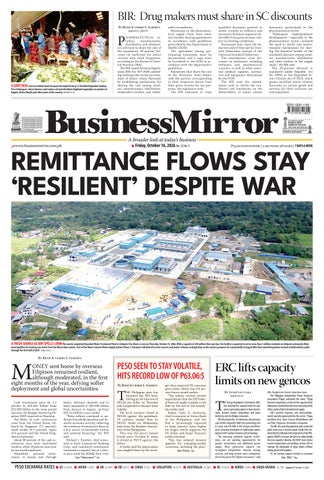
BIR: Drug makers must share in SC discounts By Reine Juvierre S. Alberto
P
HARMACEUTICAL retailers, manufacturers, distributors and wholesalers will have to share the cost of the mandatory 20-percent discount on medicines for senior citizens with retail drugstores, according to the Bureau of Internal Revenue (BIR). The BIR issued Revenue Regulations (RR) No. 007-2026, amending existing rules on the tax treatment of senior citizen discounts by establishing mechanisms for sharing the cost among retailers, manufacturers, distributors, wholesalers-retailers and whole-
A GOAT DEAL A local resident leads his goats through the busy La Trinidad Vegetable Trading Post in Benguet, where farmers and traders sell and distribute highland vegetables to markets in Baguio, Metro Manila and other parts of the country. BERNARD TESTA
ROTARY CLUB OF MANILA JOURNALISM AWARDS
2006 National Newspaper of the Year 2011 National Newspaper of the Year 2013 Business Newspaper of the Year 2017 Business Newspaper of the Year 2019 Business Newspaper of the Year 2021 Pro Patria Award PHILIPPINE STATISTICS AUTHORITY 2018 Data Champion
@reine_alberto
salers of medicines. Businesses in the pharmaceutical supply chain must enter into burden-sharing agreements in accordance with guidelines prescribed by the Department of Health (DOH). The agreement among participating businesses must be documented, and a copy must be furnished to the DOH in accordance with the department’s guidelines. Businesses that share the cost of the discounts shall deduct only the portion corresponding to their respective shares from their gross income for tax purposes, the regulation read. The BIR continues to treat
qualified discounts granted to senior citizens as ordinary and necessary business expenses deductible from gross income, subject to existing conditions. Businesses may claim the deduction only if they opt for itemized deductions instead of the Optional Standard Deduction. The amendments cover discounts on medicines, including influenza and pneumococcal vaccines, as well as other essential medical supplies, accessories and equipment determined by the DOH. The BIR said the amendments seek to clarify the conditions and limitations on the deductibility of senior citizen
discounts, particularly in the pharmaceutical sector. “Subsequent implementation developments—especially in the pharmaceutical sector—revealed the need to clarify and institutionalize mechanisms for sharing the financial burden of the mandated discount among retailers, manufacturers, distributors and other entities in the supply chain,” the BIR said. The 20-percent discount is mandated under Republic Act No. 9994, or the Expanded Senior Citizens Act of 2010, which grants qualified senior citizens discounts on certain goods and services for their exclusive use and enjoyment.
BusinessMirror A broader look at today’s business
EJAP JOURNALISM AWARDS
BUSINESS NEWS SOURCE OF THE YEAR
(2017, 2018, 2019, 2020, 2021) DEPARTMENT OF SCIENCE AND TECHNOLOGY
2018 BANTOG MEDIA AWARDS
REMITTANCE FLOWS STAY ‘RESILIENT’ DESPITE WAR www.businessmirror.com.ph
n
Friday, October 16, 2026 Vol. 22 No. 9
P25.00 nationwide | 3 sections 28 pages | 7 DAYS A WEEK
A FRESH SOURCE AS DRY SPELLS LOOM The nearly completed Kaysakat Water Treatment Plant in Antipolo City, Rizal, is seen on Thursday, October 15, 2026. With a capacity of 220 million liters per day, the facility is expected to serve more than 1 million residents in Antipolo and nearby Rizal municipalities by treating raw water from the Wawa Dam system. Part of the Wawa-Calawis Water Supply System Phase 2, the plant will diversify water sources and reduce reliance on Angat Dam as the country prepares for a potentially strong El Niño that could bring below-normal rainfall and dry spells through the first half of 2027. NONOY LACZA
M
By Reine Juvierre S. Alberto
ONEY sent home by overseas Filipinos remained resilient, although moderated, in the first eight months of the year, defying softer deployment and global uncertainties. Cash remittances grew by 2.2 percent to $23.424 billion from $22.909 billion in the same period last year, the Bangko Sentral ng Pilipinas (BSP) reported on Thursday. Two-fifths of cash remittances came from the United States, followed by Singapore (7.1 percent), Saudi Arabia (6.3 percent), Japan (4.9 percent) and the United Kingdom (4.8 percent). About 80 percent of the cash remittances were from land-based workers, while 20 percent were sent by sea-based employees. Meanwhile, personal remittances, or money sent through
banks, informal channels and in kind, amounted to $26.098 billion from January to August, up from $25.513 billion a year earlier. “These inflows continued to underpin household spending and domestic economic activity, reflecting the resilience of remittance flows as a key source of household income and external financing,” the BSP said. Michael L. Ricafort, chief economist at Rizal Commercial Banking Corp., said cumulative remittances continued to expand, but at a slower pace amid the Middle East crisis See “‘Resilient,’” A2
PESO SEEN TO STAY VOLATILE, HITS RECORD LOW OF P63.06:$ By Reine Juvierre S. Alberto
T
HE Philippine peso has breached the P63 level, hitting an all-time low of P63.06 per dollar on Thursday and is expected to become more volatile. The local currency closed at P63.06 against the greenback, 19 centavos weaker than its P62.87 finish on Wednesday, data from the Bankers Association of the Philippines. This was the peso’s lowest finish since October 8, when it closed at P62.9 against the dollar. A trader said the depreciation was weighed down by the stron-
ger-than-expected US consumer price index, which rose 0.6 percent from a month earlier. “The release revived market expectations that the [US Federal Reserve] might consider a rate hike by the end of the month,” the trader said. Ruben Carlo O. Asuncion, chief economist at Union Bank of the Philippines, said the Fed is increasingly expected to keep interest rates higher for longer, which supports the US dollar and keeps Treasury yields elevated. “This has reduced investor appetite for emerging-market currencies, including the peso,” See “Peso,” A2
ERC lifts capacity limits on new gencos By Lenie Lectura
T
@llectura
HE Energy Regulatory Commission (ERC) has removed the capacity limits for new power generating plants to boost investment, increase market competition, and lower electricity costs for Filipino consumers. ERC Resolution No. 34 eliminates the previous caps of 600 megawatt (MW) per generating unit in Luzon and 150 MW in the Visayas and Mindanao, allowing developers to build larger plants aligned with market demand and technology. “By removing outdated capacity restrictions, we are opening opportunities for greater investments and additional power supply. More generation capacity can strengthen competition, improve energy security, and help achieve more competitive electricity prices for Filipino consumers,” said
ERC chairperson Francis Saturnino Juan. The Philippine Independent Power Producers Association (Pippa) welcomed this move. “Pippa has been requesting a review of the capacity limits taking into consideration the ever increasing needs of the country both in demand and supply. ERC’s positive response and acknowledgement is greatly appreciated by the sector,” Pippa president Atty. Anne Estorco-Montelibano said via Viber. Pippa has 28 member companies. The ERC also said all prospective grid-connected plants must pass a System Impact Study (SIS) conducted by the National Grid Corporation of the Philippines (NGCP) to ensure the grid can safely handle the new capacity. Likewise, the NGCP must review reserve requirements and ancillary services (AS) to manage the integration of larger plants without risking power interruptions. AS are backup support needed to maintain See “ERC,” A9
PESO EXCHANGE RATES n US 62.8030 n JAPAN 0.3967 n UK 82.8497 n HK 8.0025 n CHINA 9.3767 n SINGAPORE 48.8778 n AUSTRALIA 43.7863 n EU 70.0630 n KOREA 0.0469 n SAUDI ARABIA 16.7287 Source: BSP (October 15, 2026)
News
BusinessMirror
A2 Friday, October 16, 2026
‘Resilient’… Continued from A1
and reduction in employment. “OFW remittances remained relatively resilient even at low singledigit growth levels (at least not declining year-on-year), similar to the Covid-19 pandemic period, as OFWs may need to send more to their families to better cope with higher prices,” Ricafort said. Although overseas Filipinos are thousands of miles away, high commodity prices have weighed down on them and their families here, even if the peso reaching P63 per dollar could provide more money for them, Ricafort added. In August alone, cash remittances increased by 1.9 percent to $3.035 billion from $2.977 billion in the same month a year ago. Personal remittances also rose by 2 percent year-on-year to $3.372 billion from $3.307 billion. “While geopolitical risks continue to pose challenges, remittances have historically been among the country’s most stable external inflows,” said Ruben Carlo O. Asuncion, chief economist at Union Bank of the Philippines. The BSP’s 2.7-percent remittance growth target for this year also remains within reach, Asuncion said, as seasonal holiday-related transfers typically pick up in the last quarter, provided current trends hold through year-end. Ricafort said 2 to 3 percent growth levels could be sustained in the coming months, unless weighed down by slower remittances from the Middle East and by more protectionist policies by the Trump Administration on immigration.
www.businessmirror.com.ph
Bring down high logistics cost, Marcos tells agencies
P
By Samuel P. Medenilla
RESIDENT Ferdinand Marcos Jr. has ordered concerned government agencies to bring down the cost of logistics in the country, which remains among the highest in Southeast Asia, by expediting the completion of infrastructure projects to improve connectivity. The chief executive made the announcement at the grand opening of the United States-logistics firm United Parcel Service’s (UPS) US$80-million Clark International Hub at the Clark Freeport Zone in Pampanga. “Our logistics costs account for up to 27 percent against sales, one of the highest in Southeast Asia,” Marcos said.
“We have to deal with congested ports, inadequate road networks, and insufficient cold chain facilities contributing to delays, increase in cost, and ultimately this affects the prices paid by our consumers,” he added. He directed the Department of Transportation (DOTr) and the Department of Public Works and Highways
Infants…
ceptive use, and make decisions about their own health care, either alone or jointly with their husbands. The survey found that 82.9 percent of currently married women aged 15 to 49 made their own informed deci-
Continued from A9
decide on family planning and contra-
(DPWH) to improve roads, bridges, and transport systems connecting agricultural production areas to ports and businesses. The government is currently building an integrated freight network linking major ports of Subic, Manila, and Batangas, according to Marcos. The new UPS facility at the Clark Freeport Zone, he said, will also help strengthen the country’s logistics system by helping it connect to the international market. It also has a dedicated immigration and customs lanes to streamline its cargo clearance as well as advanced sensor-based tracking, real-time visibility, and intervention capabilities for time- and temperature-sensitive shipments from healthcare, pharmaceutical, and biologics sectors. “The new hub is expected to handle around 46,000 packages
and cargo shipments daily—over nine times the estimated volume handled by the current UPS hub,” Marcos said. To fast-track the completion of similar facilities in Clark, the President instructed the Department of Trade and Industry (DTI) and the Bases Conversion and Development Authority (BCDA) to report every unfinished investment from the said site with an opening date. Marcos said the DTI has created its Supply Chain and Logistics Center (SCLC) to provide business access to supplier and logistics service providers. “These efforts are important steps forward. But we must also recognize that progress must be measured by whether Filipino consumers gain better access to the products that they need,” he said.
sions on these matters last year, up slightly from 82.3 percent in 2022 and 79.8 percent in 2017. By region, Central Visayas recorded the highest proportion of women exercising informed decision-making, at 88 percent, while BARMM posted the lowest at 54.6 percent. The proportion was highest among women with some college education, at 86.2 percent, and lowest among those with no education, at 71.5 percent.
Women’s informed decisionmaking also increased with household wealth, from 76.1 percent among those in the poorest quintile to 88.7 percent among those in the richest quintile. By employment status over the preceding 12 months, the proportion was highest among women employed for cash, at 85.2 percent. This was followed by women who were not employed, at 80.7 percent, and those employed but not for cash, at 79.8 percent.
Onion cartel’s ₧1.76-B… Continued from A1
Agriculture officials helped allocate import permits, saying its inquiry focused on evidence of coordination among companies. The administrative ruling is separate from possible criminal proceedings. The PCC said it would coordinate with the Department of Justice to assess whether the evidence supports a
criminal complaint. Paying the fine would not automatically resolve any criminal liability. Respondents may appeal to the Court of Appeals if their motions for reconsideration are denied. However, an appeal does not automatically suspend collection; a restraining order from the appellate court is needed to halt it, the PCC said.
Peso…
remain volatile and be “quite” tilted on the weaker side as the Bangko Sentral ng Pilipinas (BSP) entered its quiet period for next week’s rate-setting meeting. “[This leaves] domestic market participants uncertain as to how the BSP will react to this latest development,” the trader said. “Moving forward, the peso may remain volatile and generally biased toward weakness,” Asuncion said. However, any signs of US inflation easing, a less hawkish Fed or firmer BSP policy support could temper volatility of the exchange rate, he added. The BSP is expected to deliver a 25-basis-point rate hike in its upcoming meeting this October 22, as inflation turned out to be higher than anticipated at 7.2 percent. The key policy rate has been raised by a total of 75 basis points, delivered through three separate quarter-point rate hikes since the Middle East conflict erupted.
Continued from A1
Asuncion said. The weakening of the peso also reflected a combination of external pressures, specifically global uncertainty, elevated oil prices and sustained demand for the US dollar, and domestic concerns over inflation and investment inflows, John Paolo R. Rivera, senior research fellow at the Philippine Institute for Development Studies, added. “Breaching [P63-level] does not necessarily mean sustained depreciation,” Rivera said. “Concern is its impact on import costs, inflation, and household purchasing power.” “Priority should be managing excessive volatility while preserving price stability and investor confidence,” he added. The trader expects the peso to
‘Filipino recruit killed weeks after joining Russian army’
By Malou Talosig-Bartolome
L
ESS than two months after signing up with the Russian military, a Filipino recruit was killed in combat in eastern Ukraine, according to Ukraine’s military intelligence agency. The Defense Intelligence of Ukraine (DIU) said Sabtar Sabanal Malambahe, 39, of Labason, Zamboanga del Norte, enlisted in the Russian armed forces on June 16, underwent about a week and a half of training, was deployed to occupied areas of Ukraine in early July, and was killed during assault operations in the Donetsk region by the end of the month. Malambahe is the fourth Filipino reported killed while fighting for Russia in the Ukraine war, according to the DIU. According to the agency, Malambahe died near Kostiantynivka in Donetsk province. In a statement, the DIU said he had been “sent to his death in Donbas by the occupiers.” Documents released by the agency showed that Malambahe signed a one-year contract with the Armed Forces of the Russian Federation in Ryazan on June 16, 2026. His enlistment was processed by a military officer identified as Lt. V. Romanov. “The contract term was one year, which is typical for ‘disposable’ foreigners in the Russian army,” the DIU said. The agency said Malambahe underwent mandatory fingerprint registration the following day before being sent to a training center, where he spent only about 10 days learning basic shooting skills. By early July, he had been deployed to Russian-occupied territory in Ukraine. Weeks later, he was killed during assault operations, according to the DIU. The agency also released what it said were messages exchanged between Malambahe and another fighter believed to be a Filipino serving with Russian forces. “In a message dated July 28, a few days before his own death, Malambahe complained about constant attacks by Ukrainian drones and the death of his fellow serviceman,” the DIU said. Photographs published by the agency showed Malambahe alongside several other foreign fighters whom it said were likely Philippine nationals. “Despite warnings from the Philippine government and the requirements of local law, Malambahe was lured by the prospect of earning ‘easy’ money and decided to join the Russian occupation army,” the DIU said. His reported death came two months after the DIU announced that another Filipino, Jeric Jumadil Undol, had been killed while serving with Russian forces in Ukraine. The Ukrainian agency again appealed to foreign nationals fighting for Russia to surrender. “Any foreign national who has joined the Russian occupation army and finds themselves in trouble still has a chance to save their life by surrendering,” the DIU said. See related stories: htt ps:// businessmir ror. com.ph/2026/01/27/filipino-mercenary-killed-in-donetsk-as-moscow-kyiv-tradeaccusations-on-recruitment/ htt ps:// businessmir ror. com.ph/2025/11/28/russiaalleges-f ilipinos-of feredp300k-monthly-to-fight-inukraine/ htt ps:// businessmir ror. c o m . p h / 2 0 2 6/0 2 / 19/d f aukraine-holds-6-pinoy-pows/
www.businessmirror.com.ph
The Nation
Friday, October 16, 2026
A3
PNP probes spying risk near camps
T
HE National Police (PNP) is tightening internal security against potential foreign espionage after raiding a rogue, Philippine Offshore Gaming Operation (Pogo)-style operation located just steps away from the country’s top military and police headquarters.
T he joint law enforcement raid in Cubao, Quezon City, resulted in the arrest of at least 76 foreign nationals operating an illegal hub dangerously close to Camp Rafael T. Crame, PNP
National Headquaters and Camp General Emilio Aguinaldo, where the Department of National Defense office and the Armed Forces (AFP) General Headquarters are co-located.
Gen. Jose Melencio C. Nartatez Jr., National Police chief, has directed specialized units— including the Anti-Cybercrime Group—to ramp up vigilance, audit existing protective protocols, and fortify sensitive police systems against unauthorized access. Investigators are also investigating potential connections between the Quezon City raid and a massive bust earlier this month in Zamboanga Sibugay, where 244 foreign nationals, mostly Chinese, were arrested at a similar illegal compound. “The National Police will not take potential espionage threats lightly. We are taking all proactive measures to ensure that all important communication, our
systems, and all matters related to national security are protected,” Nartatez said. T houg h P resident M a rcos banned Philippine Offshore Gaming Operators (Pogo) nationwide, guerrilla-style hubs continue to pop up across the country. The proximity of several unauthorized operations to key defense fac i l it ies – combined with recent arrests of Filipinos accused of leaking West Philippine Sea intelligence to foreign agents—has amplified national security concerns. Nartatez assured the public that the PNP is actively validating all leads and coordinating with inter-agency partners to modernize safeguards against evolving security risks. Rex Anthony Naval
PHL, Japan strengthen security ties By Rex Anthony Naval
T
HE Philippines and Japan underscored their deepening security alliance following a high-level telephone discussion between National Security Advisor Eduardo Oban Jr. and his Japanese counterpart, Keiichi Ichikawa, head of Japan’s National Security Secretariat. Dur ing the dia log ue on Wednesday, both officials exchanged perspectives on t he
evolving geopolitical dynamics across the Indo-Pacific region a nd rea f f ir med t heir sh a red commitment to preserve a free, open, and rules-based international order. An official statement from the National Security Council (NSC) said the discussion focused on advancing concrete security mechanisms, notably the operationalization of the Reciprocal Access Agreement (RAA). Sig ned to streamline joint
militar y exercises and crossforces mobi l it y bet ween t he Armed Forces (AFP) and the Japan Self-Defense Forces (JSDF), the landmark defense pact serves as a cornerstone in both nations’ defense posture. In addition, Oban and Ichikawa explored avenues to broaden their bilateral Comprehensive Strategic Partnership and reviewed future directions for trilateral security cooperation alongside the United States.
Trilateral engagements involving Manila, Tokyo, and Washington have gained momentum in recent years as all three nations seek to enhance maritime domain awareness and regional deterrence. “The call reaffirmed the Philippines’ commitment to strengthen its security partnership with Japan and advancing practical cooperation with like-minded partners in support of regional peace, stability, and security,” the NSC said.
Disaster resilience starts at home–CCC By Jonathan L. Mayuga @jonlmayuga
S
TRESSING the importance of anticipating hazards, understanding risks, and taking preventive action before disasters strike, the Climate Change Commission (CCC) has called on Filipino households and communities to strengthen disaster preparedness and climate resilience as the country observed the International Day for Disaster Risk Reduction (IDDRR). Carrying the theme “Resilience Starts at Home,” this year’s observance highlighted the role of families in building safer communities through practical preparedness measures, informed decisionmaking, and collective action. Ident i f y i ng loc a l h a z a rd s, preparing emergency supplies,
monitoring early warnings, and establishing family emergency plans are among the steps households take to protect lives and livelihoods. CCC Vice Chairperson and Executive Director Robert E.A. Borje in a statement, said disaster resilience requires a shift from reactive responses to proactive, risk-informed decision-making. Borje underscored the importance of predictive governance, which uses science, climate data, and risk assessments to anticipate potential hazards, guide government decisions, and enable timely action before risks escalate into disasters. “Resilience cannot depend on reaction alone. We must anticipate risks, act on scientific evidence, and address vulnerabilities before hazards become disasters.
Ombudsman evaluates NBI findings on Sara By Joel R. San Juan @jrsanjuan1573
T
HE Office of the Ombudsman on Thursday said it would evaluate the findings submitted by the National Bureau of Investigation (NBI) pertaining to the alleged properties of Vice President Sara Duterte that were not properly declared in her Statement of Assets, Liabilities and Net Worth (SALN). “The referral and its supporting documents will undergo an initial evaluation to determine the appropriate action, including whether further investigation is warranted, in accordance with established procedures and applicable laws,’ the Ombudsman said. It assured the public that the issue “will be handled thoroughly, independently and without any political color.” Duterte has denied ownership of the properties that the NBI claimed were misdeclared in her SALN. Meanwhile, at a press briefing, NBI Director Melvin Matibag maintained the agency’s findings of discrepancies in the actual value of the properties owned by
the Vice President and her husband-lawyer Manases Carpio, which were declared in the Vice President’s SALN. “This is good because this is not hearsay or gossip. The document speaks itself, and they are the ones who signed it,” Matibag said. “Unless they claim that the SALN was falsified, made under duress, they were the ones who signed it. They were the ones who submitted it,” he pointed out. Matibag earlier said the Duterte family has 121 properties in Davao City and Davao del Norte, 24 of which belong to the vice president and are under investigation. About 14 properties had been identified from the Vice President’s SALNs for field inspection, according to the NBI. The NBI chief said its investigation is in line with the agency’s mandate under Republic Act 10867, which includes the conduct of investigation into alleged corruption and other criminal offenses involving public officers. Matibag added that its investigation is based solely on what Duterte declared in her SALN and the land titles recorded with the Land Registration Authority (LRA).
“This is the essence of predictive governance—ensuring that early warnings lead to early action, that preparedness begins at home, and that government investments protect lives and livelihoods before losses occur,” Borje said. “Building resilience is not simply about recovering from disasters; it is about preventing risks from becoming disasters in the first place.” The need for preparedness extends to climate-related hazards, including the potential impacts of a “very strong” El Niño in the coming months. Depending on its development and local conditions, El Niño may contribute to below-normal rainfall, dry spells, drought, water shortages, and risks to agriculture and other livelihoods. The commission encouraged families to stay informed through
official weather forecasts and advisories and to understand the hazards specific to their communities. Preparedness measures should account for a range of emergencies, including floods, landslides, storm surges, extreme heat, and prolonged dry conditions. Households can strengthen their readiness by preparing emergency go-bags, keeping essential medicines and important documents accessible, identifying safe evacuation routes and meeting points, and establishing family communication plans. Community-based preparedness activities, accessible early warning systems, and coordinated response plans are also essential, particularly in addressing the needs of children, older persons, persons with disabilities, and other vulnerable groups.
Pace of Sara impeachment trial expected to go faster By Jovee Marie N. dela Cruz
V
ICE President Sara Z. Duterte’s impeachment trial could move toward a quicker conclusion, with her defense expected to finish presenting its evidence in five to 10 trial days when the Senate Impeachment Court resumes proceedings on November 9, House of Representatives impeachment adviser and trial spokesperson Ace Barbers said. Barbers also raised personal questions about when Duterte’s disqualification from public office would take effect if she were convicted, saying the timing could have implications for her eligibility to seek public office ahead of the 2028 elections. Only Article II, which concerns alleged unexplained wealth, potentially incomplete asset declarations and prohibited business interests, remains before the court. “Since only one article will be discussed when we resume on November 9, the presentation will most likely take five to 10 trial days,” Barbers said. The prosecution must formally offer its documentary evidence by October 23, after which the defense will be given 10 days to comment, he said. Barbers said pursuing all four articles could have prolonged the proceedings until December or even next year, potentially diverting attention from other government priorities. “We should not focus only on this because there are many other important things we need to do, including addressing the Super El Niño,” he said, urging the government to prepare for the anticipated climate phenomenon. Barbers also raised questions about when the penalties for impeachment would take effect if Duterte were convicted, particularly in relation to the 2028 elections. “How soon will the penalties be imposed on the respondent? That is important,” he said, clarifying that he was raising a personal question rather than stating the prosecution’s official position. Barbers noted that the timing of any disqualification could become significant ahead of the next presidential election. His reference to the August 2027 filing of certificates of candidacy should be verified against the official Commission on Elections calendar. Under the Constitution, the penalties for impeachment are removal from office and disqualification from holding public office, without prejudice to criminal proceedings. Barbers stressed that any criminal cases arising from the alleged violations could proceed separately. “Here in impeachment, we know that the penalty is removal from office and perpetual disqualification from holding public office. But the criminal aspects of the violations of our laws will continue,” he said. Despite the impeachment court’s adoption of a revised voting formula that currently requires 14 votes for conviction, Barbers said he would prefer the prosecution to secure 16 votes to minimize the possibility of a Supreme Court challenge. “If you ask me, I would say we should aim for 16 votes to prevent any challenge before the Supreme Court,” he said. The revised formula counts senators legally and factually capable of participating in the judgment. Duterte’s camp has questioned the interpretation, maintaining that the Constitution requires two-thirds of all 24 senators. Barbers said the prosecution remained optimistic about securing a conviction but acknowledged the risk of dropping the other three articles. “This is a significant risk for the prosecution. If she is acquitted on the remaining article, then that is the end of the case,” he said. Manila Rep. Joel Chua, who is also a House prosecutor, said concentrating on the unexplained wealth article was partly intended to make the case easier for the public to understand and remember. “One of the things we considered was what our fellow Filipinos could understand more easily. We wanted to focus on one article because we believe it would be easier for them to understand,” Chua said. Chua said the prosecution made the decision internally after weighing its legal options and the risks of abandoning the articles involving alleged misuse of confidential funds, bribery and grave threats. He said the panel had discussed the move extensively before reaching its final decision on the morning it was announced. The prosecution’s final decision followed the testimony of financial forensic analyst Alexander Cabrera, its last witness on Article II. The defense is scheduled to begin presenting its evidence on November 9.
Cebu prepares for El Niño By Carmel Pedroza
C
EBU CITY—The provincial government of Cebu is set to procure additional water tankers and two solar-powered portable desalination machines as contingency measures that will help communities facing water shortages as it anticipates the impacts of a “very strong” El Niño beginning last quarter of this year. Dennis Pastor, head of the Cebu Provincial Disaster Risk Reduction and Management Office (PDRRMO), revealed during a Hisgutan Ta! media forum on Thursday that each desalination machine is estimated to cost around P8 million and can convert seawater into potable water during emergency situations. “We go to the sea. We get desalination [machines],” Pastor said, describing a contingency measure should existing water sources become insufficient during a crisis. He stressed, however, that the provincial government hopes these emergency resources will not have to be deployed.
This is apart from the plan of the provincial government to acquire eight additional water tankers with varying capacities to transport water to areas that may experience shortages, particularly upland communities where existing water sources are difficult to access. The province currently has 25 water tankers, including those operated by the Bureau of Fire Protection. Pastor said this is part of their Cebu El Niño Preparedness and Mitigation Plan that outlines the responsibilities of provincial government departments and local governments (LGU) in addressing the prolonged dry conditions. Pastor said the PDRRMO has met with disaster risk reduction and management officers from around 51 local governments to identify their most significant risks, available water sources and opportunities for neighboring municipalities to help one another. The municipalities were grouped into northern, central and southern clusters to
@joveemarie
map out their respective vulnerabilities and establish a water-sharing arrangement. Among the areas identified as having potential water sources are from the towns of Carmen, Dumanjug, Argao and Tuburan. The challenge is determining how water from these areas can be transported to communities facing shortages without compromising their own supply. Pastor noted that upland communities are particularly vulnerable because water may be available in lower elevations but difficult to pump or transport uphill. Risk mapping from the Department of Science and Technology’s Project Sarai (Smarter Approaches to Reinvigorate Agriculture as an Industry in the Philippines) Central Visayas mentioned during the forum identified Asturias, Tabuelan and Tuburan as among the towns most vulnerable to El Niño-related heat and water scarcity. Pastor said these areas share upland communities where water shortages are already being felt.
While Cebu remains under normal conditions, Pastor said the province expects dry conditions to begin in December, followed by dry spells in January and February. Drought conditions could start in March and persist until around midyear, after which recovery efforts would follow. He emphasized the need to translate preparedness plans into actual interventions before the prolonged dry spell sets in. The province is also looking into water catchment systems for hospitals, schools, public markets and government facilities to maximize rainwater collection. Households are likewise encouraged to harvest rainwater safely and responsibly. Other planned interventions include measures to address heat-related illnesses, such as pop-up shades and misting fans, as well as water purification support for communities with limited access to potable water. See “Cebu,” A4
A4
Economy
Friday, October 16, 2026
www.businessmirror.com.ph
NBB eyes E15 gasoline blend increase By Lenie Lectura
T
@llectura
HE National Biofuels Board (NBB) is considering raising the bioethanol blend in gasoline to 15 percent from the current 10 percent, a Department of Energy (DOE) official said. “At an E15 blend, many manufacturers are already on board, confirming that it is safe to use and will not void vehicle warranties. “Therefore, to fully capitalize on this situation, the NBB is considering raising the blend to E15. Manufacturers would not object, as the supply can be adequately met, and it would have the beneficial effect of helping to temper gasoline prices,” said Energy
Undersecretary Alessandro Sales. To boost domestic bioethanol supply and maximize unused distillery capacity, the government is looking to expand approved feedstocks by adding corn to existing options like sugarcane and molasses. “The Department of Agriculture is the one initiating the inclusion of corn as a feedstock for bioethanol production. This is
because they have visibility over the feedstock supply and understand how it might impact the entire supply chain. That’s the rationale,”said Sales. However, Sales said that even with the introduction of corn, local production is expected to fall short of demand. Consequently, the policy of allowing cheaper imported ethanol will continue, which helps lower retail gasoline pump prices. Sales explained that owing to the economic advantages of cheaper imports, the NBB is exploring an increase in the mandatory gasoline blend from to E15. While there is a voluntary E20 blend, Sales said its adoption is limited because many car manufacturers will not provide warranty guarantees for its use. In contrast, manufacturers widely support the E15 blend, confirming it is safe and will not void vehicle warranties.
“There’s a unique aspect to bioethanol: we allow the importation of ethanol whenever domestic supply falls short. By introducing corn, we could potentially increase local supply, as we would then have multiple feedstocks—sugarcane, molasses, and now corn. Yet, looking at the numbers, a supply deficit would still persist, even at our current E10 blend level,” he said, adding that imported ethanol is generally cheaper, which helps lower the pump price of gasoline. “At present, we already have a voluntary E20 option. The issue with E20, however, is that many car manufacturers will not provide a warranty guarantee for its use— a major concern for bioethanol adoption. In contrast, at an E15 blend, many manufacturers are already on board, confirming that it is safe to use and will not void vehicle warranties,” he explained.
SBMA eyes Japanese logistics hub By Henry Empeño
S
UBIC BAY FREEPORT—The Subic Bay Metropolitan Authority (SBMA) is wooing one of the largest logistics companies in Japan to establish a logistics and distribution center in this free port and take advantage of Subic’s growing importance as a strategic maritime gateway. SBMA Senior Deputy Administrator for Business and Investment Renato Lee III said the agency held “fruitful” business meetings with SBS Holdings Inc., a major player in Japan’s logistics industry, during the Osaka and Tokyo leg of the Philippine Investment Forum early this month. The event, organized by the Department of Trade and Indus-
try’s Philippine Trade and Investment Center (DTI-PTIC), brought together more than 200 Japanese business leaders, ref lecting the growing interest in the Philippines’ priority investment zones, infrastructure initiatives, and emerging economic corridors. “We had the opportunity to present and invite SBS Holdings and Toshiba, their joint venture partner, to establish a logistics and distribution hub in Subic,” Lee told the BusinessMirror on Wednesday. “We discussed Subic’s strategic location, our expansion program for container and break-bulk terminals, our connectivity to the Luzon Economic Corridor, and the presence of Japanese locators in Subic, and the discussions went well. The meetings were fruitful,”
he added. With approximately US$3.1 billion in annual revenue, SBS Holdings is one of the largest logistics providers in Japan today, Lee said. The company, listed on the Tokyo Stock Exchange, also develops, leases, and sells logistics facilities and warehouses, provides environmental and recycling services, and dabbles in solar power generation. “Subic will surely benefit from t he comprehensive log ist ics, freight forwarding, and transportation services that SBS offers, while SBS can take advantage of Subic’s growing industrial and commercial operations,” Lee added. The Subic Bay Freeport currently hosts major Japanese manufacturing and engineering firms. Among
them are Nidec, which manufactures brushless motors, fan motors, and industrial-robotic precision gearboxes; Sanyo Denki, which produces electric machinery, cooling fans, uninterrupted power supplies (UPS), servo amplifiers, and stepping motors; and Ichihashi Seiki, which builds precision engineering and industrial components. Lee said that with its strategic location, world-class port and infrastructure, and businessf r iend ly env i ron ment , Subic continues to position itself as a premier logistics, maritime, industrial, and investment hub in the country. “In Japan, we announced that Subic is open for business, and now Japanese investors are taking notice,” he said.
House panel sees need for sustained NSCR support By Jovee Marie N. dela Cruz @joveemarie
T
HE House Committee on Flagship Programs and Projects has underscored the need for sustained budgetary support for the North-South Commuter Railway (NSCR), citing its potential to cut travel time, reduce commuting costs and strengthen economic links between Metro Manila and Central Luzon. During a site visit organized by the Department of Transportation (DOTr), with support from the Japan International Cooperation Agency (Jica), lawmakers inspected key construction sites of the railway project, including the Malanday Depot in Valenzuela
City and Balagtas Station in Bulacan. Valenzuela Rep. Kenneth Gatchalian, along with Reps. Agatha Cruz of Bulacan, Antolin Oreta of Malabon, Mark Anthony Santos of Las Piñas, Monique Yazmin Lagdameo of Makati City and Elijah San Fernando of the Kamanggagawa party-list group, joined the inspection to assess the project’s progress, implementation challenges and expected economic benefits. At the Malanday Depot, the lawmakers tested a train simulator and examined electric multiple unit train sets. Gatchalian assured that Congress would continue supporting the project to help ensure its completion by 2033. “We are all here to help and ensure that
we meet our target dates,” Gatchalian said. “On behalf of the Committe on Flagship Programs and Projects, we want to make sure that all the projects, especially this major flagship project that will help many people, connecting basically the North and South Luzon, be fulfilled by 2033,” he added. The lawmakers were briefed on construction progress, efforts to address implementation challenges, and the railway’s expected benefits, including shorter travel times, less road congestion, safer transport and improved connectivity among key growth centers. The Malanday Depot will serve as the operations and maintenance hub for trains running along the NSCR line, while Balagtas Station will bring modern rail services closer
to communities in Bulacan. The committee’s call for sustained funding comes as the government advances the railway project, which is expected to improve worker mobility and access to jobs, education and essential services while supporting economic activity across Luzon. Once completed, the NSCR will be one of the country’s largest railway projects and is expected to support the development of the Luzon Economic Corridor by improving connectivity between Metro Manila, Central Luzon and other growth areas. The project is being implemented by the DOTr with financing support from the government of Japan through Jica, alongside other development partners.
Govt expands weather observation network By John Eiron R. Francisco
D
IGOS CITY, Davao del Sur—The Depar tment of Science and Technology (DOST ), through the Philippine Atmospheric, Geophysical and Astronomical Services Administration (Pagasa), and the local government on Wednesday advanced weather-monitoring efforts with the groundbreaking of the province’s first C-Band weather radar and the inauguration of the Digos Synoptic Station. Pagasa Administrator Nathaniel T. Servando said that Digos City had relied on meteorological observations from stations outside the city, limiting the availability of localized data on rainfall, temperature, humidity, atmospheric pressure and wind. With the Digos Synoptic Station, Pagasa can collect more localized weather data to support forecasting and monitoring, particularly as the country prepares for the possible effects of El Niño.
“These observations will support Pagasa’s national forecasts,” Servando said. However, Pagasa Deputy Administrator for Operations and Services Roy Badilla said the station’s data would not immediately improve localized assessments of the possible effects of El Niño, as climate analysis requires a longer record of observations. “For the El Niño events, we need historical data,” Badilla told the BusinessMirror in a separate interview, adding that the agency would continue relying on nearby stations while the new facility builds its own data record. Badilla said climate averages generally require about 10 years of observations, making it difficult to use data from a newly established station for localized climate assessments in the near term. “But it can help,” he added. The C-Band Doppler weather radar, meanwhile, is expected to provide broader coverage by tracking rain-bearing clouds
and weather systems before they reach affected areas. Badilla said the radar is expected to cover an area of about 450 kilometers that allows forecasters to track weather systems and monitor their movement. “Weather observations are essential, a state of science, of meteorology, with the state of the atmosphere providing us data to understand and predict the weather conditions for the next 6 to 12 hours and every 1 to 3 days, influencing our decisions on daily activities and how the weather will affect various sectors of our society,” Badilla said. He noted the radar’s data, which he put at an accuracy rate of 90 to 95 percent, could help the country’s weather agency issue more timely warnings and strengthen local preparedness for weather-related hazards. “As the country struggles with the continuous escalation of the impacts of hydrometeorological hazards, DOST-Pagasa will not stop pursuing our goal of saturat-
ing the country with a network of weather stations, leveraging available technological advances to ensure an agile network of remote and ground-based observations,” he said. The radar project has an allocation of about P250 million from the National Disaster Risk Reduction and Management Council (NDRRMC) fund for the equipment and tower. The Digos Synoptic Station has a separate estimated cost of P10 million. Construction of the radar facility is expected to continue through 2028, with operations projected to begin in 2029. The project site covers approximately 3,000 square meters. Badilla said the country currently has around 20 operational weather radars, although the network still needs to expand. He also cited World Bank-supported projects involving three X-band radars that are expected to further strengthen the country’s weather-monitoring capabilities.
Dole: 1.4 million find jobs through Pesos By Mary Jade Jadormio
M
ORE than 1.4 million job seekers were placed through Public Employment Service Offices (Pesos), posting a 91.72-percent placement rate, the Department of Labor and Employment (Dole) said. Labor Secretary Francis N. Tolentino said local employment offices are crucial in matching workers with jobs because they understand community-level skills gaps, worker capabilities and employers’ hiring requirements. “Through job fairs, job matching, career guidance and other services, you have helped turn employment opportunities into concrete pathways toward a better future,” Tolentino said. Speaking at the 26th National Peso Congress in Lapu-Lapu City, Cebu, Tolentino said employment facilitation must involve local governments (LGU) and communities, not just national and regional agencies. He also called for stronger operations among Pesos that have yet to be fully institutionalized, citing their role as frontline employment facilitators and sources of local labor market information. According to the Labor agency, 1,554 job fairs nationwide were conducted with the assistance of Pesos from January to August this year. A total of 65,534 applicants were immediately hired during these job fairs, Dole figures show. Meanwhile, Congress discussions focused on improving job matching, aligning skills development with employers’ requirements and strengthening pathways from education and training to employment. Plenary sessions tackled labor market intelligence amid digital transformation, coordination between Pesos and job placement offices, lifelong learning and the use of local labor market data to improve youth employability. Dole also introduced seven innovations under its Tulong Panghanapbuhay sa Ating Disadvantaged Workers (Tupad) program, seeking to move beneficiaries beyond short-term employment toward more sustainable jobs and livelihoods.
Money stress, stigma strain Filipino workers By Rizal Raoul Reyes @brownindio
M
ONEY troubles and fear of workplace discrimination are taking a heavy toll on Filipino employees, driving up burnout and costing companies valuable productivity. According to the latest Telus Mental Health Index (MHI), half of Filipino workers cite personal finances as their biggest stressor, while 52 percent identified cost as the primary barrier to accessing mental health care. When workers struggle in silence, both their health and their productivity suffer. Jamie MacLennan, Asia-Pacific region head at Telus Health, emphasized that finding the money for professional help often feels impossible for employees already living paycheck to paycheck. n High Risk on the Rise: 37 percent of Filipino workers now fall into the high mental health risk category, up from 31 percent in late 2022. n Heavy Productivity Loss: Employees who lack the energy to seek care lose an estimated 54.4 workdays a year to reduced focus and absenteeism—compared to just 22.3 days for those facing no barriers.
Cebu. . . Continued from A3
Pastor said the province has been conducting community-based disaster risk reduction training, including hazard, vulnerability and capacity assessments, in coordination with LGUs. He also underscored the importance of risk communication so residents, businesses and vulnerable sectors can prepare before conditions deteriorate. The PDRRMO will monitor temperature, rainfall and other indicators daily and maintain coordination with LGUs. The province has also prepared seven mobile kitchens and is working on food stockpiling
n The Stigma Penalty: 77 percent of workers fear that disclosing a mental health issue could jeopardize their career growth. Those carr ying this fear lose 11.4 more workdays annually than their peers. “Asking for help should never feel like giving up on your career,” MacLennan notes, calling on leaders to protect confidentiality and ensure fair performance reviews. Salary increases alone won’t solve the crisis. MacLennan points to clear, actionoriented strategies that companies can roll out today. The report highlights sharp generational and organizational splits: n Younger Workers: Employees under 40 are twice as likely as those over 50 to experience constant stress, finish the day exhausted, and struggle with daily concentration. n Non-Managers: Frontline employees are twice as likely as managers to rate their company’s mental and financial wellness support as poor. Closing these gaps isn’t just a compassionate gesture–it’s a critical commercial move to keep the workforce engaged, healthy, and thriving.
through the Provincial Social Welfare and Development Office should prolonged dry conditions disrupt food access. Pastor said the provincial government’s response would depend on the severity of the situation, from routine monitoring under normal conditions to heightened alerts, coordinated water assistance and emergency intervention when impacts require sustained provincial support. “The plan does not work if it’s not implemented and put into action,” he said, emphasizing that preparation must be backed by resources and timely action. He added that community preparedness remains essential, with families and local communities serving as the first line of response during disasters.
Friday, October 16, 2026
ILO launches $20-million program to protect migrant workers in Asean By Mary Jade Jadormio
T
HE International Labour Organization (ILO) launched a five-year program to strengthen labor protections, skills development and access to decent jobs for migrant workers across Southeast Asia, including the Philippines. The program, called TRIANGLE Partnerships for Fair and Effective Labour Migration in ASEAN, will run from 2026 to 2031. This five-year program will be funded with approximately $20 million by the Australian and Swiss governments. According to ILO, this program seeks to improve migrant workers’ access to safe migration pathways, skills recognition, social protection and support services. An estimated 24 million international migrants originate from Asean countries, while the region hosts around 11 million migrants, including about 7 million who have moved within Southeast Asia. Despite their contribution to regional labor markets, many migrant workers continue to face high recruitment costs, gaps in labor and social protection, hazardous working conditions and barriers to having their skills recognized. These vulnerabilities can expose workers to exploitation and trafficking, including forced criminality linked to scam center operations, according to the ILO. “Grounded in international labour standards, TRIANGLE Partnerships will connect ASEAN commitments with national action and services on the ground, so that migrant workers can access decent work, develop and use their skills, and get the protection and support they need throughout their migration journey,” Kaori Nakamura-Osaka, ILO assistant director-general and regional director for Asia
and the Pacific said. The program will cover Cambodia, Indonesia, Laos, Malaysia, Myanmar, the Philippines, Thailand and Timor-Leste, with activities focusing on fair recruitment, skills development and recognition, social protection, labor rights and reintegration. It will also link regional agreements with national policies and practical assistance through Migrant Worker Resource Centres, which provide information, counseling, legal assistance, training and referrals. Australia said the initiative would help translate Asean commitments into concrete measures to promote decent work and address emerging migration challenges, including those associated with scam center operations. “Effective labour migration can support inclusive economic growth, strengthen regional connections and create opportunities for workers, employers and communities,” Australia’s ambassador to Asean H.E. Tiffany McDonald said. Meanwhile, Switzerland said the program would emphasize skills development and recognition to help migrant workers access better employment opportunities and higher incomes. The initiative builds on more than 15 years of Australian government support for Asean labor migration programs and expands the ILO’s work to additional countries, with greater emphasis on skills mobility and recognition. Governments, employers’ and workers’ organizations, Asean institutions, civil society groups, migrant worker organizations and private companies will participate in the program’s implementation. The initiative was launched on Oct. 14 on the sidelines of the 19th Asean Forum on Migrant Labour in Manila.
Marcos to block ‘anomalous’ items in proposed 2027 national budget By Samuel P. Medenilla @sam_medenilla
P
RESIDENT Ferdinand Marcos is ready to freeze the release of “anomalous” line items in the proposed 2027 national budget to ensure taxpayers money will not be lost to corrupt practices, according to Malacañang. Palace Press of Claire Castro made the statement when asked if the Chief Executive is ready to push for a reenacted budget in case the 2027 General Appropriations Act (GAA) will be passed with dubious provisions from Congress. “Even though funds were inserted, they will not be released immediately because they were placed under the ‘for later release’ category—a status
By Justine Xyrah Garcia
A
P H I L I P P I N E Institute for Development Studies (PIDS) researcher is proposing a dedicated fund to help local government units (LGUs) update their landuse plans, as hundreds of existing plans need revision and dozens of cities and municipalities have yet to prepare one. In a new legislative input, PIDS Senior Research Fellow Adoracion M. Navarro recommended establishing a National Land Use Planning and Governance Fund to finance compliance with the proposed National Land Use Act (NLUA). “Many Philippine LGUs face limited technical capacity, outdated tools, and weak institutional systems for geospatial land-use monitoring, and building capacities needs funding,” Navarro noted. As of August 2026, 807 comprehensive land use plans (CLUPs) needed updating, while 40 cities and municipalities had no CLUP, according to data from the Department of Human Settlements and Urban Development (DHSUD). Another 119 plans were due to expire in 2027. DHSUD data also showed that 33 provincial development and physical framework plans (PDPFPs) needed updating, while five provinces had no such plan as of August 31. Another 32 PDPFPs had been approved and six adopted. Navarro said requiring LGUs to prepare technically sophisticated, climateresilient, and ecosystem-sensitive plans without sustained financing could undermine implementation of the proposed law. She noted that the fund could cover plan preparation and updating, geographic information systems, cadastral data integration, hazard and climate-risk mapping, technical personnel, inter-LGU planning, independent plan audits, as well as enforcement and monitoring. “The NLUA should also design the Fund such that a portion is allocated according to need and capacity, rather than equally, so poorer municipalities are not left behind,” she added.
Conflicting land-use rules
BEYOND funding, Navarro said the proposed law should address fragmented governance and conflicting mandates among agencies responsible for land allocation. She recommended an explicit legal framework for reconciling the NLUA with existing laws covering agrarian reform, agricultural land conversion, indigenous peoples’ rights, mining, environmental protection, housing, infrastructure and special economic zones. Navarro warned that leaving fundamental conflicts among existing laws to implementing rules and regulations (IRR) would be insufficient, as these rules cannot resolve inconsistencies between “laws of equal rank.” She also called for a national landuse institution with sufficient authority to settle disputes between agencies, rather than merely convening meetings or issuing recommendations. Under her proposal, a specialized adjudicatory body should issue binding decisions within a specified period if mediation and technical reconciliation fail. The proposed commission should have distinct functions for policy and planning, mediation and technical reconciliation, and binding adjudication. Navarro also recommended establishing a legally mandated national spatial database integrating authoritative information from relevant government agencies. The system should require common standards for maps, land classifications, data-sharing protocols and regular updates. Major government land-use decisions should not rely on incompatible or non-authoritative spatial data when an authoritative dataset is legally required, she said. “A strong substitute bill should therefore make the new law the country›s operating system for resolving competing claims over land, rather than simply another plan that government agencies and LGUs are required to prepare,” Navarro also said. “The substitute bill should move beyond being a land use planning law and become a genuine land use governance law.”
requiring the proponent to demonstrate that the project is viable and supported by appropriate feasibility studies. If you cannot prove this, the funds will not be released,” she said in Filipino in a press briefing last Thursday. Castro said Marcos already used the said strategy, which was opposed by some lawmakers, for the 2026 national budget.
“The President and the DBM has committed—much like what I have previously reported and what has already been conveyed to you—they will not permit funds in 2027 to be used for just anything. Every single peso of these funds must be for the Filipino people,” she said. She said the measure aims to prevent “ghost” or non-existent projects as well as misuse of government funds. Last March, House Speaker Faustino “Bojie” G. Dy III hit the Department of Budget and Management (DBM) for its slow disbursement of the approved budget. Marcos reiterated in his veto message on the 2026 GAA that all increases in appropriations and new budgetary items approved by Congress will be under conditional implementation. The Palace issued the said statement after Senate Finance Committee Chair Senator Joseph Victor “JV” G. Ejercito recently flagged nearly P260 billion realignments made by the House of Representatives in its version of the proposed 2027 national budget.
Vice President Sara Duterte also claimed that the 2027 budget will be used as a “bargaining chip” to pressure senator judges in her impeachment trial and reward members of the House of Representatives for supporting the articles of impeachment against her. Castro said she is confident the Senate can scrutinize the said budget proposal and raise their concerns about it during the bicameral conference. As for the allegations made by Duterte, she challenged the Vice President to present pieces of evidence proving her claims. The Presidential Communications Office undersecretary also said if Duterte has any doubts on the crafting of the proposed 2027 budget, she can attend the bicameral conference. “It might be better for her to sit in on the Bicam conference—if there is one—so she can better understand where the budget goes and how it is spent, ensuring it doesn’t end up in the pockets of a few corrupt individuals in government,” Castro said .
SC asked to clarify DepEd bolsters school safety ruling vs double with 339 new counselors in NCR discounts for seniors By Claudeth Mocon-Ciriaco
PIDS researcher proposes national fund to help LGUs update land-use plans
A5
@claudethmc3
T
O strengthen school safety and well-being, and address challenges such as bullying, a total of 339 newly appointed School Counselor Associates (SCAs) in the National Capital Region (NCR) took their oath on Thursday. Likewise, Education Secretary Juan Edgardo “Sonny”Angara led the expansion of the Department of Education’s (DepEd) nationwide mental health and well-being initiatives, coinciding with the nationwide observance of Mental Health Awareness Month and National School Safety Week. The initiative featured a Mental Health Caravan held at Marikina Elementary School, organized in collaboration with the National Center for Mental Health (NCMH) and key advocacy partners, along with the mass oath-taking of the SCAs, in line with the directive of President Ferdinand R. Marcos Jr. During the oath-taking ceremony, Angara emphasized that creating safe, supportive learning environments requires both physical security measures and compassionate mental health care. “Our goal is not only to ensure that our schools are safe, but also loving, like a second home and a second family to our children, many of whom come from far from ideal family situations,” Angara said. Angara reminded the new SCAs of the profound impact of their mission, urging them to maintain an approachable presence rooted
in active listening. “I would like to thank you for taking up the challenge to serve our youth. With your help, our youth are in need of proper guidance, direction, maybe a sense of mission, and something to hope for... As President Bongbong Marcos has said, this is one of the biggest challenges facing our country today and we must all work together to address it,” Angara said. Established under Republic Act No. 12080, or the Basic Education Mental Health and Well-Being Promotion Act, the newly created School Counselor Associate I position serves as a vital mechanism to bridge the country’s shortage of guidance professionals while strengthening psychosocial support systems in public schools. Operating under the supervision of School Counselors, SCAs will assist in learner profiling, initial assessments, psychosocial support, career guidance, and referral pathways for learners, families, and school personnel. To expedite deployment, DepEd compressed the recruitment and hiring timeline for SCAs to just 36 days. To date, 5,445 out of 10,000 authorized SCA positions have already been filled nationwide. The 339 newly appointed SCAs will be deployed across all Schools Division Offices in the NCR. The oath-taking ceremony was also attended by 36 incumbent guidance counselors. Held in partnership with NCMH, MindNation, SEAMEO Innotech, the Psychological Association of the Philippines, the Philippine Psychiatric Association, Philippine Health Insurance Corpora-
tion (PhilHealth), and Pocari Sweat, the Mental Health Caravan featured interactive booths and specialized learning sessions for learners, parents, and school staff. For learners, a session titled “Building Resilience for a Healthier YOUth” facilitated with the NCMH equipped student leaders and peer navigators with practical skills for emotional resilience, stress management, coping mechanisms, and anti-bullying strategies. For parents, the Philippine Psychiatric Association led the “P.A.C.T.–Parents and Classrooms Together” module, which focused on identifying forms of campus violence, cyberbullying, and safety threats while strengthening open communication at home. Teachers and non-teaching personnel participated in the “Mental Health First Aid Foundation” workshop organized alongside MindNation, which introduced workplace mental health frameworks and peer support strategies. Meanwhile, incumbent Guidance Counselors participated in a session on guidelines, roles and responsibilities, and procedures in the delivery of mental health and guidance services in schools. These measures form part of DepEd’s broader mandate under DepEd Order No. 06, s. 2026, or the Guidelines on Ensuring a Safe and Motivating Learning Environment. The policy combines physical safety upgrades, such as perimeter security and CCTV coverage, with peer support programs and dedicated referral helplines to cultivate overall learner well-being.
Sen. Villanueva weighs in on podcast that mocked disability of Kris Aquino’s son Josh By Butch Fernandez @butchfBM
‘N
AKAKAGALIT at nakakabastos [It is maddening and insulting]! There is no room for this kind of behavior in our society and in the digital space.” This was the reaction of Senator Joel Villanueva as he weighed in on Thursday on the controversial podcast hosts who mocked Kris Aquino’s son Josh, a person with autism. “As a parent. It hurts me to hear the mockery on a child with disability. However way we look at this, any kind of disability like autism can never be the subject of humor. People who mock PWDs should not be given any platform. Who in their right mind would make a mockery of a person on the spectrum? What sort of fun does one derive from insulting a person who cannot defend himself? Let me remind the hosts: hindi niyo ikina-macho ang mga pinagsasabi ninyo [What you said didn’t
make you any more macho],” Villanueva said, partly in Filipino. His reference to “macho” stems from the name of the controversial podcast where hosts compared Ms. Aquino’s sons Bimby and Josh, the older one, whom they described as “walang silbi” because he just stood in the sidelines. Many personalities and groups have since denounced the offending episode, which has been taken down by The Pod. Among the most vocal was broadcast personality Boy Abunda, who reminded the podcast hosts that Josh has his own role in the family. While Bimby helps entertain visitors, it is Josh who gathers everyone each day and leads them in prayer, according to Abunda. He said that if asked, he would suggest that Kris Aquino sue those who mocked Josh for his disability. For his part, Villanueva said in a statement on Thursday, “The issue is not just about Josh, whom we know is loved by his family and the people close to him, but also about how some
people still treat disability as a punchline. We have spent years fighting for a country where persons with disabilities are included in our classrooms, workplaces, and public life. A nation does not get to call itself inclusive while its loudest voices treat disability as entertainment.” He appealed to digital content creators and podcasters: “You have influence, so you have a responsibility. When you make fun of a person’s disability, thousands of followers are also encouraged to do the same. To the production company and network: it’s not enough to take down an after all the furor. You should lay down clear rules before airing an episode.” Villanueva continued: “Parents, siblings, and caregivers spend years building a world that is kinder to their loved ones, and they should not have to watch that world be ridiculed for views. We stand with them and with the many families whose own stories rarely make the news.”
By Joel R. San Juan @jrsanjuan1573
L
AWYER Romulo Macalintal has asked the Supreme Court (SC) to clarify its recent ruling which held that senior citizen discounts cannot be combined with other discounts. Macalintal was referring to the Court’s decision promulgated on October 14, 2026 which acquitted Orville U. Ong, the general manager of a hotel in Bacolod, of violating Republic Act No. (RA) 7432, or the Senior Citizens Act, as amended. Under RA 7432, as amended by RA 9994 or the Expanded Senior Citizen Act of 2010, Filipino residents aged 60 and above are entitled to benefits and privileges, including a 20% discount on services in hotels, restaurants, and recreation centers. Ong was charged with violation of RA 994 for refusing to grant the senior citizen discount to hotel guests, lawyer Paul Alcazaren, 66, and Eric Gadiana, 70. Ong argued that the hotel had already applied a 20 percent discount on the room rate negotiated for the Cebu Bikers Club, of which the guests were members. The discount was not separately reflected on the official receipt because it had already been deducted from the total amount. In acquitting Ong, the SC noted that the guests had already received the 20 percent discount through the club’s negotiated rate. Thus, the hotel was no longer required to grant an additional 20 percent discount. The SC explained that “when goods or services are offered at promotional prices, senior citizens may choose either the promotional discount or the 20 percent senior citizen discount, whichever gives them greater savings.” It added that“granting an additional discount beyond what the law allows would unfairly benefit the customer at the business expense.” “The Court should clarify that the denial of the senior discount in this specific case stemmed from a pre-negotiated group rate by an association of which the involved senior citizen was a member, and not a denial of the 20 percent discount on an item on a promotional price, commonly called a ‘promo’,” Macalintal said. He said a clarification is necessary because the decision might lead businesses to conduct promos on their own or run house promos to prevent senior citizens from availing of their 20 percent discount. “This distinction is vital. Without it, establishments might falsely label regular transactions as ‘promos’ to evade granting senior discounts, entirely defeating the protective intent of the law,” Macalintal said. He said the Court should point out that that the rule against double discounts applies only if the promotional discount has prior approval from the Department of Trade and Industry (DTI) and the promotion is for a specified period only.
A6
The World BusinessMirror
Friday, October 16, 2026
www.businessmirror.com.ph | Editor: Jeniifer A. Ng
names new Ukraine resumes attacks on Indonesia disaster chief as probe Russian refineries—officials ensnares 5 people By Chandra Asmara Bloomberg News
By Susie Blann
K
The Associated Press
P
YIV, Ukraine—Ukrainian drones attacked a refinery in Russia’s Ryazan region early Thursday, hours after Ukrainian President Volodymyr Zelenskyy said that a brief truce spurned by Moscow was over amid deepening tensions with Washington. The drone strike started a fire at the refinery about 300 kilometers (180 miles) southeast of Moscow, Russia’s Defense Ministry and Ryazan Gov. Pavel Malkov said. Russia’s Astra online news outlet posted what it said was a photograph of the blaze. A senior Ukrainian official who spoke on condition of anonymity because he wasn’t authorized to speak publicly confirmed that Ukraine had hit the refinery.
Zelenskyy’s complaint THE strike could further complicate Kyiv’s relations with US President Donald Trump, which have soured again in recent days. Zelenskyy was outraged by Russia’s continuing aerial bombardment of his country’s energy infrastructure in apparent defiance of Trump’s demand on Sunday for both sides to halt those attacks. The Ukrainian government said that it was heeding the ceasefire. Zelenskyy complained that, despite going along with Trump’s demand for a truce, Ukraine in recent days was denied the usual Western intelligence on Russian ballistic missile strikes and limits were placed on its use of US-made Starlink communication terminals. Both are vital for Ukrainian
defenses and attack operations. The Ukrainian leader said that his patience had run out. He said in an interview with the Financial Times published Thursday that Ukrainian attacks on Russian oil refineries would resume. “We’re done,” he was quoted as saying. Trump made a deal with Russian President Vladimir Putin to import Russian diesel, despite international efforts to sanction Russia for its invasion and diplomatically isolate Putin. Zelenskyy slammed the agreement, saying it would allow Russia to press on with its full-scale invasion of Ukraine that began more than four and a half years ago. US efforts under Trump to end the war have made no progress. Zelenskyy said in an interview late Wednesday with Piers Morgan on the British journalist’s YouTube show that he felt betrayed by Trump’s deal with Putin, the energy ceasefire announcement and the Starlink operational issues. “Really, yes, between us,” Zelenskyy told Morgan when asked if he felt betrayed by the American president. “Our country has to survive, and we count on our real partners, strategic partners, the United States and President Trump.”
BRITAIN’S Prime Minister Andy Burnham says goodbye to Ukraine's President Volodymyr Zelenskyy after their meeting at 10 Downing Street in London, Wednesday, October 14, 2026. AP PHOTO/ALBERTO PEZZALI He said that the U.S. behavior “was really strange and what was not like between partners but that they switch off Starlink, so some actually crazy steps between us.” In the same interview, Zelenskyy said that “we are losing a strong partner” in the United States. He said that “it’s painful when President Trump chooses one side, not our side. But we are OK that he’s in the middle.” Zelenskyy said someone is pushing Trump into a stance that is “not the right side of history.” The Starlink speed limits choked Ukrainian efforts to defend itself and hit back against Russia, Kyiv officials said. Elon Musk noted on X that the military version of Starlink, called Starshield, is controlled by the US military and Trump. The absence of Western intelligence leaves Ukraine more vulnerable to Russian ballistic missiles. Trump has said the U.S. hasn’t stopped sharing intelligence with Ukraine.
Ukraine looks to Europe AMID fears that the Trump administration may be withdrawing support for Ukraine, Zelenskyy was due in Brussels for talks with European Union leaders attending a summit. He was traveling to Belgium after visiting London, where he won pledges of more help from UK Prime Minister Andy Burnham. Asked whether the EU still trusts Trump, the bloc’s foreign policy chief, Kaja Kallas, replied: “We definitely
have a different approach to this war. We see that we have to pressure the aggressor to stop the war, not the victim to surrender.” “Squeezing Ukraine is not the right approach, and that is why Europe is standing beside Ukraine,” Kallas told reporters at the summit, which Zelenskyy is scheduled to attend on Friday. Three people were killed and six others injured after the Kirovohrad region of central Ukraine came under a Russian drone attack lasting more than 10 hours, Ukraine’s Emergency Services said Thursday. Zelenskyy said on X that between midnight and Thursday morning Russia launched more than 850 drones at Ukraine, adding that the barrage came “precisely at a time when the speed of our defensive capabilities is being artificially restricted.” Russian aerial attacks hit 15 Ukrainian regions, he said. “It is obvious that Russia deliberately chose to escalate its attacks after receiving sanctions relief and seeing attempts to pressure Ukraine,” Zelenskyy said. “It is important that everyone in America stand not with the aggressor, but with our efforts to protect lives, end this war and guarantee security.” Ukrainian air defenses stopped 536 Russian drones during a large-scale overnight attack, the Ukrainian Air Force said, but impacts were recorded at 31 locations. Russia’s Defense Ministry said that air defenses downed 166 Ukrainian drones overnight. It said that its forces hit two vessels carrying military cargo.
RESIDENT Prabowo Subianto replaced Indonesia’s disaster-management chief Thursday in a broader round of government appointments, a day after the country’s antigraft commission detained the outgoing leader’s brother and four others in a corruption probe involving emergencyresponse funds. The government gave no reason for Suharyanto’s replacement, and there was no immediate indication the move was connected to the investigation. The leadership change was announced alongside the appointment of four deputy ministers and new leaders of the national peatland and mangrove agency. The new chief of the National Disaster Mitigation Agency is Lt. Gen. Kristomei Sianturi, a former military spokesman and regional commander who graduated from SMA Taruna Nusantara, a military-linked boarding school whose alumni include several senior officials in Prabowo’s administration. Kristomei said he would review the agency’s internal operations and that the body wouldn’t interfere with the antigraft commission’s investigation. He added that he would assess the scale of ongoing wildfires that have sent hazardous haze into neighboring countries, and he pledged to accelerate disaster response. The Corruption Eradication Commission on Wednesday detained five people in the probe, including two advisers to Suharyanto: his brother, Bima Setiawan, and Richard Erlangga. The other detainees are Gabriel Purwaka Sigit, an agency procurement official, and two private-sector figures, Gery Prasetiawan and Syifa Nrika Ghifarian. The antigraft commission initially apprehended 14 people during the operation and later released nine, including the agency’s principal secretary, who was questioned as a witness. Suharyanto has not been named a suspect. Like many Indonesians, he goes by one name only. Requests for comment sent to detainees through the disaster agency were not immediately answered.
Investigators suspect officials improperly arranged procurement contracts and payments to private vendors, including through direct appointments, with some funds allegedly diverted for personal gain. The case involves allegations of bribery and conflicts of interest, antigraft commission Chairman Setyo Budiyanto told reporters Wednesday, adding that the alleged misconduct may date to 2022. The commission said investigators have yet to determine which disaster-response operations, if any, were involved. The allegations have drawn fresh scrutiny to an agency central to Indonesia’s response to frequent earthquakes, volcanic eruptions and other natural disasters. The agency and the central government have faced criticism over their handling of recent disasters, including floods in Sumatra last year that killed more than 1,000 people and a deadly 7.7-magnitude earthquake off Flores in August. Indonesia is also under pressure at home and abroad over forest and peatland fires across Sumatra and Borneo that have pushed air pollution to dangerous levels in parts of the two islands and in neighboring Singapore and Malaysia. The antigraft commission said it seized about 3.3 billion rupiah ($184,000) in cash, along with hundreds of grams of gold and cryptocurrency assets, during the operation leading to the detentions. Investigators have yet to disclose the total value of the contracts under investigation or the amount of suspected losses. The emergency funds under scrutiny account for the bulk of the disaster agency’s available funding. The agency said in September that it had received about 4.62 trillion rupiah in such funds this year, in addition to its regular budget of about 1.08 trillion rupiah. At the time, it was also seeking a further 5.67 trillion rupiah to support disaster response and recovery efforts. Thursday’s appointments are the latest in a series of personnel moves as Prabowo’s administration approaches its two-year mark. In recent weeks, he has named a new finance minister and police chief, and appointed a 26-member presidential advisory board.
China-North Korea bridge opens after more than a decade of delay
B
EIJING—A new bridge linking China and North Korea opened Thursday after more than a decade of delay, signaling deeper ties between the two countries. China’s official Xinhua News Agency reported that a ceremony for the launch of the New Yalu River Bridge was held, and an on online video from state media outlet China News Service showed the bridge and trucks waiting on it adorned with the national flags of China and North Korea. Beijing expected that the four-lane, 3-kilometer (1.8-mile) crossing, which connects the northeastern Chinese city of Dandong to the North Korean city of Sinuiju, would further promote economic, trade and “peopleto-people” exchanges. “The relations between China and North Korea have entered a new stage, embarking on a new chapter,” Chinese Premier Li Qiang said in a video address at the ceremony, Xinhua reported. Li said that the crossing would become a new landmark symbolizing the two nations’ traditional friendship. He hoped both sides would seize the opportunity of the opening to continue to enhance connectivity and explore potential for cooperation in border areas, Xinhua said. North Korean Premier Pak Thae Song also made a video address. The bridge initially was expected to enter use in 2014, when China had apparently completed construction on its side. But North Korea had not done corresponding work on its side at the time. The absence of substantial work in Sinuiju fueled speculation that Pyongyang was wary of becoming more economically dependent on China or displeased with Beijing voting for United Nations resolutions toughening international sanctions on the North over its nuclear program. Some observers suggested North Korea and China
also differed over the bridge’s location. The setback over the bridge prompted an unusually sharp report in the Global Times, a newspaper affiliated with the ruling Chinese Communist Party, which quoted Dandong residents expressing frustration over delays in what they had hoped would be an economic boon for their border city.
Russia-North Korea bridge
OBSERVERS said the new bridge would likely boost bilateral trade and enhance logistical efficiency. It is expected to lessen the burden on an aging bridge on the Dandong-Sinuiju route, which handles more than 70 percent of official trade between the two countries. That decades-old bridge carries a railway line as well as cars and trucks, but vehicle traffic can move only one way at a time. “The new bridge could facilitate trade that violates UN sanctions, but traffic across it could be more transparent and subject to customs than cross-border smuggling,” said Leif-Eric Easley, a professor at Ewha University in Seoul. The new bridge’s launch came about a month after North Korea and Russia opened a road bridge as part of their efforts to cement relations. Experts say Chinese officials likely felt uneasy about that opening. China has long been North Korea’s biggest trading partner and economic pipeline. But in recent years North Korean leader Kim Jong Un has prioritized Moscow, sending thousands of troops and conventional weapons to support Russian President Vladimir Putin’s war in Ukraine, apparently in exchange for military and economic assistance. Kim has recently drawn closer to China with the apparent intent to improve his country’s economy and build a front against the United States. China, for its part, wants to restore its unique influence over North Korea.
The World BusinessMirror
www.businessmirror.com.ph
Rising healthcare costs squeeze low-income, wealthy voters alike
F
Bloomberg News
nancial resources, are united in their frustration with a healthcare system that’s made getting care a challenge. About 30 percent of insured adults have skipped or put off medical care because of the cost, sometimes leading to worse health, according to a recent survey by KFF. Some didn’t buy the drugs they were prescribed because they were too expensive. “It’s affecting everyone,” said Drew Altman, KFF’s chief executive officer. “It’s not just low-income people, it’s not just the uninsured, it’s people with insurance who are struggling to pay their out-of-pocket healthcare bills.” In Waco, Texas, Wheat-Johnson is looking to the Democrats, who she often supports. She plans to vote for James Talarico for Senate, in a race that analysts see as a toss-up, with a recent Marist poll finding Talarico ahead by two percentage points. “We’ve been under a strong Republican government for a very long time, and we’ve seen what’s happened,” she said. “The healthcare system, it feels like it’s just being slowly dismantled, especially if you’re under a certain income level.” Just about any way you look at it, healthcare is getting more expensive. The government recently declined to renew some subsidies for ACA plans that help many Americans maintain healthcare coverage. On top of that, ACA premiums are poised to jump by about 15 percent next year, stretching the definition of “affordable.” Employer spending on workers’ healthcare is expected to increase 8 percent next year, the most since 2003, eating into families’ paychecks. Federal policy changes have made it
STEFANIE WHEAT-JOHNSON and her husband Eric look at medical bills on Friday, October 9, 2026. BLOOMBERG more difficult for people to enroll and stay on Medicaid. Healthier people, discouraged by premium hikes, are skipping insurance, in turn pushing up costs for those who remain covered. Meanwhile, incomes are going up by a paltry 3 percent. Most voters believe the federal government, not states nor private companies, will be able to make tangible change, raising the stakes for the midterms. A May survey by the Commonwealth Fund found that voters believe Washington is better equipped than insurance companies to lower premiums and out-of-pocket costs. Backing for a national health insurance plan, sometimes called Medicare For All, had record support among people surveyed at 66 percent, the KFF poll found.
Rollercoaster healthcare WHEAT-JOHNSON and her family have felt the effects of shifting healthcare policies for years. The couple have bounced on and off health insurance for more than a decade, depending on their employment or ACA marketplace prices. When Wheat-Johnson was uninsured, she got discounted care at a local family medicine clinic, but that didn’t cover everything. Their fortunes have improved this year, with Wheat-Johnson’s husband landing a job at a local nonprofit, which will give him a stipend to offset the cost of an ACA plan in the coming months. Wheat-Johnson, who is a seminary student at Baylor University, enrolled
this year as a member of the Cherokee Nation, which provides her a subsidy on her ACA premiums. Without it, she’d be paying over $800 a month, just for herself. Still, they’ve accumulated around $6,000 in medical debt after WheatJohnson was diagnosed with fibromyalgia and also developed a heart condition that required ambulance rides, emergency room visits, treatment and eventually surgery. Each month, she pays $100 to slowly chip away at it. Medical debt is common across the US, with 27 percent of adults reporting they or their family members owed money for medical services in 2025, according to an Urban Institute analysis. Just over half owed more than $1,000. One in 10 put the medical bills on a credit card and were paying off the balance over time. Even with Medicaid coverage, healthcare has been getting more expensive for Wheat-Johnson’s kids. One of them was recently diagnosed with a hormone disorder, which cost more than $1,000, despite having coverage. The child was recently forced to switch from one Medicaid plan to another, and drugs that were free now cost $480 a year. “It wears on you mentally, in the sense that you begin to think you’ve failed in some sort of way,” WheatJohnson said. “You can tell yourself, intellectually, ‘I’m not failing, this is just the circumstances.’ But it’s not the American dream.”
An increase in killings of women in Cameroon spurs protests By Nalova Akua
The Associated Press
Y
AOUNDE, Cameroon—Geraldine Achiah, an elementary school teacher in her 30s, died barely two months into her marriage in September. Her relatives allege her husband beat her over a marital dispute and demand justice in what they say is a gender-based crime. Her only child, Courage Abombi, 18, fondly remembers her support for his dreams of becoming a mechanical engineer. “My mom died an unexpected and painful death,” said Abombi, who had to take a university entrance exam a day after his mother’s burial. Achiah, who died in September, is one of nearly 70 women who were killed in Cameroon this year for reasons related to their gender, the Ministry of Women’s Affairs says. That’s up from government estimates of at least 50 in 2023 and 67 in 2024. The rise in such killings has sparked protests and calls for government action as many of the killings remain unsolved while others go unreported. Manfred Amambua, Achiah’s husband, has denied killing his wife, the police said. He has been charged with murder and is in jail awaiting trial. Femicide — the killing of women and girls for gender-related reasons — in Cameroon is mostly driven by economic dependence, unequal control over family property and lack of adequate laws in what’s widely viewed as a patriarchal society, activists say. The crisis reflects a global pattern with an estimated 50,000 women and girls killed by intimate partners or relatives in 2024, UN data shows. Femicide cases in Cameroon have reached a “cruel” and “alarming” proportion, Women’s Affairs Minister Marie-Thérèse Abena Ondoa recently told the state broadcaster as she
A PORTRAIT of Achiah Geraldine, a woman who was murdered, stands framed by the floral arrangements at the foot of her casket inside a mortuary chapel in Yaoundé, Cameroon, Friday, Sept. 18, 2026. AP PHOTO/ANGEL NGWE
promised more action from the government. “The current economic situation in the country is not helping matters. With limited resources, many women tend to endure violence in their marriages, hoping that their men will change, which is not usually the case,” she added.
Limited laws
AT the root of the crisis is inadequate laws to punish offenders and a poor judicial system, activists say. While Cameroon’s Penal Code recognizes crimes such as rape, it does not have explicit laws or provisions on femicide, leaving judges to rely on general laws on harmful acts. It is a common trend across many African countries where femicide is addressed through general homicide laws rather than expressly defining it as a distinct offense, although some have taken limited legal or policy steps that acknowledge femicide. The Cameroonian government is working
European Union leaders have few tools to ease war-driven energy shock By John Ainger Bloomberg News
E
OR more than six months, Stefanie Wheat-Johnson’s jaw has throbbed in pain. The 44-year-old mother of three needs a root canal, but her health plan doesn’t include dental work. Paying cash at her local Texas clinic will cost $3,600—money W heatJohnson and her husband Eric simply don’t have. The couple, who make $60,000 per year after taxes, weighed their options, including asking for payment extensions on their utilities and even delaying rent payments to get her care. In the Pacific Northwest, Ed Travalia has seen his family’s healthcare premiums skyrocket to nearly $32,000 per year for the most inexpensive, bare-bones Affordable Care Act plan. The 56-year-old was able to retire early and lives off his investments, but he still worries about how healthcare costs will look over the next several decades. Much of his time is spent looking for healthcare alternatives that won’t break the bank for his family of four and offer sufficient coverage. Nowadays, he also avoids doctor appointments if he can. Across the country, Americans spanning a multitude of income levels are navigating the increasing costs of healthcare. The issue, spurred by and contributing to a broader affordability crisis, is now at the forefront of this year’s election cycle. Healthcare costs outranked food, housing and utilities as the top economic concern alongside gas prices for voters in the midterm elections, according to a recent poll from health research group KFF. Healthcare was more important to voters than immigration, foreign policy, crime or AI in a separate Pew Research Center survey in October that polled about 4,000 people. Politicians are courting voters like Wheat-Johnson and Travalia, who despite having very different fi-
Friday, October 16, 2026 A7
on a new bill that would establish femicide as a standalone criminal offense while also strengthening broader protections against gender-based violence. For rights groups and activists, that is only one of several hurdles to stop the killings. Cases can be delayed with different tactics, including intimidation, corruption and procedural mistakes that can reduce charges or even lead to acquittals, said Carole Grace Mbarga, a Cameroonian rights activist. “When investigations drag on, evidence deteriorates, witnesses lose confidence, and families become discouraged,” she said. Even when convictions in such cases happen, the punishments are usually light and short of expectations, such as in 2025, when a man who pleaded guilty to killing his wife was handed a suspended five-year sentence and a fine of 52,000 CFA francs ($90).
‘A painful death’
FAMILY and friends recently gathered in
Yaounde for the burial of Achiah, who had just married her husband in July. Her relatives are grappling with the loss and told the AP they’re not only worried about justice for her, but also for other victims of femicide. “I pray that justice will follow its due course and that her killer will face the law,” Abombi said. The AP obtained hospital records that noted Achiah had “several bruises on her face and lips” before she died. Ndzana Bienvenu, an officer involved in investigating the case, said police gathered other evidence including phone footage of her and her husband after the alleged beating, as well as blood-stained bedsheet. “We want justice for our daughter who died a violent death. This was a teacher who imparted knowledge on thousands of young Cameroonians,” said Regina Ngukum, Achiah’s cousin. Anti-femicide protests have been held in major cities in the country, including Douala and Yaounde, with thousands demanding more action from the government. The proposed law against femicide is expected to be submitted to parliament for consideration in November. But in addition to the law, systemic barriers and support for victims should also be addressed, said Laura Sen, one of the protest organizers. For many Cameroonian women who face violence at home, they often have to contend with hardship and stigma, especially when they already have children. In the case of Achiah, her child said he is praying for justice for her death and “that her killer will face the law.” “She keeps appearing to me in a dream, consoling me not to despair and that she is still with me,” he said.
UROPEAN Union leaders are searching for ways to ease soaring energy prices, but President Donald Trump’s war against Iran has left them with few affordable options. Surging energy costs form the cornerstone of a broader debate on European competitiveness that will open a two-day summit in Brussels starting Thursday. The conflict in the Persian Gulf has pushed up oil and gas prices, boosting inflation and weighing on economic growth across the 27-nation bloc. The European Commission, the EU’s executive branch, is expected to tell the bloc’s leaders that there’s no silver bullet to combat high energy prices, according to a senior EU official, speaking on the condition of anonymity as the discussions are private. The Iran war has so far added more than €100 billion ($111 billion) to Europe’s fossil fuel import bill, while leaving the region’s gas storages at record low levels before the winter heating season. EU member states are similarly hobbled: price caps and tax cuts come with a heavy fiscal cost at a time when government budgets are increasingly stretched. Soaring interest rates are compounding the challenge. “EU leaders face a second energy shock in four years; this time with higher public debt and borrowing costs,” said Elise Viadere, a research fellow at the Centre for European Reform. The EU has few, if any, quick fixes. The commission is looking to extend joint energy purchases, while postponing a climate rule to tackle methane in fossil fuel imports and prolonging state aid to hard-hit industries. But neither of those do anything to curb prices in the short term, with the region dependent on oil and gas imports. Italian Prime Minister Giorgia Meloni said Wednesday she was nearing a deal with the commission to be able to cap the price of natural gas used to generate electricity. German Chancellor Friedrich Merz has also proposed a significant cut in electricity taxes for all consumers, but it remains unclear whether the finances exist to implement it. EU leaders will call on the commission to put forward further measures to address soaring energy prices in the short term, ac-
cording to draft conclusions seen by Bloomberg. But they stop short of saying what those will be. Overlapping Thursday’s summit is a meeting of the International Energy Agency which is due to decide on G-7 commitment to quickly release diesel supplies into the market. The commission is already assessing the potential impacts of imposing a EU-wide tax on windfall profits made by energy companies. That echoes the “solidarity contribution” it imposed following Russia’s 2022 invasion of Ukraine, which was effectively a 33 percent tax on energy firms’ excess profits. It also introduced a revenue cap for so-called inframarginal electricity producers, like wind and solar. But such a move would face opposition from some member states. There’s also concern about tamping down industry profits when investments are needed in oil refineries to ensure the region has enough supplies for citizens and its defense industry. EU leaders are expected to reiterate that the energy transition is the most effective strategy to lower prices in the long term, yet countries are also split over an overhaul of the bloc’s Emissions Trading System. One group, including Spain, the Netherlands and Scandinavian nations argue that the tool is vital for Europe’s competitiveness in cutting-edge technologies, and any weakening would undermine the bloc’s longer-term objectives. But others blame the bloc’s carbon market for adding to industry costs. Meloni and her Czech counterpart Andrej Babis want to stall a 2028 expansion of the ETS to heating and road transport, and bolster protection for industries under the existing system. Their call was mirrored by industry groups this week, calling on leaders in a letter to better align the ETS and Europe’s competitiveness goals. EU leaders need to go beyond short-run solutions to cut electricity prices, according to Simone Tagliapietra, deputy director at the Bruegel think tank. “Structurally lowering electricity prices takes time and requires structural answers, such as deeper integration of the European electricity system,” he said. “Without a strong political steering by EU leaders to go down this route, no real progress is possible.”
Credit Suisse bankers lose final bid to win back bonuses By Hugo Miller | Bloomberg News
C
REDIT Suisse bankers stripped of their bonuses when UBS Group AG bought its collapsing rival won’t get their money back, Switzerland’s top court ruled, overturning a decision that could have benefited as many as 1,000 ex-employees. Judges said that because the rescue package was supported by billions in taxpayer money that it would be unlawful to pay out the bonuses. “Given the extent of the required state aid, there is a public interest in preventing unreasonably high variable compensation,” the Swiss Supreme Court said in a September 16 ruling released on Thursday. The verdict, which can’t be appealed, draws a line under the attempt by former Credit Suisse staff to receive bonuses they argued were wrongfully taken away from them. While the lower court ruling from 2025 ruling was for a test group of 12 employees, it said its decision could ultimately affect about 1,000 people. The court didn’t say how big the potential bonus pool was. Credit Suisse was bought in March 2023 by its larger Swiss rival backed by a 9 billion franc ($10.9 billion) loss protection agreement and a public liquidity backstop of up to 100 billion Swiss francs ($121 billion), which UBS later ended. As part of that rescue, the Swiss finance ministry ordered Credit Suisse to cut bonuses altogether for its executive board members, reduce them by 50% for managers a level lower, and by 25 percent for employees two levels down. The top court’s verdict endorses the finance ministry’s original order, and upholds the appeal from the Swiss government and UBS. “UBS takes note of the decision,” the bank said. On Thursday, the Supreme Court high-
lighted the need to not put public money toward paying banker bonuses. It also said existing Swiss bank law provides justification for the original decision to scrap the bonuses and that the lower court’s interpretation of the case was too narrow. The court stipulated that the cancellation of bonuses is limited to bonuses guaranteed by the end of 2022 but not yet paid out as of March 21, 2023 the date of Credit Suisse’s rescue. Also included is variable compensation guaranteed or maturing in 2023, from March 22 until no later than the repayment of the state aid or the transfer of Credit Suisse employees onto UBS’s payroll.
‘Perverse incentives’
LASTLY, the Supreme Court in its ruling also tackled the potential complaint that those bonuses should be paid given that UBS repaid its state aid commitments. “If the payment of variable compensation were merely deferred, the respondents would still indirectly benefit from the state aid—with a time lag—which creates perverse incentives,” said the court. UBS is locked in disputes over other aspects of the Credit Suisse rescue. The bank is appealing a Swiss administrative court’s decision to revoke the writedown of AT1 bonds ordered by Swiss banking regulator Finma as part of the bailout package. AT1s are a risky form of investment, and the Swiss government and Finma contend that investors should have known about the conditions contained in the bonds’ fine-print. The AT1 bondholders disagree, arguing that Credit Suisse shareholders should’ve absorbed losses before them. The Zurich-based bank is also fighting a battle with the Swiss government over its capital requirements, a tussle that has prompted debate over whether it could or should leave the country.
A8
The World BusinessMirror
Friday, October 16, 2026
Singapore thick haze drives air purifiers, face masks to sell out By Anuradha Raghu, Rong Wei Neo, Ishika Mookerjee & Hallie Gu
A BOAT passes by as the Marina Bay Sands and skyline are seen in Singapore on October 15. FELINE LIM/AFP/GETTY IMAGES/BLOOMBERG
Bloomberg News
T
HE thick haze blanketing Singapore as wildfires rage in neighboring Indonesia is driving a surge in demand for air purifiers and face masks. Several air purifier models from brands including Xiaomi Corp. and Dyson Group Plc were sold out, according to their websites. Sales had surged more than 19fold year-on-year in the first half of October, which left all 18 of Xiaomi’s Singapore stores without air purifiers, a spokesperson said by email. A new batch began arriving at stores Thursday as the company expedites replenishment and adjusts supply to meet demand, the spokesperson said. At home-appliance retailer Gain City, sales of air purifiers have jumped to around nine times the levels recorded since the start of the haze season in August, said Marketing Director Candy Cao. “Demand remained particularly
strong over the weekend, with some popular models selling out and some customers opting to purchase display sets so they could bring their products home immediately,” Cao said, adding that the retailer will continue to replenish stocks to meet demand. Residents are also stocking up on N95 face masks as the city-state chokes in the worst episode of smog in over a decade. Multiple listings at several online drugstores and pharmacies showed the disposable masks were sold out or will be “available soon.” A Singapore gauge of air quality deteriorated to the highest category in parts of the city-state on Wednesday, exacerbating health concerns as smoke from Indonesian fires envelop parts of Southeast Asia for weeks. Singapore ranked second on the list of the world’s most polluted major cities, behind Malaysia’s Kuala Lumpur and ahead of Indonesia’s Medan
and its capital Jakarta, according to data compiled by IQAir. A 24-hour measure of air quality showed all five regions in Singapore at the “unhealthy” level as of Thursday afternoon. Prime Minister Lawrence Wong’s administration convened its Haze Task Force on Oct. 9 and started distributing N95 masks to vulnerable Singaporeans on Wednesday. The island also opened haze shelters at community spaces, curtailed outdoor activities for military personnel and students as well as closed some sports facilities. The National Environment Agency said some stores may temporarily run out of the masks, though retailer warehouses and government stockpiles have sufficient supplies. The government is working with retailers to replenish the stocks. Singapore officials are collecting data and keeping open the possibility
of legal action under its transboundary haze law, said Sustainability and Environment Minister Grace Fu. Companies that cause or condone fires can face fines of as much as S$2 million ($1.6 million). In Malaysia, school closures have affected millions of children and low-cost carrier Firef ly canceled flights to Singapore’s Seletar Airport through Friday, citing the “persistent weather and haze situation.” Malaysian Queen Raja Zarith Sofiah donated 73,000 masks to residents, according to a Facebook post by the king’s office. The Civil Aviation Authority of Singapore and Changi Airport Group said they are prepared to increase spacing between takeoffs and landings, and switch on airfield lights during the day if the haze worsens. They are coordinating with airlines and unions to maintain safe operations at Changi and Seletar airports. Sixteen f lights were diverted from Seletar between Oct. 5 and 11 and some airlines have adjusted or canceled services based on conditions. Singapore Airlines Ltd. said its operations were unaffected, adding that “safety is the top priority.” Indonesia has recorded more than 8,000 fire hotspots this month, the most for October since 2015, according to its Forestry Ministry. Poor visibility has hampered aerial firefighting. Authorities are testing aircraft that scatter dry-ice pellets over South Sumatra in hopes of bringing rain. Indonesia expects its rainy season to start later than usual, in November or December.
Study says global warming did more than El Niño to turbocharge Hurricane Polo By Seth Borenstein The Associated Press
W
A SHINGTON—A new study finds that climate change and El Niño combined to rev up last month’s explosively intensifying Hurricane Polo, which was the longest-lasting Category 5 storm ever to churn in the Pacific. Global warming caused by the burning of coal, oil and gas was the bigger of the two culprits, adding about 6 mph (nearly 10 kph) to its already monstrous strength, according to a joint study published Thursday by the science teams World Weather Attribution and Climate Central. El Niño contributed a bit less, about 5 mph (8 kph), a study co-author said. Climate change made the conditions that fueled the hurricane 23 times more likely, while El Niño— the natural and temporary warming of parts of the Pacific—made it 14 times more likely, the study found. It all has to do with the 88-degree Fahrenheit (31.2 degrees Celsius) waters that were as much as 3.6 degrees Fahrenheit (2 degrees Celsius) warmer than normal, the study said. This year, with a super strong El Niño, has set records for strength and longevity of Pacific storms. Polo set the record for time spent at Category 5 in the Pacific at two-and-ahalf days. “El Niño and climate change both made this hurricane stronger than it would have otherwise been, but the effect of climate change is even bigger than the one of El Niño,” said climate scientist and study co-author Friederike Otto, who coordinates the international science team behind World Weather Attribution. “El Niño comes and goes, but climate change only gets worse. That means that now every hurricane that
will occur in the East Pacific has at least this climate change signal making it stronger. And as long as we keep burning fossil fuels, that will only get bigger,” Otto added. Researchers found that without climate change and El Niño, Polo would have been a monster storm anyway. But every bit of additional wind speed can dramatically increase the damage.
Decoding Polo’s rapid strengthening WHILE Hurricane Polo ultimately weakened considerably before it hit a sparsely populated part of Mexico, scientists remain fascinated by how it turbocharged from a tropical storm to a top-of-the-chart Category 5 hurricane in about 24 hours. The study puts the different atmospheric dangers in perspective, said Kristina Dahl, a climate scientist and vice president of science at Climate Central, a science and jour-
nalism nonprofit out of New Jersey. “It’s a powerful reminder that even though El Niño right now is shifting hazards around the globe and changing where it’s flooding and getting dry, the really dominant signal behind all of this remains climate change,” she said. The study looked at the warm water that fuels storms, using a measure of how strong they can get. But the study didn’t focus on the upper level wind shear where El Niño has a huge footprint. El Niño usually increases those storm-decapitating high altitude winds in the Atlantic. However, in the Pacific because of changes in wind patterns, El Niño decreases the winds that weaken storms. The two sets of researchers measured conditions slightly differently and used different techniques but came to the same general conclusion, making them more confident in the result. However, the rapid study has not had time to be peer-
PEOPLE evacuate their homes as Hurricane Polo approaches Puerto San Carlos, Baja California Sur state, Mexico, Monday, September 28, 2026. AP PHOTO/EDUARDO VERDUGO
reviewed, which is the gold standard of science. To calculate the impact of climate change on Polo, both teams used the scientifically accepted method of comparing what happened in our warmer real world to a hypothetical world that hasn’t warmed by 2.5 degrees (1.4 degrees Celsius) since pre-industrial times.
How El Niño and climate change interact STUDY co-author Daniel Gilford, a Climate Central scientist, said the process they looked at was similar to cars on a road. Wind shear from El Niño can be a red light, as it is in the Atlantic, or a green light, as it is in the Pacific. In the Pacific that green light says go, and then the water warmed by both climate change and El Niño acts like a driver flooring the accelerator. University at Albany atmospheric scientist Brian Tang, who wasn’t part of the study, said he was initially surprised that the research found climate change to be the bigger influence on Polo, “given how extreme this El Niño is, but from a long-term standpoint, perhaps the result isn’t as surprising as it might seem.” But three other outside scientists—Jeff Masters of Yale Climate Connections, University of Pennsylvania’s Michael Mann and North Carolina State University’s Carl Schreck—aid they believe the study underestimates how much climate change has added to Polo’s strength. Masters pointed to Gilford’s own 2024 study that found climate change added 16 mph (30 kph) to hurricanes in the Atlantic from 2019 to 2023. Gilford acknowledged that Thursday’s report could be underestimating climate change’s impact a bit, but said he was factoring in other conditions and being conservative.
www.businessmirror.com.ph
School roof collapse in Pakistan kills at least 35 and injures more than 50 By Riaz Khan & Munir Ahmed The Associated Press
P
ESHAWAR, Pakistan—The roof of a private school collapsed in the northwestern Pakistani city of Peshawar on Thursday, killing at least 34 children and a teacher and injuring more than 50 other people in the deadliest incident of its kind in the country, authorities and a hospital official said. The children killed or injured at Al-Khair school were between 6 and 12 years old, while the oldest was 14, Lady Reading Hospital spokesman Mohammad Asim said. Some of the injured were in critical condition, he said. The hospital declared an emergency as medical staff treated the wounded. Hours after the collapse in Peshawar, the capital of Khyber Pakhtunkhwa province, emergency services spokesperson Bilal Faizi said that everyone trapped beneath the rubble had been pulled out and crews had cleared debris. He told The Associated Press that the roofs of two classrooms collapsed when second- and thirdgrade children were in them with their teachers. Faizi said ambulances and disaster management personnel arrived from a nearby facility within five minutes of being alerted. Nearly 100 rescuers eventually joined the operation, he said. Panicked, grieving parents were trying to help when crews arrived, Faizi said. He credited the rapid evacuation with saving at least 40 lives. More than a dozen children suffered minor injuries, he said. Building collapses are common in Pakistan, where construction standards are often poorly enforced. Many structures are built with substandard materials, and safety regulations are frequently ignored to reduce costs. As grief gripped the neighborhood, announcements broadcast over mosque loudspeakers urged residents to attend mass funeral prayers for those killed at the nearby Rehman Baba cemetery. Residents said most of the children killed lived in the Dir Colony neighborhood, where the school is located, leaving them unsure which bereaved family to visit first to offer condolences. Ambulances were seen leaving the hospital to bring the children’s bodies home as mourners wept and wailed. Mahwish Zaman, an injured teacher speaking from a hospital bed, said the school had an estimated 1,200 students enrolled in nursery through fifth grade. She told The Associated Press that she
was in her classroom when the roof collapsed and felt as if the sky had fallen. She regained consciousness in the hospital. Khyber Pakhtunkhwa Gov. Faisal Karim Kundi expressed sorrow over the collapse and sought a report from the relevant authorities about the cause. He directed officials to provide the best possible medical care to the injured children. According to witnesses, residents were among the first to reach the school in a congested neighborhood in central Peshawar. Rescue workers arrived within minutes of being alerted, according to accounts from the scene. A resident, Samiullah Khan, said that he rushed to the school after learning of the collapse and helped rescue three girls. Khan said his son, who attends the school, survived because he had stepped out of his classroom for a drink of water. Another resident, Mohammad Khan, said that rescuers carefully removed debris, trying to reach children and staff feared trapped beneath the collapsed roof. Outside the school and at the state-run Lady Reading Hospital, anguished parents sought information about their children, unsure whether they had survived. Peshawar police chief Saeed Ahmed said that the school’s owner had been arrested. He said that the building was structurally weak. However, following his arrest, the owner, Mohammad Khan, blamed this week’s rains for weakening one of the roofs, according to police, who said the investigation was still underway. The provincial government said a committee had been formed to investigate the cause of the roof collapse of the three-story building. The provincial government spokeswoman, Samar Haroon Bilour, praised rescue workers for their swift response. She said that the government was using all available resources to bring those trapped beneath the rubble to safety. In Islamabad, President Asif Ali Zardari and Prime Minister Shehbaz Sharif expressed sorrow over the deaths and offered condolences to the bereaved families in separate statements. “The entire nation shares the grief of the affected families in this hour of sorrow,” Zardari said. He also called for a comprehensive investigation into the collapse and stressed the need to ensure school buildings meet safety standards to prevent similar tragedies. In July, a roof collapsed at a tutoring center under construction in Lahore, killing four schoolchildren.
Japan protests Russia’s arrest of journalist on suspicion of spying By Mari Yamaguchi The Associated Press
T
OKYO— Japan lodged a protest with Russia on Wednesday over the arrest of a Japanese journalist on suspicion of spying, demanding that Moscow provide an explanation, consular access and humane treatment. Russia’s Federal Security Service said the man, who works for the Hokkaido Shimbun newspaper, was suspected of gathering information about Russia’s defense capability on behalf of a Japanese intelligence agency. Russia’s Foreign Ministry identified the reporter as Yuki Imai. The FSB, the main successor to the Soviet KGB, said it arrested the man on Sakhalin Island as he was preparing to leave Russia. The arrest is the latest dispute between the two countries, whose tensions have spiked after President Vladimir Putin ‘s visit in August to Iturup, one of four disputed Kuril Islands, a Moscow-controlled Pacific archipelago that also is claimed by Japan. Hokkaido Shimbun said the man had been reporting in Russia on a journalist visa and was due to leave the country on Tuesday. The newspaper did not disclose his name. His latest story from the Sakhalin capital of Yuzhno-Sakhalinsk for the Hokkaido newspaper was dated October 5. Russian Foreign Ministry spokesperson Maria Zakharova said Tuesday that Imai had been charged with espionage. She accused Tokyo of using Japanese journalists in Russia to gather information to undermine Russian security, calling it “regrettable.” Zakharova said Japan’s policies toward Russia and its military buildup threatened Moscow’s security interests in the Far East, adding that “the incident will further dampen the atmosphere in Russian-Japanese relations.” In Tokyo on Wednesday, Kimitake Nakamura, head of the European Affairs Bureau at Japan’s
Foreign Ministry, summoned Russian Ambassador Nikolay Nozdrev to protest the arrest and Moscow’s announcement without an explanation to Japan’s government, according to a ministry statement. Nakamura demanded humane and fair treatment of the journalist and for Japanese officials to be allowed to have contact with him, the ministry said. He also reiterated Japan’s territorial claim over the Kuril Islands, which Tokyo calls the Northern Territory. He protested a recent visit to Iturup by officials of a Chinese regional government and companies, calling it “unacceptable.” The Sakhalin regional government announced the visit Tuesday. Nozdrev said he would relay Japan’s position to Moscow, according to the Japanese ministry. The Committee to Protect Journalists demanded the immediate release of the journalist. “Journalists must not be used as leverage in wider geopolitical disputes,” said Fiona O’Brien, CPJ’s director for Europe and Central Asia. At least 30 journalists are held in Russia in connection with their work, the rights group said. Japan’s Chief Cabinet Secretary Minoru Kihara earlier said the journalist’s health was unknown because Japanese officials have been unable to contact him. Russia had not responded to Tokyo’s requests for access, he added. “We’ll do everything we can for the protection of the Japanese citizen,” he said. Though Japan has “many problems” with Russia, the two countries are neighbors and “we need to communicate,” Kihara said. Japan recognizes the importance of properly managing relations and will take appropriate steps to serve its national interests, he added. The Russian region of Sakhalin includes Sakhalin Island and the four southernmost islands of the Kuril chain, which Moscow controls and Tokyo claims.
2nd Front Page BusinessMirror
www.businessmirror.com.ph
MORE PINOY INFANTS BORN UNDERWEIGHT IN 2025–PSA By Justine Xyrah Garcia
M
ORE Filipino infants were born underweight last year, reversing years of improvement in the country’s low birth weight incidence, the Philippine Statistics Authority (PSA) said on Thursday. Results of the 2025 National Demographic and Health Survey showed that 18.6 percent of infants weighed less than 2.5 kilograms at birth, up from 15.4 percent in 2022 and 14 percent in 2017. According to PSA, “a birth weight of less than 2.5 kilograms is the most widely used indicator of poor fetal growth.” “The incidence of low birth weight among newborns reflects the nutritional status of women during pregnancy,” the agency added. Among the 18 regions, PSA said Zamboanga Peninsula recorded the highest rate of low birth weight at 23.8 percent. This was followed by Eastern Visayas at 22.5 percent, Central Visayas at 22.1, and the Bangsamoro Autonomous Region in Muslim Mindanao (BARMM) at 20.6 percent. Cagayan Valley posted the lowest incidence at 12 percent, followed by Bicol Region at 12.1
percent, and Soccsksargen at 14.8 percent. By educational attainment, low birth weight was most common among infants born to mothers with some primary education, at 28.1 percent. The incidence was lowest among infants whose mothers had some college education, at 14.8 percent, according to PSA. On the other hand, by household wealth, low birth weight was most common among infants in the middle quintile, at 22.3 percent, and least common among those in the richest quintile, at 13.3 percent. Low birth weight was also more prevalent among infants born to mothers who smoked cigarettes or tobacco, at 29.1 percent, compared with 17.9 percent among those whose mothers did not smoke.
Women’s informed decision-making
MEANWHILE, the PSA also measured women’s ability to make informed decisions on sexual relations, contraceptive use, and reproductive health care. The agency considered women to have informed decision-making when they could refuse sexual intercourse with their husbands, See “Infants,” A2
Friday, October 16, 2026 A9
Onion cartel’s ₧1.76-B bill unpaid, still growing–PCC
T
By Bless Aubrey Ogerio
HE Philippine Competition Commission (PCC) warned that respondents in the onion cartel case could face additional penalties for failing to pay their combined P1.76billion fine, with daily charges accruing for continued noncompliance. The fine, the largest imposed by the PCC under the Philippine Competition Act (PCA), was ordered in a decision issued on October 1, against six respondents found liable for market allocation in the onion import trade. Respondents have 15 days from receipt of the decision to pay or file a motion for reconsideration (MR). At the time of the PCC briefing, none had paid, and the deadline was due the following day. Failure to comply may trigger an additional fine ranging from P60,000 to P2.5 million, plus P55,000 for every day of delay. The daily charges will begin accruing 45
days from the decision’s issuance, the PCC said. The respondents were also ordered to permanently cease and desist from their agreement, which violated Section 14(b)(2) of the PCA, prohibiting competitors from dividing or allocating markets. The fines will be remitted to the National Treasury. “Four importers and their facilitators were each assessed P330 million, while Eric Pabilona, associated with Tian Long Corp., was fined P118.32 million based on his computed turnover.” The PCC said the computation considered actual onion import
volumes covered by sanitary and phytosanitary import clearances (SPSICs), average wholesale prices reported by the Philippine Statistics Authority, relevant turnover, the duration of the infringement and aggravating or mitigating circumstances. Because onions are a prime commodity, the applicable fine was tripled under Section 41 of the law.
How the cartel operated
THE investigation began in late 2022, when onion prices reached P800 per kilogram in December. The PCC later identified companies with numerous import permits and overlapping officers or directors. A court-authorized inspection of the respondents’ offices at Goldenshine Corporate Center on September 6, 2023, yielded documents and emails indicating that the companies shared SPSICs and used a coordinator, according to the commission. The PCC Enforcement Office filed a Statement of Objections on July 10, 2024. “The final decision named six respondents, including Golden Shine International Freight Forwarders
Corp., Tian Long Corp., La Reina Fresh Vegetables & Young Indoor Plants Inc., and Yom Trading, along with associated individuals and sole proprietorships.” These include Mark Castro Ocampo, Nancy Callanta Rosal, Lilia Cruz, Eric Pabilona, Renato Francisco Jr. and Letty Baculando. The PCC said Goldenshine coordinated applications, permit allocations and shipments using other importers’ credentials. Through separate corporate entities, the group controlled nearly half of import clearances for red and yellow or white onions. Imported onions were stored before distribution across Luzon, the Visayas and Mindanao, including facilities in Bulacan, Iloilo, Cebu, Cagayan de Oro and Davao. On the other hand, VIEVA Philippines and Philippine VIEVA Group were excluded from the final liability findings because the PCC found insufficient evidence directly linking them to the cartel. Their import licenses had also expired, the agency said. The PCC did not investigate whether current or former Department of See “Onion,” A2
DOST seeks ₧500M for water filtration, desalination tech By John Eiron R. Francisco
D
GROUNDWORK FOR A BETTER WEATHER WATCH Officials lead the groundbreaking ceremony for Davao del Sur’s first C-Band Doppler weather radar in Digos City on Wednesday, October
14, 2026, alongside the inauguration of the Digos Synoptic Station. The radar, expected to begin operations in 2029, will help Pagasa track rain-bearing clouds and weather systems within an estimated 450-kilometer coverage area. The new station will provide localized weather observations to support forecasting, while longer-term climate assessments, including those for El Niño, will still require years of historical data. Story in A4 Economy, “Govt expands weather observation network.” JOHN EIRON FRANCISCO
Govt to build more e-PUV terminals By Samuel P. Medenilla
P
RESIDENT Ferdinand Marcos Jr. said Thursday the government will speed up its public utility vehicle (PUV) modernization initiatives by building more electric vehicle terminals nationwide under the Green Mobility Hub project. The chief executive visited the Green Mobility Hub in Balanga, Bataan, which will serve as the tem-
plate for other similar facilities. The hub features four solar-powered electric vehicle (EV) charging stations, which can accommodate eight vehicles simultaneously. It is expected to serve up to 24 vehicles and 1,394 passengers daily. Marcos said the electric jeeps and buses operate at less cost compared to their gasoline or diesel-powered counterparts. Electric tricycles only spend P0.45 per kilometer, compared
ERC lifts capacity limits… Continued from A1
the stability and reliability of electricity supply. The ERC stressed that the policy reform aims to improve the energy sector by offering the following benefits, though ultimate success de-
pends on project development, grid readiness, and market conditions: For power plant developers, this move increases flexibility to build projects tailored to
with P3.72 for a gasoline-powered tricycle, while an electric bus costs P2.87 per kilometer to operate, compared with P26.29 for a dieselpowered bus. “We know that solar energy is free, so it leads to significant savings,” Marcos said. He said the Department of Public Works and Highways (DPWH) will build more Green Mobility Hubs in the next six months to encourage more PUV drivers and operators to
use EVs. “This is what we are going to roll out across the entire Philippines. This is just the first step, but it’s a great initiative because it will lead to higher earnings—not only for our transport operators and drivers, but also for our commuters. After all, when there are savings— especially savings on fuel—it can also help lower the cost of fares,” Marcos said in Filipino in his speech during the visit in Bataan.
current market and technology conditions. For distribution utilities (DUs), this expands supply options and strengthens long-term power procurement planning through additional generation capacity. For consumers, more importantly, this encourages a more reliable electricity supply, lowers the risk of power shortages, and drives competition to help lower electricity prices over time.
“Our priority is not simply to add bigger generating plants, but to ensure that every additional megawatt contributes to a more dependable and efficient power system. Consumers must benefit from adequate supply, fewer risks of power interruptions, and fairer electricity costs without compromising grid safety,” Juan added. The resolution is effective immediately.
AVAO CITY—The Department of Science and Technology (DOST) is seeking an additional P400 million to P500 million to expand the deployment of water filtration and desalination technologies as the country prepares for a “very strong El Niño.” Science Secretary Renato U. Solidum Jr. said the proposed funding would help provide water treatment technologies to communities with limited access to potable water, particularly those not covered by commercial water supply systems. “This is a wish,” Solidum said during a press conference on Thursday at the 2026 HANDA Pilipinas in this city. “But to really help our kababayan across the Philippines, we have a limited amount of funding. Because of the need, we will be requesting some amount...through the National Disaster Risk Reduction and Management Council (NDRRMC).” He also urged local government units (LGUs) with sufficient resources to invest in their own water filtration and desalination systems, allowing the DOST to extend support to communities with greater needs. “If local governments can afford, these are not so expensive, we can share with them, the fabricators, so that they can procure the machines by themselves. So that we can have more communities to be assisted,” Solidum said. In the meantime, Solidum said the department is prioritizing technologies that can help address immediate water shortages. These include filtration systems, rainwater collection systems with purification capabilities, and desalination technologies developed by the DOST and its partners. Some of these technologies are being showcased at the Regional Science and Technology Week in Mindanao. Solidum cited SafeWaTr, a solarpowered, mobile water purification unit developed by the DOST-Industrial Technology Development
Institute (DOST-ITDI), which has been deployed in more than 22 communities nationwide. “We want to further increase it,” Solidum said, referring to the department’s existing water treatment facilities. For longer-term water security, Solidum said communities need to identify and map their water resources, including underground reserves, to improve planning and ensure a more reliable supply. He said some local governments, together with the Department of Environment and Natural Resources (DENR), are conducting geo-resistivity surveys to locate groundwater reserves and determine potential sources of water. “Individually though, this will be a long term consequence of climate change that all of us need to manage water,” the science chief said. He cited everyday activities such as bathing, cleaning vehicles, watering plants and brushing teeth as opportunities to reduce water consumption.
The race to secure water
SOLIDUM said El Niño is expected to persist through the first half of 2027, coinciding with the Philippines’s summer months, bringing reduced rainfall and higher temperatures. He said rainfall could decline by more than 60 percent for at least three months by March, raising concerns over water availability, agricultural production, public health and energy supply. To address these risks, the El Niño task force established by the President and strengthened in 2024 focuses on five key areas: water, agriculture, health, energy and public safety, particularly fire prevention. Solidum said authorities must also consider potential public order concerns arising from shortages of essential resources, including food and water. “In the long term, for water, we need to have more water impounding basins, we need to have water irrigation systems, we need to ensure that there is enough potable water in all areas of the country,” he said.
A10 Friday, October 16, 2026 • Editor: Angel R. Calso
Opinion BusinessMirror
www.news.businessmirror@gmail.com
editorial
Resilience is not a slogan, it is an energy strategy
T
HE warning from the United Nations Conference on Trade and Development is not alarmism. It is arithmetic. Anastasia Nesvetailova, head of Unctad’s Macroeconomic and Development Policies Branch, notes that economies with diversified energy sources weather shocks better—a hard truth the Philippines has been slow to grasp. (Read the BusinessMirror story—Unctad report: Energy transition is key to PHL’s trade resilience, October 9, 2026). A nation that imports the bulk of its energy and pins its grid on a handful of fuels does not merely suffer when prices spike. It transmits that pain through every jeepney fare, every factory gate, every family’s monthly budget. Inflation, consumption, investment: the chain is predictable, and it is cruel. The timing sharpens the point. With a strong El Niño episode looming, the Philippines faces a familiar double bind—drought that drains hydropower reservoirs and wilts crops, even as global energy markets stay volatile. Climate shock and energy shock arrive together, and they compound. Nesvetailova’s framing deserves to be quoted in every policy brief: “Climate resilience and climate security is the energy transition.” Not a side project. Not a diplomatic pleasantry. The transition is the resilience. Consider what the alternative costs. Countries leaning on fossil fuels are more exposed; those with a diverse mix contain the damage. The Philippines sits on extraordinary renewable potential—geothermal, solar, wind, and offshore capacity that could anchor a genuinely varied grid. It has, at points, led the region in geothermal. The gap is not resource. It is speed, grid modernization, and the political will to stop treating energy policy as a series of crises to be managed rather than a structure to be built. The broader picture from Unctad is sobering: global growth slowing to 2.6 percent from 2.9, with developing economies easing to 4 percent. Trade still grows, but the tide lifts fewer boats than before. In that environment, resilience becomes a competitive advantage. A country that buffers its own shocks is a more reliable link in regional supply chains; one that lurches from blackout to price surge is not. There is an encouraging footnote. The Philippines’ debut on the World Intellectual Property Organization’s intangible capital index—thirdfastest-growing market for intangible investments—suggests a country capable of building value beyond raw output. Ideas, brands, software, and services are less hostage to commodity shocks. That is resilience of a different kind, and it deserves the same urgency as the grid. Unctad declined to offer a country-specific forecast, which is itself instructive. The Philippines’ trade fate this year will be decided less by projections than by choices: how quickly it diversifies generation, how seriously it hardens agriculture and infrastructure against drought, and whether “energy transition” becomes a budget line rather than a banner. The message from the recent briefing is plain. The Philippines cannot control El Niño. It cannot control oil markets. But it can decide how many eggs sit in how many baskets. Resilience, in the end, is not something that happens to a country. It is something a country builds—fuel by fuel, grid by grid, before the next shock arrives. Since 2005
BusinessMirror A broader look at today’s business ✝ Ambassador Antonio L. Cabangon Chua Founder Publisher Editor in Chief Associate Editor News Editor
T. Anthony C. Cabangon Lourdes M. Fernandez Jennifer A. Ng Vittorio V. Vitug
Senior Editors
Lorenzo M. Lomibao Jr., Gerard S. Ramos Lyn B. Resurreccion, Dennis D. Estopace Angel R. Calso, Dionisio L. Pelayo
Online Editor
Ruben M. Cruz Jr.
Creative Director Chief Photographer
Eduardo A. Davad Nonilon G. Reyes
Chairman of the Board President Advertising Sales Manager Group Circulation Manager
D. Edgard A. Cabangon ✝ Benjamin V. Ramos Aldwin Maralit Tolosa Rolando M. Manangan
BusinessMirror is published daily by the Philippine Business Daily Mirror Publishing, Inc., with offices on the 3rd floor of Dominga Building III 2113 Chino Roces Avenue corner De La Rosa Street, Makati City, Philippines. Tel. Nos. (Editorial) 817-9467; 813-0725. Fax line: 813-7025. (Advertising Sales) 893-2019; 817-1351, 817-2807. (Circulation) 893-1662; 814-0134 to 36. E-mail: news.businessmirror@gmail.com
www.businessmirror.com.ph
Printed by BROWN MADONNA Press, Inc.–Sun Valley Drive KM-15, South Superhighway, Parañaque, Metro Manila MEMBER OF
Publishers Association of the Philippines Inc.
Four of the 2026 National Artists awardees are from UP Dennis Gorecho
Kuwentong Peyups
F
OUR of this year’s 10 National Artists awardees are from University of the Philippines (UP). On September 9, 2026 the Office of the President through Proclamation No. 1414, declared Imelda Cajipe-Endaya, Rafael “Nonoy” Froilan, Armando “Bing” Lao (posthumous), and Nicanor “Nic” Tiongson as National Artists for visual arts, dance, film and broadcast arts, and literature, respectively.
The Order of National Artists (Order ng Pambansang Alagad ng Sining) is the highest national recognition given to Filipino individuals who have made significant contributions to the development of Philippine arts. Imelda Cajipe-Endaya is a Filipino visual artist, curator, author, activist, and community leader who is known for her printmaking, painting, mixed-media art, and installation art. Cajipe-Endaya has become a main figure in the Filipino feminist and national liberation movements and in Philippine art. Her advocacy for women centers on Philippine history and culture. She attended the UP College of Fine Arts where she earned a BA degree in advertising art in 1970, and studied art history and criticism in 1976 to 1977. Froilan is a celebrated Filipino dancer, choreographer, teacher, and
actor. He commanded the stage as one of the country’s leading male ballet dancers. He attained a degree in education in UP in 1977. In 1972, he entered the Cultural Center of the Philippines (CC) Dance School. He later joined Ballet Philippines and soon rose to become its principal male dancer who performed more than a hundred leading roles in classical, modern and contemporary productions. His command of both classical technique and contemporary movement allowed him to inhabit roles ranging from princes and mythical figures to characters drawn from Philippine history and society. Lao is a multi-awarded screenwriter and film teacher. His workshops challenged filmmakers to move beyond convenient formulas and search instead for drama in the rhythms, contradictions, and accidents of actual life.
The Order of National Artists (Order ng Pambansang Alagad ng Sining) is the highest national recognition given to Filipino individuals who have made significant contributions to the development of Philippine arts.
The UP Film Institute (UPFI) described him as the institute’s cherished mentor from 2019 to 2022. He is best known for writing the screenplay for films such as Brillante Mendoza’s Kinatay, Jeffrey Jeturian’s “Kubrador” and “Pila Balde,” and Chito S. Roño’s “Suntok sa Buwan.” Tiongson is a Filipino cultural scholar, critic, playwright, editor, educator and arts administrator. Tiongson completed in UP his master’s and doctoral degrees in Philippine Studies. He was dean of the UP College of Mass Communication from 2003 to 2006. He is also a professor emeritus of the UP Film Institute. He served as CCP vice president and artistic director from 1986 to 1994. His work encompasses Philippine theatre, cinema, literature and popular culture, with particular emphasis on traditional dramatic forms such as the komedya, sinakulo and sarsuwela. I recently saw him during the staging of the musical “Mabining Mandirigma” by Tanghalang Pilipino, which he wrote with music composed by Joed Balsamo, and directed by Chris Millado. There are a total of 33 UP alumni on
whom the award has been conferred since it was established in 1972. For film, the awardees are Armando Lao (2026), Ricky Lee (2022), and “Kidlat Tahimik” (2018). For architecture, the awardee is Ildefonso Santos Jr. ( 2006). For literature, the awardees are Nicanor Tiongson (2026), Gemino Abad (2022), Bienvenido Lumbera (2006), N.V.M. Gonzalez (1997), Virgilio S. Almario (2003), and Carlos Romulo (1982). For theater, the awardees are Tony Mabesa (2022), Amelia LapeñaBonifacio (2018), and Wilfrido Ma. Guerrero (1997). For dance, the awardees are Rafael Froilan (2026), Agnes Locsin (2022), and Francisca Reyes Aquino (1973). For visual arts, the awardees are Imelda Cajipe-Endaya (2026), Larry Alcala (2018), Benedicto ‘Bencab’ Cabrera (2006), Jose Joya ( 2003), Napoleon V. Abueva (1976), Guillermo Tolentino (1973), and Fernando Amorsolo (1972). For music, the awardees are Fides Cuyugan-Asensio (2022), Ryan Cayabyab (2018), Francisco Feliciano (2014), Ramon Santos (2014), Andrea Veneracion (1999), Jose Maceda (1997), Lucio San Pedro (1991), Antonino Buenaventura (1988), Jovita Fuentes (1976), and Antonio Molina (1973). The first National Artist recipient was painter Fernando Amorsolo, who was posthumously proclaimed in 1972. UP honors its homegrown National Artists through the flagship cultural tribute series: “Tanghal Tertulia.” See “Gorecho,” A11
US Army now three years late fielding hypersonic missile By Tony Capaccio & Jen Judson
T
HE Army said it still hasn’t fully fielded the country’s first hypersonic weapon, acknowledging a more than three-year delay in deploying the advanced technology that has the US lagging China and Russia. The US Army’s program office said in a statement that it “continues fielding activities” for the longrange hypersonic missile known as the Dark Eagle and must complete additional training and other sustainment and operational-readiness activities “before declaring the system fully fielded.” The Army has already missed several previous deadlines to field the technology, including in 2023 and 2025. The Army’s top official for missile programs, Lieutenant General Frank Lozano also told Bloomberg in July that “we’ve been working through some quality defects” on the Lockheed Martin Corp. missile production line. Lockheed Martin didn’t immediately respond to a request for
comment. Lozano has said that accepting delivery of the remaining initial production run of missiles would depend on remedying the cause of those defects. He declined to provide an update when asked this week at an Army conference in Washington, DC. With China and Russia already deploying new hypersonic projectiles, the absence of a similar US capability remains a major gap—and there’s growing pressure to field the system. Hypersonic missiles are able to fly low and extremely fast—more than 3,800 miles (6,120 kilometers) per hour—and are harder to intercept with traditional air defense systems. The Dark Eagle delays underscore the Pentagon’s struggle to develop a homegrown hypersonic missile. De-
The Dark Eagle delays underscore the Pentagon’s struggle to develop a homegrown hypersonic missile. Despite spending more than $12 billion since 2018, the US still lags China and Russia— which has already used deadly hypersonic missiles in its bombardment of Ukraine.
spite spending more than $12 billion since 2018, the US still lags China and Russia—which has already used deadly hypersonic missiles in its bombardment of Ukraine. Also known as the Long-Range Hypersonic Weapon, or LRHW, the Dark Eagle has a reported range of more than 1,725 miles (2,776 kilometers), although its exact capabilities are secret. It is designed to glide to its target at more than five times the speed of sound, and can maneuver to avoid interception. Army personnel have been practicing moving the Dark Eagle around Asia, testing how quickly its large
launchers can be transported and positioned to fire, according to Lieutenant General Joel Vowell, the deputy commander of US Army Pacific. The exercises are helping the service determine how to operate the long-range weapon across the vast region where US forces would need to avoid detection and quickly relocate to survive a potential conflict with China. “We learned some good lessons,” Vowell said in an interview. He declined to identify where the Army had trained with the weapon, but said two Dark Eagle batteries have been established and are practicing movement throughout the Pacific theater. He also declined to establish whether both batteries had their full complement of missiles, after units had dealt with delays in receiving the projectiles. The Army expects to also eventually field additional hypersonic weapons on smaller, more widely deployed launchers such as the High Mobility Artillery Rocket System, he said. Bloomberg
www.news.businessmirror@gmail.com
Opinion BusinessMirror
Friday, October 16, 2026 A11
From climate-driven The not-so-secret vulnerability in Ukraine’s disasters to Rohingya drone arsenal? Chinese technology Ukraine’s greatest fear is that the refugee camps, solar kits Chinese government could severely restrict its access to these help keep the lights on critical parts. It also worries that K Russian defense companies that By Samya Kullab | The Associated Press
By Victoria Milko | The Associated Press
I
SLAMABAD—Every day, Mohammed Saber places a single rectangular solar panel on the roof of the bamboo-and-tarpaulin shack that he and his family have called home for years, the last stop on their journey after fleeing the Myanmar military’s brutal crackdown on the Rohingya in 2017.
The panel is part of a portable solar kit given to the Rohingya refugee family as humanitarian aid six years ago. It’s been the family’s primary source of electricity, making daily life so much easier in the camp for the displaced in Teknaf, Bangladesh. “We can now charge our phones, cook with light, children can study at night and use fans during the hot season,” said Saber, 35. From the flood zones of Nepal to refugee camps in Africa, experts say that solar energy is increasingly becoming part of disaster relief as technology improves, costs fall and humanitarian organizations recognize that having access to electricity is a fundamental need. Renewable energy solutions are needed more than ever, they say, as climate change drives and intensifies extreme weather while wars, sanctions and political upheavals keep fossil fuel prices volatile.
Solar energy kits are portable, rechargeable and gridindependent
WHEN disasters strike and humanitarian needs surge, solar kits can become an invaluable resource, says Sarah Rosenberg-Jansen, a research fellow at the Stockholm Environment Institute, an independent research and policy institute specializing in sustainable development. These solar kits—all-in-one, compact units that use solar panels and are not reliant on utility companies—are easy to move and recharge, according to Rosenberg-Jansen. “In emergency situations, solar kits can be deployed immediately,” she said, adding that they are particularly useful in situations with rapidly rising floodwaters, changing front lines in a conflict, or for moving around in areas where damaged roads make it difficult to travel. In terms of function, the kits can be “anything from solar lanterns to solar home systems, solar torches, solar heating pads, to electric cook stoves that use solar as their energy source,” she said.
Lower costs of solar energy helped its role in disaster relief
ROSENBERG-JANSEN also pointed out that solar panels are not prone to price shocks like fossil fuels, which can be difficult and costly to transport to a disaster zone. Only a few decades ago, solar energy was a luxury, she added, but as technology evolved, mindsets and the price tag changed. Now it’s more affordable, thanks to the scaling up of mass manufacturing and technology advancement. It’s also so much easier to use, said Yuriy Boyechko, CEO of Hope For Ukraine, a nonprofit based in the United States that provides solar kits to families living in war-torn Ukraine. “We have grandmas and grandpas who are around 75-80 years old... receiving kits,” said Boyechko. “It’s just a matter of plug (in) and play.” Solar panels are becoming more
Gorecho. . .
continued from A10
On July 16, 2013, the Supreme Court invalidated the proclamation of Cecile Guidote-Alvarez, Carlo J. Caparas, Francisco Mañosa, and Jose Moreno as National Artists, ruling that it had been issued with
From the flood zones of Nepal to refugee camps in Africa, experts say that solar energy is increasingly becoming part of disaster relief as technology improves, costs fall and humanitarian organizations recognize that having access to electricity is a fundamental need. common now. On the outskirts of Karachi, Pakistan’s economic hub, a tuberculosis clinic run by Doctors Without Borders uses solar energy. In South Sudan’s Renk county, the UN migration agency installed solar-powered water filtration systems for families displaced by the war in neighboring Sudan. And after Nepal’s massive floods in August that killed 1,455 people and left 5,285 missing—including hundreds of foreign nationals— solar kits were distributed by local and international organizations, including Australia-based charity SolarBuddy.
Funding issues and bureaucracy are still an obstacle in disaster relief
MARK GIBSON from Global Platform for Action, or GPA, which promotes affordable, reliable and clean energy access, said that integrating solar energy hasn’t come without difficulties. Aid agencies have had time-tested systems in place, which often include diesel generators as part of long-term leases and agreements. Switching to solar means having to trust new systems and setting up new distribution chains, sometimes in risky environments. Recent slashes in international donor funding have also undermined—or completely erased—new practices that were starting to take root, said Aimee Jenks, a program leader at GPA. “Much of the technical expertise in the humanitarian sector on energy has been cut,” she said. “That’s now retracting a lot of progress.” And while the cost of solar energy has decreased, it’s still prohibitive for many. Boyechko, of Hope For Ukraine, said that by the end of 2026, his nonprofit will have distributed over 3,200 kits. “But it took us two years to get to that number, because of funding needs,” he said. “We have a waiting list of about 20,000 families. We just cannot keep up with demand.” While no energy source is perfect, the move towards renewable energies is likely to decrease reliance on polluting fossil fuels. For Saber, whose family is among more than 1 million refugees from Myanmar’s Rohingya ethnic and religious minority now living in Bangladesh, the kit means keeping the lights on. “It’s improved my family’s life,” he said. Freelancer photographer Ayub Khan Dkl in Teknaf, Bangaldesh, contributed to this report.
grave abuse of discretion and manifest disregard of the rules, guidelines, and processes of the NCCA and the CCP. Peyups is the moniker of the University of the Philippines. Atty. Dennis R. Gorecho heads the Seafarers’ Division of the Sapalo Velez Bundang Bulilan Law Offices. For comments, e-mail info@ sapalovelez.com, or call 0908-8665786.
YIV, Ukraine—Since Russia invaded more than four years ago, Ukraine has become a global leader in military drone innovation, enabling its forces to grind a much larger enemy to a stalemate. But this technological force multiplier has come with an unsettling vulnerability: Ukrainian drone makers are highly dependent on electronics made by China, a key Russian ally. Ukraine’s greatest fear is that the Chinese government could severely restrict its access to these critical parts. It also worries that Russian defense companies that need these same supplies could be given preferential treatment by Chinese factories. Over the past two years, Ukraine has sought to break its dependence on China by expanding domestic manufacturing and importing more supplies from Taiwan, Europe and the U.S. That has minimized its need for Chinese-made electric motors, flight controllers and other parts. Yet Ukraine cannot entirely break free from China, whose lower costs and vastly greater production capacity cannot be matched by allied suppliers. “If China stops their production to us...we are blinded,” said Andrii Taganskyi, an executive at Odd Systems, a Ukrainian weapons manufacturer that develops cameras for drones. “This is the scariest part.” China has tightened controls on exports of drones and related equipment for several years, citing concerns about prolonging the war in Ukraine. While the restrictions have not stopped the flow of Chinese components to Ukraine, they have caused delays and driven up costs, pushing Ukrainian companies toward intermediaries in third countries. “China has leverage,” said Robert Tallost, a researcher at the think tank RUSI. “They could direct more material to Russia while restricting supplies to the West.” China’s Foreign Ministry said Beijing takes a “prudent and responsible” approach to military exports. It said it opposes the use of civilian drones for military purposes, and urged all sides to find a political settlement of the war.
Switching away from China would be expensive
UKRAINE has earned worldwide recognition for its cutting-edge drone industry, designing and assembling
systems that have changed modern warfare. Yet many of the materials and components that go into Ukrainian drones cannot be localized anytime soon. Magnets, motors, chips, thermal sensors, battery cells and more still largely come from China, a dozen Ukrainian manufacturers said. Switching entirely to Western alternatives could raise costs by as much as 60 percent and cut production by a similar amount, said Oleksandr Yakovenko of TAF Industries, a major Ukrainian defense company. That is not a viable tradeoff, Yakovenko and other executives said. Still, Ukrainian drone makers have begun to wean themselves off of China. Three years ago, the Ukrainian drone maker Vyriy relied upon China for nearly 90 percent of the components in its attack drones. “Today, about 70 percent to 80 percent of our components are made in Ukraine,” said Vyriy’s founder, Oleksii Babenko. This increasing self-reliance has an extra benefit in the midst of a grueling war. Drones and drone components made domestically can be redesigned in a matter of days to meet urgent demands on the battlefield, whereas it can take months for such changes to filter through foreign supply chains, said Artur Savchii, an analyst at the Kyiv-based think tank Serpens Center for International Security. At the beginning of 2024, nearly 90 percent of Ukraine’s imported drone parts came directly from China. In the first eight months of 2026, it was just 28 percent, according to Ukraine Customs data. But the drop may not be as dramatic as it seems. Many components recorded as coming from Poland and the Czech Republic, for example, very likely were manufactured in China and routed through those countries.
Thermal cameras show why China is hard to replace
UKRAINE can assemble batteries but must import the cells inside them. Motors require imported magnets and copper. And while Ukraine can manufacture some electronics, Chi-
need these same supplies could be given preferential treatment by Chinese factories.
nese companies can produce them at far greater scale and roughly half the cost. Thermal cameras show just how difficult it is for Ukraine to break its dependence. Ukrainian companies design the cameras themselves but still rely on imported sensors, which detect infrared radiation, and lenses that cannot be made domestically, manufacturers said. One of the key raw materials is germanium, an element which China has in abundance, making Chinese lenses far cheaper than European alternatives. Although the US and Europe also make sensors, most of them are used domestically. Ukraine could build thermal cameras entirely from European components, Taganskyi said, but capacity and cost are barriers: Europe produces about 600,000 thermal sensors a year, versus Ukraine’s estimated need for 4 million, he said. For now, some Chinese components remain essential. “Without this 5 percent, there is no camera,” Taganskyi said.
Ukraine competes with Russia for Chinese components
TO be sure, Russia is even more dependent on China than Ukraine, experts say—in part because of Western sanctions that restrict its access to other markets. The difference is that Moscow doesn’t face the risk of its allies in Beijing tipping the scales in favor of Ukraine. Ukrainian President Volodymyr Zelenskyy addressed Russia’s advantage vis-a-vis its relationship with China during a recent interview. “They are slightly on Russia’s side. And by ‘slightly,’ I mean not direct weapons supplies, but a greater openness to them, a greater willingness to help them rather than us—and for a country as large as China, ‘slightly’ means a lot,” Zelenskyy said. Competing with Russia for the attention of the same Chinese factories carries another risk for Ukraine: revealing its needs to the enemy.
White House sued over Kushner’s government work by watchdog By Zoe Tillman
A
NEW lawsuit accuses Jared Kushner, President Donald Trump’s son-in-law, of unlawfully exercising significant government power by acting as one of the administration’s “go-to foreign policy negotiators” without Senate confirmation or compliance with federal ethics rules. The complaint was filed on Wednesday by Citizens for Responsibility and Ethics in Washington, a liberal-leaning government watchdog organization. The group argues that Kushner’s work on foreign policy, especially with Special Envoy for Peace Missions Steven Witkoff, violates the US Constitution and that he should be required to file financial disclosures during his time in government service. Kushner, who is married to Ivanka Trump, served as a senior White House adviser during Trump’s first administration but didn’t return to that formal role in his second term. Trump announced in February that he was naming Kushner as an “envoy” of peace, with a portfolio that has covered wars involving Israel, Iran, and Russia and Ukraine. CREW alleges that the position poses “a heightened risk of financial conflicts of interest” given Kush-
ner’s billion-dollar investment firm with clients that Bloomberg has reported include Qatar, Saudi Arabia and the United Arab Emirates. Kushner “has not been properly vetted for his government role, and he has evaded transparency obligations that aim to ensure that he exercises government authority for the good of the American people and not himself,” CREW wrote in its complaint. The White House did not immediately respond to a request for comment. Chad Mizelle, Kushner’s attorney and a former top Justice Department official under Trump, said in a statement that “this lawsuit is without merit, and we believe the plaintiffs lack standing to bring it.” “Both outside e thics counsel and government ethics attorneys have reviewed Jared Kushner’s
volunteer government service and confirmed that his arrangements comply with applicable ethics requirements,” Mizelle said. “Jared receives no government salary or compensation, pays his own expenses, and will continue working with counsel to ensure ongoing compliance.” During Trump’s first administration Kushner played a key role in negotiating the Abraham Accords, an agreement to normalize relationships with Israel and some other Middle Eastern nations. After Trump left office in 2021, he launched his investment company, Affinity Partners, which Bloomberg reported had $6.2 billion in assets by the end of 2025. As a peace “envoy,” Kushner has largely worked in tandem with Witkoff, a real estate investor and long-time Trump ally appointed to lead the White House Office for Special Peace Missions. The lawsuit highlighted public reports showing Kushner had participated in other diplomatic efforts months before Trump announced him as an “envoy of peace” earlier this year. Kushner and the White House previously have described his role as a “volunteer” for the administra-
The risk is clear to Babenko. A Russian drone recovered by the Ukrainian army on the front line was equipped with highly sophisticated antennas useful for longrange reconnaissance and guidance, and Babenko’s company traced the technology to a Chinese supplier. When the Ukrainians reached out to buy several hundred, the supplier initially refused, then agreed on the condition that they keep the deal private because the technology had been developed for Russia, Babenko said. The episode underscored why domestic production is a matter of strategic security, Babenko said. “We should be ready for that situation when China will fully choose the Russian position,” he said.
Ukraine finds ways around Chinese restrictions
CHINA has tightened export controls on drones and related components several times since 2023. The restrictions have made it impossible for Ukrainian companies to purchase some long-range civilian drones, motors, cameras and infrared imaging equipment directly from Chinese companies. The restrictions, which were tightened further this summer, have forced Ukrainian defense companies to adapt by using intermediaries in third countries to keep Chinesemade drones and parts moving. Many said they suffered disruptions and higher costs. “We just need to have partner companies which purchase it in other countries, then a third, then to Ukraine,” said one Ukrainian drone executive. “It’s like a special operation.” Another executive said companies also get around export controls by altering product descriptions on government paperwork. “Sometimes you have to be creative,” he said. Both executives spoke anonymously to avoid revealing their tactics. For now, Chinese factories’ willingness to do business with Ukrainian buyers, and the ease of routing goods through third countries, makes the trade difficult to shut down, said Joseph Webster, a senior fellow at the Atlantic Council. “This dependence is not going to go away in a war where both sides are burning through equipment at a horrifying scale,” said Samuel Bendett, an analyst of military robotics. “Where domestic industry cannot keep up, China can.”
tion. CREW claims that designation masks the “executive authority” that he exercises in practice when he takes part in negotiations with foreign leaders and other policy work. The group contends his role violates the Constitution’s Appointments Clause, which requires toplevel officials to go through the Senate approval process, and that he must comply with disclosure requirements under US ethics laws. The Appointments Clause came up earlier in Trump’s second term in court fights over the extent of government power billionaire Elon Musk exercised through the Department of Government Efficiency project, which played a central role in the mass firings of federal works and cuts to US spending. Musk formally served as a “special government employee” for several months, but multiple lawsuits alleged he was functioning as a toplevel administration official and should have been subjected to the Senate confirmation process. No court made a final decision about the legality of Musk’s position before he left the administration in the spring of last year. Bloomberg
Sports BusinessMirror
A12 Friday, October 16, 2026
POCKET ROCKET STRIKES AGAIN!
By Aldrin Quinto
C
AGAYAN DE ORO City— The Philippine Golf Tour’s (PGT) pocket rocket struck once again. Rupert Zaragosa unleashed a backnine blitz to submit a superb 68 on Thursday and rule the International Container Terminal Services Inc. Pueblo de Oro Championship. The pint-sized Zaragosa stood tallest after 72 holes at the 6,974-yard course, finishing at 12-under 276 to win by a stroke over Keanu Jahns and Zanieboy Gialon. Zaragosa reinforced his reputation as one of the steadiest players on the domestic pro tour, claiming a title for the fourth consecutive season after victories in Iloilo in 2023 and back-to-back titles in Negros Occidental. By avoiding bogeys in the early goings, the 5-foot-2 Zaragosa, who had started the day two shots off the pace, managed to get into the mix.
RUPERT ZARAGOSA reinforces his reputation as one of the steadiest players on the domestic pro tour. PGT PHOTO
The leaderboard resembled a game of musical chairs as Zaragosa, Jahns, Gialon, Russell Bautista and Clyde Mondilla took turns at the top, with light rain cooling the Robert Trent Jones Jr.-designed course on the outward nine. Zaragosa then went on a tear as the sun started to peek on a windless homeward nine, birdies on Nos. 11, 14 16 and 17, giving him a cushion that allowed him to finish with bogey—his lone blemish for the day—and still
walk away with the trophy. Apparently, he was unaware of the standings as he approached the 18th green, while the gallery prepared to give him the celebratory water douse. “I didn’t know until after holing out,” Zaragosa said. “I knew I was tied with Keanu and Zanieboy after the 14th hole, but from there, I just stayed focused on my game.” Jahns, winner of three events last year including the season-ending Match
mirror_sports@yahoo.com.ph | Editor: Jun Lomibao
Play Invitational, opened with two bogeys and although he made six birdies, the par on the closing hole was not enough. The Fil-German’s 68 put him in joint second with Zanieboy Gialon at 11-under 277. Through 17, Gialon was six under—12 overall—and had a chance to mount a late challenge on the finishing hole. But he overshot the green on his approach and put too much power behind the return shot and ended up on the fringe, which led to his lone bogey for a 67 and allowed Zaragosa to tee off at the 18th with a two-stroke cushion. Zaragosa bagged P448,750 from the P2.5 million purse, while Jahns and Gialon each earned P376,875. Mondilla, one stroke ahead after 54 holes, carded a 73 for a nineunder 279 total in fourth place, while Bautista shot a 74 and wound up alone in fifth at seven-under 281. Guido van der Valk of the Netherlands shot a 70 for joint sixth at four-under 284 with Jelbert Gamolo, who had a 73, and Jeffren Lumbo, who carded a 75. Angelo Que, winner at Caliraya Springs and Summit Point this season, submitted a 69 for ninth spot at threeunder 285, which was matched by Reymon Jaraula, who had a 73. Ralph Batican had trouble on the back nine and ended up with a 75, his worst of the week, but was still head and shoulders above his peers as he claimed low amateur honors. The 14-year-old finished twounder 286, joint 11th with Elee Bisera, who closed with a 72.
Belen lets game do the talking in Capitol1’s 5-set win vs Akari
B
ELLA BELEN saved her biggest blows for the biggest moments, unleashing two thunderous offthe-block attacks in a nerve-racking fifth set finish to power Capital1 past Akari, 28-26, 22-25, 25-15, 23-25, 21-19, in the Premier Volleyball League All-Filipino Conference Siklab Series at the Ynares Center in Antipolo City on Thursday. With the match hanging in the balance and neither side willing to give an inch, Belen rose to the occasion, delivering the decisive blows after the Solar Spikers dug deep defensively to withstand a barrage of Akari attacks in a gripping race-to-15 that stretched to 40 points. The former three-time University Athletic Association of the Philippines Most Valuable Player capped her career-best 35-point performance with back-to-back off-the-block kills, turning a tension-filled endgame into a triumphant finish for Capital1 and sending its bench and supporters into a frenzy. It was a fitting climax to a remarkable all-around performance by Belen, who completed a tripledouble while piling up 20 excellent digs and 19 receptions. “We talked about it during the fifth
set—that we were already right there, so we had a chance to win and the deficit wasn’t that big even though the opponents were leading,” said Belen, the league’s 2025 Rookie of the Year. The two-hour, 33-minute victory allowed Capital1 to even its record at 1-1 after dropping a five-set decision to Choco Mucho in its opening assignment in Cebu over the weekend. “It’s fun to play in situations like that—where the challenge is there,” Belen said. “My only focus is on how else I can contribute and what I can do for the team.” Vanie Gandler, Erika Santos and middle blocker Cherry Nunag chipped in 10 points apiece, providing valuable support as Capital1 weathered Akari’s challenge. “I’m happy because they’re showing the fight and the fire that we had been building since we started in Capital1,” Capital1 coach Jorge Souza de Brito. “But since we have more members, really good ones that we added, I’m really happy coming off our last match.” Fifi Sharma had 20 points, while Ivy Lacsina and Eli Soyud added 18 and 17, respectively, for the Chargers who slipped to 0-2 won-loss.
Coach Delta aims to get rid of weaknesses
C
ONVERGE won’t be lowering its guard when it plays a Macau side that could play the spoiler’s role in the Philippine Basketball Association Governors’ Cup on Friday at the Ynares Sports Center in Antipolo City. Macau’s playing its last game in the league after commissioner Willie Marcial declared two days ago that the team won’t be coming back after a deplorable performance in the last two conferences. The Giant Pandas are out of the Governors’ Cup contention with a 2-9 win-loss record and Converge coach Delta Pineda said they refuse end up getting humiliated by the conference’s worst-performing team. Instead, Pineda said they would be using the game to work on their weak points. “We really need to maintain our intensity especially on defense, but we will take it one game at a time,” said Pineda on the eve of their 5:15 p.m. encounter with Macau that precedes Meralco’s for survival in Group B against Phoenix Super LPG at 7:30 p.m. The FiberXers are running fourth on a 6-4 card. “There are moments that we have a good lead and we relax, that is what we need to adjust all,” added Pineda whose FiberXers conclude their Group A assignments against TNT Tropang 5G this Sunday. The FiberXers improved to a 6-4 record following their 152-119 victory over the Titan Ultra Giant Risers last week behind Juan Gomez de Liaño’s triple double of 15 points, 10 rebounds and 11 assists and import Cameron Clark’s 30 points. Macau, on the other hand, is coming off an 87-142 beating at the hands of the Tropang 5G, who are third in the group at 7-4—behind NLEX (9-2) and San Miguel Beer (8-3). The Bolts, meanwhile, are 4-5 won-lost at No. 4 behind the Fuel Masters (4-3). Ginebra and Blackwater are tied at fifth with 3-5 records. Josef Ramos JUAN GOMEZ DE LIAÑO is all adrenalin in a triple-double—15 points, 10 rebounds and 11 assists— performance in Converge’s 152-119 rout of Titan Ultra. PBA IMAGES
BELLA BELEN sneaks on in for Capital1 at the net against Akari’s Risa Sato-Joson and Chenie Tagaod. PVL IMAGES
Crispa, Ginebra: The magic that made millions believe
PHILIPPINE Sports Commission (PSC) chairman Patrick “Pató” Gregorio (seated, middle), Chief of Staff Loujaye Sonido and Philippine Olympic Committee secretary-general Atty. Wharton Chan with members of the national beach volleyball team and officials of the Philippine National Volleyball Federation—among them vice president Atty. Donn Kapunan, treasurer Rommel Ng, executive director Atty. Miguel Carlos Pacifico Suarez, director Sienna Olaso and marketing director Cedelf Tupas and Rebisco executive Alan Acero. PSC PHOTO
Revamp at volleyball federation
T
HE Philippine National Volleyball Federation (PNVF) overhauled its organization with key appointments that aim to boost the national teams in future international events. PNVF executive director Atty. Miguel Carlos Pacifico Suarez announced the major changes in the Alas Pilipinas Men’s and Women’s indoor volleyball teams, while the beach volleyball squads will remain intact following their successful campaign in the 20th Asian Games in Nagoya recently. Leading the list of appointments will be the return of Dante Alinsunurin as head coach of the Alas Pilipinas Men. Alinsunurin, head coach of the National University Bulldogs in the University Athletic Association of
the Philippines (UAAP) and the Choco Mucho Flying Titans in the Premier Volleyball League (PVL), will regain the role he had seven years after steering the Alas Pilipinas Men squad to a historic silver medal in the 30th Southeast Asian Games in 2019. He took over from Italian Angiolino Frigoni, who has been tasked to handle the Alas Pilipinas Women in an interim capacity as the federation begins its longterm development for the FIVB Women’s Volleyball World Cup that the country will host in 2029. Suarez added that to avoid conflict, PNVF president Frank Lao will focus his resources on the Alas Pilipinas Men squad through his Strong Group Athletics (SGA), the organization behind the PVL franchises Farm Fresh and ZUS Coffee.
THE Crispa Redmanizers and Barangay Ginebra belong to different chapters of Philippine basketball, yet they share a rare distinction: each made a pro team feel like something personal to millions of Filipinos. The Redmanizers commanded admiration through its championships and its imposing cast of stars. Ginebra, under the magnetic presence of Sonny Jaworski, would build a following that transcended victories and defeats. Its red jersey became a badge of loyalty, worn proudly by fans who relished the team’s dominance. Its battles with Toyota were the stuff of legend, turning the Philippine Basketball Association (PBA) into a national sporting drama. When Crispa bowed out in 1985, it left behind a legacy that championships alone could never fully measure. The team had helped define what it meant to belong to a basketball crowd. Then came Ginebra, with Jaworski bringing more than his extraordinary talent to the hardcourt. He brought personality, defiance, humor and a refusal to surrender that fans could recognize as their own. A Ginebra victory could send a crowd into
delirium; even a defeat could leave its followers standing tall. The Big J did not merely lead a team. He helped turn its supporters into a barangay. What, then, was the magic that made these two franchises stand apart in the crowded landscape of Philippine professional basketball? Talent was essential. Championships mattered. Great players could fill an arena and winning could sustain a following. But Crispa and Ginebra possessed something more elusive: the ability to make people feel that they were part of the team’s story. The Redmanizers inspired the pride of dominance, while the Gin Kings captured the romance of resistance. Ginebra offered a different emotional bargain. Its followers did not need a championship trophy to justify their allegiance. They wanted a fight, a comeback, a moment of courage that made the impossible seem possible. The team’s never-say-die spirit gave its fans something to hold on. And who better embodied that spirit than Jaworski? By the twilight of his storied playing career, he had become something approaching a basketball demigod to his faithful. His talent was unquestioned, but his appeal extended well beyond the box score. He could be combative, witty and wonderfully unpredictable, entertaining the crowd whether Ginebra was winning or losing. Jaworski made his followers feel that they were fighting alongside him. His intensity was contagious. His defiance spoke for his fans who had learned that life rarely offered easy victories. When Ginebra rallied, the comeback belonged
to the crowd as much as to the players. The Crispa-Toyota rivalry gave the PBA some of its defining contests. It was more than a contest between two strong teams; it was a collision of loyalties. Ginebra carried that emotional connection into another era. Its fans became famous for their devotion, and the team’s struggles often made the eventual triumph sweeter. Their appeal cannot be reduced to a single championship count or a simple ranking of fan loyalty. Each left a distinctive imprint on the Filipino basketball imagination. Both showed that the deepest connection is built not only on what happens on the court, but on what people carry away from it. Long after the final buzzer, the names Crispa and Ginebra continue to summon memories of packed arenas, unforgettable players, fierce rivalries and fans who believed with their whole hearts. That is a rare kind of victory. Championships eventually pass into record books, but affection can survive generations. In the grand story of Philippine basketball, Crispa and Ginebra did more than win games. They gave millions of Filipinos a team to call their own.
Companies BusinessMirror
Editor: Jennifer A. Ng
Friday, October 16, 2026
B1
NTC finds flaws in service of telcos after quality tests D
DMCI POWER SEEKS NOD FOR PLANT EXPANSION
T
By Lorenz S. Marasigan
@lorenzmarasigan
HE National Telecommunications Commission (NTC) has directed Smart Communications Inc., Globe Telecom Inc. (Globe), and Dito Telecommunity Corp. (Dito) to immediately address service deficiencies after joint quality of service (QoS) tests found 29 test points with unsatisfactory mobile broadband performance in Metro Manila. The regulator also warned it will issue fresh show cause orders (SCOs) if the three mobile network operators (MNOs) fail more areas in tests set for the coming days. “The NTC notes the very satisfactory speeds recorded in most areas tested. However, the NTC expresses
serious concern about 29 test points that yielded unsatisfactory results. There is a need to immediately address the identified deficiencies,” NTC Deputy Commissioner Andres Castelar said. The joint tests, held in Quezon City, San Juan, Pasig and Taguig
with representatives from the three telcos, yielded mixed results. Of the 142 test campaigns, 113 posted dow nload speeds above 50 megabits per second (Mbps). The activity followed the SCOs the NTC issued to the three operators last month, which carry daily penalties of P100,000 each. It was scheduled to let the telcos witness the regulator’s testing methodology, an issue the Philippine Chamber of Telecommunications Operators (PCTO) had raised when it questioned the basis of the orders. The NTC used the Rohde and Schwarz QualiPoc measurement tool installed in commercial 5G-capable Android smartphones, taking measurements under actual field conditions. Dito posted the highest recorded speed at 422 Mbps along Bonny Serrano Avenue in Barangay Socorro, Quezon City. Globe and Smart recorded their top speeds at 381 Mbps and 377 Mbps, respectively, along San Francisco Street near SeaOil
Plainview in Barangay Plainview, Mandaluyong City. However, the same tests exposed the networks’ weakest points. Dito registered no measurable download speed outside Farmers Market in Cubao, Quezon City. Globe’s lowest reading was 11.10 Mbps along Mercedes Avenue in Barangay San Miguel, Pasig City, while Smart posted its lowest at 6.32 Mbps along Coronado Street, Mandaluyong City, toward J.P. Rizal in Taguig City. In text messaging, only Globe met the prescribed short message service (SMS) success ratio of more than 99 percent, averaging 99.41 percent. Dito followed at 98.82 percent and Smart at 92.94 percent. On call quality, Dito was the only operator to breach the prescribed call drop ratio of less than 2 percent, posting 2.82 percent. Smart recorded no dropped calls, while Globe registered 0.74 percent. “The NTC will continue to conduct these tests in other areas within the NCR,” Andres said, referring to the National Capital Region.
Globe teams up with IBP lawyers
G
LOBE Telecom Inc. said on Wed nesd ay it h a s for ma lized a par tnership with the Integrated Bar of the Philippines (IBP) Rizal-RSM Chapter to give underserved communities free, one-on-one access to the telco’s in-house lawyers through Konek kay Attorney, a program that puts the company’s legal team to work on community legal needs. Under the program, qualified beneficiaries can get free legal consultations. These include underserved individuals referred by Globe’s local government and nongovernment organization partners, as well as members of the Globe community. “Access to legal guidance can make a meaningful difference when people are faced with situations they may not know how to navigate. Through Konek kay Attorney, we want to help people better understand their rights and options, while giving our legal professionals a meaningful way to put their skills in service to others,” said Marisalve Ciocson-Co, Globe chief compliance officer and SVP for legal and compliance. Konek kay Attorney has also reached partner communities in Taguig, Mandaluyong, and Pasig, bringing legal assistance directly to their barangays. IBP Rizal-RSM Chapter President Eric Paul I. Fetalino said making the law accessible requires bringing lawyers and communities closer together. “The law can only fulfill its purpose when people can reach it, understand it, and use it. Through Konek kay Attorney, we bring lawyers closer to communities and show what can happen when the private sector and the legal profession bring their respective strengths together for a common social purpose,” Fetalino said. Lorenz S. Marasigan
MCI Power Corp. (DPC) is proposing to expand its 15-megawatt (MW) circulating fluidized bed coal-biomass fired power plant (CFBCBPP) in Narra, Palawan by another 15 MW. “DPC is seeking for the amendment of its ECC to cover an additional 1x15 MW CFBCBPP, totaling 30MW of circulating fluidized bed coal-biomass fired power plant,” it said in a filing. The estimated cost for the additional 15 MW is about P3 billion. DPC has expanded its off-grid operation in missionary areas, namely Masbate, Palawan, Oriental Mindoro, and Antique through its power supply agreements with Masbate Electric Cooperative Inc. Palawan Electric Cooperative (Paleco), Oriental Mindoro Electric Cooperative Inc. and Antique Electric Cooperative Inc. “The proposed project is a key component of DPC’s contractual obligations with PALECO to provide the necessary power buffer in line with
DHSUD, Pag-IBIG Fund bring 50,000 homes, special offers closer to members at National Housing Expo on Oct. 19–20
F
WORST IS YET TO COME
The smartphone market suffered its worst decline on record in the September quarter, after rising memory costs pushed shipments down 22 percent with worse to come, according to market researcher IDC. The higher cost of storage over the past year, led by demand from AI industry orders, has hurt profitability across the mobile sector and forced companies to raise prices, cut back specifications and discard budget-focused models, IDC said. Chinese brands like Xiaomi Corp. and Oppo took the worst hit among the top names, while Apple Inc. and Samsung Electronics Co. fared better due to their larger premium handset portfolios. Device manufacturers are increasingly recognizing they’re facing a permanent structural shift and IDC now expects any recovery in growth won’t come until 2028, at the earliest. As companies increase prices and push consumers toward flagship or ultra models, the long-term trend is seen translating into greater share of a smaller market for Apple and other vendors with large-scale distribution and a premium mix of products. Photo shows a Xiaomi Corp. Mix Fold 2 foldable mobile phone displayed at the ChinaJoy gaming expo in Shanghai. Bloomberg
Nlex Northlink segment 96% done
M
ETRO Pacific Tollways Corp. (MPTC) said on Thursday its subsidiary, Nlex Corp., has completed 96 percent of construction on the 2-kilometer stretch of the Nlex-C5 Northlink connecting Mindanao Avenue to Quirino Highway in Quezon City. The new segment is meant to give motorists from North and Central Luzon and western Metro Manila faster access to the city. Nlex Corp. said the remaining work covers concrete barriers and expansion joints along the mainline, the westbound and eastbound onand off-ramps at Quirino Highway, and the other civil works needed to get the segment ready for operations. The all-weather elevated expressway, designated Segment 8.2 Section 1A, will extend the North Luzon Expressway (Nlex) eastward to Quirino Highway. That gives motorists a direct alternative to Mindanao Avenue.
Once it opens, the segment will run 24 hours a day, take all vehicle classes, and carry about 11,000 vehicles daily, the company said. Motorists coming from Quirino Highway will be able to enter Nlex through the Northlink. From there they can take the Nlex Connector toward Manila, the University Belt and Makati, or head north on Nlex toward Central and North Luzon. Nlex President and General Manager Luis S. Reñon said the company is speeding up construction so it can deliver infrastructure that saves motorists time and travel costs while fuel prices remain unpredictable. “We want to give motorists greater freedom not only in how they travel, but also in how they spend their time and money,” Reñon said. “While fuel prices and other travel-related costs are beyond our control, we can provide reliable road infrastructure that helps people reach their destina-
tions more efficiently. That is the value we aim to deliver through this project.” The segment will have closedcircuit television (CCTV) cameras and speed management systems. Tolls will be collected through advanced radio-frequency identification (RFID) readers and Neology antennas. Roadway lighting, traffic signs, pavement markings, protective barriers and reflective safety devices will round out the road safety, visibility and traffic management features. The section is part of the 11.3-kilometer Nlex-C5 Northlink Project. The full project will connect Mindanao Avenue to C5/C.P. Garcia near Katipunan Avenue, strengthening links between Metro Manila and Central and North Luzon through the Nlex network. MPTC is the toll road arm of Metro Pacific Investments Corp. Lorenz S. Marasigan
the increasing electricity demands of the Palawan grid.” CFBCBPP phase 2 has been issued a certificate of energy project of national significance by the Department of Energy (DOE), affirming that the project aligns with the policy thrusts of the Philippine Energy Plans. In addition, the DOE has also issued a certificate of exemption from the coal moratorium for the phase 2 project on May 31, 2024 This means that the expansion is recognized by the government as a critical project that will augment dependable capacity for the Palawan main grid, support long-term security, and contribute to regional economic development. Last February, the company said it has allotted a capital expenditure (capex) budget of P2.4 billion for 2026, higher than last year’s P1.4 billion, mainly to build new hybrid, renewable, and conventional power facilities to support growing demand in its off-grid service areas. Lenie Lectura
ILIPINO workers and their families will have more opportunities to find homes suited to their needs and budgets as the Department of Human Settlements and Urban Development (DHSUD) and Pag-IBIG Fund bring 50,000 housing units from more than 80 partner developers to the 2nd National Housing Expo on Oct. 19 and 20 at the SMX Convention Center in Pasay City. The two-day event builds on the gains of President Ferdinand R. Marcos Jr.'s Expanded Pambansang Pabahay para sa Pilipino (Expanded 4PH) Program, which combines higher housing loan limits, lower interest rates and stronger developer partnerships. It will feature house-and-lot properties, condominiums and ready-for-occupancy units, including homes within Metro Manila that offer workers opportunities to live closer to their workplaces. DHSUD Secretary and Pag-IBIG Fund Board Chairman Jose Ramon P. Aliling said the Expo builds on the gains of Expanded 4PH by strengthening collaboration between government and the private sector to increase housing supply and make homeownership more affordable. “President Marcos has given us a clear directive to provide every Filipino family the opportunity to own a quality and affordable home in a safe community. We are building on the gains of Expanded 4PH by strengthening partnerships with leading developers to increase housing supply, including ready-foroccupancy homes within cities. Together with Pag-IBIG Fund’s higher housing loan limits and lower interest rates, these efforts are opening more opportunities for Filipino workers across income levels to own homes, including condominium units, closer to their workplaces. The National Housing Expo brings these gains together, demonstrating how government and the private sector can address both sides of the housing equation,” Aliling said. Under Expanded 4PH, Pag-IBIG Fund offers financing options across income levels. Qualified members purchasing socialized housing may avail of a subsidized interest rate of 3%, while promotional rates of 4.5% and 5.75% make higher-priced homes more affordable for middle- and upper-middle-income members. With housing loans of up to ₱10 million, more families can consider homes closer to employment centers. The promotional rates are offered
until Dec. 31, 2026. Pag-IBIG Fund Chief Executive Officer Marilene C. Acosta said the Expo reflects PagIBIG Fund's comprehensive approach to homeownership by bringing together more housing choices, affordable financing and accessible services through government and private-sector collaboration. “Our approach is to make homeownership easier and more affordable at every step. Together with our fellow key shelter agencies and private-sector partners, we are bringing more housing choices, affordable financing and personalized assistance closer to Filipino workers and their families. This is the heart of Lingkod Pag-IBIG service. We want every member who visits the Expo to understand what they can afford, explore homes suited to their needs and budget, and take meaningful steps toward owning one. At the National Housing Expo, we are bringing all these opportunities together in one place,” Acosta said. Among the featured developers are Amaia Land, Avida Land, DMCI Homes, Filinvest Land, Megaworld Corporation, Robinsons Land, Rockwell Land, PH1 World Developers, Megawide and SMDC. The Expo will also feature housing projects from longtime partner developers that have been offering homes through Pag-IBIG Fund financing. Homebuyers can also look forward to special prices, buyer incentives and Pag-IBIG Acquired Assets offered at discounts of up to 30%. Solar energy solution providers and home essentials retailers will also participate, offering special packages and discounts to Pag-IBIG Loyalty Cardholders. Visitors may obtain on-site Pag-IBIG Housing Loan computations, financing guidance and application assistance. Pag-IBIG Fund is also coordinating with employers to help their workers attend the event. Held during National Shelter Month, the Expo brings together DHSUD, Pag-IBIG Fund, key shelter agencies and private developers to help Filipino families find affordable homes, including those near their workplaces. Interested homebuyers may register through the official National Housing Expo registration website and select their preferred schedule. Their personal QR code and Loan Value Card will help them conveniently explore developer booths and identify homes suited to their needs and budget.
B2
Companies BusinessMirror
Friday, October 16, 2026
PSE STOCK QUOTATIONS
October 15, 2026
Net Foreign Stocks Bid Ask Open High Low Close Volume Value Trade (Peso) Buy (Sell) FINANCIALS
ASIA UNITED BDO UNIBANK BANK COMMERCE BANK PH ISLANDS CHINABANK EAST WEST BANK METROBANK PB BANK PHIL NATL BANK PSBANK RCBC SECURITY BANK UNION BANK COL FINANCIAL FILIPINO FUND LMG CORP MEDCO HLDG MANULIFE NTL REINSURANCE PHIL STOCK EXCH VANTAGE
44.3 113.4 10.06 96.2 48.05 9.88 60.55 6.91 76.3 48.9 19 61.4 20.5 1.54 7.71 0.305 0.102 2,510 1.28 208.8 1.26
45 113.5 10.4 96.4 48.1 9.9 60.9 6.95 76.6 50.95 19.9 61.55 20.8 1.55 7.78 0.375 0.105 2,610 1.29 209.4 1.3
47 112.3 10.42 94.2 48 9.91 60.5 6.91 74.5 55 20.9 61.35 20.25 1.54 7.78 0.375 0.098 2,510 1.29 208.2 1.3
47 113.9 10.42 96.45 49.65 10 60.9 6.98 76.9 55 20.9 62.5 20.9 1.57 7.78 0.385 0.106 2,510 1.32 209.4 1.3
44 112.2 10.4 94 47.1 9.88 59.8 6.91 73.5 50.95 19.9 61.3 20.25 1.54 7.78 0.375 0.098 2,510 1.27 208.2 1.26
44.3 113.5 10.4 96.4 48.1 9.9 60.9 6.97 76.6 50.95 19.9 61.4 20.8 1.55 7.78 0.385 0.102 2,510 1.29 209.4 1.3
58,100 1,571,940 5,300 851,990 182,500 293,500 1,922,730 4,800 928,660 500 15,700 410,080 1,800 149,000 100 20,000 150,000 75 733,000 630 139,000
2,636,895 178,287,172 55,126 81,729,452 8,729,050 2,908,966 116,207,542 33,496 70,825,257 25,880 316,550 25,166,118 36,845 230,740 778 7,600 15,770 188,250 949,810 131,690 176,040
-1,004,315 -13,578,421 31,357,786 2,839,995 1,088,124 -184,826 41,031,472 1,939,334 -124,010 -778 188,250 -81,510 -
INDUSTRIAL ACEN CORP 2.67 2.68 2.58 2.68 2.58 2.67 5,139,000 13,651,240 191,300 ALSONS CONS 0.94 0.95 0.97 0.97 0.93 0.95 1,731,000 1,634,310 121,500 0.61 0.62 0.61 0.61 31,000 19,210 ALTERNERGY HLDG 0.62 0.62 ABOITIZ POWER 45.5 46 45.8 46.25 45.3 46 1,647,800 75,457,865 491,035 1.08 1.08 1.08 1.08 76,000 82,120 RASLAG 1.1 1.1 BASIC ENERGY 0.105 0.106 0.104 0.106 1,450,000 153,280 0.106 0.106 CITICORE RE 4.45 4.6 4.45 4.45 4.45 4.45 1,000 4,450 19.96 20 19.74 20.4 19.52 20 476,100 9,504,977 2,465,624 FIRST GEN FIRST PHIL HLDG 87.5 88 88 88.45 87.5 87.5 63,930 5,614,028 1,594,413 437 440 445 445 437 437 111,900 49,170,334 -11,286,790 MERALCO 30.75 30.95 31.1 31.2 29.6 30.95 6,652,400 202,824,290 -71,706,275 MANILA WATER MAYNILAD 16.36 16.3 16.76 16.76 16.3 16.3 1,915,700 31,549,540 4,889,922 2.24 2.22 2.24 2.2 2.24 193,000 428,160 PETRON 2.25 PETROENERGY 4.49 4.4 4.31 4.41 4.31 4.4 197,000 866,490 16.6 16.6 PRYCE CORP 16.5 16.6 16.6 16.6 4,000 66,400 -66,400 9.5 9.65 9.6 9.7 3,100 29,855 -5,790 REPOWER ENERGY 9.7 9.7 SEMIRARA MINING 11.92 11.94 11.56 12.1 11.46 11.92 1,382,900 16,331,144 128,714 21.95 22 21.65 22.2 21.55 21.95 1,272,300 27,823,445 1,931,505 SYNERGY GRID SHELL PILIPINAS 7.95 7.96 7.99 7.99 7.85 7.95 1,262,800 10,022,227 -4,989,388 SPC POWER 8.5 8.7 9 9 8.5 8.5 136,800 1,177,832 2,550 1.19 1.21 1.2 1.21 1.19 1.21 3,441,000 4,137,560 144,500 SP NEW ENERGY TOP LINE 1.7 1.7 1.69 1.69 1.68 1.7 168,000 284,640 2.7 2.8 2.8 2.8 2.8 20,000 56,000 2.78 AXELUM BALAI FRUITAS 0.31 0.31 0.305 0.29 0.29 0.31 350,000 106,000 -48,400 CNTRL AZUCARERA 8.53 9.15 8.51 9.16 8.51 9.16 1,200 10,712 31.1 31.2 31.35 31.4 31.1 31.2 565,500 17,655,060 -6,215,295 CENTURY FOOD DEL MONTE 3.14 3.42 3.41 3.41 3.41 3.41 3,000 10,230 3.39 3.4 3.42 3.45 3.38 3.4 354,000 1,208,660 78,000 DNL INDUS 15.14 15.2 15.24 15.12 15.14 2,012,600 30,493,774 -885,780 EMPERADOR 15.32 SMC FOODANDBEV 44.95 45 45 45.2 44.5 45 75,000 3,372,105 -2,601,230 0.78 0.79 0.78 0.78 3,617,000 2,852,530 -7,800 FIGARO GROUP 0.79 0.79 ALLIANCE SELECT 0.45 0.48 0.49 0.49 0.45 0.48 4,290,000 1,950,450 0.65 0.66 0.66 0.66 258,000 170,280 0.66 0.66 FRUITAS HLDG GINEBRA 218.4 219 220 216 219 35,400 7,723,432 -2,274,840 218.2 JOLLIBEE 139.1 140.1 139.2 141.1 138.7 140.1 390,620 54,686,934 23,981,116 1.9 1.91 1.85 1.92 1.85 1.91 3,173,000 6,027,360 5,003,160 KEEPERS HLDG MG HLDG 0.071 0.071 0.07 0.071 0.071 0.071 100,000 7,100 6.19 6.2 6.38 6.4 6.2 6.2 1,062,500 6,621,187 -4,484,868 MONDE NISSIN 5.1 5.16 5.1 5.17 5.1 5.1 32,800 167,309 SHAKEYS PIZZA ROXAS AND CO 2.45 2.6 2.35 2.74 2.31 2.45 129,000 313,960 -25,100 5.08 5.1 5.1 5.19 5.04 5.08 135,100 687,129 -278,435 RFM CORP UNIV ROBINA 60 60 59.95 59.05 59.05 59.95 1,280,690 76,537,228 14,697,820 VITARICH 0.485 0.485 0.48 0.48 0.48 0.485 250,000 120,850 1.9 1.9 1.9 1.99 33,000 62,970 19,000 1.99 1.99 VICTORIAS ATN HLDG A 0.39 0.41 0.39 0.39 0.39 0.39 20,000 7,800 0.395 0.4 0.395 0.395 0.395 0.395 520,000 205,400 ATN HLDG B CONCRETE 58.55 58.55 53 58.55 58.55 58.55 10 586 CONCREAT HLDG 1.17 1.2 1.14 1.21 1.12 1.17 1,917,000 2,263,520 58,000 1.84 1.82 1.82 1.89 6,000 11,090 -9,200 EEI CORP 1.89 1.89 MEGAWIDE 5.39 5.27 5.3 5.37 5.26 5.3 548,400 2,927,856 -134,878 33.2 32 32 35 700 24,200 SUPERCITY 35 35 CROWN ASIA 1.87 1.87 1.87 1.88 77,000 144,630 -33,710 1.88 1.88 EUROMED 1.19 1.2 1.14 1.19 1.14 1.19 13,000 15,170 5.1 5.24 5.24 5.24 100 524 5.24 5.24 MABUHAY VINYL CONCEPCION 10.58 10.74 10.74 10.76 10.74 10.74 1,800 19,346 0.136 0.137 0.137 0.135 0.136 490,000 66,430 0.139 GREENERGY INTEGRATED MICR 5.25 5.3 5.33 4.66 5.3 4,315,000 21,649,931 -82,375 5 IONICS 2.54 2.53 2.6 2.67 2.45 2.54 7,005,000 17,930,000 2,847,670 7.07 7.5 7.55 7.55 7.55 100 755 PANASONIC 7.55 CIRTEK HLDG 1.06 1.07 1.01 1.09 1.01 1.07 2,408,000 2,547,330 817,760
Local travelers boost Cebu Pacific passenger volume
B
By Lorenz S. Marasigan
PHIL. DEPOSITARY RECEIPTS ABS HLDG PDR GMA HLDG PDR
WARRANTS
AGI WARRANT
2.06 3.29 3.08 3.26 1.06
SM A L L, M ED I U M & EM E R G IN G
CTS GLOBAL HAUS TALK ITALPINAS LFM PROP XURPAS
0.325 1.35 0.58 0.019 0.23 97
-
1.09
1.05
1.05
1.05
1.05
1,000
1,050
-1,050
0.345 1.39 0.61 0.021 0.246
0.335 1.35 0.61 0.021 0.247
0.345 1.39 0.62 0.021 0.247
0.33 1.35 0.58 0.019 0.226
0.33 1.39 0.61 0.021 0.246
1,080,000 230,000 35,000 8,600,000 920,000
361,500 312,400 21,070 169,300 219,250
-102,000 5,900 -
EXHANGE TRADE FUNDS ATR FAMI ETF
-
97.1
97.8 97.8 97 97 6,540 635,735 19,525
@lorenzmarasigan
UDGET carrier Cebu Pacific said on Thursday it flew 4.4 percent more passengers in September as stronger domestic travel more than offset a pullback on international routes, which the airline said was due to elevated fuel prices.
In a disclosure to the Philippine Stock Exchange (PSE) on Thursday, Cebu Air Inc., which operates Cebu Pacific, said it carried 1.906 million passengers last month, up 4.4 percent from 1.826 million in September 2025. The gains came almost entirely from the domestic market. Domestic passengers rose 7.4 percent HOLDING & FRIMS ABACORE CAPITAL 0.305 0.31 0.3 0.305 0.295 0.305 1,950,000 587,600 -150,050 ASIABEST GROUP 22.4 22.5 23.1 24.5 21.6 22.5 332,100 7,494,515 -1,494,840 to 1.482 million from 1.380 mil530 532 536.5 536.5 528 530 216,020 114,676,440 618,955 AYALA CORP ABOITIZ EQUITY 39 39.2 38.25 39.3 38.25 39 1,494,400 58,251,605 46,839,030 lion a year earlier, supported by 8.89 8.9 8.9 9.06 8.84 8.9 637,600 5,654,968 -5,015,727 ALLIANCE GLOBAL 1.14 1.15 1.16 1.16 1.14 1.14 35,000 40,140 -2,310 ANGLO PHIL HLDG COSCO CAPITAL 7.32 7.33 7.46 7.46 7.3 7.32 744,000 5,447,931 -1,486,367 a 6.2-percent increase in domes7.37 7.38 7.32 7.42 7.3 7.37 1,101,600 8,128,615 519,839 DMCI HLDG FILINVEST DEV 3.85 4.01 3.85 3.85 3.85 3.85 1,000 3,850 3,850 442.8 445 438.4 445 30,670 13,573,042 3,784,314 GT CAPITAL 445 445 tic seat capacity to 1.750 million 4.8 4.96 4.98 4.98 4.97 4.97 200 995 HOUSE OF INV JG SUMMIT 16.98 17.1 17.32 17.32 16.7 16.98 504,200 8,545,452 935,150 from 1.648 million. Domestic seat 0.445 0.45 0.47 0.405 0.45 2,110,000 947,000 -66,400 LODESTAR 0.405 LOPEZ HLDG 4.78 4.78 4.77 4.77 4.77 4.78 1,250,000 5,973,910 -486,550 LT GROUP 15.26 15.32 15.26 15.34 15.26 15.26 657,000 10,048,122 1,546,606 load factor (SLF) improved to 84.7 1.02 1.06 1.06 1.06 10,000 10,600 PACIFICA HLDG 1.06 1.06 PRIME MEDIA 0.84 0.92 0.83 0.84 0.83 0.84 4,000 3,350 percent from 83.7 percent. 531 530 524.5 537 309,440 164,010,710 18,840,440 537 537 SM INVESTMENTS SAN MIGUEL CORP 63.5 63.8 62 63.7 62 63.5 231,220 14,615,047 7,793,274 TOP FRONTIER 51.6 53.95 51.7 51.7 51.6 51.6 1,140 58,854 International traffic moved the 0.066 0.069 0.069 0.069 30,000 2,070 0.069 0.069 ZEUS HLDG other way. Passengers on overseas PROPERTY ARTHALAND CORP 0.43 0.45 0.44 0.44 0.44 0.44 100,000 44,000 AYALA LAND 15.22 15.26 15.2 15.38 15.06 15.22 4,799,400 73,305,438 -33,236,596 routes fell 5.1 percent to 424,000 1.07 1.14 1.13 1.14 1.05 1.14 1,604,000 1,740,310 248,160 AYALA LAND LOG ALTUS PROP 10.92 11 10.92 10.92 10.92 10.92 200 2,184 from 446,000, as the airline cut in0.25 0.265 0.255 0.255 0.255 0.255 20,000 5,100 ARANETA PROP AREIT RT 36.15 36.4 36.5 36.55 36.05 36.15 897,000 32,510,765 -1,244,490 A BROWN 0.72 0.78 0.8 0.8 0.72 0.74 158,000 114,820 720 ternational seat capacity by 11.5 0.53 0.54 0.53 0.53 30,000 15,950 CITYLAND DEVT 0.54 0.54 CEB LANDMASTERS 2 2 1.94 1.96 1.94 2 110,000 215,590 7,760 percent to 534,000 from 603,000. 0.61 0.63 0.61 0.63 1,675,000 1,040,490 83,080 CENTURY PROP 0.63 0.63 2.89 2.9 2.88 2.94 2.88 2.89 1,276,000 3,717,090 -806,900 CITICORE RT DOUBLEDRAGON 11.72 11.72 11.68 11.58 11.58 11.72 293,100 3,432,872 -11,690 Because capacity shrank faster 1.03 1.04 1.04 1.05 1.03 1.04 5,270,000 5,447,340 76,220 DDMP RT DM WENCESLAO 4.72 4.75 4.72 4.75 4.72 4.75 7,000 33,220 0.025 0.025 EVERWOODS 0.024 0.025 0.025 0.025 300,000 7,500 than demand, international SLF 2.9 2.91 2.9 2.92 2.9 2.9 956,000 2,774,580 -2,920 FILINVEST RT FILINVEST LAND 0.7 0.7 0.69 0.69 0.69 0.69 151,000 104,910 -48,250 rose 5.4 percentage points to 79.3 0.62 0.66 0.62 0.62 0.62 0.62 2,000 1,240 GLOBAL ESTATE JACKSTONES 1.8 1.8 1.68 1.8 1.79 1.79 3,000 5,380 -3,590 KEPPEL PROP 2.49 2.71 2.52 2.52 2.5 2.5 50,000 125,330 percent from 73.9 percent. 1.2 1.19 1.19 1.21 54,659,000 65,614,790 -4,592,200 1.21 1.21 PNB HLDG MEGAWORLD 2.24 2.24 2.23 2.2 2.2 2.23 3,521,000 7,847,570 -3,418,710 “Despite September tradition0.65 0.67 0.67 0.67 0.65 0.67 14,315,000 9,549,510 -751,360 MRC ALLIED MREIT RT 13.56 13.6 13.54 13.64 13.54 13.56 264,400 3,589,142 -1,069,824 OMICO CORP 0.1 0.102 0.1 0.1 0.1 0.1 10,000 1,000 ally being a lean travel month in 0.151 0.159 0.159 0.159 0.149 0.151 190,000 29,070 PRMIERE HORIZON PREMIERE RT 0.89 0.92 0.93 0.93 0.88 0.92 151,000 137,330 23,650 the Philippines, we saw encour6.18 6.19 6.17 6.23 6.14 6.19 2,801,100 17,320,140 -6,209,655 RL COMM RT 15.8 15.84 16 16 15.64 15.8 96,100 1,522,756 -74,028 ROBINSONS LAND ROCKWELL 2.42 2.47 2.48 2.48 2.36 2.43 457,000 1,104,380 121,820 aging demand across our domes2.95 2.98 2.95 2.98 16,000 47,470 SHANG PROP 2.98 2.98 STA LUCIA LAND 1.67 1.7 1.73 1.73 1.64 1.69 16,000 27,160 16.48 16.68 15.9 16.74 15.9 16.68 14,597,700 241,451,924 -30,047,270 SM PRIME HLDG tic network, particularly on key 50 61.85 50.05 50.05 50.05 50.05 160 8,008 PTFC REDEV CORP trunk routes. Internationally, we SERVICES ABS CBN 2.45 2.47 2.47 2.47 2.39 2.47 71,000 172,870 GMA NETWORK 3.33 3.35 3.36 3.4 3.35 3.35 119,000 399,390 continued to manage capacity se0.151 0.161 0.161 0.161 0.161 0.161 10,000 1,610 MANILA BULLETIN DITO CME HLDG 0.57 0.58 0.58 0.59 0.57 0.58 6,790,000 3,938,030 -681,130 lectively in response to elevated 1,543 1,550 1,543 1,559 1,521 1,550 18,185 28,116,670 3,391,925 GLOBE TELECOM
1,198 1,200 1,190 1,202 1,188 1,200 137,125 164,104,405 101,352,160 PLDT APOLLO GLOBAL 0.0057 0.0057 0.0056 0.0057 0.0056 0.0057 96,000,000 546,100 8.66 8.7 8.84 8.84 8.59 8.67 2,069,100 17,956,760 -9,872,948 CONVERGE DFNN INC 0.66 0.66 0.63 0.66 0.66 0.66 3,000 1,980 -660 0.12 0.125 0.124 0.126 0.123 0.125 4,370,000 545,660 ISLAND INFO NOW CORP 0.36 0.37 0.36 0.36 460,000 168,950 -7,400 0.37 0.37 TRANSPACIFIC BR 0.115 0.116 0.115 0.115 0.115 0.115 20,000 2,300 1.03 1.1 1.18 1 1.08 1,714,000 1,911,070 -155,750 1.08 CHELSEA CEBU AIR 22.7 23.1 24 24 22.3 23.1 324,700 7,540,475 -4,475,405 INTL CONTAINER 820.5 823.5 802 829 781.5 820.5 4,083,150 3,304,117,900 -100,346,060 11.12 12.12 12.2 12.2 12.12 12.12 1,600 19,498 LBC EXPRESS LORENZO SHIPPNG 0.64 0.7 0.71 0.71 0.62 0.62 94,000 58,850 3.32 3.36 3.35 3.35 3.3 3.32 151,000 503,270 -246,140 MACROASIA METRO ALLIANCE 0.6 0.6 0.5 0.6 0.59 0.59 16,000 9,500 PAL HLDG 3.67 3.73 3.56 3.75 3.45 3.73 4,606,000 16,935,620 -41,160 1.42 1.46 1.41 1.47 1.35 1.46 720,000 1,003,980 32,750 HARBOR STAR ACESITE HOTEL 1.39 1.53 1.39 1.39 1.39 1.39 1,000 1,390 0.029 0.03 0.029 0.03 0.029 0.029 53,300,000 1,557,000 BOULEVARD HLDG DISCOVERY WORLD 0.99 0.99 0.86 0.86 0.86 0.99 3,000 2,830 1,970 PH RESORTS GRP 0.335 0.345 0.37 0.41 0.3 0.345 65,520,000 23,025,000 -785,650 12.84 13.68 13.96 13.98 13 13.7 13,800 181,406 -5,400 CENTRO ESCOLAR FAR EASTERN U 758 800 800 800 800 800 11,630 9,304,000 -9,304,000 7.12 7.14 7.14 7.14 600 4,284 IPEOPLE 7.14 7.14 STI HLDG 1.28 1.29 1.28 1.3 1.26 1.3 343,000 433,430 19,200 BELLE CORP 1.08 1.09 1.08 1.08 1.08 1.08 8,000 8,640 1.88 1.91 1.92 1.89 1.89 3,309,000 6,274,440 -1,732,670 1.89 BLOOMBERRY PACIFIC ONLINE 1.61 1.65 1.61 1.61 1.61 1.61 7,000 11,270 -6,440 7.25 7.3 7.4 7.43 7.25 7.25 2,248,800 7,080,716 DIGIPLUS 16,411,273 14.12 14.24 14 14 14.26 1,682,000 23,659,998 11,351,012 PHILWEB 14.26 METRO RETAIL 1.02 1.04 1.05 1.05 1.02 1.04 24,000 24,680 1,040 40 40 40.3 39.8 40 227,500 9,098,815 -2,009,295 PUREGOLD 40.05 PHIL SEVEN CORP 30 30.95 30.95 30.95 30 30.3 90,900 2,754,035 -515,665 1.96 2.09 1.99 2 1.99 2 103,000 205,860 -5,970 SSI GROUP 0.74 0.76 0.77 0.77 0.77 0.77 25,000 19,250 15,400 UPSON INTL CORP WILCON DEPOT 5.6 5.6 5.55 5.53 5.5 5.6 286,100 1,597,632 -211,174 0.101 0.103 0.101 0.101 0.101 0.101 10,000 1,010 APC GROUP MEDILINES 0.234 0.234 0.229 0.227 0.225 0.234 100,000 22,670 MINING & OIL APEX MINING 16.56 16.58 17 17 16.34 16.56 2,463,300 40,891,706 -17,491,702 18 18.02 19 19.28 17.98 18 5,221,700 96,244,128 -17,101,894 ATLAS MINING BENGUET 6.35 6.3 6.4 6.4 6.3 6.3 25,500 160,700 3.2 3.3 3.3 3.3 3.3 3.3 22,000 72,600 DIZON MINES EC VULCAN 0.295 0.305 0.295 0.295 0.295 0.295 180,000 53,100 FERRONICKEL 1.65 1.64 1.7 1.7 1.62 1.64 503,000 824,470 -160,800 0.081 0.082 0.083 0.082 0.082 180,000 14,930 GEOGRACE 0.083 LEPANTO A 0.222 0.222 0.221 0.22 0.219 0.222 2,140,000 471,610 0.216 0.221 0.224 0.224 0.216 0.221 210,000 45,490 2,160 LEPANTO B 0.0083 0.0084 0.0084 0.0084 0.0083 0.0083 15,000,000 124,600 MANILA MINING A MARCVENTURES 0.78 0.78 0.76 0.76 0.76 0.78 28,000 21,420 0.5 0.5 0.5 0.5 0.5 3,000 1,500 0.53 NIHAO NICKEL ASIA 3.79 3.8 3.86 3.86 3.79 3.79 1,765,000 6,726,230 -3,554,520 OCEANAGOLD 34.85 34.65 34.8 34.85 34.55 34.65 154,500 5,358,565 -2,691,545 0.53 0.56 0.53 0.56 54,000 28,930 ORNTL PENINSULA 0.56 0.56 PX MINING 10.52 10.56 10.78 10.78 10.44 10.52 2,223,000 23,320,742 -5,850,948 0.042 0.042 0.042 0.042 0.042 85,600,000 3,595,200 -21,000 TUBIG PILIPINAS UNITED PARAGON 0.0088 0.009 0.0088 0.0088 0.0087 0.0087 24,000,000 209,000 ENEX ENERGY 3.16 3.3 3.3 3.59 3.3 3.3 9,000 29,990 -3,590 0.014 0.015 0.014 0.014 0.014 0.014 3,700,000 51,800 ORNTL PETROL A PHILODRILL 0.0098 0.0097 0.01 0.0098 0.0097 0.0097 22,000,000 213,600 2.79 2.81 2.8 2.85 2.79 2.79 139,000 389,240 PXP ENERGY PREFFERED ACEN PREF A 985.5 991 985.5 991 985.5 991 60 59,185 ACEN PREF B 1,028 1,030 1,030 1,030 1,028 1,028 20 20,580 -10,300 2,402 2,460 2,490 2,490 2,460 2,460 170 418,350 -405,900 AC PREF AR AC PREF B3R 1,862 1,899 1,900 1,900 1,900 1,900 5 9,500 1,901 1,918 1,910 1,918 1,910 1,918 125 238,830 9,590 AC PREF B4R 491.2 499 490 490 490 490 660 323,400 ALCO PREF D ALCO PREF G 490 499 500 500 499 499 1,550 774,980 506 513.5 513.5 513.5 513.5 513.5 10 5,135 ALCO PREF H BRN PREF A 99 99.75 99.75 99.75 99 99 3,230 320,618 90.55 101 101 101 100 100 2,060 206,105 BRN PREF B BRN PREF C 103.2 103.5 103.2 103.2 103.2 103.2 310 31,992 CEB PREF 29.9 29.9 28.3 29.9 29.85 29.85 10,400 310,460 950 1,003 980 980 950 950 1,860 1,767,600 -1,767,600 CLI PREF A2 CPG PREF B 99 99.45 99 99.25 99 99.25 26,700 2,644,620 2,643,629 DD PREF 89.7 90 92.8 93 89.2 89.7 214,510 19,472,882 367,150 94 96 95 96 95 96 12,010 1,140,960 EEI PREF B FDC PREF A 956 1,000 980 1,000 980 1,000 45 44,200 990 991 991 991 991 991 50 49,550 FDC PREF B GLO PREF ANV 1,880 1,942 1,901 1,942 1,901 1,942 45 86,570 GLO PREF BNV 1,950 1,975 1,975 1,975 1,974 1,975 50 98,745 99 100 100 100 100 100 190 19,000 -19,000 MWIDE PREF 6B MWIDE PREF 7B 99.65 101 99.65 99.65 99.65 99.65 10 997 980 990 990 990 980 980 210 207,800 PCOR PREF 4A PCOR PREF 4B 950.5 980 983.5 983.5 980 980 30 29,435 -19,600 PCOR PREF 4D 900 959.5 980 980 880 959.5 5,960 5,541,345 91,095 77.5 80.1 80 80 80 80 6,000 480,000 SMC PREF 2L SMC PREF 2N 75.3 75.5 75.5 75.5 75.3 75.5 11,030 832,663 76.5 77.5 77.85 77.85 76.5 76.5 740 57,210 -23,067 SMC PREF 2O 74 74.5 74.5 74.5 74.5 74.5 10 745 SMC PREF 2P SMC PREF 2Q 74.5 74.6 74.45 74.5 74 74.5 9,330 692,270 -193,890 74.55 76.45 74.6 74.6 74.6 74.6 260 19,396 -19,396 SMC PREF 2R SMC PREF 2S 74 75 74 74 74 74 17,620 1,303,880 75 76 75.95 75.95 75 75 1,010 75,864 SMC PREF 2U SMC PREF 2V 76.05 76.15 76 76.25 76 76.15 800 60,945 SMC PREF 2W 76.5 76.6 77.5 77.5 76.6 76.6 960 74,100 78 78.1 78.2 78.5 78 78 17,610 1,374,263 14,915 SMC PREF 2X TECH PREF B2D 6.13 7.4 6.29 6.29 6.28 6.28 3,000 18,845 99.8 99.9 99.9 99.9 99.9 99.9 1,230 122,877 TOP PREF A1 TOP PREF A2 100.6 101 101.5 101.5 100.6 100.6 5,880 593,821 -
www.businessmirror.com.ph
fuel prices,” said Xander Lao, president and chief commercial officer of Cebu Pacific. Overall seat capacity grew 1.4 percent to 2.284 million from 2.251 million, while the systemwide SLF climbed to 83.5 percent from 81.1 percent. Revenue passenger kilometers (RPK), which measure passengers carried multiplied by the distance flown, rose 2 percent to 1.936 billion from 1.898 billion. Domestic RPK grew 8.3 percent to 847 million from 782 million, while international RPK slipped 2.4 percent to 1.089 billion from 1.116 billion. Av a i l a ble s e at k i lome te r s (ASK), a measure of capacity, fell 1.4 percent to 2.394 billion from 2.428 billion, as an 8.2-percent rise in domestic ASK to 996 million from 921 million was outweighed by a 7.2-percent drop in international ASK to 1.398 billion from 1.507 billion. I n Ja nu a r y to Se ptember, Cebu Pacific carried 20.765 million passengers, up 4.1 percent from 19.951 million in the same period last year. Domestic passengers increased 5.5 percent to 15.7 million from 14.884 million, while international passengers
Stocks slide as AI rout drives investors to bonds
G
LOBAL equities fell as a selloff in the artificial-intelligence trade gathered speed and pushed investors toward the safety of bonds. S&P 500 futures were down 0.3 percent while Nasdaq 100 contracts retreated 1.2 percent. The leg lower came as Anthropic PBC disclosed $16.8 billion in third-quarter growth to prospective investors, figures that suggested the pace of growth had slowed even as it remained robust. An exchange-traded fund tracking chipmakers signaled the sector’s six-day selloff was set to continue. CoreWeave Inc. fell a further 6 percent in premarket trading after Wednesday’s 15 percent rout when its bonds also dropped to levels that typically show distress. The dayslong retreat in chipmakers made bond yields near their highest levels in decades look increasingly attractive. Treasuries extended gains across the curve, with 10-year yields falling 10 basis points to 5.09 percent, the lowest level in three weeks. The dollar dropped 0.3 percent while the Swiss franc outperformed. Equities are under pressure after a blistering rally as investors question whether billions poured into AI will deliver sufficient returns, prompting a shift toward safer assets. At the same time, stubborn US inflation is raising the prospect of more aggressive central-bank tightening and higher financing costs.
“In the land of AI, where investors are used to parabolic figures, a slowdown in growth undercuts sentiment,” noted Adam Crisafulli at Vital Knowledge. In addition, “the fact investors are turning less hospitable to the industry will inevitably have implications for capex.” Asian stock markets bore brunt of Thursday’s selling. South Korea’s Kospi index tumbled 7.6 percent while chip heavyweights Samsung Electronics Co. and SK Hynix Inc. both sank more than 9 percent. Taiwan Semiconductor Manufacturing Co. lost 2 percent before reporting profit that beat estimates but margins that fell short. European stocks fell 0.3 percent, with technology stocks leading declines. Ericsson AB shares jumped the most since January after its third-quarter earnings beat analysts’ expectations. Elsewhere, gold recovered after three days of declines to trade at about $4,150 an ounce. Brent fell more than 2 percent to below $104 a barrel as concerns over Middle East supply disruptions eased. “The bond reaction represents a classic tactical rally, and today’s price action isn’t a sign of how they will evolve. Stocks are selling off, as they should. But we aren’t in an environment that warrants piling into nominal bonds when inflation is as high,” said Ven Ram, cross-asset strategist. Bloomberg News
were flat at 5.065 million against 5.067 million. Yea r-to - d ate seat c apac it y expanded 7.6 percent to 25.303 million from 23.518 million. Passenger growth did not keep pace with the added seats, however, and the average SLF for the period dropped 2.7 percentage points to 82.1 percent from 84.8 percent. Domestic SLF for January to September fell to 82.7 percent from 87.6 percent, while international SLF rose to 80 percent from 77.5 percent. Looking ahead to the year-end peak, Lao said the airline would
MUTUAL FUNDS
stay cautious on capacity. “As we approach the holiday season, we will maintain a disciplined approach to matching capacity with demand, while retaining the flexibility to adjust our network in response to fuel prices and evolving market conditions. Our focus remains on providing affordable and reliable travel,” he said. Cebu Pacific has flown more than 290 million passengers since it began operations in March 1996. It serves 36 domestic and 25 international destinations with a fleet of 102 aircraft.
October 15, 2026
NAV ONE YEARTHREE YEAR FIVE YEAR Y-T-D PER SHARE RETURN* RETURN STOCK FUNDS PRIMARILY INVESTED IN PESO SECURITIES (SHARES) ALFM GROWTH FUND, INC. -A200.46 -6.01% -0.47% -2.61% -2.41% -6.37% ATRAM ALPHA OPPORTUNITY FUND, INC. -A 2.1732 3.75% 14.21% 5.68% 4.95% 0.54% ATRAM PHILIPPINE EQUITY OPPORTUNITY FUND, INC. -A 2.66 -7.7% -1.7% -3.52% -4.22%-6.7% CLIMBS SHARE CAPITAL EQUITY INVESTMENT FUND CORP. -A 0.7498 2.61% 3.43% -0.03% N.A2.12% FIRST METRO CONSUMER FUND, INC. -A 0.4824 -14.86% -8.76% -9.29% N.A -13.25% FIRST METRO SAVE AND LEARN EQUITY FUND, INC. -A 4.0643 -8.07% -3.36% -4.57% -2.39% -7.05% FIRST METRO SAVE AND LEARN PHILIPPINE INDEX FUND, INC. -A 0.5982 -7.44% -3.71% -4.94% N.A-6.91% MBG EQUITY INVESTMENT FUND, INC. -A 64.61 -23.84% -8.94% -8.59% N.A -27.78% PAMI EQUITY INDEX FUND, INC. -A 39.0574 -5.8% -2.05% -3.71% -2.21% -5.57% PHILAM STRATEGIC GROWTH FUND, INC. -A 420.18 -6.21% -0.87% -3.1% -2.21% -6.53% PHILEQUITY DIVIDEND YIELD FUND, INC. -A 1.5062 0.55% 8.65% 3.37% 2.01% -3.53% PHILEQUITY FUND, INC. -A33.5574 -2.35% 0.95% -1.32% -0.54% -2.54% N.A PHILEQUITY MSCI PHILIPPINE INDEX FUND, INC. -A 0.8737 -0.7% 1.88% -1.22% -1.58% PHILEQUITY PSE INDEX FUND, INC. -A 4.2433 -4.72% -0.94% -2.68% -1.33% -5.06% PHILIPPINE STOCK INDEX FUND CORP. -A 697.54 -5.2% -1.35% -2.98% -1.51% -5.09% SOLDIVO STRATEGIC GROWTH FUND, INC. -A 0.6725 -3.57% 1% -1.92% -2.54% -4.22% SUN LIFE PROSPERITY PHILIPPINE EQUITY FUND, INC. -A 2.9489 -9.75% -3.15% -4.4% -2.96%-8.12% SUN LIFE PROSPERITY PHILIPPINE STOCK INDEX FUND, INC. -A 0.781 -5.4% -1.78% -3.35% -1.8%-5.22% UNITED FUND, INC. -A3.45625.34% 4.49% 0.11% 0.49% 5.13% PRIMARILY INVESTED IN PESO SECURITIES (UNITS) COL EQUITY INDEX UNITIZED MUTUAL FUND, INC. -A 0.98 -5.05% -1.42% N.A N.A -5.12% COL STRATEGIC GROWTH EQUITY UNITIZED MUTUAL FUND, INC. -A 0.9958 -4.86% -0.14% N.A N.A -4.57% PHILEQUITY ALPHA ONE FUND, INC. -A 0.8511 -9.71% -5.22% -5.74% N.A -9.87% PHILIPPINE STOCK INDEX FUND CORP. -A 842.25 -5.12% -1.52% N.A N.A -4.99% EXCHANGE TRADED FUND (SHARES) ATR FAMI PHIL. EQUITY EXCHANGE TRADED FUND, INC. -A,C,1 95.1893 -4.9% -1.17% -2.69% -1.12%-4.82% PRIMARILY INVESTED IN FOREIGN CURRENCY SECURITIES (SHARES) ATRAM ASIAPLUS EQUITY FUND, INC. -B $1.2056 20.19% 14.14% 0.78% 2.95% 17.68% SUN LIFE PROSPERITY WORLD VOYAGER FUND, INC. -A $2.4465 14.64% 16.91% 6.57% 9% 9.99% PRIMARILY INVESTED IN FOREIGN CURRENCY SECURITIES (UNITS) N.A N.A N.A N.A N.A PHILEQUITY GLOBAL FUND, INC. -A 1.0689 BALANCED FUNDS PRIMARILY INVESTED IN PESO SECURITIES (SHARES) ATRAM PHILIPPINE BALANCED FUND, INC. -A 2.1046 -1.79% -0.41% -1.12% -0.87% -1.67% ATRAM UNICAPITAL DIVERSIFIED GROWTH FUND, INC. -A 1.6799 3.76% 4.95% 0.03% -0.39%2.66% FIRST METRO SAVE AND LEARN BALANCED FUND, INC. -A 2.4161 -2.36% -0.49% -2.05% -0.46%-1.86% FIRST METRO SAVE AND LEARN F.O.C.C.U.S. DYNAMIC FUND, INC. -A 0.2217 -2.85% 5.43% 2.28% N.A-4.4% NCM MUTUAL FUND OF THE PHILS., INC. -A 1.9102 -3.07% 0.39% -0.89% 0.31% -4.61% PAMI HORIZON FUND, INC. -A3.5762 -4.09% 1.31% -0.86% -0.33% -5.64% PHILAM FUND, INC. -A15.1027-5.44% 0.03% -2.01% -0.91% -5.67% SOLIDARITAS FUND, INC. -A2.0184 -3.37% 0.62% -0.75% -0.2% -3.9% SUN LIFE OF CANADA PROSPERITY BALANCED FUND, INC. -A 3.2598 -6.12% -0.41% -2% -1.22% -4.78% SUN LIFE PROSPERITY DYNAMIC FUND, INC. -A 0.8559 -7.14% -0.7% -1.47% -0.99% -6.02% PRIMARILY INVESTED IN PESO SECURITIES (UNITS) BPI WEALTH BUILDER MULTI-ASSET MUTUAL FUND, INC. -A 10.7 N.A N.A N.A N.A N.A SUN LIFE PROSPERITY ACHIEVER FUND 2028, INC. -A 0.9769 0.52% 2.05% -0.15% N.A -0.19% SUN LIFE PROSPERITY ACHIEVER FUND 2038, INC. -A 0.8256 -1.62% 0.29% -2.4% N.A -1.92% -1.86% -0.23% -2.96% N.A SUN LIFE PROSPERITY ACHIEVER FUND 2048, INC. -A 0.7932 -2.22% PRIMARILY INVESTED IN FOREIGN CURRENCY SECURITIES (SHARES) COCOLIFE DOLLAR FUND BUILDER, INC. -A $0.03275 -4.1% 1.09% -2.68% -0.88% -4.52% PAMI ASIA BALANCED FUND, INC. -B $1.1358 -6.29% 9.68% 1.32% 2.05% -6.13% SUN LIFE PROSPERITY DOLLAR ADVANTAGE FUND, INC. -A $5.6223 8.59% 12.37% 3.72% 5.86%5.32% SUN LIFE PROSPERITY DOLLAR WELLSPRING FUND, INC. -A $1.2061 3.75% 7.68% 0.66% 2.38%1.92% BOND FUNDS PRIMARILY INVESTED IN PESO SECURITIES (SHARES) ALFM PESO BOND FUND, INC. -A 424.97 2.02% 3.18% 2.68% 2.55% 1.19% ATRAM CORPORATE BOND FUND, INC. -A 1.9912 2.21% 1.29% 0.7% 0.42% 1.67% COCOLIFE FIXED INCOME FUND, INC. -A 3.5987 0.95% 3.05% 2.11% 3.12% -0.03% EKKLESIA MUTUAL FUND, INC. -A 2.4283 -0.51% 2.77% 1.57% 1.41% -0.99% FIRST METRO SAVE AND LEARN FIXED INCOME FUND, INC. -A 2.4834 -3.08% 0.89% 0.5% 1.08% -3.33% PHILAM BOND FUND, INC. -A4.4439 -3.29% 1.96% 0.12% 0.66% -3.6% PHILAM MANAGED INCOME FUND, INC. -A 1.5444 2.2% 4.42% 3.24% 2.92% 1.61% PHILEQUITY PESO BOND FUND, INC. -A 4.3238 0.71% 2.89% 1.74% 2.04% 0.25% SOLDIVO BOND FUND, INC. -A1.1292 1.23% 2.81% 2.02% 1.8% 0.78% SUN LIFE OF CANADA PROSPERITY BOND FUND, INC. -A 3.4373 -3.21% 2.05% 1.53% 2.11% -2.92% SUN LIFE PROSPERITY GS FUND, INC. -A 1.8328 -2.58% 1.91% 1.14% 1.57% -2.74% CORPORATE DEBT VEHICLE (UNITS) ATRAM UNITIZED CORPORATE DEBT FUND 2 -A 1.0208 N.A N.A N.A N.A N.A PRIMARILY INVESTED IN FOREIGN CURRENCY SECURITIES (SHARES) ALFM DOLLAR BOND FUND, INC. -A $532.17 1.26% 2.82% 1.76% 1.96% 0.59% ALFM EURO BOND FUND, INC. -A Є222.13 -0.46% 1.67% 0.21% 0.49% -0.74% ATRAM TOTAL RETURN DOLLAR BOND FUND, INC. -B $1.0424 -3.28% 0.93% -2.56% -0.76% -3.03% FIRST METRO SAVE AND LEARN DOLLAR BOND FUND, INC. -A $0.025 -5.3% 1.09% -0.63% 0%-5.66% PAMI GLOBAL BOND FUND, INC. -B $1.0463 -1.83% 8.03% 0.61% -0.47% -1.29% PHILAM DOLLAR BOND FUND, INC. -A $2.365 -4.29% 2.91% -0.78% 0.45% -4.64% PHILEQUITY DOLLAR INCOME FUND, INC. -A $0.0627655 -2.37% 1.16% 0.08% 1.02% -2.61% SUN LIFE PROSPERITY DOLLAR ABUNDANCE FUND, INC. -A $2.8675 -2.25% 3.42% -1.65% -0.54%-2.22% MONEY MARKET FUNDS PRIMARILY INVESTED IN PESO SECURITIES (SHARES) AIB MONEY MARKET MUTUAL FUND, INC. -A 1.1911 2.75% N.A N.A N.A 2.12% ALFM MONEY MARKET FUND, INC. -A 153.36 4.01% 4.12% 3.23% 2.88% 3.02% FIRST METRO SAVE AND LEARN MONEY MARKET FUND, INC. -A 1.2292 3.4% 3.77% 3.09% N.A2.63% SUN LIFE PROSPERITY PESO STARTER FUND, INC. -A 1.5204 3.45% 3.6% 3% 2.77% 2.63% PRIMARILY INVESTED IN PESO SECURITIES (UNITS) ALFM MONEY MARKET FUND, INC. -A 117.49 3.97% 4.29% N.A N.A 3.11% PRIMARILY INVESTED IN FOREIGN CURRENCY SECURITIES (SHARES) SUN LIFE PROSPERITY DOLLAR STARTER FUND, INC. -A $1.1987 2.48% 3.29% 2.51% N.A 1.9% FEEDER FUNDS PRIMARILY INVESTED IN PESO SECURITIES (UNITS) ALFM GLOBAL MULTI-ASSET INCOME FUND, INC. -A 47.0036 3.41% 4.18% N.A N.A 1.94% MBG ASIA FRONTIER FEEDER UMF, INC. -B 1.7923 N.A N.A N.A N.A N.A SUN LIFE PROSPERITY WORLD EQUITY INDEX FEEDER FUND, INC. -A 2.5842 25.27% 23.41% 14.52% N.A19.08% SUN LIFE PROSPERITY WORLD INCOME FUND, INC. -A 1.1802 8.73% 7.1% N.A N.A 5.78% PRIMARILY INVESTED IN FOREIGN CURRENCY SECURITIES (UNITS) ALFM GLOBAL MULTI-ASSET INCOME FUND, INC. -A $0.779 -3.91% 0.99% -4.29% N.A -3.83% A - NAVPS AS OF THE PREVIOUS BANKING DAY. B - NAVPS AS OF TWO BANKING DAYS AGO. C - LISTED IN THE PSE. 1 - RENAMING WAS APPROVED BY THE SEC LAST AUGUST 27, 2026 (FORMERLY, FIRST METRO PHIL. EXCHANGE TRADED FUND, INC.) “While we endeavor to keep the information accurate, the Philippine Investment Funds Association (PIFA) and its members make no warranties as to the correctness of the newspaper’s publication and assume no liability or responsibility for any error or
omissions. You may visit http://www.pifa.com.ph to see the latest NAVPS/NAVPU.”
www.businessmirror.com.ph
Banking&Finance
Hounded by paper loss issue, SSS sticks to guns By Reine Juvierre Alberto @reine_alberto
T
HE Social Security System (SSS) defended its investment strategy after reports cited the P40 billion in unrealized fair value through other comprehensive income equity losses, or “paper losses,” on certain listed shares flagged by the Commission on Audit. The SSS explained that a “paper loss” is a temporary decline in the market value of an investment that has not yet been sold. No cash is actually lost unless the asset is sold below its purchase price and market prices may recover over time, the agency said in a statement issued last Thursday. The “SSS invests only in companies with strong earnings track records, stable business performance, and sound fundamentals. It does not place members’ money in risky or speculative investments,” it added. PLDT Inc. (PSE: TEL), among SSS’s major holdings, has generated at least P36 billion in realized gains, despite an unrealized loss of P17.6 billion, the pension fund said adding that it continues to receive an estimated dividend yield of 8 percent from the telecommunications company. Meanwhile, its investment in Universal Robina Corp. (PSE: URC) has generated P3.7 billion in realized gains through dividends and sales, while the stock offers a dividend yield of 7.5 percent. The pension fund also reported P9.7 billion in realized gains from its investment in Security Bank Corp. (PSE: SECB), which provides a dividend yield of 4.88 percent.
According to the SSS, it considers PLDT, URC and Security Bank as “stable companies with established earnings histories and sound fundamentals, making them suitable long-term holdings for the pension fund.” It added that the fund’s investments in these listed firms have contributed to a total of P204 billion in gains and income since 1968. The SSS has also taken additional equity investments in the Philippine Stock Exchange Index (PSEi) and high-yield instruments such as real estate investment trusts and preferred shares over the past two years. In the first half of 2026, the SSS’s income from investments amounted to P27.157 billion. This is projected to reach P71.412 billion by the end of the year. The SSS’s investment reserve fund also stood at P1.31 trillion in the first semester, while its total assets reached P1.35 trillion. The pension fund manager earns about P9 billion annually from dividends on its equity investments, a source of recurring returns for the pension fund. The pension fund said it regularly reviews its investment strategy and strictly complies with the Social Security Act of 2018 and its internal governance policies. The Investment Oversight Committee and the Risk Management and Actuarial Oversight Committee were also established to monitor the performance of the funds and the risks undertaken by SSS management. “The pension fund remains strong and capable of meeting its future benefit obligations to members, pensioners, and their families,” the SSS said.
PHL pushes for Asean sovereign wealth fund By Mary Jade Jadormio
M
ANILA, the host of this year ’s Association of Southeast Asian Nations (Asean) Summit, is putting the sovereign wealth fund (SWF) on the table by hosting the first forum on an Asean investment fund. The United Nations Economic and Social Commission for Asia and the Pacific (Unescap) will host the forum in partnership with the Department of Trade and Industry (DTI), Board of Investments (BOI) and the Maharlika Investment Corp. (MIC). The gathering will form part of the Asian Investment Forum 2026, which promotes Asean as a unified destination for climate-aligned and innovation-led investments. Organizers said the event supports the Philippines’s 2026 Asean chairmanship and the implementation of the Regional Investment Promotion Action Plan 2025–2030. A plenary session will feature a keynote address by MIC and a panel discussion moderated by the Milken Institute. During the forum, the MIC is expected to showcase investment-
ready projects in solar and wind power, energy storage, biomass, advanced biofuels and sustainable aviation fuel, among others. Project pitching sessions will seek to connect project proponents with prospective investors and accelerate financing deals for green transition industries. Smart grid manufacturing and critical minerals will also be featured as priority areas for investment, supporting Asean’s energy transition and industrial expansion. Discussions will examine how swfs and institutional investors can provide long-term capital for infrastructure development and industrial transformation across the region. According to the MIC, a SWF can support projects requiring substantial upfront investment and longer financing horizons, particularly in energy and infrastructure, although organizers have yet to disclose the specific projects or investment amounts to be presented. The forum aims to strengthen cooperation among regional investment institutions and link project sponsors with potential sources of capital.
BusinessMirror
T
program limits, the Philippine Guarantee Corp. (PhilGuarantee) said in a statement.Loans disbursed by partner lending institutions and guarantee applications submitted or enrolled from October 12 to December 10, qualify for the additional coverage, it added. Businesses in which the wife serves as primary borrower are also eligible under PhilGuarantee’s MSME Credit Guarantee Facility guidelines. PhilGuarantee President and CEO
C
By VG Cabuag
@villygc
LOSE to a quarter of e-commerce sales are still paid in cash in the Philippines, a study by the San Francisco, USA-headquartered Xendit Inc. reveals. “Our country loves cash. When I talk to merchants, no matter how much they want to go digital, and they always say [that] in our country, cash is still king,” Ina Gatan, head of Commercial at the firm’s Philippine units said. According to the firm’s “eCommerce Payments Momentum Report 2026,” while the use of cash-on-delivery (COD) is dwindling in the Southeast Asian region, some 12 percent
of Filipinos said they prefer cash as a payment option. “And nothing would encourage them to switch, around twice the level seen in most other markets,” the firm’s report read. In Xendit’s data, COD still runs highest by share of ecommerce value at around 23 percent in the Philippines. Vietnam follows at around 16 percent. Meanwhile, COD has become marginal in Singapore, Malay-
T
involving border management, revenue collection, institutional development and customs modernization. CLAO will also serve as the bureau’s main coordinating office for inter-agency councils, committees, task forces, technical working groups and other collaborative bodies. “There is a continuing need to strengthen institutional coordination, stakeholder engagement and interagency collaboration,” the order read. The CLAO will also formulate policies, guidelines and standards for domes-
sia and Thailand, the study forwards. “The declining rate of COD also differs by country, which links closely to banking access. Regional COD share overall has dropped from roughly half of ecommerce transactions in 2019 to well under a third now,” it said. Gatan said the report showed that COD payments will actually fall below 25 percent of all electronic-commerce payments across the whole Southeast Asia. The Philippines, however, remains as an exception as the archipelago remains one of the fewer markets who are still going to be above 20 percent. “And then when we asked them, they said the number one thing that would make them get off cash on delivery is incentives. So being able to provide a discount or a cash back at the time of the checkout when they choose a digital payment method versus cash on delivery-that’s the the main driver that would make them
switch,” Gatan said. According to Xendit’s report, the Philippines is strongly oriented toward e-wallets, with GCash, operated by Mynt Inc., playing a dominant role in the market. QR Ph and InstaPay are supporting the growth of QR payments, which almost tripled between January 2025 and April 2026, the report noted. “E-wallets, already established, grew by a more modest 3 percent over the same period,” it added. Gatan said 41 percent of Filipino shoppers said not having the right payment method is enough for them to just not proceed with buying something from a store. “That’s huge. Indonesia, Philippines, and Malaysia shoppers really care about making sure that their preferred payment method is available for them when they’re choosing to buy something,” she added.
AI recognizes BPI, BDO as In an AI world, why do top banks in PHL—report we still need to gather?
T
HE local office of Singaporebased communications consultancy firm PRecious Communications Pte. Ltd. revealed Bank of the Philippine Islands and BDO Unibank Inc. were the top lenders that artificial intelligence (AI) recognizes. In a statement issued last Thursday, PRecious Communications Philippines Inc. said its parent firm’s study tested Philippine AI answers to reveal a sharp divergence between total brand visibility and first-mention prominence. BPI secured the broadest answer reach across consumer, business, and trust queries, reaching 96 percent in business banking, while BDO claimed the highest first-mention share across all four tested question categories, revealed the firm’s flagship research study, the “PRecious AI Authority Index: Southeast Asia Banking 2026.” In business banking, BPI appeared in 96 percent of answers, but BDO was named first in 75 percent of responses. Similarly, in consumer banking, BPI led reach at 73 percent, while BDO led first mentions at 31 percent. Lars Voedisch, the firm’s founder and Group CEO, cautioned that “first mention in an AI answer is not an endorsement or a measure of customer preference.” “It indicates narrative order. Philippine communicators must examine what AI says about their institution, not just how often the name
appears,” Voedisch added. “The Philippine result makes the distinction very clear: visibility and prominence are different jobs,” Paolo Alba, PRecious Communications Philippines Country Lead was quoted as saying in the statement. “Communications teams need to know not only whether the bank appears, but what is said, why it is placed there and whether the supporting story reflects the experience customers actually have.” According to the firm, its regional study covers Indonesia, Malaysia, the Philippines, Singapore, Thailand, and Vietnam. It found consistent leaders in some markets and divided or question-dependent patterns in others. Different languages, banking structures and customer needs already make Southeast Asia diverse. AI can amplify that diversity by changing the brands, evidence, and answer order shown to different audiences. “The study is diagnostic. It does not rank bank quality, trust, safety, customer preference or financial performance. First mention records answer order only. Results are a point-in-time August 2026 snapshot and can change as services, search, and public evidence change.” The research establishes why corporate communications and marketing leaders cannot rely on a single AI platform, dashboard score, or generic brand search to assess digital reputation.
Alberto E. Pascual said many women entrepreneurs continue to face difficulties securing financing, prompting the corporation to expand its support. “When PhilGuarantee uses its sovereign guarantee power to lower lending risk for women entrepreneurs, we directly eliminate the collateral obstacle that has kept rural women marginalized for generations,” PhilGuarantee Senior Vice President Nelia O. Oandasan said.
Launched ahead of the International Day of Rural Women, the campaign also seeks to encourage partner lenders to incorporate gender and development principles into their credit evaluation processes. PhilGuarantee said it had extended credit support to 54,446 women entrepreneurs since 2020, equivalent to 8 percent of women-owned businesses registered with the Department of Trade and Industry. Mary Jade Jadormio
BOC’s new unit tasked to work with other govt agencies HE Bureau of Customs (BOC) has established a dedicated internal unit to centralize its engagement with domestic stakeholders, institutional partnerships and inter-agency coordination. The unit, the creation of which is spelled out in Customs Memorandum Order 17-2026, is called the “Customs Local Affairs” Office (CLAO) and reports directly to the Office of the Commissioner. The new ad hoc office will lead, coordinate and monitor domestic initiatives
B3
Cash remains king in booming PHL e-commerce—fintech poll
Women-led MSMEs given additional loan guarantee HE state’s export credit and development finance agency announced it is offering an additional five-percentage-point guarantee coverage for qualified women-led micro-scale, small and medium-sized enterprises (MSMEs) to help ease their access to financing. Under the 60-day promotion, eligible loans can receive up to 65-percent guarantee coverage, compared with the standard 60 percent, subject to existing
Editor: Dennis D. Estopace • Friday, October 16, 2026
tic stakeholder engagement programs, subject to the commissioner’s approval. For private-sector trade stakeholders, the office will coordinate with the Top Importers Office on joint programs involving accredited stakeholders or top importers to ensure that their respective operations complement each other. The CLAO will be headed by a director and will consist of divisions, sections and support units as authorized by the commissioner. The commissioner may detail or
assign qualified personnel from existing BOC offices to the new unit while maintaining their salaries and other compensation under their current plantilla positions. To ensure consistent implementation across ports, the order authorizes the CLAO to coordinate directly with deputy commissioners, the assistant commissioner, collection districts, functional groups and services. Funding for the office will be charged against the bureau’s existing available appropriations. Reine Juvierre S. Alberto
I
F technology can bring the world to our screens, why do we still spend time and money traveling to meet in person? I recently posed this question to a panel of industry experts during the “Association Session” hosted by the Philippine Council of Associations and Association Executives (PCAAE) at “IT&CM Asia 2026” in Bangkok, Asia Pacific’s leading MICE and corporate events platform. Our discussion, themed “Why People Still Gather: The Future of Human Connection in the Meetings Industry,” yielded a powerful takeaway: the future of meetings is not about bringing people together to access information. It is about bringing them together to build relationships, trust, and a sense of belonging. Joining me on the panel were Kate Sarasin, MICE coach and adjunct lecturer at Kasetsart University; Jonathan Low, CEO of Global Success Learning; and, Paula Wong, president of SITE Thailand. A quick audience poll at the start offered an interesting clue. Networking emerged as the leading reason for attending events, followed by business opportunities and community building. In other words, people come to meetings not simply for what they can learn, but also for whom they can meet and what they can accomplish together. Kate highlighted how event design is evolving. When information is readily available online, conferences and conventions must offer something more than presentations and expert lectures. Organizers need to create opportunities for meaningful interactions, spontaneous conversations, and shared experiences. This is particularly important for younger, Gen Z participants, who value authenticity and opportunities to contribute their perspectives. For associations, this calls for a fundamental rethink. Success should not be measured by attendance figures alone. Did participants establish meaningful connections? Were business opportunities created? Did people leave feeling that their time was well spent? These questions bring us to an increasingly important measure: return on experience, alongside return on impact. The value of an event lies not merely in what happens inside the meeting room, but in what participants carry beyond it. Paula shared how SITE Thailand works to strengthen business connections, facilitate knowledge exchange, and elevate Thailand’s incentive travel industry on the global stage. Its engagement with university students also demonstrates an
Association World Octavio Peralta important responsibility of associations: developing the next generation of industry professionals. Her experience reinforces another lesson. Local associations do not have to remain local in their influence. Through collaboration and international partnerships, they can expand their networks, create business opportunities, and connect members to global platforms. Jonathan offered association leaders a useful framework: GRIT, for “Growth, Resilience, Influence, and Trust.” These qualities matter in an environment where member expectations are changing, technology is advancing, and associations must continually demonstrate their relevance. Trust, in particular, cannot simply be downloaded or automated. It develops through consistent action and genuine human interaction. Perhaps digital fatigue following the pandemic reminds us of something we should never have forgotten: there is a difference between seeing someone on a screen and sharing a room with them. For associations, the challenge is to make membership valuable in two essential ways: by creating business opportunities and by providing learning, knowledge, and professional development. Meetings should bring these benefits together through experiences that strengthen relationships and produce tangible outcomes. When we asked participants to describe the future of associations in one word, responses included “collaboration,” “community,” and “trust.” These were more than hopeful predictions. They were reminders of what associations must continue to deliver. Technology will keep changing how we communicate. But the fundamental human need to connect remains. The future belongs to associations that understand this simple truth: people may attend for information, but they remember and return for the connections that matter. Octavio Peralta is the founder and volunteer CEO of the Philippine Council of Associations and Association Executives, the “association of associations.” The PCAAE will hold its 14th Annual Associations Summit (AS14) on November 24, 2026 at the Asian Institute of Management. The views he expressed herein do not necessarily reflect those of the BusinessMirror. E-mail bobby@pcaae.org
B4
Relationships
Friday, October 16, 2026 • Editor: Gerard S. Ramos
BusinessMirror
businessmirror.lifestyle@gmail.com • www.businessmirror.com.ph
Conan O’Brien meets his match in the Philippines CONAN O’BRIEN, the irreverent host of the travel show Conan Must Go, dressed as Gen. Douglas MacArthur while posing at the balcony of a Manila Hotel guest suite.
TODAY’S HOROSCOPE By Eugenia Last
CELEBRITIES BORN ON THIS DAY: Brea Grant, 45; Kellie Martin, 51; Tim Robbins, 68; Barry Corbin, 86. HAPPY BIRTHDAY: Join in, and explore what’s available. Picking up new pastimes will lead to new friendships. Take the time to revive relationships with people you lost touch with, and consider how you can turn your dreams into something tangible. Recognize what’s affordable, and refuse to buy into something you don’t need in order to impress others. Take the time to satisfy your soul, and stop clambering for other people’s approval. Your numbers are 4, 10, 23, 26, 32, 38, 43.
ARIES (March 21-April 19): Listen carefully, be precise and verify information you receive before passing it along. Protect your reputation and your position from someone trying to misrepresent you or lead you astray. Participate in events that offer insight into something new and exciting. If you use your imagination, you’ll come up with concepts that are valuable and that can help you excel. ★★
PHOTO FROM HBO MAX
TAURUS (April 20-May 20): Take a seat in the back row and observe. Listen to what’s shared, and consider how you can benefit from the information you receive. Take your time, watch how others respond and inch forward with interest. Social events and entertainment will cost more than anticipated. Don’t go over your budget or pay for someone else’s mistake. ★★★★★
I
HAVE been watching Conan O’Brien since he started hosting a late night show on NBC in the 1990s, just as cable TV was beginning to make headway into many homes in Metro Manila. His show Late Night with Conan O’Brien was broadcast in the Philippines a day later, also at the same evening hours as his show in the US, which was fine with me, as I too kept late night hours. After work, there was the usual dinner and drinks with friends, and the show was on just as I got home and prepared to go to bed. For some reason, I was quite taken with Conan’s humor. A super tall, white American with a shock of wavy ginger hair, Conan did stupid monologues and featured ridiculous characters and sketches like Triumph the Insult Comic Dog, the Masturbating Bear, In the Year 2000, and other memorable bits. At some point, even the celebrities he interviewed on his show became secondary to its absurd gags, which the audience, even those at home like me, waited with more anticipation. After that bitter turn over NBC’s mishandling of Jay Leno’s move from and then return to The Tonight Show, Conan left the network then joined cable TV channel TBS, which unfortunately wasn’t offered on SkyCable. I was able to watch it through some obscure app on my Toshiba laptop, but the channel was quite blurry and undependable, so for years I was without my regular fix of silly Conan. I watch him now via his podcast “Conan O’Brien Needs a Friend” on YouTube—whenever there’s an interesting guest—and his irreverent travel show Conan O’Brien Must Go via HBO Max. In the current season of Must Go, he finally features the Philippines, which many of us Conan fans have been waiting for since videos and photos of his visit last year went viral. And personally, I quite understood why he showed the Philippines episode last; to be honest, it was the best of the season. I’m not saying this because I’m Filipino, since I am an equal opportunity critic, but because it was the most surprising for me. The hell, I didn’t know Conan had actually that many fans here! I didn’t get that impression as I don’t remember conversations about Conan’s sketches with even my tight set of friends. In fact, I only recently discovered one editor-friend from another publication who shares with me an affinity to Conan and his weird humor. Yet I have not seen this most sincere level of engagement by Filipinos with a foreign travel show host than with Conan. Forget the others who came before him...no one but Conan was able to capture the Pinoys’ sense of fun and ridicule. As the episode unfolded, there were Pinoys dishing it out the same way Conan threw comments and bits at them. He had a genuine rapport with the show’s local fixers Inky and Girlie, such that they were even included in the episode, and with The Manila Hotel “butler” Asher, who showed the host the famous MacArthur Suite. There was even a balut vendor in Intramuros
GEMINI (May 21-June 20): Concentrate on what you want, and make it happen. Reach out to experts, and use your charm to capture the support and help necessary to press forward. Hard work and ingenuity will pay off and encourage you to use what you learn to increase your productivity. Home improvements that are geared toward fitness and a healthy lifestyle are favored. ★★★
CANCER (June 21-July 22): Stressing over something you can’t change will be counterproductive. Focus on what helps you relax or get together with someone who offers positive reinforcement. Fitness, creativity or kicking back with a good book will help you put your life in perspective. Personal and self-improvements are highlighted, and love and romance are on the rise. ★★★
LEO (July 23-Aug. 22): Choose to initiate change. Your determination, knowledge and connections can help you excel if you let go of the past and engage in something fresh. Look for networking opportunities that give you a platform to test your thoughts and plans on people you trust to assess and suggest interesting alternatives. Don’t let ego or anger set you back. ★★★★★
named Magayes, who later helped close the episode while singing-screaming “Baluuuut!” dressed in a wedding gown, while seated on a lonely rock with Conan. (The latter sketch was an offshoot of an earlier exchange between Conan and a local executive, who told him he could only own an island in the Philippines if he married a Filipino.) And of course, the episode features the travel host’s hilarious interactions with his “superfans”, namely, Mustafa, who dreams to be an action star; Charles, a marketing executive at Philip Sweets; and Trisha, who owns a boutique hotel in Batangas. (By the way, who knew that Philip Sweets was still around? It makes the Tarzan and Texas bubble gum, and Philip’s Caramel Candy, which were popular in my youth!) On his podcast, Conan and his production team including “Dr. Arroyo” take viewers behind the scenes of their visit to the Philippines episode, and it was evident that they absolutely enjoyed their time here. Conan described it as a “love-in,” because every time he went down for breakfast at his hotel, he was greeted by fans who wanted selfies and gave him gifts. And that affection extended to the production crew, to the latter’s amazement. On the podcast, they talked about the fans saying hello and asking them for autographs, even if the team worked mostly behind the scenes. So, bravo to us! Good job on the Conan O’Brien Must Go episode. It showed the world why it really is more fun in the Philippines.
any massive sugar spikes. While not diabetic yet, I have been watching my sugar intake as the medical condition does run in the family. I’ve lately been using it as a spread on my sourdough bread and pancakes, giving it a rich, creamy lift. And I look forward to using them in my cookies as soon as I figure out a recipe. Other ways to use the cream is in overnight oats, chia pudding, whole-grain toast, or as topping over fresh fruit. Those in the food business will be able to offer the indulgence of pistachio to a wider range of customers, including those looking for more sugar-conscious choices. I, for one, still have trouble finding cafes that offer sugar-free desserts. So the Pistachio Zero Sugar cream helps cafés and bakeries create pistachio offerings across beverages, pastries, desserts, and everyday menu items, from pistachio lattes and cold foam to baked creations, spreads, and other specialty applications. Elai S. Miguel, chief executive officer and founder of Cavella Philippines, says, “Pistachio has become
SEE “CONAN,” B5
VIRGO (Aug. 23-Sept. 22): Establish what it is you want, and start planning. Reach out to people who can offer insight into the pros and cons of projects you wish to pursue. Having the knowledge and foresight to avoid mistakes will save you time and money. Investments and joint ventures will require you to take precautionary measures. When doubt sets in, back up. ★★
LIBRA (Sept. 23-Oct. 22): Choose your path. A clear vision of what you want and need to achieve will help you excel. Piling on too much to impress others will help them more than you. Say no to those trying to use you for their own purpose and gain. A straightforward dialogue will help filter out the riffraff so you can reach your objective. ★★★★
SCORPIO (Oct. 23-Nov. 21): Take time to rejuvenate. Don’t let anyone make you feel guilty for declining an invitation or wanting to be alone. Giving yourself the space to mull over the past and let it go, while assessing the present and the changes you want to make that can help point you in a direction you desire, will be worthwhile. ★★★
SAGITTARIUS (Nov. 22-Dec. 21): Size up your financial situation before you start making plans. Broadening your attributes to suit professional needs will help you fine-tune what you can do to make your future inviting. Assimilate skills you enjoy, and incorporate them into your plans. Make improvements at home that help lower your overhead, freeing up cash for something special. ★★★
CAPRICORN (Dec. 22-Jan. 19): Don’t be fooled by someone’s rhetoric. Talk is cheap, and scammers are out in full force. Remind yourself what you must be grateful for, and don’t get sideswiped by someone promising you something that lacks substance. Look inward and consider what puts your mind at ease; head in that direction. Your best return will come from self-help. ★★★
AQUARIUS (Jan. 20-Feb. 18): Avoid situations that cause anxiety, frustration and anger. Choose to look forward, and engage in activities that give you a chance to explore new possibilities, friendships and creative opportunities. An unusual chance to share costs with someone heading in a similar direction looks promising. A lifestyle change requires you to step out of your comfort zone. ★★★
PISTACHIO IS HERE TO STAY
PISTACHIO has earned a permanent place beyond specialty menus. What was once only seen at gelato counters or niche Middle Eastern sweet shops and in premium desserts, now appears across cafes, bakeries, and even at home. This proves that pistachios are beyond just a fad. I was fortunate to be sent a bag of Cavella Philippines’ premium pistachio creams. The Pistachio Zero Sugar is especially excellent; it’s nutty and indulgent so I can have a lot of it, without fearing
PISCES (Feb. 19-March 20): Spontaneity can be exciting but also costly. Underestimating what’s entailed and the price tag attached will catch you by surprise. Keep in mind when you’re shopping that if you don’t need it, put it back. The highest return will be doing something that doesn’t require a credit card. Hiking or relaxing at home can be yours for free. ★★★★
ZERO-SUGAR Pistachio Cream from Cavella Philippines
BIRTHDAY BABY: You are outgoing, playful and inspiring. You are imaginative and entertaining.
‘come together’ BY SEB SWANN
The Universal Crossword • Edited by David Steinberg/Anna Gundlach/Jared Goudsmit/Andrian Johnson/Taylor Johnson ACROSS 1 Swiss capital 5 Icy moon of Jupiter 11 Vehicle to hail 14 Solo for Pavarotti 15 Blanketed in white 16 ___ Max (Peacock rival) 17 *Intense clashes 19 One of six on a Connect Four board 20 Help for the defenseless? 21 Peace symbol 22 *They work around the clock 26 & 29 Hydrogen, e.g. 30 Sheepish? 31 San Francisco’s ___ Valley 32 Proud parent’s exclamation 35 *Very clear recollection 40 Understood but not stated 41 Janitorial implement 42 Gold medalist’s position 43 NBA stat 46 Ambient musician Brian 47 *They may cling persistently 51 Organism such as Methuselah (age
4,858) 52 “Top Gun” shades 56 It precedes “Blastoff!” 57 Reduce a disparity ... and what you must do to two letters in each starred clue 60 Pro 61 Pete Best, briefly 62 2012’s Best Picture 63 Go on dates with 64 Italicize or underline 65 Come together DOWN 1 Blubber 2 Spooky-sounding lake 3 ___ light (influencer’s tool) 4 Rafael who has won a record 14 titles at Roland Garros 5 Nacion de Madrid 6 Strips, as a ship 7 Juicing substances, slangily 8 Alternative to “rent” 9 Fur baby 10 Big pharma spends billions on them 11 Feature of Mr. Clean
12 Beyond’s partner 13 Yang who co-hosts the podcast “Las Culturistas” 18 No walk in the park 21 It’s in your jeans 23 Sweatshirt feature, perhaps 24 Reproductive cell 25 Hitchhiker’s hope 26 Against 27 Standard 28 Period of inactivity 32 “That being said ...” 33 Fe to chemists 34 Liike for like, say 36 Still in the game 37 iPhone speaker? 38 Golden State sch. whose mascot is Sammy the Banana Slug 39 Baptism, e.g. 43 Celebrates wildly 44 Privileged classes 45 When tripled, et cetera 47 Puts in an overhead bin, say 48 Bert’s roommate 49 Moisten, as turkey
50 Result of throwing boiling water into frigid air 53 Donkey’s best friend, for one 54 Be very angry 55 Stereotypical name for a Dalmatian 57 “60 Minutes” network 58 Permit 59 Gondola propeller
Solution to today’s puzzle:
www.businessmirror.com.ph • businessmirror.lifestyle@gmail.com
Show BusinessMirror
Editor: Gerard S. Ramos • Friday, October 16, 2026
B5
Jojo Urquico happily runs the show
A
S many TV series and films grow ever more visually stunning and spectacular these days, I find it refreshing to sit through a very intimate play, keeping in mind that it can be small technically, and at the same time be big on ideas and significance. A play is essentially a narrative, and a narrative need not be technically complicated to be poignant, stirring or affecting. Some of the most moving plays I have seen over the years have utilized bare stages, black boxes, minimal costuming, basic lighting. A few nights ago, I decided to check out a play billed as Last Dance: Hubo’t Hubad at the Halxyon Club in Makati’s Poblacion district. The play, with ongoing performances until the end of the month, was very intimate, supported and attended by its targeted group of audience, and earnestly performed by an ensemble cast of unfamiliar names—John Segui, Robbie Padilla, Kriszan Manipon, Gerald Magallanes, and Paolo Domingo. After the show, I caught up with Jojo Urquico, who is credited as the director and writer of the play. Urquico’s journey as a performing artist has taken him through memorable productions across different countries, with remarkable roles that include Thuy in Miss Saigon, Angel in RENT, Tybalt in Romeo and Juliet, and Tamino in Mozart’s Die Zauberflöte. He affirmed that his stint in Miss Saigon opened the biggest door for him as a professional theater actor. “Playing Thuy became an important part of my artistic journey, and it helped open opportunities to work in different productions and explore the international theater scene.” He added, “I was initially drawn to acting because it allowed me to step into another person’s life and explore different perspectives. Over the years, these experiences taught me discipline, collaboration, and respect for the craft.” His international experiences, including the opportunities he had working with the Göteborg Opera and Staatsoper Stuttgart in Germany, have greatly influenced his development and growth as an artist. Now based in the Philippines and taking on the post of artistic director for World Theater Productions, Urquico said that his transition into directing feels like a natural evolution. “After spending years exploring individual characters, I became interested on how an entire story is woven together through performances, movement, music and design. Over time, I’ve continued to develop my voice as a director. I believe in giving actors the freedom to explore and make choices while remaining true to their characters and the overall narrative. Every person in a production contributes to the storytelling.” This ongoing play came after Urquico completed his directing responsibilites for Disney’s Frozen The Broadway Musical in Guam, a collaboration between World Theater Productions and the Guam Philharmonic Foundation. The spark from which Last Dance: Hubo’t Hubad was borne eventually became further heightened
‘YOUNG ACHIEVERS SERIES PODCAST’ WELCOMES MISSY MACUJA ELIZALDE
GMA Lifestyle, GMA Network’s online platform that showcases diverse and dynamic content on fashion, beauty, health, food and more, continues to inspire meaningful conversation through its podcast “The Young Achievers Podcast Series.” In its new episode, which premiered on October 15, Missy Macuja Elizalde sits down with GMA artist and host Thea Astley to share her journey towards forging her own distinct path. The daughter of prima ballerina and Ballet Manila artistic director Lisa Macuja and business magnate and painter Fred J. Elizalde, Missy has charted a journey that goes beyond her family’s legacy. A classical ballerina who later transitioned to martial arts, she embraced the challenges of the two demanding and vastly different disciplines before pursuing law school and exploring other ventures. Through major pivots, Missy continues to discover new possibilities while shaping an identity that is uniquely her own. Discover more about her journey and the lessons she has learned on GMA Lifestyle’s “The Young Achievers Podcast Series,” now streaming on GMANetwork.com, Apple Podcasts, Spotify, and YouTube. by Urquico’s desire to show the real human beings behind what society often reduces to a commodity. “My main characters are all go-go dancers in a club. The majority of people in society often see these men onstage as bodies to be admired, desired, or consumed, but rarely do we stop to consider the people behind these brave bold bodies—their aspirations, struggles, vulnerabilities, and that common innate desire of everyone to be loved, valued and accepted. For me, this is not simply a story about male dancers. It is about dignity, identity, and our need to be seen for who we truly are, beyond our appearance, profession, stature and sexuality.” While years of acting have allowed Urquico to explore different lives and human experiences, directing gives him the opportunity to shape the entire story and bring together all its artistic elements. He affirmed that he was drawn to the soul of the material because of its intimacy. “I’m happy to run this show. You don’t need grand sets or spectacular effects to move an audience. Sometimes, all you need is a room, a small group of people, and the truth they are often afraid to reveal. By setting this play in a male revue club, I wanted to take the audience beyond the spectacle of the stage and lead them into the dressing room, where the characters are who they truly are.”
Every production has given him priceless lessons, but Urquico explained that what he cherishes most are those moments when the audience connects with a story so deeply that they stop watching a performance and begin experiencing the characters’ lives. “I view acting, directing and writing as different ways of expressing the same artistic impulse: to tell stories that mean something, that affect people, that leave a mark even after people have left the venue. Although my focus has increasingly shifted toward directing, my years as an actor continue to shape how I work with performers today. “Acting allows me to explore a character from within, while directing lets me shape the entire experience. At this stage of my career, directing gives me a broader creative outlet because I can bring together different artistic elements to complete and communicate a unified vision.” Moving forward, Urquico sees himself creating more productions that will challenge him creatively, shows that will bring artists and audiences together. “I want to continue telling stories that do not only entertain but also provoke thought, challenge assumptions, and allow us to see people for who they really are. As long as there are stories worth telling and people are willing to watch and listen, I believe there will always be a reason for me to keep creating.”
Conan... Continued from B4 part of the way we enjoy food now, from our morning coffee to something sweet after dinner. We wanted Cavella Pistachio Zero Sugar to fit naturally into that lifestyle. You can still have the richness and pleasure of pistachio, but with an option that feels a little more considered.” A 10-year veteran in the food business, Elai says that her favorite way to use the Cavella pistachio cream is “pairing it with fresh strawberries or pandesal, especially while enjoying a cup of coffee.” Aside from supplying pistachio creams in the Philippines, Elai also runs Pistasha, an all-aboutpistachio dessert concept with branches in SM malls in Pampanga, Fairview, and Angono. Pistasha, which makes a yummy-looking chunky Dubai Chewy Cookie, is now open for franchising. Cavella likewise sells a regular Premium Pistachio Cream and Kunafa Pistachio Cream, the latter being the usual ingredient of the viral Dubai chocolate bar. Cavella’s creams can be purchased via Shoppee, TikTok, Lazada, and www.cavella.ph.
Cinemalaya film ‘Ganggang’ screens at FEU THE gripping independent feature Ganggang, an official entry to the Cinemalaya Philippine Independent Film Festival 2026, will be screened at the Far Eastern University Main Auditorium on October 20. FEU students will get an opportunity to watch the film next Tuesday, from 10:30 am to 1:30 pm, as the FEU Department of Communication hosts a special screening of Ganggang. It will be followed by a talkback session with director JL Burgos. Ganggang, set against the lush yet troubled backdrop of rural Bulacan, weaves a narrative through the innocent eyes of three young boys: Mel, a newcomer from the city; Ilay, a child of desaparecidos; and Tenten, the son of a farmer-activist. Brought together by their quest to find the ultimate fighting spider to take down Anton, the school bully, the boys form an unlikely alliance. Yet, as their search deepens, they find that their bond, and their lives, will face far greater challenges than a schoolyard rivalry. The film features standout performances from child actors Raine Dela Cruz, Kenneth “Butchoy” Vincent
Mendoza, Don Rishmond Cerbito, and Prince España. The young actors were supported by acclaimed actress Elora Españo, Hershey Neri, Brian Arda, Don Melvin Boongaling, Katrish Aristoki, Pau Benitez, Anton Nolasco, Francis Mata, Tabs Sumulong, Manuel Genabe, Pio Raphael Benedicto, Jers Guiwa, Raphael Del Prado, Jhaniel Pellado, Rencel Bago, Gene Trillana, Dave Ignacio, Wesley
“Budoy” San Sebastian, Marian Lavado, April Obnamia, and Alicia Bea Obligado. Burgos also got ample support from executive producer and editor Mona Nieva, associate producers Nessa S. Valdellon, Atty. Tony La Viña, E&H Productions, line producer Juvz Tesalona, cinematographer Mac Cosico, production designer Jevie Conde Cabiling, musical scorer RJ Mabilin, sound designers Drew
Milallos and Anna de Dios, and assistant director Abdel Langit. For Burgos, whose previous acclaimed documentary Alipato at Muog bagged multiple awards at the Cinemalaya Film Festival XX, FAMAS 2025, and Gawad Urian 2025, Ganggang is a continuation of a lifelong commitment to human rights advocacy through visual storytelling. In his director’s statement, Burgos
noted that the film aims to humanize statistics, transforming the nameless victims of rural human rights abuses into living, breathing narratives. Rather than reducing conflict to news headlines, Ganggang explores why ordinary people continue to take a stand, speak out, and resist intimidation, even when faced with overwhelming power. “The Department of Communication is excited to host this special screening of Ganggang, followed by a talkback session with director JL Burgos on October 20, 2026 to the FEU community. More than a film viewing, this is an opportunity to reflect on how stories can shape our perspectives, foster empathy, and encourage social awareness,” program chairman Ma. Monica Lourdes L. Ollet shared. “May this film challenge us to see beyond entertainment and better understand the realities, struggles and aspirations of others, and take action in our communities,” she added. Ganggang, one of Cinemalaya’s most compelling indie dramas of the year, opens up a deeper look into the realities of growing up under the shadow of social conflict.
A SCENE from Ganggang, an official entrty to the Cinemalaya.
B6
Friday, October 16, 2026
Marian Rivera, Dingdong Dantes show how Filipinos can “Life-Maxx” with DITO
S
taying close to family, keeping up with work, streaming, gaming, creating, and chasing the things they love: for most Filipinos, connectivity now runs through nearly every part of the day. That idea is at the heart of “Life Maxxing Kaya DITO,” DITO Telecommunity’s newest brand campaign, starring longtime DITO Brand Ambassadors Marian Rivera and Dingdong Dantes together with their son, Sixto Dantes. Unveiled through a brand commercial, the campaign opens the latest chapter in DITO’s partnership with the couple. It also arrives on the heels of another independent win for the network: Ookla has named DITO the #1 Rated Mobile Network in the Philippines for the first half of 2026, based on Speedtest Intelligence data. At the heart of Life Maxxing is a simple proposition: connectivity should be reliable enough to become a natural part of people’s daily lives, passions, and responsibilities. Whether it is keeping a household connected, catching up on entertainment, pursuing a passion, getting things done, or simply being there for the people who matter, DITO wants its network to be something Filipinos can confidently integrate into more parts of their lives. That confidence is reinforced by continued independent recognition of DITO’s network performance. DITO was named the #1 Rated Mobile Network in the Philippines for 1H 2026 by Ookla, based on Speedtest Intelligence data, while Opensignal recognized DITO as the Fastest and Best Mobile Network in the Philippines in its latest analysis. These independent benchmarks reinforce DITO’s continued commitment to strengthening the network experience Filipinos increasingly rely on every day. Ookla’s Rated Mobile Network recognition is drawn directly from users. After running a test on the Speedtest app or website, users rate their mobile provider on a scale of one to five stars, and the award goes to the network with the highest average rating across millions
DITO Telecommunity’s Life-MAXXING brings together DITO ONE, DITO GameZone, DITO DataMAXX, and DITO StreamZone—offering Filipinos more ways to stay connected, entertained, and empowered to maximize every moment with DITO. of consumer-initiated tests. It is, in effect, a measure of how satisfied subscribers are with their everyday experience. “Everything we continue to build and improve in our network ultimately comes back to one thing: enabling Filipinos to do more of what matters to them,” said Atty. Adel Tamano, Chief Revenue Officer of DITO Telecommunity. “The recognition we continue to receive from Ookla and Opensignal reinforces that commitment, but what matters most is how our network shows up in people’s everyday lives—giving them the confidence to connect, work, play, and pursue what matters to them.” For Marian and Dingdong, the idea comes naturally. As actors, entrepreneurs, parents, advocates, and individuals with their own interests and passions, the couple represents the many roles Filipinos move between every day. “Every day is a mix of different things— family, work, things I enjoy, and moments I want to share,” said Marian. “For me, Life Maxxing means being able to enjoy all those different parts of life and stay connected to the people and things that matter.” Dingdong added, “Connectivity has become part of how we manage our responsibilities and pursue the things we care about. When it works naturally with your day, you think less about being connected and more about what you can do with that connection.” Their son Sixto’s appearance in the campaign brings the idea closer to home, showing how connectivity fits naturally
into different moments of family life. Life Maxxing also brings together DITO’s growing portfolio around the different ways Filipinos connect. DATA MAXX gives customers bigger data allocations for their everyday digital activities, while UNLI 5G MAXX gives customers more ways to experience the speed of DITO 5G. DITO Gaming WiFi addresses the connectivity needs of the country’s growing gaming community, while DITO One brings mobile and home connectivity together through one registration, one subscription, and one account management. Together, these offerings reflect DITO’s ambition to make connectivity fit more naturally into the different parts of Filipino life—from responsibilities at work and home to entertainment, gaming, passions, and relationships. Through Life Maxxing, Kaya DITO, DITO and longtime Brand Ambassadors Marian Rivera and Dingdong Dantes put the focus on what stronger, more reliable connectivity can enable: giving Filipinos more freedom to pursue their responsibilities, passions, relationships, and everyday experiences. “As DITO continues to strengthen its network and expand the products and experiences built on top of it, Life Maxxing captures what all of that ultimately means for the customer—a network that keeps up with life, so Filipinos can make more of it.” said Jasper Evangelista DITO Telecommunity’s Vice President, Brand Management. LIFE MAXXING KAYA DITO.
BDO Foundation expands digital access for 20,000 learners
M
ORE than 20,000 learners and 700 educators across 13 schools and learning institutions now have greater access to digital tools through more than 180 desktop computers and laptops donated by BDO Foundation. The computers support classroom teaching, research, digital learning, and other educational activities. By giving refurbished equipment a second life, BDO Foundation is helping schools bridge technology gaps while promoting more responsible use of resources. The beneficiaries are located in Leyte, Bulacan, Catanduanes, Quezon City, Pasay City, Taguig City, and Valenzuela City.
BDO Foundation turned over more than 180 desktop computers and laptops to 13 public and private schools and institutions
AstraZeneca, Hi-Precision Diagnostics harness digital pathology to advance health outcomes for cancer patients
AstraZeneca Philippines and Hi-Precision Diagnostics formalize their collaboration to advance digital and computational pathology in the Philippines. Shown in photo are, from left, Hi-Precision Diagnostics Sales Manager Kaye Zamora, AstraZeneca Philippines Country President Lotis Ramin, Hi-Precision Diagnostics Vice President for Medical Services Vannessa Ongsue, and AstraZeneca Philippines Medical Affairs Head for Oncology Dr. Kriska Lim
A
STRAZENECA Philippines and Hi-Precision Diagnostics Center, Inc. have signed a memorandum of understanding to advance digital and computational pathology in the Philippines, beginning with implementation at Hi-Precision Diagnostics and with the potential to inform adoption across relevant care settings. Digital pathology converts glass slides from a patient’s tissue sample into high-resolution images that pathologists can securely review and share with specialists. Computational pathology uses validated software, including artificial intelligence, to highlight patterns that support, but do not replace, the pathologist’s diagnosis. For every Filipino cancer patient, reaching the right diagnosis at the right time is critical because it helps care teams identify appropriate treatment options without unnecessary delay. For Filipino patients, particularly those with cancer who live far from specialist centers, responsible use of these technologies could make expert case review and
second opinions easier to access, improve laboratory workflow, and provide care teams with timely diagnostic information that supports precision medicine by helping match each patient to the most appropriate available treatment based on the characteristics of their disease. “Every patient deserves timely, accurate diagnostics that can help guide the right care. Through our collaboration with Hi-Precision Diagnostics, we aim to combine science, technology and local expertise to strengthen pathology services and help build a more connected, equitable and future-ready diagnostic ecosystem for the Philippines,” said Lotis Ramin, Country President, AstraZeneca Philippines. Under the MOU, the parties intend to modernize digital pathology infrastructure and workflows through deployment, optimization and systems interoperability; strengthen clinical quality and workforce capability through validation, quality assurance, governance, training and knowledge-sharing; and support responsible, equitable and sustainable delivery through robust data governance, appropriate collaborative review and remote consultation, and ongoing performance monitoring and continuous improvement. “Hi-Precision has always believed that quality diagnostics should be accurate, accessible and responsive to patients’ needs. This collaboration with AstraZeneca will help us strengthen the capabilities, standards and systems required for digital pathology, while equipping our teams to deliver dependable diagnostic services in an increasingly connected healthcare environment,” said Vannessa Ongsue, Vice President for Medical Services, HiPrecision Diagnostics. By building the infrastructure, skills and governance needed for digital pathology, the partners aim to create a strong foundation for responsible innovation and broader access to high-quality pathology services. Together, AstraZeneca and Hi-Precision are helping future-proof oncology diagnostics and unlock a new era of more connected, precise and patient-centered cancer care for Filipinos.
Foundever® highlights recognition as a driver Yamaha Grand Prix round 3 delivers high speed action at Tarlac Circuit Hill of career growth, employee experience
T
HE competitive energy in Philippine grassroots motorsports reached new heights as Yamaha Motor Philippines brought another action-packed weekend for Yamaha Grand Prix (YGP) Round 3, at the Tarlac Circuit Hill. Gathering rising talents, seasoned local racers, and partner dealerships, the event showed how Yamaha continues to empower riders to defy limits on the track, setting a solid stage where the next generation of Filipino racers can push their potential through real, high-level competition. Building momentum from the fierce qualifying sessions on October 3, 2026, to the intense race proper of October 4, Round 3 put five dynamic racing
categories on full display: the YZFR15M Dealer Cup Race, Sniper 155 GP Invitational, Sniper 155 Intermediate, YZF-R15M BLU CRU Junior Cup, and the Aerox SP R&D Sprint Cup. The category once again featured seamless teamwork between dealer entries and their drafted BLU CRU partners, with MotorAce fielding Joharry Suba alongside Myron Delos Santos, New Nemar represented by Joshua Kyle Andres and, the only female rider in the roster, Asia Milan. Guanzon pairing Knox Pantaleon with Joaquin Geronimo, JOVAS featuring Rand Bergania alongside, the youngest in the team, Anderson Debnam, and CDO 2 Cycles Marketing Corporation
completing its competitive lineup with Gab Serevo and Ezra Samson. The weekend also put the spotlight on the YZF-R15M Dealer Cup Race, where partner dealers and sponsors showed up to back their riders, proving their dedication to support their young riders. Meanwhile, the Aerox SP R&D Sprint Cup gave fans exciting, fast-paced action as one of the newest categories in the series. It gave riders and mechanics a chance to test the Aerox under real race conditions, opening up new possibilities for automatic motorcycles on the racing scene. The underbone races were just as exciting, with the Sniper 155 Limited GP Invitational and Sniper 155 Limited Intermediate taking full advantage of the tricky corners at Tarlac Circuit Hill. The YZF-R15M BLU CRU Junior Cup had even more on the line this weekend. While young riders pushed to gain experience for bigger races, everyone was waiting to see who would get the chance to join Philippine representatives Zain Doblada and Moses Reyes in Thailand. After a year of racing and collecting points from YGP 2025 all the way to Round 3 Race 2, the results are in. Taking the top two spots on the leaderboard were Knox Pantaleon and Myron Delos Santos, officially earning their tickets to race at the Yamaha bLU cRU R3 Asia-Pacific Championship this November 2026. With another successful round completed, Yamaha Grand Prix continues to give Filipino riders an accessible, competitive path to develop their skills and step onto international grids. Yamaha Motor Philippines remains committed to working with its dealer network to build a strong future for local motorsports.
In the photo are, from left, Geoff Que, Vice President for Operations; Susan Sy, Senior Director for Operations and 25-Year Service Awardee; Eppie Titong III, Chief Operating Officer for APAC; and Willy Lim, Vice President for HR, Marketing & Communications and Talent Acquisition, APAC
E
MPLOYEE recognition can do more than celebrate performance. When it reflects the different stages of a person’s career, it can strengthen the employee experience, make growth visible and encourage people to pursue new opportunities. This is the thinking behind Hiraya, the unified national rewards and recognition ecosystem of Foundever® in the Philippines, which brought together more than 600 associates and leaders at the inaugural Hiraya Awards on August 28, 2026, at Marquis Events Place in BGC. For Willy Lim, Vice President for HR, Marketing & Communications and Talent Acquisition of Foundever in APAC, the idea is personal. Having built his own career from an agent to a leadership role across different countries, Lim has seen how opportunities to learn, take on new responsibilities and grow can shape a person’s career. “Recognition can help people see how far they have come and give them a clearer view of what they can achieve next,” said Lim. “We designed Hiraya to capture
the full spectrum of our people’s accomplishments, from performance and commitment to career growth.” Hiraya brings together three dimensions of the associate journey – performance, tenure and growth. Together, the three pillars give employees visible examples of how careers can develop within an organization. The approach also aligns with research on the role of recognition in the workplace. A longitudinal Gallup– Workhuman study found that employees who felt well recognized were 45 percent less likely to leave their organization within two years. The finding highlights the role recognition can play in supporting the employee experience and talent retention. For organizations, recognition can also reinforce professional development by connecting what people accomplish with the skills, responsibilities and opportunities that come next. Hiraya was inspired by the Filipino word hiraya, which represents aspiration, imagination and the realization of dreams. Its tagline, “Recognizing every journey. Inspiring every tomorrow,” reflects the idea that every career milestone can become part of a larger journey. The inaugural awards by Foundever brought that idea to life through more than 500 awardees. “When starting out, people don’t always know or see where their journey can lead,” Lim said. “When we recognize the progress people make along the way, we can help make those possibilities more visible to others.” For Foundever, the approach complements its focus on meaningful career pathways, professional development and people growth. By recognizing performance, longterm commitment and internal mobility within one national ecosystem, Hiraya also supports a workplace culture where employees can see their contributions and development reflected in the journeys of others. Recognition can ultimately become part of how organizations help people move forward, Lim added. “When people can see what they have achieved, what they have learned and where others have grown, they can begin to see what might be possible for their own careers,” he said.
Motoring BusinessMirror
Henry Ford Awards Best Motoring Section 2007, 2008, 2009, 2010 2011 Hall of Fame
www.businessmirror.com.ph
THE newly opened VinFast e-motorcycle showroom at Mall of Asia
THE showroom’s expansive floor area accommodates more display units
Editor: Tet Andolong • Friday, October 16, 2026
AMPLE service space, equipped with two lifts and the proper tools for servicing e-motorcycles
VinFast widens reach with new e-motorcycle showroom at Mall of Asia Story and photos by Randy S. Peregrino
V
INFAST is stepping up its expansion in the Philippines with the opening of a new e-motorcycle showroom at the Mall of Asia complex. The new facility further strengthens the Vietnamese electric vehicle maker’s footprint as interest in alternative mobility solutions continues to grow. Located on the ground floor of one of the country’s busiest commercial hubs, the new facility gives VinFast a key location, placing its products within easy reach of Metro Manila commuters, workers, daily riders, and shoppers. The company said the opening brings its network to 36 operational e-motorcycle dealerships nationwide, supported by 33 dealer partners across the Philippines. The showroom spans 125.30 square meters and follows VinFast’s “all-in-one” dealership concept, bringing product displays, charging solutions, technical support, and after-sales services together under one roof. Customers can also test-ride the VinFast Evo, Feliz II, and Viper, while learning more about batteryswapping services and home charging options. New Nemar Development Corp., the same partner behind VinFast’s showroom in Lipa City, Batangas, developed and operates the latest facility. For VinFast, the partnership signals growing assurance among local business groups betting on the gradual shift toward electric mobility. The Mall of Asia showroom serves more than just a retail purpose. It places VinFast in one of the country’s most visible commercial districts where thousands of people pass through daily.
For a brand introducing a relatively new transportation option to Filipino consumers, visibility can be as important as product performance. According to VinFast E-Motorcycle Philippines CEO Niño Fabros, opening the MOA showroom marks a key step toward making electric mobility easily accessible to Filipinos. He said the continued expansion of local partners shows increasing confidence in the VinFast ecosystem and the future of electric transportation in the country. Beyond New Nemar Development Corp., VinFast’s dealership network already includes a long list of local motorcycle retailers and distributors, including Wheeltek Motor Sales Corp., Multibikes Corporation, Highgear Concept Inc., EV Central Sales Corporation, ARC Venture Inc., Bikeworld Inc., Vismotor Corporation, Motor Ace Philippines, and several others. The company also expects to open additional showrooms through partnerships with more motorcycle businesses around the country. The strategy is clear: make electric motorcycles easier to see, test ride, and own. That remains one of the biggest hurdles facing electric mobility in the Philippines. For many consumers, the challenge is not necessarily accepting the technology. It is finding opportunities to see it firsthand. That is where the growing showroom network becomes crucial. VinFast believes wider physical access can help bridge the gap between interest and actual ownership, particularly among commuters looking for alternatives to rising fuel costs and increasingly congested urban roads. The company said the expansion supports its wider goal of developing a complete electric mobility ecosystem that includes vehicles,
charging options, after-sales support, and battery solutions. VinFast e-motorcycles: Does it live up to the hype? MEANWHILE, building showrooms is one thing. Convincing traditional motorcycle users is another. As VinFast expands its presence in the country, early adopters are finding themselves at the center of conversations that keep shaping public perception of electric motorcycles. Nearly three months after the brand’s official launch in the Philippines, owners of the Evo, Feliz II, and Viper have begun sharing real-world experiences that challenge many of the concerns potential buyers often raise. For most Filipino riders, practicality remains the primary consideration. The average motorcycle owner wants a dependable machine capable of handling daily rides, grocery runs, occasional out-of-town trips, and everything in between. Reliability often matters more than advanced technology or high-tech features. This is where electric motorcycles continue to face scrutiny. Questions often center on range, charging times, power output, and durability. Riders who have spent years on gasoline-powered motorcycles naturally want to know whether an electric alternative can do the same jobs without adding new hassles. One of the biggest concerns is whether electric motorcycles can keep up with everyday riding demands. Early VinFast Evo users say the bike has proven capable of handling routine transportation needs. The entry-level model delivers up to 5,200 watts of maximum power when equipped with two batteries, reaches speeds of up to 80 kilometers per hour, and offers a range of up to 150 kilometers
on a single charge using the dual-battery setup. On paper, those figures are reassuring. On the road, owners say the performance has been enough for daily commuting. Some riders report charging only once every three days for regular home-towork travel, depending on their riding habits and distances covered. A single battery requires around 4.5 hours to fully charge, making overnight charging a practical routine for many users. Another area where electric motorcycles regularly face skepticism is weather resistance. Given the country’s frequent downpours and recurring floods, concerns about electrical systems encountering water are understandable. Many motorists still hesitate to embrace electric mobility for fear that heavy rain or flooded roads could damage sensitive components. VinFast says it designed its motorcycles with these conditions in mind. According to the company, the Evo, Feliz II, and Viper underwent 650,000 dynamic durability-test cycles and feature IP67-rated protection for both the motor and motor control unit. The certification indicates protection against water intrusion under specified conditions. The company said the motorcycles can withstand submersion in up to half a meter of water for 30 minutes, as well as operation through water at similar depths for the same duration. It notes, however, that prolonged flooding is a different scenario altogether. The motorcycles also use lithium iron phosphate, or LFP, batteries, a chemistry known for thermal stability and long cycle life. Charging, meanwhile, remains one of the most common topics among prospective buyers. For motorists used
to spending only a few minutes at a gas station, plugging in a motorcycle requires a habit shift. Yet many existing users say the transition has been simpler than expected. A VinFast electric motorcycle can be charged using a standard household outlet through the supplied charger. A full charge typically takes about four to fourand-a-half hours, while charging two batteries may take up to nine hours. The routine has become part of everyday life for many owners. Instead of scheduling trips to fuel stations, riders simply plug in their motorcycles when they get home and start the next day fully charged. Some owners have even integrated their motorcycles into home solar power systems, allowing them to charge using electricity generated from rooftop installations. Still, numbers and specifications only tell part of the story. Motorcycles have always been personal machines. Riders judge them by how they accelerate from a stoplight, how they behave in traffic, how they feel on uneven roads, and whether they inspire confidence in unpredictable weather. Those experiences cannot be fully explained through technical data sheets. As VinFast expands its dealership network nationwide, more Filipinos have the opportunity to see, inspect, and testride electric motorcycles for themselves. The company’s growing physical presence suggests it understands that it will not win adoption through brochures alone. The challenge facing electric motorcycles in the Philippines has never been only about technology. It has always been about trust. For now, VinFast appears determined to build that trust one showroom, one test ride, and one rider experience at a time.
Lexus listens to clients, extends privileges to October LEXUS enthusiasts are celebrating the decision of Lexus Manila president Carlo Ablaza to extend some of the luxury brand’s promotional thrusts this October. Carlo listens, indeed, making him receptive to clients’ sentiments. Thus, here is Mary Natalie “Ally” Tiongco once again on Lexus’s lineup offering perks/discounts for the current month. “This October, Lexus Philippines invites customers to find the vehicle that suits their next chapter, with exclusive privileges on select models. “Customers may enjoy exclusive offers such as 0 percent interest financing options, insurance and Preventive Maintenance Service packages, Lexus merchandise, a Modellista accessory kit and Car Care Services such as protective film and ceramic coating. “The participating lineup includes the NX 350h Premier and Executive, RX 350h Executive, RX 500h F Sport, GX Premier, and GX Overtrail. Each brings a distinct way to experience Lexus luxury, from effortless city drives to longer journeys with family and adventures beyond familiar roads. “For customers who want a crossover that feels at home in every part of their day, the NX 350h Premier and Executive pair refined comfort with self-charging hybrid performance. Its versatile cabin makes room for weekday commitments and weekend plans alike, while the composed drive helps turn time on the road into time to enjoy. “The RX offers two ways to make the journey your own. The RX 350h Executive brings together a sophisticated cabin,
are invited to speak with a Lexus sales consultant to learn which offers are available for their preferred model. “To learn more, visit the Lexus Manila Gallery. You can also visit the Lexus website at lexus.com.ph or visit our social media pages on Facebook and Instagram @lexusph. “You may also download the MyLEXUS App available on both Android and iOS users to receive live updates and access other premium services. LEXUS launched in 1989 with a flagship sedan and a guest experience that helped define the premium automotive industry. In 1998, Lexus introduced the luxury crossover category with the launch of the Lexus RX. The luxury hybrid sales leader, Lexus delivered the world’s first luxury hybrid and has since sold over 1.9 million hybrid vehicles. A global luxury automotive brand with an unwavering commitment to bold, uncompromising design, exceptional craftsmanship, and exhilarating performance, Lexus has developed its line-up to meet the needs of the next generation of global luxury guests and is currently available in over 90 countries worldwide.
Racing Asia Esports GT Championships in Bangkok, Thailand, after rising above the field at the National Finals of the 2026 TGR Philippines Esports GT Championship. “The National Finals, held last Sept. 27 at the SMX Convention Center in Pasay City, brought together the top 10 Sporting Class and Top 10 Junior Class players, chosen from more than 400 sim racers who joined the qualifiers. The finalists competed against each other in Gran Turismo, where they went head-to-head in different cars and tracks over four races. “Ison emerged overall Junior Class champion, Reyes the overall Sporting Class winner and Velasquez second in the Sporting Class. Ison and Reyes each pocketed P100,000 and Velasquez P75,000 aside from earning a trip for themselves to the TGR Asia Esports GT Championship in Bangkok, Thailand, on Nov. 14-15. “It was inspiring to see our finalists push themselves lap after lap at the National Finals,” said TMP senior vice president for marketing division Sherwin Chua-Lim. “The enthusiasm around sim racing in the country keeps growing, and it shows how many Filipinos share the thrill and joy of motorsports.”
TOYOTA ESPORTS CHAMPS
PEE STOP My piece last week on EVs (electric vehicles)
ABOUT LEXUS
a smooth hybrid drive, and the comfort to settle into both daily travel and longer escapes. “The RX 500h F Sport adds a more athletic character for drivers who want a stronger sense of excitement behind the wheel. For those whose plans extend beyond the city, the GX Premier and GX Overtrail combine Lexus refinement with the capability to explore. “The GX Premier offers a balance of everyday comfort and adventure-ready confidence. The GX Overtrail brings a bolder expression of that spirit for customers drawn to less familiar routes. “The October privileges give customers more ways to begin their Lexus ownership journey with a vehicle that reflects how they live and where they want to go. Customers
ALLANA Faith Rufo reports on the Toyota National Finals: “ENZO Ison, Russel Reyes and Michael Velasquez will be representing the Philippines at the 2026 TOYOTA GAZOO
drew mixed reactions and that’s fine. One friend of mine said to me, “I bought one to save me from coding restrictions.” He’s that rich. “Crazy rich Asians” think simply, you know.
B7
Friday, October 16, 2026
B8
Subic to sign sister-port program with San Diego By Henry Empeño
S
UBIC BAY FREEPORT—The Port of Subic is set to sign a sisterport agreement with the Port of San Diego in California, USA, to strengthen bilateral maritime ties and promote enhanced trade, cruise tourism, commercial cargo development, and environmentally sustainable port technologies. Subic Bay Metropolitan Authority (SBMA) Chairman and Administrator Eduardo Jose L. Aliño said the parties will formalize the agreement in California, with SBMA Director Teodoro del Rosario signing on his behalf. The sister-port agreement is expected to provide a framework for both ports to exchange expertise, identify new business opportunities, and share best practices to adapt to the evolving global maritime landscape. “A central focus of our collaboration will be the expansion of trade and commercial cargo services,” Aliño explained, citing potential cargo routes, logistics initiatives, and other opportunities that could strengthen trade links between the two maritime ports. The agreement also prioritizes cruise tourism cooperation, with both ports committing to exchange best practices on cruise operations, passenger handling, port services, and tourism infrastructure. This exchange is expected to enhance Subic Bay’s capabilities as a premier
cruise destination and improve the overall visitor experience for passengers and cruise operators, Aliño said. As environmental sustainability is another critical component of the partnership, Aliño said Subic also expects to gain valuable insights in implementing green port technologies and programs for cleaner port operations, energy efficiency, emissions reduction, and other eco-friendly initiatives adaptable in Subic Bay. The Subic-San Diego sister-port partnership will be the second to be signed by the SBMA this year, following a similar agreement struck with the Port of Kaohsiung in February this year. SBMA Senior Deputy Administrator for Port Operations Ronnie Yambao said this follows the SBMA thrust to build strong people-to-people and professional connections with maritime industry stakeholders, and related organizations in shipping, logistics, and tourism. “We are positioning Subic as a major maritime and logistics hub in the Philippines, and this cooperation with San Diego will help expand SBMA’s global network and uncover new opportunities in cargo, cruise tourism, and sustainable port development,” Yambao said. The port official also said the Subic agency plans to sign a sister-port agreement with the Port of Antwerp-Bruges in Belgium in May next year. Subic has already established similar port exchange programs with the Port of Virginia and the Port of Eilat in Israel.
www.businessmirror.com.ph
DILG, DepEd partner for safer schools By Jonathan L. Mayuga @jonlmayuga
T
HE Department of the Interior and Local Government (DILG) and the Department of Education (DepEd) signed a Joint Memorandum Circular (JMC), establishing coordinated school safety measures in the country’s 42,000 barangays. Signed during a simple ceremony at the Bangkal National High School in Makati City, the joint circular strengthens security for both students and teachers. Interior Secretary Juanito Victor Remulla and Education Secretary Juan Edgardo Angara led the signing, reinforcing the government’s efforts to make schools safer through closer coordination among local governments (LGU), barangays, school authorities, and law enforcement agencies. Against the backdrop of three recent school shooting incidents, Remulla emphasized that protecting learners and
teachers requires a collective effort, recognizing the growing concerns of parents over their children’s safety. “I do not promise a perfect program, but what I do promise is that we will all come together to alleviate this problem,” Remulla said. The DILG chief noted how the realities of sending children to school have changed. Where children once walked to school on their own, many parents now personally accompany them out of concern for their safety. “The mentality of parents has changed, and the mentality of children has changed as well. Child grooming has entered the internet, teaching our youth and leading them to the dark corners of social media sites. That is where children learn to change their minds, alter their fields of interest, and deviate from their goals,” he added. Under the agreement, barangay watchmen or tanod may be deployed to public and private schools, academic
institutions, and DepEd-supervised Community Learning Centers to augment existing security personnel. Schools may also establish partnerships with their respective LGUs and request assistance during security incidents to protect individuals from imminent harm, secure affected areas, and refer incidents to school authorities or law enforcement. Barangay watchmen may conduct authorized inspections of bags, personal belongings, and vehicles at designated school entrances. In the absence of full-body electronic scanners, bag scanners and entry inspections must be conducted using authorized noncontact methods. To support implementation, the DILG will provide technical assistance to LGUs, while DepEd will extend policy guidance and capacity-building support to schools division offices. Angara welcomed the partnership, recognizing the importance of mobilizing barangays to strengthen school
security. “Thank you very much to the DILG for their incredibly fast action. Just imagine, 42,000 barangays under the DILG will mobilize for our DepEd schools. We look forward to keeping our schools safer,” Angara said. During the signing, Remulla, Angara, and members of the media also signed the “Panata para sa Mas Ligtas na Paaralan,” committing to promote safer, healthier, and more peaceful learning environments free from bullying, violence, discrimination, and abuse. The event also featured a demonstration of Unified 911 back-office operations responding to a simulated school shooting report at Cembo Elementary School, alongside a classroom drill on how teachers and students should respond during such incidents. DILG top management, DepEd personnel, teachers, barangay tanods, 911 emergency call center agents, police, firefighters, and other emergency responders attended the activity.
DOST, partners test containerized wastewater treatment plant in Cebu By Carmel Pedroza
C
E B U C I T Y—A co nt a i n e r i ze d wastewater treatment system capable of processing up to 50,000 liters daily is being tested in Cebu, offering hotels, resorts and other businesses a potential option for meeting environmental requirements without investing in large treatment facilities.
The 50-cubic-meter-per-day membrane bioreactor (MBR) demonstration plant, developed using Korean technology, combines biological treatment and membrane filtration in a compact system housed in a 40-foot container. The Department of Science and Technology (DOST) Central Visayas, in partnership with South Korea-based HifilM Inc., Suki Trading Corporation/Vic Metal Fabrication and Environmental Services Inc., and the Korea Environmental Professional Engineers Association (Kepea), presented the technology during a completion ceremony and technical seminar at midweek at the City Sports Club Cebu. The project seeks to assess the technology’s performance and suitability for local applications, particularly in the tourism and hospitality sectors, where wastewater from kitchens, laundry facilities, bathrooms and other operations requires proper treatment before discharge. For establishments operating in coastal and urban communities, wastewater management remains an important part of environmental compliance, given the potential impact of untreated effluent on surrounding waterways. Unlike conventional treatment facilities that may require multiple structures, the containerized system integrates its treatment components into a single unit, potentially addressing space constraints faced by hotels and resorts. The system uses a membrane bioreactor process that combines microorganisms to break down organic waste with specialized membranes that filter out fine particles and microorganisms. Wastewater first passes through preliminary equipment that removes larger solid materials and grease.
It then undergoes four biological treatment stages, with varying oxygen conditions, to help reduce organic matter and other contaminants. The water subsequently passes through membranes with openings measuring about 0.1 micrometer, allowing treated water to pass while retaining fine particles and microorganisms. HifilM’s system also uses moving membranes to help limit the accumulation of materials on filtration surfaces. According to the technology developer, the design can reduce the energy needed to clean the membranes. The compact configuration could allow establishments to treat wastewater within their own properties, although actual suitability would depend on site conditions, wastewater characteristics, operating requirements and compliance with applicable regulations. Provisional field measurements reported in August 2026 indicate promising treatment per formance, according to project information. The treated water’s chemical oxygen demand (COD), a measure of the oxygen required to chemically break down pollutants in water, was reported below the applicable Philippine standard. Nitrate nitrogen concentrations were typically around 10 milligrams per liter, below the cited limit of 20 milligrams per liter, while total phosphorus levels were measured at or below 2 milligrams per liter. These parameters help assess the presence of organic pollutants and nutrients that, at excessive concentrations, can contribute to water quality deterioration. The results are preliminary, however, and further assessment would be needed
to establish the system’s performance under varying operating conditions and determine its suitability for specific applications. Project partners are also examining the potential reuse of treated water for non-potable purposes, including irrigation. Such applications could benefit establishments with landscaped grounds, subject to further testing and compliance with relevant water quality and reuse requirements. The demonstration forms part of a South Korean national research and development project that includes field testing in the Philippines. HifilM provides the treatment technology and membrane system, while Suki Trading/Vic Metal hosts the demonstration facility and supports local operations. KEPEA facilitates collaboration between Korean and Philippine partners, with DOST providing technical support and assistance related to certification. During the October 14 seminar, DOST Central Visayas Regional Director Tristan Abando discussed the need for the technology, while HifilM presented the system’s operating process. Victoriano Ocon, chief executive officer of Suki Trading/Vic Metal, shared insights on local deployment, while Soon Myung Hong, Kepea chairperson, discussed the technology’s broader applications. The program also covered the system’s configuration, commissioning results and potential uses in the Philippines. Following further testing, the project partners are exploring the possible introduction of standardized wastewater treatment systems with capacities of 50 and 100 cubic meters per day for hotels and resorts in the country.
‘Marcos strengthening political position ahead of 2028 elections’
A
POLITICAL think tank said the administration of President Marcos is consolidating its political position ahead of the 2028 elections, simultaneously strengthening Manila’s integration into US-aligned military and commercial frameworks. In its latest analysis, titled “The Marcos Dilemma: Political Survival and Strategic Dependence,” published this week, the Center for People Empowerment in Governance (CenPEG) CenPEG explained how domestic political maneuvering, fiscal decisions and international partnerships are converging under Marcos. CenPEG argued that developments in September point to an administration seeking to strengthen its political position while deepening the country’s participation in US-backed security and economic initiatives, including the Luzon Economic Corridor. According to CenPEG, these developments are within the broader question of whether the administration’s domestic political calcula-
tions are aligned with the country’s long-term economic and national interests. In addition, CenPEG’s assessment comes as the Philippines navigates intensifying geopolitical competition, domestic political divisions and persistent economic challenges, with the administration balancing its relationships with major powers against demands for more inclusive growth and accountable governance. The Luzon Economic Corridor, which connects key economic centers in Luzon, is among the initiatives that illustrate the intersection of economic development and strategic partnerships. While infrastructure and investment cooperation can support industrial development, CenPEG said the terms of such engagements also raise questions about their implications for Philippine economic priorities and foreign-policy autonomy. The debate over strategic dependence is particularly significant for a country seeking to attract investments, strengthen domestic industries and create more stable employment while managing tensions in the Indo-Pacific.
CenPEG said these developments cannot be separated from the domestic political environment. The institute’s analysis considers how the administration’s political calculations and external partnerships may reinforce one another as the country approaches the next national elections. It said the challenge for policymakers is to ensure that international cooperation translates into tangible benefits for Filipinos rather than allowing geopolitical considerations to overshadow domestic development needs. CenPEG pointed out this requires examining whether major infrastructure, security and commercial initiatives strengthen the country’s productive capacity, expand economic opportunities and preserve its ability to make independent policy decisions. CenPEG’s latest assessment also follows its October 12 analysis, “Revisiting Elite Rule,” which argued that concentrated political and economic power has contributed to persistent governance problems in the Philippines. Rizal Raoul Reyes
C4
Friday, October 16, 2026
A BusinessMirr
ror Special Feature
Friday, October 16, 2026
C5
AMID A HARVEST OF AWARDS, YOUR SUPPORT COUNTS MOST
T
HE pandemic tested the media industry, forcing newsrooms around the world to overhaul the way they do their job while following strict health protocols in order to survive a deadly infection. The BusinessMirror, the country’s premier national business daily, was tested like everyone else, and survived, even continuing to live up to its promise to provide a broader look at today’s business. In November 2021, the business broadsheet was recognized as the “Business News Source of the Year” for 2020 by the Economic Journalists Association of the Philippines (Ejap), the country’s premier organization of business reporters, editors and wire agencies. It was a 4-peat for BM, having gotten the same honors for the years 2017, 2018 and 2019. And, as in the past Ejap awards, it also swept half of the individual categories, with its seasoned reporters adjudged as best in their respective coverages. Earlier in 2021, the BusinessMirror was given the Pro Patria Award by the Rotary Club of Manila, for “its commitment of valuable resources for the protection of free expression and its resilience in disseminating fair and truthful information resulting in an informed and enlightened citizenry.” It was just the latest recognition from the prestigious Rotary Club, which named it “Business Newspaper of the Year” for 2018-2019, and again in 2020. In all, it has received six top
Rotary journalism awards in its short 16-year existence. The BusinessMirror has also consistently reaped top awards in the Brightleaf Journalism Awards for Agriculture and the Philippine Agricultural Journalists-San Miguel Corp. (PAJ-SMC) Binhi Awards, also for the best in agriculture journalism. The BusinessMirror was also repeatedly adjudged the leading daily in biotechnology journalism, a recognition bestowed by the Jose G. Burgos Jr. Biotechnology Journalism Awards. The “broader look” mantra also drew recognition from the Philippine Statistics Authority (PSA) which named the BusinessMirror, at its first awards rites in 2018, as the inaugural “Data Champion.”
In the first “Bantog Science for the People” awards for media from the Department of Science and Technology, the BusinessMirror got the top award for the Institution category for Print; and the grand prize in the individual category for science journalist Stephanie Tumampos. In 2018, Environment Reporter Jonathan Mayuga received the Luntiang Aligato award from the Climate Reality Project, a nonprofit organization founded by Nobel Laureate and former US Vice President Al Gore. The Broader Look at biodiversity was also recognized. It was named among the Asean Champions of
Biodiversity, for the Media Category, by the Asean Centre for Biodiversity. The Broader Look also extended to the paper’s corporate social responsibility. It organized and staged the first-ever recognition rites for the best of the Philippines’s friends in the world, with the “MISSION PHILIPPINES: The BusinessMirror Envoys & Expats Awards.” The initiative won a Gold Anvil in 2019. Distinguished institutions in government have also repeatedly recognized the BusinessMirror’s role in spreading the word about the work they do—information that shines a light on good governance and committed public service to uplift people’s hopes. Most notably, these are the Social Security System and Pag-IBIG Fund. Sixteen years, two of them in a pandemic, have tested the promise of a Broader Look. But they are also a measure of the unstinting support of friends—advertisers and news sources alike—and readers who continue to believe in that promise.
THANK YOU, EVERYONE. YOUR LOVE AND SUPPORT IS OUR MOST IMPORTANT TROPHY.
BusinessMirror A broader look at today’s business