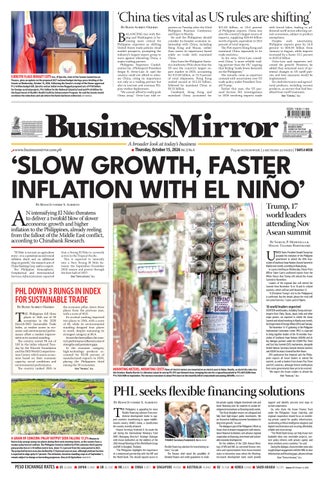
‘China ties vital as US rules are shifting’ B By Bless Aubrey Ogerio
ALANCING ties with Beijing and Washington is becoming more critical for Philippine exporters as shifting United States trade policies cloud market prospects, prompting the industry’s largest export group to warn against alienating China, a major trading partner. Philippine Exporters Confederation Inc. (Philexport) President Sergio R. Ortiz-Luis Jr. said the country could not afford to alienate China, citing its importance not only as a trading partner but also in tourism and overseas Filipino worker deployment. “We cannot afford to really push China away,” Ortiz-Luis told re-
EJERCITO FLAGS BUDGET CUTS Sen. JV Ejercito, chair of the Senate Committee on
Finance, gives an update on the proposed 2027 national budget during a press briefing at the Senate on Wednesday, October 14, 2026. Following the Senate’s receipt of the House-approved P7.2-trillion budget bill, Ejercito said an initial review flagged proposed cuts of P130 billion for foreign-assisted projects, P9.5 billion for the National Calamity Fund and P4.45 billion for the Department of Health’s Health Facilities Enhancement Program. He said the Senate would scrutinize the reductions and ask where the funds had been redirected. ROY DOMINGO
ROTARY CLUB OF MANILA JOURNALISM AWARDS
2006 National Newspaper of the Year 2011 National Newspaper of the Year 2013 Business Newspaper of the Year 2017 Business Newspaper of the Year 2019 Business Newspaper of the Year 2021 Pro Patria Award PHILIPPINE STATISTICS AUTHORITY 2018 Data Champion
porters on Tuesday after the 52nd Philippine Business Conference and Expo in Manila. He said the Philippines should consider its broader economic relationship with China, including Hong Kong and Macau, rather than assess its importance based solely on trade with mainland China. Data from the Philippine Statistics Authority (PSA) show that the US was the country’s largest export market in 2025, accounting for $13.46 billion, or 15.9 percent of total shipments. Hong Kong ranked second at $12.33 billion, followed by mainland China at $9.31 billion. Combined, Hong Kong and mainland China accounted for
$21.64 billion, or 25.6 percent of Philippine exports. China was also the country’s largest source of imports, supplying $38.44 billion worth of goods, equivalent to 28.6 percent of total imports. The PSA reports Hong Kong and mainland China separately in its trade statistics. In his view, Ortiz-Luis considered China “a more reliable trading partner than the US,” arguing that Beijing “made fewer demands on the Philippines.” His remarks come as exporters contend with uncertainty over US trade policy under President Donald Trump. Earlier this year, the US pursued Section 301 investigations in 2026 involving imports made
with forced labor, leading to additional tariff action affecting certain economies, subject to product exemptions. Despite such uncertainty, Philippine exports grew by 14.8 percent to $64.04 billion from January to August, while imports increased by a faster 19.1 percent to $105.6 billion. Ortiz-Luis said exporters welcomed the growth. However, he added they remained wary of potential changes in US tariff policies and how measures would be implemented. He cited electronics and agricultural products, including coconut products, as sectors that had benefited from tariff treatment. See “China,” A2
BusinessMirror A broader look at today’s business
EJAP JOURNALISM AWARDS
BUSINESS NEWS SOURCE OF THE YEAR
(2017, 2018, 2019, 2020, 2021) DEPARTMENT OF SCIENCE AND TECHNOLOGY
2018 BANTOG MEDIA AWARDS
‘SLOW GROWTH, FASTER INFLATION WITH EL NIÑO’ www.businessmirror.com.ph
A
n
Thursday, October 15, 2026 Vol. 22 No. 8
P25.00 nationwide | 2 sections 22 pages | 7 DAYS A WEEK
Trump, 17 world leaders attending Nov Asean summit
By Reine Juvierre S. Alberto
N intensifying El Niño threatens to deliver a twofold blow of slower economic growth and higher inflation to the Philippines, already reeling from the fallout of the Middle East conflict, according to Chinabank Research.
“El Niño is not just an agriculture story—it is a potential second-round inflation shock and an additional drag on growth,” the research arm of China Banking Corp. said in a report. The Philippine Atmospheric, Geophysical and Astronomical Services Administration reported
By Samuel P. Medenilla & Malou Talosig-Bartolome
U
NITED States President Donald Trump has accepted the invitation of the Philippine government to attend the 49th Association of Southeast Asian Nations (Asean) Summit in Manila next month, according to Malacañang. In a press briefing on Wednesday, Palace Press Officer Claire Castro confirmed reports from the White House that Trump will attend the Asean Summit in November. Leaders of the regional bloc will attend the Summit from November 16 to 18 and its related summits, which will last until November 15. “It [President Trump’s visit to the Philippines] is confirmed. But the details [about the visit] will not come from me,” Castro said in Filipino.
that a Strong El Niño is currently active in the Tropical Pacific. This is expected to intensify into a Very Strong El Niño between the September–December 2026 season and persist through the first half of 2027. See “Inflation,” A2
PHL DOWN 3 RUNGS IN INDEX FOR SUSTAINABLE TRADE By Bless Aubrey Ogerio
T
HE Philippines fell three places to 16th out of 30 economies in the 2026 Hinrich-IMD Sustainable Trade Index, as weaker scores in economic and environmental performance offset a modest improvement in its societal standing. The country scored 58 out of 100 in the index released Tuesday by the Hinrich Foundation and the IMD World Competitiveness Center, which assess economies based on their economic capacity, social conditions and environmental performance. The country ranked 20th in
the economic pillar, down three places from the previous year, with a score of 49.8. Its societal ranking improved two places to 19th, with a score of 49, while its environmental standing dropped four places to ninth, despite remaining its strongest category at 86.4. Across the three pillars, the country’s performance reflected a mix of strengths and persistent gaps. In the economic category, high-technology products accounted for 60.98 percent of manufactured exports in 2024, placing the Philippines third among the 30 economies. See “Index,” A2
18 world leaders expected
MOUNTING METERS, MOUNTING COSTS Rows of electric meters are mounted on an electric post in Nakar, Manila, as electricity rates rise this October. Manila Electric Co. (Meralco) raised its rate by P0.3191 per kilowatt-hour, bringing the rate for a typical household to P15.0615/kWh from P14.7424/kWh in September. The increase translates to about P64 more on the monthly bill of a household consuming 200 kWh. NONIE REYES
EIGHTEEN world leaders, including Trump and counterparts from China, Russia, Japan, India and other major powers, are expected to attend the Asean Summit and related meetings in Manila next month, the Department of Foreign Affairs (DFA) said Tuesday. The November 15-17 gathering at the Philippine International Convention Center (PICC) is expected to bring together leaders of the 10-member Association of Southeast Asian Nations (ASEAN) and its key dialogue partners under the ASEAN Plus Three and East Asia Summit (EAS) mechanisms, alongside United Nations Secretary-General António Guterres and ASEAN Secretary-General Kao Kim Hourn. DFA spokesman Dax Imperial said the Philippines expects all Asean leaders to attend the summit, as well as leaders from Asean Plus Three and EAS countries, although formal notifications from some governments have yet to be received. “We expect the Asean Leaders to attend the See “Asean,” A2
PHL seeks flexible financing solutions By Reine Juvierre S. Alberto
T A GRAIN OF CONCERN: PALAY OUTPUT SEEN FALLING 17.2% Women in Nueva Ecija arrange young rice plants during their early morning chores, as the country faces a weaker palay harvest outlook. The Philippine Statistics Authority (PSA) estimates third-quarter palay production at 3.10 million metric tons, down 17.2 percent from the same period in 2025. The projected harvest area also declined by 17.8 percent year on year, although yield per hectare is expected to edge up by 0.7 percent. The estimates, based on standing crops as of September 1, remain subject to change as harvesting progresses. Story in A5 Agriculture. NONIE REYES
HE Philippines is appealing for more flexible financing solutions from multilateral development banks to support countries transitioning to upper-middleincome country (UMIC) status, a classification the country recently attained. Finance Secretary Frederick D. Go made the call during the International Monetary Fund (IMF) Managing Director’s Strategic Dialogue with Asean Authorities on the sidelines of the 2026 Annual Meetings of the World Bank Group and IMF in Bangkok, Thailand. “The Philippines highlights the importance of a modernized partnership with the IMF and the World Bank. This should expand access to
FINANCE Secretary Frederick D. Go IMF PHOTO
flexible financing solutions for transitioning nations,” Go said. The Finance chief raised the possibility of blended finance and credit guarantees to mobi-
lize private capital, mitigate investment risks and lower financing costs for countries to sustain development momentum as financing needs evolve. “Our fiscal discipline ensures we safeguard and fully fund high-impact public investments. We are focused on building economic foundations for long-term growth,” Go said. The dialogue is part of the Philippines’ efforts as Asean chair to deepen engagement with international financial institutions and advance regional cooperation on financing, investment and sustainable economic development. On the sidelines of the 2026 Annual Meetings of WB and IMF, Go convened finance ministers and representatives from Asean member states to determine areas where the Washington-based development bank could provide
support and identify concrete next steps to sustain cooperation. Go, who chairs the Asean Finance Track under the Philippines’ Asean chairship, said regional cooperation should focus on mobilizing private capital for quality infrastructure, accelerating artificial intelligence adoption and digital transformation and securing affordable, reliable and clean energy. “The World Bank Group can help Asean turn bankable ideas into investable projects, connect policy reforms with private capital, and share solutions across countries,” Go said. During the dialogue, Asean member states also sought deeper engagement with the WBG to close infrastructure and financing gaps, advance climate See “Solutions,” A2
PESO EXCHANGE RATES n US 62.8260 n JAPAN 0.3969 n UK 83.2507 n HK 8.0055 n CHINA 9.3871 n SINGAPORE 49.1058 n AUSTRALIA 43.8463 n EU 70.3588 n KOREA 0.0469 n SAUDI ARABIA 16.7291 Source: BSP (October 14, 2026)
News
BusinessMirror
A2 Thursday, October 15, 2026
₧270M…
Continued from A11
Production losses were already pegged at 163,812 metric tons (MT) across 14 regions, with the corn sector sustaining the brunt of the dry spell’s impact, damaging 126,883 MT of output worth P4.9 billion. This was followed by rice at 25,196 MT, with losses valued at P1.53 billion. High-value crops also recorded damage at 11,720 MT worth P396.93 million. The domestic livestock and poultry industry was not spared by El Niño, as it affected 6,394 heads of various animals worth P36.94 million.
PHL seeks flexible financing solutions
Continued from A1
adaptation, enhance the business environment and generate jobs. They acknowledged the WBG’s role in supporting these priorities through guarantees, technical assistance and capacity building. For his part, WBG President Ajay Banga said that mobilizing private capital is essential to meeting development goals as governments worldwide face constraints on public finances. However, he stressed that private investment should complement rather than replace public financing, with governments strategically deploying public resources to attract and multiply private capital.
www.businessmirror.com.ph
PHL seeks stronger action vs rising online hiring scams
T
By Samuel P. Medenilla
HE Department of Migrant Workers (DMW) has pushed for a stronger regional action against the growing threat of online illegal recruitment as well as minimizing the risk of remote workers during the opening of the 19th Association of Southeast Asian Nations (Asean) Forum on Migrant Labor (AFML) on Wednesday. The Philippines is currently hosting the annual event, which brings together tripartite partners, at the Philippine International Convention Center (PICC) in Pasay City on October 14 and 15. This year the theme for the AFML
is “Protection of Migrant Workers through Regular and Safe Migration Pathways” which focused on the emerging threats posed by bogus online job offers to migrant workers. DMW Secretary Hans J. Cacdac
Asean…
attendance,” Imperial said. The East Asia Summit includes the Asean member-states plus Australia, China, India, Japan, New Zealand, South Korea, Russia and the United States, making it one of the Indo-Pacific region’s premier strategic forums. The possible attendance of Chinese President Xi Jinping would be closely watched. While Chinese leaders have long participated in Asean-led
Continued from A1
Summit. As for dialogue partners, we expect the leaders from Asean Plus Three and the EAS to attend, although at the moment we are still awaiting receipt of official notification regarding the leaders’
said digital platforms are now being used by criminal syndicates to “lure jobseekers with fraudulent offers, bind them through debt, and transfer them through unauthorized recruitment channels.” “The rise of the digital platforms and remote work has provided opportunities for migrant workers, but at the same time, the same platforms are now used for misinformation, illegal recruitment and trafficking in persons that have led many into forced criminality,” he said. DMW earlier said it coordinated with social media platforms to take down 50,000 online illegal recruitment posts. During the two-day AFML, Cacdac hopes participants will come up with policy recommendations to protect migrant and remote workers online.
The first day of the AFML focused on identifying regulatory gaps in cross-border remote talent sourcing; strengthening predeparture digital literacy standards; and expanding partnerships with technology companies and initiatives to remove predatory job listings. The last day of the event will be dedicated to strengthening victim identification; removing barriers to justice; and ensuring that migrant workers, regardless of legal status, can access efficient cross-border grievance mechanisms and comprehensive legal aid. “The ultimate aim is to formulate and adopt recommendations that will ensure protection of migrant workers relative to online recruitment and associated risks,” Cacdac said.
meetings, Beijing has in recent years often been represented by the premier rather than the president at Asean summits and related gatherings. Russian President Vladimir Putin’s participation would also draw interest. Russia remains an East Asia Summit member, but Putin has not been a regular attendee at Asean-led summits in recent years, with Moscow frequently represented by other senior officials. Among the key outcomes expected from the Manila summit is the signing of the Asean Digital Economy Framework Agreement (DEFA), a landmark initiative designed to promote digital trade and deeper economic integration across Southeast Asia. Imperial said leaders are also expected to highlight the Cebu Protocol through the unveiling of a new Asean emblem and the raising of an updated Asean flag.
a packed diplomatic calendar in Asia. A number of leaders are expected to attend the Francophonie Summit before traveling to the Philippines for the Asean meetings. Following the Manila summit, many of the same leaders are expected to head to Shenzhen, China for the Asia-Pacific Economic Cooperation (Apec) Economic Leaders’ Meeting, creating a week of intense summit diplomacy and opportunities for bilateral talks among the world’s major powers. The back-to-back gatherings are expected to place the Philippines at the center of regional diplomacy as leaders grapple with geopolitical tensions, economic uncertainty and security challenges across the Indo-Pacific. According to an online report published Sunday. In the New York Post, Trump will visit the Philippines before flying to China to attend the Apec Summit. It comes after Marcos and Trump held a telephone conversation on July 23, 2026 to discuss economic developments and regional security concerns. When asked if Trump’s visit is also connected with the signing of the framework agreement for the Pax Silica initiative to be launched at the New Clark City in Tarlac, PCO Undersecretary Castro declined to give further details on the matter. The Presidential Communications Office undersecretary said the Bases Conversion and Development Authority (BCDA) has already submitted its draft Pax Silica framework agreement to the President through official channels. Located on a 1,620-hectare land in New Clark City, the Pax Silica will be a high-technology manufacturing and innovation hub, which is expected to generate 130,000 to 190,000 direct jobs and 500,000 to 800,000 indirect jobs. The US-led project is opposed by some groups due to their concerns it will include data centers, which use large amounts of water and power to operate and also harm the environment. BCDA earlier said the Pax Silica framework agreement is expected to be signed next month.
The Myanmar issue
“IT is also during this Summit that the Asean Leaders will come up with the decision on the implementation of the 5PC,” he said, referring to ASEAN’s Five-Point Consensus on Myanmar. The review is expected to determine the future of Asean’s approach to Myanmar, where the regional bloc has struggled to secure progress toward a peaceful resolution of the country’s political crisis. “The Leaders’ Review and Decision on the Implementation of the 5PC which limits the participation of Myanmar to non-political representatives still stands,” Imperial said. The policy bars Myanmar junta chief Senior Gen. Min Aung Hlaing from attending Asean leaders’ meetings, allowing only nonpolitical representatives to participate on behalf of the country. Guterres is expected to attend the AseanUnited Nations Summit, where leaders will review the status of Asean-UN relations, assess the implementation of their Plan of Action and discuss the future direction of cooperation between the regional bloc and the world body. The Manila meetings will take place amid
Inflation… Continued from A1
Based on simulations of the potential economic effects of the 2026-27 El Niño, Chinabank said a weak episode could add 0.25 percentage points to headline inflation while trimming gross domestic product (GDP) growth by 0.20 percentage points. A strong El Niño could raise
headline inflation by 0.66 percentage points and reduce GDP growth by 0.41 percentage points. Under a severe El Niño, headline inflation could accelerate by 1.57 percentage points and knock 0.81 percentage points off GDP growth. Chinabank said the biggest direct effects are expected to fall on food crops, such as palay, corn and other agricultural products. Second-round effects could then emerge through food manufacturing and consumer prices. However, domestic harvest losses do not automatically translate into retail price surges, the bank noted. Despite lower palay production during the 2025-26 El Niño episode, rice inflation declined by 2 percent during the period, as timely imports and adequate inventories helped maintain market supply, it added. “This suggests that inflationary impact of the current El Niño will depend not only on the extent of domestic production losses but also on the availability and cost of
Index…
Continued from A1
Labor force growth ranked fifth at 1.75 percent in 2025, while consumer price inflation ranked 10th at 1.7 percent. Fixed internet speed, however, stood at 88.84 megabits per second in 2025, placing the country 18th in the index’s comparison. In the societal pillar, the country ranked first in gender non-discrimination in hiring, based on a 2024 score of 100, and in the government’s response to human trafficking in 2025. These gains were tempered by weaker indicators in education and health: mean years of schooling reached 8.98 years in 2023, ranking 16th, while life expectancy was 69.83 years, ranking 26th. The environmental pillar remained the country’s strongest area. The Philippines ranked first in environmental standards in trade, reflecting participation in major international conventions covering issues such as hazardous waste, marine pollution, climate change and endangered species. It also ranked seventh in energy intensity and ecological footprint, while renewable energy accounted for 28 percent of its energy mix in 2021, placing it 10th. Across the Asia-Pacific Economic Cooperation’s 21 economies, the average index score rose from 55.9 in 2022 to 62.7 in 2026, with the largest gains recorded in Southeast Asia, led by Vietnam, Malaysia and Indonesia. The United Kingdom retained the top spot, followed by Singapore, which rose two places, and New Zealand. Hong Kong and Australia completed the top five. The report noted that rankings shifted only modestly this year, with no economy moving more than four places, suggesting that sustainable trade performance increasingly reflects underlying economic and institutional capacity rather than short-term disruptions. It also cautioned that participation in trade agreements alone does not guarantee stronger performance. “Membership in a trade grouping opens a door. It does not walk a country through it,” said Arturo Bris, director of the IMD World Competitiveness Center. The index assesses 30 economies across economic, societal and environmental dimensions, providing a comparative measure of how well they balance trade competitiveness with broader sustainability goals.
China…
Continued from A1
“We might change the game again. It’s hard to predict Trump,” he said. Asked about exporters’ outlook for the fourth quarter, Ortiz-Luis said the industry was pleased with the expansion in shipments but remained cautious because of the uncertain policy environment. “In a sense, [we’re] glad but not upbeat because there are a lot of uncertainties that we are not sure what will happen,” he said. For the next administration, Ortiz-Luis urged the Philippines to balance its political and economic relationships instead of simply following Washington’s lead. The challenge for exporters, he said, is to sustain shipment growth while preparing for policy changes that could affect market access, production decisions and the competitiveness of Philippine goods abroad.
imported rice and the government’s ability to maintain adequate buffer stocks,” Chinabank said. Higher electricity demand, coupled with constraints on water and hydropower supply, could add further pressure, although the magnitude of these effects remains uncertain, it added. Chinabank said effects on energy inflation may depend on the availability of alternative power sources and prevailing market conditions, as evidence of the impact on electricity prices during previous El Niño episodes is less conclusive. Under its baseline outlook, inflation will peak in the fourth quarter of 2026 and remain below 8 percent. However, a severe El Niño could push inflation above that level. “While markets may continue to price in [Bangko Sentral ng Pilipinas] rate hikes, monetary tightening has limited ability to address supply-driven inflation,” Chinabank said. “The BSP’s earlier preemptive hikes should provide some buffer against second-round price pressures,” it added.
www.businessmirror.com.ph
The Nation BusinessMirror
Thursday, October 15, 2026 A3
House impeachment prosecution team eyes trial conclusion before Christmas By Jovee Marie N. Dela Cruz
T
@joveemarie
HE House of Representatives prosecution team hopes that the impeachment trial of Vice President Sara Z. Duterte will be finished before Christmas following its decision to withdraw three of the four Articles of Impeachment against her. House lead prosecutor Batangas Rep. Gerville Luistro said the move should significantly shorten the proceedings by limiting the case to Article II, which concerns alleged unexplained wealth, inaccurate asset declarations and prohibited business interests. “Now that the three articles have
been withdrawn, we have reason to anticipate that the 31 days should be reduced,” Luistro said during a posttrial press briefing. The defense had initially sought 31 trial days to present its evidence on all four articles. With only one charge remaining, Luistro said the original allocation should no longer be necessary, although she acknowledged that the defense would determine how much time it needed. “Thirty-one days should be the maximum, I believe, and we have reason to anticipate that it should be reduced,” she said. Luistro said the prosecution had wanted to avoid unnecessarily prolonging the proceedings, recalling
that she had expressed hope during the trial’s early stages that the case would be resolved before the Christmas holidays. She nevertheless clarified that the prosecution had no definite date in mind for a verdict, stressing that the final timetable would depend on the defense’s presentation and the impeachment court’s decisions. “Only the impeachment court can answer that,” Luistro said. The House prosecution formally rested its case on Tuesday after 39 trial days. The Senate impeachment court accepted the withdrawal of Article I on alleged misuse of confidential funds, Article III on bribery, and Article IV on grave threats and related allegations.
House prosecutor and Manila Rep. Joel Chua, however, warned that the proceedings could extend beyond the holiday season if the defense opts for a lengthy presentation. “If the defense presents its case at length, this could reach Christmas and New Year, followed by another break, and then we could end up reaching Valentine’s Day,” Chua said. Chua said the prosecution wanted to avoid further delays, arguing that due process should also account for the public’s interest in obtaining a resolution to the impeachment case. “The public is also demanding due process,” he said. The shortened case also means the defense will no longer need
@maloutalosig
T
HE first batch of witnesses expected to testify against former President Rodrigo Duterte at the International Criminal Court (ICC) will appear in person in The Hague rather than through video link, prosecutors told judges during a
status conference on Tuesday as the court moved closer to the start of trial. Duterte attended the fourth status conference in person, his second consecutive appearance before the tribunal. Prosecutors identified five witnesses they intend to present before the Christmas break and said all are expected to testify in the courtroom
unless unforeseen circumstances arise. The names of the witnesses were not disclosed publicly, but prosecutors identified them through witness reference numbers. The hearing also offered new details on how the proceedings will unfold. Judges approved a shortened daily hearing schedule with frequent brea ks to accommodate
Duterte’s health condition. The judges also said they would consider defense requests for breaks between hearing blocks next year to allow the former President more opportunities to communicate with and receive visits from family members in the Philippines. Court officials also said proceedings can be interpreted into Tagalog
By Rex Anthony Naval
T
to improve public access for Filipinos following the case. Duterte faces charges of crimes against humanity for alleged murders linked to his anti-drug campaign from November 1, 2011 to March 16, 2019, covering his time as mayor of Davao City and later as president.
HE National Police (PNP) on Wednesday said it is looking to transform police facilities nationwide into lead models for resource efficiency while integrating local climate resilience protocols into daily barangay patrols to prepare for expected extended drought conditions across the country. In a statement, the National Police chief, Gen. Jose Melencio Nartatez Jr., called for water-saving practices in police camps, stations, and headquarters while directing police units to incorporate public awareness on water conservation and household food resilience into community policing activities. “The PNP fully supports the President’s call for water conservation and household food resilience. Prepared and self-reliant communities are better equipped to withstand the challenges brought by El Niño and other emergencies,” he added. The administration earlier called for Filipinos to collect rainwater for appropriate reuse and revive backyard gardening to help supplement household food supplies. El Niño is expected to intensify in the coming months, raising concerns over water availability and agricultural production in vulnerable areas.
See “ICC,” A6
See “PNP,” A6
to present evidence specifically addressing the three withdrawn articles, although it may use relevant mater ia l a lready on record to challenge the remaining charge. Private prosecutor Lorna Kapunan said the decision to withdraw the three articles was reached collectively by the public and private members of the prosecution panel after they determined that the evidence on unexplained wealth was sufficient to pursue the case. T he defen se, howe ver, h a s maintained that the withdrawal w o u l d n o t c h a n g e it s p l a n s f o r p r e s e nt i n g e v i d e n c e . It s presentation is scheduled to begin on November 9.
First ICC witnesses against Duterte to testify in person By Malou Talosig-Bartolome
PNP camps target resource efficiency amid El Niño
A4 Thursday, October 15, 2026
Economy BusinessMirror
www.businessmirror.com.ph
DTI warns vs uncertified goods during holiday shopping rush
W
By Bless Aubrey Ogerio
ITH the Christmas shopping season approaching, the Department of Trade and Industry (DTI) told consumers to check for Philippine Standard (PS) marks and Import Commodity Clearance (ICC) stickers to avoid unsafe or substandard products, particularly those sold online.
Trade Secretary Ma. Cristina A. Roque issued the reminder during the Certified Products Expo 2026 in Mandaluyong City, held in line with Consumer Month, as the agency raised concerns over the growing availability of uncertified goods on e-commerce platforms. “We need to get it certified and we need to also educate the consumers that when they buy, they need to check that there’s a PS mark or the seal set by the DTI, especially right now, it’s almost Christmas,” Roque told reporters. Uncertified products, she said, may have poor quality, break after only a few uses or cause damage to property, leaving consumers with losses from purchases that fail to
meet safety and quality standards. “I must say that there are really a lot of products that are being sold on e-commerce platforms,” the trade head said. The DTI has its Consumer Protection and Fair Trade Group to monitor products sold in the market, while the Bureau of Philippine Standards (BPS) oversees mandatory product certification. The agency also clarified that PS marks and ICC stickers serve different purposes. The PS mark indicates that a locally manufactured product has been certified under the BPS requirements, while an ICC sticker confirms that an imported product or specific batch has undergone
inspection or testing by the DTI’s relevant inspection unit. The certification marks may be placed on the product or its packaging, depending on the available space. For smaller products that cannot accommodate a mark, the label may be placed on the box instead. Based on the agency’s website, the BPS lists 111 products covered by mandatory certification requirements, inc lud ing household appliances, Christmas lights, electrical wiring devices a nd l iquef ied pet roleu m ga s (LPG) cylinders. These products must comply with the agency’s applicable standards before they can be sold in the Philippine market.
NBI files more cases on Davao flood control projects By Joel R. San Juan @jrsanjuan1573
T
HE investigation into allegedly anomalous flood control projects in Davao City is picking up speed as the National Bureau of Investigation (NBI) doubled down on its case filing with the Department of Justice (DOJ). Named as respondents in the complaint were officers of Genersis88 Construction Inc. identified as Glenn Escandor, Merlita Amplayo, Raymarc Kim Amplayo, Saturnino Bentulan, Christian Rey Balingit, and Roy Bohol. The complaint also named DPWH-Davao City officials Richard Ragasa. Ferdinand Dallo, Emilio Sucaldito, Roberto Mamaril, Kim An-
thony Duque, Andre Villacorte, Aljun Barcoma, Kristine Apao and several “John and Jane Does.” They are facing investigation for falsification by public officer under Article 171 of the Revised Penal Code (RPC), falsification by private individuals under Article 172 of the RPC and violation of Section 3 of the Anti-Graft and Corrupt Practices Act. The complaint involves four flood control contracts amounting to P364.2 million that were among the 47 flood control projects flagged by the NBI for alleged irregularities. The NBI filed the complaint following its scrutiny of project documents, which allegedly showed the recycling and alteration of photographs submitted to support progress billings.
NBI Director Melvin earlier claimed that there were “ghost” and “substandard” flood control projects in the First District of Davao City which is represented by Rep. Paolo Duterte in the House of Representatives. Matibag said around P1.9 billion in government funds were spent for the 47 projects which he later clarified that the projects were actually worth P7 billion. Duterte, in a statement issued several days ago, welcomed the NBI investigation but called on Matibag not to be selective in its investigation intotheanomaliesinvolvingfloodcontrolprojects. The DOJ is expected to evaluate the complaint together with the evidence submitted by the NBI to determine if there is basis to
conduct a preliminary investigation.
No free passes
PUBLIC Works Secretary Vivencio Dizon meanwhile made it clear that those implicated in the Davao controversy will not receive special treatment. “Whatever happened to the other district engineers will apply to them as well. No exceptions. No exemptions,” Dizon told reporters during a sidewalk inspection along Epifanio delos Santos Avenue in Pasay City. The contractor at the heart of the probe, Genesis 88, bagged P7.03 billion in government contracts in Davao City between 2018 and 2024, with the majority earmarked for flood mitigation.
Genesis 88 CEO Glenn Escandor also serves as president of Escandor Development Corporation (Esdevco) and previously held the post of presidential adviser on sports under former President Rodrigo Duterte. Esdevco contributed P19.9 million toward Vice President Sara Duterte’s 2022 campaign ads, her official Statement of Contributions and Expenditures (Soce) indicate. Dizon said some 200 ongoing cases involving alleged flood control anomalies nationwide—including the high-profile Davao projects—have been referred to the Office of the Ombudsman. “What’s important is that the process continues and we will not stop,” Dizon added.
DOT seeks more foreign investments in health tourism By Ma. Stella F. Arnaldo @akosistellaBM Special to the BusinessMirror
T
HE Department of Tourism (DOT) batted for more foreign investments in the health tourism and wellness sector, as the agency positions the Philippines as a regional destination for specialized medical care, rehabilitation, wellness, and healthy ageing. In her keynote address at the recent 15th Arangkada Philippines Forum of the Joint Foreign Chambers of the Philippines, acting Tourism Secretary Ma. Bernadita Angara-Mathay especially called on the American business community to invest in the broader infrastructure and services needed to support a modern healthcare system. This will not just help attract more foreign patients to the country, but also expand healthcare access of Filipinos. “[The] investment opportunity goes well beyond attracting foreign patients to existing hospitals,” she said, citing opportunities in regional healthcare hubs integrating hospitals, specialty care, diagnostics, rehabilitation, wellness and hospitality; primary and community healthcare facilities; digital health, telemedicine, electronic medical records and remote patient monitoring; artificial intelligence (AI)-assisted diagnostics, imaging, data analytics and predictive medicine; as well as specialty hospitals, ambulatory centers and clin-
ics for cancer, kidney, cardiovascular, respiratory, orthopedic, women’s and neonatal care. She also identified Cebu, Davao and Iloilo as potential regional healthcare and wellness hubs. Other destinations can specialize in rehabilitation, recovery, wellness, active ageing or long-stay living. “The goal is to create connected healthcare and wellness destinations across the country rather than concentrating all activity in Metro Manila,” she added. Angara-Mathay underscored the country’s internationally recognized healthcare professionals and its established tourism and hospitality services as the reasons international patients seek medical treatment, recovery, and wellness. “For decades, Filipino doctors, nurses, therapists, caregivers, and other healthcare professionals have built a strong reputation around the world for competence, dedication and compassion. These strengths give us a good foundation in a market where people are looking not only for medical treatment, but also for quality, convenience, recovery, wellness and long-term wellbeing,” stressed Angara-Mathay. Japan, South Korea, Europe, Canada and the United States are experiencing ageing populations, which create demand for preventive healthcare, rehabilitation, wellness and long-term care. “This creates opportunities that go well beyond the traditional idea of
TOURISM Secretary Ma. Bernadita Angara-Mathay outlined the investment opportunities in the Philippine health tourism sector at the recent Arangkada Philippines Forum of the Joint Foreign Chambers of the Philippines. From left: American Chamber of Commerce of the Philippines Executive Director Ebb Hinchliffe, Korean Chamber of Commerce Philippines Inc. President Joseph Um, European Chamber of Commerce of the Philippines Vice President Lars Wittig, and Arangkada Project Director Matthew Scanlin.
medical tourism,” she noted. The Philippines also has geographical advantages, particularly its proximity to East Asian markets and its longstanding ties with the United States, Canada, Europe, Australia, and the Middle East. Angara-Mathay said investments in the health and wellness sector can be made through the Tourism and Infrastructure Zone Authority’s tourism assets and tourism enterprise zones. “There is an opportunity to explore integrated destinations that combine healthcare, rehabilitation, wellness, hospitality,
recreation and long-stay living.” Under this concept, a patient can receive specialized treatment, continue his rehabilitation nearby, stay with the family in quality accommodation, and access wellness, nutrition and recreation services. The model creates opportunities for hospitals, hotels, serviced residences, wellness centers, restaurants, transport providers, diagnostics operators, digital health companies and retirement communities. “It also allows government infrastructure and private investment to
complement each other, with government creating the enabling environment and the private sector bringing capital, technology, expertise and operational capacity,” she added. Examples of beneficial public-private partnerships (PPP) include the University of the Philipines-Philippine General Hospital Cancer Center and the Dialysis Center PPP for the Baguio General Hospital and Medical Center. Most importantly, the investments needed to attract international patients will also enable more Filipinos to access quality healthcare. “Investment in hospitals, imaging centers, laboratories, specialty facilities and digital systems also increases healthcare capacity for Filipinos,” said Angara-Mathay. According to the Global Wellness Institute (GWI), the Philippines’s wellness economy reached $47.3 billion in 2024, ranking 23rd worldwide and eighth in the Asia-Pacific region. As of September 2026, the DOT has accredited 13 hospitals, of which six are accredited by Joint Commission International (JCI); 21 ambulatory clinics; 10 dental clinics; and 63 spas. “Our advantage is strongest when quality healthcare is combined with good service and competitive costs,” she said. A hospital with JCI accreditation enables American patients to use their health insurance or health maintenance organizations to reimburse their medical treatments abroad.
DSWD prepares communities for El Niño By Jovee Marie N. Dela Cruz @joveemarie
T
HE Department of Social Welfare and Development (DSW D) is prepar ing to prov ide w ater f i lt rat ion k it s to communities that may face shortages of safe drinking water due to the anticipated effects of El Niño. Social Welfare Secretary Rex Gatchalian said on Wednesday the agency has been distributing t he k it s to d i s a s te r - a f fe c te d communities since 2024, when Typhoon Julian disrupted potable water sources in Batanes. “During disasters, especially with the threat of a super El Niño, it is crucial to ensure that affected families have access to clean and safe drinking water,” Gatchalian said. He said families could use the filtration systems to treat collected rainwater and other avai lable water sources, helping provide an alternative supply of potable water during periods of water scarcity. Water filtration kits have also been distributed to communities in Davao and Cebu that experienced shortages of potable water following disasters, including earthquakes. The portable kits use 0.1-micron filters designed to remove bacteria, including those associated with cholera, salmonella, E. coli and coliform contamination. Each kit comes with a bucket adapter filter assembly, drill bit, filter hanger, cleaning plunger and instructional materials. Gatchalian said the kits, sourced from Waves for Water Organization Inc., had received certification from the Food and Drug Administration. The certification indicated that water produced using the filtration system complied with Philippine National Standards for Drinking Water requirements for the physical, c hem ic a l a nd m ic robiolog ic a l parameters analyzed. Aside from the filtration kits, the DSWD is implementing Project Local Adaptation to Water Access (Lawa) and Breaking Insufficiency through Nutritious Harvest for the Impoverished (Binhi) to help vulnerable communities cope with climate-related hazards. The program seeks to strengthen food security, improve water resource management through Small Water Impounding Projects, and build community resilience against El Niño, La Niña and other climate risks. The agency has also inaugurated its first hybrid, solar-powered Atmospher ic Water Generator ( AWG) s u b proje c t u nde r t he Kapit-Bisig Laban sa Kahirapan– Comprehensive and Integrated Delivery of Social Services (KalahiCIDSS) Program. The technology extracts moisture from the air and converts it into water, providing an alternative source of water for communities with limited access to conventional supplies. “We are using every available means to prepare for the effects of El Niño so we can promptly assist our fellow Filipinos who may be affected,” Gatchalian said.
PHL calls for ambition anchored on equity, accessible climate finance By Jonathan L. Mayuga @jonlmayuga
E
MPHASIZING that “a target cannot protect nations and communities by [itself], the Philippines urged delegates at the Pacific Pre-COP31 in Fiji to carry a unified, equitable agenda to the 31st Conference of the Parties (COP31) in Antalya, Turkey. The Philippine delegation to a pre-COP31 meeting stressed that keeping the 1.5°C goal alive requires dismantling complex financial barriers – such as high borrowing costs
and slow approvals—ensuring that pledged climate finance translates into actual protection for vulnerable communities before risk becomes loss. Climate Change Commission Vice Chair man and Executive Director Robert E.A. Borje, Head of Delegation for Pre- COP31, said every country has a stake in limiting climate risk. He reaffirmed that the Convention and the Paris Agreement provide the principles for cooperation: equity, common but differentiated responsibilities and respective capabilities, and national circumstances.
On the 1.5°C goal, Borje said it must remain the purpose of collective action, with science and the Global Stocktake guiding faster implementation of Nationally Determined Contributions and National Adaptation Plans. Mitigation and adaptation must advance together, he added, because risks to water, food, energy, oceans and livelihoods are connected. Keeping 1.5°C within reach, the Philippine delegation stressed, requires finance, technology and capacity support that countries can actually access and use. “Implementation requires finance,
technology and capacity. The new collective quantified goal must now be made operational: its scale matters, and so do transparency, predictability and access,” Borje said. T he Climate Finance Work Program, he noted, can help define clear areas of work and support implementation under Articles 9.1, 9.2 and 9.3. The Philippines also called for implementation of the adaptation finance outcome agreed at COP30, with support that reaches countries in time and on terms they can use. See “PHL,” A7
Thursday, October 15, 2026
A5
DA: Govt bent on imposing pork import curbs By Ada Pelonia @adapelonia
T
HE Department of Agriculture (DA) is sticking to its plan of implementing quantitative restrictions (QR) on pork imports following the sharp decline in the farmgate price of hogs. In a joint manifesto, industry stakeholders urged the government to implement a series of interventions to ensure the sector’s viability, as the average farmgate price of hogs plummeted to P90 per kilo, which caused producers to lose as much as P9,000 per animal. Agriculture Secretary Francisco Tiu Laurel Jr. confirmed to the BusinessMirror that the DA would issue a QR on pork imports
once the Tariff Commission (TC) concludes its consultations on its petition to raise tariffs slapped on pork cuts.“If given legal power or legal cover to (impose) QR, we will do it as soon as possible....We will impose it only on belly, pork cuts, and whole pork,” he told this newspaper on Wednesday. He noted that under the rules, the agency may impose QR for a limited number of days once the
Scrutiny of US rice deal pushed By Butch Fernandez @butchfBM
T
HE proposed importation of American rice has drawn concern from the chairman of the Senate agriculture committee, who thinks the government should instead prioritize lowering domestic rice production costs to make the staple more affordable for consumers while protecting the livelihood of Filipino farmers. Senator Francis N. Pangilinan said the potentially higher acquisition and transport costs of importing American rice must be “heavily scrutinized” because of its possible impact on the domestic rice market. “Why should we get rice from America if the cost of bringing it here is higher? Who will benefit from this, and who will yet again bear the burden? The consumers again? If our people won’t benefit, why should we still source our rice from America?” The senator is preparing to lead the budget hearing for the Department of Agriculture (DA) and its attached agencies next week. In his view, expanding the country’s sources of imported rice should not take precedence over addressing longstanding problems confronting local rice producers, such as high production costs. Pangilinan was reacting to a memorandum of understanding between the Philippine Rice Industry Stakeholders Movement (PRISM) and USA Rice, targeting purchases of 100,000 metric tons (MT) in 2027 and 200,000 MT tons annually beginning in 2028. The import plan aims to bridge the country’s production shortfall, maintaining supply to prevent food insecurity. “Our production is not yet enough to fill the entire country’s needs, and we need to import. But while filling the gap, the government must focus more on bringing down the costs of
planting, harvesting, drying and milling of palay,” he said, speaking in Filipino. “When the per-kilo cost of farmers is lower, they can bring home better incomes. When drying milling and bringing to market is more efficient, we can better secure affordable rice for our consumers.” Pangilinan said consumers should not be made to bear the burden of higher rice prices. Instead, he said the government must prioritize strengthening domestic rice production and lowering production costs to ensure a more affordable and sustainable supply of rice. He urged the government to accelerate investments in reliable irrigation, quality seeds, appropriate farm machinery, affordable credit, and accessible drying, storage, and milling facilities. He also called for stronger farmer cooperatives, practical technical assistance, and measures to reduce postharvest losses and unnecessary transport costs. Furthermore, the senator pushed for the stronger implementation of the Sagip Saka Act to help farmers’ organizations access markets, including direct government purchases, and retain more of the value of their produce. Sagip Saka is the lawmaker’s landmark 2019 law that allows the national government agencies and local government units to buy food directly from farmers and fisherfolk without public bidding. While Sagip Saka addresses the demand side of the agricultural sector, Pangilinan said there is a need to complement it with measures that strengthen the supply side. He underscored the importance of passing two key proposals pending in Congress: the strengthening of agricultural cooperatives and the renationalization of agricultural extension services to provide farmers with better access to technical assistance, knowledge, and support.
TC has done its round of consultations, which could be finalized “by December of this year.” Under Republic Act 8800, the government may set a QR as a provisional safeguard measure if the “tariff increase (is) not sufficient to redress or to prevent serious injury to the domestic producer or producers.” In its petition, the DA called for a staggered hike in tariffs imposed on pork imports to 25 percent inquota and 35 percent out-quota in 2027, before reverting to its original level of 30 percent in-quota and 40 percent out-quota in 2028. Currently, duties imposed on pork stands at 15 percent and 25 percent under the Executive Order (EO) 62, which is set to lapse in 2029.
‘Pushed to the brink’
FOR hog raisers, however, the previous tariffs on pork imports should be reinstated immediate-
PORK chops to be wrapped inside a store in Napa, California. PHOTOGRAPHER: DAVID PAUL MORRIS/BLOOMBERG
ly, as compounding losses have prompted some of them to leave the industry. Farmgate prices currently hover around P90 to P120 per kilo, with losses at roughly P50 to P90 per kilo, or approximately P5,000 to P9,000 for every hog raised. “At these prices, hog raisers are
being pushed to the brink. Many are now considering leaving the industry altogether. Farms are closing, investments are being wiped out, and livelihoods built through generations are at risk of disappearing,” industry groups said. “Every further delay in restoring the original tariffs gives im-
ported pork an unfair price advantage and brings the local hog industry—and the many businesses, workers and communities that depend on it—closer to collapse.” The groups also want the government to impose a temporary suspension on additional pork imports and stop the release of frozen shipments from cold storages. “There is little sense in suspending new imports while allowing large existing stocks of imported pork to continue entering the domestic market and further depressing local prices.” Furthermore, they urged the government to enhance quarantine, inspection, and food-safety control while updating import reference values on a weekly basis. “(This will) prevent the undervaluation of imported pork, protect government revenues, and prevent artificially low declared import values from further undercutting domestic pork prices.
‘Staple grains production to fall as harvest areas shrink’
P
ADDY RICE output in the third quarter may register a double-digit decline due to the contraction in harvest area, according to the Philippine Statistics Authority (PSA). Based on its latest report, the agency said some 334,330 hectares or 44.4 percent of the 753,680 hectares planted with rice have been harvested as of September 1. These areas yielded 1.32 MMT of paddy rice. All other rice plantations not yet covered by the survey will likely add almost 1.9 MMT of paddy rice, but the resulting figure will be lower than the actual output of 3.75 MMT recorded a year ago.
Of the total area of 1.8 million hectares of standing palay as of September 1, the PSA said 40.6 percent were at the reproductive stage, 38.3 percent at the vegetative stage, and 21.1 percent at the maturing stage. The PSA’s latest estimate is 4.8 percent lower than its initial projection of 3.26 MMT. Yield per hectare will inch up by 0.7 percent to 4.12 metric tons (MT) from last year’s 4.09 MT, but harvest area will shrink. The PSA said the harvest area in the third quarter may have contracted by 17.8 percent to 753,680 hectares, from the 916,770 hectares posted in the previous year.
“Of the farmers planting intentions for July to September 2026 at 1.58 million hectares perceived area, 1.38 million hectares or 87.5 percent have been actually planted.”
Fewer corn
IN the same report, the PSA said corn output in July to September may slide by 14.2 percent to 2.08 MMT, from the 2.43 MMT recorded in the same period last year. As of September 1, the PSA said around 387,380 hectares or 55.9 percent of the 692,550 hectares have been har vested, which yielded 1.14 MMT of corn output. Har vest area for corn w ill
likely contract by 12.3 percent to 692,550 hectares from the 789,240 hectares in the same period last year, the PSA said. Furthermore, it added that yield per hectare would be lower by 2.3 percent compared with the previous year’s 3.07 MT. Of the total 707,300 hectares of standing corn as of September 1, 40.8 percent were at the maturing stage, 31.5 percent at the vegetative stage, and 27.7 percent at the reproductive stage. “As for the farmer’s planting intentions for July to September 2026, 402,140 hectares or 63.6 percent of the 632,420 hectares perceived area have been actually planted.” Ada Pelonia
‘Permit for Vietnam rice revoked prior to arrival in PHL’
T
HE Department of Agriculture (DA) said it ordered the cancellation of the import permit for the controversial rice shipments from Vietnam before they even reached Philippine soil. Agriculture Secretary Francisco Tiu Laurel Jr. said he directed the Bureau of Plant Industry (BPI) to cancel the sanitary and phytosanitary import clearance (SPSIC) for rice aboard MV Tay Son 2 days before the vessel reached the country. “Critics of the DA are painting a false picture of this incident, suggesting malice and corruption through insinuations that border on libel. The records will show otherwise,” he said on Wednesday. He added that the import permit was cancelled following the request of Planters Product Inc. (PPI), which purchased 25-percent broken rice but was
informed that the shipment instead contained 5-percent broken grains. The DA chief said PPI also notified him that the contract had already expired, since the delivery was originally scheduled for July or the period when rice supply tends to be tight due to the lean season. Citing the import permit application, the DA said MV Tay Son 2 was supposed to bring in 12,480 metric tons (MT) of rice from Vietnam, roughly a third of the country’s daily rice requirement of 37,000 MT. It added that the SPIC indicated that the shipment was supposed to arrive in July, not September, when the wet-season harvest was about to begin, potentially placing downward pressure on palay prices. Without a valid import permit, rice cannot be unloaded in the country.
Under the rules, agricultural shipments without a valid import permit may be seized and destroyed, ordered returned to their country of origin, or shipped to a third country to protect public health and safety. According to the DA, MV Tay Son 2 arrived at the Port of Davao on September 14, but its captain refused to submit the rice shipment for BPI inspection. “The inspection would have determined whether the cargo could be allowed into the country without posing a risk to public health.” On September 17, while the Bureau of Customs (BOC) was determining how to handle the cargo, the DA said the vessel left Davao. Upon learning of this, the DA chief tasked the agency’s Inspectorate and Enforcement office to issue a hold order on the unloading of the cargo, alerting the BOC
in case MV Tay Son 2 attempted to unload its shipment elsewhere in the country. The DA said the Philippine Navy intercepted the vessel off Sarangani and brought it to the Port of General Santos City, where the captain continued to resist BPI efforts to inspect the rice shipment. T he vessel, however, was eventually ordered to return to Davao, where it remains as the BOC determines what should be done to the cargo. The DA chief said the BPI had recommended returning the rice to its country of origin and was awaiting action by the customs bureau. He said the BOC may instead seize the shipment and impose penalties, depending on its findings and the applicable rules. In either case, the vessel remains subject to penalties arising from the incident. Ada Pelonia
Asia cements lead in cocoa demand revival in uncertain market
A
SIA is cementing its spot as the leader of cocoa’s demand revival, with processing likely to accelerate further even as El Niño-driven supply uncertainty keeps consumption choppy elsewhere. Asian grindings — the volume of beans that processors convert into butter and powder for chocolate products — surged about 15 percent in the third quarter from a year earlier to 208,412 tons, according to the average of estimates from nine analysts, brokers and traders polled by Bloomberg. That’s the biggest jump for the quarter in data going back to 2011.
The jump, which follows exceptionally weak processing in the same period last year, contrasts with expectations for a decline in Europe and little change in North America. That’s making the region a source of stability as the global market grapples with uneven demand recovery after cocoa prices soared to a record in late 2024. Futures have since eased from those levels, but remain volatile and well above historical norms amid concerns that El Niño and crop diseases could threaten harvests in West Africa, the world’s biggest producing region. “There’s going to be a rebound and
most of the rebound will be taking place in Asia,” said Oran van Dort, an analyst at Rabobank. “Part of that demand growth is due to rising disposable incomes, more of a chocolate culture and more investment in the cocoa industry there.” The picture is uneven in other parts of the world. Grindings — seen as a proxy for demand— likely fell 3.9 percent in Europe, the world’s biggest consuming region, and were set to remain little changed in North America, the survey showed. Official numbers for all three regions will be released Thursday, with the North American processing data due after the New York
cocoa market closes. Cocoa grindings have become increasingly difficult to forecast as the market emerges from a period of severe demand destruction, creating an unusually wide range of possible outcomes. That uncertainty is reflected in estimates for Asia, where respondents forecast growth ranging from just 2 percent to as much as 24 percent. In Europe, cocoa’s record rally in 2024 caused “lasting demand destruction” that has been slow to unwind even as bean costs have retreated, according to Nisha Kumari, an analyst at Tropical General Investments Group. Chocolate makers are still tweaking
recipes and adjusting inventories, suggesting that lower prices alone may not be enough to quickly restore consumption to earlier levels, she said. There is also evidence of inflation-weary consumers in some markets balking at high prices. Last month, Swiss confectionery maker Lindt & Sprüngli Group slashed its outlook for sales growth this year, attributing the weakness in part to “subdued consumer sentiment” in Europe, and said it would lower prices for its chocolate products as a result. “Europe will be the worst of all of them in my opinion,” said Judy Ganes, president of
J. Ganes Consulting, who predicted a moderate uptick in North American processing and the strongest growth in Asia. The question for the market now is whether the worst of the global demand shock is over and if growth in regions like Asia and Brazil can offset continued weakness elsewhere. Hedgepoint Global analyst Carolina França expects combined grindings in the three top regions to collectively be 8-12 percent higher in the July-September period than a year earlier. The official data will offer a gauge of how demand has responded to recent swings in cocoa prices, she added .Bloomberg News
A6
Thursday, October 15, 2026
Marcos leads launch of DOLE’s enhanced employment initiatives at PESO Congress By Samuel P. Medenilla @sam_medenilla
P
RESIDENT Ferdinand Marcos Jr. said beneficiaries of the expanded government temporary employment program will now gain lasting skills and job opportunities. This, after the Chief Executive led launching of the flagship innovations of the Department of Labor and Employment’s (DOLE) Tulong Panghanapbuhay sa Ating Disadvantaged/Displaced Workers (TUPAD) during the 26th National Public Employment Service Office (PESO) Congress (PESO) in Lapu-Lapu, Cebu last Wednesday. TUPAD provides qualified beneficiaries with an emergency employment program for displaced, underemployed, and seasonal workers for
a minimum period of 10 days but not exceeding a maximum of 30 days. It has provided emergency employment assistance to over 14 million beneficiaries from June 2022 to August 2026. Among the innovations related to TUPAD is the Trabahong-Dagat program, which integrated the temporary employment with skills training and certification from the Technical Education and Skills Development Authority (TESDA) to support coastal and fishing communities.
Also launched were the SkillPass program, which created a work-toskills-to-certification pathway and the Sagip-Trabaho program, which provides distressed workers from micro, small, and medium enterprises with temporary wage support and worker-protection assistance. The said programs aim to address the challenges faced by jobseekers, which include limited access to job information, employment services and livelihood opportunities as well as skills mismatch. “All these efforts underscore the importance of helping workers develop their skills, gain experience, and build secure livelihoods,” Marcos said in his speech during the Congress. “We continue to promote skills development responsive to local and international business and industries and strengthen the link between training and employment,” he added. The Chief Executive also said the government will continue to expand
its employment facilitation initiatives like their Special Program for Employment of Students, which provided 111,509 students and out-of-school youth with short-term employment in the first half of 2026. DOLE’s Government Internship Program nearly 20,000 interns gained valuable experience in public service in the same period. During the same period, nearly 20,000 interns gained valuable experience in public service through the Government Internship Program. DOLE also conducted conducted over 1,500 job fairs with over 65,534 individuals hired-on-the-spot. Its Maritime Local and Overseas Job Fair in Lapu-Lapu City, Cebu last Wednesday offered more than 1,300 vacancies. “Rest assured that we will continue to expand opportunities for you to secure decent employment. At the same time, we will continue to strengthen your skills, enrich your experience, so you can seize every opportunity to learn and grow,” Marcos said .
Why 3 impeachment articles against VP Sara were dropped By Jovee Marie N. Dela Cruz @joveemarie
& Claudeth Mocon-Ciriaco @claudethmc3
T
HE House prosecution panel had considered withdrawing some of the impeachment charges against Vice President Sara Z. Duterte from the outset, with prosecutors saying the decision followed a reassessment of the evidence, public impatience with the proceedings and the Senate’s legislative workload. Manila Rep. Joel Chua, a member of the prosecution team, said the panel had prepared several possible strategies depending on how its witnesses and evidence performed before the Senate impeachment court. “From the very beginning, we anticipated and studied different legal strategies. We had Plan A, Plan B, Plan C and Plan D,” Chua said. The prosecution eventually withdrew Articles I, III and IV, leaving Article II, which concerns alleged unexplained wealth, as the sole remaining charge. Chua said the panel had previously considered dropping witnesses or articles if it determined that the evidence already presented was sufficient. “Sometimes you reduce or add witnesses, depending on how the evidence is presented,” he said, adding that the final decision was completed only recently after further deliberations. Chua said the prosecution retained the unexplained wealth charge partly because its financial figures and documentary evidence would be easier for the public to understand than allegations involving government accounting procedures and confidential fund disbursements. “All the charges are strong, but unexplained wealth is the easiest to understand,” Chua said, citing the financial figures presented during the trial. Forensic financial analyst Alexander Cabrera testified that his review placed Duterte and her husband’s allegedly undeclared wealth at more than P817.87 million from 2022 to 2025. Chua also cited alleged discrepancies in Duterte’s Statements of Assets, Liabilities and Net Worth, her declared
ICC. . . Continued from A3
Prosecutors allege the killings formed part of a widespread and systematic attack against civilians. Duterte has repeatedly denied the allegations and insisted that the police acted within the law. The status conference was also marked by a dispute over thousands of police records that prosecutors plan to use as evidence. Defense lawyer Peter Haynes said that the prosecution’s list of evidence exceeds 18,393 data
business interests and remittances received by CALE88 Foods Corp. The Anti-Money Laundering Council testified that CALE88 received approximately P319 million in inward remittances from mainland China and Hong Kong. The records presented, however, did not establish that the funds came from the Chinese government itself. House prosecution spokesperson and adviser Rep. Ace Barbers acknowledged that concentrating the case on one article carried significant risks because the panel would have fewer grounds on which to seek a conviction. “It is a risky decision because what if there is no conviction on the remaining article?” Barbers said, explaining that retaining all four articles would have given the prosecution more opportunities to obtain a favorable ruling. He compared the strategy to sacrificing pieces in chess to strengthen the remaining position, stressing that withdrawing the three articles did not mean the prosecution considered its evidence on those allegations weak. “We are willing to take that risk by concentrating on the single remaining article so the case can be decided sooner,” Barbers said, describing the strategy as an “all-or-nothing” approach. Lead prosecutor and Batangas Rep. Gerville “Jinky Bitrics” Luistro maintained that all four impeachment articles were equally strong despite the decision to proceed only with Article II. She said the panel wanted to address public impatience and allow the Senate to attend to its legislative responsibilities, including deliberations on the proposed 2027 national budget. “We maintain that the four articles are equally strong, but we need to address the public’s impatience and the impeachment court’s substantial legislative workload,” Luistro said. Private prosecutor Atty. Lorna Kapunan confirmed that the withdrawal was a collective decision involving both public and private prosecutors. She said the panel had concluded that it should focus on unexplained wealth rather than continue pursuing separate cases involving confidential funds, bribery and
grave threats. “The decision represents the entire prosecution panel, including the private prosecutors,” Luistro said, while Kapunan stressed that those presenting evidence must also know when to stop. The withdrawal has also prompted questions about the defense’s opportunity to challenge evidence presented under the three dropped articles. Private prosecutor and legal spokesperson Benjamin “Jay” Tolosa Jr. said the defense had previously been offered the option of alternating evidence presentations for each article but declined the proposal. Tolosa said the defense had nevertheless been able to challenge prosecution evidence through cross-examination, noting that some cross-examinations lasted longer than the direct examinations of witnesses. “It is inaccurate to say that the defense had no opportunity to challenge the evidence presented on the articles we withdrew,” Tolosa said. Kapunan explained that the confidential funds and grave threats articles were withdrawn with prejudice because the prosecution had already presented evidence on them. Under the court’s ruling, substantially the same accusations cannot be refiled against Duterte during the same term and the 20th Congress. The bribery article, on which the prosecution had not presented evidence, was dismissed without prejudice. Luistro said the withdrawal should shorten the defense presentation, which had initially been allocated 31 trial days. With only Article II remaining, she expects the defense to need less time to present its evidence. “Now that the three articles have been withdrawn, we have reason to anticipate that the 31 days should be reduced,” Luistro said, reiterating her hope that the proceedings would conclude before Christmas. Chua, however, warned that an extended defense presentation could push the proceedings through the Christmas and New Year holidays and potentially into February. He said due process must also consider the public’s interest in seeing the impeachment
case resolved. “Due process does not concern only the defense. The public is also demanding due process,” Chua said. The House prosecution formally rested its case on Tuesday after 39 trial days. The Senate impeachment court approved the withdrawal of Articles I on alleged misuse of confidential funds, III on bribery, and IV on grave threats and related allegations, leaving Article II for adjudication. Duterte’s defense is scheduled to begin presenting its evidence on November 9. Luistro said the prosecution had no fixed target date for a verdict, emphasizing that the remaining timeline would depend on the defense’s presentation and the impeachment court’s decisions. “Only the impeachment court can determine when the case will be resolved,” Luistro said.
‘So spare us the arrogance and the name-calling’
AFTER calling her lead defense counsel a bully, Vice President Duterte on Wednesday challenged private prosecutor Atty. Lorna Kapunan to apply consistently her battlecry—accountability—to President Ferdinand Marcos Jr., who, she claimed, is firm that a drug habit is not about accountability. “So spare us the arrogance and the namecalling. A defense counsel does not become a bully simply because she refuses to let your accusations go unchallenged,” Duterte said in a statement after Kapunan called Atty. Sheila Sison, a “bully” during a House prosecution panel press conference on Tuesday. And if accountability is truly Kapunan’s battle cry, Duterte urged that she should “apply it consistently—even to the President, who is firm that a drug habit is not about accountability.” “Evidence, not arrogance. Genuine accountability, not political persecution. Lorna Kapunan calling a defense counsel a bully is like calling David the aggressor against Goliath,” she added. She stressed that it is a convenient way “to vilify the person defending against an overwhelming display of political power.”
DepEd, CHED tap 230 personnel to fill guidance counseling gap through LINGAP
R
ECOGNIZING their crucial role in ensuring learner safety and well-being, particularly following recent school safety incidents, the Department of Education (DepEd) and the Commission on Higher Education (CHED) awarded scholarships to the first batch of 230 public school personnel under the Learning Initiatives for Nurturing Guidance Associates and Counselors Program (LINGAP), addressing the shortage of school mental health professionals in the country. The initiative targets the nationwide shortage of licensed mental health professionals in basic education to create safer and more supportive learning environments. “ Muli nating isinasabuhay ang panawagan ni Pangulong Bongbong Marcos na kailangan nating magtulungan upang matiyak na ligtas, maayos, at tunay na nurturing ang ating mga paaralan. At para magkaroon ng ganitong learning environment, kailangang may taong handang makinig, umunawa, at maging sandalan ng ating mga learners,” said Education Secretary Juan Edgardo Angara, following the joint initiative between DepEd and CHED, LINGAP supports the graduate education and professional development of DepEd personnel in Guidance and Counseling and Psychology. Acknowledging that guidance counselor posts remain unfilled nationwide due to a lack of licensed applicants, Angara emphasized that LINGAP empowers DepEd staff to up-skill, earn higher credentials, and fill the gap. The ceremonial awarding was held during the 4th Joint Education Trifocal Management Committee (JETMC 4) meeting at
before trial begins. The judges said the prosecution must clearly identify records that may favor the defense or cast doubt on the prosecution’s own allegations, emphasizing the court’s obligation to ensure a fair trial. Prosecutor Julian Nichols, however, said analysts had manually examined the records and organized them by incident, location and date. He acknowledged that prosecutors themselves had not reviewed every page of the collection but said analysts working under their supervision had examined and categorized the entire database.
The judges rejected a separate defense request to require prosecutors to reorganize their evidence database and reduce the volume of records in the case, saying such a move could interfere with disclosure obligations. The chamber is expected to sit for about two and a half weeks before the Christmas recess, with trial preparations continuing into the New Year. Judges also encouraged both sides to continue negotiating agreements on undisputed facts to streamline proceedings once witness testimony begins.
Claudeth Mocon-Ciriaco
Construction material prices in Metro Manila rise 2% in Sept By Justine Xyrah Garcia
R
ETAIL prices of construction materials in Metro Manila rose by 2 percent in September, the Philippine Statistics Authority (PSA) said. Data from the Construction Materials Retail Price Index (CMRPI) showed that the rate was unchanged from the 2 percent recorded in August 2026. In September last year, the CMRPI rose by 1 percent. The latest reading also brought the year-to-date index to 1.7 percent, according to the PSA. The statistics agency said faster price increases were recorded in four of the seven commodity groups covered by the survey. These included carpentry materials, which rose by 0.9 percent from 0.6 percent
PNP. . . Continued from A3
sets, including a large collection of police records and related documents linked to anti-drug operations and killings during Duterte’s presidency. Haynes argued that reviewing the material would require enormous resources and questioned whether prosecutors had sufficiently examined the records for information that could support the defense. ICC judges instructed prosecutors to undertake a deeper review of the documents and identify material that could either support or undermine the case against Duterte
the Negros Oriental Convention Center on October 9. The ceremony was also attended by CHED Chairperson Dr. Shirley C. Agrupis and Technical Education and Skills Development Authority (TESDA) Director General Jose Francisco “Kiko” Benitez, along with key lawmakers and officials who took part in JETMC 4. For Academic Year 2026–2027, the program has funded 870 scholarship slots through a P182.055 million appropriation under the General Appropriations Act. Following a stringent screening process, DepEd shortlisted 327 nominees and endorsed 230 scholars to CHED. Each scholar receives a comprehensive financial package that covers tuition and other school fees, a P30,000 monthly living allowance, and up to a P150,000 research allowance. Upon completing their graduate studies, grantees must take the licensure examination and fulfill professional service obligations in public schools. Angara expressed optimism that initiatives like LINGAP will encourage more Filipinos to pursue careers in counseling. Nine scholars representing the Schools Division Offices (SDOs) of Dumaguete, Tanjay, and Bayawan attending in person received their awards on behalf of all 230 awardees nationwide, while the other scholars joined the ceremony virtually. During the ceremony, the University of Negros Occidental Recoletos (UNOR) also represented all approved Delivering Higher Education Institutions (HEIs) supporting the nationwide implementation of LINGAP.
Nartatez emphasized that police officers can help bring preparedness measures to the grassroots through Police Community Relations activities, barangay visitations, and community dialogues. “Our police officers can promote responsible water use and environmental stewardship during community engagements, barangay dialogues, and public safety campaigns. Community policing goes beyond crime prevention and includes helping citizens prepare for challenges that affect their daily lives,” he said.
in the previous month; electrical materials, to 2.5 percent from 2.2 percent; masonry materials, to 2.6 percent from 2.3 percent; and tinsmithry materials, to 3.8 percent from 3.6 percent. These increases were offset by slower price growth in painting materials and related compounds, as well as miscellaneous construction materials. Their indices grew by 2.7 percent and 0.8 percent, respectively, down from 2.8 percent and 1.1 percent in August. Meanwhile, the index for plumbing materials retained its growth rate of 0.9 percent. The CMRPI tracks the retail prices of construction materials typically purchased by households and small-scale builders, serving as a key indicator of trends in the residential construction sector. By making “water-smart” police stations, Nartatez said police facilities would be encouraged to adopt practical measures such as rainwater harvesting where appropriate, prompt repair of leaking pipes and faucets, and efficient water use. He also added that policecommunity coordination can help ensure that public information reaches residents and that local safety concerns arising from water shortages and extreme heat are brought to the attention of the appropriate authorities. “Preparedness begins at home. Every drop of water saved today strengthens our ability to protect our families and communities during periods of scarcity,” he said.
Thursday, October 15, 2026 A7
Lacson wants Panelo to rectify misleading claim that ₧500 million ‘wasted’ in impeachment trial By Butch Fernandez @butchfBM
V
ICE President Sara DuterteCarpio’s spokesperson Salvador Paolo Panelo Jr. should rectify his claim that the Senate “wasted” P500 million during the 20 days it tackled two articles in the Vice President’s impeachment trial, SenatorJudge Panfilo “Ping” M. Lacson said Wednesday. Lacson said Panelo may have made an honest mistake in coming up with the “wasted P500-million” estimate, noting that the P25-million daily figure refers to the Senate’s regular operating expenses as a legislative body, and not the cost of the trial proceedings. “Where did he get his P25M/day figure? As far as I know, the GAA 2025 budget for the impeachment trial, most of which has remained unspent [only roughly P2 million was disbursed for the judges’ robes and other items] from the original P27.5 million is now being used under the ‘continuing appropriations’ provision in the General Appropriations Act,” Lacson said. “The P25M per day clearly refers to the legislative functions of the Senate, not to the impeachment trial as misinterpreted, and the basis was the Maintenance and Other Operating Expenses (MOOE) and Personnel Services (PS) for one year which I computed on a per-day basis when the Cayetano-led boycott resulted in zero-legislation output due to lack of quorum after his ouster as Senate President,” he added. “I urge the VP’s spokesman to rectify an obviously misleading figure of P500 million, as I assume it was an honest mistake on his part,” Lacson said. Panelo on Wednesday claimed the Senate spent P500 million in taxpayers’ money over 20 trial days devoted to Articles I and IV of the Articles of Impeachment, which the prosecution subsequently withdrew - or “approximately” P25 million a day. He cited the figure in calling for public “outrage” over the use of taxpayers’ money for the trial. Lacson pointed out that the 2025 General Appropriations Act (GAA) provided P27.5 million specifically for the impeachment proceedings, with the funds covered by continuing appropriations that may be obligated until December 2026. Last June, Lacson also cited the Senate’s P25-million daily operating cost in criticizing the 28-day Senate presidency of Sen. Alan Peter Cayetano, saying the period represented P700 million in taxpayers’ money spent with little legislative output to show for it. Among the lowlights of that 28-day period were a shooting inside the Senate two days after Cayetano became Senate president, and the escape of Sen. Ronald dela Rosa while under the Senate’s “protective custody.” Other lowlights included a boycott of sessions by the Cayetano-led bloc, which became the new minority after Sen. Francis Escudero joined the new majority to form a quorum leading to the election of Sen. Sherwin Gatchalian as acting Senate President last June 3 - and a failed destabilization try and bogus committee hearings.
PHL. . . Continued from A4
Borje identified the practical barriers that continue to slow climate action such as debt, high borrowing costs, complex and fragmented procedures, slow approvals and limited direct access. Public and concessional finance remain indispensable, he said, while private finance and wider financial flows can contribute in ways that complement developed-
Five incumbent justices and a cardiologist-lawyer applied for CJ post By Joel R. San Juan
F
@jrsanjuan1573
IVE incumbent members of the Supreme Court (SC) and a cardiologist-lawyer have applied for the Chief Justice position that will be vacated by Chief Justice Alexander Gesmundo upon his mandatory retirement November 6.
Out of the five incumbent justices, three of them are considered preferred candidates being the most senior members of the SC. They are Senior Associate Justice Marvic M.V.F. Leonen, and Associate Justices Benjamin S. Caguioa and Rodil V. Zalameda. Two other preferred candidates namely Associate Justice Ramon Paul L. Hernando and Henri Jean Paul B. Inting, both appointees of former President Rodrigo Duterte, did not apply for the post. On the other hand, Associate Justices Jose Midas Marquez and Japar Dimaampao have also applied for the position after receiving endorsements from various groups. Another applicant is Lawyer Jose Cabrera Montemayor Jr., also known as “Doctorney.” Montemayor was a law graduate of the Philippine Law School in 2024 and earned his degree in Medical Technology and Doctor of Medicine from Far Eastern University. The Judicial and Bar Council (JBC) is set to release the complete
list of qualified applicants for the Chief Justice post on October 17 after closing the period for application last October 13. T he JBC is const it ut iona l body that accepts, screens and nominates appointments to the judiciary, Office of the Ombudsman and the Legal Education Board. The Constitution mandates the JBC to and submit to the Office of the President a shortlist of nominees for appointment to fill in vacancies in the judiciary. Under the Constitution, the President is mandated to make appointments in the judiciary within 90 days from the occurrence of the vacancy. Former Vice President and now Naga City Mayor Maria Leonor “Leni” G. Robredo is backing the bid of Leonen to get the top post in the Philippine judiciary. In her endorsement-letter addressed to President Ferdinand “Bongbong” Marcos Jr., Robredo said Leonen has proven his “competence, independence, probity, and integrity.”
“He has shown neither fear nor favor. He provides inspiration not only among his colleagues but also among appellate justices, trial courts, and the legal academe throughout the country,” Robredo said. Robredo also pointed out that Leonen has written thousands of decisions and separate opinions which show his awareness on various issues. “His writings are clear. They provide wisdom and depth in all legal fields,” Robredo said. On the other hand, Marquez was nominated by the Association of Retired Regional Trial Court Judges of the Philippines and former SC Associate Justice Arturo Brion for the post. They cited Marquez’, contribution in improving court operations during his stint as Court Administrator. Marquez served as Court Administrator for 11 years or from January 2010 until his appointment as associate justice on November 16, 2021. Prior to this, he also served as Chief of Staff of former Chief Justice Reynato Puno, chief of the Public Information Office and Spokesperson of the Court. The group also pointed out the justice’ experience in dealing with judges and court personnel during his term as Court Administrator as his advantage over other possible candidates and nominees for the position. Dimaampao, on the other hand, was endorsed by the National Commission on Muslim Filipinos and the Bangsamoro Transition Authority Parliament.
DepDev new roadmap for provincial development
T
HE Department of Economy, Planning, and Development (DepDev) on Tuesday released a new framework that seeks to improve how provincial governments plan and pursue local development. Under the Provincial Development Planning (ProvDP) Framework, provinces are expected to prepare a six-year socioeconomic development plan that translates their long-term visions into measurable development outcomes, strategies, and priority programs and projects. The framework updates the provincial planning guidelines issued in 2007, with support from the Asian Development Bank. According to DepDev, the new guidelines also draws on an assessment covering about 90 percent of provinces, which found that planning offices faced challenges such as limited staff, data gaps, and difficulties updating plans, as well as weak links between development
goals and implementation. The framework also separates the socioeconomic component of the previous Provincial Development and Physical Framework Plan (PDPFP) from its physical planning component. DepDev said the ProvDP sets out the province’s development goals and strategies, while the PPFP, which covers land use, settlements and infrastructure, and guides where development should take place. Socioeconomic Secretary Arsenio M. Balisacan said the framework adopts a “results-oriented approach” to establish “a clear line from where development should take place, to what the province seeks to achieve, to the investments needed to make it happen.” “The objective is for planning and budgeting instruments to operate as a single, coherent process,” he added. Balisacan said the framework would also help provinces assess
whether government programs are delivering their intended results, identify implementation bottlenecks, and adjust strategies when necessary. This, he said, would allow provincial plans to better reflect local conditions and priorities while remaining aligned with broader national and regional development objectives. “Ultimately, the framework should strengthen the connection between planning and the decisions that shape development…thereby contributing to greater resilience, more opportunities, and a better quality of life for people across our provinces,” Balisacan added. D e pD e v s a id it w i l l he lp provinces adopt the framework through information campaigns, technical assistance, and capacitybuilding activities, in coordination with national government agencies, development partners, and other stakeholders.
country obligations under Article 9.1. “A target cannot protect nations and communities by [itself]. Finance announced but beyond a country’s reach has not yet become protection,” Borje said. He stressed that the multilateral process is indispensable, and its strength depends on fair participation, confidence that commitments will be advanced, and decisions that lead to delivery. The Action Agenda can support negotiations through practical
cooperation, including links between climate information, early warning and early action. “A COP decision becomes real in national plans and budgets, investment choices and communities’ ability to act before risk becomes loss,” Borje said. As Parties move from Fiji to Antalya, Borje urged them to leave with outcomes that preserve ambition and give every Party a stronger basis to deliver. The country’s position, Borje said, is grounded in President
Marcos’ approach to predictive governance: anticipating climate risks, strengthening early warning and early action, and making science- and foresight-based decisions before hazards become disasters. The Pacific Pre-COP31 was a preparatory ministerial and global leaders’ meeting held from October 5 to 8, 2026, in Nadi, Fiji. The event was designed to lay the political groundwork ahead of the main COP31 taking place in Antalya, Türkiye, in November 2026.
Justine Xyrah Garcia
A8
TheWorld
Thursday, October 15, 2026
From climate-driven disasters to Rohingya refugee camps, solar kits help keep the lights on By Victoria Milko The Associated Press
I
SLAMABAD—Every day, Mohammed Saber places a single rectangular s o l a r p a n e l o n t h e ro o f o f t h e bamboo-and-tarpaulin shack that he and his family have called home for years, the last stop on their journey after fleeing the Myanmar military’s brutal crackdown on the Rohingya in 2017. The panel is part of a portable solar kit given to the Rohingya refugee family as humanitarian aid six years ago. It’s been the family ’s primar y source of electricity, making daily life so much easier in the camp for the displaced in Teknaf, Bangladesh. “We can now charge our phones, cook with light, children can study at night and use fans during the hot season,” said Saber, 35. From the flood zones of Nepal to refugee camps in Africa, experts say that solar energy is increasingly becoming part of disaster relief as technology improves, costs fall and humanitarian organizations recognize that having access to electricity is a fundamental need. Renewable energy solutions are needed more than ever, they say, as climate
change drives and intensifies extreme weather while wars, sanctions and political upheavals keep fossil fuel prices volatile.
Portable, grid-independent
WHEN disasters strike and humanitarian needs surge, solar kits can become an invaluable resource, says Sarah RosenbergJansen, a research fellow at the Stockholm Environment Institute, an independent research and policy institute specializing in sustainable development. These solar kits—all-in-one, compact units that use solar panels and are not reliant on utility companies—are easy to move and recharge, according to Rosenberg-Jansen. “In emergency situations, solar kits can be deployed immediately,” she said, adding that they are particularly useful in situations with rapidly rising floodwaters, changing front lines in a conflict, or for moving around in areas where damaged roads make it difficult to travel. In terms of function, the kits can be “anything from solar lanterns to solar home systems, solar torches, solar heating pads, to electric cook stoves that use solar as their energy source,” she said. See “Rohingya,” A10
Editor: Jennifer A. Ng • www.businessmirror.com.ph
Saudi Aramco headquarters hit By Christine Burke & Anthony Di Paola
I
Bloomberg News
RAN-BACKED Houthis launched missile and drone attacks across Saudi Arabia, targeting several cities, as oil giant Saudi Aramco’s headquarters in the east of the kingdom was hit. A limited fire erupted at Aramco’s office complex in Dhahran and there were no casualties, Saudi authorities said. The attacks continued into Wednesday, in fighting that has killed at least 18 people and injured hundreds more in Saudi Arabia over the past week. Missiles targeted cities including the capital Riyadh, and the Saudi-led coalition fighting the Houthis said it intercepted multiple projectiles. At the same time, Iran is escalating attacks on ships crossing the
Strait of Hormuz in the Persian Gulf, potentially threatening a recovery in oil supplies. Brent crude oil has traded at or above $100 a barrel for more than a month, contributing to inflationary pressure globally. The Saudi-led coalition fighting the Houthis said it intercepted missiles targeting Kharj, the kingdom’s southern region, Dhahran and Haradh. Shrapnel from an interception fell in a residential area in Dhahran, it said. Earlier, the Saudi cabinet
warned that the Houthis would “bear the consequences” of repeated “heinous attacks” on airports, civilian and economic sites. The coalition yesterday told people in the vicinity of an oil site in Yemen’s Houthi-held capital Sanaa to leave the area “for their safety.” The Yemen Petroleum Co. later said the Al Sabah facilities and a refueling station were hit. The company said it had emptied the fuel tanks prior to the attack. Houthi-run Al Masirah TV reported that several areas in Saada and Al Jouf were also attacked. Oil infrastructure in Saudi Arabia has also been targeted during the escalating hostilities with the Houthis. A refinery at Jazan in the west of the kingdom has been shut since an earlier attack, while a key oil export port on the Red Sea coast has also been targeted. A cross-country pipeline that’s been the main means for Aramco to get its oil to markets was temporarily shut last month following an attack. Dhahran, located on the Persian
Gulf coast, is at the heart of the kingdom’s oil economy. In addition to Aramco, the region is home to a university specializing in petroleum engineering and a major air base. Saudi Arabia’s biggest oil fields are located in the deserts of the Eastern Province and in the Persian Gulf. On Tuesday, President Donald Trump issued what appeared to be a veiled threat to the militant group on social media, saying they were “purposefully trying to drive up Oil Prices” at the “behest of Iran” ahead of the US midterm elections on November 3. “I thought they learned their lesson a year ago when we bombed the HELL out of them and, at their request, stopped,” Trump wrote. “I’ll be there after the Elections, and I will never forget!” Trump said over the weekend he was considering joining the Saudibacked campaign against Houthis. The US is already assisting Riyadh with intelligence, targeting and aerial refueling, but so far has resisted direct involvement.
TheWorld
www.businessmirror.com.ph
Thursday, October 15, 2026
A9
China on cusp of $1-T trade surplus
C
By Bloomberg News
HINA’S export growth surged the most since February to drive global trade imbalances to new highs, with its surplus in the first nine months of the year on track to exceed the $1.2 trillion record set in 2025. Shipments abroad soared 36 percent last month from a year earlier and imports jumped 31 percent, data released by China’s General Administration of Customs showed on Wednesday. As a result, the trade surplus for September widened to almost $134 billion, exceeding every forecast in a Bloomberg survey of economists. The year-to-date measure of the difference between what China exports and what it imports is already at $938 billion—almost 8 percent more than during the same period last year. Surging prices for chips and commodities like oil and metals have
inflated China’s trade figures, with exports and imports rising less in volume terms. Prices at the factory gate exceeded most estimates and jumped 5 percent in September from a year earlier, reaching their fastest since 2022, according to data published by the National Bureau of Statistics on Wednesday. “China’s September trade data delivered another upside surprise,” said Zhou Hao, chief economist at Guotai Junan. The size of the monthly trade surplus “underscores the continued strength of China’s external sector despite lingering concerns over domestic demand.”
Kroger to lay off 3,000 corporate employees By Matt Ott
The Associated Press
G
ROCERY store chain Kroger said it will lay off 3,000 corporate employees over the next three years as it ramps up its use of artificial intelligence to streamline operations. “ Technology is reshaping what ’s possible,” CEO Greg Foran wrote in a memo to employees on Monday. “The way work gets done is changing across every industry; we must adapt and take advantage of technology. We need to adopt capabilities, reduce duplicative work and look closely at where work is best fit to be done.” Kroger last month outlined its AI strategy, meant “to improve the customer experience, make work easier for associates and produce better business outcomes.” Cincinnati-based Kroger is the largest standalone US supermarket chain with 409,000 employees and more than 2,700 stores operating under various brands, including Ralphs, King Soopers, Smith’s and Fred Meyer. K r o g e r n a m e d f o r m e r Wa l m a r t executive Foran CEO in Februar y, 11 months after the abrupt resignation of its previous CEO. Foran has a reputation for being techsavvy and detail-oriented. He led Walmart’s US division from 2014 to 2019, where he focused on cleaning up stores, ensuring items were in stock and improving the fresh produce selection. He also introduced online ordering and pickup, and accelerated Walmart’s digital capabilities. Walmart has become a larger challenge to Kroger and other traditional grocers as Americans increasingly pick up their groceries along with other general goods
that Walmart sells. Kroger has also felt pressure from fastgrowing discount chains like Aldi and Lidl and online behemoths like Amazon. K ro g e r p ro p o s e d a m e rg e r w i t h Albertsons in 2022 as a way to better compete with its rivals. But the Federal Trade Commission and two states— Washington and Colorado —sued to block the merger in 2024, saying it would raise prices and lower workers’ wages by eliminating competition. Judges ultimately ruled that the merger should not proceed. A day after their merger collapsed, Albertsons filed a lawsuit against Kroger, seeking a $600 million termination fee as well as billions of dollars in legal fees and lost shareholder value. Kroger said the claims were “baseless” and that Albertsons was not entitled to the fee. Albertsons is facing the same competitive headwinds as Kroger and other grocery chains as customers turn to cheaper alternatives and faster delivery from bigger retailers. On Tuesday during its second-quarter earnings conference call with investors, CEO Susan Morris alluded to further costcutting and streamlining of the company’s structure, including layoffs. “We did some work last year and saw a substantial reduction in headcount, but quite frankly, there’s more to be had,” Morris said. “And you’ll see us taking aggressive action there in the next 12 to 18 months as well.” Kroger shares fell 2.2 percent in afternoon trading Tuesday, to $61.21. Albertsons rose 2.8 percent but its shares are down more than 25 percent this year.
WAVES from post-tropical cyclone Rachel crash into beachfront homes in Long Beach, Calif., Monday, October 12, 2026. AP/JAE C. HONG
China’s lopsided trade relations with the world have grown even more extreme since the tariff war started by President Donald Trump over a year ago, especially as global demand exploded for AI services and inputs like chips. Shipments of high-tech products soared almost 64 percent in September, which Bloomberg Economics estimates contributed around half of China’s total export growth. Facing higher barriers in the US,
Chinese companies have sought out new markets abroad, with the International Monetary Fund estimating that emerging and advanced Asian economies absorbed about half of the diverted trade, followed by the European Union with near one-fifth. After years of exporting disinflation to the rest of the world, higher input costs have led to an abrupt jump in Chinese export prices, with their gains accelerat-
ing in August to 15 percent from a year earlier—the most since 2022. The prices of imports surged even faster, however, and rose almost 30 percent, the fastest increase in data going back two decades. At the same time, businesses in China are struggling to pass on their growing raw material expenses to buyers, adding pressure on margins as industrial profits rise at the weakest pace this year. Despite a sharp upswing in producer inflation last month, the consumer-price index undershot estimates with an increase of 0.9%, while the core CPI rose 1 percent for a second straight month. As domestic demand stagnates, the booming exports are also generating more pushback from China’s largest trade partners. After months of standoff with the European Union, Brussels and Beijing have agreed to cap imports of hybrid cars from China, according to the bloc, though China describes the deal as ensuring “export space and steady growth” for its carmakers. China reported a record trade
surplus of $34.8 billion with the EU in September, which was before the two sides announced the outcome of their talks. The imbalance was almost 21 percent higher than in the same month a year ago. The number of countries running trade deficits above 3 percent of their gross domestic product with China more than tripled since 2005 to 82 last year, according to economists at Goldman Sachs Group Inc., who estimate that most of them are low-income emerging economies. Apart from the EU, Beijing’s other major trading partners saw unprecedented shipments from China last month in value terms. Record-high exports were bought by Australia, South Korea, Taiwan, Russia and the Southeast Asian nations in the Asean group. Sales to the US grew 40 percent, the fastest in more than five years, as it ramps up purchases of capital goods needed for the buildout of AI infrastructure. That caused China’s trade surplus with the world’s biggest economy to swell to $34 billion, the highest since January 2025.
Judge extends order blocking Trump from banning CNN reporters from White House By Hallie Golden & Michael Kunzelman The Associated Press
A
FEDERAL judge onTuesday extended an order blocking President Donald Trump’s administration from banning reporters for three news outlets from the White House, a pivotal operational development for the organizations as the extraordinary case—pitting the president against the media that cover him—makes its way through the legal system. In a victory for media organizations at a time when tension between the White House and journalists is high, US District Judge Timothy Kelly ruled that CNN, MS NOW and Politico are likely to succeed in their constitutional free speech and due process claims. “Still,” he added in his late-night order, “no one should interpret the Court’s decision to suggest that President Trump’s concerns about accuracy and fairness in the media’s reporting are unfounded, or that the government is powerless when its true aim is to protect national security when classified information is unlawfully disclosed.” But Kelly agreed with the plaintiffs that the national security arguments came after the fact and were unsupported by the administration. The judge also wrote that without a preliminary injunction the outlets “are likely to suffer irreparable harm, and that the balance of the equities and the public
interest tip in their favor.” An email to the Justice Department, which is arguing the case on behalf of the administration, was not immediately returned. The White House also did not immediately respond to an email requesting comment. Theodore Boutrous Jr., attorney for the three media organizations, hailed the judge’s ruling. “When the President issued his ‘ban on the free press,’ he blatantly and explicitly violated due process and the First Amendment,” Boutrous said in a statement. “The harm this ban did to our clients, the First Amendment, and the public as a whole is profound. The Court was right to enjoin the White House from enforcing this ‘unconstitutional ban on the free press’ for the foreseeable future.”
No warning
KELLY, who was nominated to the bench by Trump, previously ordered the White House to restore the reporters’ “hard pass” press credentials while he weighed their claims. With that temporary order expiring Tuesday, the judge issued a preliminary injunction that preserves the status quo indefinitely while the case is pending. Kelly said that, “to put it mildly,” the White House didn’t give the plaintiffs any warning that they were in danger of losing their hard passes before Trump’s Sept. 18 social media post about their bans. The judge also said the impact of the White House ban goes far beyond a single
reporter’s ability to do their job. “The ban threatens to cut off all Plaintiffs’ access to the White House press area—a space open to many of their competitors—thereby restricting their ability to obser ve happenings there firsthand, immediately report on those activities, and try to engage with government officials,” the judge wrote. Hard passes give journalists who regularly cover the White House longer term access to its campus without having to get permission ahead of time. The government asked Kelly to suspend his own decision pending an appeal, but the judge said it didn’t justify that request. Kelly said the bans impacted a total of 78 reporters at the three news organizations. Trump provided no notice before announcing the bans in a Sept. 18 social media post, which criticized their reporting as “fake news.” Kelly temporarily blocked the bans on Sept. 24 at the request of the news outlets, which jointly filed a lawsuit in Washington, D.C.
Attorneys for the outlets have described Trump’s move as “unprecedented and blatantly unconstitutional” under the First and Fifth amendments. They argued that it’s illegal for Trump to punish the journalists because he doesn’t like the content of their reporting. “The ban also inflicts an injury on all news media organizations—which now risk a similar fate if they engage in factbased, independent reporting the President deems insufficiently favorable,” plaintiffs’ lawyers wrote. Government lawyers argued that access to the White House is a privilege—not a right—and said the president can impose the bans to protect national security and to stem the spread of misinformation. “The White House is the official residence and workplace of the President,” Justice Department attorneys wrote. “Presidents have had a relationship with the press since the beginning. They have long decided which journalists should receive privileged access, which has varied substantially from administration to administration.”
A10 Thursday, October 15, 2026
TheWorld
Vietnam buries remains of 731 killed during Tet Offensive By Aniruddha Ghosal The Associated Press
H
A NOI , V ie t n a m —T hou sands carrying white flowers lined the roads in Vietnam’s Ho Chi Minh City Wednesday as the remains of 731 people believed to have been killed during the 1968 Tet Offensive were taken for burial nearly six decades after their deaths. Vietnamese Prime Minister Le Minh Hung attended the memorial services at Le Thi Rieng Park, where the remains were recovered from mass graves after over three months of excavations. They were laid to rest at Ho Chi Minh City Martyrs’ Cemetery in the city previously known as Saigon. Generations in Vietnam have spent
decades searching for loved ones who never returned from war, hoping to recover their remains, give them a proper burial and finally find some measure of closure.
Buried in mass graves THE Tet Offensive began on January 31, 1968, when North Vietnamese communist forces launched coordinated surprise attacks across South Vietnam during the Lunar New Year holiday, known in Vietnam as Tet. One of the largest campaigns of the Vietnam War, it sparked fierce fighting and heavy casualties, including in the southern capital Saigon, where communist fighters attacked the US Embassy, military installations and government buildings.
Although the communist forces suffered a military defeat, the offensive shocked Washington, undermined U.S. public support for the war, and became a turning point in the conflict. “The resultant conflict has changed the pattern of the war,” The Associated Press reported in February 1968. The South Vietnamese government collected the bodies of communist fighters and civilians and buried them in mass graves during and after the fighting, according to Vietnamese government news. The remains at Le Thi Rieng Park, which was previously the site of Do Thanh Cemetery, were discovered during excavations that began on June 23 at the park. Over weeks, excavators painstakingly unearthed bones and fragments, along with weapons, ammunition, military hammocks and personal belongings, said the Vietnamese government’s official news portal. They discovered a wallet containing a faded military document bearing the name Huynh Van Quen, which helped authorities identify one of the dead as a soldier from the 1st Long An Battalion, a communist unit that fought a fierce seven-day battle at Saigon’s Yshaped Bridge.
Among the mourners was Vo Huy Thinh, 70, who remembered watching bodies being buried there when he was 12. “The memory of that burial pit has stayed with me,” he told Vietnamese state media. For years, architect Nguyen Xuan Thang pored over photographs from the Vietnam War, searching for clues to the location of the burial site. A breakthrough came when he found a color photograph taken by an AP photographer on February 12, 1968, with a caption describing three large burial trenches that each contained about 300 bodies, he told state media. The photograph shows two men carrying a body as two others look on. Three boys stand nearby, one of them wearing shorts and a short-sleeved shirt and looking directly at the camera. A water tower is visible in the background, providing a crucial clue to the site’s location. Thang told state media that he spent months riding his motorbike through Ho Chi Minh City, comparing old military maps with present-day landmarks, including the water tower. His research was part of a nearly eight-year effort, from November 2018 to May 2026, involving his team and the military, which helped authorities narrow their search
to the park. Investigators worked with researchers, historians, journalists and witnesses to piece together the location of the mass graves. They examined other wartime photographs, satellite images, military maps and archival records from Vietnam and abroad, comparing them with field surveys and accounts from people who witnessed the burials, said the Vietnamese government’s official news portal.
Effort to identify war dead THE recovery is part of a nationwide 500-day campaign running through July 2027 to locate the remains of about 7,000 war dead and identify them. More than half a century after the war ended in 1975, many Vietnamese families are still searching for relatives who never returned home. The remains of about 175,000 Vietnamese soldiers have yet to be recovered, while hundreds of thousands more lie in graves without confirmed identities, according to government figures. Of the 731 sets of remains recovered in Ho Chi Minh City, 307 were found with personal belongings, according to state media. Most have not yet been identified.
www.businessmirror.com.ph
Rohingya. . . Continued from A8
Rosenberg-Jansen also pointed out that solar panels are not prone to price shocks like fossil fuels, which can be difficult and costly to transport to a disaster zone. Only a few decades ago, solar energy was a luxury, she added, but as technology evolved, mindsets and the price tag changed. Now it’s more affordable, thanks to the scaling up of mass manufacturing and technology advancement. It’s also so much easier to use, said Yuriy Boyechko, CEO of Hope For Ukraine, a nonprofit based in the United States that provides solar kits to families living in wartorn Ukraine. “We have grandmas and grandpas who are around 75-80 years old...receiving kits,” said Boyechko. “It’s just a matter of plug (in) and play.” Solar panels are becoming more common now. On the outskirts of Karachi, Pakistan’s economic hub, a tuberculosis clinic run by Doctors Without Borders uses solar energy. In South Sudan’s Renk county, the UN migration agency installed solar-powered water filtration systems for families displaced by the war in neighboring Sudan. And after Nepal’s massive floods in August that killed 1,455 people and left 5,285 missing—including hundreds of foreign nationals—solar kits were distributed by local and international organizations, including Australia-based charity SolarBuddy.
www.businessmirror.com.ph
2nd Front Page BusinessMirror
D.A. SEEKS P270M TO EXPAND CLOUD SEEDING AMID EL NIÑO By Ada Pelonia
T
HE Department of Agriculture (DA) is seeking more than P270 million to ramp up its cloud seeding operations to enhance rainfall and minimize the impact of El Niño on crop production. Agriculture Undersecretary Roger Navarro said the agency has also requested the Department of National Defense (DND) to restore its clouding seeding team. “We asked them to restore the team, because we don’t have a partner [...] since they’re experts in this matter,” Navarro told the BusinessMirror on the sidelines of the 52nd Philippine Business Conference and Expo (PBC&E) last Tuesday. He said the DA has started cloud seeding operations through the P44 million earmarked under the Bureau of Soils and Water Management (BSWM), but the implementation “is taking a long time, because we don’t have the technical people.” Should the agency receive the additional funding, Navarro said this would augment its coffers to continue the cloud seeding operations until next year. “We expect El Niño to last until March 2027, so there should
be sufficient rainfall between December to February.” While the operations would span over regions with high production areas, he said these would not be targeted over specific crops. “The important thing is to just have rain, since once you seed [the clouds] you can’t control where the rainfall will exactly land,” Navarro said. State weather bureau Pagasa described cloud seeding as putting particles like salt into the cloud, so that the vapor will condense into water droplets. In 2016, the DA signed a memorandum of agreement (MOA) with the DND for the use of the Philippine Air Force’s (PAF) aircraft in cloud seeding operations. The MOA also guaranteed the assistance of cloud-seeding experts from the PAF. (See: https://businessmirror.com. ph/2016/05/04/da-dnd-inkmoa-for-cloud-seeding-operations/) Meanwhile, the latest DA report showed that El Niño has ravaged crops across various plantations worth P6.87 billion, which affected 223,214 farmers. Nearly 250,000 hectares of land have been damaged by the dry spell. See “P270M,” A2
Thursday, October 15, 2026 A11
Marcos term final stretch: PCCI lists 10 quick reforms
R
By Bless Aubrey Ogerio
OUGHLY two years are left in President Ferdinand Marcos Jr.’s term, and the country’s largest business group is pressing the administration to deliver 10 nearterm reforms, from clearing customs bottlenecks to improving grid connections and worker training. The Philippine Chamber of Commerce and Industry (PCCI) included the measures in a 75-page resolution presented during the 52nd Philippine Business Conference and Expo, identifying them as “low-hanging fruit” that the government could pursue within the next 12 months. The agenda focuses on addressing operational problems that businesses face while improving coordination among government agencies, industries and regional economic corridors. Among the priorities is a delivery dashboard for logistics and economic corridors to track project milestones and resolve bottlenecks.
PCCI also wants the Department of Public Works and Highways to institutionalize a green lane for contractors in good standing, subject to further stakeholder review. The group is pushing for supplychain mapping in strategic industries and a supplier-development and buyer-matching mechanism to connect local businesses with potential customers. It also called for an agriculture enterprise-readiness program covering food safety, certification, cold storage, processing and links to major buyers. Trade facilitation is another focus. PCCI wants the government to
resolve problems involving the Customs Processing System and data reconciliation between the Bureau of Internal Revenue (BIR) and the Bureau of Customs (BOC). It also proposed a time-bound mechanism to resolve issues involving the BIR and the Private Sector Advisory Council’s Management and Sustainability Group, alongside standardized documentation for tax treaty relief. The group called for a coordinated transition to mandatory electronic invoicing and better interoperability among the BIR’s digital systems. To address workforce gaps, PCCI wants a national tripartite agreement among government, employ-
ers and workers on upskilling and reskilling, aligned with the needs of priority industries. The remaining priorities involve accelerating solutions to energy bottlenecks, including grid and interconnection improvements relevant to economic corridors, and strengthening public-private dialogue at the regional and national levels to monitor progress and identify further reforms. PCCI said legislation should support the implementation of the 10 priorities rather than be treated as a separate agenda. Its resolution calls on Congress and the national government to advance measures that enable the proposed reforms.
Who funds campaigns? PCCI wants donation rules examined By Bless Aubrey Ogerio
T
TARA JOINS RIDE-HAILING MARKET TARA, a Filipino ride-hailing platform, announced its commercial launch as a Transportation Network Company (TNC) accredited by the Land Transportation Franchising and Regulatory Board (LTFRB), positioning itself around regulatory compliance, ecoconscious mobility and driver-partner equity. In photo from left: Giovani Frias, vice president for sales and operations of Dongfeng; Brennan Lim, deputy CEO of Dongfeng; Marc Bundalian, chairman and president of TARA; and Jelyn Bundalian, executive vice president of TARA, during the partnership contractsigning ceremony in Makati City on October 13, 2026. NONOY LACZA
Firms in wait-and-see expansion mode By Justine Xyrah Garcia
I
MPROVING business confidence has yet to translate into plans for bigger or new offices in Metro Manila, where most firms surveyed by property consultancy Colliers Philippines are taking a wait-and-see approach to expansion. In its Q2 2026 Survey Flash Report, Colliers found that nearly a quarter (or 23 percent) of respondents planned to either expand or relocate within the next six to 12 months. Of these, 16 percent intended to expand their office space, while 7 percent were considering relocation. The remaining 77 percent said they had no immediate plans to change their office arrangements. “The results indicate a cau-
tiously optimistic market,” Colliers noted in its report. “While a notable share of firms is planning for expansion or workplace adjustments, most companies appear to be adopting a wait-and-see stance, carefully evaluating their office space requirements and leasing options before making longerterm commitments.” Despite the cautious outlook, Colliers identified potential opportunities for flexible workspace operators, with nearly half (47 percent) of respondents citing malls as viable locations for such facilities. Cafes and restaurants followed at 15 percent, while condominiums, airports and train stations each received 11 percent of responses. Colliers said flexible workspace operators could partner
with mall developers or consider transit-oriented developments to benefit from high consumer traffic. Hotels and condominiums could also offer opportunities as hybrid work arrangements drive demand for workplaces closer to where people live, it said. The survey results come as business confidence has improved, with the Bangko Sentral ng Pilipinas’ (BSP) Business Expectations Survey showing that the business confidence index rose to 24.6 percent in August from 3.7 percent in July. The central bank attributed the more upbeat outlook to expectations of stronger demand for consumer and financial products and services during the holiday season. Consumer sentiment also
improved in the third quarter, although pessimism persisted. The BSP’s Consumer Expectations Survey showed that the consumer confidence index rose to -29.8 percent from -42 percent in the previous quarter. Consumers were more optimistic about the fourth quarter, with the confidence index for the period improving to -0.8 percent from the previous survey’s forecast of -16.3 percent. The outlook for the next 12 months also turned positive, with the year-ahead confidence index rising to 9.1 percent from 0.2 percent. “Consumer and business confidence metrics will be crucial in gauging firms’ expansion or rationalization plans over the next 12 to 18 months,” Colliers said.
HE Philippine Chamber of Commerce and Industry (PCCI) is examining how campaign donations can be made more transparent and legitimate ahead of the 2028 elections, as groups call on presidential hopefuls to present concrete plans backed by measurable priorities. PCCI President Ferdinand A. Ferrer said they were studying how to ensure campaign contributions were legitimate and properly accounted for, although he did not outline specific proposals for changing existing rules. “We have to really look at where we can make sure that these donations are legitimate, that they’re real,” Ferrer told reporters on Tuesday after the 52nd Philippine Business Conference and Expo in Manila. PCCI said it would not endorse any candidate but would assess their platforms based on the substance of their proposals rather than campaign promises alone. “Candidates during elections will always tell us what we want to hear. We want to hear the plans behind it,” Ferrer said, arguing that the country should concentrate on two or three priorities each year instead of pursuing too many objectives at once. Under the rules for the 2022 elections, domestic corporations could contribute up to 5 percent of their taxable income in the preceding taxable year. The Omnibus Election Code also prohibits contributions from certain entities, including public utilities, government contractors, corporations holding government franchises or concessions, and foreign corporations. Candidates and political parties are also required to file Statements of Contributions and Expenditures (SOCEs), which disclose donations, donors, campaign spending and
unpaid obligations. These reports are public records under the law. The Commission on Elections’ published guidance also cites statutory spending limits of P3 per registered voter for candidates nominated by political parties and P5 per voter for independent candidates. Beyond campaign financing, Ferrer said the next administration should prioritize the needs of middle-class and lower-income households, alongside reforms that would make it easier for businesses to operate and invest. His remarks came on the first day of the business conference, where Vice President Sara Duterte delivered the keynote address as business leaders outlined the economic and policy priorities they want the next administration to pursue. These include more reliable electricity, greater transparency in government transactions, faster business processes and a workforce equipped for an increasingly digital economy. “Business cannot wait,” Ferrer said, citing the need for companies to operate, sell, ship goods, make payments and secure tax refunds without unnecessary delays. He also called for stronger worker training in artificial intelligence and digital technologies through institutions such as the Technical Education and Skills Development Authority and the Department of Education. Digital tools, he added, could help small businesses, including neighborhood convenience stores, improve inventory management and purchasing decisions. PCCI is preparing an economic agenda for presidential candidates ahead of the 2028 elections. Ferrer said the group expects to release it in late first quarter or early second quarter next year.
A12 Thursday, October 15, 2026 • Editor: Angel R. Calso
Opinion BusinessMirror
www.businessmirror.com.ph
editorial
The bridge is built: Turning diaspora kinship into capital
A
T San Francisco International Week 2026, the Filipino American Chamber of Commerce convened a room of venture capitalists, executives, and officials to answer a question that has haunted the diaspora for a generation: how do you convert cultural kinship into cold, deployed capital? The forum — “From San Francisco to the Philippines: AI, Trusted Technology, and the Next Innovation Bridge”—was long on insight and short on plumbing. And plumbing, as any founder stuck in the valley of death will tell you, is the whole ballgame. (Read the BusinessMirror story— “The $160-Billion Question: What’s keeping Silicon Valley diaspora capital from Philippine startups?”— October 8, 2026). The numbers make the gap almost obscene. In just the first four months of 2026, San Francisco absorbed over $160 billion in venture funding—56 percent of all US venture capital. Meanwhile, Philippine startups scrape for seed checks. The bottleneck is not sentiment. Ellen Damaso of Plus Ultra Capital Partners named the missing link precisely: “Investor education and access to capital for limited partners and angel investors.” There are too few accredited angel syndicates, too little structured deal flow, and a stubborn mismatch between how Silicon Valley underwrites risk and how Manila builds companies. That mismatch is not Manila’s failure. Samantha Borja of Menlo Ventures reminded the room that “geography does not remove the basic venture tests”—team quality and market size. Fair. But those tests are legible only when a founder knows the vocabulary, and when the funder knows the terrain. The diaspora’s “unfair advantage,” as Damaso put it, is translation: language, nuance, trust. That advantage is real, and it is squandered every day it goes uninstitutionalized. The most provocative claim of the day concerned the Philippines’ $35-billion BPO sector. Rather than watching automation eat routine back-office jobs, the panel reframed the threat as an upgrade. Borja revealed that major San Francisco AI agent startups already lean on Philippine engineering teams for “last-mile” deployment—the unglamorous final 10 percent of automation that frontier labs can’t operationalize. Philippine firms aren’t being displaced by AI; they’re quietly becoming its deployment layer. And with a young, mobilefirst workforce, the country is positioned to supply the physical-world training data that “world models” will soon demand. Then there is energy—the physical substrate of the AI boom. Andy Rapista of Invictus delivered the sobering math: the US will need 1,200 terawatts by 2035, gas turbines face five-year backlogs, grid interconnection runs seven to 10 years, and roughly half of US data center projects in Q1 2026—$130 billion—were canceled. Against that, the Philippines offers the world’s thirdlargest geothermal reserves and baseload renewable power. Invictus has already locked a 35-megawatt geothermal PPA to run liquid-cooled AI racks. This is not charity capital. It is arbitrage. On hardware, Consul General Arnel Talisayon pointed to the Philippines’ entry into the Pax Silica semiconductor alliance, and its ambition to climb from assembly and packaging into IC design and wafer fabrication. The BCDA’s reassurance—that designated zones touch only 4.6 percent of buildable land and sit outside ancestral domains—should quiet sovereignty anxieties, not inflame them. The diagnosis is complete. The opportunity is documented. What remains is execution. Earl Martin Valencia of the National Innovation Council framed it well: know your differentiated insight and prove you are the world’s best team to execute it. But founders cannot do it alone. They need capital that shows up repeatedly, not once. Shan Serran’s closing challenge should be carved into the wall of every Filipino American boardroom: “Don’t let this be a one-time panel.” Six months. One concrete cross-border commercial action. That is a low bar, and a fair one. The bridge between San Francisco and Manila has been designed, pitched, and admired. Now someone has to pave it. The diaspora has the money. It is time it built the plumbing.
Since 2005
BusinessMirror A broader look at today’s business ✝ Ambassador Antonio L. Cabangon Chua Founder Publisher Editor in Chief Associate Editor News Editor
T. Anthony C. Cabangon Lourdes M. Fernandez Jennifer A. Ng Vittorio V. Vitug
Senior Editors
Lorenzo M. Lomibao Jr., Gerard S. Ramos Lyn B. Resurreccion, Dennis D. Estopace Angel R. Calso, Dionisio L. Pelayo
Online Editor
Ruben M. Cruz Jr.
Creative Director Chief Photographer
Eduardo A. Davad Nonilon G. Reyes
Chairman of the Board President Advertising Sales Manager Group Circulation Manager
D. Edgard A. Cabangon ✝ Benjamin V. Ramos Aldwin Maralit Tolosa Rolando M. Manangan
BusinessMirror is published daily by the Philippine Business Daily Mirror Publishing, Inc., with offices on the 3rd floor of Dominga Building III 2113 Chino Roces Avenue corner De La Rosa Street, Makati City, Philippines. Tel. Nos. (Editorial) 817-9467; 813-0725. Fax line: 813-7025. (Advertising Sales) 893-2019; 817-1351, 817-2807. (Circulation) 893-1662; 814-0134 to 36. E-mail: news.businessmirror@gmail.com
www.businessmirror.com.ph
Printed by BROWN MADONNA Press, Inc.–Sun Valley Drive KM-15, South Superhighway, Parañaque, Metro Manila MEMBER OF
Publishers Association of the Philippines Inc.
The kitchen that starves and fattens John Mangun
OUTSIDE THE BOX
N
EARLY one in four Filipino children under five is too short for his age, and nearly four in 10 Filipino adults are too heavy for their height. Both figures come from the 2023 National Nutrition Survey, run by the Food and Nutrition Research Institute (FNRI). The country measured undernutrition and overnutrition in a single survey, in a single year. Benjamin Disraeli gave Victorian England its picture of a divided country in his 1845 novel “Sybil”: two nations, the rich and the poor, living side by side as strangers. The Philippines has two nations of its own, with one difference. They share a kitchen. A 2023 study in PLOS ONE, the Public Library of Science journal, used the 2013 survey to examine 5,837 households. It found that 56 percent held both undernutrition and overnutrition under its broad definition. Child food poverty, in the words of one account of the 2023 survey, means “enough calories, too little diversity.” The research describes diets heavy in energy-dense, nutrientpoor foods, with fruit and vegetables scarce. Cheap energy fills the child’s stomach and leaves growth unfed. Remember the Go, Grow, Glow food chart from elementary school. Moderate to severe food insecurity fell from 44.2 percent of households in 2019 to 31.4 percent
in 2023, and it still reaches nearly one household in three. On the other side in the same survey, nearly half of adults are insufficiently physically active. Stunting among children under five fell from 45 percent in 1989 to 24 percent in 2023. Adult overweight and obesity climbed from 17 percent in 1993 to 40 percent in 2023. One problem was nearly halved while the other more than doubled. A 2025 updating survey put under-five stunting at 25.3 percent, the first rise since 2015, though the Department of Health reports that stunting among children under two eased to 21.1 percent in 2025. The market has noticed the adult problem and into this arrives semaglutide, which is not a character from the Lord Of The Rings. Novo Nordisk launched Wegovy, its weight-management version, in the Philippines in April 2026, reported at P10,000 to P16,000 a month. Ozempic pens retail between P7,650 and P11,368, which means a year of treatment
Stunting among children under five fell from 45 percent in 1989 to 24 percent in 2023. Adult overweight and obesity climbed from 17 percent in 1993 to 40 percent in 2023. One problem was nearly halved while the other more than doubled. A 2025 updating survey put under-five stunting at 25.3 percent, the first rise since 2015, though the Department of Health reports that stunting among children under two eased to 21.1 percent in 2025.
runs P91,800 to P136,416 if one pen lasts a month. The Philippine Health Insurance Corporation (PhilHealth) does not subsidize Ozempic, according to retail reports. The drug has earned its reputation. In the Semaglutide Effects on Cardiovascular Outcomes in People With Overweight or Obesity (SELECT) trial, 17,604 adults with excess weight and existing heart disease took semaglutide or a placebo for an average of 39.8 months. Heart attack, stroke, or cardiovascular death struck 6.5 percent of the semaglutide group and 8.0 percent of the placebo group. Every patient already had heart disease, so the result describes a clinic, not a national diet. The buyers of that result sit at one end of the wealth scale. In the 2013 survey, overweight and obesity rose with household wealth. Stunting sits at the other end: in 2019, 42.4 percent of children in the poorest fifth of households were stunted, against
MI5 boss says UK must prepare for hybrid warfare tests by Russia By Alex Wickham
T
HE head of MI5 warned Britons must be resilient in the face of “escalating” Russian hybrid warfare, as the UK’s domestic security service devotes more resources to hostile state threats than during the Cold War.
MI5 Director General Ken McCallum issued his warning in a speech on Tuesday at the security service’s Thames House headquarters in London. He called for greater “systemic resilience” of critical infrastructure, banking and defense interests, and better “societal resilience” against polarized online debate and radicalization. “We have again entered a new era of national security, requiring a new response,” McCallum said. “In this new world, we should expect to be tested.” European leaders have been
sounding the alarm about the growing threat of hybrid action by Russia and its proxies as President Vladimir Putin’s full-scale invasion of Ukraine grinds on and US President Donald Trump prompts questions about American supports for long-time allies on the continent. Germany, last month for the first time, officially blamed Russia for an attempted attack with an explosives-laden drone at Leipzig airport. “Russia remains aggressor No. 1,” McCallum said, warning that the Kremlin was “using tactics that stop short, though sometimes not much
European leaders have been sounding the alarm about the growing threat of hybrid action by Russia and its proxies as President Vladimir Putin’s full-scale invasion of Ukraine grinds on and US President Donald Trump prompts questions about American supports for long-time allies on the continent. Germany, last month for the first time, officially blamed Russia for an attempted attack with an explosives-laden drone at Leipzig airport. short, of conventional conflict.” He cited interconnected financial systems, energy grids, supply chains and manufacturing bases—designed during simpler times for maximum efficiency—as key vulnerabilities
11.4 percent in the richest fifth. Stunting has no pen. The damage is largely irreversible and is set in the first 1,000 days of life. The World Bank estimates that undernourished children lose more than 10 percent of their productivity as adults. A child measured as stunted in 2023 reaches working age around 2040 with the ceiling already lowered. Estimates published when the national nutrition plan was launched put the annual cost at 1.5 to 3 percent of gross domestic product. Since 1974 the government has issued 11 national nutrition plans. The current one, covering 2023 to 2028, targets under-five stunting of 17.9 percent or lower by 2028. From 25.3 percent, that requires a drop of 7.4 points in roughly three years, after the rise in 2025. The World Bank ranked the Philippines fifth in East Asia and the Pacific in 2021 for stunting prevalence and among the 10 countries with the most stunted children. Pressure on PhilHealth to cover the pen will come eventually. A fund that pays for weight-loss injections before it pays for nutrition in the first 1,000 days will have picked its patient, and the pick will go to whoever speaks loudest. Adult obesity has advocates, a pharmaceutical sponsor, and a trial with a hazard ratio of 0.80. A malnourished twoyear-old has a poor growth chart. Disraeli’s two nations at least lived in different houses. E-mail me at mangun@gmail.com. Follow me on Twitter @mangunonmarkets. PSE stock-market information and technical analysis provided by AAA Southeast Equities Inc.
to disruption and coercion by foreign actors. “In 2026, MI5 is devoting more resource to countering state threats than during the Cold War,” he said, that the service’s state threats caseload has “quadrupled” over the past decade. However, McCallum sought to present a nuanced assessment of the Russian threat, warning that Britain shouldn’t let Moscow’s hybrid warfare strategy intimidate the country and leave it feeling besieged. That narrative would “do our adversaries’ work for them,” he said. The spy chief played down attempts by the Kremlin to interfere in British politics, after Prime Minister Andy Burnham raised Russia’s attempts to target the Brexit referendum in 2016. He said it was important to focus on the difference See “M15,” A13
www.news.businessmirror@gmail.com
Opinion
Who decides the future of work?
NYC restaurants shut off air conditioning, close on Sundays as costs surge
D
ISCUSSIONS about the future of work often begin with a familiar prescription: as artificial intelligence and automation transform industries, workers must upskill, reskill, and adapt. But this framing misses a fundamental question: Who decides the future of work, and who benefits from it? Technological change is real, but its consequences are not inevitable. They depend on investment decisions, business strategies, government policies, and the balance of power between employers and workers. The future of work is not simply something workers must adapt to. It is something society must shape. In A World Without Work, economist Daniel Susskind warns against assuming that technological progress will automatically create enough jobs to replace those it displaces. Training workers for tomorrow’s occupations is necessary, but we cannot reliably predict which skills will be needed years from now. More importantly, even the most skilled worker cannot create a decent job where none exists. A future-ready worker needs a future-ready economy. The Philippines cannot rely indefinitely on supplying labor to global production networks while leaving economic development largely to market forces and decisions made elsewhere. We need an industrial policy that builds domestic productive capacity, develops higher-value industries, harnesses technology, and generates decent jobs. Public investment must help create demand for skilled workers, not merely fund training for jobs that may never materialize. We must also ask who benefits from technological progress. In The Wage Standard, economist Arindrajit Dube explains how wages are shaped not only by productivity but also by employer market power, workers’ bargaining power, and labor-market institutions. Economic growth does not automatically translate into higher wages. Neither does rising productivity guarantee that workers share in the gains. If AI allows businesses to produce more with fewer workers, who captures the savings? Why should productivity gains accrue primarily to employers and shareholders while workers bear the costs of displacement? For Filipino workers already
BusinessMirror
struggling with inadequate wages and insecure employment, these questions are urgent. Multiple jobs and platform work may offer flexibility to some, but for others they are survival strategies in an economy that fails to provide enough secure, adequately paid jobs. We must therefore move beyond skills training to meaningful wage standards, stronger collective bargaining, social protection, and a fairer distribution of productivity gains. Equally important is the need for genuine social dialogue. We cannot expect workers to participate meaningfully in decisions about automation and employment when contractualization, trade union repression, and weak worker representation undermine their bargaining power. Consultation is not negotiation. Being heard is not the same as having the power to influence decisions. Workers and their unions must be involved before major technological changes are introduced, with meaningful opportunities to negotiate retraining, redeployment, job security, and income protection. The government should establish a tripartite framework for anticipating technological change, linking industrial policy, skills development, wage-setting, and social protection. Workers must have a voice in determining not only how transitions are managed but also what kind of economy the country seeks to build. The challenge is not simply to make Filipino workers more adaptable to a changing economy. It is to build an economy that works for them. Let us future-proof not only our workers, but also our economy and the institutions that protect them.
M15. . .
continued from A12
between what may have been attempted and what actually resulted. “I’m a little bit worried that we all stay in this debate for another few days—that the Russian trolls who didn’t appear to do all that at various points over the years, they’ll be delighted,” he said. “I am a little bit anxious that we don’t play into our adversaries’ hands by making these trolls look 10-feet tall. That’s not our experience of them.” McCallum declined to provide an update on the incident late last month at RAF Fairford. On Monday, Burnham said the incident “almost certainly” involved a plot by Iran’s Islamic Revolutionary Guard Corps to target the airbase used by the US. He did say the incident wasn’t “unique,” suggesting Iran was targeting other military sites, though he downplayed its capability to pull off a sophisticated attack on British soil emulating Ukraine’s drone strikes on Russian airbases. “2026 has also seen the Iranians, like the Russians, attempting to expand their hybrid campaign. Over the last 12 months, our Iran-linked operations have led to more than 50 arrests in the UK,” he said, adding that those in the Middle East responsible for directing the plots could expect an “unflinching response.” McCallum also said Britain needed to increase its “technological resilience” to combat dangers from artificial intelligence, announcing the establishment of an “AI Threat Assessment Centre.” In a sobering warning, he said “the misuse case to which I’d attach greatest weight is AI’s potential to change the stakes on existing or even new bioweapons,” citing concerns about hostile actors using AI to create “novel pathogens.” Bloomberg
Josua Mata SENTRO secretary general
By Nacha Cattan
N
EW York City restaurants are running out of ways to outrun inflation. CakeBurgers, an East Harlem eatery that serves hamburgers and cakes shaped like hamburgers, turned off its air conditioning—even as temperatures in the city this summer routinely soared into the 90s — after the gas and electric bill spiked to $1,400 a month.
Frank Scotto, who owns several neighborhood bars between Chinatown and Midtown, saw his liability insurance premiums surge fivefold in four years at one of his establishments, to an annual $24,000. For years, Scotto prided himself on low prices and resisted raising them in spite of increasing costs. After the holiday season, he plans to boost alcohol prices by up to 15%, or by about $1 for a can of beer, as he looks to make up the difference. Even higher-end restaurants where sales remain strong are battling to keep their footing. Scarpetta owner John Meadow closes some of his other establishments on Sundays to keep a lid on expenses, as soaring wages and insurance premiums pressure his margins. The pressure on those businesses is part of the broader affordability crisis squeezing US companies and households and upending the midterm elections. And while the war in Iran and President Donald Trump’s tariffs have pushed up prices for fuel and other goods, those aren’t the only pain points. For small and medium-sized enterprises across New York City, escalating insurance premiums, interest rates and wages are slicing into the bottom line. Recent increases in energy and health-coverage costs and city business taxes have outpaced national trends, according to an August report from New York State Comptroller Thomas DiNapoli. That relentless rising tide has forced some bars and restaurants to stretch to keep their doors open, while new spots have strained to get off the ground. In the first quarter of 2026, New York state saw the biggest net year-over-year decline in eating and drinking places in at least 36 years of Bureau of Labor Statistics data, surpassing even the steepest drop during the Covid-19 pandemic. Many eateries are focused not on how they can grow, but how they can survive.
“Whenever we talk to our members about this issue or the industry in general, they come back with death by a thousand cuts,” said Melissa Fleischut, chief executive officer of the New York State Restaurant Association. “The idea that they’re looking three years down the road, five years down the road, has just been thrown out the window. They’re looking into maybe, if I’m lucky, three weeks down the road.” For Evette Zayas, who owns CakeBurgers with her husband, the math is unforgiving. She hasn’t paid herself a salary since the Covid-19 pandemic, and eats most of her meals at her own establishment. “Every penny counts, forget about dollars,” she said. “I own a restaurant, so I eat burgers.”
Cost creep
ANGST over the rising cost of living has turned into a political liability for Trump, who returned to office promising to tame inflation. Six in 10 Americans said this summer that his economic policies have made conditions worse, according to Pew Research Center. But many of the higher costs New York businesses are dealing with have been increasing for some time. The Manhattan Chamber of Commerce found employee healthinsurance costs rose 12.9 percent last year for New York-area service firms, while utility costs rose 8.5 percent, business insurance rose 7 percent and wages and salaries went up 3.4 percent. The chamber estimated that tariffs are costing metropolitan-area small businesses $4.5 billion a year. “We’ve come to the point where the duration of inflation and the elevated costs associated with tariffs mean that raising prices is a sound business decision,” said Jessica Walker, president of the Manhattan Chamber of Commerce. Some smaller companies are doing what they can to pare their bills. At CakeBurgers, Zayas con-
Thursday, October 15, 2026 A13
solidates food into fewer refrigerators overnight to save on power. Yet ground beef that cost roughly $3.40 a pound earlier this year has climbed to as much as $5. And delivery apps take as much as 30 percent in fees from her orders, Zayas said. There’s only so much belt-tightening can help. Other restaurant owners said an increase in enforcement and regulation is also costing them money. Scotto said he’s seen more “nuisance tickets, fees and fines” since the pandemic. He was recently given a $6,000 ticket for an oversized awning he hopes he can get reduced to $1,200. A spokesperson for Mayor Zohran Mamdani said that his administration is working to reduce fines, fees and paperwork for small businesses, including by establishing a “Mom and Pop Czar” to address the concerns of those with fewer than 10 employees. Meadow, the founder and president of LDV Hospitality, which owns roughly 20 establishments, including Scarpetta, said “the cost of doing business has never been more severe.” Building a restaurant that once cost about $700 a square foot now costs at least $1,000, he said, with outlays for materials, bureaucratic hurdles and labor skyrocketing. A project at John F. Kennedy International Airport ended up costing about $3,000 a square foot, in large part because of labor costs, he said. Still, Meadow said he is moving ahead with plans to open as many as seven new restaurants over the next year. At some of his existing restaurants, Meadow has eliminated slow shifts, including some brunches, which has allowed him to reduce payroll when demand is lowest. His hotel restaurants have better economies of scale because several outlets can share staff.
Tolls & fees
THE strain extends beyond restaurants. New York City lost a net 4,300 businesses last year, the biggest decline since the Covid-fueled closures of 2020, according to the city’s Economic Development Corporation. At Carmel Car & Limousine Service, Chief Executive Officer Avik Kabessa said fuel, labor, insurance, vehicles and parts are only a fraction of the problem. Congestion pricing for trips to Manhattan, airport fees and other rising tolls have pushed
the price of some rides up as much as 15 percent. A $3.50 congestion toll alone adds about 7 percent to a $50 ride, Kabessa said. Total ridership at Carmel is down roughly 3 percent this year, Kabessa said. Drivers, most of whom own their vehicles, are smarting from fewer trips and feeling the burn from rising prices at the pump. Roughly 3,000 drivers work with Carmel, Kabessa said. Childcare centers in the suburbs that take care of commuters’ kids are also seeing costs jump. JCC MidWestchester in Scarsdale, which serves more than 25,000 people through after-school, camps and cultural programs, has seen energy, wages, health-insurance bills and security costs increase by up to 15 percent over the past year, and it has raised registration rates by roughly 5 percent to compensate. The center is trying to avoid simply passing those expenses on to families, said Elise Dowell, its chief executive officer. It continues to offer free and lower-cost programs alongside those charging market rates and is increasingly leaning on charitable contributions to make up the difference. At the same time that businesses are weighing how to manage their rising costs, many New Yorkers are struggling to cope with theirs, and are reining in their spending where they can. Khyla Duarte pays $3,500 a month for daycare for her two children, leaving her with little to spend at restaurants. On a recent Wednesday, she and two coworkers were sharing a small order of sweet-potato fries for lunch at The Hugh, a food court in Midtown that’s popular with office workers. That morning, Duarte had splurged on a $7 bagel and eggs for breakfast, which she said used to cost $4. She didn’t feel like shelling out more for lunch. Her colleagues, who work at W!se, a nonprofit promoting financial education, had all brought food from home. As recently as two years ago, they would eat out every day they were in the office. “I eat out once a week, if that,” said Duarte, 29, who pays close to $28 round trip each day on mass transit to get to work from Long Island. “Food is one of the things we have more control over when it comes to spending.” Bloomberg
AI turns little-known Lithuanian unicorn into data powerhouse By Milda Seputyte
A
BALTIC tech company tucked away on the site of a former sock factory has soared to become Lithuania’s latest unicorn, positioning itself as the workhorse of the datadriven artificial intelligence revolution. Vilnius-based Source, a web-data group that launched Tuesday as the umbrella group for Oxylabs and four other web-intelligence companies, is growing rapidly as AI developers fuel demand for public online data, Chief Executive Officer Vytautas Savickas said. The company has increased its data-processing capacity tenfold to keep pace with demand. “It’s the biggest wave ever,” Savickas said in a Bloomberg News interview. “Basically, eight out of 10 biggest LLM labs leverage our infrastructure to collect that data real time,” he said, referring to large language models. He declined to name them, citing non-disclosure agreements. This summer, the group became Lithuania’s sixth unicorn—a privately held company worth $1 billion or more— after securing investment from Warburg Pincus at a valuation of $3.6 billion. That makes it the country’s second-
most valuable private technology company behind online fashion marketplace Vinted. Source grew out of Oxylabs, a web-scraping company founded in 2015, which has helped Fortune 500 companies in e-commerce, travel and cybersecurity collect and process online public information at scale. Some 350,000 tech teams, ranging from five-person startups to 10,000-person powerhouses, use Source solutions globally, generating $350 million in annual recurring revenue run rate, half of which come from the US market, Savickas said. The company will open a San Francisco office to be closer to key clients, including tech companies, top retailers and AI labs. In a nod to its next phase, the group adopted the Source name while retaining Oxylabs as a separate brand. The firm is in the process of building a new web API, or application programming inter-
This summer, the group became Lithuania’s sixth unicorn—a privately held company worth $1 billion or more—after securing investment from Warburg Pincus at a valuation of $3.6 billion. That makes it the country’s secondmost valuable private technology company behind online fashion marketplace Vinted.
face, which will be backed by its own index of the internet to consolidate all of its existing data-collection tools into a single service designed specifically for AI agents. The product is intended to let AI agents rapidly search and retrieve fresh public information from the web. Currently in early beta, it is set to launch in the coming weeks and has been built entirely inhouse by a team of about 100 engineers and developers. “They need the freshest data to ground their answers, otherwise they can hallucinate,” Savickas said of the AI models. Savickas was speaking from Source’s headquarters located inside Vilnius’s Cyber City campus, a dense cluster that brings together Lithuania’s
biggest tech names. Nord Security is next door and Vinted is across the street. The area is served by a bus stop named Vienaragių— Lithuanian for unicorn. The buildings were constructed on the site of a former sock factory. The single city-block has come to symbolize Lithuania’s transformation from a low-cost manufacturing economy in the 1990s into a growing technology hub, with digital services playing an increasingly important role in the country’s exports. Source increased its dataprocessing by about tenfold in the first half of this year, enabling it to process “petabytes and petabytes” of data a day as AI demand surges, Savickas said. Handling the mountain of data requires constant resource management. “You always feel behind,” said Savickas, who took over as CEO this year. “It brings a lot of anxiety.” The company hired hundreds of employees to overcome engineering challenges, and now employs 800 globally, including more than 350 developers and engineers. Source competes most directly with Israel’s Bright Data, with the two companies among
the largest global providers of web-data infrastructure.
Open web
BEYOND the ability to keep up with data demand, the future accessibility of information on the web is also key for Source’s business. The rise of AI-driven scraping has triggered criticism and lawsuits against AI companies, alleging the extraction of information without compensation, thereby undermining content businesses and raising copyright concerns. Source is a defender of the open web, Savickas said, adding that companies also have a right to protect private data and intellectual property. Source has compliance and ethics rules to ensure its web-scraping respects those boundaries, the Savickas said. Limiting the flow of information online would benefit the biggest technology companies at the expense of businesses that rely on public data to build products, services and AI tools, according to the CEO. “Big tech, big players want to monopolize” data, Savickas said. That would be “benefiting the core big tech, but then not the whole economy.” With assistance from Thomas Hall /Bloomberg
Sports BusinessMirror
A14 Thursday, October 15, 2026
mirror_sports@yahoo.com.ph | Editor: Jun Lomibao
LEE BACK AMONG CHAMPS C By Aldrin Quinto
Hey you! Eya Laure celebrates a point in Choco Mucho’s 22-25, 18-25, 25-17, 25-20,
15-8 victory over Capital1 during the opening day weekend in Cebu, a momentum that the Flying Titans are bringing at the resumption on Thursday of the Premier Volleyball League All-Filipino Siklab Series at the Ynares Center in Antipolo where they take on the Zus Coffee Thunderbelles at 6 p.m. The other matches pit Akari against Capital1 at 1 p.m. and 3B Event Masters against Clear Skin in Spikers’ Turf action at 3:30 p.m. PVL IMAGES
HD’s advice to LA28 hopefuls: Be very serious about qualifiers
T
HE qualification for the Los Angeles 2028 Olympics starts late this month for four Filipino weightlifters and no less than the country’s first Olympic gold medalist, Hidilyn Diaz-Naranjo, has given her unsolicited advice on how to succeed in the greatest sporting show on earth. “They must take it seriously because the Olympics are the biggest and the grandest…so they must prepare carefully,” was Diaz-Naranjo’s advice to Rosegie Ramos, Kristel Macrohon, Erleen Ann Ando and Albert Ian delos Santos. “It’s all worth it as they bring pride and honor to our country,” she said. “I believe these four weightlifters are capable of doing that so,” said Diaz-Naranjo, the women’s 55 kgs gold medalist in Tokyo 2020 and silver medalist at 53 kgs in Rio 2016 and world championships gold medalist in 2022 in Bogota. First up for the four weightlifters are the world championships in Ningbo, China, from October 27 to November 8 and the first International Weightlifting Federation qualifier for
LA2028 in Doha from December 7 to 16. According to the Samahang Weightlifting ng Pilipinas, Ramos will compete in women’s -53 kgs, Macrohon in-69 kgs) and two-time Olympian Ando in 61 kgs while world juniors record holder delos Santos will vie in men’s 75 kgs. The pathway to LA started last July 27 and will end on May 7, 2028, and will have a quota of 120 athletes—60 men and 60 women, according to the IWF. There will be six classes in each gender for a total of 12 gold medals and only the top eight-ranked lifters in each category will vie in LA—each national Olympic committee though is allowed a maximum of three athletes per gender. “The qualification pathway for LA is the hardest, but there are many body weight classes in both men and women. So everyone will be given a chance,” said Diaz-Naranjo, who remained mum about her retirement. Ando, Vanessa Sarno and John Febuar Ceniza competed in Paris 2024 with only Ando posting a decent finish of sixth place in her weight class. Josef Ramos
AGAYAN DE ORO—Tiffany Lee finally found her winning touch after two years of searching, showing nerves of steel in a tough final stretch to submit a solid 72 on Wednesday and get back where she belongs, among champions, by ruling the International Container Terminal Services Inc. Pueblo de Oro Championship. The 18-year-old Lee steadied herself after an early wobble in the searing heat, hitting three birdies on the final five holes to earn her second title on the Ladies Philippine Golf Tour with a four-under 212 aggregate, edging out series leader Yvon Bisera by two strokes. It was a huge closeout for the South Korean teen sensation, who made waves on her professional debut in 2024 with victory at Splendido Taal but couldn’t find a follow-up victory from there. At Pueblo de Oro, the teen star looked ready to cruise to her return to the winners’ circle as she entered the final round with a four-stroke lead. But Lee saw her advantage vanish as she reached the turn at three over after four bogeys against a lone bogey, and Bisera made a charge with back-toback birdies from No. 11. Lee regained her rhythm and canned two consecutive birdies from No. 14 then retook the lead with a clutch birdie on the 17th. Bisera still had a shot to extend the showdown on the finishing hole, but she pulled her drive to the rough and her approach from there wound up on the front collar. Lee, meanwhile, had a clear look at the green from the middle of the fairway and hit it to within 12 feet and sealed the title with a two-putt par, bagging P162,500 from the P1.2 million purse. Bisera, after putting out with bogey for a two-under 214 total, walked off the green to reach for a water bottle from Gretchen Villacencio, not to take a drink but to prepare to give Lee a celebratory shower. Bisera remained on track for her first Order of Merit crown, the secondplace prize of P106,250 raising her total to P545,400.
The former Philippine Open champion hit his drive 345 yards, and used 7-iron for his 186-yard approach, leaving him with a tap for eagle that suddenly moved him up the crowded. Mondilla, two strokes off the pace at the start of moving day, had a sizzling back nine after reaching the turn at even, hitting birdies on Nos. 11 and 15 before taking the top spot. Lifting his last title over two years ago at Caliraya Springs, Mondilla now looks to stay ahead in the final 18 holes and rejoin the champions’ club. “The pressure will always be there. It’s a question of how one handles it,” Mondilla said. “I need to stick with my gameplan because the course is not easy.” Russell Bautista’s 71 was enough to keep him in second at nine-under 144, while second-round co-leader Rupert Zaragosa had a 72 for solo third place at eight under. Jeffren Lumbo had a 70 for a sevenunder total, which was matched by Keanu Jahns after a 71. Zanieboy Gialon was alone in sixth six under after a 69 highlighted by eagle-two on No. 16. Amateur star Ralph Batican continued his stellar play, the 14-yearold keeping pace with the country’s top pros by firing a 70 for five under, sharing seventh spot with Jelbert Gamolo, who shot 71.
Senate hearing on PSC, GAB 2027 budget Philippine
TIFFANY LEE gets a celebratory shower after securing victory at Pueblo de Oro. LPGT PHOTO
Martina Minoza closed with a 71 and finished alone in third at 220, while Sarah Ababa was fourth at 222 with a final-round 72. Harmie Constantino shot a 72 and finished wound up fifth with at 223 as Apple Fudolin and Velinda Castil shared sixth spot at 225. Angela Mangana was alone in eighth at 226 after a 75, while Princess Superal closed with a 73 for joint ninth at 227 with Villacencio, who had a 78. Ace Superal, younger sister for former OOM winner Princess, wound up with the low amateur honors after rounds of 76-82-76.
Mondilla moves ahead
AN eagle three on No. 17 propelled Clyde Mondilla to the top of the table at 10 under.
PHL padel athletes flash potential
T
EAM Padel Pilipinas booked a breakthrough performance with a semifinal finish in the recent AichiNagoya 20th Asian Games in Japan. “Being part of the Asian Games is a huge step for padel in the Philippines,” Padel Pilipinas president Jeff Cheng said. “Our athletes showed that they can compete on this stage, and more importantly, they gained the experience of going up against some of the best in Asia.” The team was composed of Ayel Estrañero, Mac Gulfo, Bryan Casao, Tomas Vasco, Jason Tamayo, LA Cañizares, Tao Yee Tan, Danna Abad, Joshea Malazarte, Marian Capadocia and Fritz Verdad. From the bottom seed to the final four, Abad and Malazarte, the youngest pair in team, were at the cellar as No. 23 seeds but battled through three rounds to
earn a semifinal berth in padel’s historic Asian Games debut. Held at the Higashi Sports Center, padel featured 13 nations in Nagoya— Philippines, Lebanon, Qatar, Iran, the United Arab Emirates, Kazakhstan, Kuwait, Thailand, Indonesia, Malaysia, Hong Kong and Japan with Saudi Arabia competing exclusively in the women’s division. “We are proud of how every athlete represented the Philippines in Nagoya,” secretary-general Duane Santos said. “Some matches did not go our way, but each pair showed resilience, competed hard, and gained valuable experience on the Asian Games stage.” The team’s campaign was backed by head coach Bryan Casao and coach Tomás Vasco, mental performance coach Ayel Estrañero, strength and conditioning coach Jaric Lavalle and coach Eric Marquez.
THE team members are (from left) Ayel Estrañero, Mac Gulfo, Bryan Casao, Tomas Vasco, Jason Tamayo, LA Cañizares, Tao Yee Tan, Danna Abad, Joshea Malazarte, Marian Capadocia and Fritz Verdad. PADEL PILIPINAS PHOTO
Sports Commission (PSC) chairman Patrick Gregorio (left) and his Chief of Staff Loujaye Sonido (center) and Executive Director Atty. Guillermo Iroy listen to Senator Christopher Lawrence “Bong” Go during Wednesday’s Senate Committee on Sports and Finance Subcommittee hearing on the proposed 2027 budgets of both the PSC and Games on Amusement Board. ROY DOMINGO
Our box of chocolates THE last games of the first round of the 89th season of the University Athletic Association of the Philippines plays out this weekend at the University of Santo Tomas (UST) Quadricentennial Pavilion on Saturday and the Blue Eagle Gym on Sunday. And it still looks like a blanket finish, folks. Except for frontrunner Far Eastern University (4-1) and National University (4-2), the other teams at the time of writing are huddled together like race horses cramped together on their way to the finish line. Adamson University and the University of the Philippines are deadlocked at 3-2—but that tie shall have been broken yesterday with their 5:30 game at the Araneta Coliseum. Erstwhile rivals De La Salle University and Ateneo de Manila both stand at 3-3 while UST is just one step behind at 2-3. The University of the East is dead last at 0-6. Yup. These standings are proof that this #For Everyone season hosted by FEU is a highly unpredictable and competitive race where almost every team is within reach of the others. The Tamaraws have been the biggest revelation of Season 89. Currently pacing the league, they have outperformed every team—even if they
lost by a squeak against Adamson University on opening day. They are a well-oiled machine, showing amazing energy, confidence and excellent consistency. The NU Bulldogs are just as amazing. Starting games with unstoppable energy, they overpower the opponent early, daze them so they are unable to get their bearing, then leave them behind with a significant lead so the other team bleeds to catch up. Their grit in overtime—as shown by that audacious Reinhard Jumamoy 3-point shot against UST on October 10 with 0.5 seconds left—is for the books. NU won the game that should already have been UST’s, 87-85. Keep your eyes glued to the Adamson Soaring Falcons as well. This looks like the deadliest version of these birds in the Olsen Racela era. They are gritty and determined and have the jaw strength of crocodiles. They won’t let go once they bite. Known for their smothering defense and accurate perimeter shooting accented by cruise missiles from Ray Allen Torres and Mathew Montebon, they are legit candidates for the Final Four. The University of the Philippines Fighting Maroons are still dangerous championship contenders, never mind that they fell to NU and FEU early on. Their winner against the De La Salle Green Archers last weekend showed that they have evolved beyond their Maroon 5 persona. Reeling from a 2-game losing streak, Diliman showed character and resilience, front court domination and savvy ball movement behind their new leaders, a pair fondly called “Premogat” by the UP faithful. As for the defending champs, they’re sitting uncomfortably at the .500 mark. The sting in their arrows is still there though as their long-range missiles still hit target and their heart and soul Jacob Cortez continues to do damage to the opposition with savvy leadership and well-timed volleys. The championship
pedigree is intact. And never forget that in Season 88, the Archers also faced early adversity but weathered it to come out on top as the champs. Ateneo meanwhile is at 3-3. Spreading mighty wings at the start, its upward trajectory has been interrupted by a series of unfortunate incidents, suspension of head coach Louie Alas on the day they played FEU. The Tamaraws grounded them flat, 93-70. But despite their up and down performance the Blue Eagles look inspired to play. These Eagles may just surprise everyone when the second round starts. The UST Growling Tigers, 2-3, are not where they want to be. Touted to be the team to beat when the season started, UST fell to UP, Adamson and NU. Despite their conquest of La Salle, UST hit a slump. Rookie Amiel Acido diagnosed it as a lack of patience: too many rushed plays and forced shots. Their conquerors have also found their respective antidotes to Collins Akowe. To remain in Final Four contention, UST must tighten its lategame execution and step up on defense. The University of the East must find a way to halt their losing streak. New coach Paolo Hubalde (son of UE and Crispa legend Freddie Hubalde), is trying to bring back Red Warriors pride to begin the process. The remaining days of the first round may not be enough to create a radical shift in UE’s fortunes. But come the second round, this team that famously held the feisty feathered beings known as the Adamson Falcons to just 3 points in one quarter last October 11 will make a breakthrough and begin a new era in the East. Meanwhile let’s continue to enjoy this rare, competitive, unpredictable season. Let the resurgent teams thrive, let wild upsets blow our minds. Let new stars and heroes rise and conquer. UAAP Season 89 is definitely our box of chocolates. We’ll never know what we’re gonna get.
Editor: Jennifer A. Ng
Companies BusinessMirror
Thursday, October 15, 2026
B1
Toyota PHL: Impact of Thailand floods on sales minimal By Bless Aubrey Ogerio @blessogerio
T
OYOTA Motor Philippines Corp. (TMP) does not expect the recent flooding in Thailand to significantly affect its fourthquarter sales, but the disruptions to parts deliveries could limit the supply of some imported models. TMP Senior Vice President for Marketing Sherwin T. Chua-Lim said the company is still determin-
ing which models could be affected, as it imports several vehicles from Thailand. “Because it’s very recent, we don’t have the count yet. If ever there will be (an impact), we have to wait for that number and which models will be affected,” Chua-Lim told reporters during the Tamaraw MPUV launch at its Sta. Rosa plant on Tuesday. “But right now, in October, luckily, it won’t affect our sales.” More than 10 auto-parts manu-
facturers had suspended operations because of flooding and transport disruptions in Thailand, according to a Reuters report last week. It added that some suppliers were also unable to deliver components despite their facilities not being directly flooded, as affected routes became impassable. Meanwhile, the Bangkok Post reported that four Toyota plants had temporarily suspended production. Shutdowns extended at the Sam-
rong, Ban Pho and Gateway facilities while parts deliveries remained disrupted, it said. Restart schedules were subject to actual conditions at each plant. TMP acknowledged that prolonged supply disruptions could affect the agency’s fourth-quarter targets but said available inventory of other models could help offset any shortages. “Of course, if the supply would be affected, it will affect our fourth-
quarter targets,” he said. “But we have other models that we have on stock that can replace those. I don’t think it will be a big number that will affect the fourth-quarter (performance).” Models TMP imports from Thailand include the Ativ, Corolla, Fortuner, Hilux, Camry, Corolla Altis, Corolla Cross and Land Cruiser FJ, according to Chua-Lim. Other models are sourced from Japan. The potential supply disruption comes as TMP is staring down a
tepid demand outlook for the year. In September, the company projected local vehicle production would reach nearly 60,000 units in 2026, below its record output in 2025, as weaker demand and changes in its model mix weighed on manufacturing. TMP produced 38,221 vehicles in January to August, down 10 percent from 42,469 units in the same period last year. Its local output reached a record 63,803 units in 2025, up 6 percent from the previous year.
MAHARLIKA PLAY INVESTMENT SCHEME IS ‘DECEPTIVE’—SEC
T
HE Securities and Exc h a nge Com m i ssion (SEC) has warned against investing in Maharlika Play, which represents itself as a platform that provides financing for high-stakes gaming. The said platform, associated with Bryan Sanchez, invites the public through social media to participate as “partners” of the platform by contributing funds in exchange for consistent passive income and steady returns. The platform also claims that funds generated from its operations will be used to expand into digital and physical ventures, with the goal of establishing and owning a casino. The SEC said Maharlika Play promises fixed returns ranging from 15 percent in 3 days to as high as 333 percent in 45 days, depending on the investment plan selected. Under the scheme, participants are invited to contribute funds under various investment programs, each with a specified minimum and maximum investment amount, in exchange for predetermined profits payable after a fixed holding period.
The SEC, however, said such scheme constitute the offer or sale of investment contracts, which are considered securities under the Securities Regulation Code and therefore require prior registration with and authorization from the SEC. The agency said Maharlika Play is not registered with the SEC as a corporation, partnership, or any other juridical entity. It has not also secured the registration or secondary license from the SEC to allow it to offer or sell securities, investment contracts or solicit investments from the public. “The commission further reminds the public that if the foregoing activities involve deceptive investment solicitations or promises of unreasonable returns without the requisite regulatory authority, such activities may likewise constitute investment fraud,” it said. The agency also warns all persons acting as salesmen, brokers, dealers, agents, representatives, promoters, recruiters, uplines, influencers, endorsers or enablers of Maharlika Play that they may be held criminally liable for violations of the provisions of the SRC and other laws. VG Cabuag
BID TO AVERT STRIKE
A union representing more than 1,000 workers at Escondida in Chile said it’s holding wage talks with operator BHP Group in a last-ditch effort to avert a strike at the world’s biggest copper mine. An agreement “is possible,” Alexis Barrera, president of the supervisors and staff union, said in text messages early Wednesday. Several hours earlier, his union had declared the talks over before the midnight deadline, vowing to proceed with a strike at 8 a.m. local time Wednesday. An eleventh-hour deal to avert a stoppage by roughly a quarter of Escondida’s direct employees would ease supply tensions in an industry already struggling to keep pace with demand growth fueled by investment in data centers and power grids. Near-record copper prices have emboldened workers to seek a greater share of mining profits, while producers seek to contain rising costs. Photo shows trucks transporting minerals inside the Chuquicamata mine. PHOTOGRAPHER: CRISTBAL OLIVARES/BLOOMBERG
Govt told: Harmonize rules ERC directive adjusts high on clean energy production WESM line rental charges
T
HE Energ y R eg u l ator y C om m i s s ion ( ERC ) on We d ne s d ay re le a s e d a resolution implementing a onet i me s e t t le me nt adju st me nt eliminating unusually high line rental charges in the Wholesale Electricity Spot Market (WESM) incurred between March 26 and April 30 this year. These excessive costs occurred under the Modified Administered Price (ModAP) framework during a nationwide market suspension. These charges resulted from differences in electricity prices at generat ion a nd consu mpt ion points. The distribution utilities (DUs) were ordered by the ERC to pass all resulting net credits or billing adjustments directly to electricity consumers. “Electricity consumers should not be burdened by excessive charges arising from extraordinary market conditions. This corrective measure ensures that electricity market settlements are fair, transparent, and properly
accounted for, with any resulting credits or adjustments reaching consumers,” said ERC Chairman and CEO Francis Saturnino C. Juan. The ERC has directed WESM operator, Independent Electricity Market Operator of the Philippines, to submit recalculated settlements within 45 days. For electricity consumers, the measure provides an opportunity for appropriate billing adjustments or credits, depending on the final approved computations. For DUs, generation companies, and other market participants, it establishes a uniform and transparent mechanism for correcting settlements during the affected period. “Our priority is to ensure that corrective adjustments do not stop at the wholesale market level but are properly reflected in the charges borne by end-users. We remain committed to protecting consumer welfare while maintaining fairness and accountability across the electricity industry,” Juan added. Lenie Lectura
I
By Lenie Lectura
@llectura
NDUSTRY leaders in the energy sector said there is a need to harmonize technologies, policies and the market to prevent an oversupply of renewable energy (RE). The Department of Energy (DOE) has awarded roughly 20 gigawatts (GW) of RE capacity through the first four green energy auction (GEA) rounds. Over the next 12 months, the DOE plans to auction off 25 GW more of RE capacity for delivery between 2027 and 2035. ACEN Corp. President Eric Francia said there should be integration and balancing of different technologies to ensure grid stability. “You know, there’s not enough battery storage in there. Yes, there is pump hydro, but it takes time to build the pump hydro, probably the early 2030s. I worry about the system stability and so forth once these 10, 15 gigawatts of solar come into the system without enough battery stor-
age. So, harmonization is important, number one.” While the government’s aggressive green energy auctions have enabled significant capacity on paper, the country’s open and competitive retail market faces unintended uncertainty and investor hesitation. “How many of those projects are actually going to be built because on paper, if all of these projects will be built, all the 20 gigawatts previously awarded, we will have an oversupply. Therefore, investors like us who would not only focus on the green energy auction market but also focus on serving retail would be hesitant to build because there might be oversupply,” Francia said. This potential oversupply could
make investors hesitant to build new projects targeted at serving retail consumers, as it might be cheaper to simply buy power from the open market. Francia said, however, that buying from the market is “risky” for investors because the Philippines lacks a forward or derivatives market to help hedge against unpredictable market prices. He said policy harmonization is “critical” in the Philippines’s complex power sector, which is currently fragmented into multiple competing markets. “We have the combination of a captive market utility, people are still selling to Meralco and other DUs [distribution utilities]. That’s one market. People selling to the feed and tire for the green energy option market, that’s another market that depresses the spot market. People are selling to the retail competition, and any excess will go to the spot market. And the reserve market and so forth,” said Francia. If some of the committed projects will not be delivered because of lack of infrastructure, for instance,
then this creates a false impression that the Philippines has a saturated market. “It will then limit the ability of other players to build as well because of that perceived oversupply.” “Addressing these challenges will require proper collaboration, policy alignment, and regulatory refinement across all market segments,” Francia added. MGen Renewable Energy, Inc. noted that there should be improvements that must be carried out to make sure that power projects actually come to fruition. “One is, of course, dealing with local government and national governments. Being able to have the necessary permits when you--these are operational concerns, but getting the necessary permits for when you’d be required to actually move. There was a pronouncement last week on some of the projects that will not be continued because of very specific issues when it comes to land acquisition and also right of way. So, those are some of the impediments that allow for increased delivery of renewable projects in the Philippines,” said MGen Renewables President Dennis Jordan.
B2
Companies BusinessMirror
Thursday, October 15, 2026
PSE STOCK QUOTATIONS
October 14, 2026
Net Foreign Stocks Bid Ask Open High Low Close Volume Value Trade (Peso) Buy (Sell) FINANCIALS
ASIA UNITED BDO UNIBANK BANK COMMERCE BANK PH ISLANDS CHINABANK EAST WEST BANK METROBANK PB BANK PBCOM PHIL NATL BANK PSBANK RCBC SECURITY BANK UNION BANK BRIGHT KINDLE COL FINANCIAL FIRST ABACUS FERRONOUX HLDG FILIPINO FUND LMG CORP MEDCO HLDG NTL REINSURANCE PHIL STOCK EXCH SUN LIFE VANTAGE
45.05 112 10.2 94.1 47.7 9.91 60.65 6.91 14.66 74.2 48.9 19.9 61.35 20.2 0.485 1.54 0.355 3.6 7.75 0.3 0.098 1.28 206 4,710 1.26
45.85 112.5 10.44 94.2 47.75 9.92 60.75 6.95 14.68 74.5 49.9 20 61.45 20.25 0.51 1.55 0.5 4.1 7.78 0.37 0.105 1.29 208.2 5,000 1.3
45.85 111 10.5 93 48.5 9.96 59.25 6.92 14.68 74.5 49.95 20.05 61.65 20.6 0.485 1.56 0.5 3.67 7.71 0.305 0.099 1.28 209.6 4,710 1.29
45.85 113.2 10.5 94.8 48.9 10.06 60.8 6.92 14.68 75.2 49.95 20.05 61.95 20.6 0.485 1.56 0.5 3.67 7.78 0.37 0.099 1.29 209.6 4,710 1.3
45.05 110.5 10.5 93 47.6 9.88 59.25 6.91 14.68 73.6 48.8 20 61.25 20.25 0.485 1.53 0.5 3.65 7.71 0.27 0.098 1.23 206 4,710 1.26
45.75 112 10.5 94.2 47.7 9.91 60.75 6.91 14.68 74.5 49.9 20 61.35 20.25 0.485 1.54 0.5 3.65 7.78 0.37 0.098 1.28 208.2 4,710 1.3
14,600 2,823,350 300 2,550,690 385,600 312,800 3,922,980 3,200 100 145,620 350 52,400 133,700 246,700 10,000 99,000 2,000 10,000 700 200,000 140,000 1,023,000 1,470 20 83,000
666,640 316,479,859 3,150 240,170,736 18,482,465 3,120,623 236,957,022 22,136 1,468 10,816,433 17,449 1,048,515 8,226,215 5,013,985 4,850 153,340 1,000 36,610 5,404 60,450 13,730 1,296,870 306,074 94,200 105,240
314,840 -107,203,171 2,555,423 -4,796,225 1,498,669 53,314,026 22,136 -3,617,911 -2,855,517 -4,330,530 -29,460 -778 212,364 94,200 -
INDUSTRIAL ACEN CORP 2.58 2.59 2.58 2.63 2.58 2.58 3,237,000 8,422,860 -744,300 ALSONS CONS 0.96 0.97 0.97 1.02 0.96 0.97 1,056,000 1,031,580 68,500 ALTERNERGY HLDG 0.61 0.62 0.63 0.63 0.58 0.62 3,614,000 2,111,270 -1,833,140 ABOITIZ POWER 45.95 46 46.2 46.4 45.9 45.95 1,897,200 87,402,630 -5,596,730 1.09 1.12 1.06 1.06 1.12 387,000 421,980 RASLAG 1.13 BASIC ENERGY 0.104 0.105 0.104 0.106 610,000 64,350 0.106 0.106 CITICORE RE 4.45 4.54 4.45 4.45 4.45 4.45 99,000 440,550 -4,450 19.66 19.78 19.22 20.4 19.22 19.78 102,000 2,011,533 284,697 FIRST GEN FIRST PHIL HLDG 88 88.1 87.5 88.1 87 88 82,650 7,269,905 -1,178,792 MERALCO 443 445 443 454.8 441 445 344,400 153,380,814 -45,617,960 MANILA WATER 31.05 31.1 31.8 31.8 31.1 31.1 1,904,400 59,431,090 -35,436,130 MAYNILAD 128,169,004 16.78 16.8 16.7 17.2 16.52 16.8 7,616,200 27,734,790 2.22 2.21 2.21 2.22 571,000 1,266,120 53,280 PETRON 2.24 2.24 4.32 4.6 4.55 4.6 201,000 924,390 PETROENERGY 4.6 4.6 PRYCE CORP 16.5 16.5 16.5 16.6 93,200 1,540,100 -375,160 16.6 16.6 9.65 9.73 9.6 9.7 8,000 77,229 21,120 REPOWER ENERGY 9.73 9.73 SEMIRARA MINING 11.54 11.56 11.16 11.88 11.02 11.54 1,752,900 20,261,356 1,499,930 SYNERGY GRID 21.8 22 22.5 22.5 21.7 21.8 1,087,800 23,973,730 -6,470,425 SHELL PILIPINAS 7.92 7.99 8 8.04 7.85 7.99 641,800 5,099,858 -51,547 SPC POWER 8.9 8.9 8.88 8.88 8.88 8.9 91,300 810,820 -761,016 1.2 1.22 1.17 1.24 1.16 1.2 15,740,000 18,950,670 3,011,810 SP NEW ENERGY 1.68 1.69 1.71 1.71 1.69 1.69 335,000 567,970 64,600 TOP LINE 20 20 20 20 20 2,000 40,000 -40,000 VIVANT 20.6 2.7 2.69 2.68 2.71 12,000 32,380 AXELUM 2.71 2.71 BALAI FRUITAS 0.27 0.29 0.28 0.28 0.28 0.28 140,000 39,200 CNTRL AZUCARERA 8.51 9.15 9 9 9 9 1,900 17,100 CENTURY FOOD 31.25 31.35 31.6 31.7 31.1 31.35 763,200 23,950,175 -5,910,090 DEL MONTE 3.41 3.41 3.3 3.41 3.41 3.41 4,000 13,640 -6,820 3.4 3.38 3.38 3.42 1,590,000 5,396,910 3,750,500 DNL INDUS 3.42 3.42 15.16 15.18 15.3 15.14 15.16 2,160,800 32,760,580 -1,522,876 EMPERADOR 15.24 44.9 45 45.45 45.45 45 45 30,200 1,366,060 -260,305 SMC FOODANDBEV 0.78 0.79 0.79 0.8 0.78 0.78 8,302,000 6,553,290 FIGARO GROUP ALLIANCE SELECT 0.435 0.46 0.5 0.5 0.43 0.46 4,399,000 2,056,115 -353,510 FRUITAS HLDG 0.66 0.66 0.65 0.66 0.65 0.66 15,000 9,800 218.2 GINEBRA 217.4 218.4 219 216.6 218.2 26,690 5,819,488 -755,736 139 138 139.5 138 139.2 343,860 47,824,769 8,621,712 JOLLIBEE 139.2 1.85 1.86 1.86 1.86 1.85 1.86 585,000 1,085,290 611,000 KEEPERS HLDG 1.93 1.98 1.99 1.99 1.92 1.92 77,000 151,080 -23,600 MAXS GROUP 0.07 0.071 0.07 0.07 0.07 0.07 1,020,000 71,400 MG HLDG MONDE NISSIN 6.34 6.35 6.39 6.4 6.3 6.35 4,875,700 31,013,655 4,546,324 SHAKEYS PIZZA 5 5.13 5.23 5.23 5 5 6,200 32,035 ROXAS AND CO 2.35 2.42 2.44 2.44 2.35 2.35 11,000 26,470 5.1 5.1 RFM CORP 5.06 5.1 5.02 5.06 119,100 604,382 -172,924 0.046 0.065 0.049 0.049 0.049 0.049 300,000 14,700 SWIFT FOODS UNIV ROBINA 59 59.25 58.9 59.5 58.9 59 1,046,830 61,883,001 9,803,466 0.48 0.485 0.485 0.485 170,000 82,450 VITARICH 0.485 0.485 ATN HLDG B 0.39 0.395 0.39 0.395 0.39 0.39 1,200,000 472,000 -157,000 CONCRETE 58.6 53 58.7 58.7 58.6 58.6 60 3,521 CONCREAT HLDG 1.1 1.14 1.1 1.14 1.1 1.14 386,000 433,120 EEI CORP 1.82 1.86 1.84 1.84 1.82 1.82 93,000 170,140 1,820 MEGAWIDE 5.37 5.3 5.4 5.42 5.3 5.37 490,100 2,626,862 745,444 29.2 32.3 32.3 28 32 1,400 42,125 SUPERCITY 34.5 CROWN ASIA 1.87 1.88 1.88 1.88 74,000 139,120 1.88 1.88 EUROMED 1.14 1.13 1.14 1.13 1.14 6,000 6,800 1.18 CONCEPCION 10.56 10.76 10.58 10.58 10.58 1,000 10,580 10.58 GREENERGY 0.137 0.136 0.14 0.14 0.135 0.137 1,230,000 166,680 INTEGRATED MICR 5.09 5.1 5.06 5.18 4.85 5.09 3,869,500 19,490,784 1,656,390 IONICS 28,494,620 2.66 2.67 2.87 2.94 2.6 2.67 10,447,000 7,049,180 PANASONIC 7.58 7.04 7.5 7.58 7.58 7.58 3,000 22,740 1.04 1.05 1.08 1.11 1.04 1.05 2,959,000 3,137,250 409,490 CIRTEK HLDG
HOLDING & FRIMS
ABACORE CAPITAL 0.295 0.3 0.305 0.305 0.295 0.3 1,300,000 390,300 ASIABEST GROUP 22.9 23.1 22.5 23.5 20.8 23.1 464,000 10,495,405 -1,435,555 AYALA CORP 537 538 540 540 533.5 538 288,540 155,070,890 17,430,375 ABOITIZ EQUITY 38.2 38.65 39.2 39.6 38.2 38.2 2,745,400 106,804,005 33,066,460 8.9 8.91 8.95 9.08 8.85 8.9 638,600 5,682,000 -4,599,366 ALLIANCE GLOBAL 16.06 16.82 16.92 16.92 16.7 16.86 14,000 236,720 37,064 ANSCOR 1.15 1.16 1.15 1.17 1.14 1.16 290,000 336,270 -12,680 ANGLO PHIL HLDG 7.46 7.48 7.46 7.5 7.29 7.46 147,400 1,101,284 790,919 COSCO CAPITAL DMCI HLDG 7.34 7.34 7.32 7.3 7.22 7.32 1,604,800 11,733,541 -2,206,974 FILINVEST DEV 3.88 3.94 3.85 3.9 3.85 3.88 302,000 1,170,910 1,167,030 GT CAPITAL 446 446 429.2 427 425.2 446 92,070 40,444,482 15,676,182 HOUSE OF INV 4.95 5 5 5 5 5 600 3,000 -1,000 16.98 17.08 17.02 17.58 16.98 16.98 1,261,300 21,678,752 -768,028 JG SUMMIT 0.375 0.415 0.42 0.365 0.405 110,000 43,800 LODESTAR 0.405 LOPEZ HLDG 4.77 4.95 4.77 4.9 4.77 4.9 49,000 237,270 LT GROUP 15.3 15.38 15.22 15.4 15.22 15.3 983,500 15,078,108 3,788,478 PACIFICA HLDG 1.06 1.11 1.06 1.06 1.06 1.06 2,000 2,120 PRIME MEDIA 0.83 0.93 0.9 0.9 0.83 0.83 16,000 13,980 1.23 1.23 SOLID GROUP 1.15 1.23 1.23 1.23 1,000 1,230 SM INVESTMENTS 527 531 530 536.5 525 531 358,460 190,522,945 13,817,685 62 62.05 62.15 62.4 62 62 231,200 14,351,205 8,234,238 SAN MIGUEL CORP 52 54.45 52 52 52 52 2,500 130,000 TOP FRONTIER ZEUS HLDG 0.069 0.074 0.069 0.069 0.069 0.069 10,000 690 PROPERTY AYALA LAND 15.24 15.26 15.24 15.34 15.08 15.26 6,476,400 98,813,014 4,164,254 AYALA LAND LOG 1.12 1.13 1.15 1.17 1.05 1.13 2,364,000 2,582,230 177,480 AREIT RT 36.05 36.7 36.8 37.15 36.05 36.05 935,600 34,142,440 12,585,800 A BROWN 0.8 0.8 0.74 0.74 0.74 0.8 25,000 19,420 0.52 0.53 0.55 0.55 0.52 0.54 114,000 60,370 6,700 CITYLAND DEVT 0.088 0.092 0.089 0.089 0.088 0.088 1,560,000 138,560 CROWN EQUITIES CEB LANDMASTERS 1.93 1.94 1.92 1.96 161,000 311,610 15,440 1.96 1.96 0.62 0.64 0.61 0.64 2,632,000 1,649,550 42,780 CENTURY PROP 0.64 0.64 CITICORE RT 2.87 2.88 2.89 2.89 2.84 2.88 5,485,000 15,763,100 -13,025,120 DOUBLEDRAGON 11.6 11.76 11.72 11.78 11.58 11.58 338,600 3,941,664 15,030 DDMP RT 1.04 1.04 1.03 1.04 1.03 1.04 958,000 992,990 DM WENCESLAO 4.72 4.75 4.72 4.75 4.72 4.75 7,000 33,220 0.024 0.024 0.022 0.025 900,000 20,600 0.025 0.025 EVERWOODS EMPIRE EAST 0.1 0.103 0.102 0.102 0.102 0.102 100,000 10,200 FILINVEST RT 2.85 2.89 2.84 2.91 2.84 2.85 2,261,000 6,501,060 -342,640 0.69 0.7 0.69 0.69 1,126,000 787,690 -335,020 FILINVEST LAND 0.7 0.7 GLOBAL ESTATE 0.62 0.66 0.62 0.62 0.62 0.62 1,000 620 KEPPEL PROP 2.49 2.71 2.5 2.5 2.49 2.49 18,000 44,920 9,960 PNB HLDG 1.2 1.2 1.19 1.2 1.18 1.2 55,688,000 66,480,750 -11,287,340 MEGAWORLD 2.23 2.2 2.22 2.22 2.2 2.2 6,147,000 13,571,980 -7,753,270 0.66 0.67 0.68 0.68 0.66 0.67 49,899,000 33,537,560 -2,856,890 MRC ALLIED 13.42 13.5 13.4 13.54 642,200 8,703,220 -618,724 MREIT RT 13.54 13.66 0.1 0.102 0.1 0.1 0.1 0.1 10,000 1,000 OMICO CORP PRMIERE HORIZON 0.151 0.159 0.151 0.159 0.151 0.159 130,000 20,420 -3,160 PHIL ESTATES 0.4 0.405 0.4 0.4 0.4 0.4 1,080,000 432,000 PHIL RACING 5.02 5.39 5.02 5.02 5.02 5.02 100 502 PREMIERE RT 0.92 0.94 0.95 0.95 0.9 0.94 152,000 138,700 -24,750 PRIMEX CORP 0.97 1.09 1.04 1.04 1.04 1.04 10,000 10,400 -1,040 6.16 6.17 6.3 6.34 6.15 6.17 6,815,300 42,266,957 -4,223,917 RL COMM RT 15.6 15.7 15.54 16 6,092,700 96,774,734 -53,410,144 ROBINSONS LAND 16 16 2.47 2.48 2.5 2.5 2.45 2.48 67,000 166,180 ROCKWELL SHANG PROP 2.81 2.98 2.99 2.99 2.98 2.98 10,000 29,820 STA LUCIA LAND 1.68 1.73 1.72 1.89 1.72 1.75 13,000 23,050 -1,720 SM PRIME HLDG 15.78 15.8 15.78 16.08 15.76 15.8 6,970,000 110,361,970 22,956,134 PTFC REDEV CORP 50.15 61.85 50.05 50.05 50.05 50.05 30 1,502 SERVICES ABS CBN 2.46 2.47 2.49 2.49 2.45 2.47 52,000 128,480 GMA NETWORK 3.35 3.36 3.35 3.4 3.35 3.35 49,000 164,510 MANILA BULLETIN 0.157 0.166 0.17 0.17 0.159 0.161 60,000 9,780 DITO CME HLDG 0.57 0.58 0.57 0.59 0.57 0.58 8,040,000 4,651,550 388,250 1,541 1,543 1,519 1,578 1,515 1,543 61,385 95,497,035 33,776,270 GLOBE TELECOM 1,178 1,180 1,166 1,193 101,130 119,756,725 -10,636,625 PLDT 1,193 1,193 0.0057 0.0058 0.0057 0.0057 154,000,000 878,100 APOLLO GLOBAL 0.0058 0.0058 CONVERGE 8.84 8.85 8.92 8.8 8.84 1,143,300 10,120,922 -1,491,031 8.89 DFNN INC 0.63 0.66 0.65 0.65 0.62 0.62 3,000 1,920 -650 ISLAND INFO 0.12 0.125 0.126 0.126 0.126 0.126 60,000 7,560 NOW CORP 0.36 0.365 0.37 0.37 0.355 0.36 980,000 352,650 3,500 TRANSPACIFIC BR 0.112 0.115 0.112 0.112 0.112 0.112 10,000 1,120 1.1 0.96 0.9 1.1 3,112,000 3,282,050 -7,420 1.13 1.19 CHELSEA 23.35 23.5 23.95 24.2 23.2 23.5 488,200 11,513,520 -5,717,290 CEBU AIR 814.5 815 851 868 813 814.5 3,165,780 2,618,360,940 -672,997,305 INTL CONTAINER 11.1 12.2 12.62 12.62 12.2 12.2 8,600 107,454 -2,524 LBC EXPRESS MACROASIA 3.34 3.33 3.34 3.4 3.33 3.34 571,000 1,909,750 315,400 METRO ALLIANCE 0.6 0.63 0.64 0.64 0.64 0.64 5,000 3,200 PAL HLDG 3.5 3.56 3.52 3.65 3.45 3.56 529,000 1,899,510 1,281,750 HARBOR STAR 1.4 1.43 1.52 1.54 1.36 1.43 1,975,000 2,871,130 75,200 0.029 0.03 0.029 0.029 0.029 0.029 7,000,000 203,000 BOULEVARD HLDG PH RESORTS GRP 0.36 0.231 0.36 0.23 0.36 241,580,000 63,317,800 -16,566,760 13.5 13.96 13.6 14 13.5 13.5 31,300 428,966 -30,750 CENTRO ESCOLAR 7 7.12 7.12 7.12 4,400 31,328 IPEOPLE 7.12 7.12 STI HLDG 1.28 1.28 1.26 1.28 1.27 1.28 180,000 230,080 71,550 BELLE CORP 1.09 1.09 1.08 1.09 1.08 1.08 140,000 151,900 1.96 BLOOMBERRY 1.91 1.92 1.93 1.88 1.91 9,367,000 17,900,160 -7,589,870 PACIFIC ONLINE 1.58 1.67 1.61 1.61 1.61 1.61 11,000 17,710 7.4 7.45 7.31 7.52 7.31 7.4 1,814,800 -1,570,758 13,454,779 DIGIPLUS 14.28 14.3 14.2 14.6 14.2 14.3 1,567,400 -697,404 PHILWEB 22,513,572 1.03 1.04 1.05 1.05 1.02 1.04 27,000 28,010 1,050 METRO RETAIL 40 40.15 40.3 39.55 40 569,900 22,766,430 -2,556,510 PUREGOLD 40.15 PHIL SEVEN CORP 30.5 30.95 30.65 30.95 30.65 30.95 1,700 52,135 3,065 SSI GROUP 1.96 2 1.99 2.02 1.99 1.99 579,000 1,152,770 80,100 UPSON INTL CORP 0.75 0.77 0.78 0.78 0.74 0.77 184,000 137,620 51,000 5.53 5.58 5.6 5.6 5.5 5.58 536,200 2,977,405 -764,116 WILCON DEPOT 0.101 0.103 0.103 0.103 30,000 3,090 APC GROUP 0.103 0.103 MEDILINES 0.233 0.234 0.234 0.234 30,000 7,020 0.234 0.234 MINING & OIL 2.06 ATOK 1.94 2.1 2.1 2.1 2.1 1,000 2,100 APEX MINING 17.16 17.2 16.96 17.24 16.9 17.16 1,701,700 29,176,466 -7,094,554 ATLAS MINING 19.3 19.32 18.4 19.36 18.38 19.3 4,444,400 84,759,490 -7,638,186 6.3 6.5 6.45 6.44 6.45 15,600 100,619 BENGUET 6.45 CENTURY PEAK 1.98 1.97 1.97 2.17 6,000 12,820 10,850 2.17 2.17 3.25 3.3 3.3 3.3 3.2 3.3 42,000 137,310 DIZON MINES EC VULCAN 0.295 0.315 0.315 0.315 10,000 3,150 0.315 0.315 FERRONICKEL 1.71 1.71 1.7 1.7 1.7 1.7 147,000 249,970 0.082 0.082 GEOGRACE 0.08 0.082 0.082 0.082 160,000 13,120 LEPANTO A 0.221 0.222 0.222 0.224 0.22 0.222 3,810,000 841,090 LEPANTO B 0.221 0.224 0.225 0.225 0.221 0.223 60,000 13,390 2,210 0.0083 0.0086 0.0083 0.0085 0.0083 0.0085 6,000,000 50,000 MANILA MINING A MARCVENTURES 0.76 0.78 0.76 0.78 85,000 64,840 0.78 0.78 NIHAO 0.49 0.5 0.51 0.51 0.5 0.5 351,000 175,520 NICKEL ASIA 3.83 3.85 3.83 3.89 3.82 3.85 714,000 2,734,970 -1,324,920 OCEANAGOLD 34.95 34.9 35 35 34.65 34.9 155,500 5,434,080 -2,655,225 ORNTL PENINSULA 0.54 0.56 0.57 0.57 0.56 0.56 57,000 32,100 PX MINING 10.6 10.7 10.84 10.84 10.54 10.6 4,375,300 46,506,824 -27,879,180 UNITED PARAGON 0.009 0.009 0.0088 0.009 0.0088 0.0088 14,000,000 124,700 3.17 3.3 3.3 3.3 3.3 3.3 4,000 13,200 -13,200 ENEX ENERGY 0.014 0.015 0.014 0.015 0.014 0.014 4,600,000 64,500 ORNTL PETROL A PHILODRILL 0.0097 0.01 0.0098 0.0097 0.0097 10,000,000 97,500 0.0098 PXP ENERGY 2.8 2.8 2.78 2.8 238,000 664,780 2.82 2.82 PREFFERED ACEN PREF B 1,027 1,030 1,027 1,027 1,027 1,027 140 143,780 AC PREF AR 2,402 2,460 2,460 2,460 2,460 2,460 100 246,000 -246,000 ALCO PREF F 461 485 490 490 490 490 20 9,800 ALCO PREF H 506 511 512.5 512.5 512.5 512.5 20 10,250 99 99.75 99.5 99.5 99.5 99.5 500 49,750 BRN PREF A BRN PREF B 101 102.9 100.2 100.2 100.2 100.2 10 1,002 BRN PREF C 103.2 103.5 103.2 103.2 102.5 103.2 4,210 434,262 CEB PREF 28.25 29.9 28.5 30 28 30 1,700 48,550 CLI PREF A1 950 955 965 965 955 955 2,220 2,121,000 -2,024,600 CLI PREF A2 985 1,004 995 995 995 995 200 199,000 CPG PREF B 98.2 99 99 99 99 99 50 4,950 DD PREF 92.45 92.9 93 93 92.45 92.9 77,700 7,189,667 -32,575 94 96 96 96 96 96 10 960 EEI PREF B FDC PREF A 700 950 1,000 1,000 950 1,000 110 107,500 FDC PREF B 953 991 991 991 991 991 20 19,820 MWIDE PREF 6C 102.1 103.4 103.4 103.4 103.4 103.4 70 7,238 MWIDE PREF 7A 99 100.8 100.8 100.8 100.8 100.8 100 10,080 MWIDE PREF 7B 99.65 99.9 100 100 99.9 99.9 740 73,971 19,980 PCOR PREF 4A 970 990 971 971 970 970 2,050 1,988,770 PCOR PREF 4D 960 980 950.5 950.5 945 945 4,410 4,173,000 985 987 987 987 987 987 50 49,350 PCOR PREF 4E SMC PREF 2N 75.3 75.5 75.5 75.5 75.5 75.5 4,430 334,465 SMC PREF 2O 76.1 77.85 76 77.85 76 77.85 20 1,539 SMC PREF 2P 74 74.5 74.5 74.5 74.5 74.5 10 745 SMC PREF 2U 75 75.95 76 76 76 76 30 2,280 SMC PREF 2V 76 76.5 76 76 76 76 880 66,880 SMC PREF 2W 76.5 77.2 77.2 77.2 77.2 77.2 3,130 241,636 SMC PREF 2X 78.2 78.3 78.5 78.5 78.2 78.2 110 8,614 8.61 9 8.61 8.61 8.61 8.61 300 2,583 TECH PREF B2C TECH PREF B2D 6.3 7.47 6.28 6.31 6.27 6.27 6,400 40,273 TOP PREF A1 99.05 99.9 99.5 99.9 99 99.9 1,120 111,441 19,980 101 101.5 101.5 101.5 101 101 580 58,585 TOP PREF A2
PHIL. DEPOSITARY RECEIPTS ABS HLDG PDR GMA HLDG PDR
WARRANTS
AGI WARRANT
2.06 3.27 2.2 2.2 2.2 2.2 1,000 2,200 3.07 3.27 1.05
SM A L L, M ED I U M & EM E R G IN G
CTS GLOBAL HAUS TALK ITALPINAS LFM PROP XURPAS
0.32 1.36 0.59 0.021 0.244
1.09
1.06
1.06
1.06
1.06
1,000
1,060
-1,060
0.335 1.4 0.61 0.025 0.247
0.325 1.4 0.58 0.025 0.22
0.325 1.4 0.62 0.025 0.249
0.32 1.4 0.58 0.025 0.22
0.32 1.4 0.61 0.025 0.247
1,000,000 20,000 127,000 800,000 4,990,000
321,000 28,000 74,970 20,000 1,163,170
32,500 -5,330 -
EXHANGE TRADE FUNDS ATR FAMI ETF
97.5
-
97.8
97.9 97.9 97.5 97.8 2,220 216,939 -48,783
www.businessmirror.com.ph
DigiPlus no longer pursuing NZ online gaming license
O
By VG Cabuag
@villygc
NLINE gaming firm DigiPlus Interactive Corp. on Wednesday said it is abandoning its bid to secure a gaming license in New Zealand. “After further market analysis and determination of market values, the company has decided to abstain from the final rounds of the New Zealand auction on the right to apply for an online gaming license,” DigiPlus said in its disclosure. “This results in no impact on the company’s businesses or deviation from the company’s international
expansion strategy.” The company’s expansion focus is now on South Africa after it secured a license from the Western Cape Gambling and Racing Board. Its venture in Brazil, meanwhile, hit a snag after president Luiz Inácio Lula da Silva, issued a Medida Provisória, or a provisional measure, that bans the operation, offering, intermediation
and advertising of fixed-odds betting and online gaming activities in Brazil. The provisional measure took effect immediately upon publication and is subject to approval by the Brazilian Congress within the constitutionally prescribed period, which may extend to 120 days. DigiPlus, however, said the situation remains “fluid and is not final,” as the relevant legislative and legal processes continue to develop. For the first half of the year, the company said its income rose 16 percent to P9.8 billion from the previous year’s P8.4 billion. Revenues, meanwhile, fell by close to a third to P32.85 billion from the previous P47.77 billion. Net gaming revenue (NGR) after tax was almost flat quarter-onquarter at P5.52 billion.
Beginning the second quarter, DigiPlus is introducing NGR after tax as a key operating metric to provide a clearer view of underlying gaming performance, in line with its global peers. “As our business evolves, we believe the MAU [monthly average user] base and the MABD [monthly average bettors and depositors] growth reflects the market share of our platforms, our strength in product development, and the overall quality of our gaming-asa-service strategy. Our net gaming revenue after tax is the key metric we use to assess the performance of our operations as it captures not just the growth and scale of our user base, but also measures the efficiency and the return on capital spend,” DigiPlus President Ping Chen said.
‘Govt leadership key to AI adoption’ T HE Philippine government must take a more active role in promoting artificial intelligence (AI) adoption by demonstrating its practical use in public services, strengthening partnerships with technology providers and offering incentives to businesses, particularly small and medium enterprises. Amazon Web Services (AWS) Philippines Country Manager Precious Lim said on Wednesday that government leadership would be “critical” to translating the country’s growing interest in AI into wider business adoption, as organizations seek to improve productivity, generate revenue and strengthen their competitiveness in an increasingly digital economy. “Government leadership is crucial to accelerating AI adoption in the Philippines,” Lim said, citing an AWScommissioned study conducted by Strand Partners that surveyed 1,000 business leaders and 1,000 members of the public to assess AI’s business and societal impact. The study found that 71 percent of businesses consider government leadership important in accelerating AI adoption, while 74 percent believe stronger collaboration between government and technology providers would help speed up the deployment of AI across the country. Lim said another 45 percent of businesses said government use of AI would encourage them to adopt the technology and increase their trust in its applications. Meanwhile, 57 percent identified government support, including grants and incentives, as an important consideration in their AI adoption decisions. For Lim, these findings underscore the public sector’s role not only in establishing policies and safeguards but also in demonstrating how AI can be deployed responsibly and effectively. Lim said government agencies that adopt AI in their operations can provide practical examples for businesses, helping build confidence in technologies that remain unfamiliar to many organizations. She also pointed out that government can also help establish the conditions necessary for wider adoption by addressing skills shortages, improving digital infrastructure and providing clearer guidance on responsible AI use. Nonetheless, the study found that AI adoption among Philippine businesses increased to 32 percent from
21 percent a year earlier, representing a 52-percent year-on-year growth. Lim said businesses that have adopted AI are already reporting measurable benefits. About 74 percent of AI adopters reported productivity gains, while 68 percent said the technology helped increase revenue, with average revenue growth of 20 percent. Moreover, 83 percent of respondents expect AI to drive business growth over the next year. However, Lim said the findings also indicate that many organizations have yet to move beyond initial experimentation. Although businesses are increasingly exploring more sophisticated AI applications, 57 percent of adopters remain in the exploration or experimentation stage. Only 17 percent have established a formal roadmap for scaling AI initiatives across their organizations. “Readiness is an even bigger concern as businesses begin exploring agentic AI, which uses AI agents capable of carrying out tasks and coordinating workflows with varying degrees of human supervision,” she said. “Only 19 percent of businesses said they were fully or very ready to adopt next-generation AI. Startups were a notable exception, with 42 percent describing themselves as ready, reflecting the advantages of being digital-native organizations.” Lim said businesses must strengthen their foundations before expanding AI deployment, particularly in data management, workforce capabilities, governance and the measurement of business outcomes. The study identified shortages in AI and digital skills as the leading obstacle, cited by 47 percent of businesses. Another 39 percent pointed to technical or data-related barriers, while 36 percent cited insufficient financial or internal resources. These challenges could constrain the ability of companies to move from pilot projects to organization-wide implementation. Lim said preparing the workforce to work alongside AI must accompany investments in technology. The study found that 88 percent of businesses expect AI skills to become more important in their industries over the next five years. Yet businesses estimate that only 31 percent of their employees feel confident using more advanced AI tools. Rizal Raoul S. Reyes
MUTUAL FUNDS
October 14, 2026
NAV ONE YEARTHREE YEAR FIVE YEAR Y-T-D PER SHARE RETURN* RETURN STOCK FUNDS PRIMARILY INVESTED IN PESO SECURITIES (SHARES)
ALFM GROWTH FUND, INC. -A201.31 -5.23% -0.33% -2.27% -2.37% -5.97% ATRAM ALPHA OPPORTUNITY FUND, INC. -A 2.1724 4.31% 14.19% 5.98% 4.94% 0.5% ATRAM PHILIPPINE EQUITY OPPORTUNITY FUND, INC. -A 2.6789 -6.54% -1.47% -3.07% -4.16%-6.04% CLIMBS SHARE CAPITAL EQUITY INVESTMENT FUND CORP. -A 0.7484 2.63% 3.37% -0.01% N.A1.93% FIRST METRO CONSUMER FUND, INC. -A 0.4807 -14.81% -8.87% -9.04% N.A -13.56% FIRST METRO SAVE AND LEARN EQUITY FUND, INC. -A 4.0886 -7.08% -3.16% -4.22% -2.33% -6.5% FIRST METRO SAVE AND LEARN PHILIPPINE INDEX FUND, INC. -A 0.607 -5.73% -3.24% -4.36% N.A-5.54% MBG EQUITY INVESTMENT FUND, INC. -A 64.2 -24.21% -9.13% -8.58% N.A -28.23% PAMI EQUITY INDEX FUND, INC. -A 39.6578 -3.97% -1.55% -3.11% -2.06% -4.12% PHILAM STRATEGIC GROWTH FUND, INC. -A 421.77 -5.46% -0.74% -2.77% -2.17% -6.17% PHILEQUITY DIVIDEND YIELD FUND, INC. -A 1.5222 1.66% 9.03% 3.71% 2.11% -2.5% PHILEQUITY FUND, INC. -A33.8856 -1.08% 1.28% -0.87% -0.45% -1.58% N.A PHILEQUITY MSCI PHILIPPINE INDEX FUND, INC. -A 0.8958 2.2% 2.73% -0.42% 0.91% PHILEQUITY PSE INDEX FUND, INC. -A 4.3058 -2.93% -0.46% -2.08% -1.19% -3.66% PHILIPPINE STOCK INDEX FUND CORP. -A 707.97 -3.41% -0.86% -2.38% -1.36% -3.67% SOLDIVO STRATEGIC GROWTH FUND, INC. -A 0.6767 -2.45% 1.21% -1.45% -2.48% -3.62% SUN LIFE PROSPERITY PHILIPPINE EQUITY FUND, INC. -A 2.9664 -8.87% -2.96% -4.1% -2.9%-7.57% SUN LIFE PROSPERITY PHILIPPINE STOCK INDEX FUND, INC. -A 0.7928 -3.59% -1.29% -2.75% -1.65%-3.79% UNITED FUND, INC. -A3.45356.2% 4.46% 0.44% 0.48% 5.05% PRIMARILY INVESTED IN PESO SECURITIES (UNITS) COL EQUITY INDEX UNITIZED MUTUAL FUND, INC. -A 0.9946 -3.26% -0.93% N.A N.A -3.71% COL STRATEGIC GROWTH EQUITY UNITIZED MUTUAL FUND, INC. -A 0.9943 -4.71% -0.19% N.A N.A -4.71% PHILEQUITY ALPHA ONE FUND, INC. -A 0.8583 -8.53% -4.96% -5.35% N.A -9.11% PHILIPPINE STOCK INDEX FUND CORP. -A 854.7 -3.35% -1.04% N.A N.A -3.58% EXCHANGE TRADED FUND (SHARES) ATR FAMI PHIL. EQUITY EXCHANGE TRADED FUND, INC. -A,C,1 96.611 -3.1% -0.68% -2.09% -0.97%-3.4% PRIMARILY INVESTED IN FOREIGN CURRENCY SECURITIES (SHARES) ATRAM ASIAPLUS EQUITY FUND, INC. -B $1.2142 24.04% 14.41% 1.2% 3.03% 18.52% SUN LIFE PROSPERITY WORLD VOYAGER FUND, INC. -A $2.4578 14.93% 17.09% 6.82% 9.05% 10.5% PRIMARILY INVESTED IN FOREIGN CURRENCY SECURITIES (UNITS) N.A N.A N.A N.A N.A PHILEQUITY GLOBAL FUND, INC. -A 1.0806 BALANCED FUNDS PRIMARILY INVESTED IN PESO SECURITIES (SHARES) ATRAM PHILIPPINE BALANCED FUND, INC. -A 2.1177 -0.85% -0.2% -0.91% -0.81% -1.06% ATRAM UNICAPITAL DIVERSIFIED GROWTH FUND, INC. -A 1.6817 4.24% 4.98% 0.12% -0.38%2.77% FIRST METRO SAVE AND LEARN BALANCED FUND, INC. -A 2.4302 -1.5% -0.29% -1.78% -0.4%-1.29% FIRST METRO SAVE AND LEARN F.O.C.C.U.S. DYNAMIC FUND, INC. -A 0.223 -2.19% 5.63% 2.37% N.A-3.84% NCM MUTUAL FUND OF THE PHILS., INC. -A 1.9243 -2.04% 0.64% -0.6% 0.38% -3.91% PAMI HORIZON FUND, INC. -A3.6035 -3.08% 1.56% -0.59% -0.25% -4.92% PHILAM FUND, INC. -A15.2247-4.43% 0.3% -1.72% -0.83% -4.91% SOLIDARITAS FUND, INC. -A2.0304 -2.55% 0.81% -0.48% -0.14% -3.33% SUN LIFE OF CANADA PROSPERITY BALANCED FUND, INC. -A 3.2821 -5.3% -0.18% -1.75% -1.15%-4.13% SUN LIFE PROSPERITY DYNAMIC FUND, INC. -A 0.8598 -6.52% -0.55% -1.25% -0.94% -5.59% PRIMARILY INVESTED IN PESO SECURITIES (UNITS) BPI WEALTH BUILDER MULTI-ASSET MUTUAL FUND, INC. -A 10.72 N.A N.A N.A N.A N.A SUN LIFE PROSPERITY ACHIEVER FUND 2028, INC. -A 0.9769 0.63% 2.05% -0.07% N.A -0.19% SUN LIFE PROSPERITY ACHIEVER FUND 2038, INC. -A 0.8256 -1.37% 0.29% -2.15% N.A -1.92% -0.23% -2.69% N.A SUN LIFE PROSPERITY ACHIEVER FUND 2048, INC. -A 0.7932 -1.59% -2.22% PRIMARILY INVESTED IN FOREIGN CURRENCY SECURITIES (SHARES) COCOLIFE DOLLAR FUND BUILDER, INC. -A $0.03299 -3.03% 1.34% -2.42% -0.81% -3.82% PAMI ASIA BALANCED FUND, INC. -B $1.1384 -6.84% 9.77% 1.43% 2.07% -5.92% SUN LIFE PROSPERITY DOLLAR ADVANTAGE FUND, INC. -A $5.6378 8.75% 12.47% 3.88% 5.88%5.61% SUN LIFE PROSPERITY DOLLAR WELLSPRING FUND, INC. -A $1.2059 3.7% 7.67% 0.73% 2.38%1.9% BOND FUNDS PRIMARILY INVESTED IN PESO SECURITIES (SHARES) ALFM PESO BOND FUND, INC. -A 424.92 2.03% 3.18% 2.67% 2.55% 1.17% ATRAM CORPORATE BOND FUND, INC. -A 1.9911 2.22% 1.28% 0.66% 0.42% 1.66% COCOLIFE FIXED INCOME FUND, INC. -A 3.6008 1.04% 3.07% 2.12% 3.12% 0.03% EKKLESIA MUTUAL FUND, INC. -A 2.431 -0.36% 2.81% 1.57% 1.42% -0.88% FIRST METRO SAVE AND LEARN FIXED INCOME FUND, INC. -A 2.4885 -2.87% 0.96% 0.51% 1.1%-3.13% PHILAM BOND FUND, INC. -A4.4601 -2.89% 2.09% 0.15% 0.69% -3.25% PHILAM MANAGED INCOME FUND, INC. -A 1.5438 2.26% 4.4% 3.23% 2.92% 1.57% PHILEQUITY PESO BOND FUND, INC. -A 4.3255 0.81% 2.9% 1.75% 2.05% 0.29% SOLDIVO BOND FUND, INC. -A1.1285 1.23% 2.79% 1.99% 1.79% 0.71% -3.19% 2.02% 1.51% SUN LIFE OF CANADA PROSPERITY BOND FUND, INC. -A 3.4349 2.11% -2.99% SUN LIFE PROSPERITY GS FUND, INC. -A 1.8327 -2.48% 1.91% 1.13% 1.57% -2.74% CORPORATE DEBT VEHICLE (UNITS) ATRAM UNITIZED CORPORATE DEBT FUND 2 -A 1.0206 N.A N.A N.A N.A N.A PRIMARILY INVESTED IN FOREIGN CURRENCY SECURITIES (SHARES) ALFM DOLLAR BOND FUND, INC. -A $532.11 1.25% 2.82% 1.76% 1.96% 0.57% ALFM EURO BOND FUND, INC. -A Є222.03 -0.46% 1.66% 0.21% 0.48% -0.78% ATRAM TOTAL RETURN DOLLAR BOND FUND, INC. -B $1.042 -3.31% 0.91% -2.46% -0.76% -3.07% FIRST METRO SAVE AND LEARN DOLLAR BOND FUND, INC. -A $0.025 -5.3% 1.09% -0.63% 0%-5.66% PAMI GLOBAL BOND FUND, INC. -B $1.0461 -1.85% 8.02% 0.7% -0.47% -1.31% PHILAM DOLLAR BOND FUND, INC. -A $2.3644 -4.35% 2.9% -0.73% 0.45% -4.66% PHILEQUITY DOLLAR INCOME FUND, INC. -A $0.0627587 -2.32% 1.16% 0.08% 1.02% -2.62% SUN LIFE PROSPERITY DOLLAR ABUNDANCE FUND, INC. -A $2.8672 -2.14% 3.41% -1.55% -0.55%-2.23% MONEY MARKET FUNDS PRIMARILY INVESTED IN PESO SECURITIES (SHARES) AIB MONEY MARKET MUTUAL FUND, INC. -A 1.191 2.75% N.A N.A N.A 2.11% ALFM MONEY MARKET FUND, INC. -A 153.34 4.02% 4.12% 3.23% 2.88% 3% FIRST METRO SAVE AND LEARN MONEY MARKET FUND, INC. -A 1.229 3.4% 3.77% 3.08% N.A2.61% SUN LIFE PROSPERITY PESO STARTER FUND, INC. -A 1.5203 3.46% 3.6% 3% 2.77% 2.62% PRIMARILY INVESTED IN PESO SECURITIES (UNITS) ALFM MONEY MARKET FUND, INC. -A 117.47 3.98% 4.28% N.A N.A 3.09% PRIMARILY INVESTED IN FOREIGN CURRENCY SECURITIES (SHARES) SUN LIFE PROSPERITY DOLLAR STARTER FUND, INC. -A $1.1986 2.47% 3.28% 2.51% N.A 1.9% FEEDER FUNDS PRIMARILY INVESTED IN PESO SECURITIES (UNITS) ALFM GLOBAL MULTI-ASSET INCOME FUND, INC. -A 47.2067 3.8% 4.33% N.A N.A 2.38% MBG ASIA FRONTIER FEEDER UMF, INC. -B 1.782 N.A N.A N.A N.A N.A SUN LIFE PROSPERITY WORLD EQUITY INDEX FEEDER FUND, INC. -A 2.5895 26.05% 23.49% 14.56% N.A19.33% SUN LIFE PROSPERITY WORLD INCOME FUND, INC. -A 1.179 7.7% 7.07% N.A N.A 5.67% PRIMARILY INVESTED IN FOREIGN CURRENCY SECURITIES (UNITS) ALFM GLOBAL MULTI-ASSET INCOME FUND, INC. -A $0.7833 -3.38% 1.17% -4.19% N.A -3.3% A - NAVPS AS OF THE PREVIOUS BANKING DAY. B - NAVPS AS OF TWO BANKING DAYS AGO. C - LISTED IN THE PSE. 1 - RENAMING WAS APPROVED BY THE SEC LAST AUGUST 27, 2026 (FORMERLY, FIRST METRO PHIL. EXCHANGE TRADED FUND, INC.) “While we endeavor to keep the information accurate, the Philippine Investment Funds Association (PIFA) and its members make no
warranties as to the correctness of the newspaper’s publication and assume no liability or responsibility for any error or omissions. You may visit http://www.
pifa.com.ph to see the latest NAVPS/NAVPU.”
www.businessmirror.com.ph
Banking&Finance
What the balance sheet cannot see: Measuring what really creates value
BusinessMirror
A
ment accounting changes the conversation. Traditional accounting often asks: What happened? Strategic management accounting asks: What is about to happen? Financial indicators are largely lag measures. They tell us where we have been. Non-financial indicators frequently act as lead measures. They tell us where we are headed. A rise in employee turnover today may lead to a decline in sales next quarter. A drop in quality metrics may become an increase in product returns months later. A slowdown in innovation initiatives may become a revenue challenge years from now. The most effective finance professionals understand these connections and help management act before problems appear in the financial statements. The same forward-looking mindset applies to costs. Many organizations still celebrate cost reductions without asking what capabilities may have been sacrificed in the process. Training budgets are cut. Maintenance is deferred. Innovation investments are postponed. Compliance programs are scaled back. The immediate financial impact looks positive. The long-term consequences often do not. Strategic cost management shifts the focus from “What will this cost?” to “What value will this create, protect, or sustain?” Ultimately, the future of finance belongs to professionals who can measure more than assets and expenses. It belongs to those who can quantify trust, evaluate capability, assess resilience, and connect operational realities to longterm value creation. The balance sheet will always remain important. But it tells only part of the story. The real opportunity for finance is to move beyond reporting yesterday’s numbers and help shape tomorrow’s outcomes. For finance professionals: n Look beyond financial results. Ask what operational and strategic factors are driving them. n Track leading indicators. Revenue is an outcome. Customer trust, innovation, quality, and talent are often the causes. n Protect strategic investments. Not every cost should be minimized. Some investments build the future. n Measure hidden value. If a capability creates competitive advantage, find a way to track and monitor it. n Act as a navigator, not just a scorekeeper. The greatest contribution of finance is not explaining the past. It is helping the organization create a better future. Because in the end, the most valuable assets of any organization are often the ones the balance sheet cannot see. Mhycke C. Gallego is an active volunteer-member of the Philippine Institute of Certified Public Accountants (Picpa) and was past president of the Asian Confederation of Institutes of Internal Auditors. He is the Advisory Practice Leader of Punongbayan & Araullo (P&A Grant Thornton). The views and opinions expressed in this article are those of the writer (mhycke.gallego@ph.gt.com)and do not necessarily reflect the views and opinions of Picpa and the BusinessMirror.
B3
Banks must adopt new mode to build buffers vs risks—BSP
B
SIMPLE question can change the way we think about business value: If a fire destroyed all your company’s assets tonight, what would be hardest to rebuild? The buildings? The machinery? The inventory? Or would it be something else entirely: customer trust, technical expertise, a respected brand, a culture of innovation, or decades of organizational know-how? For generations, finance professionals have been trained to measure what organizations own. We track assets, monitor liabilities, analyze margins, and report financial performance. These remain essential responsibilities. Yet in today’s economy, many of the factors that create competitive advantage never fully appear on the balance sheet. The challenge for modern finance professionals is no longer simply measuring value. It is understanding what actually creates it. Consider the pharmaceutical industry. A successful business is not built solely on factories, inventories, or cash reserves. Its future depends on scientific talent, regulatory credibility, quality systems, trusted brands, and a healthy innovation pipeline. These capabilities may not occupy a line item in the financial statements, yet they often determine whether a company thrives or declines. The same principle applies across industries. In power and renewable energy, long-term value is often driven by project development expertise, stakeholder relationships, operational reliability, and the ability to secure permits and community support. A solar farm may be visible. The capability to consistently develop and operate successful projects is not. In real estate and construction, cranes, equipment, and land are easy to value. Harder to measure are a company’s reputation for ontime delivery, safety culture, contractor ecosystem, and ability to execute complex projects. Yet these often determine whether future projects are won or lost. In financial technology services, physical assets frequently represent only a fraction of enterprise value. Customer trust, cybersecurity capabilities, data analytics, intellectual property, and platform scalability are often the real engines of growth. The balance sheet may record servers and software investments, but it struggles to capture the value of becoming the platform customers trust with their money. The lesson is simple: what matters most is often invisible. One useful way to think about this is through the concept of the corporate iceberg. Above the waterline are the metrics executives review every month: revenue, profit, cash flow, return on assets, and working capital. These are important, but they are outcomes. Below the surface are the forces that create those outcomes: customer loyalty, product quality, employee capability, innovation, operational excellence, brand reputation, and organizational resilience. Like an iceberg, the larger and more consequential portion is often hidden from immediate view. This is where strategic manage-
Editor: Dennis D. Estopace • Thursday, October 15, 2026
By Reine Juvierre Alberto
@reine_alberto
ANKS will have to adopt a new method for calculating capital buffers against operational losses under new rules, which seek to make capital requirements more reflective of their risk profiles, enforced by the Bangko Sentral ng Pilipinas (BSP).
The new rule is contained under BSP Circular 1241, dated October 9, mandating the adoption of the “Basel III New Standardized Approach” (NSA) to determine how much capital banks must hold to absorb unexpected losses from operational risks. The losses may arise from cyberat-
tacks, fraud, human error, technology failures and natural calamities, which could happen due to inadequate or failed internal processes, people, systems or external events. “The NSA is more risk-sensitive because it allows capital requirements to better reflect a bank’s op-
erational risk profile by considering its income and historical operational loss experience,” the BSP said in a separate statement. The central bank would, likewise, encourage banks to strengthen their operational risk management systems and develop more robust databases of historical operational losses. The new framework replaces the “Basic Indicator Approach” and the existing “Standardized Approach” used to compute operational risk capital requirements for universal, commercial and digital banks, and their subsidiary banks and quasi-banks. Basel III is a set of reforms, including a strengthened definition of regulatory capital and the introduction of capital buffers to help banks withstand economic and financial stress, introduced by the Basel Committee on Banking Supervision in December 2010.
“The adoption is expected to strengthen banks’ resilience and align BSP’s risk-based capital adequacy framework with international standards,” the central bank said. The NSA is targeted to be fully implemented starting the end of the December-2027 reporting period, the central bank added. Banks will undergo a monitoring period during which they will submit capital adequacy ratio reports using both the NSA and the existing methodologies. During this period, the existing methodologies will remain the basis for determining compliance with minimum capital requirements. Banks that demonstrate adequate readiness may adopt the new approach ahead of the deadline during the monitoring period, subject to notification to the BSP and postverification requirements.
Despite fuel taxation halt, BOC sees higher revenues
T
HE Bureau of Customs (BOC) is targeting to exceed its P1.010-trillion revenue goal this year by as much as P17 billion despite revenue losses from the suspension of fuel excise taxes. During a forum last Wednesday, Customs Commissioner Ariel F. Nepomuceno expressed confidence that the bureau will surpass its fullyear revenue target. “Our goal is not just to achieve the P1.010 trillion target, but to exceed it by around P10 billion to P17 billion,” Nepomuceno said. “All things
considered, the war, the congestion, all things considered, we can do it.” In the first nine months of the year, the BOC has collected P757.406 billion, up by 7.9 percent from P701.671 billion in the same period a year ago. The nine-month collection exceeded its target for the period by 1.2 percent, sending its excess collections to P8.913 billion. However, the suspension of excise taxes on kerosene and liquefied petroleum gas (LPG) is expected to weigh on collections following the implementation of a second round
of fuel tax relief. “Of course that will decrease our collections,” the chief said, noting that the initial three-month suspension resulted in foregone revenues of P2.8 billion, or an average of P700 million per month. To make up for the revenue shortfall, Nepomuceno said the BOC would tighten its assessment of imports and scrutinize product classifications and declarations to ensure that importers pay the correct duties and taxes. One area under closer scrutiny
is steel imports, where the agency suspects some importers may be misclassifying or misdeclaring products to pay lower duties, Nepomuceno added. The BOC is also counting on the traditionally stronger collection performance in the final quarter, when import activity typically supports higher revenues. But even with the seasonal boost, Nepomuceno said import volumes remain subdued across several sectors as consumers and manufacturers hold back. Reine Juvierre S. Alberto
BIR outlaws hidden fees Sun Life Investment in 3rd-party e-invoicing to stop offering UITFs
T
MENDOZA CREDIT: BUREAU OF INTERNAL REVENUE
T
HE Bureau of Internal Revenue (BIR) has prohibited electronic invoicing service providers (ESPs) from imposing hidden charges, exit, data retrieval or migration fees in its bid to protect taxpayers and improve tax administration. The government’s main taxcollecting agency issued a revenue memorandum circular, dated October 12, to establish a stage-gated accreditation framework for thirdparty e-invoicing vendors. According to the BIR, ESP fees must be transparent, reasonable, proportionate to the services provided and fully disclosed before taxpayer onboarding. The BIR will also require disclosure of standard packages, fees, material price changes and charges imposed for onboarding, storage, transmission, retrieval, migration and termination. To prevent vendor lock-in, the BIR forbids ESPs from withholding, disabling, deleting, or degrading client access to tax records during contractual disputes, unpaid service fees, or contract terminations. Taxpayers retain full ownership and legal responsibility over their underlying financial books and records, while transmitted e-invoices constitute official tax administration records under BIR custody. ESPs shall only use the data for authorized e-invoicing, reporting, storage, support, security, reconciliation and compliance purposes
and must not be sold, monetized, profiled, combined, disclosed, or used for advertising, credit scoring, competitive intelligence or an unrelated purpose. To ensure only financially sustainable and technically capable vendors handle corporate tax data, ESPs must secure BIR accreditation before commercially deploying electronic invoicing solutions. Providers must prove that for each of the immediately preceding three consecutive years, they operated or supported systems capable of processing at least five million transactions annually while supporting at least 1,000 active user accounts. ESPs must also comply with continuing requirements covering information security, system reliability, data protection and business continuity. Internal Revenue Commissioner Charlito Martin R. Mendoza briefed prospective providers on the new requirements and evaluation process. “While meeting our technical standards is essential, your business model must also be built around taxpayer-centric service,” Mendoza said. “We expect you to uphold the same standard we set for ourselves: Service Excellence with Integrity and Professionalism.” Electronic invoicing and electronic sales reporting are governed by Sections 237 and 237-A of the National Internal Revenue Code, as amended under the Train and Create More laws. Reine Juvierre S. Alberto
HE Sun Life of Canada (Philippines) Inc. (Sun Life PHL) announced last Thursday its subsidiary Sun Life Investment Management and Trust Corp. (SLIMTC) will stop offering unit investment trust funds (UITFs) and undergo an orderly transition. Sun Life PHL said in a statement that its trust business, SLIMTC, will undergo a planned and orderly transition following a recent review of the company’s businesses and strategy in the Philippines. The insurer said it will focus its resources on core insurance products and on mutual funds managed by its subsidiary Sun Life Asset Management Co. Inc. (Slamci). “Sun Life regularly reviews its businesses to ensure they remain aligned with client needs, market conditions, and our long-term strategy,” Sun Life PHL CEO Jonathan Juan D.C. Moreno was quoted in the statement as saying. “Throughout this transition, our priority is to protect client interests, maintain service continuity, and provide clear information on the options available to them,” Moreno added.
briefs
His special adviser Maria Sachiko A. Pang was appointed president of SLIMTC effective September 23 to oversee the transition. According to the insurer, clients affected by the transition will receive through official Sun Life channels direct communication explaining their available options, key timelines, and where they can obtain personalized support and guidance. The company didn’t specify in its announcement when SLIMTC would complete the transition or provide details on the number of affected clients and the assets involved. “Sun Life remains financially strong and deeply committed to the Philippines,” Moreno said. “We will continue to serve clients through our insurance and mutual fund businesses. Throughout this transition, our priority is to ensure affected clients receive clear guidance, understand their options, and have the support they need.” The SLIMTC began its operations last July 26, 2021, primarily to carry and engage in the business of trust, other fiduciary business and investment management activities. Reine Juvierre S. Alberto
➔ PNB, Atram ink deal
PHILIPPINE National Bank (PSE: PNB), through its subsidiary PNB Securities Inc., announced it has entered into an “institutional trust agent” partnership with Atram Trust Corp. (Atram) “aimed at broadening access to investment solutions for Filipino investors.” The PNB said in a statement that the partnership brings together PNB’s client reach and relationship capabilities, PNB Securities’s brokerage expertise, and Atram’s asset and wealth management capabilities to provide investors with broader access to professionally managed investment solutions. Through the arrangement, the institutions seek to broaden the range of investment solutions available to clients while supporting the continued development of PNB’s wealth management ecosystem.
➔ Digital lender targets gig workers
SULIT Lending Corp. is targeting about 9.9 million Filipinos, or roughly 22 percent of the country’s 44 million employed workers, who work in gig or informal roles via the firm’s “PeraSure” digital lending application. According to the firm, the platform offers loan amounts of up to P50,000, with flexible repayment terms ranging from 30 to 180 days based on individual credit evaluations. “We want borrowers to see exactly what they will pay, within the SEC’s limits, before they confirm a loan,” read the firm’s statement. The firm said PeraSure charges a interest rate of 0.10 percent a day.
Health&Fitness BusinessMirror
B4 Thursday, October 15, 2026
Editor: Anne Ruth Dela Cruz
MakatiMed establishes dedicated center for Moyamoya care, research
M
By Anne Ruth Dela Cruz
AKATI Medical Center (MakatiMed) has established the Philippine Moyamoya Center to provide specialized care for patients with the progressive brain blood vessel disease while advancing local research into a condition whose incidence and prevalence in the Philippines remain unknown. Launched alongside the MakatiMed Comprehensive Neurovascular Center, the Philippine Moyamoya Center brings together specialized expertise in the diagnosis, treatment and long-term management of Moyamoya disease, which causes blood vessels supplying the brain to narrow progressively, potentially leading to stroke or bleeding in the brain. During the launch, Dr. Guillermo Victorino T. Liabres, co-chairman of the Comprehensive Neurovascular Center and head of the Philippine Moyamoya Center, emphasized the need to better understand how the disease presents and progresses among Filipino patients. Although Moyamoya disease has been studied extensively in other populations, particularly in East Asia, Philippine-specific data remain limited. Dr. Liabres noted that much of the available literature on the disease in Southeast Asia consists of case reports and small patient series, leaving important questions about its local incidence, prevalence and clinical characteristics unanswered. His clinical experience offers insights into the condition’s presentation and management, but further studies are needed to establish a clearer picture of the disease among Filipinos.
Moyamoya disease is a progressive condition characterized by the narrowing of arteries supplying the brain. As blood flow becomes restricted, patients may develop symptoms associated with reduced blood supply to the brain or experience bleeding. The disease may initially present without obvious symptoms, with manifestations emerging as the condition progresses. The name Moyamoya comes from a Japanese term meaning “puff of smoke,” describing the appearance of the network of small collateral blood vessels that develops as the brain attempts to compensate for the narrowing of its major arteries.
Individualized approach to treatment ACCORDING to Dr. Liabres, identifying Moyamoya disease accurately is essential to determining the appropriate treatment. While cerebral revascularization, or brain bypass surgery, can improve blood flow to the brain in selected patients, not everyone diagnosed with the condition requires surgery. Treatment decisions depend on the patient’s condition, diagnostic imaging, assessment of cerebral blood flow and other clinical findings. Medical management and close monitoring
GOVERNOR Cecilia Araneta Marcos of Ilocos Norte (center) and key government and health officials discuss Ilocos Norte’s landmark HPV vaccination achievement and efforts to sustain cervical cancer prevention during a media forum.
Ilocos Norte exceeds 90% HPV vaccination target, advances cervical cancer prevention AMONG those present at the launch of the Philippine Moyamoya Center were, from left, Dr. Anna Marie B. SageNolido, Co-Chairperson, Comprehensive Neurovascular Center, MINDS; Dr. Saturnino Javier, Medical Director and Co-Interim President and CEO; Dr. Edgardo Juan L Tolentino, Director, MINDS and Dr. Guillermo Victorino T. Liabres, Co-Chairman, Comprehensive Neurovascular Center and head of the Philippine Moyamoya Center. may be appropriate for some patients, while others may benefit from surgical intervention. Dr. Liabres described a multidisciplinary approach to patient management, involving specialists who can evaluate the disease and determine the most appropriate course of treatment. The MakatiMed Comprehensive Neurovascular Center is designed to support this integrated approach by bringing together neurologists, neurosurgeons, neuroradiologists, neurointerventional specialists, rehabilitation physicians, nurses and other healthcare professionals. Dr. Edgardo Juan L. Tolentino Jr., director of the MakatiMed Institute of Neurological, Neurosurgical and Behavioral Sciences or MINDS, said the centers reflect the institution’s commitment to bringing together specialized expertise, technology, education and research to improve patient care.
Building local expertise and evidence BEYOND clinical services, the Philippine Moyamoya Center intends to expand research and professional training to
improve understanding of the disease in the country. Dr. Liabres outlined plans to pursue further studies, develop a database on Philippine Moyamoya disease, explore genomic research and provide training opportunities for physicians interested in cerebrovascular neurosurgery. Generating local evidence could help clinicians better understand disease patterns among Filipino patients and inform the development of diagnostic and treatment approaches suited to their needs. The center also aims to contribute to the broader development of neurovascular medicine through collaboration among medical specialists and institutions. For MakatiMed, the launch represents a step toward building a more comprehensive approach to complex cerebrovascular conditions—one that combines specialized treatment with continued learning and research. A s local ev idence on Moyamoya disease develops, the center hopes to contribute to a better understanding of the condition and help improve care for patients affected by this challenging disease.
WHO issues new guidance to prevent Newborn screening helps detect serious heat-related illness at mass gatherings disorders before symptoms emerge
T
By Patrick Villanueva
HE World Health Organization (WHO) is calling on governments, event organizers and planners to strengthen measures against heat-related illness as extreme heat becomes an increasing threat to public health and safety. The WHO has issued new guidance on preventing and managing heat-related illness at mass gatherings, where large crowds, prolonged exposure to heat and sun, limited access to water and other factors can increase health risks. The document, “Prevention and management of heat-related illness at mass gatherings: considerations for implementation,” complements the WHO’s “Heat– health action plans: guidance, second edition,” released in June 2026, as well as existing national heat-health action plans.
Whole-of-design approach
THE latest guidance promotes a wholeof-design approach, calling for heat risks to be considered during the planning and operation of mass gatherings rather than addressed only after people become ill. It focuses on eight key areas: accessible and safe drinking water and toilets; cooling infrastructure; schedule adjustments; crowd-flow management; workforce protection measures; public communication; real-time surveillance; and well-prepared on-site medical services. “Extreme heat is an increasing threat to health, safety and operational continuity in mass gatherings, and must be addressed not only as an environmental hazard but as a core operational and governance challenge,” said Dr. Chikwe Ihekweazu, executive director of the WHO Health Emergencies Programme. “Protection cannot rely on individual behavior alone; by strengthening consistent risk assessment, preparedness and
response, we can reduce immediate harm and support safer, more resilient event planning in a warming world,” he added.
Substantial increase in heat-related deaths
THE WHO said heat-related deaths have increased substantially since the 1990s, with estimates indicating a 63-percent increase. From 2012 to 2021, heat was associated with an average of about 546,000 deaths annually. Mass gatherings can further increase exposure to heat, particularly in venues with dense crowds and limited shade or cooling, inadequate access to safe drinking water, and long periods of outdoor activity. Travel-related stress, unfamiliarity with local climate conditions and additional demands placed on health services can also increase the risks faced by attendees and workers. The new guidance therefore takes a broad approach to heat preparedness, covering venue design, crowd management, water and sanitation, transportation, security, communication and workforce protection. The WHO recommends that organizers assess heat risks before an event and put appropriate measures in place to prevent illness, identify people at risk and ensure that medical teams can respond quickly when heat-related illness occurs. The guidance also emphasizes real-time monitoring and communication so that organizers can adjust operations as conditions change. For mass gatherings, the WHO said, protecting people from extreme heat cannot depend solely on individual precautions. Event design, infrastructure, publichealth planning and coordinated emergency response all have a role in reducing heat-related illness and ensuring safer events in an increasingly warmer climate.
By Claudeth Mocon-Ciriaco
B
ABIES may appear healthy at birth even when they have congenital or heritable conditions that may not become apparent until weeks or months later. Newborn screening helps detect these conditions early, allowing timely intervention before serious complications develop. In the Philippines, the Newborn Screening (NBS) Program was established in 1996 and later strengthened through Republic Act No. 9288, or the Newborn Screening Act of 2004. The law institutionalized a national screening system to help protect newborns from conditions that could lead to serious health complications or death if left undetected and untreated. According to the Department of Health (DOH), the program initially covered six disorders and was piloted in 24 health facilities in Metro Manila. Newborn screening involves collecting a few drops of blood from a baby’s heel and placing the sample on a special filter card for laboratory testing. The procedure is ideally performed after the first 24 hours of life, following established screening guidelines.
Expanded screening IN 2014, the DOH issued Administrative Order No. 2014-0045, which provided guidelines for implementing Expanded Newborn Screening (ENBS). The expansion increased the screening panel from six disorders to 28 and more, covering additional congenital and heritable conditions. The six conditions included in the original screening panel are congenital hypothyroidism, congenital adrenal hyperplasia, galactosemia, phenylketon-
uria, glucose-6-phosphate dehydrogenase (G6PD) deficiency, and maple syrup urine disease. The expanded panel covers additional conditions grouped into categories such as amino acid disorders, organic acid disorders, fatty acid oxidation disorders, urea cycle disorders and hemoglobin disorders. It also includes cystic fibrosis and biotinidase deficiency, among other conditions. Early detection is important because some of these conditions can cause developmental problems, organ damage or other serious complications if left untreated. Depending on the condition, early treatment and appropriate medical management can help prevent or reduce these risks. According to the information provided, normal ENBS results are available within seven to 14 working days. Abnormal or borderline results may require prompt follow-up, including confirmatory testing and medical evaluation. Parents should follow the instructions of their healthcare provider or newborn screening facility regarding the results and any additional tests needed. Premature and low-birth-weight babies may also require repeat screening, depending on their condition and the applicable clinical guidelines. Healthcare providers determine the appropriate timing of repeat tests to help ensure that conditions are not missed. Newborn screening is an important first step in protecting a child’s health. By ensuring that babies undergo screening and that families receive appropriate follow-up when necessary, healthcare providers and parents can help identify potentially serious conditions early and give affected children a better chance at healthy development.
By Candy P. Dalizon
L
AOAG CITY—Ilocos Norte has become the first province in the Philippines to surpass the 90-percent benchmark for first-dose human papillomavirus (HPV) vaccination, marking a significant step forward in the country’s efforts to prevent cervical cancer. The province recorded 95.7-percent first-dose HPV vaccination coverage among girls aged nine to 14, reaching 22,039 young Filipinas. The achievement builds on the milestones of Banna, the first municipality, and Laoag City, the first city, to surpass the benchmark. The results highlight the role of local leadership, multisectoral collaboration, school-based immunization and community engagement in expanding access to preventive healthcare. “I am proud that Ilocos Norte is positioning itself as a national model on the road toward a cervical cancer-free Philippines, and we will continue this work for every Filipino in the country. Let us carry this achievement forward and continue putting prevention and the well-being of our countrymen first. This milestone inspires us to do even more for our children and build a healthier Ilocos Norte for the generations to come,” said Ilocos Norte Governor Cecilia Araneta Marcos.
Province-wide achievement TO recognize the accomplishment, the Department of Health (DOH) Ilocos Center for Health Development (CHD), in partnership with health stakeholders, held an awarding ceremony at Sola Hotel in Laoag City on October 8, 2026. The event carried the theme “From Milestone to Movement: Ilocos Norte Sets National Model for a Cervical CancerFree Philippines.” A media forum followed the ceremony. All 23 municipalities and cities in the province recorded HPV vaccination coverage rates above 90 percent, ranging from 91 percent in Bacarra to 100 percent in Carasi. DOH Acting Secretary Dr. Edwin M. Mercado commended the province’s achievement, describing it as an important step toward the country’s cervical cancer elimination goals. “This milestone marks a significant stride toward fulfilling the World Health Organization’s 9070-90 strategy,” Mercado said, recognizing the contributions of the provincial government, healthcare workers, schools and communities. Under the World Health Organization’s (WHO) strategy, 90 percent of girls should be fully vaccinated against HPV by age 15, 70 percent of women should be screened for cervical disease by ages 35 and 45, and 90 percent of women diagnosed with cervical disease should receive appropriate treatment by 2030. While Ilocos Norte’s first-dose coverage demonstrates substantial progress in HPV vaccination, completing the recommended vaccination schedule remains essential to achieving the WHO target. The achievement comes amid
the continuing burden of cervical cancer in the Philippines. In 2022, the country recorded an estimated 8,549 new cases and 4,380 deaths from the disease, equivalent to about 12 deaths daily. Nearly all cervical cancer cases are caused by persistent infection with high-risk types of HPV, a common virus that can cause cellular changes that eventually develop into cancer. HPV vaccination helps prevent infections that can lead to cervical cancer, particularly when administered before exposure to the virus.
Mobilizing communities for prevention THE province’s vaccination campaign involved the prov incial government, DOH Ilocos CHD, Department of Education (DepEd), local health offices, healthcare professionals and community organizations. School-based immunization served as a key component of the program. Nurses assigned across school districts engaged parents through information sessions and Parent-Teacher Association meetings to address vaccine hesitancy, raise awareness and secure parental consent. Marcos underscored the importance of investing in preventive and accessible healthcare, particularly in geographically isolated and disadvantaged communities. “An ounce of prevention is worth a pound of cure. That is why this means so much to me,” Marcos said. “This achievement shows what we can accomplish when we work together to improve the health of our people.”
Sustaining progress toward elimination DOH Ilocos CHD Regional Director Dr. Helen D. Tobias commended the province’s collaborative approach, saying its experience could serve as a model for other local government units. “What makes this achievement meaningful is the collective effort behind it: the commitment of our local leaders, health workers, schools, families, communities, and partners who continue to turn policies into meaningful action,” Tobias said. “The journey toward a cervical cancer-free future goes beyond vaccination. It is about building a continuum of care.” In Ilocos Norte, this continuum includes facilities such as the Mariano Marcos Memorial Hospital and Medical Center (MMMH&MC), which provides diagnostic, surgical and therapeutic cancer services. As the country continues to strengthen school-based HPV immunization and other cervical cancer prevention initiatives, Ilocos Norte’s experience highlights the importance of sustained political commitment, interagency cooperation and community engagement. Maintaining high vaccination coverage, ensuring completion of the recommended vaccine schedule, expanding screening and providing timely treatment will be essential to advancing the country’s goal of eliminating cervical cancer as a public health problem.
Envoys&Expats BusinessMirror
envoys.expats.bm@gmail.com
Thursday, October 15, 2026
B5
Marcos Jr. sees enhanced ties with Japan & France
P
RESIDENT Ferdinand R. Marcos Jr. recently received the credentials of two new resident ambassadors at Malacañang Palace. Ambassador Katsuro Kitagawa of Japan presented his credentials to Marcos Jr. on October 1, followed by a brief meeting to review the robust relations between the two countries. During their meeting, the ambassador vowed to advance the longstanding Philippines-Japan friendship and further deepen their Comprehensive Strategic Partnership, with closer cooperation in security, economic development, and people-to-people exchanges. “I shall exert every possible effort to further deepen our strategic partnership through the steady progress of cooperation in a wide range of areas such as security, economy, and people-to-people exchange,” he said. For his part, the President cited the longstanding relationship between the Philippines and Japan, which has grown even closer. He welcomed the Japanese delegation and reaffirmed that Japan–Philippines relations are stronger than ever. He also said he would work closely with Kitagawa to elevate bilateral ties further. “The decades-long friendship between our two countries has reached a level never before seen in the history of our vibrant and dynamic relations,” the Chief Ex-
ecutive said. “We hope to continue to foster this partnership for the benefit of both our countries and our peoples.” This year, both nations mark seven decades of friendship and the elevation of bilateral ties to a Comprehensive Strategic Partnership. Japan was the Philippines’ second-largest trading partner in 2025, with total trade reaching $22.2 billion. It also remains the country’s largest provider of official development assistance, or ODA, with loan and grant commitments totaling about $13.959 billion as of December 2025. The two countries have forged more than 300 bilateral agreements covering a wide range of areas such as trade and investment, defense equipment and technology, infrastructure, and Mindanao development as of June 2026. Thereafter, Kitagawa visited Rizal Park, where he offered a flower wreath to honor Dr. Jose Rizal. Kitagawa has held several senior positions at Japan’s Ministry of Foreign Affairs. He served as director-general of the European Affairs Bureau and the Disarmament, Non-Proliferation and Science Department. He likewise served in Japanese diplomatic mis-
Día de Muertos: A celebration of memory and cultural connections
THE Chief Executive (both photos, right) with Ambassador Katsuro Kitagawa of Japan (left photo), and Ambassador Donatienne Hissard of France
sions in France and the Republic of Korea (South Korea).
France: Ready to support PHL
THE President also received the credentials of Ambassador Donatienne Hissard of France on October 2. Hissard presented her credentials to Marcos Jr. at the Reception Hall before meeting him in the Study Room. The ambassador, who has served as Campus France’s CEO since April 2022, previously held several posts at the French Ministry for Europe and Foreign Affairs. She also served
T
opportunity to engage with this tradition through craftsmanshipandcreativeexpression.Participants will be able to create individual pottery pieces that may be part of the ofrenda, which will be displayed at Museo ng Makati from October 28 to November 8, 2026. The workshops are open to families with limited slots. Registration, workshop fees, and other information are available through the social media pages of the Embassy of Mexico in the Philippines, Tahanan Pottery Studio, and Museo ng Makati, via the “Día de Muertos Workshop Registration” form. Through this cultural initiative, the embassy said it “seeks to open a space for artistic expression, cultural understanding, and remembrance, highlighting the enduring connections and shared values on family, memory, and honoring those who have left us, which are important in the cultures of the [Mexican and Filipino peoples], creating opportunities for cultural exchange and mutual appreciation.”
strategic projects, we hope to contribute as a development partner or through the expertise of our private sector to many other critical investments in transportation, infrastructure, connectivity, disaster prevention and management,” she said. H i ssa rd a l so u nderscored France’s commitment to closer cultural, academic and people-topeople exchanges. For his part, Marcos Jr. cited cooperation between the Philippines and France beyond the usual. “The relationship between our two countries has grown stronger,
but we have explored areas that were considered not traditional,” he said. “And these are things that we hope to continue to promote for the benefit of France and for the Philippines.” The two countries have maintained diplomatic relations for 79 years since establishing formal ties in 1947. France was the Philippines’ 20th-largest trading partner in 2025, with total trade reaching $1.873 billion. Both have agreements covering air services, cultural cooperation, defense, film, and development cooperation. Presidential News Desk
SoKor & PHL enhance cooperation vs. overseas kidnapping incidents T
HE Republic of Korea (South Korea) hosted a joint conference on “Strengthening Responses to Overseas Kidnapping Incidents” on October 1, aimed at strengthening coordination among its embassy in Manila, Korean law enforcement authorities, and their Philippine counterparts in responding to kidnapping and other serious crimes targeting Korean nationals. The conference was organized following two recent kidnapping incidents involving Korean nationals in the Philippines in August and September 2026—both of which involved ransom demands. The incidents underscored the need to strengthen close, effective three-way cooperation among the embassy, Korean law enforcement authorities, and Philippine law enforcement agencies to ensure the safety and protection of Korean nationals. Approximately 40 officials from the embassy, the Korean National Police Agency, and the Philippine
HE Embassy of Mexico in the Philippines, in partnership with Tahanan Pottery Studio and Museo ng Makati, is currently presenting a special celebration of Día de Muertos—one of Mexico’s most deeply rooted cultural traditions dedicated to loved ones who have passed on. Observed annually in Mexico, the “Día…” is a celebration of remembrance where families and communities honor the lives of those who came before them. Rather than focusing on mourning, the tradition joyfully embraces memory, family, and the continuing bonds between the living and the departed. Central to this festivity is the colorful ofrenda where flowers, candles, photographs, personal belongings, food, papel picado (perforated paper), and other meaningful objects are carefully offered. As part of the 2026 celebration, a series of pottery workshops is currently being conducted until October 17, 2026, at Tahanan Pottery Studio, in Quezon City, providing participants with the
as second counselor and deputy permanent representative of France to the United Nations’ Food and Agriculture Organization from 2012 to 2016. “France stands ready to support your government’s efforts to strengthen economic growth, build up the industrial base and local employment,” she said. The envoy also cited the Luzon Economic Corridor (LEC) and other strategic projects as areas where France could contribute through development assistance and private sector expertise. “Through the [LEC] and other
AMBASSADOR Lee Dong-gy (left) and Police Brigadier General Edwin C. Balles
National Police (PNP) attended the conference. Participants shared their operational experience and expertise in responding to kidnapping cases and discussed ways to enhance joint investigative and crisis-response capabilities. The conference consisted of three main sessions: (1) Sharing of theo-
ries and case studies on kidnapping response and crisis negotiation; (2) Sharing of investigative methods, procedures, and cases in cyber investigations; and (3) Joint simulation exercise on kidnapping response. As part of the conference, the embassy also held a recognition ceremony for the PNP’s Anti-Kidnapping Group (AKG) in appreciation of its contribution to the safe rescue of Korean nationals in the two recent kidnapping cases. Ambassador Lee Dong-gy presented certificates of appreciation to AKG officials and personnel who contributed to the successful resolution of the cases. The embassy expressed its sincere gratitude for the AKG’s dedicated efforts to protect the lives and safety of Korean nationals, and for its close cooperation with Korean authorities. Through the conference, the participating agencies reaffirmed the importance of close and timely cooperation in responding to kidnapping
and other serious crimes targeting Korean nationals. The discussions and joint exercise aimed to further enhance the three parties’ capacity to share information rapidly, coordinate investigations, secure victims’ safety, and apprehend perpetrators at the earliest possible stage. The South Korean Embassy said it will continue working closely with local law enforcement authorities and Korean law enforcement agencies to strengthen preventive and responsive measures to protect Korean nationals. The embassy also reaffirmed its government’s commitment to ensuring that those who commit crimes against Korean nationals are identified, apprehended, and held accountable in accordance with the law. Through sustained law enforcement cooperation between Korea and the Philippines, the embassy will continue working to build a stronger, more effective framework to protect Korean nationals and respond firmly to crimes against them.
UK-PHL connections mark 80 years with alumni soirée
P
ART of the celebrations marking the 80th anniversary of United Kingdom-Philippines diplomatic relations, the British Council and British Embassy Manila will host the “UK Alumni SOIREE: Connections That Last” on October 21. Bringing together Filipino graduates of UK educational institutions, the soirée will celebrate the strong people-to-people ties that have defined the two countries’ relationship over the past eight decades. Open to Filipinos who have studied in the UK, including recent graduates, British Council grantees and Chevening scholars, the soirée offers an opportunity to reconnect with fellow alumni and expand professional networks. Attendees will also have the opportunity to take part in the “Ask the Ambassador” wall at the event. This will be an interactive feature inviting guests to reflect on their UK experience and sub-
mit questions to Ambassador Sarah Hulton OBE, where a selection will be addressed by the British envoy during the program. “For 80 years, the relationship between
the UK and the Philippines has been shaped by the people who have studied, worked and built lasting friendships across our two countries,” Hulton said. “Across different sectors, our UK
alumni have made [key contributions to this country. This] is an opportunity to celebrate those achievements.” Country Director Lotus Postrado of the British Council remarked, “[The alumni is a community that continues to learn, connect and create opportunities long after their time in the UK. Gathering them] creates space for those connections to be renewed and new ones to emerge, carrying ideas, perspectives and possibilities forward.” Interested UK alumni can register for the soirée by October 18 through the link: UK Alumni Soirée 2026: Connections That Last Registration Form. Early registration is advised as slots are limited and may close before the deadline if capacity is reached. Further updates will be shared via the British Council East Asia Education page on LinkedIn, and under the hashtags #AlumniUK and #UKAlumniSoiree2026.
B6
Thursday, October 15, 2026
Former finance chief named first recipient of Michigan Ross Global Alumni Award
D
r. Roberto F. de Ocampo, OBE, Chairman Emeritus of Veterans Bank and former Secretary of Finance, is set to receive the inaugural Global Alumni Achievement Award from the University of Michigan Ross School of Business during ceremonies scheduled on Friday, October 16, 2026. Established in 2026, the Award recognizes Michigan Ross alumni whose professional accomplishments, public service, humanitarian initiatives, and civic leadership have made a significant and lasting impact across countries, industries, and communities.
Dr. de Ocampo was selected for the honor in recognition of his
distinguished contributions to public finance and economic development. As Secretary of Finance from 1994 to 1998, he played a pivotal role in advancing the Philippines’ economic recovery and represented the country in major international financial institutions and regional economic forums. He also served as Chairman of Veterans Bank from 2013 until his retirement in 2025 and now holds the title of Chairman Emeritus. Throughout his tenure, he helped guide the institution in strengthening its mission of serving Filipino veterans while maintaining sound and responsible banking practices. The recognition adds to Dr. de Ocampo’s distinguished legacy of service and leadership across government, banking, education, and international economic cooperation. As the award’s first recipient, he will be honored for a career marked by excellence, integrity, and enduring contributions to the Philippines and the global community.
M360° PR+Activations marks 2026 milestone with regional awards, expansion across Asia
M360° PR+Activations Founder and Managing Director Millet Liberato Simeon, alongside Capt. Mark Simeon, celebrating the PR Champion of the Year win at the Marketing-Interactive PR Awards in Singapore, marking a milestone in agency leadership, strategic innovation, and upcoming expansion across key Asian markets.
I
N a fast-evolving media landscape shaped by screen fatigue and changing audience expectations, M360° PR+Activations is setting a new industry benchmark by putting PR in Motion. The integrated communications powerhouse is celebrating a milestone 2026 run, stacking major regional and global accolades, expanding its full-scope client roster with new partners like Yale Home Philippines, and laying the groundwork for its upcoming expansion across key Asian markets including Singapore. The agency’s momentum reflects a sustained track record of excellence. Building on its Silver Award win at the 2025 Marketing-Interactive PR Awards in Singapore for DITO Telecommunity’s “DITO Home 5G WOWFi” campaign where Founder and Managing Director Millet Liberato Simeon was also named a finalist for PR Champion of the Year (Agency), M360° continued its winning streak across the 2026 circuit. This year, Simeon was named PR Champion of the Year (Agency) at the MarketingInteractive PR Awards 2026 in Singapore, recognizing outstanding agency-side leadership and excellence that drives significant impact across client campaigns, creative executions, and business performance. Simeon and M360° also received top recognition for Outstanding Leadership in Integrated PR and Experiential Marketing at the 4th Asian Pillars Awards in Manila. Simeon was named the Asian Pillar of Women-Led Excellence in Public Relations and Brand Building and recognized at the Global Women of Influence Awards once again in Singapore. Meanwhile, the agency was awarded for Excellence in Communications / PR at the Marketing Excellence Awards Philippines for its landmark Philippine International Hot Air Balloon Fiesta campaign, titled “PR IN THE AI ERA: How M360 Turned Communications into Cultural Influence.” Rather than relying on static digital messaging, M360° grounds its campaigns in today’s defining PR shift: the massive resurgence of high-touch, in-person brand experiences. As automated content and digital noise overwhelm online feeds, modern audiences, particularly Gen Z and digitally fatigue-prone consumers, are actively seeking real-world presence, sensory brand experiences, and tangible human interactions that build authentic brand loyalty. M360° addresses this shift by creating unmissable live brand activations, strategic storytelling that fosters trust and cultural resonance, and always-on PR strategies that drive Generative Engine Optimization (GEO). By pairing high-impact live events with authoritative
digital PR, M360° ensures brand releases and earned coverage are indexed and cited directly when tech-savvy audiences search on AI platforms like ChatGPT and Gemini. This approach is reflected in M360°’s award-winning work for LG Electronics at the National Museum of Fine Arts, which earned several honors at the 60th Anvil Awards, including recognition for bridging art and technology by pairing LG OLED AI TVs with Juan Luna’s iconic Spoliarium, as well as accolades for women empowerment initiatives. By turning press coverage into immersive, real-world moments, M360° creates high-impact launches that resonate far beyond the news cycle. “Modern PR is about creating live, meaningful touchpoints that get people talking—both in person and across digital feeds,” said Simeon. “AI can generate text and optimize search, but it cannot feel. It cannot read a room, spark genuine empathy, or recreate the raw energy and emotion of a live experience. PR is fundamentally a human discipline—built on trust, real relationships, and authentic moments that resonate on a gut level. As we prepare for our upcoming expansion across Singapore, we look forward to bringing this deeply human, highimpact approach to brands across Asia.” M360° eliminates “agency fatigue” by acting as a single, end-to-end communications partner. Instead of forcing brands to manage fragmented vendors for PR, digital management, activations, and influencer networks, M360° delivers a unified 360-degree ecosystem that maintains brand consistency across every touchpoint. This model is reflected in a portfolio of industry leaders and landmark executions. For DITO Telecommunity, M360° has driven nationwide, award-winning launches—including the recognized “DITO Home 5G WOWFi” campaign for Best PR Campaign in Electronics & Gadgets at the Marketing-Interactive PR Awards in Singapore, which successfully highlighted the product as a gamechanger as the world’s first 5G RedCap Wi-Fi for home use. This sits alongside high-visibility consumer campaigns like “DITO sa Puso Ko” featuring Marian Rivera and Dingdong Dantes, as well as complex, high-security infrastructure milestones such as orchestrating the landmark press launch powering Clark International Airport with high-speed 5G Wi-Fi. For LG Electronics, the agency managed high-profile press experiences including the star-studded LG xboom AI launch at Okada Manila featuring music icon will.i.am as Experiential Architect, alongside landmark cultural events at the Korean Cultural Center and the National Museum of the Philippines. The agency’s track record extends across major retail, tech, healthcare, and cultural milestones, leading ShopBack’s 10th Anniversary celebrations, executing strategic PR for foodpanda and IT leader Ingram Micro, and leading PR campaigns for blockbuster cultural and educational initiatives for Bonifacio Art Foundation such as Van Gogh Alive and Monet & Friends Alive at BGC Arts Center, alongside International Biodiversity Day and Mind S-Cool for The Mind Museum. Executing campaigns alongside international network partners, M360° has also driven specialized influencer and KOL campaigns across highprofile beauty, luxury, and healthcare portfolios including Propan TLC, Livity, YSL, Kiehl’s, and Lancôme. Capping off this growth, Yale Home Philippines recently appointed M360° as its full-service agency partner across PR, events, brand activations, and social media management. Building on the Yale Smart Shop campaign and pop-up activations at True Value and Wilcon Balintawak, M360° is taking the interactive Smart Yale Home Pop-Up experience to Ace Hardware this October 2026, continuing its streak of high-engagement retail launches. Ready to cut through the noise and transform your next campaign into an unmissable cultural moment? Partner with M360° PR+Activations and get your brand in motion. Connect with the team at hello@m360pr.com and stay updated by following their social media pages on Facebook (www.facebook.com/M360PR) and Instagram (www. instagram.com/m360pr).
MGEN received a commendation from the Department of Energy (DOE) for its investments in its Singaporebased subsidiary PacificLight Power’s 670-MW hydrogen-ready combined-cycle gas turbine power plant, recognizing its contribution to advancing ASEAN energy cooperation. Seen in the photo are, from left, Energy Undersecretary Felix William “Wimpy” Fuentebella; MGEN President & CEO Emmanuel V. Rubio; and Energy Secretary Sharon S. Garin.
MGEN champions diversified energy strategy at ASEAN Energy Business Forum 2026
M
ERALCO PowerGen Corporation (MGEN) joined regional and global energy leaders at the 2026 ASEAN Energy Business Forum (AEBF-26), where it highlighted how its diversified portfolio and investments are supporting Southeast Asia’s transition toward a more secure, affordable, and sustainable energy future. Held under the Philippines’ ASEAN 2026 Chairship theme, “Navigating Our Future, Together,” AEBF-26 convened regional energy leaders and stakeholders from across ASEAN and beyond, with Department of Energy (DOE) Secretary Sharon S. Garin serving as chair. The forum brought together policymakers, regulators, investors, industry executives, and development partners to discuss the region’s evolving energy priorities. During the opening ceremony, MGEN received a commendation from the DOE for its investment in Singapore-based PacificLight Power’s (PLP) 670-MW hydrogen-ready combined-cycle gas turbine power plant, recognizing its contribution to advancing ASEAN energy cooperation. The recognition comes following PLP’s recent groundbreaking of the S$1.2-billion facility on Jurong Island. The project will be Singapore’s first gasfired power plant integrated with a large-scale battery energy storage system (BESS) and will be capable of co-firing up to 30% hydrogen from the outset, with the potential to transition to 100% hydrogen in the future. Across AEBF-26, MGEN executives joined discussions on investment, renewable energy, thermal generation, and energy security. During the plenary session on “The Philippines – Game Changer: Why the Philippines Matters Now,” MGEN President and CEO Emmanuel V. Rubio positioned the Philippines as an increasingly attractive destination for energy investments, supported by policy reforms, strong renewable energy resources, and the country’s ability to develop projects at global scale. During the session, Mr. Rubio called for stronger alignment between national and local requirements, clearer permitting timelines, forward-looking transmission planning, and greater deployment and alignment of decentralized energy solutions to improve project execution. In a panel session on “Strengthening Energy Transition: Oil and Gas Value Chain and Thermal Power,” MGEN Thermal President and CEO Arnel Santos shared his insights on the continuing role of dependable thermal generation as ASEAN adds more variable renewable energy while sustaining economic growth. He emphasized that the transition must also ensure existing generation
assets continue to operate safely, efficiently, and reliably as the region’s energy mix evolves. For MGEN Thermal, this means continuously strengthening asset performance through its Best-in-Class Transformation and Business Stewardship initiatives, supporting a stable power system as the region’s energy mix evolves. MGEN Renewables and MTerra Solar President & CEO Dennis B. Jordan discussed what it takes to deliver renewable energy projects at scale, drawing from the company’s experience in developing MTerra Solar at a panel session on “The ASEAN Clean Energy Market – Size, Growth, and Where Capital Can Flow.” The project combines 3,500 MWp of solar capacity with 4,500 MWh of battery energy storage systems (BESS) and requires a dedicated 13-kilometer, 500-kV transmission line, alongside coordination on permitting, land development, financing, local government requirements, and community engagement. On the sidelines of AEBF-26, Jordan shared MGEN’s experience in delivering MTerra Solar during Huawei’s 6th Philippines Grid-Forming Workshop and Next-Generation Energy Storage Launch. MTerra Solar Phase 1 entered commercial operations in August 2026, less than two years after the project broke ground in November 2024. Jordan said projects of this scale can help bring more competitively priced clean energy into the system while reducing dependence on imported fossil fuels. Meanwhile, LNGPH President and CEO Yari A. Miralao also joined discussions on the role of natural gas in supporting energy security and system flexibility. MGEN holds a 40.2% investment in LNGPH, which operates the integrated LNG terminal and gas-to-power complex in Batangas. Miralao highlighted the return of indigenous Malampaya gas to the Ilijan Power Plant as an important development for domestic energy security. LNGPH has also expanded its infrastructure with two new 60,000-cubicmeter full-containment LNG storage tanks, providing additional storage and operational flexibility. Through its AEBF-26 exhibition booth with an MTerra Solar BESS prototype, MGEN showcased its key assets and investments across thermal generation, natural gas, renewable energy, and battery energy storage among the conference delegates and visitors. With its diversified portfolio and strategic investments, MGEN continues to advance solutions that address the region’s need for a more secure, affordable, and sustainable energy – all to power a better tomorrow for the Philippines and the wider ASEAN region.
Little pirates, big adventure: A fun Halloween celebration for the whole family
T
HIS Halloween, the little ones are invited to set sail on an adventure filled with costumes, treats, games, and plenty of family fun at Savoy Hotel Manila. For families looking to make Halloween more than just an evening of trick-or-treating, Savoy Hotel Manila is bringing together three ways to enjoy the Little Pirates, Big Adventure— from a fun-filled staycation and a festive Halloween feast to an afternoon party created especially for little pirates. For families who want to make a whole weekend out of the celebration, the Little Pirates, Big Adventure Staycation Room Package comes with everything needed for a comfortable and memorable family escape. Guests can enjoy a stay at Savoy Hotel Manila with buffet breakfast, a special Halloween welcome amenity featuring pirate-shaped cookies, 15 percent off all à la carte meals, and 20 percent off spa services. But the adventure does not end in the room. Children booked under the package will also receive an invitation to the Little Pirates, Big Adventure Halloween Party on October 25, 2026, at 2 pm at the Connect Lounge, Savoy Hotel Manila, giving young guests an afternoon to dress up, play, make new friends, and enjoy the Halloween spirit. Families who may not be staying overnight can still join the celebration through Savoy Hotel Manila’s Halloween
Little Pirates Big Adventure Halloween Party at Savoy Hotel Manila Lunch Buffet Feast on October 25 at 12 noon. Parents and children can gather around a sumptuous spread designed to make lunchtime part of the Halloween celebration. And there is an extra treat for the little ones: children joining the Halloween Lunch Buffet will also receive an invitation to the Little Pirates, Big Adventure Halloween Party later that afternoon. It is a chance for families to enjoy a delicious meal together before the little pirates head off for their next adventure.
At the heart of the celebration is the Little Pirates, Big Adventure Halloween Party, happening on October 25 at 2 pm at the Connect Lounge. Young guests are invited to come dressed in their best pirate costumes and get ready for an afternoon filled with Halloween fun. Little pirates can go trick-or-treating, have their faces transformed with fun Halloween face painting, join exciting games, and enjoy plenty of treats, prizes, and memorable moments with their families and new pirate friends. And there is one more reason to dress the part: the little pirate with the best costume could win a cozy stay at Savoy Hotel Manila! Whether families choose to make it a weekend staycation, enjoy the Halloween buffet before the party, or simply let the kids join the afternoon adventure, Savoy Hotel Manila offers different ways for families to celebrate Halloween together. Because sometimes, the best Halloween memories are not about the biggest treats or the scariest costumes. They are about watching the kids laugh, seeing their faces light up, and giving families a reason to spend a little more time together. This October, bring your little pirates, put on your best costumes, and get ready to make room for a Halloween adventure to remember at Savoy Hotel Manila.
Cocolife 1st Anibersaya Fun Run celebrates a year of fitness, friendship, fun
I
T was a day filled with energy, excitement, and plenty of saya as the Alagang Cocolife Community Run Club celebrated its first anniversary through the much-anticipated 1st Anibersaya Fun Run. Runners and members of the community came together to mark this special milestone, starting the celebration with an exciting run that brought everyone together through their shared passion for fitness and an active lifestyle. But the fun didn’t stop at the finish line. After the run, participants enjoyed a delicious meal while taking the opportunity to relax, bond, and celebrate with fellow runners and friend. The anniversary celebration became even more exciting with variety of fun
games, cash prizes and gift items up for grabs. Laughter and cheers filled the event as participant joined the games and enjoyed the festive atmosphere. More than just fun run, the Anibersaya celebration highlighted the spirit of friendship, camaraderie, and community that has brought the Alagang Cocolife Community Run Club together through its first year. As the group looks ahead, the celebration serves as a reminder that every kilometer is meaningful when shared with a community runs together, support one another, and knows how to have fun. One year down, and many more kilometers and memories to go.
www.businessmirror.com.ph • businessmirror.lifestyle@gmail.com
Parentlife BusinessMirror
Editor: Gerard S. Ramos • Thursday, October 15, 2026
B7
Empowering the Mompreneur: Building a family and a future MOMPRENEURS and guests gather for HP’s “From Print to Profit” event at Common Ground Rockwell, Makati, on September 30, 2026. Part of the HP INKredible Learning Day series, the event explored how print can help entrepreneurs strengthen their brands and support business operations.
O
NE of the greatest privileges of writing Mommy No Limits over the past decade has been seeing various facets of motherhood. We are all managing our households, raising our families, and taking care of our work. Some are full-time homemakers. Others have returned to corporate careers. Many have quietly built businesses all the while preparing “baon,” attending school activities, helping with homework, and making sure bedtime stories are never missed. If motherhood has taught me one thing, it is this: Becoming a mother does not mean putting our dreams aside. Instead, it gives them a deeper purpose. Our dreams become less about personal success and more about building a brighter future for the family we love. Today’s mothers are redefining entrepreneurship. Purposeful entrepreneurship celebrates the flexibility to attend a school recital, earn while staying close to home, and create something meaningful that benefits both your family and the community. According to the Department of Trade and Industry’s 2025 data, women account for 60 percent of business registrants nationwide, highlighting their growing role in Philippine entrepreneurship. Yet research from the Philippine Institute for Development Studies also found that women entrepreneurs continue to shoulder greater caregiving responsibilities than men, making time one of their most valuable resources. As a mom who also runs a business, I immediately related to this reality. Like parenting, entrepreneurship requires creativity, adaptability and resilience. Over the years, I have also learned that one of the greatest parenting strategies is simplicity and confluence. We simplify routines, reduce unnecessary decisions, and focus on what matters most. The same principle applies to business. Every task we simplify gives us more time for the people we love. This is why I appreciate initiatives that equip mothers with practical skills instead of simply
encouraging them to start businesses. Recently, HP Philippines gathered mothers and aspiring entrepreneurs through its HP INKredible Learning Day, themed “From Print to Profit: Printing Your Way to Business Growth.” The workshop demonstrated how print continues to help mompreneurs strengthen their brands, organize daily operations, and present their businesses professionally in today’s digital marketplace. Personalized thank-you cards, attractive product labels, organized invoices, packaging inserts, planners, and business records communicate professionalism while making day-to-day operations more efficient. As Ida Evina Ong-Co, managing director of HP Philippines, shared: “Home-based entrepreneurs put considerable resourcefulness into building their businesses, often while managing responsibilities at home. At HP, we want to support that ambition with technology they can confidently use in their everyday
work. Through our INKredible Learning Day series, we’re helping mompreneurs explore practical ways to bring their ideas to life and take the next step in their business journey.” The workshop also introduced HP Print AI and HP Scan AI Enhanced, innovations that simplify everyday work by removing unnecessary web content before printing and extracting information from scanned documents. Participants also experienced the HP Smart Tank 580, designed for reliable, high-volume printing with print, scan, copy, wireless connectivity, and a highyield ink system capable of producing up to 6,000 black-and-white or color pages, making it a practical solution for growing businesses. As Trish Alonzo, Category Manager of HP Philippines, explained: “For a small business owner, being able to print materials as needed offers the convenience and flexibility to adapt, whether they’re updating a price list, personalizing an order, or
organizing business records. The HP Smart Tank 580 is designed to support these everyday needs, delivering quality prints at a low cost per page so business owners can create professional-looking materials while keeping printing costs manageable.” As I reflected on the workshop, I realized that the greatest investment mothers make is not simply in equipment or technology—it is in themselves. Every new skill they learn, every process they improve, and every hour they save becomes another opportunity to invest in their families. I also hope our children witness something deeper through our journeys. When they see us learning, persevering, solving problems, and serving others with integrity, they discover that growth never stops with adulthood. We become their first examples of resilience, resourcefulness, and lifelong learning. Because when mothers thrive, families flourish. And when families flourish, communities grow stronger—with no limits.
It takes a village to help a child with violent behavior, according to MakatiMed psychiatrist Reports of violence are becoming more commonplace these days with stabbings, fist fights, and shootings at close range now brazenly done in broad daylight. Yet what often shocks people is that the alleged perpetrators behind these acts of aggressive behavior are children or teens. In Basilan, two teens beat a 15-yearold schoolmate for refusing to smoke a cigarette. In General Trias, Cavite, a 14-year-old girl entered a classroom and stabbed seven Grade 5 students with a kitchen knife. Investigations continue following a 14-year-old boy’s senseless school shooting in Tacloban, Leyte, where three students were killed and at least 20 wounded. To the parents of the victims, such actions against their children are both heartbreaking, deplorable and intolerable. But what about the parents of children who performed the aggressive behavior? Were they aware that their son or daughter was capable of violence—or were they just as surprised as the rest of us when they got the news? n No exact reason. Why children and teenagers are capable of such shocking behavior is a question Constantine L. Yu Chua, MD, is often asked. “There is no exact reason why violence occurs in children or teenagers,” according to the Child and Adolescent Psychiatry Specialist from the country’s top hospital Makati Medical Center (MakatiMed, www. makatimed.net.ph). Rather than pinpointing a single cause, he believes violence among youth stems from a combination of factors. First are biological factors, specifically mental disorders. This is not to say that those with psychiatric conditions are automatically dangerous. It is that certain conditions can impair self-control, mood,
social perception, and judgement. Next are psychological factors, including antagonistic attitudes (seeing peers and authority as enemies), dehumanization, and hopelessness for the future. Underdevelopment of crucial psychological skills such as emotional regulation, problem solving, decision making, and empathy also contribute. Third are social factors. Experiencing violence at home, in school, and in their community can normalize such behavior and make them seem acceptable. If a child is being bullied or abused, he or she may want to fight back in a similar manner. The lack of connection and social support gives less incentive to behave in a socially constructive manner. Access to weapons can transform ideation into action. Media and cyberspace have also been implicated in encouraging violent
behavior. Many pointed out that the 14-year-old alleged shooter from Tacloban played mobile games which exposed gamers to interactions with negative influences that may have radicalized them. Sensationalized reporting of violence can “glorify” this concept among young minds, especially if these attitudes are reinforced by influential figures. And yet, says the MakatiMed Child and Adolescent psychiatrist, one can be exposed to all these risk factors and still maintain a sound mind and attitude in the presence of protective factors: having meaningful relationships and connections, having a sense of purpose and connection, and engaging in intervention are among the most important. n Red flags. He advises parents to be sensitive to a predisposition to aggressive
or violent behavior in their children. Having a pattern of conduct problems such as smoking, drinking, stealing, vandalizing, and bullying are certainly red flags. Expressing, whether verbally or through online platforms, a plan to inflict harm on someone should be taken seriously. In some cases, youth “do not feel guilt or empathize with other people,” says Yu Chua. “They do not respond to the usual means of discipline.” On the other hand, some recognize their misconduct and want to change but are repeatedly overwhelmed by their emotions and lose control. n ‘Connect and collect.’ A huge challenge stands before parents with kids who struggle with aggressive behavior. It is not an insurmountable one, assures Yu Chua, who believes that understanding a child’s behavior and meting out appropriate disciplinary action can be done together. “We say ‘connect and correct.’ We understand them and validate their thoughts and feelings, but we’re also going to give consequences or lessons,” he says. “Others tend to correct [bad behavior] right away, so it’s not as effective. And just because we understand what they’re going through doesn’t mean we let go of their negative actions. Moreover, punishment isn’t the only form of discipline; reinforcing good behavior is a bigger part of it.” It helps that some troubled youth acknowledge their issues. “From my experience as a child psychiatrist, many times it’s the teenager who tells their parents that they may have a problem, and we should certainly listen to this call for help,” shares Yu Chua. To determine the state of a patient’s
mental health, a certified psychiatrist will perform an evaluation. This typically includes clinical interviews, psychological testing, and lab tests to rule out an underlying physical condition. Depending on the findings, treatment can range from counseling and talk therapy to the prescription of medication. “Sometimes, counseling alone is not enough if there is a mental health disorder that contributes to violence,” explains Yu Chua. “And medication alone is not enough because they need to change their thinking, their behavioral patterns, develop their skills for self-control, problem-solving, and socializing. A combination is the best.” Doctors and professionals, however, are just part of the intervention team. The involvement of parents, family members, teachers, and friends is what truly transforms an at-risk child to feel calm, secure, seen and loved, thereby changing for the better. “Number one is to model good behavior,” says the MakatiMed Child and Adolescent psychiatrist. “You need to show them how to deal with stress and problems without resorting to violence. Anger can be part of normal life, but there are healthy ways to express this. Number two is to build relationships. It’s less likely for a child or teenager to be violent if they know that someone loves them, supports them, will talk to them about their problems, and will be supportive of their future.” Creating opportunities for kids to be productive and kind to others can have a transformative effect as well. “It’s the opposite of violence,” Yu Chua points out. “When you’re helping others and you’re able to accomplish good things, you can walk further away from violence.”
Thursday, October 15, 2026
B8
www.businessmirror.com.ph
DILG to local govts: Strengthen water, energy security By Jonathan L. Mayuga @jonlmayuga
A
MID the threats of a very strong El Niño and President Marcos’ directive for proactive measures, the Department of the Interior and Local Government (DILG) urged local governments (LGU) to strengthen preparedness to protect critical infrastructure and ensure uninterrupted water and energy services.
The DILG has issued an advisory calling on governors and mayors, both town and city, to update their El Niño contingency and response plans, implement precautionary measures, and organize or reconstitute Local El Niño Teams. Marcos earlier convened key government agencies to strengthen preparations covering hospital readiness, food and water security, cloud seeding, assistance to affected farmers, and alternative learning arrangements. To safeguard water supply, LGUs are urged to expedite permits for emergency pipeline repairs and rehabilitation, enforce restrictions on non-essential water use, and promote water recy-
cling, rainwater harvesting, and rainwater catchment systems. For energy security, LGUs are called on to strengthen backup power systems and undertake advance fuel planning and stockpiling. Hospitals, water supply systems, public schools, evacuation centers, and government emergency operations and command centers must also have adequate backup power, water storage, and resupply plans to sustain essential services. The advisory, likewise, directs local chief executives to convene their Local Disaster Risk Reduction and Management Councils (LDRRMCs), Local Development Councils (LDCs), Local Peace and
Order Councils (LPOCs), and Local Price Coordinating Councils (LPCCs) to coordinate preparedness and mitigation efforts. LGUs are also encouraged to prioritize evidence-based programs, projects, and activities that strengthen water and energy security, agricultural resilience, and livelihoods. Eligible localities may seek assistance through the Local Government Support Fund–Financial Assistance to Local Government Units, in coordination with the Department of Budget and Management (DBM), subject to applicable requirements and fund availability. The DILG emphasized that
early preparation, coordinated local action, and targeted investments are essential to minimizing the impact of El Niño, protecting communities, and keeping critical services operational. The National Disaster Risk Reduction and Management Council (NDRRMC) reported that El Niño has so far affected 121,185 families or 451,889 persons in four regions, including Cagayan Valley, Calabarzon (Cavite, Laguna, Batangas, Rizal and Quezon), Mimaropa (Mindoro, Marinduque, Romblon and Palawan), Bicol, Eastern Visayas, and the Caraga Region. A total of 107 cities and towns affected in these regions have declared state of calamity.
Cuna to youth: Take leadership role in DRR, environment protection
E
NVIRONMENT Secretar y Juan Miguel Cuna called on the youth to be active community leaders in disaster risk reduction and environmental protection. Cuna raised the call during the Kabataan Summit on Disaster Risk Reduction in Puerto Princesa City, Palawan, in observance of the International Day of Disaster Resilience on October 13. Addressing the participants, who include youth leaders, local officials, environmental advocates, and development partners, Cuna emphasized the urgent need for communities to strengthen preparedness and resilience amid the increasing risks posed by natural hazards and climate-related events, particularly the impending super El Niño. “We may not be able to prevent ever y disaster from happening. But we can prepare for them. We can understand the risks, plan ahead, and make sure that when disaster strikes, our families and communities are ready,” he said. T he Phi l ippines cont inues to face numerous threats each year, including typhoons, floods, droughts, earthquakes, and other
disasters, Cuna stressed, underscoring that preparedness is a shared responsibility across all sectors of society. Highlighting this year’s International Day for Disaster Risk Reduction theme, “Resilience Starts at Home,” Cuna underscored the importance of building a culture of preparedness that begins in households and communities. “While disasters cannot always be prevented, their impacts can be reduced through risk awareness, proper planning, and timely action. Families are often the first line of defense during emergencies and should be equipped to protect themselves and support one another when hazards occur.” He also stressed the growing challenges posed by slow-onset hazards such as El Niño, which can lead to prolonged droughts, extreme heat, and water shortages. He emphasized the need to shift from reactive responses to proactive risk management, encouraging communities to take preventive measures before hazards escalate into crises. “We are not just waiting for someone to save us. We are our own first responders. We are our own partners in building
resilience,” he added. “Central to this approach is the protection of the country’s natural resources and ecosystems. Forests, watersheds, rivers, and coastal areas play a critical role in storing and regulating water, safeguarding communities, and supporting livelihoods. Protecting the environment, from upland areas to marine ecosystems, is therefore an essential component of disaster preparedness and resiliencebuilding efforts.” The Secretary, likewise, recognized that disasters disproportionately affect vulnerable groups, including women, children, persons with disabilities, low-income households, and gender-diverse individuals. He reaffirmed the government’s commitment, under the leadership of President Marcos, to reduce disaster risks and minimize their impacts through coordinated action and strengthened preparedness programs. Addressing participants from across Palawan, including Sangguniang Kabataan officials, student leaders, and youth environmental advocates, Secretary Cuna emphasized the valuable role of young people in building
resilient communities. He cited their energy, creativity, and willingness to explore innovative solutions as vital assets in addressing today’s environmental and disaster-related challenges. “The problem may be complicated, but it is not insurmountable,” Cuna told participants. Through the summit, participants were introduced to practical tools and strategies for understanding hazards and improving communit y preparedness, including geohazard and weather monitoring, water technologies, rainwater harvesting, and other disaster-resilient solutions. The DENR encouraged young leaders not only to acquire knowledge but also to translate information into meaningful action within their communities. Cuna ended his remarks by urging participants to share what they learn, lead community action, and help build safer homes, stronger communities, and a more resilient Philippines. “Resilience does not begin when disaster strikes. It begins with what we know, grows with what we do, and becomes stronger when we do it together,” he said. Jonathan L. Mayuga
Moro youth agency receives ‘disturbing’ research findings By Manuel T. Cayon @awimailbox
D
AVAO CITY—The Bangsamoro Youth Commission (BYC) has received the findings of the research it funded to look into the disturbing learning experiences of the Moro youth under difficult and even lifethreatening environments common in the autonomous region. BYC Chairman Nasserudin Dunding said the research findings can aid the government in gaining deeper insights into the concerns of young people and formulating initiatives based on their actual experiences. The research result will find its way to aid policy formulation on Bangsamoro education and digital citizenship, he said. Five young Bangsamoro researchers presented findings on education inclusion and digital citizenship, which particularly examined outof-school youth in Cotabato
City, the education disruptions linked to clan feuds in Malabang, Lanao del Sur, the experiences of students with physical impairments; culturally grounded and gender-responsive school counseling; and responsible digital citizenship among senior high school students. “Research provides government institutions with the evidence needed to better understand the issues affecting our young people and develop interventions grounded in their lived realities,” Dunding said. The research findings will be shared with policymakers, civil society groups, and stakeholders to aid in developing evidence-based policies that respond to the actual experiences and needs of Bangsamoro youth, as aligned with the BYC’s grant-based policy research program, he added. Researchers Bainalyn Abas, Norhanie Macarao, Jericho Benting, Alia Pacasirang, and Tarhata Damamba, completed
the six-month research program under the BYC’s Ideation Impact Challenge (IIC) 2026. Each received P200,000, or totalling P1 million in research grants, which started on March 21. The Bangsamoro researchers underwent an onboarding session and a two-day research training workshop that covered proposal refinement, policy alignment, research instruments, grant management, and project implementation. The processes brought the researchers from developing their proposals to presenting their findings before the youth commission and other stakeholders, with the final presentation serving as the culmination of their research work. Abas examined the pathways and prospects of outof-school youth in Cotabato City. Macarao studied how clan feuds, or rido, affect education through gendered patterns of disruption in Malabang. Benting focused on the
academic and social realities of students with physical impairments and explored these as a basis for social action and inclusive policies. Pacasirang used Kumustahan dialogue sessions in a participatory action research approach to develop a culturally grounded and gender-responsive school counseling program for youth in Lanao del Sur, and Damamba examined youth digital citizenship, focusing on responsible and ethical online behavior among senior high school students in Cotabato City. Ahmed Harris Pangcoga of the Transforming Fragilities Inc. presented the Bangsamoro Youth Development Plan (BYDP) 2025–2030 and provided a synthesis of the research presentations. The Bangsamoro Government formally adopted the BYDP in May this year to serve as the regional policy framework for youth-related programs, projects, and activities.
PAGCOR Chairman and CEO Alejandro H. Tengco (center) and Melco Resorts (Philippines) Foundation Corporation President and Chairman Clarence Chung (third from left) hand over a check for nearly P25 million to PRC Chairman Richard Gordon (third from right) for the procurement of equipment for the PRC blood center in Imus, Cavite.
PRC receives ₧24.8-M donation for blood center
T
HE Philippine Red Cross (PRC) received P24.8 million worth of medical and non-medical equipment from Melco Resorts Philippines Foundation Inc. on Tuesday, strengthening its capacity to provide safe, reliable, and accessible blood services to patients and hospitals in Cavite and nearby areas. The donated equipment included blood bank refrigerators, plasma freezers, centrifuges, blood mixers, and laboratory testing equipment that will support blood collection, processing, testing, and storage. “The mission to alleviate human suffering never ends, and no contribution is too small when it gives hope to those in need. When you give blood, you don’t count the cost, because a life may depend on it, and the Red Cross will be there for anyone in need, regardless of their ability to pay. True leadership is doing what is right and leading by example so others find the courage to follow,” PRC Chairman and Chief Executive Officer Richard J. Gordon said.
“The true value of this contribution will be measured in the people it helps: the patient awaiting blood, the family facing an emergency, and the health care professional equipped to respond,” said Melco Foundation Chairman and President Clarence Chung. “Behind every blood center is a promise that when a patient needs blood, it will be there, safe and on time. This equipment helps us keep that promise to the people of Cavite. We are grateful to Melco Foundation for investing in a service where every second counts and every unit can save a life,” PRC Secretary General Gwen Pang highlighted. The donation will support the development of the new PRC Cavite Chapter headquarters and Provincial Blood Center at Vermosa Complex in Imus City. The facility is expected to strengthen the chapter’s blood service capacity and improve access to safe blood products for hospitals and patients in the province and nearby areas.
Legarda extends Senate leave
S
EN.Loren Legarda has extended her medical leave through October 12 and 13, 2026, Senate Secretary Renato Bantug confirmed on Wednesday. Legarda has yet to provide notice regarding her attendance for the remainder of October or November. Legarda has been on extended medical leave since August 3, with her last plenary appearance recorded on July 29. Her spokesperson, lawyer Tony La Viña, previously said that the senator is undergoing treatment in France for a lung and autoimmune condition, noting her symptoms worsen under stress. The extended absence comes as Legarda and her son, Batangas Rep. Leandro Leviste, face plunder and graft complaints before the Ombudsman. The allegations stem from Leviste’s renewable energy company failing to
deliver mandated solar power under its congressional franchise. Ombudsman Jesus Crispin Remulla stated Legarda was implicated because the franchise was secured in 2019 while she served as Senate Finance committee chairperson. Legarda has firmly denied the charges, maintaining that she has consistently upheld her integrity throughout her public service. Senate sessions are currently adjourned and will resume on November 9.