House OKs ₧7.2-T ‘El Niño-ready’ budget By Jovee Marie N. Dela Cruz
T
WHEN THE FIELDS RUN DRY A farmer walks past a parched rice field in Maragondon, Cavite, as El Niño threatens agricultural production across the Philippines. Pagasa forecasts that up to 85 provinces could experience dry conditions, dry spells or drought from late 2026 through February 2027, with 84 provinces projected to be affected by the end of March 2027. The weather bureau warns that El Niño is expected to intensify into a very strong event and persist into the first half of 2027, increasing the risk of below-normal rainfall. NONIE REYES/BM
ROTARY CLUB OF MANILA JOURNALISM AWARDS
2006 National Newspaper of the Year 2011 National Newspaper of the Year 2013 Business Newspaper of the Year 2017 Business Newspaper of the Year 2019 Business Newspaper of the Year 2021 Pro Patria Award PHILIPPINE STATISTICS AUTHORITY 2018 Data Champion
HE House of Representatives on Monday approved on third and final reading the proposed P7.2-trillion national budget for 2027, which lawmakers said was designed to prepare the country for the projected effects of a Super El Niño. With 282 affirmative votes, 13 negative votes, and 1 abstention, the chamber passed House Bill No. 10858, or the proposed 2027 General Appropriations Bill (GAB), following an extensive review of funding allocations for education, agriculture, health care, social welfare, transport assistance and infrastructure. House Committee on Appropriations Chairperson Mikaela Angela B. Suansing, sponsor of the measure, said the House version incorporated amendments intended to address Filipinos’ im-
mediate needs while strengthening the government’s preparedness for emerging challenges, particularly the anticipated El Niño phenomenon. The proposed budget underwent a line-byline review by the Budget Amendments Review Sub-Committee (BARSc), which examined adjustments based on requests from government agencies and recommendations raised during plenary deliberations. Suansing said the review prioritized programs that would deliver measurable benefits, including education support, school safety, agricultural assistance, irrigation, health services and social protection. “Despite the realignments, we made sure to safeguard the total budget for education—ensuring that it remains the top spending priority,” Suansing said. “Moreover, the significant increase in the
funding for the health sector aims to expand access to essential healthcare services and ease the financial burden of medical expenses on Filipino families,” she added. At P7.2 trillion, the proposed 2027 national budget is about 6 percent higher than the P6.793trillion national budget for 2026 and is equivalent to approximately 21.7 percent of the country’s gross domestic product. For education, the House retained the P1.107trillion allocation under the National Expenditure Program (NEP) while recommending additional funding for several programs. The amendments included P2.10 billion for the Tertiary Education Subsidy, P1.77 billion for the Tulong Dunong Program, P1.93 billion for the Basic Education Voucher Program, P952 million for the Basic Education Facilities Fund, P500 mil-
lion for the School Safety and Security Program, and P350 million for the Academic Recovery and Accessible Learning Program. The Tulong Dunong and School Safety and Security programs had no allocations under the NEP. Agriculture was another major focus of the amendments, with additional funding intended to help farmers and fisherfolk withstand the anticipated effects of a Super El Niño. The House approved an additional P10 billion for the Presidential Assistance to Farmers and Fisherfolk, P500 million for Expanded Fertilizer Assistance, P4.09 billion for irrigation projects nationwide, P150 million for agricultural transport infrastructure, P4.96 billion for farm-to-market roads, P100 million for high-value crops, particularly ube, and P330 million for Climate Resilient See “Budget,” A2
BusinessMirror A broader look at today’s business
EJAP JOURNALISM AWARDS
BUSINESS NEWS SOURCE OF THE YEAR
(2017, 2018, 2019, 2020, 2021) DEPARTMENT OF SCIENCE AND TECHNOLOGY
2018 BANTOG MEDIA AWARDS
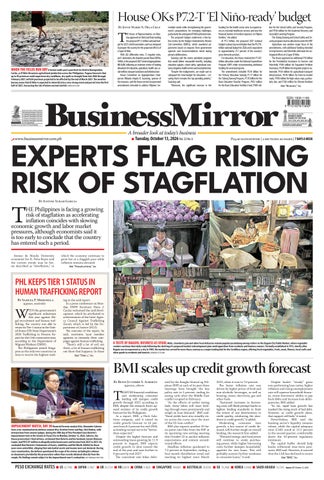
EXPERTS FLAG RISING RISK OF STAGFLATION www.businessmirror.com.ph
T
n
Tuesday, October 13, 2026 Vol. 22 No. 6
P25.00 nationwide | 2 sections 20 pages | 7 DAYS A WEEK
By Justine Xyrah Garcia
HE Philippines is facing a growing risk of stagflation as accelerating inflation coincides with slowing economic growth and labor market pressures, although economists said it is too early to conclude that the country has entered such a period.
Ateneo de Manila University economist Ser K. Peña-Reyes said the current trends may be better described as “slowflation,” in
which the economy continues to grow but at a sluggish pace while inflation remains elevated. See “Stagflation,” A2
PHL KEEPS TIER 1 STATUS IN HUMAN TRAFFICKING REPORT By Samuel P. Medenilla @sam_medenilla
W
ITH the government’s significant milestones this year against illegal recruitment and human trafficking, the country was able to retain its Tier 1 status in the United States (US) State Department’s 2026 Trafficking in Persons Report for the 11th consecutive year, according to the Department of Migrant Workers (DMW). The Philippines joined Singapore as the only two countries in Asia to receive the highest rank-
ing in the said report. In a press conference on Monday, DMW Secretary Hans J. Cacdac welcomed the said development, which he attributed to achievements of the Inter-Agency Council Against Trafficking (Iacat), which is led by the Department of Justice (DOJ). The outcome of the report, he said, motivates Iacat member agencies to intensify their campaign against human trafficking. “There’s still a lot of evil out there, a lot of human trafficking out there that happens. In these See “Tier 1,” A2
A TASTE OF BAGUIO, BUSINESS AS USUAL Walis, strawberry jam and other local delicacies remain popular pasalubong among visitors to the Baguio City Public Market, where vegetable vendors continue their daily trade following the shelving of a proposed market redevelopment plan amid opposition from residents and business owners. Formally established in 1913, shortly after Baguio was incorporated as a city in 1909, the market has served for more than a century as a major trading hub for the Cordillera region, offering fresh vegetables, fruits, meat, flowers, local crafts and other goods to residents and tourists. BERNARD TESTA/BM
BMI scales up credit growth forecast By Reine Juvierre S. Alberto
T
IMPEACHMENT WATCH, DAY 38 Financial forensic analyst Atty. Alexander Cabrera faces cross-examination by defense counsel Atty. Kristine Ferrer and Rep. Chel Diokno, with interjections from senator-judges, during the 38th day of Vice President Sara Duterte’s impeachment trial at the Senate in Pasay City on Monday, October 12, 2026. Cabrera, the House prosecution’s final witness, estimated that Duterte and her husband, lawyer Manases Carpio, had P817.87 million in allegedly undeclared assets and income from 2022 to 2025. He concluded that Duterte’s Statements of Assets, Liabilities and Net Worth (SALNs) for those years were untruthful, alleging that substantial assets and income were not declared. During cross-examination, the defense questioned the scope of his review, including his reliance on documents provided by the prosecution rather than records obtained directly from the couple. His findings remain subject to the impeachment court’s evaluation. ROY DOMINGO/SPPA POOL
@reine_alberto
IGHTER financial conditions and moderating consumer lending will dampen credit growth through 2027, according to BMI, despite the research firm’s upward revision of its credit growth forecast for the Philippines. In a report, BMI, a Fitch Solutions company, said it raised its credit growth forecast to 10 percent from 8.5 percent for end-2026, as lending turned out to be “betterthan-expected.” Despite the higher forecast and outstanding loans growing by 11.9 percent in August, BMI expects credit growth to slow toward the end of the year and ease further to 9 percent by end-2027. The consistent rate hikes deliv-
ered by the Bangko Sentral ng Pilipinas (BSP) at each of its past three meetings have brought the key policy rate to 5 percent, ending its easing cycle after the Middle East conflict erupted in February. “As the effects of earlier easing fade, these hikes will start feeding through more prominently and weigh on loan demand,” BMI said. “Bond yields have also steadily risen across the curve since the start of the US-Iran conflict.” BMI also expects another 25-basis-point rate hike from the BSP at its upcoming rate-setting meeting this October 22 to anchor inflation expectations and contain secondround effects. Headline inflation quickened to 7.2 percent in September, ending a four-month disinflation trend and reaching its highest since March
2023, when it rose to 7.6 percent. The faster inflation rate was driven by higher prices of food and non-alcoholic beverages, as well as housing, water, electricity, gas and other fuels. “Sustained increases in borrowing costs will likely prompt banks to tighten lending standards to limit the extent of any deterioration in credit quality, reinforcing the slowdown in credit growth,” it added. Moderating consumer loan growth, a key source of credit demand, will further weigh on overall lending, the research firm added. “Elevated energy and food prices will continue to erode purchasing power, while higher borrowing costs further dampen households’ appetite for new loans. This will probably sustain further weakness in consumer loans,” it said.
Despite banks’ “steady” gross non-performing loan ratios, higher inflation and rising unemployment rate will squeeze household finances, strain borrowers’ ability to pay back debts and increase loan delinquencies, BMI added. “So far, rapid loan growth has masked the rising stock of bad debt. However, as credit growth slows, that support will fade,” it noted. Nevertheless, BMI said the banking sector’s liquidity remains robust, while the capital adequacy ratio (CAR) stood at 15.2 percent in the second quarter, comfortably above the 10-percent regulatory minimum. The capital buffer should help banks withstand near-term pressures, BMI said. However, it warned that the CAR has declined in recent See “BMI,” A2
PESO EXCHANGE RATES n US 62.7930 n JAPAN 0.3967 n UK 83.1254 n HK 8.0018 n CHINA 9.3820 n SINGAPORE 49.0685 n AUSTRALIA 43.8358 n EU 70.2968 n KOREA 0.0468 n SAUDI ARABIA 16.7243 Source: BSP (October 12, 2026)
News
BusinessMirror
A2 Tuesday, October 13, 2026
Tier 1…
Continued from A1
last few years, we’ve been focusing, for instance, on the OFWs [overseas Filipino workers] who have been victimized as workers for scam hubs in and around the region,” Cacdac said. He was referring to the scam hubs near the borders of Myanmar, Cambodia, and Laos PDR, where thousands of migrant workers, including Filipinos become victims. As part of its efforts to prevent Filipinos from falling prey to the scam hubs, it established Migrant Workers Office in Thailand and Cambodia. Cacdac said another significant achievement of DMW against human trafficking was its first arrest of an owner of a licensed recruitment agency who had committed human trafficking, a few months ago. DMW Undersecretary Bernard P. Olalia reported other achievements of the Marcos administration against human trafficking this year. These included asking social media platforms to take down 50,000 posts from illegal recruiters; closure of 19 entities engaged in illegal recruitment and trafficking; and shutting down 20 accommodations for violations, different violations of our DMW rules and regulations. He said they were also able to provide support to OFWs to file charges against illegal recruiters and human traffickers. “A total of nine convictions to prove that we are very serious in our campaign for trafficking and persons,” Olalia said. “Combined with our closures, of course, is one important program, which is the entrapment of our perpetrators....We will not stop pursuing those,” Olalia said.
www.businessmirror.com.ph
DA: Pork tariff hike could net govt ₧10-B new revenue
T
By Ada Pelonia
HE government could generate over P10 billion in additional revenues from increased pork tariffs to help in the recovery of the hog sector weighed down by plummeting farmgate prices, according to the Department of Agriculture (DA). During a Tariff Commission (TC) hearing on Monday, the agency called for a staggered hike in duties levied on pork imports to protect the domestic swine industry’s recovery while preventing a spike in consumer prices. This, after industry sources flagged the continued slide in farmgate hog
prices to around P100 to P120 per kilo from the P150 per kilo recorded in August. Tariffs should be raised to 25 percent in-quota and 35 percent outquota in 2027, before reverting to its original level of 30 percent in-quota and 40 percent out-quota in the fol-
Stagflation…
and high inflation, often accompanied by high or rising unemployment. “One month of accelerating inflation and a few quarters of weaker growth do not, by themselves, establish a sustained stagflation episode. The key question is whether inflation remains elevated while growth and employment continue to weaken,” Peña-Reyes told the BusinessMirror.
Continued from A1
The Organisation for Economic Cooperation and Development (OECD) said stagflation generally refers to a combination of slow or zero economic growth
lowing year, the DA added. DA Macro-Economic Policy Division (MEDP) assistant chief Katrin Mares said the government stands to gain more than P10 billion in additional revenues if the staggered tariff scheme materializes, citing their simulations. Currently, duties slapped on pork stand at 15 percent and 25 percent under Executive Order (EO) 62, which will lapse in 2029. “This is not a proposal to shut out imports. It’s a proposal to restore the tariff structure gradually as the industry recovers,” Mares said. She noted that domestic pork output improved in the first semester to 841,206 metric tons (MT), from the 793,681 MT in the same period last year. Mares said the additional reve-
nues could help bankroll the P20billion annual allocation under the Animal Competitiveness Enhancement Fund (Ancef), which consists of tariffs collected from imported livestock, poultry, and dairy products. Under the law, around P3.64 billion would be allotted for the swine industry’s repopulation efforts, which she said translates to an annual increase in pork output to 100,000 MT. “The issue before us is not whether imports are needed, because as DA we do acknowledge that it remains part of our supply,” Mares said. “The issue is whether maintaining emergency levels [of tariff] reductions for an extended period continues to strike a balance between affordable food and a viable domestic hog industry.”
For IBON Foundation Executive Director Jose Enrique A. Africa, “The data clearly establish that the economy is already experiencing stagflationary pressures. There isn’t enough basis yet to claim full-blown or even impending stagflation but the situation nonetheless already warrants much more serious policy action than the Marcos Jr administration and its economic managers are giving.” Africa noted, “there’s already a dangerous combination of slowing growth, accelerating inflation and rising unemployment—GDP growth down to 2.6 percent in Q1Q2 2026 is less than half the 5.4 percent in the same period last year, inflation rising to 5.4 percent in Jan-Sept 2026 is three times the 1.7 percent in the same period last year, and unemployment of 5.2 percent in Jan-Aug 2026 is higher than the 4.1 percent in the same period last year.” The economy, he pointed out, “is clearly struggling with drastically slower household consumption [2.9 percent] contracting investment [-6.5 percent], and drastically weaker agriculture [1.2 percent] and manufacturing [1.6 percent]. This is even before the full effects of the latest inflationary surge is felt.” The Philippine Statistics Authority (PSA) reported that inflation accelerated to 7.2 percent in September, ending a four-month disinflation trend and returning to the rate recorded in April. Meanwhile, economic growth has slowed for four consecutive quarters, with gross domestic product expanding by just 2.3 percent in the second quarter of 2026. This brought first-half growth to 2.6 percent, less than half the 5.4 percent recorded in the same period last year. Labor market conditions have also weakened. Unemployment reached 6 percent in July, equivalent to about 3.14 million jobless Filipinos, before easing to 5.3 percent in August. The July rate marked a return to postpandemic levels of unemployment. Underemployment, meanwhile, stood at 11.6 in August, up from the 10.7 percent recorded in the same month a year earlier. For Peña-Reyes, these figures warrant closer monitoring but do not yet establish stagflation. Sustained unemployment of around 5 to 6 percent or higher would be a warning sign if growth continued to weaken, while a persistent rate above 6 percent, declining employment, and fewer job opportunities would strengthen concerns. He added that underemployment also matters, as workers struggling to find sufficient hours or adequately paid jobs could signal broader labor market weakness even if the headline unemployment rate stabilizes. University of Asia and the Pacific economist Marco C. Agonia also explained that a full-blown stagflation scenario would involve double-digit inflation and unemployment alongside near-zero or negative economic
growth—conditions that the Philippines has yet to experience. He added that an underemployment rate exceeding 16 to 20 percent would also signal a severe deterioration in labor market conditions and strengthen concerns over stagflation. “As it stands, growth prospects such as an infrastructure spending rebound remain intact and could pull growth and hiring in a better direction. Our ongoing shift towards alternative sources of energy in the medium to long run could mitigate the impact of this supply shock,” Agonia told the BusinessMirror. De La Salle University economist Maria Ella C. Oplas likewise urged caution, noting that the recent increase in unemployment could be seasonal and that employment may improve during the “ber” months as demand rises ahead of the holiday season. “We should be cautious about saying that the country is heading toward stagflation because the increase in unemployment could be seasonal. We expect employment to improve during the holidays,” Oplas told this newspaper.
What to watch
AGONIA said prolonged high oil prices and elevated inflation could push the economy closer to stagflation, while high interest rates could weigh on public and private spending and further weaken short-term growth. The second-half gross domestic product (GDP) figures will be crucial in assessing the economic outlook, he said, particularly as inflation is expected to remain elevated. Beyond that, Peña-Reyes warned that peso depreciation and climaterelated food supply disruptions could also keep domestic prices elevated while squeezing household purchasing power and business margins. These pressures could be compounded by weak domestic demand, he said, as continued weakness in public infrastructure spending, private investment and household consumption could further constrain economic growth and job creation. PSA data showed that household consumption grew by 2.8 percent in the second quarter of 2026, while gross capital formation contracted by 9.2 percent. Public construction also declined further, contracting by 14.8 percent. “The most important signal will be sustained inflation occurring at the same time as further economic deceleration and worsening employment conditions,” Peña-Reyes added. Oplas, for her part, said the labor market will be particularly important to watch during the holiday season, when stronger consumer demand would normally support hiring. “If employment does not improve, then we should start to worry because it should be picking up during the holiday season,” she said.
Saudi…
Continued from A9
to the Riyadh airport until their flights were canceled, including one from Dammam airport, and 37 in Manila. Cacdac said the number of Filipinos who need assistance will continue to rise as the cancellation of flights bound for Riyadh persists. He said their overseas posts are ready to continue providing support to the affected Filipinos using DMW’s Agarang Kalinga at Saklolo Aksyon para sa mga OFW na Nangangailangan (Aksyon) fund, which was replenished with a P3-billion fund allocation last June.
Top 15…
Continued from A9
1. Veligandu Island Beach, Maldives 97.55 2. Mounday’s Bay, Anguilla 94.71 3. Ao Nang Beach, Thailand 94.00 4. Coron, Philippines 93.32 5. Grace Bay Beach, Turks and Caicos 93.04 6. Mambo Beach, Curaçao 92.00 7. Pink Sands Beach, Bahamas 91.71 8. Boracay, Philippines 91.49 9. Holbox Beach, Mexico 91.38 10. El Nido, Philippines 91.27 11. Bora Bora, French Polynesia 91.21 12. Cas Abao Beach, Curaçao 91.14 13. Iztuzu Beach, Turkey 90.82 14. Manuel Antonio National Park, Costa Rica 90.46 15. Puerto Vallarta, Mexico 89.79
BMI…
Continued from A1
quarters and warrants close monitoring, particularly if the downward trend continues in the second half and throughout 2027. Providing a partial offset to these pressures is the recovery in construction lending, which had contracted since December 2025 amid curtailed loan approvals following investigations into corruption in flood control projects, BMI said. “We expect lending to start picking up as scrutiny eases and delayed projects resume,” it added.
Budget…
Continued from A1
Farm Productivity Support. “These amendments bring the total additional funding for agriculture approved by the House and recommended by the BARSc to P20.86 billion,” Suansing said. For the transport sector, lawmakers approved an additional P1 billion for the Fuel Subsidy Program, which had no allocation under the NEP, along with P250 million for service contracting and another P250 million for capital outlay. The transport funding also included P75 million for the EDSA Busway Project in the National Capital Region and P774 million for locally funded Department of Transportation projects. Suansing said the fuel subsidy would help public utility vehicle drivers, tricycle operators and bus drivers cope with high fuel prices, particularly amid disruptions in the Middle East that pushed up crude oil costs. The House also amended the provision on the Personnel Economic Relief Allowance (PERA) to provide an allowance of “at least Two Thousand Pesos (P2,000) per month.” Suansing said the phrase “at least” would give the executive flexibility in determining the final amount and form of any additional allowance, instead of fixing the amount at P2,000. Health care funding in the House version rose by P12.23 billion, from P346.59 billion under the NEP to P358.82 billion. Among the allocations was P23.97 billion for the Medical Assistance Program to help more Filipinos access hospitalization and other essential medical services, along with P1.55 billion for the Health Facilities Enhancement Program and P50 million for Department of Health regional hospital operations. Additional allocations for social welfare programs included P25 million each for Project ProtecTEEN and Project Aruga, P13.8 million for Project SAFE, and P20 million for the Department of Social Welfare and Development’s Special Committee on LGBTQIA+. Infrastructure funding also received additional allocations, including P68 million under the Department of Public Works and Highways’ Organizational Outcome 2 and P66 million under its Basic Infrastructure Program. The 2027 national budget will now be transmitted to the Senate for its own deliberations.
The Nation BusinessMirror
www.businessmirror.com.ph
Tuesday, October 13, 2026 A3
House prosecution panel drops Sara as witness
T
By Jovee Marie N. Dela Cruz |
@joveemarie
HE House of Representatives prosecution panel does not expect to call Vice President Sara Z. Duterte to the witness stand, saying her testimony may no longer be necessary as it nears the end of its presentation of financial evidence in the impeachment trial, even as thousands of protesters gathered outside the Senate on Monday to demand her conviction. House private prosecutor and legal spokesperson Benjamin Tolosa Jr. said the prosecution sees little value in questioning Duterte if her answers would merely repeat the position taken by her lawyers on financial records presented before the Senate
Impeachment Court. “For now, it seems we will no longer call her,” Tolosa said in an interview. Tolosa said prosecutors had initially considered calling Duterte to answer questions about confidential funds and later about bank accounts,
Expert defends P818 million unexplained wealth finding
A
FORENSIC accounting expert on Monday stood by his assessment alleging P817.87 million in unexplained wealth linked to Vice President Sara Z. Duterte and her husband, lawyer Manases Carpio, amid aggressive defense questioning over his methodology during Day 38 of Duterte’s Senate impeachment trial. Lawyer Alexander B. Cabrera, chairman emeritus of Isla Lipana & Co. (PwC Philippines), maintained under cross-examination by defense counsel Kristine Ferrer that his report’s conclusions were strictly derived from verified financial documents provided to his team. “Findings from the numbers,” Cabrera testified when pressed on his assessment of alleged corporate fraud, explicitly rejecting claims that his team’s work amounted to mere speculation. T he forensic report, dated October 2, covers 2022 to 2025 and tallies P817.87 million in cumulative undeclared assets and computed undeclared income across four years. A primary focus centered on substantial gaps between corporate bank inflows and declared financial statements across three companies tied to the couple: GenCorp Industries Inc.: P2.58 billion in net bank inflows vs. P1.53 billion in financial statement inflows (a P1.049 billion gap). Cabrera attributed a 20 percent conservative interest to Duterte. Metro City Chow Foods Corp.: P240.61 million in net bank inflows against P142.22 million in reported collections (P98.39 million gap), using Duterte’s 20 percent ownership stake. Cale88 Foods Corp.: P247.31 million in net bank inflows vs. P211.99 million in reported inflows (P35.32 million gap), using Carpio’s 47.5 percent stake. Ferrer targeted the report’s evidentiary foundation, forcing C a bre r a to conce de s e ve r a l
investigative limitations: No Direct Inter v iews: His team worked exclusively from provided financial records, without interviewing Duterte, Carpio, their accountants, or their auditors. Missing Documents: Cabrera ack nowledged not ex amining underly ing stock certificates, subscription agreements, or stock and transfer books for GenCorp, nor direct loan agreements for P38.8 million in total company advances attributed to Carpio. Unconfirmed Purposes: Cabrera admitted no firsthand knowledge regarding specific high-value transactions, including P11.35 million in checks issued to Duterte’s dentist, P41 million in cash withdrawals from Carpio’s account in August 2024, or retail transactions in Kuala Lumpur and Tokyo. “We were only working from documents,” Cabrera said, noting that documents coming directly from the couple were unavailable. “Had there been any, I would have used them.” Cabrera clarified that his findings outlined potential statutory violations – including Republic Act 1379 (Forfeiture of Unlawfully Acquired Property), RA 6713 (Code of Conduct for Public Officials), RA 3019 (AntiGraft and Corrupt Practices Act), and Statement of Assets, Liabilities, and Net Worth (SALN) rules –rather than court-established guilt. He added that only a court could make a final legal determination of fraud or tax evasion. The expert’s report forms a core pillar of the House prosecution’s evidence under Article II of the impeachment complaint, which accuses Vice President Duterte of unexplained wealth and SALN nondisclosure. The trial continues as the defense pushes to undermine the prosecution’s financial evidence. Jovee Marie N. dela Cruz
tax records, corporate interests and other financial documents presented under Article II of the impeachment complaint. However, he cited the defense’s position that Duterte could no longer recall whether she had a joint Bank of the Philippine Islands account with her father,formerPresidentRodrigoDuterte, or any transactions involving it. “If that is also going to be her answer, we do not want to prejudge her strategy, but based on what has emerged, there may be no use in calling her just to hear the same things from her before the senator-judges,” Tolosa said. The prosecution instead decided to conclude its presentation with forensic financial analyst Alexander Cabrera, whose testimony consolidated bank, tax, corporate and other government records into an assessment of the Vice President’s finances. “We thought it might be a waste of everyone’s time, so it would be better to end with this witness, who has put together all the records,” Tolosa said. The prosecution has presented
T
reviews for four out of 47 flood control projects currently under investigation. T he four cases w i l l be endorsed to the Department of Justice (DOJ) or t he Of f ice of t he O mbud sm a n for further investigation and legal action. Matibag highlighted severe i r re g u l a r it ies, s p e c i f ic a l ly contractors submitting
At the impeachment trial, House prosecutor Party-list Rep. Jose Manuel Diokno of Akbayan said the financial allegations against Duterte concerned not merely the Vice President as an individual but the public trust attached to her office. “This case is really not about VP Sara Duterte as a person. To me, it’s about the trust that the people reposed in her,” Diokno told the Senate Impeachment Court. Diokno cited bank documents, Anti-Money Laundering Council records, Bureau of Internal Revenue filings and Securities and Exchange Commission records as evidence that could be independently examined. “These are independent facts verifiable by anybody,” he said. Duterte has denied wrongdoing, while her defense has challenged the prosecution’s evidence and interpretation of her financial records. The prosecution’s decision to forgo calling her would leave the documentary evidence and expert testimony at the center of its case as the impeachment proceedings continue.
Ombudsman urges SC: Kill plunder ‘shield’ By Joel R. San Juan @jrsanjuan1573
C
A L L I N G c u r r e nt l e g a l precedent a “sh ield for the guilty” rather than an instrument of justice, Ombudsman Jesus Crispin Remulla on Monday mounted a direct challenge against a Supreme Court doctrine that he claims allows masterminds of massive corruption schemes to walk free. Delivering his first annual report, Remulla took aim at the landmark ruling in Macapagal-Arroyo v People, which obliges prosecutors to identify a singular “main plunderer” who directly profited or received stolen funds. R emu l l a a rg ued t h at t h i s requirement creates an absurd legal loophole that rewards the most sophisticated criminals. “Think about what that means. The smarter the thief, the safer he is,” Remulla said. “Pass the money through enough dummies, middlemen, and offshore companies, and no one can be shown to have touched it.”
“The law against plunder was created to hold accountable those who steal billions,” he added in Tagalog. “But under this doctrine, the biggest syndicate is the hardest to catch. That is not justice. It is merely a shield.” The Ombudsman pointed to the ongoing flood control scam as a prime example of how bad actors exploit the rule, explaining that illicit funds were funneled through complex layers of contractors and accounts to erase the paper trail leading to top officials. Remulla formally appealed to the Court to revisit the ruling “with full respect for the Supreme Court.” Remulla said that his office has already built and filed 39 cases linked to the flood control scandal – 35 with the Sandiganbayan and four with regional trial courts. The probe names 52 individuals, including high-profile politicians such as former Speaker Martin Romualdez, Sen. Jinggoy Estrada, former senator Ramon Revilla Jr., four congressmen, along with private contractors and Department of Public Works and
Highways (DPWH) officials. Addressing the intense online rhetoric surrounding the cases, Remulla warned the public against organized “ black propaganda” campaigns on social media aimed at swaying public opinion through bot networks and paid comments. “Don’t be fooled by people who pay for comments or reactions,” Remulla warned. “If you want to know the truth, don’t look at the comment section. Look at the documents, look at the cases that have been filed. Look at the evidence.” He delivered a sharp warning to those targeted in the government’s crackdown, asserting that money, influence, and online armies will no longer stall accountability. “The cases are now in court, and we have done the hardest part – building them. The next chapter belongs to the courts,” Remulla said. “To those who betray public trust, you are not safe. Not behind your position, not behind your money, not behind your connections, and not across any border.”
PCG drives away poachers off Kota Island By Rex Anthony Naval
T
HE Coa st Gu a rd ( PCG) on Monday said its units from Coast Guard Station (CGS) Kota conducted a joint operation with the Navy and Marine Corps and repelled five unauthorized foreign fishing vessels from the waters of Kota Island on Sunday. The operation was launched after PCG personnel on Kota Island sighted a foreign fishing vessel preparing to conduct illegal fishing only about 200 meters from the shore, while another was loitering one nautical mile west of the island, both well within its 12-nautical-mile territorial sea, at around 2:15 p.m. Sunday. Neither vessel responded to radio challenges, it added.
Leap year blunder exposes Davao ‘fraud’ H E Nat ion a l Bu re au of Investigation (NBI) i s pre p a r i n g t o f i le complaints over four alleged anomalous flood control projects in Davao City after uncovering alleged irregularities, including the use of fabricated evidence to claim payments. NBI Director Melvin Matibag announced on Monday that the bureau has completed initial
Cabrera’s computation of P817.87 million in alleged undeclared assets and unexplained wealth involving Duterte and her husband, lawyer Manases Carpio, covering 2022 to 2025. The findings remain allegations in the impeachment proceedings. Outside the Senate in Pasay City, members of the party-list groups Akbayan and Mamamayang Liberal joined youth groups and civil society organizations in a rally demanding Duterte’s conviction and accountability over the allegations involving her wealth. Orga n i zers est im ated t h at around 12,500 people attended the demonstration along Jose W. Diokno Boulevard, including 2,500 Akbayan members and supporters and about 10,000 participants from other civil society groups. The protest featured the return of the chant “Sara, Sara Labandera,” a modified version of the Filipino novelty folk song “Gloria Gloria Labandera,” which demonstrators used to criticize the Vice President over her alleged unexplained wealth.
identical photos with different dates to collect public funds. In one glaring error, a contractor submitted a photo allegedly taken on February 29, 2023. “There was no February 29 in 2023 because it was not a leap year,” Matibag pointed out during a news conference. He said the 43 remaining flagged flood control projects are still being investigated.
“At 3:00 p.m., two rubber boats manned by six PCG personnel were deployed. As the team approached, the vessel near the shoreline hauled back a sampan it had deployed, while three additional foreign fishing vessels were sighted approaching the island. Upon the continued approach of the PCG team, all five vessels withdrew and moved away until they were outside the territorial sea of Kota Island,” the PCG said. It added that the operation concluded at 4:00 p.m. without any untoward incident. The PCG said this is the third operation by Coast Guard Station Kota in two weeks to drive away foreign vessels from the island. “O n 0 9 Oc tober 2026, t he PCG repelled Chinese Maritime
Militia Vessel [CMMV] 9622 and its 22 sampans. The same vessel was also repelled on 28 September 2026,” it added. Kota Island is an integral part of the Municipality of Kalayaan, Palawan. U n d e r i n t e r n a t i o n a l l a w, t he Phi l ippines e xercises f u l l sovereignty over its territorial sea, where no foreign vessel may fish without authorization. Such activities also violate the Philippine Fisheries Code and the Philippine Maritime Zones Act. The PCG continues to monitor the waters around Kota Island and will sustain its vigilance against further intrusions in the Kalayaan Island Group, in close coordination with the Navy and the Marine Corps.
ROBINHOOD PADILLA
Lacson flags Padilla’s ‘disregard for law’ remark By Butch Fernandez @butchfBM
S
ENATOR-JUDGE Robinhood Padilla should clarify whether his remark about a “disregard for law” in the impeachment proceedings against Vice President Sara Duterte was directed at the entire Impeachment Court or at specific senator-judges, especially after he hinted he and his allies may skip the trial, Senator-Judge Panfilo M. Lacson said on Monday. Lacson said Padilla’s remark could be seen as a direct assault on the integrity of the entire Impeachment Court if he were referring to the body of which he is also a member. “I don’t know what Senator Padilla meant by ‘disregard for law’ or if he was referring to the entire Impeachment Court na member din naman siya. If so, hindi kaya maituturing na direct assault sa integridad ng korte ang mga binitiwan niyang pananalita [I don’t know what Senator Padilla meant by ‘disregard for law’ or if he was referring to the entire Impeachment Court where he is a member. If so, won’t his remark be taken as a direct assault on the integrity of the Impeachment Court]?” he said. Also, Lacson said that if Padilla’s “disregard for law” remark referred to individual senator-judges, it is only fair that he should name them. “Marapat lamang na liwanagin niya kung buong Impeachment Court ba ang tinutukoy niya sa ‘disregard for law’ or ilang myembro lang. Kung ang huli, sana pangalanan niya [It is only fair that he clarify if his ‘disregard for law’ referred to the impeachment court or to individual senator-judges. If it is the latter, I hope he names them],” he added. In a radio interview Sunday, Padilla said he and his allies may skip the impeachment trial if there is “disregard for the law.” He cited what he described as many surprising developments, adding that if the supposed twisting of the law continues, “baka dumating na ang punto na hindi na kami um-attend [there may come a point when we won’t attend].” Earlier, Padilla and Sen. Christopher Go and the Partido Demokratiko Pilipino-Lakas ng Bayan (PDP-Laban) petitioned the Supreme Court to nullify the Senate’s Impeachment Court’s ruling on the voting threshold.
Court orders Immigration to release Sy
T
HE Supreme Court (SC) has ordered the Bureau of Immigration (BI) to release Global Ferronickel Holdings Inc. chairman Joseph Cue Sy upon the posting of a P900,000 bond. The Court’s First Division issued the order in a resolution dated October 7 which granted a plea for a writ of preliminary mandatory injunction to stop his continued detention by the BI. The order directed the BI officials and personnel holding Sy to release him upon proof that the required bond had been paid. They were also ordered to submit a written compliance report within 24 hours of his release. Sy was arrested by the BI on August 21, 2025 on suspicion that he was a Chinese national using
fake Philippine documents. The BI has maintained that Sy and Cheng Zhong Zhen are one and the same person. Sy’s real identity, according to the agency, was established through the assistance of government intelligence sources which prompted the BI to dig deeper into his immigration records. The BI pointed out that photos, as well as the biometric information and data of Sy and Chen matched, thus confirming them to be one and the same person. The agency added that the fingerprints of Sy appearing on his passport and the fingerprints of Chen appearing on the Alien Certificate of Registration Identity Card Records (ACR I-Card) belong to the same person.
Thus, the BI said Sy should be deported for violating the country’s immigration laws and the limitations and conditions of his stay. In its February 2026 ruling, the CA affirmed the decision issued by the Regional Trial Court in Taguig City which held that Sy’s birth certificate constitutes prima facie evidence of his citizenship, which the BI has the burden of proving otherwise. The CA added that Sy’s birth certificate should have been accorded more weight by the BI over the ACR I-Card of Chen. The appellate court held that the bureau cannot proceed with the deportation proceedings of Sy, considering that he is a Filipino national based on his birth certificate. Joel R. San Juan
Economy BusinessMirror
A4 Tuesday, October 13, 2026
PHL seeks $57.4-million investments in 5 crops By Ada Pelonia
T
HE Philippines is seeking $57.4 million in investments in five priority crops through an international investment forum, the United Nations Food and Agriculture Organization (FAO) said. The international body said the priority agri-food value chains include coffee, seaweed, mango, jackfruit and cocoa. The proposals aim to improve farmers’ incomes, creating economic opportunities in rural communities and bolstering climate resilience. The Philippines’ investment profile also offers an average projected internal rate of return of 24.6 percent,
and a total estimated net present value of $42.2 million, the FAO added. In addition, it said coffee and seaweed account for the largest investment requirements, at roughly $26.4 million and $24.8 million, respectively. Additional proposals lean towards processing, machinery, and other value addition for mango, jackfruit, and cocoa.
The proposals were developed through collaboration between the Department of Agriculture (DA), FAO, and the Asian Development Bank (ADB), which are part of a broader effort to mobilize public and private financing for Philippine agriculture. This moves beyond traditional development assistance towards investments that can deliver both financial returns and measurable development benefits, the FAO added. These proposals will be presented to international financial institutions and private investors at the FAO Hand-inHand Investment (HIHI) Forum, which will take place from October 13 to 16 at its headquarters in Rome. FAO Representative in the Philippines Lionel Dabbadie said food security, rural prosperity, and climate resilience will not be achieved through isolated interventions. “They require investment at
scale. The Hand-in-Hand Initiative brings together data, policy and f i n a nce to t u r n de ve lopment pr ior ities into investment opportunities,” Dabbadie said. “ The portfolio presented by the Philippines illustrates how partnerships between government, the private sector and international organizations can help de-risk investments and generate economic returns, while improving farmers’ livelihoods and strengthening the resilience of agrifood systems.” T he orga n i zat ion sa id t he investment opportunities reflect the country’s ambition to attract more capital into agriculture and fisheries. This is particularly crucial in sectors where stronger value chains, improved infrastructure, and better access to markets can raise the value generated by farmers and producers, the FAO added.
Killer robots: Machines deciding who lives and who dies By Henry J. Schumacher
I
HATE to say that: This isn’t a future problem. It’s happening now. We and our children are the “collateral damage” in AI-led wars. Gover nments and weapons companies are racing to develop autonomous weapons that can identify and attack people as “targets” with less and less human control. And right now, there is no law to stop them. A UN expert warns that “we’re dangerously close to crossing a moral red line.” A machine should never decide who lives and who dies. In just a few weeks, leaders will meet in person to decide whether to start writing the first global rules on killer robots. The technical work is done. A draft exists. Some EU leaders have even shown support. But they won’t move unless they feel the public behind them—and that is us. Without us getting super active, they could put this off for another three years, while these weapons kill indiscriminately. When thousands of us speak with one voice, governments will hopefully
find the courage to act. Engage now and tell the world to draw the line: humans, not machines, must stay in control. If we reach 100,000 signatures, we’ll make sure to bring them to a meeting! Sign now for a world without killer robots! AI already decides which news we see, whether we get a loan, even who gets a job interview. It can feel like these decisions are out of our hands—and now they want to hand over the decision to kill, too. But this time, we can still say no. Nine in ten people in France, Germany and the UK are worried about AI weapons, and almost everyone wants rules for them. Some European governments are already calling for
negotiations to start. So this isn’t about changing minds. It’s about making sure our leaders keep their word. Right now, they’re hesitating because it feels like nobody is paying attention. Thousands of signatures can prove them wrong. We can do it!!! And then: OpenAI Chief Executive Officer Sam Altmansaidthereremainsafundamental difference in worldview between his company and rival Anthropic on artificial intelligence regulation, arguing in an exclusive interview with Decoded by POLITICO that the technology’s benefits justify accepting some risks— and that AI should remain broadly accessible to the public. Asked specifically where he diverges, Altman said, “we believe that the world should accept some bad things happening for the benefits of this technology and people having the agency.” Anthropic has long been viewed as the strongest proponent of AI regulations within the industry, a stance that until recently was at odds with the lighter-touch approach favored by OpenAI. But the policy
differences between the two leading AI firms have narrowed in recent months, with Open AI backing tougher rules as it grapples with highprofile hacking incidents and rogue behavior by its models. A ltman agreed to slow the development of the most advanced AI models. His company has followed Anthropic in endorsing new state laws that impose stricter safety requirements than what the maker of ChatGPT had previously supported – a subtle shift from its prior state strategy. And OpenAI lobbyists recently endorsed a bipartisan US House proposal that would require top AI companies to embed outside safety evaluators. Europe could be the first to draw the line on killer robots. But while governments hesitate, children are losing their lives in wars with less and less human control. We need to act: Never put lifeand-death decisions in the hands of machines. I hope, you are as worried as I am; I would appreciate your comments; please contact me at hjschumacher59@gmail.com
PHL named co-facilitator for finance, investment talks at pre-COP 31 meet By Jonathan L. Mayuga @jonlmayuga
T
HE Philippines was appointed co-facilitator for the Finance and Investment sessions, part of a broader, minister-led climatefinance process aimed at advancing practical discussion on how finance can support countries’ climate priorities and implementation, during the Pacific Pre-COP31 meeting in Nadi, Fiji, the Climate Change Commission (CCC) announced. Thus, CCC Vice Chairperson and Executive Director Robert E.A. Borje co-led discussions with United
Nations Framework Convention on Climate Change (UNFCCC) Parties, helping guide the exchange toward a practical balance: delivering on existing finance commitments while addressing barriers to access and mobilize complementary investment. Following several consultations and discussions with participants, Borje reported back to the Pacific Pre-COP31 plenary on the priorities raised, bringing implementation concerns into the wider discussion on how global commitments can translate into support for projects and communities. The report-back reflected broad
convergence among participants that the UNFCCC’s 31st Conference of the Parties (COP31) should focus on implementing existing commitments and agreed outcomes, including the New Collective Quantified Goal on Climate Finance, and translating pledges into results on the ground. Participants identified debt pressures, limited fiscal space, high costs of capital, slow approvals, complex accreditation and limited direct access as barriers to implementation. Participants also discussed practical responses, including simpler and more harmonized procedures, faster processing, grants and highly concessional finance for adaptation, and stronger engagement with multilateral development banks and other international financial institutions. They also raised guarantees, risk-sharing, climate-resilient debt clauses and debt-for-climate swaps as possible tools. The report-back emphasized that aligning financial flows under Article 2.1(c), including efforts to mobilize private finance, can complement but must not substitute for developed-country obligations under Article 9.1 of the Paris Agreement. Borje was paired with France’s Minister for Ecological Transition, Biodiversity, and International Negotiations on Climate and Nature, Monique Barbut, in the minister-led finance process.
“I thank Australia’s COP31 Presidency for its confidence in the Philippines. We worked to keep the discussion grounded in practical ways to make climate finance support implementation,” Borje said. In his plenary finance intervention, Borje cited UN Environment Program (Unep) estimates that developing countries will need US$310–365 billion a year for adaptation by 2035, compared with US$26 billion in international public adaptation finance in 2023. “A large share of an inadequate pool remains inadequate,” he said, calling for finance that is adequate, predictable and accessible to national and local institutions. Philippine Ambassador to Fiji Noel M. Novicio underscored the same implementation test for COP31 in his session intervention: “a COP of implementation, moving from pledges to predictable flows and from access barriers to actual access.” The Philippines’ contribution is grounded in its climate policy agenda under President Marcos, including the country’s first National Adaptation Plan for 2023–2050 and updated Nationally Determined Contribution, or NDC 3.0, submitted to the UNFCCC in September 2026. Borje also took part in the 2026 UNFCCC Standing Committee on Finance Forum in Sydney, which focused on financing climate action for water systems and the ocean.
www.businessmirror.com.ph
Solon calls for effective implementation of GGA
T
HE Philippines has called for effective implementation of the Global Goal on Adaptation (GGA) and greater coherence in the multilateral climate system during the Pacific Pre-COP31 in Nadi, Fiji. D e l i v e r i n g t he Ph i l i p p i ne interventions during the Adaptation and Multilateral System sessions, Cagayan de Oro City Rep. Rufus B. Rodriguez stressed that adaptation f ramework s must empower communities to build resilience, and that international cooperation must make climate support more accessible and effective. “The test of the GGA is not whether we can measure resilience, but whether we empower countries and communities to build it,” Rodriguez said. Healsoemphasizedtheimportance of a multilateral system that gives every country a seat and a voice while ensuring that climate support reaches communities more effectively. “A stronger multilateral system is one that turns agreement into delivery, makes support accessible, and ensures that no country is left behind,” Rodriguez said. The Philippines supported the voluntary testing of adaptation ind icators based on nat iona l circumstances, capacities and priorities,withoutimposingadditional reporting burdens. It also called for closer coordination among climate funds and institutions, simplified and harmonized procedures, and direct access to climate support. Climate Change Commission
(CCC) Vice Chairperson and Executive DirectorRobertE.A.Borjeunderscored the importance of international cooperation and practical approaches that translate climate commitments into meaningful results for vulnerable countries and communities. “Whether through adaptation or multilateral cooperation, our efforts must go beyond global commitments and frameworks. We mu st ensu re t h at c l i m ate action delivers tangible results, strengthens resilience, and reaches the communities most vulnerable to climate impacts,” Borje said. Rodriguez is a member of the Philippine Delegation to the Pacific Pre-COP31, headed by Borje. He is also the vice chairperson of the House of Representatives Committee on Energy, a member of the Committees on Ecology and on Natural Resources, and played a key role in the passage of Republic Act 9729, or the Climate Change Act of 2009. The Philippines, through the CCC, remains steadfast in advancing effective adaptation and a more coherent multilateral climate system that translates global commitments into concrete action on the ground. The Pre-COP31 dialogue served as a platform for countries to exchange views and advance key climate priorities. These efforts helped shape discussions ahead of the United Nations Framework Convention on Climate Change’s 31st Conference of the Parties (COP31), scheduled for November 9–20, 2026, in Antalya, Türkiye. Jonathan L. Mayuga
QC lawmaker: Solar panels on every roof By Jovee Marie N. Dela Cruz @joveemarie
A
LEGISLATOR has filed a bill mandating the installation of roof top solar energ y systems in government housing projects nationwide, seeking to cut electricity costs for low-income families and ease the financial burden on relocated households. Quezon City Rep. Patrick Michael Vargas filed House Bill 10478, or the proposed “Power sa Mamamayan Act,” that seeks to establish the Solar ng Tahanan Financing Program, which would integrate rooftop solar equipment into long-term housing loans without requiring beneficiaries to make upfront payments. “The goal of relocating informal settlers is to help lift them out of poverty. As they rebuild their lives, we need to reduce their burden by providing affordable electricity,” Vargas said. The measure seeks to address the high cost of living in resettlement communities, where former informal settler families (ISFs) face additional expenses, including transportation to urban workplaces and monthly electricity bills. Vargas said some families spend up to 10 percent of their monthly income on electricity, with bills ranging from P600 to P1,200 for basic household needs such as lighting and electric fans. Under the proposal, households would generate electricity from their rooftop solar installations during the day and sell excess power to local electricity distributors in exchange for credits on their monthly bills. Vargas said a household paying
P1,000 a month for conventional electricity could reduce its combined electricity and housing loan expenses to around P400 monthly under the proposed arrangement. The bill seeks to integrate solar technology into government housing programs implemented by the National Housing Authority (NHA) and the Social Housing Finance Corporation (SHFC). Vargas cited the grid-connected ro of to p s ol a r i n s t a l l at ion at Pasinaya Homes in Naic, Cavite, as a model that could be replicated in other government resettlement communities. “PasinayaHomeshasdemonstrated that affordable and clean electricity is possible in socialized housing communities. We now have the opportunity to expand this and make it a standard in all government relocation sites nationwide,” he said. To prevent additional financial pressure on beneficiaries, the measure would prohibit housing agencies from passing on the cost of solar equipment unless the combined housing loan and electricity expenses remain lower than the cost of conventional electricity service. Vargas said integrating renewable energy into government housing projects could help households lower their monthly expenses while supporting the country’s transition to cleaner energy sources. He added that solar-powered resett lement communities could become more energy selfsufficient, allowing low-income families to benefit from renewable energy while rebuilding their lives in permanent housing.
Tuesday, October 13, 2026
A5
Chinese national arrested over alleged links to illegal POGO hubs in Tarlac, Pampanga
A
By Ashley J. Manabat
CHINESE national wanted in connection with alleged human trafficking linked to illegal Philippine offshore gaming operator (POGO) hubs in Tarlac and Pampanga was arrested in Parañaque City on Oct. 9, authorities said.
Heated exchange erupts between defense, prosecution on day 38 of impeachment trial
A
DEBATE erupted between defense counsel Atty. Kristine Ferrer and House prosecutor Rep. Chel Diokno regarding an objection to a question, he claimed was already answered, after the former meticulously asked the witness, Atty. Alexander Cabrera, regarding his experience as a tax lawyer versus his role as a financial forensic expert. During the 38th day of the impeachment trial of Vice President Sara Duterte on Monday, Ferrer asked Cabrera, “Even if you focus your career in taxation, and only devoted about a year in external audit, as a tax accountant, you still consider yourself, sir, as a tax forensic accounting expert?” To which Diokno objected and cited Section 39 of Rule 130, arguing that counsel may still object since the witness already answered the question in the previous hearing. Presiding Officer Francis “Chiz” Escudero eventually overruled the
objection. Ferrer then asked the witness further about his lack of prior experience as legal counsel or an expert witness in cases involving graft, corruption, ill-gotten wealth, or civil forfeiture. Cabrera confirmed he had not served in these roles in court previously. She highlighted that the witness’ curriculum vitae lacked formal attachments such as diplomas, certifications, or peer reviews. Ferrer also questioned Cabrera about the timeline of his appointment as a forensic expert in June 2026 and the specific documents provided to him by the prosecution for his analysis. Cabrera admitted that he initially received the Vice President’s Statements of Assets, Liabilities, and Net Worth (SALNs) of spanning the years 2022 to 2025, alongside Anti-Money Laundering Council (AMLC) documents . Claudeth Mocon-Ciriaco
DA turns over ₧40.95-M agricultural assistance package to Nasugbu farmers
T
HE Department of Agriculture (DA) provided nearly P41 million worth of agricultural support to farmers in Nasugbu, Batangas. Agriculture Secretary Francisco Tiu Laurel Jr. said the assistance covers key segments of Nasugbu’s farm economy, such as rice, corn, high-value crops (HVC), coconut, mechanization and urban agriculture. “The package of interventions amounts to P40.95 million and covers programs supporting rice, corn, high-value crops, urban and periurban agriculture, farm mechanization, coconut production, and irrigation development,” Tiu Laurel said. Central to the investment is the P29.8-million Solar-Powered Irrigation System (SPIS), being implemented through the Bureau of Soils and Water Management (BSWM). The DA said the irrigation project provides a more reliable water source, helping farmers manage production more efficiently while reducing dependence on conventional power sources for irrigation operations. Meanwhile, the rice program held the lion’s share of allocation among production-focused programs at P6.2 million, followed by the P1.2 million for the corn program.
Some P545,000 has been earmarked under the HVC development Program, while another P62,500 will support the National Urban and Peri-Urban Agriculture Program. The Philippine Center for Postharvest Development and Mechanization (PhilMech) will provide P2.1 million in assistance, while the Philippine Coconut Authority (PCA) will extend P1.1 million to coconut farmers. “For beneficiaries, the assistance goes beyond inputs and equipment: it is intended to strengthen productive capacity and help sustain farmbased livelihoods,” the DA said. The agency said the initiative reflects its approach of pairing immediate production support with investments in agricultural infrastructure. This would address both farmers’ near-term needs and some of the structural constraints that can limit productivity. “For Nasugbu, the combination of nearly P41 million in interventions and a new solar-powered irrigation facility represents a substantial infusion of public investment into the local farm sector, with the potential to improve access to resources, strengthen production and support more resilient agricultural livelihoods.”Ada Pelonia
Huang Mingmin was arrested at the K1 Center Building in Barangay Tambo, Paranaque, in a joint operation by the Criminal Investigation and Detection Group’s National Capital Region Regional Field Unit and the Presidential Anti-Organized Crime Commission (PAOCC). According to PAOCC, Huang a l leged ly used the a liases Yang Bin, Sy Wa ng a nd A Bao. He w a s l i n k e d to i l leg a l PO G O
op er at ion s i n B a mba n , Ta r l ac, a nd Porac, Pa mpa nga, t he agenc y sa id. Court records identify Yang Bin as a person in control of premises covered by a search warrant issued by the Regional Trial Court in Malolos City, Bulacan, in connection with an alleged violation of Article 267 of the Revised Penal Code on serious illegal detention. A separate warrant concerned an alleged violation
of the Expanded Anti-Trafficking in Persons Act of 2012. PAOCC also said the alias A Bao appears among individuals facing arrest warrants in cases arising from anti-POGO operations involving Lucky South 99 and Whirlwind Corp. in Porac. The qualified human trafficking case is pending before the Regional Trial Court in Pasig City, Branch 157. PAOCC further alleged that
Huang owned real estate and fishing vessels on Jomalig Island and had business interests in Quezon province, including Mother’s Wonderland and Sea Horizon Resort. Huang was taken to the CIDG regional field unit following his arrest. PAOCC said it would continue working with law enforcement agencies to investigate suspected organized crime and human trafficking linked to illegal POGO operations.
‘PHL won’t be used as illegal drug transshipment point’ By Rex Anthony Naval
T
HE Philippine National Police (PNP) on Monday said that it will not allow the country to become an illegal drug transshipment point. This was after a Filipino national was arrested following the seizure of 521 kilograms of sus-
Advincula set to receive theology doctorate
M
ANILA Archbishop Jose Advincula will receive an honorary doctorate in theology from the University of Santo Tomas (UST), recognizing his contributions to the Catholic Church through pastoral leadership and priestly formation. Advincula will be conferred with the honorary doctorate on Oct. 15. The 74-year-old cardinal will be conferred the degree by the Dominican-run university, where he completed his bachelor’s degree in sacred theology in 1975. UST Secretary General Fr. Louie Coronel, O.P., said the conferment recognizes Advincula’s ministry and commitment to serving the faithful. “More than an academic celebration, this solemn occasion is an expression of thanksgiving to God for the gift of a faithful shepherd whose life and ministry reflect Christ’s loving care for His people,” Coronel said in a memorandum. Coronel said the recognition also underscores the role of education and knowledge in serving the Church and society. After completing his studies at UST, Advincula pursued further education in Rome, where he earned a licentiate in canon law from the Pontifical University of St. Thomas Aquinas, also known as the Angelicum. His episcopal ministry began in 2001, when Pope John Paul II appointed him bishop of San Carlos in Negros Occidental. He was later named archbishop of Capiz in 2012, serving in the post until Pope Francis appointed him archbishop of Manila in March 2021. Francis elevated Advincula to the College of Cardinals in November 2020. Advincula took formal leadership of the Archdiocese of Manila during his installation at the Manila Cathedral on June 24, 2021. In May 2025, he participated in the Vatican conclave that elected Pope Leo XIV following the death of Francis. The cardinal has also maintained ties with the Dominican community, becoming an honorary member of the Priestly Fraternities of St. Dominic in the Philippines in 2022. The upcoming conferment follows Advincula presiding over the episcopal coronation of the historic image of Our Lady of the Most Holy Rosary at UST’s Santísimo Rosario Parish on October 4. The ceremony will take place at the university’s Blessed Buenaventura García Paredes, O.P. Building in Manila. Mary Jade Jadormio
pected shabu worth P3.4 billion in a private jet at Luang Prabang International Airport in Laos with the illegal narcotics allegedly headed for the Philippines. PNP spokesperson Col. Allen Rae Co, in a press briefing in Camp Crame, Quezon City, confirmed this information even as he admitted that they are still determining
what other actions they do as the incident took place abroad. Likewise, he said the PNP is coordinating with the Philippine Drug Enforcement Agency (PDEA) and foreign law enforcement agencies to verify the shipment’s origin, destination, and possible links to international drug trafficking.
In line with this, Co said the PNP will intensify its intelligence monitoring and coordination with government agencies tasked to watch over airports and seaports, adding that PNP chief Gen. Jose Melencio Nartatez Jr. gave strict orders that the Philippines will not be turned into an illegal drugs transshipment point.
LTFRB denies GrabBike, Dingdong RiderKo accreditation as motorcycle taxi platforms By Lorenz S. Marasigan @lorenzmarasigan
T
HE Land Transportation Franchising and Regulatory Board (LTFRB) said on Monday it has rejected the applications of GrabBike and Dingdong RiderKo for accreditation as Motorcycle Taxi Platform Providers (MTPPs), saying the two failed to prove they kept running and complied with the rules during the pilot implementation of motorcycle taxis. “For this reason, the Board is constrained to deny your application for accreditation as a Motorcycle Taxi Platform Provider,” the LTFRB said in separate letters to the two companies.
Both platforms were earlier granted authority to operate under the pilot run of motorcycle taxis in Metro Manila and nearby areas, as well as in other urban areas across the country. A c t i n g LT F R B C h a i r m a n Greg G. P u a Jr. sa id t he agenc y’s rev iew of t heir operat ions showed t hat some cond it ions were not met dur ing the per iod covered by t heir aut hor it y. He c ited Sect ion 5 of Depa r t ment Order (DO) No. 2026 - 0 0 6 of t he Depa r t ment of Tra nsport at ion (DOTr), wh ic h gover ns t he operat ion of M T PPs. “The Order expressly provides that MTPPs whose previous pilot authority lapsed, expired, or was not maintained through active
participation and compliance are excluded from the coverage of the Order,” Pua said. Pua explained that the conditions were set so that only qualified MTPPs would be given authority, ensuring the reliability and sustainability of their operations. “ Hi nd i puwede n a pa ra ng ningas cogon lan g because what is at stake here is the interest of the commuting public,” he said. Pua also reminded all MTPPs to comply with the requirements of the DOTr and the LTFRB in exchange for their operation, stressing that the authority to operate is not a right but a privilege that carries obligations that must be met at all times.
DILG deploys 54 patrol motorcycles to boost 911 response in North Luzon
T
HE Department of the Interior and Local Government (DILG) has deployed 54 patrol motorcycles to police units in Regions 1 and 2 to strengthen emergency response, particularly in rural and far-flung communities. DILG Secretary Jonvic Remulla led the ceremonial turnover of the motorcycles during his visits to the Police Regional Office 1 (PRO1) in San Fernando, La Union, and Police Regional Office 2 (PRO2) in Tuguegarao City, Cagayan. Of the 54 motorcycles, Ilocos Norte, Ilocos Sur, and Pangasinan received 10 units each, while La Union, Cagayan, and Isabela received eight units each. The deployment forms part of the DILG’s continuing efforts to strengthen emergency response under the Unified 911 program, making assistance faster and more accessible, especially to communities where every minute of delay can make a difference. Remulla said the Department plans to distribute more than 5,000 motorcycles to police stations nationwide to improve the mobility and response capabilities of law enforcement personnel during emergencies and other public safety incidents. During the visits, Remulla also met with senior officials from the DILG local government sector, Philippine National Police (PNP), Bureau of Jail Management and Penology (BJMP), and Bureau of Fire Protection (BFP) to discuss peace and order, emergency response, and institutional accountability. The DILG chief stressed the need for swift emergency response, called for zero tolerance for malpractice within the BFP, and raised the possible return of the Seal of Good Local Governance (SGLG) framework as part of broader efforts to strengthen accountability and performance in local governance. Joining Remulla during the activities were PNP Chief Police General Jose Melencio C. Nartatez and BFP Officer-in-Charge Fire Chief Superintendent Wilberto Rico Neil A. Kwan Tiu. The DILG continues to strengthen coordination among law enforcement agencies, local government units, and emergency responders to ensure that Filipinos, regardless of where they live, can count on timely, reliable, and responsive public service. Jonathan L. Mayuga
A6
Tuesday, October 13, 2026
BusinessMirror
www.businessmirror.com.ph
The World China moves to stave off wider EU trade war with hybrid deal By Bloomberg News
W
ITH an agreement to curb exports of hybrid vehicles to the European Union, China is betting it can sidestep harsher restrictions from the 27-member bloc with a gesture that has little immediate prospect of reshaping the overall trade relationship. Talks between China and the EU ended late Friday with a 16-point consensus spanning trade and investment, export controls and intellectual property rights. The EU said China agreed to slash millions of hybrid car exports, with people familiar with discussions saying the bloc intends to use safeguard measures to curb the imports. EU leaders meet on Thursday to decide whether to adopt a more forceful response to the surge in Chinese exports, which threaten to hollow out European manufacturing industries and decimate millions of jobs. Germany and France last week called for stronger tools—including an instrument that could cut off China from the bloc’s massive single market—to defend sectors hit by surging subsidized Chinese imports. The agreement on Friday buys time for further negotiations, with the two sides planning for more talks in January and March, said Joe Peissel, lead macroeconomist at research firm Trivium China. He called it a strategic win for China, saying in a research note that “Beijing has played a blinder.” “In exchange for reviews, dialogue, and ‘understandings,’ it has conceded little on the structural drivers of the EU’s massive trade deficit,” he wrote. “Beyond vehicles and modest tariff relief, nothing in the 16-point agreement suggests a significant rewiring of China’s trading terms with the EU.” In Asia, top Chinese electric-carmaker BYD Co. fell as much as 2.5 percent in Hong Kong on Monday. But it had earlier risen as much as 2.7 percent— mirroring advances by other Chinese car stocks—as investors expressed relief that the discussions hadn’t deteriorated to a full-blown trade war. EU leaders are seeking ways to stop China from flooding the continent with goods that have led to a trade deficit now exceeding €1 billion ($1.1 billion) a day. Weak consumption at home has left China increasingly reliant on a world-beating manufacturing sector and overseas demand to support its sluggish domestic economy. China’s Ministry of Commerce on Friday said the two sides reaffirmed their commitment as key trading partners to properly manage differences under World Trade Organization rules. They also agreed to maintain stable bilateral economic and trade ties while making them “more balanced.” Friday’s joint statement said the two sides had reached an “understanding on trade in hybrid vehicles in a WTO compliant manner.” Chinese hybrid car sales have escalated in part because they escaped the EU’s 2024 tariffs on electric vehicles. In August, Chinese car brands accounted for about a quarter of European hybrid sales. The EU will cap the import of Chinese hybrid vehicles at 350,000 cars per year, according to a document outlining the plan and seen by Bloomberg News, a measure taking effect as soon as December 1. The 350,000-car limit will apply for the first year of the cap, then will increase by 6% annually from the second year of application, according to the document. The measures will apply for four years, during which time both countries will pledge to abide by World Trade Organization rules. Safeguard measures planned by the EU typically take the form of tariffrate quotas, which apply a levy on imports above a certain volume to curb excess flows. That would comply with WTO rules—something both China and the EU have said is a requirement. EU ambassadors briefed by trade chief Maros Sefcovic on Sunday broadly welcomed the result while stressing that they viewed it as just the beginning of the process to rebalance the trade relationship, according to people familiar with the talks, who spoke on the condition of anonymity. The goal is for the EU safeguard measures to apply from December 1. Chinese carmakers like Chery Automobile Co. have massively stepped up vehicle shipments to the EU in response to a slump in their home market, exacerbating a deceleration plaguing European peers, which are among the worst-performing globally. Mercedes-Benz Group AG car sales dropped by 8% in the third quarter, while Volkswagen AG last month slashed its profit forecast following a similar warning from BMW AG in June. Renault SA Chief Executive Officer Francois Provost called the deal with China a “major milestone” that will help foster a future for Europe’s automotive industry. He was among business leaders who met with Sefcovic ahead of his trip to China for the talks. “I had urged him to seek an agreement quickly,” Provost said in an interview Sunday. “Without one, we would be looking at a trade war with China, which would be a lose-lose situation for everyone.” The timing of the EU-China agreement “indicates that China is keen to ease tensions” before the bloc’s leaders meet, said Henry Gao, a law professor at Singapore Management University. “Given its ongoing trade frictions with the United States, Beijing is unlikely to want a simultaneous escalation with Europe.” “If the EU insists on strictly WTO-consistent approaches, such measures may not be particularly effective in addressing the surge of Chinese exports, as past cases have demonstrated,” Gao added. “WTO-compliant trade remedies can provide some relief, but they are often limited in scope and may not significantly alter broader trade flows.” France and Germany have called on the EU to investigate whether subsidized imports are harming sectors like chemicals and plastics— probes that could produce more tariffs. The proposal was seen as a pressure tactic targeting Beijing, putting Germany’s weight behind forceful moves it had previously opposed. “It has taken a tremendous amount of political capital for European officials to get this far on autos, and it’s not clear that the approach could be easily copy-pasted to other industries,” said Christopher Beddor, deputy China research director at Gavekal Dragonomics. Beijing has preemptively warned the EU against adopting what it called protectionist measures. China’s dominance of critical rare earth supplies—leverage it’s already wielded in trade negotiations with the US— gives Beijing a powerful deterrent as Europe simultaneously tries to curb Chinese imports and secure the materials its factories need. “Sweeping trade barriers and tariffs would probably incur retaliation from Beijing, and Chinese officials have the nuclear option of threatening to restrict rare-earths exports,” Beddor said. “But at this stage, they seem more inclined to cut a deal.”
Tuesday, October 13, 2026
A7
Blackouts hit Indian factories as coal crunch feeds into economy By Rajesh Kumar Singh & Pratik Parija Bloomberg News
I
NDIAN factories, smelters and households are being hit by blackouts and rising energy costs as the impact of plunging coal stockpiles at the country’s power stations ripples through the economy. The weakest monsoon since 2015 has curbed hydropower output, while hotter-than-normal weather has buoyed demand for air conditioning and farm irrigation. That’s seen coal-fired power stations, which supply about two-thirds of India’s electricity, rapidly burn through their inventories. Smaller factories, farmers and households are facing power cuts as demand outweighs supply on the grid. Meanwhile, large industrial customers - in metals smelting, chemicals and paper — can’t get enough fuel to produce electricity themselves due to state-owned miner Coal India Ltd. prioritizing deliveries to grid-connected generators. Small steel mills in the central state of Chhattisgarh are facing outages of 10 to 12 hours a day, forcing plants to reduce output, said Manish Dhuppad, general secretary at the Chhattisgarh Mini Steel Plant Association. Mills require an “uninterrupted supply of power,” he said. “Say we have hot metal inside the furnace and just before we are able to take it out, the power supply goes. By the time it comes back,
the material has solidified and we need to melt it again.” The power shortage highlights the increasing role that extreme weather is having on India’s economy, with the weak monsoon driven by a record El Niño. It also shows how the country’s continued reliance on fossil fuels is limiting its ability to respond to a changing climate. Feedstock supplies at almost half of India’s coal-fired plants had fallen to less than a quarter of required levels as of October 10, according to the power ministry. A late burst of monsoon rainfall last month in coal-mining regions in the east of the country exacerbated the shortages, crimping production and also hampering rail transport of the fuel. In the northern state of Punjab, homes and industries are enduring lengthy blackouts. Badish Jindal, who runs a steel wire plant in Ludhiana, an industrial city in the state, said frequent power cuts of three to four hours had resulted in higher energy costs, as his factory needed to shift to expensive back-up generators. “The power cuts are unscheduled,” he said. “That makes it difficult to
A COAL pile on the outskirts of New Delhi in April. BLOOMBERG
plan our operations and deliveries and affects product quality. The sudden stoppage and restart of machines as the power supply goes and comes back also raises the risks of accidents.” The country’s electricity grid has faced an average shortfall of nearly 4 gigawatts a day in the first 10 days of October, data from Grid Controller of India show. That’s enough to power about 2 million rural Indian households, according to Bloomberg calculations. The policy to favor grid-connected power stations has left companies that generate their own coal-fired electricity at a major disadvantage, said Rajiv Agarwal, secretary general of the Indian Captive Power Producers Association, which represents the big industrial users. They are having to pay high prices at Coal India auctions, and buy expensive power from the grid, he said. The firms are also having to wait months for rail transport, so those with limited operating capital are being forced to cut output, he said. Average premiums at Coal India spot sales in September jumped to 94 percent over the base price, compared with a 59 percent difference in
August. Two of the company’s subsidiaries — Northern Coalfields and South Eastern Coalfields — charged more than a 200 percent premium at auctions last month, data from the miner show. Coal India didn’t immediately reply to a request for comment. For those getting their power from the grid, bills have gone up in most Indian states over the past few years. That’s been driven by a range of factors including rising coal prices and the cost of upgrades to the national electricity network. In Uttar Pradesh, India’s most populous province, some villages in Shamli district are facing as much as seven hours a day of blackouts, prompting many residents to buy back-up systems that can run lights and fans, according to Devinder Singh, a local grain and sugarcane farmer. A rapid buildout of solar in the country over the last few years means there’s enough power for him to irrigate his fields during the day, although problems occur after sunset, he said. “We somehow adjust,” Singh said. “My bigger concern is the rising cost of electricity.
Hurricane Simon pounds Mexico’s Pacific coast By Fernando Llano & Martin Silva The Associated Press
P
U E RTO VA L L A RTA, M E X I CO — Hurricane Simon pounded Mexico’s Pacific coast as a Category 3 storm on Sunday, its eye remaining just offshore as its most powerful winds and rain slammed people living between the Sierra Madre and the ocean. The hurricane’s center swirled parallel to the coast, closing in on the Puerto Vallarta area, where its most damaging winds and rain were expected to hit around midnight and continue through Monday morning. Its maximum sustained winds weakened Sunday to 120 mph (195 kph), according to the US National Hurricane Center in Miami, but it was still expected to remain a dangerous hurricane. That’s not good news for people in and around Puerto Vallarta, a popular tourist destination in the state of Jalisco. Just inland and uphill from the resort areas, many Mexicans live in communities where housing might not stand up to the storm. By Sunday afternoon, Simon’s eye was moving northwest about 45 miles (75 kilometers) south of Cabo Corrientes at about 5 mph (7 kph). A senior hurricane center specialist, Philippe Papin, said this westernmost tip of mainland Mexico is the area most likely to get a direct hit from the system. Cabo Corrientes is at the southern tip of Bahia de Banderas, the wide bay where Puerto Vallarta looks out to the Pacific. Forecasters powerful winds will sweep from Mexico’s western coast to the Sierra Madre Hurricane-force winds extend outward up to 15 miles (30 kilometers), and tropicalstorm-force winds reach up to 60 miles (95 kilometers) from Simon’s center, meaning the entire area between Mexico’s western coast and the Sierra Madre mountains could be affected. “We’re expecting catastrophic wind and life-threatening storm surge impacts along
that west-central coast of Mexico where the hurricane warning is currently in effect,” Papin said. “They’re also getting very heavy rainfall associated with the storm that’s likely going to produce life-threatening flooding and mudslides in areas of higher terrain along the Mexican coastline, and there will be significant swells.” The hurricane center on S unday s a i d S i m o n wa s ex p e c te d to d u m p an additional 2 to 4 inches (5 to 10 centimeters) of rain, with some areas getting up to 8 inches (20 centimeters), in the states of Colima, Jalisco, Nayarit and Sinaloa through early Thursday. “Isolated maximum storm totals of 30 inches (76 centimeters) are possible over portions of the states of Michoacan, Colima, and Jalisco,” the center said in its latest advisory. “This rainfall will produce life-threatening flooding and mudslides or worsen any on-going flooding, especially in areas of steep terrain.”
Residents told to stay sheltered
AS the storm approached Puerto Vallarta, National Guard vehicles patrolled the streets while police used a megaphone to call out the few people who were jogging, walking their dogs or biking by the waterfront. Officers reminded people that the area was closed and urged them to take shelter. Not everyone followed the orders. Jalisco state suspended classes on Friday and Monday in 22 coastal municipalities and began evacuating people from at-risk areas while asking the tourism sector to make sure workers and visitors are fully accommodated in shelters or safe zones. Mexican President Claudia Sheinbaum took to the social platform X on Sunday to urge people in Jalisco, Colima, Nayarit and Michoacan to stay sheltered until the government issues a notification that the danger has passed. She also asked people to follow recommendations from civil protection officials and to avoid traveling on public roads.
“Precautionary evacuation efforts to safe zones are ongoing; the priority is our safety,” she wrote. Hotel worker Víctor Martínez went shopping for nonperishable food Sunday afternoon. He said he could not go to work because public transportation service was suspended and most of the hotel had been evacuated. Martínez found people’s concerns about the hurricane comforting. “It happened to us before. It hit us years ago,” Martínez said, referring to a Category 5 hurricane that hit the area in 2002. “People didn’t expect it. We were very skeptical that it would ever hit us. Now, though, we’re different. Precautions are being taken. It happened to us once, and we won’t let it
happen again.” Despite the risks posed by Simon, tourists were still arriving in Puerto Vallarta. Visitors Ricardo Ramírez and Brenda Villarreal, who have never lived through a hurricane, went looking for food by the city’s boardwalk and came across police urging people to take shelter. Ramírez said they were completely unprepared for the situation. “The boardwalk is closed. Be responsible. Understand!” police told passersby using a megaphone. Ramírez said he and Villarreal had planned their four-day vacation since last year and traveled from Guadalajara, Jalisco’s capital. “We don’t know the extent of the danger yet,” Villarreal said. “We’re just starting to see what’s going on.”
A8
Tuesday, October 13, 2026
The World
Trump says Russia, Ukraine agree to ‘energy ceasefire’ By Susie Blann, Elise Morton & Collin Binkley
W
The Associated Press
ASHINGTON—United States President Donald Trump said Sunday that Russia and Ukraine had agreed to an “energy ceasefire” in the 4 1/2-year-old war, but he offered no details on it and Kyiv reported attacks by Moscow on energy sites after his statement. Trump’s brief social media post said only that the ceasefire took effect immediately, adding: “Do not break it!” Moscow did not immediately comment. U krainian President Volodymyr Zelensky y said that whi le his cou nt r y “welcomed ” the announcement by Trump as “good news for ever yone,” Russia was still hitting energ y infrastructure in Kyiv and in the city of K harkiv. “Unfortunately, Ukrainian skies have been infested with Russian ‘shaheds’ all day today,” he said in an evening address, referring to drones launched by Moscow . “There have been glide bomb strikes and strikes on our energy infrastructure too. A power plant in Kharkiv was attacked this evening.” The presidential office confirmed the K harkiv attack came after Trump’s ceasefire post. Zelensky y said Ukraine was “ready to refrain from striking Russian energy infrastructure—and we count on the same readiness from Russia.” Russia has sought to deny Ukrainian civilians power, heat and running water during the war, hoping to wear down public resistance to Moscow’s full-scale invasion. Ukrainian officials describe the strategy as “weaponizing winter.” Zelenskyy said Ukraine has proposed many de-escalatory steps but Russian President Vladimir Putin “had one answer to all of them — ‘nyet.’ We do hope that he will finally say something different to America, Ukraine, and the entire world.” He said Kyiv is maintaining contact with the US, and he thanked Americans for their support. He said on X that he had spoken about the development with Canadian Prime Minister Mark Carney, Finnish President Alexander Stubb and NATO Secretary-General Mark Rutte. In an interview broadcast earlier Sunday, Zelenskyy said Kyiv was ready to stop striking Russian
refineries if Moscow halted attacks on Ukraine’s energy system, and he asked Trump to press the Kremlin to agree. “We are asking President Trump, (to) give them (a) signal, not (to) attack energy infrastructure of Ukraine,” he told ABC’s “This Week .” O n S e p t e m b e r 14 , Tr u m p claimed on social media that both countries had agreed “not to hit” each other’s energy infrastructure but offered no details on that proposal either. While Zelenskyy had said Ukraine was ready to comply if Russia did, nothing came of the proposal.
Trump spars with Zelenskyy TRUMP said Saturday it was time for Ukraine to get a new president, suggesting Zelensky y has not done enough to end the war and blaming him for high diesel prices in the US. Zelenskyy said in response to Trump’s comments that Ukraine could hold elections if Russia agreed to a 60-day ceasefire. “Give us two months, 60 days off. Total ceasefire, 60 days, and we will organize elections,” he said, adding that Ukraine would be ready to accept whatever choice its people made. “With all respect to President Trump, it’s up to our society, up to our people to choose one or another leader,” he said. Holding an election during the war would be unlawful and that Ukraine would need security guarantees to allow for safe voting, Zelenskyy added. Ukraine has been under martial law since Putin launched the fullscale invasion in February 2022, and the Ukrainian Constitution bars elections while it remains in force. Beyond the legal barrier, a nationwide vote would be vulnerable to Russian attacks, and organizing one is widely seen as logistically impossible, with roughly a fifth of the country held by Russia, millions of Ukrainians displaced abroad and
A RESCUE worker puts out a fire at residential houses destroyed in a Russian strike on Kharkiv, Ukraine, Sunday, October 11, 2026. AP/ANDRII MARIENKO
soldiers on the front line. Zelenskyy’s term formally expired in May 2024, but the constitution allows him to remain in office until a new president is sworn in. T he exchange came as Ky iv pressed its campaign against Russian infrastructure, with a drone attack on Sunday shutting down a data center in the city of Vladimir, east of Moscow, run by technology giant Yandex. It was the third strike on the company’s facilities in four days. Russia and Ukraine have been waging a long-range aerial war while their armies remain largely deadlocked on the front line. Tr u mp, who on Fr id ay st r uc k a dea l w it h P ut i n to buy d iesel f rom Moscow i n a n at tempt to address high fuel pr ices ahead of US m idter m elec t ions, h a s been u rg i ng Zelensk y y for week s to stop st r i k i ng R u s s i a n e ne rg y i nf ra st r uc t u re. He has sought to blame record US diesel prices on Ukraine rather than the US-led war in Iran, which has driven up world energy prices. Ukrainian and European officials reacted to the diesel deal with dismay, saying it will help pay for Russia’s war effort.
Strike triggers outages THE Ukrainian drone attack on the Yandex data center in Vladimir caused outages across the company’s services, leaving users in dozens of Russian cities and in Kazakhstan, Belarus and Armenia unable to order taxis or access banking services, according to Russian independent news outlet Astra. “Operations at the data center have been completely halted. There were no injuries,” said the Yandex Cloud Telegram channel, which updates service availability. Moscow residents described disruption to everyday tasks. Pavel Belyavskiy, a driver for Yandex
Taxi, said it was unclear whether orders were coming through at all, and that he had to cancel several rides after waiting a long time because he could not reach the passenger. “I’d press the ‘call’ button to contact them, but nothing happens,” he said. “There’s nothing I can do, so I’m just forced to cancel.” Igor Mann said he tried to check on an order on the Yandex Market shopping platform but the page was unavailable, and connecting through a virtual private network did not help. “Nothing worked,” he said. A not her Muscov ite, Edu a rd Malyavko, said the outages had a “direct impact” and weren’t just about “convenience.” He said they affected “healthcare, and everything else.” On Thursday, a drone attack took a Yandex data center offline in the Ryazan region, southeast of Moscow. The next day, Ukrainian drones hit the company’s major data center in the Kaluga region, southwest of Moscow, disabling part of the facility, Yandex said. Yandex, often described as Russia’s Google, runs the country’s most popular search engine and a wide range of digital services, and is heavily involved in Russia’s artificial intelligence development. Elsewhere, search and rescue operations ended in the southern city of Zaporizhzhia after a Russian bombing on Saturday, according to Ivan Fedorov, former regional head and co-chair of the regional defense council. Zelenskyy said 23 people were killed in the attack, including four children. More than 30 people were wounded, Fedorov said, with eight still hospitalized. A man was killed and two women wounded in a Ukrainian drone strike on Russia’s Bryansk border region, local officials said Sunday.
www.businessmirror.com.ph
Artificial intelligence water strain includes surging demand from power use By Todd Woody & Mark Chediak Bloomberg News
D
ATA center developers have started touting new technologies that slash the amount of water needed to cool hot-running servers in drought-stressed places like Arizona. Those efforts, though, are not addressing the vast majority of the water consumed by the AI buildout. Miles away from multiplying data centers, power plants are now consuming enormous volumes of water to generate the electricity required to run artificial intelligence, including those more efficient cooling systems. New research indicates that such indirect water consumption is rapidly growing. In a recent paper, University of Michigan researchers estimated water used offsite would boost the total annual consumption of three large AI data centers planned for the state by 14 billion gallons. “There has been much less attention to this indirect water usage, even though that oftentimes is significantly higher than the direct water usage and has impacts on watersheds and regional water resources,” said Shaolei Ren, a professor at the University of California at Riverside who studies data center water consumption. At Meta Platforms Inc., one of the only developers to publicly divulge indirect water consumption, such use accounted for about 96 percent of the 21 billion gallons (80 billion liters) of water the company consumed in 2024—nearly a 120 percent increase from 2021—according to its latest sustainability report. The remaining 4 percent was used on site, mostly at data centers, which also account for nearly all of Meta’s electricity consumption. “Transparency is a key pillar of Meta’s water stewardship program,” a spokesperson said in an email. Computing-intensive AI data centers can consume 10 times as much electricity as conventional facilities, with most of that energy needed to power servers, according to researchers. To generate that electricity, fossil-fueled and nuclear power plants need large amounts of water to produce steam to run turbines. Across the US, a growing backlash has emphasized concerns about local environmental impacts and rising electricity bills. That opposition has prompted moratoriums and other restrictions. At least 45 projects valued at nearly $68 billion were blocked or delayed between April and June, according to research firm Data Center Watch. There’s a risk data centers’ rapid growth will intensify the impact of climate-driven droughts and heat waves, which are already stressing water supplies in many places. “Demand for data centers is just skyrocketing and the truth of the matter is that the power and water facilities won’t be able to keep up,” said Kerri Hickenbottom, an associate professor of engineering at the University of Arizona who researches data center water use. Estimates of US data centers’ annual indirect water use range from 211 billion gallons (800 billion liters) in a 2024 Lawrence Berkeley National Laboratory study to as much as 4 trillion gallons based on a recent analysis from environmental nonprofit Ceres. That’s enough to supply between 2 million and nearly 37 million average US households per year.
Developers said one reason for the lack of disclosure is that there’s no standard protocol for calculating data centers’ indirect water use. “We need industry alignment on one if we’re going to collectively report indirect water consumption,” said Brandon Oyer, head of energy and water for Amazon Web Services. Amazon.com Inc. said water efficiency at its data centers has improved by 52% since 2021, in part from deploying cooling systems that require less of it and through technology that reduces heat inside the facilities. “That is keeping both the onsite and the offsite water use as low as possible,” said Will Hewes, Amazon Web Services’ water sustainability lead. Ben Townsend, head of infrastructure strategy and sustainability at Google, said the company currently doesn’t report indirect water use but has concentrated on powering data centers with renewable energy. “With wind, solar, storage, these projects have effectively zero water footprint,” he said. Such solutions are being put to the test in drought-stressed data center hotspots such as Arizona, where water is a flash point as the Colorado River and its reservoirs dry up. The federal government in August announced a 27 percent cut to Arizona’s water allocation, with far more severe cuts possible if conditions continue to deteriorate. The state’s data centers are concentrated in the Phoenix area, where cities depend on the river for 20 percent to 50 percent of their water supply. AI data center projects currently being built in Arizona could spike onsite water demand to 5 billion gallons annually in coming years, Bloomberg Intelligence predicts, or 4.5 percent of Phoenix’s current annual water production. But the indirect water use would be orders of magnitude more, according to researchers. Michael Gertzman, a spokesperson for the Phoenix Water Services Department, said a large data center applicant must disclose its estimated onsite water consumption. Indirect water use isn’t part of the evaluation. With the southwest US suffering a record 26-year drought, and Phoenix’s summer temperatures hitting an average daily high of 108F (42C) in recent years, data center developers are turning to technology that relies on little or no onsite water, such as air-chilled coolers. There are tradeoffs, however, as removing that heat requires electricity. A 2025 study that Hickenbottom coauthored noted that in the Phoenix area, the indirect water consumption of systems using air-cooled chillers can be more than 2.5 times that of water-cooled chillers, which use more water on site. M i c ro s o f t Co r p. , w h i c h o p e rate s several data centers in Arizona, didn’t provide data on its indirect water use or indicate whether it calculates that consumption. The company said it has reduced the amount of water needed onsite per kilowatt-hour used at its data centers by 90 percent since the early 2000s. It expects to save 33 million gallons (125 million liters) annually at each of its facilities thanks to liquid cooling designs. “Our focus is on minimizing the water we use directly in the communities where we operate while maintaining highly efficient data center designs and working with utilities to help meet our power needs responsibly,” a Microsoft spokesperson said in an email.
North Korea fires multiple ballistic missiles By Kim Tong-Hyung The Associated Press
S
EOUL, South Korea—North Korea on Monday fired multiple ballistic missiles toward its eastern waters, South Korea’s military said, adding to a recent streak of weapons demonstrations that has heightened tensions during a prolonged freeze in diplomacy. Jang Do-young, spokesperson of South Korea’s Joint Chiefs of Staff, said missiles of various types were fired from an area around the North Korean capital of Pyongyang, where the country’s main airport has been a major launch site in recent years. Jang said one of the missiles flew more than 900 kilometers (559 miles) before falling into the sea but didn’t comment on the flight details of the other weapons. The joint chiefs didn’t specify how many missiles it detected.
Japan’s Deputy Defense Minister Takashi Koyari said Japan detected at least two missiles launched 17 minutes apart and that the weapons landed in waters outside of its exclusive economic zone. Koyari said the first missile flew about 220 kilometers (137 miles) and the second more than 910 kilometers (565 miles), following an “irregular” flight path, a term Japanese officials have previously used to describe hypersonic weapons. There were no reports of damage to aircraft or vessels, he said. While maintaining a hard line toward Seoul, North Korea has been ramping up weapons testing as it seeks to expand its arsenal of nuclear-capable systems, including an October 3 test of what the North described as a hypersonic intermediate-range missile designed to evade missile defenses in South Korea and Japan. North Korea has also conducted other
missile tests and live-fire drills and commissioned a new warship as leader Kim Jong Un continues to flaunt his nuclear weapons program while rejecting US and South Korean offers to resume long-stalled diplomacy. The latest launch came days after South Korea on Friday flight-tested its own domestically developed hypersonic weapon, designed to fly at least five times the speed of sound and evade missile defense systems, which President Lee Jae Myung described as critical in strengthening the South’s conventional defense capabilities. Without directly addressing the growing threat from North Korea, Lee’s office said the hypersonic weapon, once fully developed, would enhance South Korea’s ability to strike key targets by surprise in the “Korean Peninsula theater of operations.” Jang, the South Korean military official, said the latest North Korean launches likely
were intended to advance the country’s missile technologies while also serving as a possible response to South Korea’s hypersonic test. The South’s presidential national security office called for North Korea to “immediately cease” its repeated ballistic launches, which violate UN Security Council resolutions against the North and “do not help manage the current situation on the Korean Peninsula.” Koyari said Japan lodged a protest to North Korea through their embassies in Beijing. Tensions were further worsened after three South Korean soldiers were injured in land mine explosions last month near the heavily armed inter-Korean border. The South’s military and the US-led United Nations Command concluded the blasts were caused by devices planted by North Korea, which has denied responsibility and ridiculed the South’s demands for an apology.
www.businessmirror.com.ph
2nd Front Page BusinessMirror
ADB OFFERS PHL ITS STANDBY FACILITY FOR EL NIÑO AID By Justine Xyrah Garcia
T
HE Asian Development Bank (ADB) said it is ready to extend emergency financial assistance to the Philippines to help mitigate the impact of a severe El Niño, should the government need additional financing. ADB Philippines Country Director Andrew Jeffries said the bank has an existing $500-million standby loan facility that the government can tap if it declares a state of emergency. Jeffries said part of the facility had already been drawn in the past, but it is replenishable, allowing funds to be made available again when needed. “It depends if the government will need that extra assistance or not. As of now, they are not projecting to need that assistance, but it’s there. That’s the whole purpose, it is a short-term immediate funding after disasters,” Jeffries told reporters in a chance interview recently. Under the Disaster Resilience Improvement Program (Drip) II, signed in February 2025, the ADB aims to help the government strengthen its disaster risk management policies and institutional frameworks, including disaster response at the national and subnational levels. The program also seeks to promote anticipatory disaster response and address underlying risks to build long-term resilience. The Drip II is subject to an interest rate based on the Secured Overnight Financing Rate (SOFR), with a 0.60-percent rate provision less a 0.10 percent credit, according to the loan agreement. It also imposes a one-time front-end fee of 0.25 percent of the loan amount. The ADB said the loan is repayable over 12 years, subject to a grace period.
Jeffries said a severe El Niño poses a major risk to the Philippines over the next six months, adding to uncertainty surrounding the country’s economic recovery. The ADB has yet to estimate the potential economic damage from the weather phenomenon, as its research team is still studying its possible effects. The bank, however, had earlier warned that a worse-thanexpected El Niño could intensify inflationary pressures in the Philippines next year. Experts have warned that the developing super El Niño could be among the strongest in 140 years, with potentially significant effects on agricultural productivity next year. The Philippine Atmospheric, Geophysical and Astronomical Services Administration (Pagasa) placed the probability of El Niño intensifying in the country in the latter months of 2026 at more than 60 percent, with the phenomenon potentially persisting until early 2027. The latest report from the National Disaster Risk Reduction and Management Council (NDRRMC) said the ongoing El Niño has already affected 115,246 families, or 428,687 individuals, across five regions. A total of 106 areas have declared a state of calamity, while agricultural damage has reached P6.87 billion, affecting 223,214 farmers. The Development Budget Coordination Committee (DBCC) warned that a strongerthan-expected El Niño could once again delay the country’s anticipated economic recovery next year. The DBCC said the national government would continue monitoring developments and coordinating with relevant agencies to align sectoral interventions and prepare for potential impacts.
Tuesday, October 13, 2026 A9
No deployment halt to Saudi despite Pinoy victims in attack
E
By Samuel P. Medenilla
VEN though the number of Filipino casualties from the recent airport attack in Riyadh during the weekend rose to four, the Department of Migrant Workers (DMW) said the deployment to the Kingdom of Saudi Arabia (KSA), the top destination country for overseas Filipino workers (OFW), will continue for now. This after DMW Secretary Hans J. Cacdac said the attacks by Houthi militants in the KSA remain restricted to some areas. The Saudi government, he added, has expressed a continuous commitment to protect Filipinos within its jurisdiction. “Economic life continues within the Kingdom and as we have observed, the attacks [are restricted] to some areas. And the Kingdom has kept Filipinos safe not just since February 28, but we’re talking decades of protection afforded by the Kingdom to Filipino workers in Saudi as you know,” he said, speak-
ing partly in Filipino in a press conference on Monday. Based on its latest data, DMW said most or 169,361 of the 988,754 landbased OFWs deployed from January to August this year went to KSA.
Health status
ON February 28, war broke out in the Middle East after the United States and Israel attacked Iran. The conflict eventually spilled over to other parts of the region and prompted Iran-backed Houthi militants to attack KSA. The Yemen-based group recently
launched its third and deadliest attack at the King Khalid International Airport on October 10, 2026, which killed 13 people and injured more than 300 others, including four Filipinos: two airport workers and two passengers. The attack has also resulted in the suspension of the operation of the King Khalid International Airport for an indefinite period of time. One of the affected Filipinos was released from the hospital after suffering from trauma burns and being found to have a problem in his lumbar area. “He is healthy enough to be released from hospital. So we will monitor the situation and assist him in his further treatment,” Cacdac said. The three other Filipino casualties remain confined in Intensive Care Units (ICU) in KSA and are closely monitored by government personnel. “I understand at least one is in critical condition so we continue to monitor and pray for her recovery,” Cacdac said. He urged Filipinos in Riyadh to avoid any unnecessary travel, not to post any unverified or false information related to the attack since it may violate Saudi laws, and to first verify the status of their flight before proceeding to the airport to avoid being stranded.
Government assistance
THE DMW chief said they were directed by President Ferdinand Marcos Jr. to help the families of the four Filipino casualties as well as the over 161 Filipinos, whose flights were cancelled or diverted with the temporary suspension of operations at King Khalid International Airport. He said they provided aid to 94 Filipino passengers, whose flight was originally bound for Riyadh, but was later diverted to Jeddah. “We are also helping them with the rebooking service with the respective airlines. And we are continually providing assistance in all facets, so this includes food, transport, shelter assistance,” Cacdac said. Overseas Workers Welfare Administration (OWWA) Administrator Patricia Yvonne M. Caunan said they helped over 30 stranded Filipinos in Riyadh. “Of which, 22 are now in government-sponsored or DMW-OWWAsponsored hotels. Seven were picked up by their relatives in Riyadh, two are seafarers in transit and are in a hotel sponsored by their airline, and one is now with his employer,” she said. OWWA also provided aid to Filipinos who were supposed to travel See “Saudi,” A2
Coron, Boracay, El Nido land world’s ‘Top 15 Beaches’ list By Ma. Stella F. Arnaldo Special to the BusinessMirror
T
TRACKING THE SHABU TRAIL Philippine Drug Enforcement Agency (PDEA) Director General Usec. Isagani R. Nerez, accompanied by Asec. Israel Ephraim T. Dickson, deputy director general for administration (left), and Asec. Renato A. Gumban, deputy director general for operations (right), presents suspected methamphetamine trafficking routes during a press conference at PDEA headquarters in Quezon City on Monday, October 12, 2026. Nerez also confirmed the October 1 arrest of a Filipino national at an airport in Laos, along with 12 others suspected of transporting 521 kilograms of shabu aboard a private jet bound for Manila. NONOY LACZA/BM
DMW to help 200 deported seafarers By Samuel P. Medenilla
T
@sam_medenilla
HE Department of Migrant Workers (DMW) will deploy a team to the United States to provide legal support to over 200 Filipino seafarers allegedly deported by immigration officers without any access to lawyers and being charged of any crime. The team, to be led by DMW undersecretaries Bernard P. Olalia and Felicitas Q. Bay, will head to Washington D.C. to meet with Philippine Ambassador to the US Jose Manuel “Babe” G. Romualdez. “We are sending a team to set
up our legal assistance for them to discuss this matter with ambassador Romualdez,” DMW Secretary Hans J. Cacdac told reporters on Monday. Olalia said they are targeting to fly to Washington D.C. as soon as possible to also meet with concerned US government officials. “We are processing our documents needed for travel in order to engage the proper US authorities,” he said in a Viber message. Cacdac said Romualdez has raised concern why 239 Filipino seafarers, who worked in cruise ships from the US, were not given access to lawyers while they were being investigated or interrogated.
The DMW chief, however, declined to comment for now if the deportation of the seafarers was legal or not. US immigration officers have cited accessing child pornography as a reason for the deportation of some of said sailors. The affected seafarers denied the allegations. Aside from legal aid, Cacdac said they will also provide employment facilitation to the displaced Filipino sailors using their Agarang Kalinga at Saklolo Aksyon para sa mga OFW na Nangangailangan (Aksyon) fund. “Their job facilitation options need not be overseas because they
[work] in the hotel sector so they can very well be absorbed by our hotel sector here in the Philippines and we have open up the lines of discussions with the hotel industry on this matter,” Cacdac said when asked about the status of the affected sailors. Last month, Senator Theresia “Risa” Hontiveros-Baraquel gave a privilege speech citing a report from the Center for Migrant Advocacy-Philippines that 171 seafarers, including Filipinos, from eight cruise ships were deported from the US without legal representation and had their visas revoked despite not being formally charged.
HREE Philippine beaches were chosen by readers of the prestigious publication Condé Nast Traveler (CNT) among the most popular in the world. On its website, CNT’s Readers’ Choice Awards published this October showed Coron in Palawan, Boracay Island in Aklan, and El Nido in Palawan, among the “Top 15 Beaches in the World.” The list was topped by Veligandu Island Beach in Maldives and ranked last was Puerto Vallarta in Mexico. Coron was ranked fourth with a score of 93.32, followed by Boracay (91.49) in eighth place, and El Nido (91.27) in 10th place. Boracay and Palawan also landed on the CNT’s readers’ list of “Top Islands in the World,” placing second and third in the Asian region, with scores of 94.60 and 94.32, respectively. The list for Asia was led by Phú Quoc (95.26) in Vietnam and in last was Ko Pha Ngan, Thailand (86.90). Last year’s list included Siargao. CNT said it received close to 790,000 votes during their survey period from April 1 to June 30, 2026. “All winners were independently selected by our readers,” said the international publication. “Candidates are judged on a set of criteria relevant to their category, based on a standard five-point scale converted to a percentage: excellent, very good, good, fair, and poor. The average of these ratings determines the final score based on four decimal points, with two decimal points being published.” Meanwhile, one Philippine resort was also named among the “Top 15 Resorts in Asia” this year by CNT readers: El Nido Resorts Pangulasian Island in Palawan, owned by the Zobel-led Ayala Land Inc. through its leisure arm, Ten Knots Development Corp. El Nido Pangulasian was ranked eighth among the 15, with a score of 97.55.
The list was headed by InterContinental Danang Sun Peninsula Resort in Vietnam, with a score of 98.76, with Gangtey Lodge in Phobjikha Valley, Bhutan bringing in the rear with a score of 97.24. This shows a very tight, close competition among resorts in Asia, known the world over for its luxury resorts and unforgettable hospitality. CNT reviewers described El Nido Pangalusian as a “private island castaway fantasy” in Bacuit Bay in Palawan, “with secluded seaside villas, a long stretch of sugar-soft sand, and boat tours of the turquoise lagoons.” It added: “Complimentary weekly activities are the best perks of Pangulasian. There are island-hopping adventures, snorkeling trips, cave expeditions, and lagoon tours. At golden hour, join a nature hike up to a 360-degree panoramic platform overlooking Bacuit Bay. Or wait until after dark, when they set up a stargazing telescope and movies on the beach. It’s worth the splurge to rent a glass-bottom kayak lined with colorful lights that illuminate the coral reef at night. If there’s one thing you absolutely must try, it’s the signature tuka experience. Spend an afternoon on a floating thatch-roof bamboo pontoon, where you can hang in a hammock, tan on the sunbeds, have the bartender make you a refreshing drink, or jump in the water and go snorkeling with a private guide. It’s the ultimate way to while away a day.” The resort was also recently awarded One Key by Michelin Guide’s list of Philippine hotels and resorts, the first time it received this level of recognition by the reference travel guide, more popular for its restaurant listings. (See. “PHL hospitality steps into global spotlight as tourism rankings improve,” in the BusinessMirror, Oct. 8, 2026.) The Top 15 Beaches in the World, as per CNT’s Readers’ Choice Awards 2026: See “Top 15,” A2
A10 Tuesday, October 13, 2026 • Editor: Angel R. Calso
Opinion BusinessMirror
www.news.businessmirror@gmail.com
editorial
PHL’s fertility collapse and the pension math that does not bend
T
HE Philippines has spent decades fretting about being too crowded. Now it should start worrying about the opposite. With the fertility rate collapsing to a record-low 1.7 children per woman, the country has quietly crossed a threshold it was never prepared to manage: it is aging before it got rich. (Read the BusinessMirror story—“Race against time: Making the most of the demographic dividend,” October 8, 2026).
This is not a distant problem. It is already here. The 2024 Census puts Filipinos aged 65 and above at 6.6 percent of the population—knocking on the door of “aging society” status. The Social Security System says its fund life ends in 2049, a mere 23 years away. Fewer workers will soon be paying for more retirees, and the math simply does not bend. Yet the national conversation remains stubbornly fixated on the old anxieties: overpopulation, congestion, too many mouths to feed. That framing is now obsolete. The real question is who will fund the pensions, hospitals, and care homes of a graying nation when the workforce starts shrinking in the 2040s. The story of Anna and Michael—a childless couple who chose their freedom over having a child after watching their own large families struggle—is not an anomaly. It is the future. And crucially, it is a rational response to real conditions—stagnant wages, precarious work, the punishing cost of raising a child. Filipinos are not rejecting parenthood out of selfishness. They are doing the math the government refuses to do. That is why moralizing about “reversing the trend” through baby bonuses is only half the answer. You cannot nag people into having children. You must make it economically sane to do so: affordable housing, real childcare, livable wages, and workplaces that do not punish mothers. But even if fertility rebounds tomorrow, the demographic dividend has an expiration date—roughly 10 more years of the favorable phase, according to former NSCB chief Jose Ramon Albert. That window is not a luxury; it is a deadline. Whatever the country wants to build—a stronger pension system, a public long-term care network, a productive workforce—must be financed while the tax base is still growing. The SSS’s own proposals deserve a serious hearing, not reflexive resistance. Gradually raising the retirement age, as Singapore and Japan have done, makes obvious sense when life expectancy is climbing. Edgar B. Cruz, senior vice president and chief actuary at SSS, is right that moves to lower it are “a waste of the productivity of our elderly.” Contribution rates, currently at 15 percent, may need to rise further—and should be programmed years in advance to avoid shock. Yet pensions are only one leg of the stool. With two-thirds of Filipino workers in the informal sector and roughly a third of seniors receiving no pension at all, the contributory model alone cannot carry the load. The pending Universal Social Pension Bill is a moral necessity, but PIDS is correct to warn it must be fiscally sustainable. A phased, age-graduated expansion—paired with the OECD’s multi-tiered approach—offers a sane path. The deeper fix, though, is productivity. A smaller workforce can support a larger elderly population only if each worker generates more value. That means investing in education, health, and quality jobs now—not after the crisis hits. Too many young Filipinos are trapped in low-paying informal work, squandering the very human capital the country will soon depend on. The country still has time. But “still has time” is the most dangerous phrase in policymaking. The demographic clock is running, the pension fund is draining, and the choices made in the next decade will decide whether the country greets its aging future with resilience—or with a shrinking base crushed under the weight of those it must carry.
Since 2005
BusinessMirror A broader look at today’s business ✝ Ambassador Antonio L. Cabangon Chua Founder Publisher Editor in Chief Associate Editor News Editor
T. Anthony C. Cabangon Lourdes M. Fernandez Jennifer A. Ng Vittorio V. Vitug
Senior Editors
Lorenzo M. Lomibao Jr., Gerard S. Ramos Lyn B. Resurreccion, Dennis D. Estopace Angel R. Calso, Dionisio L. Pelayo
Online Editor
Ruben M. Cruz Jr.
Creative Director Chief Photographer
Eduardo A. Davad Nonilon G. Reyes
Chairman of the Board President Advertising Sales Manager Group Circulation Manager
D. Edgard A. Cabangon ✝ Benjamin V. Ramos Aldwin Maralit Tolosa Rolando M. Manangan
BusinessMirror is published daily by the Philippine Business Daily Mirror Publishing, Inc., with offices on the 3rd floor of Dominga Building III 2113 Chino Roces Avenue corner De La Rosa Street, Makati City, Philippines. Tel. Nos. (Editorial) 817-9467; 813-0725. Fax line: 813-7025. (Advertising Sales) 893-2019; 817-1351, 817-2807. (Circulation) 893-1662; 814-0134 to 36. E-mail: news.businessmirror@gmail.com
www.businessmirror.com.ph
Printed by BROWN MADONNA Press, Inc.–Sun Valley Drive KM-15, South Superhighway, Parañaque, Metro Manila MEMBER OF
Publishers Association of the Philippines Inc.
Whip inflation now John Mangun
OUTSIDE THE BOX
G
ERALD FORD’S theory was that inflation lived in the head before it reached the cash register. Workers who expected prices to stop rising would ask for smaller salary raises, firms would hold back on price increases, and eventually inflation would fade. He asked Americans to plant gardens, drive slower and wear the button. Critics and comedians wore theirs upside down, where WIN reads NIM, for No Immediate Miracles. Ford’s theory had merit, and the academic record has since supported part of it. What the WIN campaign lacked was a positive real interest rate. An interest rate below the inflation rate pays people to borrow and spend today, so every pledge to expect lower prices is contradicted by the borrowing cost, which is the price of money. Researchers have since mapped how households form expectations about inflation. Ulrike Malmendier and Stefan Nagel found that people who lived through highinflation periods forecast higher inflation for years afterward and give the most recent years extra weight. Francesco D’Acunto and coauthors found that households
build their forecasts from the goods they buy most often, which makes the grocery bill the forecast most families actually use. In the Philippines, the inflation forecast starts with rice. Food prices accelerated in September, with rice inflation reaching 20.3 percent, up from 19.4 percent in August and an over-two-year high.
In the Philippines, the inflation forecast starts with rice. Food prices accelerated in September, with rice inflation reaching 20.3 percent, up from 19.4 percent in August and an over-two-year high. The poorest households, which devote the largest share of income to food, feel it worst. A family that buys rice every week notices the rice price long before it hears the experts’ analysis. The poorest households, which devote the largest share of income to food, feel it worst. A family that buys rice every week notices the rice price long before it hears the experts’ analysis. The Bangko Sentral ng Pilipinas (BSP) asked households in July what inflation they expect over the next year. The average answer was 4.0 percent, the ceiling of the target band. The Philippine Statistics Authority (PSA) has now reported September inflation at 7.2 percent, up from 6.1 percent in August. That matched the April peak, ended four months of easing, and overshot the 6.7 percent ana-
Consumers are tapped and Wall Street fears that’s a rally killer By Geoffrey Morgan & Peyton Forte
A
MERICANS have been relentlessly spending their paychecks despite rising prices, buying pickup trucks with diesel near record highs and steak dinners even as the cost of beef soars.
This is great news—until it isn’t. While retail sales and personal consumption expenditures have trended higher, so has consumer borrowing. And sentiment has cratered under the weight of persistently high oil prices and rising Treasury yields. A preliminary sentiment reading from the University of Michigan on Friday hit its lowest level in five months as inflation expectations ticked higher. All of which has Wall Street worried that the spree is about to stop, removing a key support beam underlying a stock market that’s hovering near all-time highs. “Consumers just can’t deal with prices going up forever,” said Eric Clark, chief investment officer at Accuvest Global Advisors. “Our wages don’t grow as fast as the inflation that we experience most of the time, so that forces consumers to make choices.” As earnings season approaches, investors and strategists are focused on determining the health of consumers. They’ll be closely
watching credit card spending disclosures when the big banks start reporting this week. And they’ll be eyeing outlooks from retailers heading into the holiday shopping season. “We’re looking for signs of exhaustion,” said Tom Hainlin, national investment strategist at US Bank. “Is there a point where higher food and gas prices finally fatigue the consumer?” Wall Street sentiment is largely bearish, with analysts steadily cutting earnings estimates for consumer discretionary and staples stocks. A combination of tariffinduced inf lation and a sharp spike in oil prices drove analysts to trim forward estimates early in the year. More recently, the jump in borrowing costs—thanks to a Federal Reserve rate hike and soaring Treasury yields—has driven expectations even lower. For the first time since the end of 2024, investors expect negative earnings growth for the consumer discretionary and staples sectors,
As earnings season approaches, investors and strategists are focused on determining the health of consumers. They’ll be closely watching credit card spending disclosures when the big banks start reporting this week. And they’ll be eyeing outlooks from retailers heading into the holiday shopping season. data compiled by Bloomberg Intelligence show. They are projected to be a drag on the S&P 500 Index’s anticipated 30 percent rise in profits in 2026.
An ominous sign
WHILE the two sectors combined account for just 13 percent of the S&P 500’s weighting, their weakness is considered an ominous sign for the stock market because of the importance of consumers to the economy. An outright drop in spending on holidays on big-ticket items like hot tubs that households typically buy with credit cards rather than cash would be considered an early warning sign for overall expenditures. “The consumer can show such extreme weakness that it does erode confidence in the rest of the economy,” said Gina Martin
lysts expected. A household that expected 4.0 percent was either forecasting price relief or mimicking the BSP target. Anyone setting prices or wages for 2027 should treat that survey as out of date. The line in the inflation report that matters most to President Ford’s theory is core inflation, which excludes selected food and fuel items and rose to 4.7 percent, the highest since October 2023. Oil and weather explain much of the topline rate. Core shows where firms and workers look to decide how much of a shock to pass along, and its climb says the shock is spreading. President Ford supplied the button. Federal Reserve chairman Paul Volcker supplied the real interest rate, taking the federal funds rate close to 20 percent before inflation’s grip broke. The BSP stands between them. Its policy rate of 5.0 percent, after 75 basis points of increases since April, now sits more than two points below headline inflation and only slightly above core. Measured against core, the rate still looks defensible, though barely, and See “Mangun,” A11
Adams, chief market strategist at HB Wealth Management. “That would be the shock that can turn things over.” It’s not likely, however, given the recent strength in data on consumer spending and wage growth, she said. But the first signs of trouble will be a reduction in larger purchases that consumers typically borrow to buy, she added. “Anything from a refrigerator, household furniture, autos and housing,” Martin Adams said. “It’s those interest-rate sensitive durable goods categories that show consumer weakness.” A key question is how much of the strong consumer spending data is from rising prices, with Americans doling out more money on fewer goods and services. Retail sales and personal consumption expenditures have been healthy, but they aren’t adjusted for inflation and the results from firms have been weak. “The damage across Nike, Lululemon, Chipotle—it’s been horrendous,” Accuvest’s Clark said. “If you look at the earnings from Visa, Mastercard, American Express, Bank of America and JPMorgan, consumers are spending. Then you look at certain consumer stocks and they’re clearly not spending there.” See “Consumers,” A11
www.news.businessmirror@gmail.com
Opinion BusinessMirror
Tuesday, October 13, 2026 A11
Are we benchmarking the right company? The tested party dilemma
adjustments to enhance comparability. But perhaps an equally important question deserves attention: Are we even testing the right company? 2. Understanding the tested party: It is not always the Philippine entity Before we get to the bottom of this, allow me to introduce what the tested party is and why it is not always the Philippine entity. Under the OECD Transfer Pricing Guidelines, the tested party is generally the entity to which a transfer pricing method can be applied most reliably and for which reliable comparables can be identified. Usually, it is the less complex entity, particularly when applying one-sided methods such as the transactional net margin method, cost-plus method, and resale price method. Its selection should follow the functional analysis, not merely the taxpayer’s location. Consider this scenario: A Philippine subsidiary provides routine IT support services to its Singapore parent. It performs limited functions, assumes limited risks, and owns no valuable intangibles.
The Philippine company may be the appropriate tested party because its functions are straightforward and reliable comparables may be available. But what if the circumstances were reversed? What if the Philippine entity performs complex functions, owns valuable intangibles, and assumes significant business risks, while its Singapore affiliate provides only routine support services? In that case, the Singapore entity may be the more appropriate tested party, provided the selected method can be applied reliably. 3. The Philippine dilemma: Domestic comparables vs. the appropriate tested party The scenario in the previous section is not far from what transpires in reality. And this is where things get interesting. The OECD Transfer Pricing Guidelines lay out the foundations of transfer pricing analysis, including the methodologies for determining the arm’s length range and selecting the appropriate tested party. However, each jurisdiction, including the Philippines, has its own approach to implementing the arm’s length principle. This is where we begin to see the gap between international principles and local audit practices. Under the Philippine transfer pricing audit framework, particularly Revenue Audit Memorandum Order (RAMO) No. 1-2019, domestic comparables are generally preferred over foreign comparables. This makes practical sense, as domestic companies operate under similar economic, regulatory, and market conditions. But what happens when the less complex entity is located offshore? Going back to our example, suppose the Philippine company performs complex entrepreneurial functions, owns valuable intangibles, and assumes significant business risks,
Investors are already trying to get ahead of the issue, pulling huge sums out of the consumer staples and discretionary sectors, both of which have underperformed the overall S&P 500 this year. The State Street Consumer Discretionary Select Sector SPDR ETF, the biggest consumerfocused exchange-traded fund in the US, saw $638 million in net outflows in September, the most since January. “Everybody thought, including us, that the consumer just wouldn’t hold up,” said Thomas Martin, senior portfolio manager at Globalt Investments, adding that he’s been surprised by spending levels so far. He’s slightly underweight the consumer discretionary and consumer staples sectors and prefers names with consistent customers, like Costco Wholesale Corp. and Casey’s General Stores Inc., rather than those making the consumer products. In reality, consumer discretionary stocks are doing even worse than the sector performance would suggest since tech giant Amazon. com Inc. has by far the largest weight in the basket. To wit, an equal-weight version of the consumer discretionary subindex, which gives Amazon.com Inc. the same heft as Domino’s Pizza Inc., is trailing the S&P 500
by roughly 21 percentage points in 2026. “I think the stocks are telling a story of more pain in the consumer sector than maybe the economic data is letting on,” said Ross Mayfield, an investment strategy analyst at Baird. The lingering question is whether the consumer weakness ultimately will matter in a market dominated by spending on artificial intelligence. The 25% earnings growth analysts project for the third quarter is being driven by major technology companies, as well as the energy sector’s windfalls from elevated oil prices. That makes this period a historical anomaly for the US market, which is typically driven by sales growth and rising margins fueled by consumer spending, Mayfield said. In the current bull market, the tech sector has generated most of the gains. This lack of breadth is becoming an increasingly acute problem. The S&P 500 hit a record high last week with only a third of its constituents trading above their 50- and 100-day moving averages. “The narrower the market is, the more susceptible it is to a problem where one thing goes wrong,” said Mayfield, warning that investors shouldn’t overlook a “tepid” consumer spending story. “Then the market falls.” Bloomberg
extra for every centavo the peso gives up, and households notice the pump price before the BSP Monetary Board does. The BSP’s own inflation projection averages 5.4 percent for 2027, well above its four percent target ceiling, and puts inflation near its three percent target only in 2028. Governor Eli Remolona Jr. has said the BSP will ensure inflation returns to that target, which makes 2027 a year spent above the band. The BSP now chooses between Ford’s button, the psychology every politician likes to preach, and
Volcker’s real interest rate. Volcker’s rate came with a recession, and Philippine growth, just 2.6 percent in the first half, is already weak. Ford’s button cost nothing to wear, and it was worth about that much. A central bank sets its interest rate in an afternoon. A household sets its inflation expectations at the market stall in the morning, one kilogram at a time.
A
TRANSFER pricing study may have a comprehensive functional analysis, reliable financial data, and a carefully selected set of comparables. However, if the wrong entity is selected as the tested party, the entire economic analysis may become unreliable. We should challenge the common assumption that the Philippine entity must always be the tested party simply because the study is being prepared for Philippine tax compliance. 1. Are we testing the right company? When performing transfer pricing analysis, the selection of the tested party frequently falls to the local entity. After all, it is the Philippine taxpayer whose transactions will be examined by the BIR during a tax audit, not its foreign counterparties. It appears simple. Related-party transactions involve the flow of goods or services between associated entities, whether domestic or crossborder. Yet the BIR generally focuses on the domestic taxpayer, regardless of whether it earns income from the transaction. It is easier to examine the local entity than to expend limited resources obtaining information from foreign jurisdictions. However, this begs one question: Is the Philippine company automatically the appropriate tested party? We spend considerable time ensuring that we have the right comparables and making appropriate
Consumers. . . Continued from A10
Demand for some big-ticket items is clearly slowing. Homeimprovement retailer Lowe’s Cos. cut its full-year outlook during the latest quarter as weakness persists in the housing market. Tractor Supply Co. withdrew its longer-term outlook in July as shoppers pulled back on hardware purchases. The pain is even beginning to show up in smaller purchases. Restaurant stocks are spiraling as inflation and increased use of weight-loss drugs weigh on traffic. Sportswear firms Nike and Lululemon are embarking on turnaround programs designed to reverse sales declines. And companies that make potato chips and cereal are struggling, with Conagra Brands Inc. and Campbell’s Co. giving disappointing outlooks last month.
Big Mac slump
AT McDonald’s Corp., sales of the Big Mac are dropping and the stock is down 23 percent in 2026, putting it on pace for its worst year since 2002. “Anything that goes on a truck is seeing increased prices,” said Anthony Saglimbene, chief market strategist at Ameriprise Advisor Services.
Mangun. . .
Continued from A10
measured against headline inflation it does not. Several forecasters expect another 25 basis point increase from the BSP at the October 22 meeting. Even then, the rate would be below inflation by nearly two points. The peso has added to the pressure on prices. It has lost about six percent against the US dollar this year, while oil has traded near US$100 per barrel. A country that imports its fuel in dollars pays
E-mail me at mangun@gmail.com. Follow me on Twitter @mangunonmarkets. PSE stock-market information and technical analysis provided by AAA Southeast Equities Inc.
Under the OECD Transfer Pricing Guidelines, the tested party is generally the entity to which a transfer pricing method can be applied most reliably and for which reliable comparables can be identified. Usually, it is the less complex entity, particularly when applying one-sided methods such as the transactional net margin method, cost-plus method, and resale price method. Its selection should follow the functional analysis, not merely the taxpayer’s location.
while its Singapore affiliate provides only routine support services. Based on the functional analysis, the Singapore entity may be the more appropriate tested party. However, selecting an offshore entity presents practical challenges, particularly in obtaining reliable financial information and identifying suitable comparables. More importantly, under RAMO No. 1-2019, when the tested party is located abroad, the BIR examiner is expected to verify the reliability of the information used in the analysis. This could create additional challenges for taxpayers when the relevant information is not readily accessible. Should we select the Philippine company as the tested party simply because domestic comparables are preferred? Or should we select the foreign entity because the functional analysis supports that choice, even if doing so creates practical difficulties during a Philippine tax audit? The preference for domestic comparables and the selection of the tested party are two separate considerations. Ultimately, the selection should be guided by the reliability of the transfer pricing analysis, rather than merely the
taxpayer’s location. 4. What happens when we select the wrong tested party? While there are real challenges in selecting the tested party and the BIR has discretion in examining that selection, the consequences of selecting the wrong entity are equally real and glaring. The OECD Guidelines recognize limitations in performing transfer pricing studies, including imperfect comparables and the use of other transfer pricing methods, since reality does not always pan out as described in theory. However, limitations do not mean compromising reliability. No matter how well-prepared a TP study is, its reliability could be undermined if the wrong company or transaction is tested. Going back to our example, suppose the services provided are IT services, while the Philippine entity receiving them is a manufacturing company. Benchmarking the Philippine entity against Philippine IT service providers would not necessarily be a good match. Wrong entity, wrong businesses, and, in the end, wrong analysis. Even if the selected comparables are individually acceptable, the resulting arm’s length range may not accurately reflect the economic circumstances of the tested party. A technically sound benchmarking search does not necessarily produce a reliable result if the underlying functional analysis is flawed. Finally, the study may become difficult to defend during a BIR audit. The tax examiner may question not only the comparables but also the basis for choosing the tested party and applying the selected method. Acompanymayfallcomfortably within the arm’s length range, but that conclusion means little if the range was established using an inappropriate tested party. 5. Final thoughts: The right analysis begins with the right question
In transfer pricing, identifying reliable comparables is indeed essential. However, transfer pricing is not simply about finding comparable companies and producing an acceptable financial result. A reliable TP study begins with understanding each party’s role in the transaction, the assets and resources each contributes, and the risks each assumes. While Philippine TP practitioners must consider both international principles and local audit expectations, practical considerations should not automatically dictate the selection of the tested party. The objective is not simply to prepare a study that is convenient to conduct or easier to defend, but one that accurately reflects the economic substance of the transaction. The selection should ultimately be supported by the functional analysis, the reliability of available information, and the suitability of the chosen method. Perhaps before we spend considerable time searching for comparable companies and determining whether a transaction falls within the arm’s length range, we should first ask ourselves: Are we even testing the right company? Because no matter how carefully we perform the benchmarking analysis, we may still arrive at the wrong conclusion if we started by testing the wrong entity.
The author is a Senior Manager of the International Tax & Transfer Pricing Unit of Du-Baladad and Associates (BDB Law) (www.bdblaw.com.ph). The article is for general information only and is not intended, nor should be construed as a substitute for tax, legal, or financial advice on any specific matter. Applicability of this article to any actual or particular tax or legal issue should be supported, therefore, by a professional study or advice. If you have any comments or questions concerning the article, you may e-mail the author at joannelesley.padilla@bdblaw.com.ph or call 8403-2001 local 310.
Emerging markets better armed for renewed European debt turmoil By Marcus Wong & Selcuk Gokoluk
E
MERGING-market bonds and currencies were whipsawed by the Eurozone debt crisis 15 years ago, but they are now better equipped to withstand any repeat of that turmoil, analysts say.
Developing nations have improved their fiscal positions in recent years, while their relatively high bond yields offer greater protection. Emerging-market central banks have also demonstrated their independence and earned investors’ trust by navigating previous episodes of upheaval, such as the pandemic. Concern over potential contagion from the European bond woes has intensified in recent weeks as the extra yield investors demand to hold French bonds over their German peers climbed to the highest level since the regional debt crisis in 2011. Adding to those fears has been the surge in oil prices caused by the conflicts in the Middle East and Ukraine. “Compared to 2011, EMs are better positioned today, with stronger fiscal dynamics, external balances, and high nominal yields that provide structural resilience,” said Carol Lye, a fund manager at Brandywine Global Investment Management in Singapore. Relatively light positioning in emerging-market currencies also mitigates the risk of any forced selling in a Eurozone contagion scenario, she said. Brandywine’s confidence has led it to add to its holdings of Latin American currencies, while maintaining exposure to North Asian ones benefiting from artificial intelligence spending, Lye said. The European debt crisis that escalated sharply in August 2011 heightened global risk aversion, prompting investors to favor safer assets and making emerging-market bonds and currencies vulnerable to sudden outflows. The extra
yield investors received for holding developing-nation dollar bonds over Treasuries surged to as much as 447 basis points in October of that year, a level that was only surpassed in 2020 during the peak of the Covid pandemic. It is currently about 189 basis points. This year though, emerging markets have outperformed their developed-market peers. While 10-year Treasury yields surged above 5 percent last month to the highest level since 2002, the yield on a Bloomberg index of global emerging-market local-currency debt closed Friday at 4.21 percent almost unchanged from a month earlier. “Emerging markets are well positioned,” said Eric Fine, head of active emerging markets debt at VanEck in New York. “They are generally sound credits with independent central banks that have already navigated crises.” “EMs broadly would be winners, as they represent alternative reserve assets,” he said. That’s not to say there aren’t some pockets of risk. Analysts say some emerging nations are more vulnerable than others because of widening fiscal deficits. “Liquidity can deteriorate much faster than economic fundamentals,” as markets could suddenly only care about fiscal vulnerabilities and nothing else, said Lyndon Man, co-lead of Invesco Global Investment Grade Credit in London. Brazil remains a key market to watch, with the challenge for investors being whether “improving sentiment following recent political developments is ultimately matched by credible fiscal imple-
mentation,” he said. Brazil’s nominal fiscal deficit has risen to nearly 10 percent of gross domestic product, while public debt has soared above 80 percent, making investors increasingly jittery. Still, Brazilian assets rallied last week after more marketfriendly Flávio Bolsonaro surged to a lead over Luiz Inácio Lula da Silva in the first round of the presidential election. Currencies and bonds from Central and Eastern European economies also appear potentially at risk, according to Macro Hive Ltd., a global macroeconomic research and investment analysis firm. “CEE member countries of the EU would be the most vulnerable in emerging markets to any disruption within the Eurozone itself, given that their economies and monetary policies are so intertwined,” said Simon Quijano-Evans, a senior emerging market strategist at Macro Hive in London. Poland in particular has seen recent fiscal pressure, with Moody’s Ratings downgrading the nation’s sovereign credit score by one notch to A3 in September. Others in the market see any selloff in emerging-market assets due to a European debt crisis as an opportunity to boost their holdings. The 2011 debt crisis “ended up being a massive buy opportunity,” said Edwin Gutierrez, head of emerging market sovereign debt at Aberdeen Investments in London. This time, emerging-market debt should be less sensitive to European government bond yields, he said. Aberdeen is taking shelter from a possible European crisis by favoring local-currency bonds in frontier markets such as Nigeria, Egypt and Kazakhstan, as the securities are “not correlated to broader developed bond markets,” he said. With assistance
from Maria Elena Vizcaino /Bloomberg
Sports BusinessMirror
A12 Tuesday, October 13, 2026
YVON BISERA strings together three straight birdies in a round that started in bright sunlight and ended beneath overcast skies. LPGT PHOTO
By Aldrin Quinto
C
AGAYAN DE ORO City— Yvon Bisera showed her determination to seize the moment and leave nothing to chance in the final stretch of the Ladies Philippine Golf Tour (LPGT) season, grabbing a four-stroke lead after one round of the International Container Terminal Services Inc. Pueblo de Oro Championship on Monday. Seeking her first Order of Merit (OOM) crown, Bisera finished in style, stringing together three straight birdies from No. 15 for a sizzling 68 in a round that started in bright sunlight and ended beneath overcast skies. Three tournaments remain in the
mirror_sports@yahoo.com.ph | Editor: Jun Lomibao
BISERA FLASHES POISE IN CDO T
RHJ returns as TNT faces lowly Macau
series organized by Pilipinas Golf Tournaments Inc., including this event at the Pueblo de Oro Golf and Country Club, and a third victory in the season will cement Bisera’s status as top shotmaker of the season. Bisera, the best LPGT entry at ninth in a co-sanctioned event with Taiwan Ladies PGA in Taipei last month, is keen to build on the overseas stint. “I gained confidence from the experience in Taiwan,” Bisera said. Sarah Ababa weathered a round of peaks and valleys to submit an even 72 for solo second place. The Davaoeña, who last year claimed the Order of Merit title with a surge highlighted by back-to-back titles at season’s end but still seeking a breakthrough this season, sandwiched a birdie with bogeys early then hit two birdies against a bogey in a four-hole stretch on the back to get back to even. Velinda Castil and Tiffany Lee shared third place at 73, while Daniella Uy and Martina Minoza were tied for fifth at 74. Princess Superal, another former OOM champion, submitted a 76 to share seventh place with sister and amateur golf star Eagle Ace. Rev Lizbeth Alcantara carded a 77, which was matched by Angela Mangana for joint ninth. Bisera worked out of some early trouble and hit her stride and began to turn up the heat as the clouds hovered. Winner at Pradera Verde and
Lakewoood, Bisera got to the turn level par, recovering from bogeys on holes two and five with birdies on Nos. 7 and 9. The 24-year-old Bisera, runner-up to Ababa on last year’s money list, got under par with
another birdie on No. 12 before extending her lead with her late birdie spree. Former OOM titlist Harmie Constantino, runaway winner at Caliraya Springs early this season and running second on this year’s earnings list, couldn’t get things going and had a colorful 80 marred by an unlucky triple-bogey six on No. 13. Chanelle Avaricio, winner at Summit Point and third on the season’s Order of Merit, is not seeing action in Pueblo de Oro.
Eagle-aided 67 puts Bautista on top
RUSSEL BAUTISTA fires an eagle-aided fiveunder 67 in the first round for a one-stroke lead in the men’s championship. PGT PHOTO
RUSSEL BAUTISTA fired an eagle-aided five-under 67 for a one-stroke lead, while big-hitting 14-year-old amateur Ralph Batican held his own against the pros in the first round of the men’s championship also on Monday. The tricky par-4 No. 8 is not a birdie hole for everyone but a scoring opportunity for the elite, and Bautista came up a notch up, finding the cup with a beautifully-struck lob wedge from 90 yards. Bautista, 26, seeking his breakthrough on the Philippine Golf Tour, had four birdies and suffered his only bogey on No. 17. “This course is tough, and they made us work with the pin placements, right in the first round,” Bautista said. “Good thing I managed to save pars after some missed fairways. I was hitting my irons well, and I did fine on the greens,” Bautista said. Jeffren Lumbo, eagerr to break through after consecutive runner-up
finishes, is again at it, sitting behind Bautista after a 68. He was two under at the turn and got to four with birdies on Nos. 12 and 15. Former Philippine Open champion Clyde Mondilla also had a 68, a dizzying round of eight birdies and four bogeys, for joint second. Reymon Jaraula, champion the last time Pueblo de Oroo hosted a PGT event in 2019, had a three-under 69 which was matched by Jelbert Gamolo, Keanu Jahns and Rupert Zaragosa. Batican, showcased his prowess off the tee and deft touch around the greens, firing a two-under 70 highlighted by back-to-back birdies from No. 12. Zanieboy Gialon, hoping to end a two-year title drought, and South Korea’s Miki Ryoma, also carded 70s. “I just kept calm as I got under par. I was confident entering the tournament that I could score on this course,” said Batican, a protégé of Philippine golf icon Frankie Miñoza. Miñoza is also seeing action, firing an opening 78. Dino Villanueva aced the 213-yard No. 6 with a Mizuno Pro 5-iron and a Mizuno No. 2 Golf ball. However, he suuffered a double bogey on No. 9 and wound up with an even 72, foo a share of 12th spot with Elee Bisera and Korea’s Kim Tae Soo. Five-time Order of Merit winner Tony Lascuña and Angelo Que, also an OOM topnotcher and twice champion this year, were in a big group at two over 74, tied for 19th.
Rizal diamond back in limelight
T ACROCITY and Czark Mak chairman Caesar Wongchuking (standing, third from right), Bulacan Vice Governor Alex Castro (second from right) and Philippine Basketball Association star Scottie Thompson (far right) pose with the ZUS Coffee Thunderbelles during the inauguration of the Mighty Sports volleyball courts in AcroCity in Guiguinto, Bulacan. MIGHTY SPORTS PHOTO
Mighty gifts volleyball in Guiguinto
M
IGHTY Sports inaugurated its new volleyball courts at the AcroCity in Guiguinto in Bulacan with Barangay Ginebra San Miguel star Scottie Thompson and the ZUS Coffee Thunderbelles gracing the occasion. The inauguration of its volleyball facility came after Mighty Sports officially opened its basketball courts two weeks ago with former Xavier School and Philippine Basketball Association stars Chris Tiu and Joseph Yeo taking part in a charity basketball event. This time, it was the Thunderbelles’ turn to provide action and entertainment to the crowd, especially to the young who are dreaming of representing the country in big-time events someday. The huge turnout of fans elated AcroCity and Czark Mak chairman Caesar Wongchuking. “Volleyball has a different magnetic force, fans really enjoyed the moment,” Wongchuking said. “Acrocity’s commitment to Bulacaños is to provide wholesome family entertainment, food and sports facilities.” “Soon, we will expand our development in providing quality homes and to cater to the Bulacan residents but as an alternative to Metro Manila and other nearby Central Luzon investors,” he added. Wongchuking thanked Bulacan Vice Governor Alex Castro, ZUS Coffe owner Frank Lao and the Thunderbelles led by Jolina Dela Cruz and veterans Jovelyn Gonzaga and Rachell Anne Daquiz who gamely interacted with the fans during a meet-and-greet session. The affair was highlighted by
an exhibition match between ZUS Coffee and the Makata Selection of Bulacan with the proceeds going to the Tahanang Mapagpala of Immaculada Concepcion Foundation Inc. AcroCity—envisioned as a “Live, Work, Play” destination in Guiguinto— is also home to Acro Residences Hotel and restaurants like Cafe de Margaux and Mt. Fuji and event venues (Ang Hardin) and NDW Plaza—is named after the Wongchuking family matriarch Nelia D. Wongchuking.
HE crack of the bat will once again echo through the storied walls of the Rizal Memorial Baseball Stadium as Manila hosts the East Asia Cup 2026 presented by the Philippine Sports Commission (PSC) from December 7 to 13. For one week, six nations led by the Philippines with Singapore, Hong Kong and Thailand will turn the historic venue into a hub of competition and sports tourism. For the first time since its opening in 1934, the Rizal Memorial Baseball Stadium (RMBS) has undergone a major facelift, a transformation that promises to restore its past grandeur and elevate Philippine baseball to global standards. “Our objective is to finish the facelift as soon as possible and bring the stadium to global standards,” said PSC Chairman Patrick Gregorio, noting that the grandstand will be retrofitted to seat 10,000, complemented by a digital scoreboard mounted on the historic outfield wall and an all-weather artificial turf built to international specifications. “This is about giving Filipino baseball a true home worthy of its history and future,” Gregorio added. Immediately after completion, the
A legacy of toughness MIKE DITKA was one of the most recognizable figures in American football. Known for his strong personality, demanding coaching style and competitive spirit, Ditka built a career that brought him success as a player and a head coach. His greatest achievement came with the Chicago Bears, but his journey through professional football was about much more than winning a championship. Born on October 18, 1939, in Carnegie, Pennsylvania, Ditka grew up in a working-class family. Football became an important part of his life at an early age. He played college football at the University of Pittsburgh, where his strength, toughness and ability to catch passes made him an outstanding tight end. The Chicago Bears selected Ditka in the first
stadium will host the East Asia Cup organized by the Philippine Amateur Baseball Association (PABA) and sanctioned by the Baseball Federation of Asia (BFA). “This renovation is a turning point for Philippine baseball,” PABA secretary-general Mike Asuncion said. “Hosting the East Asia Cup in a worldclass stadium will inspire our athletes and show the region that we are serious about competing at the highest level.” The RMBS is a shrine to baseball’s global heritage and in its inaugural exhibition game in December 1934, Lou Gehrig hit the stadium’s firstever home run, followed by Babe Ruth with the second. Their feats remain etched on the stadium’s walls, reminders of Manila’s place in baseball lore. Hataw Pilipinas, the official moniker of the 24-man Philippine national team that captured the Southeast Asian Games gold medal against host Thailand, enters the East Asia Cup with confidence. Team captain and pitcher Romeo Jasmin, who will soon pass the baton to the next generation of Filipino baseball players, leads the charge,
round of the 1961 National Football League (NFL) Draft. He quickly made an impression because he could block defenders while also becoming a reliable target in the passing game. During his playing career, he represented the Bears, Philadelphia Eagles and Dallas Cowboys. His time with Dallas ended with a Super Bowl victory following the 1971 season. Ditka retired as a player after the 1972 season, but he remained involved in the game. He joined the Dallas Cowboys coaching staff in 1973 and worked under head coach Tom Landry. Those years gave him valuable experience in preparation, team management and the tactical side of football. He also learned what it took to build a team capable of competing for a championship. In 1982, Ditka became head coach of the Chicago Bears. He brought a demanding approach to the job and expected his players to give their best in practice and during games. He was outspoken, emotional and never afraid to challenge his players when he believed they were not performing well enough. The 1985 season became the defining moment of his coaching career. Chicago finished the regular season with a 15-1 record and continued its impressive run through the playoffs. The Bears defeated the New England Patriots 46-10 in Super Bowl XX, delivering one of the most memorable performances in franchise history. The championship team had outstanding
NT’s explosive import Rondae HollisJefferson will be on the court when the Tropang 5G battle the Macau Giant Pandas on Tuesday in the Philippine Basketball Association Governors’ Cup at the Ninoy Aquino Stadium. “Rondae Hollis-Jefferson has been the gold standard for imports for a while now after Justin Brownlee,” said TNT team manager Jojo Lastimosa as he confirmed to the BusinessMirror the return to action of their 6-foot-5 reinforcement who was sidelined for 10 months by a ruptured right Achilles tendon he sustained while playing for Meralco against Macau in the East Asia Super League in December 2025. “He brings his leadership, energy, versatility and competitive fire in the game,” Lastimosa said. “He makes everyone play hard and involve.” With RHJ, Hollis-Jefferson’s moniker back, Nick Hornsby will be downgraded to reserve status and will still be around in case the three-time PBA Best Import of the Conference hasn’t recovered fully from his injury. Hollis-Jefferson was always in the sidelines with Lastimosa in almost all of TNT’s game in the Governors’ Cup where his team utilized his brother Rahlir and Hornsby, who proved his worth by helping the over Tropang 5G to victories over Terrafirma, 116-92, and San Miguel Beer, 116-98, with averages of 24 points, eight rebounds and four assists. TNT will go after its seventh win in 11 games in Group A against Macau—which languishes in the cellar on a 2-8 record—in the 5:14 p.m. game. Injuries struct TNT with Jayson Castro (knee) and Calvin Oftana (calf) having returned only recently and Kim Aurin (back) and Brandon Rosser-Ganuelas (fever) still needing time to recover. Blackwater and Meralco, meanwhile, fight for playoff position in Group B in the 7:30 p.m. match. The Bossing are 3-4 won-lost while the Bolts are at 3-5 alongside Barangay Ginebra San Miguel at fifth and sixth spots in Group B—only the top four teams from each group will advance to the quarterfinals. Magnolia reached the quarterfinals first after routing Ginebra, 112-93, last Sunday that gave them a 6-3 record in Group B. Titan Ultra team manager Jessica Arsolon, meanwhile, said that Reymund Valezona would serve as interim coach of the Giant Risers, also with a 2-8 card, in their last two games in the eliminations. Josef Ramos
THE iconic scoreboard—seen from the point of view of a catcher—is a symbol of the Rizal Memorial Baseball Stadium’s glorious past. PSC PHOTO
determined to prove that Filipino baseball is ready to step up its game. Veterans such as Ferdinand “Bong” Liguayan Jr., catcher Mark Steven Manaig, leadoff hitter Jenald Pareja, and rising star Mark Beronilla likewise anchor the squad. Guiding them are seasoned mentors—head coach Lando Binarao, batting coach Ricardo “Iking” Jimenez, whose name is etched on the stadium wall, and former pitcher Joseph Orillana. Beyond the diamond, the East Asia Cup is expected to boost sports tourism, drawing fans and delegations from across Asia.
players in several positions. Walter Payton provided experience and determination in the backfield, while quarterback Jim McMahon brought confidence to the offense. On defense, Mike Singletary, Richard Dent and other key players helped make Chicago one of the most feared teams in the league. William Perry, nicknamed the Refrigerator, also became a fan favorite because of his size and his occasional role in short-yardage offensive plays. The Bears remained competitive for several years, but repeating their Super Bowl success proved difficult. Expectations were high after the 1985 championship, and maintaining that standard was a challenge. Ditka left Chicago after the 1992 season with a 106-62 regular-season record, a winning record that reflected his overall success with the franchise. His next coaching opportunity came with the New Orleans Saints in 1997. The experience was considerably more difficult. The team struggled to achieve consistent results, and Ditka could not recreate the success he had enjoyed in Chicago. His time in New Orleans ended in 1999. That part of his career showed that strong leadership and motivation are important, but they cannot guarantee success. Beyond coaching, Ditka became a familiar television personality and remained closely associated with the NFL. His direct manner and willingness to express his opinions made him a
RONDAE HOLLIS-JEFFERSON is back after 10 months from an Achilles injury. PBA IMAGES
recognizable figure among football fans. Ditka was inducted into the Pro Football Hall of Fame as a player in 1988. His playing career helped establish the tight end as an important receiving option, while his coaching career placed him among the most memorable figures in Chicago Bears history. Looking back at his career, Ditka’s greatest strength was his ability to demand commitment from the people around him. He believed that talent had to be supported by preparation, effort and discipline. His approach could be intense, but his results in Chicago showed what could happen when his methods worked with the right group of players. Mike Ditka’s legacy is closely tied to the 1985 Bears and their championship season. That team represented the best of his coaching career and remains an important part of NFL history. His later struggles do not erase what he accomplished, just as his championship does not mean every decision he made was successful. In the end, Ditka’s story is one of achievement, pressure and the difficulty of staying at the top. He experienced the game as a player, a coach and a television personality, giving him a perspective few people in football have enjoyed. His career serves as a reminder that winning a championship takes more than a strong personality. It takes preparation, teamwork and players who are ready to perform when the opportunity arrives.
Companies BusinessMirror
Editor: Jennifer A. Ng
Tuesday, October 13, 2026
B1
PLDT mulling over timing of data center unit’s share sale T
LOCAL STOCK BROKERS REPORT BRISK DEMAND FOR IPO OF MYNT
P
By Lorenz S. Marasigan
@lorenzmarasigan
LDT Inc.’s data center real estate investment trust (REIT), Vitro REIT Inc., is aiming to list within the first half of 2027 and is still looking to raise slightly more than $400 million from the sale of a 49-percent stake, its top executive said. Victor S. Genuino, president and CEO of ePLDT Inc. and Vitro REIT, noted that the company has not yet decided whether the initial public offering (IPO) will happen in the first or second quarter. The timing, he said, will depend on market conditions, interest rates and how listings are spaced out given the market’s liquidity. “The target is to do it within the first half. I think it will really be dependent on market conditions, interest rates, right? The spacing of possible listings given the liquidity of the market,” Genuino said in an interview. He said the offer size remains unchanged, although the maximum price of P11 per share could still be revised. “I think we haven’t changed yet
the direction to still go for a bit over $400 million for 49 percent. I think the question now is what will the up-to price be? We still put it at P11, but, you know, we will see based on what the new valuation is going to look like,” he said. The delay means Vitro REIT will have to update the financial figures in its offer. Genuino said a firstquarter listing would likely require nine-month 2026 numbers, while a second-quarter listing would require full-year results. “We’re very excited to show our numbers because our numbers are going to be good. So, I think it will actually help with the overall valuation of the platform,” he said. Genuino said spacing out large listings was also a consideration, particularly with the planned mega
IPO of GCash next week. He noted that Philippine Stock Exchange (PSE) President Ramon Monzon had asked that big offerings be spread apart. “I think it’s important that we put a bit of spacing between big IPOs. And I think this has been requested by the PSE President Mon Monzon as well that it would be good to space it. So, I think it’s good that we’re doing this, that we’re delaying it a bit,” he said. The REIT will benchmark its pricing against the 10-year Bloomberg Valuation (BVAL) rate, Genuino said, adding that a lower BVAL yield works in the company’s favor. He also cited the recently released inflation data as a factor the company is weighing. “If interest rates continue to rise, then we would have to take a look. And then, we also saw the inflation numbers recently. So, we have to weigh it very carefully to ensure that we can maximize the value of the platform that we’ve built over 25 years,” he said. Like other IPOs, Vitro REIT will look for large cornerstone investors, but Genuino said the company is targeting a different investor profile from that sought by Mynt Inc., the operator of GCash. The REIT is courting real estate funds, pension funds and government institutions. “We’re looking at, you know, a safer yield return, which REIT can provide. So, for us, it’s still two-pronged: the safe yield return that you can get,
but obviously the growth side of what the data centers can bring,” he said. Genuino said whatever the offering raises will flow back to the data center business, which PLDT sees as its growth driver. “That’s where we feel the growth for PLDT is going to come from,” he said. He added that the company remains upbeat on demand, as enterprises continue to prioritize digital transformation. He also cited Executive Order (EO) 119, whose implementing rules and regulations (IRR) he said are expected to be released by November. “That will really compel government agencies to really, seriously think about how to classify and migrate their data. So, we’re excited about that as well,” Genuino said. Under the original plan, ePLDT was to sell up to 1,913,043,500 secondary shares, plus an over-allotment option of up to 286,956,500 shares, at up to P11 apiece, for gross proceeds of up to P24.2 billion. The offer would have covered about 48.95 percent of Vitro REIT’s outstanding capital stock. The REIT’s initial portfolio consists of eight data centers with about 24 megawatts of IT ready capacity. UBS AG, Singapore Branch, and BPI Capital Corporation are the joint global coordinators and joint bookrunners for the offer.
Icon Clinic will stay closed–DOLE By Mary Jade Jadormio
T
HE Department of Labor and Employment (DOLE) is maintaining its work stoppage order against a surgical and dermatology center after finding that it submitted an occupational safety and health (OSH) program that does not comply with government requirements. The agency said Icon Clinic will remain closed while deficiencies in its workplace safety compliance remain unresolved, according to the latest update on the case. “The Icon Clinic remains closed because its submitted OSH program was found to be noncompliant, and the work stoppage order remains in effect,” DOLE Secretary Francis N. Tolentino said in Filipino. DOLE inspected the clinic on September 30 and October 1, while the work stoppage order was issued on October 8. Among the deficiencies was the absence of a Hazard Identification, Risk Assessment and Control (HIRAC) framework, which is needed to identify workplace hazards and establish measures to prevent accidents and injuries. Inspectors also found missing OSH reports, insufficient safety personnel and the absence of the mandatory eight-hour OSH orientation for workers. Other violations involved workplace policies on mental health and anti-sexual harassment, a Committee on Decorum and Investigation, and a workplace lactation station. During a mandatory conference on October 8, clinic management reported corrective measures, including the appointment and training of safety personnel and preparation of the required workplace policies and OSH documents.
POTENTIAL ACQUISITION
Amazon.com Inc. is in negotiations to acquire Decart AI, an artificial intelligence startup, in a deal that could be valued at around $7 billion, the Wall Street Journal reported. The purchase could be wrapped up soon if the negotiations don’t collapse, the Journal said, citing people familiar with the matter. In September, Anthropic decided against acquiring Decart AI. The Claude chatbot maker had been in talks to buy Decart for about $6 billion and had performed due diligence on the target. Decart was founded in 2023 by three Israeli engineers, brothers Dean and Orian Leitersdorf and Moshe Shalev. Photo shows a Decart AI Inc. logo on a smartphone, and company website, arranged in Riga, Latvia, on Thursday, August 13, 2026. BLOOMBERG
Cebu ancillary services deal gets nod By Lenie Lectura @llectura
T
HE Energy Regulatory Commission (ERC) has granted provisional authority for a 5-year Ancillary Services Procurement Agreement (ASPA) between the National Grid Corporation of the Philippines (NGCP) and East Asia Utilities Corp. (EAUC) in Mactan, Lapu-Lapu City, Cebu. EAUC’s 44.72-megawatt (MW) battery energy storage system (BESS) will provide up to 13 MW of regulating reserve (RR) and 13 MW of contingency reserve (CR) as firm standby power. “Firm” means EAUC is obliged to
make the capacity available, and will be penalized if it fails to do so. The Visayas currently has only 40 MW of firm RR serve and 67.3 MW of firm CR against the 67 MW and 75 MW that should be under firm contract. Ancillary services, meanwhile, are standby power capacity that the grid keeps ready, like a spare tire, so that supply and demand stay balanced and the lights stay on when a power plant suddenly trips or demand spikes. A battery system can respond almost instantly, which makes it well suited for this role. The Visayas grid suffered 123 yellow and red alerts between January and early September 2026. “The Visayas grid needs addi-
tional capacities now, not months from now. We gave this application priority because every additional firm, reliable reserve in the grid helps reduce the chance of yellow alerts and the disruption they cause,” said ERC Chairman and CEO Francis Saturnino C. Juan. The ERC authorized a provisional rate of P5.28/kWh for both reserves. This rate is lower than the prevailing spot prices in the Reserve Market in the Visayas, where reserve prices have averaged around P21 per kWh. As such, securing capacity through this contract also means lower ancillary services costs for consumers compared to relying on the spot market.
HE initial public offering (IPO) of Mynt Inc., the operator GCash, has secured high demand from the public, with some brokerage firms reporting about triple to quadruple oversubscription of available shares. The share quota set aside for domestic trading participants and retail investors totals 2.41 billion shares, or just 30 percent of the 9.23 billion total shares being offered in the largest public listing in local stock market history.
AB Capital Securities Inc., which is handling subscriptions directly via Mynt’s GCash app, said that its assigned share quota reached almost 200 percent oversubscribed. The offer period for the GCash IPO ended on Monday. Luis Limlingan, managing director of Regina Capital and Development Corp., said soaring demand led to their firm’s allocation being four times oversubscribed. Continued on B2
Pag-IBIG Fund, BCDA partner to bring homes closer to workplaces under Expanded 4PH
M
ORE Filipino workers stand to gain access to quality homes closer to their workplaces as Pag-IBIG Fund and the Bases Conversion and Development Authority (BCDA) bring together government land and affordable financing, building on the gains of President Ferdinand R. Marcos Jr.’s Expanded Pambansang Pabahay para sa Pilipino (Expanded 4PH) Program. The partnership advances Expanded 4PH’s approach of addressing both sides of the housing equation by increasing the supply of quality homes and matching these with affordable financing. Coming as the country celebrates National Shelter Month, the collaboration also aligns with BCDA’s plans to provide affordable and mixed-income housing for workers within reach of New Clark City’s business, industrial and commercial districts. Department of Human Settlements and Urban Development Secretary and Pag-IBIG Fund Board Chairman Jose Ramon P. Aliling said the partnership demonstrates how institutions can combine their resources to make homeownership more attainable for Filipino workers. “President Ferdinand R. Marcos Jr. has directed us to sustain our efforts to provide more Filipino families with access to decent and affordable homes. Through Expanded 4PH, we are bringing together government resources and capabilities to turn that directive into concrete housing opportunities. This collaboration between BCDA and Pag-IBIG Fund puts government land and affordable financing to work toward that goal. We hope to replicate this model with similarly situated institutions in both government and the private sector, making more land available for quality housing and ensuring that more families have the means to own a home,” Aliling said. Under the memorandum of agreement, BCDA and Pag-IBIG Fund will pursue housing and other development opportunities on identified BCDA properties, bringing together land, infrastructure, financing and housing expertise to help create quality homes in locations that meet Filipino workers’ needs. The collaboration will initially prioritize approximately 14 hectares in New Clark City, comprising a 10-hectare property in Bamban, Tarlac, and a 4-hectare property in Capas, Tarlac, with the latter intended for a government center and other complementary developments. Camp John Hay, Morong Discovery Park and the Poro Point Freeport Zone have also been identified for possible projects. The planned housing development in New Clark City is intended for workers and aims to create a walk-to-work township, bringing homes closer to employment opportunities. The parties envision an
integrated development that combines housing with commercial areas and facilities for rest, recreation and other daily needs, helping workers and their families enjoy a more convenient and balanced way of life. Set amid mountains and trees, the proposed township also seeks to offer workers a home environment with access to green surroundings while keeping them within reach of their workplaces and essential services. BCDA President and CEO Joshua M. Bingcang shared his perspective on the partnership. “We see this as a long-term institutional partnership. As our project areas continue to grow, we want to make sure that our properties are put to productive use and that development keeps pace with the needs of the people. Through this partnership, we aim to advance projects within the Marcos administration’s term that will provide quality housing and help give Filipino families greater opportunities to own a home,” Bingcang said. “Building on our previous 4PH groundbreaking, we look forward to working with Pag-IBIG Fund to turn more of these opportunities into quality housing for Filipino families,” he added. Pag-IBIG Fund Chief Executive Officer Marilene C. Acosta said the partnership opens opportunities to make housing more affordable while placing greater attention on how a home’s location affects workers’ daily lives. “Making homeownership more accessible means bringing together affordable financing and quality homes in locations that meet Filipino workers’ needs. Through this partnership, BCDA can provide access to government land, while Pag-IBIG Fund can contribute financing and housing expertise. This gives us an opportunity to build homes closer to workplaces and make it possible for our members to walk to work, helping them spend less on transportation, avoid long commutes and enjoy a better balance between work and home. Beyond homeownership, we want our housing efforts to ease our members’ daily expenses and give them more time with their families,” Acosta said. Acosta and Bingcang signed the memorandum of agreement on Oct. 8 at the BCDA office in Bonifacio Global City, Taguig City, with Aliling witnessing the signing. Also present were BCDA Executive Vice President and Chief Operating Officer Gisela Z. Kalalo; DHSUD Senior Undersecretary Eduardo Robles Jr.; and PagIBIG Fund officials Deputy Chief Executive Officers Alexander Hilario G. Aguilar and Benjamin R. Felix Jr., Acting Deputy Chief Executive Officer Atty. Marcial C. Pimentel, Jr., Senior Vice President Fermin A. Sta. Teresa Jr., and Acting Vice Presidents Atty. Jose Robert Po and Tina Marie Gabiosa.
B2
Companies BusinessMirror
Tuesday, October 13, 2026
PSE STOCK QUOTATIONS
October 12, 2026
Net Foreign Stocks Bid Ask Open High Low Close Volume Value Trade (Peso) Buy (Sell) FINANCIALS
ASIA UNITED BDO UNIBANK BANK COMMERCE BANK PH ISLANDS CHINABANK EAST WEST BANK METROBANK PB BANK PHIL NATL BANK PSBANK RCBC SECURITY BANK UNION BANK BRIGHT KINDLE COL FINANCIAL FIRST ABACUS MANULIFE NTL REINSURANCE PHIL STOCK EXCH VANTAGE
45.75 111.9 10.48 94 49.5 9.98 58.5 6.92 76 49 20.05 61.35 20.8 0.485 1.56 0.495 2,524 1.23 208 1.25
46.1 112 10.64 94.2 49.6 10 59.9 6.98 76.2 50.9 21 61.55 21 0.56 1.58 0.5 2,650 1.25 208.6 1.29
46.45 112.6 10.64 94.4 49.45 10 60.95 6.95 76.2 51 22 62.75 20.85 0.49 1.51 0.5 2,524 1.23 208 1.26
46.45 113.1 10.68 95.4 49.9 10.1 61.5 6.95 76.4 51 22 63 21 0.49 1.58 0.5 2,524 1.25 209 1.29
45.7 111 10.64 93.8 49.45 9.96 58.5 6.95 75.4 48.05 20.05 61.2 20.5 0.485 1.51 0.5 2,524 1.2 208 1.26
45.7 112 10.64 94.2 49.5 9.98 58.5 6.95 76 49 20.05 61.55 21 0.485 1.58 0.5 2,524 1.25 208 1.29
73,500 2,271,660 9,600 1,043,920 330,700 878,200 11,211,650 10,100 166,040 6,900 15,400 183,050 49,600 20,000 114,000 7,000 5 1,556,000 8,650 3,000
3,408,000 254,085,476 102,424 98,633,805 16,383,245 8,769,073 662,664,022 70,195 12,614,710 336,875 322,545 11,279,365 1,038,140 9,750 177,140 3,500 12,620 1,930,360 1,801,590 3,810
-2,025,290 -46,673,010 -3,836,467 2,288,785 -79,229 -72,158,840 1,349,424 -320 -263,000 3,381,847 3,100 446,390 914,200 -
INDUSTRIAL ACEN CORP 2.68 2.7 2.74 2.75 2.68 2.68 1,970,000 5,342,780 -321,240 ALSONS CONS 1.01 1.02 1.01 1.06 1 1.02 2,256,000 2,323,080 -903,780 ALTERNERGY HLDG 0.62 0.62 0.61 0.62 0.61 0.61 141,000 86,840 ABOITIZ POWER 46.35 46.85 46.9 47.55 46.2 46.85 734,000 34,136,350 -9,131,840 1.06 1.15 1.18 1.05 1.1 1,422,000 1,546,060 116,460 RASLAG 1.09 0.104 0.106 0.104 0.104 720,000 75,200 BASIC ENERGY 0.106 0.106 CITICORE RE 4.5 4.64 4.5 4.5 4.47 4.5 68,000 305,790 -4,500 19.58 19.6 20.45 20.45 19.54 19.6 163,100 3,231,943 -711 FIRST GEN FIRST PHIL HLDG 88.9 89 88.05 89.05 88.05 88.9 83,320 7,401,227 -245,060 MERALCO 570,430,874 436.2 440 460 462 430 440 1,293,320 -199,581,002 MANILA WATER 32.3 32.35 32.5 32.95 32.1 32.3 334,400 10,815,910 -3,200,780 MAYNILAD 16.26 16.32 16.1 16.32 16 16.26 6,877,000 111,585,298 -100,452,524 2.22 2.24 2.22 2.22 2.24 374,000 837,090 -203,840 PETRON 2.25 4.53 4.78 4.61 4.61 4.65 28,000 130,390 PETROENERGY 4.87 PRYCE CORP 16.5 16.6 16.58 16.58 16.5 16.5 10,300 169,980 -151,800 9.65 9.71 9.71 9.71 100 971 REPOWER ENERGY 9.71 9.71 SEMIRARA MINING 11.5 11.54 11.6 11.88 11.42 11.5 2,111,800 24,365,734 -2,107,314 SYNERGY GRID 23.2 23.45 23 23.5 22.45 23.45 1,197,300 27,542,070 343,560 SHELL PILIPINAS 8.05 8.08 8.07 8.09 7.92 8.08 976,000 7,846,465 -249,342 SPC POWER 9 9 8.99 8.99 8.99 9 6,900 62,038 1.17 1.18 1.17 1.18 1.16 1.18 1,372,000 1,605,920 135,720 SP NEW ENERGY 1.68 1.68 1.68 1.69 103,000 173,600 TOP LINE 1.69 1.69 VIVANT 20 20.6 20 20 20 3,200 63,976 -24,000 19.98 2.63 2.78 2.77 2.76 2.78 344,000 955,340 -44,470 AXELUM 2.79 CENTURY FOOD 32.1 32.4 32.8 32.9 32.1 32.1 503,100 16,270,170 -8,429,545 DEL MONTE 3.3 3.34 3.25 3.3 3.25 3.3 34,000 110,700 -3,300 DNL INDUS 3.31 3.37 3.37 3.4 3.31 3.31 2,680,000 8,938,580 386,720 EMPERADOR 15.28 15.16 15.26 15.22 15.1 15.16 1,967,200 29,828,758 -24,164 44.8 45.45 44.6 45.5 44.6 44.8 62,400 2,806,525 -1,450,145 SMC FOODANDBEV 0.77 0.78 0.78 0.79 0.77 0.77 64,674,000 50,393,340 -35,298,900 FIGARO GROUP 0.405 0.445 0.42 0.42 0.395 0.395 220,000 87,400 ALLIANCE SELECT FRUITAS HLDG 0.65 0.66 0.65 0.65 76,000 49,590 0.66 0.66 GINEBRA 219.2 219 219.4 216 216 219 12,140 2,651,002 -148,080 JOLLIBEE 142.2 139.5 139.7 141.6 139.2 139.5 273,470 38,303,845 -6,563,344 KEEPERS HLDG 1.83 1.83 1.8 1.8 1.75 1.83 73,000 132,360 3,530 1.96 2 1.94 1.94 10,000 19,520 -1,940 MAXS GROUP 2 2 0.07 0.072 0.07 0.07 0.07 0.07 40,000 2,800 MG HLDG MONDE NISSIN 6.35 6.4 6.4 6.45 6.32 6.35 2,287,500 14,627,212 7,206,783 5 5.31 5 5 5 5 29,000 145,000 SHAKEYS PIZZA ROXAS AND CO 2.32 2.4 2.32 2.4 2.32 2.4 22,000 51,180 RFM CORP 4.99 5 5 5.05 4.99 5 354,000 1,772,400 -656,490 SWIFT FOODS 0.046 0.051 0.053 0.053 0.05 0.05 1,660,000 83,250 UNIV ROBINA 59.2 59.25 58.8 59.3 58.2 59.2 814,140 47,978,098 -8,265,864 0.48 0.48 0.48 0.48 600,000 288,600 38,400 VITARICH 0.49 0.49 0.385 0.39 0.39 0.39 0.39 0.39 100,000 39,000 ATN HLDG A ATN HLDG B 0.385 0.39 0.39 0.39 0.39 0.39 100,000 39,000 CONCRETE 52.95 58.9 58.9 58.85 58.85 60 3,532 58.85 CONCREAT HLDG 1.11 1.11 1.09 1.09 1.09 1.09 100,000 109,420 41,420 EEI CORP 1.85 1.87 1.89 1.89 1.89 1.89 1,000 1,890 5.46 MEGAWIDE 5.38 5.39 5.29 5.29 5.39 1,778,000 9,565,015 920,979 PHINMA 14.52 14 14 14 14 14 1,600 22,400 32.05 37.9 38.2 39.8 38 39.8 900 34,490 SUPERCITY CROWN ASIA 1.88 1.89 1.87 1.9 1.87 1.88 155,000 292,370 EUROMED 1.16 1.19 1.16 1.19 1.16 1.19 5,000 5,860 CONCEPCION 10.54 10.76 10.76 10.7 10.76 1,700 18,256 10.78 GREENERGY 0.142 0.14 0.141 0.141 0.138 0.141 240,000 33,650 -2,800 INTEGRATED MICR 5.63 5.69 5.67 5.95 5.56 5.63 2,312,200 13,294,840 -3,930,087 IONICS 3.35 3.11 3.16 3.11 3.07 3.11 3,017,000 9,676,390 -1,202,880 PANASONIC 7.59 7.3 7.6 7.6 7.6 7.6 200 1,520 1.14 1.17 1.14 1.18 1.11 1.18 4,341,000 4,975,800 -10,300 CIRTEK HLDG
Return ₧2.64B to customers in 6 mos, ERC tells Meralco
T
By Lenie Lectura
PHIL. DEPOSITARY RECEIPTS ABS HLDG PDR GMA HLDG PDR
WARRANTS
AGI WARRANT
2.23 3.31 2.32 2.32 2.2 2.2 2,000 4,520 3.05 3.34 3.25 3.25 3.04 3.04 12,000 36,860 1.06
SM A L L, M ED I U M & EM E R G IN G
CTS GLOBAL HAUS TALK ITALPINAS KEPWEALTH LFM PROP XURPAS NEXGEN ENERGY
0.325 1.38 0.55 1.35 0.02 0.195 2.54
1.07
1.05
1.07
1.05
1.07
51,000
54,530
-1,050
0.33 1.42 0.58 1.48 0.025 0.21 2.7
0.32 1.4 0.56 1.35 0.021 0.195 2.7
0.33 1.42 0.58 1.35 0.021 0.209 2.7
0.32 1.39 0.56 1.35 0.021 0.195 2.7
0.33 1.42 0.58 1.35 0.021 0.195 2.7
20,000 62,000 68,000 1,000 500,000 2,350,000 1,000
6,500 86,860 38,460 1,350 10,500 458,950 2,700
-3,200 1,950 2,700
EXHANGE TRADE FUNDS ATR FAMI ETF
97.8
-
98.3
98 98.5 98 98.3 2,910 285,715 -
@llectura
HE Energy Regulatory Commission (ERC) has ordered the Manila Electric Co. (Meralco) to refund P2.64 billion to its customers, averaging at P0.102 per kilowatt hour (kwh), over a six-month period.
Meralco residential customers are entitled to a refund rate of P0.1733 per kwh. Its other customers will receive P0.1764/kwh (flat streetlights); P0.1147/kwh (General Service B); P0.0706/kwh (GHMSCI); P0.0514/ kwh (General Power); and P0.0128/ kwh (Generator Wheeling). For the streetlights, the refund will be applied on the bill of the account holder. General Service B and General Power customers consist of HOLDING & FRIMS ABACORE CAPITAL 0.295 0.3 0.295 0.3 0.295 0.3 100,000 29,950 -6,000 ASIABEST GROUP 24.7 25.3 23.75 26.9 22.25 25.3 1,052,100 26,300,255 -6,470,400 commercial and industrial accounts AYALA CORP 534.5 540 539 544 532 540 494,010 266,696,645 25,314,015 ABOITIZ EQUITY 40.8 40.8 39.75 39.05 39 40.8 3,826,300 154,576,365 27,330,220 with a demand of 5 kilowatts or 8.88 8.9 8.99 8.99 8.88 8.88 439,500 3,909,877 -2,514,391 ALLIANCE GLOBAL 16.12 16.92 16.92 16 16.48 35,800 580,170 51,264 ANSCOR 16.48 1.16 1.18 1.19 1.21 1.16 1.16 327,000 385,930 -97,300 ANGLO PHIL HLDG larger. Meanwhile, generator wheel7.45 7.4 7.4 7.46 31,700 236,306 -199,149 COSCO CAPITAL 7.46 7.48 DMCI HLDG 7.27 7.28 7.28 7.31 7.22 7.27 1,437,700 10,451,139 -2,049,303 ing customers are power generators FILINVEST DEV 3.85 4.06 3.85 3.85 3.85 3.85 8,000 30,800 30,800 GT CAPITAL 424.6 433 435 439 424.6 424.6 241,630 102,807,850 -10,336,490 HOUSE OF INV 4.8 4.9 4.9 4.9 4.9 4.9 1,000 4,900 interconnected to the grid through 16.4 16.88 17.12 17.22 16.4 16.4 4,391,200 72,947,144 -24,087,308 JG SUMMIT 0.365 0.395 0.395 0.395 0.395 0.395 10,000 3,950 LODESTAR LOPEZ HLDG 4.9 4.98 4.9 5 4.9 4.98 58,000 288,170 4,910 Meralco’s distribution system. 15.32 15.4 15.46 15.48 15.32 15.32 725,300 11,148,048 4,154,354 LT GROUP PACIFICA HLDG 1.11 1.16 1.1 1.11 1.1 1.11 11,000 12,190 The refund is provisional and is PRIME MEDIA 0.92 0.96 0.93 0.98 0.92 0.92 71,000 66,080 SOLID GROUP 1.14 1.19 1.17 1.19 1.16 1.19 184,000 218,620 538 538 SM INVESTMENTS 529 516 516 538 654,680 349,410,750 65,071,020 based on the ERC’s initial evalua61.7 62.1 62.1 62.1 61.5 61.7 66,510 4,113,996 -1,304,620 SAN MIGUEL CORP 2.21 2.37 2.21 2.21 2.21 2.21 100,000 221,000 SEAFRONT RES tion. The amount remains subject TOP FRONTIER 51.5 51.55 51.55 53 2,050 108,575 53 53 ZEUS HLDG 0.07 0.074 0.068 0.07 0.068 0.069 100,000 6,830 to review and verification in the PROPERTY AYALA LAND 15.14 15.26 15.4 15.4 15.14 15.14 6,359,600 96,742,366 -7,789,786 commission’s final evaluation of the AYALA LAND LOG 1.14 1.15 1.11 1.15 1.1 1.15 298,000 335,130 157,190 ALTUS PROP 11.2 11.2 10.88 10.86 10.86 11.2 1,400 15,612 0.27 0.27 ARANETA PROP 0.255 0.265 0.265 0.27 20,000 5,350 application, which has been set for 36.85 36.9 36.85 36.95 36.85 36.9 1,571,600 57,980,825 -11,387,690 AREIT RT 0.75 0.76 0.76 0.77 11,000 8,420 -760 A BROWN 0.77 0.77 hearing from October 16 to 23. 0.53 0.54 0.54 0.54 20,000 10,800 CITYLAND DEVT 0.54 0.54 CEB LANDMASTERS 1.94 1.96 1.96 2.01 1.92 1.96 712,000 1,392,090 -620,930 0.63 0.63 CENTURY PROP 0.62 0.62 0.61 0.63 1,382,000 858,550 -630 The refund decision stemmed CITICORE RT 2.93 2.93 2.9 2.91 2.9 2.93 1,771,000 5,151,120 -3,283,250 DOUBLEDRAGON 11.74 11.74 11.54 11.52 11.48 11.74 180,400 2,098,722 -9,308 from Meralco’s provisional authorDDMP RT 1.04 1.04 1.03 1.03 1.03 1.04 5,730,000 5,928,660 433,630 4.72 4.75 4.72 4.75 4.72 4.75 6,000 28,380 DM WENCESLAO EVERWOODS 0.023 0.025 0.026 0.025 0.026 300,000 7,600 0.026 ity on its “true-up” of distribution EMPIRE EAST 0.102 0.104 0.105 0.105 0.102 0.102 1,610,000 164,510 FILINVEST RT 2.79 2.81 2.81 2.79 2.8 678,000 2.8 1,898,710 charges for January to June 2026, FILINVEST LAND 0.71 0.71 0.7 0.7 0.7 0.71 30,000 21,190 710 KEPPEL PROP 2.51 2.75 2.78 2.78 2.78 2.78 23,000 63,940 PNB HLDG 1.2 1.21 1.19 1.2 1.19 1.2 30,863,000 37,001,720 -14,049,640 the last of the lapsed period covered MEGAWORLD 2.26 2.23 2.24 2.26 2.22 2.23 4,405,000 9,829,060 -6,014,660 0.67 0.68 0.69 0.69 0.67 0.67 44,038,000 30,150,570 -548,730 MRC ALLIED by the ERC’s confirmation process. 13.48 13.5 13.44 13.54 13.44 13.5 264,100 3,561,978 -12,144 MREIT RT 0.1 0.101 0.1 0.1 0.1 0.1 1,010,000 101,000 OMICO CORP PRMIERE HORIZON 0.145 0.148 0.145 0.145 0.145 0.145 70,000 10,150 A “true-up” audit for January to PREMIERE RT 0.94 0.95 0.9 0.96 0.9 0.95 54,000 50,890 PRIMEX CORP 0.95 1.04 0.98 0.98 0.97 0.97 2,000 1,950 980 June 2026 revealed Meralco’s Actual RL COMM RT 6.21 6.22 6.38 6.44 6.2 6.22 9,479,000 59,371,946 12,882,076 ROBINSONS LAND 16.4 16.42 16.68 16.68 16.2 16.42 742,500 12,177,858 -737,234 0.108 0.114 0.114 0.115 0.114 0.114 110,000 12,560 PHIL REALTY Weighted Average Tariff (AWAT) ROCKWELL 2.59 2.6 2.6 2.8 2.6 627,000 1,645,360 -57,260 2.59 2.8 2.89 2.9 2.9 2.88 2.89 19,000 54,870 SHANG PROP SM PRIME HLDG 15.94 16 15.88 16.18 15.72 16 20,657,400 329,464,782 7,535,510 was P 1.5537/kWh, which exceeded SUNTRUST RESORT 0.4 0.4 0.385 0.4 0.4 0.4 30,000 12,000 its approved distribution rate of SERVICES ABS CBN 2.53 2.55 2.51 2.56 2.51 2.55 74,000 187,540 P1.3522/kWh. GMA NETWORK 3.27 3.34 3.26 3.35 3.25 3.35 142,000 467,800 DITO CME HLDG 0.56 0.57 0.56 0.57 0.55 0.57 6,229,000 3,512,500 11,150 GLOBE TELECOM 1,510 1,515 1,533 1,540 1,502 1,515 69,000 104,509,455 -36,864,565 The higher rates initially brought 1,149 1,143 1,140 1,150 107,185 122,960,795 -20,963,195 PLDT 1,150 1,150 0.0056 0.0058 0.0057 0.0059 0.0057 0.0057 94,000,000 536,800 114,000 APOLLO GLOBAL 8.93 9.16 9.21 8.88 8.93 1,577,300 14,120,843 -238,818 CONVERGE 8.94 in P5.36 billion more than approved. 0.63 0.65 0.65 0.65 6,000 3,900 DFNN INC 0.65 0.65 IMPERIAL 0.83 0.83 0.98 0.83 0.83 0.83 1,000 830 After factoring in earlier refunds and ISLAND INFO 0.121 0.125 0.124 0.126 0.12 0.125 10,170,000 1,255,760 0.375 0.375 NOW CORP 0.37 0.37 0.37 0.37 330,000 122,150 -3,650 TRANSPACIFIC BR 0.116 0.116 0.115 0.116 0.116 0.116 40,000 4,640 2,320 adjustments, the net refund amount 0.87 0.85 0.9 0.85 0.89 364,000 322,330 -870 CHELSEA 0.89 23 23.05 23 23.2 22 23 620,900 14,199,835 -6,889,745 CEBU AIR was set at P2.64 billion. 882.5 884 869 896 863 884 1,433,170 1,270,013,810 311,931,800 INTL CONTAINER 12.2 12.68 10.68 12.98 10.68 12.2 25,600 304,732 -3,010 LBC EXPRESS LORENZO SHIPPNG 0.69 0.74 0.69 0.69 0.69 0.69 8,000 5,520 Meralco originally proposed 3.45 MACROASIA 3.33 3.4 3.3 3.3 3.33 162,000 541,460 -59,990 METRO ALLIANCE 0.63 0.65 0.65 0.68 0.65 0.65 46,000 30,210 stretching the refund over 12 PAL HLDG 3.53 3.57 3.61 3.64 3.5 3.57 89,000 316,910 42,440 1.55 1.6 1.5 1.65 1.49 1.6 4,779,000 7,600,910 -566,610 HARBOR STAR 0.029 0.03 0.029 0.03 0.029 0.03 14,900,000 433,000 BOULEVARD HLDG months at P0.0487/kwh. HowDISCOVERY WORLD 0.93 0.99 0.99 0.99 10,000 9,900 -9,900 0.99 0.99 5 5.03 5 5 5 5 1,000 5,000 GRAND PLAZA ever, the ERC cut the timeline in PH RESORTS GRP 0.228 0.234 0.207 0.234 0.207 0.234 8,910,000 1,976,500 335,310 CENTRO ESCOLAR 13.6 14.32 14.32 14.38 13.6 14.34 8,600 117,810 8,160 FAR EASTERN U 753 807 751.5 751.5 751.5 751.5 20 15,030 half to six months to provide fast7.14 7.14 IPEOPLE 7.12 7.12 7.12 7.12 2,800 19,938 -
1.26 1.28 1.26 1.28 27,000 34,460 15,260 1.28 1.28 STI HLDG 1.06 1.09 1.06 1.09 86,000 92,080 BELLE CORP 1.09 1.09 BLOOMBERRY 1.99 2 2.01 1.99 1.99 5,024,000 10,157,740 -3,059,780 2.06 1.55 1.61 1.62 1.62 1.62 1.62 4,000 6,480 PACIFIC ONLINE DIGIPLUS 51,395,704 7.44 7.9 8.15 8.15 7.44 7.44 6,720,200 -25,731,441 PHILWEB 14.42 14.3 14.4 14.3 14.2 14.4 1,501,700 21,437,808 -10,533,080 METRO RETAIL 1.03 1.05 1.06 1.06 1.05 1.05 14,000 14,740 40.5 40.6 40.95 40.25 40.5 1,233,700 50,028,595 -136,085 40.95 PUREGOLD 31 31.05 30.95 31.3 30.95 31.05 57,600 1,791,365 6,355 PHIL SEVEN CORP 2.03 1.95 1.95 2.1 19,000 38,050 -14,000 SSI GROUP 2.1 2.1 0.76 0.79 0.76 0.82 0.73 0.79 227,000 171,110 -800 UPSON INTL CORP WILCON DEPOT 5.57 5.6 5.6 5.65 5.55 5.6 233,700 1,312,637 -183,828 APC GROUP 0.103 0.103 0.101 0.101 0.101 0.103 40,000 4,100 0.234 0.234 MEDILINES 0.233 0.233 0.233 0.234 350,000 81,620 -9,360 PAXYS 3.19 2.9 3 3 3 3 3,000 9,000 MINING & OIL ATOK 1.93 2.05 2.06 2.1 2.05 2.05 32,000 66,760 -14,700 APEX MINING 16.68 17.24 17.8 18.12 16.68 16.68 8,512,300 144,923,630 -58,016,790 ATLAS MINING 18.5 18.6 18.36 18.84 18.18 18.5 2,678,700 49,827,556 -76,010 6.3 6.5 6.49 6.3 6.3 1,500 9,488 BENGUET 6.49 DIZON MINES 3.48 3.59 3.31 3.59 3.31 3.48 41,000 139,520 EC VULCAN 0.295 0.305 0.285 0.3 2,400,000 711,650 93,000 0.305 0.305 1.71 1.72 1.75 1.7 1.72 410,000 707,570 -175,860 FERRONICKEL 1.73 GEOGRACE 0.082 0.082 0.08 0.08 0.08 0.082 300,000 24,530 LEPANTO A 0.223 0.225 0.22 0.226 0.22 0.223 4,940,000 1,101,460 0.225 0.225 LEPANTO B 0.221 0.223 0.223 0.225 160,000 35,850 2,250 MANILA MINING A 0.0085 0.0086 0.0085 0.0085 0.0085 0.0085 7,000,000 59,500 0.0083 0.0088 0.0088 0.0088 0.0088 0.0088 1,000,000 8,800 MANILA MINING B MARCVENTURES 0.76 0.76 0.76 0.78 267,000 207,800 -33,110 0.78 0.78 0.5 0.51 0.5 0.51 0.5 0.51 45,000 22,540 NIHAO NICKEL ASIA 3.89 3.9 3.9 3.96 3.87 3.89 1,058,000 4,151,450 409,550 OCEANAGOLD 35.7 35.3 35.4 35.5 35.3 35.4 127,900 4,547,890 -148,350 ORNTL PENINSULA 0.53 0.56 0.53 0.54 0.53 0.54 31,000 16,630 PX MINING 10.92 10.98 11.08 11.26 10.9 10.98 1,733,000 19,143,206 -5,304,748 UNITED PARAGON 0.0091 0.0093 0.0094 0.0095 0.0094 0.0094 7,000,000 65,900 0.014 0.015 0.015 0.015 0.014 0.015 9,600,000 140,000 ORNTL PETROL A PHILODRILL 0.0097 0.01 0.0097 0.0097 0.0098 11,000,000 107,400 0.0098 PXP ENERGY 2.83 2.86 2.84 2.86 194,000 554,190 154,410 2.86 2.86 PREFFERED ACEN PREF A 980 1,008 980 990 980 980 6,200 6,076,200 -5,860,200 ACEN PREF B 1,028 1,030 1,027 1,027 1,027 1,027 5 5,135 AC PREF AR 2,360 2,460 2,460 2,460 2,460 2,460 10 24,600 -24,600 AC PREF B3R 1,860 1,899 1,932 1,932 1,900 1,900 590 1,139,125 1,900 1,910 1,901 1,901 1,900 1,900 875 1,662,595 -1,662,595 AC PREF B4R 506 513 513 513 513 513 80 41,040 ALCO PREF H BRN PREF B 100.2 102.9 102.9 102.9 100.2 100.2 110 11,292 BRN PREF C 102.5 103.5 103.5 103.5 102.5 102.5 460 47,590 CEB PREF 26.05 29.9 28.8 30 28.7 30 70,200 2,037,715 CLI PREF A2 992 1,005 990 990 990 990 5 4,950 CPG PREF B 97.5 99 99 99 99 99 600 59,400 DD PREF 92.9 92.95 93.2 93.3 92.9 92.9 37,010 3,442,565 -3,728 1,881 1,943 1,908 1,908 1,901 1,901 60 114,095 GLO PREF ANV GLO PREF BNV 1,927 1,979 1,979 1,979 1,979 1,979 405 801,495 GTCAP PREF B 953.5 951 951 951 951 2,700 2,567,700 MWIDE PREF 6B 99 101 99 99 99 99 10 990 MWIDE PREF 7A 99 101.2 101.2 101.3 101.2 101.3 110 11,142 PCOR PREF 4B 955 960 960 960 960 960 2,100 2,016,000 PCOR PREF 4D 960 985 950 986.5 950 986.5 1,150 1,094,375 PCOR PREF 4E 971 986.5 986.5 986.5 986.5 986.5 20 19,730 -19,730 76 80.2 80.45 80.45 76 80.2 282,050 22,197,690 -5,132,465 SMC PREF 2L 75.6 76 77 77 75.5 75.5 86,610 6,541,625 -1,251,273 SMC PREF 2N 76.8 76.95 77.9 78 75 76.95 142,200 10,733,637 -8,294,069 SMC PREF 2O 72 74.5 74.5 74.5 74.5 74.5 260 19,370 SMC PREF 2P SMC PREF 2R 74.6 76.5 74.6 74.6 74.6 74.6 40 2,984 SMC PREF 2S 73.05 74.95 74.95 74.95 74.95 74.95 10 750 SMC PREF 2V 76 76.2 76.2 76.2 76 76.2 730 55,520 SMC PREF 2W 77.1 77.2 77 77 77 77 10 770 78 78.1 78.2 78.5 78 78 9,410 735,144 SMC PREF 2X TECH PREF B2C 8.34 8.61 8.61 8.61 8.61 8.61 200 1,722 TOP PREF A1 99 99.9 99.9 99.9 99.9 99.9 130 12,987 TOP PREF A2 100.5 101.5 100.5 100.5 100.5 100.5 710 71,355 -
www.businessmirror.com.ph
er financial relief to consumers. “The true-up is a safeguard that makes sure what consumers pay always reflects what is fair. When Meralco collects more than it is entitled to, the ERC will make sure it is returned, and that it is returned quickly. By shortening the refund period to six months, we are giving consumers faster relief at a time when electricity prices remain elevated,” said ERC Chairman and CEO Francis Saturnino. Meralco Senior Vice President and head of regulatory management Jose Ronald Valles said the order has not been released yet. “But as in previous AWAT refunds, this will significantly help reduce rates to customers,” Valles said when sought for comment. The “true-up” uses the AWAT, which Meralco computes from its actual revenues and electricity sales and compares against its approved distribution rate of P1.3522/kwh. Juan said the formal order will be issued within the month and implemented in November. “It will be included in the next billing cycle following Meralco’s receipt of our order. We will align it with the decision on the rate reset so that there will be virtually no movement in Meralco’s current rates. We are aiming to release both this month.” The other Meralco order involves an increase in Meralco’s distribution charge to P1.48/kwh from the current P1.35/kwh. The other day, the ERC allowed a total revenue requirement for Meralco of around P342 billion. This is P190 billion lower than the P532 billion Meralco had applied for. For Meralco customers, this means the
LOCAL STOCK BROKERS REPORT BRISK DEMAND FOR IPO OF MYNT Continued on B2
Online trading firm COL Financial Inc. also observed massive retail interest, according to its head of research April Lynn Tan. Tan said investor enthusiasm was bolstered by news that roughly 22 cornerstone investors had agreed to take part in the IPO, driving wider participation. “And the price is also good, not expensive.” In a client memo issued Monday, COL said Mynt retains substantial upside despite already dominating the industry, supported by a monthly active user base of 41.5 million, which covers more than a third of the country and half of the country’s adult population. COL said, however, that at these adoption levels, GCash still trails fully developed digital payment markets, where penetration typically spans 70 to 80 percent of the adult demographic. “On lending, GCash has 7.5 million active borrowers, equivalent to only around 18 percent of MAUs, indicating significant room for further credit penetration,” it said.
It added the platform also intends to expand into the underserved other merchant-acquisition market and strengthen its international presence by expanding remittance services for overseas Filipino workers. Transaction value growth on GCash is increasingly spurred by higher platform engagement, with COL pointing out that average user spending rises as consumers become more accustomed to the app and adopt additional features. Meanwhile, Eric Jurado, hedge fund manager at SeA (Southeast Asia) Focus Portfolio, said the IPO offer price of P6.60 per share assumes the firm can achieve 15 percent annual growth over its 2025 net income of P17.15 billion, or a 25 percent growth rate from 2026 to 2028—targets well within its historical performance capabilities. Mynt is selling 9.23 billion shares, including a base size of 8.027 billion shares—made up of 1.61 billion primary shares and 6.42 billion secondary shares—plus an over-allotment option of 1.2 billion secondary shares. VG Cabuag
average distribution rate for the first regulatory year (RY 2027) covering July 2026 to June 2030 will increase to P1.48/kwh from the current P1.35 per kWh, which is still lower than the P2.34 per kWh that Meralco originally requested. Meanwhile, the National Association of Electricity Consumers for Reforms, Inc. (Nasecore) is calling for transparency regarding the implementation of the ERC’s “Trending Method” for historical rate unbundling, the final regulatory asset base (RAB) valuation, and how these adjustments impact the newly approved revenue and asset limits. As an active intervenor, Nasecore said consumer charges must strictly stem from verified assets, prudent expenditures, and reasonable capital returns under the Elec-
MUTUAL FUNDS
tric Power Industry Reform Act. The group highlighted the Supreme Court’s October 2019 ruling, which voided the replacement cost method for valuing MERALCO’s RAB. The court mandated a fair RAB valuation and barred non-distribution-related expenses to ensure “least-cost” electricity. NASECORE asked the ERC to that it be furnished with the complete decision and final determination, including the supporting computations, schedules, and findings on the issues raised during the proceedings. These, it added, are “essential” to enable the parties to properly assess the approved rates, examine compliance with applicable legal and regulatory requirements, and exercise their rights under the ERC’s procedural rules.
October 12, 2026
NAV ONE YEARTHREE YEAR FIVE YEAR Y-T-D PER SHARE RETURN* RETURN STOCK FUNDS PRIMARILY INVESTED IN PESO SECURITIES (SHARES) ALFM GROWTH FUND, INC. -A201.49 -5.16% -0.23% -2.43% -2.61% -5.89% ATRAM ALPHA OPPORTUNITY FUND, INC. -A 2.2222 4.56% 15.11% 6.09% 4.81% 2.81% ATRAM PHILIPPINE EQUITY OPPORTUNITY FUND, INC. -A 2.6906 -6.25% -1.21% -3.12% -4.41%-5.63% CLIMBS SHARE CAPITAL EQUITY INVESTMENT FUND CORP. -A 0.7519 2.47% 3.49% 0.13% N.A2.41% FIRST METRO CONSUMER FUND, INC. -A 0.486 -14.62% -8.52% -9.22% N.A -12.61% FIRST METRO SAVE AND LEARN EQUITY FUND, INC. -A 4.1018 -6.96% -3.04% -4.39% -2.58% -6.2% FIRST METRO SAVE AND LEARN PHILIPPINE INDEX FUND, INC. -A 0.6071 -5.82% -3.19% -4.51% N.A-5.52% MBG EQUITY INVESTMENT FUND, INC. -A 65.31 -22.9% -8.95% -8.01% N.A -26.99% PAMI EQUITY INDEX FUND, INC. -A 39.6604 -4.06% -1.51% -3.26% -2.33% -4.11% PHILAM STRATEGIC GROWTH FUND, INC. -A 422.17 -5.36% -0.63% -2.92% -2.42% -6.08% PHILEQUITY DIVIDEND YIELD FUND, INC. -A 1.5259 0.83% 9.04% 3.74% 1.88% -2.27% PHILEQUITY FUND, INC. -A33.9615 -0.8% 1.43% -1% -0.68% -1.36% PHILEQUITY MSCI PHILIPPINE INDEX FUND, INC. -A 0.8918 2.12% 2.72% -0.52% N.A 0.46% PHILEQUITY PSE INDEX FUND, INC. -A 4.3049 -2.99% -0.42% -2.24% -1.46% -3.68% PHILIPPINE STOCK INDEX FUND CORP. -A 707.97 -3.49% -0.82% -2.53% -1.64% -3.67% SOLDIVO STRATEGIC GROWTH FUND, INC. -A 0.68 -2.47% 1.48% -1.48% -2.68% -3.15% SUN LIFE PROSPERITY PHILIPPINE EQUITY FUND, INC. -A 2.9751 -8.62% -2.82% -4.3% -3.14%-7.3% SUN LIFE PROSPERITY PHILIPPINE STOCK INDEX FUND, INC. -A 0.7927 -3.71% -1.25% -2.91% -1.92%-3.8% UNITED FUND, INC. -A3.52386.77% 5.21% 0.85% 0.38% 7.19% PRIMARILY INVESTED IN PESO SECURITIES (UNITS) COL EQUITY INDEX UNITIZED MUTUAL FUND, INC. -A 0.9946 -3.34% -0.89% N.A N.A -3.71% COL STRATEGIC GROWTH EQUITY UNITIZED MUTUAL FUND, INC. -A 0.9979 -4.43% -0.07% N.A N.A -4.37% PHILEQUITY ALPHA ONE FUND, INC. -A 0.8589 -9.88% -4.9% -5.44% N.A -9.04% PHILIPPINE STOCK INDEX FUND CORP. -A 854.7 -3.43% -0.99% N.A N.A -3.58% EXCHANGE TRADED FUND (SHARES) ATR FAMI PHIL. EQUITY EXCHANGE TRADED FUND, INC. -A,C,1 96.6119 -3.19% -0.63% -2.23% -1.25%-3.4% PRIMARILY INVESTED IN FOREIGN CURRENCY SECURITIES (SHARES) ATRAM ASIAPLUS EQUITY FUND, INC. -B $1.2174 18.9% 14.75% 1.06% 2.86% 18.83% SUN LIFE PROSPERITY WORLD VOYAGER FUND, INC. -A $2.4503 13.04% 17.1% 6.57% 8.87% 10.16% PRIMARILY INVESTED IN FOREIGN CURRENCY SECURITIES (UNITS) N.A N.A N.A N.A PHILEQUITY GLOBAL FUND, INC. -A 1.0878 N.A BALANCED FUNDS PRIMARILY INVESTED IN PESO SECURITIES (SHARES) ATRAM PHILIPPINE BALANCED FUND, INC. -A 2.1201 -0.83% -0.05% -1% -0.98% -0.94% ATRAM UNICAPITAL DIVERSIFIED GROWTH FUND, INC. -A 1.6827 3.79% 5.09% -0.01% -0.54%2.84% FIRST METRO SAVE AND LEARN BALANCED FUND, INC. -A 2.4318 -1.38% -0.24% -1.92% -0.6%-1.23% FIRST METRO SAVE AND LEARN F.O.C.C.U.S. DYNAMIC FUND, INC. -A 0.2233 -2.57% 5.66% 2.29% N.A-3.71% NCM MUTUAL FUND OF THE PHILS., INC. -A 1.9235 -0.84% 0.61% -0.68% 0.24% -3.95% PAMI HORIZON FUND, INC. -A3.6018 -2.99% 1.6% -0.72% -0.43% -4.97% PHILAM FUND, INC. -A15.2256 -4.38% 0.36% -1.84% -0.99% -4.9% SOLIDARITAS FUND, INC. -A2.0316 -2.53% 0.89% -0.6% -0.3% -3.27% SUN LIFE OF CANADA PROSPERITY BALANCED FUND, INC. -A 3.2842 -5.06% -0.12% -1.91% -1.32%-4.07% SUN LIFE PROSPERITY DYNAMIC FUND, INC. -A 0.8614 -6.12% -0.45% -1.38% -1.11% -5.41% PRIMARILY INVESTED IN PESO SECURITIES (UNITS) BPI WEALTH BUILDER MULTI-ASSET MUTUAL FUND, INC. -A 10.73 N.A N.A N.A N.A N.A SUN LIFE PROSPERITY ACHIEVER FUND 2028, INC. -A 0.9768 0.68% 2.12% -0.18% N.A -0.2% SUN LIFE PROSPERITY ACHIEVER FUND 2038, INC. -A 0.8256 -1.42% 0.33% -2.27% N.A -1.92% -0.21% -2.83% N.A SUN LIFE PROSPERITY ACHIEVER FUND 2048, INC. -A 0.7931 -1.45% -2.23% PRIMARILY INVESTED IN FOREIGN CURRENCY SECURITIES (SHARES) COCOLIFE DOLLAR FUND BUILDER, INC. -A $0.03307 -3.61% 1.61% -2.45% -0.81% -3.59% PAMI ASIA BALANCED FUND, INC. -B $1.1387 -7.11% 10.14% 1.36% 1.94% -5.89% SUN LIFE PROSPERITY DOLLAR ADVANTAGE FUND, INC. -A $5.6245 7.5% 12.51% 3.69% 5.77%5.36% SUN LIFE PROSPERITY DOLLAR WELLSPRING FUND, INC. -A $1.2058 3.15% 7.79% 0.64% 2.33%1.89% BOND FUNDS PRIMARILY INVESTED IN PESO SECURITIES (SHARES) ALFM PESO BOND FUND, INC. -A 425.02 2.14% 3.2% 2.66% 2.54% 1.2% ATRAM CORPORATE BOND FUND, INC. -A 1.9916 2.27% 1.16% 0.67% 0.42% 1.69% COCOLIFE FIXED INCOME FUND, INC. -A 3.5982 1.13% 3.05% 2.11% 3.11% -0.04% EKKLESIA MUTUAL FUND, INC. -A 2.431 -0.23% 2.84% 1.55% 1.41% -0.88% FIRST METRO SAVE AND LEARN FIXED INCOME FUND, INC. -A 2.4878 -2.63% 0.99% 0.51% 1.11%-3.16% PHILAM BOND FUND, INC. -A4.4657 -2.48% 2.15% 0.13% 0.68% -3.13% PHILAM MANAGED INCOME FUND, INC. -A 1.5446 2.48% 4.43% 3.24% 2.93% 1.62% PHILEQUITY PESO BOND FUND, INC. -A 4.3237 0.94% 2.89% 1.72% 1.96% 0.25% SOLDIVO BOND FUND, INC. -A1.1296 1.54% 2.7% 1.99% 1.76% 0.81% -2.86% 2.09% 1.49% SUN LIFE OF CANADA PROSPERITY BOND FUND, INC. -A 3.4386 2.07% -2.88% SUN LIFE PROSPERITY GS FUND, INC. -A 1.8324 -2.25% 1.94% 1.09% 1.51% -2.76% CORPORATE DEBT VEHICLE (UNITS) ATRAM UNITIZED CORPORATE DEBT FUND 2 -A 1.0197 N.A N.A N.A N.A N.A PRIMARILY INVESTED IN FOREIGN CURRENCY SECURITIES (SHARES) ALFM DOLLAR BOND FUND, INC. -A $532 1.29% 2.81% 1.76% 1.95% 0.55% ALFM EURO BOND FUND, INC. -A Є221.8 -0.59% 1.64% 0.17% 0.47% -0.88% ATRAM TOTAL RETURN DOLLAR BOND FUND, INC. -B $1.042 -3.53% 1.4% -2.51% -0.78% -3.07% FIRST METRO SAVE AND LEARN DOLLAR BOND FUND, INC. -A $0.025 -5.3% 1.09% -0.63% 0%-5.66% PAMI GLOBAL BOND FUND, INC. -B $1.0454 -1.92% 8.07% 0.57% -0.52% -1.38% PHILAM DOLLAR BOND FUND, INC. -A $2.3621 -4.37% 2.98% -0.76% 0.42% -4.75% PHILEQUITY DOLLAR INCOME FUND, INC. -A $0.0627218 -2.4% 1.14% 0.01% 1.01% -2.68% SUN LIFE PROSPERITY DOLLAR ABUNDANCE FUND, INC. -A $2.8667 -2.26% 3.53% -1.56% -0.58%-2.25% MONEY MARKET FUNDS PRIMARILY INVESTED IN PESO SECURITIES (SHARES) AIB MONEY MARKET MUTUAL FUND, INC. -A 1.1906 2.75% N.A N.A N.A 2.07% ALFM MONEY MARKET FUND, INC. -A 153.3 4.06% 4.12% 3.23% 2.88% 2.98% FIRST METRO SAVE AND LEARN MONEY MARKET FUND, INC. -A 1.2283 3.39% 3.75% 3.07% N.A2.55% SUN LIFE PROSPERITY PESO STARTER FUND, INC. -A 1.5198 3.47% 3.59% 3% 2.77% 2.59% PRIMARILY INVESTED IN PESO SECURITIES (UNITS) ALFM MONEY MARKET FUND, INC. -A 117.44 4.02% 4.28% N.A N.A 3.06% PRIMARILY INVESTED IN FOREIGN CURRENCY SECURITIES (SHARES) SUN LIFE PROSPERITY DOLLAR STARTER FUND, INC. -A $1.1983 2.48% 3.28% 2.5% N.A 1.87% FEEDER FUNDS PRIMARILY INVESTED IN PESO SECURITIES (UNITS) ALFM GLOBAL MULTI-ASSET INCOME FUND, INC. -A 47.063 2.94% 4.09% N.A N.A 2.07% MBG ASIA FRONTIER FEEDER UMF, INC. -B 1.7932 N.A N.A N.A N.A N.A SUN LIFE PROSPERITY WORLD EQUITY INDEX FEEDER FUND, INC. -A 2.574 22.87% 23.14% 14.2% N.A18.61% SUN LIFE PROSPERITY WORLD INCOME FUND, INC. -A 1.1728 6.89% 6.99% N.A N.A 5.12% PRIMARILY INVESTED IN FOREIGN CURRENCY SECURITIES (UNITS) ALFM GLOBAL MULTI-ASSET INCOME FUND, INC. -A $0.7809 -4.21% 0.99% -4.24% N.A -3.59% A - NAVPS AS OF THE PREVIOUS BANKING DAY. B - NAVPS AS OF TWO BANKING DAYS AGO. C - LISTED IN THE PSE. 1 - RENAMING WAS APPROVED BY THE SEC LAST AUGUST 27, 2026 (FORMERLY, FIRST METRO PHIL. EXCHANGE TRADED FUND, INC.) “While we endeavor to keep the information accurate, the Philippine Investment Funds Association (PIFA) and its members make no
warranties as to the correctness of the newspaper’s publication and assume no liability or responsibility for any error or omissions. You may visit http://www.
pifa.com.ph to see the latest NAVPS/NAVPU.”
www.businessmirror.com.ph
Banking&Finance BusinessMirror
Editor: Dennis D. Estopace • Tuesday, October 13, 2026
B3
Policy hike to leave Pinoys with less cash to spend
A
By Reine Juvierre Alberto
@reine_alberto
N expected monetary tightening this month to rein in the fast pace of price increases could leave Filipino households with less money to spend as loan payments rise, according to the latest report of a division of Deutsche Bank AG.
The Deutsche Bank Research report said the company’s analysts are bringing their call for a 25-basispoint rate hike back to October after the “upside surprise” in inflation for September. That month’s infla-
tion print, according to the bank’s research arm, exceeded consensus and its own estimates. “The risk of the BSP extending its policy tightening cycle is elevated, as the current policy stance may not be
sufficiently restrictive to effectively anchor inflation expectations,” the report read. Philippine monetary authorities have raised the key policy rate by a total of 75 basis points, delivered through three separate quarter-point rate hikes since the Middle East conflict erupted lateFebruary. Despite the need to hike rates, the central bank must also be careful with its decision so as not to hurt businesses and consumers through higher borrowing costs, Deutsche Bank Research said. “We want companies to continue growing. If we raise rates unnecessarily, the real estate industry will suffer, as will those who have car loans and housing loans,” BDO Capital and Investment Corp. President Eduardo
V. Francisco told reporters on the sidelines of the “2026 Annual Finex Conference” last Friday. But with inflation surging to 7.2 percent in September, Francisco said the BSP will still have to raise rates. “They might increase rates a little—just enough to keep the peso from reaching, say, P64 to the dollar, while also slowing down the economy enough to ease inflation,” Francisco said. “But, of course, they have to manage it carefully because they do not want to choke off the economy,” he added. His caveat is that persistently high interest rates could eventually make it harder for consumers to meet their credit card, car and housing loan obligations. Non-performing loans, or loans
Google commits $5M for anti-financial scam project
T
HE philanthropic arm of Google Llc announced a $5-million commitment equip Asean communities, specifically youth, parents, caregivers, educators and the elderly, with practical skills to identify, prevent and respond to online scams. The 2.5-year regional initiative funded by the Alphabet Inc. subsidiary targets to equip more than 3 million people across Southeast Asia to spot and avoid online scams as digital finance expands. The Philippines leg was launched last Monday via an agreement between Google.org, the Bank Marketing Association of the Philippines (BMAP) and the Asean Foundation. These organizations formally began on October 12 the capacitybuilding initiative they call “Scam Ready Asean.”
Documents provided by the organizations explained that the program aims to develop 2,000 master trainers who will help cascade scam awareness and prevention lessons in their respective communities and organizations across 11 member states of the Association of Southeast Asian Nations (Asean). Google will also launch a video game called “Be Scam Ready,” which is expected to help users identify scam tactics and make safer decisions in realistic scenarios. The company also said it will tap content creators, YouTube vloggers and “community ambassadors” to bring scam prevention messages into everyday conversations through various platforms. For its part, the BMAP launched the “Ang Mahal ma-Scam, i-scamcheck.ph Mo Muna,” an industry-
wide campaign that encourages the verification of information before clicking links, responding to messages, sending money or sharing personal information online. “Scam doesn’t just cost money; it causes our peace of mind,” BMAP Director for Ways and Means Jennifer Y. Ng said during the launch. “We hope to build a shared national habit, one that empowers every Filipino to pause, check, and think before making that click or transaction.” Citing the Global Anti-Scam Alliance’s “State of Scams in the Philippines” report, BSP Deputy Governor Bernadette Romulo-Puyat said 77 percent of Filipinos faced a scam in 2025. About 65 percent reported having been scammed, with an estimated P280.5 billion lost to scams over the same period.
“Scams are becoming more widespread and harder to detect,” Romulo-Puyat said. “They reach us through text messages, phone calls, social media, and other online channels. They create fear and urgency, offer false hope and take advantage of people’s trust and vulnerabilities.” Globally, fraud losses were estimated at nearly $580 billion for 2025, with one in five adults falling victim to scams each year, Google Philippines Country Manager Precious Palacios said. In 2025, the Google Play platform “neutralized” 27 billion malicious apps, according to her. “No single country, sector, or organization can defeat these crime syndicates alone. Tackling scams requires a whole-of-society approach,” Palacios said. Reine Juvierre S. Alberto
Financial stability, resilience in an age of rising costs
T
HERE was a time when a salary increase felt like meaningful progress. Today, many Filipinos receive a raise only to discover that it barely keeps pace with higher grocery bills, utility costs, transportation fares, tuition, and healthcare expenses. Inflation has changed the way households experience financial success. Even disciplined savers and high-income earners are beginning to ask the same question: “Why does it still feel like there’s never enough?” The reality is that financial stability has become a moving target. This shift calls for a change in mindset. Instead of chasing an ever-growing income to match rising expenses, households should focus on building financial resilience, or the ability to remain financially secure despite economic uncertainty. While no one can control inflation or global economic conditions, everyone can improve how they prepare for them.
Knowing real numbers
ONE of the biggest mistakes people make during periods of rising prices is relying on outdated assumptions about their finances. Many still budget based on what they think they spend rather than what they actually spend. As prices gradually increase over several months, small adjustments accumulate until the monthly budget no longer reflects reality. The first step toward financial stability is recalculating your essential monthly expenses. This is your financial baseline, or the minimum amount needed to cover necessities such as housing, food, transportation, utilities, insurance, loan payments, and healthcare. Knowing this number serves multiple purposes. Without this clarity, financial planning becomes guesswork.
Fitz Gerard Villafuerte
PERSONAL FINANCE First line of defense
IN uncertain economic conditions, many people focus primarily on growing their investments. While wealth creation remains important, protecting cash flow often deserves greater attention. A household with healthy monthly cash flow can absorb temporary setbacks more easily than one whose income is fully committed to fixed expenses. An unexpected medical bill, temporary job loss, or emergency home repair becomes far less disruptive when there is room in the monthly budget. This is why flexibility has become an increasingly valuable financial asset. Keeping recurring obligations manageable, avoiding unnecessary long-term commitments, and maintaining accessible emergency savings provide households with options when circumstances change. These decisions may not generate impressive investment returns, but they significantly reduce financial stress during difficult periods.
Only half the solution
WHEN expenses rise, conventional advice often centers on cutting costs. While reviewing discretionary spending remains worthwhile, there is a practical limit to how much households can reduce. This does not necessarily require launching a business or changing careers overnight. It may involve acquiring new skills, negotiating higher compensation, accepting consulting work, freelancing, or developing additional income streams that complement
existing employment. Financial resilience improves not only when expenses decrease, but also when earning capacity expands. In today’s economy, income diversification has become less of a luxury and more of a risk management strategy.
Rethinking investment decisions PERIODS of economic uncertainty often trigger emotional investment decisions. Some investors stop investing altogether because markets appear volatile. Others become overly aggressive in pursuit of higher returns that they hope will outpace inflation. Neither extreme is ideal. Investment decisions should continue to be driven by financial goals rather than short-term economic headlines. Money needed within the next few years generally belongs in lower-risk investments, while long-term goals can often tolerate temporary market fluctuations. Aligning investment risk with the timing of future financial needs remains one of the most effective ways to manage uncertainty. At the same time, maintaining adequate liquidity should not be overlooked. An emergency fund prevents investors from being forced to sell long-term investments during unfavorable market conditions simply to cover unexpected expenses.
Social media
ECONOMIC pressure is often amplified by comparison. Social media continues to showcase vacations, new cars, restaurant outings, and luxury purchases, creating the impression that everyone else is thriving. What these platforms rarely reveal are the accompanying debts, financial sacrifices, or personal struggles behind those carefully selected moments.
Comparing your financial progress with someone else’s highlight reel is both unfair and counterproductive. Financial stability should not be measured by visible consumption. It should be measured by confidence in one’s ability to meet obligations, recover from setbacks, and steadily progress toward longterm goals. That kind of success is considerably less visible, but ultimately far more valuable.
Measure of financial success
THE economic environment may remain challenging for some time. Prices will continue to fluctuate, and uncertainty is likely to remain part of the financial landscape. Fortunately, stability does not require perfect conditions. It is built through consistent financial habits: living within one’s means, maintaining healthy cash flow, avoiding destructive debt, saving regularly, investing in line with long-term objectives, and continually improving one’s earning capacity. These actions rarely produce overnight results. Yet they create something increasingly valuable in today’s economy: financial resilience. Ultimately, becoming financially stable is no longer about keeping up with rising prices alone. It is about developing the capacity to adapt, recover, and continue moving forward regardless of what the economy brings next. That, more than any investment return or salary increase, may be the strongest indicator of long-term financial success. Fitz Gerard Villafuerte is a Registered Financial Planner of RFP Philippines. The views and opinions he expressed herein do not necessarily represent the BusinessMirror. To learn more about personal financial planning, attend the 118th RFP program this October 2026. E-mail info@rfp.ph or visit rfp. ph to learn more about the program.
on which borrowers have fallen behind on payments, are being closely watched and remain manageable, which is a good sign. “If interest rates become too high, people might no longer be able to repay their debts,” Francisco said.
‘Inflation has intensified’
ACCORDING to Deutsche Bank Research, the underlying measures of inflation have intensified, at the same time that global oil prices have risen again. Its September inflation diffusion index, which tracks how broadly price increases are spreading across consumer goods and services, also rose to 84 from an average of around 82 in the preceding three months. The bank’s research arm also raised its average inflation forecasts
to 5.7 percent for 2026 and 4.2 percent for 2027 from its previous estimates of 5.5 percent and 4 percent, respectively. “If key upside risks materialize in late-2026 and into 2027, we think the BSP could be compelled to raise the policy rate by another 25 basis points, terminal at 5.50 percent. However, additional rate hikes beyond October 2026 are not yet in our baseline view,” it added. Among the risks it identified was the potential impact of El Niño on food supply and agricultural harvests into 2027. Wage adjustments could also feed into broader price increases over time, although the bank considers climate-related risks more significant than the possibility of a wagedriven inflation spiral.
T-bill yields jump on bets borrowing costs to go up
T
REASURY bill (T-bill) yields jumped on Monday after the faster September inflation figures lured investors to believe borrowing costs would become more expensive this month. The 91-day T-bill fetched an average yield of 5.845 percent, 17.8-basis points (bps) higher than the 5.667 percent recorded in the previous auction last October 5. Awarded yields ranged from a low of 5.740 percent to a high of 5.9 percent. The average yield on the 182-day securities also went up by 20bps to 6.171 percent from 5.971 percent last week. Accepted rates were from 6 percent to 6.250 percent. Likewise, the 364-day debt papers rose by 13.7bps to 6.351 percent from the previous week’s 6.214 percent. Yields ranged from 6.175 percent to 6.443 percent. Compared with secondary market rates, average yields on all three tenors were higher than the prevailing Philippine Bloomberg Valuation (PHP BVAL) rates. The PHP BVAL rates for the comparable tenors were as follows: 5.795 percent for three-month, 6.070 percent for six-month and 6.282 percent for 1-year. T-bill yields climbed as investors priced in a possible rate hike by monetary authorities after inflation came in “faster-than-expected” in September, said Michael L. Ricafort, chief economist at Rizal Commercial Banking Corp. Demand for the securities was subdued, as total tenders amounted
to P61.232 billion, or 1.4 times the P45-billion offering. Auction results were mixed, as the Bureau of the Treasury partially awarded bids for the 91- and 182-day T-bills while fully awarding bids for the 364-day notes. The Treasury accepted P16.930 billion and P12.987 billion for the 91- and 182-day T-bills, respectively, while it fully awarded the 364-day government IOUs at P10 billion. “Some of the excess peso liquidity/ investible funds in the local financial system could have been siphoned off by the recently concluded 2.5year Retail Treasury Bond (RTB) offering,” Ricafort said, including the initial public offering of GCashoperator Mynt Inc. last week. The Treasury raised a total of P167.25 billion in new money through RTBs, which were sold to retail investors from September 29 to October 7. The government is also planning the return of its Retail Dollar Bonds, or diaspora bonds, targeted for issuance as early as October this year to diversify its funding sources and reduce the need for more domestic peso borrowings. This is part of the government’s full-year borrowing plan of P2.733 trillion, of which P1.918 trillion will be sourced from domestic lenders while P815.505 billion will come from external sources. As of end-August, gross borrowings reached P2.254 trillion, or 82.47 percent of this year’s financing target. Reine Juvierre S. Alberto
SSS says Pasay City employers failed to pay ₧3M contribution
F
IVE employers domiciled in Pasay City face P3.19 million in unpaid Social Security System (SSS) contributions and penalties after being issued notices following a “Run After Contribution Evaders,” or “Race,” operation. The amount includes P1.14 million in unpaid contributions and P2.05 million in penalties under Republic Act (RA) 11199, or the Social Security Act of 2018. “Every employer is required by law to deduct and remit social security contributions on behalf of their employees,” SSS President and CEO Robert Joseph M. de Claro was quoted as saying in a statement the agency issued last Monday. “Failure to do so not only violates the law but also deprives workers of their rightful benefits.” The five businesses operate in management consultancy, restaurant, real estate, carwash, and gambling and betting. The SSS didn’t name the businesses. The SSS alleges that a restaurant had the largest delinquency at P2.25 million, including more than P739,000 in unpaid dues for 35 employees and P1.51 million in penalties.
The employers were given 15 days to coordinate with the SSS Pasay-CCP Complex Branch and settle their arrears. Across the National Capital Region, the simultaneous campaign covered 419 delinquent employers with combined liabilities exceeding P169 million. Unremitted payments can prevent workers from claiming benefits or applying for SSS loans, senior vice president for the SSS National Capital Region Operations Group Benjamin M. Dolindo Jr. said in the statement. “If contribution records are not updated, members will not be entitled to claim SSS benefits or apply for loan programs.” Workers may also fail to qualify for sickness benefits if they do not meet the required contribution conditions, he added. Under RA 11199, employers must register their workers with the SSS and remit the required monthly payments. Violators may face criminal charges, fines ranging from P5,000 to P20,000 and imprisonment of six years and one day to 12 years. Mary Jade Gale Jadormio
B4
Tuesday, October 13, 2026 • Editor: Gerard S. Ramos
Art
BusinessMirror
businessmirror.lifestyle@gmail.com • www.businessmirror.com.ph
How Anna Orlina’s glass sculptures double as mirrors ANNA ORLINA and the featured artworks in her debut solo exhibition, titled Reflections of Being. The show was on view until October 11 at Galerie Stephanie in Shangri-La Plaza.
REFLECTIONS of Being, Anna Orlina, 2026, laminated coldworked glass, 10”x6”x3”
TODAY’S HOROSCOPE By Eugenia Last
CELEBRITIES BORN ON THIS DAY: Caleb McLaughlin, 25; Sacha Baron Cohen, 55; Kate Walsh, 59; Marie Osmond, 67. HAPPY BIRTHDAY:TLook for and take advantage of opportunities, and walk away from drama and chaos. Refuse to let anyone persuade you to invest in what benefits them, not you, or deters you from manifesting your own dreams. Put your energy into personal growth and lifestyle changes that ease your mind, bank account and future. Discipline, curiosity and imagination will prompt you to satisfy your soul, practice money management and to live a healthy lifestyle. Your numbers are 7, 15, 22, 28, 36, 42, 45.
ARIES (March 21-April 19): Let your creativity flow when dealing with financial and physical changes you want to make. Enhance your looks and lifestyle through learning and finding out how to reach your goals. Activities that help you embrace a variety of social groups while working on fitness, diet and investments that offer long-term benefits will put your mind at ease. ★★★
TAURUS (April 20-May 20): Put your energy into something constructive. If you let anger mount or do things that exhaust you mentally or physically, you’ll pay a price. Nurture meaningful relationships. Be willing to compromise and, in turn, get what’s most important to you. Avoid overindulgence and drama. Pour your energy into kind gestures and romance. ★★★
A
S debut solo exhibitions go, Anna Orlina’s recently concluded maiden showcase was deeply personal. While serving as a radiant introduction to who she is beyond her storied surname, the exhibition offered reflections that extended far past her own experience. In Reflections of Being, which ran at Galerie Stephanie in Shangri-La Plaza until October 11, Orlina ensured that the exhibition title wasn’t simply a personal reference. Beyond introducing herself to the art world through this milestone show, she also turned the exhibt into an opportunity for the audience to explore their own identities through her glass artworks. “I think the sculptures can become a kind of mirror,” the artist said, “not necessarily because they tell the viewer my story, but because they give them an opportunity to think about their own.” Anna is the 34-year-old daughter of Ramon Orlina, widely considered the “Father of Philippine Glass Sculpture.” She graduated from De La SalleCollege of Saint Benilde with a Bachelor of Arts Degree in Multimedia Arts, and cofounded an arts and music festival with her sister after college. In 2016, she began to pursue extending the family’s artistic legacy. On the one hand, her father was mostly self-taught, and his equipment was selffabricated. On the other hand, Anna wanted to pursue formal studies in glass art and enrolled in intensive summer classes abroad. That year, she went to Pilchuck Glass School in Stanwood, Washington State, for beginner glass blowing. She also took lessons on cold working, flameworking, glass casting, and other classes at the Corning Museum of Glass in Corning, New York. Aside from the US, she also went to the Czech Republic to deepen her understanding of the material and the practice. Orlina still tries to go abroad every
GEMINI (May 21-June 20): A change of plans or direction will turn out better than anticipated. Throw yourself into projects that make you feel grateful. What you do to help others will open doors to new adventures, job prospects or friendships. Traveling, learning and exercising will help you build strength of character and physical endurance. Goodwill pays off. ★★★
CANCER (June 21-July 22): You’ll get caught in the middle if you interfere in someone else’s business. Distance yourself from drama and people likely to blame you for what goes wrong. Look inward, and plan to make personal changes that upgrade your surroundings, your appearance or your connection to people of interest. Be open regarding your intentions and feelings. ★★★
year to advance her craft. In 2022, she finished her own coldworking studio in Manila, allowing her to participate in fairs and group shows. In her recent debut solo, Orlina presented several personal subjects, including family, faith, femininity, lineage, and selfhood. In Tres Marias Y Unico Hijo, Orlina pays tribute to her siblings with four figures alluded to by circles perched on bases of varying shapes, heights, and colors that convey characteristics. There’s also a patriotic artwork, titled Hiraya ng Bayan, that appears as a vertical waving Philippine flag. Orlina compares her glassmaking process to assembling Legos, combining modular, hands-on spontaneity with meticulous crafting techniques, from cutting and grinding to polishing, laminating, and upcycling glass scraps. This technical knowledge, acquired and honed from years of training in different schools and
cultures abroad, enables the intricate execution of her creative vision. That is why as visually captivating as they are thematically rich, her sculptures invite viewers not simply to admire their form, but to engage in personal reflection, much like looking into a mirror. ■■■ ART Luzon 2026 is in full swing in Tarlac, growing beyond a conventional art fair into a hybrid platform that brings together artists, galleries, collectives, institutions, and cultural practitioners from across the Philippines and beyond. The fair opened on October 10 and will run until October 18 at Bulwagang Kanlahi and Maria Cristina Park in the province, organized by the Provincial Government of Tarlac through the Provincial Tourism Office. “Art Luzon exists to move ideas, practices, and people across regions, to put established galleries and community-rooted work in the same room, and let them speak to each other,” said the fair’s curatorial team in a statement. Part of this year’s “full and immersive” program are curated exhibitions, artist talks, and workshops led by exhibiting and invited artists and curators. There’s also a site-responsive bamboo installation at Maria Cristina Park. More information about the event is available on Art Luzon’s social media pages, with the handle @ARTLUZON2026 and hashtags #ArtLuzon2026 and #AcrossRegions.
Symposium highlights role of contemporary art in climate crisis THE Museum of Contemporary Art and Design (MCAD) of the De La Salle-College of Saint Benilde (DLS-CSB) opens its doors for Transient Landscapes: Art and Climate Narratives. A two-day symposium which examines the ongoing state of flux between human intervention and natural ecosystems, the colloquium is organized as part of the public programs of the ongoing Olafur Eliasson: Your Curious Journey Exhibition. It will feature a panel of conservationists, development workers,
artists, and designers from the Philippines and beyond. The panel discussions and keynote presentations will delve into the core tracks: “Anthropogenic Activity,” examining human impact on dynamic landscapes; “Ecosystems,” understanding fragility, adaptation and biodiversity; and “Sustainability Practices,” exploring artistic and community-led frameworks for the future. The successes, as well as challenges, of featured projects will assist the attendees to gain a deeper understanding
of their vision, their framework for relating inhabited spaces, and the interpretation and re-interpretation of the world. They will be able to visualize the climate crisis as well as inspire actions for adaptations and/ or mitigations of the impact and effects of the environmental issue on people and the community. Transient Landscapes: Art and Climate Narratives is open to interested attendees. Registration starts at P300 for half a day, P1,500 for a whole day, and P2,000 to
cover the two-day duration of the program. Students are eligible for a P500 discount for two-day pass. The convention is scheduled for October 15 and 16, 2026, from 9 am to 5 pm. It will be held at the David M. Consunji Ideation Room at the Atrium @ Benilde Campus in Manila. Interested participants may register through bit.ly/MCAD-ClimateSymposium. More information can be found at www. mcadmanila.org.ph.
LEO (July 23-Aug. 22): Redirect your energy to ensure you make the most of your day. Learn something new, be a good listener and explore how you can use what you discover to make your life and your relationships better. Address domestic issues with clarity, and be open to suggestions that can make life easier for you and those your decisions will affect. Emphasize equality. ★★
VIRGO (Aug. 23-Sept. 22): Stay in the loop even if someone annoys you. You can’t monitor changes if you don’t have a seat at the table. Having a laidback attitude and a detailed assessment of the decisions others make will turn you into the go-to person. Use intelligence and insight wisely, and you’ll ward off disagreements. Choose peace over chaos. ★★★★
LIBRA (Sept. 23-Oct. 22): Indulge in something that makes you feel grateful and good about who you are, what you represent and what you do to help those less fortunate. Address your concerns through kind and thoughtful gestures, not by showing anger. Your response will make a difference and encourage others to pitch in and help. Avoid over-the-top people and situations. ★★★
SCORPIO (Oct. 23-Nov. 21): Take it easy; it’s OK to say no or decline an offer or outing. Taking care of your needs or spending time with someone you deem special will help you put your worries aside and gain perspective on any situation that’s causing you grief. Haste makes waste, and time is on your side. Do whatever makes you happy. ★★★
SAGITTARIUS (Nov. 22-Dec. 21): Reorganize your space to fit your needs. Put your energy into handling your investments and finances better. Downsize or decrease your overhead by canceling services you don’t use or by adjusting your lifestyle to fit your budget. Set boundaries with people who tempt or torment you. Choose to look out for yourself, and make your happiness your responsibility. ★★★
CAPRICORN (Dec. 22-Jan. 19): Spend more time doing the best job possible and taking care of situations that require your expertise and leadership ability. Steer clear of those eager to lead you astray or offer information based on pretenses, not facts. Spend more time with people who enjoy the same things you do, and distance yourself from those who don’t. ★★★★
AQUARIUS (Jan. 20-Feb. 18): Getting along, compromising and working to resolve pending issues will help you let go of the past and head in a direction that offers less stress and greater freedom to do as you please. Take better care of your health and well-being through healthy eating, exercising and exploring educational pursuits that help you add to your credentials. ★★
PISCES (Feb. 19-March 20): Pay attention to how you look, feel and present yourself. Engage in talks that offer insight into what’s possible and the changes that will help you reach your objective. Don’t wait on the sidelines when it’s up to you to go after what you want. An open, honest conversation can help clear the way. ★★★★★ BIRTHDAY BABY: You are hardworking, impressive and thoughtful. You are adaptable and effective.
‘primary school’ BY AIDAN DESHONG AND KEN STERN
The Universal Crossword • Edited by David Steinberg/Anna Gundlach/Jared Goudsmit/Andrian Johnson/Taylor Johnson ACROSS 1 Sign of the future 5 Like some stuffed animals 10 “Dancing Queen” band 14 Five-star review 15 Main artery 16 Left on ___ (ghosted) 17 College sweetheart? 19 Vow or vulgarism 20 Judicial nonet, for short 21 LGA gate guess 22 Tritons’ Golden State sch. 23 Number of even prime numbers 24 Notre Dame’s Fighting ___ 26 Capital ___ tax 29 College essay? 33 Baby back bones 34 Black and ___ (two-tone drink) 35 Italian sub meat 36 “___ to Joy” 37 Husk-y Mexican dish 39 With 50-Down, went wild 40 Thoroughbred’s gait 42 Pick me!
43 “Correct!” 44 College tuition? 46 “Gangnam ___” 47 Dasani competitor 48 Jost’s “SNL” co-anchor 49 Greeting gesture 51 Super Mario Bros. console 53 Room service? 57 College merch? 60 Android counterpart 61 Goodwill transaction 62 Staple of African cuisine that’s poisonous when raw 63 Boxing result, briefly 64 Corn cakes stuffed with cheese 65 Showbiz achievement for Steven Spielberg, as of Feb. 2026 DOWN 1 Spheres 2 Ecko or Jacobs of fashion 3 Balsamic accompaniment: Abbr. 4 Treats with a fig variety 5 Outmoded 6 Gehrig or Grant
7 Yen 8 Clingy phenomenon 9 Complete wipe 10 Awakening 11 Event with suits but not ties? 12 Only mammals that fly 13 Diagnosis for a Ritalin prescription 18 Religious sisters 25 Hoppy brews 26 Creature aka “Baby Yoda” 27 Actor Quinn 28 “That’s what they tell me” 29 Aries in the sky 30 Silly 31 “This meeting could have been an ___” 32 Step between lather and repeat 34 Performer such as Gregory Hines 37 Beloved “Beloved” author Morrison 38 Fleur-de-___ 41 Juliet, to Romeo 43 Repeat 45 Anxiety 46 Send overnight, perhaps
48 “Not all heroes wear ___” 49 Serve ... or the time it takes to be served 50 See 39-Across 52 Character on a Rice Krispies box 54 “Not to ___, but ...” 55 “Fiddling” emperor 56 Ink stain 58 Lyricist Gershwin 59 ___ mode Solution to today’s puzzle:
Show BusinessMirror
www.businessmirror.com.ph • businessmirror.lifestyle@gmail.com
Editor: Gerard S. Ramos • Tuesday, October 13, 2026
B5
Shifting from directing to acting with ease JILLIAN WARD (left) and David Licauco star in Never Say Die.
ACTOR-DIRECTOR Christian Paolo Lat
GMA NETWORK’S ‘NEVER SAY DIE,’ ‘HOUSE OF LIES’ TO STREAM ON NETFLIX PHILIPPINES
GMA Network continues to bring Filipino stories to more audiences as two of its programs, Never Say Die and House of Lies, make their way to Netflix Philippines this October. Fans can catch Never Say Die on Netflix beginning October 5, followed by House of Lies on October 19, giving viewers another opportunity to watch these GMA programs anytime, anywhere. Produced by GMA Entertainment Group, Never Say Die is a gritty action-drama featuring the first-ever team-up of Jillian Ward and David Licauco. The series follows Joey (Ward), whose life becomes intertwined with cynical investigative journalist Andrew (Licauco). Thrown together into a world brimming with corruption and drug involvement among trusted government officials, they have to fight for what is right even as their pursuit of truth and justice exposes the wrongdoings of their families. Further amping the action and intrigue on Never Say Die is a cast led by Richard Yap, South Korean actor Kim Ji Soo, Angelu de Leon, and Raymart Santiago. Sparkle stars Winwyn Marquez, Analyn Barro, Raheel Bhyria are also part of the cast, as well as Wendell Ramos, Ayen Munji-Laurel, and Gina Alajar. Meanwhile, viewers can look forward to another gripping drama when House of Lies premieres on Netflix Philippines on October 19. Also produced by GMA Entertainment Group, the series stars Beauty Gonzalez and Kris Bernal. The story follows two women, Marjorie (Gonzalez) and Althea (Bernal), as they pursue their dream lives and protect their families. Along the way, ambition, deceit and betrayal weave a dangerous web that ultimately builds a house of lies. House of Lies also features Mike Tan and Martin del Rosario, with veteran stars Jackie Lou Blanco, Lito Pimental, and Snooky Serna. Joining them as well are Sparkle artists Kayla Davies, Angel Cadao, Geo Mhanna, and Kokoy de Santos, with Tanya Gomez, Patricia Tumulak, and Gee Canlas rounding up the cast. The two titles are among the GMA titles coming to Netflix Philippines, with more exciting stories and entertainment set to be available on the streaming platform soon.
A CHILDHOOD CLASSIC COMES BACK TO LIFE AT ROBINSONS MOVIEWORLD
A BELOVED childhood classic is making its way back to the big screen as The Land Before Time comes exclusively to select Robinsons Movieworld branches from October 23 to 25. Originally released in 1988 and directed by acclaimed animator Don Bluth, The Land Before Time is a timeless animated adventure that has captivated generations with its heartfelt story of friendship, courage, loss and hope. At just 1 hour and 9 minutes, the film delivers an emotional journey that balances wonder, humor, and touching moments that continue to resonate with audiences of all ages. With its memorable characters and storytelling, The Land Before Time continues to capture the imagination of generations. The story follows Littlefoot and his group of young dinosaur friends, the Quintuplets, as they navigate a world filled with both wonder and danger in search of their families and a new home. More than just a dinosaur adventure, The Land Before Time is a story about growing up, finding courage in difficult moments, and discovering that the journey becomes easier when shared with friends. Its memorable characters, beautiful animation, and enduring message have helped make it a cherished classic for generations. For kids from the 1980s and 1990s, the film offers a chance to revisit a treasured childhood favorite on the big screen, while younger audiences and first-time viewers can discover the timeless adventure of Littlefoot and his friends for the first time. Together, families can experience the magic of a classic animated film that continues to bring generations closer. The film will screen exclusively at select Robinsons Movieworld branches, including Opus Premier Cinemas, Robinsons Magnolia, Robinsons Antipolo, Robinsons Galleria Ortigas, Robinsons Tuguegarao, and Robinsons Galleria Cebu. Tickets are available at bit.ly/TheLandBeforeTimeAtRMW. More information can be found at www.robinsonsmovieworld. com.
T
HERE is a promising actor-director in the entertainment circuit and his name is Christian Paolo Lat. Lat held back for a few seconds when I asked him what gives him a higher level of satisfaction—acting or directing? “It’s a difficult question to answer because both feed each other for me. While filmmaking gives me a way to build the worlds and stories that I want to be part of, my instinct tells me that acting has always been my first real passion. It gives me a different kind of satisfaction because I get to completely surrender to one character and one specific moment.” Directing has obviously become a huge part of Lat’s life in recent years. He affirms that he loves the creative control and responsibility that comes with crafting an entire film from the pages of a script. “I think being an actor continues to make me a better and more well-rounded director, and being a director continues to make me understand acting better and in a much deeper sense.“ Lat is currently in the thick of rehearsals for the three-in-one play Anino, directed by filmmakercinematographer Rain Yamson. “I play the father in the first one-act play titled Sinalikway, a period piece written by Patrick Libao, about the complex relationships within a family of aswangs.” It’s been quite some time since Lat has acted onstage, and he admitted that theater was actually a big part of his foundation as an actor at a time when Bigfoot Studios was making waves in Cebu. “I’ve always had my eyes on the performing arts. Even before all of this, I started as a breakdancer. Then I was drawn into action films. My dream was to act and create my own films,” he shared. While acting requires total immersion into a character’s present moment and emotional truth, directing requires stepping back to look at the totality of the entire project, from the outside looking in. I would like to think that the level of satisfaction that an actor-director gets is highly personal. Many say that directing provides a deeper, extremely consuming and more profound sense of fulfilment. Lat believes that acting, especially on the theatrical stage, offers a more instinctual, immediate thrill. “Those who are familiar with some of my more personal films, observed that they tend to be very intimate, grounded, and performance-driven. Of course, I’ve also worked on a lot of studio projects but that foundation in acting has always influenced the
way I work with actors as a filmmaker.” He added, “My journey really started from that place. Even when I first went to film school, part of the reason I wanted to learn filmmaking was because I wanted to eventually be an actor in my own films.” While pursuing his dreams, Lat’s family was also very supportive of his vision. “My brother and I made this little short film together. He was in charge of the camera and the shots, I was the actor, my mom financed it, and even my grandmother acted on that short film.” While the past few years saw Lat spend a huge amount of time working on action-drama films as a filmmaker, he made sure that he didn’t stop training and sharpening his skills as an actor, especially when it comes to his passion for action movies. Lat would want to resume acting in the future. “The last project I did as an actor was way back in 2018, for a French-Canadian film called Pur Laine which was financed through the Canada Council for the Arts. It was memorable because I won an award in Los Angeles for my performance in that movie.” He said that he was also bestowed another acting award in India, for a film titled Moments After, directed by his buddy Carlo Alvarez.
“At this point, I still see myself as a student of both crafts. That’s probably why I keep enjoying it. There’s always something else to learn and something else to refine,“ he mentioned. After Anino, which will have weekend performances at the Ilviso Studios in Makati’s Legaspi Village starting this October 16, Lat said that he will start work on an international action film, titled The Game, both as actor and director. The film will be produced by Dwayne Hilton Jr. who will also be credited as the writer. Lat shred that the movie will showcase Filipino martial arts. “A lot of people may not realize that disciplines like Kali and Eskrima have already influenced so much of the action scenes we see in many foreign films. So it’s meaningful for me to be able to bring these back to the country, and present these in a project targeting international distribution.” Directing and acting are each full-time, exacting and demanding jobs. Theater and film are, and will always be, collaborative art mediums and it is vital that all the pieces of the puzzle work in unison, reaching one common goal—that of a seamless, cohesive production output. Christian Paolo Lat is one of the few we know who can shift from directing to acting with such ease, energy and empowerment.
‘OTHER MOMMY’ TOPS THE BOX OFFICE WITH $27.5M; ‘THE SOCIAL RECKONING’ OPENS TO $5.5M By Lindsey Bahr The Associated Press
“These movies that are topical in nature, sometimes they resonate with the culture, sometimes they don’t,” said Dergarabedian. “You don’t always know what’s going to connect with audiences.” He compared The Social Reckoning to Digger, which fell 60 percent in its second weekend.
THE Jessica Chastain horror Other Mommy topped the North American box office this weekend with a bigger audience than expected, while The Social Reckoning got off to a lackluster start.
THE OVERALL BOX OFFICE IS STILL UP
‘OTHER MOMMY’ IS ANOTHER WIN FOR HORROR
RELEASED by Universal Pictures, Other Mommy earned $27.5 million in its first few days in 3,365 theaters, according to studio estimates on Sunday. The movie, about a sinister supernatural creature that terrorizes a young girl who thinks it’s her mother, got dismal reviews from both critics and audiences. It also joins the ranks of Megalopolis and Hereditary with a D+ CinemaScore. But with a production budget of around $19 million, it’s also another win for the horror genre and producer Blumhouse Atomic Monster, which was behind Backrooms and Obsession. Other Mommy opened in 50 international markets as well, boosting its global debut to $45.2 million. Jim Orr, Universal’s head of domestic distribution, noted that the audience gender divide was evenly split and about 2/3 were between 18 and 34 years old. “No matter how you look at it, everybody turned out for it. It wasn’t just one particular demographic,” Orr said. “That usually is a very good sign.”
‘THE SOCIAL RECKONING’ FAILS TO CONNECT THE weekend’s other big release, The Social Reckoning
was not as lucky, earning an estimated $5.5 million from 2,606 North American theaters. Aaron Sorkin wrote and directed the film about a Facebook whistleblower who leaked incriminating documents to a Wall Street Journal reporter. Sixteen years ago, The Social Network, which Sorkin wrote and David Fincher directed, opened to over $22 million and went on to gross over $224 million worldwide, receiving eight Oscar nominations and winning three. A similar fate might be a stretch for The Social Reckoning, which stars Mikey Madison, Jeremy Allen White and Jeremy Strong and received mixed-to-negative reviews from critics. Audiences gave it a B- CinemaScore. According to reports, the Sony Pictures release cost around $30 million to produce, not accounting for marketing and promotion. Paul Dergarabedian, Rentrak’s head of marketplace trends, said October is a time when studios take chances and it doesn’t always work out.
THE Social Reckoning opened behind several holdovers as well. The Anne Hathaway psychological thriller Verity took second place with $11.5 million, down 64 percent from its opening weekend. In third place, Resident Evil added $8.4 million, bringing its domestic total to $138.5 million. The Brad Pitt survival thriller Heart of the Beast took fourth with $7.1 million. Christopher Nolan’s The Odyssey also made an encore appearance in the top 10 in its 13th weekend in theaters where it was back in 12 IMAX 70 mm locations. It added $2 million from 560 North American theaters, bringing its domestic total just shy of $623 million. Several high-profile films opened in limited release this weekend as well. The Cannes Palme d’Or winner Fjord debuted on four screens this weekend where it made $124,000. Alex Gibney’s Elon Musk documentary Musk, which runs nearly four hours, made $68,900 from four locations. And Chris Rock’s Misty Green made $85,716 from six locations through Sunday. The annual domestic box office crossed the $8 billion mark on Friday and is up over 19 percent from last year. According to Rentrak, that’s about 8 percent behind 2019.
B6
Tuesday, October 13, 2026
SAVÈA Bay City Manila makes its debut through The Art of Wellness
S
AVÈA Bay City Manila is making its debut in the Bay City area through The Art of Wellness, a campaign that introduces the hotel through three experiences centered on relaxation, movement, and dining: SAVÈA Soothes, SAVÈA Moves, and SAVÈA Savors. The newest hotel in the Macapagal area, SAVÈA is positioning wellness as an integral part of the guest experience. Its location also puts guests within easy reach of a growing wellness community across Aseana City and the wider Bay City area. Located along Belle Avenue corner Diosdado Macapagal Boulevard, SAVÈA is a five-minute walk from Ayala Malls Manila Bay and about nine minutes by car from Ninoy Aquino International Airport, subject to traffic. The hotel is also within easy reach of Parqal, City of Dreams Manila, SM Mall of Asia, and other destinations across Bay City. “Wellness does not have to be complicated. It can be as simple as taking time to rest, staying active, or enjoying a good meal,” said Gel B. Gomez, General Manager of SAVÈA Bay City Manila. “With The Art of Wellness, we wanted to introduce SAVÈA through experiences that reflect how we want our guests to experience the hotel and the destination around us.” SAVÈA Soothes brings traditional Filipino healing into the guest experience through SAVÈA’s partnership with Hilomnan. Rooted in the Filipino concept of hilom, or healing, Hilomnan brings the tradition of hilot into a contemporary hotel setting. Hilot is a Filipino healing practice that has been passed down through generations, with practitioners traditionally using touch and massage as part of the practice. At SAVÈA, guests can choose from three Hilomnan experiences: Hilot Aruga, Hilot Bighis, and Hilot Yugto. Each offers a different approach to
Savèa Bay City Manila’s leadership team includes, from left, Pauline Lumibao, Mark Rañada, Lu Jean Ong, Bianca de la Merced, Gel B. Gomez, JM Magalona, Reeca Leonor, Michael Villaluz, and Kevin Boado relaxation, giving guests an opportunity to incorporate a distinctly Filipino wellness practice into their stay. The partnership reflects SAVÈA’s approach to wellness through experiences that are connected to Filipino culture. It also gives guests another way to pause and recharge without having to leave the hotel. SAVÈA Moves brings movement into the stay through complimentary Pilates classes, giving guests an opportunity to join a guided session as part of their time at the hotel. A 25-meter lap pool and fitness center offer additional options for staying active, from a morning swim to a workout between meetings. SAVÈA Savors brings food and dining into the overall guest experience through The Bay Table by Casa Brasa, the signature restaurant of SAVÈA Bay City Manila. The restaurant explores the diversity of Philippine cuisine through familiar favorites and regional specialties. Corporate Executive Chef Kennedy Alfonso, whose culinary portfolio also includes Tartufo and Bueno Tapas + Wine, brings his experience across different cuisines and dining concepts to dishes that highlight the country’s ingredients, traditions, and culinary heritage. Among the dishes that best express this is Sabo Tadyang sa Kamias at Kamatis, a Kapampangan specialty featuring tender beef ribs, kamias, and tomatoes. Prepared using The Bay Table’s signature live-fire technique, the dish highlights the natural flavors of its ingredients while adding depth through charcoal and flame. SAVÈA’s wellness approach extends
beyond the property through its location, where a growing wellness community is supported by walkable spaces, openair areas, fitness establishments, sports facilities, and regular community activities. The surrounding Aseana City area adds another dimension to the wellness experience, with opportunities for fitness, Pilates, tennis, pickleball, and other recreational activities. Its open-air spaces, shaded promenades, public plazas, restaurants, cafés, and retail destinations also give guests room to move, explore, or simply take a break between activities. This creates a wider wellness experience around SAVÈA. Guests can start the day with a workout, spend time exploring the area, return to the hotel for a swim or treatment, and end the day over a meal at The Bay Table by Casa Brasa. The Art of Wellness reflects SAVÈA Bay City Manila’s broader approach to hospitality. As an upscale serviced residence in Bay City, SAVÈA combines the comforts of home with hotel services, technologyenabled convenience, and Filipino warmth. SAVÈA is a serviced residence brand of Anchor Land Holdings, Inc., operated by its hospitality arm, Admiral Hospitality Management, Inc. (AHMI). SAVÈA brings Anchor Land’s experience in developing lifestyle-driven destinations into the hospitality space. “Wellness can look different for everyone. Our role is to provide the spaces and experiences that allow our guests to make the most of their time at SAVÈA,” Gomez added.
Hanabishi brings Bossing Vic Sotto, Ninong Ry together in a special collab
T
WO of the country’s beloved personalities known for their humor and authenticity have teamed up for a special collaboration with Hanabishi Appliances. Comedy legend “Bossing” Vic Sotto recently visited Ninong Ry, who prepared delicious Chinese food using the brand’s various kitchen appliances. The visit can be seen on the food content creator’s popular YouTube channel. As of this writing, the hour-long episode has already garnered more than four million views. “Bossing Vic has been a brand ambassador of Hanabishi for many years already, and we have worked with Ninong Ry countless times. Bringing them together was a dream collaboration for us as we mark our 40th year,” said Cherish Ong-Chua, VP for Finance and Marketing, Hanabishi Appliances.
Ninong Ry, with his signature wit and humor, prepared Fried Mantou with the help of the Hanabishi Professional Stand Mixer Master Series 5L HPSTMIX-50, and Hanabishi Food Steamer HFS85; Steamed Fish also using the Hanabishi Food Steamer; and his own version of Dong Po Pork using the Hanabishi 18 in 1 Electric Pressure Cooker HDIGPC-18IN1 and Hanabishi Juice Extractor HPJ750SS. He showed how much easier and more convenient it is to prepare these dishes with these appliances as your ka-partner. Bossing Vic and Ninong Ry enjoyed the food together before settling into a lighthearted interview, where the comedy icon offered a rare glimpse into his personal journey in the entertainment industry. He candidly shared how he entered show business through the music industry before eventually appearing in a gag show with his brothers. He also shared his thoughts on comedy’s evolution and looked back on the beginnings of Eat Bulaga in 1979. He said that he is looking forward to its upcoming 50th anniversary. “Parang Eat Bulaga ang Hanabishi,” Bossing Vic observed during the interview, drawing parallels between the long-running noontime show and the brand’s longevity and partnership with Filipinos. “For 40 years, subok na ng buong bayan.” He also shared how people would tell him about the durability of Hanabishi products, of how they have remained reliable for many years. “As we celebrate our 40th year this year, we thank all the people who have partnered with us like Bossing Vic and Ninong Ry, and everyone who has chosen Hanabishi as their ka-partner in their homes and even their offices. As we look forward to more years in the industry, we will continue to fulfill our promise of providing quality appliances for Filipino families,” Ong-Chua said. Learn more about Hanabishi by visiting www.myhanabishi.com.
Watercolor Masterclass series: Illumination @ Sunshine Place
E
XPLORE the art of painting light in watercolor, from soft mountain silhouettes and fiery sunsets to backlit forests and radiant sunbursts. Join the watercolor masterclass series at Sunshine Place under Jen Consumido, a self-taught artist who does his work in every medium available but is more attached to watercolor painting and takes part in promoting watercolor as a fine art medium. This masterclass series combines advanced techniques, expressive brushwork, and color exploration, culminating in the creation of each participant’s own original artworks. The workshop welcomes advanced watercolor students, current Watercolor for Beginners participants, and anyone with a background in painting, regardless of medium. It is a ten-session workshop that will be conducted every Saturday starting October 24, 2026 to January 23, 2027, excluding October 31, December 12 and 26, and January 2. Sessions will be from 2 pm to 5 pm. For more details, please contact T. (632) 856-4144 / 856-4162; M. (+63917) 515-5656 or email hello@sunshineplaceph.com.
Fuji-Haya Electric at IIEE2026: Get Smart. Be future ready
F
UJI-HAYA Electric Corporation of the Philippines is once again proud to participate in the IIEE Annual National Convention and 3E XPO 2026, joining electrical practitioners, industry leaders, and technology partners in one of the country’s premier gatherings for the electrical engineering community. For decades, Fuji-Haya Electric has supported the country’s power protection and distribution requirements through reliable electrical solutions backed by engineering expertise, local manufacturing capabilities, and internationally recognized standards. Its continued participation in IIEE reflects its commitment to advancing electrical safety, reliability, and innovation. This year, Fuji-Haya Electric brings forward the message “Get Smart. Be Future Ready.,” a commitment to electrical systems designed not only for today’s requirements, but also for tomorrow’s demands. As industries and infrastructure become increasingly connected and technology-driven, intelligent electrical solutions play an essential role in creating safer, more efficient, and resilient operations. At the core of Fuji-Haya Electric’s capabilities are its Fully Type-Tested Medium- and Low-Voltage Switchgear, locally engineered for proven safety, reliability, and performance. Fully Type-Tested in internationally recognized third-party laboratories, these systems demonstrate the company’s commitment to dependable power protection for demanding electrical applications. At IIEE 2026, Fuji-Haya will highlight its Ring Main Unit (RMU), Smart Fully Type-Tested Low-Voltage Switchgear (LVSG), Smart Panelboards, Smart ERCCertified Meters, Uninterruptible Power Supply (UPS), Capacitor Bank, and Automatic Transfer Switch (ATS).
Visitors can also discover its patented Arc Relief Device Technology, designed to enhance user protection, and Super Capacitors with Self-Healing Metalized Electrodes, developed for durability, extended lifespan, and superior performance. Bringing these technologies together is FujiHaya’s very own AIDA (Advanced and Integrated Data Acquisition), a Fuji-Haya-developed software platform that enables users to monitor electrical parameters, create scientific predictions through Partial Discharge Analysis, generate maintenance recommendations, and access other intelligent services. Visitors are invited to the booth’s mezzanine floor to experience AIDA in action and discover how Fuji-Haya is connecting equipment, data, and intelligence into a smarter power system. More than a showcase of technology, Fuji-Haya Electric’s participation represents its continuing pursuit of smarter engineering and future-ready electrical solutions. Visit Fuji-Haya Electric at IIEE 2026. Get Smart. Be Future Ready.
Forest Lake’s financial partnerships reflect confidence in long-term growth and stability
BDO executives Joyleen Vivienne Ho and Jeanette Javellana join Forest Lake executives Alfred XerezBurgos III, Maribeth Lopez, Ruperto Sancho Rivera Jr., Alfred Xerez-Burgos Jr., and Jose Antonio XerezBurgos during thepartnership signing supporting Forest Lake’s continued nationwide growth.
A
S Filipino families make long-term financial and personal decisions, the stability and track record of the organizations they choose have become increasingly important considerations. For Forest Lake Development Inc., the confidence of established financial institutions in the company’s operations provides an independent indication of the strength, stability, and longterm viability of the business, a legacy it has built for over nearly three decades. Developing partnerships with leading financial institutions such as ATRAM, China Bank, BDO, BPI, UnionBank, Bank of Florida, Bank of Makati, and Top Bank, Forest Lake has long proven its financial strength and capacity to sustain responsible growth. Financial institutions conduct comprehensive financial, legal, operational, and risk assessments before extending private credit facilities. Forest Lake’s partnerships therefore reflect the confidence these institutions have placed in the company’s corporate governance, business practices, and long-term strategy. “Trust is not built overnight; it is earned through years of responsible leadership, consistent performance, and honoring our commitments to the families we serve. The confidence that respected financial institutions continue to place in Forest Lake reflects the strength of our organization and our unwavering commitment to making memorial care more accessible for every Filipino family,” said Alfred Xerez-Burgos III, President and Chief Executive Officer of Forest Lake Development Inc. He added, “Developing partnerships with established financial institutions such as ATRAM, China Bank, BDO, BPI, UnionBank, Bank of Florida, Bank of Makati, and Top Bank represents far more than access to growth capital. They are a strong affirmation of the trust these respected institutions have placed in Forest Lake’s financial strength, governance, and long-term vision. More importantly, they enable us to continue expanding our memorial parks and Total Memorial Care services so that more Filipino families can plan with confidence, secure today’s value, and prepare for tomorrow.” Against an evolving economic landscape shaped by inflationary pressures, geopolitical developments, and changing market conditions, institutional confidence also underscores the resilience of Forest Lake’s business and its long-
term approach to growth. These financial partnerships support Forest Lake as it continues to expand its nationwide presence and strengthen its Total Memorial Care ecosystem which includes memorial parks, memorial chapels, columbariums, cremation and interment services, as well as services such as Libre Burol and Libing Anywhere–continued investments intended to make memorial care more accessible to Filipinos, while providing families with a broader range of services as they plan for their future needs. For Forest Lake, the company’s ability to attract and maintain relationships with established financial institutions reflects the strength of the underlying business while providing additional capacity for future investments. Jose Antonio Xerez-Burgos, Director of Finance of Forest Lake Development Inc., said the confidence of the company’s financial partners follows the rigorous assessment typically undertaken before private credit facilities are extended. “Private credit facilities are extended only after comprehensive financial, operational, and risk evaluations. The confidence shown by our banking partners reflects Forest Lake’s disciplined financial management, strong business fundamentals, and commitment to sustainable growth,” he affirmed. This confidence from leading financial institutions also provides another dimension to the trust that Forest Lake seeks to establish with its customers. For families making decisions about memorial care, choosing a company with established operations, responsible financial management, and a demonstrated capacity for long-term growth can provide greater assurance that the organization they entrust with their plans will remain positioned to serve them in the years ahead. As Forest Lake continues to develop and expand its memorial parks nationwide, planning ahead allows families to secure memorial property at prevailing prices while preparing for future needs. Continued park development, expansion, and broader market conditions may contribute to property appreciation over time. Purchasing in advance therefore gives families the advantage of securing current rates while providing the peace of mind of having an important future need already planned for. “These partnerships strengthen our capacity to continue investing in new memorial parks, expanded Total Memorial Care services, and customer-focused innovations. More importantly, they reinforce the confidence that families can have in Forest Lake as a financially stable organization committed to serving them for generations to come,” Xerez-Burgos shared. As the company continues to expand its nationwide network and Total Memorial Care services, it remains focused on strengthening the accessibility, quality, and continuity of the care it provides, reinforcing the confidence placed in Forest Lake by both Filipino families and the financial institutions that support its long-term growth. For more information, visit www. forestlakeparks.com or follow Forest Lake on Facebook (@ForestLakeMemorialParks) and Instagram (@forestlakememorialparks).
World Features BusinessMirror
Tuesday, October 13, 2026
B7
2 months after Spain’s worst border crisis, migrants at Ceuta tent camp weigh choices By Suman Naishadham & Bernat Armangue
C
Hundreds of men and women are prosecuted annually under such laws, according to the U.S. State Department. Homosexuality is regularly cited as an asylum claim for Moroccans attempting to flee. “I left Morocco because being gay is so hard,” he said.
The Associated Press
EUTA, Spain—Many of the migrants in a sprawling tent village in Ceuta came searching for better economic opportunities. Others fled war and violence, or sought refuge in Spain because of their gender or sexuality. With a humanitarian crisis unfolding, some have come forward with allegations of abuse. Interviews at the nowdemolished camp revealed migrants’ motivations for seeking protection. A Moroccan migrant recalled pressing his shirt against his head in the early morning. The blood kept flowing. A group of Spanish soldiers had tied his head to a tree that September morning, he said, and struck him in the head, on the back and on his arms. He spoke on condition of anonymity out of fear for his safety. The soldiers had approached him and another migrant and told them to follow, saying that their superior would register them, according to a police report he filed, which The Associated Press has reviewed. “They stuffed us into the trunk of a car, locked us in and
drove us to the forest,” he said in an interview on October 1. His mouth was covered with gray electrical tape, he said. “When they were beating me, I saw death, only death,” he said. “Imagine your face being tied to a tree while they strike your head, taking hit after hit, right to the front of your face.” He received staples in his head for his injuries, he said, and showed the AP his healing wounds. He said he wants to hold the soldiers to account. Spanish prosecutors are investigating reports of torture and mistreatment of migrants in Ceuta, including minors. Amnesty International published a report in September detailing allegations of inhumane treatment by Spanish soldiers. “I never thought anything like this could happen,” the artisan said. “We truly believed the people here are good and
TikTok’s Chew and Microsoft’s Althoff warn about runaway AI Hype By Gao Yuan & Gabrielle Ng Bloomberg News
T
HE world may be overexcited by the potential of artificial intelligence and overlooking its immaturity, tech leaders warned on Monday, arguing that cybersecurity is a bigger near-term issue than AI developing too quickly. TikTok CEO Shou Chew stressed the advantage that humans continue to have over AI in many areas of creative work at an event in Singapore. The nuances of visual recognition and long-term memory retrieval are still better done by people, he said. At a separate event in the city, Microsoft Corp. executive Judson Althoff expressed a similar sentiment urging a sober approach. Both added to a shift in tone from leading tech companies, which have recently sought to tamp down expectations for the imminent benefits and threats of AI. That’s after they’ve invested hundreds of billions of dollars into AI development and infrastructure. “On the one hand, I think the technology is not there yet,” Chew said at a conference organized by DBS Bank. “Our brain can do things that the model still cannot.”
Companies are now seeking to strike a balance between evangelizing adoption and selling AI products without scaring off customers and the public with the potential pitfalls of such transformative technology. “I want to separate the hype from the reality of it,” Althoff, the head of Microsoft’s commercial business, said at the company’s event across town. “There’s no path where somehow this notion of infinite cognitive compute capability replaces human purpose.” Althoff urged the industry to aim for the same level of trust that people extend to a plumber or a handyman visiting their home. Echoing remarks from the leaders of Anthropic PBC and OpenAI in recent weeks—who both attended a meeting on AI safety with other top executives organized by US President Donald Trump— he added that “observability at every layer of the organization, and every layer of the stack, is super critical.” TikTok’s Chew, who oversees one of the world’s most influential social networks, put the emphasis on better understanding the cybersecurity risks of AI, which he said are “quite real” in the short run as companies race to adopt the technology.
Persecuted for criticizing Islam
MIGRANTS wait for food distribution to begin on El Trampolín Beach in the Spanish enclave of Ceuta, Monday, September 28, 2026. AP/BERNAT ARMANGUE
that the government is decent.” “Sometimes I ask myself why I even came here, but other times I tell myself that God will help me.”
Transgender man returns to Morocco
A TRANSGENDER teen swam to Ceuta in July from the Moroccan city of Fnideq. Soon, he thought, he would be in a shelter. Instead, he spent nearly two months at the beachside camp. He left home because of the challenges of being transgender, he said. He spoke on the condition of anonymity due to fears of reprisals for his gender identity.
“People in Morocco don’t have any mercy,” he said in an interview on September 29. “They look at the outside of you, not the inside.” In Ceuta, he said he briefly lived with extended family, but they kicked him out after learning about his identity. “They didn’t accept my situation,” he said. Spain’s asylum law recognizes gender identity and sexual orientation as valid grounds for seeking protection. Cases are assessed individually. In early October, he returned to Morocco after police cleared the camp. A soft-spoken 34-year-old
man left Tetouan, in northern Morocco, after his brother found pictures of him and his boyfriend on his phone and threatened to report them to the police. The brothers were already in a bitter dispute over the sale of a family home. In a previous argument, he said his brother had burned him with hot oil. He spoke on condition of anonymity for fear of reprisals from his family, community and the Moroccan government. Consensual sexual activity with members of the same sex is illegal in Morocco, and can be publishable by fines and up to three years imprisonment.
A 28-YEAR-OLD Moroccan asylum seeker said he received death threats for posting content online that is critical of Islam. In 2025, he hosted TikTok livestreams focused on the religion. He began receiving death threats, and says he was kidnapped in Marrakech by a follower. “That was the tipping point,” he said. The AP was not able to independently verify his claims, but viewed a copy of his asylum paperwork in which he detailed them to Spanish authorities. He spoke on condition of anonymity due to fear of reprisals. Publicly criticizing Islam in Morocco can lead to criminal prosecution, carrying prison sentences and fines. He crossed into Ceuta in July, joining tens of thousands more. “The first week was pure survival” he said. “It felt like running from zombies; some people wanted to attack you, others wanted to rob you.” He fears for his safety if he is sent back to Morocco.
Who’s afraid of a 6-hour documentary about exiled Russian journalists? By Lindsey Bahr
She’d been warned that when an official is looking at a passport a little longer than usual and says that the “computer is hanging” that it means “they’re checking you out.” “I was standing there…at the airport in Moscow and I’m like, ‘Is there an issue?’ and they’re like, ‘No, no our computer’s just hanging,’” she said. “It was hanging for a good 20 minutes. I tried not to pee my pants.”
The Associated Press
J
ULIA LOKTEV’S new documentary begins almost like a tense Hollywood spy thriller. The journalists she’s filming on her iPhone scramble to get out of Russia, many without a plan or lodging and with only a carry-on suitcase full of hastily packed things, hoping they’re not held up at the border. At nearly six hours, “My Undesirable Friends: Part II—Exile,” which opens in select theaters this weekend, is the second half of Loktev’s portrait of Russian journalists and the culmination of a fiveyear project. It began with Loktev filming a group of independent journalists in Moscow in the fall of 2021 as Vladimir Putin was starting to declare some reporters “foreign agents.” Four months later, the situation changed dramatically: Russia launched a full-scale invasion of Ukraine and many journalists fled the country on only a few hours’ notice. Loktev kept filming, following her subjects as they reported on the war in exile. “People hear, they’re like, ‘Oh my god a six-hour film about journalists? That’s really scary.’ But it’s actually not,” Loktev told The Associated Press in a recent interview. “It’s kind of a hangout film. It’s a friendly film.”
Not a slog
In the attention economy, a nearly six-hour documentary about anything might sound like a hard sell. Loktev knows this. She went through it with the first film, “My Undesirable Friends: Part I—Last Air in Moscow,” which was shortlisted for an Oscar nomination and is currently streaming on MUBI. That documentary—a portrait of journalists working in a society on the verge of shutting down all press freedoms—is nearly 5 1/2 hours long. Now she is doing it again, and neither
The fantasy of making a ‘Part III’
VALERIA RATNIKOVA appears in a scene from “My Undesirable Friends: Part II - Exile.” JULIA LOKTEV VIA AP
time with the help of a traditional theatrical distributor. A publicist even recently told her that she’s hearing that people don’t want to watch it because they’re “kind of tired about hearing about press freedoms and authoritarianism.” “I’m like, that’s really interesting, because authoritarianism isn’t tired of them,” Loktev said. But the thing about the “My Undesirable Friends” movies is that somehow, despite the heavy subject matter, the sprawling runtime and the many characters, they don’t feel like homework. You also don’t need to see “Part I” to dip into “Part II.” The main reason is that her subjects, most of whom are in their 20s and 30s, are so engaging and relatable despite being in extraordinary circumstances. It’s also why she didn’t tire of filming them. “This is a film about very ordinary people who are just trying to do something good in an awful time,” Loktev said. “The film is so much about perseverance and how do you keep telling the story when attention moves away?…How you maintain optimism, or at least enough optimism, to get up the next morning and do your job?” Since 2021, Russian authorities have
labeled dozens of outlets and journalists as “foreign agents”—a designation aimed at discrediting them that also prevents them from selling advertising. They have also outlawed and imprisoned journalists. Many outlets have moved their newsrooms abroad since the first weeks of the war in Ukraine and are accessible in Russia via virtual private networks, or VPNs. Loktev speaks Russian and filmed her subjects on an iPhone Loktev was born in the former Soviet Union in 1969 and immigrated to the U.S. with her family when she was 9 years old. She continued speaking Russian with her mother, which made it easier to parachute into this world. Her entry point was Anna Nemzer, who worked for the independent television news network TV Rain. Loktev filmed everyone with her iPhone, which helped her almost disappear into the background. Part II had her traversing European countries constantly as everyone had dispersed. After the invasion, Loktev left Russia a little later than her subjects: She wanted to make sure she had uploaded her footage to the cloud before attempting to exit the country with her tourist visa.
SEVERAL of the subjects, including Nemzer, joined Loktev at the Venice Film Festival for the film’s world premiere. Many still work as journalists from afar. But one switches focus midway through the second film: Peter Ruzavin, a former Russian journalist who is married to a Ukrainian journalist, decided to enlist in the Ukrainian army. He said he realized that although his journalism was showing reality, it wasn’t changing it. “We need not to run away from Putin. We need to fight him,” Ruzavin, who has served in the Ukrainian army for over two years, said in Venice. “That’s why I made my decision. I left the best work. I miss it every day.” In the past few days, Loktev has seen some interesting headlines about her film, like one in The Daily Beast that reads “Vladimir Putin’s ‘War Crimes’ Exposed in Shocking New Film.” While hers is not an exposé on war crimes, it is a reminder, she said, of what the journalists in the film are trying to do when everyone else’s attention has shifted. “I think that’s something that we’re struggling with now in a way with the film, I’ll be honest, is that everybody moves on to the next thing,” Loktev said. “But the last thing hasn’t changed.” The fantasy, she said, would be to make a “Part III”—“if ever the political situation in Russia changes.” “But I think we might be very old by then.”
Tuesday, October 13, 2026
B8
www.businessmirror.com.ph
Fishers to VP Sara: Did Chinese funds buy your silence over WPS bullying?
S
By Henry Empeño
UBIC BAY FREEPORT— Fishermen’s groups in Zambales and Bataan have called on Vice President Sara Duterte to explain her silence over Chinese bullying at the West Philippine Sea (WPS) amid reports of P319-million funds allegedly received from Chinese sources by Cale88, a company linked to her husband Manases Carpio. In a news conference, Atin Ito Coalition, leaders of the New Masinloc Fishermen Association, Subic Commercial Fishers Association, San Miguel Pundaquit Fisherfolk Association, Samahan ng Cabangaan-3 Fishermen’s Unity, and Mabayo Agri-Aqua Association described Cale88’s receipt of millions of pesos from China-linked sources as “deeply troubling.” They said the transactions with Chinese-linked sources raise serious questions about Duterte’s silence in the face of Chinese harassment and violence against Filipino fishers in the West Philippine Sea (WPS). Leonardo Cuaresma, president of the Masinloc fishers’ group and co-convener of Atin Ito, commented that Cale88’s business deals smacked of betrayal and must be explained to the people. “While we are being harassed, bullied, robbed of our last fish, and driven away by Chinese ships from our own seas, the Vice President and her husband reportedly received millions and
millions from China. Isn’t this a betrayal? Doesn’t it need to be explained to the people?” Cuaresma said. “ Mad a m V P Sa ra , i s it bec au se of t hese m i l l ions t h at you h ave been si lent a m id t he v iolence we suf fer at the hands of China in the West Ph i l ippi ne Sea? ” Cu a resm a poi nted ly a sked. Loca l f isher men ra ised t hese concerns following revelations at Duterte’s impeachment trial that Cale88 Foods Corporation, a company linked to the Vice President’s husband, received remittances totaling P315.94 million from China and P3.39 million from Hong Kong between 2022 and 2025. Anti-Money Laundering Council Executive Director Ronel Buenaventura testified that banks flagged some of the 143 transactions involving Cale88 because they had “no underlying legal or trade obligation, purpose, or economic justification.” The fisherfolk leaders questioned whether these allegations of fund
Comelec to lead 2 intl election bodies By By Mary Jade Jadormio
LEADERS of Zambales and Bataan fishermen urge Vice President Sara Duterte to explain her silence over Chinese bullying at the West Philippine Sea during a press briefing. ATIN ITO COALITION transfers could help explain Duterte’s apparent silence on Chinese aggression in Philippine waters. They urged Duterte and Carpio to explain the nature, source, and purpose of the reported China-linked transactions and address the glaring conflicts of interest. At the same time, they challenged the Vice President to condemn Chinese harassment in the WPS and affirm that the protection of Filipino fishers and national sovereignty. “For us, the impeachment trial of the Vice President is not only about unexplained and ill-gotten wealth. This is about our livelihood, our safety, and our country’s sovereignty. We face the risks at sea, and we deserve leaders who will stand up for us, not multimillionaire traitors,” said Cuaresma. The fisherfolk said that for every fishing boat driven away, for every Filipino fisherman intimidated, and for every day that they cannot fish, their livelihood and their family suffer. “Amid all this suffering, we need to know where our leaders stand. China’s millions should not prevail
over the right of Filipino fishermen to fish freely and safely in their own waters,” they concluded. Meanwhile, Zambales Rep. Jefferson Khonghun said he would push to investigate the P319-million Chineselinked funds received by Cale88 at the House of Representatives after small-scale fishermen staged a protest in Sta. Cruz, Zambales, on Saturday, stressing that sovereignty over the WPS is not negotiable. Khonghun said the investigation should determine whether any foreign or private interests had compromised the country’s sovereignty and the rights of Filipino fishermen on the WPS. Zambales Rep. Doris Maniquiz, who was present during the protest, also said in an interview that she wanted to clarify the purpose of the Chinese funds. “It should be explained. W hat is it for? I hope it’s not in exchange for Bajo de Masinloc because our coa st a l com mu n it ies depend so much on it for their livelihood,” Maniquiz said.
Complaint filed over alleged dog beating at Angeles school By Ashley J. Manabat
A
NGELES CIT Y—A for ma l complaint has been filed with the Office of the City Prosecutor over the alleged animal cruelty incident at Systems Plus College Foundation. At the same time, the Commission on Higher Education has asked the school to explain the incident. Leah Ibuna of Noah’s Ark Dog and Cat Shelter filed the complaint against one respondent for alleged violation of the Animal Welfare Act of 1998.
“Nak apag-f i le na ta yo ng compl a i nt before t he Of f ice of t he [C it y] P rose c utor para- mag f i le ng c a se bata y doon sa repor t na natang gap ni ma’am L ea h of No a h ’s A rk t ungkol doon sa abuse sa isang aso na nang yar i doon sa loob ng SPC F,” l aw yer El a i ne Q u i zon sa id i n a n i nter v iew. The complaint stems from a video circulating on social media that allegedly shows a man beating a dog inside an SPCF building. Subsequent posts alleged that the dog, reportedly bleeding in the head, was placed
inside an empty water drum in an attempt to suffocate it. “Ako ay isang animal advocate. Magiging useless naman ang advocacy ko kung mananahimik lang ako at hindi ko ipaglalaban ang pangyayaring ito,” said Ibuna. Ibuna said the incident could also bring attention to other animal welfare concerns within the school. CHED Region III Director Maura Cristobal said the agency had asked SPCF President Lourdes Bustamante to require the personnel concerned to submit a written explanation within
three working days and report the institution’s actions in response to the incident. SPCF earlier said it had l au nc hed its ow n inqu ir y a nd w ou l d t a k e a p p ro p r i at e a c t io n ba sed on it s f i nd i ngs, appl ic able l aws a nd i nst it ut ion a l pol ic ies. Pampanga Rep. Carmelo Lazatin Jr., whose office prov ided legal assistance, had earlier asked the A ngeles City Police Office to investigate the incident and file charges if warranted. He also asked CHED to look into the matter.
Schools partner to protect young browsers By Carmel Pedroza
C
EBU CITY—As digital tools become classroom staples, educators and tech leaders are warning that teaching children to navigate the internet safely is as critical as teaching them to read. In response to growing cyber threats targeting minors, Converge ICT Solutions Inc. brought its child online safety initiative, Project Pilet (Privacy Integration through Guided Learning of Emerging Technologies), to third- and fifth-grade students at the Science and Technology Education Center–Science and Technology Elementary School (STEC-STES) in Lapu-Lapu City. “We are fully in the digital era, but with this transition comes the urgent
need for responsible usage,” said Susana Amora, STEC-STES principal. “Parents and educators play a crucial role in shaping safe online experiences, and we are grateful to Converge for bringing these tools directly to our community.” Using interactive storytelling featuring “The Adventures of Captain Conrad and the Astro Kids,” the sessions taught young learners how to spot online scams, avoid grooming, prevent identity theft, and recognize harmful content. Industry leaders stress that networklevel security must go hand-in-hand with early education. “The digital space offers boundless learning opportunities, but only if our youth are equipped to navigate it safely,” said Eumir Paolo Espiritu, Converge Assistant Vice President and Head of Data Privacy and
Information Security Compliance. Lawyer Laurice Esteban-Tuason, Converge Senior VP and Data Protection Officer, added that safeguarding minors requires active collaboration between internet service providers, schools, and families. To support digital learning at the school, Converge also donated new learning tablets during the visit. Beyond classroom workshops, Converge actively filters online threats at the network level. In 2025 alone, the provider: n Blocked nearly 12 billion access requests to harmful, dangerous, or illicit websites. n Blacklisted over 72,000 malicious domains.
Converge Chief Executive Officer and
Co-Founder Dennis Anthony Uy said the company works closely with key agencies—including the Department of Information and Communications Technology, National Telecommunications Commission, Cybercrime Investion Coordinating Center, National Police (PNP), and the Internet Watch Foundation—to combat cyber threats. However, Uy emphasized that blocking harmful sites is only half the battle; education remains key. Launched in late 2024, Project Piglet has previously rolled out across Metro Manila, Pampanga, and Mindoro island before making its Visayas debut in Cebu. The initiative earned the National Privacy Commission’s prestigious Kabataang Digital Award for its contributions to children’s data protection and privacy awareness.
T
HE Commission on Elections (Comelec) will simultaneously lead two international election bodies for the first time, taking the chairmanships of global and Asian organizations as it hosts a weeklong series of electoral meetings in Metro Manila. Comelec Chairman George Erwin M. Garcia will lead the Association of World Election Bodies (A-WEB) and the Association of Asian Election Authorities (AAEA) following leadership turnovers during meetings scheduled from October 12 to 18 in Makati City. The poll body said simultaneous leadership of both organizations marks a first for the Philippines and is expected to expand its partnerships with election management bodies worldwide and across Asia. A-WEB brings together election management bodies globally, while AAEA represents election authorities across Asia, with both promoting cooperation, knowledge-sharing and capacity-building for credible and inclusive elections. Among the scheduled activities is a joint A-WEB-AAEA international conference, which will tackle “Technology, Trust and the Voter: Safeguarding Electoral Integrity in the Age of AI.” The conference will bring together election officials to exchange practices and discuss emerging challenges in election administration, including cybersecurity, technological innovation, misinformation and disinformation. Comelec said Garcia would lead efforts to strengthen cooperation among member election bodies, particularly in protecting electoral integrity and promoting transparent and inclusive electoral processes. The A-WEB General Assembly and joint international conference are scheduled for Oct. 15, while the AAEA General Assembly will take place on Oct. 17. A major output of the gatherings will be the proposed “Manila Declaration,” which will outline shared commitments among participating election management bodies to strengthen electoral integrity and international cooperation. Authorized representatives of participating organizations are expected to formally adopt and sign the declaration, Comelec said. The Philippines secured leadership positions in both organizations in 2024, when Comelec Commissioner Aimee P. Ferolino was elected AAEA vice chairperson during its General Assembly in Taipei, Taiwan, on September 11. Comelec also secured the A-WEB vice chairmanship during the organization’s sixth General Assembly in Bogota, Colombia, on Oct. 23, 2024. Under both organizations’ leadership arrangements, vice chairpersons are set to become chairpersons at the next assembly.
Sulu hospitals get ₧31-M aid By Manuel T. Cayon
D
AVAO CITY—Nine hospitals in Sulu received P31 million in assistance from the Bangsamoro government, despite having been long separated from the autonomous regional government. The financial assistance was received last month, the Office of Deputy Speaker Nabil A. Tan said in a statement. Tan’s office provided the assistance in partnership with the Ministry of Health (MOH), to cover medical assistance and medicines. Maimbung District Hospital received P12 million, while Sulu Provincial Hospital received P10 million. Five other district and municipal hospitals in Luuk, Panamao, Pangutaran, Parang, and Siasi, as well as hospitals in Tapul and Tongkil, each received P1 million to address immediate medical supply needs. The initiative also delivered more than P2 million worth of essential pharmaceuticals and medical supplies to provincial health facilities to support patient care. Tan’s office earlier turned over P15 million in medical aid to six hospitals in July through various health programs. The money was under Tan’s Transitional Development Impact Fund
(TDIF) 2026, the Tulong Medical Assistance program aims to address hospitals’ immediate medical needs and support access to healthcare services, particularly for indigent patients. Tan said the Tulong Medical Assistance program eliminates bureaucratic red tape and tedious administrative barriers for indigent people seeking urgent medical assistance. “No guarantee letter needed. No backer is required. No connections or favors are needed. The assistance goes directly to the medical needs of our people,” Tan said during the turnover ceremony last month at Maimbung District Hospital. Hospital administrators and officials in attendance expressed gratitude for the support, citing the importance of the funds to daily hospital operations and patient welfare. The assistance is expected to help Sulu’s public hospitals address immediate medical needs and sustain healthcare services for their communities. Sulu has been reverted back to Region 9, after a plebiscite in January 2019 voted for exclusion from the Bangsamoro Autonomous Region in Muslim Mindanao. The Supreme Court affirmed the decision.