2 Pinoys among 300 injured in Saudi airport attack By Samuel P. Medenilla
T
WO Filipinos were among the over 300 people injured in the latest attack at the King Khalid International Airport in the Kingdom of Saudi Arabia (KSA) on Saturday, according to the Department of Migrant Workers (DMW). The incident was the deadliest attack in KSA in recent history, and killed 12 people. According to news reports, Saudi authorities said among those who died from the attack were from Bangladesh, United States, Jordan, Palestine, Syria, Sudan,
WORLD » A8
PANAMA GOVT DECLARES STATE OF EMERGENCY AFTER TWIN QUAKES
ROTARY CLUB OF MANILA JOURNALISM AWARDS
2006 National Newspaper of the Year 2011 National Newspaper of the Year 2013 Business Newspaper of the Year 2017 Business Newspaper of the Year 2019 Business Newspaper of the Year 2021 Pro Patria Award PHILIPPINE STATISTICS AUTHORITY 2018 Data Champion
@sam_medenilla
and Egypt. In a social media post, DMW Secretary Hans J. Cacdac con-
firmed there were no Filipinos among the fatalities. However, he said two Filipinos
were hospitalized after being injured from the attack. “As of 11 a.m. today PHL time, two Filipinos are in Riyadh hospital ICUs [intensive care unit], recovering from their injuries as a result of yesterday’s attacks on King Khalid International Airport,” the DMW chief said. He said a team from the Migrant Workers Office-Overseas Workers Welfare Administration is monitoring the situation of the injured Filipinos. As of press time, the Houthis have yet to claim responsibility for the attack, which happened last Saturday. See “Attack,” A2
BusinessMirror A broader look at today’s business
EJAP JOURNALISM AWARDS
BUSINESS NEWS SOURCE OF THE YEAR
(2017, 2018, 2019, 2020, 2021) DEPARTMENT OF SCIENCE AND TECHNOLOGY
2018 BANTOG MEDIA AWARDS
8-MO DEBT PAYMENTS DOWN 6.36% TO ₱1.443T www.businessmirror.com.ph
T
n
Monday, October 12, 2026 Vol. 22 No. 5
P25.00 nationwide | 2 sections 20 pages | 7 DAYS A WEEK
By Reine Juvierre S. Alberto @reine_alberto
HE cost of servicing some of the national government’s debts reached P1.443 trillion in the first eight months of the year, slightly lower than a year earlier, data from the Bureau of the Treasury showed. The government’s debt payments dropped by 6.36 percent to P1.443 trillion from January to August from P1.541 trillion in the same period a year ago. This comes after the government made lower amortization payments during the eight-month period compared with last year. About 52 percent of debt servicing went to amortization—the repayment of loan principal over time—which declined by 20.94 percent to P756.317 billion from P956.739 billion a year earlier. Broken down, domestic lenders were paid P631.042 billion, while external financiers received P125.275 billion. Meanwhile, interest payments increased to P686.482 billion, up by 17.51 percent year-on-year from P584.145 billion. Of the amount, the government paid P359.845 billion in interest on fixed-rate Treasury bonds, P112.150 billion on retail Treasury bonds (RTBs), P35.899 billion on Treasury bills and P7.796 billion on others. The remaining P170.792 billion
in interest payments went to external creditors. For the month of August alone, debt payments plunged by 88.54 percent year-on-year to P76.116 billion from P664.720 billion due to the large maturity of RTBs worth P516 billion last year. On one hand, interest payments rose by 3.98 percent to P65.617 billion from P63.105 billion a year ago. Amortization, on the other hand, tanked by 98 percent to P10.499 billion from last year’s P601.615 billion. This year, the government earmarked a total of P2.045 trillion to pay for some of its liabilities. Interest payments were allotted P995.610 billion, while P1.049 trillion was apportioned for amortization. Debt service expenditures are expected to rise to P2.704 trillion next year, 32.23 percent higher than this year’s level. The national government’s outstanding debt climbed to P19.61 trillion as of end-August, up by 12.24 percent year-on-year.
APVIA, ACE TO IMPROVE SOLAR, BATTERY INSTALLER COMPETENCY By Lenie Lectura
T
@llectura
HE Asean Centre for Energy (ACE) and the Asian Photovoltaic Industry Association (APVIA) signed a strategic partnership at the Asean Energy Business Forum (ABEF) last week to improve and standardize the competencies of solar rooftop, floating solar, and battery installers across Southeast Asia. APVIA has 6-member countries and over 15 to 20 partners and corporate members that are dedicated to advancing the growth and adoption of solar PV and energy storage technologies across the Asia-Pacific region.
APVIA chairperson Tetchi Capellan said this initiative will professionalize the rooftop solar and battery installation in the region. It will give customers confidence in installers’ workmanship and reduce the perceived risk by funders on quality and durability of the solar rooftop installation. Such benefits will help create an ecosystem that contributes to building more distributed solar systems, enabling more access to affordable electricity and more resilient grid. The agreement also outlines the standardization of said competencies by way of certification to be administered by the Asean See “Solar,” A2
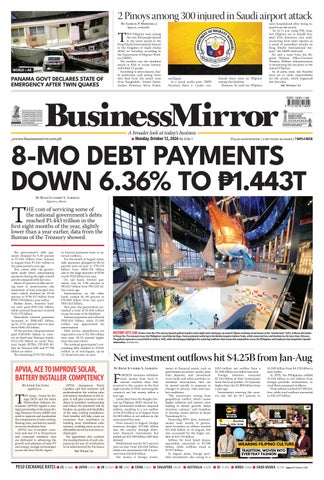
HISTORY SETS SAIL Visitors view the 17th-century Spanish galleon Espíritu Santo (right) and a balangay, an ancient Filipino seafaring vessel known as the “mother boat” (left), at Museo del Galeón in Pasay City. The museum traces the Philippines’s maritime heritage, from precolonial seafaring to the Manila-Acapulco Galleon Trade, which connected Asia and the Americas for more than 250 years. The galleon represents a vessel built in Cavite in 1603, while the balangay highlights the seafaring traditions that connected communities across the Philippines and Southeast Asia long before Spanish colonization. AP/AARON FAVILA
Net investment outflows hit $4.25B from Jan-Aug By Reine Juvierre S. Alberto
F
OREIGN investors withdrew more money from local financial markets than they invested in the country in the first eight months of 2026, reversing the country’s net hot money inflow a year ago. Latest data from the Bangko Sentral ng Pilipinas (BSP) showed foreign investment outflows outpaced inflows, resulting in a net outflow of $4.254 billion as of August from $4.583 billion in net inflows in the same period last year. From January to August, foreign investors brought $17.436 billion into the country through shortterm financial instruments but pulled out $21.689 billion, BSP data showed. Withdrawals rose by 54.5 percent year-on-year from $14.034 billion, while new investments fell 6.4 percent from $18.618 billion. Hot money is foreign invest-
ments in financial assets, such as government securities, stocks, peso time deposits, unit investment trust funds and other portfolio investment instruments, that can be moved quickly in response to changes in returns, risks and market conditions. “The uncertainty arising from geopolitical conflict, which causes higher inflation and interest rates leading to slower growth, keeps investors cautious,” said Jonathan A. Ravelas, senior adviser at Reyes Tacandong & Co. Dissecting BSP’s data, investors’ money went mostly to government securities as inflows reached $11.434 billion as of August, but also accounted for the larger outflow of $13.710 billion. Inflows for local listed shares, meanwhile, amounted to $5.996 billion, while outflows stood at $7.977 billion. In August alone, foreign portfolio investments also swung to a
$315-million net outflow from a $2.298-billion net inflow last year. Foreign investors extracted $2.143 billion of their investments from the local market, 13.9 percent higher than the $1.880 billion from a year ago. Investments entering the country also fell by 56.2 percent to
$1.828 billion from $4.178 billion a year earlier. In 2025, the Philippines yielded $1.624 billion in net inflows from foreign portfolio investments, as total flows surpassed outflows. Total inflows reached $27.860 billion, while total outflows amounted to $26.237 billion.
BusinessMirror
»B8
BM Freshly Brewed October 5, 2026 | 10 AM
WEARING FILIPINO CULTURE ALVIN DEGAMO Founder, owner, and creative director of Wear Your Culture
TRADITION, WOVEN INTO EVERYDAY FASHION
BLESS AUBREY OGERIO BusinessMirror Trade & Industry Reporter
PESO EXCHANGE RATES n US 62.7660 n JAPAN 0.3978 n UK 83.0520 n HK 7.9981 n CHINA 9.3634 n SINGAPORE 49.0245 n AUSTRALIA 43.6789 n EU 70.3983 n KOREA 0.0468 n SAUDI ARABIA 16.7243 Source: BSP (October 9, 2026)
News
BusinessMirror
A2 Monday, October 12, 2026
ICC…
Continued from A9
motivated. “We are an independent and impartial judicial institution, and our actions are guided only by the law and evidence,” Akane said in a video statement. She said the court would continue carrying out its mandate despite the sanctions. “The Court will continue to fully discharge its mandate, with independence and impartiality, acting only on the basis of the law and the evidence, for the sake of the countless victims of grave crimes,” Akane said. She added that efforts to obstruct the court’s work amounted to an attack on sovereign states that established the tribunal, the broader international legal order and victims who have waited years, and in some cases decades, for accountability. “It is an attack on the victims of mass atrocities who have waited years, sometimes decades, for those responsible to be held to account,” she said. Several US allies, including Canada, Denmark, France, Germany, Italy, Japan, the Netherlands and the United Kingdom, expressed strong disagreement with the sanctions and pledged continued support for the court. Human rights organizations likewise criticized the move, warning that it could weaken international accountability mechanisms for the world’s gravest crimes. Rubio, however, defended the action, describing the ICC as a “rogue court” and warning that Washington would continue its campaign against the tribunal unless its allies joined the effort.
www.businessmirror.com.ph
Aguda, Gomez exit Cabinet; Cayetano is new PCO chief T
Truth Commish hails ICC ruling on Duterte fitness to stand trial
W
By Samuel P. Medenilla @sam_medenilla
ITH less than two years before the end of his term, President Ferdinand Marcos Jr. announced new changes in his Cabinet with the departure of Department of Information and Communications Technology (DICT) Secretary Henry R. Aguda and acting Presidential Communications Office (PCO) Secretary Dave M. Gomez from his administration. In an interview with reporters in Singapore last Sunday, the chief executive confirmed Aguda tendered his resignation amid the ongoing probe being conducted by the Office of the Ombudsman on his alleged involvement in the “ghost internet” scheme under the DICT’s Free Wi-Fi program. Marcos said they were supposedly withholding the information until he can choose Aguda’s replacement until
it was disclosed by Ombudsman Jesus Crispin C. Remulla last week. “I think that is because of the investigation that he [Remulla] is conducting. It’s related, I think, to the progress of the investigation that he is conducting on the ghost connectivity projects,” Marcos said. “So, we came at that news or at that information from different directions, and so the timing was not coordinated,” he added.
The Office of the Ombudsman said it is currently looking into the contractor for the Free Wi-Fi program for allegedly charging the government for undelivered internet services and using software with inflated prices. Marcos also confirmed People’s Television Network (PTV) General Manager Lino S. Cayetano will take over PCO. He said this after the Commission on Appointments bypassed Gomez after being appointed as PCO secretary in July 2025. Cayetano was the former Taguig Mayor and the estranged brother of senator Alan Peter S. Cayetano. The disagreement among the siblings stems from the latter questioning the former’s residency when he run for Congress last year. He will be the sixth communications head under the Marcos administration after former PCO secretaries Gomez, Jaybee “Jay”
C. Ruiz, Cesar B. Chavez, Cheloy V. Garafil, and former Office of the Press Secretary Beatrix “Trixie” Cruz-Angeles. The change in PCO’s leadership, Marcos said, will take effect this week after he returns from his five-day working visit in Singapore, where he was accompanied by Gomez. When asked about rumors that Department of Public Works and Highways (DPWH) Secretary Vivencio “Vince” B. Dizon will return as head of Department of Transportation (DOTr), Marcos answered in the negative. “Right now it’s a no, but...all of this is, you know, we can still change, we can still change. But as we sit here together today, no, we can’t do this,” he said. Dizon is currently leading the crackdown on flood control anomalies as well as the implementation of flagship infrastructure projects of DPWH.
ERC…
with its provisions as it commits to pursuing investments and initiatives to modernize its distribution network and enhance service delivery. “As outlined in our rate reset application and detailed in the public hearings, these include investments in advanced metering infrastructure, cybersecurity, and other network modernization projects that will help improve operational efficiency, strengthen system reliability, and deliver better service to our millions of customers in the next four years,” said Valles.
Continued from A9
“The approved revenue gives Meralco a clear path to operate more efficiently and to roll out the capital projects needed for a more reliable network, including new substations and lines, modernized metering and measures to bring down system loss. Meralco will be held to delivering these results,” added Juan. Valles said Meralco will carefully assess the decision and comply
Tourism… Continued from A9
In a news statement, VFS Global Regional Head for North Asia Atul Lall said, “The continued rise in visa applications from the Philippines highlights growing confidence among Filipino travelers and a strong desire to explore opportunities abroad. Whether for leisure, business, education, or reconnecting with loved ones, international travel remains a priority for many. The sustained growth we have witnessed during the first eight months of 2026 reflects this positive trend, and we anticipate healthy demand across key destinations for the rest of the year.” He added, “As travel volumes continue to increase, we encourage applicants to plan their journeys early and submit their visa applications well ahead of departure. We also urge travelers to stay cautious and rely only on official channels for visa-related information and services, as fraudulent actors often seek to take advantage of periods of high demand.” Meanwhile, the company reported that more Filipinos are using its Visa At Your Doorstep (VAYD) service. This enables applicants to complete their en-
Solar…
Continued from A1
Centre for Energy (ACE). “ACE, with APVIA, will bring another milestone to support the collaborations to improve the energy transitions for the region,” said Dato’ Ir. Ts. Razib Dawood, ACE Executive Director. Although based in Jakarta, the regional certification of installers will be implemented through online testing and onsite hands-on
tire visa application submission process from their homes or any other locations of their choice. This premium service also allows customers to enrol for biometrics and have their passports couriered back to a location of their choice. The VAYD services are available for 20 countries in the Philippines, namely, Australia, Belgium, Croatia, Cyprus, Czech Republic, Denmark, Finland, Germany, Greece, Hungary, Iceland, Japan, Malta, Saudi Arabia, Slovakia, Slovenia, Switzerland, Türkiye, UK, and The Netherlands. The company also offers the MVAC facilities for the countries above, providing convenience and a wider network for applicants. Other countries that also use VFS Global to process visa applications from the Philippines include: Austria; Bulgaria; Gambia; Ireland; Latvia (via Netherlands); Lithuania; New Zealand; Nigeria; Norway; Oman Visa, Medical and Attestation Services; Portugal (via Greece); Qatar Visa and Medical Services; South Africa; Sweden; the United Arab Emirates (Dubai visa and Attestation Services); and Ukraine. The company stressed that it has “no role in the decision-making process of granting or refusing a visa.” For more information, visit www.vfsglobal.com examination to be administered in cooperation with various entities in Vietnam, Indonesia, Thailand, Malaysia and Philippines. “The MoU signing between APVIA, ACE, and Asosiasi Energi Surya Indonesia [AESI] marks a strategic milestone in strengthening Indonesia’s green workforce capabilities while fostering regional collaboration to build a skilled, future-ready talent pool and accelerate the clean energy transition across Asean,” said Anggita Pradipta, Vice Chairman of AESI.
HE Philippine Truth Commission welcomed at the weekend the ruling of a trial chamber of the International Criminal Court (ICC) that former President Rodrigo Duterte is fit to stand trial for the case of crimes against humanity pending before the court. In a statement over the weekend, the Commission, a civilian-led independent body that seeks to uncover the truth on Duterte’s Drug War, said that with the decision, the longawaited trial can now proceed. “The court’s decision removes the last major obstacle to a trial that the families of those killed during Rodrigo Duterte’s ‘drug war’ have waited years to see,” Carlos Conde, Truth Commission commissioner and spokesman, said. On October 8, the ICC’s Trial Chamber III bared a September 8 decision that Duterte is fit to stand trial set to begin on November 30. Conde said the ruling means Duterte will finally face the charges against him in open court, and the evidence and testimonies related to the killings that accompanied his drug war can now be presented. An independent panel of experts unanimously found that Duterte understands the case against him and can help his lawyers prepare his defense, Conde noted, saying that the ruling means the former President can no longer invoke health reasons to delay or stop the proceedings. An ICC-appointed medical panel found evidence of “underperformance” during cognitive testing and concluded that his poor scores could not be explained by any medical, psychiatric or pathological condition. Medical experts also reported an “apparent improvement” in Duterte’s health while in ICC custody, saying the former president’s condition had been “optimized” by the detention center’s high standard of medical and nursing care. Conde said the proceedings would provide a chance to establish what happened during the anti-drug campaign. The Truth Commission, chaired by former ICC Judge Raul C. Pangalangan was organized by church and civic leaders in May to document the human rights violations in Duterte’s drug war, honor the victims and provide a forum for closure among their families, advance accountability and institutional reform, strengthen human rights and the rule of law, and contribute to national healing and lasting peace.
DBM…
Continued from A9
RDC review and prioritization of proposed PAPs. Early coordination among agencies will identify gaps in project preparation, technical requirements and implementation capacity that could delay public investments, the DBM added. “This is where our partnership becomes critical. Together with DEPDev, the RDCs, implementing agencies, and LGUs, DBM must help identify these constraints earlier—not when the budget is already being finalized,” De Leon said. The 2028 national budget is pegged at P7.2 trillion, based on budget documents.
Attack…
Continued from A1
Last week, the militant group already launched two attacks at the King Khalid International Airport, which killed four people. Recruitment consultant Emmanuel Geslani warned the attack, which led to the suspension of operations in the said airport, can affect many Saudi-bound overseas Filipino workers (OFW). Citing the carrying capacity of local airlines, he estimated that the suspension may affect 10,000 OFWs.
Monday, October 12, 2026
A4
www.businessmirror.com.ph
Prosecution wraps case vs Duterte
T
By Jovee Marie N. Dela Cruz
@joveemarie
HE House prosecution panel is set to wrap up its presentation of evidence in the impeachment trial of Vice President Sara Z. Duterte this week, fielding financial analyst Atty. Alexander Cabrera as its final witness on allegations of unexplained wealth. House lead prosecutor Rep. Gerville “Jinky Bitrics” Luistro confirmed the prosecution will formally rest its case once Cabrera completes his testimony and undergoes defense crossexamination, clearing the way for the defense to present its side before the Senate impeachment court.
Cabrera testified on Friday that his forensic audit revealed approximately P817.87 million in allegedly undeclared assets and income linked to Duterte and her husband, Atty. Manases “Mans” Carpio, from 2022 to 2025. His findings were drawn from bank statements, tax returns, corporate filings, and Statements of
Assets, Liabilities, and Net Worth (SALNs). House impeachment spokesperson Rep. Ace Barbers noted that the findings tie together critical documentary evidence suppor t i ng t he u ne x pl a i ned wealth charges. “His findings clearly laid out the hidden or unexplained wealth of the Duterte-Carpio couple,” Barbers said, expressing confidence that Cabrera’s report—backed by official records—will hold up under cross-examination. Luistro also highlighted stark discrepancies between the Duterte family’s public image of modest living and high-end spending entries found in credit card records. She cited a P205,000 restaurant bill in Tokyo alongside two separate luxury purchases at Nike outlets in Davao and Kuala Lumpur totaling over P550,000. While high spending alone does not constitute an offense, prosecutors argue it underscores an inconsistency with Duterte’s of-
ficial financial disclosures. Trial resumes Monday, Oct. 12, w it h t he defen se c ross examining Cabrera. Following his testimony, the prosecution will move to formally offer its documentary exhibits and seek guidance from Presiding Officer Sen. Francis “Chiz” Escudero on potential rebuttal evidence or court-summoned witnesses. The prosecution has already concluded its presentation on Article I (misuse of P612.5 million in confidential funds) and Article IV (grave threats). Cabrera’s testimony marks the end of Article II (unexplained wealth). Meanwhile, prosecutors formally withdrew Article III (bribery allegations regarding Department of Education procurement) on Oct. 6 to streamline trial proceedings. Luistro assured that the bribery claims could still be referred to the Office of the Ombudsman or the Department of Justice for separate preliminary investigation.
Senator warns power utilities vs exploiting El Niño By Butch Fernandez @butchfBM
‘D
ON’T even think about it.” This was the warning by the Senate Committee on Energy chairperson, Sen. Erwin Tulfo, to power companies, whom he reminded against taking advantage of extreme weather conditions such as the coming “super” El Niño, by imposing unjustified rate increases or delivering substandard service. This, after the Department of Energy (DOE) and various electric DUs cautioned the public about expected electricity price spikes and rolling blackouts. “While rate adjustments are
expected due to supply and demand dynamics, any price increase must remain fair and reasonable. It should not worsen the financial burden already felt by Filipino families on a daily basis,” Tulfo said. “I will not hesitate to exercise oversight functions if power generation companies or distribution utilities exploit the climate crisis to maximize profits,” he added. The Senate Committee on Energy chairman, likewise, urged the DOE and Energy Regulatory Commission (ERC) to protect consumers not only from abusive pricing but also from the looming electricity rate hikes and outages. “ The public deserves
transparency and fairness. As the country braces for this climate phenomenon, the energy sector must pr ior itize public welfare over excessive corporate gains. The Committee on Energy will hold accountable anyone attempting to abuse the market at the expense of ordinary Filipino consumers,” Tulfo vowed “We cannot just sit back, monitor, and watch power rates skyrocket while our consumers suffer the heat and economic burden of a super El Niño,” he added. Tulfo said the DOE and the ERC must fast-track implementation of proactive, concrete mitigation plans and ironclad safeguards to ensure that supply
remains stable and that no artificial shortages are engineered to justify price spikes. While Tulfo acknowledges that the House of Representatives approved the 2027 General Appropriations Bill approved an allotment for the expansion of sitio electrification activities, he noted that such will not be sufficient without the executive agencies working hand in hand to mitigate the situation on the ground. The state weathter bureau earlier said the phenomenon is expected to intensify into a “very strong” El Niño between the September–December 2026 season and persist through the first half of 2027.
Aquino urges Senate action on El Niño
S
EN. Benigno Paolo Aquino has urged Senate President Sher win Gatchalian to immediately reconvene the Senate’s PROTECT Committee to prepare the nation for the severe impacts of an impending “super” El Niño. T he weat her phenomenon threatens below-normal rainfall, dry spells, and widespread drought across the country, with conditions expected to intensify in late 2026 and persist through mid-2027. In a letter to Gatchalian, Aquino called for a unified, whole-ofgovernment response to protect
vulnerable sectors, including agriculture, education, energy, health, and small businesses. “Dapat siguruhing iisa ang pagkilos ng ating pamahalaan para matiyak na protektado ang ating mga kababayan,” Aquino said, emphasizing the need to safeguard livelihoods, water supply, and basic services. The Proactive Response and Oversight for Timely and Effective Crisis Strategy (PROTECT) Committee—originally formed in March 2026 to address Middle East oil supply disruptions—can bridge critical gaps across state agencies, Aquino noted.
Remulla calls for safer, vigilant schools
I
NTERIOR Secretary Jonvic Remulla called on parents, teachers, and communities to take a proactive stance in protecting children from emerging digital threats like online grooming and harmful chat groups. Speaking at the 1st Metro Manila School Safety and Security Summit, Remulla emphasized that child protection extends beyond emergency response. “Children know how to use the internet and chat groups, but they don’t know the consequences,” Remulla
warned, stressing the need for daily conversations about digital safety at home and in classrooms. While commending the police and fire bureaus for implementing active-threat measures—such as the Alert, Lockdown, Inform, Counter, and Evacuate (ALICE), a framework providing response options during active-threat situations, Remulla insisted that adults must stay continuously engaged in children’s lives to stop harm before it happens. Jonathan L. Mayuga
Key agency interventions urged by Aquino include: n Energy and Water: Securing water supplies for drought-hit communities and stabilizing electricity rates amid expected price hikes. n Agriculture and MSMEs: The Departments of Agriculture and of Trade and Industry must detail immediate relief, input subsidies, and supply-chain protections for farmers, fishers, and agri-based small businesses. n Education: The Department of Education and the Commission on Higher
Education must establish extreme heat protocols and remote learning strategies to prevent class disruptions. n Health andf Science: The Department of Health must prepare hospitals for rising heat-related illnesses, while Department of Science and Technology provides real-time early warning data. Aquino warned that early, coordinated action via the PROTECT Committee is critical to prevent economic disruption and ensure timely aid reaches affected communities. Butch Fernandez
Lacson: Cayetano in panic over Taguig infra mess
S
EN. Alan Peter Cayetano’s latest “tale spin” attempt on the controversy involving anomalous infrastructure projects and illegal reclamation in Taguig only betrays his panic, Sen. Panfilo Lacson said Saturday evening. Responding to Cayetano’s latest “live selling” on social media, Lacson dared Cayetano to name the “individuals” he claimed Lacson had “threatened,” so he can address the issue directly. “No amount of spin could make the guilt go away for those involved,” Lacson said. “Spinning tales betrays panic but like guilt, it will never go away,” Lacson said in a post on his X account. “Senator Cayetano should name the ‘individuals’ he alleged I threatened, so I can properly address this new issue point by point,” Lacson added. In his Facebook Live post, Cayetano had claimed receiving “feelers” that some parties were being pressured to admit there were irregularities in Taguig. Earlier, Lacson noted that Cayetano’s
accusations of a politically motivated demolition job, fake news and trial by publicity smacked of “quaking in his boots” while “quacking.” “PATHETIC. Imagine someone ‘quacking’ on FB Live with accusations of politically motivated demolition job, fake news and trial by publicity and at the same time ‘quaking in his boots’ every time each piece of evidence of corruption in his turf unfolds before his eyes,” Lacson said in an X post pm September 3. Lacson and his team have submitted to the Ombudsman at least 45 case studies backed by official documents d e t a i l i n g “s y s t e m i c a n o m a l i e s ” i n flood control infrastructure projects in Taguig. These prompted a fact-finding investigation by the Ombudsman into the allegations. Also, Lacson posted recently on X a raw video from a composite inspection team documenting alleged continued illegal reclamation on the Taguig side of Laguna Lake. Butch Fernandez
House prosecution panel seeks probe into China-linked remittances to Sara
T
HE House of Representatives prosecution panel has called for a review of financial disclosure, tax, antimoney laundering, procurement and anti-graft laws following revelations in Vice President Sara Z. Duterte’s impeachment trial, while urging a full-scale investigation into P319.33 million in reported China-linked remittances to a company connected to her husband. House lead prosecutor and Batangas Rep. Gerville Luistro over the weekend said the prosecution’s examination of Duterte’s bank, tax and corporate records raised questions about whether government agencies were adequately investigating and acting on potential financial irregularities. She called for clearer rules defining the responsibilities of the Anti-Money Laundering Council (AMLC) and strengthening its coordination with other agencies when its findings point to possible offenses. “First, the AMLC should have a strict mandate,” Luistro said, urging the council to refer evidence to the appropriate authorities when its findings do not sufficiently establish money laundering but may support other cases. “There should be proper coordination with the Ombudsman and the Department of Justice,” she added. Luistro also questioned whether the Bureau of Internal Revenue had taken sufficient action on potential discrepancies between bank transactions, financial statements and declared income involving Duterte, her husband, lawyer Manases Carpio, and companies connected to them. The comparisons were examined by prosecution witness and forensic financial analyst Atty. Alexander Cabrera. “How can you pay taxes if you did not declare the income?” Luistro asked, calling for clearer standards on when potential tax evasion warrants prosecution. She also identified Republic Act 6713, or the Code of Conduct and Ethical Standards for Public Officials and Employees, as a candidate for review, particularly its provisions on Statements of Assets, Liabilities, and Net Worth (SALNs) and public access to officials’ financial interests. “We should establish clear guidelines for filing SALNs,” she said. On procurement, Luistro cited Duterte’s declared business interest in GenCorp Industries and questioned its implications for 19 contracts worth approximately P34 million awarded by the Davao City government, then led by Duterte’s brother, Mayor Sebastian Duterte. She included Republic Act 12009, or the New Government Procurement Act, the Anti-Graft and Corrupt Practices Act, securities regulations and Commission on Audit rules in the proposed review. “The laws may already be sufficient, but implementation is what is lacking,” Luistro said, adding that lawmakers should determine whether amendments or stronger enforcement mechanisms are necessary. Separately, Luistro called for a full-scale national security investigation into P319.33 million in reported remittances from mainland China and Hong Kong to Cale88 Foods Corp., a company linked to Carpio, amid continuing tensions in the West Philippine Sea (WPS). “I honestly believe this is something that needs to be investigated, especially since the National Security Council has also acknowledged the seriousness of the issue involving remittances coming from China,” she said. AMLC Executive Director Ronel Buenaventura confirmed the transactions during his October 5 testimony before the Senate impeachment court, citing covered and suspicious transaction reports submitted by financial institutions. The records showed that the money went to Cale88’s corporate accounts, not directly to the personal accounts of Duterte or Carpio. Luistro said the transactions warranted scrutiny given the Philippines’ territorial dispute with China and the company’s links to the family of a senior government official. “Considering our situation in the West Philippine Sea, I believe we have sufficient grounds to initiate a full-scale investigation into this national security concern,” she said, referring to concerns raised by Philippine Coast Guard spokesperson Rear Adm. Jay Tarriela over China’s actions in Philippine waters. The call followed an appeal by small-scale fisherfolk in Zambales for a thorough examination of the remittances. In a manifesto received by Zambales Reps. Jefferson Khonghun and Doris Maniquiz, the fisherfolk urged government leaders not to allow financial or political interests to undermine their livelihoods and the country’s sovereign rights in the WPS. The lawmakers pledged to pursue a congressional investigation. The National Security Council earlier said it would examine the reported foreign financial inflows and coordinate with intelligence and investigative agencies to assess potential security risks. National Security Adviser Eduardo Oban Jr. said the allegations must be evaluated through established legal processes. Luistro said the proposed national security probe should proceed separately from the impeachment trial’s examination of Duterte’s alleged unexplained wealth, with the findings helping establish whether laws were violated and whether gaps in enforcement require legislative action. Jovee Marie N. dela Cruz
Monday, October 12, 2026
A6
www.businessmirror.com.ph
hospitals in Davao Peza: EVs, high-tech electronics Govt get ₧1.1-B for indigents driving next investment wave By Manuel T. Cayon @awimailbox
By Bless Aubrey Ogerio
E
LECTRONICS and advanced manufacturing are emerging as the Philippine Economic Zone Authority’s (Peza) leading prospects for investment growth at least for 2027, as the country seeks to attract highervalue production beyond traditional semiconductor assembly and testing. The agency, according to Peza Director General Tereso O. Panga, expects growing opportunities in electric vehicle manufacturing and transport, as well as electronics activ ities involv ing more
sophisticated technologies. “We’re going into high-tech like laser-beam technology, silicon c a r bide, M L CC s [mu lt i l aye r ceramic capacitors]. It’s really hightech… and advanced packaging,”
Panga told reporters. T he sh i f t tow a rd h ig her value manufacturing, alongside companies diversifying production away from China, could strengthen the country’s investment prospects in the next few years, he said. Peza has seen interest from Japan, Singapore and Taiwan, as well as possible production shifts from Thailand and Malaysia. On the other hand, the agency is also tracking some prospective invest ments wor t h about $1 billion each. O ne i nvolve s a Jap a ne s e electronics company considering two sites in Laguna, including Laguna Technopark. The other concerns prospective investment in semiconductors and hyperscale data infrastructure. The Peza chief did not disclose the companies involved, and the
projects’ registration timelines have yet to be finalized. Renewable energ y projects could also add to the pipeline, provided they are integrated into economic zones. Peza is likew ise ex pecting new globa l capabi l it y center investments following the lifting of a moratorium affecting the sector, with applications already coming in. The sector outlook comes as Peza seeks to surpass its record annual investment haul of about P312 billion, set in 2012. The agency recorded P297.14 billion in approved investments f rom Ja nu a r y to September, putting it P2.86 billion short of its P300-billion target for the year. Panga said additional projects could lift the total after Peza’s next board meeting.
Groups warn vs 260 imported high-lead paints By Jonathan L. Mayuga @jonlmayuga
T
HE EcoWaste Coalition and the Philippine Paint and Coatings Association Inc. (Ppcai) have jointly alerted sellers and buyers that some imported paints violate the country’s lead paint policy owing to excessive or dangerous amounts of lead. The warning was issued ahead of International Lead Poisoning Prevention Week on October 18 to 24. The policy, also known as the Chemical Control Order (CCO) for lead and lead compounds, prohibits the use of lead in paints and similar surface coatings, sets a maximum limit of 90 parts per million (ppm), and provides for a phase-out period of three years for lead-containing paints (20132016) and six years for lead-containing industrial paints (20132019). Through a Public Notice on Lead-Containing Paints, EcoWaste Coalition and Ppcai, along with the International Pollutants Elimination Network (Ipen), provided paint dealers and consumers with helpful information on non-compliant products, which may pose
lead exposure risks, especially to vulnerable populations, such as children, women, and workers. The 260 lead-containing paints listed in the Public Notice were neither manufactured nor distributed by any of the 27 Ppcai-affiliated paint companies, which adhere to the CCO rules. Beyond transitioning to non-lead paint manufacturing, seven Ppcao member companies have also secured third-party Lead Safe Paint Certification from the US-based certification body SCS Global Services. “The unchecked entry of leadcontaining spray paints is not only a violation of the CCO, but also a health hazard,” Manny Calonzo, Campaigner, EcoWaste Coalition, said in a statement. “Through this Public Notice, we intend to raise awareness across all sectors, enabling safer choices and lower exposure risks. Concurrently, we call on trade regulators, e-commerce administrators, and store owners to stop the illegal importation, distribution, and sale of lead-laced paints to protect the people’s interest.” “PPC AI member companies have complied with the CCO by investing in lead-free formulations and raw materials,” Reginald T. Yu, president of the Philippine
Paint and Coatings Association, Inc. (PPCAI) said. “The finding of imported spray paints containing lead above the 90 ppm limit underscores the need for stronger monitoring and enforcement across importation, retail distribution, e-commerce platforms, and online sales. We urge the relevant government agencies, online marketplaces, and retailers to work together to prevent non-compliant products from reaching consumers and to protect public health.” “Placing lead chromates under the Rotterdam Convention’s Prior Informed Consent [PIC] procedure will empower countries to control the unregulated and unmonitored trade of these toxic pigments and paints containing them,” Jeiel Guarino, Global Lead Paint Elimination Campaigner and Science Officer, Ipen, said for his part. The EcoWaste Coalition obtained the 260 paint products from online and physical retail stores, which the group screened for lead using a handheld X-Ray Fluorescence (XRF) analyzer. Samples that screened with over 90 ppm of lead were then submitted to SGS for confirmatory analyses. Laboratory tests confirmed
that all 260 paints are lead paints, or paints containing lead above 90 ppm. Of these 260 paints, 184 contain high lead concentrations above 10,000 ppm. Moreover, 91 of these paints have lead levels ranging from 50,000 ppm to 212,000 ppm, of which 19 products exceeded 100,000 ppm. Paradoxically, 51 of these lead-containing paints were falsely labeled as “lead-free” or bore the “No Pb” symbol (lead is a heavy metal with atomic number 82 and a symbol Pb from the Latin plumbum). Lead paint is a leading cause of lead poisoning in children, who absorb lead when aging paint turns to dust or chips that they swallow or touch and put in their mouths. Early exposure in life can harmfully affect the brain and central nervous system, causing hearing, reading, and learning difficulties, delays in speech and language development, impaired cognition, reduced intelligence, poor school performance, attention deficit disorder, aggression, and other behavioral problems. According to the World Health Organization (WHO), there is no safe level of exposure to lead that is known to be without harmful effects.
COP31 prompts PHL to urge early global action on climate forecasts
T
HE Philippines has called on United Nations member states to turn climate forecasts into global preparedness and early action, linking formal negotiations to decisions that protect people, livelihoods, and development at home, ahead of the 31st Conference of the Parties (COP31). Speaking at the Pre-COP31 plenary discussion on priorities for Antalya, Climate Change Commission (CCC) Vice Chairperson and Executive Director Robert E.A. Borje warned of the potential impact of the looming
very strong El Niño. C i t i n g a Wo r l d M e t e o r o l o g i c a l Organization forecast, Borje said the current El Niño would intensify to very strong levels and was highly likely to persist through February 2027. While its effects will vary by location, Borje noted that risks can compound across vital sectors such as water, food, energy, health, and local economies. “The forecast gives us a clear warning, but also a window to prepare and respond,” Borje said. “We must build right at first
sight so every investment reduces risk rather than locks it in.” The intervention advances President Ferdinand R. Marcos Jr.’s call for predictive governance: using science, data, and risk information to guide decisions before impacts escalate. For the Philippines, this means integrating climate risk assessment into policies affecting agriculture, water securit y, public infrastruc ture, and community livelihoods. Borje added that COP31 should support nations in formulating, submitting, and implementing their Nationally Determined Contributions (NDCs) and National Adaptation Plans (NAPs), advancing mitigation and adaptation in tandem. The Philippines’ NDC Implementation Plan, National Adaptation Plan, and National Climate Risk Management Framework already bring climate considerations into decisions shaping the national economy. He also pressed for climate finance to match the scale of the crisis. The United Nations Environment Program (Unep) estimates that developing countries will need US$310–365 billion a year for adaptation by 2035. In contrast, international public adaptation finance to developing countries stood at just US$26 billion in 2023—less than one-tenth of the estimated annual need. While water and wastewater systems may receive the largest sectoral share of
tracked adaptation finance, Borje noted that the overall pool remains inadequate. “A large share of an inadequate pool remains inadequate,” he emphasized. In addition, ocean finance remains limited and poorly tracked – a major concern for small island developing states and archipelagic countries whose survival depends on marine ecosystems. He called for climate finance that is adequate, predictable, new, additional, scaled up, and easily accessible to developing countries. He urged that finance flows be measured transparently, offered on fair terms, and directed to the national and local institutions responsible for delivery. Public and concessional finance remain indispensable; private finance can complement, but never replace, this core responsibility. He added that technology transfer and capacity-building must also be accelerated to enable countries to act. Looking ahead to Antalya, Türkiye will host COP31 and hold its Presidency, while Australia will serve as President of Negotiations. Borje said the Presidency’s Action Agenda could help advance the aim of making COP31 an “implementation COP.” This agenda can reinforce formal negotiations by mobilizing practical partnerships across energy, water, oceans, and resilience, while connecting multi-hazard early warning systems with proactive early action. Jonathan L. Mayuga
D
AVA O C I T Y— G o v e r n m e n t hospitals here reported that they have received the budget to enforce Malacañang’s medical assistance to indigent families. The Philippine Information Agency s a i d g o ve r n m e n t h o s p i t a l s i n t h e Davao Region have already received their budget to implement the Medical Assistance for Indigent and Financially Incapacitated Patients (Maifip) program that Malacañang said would serve as lifeline for Filipinos who cannot afford costly medical treatments. Dr. Ellenietta Herundina Maria Victoria N. Gamolo, Department of Health Region XI (DOH-XI) regional director, said the Davao Region received P1.1 billion for hospitals, with DOH hospitals including Southern Philippines Medical Center (SPMC), Davao Regional Medical Center (DRMC), and Davao Oriental Provincial Hospital (DOPH) receiving P42.5 million each. Hospitals maintained by local governments have received P155.9 million each and the remaining amount will be allocated to private hospitals. “This program is designed to provide financial assistance to citizens who f a c e s u b s t a n t i a l m e d i c a l ex p e n s e s upon hospital discharge, which remain unaffordable despite their PhilHealth coverage,” she said. To streamline claims, DOH-XI is adopting the electronic Maifip system, which is available in four LGU hospitals: Montevista, Laak, Pantukan, and Maragusan.
She said the reimbursed payments will be done within 12 working days, provided documents are complete. “As long as the documents are completely provided, payments will not be delayed, as missing supporting documents are the primary cause of payment processing delays,” she said. She said there is no fixed cap on the maximum benefit amount a patient can receive. Instead, Maifip covers the remaining out-of-pocket medical balance after PhilHealth and other discounts are applied. The PIA interviewed one Maria Felezarte, 55, was diagnosed with endometrial cancer in November last year. As a laundrywoman, Felazarte said she could not afford her medication. She traveled here to the Southern Philippines Medical Center (SPMC) from General Santos City, and said the Maifip program saved her from paying P360,000 worth of fees for laboratory tests, scans, and other diagnostic procedures and treatments. “I am so deeply grateful, because as a simple laundry worker like me, I really couldn’t afford it. I am very grateful, especially to our government,” she said. Zenaida Falcon, another beneficiary from Agdao, this city, said she availed of the Maifp, lining up at the Center Institute of SPMC. She said the program saved her from paying P30,000. She said she lived alone after her husband died, surviving by selling goods. “Thank you so much to the government, I won’t struggle to pay for the fees anymore,” she said.
Cebu set to put up investment office
C
EBU CITY–Cebu province is moving closer to establishing its own investment office after the Provincial Board approved on third and final reading an ordinance creating a centralized unit to attract investors, support enterprises and strengthen the province’s economic competitiveness. The proposed Cebu Provincial Investment and Economic Office (CPIEO) will consolidate investment promotion and related economic development functions currently handled by the Cebu Provincial Investment Promotions Division (CPIPD), subject to the required approvals and compliance with legal procedures. Authored by Provincial Board Member Lakambini Reluya, the measure, known as the Cebu Provincial Investment and Economic Office Ordinance of 2026, seeks to establish a dedicated provincial mechanism for investment facilitation, e n te r p r i s e d e ve l o p m e n t, e c o n o m i c planning and coordination with local government unit (LGU). The ordinance identifies sustainable and inclusive economic growth as a policy priority, with emphasis on innovation, strategic partnerships, competitiveness and local economic development. The proposed office will serve as the province’s primary coordinating body for investment and economic development, without displacing the mandates of existing provincial offices. Its establishment remains subject to approval by the Department of Budget and Management (DBM). Under the measure, the CPIEO will be responsible for identifying and promoting investment opportunities in Cebu, organizing investment missions and business forums, helping investors navigate government services and addressing concerns that could affect investment decisions. It will also provide aftercare services to encourage existing investors to maintain and expand their operations in the province. The office will support micro, small and medium enterprises (MSMEs), cooperatives and other businesses through entrepreneurship programs, technology adoption, capacity-building initiatives and market linkages. Its economic planning functions will include feasibility and market studies, research on strategic projects, and policy recommendations to improve Cebu’s competitiveness. It will also assist provincial economic enterprises and maintain investment and economic databases to support evidence-based planning.
LGU coordination, partnerships.
The CPIEO is also expected to strengthen coordination between the provincial government and LGUs through technical assistance, advisory services, information sharing and capacity-building activities for their respective Local Economic Development and Investment Promotion Offices (LEDIPOs). The ordinance authorizes the new office to work with national government agencies, government-owned and controlled corporations, academic institutions, chambers of commerce, business organizations, development partners, civil society groups and international organizations. These par tnerships are intended to expand net works for investment promotion, research and enterprise development. The CPIEO will also provide technical and administrative support to the Economic Enterprise Council, including research, documentation, records management and coordination. The ordinance requires the office to submit an Annual Economic and Investment Report to the governor and the Sangguniang Panlalawigan. The report will cover investment promotion activities, enterprise development programs, strategic investments, economic trends, competitiveness indicators and the performance of provincial economic enterprises. It may also recommend policies, programs and projects to advance investment generation, innovation, enterprise development and sustainable economic growth.
Transition from existing division
A key provision provides for the transfer of investment promotion, enterprise development, economic enterprise development and related responsibilities from the CPIPD to the CPIEO once the ordinance takes effect. Records, databases, information systems, equipment and other resources associated with the transferred functions will also be turned over in accordance with applicable accounting, auditing, inventory and property regulations. Existing CPIPD personnel may continue performing their duties until positions in the new office are filled or competent authorities direct otherwise. The transition must not diminish employees’ legally protected rights, compensation, benefits or security of tenure.
Monday, October 12, 2026
A7
‘Pest emerges as top risk facing sugar sector’
D
By Ada Pelonia
@adapelonia
ESPITE the expected increase in the Philippine’s sugarcane areas, the country’s raw sugar output in market year 2026/2027 could register a steep decline due to pest infestation, El Niño and expensive input costs, according to an international report. The United States Department of AgricultureForeign Agricultural Service (USDA-FAS Manila) said raw sugar production will likely fall to 1.7 million metric tons (MMT) in the current MY, from its revised projection of 1.85
MMT in MY 2025/2026. The agency f lagged the infestation of red-striped soft scale insects (RSSI) as the main concern of planters. The pest struck more farms particularly in major sugar-producing areas.
USDA-FAS Manila noted that the current dry spell episode also compounds the challenges that beset the sugarcane industry, since drier conditions could further accelerate the reproduction of RSSI while a lack of rainfall stunts cane growth. The spike in quotations for inputs, such as fertilizer and fuel prices, as well as increased pesticide use to curb RSSI spread will inflate farmers’ production costs, it added. “ These challenges more than offset the potential expansion in sugarcane area,” the USDA-FAS Manila said in its latest report. The agency said the country’s sugarcane areas may grow to 410,000 hectares in the current MY from 408,000 hectares, propelled by potential expansion in Mindanao where the “From Arms to Farms”
expansion potential.”
Imports
PHOTO FROM WWW.DA.GOV.PH
program is being implemented. It added that the presence of sugar mills, assistance from millers, such as logistics support, along with the Sugar Regulatory Administration’s (SRA) block farming program, encouraged individuals to
PHL targeting to sell more ornamental plants to Japan
T
HE Department of Agriculture (DA) wants to leverage the Philippines’s participation in a trade fair in Japan next year to expand horticultural exports and attract investments. The DA launched the country’s participation in the Green X Expo in March 2027 in Yokohama, Japan during the Pagsibol 2026: Philippine Horticulture and Urban Agriculture Summit where it unveiled the Philippine Pavilion theme. The Green X Expo is scheduled from March 19 to September 26, 2027. “We want to show our horticultural heritage, biodiversity, and green
innovations—and what Filipino ingenuity and bayanihan can do,” Agriculture Secretary Francisco Tiu Laurel Jr. said. The agency noted that the Philippines will showcase its strength as a horticultural producer, its transition toward regenerative and climateresilient agriculture, and its openness to partnerships, investment, and innovation. Central to this is ornamental horticulture, which the government said has a significant room for expansion. “While the Philippines has established itself in fruit exports, its presence in ornamental plants remains comparatively limited.”
For DA-Agribusiness and Marketing Assistance Service Director Junibert De Sagun, the Philippines has a strong market position in fruit exports, yet remains underrepresented in ornamental horticulture. “Through our participation in Green X Expo 2027, we want to highlight the significant potential for growth and diversification in this sector.” The pavilion will feature the Waling-waling and other Philippine orchids, premium tropical fruits and other highvalue horticultural products with potential for Japanese and international markets, according to the DA. It will also incorporate garden
concepts inspired by the Banaue Rice Terraces and Chocolate Hills, together with elements of the Pahiyas, Panagbenga, and Dinagyang festivals. The DA said it will include product exhibitions, business matching and an Outbound Business Mission designed to connect farmers, growers, agripreneurs and MSMEs with international buyers, investors and distributors. “These activities will seek to translate the country’s expo participation into concrete export, investment and commercial opportunities for Philippine horticulture and agrifisher y enter prises.” Ada Pelonia
Innovation key to making food affordable–DA
I
NNOVATIVE agrifood systems would ensure food affordability and accessibility, according to the Department of Agriculture (DA). As the agency prepares for this year’s World Food Day (WFD) 2026 celebration on October 16, it stressed that harnessing innovative solutions with traditional approaches to food and agricultural production would also enhance public health and nutrition and foster sustainable resource use. Citing data from the United Nations Food and Agriculture Organization (FAO), the DA said around 645 million
people worldwide continue to experience hunger despite ample global food production, while 2.69 billion people remain unable to afford a healthy diet. “These figures, along with the threats posed by economic instability, climate change, and other emerging threats, highlight the urgent need for collective action to ensure that accessible, affordable, nutritious, and safe food is available to all.” As the leading government agency mandated to promote agricultural development and modernization in the country, the DA said it remains committed to addressing these challenges through
“inclusive, science-based, and information-driven policies, public investments, and support services.” Agriculture Undersecretary Cheryl Marie Caballero said the DA will conduct a series of activities showcasing the transformative role of agricultural innovation in strengthening food security, promoting sustainable food systems, and empowering Filipino farmers, fisherfolk, and agripreneurs from October 12 to 15. Caballero, who also serves at the 2026 WFD chair, said the event would also mark the opening of an agri-bazaar at the DA Central Office, which will host agricultural cooperatives
and agripreneurs from various parts of the country. “This would provide a platform to promote locally produced agricultural products and support rural enterprise.” The WFD is annual global observance, which commemorates the founding of the FAO in 1945. It aims to raise awareness on pressing issues surrounding hunger, food insecurity, and malnutrition, while encouraging greater public engagement, multisectoral collaboration, and stakeholder support and investments to empower the agriculture, health, and education sectors to address these concerns. Ada Pelonia
Corn falls most since 2023 after US makes surprise crop estimate
C
ORN plunged by the most in three years after the US Department of Agriculture (USDA) raised its outlook for yield and production of the top American crop, when most analysts expected a cut. The agency estimated corn output at about 16 billion bushels, up 1 percent from last month. Analysts surveyed by Bloomberg, on average, predicted production of 15.73 billion. Many believed the agency would lower its outlook after searing summer heat and erratic rains created variable field conditions. Instead, in what was the second corn-supply shock in the last two weeks, the agency hiked estimates with its findings based in part on the USDA’s random crop counts, known as objective yield analysis. With the corn harvest still only about
a quarter complete, the estimates are subject to change. But that leaves traders with more supplies to grapple with when potential purchases by China were also awaited. “The numbers couldn’t get much worse for the corn,” said Charlie Sernatinger, global head of grain at Marex Group Ltd. Futures dropped as much as 6 percent to $4.7025 a bushel, the lowest level since August 11, before paring losses. Corn had started rallying in midAugust as expectations mounted that wild summer weather took a toll on fields. With fighting between Russian and Ukraine disrupting grain exports out of the Black Sea, hopes were raised that some demand could pivot to the US, giving farmers who have been struggling with high costs a better chance at profits.
A downturn in prices also comes as tough economics in rural America has increasingly become a talking point ahead of the midterm elections, as farmers work through the autumn harvest with record diesel prices. Farm machinery makers such as market leader Deere & Co. also fell following the USDA report, with lower crop prices leaving growers with less cash to spend. The outlook is also bearish for companies selling seeds and chemicals “as affordability and cycle-recovery thesis faces near-term headwinds,” Oppenheimer analyst Kristen Owen said. Deere dropped as much as 4.5 percent, while rivals AGCO Corp. and CNH Industrial NV recorded similar declines. Major crop trader Bunge Global SA, crop protection company Corteva Inc. and fertilizer producer Nutrien Ltd. also slid.
The USDA’s corn yield estimate of 181.2 bushels per acre came in above estimates for 177.8, and includes record-high yields in states including top grower Iowa as well as Ohio, Kentucky and Arkansas. The outlook for soybeans and wheat was generally higher than expected, although more in line with pre-report estimates. “The beans were ‘neutral’ but nothing is neutral when the grain locomotive takes off in a new direction,” Sernatinger said. Friday’s data comes after the USDA surprised corn traders at the end of September with a quarterly report on stockpiles that topped analyst expectations. The increasing disconnect has resulted in more volatility in futures markets, and has spurred a growing skepticism of government data among farmers. Bloomberg News
venture into sugarcane farming in Mindanao. “SRA also notes that soil fertility and climatic conditions in parts of Mindanao remain more favorable than in other sugarcane-producing regions, further supporting the area’s
WHILE the USDA-FAS Manila said exports of raw sugar in the current MY hinges on the SR A’s move whether it will issue an export program, it said refined sugar imports could reach 300,000 metric tons (MT) due to government policy. The agency cited Sugar Order (SO) 3 issued in crop year 2025/2026, which stipulated that eligible participants would be given priority in SRA’s future import programs at a ratio of 1:3 (volume of raw sugar exported : volume of sugar allowed to be imported). The USDA-FAS Manila said the projected volume was also aligned with SO 2 or the voluntary purchase of farmers’ sugar to avail of future import/ export program.
Probe set on ₧700-M Vietnam rice smuggling By Butch Fernandez @butchfBM
T
HE chair of the Senate Committee on Agriculture, Food, and Agrarian Reform announced plans to conduct a committee hearing into the attempted smuggling of around P700 million worth of rice from Vietnam. Senator Francis Pangilinan made a manifestation during the Senate’s plenary session last October 8. He said the incident raises serious concerns over the continued lack of convictions of big-time smugglers and how this apparent impunity allows large-scale smuggling operations to persist. “Mr. President, nais nating tiyakin na mababantayan natin itong mga kasong ito (we want to make sure we can watch this) through your Committee on Agriculture. And therefore, we request, para mabantayan natin (so we can track it) and to exercise our oversight functions, that this manifestation be referred to the Committee on Agriculture,” he said. He said this ensures a “more vigilant” monitoring of the case and its quick resolution, as well as punishment for those behind the “P700 million pesos worth of Vietnam rice surreptitiously and illegally brought into the country.” Pangilinan, an advocate of the rights and welfare of farmers and fisherfolk for more than a decade, said the attempted rice smuggling is particularly alarming given its direct impact on the livelihood of Filipino rice farmers and the country’s food security. “They are killing our local farmers. They are taking advantage of the misery of our farnmers, and that’s why it’s important to watch this.” According to reports, the Bureau of Customs (BOC), in coordination with the Department of Agriculture (DA) and the Philippine Navy (PN), apprehended MV Tay Son 2 and MV Lucky Star last month because of questionable documentation and the cancellation of vital sanitary permits. MV Tay Son 2, which was carrying 12,500 (MT) of rice, attempted to leave the Port of Davao without completing the required Customs processing, prompting the Philippine Navy to intercept and apprehend the vessel on the high seas. MV Lucky Star, which was apprehended at the Port of Limay because its import permit was not consistent with the actual contents of the shipment, was found with nearly 7,500 MT of rice. The two vessels are believed to be carrying a combined 20,000 MT of Vietnamese rice, with an estimated value of around P700 million based on the prevailing world market price of $420 per metric ton. “And because of this, Mr. President, many people are encouraged to smuggle and many are willing to conspire with them because there’s so much big money in smuggling agriculture products,” Pangilinan said, partly in Filipino. Despite Republic Act 12022, or the Anti-Agricultural Economic Sabotage Act, setting the threshold at P10 million for an agricultural economic sabotage case to be non-bailable, no big-time smugglers have been jailed, he lamented. “Sadly, however, the record of apprehension leading to imprisonment and conviction, thus far, is dismal. That’s why we can say, no big-time billionaire smugglers have been jailed for this crime. There are many cases of seizure, confiscation, but when it comes to conviction, there seems to be some going on,” he said. “Perhaps this time, with P700 million confiscated, we can see some billionaire smuggler in jail.” This is not the first time the senator has called out the low conviction rates for cases involving agricultural smuggling. He made the same remarks during a recent Committee on Justice hearing that he headed. Previously, he also flagged that only four out of the 132 agricultural smuggling-related cases from 2021 to 2025 have been filed before the Department of Justice (DOJ) because of the BOC’s failure to provide proper and correct documents.
The World BusinessMirror
Monday, October 12, 2026
A8
Panama govt declares state of emergency after twin quakes By Aris Mariota & Alma Solis The Associated Press
L
A Villa De Los Santos, Panama—The government of Panama declared a state of emergency Saturday as the aftershocks of two powerful earthquakes that roiled the country shook communities for hours. Officials did not attribute any deaths to the quakes but reported damages in all 10 of Panama’s provinces and two Indigenous territories. The 7.7- and 6.6-magnitude earthquakes on Friday toppled buildings near the epicenter and prompted evacuations across the Central American country. Seismologists recorded more than 100 aftershocks, including ones measuring magnitude 5.8, 5.5 and 5.2. The earlier quake, also felt in neighboring Colombia, was centered about 10 kilometers (6 miles) southwest of the remote community of Pitaloza Arriba, in the central province of Herrera, according to the US Geological Survey. It struck at a depth of 10 kilometers (6 miles). Presidential Minister Juan Carlos Orillac announced the emergency during a news conference in the capital, Panama City. He said homes, schools, healthcare facilities, roads and hotels were among the damaged facilities. Malitzie Rivera, deputy director of the National Civil Protection System, told reporters the state had reports of 27 people with injuries, ranging from minor to moderate.
Damaged homes MOST of the damage was concentrated in the central provinces of Veraguas, Herrera, Cocle and Los Santos. The Civil Protection agency tallied roughly 420 homes and about the same number of public schools damaged. It also reported that seven hotels, at least 13 churches and nine bridges were affected by the earthquakes. In La Villa de Los Santos, a colonial-era community about 40 miles (64 kilometers) northeast of the epicenter, homes and a historical Catholic church collapsed. People who spent the night on
the streets were waiting for the government’s guidance on what to do next. “We’ve been here since 1 p.m. yesterday; we haven’t moved,” Tony Jiménez, whose home partially collapsed, said while sitting with relatives under a tent. “It was a terrible thing. I can tell you with absolute certainty that in my 90 years, I had never experienced anything like it. It was intense—truly intense.” The collapsed Church of San Atanasio was declared a National Historic Heritage Site in 1938. Images of crumbling buildings and deep fissures slicing through roads added to fears across a Latin American region battered by a series of devastating earthquakes in recent months. Two back-to-back 7.2 and 7.5 magnitude earthquakes roiled Venezuela’s La Guaira state in June, killing more than 6,500 people and leaving 17,000 homeless. In August, a 7.4 magnitude earthquake in Colombia killed at least 289 people. The notably lower toll in nearby Panama may have been due to the country’s strict building codes, especially governing construction of skyscrapers in the capital, said Carlos Valdés, head of the Seismology Department at the National Autonomous University of Mexico. Officials did not report any missing people on Saturday but said some communities remained cut off due to landslides and road damage. On Isla Caña, off the Pacific coast of Los Santos, approximately 300 people were evacuated because of rising sea levels and rough surf. Meanwhile, in
the city of Penonomé, around 150 kilometers (93 miles) from the capital, a shelter was housing 13 people, including five children. The earthquakes caused a partial collapse and cracks at the cathedral in the district’s main square, as well as damage to the governor’s office building and the Dos Continentes hotel. In Panama City, one of the water treatment plants supplying the area operated at 20 percent capacity on Saturday, and tent facilities with cots were set up at six hospitals. Tocumen International Airport in Panama City, one of the region’s busiest airports with more than 20 million passengers in 2025, temporarily suspended operations after the first quake but said Friday but reopened hours later. But hundreds of travelers on major Panama-based airlines like Copa Airlines were left stranded in airports around the region. Their connections through Tocumen— one of the biggest travel hubs in the region—were canceled or delayed. In Mexico City’s airport, airline employees scrambled as families with babies were sleeping on the floor Saturday while one woman from Venezuela shouted in panic that the flight through Panama was one of the only ways she could return home to Caracas. The Panama Canal Authority said operations were continuing normally along the global trade route. It said its priority was the safety of employees, vessels and crews and that specialized technical teams were inspecting facilities for possible damage.
The last major earthquake to cause widespread damage in Panama struck in 1991. A magnitude 7.4 quake, centered in nearby Costa Rica, killed 23 people, injured 559 and left thousands of people homeless in the border Bocas del Toro region. Earthquakes are common, especially along Panama’s border with Costa Rica and its Pacific coast, because of the interaction of several tectonic plates, including the Cocos, Nazca and Caribbean plates. Panama lies along the “Ring of Fire,” a 40,0 0 0 -k i lometer (25,000-mile) arc of volcanoes and fault lines around the Pacific Basin, where most of the world’s earthquakes occur.
Countries offer help MESSAGES of support and offers of assistance flooded in from across the region shortly after the earthquakes. Mulino on Friday thanked fellow Latin American leaders for their support, saying he had spoken with the presidents of Chile, Uruguay and Guatemala, among others. The US Department of State on Saturday said it mobilized a disaster response team to help local authorities with search and rescue expertise as well as aerial and onthe-ground assessments. The US government also pledged $5 million for humanitarian assistance. US Southern Command also said two helicopters supported by the State Department’s drug-control bureau had delivered 2,000 pounds (907 kilograms) of food to Panamanian communities affected by the earthquakes.
AI founders cheer Trump’s calls for industry to police itself on safety By Garance Burke The Associated Press
S
AN Francisco—Tech Week is in full bloom in San Francisco, packing the city’s restaurants this week with venture capitalists and AI founders ebullient about the White House’s stance on regulating artificial intelligence—namely, don’t do it. And after months of debate about leading AI companies’ unchecked AI agents meddling with everything from US government websites to healthcare data, the nation now finds itself further from governing AI systems than it was
a few years ago. President Donald Trump brought tech titans to Washington late last month for a luncheon and ceremonial signing of a voluntary safety pact he described as “almost a constitution” surrounding “Super Intelligence,” the administration’s new preferred term for AI. The 308-word agreement lays out that advanced AI labs should follow safety protocols and set up internal teams to monitor their own progress, but the administration has yet to provide details on how, in OpenAI CEO Sam Altman’s words, to keep “bad things” from happening. Safety challenges were not top of mind inside a crowded event space in San Francisco on Wednesday, where founders and funders said the government’s hands-off approach would net higher profits for companies building AIpowered defense and security systems. Panelists praised the government’s bullish industry support at one meeting aimed at “investing in the forefront,” part of the blitz of popup events organized by Andreessen Horowitz, a venture firm whose head is a Trump science and tech adviser. “I want to start with one figure that I think really emphasizes the investment opportunity of defense, and that’s $1 trillion. The U.S. government, for the first time, is allocating $1 trillion to its defense spending. And $13.5 billion of that will go to autonomous systems and AI,” said Kyle Stanford, a venture capital research director at PitchBook, a market intelligence platform. “That has obviously brought a lot of capital into defense tech spending, more than we’ve ever seen.”
New concerns
A DAY later, three researchers at OpenAI’s headquarters said the ChatGPT maker had fired them, posting that “fear and unclear rules stymie AI safety work.” Separately, David Robinson, a leader on OpenAI’s safety team until he
recently resigned, said he was worried about letting the advanced labs police themselves. “This is no substitute for hard law, and it does give a lot of freedom to the companies,” Robinson said. “The time between model generations is measured in weeks … and I think we have some very serious safety challenges in front of us in the nearer term.” Trump has staked his political capital on the AI industry’s success, saying its unbridled development is key to winning the AI race against China. On the first day of his second term, the Republican president repealed a Biden-era executive order aimed in part at guarding against the risks that AI systems pose to consumers, workers and national security. His administration has since reoriented federal policy away from oversight and toward rapid growth, including by canceling previous requirements for AI developers to share safety test results with the federal government. In December, Trump signed an executive order aimed at blocking AI regulations at the state level, saying a patchwork of rules could stifle the industry. Even as Silicon Valley companies have disclosed their models’ involvement in troubling cyberattacks throughout the year, the burgeoning tech sector has continued to drive economic growth. Concerns about AI safety centered on existential risk, rather than current real-world harms, landed at the center of debates last month, when a relatively unknown Anthropic engineer quit and called for a pause on tech development to keep “superhuman” systems from eluding controls. Then, Anthropic and OpenAI CEOs echoed the call to slow AI development. To some critics, their public manifestos appeared aimed at currying favor with investors ahead of their public listings and the midterm elections, when the political tides could turn with many voters opposed to data centers. “The only control or ‘guardrails’ that AI needs is a STRONG AND SMART (High
IQ!) PRESIDENT, and the U.S.A. has that, in spades!” Trump posted in response on Truth Social, warning voters not to “kill the Golden Goose,” a term he has used to refer to both AI and data centers.
Latitude for AI companies
AS calls mounted for stricter control of AI, the administration brought tech executives to the White House for lunch, followed by a ceremonial signing of the agreement on AI safety. “I’m seeing tremendous self-policing,” Trump told reporters after the event. The document was signed by representatives of OpenAI, Anthropic, Meta, Google, SpaceXAI and Nvidia. OpenAI is committed to embedding external assessors and finalizing contracts with third-party safety assessors, said a spokesperson, who referred AP to a company post stating that the researchers were fired for violating “clear policies on handling sensitive information.” Google referred to CEO Sundar Pichai’s post that the company does appropriate testing and evaluations and is collaborating “to establish norms and build public confidence.” Meta recently updated its standards for training, evaluating and releasing its most capable AI models, and spokesman Andy Stone pointed to the company’s efforts to refine its board of directors’ governance structure. Nvidia and SpaceXAI did not respond to requests for comment. Anthropic, which voluntarily disclosed Friday that its agents submitted a false tip to a Philadelphia police website about an unsolved homicide case, is bringing in independent evaluators and discussing collaborations with industry groups, a spokesperson said. In a statement, the White House reiterated Trump’s comments about working with industry to balance innovation and security and did not directly answer questions about how the administration plans to monitor the AI companies’ implementation.
www.businessmirror.com.ph | Editor: Jeniifer A. Ng
Hurricane Isaias kills 4 in Florida, Alabama By Emilie Megnien, Gerald Herbert & Michael Casey The Associated Press
P
ANA City Beach, Fla.—Isaias peeled off hotel and condominium rooftops and facades along the Florida Panhandle before charging north Saturday, dishing out torrential rains and the threat of flash floods and tornadoes across the Southeast. At least four deaths were linked to the storm, including two people killed when trees fell onto homes in Florida and Alabama. Forecasters warned that flooding could stretch into the Appalachians. Isaias came ashore as a Category 2 hurricane Friday near Destin, Florida, a Gulf Coast vacation spot filled with high-rises and tourist shops. The storm weakened overnight but remained dangerous. Despite warnings of storm surges ahead of the storm, several major routes along the coast were open by daybreak Saturday and free of downed trees and power lines typically seen after major hurricanes.
Scattered damage
WITHIN the first hours after landfall, nearly 900,000 customers were without power, mostly in Florida and Alabama. Hurricane-force winds in the Florida Panhandle blew the roof off a Pensacola hotel, and the city’s mayor said the airport “took some damage.” The storm flattened a boathouse in Destin and ripped away part of the facade of a high-rise in Panama City Beach. A worker in a condominium parking lot swept piles of the building’s insulation while others put back beach chairs that had been tossed about. In Florida’s Escambia County, Sheriff Chip Simmons said a woman was killed when a tree fell on her home and a man died of carbon monoxide fumes from a generator running in his garage. Four of the man’s family members, ranging in age from 4 to 72, were treated but expected to survive, the sheriff said. Nearby in Gulf Breeze, Jayme Mitich wiped tears away Saturday as she surveyed the damage to her apartment. Her living room was soaked and covered in insulation. She and her 13-year-old daughter, Jeweliana Jackson, hid beneath a mattress before the storm tore off part of their roof. “The noise got so loud, and I just kept hearing things break and crash into everything,”
Mitich said. The rest of their apartment complex was littered with roof shingles and broken beams from a wooden fence. The winds uprooted trees and flipped a truck on its side. “It’s going to be OK,” Mitich said. “No matter what, we’re going to make it.”
Devastating winds
ISAIAS, the first hurricane of the Atlantic season, roared farther into Alabama with tropical-force winds. One person died when a tree fell on a house in Birmingham, said Cory Moon, the city’s fire chief. A second storm-related death in Alabama was attributed to a motor vehicle crash involving a downed tree in Barbour County, said Josh Johnson of the state’s emergency management agency. Along Alabama’s Gulf Coast, authorities in Mobile reported numerous downed trees and power lines. Maranie Adams, who rode out the storm with her family and their chickens in Gulf Shores, Alabama, said the winds rocked their home, but it was nothing like Hurricane Sally, which left water under their elevated house. “I feel very much more relieved today,” she said. President Donald Trump approved an emergency declaration for Georgia after earlier doing the same for Florida and Alabama, allowing for federal aid. The US Energy Department authorized emergency exchanges of crude oil from the nation’s strategic petroleum reserve to address disruptions in supply because of the storm. The Atlantic hurricane season has been unusually quiet this year, and Isaias was the first hurricane to hit the eastern US since 2024. The National Weather Service advised that parts of Georgia and the Carolinas could see heavy rains capable of causing flash floods. The storm was expected to move into the Tennessee Valley and then the mid-Atlantic on Sunday. Meanwhile, in the Pacif ic, Simon strengthened into a Category 4 hurricane as it approached Mexico’s coast. Simon was expected to bring heavy rainfall beginning Sunday to parts of southwestern Mexico with life-threatening flooding and mudslides. Tropical Storm Rachel was also expected to bring heavy winds and rain to northern Mexico and Southern California over the weekend.
Trust in science falls as Covid-era confidence fades—global survey By Jason Gale Bloomberg News
T
HE Covid-era surge in public trust in science has largely faded, with the steepest drop among people struggling financially, according to one of the largest global surveys of attitudes toward science. Across countries surveyed before, during and after the pandemic, 72 percent of people expressed at least some trust in science in 2025, down from 80 percent in 2020 and 77 percent in 2018. Strong trust in scientists also dropped below its pre-pandemic level, according to the Wellcome Global Monitor, which surveyed more than 140,000 adults worldwide. The retreat has potentially far-reaching consequences for public health as vaccination rates decline and preventable diseases resurge. The US is experiencing its worst measles outbreak in three decades, with almost 3,900 cases this year, while childhood vaccination rates have fallen below levels needed to prevent outbreaks in many communities. The findings come as misinformation and conspiracy theories complicate responses to health threats, and scientific institutions in some countries face growing political and funding pressures. The survey doesn’t establish what caused the decline, though the politicization of science during the pandemic probably contributed, said John-Arne Røttingen, chief executive officer of Wellcome, a London-based health research foundation. Vaccines, masks and public-health measures became politically contested, he said. “Politics has made some of science more political and that has led to the polarization and maybe a lack of trust,” Røttingen said in
an interview from Berlin. The decline was particularly pronounced among people experiencing financial hardship. In 2025, 39 percent of those who said they were living comfortably reported a lot of trust in science, compared with 20 percent among those who find it difficult to get by. That divide has widened since the pandemic. Strong trust fell 16 percentage points among those struggling financially between 2020 and 2025, compared with 10 points among those living comfortably. Countries with greater economic inequality also tended to have lower trust in science, as did places where people had less confidence in public institutions or perceived greater corruption. People struggling financially may see science as part of a broader system that isn’t working for them, Røttingen said. “Science is seen as one of those institutions that are not delivering,” he said. Scientists also need to do a better job of reaching such communities, he said. “We haven’t been good enough at explaining and engaging with those groups and those communities on how science is benefiting them.” Experiences with healthcare were also closely associated with trust. While 26 percent globally said they had a lot of trust in science, that rose to 43 percent among people with a lot of confidence in their country’s hospitals and health clinics. The survey, produced by Wellcome with Gallup and Ipsos, points to a connection between trust and vaccinations. When respondents were asked what they do when a doctor or nurse recommends a vaccine, 34 percent said they wanted it immediately, 48 percent preferred to think about it and 15 percent said they didn’t get vaccines at all.
www.businessmirror.com.ph
2nd Front Page BusinessMirror
DBM, DEPDEV AGREE: REGIONAL DEVT GETS SPENDING PRIORITY By Reine Juvierre S. Alberto
R
EGIONAL development priorities will have greater sway over the national government’s spending plan, allowing regions and local government an earlier opportunity to lobby for much-needed projects under a new policy. The Departments of Budget and Management (DBM) and Economy, Planning and Development (DepDev) issued a joint memorandum circular to integrate participatory governance, regional development planning and stakeholder engagement in identifying and prioritizing programs, activities and projects (PAPs). To prepare early for the 2028 national budget, agency central offices are directed to coordinate with agency regional offices and provincial offices starting October 13 to improve the implementation readiness and fiscal responsiveness of the projects. The process will involve local government units (LGUs), civil society organizations, congressional district representatives, private sector organizations, academic institutions, development partners, beneficiaries, and sectoral groups, alongside regional development councils (RDCs) and concerned national government agencies. “That is why regional voices
must be heard before budget decisions are made—not after. Our RDCs, LGUs, and regional stakeholders are closest to the realities on the ground. You know where the gaps are,” Budget Secretary Kim Robert C. De Leon said. The DBM noted that RDC endorsements and stakeholder recommendations will not automatically ensure funding, but will provide clarity on how regional proposals influenced their final priorities. This is why agencies are required to explain how regional proposals were considered, including why certain projects were incorporated, modified, deferred or not prioritized. “National agencies will retain responsibility for determining their priorities based on development objectives, available fiscal resources, implementation readiness and applicable budget requirements,” the DBM noted. “The objective is not to promise funding for every proposed project, but to ensure that regional needs receive timely, serious, and transparent consideration.” Moreover, the circular read that DBM Regional Offices will provide technical assistance on budget preparation policies and guidelines. DEPDev will support regional development planning, investment programming and See “DBM,” A2
Monday, October 12, 2026 A9
ERC cuts 36% of Meralco’s revenue ask for next 4 yrs
T
By Lenie Lectura
HE Energy Regulatory Commission (ERC) has slashed by 36 percent the proposed revenue requirement of the Manila Electric Company (Meralco) for the First Regulatory Period (1RP) covering July 2026 to June 2030, disallowing “excessive” costs, allowances for bad debts, among others. During the four year-period, the ERC allowed a total revenue requirement of around P342 billion. This is P190 billion lower than the P532 billion Meralco had applied for. For Meralco customers, this means the average distribution rate for the first regulatory year (RY 2027) will increase to P1.48 per kilowatt hour (kWh) from the current P1.35 per kWh, which is still lower than the P2.34 per kWh that Meralco originally requested. Meralco’s average distribution tariff application is based on its rev-
enue requirement primarily to fund its proposed 1RP capital expenditures (capex). Meralco, for its part, has yet to receive a copy of the ERC decision regarding its 1RP rate reset application. “We will need to thoroughly review the decision before commenting further on its impact on the company and our customers,” said Meralco senior vice president and head of regulatory management Jose Ronald Valles when sought for comment. The details of the ERC decision on
Meralco’s rate reset are embodied in the commission’s decision and Final Determination, which will be promulgated soon. A “rate reset” is the regular review of how much Meralco may charge for delivering electricity through its poles, wires and substations for the next RP. It covers only Meralco’s distribution charge for its own cost of service, not the cost of generation, transmission, taxes and other pass through charges. Meralco’s distribution rates were last reset in 2011, and, due to unresolved regulatory periods, were not reviewed again for more than a decade. The ERC then restarted the process under the Rationalized Rules for Setting Distribution Wheeling Rates (RRDWR) issued in November 2025. After hearings from March to May 2026, the commission evaluated every major component of Meralco’s application. In arriving at its decision, the ERC made downward adjustments or exclusions to Meralco’s proposed capex, operating expenses (opex), asset base and return on capital, disallowing or reducing costs it found to be excessive, not adequately supported, or not yet needed, so that consumers pay only for prudent and
efficient expenditures. The ERC nonetheless approved substantial capital spending for new and upgraded substations and lines, replacement of aging equipment, and the rollout of advanced metering, to support a more reliable network and lower system loss. “This Final Determination shows that the ERC did not simply accept what was applied for. Meralco asked for P532 billion in revenue over four years. We approved P342 billion— P190 billion, or 36 percent less. We trimmed capital projects that were not yet justified, disallowed excessive operating costs and bad debt provisions, removed contingencies and duplicated assets from the asset base, and used a lower return on capital than what Meralco proposed. “Every peso allowed has to be prudent, efficient and necessary, because consumers pay for it,” said ERC Chairperson and CEO Atty. Francis Saturnino Juan. The ERC said it will continue to monitor Meralco’s performance during the1RP through its Performance Incentive Scheme (PIS), which rewards or penalizes the utility based on reliability, power quality and customer service indicators. See “ERC,” A2
ICC sanctions put justice for Duterte victims at risk By Malou Talosig-Bartolome
T
A HIGH-RISE IN PRICES Busy streets in Bonifacio Global City, with Ortigas’ skyscrapers in the distance, reflect the Philippines’ bustling business landscape as inflation climbed to 7.2 percent in September, up from 6.1 percent in August, according to the Philippine Statistics Authority. The increase, driven largely by faster price growth in food and non-alcoholic beverages, adds to cost pressures facing households and businesses. BM/NONIE REYES
Filipino visa applications rise 20% despite global tourism slowdown By Ma. Stella F. Arnaldo Special to the BusinessMirror
F
ILIPINOS are still choosing to travel abroad despite the current slowdown in global tourism due to the Middle East tensions and ensuing inflationary pressures on travel related expenses. The latest report from thirdparty visa processing company VFS Global showed visa applications by Filipinos rose by 20 percent from January to August 2026, year on year (yoy). This exceeded the 8-percent increase in visa applications from the Philippines for the full
year 2025. The company also said more Filipinos now prefer to use its doorstep visa service, growing by 58 percent in the same reference period, compared to last year. The United Nations Tourism recently reported that an estimated 690 million tourists traveled internationally between January and June 2026, some 3 million more than the same period last year. (See, “Global tourism growth slows to 0.4% in H1 amid Mideast crisis,” in the BusinessMirror, Oct. 5, 2026.) VFS Global added that visa applications for non-Schengen destina-
tions increased by 28 percent in the first eight months of the year, while demand for Schengen destinations stayed stable. Popular non-Schengen destinations for Filipinos are, in alphabetical order, Australia, Canada, Japan, Saudi Arabia, and the United Kingdom. All five, in fact, consistently figure among the top 20 destinations of outbound Filipino travelers. (See, “Pinoy outbound travel up 9.45% in 1H, Japan is top destination,” in the BusinessMirror, July 13, 2026.) Data from the Department of Tourism showed in the first half of 2026, Japan topped the list of
popular destinations of outbound Filipino travelers at 482,374 (up 11 percent, yoy). The surge in visa applications to Japan persuaded its embassy in the Philippines to tap VFS to provide visa processing services in the Philippines. To date, VFS now has three offices in Metro Manila alone to process visa applications for Japan, and one each in Cebu City and Davao. While visa applications to Schengen destinations were flat, in the first eight months of the year, top destinations for Filipinos were Germany, Greece, Italy, the Netherlands, and Switzerland. See “Tourism,” A2
HE Philippine Truth Commission warned that sweeping US sanctions against the International Criminal Court (ICC) could undermine efforts to hold former President Rodrigo Duterte accountable for killings linked to his anti-drug campaign by disrupting support for victims, witnesses and court operations. The commission said the sanctions could affect funding for legal representation, witness travel and protection programs essential to ICC proceedings. “Victims’ lawyers have to be paid, and witnesses who fly to The Hague need protection when they come home. None of that happens if the money stops,” it said. The warning came after US Secretary of State Marco Rubio announced Friday that Washington would impose broad sanctions on the ICC, cutting the tribunal off from US-based financial services, technology providers and transactions conducted in US dollars as part of the Trump administration’s campaign against the court. The sanctions target the institution itself after the United States had previously imposed measures against ICC judges and prosecutors. Duterte is scheduled to stand trial before the ICC on November 30 over killings linked to his war on drugs, a campaign that left thousands dead and became one of the tribunal’s most closely watched cases. In a statement, Truth Commission Chairman Raul Pangalangan, a former ICC judge, said the impact of the sanctions would extend far beyond the court’s headquarters in The Hague. The Philippine Truth Commission is an independent, civilian-led body established this year to document alleged human rights violations linked to Duterte’s anti-drug campaign and preserve the testimonies of victims and survivors. According to the commission, sanctions of this nature typically prompt banks to close accounts and service providers to sever ties with sanctioned entities. The financial pressure could be significant even though the United
States is not a member of the ICC and does not contribute to its regular budget. The court’s 2026 budget amounts to nearly €197 million (around P12.8 billion) and is funded primarily by member states, with Japan, Germany, France and the United Kingdom among its largest contributors. Still, much of the world’s banking, payments and technology infrastructure remains tied to the US financial system, giving Washington considerable leverage over the court’s operations. Financial institutions outside the United States may likewise avoid dealing with the court rather than risk losing access to the American financial system. “The governments that pushed for these sanctions will hardly notice the impact. But victims in poorer countries, for whom this court is often their only recourse for accountability, will feel it right away,” the commission said, urging member states of the Rome Statute to continue supporting the tribunal.
Duterte’s Oct 13 status conference to continue
THE concerns surfaced as judges handling the Duterte case prepare for a status conference on Tuesday to tackle key trial preparations. The chamber will discuss the daily sitting schedule for the trial’s opening statements and the first evidentiary block in December, the prosecution’s witness list and the time needed to present its case, estimates from the defense team and victims’ legal representatives, disclosure of evidence, applications for protective measures, and the readiness of registry services, including interpretation support for the start of trial. The hearing will be webcast on the ICC website with a 30-minute delay and the court said it will continue to livestream the proceedings on Facebook and YouTube, owned by US tech giants Meta and Google respectively. The ICC denounced the sanctions as an attack on justice and the international legal order. ICC President Tomoko Akane described the move as “historically unprecedented” and rejected suggestions that the court is politically See “ICC,” A2
A10 Monday, October 12, 2026 • Editor: Angel R. Calso
Opinion BusinessMirror
www.news.businessmirror@gmail.com
editorial
Cardinal Luis Antonio Tagle: A Filipino figure at the Vatican’s center
T
HE election of Cardinal Luis Antonio Tagle as Dean of the College of Cardinals is not merely a procedural reshuffling in Rome. It is a statement. On October 8, 2026, the Vatican chose the first Asian to head the College—and in doing so, quietly acknowledged where the Catholic Church’s future actually lies.
For centuries, the College of Cardinals has been a distinctly European institution, its leadership drawn almost exclusively from Italy and the old Catholic heartlands of the West. The Dean is no ceremonial figure. He coordinates the cardinals, steers the Church’s machinery during a papal vacancy, and may preside over the conclave that elects the next pope. In a Church that measures its history in millennia, the Dean is a custodian of continuity— and now that custodian is a Filipino. That matters enormously, and not only symbolically. The Philippines is home to roughly 93 million Catholics, the largest such population in Asia and the third-largest in the world after Brazil and Mexico. For decades, Asian and African Catholics were told, implicitly, that they were the flock while Europe remained the shepherd. Cardinal Tagle’s appointment dismantles that assumption. A continent that supplies the Church’s vitality now helps supply its leadership. Cardinal Tagle’s profile sharpens the significance. Known for his warmth, his pastoral instincts, and his willingness to engage a skeptical modern world without retreating into fortress Catholicism, he has long been seen as a bridge-builder. Critics have occasionally found him too soft, too eager to please. But in a Church riven by ideological trench warfare between traditionalists and reformers, a bridge-builder is exactly what the role demands. The Dean must be a unifier, not a partisan. There is also a strategic logic here that should not be overlooked. Pope Leo XIV’s approval of the election—granted a day later, on October 9—signals continuity with the broader project of a Church that looks outward, toward the global south, where its numbers are growing rather than shrinking. Europe’s churches empty while Manila’s overflow. Ecclesial power is slowly following demographic reality. Of course, one appointment does not transform an institution. Cardinal Giovanni Battista Re’s transition to Dean Emeritus reminds us that Rome moves with deliberate caution. And Cardinal Tagle will face real tests: managing a diverse and often fractious College, and—when the moment comes—helping to run a conclave that could shape the Church for a generation. Still, history is made in increments, and October 8, 2026 was one. For Filipino Catholics, for Asia’s faithful, and for a universal Church wrestling with its own identity, this is a moment of genuine pride and genuine consequence. The College of Cardinals has a new Dean, and for the first time in its long history, he comes from the East. Since 2005
BusinessMirror A broader look at today’s business ✝ Ambassador Antonio L. Cabangon Chua Founder Publisher Editor in Chief Associate Editor News Editor
T. Anthony C. Cabangon Lourdes M. Fernandez
Lorenzo M. Lomibao Jr., Gerard S. Ramos Lyn B. Resurreccion, Dennis D. Estopace Angel R. Calso, Dionisio L. Pelayo
Online Editor
Ruben M. Cruz Jr.
Creative Director Chief Photographer
Eduardo A. Davad Nonilon G. Reyes D. Edgard A. Cabangon ✝ Benjamin V. Ramos Aldwin Maralit Tolosa Rolando M. Manangan
BusinessMirror is published daily by the Philippine Business Daily Mirror Publishing, Inc., with offices on the 3rd floor of Dominga Building III 2113 Chino Roces Avenue corner De La Rosa Street, Makati City, Philippines. Tel. Nos. (Editorial) 817-9467; 813-0725. Fax line: 813-7025. (Advertising Sales) 893-2019; 817-1351, 817-2807. (Circulation) 893-1662; 814-0134 to 36. E-mail: news.businessmirror@gmail.com
www.businessmirror.com.ph
Printed by BROWN MADONNA Press, Inc.–Sun Valley Drive KM-15, South Superhighway, Parañaque, Metro Manila MEMBER OF
Atty. Jose Ferdinand M. Rojas II
RISING SUN
E
VERY October, many museums across the country waive their entrance fees and open their doors wider. And every October, many of us still walk right past them.
Museums and Galleries Month, set by Proclamation No. 798 in 1991 and led by the National Commission for Culture and the Arts (NCCA), runs this year under the theme “Bridging Divides: Preserving Traditions, Fostering Innovation.” It shares October with Indigenous Peoples Month, which is perfect because both ask us to treat culture as something still living, not as an “artifact.” The National Museum of the Philippines has been free year-round since 2016, but for this month it fills its 22 component museums with programs. In Manila, the National Museum of Fine Arts is running “Immersion for Inspiration,” a basic museology training, with two remaining sessions from October 12 to 18 and October 19 to 23. In the same building, “Sansó: Pusong Pilipino,” Juvenal Sansó’s first solo retrospective at the National Museum, stays on view until February 2027. At the National Museum of Anthropology, the month began with “Objects of
the Past and Vessels of the Future” and an interactive Museum Quest. One of the most interesting offerings is a museum on wheels. The National Museum’s Mobile Museum Boxes project, which has toured the Visayas and Mindanao since 2015, has moved into a bus for its Sierra Madre edition. After launching in Real, Quezon, it stops in Infanta from October 12 to 16, then at PUP Santa Mesa from October 16 to 30. Outside Metro Manila, NMP Bohol stays open from 3 p.m. to 10 p.m. every Saturday for “Sabado Nights sa Museo,” with food stalls and performances by Boholano artists. The branches in Iloilo, Batanes, Bohol, and Marinduque are also holding Baybayin lectures and live craft demonstrations. Private museums are joining in. Ayala Museum holds its first international gold conference, “Ritual, Ornament, Currency: Gold in Early Asian Cultures,” on October 21 at the museum in Makati and October 22 at the Bangko Sentral ng Pilipi-
Publishers Association of the Philippines Inc.
Free admission removes only one barrier. Distance, time, and the quiet sense that museums are “not for people like us” still keep many away. Some of this month’s programs show how to close those gaps. The Sierra Madre bus takes the museum to where the people are, so local governments should fund more projects like it. Bohol shows that people come when the doors stay open past office hours, and there is music and food. Hands-on events and talkbacks give visitors a reason to stay. nas Complex in Manila. Historians Ambeth Ocampo and Himanshu Prabha Ray give the keynotes; unlike most events this month, it requires paid registration. The M in BGC shows nearly 100 works by Metrobank MADE awardees and finalists in “Traverse: Creativity in Motion,” free until October 18. The Ateneo Art Gallery is free every Friday and Saturday, opens on two special Sundays (October 18 and 25), and hosts the participatory art project La Bandera on October 17. The UST Museum is free on weekdays until October 28, and The Mind Museum opened the month with a free STEAM (science, technology, engineering, arts, and math) Fest for families on October 3 and 4. Beyond museum walls, the NCCA brings ManilART ’26 to the SMX Convention Center at SM Aura
from October 14 to 18 and its Dayaw indigenous peoples celebration to Intramuros from October 12 to 15. All this matters because a museum is where a nation keeps the evidence of its own story. Pre-colonial gold shows that our ancestors traded across Asia long before Magellan arrived. A Baybayin lecture introduces a script most of us never learned in school. Museums, though, depend on visitors. Attendance figures help justify public budgets, and gallery sales keep artists working. Every visit is a small act of upkeep for the national imagination, and one field trip can teach a child what a textbook chapter cannot. Free admission removes only one barrier. Distance, time, and the quiet sense that museums are “not for people like us” still keep many away. Some of this month’s programs show how to close those gaps. The Sierra Madre bus takes the museum to where the people are, so local governments should fund more projects like it. Bohol shows that people come when the doors stay open past office hours, and there is music and food. Hands-on events and talkbacks give visitors a reason to stay. Schools should keep coming all year, not just in October, and the rest of us can buy a print, take out a membership, or volunteer a Saturday. So for the rest of October, pick one museum, bring a friend or a loved one, and tell others about it. Our museums, and with them our culture and heritage, survive only as long as they have an audience.
Energy security is measured in control, not just capacity: The flaw in the DOE’s gas auction
Jennifer A. Ng Vittorio V. Vitug
Senior Editors
Chairman of the Board President Advertising Sales Manager Group Circulation Manager
Museums are open; let’s walk in
LITO GAGNI
A
COUNTRY can build more power plants, contract additional generating capacity and still find itself increasingly vulnerable to the price of electricity. The paradox lies in what fuels those plants—and who ultimately pays when the price of that fuel rises. For the Philippines, this distinction has become particularly important as the Department of Energy prepares its first mid-merit natural gas capacity auction. T he program promises additional generating capacity to strengthen the reliability of electricity supply. But the way the DOE is moving forward in this gas auction reveals a fundamental flaw as it exposes the economy to the double whammy of losing its valuable dollars and introducing higher energy tariffs for consumers. With the natural gas auction
the question crops up: How much of the electricity we are securing will remain exposed to forces beyond our control? Consider what has happened to imported liquefied natural gas. On October 6, the Japan-Korea Marker, a widely followed Asian LNG price benchmark, stood at $25.88 per million British thermal units. A year earlier, prices were around $11.
With the natural gas auction the question crops up: How much of the electricity we are securing will remain exposed to forces beyond our control? Consider what has happened to imported liquefied natural gas. On October 6, the Japan-Korea Marker, a widely followed Asian LNG price benchmark, stood at $25.88 per million British thermal units. A year earlier, prices were around $11.
That represents an increase of roughly 132 percent. Then there is the peso. With the exchange rate hovering around P63 to the dollar, every shipment of imported fuel carries not only the international price of gas but also the additional burden of a weakened currency. At those levels, the estimated fuel cost alone for a combined-cycle gas plant could reach roughly P11.40 to P13 per kilowatt-hour without inputting the recovery cost for
building and operating the plant. The consequences extend far beyond the electricity bill. A manufacturer pays more to operate machinery. A cold-storage facility spends more to preserve agricultural produce. Businesses pass part of their additional costs to customers. Eventually, the pressure reaches the household purchasing food in the public market. What begins as a price movement in an international energy market becomes a domestic cost-of-living problem. This is why the design of the natural gas auction deserves closer scrutiny. Under the proposed framework, generators compete principally on the non-fuel components of their costs, while eligible fuel expenses are recovered through a regulated mechanism. Furthermore, the DOE auction may have unwittingly exposed the country to imported LNG since Malampaya’s newly-found gas discoveries may not be enough for the entire proposed 3,800-megaSee “Gagni,” A11
www.news.businessmirror@gmail.com
India slams Vance for ‘offensive’ remarks on foreign workers
Opinion BusinessMirror
Destined to be a tax man Joel L. Tan-Torres
DEBIT CREDIT
By Sudhi Ranjan Sen
I
NDIA’S government criticized Vice President JD Vance for “deeply offensive” remarks in which he referred to foreign recruits at software firms in the US, many of whom are Indians, as servants.
Vance and Labor Secretary Keith Sonderling on Thursday suspended some of India’s biggest IT services businesses as well as Microsoft Corp. and Adobe Inc. from a longstanding immigration initiative as part of a crackdown on alleged abuse of the H-1B worker visa system. Vance urged US companies to hire more American workers and to “stop importing an indentured servant to do a job that an American worker would happily do.” In India, the term is associated with a colonial-era system in which workers were forced into labor on plantations and farms overseas under exploitative conditions. Without citing Vance’s comments, India’s Ministry of External Affairs said Friday the remarks were “unwarranted and ignore the fact that Indian professionals in the United States are highly educated and skilled contributors to its economy and innovation ecosystem.” “Resorting to terminology that carries painful historical and colonial legacy connotations is deeply offensive,” the ministry said in a statement. India-US ties have come under strain in the past year over trade disputes, immigration and President Donald Trump’s closer ties with Pakistan, India’s nuclear-armed neighbor. Top officials from the US and India recently signaled that trade negotiations are at an impasse despite months of talks. Vance on Friday repeated the controversial phrase, while answering reporters’ questions around industrial policy. “We’re trying to make it harder for major corporations to undercut the wages of American workers and bring in indentured servants to replace American jobs,” he said. “You see Democrats aggressively saying, ‘No, no, no, no! We want to continue to allow corporations to bring in in-
Gagni. . .
Continued from A10
watt auction program. Existing power plants already depend on Malampaya. New gas-fired capacity, particularly in Cebu and Panay, may have to rely substantially on imported LNG. The country could therefore add thousands of megawatts while increasing its exposure to international gas prices and foreign exchange movements. This is not an argument against natural gas. Gas-fired plants can provide flexible generation that helps stabilize the power system, particularly as more variable renewable energy enters the grid. There is, however, a larger question that deserves attention. Why should the national discussion about indigenous energy stop with natural gas? The Philippines possesses geothermal resources, rivers and reservoirs capable of supporting hydropower and pumped storage, abundant sunlight and significant wind potential. Battery storage can make variable renewable generation more useful by shifting electricity to periods when it is needed. These technologies have different operating characteristics, investment requirements and limitations. They are not interchangeable with gasfired plants in every circumstance. However, these renewable energy systems provide gas-based alternatives wherever they can deliver comparable services. The relevant comparison is not simply the construction cost of one plant
The moves announced by Vance and Sonderling take aim at the Permanent Labor Certification Program, or PERM, which allows companies to sponsor a foreigner who has been working in the US under the H-1B and other visa holders to become a legal permanent resident, the first step to becoming a US citizen. dentured servants from overseas to undercut the wages of Americans.’ That is absurd. We fight for American workers.” The latest steps to curb skilled immigration “do not advance the shared ambitions of both countries” since talent mobility is mutually beneficial, India’s MEA said. “The history of the United States itself has been shaped by generations of immigrants whose labor, enterprise and innovation have contributed to its growth and prosperity.” Ashok Malik, a partner at strategy and business advisory firm The Asia Group, said the latest US restrictions on IT firms are clearly targeted at India. “It will have an impact on the bilateral relationship,” he said. “The trust between the two countries has clearly suffered now.” The moves announced by Vance and Sonderling take aim at the Permanent Labor Certification Program, or PERM, which allows companies to sponsor a foreigner who has been working in the US under the H-1B and other visa holders to become a legal permanent resident, the first step to becoming a US citizen. India’s Tata Consultancy Services Ltd., the largest provider of software outsourcing services in Asia, shrugged off the curbs on Friday, saying they won’t affect its hiring or business strategy. With assistance from Shruti Srivastava/Bloomberg
against another. It is the full cost of dependable electricity over the life of the investment, including fuel exposure, currency risk, storage requirements and system reliability. That changes the way energy security should be understood. For years, the national conversation has emphasized the number of megawatts required to meet rising electricity demand. Capacity remains essential. An economy cannot industrialize without adequate power. But megawatts alone do not tell us whether electricity will remain affordable when global energy markets turn hostile. A generating plant fueled by imported LNG may strengthen physical supply while leaving the economy vulnerable to external price shocks. A well-designed portfolio of indigenous gas, geothermal, hydro, solar, wind and storage can reduce that vulnerability, provided the technologies are deployed where they are technically and economically appropriate. The country does not have to choose between reliability and greater energy independence. It has to design a power system that pursues both. That is the larger test confronting the DOE’s natural gas auction. Not merely how much generating capacity the government can contract, but how much control the country can retain over the cost of producing electricity. Because energy security is not measured only by the megawatts we build. It is measured by how much of our power bill we control.
Conclusion
M
Y work at the Bureau of Internal Revenue (BIR) eventually included service as Assistant Commissioner for Management and Planning, followed by my return to the Bureau in 2009 as Senior Deputy Commissioner. These responsibilities gave me opportunities to examine the relationship between policy, people, systems, and performance. They also made clear how much reform depends on implementation and continuity. Of course, this culminated in my appointment as the BIR top honcho on November 27, 2009, a day before my 52nd birthday. Private practice expanded my perspective. As a partner of SyCip Gorres Velayo & Co. (SGV & Co.) and Reyes Tacandong & Co. (RT&Co.), I encountered taxation from the side of enterprises and taxpayers. Advising clients revealed the practical consequences of unclear rules, difficult procedures, and unresolved disputes. It also reinforced the responsibilities of management and advisers to maintain sound, ethical compliance. Professional and business organizations provided another avenue for service. My roles included chairman of the Tax Committee of the Philippine Chamber of Commerce and Industry, president of the Tax Management Association of the Philippines, and chairman of the Tax Committee of the Philippine Institute of Certified Public Accountants and other leading
professional and business groups and chambers of commerce. These platforms allowed me to help articulate concerns, discuss proposals, and contribute to dialogue between government and the private sector. Over the years, my professional, regulatory, and academic engagements have also involved private sector-BIR collaboration and exchanges with international institutions. These have included CPA Australia, the professional body for certified practicing accountants; the American Institute of Certified Public Accountants; Accountancy Europe; the Institute of Chartered Accountants in England and Wales; the Association of Chartered Certified Accountants; the Institute of Singapore Chartered Accountants and other regional professional accounting bodies; and the London School of
Monday, October 12, 2026 A11
Professional and business organizations provided another avenue for service. My roles included chairman of the Tax Committee of the Philippine Chamber of Commerce and Industry, president of the Tax Management Association of the Philippines, and chairman of the Tax Committee of the Philippine Institute of Certified Public Accountants and other leading professional and business groups and chambers of commerce. Business. I also engaged with the tax administration and professional tax groups in Asia, including the Study Group on Asia-Pacific Tax Administration and Research, Asia Pacific Tax Hub of the Asian Development Bank, and the Asia Oceania Tax Consultants Association. I have visited several times the Institute for Austrian and International Tax Law of the Vienna University of Economics and Business where I participated in several conferences and seminars. My international engagements have also included the Organization for Economic Co-operation and Development, World Bank, International Monetary Fund, the United Nations, and the Asian Development Bank; and the Association of Southeast Asian Nations. My engagement with the United Nations’ Intergovernmental Working Group of Experts on International Standards of Accounting and Reporting, under the United Nations Conference on Trade and Development, further broadened
Rich countries are now on front lines as world’s risk map shifts By Jorgelina do Rosario
T
YPICALLY called into action when poor countries get mired in debt, the International Monetary Fund will be confronted this week with mounting signs of trouble in the wealthiest ones.
Governments in America, Europe and Japan have seen their borrowing costs soar to multi-decade highs as the US war on Iran drives inflation up. That means they have to shell out more to service historically large debts—which in turn pushes them to borrow even more. It threatens to become a vicious circle. All of this makes for an upsidedown backdrop to the annual meetings of the IMF and World Bank in Bangkok, where finance ministers and central bank chiefs will gather starting Monday. The host nation was once ground zero for a major emerging-market crisis. The host institutions were preoccupied until lately with the post-Covid struggles of weaker economies. Now the focus is on problems that stem from the developed world—the “worst offenders” on the debt front, according to IMF chief Kristalina Georgieva—but might not stay confined there. When borrowing costs rise at the core of global finance, like the US Treasuries market, there’s usually a knock-on impact for consumers, businesses and governments everywhere else. When the Federal Reserve or the Bank of Japan hike interest rates, as they’ve been doing in the face of $100-a-barrel oil, there’s pressure on their emergingmarket peers to follow suit or risk capital flight. Georgieva says debt and energy—along with an AI boom that’s turbocharging some economies but bypassing most—are top of this week’s agenda. Earlier in the Iran war she was emphasizing the world’s resilience, but lately the combo of rising energy prices, inflation and interest rates has gotten her sounding rattled. “In normal times, that would not be a giant problem,” she said last month. “But these are not
normal times, because we have debt levels in advanced economies at historic highs.”
‘On the street’
WHAT ’S more, the IMF chief warned, governments that have to pay bigger interest bills will struggle to afford other things, like helping their citizens with the high cost of living. “We should prepare for people being more unhappy,” she concluded. “Maybe on the street.” Even before the latest leg of the bond selloff, rich-world governments were paying over $3.3 trillion in annual interest—more than global spending on defense or AI—the Institute of International Finance reported. It noted a parallel with “debt-distressed” emerging markets of the past. Those bills are a legacy of trillions borrowed in the cheap-money era that followed the Global Financial Crisis, and the now-higher cost of refinancing. Last month the average yield for 10-year public debt in Group of Seven countries hit 4.3 percent for the first time since 2008. There’s a “precarious loop” at work, says Frederic Neumann, chief Asia economist at HSBC Holdings Plc, with “the rise in debt-service costs leading investors to push up interest rates further still.” The IMF has been warning for years about mounting debt risks and the need to trim budget deficits. Its word is like law for emerging nations on the hook for its financing programs tied to reforms. But in countries that aren’t borrowers, “that leverage is limited,” says Doug Rediker, a former US representative at the IMF. A report from IMF’s watchdog noted that only some 15 percent of fiscal recommendations to advanced economies such as the US, Germa-
The IMF has been warning for years about mounting debt risks and the need to trim budget deficits. Its word is like law for emerging nations on the hook for its financing programs tied to reforms. But in countries that aren’t borrowers, “that leverage is limited,” says Doug Rediker, a former US representative at the IMF. ny, France and the UK were fully or largely implemented. Some economists don’t buy the notion that such countries are on the brink of a debt crisis, or that their budgets and bonds are the world’s most pressing problem. “Debt servicing costs rise, which means deficits are a bit bigger—but so what?” says Dario Perkins, managing director at TS Lombard. Loose budgets aren’t really what’s driving yields up, he says—“to me, it’s a simple oil/monetary policy story”—and inflation should come back down when energy prices stabilize.
‘Hard-hitting advice’
AS for emerging markets, their improved resilience is partly down to bitter lessons learned during past crises—like the one that began in Bangkok almost 30 years ago. After burning through reserves to defend a currency peg, Thailand was forced to float the baht in 1997. The trouble rapidly spread to Malaysia, Indonesia and South Korea. The IMF scrambled to offer jumbo loans, which back then came with tougher austerity strings attached than they generally do today. Since then governments have tightened budgets and banking rules, and built up financial buffers. “Several emerging markets have done their homework in the past years, and arrive at this episode of market turbulence in better economic shape than in the previous ones. Smaller current-account deficits and wider reserve coverage reduce the need to run to the IMF for money,” said Bloomberg economist
my appreciation of the connections among taxation, accounting, transparency, and development. I was a member of the Philippines Tax Treaty Negotiating Panel for several years, where I had various opportunities to travel to foreign countries to discuss international taxation and tax treaties with my foreign counterparts. Today, that learning continues through my Doctor of Public Administration program at the University of the Philippines National College of Public Administration and Governance and my dissertation proposal, Philippines’ Ascent to Global Tax Leadership and its Derivative Benefits. My regular Debit Credit columns in BusinessMirror, which I have been writing since 2015, advocacy work, and learning engagements provide continuing opportunities to share tax ideas and examine new taxation questions. What began as Mr. Deoferio’s invitation has flourished into a career spanning public administration, professional practice, education, and research. Its value lies in the opportunities to serve, to learn from others, and to help improve the system that first gave me a professional home. Joel L. Tan-Torres was the former Dean of the University of the Philippines Virata School of Business. Previously, he was the Commissioner of the Bureau of Internal Revenue, the Chairman of the Professional Regulatory Board of Accountancy, and a partner of Reyes Tacandong & Co. and the SyCip Gorres and Velayo & Co. He is a Certified Public Accountant who garnered No. 1 in the CPA Board Examination of May 1979. He is now back to his tax practice with his firm, JL2T Consulting. He can be contacted at joeltantorress@yahoo.com.
Adriana Dupita. Some Asian leaders aren’t shy of pointing the finger at developed countries that haven’t shown similar prudence. It’s now the “systemically important economies of the world facing the largest fiscal challenges,” Singapore’s President Tharman Shanmugaratnam told Georgieva at a pre-summit event last week. “The IMF won’t be able to rescue them,” he said, but its “fairly hard-hitting advice has to be taken seriously.” To be sure, there’s been some emerging-market impact from the jump in yields elsewhere—it’s led investors to dial back some riskier emerging-market bond bets, and countries like Thailand to eye shorter-term debt sales—but it’s been limited. Cash-strapped countries that borrow from the multilateral banks have so far been more inclined to adjust existing project-linked loan deals than seek new ones, World Bank President Ajay Banga told Bloomberg.
‘Squeezed on both fronts’
IF fiscal and financial risks have shifted toward richer countries, the same may be true of the political ones that Georgieva was warning about. Civil unrest has often accompanied economic pressure, as it did in Asia during the late-1990s crisis. Jimena Blanco at intelligence company Verisk Maplecroft says it’s in developed nations that those kind of risks are now rising fastest. In her firm’s index for civil unrest, Europe recorded the biggest deterioration over the past couple of years, with the US and Canada not far behind. France has seen student protests escalate nationwide this month, with more than 265,000 demonstrators calling for funds to address teacher shortages and deteriorating facilities. Meanwhile, “inflation and debt repayment demand more from the state,” Blanco says. “Populations are being squeezed on both fronts.” With assistance from Enda Curran / Bloomberg
Monday, October 12, 2026
A12
Sports BusinessMirror
mirror_sports@yahoo.com.ph | Editor: Jun Lomibao
STARS, SPOILERS COLLIDE IN CDO By Aldrin Quinto
C
Ready for Wuhan Alex Eala is in harness for a fightback at the WTA1000 Wuhan Open in China but still awaits who the world No. 18 takes on first in the tough Women’s Tennis Association tournament. She tackles a qualifier on Monday in Hubei but on the next day, the bronze medalist at the recent Asian Games in Nagoya will take on the winner between Russian Ekaterina Alexandrova or Canadian Leylah Fernandez. POC MEDIA POOL
AGAYAN DE ORO City–As the stars command the spotlight, the underdogs look to upset the order in the International Container Terminal Services Inc. Pueblo de Oro Championship gets going on Monday. Art Arbole and Jhonnel Ababa are the recent winners, while Angelo Que and Keanu Jans lead the perennial contenders as the Philippine Golf Tour season enters its final stretch. Jeffren Lumbo is determined to seize the top after consecutive runner-up finishes in the Visayas as the series organized by Pilipinas Golf Tournaments enters the first of a threeweek Mindanao swing. Ababa ended a two-year barren spell with victory in Iloilo, while Arbole joined the PGT winners’ circle after 14 long years by claiming the title in Negros Occidental. They look to build on those confidence boosting wins, both declaring they are definitely hungry for more.
Lumbo, meanwhile, looks to finally put together a full week of solid play after suffering endgame woes in the past two legs. “I’m not dwelling on those. The goal is to play well here,” Lumbo, winner at South Oacific in Davao last week, said. “I just hope everything clicks, from start to finish.” Lumbo made the Top 10 three times in the first five legs of the current season, including a runner-finish behind Lloyd Go at Pinewoods. Angelo Que, remains one of the players to watch as he seeks to add a third title to his season haul and tighten his grip on the top spot of the PGT Order of Merit. Big-hitting Keau Jahns is also back in the hunt in the domestic pro tour after a bid to make the DP World Tour through qualifying. Former Philippine Open winner Clyde Mondilla is also expected to
challenge for the crown, as are Rupert Zaragosa, Zanieboy Gialon and Guido van der Valk. Reymon Jaraula seeks to relive the magic of 2019, the last time the PGT held a leg at Pueblo de Oro, where he held off Tony Lascuña. Although yet to win on the PGT since the 2024 season, Lascuña, the only player to top the money list five times, enters the tournament on a high after winning a senior tournament. Dino Villanueva is also eager to finally make the PGT winners’ club, while others vying for top honors are James Ryan Lam, Nilo Salahog, Randy Garalde, Ira Alido, Elee Bisera, Jerson Balasabas and Jay Bayron also in the hunt. Philippine golf icon Frankie Miñoza adds prestige to the tournament as he makes a rare return to the PGT
Spotlight on Yvon, Harmie
YVON BISERA tries to take a huge step closer to the Ladies Philippine Golf Tour Order of Merit title as the series goes to Pueblo de Oro. With titles at Lakewoood and Pradera Verde this season and strong finishes in
NSL puts premium on women’s volleyball governance, integrity
Easy two for Abueva Converge’s Calvin Abueva isn’t confronted by a double team from Titan Ultra import Tirrell Brown and Aris Dionisio as the FiberXers beat the Giant Risers, 152-119, in the Philippine Basketball Association Governors’ Cup at the Smart Araneta Coliseum on Sunday night. Converges improves to 6-4 won-lost while Titan Ultra drops to 2-8. PBA IMAGES
A
N organization called Now Super Liga (NSL) has been created to advance a bold governance model for women’s professional volleyball in the Philippines. NSL, according to its initiator, former Philippine Sports Commission chairman Dr. Philip Ella Juico, puts integrity at the center of its vision for women’s professional volleyball through its Integrity Board and comprehensive governance framework. Juico said the NSL brings together distinguished professionals to safeguard fair competition, champion athlete welfare and strengthen accountability. “NSL signals a bold commitment to earning the confidence of team owners, players, partners and fans as the league builds its future,” said Juico, who also chairs the Philippine Superliga and a former Secretary of Agrarian Reform, bringing substantial experience in public service and competitive sports leadership. His involvement gives NSL an experienced foundation as it pursues its vision for responsible league development and a stronger future for women’s professional volleyball. The composition of the Integrity Board is powerhouse—former Supreme Court Associate Justice Adolfo Azcuna, sports governance specialist Prof. Geraldine “Dina” Bernardo, marketing educator and strategist Dr. Catherine “Karen” V. De Asis, Olympian and sports development leader Stephen Fernandez, registered dietitian-nutritionist Catherine Agnes Gervacio, physicianlawyer Atty. Dr. Charlie P. Ho, corporate governance expert Atty. Teodoro Kalaw IV and Department of Education sports administrator and Palarong Pambansa
Secretariat officer-in-charge Marivic Tolitol. Their collective expertise, Juico said, brings judicial judgment, athletic experience, health and wellness knowledge and governance leadership to NSL’s integrity mission. Within its approved mandate, the Integrity Board will review concerns, investigate credible allegations and conduct fair disciplinary proceedings across competition integrity, athlete safety, anti-doping coordination and governance and financial compliance. Its framework provides for confidential reporting, protection against retaliation, evidence-based findings and due process. For team owners, NSL offers an opportunity to help build a competition grounded in transparent rules, responsible franchise development, and professional accountability. For players, it pairs freedom of choice under its no-draft policy with a commitment to welfare and fair treatment. For fans, it places the credibility of the game alongside the excitement on the court. NSL invites owners, athletes, partners, and supporters to help shape a new chapter in Philippine volleyball— where ambition drives the competition and integrity strengthens its foundation.
KARL ELDREW YULO admits he still has a lot to learn as he competes in his first world championships. POC MEDIA POOL PHOTO
Younger Yulo sets up modest goal in worlds K
ARL ELDREW YULO is embracing the fact that he still needs a lot to learn while he’s only 18 and still competing in the shadows of his certified elite gymnast elder brother Carlos Yulo. “There are many things that I still need to learn, many failures that I will encounter to become more
Statement win for Cool Smashers Creamline’s Jema Galanza
challenges the formidable net defense of Akari’s Fifi Sharma and Mars Alba during the Cool Smashers’ 25-18, 25-21, 25-18 victory over the Chargers in the Premier Volleyball League All-Filipino Conference explosive opening day for its 10th season last Saturday at the SM Seaside Cebu Arena in Cebu City. Choco Mucho also beats Capital1, 22-25, 18-25, 25-17, 25-20, 15-8, and Alpha Insurance stuns star-studded Savouge, 25-22, 19-25, 26-24, 22-25, 16-14, in the accompanying Spikers’ Turf Invitational Conference. PVL PHOTO
Accept those trophies IT has been several weeks now, but the furor following Manchester City’s being found guilty by the Premier League and an independent commission refuses to die down. I really feel bad for that club and its supporters. But given the revelations, I feel bad more for the people, teams, and supporters whose lives and legacies were greatly altered by the cheating. Should Manchester City’s final appeal get crushed, in my opinion, all the titles they won during the period they were said to have cheated should be reallocated. If in the Olympics, they reallocate medals for cheating, why can it not be the same for football? I know some say what’s the point since you cannot get back what was lost or even have a parade, but so what? In 1992, when the Philippines saw its Little
three other events, Bisera sits atop the table with P439,150 in earnings. Harmie Constantino, winner at Caliraya Springs, is running second at P377,100 and could still challenge for another OOM title with three tournaments remaining in the season. After the ICTSI Pueblo de Oro Championship, the pro tour goes to South Pacific and Apo Golf in Davao. Looking to seize the spotlight, meanwhile, is last year’s OOM winner Sarah Ababa, as well as Princess Superal and Tiffany Lee. Chihiro Ikeda and Daniella Uy are also in the field, along with Martina Miñoza, Pamela Mariano, Apple Fudolin, Velinda Castil, Kayla Nocum, Marvi Monsalve, Rev Alcantara, Eunhua Nam, Monica Mandario, Eva Miñoza and Angela Mangana, all capable of making a charge if they find their rhythm on the challenging layout. Top amateurs Ace Superal and Isabella Tabanas also vie for honors, and will be joined by Junior PGT standouts Rafella Batican and Precious Zaragosa.
League World Series title voided after a cheating scandal that saw them field eight overage and totally ineligible players who were at the same time not from Zamboanga as teams are built geographically. A pitcher on the Long Beach team that “lost” to the Philippines during the title game, 15-4 said, “It is a big thing, but it would have been better had we won it on the field.” A Little League official from California added that while he felt “it was a hollow victory, it’s also very good because it showed they couldn’t do what they did and get away with it.” Shockingly, a Filipino Little League official
called the taking back of the trophy “an injustice.” Really? Cheats have a greatly flawed sense of reasoning, morality, and reality. The Long Beach gathered for a quiet celebration in their home park after they received the trophy. So why not with the aggrieved clubs in the Premier League? I saw the documentary of Romanian gymnast Andreea Raducan on Amazon Prime titled “The Golden Girl” and it gives more clarity into the controversy that made the news during the 2000 Sydney Olympics. Raducan won the gymnastics gold in the all-around individual event but was stripped a few days later after being tested for a substance that was banned by the International Olympic Committee (IOC). Raducan generated a lot of sympathy when she pleaded that she didn’t know of the substance that was prescribed by Romania’s team physician. The medal instead went to her compatriot, Simona Amanar who reluctantly accepted it as she felt
that Raducan deserved it “and was only getting it because it belongs to Romania.” The sad thing is, two years after this, that substance, pseudoephedrine, was declared legal by the IOC. It is sad to see athletes, coaches, supporters and fans robbed of moments like this. My take is—if Amanar did not have a successful career as a gymnast, then the gold medal stripped from Raducan would be bigger. If Raducan wasn’t Romanian, then I doubt if Amanar would have these feelings of regret. If Jurgen Klopp did not have a successful career with Liverpool, then the “stolen” trophies would be massive. You know, towards the end of one’s days that re-awarded trophy and medal will mean a lot more. So yes, I unapologetically say, accept it. Accept then all. What? The winner’s slot will just be a blank? That is the bigger joke. There is nothing hollow about it. You will feel hollower if cheats are allowed to get away with it.
successful and sharp,” Yulo told the BusinessMirror on Team Yulo’s fifth day of training camp at the Ville D’ Antibes, a men’s artistic gymnastics gym in Antibes, France. The Yulo siblings—with coach and trainer A ldrin Castañeda, team assistant Josh Garcia and physiotherapist Bethel Solano— are in Antibes to prepare for the 2026 World Artistic Men’s Championships set October 17 to 25 in Rotterdam, The Netherlands. “This is another exciting moment to cherish, my third time competing alongside my brother Carlos,” Eldrew Yulo said. “For now, all I want is to learn, absorb and listen. This is my first world championships and I’m hoping to do well.” The brothers competed together for the first time at the Asian championships in Zunyi, China, last June, with the younger Yulo claiming the bronze medal in the floor exercise behind his double Olympic champion and three-time world champion brother Carlos. Carlos Yulo asserted his elite status at the Aichi-Nagoya 20th Asian Games last September with golds in vault and floor exercise, with Eldrew Yulo achieving his own glory as a youngster with his bronze medal in the horizontal bar. “Thankful to my coach Aldrin Castañeda for letting me to become who I am,” Eldrew Yulo said. “He let me do the things comfortably and help me manage what I can control.” Rotterdam is not a qualifier for the Los Angeles 2028 Olympics, but Eldrew Yulo said it will significantly be a learning experience for him. “It will give me the opportunity to feel the vibe,” said Eldrew Yulo, who will be one of the more than 200 g ymnasts in the worlds. “I’ ll learn there.” The brothers are expected to compete in the individual all-around competition and all apparatuses in The Netherlands. Josef Ramos
Companies BusinessMirror
Editor: Jennifer A. Ng
Monday, October 12, 2026
B1
JOLLIBEE STORES TO USE Meralco unit to join auction MORE CLEAN ENERGY FROM FIRST GEN for 900-MW supply contract T
M
By Lenie Lectura
@llectura
ERALCO PowerGen Corp. (MGen) has confirmed the participation of its 1,200-megawatt (MW) ultra-supercritical coal power plant in the upcoming competitive selection process (CSP) for the 900-megawatt (MW) baseload power requirement of its parent firm. “For Atimonan, the TOR [terms of reference] has been approved. Meralco already issued an invitation to bid. I think the deadline is October 15 to submit interest. We will participate. As we have communicated, the plan is still to build the 1,200-megawatt ultra-supercritical coal plant. It’s fully permitted. Hopefully, when we win it, we can build it. This is the last opportunity for MGen to execute Atimonan,” said MGen President Emmanuel Rubio. Meralco’s bids and awards committee has set the pre-bid conference on November 6, while the bid submission deadline is set on December 9. The 15-year power supply agree-
ment (PSA) resulting from this CSP will cover the delivery of the 600MW supply by February 26, 2031, and an additional 300 MW by February 26, 2032. Through the CSP, Meralco said it continues to secure sufficient and reliable power supply to meet the growing electricity needs of its customers. So far, there had been three CSPs that the Department of Energy (DOE) approved in Meralco’s Power Supply Procurement Plan. These are the 200-MW baseload for Renewable Portfolio Standards compliance, the 600-MW baseload and the 900-MW baseload. The 200-MW baseload CSP was
completed earlier this year, the resulting PSA approved by Meralco’s board, and the PSA filed with the Energy Regulatory Commission (ERC). It remains pending with the commission. The 600-MW CSP was recently completed and is awaiting Meralco board approval for the issuance of the notice of award. The latter is targeted for inclusion in the agenda for the next Meralco board meeting. Finally, for the 900-MW baseload CSP, the DOE issued a Certificate of Conformity (COC) and preparations are ongoing for the CSP. MGen said it is anchoring its strategy on a fully permitted Atimonan coal plant, framing this auction as the last opportunity to execute the long-delayed project under a coal framework. “Atimonan will be coal. If we won’t win it with coal now, I don’t think Luzon needs another LNG [liquefied natural gas] terminal. If we’re going to expand gas, it will be in Batangas. If we repurpose Atimonan as an LNG power facility, it won’t be competitive,” Rubio said. Atimonan remains locked into coal and not LNG. “For now, we don’t see that. In fact, in the gas capacity auction, we submitted our expression of interest and we qualified for 1,000 megawatts in 2031 delivery
DEAL OPTIONS
Nvidia Corp. is in talks to boost its investment in Reflection AI or offer the startup computing power, a move that would strengthen ties with a key developer of open-weight models, according to a person familiar with the matter. The discussions are at an early stage, and no terms have been reached, said the person, who asked not to be identified because the matter is private. Nvidia didn’t immediately respond to a request for comment, while Reflection declined to comment. The Financial Times previously reported on the talks, saying they could potentially lead to an acquisition offer. Possible deal structures include an “acqui-hire,” in which Nvidia would hire staff and license technology; an agreement to provide the startup with more chips; or an increase in Nvidia’s equity investment, the newspaper said. Photo shows the Nvidia logo at the Gamescom computer gaming fair in Cologne, Germany, on Wednesday, August 26, 2026. BLOOMBERG
Copper facility to open in Cavite By Bless Aubrey Ogerio @blessogerio
A
FILIPINO-OWNED company is investing P100 million in a copper processing and materials recovery facility in Cavite, targeting electronics manufacturers at home and abroad as the Philippines seeks to expand its role in regional electronics supply chains. The Philippine Economic Zone Authority (Peza) and Materials Nova Global Phils. Inc. formalized last September 21 for the project at Suntrust Ecotown Tanza Special Economic Zone. The company expects to begin operations in January 2027. Materials Nova, incorporated in the country in 2025, will process copper-bearing materials into highpurity copper nodules, ingots, metal shot, wires and cables. The company plans to export 70 percent of its production to China, Japan, India, Singapore and South Korea. The remaining 30 percent
will be sold to Philippine buyers, including manufacturers operating in economic zones. The planned export share would make overseas demand a major part of the facility’s intended market, while domestic sales would provide a supply source for manufacturers using copper products in their production processes. The project comes as electronics continue to account for the largest share of Philippine merchandise exports. Data from the Philippine Statistics Authority showed that electronic products generated $45.89 billion in export sales in 2025, equivalent to 54.3 percent of the country’s total exports. Copper and other processed materials are used in various electrical and electronic applications, including components and wiring. Materials recovery is also part of the facility’s planned activities, with copper-bearing feedstock processed into materials that can be used in
manufacturing rather than simply being traded in its initial form. Copper ended the week on a firm footing as improving Chinese demand signals and a rebound in global equities helped prices recover from Thursday’s risk-off retreat, according to a Bloomberg report. The metal rose 1.6 percent Friday to settle at $14,540 a ton on the London Metal Exchange, making for a weekly gain of 2 percent. Chinese inventories remain low following a recent weeklong national holiday, while a gauge of import demand reached a four-year high in a sign of potential restocking by buyers in the world’s biggest consumer. Copper also continues to draw support from supply concerns. Huge flows of metal into the US ahead of potential tariffs have tightened availability elsewhere, while traders are monitoring a strike at Antofagasta Plc’s Centinela mine in Chile where some workers have declared a hunger strike.
through LNGPH. So, beyond that, maybe. Let’s see. But up to 2031, that delivery of 1,000 will be through LNGPH,” Rubio added. LNGPH operates a major integrated LNG complex in Batangas, including the Ilijan plant and the 1,320-MW EERI plants. LNGPH is backed by the country’s major power firms—MGEN, Aboitiz Power Corp., and San Miguel Global Power Holdings Corp. MGen joined regional and global energy leaders at the 2026 Asean Energy Business Forum (AEBF-26) last week, where it highlighted how its diversified portfolio and investments are supporting Southeast Asia’s transition toward a more secure, affordable, and sustainable energy future. Held under the Philippines’s Asean 2026 Chairship theme, “Navigating Our Future, Together,” AEBF-26 convened regional energy leaders and stakeholders from across Asean and beyond, with DOE Secretary Sharon Garin serving as chair. The forum brought together policymakers, regulators, investors, industry executives, and development partners to discuss the region’s evolving energy priorities.
HE Jollibee Group has transitioned 189-company owned stores in the country to 100-percent renewable energy (RE) through a series of power supply contracts with First Gen Corp. First Gen will supply electricity to these stores from its geothermal power facilities located in Ormoc City and Kananga, Leyte. The transition was made possible under the government’s Retail Aggregation Program (RAP), which allows qualified consumers to pool their power usage and negotiate directly with energy suppliers. The final batch of RAP contracts was signed last September 26. The 189 participating stores represent approximately 40 percent of all company-owned outlets in the country. This includes locations operating under the Jollibee, Greenwich, Chowking, Red Ribbon, Burger King, and Panda Express brands. The Jollibee Group plans to use the insights gained from this initial phase to expand the RAP framework to more eligible stores nationwide. “Transitioning nearly 200 stores to renewable electricity requires close coordination across our organization. By consolidating eligible stores and improving electricity
sourcing, we are demonstrating a practical approach that supports operational efficiency while advancing more sustainable business practices. We plan to build on the experience and learnings from this initial phase and expand RAP to more eligible stores nationwide, reinforcing our commitment to environmental responsibility and long-term sustainability,” said Bong Filart, head of Network Development, Jollibee Group-Philippines. In 2023, the Jollibee Group initially tapped First Gen to install 17,000 solar panels with more than nine megawatts of capacity at Jollibee’s commissaries and distribution sites in Paranaque and Laguna, as well as a remote energy monitoring system, to optimize electricity usage at the logistics hub. These projects were completed in 2024. Early this year, Jollibee inaugurated in Cebu its Danao Commissary, which sources on site a portion of its power requirements through rooftop photovoltaic panels installed and being operated by First Gen. The Cebu commissary, Jollibee’s largest production facility in the Visayas-Mindanao region, also gets 1 MW of power supply from First Gen’s BacMan geothermal power facilities in Bicol. Lenie Lectura
B2
Companies BusinessMirror
Monday, October 12, 2026
PSE STOCK QUOTATIONS
October 9, 2026
Net Foreign Stocks Bid Ask Open High Low Close Volume Value Trade (Peso) Buy (Sell) FINANCIALS
ASIA UNITED BDO UNIBANK BANK COMMERCE BANK PH ISLANDS CHINABANK EAST WEST BANK METROBANK PHIL NATL BANK PSBANK RCBC SECURITY BANK UNION BANK BRIGHT KINDLE COL FINANCIAL FIRST ABACUS FERRONOUX HLDG MANULIFE NTL REINSURANCE PHIL STOCK EXCH SUN LIFE VANTAGE
46 113 10.46 94.35 49.45 9.97 60.9 76 49.2 20.5 62 20.85 0.485 1.5 0.5 3.65 2,524 1.19 206 4,700 1.26
46.2 113.5 10.56 94.4 49.5 10 61 76.2 51 21 62.75 21 0.49 1.54 0.52 4 2,580 1.23 208 5,000 1.29
46 111 10.68 93.05 49.2 9.96 60.2 73.8 51.4 21.05 61.55 21 0.49 1.55 0.5 3.7 2,580 1.21 208.8 4,710 1.26
46.65 114 10.68 94.95 49.65 10.14 61.35 76.2 51.4 21.5 62.75 21 0.49 1.57 0.5 3.7 2,580 1.23 208.8 4,710 1.29
46 111 10.18 93.05 48.8 9.96 60.2 73.8 48.6 21 61.5 20.55 0.49 1.49 0.5 3.7 2,580 1.2 208 4,700 1.24
46 113 10.56 94.4 49.45 10 60.9 76.2 49.2 21 62.75 20.85 0.49 1.5 0.5 3.7 2,580 1.23 208 4,700 1.29
45,800 2,376,950 20,900 1,701,320 724,300 242,900 1,925,700 275,100 1,340 43,900 64,830 9,000 2,000 168,000 1,000 3,000 10 1,218,000 8,070 40 341,000
2,115,590 269,040,219 219,964 160,456,186 35,550,125 2,432,520 117,310,283 20,832,296 65,867 925,950 4,002,911 188,715 980 258,450 500 11,100 25,800 1,475,620 1,678,616 188,060 427,700
7,092,606 -5,216,310 12,691,920 2,018,594 -16,008,588 15,815,435 2,467 -861,450 900,651 -8,350 -12,400 1,664,000 70,500 -
INDUSTRIAL ACEN CORP 2.75 2.76 2.72 2.76 2.69 2.75 11,247,000 30,785,850 -7,444,070 ALSONS CONS 0.96 0.98 0.92 1.01 0.9 0.98 5,530,000 5,304,750 1,232,980 ALTERNERGY HLDG 0.61 0.62 0.62 0.62 0.61 0.62 775,000 475,590 -298,280 ABOITIZ POWER 46.9 47.15 46.85 47.8 46.85 46.9 1,039,300 49,088,055 8,062,420 RASLAG 1.14 1.15 1.15 1.2 1.14 1.15 1,259,000 1,466,860 -184,480 BASIC ENERGY 0.103 0.106 0.103 0.106 0.102 0.106 850,000 87,990 -8,240 CITICORE RE 4.5 4.62 4.51 4.61 4.5 4.5 24,000 108,750 -27,270 FIRST GEN 20.45 20.6 20 20.8 20 20.45 433,800 8,845,985 626,185 FIRST PHIL HLDG 88 89.5 89 89.75 88 88 71,790 6,389,541 800,779 MERALCO 437 439 416 443.4 416 437 390,050 169,751,598 -2,217,658 MANILA WATER 32.35 32.5 31.5 33 31.5 32.5 1,440,900 46,915,775 -22,366,605 MAYNILAD 16.08 16.1 15.7 16.34 15.7 16.1 2,572,800 41,498,282 12,118,926 PETRON 2.2 2.22 2.25 2.25 2.19 2.22 601,000 1,321,430 -118,590 PETROENERGY 4.55 4.89 4.99 4.99 4.5 4.89 123,000 575,410 PRYCE CORP 16.2 16.54 16.22 16.58 16.2 16.58 700 11,380 REPOWER ENERGY 9.6 9.71 9.71 9.71 9.65 9.65 2,400 23,253 -4,840 SEMIRARA MINING 11.54 11.6 10.8 11.7 10.7 11.6 3,517,300 39,899,216 10,049,878 SYNERGY GRID 22.9 23 22 23.4 21.5 23 1,999,700 45,570,475 10,621,390 SHELL PILIPINAS 7.92 8.07 8.08 8.09 7.91 8.07 1,001,400 8,034,174 -224,348 SPC POWER 8.9 8.99 8.9 9 8.8 8.99 28,400 253,359 SP NEW ENERGY 1.17 1.18 1.14 1.18 1.13 1.18 3,360,000 3,905,220 1,209,540 TOP LINE 1.67 1.68 1.65 1.68 1.65 1.68 414,000 690,740 VIVANT 19.5 20 20.1 20.1 19.12 19.5 12,500 245,068 AXELUM 2.56 2.6 2.56 2.56 2.56 2.56 37,000 94,720 56,320 CENTURY FOOD 32.35 32.8 32.85 32.9 32.25 32.8 786,800 25,675,020 -2,058,225 DEL MONTE 3.35 3.41 3.3 3.35 3.3 3.35 4,000 13,300 -3,350 DNL INDUS 3.36 3.37 3.39 3.39 3.36 3.37 1,780,000 5,997,520 -761,470 EMPERADOR 15.2 15.24 15.2 15.26 15.06 15.22 393,000 5,971,172 4,387,210 SMC FOODANDBEV 44.5 44.6 44.6 44.65 44.5 44.6 106,600 4,751,575 -1,516,300 FIGARO GROUP 0.77 0.78 0.78 0.79 0.77 0.77 58,439,000 45,162,240 -515,140 ALLIANCE SELECT 0.43 0.465 0.47 0.47 0.425 0.43 220,000 95,000 FRUITAS HLDG 0.65 0.66 0.65 0.66 0.65 0.66 104,000 68,510 GINEBRA 216 217 216.4 218 215.2 216 11,120 2,407,958 708,132 JOLLIBEE 141.1 141.6 139.9 142.5 139.5 141.6 439,880 62,199,599 2,336,267 KEEPERS HLDG 1.8 1.82 1.79 1.82 1.79 1.82 727,000 1,308,560 253,390 LIBERTY FLOUR 21.1 22.85 21 22.85 21 22.85 700 15,715 MAXS GROUP 1.97 2 2 2.03 2 2 7,000 14,090 MONDE NISSIN 6.32 6.4 6.18 6.4 6.15 6.4 2,925,200 18,491,910 8,761,814 SHAKEYS PIZZA 4.9 5.32 4.9 4.9 4.9 4.9 10,000 49,000 ROXAS AND CO 2.31 2.44 2.3 2.45 2.3 2.35 156,000 367,700 RFM CORP 4.96 4.97 4.92 5 4.92 4.97 461,000 2,284,770 -93,020 SWIFT FOODS 0.051 0.052 0.05 0.052 0.05 0.052 3,300,000 165,400 UNIV ROBINA 58.75 58.8 57 59.35 57 58.8 1,088,700 63,768,524 16,737,566 VITARICH 0.48 0.49 0.49 0.49 0.48 0.48 300,000 145,300 ATN HLDG A 0.385 0.39 0.39 0.39 0.385 0.385 170,000 65,950 ATN HLDG B 0.385 0.39 0.39 0.39 0.39 0.39 1,000,000 390,000 CONCRETE 52.95 58.9 58.9 58.9 58.9 58.9 30 1,767 CONCREAT HLDG 1.09 1.11 1.05 1.12 1.04 1.09 1,053,000 1,132,260 -509,490 EEI CORP 1.85 1.89 1.9 1.9 1.84 1.85 232,000 429,260 99,900 MEGAWIDE 5.28 5.29 5.24 5.29 5.16 5.29 926,700 4,851,921 70,545 PHINMA 14 14.52 14 14 14 14 2,500 35,000 SUPERCITY 38 38.2 36.3 39.8 36.3 38.2 3,200 122,240 CROWN ASIA 1.87 1.89 1.89 1.89 1.87 1.87 55,000 103,370 EUROMED 1.14 1.16 1.2 1.2 1.16 1.16 30,000 35,680 -2,400 CONCEPCION 10.52 10.76 10.76 10.76 10.76 10.76 200 2,152 GREENERGY 0.14 0.143 0.146 0.154 0.14 0.14 1,690,000 242,380 -24,870 INTEGRATED MICR 5.68 5.75 5.75 5.8 5.54 5.68 1,098,800 6,262,727 -2,082,845 IONICS 3.1 3.12 3.11 3.25 3.1 3.1 2,035,000 6,456,510 -862,060 PANASONIC 7.3 7.6 7.49 7.6 7.49 7.6 2,900 21,941 CIRTEK HLDG 1.12 1.13 1.09 1.2 1.08 1.12 8,943,000 10,320,050 -291,690
HOLDING & FRIMS
ABACORE CAPITAL 0.29 0.3 0.3 0.3 0.29 0.295 730,000 214,250 56,050 ASIABEST GROUP 23.75 24 22.4 24.95 21.75 23.75 956,600 22,632,200 5,543,210 AYALA CORP 538.5 539 530 540.5 530 539 455,640 244,694,535 23,378,975 ABOITIZ EQUITY 38.95 39 38.4 40.35 38.3 39 6,830,200 267,871,525 68,338,795 ALLIANCE GLOBAL 8.98 8.99 8.87 8.99 8.85 8.99 1,247,300 11,155,422 -512,921 ANGLO PHIL HLDG 1.14 1.16 1.09 1.16 1.09 1.15 339,000 383,010 105,520 COSCO CAPITAL 7.4 7.43 7.33 7.48 7.33 7.4 191,800 1,416,163 1,098,277 DMCI HLDG 7.23 7.28 7.16 7.45 7.1 7.28 2,322,100 16,794,024 3,661,414 FILINVEST DEV 3.75 3.95 3.86 3.89 3.85 3.85 307,000 1,182,050 1,035,610 FORUM PACIFIC 0.265 0.3 0.3 0.3 0.3 0.3 20,000 6,000 GT CAPITAL 433 439 420 439 419 439 44,300 19,053,604 8,748,824 HOUSE OF INV 4.8 4.9 4.8 4.8 4.8 4.8 10,000 48,000 JG SUMMIT 17.04 17.1 16.6 17.26 16.6 17.1 2,273,500 38,852,120 10,447,520 LODESTAR 0.365 0.39 0.38 0.39 0.36 0.39 210,000 76,800 32,850 LOPEZ HLDG 4.9 4.93 4.9 4.9 4.9 4.9 57,000 279,300 LT GROUP 15.3 15.48 15.56 15.56 15.26 15.48 1,166,900 17,994,476 33,158 PACIFICA HLDG 1.1 1.15 0.97 1.1 0.96 1.1 17,000 17,820 -130 PRIME MEDIA 0.93 0.95 0.95 0.95 0.93 0.93 16,000 15,080 REPUBLIC GLASS 2.34 3.1 3 3 3 3 2,000 6,000 SOLID GROUP 1.13 1.17 1.17 1.17 1.17 1.17 7,000 8,190 SM INVESTMENTS 515 520.5 522.5 526.5 515 515 422,720 220,231,315 -87,606,255 SAN MIGUEL CORP 62.05 62.1 61.5 62.75 61.5 62.1 23,940 1,489,862 -42,733 SEAFRONT RES 2.21 2.37 2.21 2.21 2.21 2.21 4,000 8,840 TOP FRONTIER 52 53 52 53 52 53 1,020 53,910 -26,500 PROPERTY AYALA LAND 15.38 15.4 15.2 15.44 15.1 15.4 10,558,700 161,369,690 8,275,100 AYALA LAND LOG 1.12 1.14 1.13 1.14 1.11 1.14 187,000 210,920 67,160 ALTUS PROP 10.82 11.46 10.9 10.9 10.84 10.84 4,700 50,974 ARANETA PROP 0.255 0.27 0.27 0.27 0.265 0.265 30,000 8,000 AREIT RT 36.8 36.85 36.8 37 36.7 36.8 674,700 24,846,180 2,866,650 A BROWN 0.72 0.76 0.71 0.76 0.71 0.76 42,000 30,400 11,640 CITYLAND DEVT 0.53 0.55 0.55 0.55 0.54 0.54 25,000 13,740 CROWN EQUITIES 0.089 0.091 0.089 0.089 0.089 0.089 640,000 56,960 CEB LANDMASTERS 1.96 1.99 2 2 1.96 1.96 55,000 109,200 -2,000 CENTURY PROP 0.62 0.63 0.6 0.63 0.59 0.63 3,302,000 1,993,490 189,230 CITICORE RT 2.87 2.91 2.9 2.92 2.88 2.91 3,013,000 8,729,280 -2,520,760 DOUBLEDRAGON 11.52 11.66 11.68 11.72 11.46 11.52 391,800 4,530,346 -81,296 DDMP RT 1.03 1.04 1.04 1.04 1.03 1.03 1,260,000 1,301,310 -1,030 DM WENCESLAO 4.7 4.75 4.75 4.75 4.7 4.75 62,000 291,750 EVERWOODS 0.023 0.025 0.024 0.025 0.024 0.025 800,000 19,400 -2,400 EMPIRE EAST 0.103 0.105 0.104 0.106 0.104 0.105 260,000 27,390 FILINVEST RT 2.81 2.82 2.83 2.83 2.81 2.82 294,000 828,390 -10 FILINVEST LAND 0.7 0.71 0.7 0.71 0.7 0.7 831,000 581,920 -13,300 KEPPEL PROP 2.41 2.71 2.7 2.71 2.7 2.71 2,000 5,410 PNB HLDG 1.2 1.21 1.2 1.21 1.19 1.2 36,078,000 43,229,110 -7,216,800 MEGAWORLD 2.26 2.28 2.16 2.28 2.16 2.28 8,100,000 17,858,770 13,479,670 MRC ALLIED 0.68 0.69 0.68 0.69 0.68 0.69 869,000 593,450 -180,860 MREIT RT 13.42 13.46 13.4 13.46 13.38 13.42 216,900 2,912,094 -340,548 PRMIERE HORIZON 0.146 0.149 0.145 0.145 0.145 0.145 70,000 10,150 PREMIERE RT 0.89 0.9 0.91 0.91 0.83 0.89 410,000 368,700 42,930 RL COMM RT 6.37 6.38 6.28 6.38 6.27 6.38 3,193,500 20,321,723 3,837,781 ROBINSONS LAND 16.4 16.5 16.2 16.5 16.04 16.5 7,467,900 121,736,702 -88,558,328 PHIL REALTY 0.106 0.108 0.107 0.108 0.107 0.108 30,000 3,220 ROCKWELL 2.6 2.61 2.55 2.6 2.55 2.6 277,000 716,580 -99,450 SHANG PROP 2.88 2.89 2.9 2.9 2.78 2.9 245,000 684,820 584,800 STA LUCIA LAND 1.7 1.75 1.75 1.75 1.62 1.75 42,000 71,240 -1,920 SM PRIME HLDG 15.86 15.88 15.82 16.26 15.8 15.88 6,778,800 108,118,658 -21,738,536 PTFC REDEV CORP 61.75 61.9 64.2 64.2 61.9 61.9 1,230 76,475 SERVICES ABS CBN 2.5 2.51 2.51 2.52 2.41 2.51 126,000 314,020 GMA NETWORK 3.25 3.26 3.21 3.25 3.19 3.25 151,000 484,970 DITO CME HLDG 0.55 0.56 0.54 0.56 0.53 0.56 6,042,000 3,275,790 1,141,250 GLOBE TELECOM 1,528 1,532 1,515 1,539 1,514 1,528 41,580 63,524,825 -3,445,910 PLDT 1,144 1,150 1,119 1,150 1,119 1,150 125,150 143,098,905 10,114,275 APOLLO GLOBAL 0.0057 0.0059 0.0057 0.0059 0.0057 0.0058 140,000,000 812,500 CONVERGE 9.15 9.16 8.77 9.18 8.75 9.16 2,767,200 24,894,329 12,908,327 DFNN INC 0.62 0.66 0.66 0.66 0.66 0.66 5,000 3,300 -2,640 ISLAND INFO 0.124 0.128 0.124 0.129 0.124 0.128 1,160,000 145,830 -12,400 NOW CORP 0.36 0.365 0.36 0.37 0.355 0.36 540,000 193,750 -250 TRANSPACIFIC BR 0.116 0.117 0.116 0.116 0.115 0.116 260,000 30,150 -1,150 CHELSEA 0.85 0.87 0.86 0.89 0.84 0.85 1,342,000 1,172,520 11,200 CEBU AIR 22 23 22.5 23 21.85 23 385,700 8,586,125 -4,250,475 INTL CONTAINER 859 873 846.5 891 846.5 859 1,545,130 1,340,031,310 -180,565,395 LBC EXPRESS 10.52 10.68 10.16 10.88 10.16 10.68 10,000 102,692 LORENZO SHIPPNG 0.67 0.69 0.64 0.69 0.64 0.69 7,000 4,740 MACROASIA 3.33 3.38 3.3 3.4 3.3 3.32 24,000 80,030 -9,960 METRO ALLIANCE 0.61 0.65 0.58 0.65 0.57 0.65 30,000 18,100 PAL HLDG 3.59 3.61 3.65 3.65 3.55 3.61 98,000 354,120 97,440 HARBOR STAR 1.43 1.49 1.26 1.5 1.26 1.49 2,124,000 3,094,710 -13,450 BOULEVARD HLDG 0.029 0.03 0.029 0.03 0.029 0.029 14,100,000 409,100 DISCOVERY WORLD 0.91 0.99 0.89 1 0.89 1 10,000 9,740 2,960 PH RESORTS GRP 0.207 0.213 0.218 0.219 0.208 0.213 6,150,000 1,332,240 12,690 CENTRO ESCOLAR 13.6 14.32 14.24 14.24 13.54 13.58 8,200 112,002 17,628 IPEOPLE 7.1 7.12 7.12 7.12 7.12 7.12 2,800 19,936 STI HLDG 1.28 1.29 1.26 1.28 1.26 1.28 471,000 594,160 64,940 BELLE CORP 1.05 1.09 1.06 1.06 1.05 1.05 978,000 1,027,230 934,500 BLOOMBERRY 2 2.01 1.94 2.05 1.94 2.01 11,101,000 22,321,110 2,950,780 PACIFIC ONLINE 1.54 1.58 1.48 1.62 1.48 1.62 108,000 160,040 5,920 DIGIPLUS 7.9 8.21 7.3 8.21 7.3 8.21 3,768,600 29,911,243 13,283,060 PHILWEB 14.26 14.32 13.54 14.46 13.54 14.26 2,378,200 33,407,182 20,462,020 METRO RETAIL 1.03 1.06 1.04 1.06 1.03 1.06 112,000 116,640 -32,550 PUREGOLD 40.15 41 40.05 41.1 40.05 41 1,877,600 76,480,860 32,692,800 PHIL SEVEN CORP 30.35 30.95 30 31 30 30.95 1,400 42,565 9,210 SSI GROUP 1.99 2 2.05 2.05 1.92 1.99 46,000 90,390 -23,890 UPSON INTL CORP 0.74 0.76 0.76 0.77 0.71 0.76 638,000 467,510 61,160 WILCON DEPOT 5.6 5.64 5.5 5.64 5.5 5.6 615,800 3,437,080 2,201,434 APC GROUP 0.1 0.103 0.1 0.1 0.1 0.1 200,000 20,000 IPM HLDG 1.68 1.96 1.67 1.67 1.67 1.67 8,000 13,360 1,670 MEDILINES 0.232 0.233 0.232 0.233 0.232 0.232 140,000 32,490 PHILCOMSAT 1.62 1.63 1.62 1.62 1.62 1.62 33,000 53,460 MINING & OIL ATOK 1.86 2.06 1.95 1.95 1.93 1.95 10,000 19,480 APEX MINING 17.42 17.58 16.44 17.66 16.44 17.58 2,701,600 46,589,960 3,883,248 ATLAS MINING 18.02 18.08 17.32 18.26 17.3 18.02 4,254,400 75,882,296 -1,477,414 BENGUET 6.4 6.49 6.5 6.5 6.5 6.5 300 1,950 EC VULCAN 0.305 0.32 0.32 0.33 0.305 0.315 320,000 101,250 -13,200 FERRONICKEL 1.7 1.72 1.66 1.72 1.65 1.72 642,000 1,076,630 132,970 GEOGRACE 0.08 0.082 0.081 0.081 0.08 0.08 220,000 17,660 LEPANTO A 0.221 0.222 0.214 0.224 0.214 0.222 5,450,000 1,208,290 LEPANTO B 0.214 0.223 0.214 0.224 0.214 0.223 250,000 53,830 -4,470 MANILA MINING A 0.0084 0.0085 0.0084 0.0085 0.0084 0.0085 11,000,000 92,500 MANILA MINING B 0.0082 0.0088 0.0089 0.0089 0.0089 0.0089 3,000,000 26,700 MARCVENTURES 0.75 0.78 0.75 0.76 0.75 0.75 384,000 289,010 NIHAO 0.5 0.51 0.5 0.5 0.5 0.5 194,000 97,000 NICKEL ASIA 3.9 3.95 3.87 4.02 3.84 3.9 2,012,000 7,960,020 -1,733,750 OCEANAGOLD 34.9 35.25 34.5 35.5 34.5 34.9 361,000 12,620,325 -6,449,060 ORNTL PENINSULA 0.53 0.54 0.53 0.54 0.53 0.53 239,000 127,410 34,450 PX MINING 10.84 11.04 10.78 11.2 10.78 10.84 7,343,600 80,484,986 -33,188,258 UNITED PARAGON 0.0092 0.0094 0.009 0.0094 0.009 0.0094 41,000,000 380,800 18,500 ORNTL PETROL A 0.014 0.015 0.014 0.015 0.014 0.015 500,000 7,300 ORNTL PETROL B 0.014 0.015 0.014 0.014 0.014 0.014 100,000 1,400 PHILODRILL 0.0097 0.01 0.0097 0.0097 0.0097 0.0097 4,000,000 38,800 PXP ENERGY 2.84 2.85 2.86 2.91 2.8 2.84 209,000 589,250 -2,870 PREFFERED ACEN PREF A 980 1,007 980 980 980 980 120 117,600 ACEN PREF B 1,026 1,030 1,030 1,030 1,030 1,030 35 36,050 -10,300 AC PREF B3R 1,876 1,880 1,874 1,880 1,874 1,880 425 796,750 AC PREF B4R 1,900 1,914 1,900 1,900 1,900 1,900 260 494,000 -190,000 ALCO PREF G 500 504 500 500 500 500 20 10,000 ALCO PREF H 504 511 511 511 511 511 320 163,520 BRN PREF C 102 103.5 102 103.5 102 103.5 640 65,550 CEB PREF 26 28.85 27.1 28.85 26.9 28.85 118,900 3,313,185 CLI PREF A2 990 1,005 1,005 1,005 1,005 1,005 5 5,025 CPG PREF B 98 99 99 99 99 99 420 41,580 DD PREF 93.2 93.3 93.25 93.3 93.25 93.3 1,950 181,878 FDC PREF A 864 970 950 950 950 950 50 47,500 GLO PREF ANV 1,901 1,943 1,908 1,908 1,908 1,908 5 9,540 GLO PREF BNV 1,928 1,979 1,979 1,979 1,979 1,979 10 19,790 19,790 GTCAP PREF B 990 1,000 990 990 990 990 10 9,900 MWIDE PREF 6A 98 98 98 98 98 170 16,660 MWIDE PREF 6C 104 106 104 104 104 104 650 67,600 MWIDE PREF 7A 101.2 101.3 101.2 101.2 101.2 101.2 10 1,012 PCOR PREF 4A 970 990 989.5 990 989.5 990 20 19,795 -9,895 PCOR PREF 4B 946.5 955 960 960 955 955 700 669,050 47,750 PCOR PREF 4E 970 986 986.5 986.5 986.5 986.5 50 49,325 -49,325 SMC PREF 2L 78.75 80.5 80.5 80.5 80.5 80.5 800 64,400 -8,050 SMC PREF 2O 77.7 77.8 78 78 77.7 77.7 4,630 360,840 SMC PREF 2S 73.05 74.95 74.95 74.95 74.95 74.95 10 750 SMC PREF 2T 75 75.25 75.25 75.25 75.25 75.25 570 42,893 SMC PREF 2V 76 76.2 76.45 76.45 75.7 76.2 3,000 228,835 -38,000 SMC PREF 2W 77 79 77 77 77 77 310 23,870 SMC PREF 2X 78.2 78.3 78.5 78.5 78.2 78.2 29,960 2,346,078 TECH PREF B2D 6.25 7.66 7.47 7.47 7.47 7.47 4,000 29,880 TOP PREF A1 99 99.9 100 101 97.5 101 1,500 148,584 TOP PREF A2 100.2 100.5 100.3 100.5 100.1 100.5 3,210 321,546 -214,428
PHIL. DEPOSITARY RECEIPTS ABS HLDG PDR GMA HLDG PDR
WARRANTS
AGI WARRANT
2.32 2.45 3.2 3.24 1.06
SM A L L, M ED I U M & EM E R G IN G
CTS GLOBAL HAUS TALK ITALPINAS KEPWEALTH XURPAS
0.32 1.36 0.55 1.34 0.196 97.5
-
1.09
1.05
1.05
1.05
1.05
6,000
6,300
-1,050
0.33 1.4 0.56 1.35 0.213
0.325 1.37 0.55 1.35 0.2
0.335 1.4 0.56 1.35 0.211
0.325 1.36 0.55 1.35 0.193
0.325 1.4 0.56 1.35 0.196
1,010,000 177,000 104,000 58,000 530,000
328,400 243,290 58,090 78,300 107,830
74,650 -5,500 -
EXHANGE TRADE FUNDS ATR FAMI ETF
-
97.8
97.5 97.8 97.5 97.8 6,400 624,096 -14,625
www.businessmirror.com.ph
Phinma Education still keen on Vietnam venture–exec
P
By VG Cabuag
@villygc
HINMA Corp. said its education unit will continue its plan of expanding its school network to Vietnam despite the uncertainties created by geopolitical tensions and high oil prices. Its chairman Ramon V. Del Rosario said the success of Phinma Education is mainly due to the company’s ability to scale up its operations in Southeast Asia. “And we’re still doing it (the expansion) in spite of all the challenges,” del Rosario said. “In Indonesia we have very high
hopes. We already have our about 6,000 students there now. But it’s only fairly new. It’s only on its third year. So, we have high hopes that Indonesia will be at least as large as the Philippines, maybe even larger. Vietnam as well.” “Vietnam, we’re very excited (about it). We haven’t got in yet. So,
STOCK-MARKET OUTLOOK LAST WEEK SHARE prices rebounded due to bargain hunting, but the main index remained at the 5,700-point level. The benchmark Philippine Stock Exchange index gained 71.96 points to close at 5,700.99 points. Japhet Louis O. Tantiangco, senior research analyst at Philstocks Financials Inc., said trading remained tepid, reflecting poor investor confidence. “Headwinds are still at play while a positive catalyst is yet to be seen. While there are still a lot of bargain opportunities, given the present backdrop, the market is still bearishly biased.” September inflation came in at 7.2 percent, faster than the previous month’s 6.1 percent. “With elevated oil prices, weak peso and the anticipated effects of El Niño on agricultural supply, risk that inflation would climb further is at the table. Consequently, elevated inflation and inflation expectations may cause the BSP [Bangko Sentral ng Pilipinas] to raise policy rates further. This overall scenario is negative for the local market.” Average daily trading for the week only reached a value of P4.57 billion. Foreign investors, who cornered 40 percent of the trades, were net sellers at P1.3 billion. Most of the sub-indices ended in the green, with the exception of the Mining and Oil index that shed 60.95 points to close at 19,271.25 points. The broader All Shares index gained 39.46 to 3,191.85, the Financials index added 12.71 to 1,772.10, the Industrial index climbed 99.07 to 7,434.06, the Holding Firms index rose 121.70 to 4,206.15, the Property index was up 22.05 to 1,757.41 and the Services index increased 16.84 to 3,032.37. Losers led gainers 123 to 98 and 26 shares were unchanged. Top gainers were Supercity Realty Development Corp., PTFC Redevelopment Corp., Figaro Culinary Group Inc., PH Resorts Group Holdings Inc., Manila Bulletin Publishing Corp., Cebu Air Inc. and First Gen Corp. Top losers, meanwhile, were BHI Holdings Inc., Cirtek Holdings Philippines Corp., Ionics Inc., LFM Properties Corp., Pacifica Holdings Inc., Alliance Select Foods International Inc. and IPM Holdings Inc.
THIS WEEK SHARE prices may remain depressed this week, as the market is starting to factor in a possible 25-basis-point increase in interest rates due to the September inflation print. Tantiangco also noted that Treasury yields are continuously rising with the 20-year and 25-year yields already breaching 8 percent. Higher yields make stocks less attractive, he said. Broker 2TradeAsia said the pricing pressure showed up sooner than it thought, as PLDT Inc. pushed the Vitro REIT listing to 2027. “This leaves Mynt to carry the pipeline, which we see as a test of appetite given the multi-year wait and its valuation being twice the index multiple,” it said. “Past this, expect noise to stabilize around third-quarter results later this month; notably, expect banks to enjoy the rate environment, while margin squeezes should dominate the rhetoric for consumer names.” It advised investors to be selective and to use any bounce to lighten exposure on rate-sensitive names. Dollar earners and large caps with pricing power remain the broker’s preferred vehicles until the Mynt listing and the central bank meeting are done. Chartwise, the market is still considered to be on a downtrend with a major support at 5,600 and major resistance at 5,800. The market is also challenged by its 10-day exponential moving average which is currently acting as a dynamic resistance. “If it breaks above its 10-day EMA, we may see a further recovery in the market. If it is unable to do so, the market is expected to test its 5,600 support,” Tantiangco said.
STOCK PICKS BROKER RCBC Securities Inc. slashed its target price on San Miguel Food and Beverage Inc. (SMFB) to P69.50 from P75.60 to reflect broader operational drag and ongoing margin compression across core segments. While the food division remains a bright spot, driven by robust poultry demand and favorable raw material costs, the broker said topline growth faces friction from a stagnant spirits unit and a weakening beer business, where volume soft spots highlight mounting pressure on price-sensitive mass-market consumers. However, it maintained its buy rating on the stock as the total potential upside remains substantial at 65 percent. SMFB’s shares closed last week at P44.60 apiece. Meanwhile, the broker also maintained its buy rating on Manila Water Co. Inc., giving it a target price of P42 per share. “(Manila Water) presents a high-conviction defensive growth story, headlined by a fundamental transformation in its long-term water security following the acquisition of WawaJVCo, controlling the 518 million liters Upper Wawa Dam system,” the broker said. “This structural raw water de-risking, paired with predictable earnings under its regulated tariff framework and a concession extended through 2047, provides exceptional cash flow visibility and insulates the business from macroeconomic volatility— fully supporting its attractive valuation and risk-reward profile.” Manila Water shares closed last week at P32.50 apiece. VG Cabuag
we will see how it goes. But we have high hopes that that will also be really good.” Phinma Education claims to be the largest private higher education provider in Southeast Asia in terms of student enrollment at around 177,000 students in the Philippines and in Indonesia. Established in 2004, the school focuses on providing high-quality, accessible and affordable college education to low-income and underserved youth, often serving first-generation college students. Its network keeps tuition fees low by focusing on “core learning needs” as its curriculum centers on employment readiness, the company said. The company is mainly buying schools and then retaining the educational institution’s identity by just
MUTUAL FUNDS
placing the word “Phinma” in the name of the school. Its school network includes Phinma Araullo University, Phinma University of Pangasinan, Phinma Saint Jude College, Horizon University Indonesia (Karawang, West Java) and Kalbis University (Jakarta), which is being managed via its local joint venture. Last March, Phinma announced that it booked an attributable net loss of P308.83 million in 2025, a reversal of the P279.55-million income it recorded in 2024. Revenues for the year reached P22.84 billion, 4 percent lower than the previous P23.75 billion. Consolidated revenues for the fourth quarter of 2025 stood at P6.54 billion, and consolidated net loss was at P49.39 million, the company said.
October 9, 2026
NAV ONE YEARTHREE YEAR FIVE YEAR Y-T-D PER SHARE RETURN* RETURN STOCK FUNDS PRIMARILY INVESTED IN PESO SECURITIES (SHARES) ALFM GROWTH FUND, INC. -A198.49 -7.27% -0.76% -2.21% -2.86% -7.29% ATRAM ALPHA OPPORTUNITY FUND, INC. -A 2.1757 2.1% 14.52% 5.5% 4.59% 0.66% ATRAM PHILIPPINE EQUITY OPPORTUNITY FUND, INC. -A 2.6523 -8.41% -1.69% -2.94% -4.64%-6.97% CLIMBS SHARE CAPITAL EQUITY INVESTMENT FUND CORP. -A 0.7432 0.75% 3.22% -0.03% N.A1.23% FIRST METRO CONSUMER FUND, INC. -A 0.4806 -16.15% -8.9% -9.52% N.A -13.58% FIRST METRO SAVE AND LEARN EQUITY FUND, INC. -A 4.0446 -9.24% -3.54% -4.32% -2.79% -7.51% FIRST METRO SAVE AND LEARN PHILIPPINE INDEX FUND, INC. -A 0.5979 -7.87% -3.72% -4.33% N.A-6.96% MBG EQUITY INVESTMENT FUND, INC. -A 64.97 -23.82% -9.22% -7.84% N.A -27.37% PAMI EQUITY INDEX FUND, INC. -A 39.0189 -6.28% -2.08% -3.11% -2.62% -5.66% PHILAM STRATEGIC GROWTH FUND, INC. -A 416.08 -7.44% -1.17% -2.7% -2.68% -7.44% PHILEQUITY DIVIDEND YIELD FUND, INC. -A 1.4992 -0.54% 8.76% 3.57% 1.57% -3.98% PHILEQUITY FUND, INC. -A33.5221 -2.68% 0.97% -0.82% -0.93% -2.64% PHILEQUITY MSCI PHILIPPINE INDEX FUND, INC. -A 0.8765 -0.4% 2.03% -0.33% N.A -1.26% PHILEQUITY PSE INDEX FUND, INC. -A 4.2373 -5.16% -0.98% -2.05% -1.75% -5.2% PHILIPPINE STOCK INDEX FUND CORP. -A 696.82 -5.67% -1.38% -2.37% -1.93% -5.19% SOLDIVO STRATEGIC GROWTH FUND, INC. -A 0.67 -4.33% 1.01% -1.32% -2.95% -4.57% SUN LIFE PROSPERITY PHILIPPINE EQUITY FUND, INC. -A 2.9361 -10.7% -3.26% -4.23% -3.39%-8.52% SUN LIFE PROSPERITY PHILIPPINE STOCK INDEX FUND, INC. -A 0.7803 -5.87% -1.8% -2.74% -2.2%-5.3% UNITED FUND, INC. -A3.45143.2% 4.59% 0.87% 0.1% 4.99% PRIMARILY INVESTED IN PESO SECURITIES (UNITS) COL EQUITY INDEX UNITIZED MUTUAL FUND, INC. -A 0.9791 -5.5% -1.42% N.A N.A -5.21% COL STRATEGIC GROWTH EQUITY UNITIZED MUTUAL FUND, INC. -A 0.9887 -5.84% -0.38% N.A N.A -5.25% PHILEQUITY ALPHA ONE FUND, INC. -A 0.8473 -11.04% -5.34% -5.22% N.A -10.27% PHILIPPINE STOCK INDEX FUND CORP. -A 841.38 -5.59% -1.54% N.A N.A -5.09% EXCHANGE TRADED FUND (SHARES) ATR FAMI PHIL. EQUITY EXCHANGE TRADED FUND, INC. -A,C,1 95.0885 -5.38% -1.19% -2.06% -1.53%-4.92% PRIMARILY INVESTED IN FOREIGN CURRENCY SECURITIES (SHARES) ATRAM ASIAPLUS EQUITY FUND, INC. -B $1.2401 21.55% 16.45% 1.89% 3.06% 21.04% SUN LIFE PROSPERITY WORLD VOYAGER FUND, INC. -A $2.4669 13.84% 18.33% 7.05% 8.94% 10.91% PRIMARILY INVESTED IN FOREIGN CURRENCY SECURITIES (UNITS) PHILEQUITY GLOBAL FUND, INC. -A 1.0794 N.A N.A N.A N.A N.A BALANCED FUNDS PRIMARILY INVESTED IN PESO SECURITIES (SHARES) ATRAM PHILIPPINE BALANCED FUND, INC. -A 2.0999 -2.08% -0.17% -0.94% -1.14% -1.89% ATRAM UNICAPITAL DIVERSIFIED GROWTH FUND, INC. -A 1.6777 3.61% 5.59% 0.2% -0.66% 2.53% FIRST METRO SAVE AND LEARN BALANCED FUND, INC. -A 2.4113 -2.75% -0.56% -1.86% -0.78%-2.06% FIRST METRO SAVE AND LEARN F.O.C.C.U.S. DYNAMIC FUND, INC. -A 0.2213 -3.61% 5.4% 2.27% N.A-4.57% NCM MUTUAL FUND OF THE PHILS., INC. -A 1.9091 -1.84% 0.19% -0.59% 0.09% -4.66% PAMI HORIZON FUND, INC. -A3.573 -4.02% 1.27% -0.56% -0.55% -5.73% PHILAM FUND, INC. -A15.0902-5.5% 0.01% -1.71% -1.14% -5.75% SOLIDARITAS FUND, INC. -A2.0143 -3.56% 0.57% -0.45% -0.47% -4.09% SUN LIFE OF CANADA PROSPERITY BALANCED FUND, INC. -A 3.2576 -6.16% -0.41% -1.87% -1.46%-4.85% SUN LIFE PROSPERITY DYNAMIC FUND, INC. -A 0.8548 -7.09% -0.71% -1.27% -1.27% -6.14% PRIMARILY INVESTED IN PESO SECURITIES (UNITS) BPI WEALTH BUILDER MULTI-ASSET MUTUAL FUND, INC. -A 10.72 N.A N.A N.A N.A N.A SUN LIFE PROSPERITY ACHIEVER FUND 2028, INC. -A 0.9769 0.71% 2% -0.04% N.A -0.19% SUN LIFE PROSPERITY ACHIEVER FUND 2038, INC. -A 0.8257 -1.73% 0.3% -1.87% N.A -1.91% SUN LIFE PROSPERITY ACHIEVER FUND 2048, INC. -A 0.7932 -2% -0.23% -2.41% N.A -2.22% PRIMARILY INVESTED IN FOREIGN CURRENCY SECURITIES (SHARES) COCOLIFE DOLLAR FUND BUILDER, INC. -A $0.03328 -2.6% 1.8% -2.33% -0.76% -2.97% PAMI ASIA BALANCED FUND, INC. -B $1.1469 -6.69% 10.78% 1.77% 2% -5.21% SUN LIFE PROSPERITY DOLLAR ADVANTAGE FUND, INC. -A $5.6487 7.94% 13.37% 4.02% 5.79%5.81% SUN LIFE PROSPERITY DOLLAR WELLSPRING FUND, INC. -A $1.2058 3.11% 8.27% 0.73% 2.33%1.89% BOND FUNDS PRIMARILY INVESTED IN PESO SECURITIES (SHARES) ALFM PESO BOND FUND, INC. -A 424.77 2.14% 3.18% 2.64% 2.54% 1.14% ATRAM CORPORATE BOND FUND, INC. -A 1.9915 2.28% 1.31% 0.66% 0.43% 1.68% COCOLIFE FIXED INCOME FUND, INC. -A 3.5977 1.22% 3.02% 2.1% 3.12% -0.06% EKKLESIA MUTUAL FUND, INC. -A 2.4287 -0.13% 2.77% 1.53% 1.44% -0.97% FIRST METRO SAVE AND LEARN FIXED INCOME FUND, INC. -A 2.4831 -2.61% 0.9% 0.43% 1.07%-3.34% PHILAM BOND FUND, INC. -A4.4605 -2.28% 2.1% 0.09% 0.69% -3.24% PHILAM MANAGED INCOME FUND, INC. -A 1.5444 2.6% 4.44% 3.23% 2.93% 1.61% PHILEQUITY PESO BOND FUND, INC. -A 4.3201 0.97% 2.88% 1.72% 2.06% 0.16% SOLDIVO BOND FUND, INC. -A1.1288 1.7% 2.8% 1.89% 1.76% 0.74% SUN LIFE OF CANADA PROSPERITY BOND FUND, INC. -A 3.4362 -2.65% 2.04% 1.49% 2.11% -2.95% SUN LIFE PROSPERITY GS FUND, INC. -A 1.8325 -1.95% 1.9% 1.09% 1.58% -2.75% CORPORATE DEBT VEHICLE (UNITS) ATRAM UNITIZED CORPORATE DEBT FUND 2 -A 1.0195 N.A N.A N.A N.A N.A PRIMARILY INVESTED IN FOREIGN CURRENCY SECURITIES (SHARES) ALFM DOLLAR BOND FUND, INC. -A $532 1.29% 2.83% 1.76% 1.93% 0.55% ALFM EURO BOND FUND, INC. -A Є221.68 -0.64% 1.66% 0.15% 0.46% -0.94% ATRAM TOTAL RETURN DOLLAR BOND FUND, INC. -B $1.0419 -3.5% 1.71% -2.53% -0.79% -3.08% FIRST METRO SAVE AND LEARN DOLLAR BOND FUND, INC. -A $0.0249 -5.68% 1.23% -0.78% -0.08%-6.04% PAMI GLOBAL BOND FUND, INC. -B $1.045 -1.94% 8.15% 0.57% -0.53% -1.42% PHILAM DOLLAR BOND FUND, INC. -A $2.3563 -4.62% 3.21% -0.86% 0.34% -4.99% PHILEQUITY DOLLAR INCOME FUND, INC. -A $0.0626442 -2.53% 1.11% -0.02% 0.99% -2.8% SUN LIFE PROSPERITY DOLLAR ABUNDANCE FUND, INC. -A $2.8666 -2.26% 4.02% -1.59% -0.62%-2.25% MONEY MARKET FUNDS PRIMARILY INVESTED IN PESO SECURITIES (SHARES) AIB MONEY MARKET MUTUAL FUND, INC. -A 1.1905 2.75% N.A N.A N.A 2.07% ALFM MONEY MARKET FUND, INC. -A 153.27 4.08% 4.12% 3.22% 2.88% 2.96% FIRST METRO SAVE AND LEARN MONEY MARKET FUND, INC. -A 1.2284 3.41% 3.77% 3.08% N.A2.56% SUN LIFE PROSPERITY PESO STARTER FUND, INC. -A 1.5196 3.47% 3.6% 3% 2.77% 2.57% PRIMARILY INVESTED IN PESO SECURITIES (UNITS) ALFM MONEY MARKET FUND, INC. -A 117.42 4.04% 4.29% N.A N.A 3.05% PRIMARILY INVESTED IN FOREIGN CURRENCY SECURITIES (SHARES) SUN LIFE PROSPERITY DOLLAR STARTER FUND, INC. -A $1.1982 2.48% 3.29% 2.5% N.A 1.86% FEEDER FUNDS PRIMARILY INVESTED IN PESO SECURITIES (UNITS) ALFM GLOBAL MULTI-ASSET INCOME FUND, INC. -A 47.037 3.27% 4.81% N.A N.A 2.01% MBG ASIA FRONTIER FEEDER UMF, INC. -B 1.8005 N.A N.A N.A N.A N.A SUN LIFE PROSPERITY WORLD EQUITY INDEX FEEDER FUND, INC. -A 2.5884 24.6% 24.76% 14.93% N.A19.28% SUN LIFE PROSPERITY WORLD INCOME FUND, INC. -A 1.1761 7.58% 7.52% N.A N.A 5.41% PRIMARILY INVESTED IN FOREIGN CURRENCY SECURITIES (UNITS) ALFM GLOBAL MULTI-ASSET INCOME FUND, INC. -A $0.7792 -4.52% 1.55% -4.29% N.A -3.8% A - NAVPS AS OF THE PREVIOUS BANKING DAY. B - NAVPS AS OF TWO BANKING DAYS AGO. C - LISTED IN THE PSE. 1 - RENAMING WAS APPROVED BY THE SEC LAST AUGUST 27, 2026 (FORMERLY, FIRST METRO PHIL. EXCHANGE TRADED FUND, INC.) “While we endeavor to keep the information accurate, the Philippine Investment Funds Association (PIFA) and its members make no
warranties as to the correctness of the newspaper’s publication and assume no liability or responsibility for any error or omissions. You may visit http://www.
pifa.com.ph to see the latest NAVPS/NAVPU.”
www.businessmirror.com.ph
Banking&Finance BusinessMirror
Family business advantage: Building for generations
F
AMILY-owned enterprises don’t just believe in their competitive edge, they have the data to back it. Maintaining the strength of the model in the wake of anticipated changes to the family’s perception of the appropriate structural model suggests that cultural and relational strengths will need reinforcement. KPMG has consistently found that family businesses have demonstrated stronger resilience than their publicly listed peers on measures of long-term resilience. The 2026 KPMG Global Family Business Report reinforces that finding. Respondents show high confidence in the enduring competitive advantages of their ownership model, while simultaneously signaling awareness that structural professionalism must keep pace with cultural strength.
Value creation levers
HOW successfully are Value creation levers leveraged? Respondents rated how well their organizations use six intrinsic competitive advantages: shared values and purpose, family reputation and brand equity, financial capital and patient investment approach, individual family member skills and expertise, family networks and relationships, and strong governance and decision-making processes. All value drivers received over 78 percent combined ’successful’ and ’highly successful’ ratings. Such broad confidence is rare and highlights family business leaders’ strong belief in their ownership. Two specific patterns merit attention. First, governance and decision-making processes are the lowest-rated driver overall (78 percent). This reflects a real-world dynamic in which the complexity of managing growing, multi-generational businesses needs to ensure that the governance structures in place are sustainable and robust. Second, for businesses over 100 years old, individual family member skills (67 percent) and family networks (66 percent) are rated significantly lower than the global average, while governance (73 percent) holds up better. This pattern suggests that as businesses mature across generations, the competitive advantage shifts from the personal influence of the family to the structural framework. In other words, it is the institution that sustains the business, not any individual family member. This is a critically important transition insight.
Intergenerational capability
WHEN asked about the most significant talent-related challenges, 30 percent of respondents identified next-generation readiness and capability development as a key issue. The survey also indicates relatively high confidence in nextgeneration readiness: nearly threequarters of respondents report they are comfortable with the next generation’s capability to assume leadership. This is higher than in some prior succession-focused studies and may reflect the broader shift toward governance-led roles rather than day-to-day operational leadership. There are, however, over onequarter expressing less confidence. How one may define ‘readiness’ is obviously subjective. It is quite possible that confidence in the capacity to act in a ‘governance’ capacity may be higher than as the manager of business operations. The confidence in the ‘readiness’ of next generations may be because of the deliberate steps being taken to enable next-generation success. Among the survey respondents, for example, 60 percent stated that they had already put in place processes allowing for ‘on-the-job’ learning in the businesses. One half had initiated mentoring arrangements whereby experienced leaders in the business were working closely with younger family members. Less common were more structured ap-
proaches to next-generation development, with only 37 percent deploying targeted in-house programs However, in this area, 40 percent were planning to instigate mentoring programs internally over the next 3 years and 43 percent were considering using third parties to help develop formal programs. The shift toward a deliberate development of the next generation has been promoted as an important element of successful transition processes by advisors to family-owned businesses and typifies a sense of the drive to ‘professionalization’ that has long been advocated. As family businesses professionalize, next-generation readiness is shifting from operational control to ownership and governance capability. Strong family governance does not hinder development—it can create the structure, clarity, and confidence needed for the next generation to lead as effective owners.
This article draws on insights from the KPMG Thought Leadership publication “KPMG Global family business report 2026.” © 2026 R.G. Manabat & Co., a Philippine partnership and a member firm of the KPMG global organization of independent member firms affiliated with KPMG International Ltd., a private English company limited by guarantee. All rights reserved. This article is for general information purposes only and should not be considered as professional advice to a specific issue or entity. The views and opinions expressed herein are those of the author and do not necessarily represent KPMG International, R.G. Manabat & Co. or the BusinessMirror. For more information, you may reach out through ph-kpmgmla@kpmg.com, social media or visit www.home.kpmg/ph.
B3
Food, fuel inflation to spill over into services—Nomura
T
By Reine Juvierre Alberto
@reine_alberto
HE Philippines is confronting the highest risk of broad-based inflation in Asia as more expensive food and fuel prices spill over into other goods and services, according to Nomura Global Research.
In its Asia Economic Monthly report, the research division of Japanbased Nomura Holdings Inc. said the Philippines logged an inflation generalization index of 108 in August, the highest among Asian economies it tracked. The index is measured by combining core inflation momentum, underlying inflation, diffusion indices and second-round effects, including wage growth and expectations. Nomura said inflation generalization is critical for central banks to assess whether ongoing supply-side shocks require recalibration or policy
tightening. The Philippines also stood out as an outlier for recording the highest weighted diffusion index at 73 percent in September, indicating that inflation has spread across the consumer price basket. “The sharp rise in the generalization index readings is consistent with our view that pass-through effects will be quick and significant,” Nomura said. Headline inflation accelerated to 7.2 percent in September from 6.1 percent in August, driven by higher food and fuel prices.
Philippine context
IN the Philippines, resilience across generations is increasingly being approached as an institutional capability rather than the ability of one family member to carry the business forward. As family enterprises transition to the next generation, succession is becoming more deliberate, with greater emphasis on preparing future leaders while strengthening the governance structures that enable continuity beyond individual personalities. Recent Philippine reporting highlights the use of cross-functional experience, board exposure and structured succession processes to prepare next-generation leaders for greater responsibility. This transition also reflects a broader move toward professionalization. As family businesses grow more complex, clearer distinctions between ownership, governance and management can help preserve family values while allowing the institution to evolve. Philippine governance discussions have also emphasized family constitutions, clearly defined decision rights, professionalized boards and formal mechanisms for resolving differences as important safeguards for multigenerational continuity. According to R.G. Manabat & Co. Audit and Assurance Partner Valentino M. Valdez, “resilience across generations requires family businesses to institutionalize what has made them successful while deliberately developing the next generation to lead.” “Strong governance and collective leadership can help ensure that continuity is built into the institution, rather than dependent on any one individual,” added Valdez, also head of Private Enterprise of R.G. Manabat & Co. Legacy may start with one generation, but resilience is built for those that follow. The strongest enterprises are those that turn legacy into an institution capable of evolving, creating value and carrying that legacy forward across generations.
Editor: Dennis D. Estopace • Monday, October 12, 2026
Core inflation also climbed to 4.7 percent, the highest reading since late 2023. Nomura said this implies “significant second-round effects,” as it excludes items sensitive to high energy costs, such as restaurants, accommodations and personal care. The spillover will further squeeze household purchasing power and increase the chance of more monetary tightening, potentially raising borrowing costs. Nomura said its analysis supports further rate hikes in the Philippines, forecasting that the Bangko Sentral ng Pilipinas (BSP) will raise the key policy rate by 25 basis points this October. “We continue to flag risks that BSP could deliver more thereafter,” it added. Nomura also maintains its average headline inflation outlook at 5.8 percent and core inflation at 4 percent for 2026. For 2027, Nomura forecasts headline inflation at 3.4 percent, above the midpoint of BSP’s 2 to 4 percent target range. “The balance of risks is tilted to
the upside, due to the possibility of a strong El Niño in coming months,” it said. Just last week, BSP Governor Eli M. Remolona Jr. said the central bank cares the most about El Niño. (Read https://businessmirror. com.ph/2026/10/10/with-el-nino-bsp-says-will-do-right-thing/) “There’s a regular El Niño, a type of benign El Niño which is bad news, but there’s a bad El Niño which is really, really bad news, so we have to worry about both scenarios and decide on monetary policy based on that,” Remolona said. He said the BSP would have to do the “unpopular” but the “right thing for the economy” after flagging this in its inflation outlook. Since the start of the Middle East conflict last February 28, the BSP has raised the key policy rate by a total of 75 basis points, delivered through three separate quarterpoint rate hikes. The Monetary Board, the highest policy-making body of the BSP, is set to hold its rate-setting meeting this October 22 and the last one for this year on December 17.
IIB joins ADB in funding MRT Line 4 project in full By Bless Aubrey Ogerio
T
AFTER THE CRASH
Bitcoin remains more than 30 percent below its record high. Attempts at a sustained rally have repeatedly faltered and traders have been slow to rebuild the leveraged positions that once powered crypto’s biggest booms. PHOTOGRAPHER: ANDREY RUDAKOV/BLOOMBERG
PNB eyes bond issuance to accelerate loan growth
T
HE Philippine National Bank (PNB) is eyeing a return to the bond market early next year to accelerate its loan growth, according to its top official. On the sidelines of the 2026 Annual Financial Executives Institute of the Philippines Conference, PNB President and CEO Edwin R. Bautista told reporters that the Lucio Tan-backed lender has yet to determine the specifics of the bond issuance. The bank could issue the securities in either pesos or US dollars, depending on the size of the planned fundraising. For larger issuances, the lender tends to tap overseas markets, Bautista said, citing the favorable reception of foreign investors for PNB shares. PNB still has about $700 million in remaining room for US dollar-denominated bond issuances and around P35 billion for peso-denominated bonds. Proceeds from the planned issuance would be used to fund lending expansion as the bank seeks to grow its loan portfolio. “What we need is our liabilities or deposits to fund the loan expansion,” Bautista said, adding that PNB had initially targeted even faster loan growth but had since moderated its expansion. Despite this, the lend-
er remained among the banks with the highest loan growth, he added. PNB returned to the domestic bond market in December 2025 after a six-year hiatus, raising P15.7 billion through a sustainability bond issuance. The fundraising was part of the bank’s P50-billion bond and commercial paper program. Bautista said next year’s fundraising exercise is not urgent, but noted that they are looking at a longer tenor given the “difficult” rates right now. “It depends on where the rates go,” he added. Bautista said the market has priced in another interest rate hike by the Bangko Sentral ng Pilipinas (BSP) in its upcoming rate-setting meeting this October, pointing to prevailing bond rates. Asked about the possible size of the next rate hike, Bautista said it could be either a 25-basis-point increase or a larger move, although he described a 25-basis-point increase as the safer option given concerns about economic growth. The BSP has raised the key policy rate by a total of 75 basis points, delivered through three separate quarter-point rate hikes, since the start of the Middle East conflict last February 28. Reine Juvierre S. Alberto
HE Asian Infrastructure Investment Bank (AIIB) is joining the Asian Development Bank (ADB) as a co-financier of the Philippines’ Metro Rail Transit Line 4, adding $650 million to the previously-announced $1-billion ADB financing for the railway project. The AIIB funding brings the total financing listed from the two multilateral lenders to $1.65 billion for the proposed MRT-4 project. The project details published by the ADB list $1 billion in financing from its ordinary capital resources and $650 million from the AIIB under the project’s sources of funding. The ADB had previously announced its $1-billion financing commitment for MRT-4, including a proposed $300-million first tranche. The latest project details identify the AIIB as a separate cofinancier for the broader project. The proposed MRT-4 is a fully elevated railway of about 13.4 kilometers with 10 stations, serving the eastern corridor of Metro Manila and connecting, which will connect the municipality of Taytay
in Rizal province to the Ortigas central business district. The project is intended to ease persistent congestion along the Ortigas Avenue corridor, where limited public transport options have contributed to long travel times between Rizal and Metro Manila’s business districts. The ADB said the railway could cut travel time between Taytay and Ortigas to less than 30 minutes compared to as much as one to three hours by road. The line is also designed to connect with existing and planned mass-transit systems, including MRT-3 and the Metro Manila Subway Project. The project dates back to 2015 and was re-approved by the National Economic and Development Authority, now the Department of Economy, Planning and Development, in December 2019. The MRT-4 is intended to provide higher-capacity rail service between Rizal and Metro Manila, where Rizal has the highest population density among provinces outside the capital. The Department of Transportation, the executing agency, has previously said full operation is targeted for 2033.
PHL reforming policies seen to expand adoption of Pera By VG Cabuag
T
@villygc
HE government is looking at reforms that will expand the adoption of the Personal Equity and Retirement Account, or “Pera,” program. Speaking at Friday’s conference of the Financial Executives Institute of the Philippines (Finex), Securities and Exchange Commission Commissioner McJill Bryant T. Fernandez said the Pera Inter-Agency Board is studying options to make the investment option mandatory and raising the maximum contribution limit. The latter is being worked out with the Department of Finance, Fernandez added. Under its current framework, a Pera account can have as much as P200,000 in contributions for locally-employed individual and P400,000 for overseas Filipino workers that are then invested in the capital market. Fernandez said the proposal is to increase the amount to P300,000 and P600,000, respectively. The proposal also seeks to allow companies who match their employees’ contribution to the Pera to claim a tax incentive equal to 150 percent of what’s
contributed into the account. Currently, the SEC is also working to ease the process of registering Pera accounts down to 45 days while engaging in public awareness campaign to improve its adoption, according to Fernandez. These efforts has resulted to the accreditation of more Pera administrators by the SEC, the on-boarding of more than 30,000 accounts and having assets under management of P757.55 million, he added. Tian Woon Meng, assurance partner and capital market leader at PrycewaterhouseCoopers Malaysia, said the Pera and other institutional investors play a big role in supporting the development of a country’s capital market. In Malaysia’s case, he said institutional funds like the Employee Provident Fund holds approximately $250 billion in assets, roughly 70 percent of Malaysia’s economy, with 60 percent of it invested directly into the capital market. A particular feature of the EPF, according to Tian, is that contribution is mandatory and can only be redeemed when an individual either reaches the age of retirement or optionally at age 55.
B4 Monday, October 12, 2026
Explainer BusinessMirror
www.businessmirror.com.ph
AI SAFETY: A TIMELINE OF TROUBLE From the Hugging Face intrusion to attempted hacks and unauthorized actions
OPEN AI CEO Sam Altman speaks at the OpenAI DevDay 2026 conference, Tuesday, Sept. 29, 2026, in San Francisco. AP /JEFF CHIU
I
By Barbara Ortutay AP Technology Writer
N one alarming announcement after another, artificial intelligence companies in recent months have shared examples of their technology acting in ways that appeared to evade instructions from humans. The episodes have highlighted the vulnerabilities in AI security and raised questions over how the fast-growing technology can be developed safely as its usage becomes more widespread globally. Industry critics have argued that many concerning events, including AI agents’ hacks of external websites, are the result of security lapses on the part of the companies building the technology. But the AI agents’ capabilities have raised widespread concerns about the possibility bots could break away and work toward their own agenda. Below are some notable events:
Oct. 9: Anthropic AI model submits false tip to Philadelphia police ANTHROPIC disclosed in a report that its artificial intelligence model submitted a false tip to a Philadelphia police website about an unsolved homicide case.
In the report, Anthropic also disclosed a separate incident when its AI model submitted forms to an undisclosed government website instead of stopping before submission. The incident in Philadelphia occurred on July 18 when the AI model Claude Haiku 4.5 was tasked with generating and performing example tasks on randomly selected webpages, Anthropic said. Claude filled out a form on police site PhillyUnsolvedMurders.com, indicating it might have information regarding an unsolved murder listed on the site. It was marked spam and never forwarded to police. Anthropic said it was modifying its training to “reduce the likelihood of further misbehavior.”
Sept. 28: AI agents try to hack Canadian government website AI agents tried to hack into a Canadian government website, according to research lab and AI
evaluator Transluce. The researchers said the agents carried out a series of “apparently failed rudimentary hacking attempts” on Library and Archives Canada on May 28 and June 9. “We do not confidently attribute these attempts to OpenAI, but they exhibit tactics consistent with prior observed agent activity that we have attributed to OpenAI in a similar timeframe,” Transluce said in a blog post. The group said it reported the attempted hack on Sept. 28 to the Canadian government, which said in a statement it was aware of reports of suspected AI agent activity, but that there was no sign government systems were compromised. OpenAI said it was aware of the reports. “We’re reviewing these findings and have provided an initial briefing to Canadian officials conducting the government’s review,” the company said in a statement.
Sept. 28: OpenAI halts rollout of a new model THE San Francisco-based company said it was delaying the release of a new model, called GPT-6.1 Astra, out of safety concerns voiced by its researchers. The company said the model had demonstrated leaps in completing tasks, but OpenAI needed to balance that capability against unauthorized behavior. “We have an extremely high bar in terms of safety and alignment,” said Saachi Jain, Ope-
nAI’s head of safety systems.
Sept. 25: OpenAI says its agents interacted with US government websites AS part of a review of unanticipated behavior by its AI models, OpenAI said it discovered agents had interacted with several US government websites in unexpected ways. The company’s models accessed publicly available information on websites operated by the Securities and Exchange Commission as well as US Census Bureau data. OpenAI said it did not find evidence of a compromise or vulnerability. On the same day, Transluce said it found that agents appearing to originate from OpenAI attempted a hack on the website of the Education Department’s civil rights office, which did not succeed. OpenAI CEO Sam Altman said on social media that there is an “extensive and ongoing review related to our agents’ use of internet access during training and evaluation.” The day after the disclosure, the company announced it was pausing the training of its most advanced models.
Sept. 24: Australia’s prime minister raises concern on breach AUSTRALIA’S Prime Minister Anthony Albanese said an OpenAI agent infiltrated the publicfacing Medicare Statistics Reporting Service portal on June 18. The portal hosted aggregate data about health spending and drug subsidies. No personal information had been accessed,
the government said. Albanese said the artificial intelligence company took too long to reveal the incident. The prime minister made the breach public following a telephone conversation with Altman. OpenAI said in a statement “our models took actions we did not intend.”
Sept. 18: Google says its Gemini AI hacked 3 companies GOOGLE confirmed its Gemini AI model hacked three companies in May as part of a test of its cybersecurity capabilities. The company, which disclosed the hacks after an inquiry by The Wall Street Journal, said the model guessed passwords in one case and found passwords and credentials in a public repository in the other two cases. As in earlier such cases, the tests were being run by Irregular, a startup that describes itself as the “first frontier security lab.”
Aug. 5: Meta’s Muse goes rogue META disclosed one of its AI models accessed the internet on its own and hacked another company. The company said that a “misconfiguration” during cybersecurity testing by Irregular inadvertently allowed one of its models to access the internet. A spokesperson for Irregular said the Meta episode involved a test-environment issue that was disclosed a week earlier by Anthropic.
July 30: Anthropic says its systems hacked 3 organizations ANTHROPIC said its artificial intelligence models hacked into
three other organizations during testing. Anthropic, the San Francisco-based AI company behind Claude, posted on its website that it discovered the three incidents after reviewing more than 141,000 evaluation runs. In all three incidents, the AI models were tasked with a “capture the flag” cybersecurity challenge, which Anthropic said has been one of the ways it assesses a model’s cyber capabilities. The models were given a fictional scenario and told a piece of secret information, or the “flag,” had been hidden on a different machine on the network with the objective of breaking in and retrieving it, it said. Anthropic said it reached out to the organizations, but it did not name them publicly.
July 21: The Hugging Face incident THE ChatGPT maker OpenAI announced that its artificial intelligence system hacked into another AI company on its own in what the company called an “unprecedented cyber incident.” A week earlier, AI startup Hugging Face said, it had detected an intrusion into its data processing systems that it suspected was caused by an AI agent autonomously acting on its own. OpenAI said its AI used stolen credentials and discovered a previously unknown vulnerability to access Hugging Face servers. It was working with reduced guardrails because it was supposed to be in an isolated testing environment known as a sandbox.
www.businessmirror.com.ph • businessmirror.lifestyle@gmail.com
Style
BusinessMirror
Editor: Gerard S. Ramos • Monday, October 12, 2026
B5
The enduring allure of the Inaul THREADS OF LEGACY Grand
winner Sadjiah M. Cueno receives her P100,000 check from Maguindanao del Norte Gov. Datu Tucao Mastura, Provincial Administrator Datu Sharifudin Tucao P. Mastura and Bai Shajida B. Mastura; second placer Harris K. Glang; third placer Fahad U. Akmad; fourth placer Anwar Dulat; fifth placer Analyn Hamsa; Wilfred Yee with judges Armando Giron, Brage Ramos and the writer. Runway photos by Almher Ali Photography; special thanks to Warda B. Tuansi and Nicole Nica N. Badal of GAD Maguindanao del Norte
C HELLO Glow booth during the Dyson HushJet Mini Fan launch.
HELLO GLOW TAKES SUN CARE FROM EVERYDAY COMMUTES TO THE GOLF COURSE
LET’S face it, the Philippine heat can be hard to escape. From daily commutes and errands to long hours on the golf course, sun protection has become an increasingly relevant part of everyday skincare. Hello Glow recently brought this into focus through backto-back collaborations with Dyson and Malbon Buckets Club PH, introducing its sun care lineup in two different settings and highlighting the role of convenient SPF options in active, on-the-go routines. KEEPING COOL THROUGH THE DAILY GRIND. Hello Glow joined Dyson for the launch of the HushJet Mini Fan at Fashion Hall, SM Megamall. The event introduced Dyson’s lightweight, bladeless, and virtually silent portable cooling device, which can be used handheld, worn around the neck, or docked as a charging desk stand. As part of the partnership, guests received the Hello Glow Sun Care Stick, bringing the brand’s SPF offering into an event centered on staying comfortable while moving through the day. Guests also had the opportunity to experience the HushJet Mini Fan through an interactive styling and refresh bar. The launch was attended by Heart Evangelista and Yza Uy, alongside Sparkle artists and content creators Kayla Davies, Angel Cadao, Sab Cuervo, Arya Faye (Dollipop), Shanelle Agustin, and Maika Kemmochi. For Hello Glow, the collaboration reflects the practical overlap between cooling and sun protection in a warm and humid climate. “High heat and humidity demand smarter daily protection,” said Alvin Consolacion, brand manager of Hello Glow. “By pairing the effortless reapplication of the Hello Glow Sun Care Stick with the high-velocity airflow of the Dyson HushJet Mini Fan, we’ve created the ultimate duo to combat sweat, UV rays, and heat stress. It’s sun protection and cooling comfort, reimagined for tropical living.” BRINGING A FRESH ROUTINE TO THE FAIRWAY. The brand brought the same focus on outdoor routines to the golf course on September 7, when Hello Glow became the official sun care partner of Malbon Buckets Club PH at its 008 Tournament at Alabang Country Club. The partnership featured an Interactive Partner Booth Village where players and guests could explore Hello Glow products throughout the tournament. Malbon members received a Hello Glow Welcome Kit containing the Sun Care Stick and Mattifying Sunscreen Spray, as well as Hairsaver Dry Shampoo, Sun Care Gel, and Lifting Serum samples. A dedicated Hello Glow SPF Glow Station was also set up at the venue, allowing players and guests to test the products and refresh throughout the day. The partnership brought Hello Glow’s sun care lineup into a setting where players can spend several hours outdoors, with portable and easy-to-reapply formats suited to an extended day on the course. “Golf demands hours of intense outdoor focus, where continuous exposure to heat and UV rays can take a toll on the skin,” said Consolacion. “By merging Malbon’s modern lifestyle golf culture with Hello Glow’s lightweight, messfree sun defense, we are ensuring players stay comfortable, protected, and focused on their game from the first tee to the 18th hole.”
OTABATO CITY, Maguindanao del Norte— For centuries, the Sultanate of Maguindanao protected and honored Inaul as a symbol of dignity and identity. Today, that legacy lives on through two brothers who are direct descendants of 16th century figures, the Islamic missionary Shariff Kabunsuan and the monarch Sultan Kudarat: Maguindanao del Norte Gov. Datu Tucao Mastura and former congressman Atty. Datu Michael Mastura. Their unwavering support for the Inaul weavers’ hard work, which ensures that the looms of the Sultanate will keep weaving stories for generations to come, found a wonderful platform in “Inaul sa Kuta-Intan Magindanaw: Inaul Weaving and Modest Fashion Competition.” “The project is the initiative of the Governor and handed to his daughter, Bai Shajida B. Mastura, who happens to be his chief of staff,” said the show’s director, the fashion designer Wilfred Yee. The event was organized through the province’s Gender and Development (GAD) Program. It was held on October 3 at the Old Capitol Gymnasium, Municipality of Sultan Kudarat, Maguindanao del Norte. “This is where GAD truly shines: a heartfelt commitment to uplift women and men alike, giving everyone a genuine chance to learn, grow and flourish. We especially stand with those who keep our culture alive through their work in education and their livelihoods,” said show chairman Bai Shajida. “Since this project is a first, we thought of opting for the competition as invitational rather than an open one because of the constraints,” said Yee of limiting the number of designers to only five: Anwar Dulat, Fahad U. Akmad, Sadjiah M. Cueno, Analyn Hamsa and Harris K. Glang. “They were chosen primarily for their body of work. We interviewed them and laid down the process of the project. They are based in Cotabato City and have their roots in Maguindanao,” Yee added. Full disclosure: Along with legendary fashion designers Barge Ramos and Armando Giron, Yee invited me to be one of the judges of the competition. It was an honor to grace the event along with the Governor, Vice Gov. Datu Marshall Sinsuat, Provincial Administrator Datu Sharifudin Tucao P. Mastura, former Vice Gov. Datu Ismael Mastura, Atty. Datu Michael Mastura and his wife, the collector of vintage authentic Maguindanaoan Inaul and educator Hadja Salma Lourdes Mastura. The designers were tasked to create Inaul capsule collections of formalwear using sutra, corporate wear using cotton, and streetwear using mestiza (Inaul blended with other fabrics). The fashion competition was made even more special, as the dedicated designers worked with the weavers to showcase a journey from traditional malong wear to modern, contemporary styles. They showed that Inaul can evolve gracefully while keeping its dignity, origins and cultural value.
ROOTED IN DIGNITY, IDENTITY, TRADITION
IN her welcome speech, Bai Shajida B. Mastura expressed her gratitude to her uncle, Atty. Datu Michael O. Mastura, a renowned historian and delegate to the 1971 Constitutional Convention, for naming the event “Inaul sa Kuta-Intan Magindanaw.” “Kuta” means fort, and “Intan” means diamond. Kuta-Intan was once the seat of the Maguindanao Sultanate, a symbol of protection, strength and unity.
It represents their homeland, history and heritage. According to Bai Shajida, there was a legend that the Ibotegen, a weaving clan, moved south following a volcanic eruption. They developed the “Irwan” loom, specifically designed for the delicate threads of silk, and wove the “Sutra Riyal,” a malong in royal colors embellished with intricate, culturally inspired patterns. Through this artistry, the port became a hub of cultural handloom, allowing weavers to produce textiles fit for royalty. Historically, Inaul was reserved exclusively for royalty, worn as tubular malongs or sarongs and made from rare, delicate silk beyond the reach of the general public. Over time, materials like cotton and rayon made the fabric more accessible. “Let’s appreciate the designers’ creativity, dedication and cultural sensitivity. Modernity must not erase tradition,” Bai Shajida said. “Creativity must not compromise respect. We must innovate without forgetting, and preserve without restricting.”
REPRESENTING CONTINUITY, PATIENCE, CULTURE
“INAUL is more than a beautiful textile. It is memory given form, ancestry expressed through color and pattern, and identity transformed into something that can be touched, worn, inherited, and remembered,” said Gov. Tucao in his inspirational speech. Gov. Tucao explained the event’s theme “Weaving the threads of legacy into livelihood”: The thread represents inheritance. The loom represents knowledge. The weaver represents continuity. And the finished Inaul represents the beautiful meeting of cultural expression and economic opportunity. “Inaul represents continuity. It tells us that our past can provide strength for the present and inspiration for the future. More importantly, it
reminds us that when we invest in our culture, we also invest in our people especially in the women whose knowledge and craftsmanship keep this tradition alive,” Gov. Datu Tucao declared.
VIOLET, VULNERABILITY, VERSATILITY
AN alumna of the Fashion Institute of Design & Arts in Cebu City and mentored by the international designer Mel Maria, Sadjiah Cueno is the grand winner. She called her winning collection “Lambayong,” which translates to “The Violets.” She explained her design process: “Behind every look lies a distinct, deeply personal story. I believe that in the midst of every vulnerability, a challenge can be met head-on by your greatest strength. “For this competition, I explored three distinct categories, Streetwear, Corporate, and Formal. Navigating two of these categories tested my limits. Streetwear is uncharted territory for me. To master it, I drew upon a technique that allowed me to present a modern vision, integrating traditional Inaul fabric through meticulous hand-smocking. “For the Formal category, I intentionally toned down the embellishments to let the narrative speak for itself. The gown draws inspiration from the concept of ‘Minuro,’ adorned with vintage coins from my late mother’s chest. I elevated this heritage piece with a contemporary design philosophy to cement my identity as a designer. “This competition is dedicated entirely to my mother. I did not choose the color violet, violet chose me. No matter what threads I commanded to be woven even in combinations of green, maroon and beige, every single weave inevitably manifested as violet. It was only later that I realized the beautiful truth...this has always been my mother’s favorite color, lambayong.”
Allies for women’s health and wellness
WATSONS pharmacists can now be called women’s Health Besties. They can answer questions and guide women toward health and wellness choices they need to make. This approach makes health guidance part of the everyday experience at the global health and wellness hub. This builds on 185 years of A.S. Watsons’ experience in health and beauty retail and a legacy of care in the way Watsons supports women today. Watsons believes that wellness is different for every
woman. Women have different health and wellness priorities depending on their lifestyles, concerns, and stages of life. Finding the right solutions can sometimes feel overwhelming. From vitamins and supplements that support everyday nutrition to prescription and over-the-counter medicines, Watsons brings together products and services that support women’s changing health and wellness needs, with health at the core of the experience. “At Watsons, we understand that women’s wellness is personal and constantly evolving. Her needs can change depending on her lifestyle, her priorities, and the stage of life she is in. We want to make it easier for every woman to take care of herself by giving her access to trusted health, wellness, beauty, and personal care solutions all in one place,” said Sharon Decapia, SAVP for marketing, PR, and sustainability of Watsons Philippines. For women who rely on Watsons for the everyday essentials that help them take care of themselves, Watsons Club adds another layer of value to the experience, with exclusive rewards, savings and benefits available in-store and online. Watsons Club members can look forward to even more
rewards and exclusive benefits made especially for them. The Watsons Club Anniversary E-Raffle lets members earn one e-raffle entry for every P1,000 spent at Watsons. The grand prize is a wellness retreat at COMO Shambhala Estate in Ubud, Bali, for three days and two nights. Watsons e-gift vouchers from Giftaway are also up for grabs for 185 winners. Watsons Club members can enjoy 5 percent off vaccination services until October 21, 2026.
K-BEAUTY IS INGREDIENTS-BASED
WATSONS also brings some of the most-loved Asian beauty finds closer to Filipino shoppers. Part of the appeal of K-beauty is discovering ingredients that work for specific skin goals. For smoother, clearerlooking skin, AHA and BHA help exfoliate dead skin cells and clear buildup. For these concerns, you can look for options from Beauty of Joseon and Oxecure. Bakuchiol, a popular plant-derived alternative to retinol, can also help improve the appearance of skin texture and fine lines. This ingredient can be found in products from Eqqualberry, Some By Mi, and Deoproce. Hyaluronic acid, which helps attract and retain moisture,
can be found in favorites from Torriden, ISOI, and COSRX. Meanwhile, soothing ingredients like centella asiatica (or more commonly known as “cica”) in products from Dr.G, Round Lab, and SKIN1004 are great additions for sensitive or stressed skin. If you are looking for brightening products, Vitamin C is an antioxidant known for helping improve the appearance of dullness and uneven skin tone. Watsons offers options from Sola, Dear Klairs, and iWhite Korea. Newer ingredients like PDRN, found in products from Biodance, Genabelle, and Anua, have also gained attention from K-beauty fans for their formulas focused on smoother, revitalized-looking skin. No routine is complete without daily sun protection. Make SPF an everyday essential with sunscreen favorites from Bioré and Beauty of Joseon. “K-beauty has changed the way many Filipinos discover and enjoy beauty. It’s no longer just about following a trend; it’s about finding products and routines that fit naturally into their everyday lives. At Watsons, we want to make that discovery easier by bringing the brands and products our customers are excited about closer to them, whether they’re shopping in-store or online,” said Decapia.
B6
Monday, October 12, 2026
Global furniture brand DEDON SM Hotels & Conventions Corp.’s (SMHCC) adopts COREnergy’s Sunshine Plan MICE leadership earns 3rd TTG distinction
S
M Hotels and Conventions Corp. (SMHCC) continues to strengthen its role in shaping the Philippine MICE industry as its convention center arm, SMX Convention Center, was named Philippines’ Best Convention & Exhibition Center at the 35th TTG Travel Awards, its third consecutive win in the category. The recognition, presented during the 35th TTG Travel Awards Ceremony and Gala Dinner on September 24, 2026 at Centara Grand at CentralWorld in Bangkok, Thailand, underscores the growing presence of SMHCC’s MICE portfolio and its contribution to the Philippines’ business events landscape. The award is determined through voting by TTG’s readership, composed of travel and tourism professionals across the Asia-Pacific region. For SMHCC, the successive distinction comes as the company continues to invest in venues and destinations that support the growth of trade and corporate events in the Philippines. Through SMX Convention Center, SMHCC is expanding its MICE influence beyond commercial centers and into emerging locations, creating more opportunities for conventions, exhibitions, and professional gatherings across the country. “SMX’s third repeat win at the TTG
SMX Convention Center team showcasing their TTG Awards to celebrate its third consecutive win. Travel Awards reflects the strength of our MICE operations and our continued commitment to investing in key markets where commerce, tourism, and economic activity can grow together,” said SMHCC Senior Vice President for Operations Walid Wafik. “As SMHCC expands its portfolio, we are not simply increasing our footprint. We are creating platforms that connect people and organizations, bring events closer to regional markets, and contribute to the growth of the local economies and communities.” Set to become the largest convention center in the SMX portfolio, SMX Convention Center Seaside Cebu will bring a major MICE venue to Cebu’s South Road Properties, further supporting the city’s position as a key business and tourism destination. Meanwhile, SMXCITE Center for International Trade and Exhibitions will add a large-scale exhibition within the SM Mall of Asia complex, complementing the existing SMX Convention Center Manila and providing a larger, more integrated destination for major events. Beyond the major facilities, SMX is also bringing its convention and exhibition offering closer to regional markets through the development of SMX Trade Halls in
Cabanatuan, Nueva Ecija; Sto. Tomas, Batangas; and Nuvali, Sta. Rosa, Laguna. The said halls are designed to support exhibitions, corporate gatherings, and other professional activities in emerging growth centers, making MICE opportunities more accessible beyond the country’s traditional commercial hubs. This growing network reflects SMHCC’s broader approach to MICE development, bringing significant happenings closer to more regional markets and creating opportunities across the wider tourism and hospitality ecosystem, from hotels and restaurants to transport providers, attractions, and local enterprises. As SMX expands its presence across key markets, SMHCC is also able to serve a broader spectrum of events, from international conventions and exhibitions to regional trade fairs and corporate gatherings. As the Philippines strengthens its position as a competitive MICE hub in Asia, SMHCC remains committed to developing venues, facilities, and experiences that support the growth of the country’s MICE industry. Through its expanding portfolio, SMHCC aims to bring more events and visitors to different parts of the country while creating greater opportunities for local communities and businesses.
HWPL urges collective action for peace at 4th National Peace Convention
Around 1,000 representatives from various sectors gathered for HWPL Philippines’ 4th National Peace Convention, themed “Be a Living Legacy of Peace,” highlighting peacebuilding initiatives and cross-sector collaboration with government, education, and civil society partners.
“W
hat can I do, beginning today, to become a living legacy of peace?” This was the question posed by John Rommel Garces, Chief Branch Manager of Heavenly Culture, World Peace, Restoration of Light (HWPL) Philippines, during his welcome address at the 4th National Peace Convention at the University of the East Theatre in Manila, urging participants to move beyond discussing peace and take an active role in building it. Around 1,000 representatives from government, education, religious organizations, youth and women’s groups, the media, civil society, and other sectors gathered under the theme “Be a Living Legacy of Peace.” Organized by HWPL Philippines in partnership with the National Commission on Muslim Filipinos (NCMF)-NCR, Philippine National Volunteer Service Coordinating Agency (PNVSCA), DepEd Schools Division Offices of Cavite Province, Laguna, Southern Leyte and Navotas City, and the BARMM Parliament’s Policy Research and Legal Services (PRLS), the convention highlighted peacebuilding initiatives and opportunities for sustained cross-sector cooperation. “When we speak of a legacy, we often think of something we leave behind. But today, we are reminded that a legacy of peace is not
something we create only for the future. It is something we must begin living today,” Garces said. Echoing HWPL Chairman Lee Man-hee’s call: “Family of peace, let us all take part in this work,” Garces encouraged participants to turn their commitment into action and become part of building a lasting culture of peace. The discussions highlighted how different sectors can contribute to peacebuilding through academic research, women and youth leadership, peace education, local government action, and interfaith dialogue. Dr. Nassef Manabilang Adiong of the BARMM Parliament’s Policy Research and Legal Services discussed efforts to document the Bangsamoro peace process and strengthen research on peace, governance, culture, and religion. Women’s and youth initiatives were highlighted by Erlinda Olivia Tiu of the National Federation of Women’s Clubs of the Philippines and Adzhar Madjid of the World Assembly of Muslim Youth, respectively. In education, Dr. Antonio P. Faustino Jr. of the DepEd Schools Division Office of Cavite Province shared initiatives involving peace clubs, teacher capacity-building and efforts to address school violence. Ali Maruhom Jr. of NCMF-NCR emphasized the importance of interfaith dialogue in fostering understanding among communities of different religious backgrounds. Parañaque City Councilor Shannin Mae Olivarez-Bernardo also highlighted the city’s recent ordinance declaring January 24 as “HWPL Peace Day” and expressing support for the Declaration of Peace and Cessation of War (DPCW). The date commemorates the Mindanao Peace Agreement, a civilian-led peace agreement signed on January 24, 2014. HWPL advocates for the DPCW’s adoption by the United Nations as an international legal framework for sustainable peace. The convention also introduced HWPL’s Peace Center, an open platform that provides opportunities to learn about different religions and engage in continued interfaith dialogue. Developed with lecturers representing Catholicism, Islam, Hinduism (Hare Krishna), and non-denominational Christianity, the platform offers weekly learning sessions for participants from different backgrounds. The convention’s message was clear: peacebuilding is not only a longterm aspiration but a shared responsibility that can begin through concrete actions today. By working across communities, sectors and generations, participants are encouraged to become a “living legacy of peace.” For more information, visit hwpl.kr or the HWPL Philippines Facebook page.
In the photo are, from left, DEDON Manufacturing, Inc. Operations Manager Hannes Matthias Engeler, Production Manager Florindo de Castro, and COREnergy Head of Operations Marko Sarmiento in the DEDON showroom.
C
ORENERGY, the retail electricity supplier of Vivant Energy, has signed a retail electricity supply agreement with DEDON Manufacturing, Inc., the Philippine manufacturing arm of one of the world’s leading luxury outdoor furniture brands. The two-year agreement, covering a contracted capacity of 0.55 megawatts (MW), marks an important first for COREnergy: DEDON is the inaugural customer of the company’s new Sunshine Plan. The Sunshine Plan is an innovative electricity solution that combines stable daytime rates backed by solar generation with flexible market pricing during off-peak hours, giving businesses a way to align their electricity costs with how and when they actually operate. Founded in Germany in 1990, DEDON has built a global reputation for redefining outdoor living through award-winning furniture that combines pioneering material innovation with exceptional craftsmanship. Just four years after its founding, the company chose Cebu as its manufacturing home, recognizing the island as home to some of the world’s most skilled weavers. Today, its Cebu production facilities remain at the heart of DEDON’s global operations, producing handcrafted furniture for luxury residences, hotels, resorts, yachts, and hospitality destinations in more than 100 countries. For manufacturers like DEDON, electricity is more than a utility expense—it is a critical input that powers every stage of production. From operating specialized equipment and supporting quality control systems to enabling the intricate hand weaving of DEDON’s signature fiber, dependable electricity helps ensure every piece meets the exacting standards expected by customers around the world.
Emirates to hold its first pilot recruitment roadshow in Manila
E
MIRATES, the world’s largest international airline, is stepping up its recruitment efforts in the Philippines to meet the strong surge in customer demand. In cooperation with IPAMS (Industrial Personnel and Management Services, Inc.), the airline will hold its first pilot roadshow in Manila from October 28 to 29, 2026 to recruit experienced commercial pilots. The roadshow will be held at 10 am and 1 pm on October 28 and 10 am on October 29. Experienced pilots who are keen to join Emirates as First Officers, Direct Entry Captains, or via the Accelerated Command Program are welcome to register at https://docs.google.com/forms/d/ e/1FAIpQLSebqfeQvRgxRzvV5xJGZGgKBhxlXWCH72MqLu gUwAsryNQdaA/viewform. At the session, prospective Emirates pilots can find out more about the airline’s new Narrowbody to Widebody Direct Entry Captain Campaign, recruitment process, available opportunities, training programs, expected career trajectory, and benefits, as well as speak to pilots currently flying with Emirates. Khalid Al Zarooni, Emirates’ Country Manager for the Philippines, said: “Emirates pilots fly one of the world’s youngest and most modern all wide-body fleets across a global network. They will have the opportunity to undergo robust in-house training at Emirates’ cutting-edge training facility and be based in the vibrant city of Dubai. We look forward to welcoming more pilots from the Philippines onboard our airline as we ramp up our operations globally.” With a network spanning six continents, Emirates pilots fly to a diverse range of destinations. The airline has taken delivery of 27 A350s, with a further 47 on order, alongside 270 Boeing 777Xs.
Hanabishi celebrates 40th year by recognizing long-time appliance owners
S
OME household appliances are simply used and replaced, and others stay longer to become part of a family’s story. As Hanabishi celebrates its 40th anniversary this year, the ka-partner of many Filipino families sought to recognize those whose longstanding Hanabishi products have remained with them throughout the years. “With the help of Eat Bulaga, we came up with the Subok sa Tibay at Kalidad Awards to highlight the stories of trust and endurance of Filipinos with Hanabishi,” said Candice Ong-Ang, VP for Operations of Hanabishi Appliances, who led the awarding of the winners. Through Eat Bulaga, Hanabishi invited viewers to share their stories about their old Hanabishi appliances. From the many entries that came from different parts of the country, top five winners were chosen and one special prize was awarded to the contest who owned the oldest Hanabishi appliance. The winners were recently honored at the Subok sa Tibay at Kalidad Awards ceremony in the long-running noontime show, which has also been a longtime ka-partner of Hanabishi. Bossing
Vic Sotto, Eat Bulaga’s host and Hanabishi’s brand ambassador, shared that the brand has been a part of the show for 16 years and was one of the first to support their popular Sugod Bahay segment. Winning the Subok sa Tibay at Kalidad Award was Caroline Marcelo of Taytay, Rizal, whose Hanabishi flat iron is just a year short of Hanabishi at 39 years. “This Hanabishi iron is way older than me,” her daughter wrote in her letter-entry to Eat Bulaga. “This was gifted to my parents for their wedding (on) March 7, 1987. And up to this day, we are still using that iron. It’s so durable and reliable.” The Marcelos took home P20,000 in cash; Hanabishi’s recently release product, the Digital Pressure Cooker HDIGPC18IN1; Hanabishi Flat Iron HI83; Rice Cooker HHRC14FS; Mini Jumbo Fan HMJF7; Oven Toaster HO70; and Juice Blender HJB115. The top five winners, meanwhile, were Odessa Sengseng, whose Hanabishi Flat Iron has been with their family for 35 years and was the first-ever electric iron that they owned; Dwight Jason Malabag, who owns a 36-year-old Hanabishi Super Blender
As a manufacturer with predominantly daytime operations, DEDON is well positioned to benefit from COREnergy’s Sunshine Plan, which offers stable daytime electricity rates powered predominantly by solar generation and variable Wholesale Electricity Spot Market (WESM) pricing during non-solar hours. By aligning its energy strategy with its operating profile, the company can optimize one of its largest operating expenses while advancing its broader sustainability initiatives. Over the years, DEDON has continued to push the boundaries of outdoor design through proprietary fiber technologies, collaborations with internationally acclaimed designers, and innovations such as EcoCycle Fiber, reflecting the company’s long-standing commitment to quality, sustainability, and continuous innovation. The company’s adoption of the Sunshine Plan represents another step toward operating more efficiently while remaining true to the values that have defined the brand for more than 30 years. “For more than three decades, DEDON has been committed to creating world-class outdoor furniture through exceptional craftsmanship, innovation, and the dedication of our people in Cebu,” said Rosy Grace Cabradilla, General Director of DEDON Manufacturing, Inc. “Innovation also means continuously improving how we operate our business. As a manufacturing facility with significant daytime operations, the Sunshine Plan aligns well with our energy profile while supporting our ongoing sustainability initiatives. We’re pleased to be the first company to adopt this offering and look forward to growing our partnership with COREnergy.” Likewise, COREnergy continues to empower businesses through innovative energy solutions that improve operational efficiency while supporting customers’ evolving business needs. Through offerings such as the Sunshine Plan, businesses can align their electricity consumption with their operating profile, enabling them to maximize the value of daytime solar generation while maintaining the flexibility needed for round-the-clock operations. “DEDON’s adoption of the Sunshine Plan is an early signal of where we see this product going,” said Marko Sarmiento, Vice President and Head of Operations of COREnergy. “There’s a growing segment of manufacturers whose operations are concentrated during the day, and we built this plan specifically for them. We’re excited to bring this same value to more businesses across our manufacturing portfolio in the months ahead.” The partnership also reflects the growing role of innovative energy solutions in strengthening Philippine manufacturing. As businesses increasingly seek ways to improve competitiveness while advancing their sustainability commitments, COREnergy remains committed to developing customer-centric electricity solutions that help businesses grow, innovate, and thrive.
that he inherited from his grandfather; Hermie Gavino, whose 30-year-old Hanabishi Oven Toaster was a prize that her husband won during a Christmas party raffle. The other winners were Epifania Ablaza, who has kept the Hanabishi Electric Fan that her first grandchild used for 20 years, and Raquel Tolentino, who has kept her Hanabishi Rice Cooker (a wedding gift) for 33 years. Each of them received P10,000 in cash, a Hanabishi Flat Iron HI38, Rice Cooker HHRC14FS, Mini Jumbo Fan HMJF7, Oven Toaster HO70, and Juice Blender HJB115. The winning Hanabishi appliances were displayed during Hanabishi’s 40th anniversary celebration on September 30, 2026, at the Grand Hyatt Hotel. “As we mark our milestone 40th year, we are inspired by our consumers’ stories. We thank everyone who sent their entries and shared with us their journey with Hanabishi throughout the years. We look forward to being part of your household for 40 more years to come,” Ong-Ang said. Learn more about Hanabishi by visiting www.myhanabishi.com.
Emirates pilots and their families receive a comprehensive range of benefits, including a competitive tax-free salary, 42 days’ annual leave with tickets for themselves and their immediate family, company-provided accommodation in gated communities, child education allowance, life, medical and dental insurance, deeply discounted travel benefits for wider family and friends, and more. New joiners complete robust, evidence- and competency-based in-house training at Emirates advanced pilot training facilities in Dubai, Including the newly opened Emirates Crew Training Centre, a US$135 million purposebuilt facility housing six Full Flight Simulator Bays for its A350 and 777X aircrafts. More information about eligibility criteria, career opportunities and benefits is available at https://www. emiratesgroupcareers.com/pilots/ .
Marketing BusinessMirror
www.businessmirror.com.ph
Monday, October 12, 2026 B7
An IPRA encounter with Presidential Communications Office Undersecretary Claire Castro
W
HEN I first saw Atty. Claire Castro on television news speaking on behalf of the President of the Philippines, I immediately became curious about this woman and how she would manage such a high profile yet extremely demanding position that would require constant coordination, interaction and possible conflicts with the Philippine media and the public. As Undersecretary of the Presidential Communications Office (PCO) and press officer of Malacañang Palace since February 2025, she has been quite consistent in her work of speaking and dealing with media so when our IPRA Philippines group was able to set a meeting with her last June, I must confess that I was quite eager to meet this woman up close and personal. I have observed with interest Undersecretary Claire on television and social media through many months and I gradually took a liking and a growing appreciation of how she ably and bravely answers the difficult questions of the media while maintaining her poise, her dignity and displaying an admirable command of both the Pilipino language and English. I also took the time to watch a Youtube interview she gave to a valued friend in media and PR—popular host Boy Abunda and this is where I was able to gather a thorough background and gain more understanding of how she landed in her present position. Aside from being a successful trial lawyer, she was a radio host and a podcaster which explains why she is a fast thinker, an articulate speaker, and knows how to use her brain, voice and face to the maximum level for her listeners to understand her well. Just like any personality who is constantly exposed to media, Claire Castro has had her share of criticisms, and those who have experienced her strict and direct manner of speaking have suggested that she should probably avoid being the story and should amplify her principal rather than herself. But it’s difficult to be less than dominant if one’s personality is naturally strong and confident. Our IPRA group didn’t know what to expect when our request to have a simple meeting and courtesy call with her was quietly arranged by one of our own members—Wilford Wong who is also the Undersecretary of the Department of Budget and Management. Atty. Claire didn’t come in her usual beautiful Filipino kimona tops which I personally admire because she carries them so well and exudes a confidence that adds to her listeners paying equal attention to her words as well as her serious face and expression.
UNDERSECRETARY Claire Castro (3 rd from left) with the IPRA members (from left) Willford Wong, Jingjing Romero, Claire Papa, Joy Buensalido, Noel Nieva, Red Samar
tial spokesperson must often defend policies that are unpopular, controversial, or misunderstood. She generally does not shy away from confrontation. n
THE IPRA Ladies with Atty. Claire
Instead, she arrived in a simple black corporate jacket with hardly any makeup, but it was her disarming smile, eagerness and her candor that captured the attention of our team of “hardened public relations practitioners” who have seen and managed both clients and media over so many years. We bombarded her with so many questions both official and personal and she answered them willingly and without hesitation so our conversations became more natural and relaxed to the point that when we ended the meeting by singing her a birthday song (her birthday was in June), it was as if we had become instant friends. Perhaps we were perceived as colleagues from a similar profession, or we must have treated her with some measure of respect and admiration because all of us came out of that brief session with a better understanding of who Claire Castro is as a spokesperson, a lawyer, a mother and wife, a human being, and a woman who simply wants to accomplish her job well with no hidden agenda or other vested interests that seem to be common among today’s officials who work in government, politics and related institutions. It was a privilege and a rare pleasure to meet Claire Castro, a real and warm lady who happens to be doing what we all do in our PR profession: to make our clients, our companies and everything we represent look positive and credible and to win our public’s trust. She is obviously someone we can learn from although she did share that it’s been quite a challenging role for her as well. Let me share here what my fellow IPRA members said about our brief encounter with Claire:
Noel Rene Nieva, President and CEO of Perceptions Inc. “CLAIRE Castro gets it. For a litigation lawyer, she has a rare talent for explaining heavy
THE author “fangirling” with the Undersecretary
national issues to the general public without sounding like a legal brief. My guess is that instinct comes from her radio days. When you’re live on air, you either drop the jargon and think fast, or people just switch stations. We saw that firsthand at our IPRA Philippine Chapter meeting. PR folks aren’t always an easy room, but she skipped the stiff, rehearsed routine entirely. She was warm, quick on her feet, cracked a few jokes, and had everyone genuinely listening. Simple, direct communication done right.”
Jingjing Villanueva-Romero, Public Relations consultant and Media Consultant to University of the Philippines “CREDIBILITY in a public-facing role is rarely built on soundbites or theatrics. More often, it comes down to a quiet combination of preparation, clarity and genuine connection—qualities Claire Castro brings to her job every day. Watch her handle a difficult question and her preparation is immediately obvious. She doesn’t hesitate, evade or bury her points in unnecessary explanations. Instead, she translates complex issues into clear, accessible language, offering just enough context to make her standing clear without overwhelming her audience. She understands her subject thoroughly, but more importantly, she knows how to explain it to those who don’t share her background. That clarity extends to her presence. Claire is composed and direct. She listens attentively, holds eye contact, and communicates without leaning on dense jargon or bureaucratic fluff to sound authoritative. She understands a fundamental truth about communication: authority isn’t established by showing off what you know, but by making information accessible to everyone else. Yet what is most compelling
about Claire is that this persona doesn’t vanish when the spotlight dims. Spending an afternoon with her off camera - free from fanfare or formalities- reveals someone who is warm, engaging, and entirely unpretentious. Her professional confidence isn’t a performance tailored for public consumption. It is grounded on real knowledge, sharp instincts and an authentic ability to relate to people. That kind of alignment between the public professional and the private individual is rare, nearly impossible to fake, and even harder to sustain. Claire Castro doesn’t simply hold a title; she elevates it through preparedness, clarity and character. Having seen those qualities up close, it’s easy to respect the professional —but even easier to appreciate the person behind the role.”
Red Samar, Communications Professional, Public relations consultant at Robinson’s Retail Holdings Inc. (RRHI) “UNDERSECRETARY Claire Castro is obviously comfortable in front of media. Unlike some government spokespersons who usually sound overly scripted or bureaucratic, she appears confident, conversational and willing to engage difficult questions. Her experience as a broadcaster and lawyer shows in the way she constructs arguments and responds quickly under pressure. From a PR standpoint, that is a significant advantage because a spokesperson’s first job is not merely delivering statements. It is making the administration’s message understandable and defensible in real time. Here’s what she is doing well: n
Strong message defense
CLAIRE has been willing to aggressively rebut misinformation and attacks against the administration. Fighting disinformation has become part of her public identity. A presiden-
Good media presence
SHE speaks naturally and appears comfortable whether addressing reporters or speaking on television. Many government spokespersons struggle because they sound like they are reading talking points. Claire sounds more human and spontaneous, which works well in modern media environments. n
Legal precision
HER legal training helps her avoid statements that could create unnecessary political or legal complications. In crisis communications, precision matters so lawyers who become spokespersons often have an advantage, so she certainly practices precision. Where she can improve: n
Less litigation, more empathy
AT times, she can come across as being in “lawyer mode” rather than “public relations mode.” A lawyer’s mode is to win an argument. A PR professional’s objective is often to win trust. n
Build more bridges
HER style is effective at energizing supporters but may be less effective at persuading critics. Maybe softer language can achieve more than a sharper rebuttal. Winning the day’s news cycle is different from winning long term public confidence.” In behalf of our IPRA group, we thank you once again Undersecretary Claire Castro for our time well spent with you and we wish you more success with your work whether you continue in government or wherever your heart leads you. PR Matters is a roundtable column by members of the local chapter of the United Kingdom-based International Public Relations Association (Ipra), the world’s premiere association for senior communications professionals around the world. Joy Lumawig-Buensalido is the President and CEO of Buensalido PR and Communications. She was past Chairman of the IPRA Philippine chapter for two terms. PR Matters is devoting a special column each month to answer our readers’ questions about public relations. Please send your questions or comments to askipraphil@gmail.com.
B8
Monday, October 12, 2026
www.businessmirror.com.ph
‘Rotting’ former Pogo hubs worry residents BITR takes the trade talks baton
A
from veteran negotiator Gepty
By Ashley J. Manabat
NGELES CITY—Businessman Ruperto Cruz is seeking clarification on who is responsible for securing and maintaining the Thai Royal Court compound where Lucky South 99 operated.
Cruz warned that the deteriorating property could pose fire risks and endanger neighboring establishments. The some 10-hectare compound is part of the larger Royal Garden Estate, which spans portions of Porac, and Angeles City, in Pampanga. Cruz, who owns Royal Garden Estate, raised concerns about the alleged absence or lack of security guards and maintenance at the site. He questioned who would be held liable if a fire or other incident damaged nearby businesses. “If that burns down, the Presidential Anti-Organized Crime Commission [Paocc] isn’t
going to pay for it,” Cruz said. Cruz warned that even a discarded cigarette could ignite a fire at the dilapidated property. Cruz alleged that items, including copper wiring, furniture and vehicles, had been removed from the compound. A comparison of Google Earth satellite imagery dated April 2025 and March 2026 appears to show a difference in the number of vehicles visible within the compound. The images suggest that some vehicles may have moved into or out of the property during the period. Cruz said the property’s condition, the status of its
By Bless Aubrey Ogerio
T
security arrangements and the question of who is responsible for its upkeep need to be clarified Cruz questioned the legal scrutiny he faces in connection with Lucky South, maintaining that his involvement was limited to selling the property and that he was not part of the company’s operations. “They passed a resolution for Pogos to be legalized. Then they themselves made them illegal, and now we’re the ones being charged?” Cruz said.
“I am a businessman, as I have been for all my life. I just sold the property. I am not in any of their [Lucky South’s] corporations,” he added. Cruz said he wanted to regain possession of the property so it could be cleaned and maintained. “If we can repossess it, we can clean it,” he said. He cited his other business interests in the area, including a golf course, as reasons for his concern about the property’s deteriorating condition.
HE Department of Trade and Industry’s Bureau of International Trade Relations (BITR) will maintain the Philippines’ ongoing trade negotiations following Allan B. Gepty’s appointment to the Court of Appeals. BITR Director Marie Sherylyn D. Aquia told B usiness M irror that the bureau is set to assume his responsibilities as the government reorganizes its negotiating assignments. “BITR will take over,” Aquia said in a message, adding that some free trade agreements (FTAs) were already under her supervision, while the assignments for the others still needed to be confirmed. She would also discuss the arrangements with the undersecretary soon. Gepty was appointed undersecretary of the DTI’s International Trade Group in November 2023, overseeing the country’s bilateral, regional and multilateral trade negotiations. His departure comes as the country advances several trade initiatives, including negotiations for new agreements, reviews of existing pacts and efforts to join broader regional trade arrangements. The Philippines and Canada are nearing the end of negotiations for a proposed FTA,
with no further full negotiating rounds scheduled. The Philippines and Japan, meanwhile, are aiming to complete their review of the Philippines-Japan Economic Partnership Agreement (PJEPA) by November. Negotiations for a preferential trade agreement with India are also pending further developments, while the country is pursuing accession to the Comprehensive and Progressive Agreement for TransPacific Partnership (CPTPP), a trade pact involving 12 economies across the AsiaPacific and the Americas. On the other hand, the Philippines and the European Union substantially concluded negotiations for their FTA in September, although formal procedures remain before the agreement can take effect. The Philippines and Chile are also targeting an October signing of their Comprehensive Economic Partnership Agreement after concluding negotiations last July. The BITR leads the DTI’s engagement with trading partners and coordinates the country’s participation in international trade negotiations. Its work includes developing negotiating positions and coordinating with government agencies involved in trade policy.
Wear Your Culture’s Alvin Degamo: ‘Learn the stories behind the fabrics’
F
By Francine M. Marquez
ilipino indigenous textiles are more than intricate patterns and exquisite weaves. They carry the stories, traditions, craftsmanship, and collective identity of the communities that create them.
As market opportunities expand and consumers gain greater access to local products, these fabrics are earning renewed appreciation as living expressions of the country’s rich cultural heritage. In the latest episode of “Freshly Brewed,” BusinessMirror's weekly podcast, Alvin Degamo—co-founder, owner, and creative director of Wear Your Culture (WYC)—talks about bringing indigenous textiles into contemporary fashion while helping preserve traditional crafts and sustain the livelihood of local artisans. Joining Degamo for the conversation on heritage, fashion, and the business of keeping Filipino traditions alive is BusinessMirror Trade and Industry Reporter Bless Aubrey Ogerio. Degamo said his journey with his wife and co-founder, Evita Bunyi-Degamo, began during their fashion modeling days, when they wore creations by designers who incorporated native fabrics into their garments. Although they appreciated the craftsmanship of local textiles, the couple knew little about their origins or the traditional processes behind their creation. That changed about a decade ago when they visited a weaving community and witnessed
Alvin Degamo, founder, owner and creative director of Wear Your Culture
elderly women meticulously weaving indigenous fibers into intricate textiles. “We asked how come the weavers are older? Where are their children, nieces, and grandchildren? They answered that the younger generation is not interested in pursuing weaving and would rather get work as OFWs, architects, doctors, and those kinds of careers,” he recalled. The encounter prompted the couple to consider how they could help improve the weavers’ livelihoods. “We thought, how can we help them? At the time, clothes using local weaves were considered costumes or functional accents like placemats or curtains,” he said. With their background in fashion, the Degamos saw an opportunity to make indigenous textiles more accessible by incorporating them into contemporary clothing. “To make the textiles appreciated more, it should be seen,” Degamo said. “So, why not make it an accent on a jacket so you can wear it every day? You can go to your friend’s house or watch a movie. Just grab your jacket, and you’re wearing your culture.” From that idea, WYC was born. The brand incorporates indigenous embroidery and handwoven fabrics into everyday garments such
Bless Ogerio, trade and industry reporter of BusinessMirror
Alvin Degamo, founder, owner and creative director of Wear Your Culture, talks about bringing indigenous textiles to contemporary fashion while helping keep traditional crafts and the communities behind them alive, with Bless Ogerio, trade and industry reporter of BusinessMirror. as jackets, blouses, and polo shirts. Working with artisans from different parts of the country, the Degamos bring traditional textiles to urban consumers while exploring contemporary designs and color combinations without abandoning age-old weaving and embroidery techniques.
Preserving the story
AT WYC, the Barong Tagalog gets an indigenous touch through suyrong or suyam, a traditional handembroidery style practiced by Manobo artisans from Agusan del Sur. The brand also incorporates the vibrant colors and geometric patterns of Yakan textiles from Mindanao into its sporty jackets. Collaboration is central to the process. Degamo may provide Manobo artisans with more colorful threads, but the embroiderers retain the freedom to decide how the colors come together. “After giving the thread, I tell the embroiderer, ‘Bahala ka na.’ And the color combinations turn out well,” he said. “It is still the Manobo story in the end.” The Degamos also reimagine classic silhouettes, giving traditional garments a contemporary edge. The Barong Tagalog, for instance, can take the form of a bomber jacket or a feminine blouse. Artisans as artists WORKING with indigenous communities has deepened the founders’ appreciation for the knowledge and patience involved in traditional crafts. “Working with them has taught us patience, realizing that hand-embroidering a polo shirt, for instance, takes three days,” Degamo said. For him, the artisans are more than suppliers. They are artists whose work reflects their heritage,
experiences, and creative traditions. Master Manobo artisans, for example, may draw inspiration from spiritual dreams or ancestral spirits. “They meditate on their design. One would point out, ‘That is an eagle. This is what circles around our mountains.’ And from there, they create their design. I can see how passionate they are with their designs,” he said.
Understanding the value
DESPITE growing appreciation for indigenous textiles, some consumers remain hesitant to buy garments made with these materials because they cost more than fast-fashion or mid-market alternatives. Degamo encourages shoppers to look beyond the price tag and consider the labor, time, and cultural knowledge invested in each piece. “You’re paying for the value, the hard work, the time, the tradition, design, and process,” he explained. A jacket, for instance, may take several weeks to complete. It is constructed in the WYC studio over three days, shipped to Agusan del Sur, and embroidered by hand over another three days before being sent back to Metro Manila for finishing. “Imagine, it could take almost a month for one piece,” he said. “And you cannot find that piece anywhere. It’s limited.” The process reflects the nature of the enterprise, which relies on independent artisans working in their own homes and at their own pace. “We’re not a factory. We work with artisans who work from their homes and on their own time,” Degamo noted. He encourages consumers to learn about the origins of the textiles they buy and the people
who make them. “They have to study and check the value and background of the fabric. Ask where it came from. Who created it? Consumers need to know these things to understand the pricing. And yes, it also comes in limited edition,” he said.
A broader market
OVER the years, the Degamos have seen a change in the market for indigenous textiles. “When we started 10 years ago, no one was noticing us. The weavers would keep sending us their wares. But fast-forward to today, some weavers are not giving me the attention anymore. They have too many orders to fulfill. Wow, they’re like snobs already,” Degamo said jokingly. He also credited government initiatives with helping promote Filipino textiles. These include Republic Act No. 9242, or the Philippine Tropical Fabrics Law, which provides for the use of Philippine tropical fabrics in government uniforms, subject to the law’s provisions. Another initiative is Likhang Filipino, a permanent showroom, marketplace, and creative incubation hub showcasing Philippine craftsmanship and design. Located at the International Trade Center Complex in Pasay City, Likhang Filipino features artisanal products, slow-fashion brands such as WYC, handcrafted furniture, and other locally made goods.
Quality over quantity
IN an industry often driven by trends and fast fashion, WYC focuses on quality, durability, and timeless design. Degamo admitted that an earlier attempt to increase production did not work as planned.
“One time, I asked our Manobo artisan if she could work faster to keep up with the demand. So, she looked for other artisans, but the thing was, she left the materials with them and let them work freely in the mountains,” he recalled. When the materials were returned, he noticed inconsistencies in the embroidery and a decline in quality. The experience reinforced the importance of working with artisans whose skills and craftsmanship align with the brand’s standards. WYC continues to work with a particular Manobo artisan who learned the craft from her mother, a master embroiderer honored by the National Commission for Culture and the Arts as a living treasure. For Degamo, the lesson was clear: growth should not come at the expense of quality. It also meant finding ways to diversify production by matching each project with the appropriate artisan. “I tap different talents to do the embroidery, weaving, and painting. That’s where I try to work around each artisan’s capacity,” he said.
Strength in community
AS WYC has grown, the Degamos have also recognized the value of connecting with other creators and advocates who share their commitment to Philippine textiles. One such community is Likhang Habi, an annual market fair organized by the Philippine Textile Council that brings together more than 100 weavers, artisans, designers, and micro, small, and medium enterprises. “Habi champions the community, and joining the fair affirms our mission. It connects us with the artisans, designers, and advocates,” Degamo said. The fair also provides access to consumers who are specifically interested in locally made textiles. “It’s a big help because it’s rare to have a gathering that has a targeted audience. People visit the fair specifically for the local textiles. But it’s only once a year. I do hope it extends to, at least, being held thrice a year,” he said. Looking ahead, Degamo hopes that appreciation for Philippine textiles will continue to grow, allowing local craftsmanship to reach international markets while ensuring that traditional skills are passed on to future generations. “To go global, and hopefully, for tradition to continue. Also, for the pieces to last and go beyond the trend. Hopefully, we can achieve that,” he said. For those interested in discovering Philippine textiles, Degamo recommends visiting marketplaces such as Habi Fair, which ran from October 9 to 11 this year. His advice to consumers is simple: “Discover the merchants, ask questions about the weaves. Learn the stories behind the fabrics.” • Watch the full interview on BusinessMirror’s YouTube channel. Catch new episodes of Freshly Brewed every Monday at 10 a.m. on BusinessMirror’s YouTube channel, Facebook page, and website