“Senator, you’ve whipped out that Mexican thing again.”—Indiana Gov. Mike Pence, chiding Democrat Tim Kaine’s repeated mention of Donald Trump’s comments on immigrants. AP
media partner of the year
United nations
2015 environmental Media Award leadership award 2008
“I can’t imagine how Governor Pence can defend the insult-driven, mefirst style of Donald Trump.”—Tim Kaine, the Virginia senator and Hillary Clinton’s Democratic running mate, during the only vice-presidential debate. AP
“All the banana trees, all the mangoes, everything is gone. This country is going to fall deeper into misery.”—Milriste Nelson, a 65-year-old farmer in the town of Leogane, after Hurricane Matthew left widespread damage in Haiti. AP
BusinessMirror A broader look at today’s business
www.businessmirror.com.ph
n
Friday, October 7, 2016 Vol. 11 No. 363
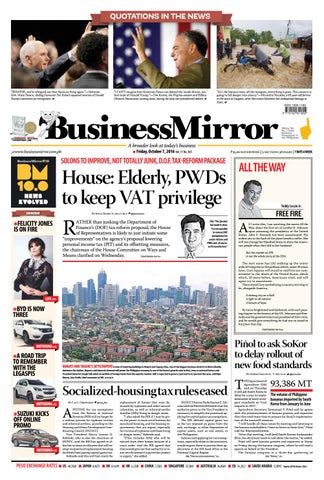
SOLONS TO IMPROVE, NOT TOTALLY JUNK, D.O.F. TAX-REFORM PACKAGE
House: Elderly, PWDs to keep VAT privilege
INSIDE
R
By Jovee Marie N. dela Cruz
All the way Teddy Locsin Jr.
free fire
@joveemarie
ather than junking the Department of Finance’s (DOF) tax-reform proposal, the House of Representatives is likely to just initiate some “improvements” on the agency’s proposal lowering personal income tax (PIT) and its offsetting measures, the chairman of the House Committee on Ways and Means clarified on Wednesday. Continued on A2
felicity jones is on fire
P25.00 nationwide | 5 sections 38 pages | 7 days a week
CUA: “The Speaker has made it clear: It is not possible to remove [VAT exemptions] for senior citizens and PWDs and, of course, we’ll stand by him.”
A
S I write this, I am watching the movie All the Way, about the first act of Lyndon B. Johnson upon assuming the presidency of the United States. John F. Kennedy has been assassinated. His widow sits in the back of the plane beside a coffin. She will not change her bloodied dress to show the American people what they did to her husband. But the murder of JFK is not the whole story of the USA The next scene has LBJ walking up the center aisle of Congress to the podium where, some 20 years later, Cory Aquino will stand to reaffirm our commitment to the ideals of the United States, ideals which, 20 years before, Americans tried, and will again try to assassinate. There stood Cory symbolizing a country striving to be, alongside America,
LIFE
A shining city on a Hall A light to all nations A beacon of hope.
D1
byd is now three
By turns brightened and darkened, with each passing chapter in the history of the US. Johnson said Kennedy was the greatest American president of their time, and he would give everything he had not to stand in his place that day. Continued on A10
Motoring
E1
a road trip to remember with the legaspis
Motoring
Makati and Taguig’s skyscrapers A view of towering buildings in Makati and Taguig cities, two of the biggest business districts in Metro Manila, dominate the skyline. Reports said domestic demand will power the Philippine economy to one of the fastest growth rates in Asia, even as external factors and President Duterte’s tough talk aided an outflow of foreign funds from the equities market. GDP is expected to grow 6.2 percent to 6.5 percent this year, said Rajic Biswas, Asia Pacific chief economist at IHS. ALYSA SALEN
T Socialized-housing tax rules eased
E2
suzuki kicks off online promo
Motoring
Piñol to ask SoKor to delay rollout of new food standards
E3
By Cai U. Ordinario
A
@cuo_bm
pplying for tax exemptions from the Bureau of Internal Revenue (BIR) will no longer be a tedious process for typhoon victims and informal settlers, according to the Housing and Urban Development Coordinating Council (HUDCC). Vice President Maria Leonor G. Robredo, who is also the chairman of HUDCC, said the BIR has agreed to allow her to issue certificates that will exempt recipients of replacement housing facilities from paying capital gains tax. Robredo said this will fast-track the
PESO exchange rates n US 48.3560
replacement of homes that were destroyed by typhoons and other natural calamities, as well as informal-settler families (ISFs) living in danger zones. “I also asked the BIR if I may be given the power to issue certifications for socialized housing, and for housing requirements that are urgent, especially for victims of typhoons and those living in danger zones,” Robredo said. “[This includes ISFs] who will be ejected from their homes because of a court order. And the BIR agreed that they would give me that authority to issue certifications if a particular project is urgent,” she added.
By Jasper Emmanuel Y. Arcalas
@jearcalas
93,386 MT
HUDCC Director Paolo Raynor E. Salvosa told the BusinessMirror that the authority given to the Vice President is necessary to simplify the process of applying for capital gains tax exemptions. The BIR defined capital gains tax as the tax imposed on gains from the sale, exchange, or other disposition of capital assets, such as real estate, in the Philippines. Salvosa said applying for tax exemptions, especially those in the provinces, would require them to process their applications at the BIR head office in the National Capital Region.
he Department of Agriculture (DA) said on Thursday it will ask South Korea to delay for a year its imple- The volume of Philippine mentation of more strin- bananas imported by South gent standards on fruit Korea from January to June imports in 2017. Agriculture Secretary Emmanuel F. Piñol said he agrees with the pronouncement of banana growers and exporters that they need more time to prepare for Seoul’s implementation of the nontariff measure. “I will handle all these issues by meeting and listening to the banana stakeholders. I have to listen to them first,” Piñol told the BusinessMirror. “After that meeting, I will [see] South Korean Ambassador [Kim Jae-shin] next week to talk about the matter,” he added. Piñol will meet banana growers and exporters in Davao on Friday during the banana congress, where he will read a speech on behalf of the President. The banana congress is a three-day gathering of
See “Socialized-housing,” A2
See “Piñol,” A2
n japan 0.4673 n UK 61.6491 n HK 6.2338 n CHINA 7.2503 n singapore 35.3041 n australia 36.8569 n EU 54.2022 n SAUDI arabia 12.8915
Source: BSP (6 October 2016 )
News BusinessMirror
A2 Friday, October 7, 2016
www.businessmirror.com.ph
House: Elderly, PWDs to keep VAT privilege Continued from A1
House Committee on Ways and Means Chairman Dakila Carlo E. Cua of Quirino said one of the improvements that the lower chamber will introduce is the inclusion of a provision on tax-collection efficiency of revenue-generating agencies. “I [will] review, together with Speaker Pantaleon D. Alvarez, the DOF proposal and we see the package as well-crafted proposal. However, our comment, we should include collection-efficiency measures,” Cua told reporters. The lawmaker added: “Our main thrust is to reflect efficiency measures to the bill
Piñol. . .
Continued from A1
government officials and members of the private sector aimed at addressing the current challenges of the banana industry, such as the widespread effect of Panama disease and China’s restrictions on banana imports. Earlier, the Pilipino Banana Growers and Exporters Association (PBGEA) said the government should negotiate with Seoul to retain the status quo on the maximum residue limit (MRL) until December 31, 2017. PBGEA warned that Seoul’s implementation of an MRL of 0.01 parts per million (ppm) on fruit imports starting January 1, 2017, could cause Philippine exporters to incur huge losses. “Once [the new] MRL is implemented next year, there are no ifs and buts about it. That’s why it’s important for the government to understand the urgency of the matter,” PBGEA President Alexander N.
because critics [of the measure] said it’s too focused on introducing new revenue measures without putting focus to taxadministration efficiency measure.” Cua also said the lower chamber will retain, and not remove as the DOF wants, the value-added tax (VAT) exemptions for senior citizens and persons with disabilities (PWDs). “The Speaker has made it clear: It is not possible to remove [VAT exemptions] for senior citizens and PWDs and, of course, we’ll stand by him,” the lawmaker added. Cua also clarified that the lower chamber will not produce a new counterproposal bill to substitute the DOF tax-reform package.
Valoria told the BusinessMirror earlier. MRL is the maximum concentration of a pesticide residue legally permitted in food commodities and animal feeds, according to the Food and Agriculture Organization (FAO). The MRL standards are guided by the Codex alimentarius, or more commonly known as the “food code,” which details specific limits for every chemical compounds found in pesticides known and used in the global market. The food code, which is reviewed annually to adapt according to market need, is a global standards set and assessed by the FAO and the World Health Organization (WHO) to ensure food safety. In April 2013 South Korea’s Ministry of Food and Drug Safety (MFDS) announced that it would adopt a positive list system (PLS) on MRLs, and would do away with the traditional food code. The transition from Codex to PLS would mean that South Korea will only keep its own MRL standards, while any
“It’s more like proposed amendments to the [DOF] bill. Its not really a counterproposal,” he added. On Monday Alvarez said the House Committee on Ways and Means will counter the DOF tax-reform package through the crafting of a new tax-reform bill, as he rejected the agency’s proposed offsetting measures to cover up for the estimated P159 billion in foregone revenues from the planned PIT rates. Alvarez also said that, instead of removing the VAT exemptions for senior citizens, PWDs and excise tax on petroleum, the finance department and its attached agencies should improve their tax-collection efficiency.
chemical ingredient that is not registered and recognized by the MFDS would automatically be assigned an MRL of 0.01 ppm. This means that any produce that has a pesticide residue exceeding 0.01 ppm will not be allowed to enter the Korean market. The Philippines accounts for more than 90 percent of bananas being imported by South Korea annually. Local exporters shipped a total of 93,386 metric tons (MT) of bananas to South Korea valued at $47.70 million in the first half of 2016, according to data from the Philippine Statistics Authority (PSA). In 2015 South Korea imported a total of 212,083 MT of Philippine bananas amounting to $80.99 million in 2015, PSA data showed. The PSA said South Korea accounted for 12.31 percent of total banana exports, making it the third-biggest buyer of Philippine bananas last year.
Under the DOF’s bill, workers earning not over P250,000 annually will be exempted from PIT. However, the DOF bill will expand the VAT base by reducing the coverage of its exemptions, including privileges granted for senior citizens and PWDs; adjustment of excise taxes imposed on petroleum products; and restructuring the excise tax on automobiles, except for buses, trucks, cargo vans, jeeps, jeepney substitutes and special purpose vehicles, to cover up the estimated P159-billion government revenue lost. The bill also seeks to repeal Section 4 of the Expanded Senior Citizens Act of 2010, as well as the Sections 32-A and 33-A of the
Socialized-housing. . . Continued from A1
This now becomes a major “choke point” in the provision of socialized-housing facilities since, Salvosa said, only six people at the BIR process these documents for all applicants nationwide. “The situation here is that the BIR’s processing [for tax exemptions] is centralized in Manila. When it was in the regions, it became prone to abuse,” he said. “However, we cannot decentralize the whole process so what we did was if the Vice President issues a certification that a socialized-housing project is urgent, the BIR will allow it only for those certified by the Vice President,” Salvosa added. Apart from this, the lack of resources also makes it difficult and even impossible for typhoon victims and ISFs outside of Metro Manila to make the long and expensive trip to the country’s capital to process their papers. This problem is also compounded by other choke points in processing socialized-housing facilities for ISFs and typhoon victims. For one, the Land Registration Authority (LRA) and the Commission on Audit (COA) requires recipients to present a land title. Robredo said land titles are not that common in provinces. The main document that many residents have in
Magna Carta for Persons with Disabilities. Section 4 of the Expanded Senior Citizens Act of 2010 provides VAT exemption for medicines, professional fees of attending physicians in all private hospitals, land mass transit, airfare, sea fare, and utilization of services in hotels, admission fees in theater and cinema houses, funeral and burial services for the death of senior citizens. Sections 32-A and Section 32-B of the Magna Carta for Persons with Disabilities provides the 20 percent discount and exemption from VAT, if applicable, on the certain goods and services tax incentives to a family of a PWD, respectively.
the countryside is tax declarations to signify land ownership. The Vice President said securing a land title takes two to three years to process. This, she said, is what delayed the provision of housing units in areas devastated by Supertyphoon Yolanda. Robredo said many victims of previous typhoons such as Yolanda remain homeless because of the paperwork required by the government. “Hopefully, once we put this in place, not only Typhoon Yolanda victims will benefit, but also those remaining victims of Typhoon Sendong. I recently visited Cagayan de Oro and victims of Sendong are still experiencing many problems,” she said. Decentralizing government process, particularly in the housing sector, is now the main focus of the HUDCC. Robredo said efforts to streamline government process can be included in the Citizen’s Charter currently being drafted by the HUDCC. In an emergency meeting on Monday, the HUDCC and six Key Shelter Agencies (KSAs) decided to do away with the provision of temporary shelter facilities for the victims of the typhoon. Earlier, Robredo said the process of applying for temporary housing relief is too long, with beneficiaries often receiving the temporary aid years after a storm hits. The HUDCC had also committed to ensure“well-coordinated” efforts in procuring construction materials, the transportation of goods, and warehousing.
BMReports BusinessMirror
A4 Friday, October 7, 2016
news@businessmirror.com.ph
Crime, traffic: Tirades aside, what Duterte has done so far
P
resident Duterte’s promise of radical change helped win him power in one of Asia’s oldest democracies. Since taking office in the Philippines, he’s certainly shaken things up.
But while his profanity-littered tirades capture headlines, alongside a war on drugs that has seen more than 3,000 people killed, what about his key campaign pledges? “He is like a stereo. On one channel, he is shock and awe—a lot of pronouncements, a lot of revelations,” said Segundo Romero, a professorial lecturer in development studies at the Ateneo de Manila University. “When you look at the actual management in government work, which is planning what to do, making decisions and making things happen, that has really not moved so much.” The former Davao mayor, 71, inherited one of Asia’s strongest economies with growth around 7 percent. But his challenges are complex and long-running, ranging from terrible traffic jams in the capital to creaking infrastructure to high crime rates. And while Mr. Duterte’s popularity is high (a poll released on Thursday put his net satisfaction rating at “very good” three months in), he needs to deliver on the economy to reassure investors who have pulled money out of local markets in recent weeks.
“The older you get, the more impatient you become,” Socioeconomic Planning Secretary Ernesto M. Pernia said at a recent briefing. “That’s the hallmark of the President. He’s very impatient. That means we’re going to get things done faster.” Nearly 100 days in, here’s where Duterte stands:
Drugs and crime
mr. Duterte has repeatedly vowed to make ordinary Filipinos feel safer by tackling illegal drugs and crime. “I have long warned them to stop using drugs. Now, they still have not stopped. They asked for their own death, not me,” he said in June. His campaign has seen over 22,000 drug suspects arrested and about 731,000 people turn themselves in. Half the deaths have been at the hands of the police. Human-rights groups argue that innocent people or those who are simply addicts risk being killed, and that the campaign won’t halt drug use. President Duterte has publicly attacked, leaders, from US President Barack Obama to United Nations
That’s the hallmark of the President. He’s very impatient. That means we’re going to get things done faster.”—Pernia chief Ban Ki-moon, for questioning his actions. For now Mr. Duterte is undeterred. “Our next move is to go after the high-value targets. My goal is to see every village free from drugs,” National Police chief Ronald M. dela Rosa said by phone, adding the volume of crime has fallen 49 percent.
Curbing corruption
president Dutertehas pledged to crack down on graft, urging senior officials to shun sports cars while banning the use of honorifics, like “your excellency,” for himself and his Cabinet. Since taking office, he has accused senior police officials of being on the take and oligarchs of using their influence to promote business interests. “I would hate to read your names in public and maybe authorize your arrest,” he said in August, referring to big tax evaders. Mr. Duterte is seeking to simplify government transactions to minimize opportunities for graft. At the Bureau of Customs, an office was created to centralize collections. He’s asked local governments to cut the time for new business registrations to two days, from several weeks, and automate some
transactions. As of late-September, more than 70 percent of 1,389 local governments surveyed were in compliance, according to Trade Secretary Ramon M. Lopez.
Polluting miners
PRESIDENT Duterte and Environment Secretary Regina Paz L. Lopez have targeted miners, ordering them to comply with environmental rules or shut down. The country is the world’s biggest supplier of nickel ore used in China’s stainless-steel industry. After an initial audit, 10 miners were suspended and 20 were told “to get their act together,” or risk an operations halt. The environment department is sending letters to companies facing potential suspension and giving them a week to respond, with a final decision on their future by the end of the month, Environment Undersecretary Leo L. Jasareno said this week in an interview. Still, miners on the warning list say they are confident of staying open. And Mr. Duterte’s actions could rebound: Chamber of Mines of the Philippines President Philip Romualdez has said $25 billion of investments are on hold and three
quarters of a million people could lose their jobs.
Traffic jams
Filipinos have long bemoaned snarling traffic jams and creaking mass transport. Transportation Secretary Arthur P. Tugade pledged to capitalize on “euphoria” after President Duterte’s win to get things moving. Mr. Duterte has settled a longstanding dispute, so two of three elevated railway lines in Manila can now be interconnected. He has sought emergency powers so he can put roads through private subdivisions, ban provincial buses on a major highway and increase the capacity of Metro lines, according to officials. But he’s made little tangible progress. In the longer term, President Duterte has signaled he’s willing to take Chinese money for infrastructure, something his predecessor was loathe to do given territorial tensions in the South China Sea.
Economic reforms
For Speaker Pantaleon D. Alvarez—leader of the majority bloc supporting Mr. Duterte in the Lower House—economic growth is “meaningless” unless it benefits the poor. He’s pushing to pass by mid-2017 a package to cut personal income tax and adjust excise taxes on petroleum products. The finance department has submitted its first package of tax reforms. “Without reforming our tax system—so that it becomes fairer, simpler and more efficient—the gov-
ernment cannot undertake the volume of spending required to achieve our goals,” Finance Secretary Carlos G. Dominguez III said at the time. President Duterte aims to reduce poverty to 17 percent in six years, from 26 percent now, and make the Philippines a high-income country in one generation. “This is not a pipe dream,” Dominguez told a recent business gathering. But to do that, growth must stay at 7 percent for the next generation, he said.
Creating jobs
The economy is underpinned by remittances from Filipinos working overseas. While growth is helping keep a lid on unemployment—the jobless rate is 5.4 percent—Mr. Duterte has pledged to improve both the quality of work available and pay. His administration is studying a nationwide minimum wage. “The difference in salary encourages migration, causing an explosion of the population in Manila and leading to other problems,” Labor Secretary Silvestre H. Bello III said by phone. The government is moving to halve the number of workers on short-term contracts before the end of the year, Bello said. “His endgame is to see to it that our countrymen will no longer have to go abroad to look for employment,” Bello said of President Duterte. “It’s a long-term goal, but he’s starting to create the climate for local and foreign investment.” Bloomberg News
Former security adviser Almonte finds Duterte’s first 100 days ‘exceptional’
President Duterte gestures as he poses with Philippine Army officers during his visit to the Army headquarters in Taguig City on Tuesday, as US and Philippine forces opened their first large-scale combat exercises. An independent poll released on Thursday showed that more than three-quarters of Filipinos are satisfied with Mr. Duterte, even though he is under fire internationally for his deadly crackdown on suspected drug dealers and users. The survey was conducted from September 24 to 27, and was published on Thursday. AP By Jelly F. Musico
Philippines News Agency
F
ormer National Security Adviser Jose Almonte on Thursday described the first 100 days of President Duterte as exceptional, particularly in addressing insurgency, broken politics and monopolized business. “Exceptional,” Almonte said, when asked during a Malacañang news briefing to describe President Duterte’s first 100 days in office. Almonte served as director general of the National Security Council under former President Fidel V. Ramos, who is now President Duterte’s special envoy to China on the maritime dispute at the West Philippine Sea. He said the Philippines has had an internal war since 1946, and he commended Mr. Duterte’s move to declare an indefinite cease-fire to give way to the peace process with the Communist Party of the Philippines.
A lmonte a lso noticed Mr. Duterte’s unconventional approach when he appointed known leftists to his Cabinet. “This is the longest communist insurgency in the world. And we are, at the same time, having a problem of separatist movement in the South. So that’s No. 1. No. 2 is our broken politics,” Almonte said. Almonte said Mr. Duterte’s call for Congress to start immediately the discussion on the possible shift of government from the presidential system to federalism would fix the “broken politics” in the country. “The problem is this - only a small group, special group, in general— formulates the policies, national policies of this government, and it is implemented for the interest. And this happens, as you know, every after election. As we know, the center of political power, where we are in this country, is under the hands of this small group that funded the election,” he said.
Almonte also praised Mr. Duterte for trying to break the “unholy alliance” between politics and business. “If we cannot solve these three basic problems, we can never build a Filipino nation the way we want it to be. So these three must be solved and President Duterte is confronting it. That’s the best for the nation,” he said. Almonte also said if Mr. Duterte could solve these three basic problems, other concerns, like corruption, inequality and poverty, will also be addressed in the future. “It just so happened that what he’s doing is what I thought before. And that is why I am here to talk to you. I was asked. And the reason is I believe that he is doing the right thing on this,” he said. However, Almonte expressed apprehension that addressing his three basic concerns would be derailed if the nation’s attention continues to focus on the extrajudicial killings and Mr. Duterte’s colorful language.
AseanFriday BusinessMirror
news@businessmirror.com.ph
Editor: Max V. de Leon • Friday, October 7, 2016 A5
US rare bright spot for Asean exporters
A
fter years of looking to China as a source of growth, Southeast Asian countries are turning their attention back to the world’s largest economy on the other side of the Pacific Ocean.
Exports to the US from all but one of the six largest economies in the Asean increased in the first quarter from a year earlier, according to the most recent data from the International Monetary Fund (IMF). Shipments to China declined in four of the countries in the same period. The improvement in US sales comes against the backdrop of a contraction in trade across East Asia, the manufacturing hub of the world. It also shows the US—Asean’s largest trading partner as recently as 2007, but now ranked third behind China and Japan—is making a comeback as a key source of demand for Asian goods. “The US is one of the few places where demand is still growing,” Trinh Nguyen, a senior economist at Natixis SA in Hong Kong, said by phone. “The US used to be the engine
The US is one of the few places where demand is still growing.” —Natixis SA of growth in Asia, then it got sidelined by China and it’s now back.” The stronger dollar is helping by making US imports from Asia cheaper, while consumer spending is also holding up well. Singapore’s exports to the US climbed 10 percent in the first quarter from a year earlier, reflecting in part the strong demand for medicines and other pharmaceutical products produced by the city
state, according to Song Seng Wun, an economist at CIMB Private Banking in Singapore. Vietnam’s shipments to the US rose 21 percent in the period. “Vietnam, in particular, has the appropriate product mix, they have lots of cheap consumer products, including textiles,” he said by phone. Trade with the US underscores the importance of the Trans-Pacific Partnership (TPP), a 12-nation free-trade agreement that would include countries, such as Japan, Canada and Australia, to cover 40 percent of global trade. The TPP has been a centerpiece of President Barack Obama’s economic diplomacy in Asia, but doubts exist over whether the US will ratify the pact. The World Bank estimates that TPP could raise GDP by an average of 1.1 percent in member-countries by 2030. The US economy grew an annualized 0.8 percent in the first quarter, modest compared with China’s 6.7percent year-on-year expansion. The US, however, still dominates in terms of spending: it imported $2.2 trillion worth of goods and services last year, compared with $1.6 trillion for China, according to IMF data. Bloomberg News
Samsung makes Vietnam’s farmers bigger earners than bankers
A
few years ago, Nguyen Thi Dung was feeding chickens and planting rice to make ends meet in one of the poorest areas in Vietnam. This year she expects to earn more than a typical stockbroker in the country. The difference? Samsung. The South Korean electronics giant moved into the rice paddies of Bac Ninh province in Northern Vietnam and began rolling out smartphones seven years ago. The latest exports include the company’s new Galaxy Note 7 phones and their batteries, which have embroiled the global brand in a massive product recall. Those gadgets have transformed Dung’s sleepy village into the country’s second-biggest exporting center after Ho Chi Minh City. “Our lives have improved dramatically since Samsung came,” says the 57-year-old ex-farmer, who now rents rooms and sells groceries to assembly line workers, and expects to earn the equivalent of $68,000 this year. “I want to buy a car and have my children drive me around.” Samsung Electronics Co. and its affiliates have built a factory town with 45,000 young workers and hundreds of foreign component suppliers—a miniature version of the family-run chaebol conglomerates that dominate business back in Korea. The investment has been a windfall for businesses in Bac Ninh—almost 2,000 new hotels and restaurants opened between 2011 and 2015, according to the provincial statistics office—helping raise the province’s per-capita GDP to three times the national average. “Samsung’s investment has created a breakthrough that spurred the economic growth of not only Bac Ninh but the nation,” said Nguyen Phuong Bac, head of a Bac Ninh socioeconomic institute. “It has quickened the country’s industrialization.” The Korean company represents the first stage in Vietnam’s plan to inherit a slice of the manufacturing mantle of China, which is losing makers of apparel, electronics and consumer goods because of soaring wages and costs. China’s ability to attract factory investment in the 1980s and 1990s from abroad helped it build homegrown suppliers and, eventually, its own global companies. Samsung Electronics opened its first plant in China in 1992. Shares of Samsung Electronics rose 3.6 percent as of 12:30 p.m. in Seoul trading, poised for the highest close since August 23.
Airport terminal
Now the company has bet large on Vietnam. White buses emblazoned with the
Yasay: America has failed us
T
SAMSUNG workers in Bac Ninh BLOOMBERG NEWS
45,000
The number of young workers in the factory town built by Samsung Electronics Co. and its affiliates in Bac Ninh, Vietnam
blue Samsung logo rumble past waterbuffalo grazing across the street from the Samsung SDI Co. battery plant. Trucks ferry Galaxy smartphones on the Bac Ninh-Noi Bai Highway—opened simultaneously with Samsung’s operations— to Noi Bai International Airport, where the company has asked for its own cargo terminal. This week local news web sites reported that Samsung has applied to the customs department for tax exemptions to reimport flawed Galaxy Note 7 smartphones and export replacements to Samsung’s headquarters in South Korea. The company declined to comment on the production of the phone or details of the product recall. More than half of 856 foreign companies that had invested a combined $11.9 billion in Bac Ninh province by June were related to Samsung. Foreign investment now accounts for 60 percent of the province’s economy, said Nguyen Duc Cao, vice
director of Bac Ninh Industrial Zones Management Board, who owns a gold-colored Samsung S6 phone. Samsung’s $15-billion investment in Vietnam has made it the country’s largest single exporter, shipping about $33 billion of electronics last year. The year before the South Korean company came, Vietnam’s total exports of mobile phones and other telecommunications products was $593 million. In addition to the two Bac Ninh plants, Samsung has opened factories in nearby Thai Nguyen province and in Ho Chi Minh City—employing about 130,000 workers nationwide. “We will continue to strengthen our business in Vietnam and our expansion plan is dependent on consumer, market trends,” the company said in an e-mail. Vietnam’s long-term economic development requires it become “a haven of investment,” said Scott Rozelle, a Stanford University development economist. “There are all these spillover effects—you get everybody working.”
Company trips
Moving from rice paddy to production line gives farmers higher wages, social security benefits, like a pension and sick leave and job stability, said Brian McCaig, assistant professor of economics at Wilfrid Laurier University in Waterloo, Ontario, Canada. Workers send part of their earnings to their families, with remittances accounting for about 7 percent of rural income in 2014, said McCaig, who
has researched how export agreements lift Vietnamese out of poverty. “Samsung provides very good working conditions,” Le Thi Hoa, a 22-year-old Samsung SDI assembly line worker in Bac Ninh, said as she shopped at an open-air vegetable and fruit market near the factory. “We get good benefits here, including health insurance, and free holiday trips with the company.” Samsung has put Vietnam in the vanguard of countries trying to inherit China’s factory jobs, competing with the likes of Bangladesh, Thailand and Indonesia. Yet, none has the confluence of cheap labor, cheap capital, a vast domestic market, infrastructure, education and political will that fostered China’s industrial boom. If Vietnam is to follow China’s model, it will need to develop homegrown suppliers that can provide more advanced components than basic products, like packaging, Bac said at the socioeconomic institute. “If we can’t join the supply chain with high-value products, our economy will depend pretty much on overseas companies and local companies will get very limited benefits,” he said. Samsung said it has contracts with 200 Vietnamese companies. Meanwhile, the residents of Bac Ninh are reaping what they can from their South Korean windfall. Lan’s cousin, a former motorbike taxi driver, now supplies vegetables, eggs and meat to the cafeteria at the Samsung SDI factory, which operates around the clock. Bloomberg News
he Philippines’s top diplomat said President Duterte is seeking an independent foreign policy for the country because “America has failed us” in the decades since it gained independence from its former colonial master. “The United States held on to invisible chains that reined us in toward dependency and submission as little brown brothers not capable of true independence and freedom,” Foreign Secretary Perfecto R. Yasay Jr. said in a statement distributed on Thursday by the Department of Foreign Affairs. “Breaking away from the shackling dependency of the Philippines to effectively address both internal and external security threats has become imperative in putting an end to our nation’s subservience to United States’s interests.” The US has remained the Philippines’s closest ally since it gained independence in 1946 and the two countries have several defense treaties. However, in his three months since taking office, President Duterte has frequently called into question the future of the alliance, including a recent comment that joint maritime drills that kicked off this week will be the last. He has indicated he is open to closer relations with China and willing to hold direct talks with Beijing about territorial disputes in the South China Sea. Yasay said the Philippines would learn from its past mistakes in dealing with the US as it fosters broader relationships with countries like China. “We will never allow China or any other nation to bully us or deal with Philippine interests under another carrot and stick policy,” he said. Mr. Duterte said on Tuesday the Philippines doesn’t benefit from the joint drills with the US and reiterated threats to sever ties. In the same speech, the Philippine leader said: “Obama, you can go to hell.” President Duterte has frequently bristled at American criticism of his war on drugs in which more than 3,000 people have been killed. In a speech last month Mr. Duterte said the Philippines would pursue an independent foreign policy and insist “on the time-honored principles of sovereignty, sovereign equality, noninterference and the commitment to a peaceful settlement of disputes.” President Duterte’s comments often seem to catch members of his own administration off guard. Defense Secretary Delfin N. Lorenzana said on Wednesday Mr. Duterte may not have sufficient information on the nation’s military agreements with the US, a situation that the Department of Defense will try to remedy. “I said our beloved President is misinformed because it would seem that the information that he receives are incomplete,” Lorenzana said in a mobile-phone message forwarded by his department’s public affairs group. The Philippines, which is conducting drills with US troops until October 12, benefits from the training, tactical exercises and civic projects, Lorenzana said. President Duterte’s Spokesman Ernesto C. Abella said on Wednesday people should use their “creative imagination and not be too literal” in interpreting the President’s statements. Bloomberg News
A6
Friday, October 7, 2016
BusinessMirror
www.businessmirror.com.ph
The World BusinessMirror
news@businessmirror.com.ph
Friday, October 7, 2016
A7
Saudis risk more sacrifices from Opec reversal as rivals ramp up
F
or the Organization of Petroleum Exporting Countries’s (Opec) production deal to work, it was always clear that Saudi Arabia would need to make sacrifices. The world’s largest oil exporter faces the risk the costs will keep getting bigger.
To bring daily output to the top end of the 32.5-million to 33-million-barrel range agreed to by Opec, the Saudis would only need to make the typical end-of-summer reductions as local demand tapers off, according to Citigroup Inc. If Nigeria and Libya restore production, the kingdom may need to cut twice as much, Petromatrix GmbH estimates. US shale drillers also stand ready to fill any supply gap. “At this point, the Saudis have shown willingness to cut by an amount that’s equal to their seasonal swing in production,” Petromatrix Managing Director Olivier Jakob said by phone from Zug, Switzerland. “If Libya and Nigeria are out, it’s relatively easy to live by the commitment they made. If Nigeria and Libya don’t falter, it’s going to be extremely difficult.” Opec’s pledge to reduce production could help speed up the rebalancing of global oil markets, which face a fourth year of oversupply that’s capping prices at $50 a barrel, half the level two years ago and too low for most members to balance their budgets. Yet, efforts to rein in the glut by some members, primarily Gulf Arab states, risk being undone by others who consider themselves exempt as they recover from output disruptions.
Seasonal cut
Saudi Ar abia, as Opec’s biggest member, has typically borne the bulk of production cuts in the past. With the organization pumping just over 33.5 million barrels a day in August, reducing volumes to the upper end of the range set in Algiers would involve a daily reduction of just 500,000 barrels. The Saudis will probably make that adjustment over the next few months regardless of the accord, as they lower output once local power demand for air-conditioning fades, said Ed Morse, head of commodities research at Citigroup. Still, that pullback could be eclipsed by Nigeria and Libya, which have signaled they’re excluded from any Opec constraints and, together, could add a million barrels a day, according to Morse. Saudi Arabia will likely shoulder the bulk of the production cuts with a reduction of 500,000 barrels a day, while other Gulf states may trim output by 300,000 barrels a day, Neil Beveridge, a Hong Kong-based analyst at Sanford
500K The number of oil barrels that will be cut from Saudi Arabia’s production, which will likely shoulder the bulk of the reduction
C. Bernstein and Co., wrote in a report on Thursday. Meanwhi le, Iran arg ues it should be allowed to restore production to the level of about 4 million barrels a day achieved before international sanctions curbed shipments. Its output rose by 10,000 barrels a day last month to 3.63 million a day, according to a Bloomberg survey of analysts, oil companies and ship-tracking data.
Expanding output
The survey shows that Opec’s total output climbed to 33.75 million barrels a day, driven largely by gains in Nigeria and Libya. Nigeria has restored production to 1.7 million barrels a day, up 500,000 from two months ago as it negotiates with militants who have attacked oil facilities, according to Minister of State for Petroleum Resources Emmanuel Kachikwu. The West African country aims to reach 2 million a day by the end of the year, Kachikwu said in an interview on September 27. Production was near the lowest in almost three decades in August. Libya has revived output to 500,000 barrels a day after striking a deal with armed factions controlling export terminals, and plans to reach 600,000 by the end of October, the country’s National Oil Corp. said on October 3. Production slumped to an 18-month low of 260,000 barrels a day in August, according to data compiled by Bloomberg.
Saudi share
Those two nations are pushing Opec output toward 34 million daily barrels, which would require the organization to cut by 1 million barrels to achieve the Algiers target. That may be a bigger sacrifice than Saudi Arabia is prepared to make as the kingdom refuses to cede market share, according to Petromatrix. “For all the talk about the new policy, it needs to be proven,” Petromatrix’s Jakob said. “Based
An oil pump working at sunset in the desert oil fields of Sakhir, Bahrain. AP/Hasan Jamali
on what I’ve seen, I don’t see a full change of policy or commitment.” The risk that Saudi reductions would have to deepen to counter increases elsewhere had long concerned former Oil Minister Ali AlNaimi, the architect of Opec’s pumpat-will policy adopted in late 2014. He retired in May. His successor Khalid Al-Falih initially supported the policy but his desire to repair Saudi relations with Opec members, particularly with Iran, as well as his country’s increasing economic pressures, spurred a change of stance.
Shale boost
While the details of the Opec accord and the distribution of cuts among members won’t be resolved until the group’s next meeting in November, the immediate price gains from the deal are benefiting competitors in the US, according to consultants Wood Mackenzie Ltd. West Texas Intermediate crude is up about 11 percent since Opec reached its supply agreement and the grade traded 0.6 percent lower at $49.51 a barrel at 12:46 p.m. in Singapore. “US producers can invest with more certainty going forward,”
WoodMac Research Director R.T. Dukes said in a Bloomberg Television interview. Shale drillers are hedging their price risk for next year, according to banks. Opec effectively threw a “lifeline” to shale producers, according to BNP Paribas SA, while Morgan Stanley said hedging might be at the highest so far this year. W hile the Energy Information Administration estimates US crude output has fallen by 752,000 barrels a day so far in 2016, recent data show drilling has picked up in response to stabilizing prices. Rigs targeting crude in the US rose for a fifth week to the highest since February, Baker Hughes Inc. said on September 30. Saudi Arabia, despite formally signing up to last week’s accord, may be assuming it won’t have to contend with much more additional supply by the time Opec next gathers in November, according to Barclays Plc. “Their hope is: we don’t have incremental supply from Libya or Nigeria,” Barclays commodities Analyst Michael Cohen said. “If there is a situation where Libya or Nigeria production is back up,” the Saudis will have to make “difficult decisions.” Bloomberg News
China conflicted over rising global power status–survey
C
hinese people are both pleased with their country’s rising global might and wary of foreign entanglements, according to an independent public opinion survey that reveals deep anxiety in the country after three decades of unprecedented economic growth. About 60 percent of Chinese polled said their country’s involvement in the global economy was a good thing, according to the report released on Wednesday by the Washington-based Pew Research Center. At the same time, more than three-quarters, or 77
percent, believed that their way of life needs to be protected against foreign influence, an increase of 13 percentage points from 2002. “Such self-confidence about China’s inter national stature coexists with some degree of anxiety and a general tendency to look inward more than outward,” said the report’s authors, Richard Wike and Bruce Stokes. The survey of 3,154 respondents in China earlier this year gives a glimpse into the public psyche of the world’s most populous country. Censorship and other restrictions on dissent prevent
people from airing their views and hinder the flow of information from the outside world. The survey indicated unease over China’s involvement in foreign affairs. While 75 percent said China played a more important global role than 10 years ago, 56 percent wanted the government in Beijing to focus on domestic problems. Just 22 percent believed that their government should help other nations. The respondents also offered conflicting views about the US, which has increasingly found itself jockeying with China for strategic
influence in the Asia-Pacific region and beyond. They ranked the US as the biggest “major threat” facing the country, with 45 percent saying they were concerned about US power and influence. In comparison, only 15 percent are worried about so-called Islamic State militant group. Even so, half said they had a favorable view of the US. While a majority, or 52 percent, believed the US was trying to prevent China from becoming powerful, the same percentage expressed confidence in outgoing US President Barack Obama. Bloomberg News
A8
Friday, October 7, 2016 • Editor: Lyn Resurreccion
The World BusinessMirror
www.businessmirror.com.ph
Haiti gauging full damage from Matthew’s rampage
L
This satellite image released by the United Nations shows road damage and craters in the Sha’ar district of Aleppo, Syria, on September 25. One official with the UN’s satellite imagery program says new pictures from rebel-held areas of the city show “an awful lot of new damage,” presumably by air strikes. Digital Globe, US Department of State, Humanitarian Information Unit, Unitar-Unosat via AP
Syria to reduce air strikes for Aleppo evacuations
B
EIRUT—Syria’s military command said it would scale back its bombardment of the contested city of Aleppo on Wednesday to allow civilians to evacuate besieged rebel-held neighborhoods.
The announcement, broadcast on state TV, followed 16 days of air strikes and shelling that have killed over 300 civilians and damaged hospitals and water facilities. Satellite images released on Wednesday by the UN show the scale of the destruction since a US-Russia brokered cease-fire collapsed two weeks ago. The government is accused by opponents and international observers of using violence to forcibly depopulate areas seen as disloyal to Syrian President Bashar al-Assad. “ The government has used scorched earth tactics against us, and then blesses us with an opportunity to leave? Of course this is refused,” said A mmar Sakkar, the military spokesman of the Fastiqum rebel faction inside east A leppo. Doctors inside the city’s besieged eastern neighborhoods said there were fewer attacks on Wednesday, after two weeks of air strikes in which Russian and Syrian government jets targeted underground hospitals with bunker-busting bombs. T he B r it a i n - b a s e d Sy r i a n Obser vator y for Human R ights s a i d 3 16 c i v i l i a n s i n e a s t ern A leppo have been killed in the past two weeks’ violence. UN Secretary General Ban Ki-moon h a s desc r ibed cond it ion s i n eastern A leppo, where 275,000 people are trapped under a government siege, as “worse than a slaughterhouse.” The government has insisted, however, that rebels inside east Aleppo have been preventing civilians from leaving via the safe corridors it demarcated in
316 The number of civilians in eastern Aleppo who have been killed in the past two weeks’ violence
July with the Russian military. It says hundreds of thousands, if not millions, of displaced people have fled to areas of government control across the country. Earlier this year, the Sy rian government negotiated the complete evacuation of Daraya, once an opposition hub on the outsk irts of Damascus, after four years of siege left residents with no food or medical care. The UN likened the arrangement to “ forced displacement” and warned it could not be a precedent for other areas. The UN’s satellite imager y program released images it said showed the most recent destruction to eastern parts of Aleppo. “Since the cease-fire has broken down, you certainly see an awful lot of new damage,” said Lars Bromley, a research adviser at United Nations satellite (Unosat). The images, from DigitalGlobe and obtained by the UN agency through a licensing arrangement with the US State Department, show mostly “formerly blasted and blown-up areas” during Syria’s five-and-a-half-year war “experiencing a great deal of additional damage,” Bromley said.
“To a certain extent you’re looking at rubble being pushed around,” he told reporters. At the White House, spokesman Josh Earnest called the images “deeply troubling.” But he added that it “tragically is not particularly surprising.” “Ordinarily you would be heartbroken to learn that this was the result of some sort of accident. But it’s clear that the Syrian regime—backed by the Russians—is engaged in a strategy of bombing those civilians intentionally to try to get them to bend to the will of the Assad regime,” he said. The images primarily consist of before -a nd-a f ter pic t u res from mid- to late-September s ho w i n g t he d e s t r uc t ion of bu i ld i ngs, i nc lud i ng hou ses, after the short-lived cease-fire broke down. Several images are from northern Aleppo neighborhoods, where government forces have advanced against rebel fighters who are battling back. Some of the images depict large craters, a “signature” that air strikes have done the damage. Artillery or mortar fire creates a different pattern of destruction, Bromley said. The UN satellite images could provide significant insights in the aftermath of highprofile, disputed attacks—such as a deadly attack on a UN-backed humanitarian aid convoy west of Aleppo last month. The top US militar y officer, Marine Gen. Joseph Dunford, told a Senate committee last week that he believes Russia bombed the convoy and said Syrian and Russian aircraft were in the area at the time. Russia and Syria have denied that they were responsible for the strike, with Russia saying the damage was caused by a cargo fire. “With our analysis, we determined that it was an air strike,” Bromley said. Unosat appeared to backtrack slightly on that late Wednesday. Program chief Einar Bjorgo said satellite images were an indication of a “possible air strike, however the situation on the ground, the damage that has been caused, it is quite complex and we cannot
be completely conclusive that it is an air strike.” “But there are indicators leaning toward that,” he said The convoy organizers had obtained necessary clearances from the government and rebels, as well as the Americans and Russians, who were operating aircraft in Syrian skies. The UN-secretarygeneral said last week he would set up an internal UN board of inquiry to investigate the September 19 convoy attack. Also on Wednesday, a Syria monitoring group and a Kurdish news agency said overnight air strikes, suspected to be Turkish, hit a village in northern Syria, killing at least 18 civilians, including three children. The Britain-based Syrian Observatory for Human Rights said that at least 19 people were killed, including three children, in the attack on the majority Kurdish village of Thulthana, in northern Aleppo, several miles away from where Turkish-backed rebels have been advancing. The village is in an area controlled by Islamic State (IS) militants. The Hawar news agency in the semi-autonomous Kurdish areas of Syria said 18 were killed, among them six children. It said the attack happened around midnight on Tuesday. There was no immediate comment from Ankara. Earlier Wednesday, Turkish military officials reported it had pushed the IS group out of four residential areas south of the town of alRai, several miles from Thulthana village. It said two Syrian opposition fighters, a Turkish soldier and 23 IS fighters were killed in the clashes. Separately, a Turkish soldier was killed and three others were lightly wounded in fighting in the opposition-held area of Ziyara, which a group of IS militants tried to infiltrate. The Turkish military launched an offensive inside Syria in August, backing Syrian rebels, to push Islamic State group militants from its borders and curb the advances of Syrian Kurdish forces, which it sees as an extension of its own outlawed Kurdish rebels. AP
ES CAYES, Haiti—Two days after Hurricane Matthew rampaged across Haiti’s remote southwestern peninsula with roaring winds and flooding rains, local authorities and international aid workers still lack a clear picture of the storm’s destruction. But as the weather began calming and a way was found around a key bridge that was washed away, convoys and helicopters have begun venturing to marooned corners to assess the damage and determine how to help thousands of people who lost homes, livestock and crops. At least 16 deaths in the Caribbean have been blamed on the storm. The death toll in Haiti alone was raised to 10 by the country’s civil-protection agency on Wednesday evening, but the number was expected to tick upward as more hard-hit rural areas are reached on Thursday and people tell their stories. In Aquin, a south coast town outside the battered city of Les Cayes, people trudged through the mud around the wreckage of clapboard houses and tiny shops. Cenita Leconte was one of many coastal residents who initially ignored official calls to evacuate vulnerable shacks before Matthew roared ashore at dawn on Tuesday as a Category 4 hurricane. The 75-year-old is thankful she finally complied and made it through the terrifying ordeal with her life. “We’ve lost everything we own. But it would have been our fault if we stayed here and died,” she told The Associated Press, as neighbors poked through wreckage hoping to find at least some of their meager possessions. Marie Alta JeanBaptiste, head of the civil-protection agency, said authorities were starting to get a better view of the situation in the Grande Anse department, where the storm made roads impassable and knocked out communications. “We do know there’s a lot of damage in the Grand Anse, and we also know human life has been lost there,” Jean-Baptiste said, adding that the official death toll did not yet include reports from that severely raked area. Civil aviation authorities reported counting 3,214 destroyed homes along the southern peninsula, where many families live in shacks with sheet metal roofs and don’t always have
the resources to escape harm’s way. The government has estimated at least 350,000 people need some kind of assistance after the disaster, which UN Deputy Special Representative for Haiti Mourad Wahba has called the country’s worst humanitarian crisis since the devastating earthquake of 2010. International aid groups are already appealing for donations to sustain a lengthy recovery effort in Haiti, the hemisphere’s least developed and most aid-dependent nation. In coming days, US military personnel equipped with nine helicopters were expected to start arriving in the capital to help deliver food and water to hard-hit areas. Jean-Michel Vigreux, the country director in Haiti for the nonprofit group CARE, said the lack of communication with people in the Grande Anse region was deeply worrisome. “We don’t know the exact impact yet. We currently aren’t able to communicate with our team in one region, Grande Anse. It is very scary,” he said. As answers were slow to come, some Haitians were convinced their troubled homeland was largely spared the kind of human suffering that severe weather has wrought in the past. “It seems like Haiti dodged a bullet. The news on the radio doesn’t seem nearly as bad as it could have been,” upholsterer Daniel Wesley said as he walked down a rain-slicked street in downtown Port-au-Prince. The last Category 4 storm to pound Haiti was Hurricane Flora in 1963, which killed as many as 8,000 people. In nearby Cuba, Matthew blew across that island’s sparsely populated eastern tip, destroying dozens of homes and damaging hundreds in the island’s easternmost city, Baracoa. But nearly 380,000 people were evacuated and strong measures were taken to protect communities and infrastructure, UN officials said. Early on Thursday, Matthew was pounding the central the Bahamas on a path forecast to take it close to the US East Coast, where authorities were pursuing large-scale evacuations. Forecasters said Matthew, which had dropped slightly to a dangerous Category 3 storm after crossing land in Haiti and eastern Cuba, was expected to strengthen anew into a potent Category 4 hurricane in the coming day or so as it nears Florida. AP
Florida braces for hurricane
M
IAMI—Hurricane Matthew, a lethal storm already blamed for 11 deaths, delivered a sobering wake-up call to Florida on Wednesday: a hurricane warning up and down the Atlantic Coast that shuttered schools, triggered mandatory evacuations and put billions of dollars of property at risk. Tracking on a course that leaned closer and closer to Florida, the storm set in motion the state’s first major hurricane drill in more than a decade. On Thursday it’s going to be close call for a potential landfall—with the Central Florida coast at highest risk—but much of the state could get slammed. From Westchester to Daytona Beach, lines formed around gas pumps and in supermarkets, windows boarded up and shelters readied. Miami-Dade and Broward counties canceled schools for the rest of the week and for the first time, Port Miami sealed its new $1.1-billion tunnel. In South Florida drawbridges began locking down and national parks battened down. Florida Power and Light positioned teams anticipating major outages. Nearly 8 million Floridians, not counting tourists, sat in Matthew’s potential path under hurricane or tropical storm warnings. A halfmillion were urged to evacuate their homes. With tropical storm force winds expected to begin pounding parts of Florida as early as Thursday morning, President Barack Obama warned that little time remains to prepare. “This is a serious storm. It has already hit Haiti with devastating effect. It is now in the process of moving through the Bahamas,” he said in a morning briefing. “By tomorrow morning, it will already begin to have significant effect in Florida, and then has the potential to strengthen and move on up the coast.” At 8 p.m. EDT, Matthew was located about 270 miles southeast of Nassau, moving at 12 mph, National Hurricane Center forecasters said. Sustained winds reached 115 mph, a slight weakening from earlier in the day that should not last as the storm moves over warm Bahamian waters. Matthew will likely continue pushing northwestward for the next two days, brushing Florida, or even making landfall, late Thursday or Friday. Powerful storm surges could push seas
from 5-feet to-8 feet high from the Sebastian Inlet north and 3 feet to 5 feet across Broward County and the Treasure Coast. As Matthew’s track continued to shift west toward the peninsula, forecasters repeatedly warned that storms hugging the coast can prove difficult to predict. Even a slight turn can deliver major impacts. “It’s geometry,” said former hurricane center director and WPLG-TV hurricane specialist Max Mayfield. “If you draw the Florida peninsula and you have a track parallel to the peninsula like this one, just a 5-degree to 10-degree change in motion is going to bring the core onto the coast.” On its current track, Matthew should push across the Bahamas on Wednesday and Thursday. Computer models show the storm swinging up the Florida coast on a path similar to Hurricane Floyd in 1999, a storm that vexed forecasters as it plodded along, repeatedly threatening to come ashore until it finally landed in North Carolina. “The best model we had at time brought it inland...hitting Palm Beach and going right up the East Coast,” said Mayfield, a hurricane specialist at the time assigned to forecast the storm. Matthew has so far been steered by the Bermuda High, said Weather Underground meteorologist Jeff Masters. Shifts and bulges in the seasonal weather pattern have repeatedly nudged Matthew closer to the coast. On Tuesday and Wednesday, fluctuations caused computer models to spit out a long-range track that looked like a doomsday prediction: featuring a startling looping path that had Matthew circling back for a second blow to Florida and the Bahamas. If there’s any good news, Masters said, it’s that the storm will likely be a much weaker tropical storm if it does indeed strike twice. As it churns across the Bahamas, Matthew is expected to deliver heavy rain and storm surge that could reach 15 feet in places, a dangerous threat to the flat islands. Early on Wednesday, Prime Minister Perry Christie urged Bahamians to prepare for a “worst-case scenario.” The country’s most populated island, New Providence, could take a direct hit, the first time a major hurricane has landed there since 1929. TNS
The World
www.businessmirror.com.ph
BusinessMirror
Friday, October 7, 2016
A9
Clinton strengthening hold on key states, new polls say
W
UK Prime Minister Theresa May at the Tory Party conference Bloomberg News
May stirs concern Brexit comes before business for Conservatives
J
ust before Theresa May replaced David Cameron, the new United Kingdom (UK) leader warned she would steer a change in the Conservative government’s attitude to corporations. Back in July, her pitch was: “We need to get tough on irresponsible behavior in big business.” As she closed the Tory Party conference on Wednesday, she made clear she was serious, pledging to turn Britain into a country “in which the powerful and the privileged no longer ignore the interests of the people.” As Chancellor of the Exchequer Philip Hammond prepares to meet with Wall Street executives on Thursday, he’ll have to contend with a sense there’s a shift in tone coming from a party that took pride in being probusiness. May announced a review of employment practices and peppered her speech with specific corporate practices she wants to end. “If you’re a boss who earns a fortune but doesn’t look after your staff; an international company that treats tax laws as an optional extra; a household name that refuses to work with the authorities even to fight terrorism; a director who takes out massive dividends while knowing that the company pension is about to go bust,” May said, “I’m putting you on warning.” The message seems to be that the government is ready to disappoint businesses seeking comprehensive access to the European Union (EU) single market. May tried to soften the blow by saying that Tories “will always be the party of businesses.” In New York Hammond will meet with top bankers from Citigroup Inc., Morgan Stanley and Goldman Sachs Group Inc. to try to reassure them that financial services based in London will still have good access to European markets.
100K
The cap in the number of migrants UK Home Secretary Amber Rudd is seeking to enter UK through a series of measures she unveiled While May didn’t name companies, Google Inc., Apple Inc. and Starbucks Corp. have faced scrutiny over their UK tax practices, while Twitter Inc. and Facebook Inc. have been flagged as failing in their duty to block extremist content that promotes terrorism. Lawmakers have raised questions about the pension deficit at the now-defunct retailer BHS and admonished Sports Direct International Plc.’s billionaire founder, Mike Ashley, for presiding over “ appalling” working conditions. With the Confederation of British Industr y calling for more clarity on the shape of a postBrexit deal, May’s response to those seeking to pressure her was that she wouldn’t be providing a “running commentary.”
City concerns
Concerns are growing at banks in London’s financial district, where thousands of jobs could be at stake if Britain loses passporting rights that enable firms to sell financial products throughout the EU. Three senior officials in May’s administration told Bloomberg that May won’t prioritize
the protection of the financial services sector in the discussions and that it shouldn’t expect any of the special attention it enjoyed under her predecessor. “Theresa May is undeniably trying to distance herself from the establishment and the ‘chumocracy”’ of Cameron and former Chancellor of the Exchequer George Osborne, said Andrew Russell, professor of politics at Manchester University. By taking a tough stance on immigration, May is reaching out to the 52 percent who chose to leave the EU. Resentment had been bubbling over an open-door policy that allows free movement of labor within the 28-nation bloc, with voters saying that it put an unsustainable strain on schools, jobs and social benefits. “She’s taking her marching orders from the side that won the referendum rather than the side that lost, and business was largely on the side that lost,” John Curtice, professor of politics at Strathclyde University, said in an interview.
Red lines
May has drawn the battle lines for the divorce. She has vowed to trigger the process by March and sent a strong message that immigration limits are paramount. On Wednesday a senior aide to Brexit Secretary David Davis listed three other “ key red lines” for the UK: freedom from the jurisdiction of EU judges; no contributions to the EU budget; and independence in lawmaking. “May is starting the negotiation from a tough line,” Bank of America Merrill Lynch economists said in a note to investors. Her desire for immigration control and freedom from EU courts “seem to mean” she is contemplating a so-called hard Brexit, the report said. In a blow to companies reliant on foreign talent, Home Secretary Amber Rudd on Tuesday unveiled a series of measures aimed at making it harder to employ people from overseas as she stuck by a pledge to bring net migration down to below 100,000 a year.
Immigration limits
“It is clear that immigration will continue to be a major bone of contention between companies and this government,” said Seamus Nevin, head of employment and skills policy at the Institute of Directors. “Businesses know that the EU referendum result means change to free movement of workers from the EU, but people were not voting to make the economy weaker.” The business world were put on guard back in July that May intended to make a break with the Cameron era. One of her selling points was to address the “unhealthy and growing gap” between the pay of corporate bosses and their workers. On Wednesday she said her government will lay out plans later this year to include consumers and workers on company boards.
Banks rebel
The pushback has already begun. “The task ahead is to make the big decisions that matter to our future, whilst avoiding populist measures that may have adverse consequences for business investment or job creation,” said Adam Marshall, acting director general at the British Chambers of Commerce. “In a period of historic change, business communities all across the UK need to feel supported, not alienated.” But with an eye to elections down the line, May is keeping her finger on the pulse of the nation, and reaching out to the working classes that traditionally back the opposition. “The party will always want to engage with business, but what the emphasis is on now is talking not just with big business and people who are very influential, but people right across the board,” Conservative Party Vice Chairman Stuart Andrew said in an interview in Birmingham. “The discussions we have with business are important, but so are the discussions with other people.” Bloomberg News
Philip’s cigarette alternative could reach US in 2017
P
hilip Morris International Inc.’s iQOS tobacco product, an electronic alternative to cigarettes that has taken years and billions of dollars to develop, could become available in the US next year, though without claims that using it is safer. IQOS, which heats tobacco without setting it on fire, could be released as soon as the US Food and Drug Administration (FDA) gives approval for it to be sold. That means Philip Morris wouldn’t be waiting for a longer vetting process that might allow it to claim the product is less harmful than traditional cigarettes.
“That’s currently the plan,” CEO Andre Calantzopoulos said in an interview on Wednesday at the company’s offices in Lausanne, Switzerland. “It’s good to be in the market because it’s only when you are in a specific market that you learn” about consumers and product acceptance in that particular place, he said. Gaining such insight is necessary as the company waits to see if the FDA will allow it to make any health claims, he said. New York-based Philip Morris plans to file what’s known as a premarket tobacco application early next year. That’s required
for any tobacco product sold after February 2007. The FDA has said it rules on such cases within 180 days.
Longer wait
The company is also filing a so-called modified risk application by the end of this year to be able to designate that the product is less harmful than traditional cigarettes. The FDA’s response time for that application—which currently is between 2 million and 3 million pages—will probably take at least twice as long. Altria Group Inc. will sell the product
in the US, through a licensing agreement between the two companies, which used to be one entity. IQOS is currently available in 10 cities and is on track to enter 10 more in different countries by year-end. IQOS is the first of four platforms of noncombustible products that make up what Philip Morris International calls reduced-risk products. The company has spent more than $3 billion to date on developing the portfolio, not including research that was done before its split from Altria in 2008, Chief Financial Officer Jacek Olczak said in an interview. Bloomberg News
ASHINGTON— With the first two debates of the general election finished and early voting starting in many places, Hillary Clinton’s lead has strengthened in opinion polls in key states needed to w in the W hite House, especially those with large minority populations. But Donald Trump’s core support among blue-collar white voters remains largely intact, giving him a base from which to try to stage a comeback in the campaign’s final phase, judging by a raft of new polls released in the past several days. A key for Trump is tenacious support among men, whose backing for him increased after Clinton’s health became an issue in early September, according to the USC Dornsife/ Los Angeles Times Daybreak tracking poll of the race. Nationally, the race has not sh i f ted d ra m at ic a l ly since the first debate between Clinton and Trump, even though large majorities of voters say Clinton won the encounter. But beneath that relatively stable national picture, the lineup of states has shifted to Clinton’s benefit, the polls indicate. The Daybreak poll, a national survey which is updated daily, has shown almost no movement. National surveys by YouGov for the Economist and SurveyMonkey for NBC, both of which poll each week, also have shown a very stable race, although they disagree with the Daybreak poll about which candidate leads. All three of those surveys are conducted online; several national surveys conducted by telephone have found a larger shift toward Clinton. That sort of difference, with telephone-based surveys having bigger ups and downs than online ones, has shown up in previous campaigns. T he Daybrea k track ing poll is the only major survey that shows Trump ahead; as of Wednesday, he leads the poll 47 percent to 43 percent. Averages of recent polls, by contrast, show Clinton leading by 4 percentage points or 5 percentage points. One important reason for the difference is how surveys account for people who are not certain to vote or are unsure about which candidate they support. Clinton and Trump are now even in the Daybreak poll among the most committed voters—those who say they are absolutely certain to vote and sure about which candidate they back. Trump previously had an edge among those voters. His overall lead in the poll now depend s on suppor t from people who say they are less than 100 -percent sure to vote. The Daybreak poll asks people to estimate how likely they are to vote, using a zero-to-100 scale. The gender gap provides another big reason for the difference. In the Daybreak poll, Trump leads Clinton by 17 points among men, while Clinton has a nine-point edge among women. Surveys that show Clinton ahead have the
gender gap cutting in the other direction—with Clinton’s lead among women exceeding Trump’s margin among men. T h e N B C /S u r v e y Mo n key poll, for example, which showed Clinton ahead 50 percent to 44 percent, found her leading by 18 points among women, double the size of Trump’s lead among men. The YouGov survey, which showed Clinton leading 43 percent to 40 percent, had her ahead by 11 points among women, while Trump led by five among men. Support for Trump from men increased sharply in the Daybreak poll just after September 11, the day Clinton was recorded on cell-phone video stumbling into a van while leaving a memorial ceremony for the victims of the 2001 terrorist attack. She later disclosed she had been diagnosed with pneumonia. Trump has used that episode as evidence that Clinton lacks the stamina to be president, a charge he frequently lobs, and the increase in his support among men in the poll suggests that line of attack may have found a receptive audience. Between September 11 and the end of the month, Trump supporters’ likelihood of voting increased by 5 percentage points in the sur vey, w ith men driv ing much of the increase. But Trump’s approach may have further alienated women, a huge stumbling block for him in some key states. A recent poll of Florida voters by Quinnipiac University, for example, showed Trump losing women in the state by 20 percentage points while winning among men by 11 points. In Pennsylvania a poll this week by Franklin and Marshall College showed him losing women by 12 points. The gender gap is one of three huge divides in the electorate that have framed the race since Clinton and Trump secured their parties’ nominations. The other two involve race and education. The divide along racial lines has been critical in the state polls. Overwhelming support from minority voters has been key to Clinton’s leads in both Florida, where she has led in five out of the last six polls, and in Pennsylvania, a state that Clinton’s campaign has seen as a firewall against any resurgence by Trump. Minority voters have also been crucial for Clinton in North Carolina, a state that Republican nominee Mitt Romney carried four years ago, but in which Clinton has led in six polls released over the past two weeks. A poll of the state by Elon University found Clinton winning 98 percent of black voters while Trump led among whites 61 percent to 39 percent. In each of those states and nationwide, the education gap has also been a major factor. Trump has dominated the race among white voters who did not graduate from college. He has trailed Clinton in many states among white college graduates, a group that Republicans used to dominate. TNS
A10 Friday, October 7, 2016
BMReports
PHL aims for final mine-halt decisions by end of October
T
he Philippine government has set out a timetable for the final stages of its review of metallic miners in the world’s largest nickel producer, and aims to decide which suppliers will be suspended for failing an environmental audit before the end of this month.
The environment department is sending letters to companies recommended for suspension, and producers have a week to respond, according
All the way. . . continued from A1
Kennedy, he said, had famously said, “Let us begin. “ Now there he stood, LBJ, to say, “Let us continue.
Let us continue The work that must be done To erase all trace Of discrimination Based on race.
Let us pass the Civil Rights Bill of JFK.” The first 15 minutes of the movie
to Environment Undersecretary Leo L. Jasareno. There’s a further seven days for the responses to be assessed by the department before encapsulate the American tragedy and American glory. Not the fullness of freedom far from achieved, nor equality and justice for all, but the never-ending struggle to achieve them by shunning the lesser and turning toward the better angels of our nature. The end in view is to establish both, for all men and women at home and everywhere else in the world. We are about to pivot away from an exclusive engagement with the United States, to seek new friends for mutually beneficial ventures— and perhaps also as an inducement to our brothers in the hills to come down from there and sit at a common
a decision, Jasareno said. The mining companies “will be given seven days, and we have another seven days to review,” Jasareno said in a phone interview late on Wednesday. By the third week of this month, “we hope to come up with a decision,” he said. The global nickel market is awaiting the definitive results from the checkup that was ordered by President Duterte and Environment Secretary Regina Paz L. Lopez. Three-quarters of the nation’s mines fell short in the audit, with 20 facing suspension on top of 10 already halted. While there’s concern that further halts may constrict supplies, several miners, including Nickel Asia Corp., have
said they are confident problems can be addressed. Nickel futures dropped to $9,945 a metric ton on the London Metal Exchange on Wednesday, the lowest since September 19. Prices surged to as much as $10,900 on September 27, as Lopez presented the list of mines recommended for suspension. The metal used in stainless steel is 14 percent higher this year. While Deutsche Bank AG raised the possibility this week that nickel may gain to $14,000 in the event of a significant wave of mine closures in the Southeast Asian nation, the bank cautioned that “the magnitude of the rally will, of course, depend on the final outcome” of the audit.
table, and sign the end of the longestrunning insurgency in history, and thereby write the last chapter in the long cold war of the last century. But whichever direction we turn for material advantage, there is one direction from which we shall never turn away, and that is from the United States, if not as it is, then as it never ceases struggling to be,
Other countries might become as powerful. One country bids fair to be as rich. But no country in the world or in history shall ever be the United States. Not a mere superpower stretching from sea to shining sea, projecting power across two blue oceans— not hing as common as t hat. But a dream, a vision greater than all the wealth and power in the world.
with failures now and then but always and ever with fresh resolve to start over and be the best a nation can be not just for itself but all the world.
Bloomberg News
Of a shining city on the hill Built Not upon the slain But by the living.
www.businessmirror.com.ph
Duterte, Jokowi now nickel’s best friends
A
vigilantist politician who would be happy for all his country’s mines to shut down and a populist president enforcing a ban on ore exports might not seem the most obvious allies for global nickel miners. Right now, though, commodity producers will take what they can get. Even after putting in the thirdbest performance among the mosttraded base metals so far this year, nickel is languishing at levels where more than half the industry is probably making a loss on every metric ton. The Philippines, the world’s biggest producer of the metal used in stainless steel, hopes to decide by the end of the month which pits will be allowed to remain open following an environmental audit ordered by President Duterte. If you’re wondering why that potential hit to supply hasn’t lifted prices over the past week, have a look what’s going on next door. Joko Widodo’s government in Indonesia, which lost its status as the biggest producer after banning exports of unprocessed ores in 2014, is considering loosening those restrictions, the country’s acting energy and minerals resources minister said on Tuesday. This jockeying between the two biggest swing producers is in stark contrast to Russia, Canada and Australia, which each churn out a consistent 250,000 metric tons or so of metal every year. And it makes life hell for the global industry. Commodity businesses live and die on supply and demand. Investing means taking high-stakes bets on what the world will look like years into the future—one of the reasons most big miners employ so many economists. Generally, demand for raw materials can be assumed to grow at a predictable
pace, perhaps accelerating or decelerating over the long term, but rarely making sharp reversals in the absence of major technological change. Supply, on the other hand, is highly unpredictable. Weather, strikes, landslides, regulatory changes, the attitudes of investors and even the shape of underground deposits can make the amount of material the world produces swing drastically from year to year. That uncertainty can be glimpsed just looking at short-term prices. The 90-day volatility of nickel on the London Metal Exchange is well above that of copper or aluminum and even pips zinc, this year’s best-performing base metal. For miners, that unpredictability creates a major headache. Anyone who invested in new mines and processing plants in the hope of good prices when the metal surged above $50,000 a ton in 2007 would have been in trouble 18 months later when it slumped below $10,000. Less rash diggers who regarded the metal’s subsequent sixyear spell above $13,000 as a baseline would have squealed as it fell as low as $7,595 a ton this year. What miners need above all else is a bit of certainty that would allow them to match their supply projections to demand a little more closely. It’s hardly a surprise that Vale, the world’s biggest nickel producer, wants no let up in Indonesia’s ore-export ban, fearing a flood of supply will crunch down prices again. Miners may balk at the restrictions Southeast Asian governments place on their industry, but they’d do well to temper their outrage. Further curtailment of exports from the Philippines and Indonesia would have a salutary effect on their income statements. Bloomberg View
BMReports BusinessMirror
news@businessmirror.com.ph
Friday, October 7, 2016 A11
Fed rate bets boost dollar, damp Treasuries
T
he Federal Reserve (the Fed) is back in the financial-market spotlight, with strengthening speculation that an interest-rate hike is imminent, buoying the dollar for an eighth day against the yen, dragging gold lower, and spurring the yield on two-year Treasuries to the most in 10 years versus German notes.
The dollar climbed against most of its peers following further evidence that the world’s biggest economy is sufficiently robust to cope with higher borrowing costs. Bunds halted a threeday losing streak before the European Central Bank (ECB) releases an account of its last policy meeting. Banks in the region rose for a third day, with the Stoxx Europe 600 Index fluctuating, while emerging-market equities climbed toward a two-week high. Gold extended its longest losing streak since May, and crude fell from its highest level since June. The outlook for monetary policy in the world’s biggest economies is dominating investor sentiment this week, with bets on a Fed rate increase by the end of this year mounting. Friday’s key payroll data will be closely watched for indications of the likely trajectory of borrowing costs before the nation’s earnings season kicks off next week. Ultralow rates are not necessarily here to stay, Fed Vice Chairman Stanley Fischer said on Wednesday. Positive economic reports this week have hinted that “tomorrow’s payrolls data has some scope to surprise to the upside” said Manuel Oliveri, a currency strategist at Credit Agricole SA in London. “If you have indications that the labor market continues to improve, it’s something that may actually put the Fed closer to tighten monetary policy in December. That’s the main reason the dollar is very much in demand for now.”
Currencies
The greenback extended its longest run of gains against the Japanese currency since July 2014. The market-implied probability of a Fed hike by December rose to 62 percent from 51 percent at the start of last week, according to futures data compiled by Bloomberg. Nonfarm payrolls data on Friday will show US employers added 172,000 jobs in September, compared with 151,000 in the previous month, according to a Bloomberg economist survey. The dollar added 0.2 percent to ¥103.66 at 10:42 a.m. in London, after strengthening more than 3 percent in the previous seven days. The pound resumed its decline as concern the UK is headed for a deal that would deny it unfettered access to the European Union’s single market prompted investors to keep selling. The slide followed a recovery on Wednesday, when traders took advantage of sterling’s drop to a 31-year low against the dollar and the weakest level since 2011 versus the euro to buy.
Bonds
The yield premium investors earn for holding two-year Treasuries over similar-maturity German debt widened to the most since July 2006, indicating traders see US rates rising sooner and faster than in Europe. While reports this week speculating on a paring of ECB stimulus weighed on the region’s bonds, the spread signaled that the policy-divergence view regarding the Fed and the ECB is still intact. Shorter-dated bonds are more sensitive to the outlook for monetary policy than longer maturities. US 10-year Treasuries were little changed, with the yield near a two-week high. A Bloomberg index of developedmarket sovereign debt ended on Wednesday at the lowest level since July. The yield on German bunds fell four basis points to minus 0.04 percent, after rising 11 basis points over the last three days.
Commodities
Crude oil declined 0.1 percent to $49.76 a barrel in New York, after advancing 2.3 percent to a three-month high on Wednesday. US stockpiles fell below 500 million barrels last week for the first time since January, official data show. The oil rally will stall at $55 a barrel, according to Goldman Sachs Group Inc. “There is a bit of a cap for oil at about $50 because above that level, once we head up toward $55 a barrel, there’s concerns that US shale producers will jump back into action,” said Michael McCarthy, chief market strategist in Sydney at CMC Markets. “The draw in crude stockpiles is clearly one of the factors contributing to the positive momentum.” Gold fell 0.1 percent, extending its losing streak to eight days, the longest since May. Nickel gained for the first time this week in London as investors assess a Philippines mining audit that could prompt shutdowns in the world’s biggest supplier, and news that Indonesia may resume some sales of nickel ore.
Stocks
The Stoxx 600 fell 0.3 percent in London, after Wednesday halting its longest streak without losses in a year on concern that the ECB is turning less accommodative. Banks posted the best performance of the equity benchmark’s 19 industry groups. EasyJet Plc. slid 5.8 percent after posting its first decline in annual profit since 2009, as terror attacks clipped demand and the weaker pound inflated foreign-currency costs. Dialog Semiconductor Plc. added 4.2 percent after the Apple Inc. supplier reported higher preliminary sales than forecast. Merger and acquisition activity was also in focus on Thursday, spurring moves in the following stocks: UniCredit SpA rose 1.2 percent after a report that Amundi SA is ready to offer a more-than-expected €4 billion ($4.5 billion) for its Pioneer Global Asset Management SpA unit. Osram Licht AG surged 11 percent after a report that a Chinese company is planning to bid for the German maker of light bulbs and LEDs by mid-October. Sompo Holdings Inc. jumped by the most since February in Tokyo after the insurer said it agreed to buy New York-listed Endurance Specialty Holdings Ltd. for about $6.3 billion. Fujitsu Ltd. climbed 5.7 percent after the company was reported to be in talks to sell a majority stake in its personal-computer business to Lenovo Group Ltd., which advanced 1.5 percent in Hong Kong. Twitter Inc. tumbled 11 percent in premarket New York trading following a report that Alphabet Inc.’s Google isn’t interested in buying the social-networking service. S&P 500 Index futures slipped 0.2 percent, after US equities gained 0.4 percent in the last session. The MSCI Asia Pacific Index added 0.3 percent with a measure of energy stocks surging 1.9 percent, for the best performance among 10 industry groups. The MSCI Emerging Markets Index rose 0.2 percent, heading for the highest close since September 23. Shares in Hong Kong led gains, with the Hang Seng China Enterprises Index climbing 1.4 percent. The gauge has rallied 3.8 percent this week, while mainland markets remained shut for holidays. South Korea’s Kospi index increased 0.6 percent. Samsung Electronics Co. jumped 4.5 percent, the most in almost two months, after activist investor El l iot t Ma nagement Cor p. urged the company to restructure its business. Bloomberg News
Inside a securities brokerage BLOOMBERG
BMReports BusinessMirror
A12 Friday, October 7, 2016
news@businessmirror.com.ph
Cebu tourism remains buoyant, targets 4.5M visitors by year-end T By Ma. Stella F. Arnaldo | Special to the BusinessMirror @Pulitika2010
HE outlook for the tourism industry in Cebu for the rest of the year remains buoyant, with the rapid infrastructure development providing the competitive edge for the province as an attractive travel destination.
Real-estate services and adviser CB Richard Ellis Philippines (CBRE) made this observation in its latest overview of the Metro Cebu property market. It added that property developers, like Sta. Lucia Land Inc., and international hotel chain Dusit International are expanding their hospitality portfolios in the province, attracted by the latter’s upbeat tourism sector.
In a text message to the BusinessMirror, Rowena Montecillo, regional director for the Department of Tourism (DOT) in Central Visayas, said the agency is targetting visitor arrivals to jump by 35.44 percent to 4.47 million this year. From January to June 2016, visitor arrivals in Cebu grew by some 3.8 percent to 1.8 million, she said, with the largest numbers coming from South Korea,
Japan, the United States, China and Australia. She added that the average daily expenditure for the period in review was $103.55 (P4,970.40). In its latest property report, CBRE said MICE (meetings, incentives, conventions, and exhibitions) activities have been a “key demand driver” in visitor arrivals, as well as cultural events like the Sinulog Festival, and the seasonal vacations and leisure holidays of travelers. At present, there are 74 hotels in Cebu offering 7,778 rooms. A large bulk of these rooms, numbering 2,386, are in the peripheral areas of the Cebu Business Park, followed by 2,142 rooms in the outskirts, then 1,790 rooms along Fuente Osmeña. The reclamation and downtown areas offer a total of 1,350 rooms. CBRE said the average hotel rates in the first half of the year reached P4,304 per night, with many reporting above 90-percent occupancy rates, among them
Radisson Blu Hotel (99 percent) and The Golden Peak Hotel and Suites (94.28 percent). More hotels are expected to be constructed. “Sta. Lucia Land Inc. recently announced that it will continue to focus on tourismrelated developments, particularly outside Metro Manila including Cebu. Likewise, international hotel developers have been seen to embark on Cebu’s thriving market. Leading Asian hospitality group Dusit International has signed a partnership with local developer Grand Land Inc. to bring its second hotel brand in the province. Dusit Princess Hotel in Mandaue will open by 2018, adding a total of 295 guestrooms with international-standard facilities,” the real-estate analyst said. The strong growth of the province’s tourism sector has encouraged more foreign carriers to offer it as a destination, as well as increase their number of flights, CBRE said. “Thai Smile Airways recently
announced its plan to open a Cebu-to-Bangkok route by October this year. It will provide an additional 58,968 international air-seats per year to Cebu, stimulating air-traffic demand in both opportunity markets. This will provide a faster and more convenient travel experience for tourists from the Central and Southern Philippines compared to the current option with flights going to Manila then Bangkok.” The ongoing expansion of the Mactan-Cebu International Airport is also providing impetus for the route expansion of said carrier. “In this regard, it can be expected that tourism, business and leisure travel will significantly increase and contribute to the economic prosperity of Cebu,” according to CBRE. The real-estate adviser emphasized t hat t he prov ince’s attractiveness as a travel destination is buoyed by its strengthening infrastructure network.
“Inf rast r uct u re development remains a key success and competitive factor as the province continues in its pursuit to become the top travel destination for tourists, as well as a premier hub for international investors.” It cites upcoming projects that would further boost the tourism sector in the province, such as the Cebu-Cordovan Bridge, Cebu-Negros Oriental Bridge, and a P35billion urban automated guideway transit-type rail system. Projects that have been recently completed in the first half of 2016 include the Cebu South Road and Cebu Toledo Wharf Road. “With the effective marketing of both private and government units, sustained industry competitiveness can be expected in the coming years, for this will serve as a beacon not only for increased visitor arrivals but also for tourism players to further pursue business undertakings in Cebu,” CBRE said.
Alaska oil reserves may have grown 80% on giant discovery ‘BM’ president highlights need
A
laska’s oil reserves may have just gotten 80 percent bigger after Dallas-based Caelus Energy Llc. announced the discovery of 6 billion barrels under Arctic waters. The light-oil reserves were found in the company’s Smith Bay leases between Prudhoe Bay and Barrow along the Arctic shore, according to a statement from Caelus on Tuesday. As much as 40 percent of the find, or 2.4 billion barrels, is estimated as recoverable, the company said. That compares with the state’s proved reserves of 2.86 billion barrels in 2014, almost 8 percent of the US total, Energy Department data show. “It’s a really exciting discovery for us, and we think it’s really exciting for the state of Alaska,” Caelus CEO Jim Musselman said in a phone interview. “They need a shot in the arm now.” Alaska’s oil output has been gradually declining, to 483,000 barrels a day last year from a peak of more than 2 million barrels a day in 1988, Energy Department data show. The last major field brought online was Alpine in 2000, which averaged 62,000 barrels a day in September, Alaska Department of Revenue data show.
Musselman, the man who engineered the $3.2-billion sale of Triton Energy Ltd. to Hess Corp. in 2001, founded Caelus in 2011 to explore and develop petroleum resources on the North Slope. In 2014 the company formed a partnership with affiliates of Apollo Global Management Llc. to invest in oil-and-gas properties in Alaska.
to recognize outstanding seniors
Project’s cost
The development will cost between $8 billion and $10 billion over the life of the project, which could be brought into operation by the fall of 2022, Musselman said. Located about 125 miles from any other facilities, the company will need to build pipelines and roads. An oil price of about $65 a barrel and greater certainty on state tax policy and incentives is needed to develop the field, he said. “A lot of the investment decision is going to revolve around what happens within the state from a regulatory standpoint,” he said. Caelus said its newly discovered field could produce as much as 200,000 barrels a day. The discovery of light oil was made after seismic data was collected and two wells were drilled this year, the company said. Another well will be drilled in early 2018, Casey Sullivan, a company spokesman, said in a phone interview. The discovery would be the biggest in four decades, the company said. Prudhoe Bay, the state’s biggest field, was discovered in 1967.
Oil rout
The fall in oil prices to a 12-year low of $26 a barrel in February, from almost $108 a barrel in 2014, prompted companies, including Royal Dutch Shell Plc. and ConocoPhillips, to withdraw from expensive and risky Arctic operations. Shell ended a nearly $8-billion quest to drill for crude in the Chukchi Sea after disappointing test well results. ConocoPhillips formally relinquished its 61 Chukchi Sea leases in April. The pretax cost to produce crude on the North Slope and transport it to market is about $40 a barrel on average, Sarah Erkmann, external affairs manager at the Alaska Oil and Gas Association, said in a phone interview. Oil futures closed at a three-month high of $49.83 a barrel on Wednesday in New York. They’re still at less then half their peak level in 2014. Alaska North Slope oil production averaged about 475,000 barrels a day last month, down from roughly 494,000 a year earlier, according to Alaska Department of Revenue data. Bloomberg News
RAMOS
(Speech delivered by the BusinessMirror President Benjamin V. Ramos at the Fourth BusinessMirror Dangal Awards for Elderly Care at the Unilab Bayanihan Center in Pasig City.) Former Senate President Nene Pimentel, father and mentor of our current Senate President Koko Pimentel; my family’s favorite actress and social advocate Ms. Susan Roces, our friends at Unilab, our awardees and special guests, a pleasant afternoon. Just last February, I was also here on this stage during the Unilab Networking Lunch for Advocacy Partners, where I gave a presentation on the B usiness M irror Dangal Awards for Elderly Care. I said then that, up to now, we are still the only institution that is giving this kind of recognition at the national level, with the support of Unilab, RiteMed and United Bayanihan Foundation (UBF). I think that, up to now, that has not changed. It is saddening because there are senior citizens at the grassroots level who, while generally unnoticed, are still persevering despite their age and condition to do good deeds for their fellow senior citizens. There are also exceptional civic organizations and senior-citizen associations that are tirelessly coming up with programs for the elderly. These people and organizations need to be given due recognition.
In the previous years we’ve already recognized more than 20 outstanding senior citizens and organizations. We are now on our fourth year, so I’m proud to say that the Dangal Awards has become an institution in itself. Indeed, it is now part of the legacy of the BusinessMirror Founder, the late Ambassador Antonio L. Cabangon Chua. It was in 2013 when he directed us to organize this Awards. Our former Editor in Chief Roy Acosta coined the branding—Dakilang Adhikain Ng Ating Lahi or Dangal Awards. Our Managing Editor Max de Leon, Unilab External Communications Head Claire Papa and Carlos Gonzaga of UBF laid the groundwork; and since then it has been a success. Today, we are honoring the 2016 batch of awardees. Max, who is a member of the panel of judges, told me that the quality of this year’s finalists is at an all-time high. He actually gave perfect scores to nine of the 11 finalists in the individual category. These people are the creme de la creme in today’s elderly population in Metro Manila, the best in the cities they represent. We are giving them the honor they deserve today. As I said before, thank you to Unilab, RiteMed, UBF and our other partners for helping us ensure, at least in our own little way, the works of these outstanding senior citizens and organizations are not left unnoticed. Thank you!
ERRATUM
IN the caption for the photo “Noble Endeavor,” which appeared on the front page of the BusinessMirror’s issue on October 6, the editors would like to apologize for the inadvertent error in identifying Benjamin V. Ramos as “ALC Group of Companies president.”
A rare collection of BusinessMirror
exclusives
When I Was 25, Generations, Executive Views, Model Executive, Envoys & Expats, The Broader Look, BM Reports Extra, etc. The BM Extra Magazine is a must-have publication that you’d surely want to see in your office, library, coffee shop, restaurant, living room, anteroom, etc. OUT SOON!
BusinessMirror www.businessmirror.com.ph
A14 Friday, October 7, 2016 • Editor: Angel R. Calso
Opinion BusinessMirror
editorial
Beware the trolls
D
uring the last decade, global Internet usage has skyrocketed, where over 3.5 billion people have Internet connection. While it is impossible to know how many people are on at any given time, here are some verifiable statistics. Every second, users are posting over 100 million comments on Facebook. More than 400 million messages are being sent on “WhatsApp” during that same second.
There are two factors that separate the Internet from anything else that humans have ever encountered. Anyone on the Internet has the capability to contact or interact with anyone of the other hundreds of millions of users. Further, and this may be the most important issue, that contact can be done anonymously. Those who spend time on the Internet are already familiar with so-called trolls. The term comes from Scandinavian folklore, and are described “as being very strong, but slow and dim-witted, and are at times described as man-eaters and as turning to stone upon contact with sunlight.” That may actually be an accurate description for the “Internet trolls,” who spread discord by “starting arguments or upsetting people by posting inflammatory, extraneous, or off-topic messages.” Recently in the Philippines, these people have made news due to numerous attacks, threats and harassments on journalists. Not content with simply spreading vitriol, these individuals and groups have resorted to spreading false information and unfounded rumors. The problem has become so pervasive, particularly with members of the press and media, that journalist groups have called on the government to help out with investigating these incidents. An online news organization recently published an article on how trolls have become the tools of spreading disinformation while trying to shape public opinion. The article goes in detail on how trolls create an artificial bandwagon effect on the Internet that encourages others to spread information and engage in “troll-like” behavior against perceived enemies. The techniques mentioned are the use of social-media marketing tools—“bots”—that automatically spread content, hiring operators that create multiple fake social-media accounts to spread misinformation, and creating false “advocacy” and “news” pages. Information and “news” laced with half-truths, misinformation and stories that are completely fabricated are spread and shared using these conduits on social media. Titles and content are made more sensational or provocative to attract viewers in an attempt to “clickbait”, and are spread by unsuspecting users who take this information as truth. This is amplified by the use of fake profiles and bots posting comments, sharing and liking these posts to artificially prop up their audience. Businesses also have been the target of trolling. One local firm with an extensive international presence has been fighting a false information campaign that, according to internal reports, has cost the company substantial business. Internet users themselves are both the cause and the cure, and it is a serious situation. Everything on the “Net” is not reliable or true. Internet users have an obligation to relay correct information in the same sense that a person would when speaking face to face. Since 2005
BusinessMirror A broader look at today’s business ✝ Ambassador Antonio L. Cabangon Chua Founder
Publisher Editor in Chief Managing Editor Associate Editor News Editor City & Assignments Editor Senior Editors
T. Anthony C. Cabangon Jun B. Vallecera Max V. de Leon Jennifer A. Ng Dionisio L. Pelayo Vittorio V. Vitug Lorenzo M. Lomibao Jr., Gerard S. Ramos Lyn B. Resurreccion, Efleda P. Campos
Online Editor Social Media Editor
Ruben M. Cruz Jr. Angel R. Calso
Creative Director Chief Photographer
Eduardo A. Davad Nonilon G. Reyes
Chairman of the Board & Ombudsman President VP-Finance VP Advertising Sales Advertising Sales Manager Group Circulation Manager
Judge Pedro T. Santiago (Ret.) Benjamin V. Ramos Adebelo D. Gasmin Marvin Nisperos Estigoy Aldwin Maralit Tolosa Dante S. Castro
BusinessMirror is published daily by the Philippine Business Daily Mirror
HOM
Publishing, Inc., with offices on the 3rd floor of Dominga Building III 2113 Chino Roces Avenue corner De La Rosa Street, Makati City, Philippines. Tel. Nos. (Editorial) 817-9467; 813-0725. Fax line: 813-7025. (Advertising Sales) 893-2019; 817-1351, 817-2807. (Circulation) 893-1662; 814-0134 to 36. E-mail: news@businessmirror.com.ph.
www.businessmirror.com.ph
Printed by brown madonna Press, Inc.–San Valley Drive KM-15, South Superhighway, Parañaque, Metro Manila MEMBER OF
Hitler and elections James Jimenez
spox
I
t’s become fairly common to hear people saying that Adolf Hitler was a product of democratic elections. This is not entirely accurate. To understand this better, it is necessary to go back to the time before Hitler came into power and look closely at the circumstances of his ascent. Germany’s Weimar constitution appeared to be a very liberal and democratic charter. It prescribed a government led by a president, balanced by a parliament of elected representatives, the Reichstag. These representatives would then elect among themselves a chancellor and Cabinet, which would be charged with the business of running the nation. How this worked was that the chancellor and Cabinet would stay in power for as long as they held the majority in the Reichstag. If no party could achieve a majority, coalitions would have to be created. In principle, this arrangement was sound enough. However, the
Constitution itself contained the mechanism for its own downfall—Article 48. Article 48 gave the President dictatorial powers in times of national emergency and, as things turned out, national emergencies weren’t all that difficult to manufacture. Between 1931 and 1933, no political party could get a clear majority. Power struggles and backroom dealings were the order of the day, essentially paralyzing government. In 1932 desperate to establish a clear majority government, President Paul von Hindenburg—an octogenarian war hero—called for presidential elections. He won the first, receiving 49.6 percent of the
vote which, while trouncing Hitler’s 30 percent, fell short of a majority, forcing runoff elections. In the runoff, Hindenburg finally got his majority with 53 percent, while Hitler got 37 percent. Thus far, democracy seemed to be working. Sadly, apart from the President’s emergency dictatorial powers, Hindenburg held no real authority. A chancellor was needed, and the Reichstag was still in disarray. Coalitions proved to be fragile and, thus, transient. With no options left, Hindenburg called for more elections. On July 31, 1932, the Nazis won 230 out of 608 seats. This made them the largest party, but still fell short of a majority. Another election was held on November 6, 1932, at which the Nazis actually lost 34 seats. With their party seemingly on the decline—and with money running low besides—the Nazis ramped up their intransigence against the chancellor and his Cabinet. Being one of the largest parties in the Reichstag meant that the Nazis were fairly effective at this strategy. In the end, a frustrated, and possibly senile, Hindenburg succumbed to the power brokering behind the scenes and offered the chancellorship to Hitler—a man roundly
rejected by two-thirds of the German people in democratic elections. After the Reichstag burned down, Hitler secured the passage of an emergency-powers decree and his Nazi machinery embarked on a campaign of political terror and state-run propaganda. On March 5, 1933, just days after the Reichstag fire, elections were held again and, despite everything, the Nazi party still didn’t get the majority they craved, winning only 44 percent of the vote. And yet, on March 24, 1933, through a combination of political terror, blackmail and hollow guarantees of continued freedom, Hitler rammed through the infamous Enabling Act, which resulted in the Parliament abdicating its democratic responsibilities. The Reichstag vote went 441 to 84. The rest is ignominy. So, you see, it wasn’t democratic elections that was to blame for the rise of Hitler. In the end, it was a failure of the elected to stand their ground, a subversion of democracy that was nothing less than a betrayal by those in whom the people had entrusted their freedom. James Arthur B. Jimenez is director of the Commission on Elections’s Education and Information Department.
opinion@businessmirror.com.ph
Opinion
Learning from history
The good old things
BusinessMirror
Leonardo A. Lanzona Jr.
Tito Genova Valiente
annotations
EAGLE WATCH
T
he 44th anniversary of martial law two weeks ago should give us some pause to assess the way the current events are unfolding. History matters not only because the current institutions are, to some extent, products of the past but also because we can learn from it. Indeed, while we cannot change the past, we are not prevented from reassessing the values, which we have fought for and from which we now stand. As some historians have already pointed out, the declaration of martial law in the Philippines in the 1970s was not a unique development. Several other countries, particularly Singapore and South Korea, had similarly instituted dictatorial forms of government in an attempt to pursue economic growth. In varied degrees, these countries, as in the Philippines, have also trampled upon basic civil and political rights, and veered away from due process as a means to spur economic growth and achieve development. An argument advocated by Lee Kuan Yew of Singapore appeals to socalled Asian values. As explained by Lee, this thesis claims that the cultural inclination to respect authority and hard work allows East Asian countries to pursue liberal economic policies without democracy. The central argument is that democracy is not a necessary condition in pursuing economic growth through capitalism. Dictatorial systems can engage in liberal economic policies even at the expense of the rule of law. In fact, some would argue that autocracies, because they are insulated from political pressure, are better able to improve economic conditions. Democracy, the argument goes, is a luxury that the poorest countries cannot afford. The implication of this theory is that democracy has never been part of the culture of these countries as Western countries have forced this system upon them. According to this theory, Eastern and Western countries are different and what works to promote development in the West will not work in East Asia. Lee says East Asian values emphasize that an individual is not a separate entity, but part of a family, which is then part of society. Mere policy prescriptions, he explains, do not capture the cultural contributions to economic growth. Cultures with less emphasis on scholarship, hard work and thrift, he says, will grow much more slowly than the countries of East Asia did. Asian values, the thesis goes, create a new path to economic growth that is inconsistent with democracy. Several counterarguments can be raised. First, there is no such thing as Asian values. Each country, even in Southeast Asia, is unique and as different as any country in the Western hemisphere. What works in Singapore will not necessary succeed in the Philippines. While values may be similar in countries, such as the Philippines, India or Singapore, it is a stretch to say Asian countries share the same values. Second, Western values are not entirely different from the so-called Asian values. In fact, respect for authority, along with devotion to hard work and merit, is as much a value in the West as in Asia. What differs, perhaps, is the long history in Western countries of authoritarian rulers abusing of power and corruption. In all countries, except perhaps in Hong Kong and Singapore, modernization and economic development are positively correlated with democracy. Third and most important, the economic growth in Singapore cannot be fully attributed to its culture, but more important, to the type of institutions that they created. As a number of scholars have noted, government policy in Singapore has very carefully not only created growth, but also moderated the negative effects of development on the least well-off and limited the creation of a strong civil society. Hence, the
As some historians have already pointed out, the declaration of martial law in the Philippines in the 1970s was not a unique development. Several other countries, particularly Singapore and South Korea, had similarly instituted dictatorial forms of government in an attempt to pursue economic growth. state has created stakeholders or citizens with a direct interest in the state. Consequently, vested political power of the few was controlled as the distribution of income and power became more equal. While it is possible that Lee’s authoritarian regime may be responsible for setting up this situation, there is nothing in a democracy that can prevent this happening. Regardless of the government structure, the ability and cultural inclination of the country and its state to achieve the necessary institutional development that encourages greater efficiency, participation and social mobility are all that matters. While President Ferdinand Marcos imitated the authoritarian regimes in other countries, with all the consequent violations to due process, the institutions created only ensured the concentration of power and wealth to him and his family. In the process, instead of a culture of hard work and merit, we had the corruption and violence, bringing us worldwide ignominy. Yet, what set us apart as a nation was how we eventually championed democracy and respect for individual human rights. Indeed, as the song goes, Edsa was our gift to the world and influenced similar revolutions in other countries. Unfortunately, with our new found democracy, institutions remained weak and failed to correct the unequal distribution of power which we sought to eliminate. In fact, the present acceptance of the public to extrajudicial violence reflects our lack of trust in state institutions, causing many to believe again in more immediate forms of punishment and control. In particular, the previous administration failed to fix the corrupt and ineffective justice system, and encountered a series of security-related scandals. These caused a significant portion of the electorate to ignore the lessons of martial law and vote for President Duterte and his program of law and order. True to its campaign promise, this current administration follows a path that contradicts our cultural inclinations, but results in substantial social loss. Instead of respecting human rights and protecting the poor, we see deaths and misery to poor communities, leading to greater uncertainty in the ability of our institutions to care for the disadvantaged and the sick, and adhere to basic human rights. Indeed, this government must learn from our history and return to the values that will restore our position as citizens of the modern world. It needs to go back to our true nature as a decent and self-respecting nation by following due process and focusing on the business of building the right institutions. Leonardo Lanzona Jr. is professor of economics at the Ateneo de Manila University and a senior fellow of Eagle Watch, the school’s macroeconomic research and forecasting unit.
Friday, October 7, 2016 A15
I
t happened some years back. I stepped out of an Internet café in Cubao, one of those that closed late, I crossed the street from what was Fiesta Carnival then. There was no one on the street. I walked past the coliseum. It was very quiet and the October wind was present, and persisted till I reached the major building of a bookstore, where I realized there was no one there. There was no one walking. There were no cars either. The place was deserted. I found myself at the edge of a sidewalk that extended from the building. I felt I was perched atop a low mountain, or at the edge of a precipice. I was not scared. The closest to any dark emotion was the cold wind upon my cheeks. I felt terribly alone but not sad and alone. An old friend who would understand my story, not laugh at me and dismiss it as my imagining, put it simply: I was at the edge of Life, where Death was waiting alive. This friend’s words were not metaphorical nor metaphysical. He sounded like a geographer explaining what happened when one had reached a place that was against living and ran counter to moving. I do not remember how I came back to a world of the living. I knew I turned around and saw people walking, moving as if the world had
always been there. This week it happened again. I was in a café, sipping a most ordinary cup and looking at the freshly toasted bread and a dainty dollop of a butter. I looked out the bay window and onto the street. Things were stopped by my gaze. I sensed myself controlling the scenery outside. I felt my hand could touch the trees and turn them upside down without destroying the roots. My eyes were focused on the windows and doors, and I could open and close them. Inside the café I looked up and saw how high the ceiling of the place, I was in an old building. It was a former government office, retrofitted. The strength I was feeling was coming
Angels and candles Siegfred Bueno Mison, Esq.
THE PATRIOT
L
ast Sunday the Church celebrated the feast of Guardian Angels. From the Greek word Angelos, meaning messenger, angels carry out the mission of our Lord to the extent they assume bodily form from time to time. In the movie City of Angels, Seth, the character played by Nicolas Cage, was one angel who chose to be human after seeing the way Dr. Maggie, the character played by Meg Ryan, took care of her patients. That movie significantly portrayed that angels are not former people. It has been argued that angels aren’t human; they are purely spiritual beings. In a homily last Sunday, the officiating priest in Saint Benedict church in Silang offered a “pick up” line to his congregation. He asked, “kandila ka ba [Are you a candle]? No, why? I say it because it gets dark whenever you’re not beside me. Sounds cheesy, yet very meaningful. In our lives, we encounter dark moments and trials. Angels, in the form of family and friends, come our way to help ease the pain. Candles, in the form of faith in a Supreme Being, help us see the brighter side of seemingly negative things.
I encountered my Guardian Angel way back in 1979 when I was a second year high-school student. He was a transferee like me and didn’t know too many people in class. He was older than most of our classmates for reasons we jokingly tell him that it was because he spent 10 years in grade school. In high school, he was bigger and taller in size, more mature in age, and knew how to use these advantages in times of trouble. He hasn’t stopped being my guardian angel since we met. Dr. Raul L. Dy is my Guardian Angel here on earth.
from my knowledge of the structure. Years ago as a child, I was taken there by my father to attend a children’s party. The winding staircase that led to his office, where public-school teachers applied for loans, now led to hotel rooms. Where I was, where the white and blue table stared back at me was the office of our neighbor, a nice lady who talked fast and who laughed loud with the gentleness of one who would share her wealth with anyone, anytime. I could see her in front of me. She was not in a café. She was in her office mulling over decisions about insurance. My brunch was sharing a space with her. This was not memories encroaching upon memories. This was the past as solid as one’s birthday celebrations or a loved one’s passing.
I saw the Past. It was full of life as the Present. So much for the laws of physics and the calendar. The world is much more powerful and mysterious than plain sense of yesterdays and todays. Next time, I would climb the stairs that led to my father’s office. He would be there, in his mid-40s, handsome, hair slicked down by Tancho Tique. His wry sense of humor intact. One caveat: He would not see me as his son. He would be wondering why the world in front of him had stopped so beautifully, with months and years unnecessary, with Dying and Living taunting each other, smiling through the pains and the pleasures of pure, recalling.
I know that during difficult times, he is just a text message away. He even rings my phone from time to time to check up on me. Whenever I’m sick, I text and he sends me a prescription. Whenever I’m confused, I ask and he suggests. Whenever I’m lonely, I talk and he listens. He knows what’s inside my heart, my body, my soul. No, we are not “Brokeback”, it is more of “I got your back”. One of my favorite candles in the form of God’s Word is Philippians 4:6-7. When faced with problems, we normally worry when we should just lift everything to Him in prayer. “Do not be anxious about anything, but in everything by prayer with thanksgiving let your requests be made known to God.” We almost always pray for ourselves and our loved ones. We need to pray for our country and our leaders, as well. “I exhort you to make supplications, prayers, intercessions, for all who are in authority”—1 Timothy 2:1. This is what Niels Riconalla, chairman of FOCIG, or Fellowship of Christians in Government, is trying to do. Our country needs more angels to protect us from harm. And our leaders need to have more candles to serve as the light for better governance. I am sure President Duterte has his own army of angels whose mission
is to calm him down whenever he worries or gets upset. While he looks bull-strong from the outside, he too, just like the rest of us, has a soft side for sure. He may be at odds with the Catholic Church in some issues, but he still has faith in a Supreme Being. With the help of my spiritual mentor Niels Riconalla, I have slowly learned how to read His Word, light a candle so to speak. Niels told me to read each chapter at least three times —first, by casually reading it as any other chapter in any book; second, by slowly focusing on words and phrases that have been repeated; and third, by meditating on the theme and relating it to my personal experience. I have yet to develop a strong habit in terms of my “candle search” but I have appreciated studying His Word just like appreciating the power of lighted candles during brownouts. Thank you Dr. Raul Dy for being one of my guardian angels; thank you Niels Riconalla for showing me how to light candles in life. Angels and candles, they calm us down. We will always have angels, ready to fulfill their mission of watching over us. As for candles, they are readily available for us to light any time, in His time.
Clarification on SSS reporting practice MAIL
Please e-mail your letters to the editor to oped@businessmirror. com.ph. Letters chosen for publication in this section are edited for brevity and clarity. This refers to the column by Prof. Lina J. Valcarcel, titled “Financial reporting of the Social Security System,” that appeared in the August 1 issue of the BusinessMirror. Please allow us to clarify the issue raised by Prof. Valcarcel about what she considered as “faulty and misleading” reporting practice of the Social Security Services (SSS) as regards members’ contributions. The SSS management can guarantee the public that no willful misrepresentation, much less an intention to mislead our stakeholders, was committed in the financial statements we submitted for
audit. The Social Security Commission, the SSS’s governing board and highest policy-making body, reviews the financial statements before they are approved and submitted to the president of the Philippines and to Congress. Following the Philippine framework for the preparation and presentation of financial statements, SSS reports member’s contributions as either equity or revenue, depending on the program for which they were paid. Under the SSS regular benefit program, SSS considers members’ contributions as premiums and accounts them as revenue. This accounting practice is common among other social-security institutions, such as Government Service Insurance System, Employee’s Compensation and Philippine Health Insurance Corp., that all use a defined benefit scheme. While contributions under SSS’s voluntary provident-fund type programs, like the Flexi-Fund and PESO Fund, are treated as equity and not revenue, as these are alternative investment options to members, where savings can be withdrawn after a certain period. Information related to this is verifiable in the
SSS financial statements. Moreover, SSS and Ponzi/Pyramiding scheme do not share a single similarity. SSS is a social insurance program established by law and made compulsory for the private-sector workers. Benefits under the Social Security program are predetermined based on a specified formula, and as such are neither affected by membership growth nor investment returns. Every new member is assured of the type and amount of benefits that can be obtained from the system subject to certain qualifying conditions. The Social Security law also provides for sovereign guarantee of SSS’s operations. Aside from the initial seed money during its start-up year in 1957, no other government support was granted to SSS, attesting to its viability for the past 59 years. While the efficiency of SSS management’s ability to maximize investment returns can be taken in various perspectives, still the following financial highlights can never be discounted: Our net revenue increased more than fourfold from an average of P8 billion for the period 2000 to 2009 to P35 bil-
E-mail: titovaliente@yahoo.com.
For questions and comments, e-mail me at sbmison@gmail.com
lion for the years 2010 to 2015. With economic growth, SSS was able to improve its investment performance with a historical return on investment higher than comparative investment benchmarks for the period 2010 to 2015. SSS has also registered a record-high growth in its total assets as a result of the strategic initiatives—and policy reforms it implemented from 2011 to 2015. For that five-year period, SSS assets swelled to P444 billion, a 50-percent increase from P298 billion in 2010. We are pleased to report that the Commission on Audit has given an unqualified opinion on SSS finances for two consecutive years now. Likewise, our financial health, as well as our compliance to all governing standards and regulations are periodically and closely being monitored by third-party agencies, such as the Governance Commission on GOCCs, the Department of Budget Management and the Department of Finance. Marissu Bugante Vice president Public Affairs and Special Events Division Social Security Services