ROTARY CLUB OF MANILA JOURNALISM AWARDS
2006 National Newspaper of the Year 2011 National Newspaper of the Year 2013 Business Newspaper of the Year 2017 Business Newspaper of the Year 2019 Business Newspaper of the Year 2021 Pro Patria Award 2026 National Newspaper of the Year PHILIPPINE STATISTICS AUTHORITY 2018 Data Champion
BusinessMirror
www.businessmirror.com.ph
A broader look at today’s business n
Sunday, October 4, 2026 Vol. 21 No. 355
EJAP JOURNALISM AWARDS
BUSINESS NEWS SOURCE OF THE YEAR
(2017, 2018, 2019, 2020)
DEPARTMENT OF SCIENCE AND TECHNOLOGY
2018 BANTOG MEDIA AWARDS
P25.00 nationwide | 2 sections 12 pages | 7 DAYS A WEEK
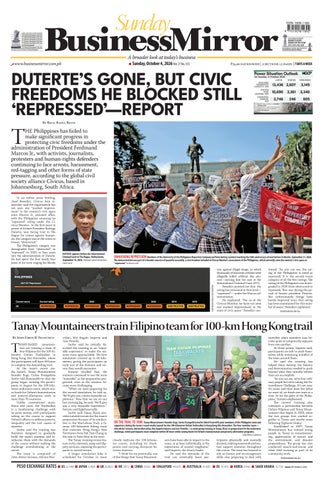
DUTERTE’S GONE, BUT CIVIC FREEDOMS HE BLOCKED STILL ‘REPRESSED’—REPORT
T
By Rizal Raoul Reyes
HE Philippines has failed to make significant progress in protecting civic freedoms under the administration of President Ferdinand Marcos Jr., with activists, journalists, protesters and human-rights defenders continuing to face arrests, harassment, red-tagging and other forms of state pressure, according to the global civil society alliance Civicus, based in Johannesburg, South Africa.
DUTERTE appears before the International Criminal Court in The Hague, Netherlands, September 16, 2026. PIROSCHKA VAN DE WOUW/POOL PHOTO VIA AP
UNMASKING REPRESSION Members of the University of the Philippines Repertory Company perform during a protest marking the 54th anniversary of martial law in Manila, September 21, 2026. The demonstration was part of a broader exercise of peaceful assembly, a civic freedom included in Civicus Monitor’s assessment of the Philippines, which currently rates the country’s civic space as “repressed.” AP/BASILIO SEPE
SCREENGRAB FROM CIVICUS MONITOR
In an online press briefing, Josef Benedict, Civicus Asia researcher, said the organization has not seen any “marked improvement” in the country’s civic space since Marcos Jr. assumed office, with the Philippines retaining its “repressed” rating under the Civicus Monitor. In the first years in power of former President Rodrigo Duterte, now facing trial in The Hague for crimes against humanity, the category was at the worst or lowest, “obstructed.” The Philippines’s category was downgraded from “obstructed” to “repressed” in 2020, or four years into the administration of Duterte. He had spent the first nearly four years of his term waging his bloody
war against illegal drugs, in which thousands of innocent civilians were allegedly killed without due process—earning him his case at the International Criminal Court (ICC). Benedict pointed out that the rating has remained at that level— “repressed”—under the Marcos administration. He explained: “For us at the Civicus Monitor, we have not seen any marked improvement in the state of civic space.” Benedict con-
tinued: “As you can see, the rating of the Philippines is rated as repressed. It is the second worst category of all the five ratings. The rating of the Philippines was downgraded in 2020 from obstructed to repressed. This was during the period of former president Duterte. But unfortunately things have barely improved since that rating has been maintained for this number of years,” Benedict explained. Continued on A2
Tanay Mountaineers train Filipino team for 100-km Hong Kong trail By John Eiron R. Francisco
T
ANAY-BASED mountaineers are training a team of four Filipinos for the 100-kilometer Oxfam Trailwalker in Hong Kong this November, where the participants will have 48 hours to complete the demanding trail. At the team’s recent media launch, Tanay Mountaineers founder Engr. Carlos Evangelista Inofre told BusinessMirror that the group began training the participants in August for the 100-kilometer endurance event, which raises funds for Oxfam’s humanitarian and poverty-alleviation work in more than 70 countries. Unlike conventional marathons and races, the Trailwalker is a fundraising challenge with no prize money, with participants taking on the course to support Oxfam’s efforts to address poverty, inequality and the root causes of injustice. Inofre said the training was therefore designed to gradually build the team’s stamina and familiarize them with the demands of the course without making the challenge overwhelming at the outset. The team is composed of John Alster Soriano, Adrian Mar-
celino, Rey Angelo Imperio and Jess Pomida. Inofre said he initially described the training as an “enjoyable experience” to make the sessions more approachable. The first simulation covered up to 60 kilometers, giving the participants an early test of the distance and terrain they would encounter. Soriano recalled that the trainers continued to use the term “enjoyable” as the preparation progressed, even as the sessions became more challenging. “When we were preparing for the second simulation, he told us, ’We’ll give you a more enjoyable experience.’ Now that we are on our last training leg, he said, ’We’ll give you a very enjoyable experience,’” Soriano said lightheartedly. Inofre said Tanay, Rizal, provides suitable terrain for the team’s preparation because of its similarities to the MacLehose Trail, a famous 100-kilometer hiking route that traverses Hong Kong’s New Territories from Pak Tam Chung in the east to Tuen Mun in the west. The Tanay training routes feature rocky, elevated, steep and slippery sections, exposing the participants to varied terrain. A longer simulation hike is scheduled for October to more
ON THE TRAIL TO 100K Tanay Mountaineers founder Engr. Carlos Evangelista Inofre (third from left) joins members of the Philippine team and supporters during the team’s recent media launch for the 100-kilometer Oxfam Trailwalker in Hong Kong this November. The four-member team— John Alster Soriano, Adrian Marcelino, Rey Angelo Imperio and Jess Pomida—is undergoing training in Tanay, Rizal, in preparation for the endurance challenge, which participants must complete within 48 hours while raising funds for Oxfam’s humanitarian and poverty-alleviation programs. JOHN EIRON R. FRANCISCO
closely replicate the 100-kilometer course, including its checkpoints and varying distances between stations. “I think for me personally, one of the things that Tanay Mountain-
eers have been able to impart to the team, or at least individually, is the importance of mental toughness,” said Imperio, the team’s leader. He said the demands of the trail can eventually leave par-
ticipants physically and mentally drained, making teamwork and mutual support essential throughout the course. The team has learned to rely on humor and encouragement while also preparing to deal with
stretches when members may become quiet or temporarily separate from one another. At those points, Imperio said, participants are left to push themselves while remaining mindful of the team around them. He said the training has helped them develop the balance and determination needed to push beyond what they initially believe they can accomplish. “As you can see, we’re four ordinary people but we’re taking the Extraordinary Challenge. It’s not easy. It’s easier said than done but [what we want is], we finish one team at a time. So for the glory of the Philippines,” Soriano emphasized. The current training also continues a partnership between Oxfam Pilipinas and Tanay Mountaineers that began in 2009, when the two groups first worked together in Tanay and nearby areas following Typhoon Ondoy. Established in 1997, Tanay Mountaineers has trained young people in Tanay in mountaineering, appreciation of nature and the environment, and disaster preparedness. The group has also conducted search-and-rescue and other field training as part of its community work. Continued on A2
PESO EXCHANGE RATES n US 62.7480 n JAPAN 0.3969 n UK 82.8023 n HK 7.9972 n CHINA 9.3563 n SINGAPORE 49.0219 n AUSTRALIA 43.4781 n EU 70.5413 n KOREA 0.0461 n SAUDI ARABIA 16.7136 Source: BSP (October 2, 2026)
News BusinessMirror
A2 Sunday, October 4, 2026
www.businessmirror.com.ph
DUTERTE’S GONE, BUT CIVIC FREEDOMS HE BLOCKED STILL ‘REPRESSED’—REPORT Continued from A1
While the number of killings in the context of civic-space violations may have declined, he said other forms of repression have continued, including the targeting of human-rights defenders and increased restrictions on protests. Civicus said its latest assessment documented the arrest and prosecution of activists on what it described as fabricated or baseless charges, including murder, illegal possession of firearms, rebellion and terrorism. The organization said such cases have affected trade unionists, Indigenous rights activists, students and child-rights advocates. Benedict cited the case of activist Amanda Echanis, who, according to Civicus, spent years in detention before eventually being acquitted. Beyond arrests, activists and their families have also faced harassment and intimidation, according to the organization. Benedict said authorities have approached relatives of activists in attempts to obtain information or establish alleged links to insurgent organizations. Civicus also raised concerns over online harassment of young activists, which it said can result in self-censorship and withdrawal from activism. Another major concern is the continued use of red-tagging. Benedict said activists, environmental defenders, labor leaders, Indigenous advocates and
other civil society actors continue to be publicly linked to communist insurgency or terrorism. Civicus also raised concerns about the use of anti-terrorism and terrorism-financing laws against civil society groups and activists. Under the Terrorism Financing Prevention and Suppression Act of 2012, authorities can designate individuals and organizations as terrorists and freeze their assets. Civicus questioned the level of oversight involved in such designations and warned that the legal framework could be used to target legitimate civil-society activities. Benedict also pointed to what Civicus described as an escalation in the disruption of protests, including arrests and the use of excessive force. He cited the September 2025 anti-corruption protests, where more than 200 people, including children, were arrested. Civicus said 72 individuals were subsequently charged with sedition and inciting to sedition. The organization has called for a review of the Public Assembly Act of 1985, arguing that its requirements for protests should be brought into line with international standards on freedom of peaceful assembly. Benedict stressed, however, that Civicus does not characterize the entire Philippine National Police as being responsible for violations. “Not everyone” in the police commits violations, he said, but
there have been repeated incidents in which individual officers allegedly used excessive force or ill-treated protesters. He called for stronger internal standards and effective accountability whenever abuses occur. Civicus also expressed concern over the continuing targeting of journalists, including through criminal and terrorism-related cases. The Civicus Monitor has documented activists who have been arrested, charged and prosecuted on trumped-up charges, including murder, possession of firearms, rebellion and terrorism. These are cases that often are not proved by the court, but are used to basically keep activists in detention for long periods or to judicially harass them in order to target them for their activism. It said it has seen this used against trade unionists, indigenous rights activists, student activists and child rights activists. “And in one particular case, we want to highlight the case of Amanda Echanis, who was detained for up to five years before being acquitted by the courts,” Benedict pointed out. Benedict said laws on libel, cyberlibel and terrorism can create an environment in which journalists and critics face pressure for their work. The group likewise raised concerns over proposed legisla-
tion addressing disinformation. Benedict, however, argued that legislation alone will not solve the problem of false information and warned that broadly worded antidisinformation laws could be used against government critics. Instead, Civicus is calling for greater media and digital literacy, stronger fact-checking efforts and greater accountability for technology companies that allow harmful disinformation to spread on their platforms. He also urged Philippine civil society organizations and journalists to closely monitor the progress of proposed anti-disinformation legislation in Congress. Benedict said Civicus is calling on the government to take concrete measures to protect human-rights defenders and allow them to conduct legitimate activities without fear of harassment, intimidation or prosecution.
Rejoining the ICC
BENEDICT expressed disappointment over the Marcos administration’s refusal to rejoin the International Criminal Court because it is the global mechanism in order to bring individuals who have committed serious crimes, including genocide, crimes against humanity and war crimes. The Philippines’s not being part of the ICC, Benedict said, removes a particular level of accountability to individuals who could commit such crimes. “And therefore, I think individual leaders could be much more brazen about committing these violations, knowing that they may not be hauled up to an international court
for this,” he said. Moreover, because local courts failed to hold President Duterte accountable for his actions, he said the ICC had to step in. “I definitely think that the Philippines, as the chair of Asean and having spoken a lot about human rights, not being part of the ICC is quite a disappointing situation,” he said. “But also, yes, I think it creates an environment where civil rights violations will be committed without those committing them feeling that they can be held to account,” Benedict added. He pointed out that it also creates an environment where people can violate civil rights without feeling they will ever be held accountable. “I think that’s our concern and we call on the Philippines to reverse that particular decision and to join the international community and the ICC,” Benedict said. “Finally, we want to raise serious concerns regarding censorship and the proposed Anti-Information Bill. We have observed several instances where documentaries addressing political and human rights issues were censored. For instance, a documentary on enforced disappearances was initially blocked before being reclassified after significant effort. In another case, a documentary depicting the harassment of Filipino fishermen in the West Philippine Sea was pulled from a film festival.” Among its recommendations are independent investigations into attacks against activists and journalists; accountability for perpetrators; a review of the Anti-
Terrorism Act and the Terrorism Financing Prevention and Suppression Act; and amendments to laws affecting freedom of expression and peaceful assembly. The group also supports calls for the abolition of the National Task Force to End Local Communist Armed Conflict and the review or repeal of Executive Order 70, which established the government’s whole-of-nation approach to counterinsurgency. Civicus further urged the government to pursue a Human Rights Defenders Protection Act consistent with the UN Declaration on Human Rights Defenders. For Benedict, the issue ultimately comes down to whether the government will translate its international human-rights commitments into concrete domestic action. The Philippines ratified the International Covenant on Civil and Political Rights in 2007. The UN Human Rights Committee subsequently issued recommendations calling for stronger protection of human-rights defenders, journalists and civil society actors. Civicus argues that the continuing “repressed” rating indicates a gap between those commitments and conditions experienced by activists and other civil-society actors on the ground. The organization said it will continue monitoring the Philippines as part of its global assessment of civic space and will publish updated country ratings in its annual People Power Under Attack report.
Tanay Mountaineers train Filipino team for 100-km Hong Kong trail
ONE TEAM, 100K AHEAD Members of the Philippine team for the Oxfam Trailwalker in Hong Kong pose with supporters during their recent media launch. John Alster Soriano, Adrian Marcelino, Rey Angelo Imperio and Jess Pomida are training in Tanay, Rizal, for the 100-kilometer endurance challenge, which they must complete within 48 hours while raising funds for Oxfam’s humanitarian and poverty-alleviation programs. JOHN EIRON R. FRANCISCO
Continued from A1
Oxfam Pilipinas Chair and Board of Trustees President Lan Mercado said the partnership eventually expanded to the organization’s participation in the Trailwalker, with Tanay Mountaineers training its first Philippine team for the 100-kilometer challenge in 2012. Mercado was part of that first Philippine team 14 years ago and is now among those supporting the new group’s participation in the international endurance event. Mercado said the organization may consider opening participation in next year’s Trailwalker to other volunteers who are willing to take on the challenge, noting that joining the event is also a way of supporting the organization’s programs. She said the 2024 Trailwalker in Hong Kong raised about HK$60
million, from which Oxfam Pilipinas also benefited. According to Mercado, Oxfam Pilipinas has received around HK$37 million over the past three years for use in various programs. Among the beneficiaries was Tanay Mountaineers, which Inofre said gained training and capacitybuilding support from Oxfam, particularly in risk assessment, disaster risk reduction and community preparedness. He said the group also learned the Participatory Capacity and Vulnerability Assessment (PCVA), which it later applied in training communities to identify risks and prepare for disasters. "I said, if only Oxfam had been with us earlier, maybe Tanay would have been spared having 60 casualties during Ondoy [Typhoon Ketsana]," he said, referring to the September 2009 floods spawned by
record rainfall. He said the experience helped the group recognize that while disasters cannot always be prevented, communities can reduce their risks and prepare for their possible effects. "We realized that it can be science-based. We cannot prevent disasters from happening but we can prepare so there are no casualties," Inofre said. The group has since brought disaster risk reduction training to schools and communities, supplementing existing knowledge with practical preparedness skills. “Hopefully, with this year’s Oxfam Trailwalker more funds can be raised to benefit more countries in need,” Mercado said. The Philippine team, meanwhile, is targeting HK$8,000 in fundraising for this year’s Trailwalker.
The World
www.businessmirror.com.ph
Sunday, October 4, 2026
A3
Indonesian villagers on Borneo struggle for water as El Niño intensifies peatland fires By Edna Tarigan And Victoria Milko
P
The Associated Press
ENYELADI, Indonesia—After three months with no rain, Sriwati, a shopkeeper and mother of three children living in Penyeladi village on the tropical island of Borneo, can no longer depend on the river for her needs.
Experts say communities like Sriwati’s are facing a severe water crisis as this year’s super El Niño, combined with decades of degradation of the island’s ecologically vital peatlands— ancient wetlands that are critical for carbon storage, water regulation and pollution control—has created the perfect storm exacerbating humancaused climate change. The Kapuas, Indonesia’s longest river that over 3 million people rely on, has extremely receded in the area near her home. All that’s left is a shallow stream of muddy water that’s not safe to drink or wash the rice she cooks to feed her children. She now has to buy water, adding to her monthly expenses.
“The water shortage affects us, especially when it comes to drinking water,” Sriwati, who like many Indonesians uses only one name, told The Associated Press from her small, concrete home.
El Niño and peatland degradation create crisis
EL NIÑO is part of a natural climate cycle of warming ocean temperatures, but this year’s is expected to reach new extremes of drought, heat waves, flooding and other climate-related disruptions across the globe. Meteorologists forecast it could exceed a record El Niño that began in 1997 and helped trigger billions of dollars in damage from heat waves, floods, droughts, tornadoes and wildfires.
US steps up pressure on EU to tap emergency diesel stockpiles
T
HE Trump administration is ramping up pressure on the European Union to release diesel stockpiles, a move seen potentially averting a ban on US exports of the critical fuel. The matter is actively under discussion by US officials and their European counterparts, according to people familiar with the matter who asked not to be named because the conversations are private. US officials have conveyed that a release of some European oil and diesel stockpiles would boost global supplies and bring down prices, the people said. That could stave off any potential US prohibition on diesel exports that would hurt nations that rely heavily on American supplies, including European nations. Asked Thursday by a reporter if the US would ask European countries to tap diesel stockpiles, President Donald Trump replied, “We may do that. They have some diesel, but the prices are coming down.” One US official said it’s in Europe’s best interests to cooperate as the Trump administration pursues multiple pathways to lift fuel supplies and ease the burden on consumers. “We’ve had conversations today with some of our European partners about this issue, and there is an eagerness on both sides to work together to get more diesel to the market,” US Trade Representative Jamieson Greer told reporters after a G20 Trade Ministerial. “We know that France, Germany and Italy — they’re sitting on reserves. I think — I won’t put words in their mouth, of course — but I think they would love to have a cooperative path forward with the United States on how we get more diesel to market. Getting some of
that diesel that’s in the reserve is part of that equation.” In the US, sky-high diesel prices have emerged as a potent political issue a month before midterm elections that will determine whether Trump’s Republican Party retains control of the House and Senate. Retail diesel has risen 70% since the start of the Iran war to a nationwide average of $6.39 a gallon on Wednesday, feeding calls for an export ban from farmstate Republicans where voters rely on diesel to power tractors and trucks. Oil executives and energy analysts have warned that curbing exports might provide merely temporary relief before pump prices boomerang for both diesel and gasoline. Trump signaled Wednesday that his appetite for an export ban had lessened but said he was still mulling the idea. In recent days, Trump administration officials expressed frustration with the pace of Europe’s moves to comply with a coordinated release of oil reserves brokered earlier in the Iran conflict. US Energy Secretary Chris Wright said Tuesday that several European countries “have released only a fraction of the crude oil and petroleum products they pledged.” Because Europe has moved more slowly than the US to draw down emergency reserves, the region still holds significant supplies. Some governments, including in Germany and Spain, previously said they saw little need to release additional barrels. A release of diesel now would be seen by the Trump administration as helping meet the bloc’s pledges, said a person See “Diesel,” A4
In Borneo, experts say that because vast peatlands have been destroyed by land conversion, the effects of El Niño are already being more acutely felt. “In Kalimantan, something like 60% of the peatland areas have been drained to make way for palm oil plantations and for pulp and paper concessions,” said Amanda Hurowitz, a senior director at international environmental organization Mighty Earth, using the name for the Indonesia-controlled part of Borneo. “That means the water is not where it should be. There are all these canals, and because the canals are blocked, the water table goes low,” she continued. “Because it’s so dry, the water has just disappeared.” In a written statement to the AP, Indonesia’s Ministry of Forestry acknowledged the negative impact of drained peatlands, while insisting that specific causes and liabilities must be determined by evidence rather than attributed automatically to El Niño or the presence of businesses. They added that the government aims to prevent future peatland degradation through ecosystem restoration and strict enforcement of concession holders’ obligations.
“The government’s longterm agenda focuses on preserving and restoring peatland hydrological functions, improving landscape and water management, strengthening fire prevention, and ensuring that all parties managing land fulfill their responsibilities,” they said.
Fires continue to burn across Borneo as water supplies dwindle EXPERTS say the hot, dry conditions caused by El Niño coupled with peatland degradation have contributed to the enormous fires spreading across Borneo. Dried peat is highly flammable, allowing fires to easily spread in drained areas. Because the fires often spread underground, they’re difficult to extinguish and can easily reoccur, according to the Borneo Nature Foundation. The dwindling water supply in the area has slowed down firefighting efforts, while Japan has deployed firefighting assistance to the island. Toxic thick haze blankets the sky. The smoke has drifted as far as the Philippines, more than 800 kilometers (500 miles) away, and breached Malaysia’s emergency-level threshold for air pollution, forcing authorities to declare an emergency last week in a town in Sarawak state
on Borneo. In a written statement to the AP, Indonesia’s Ministry of Forestry said the government is shifting its forest and land fire policy toward prevention by strengthening cross-sectoral coordination, enforcing laws against burning-based land clearing, expanding patrols and early detection systems, promoting risk-based monitoring and peatland restoration, and requiring permit holders and communities to take responsibility for fire control. “Ultimately, controlling forest and land fires is not the task of a single ministry or institution,” they said. “Prevention requires collaborative effort.” Indonesia’s Forestry Ministry recorded more than 202,000 hectares (499,000 acres) of burned land between January and July, almost three times the size of Singapore.
Communities continue to bear the burden
AS the fires continue to burn and water remains scarce, communities continue to suffer. In Sungai Malaya village in West Kalimantan, fires have burned for over a month, with residents remaining tense around the clock, as fires have sometimes suddenly worsened at night.
Fires have decimated the vacant lots where Rumsiyeh, a 45-year-old mother of five children, and her husband picked ferns to sell at the market. “Everything’s gone. We can’t make a living anymore,” she said. Boaters, fishers and others who rely on the river have had their livelihoods impacted, as extremely low water levels mean it’s impossible to fish or travel on the Kapuas. In the areas where there’s enough water for boats to operate, the thick haze hampers visibility, making it dangerous to operate, fisherman Abiansah, 39, said. And the national economic impact remains unmeasured: Large metal barges that usually carry oil palm tree kernels for processing downriver currently lie aground on the sand, as children swing from their untied mooring lines. Some relief has come from private and government water donations, but residents still fear what the future holds. “I’m worried about this prolonged dry spell. It’s reached the point where just going about our daily activities—going anywhere at all—has become difficult. We’re facing water shortages, too,” said Sriwati. “I’m at a loss for words to describe it.”
In-flight attack on FlyDubai pilot puts aviation security measures under fresh scrutiny J ERUSALEM—Israel has some of the world’s most stringent air travel security measures. The United Arab Emirates proudly adheres to international aviation safety standards. Yet those safeguards failed to prevent a flight between the countries from taking a dangerous plunge during an alleged attack in the cockpit. The copilot allegedly stabbed the captain in the cockpit before passengers intervened aboard FlyDubai Flight FZ1073 after taking off from Dubai, UAE, with 174 people flying to Tel Aviv, Israel, on Wednesday. The airplane made a safe emergency landing in Saudi Arabia on Wednesday and the incident is under investigation by Saudi, Emirati and Israeli authorities, with the United States and Oman assisting efforts to determine a motive. “Until this event, the possibility of a threat originating from a pilot or crew member was not considered a likely scenario. Security efforts have traditionally focused much more heavily on passengers and their luggage,” said Eyal Hulata, Israel’s former national security adviser. “That will probably change now and crew members will be subject to heavier screening.” Israel’s security protocols focus heavily on Israeli airlines and departing flights from Ben-Gurion International Airport. A potential Achilles’ heel lies overseas, where procedures for Israel-bound flights vary and are harder for Israeli authorities to oversee. Dubai International Airport, the world’s busiest airport for international passenger traffic, has built some of its appeal around a reputation for safety
PASSENGERS arrive at Ben Gurion airport in Israel via a second flight from Tabuk, Saudi Arabia, where their original flight FZ 1073 was forced to make an emergency landing. ARIEL SCHALIT/AP
in a volatile region, said Philip Baum, a visiting professor of aviation security at Coventry University in England. “They are very conscious of the fact, a little bit like Israel in many respects, that they cannot afford to have a terrorist attack happening on a flight out of there,” he said. Pilot vetting and preflight screening aren’t uniform worldwide Investigators have not publicly identified the object used to stab the flight’s captain or said whether it was carried onto the plane or came from inside the aircraft. Preflight screening of flight crews should generally “mirror very closely what a passenger goes through,” although security procedures vary around the
world, said Dave Komendat, a senior security adviser at risk management firm International SOS and former chief security officer for Boeing. Prime Minister Benjamin Netanyahu said Thursday that Israel has long-standing agreements with foreign carriers to keep pilots from flying into the country if they are citizens of nations that don’t maintain diplomatic relations with Israel. Israeli authorities have described the FlyDubai copilot as Omani. Israel and Oman do not have formal diplomatic relations, raising questions about how the suspect ended up on the Tel Aviv-bound flight. “Obviously, there was a loophole here. And we’re taking care of that,” Netanyahu said Thursday during an interview
with Fox News Channel’s “Fox and Friends.” The International Civil Aviation Organization sets baseline pilot-vetting and licensing standards, while national regulators and airlines can impose additional requirements. Aviation security expert Menachem Bachrach said Israel relies largely on foreign governments and airlines to vet their own crew members, and Wednesday’s incident may point to a compliance lapse rather than a flaw in the procedures. “Before we’re jumping to tighten security, I would just say it’s likely that somebody didn’t follow the protocols,” Bachrach said. See “FlyDubai,” A4
A4
Sunday, October 4, 2026
The World
Trump warns democrats will impeach him, seeking to motivate GOP
P
RESIDENT Donald Trump predicted that Democrats would impeach him for a third time if they retake control of Congress, seeking to boost voter enthusiasm for Republican candidates amid broad public dissatisfaction with his leadership.
Trump spoke Thursday during a campaign swing through Texas and Oklahoma, states that he carried handily in his three presidential campaigns but which are now home to competitive Senate and gubernatorial races, highlighting the peril the GOP faces in the November midterm elections. “Pretend I’m running, please, because I am on the ballot. And if we don’t win, they’ll end up impeaching me,” the president said during a rally in the Oklahoma city of Durant. “They’re going to ruin our nation if they’re allowed to get back
into office.” House Democrats are preparing a wide swath of investigations into Trump, his family and his administration if they win control of the chamber, but leaders have not committed to starting an impeachment inquiry. Still, raising the specter of impeachment could help the president motivate his base to cast ballots for the GOP. During an earlier stop in Texas, Trump urged voters there to back Republican Senate nominee Ken Paxton, whose candidacy he has critiqued previously.
At the Republican midterm convention last month, the president repeatedly bemoaned Paxton’s attire and speaking style. Trump needled Paxton again on Thursday, saying he can be a “pain in the a—” but said he appreciated him for his personal loyalty. “We need Ken so badly, and that’s why I’m here,” Trump said during an event at a Peterbilt Motors Co. facility in the Dallas suburb of Denton, Texas. Trump’s approval rating is at record lows and voters have grown frustrated by the cost of living and a war with Iran that has brought higher prices at the pump, putting Republican candidates at a disadvantage. The president insisted that he has “handled inflation” and blamed price growth on his predecessor, Joe Biden. Trump knocked the former president for a spike in illegal border crossings but he acknowledged his mass deportation campaign has had an effect on the labor market. “We need people actually, because we’re doing so well,” he
said. “We need people, but they have to be people that can love our country and treat our country with respect.” The president is embarking on a month-long campaign blitz ahead of Election Day on Nov. 3. Trump will also visit Alabama on Friday and Ohio on Saturday. Whether there is enough time to reverse the negative trend for Republicans is unclear. With less than five weeks to go, several polls show Republicans trailing Democrats in crucial House races. And GOP hopes of retaining control of the Senate have also dimmed as contests in states including Iowa, Georgia and Ohio become more competitive. Paxton, the Texas attorney general, spotlights the obstacles Republicans face in GOP strongholds. Paxton defeated Senator John Cornyn in a bitter primary contest but is now trailing in the polls against James Talarico, a state representative looking to become the first Democratic US senator elected in Texas since 1988. Trump’s endorsement was
crucial in helping Paxton defeat Cornyn in the fractious primary. Some party leaders, including former state House Speaker Joe Straus and strategist Karl Rove, have cast doubt on Paxton’s ability to win. Trump sought to boost Republican enthusiasm with last month’s midterm convention in Dallas, but that event has failed to alter the party’s trajectory and highlighted how, for many candidates in tight races, the president’s poor polling makes him more of a liability than an asset. Paxton was heard telling donors and lobbyists last week that the convention had hurt his campaign politically. When asked about Paxton’s comments, Trump sidestepped the questions and insisted the convention drew high TV ratings. Trump carried Texas by nearly 14 points in 2024. Recent polls show him with a negative approval rating in the state. Texans now say they prioritize high costs and the war with Iran, for which they give the president low marks. Bloomberg News
Puerto Rico faces record electric rate as demand and costs increase
S
AN JUAN, Puerto Rico—A record electric rate went into effect Thursday in Puerto Rico as outages persist and the US territory’s power grid continues to crumble. A residential customer that consumes 800 kilowatt-hours a month will see the monthly bill rise about 18%, from $229 to $271, according to Puerto Rico’s Energy Bureau, which approved the increase. The new rate will remain in effect until at least Dec. 31 and is expected to drive up an already high cost of living on the island of 3.2 million people, where more than 40% of residents live in poverty. The new rate of 33.86 cents per kWh far surpasses the average rate of 18.3 cents per kWh for residential customers
in the US mainland, according to the US Energy Information Administration. Luma Energy, which oversees the transmission and distribution of power in Puerto Rico, had requested an increase of more than six cents per kWh and stressed that it would not generate additional revenue for the company, but rather cover an increase in costs. “The difference is driven by higher energy consumption due to high summer temperatures, rising global oil prices resulting from the conflict in the Middle East — which has constrained fuel transportation and increased costs — greater use of customer batteries, and the need to rely on more expensive fuel when power plants do not generate enough electricity,”
Luma said in a statement. The increase comes as outages persist nearly a decade after Puerto Rico’s power grid was razed by Hurricane Maria when it struck the island in 2017 as a powerful Category 4 storm, although the grid was already weak given a lack of maintenance and investment for decades. Last week, a large fire that erupted at a substation left more than 200,000 customers without power in the latest outage to hit the island. The Energy Bureau said in a statement late Wednesday that it approved an increase of 5.28 cents per kWh to reduce the financial burden on customers. It noted that it did not pass along the cost of $17.6 million associated with what it called alleged failures by New Fortress
Energy to supply fuel from June to August. “Fuel costs must not be automatically passed on to the consumer simply because they were incurred or billed,” the Energy Bureau said. New Fortress Energy supplies natural gas to power generation plants on Puerto Rico’s north coast. Currently, those plants are using diesel — driving up costs — because a vessel laden with a delivery of natural gas was blocked from entering the San Juan Bay for two weeks given its size. The case went to court, and a judge on Thursday authorized its entry. The Energy Bureau said it also is investigating some $19 million that Luma said was paid for gas quantities that officials say exceeded what Genera PR
“ultimately needed or could receive.” Genera PR oversees the generation of power in Puerto Rico. The increase comes as the administration of Puerto Rico Gov. Jenniffer González pushes to cancel the contract with Luma, with the case currently tied up in court with ongoing lawsuits. Luma and Genera PR were awarded contracts as Puerto Rico’s state-owned Electric Power Authority struggles to restructure its more than $9 billion debt load. In 2024, petroleum represented 63% of the island’s overall energy use; natural gas accounted for 31%, coal 5% and renewables 1%, according to the US Energy Information Administration. AP
Korea’s president strips power from prosecutors who indicted him By Soo-Hyang Choi Bloomberg News
S
OUTH KOREAN President Lee Jae Myung has pushed through a sweeping overhaul of the criminal justice system, stripping investigative powers from prosecutors he accuses of abusing their authority, including criminal cases against him before he took office. A revised law that came into force Friday focuses on shifting power to police from prosecutors, leaving the latter primarily to decide whether cases should go to trial. “The purpose of prosecution reform is to ensure that the powers and responsibilities entrusted to investigative and prosecutorial authorities to protect victims, human rights and the social order are not abused for politically motivated
investigations and prosecutions,” Lee said last month, vowing to make the reform irreversible. South Korea’s prosecutors have long been accused of exercising excessive power, but the move has raised concerns that it may create gaps that leave crime victims worse off. The optics of the reform, led by a president who faces pending cases launched by prosecutors, are also feeding into a drop in Lee’s public support. Supporters of the move claim it will help break up an institution that’s contributed to political instability over the years. Of the eight presidents who served before Lee since the country embraced direct democratic elections in 1987, four have been imprisoned, ousted or both after investigations by prosecutors. Another, Roh Moo-hyun, died by suicide while facing an investigation into allegations of bribery
involving his family a year after his term ended. Lee’s own ascent to the country’s top job last year followed a martial law fiasco triggered by his predecessor and top prosecutor-turned-president, Yoon Suk Yeol. The overhaul scraps the Supreme Prosecutors Office and launches two new agencies to take on some of the office’s functions. A new Prosecution Service will make decisions on whether to indict suspects and will handle prosecutions in court. The newly formed Serious Crimes Investigation Agency will take responsibility for launching and carrying out probes into seven categories of crimes including corruption and national security transgressions. The police and the Corruption Investigation Office for
High-Ranking Officials will take the lead on other investigations, though there still may be scope for disagreements over which agency has jurisdiction. The revision comes as Lee’s own trials have been suspended while he serves as president. Those trials surround accusations over aiding private land developers, misusing public funds and infringing election law. Lee has denied any wrongdoing and called the indictments politically motivated. “I have been, still am, and will continue to be one of those who have suffered the most from the prosecutors’ abuses,” Lee has said. The overhaul is seen as one of the factors weighing on Lee’s approval rating, now hovering below 40% with nearly four years still remaining in his single, five-year term. A Gallup Korea poll in August showed half of respondents were against the reform, while 27% supported the plan. The decline in support is especially steep among women in their 20s and 30s, as experts warn that crime victims, particularly those with limited access to affordable legal services, are likely to be the first to face delays or gaps in probes. The reform comes amid recent criticism of police following incidents such as the premature closure of a missing person case in Jeju. The missing woman’s body was later discovered. The police agency subsequently ordered the reopening of
310,000 cases nationwide. “Female victims, who should have been among the first stakeholders, have been largely left out of the discussion process,” said Seo Hwi-won, an adjunct professor of political science at Duksung Women’s University. Oh Yoon-sung, a professor of police administration at Soonchunhyang University, says politicians stand to gain the most from the overhaul. “At the end of the day, the police are an organization that’s just a lot easier for politicians to control than the prosecution ever was,” Oh said. “If things go south, a prosecutor can just walk away and become a lawyer. But if a police officer has to leave, they’re basically out of a job.” In a sign of the unease within Lee’s own government, his first Justice Minister Jeong Seong-ho stepped down after voicing alarm over the ruling Democratic Party’s push to enact the reform at “the speed of light.” -30“Watching the process of revising the Criminal Procedure Act, I’m deeply concerned about what’s happening to South Korea and to our criminal justice system,” Jeong was heard saying in remarks caught on a hot mic. Jeong is himself a lawyer and five-term Democratic Party lawmaker. “I’m genuinely so worried that I don’t think I could bear the responsibility later.”
www.businessmirror.com.ph
FlyDubai. . . Continued from A3
Investigators to look for red flags and review distress call handling
ISRAELI flag carrier El Al periodically assesses its pilots’ fitness to fly, while other airlines may do so less often, said Arik Arad, chairman of the aviation cybersecurity consultancy CYVIATION and El Al’s former head of security at Ben Gurion Airport. Flight crews typically undergo preemployment screening, drug testing and recurring medical evaluations, Komendat said. Investigators will want to know whether colleagues previously reported concerns about the copilot and, if so, how the airline responded, he said. Investigators in the UAE and Israel also are likely to review responses to the distress signals that came from the FlyDubai plane after a steep drop in altitude. A person who heard the FlyDubai flight’s air traffic control communications said a crew member reported a hijacking and requested ambulances. Authorities in Saudi Arabia and Jordan initially refused to clear the aircraft for landing, said the person, who spoke on condition of anonymity because they were not authorized to speak to the media. The crew member eventually persuaded Saudi authorities to allow the plane to set down at Prince Sultan bin Abdulaziz International Airport in the city of Tabuk. International aviation standards call for countries to give aircraft facing hijacking or other “unlawful interference” maximum assistance and priority. But the underlying 1944 treaty, the Convention on International Civil Aviation, only requires a country to provide assistance “as it may find practicable,” making it a “relatively soft obligation,” said Vincent Correia, codirector of McGill University’s Institute of Air and Space Law. In practice, the International Civil Aviation Organization’s guidance on hijacked aircraft may conflict with national interests, said Justin Green, a New York lawyer who specializes in international aviation law. “Each nation is a sovereign and has authority to determine what happens in their airspace and at their airports, so a nation can prioritize its security interests over the safety of the passengers and crew of an aircraft,” Green said. “In a terrorist incident, the nation may be worried about the terrorists using the airplane as a weapon like on 9/11. I expect with the ongoing war, the nations in the area are on pretty high alert and that may have played into their initial refusals.” AP
Diesel. . . Continued from A3
familiar with the matter. Treasury Secretary Scott Bessent pushed Europe to move more quickly. “Our European partners should accelerate delivery on their existing commitments and make additional supplies immediately available to address ongoing disruptions,” Bessent wrote in a social media post. “American farmers, truckers, and businesses should not be left carrying the burden of a global diesel shortage. America is doing its part. We look to our allies to match their commitments with action.” A day earlier, Wright suggested there could be a shift soon, teasing “announcements from our friends in Europe about new diesel supplies that’ll come to the market.” The EU has asked member states about their positions on emergency diesel stocks after the US approached some of them bilaterally. The bloc’s Energy Union Task Force, which includes the European Commission and representatives of national governments, is due to meet on Friday at 8:30 am Brussels time to discuss the situation. Bloomberg News
www.businessmirror.com.ph • Editor: Lyn Resurreccion
Sunday, October 4, 2026 A5
Davao state college unveils lab vs. emerging pollutants
D
Story & photo by Manuel T. Cayon
IGOS CITY, Davao del Sur— The Philippines is developing strategies against emerging pollutants, particularly the invasive microplastics, as well as evolving contaminants, as researchers in this state university installed the key gadgets and technology to protect humans and the environment. Prof. K ris K ristofferson T. Tan, head of Mathematics, Arts and Sciences of the Davao del Sur State College (DSSC) here, showed to the BusinessMirror on Thursday the prime machines and gadgets it acquired from Japan to establish Mindanao’s 16th laboratory in the network funded and supported by the Department of Science and Technology (DOST). Inside the Research Center for Emerging Pollutants (RCEP) were the Microplastic Automated Preparatory Device, the first of its kind in the country that extracts, collects and filters water sample
the volume equal to glass of water; the Fourier Transform Infrared Spectrophotometer (FTIR), which identifies the sampled pollutants from its own library of organic molecules; and the Ultra-Low Freezer, which can turn in as low as 80 degrees below zero degree to preserve biological samples. All were recently acquired from the DOST fund of P5 million that also signified its approval to the RCEP. Tan said the laboratory has been t he produc t of t he re search work put up by his multidisciplinary stass, including one chemist and two biologists
DAVAO del Sur State College Prof. Kris Kristofferson Tan (left) informs DOST Davao Region Director Anthony C. Sales (center) and DOST-PCIEERD’s Dr. Ruby Raterta about the newly acquired equipment of the Research Center on Emerging Pollutants.
with postgraduate expertise in microbiology and microplastics. DOST Davao Region Director Anthony C. Sales, who also sits in the board of directors of the DSSC and in the board of other state universities and colleges in the Davao Region, has assured Tan that the RCEP will expect three plantilla positions for researchers.
Tan said the RCEP was developed from the array of suggested environmental issues to develop a science laboratory. He added that the pestering and unaddressed environment pollution and contamination led him and his team to confront the issue. He said the province, as well as the entire Davao Region, has for
decades has been grappling with improper disposal of wastes from commercial agriculture, mining and urban and rural industrial operations. “Their disposal had river beds and sea floors contaminated with mercury, arsenic and other heavy metals. Even that simple but definitely destructive disposal of batteries contaminates the environment with lead,” he explained. “This laboratory here is actually against emerging pollutants, like the microplastic pervasive intrusion into the water and marine life ecosystem, and the evolving contaminants, like bacterial and heavy metal contamination of the environment,” he said. Engineer Niñaliza Escorial, deputy executive director of the DOST-Phi l ippine Counci l for Industr y, Energy, and Emerging Technolog y Research and DevelopmenT (PCIEERD), told the BusinessMirror via online that the opening of the RCEP laboratory becomes significant in the middle of disturbing findings that 16 of the 25 drinking water sources in Davao del Sur show coliform bacteria contamination and all the sources failed the microbiological testing. She said that the Digos River also contained cadmium and chromium that exceeded tolerable levels.
Microplastics were detected in the marine gastropods in the mangrove system of the neighboring municipality of Santa Cruz. This means, he said, that this laboratory “is not only for this province but for the entire region”. Dr. Ruby R aterta, chief of PCIEERD’s Human Resources and Institutional Development, said the RCEP is the latest addition to the 70 DOST-supported science laboratories in the country and the first Institution Development Program of DOST on emerging pollutants. “We hope that this laboratory will produce bigger research projects,” she said. Sales said the RCEP “is a crucial development in advancing science in the area.” He talked with Tan to have a possible profiling of bottled water that were being marketed and manufactured in the region “because it has been a wider knowledge now that even drinking water contains microplastics, which have also invaded the food and water chain.” “Let the RCEP be the beacon of scientific inquiry,” Sales said. Escorial urged the DSSC to work with the local governments, the water district, environmental agencies, schools and the communities.
Science-based farming aims to unlock Bohol’s ubi supply By Bless Aubrey Ogerio
S
CIENCE-BASED farm practices are helping tackle one of Bohol’s biggest constraints in expanding its purple yam industry, with a dormancy-breaking technique achieving a 77-percent success rate in just one week during the crop’s peak dormancy period. The technique, developed under a project funded by the Philippine Council for Agriculture, Aquatic and Natural Resources Research and Development of the Department of Science and Technology (DOST-PCAARRD), uses plastic mulch and carbonized rice hull to create conditions favorable for tuber sprouting. Ubi, or purple yam (Dioscorea alata L.), is a high-value crop that is now having a rockstar popularity abroad. But its production in Bohol has been
constrained by prolonged tuber dormancy, limited access to quality planting materials and inconsistent farm practices, according to PCAARRD. The dormancy problem is particularly significant during December and January, when ubi tubers are less likely to sprout and farmers face difficulty producing planting materials for the next crop cycle. Trials showed that plastic mulch combined with carbonized rice hull was the most effective treatment for inducing sprouting while the tubers were still in their dormant stage. The technique achieved a 77-percent dormancy-breaking rate within one week during the December-January period, allowing tubers to sprout despite conditions that would normally delay germination. The project also improved the use of
minisett technology, a rapid propagation method that uses small sections of ubi tubers to produce planting materials. Under the enhanced method, one kilogram of ubi can yield about 40 to 50 minisetts, compared with only around seven to 10 planting materials through traditional propagation methods. The higher multiplication rate could help address the limited supply of quality planting materials, which has been identified as another constraint to expanding Bohol’s ubi production. The Philippine Root Crop Research and Training Center of Visayas State University (VSU-PhilRootcrops) supported the project by conducting farmer training and providing quality planting materials to help bring the technologies into farms. More than 30,000 minisett ubi plantlets
were produced and distributed to farmers in seven Bohol municipalities—Dagohoy, Lila, Carmen, San Isidro, Albuquerque, Inabanga and Ubay. Recipients included individual farmers and growers’ groups such as the Cabudlan Farmers Association, Carmen Ubi Growers PNB-KGB and the Ubay Ubi Growers Association in San Pascual. The project is part of efforts to improve productivity and strengthen the supply base of Bohol’s ubi industry, which faces production constraints that can affect yields and the availability of planting materials. The project team plans to expand the adoption of improved production practices, increase the supply of quality planting materials and strengthen market linkages among farmers, processors and other industry stakeholders.
S&T Fellows feted in their 5 years of turning expertise into natl solutions
T
HE country’s science community celebrated the milestones and contributions of Science and Technology (S&T) Fellows to innovation and excellence in the country since 2021 by holding an S&T Fellows Convention at a hotel in Alabang, Muntinlupa City, on September 30. The S&T Fellows Program has engaged 84 science, technology, and innovation experts who have been deployed across the Department of Science and Technology’s (DOSTs) research and development institutes, councils, collegiate advisory bodies, and regional offices. Fifty-one of the Fellows remain actively engaged across DOST institutions, contributing their expertise to various research, development, and innovation initiatives. DOST Secretary Renato U. Solidum Jr., in his keynote speech, said that five years ago the DOST started with a simple need to strengthen the Science department’s S&T capability by bringing expertise where it is needed most. “Today, our Fellows have transformed that expertise into projects, technologies, policies, partnerships, and opportunities—turning knowledge into action and challenges into possibilities. They have not only solved problems; they have opened doors for others to innovate, collaborate, and create,” Solidum said. The S&T Fellows Program is part of DOST’s efforts to strengthen the country’s pool of research experts and build its human capital and research capacity—the key components of the Human Capital and Research pillar of the Global Innovation Index (GII). The Philippines ranked 52nd in the 2026
GII, as announced by the World Intellectual Property Organization, an specialized agency of the United Nations. The convention highlighted that S&T Fellows go beyond laboratory research, but play a vital role in shaping national policy. A prime example is the enactment of the Virology and Vaccine Institute of the Philippines (VIP) law. S&T Fellows from the Industrial Technology Development Institute, Philippine Council for Health Research and Development, and National Academy of Science and Technology were instrumental in advocating for the VIP bill and in drafting its Implementing Rules and Regulations. Combining their multidisciplinar y expertise, the S&T Fellows laid the groundwork for this milestone institution—and several Fellows continue to serve on the transition team to ensure the VIP becomes fully operational. For her part, DOST Undersecretary for
R&D Leah J. Buendia emphasized the role of the S&T Fellows in strengthening the country’s innovation ecosystem. “The S&T Fellows Program can help address the decline in innovation inputs by bringing the Fellows’ expertise to government research and development initiatives and expanding the country’s pool of highly skilled human resources,” Buendia said. Fellows also have the opportunity to lead R&D projects that leverage local resources and strengths, helping develop homegrown technologies that respond to industry needs, she added. S&T Fellow Engr. Mark Gino Alipero, assigned at DOST Philippine Nuclear Research Institute, contributes expertise to policy, research, and technical discussions addressing national infrastructure and energy challenges. At the Convention, Alipero discussed the Nuclear Plant Simulator and Analyzer Facility (NuSim).
THE Science and Technology Fellows and DOST officials at the S&T Fellows Convention at a hotel in Alabang, Muntinlupa City, on September 30. DOST PHOTO
Introduced as part of the country’s broader energy strategy, NuSim serves as a fundamental platform for capacity building, operational workforce preparation, and advanced engineering simulations. Another speaker, S&T Fellow, Dr. Maria Theresa Cabaraban, is an expert in environmental engineering, waste management, waste-to-energy, biohydrogen via microbial electrolysis, and local decision-support tools like the Smart Waste-to-Energy Evaluation and Planning for Cagayan de Oro City. For health research, Dr. Noel Salvoza looks at the interaction between dengue and metabolic dysfunction-associated steatotic liver disease. It examines the safety of lipid nanoparticle-based vaccine platforms in individuals with compromised liver function. The project brings together disease modeling, dengue research, lipid nanoparticle development, and the study of hepatic and immune responses.
RISE-Basilan focuses on enhancing teachers’ mastery of key areas in Earth Science, Physics, Chemistry, and Biology through workshops led by University of the Philippines Diliman College of Science faculty. PHOTO CREDIT TO DR. JILLIAN AIRA GABO-RATIO
UPD-CS, Basilan launch training program to strengthen math, science education
S
TUDENTS in geographically remote and economically disadvantaged provinces in the Philippines often face barriers to performing well in college entrance exams, particularly in science. Many enter senior high school with gaps in foundational knowledge, partly due to limited access to sustained, contentfocused professional development for teachers. When teachers struggle with core scientific concepts, it can be challenging to strengthen students’ understanding and problem-solving skills. The University of the Philippines Diliman College of Science (UPD-CS), in partnership with the province of Basilan, and the Schools Division Offices of Basilan and Lamitan, implemented Project RISE: Reinforcing Instruction in Mathematics and Science Education in Basilan (RISE-Basilan) in Lamitan City, Basilan, in July. The workshop brought together 64 teachers, including 32 mathematics teachers and 32 science teachers, said Eunice Jean C. Patron of UPD-CS Science Communications. RISE-Basilan aims to strengthen the competencies of senior high school mathematics and science teachers in Basilan by providing up-to-date content, effective pedagogical approaches, and hands-on learning experiences to improve mathematics and science education outcomes in the province. “RISE-Basilan builds on an earlier initiative by the College of Science conducted in Tawi-Tawi in 2018. The project seeks to continue that initiative and sustain UPDCS’s commitment to supporting mathematics and science education in underserved areas,” said project leader Dr. Jillian Aira Gabo-Ratio. The program focuses on enhancing teachers’ mastery of key areas in Mathemat-
ics, Earth Science, Physics, Chemistry, and Biology through workshops led by UPD-CS faculty, with an emphasis on conceptual understanding and problem-solving strategies in pre-college science topics. Gabo -Ratio said the Institute of Chemistry donated molecular model kits through fundraising efforts among faculty and alumni. The National Institute of Geological Sciences also provided rock and mineral kits, with some purchased by the Basilan government and others donated by making. technology manufacturing. “The National Institute of Physics, through former Dean Giovanni Tapang and making.technology manufacturing, donated Versatile Instrumentation System for Science Education and Research kits to the Basilan Schools Division, which were used to demonstrate science concepts more efficiently,” Gabo-Ratio added. RISE-Basilan highlights the role of academic institutions, such as UPD-CS, in strengthening teacher capacity and promoting the local replication of training in communities to expand opportunities for students to succeed academically. “RISE-Basilan is more than a training program—it is our collective commitment to raising the quality of mathematics and science education in Basilan. By empowering our teachers with innovative strategies and strengthening our partnerships with the University of the Philippines, the provincial government, and other stakeholders, we are investing in the future of every Basilan learner,” Schools Division Superintendent of Basilan Dr. Myra Borja Mangkabung said underscoring the importance of investing in teachers. “Together, we are building a generation of critical thinkers, innovators, and future leaders,” she added.
A6 Sunday, October 4, 2026
Faith
Sunday Editor: Lyn Resurreccion • www.businessmirror.com.ph
‘Families should become stronger foundations of peace’
F
Story & photo by Mary Jade Jadormio
AMILIES must become safer spaces where children learn how to handle conflict, differences and relationships as violence, bullying and other pressures increasingly affect young people, speakers at an interfaith forum said. T he Inter fa it h Fami ly Fo rum: “Families as Foundations of Peace” was held at the University of the Philippines Bonifacio Global City in Taguig City on September 29. It was organized by the Archdiocese of Manila, The Church of Jesus Christ of Latter-day Saints, the National Committee on the Filipino Family, Unihar mony Partners Manila, and Religions for Peace Philippines. It brought together faith leaders, government officials, educators, and civil society partners to affirm the vital role of strong families in building peaceful, resilient, and compassionate communities. Renz Christian Argao, deputy secretary general of Religions for Peace Philippines, said his work as a psychologist and peace-building advocate has shown how children often understand peace through the most basic conditions in their homes and communities.
In one activity with children in conflict-affected areas of Central Mindanao, one child described peace as not having to worry whether their parents would come home safely, while others associated it with being able to go to school and play with their peers. “How do we create relationships in which people feel safe enough to belong?” Argao said, drawing a connection between his work in psychology and interreligious peace-building. “Before peace becomes a treaty, a policy or a national aspiration, a child first encounters peace or its absence at our homes,” he added. How family members handle anger and disagreements therefore becomes an early lesson in peace, with children learning whether conf lict leads to shouting and violence or to listening, apologizing, forgiving and understanding.
“These seemingly ordinary moments inside our homes are actually some of the earliest lessons in peace,” Argao said.
Not every home is a safe space
THAT role of the family, however, cannot be separated from the reality that some children encounter violence, neglect, rejection and fear inside their own homes. Argao cautioned against romanticizing the family, saying families should instead strive to become “homes where children can speak without fear, homes where women are protected, homes where mental health struggles are met not with shame but with compassion.” He also linked the need for stronger family support to troubling incidents of violence in schools, persistent bullying and concerns over the mental health and well-being of children and adolescents. For Atty. Salma Rasul, programs director of the Philippine Center for Islam and Democracy, strengthening the family also means ensuring that children and women are protected when violence occurs, particularly because perpetrators are often people close to the victim. “Families can one protect children from abusive individuals including relatives or trusted persons,” Rasul said. She pointed to the need for families to understand referral systems and know where to report abuse, particularly in communities
BISHOP Jose Alan Dialogo of Sorsogon speaks at the Interfaith Family Forum: “Families as Foundations of Peace” held at the University of the Philippines Bonifacio Global City in Taguig City on September 29. It brought together faith leaders, government officials, educators, and civil society partners to affirm the vital role of strong families in building peaceful, resilient, and compassionate communities.
where incidents of violence and sexual abuse may go unreported because of stigma or lack of information. However, protection should not stop at preventing harm, as she also called for greater participation of women and children in decisions affecting their lives. “Children ought to participate in decisions that affect them,” said Rasul, the director of Islamic Law Studies at the University of the Philippines Law Center. Rasul also cited the need to consult young people in developing parks and safe spaces in their communities.
Bringing back the family table
THE discussion on peace inside the home also returned to one of the
Church, BOC strengthen pastoral care for PHL seafarers
T
HE Catholic Church and the Bureau of Customs (BOC) have strengthened cooperation to give Catholic chaplains greater access to ships and provide pastoral care to Filipino seafarers working far from home. BOC Commissioner Ariel Nepomuceno and Bishop Ruperto Santos of Antipolo, the CBCP promoter for Stella Maris, signed the memorandum of understanding September 28 before the final blessing of Mass, celebrated by Manila Archbishop Cardinal Jose F. Advincula, for the feast of San Lorenzo Ruiz at the Minor Basilica and National Shrine of San Lorenzo Ruiz in Binondo, Manila. Cardinal Advincula also witnessed the signing of the agreement. Under t he ag reement, t he BOC w i l l fac i l it ate sh ip v isits and assist Stel la Mar is-Phi lippines port chaplains in prov iding pa stora l c a re to sea fa rers a nd m ig ra nts. Bishop Ruperto Santos of Antipolo, the CBCP promoter for Stella Maris, said the partnership
BUREAU of Customs Commissioner Ariel Nepomuceno (left, seated) and Bishop Ruperto Santos (right, seated) of Stella Maris-Philippines, with sign a memorandum of understanding to strengthen pastoral support for Filipino seafarers, at the Minor Basilica and National Shrine of San Lorenzo Ruiz in Binondo, Manila, on September 28. Manila Archbishop Cardinal Jose F. Advincula (center, right) witnessed the event. NORMAN DEQUIA
affirms the Church’s commitment to accompany Filipinos wherever their work takes them. “Through this MOU, we affirm something that our seafarers and migrants need to hear and, more
importantly, to experience: they are not forgotten, and they are not alone,” Santos said. Santos said supporting seafarers and migrants requires more than government policies
a nd i n st it ut ion a l prog r a m s, emphasi zing t he impor t a nce of presence, listening and accompaniment. Fr. Jose Conrado Estafia, national director of Stella MarisPhilippines, said the agreement will make ship visits more accessible and strengthen the ministry’s pastoral work in ports. “This is truly beneficial to Stella Maris Philippines since the Bureau will facilitate ship visits and assist the Port Chaplain in its Pastoral Care Program,” Estafia said. Santos linked the agreement to San Lorenzo Ruiz, the first Filipino saint, who was a migrant and carried his faith beyond the Philippines. “His life tells us that wherever a Filipino goes, God goes with him; wherever our people journey, the Church must journey with them,” Santos said. More than half a million Filipino seafarers work aboard international vessels worldwide, according to the Department of Migrant Workers. Norman Dequia/CBCP News
St. Thérèse shrine in Pasay seeks minor basilica status
T
HE Shrine of St. Thérèse of the Child Jesus in Pasay City is seeking recognition as a minor basilica, a title granted by the Vatican to churches of particular historical and spiritual significance. Bishop Oscar Jaime Florencio of the Military Ordinariate of the Philippines announced the plan on October 1 during the shrine’s feast day Mass, presided over by Manila Cardinal Jose Advincula. The shrine, led by the rector Msgr. Gilbert Sones, is forming committees, consulting existing minor basilicas and conducting liturgical formation as it prepares its application. Florencio said the process includes seeking the endorsement of the Catholic Bishops’
Conference of the Philippines before submitting a formal petition to the Vatican. T he shrine was declared a diocesan shrine of the Militar y The Shrine of St. Thérèse of the Child Jesus in Villamor Airbase, Pasay City. CBCP NEWS
Ordinariate in 2007 and has since become a major center of devotion to St. Thérèse, known as the Little Flower. In his homily, Advincula urged
Catholics to embrace St. Thérèse’s “little way” of humility, trust and love, saying holiness is not measured by worldly success. “ This is the paradox of Christian holiness: to become holy, one must not strive to become g re at but to b e come l it t le,” Advincula said. He said St. Thérèse showed that ordinary tasks can become acts of love, reminding Catholics that every Christian vocation ultimately calls people to love. Advincula said the shrine’s possible elevation to a minor basilica would be fitting because St. Thérèse’s spirituality encourages Christians to seek holiness through ordinary acts performed with extraordinary love. Norman Dequia/CBCP News
most ordinary places where family relationships are built—the dining table. Bishop Jose Alan Dialogo of Sorsogon described the family as the “first and most fundamental school of love,” where children learn to forgive, couples learn to reconcile and family members practice social virtues before carrying these lessons into wider society. “Peace is not first negotiated in parliaments or signed in treaties. Peace is first learned. And it is learned nowhere more powerfully than in the family,” Dialogo said. His call for a more “synodal family” centered on listening, participation and dialogue, including giving children a voice, seeking the
wisdom of elders and resolving difficult family decisions through discussion rather than unilateral decisions. Dialogo also raised the growing challenge posed by technology, as screens compete with face-to-face conversations and family members increasingly spend time on their own devices. Rasul similarly warned that digital platforms and algorithms can shape what young people see and inf luence their decisions, making discernment increasingly important as children navigate online spaces. “AI [artificial intelligence] is a tool for all of us but it should not substitute judgment,” Rasul said. For Argao, building peaceful families ultimately cannot be left to households alone. The government, schools, mental-health professionals and faith communities also expected to create spaces where young people can feel safe, heard and supported. “Families should not have to do this work alone,” he said. “Government must protect, schools must nurture, mental health professionals must accompany and faith communities must create belonging.” The forum brought together representatives from different faith traditions to discuss families as foundations of peace, with speakers emphasizing that peacebuilding begins in the relationships children experience every day at home.
UN hears concerns over detention of 95-year-old S. Korean church leader
THE United Nations Human Rights Council hears the concerns raised by Paris-based CAP Freedom of Conscience on the detention of 95-year-old Founder and Chairman Lee Man-hee of Shincheonji Church of Jesus in South Korea.
T
HE case of Chairman Lee Man-hee, the 95-year-old founder and leader of the Shincheonji Church of Jesus, has been raised before the United Nations Human Rights Council amid concerns over his pretrial detention and treatment as an elderly detainee. Paris-based CAP Freedom of Conscience, an international organization advocating for religious freedom, delivered an oral statement during the General Debate under Item 3 of the 63rd session of the UN Human Rights Council on the promotion and protection of all human rights. The statement raises the case of Chairman Lee Man-hee, a veteran of the Korean War, who is currently held in pretrial detention at the Seoul Detention Center in the Republic of Korea on non-violent charges. Shincheonji Church of Jesus has communities and Bible education centers in countries around the world, including the Philippines, where it has maintained a presence since 2013. Filipino members are among those following the developments concerning the church’s founder. CAP Freedom of Conscience expresses serious concern regarding what appears to be a politically driven and discriminatory investigation targeting a religious minority, as well as the conditions of detention. Despite his fixed residence and the absence of any flight risk, Lee was held in cells without air conditioning during Seoul’s most severe heatwave, raising grave concerns for the health of a 95-year-old detainee. The statement recalls that such treatment runs counter to the Republic of Korea’s international obligations. Among them are: Article 9 of the International Covenant on Civil and Political Rights requires detention to be necessary and proportionate; Article 10 guarantees humane treatment; the Nelson Mandela Rules entitle detainees to healthcare equivalent to that available in the community; the Tokyo Rules make pretrial detention a measure of last resort; and Article 18 protects freedom of religion or belief—a right CAP Freedom of Conscience considers disregarded in this case. CAP Freedom of Conscience urges the UN Council to call on the Republic of Korea to honor its treaty obligations by offering alternatives to detention, allowing an independent medical assessment, and ensuring a fair and impartial trial. CAP Freedom of Conscience is a member of the European Federation for Freedom of Belief, and of European Network Of Religion and Belief; and participate in the Civil Society Platform of Fundamental Rights created by the EU Fundamental Rights Agency.
Biodiversity Sunday BusinessMirror
Asean Champions of Biodiversity Media Category 2014
Sunday, October 4, 2026 A7
Editor: Lyn Resurreccion
BEYOND COASTAL CLEANUPS:
3Rs plus responsible behavior, govt action will create lasting change in waste management
A
By Jonathan L. Mayuga
GROUP of like-minded people came together for Saving Our Seas Year 5, in observance of International Coastal Cleanup (ICC) Day on September 19.
Dubbed “One Ocean, One Purpose, One Community,” the annual coastal cleanup that turned its fifth year, the Century Tuna Saving Our Seas, with HOPE: Business For Good, Aling Tindera Waste-to-Cash Program, and partner resorts, organizations, volunteers, divers, boatmen, and dive professionals shared their time and effort for coastal cleaning in Batangas. “From the shore to beneath the surface, our volunteers, divers, partners, and communities joined hands to remove waste and help keep our coastal waters clean and healthy. Every piece of trash collected may seem small, but together, every effort becomes part of something bigger,” organizers of the event said.
Private sector-led
A DIVING partner of Century Tuna Savings Our Seas, Marivic Verdadero Maramot of Batangas Scuba Academy worked with partner resorts—Seaspring, Halo Dive, and Aiyanar Dive in Mabini town, Batangas province—and businesses in Tingloy town to support ocean conservation. “As Batangas Scuba Academy and The Pink Argonauts, we mobilized our diving community, while our partner resorts… helped with the venue and logistics,” Maramot told the BusinessMirror via Messenger. The event drew 109 participants and collected 50 sacks of plastic and marine debris, plus 90 discarded fishing nets. “Our ocean is home to marine life and supports our communities and livelihoods. Garbage and abandoned fishing nets can seriously harm marine animals and damage our reefs. As divers, we see the beauty of the ocean firsthand, so we also have a responsibility to protect it. Cleaning up is only part of
the solution. We also need to prevent waste from reaching the ocean, in the first place,” Maramot said.
More than a cleanup
“THIS is more than a clean-up. It is a reminder that protecting our seas is a shared responsibility. Our ocean connects us all, and its future depends on the choices we make today,” Maramot said. According to the Department of Environment and Natural Resources (DENR), this year’s International Coastal Cleanup highlighted the role of the private sector, including companies covered by the Extended Producer Responsibility (EPR) Act of 2022, or Republic Act 11898. The law requires large enterprises, or obliged enterprises, to recover an increasing share of the plastic packaging they introduce into the market. The participation of businesses in the cleanup provides an opportunity to connect corporate responsibility and extend producer responsibility with actual conditions on the ground.
Nationwide activity
ACROSS 17 regions in the country, this year’s International Coastal Cleanup gathered over 103,000 participants. More than 4.6 tons of waste from 369 coastal, river, waterway and underwater cleanup sites nationwide were collected, the DENR reported. The sustained nationwide turnout, coupled with waste recovery levels, nearly matched last year’s results, highlighted continued public support for marine litter prevention and responsible waste management, the DENR said. The simultaneous events brought together national government agencies, local
VOLUNTEERS for Century Tuna Saving Our Seas Year 5 after the coastal cleanup in Tingloy, Batangas, in observance of the International Coastal Cleanup Day in September 19.
government units, schools, businesses, civic groups, communities, and other organizations that documented the waste collected from waterways and coastal areas. In Metro Manila alone, more than 36,000 participants joined cleanup activities at 11 sites, including Baseco Beach, Manila Bay Dolomite Beach, Manila Ocean Park, Pasig River in Barangay 836, Las Piñas-Parañaque Wetland Park, SM by the Bay, Tanza Marine Tree Park, Bagumbayan North, Marikina River, Solaire Coast and Aseana Business Park. Food wrappers, paper and plastic cups and plates, polystyrene foam, or Styrofoam, food containers, straws and stirrers, and other discarded materials—collectively known as ocean plastic pollution—were among the waste collected. The waste was weighed, sorted and recorded by type, generating data that can help identify marine litter patterns and guide waste-management interventions in areas where they are most needed.
Responsibility at the heart of 3Rs; behavioral change
“OUR understanding of solid waste management has evolved over the years. But regardless of how many ‘Rs’ we add to the framework of reuse, reduce, and recycle, there is one ‘R’ that makes all the others possible: this is our responsibility,” DENR Secretary Juan Miguel T. Cuna said in his ICC message. “Responsibility transforms policies into practice. It turns technology into solutions. And it turns individual actions into national progress,” he said. Cuna said stronger systems must be
matched by changes in everyday behavior. “It begins with simple choices to refuse what we do not need, to segregate waste properly, to reuse what we can, and to dispose of what remains responsibly. When millions of Filipinos make responsible choices every day, we create lasting change,” he said.
Strengthen solid waste management system
THE call comes as the government looks to strengthen the country’s solid waste management system. In his 2026 State of the Nation Address, President Ferdinand R. Marcos Jr. called for updating the 25-year-old Ecological Solid Waste Management Act, or Republic Act 9003, to align it with modern waste management practices and technologies, including wasteto-energy and waste-treatment technologies. The proposed update provides an opportunity to strengthen the entire wastemanagement system. “This presents an important opportunity to strengthen our waste management system from segregation and collection to recycling, resource recovery, treatment, and environmentally sound disposal,” Cuna said. The DENR said the continued participation of thousands of volunteers is important, but the longer-term measure of progress should be the amount of waste prevented from reaching waterways in the first place.
Valuable advocacy, citizenengagement campaign
FOR her part, Theresa Mundita S. Lim,
executive director of the Environmental Science Institute at Miriam College, said that while it is not expected to make a substantial dent in removing the waste that has accumulated in our oceans over decades, ICC remains a valuable advocacy and citizen-engagement campaign. “Its importance lies not only in the act of cleaning up, but also in raising awareness about marine pollution and helping people understand how everyday waste can eventually reach and affect our coastal and marine ecosystems,” Lim, a former director of DENR-Biodiversity Management Bureau, and executive director of the Asean Centre for Biodiversity said. Lim added that the ICC offers ordinary citizens an opportunity to contribute to the collection of data on the types and amounts of waste entering our waterways and coasts. “In the process, participants learn more about the sources of pollution, its potential impacts on biodiversity and ecosystem services, and the role that individual and collective behavior plays in addressing the problem,” she pointed out.
From crest to creek to coast
“IDEALLY, this experience helps translate awareness into lasting behavioral change,” Lim said, citing Miriam College’s “From Crest to Creek to Coast” cleanup led by the Environmental Studies Institute and participated in by faculty and students. “We collected almost 70 kilograms of waste from the campus creek, including unusual items such as bicycle tires, gaskets, and helmets—some of which likely originated outside the school premises,” Lim shared. According to Lim, the experience also highlighted an important message of the ICC: connectivity. “Creeks, rivers, estuaries, and coastal waters are part of one connected system. Waste discarded far from the sea can eventually make its way downstream and contribute to marine pollution. In this sense, the ICC is not only about cleaning coastlines; it is also about helping people understand that what happens upstream ultimately affects our coasts and oceans,” she said.
Understanding the problem
LIM shared that the participation of the private sector in ICC activities is equally important, as it provides companies with an opportunity to better understand how their products and packaging practices may contribute to—or help reduce—marine pollution. “Seeing firsthand the types of waste that end up in our waterways and coasts can encourage businesses to look more critically at the entire life cycle of their products, particularly their packaging,” she said. Hopefully, with this greater awareness, Lim said, the companies will be encouraged to become more proactive—not only by supporting cleanups, but also by reducing unnecessary packaging, improving product and packaging design, strengthening waste-recovery initiatives, and adopting more sustainable practices that prevent waste from reaching the environment in the first place.
Great communications value but…
“COASTAL cleanups definitely have great communications value,” said Gregg Yan, executive director for conservation nonprofit Best Alternatives. “But even if we conduct shore or dive cleanups daily, it won’t stop marine pollution. A decade ago, the World Economic Forum warned that a garbage truck’s worth of plastic entered our oceans every 60 seconds. Today, that number is probably worse,” Yan told the BusinessMirror via Messenger on September 30. According to Yan, the real fight isn’t on the beaches—it’s at the source. “Our canals and rivers are the highways delivering waste to the sea. We need to choke this flow by managing household waste before it hits the water. We must also embrace biodegradable packaging, because millions of people survive on single-use items {it’s often all they can afford with below-par wages],” he said. Best alternatives, he added, are plantbased packaging that degrades whether it ends up in a landfill or at sea. “Whether via symbolic coastal cleanups or market-based solutions, there are tons of ways to save our seas from the plastic crisis,” he ended.
The Philippine Rafflesia is real: Keep it alive in our forests, not just on ‘Forgotten Island’ An open letter to our national leaders, conservation agencies, and fellow Filipinos By Dr. Jeanmaire Molina
T
HE Philippine eagle looks out from our P1,000 polymer banknote. The Visayan spotted deer appears on the P500, the Palawan peacock-pheasant on the P100, and the Visayan leopard cat on the P50. These are fitting symbols of a country renowned for its exceptional biodiversity. Yet among the prominent portraits of Philippine wildlife on our currency, one entire kingdom remains largely in the background: our plants. Philippine flowers do appear on today’s polymer notes, but only as relatively small design elements. None is given the commanding visual prominence accorded to the eagle, deer, peacock-pheasant or leopard cat. I believe one Philippine plant deserves such a place: Rafflesia schadenbergiana. It is difficult to imagine a plant more extraordinary. Rafflesia, unlike other plants, has no stems, leaves, nor roots and cannot even photosynthesize. It spends almost its entire life hidden within the tissues of the sole forest vine, Tetrastigma, emerging only to produce its giant fetid flower that reeks like rotting meat. This unusual biology makes Rafflesia truly one of a kind in the plant kingdom. And the Philippines is not simply home to Rafflesia. It is the center of its diversity. Among our species, R. schadenbergiana
produces the largest flower in the country, reaching roughly 80 centimeters across. Yet, it is known from only a few populations in Mindanao. Literally back from the dead, R. schadenbergiana was thought to be extinct until it was rediscovered in 2006. A species that effectively returned from the dead should not be allowed to disappear—again. For years, I have been working to understand the biology of these plants and how we can conserve them. Rafflesia is notoriously difficult to grow because it cannot survive independently of its host. Yet persistence can change what once seemed impossible. This year, my international team reported the first documented cultivation of Rafflesia in the Western Hemisphere, at the United States Botanic Garden in Washington, D.C. The achievement culminated from more than a decade of collaboration involving Philippine and international institutions, local governments, horticulturists, and local and indigenous communities. The material was Rafflesia speciosa from Miagao, Iloilo, another Philippine endemic. But this work has never simply been about growing Rafflesia in the West. The larger goal has always been to bring what we learn back to the Philippines. In Bukidnon, home of R. schadenbergiana, we have worked with local partners
ONCE thought extinct, Rafflesia schadenbergiana was rediscovered in Mindanao in 2006. In this image, its massive bloom stands beside a child amid a landscape scarred by slash-and-burn farming. When I revisited the site in 2023, the population was gone; that flower a final glimpse of a population now lost. This underscores why in situ propagation with local communities is more urgent than ever, and why this emblematic species deserves to be celebrated on Philippine currency alongside the Philippine eagle. PHOTO CREDIT TO JULIE BARCELONA
to teach in situ propagation techniques so that local and indigenous communities can help protect and propagate the species where it naturally belongs. Carefully managed Rafflesia ecotourism could also give communities an economic incentive to conserve these plants and their forests rather than lose them to logging, forest conversion or slash-and-burn agriculture. But saving Rafflesia cannot depend on scientists alone. People protect what they
recognize, value and take pride in. Th at i s w hy I b e l i e ve R a f f l e s i a schadenbergiana deserves consideration as a National Endemic Flower of the Philippines, a living symbol of our country’s unique biodiversity and of our shared responsibility to protect this irreplaceable natural heritage. It also rightfully deserves a prominent place on a future Philippine banknote, alongside the Philippine eagle, Visayan spotted deer, Palawan peacock-pheasant,
and Visayan leopard cat, so that we do not ever forget. This call could not be more timely. This weekend, DreamWorks released its animated film “Forgotten Island,” which takes its heroes to the fantastical island of Nakali, a name shortened from the Tagalog word nakalimutan, meaning “forgotten.” Nakali is a place where memories gradually fade. When I saw Rafflesia portrayed in the film, I was ecstatic. I may have been one of only two people in the theater, my husband and me, who reacted with, “Wow, finally!” For many years, I have worked to help my fellow Filipinos appreciate Philippine Rafflesia not just as a botanical curiosity, but as a living symbol of our natural heritage and an ambassador of Philippine biodiversity. Seeing Rafflesia in a major animated film inspired by Filipino culture moved me so deeply that I knew I had to write this letter. There is something wonderfully appropriate about Rafflesia appearing in a world of fantasy: a giant flower with no leaves, stems nor roots sounds almost mythical. But Rafflesia is not mythical. It is real. It grows in our forests. It is part of the Philippines. And it should not exist in the public imagination only as a fantastical backdrop on a Forgotten Island. National recognition could have consequences far beyond symbolism. A flower on a banknote will not, by itself,
save a species. But national symbols matter. They tell us what we value. Imagine a child seeing the Rafflesia prominently displayed on a Philippine banknote and asking: “What is that?” That question could open a conversation about our forests, threatened species, Philippine science and conservation. I therefore respectfully invite the Bangko Sentral ng Pilipinas, Congress, the Department of Environment and Natural Resources, the National Museum of the Philippines, local governments, scientists, conservation organizations, and local and Indigenous communities to begin a national conversation about recognizing Rafflesia schadenbergiana as a National Endemic Flower and featuring Philippine Rafflesia prominently on future currency. Indonesia and Malaysia have long celebrated their Rafflesia species as national flowers. The Philippines possesses an extraordinary Rafflesia heritage of its own. We should be proud of it. We should protect it. We should do whatever it takes so that future generations inherit the living flower, not merely the memory of a mythical flower on a forgotten island. Dr. Jeanmaire Molina, Ph.D., is an Associate Professor of Biology at Pace University, New York. She is a staunch advocate for Philippine Rafflesia conservation.
A8 Sunday, October 4, 2026
Sports BusinessMirror
mirror_sports@yahoo.com.ph | Editor: Jun Lomibao
MORE MEDALS, MORE MILESTONES FOR PHL I
By Josef T. Ramos
The Philippines thus sur passed its 4 -2-2 goldsilver-bronze tally in Hangzhou three years ago.
T’S a substantially larger overall medal haul than four years ago. While Carlos Yulo reprised his Olympic gold-medal form on the continental stage, EJ Obiena reaffirmed his place among Asia’s pole-vault elite and Jin Jeus Gabriel Derick Yape joined the continent’s Asian Games champions’ club, the Philippines also finished second in more events in Nagoya than it did four years ago in Hangzhou. Whether you look at them as near-golds or missed opportunities, they added to a stronger overall performance. However, the Philippines also lagged behind several of its Southeast Asian neighbors in the overall Asian Games medal standings.
Sterling performances
JEAN CLAUDE SACLAG was the first to get a shot at gold, but was outclassed by Tajikistan’s Otabek Rajabov in the traditional mixed martial arts -65kg final at the Nagoya City Inae Sports Center. The Gilas Pilipinas Women 3x3 basketball team, composed of Kacey Dela Rosa, Amyah Espanol, Kennan Ka and Maria Pasilang, bowed to Japan in the final at Kinjo Futo Station Square. Vietnam proved too much, sweeping the Philippine women’s doubles sepak takraw team of Jean Marie Sucalit, Abegail Sinogbuhan and reserve Nelly Jay Salon in the title showdown. Juliana Mykhail Candelaria claimed silver in women’s individual poomsae taekwondo, while archer Amaya Amparo Cojuangco also placed second in women’s individual compound archery. Olympic silver medalist Carlo Paalam fell short in the men’s 55kg boxing final, while taekwondo jins Tachiana Mangin in the women’s -49kg and Kurt Barbosa in the men’s -58kg also settled for silver.
The greatest
CARLOS YULO, as expected, delivered huge for the Philippines. The double Olympic gold medalist put up a stellar performance in the men’s floor exercise, edging out Kazakhstan’s Milad Karimi and Japan’s Shoma Tsukiyama. Yulo, 26, also claimed gold in the vault, recovering from a disastrous preliminary round where he placed seventh and defeating Iran’s Mahdi Olfati with a score of 14.533.
Double dose of EJ
AT Mizuho Park Athletic Stadium, the Philippines also got to celebrate a twin feat, thanks to pole-vault king EJ Obiena. Obiena sizzled in the rain, claiming the gold medal and setting a new Asian Games record. With the gold medal already secured after clearing 5.70 meters, Obiena went back to the runway and soared over 5.91 meters.
The real deal
IN a no-contact fighting competition, Jeus Gabriel Derick Yape shone brightest. The 22-year-old jin, who had earlier claimed bronze in poomsae, ruled the taekwondo mixed individual virtual event to hike the Philippines’ gold haul to four. Yape didn’t give Chau Ngoc Tuyet Sang a chance, dominating both rounds at Toyohashi Gymnasium to become the first Asiad champion in the event.
CARLOS YULO (top right), EJ Obiena and Jeus Gabriel Derick Yape comes up huge, while also shining for the Philippines were Jean Claude Saclag, the Gilas Pilipinas Women’s 3x3 squad of Kacey Dela Rosa, Amyah Espanol, Kennan Ka and Maria Pasilang, the women’s doubles sepak takraw team of Jean Marie Sucalit, Abegail Sinogbuhan and reserve Nelly Jay Salon, archer Amaya Amparo Cojuangco, boxer Carlo Paalam and iins Juliana Mykhail Candelaria, Tachiana Mangin and Kurt Barbosa. AP / POC MEDIA POOL
Podium finishers
BRONZE medalists included the Philippine women’s soft tennis team of Princess Catindig, Bien Zoleta, Christy Sanosa, Shyryn Salazar and Hilary Paas; Carlos Alvarez in men’s traditional -77kg MMA; Samantha Veguillas, Ysabielle Arrogante and Rebecca Torres in women’s team kata; Marie June Adriano in women’s -50kg karate kumite; Eldrew Yulo in men’s horizontal bar gymnastics; Albert Ian Delos Santos in men’s 70kg weightlifting; SIBOL in Pokémon UNITE esports; John Cabang Tolentino in the men’s 110m hurdles; SIBOL in Honor of Kings esports; the Philippine men’s sepak takraw regu team; Jayuard Alciso in men’s shortboard surfing; Victoria Bossong in the women’s 800m; Alexandra Eala in women’s singles tennis; Jeus Gabriel Derick Yape in men’s individual poomsae taekwondo; Kaila Napolis in jiu-jitsu; and Khylem Progella and Sofiah Pagara in women’s beach volleyball.
BusinessMirror
October 4, 2026
Cramming for exams? Experts weigh in on how to study better
2
BusinessMirror OCTOBER 4, 2026 | soundstrip.businessmirror@gmail.com
AFTER THE BREAK
YOUR MUSI
Iman Fandi finds a way forward in ‘Afterglow’
S
Story by Bless Aubrey Ogerio
OMETIMES, a new chapter starts when several old ones end at once.
For Singaporean artist Iman Fandi, the past year brought the end of a five-year relationship with her record label, a breakup after four years, and a period of uncertainty over whether music was still where she wanted to be. What came after was not an immediate answer. It was a series of songs. Those eventually became Afterglow, Iman’s debut EP as an independent artist, released on September 25 across major streaming platforms. “I realized last year was such a transitional period for me,” Iman said in a media roundtable earlier this month. “I was figuring out what I was going to do
Publisher : T. Anthony C. Cabangon Editor-In-Chief : Lourdes M. Fernandez Concept : Aldwin M. Tolosa Y2Z Editor : Jt Nisay SoundStrip Editor : Edwin P. Sallan Group Creative Director : Eduardo A. Davad Graphic Designers : Chow Jarlego Niggel Figueroa Contributing Writers
: Tony M. Maghirang Rick Olivares Jingo Zapata Reine Juvierre S. Alberto John Eiron R. Francisco Patrick Villanueva Ana Zoe V. Davad
Justine Xyrah Garcia
Ginger Franz S. Ocampo Trixzy Leigh Bonotan Bless Aubrey Ogerio Photographers
: Bernard P. Testa Nonie Reyes
Y2Z & SOUNDSTRIP are published and distributed free every Sunday by the Philippine Business Daily Mirror Publishing Inc. as a project of the
The Philippine Business Mirror Publishing, Inc., with offices on the 3rd Floor of Dominga Building III 2113 Chino Roces Avenue corner Dela Rosa Street, Makati City, Philippines. Tel. Nos. (Editorial) 817-9467; 813-0725. Fax line: 813-7025 Advertising Sales: 893-2019; 817-1351,817-2807. Circulation: 893-1662; 814-0134 to 36. www.businessmirror.com.ph
in my life, if I wanted to continue music.” The question did not last. “I feel like I'm not done yet. I still have so much more to give,” she recalled thinking. That feeling became the push to keep writing.
Beginning again
AFTERGLOW was not conceived as a grand career statement from the start. Iman initially planned to test the waters by releasing singles during her first year as an independent artist. Then came “Tip Toes,” released in February, which changed the direction of the project. The song drew from an unexpected encounter with someone she met by coincidence in October. Its story was less about looking for a relationship than noticing the small signs that life might be opening up again. “I’m not looking for a relationship right now,” Iman said of the song’s inspiration. “But there are little hints here and there that the Iman Fandi
Nigel Tay
world is showing me that things can be better. There are a lot of opportunities out there.” That idea became the thread tying the EP together. The other singles, “Out of My Mind” and “It Is,” continued that progression. “It Is,” in particular, allowed her to turn the uncertainty around relationships into a joke of sorts. The song plays with the idea that listeners will inevitably wonder who it is about. “If you think this song is about you, it is,” she said. The track also became one of her favorite experiences in the studio because of how freely it was made. Iman and her producer experimented with Brazilian funk, rage and pop, adding a dance-oriented edge that she said was deliberately unexpected.
Not just one thing
THE same willingness to experiment extends beyond individual songs. Iman describes her current music as contemporary pop and R&B, but she is trying to develop something more distinctly hers. She draws from what she listens to in ordinary moments— getting ready in her room, driving, going out—and combines those influences with a stronger emphasis on performance. She has also begun referring to the sound she is developing as “cinematic performance pop.” Further, she is testing herself vocally and lyrically, including a rap verse on the EP’s final track. That song reflects another part of her identity that does not immediately belong in a conventional pop biography: her love of cars. Iman teased the track as “very car heavy,” with a music video that involves her hanging upside down inside a car.
It will arrive shortly before the Formula 1 season, showing her creative direction coming from her interests outside music.
Flying out the nest
THAT restlessness is also pushing Iman beyond Singapore. She said she has long viewed her home market as a starting point rather than an endpoint, particularly because there are only so many showcases and opportunities available in a small country. Her first US performance at Broadus Together: Superstar Among Friends in Los Angeles came together at short notice, but she took the opportunity. The appearance allowed her to meet artists and producers who might otherwise never have encountered a Singaporean independent artist. Her National Day Parade debut before a crowd of about 42,000 at Singapore’s National Stadium further expanded her exposure. Now, she is looking toward Southeast Asia, including the Philippines, where she performed at the Culture Caravan festival in Pampanga on September 24. “I want to be someone that anyone can listen to, but also have that confidence that I am representing Singapore on the big stages,” she said. But she is not relying on music alone to introduce herself. Fandi also shares personal stories through TikTok and her channel, Yap and Lap, where she talks about her life, work and experiences. Another series, I Manifest, explores the things she hopes to bring into her life. She wants those less polished glimpses to be part of how Filipino listeners encounter her. “I think sometimes we think that we’re alone in certain things, but people also can relate,” Fandi said. “They also feel the same way, whether it’s through my music or through my stories or through my challenges.”
IC
OCTOBER 4, 2026 | soundstrip.businessmirror@gmail.com
3
ACROSS GENERATIONS
BUSINESS
6cyclemind reflects on 25-year journey Story and photos by Patrick Villanueva
B
EING famous and actually making it are two different things. There are one-hit wonders that stepped away from the spotlight after just one break. And then, there are timeless ones who continue to produce bangers after bangers not only because of talent, but also because of their consistency, making their music live across generations. Such is the story of 6cyclemind, who just celebrated their 25th anniversary with a free concert at Eton Centris, Quezon City. Singing their classics “Kasalanan,” “Sige,” “Prinsesa,” “Alapaap,” and more, as well as music from their new album, 6cyclemind rocked the place despite the ongoing light rain. They were also joined by influential figures and contemporary artists in Jett Pangan, Bino from SunKissed Lola, Hey June, CLNO, Kleggy, and Gigi De Lana, all of whom sang their praises to the band. ‘We’re doing what we wanted to do’ A 25-year milestone is no easy feat. Being in this line of work for that long is no stranger to controversies, much less burnout. However, 6cyclemind vocalist Tito Fortunato “Tutti” Caringal II said that the band still feels very much alive. Still, he highlighted that their hardships and journey made the band what it is today, and that it is important to reflect on those struggles and process them because those stories kept them strong. “I think what people tend to see is who we are right now, but they never really look beyond what we had to go through to get here. It was a very long journey,” shared Tutti, who has been a part of the band for 20 years. The formula for lasting this long, shared Tutti, is that they were doing the thing that they loved–music. He also shared that up-and-coming artists should not fast-track their success and instead enjoy the process to avoid burning out.
“What does it take to create a hit song? What does it take to be a part of the group? You want to keep that longevity of the group. That’s our story, and we feel very much privileged to be in this position,” Tutti reflected on their long journey.
Spanning generations
BEING part of the OPM scene for this long, 6cyclemind’s music has already spanned generations. What’s surprising, even the band admitted, is that their audience today is composed of many people from younger generations. “We’re happy because it’s like 80% of our audience earlier [in the concert] were much younger than us. And we observed that they know the lyrics and were singing along… that’s the good thing about the generation right now,” shared Herbert, the lead guitarist of 6cyclemind, as he emphasized that they also benefited from today’s scene. They managed to transcend generations because of their adaptive and audience-first mindset because, Tutti shared, the audience dictates what booms and doesn’t. “Your song booms because of the listeners. We don’t force them to digest our songs. It’s up to them to decide,” replied Tutti “We’re fortunate with our formula. Do we plan to change it? No, but we learned to adapt,” answered Tutti, sharing that even back then they learned to adapt to streaming. “For doing this for so long, we mastered each other… I think that’s
6cyclemind one of our lessons, learning to adapt to whatever happens,” Tutti added.
Reflection
IN their 25 years, it was not all rainbows and sunshine. However, it is through overcoming those difficulties that led to their success and longevity. This is what Tutti wanted to share with their audience. “Those who know what we’ve been through can realize that we could not achieve this without hardwork, perseverance,” shared Tutti, adding that people see only the glamour without the difficulties behind the scenes. Being in this position, he shared, is physically and mentally taxing, but they are more than happy to pay the price. “If we didn’t accept the downsides, we wouldn’t be here.” Meanwhile, Herbert shared that 6cyclemind’s belief is never to compare themselves with other bands, and that’s what he wanted the audience to
get from the band. “One of our [new song] lyrics, ‘Ang tanging kalaban ko lang ‘yung sarili,’ I think that’s the motto of 6cyclemind because we never compared ourselves to other bands,” shared Herbert, adding that he wants today’s generation to reflect on the same sentiment, especially with social media where it is easy to compare with other people’s “success.” With their 25th-year celebration, the band cemented themselves as a benchmark of what OPM should strive to be: dedicated, hardworking, and perseverant, because in doing so, longevity in doing what you love is something that will naturally come. The band 6cyclemind is composed of Tutti Caringal, Rye Sarmiento, Bob Cañamo, Herbert Hernandez, and Vic Aquino, with their manager, Darwin Hernandez. You can listen to their music by streaming it on Spotify, YouTube, and Apple Music.
CRAMMING FOR EXAMS? EXPERTS WEIGH IN ON HOW TO STUDY BETTER
or thinking about your own thinking, Agarwal said. Ask yourself, “What was most challenging about this when I was learning it the first time? On a scale of zero to 100, how well do I think I learned that?” “It’s a way to sort of level up retrieval practice for an added boost,” Agarwal said. “The more you build connections, the richer your learning.”
By Albert Stumm
I
The Associated Press
f you’re dreading a midterm—or just studying hard to keep up in any class— chances are your study habits involve taking notes as you’re reading and then going back over them. Maybe you pull out (or click on) a highlighter. It turns out those old-fashioned study habits might work if you’re cramming for a test, but they aren’t very effective for longterm learning. There are better, more efficient ways to retain knowledge. One involves taking more time to process the information before taking notes. “We tend to think that what feels the easiest will be retained the easiest, and it’s actually the opposite,” said Pooja K. Agarwal, a cognitive psychologist and author of Smart Teaching Stronger Learning: Practical Tips From 10 Cognitive Scientists. Dispelling the myths behind many popular studying hacks Social media is full of supposed study hacks that don’t have much impact. Chewing gum or smelling essential oils to stimulate the brain while studying doesn’t work, and neither does listening to music, Agarwal said. “It might improve your mood,” she said. “It will keep you awake, but research shows it doesn’t actually improve your learning.” Highlighting or underlining and repeatedly reviewing notes feels engaging because those approaches keep you focused for a short period. But studies show they don’t make a significant difference long-term either, said Robert Bjork, professor emeritus
Spacing out study sessions over time also helps with retention
“A STUDENT who crams for three hours right before an exam on Friday might pass, but chances are they will forget everything quickly after that,” says Pooja K. Agarwal, a cognitive psychologist and author. “If the same student studied one hour each on Monday, Wednesday and Friday, they’ll do well on the test and remember it better later.” PHOTO BY ZEN CHUNG ON PEXELS.COM
IMMEDIATELY rereading passages or notes only creates an illusion of learning, although it may help you pass a test. “Research shows that cramming works,” Agarwal said. “The benefit of spacing it out when studying is, it improves your longterm learning.” For example, a student who crams for three hours right before an exam on Friday might pass, but chances are they will forget everything quickly after that. If the same student studied one hour each on Monday, Wednesday and Friday, they’ll do well on the test and remember it better later, Agarwal said.
of cognitive psychology at UCLA, where he founded the Bjork Learning and Forgetting Lab with his wife, Elizabeth Bjork. In fact, that kind of “mass practice can be very wasteful of time,” Robert Bjork said. “We’ve had students tell us how much less time they’ve had to study if they do it effectively.”
the laboratory and in the classroom.” Henry L. “Roddy” Roediger is a cognitive psychology professor at Washington University in St. Louis and co-author of the influential Make it Stick: The Science of Successful Learning. He said “retrieval practice” has been shown to help whether you’re retrieving the information by writing it
How to study more efficiently
‘And don’t go pulling all-nighters.’
RATHER than doing what comes easy, students learn better if they create “desirable difficulties,” Bjork said. In other words, small mental challenges strengthen neuronal connections, which makes it easier to retrieve the information later. One of the best ways is “retrieval practice,” which can take various forms but often only takes a minute or two, Agarwal said. Instead of taking notes while reading, she suggested reading a few pages, then stopping and writing down what you remember before continuing to read. “Engaging in that mental struggle, that desirable difficulty, helps with long-term learning,” Agarwal said. “It’s one of the most powerful learning and teaching strategies based on plenty of research, both in
down, talking it out with a study partner or just thinking about it—with a caveat about that last option. “You can’t just glance at it and think, ‘Oh, I know that,’” he said. “You really have to spell it out in your mind.”
Pause a minute to think about your thinking
BEFORE reviewing the information during another study session, take one minute to think about what you have learned so far. If you have time, write down everything you can remember, which Agarwal called a “brain dump.” Then, analyze how well you learned the material, which is a form of metacognition,
Taking some time to forget is actually good for learning
“THERE’S so much discomfort and frustration around forgetting, but it’s important to keep in mind that forgetting is normal,” Agarwal said. And don’t go pulling all-nighters. One aspect of better learning that isn’t a study strategy at all is a good night’s sleep, which helps consolidate memories you’ve created during the day, Roediger said. “Students, both in high school and college, probably med school, too, just don’t get enough sleep because they think it’s better to stay awake studying,” he said. “It’s not.” n Cover photo by Tony Tran on Unsplash
LEAD BEYOND THE FEED:
Samsung starts new round of its student ambassador program
T
HE search is on for the new batch of Galaxy trailblazers as Samsung opens the applications for the Galaxy Campus Batch 4, its flagship student ambassador program for bold, driven college students ready to develop their voice, strengthen their influence, and discover what they can achieve beyond the feed. Extended until today, October 4, 2026, current college students from any Philippine college or university can submit their applications for a chance to be part of the 50 new Galaxy Campus student ambassadors. The Galaxy Campus Batch 4 serves as the launchpad for the next generation
of tech-driven leaders, storytellers, and changemakers. The program offers relevant skill-building activities and exclusive access to Samsung events and early hands-on experiences with the latest Galaxy devices. Designed to bridge student creativity with industry excellence, Galaxy Campus offers comprehensive training in content creation, digital marketing, and strategic leadership. Student ambassadors gain hands-on experience through exclusive workshops, innovative brand challenges, and direct mentorship from top tech and creative professionals. For instance, Galaxy Campus Batch
4 BusinessMirror
3 student ambassadors toured different universities with the “Galaxy Campus Club: to showcase Galaxy devices and introduce the Samsung Education Store among their peers. They also participated in “A Galaxy of Giving,” where they collaborated with the students of Philippine School for the Deaf to design tables and chairs for the school. If you are a college student in the Philippines with at least one academic year left, demonstrate leadership, are willing to create content and join affiliate marketing, and maintain good academic and disciplinary standing, then you might be one of the next Galaxy Campus Student Ambassadors. OCTOBER 4, 2026
Join by following the mechanics below: Prepare: Gather your requirements and get ready to stand out. Post: Create and post a 90-second video on TikTok, Facebook, or Instagram and use #GalaxyCampusPH. Introduce yourself, share your leadership story, and tell us why you are the perfect fit to become a Galaxy Campus Ambassador. Submit: Complete the application by submitting the requirements at the Galaxy Campus portal in this link: http://spr.ly/ GalaxyCampusBatch4Recruitment More information is available at https:// www.samsung.com/ph/galax y-campus/ about/.