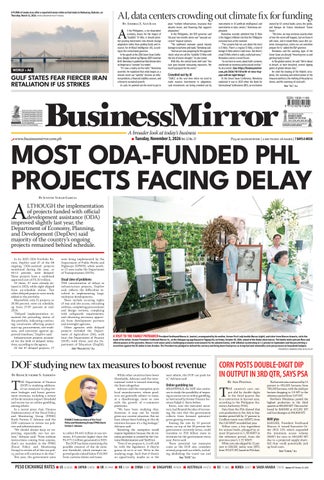
AI, data centers crowding out climate fix for funding
A PLUME of smoke rises after a reported Iranian strike on fuel tanks in Muharraq, Bahrain, on Thursday, March 12, 2026. FADHEL MADHAN/AFP/GETTY IMAGES
By Andrea E. San Juan
A
S the Philippines, a rice-dependent economy, braces for the impact of “Godzilla” El Niño, it should prioritize pouring investments into climate change adaptation rather than pooling funds and resources for Artificial Intelligence (AI), according to the central bank governor. In his speech at the 2026 Green Swan Conference, Bangko Sentral ng Pilipinas (BSP) Governor Eli M. Remolona Jr. pointed out that climate risk is no longer just a “scenario” in a model. “It’s now a reality we live with,” Remolona asserted. He explained that what begins as a climate event can “quickly” become an inflation problem, a financial stability concern, and a threat to sustained growth. As such, he pointed out the need to put in
WORLD » A6
GULF STATES FEAR FIERCER IRAN RETALIATION IF US STRIKES
ROTARY CLUB OF MANILA JOURNALISM AWARDS
2006 National Newspaper of the Year 2011 National Newspaper of the Year 2013 Business Newspaper of the Year 2017 Business Newspaper of the Year 2019 Business Newspaper of the Year 2021 Pro Patria Award PHILIPPINE STATISTICS AUTHORITY 2018 Data Champion
place “resilient infrastructure, insurance that absorbs losses, and financing that supports adaptation.” In the Philippines, the BSP governor said the past two months alone saw “unusual successive” tropical cyclones. “The southwest monsoon caused massive damage to our farms and roads,” Remolona said. “And we are now preparing for the opposite shock: what we call the ‘Godzilla’ El Niño with the risk of severe drought,” he also noted. With this, the central bank chief said: “Our task goes beyond measuring exposures. We need to prepare for the worst.”
Crowded out by AI
“SADLY, at the very time when we need to make massive investments in adaptation, such investments are being crowded out by
investments in AI [artificial intelligence] and investments in data centers,” Remolona emphasized. Remolona recently admitted that El Niño is the biggest inflation risk that the Philippine economy faces at the moment. “The scenario that we care about the most is El Niño. There’s a regular El Niño, a kind of benign El Niño which is bad news. But there’s a bad El Niño which is really, really bad news,” Remolona said at a recent forum. “So we have to worry about both scenarios and decide on monetary policy based on that,” he also noted. (See: https://businessmirror. com.ph/2026/10/10/with-el-nino-bspsays-will-do-right-thing/) At the Green Swan Conference, Remolona explained it was in 2020 when the Bank for International Settlements (BIS), an institution
owned by 63 central banks across the globe, and Banque de France introduced “Green Swan.” “This time, we may not know exactly when or how the event will happen, but we know it will come, and it would likely cause dire systemic consequences, unless we can somehow prepare for it,” added the BSP governor. Remolona said the warning signs of the Green Swan are already “hovering over us and getting ready to land.” In the global context, he said: “We’re about to breach, or have breached, several tipping points in global climate risks.” He cited the slowing of the Atlantic circulation, the warming and deforestation of the Amazon rainforest, the melting of the polar ice sheets, and the warming of coral reefs. See “AI,” A2
BusinessMirror A broader look at today’s business
EJAP JOURNALISM AWARDS
BUSINESS NEWS SOURCE OF THE YEAR
(2017, 2018, 2019, 2020, 2021) DEPARTMENT OF SCIENCE AND TECHNOLOGY
2018 BANTOG MEDIA AWARDS
MOST ODA-FUNDED PHL PROJECTS FACING DELAY www.businessmirror.com.ph
A
n
Tuesday, November 3, 2026 Vol. 22 No. 27
P25.00 nationwide | 2 sections 18 pages | 7 DAYS A WEEK
By Justine Xyrah Garcia
LTHOUGH the implementation of projects funded with official development assistance (ODA) improved slightly last year, the Department of Economy, Planning, and Development (DepDev) said majority of the country’s ongoing projects remained behind schedule. In its 2025 ODA Portfolio Review, DepDev said 47 of the 68 ongoing ODA-assisted projects monitored during the year, or 69.12 percent, were delayed. These projects have a combined approved cost of P3.50 trillion. Of these, 37 were already delayed in 2024, while eight slipped from on-schedule status. Two other delayed projects were newly added to the portfolio. Meanwhile, only 21 projects, or 30.88 percent, were on schedule, up from 27.87 percent at end2024. “Delayed implementation remained the prevailing status of the portfolio, indicating continuing constraints affecting project start-up, procurement, site readiness, and execution against approved timelines,” DepDev said. Infrastructure projects accounted for the bulk of delayed initiatives, according to the agency. Of the 47 delayed projects, 17
were being implemented by the Department of Public Works and Highways (DPWH), while another 12 were under the Department of Transportation (DOTr).
Usual slew of problems
THE concentration of delays in infrastructure projects, DepDev said, reflects the difficulties involved in implementing large, multiyear developments. These include securing rights of way and site access, relocating utilities, completing procurement and design reviews, complying with safeguards requirements, and obtaining necessary approvals from development partners and oversight agencies. Other agencies with delayed projects included the Department of Agriculture (DA), with four; the Department of Finance (DOF), with three; and the Department of Education (DepEd), See “Projects,” A2
A VISIT TO THE FAMILY PATRIARCH President Ferdinand Marcos Jr. (center), accompanied by his mother, former First Lady Imelda Marcos (right), and sister Irene Marcos-Araneta, visits the
tomb of his father, former President Ferdinand Marcos Sr., at the Libingan ng mga Bayani in Taguig City on Friday, October 30, 2026, ahead of the Undas observances. The family held a private Mass and offered prayers at the gravesite. Marcos’s visit comes amid a challenging economic environment for his administration, with inflation accelerating to 7.2 percent in September and the peso hitting a record low against the US dollar in late October. The President has pledged to defend the currency and bring down food prices as rising fuel and commodity costs put pressure on household budgets. PRESIDENTIAL COMMUNICATIONS OFFICE VIA AP
DOF studying new tax measures to boost revenue By Reine Juvierre S. Alberto
T
HE Department of Finance (DOF) is studying additional tax measures to plug revenue leakages and boost government revenues, including a review of the de minimis import threshold and excise tax on online gambling, among others. In a recent press chat, Finance Undersecretary of the Fiscal Policy and Monitoring Group (FPMG) Karlo Fermin S. Adriano said the DOF continues to review tax policies and administration. “We should always keep on improving, especially our tax system,” Adriano said. “Even without instructions coming from anyone, that’s our mandate in the FPMG [Fiscal Policy and Monitoring Group] to review all of this tax policy, and we will continue to do that.” This year, the government aims
FINANCE Undersecretary of the Fiscal Policy and Monitoring Group (FPMG) Karlo Fermin S. Adriano
to collect P4.441 trillion in tax revenues, 8.9 percent higher than the P4.077.2 trillion generated in 2025. The DOF has been examining the possible removal of the de minimis threshold, which exempts imported goods valued below P10,000 from customs duties and taxes.
While other countries have lower thresholds, Adriano said the international trend is toward removing the limit altogether. Adriano said the exemption puts local manufacturers, whose products are generally subject to taxes, at a disadvantage, more so now with the growth of e-commerce platforms. “We have been studying that. However, it may not be timely given our current situation. But we have always been looking at this de minimis because it’s a big leakage,” Adriano said. Removing the exemption would require legislation because the de minimis provision is covered by the Customs Modernization and Tariff Act. “Even if we propose it, it will still be with the legislators if they’re gonna sit on it or not. We’re in the studying stage. Such that if there’s an opportunity, maybe us or the
next admin, the DOF can push for it,” Adriano said.
Online gambling tax
MEANWHILE, the DOF also continues to study the possibility of imposing an excise tax on online gambling, as instructed by former Finance Secretary Ralph G. Recto before. Recto, now the executive secretary, had floated the idea of increasing the rate that the government collects from licensed operators’ gross gaming revenues. Raising the rate by 10 percent more, on top of the 38 percent the government currently levies, could translate to P20 billion more in revenues for the government every year, Recto said. These potential tax measures come as the DOF also considers several proposed tax reliefs, including abolishing the travel tax and
CORN POSTS DOUBLE-DIGIT DIP IN OUTPUT IN 3RD QTR, SAYS PSA By Ada Pelonia
T
HE country’s corn output slid by double digits in the third quarter due to a contraction in harvest area, according to the Philippine Statistics Authority (PSA). Data from the PSA showed that corn production in the July to September period fell by 17 percent to 2 million metric tons (MMT), from the 2.43 MMT recorded last year. Yellow corn, a key ingredient for animal feeds, plunged by almost 20 percent to 1.38 MMT in the reference period, from the previous year’s 1.72 MMT. White corn also slipped by 12 percent to 620,581 metric tons (MT), from 707,471 MT, based on PSA data.
The harvest area contracted by 12 percent to 691,825 hectares from 789,243 hectares, with the yield per hectare dropping to 2.9 MT in the reference period from 3.07 MT. Northern Mindanao posted the highest production in the third quarter at 496,830 MT. This was followed by BARMM at 415,361 MT and Soccsksargen at 340,408 MT.
MAV plus
EARLIER, President Ferdinand Marcos Jr. issued Executive Order (EO) 129, which expanded the minimum access volume (MAV) for corn to 500,000 MT due to a projected supply shortfall that could potentially jack up food costs. See “Corn,” A2
See “DOF,” A2
PESO EXCHANGE RATES n US 63.8520 n JAPAN 0.4050 n UK 85.4404 n HK 8.1384 n CHINA 9.5857 n SINGAPORE 49.9038 n AUSTRALIA 44.8752 n EU 71.3865 n KOREA 0.0477 n SAUDI ARABIA 17.0150 Source: BSP (October 30, 2026)
News
BusinessMirror
A2 Tuesday, November 3, 2026
AI…
Continued from A1
Zooming in on the Philippines, he emphasized that the country is preparing for the “Godzilla” El Niño with the risk of “severe drought.” The Department of Agriculture (DA) recently said El Niño could inflict P20 billion in agricultural damage, potentially affecting the livelihoods of up to 4.6 million farmers and fisherfolk. (See: https://businessmirror.com. ph/2026/10/22/el-nino-agri-damage-couldreach-%E2%82%B120b-da/) An article published by the Bank for International Settlements (BIS) in January 2020 pointed out that climate change poses new challenges to central banks, regulators and supervisors. BIS, often called the “central bank of central banks,” pointed out that integrating climaterelated risk analysis into financial stability monitoring is “particularly challenging because of the radical uncertainty associated with a physical, social and economic phenomenon that is constantly changing and involves complex dynamics and chain reactions.” “Traditional backward-looking risk assessments and existing climate-economic models cannot anticipate accurately enough the form that climate-related risks will take,” BIS said. “These include what we call ‘green swan’ risks: potentially extremely financially disruptive events that could be behind the next systemic financial crisis,” the institution also noted. BIS emphasized that central banks have a role to play in avoiding such an outcome, including by seeking to improve their understanding of climate-related risks through the development of “forward-looking scenario-based analysis.” However, BIS said central banks alone cannot mitigate climate change. “This complex collective action problem requires coordinating actions among many players including governments, the private sector, civil society and the international community,” BIS pointed out.
www.businessmirror.com.ph
NBI to do parallel probe on pets’ dumping in Bulacan By Joel R. San Juan
In a statement, NBI Director Melvin Matibag said he had directed several divisions of the agency led by the Environmental Crimes Division (EnCD), to conduct a comprehensive investigation. He added that all regional officers in Calabarzon and Central Luzon have been instructed to assist in the investigation.
The NBI director said the investigation will determine the possible liability of the operators of Ahjay Paws Aftercare Pet Crematorium for violation of Article 315 (2)(a) of the Revised Penal Code or estafa. It was reported that the owners of the deceased pets found abandoned in Bulacan had paid for the cremation
services of Ahjay Paws, but such apparently not performed. The NBI team will also conduct verification of operational capacity, including business permits, equipment, CCTV footage, and chain of custody of remains. The team will also coordinate with the Department of the Interior and Local Government, (DILG) Department of Environment and Natural Resources (DENR), Philippine National Police (PNP), and concerned local government units for compliance inspection of similar facilities, as recommended by Philippine Animal Welfare Society (PAWS). “We will pursue a scientific and evidence-based approach, including forensic examination where necessary, to determine whether the remains entrusted to the fa-
Corn…
duction, since feed accounts for a significant share of operating expenses for hog raisers and poultry producers. “Ensuring a sufficient supply of low-priced corn is essential to supporting animal feed production, keeping production costs of meat affordable and protecting the country’s food security,” he said. “We need to make sure our livestock and poultry
industries have access to the feed ingredients they need without placing additional pressure on consumers.” The DA said the additional imports would be allowed during the lean season, serving as a supplement to domestic production rather than displacing locally harvested corn. The agency noted a projected yellow
corn deficit of about 1.42 MMT from March through December 2026. “Corn is a principal energy source in livestock and poultry feeds. Any sustained increase in its price can raise procurement costs for feed millers, increase expenses for livestock raisers, and eventually translate into higher prices for meat products.”
DOF…
fund all government programs. So you cannot stop us from thinking all of this,” Adriano said. As the government targets average annual tax revenue growth of 8 percent through 2029, Adriano said the DOF would assess the economic impact of each proposed tax measure before pursuing it. “If we find that it’s not [beneficial], then we will stop the proposal. There should be a clear rationale and benefit if we ever propose any taxes,” he added.
T
HE National Bureau of Investigation (NBI) on Tuesday said it would conduct a parallel investigation into the illegal dumping of the remains of 29 pet dogs and cats at a vacant lot in San Jose del Monte, Bulacan.
Continued from A1
Agriculture Secretary Francisco Tiu Laurel Jr. said maintaining an ample supply of affordable corn would help sustain livestock and poultry pro-
Continued from A1
general tax amnesty. Adriano said the DOF supports the removal of the travel tax, which could result in around P10 billion in foregone revenues, with Finance Secretary Frederick D. Go backing the measure. “We will be consistent with our mandate to generate revenues to
OSAEC…
Continued from A7
casework, emphasized that responsible reporting must begin with the principle of doing no harm. Journalists, she said, must balance the public interest with the best interests of the child, avoiding unnecessary interviews or descriptions that could force survivors to relive traumatic experiences. Instead of repeatedly asking survivors to recount their abuse, reporters can seek information from social workers, aftercare providers, investigators and other qualified sources. The goal, she explained, is to report on the crime and the systems that allow it to continue, rather than turn a survivor’s suffering into the centerpiece of a sensational story. “We want to tell the story of the crime, not the trauma of the survivor,” Entoma-Forcadilla said.
A crime hidden in plain sight
THE need for responsible reporting has become increasingly urgent as online child sexual exploitation continues to affect communities across the Philippines. Entoma-Forcadilla pointed out to the participants how offenders use internet-connected devices, digital communication platforms and financial transactions to facilitate abuse. Some cases involve the production and distribution of child sexual abuse or exploitation material, while others involve abuse transmitted live over the internet. The exploitation may take place inside ordinary homes, some-
cility and whether the ashes returned to owners can be authenticated,” Matibag said. Matibag also urged affected pet owners to submit their receipts, cremation certificates and other relevant communications to the NBI headquarters as part of its case build-up. “As a pet lover, I understand and deeply sympathize with those who have fallen victim to this fraudulent act. It is unacceptable that the trust and hard-earned money entrusted by pet owners were repaid with deceit. Instead of providing proper cremation services, the pets were dumped like garbage,” Matibag said. “The NBI will see to it that this incident is thoroughly investigated and that appropriate cases will be filed based on the evidence,” he added.
times involving people who have direct access to children, including relatives or even their own parents. Entoma-Forcadilla cited findings from an IJM-supported study conducted in 2022 and released in 2023, which estimated that nearly half a million Filipino children were trafficked to produce new child sexual exploitation material that year. The study, she said, also challenged earlier assumptions that the problem was concentrated in a few known locations. Instead, its findings indicated that the threat extended across the country, including communities where cases were rarely reported or detected. The figures underscore a troubling reality: A crime can remain largely invisible to the public even when it is occurring within communities. For journalists, that creates a difficult reporting environment. The training emphasized that unlike crimes committed in public spaces, online child sexual exploitation can take place behind closed doors, leaving few visible signs for reporters to document. It added that fear, stigma and mistrust of authorities can also discourage survivors and families from coming forward. Yet the absence of reported cases does not necessarily mean that children are safe. IJM pointed out that journalists can make a difference by investigating systemic failures, examining the response of authorities, explaining how communities can recognize and report suspected abuse, and holding institutions accountable without exposing survivors. To be concluded
Most ODAfunded PHL projects facing delay Continued from A1
with two. The slowdown in ODA implementation was also reflected in lower loan disbursements, which declined by 11.7 percent to $6.19 billion in 2025 from $7.01 billion in the previous year. The decline was largely driven by program loans, whose drawdowns fell by 20.59 percent to $3.74 billion from $4.71 billion in 2024, reflecting lower releases from policy-based and budget support operations. Project loan disbursements, however, rose by 6.52 percent to $2.45 billion from $2.3 billion. DepDev said the release of project loans remained dependent on procurement progress, civil works implementation, delivery milestones, and compliance with loan withdrawal requirements. Despite the increase in project loan disbursements, implementation delays remained substantial. The average delay among projects with available data narrowed to 30.91 months in 2025 from 38.84 months in 2024, while the median delay stood at 17.47 months. DepDev attributed the lower average delay largely to “approved implementation period extensions, which realigned selected project timelines with current implementation conditions.” Transport projects continued to post the longest delays, with DOTr projects averaging 51.50 months behind schedule.
Longest delay: Cebu bus project
THE Cebu Bus Rapid Transit Project recorded the longest delay at 132.96 months, with physical accomplishment reaching only 11.43 percent as of end-2025. Its implementation continued to be hampered by site acquisition and right-of-way issues, including a cease-and-desist order covering lots owned by the Cebu provincial government, as well as procurement delays involving the remaining civil works packages, the DepDev said. DPWH projects followed with an average delay of 36.48 months. Among these, the Metro Manila Priority Bridges Seismic Improvement Project was delayed by 128.51 months, with physical accomplishment at just 4.62 percent. The project continued to face right-of-way and resettlement issues, including pending relocation arrangements for informal settler families affected by the works.
Majority at risk
DEPDEV also flagged potential implementation problems in 44 of the 68 ODA projects approved by the Investment Coordination Committee (ICC) or the Economy and Development Council. More than half of the projects, or 37, were classified under At-Risk Level II, or the Critical Stage, indicating that implementation concerns had persisted across reporting periods. These accounted for 54.41 percent of the portfolio. Another seven projects, equivalent to 10.29 percent, were placed under At-Risk Level I, or the Early Warning Stage, indicating emerging problems that could still be addressed through early intervention. Meanwhile, 14 projects, or 20.59 percent, were classified as For Attention, while 10 projects, or 14.71 percent, had not breached any risk category. Most projects with comparable year-on-year assessments retained their previous risk classifications. Several remained under At-Risk Level II because of persistent issues involving physical progress, procurement, site readiness, financing, and project restructuring, DepDev said.
The Nation BusinessMirror
www.businessmirror.com.ph
Tuesday, November 3, 2026 A3
Prosecutor to Duterte: Simple denial won’t cut it
A
By Jovee Marie N. Dela Cruz |
@joveemarie
SIMPLE denial will no longer suffice. Vice President Sara Duterte’s defense team must explain how she and her husband accumulated their wealth and account for alleged discrepancies between their financial holdings and her sworn declarations, private prosecutor Benjamin Tolosa Jr. said.
Elected Bangsamoro region parliament marks new era By Butch Fernandez @butchfBM
L
EGISLATORS have expressed optimism for lasting peace and economic growth in southern Philippines following the historic convening of the first elected Bangsamoro Autonomous Region in Muslim Mindanao (BARMM) Parliament and the election of its regular leadership. Senate President Sher w in Gatchalian, Sen. Francis Escudero, and Lanao del Sur Rep. Zia-ur Rahman Alonto Adiong separately congratulated newly elected Chief Minister Abdu lraof Macacua and Speaker Amer Zaakaria A. Rakim, along with the deputy chief ministers, deputy speakers, majority floor leader, and members of the 80-seat assembly. The inaugural session, held on October 30, marked the formal transition from over seven years of interim governance under the Bangsamoro Transition Authority (BTA) to a fully elected Parliament following the region’s historic pa rl i a me nt a r y e le c t ion s on September 14, 2026. The term of the first regular Parliament will run through June 30, 2031.
Call for unity, support
GATCHALIAN highlighted the region’s path toward long-overdue economic development and good governance under the new leadership. “We congratulate our countrymen in BARMM, as well as Abdulraof Macacua for his election as chief minister of the whole region. We have trust in the new leadership’s ability to push good governance and, with the help of stakeholders, to push economic progress and welfare of everyone in the region,” Gatchalian said in a mix of English and Filipino.
Gatchalian urged political blocs, civil society organizations, and local governments to unite behind the new BARMM administration to guarantee stability and inclusive development. “For so long, everyone has dreamed of long-term peace and development in BARMM and the entire Mindanao. We are confident we can attain the dream of progress for the communities of our Muslim brothers and the whole of Mindanao,” he added.
Milestone
ESCUDERO lauded the assembly as a major victory resulting from years of peace negotiations between the National Government and the Moro Islamic Liberation Front (MILF). “The inaugural session is a testament to the progress we have made in transforming decades of con f l ic t i nto mea n i ng f u l opportunities for peace, stability and self-governance,” Escudero said, wishing the leaders success in pushing the region toward greater prosperity. “This is a victory not only for the Bangsamoro people but for the entire country. It is proof that peace, when nurtured through dialogue, patience and cooperation, can lead to stronger institutions and more empowered communities,” the Bicolano legislator added. Escudero expressed confidence that the assembly will build upon transition-period gains to improve public services and uplift daily life for ordinary Bangsamoro families.
National-regional partnership
ADIONG, a former Bangsamoro Parliament member (2019–2022), called the moment a fulfillment of a long-standing dream for genuine self-governance. See “Barmm,” A4
Guadalupe Busway station reopens as repairs continue
T
HE newly rehabilitated Epifanio delos Santos Avenue (Edsa) Busway Guadalupe Station is set to reopen on Friday, November 6, even as the government temporarily opened a portion of the dedicated bus lane to private vehicles starting Monday, to ease traffic during ongoing road repairs. Tr a n s p or t at ion S e c ret a r y Vicvencio Dizon and Public Works Secretary Giovanni Lopez jointly inspected the Guadalupe Station in Makati City as part of compliance with a directive from President Marcos for government agencies to prioritize commuter welfare and make daily travel more convenient. A s pa r t of t he fac i l it y improvements, Dizon directed the immediate installation of essential commuter amenities.
“Secretary Dizon ordered the installation of proper toilets, ceiling fans, and additional seats at busway stations for passengers,” the Department of Transportation (DOTr) said in a statement. The DOTr emphasized that these upgrades stem from an ongoing partnership with the Department of Public Works and Highways (DPWH) to ensure continuous i n f r a s t r uc t u re de ve lo pme nt centered on passenger comfort. To ease traffic congestion caused by road rehabilitation, private vehicles are being granted temporary access to the Edsa Busway stretch between Nepa Q-Mart (Mega Q Mart) in Quezon City and Boni Avenue in Mandaluyong City. See “Busway,” A4
Tolosa said the central issue in the remaining impeachment charge is no longer just the amount of wealth identified by investigators, but whether or not Senate impeachment tr ial respondent Duterte can reconcile the financial records presented by the prosecution with her statements of assets, liabilities and net worth (SALNs). In an interview with Radyo Ronda Balita-Southern Mindanao, Tolosa said the prosecution had presented official records showing alleged discrepancies between Duterte’s declared net worth and the financial holdings of her and her husband, lawyer Manases Carpio, as examined by forensic analyst expert Alexander Cabrera.
“Sa pagbabalik ng proceedings, magkakaroon na naman ng opor t unidad [ang depensa] na magpresenta ng ebidensya. Tingnan natin kung paano nila ipapaliwanag ang bagay na ito,” Tolosa said. [When the proceedings resume, the defense will again have the opportunity to present evidence. Let us see how they will explain this matter.] Tolosa said the defense must address two key questions: where the wealth identified in the prosecution’s financial analysis came from, and why the questioned assets and financial holdings were allegedly not fully reflected in the relevant SALNs. The prosecution earlier presented Cabrera’s analysis identifying at
least P817.87 million in allegedly undeclared assets and unexplained wealth involving Duterte and Carpio from 2022 to 2025. Cabrera described the figure as a conservative estimate based on available records, with a broader computation potentially reaching about P1.5 billion, subject to adjustments for liabilities and taxes. Meanwhile, Duterte declared a net worth of about P98.66 million in her 2025 SALN. Tolosa said the prosecution would also compare the financial findings with the income Duterte reported to the Bureau of Internal Revenue (BIR). He maintained that the alleged discrepancies require a substantive
explanation from the defense; these should not simply be dismissed as minor accounting errors. The House prosecution has completed its presentation of evidence under article II, the lone remaining impeachment charge after it withdrew the three other articles involving alleged misuse of confidential funds, grave threats and bribery. Duter te’s defense team is scheduled to begin presenting its evidence when the impeachment trial resumes on November 9. Tolosa said the prosecution is awaiting the defense’s explanation of the financial records, which the senator-judges will assess in determining whether or not the remaining charge has been proven.
PNP pressed on Duterte, Lustre arrests
T
HE Nat ion a l Pol ice (PNP) must explain the circumstances behind its differing actions in implementing ar rest war rants against Vice President Sara Z. Duterte and jou r n a l ist Ph i l ip Lu st re Jr., particularly whether established law enforcement procedures were consistently applied in both cases, a congressman said. Party-list Rep. Terry L. Ridon of Bicol Saro said the police should clarify why Lustre was arrested on a weekend while authorities did not immediately enforce an arrest warrant against Duterte, despite both cases involving bailable offenses. “ We have emphasized the importance of the PNP explaining the actual differences between these two cases,” Ridon said. He questioned the circumstances surrounding Lustre’s arrest on October 24, following a media forum in Quezon City, and contrasted it with the police’s decision not to immediately take Duterte into
custody after a Quezon City court issued an arrest warrant against her in September. “Mr. Lustre was arrested on a weekend, while the arrest order against Vice President Sara Duterte was not enforced on a weekend, even though both cases involved similar bailable offenses,” Ridon said. Lustre, a journalist and author known for his reporting on the Duterte administration’s anti-drug campaign, was arrested on the strength of a cyberlibel warrant issued by a court in Davao City, the Duterte’s bailiwick. The 72-year-old journalist was detained for several hours before his lawyers secured his release after posting P48,000 bail that evening. His legal team questioned the timing of his arrest and the difficulties they encountered in arranging bail during a weekend. Duterte, meanwhile, was the subject of an arrest warrant issued on September 4 by the Regional Trial Court (RTC) in Quezon City in connection with three counts
of grave threats arising from her November 2024 statements concerning President Marcos and other government officials. Interior Secretar y Juanito Victor Remu l la subsequent ly acknowledged that authorities knew Duterte’s whereabouts but did not forcibly implement the warrant, explaining that the police had extended the courtesy due to her position before she voluntarily appeared in court and posted P360,000 bail on September 5. “If their explanation is that they extended that courtesy because she is the Vice President and therefore chose not to arrest her, then they should say so clearly. At least the public would understand that, although to many of us, that would appear to be a double standard,” Ridon said. Ridon said the PNP must account for the operational considerations behind the two arrests, stressing that the public deserves to know whether these were based on established procedures or considerations arising
from the position of the person covered by the warrant. The cases have also raised broader concerns about due process and the treatment of individuals facing arrest warrants. Prosecutor General Richard Anthony Fadullon has acknowledged possible due process lapses in Lustre’s case after the subpoena intended for the journalist was reportedly sent to an incorrect address. “Let us face it, we know that this has been a practice of previous administrations,” R idon said, referring to concerns surrounding the timing of arrests and the difficulties accused individuals may encounter in securing their release during weekends. T he law ma ker ma inta ined that the PNP must explain its act ions to assu re t he publ ic t hat ar rest war rants are implemented consistently and t h at no i nd i v idu a l re c e i v e s preferential treatment because of government position or political influence. Jovee Marie N. dela Cruz
Houthi strikes in Saudi trigger OFW assistance By Samuel P. Medenilla @sam_medenilla
G
OVERNMENT assistance for overseas Filipino workers (OFWs) in the Kingdom of Saudi Arabia (KSA) has officially breached the 5,000 mark as regional security concerns intensify following recent missile and drone attacks launched by Iran-backed Houthi militants. Data released by the Department of Mig ra nt Workers (DM W ) on Monday showed that, as of November 2, the agency – in close coordination with the Overseas Workers Welfare Administration (Owwa) – has extended a total of 6,873 services to 5,257 affected OFWs across Saudi Arabia. The comprehensive government
intervention package includes immediate financial relief, food packs, temporary shelter, medical evaluation and support, as well as land transportation assistance for displaced or distressed workers. “ The government has also facilitated the repatriation of 560 OFWs and 13 dependents through 14 flights, ensuring that Filipinos who wish to return home receive the necessary support,” the DMW said in a statement. The migrant workers’ agency stepped up its emergency response operations after Houthi forces targeting Saudi airports, air defense facilities, and key infrastructure scaled up cross-border attacks. The strikes were launched in retaliation against ongoing Saudi military interventions in Yemen, where the
militant group remains entrenched. Tensions hit close to home for the Filipino community after an OFW was killed by missile fragments when Saudi defense forces intercepted an incoming Houthi drone targeting Saudi Aramco’s Shaybah oilfield, highlighting the growing hazards faced by foreign nationals in the area. The situation remained volatile over the weekend as militant forces launched a fresh barrage of strikes across Saudi territory. Despite t he heightened security situation, the Philippine government has yet to impose a deployment ban for workers heading to the Kingdom. DMW Undersecretar y Bernard P. Olalia confirmed in a Viber message last week that no deployment restrictions for Saudi Arabia have
been implemented as of present. Meanwhile, DMW Secretary Hans J. Cacdac assured the public that the government remains fully prepared to safeguard the welfare of the active diplomatic and labor contingent. He said that the DMW and Owwa are working hand-in-hand with the Department of Foreign Affairs (DFA), the Philippine Embassy, and host government agencies in Saudi Arabia to continuously monitor the ground situation and deliver timely aid. The DMW strongly urged all Filipinos residing and working in KSA to exercise extreme caution, stay updated on local security advisories, and contact the government’s 24/7 emergency hotline at 1348 (or +63 2 1348 for international calls) should they require immediate emergency or evacuation assistance.
CA upholds acquittal of 22 ‘Abu Sayyaf bandits’ By Joel R. San Juan @jrsanjuan1573
T
HE Court of Appeals (CA) has affirmed the decision issued by the Regiona l Tr i a l C o u r t i n Ta g u i g C it y acquitting 22 alleged members of Abu Sayyaf terrorist group of kidnapping and serious illegal detention with ransom involving six members of the Jehovah’s Witnesses in Patikul, Sulu, on August 20, 2002. In a 16-page decision written by Associate Justice Eleuterio Bathan, the CA’s Fourth Division held that while it recognized that the kidnapping took place, the trial court was correct when
it ruled that prosecution failed to prove beyond reasonable doubt that the 22 individuals were the actual perpetrators. “Since there is no full certainty as to their identification, the constitutional presumption of innocence must prevail, and their acquittal must stand,” the CA said in denying the appeal filed by the government through the Office of the Solicitor General. The CA agreed with the trial court that the prosecution’s main witness Amily Mantec failed to provide detailed physical descriptions of their kidnappers following her escape in 2003. It held that there was a significant delay in the identification of the
accused, which took more than a decade after the abductions. The CA said when Amily escaped from captivity on April 18, 2023, she did not immediately execute an affidavit as the earliest affidavit formally offered by the prosecution was dated June 30, 2023. “ This meant she could not immed iately prov ide a pr ior description of her captors. She made the description only after the private respondents were already arrested, which took place over the span of several years from 2004 to 2015, and during her testimony,” the CA pointed out. “Because she could not provide a proper prior description of the pr ivate respondents, her
identification was dubious,” the ruling added. The unreliability of Mantec’s identification, according to the CA, was bolstered by the fact that her attention was divided by the numerous men who were present guarding them, aside from the traumatizing order she went through, including the beheading of her husband and being forced to change religion and marry into the group. “Consequently, the petitioner failed to prove that the private r e s p o n d e nt s w e r e p r o p e r l y identified as the authors of the crime,” the CA said. See “Abu Sayyaf,” A4
A4
Economy BusinessMirror
Tuesday, November 3, 2026
www.businessmirror.com.ph
Apeco looks to Alberta energy firms to power Luzon ecozone By Bless Aubrey Ogerio
T
HE Aurora Pacific Economic Zone and Freeport Authority (Apeco) is seeking Albertabased energy companies to develop power projects for its planned industrial hub in eastern Luzon, as it pitches investment opportunities in Canada this week. Apeco President and Chief Executive Officer Gil G. Taway IV said the agency is looking
for Canadian companies with expertise in energy development to supply the ecozone’s future
power requirements. “As we build a self-sustaining ecozone on the eastern seaboard o f L u z o n , w e ne e d re l i a b l e and sustainable power, which Canadian businesses, especially those in Alberta, can help us set up given their expertise in energy,” Taway said. T he agenc y k ic ked of f its Canadian investment roadshow on Monday in Montreal and will meet Alberta-based investors in Calgary on November 5. T he br ief i ngs a re pa r t of Apeco’s effort to attract investors for its planned defense and clean energy hubs. Beyond energy, the agency is also pitching opportunities in defense infrastructure, manufacturing
and supply chains. The campaign will be tied to Canada’s IndoPacific Strategy, backed by an initial C A D2.3-billion (P105billion) commitment. Further, the roadshow follows President Marcos’s July 1 to 4 official visit to Canada, where he met with Prime Minister Mark Carney to discuss bilateral economic and defense cooperation. The two countries have since moved for wa rd w it h severa l defense ag reements. In May, Canada’s Minister of International Trade identified air and maritime defense, c ybersec u r it y, l a nd systems, defense procurement and supply chains as potential areas of cooperation. Moreover, the Philippines and
Canada signed a Mutual Logistics Support Arrangement in June, followed by the Philippine Senate’s ratification of their Status of Visiting Forces Agreement in August. About 100 business executives and representatives from the infrastructure, energy, mining, critical minerals, defense, aerospace, advanced manufactur ing , agriculture and logistics sectors are expected at the roadshows. “This initiative will strengthen our engagement with Canadian investors, open new avenues for business par tnerships, a nd generate invest ments that support the Philippines’ economic growth,” Philippine A mba ssador to C a n ad a Jose Victor V. Chan-Gonzaga said.
Gas price up; diesel, Rethinking work in the age of AI kero down this week By Henry J. Schumacher
By Lenie Lectura @llectura
O
IL companies will increase the prices of gasoline products by over P3 per liter this week, while diesel and kerosene prices will go down. The Department of Energy (DOE) said on Monday that oil companies are expected to roll back diesel and kerosene prices by P1 and P1.90 per liter, respectively. On the other hand, gasoline prices will shoot up by P3.50 per liter. The new prices will take effect on Tuesday, November 3. Oil companies adjust pump prices weekly to reflect movements in the world oil market. As of October 30, the country’s fuel inventory supply remains healthy, with gasoline supply expected to last for 52 days; 56 days for diesel; 148 days for kerosene; 58 days for jet fuel; 63 days for fuel oil; and 35 days for liquefied petroleum gas (LPG).
The DOE requires oil companies t o m a i nt a i n a m i n i mu m f u e l inventory equivalent to 15 days of supply, while seven days is required for liquefied petroleum gas. Oil refiners, meanwhile, are mandated to hold a 30-day inventory of their crude oil and refined products. The targeted assistance for the public transport sector also continues. About P1.17 billion in fuel subsidies had been availed of by 109,561 public utility vehicle (PUV) beneficiaries, w it h successf u l tra nsact ions recorded across 4,005 gasoline stations nationwide. The DOE will continue closely monitoring international oil prices, domestic pump prices, and petroleum inventories while coordinating with the Department of Finance and other concerned agencies on measures available under the law to help protect consumers from sustained increases in global fuel prices.
MRT-3 fields 3 more trains
T
HE Metro Rail Transit Line 3 (MRT3) is running three additional trains starting Monday, raising its peak-hour deployment to 19 trains as commuters return to Metro Manila after the Undas holidays. Transportation Secretary Vivencio Dizon said the added trains will carry about 6,000 more passengers a day, though he said “this is still not enough.” “I asked for three more trains on the MRT-3, that plies Epifanio delos Santos Avenue, Metro Manila’s Circumferential Road 4. That starts today,” Dizon said. “ T hat ’s an add it iona l 6,0 0 0 passengers a day. But that’s still not enough. We need to add more, but I first have to talk to our Japanese partners on how to do it,” he added. The 19-train peak-hour deployment on November 2 is higher than the line’s regular holiday deployment of 14 trains during non-peak hours and 16 trains during peak hours.
Of t he 19 tra ins, 13 r un in three-car configurations and six in four-car configurations, all using Czechia-made trains. Dizon said the additional deployment was ordered ahead of the expected influx of returning passengers. “As of today, we’re adding three because our countr ymen will be flocking back to commute starting tomorrow. So as early as now, we’ve asked for more trains,” he said. Dizon said he will meet with MRT 3 management to further increase the number of trains for the coming holiday season. Dizon also ordered the immediate repair of escalators at the station that were found not working. “I saw that there are escalators here that are not working, so those are what we will prioritize. We will have them fixed quickly,” he said. Lorenz S. Marasigan
W
HEN you ask people about t heir experiencesusingAIintheir private lives, enthusiasm is the prevailing response. Everything becomes much faster. Planning the next vacation is easy, and texts can be written in no time. (By the way, that does not apply to this article. I have been working on it for quite some timeJ) When you ask people who use AI at work, the answers become more nuanced. T hose w it h deep conte x tua l knowledge who use AI as a sparring partner recognize its advantages, but they also see its weaknesses. Ask people who work on the technological side, and it becomes clear that building the AI technology stack is complex and that security risks are increasing. A successful AI transformation is now the responsibility of the entire top management team, not just the IT department. A comeback of process reengineering is needed. Just as in the 1990s, workflows must once again be analyzed and rethought across the entire value chain. But let’s not fool ourselves: this time, the process will be significantly more complex because the division of tasks will no longer involve humans alone. In the future, a team will also work with AI and independently operating agents. This will significantly affect how tasks and roles are distributed. Of course, AI can store more explicit knowledge than any human, works extremely quickly, and does not get sick. However, people possess valuable implicit knowledge gained through experience, as well as intuition and empathy. Without these “human skills,” no organization can function.
Barmm…
Continued from A3
As co-chairperson of the Philippine Congress–Bangsamoro Parliament Forum (PCBPF)—a key component of the Intergovernmental Relations Body (IGRB)—Adiong reaffirmed his full commitment to facilitating seamless coordination between the national legislature and the BARMM Parliament.
Busway…
Continued from A3
Dizon announced the temporary arrangement during an ambush interview following the morning inspection. “So, today right after our inspection, maybe around 4:30 a.m., before five o’clock, it will be opened from Nepa Q-Mart to where we are now, around the Boni area,” Dizon said. He explained that the setup mirrors previous traffic adjustments executed by
We must therefore clearly define the following: Where is human judgment needed, and where does using AI make sense, both in terms of the work itself and economically? Where can AI agents work independently, and where must a human make the final decision? And how can we ensure that the necessary skills to make these decisions are available throughout the organization? This is already complex enough in itself—and it becomes even more difficult because AI is constantly evolving. Imagine all of this happening in a traditional organization where everyone works within inf lexible structures and fixed job descriptions. It is clearly defined which team is responsible for which tasks and what skills are required. There are hierarchies, corresponding authority levels, and clearly assigned responsibilities. Then there is another human factor to consider. In well-functioning teams, there is a working environment where colleagues help each other and newcomers learn from experienced employees. Decisions are discussed, including with the manager. People simply work together and collaborate. However, the use of AI reduces human interaction, as Anthropic has already observed. Less interaction, in turn, leads to less contextual understanding. If even the smallest problems are immediately directed to AI and are less frequently thought through independently or discussed with colleagues, this does not help develop people’s general cognitive abilities! I am not only concerned about younger people who are growing up with AI and whose neural connections
Here are the three most important lessons: 1. AI should support people, not replace human judgment. AI can process information quickly, but humans still contribute experience, intuition, empathy, and decision-making. 2. People must continue learning and thinking independently. If we ask AI to solve every small problem, we may lose opportunities to develop our own thinking skills and learn from colleagues. 3. Leadership must adapt to AI. Managers should help their teams understand which tasks belong to AI and which require human involvement. They should encourage collaboration, trust, and continuous learning. In simple words: AI is a powerful tool, but successful companies will be those that combine AI’s capabilities with human intelligence, experience, and teamwork. Did you enjoy my Rethinking Work at the age of AI? Please respond and come up with additional ideas; contact me at hjschumacher59@gmail.com
“Please be assured of my full support and the continued partnership of the national government. We stand ready to work with you—through the IGRB and the Philippine Congress– Bangsamoro Parliament Forum—to advance peace, development, justice, and inclusive progress for every Bangsamoro community. The success of the BARMM is the success of Mindanao and of the Philippines,” Adiong said.
He noted that the regular Parliament now possesses the mandate to pass legislation, enact budgets, and oversee the executive branch to solidify peace gains while addressing community needs. “May this government be guided by humility, integrity, and a deep commitment to the aspirations of the Bangsamoro people. Congratulations once again, and may Allah bless your leadership,” Adiong added. With Jovee Marie N. dela Cruz
DPWH in the Monumento area prior to recent leadership transitions. “After the reblocking, it will be asphalted to make it smooth. But even the barriers were pushed back, like what Secretary Banoy [Lopez] and DPWH did before we changed positions, in the Monumento area, we will open the busway to private vehicles. So while it is not finished from Nepa Q-Mart to here in Boni, private vehicles will be able to pass through here,” Dizon added. The temporary access for private motorists is expected to last for about two
weeks. Once all remaining asphalt overlay and finishing works are complete, the section will revert to its regular dedicated use for public buses. Lopez confirmed that the DPWH completed the reblocking of approximately 990 square meters of intermittent road sections along the busway on Monday. Lopez highlighted that the agency utilized a special one-day concrete curing technology to fast-track the reblocking process and minimize inconvenience to the commuting public.
are not yet as firmly established simply because of their age. In my view, no one is immune to the temptation to take what seems to be the “easier” route, even when faced with simple questions, rather than making the effort to think things through independently. I am particularly concerned about organizations where continuous learning is not an established part of the company culture. For these organizations, the AI transformation will become an enormous leadership challenge. Throughout this journey, the message for managers is clear: coach more instead of controlling, build trust, and communicate openly. This includes being open about their own uncertainties and discussing how the roles of humans and AI are changing.
Senator demands crackdown on El Niño hoarders By Butch Fernandez @butchfBM
S
TRICT enforcement of automatic price freezes in calamity-stricken areas and an aggressive crackdown on food cartels are indispensable steps to protect Filipinos as a strong El Niño threatens national food supply and prices, a senator warned. Sen. Francis Pangilinan, chairman of the Senate Committee on Agriculture, Food and Agrarian Reform, urged the Departments of Trade and Industry (DTI), of Agriculture (DA), and of Health (DOH), and the National Price Coordinating Council to intensify market monitoring and enforce price controls to prevent illegal price increases. “No one should profit from the impending calamity through ways that deepen our people’s misery, especially the farmers and fishers, as well as consumers. In times of crisis, the public must be well protected from profiteering,” Pangilinan said in Filipino. Pangilinan highlighted Section 6 of Republic Act 7581 (The Price Act), as amended by Republic Act 10623, which mandates that prices of basic necessities in areas declared under a state of calamity are automatically frozen at prevailing rates unless otherwise declared by the President. Under the law, an automatic price freeze remains in effect for the duration of the emergency, up to a maximum of 60 days. For basic necessities that are wholly imported and deregulated under existing laws—such as household liquefied petroleum gas (LPG) and kerosene—the price control applies for up to 15 days, accounting for available inventory. Beyond monitoring retail markets, Pangilinan pressed law enforcement authorities and implementing agencies to build strong legal cases against individuals and syndicates exploiting drought conditions to manipulate supply. Under Section 5 of the Price Act, hoarding, profiteering, and cartels involving basic commodities are strictly illegal. “I call on implementing agencies, local price councils, and law enforcement authorities to gather evidence and pursue criminal and administrative cases, where warranted, against those responsible for illegal price manipulation. Enforcement must not end with frontline sellers. We must target the very top,” Pangilinan urged. “The people are demanding that profiteers be jailed,” he added in Filipino. “If only small vendors are caught, the campaign means nothing. We should hold accountable the big traders and capitalists, as well as the brains behind syndicates involved in hoarding and price manipulation.” Pangilinan reminded regulators and perpetrators of the severe legal penalties outlined in the Price Act: Illegal Price Manipulation (Section 15): Carries a prison sentence of five to 15 years and fines ranging from P5,000 to P2 million. Violating Price Freezes-Ceilings (Section 16): Punishable by one to 10 years imprisonment, a fine ranging from P5,000 to P1 million, or both. He also warned corrupt government workers, citing Section 19 of the law. Public officials or employees who conspire in or knowingly conceal Price Act violations by reason of their office will be held principally responsible, facing criminal charges alongside permanent disqualification from holding public office, Pangilinan also said.
Abu Sayyaf… Continued from A3
Based on the records, the victims namely Mantec, Leonel Mantec, Cleofe Montolo, Lemuel Montolo, Florida Montolo, and Norie Bendijo were in Taglibi, Sulu, to conduct ministry work and sell cosmetics, herbal medicine, and other products. While selling their products house to house, a woman accused them of being military assets, which alarmed them and prompted them to return to Jolo, Sulu However, the victims were intercepted and taken captives by alleged members of the ASG. Leonel was beheaded on the same night while Lemuel was beheaded the next day by their captors. Their captors eventually demanded P6 million ransom for their release. On April 18, 2023, Mantec and Cleofe escaped captivity while Florida and Norie escaped on May 6, 2003.
Tuesday, November 3, 2026
Most PHL companies lack AI governance in hiring—study
P
HILIPPINE companies are bringing artificial intelligence (AI) into recruitment without necessarily having the rules and safeguards to govern its use, leaving gaps in accountability and checks against bias, a study found. The findings of the 2026 Talent Acquisition Survey in the Philippines, conducted by insurance broking firm Marsh among 91 companies in May and June, show that adoption is moving ahead of oversight. About 43 percent of respondents had no defined roles or governance structures for AI in recruitment, while another 23 percent were still developing them. Only 16 percent said their governance arrangements were fully established and communicated. Further, while data privacy and security were the most commonly managed concerns, cited by 52 percent of respondents, more than half also identified overreliance on AI and the resulting loss of accountability as a risk. Another 41 percent cited ethical concerns and algorithmic bias. But identifying a risk does not necessarily mean companies are checking whether it materializes. Those who did not audit their AI and automation tools for potential bias comprised 43 percent of respondents, while 37 percent conducted checks only occasionally and just 20 percent did so regularly. The findings suggest that many employers have yet to move from recognizing the risks of AI to establishing consistent ways of managing them. In fact, 26 percent of respondents said they did not actively manage any AI adoption. Companies also appear to be approaching the technology mainly as a way to streamline operations, as 68 percent viewed AI as an enabler of automation and 38 percent as a means of reducing costs. By comparison, only 35 percent saw it as a way to strengthen human judgment and gain a strategic advantage, while 20 percent were unsure of its role.
This operational focus is reflected in how employers plan their technology investments, with only 32 percent having a formal adoption roadmap updated annually. A quarter introduced technologies as needs arose, while 23 percent had no current adoption plan and 20 percent relied on informal or ad hoc planning. Readiness to manage the transition also varied. While 32 percent were very confident and 9 percent extremely confident in their leaders’ ability to redesign their organizations for AI transformation, 37 percent were only moderately confident. Another 15 percent were slightly confident and 8 percent were not confident at all. The survey’s assessment of recruitment functions showed that most companies remained at intermediate levels of technology adoption. Forty-two percent were classified as “Efficiency Masters,” with standardized recruitment processes and moderate technology use, while 17 percent were “Strategists,” whose talent acquisition functions were aligned with business goals and used data and technology. Only 6 percent qualified as “Pioneers,” whose recruitment operations were fully integrated into the business and used advanced AI and analytics. Fourteen percent were “Traditionalists,” relying largely on manual processes, while 4 percent were “Meanderers,” characterized by ad hoc hiring practices and a lack of clear ownership or standards. Sixteen percent said they were not using AI in talent acquisition. “While AI-enabled tools offer meaningful potential, the findings suggest that successful adoption depends on having the right governance, capability, and operating model in place,” the study said. “Technology alone is not enough; it must be paired with clear process design and recruiter readiness,” it added.
A
CTING Health Secretary Dr. Edwin Mercado said the national government is already addressing the critical patient overcrowding plaguing the province’s two primary public hospitals in Samar. In a written response to Governor Sharee Ann Tan, Mercado confirmed that the Department of Health - Eastern Visayas Center for Health Development (DOH-EV CHD) is already assessing the patient congestion at both the Calbayog District Hospital and the Samar Provincial Hospital, noting that the problem is real, and that they are not taking it lightly. Mercado also directed the DOH- EV CHD to arrange emergency assistance, including temporary patient accommodation, emergency medical teams, and additional healthcare personnel, following the overcrowding crisis affecting two major government hospitals in Samar. Tan has expressed gratitude to Mercado for the prompt response to the reported overcrowding crisis, expressing confidence that his leadership will help translate emergency assistance into lasting improvements in public healthcare. She said Mercado’s immediate attention to her appeal was an encouraging indication of the national government’s willingness to address the urgent needs of patients at two major hospitals. “What is important to us is that Secretary Mercado listened to our concerns and responded promptly. We appreciate his personal attention to the situation and the emergency measures he has directed. We are hopeful that, with his leadership, we can work together to find lasting solutions for our patients,”Tan said. The governor emphasized that the immediate challenge is to ensure that emergency measures are followed by permanent improvements in hospital capacity, facilities, equipment, and healthcare personnel. DOH’s move came after Governor Tan sent an urgent two-page appeal on October 26 detailing a severe healthcare crisis. According to provincial hospital reports, patient admission rates have surged to more than double the authorized limits. The 75-bed Calbayog District Hospital recently documented 181 inpatients, while the Samar Provincial Hospital, which has a capacity of only 100 beds, has been forced to
Minimum wage compliance hits 91.6%
M
By Mary Jade Jadormio
INIMUM wage compliance among establishments inspected nationwide reached 91.61 percent in the first half of 2026, data from the Department of Labor and Employment (DOLE) showed. Region IX recorded the lowest compliance rate among regions outside Metro Manila at 64.64 percent.
The compliance rate covered 20,572 establishments inspected from January to June. In Metro Manila, compliance
accommodate between 200 and 250 patients. The severe overcrowding has placed considerable pressure on hospital facilities, doctors, nurses, and other healthcare workers. Tan acknowledged these directives in her October 30 follow-up letter, which was received by the DOH, and requested closer coordination and concrete implementation timelines. “Temporary facilities and emergency medical teams can provide much-needed relief, but we must look beyond emergency measures. We need lasting solutions—expanded hospital facilities, increased bed capacity, modern medical equipment, and enough doctors and nurses—to ensure that our people receive the quality healthcare they deserve and to prevent these hospital emergencies from happening again,”Tan said. The governor also expressed hope that the national government would facilitate the release and implementation of P440 million already appropriated for improvements at the two hospitals. Of this amount, P140 million was allocated under the 2025 General Appropriations Act for Calbayog District Hospital, consisting of P70 million for infrastructure improvements and P70 million for medical equipment. Another P300 million was appropriated under the 2026 national budget for infrastructure improvements at Samar Provincial Hospital. The governor expressed hope that the DOH and Department of Budget and Management would work closely to resolve outstanding requirements and establish clear implementation timelines. Tan said she remains confident that Mercado, having already demonstrated his concern through his prompt response to Samar’s hospital emergency, will give equal attention to resolving the issues affecting the implementation of the hospital improvement projects, emphasizing that legitimate safeguards and accountability requirements must be observed, but administrative difficulties should be addressed through cooperation and practical solutions rather than allowed to delay urgently needed healthcare improvements. “Our common objective is to ensure that the assistance already provided for under the national budget reaches the hospitals and, ultimately, the patients and families who urgently need it,” Tan said. Claudeth Mocon-Ciriaco
reached 95.72 percent, with 6,470 of the 6,759 establishments inspected meeting the mandated minimum wage rates. Outside the National Capital Region, Region VII posted the highest compliance rate at 96.89 percent among 1,897 establishments inspected, followed by the Negros Island Region at 94.07 percent. As of July 9, the highest daily minimum wage for non-agricultural workers was P755 in Metro Manila, while the lowest was P455 in Mimaropa and Region V. For agricultural workers, the highest daily rate was P718 in Metro Manila, compared with the
lowest rate of P440 in Region VIII. The regional wage boards have issued a total of 380 Wage Orders since 1990, with 240 issued on their own initiative and 140 following petitions for wage increases. For domestic workers, the regional boards issued 91 Wage Orders from 2015 to July 9, 2026, all of which were issued on their own initiative. The monthly minimum wage for domestic workers ranged from P7,800 in Metro Manila to P5,500 in Region IX, while the highest rates outside the capital reached P7,000 in Mimaropa and Region VII.
Taiwan joins Australia among top 10 destinations for land-based OFWs
T
AIWAN has joined Australia among the top 10 destination countries for land-based overseas Filipino workers (OFWs), which recorded growth in deployment figures during the first nine months of the year, according to the Department of Migrant Workers (DMW). The rest of the countries in the list, including the Kingdom of Saudi Arabia (KSA), which is still the most popular destination for land-based OFWs, still have lower deployment numbers compared to last year. In its latest Overseas Employment Statistics, DMW said deployment figures for Taiwan finally rebounded from January to September reaching 77,890 - 8.03 percent higher compared to the 72,103 in the same period last year. Likewise, deployment numbers for Australia reached 23,126 during the first nine month of the year, which is higher compared to 20,909 year-on-year. Deployment of OFWs
in Australia started to improve last May and continued in succeeding months. There were also an increase in deployment in emerging markets in Europe such as Croatia (5,762), Czech Republic (5,089), Hungary (7,243), and Lithuania (1,976). Other European countries, which have shown improved deployment figures, that breached the 1,000 mark were Greece (8,228), Ireland (4,557), Malta (3,131), and Turkey (2,826). There were also countries outside of Europe with considerably improved deployment figures such as Laos (1,367) and Canada (9,778). Most of the countries suffered a deployment decline after the start of the Middle East crisis last February when the United States and Israel attacked Iran, which initially disrupted travel to the Middle East. The conflict later escalated and caused a restriction in global supply chains and resulted in higher pump prices. KSA still received most of the deployed
Bless Aubrey Ogerio
Natl govt steps in to address Samar hospital overcrowding—DOH chief
A5
No untoward incidents for All Saints’ Day— NCRPO By Rex Anthony Naval
T
HE National Capital Region Police Office (NCRPO) on Monday said that the Metro’s annual observation of All Saints’ Day was generally peaceful and orderly as thousands of families gathered in cemeteries, memorial parks, and columbaria to remember and honor their departed loved ones. In line with this, NCRPO officerin-charge Brig. Gen. Christopher Abrahano said that the police command, together with its police districts and partner agencies, maintained heightened security and public assistance measures throughout the observance to help ensure the safety and convenience of the public. Police personnel were deployed in key cemeteries, transport hubs, major thoroughfares, and other areas where large crowds were expected. Despite the significant movement of people and vehicles associated with the annual tradition, police units remained focused on maintaining peace and order, managing crowds and traffic in coordination with concerned local government units, responding to
public concerns, and providing assistance to individuals and families who needed help. Abrahano expressed appreciation to the public for their cooperation and for following security, traffic, and cemetery regulations. “Public safety requires a collective effort. We thank the public for their patience, discipline, and cooperation with our police officers and other personnel on the ground. Your cooperation greatly contributed to the peaceful observance of Undas,” he said. The NCRPO chief also reminded the public that police personnel remain on full alert as the Undas related activities continue, particularly in areas experiencing heavy traffic and large numbers of returning passengers. Abrahano also encouraged the public to remain vigilant and immediately report suspicious activities or emergencies to the nearest police personnel or police station. As families continue their journey home after “Undas,” the NCRPO chief assures the public that its personnel will remain ready to respond to emergencies, maintain peace and order, and provide assistance wherever needed.
Army honors fallen heroes at the Libingan Ng Mga Bayani
T
HE Philippine Army (PA) on Sunday night announced that it had partnered with key stakeholders and notable government agencies in honoring the country’s fallen heroes through a wreathlaying, candle-lighting, and flag-setting ceremony at the Libingan ng mga Bayani (LNMB) Fort Bonifacio, Taguig City last Oct. 31. The synchronized candle-lighting and flaglet-setting ceremony paid tribute to the soldiers, heroes, national artists and scientists, and former Philippine presidents laid to rest at the cemetery, the PA said in a statement. In his message, Defense Secretary Gilberto Teodoro Jr. shed light on the heroism embodied by unknown soldiers - fallen troops who lost their lives to conflict but remain unidenti-
fied due to the circumstances of their deaths. Around 200 uniformed personnel, composed of the deployed PA Units, the Philippine Navy, Philippine Marine Corps, Philippine Air Force, Philippine National Police, Bureau of Fire Protection, Philippine Coast Guard, and the Taguig City LGU, are augmented for security operations from Oct. 31 to Nov. 2, 2026. As of Oct. 29, 2026, around 54,568 remains are interred at the LNMB. According to the Grave Services Unit of the Philippine Army Support Command, around 90,000 individuals were expected to visit LNMB last year, with actual numbers reaching 99,233. For 2026, estimates have increased to 100,000. Rex Anthony Naval
OFWs as of last September at 211,270, but this was 22.60 percent lower compared to that of last year. There was a similar decline in the following countries in the list of top 10 destinations for OFWs: United Arab Emirates (from 249,277 to 193,487), Singapore (from 151,506 to 128,571), Hong Kong (from 139,122 to 122,292), Qatar (from 103,734 to 77,342), Japan (from 41,107 to 36,146), Kuwait (from 78,734 to 35,595), South Korea (24,981 to
23,136). DMW noted the total number of deployed OFWs in the first nine months of 2026 dropped by 20.66 percent to 1,449,443 from 1,826,780 in the same period last year. Most of those deployed or over 1.178 million were land-based OFWs, which includes 193,309 new hires, 974,472 rehires, and 9,951 under seasonal worker program. The remaining 271,711 were sea-based OFWs. Samuel P. Medenilla
Tuesday, November 3, 2026
A6
TheWorld
Editor: Dennis Estopace • www.businessmirror.com.ph
Gulf States fear fiercer Iran retaliation if US strikes By Peter Martin
G
Bloomberg News
ULF Arab states fear another US-Israeli attack on a betterprepared Iran could unleash an even more destructive war across the region, leaving them to pick up the pieces. “ We f ind ourselves d raw n within a crisis that we worked diplomatically very hard to try to avert,” Anwar Gargash, diplomatic adviser to the president of the United Arab Emirates, told the IISS Manama Dialogue in Bahrain last Sunday. “We are clearly seeking a political off-ramp.” President Donald Trump has repeatedly said the US and Israel will “finish the job” in Iran. Trump has ruled out fresh strikes before Tuesday’s US midterm elections, but has left open the possibility of renewed attacks while peace talks remain deadlocked. “Either they’ll make a deal, or we’ll just end it,” he said to the Right Side Broadcasting Network last Sunday. Oil prices fell around 3 percent in early trading on Monday, with Brent crude dropping below $110 a barrel, after Axios reported that Trump told Israeli Prime Minister Benjamin Netanyahu he wanted to give diplomacy more time before potentially restarting strikes on Iran. The global benchmark is still up around 80 percent this year. Fresh fighting would inflict further damage on the Gulf after more than eight months of war, with energy prices rising even more if
Iran steps up attacks on ships in the Strait of Hormuz. Tehran has fired thousands of missiles and drones at countries including the UAE, Saudi Arabia and Qatar this year, striking sites such as oil facilities, airports and power plants. The attacks have killed or injured dozens of civilians and roiled regional economies. The International Monetary Fund forecasts that Gulf Arab states, including Iraq, will be among the world ’s worst-performing economies this year. Saudi Arabia—already trying to fend off daily attacks from the Houthis, an Iran-backed group based in Yemen—will see its gross domestic product shrink 3.3 percent, while Qatar and Kuwait can expect even steeper contractions, the fund says. “I have not heard a single Gulf official or civilian support renewed US-Israeli strikes on Iran, but the majority sense a new round is imminent,” said Mohammed alBasha, an associate fellow for international security at the Royal United Services Institute. “They sense Iran this round will be more aggressive and will not respect the rules of engagement that were previously observed.”
Across the region, officials fear another round of fighting similar to that from February 28—when the US and Israel began bombing Iran—until a truce in early April could prove highly destructive. Egyptian Foreign Minister Badr Abdelatty told the forum in Bahrain he was “extremely worried” about fresh hostilities. “The second round will be more dangerous, more destructive, and it will lead to nowhere,” he said. “We have to draw lessons from the past.” Iran has elevated those fears with fresh threats of a devastating retaliation. Supreme Leader Mojtaba Khamenei on Saturday ordered commanders to prepare for immediate counterstrikes and to expand their list of potential US and Israeli targets. Iran’s army warned that another US-Israeli attack would spread the war across a larger area. “If the enemies resume military or terrorist attacks, it is the Islamic Republic’s armed forces and the Iranian nation who will determine the time and conditions for its end,” Khamenei said in a statement on Telegram. Iranian media on Sunday highlighted Khamenei’s order that the military respond to any new attacks “without geographic limitations.” Heavy US airstrikes, including several after the April truce broke down, have failed to wipe out Iran’s ability to manufacture missiles and drones. Tehran has preser ved enough production capacity to replenish its arsenal, Western officials told Bloomberg in October. One said Iran remained well stocked with ballistic missiles and some anti-ship weapons, and that Russia was also supplying missiles. By early October, Iran had fired
more than 4,000 Shahed drones and at least 2,000 ballistic missiles since the war began on Feb. 28, according to Bloomberg Economics. Western intelligence assessments in June indicated Tehran still held about three-quarters of its prewar munitions, although its current stockpile is unclear. “Iran is much better prepared for another round of fighting,” said Emile Hokayem, senior fellow for Middle East security at the International Institute for Strategic Studies. Tehran’s response throughout this war has shown it’s learned from previous failures and developed a more sophisticated military strategy, Hokayem said. “It wasn’t a victory for Iran, but it showed that the Iranians could match their adversaries and that their military institutions are capable of learning and adapting.” Gulf states, meanwhile, are looking to replenish stocks of air-defense interceptors at a time of global shortages and as the US and Israel prioritize their own supplies, according to a report published by IISS on Friday. The war has also exposed the enormous cost of using sophisticated missiles to shoot down cheap Iranian drones. Gulf forces have increasingly deployed attack helicopters, fighter jets, anti-aircraft guns and electronic jammers instead. The attacks have also fueled anger among Gulf states as they bear the costs of a conflict they didn’t initiate. “The GCC states were not a party to the war and did not seek it,” Jasem AlBudaiwi, secretarygeneral of the Gulf Cooperation Council, a six-nation bloc including the UAE and Saudi Arabia, told the forum last Saturday.
Regional officials in Manama largely praised the US in public, while privately expressing frustration with Washington’s military and diplomatic conduct. “There is widespread disappointment across the region with the United States over the folly of the war, the erratic nature of Washington’s military and diplomatic conduct, and its decision to prioritize Israel’s defense over that of its Gulf partners,” said Hasan Alhasan, a senior fellow for Middle East policy at the International Institute for Strategic Studies. “If the US liberation of Kuwait in 1991 was the moment that established America’s role in the region, the 2026 war may be remembered as the moment that undid it.” Gulf states are stepping up diplomacy to head off another USIsraeli attack on Iran. Senior officials from Saudi Arabia, Turkey and Pakistan traveled to Tehran last week, while Qatari mediators held talks with Iran in Tehran and Doha. Major differences remain between the warring sides. Iran wants a US naval blockade lifted, sanctions eased and frozen assets released before reopening the Strait of Hormuz, while Washington demands nuclear concessions. Iranian Foreign Minister Abbas Araghchi, on Sunday, said mediators were discussing a plan to reopen the waterway within two days if the US met Tehran’s conditions, but that a deal “depends on the answers the other side provides to our questions.” Gargash, the UA E adv iser, warned of the consequences if diplomacy fails. “If these positions are not bridged, then we have to worry about the worst,” he said.
UAE oil boss calls for more stockpiles, refining closer to users By Anthony Di Paola Bloomberg News
T
HE world needs greater capacity to store oil and produce fuels closer to consumers to tackle the impact of the severe disruption to the Strait of Hormuz, according to the head of the biggest energy company in the United Arab Emirates.
T h e r e’s a l s o a n e e d t o a d a p t transportation routes to get supply to users, Sultan Al Jaber, the chief executive officer of Abu Dhabi National Oil Co., said at the opening of the Adipec conference. “We need expanded strategic storage, larger stockpiles of products and flexible refining capacity closer to consumer markets,” he said. “Second, routes to
market. Supply only counts when it arrives. Infrastructure must be built before it is needed and enabled by advanced logistics.” The eight-month war in the Middle East sent the supply lines and energy markets into turmoil after shipping traffic through the crucial Strait of Hormuz was severely disrupted by Iranian attacks on tankers. The interruption
has drained nearly 1 billion barrels of oil from global inventories, with some markets facing diesel stocks at their lowest seasonal level in 35 years, and caused a shortfall in supply of liquefied natural gas, Al Jaber said. He was speaking at the biggest gathering of energy executives in the Middle East since the war in the region started at the end of February. There have been
increasing fears in recent days that the conflict might reignite, which has helped drive oil prices in London to $110 a barrel and natural gas in Europe to over €100. Prices, however, eased on Monday after a report said President Donald Trump wants to give diplomacy more time before deciding whether to resume strikes on Iran following Tuesday’s midterm elections.
OpenAI’s Altman signs energy, investment deals in the UAE By Omar El Chmouri & Mark Anderson Bloomberg News
O
PENAI signed deals to deploy its technology across energy companies, investment firms and government agencies in the United Arab Emirates, deepening ties as it seeks billions of dollars in funding from the country’s state-backed investors. The ChatGPT-maker’s CEO Sam Altman traveled to Abu Dhabi for talks with Crown
Prince Sheikh Khaled bin Mohamed Al Nahyan, Abu Dhabi Media Office said Monday in a statement. Top AI firms, including OpenAI and Anthropic PBC, have turned to deep-pocketed investors in the Middle East to meet their intense capital needs to develop and support cutting-edge artificial intelligence software. Bloomberg News reported last month that OpenAI was in talks with multiple UAE-based investment funds, including Abu Dhabibased MGX, to help anchor a $30 billion round of financing.
Under the deals signed Monday, Abu Dhabi National Oil Co. became the first energy company to deploy OpenAI’s frontier technology, according to the statement. Adnoc said separately that OpenAI’s agents will “continuously forecast crude oil supply, demand, prices and margins, predict their impacts before they occur.” AI “is going to transform the economics of the energy world,” Altman said on Monday at the opening of Adipec, Abu Dhabi’s flagship energy conference.
OpenAI also signed a deal with Mubadala and Inception42 to apply advanced AI capabilities to investment analysis. Alongside the UAE’s Department of Government Enablement, the San Francisco-based company also launched an AI-native Machine-Readable Government initiative. Altman’s UAE visit came at a time when Gulf states are expressing concerns over a new round of fighting between the US and Iran. Egyptian Foreign Minister Badr Abdelatty said over the weekend that he was “extremely worried” about fresh hostilities,
which he said could be more “destructive” than before. Adipec, where Altman was speaking, was also affected. ExxonMobil Holdings Corp. and Chevron Corp. canceled plans to attend the event amid heightened security concerns in the Middle East. Iran launched thousands of drones and missiles against the UAE during the weeks that followed the outbreak of the US-Iran war in February. The country intercepted a huge majority of those attacks, some of which targeted its infrastructure.
Goldman hikes oil-price forecasts on ‘substantial’ risks to supply By Rob Verdonck & Nicholas Lua Bloomberg News
G
OLDMAN Sachs Group Inc. raised oil-price forecasts for the yearend and 2027 on elevated risks to supplies, joining other banks in hiking their outlooks after months of war in the Middle East. Brent is now seen at $105 a barrel in December, up from a previous estimate of $90, and will average $88 next year, 10 percent more than seen before,
analysts including Daan Struyven and Yulia Zhestkova Grigsby said in a note, which also increased forecasts for US oil marker West Texas Intermediate. “Substantial downside supply risks are likely to sustain a large, near-term risk premium,” the analysts wrote. The markets are assigning “increasing weight to escalation after the November 3 US midterms and subsequent potential weakness in Mideast supply,” they added in the November 1 report. Global benchmark Brent rallied 14 percent in October, hitting a six-month
high, even as crude supplies from the Middle East rebounded close to pre-war levels. The gains came on concern that hostilities between the US and Iran may flare up again after the midterm elections, with President Donald Trump repeatedly hinting that he may resume airstrikes. For his part, Iran’s supreme leader has ordered his top commanders to prepare for renewed confrontation. Intensified shipping attacks and damage to infrastructure were among factors that could trigger further price gains, the analysts said, while also
highlighting risks from Russia’s invasion of Ukraine. “With the timing and location of disruptions nearly impossible to predict, our base case now includes a 1-million-barrel-per-day global supply disruption allowance in 2027.” Beyond its core view, Goldman also sketched bullish and bearish frameworks for 2027 with prices spanning a range of about $70, highlighting the challenges facing forecasters as they grapple with a wide range of potential outcomes. In the bank’s upside scenario, Brent may average $130 next year if Persian Gulf
output remains 3.5 million barrels a day below last year’s average, the analysts said. But in the downside version, marked by a faster recovery in regional output, futures “might decline into the $60s,” they said. In recent weeks, Morgan Stanley raised its forecast for Dated Brent—a key physical price—to $105 a barrel for the fourth quarter, while ANZ Group Holdings Ltd. hiked its year-end outlook for Brent futures to the same figure. Most-active contracts fell below $110 in Monday’s trade.
Saudi business model built on commuters challenged by war By Omar El Chmouri, Laura Gardner Cuesta & Christine Burke Bloomberg News
S
OON after Houthi attacks forced Saudi Arabia to shutter its capital’s main airport, one consultant drove for hours to get to Riyadh from Oman. The executive left two weeks later and plans to return soon, this time via Doha, betting that showing up will offer an edge over rivals who’re staying away. Another professional who canceled a trip over securit y concerns faced questions from a Saudi client for failing to appear in person. While many companies in Riyadh have shifted to remote work, some local entities expect international advisers to be available for in-person meetings, people familiar with the matter said. That underscores the unique challenges confronting global firms operating in Saudi Arabia. The Public Investment Fund has long said that it will hold off working with companies not headquartered in the kingdom and officials have tried to lure them with lucrative deals, but many professionals continue to fly in. The nation still lags the United Arab Emirates, which has become a magnet for hedge funds, Wall Street giants and major corporations alike. Regular commuters now face a choice between traveling into the kingdom as attacks continue, or risk losing out to competitors who may be more willing to do so. The need to demonstrate commitment has become more acute as the war escalated, some people familiar with the matter said. Indeed, government officials have continued to strike a defiant tone, even as major events, such as the flagship Future Investment Initiative at which top global financiers convene every year, have been canceled or delayed. “To everyone who has traveled to Riyadh, thank you,” Saudi Energy Minister Abdulaziz bin Salman said at the World Petroleum Congress last month. “Your presence matters. When circumstances become more difficult, dialogue becomes more important.” The Houthis, par t of Iran’s so-called “a x i s o f re s i s t a n c e ,” h a ve b e e n i n conflict with Riyadh since well before the US-Israeli war began in Februar y. They stepped up their attacks in October a f t e r S a u d i - b a c k e d Ye m e n i f o r c e s launched an offensive to recapture Houthi-held areas. Since then, strikes on airports including Riyadh have killed over 20 people. Tr ave l g u i d a n c e f ro m c o u n t r i e s including the US and Britain has led some firms to curb visits in recent weeks. Executives who are able to enter the kingdom are now making arrangements for longer-term stays to minimize security risks, some of the people said. One Abu Dhabi-based executive whose firm was already struggling to win Saudi business has continued flying in to Bahrain and driving onward to meetings in Khobar and Riyadh to avoid losing out. To be sure, the security situation across the region remains uncertain. President Donald Trump has repeatedly threatened a new round of strikes on Iran after the US midterm elections on Nov. 3, which would escalate risks not just for Saudi Arabia but the broader region that’s already reeling from the impact of Iranian attacks earlier this year. The four th quar ter is especially impor tant for neighboring countries like the UAE, which is due to host the Formula One Grand Prix as well as other major finance and cultural events. For now, financial executives have continued to show up in Abu Dhabi and while two energy firms canceled plans to attend the city’s annual oil conference, OpenAI boss Sam Altman made an appearance.
www.businessmirror.com.ph
2nd Front Page BusinessMirror
GOVT EYES P17.8-B FUND FOR SCHOOL, DAY CARE FEEDING By Jovee Marie N. Dela Cruz
T
HE national government is proposing to allocate P17.8 billion next year for feeding programs targeting undernourished children in public schools and day care centers, House Minority Leader and 4Ps party-list Rep. Marcelino Libanan said on Monday. The proposed 2027 National Expenditure Program (NEP) includes P11.4 billion for the School-Based Feeding Program (SBFP) and another P6.4 billion for the Supplementary Feeding Program (SFP), Libanan said. Libanan cited the proposed funding as the country marks National Children’s Month this November, underscoring the need to strengthen government interventions against child hunger and malnutrition. “As members of Congress, we have a duty to ensure that public funds are spent wisely and that people know where their money is going, especially when it comes to programs that directly affect social welfare,” Libanan said. He said lawmakers must not only scrutinize government expenditures but also ensure that the public understands how taxpayers’ money is being used, particularly for programs benefiting vulnerable sectors. “We must treat proper nutrition as an essential investment in our children’s future. A child who goes to school hungry faces greater difficulty concentrating, participating in class and keeping up with lessons,” Libanan said. “By ensuring that nutritious food reaches children who need it most, these feeding programs can help remove hunger as a barrier to learning and give our young people a stronger foundation to grow and develop,” he added. The proposed allocation comes amid con-
tinuing reports of food insecurity among Filipino households. A Social Weather Stations survey found that 20.3 percent of families experienced involuntary hunger, or being hungry and having nothing to eat, at least once in the second quarter of 2026. Meanwhile, an OCTA Research survey showed that self-rated hunger increased to 21 percent in July from 17 percent in March. The SBFP provides nutritious meals to incoming kindergarten pupils and children in Grades 1 to 6 identified as wasted, severely wasted, stunted or severely stunted. The program also covers learners at risk of dropping out, as well as children from indigenous communities and indigent households. The SFP, meanwhile, provides nutritious meals to preschool children enrolled in public child development centers and those participating in supervised neighborhood play activities. The Department of Education (DepEd) administers the SBFP, while the Department of Social Welfare and Development (DSWD) implements the SFP. Libanan also urged the government to maximize the broader economic benefits of the feeding initiatives by sourcing food supplies, whenever possible, from local farmers and dairy producers. “This will allow us to address child malnutrition while supporting Filipino growers,” he said. National Children’s Month is observed every November to promote children’s rights and highlight the importance of their health, nutrition, education and overall well-being. The United Nations Convention on the Rights of the Child, adopted on November 20, 1989, recognizes every child’s right to health, adequate nutrition, education and protection.
Tuesday, November 3, 2026 A7
Citing trade data favoring China, biz groups seek calm
T
By Bless Aubrey Ogerio
HE country has more at stake economically in its trade relationship with China than Beijing does, several groups warned, urging the government to rein in public exchanges that could further strain bilateral ties.
In a joint appeal released Monday, 22 business, labor and other sectoral organizations pointed to the Philippines’s reliance on China and Hong Kong, which they said account for nearly 30 percent of the country’s international trade. This is compared with the Philippines’s contribution of only 0.3 percent to 0.5 percent of China’s total global trade. Citing Philippine Statistics Authority (PSA) data for the first half of 2026, the groups said China and Hong Kong accounted for 26.3 percent of Philippine exports and between 27 percent and 29.5 percent of imports in recent years. “Because trade with China represents a far greater share of Philippine
external trade than the Philippine market represents of China’s global trade, we must practice careful economic statecraft while pursuing strategic diversification, stronger domestic industries, local assembly and manufacturing, and sound diplomacy,” the statement said. Strained relations, they warned, could affect industries that depend on Chinese supplies, including manufacturing, construction, agriculture, energy and retail. China supplies the Philippines with industrial inputs, machinery, electronics and strategic raw materials, as well as technologies used in renewable energy, electric vehicles and solar power, they said. Any disruption to these supply links,
they added, could raise business costs, affect employment and make essential goods more expensive for consumers. The groups also cited the country’s dependence on Chinese imports for components and equipment needed in the country’s clean-energy transition. Leading the signatory groups were: the Philippine Chamber of Commerce and Industry (PCCI), Federation of Philippine Industries (FPI), Employers Confederation of the Philippines (Ecop), Philippine Exporters Confederation (Philexport), and Semiconductor and Electronics Industries in the Philippines (Seipi). The appeal comes amid heightened exchanges between Chinese Embassy officials and Philippine government officials over bilateral issues, including maritime disputes. The signatories called on both sides to avoid inflammatory rhetoric, personal exchanges and social media statements that could further escalate tensions. The groups urged Manila to pursue what they described as a more measured and coordinated foreign policy, with official positions communicated through designated authorities and established diplomatic channels. For them, defending Philippine sovereignty and maintaining eco-
nomic cooperation with China need not be mutually exclusive. Continued dialogue and practical cooperation in trade, investment, tourism, energy security and electric mobility are being called for, alongside efforts to expand the country’s trading relationships and develop domestic manufacturing capacity. The statement also cited the economic contribution of overseas Filipino workers in China, Hong Kong and Macao, whose remittances support household consumption and spending on education, housing, health care and small businesses. The signatories said the government should prioritize market access, resilient supply chains, technology transfer, local production and investments that create jobs. They also urged the Philippines to attract a larger share of regional tourism, investment and business travel by maintaining a predictable environment for businesses. “Constructive relations with China do not require abandoning Philippine sovereignty, overlooking legitimate concerns, or compromising an independent foreign policy,” the statement said. “Effective diplomacy means defending national interests while avoiding unnecessary escalation.”
Journalists challenged: Protect OSAEC survivors via responsible storytelling By Erwin Mascariñas
First of 2 parts APU-LAPU CITY, Cebu—For journalists, telling the stories of children who have survived sexual abuse and exploitation presents one of the most difficult challenges in reporting: How do you expose a crime that thrives in secrecy without exposing the very people who need protection? This delicate balance between the public’s right to know and a child’s right to safety became the central discussion during a three-day media training on online sexual abuse and exploitation of children (OSAEC), held October 19-21 at Bluewater Maribago in Lapu-Lapu City, Cebu. Organized by International Justice Mission (IJM) Philippines in partnership with the Philippine Survivor Network (PSN) and STET Women in Cebu Media, the training brought together 20 media practitioners from different parts of Visayas and Mindanao for discussions on ethical reporting, traumainformed journalism and the responsibility of news organizations in protecting vulnerable children. Under the theme “Stories That Matter, Communities That Protect,” the gathering challenged journalists to examine not only how they report sexual exploitation cases but also whether their stories help survivors find justice or unintentionally deepen their suffering. Several OSAEC survivors shared their insights during the duration of the training, with a consensus that a photograph, a video clip, a headline or even a seemingly harmless detail in a news report can help bring an injustice to public attention but cautioned that when handled carelessly, the same information can reveal a survivor’s identity, reopen traumatic experiences and expose a child to further harm. For Patricia, a survivor and member of the Philippine Survivor Network (PSN), the responsibility begins with recognizing the human lives behind every story. “Behind every report is a life that matters, not just a headline, not just
L
NO GRAVES, BUT NEVER FORGOTTEN Families of victims of enforced disappearances, or desaparecidos, offer prayers and flowers during a Mass at Claret School Chapel in Quezon City on
Monday, November 2, 2026, All Souls’ Day. Gathering every November 2, the families remember loved ones who vanished without a trace and renew their call for authorities to establish their fate and whereabouts. With no graves to visit and no certainty about their loved ones’ fate, they continue to seek truth, accountability and justice. The Anti-Enforced or Involuntary Disappearance Act of 2012 (Republic Act No. 10353) criminalizes enforced disappearance, but families continue to press for its full implementation. NONOY LACZA
Nov night sky to put on a ‘show’ of stars, planets By Jonathan L. Mayuga
N
OVEMBER will be a good month to look up. The night sky will show bright star patterns, planets close to the Moon and to each other, and two meteor showers, the Astronomical Diary of the Philippine Atmospheric, Geophysical and Astronomical Services Administration (Pagasa) for the month revealed. At around 9 p.m. on November 15, several star patterns will be visible. In the north, look for Cassiopeia, which looks like a W, Andromeda, and Pisces, which looks like two fish tied together. In the south, you can see Cetus the whale, Sculptor, Phoenix and Tucana. Andromeda is one of the oldest and biggest star patterns. You can find it by its three brightest stars—Alpheratz, Mirach and Almach— that form a line from the square of Pegasus. Its most famous object is the Andromeda Galaxy. “It is the closest big galaxy to our Milky Way and is visible as a faint smudge without a telescope. Scientists say the two galaxies will col-
lide billions of years from now,” Pagasa said. Pisces is a zodiac pattern but its stars are faint. Its brightest star is Eta Piscium, about 294 lightyears away. It is best known for a small circle of stars called the Circlet. Cetus is the fourth biggest pattern and crosses the equator, so it can be seen from almost anywhere. Its brightest star is Diphda and it hosts Mira, a star that brightens and dims over months. Sculptor is faint—none of its stars are very bright—but it is full of distant galaxies because it lies away from the dusty part of our galaxy. It includes the Sculptor Galaxy, also called the Silver Coin Galaxy.
Mars and Jupiter shine together
PLANETS will also be visible. In early November, Mars and Jupiter rise around midnight. Later in the month they rise earlier, in the late evening. Venus will be low in the east before sunrise and brightest on November 28. Mercury will be hard to see, low in the east in the second half. Saturn will be visible in the evening. On the night of November 2 and 3, the
crescent Moon will appear very close to Mars, closest around 9:39 p.m. on the 2nd. The next morning, November 3, the Moon will appear very close to Jupiter. You won’t see it exactly at those times because they will be below the horizon, but look east at 1:30 a.m. on November 3 to see the Moon, Mars and Jupiter lined up. Starting November 12 before sunrise, you can see five planets in the same morning sky—Mercury, Venus, Jupiter, Mars and Uranus. Venus, Jupiter and Mars will be easy to see. Mercury will be very low and harder to spot. Uranus is too dim and needs binoculars. On November 15, Jupiter and Mars will appear extremely close, almost touching, and will be closest on the 16th. Look around midnight. On November 18, Mercury will look half-lit, like a half-moon. On November 21 it will be at its farthest point from the Sun, so it will be at its highest before sunrise. The same day, the Moon will appear near Saturn, visible in the west around 1 a.m. On November 30, the Moon and Jupiter will be close again, visible around midnight on December 1. All these pairings fit in one telescope view and are also
visible with eyes or binoculars. There are two meteor showers this month. The first is the Northern Taurids, active from October 20 to December 10 and peaking on November 12. It is not very strong, about 5 shooting stars per hour. The meteors seem to come from Taurus. Taurus rises in the east at about 5:58 p.m. and is highest around midnight. The shower comes from dust left by asteroid 2004 TG10. This year the peak is near a new moon, so the sky will be dark and good for watching. The second is the Leonids, active from November 6 to 30, peaking on November 18. It is better, with about 15 meteors per hour. The meteors seem to come from Leo the lion. Leo rises around 11:49 p.m. and the best time to watch is before dawn, around 5 a.m. The Leonids come from dust left by Comet Tempel-Tuttle. “You don’t need a telescope for meteor showers. Just find a dark place away from city lights, with a clear view of the sky, and let your eyes adjust. The planets and Moon pairings are also visible to the naked eye,” Pagasa noted.
a statistic,” she told the participating journalists. Patricia, now a fourth-year college student pursuing a bachelor’s degree in secondary education, reminded the media practitioners that survivors should never be defined solely by the abuse they experienced. “We are not just numbers. We are students, workers, parents, leaders, advocates, and members of our communities,” she said. “Every word, every image, and every detail can affect real lives,” Patricia said.
When reporting is part of the problem
THE organizers explained that for journalists covering crime, child protection and human rights, the challenge extends beyond gathering facts and interviewing sources. “A child’s face may be blurred in a photograph, but the surrounding environment, school uniform, neighborhood or family circumstances could still reveal the child’s identity. Even when names are withheld, the combination of details in a report can allow neighbors, classmates or other community members to identify a survivor.” In video journalism, a voice, recognizable location or footage of a family home may create similar risks. The rapid circulation of digital content further complicates the problem. Once photographs, videos and identifying information are published online, they can be copied, downloaded and shared far beyond the control of the original news organization. For media practitioners accustomed to documenting disasters, armed conflict, crime and other sensitive situations, reporting on OSAEC requires another level of ethical judgment. The question is no longer simply whether an image or piece of information is newsworthy, but whether publishing it serves the public interest without compromising the safety and dignity of a child. Atty. Lovelie Faith Entoma-Forcadilla, IJM Philippines’ head of See “OSAEC,” A2
A8 Tuesday, November 3, 2026 • Editor: Angel R. Calso
Opinion BusinessMirror
www.news.businessmirror@gmail.com
editorial
The toilet standard
V
INCE DIZON’S first day back at the Department of Transportation was loud. Cameras trailed him through bus terminals in Sampaloc and along Edsa Malibay, where he found cramped waiting areas, no electric fans, and restrooms so filthy and waterless that any traveler with a weak stomach would think twice before boarding. He shouted. He swore. He dressed down a terminal manager on national television. Then he did something far more consequential: he ordered the LTFRB to summon the operators and make them explain why their Certificates of Public Convenience should not be suspended, cancelled, or revoked.
That is the part the outrage cycle keeps missing. The volume was the delivery mechanism, not the point. Consider what a bus terminal actually is. It is the first and last thing a traveler sees of a city or province, and for foreigners it is often the first and last thing they see of the Philippines. A tourist who steps off a ferry in Batangas or a plane in Clark and lands in a terminal with an overflowing toilet and no running water does not remember the destination. They remember the smell. They post about it. They warn their friends. Multiply that by millions of domestic trips every Undas and every Holy Week, and dirty toilets stop being an inconvenience and start being a drag on the entire local tourism sector—and a threat to the hundreds of thousands of jobs that sector sustains, from hospitality staff and transport workers to the small vendors clustered around every pilgrimage site. Toilets are infrastructure. Not glamorous infrastructure, not the kind that gets ribbon-cuttings, but infrastructure all the same. The same is true of the carinderia inside the terminal, the waiting shed, the fan that does not spin. Bus companies happily maintain their engines and their air-conditioning because those sell seats. They neglect the toilets because nobody chooses a bus line based on the restroom. A franchise is a public trust, and the public is entitled to more than a well-running coach with a repulsive CR at both ends of the route. So the critics are half right and mostly irrelevant. Yes, Dizon is confrontational. Yes, he is theatrical, and yes, the style echoes the strongman era. But the substance underneath is a regulatory hammer aimed at a real gap, and the cameras are precisely why compliance will happen faster than a politely worded memo would have managed. Transport groups complain that he does not consult. Fine. Consultation produced the status quo. Nor are toilets a “low-level” concern beneath a Cabinet secretary. Waiting areas and washrooms are where the system touches ordinary people most directly, and the DOTr has spent years producing strategic plans that never reached a single cubicle. The test is follow-through. If the show-cause orders die quietly after Undas, the cynics win. If terminals retrofit and the standard sticks, Dizon will have proven that shouting about toilets was never small politics at all. Since 2005
BusinessMirror A broader look at today’s business ✝ Ambassador Antonio L. Cabangon Chua Founder President/Publisher Editor in Chief Associate Editor News Editor
T. Anthony C. Cabangon Lourdes M. Fernandez Jennifer A. Ng Vittorio V. Vitug
Senior Editors
Lorenzo M. Lomibao Jr., Gerard S. Ramos Lyn B. Resurreccion, Dennis D. Estopace Angel R. Calso, Dionisio L. Pelayo
Online Editor
Ruben M. Cruz Jr.
Creative Director Chief Photographer
Eduardo A. Davad Nonilon G. Reyes
Chairman of the Board Advertising Sales Manager Group Circulation Manager
J. Antonio A. Cabangon Aldwin Maralit Tolosa Rolando M. Manangan
BusinessMirror is published daily by the Philippine Business Daily Mirror Publishing, Inc., with offices on the 3rd floor of Dominga Building III 2113 Chino Roces Avenue corner De La Rosa Street, Makati City, Philippines. Tel. Nos. (Editorial) 817-9467; 813-0725. Fax line: 813-7025. (Advertising Sales) 893-2019; 817-1351, 817-2807. (Circulation) 893-1662; 814-0134 to 36. E-mail: news.businessmirror@gmail.com
www.businessmirror.com.ph
Printed by BROWN MADONNA Press, Inc.–Sun Valley Drive KM-15, South Superhighway, Parañaque, Metro Manila MEMBER OF
Publishers Association of the Philippines Inc.
Adapt or perish, again John Mangun
OUTSIDE THE BOX
T
HE residents of the Villa Vie Odyssey were given about seven hours to pack up and leave the cruise ship they had made their home. The vessel was in Cambodia, and its operator said it could no longer afford the fuel needed to keep sailing.
Villa Vie Residences had sold the idea of permanent life at sea: cabins and suites to own, rent, or rent-toown, priced as high as US$440,000 aboard a refitted 1993 cruise ship once known as the MS Braemar. The Odyssey left Belfast in autumn 2024 for a planned trip of 3.5 years and 425 ports. It did not get far enough. The company says the monthly fuel cost per cabin, once about US$1,800, has risen to an estimated US$6,000 to US$8,000 in parts of Asia. Fuel was the final blow. According to Cruise Industry News, residents had already been asked for US$360,000 toward fuel, a figure the company has not confirmed. Villa Vie courted remote workers and digital nomads with a simple premise. If work could be done from anywhere, perhaps home could be anywhere, even in the middle of the ocean. Covid taught millions that the
office, the commute, and the fixed address were more negotiable than we once believed, and Villa Vie sold that lesson with a view of the sea. The business also assumed that the world would remain affordable. H. G. Wells wrote in 1945: “Adapt or perish, now as ever, is Nature’s inexorable imperative.” He wrote it near the end of his life, convinced that the human mind could not keep pace with the volatile world it had built. Look at what ordinary people were asked to change after March 2020. We learned to buy groceries, medicine, and appliances online. We consulted doctors through screens. Kitchen tables became offices; laptops became classrooms; phones became banks. Many of those changes stuck, and most were improvised by ordinary people, you and me, responding one decision at a time to an emergency. Now households are being asked
to adapt again. Fuel is a number on a credit card receipt. It is also embedded in the price of rice, a Grab delivery, an Angkas ride, and the cost of running a small factory that makes polvoron or peanut butter. When oil prices spike, those costs move too. Every family must rework its budget and habits at the same time. Humans have always adapted. But past shocks often arrived with more warning and unfolded over years. Those of us who remember the oil crises of the 1970s recall waiting in line for gas, rationing, and recession. It was painful and annoying, but the world was less tightly connected. Supply chains were shorter, businesses had more margin for error, and a disruption in one place took time to reach another. Today just-in-time inventories, global shipping, digital payments, and thin margins allow a shock to travel and land everywhere at once. The pandemic demanded dozens of changes within weeks. Households had six years to settle into the new routines. A war in the Middle East began in late February, and those routines had to be rebuilt around the price of fuel. We are no longer adapting once. We are adapting continuously across work, transport, food, energy, and family life. I doubt any previous generation was asked to do that so quickly. The Philippines enters this shock with thin buffers and an exposure
it built for itself. The Department of Energy puts the Middle East direct and indirect share of the country’s total petroleum imports at 98 percent, a concentration that took decades of purchasing decisions to create. A weaker peso makes every dollar-priced barrel more expensive, and a peso setting record lows week after week hurts more. Households can shorten a commute or shrink a market basket. Only Malacañang can change where the country buys its fuel and how much it stores. And there is a trap in all of this. Each adaptation we make is a bet on how the world looks today, not how it will look tomorrow. Villa Vie adapted to the Work-From-Home world and was finished off by the next shock. The online retailer who built a delivery network on cheap fuel, the remote worker who moved somewhere with no public transport, and the firm that abandoned its offices for a leaner footprint all made sensible choices. Any of those choices can become fragile when the assumption beneath them shifts. Wells called adaptation an imperative. He never said how often nature would ask us to adapt or perish. Twice in six years is the current answer. E-mail me at mangun@gmail.com. Follow me on Twitter @mangunonmarkets. PSE stock-market information and technical analysis provided by AAA Southeast Equities Inc.
Binance restarts withdrawals as questions linger of record hack By Micah Barkley & Emma Haidar
B
INANCE began restoring customer withdrawals Sunday after hackers attempted to drain over $6 billion in the biggest cyber theft ever recorded, as the crypto industry awaits answers on the breach blamed on North Korea and steps to strengthen the exchange’s defenses. The world’s largest digital-asset platform reopened Bitcoin withdrawals after 2 p.m. Singapore time, more than two days after halting them following the breach. The first phase is set to cover 15 tokens, including Ether and the two biggest stablecoins, Tether’s USDT and Circle Internet Group Inc.’s USDC, Binance said on X. “We are taking a phased approach by prioritizing tokens based on the past week data of user demand, so that each network and asset pair can be restored carefully, with stability and security checks completed before access is reopened,” Binance said. Withdrawals on 12 blockchain networks including Ethereum, BNB Smart Chain, XRP and Base resumed by around 7:30 p.m., according to the company. The restart tests Binance’s promise to make customers whole following a theft four times the size of
the previous record crypto hack at Bybit in 2025. The US Federal Bureau of Investigation said on Saturday the Binance attack was carried out by TraderTraitor, an elite North Korean hacking unit it also held responsible for the roughly $1.5 billion Bybit theft. The market fallout appears relatively contained, with most major cryptocurrencies seeing a change of less than 1 percent Sunday. Bitcoin, which accounts for about 60 percent of the sector’s market value, was trading around $78,000, about 5 percent below its Thursday high before the attack. “On some level, this shows how much the industry has matured,” said Haseeb Qureshi, managing partner at venture fund Dragonfly. “We saw extraordinarily quick responses.” Binance said it has so far replaced about 90 percent of the stolen cryptocurrency using its corporate trea-
sury, emergency funds and insurance funds. The funds drained in the attack were a mix of the largest cryptocurrencies across 10 blockchains, including Bitcoin and Ethereum. “Our commitment remains unchanged: Binance will bear the financial impact of the stolen funds,” it said. “These losses will not be passed on to users.” The exchange is able to cover the losses as a result of its ongoing investment of revenue into cryptocurrencies, Binance co-Chief Executive Officer Richard Teng said in a video posted on social media on Friday. Yi He, who is co-CEO, said Binance’s revenue for this year would completely cover the amount lost. The ultimate cost to Binance remains unclear. The exchange said about $3 billion in affected assets had been frozen as of Friday, though that does not mean they have been recovered. A spate of attacks this year on crypto firms and the broader financial industry has heightened concerns that artificial intelligence is making hackers more effective. Some security experts believe North Korean hackers have incorporated AI tools into their arsenal, helping especially with reconnaissance and
social engineering. Along with the FBI, blockchain intelligence firms TRM Labs, Chainalysis and Elliptic have all pointed to hackers in North Korea as the culprits in the Binance attack. The attacks have exposed security weaknesses as the crypto industry pushes into mainstream finance. Hundreds of millions of dollars were drained from Bitget in September. Hackers also stole more than $100 million in Bitcoin from wallets secured by Coinkite Inc. devices, while tampering involving Ledger devices led to millions of dollars in losses. Other recent cyberattacks have hit prediction market Polymarket, South Korean financial firms Mirae Asset Global Investments and Daishin Securities, as well as Japanese currency trading platform GMO Internet Group Inc. Binance dwarfs its industry rivals. It holds roughly $134 billion in assets, compared with about $29 billion at the second-largest exchange OKX, according to DefiLlama data. Binance saw $2.5 billion in net outflows after resuming withdrawals, according to DefiLlama data as of 7:30 p.m. Singapore time. Yi and Teng on Friday confronted See “Binance,” A9
www.news.businessmirror@gmail.com
United Arab Emirates says military solutions offer no quick off-ramps to crisis with Iran By Sarah El Deeb | The Associated Press
M
ANAMA, Bahrain—The United Arab Emirates’ presidential adviser said Sunday that his country hopes a diplomatic breakthrough in Qatar-led mediations is possible to avert a new round of confrontation between the US and Iran.
The Iran war, which began on Feb. 28 with joint strikes by the US and Israel followed by attacks by Iran on the Gulf nations, has made it “a watershed year” for the region and the world, UAE presidential adviser Anwar Gargash said at a security forum in Bahrain. “We don’t really want to see another round of confrontation in the region,” Gargash told the audience at the Manama Dialogue, an annual security summit in Bahrain organized by the International Institute for Strategic Studies, or IISS, that brings together regional and international state, defense and foreign-affairs officials and experts. Iranian negotiators are in Qatar for talks on a proposal that could reopen the Strait of Hormuz soon, according to Iranian Foreign Minister Abbas Araghchi. He said that no direct talks are being held with the US and that the final outcome depends on answers provided by the United States to the “Iranian questions.” In an interview shared on his Telegram channel, Araghchi said Iran hoped that the US would choose “diplomacy over other paths.” He said Iran was ready for both defense and diplomacy, depending on Washington’s “rationality.”
Escalation fear casts shadow over forum
A POSSIBLE escalation cast a long shadow over the three-day security forum in Bahrain’s capital, Manama. Gargash, the UAE adviser, said that the current crisis requires “a lot of wisdom, with political tools being our main tools, and the understanding that military solutions will only complicate the current very complicated scene that we have and will not actually bring any quick off-ramps.” Gargash, however, acknowledged that “the rules of logic” show that the US and Iranian stances are far apart. “If these positions are not bridged, then we have to worry about the worst,” Gargash said. He said it’s not in the interest of the region or Iran to withstand another round of war. It was a sentiment echoed by other Gulf and Arab officials at the forum. Egypt’s foreign minister Badr Abdelatty, a day earlier, told the gathering: “The second round [of escalation] will be more dangerous, more destructive, and it will lead to nowhere.” But Gargash added that his country and the region are braced for the possibility of escalation. Before a ceasefire was reached in April, the UAE faced the largest number of airborne attacks from Iran, with more than 3,000 drone and ballistic missile attacks targeting airports, military and oil facilities, according to IISS. Most of those
Binance. . .
Continued from A8
the potential reputational damage the attack could do. In a video posted on X, Yi promised Binance would continue to work with law enforcement to find the attackers. The company has vowed to reimburse any users who lost funds in the hack. “We won’t let the hackers take away the momentum this industry deserves,” she said in her video post, speaking in Mandarin. “Of course, there are areas where we could have done better. We should have invested more in security earlier, and set stricter standards. Going for-
attacks were intercepted. Since then, Gulf nations have spent billions of dollars to boost their defense capabilities. Gargash said that the war has solidified US-UAE relations, making them “even more important” and at the heart of the UAE’s ability to defend itself.
Bahrain welcomes efforts to reduce tensions
AT the conference, Bahraini Foreign Affairs Minister Abdullatif bin Rashid Al Zayani said that his country also welcomes “every effort to reduce tensions, prevent escalation and create opportunities for dialogue.” Al Zayani said that Iran has shown what he called a pattern of attacks or threat of attacks threatening the region’s and the world’s stability and prosperity by targeting sea, air and data facilities. He said Iran has continued to do so even after a ceasefire was reached and as recently as last month, threatening underwater data cables. He described the attacks by Iran-backed Houthi rebels on neighboring Saudi Arabia as part of the pattern. “These attacks are part of one continued pattern,” he said. “The hands may change, the approach doesn’t.” Iran fired 500 drones and nearly 200 ballistic missiles toward Bahrain, home to the US Navy’s 5th Fleet, at the height of the war, according to IISS. The attacks hit the naval base, residential buildings, the financial district and a water desalination plant. This summer, Houthi rebels have escalated their attacks on Saudi oil infrastructure and airports, saying they were a response to Saudi airstrikes on Sanaa airport. The Houthis have hit critical oil pipelines and disrupted air traffic in the kingdom. Another issue that prevailed over the forum was the lack of a coordinated defense response among the six-member Gulf Cooperation Council, which includes Saudi Arabia, the UAE, Kuwait, Bahrain, Qatar and Oman. At the height of the war with Iran, the response from the Gulf countries that bore the brunt of Iranian strikes was at the national level, each working with US command and control centers in the region. That, according to IISS, at times hindered their overall defensive effort. Gargash offered a rare candid criticism. “I have to come and say that we have not collectively risen to the challenge. Nationally, we have. Each state independently has, or sometimes in terms of bilateral cooperation,” Gargash said. “In one of our most critical crises, we collectively have not risen to the challenge.” ward, we won’t hold back, whether it’s investing in security or fighting hackers.” Binance established an emergency reserve called the Secure Asset Fund for Users, or SAFU, in 2018 as a backstop for customers in “extreme situations,” according to the exchange. SAFU is generally maintained at around $1 billion, but has fluctuated in the past in tandem with market movements, Binance said in 2024. Binance said earlier that the incident may involve a compromised software engineer’s laptop, as well as “additional points of breach.” It found no evidence of leaked private keys, it said. With assistance from Muyao Shen /Bloomberg
Opinion BusinessMirror
Tuesday, November 3, 2026 A9
AI enthusiasm is collapsing and tech earnings just made it worse By Jeran Wittenstein & Ryan Vlastelica
T
HE last two weeks were supposed to bring some clarity to a stock market wobbling on a series of risks, particularly doubts about heavy spending on artificial intelligence, as a series of technology giants reported their earnings.
After seeing the numbers, the outlook is clearer. Unfortunately for Wall Street, it’s also considerably darker. While earnings from the big AI spenders showed cloud-computing is still booming, investors weren’t impressed. Rather, they were focused on the mounting costs of the data center build out that’s eating into free cash flows, which triggered a steep selloff on Friday that pushed the tech-heavy Nasdaq 100 Index’s October decline to 6.7 percent, its worst month since the tariff freakout in March 2025. “This is a reflection of investors becoming more discerning, because I don’t think every hyperscaler is going to be a winner moving forward,” said Anthony Saglimbene, chief market strategist at Ameriprise. “It is all going to come down to, what are companies spending, how much are they getting back, and how deep are their moats, such that they can continue growing revenue.” Alphabet Inc. shares plunged 13 percent on Thursday, their worst day ever, after Google’s parent reported disappointing sales in its core search business and a second straight quarter with negative free cash flow, something it has never done as a public company. Amazon.com Inc. followed with a report showing significantly worse negative free cash flow than analysts had anticipated due to higher capital spending and the slowest growth in its e-commerce business in three years. The stock sank 5.6 percent on Thursday and Friday, its worst two-session performance since July. “Investors are assigning more risk to the companies that are cash flow negative,” said Brian Mulberry, chief market strategist at Zacks Investment Management. “I do think that you’re seeing investors vote with their wallet in ranking what quality means to them.” The AI trade actually entered the week on the back foot, as Meta Platforms Inc. showed a sizable jump in its capital spending plans for the year in its earnings report on Oct. 21. Since then, the stock is down 12 per-
cent. A gauge of the company’s credit risk jumped to the highest on record. And late Friday, S&P Global Ratings lowered the credit rating outlook for Facebook’s parent to negative from stable, noting that it’s unclear when Meta’s expenditures will generate revenue that exceeds the rising costs. “Investors are starting to reward those companies that are demonstrating the ability to convert that spend into revenue and actual return on that investment, and punishing those that aren’t necessarily yet, or they’re increasing that spend,” said Chris Osmond, chief investment officer for Fifth Third Wealth Advisors. The pessimism has reached a point where even companies that deliver stable free cash flow—a measure of cash generated from operations after accounting for capital spending—are getting hit. Microsoft Corp. reported faster-than-expected revenue growth in its Azure cloud business and free cash flow of nearly $19 billion. But its shares still got dragged down this week, falling 1.6 percent on Friday. AI concerns go beyond megacaps. A disappointing quarterly sales forecast from software maker ServiceNow Inc. reignited fears about AI disruption and sent the stock tumbling a record 31 percent on Thursday. Meanwhile, Fortinet Inc. cut its forecast for services sales and triggered a selloff in cybersecurity stocks. With the US midterm elections on Tuesday, traders have a lot of risk on their plates. Here’s a look at where the AI trade stands as voters head to the polls.
Alphabet’s existential challenge
THERE is perhaps no company that more embodies the contradictions of AI’s risks and rewards than Alphabet. Its results showed strong growth in AI search queries. But since Google collects lower fees for that traffic than on traditional searches, revenue from that segment disappointed. Search accounted for almost 56 percent of the company’s revenue last year, so a downturn is potentially cataclysmic. Alphabet previously faced con-
Alphabet Inc. shares plunged 13 percent on Thursday, their worst day ever, after Google’s parent reported disappointing sales in its core search business and a second straight quarter with negative free cash flow, something it has never done as a public company. Amazon.com Inc. followed with a report showing significantly worse negative free cash flow than analysts had anticipated due to higher capital spending and the slowest growth in its e-commerce business in three years. cerns that its market share within search could be vulnerable to competition from chatbots released by companies like OpenAI. While strong results in past quarters helped put those fears to bed, this report suggested Alphabet could be the architect of its own disruption. Alphabet “is building infrastructure, but perhaps at the risk of cannibalizing its own business,” Saglimbene said. “The next leg of AI is going to be the ‘prove it’ stage. Because expectations are so high around the companies doing the building, every quarter is going to be a report card that either justifies the expectations or pushes back on them. When the narrative doesn’t meet expectations, the declines in stocks can be severe, as we’ve seen.”
Software slides
THIS earnings season has revived concerns about the threat of AI disrupting software, with offerings from companies like Anthropic and OpenAI potentially eroding their pricing power and margins. So far this reporting season, 90 percent of software companies in the S&P 500 have beaten earnings expectations while just 70 percent have for revenue, according to data compiled by Bloomberg. Both represent a deterioration from last quarter, when fully 100 percent beat on profits while more than 80 percent topped the consensus for sales. “The market is completely uneasy about what software companies are going to survive in an AI world,” said Ben Connard, chief investment officer at the Carnegie Investment Counsel.
Several software stocks have gotten hit this earnings season after the companies gave tepid results or forecasts. In addition to ServiceNow and Fortinet, shares of communications software maker Twilio Inc. sank 18 percent on Friday after its forecast disappointed, which is “a clear concern,” as it “implies a sharp deceleration” from the third quarter, according to Bloomberg Intelligence.
Gobbling cash
THE heavy spending on AI infrastructure continues to take a toll on free cash flow at megacap tech companies. Of the four hyperscalers, three of them—Amazon, Meta and Alphabet—posted free cash flow deficits in the quarter. Amazon’s negative free cash flow hit nearly $35 billion, compared with free cash flow of $430 million a year ago. Microsoft was the exception with positive free cash flow of $18.6 billion. “We used to view tech in a particular way,” Ameriprise’s Saglimbene said. “They used to be assetlight companies that were cash-flow heavy and had very reliable growth. Now they’ve become asset heavy, the cash flow picture has changed, and in some cases the reliability of the growth has changed. All that warrants a different way of looking at them. You have to value them differently than you used to given the money being spent.”
Capex conundrum
CAPITAL spending on data centers remains full speed ahead. Meta Platforms slightly raised its forecast for those expenditures this year, and its future spending commitments rose to $825 billion. While Microsoft’s capital expenditures in its fiscal first quarter fell short of expectations due to bottlenecks, the company said outlays would be heavier in the second half of its fiscal year, which ends in June. Meanwhile, Alphabet’s future spending obligations jumped to well over $1 trillion. “I think demand for AI tools is still incredibly high, and that means we need the capex to be spent,” Zacks Investments’ Mulberry said. “But in the moment, we’ve now run up $800 billion in spending this year, and how do you monetize that? And when you do, does that turn into positive cash flow—meaning is it profitable?” With assistance from Carmen Reinicke and Matt Turner/Bloomberg
South Korea exports extend robust growth on AI-fueled chip boom By Heesu Lee
S
OUTH Korea’s exports maintained strong growth in October, highlighting the strength of an artificial intelligence-driven boom that has powered the economy, even as a recent selloff in technology stocks raised questions about the durability of the global AI trade. Exports adjusted for workingday differences climbed 76.1 percent from a year earlier, according to the Ministry of Trade, Industry and Resources data released Sunday. The value of shipments reached $115.3 billion, following the previous month’s record $121.1 billion. On an unadjusted basis, exports rose 93.7 percent, while imports climbed 36 percent, resulting in a trade surplus of $42.5 billion. That compared with a revised 83.7 percent export increase in September. The robust figures come in the wake of a sharp global selloff in technology stocks, fueled by disappointing earnings and outlooks from major US companies including Amazon.com Inc. and Intel Corp. that have reignited concerns over the sustainability of the AI investment boom. Investors have grown increasingly wary about whether the massive spending on data centers and other AI infrastructure will generate sufficient returns. The concerns spilled over into Asian markets Friday, with a Bloomberg gauge of regional chipmakers
dropping as much as 4.8 percent. South Korea’s Kospi index, widely seen as a barometer of the AI trade, fell 3.5 percent, with SK Hynix Inc. and Samsung Electronics Co. sliding 7 percent and 3 percent, respectively. The market turbulence followed solid earnings announcements and spending plans from South Korea’s biggest chipmakers earlier in the week. SK Hynix reported a sevenfold surge in quarterly profit, while Samsung outlined its intention to boost capital spending by more than 60 percent this year as demand for advanced chips continues to outstrip supply. Semiconductors continued to be the main driver of the gains in the country’s trade figures, with chip exports surging 259 percent from a year earlier to $56.4 billion. Shipments of computers rose 497 percent, while petroleum products and automobiles gained 80 percent and 18 percent, respectively. Calendar effects may have complicated the comparisons. The Chuseok holidays fell in September this year and October last year, mak-
ing working day-adjusted figures a useful gauge of underlying trade momentum.
Rate outlook
THE continued strength adds to the case for the Bank of Korea to raise interest rates this month after policymakers stood pat in October to assess the impact of consecutive increases in July and August. Inflation data due Tuesday will provide another key input before the BOK’s November 26 decision. The export boom is also putting South Korea on course to exceed $1 trillion in annual shipments for the first time this year, BOK Governor Shin Hyun Song said. That would make it the fourth economy to reach the milestone after the US, China and Germany, according to the trade ministry. The figures suggest South Korea’s export engine remained strong at the start of the fourth quarter, even as the benefits of the chip boom have yet to spread evenly across the trade-reliant economy. That divergence complicates the BOK’s task as it weighs strong growth and abovetarget inflation against weak household demand. The economy expanded 1 percent in the third quarter from the previous three months, beating economists’ forecasts for a 0.8 percent gain. Facility investment jumped 4.1 percent, but private consumption fell 0.2 percent, underscoring the uneven
benefits of the semiconductor boom. The BOK expects growth this year and next to substantially exceed its August projections of 3.3 percent and 2.9 percent, respectively. It has pointed to continued strength in semiconductor exports and investment, while expecting improving incomes to gradually support a broader consumption recovery. Governor Shin said monetary policy will remain restrictive until officials are confident inflation will converge to the bank’s 2 percent target. The BOK will also release updated growth and inflation forecasts with its November rate decision. Inflation remains a constraint on policymakers even as household demand struggles. Consumer prices rose 2.9 percent in September from a year earlier, while core inflation excluding food and energy registered 2.8 percent. Both eased from August but remained well above the BOK’s target. The won’s appreciation has helped curb imported inflation. Continued export strength and large trade surpluses could support further currency gains, although the pace of any appreciation will also depend on capital flows and global market conditions. The country’s exports to China increased about 134 percent, while to the US they rose 186 percent. Shipments to the European Union and India climbed 56.4 percent and 84 percent, respectively. Bloomberg
Sports BusinessMirror
A10 Tuesday, November 3, 2026
mirror_sports@yahoo.com.ph | Editor: Jun Lomibao
FALLING SHORT AGAINST GIANTS Kristof and fourth-placed Indian Tirthank Pegun. All four stood a foot or more taller than Ajido. All’s not lost though for Ajido, who will still race the 50 meters freestyle and 50 butterfly heats on Wednesday for Team Philippines supported by the Philippine Sports Commission chaired by Patrick Gregorio. Coleman was scheduled to swim the heats of the women’s 200 breastroke Monday and also the 50 breastroke on Thursday. Tchelzy Maayo and Hillarion Palles III and their coaches, Reyland Capellan and Japanese Kazutaka Hakamada, checked in at the YOV on Monday, five days ahead of the artistic gymnastics competition at the Dakar Expo Center in Diamniado. Arriving here on Thursday are the cycling team composed of athlete
PHL to host Asian sepak takraw meet
T
Maritanya Krog and coaches Mark Lexer Galedo and Marita Lucas, the athletics team of Pi Durden Wangkay (Men’s 200m) and Naomi Marjorie Caesar (Women’s 800m) and coach Jonah Genilza and windsurfing’s Jade Justine Justiniane and coach German Paz. Pitted against opponents who’re a head or more taller, Ajido clocked 55.16 seconds to better his time in the morning qualifiers by almost two seconds where he placed seventh, but it wasn’t enough for the bemedalled Asian juniors swimmer to break the podium. Zain looked even more formidable in the final and erased his heats best time of 53.96-second performance with 53.96 and the Egyptian had enough to beat Kalan and Kristof. A dejected Ajido—the only Southeast Asian in the final—passed the Mixed Zone protocol.
HE Philippines will host the inaugural U-19 Asian Sepaktakraw Championship 2026 from November 26 to 30 at the Rizal Memorial Sports Coliseum and Ninoy Aquino Stadium in Manila. Presented by the Philippine Sports Commission (PSC) and hosted by the Pilipinas Sepaktakraw Association Inc. (PSTAI), the tournament is expected to have participants from 15 countries, with Bangladesh, Chinese Taipei, India, Indonesia, Iran, Iraq, Malaysia, Myanmar, Oman, South Korea, Sri Lanka, Thailand, Vietnam and the Philippines already confirmed. The championship is the first Asian youth tournament organized under the Asian Sepaktakraw Federation (ASTAF). Further details on the competition schedule, admission and broadcast coverage will be announced through PSTAI’s official channels.
All-NU final set in UAAP badminton
N
JAMESRAY AJIDO (left) on Lane 1 beside a much taller Algerian, Salaheddine Torki, in the men’s 200m butterfly final. POC MEDIA POOL
By Jun Lomibao
D
AKAR—Height, like in most sports, is might even in swimming where the Philippines Jamesray Mishael Ajido found didn’t have when ranged against much taller opponents at the 4th Youth Olympic Games. Ajido had practically the same skill set as every other swimmer here, but obviously not the body length. “It’s given, the Americans and
Europeans, and even the Africans have that height advantage,” said Philippine Olympic Committee president Abraham Tolentino, reiterating his observation while doing the rounds at the Youth Olympic Village since arriving here last Wednesday. “They’re bigger.” That disadvantage showed in Ajido’s campaign in the men’s 200 meters butterfly on Sunday, where he finished fifth against rivals who towered over him by a head or more, and whose reach is much longer.
“He has the skills, but not the height,” said Ramil Ilustre, who’s tasked to coach—alongside Jensen Halili of the National Academy of Sports in Capas— Ajido and Riannah Chantelle Coleman here by the Philippine Aquatics Inc. Ajido clocked 55.16 seconds for fifth place in the 100m f ly final, finishing three seconds behind gold medalist Eg y ptian A li Zain and under a second behind silver medalist Serbian Aleksej Kalan and bronze medalist Slovakian Marias
CHEF de Mission Rocky Samson (right) welcomes the artistic gymnastics team of (from left) coach Reyland Capellan, Tchelzy Maayo, Hillarion Palles III and Japanese Kazutaka Hakamada. POC Media Pool
Martin returns to super bantamweight, eyes world title
N
HANIE OMAR, Gio Manito and Abdul Pangcoga put on solid performances at Greenfield. PADEL PILIPINAS
Padel juniors grab spotlight in Mandaluyong tournament
P
ADEL Pilipinas juniors won two division titles at the Play Padel Greenfield Open 2026 recently in Mandaluyong City. Gio Manito, 19, and partner Jack Cruz won the Men’s Gold division after huge come-from-behind victories. Manito and Cruz stunned defending champions Antoine Boutain and Juan Thomas De Carranza, 0-6, 6-1, 6-4, in the semifinals before rallying past French-Spanish pair Amaury Brucker and Enrique Marchán, 3-6, 7-5, 6-4, for the title. Manito, a member of Padel Pilipinas’ grassroots program in Talisay City, Cebu, was among the first athletes introduced to the sport through the initiative. In the Men’s Bronze division, 16-year-old Abdulracman Pangcoga and 18-year-old Hanie Omar beat Carlo Principe and Firas Abdulriham, 6-4, 2-6, 7-6(4), in the final. Thirteen-year-old Lailah Al-Mosa and 12-year-old Althea Panarigan completed the medal haul with a third-place finish in the Women’s Bronze division. The results highlight the progress of Padel Pilipinas’ grassroots program, which has held nationwide
clinics since 2023 to introduce the sport to more communities. In August 2025, the federation partnered with the Talisay City government to open Cebu’s first padel courts and the country’s first public padel courts. It also recently held a three-day grassroots and coaches’ training program at Ormoc City’s public courts, home to the Philippines’s second public padel club.
By Josef T. Ramos
EWEST World Boxing Council (WBC) featherweight silver champion Carl Jammes Martin is set to return to the 122-pound division, where a bigger opportunity could await him after proving his readiness for major fights. International boxing dealmaker Sean Gibbons said it is possible Martin, from Lagawe, Ifugao, could challenge Japanese contender Junto Nakatani for the vacant
World Boxing Organization (WBO) super bantamweight title next year. Martin is currently the No. 1 contender in the division, while Nakatani is ranked No. 2. “We are hoping to set that fight soon once Naoya Inoue vacates all the belts and moves up to the 126-pound division,” Gibbons told BusinessMirror on Monday. Inoue, the undefeated unified world champion who has ruled the 118and 122-pound divisions, is expected to relinquish his WBC, WBO, Interna-
tional Boxing Federation (IBF) and World Boxing Association (WBA) titles as he prepares to move up to featherweight next year. “It really gives Carl the opportunity to become a world champion once Inoue vacates all the titles in the super bantamweight division. It is going to be huge for Carl next year. What’s important is that he has already proved to the world that he can compete at the international level,” Gibbons added.
ATIONAL University’s Clarence Villaflor and Lanz Zafra will dispute men’s singles badminton title in the University Athletic Association of the Philippines. Villaflor beat Ateneo’s Lance Vargas, 21-18, 21-12, while team captain Zafra defeated UP’s Shan Clar, 21-17, 21-14, on Monday at Gameville Central Park in Mandaluyong City. The title match is set at 9:45 a.m. on Tuesday. The Bulldogs have earlier claimed the men’s team gold. NU is also in contention for a sweep after Ben Dictado and John Benedict Gam advanced to the men’s doubles final with a 12-21, 21-19, 21-13 comeback win over UP’s Arjay Lazareto and Ryan Mendoza. They face Ateneo’s Lyrden Laborte and Robby Ramos at 11:15 a.m. In the women’s events, UP’s Brys Fuggan reached the singles, while Kimberly Lao-Susmita Ramos advanced to the doubles finals. Fuggan beat Adamson’s Roshella Quierez, 21-12, 21-13, and will face NU’s Sab Amora at 9 a.m. Lao and Ramos defeated Ateneo’s Althea Hernandez and Angel Valle, 18-21, 21-13, 21-15, to arrange a title clash with Adamson’s Mary Untal and Jasmine Reformina at 10:30 a.m.
Olivarez, Aguilar begin bid in high-stakes tennis tourney
E
RIC OLIVAREZ and John Benedict Aguilar begin their title bids on Tuesday in the Mayor Edwin Olivarez National Open Tennis Championships at the Olivarez Sports Center and Parañaque indoor clay courts in Sucat. Olivarez takes on David Abordo, while Aguilar faces Calvin Chung as the top two seeds headline the opening matches of the week-long, P415,000 tournament. Neither is assured an easy passage, however, with a 32-player singles draw that includes several seasoned campaigners and younger players
capable of challenging the favorites. Veterans Nilo Ledama, Vicente Anasta and Noel Damian are among those looking to make deep runs, along with Eric Tangub, Loucas Fernandez and Elvin Geluz. The tournament, sponsored by Mayor Edwin Olivarez and Rep. Eric Olivarez, continues the Olivarez family’s support for Philippine tennis by bringing established players and younger competitors together in a national-level competition. The singles champion will receive P100,000, with the runner-up taking
A life in sports PHILIP ELLA “POPOY” JUICO spent much of his life serving Philippine sports. He held important positions in government and sports, but his work was not limited to holding office. He was involved in the growth of athletics and other sports in the country. Juico was born on December 14, 1947. He studied at De La Salle University and later became a sports leader. Before returning to sports administration, he served as Secretary of Agrarian Reform from 1987 to 1989. In 1996, Juico became chairman of the Philippine Sports Commission. He held the position until 1998. During his time at the PSC, he
supported the development of sports for Filipinos of all ages and helped push for a national plan for sports development. His work in athletics became another major part of his career. He became president of the Philippine Athletics Track and Field Association in 2014 and led the group until 2022. Under his leadership, PATAFA worked on improving its
home P50,000. Prize money will also be awarded to qualifiers and players who exit at the Round of 16 stage of the event supported by Dunlop, Philippine Tennis Association, Icon Golf & Sports, Universal Tennis Rating and Palawan Group of Companies. The men’s doubles champions will receive P50,000. Among the featured combinations are Olivarez and Ledama, Aguilar and Rolly Saga, Damian and Brysl Libao, and Geluz and Al-Zayeed Baid.
programs and standards for athletes. One of the important parts of his work was the development of young athletes. Juico believed that the future of Philippine sports depended on giving young people the chance to train, compete and improve. His time in sports was not without problems. His dispute with pole vaulter EJ Obiena became one of the most talked-about issues in Philippine athletics. The disagreement showed how difficult it can be for sports leaders to balance the needs of athletes, sports groups and the people who support them. The issue was eventually settled through mediation. It also served as a reminder that sports leaders must listen to athletes and find ways to resolve disagreements for the good of Philippine sports.
CLARENCE VILLAFLOR and Lanz Zafra clash for the title. UAAP PHOTO
Juico also helped establish the Philippine Super Liga and the Shakey’s Super League. These leagues gave more athletes the chance to compete and helped bring attention to volleyball. He passed away on October 31, 2026, at the age of 78. His death marked the end of a long career in public service and sports administration. Juico’s life was not only about medals and championships. It was also about the work behind the scenes: building programs, supporting athletes and helping sports groups move forward. His career had its share of success and controversy. But his contribution to Philippine sports cannot be separated from the years he spent working in athletics and sports administration. For many people in Philippine sports, Popoy Juico will be remembered as a leader who gave much of his life to the game.
Companies BusinessMirror
Editor: Jennifer A. Ng
Tuesday, November 3, 2026
Exec: Bloomberry bullish on OnlyFun’s prospects in PHL
R
By VG Cabuag
@villygc
AZON-LED online gaming platform Onlyfun.ph said it is optimistic that it can penetrate the online gaming market with its new streaming service that features celebrities. Suzy Polyanska, OnlyFun vice president for player engagement, the company will add over 100 streamers over its platform before the year ends as it ramps up its operations. “We are actively expanding its game catalog as the platform continues its initial rollout phase. While integration of additional titles is underway, FollowBet’s immediate growth focus is centered on creator-
led content,” Polyanska said. FollowBet is the brand that features live-interactive online streaming and gaming feature of publiclylisted Bloomberry Resorts Corp. Polyanska admitted that since this was just the first phase, they only have a handful of streamers and gaming titles that will entice the community to join. “As we move forward, as we make
sure that our platform is getting more stable, then we will bring on more providers,” she said. She said the platform does not pressure the people to gamble. “Of course, players can play, can follow the streamer. But the number one is that they are there together, chatting, interacting and not being pressured to gamble,” she said. “But for us, number one focus is creating a community. And the focus is for streaming, for the personalities. That’s why we don’t really put gaming as a number one focus in this.” The platform is still in its starting stage, so the engagement will only be scheduled and will not go for 24/7, for now, the company said. Operating under the license and regulation of the Philippine Amusement and Gaming Corp., FollowBet enforces strict content monitoring and broadcast guidelines and inte-
grates enterprise-grade know-yourcustomer identity verification, advanced data protection and built-in responsible gaming controls that ensure a safe user environment for both streamers and players. It is designed to tap the growing preference of Filipino consumers for mobile entertainment, livestreaming and real-time interaction. The gaming platform combines online gaming with live shows hosted by digital personalities and streamers. Users can interact with hosts and other content while accessing gaming features within the same platform. Last week, the company has partnered with Viva Communications Inc.’s VMX Live, formerly Viva Max Live, for an in-platform livestreaming under FollowBet. Viva artists Angeli Khang and Robb Guinto will initially be the main celebrities of the platform.
B1
IPROOV’S TOOL FOR AI AGENTS REQUIRES HUMAN APPROVAL By Lorenz S. Marasigan @lorenzmarasigan
B
IOMETRIC verification firm iProov has launched a human approval service that lets enterprises require cryptographically verifiable proof that a genuine, authorized person signed off on a high-risk action before an artificial intelligence (AI) agent can carry it out. The service implements the Human Approval and Presence Specification (HAPS), which was released last September. It integrates with agentgateway, the open-source AI agent gateway developed by solo.io, and with authorization management platform Cerbos, iProov’s first policyengine partner. “For organizations to realize the full potential of agentic AI, they need to task agents with increasingly consequential responsibilities. But some actions must remain subject to human control, approval and accountability,” iProov CEO Andrew Bud said. “Our new HAPS service provides cryptographically verifiable proof that the real, right human being, confirmed by iProov Genuine Human Presence, has approved a specific action.” The service uses iProov’s Dynamic and Express liveness technologies, which the company said are relied on by national governments and major organizations millions of times each day worldwide. The new HAPS engine ties that proof of humanity to a proof that the person approved a specific action. It then issues an auditable,
non-repudiable certificate that can be logged and used for future reference. Under the setup, Cerbos determines when human approval is needed and calls the HAPS service. When a Cerbos policy requires sign-off, the agent’s action is held and the hosted HAPS service shows the named approver the exact action and its scope. If the approver agrees, he or she completes an iProov genuine human presence check. iProov then issues a signed, single-use credential bound to that exact action, and only then is the agent’s action released. If any detail changes, such as the amount or destination of a payment, the credential no longer matches and the action is blocked. “By requiring a genuine human face as part of the approval process, we secure the process against agent impersonation. Because no matter how smart they become, agents will never have faces,” Bud said. Alex Olivier, chief product officer and co-founder of Cerbos, said the partnership gives organizations a new layer of control over autonomous systems. “Our partnership with iProov introduces a new level of control, enabling organizations to require approval from the right human before a high-consequence action can proceed,” he said. “By adding this decision capability, we are giving organizations the confidence to delegate an even greater range of tasks to their AI agents than ever before while still retaining human oversight and accountability.”
Envision deploys first 800V system
C
PREMIUM TRAVEL
IndiGo will introduce a three-class cabin on its Airbus SE A350 fleet as India’s largest airline broadens its appeal beyond its traditional no-frills offering and expands long-haul operations, its top executive said. The first A350-900 aircraft are expected to join the fleet in the second quarter of 2028, Chief Executive Officer Willie Walsh told reporters in New Delhi. The configuration for the first 10 aircraft has been finalized and will include 16 lie-flat seats in business class, alongside premium economy and economy cabins. IndiGo’s push into premium long-haul travel comes as the carrier already dominates India’s domestic aviation market, with a share of around 65 percent. The A350s will be central to IndiGo’s plan to build a long-haul network, complementing its A321 XLR operations. Photo shows an IndiGo logo on the tail fin of a partially painted Airbus A350 passenger aircraft outside the Airbus SE factory in Toulouse, France, on Wednesday, July 28, 2021. BLOOMBERG
Metals rally lifts Philex Q3 profit P
HILEX Mining Corp. posted a 56-percent jump in core net income in the third quarter on higher gold and copper prices, while its Silangan Mine produced its first metal. An official of the Mines and Geosciences Burau (MGB) earlier cited Philex’s Silangan mine as “successfully showing the way” on how to downstream critical minerals, as the Marcos administration pushes to grab a foothold and be a key player in the global critical minerals supply chain. In its recent disclosure, Philex said core net income rose to P537 million in the third quarter from P344 million a year ago. Reported net income climbed 72 percent to P310 million from P180 million. EBITDA grew 44 percent to P1.132 billion from P784 million. Operating revenues inched up by 6 percent to P2.670 billion from P2.522 billion, driven by higher metal prices despite lower output. Average realized gold price rose 24 percent
to $4,519 per ounce from US$3,642, while realized copper price surged 49 percent to $6.59 per pound from $4.43. The peso averaged P62.18 per dollar versus P57.70 a year earlier. Operating costs and expenses were flat at P1.960 billion. Income from operations rose 28 percent to P710 million from P556 million. Milling declined 13 percent to 1.550 million tons from 1.771 million tons. Metal output fell 35 percent to 4,322 ounces of gold and 28 percent to 3.542 million pounds of copper year-on-year, but improved 8 percent and 5 percent, respectively, compared with the figures in the second quarter. Net other charges narrowed to P250 million from P257 million, including foreign exchange losses of P241 million in the third quarter versus P184 million a year ago from the restatement of dollar-denominated loans. In January to September, core net income soared by 56 percent to P749 million from P480 million.
EBITDA went up by 37 percent to P1.976 billion from P1.438 billion, and income from operations increased 28 percent to P1 billion from P779 million. Operating revenues slipped 2 percent to P6.171 billion from P6.278 billion. Realized gold averaged $4,405 per ounce, up 53 percent from $2,874, while realized copper averaged $6.15 per pound, up 44 percent from $4.28. Operating costs fell 6 percent to P5.171 billion from P5.498 billion. Milling dropped 22 percent to 4.041 million tons, with output at 10,560 ounces of gold and 8.798 million pounds of copper. Foreign exchange losses of P649 million, compared with P38 million last year, pushed total other charges to P767 million. Nine-month reported net income fell to P110 million from P482 million in 2025.
Padcal outlook
PHILEX said it expects its operational momentum in the third quarter to
continue for the rest of the year on sustained strength in metal prices. A three-day strike by the Padcal rank-and-file union, National Mines and Allied Workers Union Local 101, ended after a conciliation-mediation conference at the National Conciliation and Mediation Board-Cordillera Autonomous Region. Both parties signed a new Collective Bargaining Agreement on Oct. 26, 2026. The company said Padcal operations were not hampered and production continued as scheduled. Philex also said the Process Plant at Silangan Mine in Surigao del Norte, the first of its kind in the country, has completed its commissioning phase. Silangan has produced its first copper cathodes as the first mining operation in the country to process ore to saleable metal using copper leaching. Smelting of gold-silver doré, part of the metallurgical process, has also been completed, with the mine producing its first ore. Jonathan L. Mayuga
HI N E SE g reen energ y company Envision Group said it is deploying new technology to help power data centers with renewables. The integrated 800-volt direct current system is being used to power artificial intelligence computing at Envision’s Galaxy Campus in Ulanqab, Inner Mongolia, according to a statement on Monday. Env ision said it’s the world’s first commercial adoption of the system, and comes as China bids to translate its dominance of renewable energy into cheap and abundant electricity for AI. “A I d at a c e nt e r s need power systems that coordinate renewable energ y, energ y storage, and the grid to me et comput i ng demand,” said senior vice president, Kevin Huang. The platform, which combines solid-state transformers, battery energy storage and a split-second controller, simplifies how AI data centers are run, t he company sa id. T he system is more compact, reducing the need for copper and cables, delivering lower infrastructure costs a nd more e f f ic ie nt computing power. T he Gala x y Campus is expected to be finished by the end of 2028. Its planned ca-
pacity of 3 gigawatts is designed to support up to 1 million AI accelerators operating in parallel, with more than 80 percent of its power coming directly from clean energy, the company said. Envision’s broader Mission Gobi initiative seeks to deliver 5 GW of AI data center capacity in desert regions around the world by 2030. Bloomberg News
B2
Companies BusinessMirror
Tuesday, November 3, 2026
PSE STOCK QUOTATIONS
October 30, 2026
Net Foreign Bid Ask Open High Low Close Volume Value Trade (Peso) Stocks Buy (Sell) FINANCIALS
ASIA UNITED BDO UNIBANK BANK COMMERCE BANK PH ISLANDS CHINABANK EAST WEST BANK METROBANK PB BANK PHIL NATL BANK PSBANK RCBC SECURITY BANK UNION BANK COL FINANCIAL GCASH MEDCO HLDG NTL REINSURANCE PHIL STOCK EXCH SUN LIFE
43.5 118 9.81 94 47.95 9.61 60.3 6.77 79.75 49 20 62.35 20.8 1.17 6.61 0.094 1.22 205 4,802
43.6 118.1 9.97 94.8 48 9.67 60.55 6.98 80 50.5 20.5 62.8 21.2 1.2 6.65 0.098 1.25 207.8 4,998
43.7 117.5 10 95 48.9 9.6 60.6 6.98 82 50.5 20.6 62.95 21.35 1.2 6.69 0.098 1.24 206 4,900
43.7 118.4 10 95.5 48.9 9.68 60.85 6.98 83.25 50.5 20.6 62.95 21.35 1.2 6.69 0.098 1.26 206 4,900
43.05 117.4 9.89 93.75 48 9.55 60.3 6.98 79.8 49.2 20 62.05 20.8 1.17 6.6 0.098 1.21 205 4,802
43.6 118 9.89 94 48 9.61 60.3 6.98 80 49.2 20 62.35 20.8 1.19 6.61 0.098 1.22 205 4,802
36,800 2,939,050 4,400 1,510,750 69,900 260,100 1,491,080 200 626,040 700 9,400 61,080 1,600 29,000 23,527,400 20,000 514,000 210 90
1,601,875 346,724,323 43,595 142,467,451 3,381,165 2,500,121 90,205,417 1,396 50,635,990 34,570 188,290 3,833,678 33,760 34,460 155,900,654 1,960 636,340 43,060 432,670
279,120 98,138,185 -54,011,264 -978,700 1,920,400 -31,578,829 -1,396 -6,768,155 -29,520 -2,457,938 -2,670,767 10,250 384,160
INDUSTRIAL ACEN CORP 2.62 2.64 2.63 2.67 2.62 2.62 1,710,000 4,506,200 -847,660 0.9 0.91 0.9 0.91 0.89 0.91 1,593,000 1,431,480 518,300 ALSONS CONS 0.61 0.63 0.63 0.63 0.63 0.63 238,000 149,940 2,520 ALTERNERGY HLDG 44.25 44.3 45 45.05 44.15 44.3 1,586,200 70,386,285 14,740,960 ABOITIZ POWER 1.12 1.14 1.14 1.14 1.12 1.12 125,000 141,900 RASLAG BASIC ENERGY 0.105 0.107 0.105 0.107 0.105 0.105 1,360,000 143,510 4.31 4.49 4.31 4.49 4.31 4.49 19,000 82,970 -8,620 CITICORE RE FIRST GEN 19.56 19.62 19.62 19.66 19.54 19.62 164,400 3,222,494 -142,322 FIRST PHIL HLDG 83.7 85.2 83.7 85.2 83.6 85.2 36,540 3,065,319 533,823 3.16 3.8 3.15 3.15 3.11 3.11 4,000 12,510 6,290 JOLLIVILLE HLDG 423 425 429 429 420 423 151,520 64,250,724 -9,038,840 MERALCO 30.9 31.1 31.1 31.65 30.85 30.9 223,200 6,917,845 -1,423,290 MANILA WATER 16.76 17 17.2 17.2 16.66 17 1,433,100 24,180,016 -244,026 MAYNILAD 2.18 2.21 2.24 2.24 2.18 2.21 386,000 849,590 PETRON PETROENERGY 4.8 4.92 4.75 4.8 4.75 4.8 49,000 235,100 16.22 16.56 16.3 16.56 16.2 16.22 27,600 449,666 PRYCE CORP 10.74 10.84 10.66 10.92 10.62 10.74 2,437,900 26,234,694 2,543,810 SEMIRARA MINING SYNERGY GRID 25.95 26 25.65 26.05 25.05 26 3,056,500 79,164,405 -767,340 7.71 7.9 7.99 7.99 7.71 7.71 794,100 6,217,099 -681,266 SHELL PILIPINAS 8.7 8.89 8.72 8.9 8.7 8.7 28,300 251,080 97,790 SPC POWER 1.32 1.33 1.36 1.37 1.33 1.33 8,949,000 11,980,180 -914,550 SP NEW ENERGY 1.67 1.68 1.7 1.73 1.68 1.68 829,000 1,408,200 153,760 TOP LINE 2.68 2.77 2.68 2.68 2.68 2.68 1,000 2,680 AXELUM BALAI FRUITAS 0.29 0.305 0.29 0.29 0.29 0.29 40,000 11,600 8.65 9.15 8.68 8.68 8.68 8.68 100 868 CNTRL AZUCARERA 28.2 28.25 28.05 28.3 27.8 28.2 715,000 20,107,940 -7,849,200 CENTURY FOOD DEL MONTE 3.4 3.74 3.5 3.5 3.4 3.4 7,000 24,300 3.37 3.38 3.39 3.39 3.35 3.38 488,000 1,641,380 -87,710 DNL INDUS 15.2 15.24 15.26 15.26 15.1 15.24 700,000 10,633,788 3,486,288 EMPERADOR 44.1 44.4 44.65 44.7 44.05 44.4 52,200 2,321,250 -1,471,710 SMC FOODANDBEV 0.78 0.79 0.78 0.79 0.78 0.79 800,000 624,120 3,140 FIGARO GROUP 0.61 0.62 0.64 0.65 0.61 0.61 464,000 287,800 61,000 ALLIANCE SELECT FRUITAS HLDG 0.64 0.66 0.66 0.66 0.66 0.66 197,000 130,020 214.2 216.4 218 218 212.2 214.2 39,510 8,450,364 -5,084,560 GINEBRA JOLLIBEE 143.3 143.7 141.9 144 141.9 143.7 128,920 18,508,002 9,056,403 KEEPERS HLDG 1.88 1.89 1.9 1.91 1.85 1.89 2,942,000 5,578,060 4,538,510 19.54 20.85 20.8 20.8 20.8 20.8 200 4,160 LIBERTY FLOUR 1.88 1.9 1.9 1.9 1.89 1.9 86,000 163,390 MAXS GROUP 0.076 0.077 0.075 0.077 0.075 0.077 150,000 11,370 MG HLDG 5.96 5.97 5.96 6 5.92 5.97 4,683,500 27,953,260 -4,442,989 MONDE NISSIN 5.35 5.45 5.46 5.46 5.35 5.35 2,513,600 13,448,618 -13,375,000 SHAKEYS PIZZA ROXAS AND CO 2.38 2.43 2.38 2.38 2.38 2.38 7,000 16,660 5.36 5.37 5.36 5.38 5.36 5.36 214,300 1,150,975 -288,767 RFM CORP UNIV ROBINA 59.2 59.25 59.55 59.55 58.6 59.2 298,120 17,629,894 4,052,068 VITARICH 0.485 0.49 0.49 0.49 0.49 0.49 80,000 39,200 0.395 0.4 0.405 0.405 0.395 0.395 290,000 116,050 ATN HLDG 52.05 55.95 55.95 55.95 55.95 55.95 30 1,679 CONCRETE 1.09 1.1 1.17 1.17 1.09 1.1 2,798,000 3,091,600 -47,150 CONCREAT HLDG 1.8 1.81 1.81 1.81 1.8 1.8 19,000 34,300 -18,100 EEI CORP 5.25 5.27 5.32 5.32 5.23 5.27 51,400 271,611 -2,116 MEGAWIDE PHINMA 14.08 14.52 14.5 14.5 14.5 14.5 50,000 725,000 -725,000 SUPERCITY 28.5 29.9 28.5 28.5 26.5 28.5 2,300 64,620 2,610 CROWN ASIA 1.88 1.91 1.88 1.88 1.88 1.88 4,000 7,520 1.24 1.27 1.27 1.27 1.24 1.24 32,000 40,410 2,540 EUROMED 5 5.19 5.01 5.01 5 5 700 3,504 MABUHAY VINYL 10.5 10.72 10.6 10.6 10.5 10.5 16,100 169,638 CONCEPCION 0.126 0.131 0.133 0.133 0.125 0.131 1,300,000 164,830 GREENERGY 5.48 5.55 5.53 5.67 5.31 5.48 2,914,500 16,018,538 692,682 INTEGRATED MICR 2.68 2.7 2.76 2.79 2.67 2.7 1,744,000 4,758,720 210,210 IONICS PANASONIC 7.04 7.2 7.11 7.22 7.03 7.2 5,400 38,265 1.3 1.32 1.32 1.36 1.27 1.32 2,390,000 3,124,900 106,920 CIRTEK HLDG STENIEL 1.85 1.97 1.85 1.85 1.85 1.85 67,000 123,950
HOLDING & FRIMS
ABACORE CAPITAL 0.29 0.295 0.295 0.3 0.29 0.3 380,000 110,800 22.65 22.7 21.8 23 21 22.7 826,500 18,509,940 6,407,770 ASIABEST GROUP 534.5 535 539 540.5 531.5 535 728,050 390,378,580 -61,872,750 AYALA CORP 38.05 38.1 39.8 39.8 37.9 38.05 4,517,600 172,278,225 47,536,665 ABOITIZ EQUITY 8.86 8.87 8.81 8.96 8.8 8.87 188,300 1,660,721 -1,238,609 ALLIANCE GLOBAL ANSCOR 16.06 16.16 16.28 16.28 16.06 16.06 34,900 568,016 -553,520 ANGLO PHIL HLDG 0.98 1 1.01 1.02 1 1 570,000 570,870 -2,030 COSCO CAPITAL 7.32 7.39 7.38 7.4 7.31 7.32 138,800 1,017,447 43,009 DMCI HLDG 6.5 6.51 6.48 6.55 6.36 6.5 2,218,100 14,346,979 -3,008,427 3.8 3.88 3.8 3.8 3.8 3.8 7,000 26,600 FILINVEST DEV 2.61 2.75 2.62 2.62 2.62 2.62 1,000 2,620 FJ PRINCE A 0.275 0.33 0.33 0.33 0.275 0.275 80,000 25,850 2,750 FORUM PACIFIC 454 454.6 437 454.6 428.2 454.6 141,990 64,172,072 48,830,128 GT CAPITAL 4.67 4.97 4.98 4.98 4.66 4.66 8,000 39,060 -4,980 HOUSE OF INV JG SUMMIT 16.54 16.58 16.7 16.8 16.5 16.54 578,600 9,576,230 -3,426,922 LODESTAR 0.445 0.475 0.44 0.475 0.44 0.475 40,000 18,250 4.39 4.45 4.35 4.4 4.35 4.4 6,000 26,330 -13,190 LOPEZ HLDG LT GROUP 14.92 14.94 14.98 14.98 14.9 14.92 1,332,400 19,901,522 -2,032,436 2.14 2.15 2.27 2.27 2.15 2.15 87,000 190,590 PACIFICA HLDG 0.82 0.88 0.88 0.88 0.88 0.88 11,000 9,680 PRIME MEDIA 1.06 1.07 1.1 1.15 1.05 1.07 1,050,000 1,176,190 25,140 SOLID GROUP 534.5 539 546 546 533 539 16,328,770 8,912,956,205 -2,123,880 SM INVESTMENTS 64.8 64.95 66 66.2 64 64.95 30,180 1,962,555 -281,009 SAN MIGUEL CORP SEAFRONT RES 2.2 2.21 2.21 2.21 2.21 2.21 52,000 114,920 53.1 55.45 54.1 54.1 53 53.05 170 9,046 4,240 TOP FRONTIER ZEUS HLDG 0.069 0.073 0.069 0.069 0.069 0.069 30,000 2,070 PROPERTY AYALA LAND 15.3 15.36 15.32 15.36 15.16 15.36 1,775,300 27,139,292 641,244 1.07 1.08 1.07 1.09 1.07 1.08 161,000 174,830 10 AYALA LAND LOG 10.94 11.28 11.26 11.28 11.26 11.28 6,600 74,356 -40,536 ALTUS PROP 35.9 35.95 35.8 35.9 35.8 35.9 550,300 19,722,965 -853,160 AREIT RT 0.8 0.83 0.84 0.84 0.8 0.8 70,000 56,530 -8,100 A BROWN CITYLAND DEVT 0.53 0.54 0.54 0.54 0.53 0.54 146,000 77,410 5,300 CROWN EQUITIES 0.087 0.089 0.089 0.089 0.087 0.087 2,920,000 254,260 1.94 1.95 1.94 1.95 1.94 1.95 16,000 31,140 CEB LANDMASTERS 0.62 0.64 0.64 0.64 0.62 0.64 306,000 193,740 1,280 CENTURY PROP 2.72 2.73 2.75 2.77 2.72 2.73 2,228,000 6,105,230 -3,681,100 CITICORE RT 12.08 12.1 11.72 12.14 11.72 12.1 708,600 8,514,544 821,776 DOUBLEDRAGON 1.02 1.03 1.02 1.03 1.02 1.03 1,171,000 1,200,850 -30,700 DDMP RT 4.68 4.7 4.7 4.7 4.7 4.7 4,000 18,800 -18,800 DM WENCESLAO 0.1 0.101 0.101 0.101 0.101 0.101 160,000 16,160 EMPIRE EAST FILINVEST RT 2.84 2.89 2.88 2.89 2.83 2.84 110,000 313,590 0.69 0.7 0.69 0.69 0.69 0.69 267,000 184,230 -6,210 FILINVEST LAND KEPPEL PROP 2.4 2.54 2.4 2.4 2.4 2.4 35,000 84,000 1.2 1.21 1.2 1.21 1.19 1.2 26,493,000 31,803,820 -2,155,720 PNB HLDG 2.25 2.28 2.29 2.3 2.25 2.25 10,745,000 24,407,450 -14,196,720 MEGAWORLD 0.61 0.63 0.62 0.63 0.61 0.63 70,515,000 43,797,270 -365,180 MRC ALLIED 13.62 13.64 13.6 13.7 13.58 13.62 162,800 2,217,866 -614,300 MREIT RT 0.105 0.108 0.105 0.105 0.105 0.105 190,000 19,950 OMICO CORP 0.171 0.176 0.166 0.176 0.164 0.176 1,530,000 264,700 -1,740 PRMIERE HORIZON PREMIERE RT 0.9 0.91 0.91 0.93 0.89 0.9 38,000 34,490 -990 PRIMEX CORP 0.97 1.07 0.93 1.06 0.93 1.06 2,000 1,990 -130 RL COMM RT 6 6.01 6.04 6.05 6 6 3,012,300 18,101,068 -13,534,120 ROBINSONS LAND 15.94 16.04 16.08 16.1 15.88 15.94 879,100 14,050,574 -5,189,648 2.53 2.58 2.62 2.62 2.49 2.52 254,000 634,600 430,770 ROCKWELL 2.85 2.88 2.83 2.89 2.83 2.85 84,000 240,030 SHANG PROP 1.72 1.73 1.74 1.74 1.74 1.74 1,000 1,740 STA LUCIA LAND 17.46 17.5 17.56 17.56 17.32 17.5 5,437,500 95,078,828 3,884,100 SM PRIME HLDG 0.375 0.42 0.415 0.415 0.415 0.415 40,000 16,600 SUNTRUST RESORT SERVICES ABS CBN 2.47 2.5 2.47 2.47 2.47 2.47 8,000 19,760 3.33 3.35 3.35 3.35 3.34 3.35 20,000 66,990 GMA NETWORK 0.56 0.57 0.56 0.57 0.55 0.57 1,986,000 1,119,430 -4,000 DITO CME HLDG 1,530 1,538 1,533 1,540 1,524 1,530 19,155 29,341,345 -213,360 GLOBE TELECOM 1,122 1,123 1,130 1,130 1,117 1,122 37,175 41,753,405 -6,378,595 PLDT APOLLO GLOBAL 0.0048 0.0049 0.0048 0.0049 0.0047 0.0048 74,000,000 350,700 9.31 9.32 9.15 9.43 9.11 9.31 237,200 2,197,270 154,698 CONVERGE DFNN INC 0.63 0.65 0.65 0.65 0.65 0.65 1,000 650 0.87 0.92 0.92 0.92 0.92 0.92 1,000 920 IMPERIAL 0.13 0.135 0.135 0.137 0.13 0.13 6,940,000 947,580 ISLAND INFO 0.36 0.375 0.365 0.38 0.365 0.375 150,000 55,500 NOW CORP 0.119 0.12 0.119 0.12 0.119 0.12 440,000 52,370 TRANSPACIFIC BR 1.01 1.08 1.03 1.08 1 1.01 537,000 555,340 -91,000 CHELSEA 24.05 24.5 25.9 25.9 24.05 24.05 137,100 3,357,785 -2,861,960 CEBU AIR INTL CONTAINER 835 839 842 848 828 839 1,426,440 1,195,458,035 65,230,970 LBC EXPRESS 10 10.1 10.1 10.1 10 10 600 6,030 3.25 3.29 3.3 3.3 3.25 3.25 269,000 874,830 19,470 MACROASIA METRO ALLIANCE 0.54 0.59 0.57 0.59 0.55 0.59 14,000 7,940 3.96 4.05 4.04 4.05 3.99 4.05 514,000 2,076,400 573,780 PAL HLDG 1.54 1.55 1.65 1.67 1.55 1.55 2,068,000 3,296,350 43,450 HARBOR STAR 0.029 0.03 0.029 0.03 0.029 0.03 15,000,000 435,600 BOULEVARD HLDG 3.53 5.03 5.03 5.03 5.03 5.03 12,000 60,360 GRAND PLAZA 0.47 0.475 0.44 0.48 0.44 0.47 51,960,000 24,258,300 21,200 PH RESORTS GRP WATERFRONT 0.48 0.5 0.495 0.51 0.47 0.51 690,000 340,100 12.16 12.2 12.2 12.2 12.16 12.18 3,300 40,200 CENTRO ESCOLAR 1.19 1.2 1.22 1.22 1.19 1.19 1,465,000 1,746,240 -339,190 STI HLDG BELLE CORP 1.11 1.15 1.18 1.2 1.11 1.11 442,000 509,910 -164,270 1.82 1.85 1.85 1.88 1.82 1.82 2,623,000 4,799,910 665,010 BLOOMBERRY 1.69 1.7 1.68 1.72 1.68 1.7 82,000 139,020 PACIFIC ONLINE 6.69 6.78 6.8 6.88 6.6 6.78 2,760,800 18,583,423 7,131,596 DIGIPLUS 13.84 13.88 13.8 13.94 13.72 13.88 1,196,500 16,584,188 -1,971,494 PHILWEB 7.31 8.2 7.95 8.2 7.95 8.2 500 4,003 -1,592 BERJAYA METRO RETAIL 1.02 1.05 1.02 1.05 1.02 1.05 14,000 14,520 1,050 PUREGOLD 40 40.1 40.05 40.1 39.8 40 813,000 32,515,115 -4,134,070 PHIL SEVEN CORP 31.2 31.5 32.55 32.55 31.5 31.5 40,500 1,301,020 -1,135,020 SSI GROUP 1.94 1.98 1.97 1.98 1.8 1.98 542,000 1,017,550 382,340 0.75 0.78 0.78 0.79 0.75 0.78 138,000 107,130 8,460 UPSON INTL CORP 5.19 5.2 5.2 5.21 5.17 5.19 475,000 2,469,864 -142,515 WILCON DEPOT 0.102 0.103 0.1 0.104 0.1 0.103 170,000 17,410 APC GROUP 0.241 0.243 0.241 0.241 0.241 0.241 10,000 2,410 MEDILINES 1.62 1.64 1.62 1.62 1.61 1.61 71,000 114,740 -1,610 PHILCOMSAT SBS PHIL CORP 2.96 3.02 2.98 2.98 2.96 2.96 3,000 8,900 MINING & OIL ATOK 1.93 1.99 2.04 2.04 1.93 1.93 12,000 23,900 9,810 15.48 15.5 15.8 15.8 15.4 15.48 2,230,000 34,614,964 933,328 APEX MINING 18.24 18.26 18.38 18.38 18.12 18.24 1,252,600 22,854,854 -3,488,164 ATLAS MINING 3.25 3.39 3.39 3.39 3.39 3.39 1,000 3,390 DIZON MINES EC VULCAN 0.29 0.3 0.315 0.315 0.3 0.3 20,000 6,150 1.54 1.57 1.53 1.57 1.53 1.57 171,000 265,530 -35,880 FERRONICKEL LEPANTO A 0.215 0.216 0.217 0.217 0.216 0.216 1,600,000 345,610 0.0083 0.0084 0.0084 0.0084 0.0081 0.0082 27,000,000 221,100 MANILA MINING A 0.73 0.76 0.75 0.76 0.74 0.74 87,000 64,470 MARCVENTURES 0.52 0.54 0.53 0.53 0.52 0.52 311,000 162,480 NIHAO 3.81 3.85 3.85 3.85 3.73 3.81 748,000 2,842,900 -280,440 NICKEL ASIA 33.4 33.45 33.4 33.5 33.1 33.4 495,200 16,511,285 3,260,765 OCEANAGOLD 0.52 0.55 0.52 0.52 0.52 0.52 16,000 8,320 ORNTL PENINSULA PX MINING 9.95 9.96 10.4 10.5 9.96 9.96 7,397,700 75,092,228 -5,595,808 UNITED PARAGON 0.009 0.0093 0.0093 0.0093 0.0093 0.0093 1,000,000 9,300 3.16 3.39 3.16 3.16 3.16 3.16 4,000 12,640 ENEX ENERGY 0.015 0.016 0.016 0.016 0.015 0.016 3,800,000 58,400 ORNTL PETROL A 0.014 0.015 0.015 0.015 0.015 0.015 1,600,000 24,000 ORNTL PETROL B 0.0097 0.01 0.01 0.01 0.0097 0.01 4,600,000 44,870 PHILODRILL 2.91 2.97 3 3 2.88 2.97 125,000 368,390 PXP ENERGY PREFFERED ACEN PREF A 990 998.5 991 991 991 991 250 247,750 1,024 1,026 1,029 1,029 1,026 1,026 1,975 2,032,200 ACEN PREF B 2,424 2,484 2,424 2,424 2,424 2,424 4,500 10,908,000 -472,680 AC PREF AR 1,871 1,910 1,862 1,919 1,862 1,910 590 1,126,370 AC PREF B3R 1,912 1,934 1,934 1,934 1,934 1,934 25 48,350 AC PREF B4R ALCO PREF D 499.4 508 499.2 509 499.2 509 110 55,010 485 495 495 495 495 495 10 4,950 ALCO PREF F 490.2 502.5 502.5 502.5 502.5 502.5 20 10,050 ALCO PREF G 100.3 101 100.6 100.6 100.6 100.6 2,000 201,200 BRN PREF A 28.55 28.6 28.6 28.7 28.6 28.6 11,200 320,520 CEB PREF 945 970 970 970 970 970 230 223,100 CLI PREF A1 97.5 100.8 96.1 100.8 96.1 100.8 30 2,977 CPG PREF B 89.55 89.6 89.5 89.55 89.4 89.55 27,150 2,430,113 DD PREF 95.65 96 96 96 96 96 500 48,000 EEI PREF B GLO PREF ANV 1,936 1,944 1,934 1,936 1,934 1,936 920 1,781,040 97.05 97.05 97.05 97.05 97.05 500 48,525 MWIDE PREF 6A 98.5 99 99 99 99 99 580 57,420 -57,420 MWIDE PREF 6B MWIDE PREF 7A 99 100.8 100.8 100.8 100.8 100.8 290 29,232 99.8 102 102 102 102 102 60 6,120 MWIDE PREF 7B 975 994 975 975 975 975 160 156,000 PCOR PREF 4A 970 980 980 980 980 980 100 98,000 PCOR PREF 4C 963.5 986 962 963.5 962 963.5 150 144,330 PCOR PREF 4D 980 985 985 985 985 985 10 9,850 PCOR PREF 4E SMC PREF 2N 75 77.35 77.3 77.35 77.3 77.35 410 31,703 75 76.5 75 75 75 75 40 3,000 SMC PREF 2R 74.5 75.2 74.5 74.5 74.5 74.5 1,000 74,500 SMC PREF 2T 74.6 75.5 74.5 74.5 74.5 74.5 10 745 SMC PREF 2U 76 76.4 76 76.1 76 76.1 2,070 157,325 SMC PREF 2V 76.5 77 76.5 76.5 76.5 76.5 950 72,675 SMC PREF 2W 78 78.5 78 78 78 78 20 1,560 SMC PREF 2X 8.8 9 9 9 9 9 500 4,500 TECH PREF B2C 100.5 100.9 99.9 100.9 99.9 100.9 140 14,005 TOP PREF A1 TOP PREF A2 101 101.5 101.5 101.5 101.5 101.5 220 22,330 -
PHIL. DEPOSITARY RECEIPTS ABS HLDG PDR GMA HLDG PDR
WARRANTS
AGI WARRANT
2.25 2.62 3.1 3.39 1.05
SM A L L, M ED I U M & EM E R G IN G
CTS GLOBAL HAUS TALK ITALPINAS LFM PROP NEXGEN ENERGY
0.33 1.33 0.57 0.02 2.57 97.1
-
1.1
1.05
1.05
1.05
1.05
3,000
3,150
-
0.34 1.39 0.6 0.021 2.6
0.34 1.34 0.61 0.021 2.55
0.34 1.4 0.61 0.021 2.77
0.34 1.33 0.6 0.021 2.55
0.34 1.4 0.6 0.021 2.6
80,000 430,000 11,000 500,000 8,000
27,200 587,470 6,700 10,500 21,620
-27,200 2,380
EXHANGE TRADE FUNDS ATR FAMI ETF
-
97.2
97.3 97.3 97.2 97.2 3,030 294,560 -20,433
www.businessmirror.com.ph
Agri-based startups keen on exporting value-added goods
F
By Ada Pelonia
@adapelonia
ILIPINO agribusiness startups pitched their value-added products in Singapore, according to the Department of Agriculture (DA). Supported by the DA’s Young Farmers Challenge (YFC), the enterprises showcased value-added agricultural products and solutions to the Asia-Pacific Agrifood Innovation Summit 2026 in at the Suntec Convention Centre. The country’s participation was led by the agency’s Agribusiness and Marketing Assistance Service (AMAS), in collaboration with the Philippine Agriculture Office in Bangkok, Thailand.
The five startups represented different ways of turning local agricultural resources into higher-value products. Beyond promoting their brands, the DA noted that the startups had opportunities to network with entrepreneurs, industry representatives and potential business partners from across the Asia-Pacific region. Agriculture Secretary Francisco Tiu Laurel Jr. outlined the country’s
efforts to modernize agricultural value chains through resilience, investment, data-driven governance, inclusive development and collaboration across government and industry. “We also brought young Filipino agripreneurs to the Singapore event to introduce them to a wider market, and expose them to innovations and fresh ideas they can bring home, adapt and develop into viable businesses that create jobs and attract more investment in agriculture.” Meanwhile, the agency also organized the “Innovating Agriculture: Young Farmers Challenge Pitching Showcase,” where participating enterprises presented their business models and products at the summit’s Innovation Stage. For her part, DA Assistant Secretary Genevieve Velicaria-Guevarra
said young agripreneurs were finding ways to add value to local resources, develop sustainable solutions, and connect Philippine agriculture to regional and global markets. “The showcase reflects a broader policy challenge for Philippine agriculture. Raising production remains important, but improving processing, product development and market access is just as critical to increasing the value farmers and agribusinesses earn from local resources.” Through the YFC, the DA aims to help young Filipinos establish and expand market-oriented ventures in agriculture and fisheries. Bringing these enterprises to an international platform also exposes them to commercial networks and ideas that could help turn promising startups into competitive businesses, it added.
Ryanair initiates cost-cutting drive MUTUAL FUNDS
October 30, 2026
NAV ONE YEARTHREE YEAR FIVE YEAR Y-T-D PER SHARE RETURN* RETURN STOCK FUNDS PRIMARILY INVESTED IN PESO SECURITIES (SHARES)
PHOTO FROM BLOOMBERG
R
YANAIR Holdings Plc will embark on a cost purge to help offset a €2 billion ($2.2 billion) increase in fuel charges next year, as the Middle East conflict continues to drive up oil prices and weighs on consumer willingness to book flights. The airline will review airport deals, consider lowering crew staffing on planes and may increase the use of artificial intelligence to bring down expenses, it said Monday after reporting a 15-percent drop in profit after tax for the first fiscal half of the year. “We are looking at everything so airport costs, handling costs and up for debate now is probably a pay freeze next April for pilots, cabin crew and the management team,” Chief Executive Officer Michael O’Leary said on Bloomberg Television. There’s no risk of job cuts because the airline plans to grow by about 3 percent next year, he said. The efficiency drive shows that even a lean company like Ryanair, which has championed quick turnarounds and minimal frills, is feeling pressure to review its cost base as oil prices eat into the industry’s bottom line. The largest low-cost carrier in Europe, Ryanair is the first major European airline to report earnings for the quarter, setting the tone for the rest of the industry. US carriers such as Delta Air Lines Inc. and American Airlines Group Inc. already cut their full-year outlooks, demonstrating how the sector is struggling to forecast results as fuel prices drive up expenses. Ryanair rose as much as 55 cents, or 2.4 percent, in early European trading. The stock has fallen about 21 percent so far this year, putting it on track for its worst annual return since 2018. Fares in the first six months dropped as the US-Iran war trig-
gered hesitancy among consumers and later bookings, Ryanair said. Jet fuel prices are expected to remain elevated next year, leading to significantly more expensive fares, it added. Profit after tax for the period was €2.15 billion ($2.4 billion), down from €2.54 billion the year prior, Ryanair said. Unit costs rose 5% unhedged fuel prices doubled to about $130 a barrel and Ryanair no longer booked compensation for delayed aircraft deliveries. “There’s no doubt that our profitability is going to take a hit next year if our oil bill increases by 33 percent,” O’Leary said. The results come after Ryanair pared back its annual passenger target for this fiscal year and the airline said it plans to run a slimmed-down winter schedule to protect against rising oil prices. It now plans to fly 214 million passengers in fiscal 2027, compared with the previous forecast of 216 million flyers. For fiscal 2028, Ryanair plans to grow traffic to more than 220 million passengers with the help of the new Boeing Co. 737 Max 10s in its fleet in time for summer season. The company said it will pay a dividend of €0.273 a share in late Feb. 2027, and initiated another €800 million share buyback that will start that same month. “There will be airline casualties this winter,” O’Leary said. “Airlines are facing materially higher oil prices all the way through 2027 and that is going to get passed on in meaningfully higher air fares to consumers.” While Ryanair said it has zero visibility for the fourth quarter, demand for the third quarter is strong. Consumers tend to avoid long-haul flights and travel closer to home during a high-cost environment as they tighten their belts, Chief Financial Officer Neil Sorahan said in a separate interview. Bloomberg News
ALFM GROWTH FUND, INC. -A202.98 -3.17% 1.11% -2.27% -2.42% -5.19% ATRAM ALPHA OPPORTUNITY FUND, INC. -A 2.2198 11.28% 16.57% 6.04% 4.82% 2.7% ATRAM PHILIPPINE EQUITY OPPORTUNITY FUND, INC. -A 2.7108 -2.78% 0.15% -3.14% -4.21%-4.92% CLIMBS SHARE CAPITAL EQUITY INVESTMENT FUND CORP. -A 0.7465 3.42% 4.01% -0.09% N.A1.68% FIRST METRO CONSUMER FUND, INC. -A 0.4915 -11.87% -6.86% -9.19% N.A -11.62% FIRST METRO SAVE AND LEARN EQUITY FUND, INC. -A 4.1388 -3.94% -1.6% -4.19% -2.34% -5.35% FIRST METRO SAVE AND LEARN PHILIPPINE INDEX FUND, INC. -A 0.6069 -4.23% -1.99% -4.58% N.A-5.56% MBG EQUITY INVESTMENT FUND, INC. -A 64.04 -23.49% -9.17% -8.63% N.A -28.41% PAMI EQUITY INDEX FUND, INC. -A 39.6772 -2.36% -0.24% -3.34% -2.22% -4.07% PHILAM STRATEGIC GROWTH FUND, INC. -A 425.07 -3.43% 0.67% -2.77% -2.24% -5.44% PHILEQUITY DIVIDEND YIELD FUND, INC. -A 1.5005 1.16% 9.37% 3.18% 1.82% -3.89% PHILEQUITY FUND, INC. -A34.2433 1.33% 2.8% -0.85% -0.49% -0.54% PHILEQUITY MSCI PHILIPPINE INDEX FUND, INC. -A 0.8964 3.68% 4.07% -0.54% N.A 0.98% PHILEQUITY PSE INDEX FUND, INC. -A 4.3096 -1.61% 0.82% -2.31% -1.35% -3.58% PHILIPPINE STOCK INDEX FUND CORP. -A 708.68 -1.84% 0.44% -2.6% -1.52% -3.58% SOLDIVO STRATEGIC GROWTH FUND, INC. -A 0.6851 2.36% 2.91% -1.56% -2.51% -2.42% SUN LIFE PROSPERITY PHILIPPINE EQUITY FUND, INC. -A 2.9914 -6.26% -1.43% -4.1% -2.99% -6.8% SUN LIFE PROSPERITY PHILIPPINE STOCK INDEX FUND, INC. -A 0.7935 -2.01% 0.01% -2.97% -1.81%-3.7% UNITED FUND, INC. -A3.564412.81% 6.77% 1.02% 0.67% 8.42% PRIMARILY INVESTED IN PESO SECURITIES (UNITS) COL EQUITY INDEX UNITIZED MUTUAL FUND, INC. -A 0.9955 -1.7% 0.37% N.A N.A -3.62% COL STRATEGIC GROWTH EQUITY UNITIZED MUTUAL FUND, INC. -A 1.0066 -2.37% 0.35% N.A N.A -3.54% PHILEQUITY ALPHA ONE FUND, INC. -A 0.8628 -6.4% -3.6% -5.48% N.A -8.63% PHILIPPINE STOCK INDEX FUND CORP. -A 855.45 -1.79% 0.25% N.A N.A -3.5% EXCHANGE TRADED FUND (SHARES) ATR FAMI PHIL. EQUITY EXCHANGE TRADED FUND, INC. -A,C,1 96.7116 -1.52% 0.63% -2.31% -1.13%-3.3% PRIMARILY INVESTED IN FOREIGN CURRENCY SECURITIES (SHARES) ATRAM ASIAPLUS EQUITY FUND, INC. -B $1.1707 12.06% 15% -0.07% 2.69% 14.27% SUN LIFE PROSPERITY WORLD VOYAGER FUND, INC. -A $2.4183 9.61% 18.07% 5.62% 8.85% 8.72% PRIMARILY INVESTED IN FOREIGN CURRENCY SECURITIES (UNITS) N.A PHILEQUITY GLOBAL FUND, INC. -A 1.062 N.A N.A N.A N.A BALANCED FUNDS PRIMARILY INVESTED IN PESO SECURITIES (SHARES) ATRAM PHILIPPINE BALANCED FUND, INC. -A 2.1293 1.58% 1.08% -0.94% -0.83% -0.51% ATRAM UNICAPITAL DIVERSIFIED GROWTH FUND, INC. -A 1.696 4.98% 6.34% 0.12% -0.36% 3.65% FIRST METRO SAVE AND LEARN BALANCED FUND, INC. -A 2.4434 0.09% 0.72% -1.8% -0.39% -0.76% FIRST METRO SAVE AND LEARN F.O.C.C.U.S. DYNAMIC FUND, INC. -A 0.2239 -0.8% 6.92% 2.34% N.A-3.45% NCM MUTUAL FUND OF THE PHILS., INC. -A 1.9247 -2.69% 1.26% -0.68% 0.32% -3.89% PAMI HORIZON FUND, INC. -A3.6009 -2.79% 2.33% -0.64% -0.32% -4.99% PHILAM FUND, INC. -A15.2094 -3.81% 1.03% -1.8% -0.9% -5% SOLIDARITAS FUND, INC. -A2.0343 -1.84% 1.5% -0.56% -0.23% -3.14% SUN LIFE OF CANADA PROSPERITY BALANCED FUND, INC. -A 3.2823 -4.32% 0.59% -1.85% -1.16%-4.12% SUN LIFE PROSPERITY DYNAMIC FUND, INC. -A 0.8609 -5.34% 0.62% -1.44% -0.97% -5.47% PRIMARILY INVESTED IN PESO SECURITIES (UNITS) BPI WEALTH BUILDER MULTI-ASSET MUTUAL FUND, INC. -A 10.72 N.A N.A N.A N.A N.A SUN LIFE PROSPERITY ACHIEVER FUND 2028, INC. -A 0.9774 0.86% 2.57% -0.09% N.A -0.14% SUN LIFE PROSPERITY ACHIEVER FUND 2038, INC. -A 0.8259 -0.3% 1.49% -2.28% N.A -1.89% -0.14% SUN LIFE PROSPERITY ACHIEVER FUND 2048, INC. -A 0.7933 0.97% -2.86% N.A -2.21% PRIMARILY INVESTED IN FOREIGN CURRENCY SECURITIES (SHARES) COCOLIFE DOLLAR FUND BUILDER, INC. -A $0.03277 -5.75% 1.85% -2.82% -0.88% -4.46% PAMI ASIA BALANCED FUND, INC. -B $1.1298 -8.56% 10.46% 0.84% 1.99% -6.63% SUN LIFE PROSPERITY DOLLAR ADVANTAGE FUND, INC. -A $5.5905 5.24% 13.43% 3.12% 5.8% 4.72% SUN LIFE PROSPERITY DOLLAR WELLSPRING FUND, INC. -A $1.2066 1.98% 8.65% 0.39% 2.37%1.96% BOND FUNDS PRIMARILY INVESTED IN PESO SECURITIES (SHARES) ALFM PESO BOND FUND, INC. -A 425.1 1.94% 3.18% 2.67% 2.57% 1.22% ATRAM CORPORATE BOND FUND, INC. -A 1.9929 2.19% 1.71% 0.69% 0.41% 1.76% COCOLIFE FIXED INCOME FUND, INC. -A 3.5919 0.7% 3.06% 2.07% 3.07% -0.22% EKKLESIA MUTUAL FUND, INC. -A 2.4274 -0.6% 2.98% 1.62% 1.48% -1.03% FIRST METRO SAVE AND LEARN FIXED INCOME FUND, INC. -A 2.478 -3.29% 1.01% 0.45% 1.08%-3.54% PHILAM BOND FUND, INC. -A4.4549 -3.03% 2.45% 0.21% 0.76% -3.36% PHILAM MANAGED INCOME FUND, INC. -A 1.5422 1.95% 4.41% 3.2% 2.91% 1.46% PHILEQUITY PESO BOND FUND, INC. -A 4.3211 0.45% 2.99% 1.77% 2.23% 0.19% SOLDIVO BOND FUND, INC. -A1.126 0.81% 2.75% 1.89% 1.82% 0.49% SUN LIFE OF CANADA PROSPERITY BOND FUND, INC. -A 3.4256 -3.57% 2.12% 1.44% 2.29% -3.25% SUN LIFE PROSPERITY GS FUND, INC. -A 1.8341 -2.56% 2.12% 1.16% 1.79% -2.67% CORPORATE DEBT VEHICLE (UNITS) ATRAM UNITIZED CORPORATE DEBT FUND 2 -A 1.0061 N.A N.A N.A N.A N.A PRIMARILY INVESTED IN FOREIGN CURRENCY SECURITIES (SHARES) ALFM DOLLAR BOND FUND, INC. -A $532.58 1.18% 2.9% 1.75% 1.97% 0.66% ALFM EURO BOND FUND, INC. -A Є222.03 -0.81% 1.72% 0.19% 0.48% -0.78% ATRAM TOTAL RETURN DOLLAR BOND FUND, INC. -B $1.0431 -3.25% 1.5% -2.72% -0.74% -2.97% FIRST METRO SAVE AND LEARN DOLLAR BOND FUND, INC. -A $0.0252 -5.26% 1.78% -0.62% 0.08%-4.91% PAMI GLOBAL BOND FUND, INC. -B $1.0478 -1.74% 8.25% 0.54% -0.45% -1.15% PHILAM DOLLAR BOND FUND, INC. -A $2.3754 -4.53% 3.83% -0.92% 0.52% -4.22% PHILEQUITY DOLLAR INCOME FUND, INC. -A $0.062944 -2.26% 1.24% 0.15% 1.05% -2.33% SUN LIFE PROSPERITY DOLLAR ABUNDANCE FUND, INC. -A $2.8695 -3.31% 4.39% -1.9% -0.51% -2.15% MONEY MARKET FUNDS PRIMARILY INVESTED IN PESO SECURITIES (SHARES) AIB MONEY MARKET MUTUAL FUND, INC. -A 1.1926 2.75% N.A N.A N.A 2.25% ALFM MONEY MARKET FUND, INC. -A 153.6 3.98% 4.14% 3.25% 2.89% 3.18% FIRST METRO SAVE AND LEARN MONEY MARKET FUND, INC. -A 1.2307 3.36% 3.77% 3.1% N.A 2.76% SUN LIFE PROSPERITY PESO STARTER FUND, INC. -A 1.5227 3.44% 3.62% 3.02% 2.78% 2.78% PRIMARILY INVESTED IN PESO SECURITIES (UNITS) ALFM MONEY MARKET FUND, INC. -A 117.66 3.95% 4.28% N.A N.A 3.26% PRIMARILY INVESTED IN FOREIGN CURRENCY SECURITIES (SHARES) SUN LIFE PROSPERITY DOLLAR STARTER FUND, INC. -A $1.1999 2.46% 3.27% 2.51% N.A 2.01% FEEDER FUNDS PRIMARILY INVESTED IN PESO SECURITIES (UNITS) ALFM GLOBAL MULTI-ASSET INCOME FUND, INC. -A 48.1186 3.41% 5.5% N.A N.A 4.35% MBG ASIA FRONTIER FEEDER UMF, INC. -B 1.836 N.A N.A N.A N.A N.A SUN LIFE PROSPERITY WORLD EQUITY INDEX FEEDER FUND, INC. -A 2.6041 21.23% 25.04% 13.8% N.A 20% SUN LIFE PROSPERITY WORLD INCOME FUND, INC. -A 1.1914 6.72% 8.04% N.A N.A 6.78% PRIMARILY INVESTED IN FOREIGN CURRENCY SECURITIES (UNITS) ALFM GLOBAL MULTI-ASSET INCOME FUND, INC. -A $0.7853 -4.6% 1.92% -4.33% N.A -3.05% A - NAVPS AS OF THE PREVIOUS BANKING DAY. B - NAVPS AS OF TWO BANKING DAYS AGO. C - LISTED IN THE PSE. 1 - RENAMING WAS APPROVED BY THE SEC LAST AUGUST 27, 2026 (FORMERLY, FIRST METRO PHIL. EXCHANGE TRADED FUND, INC.)
“While we endeavor to keep the information accurate, the Philippine Investment Funds Association (PIFA) and its members make no warranties as to the correctness of the newspaper’s publication and assume no liability or responsibility for any error or omissions. You may visit http://www.
pifa.com.ph to see the latest NAVPS/NAVPU.”
www.businessmirror.com.ph
Banking&Finance BusinessMirror
Editor: Dennis D. Estopace • Tuesday, November 3, 2026
B3
BOC bags ₧146.677M from sale of seized goods
T
By Reine Juvierre Alberto
@reine_alberto
HE Bureau of Customs (BOC) raised P146.677 million from public auctions of seized and forfeited goods in the first nine months of the year, including nearly P23 million from the recent sale of a luxury vehicle. A statement issued Monday by the BOC read that the Port of Manila generated P115.889 million of the total proceeds as of September, accounting for the bulk of the rev-
enue collected through the auctions. The BOC conducts public auctions and negotiated sales to monetize seized and forfeited goods and generate additional revenue for the
Can the sandwich generation still make investments possible?
T
HE Philippines is not only a nation of adult children dependent on their parents or elders but also a nation of adult children in the sandwich generation. The sandwich generation is a group of adult children who are building their own lives while still helping out their extended families. It is without a doubt that the sandwich generation may feel more pressure in life as they focus not only on how to survive and build a better life but as well as making sure their parents and siblings— even up to the nephews and nieces—are also okay. I was asked by my coaches several times how one can still grow money even if there’re a lot of bills to pay. The question here is not the how but why you want to do it? It is easier to keep your money safe and grow because you have a purpose of doing it. As a rule of thumb, percentages should be followed: 10 percent to tithing or charity; 20 percent to 30 percent to growing and investing your money; and, about 60 percent to 70 percent should be allocated only to expenses. While many have followed this simple rule, there is another way of doing it to make sure that a sandwich generation can fully experience a life to tilt in their favor. In this budgeting format, 10 percent should be allocated to tithes and charity. If you practice tithing, which I believe is also one of the universal laws on how you will experience abundance, then set aside 10 percent for this every month. I have also tried tithing regularly for years and, for some reasons, me and family are able to have plenty and we are able to help our families and other people because of this principle. We discover, surprisingly, that we have more than enough. After setting aside 10 percent on tithing and charity, about 10 percent to 20 percent should be spent on hobbies and others. This budget should help you avoid feeling going over the budget on things you spontaneously splurge your money on. By doing so, you don’t reprimand yourself later. You can also tag this as a wellness fund, for vacation or travel spend, mental health expenses and other activities that will contribute to your personal growth. The rest should be spent on daily needs, which is about 50 percent to 60 percent of your total income. Some would say, nothing is left. So, how can I separate it in
Jendee de Guzman PERSONAL FINANCE percentages? That’s what I thought so too when I was younger. However, I still believe that if the why is clear, the how is even clearer. You will have that urge to really start any form of savings and investments not only to protect your extended family’s future, but your own future too if your why is crystal clear. Aside from building savings and investments, one of the challenges of the sandwich generation is dealing with debts. One of the approaches to debt is of course the famous style of dealing with it by paying the high percentage first or the snow ball effect, where you pay the smallest debt first and use that budget to pay of the next in line debt. Another way to deal with debt is to use your windfall bonuses, you can use the whole amount to pay off the debt or use percentage also to pay a portion of your debts while some portions will be allocated to paying other important and urgent expenses. Another strategy to paying off debts is to get a portion of the windfall bonuses and double the debt payments especially debts that are on terms, example if the monthly loan amount that you have to pay is P2,000 persos, in the next five years, that is P24,000 a year and if there is a bonus, set aside the next P24,000. In this way, your loan terms are shortened by saving in advance for the loan payments. Who knows maybe instead of 5 years, you will be able to pay the loan in 2.5 years only. These are just a few things that the sandwich generation face but to answer the question if it is still possible for the sandwich generation to save and invest, I would say it is possible especially when the why is clear. The how, the reason, and purpose will be easy. Saving and investing is a must, most especially if more than half of your life is already spent on caring for other people, start saving for how you will also take care of yourself in the near future. Jendee S. De Guzman is a Registered Financial Planner of RFP Philippines. The views and opinions she expressed herein do not necessarily represent the BusinessMirror . E-mail info@rfp.ph or visit rfp.ph to learn more.
government. The latest auction was held last October 30, when the BOC sold a seized 2021 Rolls-Royce Cullinan for P22.952 million. The SUV was among the motor vehicles seized in Pasay City in 2025 over indications of unlawful importation, according to BOC records. Verification showed that the vehicles had no corresponding records in the Customs Processing Database, providing grounds for legal action under Section 1113 of the Customs Modernization and Tariff Act, the BOC said. The bureau said public auctions enable the government to generate additional revenue from seized and forfeited goods through orderly, transparent and lawful disposition processes.
All proceeds from the auctions are remitted to the Bureau of the Treasury to help finance government programs and essential public services. The BOC regularly publishes notices for public auctions and negotiated sale notices and livestreams the proceedings, as well as condemnation activities, to promote transparency and accountability in the disposal of seized and forfeited goods. “Every successful auction is a reminder that our enforcement efforts return something positive to the public. Ultimately, the proceeds go to government coffers and help fund programs that benefit the people,” Customs Commissioner Ariel F. Nepomuceno said in a mix of English and Filipino.
THIS undated photo courtesy of the Bureau of Customs shows a projected image of a luxury vehicle for auction. CREDIT: BUREAU OF CUSTOMS
BSP chief: Communicating monetary policy matters By Andrea E. San Juan
E
XPLAINING monetary policy decisions is as powerful as adjusting the policy rate at a time when uncertainty is “so high,” according to BSP Governor Eli M. Remolona Jr. In his speech at the “SEACEN Masterclass: Central Bank Communication,” Remolona emphasized that “communicating monetary policy matters, especially today when uncertainty is so high.” With global supply shocks, fragmentation, and other noises, people look to central banks for guidance, he explained. “We, central bankers, like to think that our most powerful tool is the policy rate. I believe explaining our decisions can be equally powerful,” added the BSP governor. While the policy rate moves money, he said the narrative behind it and where it might go “also shapes behavior.” And that behavior, he said, “is often what we are after.” Remolona emphasized that monetary policy “works best when our message is not just heard but understood.” To illustrate the importance of forward guidance, former BSP Deputy Governor Diwa C. Guinigundo said in an ear-
lier commentary that “central banking is [not only] about the current policy rate, but …also about shaping expectations of where policy is going.” Guinigundo said if households, businesses and markets begin to believe that the central is becoming more concerned about weak growth than inflation remaining “substantially above target,” expectations can become “less firmly anchored.”
Right signal
GUINIGUNDO released this commentary a few days after the Monetary Board (MB), the highest policy-making body of the BSP, decided to raise its policy rate by another 25 basis points on August 27. While this was the “right decision,” Guinigundo said the more important question is whether it was enough and, more importantly, whether the BSP’s message was “strong enough to convince markets that it remains firmly committed to bringing inflation back to target.” When the commentary was issued in late-August, the former BSP deputy governor said the MB meeting on October 22 “will therefore be an important test.”
DBP logs 81% increase in income in 9 months
T
HE Development Bank of the Philippines (DBP) logged an 81-percent rise in net income in the first nine months of 2026, driven by reduced loan loss provisions and strong foreign exchange gains. The state-owned bank’s net income grew to P4.098 billion as of September from P2.256 billion in the same period last year, its latest financial statement showed. Net interest income after provision for impairment improved by 39.51 percent to P14.433 billion from P10.345 billion a year ago. This, as provision for impairment eased to P8.607 billion, down by 21.88 percent from P11.019 billion. The bank’s interest income slipped by 2.44 percent to P38.486 billion from P39.451 billion a year earlier, as earnings from loans and receivables, financial assets and deposits with banks declined. Despite this, foreign exchange profits more than doubled to P1.395 billion from P553.877 million last year. This offset the 96.15-percent drop in trading gains, which fell to P25.564 million from P664.886 million, sustaining other income at P3.099 billion, which was 2.02 percent lower year-onyear than P3.163 billion.
Meanwhile, interest and other financial expenses on bills payable and other borrowings and deposits declined by 14.60 percent year-on-year to P15.445 billion from P18.086 billion. Together, this increased the bank’s net income before income tax to P4.868 billion, 240.65 percent higher than the P1.429 billion recorded a year earlier. Provision for income tax amounted to P770.131 million. As of September, the total resources of the country’s ninth-largest bank in terms of assets reached P1.093 trillion, while its liabilities and capital funds totaled P992.218 billion and P100.891 billion, respectively. Earlier this year, DBP saw its rating outlook lowered to “stable” from “positive” by Standard & Poor’s Global Ratings. Fitch Ratings also revised its outlook to “negative” from “stable.” The revisions mirrored the Philippines’ sovereign rating outlook as its ratings are tied directly to the sovereign credit profile and the government’s capacity to provide support. DBP provides credit support to four strategic sectors of the economy—infrastructure and logistics; micro, small, and medium enterprises; environment; social services and community development. Reine Juvierre S. Alberto
“By then, the BSP will have more information on inflation, the peso, global oil prices, domestic demand and inflation expectations,” Guinigundo said. If inflation remains elevated and the real policy rate remains negative, he said simply holding the nominal rate unchanged could be interpreted by markets as a “further easing of the real monetary stance.” That would be the wrong signal, Guinigundo said in August. Fast forward to October 22, the MB delivered a larger-than-expected 50bps hike in the key policy rate, bringing the BSP’s target reverse repurchase rate (RRP) to 5.50 percent.
Resisting temptation
THE MB based its decision after noting that the coming months could see a further acceleration of inflation, with the average headline inflation forecast for 2027, hence, revised upward to 6 percent from 5.4 percent. “The [MB] recognized the need for a strong monetary policy response to broadening price pressures and further upside risks to inflation,” the BSP said in its statement on October 22.
Such a “decisive response,” the central bank emphasized, will make monetary policy “appropriately restrictive.” “This will contain second-round effects and firmly anchor inflation expectations,” BSP noted. The central bank said it stands ready to take further monetary policy action “as necessary” to ensure the timely return of inflation to the target, in keeping with its price stability mandate. In his August commentary, Guinigundo said the BSP should “resist the temptation to declare the tightening cycle effectively finished simply because growth is weak.” “This is not an argument for indiscriminate tightening or for ignoring growth. It is an argument for recognizing the hierarchy of responsibilities,” added Guinigundo. The former central bank deputy governor emphasized that the BSP’s primary mandate is price stability, adding: “Other authorities must deal with the structural and supply side impediments to growth.Asking monetary policy to compensate for weaknesses elsewhere risks creating the worst of both worlds: weak growth and persistent inflation.”
Financing for housing program jumped 173% By Justine Xyrah Garcia
F
INANCING for socialized housing under the government’s “Expanded Pambansang Pabahay para sa Pilipino“ (4PH) program jumped by 173 percent in 2026, the Department of Human Settlements and Urban Development (DHSUD) said. According to the DHSUD, the number of socialized housing units financed by the Home Development Mutual Fund (Pag-IBIG Fund) rose to 10,904 this year from 3,987 units in 2025. In terms of value, financing for these units reached P12.10 billion, up from P4.45 billion a year earlier. Under the Expanded 4PH program, qualified Pag-IBIG members buying socialized housing units can access a subsidized home loan rate of 3 percent. The Pag-IBIG Fund also offers promotional interest rates of 4.5 percent for loans of up to P4.9 million and 5.75 percent for loans exceeding P4.9 million but not more than P10 million. From January to September 2026,
the Pag-IBIG Fund recorded a 15-percent increase in the number of homes financed and a 20 percent rise in housing loan releases. Housing Secretary Jose Ramon P. Aliling said the increase reflects the government’s efforts to make homeownership more accessible to minimum wage earners and low-income families through the Expanded 4PH Program. “By making home financing more affordable, we are helping more minimum wage and low-income workers move closer to owning a home of their own,” Aliling said in a recent statement. “This proves that under the Expanded 4PH Program, no Filipino will be left behind.” Aliling said financial constraints should not prevent Filipino families from owning homes, citing the need for more affordable financing and a wider range of housing options. Through lower interest rates and more housing choices, the government aims to help more Filipino families secure safe, decent and affordable homes, he added.
Binance outflows hit $4.7 billion after record NK hack By Ryan Weeks
T
RADERS have pulled billions from Binance since late last week, when the crypto exchange giant suffered the largest cyber theft in history. Net withdrawals from the platform reached $4.7 billion by Monday morning in London, according to a Binance spokesperson. While sizeable, the outflows still represents less than 4 percent of the $128 billion in assets held on the world’s largest crypto venue. Binance restored customer withdrawals on Sunday after freezing
them in the wake of the $6.4 billion exploit, which the Federal Bureau of Investigation has attributed to North Korean hackers. After the hack was first detected on Thursday evening, Binance worked with industry partners, including stablecoin issuers, to swiftly freeze almost half the stolen funds. The company vowed to cover the losses in full, and as of Sunday, had patched about 95 percent the total. Withdrawals have remained within the exchange’s expectations, the Binance spokesperson said, adding that deposits have been “steadily increasing.”
The wider digital-assets market, meanwhile, has remained relatively steady in the wake of the incident. Industry bellwether Bitcoin was little changed, trading at around $78,000 last Monday. The way Binance has so far absorbed the hit is “absolutely mindblowing,” said Karl-Martin Ahrend, co-founder at Areta, an advisory firm focused on digital assets. Some outflows and rebalancing from traders is “absolutely expected,” he said, but he doesn’t foresee longer-term impact. Traders for now appear to agree. Julia Zhou, president and co-founder of crypto market maker Caladan,
pointed to the second-largest hack in crypto history for context. Digital asset exchange Bybit last year lost roughly $1.5 billion to an exploit that the FBI also linked to North Korea. The incident was followed by a rush to withdraw funds, but the redemptions eventually stabilized. “From a market-making perspective, we’re also looking at net flows, whether deposits return, how trading liquidity and market depth hold up, and whether funds are moving to other venues,” Zhou said. “Ultimately, the bigger test is whether Binance can maintain normal trading conditions.” Bloomberg
B4
Tuesday, November 3, 2026 • Editor: Gerard S. Ramos
Art
BusinessMirror
businessmirror.lifestyle@gmail.com • www.businessmirror.com.ph
Michael Cacnio’s ‘Stories Within’ presents TODAY’S HOROSCOPE not just artworks, but art spaces By Eugenia Last
CELEBRITIES BORN ON THIS DAY: Elizabeth Smart, 39; Gemma Ward, 39; Colin Kaepernick, 39; Dolph Lundgren, 69. HAPPY BIRTHDAY: Size up your situation and consider how you fit into what’s developing. You have decisions to make that can change the dynamics of your relationships, reputation and repercussions if you make a poor decision. Your options are changing, and doors will open if you are persistent. It’s time to let go of what no longer benefits you and embrace what offers hope for a brighter future. Your numbers are 3, 11, 24, 30, 34, 37, 42.
ARIES (March 21-April 19): Rethink how you want to use your skills. Don’t let your emotions dictate your next move. Focus on fine-tuning your time to guarantee making adjustments that make your life easier. A partnership with someone who shares similar goals will give you the incentive to follow through with your plans. Physical changes will turn out better than anticipated. ★★★
A
CCLAIMED Filipino sculptor Michael Cacnio has always been about the narrative. A Painting graduate from the University of the Philippines Diliman College of Fine Arts, who enjoyed the tutelage of National Artists José Joya and Napoleon Abueva, he realized that the medium’s flat surface could not always carry the layered stories he wanted to share. Sculpture, on the other hand, was tangible, inherently dramatic, and could convey a conversation in every angle. Cacnio focused on three-dimensional works and became a force in brass sculptures. His career spans more than three decades, built on a world-class brand of social realism fused with a sense of playful nostalgia, where faceless figures play out scenes that
TAURUS (April 20-May 20): Jump into the mainstream and promote who you are and what you have to offer. Use your insight, experience and passion to influence those who have something to contribute. Put temptation aside, and stick to a plan and budget you can handle. Moving forward in increments will help you reach your destination with less friction and worry. ★★★★★
GEMINI (May 21-June 20): Focus on learning, experimenting and discovering what works best. Interviews, appointments and home improvements will turn out best if you are willing to accept straying from your original plans. Do the math, research and be willing to put in the time to ensure the outcome is sufficient. Let your appeal attract attention. ★★
MICHAEL CACNIO, Gathered in Love
MICHAEL CACNIO, The Joy of Little Things
are truly Filipino, inspired by the artist’s colorful childhood in Malabon. Each piece hits home precisely because it offers a faithful depiction of everyday scenes that are close to the artist’s heart.
In his most recent exhibition presented by Galerie Joaquin Rockwell and Art Lounge Manila, titled Stories
SEE “CACNIO,” B5
Human advantage: Artists urged to assert value in the age of AI sees this shift not only as a challenge but also as an opportunity for human creatives to distinguish themselves beyond the final output. Rather than compete with AI solely on the speed or cost of production, artists and other creative professionals can offer what goes into shaping the work: creative direction, original concepts, and the decisions that give an idea its purpose. “Remember, generative AI is based on everything that already exists on the internet. Nothing new, nothing unique,” Adlawan said.
THE HUMAN DEPTH
STO�Y & PHOTOS BY JOHN EIRON R. FRANCISCO BUSAY, Cebu City—As generative AI tools make it possible to produce creative outputs in seconds, the same tools designed to assist people are also raising questions about human dependence on technology. When almost anyone can generate a finished product with a few prompts, what makes a creative professional’s work distinct, and how can they continue to demonstrate its value? These questions took center stage during a talk, titled “How to Differentiate Your Art in the AI Era?” by Carla Adlawan, a copywriter and advertising instructor at the University of San Carlos’ College of Fine Arts, on October 23, during the third edition of TOPS ArtFest in the highlands of Busay, Cebu City. “The barrier to entry has become lower. Anybody can be a graphic designer, anybody can be a writer, anybody can craft a great business plan, anybody can be a poet,” Adlawan said. “Anything is possible with your generative [AI].” She added that faster and cheaper production poses another challenge for creative professionals, as clients and customers may question the need to pay for work they can generate themselves. Yet, Adlawan
THE speaker emphasized that artists must create work with meaning and value, while recognizing that these qualities can be subjective. Technical execution alone does not necessarily make a piece distinctive; what matters is how artists use their judgment, perspectives and intentions to shape their work, she said. “It’s not enough to stand out. So, artists have to be competitive by using your human advantage, what AI cannot bring in the same way,” Adlawan said. “Don’t be afraid of AI. It’s not going to take over your life. Because, yes, AI can generate possibilities— but you bring lived experiences. You bring intentions. You bring relationships. You bring decisions that you made,” she added.
WHAT MAKES ART MATTER
SPEAKING to students, artists and other creatives during the session, held under the festival’s theme “Building & Breaking Norms: Art Beyond the Canvas,” Adlawan outlined five human advantages that artists can draw on to distinguish their work in an increasingly AI-driven industry. ■ Lived experience. She shared that an artist’s life can serve as a source of original material, shaped by the places they have lived, the people they have encountered, and the experiences that inform their understanding of the world. To illustrate this, Adlawan asked the audience to consider how artists might depict their neighborhoods. One might portray a gated
subdivision with high walls, landscaped pathways and neatly maintained surroundings. Another might illustrate a lively Filipino neighborhood filled with sari-sari stores, basketball courts, barangay halls, and roadside barbecue stalls. Although both artists respond to the same subject, their interpretations would differ according to their experiences and observations. These details, including familiar scenes and shared moments of humor, provide material that artists can draw on to make their work personal and relatable. ■ Cultural context. Culture also offers another source of creative distinction through its symbols, traditions, histories and everyday practices. Artists interpret these references through their own perspectives, giving their work a cultural context that goes beyond visual execution. ■ Personal perspective. Artists bring their own interpretations as well. What they notice, question or consider worth exploring can become the foundation of their creative work. This perspective influences the ideas they develop and the subjects they choose to bring to life that allows them to approach familiar themes from different angles. ■ Taste and judgment. An artist’s creative choices are also shaped by personal taste, which develops through exposure to books, music, people, clothing, visual art and other influences. These preferences inform an artist’s style, from illustration techniques and storytelling approaches to the visual references they draw on. While AI can generate images based on a prompt, Adlawan stressed the importance of the judgment behind the creative decisions that give a work its distinct character. ■ Intention. Finally, Adlawan emphasized that art goes beyond producing images. It can serve as a form of expression, investigation, documentation or protest. Artists may use their work to examine social issues, preserve cultural traditions, document meaningful memories, or express their responses to events unfolding around them. Their intentions determine what they want to communicate, why a subject matters and what they hope audiences will take away from the work.
CANCER (June 21-July 22): Use your voice to make a difference. Take on those who challenge you, and learn from the experience. How you move through a crowded room will determine what you discover about yourself as well as others. Be willing to compromise and use what’s available to you to encourage others to participate or contribute to your plans. ★★★★
LEO (July 23-Aug. 22): Spend more on comfort and convenience and less on products that promise the impossible. Monitor emotional spending, and prioritize making your life easier. A lack of balance will leave you at odds regarding how to compensate for what’s lacking in your life. It’s time to take responsibility for your happiness. Adjust your schedule to suit your needs. ★★★
VIRGO (Aug. 23-Sept. 22): Keep your personal information and any secrets you harbor to yourself. The less others know about you, the easier it will be to get things done without interference. Pay attention to detail, and abide by rules and regulations. Having everything in order before dealing with institutions or agencies will help you get things done on time. ★★★
LIBRA (Sept. 23-Oct. 22): Check out what’s possible, and don’t waste time hesitating over what to do. Time is of the essence, and being responsible for the outcome will give you the boost you need to run the show. A little charm coupled with discipline will go a long way when trying to convince others to contribute. Romance is favored. ★★★
SCORPIO (Oct. 23-Nov. 21): Stretch your legs. Take a walk in the woods, hug a tree or do whatever it takes to soothe your soul and release anxiety caused by the hustle and bustle going on around you. Let your intelligence carry you forward. Refuse to participate in other people’s drama. Focus on what makes you happy. Choose solidarity over conflict. ★★★★
SAGITTARIUS (Nov. 22-Dec. 21): Put your emotions and ego aside, and consider your options. Taking on too much or letting someone convince you to do something that isn’t in your best interest will leave you at a loss. Stick close to home, and put yourself and loved ones first. Change and spend only what’s necessary. Pay attention to learning and lowering debt. ★★
CAPRICORN (Dec. 22-Jan. 19): Control what happens. Refuse to let anyone make decisions for you. Listen, follow through, fact-check and reject what doesn’t suit your needs. Pay attention to how you feel. Treat your body with respect, and say no to temptation. Choose reason and logic over absurdity. Decide to have a positive impact and make a difference. ★★★★★ AQUARIUS (Jan. 20-Feb. 18): Tally up what you spend and owe. Adjust your lifestyle to help lower your overhead. An opportunity to share expenses or to improve your earning potential will put your mind at ease. An interview or submission you make will pay off. Market a creative talent or skill you have and turn it into additional income. ★★★
PISCES (Feb. 19-March 20): Consider your personal, financial and medical commitments, and adjust your situation to suit your needs. Talk to financial experts, and go through your subscriptions and eliminate what you don’t use. Sell off possessions, and change your lifestyle to accommodate what’s important to you. A commitment you make to yourself or someone you love will lead to less debt. ★★★ BIRTHDAY BABY: You are opportunity-driven, diverse and insightful. You are impatient and forthright.
‘it’s showtime!’ BY JIM PEREDO
The Universal Crossword • Edited by David Steinberg/Anna Gundlach/Jared Goudsmit/Andrian Johnson/Taylor Johnson ACROSS 1 Navajo County tableland 5 Initialism meaning “... is awesome!” 8 Monaco’s Monte ___ 13 Brand found in “animal-powered” 14 Fruit whose name sounds sluggish 15 How to read to kids 16 Offend one’s olfaction 17 “It’s a Mad, Mad, Mad, Mad World” 19 TV comedic staple with a new U.K. version 20 Dominican daddy 21 Corp. shake-ups 22 “It Came From Outer Space” 25 Itsy-___ 26 Bygone Russian space station whose name meant “peace” 27 Dude 30 Took without asking 32 Outlaw 33 Body part you can furrow 34 “It Happened One Night” 38 Complexion affliction 39 Fix, in a way 40 They ebb and flow
41 Subreddit manager, briefly 42 TV franchise featuring forensics 43 Getting older 45 “It’s Complicated” 49 Invite on a date 52 Elevator company 53 Hundred Acre Wood hopper 54 “It Ends With Us” 56 Command before “classy” or “calm” 57 Set of ships 58 Pot starter 59 Collared top 60 Goes downhill quickly? 61 Collarless top 62 “No ifs, ___ or buts” DOWN 1 Grassy wetland 2 2026 Australian Open champ Rybakina 3 Rapt 4 Approval that NASA popularized 5 Sister of 20-Down 6 Mixer for gin 7 “With this ring, I thee ___” 8 Jobs of a lifetime?
9 Portion out 10 Bellow 11 Respiration organ 12 “Never tell me the ___” (Han Solo) 14 Convinces 18 White-coated stoat 20 Rabbit of kiddie lit 23 French city near Belgium 24 Ilhan who’s the first Somali American in Congress 27 Shondaland alternative history set in England 28 Traveled by Onewheel 29 Has to pay 30 Canned meat used in musubi 31 Tuesday fare, perhaps 32 Plead 33 “___ Him Home” (“Les Miz” highlight) 35 Synonym of “phony” that ended my daughter’s spelling bee dreams 36 X minus two 37 Starts to wake 42 Oil and vinegar holders 43 Savvy 44 Semblance
45 Portended 46 Zero people 47 Dahl who created Grandpa Joe 48 They come with strings attached 49 Shih tzu sounds 50 Unload, as stock 51 Patella’s place 55 Private part? 56 Place to wear a robe Solution to today’s puzzle:
www.businessmirror.com.ph • businessmirror.lifestyle@gmail.com
Show BusinessMirror
Editor: Gerard S. Ramos • Tuesday, November 3, 2026
Wilbert Ross enters a new phase of dreaming big ‘YOU CAN SEE EVERYTHING,’ ‘CLAYFACE’ LEAD SLEEPY HALLOWEEN WEEKEND By Lindsey Bahr The Associated Press THE North American box office took a bit of a hit this weekend with the Halloween holiday drawing audiences away from theaters on Saturday. Ticket sales were led by the Elizabeth Holmes documentary You Can See Everything and the DC Studios movie Clayface, and aren’t likely to surpass $56 million, according to studio estimates on Sunday. That would make it the second-lowest-earning weekend of the year. You Can See Everything had the slight edge over Clayface, with $10.6 million from 2,655 locations in its third weekend in theaters. The Nathan Fielder and Lance Oppenheim-directed film has made $63.9 million to date against a reported production budget of $7 million and continues to generate the kind of buzz that’s hard to buy. This is the first time it’s hit No. 1, however. Clayface, about the Batman villain, trailed You Can See Everything by only $200,684. The Warner Bros. release fell 57% in its second weekend in theaters. That brings its domestic earnings to $44.1 million against a reported $44 million budget. Third place went to Laika’s animated film Wildwood, which added 150 screens in its second weekend, bringing its footprint to 3,100 theaters in the US and Canada. The Fathom Entertainment release made an estimated $7.5 million, down 39 percent from its first weekend, bringing its running total to $25.9 million. The comedic fantasy Wicker, in which Olivia Colman plays a woman who commissions a basket maker to build her a wicker husband (Alexander Skarsgård), landed in fourth place with $4.1 million. Street Fighter, now in its third weekend, rounded out the top five with $3.2 million. In notable expansions, the acclaimed Sundance indie The Only Living Pickpocket in New York added over 1,000 locations in its second weekend and made $1.9 million, which landed it in the top 10. Netflix also reported earnings from the theatrical release of its World War II film The Mosquito Bowl, which made $455,000 from 349 locations. La Bola Negra made slightly less, $418,000, from only 38 locations in its third weekend, bringing its running total to $1.2 million. The domestic box office remains up over 17 percent from last year with nearly $8.5 billion to date.
Cacnio... Continued from B4 Within, Cacnio—ever the storyteller—introduced another twist. He created not just artworks featuring his signature characters, but crafted their very own interactive living spaces, where they assume personalities, interests, ambitions. It’s as if Cacnio allowed his characters to take a break from his orchestrated scenes, retreating to their corners to perform their domestic and familial duties, while giving the audience literal and figurative access to watch. The artist framed the stories inside closed wooden cabinets that the audience could pull open, revealing the idea of the exhibit title, Stories Within. In the piece Sweet Dreams, we see one of Cacnio’s characters sleeping, with his body and pillow afloat, while a dog watches by the bedside. Warm homecomings take place in Thank You, Papa! and Sweet Embrace, while Dance of Notes features a musician playing his guitar and dispersing music notes all around the room. In A World of Wonder, children jump with joy as they play with balloons, and a dog watches yet again. In most of the art scenes, Cacnio livens up the space with hanged miniature abstract and landscape paintings. It’s a nice touch as the show also intends to honor the artist’s storied legacy. While Cacnio favored sculpture over painting in his professional practice, the prominent inclusion of the latter in the show ties up his story as an artist nicely. He once believed painting lacked the capacity to convey his stories, but now he uses it to add depth to his narratives. After all, the greatest storytellers leave no loose ends. Michael Cacnio’s Stories Within ran at Galerie Joaquin Rockwell from October 20 to 30. More information is available at Galerie Joaquin’s social media pages and on Art Lounge Manila’s website, www.artloungemanila.com.
T
HE number 10 is often perceived as a symbol of perfection and completeness. For Wilbert Ross, who is celebrating his 10th year in the entertainment business, it means that he must have already completed a cycle and is about to start a new one. “I really feel I’m about to enter a new phase in my life as an artist. It’s been 10 years since I joined my first singing contest and time flew by just like that. There are times I still feel like a newbie, still striving for acceptance, finding my safe spot, and aiming for respect in this crazy but happy industry I belong to. But I also know the hard work I’ve put in is starting to pay off and produce results. I hope I am really about to enter a new phase of abundance, fulfillment and prosperity, while exploring the areas where I want to grow more as an artist.” He mentioned about wanting to be very successful as a singer-songwriter. “I want to have a big hit someday soon, a song that people will be able to sing along with and relate to. I believe all it takes is one song for a singer to be remembered for a long time, and I will strive to achieve that,” he affirmed. Ross also dreams of being recognized and win awards for his artistry—be it in music or as an actor for film and television. “I mean, it feels good to be recognized by legitimate award-giving organizations. Any award that is freely given because of merit and excellence always serves as an inspiration to keep going, and to do more as artist.” Turning 30 next year, Ross is aware that pursuing his big dreams requires a relentless spirit that refuses to back down, even when faced with doubts, challenges and overwhelming odds. “As I grow older in this business, I observed that whenever I try to make positive changes in my career or take some big leap of faith, I also experience resistance— mostly from outside forces, because they do not truly understand my passions and my dreams. But sometimes, the resistance is internal, it’s coming from within myself and that’s more difficult to handle and face.” For the many preparations he is currently busy with for his special anniversary concert on November 28, titled WRten, to be held at the Multi-Purpose Sports Complex of the City of Sta. Rosa in Laguna, Ross says that he doesn’t feel any resistance at all, only pure joy, excitement and anticipation. “It will be a happy night of music and a celebration of my journey as a musicman, so there is not so much
of a pressure. We decided to move farther away from the big city to accommodate those who weren’t able to catch my shows last July. I look forward to this concert as a gesture of gratitude for everyone who stood by me all these years, especially for my friends and followers who continue to support me,” he said. He also mentioned that this concert will also serve as an early Christmas gift to his fans. “The timing is like more for Thanksgiving Day but since Filipinos are more into Christmas, then I guess we can combine these two important celebrations in one musical night. It is also very timely to thank those who watched my recent movie Pee Mak, which scored big at the box office.” In the course of our conversation, Ross mentioned one thing that struck me. He said he believes that nobody can really claim that he is self made,
especially in the field of the performing arts. “Talent can only take you so far. Being self-reliant has its advantages, and so does being self-motivated. But as artists, I think we have to learn to be peopleorientated, we must learn to surround ourselves with the right team of individuals and form partnerships, to dig deeper into creative collaborations. I guess that in order to be truly successful, artists must have the ability to work and empower those around us, and appreciate those who have our best interest. It is always important to nurture relationships.” For the next cycle of his personal life and artistic career, I know that Wilbert Ross will remain undaunted, and continue to move forward with both courage and conviction, ready to turn each challenge that comes his way into stepping stones that will lead to the realization of his bigger dreams.
GMA Housemates to watch out for in ‘Pinoy Big Brother Collab 3.0’ THE iconic house marks an all-new start as Pinoy Big Brother 3.0 opened its doors to 16 new housemates on October 24. Leading the GMA banner on the hosting front, Gabbi Garcia returned as one of the main hosts, while Sparkle’s rising star Michael Sager joined the lineup. As the brand-new season kicks off, get to know the eight GMA housemates who are all ready to make their mark. First on the list is Sparkle artist and LA-raised model Anthony Constantino. Celebrated for his princecharming looks and gentlemanly demeanor, he had already modeled for lifestyle brands like Louis Vuitton and Francis Libiran, starred in Huwag Kang Titingin and From Vlog to Love, and won over fans through his public courtship with Sparkle artist and former PBB housemate Shuvee Etrata. Bela Arcal had started her journey as a local mall sales clerk before migrating to work as a factory worker in Japan in pursuit of a better life. She is another GMA housemate to watch out for, bringing her fighting spirit and strong personality to the house. Strengthening the GMA presence, Filipino-Pakistani model-actor Raheel Bhyria, who was first introduced through Sparkada’s 2022 batch. An amateur boxer and actively involved in several sports, he made his TV debut
LANS NAGAL
in Luv Is: Caught in His Arms and Zero Kilometers Away, followed by breakout roles in Abot-Kamay na Pangarap, Mga Batang Riles, and Kamao. Nicole Fortuna is under Status by Sparkle. Before joining the house, the Filipina-British morena beauty had built an impressive online following on TikTok through her island lifestyle, beauty, fashion, and travel content shared alongside her family and dogs in Bohol. Sparkle actress-singer Mikee Quintos joined the GMA housemates. Best known for her award-winning
RAHEEL BHYRIA
role as Lira in Encantadia (2016) and starring roles in Onanay, The Gift, The Lost Recipe, and Apoy Sa Dugo, the 2025 UST architecture graduate and recording artist behind “Awit ni Lira,” “Panaginip,” “Tadhana,” and “Just Enough” had long charmed viewers with her raw, real personality. Winwyn Marquez surprised viewers as she appeared to be a new housemate. The showbiz royalty daughter of Joey Marquez and Alma Moreno and Sparkle artist had made history as the first Filipina to win Reina Hispanoamericana in 2017
before placing 1st runner-up at Miss Universe Philippines 2025. Winwyn has been in the industry for a long time and showcased her acting skills in Mulawin vs Ravena, Nelia, Never Say Die, and Mommy Dearest, all while serving as a Philippine Navy Reserve Cadet since 2020 and being a mother to her 4-year-old daughter Luna. Proud of his Negros Occidental roots, Ethan Benares is a La Sallian Psychology student-athlete with a team-player mindset. He has also cultivated a deep passion for camping and water sports prior to his entrance to the PBB house. Completing the GMA lineup is the 24-year-old Lans Nagal from Cavite. Introduced with a massive social media following of around 10 million on all platforms, her accessible educational TikTok videos on science and animal behavior—such as viral hits on roosters and stray dogs—had even earned a stamp of approval from TV host Kuya Kim Atienza. The highly anticipated Pinoy Big Brother Collab 3.0 gives viewers a personal look at every housemate’s story. With unexpected friendships, exciting weekly tasks, and unfiltered drama provided by a new set of personalities coming from different backgrounds, this season will surely be another one for the books.
B5
B6
Tuesday, November 3, 2026
Exemplary Filipino innovations recognized at the 2026 Alfredo M. Yao Innovation Awards
T
he Philippine Chamber of Commerce and Industry (PCCI) celebrated the pinnacle of Filipino ingenuity at the 2026 Alfredo M. Yao (AMY) Innovation Awards. Held at the Manila Hotel as part of the 52nd Philippine Business Conference and Expo, the ceremony recognized two groundbreaking innovations set to make significant impacts in sustainability and community development. Named after the Filipino businessman whose company was the recipient of the first ASEAN Business Award in Innovation, the Alfredo M. Yao Innovation Awards recognizes socially relevant inventions by Filipinos. It is conferred on Filipinomade inventions or innovations that have contributed or have the potential to contribute to economic development. The inventor and IP-owner can be an individual or a group of individuals in the collegiate and professional areas. This year’s winner for the collegiate category is Agapita: An Offline Sketch-toSpeech Communication System for Stroke
Health officers and guests from the community and local government celebrate Compostela Rural Health Unit in Cebu as the 250th RHU rehabilitated since 2012.
BDO Foundation reaches healthcare milestone with rehabilitation of 250th rural health unit Survivors with Broca’s Aphasia developed by Jose Gian Tubera from Angeles University Foundation. By transforming rough patient sketches into clear, spoken clinical requests completely offline, this innovative system turns severe communication barriers into precise expression for stroke survivors with Broca’s aphasia. Overcoming the nationwide shortage of speech pathologists, it delivers a safe, cost-effective, and game-changing solution for more responsive healthcare. Winning in the professional category award is the invention HOCLOMAC, developed by Dr. Francis Aldrine Uy of USHER Technologies Inc. HOCLOMAC, is an innovative, low-cost, portable hypochlorous acid generator that uses electrolysis to turn readily available materials into safe, on-demand disinfectants. It is highly efficient, scalable, and sustainable, HOCLOMAC provides decentralized sanitation for healthcare facilities, schools, and agriculture while slashing recurring costs and plastic waste—proving that localized innovation can create a cleaner, safer world. Antonio Sayo, chairman of the AMY Award
explained, “The exceptional achievements of Mr. Tubera and Dr. Uy are a testament to the transformative power of Filipino intellect and creativity, and we are proud to provide a platform that turns these groundbreaking ideas into real-world solutions.” Through the AMY Innovation Awards, PCCI reaffirms its commitment to promoting research, innovation, and entrepreneurship among Filipinos. By providing a platform for groundbreaking ideas, the Awards continue to encourage inventive solutions that foster competitiveness, inclusivity, and sustainable development across industries. Presenting the awards were Vice President Sara Duterte, PCCI President Ferdinand A. Ferrer, PCCI Vice President for Labor and Employment and 52nd PBC&E Chairman Arturo C. Guerrero III, PCCI Director Alfredo M. Yao, Intellectual Property Office of the Philippines Deputy DirectorGeneral, Atty. Anne Claire Cabochan; PCCI Chairman Emeritus George T. Barcelon, PCCI Chairman Jude G. Aguilar, and AMY Awards 2026 Chairman Antonio Sayo.
SHFC, PRA partnership opens door for new 4PH vertical housing project
T
HE Social Housing Finance Corporation (SHFC) and the Philippine Reclamation Authority (PRA) have joined forces to explore new opportunities for socialized housing under President Ferdinand Marcos Jr.’s Expanded Pambansang Pabahay para sa Pilipino (4PH) Program. The two government agencies formalized their partnership through a Memorandum of Understanding (MOU) inked on October 27, 2026, in Makati City. SHFC President and CEO Federico Laxa and PRA General Manager and CEO Engr. Cesar Siador, Jr. signed the MOU, witnessed by SHFC Executive Vice President Atty. Leo Deocampo and PRA Chairperson Atty. Alexander Lopez. Under the agreement, SHFC will provide technical expertise in assessing potential sites for socialized housing projects identified by PRA. The two agencies will develop a pilot vertical housing project on a PRA property in Metro Manila. The partnership comes a day after SHFC approved two new vertical housing projects under the Expanded 4PH Program: 1Bataan Alas-Asin Village in Mariveles, Bataan, and People’s Plan Ville in Sta. Mesa, Manila. These developments underscore the agency’s continuing efforts to expand access to decent and affordable housing
for Filipino families. “These initiatives support President Marcos’ directive to do more for the Filipino people by strengthening inter-agency collaboration, accelerating the delivery of public services, and expanding access to affordable housing,” Laxa said. Under Laxa’s leadership, SHFC has strengthened its collaboration with various government agencies to expedite project implementation and bring more benefits to housing beneficiaries. Its partners include the Pag-IBIG Fund, Presidential Commission for the Urban Poor, Land Registration Authority, MWSS Regulatory Office, and Cooperative Development Authority. The partnership also aligns with the call of Department of Human Settlements and Urban Development Secretary Jose Ramon Aliling for stronger collaboration among government agencies and other stakeholders to address the country’s housing challenges. Echoing Laxa’s sentiment, Lopez underscored PRA’s support for the national housing agenda. “Under the leadership of President Ferdinand Marcos, the Expanded 4PH Program advances the aspiration of decent and affordable housing to Filipino families. Today, PRA and SHFC take a step closer to achieving that goal through this cooperation,” he said. Lopez also expressed hope that the MOU would mark the start of a lasting partnership that will give communities not only access with housing but also with livelihood, education, and other essential services. SHFC and PRA are scheduled to meet again in the coming weeks to finalize a usufruct agreement for the proposed housing project. For more information on SHFC projects and application procedures, please visit www.shfc.gov.ph or call (02) 5322-7300.
HPV prevention, local action drive push for a cervical cancer-free PHL
C
ERVICAL cancer is one of the few cancers the world aims to eliminate as a public health problem. In the Philippines, achieving this goal will depend not only on national targets but also on whether prevention reaches girls and women in their communities. About 95 percent of cervical cancer cases are linked to persistent infection with high-risk human papillomavirus (HPV), according to the World Health Organization (WHO). Vaccination offers an opportunity to prevent the disease before it develops. The WHO’s 90-70-90 strategy aims to eliminate cervical cancer by 2030 by fully vaccinating 90 percent of girls against HPV by age 15, screening 70 percent of women with a high-performance test by ages 35 and 45, and treating 90 percent of women identified with cervical disease. At a recent Association of Municipal Health Officers of the Philippines symposium on disease prevention at the local level, health experts discussed how local government units (LGUs) can translate these targets into accessible community services. Dr. Fejelia D. Faulan, a pediatric infectious disease specialist and resource speaker, said gaps in HPV vaccination stem from multiple factors, including parental attitudes, misinformation, vaccine hesitancy and access. Data gaps also complicate efforts to measure coverage. While government programs capture vaccinations delivered through the public sector, Faulan noted the absence of a comprehensive national registry covering HPV vaccinations administered by private practitioners. In Western Visayas, members of the Philippine Pediatric Society have begun gathering vaccination data from private practitioners. “We started that program because we wanted to share our data with the government so that we can address and minimize the gap,” Faulan said, expressing
hope that other municipalities would adopt the initiative to build national data on private-sector vaccination. Faulan also noted that HPV can cause cancers affecting men, including anal, penile and oropharyngeal cancers, underscoring the importance of broader awareness and prevention. Local experiences demonstrate that ambitious targets are achievable. She cited Banna, Ilocos Norte, and Sampaloc, Quezon, as areas that reached the 90-percent HPV vaccination target. Ilocos Norte subsequently achieved the target province-wide. “If Ilocos Norte has done this, and one municipality in Quezon has done this, I think we can do this,” she told local health leaders. For Dr. Debra Maria Catulong, city health officer of Mandaue City, closing the gap requires shifting from treating and detecting disease to preventing it. “Why are we waiting for people to get sick and diagnose or screen? Why can’t we do something before that?” Catulong said. Mandaue City is complementing the national program by using local resources to extend HPV vaccination to eligible girls aged nine to 14 in private schools. The city is also working to capture private-sector vaccination data to better assess coverage. Catulong emphasized that cervical cancer prevention must be incorporated into annual local plans and supported by sustainable funding. Mandaue City draws on resources including its general fund, Special Health Fund and Gender and Development Fund. “Marami kayong pwedeng ma-source out na funds. Ang importante lang, the willingness, awareness and acknowledgement na gusto mong ipasok ’yan na budget should be coming from us,” she told municipal health officers. She added that vaccination must be complemented by health education, patient support and partnerships
C
OMMUNITIES across the country now have improved access to healthcare services following the turnover of 22 rural health units (RHUs) and primary care facilities successfully rehabilitated by BDO Foundation so far in 2026. Compostela Rural Health Unit in Cebu, the 22nd RHU, marked the 250th rehabilitated by the foundation under this program since 2012, a significant milestone that coincides with BDO’s 50th anniversary celebration this year. The 250 health centers, recommended to the foundation by BDO and BDO Network Bank branches in their respective areas, serve more than 11 million Filipinos in areas vulnerable to natural disasters and other challenges that often disrupt the delivery of essential health services. BDO Foundation has completed the rehabilitation of the following 22 health facilities so far in 2026: • Daet Rural Health Unit III, Camarines Norte • Sipocot Rural Health Unit, Camarines Sur • Municipal Health Office of Camaligan, Camarines Sur • Asturias Rural Health Unit, Cebu • Balamban Rural Health Unit II and Birthing Center, Cebu • Guihulngan Primary Care Facility I, Negros Oriental • Anini-y Polyclinic and Primary Healthcare Facility, Antique • Zamboanguita Primary Care Facility, Negros Oriental • Labason Rural Health Unit, Zamboanga del Norte • Leganes Primary Care Facility, Iloilo • Bingawan Rural Health Unit, Iloilo • San Jose Primary Care Facility, Negros Oriental • Tanjay City Health Unit I, Negros Oriental • El Salvador City Health Office, Misamis Oriental • Sogod Rural Health Unit, Cebu • Buhi Rural Health Unit I, Camarines Sur • Magarao Municipal Health Office, Camarines Sur • Pamplona Rural Health Unit, Camarines Sur •Cabusao Rural Health Unit, Camarines Sur • Banaybanay Rural Health Unit, Davao Oriental • RHU-Nabunturan Primary Care Facility, Davao de Oro
In the photo are, from left, Christo Rey Taño, Brand and Strategic Business Development Director, Mary Mediatrix Medical Center; Leah Ante, Assistant Vice President for Clinical Operations, Mary Mediatrix Medical Center; Dr. Artemio Cabrera Salvador, Chief Operating Officer, Mary Mediatrix Medical Center; Jasmine Goh, Inspire Healthcare Founder and CEO; Manuel Montinola President, Unilab Health Services; Jose Ronaldo Delos Santos, President & CEO, Mary Mediatrix Medical Center; Samantha Ong, President, Singapore Nurses Association; and Martin Reincastle, Commercial Director, Inspire Healthcare.
Mary Mediatrix Medical Center partners with Singapore groups to develop geriatric care services
M
Dr. Debra Maria Catulong shares Mandaue City’s approach to strengthening cervical cancer prevention through local planning, sustainable financing and expanded HPV vaccination. with private companies and civil society organizations. “It should be something that’s sustainable. As much as possible, embed it in the plans annually,” Catulong said. “Hindi kaya ito ng isang sektor lang. We all need to work together if we really want to eliminate cervical cancer.” The symposium underscored that achieving cervical cancer elimination requires more than national targets. LGUs must identify underserved populations, make vaccination accessible through public and private channels, sustain funding and strengthen community partnerships. With proven prevention measures already available, the challenge is to translate global commitments into local action—protecting girls today and reducing the number of women who develop cervical cancer in the years ahead.
• Compostela Rural Health Unit, Cebu For many communities, the rehabilitation of their health facilities comes at a critical time. According to local health officials, natural disasters in recent years have exposed the vulnerability of aging healthcare infrastructure. In Compostela, Cebu, Typhoon Tino and the earthquake last year disrupted healthcare delivery as damaged roads, landslides, and unsafe facilities made it difficult for residents to access medical services. In addition, years of wear and tear had left portions of the facility in poor condition. Damaged restrooms, deteriorating ceilings, cracked walls, and unusable wash areas affected both patient experience and the working conditions of healthcare personnel. RHUs often serve as the first and most accessible point of contact for healthcare, especially for residents with limited financial resources. Health workers continued serving their communities despite damaged infrastructure, interruptions in electricity and water supply, communication challenges, and shortages of medicines and medical supplies. Today, residents are welcomed into safer and more comfortable facilities with improved lighting, upgraded interiors, and enhanced infrastructure that support the delivery of quality healthcare services. The improvements not only create a more dignified environment for patients but also help healthcare workers provide more efficient and compassionate care. Furthermore, the enhanced facilities enable the local government to meet the Department of Health and Philhealth standards, making them qualify to access additional resources for the communities. Through its RHU rehabilitation program, BDO Foundation contributes to government’s efforts toward universal health care and to Sustainable Development Goal 3, which aims to ensure healthy lives and promote well-being for all at all ages.
ARY Mediatrix Medical Center (MMMC) is partnering with Inspire Healthcare Singapore and the Singapore Nurses Association (SNA) to support the development of its Geriatric Unit, reinforcing the hospital’s commitment to meeting the evolving healthcare needs of older adults in Southern Luzon. The collaboration aims to strengthen MMMC’s geriatric care capabilities through specialized training, knowledge exchange, and the adoption of appropriate international best practices. Beyond developing facilities, the initiative focuses on equipping healthcare professionals, strengthening care delivery systems, and building the foundation for sustainable, patient-centered geriatric services. “For Mary Mediatrix Medical Center, this partnership is more than the establishment of a new unit. It is about building a stronger system of care for our older adults by investing in our people, strengthening our capabilities, and learning from international best practices,” said Dr. Artemio Cabrera Salvador, MMMC Chief Operating Officer. Recognizing the growing and evolving healthcare needs of an aging population, the collaboration with Inspire Healthcare aims to explore opportunities to strengthen nutritional care as part of a broader, holistic, and multidisciplinary approach to supporting the health and well-being of older adults. “Good nutrition plays an important role in maintaining health and improving quality of life, particularly among older adults and individuals managing chronic conditions. Through this partnership with Mary Mediatrix Medical Center, we hope to share our experience and expertise while exploring collaborative approaches that support more comprehensive and holistic geriatric care,” said
Jasmine Goh, Group CEO of Inspire Healthcare.” The Singapore Nurses Association, represented by its President, Samantha Ong, will share its expertise and provide geriatric care training for MMMC nurses and other healthcare professionals. “Our role is to share with them our decades of experience and best practices in geriatric care, to help them take care of the elderly in the Philippines,” said Ong. Ong emphasized the capabilities of Filipino nurses and the value of sharing established practices to help strengthen elderly care in the Philippines. According to Jose Ronaldo De Los Santos, MMMC President and CEO, developing specialized geriatric services is timely as the country prepares for the healthcare needs of an aging population. “We are thankful to international partners like Inspire and the Singapore Nurses Association who would be sharing their knowledge and best practices with us,” he said. Geriatric care addresses the interconnected medical, functional, and personal needs of older adults. Through a coordinated, multidisciplinary approach, healthcare professionals can better support patients’ health, comfort, independence, dignity, and overall well-being. For MMMC, the partnership marks an important step toward its long-term vision of becoming a trusted provider of comprehensive geriatric care in Southern Luzon, bringing specialized, responsive healthcare closer to older adults and their families. Anchored in its guiding principle, Alagang May Malasakit, MMMC remains committed to investing in its people and strengthening its capabilities to provide compassionate, quality care that respects the unique needs and dignity of every patient.
World Features BusinessMirror
www.businessmirror.com.ph • Editor: Dennis Estopace
Family offices seek to band together as wealth swells
T
HE ultra-wealthy are getting organized. A Parisbased group bringing together family offices from a handful of countries is trying to drum up support for uniting the growing industry. T he nascent Inter nat iona l Federation of Family Office, or IFFO, says it has so far pulled in national associations from Belgium, France, Lithuania and most recently Canada, while “contacts have been established” in Germany, Italy, Switzerland and Singapore as part of its effort to build a cross-border network. The move comes amid rapid growth in the ranks of the ultrawealthy around the world and a parallel expansion of professionals working through family offices dedicated to their investment, banking, governance, legal and other needs. The number of single family offices—which are generally loosely regulated private entities—is expected to increase to about 10,700 globally by the end of the decade from just over 8,000 in 2024, according to a study by Deloitte, which called them an emerging “economic powerhouse.” Other estimates have put the existing number much higher. “Wealthy families the world over are facing some of the same sorts of issues,” said Frederick Crot, president of IFFO, citing examples like succession within closely held enterprises, inter-generational wealth transfer and philanthropy. “Discussions about deals, head hunters and family office remuneration can also be helpful.” The bid to create an international body representing the profession is also a sign the
traditiona l ly secretive sector may be opening up, albeit just a little bit, Crot said. He previously headed the Association Francaise du Family Office, or AFFO, which groups together the sector in France. The idea for creating an international organization came during a visit by AFFO to Milan in 2020 and he and his predecessor have been trying to recruit suitable national organizations ever since. But Crot acknowledges that while the profession is warming to the idea, it’s going to take time. In his native Switzerland, the Swiss Single Family Office Association has yet to sign on to IFFO, which also includes organizations representing so-called multi-family offices. Family offices can vary drastically from firm to firm in terms of age, assets, sophistication and investment approach. More and more networks and organized communities have emerged in recent years as the typically low-profile structures have sought ways to connect discreetly with other families to share knowledge and leads on deals. At least a fifth of the world’s 500 richest people now have an investment firm overseeing their wealth, helping manage fortunes totaling more than $5 trillion, according to the Bloomberg Billionaires Index. John D. Rockefeller formed what’s considered the first family office in the early 1880s to consolidate and manage his investments. Among the biggest family offices are Bill Gates’ Cascade Investment LLC and Zara founder Amancio Ortega’s Pontegadea Inversiones SL. Bloomberg News
Airbnb bookings in Paris slide after riots keep tourists away By Angelina Rascouet Bloomberg News
P
ARIS bookings on Airbnb and other accommodation services have slumped following last month’s riots and looting, with the ongoing unrest prompting some visitors to avoid the French capital. Agence Butler, which handles up to 150 rental properties a month, has seen new bookings halve since the October 17 riots, Chief Marketing Officer Louis Carrel-Billiard said in an interview. Last-minute reservations have collapsed by three-quarters, he added. Meanwhile, bookings in Paris on platforms such as Airbnb, Booking.com and Vrbo in the week after October 17 slumped 18 percent from a year earlier, according to Jamie Lane, chief economist at short-term rental analytics firm AirDNA. There was a similar drop the following week, while almost a third of stays in the seven-day period starting October 19 were canceled, Lane said. St udent a nd publ ic- sec tor workers in France started protesting in September, with demands for better funding and complaints over the cost of living. The demonstrations morphed into vandalism in mid-October, when rioters attacked and set public buildings on fire, while other individuals looted stores across the country, including in central Paris. Rental rates have also come down, Carrel-Billiard said. Agence Butler, which generates 75 percent of sales through Airbnb, had seven no-shows following the riots, with the clients not asking to be reimbursed.
“More than cancellations, the lack of new bookings remains the major issue,” he said. If current booking trends continue, November will have an occupancy rate of as low as 35 percent, almost half last year’s rate, Carrel-Billiard said. While protests that took place on October 24 were generally quieter in Paris and the rest of France, tourist destinations like the Louvre museum had to shut that day on police orders, disrupting longscheduled plans by tourists at the last minute. More protests have been called for November 5 across the country. Since the riots, store fronts have been boarded up and many have remained under heavy protection while staying open for business, giving an eerie impression to normally aesthetically pleasing shopping districts. Paris is one of Airbnb’s most impor ta nt cit ies globa l ly. In 2024, it was the company’s largest in terms of nights and listings, Chief Financial Officer Ellie Mertz said shortly after the Olympic Games. Airbnb didn’t immediately respond to a request for comment. Other European cities also grappled with riots and looting in recent days, including Milan in Italy and Frankfurt and Cologne in Germany. Leonard de Taillandier, founder and CEO of Get a Key, another property concierge service, said bookings remain volatile. “This activity is like a rollercoaster,” he said. “At any given moment, demand soars as we saw in September with the Celine Dion concerts and the visit of the Pope. But then you have episodes of riots,” which can dampen demand.
Tuesday, November 3, 2026
B7
Banks start reviewing clients’ loan terms as El Niño builds By Laura Millan & Alastair Marsh
B
Bloomberg News
ANKS whose clients are exposed to the super El Niño cycle building in the Pacific Ocean are now assessing loan structures and loss risks, with debt rescheduling among options being considered. Spain’s Banco Bilbao Vizcaya Argentaria SA, which aside from its presence in Iberia also has a significant client base across Peru, Argentina and Colombia, has asked local risk teams to conduct reviews of loan books as El Niño combines with global warming to pose a unique set of threats. Measures that can be considered by the bank for its most vulnerable customers include debt rescheduling, BBVA said in an analysis shared with Bloomberg. “The data we are currently generating supports this management process,” it said. Once BBVA is comfortable with its analysis, it will share the information with clients as part of its advisory process, it said. The climate phenomenon associated with warming across the equatorial Pacific Ocean is already fanning crop-damaging droughts and floods. The World Meteorological Organization says Southern Africa and Southeast Asia face heightened risks, while parts of Latin America are vulnerable to both drought and flooding. Concerns among banks follow warnings from money managers that the intensity of the current El Niño cycle will leave investors nowhere to hide, as the weather phenomenon disrupts commodities supplies, drives inflation and widens trade deficits. Banks based in the European Union are under particular regulatory pressure to report such risks due to evolving disclosure requirements under the EU’s socalled Pillar 3 rules, said Grace Osborne, a sustainable finance analyst at Bloomberg Intelligence. She sees a heightened risk of banks needing to resort to “agricultural loan repayment holidays following severe climate events, given the insurance protection gap in European agriculture.” In a note last Monday, Osborne also warned of risks associated
with loans exposed to water-intensive sectors, as part of the palette of scenarios linked to El Niño that banks need to tackle.
Loan volume to water-intense industries
DANSKE Bank A/S, meanwhile, has warned of the implications of El Niño beyond commodities exposures. Companies headquartered outside geographic regions in El Niño’s immediate path may still be at risk via supply lines, with Danske citing shipping and logistics as examples of sectors in the crosshairs, irrespective of domicile. At JPMorgan Chase & Co. and Citigroup Inc., analysts have published research linking El Niño to heightened risks stemming not just from the agriculture, commodities and energy sectors, but from the impact on the broader economy. And Sebastian Werner, head of climate risk scenario design at Citi, cautions that a widely followed measure of El Niño strength—the Oceanic Niño Index, which focuses on the central tropical Pacific—doesn’t “capture all aspects” of the weather cycle, adding to the complexity of risk modeling. Banks already highlighting such exposures include Limabased Credicorp Ltd., which estimated in August that some 9% of its loan book is directly exposed to clients at risk from the fallout of El Niño. The same month, Banco do Brasil SA Chief Financial Officer Marco Geovanne Tobias da Silva said the lender is “very concerned” and “closely monitoring the effects of El Niño,” during a call with analysts. Intercorp Financial Services, one of Peru’s biggest financial firms, says it has already set up special El Niño loan clauses for customers in fishing and agriculture, with the palette of instruments available including grace periods
A BANCO Bilbao Vizcaya Argentaria SA bank branch in Barcelona, Spain. ANGEL GARCIA/BLOOMBERG
and reschedulings. At Standard Chartered Plc, which aside from its operations in the UK also has significant client exposures in Africa, the Middle East and Asia, bankers are being asked to do a granular assessment of the risks associated with the current El Niño cycle. “We are closely monitoring the potential impacts of El Niño,” said Karen Wilkinson, global head of climate, sustainability and reputational risk at Standard Chartered. “We have undertaken analysis at a portfolio level across our corporate and investment banking business and are now incorporating this into client-level climate risk assessments.” That’s in addition to monitoring El Niño-related physical risks such as flooding, storms and heat stress, “across key operating locations and data centers,” she said. BI’s analysis of EU banks indicates that aside from BBVA, CaixaBank SA and Banco Santander SA also have agricultural loan books that are highly exposed to physical risks. Such exposures have the potential to feed through to credit quality faster than real estate loans, Osborne said. Julia Lucena, CaixaBank’s climate risk manager, said that “while sensitive exposures represent around 60% of the bank’s lending to agriculture, livestock farming, and fishing, the sector itself accounts for less than 1% of CaixaBank’s total lending portfolio,” in a written response to questions. “As a result, the sector’s overall physical risk exposure to the bank is considered limited.” CaixaBank said it monitors its lending exposure to physical climate risks across all sectors and has developed a framework to assess how weather events can impact credit risk metrics, especially the possibility of default, or of loss
in case of default. Lending deemed sensitive to physical climate risks has remained relatively stable at the bank since 2022, Lucena said. Santander has €1.7 billion of agriculture, forestry and fishing loans exposed to physical risk. Santander assesses climate risks under different scenarios and time horizons, including specific impact assessments when significant events take place, a spokesperson for the bank said by email. Santander has €1.7 billion of agriculture, forestry and fishing loans exposed to physical risk, equivalent to 56% of this portfolio. “Our current focus is on anticipation, preparedness and response capacity,” Santander said. The bank also has specific monitoring and early-warning mechanisms in place, including weekly weather bulletins and monthly El Niño updates, it said. “These help relevant teams identify potentially affected areas and assess exposure across portfolios and clients,” Santander said. The bank has “contingency and coordination procedures that can be activated” as needed, it added. BBVA said it expects to monitor the fallout of El Niño for its clients in two ways. What it describes as Phase 1 would entail quantitative analyses based on historical data, comparing neutral climate scenarios with the most intense El Niño events on record. Phase 2 entails integrating seasonal meteorological models with monthly updates for key variables to establish an early warning system to help clients prepare for extreme weather shocks. “This type of application has never been attempted before,” the bank said. “Therefore, it serves as a test and validation of the models for future use cases.”
Spanish Socialists weaken in polls after train crash By Rodrigo Orihuela Bloomberg News
S
UPPORT for Spanish Prime Minister Pedro Sánchez dropped following one of the deadliest train crashes in Spanish history. Sánchez’s Socialist party has about 24.6 percent backing among voters, compared with about 26 percent a week earlier, according to a poll by SigmaDos published Monday by newspaper El Mundo. This would grant the Socialists between 97 and 103 seats in
parliament in a November 29 national election, down from the current 121. The center-right People’s Party, already the biggest group in the country, is set to win 31.1 percent. That’s up from 30.6 percent and would result in 133 to 139 seats. The poll was conducted in the two days after an October 28 high-speed train crash killed 69 people, while another survey, published Sunday night by El Español, showed similar trends. The survey consisted of 2,025 interviews by phone and
online, conducted between October 29 and 30, with a 2.1-percentage point margin of error. The collision was Spain’s second mass train disaster this year. Following the tragedy, the government declared three days of mourning, which ran through Saturday, and most parties suspended political activities—with the exception of Vox, the far-right party currently polling in third place. El Mundo’s poll shows Vox’s support at 19.3 percent, down from 19.8 percent.
The catastrophe has upended the Socialists’ strategy for the November 29 snap election. Sánchez called the ballot as he sought to tap into social angst over housing affordability and his party was relying on their defense of social policies and their leader’s charisma to win. Prior to the tragedy, the vast majority of polls had Sánchez losing the election. A majority in parliament requires 176 seats, meaning the PP would need support from Vox.
Tuesday, November 3, 2026
B8
www.businessmirror.com.ph
Bantag eludes cops at Ifugao farm PLLO presses
P
OLICEMEN raided on Sunday a poultry farm in Ifugao, in search of fugitive former Bureau of Corrections (BuCor) chief Gerald Bantag but failed to locate him. A National Police (PNP) statement released on Monday said police acted on a tip indicating that Bantag was hiding at the farm in barangay Pugol, Lamut, posing as a poultry worker. Despite the unsuccessful operation, General Jose
Melencio C. Nartatez Jr., National Police chief, reaffirmed the police force’s commitment to track Bantag down. “We will not allow the passage of time or repeated attempts to evade arrest to weaken our resolve. The PNP will remain relentless in
pursuing those who are wanted by the law,” Nartatez said. “Every lead will be pursued, every lawful opportunity will be acted upon, and we will not stop until they are brought before the courts to answer for the charges against them.” Nartatez emphasized that the failed raid demonstrates the police force’s determination to track down high-profile fugitives. “This is not a setback but proof that we remain relentless in locating and arresting him as well as other high-profile fugitives,” he added. Bantag is wanted in connection with the October
2022 killing of radio broadcaster Percival “Percy Lapid” Mabasa. In April 2023, the Regional Trial Court in Muntinlupa issued a warrant for Bantag’s arrest over the death of Jun Villamor, the alleged middleman in the Lapid killing. Bantag has consistently denied all allegations against him. The Department of Justice (DOJ) previously offered a P2-million reward for any information leading to his arrest. The PNP continues to appeal to the public for any tips regarding Bantag’s whereabouts or those of other wanted individuals. Rex Anthony Naval
Group warns vs mercury-laden beauty cream By Jonathan L. Mayuga @jonlmayuga
W
ASTE and pollution watchdog EcoWaste Coalition announced that it has detected dangerously high mercury levels in another Pakistan-made skin lightening product, marking its 50th such discovery to date. The product, Gold Swan 24K Gold Beauty Cream, was purchased for P250 from an online seller. According to X-Ray Fluorescence (XRF) screening conducted by the group, the cream contained 33,680 parts per million (ppm) of mercury. This level vastly exceeds the one ppm limit set under Pakistan Standard 3228-2017 and the 15 ppm threshold for waste to be classified as mercury-contaminated under
the Minamata Convention on Mercury. It also breaches the Minamata Convention’s global phase-out deadline for mercuryadded cosmetics, which was originally set for 2020 and updated to 2025 during the 2023 Conference of the Parties. EcoWaste noted that the product was manufactured in May 2026 – the same month as its 49th finding, Faiza Beauty Cream Infused with Omega-3. The group highlighted that this timeline points to the continued production of toxic, mercurycontaining skin lighteners in Pakistan. Despite listing gold pigments and plant extracts as key ingredients, the packaging of Gold Swan fails to declare mercury or its compounds and provides no safety hazard warnings. The product’s label
claims it promotes a youthful, glowing complexion, reduces fine lines and wrinkles, repairs sun-damaged skin, and evens out skin tone. The World Health Organization (WHO) warns that inorganic mercury found in skin lightening products can lead to severe health issues, including: n Kidney damage, skin rashes, discoloration, and scarring n Reduced resistance to bacterial and fungal infections n Neurological and psychological conditions, including anxiety, depression, psychosis, and peripheral neuropathy. In addition, mercury discharged into wastewater poses environmental risks. Once in the ecosystem, it converts into methylmercury and accumulates
in fish, presenting severe risks of neurodevelopmental deficits in fetuses when consumed by pregnant women. In response to the finding, EcoWaste urged the public to embrace natural skin tones, reject colorism, and remain vigilant against chemical whiteners. The group advised consumers to watch out for poor labeling and exaggerated claims, exercise caution when purchasing cosmetics from social media and online platforms, verify product approvals with the Food and Drug Administration (FDA) prior to buying, and seek immediate medical attention if adverse reactions occur. EcoWaste confirmed it has formally notified the FDA regarding the toxic Gold Swan product to initiate appropriate regulatory action.
Police seize warningless cigarettes in Zambo
P
OLICEMEN seized P1.715 million worth of cigarettes lacking the required graphic health warnings and arrested two persons in Ipil, Zamboanga Sibugay. In a statement released on Monday, the National Police (PNP) reported that its operatives confiscated 35 master cases of noncompliant cigarettes found in the possession and control of the two suspects. The names of the arrested individuals were withheld by authorities. The joint operation was carried out by the Criminal Investigation and Detection Group (CIDG) Zamboanga Sibugay Provincial Field Unit in coordination with the Ipil Municipal Police Station. The police said cigarettes distributed without mandatory health warnings raise serious concerns regarding compliance
with safety regulations designed to inform consumers about tobacco-related health risks. The PNP highlighted two key laws governing the enforcement action: Republic Act 10643 (Graphic Health Warnings Law) that mandates that all tobacco
BuCor refutes water racket claims
N
EW Bilibid Prison (NBP) officials on Monday strongly denied reports alleging a two-week water shortage inside the national penitentiary and dismissed claims that prisoners or persons deprived of liberty (PDLs) were being forced to pay for access to clean water. NBP Superintendent Gary Garcia addressed the allegations,
explaining that while the prison’s water pumps are currently nonfunctional, repairs are actively underway – a situation previously disclosed by Bureau of Corrections (BuCor) Director General Gregorio Pio P. Catapang Jr. during a media briefing. To offset the reduced supply caused by the ongoing pump maintenance, Garcia emphasized that BuCor has engaged water
product packages carry clear graphic and textual health warnings, and Republic Act 10863 (Customs Modernization and Tariff Act) that provides measures to address customs violations, smuggling, and illicit trade. Gen. Jose Melencio Nartatez
Jr., National Police chief, said that all goods distributed and sold in the country must strictly adhere to national laws and regulations. “It should be clear to everyone that we have laws that must be followed when it comes to selling and transporting products. This is not just a matter of enforcement; it is also about protecting consumers and ensuring that no one is overlooked in implementing the law,” Nartatez said in Filipino. “We will continue to work with our partner agencies to address these violations through proper and lawful action,” he added. The PNP reaffirmed its commitment to collaborate with local authorities and relevant government agencies to clamp down on the movement and distribution of non-compliant goods nationwide. Rex Anthony Naval
concessionaire Maynilad to deliver clean water to the facility. Detailed operational records show that between October 29 and November 1, 2026, Maynilad completed eight separate deliveries of 10 cubic meters each to NBP’s Reception and Diagnostic Center (RDC), amounting to a total volume of 80 cubic meters. In addition, agency fire trucks carried out five supplemental water deliveries—three on October 30 and two on November 1.
The RDC incurred a daily water expense of P14,538.54 during the period, bringing the total cost for the four days of Maynilad deliveries to P58,154.16. Garcia clarified that all expenses incurred from the emergency water supply are fully subsidized by the government, reassuring the public that no inmate is required to pay for water. “I held a dialogue with the PDLs yesterday, and they confirmed that the water
DFA on trade, physicians T
HE Presidential Legislative Liaison Officer (PLLO) has urged the Department of Foreign Affairs (DFA) to address two policy concerns involving the Philippines’ trade diplomacy and the eligibility of Indian medical graduates to take the Philippine Physician Licensure Examination. In a statement, Secretary Jose Clemente “Joey” Salceda, PLLO, called on Foreign Affairs Secretary Ma. Theresa Lazaro to preserve and strengthen the specialized and distinct character of the Philippine Mission to the World Trade Organization (WTO) in Geneva. He stressed that trade diplomacy has become increasingly important to the country’s industrial policy and economic security, requiring Philippine representatives to have the technical expertise, institutional memory and diplomatic voice necessary to protect national interests. Salceda said the country’s diplomatic positions at the United Nations and the WTO may require different language and priorities, emphasizing that their respective functions are not interchangeable. “At the UN, we may speak primarily in the language of good global citizenship. At the WTO, we must also be prepared for the exacting pursuit of national economic self-interest,” he said. He offered the observation based on his experience as a former Philippine delegate to both the WTO and the UN Framework Convention on Climate Change, as well as a former co-chairman of the UN Green Climate Fund Board. Salceda also asked Lazaro to confirm the availability of reciprocity for Indian medical graduates seeking to take the Philippine Physician Licensure Examination. He said the Indian Embassy in Manila had already attested to the availability of reciprocal opportunities for Filipino medical graduates in India.
supplied by Maynilad and the water delivered by BuCor fire trucks are free of charge because the agency is shouldering the expenses,” Garcia said. He denounced the extortion claims as a deliberate “demolition job” designed to tarnish his reputation and sabotage ongoing reforms within the prison system. He suggested that the false reports may be a retaliatory move by certain sectors inside the compound affected by BuCor’s aggressive
He cited Section 9(1) of the Medical Act of 1959, which expressly designates the DFA as the agency responsible for confirming documentary evidence of reciprocity. He emphasized that no other government agency is specifically named in the provision and that the law does not require a new treaty, new legislation or proof that a Filipino medical graduate has already obtained a medical license in India. Salceda said he hoped the DFA would settle the matter through the confirmation mandated by law, allowing Indian medical graduates to pursue licensure in the Philippines, subject to other legal requirements. The former lawmaker’s appeal came as he praised Lazaro’s diplomatic efforts, particularly in securing assurances from Iran for the safe passage of Philippine vessels, energy shipments and Filipino seafarers through the Strait of Hormuz without transit tolls. He also cited her engagement with Myanmar under the Philippines’ 2026 chairmanship of the Association of Southeast Asian Nations (Asean), including efforts to advance humanitarian access and the implementation of the bloc’s Five-Point Consensus. Salceda, likewise, recognized Lazaro’s handling of diplomatic relations with China, particularly the Philippines’ measured but firm position on sovereign rights and the 2016 Arbitral Award, as well as efforts to strengthen strategic ties with India. He said these accomplishments demonstrated the value of skilled and disciplined diplomacy in advancing Philippine interests, expressing hope that Lazaro would extend the same commitment to the two concerns he raised. “I hope the same skill can now help us secure these two more modest, but lasting, gains for the Philippines,” Salceda said. Jovee Marie N. dela Cruz
contraband crackdowns, locally known as “Galugad” operations, inside the RDC. Garcia assured that BuCor remains committed to restoring the main water pumps promptly while maintaining continuous delivery through Maynilad and agency fire trucks to safeguard the health and well-being of the inmates. He vowed to press ahead with internal cleansing efforts inside the country’s main penitentiary despite pushback and smear campaigns. Joel R. San Juan