media partner of the year
United nations
2015 environmental Media Award leadership award 2008
BusinessMirror
www.businessmirror.com.ph
A broader look at today’s business
n
Wednesday, November 23, 2016 Vol. 12 No. 42
Shortage of key farm products seen in 2017
A
By Jasper Emmanuel Y. Arcalas
@jearcalas
shortage of key farm commodities looms next year, after the Department of Agriculture (DA) canceled existing import permits as part of government efforts to stop the smuggling of agricultural products.
35% The tariff rate slapped on imported pork
Agriculture Secretary Emmanuel F. Piñol announced on Tuesday he is putting in place a new procedure for securing import permits for See “Shortage,” A2
2016 ejap JOURNALISM awards
business news source of the year
P25.00 nationwide | 6 sections 32 pages | 7 days a week
Death of a dream Teddy Locsin Jr.
free fire
L
AST November 15, I turned 68, which is like both feet in the grave. What a grim thing to say. Well, people close to me hate that about me. Ever since I was a boy, I went around with a cloud over my head. I could have stepped out from under it, but it gave me shade is how I explained it. When I turned 17, I went to work. I never stopped working for a day since then. I became a political writer. When martial law was imposed, I became a lawyer, my revenge. But I stayed the same—morose. A contemporary in the law firm said, Jesus, Ted, lighten up. Continued on A10
BMReports
Govt mulls future of Conditional Cash Transfer Program as poverty lingers By Rea Cu @ReaCuBM & Claudeth Mocon-Ciriaco Correspondent
A
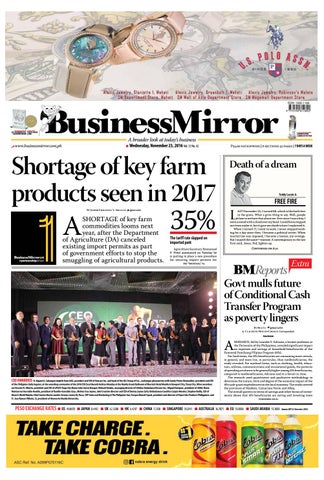
CEO AWARDEES D. Edgard A. Cabangon (eighth from left), president and CEO of Gencars Inc. and head of the ALC Group of Cos., exchanges pleasantries with Sandy Prieto-Romualdez, president and CEO of the Philippine Daily Inquirer, at the awarding ceremonies of the 2016 CEO Excel Awards held on Monday at the Manila Grand Ballroom of Marriott Hotel Manila in Newport City, Pasay City. Other awardees are Ernesto R. Alberto, president and CEO of ePLDT; Naga City Mayor John Garcia Bongat; Michael Deakin, managing director of Lifeline Ambulance Rescue Inc.; Miguel Enriquez, president of rGMA; Maria Montserrat Iturralde-Hamlin, president of Hamlin-Iturralde Corp.; Merlee Cruz-Jayme, chief creative director and CEO of Dentsu Jayme-Syfu; Ombudsman Conchita Carpio-Morales; Stephen Reilly, CEO of Resorts World Manila; Chief Justice Maria Lourdes Sereno; Lucien Dy Tioco, SVP-Sales and Marketing of The Philippine Star; Furqan Ahmed-Sayed, president and director of Pepsi Cola Products Philippines; and Fr. Jose Ramon Villarin, SJ, president of Ateneo de Manila University.
PESO exchange rates n US 49.8670
Conclusion
research, led by Lourdes S. Adriano, a former professor at the University of the Philippines, revealed significant impact on expenses and savings of household-beneficiaries of the Pantawid Pamilyang Pilipino Program (4Ps). For food items, the 4Ps beneficiaries are consuming more cereals, in general, and more rice, in particular, than nonbeneficiaries, the study revealed. For nonfood items, such as clothing, health, education, utilities, communications and recreational goods, the patterns of spending are shown to be generally higher among 4Ps beneficiaries, compared to nonbeneficiaries, Adriano said in a forum in June. The research used quantitative and qualitative methodology to determine the nature, form and degree of the economic impact of the 4Ps cash-grant expenditures on the local economy. The study covered the provinces of Masbate, Camarines Norte and Albay. The overall pattern in terms of savings and other forms of investments shows that 4Ps beneficiaries are saving and investing more Continued on A2
n japan 0.4492 n UK 62.3288 n HK 6.4297 n CHINA 7.2330 n singapore 35.0141 n australia 36.7071 n EU 53.0036 n SAUDI arabia 13.3003
Source: BSP (22 November 2016 )
A2 Wednesday, November 23, 2016
BMReports BusinessMirror
www.businessmirror.com.ph
Govt mulls future of Conditional Cash Transfer Program as poverty lingers Continued from A1
than households not participating in program. In terms of key economic decisions made by the household, the results showed that women in 4Ps households are more active in the decision-making on household marketing and budgeting. “This demonstrates that the program does not only affect the behavior of the households in terms of consumption, but has also enhanced the woman’s role in the decision-making on marketing and budgeting,” Adriano said. She added that the benefits of the 4Ps are not limited to direct material gains. The program also influences aspirations, which, in turn, determines the future behavior of the beneficiaries, according to Adriano. “The study showed that beneficiaries are more optimistic in terms of their children achieving more in life than their parents,” she said. “Further, beneficiaries have higher social aspirations compared to nonbeneficiaries.”
Expansion
UNDER the Aquino administration, the Department of Social Welfare and Development (DSWD) further expanded the 4Ps to cover more poor households to include children up to 18 years of age or until they finish senior high school. “This move ensures that student-beneficiaries will be able to graduate under K to 12, and also encourages students, especially those who need to support their families, to prioritize school over work,” Celia M. Reyes and Aubrey D. Tabuga of the Philippine Institute for Development Studies (Pids) said. Reyes and Tabuga explained in their paper that the 4Ps also made the outcomes of other programs of the DSWD better. One suc h prog ra m inc ludes t he
Shortage. . .
Continued from A1
agricultural products, particularly poultry meat and offal. However, the Philippine Association of Meat Processors Inc. (Pampi) said the new process could delay the shipments of pork cuts and other meat products to their processing plants and the delivery of processed meat products to stores. “For sure [the new process] would cause delays and might even affect our deliveries to the stores. It’s up to them how they will understand our case,” Pampi Executive Director Francisco Buencamino told the BusinessMirror on Tuesday. Buencamino noted leg itimate
Sustainable Livelihood Program (SLP), which serves as the graduation program of the 4Ps beneficiaries, in two tracks: microfinancing for small businesses and assistance to find jobs. Also, the 4Ps was linked to a multiagency effort that provides health and nutrition interventions for infants and their mothers. One program explained that it provided beneficiary-families immunization and nutritional supplementation for infants, as well as livelihood opportunities for their mothers.
Rice value chain
According to the Department of Budget and Management (DBM), the 4Ps is now on a par with its international counterparts eight years after its launch. “But while it proved to be a successful initiative in linking together the government’s basic education, poverty reduction and universal health-care programs, one challenge to sustaining the gains lies in the integration of other areas of social protection into a single, converging blueprint,” the DBM said. Reyes and Tabuga wrote in their discussion paper that the goal of the government’s 4Ps program is the overall improvement in educational attainment of those who are included in the program, with the hope of decreasing dropout rates in schools. “In the long run, the goal of the 4Ps is to achieve improvements in human capital,” the authors wrote. “The 4Ps is seen to have great potential in increasing educational attainment and improving nutrition and health outcomes based on the experience of other countries who have implemented the CCT.” One of the problems in the educational system that the 4Ps is expected to resolve is increasing dropout rates, Reyes and Tabuga said. The authors said the CCT programs in other countries have been successful in achieving higher enrollment rate.
ACCORDING to Adriano, the 4Ps cash grants, along with the Internal Revenue Allotment (IRA) of the local government units (LGUs), create a multiplier effect in the local economy of Bicol estimated to be 7.87 and 3.49 for the first and second income deciles, respectively. Also, it was found out the 4Ps cash grants for Bicolanos can potentially generate an additional P18-billion to 40-billion revenue for the local economy. There is a significant increase in the number of registered agricultural-related businesses in the three locales of the study. Total capitalization of all registered agriculture businesses increased from about P1.65 million in 2005 to about P13.27 million. Total sales also rose from a measly amount of P3.645 million in 2005 to P119.23 million in 2015. The rice consumption behavior of 4Ps beneficiaries who are not rice farmers has changed in terms of quality as manifested by the shift from National Food Authority (NFA) rice to commercial rice. According to the respondents, the cash grants, along with the relatively lower prices of commercial rice, enabled them to afford better-quality commercial rice, Adriano said citing the research results. There are also changes in behavior and action of 4Ps beneficiaries toward other rice stakeholders, she said. “They increased their access to credit from rice retail stores because of the predictable streams of income coming from the 4Ps cash grants,” she said. “Beneficiaries have forged a stronger relationship with retail stores through a ‘suki relationship’ over time.” According to Adriano, rice value chain (RVC) players confirmed slight increase in their incomes when 4Ps beneficiaries became group buyers. In turn, rice retailers
agricultural commodity importers will be affected by the new measure more than the smugglers, because their import shipments could be put on hold while they await their new permits. “The new procedure could result in additional costs. The legitimate importers will be more affected, so the DA should be careful about that,” he added. Buencamino said processed-meat products could become more expensive if their shipments would be slapped demurrage due to the delay in the release of necessary import documents. He warned that the new measure would affect importers with complete and necessary data who applied online. “How do you cancel the permits of those who applied online and have all the correct data? The shipment would have been en
route by then,” Buencamino said. “This is probably ill-advised as the Christmas season is fast approaching. That’s going to create a very confusing disturbance in the market for Christmas items, like luncheon meat, hot dogs and processed pork,” he added. Piñol ordered the revocation of all import permits on all agricultural products—except for rice and corn—following reports of rampant technical smuggling of farm goods, particularly meat. “I issued instructions for an immediate cancellation of all import permits both for meat and plant products because of persistent reports of permit recycling and technical smuggling,” he told reporters in a news briefing. P i ñol m ade t he pronou ncement following reports that there is a “big
International levels
and wholesalers have extended credit and other special arrangements to 4Ps rice consumers to encourage them to buy.
THE DSWD has reported that the agency conducts regular spot checks nationwide with different partner-agencies and organizations that help improve the implementation of the CCT Program. As of May 27, 2015, the DSWD said the CCT has expanded to include 41,519 barangays in 144 cities, 1,483 municipalities and
80 provinces. That time, household-beneficiaries has reached 4.4 million nationwide. Accord ing to Reyes and Tabuga, additional investments are needed to increase the access of poor families to primary and secondary education, so that they can take advantage of employment opportunities in the future by the government. “It is recommended that the 4Ps be redesigned, so that it can increase the skills of the poor, which will enable them to find more jobs with higher wages,” the study stated. As a recommendation, the PIDS research paper explained that the DSWD should deepen the assistance that form the 4Ps rather than expand its coverage, improve its targeting system that will help reduce leakages; review the target number of eligible beneficiaries, updates on estimates that are used as a basis for selecting beneficiaries should be updated every three years, utilize data from a monitoring system rather than conduct a special survey to identify eligible beneficiaries, and targeting the chronic poor was explained to provide better focus to the program. “The chronic poor, generally, are not able to move out of poverty because they have low levels of education that constrains opportunities for productive employment,” Reyes and Tabuga said. “ The chronic poor would need more long-term assistance to allow them to move out of poverty.” The authors added that programs like the 4Ps would be better suited to the chronic poor. “Targeting the chronic poor would direct the program to those who need the assistance most,” the study added. “Moreover, this reduction in the coverage, from all poor to just the chronic poor, would give the fiscal space needed to extend the program coverage to enable the children to finish high school.”
discrepancy” between the data of United Nations and the Bureau of Animal Industry (BAI) on meat imports, particularly offal. He said he would sign a department order revoking the import permits and immediately send it to the Bureau of Customs. Traders are advised to go directly to the central office of the DA to apply for their new import permits. “I am immediately requiring those [importers] holding valid permits to come to the DA for an immediate reissuance of permits. I will personally check all import permits that will be reissued,” Piñol said. The DA chief made an assurance that the new import permits will be issued less than 24 hours so as not to disrupt the trade of farm commodities. Piñol said a technical working group consisting of the Bureau of Plant Industry
and the BAI has been created to assess and handle the issuance of new permits. He noted that meat smugglers have the tendency to misdeclare imported meat products, declaring pork as pork offal to avoid paying the 35-percent tariff slapped on pork. Imported offal is slapped a tariff of only 5 percent. The DA said around 1,700 import permits have been issued, but to date, only 300 to 400 import permits have been used. Piñol said the smuggling of meat usually surges at the start of the Christmas season due to greater demand for pork and chicken meat. “Many unscrupulous individuals are using the same permits all over again and the only way to check this is the total recall of all permits issued and we can only recall this by canceling all permits issued,” he added.
Flea market
IT is now a common sight to see the operations of a flea market near the site where the 4Ps cash payouts are being made. The case study shows that the operations of the flea market is a manifestation that the extra income received from the program can perk up local economic activities since most products being sold in the flea market come from the locality or neighboring areas, according to Adriano. Even merchants not participating in the flea market, such as pharmacy store, minigrocery and school-supplies shops, gained from the expenditures of 4Ps beneficiaries. The municipality derived extra revenues from flea-market traders by imposing market rental fees collected by a designated market collector. The positive contribution of these extra revenues generated is highly visible in Libon, where the successful operation of the Libon Town Center is partly supported by the fees generated from the market rentals where various merchants sell their wares, particularly during payout days. On the other hand, Fermin Adriano, member of the research team, said 4Ps should be combined with other economic enhancing efforts to achieve optimal impact.
Additional investments
Duterte’s talks with Xi, Putin open new areas of cooperation By Catherine N. Pillas
T
@c_pillas29
r ade Secretary Ramon M. Lopez said President Duterte’s bilateral talks with Chinese leader Xi Jinping and Russian President Vladimir Putin at the sidelines of the Asia Pacific Economic Cooperation (Apec) summit in Peru have led to agreements that will launch platforms for joint cooperation with the two world superpowers. The Philippines and China already agreed to a joint economic and technical cooperation in September, the details of which will be threshed out by the Department of Trade and Industry by the first quarter of 2017. China extended $9 billion worth of credit facilities and $13.5 billion in investment pledges during Duterte’s visit to Beijing, securing cooperation in manufacturing, agribusiness, finance and infrastructure, among other areas. Moreover, Lopez reiterated that tourism is one such area expected to boom, as China has already lifted a travel advisory warning its nationals to avoid the Philippines.
As for Duterte’s first meeting with the Russian leader at the Apec meet, several key areas could also be grounds for cooperation, Lopez said. “The fields and areas we discussed on trade and investments are: energy, machine and hardware, energy equipment, railway construction, port infrastructure and monorails,” Lopez told reporters via text message. Further cooperation agreements were outlined in the areas of law enforcement, counterterrorism, national emergencies, education, finance and market access, he added. In the area of agriculture, the Philippines managed to secure a $2.5-billion deal with Russia for imports, citing specifically fruits and agricultural commodities. Bulk of the country’s imports from Russia are petroleum products, as the country possesses the largest oil reserves in the world, and is among the top exporters of natural gas globally. Since taking office, the firebrand Chief Executive has made a marked shift to move away from its longtime Western allies the United States and the European Union to align with China and Russia.
BMReports BusinessMirror
news@businessmirror.com.ph
Wednesday, November 23, 2016
A3
Teo hoping PPP will solve Mindanao’s infra lack By Lorenz S. Marasigan
D
@lorenzmarasigan
AVAO CITY—The lack of transportation infrastructure may dampen the government’s aim of increasing tourism in Mindanao during President Duterte’s term.
But, according to Tourism Secretary Wanda Corazon T. Teo, this could be addressed through the Public-Private Partnership (PPP) Program, a decades-old initiative that only came to fruition in the last administration. “Yes, we are looking at tapping the [PPP] Program. There is actually a budget for us, but our budget for 2017 was already used last year,” she told the BusinessMirror in a chance interview here. She was referring to the Tourism Road Infrastructure Project Prioritization Criteria, more commonly known as TRIPPC, a program that aims to develop roads leading to tourist sites. The P60-billion tourism road-infrastructure master plan is part of the convergence program of the Department of Public Works and Highways (DPWH) and the Department of Tourism (DOT). It was pioneered in 2011, with the aim of constructing, upgrading, rehabilitating and improving roughly 463 roads and bridges. Among the major tourism road projects completed and ongoing include the 5.6-kilometers access road to Puerto Princesa City Underground River, also leading to mangrove forest, white-sand beach, Sabang zipline and Ugong rock mountain in Palawan; the 44.6-km Taytay-El Nido Road, Palawan; the 11-km Ambangeg Junction National Road to Mount Pulag, known for its magnificent view of sunrise and sunset, in Benguet; the 24-km access roads to Donsol, Sorsogon, famous for whale-shark viewing, locally known as butanding; the 41-km Panglao Island Circumferential Road leading to location of Bohol’s beach resorts and dive spots; and the 31-km Island Garden City of Samal Circumferential Road, which provides access to Pearl Farm Beach Resort and Samal Botanical Garden on Samal Island, Davao del Norte. “I’m sure by 2018, we will have a bigger budget. But for now,
We are asking for an additional P200 million to support other projects.”—Teo
DOJ backs Con-ass mode in amending Constitution By Jovee Marie N. Dela Cruz @joveemarie
T
he Department of Justice (DOJ) on Tuesday said constituent assembly (Con-ass) is the best way to amend the 1987 Constitution. During the consultation process conducted by the House Committee on Constitutional Amendments, the justice department said Con-ass is the most practical and least expensive mode of changing the Charter. “To have a truly democratic and constitutional government, it is absolutely necessary that the Constitution be initially drafted by duly elected members of a representative constituent assembly and later approved by people in the plebiscite,” Justice Undersecretary Erickson H. Balmes said. “The department supports the move for the amendment of the charter through Con-ass. However, we opted to defer the identification of the different specific provisions that need to be amended. The amendment or revision of the Constitution is delegated to the members of Congress via Con-ass,” he added. Balmes said members of Congress already know what agenda to pursue, thus, reducing horse-trading and political accommodations. To address the concern of perceived lack of trust, Balmes said the proceedings should be made transparent and civil-society organizations can serve as watchdogs. “As a Con-ass, the Senate and House of Representatives become a constituent body exercising special power to formulate a new constitution or propose amendments to the Constitution. The product of the Con-ass will be approved by the people through a referendum,” he added. The justice undersecretary also said there is no need to hold costly election since members of both the Senate and House of Representatives, who have been directly elected by the people, will be the ones to constitute the assembly. “The joint resolution that will create a Con-ass can limit the agenda of amendments and protect the good provisions of the current constitution,” Balmes said. “Further in the ratification of the proposed amendments, the people can approve only those that will benefit the country and disapprove the amendments they deem unacceptable.” Meanwhile, Philippine Constitution Association Chairman Manuel Lazaro said Congress should ensure that the revised Constitution will be more permanent. Lawmakers should also avoid provisions that are fraught with dangers of being amended constantly through mere legislative action. “As you will notice, in the 1935 and 1973 Constitution, you could hardly see phrases ‘as provided by law,’ because everything has been included there,” he said. According to Lazaro, 89 provisions of the current Constitution need enabling laws before they can be implemented, but the Congress was only able to pass 10 enabling laws since its ratification. “You have a paradox of a Constitution that can be amended by law anytime. The Constitution should only contain principles and policies,” he said.
we are asking for an additional P200 million to support other projects,” Teo said. This will, hopefully, support the tourism department’s target of scaling up tourist arrivals in Mindanao through President Duterte’s term. “The target that has been set is to really increase it by 10 [percent] to 20 percent, but that would actually depend upon the logistics support when it comes to infrastructure,” Tourism Assistant Secretary Eden Josephine L. David said.
Over the last six years, tourist arrivals in the five regions in Mindanao grew by 10 percent on the average. Last year saw Region 9 reporting a total of 800,000 visitors; Region 10, with 2.7 million arrivals; Region 11, with 2.8 million visitors; Region 12, with about a million arrivals; and Region 13, with 1.2 million visitors. “There’s really an increase in number of tourists for Mindanao over the last few years,” David said. “That’s why there is a Mindanao Logistics
Plan, which will support road travel across Mindanao.” The tourism department has partnered with the Mindanao Development Authority to craft the Mindanao Logistics Plan, a proposed blueprint that aims to complement infrastructure development in the area. “The Mindanao Tourism Development Plan would have to be started by 2017, when we start consolidating the efforts of each of the regions,” David said.
Economy
A4 Wednesday, November 23, 2016 • Editors: Vittorio V. Vitug and Max V. de Leon
BusinessMirror
Salceda sees 9% GDP for PHL in 3 years under Duterte admin
A
By Johnny C. Nuñez | Philippines News Agency
lbay Rep. Joey S. Salceda said the Philippines’s GDP could hit 9 percent in three years, with President Duterte’s policy strengths and a blueprint for growth hinged largely on infrastructure. A known economist, the lawmaker from Bicol projects the GDP growth can be attained under current administration’s massive infrastructure program, ushering in a “golden age” of infrastructure in the country.
Quoting economic forecast models developed by a group of econometricians, the lawmaker said by 2019, the country can hit 9-percent GDP with “infrastructure spending from 5 percent to 6 percent of GDP, funded by new taxes and tax efficiencies.” Salceda, vice chairman of the House Committee on Economic Affairs, said the 7.1-percent GDP attained by the country in the third quarter this year—which made the Philippines the fastest-growing economy in Asia—can further accelerate in the fourth quarter, to
83% The jump in infra spending in September alone
about 7.5 percent in 2017. The Philippine Statistics Authority reported that the Philippines’s 7.1-percent third-quarter growth bested China’s 6.7 percent, Vietnam’s
6.4 percent, Indonesia’s 5.0 percent and Malaysia’s 4.3 percent. The Philippines now just needs to post a 6.9percent growth in the fourth quarter to hit the top end of its 6-percent to 7-percent target for 2016, he added. The growth in the third-quarter 2016, which is also the first quarter of the Duterte economy, was itself propelled by infrastructure spending, backed up partly by agrirecovery and remittances from overseas Filipino workers (OFWs). The impressive growth was also aided on the side by the government peace initiatives and fiscal reforms, the same factors seen to further boost the economy in the next three years, he added. Salceda said investments in construction and infrastructure are now the biggest source of growth in the country, “higher than consumption,” which Salceda noted he “can’t remember seeing one in past history,” adding that “massive infrastructure development will generate more jobs, create strong middle-class families, promote inclusive growth, and reduce the country’s marginalized sector.” The lawmaker also cited the “dividends of peace on the streets and peace with the Left and the MILF [Moro Islamic Liberation Front], whose indefinite cease-fire modes should boost business activities and investments in greenfield areas, and, thus, further lift the trajectory of growth, with the GDP hitting 7.5 percent in 2017.”
This likelihood, he added, could materialize, despite the “risks to global growth posed by US President-elect Donald Trump’s inclination toward protectionism, the soft landing of China and possible Federal hikes in the US.” He said the Philippines “has the policy strengths that serve as drag coefficient against the headwinds of global risks,” noting that, aside from the government’s peace initiatives, the economy was also propped up by expenditure reforms introduced by the Department of Budget and Management (DBM). “Underspending was radically cut down from P275 billion in first three quarters of 2015 to only P59 billion. In September alone, infra spending leaped by 83 percent,” the lawmaker pointed out. With the usual heavy consumer spending and flood of remittances by OFWs, in the last two months of the year, a higher GDP growth figure for the period is now almost certain, he added. Aside from the role played by infrastructure spending and the fiscal reforms of the DBM, Salceda said the strong consumer confidence in the Duterte administration was also a key factor in the GDP growth. “On the supply side, it was led by manufacturing and exports resurgence with industry growth of 8.6 percent and 7.8 percent, respectively, now exceeding services at 6.9 percent and the modest recovery of the agriculture sector,” he added.
news@businessmirror.com.ph
Trillions to gain if bizmen go green, ADB exec says By Cai U. Ordinario
B
@cuo_bm
usinesses across Asia, including in the Philippines, have trillions to gain if they choose to “go green”, according to the Asian Development Bank (ADB). In a speech delivered on Tuesday, ADB Sustainable Development and Climate Change Department Director General Ma. Carmela D. Locsin stressed that “going green is good business.” Locsin said the green business market amounted to as much as $1 trillion in 2015, and projections bared that the market will expand to around $1.4 trillion in 2020. “Asia’s current share is 22 percent, if you include Japan. But if you exclude Japan, it is only 12 percent. How do we expand this growth market of environmental goods and services to help sustain, as well as restore, our oceans, our forests, our lands?” Locsin said. “With investments needs ranging from $300 billion to $1 trillion on a current year basis, this sizable investment gap clearly makes a very strong call for very robust, very active private investment,” she added. United Nations Environment Programme Executive Director Erik Solheim said in a panel discussion that, in order to encourage businesses to go green, the private sector must change its mindset. This change in mind-set should think about going green as a legitimate business opportunity rather than a liability or cost to the company. Solheim said this change will only happen through strong political action, proper regulation by governments, and businesses given the leeway to innovate and seek technological innovations that can help their green business become profitable. “The most important issue is a change in mind-set. [Companies view going green] as a cost. [They must view it] as an enormous business opportunity,” he added. Environment Secretary Regina
Paz L. Lopez said this change in mind-set not only entails dangling incentives or tax cuts but better education. Lopez said learning about the natural resources of the Philippines actually presents a solid business case for companies to invest. For one, Lopez said, around 70 percent the country’s flora and fauna are endemic to the country. This includes Philippine bamboo, which can be used to make various products. This signals to investors the unique products and opportunities that they can take advantage of if they choose to go green and operate in the country. “You can build six-story buildings, low-cost housing, bamboo bikes, bamboo furniture, bamboo tiles, bamboo clothes, it’s huge!” Lopez said. University of Illinois UrbanaChampaign Professor in Environmental Economics Madhu Khanna said the shift must begin in information provision of what firms around the world are doing to go green—whether it is investing in new green ventures or transforming their existing companies into green businesses. Khanna said information about the best chemicals to use for certain products or which products are being recycled to create new goods and services should be made public. Apart from these companies efforts, Solheim said a “name and shame,” as well as a “name and fame” campaign, must be undertaken to encourage companies to do their part in going green. “You must also provide positive recognition to business leaders engaged in and are doing well in their green ventures,” Solheim said. The ADB hosted its First Green Business Forum in recognition that green business is a key component and mover of green growth. It is a gathering of green business practitioners and professionals to conduct an open dialogue and share their best ideas and experiences.
briefs
napocor, usaid forge partnership to strengthen forest-protection measures
Easy does it Some 900 children-beneficiaries of the Pantawid Pamilyang Pilipino Program (4Ps) get free medical and dental treatment from the Armed Forces of the Philippines (AFP) and the Department of Health (DOH) doctors during the Araw ng Kabataan celebration at the AFP Theater Lobby in Camp Aguinaldo, Quezon City, on Tuesday. PNA/Joey O. Razon
BOI eyes CARS template to boost shipbuilding, pharmaceutical sectors
T
he Board of Investments (BOI) is eyeing to replicate the automobile industry’s Comprehensive Automotive Resurgence Strategy (CARS) Program in the shipbuilding and pharmaceutical manufacturing sectors to bolster the country’s industrialization bid. Trade Undersecretary Ceferino S. Rodolfo said under the Industrial Cooperation Dialogue with Japan, the main platform for partnership in industries will center on three
main sectors under manufacturing, automobiles and shipbuilding. “During the last presidential visit [to Japan], we expanded the industrial cooperation dialogue by including other sectors, including shipbuilding,” Rodolfo said in an interview on Monday. Through the dialogue, he added, the Department of Trade and Industry (DTI) wants the local shipbuilding industry to
produce smaller roll-on, roll-off vessels, and hopes to entice international shipbuilders to locate here. “We have local shipyards but they’re still small. They need infusion of capital and technology transfer from foreign firms. In Japan you can see that they want their shipbuilding firms to go out. That industry is labor-intensive and they have an aging population,” he added.
Aside from shipbuilding, the DTI is also aiming to boost the local pharmaceutical manufacturing industry, in an effort to lower the cost of medicine. “The policy mechanism by which we’ve been addressing the high cost of medicine is through parallel importation. Now, we want to add the manufacturing component. We want to see if there’s an opportunity to develop it,” Rodolfo said. Catherine N. Pillas
The National Power Corp. (Napocor) and the United States Agency for International Development (USAID) signed a memorandum of understanding (MOU) to establish cooperation in strengthening the forest-protection programs of each agency. Napocor President Ma. Gladys Cruz-Sta. Rita said the agreement is highly beneficial, since both parties share a common interest for the Philippines’s natural forests. With the MOU, both agencies will be able to share their respective expertise, strengths, resources, technologies and methodologies in protecting the forest. “We at Napocor manage 11 watershed systems that support hydro and geothermal power facilities, while the USAID supports forest protection and biodiversity conservation in the country through its Biodiversity and Watersheds Improved for Stronger Economy and Ecosystem Resilience [B+WISER] program,” Sta. Rita added. Napocor’s watershed management will also be empowered with the use of Lawin Forest and Biodiversity Protection System. Lawin, which is a program developed by the USAID with the Department of Environment and Natural Resources, combines science-based planning, technology-aided monitoring and indigenous knowledge to protect the forests. It uses open-source technology that is accessible to communities, private sector and the government through a smartphone or tablet application. Lenie Lectura
phl keen on tourism cooperation pact with italy
Corporate governance
Rex C. Drilon (right photo), trustee of the Institute of Corporate Directors (ICD), conducted a corporate governance orientation program for a government -owned and controlled Corporation at the Manila Peninsula Hotel on Monday. Shown in photo are delegates of the Philippine Charity Sweepstakes Office (PCSO) headed by Chairman Jose Jorge E. Corpuz (seated, second from left), General Manager Alexander F. Balutan (third from left), members of the Board of Directors Loreto Ata and Marlon Balite, Board Secretary Michael Medado, Chief of Staff Raymondo Liwag, Office of the General Manager (OGM) lawyer Ferdinand Fevidal (Executive Assistant VI of OGM), Chief of Staff Abraham Urubio (Office of the Chairman), and Jose Miguel Corpuz (Executive Assistant VI). The ICD aims to promote and sustain the advocacy of good governance in the corporate sector. JOSEPH MUEGO
The Philippines is interested in forging a tourism cooperation with Italy, particularly on sustainable tourism. A Department of Foreign Affairs (DFA) statement released on Tuesday said Philippine Ambassador to Italy Domingo Nolasco informed that Tourism Secretary Wanda Corazon T. Teo was in Rome recently to discuss possible tourismcooperation opportunities with Italy. The statement further said Teo met with Italian Undersecretary for Cultural Heritage Ilaria Borletti-Buitoni to discuss the plan. During the meeting, Teo highlighted the various possibilities available to tourists in the Philippines, including adventure, beaches, mountains and culture, among others, the DFA statement further said. Teo said a group of Italian tour operators will conduct a familiarization tour in the Philippines this year. They will visit some of the Philippines’s main sights. The tour operators are the Department of Tourism’s partners in promoting and selling the Philippines’s destinations to Italian tourists. One of the DOT’s main strategies is to target long-staying and high-spending tourists to ensure sustainable tourism. In the same visit, Nolasco briefed Teo on the interests and inclinations of Italian tourists when they travel. He underscored that the Philippines can learn from Italy’s expertise and know-how on the management of sustainable tourism and the preservation of cultural sites and heritage. PNA
Agriculture/Commodities BusinessMirror
news@businessmirror.com.ph
Editor: Jennifer A. Ng • Wednesday, November 23, 2016 A5
Piñol sees Q4 agriculture growth at 4%
F
By Jasper Emmanuel Y. Arcalas @jearcalas
arm output in the fourth quarter of the year could grow by 4 percent on the back of higher crops production, as farmers are encouraged by the opening of new markets for Philippine agricultural products.
A g r icu lture Secretar y Emmanuel F. Piñol’s said the “timely” provision of interventions to typhoon-affected farmers would also help boost output in the October-to-December period. “I think farm-production growth may hit 4 percent toward the end of the year,” Piñol told reporters on the sidelines of a news briefing at the Department of Agriculture’s (DA) central office on Tuesday. Farm output in the fourth quarter of 2015 declined by 0.96 percent. The Philippine Statistics Authority (PSA) said the sector’s performance was negatively affected by the long dry spell and damages caused by Typhoon Lando. Piñol said the crops subsector would continue to drive farm growth in the fourth quarter, just like in the July-to-September period, when agriculture output grew by 2.98 percent. “I would believe so [that rice and corn production would rebound in the fourth quarter]. We distributed hybrid seeds to farmers in areas devastated by typhoons,” he said. Piñol also noted that the reopening of Chinese market for Philippine farm produce would also boost fourth-quarter farm growth. “The reason agriculture performance declined last year was also because of China’s decision to ban 27 Philippine agricultural companies. It had a big impact on the sector,” he said. Despite the DA’s sanguine outlook for the sector, Piñol said agriculture performance for the whole of 2016 would register flat growth. Farm output rose by only 0.11 percent last year. “We cannot overcome the 7-percent contraction in farm output
in the first two quarters of the year,” he said. Data from the PSA showed that the crops subsector expanded by 5.24 percent in the July-to-September period. The subsector accounted for 45.63 percent of total agricultural output in the third quarter. Production of palay and corn increased by 16.35 percent to 3 million metric tons (MMT) and 10.61 percent to 2.7 MMT, respectively. The growth in palay production was attributed to the rehabilitation of irrigation canals and early rains in Ilocos region, Cagayan Valley, Central Luzon and Northern Mindanao. In Central Luzon—the country’s rice granary—the PSA said the government’s distribution of certified seeds also helped boost production. The PSA added that corn production benefited from the expansion of harvest areas in Zamboanga Peninsula, Northern Mindanao, Soccsksargen and the Autonomous Region in Muslim Mindanao. Among the crops grown in the country, the PSA said sugarcane and coconut posted contractions in output at 46.39 percent and 7.2 percent, respectively. The dry spell, which caused stunting in sugarcanes, caused output to decline by nearly half. Coconut production, the PSA said, was affected by a rat infestation and El Niño, which caused the development of smaller coconuts. PSA data also showed that the livestock subsector posted a growth of 3.89 percent, while poultry production rose by 2.43 percent. Among all subsectors, fisheries performed poorly as it contracted by 2.53 percent in the third quarter, according to the PSA.
file photo
Malaysian firm to invest $1B in PHL palm-oil plantation By Catherine N. Pillas @c_pillas29
A
Malaysian company is planning to set up a $1-billion palm-oil plantation in the Philippines, according to the Philippine Economic Zone Authority (Peza). Peza Director General Charito B. Plaza said Alif Oil Trading Co. requires 128,000 hectares of land for palm oil in Agusan del Sur. Plaza added that some ancestral lands may be covered by the proposed plantation and that indigenous peoples in the area will be approached before rolling out the project. “What we are doing now to accommodate the 128,000 hectares is, we’re talking to the Department of Trade and Industry, the local government of Agusan del Sur and the National Commission on Indig-
enous Peoples [NCIP],” she said in a recent interview. “We are talking with the clans and the owners of these ancestral domains, but they’ve already signed a memorandum of understanding that these will be converted to special economic zones for the palm-oil industry,” Plaza added. President Duterte recently flew to Malaysia to strengthen economic cooperation with Asean neighbors as part of the Philippines’s efforts to pursue an “independent foreign policy.” In a news briefing recently in Kuala Lumpur, Trade Secretary Ramon M. Lopez said the production from the palm-oil project will be exported. Alif Oil Trading Co. will also put up facilities to further process palm oil. Plaza also said the $1 billion is just an “initial estimate” as refinery plants will likely be set up in
New tech to speed up breeding of crops, livestock launched in Kenya
N
A IROBI— Scient ists on Monday launched a revolutionary service to speed up breeding for improved crops and livestock in Africa. T he Integrated Genot y ping Service and Support (IGSS) that is based at the Biosciences eastern and central Africa-International Livestock Research Institute (BecAILRI) Hub in Nairobi uses tools that process genetic data quickly, more accurately and affordably. “Scientists are now able to shorten cycles of breeding new improved varieties of crops and livestock in the continent,” Director of the BecAILRI Hub Appolinaire Djikeng said. Djikeng noted that the new technologies enable scientists to have information that will support the development of resilient livestock to withstand the very harsh environments common in the face of climate change. He obser ved that the technologies are meant to create opportunities for communities to benefit, since breeding is an important business for farmers and livestock keepers. Djikeng said the technology allows for the selection of deoxyribonucleic acid (DNA), a significant molecule which carries instructions required to reproduce, develop and live. “It’s upon the regional governments to put money now in accessing the technology to ben-
Mindanao and Palawan. The Peza chief hinted at the possibility that the Malaysian firm may also produce oil for the domestic market. Currently, the palm-oil industry is being regulated by the Philippine Coconut Authority (PCA), an attached agency of the Department of Agriculture (DA). Philippine Palm Oil Development Council Inc. (PPDCI) Vice President Erwin Garcia earlier pushed for the creation of a separate agency for palm oil to hasten the industry’s development and “unlock” the potential of palm-oil production, which is badly in need of government support. All efforts to sustain the palm-oil industry in the Philippines have, so far, been led by the private sector, Garcia said. Aside from the creation of the agency, Garcia called on the govern-
Region 12 mango producers eye supply deals with processors
G
Gary Fandel/Bloomberg
efit their farming communities,” he added. It enables researchers to gain a better understanding of the genetic basis for resistance to crops, such as Maize Lethal Necrosis (MLN), and could speed up the development of resistant varieties to this devastating disease of maize. Andrzej Kilian, the founder and the director of Diversity Arrays Technology, said the platform costs $9 million to be installed and
have personnel trained. It can be used by any individual, regional research organization, small and medium enterprises (SMEs), large companies operating in Africa, or international research center with particular focus on the African national agricultural research system breeding programs. The technology provides genotyping, bioinformatics, genetic analysis and breeding decision support services to crop and livestock
improvement programs. It also offers programs to support capacity-building of any organization in using molecular plant breeding. The IGSS project is collaboration between the BecAILRI Hub and Diversity Arrays Technology from Australia to support African national crop and livestock breeders to harness the power of genomic data increase the efficiency of their breeding programs. PNA/Xinhua
ment to put in place a “concrete” plan to help palm-oil producers. “The government should have a clear vision on how they will help the farmers,” he said. The PPDCI said it proposed an industry-development road map to the government, but the outgoing administration “just sat on it.” According to Garcia, the proposed 10-year road map outlined the challenges faced by the industry, as well as the strategies to overcome these. One of the targets set in the road map, he said, is to address the shortage in palm-oil production in the country. “Right now, we have to plant around 200,000 hectares of oil palm just to be self-sufficient. This is enough to wipe out our importation of palm oil. But, we are planting palm oil in only 5,000 hectares per year,” Garcia said.
ENERAL SANTOS CITY— Mango producers in Region 12 are working on forging marketing and supply agreements with a fruit processor and a beverage company based in South Cotabato province. Emmanuel Bartocillo, president of the Region 12 Mango Industry Development Council Inc. (RMIDC-12), said on Tuesday negotiations are under way for the delivery of mango supplies by local mango growers to processing plants in the area of the SeaBest Food and Beverage Corp. (SFBC) and the Truly Natural Food Corp. (TNFC). He said the move is an offshoot of a recent market-matching activity facilitated by the Agribusiness and Marketing Assistance Division of the Department of Agriculture (DA) in Region 12. “We initially presented proposals for market deals and they showed interest to venture with us,” Bartocillo said. SFBC, which is based in Barangay Silway 7 in Polomolok town in South Cotabato, produces processed dried fruits, juice drinks. Its main activity is the production of bottled water that are marketed under the brand name “Pearl.” Its main plant is in Barangay Pagalungan, Polomolok. The company, which is a is a wholly
owned subsidiary of the RD Corp. here, exports bottled water to Papua New Guinea, Cambodia and other countries in Asia. TNFC also produces processed fruits and juice drinks for domestic and export markets through its plant based in Barangay Glamang, Polomolok. The company’s products carry the “Sweet Valley” brand. Aside from the two companies, Bartocillo said they are also eyeing to seal supply and marketing deals with several companies. He said DA-12 signified to facilitate more market-matching activities and include more local mango growers in its trial export program. Last year DA-12 facilitated the shipment to Dubai of around two tons of carabao mangoes produced by RMIDC-12 members based in Tulunan, North Cotabato. Region 12 is currently the country’s fifth-biggest producer and exporter of mangoes, according to the Philippine Statistics Authority. In 2015 the region’s mango production reached 58,595 metric tons, as the area’s mango plantations expanded to 17,000 hectares. With the continuing production expansions in the region, Bartocillo added that they are hoping to become the country’s top producer and exporter of mangoes by 2019. PNA
A6
Wednesday, November 23, 2016
The World BusinessMirror
Editor: Lyn Resurreccion • www.businessmirror.com.ph
Trump rejection of TPP trade deal rued in Asia
briefs
New Zealand hit by 2 strong quakes; no reports of damage
T
WELLINGTON, New Zealand—Two strong earthquakes rattled different parts of New Zealand on Tuesday but there were no initial reports of serious damage or injuries. The first 5.6-magnitude quake struck off the coast of New Zealand’s North Island at about 1:20 p.m. It was followed about five hours later by a 5.3-magnitude quake that struck the South Island and appeared to have been an aftershock from a powerful earthquake last week. That quake on Monday last week was measured at 7.8-magnitude and killed two people after it struck just near the coastal town of Kaikoura. The Pacific Tsunami Warning Center did not issue a tsunami warning for either of Tuesday’s quakes. AP
Taiwanese airline TransAsia shuts down after heavy losses
TAIPEI, Taiwan—Taiwanese airline TransAsia has announced it is shutting down, following financial losses and two fatal crashes. TransAsia Chairman Vincent Lin said on Tuesday the airline, which served cities in China, Japan and Southeast Asia, was unable to reverse widening losses or raise additional money. TransAsia was established in 1951 as Taiwan’s first privately owned airline. The carrier suffered two fatal crashes in 2014 and early 2015, both in Taiwan, that killed a total of 92 people. AP
Iraqi forces move to retake another Mosul neighborhood
IRBIL, Iraq—A senior Iraqi commander says troops are moving to take another neighborhood in the eastern sector of the northern city of Mosul but are meeting stiff resistance from Islamic State (IS) militants. Brig. Gen. Haider Fadel of the special forces tells The Associated Press that IS fighters are targeting his forces with rockets and mortars as they slowly advance in the densely populated al-Zohour neighborhood on Tuesday. He says they’re “cautiously advancing.” Iraq’s military launched a campaign on October 17 to retake Mosul, Iraq’s second-largest city and the last major IS urban bastion in the country. Most gains have been made by the special forces operating east of the Tigris River. Other forces are advancing on the city from different directions, and the US-led coalition is providing air strikes and other support. AP
Turkey withdraws child marriage bill
ANKARA, Turkey—Turkey’s prime minister says his government is withdrawing a proposal that critics say would legitimize child marriages and will, instead, submit it for review by a parliamentary committee. The proposal, which was scheduled to undergo a final vote on Tuesday despite a public outcry, would have deferred sentencing or punishment for sexual assault in cases where there was no physical force and where the victim and perpetrator were married. The age of consent in Turkey is 18, although courts permit civil marriages for people as young as 16. Many younger people are married in Islamic ceremonies. AP
North Korean defector Cha Ri-hyuk, 31, who came to South Korea in 2013, talks about the many markets that recently have opened up in North Korea, as he walks outside of a local market in Seoul, South Korea. AP/Lee Jin-man
Defectors: N. Korea would fall without capitalistic markets
S
EOUL, South Korea—Hundreds of capitalistic markets, each with thousands of stalls, form the glue that holds North Korea’s socialist planned economy together, say defectors who sold medicinal herbs, skinny jeans, TV sets, foreign drama CDs and other goods there to make a living. “People there say North Korean markets have everything but a cat’s horn. They truly have everything there,” said Cha Ri-hyuk, 31, who came to South Korea in 2013. “If North Korea shuts downs markets, it will collapse, too.” North Korea has tolerated—and taxed—some market activities since the country’s state rationing systems crumbled amid an economic crisis and famine that killed an estimated hundreds of thousands in the mid-1990s. The economic boost the markets provide has helped leader Kim Jong Un keep a grip on power and further his nuclear ambitions, leaving the North’s harsh political system and alleged human-rights abuses largely untouched. But some political analysts note that market activities are gradually infusing North Koreans with new ways of thinking that eventually, could loosen the authoritarian government’s hold over its 24 million people. “ It ’s l i ke potent i a l forces which can fundamentally shake the North ’s systems are growing,” said Lim Eul Chul, a North Korea expert at South Korea’s
24M The population of authoritarian North Korea
Kyungnam University. Satellite photos and testimonies of defectors show there are now about 400 mostly outdoor markets, called jangmadang, in the North. Recent surveys of refugees suggest most ordinary North Koreans resort to market activities for a living, as the country’s public rationing systems have never been fully restored. Four defectors who talked to The Associated Press (AP) said they received no rations at all. North Korea has periodically tried to prevent markets from growing too fast by restricting the operating hours of markets and barring young people from working there. But such measures often are later withdrawn, according to activists specializing in North Korea affairs. T he harshest measure was
taken in 2009, when authorities replaced all currency and limited the amount of old bills citizens could exchange in a bid to reassert control over the economy. But no serious measures have been implemented since Kim assumed power in late 2011, after his father’s death. Kim has vowed to improve public livelihood while pouring resources into weapons programs to cope with what he calls increasing US military threats. North Korea rarely allows international news organizations to conduct reporting at capitalistic-style markets. In 2004, however, the AP was given an unusual chance to film Pyongyang’s crowded, yet clean, indoor Tongil Market, where neatly uniformed merchants sold goods, including bananas, fish, vegetables, women’s underwear, shoes and tennis rackets. Defectors say the Pyongsong wholesale market, near the North’s capital Pyongyang, is the biggest, with an estimated tens of thousands of stalls. To work at a market, a merchant buys a stall and pays daily tax to authorities. There is no official data on how much money North Korea collects from market merchants every year. Items sold in jangmadangs are locally produced, or imported or smuggled from China, South Korea and elsewhere. South Korean-made clothes, shoes and soap opera CDs are especially popular, though it’s illegal in the North to sell goods made by its archrival. Regular police crackdowns have not sapped demand. “No matter how high prices for South Korean clothes I called, they were all sold out,” said Lee O.P., who sold such clothes at a Musan
market in the northeast before she made it to South Korea in December 2014. She requested her first name be identified only as initials due to worries about the safety of relatives left in the North. W hen North Korean police find people wearing South Korean clothes or dresses they consider too skimpy or tight, they often take them to back alleys and rip parts of their garments with razors or scissors, according to Cha and Lee. The markets have given North Koreans a taste of foreign culture, eroded their dependence upon a government that no longer feeds them and opened up a new gap between rich and poor. There is little to suggest that the country’s authoritarian rule has weakened, but at the same time, experts say, the North must take care to avoid economic policies that harm the markets. For instance, the 2009 botched currency reform reportedly triggered widespread public complaints that led to the execution of a top Workers’ Party official. There are risks in the business, whether authorities are hunting for contraband, cracking down on foreign currency or simply committing graft. Lee O.P. says she decided to flee after police officers confiscated her whole savings for unauthorized phone calls with her daughter who already defected to South Korea. Now in South Korea, Lee O.P. said she was amazed at social welfare programs directed at her and other underprivileged people. “For me, it’s like North Korea is a capitalistic country while South Korea is a socialist country,” she said. “In North Korea if you don’t have money, you’ll just have to die.” AP
Trump called to ensure better China-US ties T
he China-US relationship is “too big to fail” and President-elect Donald J. Trump shares an obligation to make sure ties between the world’s two largest economies improve and never worsen, the Communist Party’s People’s Daily newspaper said. The party’s flagship newspaper said in an editorial on Tuesday that the importance of China’s relationship with the US was selfevident and any breakdown in ties
could result in global “disaster.” The piece reiterated President Xi Jinping’s message in a postelection telephone call with Trump last week that cooperation was the only correct choice for managing ties. “It’s not hard to predict that a cooperative China-US relationship will bring huge benefits across the globe,” the paper said. “However, if the two nations became entangled in friction, and even in confrontations, it will be
a disaster to the two countries and the world.” The editorial represented China’s latest effort to shore up ties with its largest trading partner in the wake of the surprise election win by Trump, who frequently accused the country during his campaign of victimizing the US. T he bi l liona ire rea l-estate developer has promised to label China a currency manipulator, bring trade complaints against
the nation, and impose tariffs if it doesn’t halt what he sees as unfair trading practices. The editorial stressed common interests and noted the similarity between Trump’s promise to “make America great again” and Xi’s own “Chinese dream” slogan, which calls for a “great renaissance of the Chinese nation.” The paper said agreements with the Obama administration had increased investment and “laid the
foundation for future China-US relations,” without mentioning the climate-change deal Trump has vowed to tear up. The paper characterized the first exchange between Xi and Trump as productive. “The two leaders had a good chat, a positive atmosphere and reached important consensus,” the paper said, adding that the conversation provided ties with a “key theme and direction.” Bloomberg News
OK YO —President- elect Dona ld J. Tr ump’s announcement that he plans to quit the Trans-Pacific Partnership (TPP) trade deal may spell the end of the dozen-nation trade pact—at least in its original form. But other Pacific Rim leaders are vowing to pursue market-opening efforts they view as vital for their own countries’ future growth. Meanwhile, China also is moving ahead with rival free-trade initiatives. Trump’s message, in a short video on his future administration’s plans, was issued just after leaders of the Asia-Pacific Economic Cooperation (Apec) group ended their annual summit on Sunday with a unified call to fight the backlash against free trade highlighted by Trump’s victory and Britain’s vote to leave the European Union. In an annex to t heir summit st atement, t he Apec leaders gat hered in Lima, Per u, voiced s up p or t for t he T PP, w h ic h has been env isioned as a step towa rd bu i ld ing a w ider, pa nPac if ic f ree -t rade zone. Spea k ing af ter his ret ur n home, New Zealand Prime Minister John Key told reporters on Tuesday there were alternatives. “ The United States isn’t an island. It can’t just sit there and say it’s not going to trade with the rest of the world,” Key said. “At some point they’re going to have to give some consideration to that. But naturally, we’re a bit disappointed.” AP
‘India’s antigraft bank-note move hurting poor’
I
ndian Prime Minister Narendra Modi’s move to withdraw higher-value bank notes from circulation is hurting ordinary citizens, rather than making a serious attempt at combating corruption, according to former US Treasury Secretary Lawrence Summers. Modi this month announced that 500 and 1000 rupee notes will no longer be legal tender in a bid to crack down on counterfeiting and graft, effectively scrapping more than 85 percent of notes in circulation. It caught citizens by surprise in an economy where businesses and consumers often transact in hard cash. Frustrations have boiled over across the country as bank machines ran out of money and customers waited in long lines to exchange their old notes for new ones, while shopkeepers complained of slower sales. “We strongly suspect that those with the largest amount of ill-gotten gain do not hold their wealth in cash but, instead, have long since converted it into foreign exchange, gold, bitcoin or some other store of value,” Summers and coauthor Natasha Sarin wrote in a blog post on his web site on Monday. “So it is petty fortunes, not the hugest and most problematic ones, that are being targeted.” Summers said same argument he’s advocated for abolishing large denominations in the US and Europe can’t be made for poorer India. The 500-rupee note—the equivalent to about $7.30—is widely used in the Asian nation, while the biggest denomination in the US—$100 bills—are rarely handled by even the richest Americans, according to the blog. “The ongoing chaos in India and the resulting loss of trust in government fortify us in this judgment,” Summers wrote. The authors also questioned the efficacy of the measures. While the government assesses that the move could expose as much as $74 billion in unaccounted cash, opinions are mixed about its impact on future tax evasion. Bloomberg News
The World BusinessMirror
www.businessmirror.com.ph
Wednesday, November 23, 2016
A7
Quake causes tsunamis, nuclear worries in Japan
T
OKYO—Coastal residents fled to higher ground as a powerful earthquake sent a series of moderate tsunamis toward Japan’s northeastern shore on Tuesday and fueled concerns about the Fukushima nuclear power plant destroyed by a much larger tsunami five year ago.
Lines of cars snaked away from the coast in the predawn hours after authorities issued a tsunami warning and urged residents to seek higher ground immediately. The warning was lifted nearly four hours later. The 7.4-magnitude earthquake struck in the same region that was devastated by a tsunami that followed a much larger magnitude 9.0 quake in 2011, killing some 18,000 people. The US Geological Survey measured Tuesday’s quake at 6.9. It was the largest earthquake in northeastern Japan since the 2011 one and some large aftershocks the same day. At least 12 people were reported injured, and Japanese TV images showed items scattered on the floor in a store, and books that had fallen from shelves in
7.4
The magnitude of the earthquake that hit Fukushima, Japan, on Tuesday morning, described as an “aftershock” of the massive 2011 quake a library. The earthquake shook buildings in Tokyo, 240 kilometers southwest of the epicenter. T he Japa n Meteorolog ic a l Agency described it as an “aftershock” of the massive 2011 quake. It warned that another large earth-
In this image made from video released by Miyagi Prefectural Police, the water flows up river in the Sunaoshi River in Tagajo, Miyagi prefecture, northern Japan, as a tsunami warning is issued following a strong 7.4-magnitude earthquake on Tuesday. Miyagi Prefectural Police/Kyodo News via AP
quake could hit in the next few days and urged residents to remain cautious for about a week. “Aftershocks could continue not only for five years, but as long as 100 years,” Yasuhiro Umeda, a Kyoto University seismologist, said on a talk show on Japanese broadcaster NTV. The meteorological agency said the bigger the earthquake, the lon-
ger the aftershocks last, though it didn’t say how long. In some areas, water could be seen rushing up rivers, which funnel tsunamis to a greater height, but it remained well within flood embankments. It was eerily reminiscent of the 2011 disaster, when much larger tsunamis rushed up rivers and overflowed, wiping away entire neighborhoods. The first tsunami waves hit
about one hour after the earthquake. The highest one, 1.4 meters in height, reached Sendai Bay about two hours after the quake. The operator of the Fukushima Dai-ichi plant said there were no abnormalities observed at the plant, though a swelling of the tide of up to 1 meter was detected offshore. The plant was swamped by the 2011 tsunami, sending three re-
actors into meltdown and leaking radiation into the surrounding area. The plant is being decommissioned, but the situation remains serious as the utility figures out how to remove still-radioactive fuel rods and debris and what to do with the melted reactor cores. Plant operator Tokyo Electric Power Co. (Tepco) said a pump that supplies cooling water to a spent fuel pool at the nearby Fukushima Dai-ni plant stopped working, but that a backup pump had been launched to restore cooling water to the pool. Both plants are run by Tokyo-based Tepco. Naohiro Masuda, head of Tepco’s decommissioning unit, said he believes that the pump was shut off automatically by a safety system as the water in the pool shook. He said decommissioning work at the destroyed Dai-ichi plant had been temporarily suspended because of the earthquake. For many, the early morning jolt brought back memories of the 2011 earthquake and tsunami. “I remembered 3/11,” Kazuhiro Onuki said by phone, referring to the March 11 date of the 2011 disaster. “It really came back. And it was so awful. The sways to the side were huge. But nothing fell from shelves.” The 68-year-old former librarian is from Tomioka, a town that became a no-go zone because of radiation contamination. He was staying at what he calls one of his temporary homes on Tuesday. “I felt again that we should not have nuclear power,” he said. AP
Syrian refugee transitions from child bride to sole provider Swiss watch exports register biggest monthly drop in 7 years
B
EIRUT—For the first few weeks of her job recycling garbage, Haela Kalawi often went home crying. It wasn’t just the grungy setting—a dimly lit, airless basement where the 31-year-old refugee with a cherubic face slips on plastic gloves and digs into trash-filled containers. It was that as a traditional housewife in Syria, Kalawi grew up believing it was shameful for women to work outside the house. In those days, she wasn’t even allowed to shop for her own clothes or choose what to watch on TV. Now, in a slum in Beirut, Lebanon, Kalawi is the breadwinner for the family’s four children. She has to be—her husband went missing in the civil war back home three years ago. While she still misses her old comfortable life, she has discovered a fortitude she didn’t know she had and discarded traditional notions of what a woman should be. “I tell my children I’m the man of the family,” Kalawi says, sitting on one of the gray mattresses spread on the floor of the family’s small rented room. “I am the father and the mother. I’m the one who works. I’m the one who buys vegetables. I’m the one who takes them out, and brings them what they need.” Across the world, women often bear the brunt of wars, such as the conflict in Syria. In Lebanon about one-third of 240,000 Syrian refugee households are headed by women whose husbands—traditionally the providers and protectors—are dead, missing or chose to stay behind. In exile, some of these women feel vulnerable to harassment and violence. However, others, like Kalawi, have become accidental agents of change in a region where it is still relatively rare for women to be leaders in the family. Kalawi grew up in a conservative community where girls tended to marry young. By the time she was 15, she had already turned down several proposals. But when another stranger, 28-year-old Mohammed Dahla, asked to marry her, she agreed. They wed two months later. “When I saw him, I liked him,” she said of her future husband. She dropped out of the 10th grade, even though her husband wanted her to continue, and got pregnant.
S
Syrian refugee Haela Kalawi (second from left), 31, and fellow Syrian refugees sit around a table surrounded by the garbage while listening to their teacher during an English-language class at Recycle Beirut in Ouzai, a south Beirut slum, Lebanon. About one-third of 240,000 Syrian refugee households in Lebanon are headed by women, in stark contrast to Syria’s traditions, which see men as providers and protectors. The husbands of the women surviving on their own are either dead, missing, chose to remain in Syria or tried to make their way to Europe. AP/Bilal Hussein
She loved motherhood, but soon regretted having married so young. Her husband, feeling she neglected him for the children, became distant, spending evenings watching sports and the news on TV. He had absolute say in the family. She spent her days cooking, cleaning and going over homework with her older children. Kalawi’s sheltered existence ended with the civil war. In August 2013 her uncle, his wife and their adult son were killed in a rocket attack. Two cousins later died in rocket and mortar strikes. The couple decided to flee. Kalawi and the children moved to her grandparents’ home in Damascus, and her husband was to follow once he’d sold the car and other belongings. Instead, he disappeared, a fate shared by thousands snatched from homes and streets by combatants on both sides. The first months without him were rough. “I would cry every day for him,” she recalls. “He was my anchor. When he was missing, I felt I have no one, I can go nowhere, I can do nothing.” When the fighting escalated, the family fled to Lebanon in May 2015. There, Kalawi joined her widowed mother, her divorced aunt and her 20-year-old cousin, whose husband has been missing since he was seized by Syrian intelligence four years ago. The women, with 10 children among them, live in small rooms
arranged around the dead end of an alley in a run-down neighborhood of Beirut. Kalawi was the most reluctant to work. Back home in Syria, she would criticize her mother for accepting even occasional jobs sewing bridal gowns. “I was surprised that my daughter accepted to work,” says her mother, Wujdan Ghazal, 50, who makes $400 a month sewing mattress covers in a nearby shop.Kalawi says the reason for her change of heart was simple. “I needed money,” she says. “I hated to ask my mother for money.” Now Kalawi works six days a week at Recycle Beirut, a company that collects glass, plastic and other materials from about 800 customers and stores them underground. She took her children to a seaside restaurant and an amusement park to celebrate her first paycheck. Kalawi shares a single room with a daughter and three sons, ranging in age from 4 to 14. Clothes are stacked behind the door, with tissue stuffed into cracks in the splintered wood. A tiny window hardly lets in any light, and a bare light bulb stays on even during the day. Money is always on her mind. She has sold her gold dowry over the past three years. Two months ago, she sold her husband’s wedding band. All that’s left is a gold pendant with her daughter’s name, which Kalawi says she’ll never
sell because it’s the last link to Syria. On a typical day, the younger children go to school, and Kalawi and her aunt leave their homes at 8:45 a.m, for a short walk to the recycling center. There, they are joined by four of Kalawi’s cousins. The owner has organized separate English classes for his male and female employees. On a recent Friday afternoon, Kalawi copied English verbs into a notebook. She caught on faster than the others, at one point impatiently correcting a cousin’s pronunciation. She looked pleased when the teacher praised her. After work, the family gathers for a warm meal. The women are proud of their cooking skills and talk about setting up a home catering business, but need an investor. In the evenings, after the children are asleep, Kalawi watches movies on her small TV, something she couldn’t always do in Syria because her husband controlled the viewing choices. Kalawi dreams of returning home one day. But she prizes her independence and wouldn’t want to remarry. “I married when I was 15 and I was suppressed,” she says. “I had no personality, no point of view, I had to say ‘yes, yes, yes’.” “Now, I have a personality, I rely on myself,” she adds. “I used to feel shy about everything. Now I talk freely. I participate. The ones who knew me in my old days would be surprised if they see me today.” AP
wiss watch exports plunged 16 percent in October, the biggest monthly drop in seven years, as demand weakened in almost every major market for Rolex and Omega timepieces. Shipments fell to 1.68 billion francs ($1.7 billion), the Federation of the Swiss Watch Industry said in a statement on Tuesday. The decline was much greater than expected and was made worse because October was the weakest month of last year, according to Zuzanna Pusz, an analyst at Berenberg. The longest slump in more than two decades is threatening employment in the Swiss watch industry, which had been riding a boom as rich Chinese bought more timepieces. Richemont plans to cut more than 200 positions at brands, such as Vacheron Constantin, the Unia trade union said last week. That came after sweeping management changes at the Geneva-based luxury-
goods maker, which eliminated the role of CEO. “Given the wide expectation of a rebound in the fourth quarter, the weaker October data is likely to be taken negatively for both Swatch and Richemont,” Berenberg’s Pusz said in a note. Swatch shares fell 3.7 percent to 285.3 Swiss francs at 9:07 a.m. in Zurich, while Richemont declined 2.5 percent to 64.1 francs. Exports have fallen 11 percent i n the first 10 months of the year; 13 of top 15 markets were negative in October. Shipments to Hong Kong, biggest market, fell 22 percent versus 40 percent in September. Exports to US declined 17 percent. UK posted 9-percent gain as weaker pound drove sales; its fourth monthly i n c re a s e, w h i l e ave ra g e p r i ce s a re declining, federation says. China posted 2.8-percent gain, the fourth month of its recovery. Bloomberg News
Oil extends gains as Opec shows signs of progress on output deal
O
il surged for a third day on signs the Organization of Petroleum Exporting Countries (Opec) members have made progress toward finalizing a deal to cut output. January futures rose as much as 1.5 percent in New York after the December contract expired 3.9 percent higher on Monday. Talks on assigning quotas to individual countries went well, Libyan Opec Governor Mohamed Oun said after preliminary meetings at the group’s headquarters in Vienna. Goldman Sachs Group Inc. said it’s now “tactically bullish” on the likelihood of an agreement. US government data on Wednesday is forecast to show the smallest expansion of crude stockpiles since January, according to a Bloomberg survey. Oil has rebounded from an eight-week low on November 14 as members of Opec make renewed diplomatic efforts before their November 30 meeting to finalize the supply deal they agreed to informally in September. The group’s plan to trim output for the first time in eight years is complicated by Iran’s commitment to boost production and Iraq’s request for an exemption to help fund its war with Islamic militants. “An Opec deal would push oil through $50,” said Evan Lucas, a market strategist at IG Ltd. in Melbourne. “If it’s a verbal agreement with all nonbinding overlays, the market will get positive very quickly. It could then fall back to a band of $45 to $46 a barrel.”West Texas Intermediate [WTI] for January delivery rose as much as 74 cents to $48.98
a barrel on the New York Mercantile Exchange and was at $48.42 at 8:11 a.m. in London. The December contract expired on Monday after rising $1.80 to $47.49, the highest close for front-month prices since October 28. Total volume traded was about 51 percent above the 100-day average. Brent for January settlement climbed as much as 73 cents, or 1.5 percent, to $49.63 a barrel on the London-based ICE Futures Europe exchange. The contract added $2.04, or 4.4 percent, to $48.90 a barrel on Monday, the highest close since October 28. The global benchmark traded at a 68-cent premium to WTI. The likelihood of a deal also pushed Goldman to be bullish on oil prices in the short term, boosting the bank’s forecast of WTI price to $55 in the first two quarters of next year, versus prior estimates of $45 and $50, respectively, according to analysts including Damien Courvalin in a research note on Monday. US inventories probably rose by 250,000 barrels last week, according to the survey before an Energy Information Administration report. That will be the smallest gain since a 234,000 barrel increase through on January 8. The chairman of Commodity Futures Trading Commission is trying to push ahead with controversial rules that clamp down on traders’ ability to speculate in oil and other commodities before President-elect Donald Trump takes office, according to people familiar with the matter. Bloomberg News
ExportUnlimited BusinessMirror
A8 Wednesday, November 23, 2016 • Editor: Efleda P. Campos
Bank of China, DTI to hold trade, investment conference for MSMEs By Kathleen Joyce D. Bondoc
Office of the Undersecretary for Industry Promotion Group, DTI
T
HE Bank of China Ltd. (BOC), with the support of the Department of Trade and Industry (DTI), the Philippine Chamber of Commerce and Industry (PCCI) and the International Chamber of Commerce Phililippines (ICCP), will be hosting a road show to pave the way for the BOC Global SME Cross-Border Trade and Investment Conferences to be held in the Philippines in 2017. The event will be held on November 24 at the Fairmont Makati. Small and medium enterprises (SMEs) are an important force for economic and social development, playing an irreplaceable role in job creation, technical innovation, economic growth and other aspects. In the Philippines SMEs comprise 99.6 percent of all registered businesses and employ 70 percent of the work force, according to the Organization for Economic Co-operation and Development. However, a top challenge for SMEs is the limited access to capital, technology and markets. Trade Undersecretary for Industry Promotion Group Undersecretary Nora K. Terrado said, “With the Bank of China, we expect to have a mutual understanding of innovative methods that will make
financial assistance and money for MSMEs [micro, small and medium enterprises] more accessible.” BOC officials said, “BOC Global SME Cross-border Matchmaking Service promotes the interconnection between SMEs worldwide, helps them share the global value chain and stimulates the vitality and globalization of SMEs.” The trade and investment conference will serve as matchmaking service that overturns traditional mode for inviting investment and adopts an innovative mode of “oneto-one” or “one-to-more” negotiation and connection. It include “six-step” process, including establishing a database for enterprises, customer matching, remote online matchmak-
ing, one-to-one meeting, onsite survey and all-round banking service. This move broke through the traditional investment attraction mode that removes many kinds of obstacles that enterprises may encounter in their cross-border business process. Through complementation and transformation between market resources in developing countries and technical advantages in developed countries, the service could achieve the goal advocated in Apec Leaders’ Declaration, which states that “all enterprises, big or small, should be able to access business opportunities existing everywhere.” In the past two years, the BOC has already held 26 cross-border investment and trade conferences in the world, which attracted over 30,000 people from political and business circles and more than 8,500 enterprises from 57 countries in five continents to participate. It covered highend manufacturing, environmental protection, information technology, medical and health, agriculture, food, machinery and equipment, chemical, automobile and other industries. Nearly 5,000 cooperation intentions were reached in over 9,500 one-to-one negotiations. At least 1,000 cooperation intentions have yielded substantial results. “BOC Global SME Crossborder Matchmaking Service” was highly recognized and commended by governments and enterprises home and abroad. In line with BOC’s mission to be a “Bridge between Chinese and Philippine trade and investments,” bridging the SMEs in the Philippines and the rest of the world is consistent with the bank’s mission. To promote this service in the Philippines and bring BOC’s vast network and expertise to the country’s
SMEs, a strategic cooperation agreement by the BOC, DTI, PCCI and ICCP was signed during President Duterte’s visit to Beijing on October 21. These organizations will jointly organize the “BOC Global SME Crossborder Trade and Investment Conferences” that will be held in the Philippines in 2017. It is expected to attract SMEs that will have the chances to meet with SMEs from overseas and discuss business opportunities in trade, technology import and acquisition through at least six rounds of one-to-one negotiations. To demonstrate BOC’s commitment in contributing to the aim of the Philippine government to provide more help to SMEs, and to show its support in promoting the economic ties between the two countries, with the guidance of the DTI, preparations for these trade conferences were immediately launched within weeks after the President’s state visit to China. On November 24 the road show will be held and to be attended by various industry associations, financial institutions for SMEs, law firms and accounting firms where Bank of China will discuss its sixstep matchmaking service and share success stories of its seamless financial services to SMEs in China. BOC was established in February 1912. As China’s most internationalized and diversified bank, BOC provides a comprehensive range of financial services to customers across the Chinese mainland, as well as 47 countries and regions. BOC has a 100-year-old history and has built up an excellent brand image widely recognized within the industry and by its customers. In the Philippines BOC’s Manila branch has a full commercial banking license and has been in operations since 2002.
DTI-EMB holds ‘Doing Business with the US’ session in Negros Occidental By Gina A. Verdeflor
Market Officer, Market Innovation Division DTI-EMB
T
HE Export Marketing Bureau (EMB) of the Department of Trade and Industry (DTI) conducted a seminar on “Doing Business with the US” on November 8 at Molasses Hall, Sugarland Hotel, Araneta Street, Bacolod City, as part of its Doing Business in Free Trade Areas (DBFTA) program. The DBFTA is an initiative aiming to increase the awareness of businesspeople regarding the benefits of free-trade agreements (FTAs) and generalized schemes of preferences (GSPs). Participants were representatives of micro, small and medium enterprises (MSMEs), and professors and students from University of Saint La Salle and College of Arts and Sciences of Asia and the Pacific in Bacolod City. Resource speakers were Rudolph Jay Velasco of the Market Innovation Division of the EMB; and Nicholas Johnson, president and CEO of Asia Etc., established in 1996. Asia Etc. is a marketing company specializing in sourcing producers and manufacturers of food products in Asia, and i nt roduc i ng t hem to t he US marketplace. The company sells to mainstream retail and food service, as well as to the ethnic food markets in the US. Velasco discussed the Philippines-US bilateral trade relations, market opportunities and consumer trends, and the US Generalized Schemes of Preferences (GSP). The US GSP is a program that reduces or eliminates tariffs on 5,000 products from the Philippines. Johnson focused on the export opportunities of food products and fast-moving consumer goods. He
RESOURCE speakers and participants during the “Doing Business with the US” seminar held by the Department of Trade and Industry on November 8 in Bacolod City.
IT-BPM investments from Australia By Kenneth T. Yap
Consul (Commercial) Philippine Trade and Investment Center, Sydney
T
MARKET DEVELOPMENT UPDATES
HE Philippine information technologybusiness-process management (IT-BPM) industry is considered one of the main pillars of the Philippine economy. This industry has been the major source of service exports, and the main reason the services industry contributes the most to the country’s GDP. The IT-BPM work force in the country numbered more than 1 million people in 2014. It is forecast this industry in the Philippines will expand to employ 1.3 million people and generate $25 billion, or 8 percent, of the GDP by the end of 2016. This industry is one of the fastest-growing industries in the Philippines, developing at a rate of more than 20 percent annually for the past seven years. The majority of IT-BPM investments are American, but unknown to many, top Australian companies are invested in this industry and their footprint is getting bigger every year. Based on information given by Austrade in Manila, there are about 200 Australian companies registered in the Philippines. The nine major Australian investments registered with the Philippine Export Processing Zone (Peza) and the Board of Investments already have a combined investment of P6.89 billion. The actual figure of Australian investments in the Philippines could be close to $500 million. We estimate Australian companies employ about 40,000 Filipino workers in the Philippines across various industries, ranging from mining, shipbuilding, software development, call centers, manufacturing, seaport management, engineering and architectural design, data encoding, accounting and finance, and other businessprocess services for export. Australian IT-BPM companies in the Philippines employ Filipinos in call centers and other backoffice support type of services doing soft ware development, accounting, engineering design, graphics design, web management and similar services. The number employed by the Australians is more than 30,000 workers. The biggest employers would be Telstra International Philippines Inc.
DTI prepares for 2016 National Export Congress By Gliceria N. Cademia Trade and Industry Development Specialist DTI-EMB
T said the US currently consumes great volumes of coconut products from the Philippines. A total of 14 companies participated in the one-on-one consultation with Johnson, which gave them specific advice on exporting to the US. J. Suarez of Suarez Enterprise said, “The seminar can help SMEs market their products in the right direction.” E. Monarca of Cooperative and Livelihood Development Office was “very satisfied with the topics,” while P. Perez of Yssa’s Crafts said, “I especially appreciated all the practical tips, which I will be able to put into practice.”
(15,000 workers), ANZ Global Services and Operations Inc. (7,500 workers) and QBE Group Shared Services Ltd. (2,500 workers). The rest of the Filipino workers would be in smaller IT-BPM companies employing from a few dozen to a few hundred workers. Australian IT-BPM investments in the Philippines contribute at least AU$2 billion of service exports from the Philippines to Australia every year. The IT-BPM investments from Australia still have the potential to increase due to the Philippines’s having an available, highly educated work force and the high cost of labor in Australia. We are still seeing growth in Australian companies putting up smallto medium-sized investments in call centers and other back-office operations, such as customer service, sales and order processing, telemarketing, accounting, finance, billing, engineering design, graphics design, and web development and management. For the past eight years, the Philippine Trade and Investment Center in Sydney has been coorganizing with the Information Technology Business Process Association of the Philippines the country’s participation in CeBIT Australia. CeBIt is the longestrunning business-technology conference and exhibition in the Asia Pacific. In this year’s CeBit held in May, we had the participation of 11 Filipino IT-BPM companies that came to Sydney to offer their services to Australian companies. PTIC-Sydney invited prospective clients to visit the Philippine pavilion and organized the oneon-one meetings for the Filipino companies and potential clients. Every year we also organize a business seminar on the Philippine IT-BPM industry in partnership with Earnst and Young of Australia. At least 40 percent of all investment inquiries from Australia serviced by PTIC-Sydney in 2015 were for the IT-BPM industry, and the trend has been the same for 2016.
upcoming events Compiled by Louise Kaye G. Mendoza | DTI-EMB Knowledge Processing Division
NOV 7-23
Event: Outbound Business Mission to the Middle East (UAE, Qatar and KSA) Attended by: AD Agnes Legaspi and Gina Yap
Venue: UAE, Qatar and KSA
NOV 28-29
Event: Apec Policy Dialogue on MSME Marketplace and 020 Forum Venue: Crown Regency, Boracay
NOV 29
Time: 6 to 9 p.m. Event: QBO Open House Venue: DTI International Building, 375 Sen. Gil Puyat Avenue, Makati City
HE Department of Trade and Industry (DTI), through its Export Marketing Bureau (EMB), in coordination with the Export Development Council (EDC) and the Philippine Exporters Confederation Inc., will hold the National Export Congress (NEC) on December 7 at the DTI-Philippine Trade Training Center (PTTC), Roxas Boulevard, Pasay City. The NEC is the main activity of the National Exporters’ Week (NEW). The first week of December is declared as the Exporters’ Week per Presidential Proclamation 931, Series of 1996 and House Resolution 33, in order to obtain total commitment of the government and the private sector to continuously work together to sustain and maintain export promotion and development. It will strengthen linkages among micro, small and
medium enterprises (MSMEs), government agencies, business support organizations, multinational companies, Philippine exporters, academe and domestic producers in enhancing capabilities in supplying and maintaining presence in international markets. The NEC is the highlight of the NEW. This year’s theme “Advancing SMEs through inclusive Business: From Local to Global.” The event also features the Top Sectoral Exporter Award for exporters and outstanding SME and global player’s awardees for the service sector. Seminars will also be held on such topics as promoting inclusive business through innovation; and facilitating trade through supply, connectivity, regulations and new markets. The department secretaries and undersecretaries, including the Department of Science and Technology, Department of Agriculture and Department of Finance, are among the resource persons invited.
news@businessmirror.com.ph
AseanWednesday BusinessMirror
Editor: Max V. de Leon • Wednesday, November 23, 2016 A9
Taiwan shifts to Asean amid friction with China $131M T aiwan’s new president is leading a charge to boost economic ties with Southeast Asia, and away from mainland China. The reality is that the shift is already well under way.
In a case of economics moving faster than politics, foreign direct investment by Taiwanese companies into the six largest Southeast Asian economies doubled in the past five years, according to Singapore-based DBS Group Holdings Ltd. That’s even before the government began pushing its “New Southbound” initiative to target markets in the Asean, as companies face declining returns in mainland China. In contrast to China’s slowing economy and rising wages, Southeast Asian nations like the Philippines and Vietnam are among the
fastest growing in the world and are benefiting from a burgeoning population. There’s still plenty of room for Taiwanese foreign direct investment to expand further in the region, according to Ma Tieying, an economist at DBS in Singapore. “China’s slowdown, rebalancing and rising wages are prompting Taiwanese firms to adjust overseas strategies,” Ma said. “Asean markets are attractive, thanks to strong growth, low-cost labor, and ongoing reforms and economic integration.” Taiwan’s government has as-
Taiwan’s budget for its New Southbound initiative in 2017
signed a NT$4.2-billion ($131million) budget to the New Southbound initiative in 2017, which includes spending on the launch of trade offices in several countries, talent exchanges, tourism and scholarships for foreign students. Taiwanese President Tsai Ingwen took office in May with a pledge to reduce Taiwan’s economic reliance on mainland China, which hosts factories that make iPhones for Hon Hai Precision Industry Co. and uses chips from Taiwan Semiconductor Manufacturing Co. About 40 percent of all Taiwanese exports go to China, a
proportion that authorities are keen to lower. China has pledged to retake Taiwan, by force if necessary, and opposes international recognition of the territory.
China’s dominance
Politically, Tsai’s New Southbound initiative must overcome the shortcomings of similar Aseanoutreach efforts under predecessors such as Chen Shui-bian, including building official ties with Southeast Asian nations and contending with China’s trade dominance in the region. Economically, the benefits are already obvious, especially for companies that produce cheap manufactured goods: China had an average monthly wage of $613 in 2014, according to the most recent data from the International Labor Organization, compared with $215 in the Philippines, $197 in Vietnam and $183 in Indonesia. Pou Chen Corp, Taiwan’s largest
manufacturer of athletic shoes, such as Nike, Puma and Adidas brands, is a clear example of this trend, said Raymond Yeung, an Australia & New Zealand Banking Group Ltd. economist in Hong Kong. The company expanded production in mainland China in the late 1980s, and has been boosting output in factories in Vietnam and Indonesia in recent years. “In politics, this looks like a new strategy, but in economics it’s an existing reality. Taiwan is a fairly good subcontractor,” Yeung said. “Every country in Southeast Asia is a possible target. To Taiwan corporations, the No. 1 factor is cost and the No. 2 is stability. Taiwanese tend to be in the middle of the supply chain, they are very good at managing the manufacturing process.” Over time, Taiwanese companies have developed ways to avoid mainland Chinese political pressure and work in countries that have no diplomatic ties with Taiwan, often through listing operations in Hong
Kong as Pou Chen did. Governments in Southeast Asia have had to contend with some drawbacks from the pickup in foreign investment. In a much-publicized case, Taipei-based Formosa Plastics Corp. said in June that toxic discharges by its Vietnam unit were responsible for the deaths of millions of fish along Vietnam’s central coast. Agreeing to pay $500 million in compensation, Formosa accepted full responsibility for the fish deaths, and a top official asked the Vietnamese people for forgiveness in a video recording that was televised nationally. Formosa also pledged not to repeat such violations. “Formosa seems to be a one-off issue,” said Tony Nash, Singaporebased chief economist at Complete Intelligence, which advises companies and institutions on Asia. “Taiwanese companies have worked very hard to build trusted relationships in overseas markets.” Bloomberg News
Chinese-made $100-B city near Singapore ‘scares the hell out of everybody’ inflow of new money is refurbishing the colonial-era shophouses. Outside the city, swathes of palmoil plantations separate isolated gated developments, like Horizon Hills, a 1,200-acre township with an 18-hole golf course. “The Chinese developers see this as an opportunity. A lot of them say
A view of the proposed $100-billion city in Malaysia.
T
he l a n d s c a p e d l a w n s and flowering shrubs of Country Garden Holdings Co.’s huge property showroom in southern Malaysia end abruptly at a small wire fence. Beyond, a desert of dirt stretches into the distance, filled with cranes and piling towers that the Chinese developer is using to build a $100-billion city in the sea. While Chinese home buyers have sent prices soaring from Vancouver to Sydney, in this corner of Southeast Asia, it’s China’s developers that are swamping the market, pushing prices lower with a glut of hundreds of thousands of new homes. They’re betting that the city of Johor Bahru, bordering Singapore, will eventually become the next Shenzhen. “These Chinese players build by the thousands at one go, and they scare the hell out of everybody,” said Siva Shanker, head of investments at Axis-REIT Managers Bhd. and a former president of the Malaysian Institute of Estate Agents. “God only knows who is going to buy all these units, and when it’s completed, the bigger question is, who is going to stay in them?” The Chinese companies have come to Malaysia, as growth in many of their home cities is slowing, forcing some of the world’s biggest builders to look abroad to keep erecting the giant residential complexes that sprouted across China during the boom years. They found a prime spot in this special economic zone, three times the size of Singapore, on the southern tip of the Asian mainland. The scale of the projects is dizzying. Country Garden’s Forest City, on four artificial islands, will house 700,000 people on an area four times the size of New York’s Central Park. It will have office towers, parks, hotels, shopping malls and an international
These Chinese players build by the thousands at one go, and they scare the hell out of everybody.” —Axis-REIT Managers Bhd. school, all draped with greenery. Construction began in February and about 8,000 apartments have been sold, the company said. It’s the biggest of about 60 projects in the Iskandar Malaysia zone around Johor Bahru, known as JB, that could add more than half-a-million homes. The influx has contributed to a drop of almost one-third in the value of residential sales in the state last year, with some developers offering discounts of 20 percent or more. Average resale prices per square foot for high-rise flats in JB fell 10 percent last year, according to property consultant CH Williams Talhar & Wong. Country Garden, which has partnered with the investment arm of Johor state, launched another waterfront project down the coast in 2013 called Danga Bay, where it has sold all 9,539 apartments. China stateowned Greenland Group is building office towers, apartments and shops on 128 acres in Tebrau, about 20 minutes from the city center. Guangzhou R&F Properties Co. has begun construction on the first phase of Princess Cove, with about 3,000 homes.
Country Garden said in an e-mail it was “optimistic on the outlook of Forest City” because of the region’s growing economy and location next to Singapore. R&F didn’t respond to questions about the effects of so many new units and Greenland declined to comment.
Singapore draw
“The Chinese are attracted by lower prices and the proximity to Singapore,” said Alice Tan, Singaporebased head of consultancy and research at real-estate brokers Knight Frank Llp. “It remains to be seen if the upcoming supply of homes can be absorbed in the next five years.” The influx of Chinese competition has affected local developers, like UEM Sunrise Bhd., Sunway Bhd. and SP Setia Bhd., who have been building projects around JB for years as part of a government plan to promote the area. First-half profit slumped 58 percent at UEM, the largest landowner in JB. A decade ago, Malaysia decided to leverage Singapore’s success by building the Iskandar zone across the causeway that connects the two countries. It was modeled on Shenzhen, the neighbor of Hong Kong that grew from a fishing village to a city of 10 million people in three decades. Malaysian sovereign fund Khazanah Nasional Bhd. unveiled a 20-year plan in 2006 that required a total investment of 383 billion ringgit ($87 billion). Singapore’s high costs and property prices encouraged some companies to relocate to Iskandar, while JB’s shopping malls and amusement parks have become a favorite for daytripping Singaporeans. In the old city center, young Malaysians hang out in cafés and ice-cream parlors on hipster street Jalan Dhoby, where the
Iskandar is just like Shenzhen was 10 years ago,” said Jonathan Lo, manager of valuations at CH Williams Talhar and Wong, a property broker based in Johor Bahru. “Overseas investors coming to Malaysia is a new phenomenon so it’s hard to predict.” Construction soon outpaced
demand. To sell the hundreds of new units being built every month, some companies took to flying in planeloads of potential buyers from China, prompting low-cost carrier AirAsia Bhd. to start direct flights in May connecting JB with the southern Chinese city of Guangzhou. Bloomberg News
A10 Wednesday, November 23, 2016 • Editor: Angel R. Calso
Opinion BusinessMirror
editorial
Dreaming
S
omeone just got handcuffed in La Union and promptly paraded before the various news organizations as the biggest catch in a while. Prior to that, someone got buried in a manner as pompous as it was meaningless in the way it was staged. Shortly before that, it was feared that such a thing would happen—and it did.
Then the country’s statisticians came out with the news that in all that bickering about who gets buried exactly where, the $292-billion economy we call home expanded at the rate of 7.1 percent in terms of the GDP. Boy, was this performance even better than China’s. We’re a resilient bunch of people, achieving rather outstanding feats of nation-building no matter, or in spite of the government. There is just too much hate everywhere one looks. In the various newspapers, radio, live television and, oh, in the social media, as well. People bash the color yellow and their supporters hit back with taunts about the enemy’s lack of proper upbringing, whatever that means. One opens one’s Facebook account and read about the vile someone said of this public figure who may or may not be a woman. Twitter trends on the subject of one’s breast, which had been mashed on someone’s video feed and how this behavior disqualifies her from feeding people a particular point of view. No one cares or takes pride that the Philippines is the 41st largest economy in the world, after regional star performer Singapore, and holds that distinction with, hold on a minute, Colombia, which is a country where the cost of money is 7.75 percent, or more than double the country’s 3 percent, and whose inflation averages higher at 6.48 percent at present versus the country’s 2.3 percent. No one also cares that nuclear-capable Pakistan has a much lower local output growth, averaging only $270 billion, and whose cost of funds averages higher at 5.75 percent and inflation at 4.2 percent. We hazard to guess this is in part because, while our politicians can afford bodyguards for their children or send them abroad to study in countries where the crime rate is significantly lower, we, as parents, worry to death over the daughter who has not been home at 10 p.m. because she labors at some business-process outsourcing building in Ortigas or some other fancy building in Lepazpi City or Dumaguete. When one opens the television at 6 the following morning, one is greeted by a live feed of a lifeless person, probably female, sprawled face down on the asphalt with a head wound and wonder if it was her. Our mind swims in dreadful fear and we have this mental image of our daughter and the President in Malacañang and his addlepated police general and their crazy little game called “Oplan Tokhang”. And then we are consumed by this dreadful hate and fear and loathing that, God forbid, nothing has happened to the kid! We know growth. We know inflation. And we are reminded by one fantastic humorist while in college, female, naturally, who said: “There are people who put their dreams in a little box and say, ‘Yes, I’ve got dreams, of course, I’ve got dreams.’ Then they put the box away and bring it out once in a while to look in it, and yep, they’re still there.” Since 2005
BusinessMirror A broader look at today’s business ✝ Ambassador Antonio L. Cabangon Chua Founder
Publisher Editor in Chief Managing Editor Associate Editor News Editor City & Assignments Editor Senior Editors
Jun B. Vallecera Max V. de Leon Jennifer A. Ng Dionisio L. Pelayo Vittorio V. Vitug Lorenzo M. Lomibao Jr., Gerard S. Ramos Lyn B. Resurreccion, Efleda P. Campos Ruben M. Cruz Jr. Angel R. Calso
Creative Director Chief Photographer
Eduardo A. Davad Nonilon G. Reyes Judge Pedro T. Santiago (Ret.) Benjamin V. Ramos Adebelo D. Gasmin Marvin Nisperos Estigoy Aldwin Maralit Tolosa Dante S. Castro
BusinessMirror is published daily by the Philippine Business Daily Mirror
HOM
Publishing, Inc., with offices on the 3rd floor of Dominga Building III 2113 Chino Roces Avenue corner De La Rosa Street, Makati City, Philippines. Tel. Nos. (Editorial) 817-9467; 813-0725. Fax line: 813-7025. (Advertising Sales) 893-2019; 817-1351, 817-2807. (Circulation) 893-1662; 814-0134 to 36. E-mail: news@businessmirror.com.ph.
www.businessmirror.com.ph
Printed by brown madonna Press, Inc.–San Valley Drive KM-15, South Superhighway, Parañaque, Metro Manila MEMBER OF
Teddy Locsin Jr.
Free fire Continued from A1
A
nd you know what? I did, but it took some 30 years, during which I fought in a revolution, I beat back seven coup attempts, I ran and lost newspapers, and finally overcame my shyness and turned up on TV. That was when I started to lighten up—in a succession of public-affairs shows culminating in a segment on the news as short as a laugh line, and serving the same purpose: to brighten up the dark and lighten up the heavy. Laughter is the best medicine. But today I cannot lighten up. Nothing to do with the age I turned. But with something some of us, old and young, have lost. For 68 years I was born, I lived, I came to maturity, by turns cynical and hopeful like everyone around me, but always in
a world dominated, not by American power, which quickly found its limits, but by the American Dream that there are no limits—to the pursuit of happiness, to the possession of liberty and the attainment of justice for all without fail.
It wasn’t just a dream, but a reality: a tangible one to those who, as native born or immigrant Americans, achieved one, two or all three, as they never could in any other country. A tangible dream to those who fought, were crippled, or died to defend it—in World War II against hooliganism, in Korea against totalitarianism, even in the cruel Vietnam War against the spread of communism, and in the at-times-excessive war against a terrorism so real that it left a mountain of rubble where Twin Towers had stood as landmarks of the city the most welcoming to political and religious diversity— diversity, even of the kind that destroyed the Towers. That dream of America died in the last election. It is not that Trump won, but that half the American electorate voted, not so much for Trump, as for the end of the American dream as I described and lived it—the dream of everyone, either of going to America or
making his or her own country as free and good as she. Turning 68, I see something worse than the end that no one escapes. I see the end of a world that I fear none of us will see again. Because it was not destroyed after a fierce, but losing, battle, which can still be avenged. Worse than that, it was mislaid, it was misused, and set aside for another time until, finally, it was forgotten: the American dream of attaining by one’s own effort only, everything of which that dream was made. And demanding, instead, that the dream be given rather than gotten, as left and center expected and denied to others, rather than shared, as the right demanded. When that world finally came under dead ly—or sha l l I say friendly—fire, it took deadlier hits from its friends than from its enemies. And so, friendless, it went to its grave. The late mourners now protesting its passing will not bring it to life again.
Trump bond sell-off should scare central banks
T
By Christopher Wood | BloombergView
he bond riot triggered by the election of Donald Trump, amid rising investor concerns about his aggressive progrowth policies, means that a credibility test beckons Bank of Japan (BOJ) Governor Haruhiko Kuroda. This is because of the latest expression of unconventional monetary policy adopted by the BOJ at its September policy meeting. The key point for investors is that the BOJ has seemingly promised to buy enough Japanese government bonds so that 10-year yields remain more or less around zero.
T. Anthony C. Cabangon
Online Editor Social Media Editor
Chairman of the Board & Ombudsman President VP-Finance VP Advertising Sales Advertising Sales Manager Group Circulation Manager
Death of a dream
The attempt at central bank pricefixing is an extraordinary development and has not received the attention it should have. In fact, it is the most important development in financial markets in 2016. With Kuroda unable to push further into negative rates because of political constraints, the Japanese central bank governor decided to steepen the yield curve by raising longer-term interest rates. The 10-year Japanese government bond yield was minus 0.06 percent before the BOJ’s announcement, though this was “up” from the trough in negative yields of minus 0.29 percent in late July. The yield has since risen to about 0.03 percent. In adopting this latest policy, Kuroda took up one of the suggestions floated by Ben Bernanke in blog posts in March and April, namely targeting yields higher up the yield curve. The point that investors should focus on is that the commitment by the BoJ to fix the price of 10-year money represents a massive hostage to fortune. In a world where government bond markets are selling off, the BoJ is seemingly committed to potentially unlimited balance-sheet expansion to hold the 10-year yield at zero. This is potentially very bearish for the yen since it would imply that the BOJ could
soon run out of government bonds to buy in the secondary market, judging by the recent collapse in trading volumes. Monthly trading of Japanese government bonds by lenders and insurers has declined from a peak of ¥123 trillion in April 2012 to ¥16.1 trillion in October. It would also, importantly, put the Bank of Japan’s credibility directly on the line. This is why a stress test is coming if bond markets continue to sell off in anticipation of Trump’s assumed pro-growth policies. Bond investors are concerned about his proposed $1-trillion infrastructure spending plan, as well as aggressive tax cuts. It should be noted that the correlation between the US 10-year Treasury bond yield and the 10-year Japanese bond since 1996 has been 0.85. Yet, since Trump’s election on November 8, the yield on the 10-year Treasury is up by 46 basis points, but only nine basis points on the 10-year Japanese bond. The result is that, sooner or later, markets are likely to challenge the BOJ’s pledge to hold the 10-year rate at zero. This process began last week, with the yield rising above zero for the first time since Kuroda announced his plan in September. This means the BOJ needs to increase its bond purchases if it wants to honor its commitment. That
is, of course, unless Kuroda decides arbitrarily to change his yield target in light of the bond-market action triggered by Trump’s election. Still, a sudden decision to raise the price from zero to, say, 0.2 percent could cause a loss of BOJ credibility, therefore, accelerating a weakening of the yen. For now it should be assumed that Kuroda means what he says. This suggests the BOJ will be forced to buy more government bonds if the Treasury market sells off more and puts pressure on the yen. That, in turn, means the BOJ would be easing more at a time when the markets are anticipating a Federal Reserve rate hike in December. This process has already started, with the BOJ offering on November 17 to buy an unlimited amount of one- to fiveyear government bonds at fixed rates for the first time since Kuroda adopted the new policy. This drove down the 10-year yield to 0.01 percent, from 0.03 percent a day earlier. Meanwhile, it is also worth noting that foreigners now own 10 percent of the securities in the Japanese bond market, including Treasury discount bills. This means foreigners are well positioned to test Kuroda should the US bond market continue to sell off. So the risk is that this latest version of Kuroda’s high-beta monetary policy could work too well if inflationary expectations finally surge on a plunge in the yen and a related inability of the BOJ to hold its target yield level. What credibility the central bank has left would finally be lost. In this respect, Japan is set up for a potential hyperinflationary scare on a surge in velocity if inflation expectations suddenly soar precisely because of the extent to which the monetary base has grown after so many years
of ultra-easy monetary policy. Japan’s monetary base has tripled from ¥135 trillion, or 28 percent of GDP in March 2013, when Kuroda became BOJ governor, to ¥414 trillion, or 82 percent of GDP as of October. This surge in narrow money should be seen as the equivalent of the piling up of kindling wood on a fire. But, to continue the analogy, the kindling wood is only set alight if velocity takes off. For now, velocity, or the rate at which the money supply turns over, has declined since the 2008 financial crisis in the US, Japan and Europe, despite the implementation of unorthodox monetary policy; though bond markets have started to worry that Trump’s policies, such as the infrastructure spending plan and a taxamnesty deal with corporate America to encourage the repatriation of an estimated $2.5 trillion held offshore, might cause a surge in velocity. This is why the issue of central-bank credibility is so important: It is a change in mass psychology, not an economic model, that will trigger a U-turn in velocity. In this respect, it is worth quoting Jens O. Parsson’s historical study of great inflations: “At the beginning of an inflationary cycle, velocity declines while money quantity increases, thereby offsetting one another and masking the true inflation potential.” This process is precisely what has been happening in Japan for many years and in the US and Europe since 2008, as central bankers have embraced ever-greater doses of monetary expansion. But the game has gone on long enough, and the catalysts for a loss of credibility are now visible. It is time for investors to focus on the growing likelihood of an imminent loss of central-bank credibility and what that might entail.
opinion@businessmirror.com.ph
Opinion
Is the rice industry finally on the rise?
Reports on the Observance of Standards and Codes for accounting and auditing
BusinessMirror
Atty. Dennis B. Funa
Michael Makabenta Alunan
on the contrary
INSURANCE FORUM
E have witnessed the rise and fall of the rice industry, but can the Duterte administration finally attain selfsufficiency by 2019, as it claims, similar to how all its predecessors have vowed only to fail and succumb to the temptations of conveniently importing huge volumes of the staple?
here are international standards in the measure of financial standing. Observance of these financial standards is vital for international financial stability in a world of integrated capital markets. The international standards also offer a benchmark that can help in identifying vulnerabilities and developments. It is for these reasons that the International Monetary Fund (IMF) and the World Bank embarked on a joint project called Reports on the Observance of Standards and Codes (ROSCs). It seeks to help membercountries to strengthen their financial systems by improving compliance with internationally recognized standard and codes.
W
Should the Philippines pursue
rice self-sufficiency at all costs? Or must it focus, instead, on assuring food security and higher incomes for farmers that could bail them out of their moribund state of poverty? Whatever is the right strategy, these were among the issues discussed at the recent Usapang Sakahan forum organized by our organization, the Philippine Agricultural Journalists Inc., in partnership with Inang Lupa Movement, at the Sangkalan Restaurant in Quezon City. n “RIPE” for takeoff? Department of Agriculture (DA) Director Leo P. Cañeda discussed Agriculture Secretary Emmanuel F. Piñol’s Rice Industry Productivity Enhancement (RIPE) program, claiming the situation is now ripe for a takeoff for the Philippines to attain self-sufficiency. Cañeda, as former, regional executive director for Eastern Visayas, was able to transform Region 8 from a rice-deficit region to a self-sufficient producer, even against the odds with the region often ravaged by typhoons. The DA aims to increase palay productionfrom the current 18.150 million metric tons (MMT) to self-sufficiency at 21.6 million MMT by 2019. This it aims to achieve through a combination of irrigated hectarage and hybrid rice varieties to boost yields, and through mechanization and modern and appropriate postharvest facilities to reduce spoilage and wastage, with sun-drying on concrete roads along highways alone accounting for as much as 25 percent of postharvest losses. Milling and other losses from threshing, handling, etc., account for another 15 percent. The government is increasing the infrastructure spending for irrigation to P21.53 billlion in 2018, up from the current ceiling of P7.15 billion. Small irrigation facilities will also be built in ideal rain-fed areas. Just to emphasize the importance of irrigation, it is said that before other inputs are to be considered, agriculture needs No. 1, water; No. 2, water; and No. 3, water. Unlike rain-fed ricelands that produce only one crop a year, irrigated lands produce two or three crops a year. But out of the 4.656 million hectares in total rice lands, only 331,157 hectares so far are irrigated areas planted to hybrid rice. The current national average rice yield is 3.90 MT per hectare, which is below the average hybrid rice yield of 5.7 MT per hectare. There are even hybrid yields of 8 to 12 MT per hectare per crop. The DA aims to increase the national average yield to 4.64 MT per hectare by 2019, Cañeda says. n Swiped when ripe? But when things get (fruitful) ripe, they get swiped [Kung namumunga, pinupukol]. Whether this is a Filipino cultural trait or not, criticisms are normal in a democracy, and should be welcomed as a feedback mechanism to help refine ideas and programs. Otherwise, aversion to criticisms can lead to complacency and hubris, whereby the myopic intellectual rust starts corroding. Former Agriculture Secretary William D. Dar of Inang Lupa said he wishes “self-sufficiency is attained, but it should not be done at all costs. There must be actual numerical targets, so we can ascertain and measure exactly if our goals are
attainable and not just sweeping general statements. There are also over 1.3 million hectares of irrigable flat lands that are not yet being done.” On competitiveness, Dar said we can never be competitive, as our production costs are as much as P11 to P12 per kilo, in contrast to Vietnam’s P6 to P7 per kilo, and Thailand’s P9 per kilo, as both enjoy vast flat lands naturally irrigated at virtually no cost by the huge Mekong River. Our focus must, therefore, be on food security and higher farmer incomes and not on self-sufficiency alone. Jesse Las Marias, an economist and agriculture practitioner, who was one of the forum audience, says “with better technologies and farming systems like the System of Rice Intensification [SRI] system, we can bring down costs of production to P4 to P6 per kilo, which are already competitive with our neighbors.” How it works deserves a separate discussion. n Imports distorting markets anew? Joji Co, president of the Philippine Confederation of Grains Associations, said it is difficult for them to plan long term because, while the government aims to go for massive local production and self-sufficiency, we hear reports that the National Food Authority (NFA) allowed the importation of 805,000 metric tons, which will arrive not later than February 28, 2017. The problem here is that this importation privilege is open to almost anybody, including the rice stakeholders. “And we would not know if those granted import permits will actually double what is allowed,” he added. Co says the regular huge imports force them to slow down on their procurement from rice farmers, which dampen farm prices. Moreover, rice millers could not also plan effectively to upgrade and replace their old rice mills, which are already 40 to 50 years old and have very low grains-recovery rates of only 60 percent, against other countries hitting almost 70 percent. He said the government must invest massively in rice driers, as drying the palay on concrete roads does not only expose the grains to the rains, but they are also consumed by birds, insects and rats. Whether you save by cutting down on wastage either through mechanized driers, better threshers or upgraded rice mills, a mere 10-percent savings can already produce an additional 2 million tons of rice from wastage of palay processing. For the rice-milling industry to improve its production efficiencies, Co says all they are asking is for the government not really to finance them fully, but just to subsidize the high-interest cost increments of banks and many financing programs. Again, they are faced with the dilemma of whether they must invest in capital outlays for long term, or join, as well, the more convenient business of importing rice, as all it takes is a small office and a secretary, and you can do international trading and just outsource the logistical needs from trucking to warehousing, etc. Also present as a speaker at the forum was Gawad Saka awardee farmer Nemesio Concepcion, an outstanding rice farmer from Central Luzon. Whether we achieve self-sufficiency, or go through the usual ruce and fall, either way there is some basis and a grain of truth.
E-mail: mikealunan@yahoo.com
T
In ROSCs, the IMF and the World Bank prepare “summary assessments” of the observance by nations of specified or selected standards applicable to the private and financial sector. These assessments are then compiled as “modules” in “country binders”, thus constituting the ROSCs. The modules are classified into specific sectors, such as banking supervision, securities-market regulation, deposits insurance and others. The World Bank is designated to monitor three areas covered by ROSCs: a) corporate governance; b) accounting and auditing; and c) insolvency regimes and creditor rights. Under the ROSC, the World Bank initiated a program to help membercountries to implement international accounting and auditing standards
U
to be above criticism or beyond politics. The standard case for leaving central banks alone to conduct monetary-policy rests on three points. First, a government that controls the central bank might be tempted to finance unaffordable budget deficits by printing money. Second, to provide economic stability, a steady hand on the monetary controls is required, which demands some insulation from day-to-day politics. (Would anybody want to put Congress in charge of interest rates?) Third, monetary policy
counting and auditing reforms. The World Bank and the IMF offer ROSC reviews upon the invitation of a country. This review uses a diagnostic tool to gather pertinent information. Reports are then prepared after the assessment and review. In the Philippines the first ROSC review was conducted in 2001. Recommendations to improve accounting and auditing practices were discussed. Among the proposals in the CAC was the strengthening of the Board of Accountancy’s capacity to discharge its duties in the regulation of the accountancy profession. This included proposed amendments to the 1975 Revised Accountancy Law and the PRC Modernization Act of 2000. Another proposal was the full adoption of international standards in accounting and auditing. Specifically, the full adoption of the IASs and ISAs without modifications. On the part of the Insurance Commission, it issued Circular Letter 1-2005, wherein external auditors of insurance companies were required to submit the quality-control procedures upon the filing of their application for accreditation. In 2006 a second ROSC review was again conducted. It noted major improvements with the adoption of the Philippine Accountancy Act of 2004. It also led to the creation of the Quality Assurance Review Council (QARC), which held its first organizational meeting on September 3, 2009. The Insurance Commission (IC) later became a member of the Council for Accreditation and Qual-
Odes to joy: The joy of letter writing
teleradyo fantasy tale. As for reading fare, there was the weekly magazine Bisaya, which contained short stories in Visayan and brief news items. It was a great outlet for Visayan writers’ literary creations, which I read avidly as a child. And there was the weekly Philippines Free Press, which contained at least one short story and one poem (sometimes more) in each issue. And there was the Manila Times with its news and comics sections. These three publications developed in me a great love for popular Visayan and English writing. No television. No tape recorders, DVD and CD players. Very few books. And, of course, no cell phones, ipads, tablets, desk tops and laptops. So, how did we stay connected and enriched our lives in municipalities, barangays and sitios? We wrote letters. Such wonderful, beautiful letters! Instead of Facebook friends, we had pen pals and pen friends. No text messaging with wrong grammar and atrocious spelling. Letterwriting was an art in itself. At night, I would sit by lamplight, writing long, long letters to my best
Such decisions are hardly apolitical. The point should be obvious to anyone who has been paying attention to the Fed policy for the last decade. Resorting to unconventional measures was necessary after the recent recession. The central banks were right to adopt these methods—governments failed to use fiscal policy effectively, leaving the Fed and its counterparts no choice. Independence isn’t all or nothing. Central banks are already politically accountable in various ways. They have
operating mandates; Fed governors are appointed by the president and confirmed by the Senate; Congress hears testimony and asks questions, as it did last week. In effect, a balance has been struck. Is this now in jeopardy? Does it cross a line when politicians—especially finance ministers or heads of government—directly criticize central-bank decisions? It depends. Governments can criticize central-bank choices without disputing that those choices are the central bank’s to make. That’s sufficient independence
to deliver the essential benefits of noninflationary public finance and stable financial conditions. The line would be crossed, though, if governments said, “Do as we tell you, or else.” Disagreement is OK. Intimidation is not. May’s comments fell well short of that line. Trump’s interventions, unsurprisingly, are more worrying. He hasn’t just disagreed with Yellen, he’s accused her of failing to do her job—and intimidation, after all, is how he likes to do business. Bloomberg View
friend of mine was surprised when I wrote that these days, whenever I am happy, I always feel sad. The happier I am, the sadder I become. “Why?” my friend asked.
“There is so much to be happy about! There should be no room for sadness!” Accordingly, I tried to review my long life and realized that, indeed, I have had much joy. Hence, this series on odes to joy, with apologies to Beethoven. What gives me so much joy? Writing letters is one source of joy for people of my generation. Through letters, one is able to share thoughts and express feelings that cannot be stated orally or written formally. Throughout history, unforgettable letters have been written by world leaders, heroes, artists and famous people. Letters printed in biographies and exhibited in museums tell more, much more about the letter writer than a rigid “official statement”. Some of the most beautiful, moving and inspiring words are expressed in letters. I started writing letters when I was 12 years old and in third-year high school. In the town I grew up in, there was no television as yet. Only the radio livened our lives and connected us to the rest of the country and the world. Every night my entire family would gather around our little radio and listen to a
done right is a technical thing, like running a utility. It’s basically apolitical. The first two reasons remain as persuasive as ever. The third, however, was always suspect—and never more than now. Monetary policy isn’t purely technical. It has real-world consequences. Changes in interest rates hurt some and help others. And central banks sometimes have to decide how quickly to curb inflation—with a short, sharp recession, say, or with gentler pressure applied for longer.
Dennis B. Funa is currently the deputy insurance commissioner for Legal Services of the Insurance Commission. E-mail: dennisfuna@yahoo.com.
as a student and my bewilderment with the pace of life, values and practices of sophisticated city people. His answers were classics in themselves, written in his beautiful handwriting, telling me to hang on and be strong. Then I went through a crisis. At the age of 21, I realized I wanted to be a writer. I did not want to study public administration and become a public official. But I thought it was too late to embark on another profession. I was on a scholarship. I felt trapped. I knew my parents could not afford to spend for my desired career shift. I could not go home without a degree and disappoint all who were waiting for me to succeed. Letter writing saved me. Every day I would write to my best friend. Every day I wanted to jump off Nagtahan Bridge and told her so. She responded to my rantings and ravings. Finally, she shared my letters with my other friends, who were shocked because they did not realize the anguish that was going on behind my smiling exterior. With their help and my letters to my friends, I finally pulled myself together and completed my studies. Now, I am where I am. Now ad ay s I com mu n ic ate through Facebook, and text family and friends if I have time. I do researches, write speeches, memoranda. It has been a long time since I wrote a letter. But when I need to, I still relish the joy of connecting to a friend and sharing reflections, which are best when written and not articulated.
Boiled Green Bananas (Again!)
A
ity Control of Practicing CPAs under the Financial Sector Forum. A third ROSC review is being undertaken for 2016-2017, with the specific objectives to a) expand lenders, investors and consumers’ access to reliable financial information; b) enhance the quality of statutory audit and the credibility of corporate financial reporting; and c) alleviate the administrative burden imposed on small and medium enterprises by the need to produce audited accounts in accordance with sophisticated requirements. A steering committee will be formed by the Philippine government to liaise with the World Bank in this ROSC review. On October 28, 2016, the IC prepared the Insurance Module (financial sector) for the World Bank. The module is actually a series of questions to be answered by the insurance regulator to provide a better understanding of the financial reporting requirements for insurance companies. The questionnaire covered the following fields: a) overview of the insurance sector; b) insurance regulation; c) financial reporting requirements for insurance companies; d) statutory audit and other forms of independent assurance; e) audit committees; f) filing and publication of financial statements; g) monitoring and enforcement; and h) corporate governance.
friend, or reading her equally long letters. The Philippines Free Press always had a section “Wanted: Pen Pal” containing the names, addresses, hobbies and interesting information about a person seeking pen pals. Many longtime friendships were developed this way. Of course, the most beautiful letters ever written were love letters! How my friends and I used to sigh and moon over love letters written in elegant handwriting and passionate language. These letters were usually delivered by a “bearer” or gobetween. My pretty sister used to receive so many love letters, they had to be stored in a sack. I would spend long hours poring over them and pitying the lovesick swains whom she disdainfully ignored. I continued my writing letters even after I graduated from high school and entered college. During summer vacations, I would write long letters to my best friend in college. She lived in another town. It was a wonderful way to sharpen our writing skills. More important, it bonded our friendship, as we discussed the joys and challenges of growing up, getting good grades and adjusting to grown-up life. Letter writing became even more important to me when I entered the University of the Philippines for graduate studies. Adjustment to city life and its value systems and embarking on a completely different field of study were very threatening to me. I took to writing very long typewritten letters to my father and poured out all my difficulties to him. I described in details my experiences
Liling Magtolis Briones
Trump shouldn’t bully the Fed .S. President-elect Donald J. Trump repeatedly criticized Federal Reserve (the Fed) Chairman Janet Yellen during his campaign. British Prime Minister Theresa May has questioned the Bank of England’s recent actions, for a while putting Governor Mark Carney’s tenure in doubt. The long-cherished principle of central-bank independence seems to be under attack. That principle is worth defending —Trump, for one, went too far. At the same time, central banks can’t expect
with the objective to strengthen the financial reporting regime. Specifically, it seeks to measure national compliance with international standards. Thus, it will help countries to build their accounting and auditing capacity. It assists countries in capacity-building, development of policy-making and transparency of corporate financial reporting. The World Bank has published reports on over 100 countries on ROSC Accounting and Auditing (ROSC/AA). Specifically, the ROSC/AA seeks compliance with the International Financial Reporting Standards (IFRSs) and the International Standard on Auditing (ISA). The subsequent ROSC AA assessment also provides for country support to implement a Country Action Plan (CAC) for ac-
Wednesday, November 23, 2016 A11
Coming next: The joy of music