Govt agencies told: Shield sectors from choking By Andrea E. San Juan
A
BANK economist is prodding noncentral bank executive agencies to “aggressively execute” targeted, low-hanging public sector supply interventions to ensure rate hikes do not “excessively choke” domestic activity. In a commentary he sent out over the weekend, Emilio S. Neri Jr., Bank of the Philippine Islands’ (BPI) Lead Economist, emphasized that the central bank has limited policy
ROTARY CLUB OF MANILA JOURNALISM AWARDS
2006 National Newspaper of the Year 2011 National Newspaper of the Year 2013 Business Newspaper of the Year 2017 Business Newspaper of the Year 2019 Business Newspaper of the Year 2021 Pro Patria Award PHILIPPINE STATISTICS AUTHORITY 2018 Data Champion
space, making “complementary” supply-side action mandatory. As he asserted the need to further tighten monetary policy amid the contradictory forces of price pressures and slow economic momentum, Neri explained how maintaining positive real interest rates will benefit sectors with stronger productive and earning potential. “While maintaining positive real interest rates may entail near-term costs, they can support a more efficient allocation of capital by moderating investment in less productive
activities and encouraging greater investment in sectors with stronger productive and earning potential such as agribusiness, cold storage and manufacturing,” Neri said.
Supply-side interventions
HOWEVER, Neri indicated that further rate hikes must be accompanied by supply-side interventions to avoid excessively choking domestic activity. For one, the lead economist of BPI said agencies should put in place “targeted” trans-
port and construction worker vouchers. He advocated “deploying direct fuel subsidies, transit pass vouchers, and cash transfers for public utility vehicle [PUV] drivers, delivery riders, and daily-wage construction workers to protect purchasing power without triggering broad demand-pull inflation.” Neri also pointed out the need to decongest logistical bottlenecks and toll relief by “establishing dedicated food green lanes, temporary toll rebates for food freight trucks, and express port See “Neri,” A2
BusinessMirror A broader look at today’s business
EJAP JOURNALISM AWARDS
BUSINESS NEWS SOURCE OF THE YEAR
(2017, 2018, 2019, 2020, 2021) DEPARTMENT OF SCIENCE AND TECHNOLOGY
2018 BANTOG MEDIA AWARDS
EL NIÑO, PESO TO GUIDE DBCC TARGETS TWEAKING www.businessmirror.com.ph
E
n
Monday, November 16, 2026 Vol. 22 No. 40
‘Asean strong enough for global headwinds’
By Reine Juvierre S. Alberto
CONOMIC managers will factor in potential risks from El Niño and movements in the peso when they review their macroeconomic assumptions and fiscal targets in December, according to Budget Secretary Kim Robert C. De Leon.
Stepping out of the Asean Business and Investment Summit 2026 on Saturday night, De Leon, who chairs the Development Budget Coordination Committee (DBCC) composed of the country’s economic managers, said they
By Samuel P. Medenilla
U
will convene to discuss their projections. “All of the economic indicators that we see right now will be laid on the table for that December meeting,” De Leon said. See “El NiÑo,” A2
ASEAN KEEPS MYANMAR JUNTA BAN, WARNS OF WIDER CRISIS By Malou Talosig-Bartolome
A
SEAN leaders on Sunday kept Myanmar junta leader Min Aung Hlaing and Foreign Minister Tin Maung Swe barred from the bloc’s highest-level meetings, but endorsed a “calibrated, step-by-step and progress-based approach” that could pave the way for Myanmar’s eventual return to full political participation. The decision came despite a proposal floated by Thailand last week urging Asean to consider allowing at least Myanmar’s foreign minister to rejoin Asean ministerial meetings. Instead, leaders affirmed their collective decision to maintain Myanmar’s non-
political representation at Asean Summits and Asean Foreign Ministers’ Meetings until there is meaningful progress in implementing the Five-Point Consensus (5PC), the bloc’s peace roadmap for resolving the crisis. Myanmar was represented at the 49th Asean Summit by Han Wing Aung, directorgeneral of the Myanmar Foreign Ministry’s Asean Division, continuing Asean’s policy of allowing only career diplomats and nonpolitical representatives to participate in top-level meetings. Announcing the leaders’ decision, Foreign Affairs Secretary Maria Theresa P. Lazaro, who also serves as Special Envoy of the Asean Chair on Myanmar, said the leaders had agreed See “Crisis,” A2
P25.00 nationwide | 3 sections 38 pages | 7 DAYS A WEEK
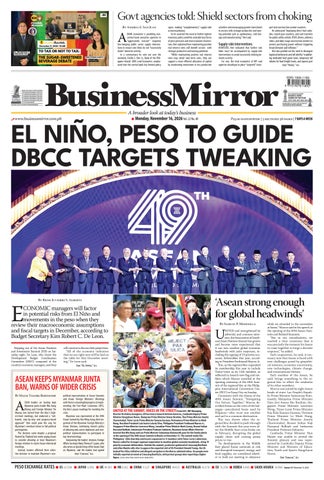
UNITED AT THE SUMMIT, VOICES IN THE STREETS From left, IMF Managing
Director Kristalina Georgieva, UN Secretary-General António Guterres, Cambodia Deputy Prime Minister Hangchuon Naron, Malaysian Prime Minister Anwar Ibrahim, Thai Prime Minister Anutin Charnvirakul, Timor-Leste Prime Minister Xanana Gusmao, Vietnamese Prime Minister Le Minh Hung, Brazilian President Luiz Inácio Lula da Silva, Philippine President Ferdinand Marcos Jr., Singapore Prime Minister Lawrence Wong, Canadian Prime Minister Mark Carney, Brunei Sultan Hassanal Bolkiah, Indonesian President Prabowo Subianto, Myanmar Asean Affairs DirectorGeneral Han Win Aung and Lao Prime Minister Saleumxay Kommasith pose for the family photo at the opening of the 49th Asean Summit in Manila on November 15. The summit marks the Philippines’ 2026 chairship and Asean’s expansion to 11 members with Timor-Leste’s admission. Marcos called for stronger regional cooperation to weather global economic headwinds, citing 19 priority economic deliverables. Outside the summit, protesters gathered at Liwasang Bonifacio and other Manila rally sites to oppose the expected visit of US President Donald Trump, the USbacked Pax Silica initiative and alleged corruption in the Marcos administration. Six people were initially reported arrested at Liwasang Bonifacio, with protest groups later reporting a higher figure. ELOISA LOPEZ/POOL PHOTO VIA AP; NONIE REYES
NITED and strengthened by adversity and common interests, the Association of Southeast Asian Nations (Asean) has grown and become more experienced that it can now weather global economic headwinds with joint responses, including the signing of 19 priority economic deliverables this year, according to President Ferdinand Marcos Jr. This, as the regional bloc expanded its membership this year to include Timor-Leste as its 11th member, as reflected in Asean’s new flag and emblem which Marcos unveiled at the opening ceremony of the 49th Summit of the regional bloc at the Philippine International Convention Center (PICC) in Pasay City on Sunday. Consistent with the theme of the 49th Asean Summit, “Navigating Our Future, Together,” Marcos described Asean as the crew of the balangay—precolonial boats used by Filipinos—who trust one another and sail to a common destination. This was shown when the regional bloc decided to push through with the Summit this year even after the Middle East crisis broke out in February, disrupting the global supply chain and causing pump prices to rise. “As developments in the Middle East placed Asean nationals at risk and disrupted transport, energy, and food supplies, we considered whether to hold our meeting in abeyance
while we attended to the necessities at home,” Marcos said in his speech at the opening of the 49th Asean Summits and Related Summits. “But in our consultations, we reached a clear consensus that it was precisely the moment for Asean to come together to forge a decisive response,” he added. Such cooperation, he said, is necessary now that Asean is faced with new challenges posed by geopolitical tensions, economic uncertainty, new technologies, climate change, and transnational threats. Each member of the Asean, he said, brings something to the regional bloc to offset the weakness of its other members. Marcos was joined by eight Asean heads of state: Lao People’s Republic Prime Minister Saleumxay Kommasith, Malaysian Prime Minister Dato Seri Anwar Bin Ibrahim, Singapore Prime Minister Lawrence Wong, Timor-Leste Prime Minister Kay Rala Xanana Gusmao, Vietnam Prime Minister Le Minh Hung, Thailand Prime Minister Anutin Charnvirakul, Brunei Sultan Haji Hassanal Bolkiah and Indonesia President Prabowo Subianto. Cambodia Prime Minister Hun Manet was unable to attend the Summit plenary and was represented by Cambodia Deputy Prime Minister and Minister of Education, Youth and Sports Hangchuon Naron. See “Asean,” A2
PESO EXCHANGE RATES n US 63.5590 n JAPAN 0.3976 n UK 84.1013 n HK 8.1022 n CHINA 9.5227 n SINGAPORE 49.4123 n AUSTRALIA 43.2710 n EU 70.2708 n KOREA 0.0476 n SAUDI ARABIA 16.9360 Source: BSP (November 13, 2026)
News
BusinessMirror
A2 Monday, November 16, 2026
Asean, China in ‘substantial completion’ of SCS code talks
By Malou Talosig-Bartolome
A
SEAN and China have achieved the “substantial completion” of negotiations on the long-awaited Code of Conduct (COC) in the South China Sea after reaching provisional agreement on about 80 percent of the draft text, marking one of the biggest diplomatic breakthroughs of the Philippines’s Asean chairmanship. Announcing the milestone on the opening day of the 49th Asean Summit, Foreign Affairs Secretary Maria Theresa Lazaro said negotiators have entered the final phase of discussions on an agreement intended to govern conduct in one of the world’s most strategically important waterways. “We are pleased to report the substantial completion of the negotiations on the Asean-China Code of Conduct,” Lazaro told reporters Sunday. “The parties to the Declaration on the Conduct of Parties in the South China Sea have reached provisional agreement on about 80 percent of the
Neri…
Continued from A1
clearances to slash provincial-to-urban transport markups and trader delays,” On cold storage and post-harvest infrastructure, he called on agencies to expand publicprivate partnerships to subsidize electricity costs
paragraphs of the draft COC.” The development brings Asean and China closer to a goal repeatedly endorsed by regional leaders to conclude an “effective and substantive” Code of Conduct for the South China Sea, where overlapping maritime claims have fueled tensions among claimant states for decades. Despite the progress, Lazaro acknowledged that the negotiations will not be completed during the Philippine chairmanship and will instead be carried forward by Singapore, which assumes the Asean chairmanship next year. “We leave this almost 80 percent finished document to Singapore as the next chair,” she said. Still, the top Philippine diplomat described the outcome as a major accomplishment for Manila, which served as shepherd of the negotiations throughout the year. “It is one already of the achievements of the Philippines as chair, because what was the COC before we shepherded it, it was only about 50 percent perhaps,” Lazaro said. “But to go to 80 percent and even mov-
ing, then there’s a little bit. They only talk a little in Singapore. But indeed, this Code of Conduct is really something that we can be proud of.” According to Lazaro, the Philippines accelerated the negotiating process by convening nine rounds of talks and two senior officials’ meetings this year, effectively putting negotiators on a monthly schedule. A key breakthrough was the provisional resolution of one of the four milestone issues in the negotiations: defining the relationship between the 2002 Declaration on the Conduct of Parties in the South China Sea (DOC) and the future COC. Under the agreement reached so far, the parties affirmed that the DOC serves as the foundation of the COC, that the future code builds upon the declaration’s principles, and that it will contain more effective and substantive provisions to guide conduct in the South China Sea. The parties also agreed that the COC would serve as a platform for practical maritime cooperation and as a mechanism for managing dif-
ferences at sea, while continuing to uphold international law, including the 1982 United Nations Convention on the Law of the Sea (Unclos). However, three major issues remain unresolved: the code’s geographic coverage, its terms of reference, and its legal nature, including whether the agreement will be legally binding. Lazaro confirmed that discussions on those issues will continue. Asked why the negotiations could not be completed this year, Lazaro pointed to the challenge of building consensus among the 10 Asean member-states and China. “Negotiations are negotiations are negotiations,” she said. “The 10 Asean countries plus China have also, of course, different views on how things are.” She added that some provisions carry legal and political sensitivities for individual countries, particularly if a final agreement would require domestic ratification procedures.
for regional cold-storage warehouses, directly tackling 20 to 30 percent post-harvest losses. Neri also emphasized the need to “unblock delayed capital outlays for high-multiplier public works while strictly enforcing discipline in spending.”
tion prematurely carries far greater long-term risks.” With headline inflation at 7.8 percent, core inflation sticky at 5.4 percent, and real policy rates “sitting deeply” in negative territory (-2.3 percent at 5.50 percent nominal rate), he said a complete pause risks unanchoring inflation expectations and inviting entrenched second-round wage and price adjustments. “Rate hikes don’t grow rice, but pausing could harvest inflation. Therefore, a calibrated rate in-
crease is essential,” Neri said. “It is not designed to crush a slowing economy, but it acts as a catalyst that compels non-BSP agencies to execute their non-monetary mandates more efficiently,” added the BPI lead economist. Further, he explained that when the central bank signals it will not accommodate unaddressed price pressures, it removes moral hazard from fiscal and administrative bodies, “forcing them to tackle physical supply bottlenecks rather than leaving monetary policy to carry the entire stabilization burden alone.” Neri explained these developments as he pointed out that the Philippines is currently experiencing a “severe cost-push squeeze,” where he said acute supply-side shocks and persistent core inflation coincide with a sharp growth deceleration. “This toxic combination of slowing economic momentum and soaring price pressures severely erodes household purchasing power and must compel all economic agencies into immediate and coordinated action,” he explained further.
Delicate tightrope walk for central bank
AS the BSP currently faces a “delicate tightrope walk,” Neri warned: “Pausing monetary normaliza-
BSP statement
LAST week, the central bank said in a statement it remains determined to fulfill its mandate of pursuing price stability “conducive” to sustained and balanced growth despite facing a “difficult combination” of elevated inflation and slowing economic growth. “Since monetary policy is unable to control the direct inflationary effect of recent global supply shocks, it focuses on the second-round effects of such shocks. In the BSP’s efforts to bring inflation down, it takes important account of the weakness in aggregate demand. It is also mindful of the need to prevent the de-anchoring of inflation expectations,” the BSP said in its November 11 statement. Restoring price stability and safeguarding households’ purchasing power are essential to rebuilding confidence and supporting a durable economic recovery, it added. The BSP said it is carefully assessing the implications of the latest growth data for the inflation outlook. Future monetary policy decisions, it added, will continue to be guided by incoming data, particularly developments in inflation, inflation expectations, and economic activity.
www.businessmirror.com.ph
Asean…
Continued from A1
Myanmar-owned and Myanmar-led process AFTER it failed to show significant progress in implementing the 5-point consensus peace plan set by Asean, Myanmar’s participation in the summit remained restricted. It was represented by its Director General U Han Win Aung at the event. The consensus aims to pave the way to ending the civil war in Myanmar after its military took over the government in 2021. During the Retreat of the 49th Asean Summit at the Coconut Palace in Pasay City on Friday, Marcos stressed the need for the regional bloc to finally break the status quo in helping address . “We need to ask ourselves, what more can we do with Myanmar,” Marcos said. “Myanmar is part of our Asean family. In this regard I hope our session leads to practical forward-looking discussions on how we can further advance the 5-point consensus; make our efforts more responsive to the needs in the ground and support a peaceful, inclusive, Myanmar-owned and Myanmar-led process,” he added.
Priority agenda
MARCOS said Asean demonstrated such a united front through a strengthened maritime cooperation via a pending “effective and substantive” Code of Conduct in the South China Sea and campaign against human trafficking, cybercrime, online scams, and other transnational threats through its peace and security anchors. He said they are targeting to bring these partnerships further with the completion of Asean’s 19 priority economic deliverables its prosperity corridor priorities. “These efforts will culminate in the completion of all 19 priority economic deliverables of the Philippine chairship by the end of 2026, including the signing of the Asean Digital Economy Framework Agreement,” Marcos said at the 49th Asean Summit Plenary. The priorities also include Artificial Intelligence; Declaration on Strategic Trade Management for Secured Trade in the Region; Asean Energy Interconnectivity; Semiconductors Strategic Framework; AseanCenter of Excellence for Creative Industry; and the Asean Center of Excellence for micro, small, and medium enterprises (MSME). The priorities also include space science technolo-
Crisis…
Continued from A1
on a “calibrated engagement, step-by-step and progress-based approach on restoring Myanmar’s political representation.” She said any easing would depend on measurable compliance with the Five-Point Consensus. “The step-by-step approach is adherence to the Five-Point Consensus,” Lazaro told reporters. “For example, the first one is a cessation of hostilities. We want to see how Myanmar responds to that because right now there’s still certain bombings and displacement of Myanmar people. So step-by-step we give it to them how they’re going to tackle this issue and we monitor that. For us, that is what we have seen as a progress-based approach.” The leaders’ decision acknowledged the worsening regional implications of Myanmar’s five-year-old conflict. In a strongly worded section of the document, Asean pledged stronger cooperation with member states, dialogue partners, neighboring countries and the United Nations in combating “human trafficking, drugs trafficking, displacement, cyber threats, online scams and other security risks” associated with the crisis. The language reflects growing concern among Southeast Asian governments that the conflict in Myanmar has evolved from a domestic political crisis into a regional security challenge, fueling criminal networks, cyber scam hubs and cross-border displacement. At the same time, leaders left open the possibility of Myanmar’s eventual reintegration into the bloc’s political processes. “Subject to sustained and concrete progress in the implementation of the 5PC by Myan-
gy, and the intellectual property valuation handbook. Marcos urged Asean state leaders to translate the Asean Energy Interconnectivity initiative into actual commitments to boost the energy resilience of the region. “Energy security is ultimately about the security of our livelihood. We therefore need to strengthen regional energy connectivity, diversify our resources, accelerate renewable energy development, and make our energy systems more affordable and reliable,” Marcos said during the Retreat of the Summit. On People Empowerment, he said Asean is working to protect people in vulnerable situations, strengthen families and communities, equip the youth for the future, and enable older persons to live with dignity.
Beyond Asean
ASEAN is also expanding its network with other countries including the seven additional countries, which signed the Treaty of Amity and Cooperation in Southeast Asia (TAC) this year. Established in 1976, the treaty promotes universal principles of peaceful coexistence and friendly cooperation among States in Southeast Asia. The countries which signed the TAC year are Sweden, Poland, Romania, Lithuania, Cyprus, Slovakia, and Slovenia. Under the Philippines chairmanship of the Asean this year, Turkey joined its list of dialogue partners, while Denmark, Germany, and Qatar became its new sectoral dialogue partners. “Our partnerships should continue to advance Asean priorities, respond to the needs of our member-states and turn political goodwill into practical cooperation, with Asean at the center of the regional architecture that we have built,” Marcos said. He also invited Canadian Prime Minister Mark Carney and Brazil President Luiz Inácio Lula da Silva to participate in the 49th Asean Summit plenary so both their countries can forge “practical cooperation and broaden opportunities” with the regional bloc. Aside from Carney and Lula, United Nations Secretary-General Antonio Guterres and International Monetary Fund managing director Kristalina Georgieva joined the Asean Summit this year to give information about developments in the global economy. “We should therefore continue to deepen our partnerships on the basis of mutual benefit, translate comprehensive and strategic partnerships and plans of action into concrete cooperation, and build on the Asian outlook on the Indo Pacific as a basis for open, inclusive and practical engagement,” Marcos said.
mar, Asean may consider the gradual restoration of Myanmar’s full political representation,” the leaders said. The Five-Point Consensus, adopted shortly after the 2021 military takeover, calls for an immediate cessation of violence, dialogue among all parties, mediation by an Asean special envoy, humanitarian assistance and meetings with all stakeholders. However, Asean leaders acknowledged that implementation remains far from satisfactory. “We acknowledged the Chair’s comprehensive report on the 5PC implementation and, in line with the assessment of the report, reiterated our deep concern over the insufficient progress in the implementation of the 5PC,” they said. Despite the political stalemate, Asean highlighted gains in humanitarian engagement. The leaders welcomed humanitarian missions led by Lazaro and the Asean Coordinating Centre for Humanitarian Assistance on Disaster Management (AHA Centre), which delivered assistance to more than 11,000 households, including residents of four priority townships that had not previously received Asean aid. They also called on Myanmar authorities to allow broader and non-discriminatory humanitarian access to affected communities. Asean further urged international partners to increase financial and logistical support for humanitarian operations as needs continue to grow across conflict-affected areas. Leaders also cited the work of the Asean Chair’s Special Envoy and instructed foreign ministers to continue “constructive and principled engagement” with Myanmar under the Five-Point Consensus framework. Even as they maintained pressure on Myanmar’s military rulers, Asean leaders stressed that “the crisis in Myanmar should not affect the Asean Communitybuilding process and decision-making” and affirmed their commitment to regional peace, security and stability.
El Niño, Peso to guide… Continued from A1
The DBCC usually tweaks its projections of real gross domestic product (GDP) growth, inflation and foreign exchange rate, among others, in the middle and the end of the year, to determine how much revenue it could collect, plans to spend and needs to borrow. Assumptions for the current year, as well as for the next four years or until 2030, could be adjusted. De Leon said economic managers will consider domestic and external developments, as this “shapes how the economy will move and grow.” The Budget chief said the looming super El Niño would be taken into consideration, although he did not elaborate on how the weather phenomenon could affect the government’s growth and inflation assumptions. Movements in the peso are also constantly monitored. According to the DBCC’s latest medium-term See “El NiÑo,” A9
www.businessmirror.com.ph
The Nation
Monday, November 16, 2026
A3
Philippines, Australia Ombudsman to crack down sign new defense pact
T
HE Philippines and Aust ra l i a showc a sed t hei r growing security relations and longstanding defense partnership with the signing of the bilateral Defense Cooperation Arrangement (DCA) on Sunday. In a statement, the Department of National Defense (DND) said the signing took place at the Eva Macapagal Cruise Terminal, Pier 15, Manila South Harbor. Defense Secretar y Gilberto Teodoro Jr. and Australian Ambassador to the Philippines Marc Innes-Brown signed the Arrangement, witnessed by Australian Prime Minister Anthony Albanese, ahead of the 49th Association of Southeast Asian Nations Summit hosted by the Philippines as Asean chairman this year. Following 30 years of effective implementation of the 1995 DCA between the Philippines and Australia, the renewed DCA provides a basis for further enhancing defense engagements and cooperation in areas of mutual interest, building on existing bilateral arrangements between the two countries. Speaking to reporters on the sidelines of the ceremony, Teodoro
explained that the Arrangement will streamline the coordination process under the PhilippinesAustralia Status of Visiting Forces Agreement (Sovfa). “It will make things much, much faster and easier. Rather than 100 steps to do a single thing, it will just now take 10. And it will be more purposive and not ad hoc,” Teodoro said. The DCA builds on the Statement of Intent on Enhanced Defense Cooperation signed by Teodoro and Australian Deputy Prime Minister and Minister for Defence Richard Marles on August 22, 2025. The statement recognized the need for an updated framework that reflects the breadth, depth, and growing importance of defense cooperation between the two countries amid an increasingly complex regional security environment. The agreement’s signing also coincides with the 80th anniversary of diplomatic relations between the Philippines and Australia, marking eight decades of longstanding ties and cooperation. Rex Anthony Naval
Comelec sets December 18 party registration deadline By Mary Jade Jadormio
P
OLITICAL parties and party-list groups face a December 18 deadline to secure their registration with the Commission on Elections (Comelec) ahead of the 2028 national and local polls. Applicants have just 33 days to submit their petitions and supporting documents, according to the poll body. The deadline applies to new political party registrations, partylist accreditation petitions, and official manifestations of intent to run in 2028. The countdown comes as Comelec sharpens its screening of partylist hopefuls—especially previously delisted groups. Comelec Chairman George Erwin M. Garcia clarified that while delisted organizations can seek reinstatement, past accreditation guarantees no easy route back onto the ballot.
“They can refile their petitions because their delisting is not permanent,” Garcia said in a radio interview. He noted that groups are free to reorganize leadership, update officer lists, or forge coalitions before reapplying. Still, Comelec plans to evaluate every applicant from scratch, scrutinizing each group’s track record and genuine sector representation. “We will look at your track record,” Garcia warned, emphasizing that former status offers zero advantage. The strict stance follows Comelec’s cancellation of 50 party-list registrations: 10 for failing to field candidates in two straight elections, and 40 for missing vote thresholds and failing to secure seats. In a separate timeline, Comelec set Dec. 30 as the cutoff for delisted groups pursuing formal reinstatement, subject to the same rigorous re-evaluation.
Digital safety skills training for seniors
G
LOBE Telecom has joined forces w ith the LapuLapu City government to equip over 100 senior citizens with vital cybersecurity skills and free healthcare support during a recent financial assistance distribution. Driven by its flagship Senior Digizen Program, Globe employee volunteers conducted hands-on training to help elderly residents spot suspicious links, protect sensitive personal data, and dodge common online threats, including phishing scams. Beyond scam prevention, the interactive sessions guided participants on nav igating their smartphones with greater ease and confidence. “As ever yday ser vices shift online, we want our senior citizens to feel safe and empowered using tec hnolog y,” sa id Yoly Crisanto, Globe Chief Sustainability and Cor porate Commun ic at ion s O f f icer. “ T h rou g h t h is pa r t nersh ip w it h L apuLapu City, we are giving our seniors practical tools to safe-
guard themselves against fraud while supporting their personal health.” Complementing the digital literacy workshop, healthcare partner Generika Drugstore distributed essential medicine packs to attendees, integrating wellness support directly into the community outreach program. Lapu-Lapu City Mayor Ma. Cynthia King-Chan praised the initiative, emphasizing the city’s responsibility to protect its elderly population in an increasingly digital world. “Our senior citizens built the foundation of our community. Combining scam prevention and hands-on smartphone guidance with healthcare kits delivers the holistic care our seniors deserve,” King-Chan said, expressing gratitude to Globe for expanding the program to their city. The Cebu workshop forms part of Globe’s ongoing nationwide push for digital inclusion, ensuring vulnerable communities remain informed, protected, and connected.
on ‘extortion’ at BIR, BOC By Joel R. San Juan @jrsanjuan1573
T
HE Office of the Ombudsman is stepping up to protect the business sector from corrupt officials and personnel within the graft-tainted Bureau of Internal Revenue (BIR) and Bureau of Customs (BOC). Add ressing t he Ph i l ippine Chamber of Commerce and I n d u s t r y ( P C C I ) o n F r i d a y, Ombudsman Jesus Cr ispin Remu l la announced intensif ied lifestyle checks on BIR and BOC personnel fol low ing repor ts of t a x col lectors sha k ing dow n bu s i ne s s e s for of f - t he - b o ok pay ments.
Remulla delivered a firm reminder to revenue officers: government funds belong to the Filipino people, not to greedy public officials. “We have received reports that some collectors are demanding more from businesses than what is legally prescribed, with the excess amount being collected without
issuing receipts. Let’s be clear on this: there is no legitimate government payment without a receipt. Every peso paid to the state must be accompanied by a receipt. A payment without a corresponding receipt is not a tax—that is corruption,” Remulla warned. “That is why I am announcing today that we will intensify our lifestyle checks on officials of the Bureau of Internal Revenue and the Bureau of Customs,” he added. Repor ts reaching the Ombudsman reveal a startling pattern: amounts demanded under the table often dwarf the legitimate tax bill. “More money ends up in the pockets of a few individuals than in the national treasur y. Businessmen are forced to pay twice, yet less than half goes to the state,” Remulla pointed out. To combat this, the Ombudsman is establishing a dedicated Investment Ombudsman office to handle graft and corruption
complaints from businesses and investors. Designed to tackle extortion, deliberate transaction delays, and retaliation against whistleblowers, the initiative was a central focus of Friday’s town hall dialogue with PCCI members. I n ad d it ion , R e mu l l a a n nounced plans for a Regulatory Summit in January 2027. The summit will bring together government regulators to eliminate overlapping rules and close systemic loopholes that invite corruption. “Every unnecessary step is a place where someone can ask for money. Every contradiction is an opportunity for a fixer. Close the gap, and you close the opportunity,” he explained. Remulla left corrupt personnel with a clear warning: Live beyond your means at your own peril. “If an officer lives far beyond what his salary allows, we will ask him to explain. If he cannot, we will act,” Remulla declared.
Ssshhh, silence beats noise–Lacson By Butch Fernandez @butchfBM
F
ORMER National Police (PNP) chief turned lawmaker Sen. Panfilo Lacson delivered a sharp lesson in operational discipline to vocal security officials over the weekend, asserting that total operational silence—not media noise—cracks highprofile cases. Lacson pointed to the swift breakthrough in the investigation into the assassination of Basilan Judge Joseph Wee Sit in Zamboanga
City as proof of how disciplined, quietly executed police work delivers results over public posturing. “This is how high-profile cases are cracked: silent, precise, disciplined, and with methodical efficiency. No fanfare; just results. Congratulations!” Lacson posted on X Saturday evening, offering an advice implicitly aimed at “noisy” law enforcement and security officials who talk ahead of their operations. Police Regional Office 9 formally slapped murder complaints on Saturday
before the Zamboanga City Prosecutor’s Office against three suspects: the alleged gunman, a getaway motorcycle driver, and the driver of a secondary escape vehicle. Lt. Col. Shellamie Chang, spokesperson for PRO 9, confirmed the charges followed an airtight case buildup by the Special Investigation Task Group Wee Sit, anchored on judicial affidavits alongside documentary and forensic evidence. Lacson—who earned a reputation for cracking
major cases through tight intelligence work when he led the PNP from 1999 to 2001—reiterated that loose lips compromise tactical operations, underscoring the absolute necessity of strict secrecy in live cases. “SSSHHH…: When pursuing a high-profile target or handling a sensitive live case, secrecy discipline is key—unless disinformation is necessary to f lush the quarry into the open,” Lacson stressed, delivering a clear warning to officials tempted to play out active probes in front of cameras.
Impeach prosecutors to Sara defense team: Address ₧817.87-M allegation By Jovee Marie N. dela Cruz @joveemarie
T
HE House of Representatives impeachment prosecution team is challenging the remaining witnesses of Vice President Sara Z. Duterte’s defense team to directly address the alleged P817.87 million in unexplained wealth, as the defense moves closer to completing its presentation of evidence in the Senate impeachment trial. House prosecution spokesperson Rep. Zia-ur Rahman Alonto Adiong of Lanao del Sur said the defense was expected to submit 10 names of its additional witnesses on Saturday for the Senate Impeachment Court’s consideration. “The ball is now in their court. They said they would submit the names of 10 additional witnesses, as they have not yet submitted the list,” Adiong said. Adiong said the pace of the proceedings suggested that the defense could finish presenting its evidence sooner than initially expected, although the actual schedule would depend on its strategy and the impeachment court’s action on requests for subpoenas. “Based on the pace of the proceedings, it appears we may have a shorter trial,” he said. The defense began presenting its evidence on November 9, fol-
lowing the prosecution’s decision to rest its case on October 21. Its witnesses have so far discussed properties, corporate interests and financial transactions involving Duterte and her husband, lawyer Manases Carpio. Among the issues raised was Duterte’s reported investment in GenCorp Industries Inc., which allegedly paid her P2.14 million from 2022 to 2025. GenCorp in-house counsel Atty. Suzette BalucanagPunay described the arrangement as a “loose investment,” claiming the payments represented returns of capital from an earlier investment. House prosecution legal spokesperson and counsel Benjamin Tolosa Jr. questioned the characterization, saying the more important issue was whether Duterte maintained a financial interest in a company that secured government contracts while she was Vice President. “Even in general accounting principles, I don’t think there’s such a term as ‘loose investment,’” Tolosa said during a recent news forum. Tolosa said Punay’s testimony was significant because she acknowledged that Duterte received money from GenCorp during her term as Vice President. He said the senator-judges would have to determine whether the arrangement violated Article VII,
Section 13 of the Constitution, which prohibits the President and Vice President from having direct or indirect financial interests in government contracts during their tenure. The prosecution earlier presented records showing that GenCorp secured 49 government contracts worth approximately P35.88 million, including 19 contracts with the Davao City government under Mayor Sebastian Duterte, the Vice President’s brother. Tolosa pointed out that GenCorp was the same corporation that received government payments and subsequently paid Duterte. Punay, however, maintained that Duterte was not a GenCorp shareholder, officer or director. She also acknowledged that she had no written records establishing the exact amount of the alleged original investment. The prosecution argued that the absence of formal share ownership does not automatically rule out an indirect financial interest. Adiong, meanwhile, said the prosecution was prepared to crossexamine Duterte if she personally takes the witness stand, giving lawmakers an opportunity to question her directly about her financial transactions, business interests and assets under scrutiny. “If the Vice President comes forward and testifies, that would be the perfect opportunity for
us to cross-examine her,” Adiong said, stressing that the decision rested with Duterte and her defense team. The prosecution’s P817.87-million unexplained-wealth allegation covers the period from 2022 to 2025. Its computation, prepared by forensic expert Alexander Cabrera, drew on bank records, tax documents, corporate filings and other financial evidence that prosecutors said showed discrepancies in Duterte’s Statements of Assets, Liabilities and Net Worth. Adiong maintained that the defense witnesses had yet to directly rebut the prosecution’s financial findings, despite their explanations concerning properties, business arrangements and personal expenses. T he Hou se prosec ut ion is standing by its evidence supporting Article II of the impeachment complaint, which involves alleged unexplained wealth, betrayal of public trust and culpable violation of the Constitution. The Senate impeachment trial is scheduled to resume on November 19 and 20, with further hearings expected in December. After the defense completes its presentation, the proceedings will move to the formal offer of evidence, the prosecution’s comments and closing arguments before the senatorjudges determine the remaining impeachment charge.
A4
Economy
Monday, November 16, 2026
Advocates demand binding Asean mining safeguards
C
By Jonathan L. Mayuga
@jonlmayuga
IVIL society groups pressed Southeast Asian leaders on Sunday to establish legally binding human-rights and environmental safeguards in mining communities as the Philippines hosts the 49th Association of Southeast Asian Nations Summit.
Ahead of the summit’s formal opening in Manila—which coincides with the ongoing Conference of Parties (COP) 31 climate conference in Türkiye—the Asia Pacific Transition Mineral Accountability Working Group (AP-TMA WG) warned that exploding global demand for critical minerals threatens regional populations unless strict protections are enforced. The coalition highlighted ongoing resource and trade negotiations involving Manila, including the proposed US-Philippines Pax Silica framework, bilateral free-
trade talks with Canada, and the broader Canada-Asean trade deal. While no official Pax Silica announcements are ex pected during the summit, advocates warned that opening Philippine mineral reserves for clean energy, artificial intelligence, data centers, and defense could exacerbate existing abuses. In the Philippines, advocates noted t hat despite statutor y protections under the 1997 Indigenous Peoples’ R ights Act (Ipra), weak enforcement leaves indigenous and rural communi-
ties exposed. Environmental defenders and residents opposing nickel extraction continue to face heightened risks, threats, and harassment. Consequently, advocates called on Manila to use its Asean chairmanship to embed enforceable human-rights standards, corporate accountability, contract transparency, and equitable benefitsharing directly into the Asean Critical Minerals Strategy. They also demanded strict adherence to Free, Prior, and Informed Consent (FPIC) for indigenous peoples, a full fossil fuel phase-out by 2030, and dedicated financing for a just energy transition. The appeal comes after what groups described as a missed opportunity at the 48th Asean Summit in Cebu last May. Although civil society raised identical concerns, the final Chairman’s Statement prioritized investment and industrial growth over community protections. “Asean leaders now have real bargaining power, and they must not sign it away through investorstate dispute settlement—whether in new trade and minerals deals or the upcoming Regional Com-
prehensive Economic Partnership (RCEP) review,” said Aryanto Nugroho, national coordinator of Publish What You Pay Indonesia and Asia Pacific representative on the Global Board of the Resource Justice Network. The broader region supplies over two-thirds of the world’s nickel and holds 60 percent of global rare-earth reserves. Globally, the coalition cited 1,226 documented human-rights violation allegations linked to transition minerals between 2010 and 2025. Beyond intimidation in Philippine nickel zones, groups pointed to massive deforestation and coal-powered processing in Indonesia’s Central Sulawesi and North Maluku provinces, alongside conflict-linked rare-earth extraction in Myanmar. While regional leaders adopted the Declaration on the Asean Minerals Development Vision in October 2025, those commitments remain non-binding. “The Critical Minerals Strategy is where they must keep that promise,” Nugroho said. “Rights, consent, and fair benefit-sharing must sit at the heart of the region’s mineral strategy—not as an afterthought to investment deals.”
Erwin Tulfo backs Peza investment breaks 14-year record foreign-funded oil storage plan By Bless Aubrey Ogerio
B
E LG I U M - B A S E D B r i g h t s i d e Industries Group LLC is seeking to build an oil refinery and depot in the Philippines, mirroring a similar proposal submitted by the United Arab Emirates’ Abu Dhabi National Oil Company (Adnoc). The Senate Energy committee chairman, Sen. Erwin Tulfo, confirmed receiving a letter of intent from the Belgian company, welcoming the prospect of increased foreign energy investment. “The more companies that build oil depots and refineries in the Philippines, the better,” Tulfo said. “It helps ensure we maintain sufficient reserves during conflicts in the Middle East.” Under Brightside’s proposal, the project will be fully foreign-funded, requiring zero financial contribution from the Philippine government. Tulfo suggested the arrangement would likely follow Aanoc’s proposed model—using the Philippines as a regional storage hub to supply other Asian markets. However, Tulfo stressed that formal negotiations must go through the Executive branch. “They need to coordinate with the Department of Energy [DOE] for formal agreements,”Tulfo added. “Energy Secretary Sharon Garin will have to determine the exact terms with Brightside, given that the government will not be financing the project.” Butch Fernandez
T
HE Philippine Economic Z one Aut hor it y (Pez a) approved a record P315.5 billion in investments as of November 10, surpassing its 2012 high, with the agency now closing in on its revised P320-billion target for the full year. The latest figure exceeded the previous record of P311.9 billion set 14 years ago, said outgoing Peza Director General Tereso O. Panga, who disclosed the updated tally in a social media post. The agency had reported P309.63 billion in approved investments from January to October, up 76.6 percent from P175.37 billion a year earlier, based on data presented at a Department of Finance briefing on Thursday afternoon. The November 10 tally represents an additional P5.87 billion in approvals from the end-October figure. Record export levels, more than 1.8 million direct jobs sup-
ported nationwide, and P4.193 billion in dividends remitted to the National Treasur y over three consecutive years were also cited by Panga. Investment approvals, he said, had translated into more than 100,000 new jobs.
Leadership change
THE record investment tally comes as Peza prepares for a leadership change, with outgoing Bases Conversion and Development Authority (BCDA) President and Chief Executive Officer Joshua M. Bingcang taking over Panga’s post. Bingcang said he would seek to attract more investments to Peza but would not set a target until he had reviewed the agency’s plans and figures. “Well, the more, the bigger, the better for our country,” he told reporters after a press briefing at the Department of Finance office in Manila. “I don’t know what are the targets [of Peza], but the point is, you know me.”
The transition, he said, would give him a broader investment mandate, although both Peza and BCDA work to attract foreign capital. “I think it’s the same investment. You have to make sure that there’s a good relationship with foreign investment,” Bingcang said. “That’s what BCDA is trying to do lately, foreign investment…but it has more challenges because Peza has wider coverage and more money.” The impending transfer was communicated to Bingcang on the day the leadership changes were discussed, while no successor at BCDA had yet been identified, he said. “It’s all surprise news for us today,” he said, adding that the changes were in line with the national government’s economic plan. Former Bureau of Customs Commissioner Ariel F. Nepomuceno took over the BCDA. Panga worked 28 years at Peza, where he began as a planning officer in 1998.
‘AI visibility doesn’t equal trust’
T
OP public relations executives across Asia are warning that relying solely on AI algorithms to get brands noticed is a risky gamble. At the 2026 One Asia Commu-
nications (OAC) Regional Forum, delegates from 13 markets warned that while Generative Engine Optimization (GEO) can quickly land a brand in AI search summaries, it frequently hallucinated details, flattened unique brand identities, and missed critical cultural context. The rush to optimize for Large Language Models has created a new dilemma: visibility without accuracy. “Technology can scale a message, but it takes human judgment and cultural nuance to earn enduring trust,” said Noel Rene Nieva, chief executive officer of Philippine PR firm Perceptions, Inc. The consensus from the summit points to three growing friction points as brands hand discovery over to automated engines: n T he h a l luc i nat ion r isk : AI search tools aggregate vast amounts of web data, but they often present outdated, flattened, or
outright incorrect facts as definitive answers. n The content glut: Companies flooding the web with low-quality AI content to game algorithms risk stripping away their actual identity. n The localization blindspot: Models trained primarily on global datasets routinely fail to grasp regional nuance across markets like Singapore, Japan, Indonesia, and the Philippines. Industry leaders argued that a l gor it h m ic presence mea n s little if the underlying digital footprint is not anchored in realworld credibility. “Reputation is shaped not only by what people encounter online, but also by stakeholder relationships and real-world experiences,” said Ivy Nhi Chau, founder of Vietnambased Ivy+Partners. “The question is not simply whether AI mentions a brand, but whether that representation reflects a credible reputation.”
www.businessmirror.com.ph
Recto to Asean: Put trade deals in action By Butch Fernandez @butchfBM
E
XECUTIVE Secretary Ralph G. Recto urged Association of Southeast Asian Nations leaders and business executives to translate regional trade deals into tangible economic relief, calling for swift action to secure affordable food, reliable energy, and quality jobs across Southeast Asia. Speaking Saturday at the Asean Business and Investment Summit (AbisS) 2026, Recto emphasized that President Marcos’ administration is leveraging the country’s bloc leadership to protect families and businesses from global economic headwinds. “Our next task is to turn that agenda into results that people can feel and businesses can build on. And we must do so with urgency,” Recto said, warning that geopolitical conflicts, trade protectionism, and rapid technological shifts continue to squeeze household budgets. “As the world becomes more uncertain and divided, ASEAN must become more connected and dependable,” he added. Recto out l ined a t hreepronged strategy for regional resi l ience: ma x imi zing trade agreements, fortifying energy and food supply chains, and ensuring digital technology benefits small enterprises alongside traditional industries. He urged the private sector to capitalize on the newly signed Asean Digital Economy Framework Agreement (Defa) to streamline cross-border digital trade and data flows, while pointing to ongoing
Asean-Canada Free Trade Agreement negotiations as a key avenue for market expansion. “So prepare now. Explore new markets. Build new partnerships. And help smaller enterprises enter the supply chains that these agreements will strengthen,” Recto said. To boost regional food security, Recto advocated for heavy investment in cold storage facilities, food logistics hubs, and streamlined transport networks to curb farm spoilage and lower market prices. On energy, he called for modernized power grids, expanded energy storage, and joint emergency response protocols. Recto highlighted domestic economic reforms aimed at drawing foreign capital, including the CREATE MORE Act, green lane processing for strategic investments, and major infrastructure initiatives. Specifically, he invited international investors to back the Luzon Economic Cor r idor—a flagship initiative linking energy, digital, and transport infrastructure—and a planned 1,600-hectare advanced manufacturing and technology hub in New Clark City in Tarlac. “There is room here for your capital, your technology, your expertise, and your ambition,” Recto said. “Let us build an Asean that competes confidently, grows responsibly, and brings more people into prosperity.” Abis serves as the flagship annual business gathering of the Asean Business Advisory Council, bringing together heads of state, top chief executive officers, and global policymakers.
Calamity Fund up 14% to ₧45.6B By Jovee Marie N. dela Cruz
T
@joveemarie
HE national government is raising its disaster preparedness and recovery funding to P45.6 billion in 2027 as the country prepares for a severe El Niño phenomenon that could trigger widespread drought across Metro Manila and all 82 provinces, House of Representatives Minority Leader Marcelino Libanan said Sunday. The proposed allocation under the National Disaster Risk Reduction and Management Fund (NDRRMF) represents a P5.8billion, or nearly 15-percent, increase from the P39.8 billion appropriated in the 2026 national budget. Libanan called the bigger budget necessary but urged executive agencies to roll out pre-disaster measures early rather than waiting for the drought to hit hard. “This is a substantial increase, but the threat we are facing calls for more than just a bigger calamity fund,” Libanan, the nominee of the party-list group 4-Ps said. “Government agencies must ensure that resources are readily available and that disaster preparedness measures are in place well ahead of the worst effects of El Niño.” The Philippine Atmospheric, Geophysical and Astronomical Services Administration (Pagasa) warned that Metro Manila and 47 provinces could face severe drought by late January 2027 due to a projected strong El Niño phenomenon. By the end of March 2027, prolonged drought could affect all 82 provinces and the National Capital Region, according to Pagasa’s forecast based on rainfall data through November 1, 2026. Pagasa defines drought as three consecutive months of waybelow-normal rainfall, or a drop of more than 60 percent from historical averages. The state weather bureau’s outlook aligns with an assessment by the US National Oceanic and Atmospheric Administration (NOAA), which put the probability of a strong El Niño persisting through March 2027 at over 79 percent. Libanan pressed key frontline agencies—including those overseeing agriculture, water resources, health, social welfare, and disaster response—to align contingency plans with local governments “Water shortages, crop losses, rising food prices, and disruptions to the livelihoods of millions of Filipinos are real possibilities,” he said. “We should not wait for communities to experience these hardships before taking decisive action.” He urged national and local officials to immediately map out vulnerable communities, secure bulk water supplies, shield agricultural sectors, and prepare emergency relief for displaced workers and farm households. “The government should use the weeks ahead to prepare contingency measures, coordinate resources, and make sure that vulnerable households, farmers, and other affected sectors will not be left to fend for themselves,” Libanan added.
Monday, November 16, 2026
‘Structural challenges hobble sugar sector’
S
TRUC T UR A L cha l lenges, including low yield and inadequate infrastructure, are hampering the competitiveness of the local sugar industry, a unit of the University of Asia and the Pacific (UA&P) said. Sugar is a necessity in Filipino households, but the sweetener is also crucial for food manufacturing and its by-product—molasses—serves as a key ingredient for bioethanol production and animal feed. Despite an established production and milling base, Jaru Jerico Olivares, Agribusiness Special for the UA&P Center for Food and Agribusiness (CFA), said the domestic sugar industry is grappling with structural challenges. Among these is low sugarcane yield, as the sector is short of hitting its target of 75 metric tons (MT) per hectare, since plantations currently harvest only an average of 55 to 60 MT per hectare. Olivares attributed this to limited access to high-yielding varieties, diseases, “small and fragmented” farmers, and insufficient resources to invest in mechanization, irrigation, and modern farm practices. Planters are also dealing with soaring input costs, he added, choking off production and making locally produced sugar “less competitive” compared to foreign supplies. “Thailand, the country’s main source of imported sugar, is able to produce significantly cheaper sugar due to large-scale and mechanized farming that supports lower production costs.” Ol iva res noted t h at m a ny mills operate “inefficiently” due to aging equipment, underutilized facilities, and inadequate
farm-to-market roads (FMRs), thus contributing to higher costs and low sugar recovery. Imported high-fructose corn syrup (HFCS) also provides an alternative to locally produced sugar, he added, directly competing w ith loca l ly produced sugar and adding competition in industrial food and beverage applications. These hurdles further compound the government forecast of raw sugar output plunging to 1.66 million metric tons (MMT) in the current crop year—heading for more than a two-decade low, if the projection materializes. Despite these challenges, Olivares said government policies aimed at improving the sector’s productivity can help the industry. He cited the Sugarcane Industry Development Act (Sida), which stresses the need for block farming, mechanization, and the use of shared facilities. “Cooperatives, businesses, and farmers can establish machinery rental services, giving even smallholders access to machines and equipment while reducing production costs.” Aside from government initiative, however, Olivares said there are also opportunities for growth and modernization that would help boost the industry’s competitiveness. This includes improving sugarcane varieties that are highyielding and disease-resistant as well as investing in modern milling equipment and more efficient processing facilities. Olivares said sugarcane byproducts such as molasses and bagasse can be used for bioethanol, animal feed, bioenergy, and other industrial applications. Ada Pelonia
Indonesia’s agency plans fee on palm oil trade By Anuradha Raghu & Eddie Spence Bloomberg News
I
NDONESIA’S new commodities export agency is set to charge a single-digit, dollar-a-ton fee on palm oil exports, as the government seeks to strengthen oversight over the country’s sprawling natural resources industry. The exact size of the service fee will be announced in December, Danantara Sumberdaya Indonesia CEO Luke Mahony said at the Indonesian Palm Oil Conference in Bali on Friday. It is intended to cover services provided by DSI, according to Mahony. While he didn’t specify which natural resource exports the fee applies to, a spokesperson for DSI later clarified the figure applies to palm oil. The levy on coal and ferro-alloys, the other commodities covered by the agency, has yet to be decided, the spokesperson said. “Exports must continue and must flow as we implement,” Mahony said at the conference. “As a governance platform, we build the systems and standards that make this a lasting national infrastructure, not just a temporary intervention.” Indonesia already taxes palm oil shipments, some of which is used to fund its biofuel program and replanting efforts. The charges, which vary with a government reference price set each month, currently amount to more than $200 a ton. The formation of DSI has cast a pall of uncertainty over the country’s natural resources industry since being announced earlier this
year. The products it covers together account for more than $60 billion in annual trade. The body, which is run by the nation’s sovereign wealth fund Danantara, is seeking to curb a practice known as under-invoicing, in which producers shift profits to lower tax jurisdictions offshore by declaring exports to be worth less than their true value. When the agency was announced in May, President Prabowo Subianto estimated that “leaks,” including under-invoicing, cost Indonesia $150 billion a year. Still, the formation of the agency came as a surprise to the industry and has stoked concerns of greater state control of shipments. The country is the world’s biggest shipper of palm oil and thermal coal, with any disruptions to flows set to rattle global trade. Since its launch, Danantara executives have sought to downplay the impact the new body will have on exports. It comes into full effect in January. “This gives us some clarity, although there are still many questions that remain — including on how the fees will be calculated and paid to DSI,” Tajgir Rahman, director of trading at edible oil processor and trader IFFCO Group, said on the sidelines of the conference. “Many players are rushing to ship out palm out of Indonesia now because they expect prices and export duties to be higher by January.” Benchmark palm oil futures in Kuala Lumpur rose as much as 0.5 percent on Friday and are headed for the biggest weekly gain in nearly three months.
A5
Canada banking on tieups to sell more beef to PHL
C
By Ada Pelonia
ANADA wants to expand its market share for beef in the Philippines to as much as 7 percent by ramping up partnerships with local institutions, according to a Canadian industry organization. Eric Bienvenue, president of Canada Beef, said Canadian producers is targeting to increase their volume of shipments and sales in the Philippines and the Asean market in the next five years. “Specifically, here in the Philippines, our goal is to increase our
presence to 5 to 7 percent of the market,” Bienvenue told the BusinessMirror on the sidelines of the Canada-Asean Business Forum 2026 in Parañaque City over the weekend. Government data showed that Canada shipped 2,238 metric
tons (MT) of beef to the Philippines last year, accounting for 1 percent of the 207,436 MT total shipments from accredited markets worldwide. Bienvenue said Canda Beef has forged partnerships with retailers, culinary schools, food service partners, and importers in the previous months as part of efforts to meet its goal. These partnerships, he said, will be the main driver of sales growth. He said his group is also looking at expanding Canadian beef ’s foothold beyond Manila to other regions in the country, such as Cebu. “We see a great demand in beef (in Cebu) and there are other locations in the Philippines (that we’re also looking at) as well.”
El Niño impact
WHILE Canada’s beef production would likely be affected by El Niño-driven drought, Bienvenue said this would not have an impact on their exports. He noted that Ottawa stands ready to mitigate the dry spell’s impact on the sector through the expected expansion in herd population and water preservation efforts, among others. “With that and the water preservation and better efficiency with our genetics and our silage and feed, will we be affected? For sure. To what degree? Very hard to say,” Bienvenue said. “But we are making sure that we’re taking steps to mitigate any risk for our food supply not only at home but (also) abroad.”
Anti-ASF vaccine given to 499K hogs T
HE Department of Agriculture (DA) has vaccinated nearly 500,000 pigs against African swine fever (ASF) in its bid to expedite the hog industry’s recovery. The Bureau of Animal Industry (BAI), an attached agency of the DA, said it had administered 499,008 of the 500,000 doses available under its ASF vaccination program from 2024 up to the first semester of 2026. This covered 54 farms across seven provinces, including 29 commercial operations, 13 semicommercial farms, 11 smallholder facilities, and one governmentowned operation. Tarlac accounted for the largest number of vaccinated pigs at 287,620. This was followed by Batangas with 92,021 and Bulacan with 88,107. Other covered provinces were Rizal, Laguna, Quezon, and Pampanga. The inoculation of hogs surged when the BAI registered Vietnam’s AVAC ASF live vaccine for commercialization in the Philippines. Agriculture Secretary Francisco Tiu Laurel Jr. said the government should ramp up vaccination to boost hog repopulation programs and restore domestic swine population to pre-ASF levels. “Vaccination must move faster and reach more farms if we are to make our repopulation program work. The goal is not just to contain ASF but to rebuild the swine industry to where it was before the disease struck.” The DA said the country’s swine population remains below the roughly 13 million heads recorded in 2019, before ASF wreaked havoc on farms and crimped local output. At present, the agency said it is enhancing protection at the community level, particularly among backyard hog raisers, through its Community Animal Biosecurity Interventions (CABI) program. Piloted in 2022 in North Cotabato, CABI has expanded to Solsona, Ilocos Norte, and Bais City, Negros Oriental, with implementation underway in Mulanay, Quezon. The four sites cover 14 barangays and 258 backyard farmers, providing training and start-up materials to improve farm biosecurity. BAI Director Christian Daquigan said a related Animal Biosecurity Champions Training (ABCT) program, wherein trained farmers will share preventive practices with neighboring communities, is
also being expanded. The agency said Ilocos Norte is targeting 14 municipalities in 2026, together with Albay and Cagayan Province. The DA said it has also distributed P49.824 million in indemnification to ASF-affected farmers across eight regions. Sustaining the recovery will
require more than containing the virus, according to the DA chief. Faster vaccination, stronger farm biosecurity, and wider participation in repopulation are crucial to bringing back the country’s hog population, rebuilding farmers’ livelihoods, and reducing reliance on imported pork, he added. Earlier, the DA said it is looking
at the approval of three vaccines against ASF in 2027, which are developed in Europe, Vietnam, and South Korea. It is also expecting the approval of Provac from South Korea before yearend. L atest d at a f rom t he BA I showed active infections in 236 barangays across 23 provinces as of October 22. Ada Pelonia
A6 Monday, November 16, 2026
ASEAN
2026
A BusinessMirror Special Feature
www.businessmirror.com.ph
ASEAN SUMMIT MANILA 2026:
Energy, Myanmar and a bloc under pressure
T
By Malou Talosig-Bartolome
HE 49th ASEAN Summit opened in Manila this weekend, as a crisis outside Southeast Asia forces the Philippines to rethink how it hosts—and underscores the bloc’s broader test of relevance. When the conflict involving Iran disrupted shipping through the Strait of Hormuz, the shock reached Southeast Asian fuel pumps, food supplies and migrant workers within weeks. In the Philippines, an energy emergency was declared in March. Weeks before ASEAN’s May summit in Cebu, with fuel supplies tight, there were calls to scrap or drastically cut the country’s hosting of the chairship to save on fuel and costs. “There was a proposal initially that we scuttle the whole hosting,” said Undersecretary Leo Herrera-Lim, the Philippines’ ASEAN Senior Officials Meeting leader. Other members pushed back, arguing that ASEAN had to stay relevant to the day’s problems. The Philippines kept the chairship but scaled it down. Some of its roughly 650 meetings moved online to cut costs, and leaders narrowed their focus to food security, energy security and the safety of ASEAN nationals. That crisis shapes the 49th Summit and Related Meetings on November 15 to 17, setting up the larger question: can ASEAN’s consensus model still deliver as energy, scams, maritime tensions and Myanmar compete for attention?
A middle-power success story
SINCE its founding in 1967, ASEAN has grown from a Cold War-era grouping into a market of roughly 700 million people. As a single economy, it would rank among the world’s largest blocs. Timor-Leste is now its 11th member. Its deeper record is peace. Border clashes have flared, including between Thailand and Cambodia, but Southeast Asia has avoided the large-scale interstate wars analysts once feared. Ambassador Elizabeth Buensuceso, a former Philippine permanent representative to ASEAN, credits last year’s Malaysian chair with brokering the Thai-Cambodian peace arrangement. She argues that a chairship lets a country turn its own concerns into regional ones. “The national interest becomes the regional interest, and sometimes it becomes the global interest,” she said. Integration still lags behind the size of the market. Herrera-Lim says only about 22
PRESIDENT Ferdinand Marcos Jr. leads talks at the 48th ASEAN Summit and Related Meetings in Cebu, May 2026. President Marcos continues to play a central leadership role as Chair and host of the ASEAN Summit in Manila, November 15 to 17. ASEAN 2026 NATIONAL ORGANIZING COUNCIL
percent of ASEAN’s trade is among its own members. The energy shock pushed the region to look inward, to consider buying food and fuel from neighbors. Outsiders keep lining up regardless. Slovakia, Slovenia and Cyprus are expected to accede to ASEAN’s Treaty of Amity and Cooperation, its foundational peace treaty and the usual first step toward deeper ties. Slovakia and Slovenia are both from the European Union and NATO, and Cyprus is from the EU. The path leads from sectoral partnership to full dialogue-partner status, which brings a seat in the summit process and, as Herrera-Lim put it, the chance to meet 22 leaders without arranging a thing. ASEAN added Türkiye as its 12th dialogue partner this year, under stricter, published criteria.
Myanmar: The unfinished business
FOR nearly six years, Myanmar has tested ASEAN’s tools of persuasion and engagement, and it is the bloc’s most serious challenge. The military leadership has pressed ahead with the elections it says will restore legitimacy and order. International organizations, election observers and civil society groups have questioned their credibility, and armed conflict persists across large parts of the country.
FROM left: Myanmar Ministry of Foreign Affairs Permanent Secretary Hau Khan Sum; Malaysia’s First Lady Wan Azizah Wan Ismail; Malaysian Prime Minister Anwar Ibrahim; Thailand prime minister’s wife Thananon Niramit; Thai Prime Minister Anutin Charnvirakul; East Timor Prime Minister Xanana Gusmão; Vietnam Prime Minister Le Minh Hung; Philippine First Lady Maria Louise Marcos; Philippine President Ferdinand Marcos Jr.; Singapore Prime Minister Lawrence Wong and his wife Loo Tze Lui; Brunei Sultan Hassanal Bolkiah and his son Prince Abdul Mateen; Indonesian President Prabowo Subianto; Cambodian Prime Minister Hun Manet and his wife Pich Chanmony; and Lao Prime Minister Sonexay Siphandone pose for a group photo during the opening ceremony of the 48th Asean Summit and Related Meetings in Cebu, Philippines, on Friday, May 8, 2026. ASEAN 2026 NATIONAL ORGANIZING COUNCIL The fallout crosses borders. Thailand manages humanitarian and security pressures along its frontier. Bangladesh shelters hundreds of thousands of Rohingya refugees. Parts of Myanmar’s borderlands have become hubs for scam compounds, human trafficking and cyberfraud networks that reach across the region. Leaders will review and decide on implementation of the Five-Point Consensus, the bloc’s main framework on the crisis. East Asia Summit leaders are also expected to adopt a statement on strengthening cooperation against cyber-enabled fraud and related offenses. Asked whether ASEAN would decide on accepting Myanmar back into the fold, DFA ASEAN spokesman Dominic Xavier Imperial pointed only to the negotiated leaders’ document, which will record whatever leaders decide.
Great powers at the table
THE summit also tests ASEAN’s relevance amid the rivalry between Washington and Beijing. US President Donald Trump will attend. He was first due to arrive shortly before the gathering’s formal close, so ASEAN made room for an ASEAN-US Special Summit to cap the final day. The chairship handover to Singapore still goes ahead at the closing ceremony. Imperial said the “special” label refers only to the format: leaders only, for a more candid discussion. Chinese Premier Li Qiang is also expected, despite continuing disputes with Manila in the South China Sea.
Leaders of Japan, South Korea, India, Australia and New Zealand will attend. UN Secretary-General António Guterres, IMF Managing Director Kristalina Georgieva, Brazilian President Luiz Inácio Lula da Silva and Canadian Prime Minister Mark Carney attend as guests of the chair. Herrera-Lim said Canada is aggressively pursuing an ASEAN free trade agreement, to be signed “hopefully soon.” For ASEAN officials, the crowd underscores “ASEAN centrality.” “It should be the ASEAN agenda,” Buensuceso said. Herrera-Lim explained it more vividly: “So it’s not discussed from the perspective of China, not discussed from the perspective of the US, it’s discussed from the perspective of the ASEAN member states.”
South China Sea: Movement, but no deal
NEGOTIATORS are unlikely to finish the Code of Conduct in Manila. “The self-imposed deadline is around this year,” Herrera-Lim said, but “if I’m a betting person, the code of conduct will not be concluded by November.” He remains guardedly optimistic about substantial completion within the year and noted that negotiators have held about nine meetings, as opposed to once or twice a year before. “We’ve probably accomplished a lot more than during the last 5 years combined,” he said. Imperial put progress at about 70 percent, but stressed that the figure is a rough gauge, not a count of agreed
paragraphs. He said some elements still need clarification and refinement, and that Manila wants the code to be a guide for the behavior of all parties and to respect the rights of third parties, even those outside the talks.
Building the next ASEAN
LEADERS are expected to sign the Digital Economy Framework Agreement, which Herrera-Lim called probably the first of its kind for any region. It would set common rules for digital trade, e-commerce, cybersecurity, digital payments and artificial intelligence. “One of the highlights would be the capacity of micro, small, and medium enterprises to access both markets and supplies under a digital framework,” he said. That matters in the Philippines, where 98 percent of economic units are micro, small or medium. On energy, a study on joint oil stockpiling, approved in May, is still running, with no volume set. Only four or five members have ratified the ASEAN Petroleum Security Agreement (APSA). The Philippines was first, and leaders will urge the rest to hurry. The ASEAN Power Grid would let countries trade electricity across borders, something the Philippines cannot do today. The Philippines is also promoting RISE, its agenda for the people pillar. It covers resilient and empowered families, including child-care reform; inclusive development, including a “silver economy” that keeps senior citizens productive; smart youth and innovation, including youth digital re-
silience; and an environmentally sustainable, food-secure future. The last of these ties together climate resilience, food security and disaster response. Leaders are expected to adopt the Manila-ASPECT framework to speed regional disaster response. Imperial said ordinary Filipinos should expect decisions on energy, food security, online scams and transnational crime, and protection for migrant workers. The Philippines has long championed migrant workers’ rights, going back to ASEAN’s 2007 declaration. Marcos will hold the closing press conference himself.
Why it matters at home
ASEAN is a bigger trading partner than many Filipinos realize. Political science Prof. Amador Peleo of the University of the Philippines said ASEAN’s commodity trade with the Philippines in 2025 exceeded Japan’s and nearly rivaled the United States’. Yet awareness lags. A survey by ERIA and the ASEAN Foundation found the lowest awareness of ASEAN in the Philippines and Myanmar, Buensuceso noted. The summit will produce declarations and carefully negotiated statements. The harder test lies beyond them. ASEAN has shown it can bring the world’s powers to one table. What Manila must show is that Southeast Asia’s most important institution can solve the problems in its own neighborhood and keep the stability behind its success.
Asean’s next big project: Making its own industrial future By Bless Aubrey Ogerio
T
HE Association of Southeast Asian Nations (Asean) must move beyond attracting investments and deepen cooperation in technology and industrial development, Department of Trade and Industry (DTI) Undersecretary Ceferino S. Rodolfo said. In his opening remarks at the Asean Investment Forum in Makati, Rodolfo said the bloc’s longstanding focus on reducing trade barriers and opening markets had helped establish it as a major destination for investment, but would no longer be enough to sustain its competitiveness. The next stage, he said, should focus on connecting national strengths in sectors such as semiconductors, renewable energy, critical minerals and advanced manufacturing to form regional industrial ecosystems. “The world is no longer competing primarily through markets. It is competing through capabilities,” Rodolfo said on November 10. Greater coordination among countries in resources, technologies and production capacities was deemed necessary as industries shaping the global economy become increasingly
interdependent, rather than being developed independently, he argued. Critical minerals, for instance, support battery production, semiconductors and advanced manufacturing, while renewable energy and smartgrid technologies are increasingly important to powering data centers, artificial intelligence infrastructure and other industries. Meanwhile, sustainable aviation fuel could support changes in transportation and logistics. These sectors, per Rodolfo, should be viewed as interconnected components of future industrial capacity rather than separate investment opportunities. He cited the industrial strengths of Asean members, including Indonesia’s critical mineral resources, Malaysia’s semiconductor industry, Thailand’s manufacturing base, Vietnam’s electronics sector and Singapore’s financial, technology and innovation capabilities. The Philippines, he said, could contribute through its semiconductor industry, engineering services and digital workforce. In 2024, Asean accounted for more than 20 percent of global semiconductor back-end operations, but
The proposal would require closer coordination among economies with different levels of industrial development and technological capacity. Rodolfo, however, did not outline specific mechanisms, targets or timelines for implementing such integration in his speech.
Funding
“The first 50 years of ASEAN were about opening markets. The next 50 years must be about building capabilities.”—DTI Undersecretary Ceferino S. Rodolfo, calling for deeper regional industrial integration and cooperation in technology development to strengthen ASEAN’s global competitiveness. ASEAN 2026 NATIONAL ORGANIZING COUNCIL less than 10 percent of front-end activities, which include research, design and wafer fabrication, according to the Asean Investment Report 2025. Still, for Rodolfo, these region’s capabilities could form a regional production network if governments and
investors looked beyond competing for individual projects. “Instead of asking, ‘Why invest in my country?’ perhaps we should ask, ‘What can investors build if they can access the capabilities of Asean?’” he said.
THE growing pool of strategic capital in Southeast Asia was also cited by Rodolfo. Investment institutions such as Singapore’s Temasek and GIC, Malaysia’s Khazanah, Indonesia’s Indonesia Investment Authority and Danantara, and the Philippines’ Maharlika Investment Corporation were identified as examples. He said these institutions could help finance regional industrial development, alongside the bloc’s existing market, workforce and manufacturing capabilities. However, the challenge is to bring these resources together instead of using them solely to attract investments into individual countries.
Competing as a region
ASEAN’s nearly 700 million people and integration into global value chains were cited by the Philippine
trade official as foundations for deeper industrial cooperation. But he argued that the region’s advantage would depend less on the size of its market or abundance of resources than on its ability to combine the strengths of its members. In a recent discussion with the Economic Research Institute for Asean and East Asia, Rodolfo said he had argued that the bloc’s next frontier should be industrial integration rather than trade integration alone. “The first 50 years of ASEAN were about opening markets. The next 50 years must be about building capabilities,” he said. For Rodolfo, the proposed direction would place greater emphasis on developing industries, commercializing innovation and connecting production capabilities across borders. He did not present a detailed roadmap for that transition, but said Asean should aim to compete as a regional ecosystem rather than as individual economies seeking investments from the same pool of companies. The objective, he said, is to transform the bloc from a place where products are manufactured into a region where industries are developed and technologies are brought to market.
A8 Monday, November 16, 2026
The World BusinessMirror
www.businessmirror.com.ph | Editor: Dennis Estopace
Iran strikes Bahrain Malay parties sweep latest base, repeats path regional vote in blow to PM to US deal still open By Arsalan Shahla & Sara Gharaibeh
By Danial Azhar
A
Bloomberg
Bloomberg
I
N alliance of Malaysia’s two largest ethnic-Malay parties swept the country’s latest regional vote, dealing Prime Minister Anwar Ibrahim’s coalition its third straight electoral setback this year.
Anwar’s Pakatan Harapan won only four of 28 seats in the Malacca legislative assembly, according to results from the Election Commission. Meanwhile, Deputy Prime Minister Ahmad Zahid Hamidi’s Barisan Nasional, led by the United Malays National Organisation party, secured 21 seats to retain its grip on the state. Barisan’s ally Perikatan Nasional, led by Islamist party Parti Islam SeMalaysia, won three seats to deliver a 24-seat supermajority, extending a streak of dominant electoral performances for the partnership after wins in Johor and Negeri Sembilan earlier this year. UMNO’s success in Malacca could give further impetus to calls within the party for an early national vote, which must be held by February 2028, and pave the way for closer ties with Islamist party PAS. Zahid, who is also UMNO president, said on Saturday the partnership between Barisan and Perikatan will continue, signaling the cooperation could extend beyond state elections
to the federal level. Barisan and Perikatan’s Malacca victory underscores the effectiveness of their electoral coordination and suggest they have consolidated support among ethnic Malay voters, said Asrul Sani, an associate vice president at The Asia Group. “Anwar has simply not been able to compete effectively with the Malay narrative by UMNO and PAS,” Asrul said. Malays, the vast majority of whom are Muslim, are the largest ethnic group in Malaysia at around 60% of the population. The rest of the country is made up of smaller ethnic groups, including ChineseMalaysians and Indian-Malaysians. Malaysia’s complex coalition politics mean Anwar’s Pakatan governs alongside Zahid’s Barisan at the federal level, even as the two blocs compete against each other in state elections. Perikatan, meanwhile, is the main opposition bloc at the federal level. The Malacca results don’t directly
ANWAR IBRAHIM PHOTOGRAPHER: SAMSUL SAID/BLOOMBERG
impact Anwar’s federal parliament majority. A recent pact that Anwar’s government signed with several opposition and independent lawmakers provides further cushion for the premier, said Wong Chin Huat, a political scientist and professor at Sunway University. Still, the results mean Anwar may not have a second term as prime minister and the losses at regional polls “can push him out before his term ends,” Wong said. Malaysia is set to hold its fourth state election of the year in Sarawak next month. Anwar congratulated Barisan for its Malacca win, saying in a social media post it was time to move forward by prioritizing the interests of the people. “The federal government will continue to strengthen cooperation with the Malacca state government
to drive development and guarantee the well-being of all,” he said last Saturday on X. Barisan and UMNO supporters were in an upbeat mood in the run up to Saturday’s contest. Their former leader Najib Razak, who remains popular in his party despite multiple convictions for corruption in the multi-billion-dollar 1MDB scandal, was last week allowed to leave prison for house arrest. UMNO paid a 50 million ringgit ($12.3 million) fine to get Najib released. The move angered members of Anwar’s voting bloc, and prompted the resignation of Anthony Loke as transport minister. Loke is also chief of the Democratic Action Party, which has the most parliamentary seats among parties within the Pakatan bloc. Senior DAP leaders have begun calling for Anwar to remove UMNO ministers from his cabinet.
Inflation in US exceeds projections By Vince Golle Bloomberg
U
S consumer prices rose firmly once again in October, keeping Federal Reserve policymakers on course to raise interest rates at their meeting next month. The consumer price index, excluding food and energy, increased 0.3 percent for a third straight month, while the overall CPI jumped 0.4 percent as the cost of essentials climbed across the board. Meanwhile, the UK economy expanded in the third quarter by the most since early 2024. In China, the trade surplus exceeded $1 trillion this year through October.
US A HOTTER-THAN-EXPECTED October inflation report showed price pressures for US consumers remain broad and unremitting, raising worries among some Federal Reserve officials that they may need to act more aggressively to tame inflation. Nvidia Corp.’s stock plunged at the open Thursday, taking the chipmaker’s market capitalization below $4 trillion for the first time since 2025, after Chief Executive Officer Jensen Huang resigned following the revelation of two affairs, one with a suspected Chinese spy. US previously-owned home sales fell last month to a 16-year low as a cascade of negative news on mortgage rates and inflation deterred would-be buyers. Surging healthcare costs are pushing employers toward a difficult tradeoff: shift higher premiums onto workers or cut back on wage increases, further squeezing household budgets. Health insurance costs for private-sector employers climbed 6.4 percent in the year through September, matching the fastest annual increase since 2005.
Europe
Asia and Australia
THE UK economy grew at its fastest pace in two and a half years, after the rollout of artificial intelligence fueled spending by businesses and consumers continued to weather the energy shock caused by the Iran war. Gross domestic product rose 0.7 percent in the third quarter after rising 0.5 percent in the prior three-month period. Poland’s economic growth slowed a tad more than expected in the third quarter as consumers turned cautious amid a spike in fuel prices and rising global tensions. Romania’s economy grew at the fastest pace in four years, with an influx of European Union funds probably boosting investment and a good agricultural harvest partly offsetting a weakening industry.
CHINA’S trade surplus ballooned to just over $1 trillion for the year despite the biggest surge in imports since 2021, with an increasingly lopsided relationship with the European Union accounting for nearly a third of the overall imbalance. Chinese kindergartens, primary and junior high schools saw enrollment shrink by nearly 17 million between 2021 and 2025, an official said on Tuesday, a precipitous decline that’s forcing the government to adapt education to a period of historic demographic contraction. The number of births for every thousand people dropped last year to the lowest since at least 1949, while the cohort of citizens who are 65 and older exceeded 223 million, a new high. Australian home loans posted a
record drop in the third quarter, underscoring the erosion of borrowing demand in response to the Reserve Bank’s aggressive interest-rate increases to control inflation. The value of new home loans fell 15.5 percent in the three months through September.
Emerging markets MEXICO’S annual inflation accelerated more than expected in October, likely to intensify scrutiny of the central bank’s recent decision to cut interest rates in the face of persistent price pressures. Argentina’s inf lation ticked up slightly in October on the heels of September’s pick-up, pointing to sticky price pressures that pose a challenge for President Javier Milei ahead of next year’s election.
RAN targeted an air base in Bahrain in the first direct strike on the Gulf state in weeks, even as it reiterated that a path to ending the conflict with the US remains open. The Islamic Revolutionary Guard Corps said last Sunday it launched six drones at the Riffa helicopter base, describing the attack as a response to “blatant aggression of the US military.” Bahrain’s military said it intercepted several Iranian aerial attacks and destroyed the projectiles, even as the IRGC reported “successful impact.” The strike on Bahrain is the first since early September when Iranian drones also targeted a US base in the UAE. Tensions are still present over Strait of Hormuz shipping, even as US President Donald Trump said over the weekend he was considering holding off on attacking Iran absent new provocations, Reuters reported. Iranian Parliament Speaker Mohammad Bagher Ghalibaf on Sunday
Korea’s top scorer in tax accountant exam admits to cheating using AI By Yoolim Lee Bloomberg
S
OUTH Korea’s top scorer in national tax accountant qualification exams admitted that he used generative artificial intelligence and electronic devices to cheat in the tests, and has turned himself in to police. Appearing in a video on his lawyer’s YouTube channel last Sunday with his face concealed by a mask, Han Won Seok confessed to using a miniature camera to photograph exam questions, sending them to an AI system and checking the answers on a smartphone. He said he has submitted a written statement to the Seoul Metropolitan Police Agency. Han acknowledged that his achievement was fraudulent and apologized to fellow candidates, tax professionals and exam authorities. He said he used the same method to cheat on a separate certified public accountant exam and pledged to cooperate fully with the police investigation. “I deeply regret what I did,” Han said in the video, adding that he resorted to cheating out of anxiety about his future and a desire to make his parents proud.
The case underscores the challenges posed by increasingly sophisticated and discreet AI technology and devices, which are able to circumvent traditional safeguards designed to ensure fairness in high-stakes examinations that can shape academic and professional futures. The scandal comes amid mounting concern in South Korea over AI-assisted cheating, following similar incidents at universities and schools. It has also heightened scrutiny of exam security ahead of the country’s fiercely competitive college entrance examination on Thursday. The confession has rattled South Korea, and was described by the presidential office as a “grave matter.” The Financial Supervisory Service said it has tightened safeguards against AI-assisted cheating, including inspections of candidates’ eyewear. Those caught cheating on the certified public accountant exam face disqualification and a five-year ban from retaking the test. Han’s admission followed weeks of online speculation about his extraordinary performance. He had previously denied allegations of wrongdoing, including speculation that he used AI-equipped smart glasses.
AI tools Huang championed star in memes of his downfall By Elena Eisenstadt Bloomberg
O
SHOPPERS outside Macy’s flagship store in New York, US, on Sunday, December 21, 2025. US retail sales were little changed in October as solid spending in several categories was muted by a decline at motor vehicle dealers. PHOTOGRAPHER: VICTOR J. BLUE/BLOOMBERG
said the path to ending the conflict, now in its ninth month, is open if the US accepts Iran’s “logical conditions,” according to the semi-official Fars news agency. Ghalibaf, a senior Iranian negotiator in talks with the US, added Tehran will not remain in a state of “neither war nor peace” and warned that its armed forces will “determine the geography of battle” if Washington resumes strikes. The remarks come with little indication that Tehran and Washington are close to bridging their differences, which include Iran’s nuclear program and its control over shipping in the Strait of Hormuz, where Iranian state media report on a near-daily basis that vessels have hit naval mines in restricted channels. Iran fired thousands of drones and missiles at American allies in the region including the United Arab Emirates, Bahrain, Saudi Arabia, Qatar, Kuwait, Jordan, Oman and Iraq during the war’s opening phase, when the US and Israel launched strikes on the country in late February.
NCE artificial intelligence’s leading hype-man, Jensen Huang is now the face of an AI-driven meme craze. Online content creators are capitalizing on the former Nvidia Corp. chief executive’s scandalous week by posting scores of AI-generated memes making light of his extramarital affairs. In the videos, Huang can be seen dancing to viral TikTok trends or appearing in scenes from iconic movies, such as Love Actually, alongside Alice Huang, the suspected Chinese spy whose affair with Huang contributed to his ouster from the company he led for three decades. “There’s a sense of irony for some people that, in a way, Huang is being targeted by tools powered by his own creations,” said Henry Ajder, an expert in AI and deepfakes. While unable to quantify the number of Huang-inspired memes, Ajder said he was struck by the sheer volume of content, generated quickly across the main social platforms. It’s not unusual for real-world scandals to be turned into online memes, but the number, variety and uncanny realism of the Huangrelated posts stand out. One video made by a 43-year-old, Londonbased content creator known as @adventure-
ruben_ shows AI-generated Huang dancing to Jason Derulo’s viral hit Mi Chico in the parking lot outside of Nvidia’s headquarters. He is accompanied by AI stand-ins for Alice Huang; Kimberly Powell, the Nvidia executive who also reportedly had a relationship with Huang; and his wife, Lori Huang. The clip also incongruously includes Susan Dell, wife of billionaire Michael Dell, who is not connected to the Nvidia scandal, but was the focus of a recent viral meme campaign. The video, created using Kuaishou Technology’s AI video generation model Kling 4.0 and photos of Huang and the women found online, has garnered more than 65,000 shares and 2 million views since it was posted on Thursday. “People love a scandal that sounds like they are literally ripped out of a James Bond movie, right?” said @adventureruben_, who asked to only be identified by his online handle. Muhammad Adhitya, a 23-year-old from Indonesia who works full-time creating AIgenerated content, made a new account Tuesday dedicated to Huang. He prompted the AI tool Claude Opus 5.5 to suggest ideas for his newly created @javonelias Instagram reels account, and used the Nvidia-backed AI video and image creation platform Higgsfield to generate the videos.
2nd Front Page BusinessMirror
www.businessmirror.com.ph
PHL AMONG EARLY INITIATORS OF ASEAN PACT FOR MIGRANTS By Samuel P. Medenilla
T
HE Philippines will be among the countries which will take the lead in the regional implementation of the newlyadopted Association of Southeast Asian Nations (Asean) Fair, Ethical and Sustainable Recruitment for Empowered Migrant Workers. It takes effect next year and is expected to benefit over 600,000 overseas Filipino workers (OFW) in the region. In a press briefing at the International Media Center of the 49th Asean Summit and related summits in Pasay City on Sunday, Palace Press Officer Claire Castro announced the adoption of the declaration, which aims to protect migrant workers in Southeast Asia from recruitment malpractice. The declaration has six primary objectives: ensuring recruitment agencies are transparent and accountable; preventing excessive recruitment fees; promoting equal employment opportunities; tightening regulations on recruitment agencies; providing protection and justice for workers; and strengthening cooperation among nations. She said DMW Secretary Hans J. Cacdac and DMW Assistant Secretary Levinson C. Alcantara took the lead in pushing negotiations for the adoption of the said declaration. “With this declaration, there will be greater transparency and accountability; stakeholders—particularly those involved in the recruitment and placement of migrant workers, including OFWs—will operate with greater clarity, honesty, and responsibility across all Asean member states,” he said in Filipino. The declaration will enable Asean countries to take punitive action or a developmental approach against the erring recruitment agencies and also initiate the efforts of Manila to eventu-
ally bring recruitment rates in the region to zero. Alcantara said it will enable DMW to share its good practices in regulating recruiters and promoting ethical recruitment. He noted Asean countries backed the declaration, which is being pushed by the Philippines since it is considered as the world leader when it comes to governance and labor migration management. This was also why the Asean Declaration on the Protection and Promotion of the Rights of Migrant Workers and their Families was adopted in 2007, and the Asean Consensus on the Protection of Migrant Workers was approved in 2017. The new declaration, Alcantara said, also aims to protect migrant workers in the regions from illegal recruitment through cyber-based platforms. “So, it is logical for ASEAN member-states to ask the Philippines to strengthen the protection of its migrant workers—especially in this emerging era, where online recruitment is becoming increasingly prevalent,” Alcantara said. The provisions of the declaration will be implemented by the Asean Committee on the Protection of Migrant Workers in its Work Plan from 2026 to 2030, according to Alcantara. “In fact, the governments of Canada and Australia—through the ILO (International Labor Organization) and the IOM [International Organization for Migration]—have also signed a project agreement with us [related to the said declaration],” he said. DMW is currently completing some paperwork to complete the adoption of the new declaration by November. “So, the soonest that we can have as an initial implementation following the declaration would probably be early 2027,” Alcantara said.
Monday, November 16, 2026 A9
‘Do Asean fuel-sharing trials before regional oil reserve’
T
By Malou Talosig-Bartolome
HE Philippines and its Asean neighbors should test sharing emergency fuel in small, voluntary trials before building a regional oil reserve, a think tank said as leaders gathered in Manila this weekend. The Economic Research Institute for Asean and East Asia (Eria) said in a November paper that President Marcos’ call to move from studying joint oil stockpiling to doing it “should now be translated into concrete Asean action.” The institute advised starting small, with a few interested countries and companies working out the practical questions: who owns the fuel, who can get it, and how quickly it can be released.
Why share?
GOING alone is more expensive, Eria said. It used a yardstick of about 450 million barrels, roughly 90 days of the region’s fuel use, as a safe cushion. This is a planning reference, not a requirement for any country. If half of the extra reserve beyond what refiners and companies already hold were stored jointly, yearly storage costs would drop by about 21.9 percent, to US$7.29 a barrel from US$9.33, Eria estimated.
The paper says its estimated US$8.6 billion yearly benefit counts only if a major supply disruption actually happens. Sharing also fits how uneven the region is. Indonesia, Thailand, Singapore and Malaysia have about 86 percent of Asean’s oil-refining capacity. Cambodia and Timor-Leste have no refineries, and Lao PDR and Myanmar have almost none, so building their own stockpiles would be costly. Eria named 14 areas in seven countries as places to start talks, including Bataan in the Philippines, Pengerang in Malaysia, and Jurong and Pulau Bukom in Singapore. These are screening results, it stressed, not approved sites. It also warned against overselling the trials. They are tests of whether the idea works, not finished reserves, the paper said.
A trial may already be forming
NIKKEI reported on November 12 that Asean countries aim to start a joint fuel stockpiling scheme as
early as 2027, with possible storage in Indonesia and Thailand. The Philippines would be the first to use it, buying diesel and gasoline stored there in an emergency. Participants would pay in advance for the right to buy fuel held by companies from another country. Companies linked to the state-owned Philippine National Oil Co. are expected to sign preliminary agreements with tank operators on Saturday, it said. Laos and Timor-Leste are reportedly considering joining. DFA Deputy Director General and Asean 2026 spokesperson Dominic Xavier Imperial told the BusinessMirror that they still need to confirm with the Department of Energy the reported joint fuel stockpiling scheme. Earlier on Friday, at the newly opened International Media Center, Imperial said the formal study is still under way. “We hope for the identified center and agency to come up with the results of the study so that it can also feed into the results of this summit.”
How the plan got here
THE idea began with the Philippines. In April, Marcos Jr. called for Asean to back a regional study on joint stockpiling. By May, leaders approved it at the summit in Cebu. In early September, Trade Secretary Cristina Roque said five countries had shown support and that the plan did not need all 11 members to go ahead. Imperial also said Aseanleaders are expected to press for the faster ratification of the revised Asean Framework Agreement on Petroleum Se-
curity (Apsa), signed in Kuala Lumpur on October 16, 2025. Apsa allows member states to request or provide emergency petroleum supplies when a country faces a critical domestic shortage of at least 10 percent. The 2025 revised agreement expanded the scope to include natural gas and liquefied natural gas. The Asean Centre for Energy says six of the bloc’s 11 members have formally approved the agreement. “The Philippines was the first to ratify that as a sign of our commitment,” Imperial said. The agreement takes effect 90 days after enough countries have formally approved it.
Why it matters
ABOUT one-fifth of the world’s oil use passed through the Strait of Hormuz in 2024, Eria noted, and oil supplied 42 percent of Asean’s final energy use in 2022. A fuel shortage in one country can have consequences “well beyond its borders,” the paper said. Putting the plan into practice may be the hard part. S&P Global Energy reported in July that an Indonesian energy ministry researcher said the earlier agreement was rarely used because it is voluntary. Experts also said money, legal rules and national interests may be harder to settle than political agreement. Japan is also backing the effort. Prime Minister Sanae Takaichi is expected to announce cooperation on joint oil stockpiling at a Manila summit on November 17 of the Asia Zero Emission Community, a Japan-led energy partnership, Nikkei said.
UP experts: Pax Silica could simply repeat 50-year export model By Bless Aubrey Ogerio
E
A DIGITAL MILESTONE Philippine President Ferdinand Marcos Jr. hands the ASEAN Digital Economy Framework Agreement (DEFA) to ASEAN Secretary-General Kao Kim Hourn, as Trade Secretary Maria Cristina Aldeguer-Roque looks on, during the opening ceremony of the 49th ASEAN Summit in Pasay City on November 15. Signed by all 11 ASEAN member-states a day earlier, the landmark legally binding pact is considered the world’s first region-wide digital economy agreement of its kind. It establishes common rules for digital trade, cross-border data flows, electronic payments, cybersecurity and emerging technologies, with the aim of deepening regional integration and growing ASEAN’s estimated $1-trillion digital economy to $2 trillion by 2030. The agreement is expected to enter into force in early 2027. ELOISA LOPEZ/POOL PHOTO VIA AP
El Niño…
Continued from A2
macroeconomic and growth assumptions recalibrated in May, real GDP growth is expected to reach 3.5 to 4.5 percent in 2026, and 5 to 6 percent from 2027 to 2030. Inflation rate is seen to accelerate to 6 to 7 percent this year, and ease to 4 to 5 percent in 2027 and return to the Bangko Sentral ng Pilipinas’ inflation target range of 2 to 4 percent. The peso-dollar exchange rate assumptions were also revised upward to P60.00 to P62.00 per US dollar over the medium term amid prolonged Middle East tensions and elevated domestic inflation risks. Moreover, the DBCC sees a wider budget hole for 2026 to 2030, but the deficit path will continue to decline by an average of 0.5 percentage points annually from 5.4 percent of GDP in 2026 to 3.5 percent of GDP by 2030. This year’s revenue target was lowered to P4.824 trillion, with revenue collections expected to grow by an average of almost 8 percent annually, sustaining an average revenue level of nearly 16 percent of GDP between 2026 and 2030.
ADB seen to revisit growth forecast By Justine Xyrah Garcia
F
OLLOWING the Philippines’s weaker-than-expected economic performance in the third quarter, the Asian Development Bank (ADB) is set to revisit its growth forecast for the country this year. ADB Philippines Country Director Andrew Jeffries said the lender will release its updated projections on December 7 as it assesses the latest economic data. “We’re going to come out with our new projections on December 7.... We’re still assessing. We’ll have to wait until we have more... We’re assessing all the new information,” Jeffries told reporters on the sidelines of the Asean Business and Investment Summit (Abis). The review comes after the Philippine Statistics Authority (PSA) reported that gross domestic product (GDP)
grew by 2.1 percent in the third quarter, slowing from 2.3 percent in the second quarter of 2026 and 4 percent in the same period last year. The latest expansion marked the slowest quarterly growth since the first quarter of 2021, when the economy contracted by 3.8 percent. Excluding the pandemic period, it was the weakest performance since the fourth quarter of 2009, when GDP grew by 1.8 percent. The Department of Economy, Planning, and Development (DepDev) attributed the slowdown to three factors: elevated food and energy prices amid the Middle East conflict, lower agricultural output due to weather disruptions, and weak business confidence amid governance concerns. The ADB has already downgraded its Philippine growth forecast twice this year. It initially projected 4.4-percent
growth in April, before cutting its outlook to 3.8 percent in July and further lowering it to 3.3 percent in September. The bank’s latest projection is already below the Marcos administration’s growth target of 3.5 percent to 4.5 percent for 2026. Other international institutions have also trimmed their Philippine growth forecasts following the release of the third-quarter national accounts. Nomura Global Markets Research lowered its forecast to 3 percent from 3.8 percent; while BMI, a unit of Fitch Solutions, cut its projection to 2.6 percent from 3 percent. OCBC Bank reduced its outlook to 3.2 percent from 3.8 percent, while Maybank Research Pte. Ltd. lowered its forecast to 2.4 percent from 2.7 percent. All four forecasts are also below the government’s full-year growth target.
XPERTS from the University of the Philippines (UP) raised the crucial question of whether the proposed US-backed Pax Silica initiative would serve domestic industrial needs or replicate a 50-year-old model in which factories mainly serve foreign markets using local resources. For UP Diliman National Institute of Physics professor Giovanni Tapang, the country’s factories and electronics manufacturers do not necessarily signal industrialization, particularly when production is geared toward export markets rather than domestic demand. “These factories may be located here, but their production is not necessarily intended for us. That has been the story of our electronics industry for the past 50 years,” Tapang said at a recent forum organized by the UP Diliman College of Science. The reference was to the country’s decades-old export-oriented electronics industry, which has hosted foreign manufacturers since the 1970s but has yet to develop sufficient domestic capacity to produce much of the technology it exports. “These products are largely made for other countries rather than being made available and affordable to Filipinos,” he added. Washington, he said, identifies the critical minerals it needs, while the Philippines is expected to extract and process these resources using local land, labor, electricity and water, while shouldering the environmental costs. The US critical minerals list includes copper and nickel, both of which are found in the Philippines. Tapang also questioned what the country would gain in return for supplying the minerals, workforce and training needed by companies operating under the initiative. He said the jobs should offer better opportunities for Filipino engineers and skilled workers, citing low wages, poor working conditions and restrictions on union organizing in parts of the electronics industry.
Who gets, who bears?
UP School of Economics professor Cielo Magno placed the initiative within the US-China competition for critical minerals and control over their processing. The Philippines and Indonesia account for more than 70 percent of global nickel pro-
duction, but much of their output is sent to China for processing, Magno said. China also controls the processing of 19 of the 20 critical minerals needed for the energy transition, explaining Washington’s interest in Philippine mineral resources as an alternative supply source. Magno said contacts at the Department of Environment and Natural Resources (DENR) had told her that an unpublished memorandum of understanding between Manila and Washington would reportedly give the US first access to mining areas in the Philippines. Citing the “resource curse,” she warned that weak governance could leave communities bearing mining’s environmental and social costs without lasting benefits. She added that mining is highly mechanized and generates relatively few jobs, making it important for revenues to support other industries and alternative livelihoods in mining communities after operations end.
Land, water demand
MEANWHILE, UP Diliman Institute of Biology professor Jelaine Gan raised concerns over the proposed development’s land and water requirements. The proposed site is about 3.3 times the size of UP Diliman and includes agricultural land used by Indigenous communities, forest patches and built-up areas, she said. Gan also cautioned that seemingly barren areas could still contain important biodiversity. Citing Bases Conversion and Development Authority figures, Gan said the facility could consume 65 million to 90 million liters of water daily, equivalent to 26 to 36 Olympicsized pools or more than 13,000 pools annually at maximum capacity. Its daily requirement would be comparable to the total residential water needs of either Angeles City or Baguio City. Although proponents have said the facility would draw surface water from the Bangot, O’Donnell and Abacan rivers rather than groundwater, Gan questioned the infrastructure needed to supply it and the rivers’ capacity to carry facility waste. On the other hand, UP Diliman political science professor Herman Joseph Kraft placed the initiative within the wider USChina rivalry, saying the Philippines must protect its interests as the two powers compete for influence in technology, manufacturing and critical minerals.
A10 Monday, November 16, 2026 • Editor: Angel R. Calso
Opinion BusinessMirror
www.news.businessmirror@gmail.com
editorial
A poverty milestone is no substitute for a reliable safety net
T
HE Philippines recorded its lowest poverty incidence in 2025: 9.7 percent, putting the share of Filipinos below the official poverty threshold in single digits for the first time, according to the Philippine Statistics Authority. The PSA and the Department of Economy, Planning, and Development said the country had met the government’s single-digit poverty target three years ahead of its 2028 deadline.
It is a new bragging right—but one that calls for caution. The United Nations Economic and Social Commission for Asia and the Pacific (Escap) estimated that 54.7 percent of Filipinos would be economically vulnerable in 2026. That is no footnote. It is a majority. (Read the BusinessMirror story—“ESCAP: Over half of Pinoys economically vulnerable,” November 11, 2026). Set the figures side by side and the picture inverts. On paper, extreme poverty has been beaten back to 12.1 percent and moderate poverty to 32.7 percent. Yet more than half the population sits on the ledge just above the line, one hospital bill, one typhoon, one retrenchment notice away from falling. Escap’s hybrid measure—which folds a relative component into the absolute threshold, capturing how aspirations and living standards rise with development—reveals what the old metrics conceal. As incomes climb, vulnerability climbs with them. The poverty rate falls while insecurity spreads. That is not success. That is a treadmill. This is the arithmetic of a hollow middle. The country has not built a broad, secure stratum of households with room to absorb shocks; it has produced a population that earns just enough to be counted out of poverty and not enough to feel safe from it. Call it the near-poor, the vulnerable—the label matters less than the reality. These are families who are technically fine and practically frightened, and no government should govern by the narrow comfort of a threshold. The report also drags the focus beyond income, where it belongs. A 3.89 percent multidimensional poverty headcount, based on 2022 data, records overlapping deprivations in health, education, and living standards—the kind of poverty that a rising peso does not cure. And children carry the heaviest load: more than one-fifth live below national poverty thresholds, with 8 to 12 percent in extreme poverty. Children are where vulnerability compounds fastest, and where the cost of delay is measured in a lifetime. This is not unique to the Philippines. Across Asia and the Pacific, 1.1 billion people live in hybrid poverty and another 1.2 billion remain vulnerable. Extreme poverty fell dramatically—from about half the population in 1995 to 4 percent in 2024—but progress began to stall in 2014 and slowed further after 2020 as the pandemic and rising living costs took their toll. Today, only about half the region’s population is neither poor nor vulnerable. Growth has delivered gains, but not lasting security. Escap’s diagnosis is structural—inequality, climate, demographic shift, digital disruption, geopolitical turbulence—and its prescription is unglamorous: invest in human capital, expand social protection, create decent jobs, strengthen cooperatives and the social economy. Note what these have in common. None of them produce a headline in a single fiscal year. All of them build the cushion that a single-digit poverty rate pretends already exists. So by all means, claim the number. But the honest measure of Philippine progress is not how many people have cleared the line. It is how many could survive being pushed back across it. Right now, that is fewer than half. Since 2005
What you need to know about ASEAN’s new digital deal Atty. Jose Ferdinand M. Rojas II
RISING SUN
P
ICTURE a virtual assistant working from her home in Cebu. She keeps a few local clients and some foreign ones in Singapore and Malaysia. She has never read a trade agreement and has no plans to. But one was signed in Manila last Saturday, on the eve of the ASEAN Summit, and it could decide whether her business grows or gets squeezed. It’s called the ASEAN Digital Economy Framework Agreement, or DEFA. Hardly anyone outside government and a few law firms has read it, yet of everything to come out of this summit week, it may matter most to Philippine business. Let us go through the basics first. ASEAN is the regional bloc of Southeast Asian countries, 11 of them now that Timor-Leste has joined. Think of it as a homeowners’ association for nations. Members
T
For the country, the ambition is to attract more sophisticated manufacturing operations, develop domestic suppliers, and retain a larger share of the value generated by electronics exports. It is somehow managing to woo big names in the semiconductor industry like Samsung, thanks to the investment push of PEZA head Tereso Panga. But the prospects for this emerging opportunity depend partly on developments beyond Philippine shores. The semiconductor industry is one of the principal battlegrounds in the intensifying economic and technological rivalry between the United States and China. Decisions made in Washington and Beijing increasingly determine where advanced equipment can be sold, which technologies manufacturers can access, and how international
examination is printed circuit board manufacturing, particularly as the expansion of artificial intelligence infrastructure creates demand for more sophisticated electronic components. An integrated ASEAN supply chain could strengthen these efforts. Yet this industrial opportunity is emerging amid a geopolitical struggle that could complicate its realization. The rivalry between the United States and China is frequently discussed through the concept of the Thucydides Trap, popularized by Harvard political scientist Graham Allison. The expression describes the danger that competition between an established power and a rising challenger can generate confrontation through fear, strategic miscalculation and competing ambitions. It is not a prediction that war is inevitable. But the framework helps explain why disputes involving
LITO GAGNI
Founder
Editor in Chief Associate Editor News Editor Senior Editors
Lourdes M. Fernandez Jennifer A. Ng Vittorio V. Vitug Lorenzo M. Lomibao Jr., Gerard S. Ramos Lyn B. Resurreccion, Dennis D. Estopace Angel R. Calso, Dionisio L. Pelayo
Online Editor
Ruben M. Cruz Jr.
Creative Director Chief Photographer
Eduardo A. Davad Nonilon G. Reyes
Chairman of the Board Advertising Sales Manager Group Circulation Manager
J. Antonio A. Cabangon Aldwin Maralit Tolosa Rolando M. Manangan
BusinessMirror is published daily by the Philippine Business Daily Mirror Publishing, Inc., with offices on the 3rd floor of Dominga Building III 2113 Chino Roces Avenue corner De La Rosa Street, Makati City, Philippines. Tel. Nos. (Editorial) 817-9467; 813-0725. Fax line: 813-7025. (Advertising Sales) 893-2019; 817-1351, 817-2807. (Circulation) 893-1662; 814-0134 to 36. E-mail: news.businessmirror@gmail.com
www.businessmirror.com.ph
Printed by BROWN MADONNA Press, Inc.–Sun Valley Drive KM-15, South Superhighway, Parañaque, Metro Manila MEMBER OF
Publishers Association of the Philippines Inc.
ASEAN started negotiating in September 2023. After 14 rounds, ministers meeting in Kuala Lumpur announced in October 2025 that talks were “substantially concluded.” Negotiators wrapped up the talks in Manila in May, and the bloc’s economic ministers signed the agreement in Manila last Saturday, November 14. In plain terms, the agreement aims to make it easier to sell online to customers in other ASEAN countries. It aims to make it easier to get paid across borders, through e-wallets and payment systems that can talk to each other. It wants electronic invoices, documents and signatures to be accepted by neighbors, and customer data to move between countries under common privacy
For the Philippines, the immediate question is whether its semiconductor ambitions can become part of that larger regional achievement. As ASEAN chair, the country has an opportunity to bring its domestic industrial ambitions into the larger discussion of regional economic resilience. There is already a foundation for such cooperation.
✝ Ambassador Antonio L. Cabangon Chua
T. Anthony C. Cabangon
Now let’s talk about the DEFA.
The chip race comes to ASEAN: Can the region hold together?
BusinessMirror A broader look at today’s business President/Publisher
agree on common rules so that doing business with one another runs more smoothly. The “digital economy” is anything bought, sold, paid for, or delivered over the internet: the online shop, the QR payment at the carinderia, the call center answering for an Australian bank, the accounting software or AI tool you pay for every month. It’s no small thing here. Government statisticians valued the Philippine digital economy at about
P2.74 trillion last year, close to a 10th of the economy, and counted 10.39 million workers in it. That’s roughly one in every five employed Filipinos. A “framework agreement” is a shared rulebook. It lays down the main rules, and much of the detail gets filled in later.
HE Philippines is seeking a larger place in the global semiconductor industry at a time when the world’s two largest economies are competing fiercely for technological supremacy. New manufacturing investments and expansion plans are raising expectations that the country can move beyond its established role in electronics assembly and testing. supply chains are organized. The ASEAN summit provides an opportunity to examine whether Southeast Asia’s long-standing aspiration for unity can be translated into practical economic cooperation, particularly in industries whose future depends on international technology, investment and reliable supply chains. The Philippines, as ASEAN chair, has an opportunity to bring its domestic industrial ambitions into the larger discussion of regional economic resilience. Semiconductor analyst Cesar Tolentino has suggested encouraging greater sourcing among manufacturers operating in Philippine economic zones, supporting domestic suppliers and attracting investments in higher-value electronics. One area deserving closer
protections. Members also pledge to work together against online fraud and hacking. The agreement touches on digital identity and artificial intelligence as well, though mostly through cooperation rather than hard rules. The bloc’s ambition is a regional digital economy worth $2 trillion by 2030. But a word of caution before we celebrate: not everything in the DEFA is a promise. When a clause says countries “shall” do something, that’s an obligation. When it says they “shall endeavor” to, that’s a good intention. Analysts who followed the talks have warned that not every area discussed will end up binding. When the full text is released, look for the “shalls.” If you sell physical goods, keep your expectations realistic. A digital rulebook won’t lower the cost of shipping a box from Bulacan to Penang, and it won’t untangle customs. For many small exporters, those remain the bigger walls. To be continued
tariffs, semiconductor technology, artificial intelligence, rare-earth materials and maritime security have become interconnected. Washington has restricted China’s access to certain advanced semiconductors and manufacturing technologies, citing national security concerns. Beijing has accelerated efforts to develop domestic technological capabilities while exercising leverage through its position in critical mineral processing and industrial supply chains. Both countries also maintain extensive economic relationships with Southeast Asia. The United States is an important market, investor and source of advanced technology. China is a major trading partner and an integral participant in regional manufacturing networks. ASEAN cannot easily detach itself from either. Nor does it necessarily wish to. The region’s diversity is both a source of economic strength and a challenge to political unity. It is against this backdrop that US President Donald Trump and Chinese Premier Li Qiang are expected in Manila for separate ASEAN engagements. Li is scheduled to participate in ASEAN-China meetings, while Trump is expected for the ASEANUS Special Summit on November 17. Their visits bring into focus the competing strategic interests confronting Southeast Asia. Washington seeks stronger security and See “Gagni,” A11
www.news.businessmirror@gmail.com
When the Asean flags come down
Opinion BusinessMirror
If the shoes fit, insist and persist
By Pablo S. Trillana III
A
S President Ferdinand Marcos Jr. welcomes Southeast Asia’s leaders to the 49th ASEAN Summit, with Malacañang announcing that US President Donald Trump is expected to join them, flags will line the streets of Manila. Inside the conference hall, leaders will speak of the region’s future. At the market, that future is reckoned in smaller sums. A family buying rice wants to know how far this week’s wages will go. A young technician wonders whether she can find the work she trained for close to home.
The Philippine economy grew just 2.1 percent in the third quarter from a year earlier. After allowing for seasonal changes, it grew only 0.1 percent from the previous quarter. In the same quarter, Vietnam grew nearly 10 percent, Singapore 5.4 percent, and Malaysia 5.3 percent from a year earlier, with the latter two figures based on advance estimates. We are plainly lagging behind these neighbors. At home, output in agriculture, forestry and fishing fell 4.8 percent in the third quarter, and by October rice cost about a fifth more than a year earlier. The farmer and the family buying rice can both have a hard season, even as the price at the market rises. Look a little closer and there are signs of movement. Exports of goods and services grew 8.6 percent in the third quarter. Nomura, the Japanese financial group, points out that investment in buildings, machinery and other fixed assets is still falling, but less steeply than before. It expects growth to exceed 4 percent in the final quarter, helped by faster public spending and a weak quarter a year earlier. BMI, the country-risk and industry research arm of Fitch Solutions, sees a slow recovery, with growth of 4 percent in 2027. HSBC economist Aris Dacanay points to the loss of confidence that followed the flood-control investigations. His bank projects 4.8 percent growth next year and warns that it could come in lower. Before the latest figures came out, the World Bank projected 5.2 percent in 2027 and 5.5 percent in 2028, as inflation eased and public investment recovered. Its chief economist for Asia, Franziska Ohnsorge, sees two reasons for our difficult year. We are especially exposed to imported energy costs, and we have gained less than Vietnam and Malaysia from the global technology boom. How close we come to the World Bank’s forecast will depend in part on what we get done while the economy is still weak. We have room to act. The Philippines ended October with $97.35 billion in gross international reserves, down from $99.49 billion at the end of September. Sri Lanka’s crisis in 2022 showed how quickly daily life can seize up when a country struggles to pay for essential imports. We carry another kind of ballast in the habits of people who share what they have through a bad season and help a neighbor begin
Gagni. . .
Continued from A10
economic relationships with regional partners. Beijing seeks to preserve and expand its own influence through trade, investment and diplomacy. ASEAN, meanwhile, seeks to maintain an open regional framework in which it can cooperate with both without surrendering its freedom to pursue independent policies. The Manila summit, thus, offers an opportunity to examine how far that ASEAN ambition has progressed. The visiting leaders will discuss security, trade and cooperation. Diplomatic declarations and agreements may follow. But the more enduring measure of regional unity may be found in the factories that Southeast Asia succeeds in building, the suppliers it develops and the industries that continue operating despite geopolitical uncertainty.
again. That same care belongs in public office, where every peso entrusted to us came from someone’s work. After the third-quarter figures came out, Economic Planning Secretary Arsenio Balisacan called for getting projects that are ready for construction underway and helping farmers with solar-powered irrigation, drought-resistant seeds and crop insurance. The World Bank has approved $1 billion for a Philippine farm program that links payments to agreed results. Bring that discipline to public works. Let people see who owns the contracting firm, what each project costs and what inspectors have verified before the next payment goes out. On a farm, a result is plain enough. Water reaches the field when the crop needs it, and good drying and storage help more of the harvest reach market. The summit gives us a chance to carry that work beyond our shores. The proposed Asean Digital Economy Framework Agreement can help a small Filipino firm sell across borders if payments and paperwork become easier. The Luzon Economic Corridor can help it deliver, with better ports, more reliable power and faster customs along the route from Subic and Clark through Manila to Batangas. Vietnam shows what can happen when those links are in place before the orders arrive. By 2028, whoever takes the oath should inherit projects already serving communities and firms already winning orders they can fill here at home. When the Asean flags come down, a farmer will still be up before dawn to load the first sacks of rice onto a truck. At the port, a crew will begin its shift. They will know the season is turning when more of the harvest reaches market in good condition, when a shipment gets through in time to win a second order, and when a young technician finds work close enough to come home for supper. Ecclesiastes speaks of “a time to break down, and a time to build up.” Economies, like lives, move through seasons. We are in a hard one, and the turn may be slow. Yet there is already work we can see well enough to begin. Dr. Pablo Trillana III is a lawyer, author, former Chairman of the National Historical Institute (now the National Historical Commission of the Philippines), and a lifelong student of Philippine history and Rizal studies.
For the Philippines, the immediate question is whether its semiconductor ambitions can become part of that larger regional achievement. As ASEAN chair, the country has an opportunity to bring its domestic industrial ambitions into the larger discussion of regional economic resilience. There is already a foundation for such cooperation. Other ASEAN members have different relationships with Beijing and Washington, making it difficult to arrive at common positions on sensitive security issues. The region’s diversity is both a source of economic strength and a challenge to political unity. The challenge then is how to ensure that the rivalries between the US and China do not impact on the push of the ASEAN to preserve its unity and to maintain its regional framework of cooperation. That, hopefully, can be made explicit in the ASEAN statement that will come out of the Summit.
Monday, November 16, 2026 A11
Siegfred Bueno Mison, Esq.
THE PATRIOT
F
IRST came the straight swap of leaders between the Departments of Public Works and Transportation. Then came the reshuffling of officials in the smaller but equally important revenue-generating agencies and economic development offices. The erstwhile Bureau of Internal Revenue (BIR) chief moved to the Bureau of Customs, the former Customs chief moved to the Bases Conversion and Development Authority (BCDA), the BCDA chief moved to the Philippine Economic Zone Authority (PEZA), and the PEZA chief moved to the Toll Regulatory Board (TRB). My law classmate Antonio Ligon was transferred from the Department of Finance to one of its critical bureaus, the BIR. Government officials have been shuffled around before like pieces on a political chessboard. During the Arroyo administration, retired Army General Angelo Reyes headed four high-profile departments: National Defense, Interior and Local Government, Environment and Natural Resources, and Energy. Across administrations, Alberto Romulo likewise occupied several important positions, serving as Budget Minister under Corazon Aquino, Foreign Affairs Secretary under Benigno Aquino, and Executive Secretary, Finance Secretary, and Foreign Affairs Secretary under Gloria Macapagal-Arroyo. But I suspect these recent rotations in the BIR, BOC, and PEZA have less to do with matching qualifications with responsibilities and more to do with managing internal political dynamics and accommodating allies. This is contrary to the official explanations coming from the communications office of President Ferdinand Marcos Jr. Transferring one leader to another office does not necessarily restore confidence in both the leader and the office. The
country certainly has no shortage of talented individuals willing to serve. But technical competence alone is not enough. Those appointed must also share the leader’s vision. Anyone joining an organization must have a genuine commitment to its mission. The same principle applies to the Church. Believers are united by one mission, although we serve through different talents. Our challenge is to discover our strengths and passions and use them to glorify God. As Paul reminds us, “Just as a body, though one, has many parts, but all its many parts form one body, so it is with Christ” (1 Corinthians 12:12). Not everyone is called to preach, just as not everyone is gifted in singing praises. Some are good at planning, while others excel at organizing. Some are natural teachers, while others are better at encouraging. Church leaders must recognize these differences and place people where their gifts can best serve the congregation. My pastor-mentor Albert knows that I am different from the other members of my small group, just as they are different from me. Paulo,
Moving people around does not automatically produce better leadership. Replacing one official with another does not solve an institutional problem. If the shoe fits for the right people, they must insist and persist in the right positions, not merely to protect political arrangements but to fulfill a common mission. In government, that mission is public service. In the Church, it is service to God and His people. Edwin, John, and I have our own strengths and weaknesses. Yet we all understand that the Holy Spirit has baptized each of us into one body of Christ. He has also placed us within CCF Santa Rosa, where we are called to serve. Other believers may belong to different churches and pursue different ministries. One church may be particularly effective in helping the poor, while another focuses on ministering to the elderly. One pastor may have the gift of teaching, while another is more devoted to prayer. What matters is that each person and congregation serves the whole body and remains faithful to one Lord. The apostle Paul makes this point, “But in fact God has placed the parts in the body, every one of them, just as he wanted them to be. As it is, there are many parts, but one body” (1 Corinthians 12:18, 20). The focus of every believer and every church must be obedience to God and the building of His kingdom. Methods may differ, but the mission remains one and the same. Government can operate the same way. It consists of numerous departments, bureaus, and offices, each with its own mandate and responsibilities. Ideally, they must work together toward a common national objective, much like an orchestra following the
same conductor. Diversity of skills and perspectives is necessary. Disagreement is inevitable but cooperation is not negotiable. That is why I was amused when the Department of Tourism publicly entertained the idea of returning turboprop aircraft operations to Manila’s airport without first consulting the aviation authorities. During my time with Philippine Airlines, I learned that runway and terminal limitations cannot accommodate a significant increase in commercial aircraft movements without substantial infrastructure improvements. There appears to be a disconnect between agencies that should be working together. Nevertheless, I remain hopeful that the departments concerned will arrive at a workable solution. Moving people around does not automatically produce better leadership. Replacing one official with another does not solve an institutional problem. If the shoe fits for the right people, they must insist and persist in the right positions, not merely to protect political arrangements but to fulfill a common mission. In government, that mission is public service. In the Church, it is service to God and His people. Different talents. Different assignments. One mission. That is the essence of effective leadership, whether in government or in the body of Christ. Siegfred has a diversified set of education and experiences which has made him a game changer and a servant leader in organizations. His professional degrees came from the United States Military Academy at West Point in New York, Ateneo Law School, and University of Southern California, Los Angeles, USA. His corporate experiences include stints as general counsel for the country’s flag carrier, a food exporter with manufacturing plants in Davao and in Laguna, and a sports distributor company. Siegfred is a former soldier and a lawyer by profession, a teacher and inspirational speaker by passion, and a book author and a writer with a mission.
Protecting taxpayer information in a digital environment Joel L. Tan-Torres
DEBIT CREDIT
T
AXPAYERS submit an extraordinary amount of information to the Bureau of Internal Revenue (BIR). Their identities, earnings, business relationships, and financial circumstances become part of government records because compliance requires disclosure. That obligation carries a corresponding responsibility for the BIR: to safeguard what taxpayers are compelled to entrust to it. The BIR’s November 6 and 7, 2026 advisory acknowledged reports of an alleged leak involving agency-related data. Its November 10 advisory provides a more substantive account of its initial findings and response. According to the later advisory, the BIR acted to preserve evidence, stop further exposure, and determine the scope of affected records. Its initial findings indicated that internal database infrastructure and system integrity remained intact, taxpayer information was neither modified nor lost, and filing and payment records were not compromised. However, the same advisory acknowledges that certain taxpayer profile information may have been exposed. It says a forensic investigation with the Cybercrime Investigation and Coordination Center, the National Computer Emergency Response Team, and the PNP AntiCybercrime Group is examining the source and extent of unauthorized access. The National Privacy Commission (NPC) has also been notified. These statements deserve careful reading. Information can be viewed or copied without being altered or deleted. An assurance about database integrity therefore does not settle the separate question of confidentiality. The initial findings concerning filing and payment records are reassuring, but possible exposure of profile information remains serious. The advisories do not establish
the exact data fields involved, the affected population, or the cause of the incidents. Those uncertainties should be resolved through evidence. Neither speculation about the attacker nor unsupported claims about the number of records will help taxpayers assess their exposure. As a former Commissioner of Internal Revenue, I regard the protection of taxpayer information as fundamental to revenue administration. Confidence in the Bureau depends on its ability to safeguard what it collects. If identifying details of taxpayers were exposed, criminals could combine them with information from other sources to impersonate taxpayers or businesses. Messages from fraudsters become more convincing when it contains a genuine taxpayer identifier or registration detail. A tax assessment, refund offer, or account verification request could then become a vehicle for theft. It would nevertheless be misleading to imply that income tax returns or payment histories were exposed when the BIR’s preliminary findings state that filing and payment records were not compromised. Public discussion must distinguish potential consequences from established facts. For the BIR, the implications extend to service continuity and voluntary compliance. Containment measures can interrupt transactions, while investigation and recovery
Taxpayers cannot retrieve their privacy once this confidential information has escaped. Passwords can be changed and systems repaired, but exposed identities and business details may remain available for exploitation long afterward. The BIR must therefore go beyond assurances: establish what happened, assist those affected, correct the weaknesses, and account publicly for its response. The power to compel disclosure carries an equally binding duty to protect it.
consume resources. Taxpayers who lose confidence in digital services may become reluctant to use them, frustrating the modernization intended to make compliance easier. The response should include a broader review of vulnerabilities. Access management is one priority. Employees and contractors should have access only to information necessary for their duties. Shared accounts, excessive privileges, and access retained after reassignment or separation create risks that management should actively test for and correct. Older applications and their connections to newer portals require scrutiny. A secure public interface cannot compensate for an inadequately protected connection behind it. Public verification services should reveal only the information needed to confirm legitimacy, with safeguards against automated harvesting. Contractors, outsourced support, and cloud services also belong within the security review. The Bureau should know who can access its information, where copies and backups reside, and how access is monitored. Paper records, personal devices, email attachments, and unauthorized messaging channels must receive attention alongside servers. These are risk areas for assess-
ment, not established causes of the reported incidents. The investigation should determine which weaknesses, if any, were actually involved. The November 10 advisory says BIR is strengthening access controls, testing corrective measures, and continuing its privacy impact assessment. It advises taxpayers to update credentials, enable multifactor authentication where available, monitor accounts, and remain alert to phishing. Related inquiries may be sent to bir_dpo@bir.gov.ph. Taxpayers should follow these precautions, but responsibility cannot be transferred to them. The BIR must provide useful updates, notify affected individuals when required, and offer practical assistance. Regulatory notification is one step in a response whose effectiveness must be demonstrated. The lesson becomes more urgent as BIR expands electronic invoicing. A system designed to collect more detailed transaction information must have protection proportionate to that responsibility. The recent incidents should inform every decision about its readiness. Taxpayers cannot retrieve their privacy once this confidential information has escaped. Passwords can be changed and systems repaired, but exposed identities and business details may remain available for exploitation long afterward. The BIR must therefore go beyond assurances: establish what happened, assist those affected, correct the weaknesses, and account publicly for its response. The power to compel disclosure carries an equally binding duty to protect it. Joel L. Tan-Torres was the former Dean of the University of the Philippines Virata School of Business. Previously, he was the Commissioner of the Bureau of Internal Revenue, the Chairman of the Professional Regulatory Board of Accountancy, and a partner of Reyes Tacandong & Co. and the SyCip Gorres and Velayo & Co. He is a Certified Public Accountant who garnered No. 1 in the CPA Board Examination of May 1979. He is now back to his tax practice with his firm, JL2T Consulting. He can be contacted at joeltantorress@yahoo.com.
Sports BusinessMirror
A12 Monday, November 16, 2026
M
INHYUK SONG put the finishing touches to a dominant week with a final round that had more drama in the battle for second spot where two Filipino young guns went contrasting ways in the final nine holes of the 108th Philippine Open that crowned the baby-faced, 22-year-old South Korean as champion. With the tournament already in the bag as early as Saturday afternoon, the Asian Tour rookie Song went about his business like a seasoned pro, as a level 70 effort still gave him a 265 total for a seven-stroke victory. It was the second win of Song’s young career. And while Song even padded
SONG ENDS ON BRIGHT NOTE a seven-shot overnight lead to nine at one point, the battle for the crumbs grabbed the spotlight with Sean Ramos having sole possession of that entering his final nine while playing in the penultimate flight with Justin Quiban. Quiban ultimately wound up as the best Filipino finisher after closing out with a 69 and ending in an eighth place tie along with three others at 273. Ramos, after an outward 30 that featured five birdies, failed to keep things together on the back nine. While Song displayed composure and poise way beyond his years, he later on admitted to being on panic mode at the halfway mark of the back nine when he signed for his first double bogey for the week, on the 15th, after he found the pond on his approach. “I wasn’t minding the
Archers grab share of third, oust Falcons
D
EFENDING champion La Salle came out firing on all cylinders, scoring an 84-69 rout of Adamson to grab a share of third spot University Athletic Association of the Philippines basketball tournament on Sunday at the SMART Araneta Coliseum. Luis Pablo led the charge, scoring 12 of his 14 points in the first half as the Green Archers built a commanding 48-26 lead. He also grabbed seven rebounds. Jacob Cortez, playing just his second game since returning from injury, chipped in 15 points on 6-of-17 shooting, four rebounds, and four steals. La Salle improved its win-loss record to 7-5 to gain a share of third place with Far Eastern University. The Green Archers also exacted revenge on the Soaring Falcons, who won their first-round encounter, 63-60. Jcee Macalalag added 12 points and eight rebounds, while rookie Joaquin Tovera contributed 11 points, three rebounds, and three assists. La Salle will next face University of the Philippines on November 22, also at the Big Dome. Adamson, meanwhile, fell to 5-8, missing the Final Four for the second consecutive season. The San Marcelino-based squad will look to play spoiler against University of Santo Tomas (6-6) on November 25 at the Mall of Asia Arena. Ray Allen Torres led the Soaring Falcons with 14 points, 12 in the second half, while Manu Anabo also finished with 14. Monty Montebon, who was held scoreless in the first half, added 11 points, four rebounds, and four assists, while Noah Pacquiao knocked down three triples to finish with nine points. Nigerian reinforcement Precious Jonah, meanwhile, was limited to just two points on two field-goal attempts. He also managed only three rebounds and committed three turnovers in 21 minutes and 48 seconds of action. LUIS PABLO and the Archers score their seventh win in 12 outings. UAAP
mirror_sports@yahoo.com.ph | Editor: Jun Lomibao
MINHYUK SONG wins with rounds of 70-60-65-70. ROY DOMINGO
Shin draws Gallardo, Que faces Pucay in PGT Match Play opener
Barrido, Tonacao shine as PCA Open makes Palawan tennis series debut
T
HE PCA Open-Palawan Pawnshop Juniors Tennis Championships has joined the growing roster of junior and Open tennis tournaments under the Palawan Pawnshop umbrella, with Leanna Barrido and Claudwin Tonacao leading the list of champions after contrasting victories in the 14-and-under division recently at the PCA outdoor courts in Paco, Manila. Barrido overcame Francine Wong, 7-6(6), 6-4, in a tense girls’ finals showdown, while Tonacao capped a remarkable run with a dominant 6-1, 6-3 victory over eighth seed Francisco De Juan III in the boys’ championship. The tournament’s inclusion in Palawan Pawnshop’s expanding tennis program further strengthens its presence in the local tennis scene, joining events such as the Gentr y, Olivarez and Palawan Open tournaments. The second-seeded Barrido, a rising talent from Antipolo, Rizal, had earlier cruised past Clare Henson, 6-1, 6-1, and Riomy Ambrad, 6-0, 6-4, in the first two rounds before surviving No. 8 Anica Palacio, 7-5, 7-5, in the quarterfinals. She advanced to the finals via a walkover after Joella Sanchez withdrew to return home to Cagayan de Oro. Sanchez had earlier escaped with a 6-4, 7-5 victory over Kyla Caguiao, leaving Barrido with valuable time to rest and prepare for the title clash.
F
But against the third-ranked Wong, Barrido had to dig deep, surviving a grueling opening-set battle before clinching the tiebreak. She carried that momentum into the second set, breaking Wong once and holding serve to seal the straight-set triumph and secure precious ranking points. Tonacao, meanwhile, sustained his remarkable charge in the lower half of the boys’ 14-and-under draw of the talent-search program organized by Palawan Pawnshop under president and CEO Bobby Castro, highlighted by a stunning 6-3, 7-5 quarterfinal upset of second seed Jan Villeno. The standout from Bogo in Cebu recovered from an early slip to topple No. 4 Kresthan Belacas, 2-6, 6-0, 10-6, in the semifinals before overwhelming De Juan in the title match.
LEANNE BARRIDO receives the trophy and prizes from PCA Open organizing committee head Ivan Ong (left) and Palawan tennis tournament referee Karen Arellano. PPS
MICAH SHIN eyes his third victory in the Philippines this year. NONIE REYES
Infamous last words RYAN GIGGS is once more going viral for a quote he made in 2011 before a FA Cup third-round battle with Liverpool where he claimed that Manchester United would never collapse like their arch-rivals as then-manager Alex Ferguson built a program predicated on a top youth academy, a winning culture, and long-term planning. “We would never collapse like Liverpool,” Giggs claimed after he scored the winning penalty for United to win, 1-nil. In the old English First Division, Liverpool last won during the 1989-1990 season. They did win other trophies but to the Premier League. That is until the 2019-20 season as well as the 2024-25 campaign. I remember even several years ago when Liverpool opened the 2012-13 season under a sour note when they 18th in the 20 team standings and a few years later, they hit a rough patch and hovered just about the relegation zone (but quickly climbed out of it). Rival fans had a field day then.
scores at that point, but when I had a bad drive which led to the bad second shot, I was in panic mode,” Song said through an interpreter. “But now that I have two wins, I will remember 2026 as a very good year,” Song added. Heading into his final nine holes, Ramos had it to 10-under and had come to within six of Song, who was in the f light behind. But Ramos’ game unraveled after a double-bogey six on the 10th, eventually signing for a back nine 41 and a 71 that kept him out of the top 15 at 274. “It wasn’t really the goal of mine to be the best Filipino,” Quiban said. “Obviously, the goal is to give myself the best opportunities, the best chances to win. “But finishing tied for eighth? Had you told me that last week, I’ll accept it,” he went on. “This is what God gave me, and I am happy that God’s given me this opportunity to do what I do.”
Sarit Suwannarut, who started the day in solo second, had a chance to finish the tournament in that spot with a seven-footer for birdie on the 72nd hole for a 69. Instead, he settled for an even-par card like Song and missed the chance to bankroll $59,000 more than the prize money he settled for being in a six-way tie for second that counted countryman Rattanon Wanaasrichan, who shot a 66. Quiban had a similar length putt to be in that group, but missed his attempt to the left in an earlier flight. Jaehyun Jeung, another South Korean who represented Southwoods as an amateur for more than five years, fired a 63 to actually be the first to post a 272 at the clubhouse. Another Korean who grew up in the Philippines, Jeunghun Wang, accounted for a 67 to also be in the second place group. Former Order of Merit champion Andy Ogletree of the US fired a 63 to end up in a tie with Quiban and two others, even as Carl Corpus shot a 69 to finish in a tie for 35th spot along with former Presidents Cup star, India’s Anirban Lahiri, who shot a 70, to be at 279. Meanwhile, Pavit Tangkamolprasert, the Thai who is a 20-year Asian Tour veteran, won his first OOM race after shooting a 71 for a 281 total and was rewarded with a full card for the DP World Tour next season.
As of November 15, Manchester United are at 18th in the Premiership with a 1-5-4 slate and eight points after 10 matches. In the 13 seasons since Ferguson retired, they have had 13 managers. While they have won some trophies, it isn’t the Premiership that all teams want. And just when it seems they have made headway, they crumble the next season. During the 2017-18 season, Jose Mourinho led them to a second-place finish. The following season, they fell to sixth and Mourinho was sacked. During the 2020-21 season, former star turned manager Ole Gunnar Solskjaer also took United
RESH from a commanding victory in the Philippine Golf Tour’s season-ending leg at Apo last month, Micah Shin looms as the player to beat in the International Container Terminal Services Inc. Anvaya Cove Match Play Invitational teeing off on Wednesday in Morong, Bataan. But while the KoreanAmerican heads into the P2-million championship brimming with confidence and momentum, the switch from stroke play to match play could make for a far less predictable contest, giving the rest of the elite cast an opportunity to challenge the newest man on a roll. Shin capped his season in emphatic fashion at Apo, scoring a wire-to-wire nine-stroke triumph over Sean Ramos to secure a spot in the Top 32 of the 2026 Order of Merit. He wound up No. 13, earning a first-round showdown with No. 20 Enrico Gallardo in the head-to-head competition. Shin’s performance at Apo underscored his ability to dominate a field, but replicating that form in match play will require a different set of skills. He has the firepower and confidence to make another title run, but the format leaves little room for complacency and gives every opponent a chance to strike back. The same challenge awaits the rest of the cast, particularly those eager to turn around disappointing campaigns
to second place. In an ironic twist of fate, the Red Devils dropped once more to sixth spot with Solskjaer fired mid-way through the season. The previous year of 2025-26 saw United struggle but pick up late in the season under interim manager Darren Fletcher and for the second time in the last 10 years, former star Michael Carrick. Manchester United finished third. This year, they just fired Carrick after their woeful start. And now, Argentine Mauricio Pochettino stepped in. It isn’t just United, I recall how Liverpool fans used to taunt Chelsea with chants of “you have no history.” The London-based club has won five Premier League titles, five FA Cups, three League Cups, one UEFA Conference League, two UEFA Super Cups, two FIFA Club World Cups, and three Community Shields. While they have somewhat struggled too in recent years, that is a sparkling resume. And post-former patron Roman Abramovic, Chelsea have won the UEFA Conference League and the Club World Cup. When Jurgen Klopp suddenly left Liverpool three years ago, it was widely thought the team would crumble. And yet, they won during
or translate their stroke-play credentials into head-to-head success. Defending champion Keanu Jahns, for one, returns with a point to prove. Winless this year after a three-leg title romp last season, highlighted by his victory at The Country Club, the big-hitting Fil-German ace will be out for redemption. Jahns still produced several strong finishes to secure No. 4 in the OOM. He opens against Japanese Miki Ryoma, a matchup that could test both his power and ability to handle the tactical demands of match play. Back-to-back OOM champion Angelo Que begins his campaign against No. 32 Mars Pucay, while No. 2 Jeffren Lumbo takes on Korean Kim Tae Soo. Third-ranked Clyde Mondilla, meanwhile, faces Rico Depilo. With the field reduced to headto-head battles, even the strongest campaigners must start from scratch. Anvaya Cove could further complicate matters, particularly if the coastal winds come into play at the Seaside Nine. Maintained in championship condition throughout the year, the course offers a distinctive test through two contrasting nine-hole loops. The Mountain Nine winds across rugged ridges, while the Seaside Nine opens up to sweeping coastal vistas and potentially challenging winds. Together, they demand sound course management, precise shot-making and the ability to adjust to changing conditions.
Dutch coach Arne Slot’s first year. They did badly stumble last year but really, it didn’t start too well beginning with Diogo Jota’s untimely death and crucial injuries. Now Andoni Iraola is in charge, and they are doing well. As of this writing, they are fourth with a 5-3-2 record and the side undergoing a massive overhaul. And there is the ongoing controversy surrounding embattled Manchester City for financial breaches. To this day, they continue to deny any wrongdoing. Time will tell if they are right or headed for the biggest punishment association football has seen. However, not all these infamous last words reflect on the fortunes of clubs. It too is also tragic. Days after his unfortunate own goal during a 1994 World Cup match between the United States and Colombia, Andres Escobar remarked, “Life doesn’t end here.” Then he was murdered five days after Colombia was eliminated from the World Cup in retaliation for the national team’s ouster. The killers shouted “Goal!” after all six bullets struck Escobar.
Editor: Jennifer A. Ng
Companies BusinessMirror
Monday, November 16, 2026
B1
Costly operations, anemic GDP data rattle local telcos By Lorenz S. Marasigan @lorenzmarasigan
T
HE country’s biggest telecommunications companies are heading into the final weeks of 2026 with mixed expectations as economic growth slows and inflation climbs, with PLDT Inc. expecting a lower full-year profit while Globe Telecom Inc. and Converge ICT Solutions Inc. are keeping their revenue targets. The Philippine economy grew 2.1 percent year-on-year in the third quarter of 2026, slowing further from the revised 2.4 percent in the second quarter and 4 percent a year earlier, the Philippine Statistics Authority (PSA) said.
Prices are also rising faster with inflation accelerating to 7.8 percent in October 2026 from 7.2 percent in September, the highest reading since February 2023. Higher domestic fuel prices and an increase in transport fares drove the increase. Slower economic growth and faster inflation are squeezing household wallets, leaving consumers with less to spend, and the country’s telcos are feeling it. PLDT expects full-year profit to fall by mid-single digits. Its net income attributable to equity holders dropped 8 percent to P21.67 billion in the first nine months from P23.65 billion a year earlier. “It will be a down year from last year for sure,” PLDT Chief Financial
Adviser Stanley Yang said. PLDT COO Menardo Jimenez Jr. said the weak economy hit the company hardest on costs. “You have the electricity price going up. You have the gasoline price going up,” he said. Total expenses rose 3 percent to P127.50 billion from P123.62 billion, while total revenues grew 2 percent to P166.21 billion from P163.19 billion. “There are many, many uncertainties ahead of us in the broader economic environment, political environment,” PLDT Chairman and CEO Manuel V. Pangilinan said. For its part, Globe is keeping its full-year guidance of low- to midsingle-digit revenue growth, despite
what it called “very difficult macroeconomic conditions in the country.” “Our nine-month performance puts us in a very good position heading into the final quarter of the year,” Globe President Carl Raymond R. Cruz said. “Based on our performance so far, we remain confident in the fundamentals of the business, and we will continue to monitor market conditions—very tough market conditions we operate in today—and customer demands as we navigate the very difficult macroeconomic conditions in the country.” Globe’s gross service revenues rose 6 percent to a record P129 billion in January to September from P121.7 billion a year earlier. Net income after tax, however, fell 7 percent to P16.5
billion from P17.7 billion. Higher depreciation and net interest expense weighed on earnings, along with the absence of last year’s one-time gains. Converge is also keeping its 2026 revenue growth target of 4 percent to 6 percent, which it cut in August, even as inflation continues to squeeze household budgets. “We’re not adjusting yet,” Converge Chief Financial Officer (CFO) Robert A. Yu said. He cited improvements in the third quarter in the consumer confidence and consumer expectations surveys of the Bangko Sentral ng Pilipinas (BSP). Yu said the company also tracks food and fuel prices on its own. “At this point in time, we don’t
see a need yet to make any adjustments,” he said. Converge’s net income fell 9 percent to P8.09 billion from P8.90 billion, as cost of services rose 14 percent to P12.96 billion from P11.42 billion. Revenues rose 3.9 percent to P34.25 billion from P32.97 billion, just below the low end of its fullyear range. Average revenue per user (ARPU) fell 6 percent to P1,002 from P1,065. “Our disciplined approach to cost management continues to strengthen the company’s financial performance, allowing us to sustain healthy income margins while maintaining operational efficiency,” Converge Co-Founder Grace Uy said.
CANADA’S JCM POWER KEEN ON EXPANDING TO SOUTHEAST ASIA By Bless Aubrey Ogerio @blessogerio
C
ANADIAN renewable energy firm JCM Power is looking to expand across the Philippines first before pursuing opportunities elsewhere in Southeast Asia. Through a proposed power project with Aurora Pacific Economic Zone and Freeport Authority, the Philippines is its first market in the Association of Southeast Asian Nations (Asean) region. “We have large aspirations to develop throughout the Philippines, but then also throughout Asean,” JCM Power CEO Jon Bahen told reporters on the sidelines of the Canada-Asean Business Forum in Parañaque on Sunday. The company’s memorandum of understanding with Apeco covers the exploration of renewable energy facilities to supply electricity for the economic zone’s industrial development. According to Apeco President and CEO Gil G. Taway IV, the agency approached JCM during the company’s outbound mission to Canada earlier this month. For JCM Power, it is considering solar and wind generation, as well as battery storage, with the scale of the proposed facilities depending on the power requirements of businesses that locate in Apeco. Bahen said the project would likely be developed in phases as
demand increases, but the company has yet to determine its investment amount, generating capacity or land requirements. Rather than disclose initial figures, he said JCM Power and Apeco would first assess the project’s scale through a feasibility study, which he hoped to begin soon. Construction plans and timelines would depend on the study’s findings and further site assessments. “The scale is going to match the demand of the industrial base,” Bahen said. The company currently operates in sub-Saharan Africa and the Pacific, Bahen said, and is seeking to focus more of its activities in the latter region. He cited the Philippines’ potential electricity demand and available workforce as reasons for entering the market, although he did not identify specific investments or other Philippine locations being considered beyond Apeco. JCM Power has yet to pursue projects in other Asean countries, according to the company’s head. The agreement forms part of broader Canada-Philippines commercial ties. Canadian Prime Minister Mark Carney also announced $26 million in investments to strengthen cooperation in nuclear security and safety, climate-resilient agriculture, community resilience, food security and infrastructure, including projects under the G7-supported Luzon Economic Corridor.
Diversified portfolio cushions impact of high costs—SMC
C
ONGLOMERATE San Miguel Corp. (SMC) said its diversified portfolio has helped provide stability amid the spike in the prices of basic commodities. The company said its net income plummeted 40 percent to P47.3 billion in January to September from the previous year’s P78.64 billion, reflecting unrealized foreign exchange losses and the comparison when the one-time gain boosted profit last year. Core income was flat year-on-year, excluding non-core items and a yearearlier gain from the Chromite transaction, as higher costs and interest expenses weighed on earnings. Consolidated revenues rose 34 percent to P1.5 trillion from the previous year’s P1.09 trillion, driven by contributions from the fuel and oil, power, food and infrastructure businesses. “The operating environment remained challenging across many sectors during the period. While market
conditions affected our businesses to varying degrees, our diversified portfolio helped provide stability across the Group. We remain focused on disciplined execution and adapting to changing market conditions,” San Miguel chairman and CEO Ramon S. Ang said. San Miguel Food and Beverage Inc.’s consolidated sales rose 2 percent to P309.6 billion, as growth in food and spirits offset lower beer revenues. Inflation and slower economic growth weighed on household spending, while higher commodity costs and increased brand spending to sustain demand put pressure on earnings, the company said. Petron Corp.’s revenues increased 56 percent to P928.2 billion from the previous P594.9 million. Consolidated sales volume, including its Singaporebased regional trading arm, rose 3 percent to 103.5 million barrels, supported by stronger retail sales in the Philippines and Malaysia. VG Cabuag
JOB CUTS
AstraZeneca Plc cut about 600 jobs from its respiratory and immunology commercial teams in the United States, an early indication of how it plans to reallocate resources to further grow its pipeline of new drugs. At least some of the staff were responsible for marketing asthma drugs Breztri and Airsupra, according to people familiar with the matter who asked not to be named discussing confidential matters. AstraZeneca declined to comment. The cuts are part of the British drugmaker’s three-year cost-saving program, which it has said would incur one-time restructuring costs of up to $2 billion and deliver $1.5 billion in annual pretax savings that Chief Executive Officer Pascal Soriot said would be mainly reinvested into developing new drugs. Some of the people affected in the restructuring are expected to be reassigned within Astra. The drugmaker employs more than 25,000 people in the US. Astra also scaled back its contract with Syneos Health, a company it partners with to sell its drugs in the US. Photo shows AstraZeneca's signage at the New York Stock Exchange in New York, US, on Friday, June 5, 2026. BLOOMBERG
Prime Energy: Govt to earn $500M from Malampaya gas
T
By Lenie Lectura
@llectura
HE government is projected to earn an additional $500 million more from the Malampaya Deep Water Gas-to-Power project throughout the field’s extended production lifespan. “With the MP4 (Malampaya Phase 4) wells alone, the estimate, based on post-drill, we still have to verify this when we continue producing these wells and see how they perform. But based on the well tests we did, around $500 million over the course of the six years extension, something like $486 to $500 million,” said Prime Energy Resources Development B.V. President and CEO Donnabel Kuizon Cruz. Prime Energy is the upstream natural gas exploration and development subsidiary of Razon-led Prime Infrastructure Capital Inc. (Prime Infra). The government, through the Philippine National Oil Co.-Ex-
ploration Corp. (PNOC-EC), has a 10-percent stake in the Malampaya project. The state firm receives 60 percent of the net proceeds from the Malampaya gas project as it is government-owned and -controlled corporation that is required to remit at least 50 percent of their annual net earnings as dividends to the national treasury. Prime Energy is the operator of service contract (SC) 38, or the Malampaya gas project. Aside from PNOC-EC, other joint venture partners are Prime Oil and Gas, Inc. and UC38LLC. Malampaya has generated significant economic value for the country. Since production began in 2001, SC 38 has contributed more than $14
billion in revenues to the Philippine government. “Cumulative, $14 to $15 billion,” Cruz said. “Plus, this one, which is the incremental millions we get from the MP4 wells. It excludes the remainder from the legacy wells, though that’s very small.” The new wells under MP4 are called the Malampaya East-1 and Camago-3 wells. These are expected to extend the operating life of Malampaya by around six years, reinforcing the Philippines’ first and only indigenous gas resource. An upcoming exploration well, Bagong Pag-Asa, is planned for later. With an investment of close to a billion dollars, MP4 involved drilling two deep water wells and installing subsea infrastructure to connect them to the existing Malampaya production platform. The project added an estimated 222 billion cubic feet (Bcf) of recoverable natural gas reserves, capable of generating approximately 31.46 billion kilowatthours of electricity--enough to power 13.11 million Filipino households for one year. MP4 was completed in 27 months after final investment decision, approximately five months ahead of its original schedule, and five months
ahead of the industry benchmark. Last week, Prime Energy reported that Malampaya gas deliveries recently reached a peak of 400 million standard cubic feet per day (MMscf/d), the highest level recorded in five years, following the start of production from MP4 wells. The increase comes as Batangas power plants continue to meet sustained electricity demand in the Luzon grid, supported by the resumption of Malampaya gas deliveries to the 1,200-megawatt (MW) Ilijan Power Plant on September 1 under a six-month interim supply arrangement with South Premiere Power Corp. (SPPC). With Malampaya now supplying both Prime CoreGen’s more than 2-gigawatt (GW) portfolio of gasfired power plants and Ilijan, average gas utilization has increased by 17 percent since deliveries to Ilijan resumed, enabling full utilization of available production during the period. Prime CoreGen is the natural gas fired generation platform of Prime Infra, operating four natural gas -fired power plants with a combined capacity of about 2,000 megawatts. These are the Santa Rita, San Lorenzo, San Gabriel, and Avion.
B2
Companies BusinessMirror
Monday, November 16, 2026
PSE STOCK QUOTATIONS
November 13, 2026
Net Foreign Bid Ask Open High Low Close Volume Value Trade (Peso) Stocks Buy (Sell) FINANCIALS
ASIA UNITED BDO UNIBANK BANK COMMERCE BANK PH ISLANDS CHINABANK EAST WEST BANK METROBANK PB BANK PBCOM PHIL NATL BANK PSBANK SECURITY BANK UNION BANK COL FINANCIAL GCASH LMG CORP MEDCO HLDG NTL REINSURANCE PHIL STOCK EXCH SUN LIFE VANTAGE
42.9 121.9 9.8 99.6 50 9.35 61 6.5 14.64 80 49.95 62.1 20.4 1.02 7.41 0.275 0.091 1.27 205.2 4,500 1.27
43 123.3 10.08 99.7 50.4 9.58 61.15 6.89 14.8 80.05 50.85 62.35 20.65 1.03 7.42 0.33 0.094 1.33 206 4,784 1.29
43.35 121.2 10.18 99.1 50 9.63 61 6.6 14.64 80 52.5 61.9 20.4 1.03 7.49 0.33 0.094 1.4 205 4,502 1.27
43.35 123.3 10.18 100 50.5 9.68 61.35 6.61 14.64 80.6 52.5 62.35 20.4 1.03 7.5 0.33 0.094 1.44 205.4 4,502 1.29
42.9 121 9.41 98.2 49 9.35 60.85 6.5 14.64 80 48.05 61.6 20.4 0.97 7.22 0.33 0.094 1.25 205 4,500 1.27
42.9 123.3 10.08 99.6 50.4 9.35 61 6.5 14.64 80.05 50.85 62.1 20.4 1.03 7.42 0.33 0.094 1.33 205.2 4,500 1.29
26,700 1,710,580 4,900 1,258,270 480,280 527,900 2,526,220 39,700 1,000 221,500 3,080 134,160 300 165,000 102,880,100 10,000 20,000 4,057,000 1,080 475 52,000
1,148,420 209,983,356 47,481 125,236,442 23,867,494 5,064,606 154,233,033 259,965 14,640 17,759,625 153,659 8,316,692 6,120 165,530 754,268,517 3,300 1,880 5,540,090 221,416 2,137,530 66,130
4,290 57,066,761 970 37,984,816 3,613,689 1,993,293 38,357,449 4,322,650 -26,975 -1,239,136 -225,915 -112,220 207,050 1,980,000 -
INDUSTRIAL ACEN CORP 2.34 2.36 2.4 2.4 2.32 2.34 26,777,000 62,884,590 15,378,570 0.67 0.7 0.73 0.76 0.67 0.67 30,397,000 20,998,330 654,000 ALSONS CONS 0.64 0.65 0.64 0.66 0.64 0.65 166,000 106,470 ALTERNERGY HLDG 43.1 43.5 43.35 43.65 43.05 43.1 239,700 10,392,420 -5,064,760 ABOITIZ POWER 1.07 1.08 1.09 1.05 1.08 417,000 449,920 125,280 RASLAG 1.09 BASIC ENERGY 0.106 0.106 0.105 0.106 0.105 0.106 570,000 59,870 4.36 4.41 4.5 4.5 4.35 4.4 27,000 118,740 -22,350 CITICORE RE FIRST GEN 19.38 19.68 19.28 19.78 19.2 19.68 55,000 1,067,888 -75,976 FIRST PHIL HLDG 83 83.4 80.8 83 80.1 83 51,710 4,257,522 -50,720 415 425 429 415 415 553,850 233,494,152 -133,348,666 MERALCO 429.4 28.95 29 29.15 29.4 28.9 29 839,400 24,399,200 -4,357,940 MANILA WATER 16.78 16.98 17 16.74 16.78 1,159,300 19,565,680 157,958 MAYNILAD 16.88 2.18 2.19 2.2 2.18 2.19 228,000 498,730 PETRON 2.19 4.4 4.8 4.8 4.9 35,000 170,250 PETROENERGY 4.9 4.9 PRYCE CORP 16.22 16.22 16.2 16.04 16 16.22 9,100 145,738 9.7 9.7 9.6 9.65 9.53 9.66 3,700 35,656 -14,383 REPOWER ENERGY SEMIRARA MINING 10.4 10.52 10.24 10.62 10.08 10.4 2,527,200 26,385,654 -3,342,828 SYNERGY GRID 21.4 21.45 21.5 22 21.45 21.45 386,800 8,330,260 -198,805 7.7 7.79 7.8 7.9 7.7 7.79 226,000 1,747,393 -189,910 SHELL PILIPINAS 9.21 9.37 9.4 9.4 9.11 9.38 11,500 106,972 SPC POWER 1.24 1.25 1.27 1.29 1.23 1.25 12,015,000 15,011,860 1,537,610 SP NEW ENERGY 1.84 1.85 1.86 1.87 1.83 1.85 1,257,000 2,318,780 -358,410 TOP LINE 2.64 2.68 2.63 2.63 2.64 19,000 50,140 AXELUM 2.64 BALAI FRUITAS 0.29 0.305 0.285 0.285 0.285 0.285 90,000 25,650 8.65 9.12 8.65 8.65 8.65 8.65 500 4,325 -4,325 CNTRL AZUCARERA CENTURY FOOD 28.3 28.4 28.55 28.55 28.2 28.4 534,400 15,180,040 -1,584,850 DEL MONTE 3.2 3.37 3.22 3.22 3.2 3.2 4,000 12,840 3.46 3.47 3.47 3.51 3.45 3.47 320,000 1,113,140 -336,320 DNL INDUS 15.14 15.18 15.2 15.12 15.16 2,008,900 30,419,050 -988,014 EMPERADOR 15.24 47.15 47.2 47.45 47.65 46.25 47.2 80,200 3,784,305 -804,680 SMC FOODANDBEV 0.79 0.79 0.79 0.8 1,664,000 1,314,610 FIGARO GROUP 0.8 0.8 0.51 0.54 0.52 0.55 0.51 0.54 212,000 113,610 ALLIANCE SELECT FRUITAS HLDG 0.63 0.63 0.62 0.63 0.63 0.63 14,000 8,820 211.4 211 211.2 212 208 211 8,890 1,877,126 769,134 GINEBRA JOLLIBEE 153.6 153.7 156.8 157 153 153.7 148,700 23,077,560 8,307,242 KEEPERS HLDG 1.76 1.79 1.79 1.81 1.76 1.76 3,040,000 5,419,360 371,200 19 19.38 19.38 19.38 1,100 21,318 -17,442 LIBERTY FLOUR 19.38 19.38 5.47 5.86 5.82 5.82 5.82 5.82 100 582 MACAY HLDG 1.9 1.86 1.85 1.92 85,000 158,120 -96,760 MAXS GROUP 1.92 1.92 0.07 0.072 0.07 0.07 0.07 0.07 10,000 700 MG HLDG 6.29 6.3 6.3 6.38 6.29 6.3 15,505,100 97,909,026 8,871,359 MONDE NISSIN SHAKEYS PIZZA 5.2 5.49 5.2 5.2 5.2 5.2 300 1,560 5.13 5.13 5.12 5.1 5.05 5.13 153,300 779,876 -266,054 RFM CORP SWIFT FOODS 0.046 0.048 0.047 0.047 0.047 0.047 100,000 4,700 61.45 61.5 62.8 62.85 61 61.5 1,788,950 110,441,293 -6,825,982 UNIV ROBINA 0.47 0.475 0.475 0.48 220,000 105,250 -57,250 VITARICH 0.48 0.48 1.9 1.9 1.9 1.9 1.9 2,000 3,800 3,800 VICTORIAS 1.99 0.385 0.395 0.395 0.395 0.385 0.385 800,000 312,500 ATN HLDG 52.2 55.8 55.8 55.8 30 1,674 CONCRETE 55.8 55.8 1.03 1.06 1.08 1.08 1.02 1.06 8,795,000 9,139,880 -599,870 CONCREAT HLDG EEI CORP 1.8 1.83 1.8 1.8 1.8 1.8 2,000 3,600 5.29 5.28 5.3 5.3 5.23 5.28 416,300 2,199,832 -430,441 MEGAWIDE SUPERCITY 30.5 28.6 29.1 29.1 28.9 28.9 300 8,710 1.85 1.85 1.8 1.84 1.84 1.85 476,000 880,390 CROWN ASIA 1.28 1.4 1.45 1.37 1.4 32,000 45,680 -21,600 1.45 EUROMED 5.2 5.5 4.99 5.91 4.99 5.5 27,000 152,280 MABUHAY VINYL 10.5 10.74 10.74 10.74 10.78 500 5,386 CONCEPCION 10.78 5.49 5.5 5.46 5.64 5.33 5.5 670,400 3,713,326 870,019 INTEGRATED MICR 2.73 2.75 2.76 2.69 2.75 1,075,000 2,926,940 -740,230 IONICS 2.78 PANASONIC 7.2 7.2 7.06 7.2 7.2 7.2 200 1,440 1.16 1.17 1.17 1.2 1.16 1.17 703,000 831,580 -40,890 CIRTEK HLDG
HOLDING & FRIMS
ABACORE CAPITAL 0.3 0.31 0.3 0.31 0.3 0.31 530,000 159,500 -3,050 22.7 22.5 22 22.9 903,700 20,307,110 7,206,420 ASIABEST GROUP 22.9 22.9 559.5 560 555 566 555 560 127,920 71,726,295 -7,934,460 AYALA CORP 37.15 37.7 37.2 37.95 37.1 37.7 290,300 10,830,390 8,600,905 ABOITIZ EQUITY 8.81 8.88 8.79 8.97 8.76 8.88 32,600 286,937 25,387 ALLIANCE GLOBAL ANSCOR 15.32 15.34 15.34 15.4 15.34 15.34 11,900 182,594 -153,400 ANGLO PHIL HLDG 0.92 0.94 0.92 0.96 0.9 0.92 485,000 447,310 -50,640 COSCO CAPITAL 7.56 7.6 7.4 7.8 7.4 7.56 345,500 2,584,366 1,878,918 DMCI HLDG 6.64 6.75 6.73 6.79 6.64 6.64 1,243,200 8,351,275 -409,565 3.9 4.04 3.9 3.9 3.9 3.9 42,000 163,800 163,800 FILINVEST DEV 2.4 2.84 2.27 2.4 2.27 2.4 2,000 4,670 -130 FJ PRINCE B 0.124 0.129 0.129 0.125 0.125 4,520,000 565,470 -527,890 GREENERGY 0.125 431.4 435 445 445 427.2 431.4 62,870 27,133,974 14,459,142 GT CAPITAL 17.42 17.62 17.6 17.7 17.42 17.62 175,200 3,069,428 -208,012 JG SUMMIT LODESTAR 0.42 0.42 0.405 0.42 0.42 0.42 10,000 4,200 4.32 4.59 4.32 4.4 4.32 4.32 28,000 122,560 -4,320 LOPEZ HLDG LT GROUP 15.38 15.38 15.32 15.22 15.06 15.32 2,357,400 35,886,058 7,894,142 PACIFICA HLDG 2.02 2.02 1.97 1.96 1.96 2.02 38,000 74,930 0.76 0.81 0.77 0.77 0.76 0.76 7,000 5,330 PRIME MEDIA 1.15 1.19 1.18 1.2 1.18 1.19 52,000 62,320 SOLID GROUP 557.5 558 565 572 556 558 283,560 159,396,840 5,415,450 SM INVESTMENTS 65 65.25 66 66 65 65 21,510 1,412,923 -553,304 SAN MIGUEL CORP 2.28 2.38 2.3 2.3 2.28 2.28 11,000 25,140 SEAFRONT RES TOP FRONTIER 53.05 55 53.05 53.05 53.05 53.05 2,580 136,869 0.063 0.063 0.062 0.063 0.063 0.063 10,000 630 ZEUS HLDG PROPERTY ARTHALAND CORP 0.43 0.455 0.455 0.46 0.45 0.46 480,000 218,250 15.06 15.08 15.14 15.2 15.06 15.06 3,025,200 45,650,532 -9,936,962 AYALA LAND 1.05 1.06 1.06 1.07 1.05 1.06 241,000 254,130 -42,000 AYALA LAND LOG 11 11.3 11 11 11 11 1,000 11,000 ALTUS PROP 0.232 0.25 0.246 0.246 0.246 0.246 10,000 2,460 ARANETA PROP AREIT RT 35.65 35.7 35.7 35.75 35.6 35.7 1,028,800 36,725,170 -881,940 A BROWN 0.81 0.81 0.79 0.8 0.78 0.78 132,000 103,260 0.53 0.53 0.51 0.52 0.51 0.52 36,000 18,770 -5,100 CITYLAND DEVT CROWN EQUITIES 0.088 0.09 0.088 0.088 0.088 0.088 50,000 4,400 1.9 1.9 1.9 1.91 29,000 55,370 1.91 1.91 CEB LANDMASTERS 0.65 0.66 0.65 0.66 416,000 273,410 650 CENTURY PROP 0.66 0.66 2.76 2.77 2.8 2.8 2.75 2.77 877,000 2,428,970 -23,010 CITICORE RT 12.92 13.16 13.18 12.92 13.08 283,200 3,702,028 -688,006 DOUBLEDRAGON 13.08 1.03 1.03 1.03 1.04 798,000 822,470 3,090 DDMP RT 1.04 1.04 DM WENCESLAO 4.7 4.75 4.75 4.75 4.75 4.75 5,000 23,750 0.102 0.102 0.101 0.101 0.101 0.102 150,000 15,230 EMPIRE EAST 2.89 2.9 2.89 2.9 2.89 2.9 61,000 176,460 FILINVEST RT 0.71 0.71 0.69 0.7 0.69 0.71 94,000 65,990 850 FILINVEST LAND 0.61 0.62 0.61 0.61 0.61 0.61 21,000 12,810 GLOBAL ESTATE 1.85 2.09 2.1 1.85 1.85 45,000 90,410 JACKSTONES 2.09 2.41 2.53 2.41 2.41 2.41 2.41 5,000 12,050 KEPPEL PROP 1.18 1.19 1.19 1.19 1.17 1.18 7,467,000 8,809,130 -771,480 PNB HLDG 2.23 2.24 2.22 2.21 2.23 5,727,000 12,755,870 -3,892,520 MEGAWORLD 2.25 MRC ALLIED 0.55 0.57 0.58 0.58 0.55 0.57 28,229,000 16,061,440 -1,126,560 MREIT RT 13.4 13.42 13.44 13.46 13.4 13.4 404,200 5,421,898 29,326 PRMIERE HORIZON 0.213 0.213 0.205 0.21 0.205 0.213 1,350,000 280,000 18,630 PHIL ESTATES 0.41 0.43 0.38 0.38 0.38 0.38 10,000 3,800 0.9 0.9 0.89 0.9 286,000 255,060 218,050 0.91 0.91 PREMIERE RT 5.99 6 6.03 6.06 5.98 6 6,572,300 39,488,964 -19,804,635 RL COMM RT 15.98 16.1 15.9 16.08 15.9 15.98 265,200 4,249,398 -63,438 ROBINSONS LAND 2.83 2.96 2.96 2.8 2.83 1,653,000 4,677,270 -229,720 ROCKWELL 2.85 2.72 2.74 2.8 2.81 2.71 2.71 472,000 1,296,520 346,290 SHANG PROP STA LUCIA LAND 1.68 1.73 1.73 1.73 1.72 1.73 5,000 8,620 17.22 17.4 17.46 17.5 17.22 17.22 2,577,200 44,776,178 8,100,338 SM PRIME HLDG SERVICES ABS CBN 2.4 2.5 2.46 2.46 2.4 2.4 48,000 117,230 3.18 3.19 3.21 3.21 3.18 3.18 171,000 547,390 GMA NETWORK 0.53 0.54 0.54 0.55 0.53 0.54 5,460,000 2,922,370 -349,410 DITO CME HLDG 1,444 1,450 1,449 1,453 1,435 1,445 33,105 47,868,585 -9,198,105 GLOBE TELECOM 1,059 1,081 1,085 1,052 1,059 212,290 -24,318,795 PLDT 1,062 224,999,785 APOLLO GLOBAL 0.0052 0.0053 0.0051 0.0053 0.005 0.0053 98,000,000 501,100 -78,500 CONVERGE 9 9 8.97 8.8 8.72 9 733,700 6,509,457 -1,433,281 IMPERIAL 1.09 1.09 1.1 1.09 1.09 1.09 2,000 2,180 0.131 0.133 0.134 0.134 0.133 0.133 270,000 36,100 ISLAND INFO 0.355 0.35 0.345 0.36 880,000 308,250 -15,650 0.365 0.365 NOW CORP 0.12 0.127 0.127 0.127 10,000 1,270 TRANSPACIFIC BR 0.127 0.127 1 1 1 1 477,000 481,900 -306,970 CHELSEA 1.03 1.03 23.3 23.35 24.5 24.5 23.25 23.35 112,200 2,645,010 -1,107,100 CEBU AIR 747 764 795 805 747 747 2,316,800 1,787,947,340 -253,704,475 INTL CONTAINER LBC EXPRESS 9.47 9.48 9.7 9.7 9.48 9.48 2,700 25,904 0.65 0.68 0.65 0.65 0.65 0.65 5,000 3,250 LORENZO SHIPPNG 3.35 3.35 3.31 3.35 3.35 3.35 3,000 10,050 MACROASIA 4.27 4.27 4.13 4.26 4 4.27 398,000 1,672,090 648,060 PAL HLDG 1.4 1.4 1.4 1.43 182,000 256,100 59,450 HARBOR STAR 1.43 1.43 0.027 0.028 0.028 0.029 0.027 0.028 10,600,000 287,900 14,000 BOULEVARD HLDG 0.47 0.48 0.5 0.5 0.47 0.47 5,110,000 2,443,400 -709,000 PH RESORTS GRP 2.29 2.35 2.3 2.31 2.3 2.3 8,000 18,410 2,300 ROXAS AND CO 0.45 0.49 0.425 0.425 0.425 10,000 4,250 WATERFRONT 0.425 CENTRO ESCOLAR 10.3 10.4 10.5 10.5 10.4 10.4 5,400 56,446 -16,640 IPEOPLE 6.98 6.76 6.8 6.8 6.8 6.8 100 680 1.22 1.22 1.2 1.21 1.21 1.22 43,000 52,330 STI HLDG 1.1 1.1 1.08 1.09 1.09 1.1 1,079,000 1,176,120 914,520 BELLE CORP 1.87 1.88 1.87 1.91 1.86 1.88 5,764,000 -378,850 BLOOMBERRY 10,828,230 1.67 1.84 1.65 1.65 1.65 1.65 1,000 1,650 PACIFIC ONLINE 6.03 5.85 6.1 5.85 6.03 2,800,600 16,826,733 5,096,859 DIGIPLUS 6.06 12.46 12.5 12.2 12.2 12.5 2,938,200 36,633,600 -579,254 PHILWEB 12.58 7.3 7.69 7.69 9.3 1,700 14,713 BERJAYA 9.3 9.3 METRO RETAIL 1.03 1.06 1.07 1.09 1.04 1.06 25,000 26,140 21,930 PUREGOLD 40.55 40.1 40.5 39.75 39.25 40.5 2,796,200 112,580,470 21,430,515 PHIL SEVEN CORP 31.8 32 32 32 31.8 32 185,800 5,945,365 -1,020,950 SSI GROUP 1.9 1.98 1.9 1.9 1.9 1.9 6,000 11,400 0.84 0.86 0.78 0.84 0.76 0.84 553,000 447,030 37,200 UPSON INTL CORP 5.09 5.1 5.05 5.15 5.05 5.1 441,900 2,254,416 103,656 WILCON DEPOT 0.236 0.242 0.24 0.24 0.236 0.236 30,000 7,160 MEDILINES 1.62 1.64 1.62 1.62 1.62 1.62 1,000 1,620 PHILCOMSAT MINING & OIL APEX MINING 15.96 15.98 16.3 16.52 15.82 15.98 3,182,400 51,267,438 7,008,864 15.86 15.9 16.48 16.5 15.78 15.9 7,164,100 115,034,670 27,905,662 ATLAS MINING 5.91 5.9 5.9 5.9 5.9 400 2,360 BENGUET 6.19 0.29 0.305 0.3 0.3 0.3 0.3 20,000 6,000 EC VULCAN FERRONICKEL 1.58 1.54 1.58 1.61 1.5 1.54 1,469,000 2,260,470 -1,164,280 GEOGRACE 0.08 0.078 0.08 0.08 0.08 0.08 60,000 4,800 0.227 0.229 0.227 0.228 0.217 0.228 29,230,000 6,502,460 LEPANTO A 0.215 0.22 0.225 0.225 0.214 0.221 2,110,000 459,930 56,290 LEPANTO B 0.0082 0.0084 0.0082 0.0082 0.0081 0.0082 58,000,000 473,700 MANILA MINING A 0.72 0.76 0.76 0.72 0.72 208,000 153,080 MARCVENTURES 0.75 0.51 0.52 0.52 0.52 2,000 1,040 NIHAO 0.52 0.52 3.82 3.85 3.89 3.9 3.76 3.85 1,075,000 4,102,320 184,350 NICKEL ASIA 33.5 33.45 33 33.6 849,900 28,373,230 -4,654,300 OCEANAGOLD 33.6 33.6 ORNTL PENINSULA 0.54 0.55 0.53 0.54 0.53 0.54 104,000 56,120 9.98 10 9.9 10.14 9.76 10 1,387,300 13,812,522 -374,764 PX MINING UNITED PARAGON 0.0086 0.0086 0.0084 0.0086 0.0086 0.0086 10,000,000 86,000 0.014 0.015 0.015 0.015 0.015 0.015 800,000 12,000 ORNTL PETROL A 0.014 0.015 0.014 0.014 0.014 0.014 600,000 8,400 ORNTL PETROL B 0.01 0.011 0.01 0.011 0.01 0.011 133,000,000 1,370,200 PHILODRILL 2.75 2.78 2.79 2.79 2.74 2.79 16,000 44,180 PXP ENERGY PREFFERED ACEN PREF A 1,000 1,020 1,000 1,000 1,000 1,000 450 450,000 1,025 1,027 1,027 1,028 1,023 1,027 6,400 6,559,395 5,135 ACEN PREF B 2,456 2,476 2,450 2,480 2,450 2,478 4,040 10,011,050 AC PREF AR 1,924 1,936 1,936 1,936 1,924 1,924 5,870 11,294,000 AC PREF B3R 1,930 1,951 1,940 1,940 1,940 1,940 15 29,100 AC PREF B4R ALCO PREF F 455 488 480 480 480 480 80 38,400 -9,600 ALCO PREF G 500 503 500 500 500 500 3,670 1,835,000 100.6 102.3 100.6 102.3 100.1 102.3 6,140 617,484 10,203 BRN PREF C CEB PREF 28.5 28.65 28.7 28.7 28.5 28.5 19,000 543,580 1,000 1,020 1,000 1,000 1,000 1,000 70 70,000 CLI PREF A2 100 100.8 98 98 98 98 160 15,680 CPG PREF B 90.5 91.4 90.5 90.5 20 1,819 DD PREF 91.4 91.4 95.65 96.2 96.2 96.2 96.2 96.2 500 48,100 EEI PREF B 858 990 990 990 990 990 3,000 2,970,000 FDC PREF A FDC PREF B 950 970 970 970 960 960 1,260 1,222,000 -19,200 GLO PREF BNV 1,975 1,988 1,975 1,975 1,950 1,975 110 217,000 98.2 99 99 99 99 99 40,000 3,960,000 -990,000 MWIDE PREF 6B MWIDE PREF 6C 100 104.9 100 100.1 100 100.1 4,000 400,300 99.05 100.8 99.05 99.05 99.05 99.05 1,500 148,575 MWIDE PREF 7A 994 995 995 995 994 994 2,010 1,999,940 PCOR PREF 4A 964 992 992 992 992 992 10 9,920 PCOR PREF 4B 982 994 980 980 980 980 18,100 17,738,000 PCOR PREF 4C 968.5 987 987 987 987 987 10 9,870 PCOR PREF 4D PCOR PREF 4E 985 990 984 989 984 989 210 207,640 77 77.7 77.7 77.7 77.7 77.7 10 777 SMC PREF 2O 74 74.5 74.5 74.5 74.5 74.5 67,310 5,014,595 SMC PREF 2S 73.5 75.25 75.25 75.25 75.25 75.25 67,000 5,041,750 SMC PREF 2T 75 75.8 75 75 75 75 74,010 5,550,750 -300,000 SMC PREF 2U 76 76.1 76.1 76.1 76.05 76.05 290 22,056 SMC PREF 2V 76.3 77 76.5 76.5 76.5 76.5 500 38,250 SMC PREF 2W 78 78.2 78 78 78 78 10 780 SMC PREF 2X 6.39 7.39 6.39 6.39 6.39 6.39 300 1,917 TECH PREF B2D TOP PREF A1 99.7 100 99.9 100 99.9 100 310 30,988 9,000 TOP PREF A2 100.8 101.9 100.8 100.8 100.8 100.8 30 3,024 -
PHIL. DEPOSITARY RECEIPTS
ABS HLDG PDR GMA HLDG PDR
WARRANTS
AGI WARRANT
2.24 3.1
2.62 3.13 -
1.04
SM A L L, M ED I U M & EM E R G IN G
CTS GLOBAL HAUS TALK ITALPINAS XURPAS
0.3 1.32 0.56 0.23
96.2
-
1.08
1.04
1.04
1.04
1.04
7,000
7,280
-
0.325 1.36 0.57 0.235
0.325 1.35 0.58 0.233
0.325 1.36 0.58 0.234
0.3 1.35 0.57 0.23
0.3 1.36 0.57 0.234
220,000 80,000 64,000 240,000
66,500 108,290 36,600 55,660
30,000 1,140 -
EXHANGE TRADE FUNDS ATR FAMI ETF
-
96.35
96.4 96.5 96.1 96.1 1,910 184,104 -
www.businessmirror.com.ph
Aznar Shipping upbeat on IPO despite market jitters
B
By VG Cabuag
@villygc
ACOLOD City—Cebu-based Aznar Shipping Corp. is optimistic about its planned initial public offering (IPO) next month despite jittery market conditions, saying the funds it will raise from the local stock market will accelerate its growth. Kyle Alexander Aznar, the company’s president and CEO, said the company is just awaiting the approval of the Philippine Stock Exchange (PSE) for its planned maiden offering at the bourse, which is scheduled a week before Christmas. Aznar said the company can still grow even without its IPO as the company “expanded a lot in recent years”. “So, we’re more than capable of still doing it (growing). Maybe not as fast as being a public company. But definitely, we can’t stop growing.” Aznar, 31, took over the company some two years ago after his father, Alexander, suddenly died. During that period, he was able to professionalize the family-owned company, which has been in the indus-
try only for about three decades—a short time compared with its peers. The shipping firm, which carries essential goods, such as cement, food and fuel, on a two- to three-hour trips to the Visayas islands such as Cebu, Panay and Negros, said it has been performing well since start of the second half as this period is considered a good time for the shipping industry. “Historically, third and fourth quarter of the year, they’re good months for the shipping industry. One is you have the Undas season. So, people are going home,” Aznar said, referring to the All Saints’ Day and All Souls’ Day holidays. “These are good times. It’s peak season for us. And then December
STOCK-MARKET OUTLOOK LAST WEEK
SHARE prices declined, with the main index falling to the 5,500-point level, mainly on the disappointing third-quarter economic growth data of the Philippines. The benchmark Philippine Stock Exchange (PSE) index plunged by 168.46 points to close at 5,593.49 points. The main index was down almost all week long, except on Tuesday when it took a breather. The weaker-than-expected third quarter GDP growth of 2.1 percent, which was slower than the previous quarter’s 2.4 percent, weighed on the market. “Economists raised views on stagflation, as weaker economic growth grapples with higher inflation,” broker 2TradeAsia said. Average daily trading for the week was down at P5.89 billion. Foreign investors, who cornered 55 percent of the trades, were net sellers at P294.33 million. All other sub-indices closed in the red, led by the broader All Shares index that fell 63.88 points to close at 3,154.93 points, the Financials index was down by a mere 0.96 to 1,857.33, the Industrial index declined 164.40 to 7,265.38, the Holding Firms index retreated 13.99 to 4,348.49, the Property index shed 36.03 to 1,778.57, the Services index plunged 206.76 to 2,687.77 and the Mining and Oil index decreased 586.60 to 18,041.33. For the week, losers outnumbered gainers 139 to 69, and 32 shares were unchanged. Top gainers were Imperial Resources Inc., Berjaya Philippines Inc., Jackstones Inc., Easycall Communications Philippines Inc., The Philodrill Corp., Paxys Inc. and Euro-Med Laboratories Phil. Inc. Top losers, meanwhile, were Alsons Consolidated Resources Inc., F and J Prince Holdings Corp. B shares, Philippine Estates Corp., Waterfront Phils. Inc., Wellex Industries Inc., Centro Escolar University and Pacifica Holdings Inc.
THIS WEEK
SHARE prices may still go down this week as investors may remain selective on which stock to acquire. It will still be a five-day trading week despite the declaration of special non-working days in the National Capital Region for the 49th Asean Summit. The PSE offices, however, will be closed from November 16 to November 18. It will resume operations on Thursday. COL Financial Group Inc.’s research analyst Denise Joaquin said investors will continue to favor companies that demonstrated greater earnings resilience amid the challenging macroeconomic environment. “For the week ahead, investors will be watching developments from the Asean Summit in the Philippines, particularly for any progress on potential strategic cooperation. Movements in US interest rate expectations could also be swayed by the upcoming US PPI [producer price index] data and the FOMC [Federal Open Market Committee] meeting minutes.” With October inflation accelerating to 7.8 percent, 2TradeAsia said it now treats stagflation as a base case scenario rather than a risk. Stagflation is defined by the simultaneous occurrence of slow economic growth, high unemployment and persistent inflation. “Labor data is to watch next, as September unemployment already rose to 5.4 percent from 3.8 percent a year ago, and a higher October print out early December would further hit consumption activity in the fourth quarter,” the broker said. It said overall, these conditions leave little room on policy, with the most conservative bet is to expect the local central bank to deliver 25 basis points increase on December 17 meeting to defend the peso.
STOCK PICKS
RCBC Securities Inc. gave a buy rating on the stock of Converge ICT Solutions Inc. as the company is accelerating its pivot into high-value B2B infrastructure by scouting sites across Calabarzon (Cavite, Laguna, and Batangas) to develop two new data centers. “The data center roadmap reinforces CNVRG’s Enterprise segment as a potent earnings buffer, countering macro wallet pressures and elevated churn in entry-level residential tiers. Enterprise upside is further fortified by structural regulatory tailwinds under Executive Order 119, which mandates strict local data residency and cybersecurity standards that compel state agencies and private enterprises to migrate off foreign-hosted servers onto domestic sovereign clouds,” it said. Converge’s share price was last traded at P9 apiece. Meanwhile, it gave the same recommendation on the stock of Megaworld Corp. as its results for the nine months of the year defy the country’s residential property slump. Megaworld, it said, remains well on track to hit the broker’s core net income forecast of P22.6 billion for the year. The company’s shares closed last week at P2.23 apiece. VG Cabuag
and January, you have Christmas and New Year,” he said. “I think that’s really what explains our resilience. Because no matter how expensive food is, people will really need to eat. No matter how expensive diesel is, people still need to drive their cars.” The company has launched the Bacolod-Dumangas route and will use the brand new 2,337-ton LCT (landing craft tank) called Manoling 7. The MV Manoling 7, one of the newest vessels in Aznar Shipping Corp.’s fleet, serves the Bacolod– Dumangas route as the company expands its presence in Western Visayas. The vessel will operate between BREDCO Port in Bacolod City and the Port of Dumangas in Iloilo. The Bacolod–Dumangas route spans about 16 nautical miles, with an average travel time of around two hours per way. “We realized that many of our customers, their end point was not actually Cebu to Bacolod, but it was actually Iloilo. So to us, this was a no-brainer to actually connect them to the next segment of that part of the nautical highway. (This route) was actually (launched) upon the clamor of our customers. You could say it was low-hanging fruit for us.” Aznar said the company is buying two more roll-on/roll-off ships
MUTUAL FUNDS
next year for its expansion in the Visayas region, and is allotting some P90 million to build a shipyard. The facility will initially be used for the dry-docking of its ships as the company continues to grow its fleet. The funds will come from the proceeds of its IPO. Aznar said the company is already scouting for a suitable land in Cebu, Leyte, Negros or Panay regions where it could build its own shipyard, which should be able to handle at least two vessels at a time. The company will offer up to one billion common shares as part of the primary offer, while up to 100 million shares will be offered and sold by a selling shareholder. Each share will be priced at a maximum of P0.67. It expects to net around P633.81 million from the primary offer, which will be used for fleet expansion, shipyard facility development and general corporate purposes. The offer period will run from December 1 to 8, in time for the issuance and listing of the shares on the small, medium and emerging board of the PSE on December 18. Aznar has tapped the Investment and Capital Corp. of the Philippines and the PNB Capital and Investment Corp. as the joint issue managers, lead underwriters and bookrunners for the offer.
November 13, 2026
NAV ONE YEARTHREE YEAR FIVE YEAR Y-T-D PER SHARE RETURN* RETURN STOCK FUNDS PRIMARILY INVESTED IN PESO SECURITIES (SHARES) ALFM GROWTH FUND, INC. -A203.01 1.32% 0.32% -2.69% -2.11% -5.18% ATR FAMI CONSUMER FUND, INC. -A,3 0.5002 -6.94% -6.54% -9.08% N.A -10.05% ATRAM ALPHA OPPORTUNIT Y FUND, INC. -A 2.1667 8.99% 15.54% 4.9% 4.41% 0.24% ATRAM PHILIPPINE EQUIT Y OPPORTUNIT Y FUND, INC. -A 2.7084 0.79% -0.68% -3.62% -3.92%-5% CLIMBS SHARE CAPITAL EQUIT Y INVESTMENT FUND CORP. -A 0.7457 6.94% 3.89% -0.24% N.A1.57% FIRST METRO SAVE AND LEARN EQUIT Y FUND, INC. -A 4.1341 0.16% -2.23% -4.58% -2.13% -5.46% FIRST METRO SAVE AND LEARN PHILIPPINE INDEX FUND, INC. -A 0.6015 -0.99% -3.01% -5.18% N.A-6.4% MBG EQUIT Y INVESTMENT FUND, INC. -A 65.58 -20.24% -7.92% -8.06% N.A -26.69% PAMI EQUIT Y INDEX FUND, INC. -A 39.3299 1.02% -1.32% -3.96% -1.96% -4.91% PHILAM STRATEGIC GROWTH FUND, INC. -A 425.52 1.19% -0.08% -3.17% -1.92% -5.34% PHILEQUIT Y DIVIDEND YIELD FUND, INC. -A 1.4664 -0.44% 8.23% 2.16% 1.84% -6.08% PHILEQUIT Y FUND, INC. -A34.119 4.74% 1.94% -1.41% -0.24% -0.91% N.A PHILEQUIT Y MSCI PHILIPPINE INDEX FUND, INC. -A 0.8777 5.33% 2.31% -1.45% -1.13% PHILEQUIT Y PSE INDEX FUND, INC. -A 4.2731 1.86% -0.24% -2.93% -1.07% -4.4% PHILIPPINE STOCK INDEX FUND CORP. -A 702.92 1.5% -0.61% -3.22% -1.24% -4.36% SOLDIVO STRATEGIC GROWTH FUND, INC. -A 0.6854 5.43% 2.06% -2.13% -2.21% -2.38% SUN LIFE PROSPERIT Y PHILIPPINE EQUIT Y FUND, INC. -A 3.0012 -1.32% -2.07% -4.44% -2.65%-6.49% SUN LIFE PROSPERIT Y PHILIPPINE STOCK INDEX FUND, INC. -A 0.7868 1.31% -1.05% -3.58% -1.54%-4.51% UNITED FUND, INC. -A3.497516.27% 5.34% 0.2% 0.83% 6.39% PRIMARILY INVESTED IN PESO SECURITIES (UNITS) COL EQUIT Y INDEX UNITIZED MUTUAL FUND, INC. -A 0.9869 1.52% -0.7% N.A N.A -4.45% COL STRATEGIC GROWTH EQUIT Y UNITIZED MUTUAL FUND, INC. -A 1.0109 1.64% 0.61% N.A N.A -3.12% PHILEQUIT Y ALPHA ONE FUND, INC. -A 0.8564 -3.66% -4.32% -6.17% N.A -9.31% PHILIPPINE STOCK INDEX FUND CORP. -A 848.47 1.52% -0.79% N.A N.A -4.29% EXCHANGE TRADED FUND (SHARES) ATR FAMI PHIL. EQUIT Y EXCHANGE TRADED FUND, INC. -A,C,1 95.9214 1.84% -0.43% -2.94% -0.86%-4.09% PRIMARILY INVESTED IN FOREIGN CURRENC Y SECURITIES (SHARES) ATRAM ASIAPLUS EQUIT Y FUND, INC. -B $1.1457 10.66% 12.97% -0.31% 2.76% 11.83% SUN LIFE PROSPERIT Y WORLD VOYAGER FUND, INC. -A $2.3581 7.7% 15.41% 4.7% 8.69% 6.02% PRIMARILY INVESTED IN FOREIGN CURRENC Y SECURITIES (UNITS) N.A PHILEQUIT Y GLOBAL FUND, INC. -A 1.0369 N.A N.A N.A N.A BALANCED FUNDS PRIMARILY INVESTED IN PESO SECURITIES (SHARES) ATRAM PHILIPPINE BALANCED FUND, INC. -A 2.1287 3.19% 0.36% -1.17% -0.64% -0.54% ATRAM UNICAPITAL DIVERSIFIED GROWTH FUND, INC. -A 1.6859 5.19% 5.55% -0.1% -0.17% 3.03% FIRST METRO SAVE AND LEARN BALANCED FUND, INC. -A 2.4425 2.5% 0.37% -2.06% -0.22%-0.79% FIRST METRO SAVE AND LEARN DYNAMIC ALLOCATION FUND, INC. -A,2 0.2239 0.49% 6.61% 2.02%N.A-3.45% NCM MUTUAL FUND OF THE PHILS., INC. -A 1.9242 -0.86% 0.85% -0.91% 0.54% -3.91% PAMI HORIZON FUND, INC. -A3.6094 -0.79% 1.87% -0.8% -0.04% -4.77% PHILAM FUND, INC. -A15.2412-1.62% 0.61% -1.94% -0.65% -4.8% SOLIDARITAS FUND, INC. -A2.0332 -0.23% 1% -0.82% -0.05% -3.19% SUN LIFE OF CANADA PROSPERIT Y BALANCED FUND, INC. -A 3.2826 -2.91% 0.09% -2.08% -0.94%-4.12% SUN LIFE PROSPERIT Y DYNAMIC FUND, INC. -A 0.8635 -3.66% 0.24% -1.76% -0.73% -5.18% PRIMARILY INVESTED IN PESO SECURITIES (UNITS) BPI WEALTH BUILDER MULTI-ASSET MUTUAL FUND, INC. -A 10.74 N.A N.A N.A N.A N.A SUN LIFE PROSPERIT Y ACHIEVER FUND 2028, INC. -A 0.9777 1.45% 2.23% -0.27% N.A -0.11% SUN LIFE PROSPERIT Y ACHIEVER FUND 2038, INC. -A 0.826 2.41% 0.84% -2.65% N.A -1.88% 3.38% SUN LIFE PROSPERIT Y ACHIEVER FUND 2048, INC. -A 0.7933 0.32% -3.25% N.A -2.21% PRIMARILY INVESTED IN FOREIGN CURRENC Y SECURITIES (SHARES) COCOLIFE DOLLAR FUND BUILDER, INC. -A $0.03227 -6% 0.74% -3.23% -0.95% -5.92% PAMI ASIA BALANCED FUND, INC. -B $1.1139 -9.22% 8.84% 0.67% 2.1% -7.94% SUN LIFE PROSPERIT Y DOLLAR ADVANTAGE FUND, INC. -A $5.5041 4.36% 11.43% 2.52% 5.76%3.11% SUN LIFE PROSPERIT Y DOLLAR WELLSPRING FUND, INC. -A $1.2073 2.75% 7.53% 0.25% 2.51%2.02% BOND FUNDS PRIMARILY INVESTED IN PESO SECURITIES (SHARES) ALFM PESO BOND FUND, INC. -A 426.41 1.95% 3.22% 2.73% 2.62% 1.53% ATRAM CORPORATE BOND FUND, INC. -A 1.9936 2.16% 1.67% 0.73% 0.49% 1.79% COCOLIFE FIXED INCOME FUND, INC. -A 3.61 0.86% 3.18% 2.17% 3.11% 0.29% EKKLESIA MUTUAL FUND, INC. -A 2.4414 -0.54% 3.04% 1.74% 1.6% -0.46% FIRST METRO SAVE AND LEARN FIXED INCOME FUND, INC. -A 2.4925 -3.13% 1.1% 0.62% 1.18%-2.98% PHILAM BOND FUND, INC. -A4.5019 -2.7% 2.65% 0.55% 0.96% -2.34% PHILAM MANAGED INCOME FUND, INC. -A 1.55 2.08% 4.49% 3.34% 2.96% 1.97% PHILEQUIT Y PESO BOND FUND, INC. -A 4.334 0.46% 3.05% 1.87% 2.17% 0.48% SOLDIVO BOND FUND, INC. -A1.1331 1.03% 2.89% 2.25% 1.99% 1.12% SUN LIFE OF CANADA PROSPERIT Y BOND FUND, INC. -A 3.4457 -3.72% 2.14% 1.66% 2.45% -2.68% SUN LIFE PROSPERIT Y GS FUND, INC. -A 1.8351 -3.17% 1.98% 1.31% 1.9% -2.62% CORPORATE DEBT VEHICLE (UNITS) ATRAM UNITIZED CORPORATE DEBT FUND 2 -A 1.0089 N.A N.A N.A N.A N.A PRIMARILY INVESTED IN FOREIGN CURRENC Y SECURITIES (SHARES) ALFM DOLLAR BOND FUND, INC. -A $532.77 1.12% 2.82% 1.74% 2% 0.7% ALFM EURO BOND FUND, INC. -A Є222.31 -0.66% 1.66% 0.21% 0.53% -0.66% ATRAM TOTAL RETURN DOLLAR BOND FUND, INC. -B $1.0463 -2.59% 1.1% -2.68% -0.63% -2.67% FIRST METRO SAVE AND LEARN DOLLAR BOND FUND, INC. -A $0.0252 -4.91% 1.5% -0.62% 0.16%-4.91% PAMI GLOBAL BOND FUND, INC. -B $1.0491 -1.21% 7.98% 0.46% -0.29% -1.03% PHILAM DOLLAR BOND FUND, INC. -A $2.3775 -4.14% 3.18% -0.96% 0.7% -4.13% PHILEQUIT Y DOLLAR INCOME FUND, INC. -A $0.0629891 -2.13% 1.24% 0.18% 1.06% -2.26% SUN LIFE PROSPERIT Y DOLLAR ABUNDANCE FUND, INC. -A $2.8715 -2.46% 3.35% -2.01% -0.34%-2.08% MONEY MARKET FUNDS PRIMARILY INVESTED IN PESO SECURITIES (SHARES) AIB MONEY MARKET MUTUAL FUND, INC. -A 1.194 2.75% N.A N.A N.A 2.37% ALFM MONEY MARKET FUND, INC. -A 153.84 3.94% 4.14% 3.28% 2.91% 3.34% FIRST METRO SAVE AND LEARN MONEY MARKET FUND, INC. -A 1.2334 3.42% 3.79% 3.14% N.A 2.98% SUN LIFE PROSPERIT Y PESO STARTER FUND, INC. -A 1.5248 3.43% 3.64% 3.04% 2.79% 2.92% PRIMARILY INVESTED IN PESO SECURITIES (UNITS) ALFM MONEY MARKET FUND, INC. -A 117.85 3.92% 4.27% N.A N.A 3.42% PRIMARILY INVESTED IN FOREIGN CURRENC Y SECURITIES (SHARES) SUN LIFE PROSPERIT Y DOLLAR STARTER FUND, INC. -A $1.2009 2.44% 3.24% 2.53% N.A 2.09% FEEDER FUNDS PRIMARILY INVESTED IN PESO SECURITIES (UNITS) ALFM GLOBAL MULTI-ASSET INCOME FUND, INC. -A 47.272 1.45% 4.8% N.A N.A 2.52% MBG ASIA FRONTIER FEEDER UMF, INC. -B 1.8038 N.A N.A N.A N.A N.A SUN LIFE PROSPERIT Y WORLD EQUIT Y INDEX FEEDER FUND, INC. -A 2.569 19.57% 23.63% 13.37% N.A18.38% SUN LIFE PROSPERIT Y WORLD INCOME FUND, INC. -A 1.1719 5.14% 7.08% N.A N.A 5.04% PRIMARILY INVESTED IN FOREIGN CURRENC Y SECURITIES (UNITS) ALFM GLOBAL MULTI-ASSET INCOME FUND, INC. -A $0.7733 -5.43% 0.73% -4.63% N.A -4.53% A - NAVPS AS OF THE PREVIOUS BANKING DAY. B - NAVPS AS OF TWO BANKING DAYS AGO. C - LISTED IN THE PSE. 1 - RENAMING WAS APPROVED BY THE SEC LAST AUGUST 27, 2026 (FORMERLY, FIRST METRO PHIL. EXCHANGE TRADED FUND, INC.) 2 - RENAMING WAS APPROVED BY THE SEC LAST JUNE 10, 2026 (FORMERLY, FIRST METRO SAVE AND LEARN F.O.C.C.U.S. DYNAMIC FUND, INC.) 3 - RENAMING WAS APPROVED BY THE SEC LAST OCTOBER 14, 2026 (FORMERLY, FIRST METRO CONSUMER FUND, INC.) “While we endeavor to keep the information accurate, the Philippine Investment Funds Association (PIFA) and its members make no
warranties as to the correctness of the newspaper’s publication and assume no liability or responsibility for any error or omissions. You may visit http://www.
pifa.com.ph to see the latest NAVPS/NAVPU.”
www.businessmirror.com.ph
Banking&Finance BusinessMirror
Transforming supply chains for resilience and performance
A
CROSS industries, organizations are accelerating investment in AI, automation, and new operating models to build more intelligent and resilient enterprises. Yet despite significant investment, relatively few organizations are translating transformation activity into sustained performance gains. According to KPMG Transforming the Enterprise: Supply Chain report, nearly three-quarters (72 percent) are undertaking three or more transformations, yet only 14 percent consider themselves top performers compared to their peers. This gap suggests that transformation activity alone is not enough to improve performance at scale. Supply chain sits at the center of this transformation challenge. Over the past decade, supply chain leaders have been forced to navigate a succession of disruptions that have fundamentally altered the operating environment: pandemic-related shortages, geopolitical instability, labor constraints, and a growing range of climate, trade and demand disruptions. At the same time, expectations have continued to rise, with organizations under pressure to deliver greater product availability, faster fulfillment, and more responsive service while reducing costs and improving resilience. Supply chains are no longer expected simply to execute efficiently. They are expected to anticipate change, evaluate trade-offs and respond as conditions evolve. Together, these pressures have elevated supply chain from an operational function to one of the most strategically important capabilities in the enterprise. It is where external disruption becomes operational reality, where competing priorities collide and where enterprise tradeoffs must be made in real time. Modern supply chains operate as highly integrated networks, where decisions and disruptions in one area create ripple effects across the system. A sourcing decision can affect manufacturing capacity. A logistics disruption can impact inventory availability. A change in customer demand can alter production schedules, transportation requirements and financial performance simultaneously. In this environment, success is measured less by supply chain performance alone than by the enterprise outcomes it enables—from customer service and resilience to growth, profitability, and long-term competitiveness. As decision windows compress and volatility increases, supply chain performance depends more heavily on an organization’s ability to respond quickly and effectively across the network. This helps explain why so many supply chain transformation initiatives struggle to deliver their full potential. Organizations may successfully deploy new technologies, automate individual processes or improve visibility across the network, yet value remains constrained when workflows, governance structures, and execution models remain fragmented. Ultimately, transformation succeeds or fails based on how effectively organizations orchestrate decisions, workflows, and execution across the broader ecosystem. As a result, the role of supply chain is expanding. In an environment defined by continuous change, supply chain is becoming the mechanism through which organizations translate strategy into coordinated action. It connects strategic decisions with operational execution and business performance.
Philippine context
THIS is particularly relevant in the Philippines, where businesses operate in an environment shaped by natural hazards, geographic constraints, and reliance on international trade. As an archipelagic
country frequently exposed to typhoons, flooding, and other natural disasters, the Philippines faces recurring risks to the movement of goods, the availability of essential supplies, and the continuity of business operations. These vulnerabilities are further compounded by the country’s dependence on imports. In September 2026, imported goods accounted for 60.3 percent of the Philippines’ total external trade, while imports reached $121.11 billion from January to September, representing a 20.3-percent increase from the same period in 2025. At the same time, logistics costs, infrastructure gaps, and port congestion continue to challenge the movement of goods across the country. These conditions make supply chain disruptions more than an operational concern, as delays and rising costs can affect production, inventory availability, customer delivery, and overall business performance. According to Ardee Jireh A. Adrales, Management Consulting Partner at R.G. Manabat & Co. (KPMG in the Philippines), “for Philippine businesses, supply chain resilience can no longer be viewed solely as the ability to respond to disruptions.” “It requires a more integrated approach to managing operations, anticipating risks, and making informed decisions across the entire value chain,” Adrales said. :While technologies such as AI and automation can improve visibility and efficiency, organizations must also ensure that their people, processes and systems work together to translate these investments into measurable business outcomes.” Moving forward, Philippine businesses must address the gap between investing in supply chain transformation and translating these investments into sustained business performance. This begins with identifying critical vulnerabilities across sourcing, production, inventory and distribution, then prioritizing investments based on their potential to strengthen resilience, improve service levels and manage costs. Organizations should also establish clear performance measures and accountability for transformation initiatives, while strengthening collaboration with suppliers and logistics partners to improve visibility and responsiveness across the network. By aligning technology investments with operational priorities and measurable outcomes, businesses can make better-informed decisions, manage trade-offs and adapt more effectively to changing conditions. Ultimately, successful supply chain transformation is about enabling organizations to translate strategy into coordinated action and deliver better outcomes in customer service, resilience, profitability and long-term competitiveness. This article draws on insights from the “KPMG Thought Leadership” publication, “Transforming the Enterprise: Supply Chain.” © 2026 R.G. Manabat & Co., a Philippine partnership and a member firm of the KPMG global organization of independent member firms affiliated with KPMG Int’l Ltd., a private English company limited by guarantee. All rights reserved. For more information, you may reach out through ph-kpmgmla@kpmg.com, social media or visit www.home.kpmg/ph. This article is for general information purposes only and should not be considered as professional advice to a specific issue or entity. The views and opinions expressed herein are those of the author and do not necessarily represent the BusinessMirror, KPMG International or R.G. Manabat & Co.
Editor: Dennis D. Estopace • Monday, November 16, 2026
B3
PHL use of resources to make or break its UMIC trek—WB
M
By Justine Xyrah Garcia
ANILA’S trek as a highincome economy could slow down by its inability to translate decades of investments into sustained productivity gains, with the World Bank warning that the country needs to become more efficient in using its resources to keep pace with regional peers.
Zafer Mustafaoğlu, World Bank Division Director for the Philippines, Malaysia, and Brunei, said the country’s next stage of economic development would require more than accumulating capital, as businesses and workers need to become more productive through technology adoption, better skills and innovation. Mustafaoğlu used Economist Robert Solow’s theory to prove his point: the Philippines’s total factor productivity (TFP) index stood at 79.2 in 2023, still nearly 21-percent below its 1975 baseline of 100. According to the WB, while the 2023 TFP index marked an improvement from 71 in 2000, the Philippines continued to trail several economies in terms of the Solow residual. China’s TFP index reached 393.6 in 2023, while South Korea’s stood
at 167.8. The median for Indonesia, Malaysia, and Thailand was 98.6, the WB noted. The Philippines’s growth has relied heavily on capital accumulation, which accounted for more than 90 percent of its growth following the global financial crisis, according to the WB. While investments remain necessary to address infrastructure and capital gaps, Mustafaoğlu said these must generate stronger productivity gains as the country moves up the income ladder. “As incomes rise, continued convergence increasingly requires investment to translate into stronger productivity through better infrastructure, skills, technology adoption, innovation, and more efficient firms,” he said during a conference organized by the Philippine Economic
Society last week. One constraint is the limited access of domestic businesses to financing, which could prevent them from expanding operations and investing in productivity-enhancing technologies. World Bank data showed that only around 15 percent of Philippine firms have a bank loan or line of credit. About 20 percent of firms, meanwhile, were classified as fully credit-constrained, highlighting the financing difficulties faced by local businesses compared with regional counterparts. Beyond financing, Philippine firms also lag some economies in adoption of digital technology for running their businesses. Even 20 percent of the country’s top-performing companies lag behind their peers in other markets, the WB data showed. Mustafaoğlu said the Philippines needs greater technology infusion, allowing domestic businesses to adopt existing technologies and benefit from knowledge and management practices brought in through foreign investments and trade. “Attracting foreign investors is important, but it is not enough on its own. Local businesses also need the skills and business relationships to learn from them,” he added. While the growing use of artificial intelligence (AI) presents another opportunity to improve productivity, the Philippines needs to strengthen its preparedness to adopt the technology, according to Mustafaoğlu.
He cited that in the International Monetary Fund’s AI Preparedness Index, the Philippines scored 0.498, which is below the Asean-5 benchmark of 0.600 and behind Malaysia, South Korea, and Singapore. Following the WB’s analysis, AI poses risks to the country’s services sector, particularly the business process outsourcing (BPO) industry, where 97.2 percent of jobs were classified as having high AI exposure and low complementarity. Meanwhile, the country’s capacity to develop its own technologies remains limited by low spending for research and development (R&D). Philippine R&D expenditure stood at just 0.28 percent of gross domestic product (GDP), compared with 1.01 percent in Malaysia and 4.94 percent in South Korea, WB data showed. According to Mustafaoğlu, the Philippines should not simply replicate the development models of other economies but build on its existing strengths in services, electronics manufacturing and its domestic market. Sustaining economic convergence, he said, would require more efficient investments, stronger technology and knowledge transfer, and progressively greater capacity for domestic innovation. “That is how the Philippines can turn an upper-middle-income milestone into sustained convergence, stronger firms, better jobs, and a larger and more secure middle class,” Mustafaoğlu added.
You can now withdraw, spend ₧1M after BSP lifts cap By Andrea E. San Juan
E
XPECTING a surge in economic activity and cash transactions during the holiday season, the central bank has temporarily lifted the P1-million enhanced due diligence (EDD) threshold for cash transactions until January 31 next year. This was after the Bangko Sentral ng Pilipinas (BSP) issued its Memorandum M-2026-050, temporarily suspending the P1-million EDD threshold for large value cash transactions. The central bank lifted the threshold temporarily from November 13, 2026 to January 31, 2027, “to facilitate legitimate transactions and support the public’s cash requirements
during this period.” Nonetheless, the central bank still expects BSP-supervised financial institutions (BSFIs) to continue to comply with anti-money laundering/ countering terrorism and proliferation financing laws and regulations during the covered period. When warranted by customer or transaction risks, BSFIs should start asking questions like where the money comes from, according to the BSP. “BSFIs must also remain vigilant against suspicious activities, continue monitoring transactions, and file suspicious transaction reports,” the BSP noted. At the same time, the central bank said these financial institutions should ensure that legitimate
transactions proceed without unnecessary delays.
EDD threshold
MEMOR A NDUM M-2026 - 050 suspends the EDD threshold under Circular 1230, which was issued on February 27, 2026. Under the said Circular, largevalue cash payouts exceeding P1 million, whether in a single transaction or a series of transactions within one banking day, trigger the conduct of EDD by BSFIs. The threshold, however, does not prescribe a maximum amount that a customer may withdraw. In February, the central bank, under the said circular, raised the threshold for cash withdrawals that
would trigger EDD to P1 million from P500,000 as it aims to focus on higher-risk activity while streamlining the process for legitimate and normal cash transactions, including recurring ones. The increase came after the central bank’s consultations with banks and industries, which showed a large number of legitimate cash transactions above the original threshold. These covered payouts, such as payroll, loans, and project-based disbursements. Based on the circular issued in February, depositors can withdraw up to P1 million without EDD. Above P1 million, they will have to provide information proving their transactions are legitimate.
DOF chief ticks off requirements for Asean AI adoption By Reine Juvierre Alberto @reine_alberto
G
OVERNMENTS in the Association of Southeast Asian Nations (Asean) must deliver power, predictability and fiscal discipline to accelerate the adoption of artificial intelligence in the region, said Finance Secretary Frederick D. Go. In his keynote address at the Asean Business and Investment Summit 2026, Go said that under the Philippines’s Asean chairship, the stated ambition is to harness responsible AI to carry the region into “a digitallyempowered community.” “Responsible AI is fair, helpful, transparent, and always has a human accountable for it. Integration asks three things of government,” the Finance chief said. These things include clean power, because the AI chain consumes a “great deal” of it, Go said, and predictable policies, as investors in this sector commit capital for decades. “They need rules on data flows, on cross-border services, on taxation, that do not change with every election cycle,” Go said. Fiscal discipline also matters to sustain investor confidence, he added.
THIS November 15, 2026, photo shows Finance Secretary Frederick D. Go speaking during the Asean Business and Investment Summit in Manila. DEPARTMENT OF FINANCE WEB PAGE
“The Philippines will keep its commitment to a declining deficit path and to the reforms that have kept investor confidence strong, because the cheapest capital in the world flows to the most credible borrowers,” Go said. Under its chairmanship, Manila has identified 19 priority economic deliverables, including the “Digital Economy Framework” and the “Asean Semiconductor Roadmap,” which
were both finalized last Saturday. “Asean needs to focus on two things for AI: evolution and integration. Our economies need to evolve to adapt to this new demand, and we must know where to integrate our efforts to maximize results,” Go said. He noted that the Philippines is richly endowed with critical minerals and has nickel, copper, gold and chromite.
“Data centres run on copper. Batteries that store clean power run on nickel,” Go told summit participants. “We will ensure that we have guardrails for safe use. We will build capacity to secure critical infrastructure, including through the trusted-access arrangements the industry itself is now requesting,” he vowed. As of today, the region’s digital economy is about $300 billion and is projected to reach $1 trillion by 2030, lifted by the global AI investment cycle. “The world’s appetite for AI already runs through Southeast Asian factories,” Go said, noting that the Philippines’s year-to-date export growth was 17 percent. In September alone, Philippine exports grew by 36 percent to their highest monthly value since records started in 1991. This year, the world will invest around $1 trillion in AI, with four American companies spending more than $700 billion on infrastructure, according to the Finance Secretary. “Our job, then, is to make this region the place where that capital will land, on terms that will serve our people and benefit our economies,” Go said.
B4 Monday, November 16, 2026
Explainer BusinessMirror
www.businessmirror.com.ph
AI OR NEVER: PHL’s service-sector edge hinges on better-than-average AI adoption
T
By John Eiron R. Francisco
Julian Cua, managing director and partner of Boston Consulting Group (BCG), said Philippine companies are about two years behind the global average in developing their AI capabilities, as businesses worldwide continue to advance their adoption of the technology. “We’re basically pretty much average, both if you compare that to Southeast Asia or the globe. Therefore, if we want to be globally competitive and truly differentiate ourselves, especially in export-oriented services, we have to do better,” Cua told the BusinessMirror during the report’s presentation last November 11 at Menarco Tower in Taguig City. The findings show that while local companies have made progress in establishing the technological and data foundations for AI adoption, they have yet to translate these investments into distinct business outcomes. Customer experience emerged as the weakest capability area among respondents, while innovation also remained relatively underdeveloped. The report, prepared in collaboration with the Makati Business Club (MBC), surveyed 35 large Philippine companies across 12 industries, using the framework of BCG’s 2026 Global Applied AI Index, which covered more than 1,330 organizations across 20 industries and over 60 countries. It cautioned that the challenge lies not simply in encouraging companies to adopt AI, but in ensuring that they use the technology beyond building infrastructure and improving operational efficiency. Without this shift, AI could “weaken the country’s traditional cost advantage before companies have built a higher-value capability advantage to take its place.” “We need to use this new technology that is emerging in the world and get better at it. Better than other countries so that we could be differentiable,” Cua said. Cua outlined two possible paths: AI could automate work currently performed by Filipino workers, potentially allowing competing markets to take over these activities, or local companies could use the technology to enhance their employees’ capabilities and strengthen their position in the global market. He said the Philippines should pursue the latter by integrating AI into business operations and using it to compete on the basis of workforce capabilities rather than relying primarily on lower labor costs.
“You still need to apply your own critical thinking to make sure that the final output that you’re submitting is correct.” –Julian Cua, BCG managing director
and partner, emphasizing that AI cannot replace human judgment, with workers remaining accountable for validating AIgenerated outputs
in the labor market and those increasingly required by businesses. In January 2026, 59 percent of employed Filipinos were in service and sales, clerical support or elementary occupations, while only 14 percent held managerial, professional, or technician and associate-professional roles. At the same time, Philippine job postings requiring AI skills increased more than sixfold between 2021 and 2025. Yet only 17 percent of organizations said they could recruit and retain enough AI-skilled workers. “Unless the workforce adapts to these higher-skill roles, talent could become a major constraint on how quickly Philippine companies can move from basic Al adoption to more advanced use,” the paper noted.
Investing in people, not just AI VINCE SAY, principal at BCG, said Philippine companies allocate about 3 percent of their revenue to informa-
ANDREI DODONOV | DREAMSTIME.COM
HE Philippines must be “better than average” in artificial intelligence (AI) adoption to sustain its competitiveness as a service-based economy, particularly as the technology reshapes industries and the workforce, according to the latest Philippine AI Maturity Report.
tion technology (IT) spending, while AI-related investments account for roughly 0.5 percent. Although overall IT spending is broadly comparable with that of regional peers, companies leading in AI adoption spend 60 percent to 70 percent more on AI as part of their IT budgets than those lagging behind. However, Say stressed that AI investments should extend beyond IT departments. Citing BCG’s global findings, he said spending on AI-related activities outside IT functions is about five times greater than IT spending on the technology. This includes investments in employee training, skills development and organizational changes needed to integrate AI into business operations. “We also have to be ready to invest in our people and in upskilling our organizations. That is a significant investment as well, and it is important to address some of the gaps in areas where the Philippines lags in AI maturity,” Say said, citing people, product development and operations as key areas within the operating model. Cua clarified that preparing the workforce for an AI-driven economy requires more than developing technical expertise, as employees must also strengthen skills such as criti-
Talent gap HOWEVER, developing and retaining skilled workers remains a major obstacle to scaling AI adoption in the country. The report identified gaps in workforce capabilities, talent retention and leadership readiness as factors that could limit companies’ ability to move beyond basic applications. The challenge is underscored by the mismatch between the skills available
Source: Boston Consulting Group (BCG), The Philippine AI Maturity Report
cal thinking, problem-solving and decision-making. He explained that while AI can help workers perform tasks more efficiently, they must still be able to evaluate the information it generates and ensure that their outputs are accurate. “AI is helping you problem-solve, but you still need to apply your own critical thinking to make sure that the final output that you’re submitting is correct,” he said. He stressed that accountability remains with the people using the technology, who must exercise sound judgment in validating AI-generated results and consider the ethical and moral implications of their decisions.
Making AI work harder GLOBALLY, businesses see strong potential for AI in research and development (R&D), innovation, IT and marketing, which account for 12 percent, 11 percent, 8 percent and 8 percent of perceived AI value, respectively, according to the study. These applications include software development, engineering process automation and more personalized customer engagement. In the Philippines, marketing and communications lead AI deployments, cited by 51 percent of surveyed
companies, followed by IT, data and digital infrastructure at 48 percent. Customer service and support ranked third at 45 percent. Say said this emphasis on customer support should not be viewed as a departure from global trends, but as an indication that companies must identify AI applications suited to their respective markets and business needs. “In the service economy, building AI capabilities in customer support is important to us,” he said, adding that priorities may vary from one company to another. Beyond choosing the right applications, Say stressed that companies should expand AI use across their operations rather than concentrate investments in IT. The report found that leading AI adopters have deployed the technology more broadly than less mature companies, with the biggest gap in IT and data, where 80 percent of the top 10 companies have live AI applications, compared with 20 percent of the bottom 10. He said AI adoption should cover the front office, where companies engage with customers; the middle office, which handles organizational management; and the back office, where automation can streamline processes.
However, expanding AI use across these functions remains difficult for Philippine companies because of structural constraints, particularly limited access to data and a shortage of skilled workers. Say noted that many businesses still rely on legacy systems, making it difficult to retrieve and integrate data for AI applications. Moving to modern platforms requires time and investment, as well as the expertise of business teams to understand and use the information. The country also needs to develop and retain more AI professionals to support wider adoption, he said. “AI talent in the Philippines has a long way to go. To be able to be above average, our talent also has to be above average,” Say said, adding that building and retaining AI skills within companies and across the country should be a national priority.
PH firms target AI leap by 2029 BASED on the study, 54 percent of surveyed companies aim to reach “future-built” AI maturity by 2029, a stage characterized by advanced AI capabilities across business functions and the consistent generation of business value. Reaching this level within three years would require an average increase of about 34 percentage points in AI maturity, or roughly 11 percentage points annually. This is around 2.5 times the pace of improvement observed in the global average in recent years. However, none of the Philippine companies sur veyed has reached “future-built” status. Most remain in the earlier stages of AI maturity, with 14 percent classified as stagnating, 46 percent as emerging and 40 percent as scaling. Despite the gap, Lance Katigbak, a partner at BCG, expressed optimism that Filipinos could become leaders in AI maturity, citing the widespread personal use of AI in the country as a potential foundation for broader adoption across businesses and industries. “We don’t think we need to be followers. We use it so much personally, perhaps more than other countries. That should be translated into AI maturity,” Katigbak said in an interview on the sidelines of the event.
www.businessmirror.com.ph • businessmirror.lifestyle@gmail.com
Style
BusinessMirror
Pinay Miss Universe reps wish the best for Bea Millan-Windorski
Q
UEENS supporting queens is as innate among Filipinos as the fans’ unwavering devotion to them, especially to those representing us at Miss Universe. With the November 24 finals of the 75th edition in Puerto Rico fast approaching, our former titleholders have expressed their best wishes for Bea Millan-Windorski. While most of the queens gave their messages through Facebook Messenger, the legendary actress Pilar Pilapil sent hers through entertainment scribe and author Julianito “Boy” Villasanta; Shamcey Supsup awarded Bea her Wuling electric vehicle at a special event; Ara Arida at Bea’s rousing sendoff; Gazini Ganados at the Mister and Miss Chinatown Philippines finals: and Celeste Cortesi at the launch of her Asul cosmetics line. Bea is aiming for the Philippines’ Miss Universe crown, after Gloria Diaz in 1969, Maria Margarita Moran in 1973, Pia Alonzo Wurtzbach in 2015, and Catriona Magnayon Gray in 2018. n 1967 Pilar Pilapil: “My advice to Bea when she competes for the title of Miss Universe is for her to just be herself and be spontaneous in projecting herself. Anything studied will be obvious and will not be appealing to the public.” n 1977 Anna Lorraine Kier: “Conquer the Universe, girl! I feel it in my bones. We will have the fifth crown this year! Amen! By the way, Bea was my favorite from start to finish.” n 1979 Criselda “Dang” Cecilio: “Bea, enjoy every moment and believe in the woman that you are. Be confident, stay grounded, and never be afraid to let your true personality shine. Remember, you don’t have to be perfect to make a difference. Just be authentically you. The Philippines is cheering you on!” n 1981 Maria Caroline “Maricar” Mendoza: “You are as ready as you will ever be, and know that the whole country is rooting for you. You’ve prepared and trained for this. Know your strengths and focus on them. So, carry your purpose, live out your heart for public service, environmental advocacy, and economic opportunities for your fellow Filipinos. God willing, bring home the bacon, Bea.” n 1984 Maria Desiree Verdadero: “[My message for Bea is] to carry our country’s pride with confidence, grace and elegance. Stay true to yourself, embrace your purpose, and let your beauty shine from within. Wishing you the very best! The Philippines is cheering you on! May God be with you. Go, Bea! n 1987 Geraldine “Pebbles” Asis: “Smile! Keep your head up high and your feet on the ground. Go and show them who you are naturally. Cool. Calm. Collected. Good luck, Bea!” n 1992 Elizabeth Berroya: “My message to Bea is to relax, enjoy the experience, and, above all, be true to herself. I hope she realizes that she has already accomplished something extraordinary. Of all the women in the Philippines, she was chosen to represent our country on the Miss Universe stage.
SLIM’S FASHION & ARTS SCHOOL LAUNCHES CECI HALL THROUGH OPEN HOUSE SHOW, WORKSHOPS
THE Slim’s Fashion & Arts School (www.facebook.com/ SlimsFashionSchool) has moved into its new home, the Ceci Hall. To commemorate this milestone, the general public is invited to an Open House on November 28, 2026. Motivated by the school’s commitment to nurture emerging talent by providing opportunities for exploration, practical skills development, and personal growth, the one-day event promises hands-on arts, crafts, and fashion activities. These will soon be offered as regular workshops— programs that will shape the next chapters of the institution. This includes “Fashion Conceptualization: Moodboard Creation,” which will be facilitated by fashion designer and SLIM’s marketing officer Dars Jireh Juson. Juson, who is a homegrown talent from the Fashion Design and Merchandising (FDM) Program of the De La SalleCollege of Saint Benilde (DLS-CSB), will guide the participants on how to encapsulate and communicate their artistic, brand and visual identity through an amalgamation of inspirations, images, fabrics, colors, and textures. Likewise slated is a session on “Ceramic Fashion Accessories Making,” to be spearheaded by Filipino ceramic artist Oman Santos. Santos, the co-founder of workshop and gallery space Studio Rôman, will share the fundamentals of his practice as he aids the creatives on how to transform clay into dainty wearables such as earrings, rings, pendants, brooches, and other decorative charms. The experiential engagements aim to provide attendees with a firsthand understanding of the renowned SLIMS method as they further discover potential academic and career pathways in the creative field. These events are designed as a simulated “dry run” of the SLIM’s learning experience. It is set to offer participants a glimpse into the creative environment, learning expectations, and hands-on opportunities available through the school’s pre-college classes, workshops, and short programs. Following the sessions, Santos will likewise unveil his newest collection, titled Sa Ilalim ng Salamin. Specially created for the inaugural exhibition of Slim’s Fashion & Arts School, the showcase features hand-formed stoneware microorganisms, individually glazed using pulverized glass and leftover test glazes from previous pieces. The Slim’s Fashion & Arts School Ceci Hall is located on 1053 Pablo Ocampo Street, Malate, Manila.
TILLO BRINGS TOGETHER TOP P-BEAUTY BRANDS IN CHRISTMAS ADVENT CALENDAR
UNIVERSAL QUEENS Bea Millan-Windorski stands on the shoulders of Pilar Pilapil, Anna Lorraine Kier, Cresilda Cecilio, Maria Caroline Men-
doza, Maria Desiree Verdadero, Geraldine Asis, Elizabeth Berroya, Gionna Cabrera, Shamcey Supsup, Ariella Arida, Gazini Ganados and Celeste Cortesi. PHOTOS FROM MISS UNIVERSE ORGANIZATION, BINIBINING PILIPINAS, FACEBOOK PROFILES
That alone is a tremendous honor and an achievement worth celebrating. She has nothing left to prove about her worth. She’s already begun stepping into her destiny. Enjoy every moment. This is your time to shine!” n 2005 Gionna Cabrera: “It’s your destiny to be in Puerto Rico representing the Philippines this year. Live and feel every moment. Be present during every interaction, and, more importantly, have fun! You have everything that defines a Miss Universe.” n 2011 Shamcey Supsup: “Bea is one that can really represent not just the Philippines but the women who look up to her and I am praying that her journey will be smooth and that it will not be tangled in any problems or any external factors because I feel like if all of that is gone, she deserves the title, that she will really win Miss Universe in 2026. We love you, good luck and, hopefully, you will win the crown.” n 2013 Ariella Arida: “Say hello to our Miss
Universe! I just had to say that because from the moment I first saw Bea, she already gave me those Miss Universe vibes. The beauty, the physique, the statuesque presence, the brains, the advocacy, the passion...I mean, what more could you ask for? But you know what I admire most about Bea? I don’t think she even realizes just how exceptional she is as our representative. And despite everything she has going for her, none of it has gone to her head. She remains humble, grounded, and genuinely herself.” n 2019 Gazini Ganados: “I’m praying na ilalaban mo ang Pilipinas. I just wish you all the best and all the luck that you deserve.” n 2022 Celeste Cortesi: “I was actually there during the coronation night and I think the Philippines has such a good chance this year. I think Bea looks not just beautiful but she’s also very eloquent. So, of course, I just wish her all the best in the competition and I think she will perform really well.”
Hygiene and snack kits as holiday gifts in these challenging times FOR the past two years, content creator Winnie Wong has been gifting her friends with tissue rolls and boxed tissues. She’s doing it again this year and I think it’s a really good idea because you may not find any use for candles, mugs, or diffusers but you will always need tissue. I believe in practical gifting and I think Winnie Wong’s holiday gifts are excellent ways to show you remember your friends and also let them know that you appreciate them. I know that a lot of people will disagree with me and that’s okay. I think that times are tough for everyone these days in terms of finances so for this year, I will most probably take a page out of her book and put together hygiene kits for friends as gifts. Where else can you get these items at good prices except for Watsons? The house brand Watsons Collection offers options that are of good quality, and are budget-friendly too. The items are also said to be 80 percent cheaper versus leading brands. A well-priced hygiene kit needs to include the 100% Bamboo Velvet Mini Hankies and the Invigorating Wet Wipes that come in Aloe Vera and Lavender variants. I also like the Soft Triple Action Toothbrush Round Thread Dental Floss and
Editor: Gerard S. Ramos • Monday, November 16, 2026
Cool Mint Mouthwash. Another Watsons Collection favorite is the Goat Milk Scented Cream Body Wash (this smells so good). I would also include a small wash cloth and some reusable cotton rounds, which can be used to apply toners and essences, and also to remove makeup. This is a very practical Christmas gift. If budget allows it, you can also include Watsons Collection Vitamin C + Zinc, Vit B Complex, Gluta + Collagen to help your friends with health and wellness during the holidays. Another gift idea would be snack kits. Healthy Options has ready-to-eat snacks and what I love about
them is that they’re in small portions so you can finish them in one sitting. I like the Healthy Options Organic Strawberries in Dark Chocolate and Healthy Options Organic Hazelnuts in Dark Chocolate. You can mix and match the contents of your snack kits. Other choices would be Marich Dark Chocolate Sea Salt Cashews and Marich Dark Chocolate Espresso Beans. These are all in the P200+ price range. Scoop Wholefoods has also opened at Power Plant Mall and they are a brand that espouses being ethical. You can buy stuff like nuts, pasta and cereals by the gram. You can actually put together a selection of dried fruits for those who make and mix their drinks at home. They have those dried lemons, oranges and pineapples that are used to decorate and flavor drinks. I’m very interested in Scoop Wholefoods’ beauty products. Their palettes and containers are made of wood (zero plastic packaging)! Their blushes are so beautiful too. It would be nice to put together a palette with two blushes and give these away to friends for the holidays. When you shop at Scoop Wholefoods, they remind you to bring your own container but they have foodgrade paper bags and bottles in-store.
CHRISTMAS just got a little more beautiful. This holiday season, homegrown beauty brand TILLO is bringing together some of the Philippines’ mostloved Filipino makeup brands in its 12-day Christmas Advent Calendar, filled with bestselling makeup and beauty essentials. Think of it as the ultimate P-beauty collaboration, wrapped up in one exciting Christmas treat. n 12 days, even more P-beauty surprises. Behind each of the calendar’s 12 compartments is a beauty surprise waiting to be discovered. And with some boxes containing more than one product, there’s even more to unwrap. The collection features fan favorites from TILLO, Ever Bilena, Careline, Lucky Beauty, Sola Beauty, and other homegrown brands. Among them is Ever Bilena, the country’s No. 1 local makeup brand, a Filipino beauty pioneer loved by all. Also featured is Careline, one of the country’s leading homegrown makeup brands, known for its trendsetting collections, innovative products, and Better Than Basic philosophy. Another exciting addition is Lucky Beauty, founded by actress Andrea Brillantes, whose devoted fan following and influence among Gen Z beauty enthusiasts make the brand a natural fit for the collection. Together with TILLO’s own bestsellers and other local favorites, the calendar showcases the diversity of today’s P-beauty industry. n A Christmas celebration of Filipino beauty. More than just a holiday gift set, TILLO’s advent calendar reflects the continued rise of Filipino beauty brands, which are raising the bar in quality, creativity and innovation. It’s a refreshing reminder that some of the best beauty discoveries don’t have to come from overseas. Sometimes, they’re made right here at home. Whether you’re shopping for a beauty-loving bestie or treating yourself, TILLO’s P-Beauty Advent Calendar makes discovering and supporting local brands even more fun. After all, what’s better than receiving one beauty gift for Christmas? Opening 12 boxes filled with even more surprises.
TILLO’s 12-day Christmas Advent Calendar
B5
B6
Monday, November 16, 2026
World Travel Expo year 10 heads to Manila Bay
4 groups unite to accelerate UHC A through stronger health systems
T
he Union of Local Authorities of the Philippines (ULAP), Department of Health (DOH), World Health Organization (WHO), and Philippine Health Insurance Corporation (PhilHealth) have reaffirmed their commitment to accelerating Universal Health Care (UHC) through stronger local health systems, improved health financing, and evidence-informed local leadership. The commitment was highlighted during the High-Level UHC Summit 2026, held on November 5, 2026, at the WHO Regional Office for the Western Pacific, under the theme “Accelerating Universal Health Care through Optimized Financial Management and Evidence-informed Local Leadership.” The summit brought together national government agencies, local government units (LGUs), development partners, and the private sector to discuss the implementation of the Special Health Fund (SHF), the integration of local health systems, and more effective use of health data and resources. Participants further highlighted the need to address diverse local fiscal capacities, organizational structures, and technical needs to ensure national policies translate into accessible, responsive, and equitable services at the local level. “Across our islands, local governments are developing practices and innovations that demonstrate what is possible when resources are managed well, when decisions are guided by evidence, and when leadership remains true to its call of an improved healthcare system,” Quezon City Mayor and ULAP Interim National President Ma. Josefina “Joy” Belmonte said in her opening remarks, emphasizing how effective local leadership, sound resource management, and evidence-based decision-making can help drive meaningful improvements in healthcare delivery. “Ultimately, the success of Universal Health Care will not be measured by the policies or commitments we make, but by whether our people can actually feel the difference — in the health centers they visit, and in the quality of care they receive when they need it most. That is the responsibility we all share,” she added. This was echoed by DOH Acting Secretary Edwin Mercado, who underscored the need to strengthen local governance
and align national health priorities with local implementation. He emphasized that health resources must be effectively managed and utilized to bring quality, affordable, and equitable healthcare closer to every Filipino. “The success of Universal Health Care is not measured solely by the number of integration sites or the amount of funds pooled in the SHF, but by how effectively these resources are transformed into accessible, equitable, and quality health services for every Filipino. This means strengthening primary healthcare, establishing functional referral networks, improving health facility management, and ensuring that quality health services are accessible, available, and affordable to all. Through our UNA sa Pagtutulungan, I call on our national and local government and all our health partners to translate our efforts into better healthcare services and improved health outcomes for every Filipino,” said Dr. Mercado. WHO highlighted the importance of evidence-informed local leadership in advancing UHC, emphasizing the role of reliable health data in helping local governments identify priority health concerns, address investment gaps, and make informed decisions. WHO also underscored the importance of collaboration and support across levels of the health system to strengthen local health systems and translate national commitments into better services for communities. “Strong local leadership is essential to translating health priorities into better services for communities. Local chief executives play a critical role in planning, financing, and coordinating health services. With national governments and partners working alongside local leaders, we can strengthen health systems and accelerate progress towards Universal Health Coverage,” said Dr Saia Ma’u Piukala, WHO Regional Director for the Western Pacific. “The Philippines has made important progress towards Universal Health Coverage, but challenges remain in ensuring that everyone can access the health services they need without financial hardship. WHO is supporting the country through evidence and technical assistance, including the development of 82 provincial health profiles to help identify
gaps and inform local health priorities,” said Dr Eunyoung Ko, WHO Representative to the Philippines PhilHealth’s role in supporting integrated local health systems was also a key focus in the Summit. Discussions featured efforts to streamline accreditation and reimbursement processes, strengthen coordination among stakeholders to ensure that financing mechanisms are responsive to the operational needs of local health facilities. “The best measure for us is if our spending translates to care felt by our members. Our commitment to LGUs is simple: fewer hurdles to get accredited and faster payment once services are delivered. The goal here is to have a financing system that fits how local facilities actually run,” said PhilHealth Acting President and CEO Dr. Beverly Lorraine Ho. Discussions on the Special Health Fund underscored the need for transparent resource allocation, sound financial management, and stronger coordination among stakeholders to ensure that health financing mechanisms meet the needs of local health facilities and support delivery of essential health services across LGUs. LGU case presentations from Davao de Oro, Quezon Province, Dagupan City, and Leyte showcased local experiences and approaches to health financing and service delivery. These experiences highlighted the value of responsive planning, intergovernmental coordination, and evidence-informed decision-making while providing opportunities for peer learning among LGUs. The summit culminated in the endorsement of a Commitment to Action on Accelerating Universal Health Care through Optimized Financial Management and Evidence-Informed Local Planning, endorsed by ULAP and its member leagues, DOH, PhilHealth, and WHO Philippines. Through this joint action, ULAP, WHO, DOH, and PhilHealth reaffirm their shared commitment to strengthen local health systems and advance Universal Health Care through effective national-local collaboration, ensuring that every Filipino has access to quality, affordable, and responsive health services.
ArenaPlus awards P150 million to 2026 NBA Playoffs MVP winners
W
HEN it mattered most, they made the right calls. And it paid out, big time. ArenaPlus recognized the winners of its 2026 NBA Playoffs MVP: Battle for the Most Valuable Predictor campaign on November 6, 2026, in Parañaque City, awarding prizes from the P100 Million MVP Bracket and P50 Million Shared Prize Pool. The free-to-play contest challenged Filipino basketball fans to predict the outcomes of the 2026 NBA Playoffs, from the opening round to the NBA Finals. Participants were given two entries to fill out their postseason brackets. One winner was awarded the P100-million grand prize, while 11 others won P3.125 million each from the P50 Million Shared Prize Pool. All winners correctly predicted 14 of the 15 NBA Playoffs series winners, with the prizes awarded in accordance with the promotional mechanics duly approved by PAGCOR. Meanwhile, one of the P50 Million Shared Prize Pool winners had previously been featured on All in sa Arena, ArenaPlus’ original show on Facebook and YouTube, following the New York Knicks’ 94-90 victory over the San Antonio Spurs in Game 5 of the 2026 NBA Finals on June 14. ArenaPlus, the #1 PAGCOR-licensed online sportsbook in the Philippines,
awarded him an additional P1.875 million as a token of appreciation for being the only projected winner to attend the All in sa Arena live episode and fulfill the event’s requirements, bringing his total winnings to P5 million. “The NBA Playoffs always bring out the passion and basketball knowledge of Filipino fans, and this campaign gave them an opportunity to put both to the test,” said ArenaPlus Head Ethan William, professionally known as Layson. “We understand the responsibility that comes with a campaign of this scale, and we want participants to have an experience that lives up to the competition and the commitment they bring to it,” Layson added. Also in attendance were DigiPlus Vice President and Head of Investor Relations, Corporate Communications, and Sustainability Celeste Jovenir and ArenaPlus Head of Brand and VIP Operations Center Hannah Bagui, along with members of the media. Launched in March, the promotion was among ArenaPlus’ biggest to date, featuring a P100-million MVP Bracket and a P50-million Shared Prize Pool. As the NBA’s Official Betting Partner in the Philippines, ArenaPlus continues to develop experiences that bring fans closer to the sports they love, both in-app and in person. “For ArenaPlus, initiatives like this go beyond the excitement of competition. They are about bringing fans closer to the sports they love, creating shared experiences, and finding new ways to make digital entertainment more engaging and rewarding,” Jovenir said. “With the new NBA season now underway, a fresh chapter of exciting matchups, compelling storylines, and new predictions awaits.” As of this writing, ArenaPlus continues to coordinate with the remaining qualified winners of the P50 Million Shared Prize Pool to complete the prize validation process. In line with PAGCOR’s guidance, these winners have until December 6, 2026 to submit their requirements. Qualified winners will be contacted only through official ArenaPlus channels and verified against their registered ArenaPlus account. ArenaPlus will never ask for any fee or payment to release a prize. Winners who need assistance may reach ArenaPlus Customer Service through the official app or website.Caption: ArenaPlus awarded the NBA Playoffs MVP winners who made the right calls to claim P150 million in prizes, led by the P100-million grand prize.
S businesses and families continue to navigate economic uncertainties and challenges both locally and around the world, World Travel Expo Year 10 is preparing to bring a little inspiration and new possibilities to travelers as it holds its final stop at Ayala Malls Manila Bay from November 13 to 15, 2026. The three-day exhibition will bring together travel destinations, hotels, resorts, tourism organizations, and travel-related businesses, allowing visitors to explore travel options, connect with exhibitors, and discover experiences that may inspire their next getaway. The event comes at a time when the tourism industry, like many other sectors, continues to face challenges. Rising costs and changing spending priorities have affected how people plan their holidays, while tourism businesses work to sustain their operations and support the people whose livelihoods depend on the industry. Despite these circumstances, World Travel Expo believes that travel remains an important part of people’s lives. A journey does not always have to be an expensive or faraway holiday. It can be a short break, a family getaway, or simply an opportunity to step away from everyday pressures and spend meaningful time with loved ones. “We understand that these are not easy times for everyone. Many families are being more careful with their spending, and businesses are facing difficult decisions. The tourism industry feels these challenges, too. But we also know how important it is for people to have something positive to look forward to. Sometimes,
a change of scenery and time with the people we love can make a difference,” said Miles Caballero, Managing Director of AD ASIA EVENTS GROUP OPC. She added that World Travel Expo also hopes to provide participating tourism businesses with an opportunity to reconnect with the public, introduce their offerings, and build relationships that can help sustain the industry. Carrying the theme “Xtraordinary Journeys, Xceptional Memories,” World Travel Expo Year 10 continues its mission of bringing travel opportunities closer to people while creating a platform for tourism businesses to connect with potential customers and partners. As the final stop of World Travel Expo Year 10, the Manila Bay gathering also recognizes the continued support of exhibitors, sponsors, tourism partners, and the organizing team who have helped make the year’s events possible. Visitors are invited to explore the exhibition, discover travel options that suit their interests and budgets, and find inspiration for their next journey.
Haleon’s Stresstabs wins bronze at the APAC Effie Awards
H
ALEON, the global leader in consumer health behind trusted brands like Stresstabs, Centrum, and Sensodyne, continues to earn international recognition for its Stresstabs campaign nicknamed “Assemble.” Developed in partnership with GIGIL, an independent Filipino creative agency, the campaign was awarded Bronze in the Short Video Marketing category and named a Finalist in Health and Wellness—making it one of only four Philippine entries awarded at this year’s APAC Effies. For many Filipino workers, stress is becoming harder to leave at the office. Rising living costs, economic uncertainty, and the pressure to seek additional work or income are adding to already demanding jobs. A 2025 consumer survey found that 75 percent of Filipinos take on extra work to help make ends meet, while separate research found that 87 percent of Filipino workers experience some form of work-related stress, resulting in tiredness, trouble sleeping, anxiety, and difficulty concentrating. Moved by these everyday realities, Stresstabs wanted to help employees around the country feel seen and whole again despite the pressures they face. “Stress is something many Filipino workers have simply learned to live with. With Stresstabs, we wanted to challenge
that normalization through a story that felt honest, relatable, and distinctly Filipino,” said Maimai Madrid-Punzalan, Haleon Philippines General Manager. “Ultimately, this is about helping people take better care of themselves. This is how we are bringing our purpose of delivering better everyday health with humanity to life,” added Madrid-Punzalan. The campaign’s strong consumer response also translated into positive brand performance, with Stresstabs recording double-digit sales growth, increasing its market share, and becoming one of the fastest-growing brands in its category. Telling the story of office worker “Jemerlyn,” Stresstabs challenged the normalization of stress with a striking visual metaphor: she gradually falls apart as stress silently drains her body’s nutrients until Stresstabs helps put her back in one piece. “As one of the most stressed workers in the world, no amount of eyebags or pale skin can truly capture how stress feels,” said GIGIL’s Associate Creative Director Jillian Librodo. Recognized as the Asia-Pacific region’s most prestigious marketing effectiveness award-giving body, the APAC Effies celebrate creative campaigns that deliver real business impact. The Stresstabs campaign also earned recognition from Campaign Brief Asia’s The Work, along with a Bronze win at the Tambuli Awards. The success of Stresstabs reflects the value of putting people first: listening to the pressures they face and turning insights into solutions that support their everyday health. Through its partnership with GIGIL, Haleon combined deep consumer understanding, trusted science, and culturally relevant storytelling to create work that resonated with Filipino workers while delivering meaningful business impact.
Green GSM’s “5 Ready” commitment: Helping drivers make smarter choices as fuel prices fluctuate
G
REEN GSM has launched its rental program in the Philippines, an EV rental program for TNVS drivers with a path to vehicle ownership after five years, built around its “5 Ready” commitment: Vehicle Ready, Energy Ready, Platform Ready, Support Ready, and Earnings Ready. The program helps drivers overcome barriers to switching to electric vehicles, connect with passengers, and build more stable earnings amid fluctuating fuel prices. Continued fuel price fluctuations are making it increasingly difficult for TNVS drivers in the Philippines to manage their earnings. During the week of October 6 to 12, 2026, gasoline prices rose by up to P1.93 per liter, with common pump prices in Metro Manila ranging from about P89 to P100 per liter, while diesel prices fell by P1.30 per liter but remained high at around P94 per liter, according to the Department of Energy. For TNVS drivers, every fuel price adjustment directly affects how much they take home after a day on the road. Against this backdrop, electric vehicles (EVs) offer TNVS drivers a way to manage operating costs, thanks to their lower energy costs compared with gasoline-powered vehicles. However, the upfront cost, access to charging, and ability to assess earning potential when switching to a new type of vehicle remain key considerations for many drivers. The rental program was designed with these considerations in mind. Through a vehicle rental model, the program gives drivers access to a new VinFast EV without requiring a large upfront investment to purchase a vehicle. Drivers can choose from three models suited to ride-hailing operations on the Green GSM platform: the VinFast VF 5, Herio Green, and Limo Green. The program offers an entry cost starting at P5,000 and daily rental rates starting at P1,040. After five years, drivers have a path to owning the vehicle, giving them a basis for planning their work over the longer term. Each model serves a different need. The VF 5 and Herio Green are five-seater vehicles suited
to everyday trips, while the seven-seater Limo Green offers more space for passengers. Whichever model they choose, they can access a vehicle that is built for ride-hailing work, with estimated operating costs up to 30 percent lower than those of comparable gasoline-powered vehicles when driving 3,000 kilometers per month over five years. This approach is suited to drivers who are considering switching vehicles but want to avoid putting too much pressure on their finances upfront. Experienced TNVS drivers can lower their operating costs by switching to an EV, while licensed drivers without a vehicle of their own gain another way to get started. Vehicle access (Vehicle Ready) is one of the five pillars of Green GSM’s “5 Ready” commitment to its driver partners. Through the rental program, drivers can also connect with passengers through the Green GSM platform (Platform Ready). They also get access to the V-Green charging network and free charging until March 31, 2029, subject to the applicable terms and conditions (Energy Ready). On earnings (Earnings Ready), the program offers a revenue-sharing rate of up to 90 percent, with potential monthly earnings of up to P90,000, depending on operating performance and applicable conditions. Green GSM also supports drivers throughout the onboarding process, from providing guidance on documentation, registration, permits, and insurance to offering training, helping them get started more smoothly (Support Ready). With the rental program, TNVS drivers can protect their take-home earnings from fuel price swings while working toward owning their vehicle.
Marketing BusinessMirror
www.businessmirror.com.ph
Monday, November 16, 2026 B7
LEADERS WEIGH IN ON THE 2030 PHILIPPINE PR ROADMAP I
N my last column, we featured the 2030 Philippine PR Roadmap that was launched at the September 2026 National PR Congress. It was tackled in a panel that was the final session of the whole event, moderated by PRSP President and Roadmap proponent Ana Pista, APR, with members of the Presidents’ Council of the Public Relations Society of the Philippines sharing their thoughts and experiences on it and its impact on the profession. I was enthused to be in the panel that dissected seven pillars comprising the Roadmap: 1. “Professional Standards and Accreditation: Strengthening professional competence, standards, recognized credentials, and making professional development accessible to practitioners at different stages of their career; 2. Fair and Sustainable Industry Economics: Promoting fair compensation, sustainable agency practices, and appropriate recognition of the professional time, expertise, and strategic value involved in PR work; 3. Continuous Learning and the PRSP Academy: Providing structured opportunities for practitioners to continuously develop their capabilities and remain relevant in a rapidly changing communications environment; 4. Executive Advocacy and Strategic Recognition: Strengthening PR’s role in organizational strategy and enabling practitioners to contribute earlier and more meaningfully to decisions involving reputation, stakeholder relationships, trust, and organizational direction; 5. Ethics and Digital Governance: Upholding integrity, accountability, and responsible communication, including the ethical and responsible use of AI and other emerging technologies; 6. Education-to-Employment Pathways: Connecting academic preparation with industry needs through meaningful internships, mentorship, career development, and employment opportunities; and 7. Regional Networks and Nationwide Participation: Expanding access to professional development, representation, leadership opportunities, and participation across the Philippines.”
This time, we asked top leaders of major Philippine communication and PR associations to weigh in on it. Richard Arboleda is President of the International Association of Business Communicators (I A BC) Philippines; and Director, Corporate Communications and Public Affairs at JTI Philippines. For almost three decades, he has led communication on both sides of the industry, in agencies and in-house at multinationals
in healthcare and consumer goods, spanning corporate and internal communication, crisis, CSR, and government affairs. He has served on the boards of both IABC Philippines and PRSP, chaired the PRSP National PR Congress, and the IABC Philippines Quill Awards. Claire de Leon-Papa is the current chairman of International Public Relations Association Philippine chapter (IPRA Philippines). As a PR practitioner, Claire has worked with various companies and industries representing local and multinational PR agencies handling corporate and brand PR, events management, issues and crisis communications and advocacies. She joined the client side in 2007 as the lead of Corporate Communications of a multinational company. She is now the Head of PR and Partnerships of Unilab, Inc Ana Pista, APR is President of PRSP, proponent of the Roadmap, and founder and CEO of Ardent Communications. A seasoned communication professional, with more than three decades of practice, she is the first Filipino director of the Global Alliance for PR and Communication Management and a recipient of the Strategic Communication Leader of the Year in Brussels, Belgium in 2025. She is co-founder and CEO of the AI Centre of Excellence. An advocate for PR advancement, she continues to harness the power of communication to build lasting relationships, create messages, and forge connections that resonate and endure.
1. Looking at the Roadmap's seven pillars, which areas matter most for the profession in the next 12 months, and why? ANA: “Having personally identified and developed the seven pillars of the PR Roadmap 2030, I would find it difficult to choose which ones matter most. After all, each pillar was deliberately included because I believe it addresses a critical need and an existing gap in our profession. For me, all seven are equally important and interconnected. They are not meant to compete with one another, but to complement and reinforce each other in our pursuit of professionalizing public relations. The real challenge over the next 12 months is not deciding which pillars to prioritize, but translating our vision into concrete, measurable actions. Ultimately, our goal is not simply to elevate the reputation of public relations, but to build a profession that truly deserves the trust and respect of the public.” CLAIRE: “The following, I believe, are areas that should be considered in terms of priorities: education and employment. On education: I support the review of the PR curriculum considering the evolving nature of communication now. The art and science of communicating are more than just the issues on AI and the technologies available to communicate. Media consumption and the behavior of the audience have greatly changed. The diversity of audience, the time element of messaging, the capacity of the target and untargeted audience to absorb the messages, the capability to elicit organic and orchestrated feedback, among others, are just some of the basic considerations in handling a communications job. However, one thing has remained. Trust is a value that is still the most significant currency now in PR. And trust is not built overnight. It requires
possibilities on employment opportunities/career path and employee developments, especially now that massive misinformation and disinformation, with or without the aid of technology, are getting out of hand.
“Lead by example. Be the standard you want to see in the profession…build a profession that truly deserves the trust and respect of the public.” –Ana Pista, APR; President, PRSP;
Founder and CEO, Ardent Communications Roadmap proponent and author
“Trust is a value that is still the most significant currency now in PR…Education and employment should be priorities.” –Claire De Léon-Papa, Chair, IPRA
Philippines; AVP and Head, External Affairs and Social Partnerships Division, Unilab Inc.
“The craft does not elevate itself. People do…Don’t bring any communication plan to leadership that can’t name the business outcome it serves.” –Richard Arboleda, President, IABC Philip-
pines; Director, Corporate Communications & Public Affairs Director, JTI Philippines
end-to-end strategies to establish integrity. PR courses must be realistic on how it is being practiced. The ability to analyze, think critically and execute exceptionally are some of the soft skills that need to be harnessed to shape a good batch of practitioners. Media management and stakeholder engagement must also have a substantial part in the curriculum as PR is also about establishing relations. On employment: Not all companies are the same—in sizes, in organizational set-up, in culture and industry. PR’s value in a company or organization must be clearly identified so that the right fit and complementation with other departments and levels of decision making are aligned. Companies also need to understand what is measurable and what is not measurable in PR so that they can use this expertise efficiently and allocate resources sufficiently. Exposure of companies with various types of practitioners can open
RICHARD: “Any society's roadmap reflects the priorities of its members, as it should. Several of PRSP's pillars also speak to questions the whole profession is working through. The two I'd watch most closely over the next 12 months are continuing learning and how communicators earn influence with leadership. I see them as one story. Learning comes first because the craft is changing faster than it ever has. The work keeps getting wider, from reputation to internal change to behavior change, and what made a practitioner good five years ago won't be enough next year. At the International Association of Business Communicators (IABC), we approach learning through the craft itself. Our Global Standard was built with communicators around the world, and it asks practitioners to master strategy as well as execution. What I want to see is more of us advising leaders as a matter of course, on how communication can move the business rather than on how much The learning that actually changes practice is usually practical. It comes from seeing how someone else handled a problem you're facing, like a peer in another industry who has been through a similar crisis, or a colleague in finance who reads your plan the way an investor would. That's why the most useful thing any professional body can do, ours included, is put practitioners in a room with people who will challenge how they work, whichever community they come from. The craft does not elevate itself. People do. On influence, Ana put it well at the PR Congress: a seat at the table won't come because we ask for one. I'd add that it comes through fluency. Leaders listen to communicators who understand risk and cost the way they do. That fluency is learned, which is why I put learning first. For a long time, the job was getting the story out and getting coverage. Today the better questions are: what actually needs to happen, who needs to move and what stands in the way. That's the same question a CEO asks every day.”
2. What's one thing PR leaders can do right now to raise the standard of practice? ANA: “Lead by example. Be the standard you want to see in the profession. As PR leaders, we have both the privilege and the responsibility to shape the future of our profession. We cannot simply call for higher standards. We must embody them in the decisions we make, the values we uphold, and the example we set for the next generation. True leadership is not just about achieving results or building reputations. It is about having the courage to do what is right, even when it is difficult. It is about choosing integrity over convenience, accountability over recognition, and purpose over personal gain. If we want public relations to be respected as a profession, we must first demonstrate through our own actions why it deserves that respect. The standard of our profession is not defined by what we say we be-
lieve in, but by what we consistently practice. And if every PR leader commits to becoming that example, we will not only raise the standard of practice. We will also raise the next generation of PR professionals to even greater heights.”
CLAIRE: “In the International Public Relations Association (IPRA) Philippines, our current thrust is anchored on capacitating ourselves to keep up with the transitions in our industry. By equipping ourselves, our ability to influence and push for reforms would be more credible. The continuous dialogues of PR organizations and related groups is a good start for industry development so that priority issues are addressed with collective action and grounded expectations. IPRA would be more than happy to share inputs on how the industry can further flourish and be at the forefront of maintaining truth and integrity in our society.” RICHARD: “Don't bring any communication plan to leadership that can't name the business outcome it serves. We need to go beyond reporting positive coverage or engagement. The launch it protects or the margin it defends are good places to start. If the plan can't make that link, it isn't ready. We already apply this test to our best work. Award-winning work starts with a real need, understands the people it has to reach, and creates change that matters. I'd like to see that standard applied to the everyday plan too, not only to the entries we submit once a year. Especially now when AI can write a decent plan in minutes, a well-written plan doesn't tell you much anymore. What a tool can't do is understand your business. You only get that by spending time with the people who run it, and you have to keep doing it. None of this means handing the judgment to someone else. We are still the experts in the room on audiences, trust and timing, and that expertise is exactly what leaders need. It just has to be applied to their problems as well as ours. Do that every time, and leadership starts bringing you in before decisions are made, not after.”
CALL TO ACTION THE next months will be auspicious times to revisit and reflect on our practice of PR. Each one is called to selfassess one’s role and practice in this fragmented ecosystem of new media today, of new generations savvy with digital and data, and of multi-generations continuing to understand and adapt to what AI can do. Quo vadis, PR? PR Matters is a roundtable column by members of IPR A Philippines, the local chapter of the United Kingdombased International Public Relations Association, the world’s premier association for senior communication professionals around the world. Ritzi Villarico-Ronquillo, APR, IABC Fellow is a seasoned Communication and PR leader, Consultant, Coach, Mentor, Professional Lecturer, and Adjunct Faculty for Business Communication, Strategic PR, and Leadership, with 46 years of award-winning experience across corporate, community, associations, advocacy, and academic sectors. For more insights and updates on public relations, follow PR Matters by IPRA Philippines on Tiktok, Youtube, Instagram and Facebook.
B8
Monday, November 16, 2026
www.businessmirror.com.ph
THE 96-footer FV Zambales II undergoes final construction at the Stoneworks Specialist International Corp. boatyard in Cavite for the scheduled delivery in February.
Red tape snags DOH hospital projects Zambales boosts fishing fleet for WPS I A By Henry Empeño
By Jovee Marie N. dela Cruz @joveemarie
LEADER of the House of Representatives has blamed bureaucratic delays at the Department of Health (DOH) for the slow implementation of hospital infrastructure projects, defending the House decision to redirect billions of pesos in unused health funds to medical assistance programs. Deputy Speaker Janette Garin said the Health Facilities Enhancement Program (HFEP) had recorded only 11-percent fund utilization during the period covered by congressional budget hearings in September and October, despite billions of pesos being allocated for hospital improvements. “During the budget hearings, the DOH clearly showed that HFEP fund utilization was only 11 percent in the previous quarter,” Garin said during a recent news forum. She attributed the low utilization to cumbersome approval procedures, with project documents repeatedly passing between local governments (LGUs), regional offices, and the DOH central office. “Documents keep going back
and forth. LGUs submit them to regional offices, which send them back repeatedly before forwarding them to the central office, only for them to be returned again,” she said. “In other words, the system itself is the problem because bureaucracy prevents the immediate implementation of programs.” Garin, who represents Iloilo, said these implementation problems prompted the House to reduce the proposed 2027 HFEP allocation by approximately P4.45 billion and redirect the funds to the Medical Assistance to Indigent and Financially Incapacitated Patients (Maifip) program. She said the decision was also driven by billions of pesos in unused vaccine allocations, including funds for influenza and pneumococcal vaccines for children, with appropriations from 2025 and 2026 yet to be fully utilized. “The flu vaccine budget was not used. The funds for 2025 have not been spent, and neither have the funds for 2026,” Garin said, adding that Health Secretary Edwin Mercado had committed to accelerate vaccine procurement and distribution. Garin, a former Health secretary and House vaccine expert,
said vaccine deliveries were expected to begin before the end of 2026 and continue throughout 2027, allowing the government to use previously approved appropriations while redirecting additional funds to address patients’ immediate needs. The House version of the proposed P7.2-trillion national budget reduced allocations for family health, immunization and nutrition commodities by approximately P4.87 billion. Garin said the realignment was necessary amid rising illness-related expenses and increasing demand for medical assistance. “That is why Congress deemed it appropriate to redirect the immunization funds to the medical assistance program. More people are getting sick, and health care expenses are increasing,” she said. Garin defended the realignment, saying medical assistance could benefit both patients and hospitals by covering treatment expenses while providing health facilities with additional resources to sustain operations. “Redirecting the funds to the medical assistance program serves two purposes. The money is used to pay patients’ hospital bills, while hospitals can use the payments
to hire additional personnel, purchase more equipment and repair damaged facilities,” she said. She added that payments under the program could provide hospitals with a more immediate source of revenue instead of leaving appropriated funds unused in projects stalled by administrative requirements. “When the money is placed under the medical assistance program, every patient who needs treatment can generate an immediate payment to the hospital, which can then use it as retained income,” Garin said. She rejected claims that the budget realignment would undermine health services, stressing that the objective was to ensure public funds translate into actual benefits for patients while addressing hospitals’ operational needs. Garin acknowledged that the DOH still needed to overhaul its procedures, saying the department had been informed of the problems and had promised to simplify its guidelines to prevent documents from repeatedly moving between offices. “We are still waiting for the simplified guidelines so that paperwork will no longer keep going back and forth,” she said.
BA, Zambales—The Zambales provincial government is preparing to deliver a 96-foot steel-hulled fishing vessel early next year to jumpstart the modernization of the local fishing industry and secure the livelihoods of area fishermen. Gov. Hermogenes Ebdane Jr. confirmed that the vessel, christened FV Zambales II, is in its final construction phase at the Stoneworks Specialist International Corp. boatyard in General Trias, Cavite. “It is 80 percent complete, with only finishing touches remaining,” Ebdane said following an inspection late last week. “We want the boat ready for the summer fishing season, so we’re monitoring construction closely to ensure all specifications and deadlines are met.” To serve as the harvester or “mother boat” for the province’s payao fishing project, FV Zambales II completes a five-vessel fleet launched by the provincial government under the Zambales Maritime Development Council (ZMDC) in late 2024. The province previously turned over three fishing boats under the ZMDC program: two 45-foot fiberglass ancillary vessels (FV Zambales III and FV Zambales IV) used to gather catch from offshore payao (fish-aggregating devices), and a 62-foot harvester (FV Zambales I). A patrol vessel, the MV Province of Zambales, was also delivered last January to enhance maritime security off the province’s waters. Ebdane emphasized that the initiative directly addresses the challenges faced
by local fishermen navigating the West Philippine Sea. “This project gives small-scale fishermen a competitive edge, allowing them to operate safely in the West Philippine Sea, secure larger catches, and better provide for their families and communities,” Ebdane added. Domingo Mariano, head of the ZMDC Technical Working Group, said FV Zambales II features twin diesel engines, an onboard ice maker, a desalination system, and cold storage capacity built for weeklong fishing trips. Mariano noted that the shipbuilder incorporated design inputs from the Zambales Provincial Fishermen’s Association (ZPFA)—a federation of 10 local fishing organizations that will operate and manage the fleet. To prepare the fishermen for commercial fleet operation, the provincial government is conducting formal crew training. Ebdane noted this is required for vessel registration with the Maritime Industr y Authority (Marina). He also urged the ZPFA to form a cooperative to qualify for additional government capacity-building programs. According to Leonardo Cuaresma, ZPFA vice chairman and president of the New Masinloc Fishermen Association, an initial batch of ZPFA members has already completed training conducted by Marina and the Philippine Merchant Marine Academy in San Narciso, Zambales. The graduates include 26 boat captains and six mechanics who earned official seafarer certifications.
Dr. Ser Percival Peña-Reyes: Sugary-drinks tax BSP’s Elmore Capule on AFASA: Anti-scam law Freshly encourages should be refined for health, not just for revenue people to trust the banking system Brewed
IF
By Francine M. Medina
By Francine Medina
Sinancially raisingchallenging the tax on sugar-sweetened times call for measures to beverages (SSBs)funds theorright move forsafe Freshly Brewed protect hard-earned at least keep cash public health? Eight after in the bank. However, timesyears like these alsothe come with unscrupulous entities seeking to exploit people through Philippines introduced the SSB tax, illegal means. The Anti-Financial Account Scamming Act proposals to increase the levy are gaining (AFASA) was enacted to combat fraud and scams. attention. But is the current policy achieving its intended goals, and what It was signed into law as Republic AFASA began before the Covid-19 Act No. 12010could on July 28, 2024, it more pandemic.effective? The original bill, the changes make
to combat the misuse of financial accounts in online scams. The law mandates financial institutions to In a recent episode of Freshly implement safeguards. Brewed, BusinessMirror’s weekly podRecently, the law’s implementing cast, Percival K. Peña-Reyes, rulesDr. andSer regulations were finalized, Ph.D., of Ateneo Manilang University, with the BangkodeSentral Pilipinas discussed the country’s excise role tax on (BSP) playing a significant in sugary drinks and Congress’ proposal their implementation. to increase it from P6 to this as muchlaw, as To understand P20 per liter. HeBanking was interviewed by BusinessMirror and Finance host BusinessMirror reeditorandDennis EstopaceFinance sat down porter ReineDeputy JuvierreGovernor Alberto. Elmore with BSP O.Dr. Capule to discuss the features of Peña-Reyes recently completed aAFASA. comprehensive economic study Capule the is impact a longtime examining of the lawyer Philipof BSP. head the Office pine SSBHe taxwas since its of implementaof the General Counsel Legal tion in 2018, including its and effects on Servicesconsumption, in 2013 and became prices, government Deputy Governor in 2016. revenue, and health outcomes. The He led the push to the have the bill research also compared country’s approved.with When asked approach thoseEstopace of Mexico, the how the law came Capule United Kingdom, and about, South Africa. explained that the move to have an
Financial Accounts Circulation Act, was proposed by the Bankers’ Association of the Philippines. Introduced the Tax Reform “Social under engineering scams for Acceleration Inclusion existed at thatand time, but it(TRAIN) wasn’t Law, or Republic Act No. 10963, the too rampant then. However, SSB bankers tax covershad beverages with added the the foresight to sugar, a including soft subsequently drinks, juice draft bill that was drinks, energy drinks, bevsubmitted to the BSPpowdered for review. erages, and sports We decided that drinks. it was important The policy has he tworecalled. objectives: generand emerging,” ate “In government the revenue bankingand discourworld, age excessivemoves sugar fast. consumption everything It was ato minor concern, but Type we decided it help prevent obesity, 2 diabetes, was time to act. Thenand westroke. had the cardiovascular disease, The pandemic.” World Health Organization also recogThe disruption nizes taxes on sugary hastened drinks as anthe efdigital transformation. Payment fective fiscal policy tool. apps andisonline banking “There a real health casebecame for this. the normal, he related. But new the question is not whether the “Therationale level ofis the health valid;magnitude rather, we of increased. Ouris needpayments to examine whether the tax electronic payments in retailonare properly designed to deliver its 55 percent now. Can you imagine
DR. Ser Percival K. Peña-Reyes, PhD, of Ateneo de Manila University
Reine Juvierre Alberto, BusinessMirror’s BusinessMirror's finance journalist Banking and Finance
BSP Deputy Governor Elmore O. Capule
editor Dennis Estopace
DR. Ser Percival K. Peña-Reyes, PhD, of Ateneo de Manila University, talks about the sugar-sweetened beverages tax and whether it should be increased with Reine Juvierre Alberto, BusinessMirror’s finance journalist.
promise of curbing these health conior and manufacturers’ decisions. may not address the underlying BSP Deputy Governor Elmore guarding against financial scams withproblem. BusinessMirror's Banking and Finance cerns,” Dr. Peña-Reyes said. O. Capule talks about A 2019 study on Tonga found that editor Dennis Estopace. a 10-percent SSB tax was associated Citing the 2025 National NutriA question of tax design with an average 10-percent decline tion Survey of the Department of howPhilippines big that is?”uses he observed, gathered insights at will not be to get the cash back THE a volumetric in purchasesallandthese dietary intake. In Science andable Technology-Food and Along which with the growth in BSP andtaxed included them in the due to theResearch bank secrecy law. The tax system, imposes a fixed Mexico, beverage purchases Nutrition Institute, he electronic transactions, proposed bill. That’s how AFASA moneythat hasadult been obesity transferred to that amount per liter regardless of online a bevfell by 5.5 percent in the first year noted among Filiscamssugar and content. digital fraud havebevalso transformed what it isyear. now.” scammer’s account already.” erage’s Currently, and 9.7 percentinto in the second pinos aged 20 and above has reached increased, he added: “Scammers a former BSP lawyer, erages with caloric and non-caloric In the United Kingdom, a 2018 43.1As percent, an all-time high.Capule follow thearemoney. explained the law needs to naasan Adapting times sweeteners taxed atKung P6 per liter, study found to thatthe total sugar purAlthoughthat beverage consumption . (They The Philippine bank secrecy law be relevant to the times. He said, yung pera, nandoon sila while those containing high-frucchases declined by 2.7 percent even has declined, country’s obeare corn drawn to (HFCS) the money). It atis (RA 1405) volume was enacted in by1955 “Thefigures law is suggest a living that organism. It tose syrup are taxed as beverage increased 2.6 sity reducing likeperhighway robbery. Where and is also known as the Secrecy has to grow and adapt to does changing P12 liter. percent. Nearly 80 percent of the sugary-drink purchases not the cartiered passes by, the of Bank Depositscame Law.from It stipulates circumstances.translate If a lawinto signed in Thisarmored differs from tax systems sugar reduction manuautomatically better highway robbers are there.” that all bank deposits and certain the 1960s isn’t relevant anymore, used in countries such as the United facturers reformulating their prodhealth outcomes. The and BSP South advocates online investments areconsumers confidential. It why It should be revised Kingdom Africa, where ucts rather than buying He keep also it? raised concerns about banking and on electronic transactions prohibits disclosure or examination through proper legislative and rates are based sugar content. less. the tax’sthe disproportionate impact because it promotes inclusion, by any person or government judicial channels. Or else, people Dr. Peña-Reyes pointed out that “Given all these studies and to anon low-income households. With Capule “But if scamsaabound, official when depositor will lose trust the banking under thestated. Philippine system, beverswer theexcept question on the whether SSB approximately 1.3inmillion sari-sari how can we encourage go provides written permission or system. We will be behind.” age containing two gramspeople of sugartoper taxes work,ayes. However, the design, stores accounting forleft roughly 80 peronline if theyvolume are being bywecourt order. The law provides liter-equivalent paysscammed? the same as have been arguing, would matter cent of soft drink retail, many FilipiThe problem is escalating. penalties forDr. itsPeña-Reyes violation. noted. Scams tohave avoid tax as one containing 19 grams.So, the enormously,” no families limited alternatives original bill evolved into AFASA.” Although it is meant to protect Capule cites three increase. main scams “The Philippines is actually unique when beverage prices When he because was the itBSP General the impact depositor, the bank secrecy law that AFASAto Dr. aims to mitigate. in some sense is the only The of inflation According Peña-Reyes, lowCounsel, convened with has inequality its downside, too, observed Committing theseincluding scams those is a and country thatCapule differentiates by sweeter-priced beverages, all the main Bank general Capule. “When person is tax’s the criminal act, can andcarry should the ener type. AndCentral that’s sugar versus FOLLOWING thea Philippine with less sugar, the same counsels in the region. They traded victim of scamming and reports the accused be convicted, penalties high-fructose corn syrup (HFCS), implementation, beverage prices tax burden as products with signifinotes than aboutbylessons incident to police, thatpercent person range from fines to imprisonment. rather sugar learned content and or increased bythe 16.6 to 20.6 cantly higher sugar content. Meanbest practices. is directed to report the matter to Social engineering. Thisa product value,” he explained. within the first few months, while while, premium drinks may bear “We discussed how they were their bank.” scheme involves deceiving and International studies, however, convenience store sales declined by relatively lighter burden. helping their citizens and what “They will be asked at the bank, manipulating a victim to show that well-designed SSB taxes 8.7 percent. This makes the current system get polegal tools both theyconsumer were using to ‘How did increasing you get scammed?’ control of the person’s personal and can influence behavHowever, the tax alone‘I tentially regressive, placing a heavier combat scams and fraud. We divulged my PIN.’ The complainant financial information. The victim
financial burden on lower-income receives a without text message informing consumers necessarily enthem that they won money in a couraging healthier choices. random raffle draw. To receive the cash prize, the the policy victim is required Redesigning to deposit into a disclosed RATHER thancash abolishing the SSB account. The victim is asked to tax, Dr. Peña-Reyes believes the govprovideshould personal information ernment reconsider how such it is as bank account numbers and PINs. structured. the victim it, “We“Before don’t really have torealizes scrap it althere isWhat no prize and the thieves together. we could probably do theand former’s bank is have to fix,accessed restructure, redesign it,” hefunds,” said. Capule warned. muling. OneMoney proposal from An the extension Congresof social engineering schemes, the sional Policy and Research Departvictim is asked to deposit money in ment (CPRD), Congress’ research and another person’s technical support account. arm, is Aa money tiered mule misleads fraud the victims into sugar-based tax. Under proposed depositing the money into would their structure, sugar-free beverages beaccounts. exempt, drinks containing 7 to Economic sabotage. “If 10 grams of sugar per 100 milliliters the be social scheme would taxedengineering at P3 per liter, while involves three10orgrams more would victims, those exceeding be thenatthat considered economic taxed P10,ispotentially increasing to sabotage and is non-bailable,” P20. Capule clarified. Dr. Peña-Reyes said a tiered system sounds complicated, would“The helplaw address equity concerns but encouraging when you manufacturers study it, it to is while actually simple. But, of course, reduce sugar content. we give it some wording,” “The issue is notlegal whether to tax he or stated. not, it is how to tax sugar-sweetened He also assured the public beverages,” he stressed. that the BSP is vigilant about For him, the principle is straightforimplementing AFASA ward: tax the sugar, not theregulations water. By and lower-sugar has mandated financial making beverages more institutions to implement advanced affordable to produce, manufacturers fraudhave prevention measures andtorisk would a stronger incentive remanagement systems. Financial formulate their products. institutions that the failSSBtotaxapply Eight years after was requisite risk management introduced, the challenge is tosystems ensure will the be held for fraud that policyaccountable delivers more than losses. By email, revenue. Its June design2026, mustSMS, encourage and OTPs for high-riskpromote transactions healthier consumption, fairwill and be phased out help to give waythe to ness, ultimately reduce more secure methods such as multicountry’s growing burden of diet-refactor authentication, “no password” lated diseases. logins, biometrics. As Dr.and Peña-Reyes pointed out, a • Watch Part of tax that chargesout thefor same rate2 for Dennis Estopace's conversation beverages with vastly different sugar with may BSPgenerate Deputy Governor content revenue, but it Elmore O. Capule today at 10 does not necessarily serve its intended a.m. on FB measure. and YT channel. purpose asBM's a health For the full conversation, watch on Business Mirror’s ● the Watchepisode the full interview on BusinessMirror’s YouTube Catchof “Freshly fresh YouTube channel.channel. Catch new episodes episodes of “Freshly Brewed” every Monday at 10 a.m. onBrewed” BusinesseveryYouTube Monday, 10Facebook a.m. on BM’s Mirror’s channel, page, and website and other social media website. platforms.
www.businessmirror.com.ph
BusinessMirror
Monday, November 16, 2026
C1
C2
Monday, November 16, 2026
BusinessMirror
www.businessmirror.com.ph
Monday, November 16, 2026
C3
Smart, Rose Pharmacy expand partnership with cybersecurity push for seniors
SENIORS learn how to protect themselves from AI-generated deepfakes and online scams through a digital literacy session conducted by Smart Communications during Rose Pharmacy’s Seniors Day celebration in Cebu.
S
ENIOR citizens in Cebu recently learned how to protect themselves from AI-generated deepfakes and online scams through a digital literacy session conducted by Smart Communications, Inc. (Smart) during Rose Pharmacy’s Senior’s Day celebration at Robinsons Galleria Cebu. The activity marked the latest collaboration between Smart and Rose Pharmacy, whose partnership continues to expand beyond retail services into initiatives that promote digital inclusion, wellness, and community engagement. Held at the mall’s Atrium, the whole-day Senior’s Day event gathered older adults for free medical check-ups, fitness activities, informative talks, games, exclusive discounts on selected products, and access to an OSCA Helpdesk. As part of the program, Smart distributed free SIMs and giveaways, introduced attendees to the LiveSmart App, and conducted a #BeCyberSmart session focused on helping seniors recognize and guard against emerging online threats. Around 50 senior citizens joined the learning session. Driven by a shared commitment to helping Filipinos stay connected and cared for, Smart Communications, Inc. (Smart) and Rose Pharmacy continue to deepen a partnership that is bringing connectivity products and services closer to communities across the country through one of the Philippines’ most trusted pharmacy networks. Since partnering in 2023, Smart and Rose Pharmacy have steadily expanded their collaboration to make connectivity more accessible and convenient for customers nationwide. Through the partnership, Smart e-load services are now available in more Rose Pharmacy branches, allowing customers to conveniently purchase prepaid load while attending to their healthcare and everyday needs. Beyond expanding retail access, the companies have also collaborated on initiatives that foster wellness, resilience, and community engagement. Earlier this year, the partners came together for the Rose Pharmacy Cancer Warriors Run 2026 at Ayala Gatewalk in Mandaue City, which brought together cancer warriors, their families, healthcare advocates, and supporters in a meaningful celebration of courage and hope. During the event, Smart supported participants through interactive activities, giveaways, network boosting, and reliable Smart 5G connectivity, helping attendees stay connected and share meaningful experiences throughout the run. “Connectivity has become an essential part of everyday life, and our partnership with Rose Pharmacy allows us to bring our products and services closer to customers through a retail network that communities trust,” said Christian So, AVP and Head of Modern Trade at Smart Communications. “As we continue to grow together, we remain committed to making connectivity more accessible, enabling our customers with the best 5G experience, while supporting initiatives that create a positive impact in the communities we serve.” “Our partnership with Smart reflects our commitment to providing customers with greater convenience and value through services that support their everyday needs,” said Michael So, General Manager, Rose Pharmacy. “We are also pleased to extend this collaboration beyond our pharmacy counters through initiatives such as the Cancer Warriors Run, creating meaningful opportunities to engage with communities and promote active lifestyles.” The partnership also continues to focus on strengthening store readiness, product availability, merchandising, and customer engagement, ensuring a more seamless and rewarding customer experience across Rose Pharmacy locations nationwide.
C4
Monday, November 16, 2026
BusinessMirror
www.businessmirror.com.ph
www.businessmirror.com.ph
BusinessMirror
Monday, November 16, 2026
C5
C6
Monday, November 16, 2026
BusinessMirror
www.businessmirror.com.ph
www.businessmirror.com.ph
BusinessMirror
Monday, November 16, 2026
C7
C8
Monday, November 16, 2026
BusinessMirror
www.businessmirror.com.ph
www.businessmirror.com.ph
BusinessMirror
Monday, November 16, 2026
C9
C10
Monday, November 16, 2026
BusinessMirror
www.businessmirror.com.ph
www.businessmirror.com.ph
BusinessMirror
Monday, November 16, 2026
C11
C12
Monday, November 16, 2026
BusinessMirror
www.businessmirror.com.ph
Monday, November 16, 2026 C13
AIA Philippines expands access to top-performing global income funds through Advantage Max
A
IA Philippines, formerly Philam Life, has launched AIA Advantage Max, a one-time premium investment-linked insurance product that brings together life insurance protection and access to global investment opportunities, including the potential for quarterly dividend payouts. Available in both Philippine peso and US dollar denominations, Advantage Max is designed for individuals looking to grow and potentially generate global income from their wealth without compromising on protection. Through the Global Dynamic Income Paying Fund (GDIF), with a historical annualized payout rate of over 6 percent, and the new Global Adventurous Income Fund (GAIF), targeting a 7 percent annualized payout rate, customers can access professionally managed global investment opportunities with the potential for quarterly payouts, complemented by life insurance protection for greater financial security. “Successful investing is achieved through diversification, professional management, disciplined risk management, and staying focused on long-term goals. Equally important is ensuring that the wealth you build is protected,” said Goh Chong Yong, Chief Investment Officer, AIA Philippines. “AIA Advantage Max is designed with these principles in mind. It combines life insurance protection with access to professionally managed global investment opportunities and the potential for income, helping customers build,
protect, and grow their wealth with greater confidence over time.” Advantage Max gives customers access to a range of global investment-linked funds. They can choose between AIA Peso Advantage Max and AIA Dollar Advantage Max, depending on whether they wish to make their singlepremium payment in Philippine pesos or US dollars. One investment option is the AIA Global Adventurous Income Fund, which provides exposure to diversified global investments and the potential for quarterly dividend payouts. These distributions may provide an additional source of income but are not guaranteed and remain subject to fund performance and applicable terms. The product also offers a start-up bonus of up to five percent of the single premium, spread over the first five policy years. Beginning in policy year 10, a loyalty bonus equivalent to 2% of the average monthly account value over the preceding 60 months is available every five years thereafter, subject to policy terms and conditions. Advantage Max provides life insurance coverage until age 100, with the death benefit higher of 125 percent of the single premium or 105 percent of the account value including credited start-up bonus. The product also offers guaranteed issuance with no medical exams required. As an insurance product with investment growth potential, Advantage Max is designed to help customers balance wealth accumulation, income potential, and protection. Through its access to GDIF and GAIF, customers may receive potential quarterly fund distributions that can be used to help support ongoing financial priorities, including health, critical illness, or medical protection needs, while keeping their long-term financial goals on track. As with all market-linked investments, account values, returns, and fund distributions may fluctuate. Customers are encouraged to review the product’s features, risks, charges, and policy conditions with an AIA Life Planner to determine whether it is suitable for their financial goals and risk profile. By bringing investment opportunities and life insurance protection together, AIA Advantage Max offers individuals another way to grow and protect the wealth they have built, while planning for their financial future. It reflects AIA Philippines’ long-standing commitment to helping people live Healthier, Longer, Better Lives.
EY GDS Philippines earns four citations for workplace culture, inclusion, technology
E
Y Global Delivery Services (EY GDS) Philippines has earned four distinctions from HR Asia and the Asia CEO Awards, underscoring an approach to growth that pairs employee experience and inclusion with investments in technology and future-ready capabilities. At the HR Asia Awards, EY GDS Philippines was named one of the HR Asia Best Companies to Work for in Asia 2026-The Philippines Chapter. The program uses HR Asia’s Total Engagement Assessment Model (TEAM), which draws on employee feedback and workplace benchmarking, making the recognition a measure not only of human resource practices but also of how employees experience the organization. EY GDS Philippines also received the HR Asia Diversity, Equity & Inclusion Award and the HR Asia Tech Empowerment Award. The DE&I distinction reflects efforts to create an environment where people of different backgrounds and needs can participate and contribute meaningfully, while the Tech Empowerment Award recognizes the use of technology to improve productivity, engagement and workplace efficiency. Taken together, the three HR Asia distinctions point to a workplace strategy that links employee experience with the tools and capabilities people need to grow and perform. The organization was also named a Circle of Excellence Awardee for Technology Company of the Year at the 2026 Asia CEO Awards. The distinction places EY GDS Philippines among a select group of technology organizations and reflects its use of data, AI and advanced technologies to support EY teams worldwide. “These recognitions reflect the organization we are continuing to build, one where people have the support, opportunities and technology to grow and do their best work,” said Dench Decino, EY GDS Philippines Location Leader. “They reinforce our focus on strengthening culture and capabilities together for the long term, so we can continue creating value for our people and the
greater EY organization.” The recognitions come as EY GDS Philippines continues to scale its local operations and invest in future-ready talent. In September, the organization marked 11 years in the Philippines with more than 6,000 professionals currently employed across Manila and Cebu, with plans to add approximately 2,000 more over the next two to three years. Alongside that growth, EY GDS is deepening capabilities in areas including AI, data and cybersecurity, while strengthening university collaborations through the EY GDS Academia Program and investing in continuous learning, professional development and inclusive career opportunities. This combination of people development and technology investment is increasingly central to how EY GDS Philippines is building for sustainable growth. As the organization expands its contribution to the global EY network, it is continuing to strengthen the workplace, skills and capabilities needed to help Filipino professionals grow with changing business and technology demands. To explore career opportunities with EY GDS Philippines, visit https://www.ey.com/en_ph/careers/global-delivery-services.
Top nutritional tips for the always-on professional
F
OR the always-on professional, the workday doesn’t end; it simply moves time zones. Between back-to-back meetings, frequent travel, and the demands of a 24/7 digital culture, the body faces physiological load that most traditional wellness advice didn’t account for. While work conditions may not always be within one’s control, the body is remarkably responsive when given the care, nourishment and rest it needs. “As a busy professional myself, I believe that following simple habits can help bring back the focus, resilience, and energy you didn’t even realise were missing,” said Dr. Vipada Sae-Lao, Nutrition Education and Training Lead—Asia Pacific, Herbalife. Here are five practical nutrition and wellness habits to help overall well-being amid the demands of a busy lifestyle.
Tip 1: Start the day right
A NIGHT of fasting means your body needs nutrition to stabilise energy and sharpen focus for the day ahead. As tempting as it is
to reach out for your coffee first thing in the morning, try a wellbalanced breakfast to power through those back-to-back meetings. Around 20 to 30gms of good protein through eggs, greek yogurt, a protein smoothie, or leftover lean fish/chicken from dinner, helps kickstart the day. Protein keeps hunger at bay, supports muscle health, stabilises blood sugar and enables sustained mental focus. Pair it with good carbohydrates like colourful fruit, vegetables, and whole grains for fibre and antioxidants that keep you full longer while maintaining energy levels through the day.
Tip 2: Avoid missing meals
SKIPPING a meal to buy more time in the day? Not a good idea! Blood glucose, the brain’s primary fuel source, can drop when you stay hungry for too long, resulting in reduced mental clarity, slower decision-making, and greater difficulty regulating emotions. See “Nutritional,” C15
C14
Monday, November 16, 2026
BusinessMirror
www.businessmirror.com.ph
Monday, November 16, 2026 C15
As flu cases rise, Filipinos urged to get vaccinated ahead of the holidays
A
s the country officially enters the Amihan season and influenzalike illness cases rise, health experts call on Filipinos to get vaccinated against influenza ahead of planned celebrations and travel, noting that flu-related complications can lead to hospitalization and add financial strain to families.
“The holidays are a time for families and friends to come together, and getting sick can mean missing out on those important moments. Flu is not just a simple cold; it can lead to serious complications, especially for high-risk age groups. Getting vaccinated is an important step in protecting ourselves and our loved ones, so we can enjoy the festivities with greater peace
of mind,” said Dr. Maria Liela Peñalosa, Medical Head of Sanofi Vaccines. Recent data show a 16 percent increase in influenza-like illness cases nationwide, reaching 10,269, with numbers expected to climb as the holiday season nears. Weather authorities have also announced the start of the Amihan season, which is expected to bring cooler weather and occasional cold surges over the coming months, potentially increasing the risk of respiratory virus transmission. Influenza spreads through respiratory droplets and particles released when an infected person coughs or sneezes. The influx of people into malls, transport hubs, and other crowded places during the holiday season can increase transmission, especially in enclosed or poorly ventilated spaces. Symptoms include fever, cough, sore throat, body aches, and fatigue. Most people recover from the flu within a week, but children, seniors, pregnant women, and people with comorbidities such as diabetes and heart disease face a higher risk of serious complications, including pneumonia, sinus infections, and bronchitis. Dr. Peñalosa also noted, “A single flu-related hospitalization can cost between P10,000 and P30,000, adding to the financial burden on families. We encourage everyone to consult their doctor and schedule their flu vaccination ahead of planned gatherings and travel, as the body needs time to build protection after vaccination.” As Filipinos prepare for holiday gatherings and
New program brings early education, nutrition to Subanen children in Zamboanga del Norte
A
NEW initiative aims to improve access to early childhood education and nutrition for Subanen children in Sitio Tulohon, Barangay Paranglumba, following the launch of the Kiddie Star Program and the signing of a memorandum of agreement. The initiative, launched in Sitio Tulohon, Barangay Paranglumba, aims to provide young children with a safe and nurturing environment where they can learn, play, develop essential skills and receive nutritious meals. Held in celebration of National Indigenous Peoples Month in the Philippines, the launch highlights a partnership among Friends of Saint Mary MacKillop, Inc. (FSMMI), the Barangay Local Government Unit of Paranglumba and Tulong Lasalyano, the social action arm of De La Salle Brothers, Inc. (DLSBI). The program carries the theme “Sustansya, Talino, Aral at Respeto,” which emphasizes nourishment, intellectual development, learning and respect. Through the establishment of a daycare center and the provision of feeding services, the initiative seeks to support children’s holistic development while recognizing their cultural identity and heritage. “Every child deserves the opportunity to learn, grow and build a better future, regardless of their circumstances or the community they come from,” said Fr. Dean Bongat, founder and CEO of FSMMI. He said the program aims to lay the foundation for a future in which Indigenous children, particularly those from the Subanen community, can access quality early childhood education, proper nutrition and an environment that nurtures their dignity and potential. “As we celebrate National Indigenous Peoples Month, may we continue to recognize the richness of Indigenous cultures and strengthen our commitment to ensuring that no child is left behind,” Bongat said. FSMMI is a nonprofit organization that works to expand access to education for Indigenous and economically disadvantaged children and youth, particularly those in remote and underserved communities. Inspired by the legacy of Saint Mary MacKillop, the organization seeks to bring education, nourishment and opportunities closer to children who need them most. Rey L. Anugon, president of FSMMI, described the launch as a step toward ensuring that Subanen children have opportunities to develop their potential in an environment that respects their cultural identity. “We believe that every child deserves access to education, proper nutrition and a nurturing environment where their potential can be developed and their cultural identity respected,” Anugon said. The initiative also reflects a shared commitment among local leaders, Indigenous representatives, volunteers, families and partner institutions to address children’s educational and nutritional needs. Timuay Labi Johnny C. Anugon Sr., tribal chieftain and Indigenous Peoples Mandatory Representative, expressed gratitude to FSMMI and its partners for supporting the community’s children while recognizing the importance of preserving Subanen culture and traditions.
“The Kiddie Star Program is a meaningful opportunity for our Subanen children to learn, grow and build a brighter future,” he said. “May this partnership continue to bring hope and lasting benefits to our community.” Iris Joy Tayag, director of the Social Action Unit of DLSBI, said collaboration among community members and institutions is essential to expanding access to education and food. “In line with the mission of the De La Salle Brothers Inc. in ensuring access to education for everyone, the Social Action Unit believes that it takes a village to make this happen, and we commit to be a part of that village,” Tayag said. “With all of you, we will make access to food and education a way to help the youth truly become the hope of our nation.” FSMMI also recognized the contributions of Krizzhia Loren Rosero, program lead of the DLSBI Social Action Unit, and thanked the Local Government Unit of Siayan, community volunteers, parents and families, and social work interns from Saint Joseph College of Sindangan, Inc. The organization likewise acknowledged the Tribal Council of Elders of the Siayan Subanen Ancestral Domain for its support and participation, underscoring the importance of community engagement and respect for Indigenous leadership in initiatives affecting Indigenous children. Alfredo T. Lusay Sr., barangay captain of Paranglumba, called the program an answered prayer for the community and expressed hope that the partnership would bring lasting benefits to future generations. “We are sincerely grateful to Friends of Saint Mary MacKillop, Inc., De La Salle Brothers, Inc., and all our partners for making this initiative possible,” Lusay said. “This partnership gives us renewed hope that our children will have better access to education, proper nutrition and a brighter future.” The launch and agreement mark a step toward strengthening communit y-based suppor t for early childhood development in Paranglumba. As the Philippines celebrates National Indigenous Peoples Month, the initiative underscores the importance of investing in Indigenous children’s futures while respecting their culture, heritage and community values. Guided by Saint Mary MacKillop’s words, “Never see a need without doing something about it,” FSMMI and its partners reaffirmed their commitment to addressing community needs through education, nutrition and collaborative service.
travel, timely flu vaccination remains an important preventive measure. Healthway Medical Network (HMN), the clinics-and-hospitals arm of Ayala Healthcare Holdings, Inc. (AC Health), offers vaccination services through its VaxHub network, with hubs in malls, hospitals, and other healthcare settings to make immunization more accessible and convenient. “Prevention should fit naturally into people’s lives. Through VaxHub, Filipinos can access vaccination services in familiar healthcare settings, helping make preventive care more convenient. We hope this encourages more people to take proactive steps to protect themselves and their families this holiday season,” said Dr. Gina Nazareth, Chief Medical Officer of Healthway Medical Network. This timely reminder forms part of the ongoing partnership between biopharma company Sanofi Philippines and Healthway Medical Network, which are working together to strengthen awareness of and access to adult vaccination. The collaboration reflects both organizations’ shared commitment to advancing preventive healthcare by combining patient education with accessible healthcare touchpoints; both organizations aim to help more Filipinos incorporate vaccination into their routine healthcare decisions. For more information about VaxHub and available vaccines, visit Healthway Medical Network’s VaxHub page to check availability, find nearby locations, and pre-register for a preferred vaccination schedule.
Nutritional. . . Continued from C13
Meals built around complex carbohydrates, lean protein, and healthy fats, such as brown rice with grilled chicken or fish, a tofu and greens bowl, or a wholegrain sandwich with avocado, digest slowly to keep you sharp through the afternoon. Your body does not clock out at the end of the day so fuel it accordingly. Protein takes center stage at dinner too, supporting the muscle repair and recovery processes your body carries out overnight. Combine it with healthy fats for vitamin absorption and satiety, and fibre-rich vegetables, beans, and wholegrains to aid digestion and keep late-night cravings at bay. For the days when proper sit-down meals are just not an option, a protein and fibre rich snack, smoothie, or shake can help keep your food intake on track, without giving into unhealthy snacking or the extra calories.
Tip 3: Mindful eating: A fact, not fad
EATING with intention is not another passing wellness trend. Give your meals full attention by engaging your senses, eating slowly, chewing properly, and tuning into how your body feels. Over time this practice builds stronger awareness of genuine hunger and fullness cues, helping you make right choices around what and how much to consume.
Tip 4: Exercise. Hydrate. Sleep. Repeat.
GOOD nutrition is the foundation, but it works best alongside three powerful allies: movement, hydration, and rest. Exercise, especially the kind that raises your heart rate, does more than just burn calories. Regular physical activity regulates appetite, supports the body’s natural hunger signals, and makes healthy choices easier to sustain. Water powers nearly every function of the body, from digestion, temperature regulation, brain function, joint health, immunity, to weight management. Yet it’s the one habit that’s easy to forget. A simple way to stay on track is to start each morning with a glass of water before your coffee or tea, and snack on water-rich foods like cucumber, greens, melon, and soups to help maintain hydration between meals. For the always-on professional, sleep is one of the most powerful performance tools supporting everything from concentration and emotional regulation to immune health and physical recovery. Keeping dinner light and balanced, avoiding caffeine, alcohol, and sugary foods close to bedtime, and winding down with a calming herbal tea can help support better rest. Nutrients like amino acid L-arginine, L-citrulline can also support healthy blood flow and quality sleep.
Tip 5: Consistency beats intensity
THE key is to start small and stay consistent in building healthier habits. There is immense power in simple daily choices made consistently over time. For example, add protein to a meal that was missing it, swap one refined carbohydrate for a wholesome alternative, drink one more glass of water, and get your eight hours sleep. These small, manageable changes can make a difference over time. Lastly, try to surround yourself with people who share the same health goals and understand the struggle of eating well or hitting the gym on a busy day. On days when your motivation runs low, this community will help you stay on track. This approach is at the heart of Herbalife Philippines’“Better Every Day” campaign, which encourages people to build sustainable habits through small, consistent choices, supported by community activities that bring together movement, nutrition and social connection. You do not need to change everything, all at once. Just start, stay steady and keep building.
C16
Monday, November 16, 2026
BusinessMirror
www.businessmirror.com.ph
www.businessmirror.com.ph
BusinessMirror
Monday, November 16, 2026
C17
C18
Monday, November 16, 2026
Tsoko N’ Nut Yema Halo-Halo: A new holiday dessert you must try
C
HOCOLATE lovers have a new, exciting reason to celebrate the Holidays as Mang Inasal introduces its latest limitedtime dessert, the Tsoko n’ Nut Yema Halo-Halo, available nationwide from November 1 to December 31 only. The new limited-time dessert brings together chocolate, peanut, and salted caramel yema flavors in an indulgent twist on the well-loved Filipino dessert. Available in 12-oz and 16-oz sizes starting at P99, it offers a new option for those looking to satisfy their sweet cravings this holiday season. The Tsoko n’ Nut Yema Halo-Halo combines Mang Inasal’s signature extra-creamy milk with Rocky Road ice cream, choco-peanut bars, powdered chocolate, crunchy chocolate coating, and a drizzle of salted caramel yema. The result is a mix of creamy, crunchy, sweet, and slightly salty elements in every spoonful. The new offering follows Mang Inasal’s previous limited-time halo-halo variants, including the FourCheese Halo-Halo in 2025 and the Strawberry Cheesecake Halo-Halo introduced earlier this year. “Given the strong reception of its previous innovations, Mang Inasal wanted to create another dessert or merienda experience that would excite its customers,” said Mang Inasal President Mike V. Castro. “Chocolate remains a well-loved flavor among Filipinos, and we believe that the Tsoko n’ Nut Yema Halo-Halo offers an extra creamy and indulgent way to celebrate the Christmas season.” Among those who got an early taste of Mang Inasal’s newest halo-halo flavor was food content creator Chewy’s Mukbangs, who initially expected the chocolate flavors to dominate but was pleasantly surprised by the balance of ingredients. “This will be my go-to Mang Inasal dessert this holiday season,” she shared on social media. Japanese “foreignoy” content creator Shotaro Kumano enjoyed what he described as a ‘tsoko overload,’ particularly the combination of the crunchy chocolate coating, Rocky Road ice cream, and choco-peanut bars. “This is another reason for me to visit Mang Inasal more often,” Kumano said. For his part, foodie content creator Kent Xyrel Espiritu appreciated how the different ingredients complemented one another. “As a chocolate lover, I like how the chocolate coating gives extra texture in every bite. What I liked was how the salted caramel yema balanced all the chocolate flavors. I rate it 10/10!” Espiritu shared. With its combination of chocolatey goodness, crunchy toppings, and extra-creamy milk, the Mang Inasal Tsoko n’ Nut Yema Halo-Halo offers a fresh take on the traditional Filipino dessert. Whether enjoyed as an afternoon merienda, a sweet treat after a meal, or a dessert shared with family and friends, this limited-time offering makes the holiday season even sweeter. Want more Mang Inasal exclusives NOW? Visit https://manginasal.ph for the latest news, https:// manginasaldelivery.com.ph for delivery deals, and follow Mang Inasal on social media for more Ihaw-Sarap and Unli-Saya updates!