PHL may access Chiang Mai Initiative fund By Andrea San Juan
T
HE Philippines may now tap into the $240-billion funding among Asean+3 members which aims to support members facing “urgent” balanceof-payments needs arising from “sudden exogenous shocks,” according to the Bangko Sentral ng Pilipinas (BSP). This came as the amended Chiang Mai Initiative Multilateralisation (CMIM) Agreement, a regional financing arrangement among Asean+3 members, entered into force today. “This new facility provides timely liquidity support in eligible freely usable currencies [FUCs] to members facing urgent balance-
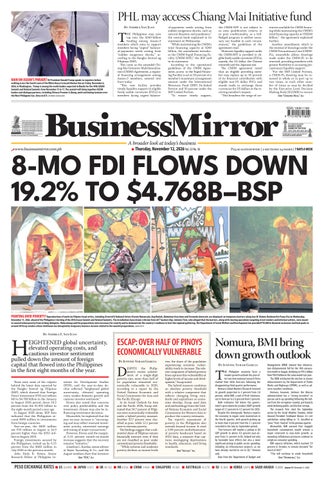
RAIN ON ASEAN’S PARADE? US President Donald Trump speaks to reporters before walking across the South Lawn of the White House to board Marine One on Friday, November 6, 2026, in Washington. Trump is among the world leaders expected in Manila for the 49th ASEAN Summit and Related Summits from November 15 to 17. The summit will bring together ASEAN leaders and dialogue partners, including Chinese Premier Li Qiang, amid continuing tensions over the West Philippine Sea. Story on A13. AP/MARK SCHIEFELBEIN
ROTARY CLUB OF MANILA JOURNALISM AWARDS
2006 National Newspaper of the Year 2011 National Newspaper of the Year 2013 Business Newspaper of the Year 2017 Business Newspaper of the Year 2019 Business Newspaper of the Year 2021 Pro Patria Award PHILIPPINE STATISTICS AUTHORITY 2018 Data Champion
of-payments needs arising from sudden exogenous shocks, such as natural disasters and pandemics,” the central bank explained in its statement on Wednesday. “While maintaining the CMIM’s total financing capacity at $240 billion, the amendment introduces the CMIM Rapid Financing Facility [CMIM-RFF],” the BSP said in its statement. According to the operational guidelines of the CMIM Agreement, access to the Rapid Financing Facility is set at 20 percent of a member’s maximum arrangement amount under the International Monetary Fund (IMF) De-linked Portion and 50 percent under the IMF Linked Portion. “To ensure timely support,
the CMIM-RFF is not subject to ex ante qualification criteria or ex post conditionality, as a fullfledged program is neither necessary nor feasible in such circumstances,” the guidelines of the agreement read. Moreover, liquidity support under the CMIM-RFF is provided in eligible freely usable currencies (FUCs), namely, the US dollar, the Chinese renminbi and the Japanese yen. The CMIM agreement noted that an eligible providing member may replace up to 50 percent of its financial contribution with eligible non-US dollar FUCs and stands ready to exchange those currencies for US dollars at the receiving member’s request. “This broadens the range of cur-
rencies available for CMIM financing while maintaining the CMIM’s total financing capacity at US$240 billion,” the agreement explained further. Another amendment, which is the renewal of drawings under the CMIM Precautionary Line (CMIMPL), meanwhile allows drawings made under the CMIM-PL to be renewed, providing members with greater flexibility in accessing precautionary liquidity support. “For the IMF Linked Portion, a CMIM-PL drawing may be renewed in whole or in part up to two times, or such other number of times as may be decided by the Executive Level Decision Making Body [ELDMB] to ensure See “Chiang Mai,” A2
BusinessMirror A broader look at today’s business
EJAP JOURNALISM AWARDS
BUSINESS NEWS SOURCE OF THE YEAR
(2017, 2018, 2019, 2020, 2021) DEPARTMENT OF SCIENCE AND TECHNOLOGY
2018 BANTOG MEDIA AWARDS
8-MO FDI FLOWS DOWN 19.2% TO $4.768B–BSP www.businessmirror.com.ph
n
Thursday, November 12, 2026 Vol. 22 No. 36
P25.00 nationwide | 2 sections 24 pages | 7 DAYS A WEEK
PAINTING OVER POVERTY? Reproductions of works by Filipino visual artists, including (from left) National Artists Vicente Manansala, Ang Kiukok, Abdulmari Asia Imao and Fernando Amorsolo, are displayed on temporary barriers along Jose W. Diokno Boulevard in Pasay City on Wednesday, November 11, 2026, ahead of the Philippines’s hosting of the 49th Asean Summit and Related Summits. The installations have drawn criticism from ACT Teachers Rep. Antonio Tinio, who alleged that the barriers, along with clearing operations targeting street vendors and informal settlers, were meant to conceal urban poverty from visiting delegates. Malacañang said the preparations were necessary for security and to demonstrate the country’s readiness to host the regional gathering. The Department of Social Welfare and Development has provided P10,000 in financial assistance and food packs to around 30 Pasay vendors whose livelihood was disrupted by temporary business closures related to the summit preparations. NONIE REYES
H
By Andrea E. San Juan
EIGHTENED global uncertainty, elevated operating costs, and cautious investor sentiment pulled down the amount of foreign capital that flowed into the Philippines in the first eight months of the year. These were some of the culprits behind the latest data reported by the Bangko Sentral ng Pilipinas (BSP), which showed that Foreign Direct Investment (FDI) net inflows fell to $4.768 billion in the January to August 2026 period, down 19.2 percent from the $5.902 billion in the eight-month period a year ago. In August 2026 alone, BSP data indicated that the Philippines secured $690 million in investments from foreign countries. Year-on-year, the $690 million net FDI inflows in August is 24.9 percent higher than the $552 million in August 2025. Foreign investments secured by the Philippines, inched up by 0.15 percent from the $689 million in July 2026 or the previous month. John Paolo R. Rivera, Senior Research Fellow at Philippine In-
stitute for Development Studies (PIDS), said the year-to-date decline reflected “heightened global uncertainty, elevated operating costs, weaker domestic growth and cautious investor sentiment.” Rivera also noted that concerns over policy predictability and the investment climate may also be influencing investment decisions. Meanwhile, he explained that the year-on-year increase is “encouraging and may reflect renewed investment activity, reinvested earnings and timing of major transactions.” However, Rivera said the marginal 0.15 percent month-on-month increase suggests that the recovery remains “tentative.” Jonathan L. Ravelas, senior adviser at Reyes Tacandong & Co., said the August numbers show that investors See “FDI,” A2
ESCAP: OVER HALF OF PINOYS ECONOMICALLY VULNERABLE By Justine Xyrah Garcia
D
ESPITE the Philippines’s recent achievement of a single-digit poverty rate, more than half of its population remained economically vulnerable in 2026, according to a report by the United Nations Economic and Social Commission for Asia and the Pacific (Escap). In its Social Outlook for Asia and the Pacific 2026, Escap estimated that 54.7 percent of Filipinos were economically vulnerable under a hybrid poverty measure. Another 32.7 percent were classified as poor, while 12.1 percent were in extreme poverty. The findings suggest that a substantial share of Filipinos remain financially insecure even if they are not classified as poor under conventional poverty thresholds. “While extreme and moderate poverty declines as income levels
rise, the share of the population experiencing economic vulnerability tends to increase. The relative component of hybrid poverty lines captures this vulnerability at higher levels of income and development,” Escap noted. The hybrid measure combines an absolute poverty threshold with a relative component that reflects changing living standards and aspirations as economies develop. Escap used data and methodology from the United Nations Economic and Social Commission for Western Asia to produce the country estimates. The report’s assessment of poverty in the Philippines also extends beyond income. It cited a 3.89-percent multidimensional poverty headcount based on 2022 data, a measure that captures overlapping deprivations in health, education, and living standards. See “Escap,” A2
Nomura, BMI bring down growth outlook By Justine Xyrah Garcia
T
HE Philippine economy faces a weaker growth outlook this year after two international research firms slashed their 2026 forecasts following the disappointing third quarter performance. Nomura Global Markets Research lowered its growth projection to 3 percent from 3.8 percent, while BMI, a unit of Fitch Solutions, cut its forecast to 2.6 percent from 3 percent. Both estimates fall below the government’s gross domestic product (GDP) growth target of 3.5 percent to 4.5 percent for 2026. Despite the downgrade, Nomura expects the economy to regain some momentum in the fourth quarter, with growth picking up to more than 4 percent from the 2.1 percent recorded in the July-to-September period. “Our forecast still implies a pickup in Q4 GDP growth to above 4.0 percent year-onyear from 2.1 percent in Q3, helped not only by favorable base effects but also a more significant pickup in public sector spending, including on infrastructure projects, as we have already started to see in Q3,” Nomura said. Data from the Department of Budget and
Management (DBM) showed that infrastructure disbursements fell for the 14th consecutive month in August, declining to P70.5 billion from P84.9 billion in the same month last year. The DBM attributed the decline to slower disbursements by the Department of Public Works and Highways (DPWH), as well as adverse weather conditions. Nomura, however, believes the Marcos administration has a “strong incentive” to pursue catch-up spending following the fallout from the corruption scandal, particularly amid declining public satisfaction ratings. The research firm cited the September survey by the Social Weather Stations, which showed President Ferdinand Marcos Jr.’s net satisfaction rating falling to -11, classified as “poor,” from “neutral” in the previous quarter. Meanwhile, BMI warned that sluggish household consumption would remain a major constraint to near-term growth, as mounting inflationary pressures continue to weigh on consumer spending. BMI expects inflation, which reached 7.8 percent in October, to remain elevated “for much of 2027.” “This will continue to erode household See “Nomura,” A2
PESO EXCHANGE RATES n US 63.0400 n JAPAN 0.3972 n UK 84.1332 n HK 8.0356 n CHINA 9.4364 n SINGAPORE 49.1885 n AUSTRALIA 43.2770 n EU 70.3842 n KOREA 0.0470 n SAUDI ARABIA 16.8008 Source: BSP (November 11, 2026)
News
BusinessMirror
A2 Thursday, November 12, 2026
Nomura… Continued from A1
purchasing power and dampen spending. The lagged effects of monetary tightening should also become more pronounced in the coming months, with higher borrowing costs constraining demand,” it added. Weak agricultural production is also expected to compound these pressures. The sector contracted by 4.8 percent in the third quarter, its weakest performance recorded this millennium, as typhoon disruptions and El Niño weighed on output. The Philippine Atmospheric, Geophysical and Astronomical Services Administration (Pagasa) said a “very strong El Niño” had officially formed in the tropical Pacific and was expected to peak toward the end of the year. As of October 13, a total of 109 cities and municipalities had declared a state of calamity due to the phenomenon, according to the National Disaster Risk Reduction and Management Council (NDRRMC). BMI warned that the agricultural downturn could also affect economic activity beyond the sector by reducing incomes in rural communities. Despite these headwinds, BMI expects the economy to recover in 2027, supported by a rebound in public capital spending. The think tank said the decline in public construction moderated in the third quarter, with output falling by 15.1 percent, slower than the 33.4-percent contraction recorded in the previous quarter. BMI now expects the Philippine economy to grow by 4 percent in 2027, slower than its earlier 4.5-percent projection. The revised forecast also falls below the government’s medium-term growth target of 5 percent to 6 percent. The Cabinet-level Development Budget Coordination Committee (DBCC) is set to meet next month to review and revise the government’s economic growth targets.
www.businessmirror.com.ph
El Niño damage to farms now nearing ₧10B, says DA
E
By Ada Pelonia
L NIÑO damage on plantations soared to nearly P10 billion as of mid-November, according to the Department of Agriculture (DA). In its latest bulletin, the DA noted that El Niño has wrecked farmlands across various crops worth P9.99 billion, affecting 324,327 farmers. Some 323,419 hectares of land have been affected by the dry spell, with around 76 percent or 248,129 hectares still having a chance to recover. Production losses were already
pegged at 288,424 metric tons (MT) across 16 regions, with the corn sector sustaining most of the dry spell’s impact, as it wreaked havoc on 161,166 MT of output worth P5.63 billion. This was followed by rice at 108,881 MT, with losses valued at P3.65 billion. High-value crops also recorded damages at 18,185 MT worth P655.74 million.
Escap…
These findings form part of a wider challenge across Asia and the Pacific, where improvements in income have not necessarily translated into lasting financial security for millions of people. Under the same hybrid poverty measure, more than 1.1 billion people across the region were living in poverty in 2026, while another 1.2 billion were economically vulnerable. This comes despite a sharp decline in extreme poverty across the region, from about 50 percent in
Continued from A1
Children remain particularly exposed, with Escap noting that more than one-fifth of Filipino children live below national poverty thresholds, while 8 to 12 percent were living in extreme poverty under the former international poverty line of $2.15 a day.
The domestic livestock and poultry industry were not spared from the dry spell, as it killed 8,098 heads of various animals valued at P40.83 million. Citing Pagasa, the DA said the ongoing El Niño phenomenon will continue until the first half of 2027 and is forecast to hit a “very strong” state by the end of this year. To cushion the dry spell’s impact on the farm sector, the agency said it has rolled out P18.64 billion worth of interventions for the affected farmers. This includes P10.82 billion worth of assistance for production support, such as farm inputs like seeds, fertilizers, and soil conditioner, among others.
The DA also provided P6.26 billion worth of financial assistance through the Presidential Assistance for Farmers and Fisherfolk Program (PAFFP), which benefited 2.69 million individuals. It also distributed 97,345 animal heads valued at P520.66 million to 365 groups of farmers and 742 farmer individuals, forage seeds, and zoological supplies. It also installed 629 pump and engine sets and small-scale irrigation projects with a combined worth of P98.63 million to enhance water supply in several regions. The Philippine Crop Insurance Corporation (PCIC) has also allocated indemnification checks worth P703.06 million to 77,522 farmers as compensation.
1995 to 4 percent in 2024, based on the international poverty line of $3 a day. “The rapid reduction in monetary poverty observed since the late 1990s began to slow down since 2014 and decelerated further after 2020 amid pandemic and cost-of-living pressures,” the commission said. “Based on hybrid monetary poverty lines, only about half of the population of the AsiaPacific region is neither poor nor vulnerable.” The UN body attributed the region’s continuing poverty challenges to several overlapping pressures, including inequality, climate change, demographic shifts, digital transformation, and geopolitical uncertainty. Within countries, it found that poverty is often concentrated among rural households, larger families, and people with limited education. These circumstances, the commission
said, can compound disadvantages and limit people’s access to opportunities throughout their lives. It also argued that poverty reduction therefore requires public policies that address structural barriers and enable people to build their capabilities and secure sustainable livelihoods. To achieve this, Escap urged governments to prioritize four areas: investing in human capital through education, health and nutrition; expanding social protection; creating decent and productive jobs; and strengthening cooperatives and the Social and Solidarity Economy framework. “People, regardless of age, sex, disability status, migration status and ethnicity, must have the right and opportunity to build their human capital and secure sustainable livelihoods,” it said.
Chiang Mai…
Member States (excluding TimorLeste , which was not yet part of the Asean+3 framework when the relevant amendments entered into force), China, Japan, Korea, and the Monetary Authority of Hong Kong, China. Latest data from the BSP showed the Philippines’s balance of payments (BOP), which captures its transactions with the rest of the world, widened to $9.087 billion deficit in the January to September 2026 period—the country’s largest yearto-date shortfall in history. (See: https://businessmirror. com.ph/2026/10/20/bop-gapwidest-ever-at-9-087b-in-january-september/)
Continued from A1
consistency with the relevant IMF-supported program,” the amendment noted. For the IMF De-linked Portion, a CMIM-PL drawing may be renewed where deemed necessary and appropriate, subject to ELDMB approval in each case, it also noted. The CMIM is a “multilateral currency swap arrangement” among Asean+3 members and a regional layer of the global financial safety net, the BSP noted. Asean+3 members are Asean
FDI…
Continued from A1
are “still willing to commit capital to the Philippines.” “The challenge now is converting interest into sustained longterm investments by improving competitiveness, reducing business costs, and accelerating reforms,” Ravelas also noted. In a statement on Wednesday, the central bank explained that the decline was driven mainly by lower net investments in debt instruments. Data from the BSP showed net debt instruments plunged to $2.565 billion in the eight-month period, down 30 percent from the $3.661 billion in the same period a year ago. This, the BSP said, reflected lower net intercompany borrowings from foreign direct investors during the period. BSP explained that net investments in debt instruments consist mainly of intercompany borrowing between foreign direct investors and their subsidiaries/ affiliates in the Philippines. The remaining portion of net investments in debt instruments are investments made by nonresi-
dent subsidiaries in its resident direct investors. Meanwhile equity capital placements, which were little changed, came primarily from Japan, the United States and Singapore. The placements were channeled largely into the manufacturing, financial and insurance, and real estate industries.
Outlook
LOOKING ahead, Rivera said FDI net inflows may remain “subdued” for the rest of 2026 amid elevated inflation, peso volatility and slower economic growth. “Opportunities remain in infrastructure, renewable energy, manufacturing, and digital services,” he also noted. Sustained recovery, therefore, will depend on restoring investor confidence, ensuring policy consistency and reducing investment bottlenecks, added Rivera. For the coming months, Michael L. Ricafort, chief economist at Rizal Commercial Banking Corp. (RCBC) said preparations related to Pax Silica and Luzon Economic Corridor provide a “source of hope/bright spot” for FDIs, in view of the framework approval during Asean Leaders’ Summit in November 2026.
Trump to arrive only 30mins before… Continued from A13
Aside from Trump and Li, the following leaders of Asean’s dialogue partners have confirmed their participation in the related meetings: • Japanese Prime Minister Sanae Takaichi • Indian Prime Minister Narendra Modi • Australian Prime Minister Anthony Albanese • United Nations Secretary-General António Guterres • South Korean President Lee Jae Myung • New Zealand Prime Minister Christopher Luxon Russia will be represented by Foreign Minister Sergey Lavrov. DFA officials noted that Russian President Vladimir Putin has not typically attended Asean summits personally, often sending either the foreign minister or deputy prime minister in his place.
Guests of the Asean Chair
ASIDE from United Nations Secretary-General António Guterres, International Monetary Fund Managing Director Kristalina Georgieva, Brazilian President Luiz Inácio Lula da Silva and Canadian Prime Minister Mark Carney will attend the Asean Summit plenary on Sunday. Herrera-Lim said the four leaders accepted President Marcos’s invitation to participate as guests of the Asean Chair.
Energy security, geopolitics on agenda
LEADERS are also expected to convene separately under the Japanled Asia Zero Emission Community (Azec), whose members include Australia, Brunei, Cambodia, Indonesia, Japan, Laos, Malaysia, the Philippines, Singapore, Thailand and Vietnam. Herrera-Lim said Azec leaders will discuss the impact of ongoing instability in the Middle East on regional energy markets and measures to strengthen energy security, including expanded oil stockpiling capacity and more resilient liquefied petroleum gas supply chains. Herrera-Lim said EAS leaders are expected to adopt two key documents: • Declaration on Navigating Our Future, Together: Stability and Renewal, which aims to strengthen regional stability, resilience and cooperation amid evolving geopolitical challenges; and • EAS Leaders’ Statement on Strengthening Cooperation Against Cyber-Enabled Fraud and Related Offenses, which seeks to improve coordination, information sharing, prevention efforts, capacity building and victim protection against online scams and related crimes.
Preparatory meetings begin Wednesday
PREPARATIONS for the summit formally began Wednesday (November 18) evening with a welcome dinner hosted by Herrera-Lim for Asean senior officials. Senior officials are scheduled to meet on Thursday and Friday to settle outstanding political and security issues ahead of the Asean Foreign Ministers’ Meeting on Saturday. During the ministers’ meeting, Foreign Affairs Secretary Ma. Theresa Lazaro is expected to brief her Asean counterparts on her recent humanitarian mission to Myanmar. Later on Saturday, Asean economic ministers are set to sign the Digital Economy Framework Agreement (DEFA), a legally binding accord establishing common rules for digital trade across Southeast Asia. The agreement covers cross-border e-commerce, digital identity authentication, data protection, cybersecurity, electronic payments and artificial intelligence, among other areas.
www.businessmirror.com.ph
The Nation BusinessMirror
Thursday, November 12, 2026 A3
Duterte defense falters – House leaders
L
EADERS the House of Representatives on Wednesday said Vice President Sara Z. Duterte’s defense appeared to be losing ground after its first four witnesses failed to sufficiently challenge the prosecution’s evidence of alleged unexplained wealth— with one witness even confirming payments to the vice president from a company linked to the case. Deputy Speaker Francisco Paolo Ortega V described the defense’s presentation as a pattern of weak testimony, likening the situation to a leaking boat headed for disaster. “Well, it may still be too early to tell, but looking at the trend and the pattern, there are already holes in the boat. It looks like it is heading toward sinking,” Ortega, who represents La Union, said at a press briefing. Or tega noted t hat he had ex pected the defense w itness from GenCorp Industries Inc. to dispute or clarify the financial findings presented by the House prosecution team, but expressed disappointment over her testimony. “I was expecting this witness from GenCorp to at least challenge, answer, or dispute what the prosecution had presented. But there was nothing – absolutely nothing,” he said. The defense has so far presented four witnesses: Davao City Assessor Jaime Adalin, Island Garden City
of Samal Assessor John Kenneth Enumerables, Davao City Accountant Vingelin Bajan, and GenCorp and Metro Chow Foods Corp. in-house counsel Suzette Balucanag-Punay. House impeachment prosecutor and Manila Rep. Joel Chua said Punay had exposed fatal flaws in her testimony even before crossexamination began. “What makes it worse is that she was already making a mess of her testimony even before crossexamination began,” Chua said. House prosecution spokesperson a nd L a n ao de l Sur Rep. Zia-ur Rahman Alonto Adiong questioned the defense’s decision to call Punay to counter the findings of forensic accounting expert Alexander Cabrera, arguing she lacked both the expertise and firsthand knowledge to dispute his analysis. Adiong pointed out that Punay was neither GenCorp’s corporate secretary nor directly
Think tank urges transparency over secrecy in maritime dispute By Rex Anthony Naval
I
NDEPENDENT think tank Stratbase Institute on Tuesday urged the government not to let diplomatic considerations weaken its defense of Philippine sovereignty, calling for firm transparency and accountability in the West Philippine Sea (WPS) amid ongoing tensions with China. In a statement, Stratbase Institute president Victor Andres Manhit stressed that diplomatic engagement must not sacrifice public openness – especially when maritime developments directly threaten national security, sovereign rights, and local fishing livelihoods. “Diplomacy remains essential, but it cannot replace transparency and public accountability. There must be room for responsible public discussion, especially when developments at sea directly affect our sovereign rights, national security, and the livelihoods of Filipino communities,” Manhit said. He voiced strong support for the
Armed Forces (AFP) and the Coast Guard (PCG) in documenting and publicly reporting encounters with foreign vessels, while commending officials who actively defend the nation’s borders. Manhit’s statement follows renewed debate over balancing relations with China against responding to its assertive maneuvers in the WPS. Recent discussions have pressed officials to align public statements with administration foreign policy to avoid undercutting diplomatic channels. However, Manhit warned against overreach. While “discretion has its place… it must never be used to suppress scrutiny or silence officials on matters of core national interest. Exposing coercion and unlawful maritime activities is a lawful defense of our rights,” he emphasized. He underscored that exposing coercive behavior is a legitimate defense of national sovereignty—not an obstacle to diplomacy—and called for a whole-of-nation approach to protect Philippine waters alongside diplomatic efforts.
Police hunt 300,000 wanted persons
T
HE National Police (PNP) is going all-in to clear its dragnet, setting its sights on roughly 300,000 wanted persons nationwide as it aims to hit a zero-backlog milestone. The extensive hit list spans everyday fugitives to prominent names, including Sen. Ronald dela Rosa, former Party-list Rep. Rizaldy Co of Ako Bicol, former Bureau of Corrections chief Gerald Bantag, and businessman Charlie “Atong” Ang. Gen. Jose Melencio Nartatez Jr., National Police chief, said that the authorities will not pull any punches regardless of who is being pursued. “We are confident that we can achieve this goal because we have already shown that sustained and determined action can significantly reduce the number of wanted persons,” Nartatez said in a statement. “We will not be satisfied with reducing the backlog since our ultimate objective is to bring it down to zero.” Nartatez stressed that no one gets a free pass, confirming that the campaign covers everyone with active warrants,
no matter their title or political clout. To pull off the ambitious sweep, the PNP is relying on relentless operations, sharper intelligence, and tighter teamwork with partner enforcement agencies. The drive is already yielding momentum. When Nartatez took the helm on August 26, 2025, the PNP’s master list sat at some 500,000 wanted individuals. Over the past 14 months, lawmen have chipped away at the tally, capturing roughly 200,000 fugitives – bringing the active count down to the current 300,000. The crackdown maintained a fast pace in October alone, with officers locking up 8,839 wanted individuals all over the country. That haul included 2,353 classified as “most wanted” and 6,486 other suspects. Metro Manila led the regional arrest charts through the National Capital Region Police Office with 1,641 arrests. Police Regional Office 3 (Central Luzon) trailed close behind with 1,503, while PRO 4A (or Calabarzon (Cavite, Laguna, Batangas, Rizal and Quezon) racked up 1,317 arrests. Rex Anthony Naval
involved in preparing its stock records and financial transactions. Ortega echoed this view, stating that Punay could not undermine C abrera’s f ind ings by simply calling them “absurd,” given that the forensic accounting expert relied on specialized training and structured methodologies. “Attorney Cabrera is an expert witness. He is a forensic specialist. He has a methodology and a process. His conclusions are based on specialized training and study,” Ortega said. Adiong added that Cabrera was backed by a full forensic team, further calling into question the basis of Punay’s evaluation. During Wednesday’s impeachment trial, Punay disputed Cabrera’s estimate that Duterte held a 20 percent stake in GenCorp, maintaining that the Vice President owned no formal shares in the company. However, she confirmed that GenCorp paid Duterte a total of P2,142,369.14 between 2022 and 2025—during her term as Vice President—through what she described as a “loose investment” in the company’s Jollibee Times Square branch in Davao City. Under questioning by Impeachment Court Presiding Officer Francis Escudero, Punay admitted she could not verify the original amount of Duterte’s investment or produce written records documenting its terms. Adiong emphasized that this admission came directly from the defense. “The admission that the Vice President received monthly payments from GenCorp did not come from the prosecution. It came from their own witness,” he said. The Senate Impeachment Court
allowed Punay to testify on matters within her personal knowledge, but barred her from offering competing expert opinions against Cabrera’s forensic report. Escudero also ordered her characterization of Cabrera’s conclusions as “absurd” stricken from the trial record. Cabrera had attributed P212.63 million in alleged undeclared income from GenCorp to Duterte between 2023 and 2025—part of his broader findings alleging at leastP817.87 million in undeclared assets and unexplained wealth. House leaders on Wednesday said Vice President Sara Z. Duterte’s defense appeared to be losing ground after its first four witnesses failed to sufficiently challenge the prosecution’s evidence of alleged unexplained wealth, with one witness even confirming payments to t he v ice president f rom a company linked to the case. Deput y Spea ker Francisco Paolo Ortega V said the defense’s presentation of witnesses had revealed a pattern of weak testimony, describing the situation as a boat with holes that appeared headed for disaster. “Well, it may still be too early to tell, but looking at the trend and the pattern, there are already holes in the boat. It looks like it is heading toward sinking,” Ortega said at a press briefing. Ortega said he had expected the defense witness from GenCorp Industries Inc. to dispute or provide explanations for the financial findings presented by the House prosecution but was disappointed by her testimony. “I was expecting this witness from GenCorp to at least challenge, answer or dispute what the prosecution had
presented. But there was nothing, absolutely nothing,” he said. The defense has so far presented four witnesses: Davao City Assessor Jaime Adalin, Island Garden City of Samal Assessor John Kenneth Enumerables, Davao City Accountant Vingelin Bajan, and GenCorp and Metro Chow Foods Corp. in-house counsel Suzette Balucanag-Punay. House impeachment prosecutor and Manila 3rd District Rep. Joel Chua said Punay had already exposed weaknesses in her testimony even before the prosecution began crossexamining her. “What makes it worse is that she was already making a mess of her testimony even before crossexamination began,” Chua said. House prosecution spokesperson and Lanao del Sur Rep. Zia Alonto Adiong questioned the defense’s decision to present Punay to challenge the findings of forensic accounting expert Alexander Cabrera, saying she lacked the expertise and firsthand knowledge to dispute his analysis. Adiong noted that Punay was neit her GenCor p’s cor porate secretary nor directly involved in the preparation of its stock records and financial transactions. Ortega, likewise, said Punay could not effectively challenge Cabrera’s findings by simply dismissing them as absurd, pointing out that the forensic accounting expert had specialized training and a methodology behind his conclusions. “Attorney Cabrera is an expert witness. He is a forensic specialist. He has a methodology and a process. His conclusions are based on specialized training and study,” Ortega said. See “Duterte,” A4
Marcoleta seeks case dismissal as Revilla hit with rejection By Joel R. San Juan @jrsanjuan1573
D
ETAINED Sen. Rodante Marcoleta is pushing for the outright dismissal of his P75-million plunder case, while former senator Ramon Revilla Jr. failed in a similar bid to dodge his P92.8-million malversation rap. Sandiganbayan Third Division Clerk of Court Dennis Pulma confirmed on Wednesday that Marcoleta and his three co-accused— former Quezon City Rep. Michael Defensor, along with businessmen Joseph Espiritu and Aristotle Viray—filed motions for leave to submit a demurrer to evidence.
A demurrer effectively asks the anti-graft court to throw out charges owing to weak prosecution evidence. The case stems from Marcoleta’s admission that he received campaign donations totaling P75 million —P30 million from Defensor, P25 million from Espiritu, and P20 million from Viray—during the January 2025 campaign run. The Office of the Ombudsman slapped him with plunder, alleging the funds went undeclared in his Statement of Contributions and Ex penditures (Soce) and Statement of Assets, Liabilities, and Net Worth (SALN), amounting to “unjust enrichment.” Marcoleta, who maintains the
complaints are legally flawed and lack merit, faces an eager prosecution given five days to file its opposition. Meanwhile, the court rejected the motion for leave to file a demurrer to evidence submitted by Revilla and his co-accused in connection with an allegedly “ghost” flood control project in Pandi, Bulacan. State prosecutors allege Revilla pocketed advance kickbacks for the nonexistent P92.8-million project. With their motion denied, Rev il la and his co-accused— including severa l for mer Department of Public Works and Highways engineers—will now have to take the stand and present their defense starting November 24.
Top PHL leaders face widening regional split By Rizal Raoul Reyes
N
EITHER of the Philippines’ top two officials commands majority trust or approval nationally, with four-year survey trends showing their regional support bases pulling further apart. The Q3 2026 Tugon ng Masa (TNM) survey conducted by Octa Research from September 28 to October 4, 2026 indicate that President Marcos experienced a decline in both trust and performance ratings for the second consecutive quarter. Meanwhile, Vice President Sara Duterte-Carpio’s national numbers held essentially flat, remaining near her series lows. W hile nationa l tr ust and satisfaction ratings for both leaders are now within the survey’s margin of error of each other, they draw their backing from almost opposite geographic sectors of the country. Marcos’ trust rating fell 4 percentage points from 49 percent in July to 45 percent in September. In addition, distrust rose from 32 percent to 36
percent, while 19 percent remained undecided. Satisfaction with his performance dipped 3 percentage points to 44 percent, with dissatisfaction rising to 36 percent. This marks his lowest national ratings in the TNM series. Embattled Duterte-Carpio’s trust rating reached 48 percent (up 1 percentage point from July), while distrust remained unchanged at 33 percent. Performance satisfaction stood at 46 percent (up 1 percentage point), with dissatisfaction at 36 percent. Both figures stay within one percentage point of her series-low levels recorded in July 2026. Across the four major geographic areas, Octa Research said public trust highlights a stark regional split: Ba lance Lu zon: Rema ins t he firmest base for the son of the late Filipino strongman, where he commands major it y tr ust at 54 percent (down 9 percentage points from July) and 55 percent satisfaction. Conversely, Duterte-Carpio records her lowest trust (25 percent) and performance (25 percent) ratings here. Mindanao remains a Duterte
bailiwick as she maintains nearunanimous trust at 94 percent (up 5 percentagve points) and 88 percent satisfaction. In contrast, Marcos scores his lowest ratings in Mindanao, recording 28 percent trust and 27 percent satisfaction, alongside a 60 percent distrust level. The Visayas is leaning towards the Vice President, who holds majority trust at 66 percent (up 8 percentage points) and 60 percent satisfaction. Marcos registers 43 percent trust and 42 percent satisfaction. The National Capital Region (NCR) is the most polarized region, according to the survey. Marcos holds 45 percent trust and 43 percent satisfaction ratings while Duterte-Carpio saw a notable 12-point surge in trust to 40 percent, though her performance satisfaction remains lower at 24 percent. In Class ABC, Marcos experienced an 8 percentage point decline in trust (down to 43 percent) and a 9 percentage point drop in satisfaction (down to 44 percent). Duterte-Carpio saw a 7-percentage point fall in trust to 39 percent. See “Top,” A4
Sara paid P2.1-M without written records – impeach defense witness
V
ICE President Sara Z. Duterte received P2,142,369.14 from GenCorp Industries Inc. between 2022 and 2025 as purported “return of capital” for an investment in a Davao City fast-food branch – despite the absence of written records to prove the original transaction, her own defense witness testified at the Senate Impeachment Court on Wednesday. Lawyer Suzette Balucanag-Punay, corporate counsel for GenCorp and Metro City Chow Foods Corp., testified that monthly checks were drawn directly from the bank account of Jollibee’s Times Square branch in Davao City to pay the Vice President. However, under cross-examination, Punay conceded she could not verify the principal amount or terms of Duterte’s underlying investment. “Unfortunately, Your Honor, I could not verify the amount because there are no written records for this investment,” Punay admitted to the tribunal. The admission drew immediate scrutiny from Presiding Officer Francis Escudero, who pressed the defense witness on the legal and accounting basis for the disbursements. “What’s the basis of giving her anything?” Escudero asked. Punay pointed to an internal transaction summary prepared by GenCorp’s accountant detailing four annual disbursements to Duterte: P337,500 in 2022; P555,750 in 2023; P612,419.14 in 2024; and P636,700 in 2025. She classified all payments across the four-year period as a “return of capital,” citing the summary to dispute Table 39 of a forensic accounting report submitted by prosecution expert Alexander Cabrera. Escudero also flagged glaring gaps in GenCorp’s disbursement logs, pointing out that while monthly checks were recorded for 2023 and 2025, no entries appeared between January and April 2024. Punay confirmed the missing records. Punay clarified that Duterte’s alleged venture was limited to the Times Square location and did not confer equity in GenCorp itself, which operates multiple Jollibee outlets across Davao City. “It is an investment in the specific branch only, meaning it is only in the Times Square branch and not the whole corporation, sir,” Punay said. Senator-Judge Anna Theresia “Risa” Hontiveros subsequently requested of f icial copies of the accounting schedule cited by Punay. The defense testimony was quickly seized upon by the House prosecution panel, with spokesman and adviser Ace Barbers arguing that the lack of documentation undermines the defense’s position. “If there are monthly returns on an investment, then clearly there is an investment being referred to,” Barbers said. “The questions are: Whose investment was it, how much was invested, when was it made, and why were no clear documents presented?” B arb er s charac terize d Punay ’s testimony as a liability for the Vice President’s legal team. “For someone presented by the defense to explain these financial transactions, the admission that she had not seen the investment documents and was not even sure of the terminology she used leaves a glaring evidentiary gap. Speculation and personal interpretation are not enough. Where are the documents?” Barbers asked. Barbers noted that the payments warrant strict evaluation under Article VII, Section 13 of the 1987 Constitution, which strictly prohibits the Vice President and Cabinet members from holding interests in any business or engaging in transactions with potential conflicts of interest. He urged the court to investigate whether GenCorp—which operates five Jollibee outlets in Davao City—held contracts or special franchises from the city government during Duterte’s tenure as mayor or Vice President. “If this was a legitimate transaction, the documents should speak for themselves,” Barbers added, noting that investigators must cross-check bank records, corporate filings, and Duterte’s Statements of Assets, Liabilities, and Net Worth (SALNs). “If the witness cannot establish the investment, then the defense must explain what exactly these payments represent.” The prosecution previously noted that while Duterte declared a business interest in GenCorp in her SALN, her name does not appear on the company’s General Information Sheet (GIS). Jovee Marie N. dela Cruz
A4
Economy BusinessMirror
Thursday, November 12, 2026
www.businessmirror.com.ph
PHL pushes for direct funding for vulnerable communities
T
By Jonathan L. Mayuga |
@jonlmayuga
HE Department of Environment and Natural Resources (DENR) pushed for stronger climate adaptation measures and faster action to address growing climate risks and protect vulnerable communities at the Baku High-Level Dialogue on Adaptation in Antalya, Türkiye.
particularly ensuring that finance, institutional support, and technical assistance translate into tangible benefits for communities. Participating countries shared their experiences and identified practical ways to overcome barriers, including improving access to funding and strengthening localled initiatives. “Our experience demonstrates that NAP cannot remain passive policy documents; they must become structural investment frameworks that govern national development decisions,” Environment Secretary Juan Miguel Cuna said. Cuna identified three key systems that could help accelerate the implementation of adaptation mea su res: i nteg rated mu lt ihazard early warning and action systems, stronger partnerships with international development institutions, and the use of global climate frameworks to guide national resource allocation. Under the proposed early warning system, real-time climate monitoring for drought and extreme
heat would be linked to prearranged financing mechanisms and immediate inter ventions to help the agriculture sector withstand the climate impacts which would allow authorities to act before climate-related hazards escalate to more serious problems for communities and livelihoods. He further called for a global framework for Global Climate Resilience, to directly influence how countries locate resources for climate resilience. “Beyond national planning, adaptation financing must reach communities most exposed to climate risks which calls for simpler financing procedures that would allow local government units and frontline communities to directly access funds for initiatives such as ecosystem-based adaptation, rainwater harvesting and droughtresilient farming,” he explained. Cuna also pushed for grant-based and highly concessional financing, rather than loans that could add to the debt burden of developing countries already dealing with
climate-related losses and damages. “Local governments and affected communities should have a direct role in designing adaptation projects, with indigenous and local knowledge considered in decisions to ensure that interventions respond to conditions on the ground,” he added. “ We mu st a l ig n n at ion a l de ve lopment dec isions w it h science-based NAPs, streamline i nt e r n a t i o n a l d e v e l o p m e nt cooperation to fill capacity gaps, and channel grant-based adaptation finance directly to the communities standing on the frontlines of climate risk,” he further stated. The recommendations were presented at the Baku High-Level Dialogue on Adaptation to which 93 nations have submitted their NAPs, including the Philippines. It is a ministerial-level platform established at the 29th Conference of the Parties (COP29) to the United Nations Framework Convention on Climate Change (UNFCCC). TheDENRservesasthePhilippines’ lead negotiator on the Adaptation workstream under the UNFCCC.
In the interventions at the dialogue, the Philippines underscored the need to enact its National Adaptation Plan (NAP) to concrete investments and develop to tangible results rather than allowing it to remain a policy document. The Baku dialogue brought together government ministers, senior officials, international or-
ganizations, financial institutions and other civil society groups to discuss ways of accelerating climate adaptation and strengthening the implementation of the UAE framework for global climate resilience. As part of COP31, the meeting focused on closing the gap between n at ions’ c l i m ate ad apt at ion plans and their implementation,
Dole rushes aid to workers displaced by Asean summit
Legislator urges fast tax relief for workers
T
By Mary Jade Jadormio
HE Department of Labor and Employment (Dole) is deploying emergency employment assistance to workers displaced by business closures in Pasay City ahead of the Philippines’ hosting of the 2026 Association of Southeast Asian Nations (Asean) Summit. An initial batch of 60 workers began a 10-day employment program on November 11 under department’s Tulong Panghanapbuhay sa Ating Disadvantaged/ Displaced Workers (Tupad) initiative, the agency announced. Beneficiaries include employees of commercial establishments and ambulant vendors along Jose W. Diokno Boulevard, where several businesses were ordered to temporarily suspend operations as part of security and traffic management preparations for the regional summit. Among the affected establishments is Diwata Pares Overload, which received a closure order covering October 29 to Nov. 18. The temporary suspensions have severely disrupted the daily income of local employees and small vendors. To complement Dole’s response, the Department of Social Welfare and Development (DSWD) previously identified 30 affected vendors, providing them with family food packs and financial assistance of up to P10,000 each. Dole-NCR is actively profiling additional qualified workers to expand the coverage of its emergency employment program. The initiative aims to provide vital temporary relief to workers whose livelihoods have been disrupted by summit preparations. The Philippines will host the 48th and 49th Asean Summits and Related Summits from November 16 to 18.
By Jovee Marie N. Dela Cruz @joveemarie
A
LAWMAKER has urged Congress to fast-track proposed tax relief measures for individual taxpayers and micro and small enterprises (MSEs), warning that accelerating inflation and a weakening peso are squeezing household purchasing power and raising operating costs for businesses. Parañaque Rep. Brian Yamsuan said raising the annual personal income tax exemption threshold and scrapping the Minimum Corporate Income Tax (MCIT) for micro and small enterprises would provide much-needed financial relief to workers and businesses struggling with rising prices. “With inflation reaching 7.8 percent in October and the peso losing value, Filipino families are getting less for every peso they earn. Goods that previously cost P100 now require P107.80. This is an additional burden on household budgets, even before the full economic impact of the super El Niño is felt,” Yamsuan said. He called on lawmakers to prioritize the pending measures when Congress
Duterte…
Continued from A3
Adiong also emphasized that Cabrera had a team supporting his forensic examination, questioning the basis of Punay’s assessment of the financial findings. During Wednesday’s impeachment trial, Punay disputed Cabrera’s estimate that Duterte held a 20-percent interest in GenCorp, maintaining that the vice president had no formal shares in the company. However, she confirmed that GenCorp paid
resumes session this week, saying tax relief could help households preserve their purchasing power while allowing small businesses to keep their operations afloat and retain workers. Yamsuan authored House Bill 10577, which seeks to increase the annual personal income tax exemption threshold from P250,000 to P450,000, and HB 10578, which proposes the abolition of the 2-percent MCIT imposed on the gross income of micro and small enterprises. The House Committee on Ways and Means has approved measures seeking to abolish the MCIT for micro and small businesses, including bills filed by Yamsuan, Speaker Faustino Dy III, Majority Leader Ferdinand Alexander Marcos and other lawmakers. The committee, chaired by Marikina Rep. Miro Quimbo, also approved a measure increasing the personal income tax exemption threshold, although at a lower level of P350,000 annually. Yamsuan said the urgency of these measures has grown as inflation accelerated from 6.2 percent in August to 7.2 percent in September and 7.8 percent in October. He said the proposed increase in the income tax exemption threshold should
be assessed against the continuing rise in the cost of basic goods and services, as well as the possibility of further price pressures from the super El Niño. “We leave it to our economic managers to determine whether the proposed P350,000 threshold is sufficient or needs to be raised further to help low- and middle-income families cope with the difficult economic conditions they face today and may continue to face next year,” he said. Yamsuan pointed out that when Congress passed the Tax Reform for Acceleration and Inclusion (TRAIN) Law in 2017, which established the current P250,000 annual income tax exemption, the measure was intended to protect minimum wage earners and lower-middle-income households from income tax. However, he said inflation over the years has significantly diminished the value of that exemption. A basket of goods that cost P1,000 in 2018 now costs approximately P1,300, illustrating how rising prices have eroded the purchasing power of Filipino households. He warned that failure to adjust the income tax exemption threshold cou ld push more lower-midd le income families toward economic
vulnerability, as a larger portion of their earnings is consumed by increasingly expensive necessities. For micro and small enterprises, Yamsuan said the combination of high inflation, peso depreciation and recent minimum wage increases has further strained business operations, particularly for firms with limited financial capacity. He explained that the 2-percent MCIT is computed based on gross income rather than actual net profits, meaning businesses may still be required to pay the tax even when their earnings are minimal or they are barely breaking even. “Small businesses should not be forced to pay taxes based on gross income when they are barely making ends meet. Removing the MCIT would give them additional breathing room and allow them to redirect their savings toward daily operations, business improvements, and, most importantly, retaining their employees,” Yamsuan said. He said providing tax relief to workers and small enterprises would help cushion the domestic economy against mounting price pressures by giving households more disposable income and businesses greater capacity to sustain employment and economic activity.
Duterte a total of P2,142,369.14 from 2022 to 2025, duringhertermasvicepresident,throughwhatshe describedasa“looseinvestment”inthecompany’s Jollibee Times Square branch in Davao City. Under questioning by Senate President Pro Tempore Francis “Chiz” Escudero, who presided over the proceedings, Punay admitted that she could not verify the original amount of Duterte’s investment or produce written records documenting its nature. Adiong said the acknowledgment of the payments came from the defense’s own witness, rather than from the prosecution. “The admission that the vice president received monthly payments from GenCorp did
not come from the prosecution. It came from their own witness,” Adiong said. The Senate impeachment court allowed Punay to testify on matters within her personal knowledge but barred her from offering a competing expert opinion on Cabrera’s forensic findings. Escudero also ordered her description of the expert’s conclusions as “absurd” stricken from the trial record. Cabrera had attributed P212.63 million in alleged undeclared income from GenCorp to Duterte between 2023 and 2025. This amount formed part of his findings of at least P817.87 million in alleged undeclared assets and unexplained wealth.
The defense disputes Cabrera’s calculations and maintains that Duterte’s financial involvement was limited to an investment in the Jollibee Times Square branch, rather than ownership of GenCorp. Ortega said the prosecution’s financial findings remained largely unchallenged despite the defense having presented four witnesses, adding that the testimonies had yet to provide a sufficient explanation for the evidence already submitted. The Senate impeachment court is hearing the defense’s evidence under Article II, the remaining impeachment charge involving allegations of unexplained wealth against Duterte. Jovee Marie N. dela Cruz
Top…
Continued from A3
In Class D, trust in Marcos dropped to 43 percent, while trust in Duterte-Carpio registered at 47 percent. Meanwhile, Marcos gained ground in Class E, with trust rising 4 percentage points to 59 percent and satisfaction reaching 55 percent. For Duterte-Carpio, satisfaction climbed 7 percentage points to 62 percent, even as her trust fell 11 percentage points to 45 percent. Reverting to October 2022, both leaders entered office with broad-based trust exceeding 80 percent across all regions. Over the 16 TNM survey rounds, their support bases have drifted into near mirror-image profiles. The gap between Marcos’ highest
region (Balance Luzon at 54 percent) and lowest region (Mindanao at 28 percent) has widened from 10 percentage points in October 2022 to 26 points in September 2026. The gap between DuterteCarpio’s highest region (Mindanao at 94 percent) and lowest region (Balance Luzon at 25 percent) has expanded from 17 percentage points in October 2022 to 69 percentage points in September 2026 – the widest regional divergence recorded for either official in the series. The survey was conducted from September 28 – October 4, 2026. It had a sample size and sampling of 1,200 respondents aged 18 and older interviewed face-to-face.
‘Integrate unsold condos into govt housing program’ By Butch Fernandez @butchfBM
T
HER E’S a glut of unsold condominium units? There’s a practical way of putting them to good use: Fold in the thousands of unsold condominium units into the government’s housing program, Sen. Francis Escudero said. Escudero brought up the proposal during his ‘Chiz Wiz!’ podcast over the weekend, where he was joined by Department of Human Settlements and Urban Development (DHSUD) Undersecretary Marisol Anenias and Colliers Philippines Research Director Joey Roi Bondoc, who cited an estimated 80,000 unsold condominium units in the National Capital Region alone, many of which were originally intended for the Philippine offshore gaming operator market. The market reeled from the idle inventory after the government banned Pogos by yearend 2025, citing the huge social and reputational damage they are causing, spawning crime and damaging institutions such as the civil registry system. Describing it as a “housing paradox,” Escudero noted that while thousands of condominiumunitsremainunoccupied, millions of Filipinos continue to face a housing backlog, highlighting the need to better align existing housing supply with families’ housing needs and financial capacity. “Why build from scratch when there are already existing units that can be made available to our people?” he said, noting that available housing stock could be tapped more quickly through public-private collaboration. Escudero, who chairs the Senate Committee on Urban Planning, Housing and Resettlement, said the government and developers should explore ways to integrate excess condominium inventory into the expanded Pambansang Pabahay para sa Pilipino (4PH) Program to allow more families to acquire decent homes through existing residential units. Anenias said the DHSUD already allows developers to enroll excess housing inventory under the 4PH Program, although doing so may require developers to accept lower margins or absorb losses. “Housing is not simply a problem of supply. The bigger challenge is making homes affordable for ordinary Filipinos through financing terms they can realistically pay every month,” Escudero said. He urged policymakers explore ways to lower monthly housing costs through improved financing mechanisms, subsidies and longer repayment periods, while also expanding affordable rental housing options for families not yet buy homes. Escudero said the proposal is consistent with legislative efforts being pursued by t he Senate Committee on Urban Planning, Housing and Resettlement to expand housing access and strengthen the country’s housing framework. Among these is Senate Bill 1992, which seeks to strengthen government’s capacity to acquire land for socialized housing and has already passed third reading in the Senate. Escudero also recently filed Senate Bill 2571, which seeks to expand compliance options for developers and strengthen government mechanisms for delivering affordable housing under the Urban Development and Housing Act of 1992. The measure would allow developers to convert readyfor-occupancy units into accredited socialized housing units, provided these meet DHSUD price ceilings and development standards. Once accredited, the units may be credited toward existing or future balanced housing obligations, offering a faster route to delivering actual homes. Beyond housing production, Escudero said government should also pursue measures aimed at lowering the overall cost of homeownership, encourage the productive use of existing housing inventory, and improve mass transit systems so more Filipinos can live outside major urban centers while maintaining access to employment opportunities.
Thursday, November 12, 2026
A5
‘Brazilian pork did not harm PHL hog sector’ By Ada Pelonia
B
@adapelonia
RAZIL, the Philippines’ top foreign supplier, maintained that its pork exports did not cause the slump in farmgate prices of hogs that led to Manila’s decision to impose a temporary ban on imports for 60 days. T he Brazilian A nimal Protein Association (ABPA) told the BusinessMirror that it submitted its technical position within the investigation initiated by the Department of Agriculture (DA) in October. Its position demonstrated that “Brazilian [pork] exports have not caused injury to the Philippine domestic industry,” ABPA told this newspaper on Wednesday. It can also provide the Philippine government with any additional data or clarification, ABPA added. The DA officially imposed an import ban on pork products for 60 days after a government inquiry showed that the inf lux of cheaper shipments resulted in
P28 billion in losses for the domestic hog industry in January to July alone. ABPA, the world’s largest animal protein association, said it “respects the mandate and decisions of the Philippine authorities.” The association added that it is coordinating with the Brazilian government and will participate in the Brazilian mission to the Philippines this week to contribute to the dialogue and the development of a “balanced solution.” “Brazil is currently the Philippines’ leading foreign supplier of pork and has contributed to the regular supply of safe, high-quality and affordable protein, particularly at a time when African swine fever continues to affect domestic
production,” ABPA said. With its exports complementing domestic output and supporting the continuity of supply for consumers, processors, and food-service operators, the association cautioned that the import freeze could have “undesirable inflationary effects” for Filipino consumers. “ABPA trusts that the possible effects of the suspension on food availability, consumer prices and established supply chains will be carefully considered. Particular attention should be given to the local processing industry, which relies on imports to generate employment, pay taxes and contribute to the food security of the Filipino population.” Local meat processors flagged the import freeze, saying this would affect their operations due to a stockout of raw materials, raising retail costs of processed meat products for Filipino consumers in the holiday season. The DA, however, said it will hold a meeting with meat processors regarding the ban to ensure ample supply of raw materials to avoid disruptions in their operations. Also, pork shipments laden on board on or before November 24
will still be allowed entry despite the ban. ABPA said it supports a “transparent, evidence-based and proportionate process,” including the assessment of alternatives that address the concerns of Philippine producers while preserving predictability in trade and food supply. “ABPA remains committed to constructive engagement with the Philippine government, local stakeholders and the Brazilian authorities, with full respect for the ongoing investigation and the long-standing relationship between Brazil and the Philippines.”
‘Fundamentally flawed’
THE Meat Importers and Traders Association (Mita) urged the government to recall the order that slapped the temporary ban due to its “fundamentally flawed” nature. In a letter to the Department of Agriculture (DA) dated November 11, Mita said the agency’s move to impose a 60-day import freeze on pork shipments “failed to consider” several aspects that contributed to the plunge in farmgate prices of hogs. Mita pointed to the African swine fever (ASF), which crimped
domestic hog output, as the leading cause of the farmgate price drop instead of increased imports. “The domestic herd depletion, reduced slaughter volumes, and lower domestic output are direct consequences of an ongoing biological crisis,” it said. “Importation increased due to the shortage and not the other way around. In fact, import volumes still cannot close the deficit.” It also attributed the slump in farmgate prices to “weak” macroeconomic conditions and severe erosion of consumer purchasing power. “Restricting foreign supply will not stimulate consumer spending; instead, it misdiagnoses broad market forces and imposes artificial trade barriers during an ongoing economic slowdown.” Further, Mita also flagged the DA’s statement that only pork shipments loaded on board on or before November 24 will be allowed entry following the effectivity of the ban. “Philippine importers have already executed binding sales agreements, paid foreign suppliers, and loaded freight for transit based on validly issued import permits,” it said. “Abruptly blocking these legally
contracted shipments creates severe financial exposure, exposes local businesses to international breach-of-contract liabilities, and undermines global trade confidence in Philippine regulatory policy.” Meanwhile, Mita said the import freeze would have ripple effects on micro, small, and medium enterprises (MSMEs), including meat processors, carinderias, restaurants, and food ser vice operators that primarily depend on imported pork for consistent quality and affordable raw material pricing. “Cutting of f access to imported pork jeopardizes the operational viability of these small businesses, threatening local employment and driving up menu and retail food prices across the country.” The group also stressed that local pork does not meet the Hazard Analysis Critical Control Point (HACCP) standards that assure product quality, consistency, and shelf life. Instead of imposing an import ban, Mita called on the government to focus interventions on direct biosecurity support, repopulation programs, and targeted assistance to MSMEs and local raisers.
Tokyo urged to expand PHL Raisers need 60-day ban on imported pork—lawmaker access to Japanese market By Butch Fernandez
S
AY ING a st ronger t rade partnership between the two countries could open new opportunities for Filipino farmers and local producers to grow their businesses and improve their livelihoods, Senator Francis N. Pangilinan is pushing for expanded market access for Philippine agricultural products in Japan. The senator, chair of the Senate Committee on Agriculture, Food and Agrarian Reform, joined Senator Erwin Tulfo in advancing a proposal to seek zero tariffs on Philippine agricultural products, such as fruits, vegetables, and other agricultural commodities exported to Japan. The proposal was raised during the Philippine Senate delegation’s official parliamentary visit to Japan, which coincides with the celebration of the 70th anniversary of the PhilippineJapan friendship. During the visit, the lawmaker emphasized that expanding the country’s agricultural exports should be matched with efforts to ensure Filipino farmers can benefit from international trade opportunities. “We cannot focus all our resources on being food producers alone. We also need to pour in all our efforts into opening bigger markets for our farmers so they can have better and bigger opportunities to improve their livelihoods, increase their incomes, and secure their and the country’s future.” Pangilinan said greater access to the Japanese market could encourage more investments in local agricultural production, processing, and value-adding activities, creating opportunities not only
for farmers but also for workers and small businesses along the agricultural supply chain. “With our robust and diverse agricultural products, our farmers and fishers should not be stuck with simply supplying food in our country. They should also be part of the global food supply chain because our products like bananas, mangoes, pineapple and coffee, among others, are world-class,” he pointed out, partly in Filipino. But to make the Philippines a stronger exporter of quality, competitive Filipino products, the senator said farmers need sustained government support and friendly trade policies, such as zero tariffs on Philippine products. The proposed tariff exemptions seek to cover products, including certain agricultural commodities, under the Japan-Philippines Economic Partnership Agreement (JPEPA). The agreement provides for reducing or el iminat ing tariffs on more than 90 percent of goods traded between the two countries. The Senate delegation, led by Senate President Sherwin Gatchalian, also held meetings with Japanese government and parliamentary officials, including Prime Minister Sanae Takaichi, former Prime Minister Fumio Kishida, and Japanese Senate President Masakazu Sekiguchi. The visit included engagements with the Japan International Cooperation Agency, the JapanPhilippines Parliamentary Friendship League, the Japan-ASEAN Inter-Parliamentary Exchange Group, and other institutions to strengthen bilateral cooperation. Butch Fernandez
@butchfBM
T
HE Department of Agriculture’s (DA) announcement of a 60-day ban on pork imports will address the difficulties faced by local hog raisers and strengthen the country’s domestic livestock industry, but this must only be the start of a long-term effort to revive the hog industry. Senator Francis N. Pangilinan, chairman of the Senate Committee on Agriculture, Food, and Agrarian Reform said the measure will help ensure that hog raisers can recover their production costs and sustain their livelihoods. The DA move came on the heels of Pangilinan’s call to raise farmgate prices of pork and tighten pork import controls as local hog raiser reeled from the impact of soaring costs and low farmgate rates. The senator had raised concerns about the steep decline in farmgate prices of live hogs, which fell from around P215 per kilo in June 2025 to approximately P150 per kilo in August 2026. In some areas, prices had reportedly dropped to as low as P120 to P160
BUSINESSMIRROR FILE PHOTO
per kilo—levels that are insufficient for many raisers to cover their production expenses. “Our hog raisers have long complained about the low farmgate prices because they have been losing badly from the high cost of production in caring for hogs. That’s why we welcome this development from DA—a good first step to stop the entry of imported
pork to allow our hog industry to recover,” he said in Filipino. The import ban, he said, can provide local producers with an opportunity to sell their hogs at more reasonable prices, recover their investments, and continue supplying the domestic market. However, the senator stressed, the 60-day
pork import ban should not be treated as a one-time intervention. Instead, it should be part of a broader effort to revive the local hog industry. “We cannot totally close our doors to pork imports. What we desire is a controlled or carefully phased timing in the entry of imported agricultural products, like pork, so this will not end up killing the livelihood of local hog raisers,” Pangilinan added, partly in Filipino. The DA’s 60-day ban or restrictions on pork imports covers fresh, chilled, and frozen swine meat, such as carcasses and half-carcasses; hams, shoulders, and cuts thereof, with bone in; fresh, chilled, and frozen edible pork offal. While Pangilinan welcomed the measure, he also called on the DA to closely monitor farmgate prices during the restriction and assess whether the 60-day period would be sufficient for hog raisers to recover. He said the government should be prepared to extend or introduce additional measures if farmgate prices remain below production costs, while ensuring that pork remains affordable and accessible to Filipino consumers.
Exec: PMI ready for impact of El Niño on supply chain
P
HILIP Morris International (PMI) will leverage its “resilience” to the pandemic and geopolitical conflicts to sustain its global operations as it braces for the impact of El Niño on tobacco production. Vassilis Gkatzelis, president of the East and Southeast Asia, Pacific and Global Travel Retail Region at PMI, said the company has taken into account weather conditions and every possible risk factor in planning their operations in the long term. The Philippines serves as a manufacturing hub for PMI through its local affiliate, PMFTC Inc. “We always take a long-term view on how we plan our supply chain and this includes having the right levels of stocks around the
world,”Gkatzelis told reporters on the sidelines of Technovation Manila organized by PMFTC in Pasay City last Tuesday. “I think the Covid-19 pandemic and externality gave the whole world many lessons on how to increase resilience and preparedness, and [El Niño] is one of these extra risks that we try to anticipate.” Gkatzelis also cited PMI’s resilience amid the Middle East war that triggered the surge in oil prices and rippled across industries’ supply chains worldwide. “We have been resilient overall, but this doesn’t mean we’re immune. As with every other business in every other country, we have seen some impact from the Middle East [conflict].” Despite this, Gkatzelis expressed
confidence that PMI can continue to deliver results while accelerating smoke-free transition, which is “our single most impor tant objective.”
Alternatives
PMFTC Inc. held last Tuesday Technovation Manila, where it brought together policymakers, public health experts, and businesses to collaborate and help Filipino adult smokers transition to smoke-free products from cigarettes. “Our message is always clear: If you don’t smoke, don’t start. If you smoke, quit. But if you don’t quit, change to a better alternative,” Gkatzelis said. He cited their quarterly earnings report, which showed that IQOS accounts for nearly 4 percent of market share in Manila, “and we
see a strong potential [for growth].” PMI said its aim for the Philippines is to become among its partners in driving the transition toward smoke-free alternatives. The tobacco firm said the country has continued to make progress in adopting such alternatives, since the introduction of IQOS in 2020 and ZYN nicotine pouches in 2023. Currently, PMI has invested over $2 billion in the Philippines since 2010 through manufacturing expansion, development of smoke-free products, and digital capabilities. PMFTC Inc. is expanding its smoke-free manufacturing capabilities in Tanauan, Batangas, with an additional investment of around $71 million through 2027 to support domestic and export demand. Ada Pelonia
Corn soars after USDA cuts American yield in another surprise
C
ORN surged the most in three months after the US Department of Agriculture (USDA) surprised traders with a bigger-than-expected cut to yield and production of America’s most widely grown crop. While a small trim in USDA’s monthly supply and demand outlook was anticipated, the scale of the reduction caught traders off guard, with futures in Chicago rising by as much as 3.7 percent after the report was published.
Farmers have been complaining about the accuracy of the agency’s reports—and also replying less to surveys that are used by the USDA to produce the data. Tuesday’s report is the third time to spark increased volatility since the end of September. Such turbulence in USDA reports has prompted efforts at the agency to modernize. The USDA pared back yields in key corngrowing states including Illinois, Indiana and Nebraska, estimating national production at
15.893 billion bushels. That’s down from an October outlook and below an estimate in a Bloomberg survey. The numbers are a reversal from recent reports that showed unexpectedly large stockpiles, such as one last month that sent prices tumbling. “The market finally got its production cut,” said Giovana Cavalca, grains research analyst at Amius. Still, any gains in grain prices will be welcomed by farmers who have been navigating
high costs for diesel and fertilizer that make it difficult to profit when crop prices are relatively lower. Shares of farm machinery makers Deere & Co. and AGCO Corp. briefly turned higher after the report.
More soy exports
USDA lifted its soybean production estimate to a fresh record high of 4.57 billion bushels. Futures for the beans gained as much as 3.6 percent, the most since July, as the agency
also hiked its estimate for American soybean exports, “based on larger supplies and earlyseason export pace.” Top global buyer China is on track to meet an annual purchase commitment for 25 million tons of US soybeans, although the Asia country has made little progress in a separate pledge to buy $17 billion in agriculture products. President Donald Trump and his Chinese counterpart Xi Jinping are expected to meet
later in November. China also extended a pause on additional tariffs on US goods, although existing tariffs on US soy imports mean that most supplies are going into government reserves. The American Soybean Association said that while it was “pleased” by the purchase commitments, the existing 10 percent tariff gives an added advantage to South American imports in China, according to a Tuesday letter from the group. Bloomberg News
A6
Thursday, November 12, 2026
BusinessMirror
www.businessmirror.com.ph
www.businessmirror.com.ph
BusinessMirror
Thursday, November 12, 2026
A7
A8
Thursday, November 12, 2026
BusinessMirror
www.businessmirror.com.ph
www.businessmirror.com.ph • Editor: Dennis Estopace
TheWorld
Thursday, November 12, 2026
A9
An 800M jobs gap in the developing world fans new risks By David Stringer
D
Bloomberg News
Ireland, unions reach tentative public sector pay agreement
EVELOPING economies face an employment gap of 800 million jobs over the next 15 years as a generation of young people reach working age and the nations have limited resources to tackle the challenge, according to the World Bank Group.
By Jennifer Duggan Bloomberg News
I
MORNING commuters in Jakarta, Indonesia, on Monday, October 19, 2026. DIMAS ARDIAN/BLOOMBERG VIA GETTY IMAGES
About 1.2 billion people in the emerging world will pass the age of 18 over the period, while the countries are forecast to create only around 400 million new jobs, President Ajay Banga said Wednesday at the Climate Finance Summit in Antalya, Turkey. The gap has “profound consequences for poverty and prosperity, for migration, for stability,” he said at the event, being held as nations gather in the resort city for the annual United Nationsconvened COP31 climate talks.
“There’s rising debt, conflict, challenges with resiliency of infrastructure, and natural disasters, so their resources to meet their development ambitions are increasingly constrained,” Banga said. In the year through June 30 the bank mobilized a total of $230 billion into the developing world, including $112 billion in private capital—a threefold increase on fiscal 2022, according to the institution. While mobilization rates were higher across lower-middle income
countries and in upper-middle income countries, the flow of capital was flat in low-income countries, Banga said. “That’s the issue, the challenge of reaching the poorest markets and it kind of reinforces the importance of public resources for those lowest income countries,” he said. Emerging economies also need better development models to improve resilience to the impacts of climate change—to protect coastlines, safeguard harvests,
and deliver infrastructure able to withstand severe weather, according to Banga. “We’re trying to bring together the combination of what we call smart development—build physical resilience and institutional strength into development from the very beginning,” he said. “A flood resistant road keeps trade moving without being rebuilt twice, an insulated school gives children learning through extreme heat.”
Spain’s main unions hold nationwide strike over housing costs By Thomas Gualtieri Bloomberg News
A
NATIONAL strike is expected to cause w idespread disruption across Spain last Wednesday, as unions dem a nd for more a f ford able housing. The strike was called by the country’s two main union umbrella groups after two governmentsponsored housing bills were rejected in Parliament in early
October. The protest has broad support from administration officials, including Labor Minister Yolanda Díaz, a member of the junior coalition partner who has strong ties to unions. Prime Minister Pedro Sánchez, who faces an election on Nov. 29, has had a strong relationship with unions since he came to power in 2018. Wednesday’s strike is widely seen as politically motivated and aimed at the right-wing parties that are
expected to win the Nov. 29 ballot. It’s unclear how much support it’ll have from workers. Sánchez called the snap election after his bills were rejected, betting that he could present himself as a defender of social rights seeking to solve the housing crisis, which has seen prices surge under his watch. A separate protest by train drivers last Tuesday caused disruptions for commuters in Madrid and other major cities as strikers
failed to comply with mandatory minimum services. Train drivers have been demanding better safety conditions for months, and tensions have intensified after a recent high-speed train accident killed 69. L a st We d nesd ay, st r i k e r s formed pickets outside bus stations across the country. Police charged against protesters at Madrid’s wholesale food market early in the morning, Cadena Ser radio station reported.
South Korea’s jobless rate hits 3-year low despite weak hiring By Heesu Lee
Bloomberg News
S
OUTH Korea’s unemployment rate declined to the lowest level in more than three years in October, even as hiring weakened from the previous month and young workers struggled to find jobs, highlighting an uneven recovery in Asia’s fourth-largest economy. The seasonally adjusted jobless rate fell to 2.5% from 2.6% in September, matching its lowest level since May 2023, according to data released Wednesday by the Ministry of Data and Statistics. Economists attributed the decline largely to people leaving the labor force, rather than a clear improvement in demand. The number of
employed people fell by 50,000 from the previous month, while the number of unemployed declined by 29,000. The figures underscore how South Korea’s semiconductordriven boom has yet to translate into broader employment gains. Surging demand for chips used in artificial intelligence has powered exports and lifted economic growth, tightening the labor market overall, but the benefits have largely bypassed labor-intensive industries and younger workers, with domestic demand remaining subdued. Employ ment i nc rea sed by 139,000 from a year earlier on an unadjusted basis, marking a fourth straight month of gains exceeding 100,000. Healthcare and social
welfare services added 249,000 jobs, accounting for much of the overall increase in employment. Yet the youth employment rate fell 1.7 percentage points to 42.9%, the lowest for October since 2020, while the number of employed people aged 15 to 29 declined by 196,000, marking a 48th consecutive monthly drop. Overall, weakness was particularly pronounced in consumer facing sectors. Employment in accommodation and food services fell by 137,000 from a year earlier, the biggest decline since February 2021. Manufacturing employment slipped by 7,000, reversing the previous month’s gain, while construction jobs fell by 42,000. “The data highlight the growing disconnect between South Korea’s
export-led recovery and subdued domestic demand,” said John Bromhead, a senior economist at Moody’s Analytics. “South Korea’s labor market remains weaker than the headline unemployment rate suggest.” The divergence poses a challenge for the Bank of Korea as it weighs whether to raise interest rates again this month. While persistent inflation and robust export growth support the case for further tightening, weak domestic consumption and sluggish hiring in labor-intensive sectors suggest the economy remains vulnerable to higher borrowing costs. Bromhead expects the central bank to raise its benchmark rate once more this month before embarking on a prolonged pause.
Unilever-McCormick deal up for review by UK watchdog
U
NILEVER Plc and spice maker McCor mick & Co.’s $44.8 billion deal faces an in depth investigation unless the firms offer remedies to allay the watchdog’s competition concerns. The Competition and Markets Authority said McCormick’s acquisition of Unilever’s global food business can lead to “substantial lessening of competition” in the supply of dry ingredient and sauces in the UK. The two companies have until November 18 to offer undertakings to avoid a deeper so-called phase 2 investigation, the CMA said in a statement.
McCormick Shares were down 2.4 percent by 9 a.m. in London, while Unilever remained unchanged. The decision could potentially create a regulator y hurdle for the ambitious transaction, the biggest in the histories of both companies, but offers the firms a way out. T he combination can place Unilever as a global leader in beaut y, persona l and home care while turning McCormick into a global packaged food business leader. McCormick agreed to pay $15.7 billion in cash while Unilever and its shareholders will
receive shares equivalent to 65 percent of the combined company. The transaction values Unilever’s food business at about $44.8 billion. Unilever shareholders will own 55.1 percent of the combined company, while Unilever itself will retain a 9.9 percent stake. The transaction is part of Unilever Chief Executive Officer Fernando Fernandez’s effort to focus the consumer-goods company on beauty, wellbeing, personal care and home care, businesses that he argues offer stronger growth prospects. Unilever’s best-known food bra nd s i nc lude Hel l m a nn’s
mayonnaise and Knorr stock cubes, a longside reg iona l brands such as Colman’s mustard and Marmite. “As announced in August, a decision had already been taken to market the Colman’s brand and assets for sale to proactively address potential competition concerns. Discussions with potential buyers are progressing well,” Unilever said in a statement. The announcement was an ex pected step and the t wo companies were confident in timely closing of the deal, their spokespeople said in separate statements. Bloomberg Nwqa
RELAND’S government reached a tentative pay agreement with public sector unions, averting a strike planned for Thursday by around 300,000 workers that would have affected schools, hospitals and local authorities. The deal reached would deliver pay increases of 10.75 percent by the end of March 2029. Unions must now consider the proposal. Discontent among workers has surged across Europe with protests over the rising cost of living driven by high inflation, stagnant wages and housing shortages. In Spain, workers are taking part in a general walkout Wednesday over the country’s housing crisis. In Ireland talks between the workers and government representatives at the Workplace Relations Commission in Dublin ended at around 3:30 a.m. local time, Irish national broadcaster RTE reported. A 24-hour walkout in October closed schools, reduced hospital services, shuttered government buildings and canceled court sittings. The agreement was reached ahead of a large security operation in Dublin with the arrival of over 50 European and world heads of state for a meeting of the European Political Community. Kevin Callinan, head of ICTU’s Public Services Committee, one of the main public sector unions, told RTE that industrial action has been suspended to allow union executives to consider the proposal and to put it to a ballot of their members. Unions aim to conclude those ballots by the end of the week starting December 7. The Irish government has a budget surplus, and the finance ministry in October announced a €1.3 billion ($1.5 billion) income tax package, including tax credits and adjustments to inheritance tax thresholds. However, the central bank has also advised the government to save more of its windfall to protect against future shocks, such as a potential decline in corporate tax receipts.
Officials from major CBs signal more rate hikes By Tom Rees & Irina Anghel Bloomberg News
P
OLICYMAKERS from the UK, US and eurozone gathered in London laid the groundwork for further interest-rate hikes, as a leading think tank warned the Bank of England may have to raise borrowing costs to 5 percent. Traders ramped up bets on more tightening before the end of the year after central bank officials signaled growing unease over inflation despite the fall in energy prices this month. Those fears were stoked by a hotter-than-expected inflation print from the US. BOE Deputy Governor Clare Lombardelli said last Tuesday that interest rates are likely to go up again, as she warned Britain’s “low-hire, low-fire” labor market may make it harder to ease wage pressures. Speaking at the BOE Watchers Conference in London, she refused to rule out a back-to-back move in December after the BOE raised rates for the first time in over three years last week. “In the absence of evidence of weaker inflation pressures, I continue to think there is likely to be a case for a further increase in rates in the near term,” she said. Federal Reserve Governor Christopher Waller, who was appearing at the same conference, warned that a half percentagepoint rate increase next month may be needed. While oil prices have eased, Waller warned diesel costs are unlikely to see the same relief as concern over supplies from the Middle East persists. Later in an interview with Bloomberg TV in London, European Central Bank Chief Economist Philip Lane said it would be “prudent” to increase borrowing costs in the euro area if the data doesn’t shift before the next meeting in December. Energy prices have cooled since the Republican party’s crushing defeat in the US midterm elections boosted hopes of an earlier resolution to the Iran war. On Tuesday, Brent crude briefly slumped below $90 a barrel. However, there are concerns there’s already too much price pressure building in the pipeline. In the UK, households are braced for a New Year surge in energy bills, while data from the US showed a key gauge of consumer prices posted another firm
advance in October. There are worries in the UK that policy is not as restrictive as the central bank thought after a slew of strong growth data and signs the labor market is stabilizing. Investors see a growing risk of another BOE rate hike as soon as next month, pricing in a 70 percent chance of a quarter-point hike to 4.25 percent on December 17 and more increases next year. In a report published last Wednesday, the National Institute of Economic and Social Research said a second BOE rate increase would still leave inflation running above the 2 percent target until the end of 2030, way beyond the Monetary Policy Committee’s two-to-three year window. Instead, the think tank called on the BOE to raise rates to 5 percent next year to bring inflation under control 18 months sooner. Most pay negotiations next year will take place as inflation climbs above 4 percent, increasing the risk that the energy price shock spills over to other parts of the economy as workers try to protect their purchasing power, NIESR said. Falling oil prices may bring some relief at the petrol pump but the UK’s energy price cap, which resets once a quarter, means households could see gas and electricity bills jump by a quarter in January. “There is a real risk here the Bank already sits behind the curve, gets further behind the curve, and then has to raise rates sharply, and you get some extra tightening in financial conditions,” James Smith, chief economist at NIESR, said in a press conference. The think tank warned that delaying hikes would make inflation more embedded, increasing the likelihood of larger rate rises later on. With many economies holding up well against the energy shock, Lombardelli and Waller suggested that policy has not been tight enough to bear down on inflation. “On restrictiveness, another way of looking at my point about the economy has been more resilient, the flip side of that is monetary policy has been less restrictive than we thought it was,” Lombardelli said. Waller said that policy has not been “as tight as I thought we might have been 18 months ago.” “We probably definitely need to raise rates to put any downward pressure on inflation,” he said. “I think just sitting where we’re at is not going to do it.”
A10 Thursday, November 12, 2026
TheWorld
www.businessmirror.com.ph
Global policies target data-center grid delays, lower emissions By Olivia Raimonde
G
Bloomberg News
OVERNMENTS around the world are looking for ways to speed up data centers’ connections to local power grids, seeking to curb a growing reliance on on-site natural gas plants that threatens to increase emissions from the boom in artificial intelligence, according to BloombergNEF. Data-center developers are increasingly turning to so-called behind-the-meter power generation to bypass years-long waits for grid connections and get their
facilities running sooner. Those systems typically rely on natural gas, potentially reversing years of progress in cutting emissions from electricity generation.
Netanyahu foes in parliament move to undo his key policies By Galit Altstein Bloomberg News
I
SR AEL’S newly-elected lawmakers unveiled a series of bills targeting Prime Minister Benjamin Netanyahu on the day the new Knesset was sworn in, a sign his rivals are eager to undo his political legacy after their recent election victory. The bloc led by Gadi Eisenkot, who has been tasked with forming a new government, proposed legislation Tuesday to establish a state commission of inquiry into political and security failures preceding the Oct. 7 Hamas attacks, a key campaign issue for the opposition. How Israel’s Next Prime Minister Will Be Determined: Explainer Eisenkot’s Yashar party and other opposition factions also introduced bills that would impose term limits for prime ministers and reverse the government’s recent overhaul of judiciary. The opposition is seeking to repeal laws that would curb the attorney general’s powers and politicize the police watchdog before they go into effect next year. It is unclear whether Eisenkot can forge a coalition during the six weeks allotted for negotiations, or whether he can push the bills targeting Netanyahu’s policies through the Knesset in the meantime. But the speed with which he unveiled his legislative agenda shows that the opposition bloc he leads is eager to roll back a series of laws Netanyahu engineered in the weeks leading up to the Oct. 27 election. The opposition is planning to change the speaker of the parliament, currently a member of Netanyahu’s party, next week. The
speaker wields significant influence over the scheduling of parliamentary votes, a key power for the opposition bloc as it prepares to establish temporary committees to debate the proposed bills and start readings at the general assembly. The bills must pass four readings to become law. “We aim to set up the temporary committees in the coming days and they can handle this regardless of us replacing the government. They must be annulled imminently,” Yair Golan, the leader of the liberal left-wing Democrats backing Eisenkot, said in a radio interview on Wednesday. Moody’s Ratings warned in July that Israel’s credit rating could come under further downgrade pressure as a result of the weakening of the country’s institutions, “in particular if the judiciary proved to be weaker than assessed.” President Isaac Herzog on Sunday gave Eisenkot the task of forming Israel’s next government after the opposition leader secured the endorsement of 67 members of the 120-seat Knesset. But some of that support came from the Israeli Arab parties shunned by other members of the opposition, posing a challenge to Eisenkot’s efforts to forge a governing coalition. On Tuesday, Netanyahu lashed out at the Israeli Arab parties, who make up around a third of the opposition in the parliament. “Here in the Knesset, there is active chatter regarding the formation of a narrow government that will incorporate or lean on terror-supporting Israel-haters,” Netanyahu said. “On one point they stand united: that Israel, as a Jewish state, possesses no right to exist.”
A report published last Wednesday by BNEF examines proposed policy efforts in the US, Europe and Asia to accelerate grid connections and limit the environmental impact of data-center growth. “Powering data centers via the grid today would result in lower CO2 emissions than using on-site gas in the US and Europe,” the report’s authors wrote. “Keeping data centers connected to the grid in developed markets is therefore a core pillar of keeping them green.” BNEF’s report comes as the annual UN Climate Change Conference, COP31, gets underway in Antalya, Turkey. The environmental footprint of data-center expansion is expected to feature in discussions among world leaders, government officials and financial industry executives seeking ways to accelerate the transition to cleaner energy. Bankers have already said AI will be part of “every conversation”
at the summit. Even so, the scale of AI’s climate impact remains difficult to quantify. Data-center electricity demand is likely to quadruple by 2035, reaching about 7% of global power consumption, according to BNEF estimates. The BNEF report, commissioned by Bloomberg Philanthropies, assessed seven different policy types aimed at speeding up data centers’ grid connections. Four showed strong evidence of accelerating those connections, while only two were found to have a direct impact on increasing the supply of clean energy for data centers. Bloomberg Philanthropies is the philanthropic organization of Michael Bloomberg, the founder and majority owner of Bloomberg LP, which owns Bloomberg News “The bottom line here is it depends on what each power market needs,” said Musfika Mishi, a BNEF analyst and co-author of the report.
For example, at PJM Interconnection, the largest US grid operator, there is a huge deficit in supply, so the company is “prioritizing policies that get data centers connected to the grid faster, but also bring supply to the grid,” she said. Not every policy analyzed in the report is explicitly designed to make data-center power supplies cleaner, Mishi said. But in developed markets, connecting to the grid is generally better for the climate than relying on on-site generation, she said. The report also acknowledges that most policies to speed up grid connections are too new to assess how much they actually shorten wait times or reduce emissions. Still, the policies proposed represent an important step toward addressing the challenge of expanding data-center capacity without driving up greenhouse gas emissions. “You’ve got a balance between
Wildfires causing $1B in damage have jumped in frequency in US By Leslie Kaufman & Ana Campoy
Bloomberg News
T
HAILAND will seek urgent action from Myanmar over suspected mining pollution in cross-border rivers after arsenic levels surged to as much as 30 times the Thai standard, threatening drinking water and farmland in the country’s north. Foreign Minister Sihasak Phuangketkeow will raise pollution in the Kok, Sai and Ruak rivers when he meets Myanmar President Min Aung Hlaing in Naypyidaw on Thursday, Prime Minister Anutin Charnvirakul said. Myanmar
acknowledges that illegal mining may be taking place in border areas beyond its control. While Thai authorities have yet to identify the source of the latest arsenic spike, officials suspect the contamination is from upstream mining in Myanmar’s Shan State, where environmental groups have alleged Chinese companies operate diggings. The problem is particularly difficult to tackle because the rivers cross borders, and some of the suspected mines lie in areas beyond the Myanmar government’s full control. “We haven’t granted any mining concessions or operating permits in that area,” Myo Myint Thein, deputy permanent
Fake fire extinguisher trial spotlights Vietnam fraud crackdown By Cao Ban
Bloomberg News
Bloomberg Nwqa
B
ILLION-dollar wildfires in the US have become more than five times as frequent and 10 times as costly over the past two decades, according to a new analysis of the nation’s most destructive fires. The analysis, from Climate Central, a nonprofit climate research and communications group, looks at individual fires each causing at least $1 billion in damage. Earlier federal estimates combined losses from many fires that occurred during the same wildfire season into a single disaster. Thirty-one individual wildfires have crossed the $1 billion threshold since 1980, together costing nearly $186 billion and destroying more than 79,500 structures, the analysis finds. An estimated 373 people died in the fires. The surge reflects both a changing climate and communities’ choices about development, said Adam Smith, the scientist who led the project. “Either way you look at it, the rise in damages relates to human activities,” he said. From 2007 through 2026, the US experienced 26 billion-dollar wildfires, compared with five during the previous 20 years. Inflation-adjusted losses jumped to $170 billion from $15.6 billion. More than three-quarters of the billion-dollar fires have occurred since 2016, including the $36.3 billion Palisades fire in Los Angeles in 2025 and the $6 billion Lahaina fire in Hawaii in 2023. Climate change is contributing to conditions that increase the likelihood that fires ignite and
A
A FIREFIGHTING helicopter flies over the Sandy Fire as it burns through the area in Simi Valley, California on May 18. JUSTIN SULLIVAN/GETTY IMAGES
spread, Smith said. At the same time, increasingly valuable real estate and rising reconstruction costs in areas where communities meet wildlands mean there is more to lose when fires occur. California dominates the tally, accounting for 23 of the 31 billiondollar fires and $167 billion of the losses. The others struck in Hawaii, Colorado, Oregon, New Mexico, Tennessee, Texas and Washington. The analysis changes the way the economic toll of wildfires is measured, looking at fires separately instead of combining all the fires during one season into a single collective disaster. The change produces a more detailed picture but also a lower overall price tag. Under the previous approach, wildfire losses totaled $221 billion, compared with about $186 billion using the new one. The older method included losses from many smaller fires that don’t individually meet the $1 billion threshold. For decades, the National Oceanic and Atmospheric Administration (NOA A) maintained
the US Billion-Dollar Weather a nd C l i m ate Disa sters d at abase, tracking the nation’s most expensive hurricanes, f loods, droughts, wildfires and other events. The NOAA discontinued the project in 2025. Climate Central began operating the database that October, with Smith, who had spent 15 years as lead scientist for the NOAA project, continuing to helm the research. Climate Central ’s goal was to continue the federal dataset, Smith said, expanding the detail available on wildfires while retaining the methodology for assessing other types of disasters. Next year, the group plans to go further, identifying individual fires that caused at least $100 million in damage going back to 1980. Including the newly separated wildfire events, Climate Central counts 453 billion-dollar US weather and climate disasters since 1980, with total losses of $3.2 trillion.
Thailand to raise arsenic-tainted rivers in Myanmar talks By Erich Parpart & Khine Lin Kyaw
affordability, reliability and sustainability, that classic trilemma. And I think in recent years there’s been a bit more focus on affordability and reliability rather than sustainability,” said Derrick Flakoll, a BNEF analyst and co-author of the report. “I would say that in certain places like the US, where you’ve had different election results, those are going to continue to be big themes.” The BNEF also examined datacenter growth in developing markets, where the challenge is often shifting power systems toward cleaner energy while expanding the infrastructure needed to serve new demand. In India, for example, that means adding local transmission and substation capacity fast enough to keep pace with datacenter development. In Malaysia, data-center growth is expected to increase reliance on existing coal and gas plants in the near term.
secretary for mining at Myanmar’s Ministry of Natural Resources and Environmental Conservation, said by phone. “It is possible that unauthorized, illegal operations are taking place near the border, which fall beyond our administrative reach and oversight.” Indeed, it’s also possible that Thailand may be indirectly supporting the pits through imports of minerals from Myanmar. The pollution disrupted drinking-water supplies on November 5, when the Sai River became so muddy that filters at a treatment plant in Mae Sai, Chiang Rai province, could no longer cope. Tests found arsenic in untreated water at 0.3 milligrams per liter, 30 times
Thailand’s surface-water standard. The plant resumed full operations two days later. The contamination also threatens agriculture. Farmers in 39 Thai villages use the Sai and Ruak rivers to irrigate about 60,500 rai, or 24,000 acres, of rice fields. Myo Myint Thein said Myanmar wouldn’t authorize mining operations where wastewater or tailings could flow into rivers, noting that pollution would threaten waterways inside Myanmar as well as downstream countries. “If an operation threatens our rivers, authorization will not be granted,” he said. Sihasak, who will also meet Myanmar
Foreign Minister Tin Maung Swe on Thursday, said the countries have agreed to establish a working group on water quality, with its first meeting expected in late November. Thailand will seek permission to install monitoring equipment upstream in Myanmar. The issue is also drawing China into the diplomatic effort. Opposition lawmaker Phattarapong Leelaphat urged Anutin to seek Beijing’s help tracing mineral shipments when Chinese Premier Li Qiang visits Thailand on Nov. 1314. He also called for authorities to trace any shipments from mines that go through Thai companies.
GROUP accused of manufacturing and selling counterfeit fire extinguishers goes on trial in Hanoi last Wednesday, highlighting the challenge facing authorities as they intensify efforts to crack down on fake goods amid growing pressure from the US. Police said the network of nine people, including at least one Chinese citizen, allegedly produced and sold more than 1.27 million counterfeit extinguishers through fire-safety equipment distributors and paid around 17 billion dong ($664,119) in bribes to obtain inspection certificates, state media reported. Since 2019, several of the defendants collaborated with a Chinese company to import substandard fire-extinguishing powder, cylinder shells, and components for assembly in Vietnam, prosecutors said. The trial gets underway as Vietnam steps up its campaign against trade fraud and counterfeit goods after the US threatened potential additional tariffs over Vietnam’s record on intellectualproperty enforcement. Hanoi has since enacted a combination of tougher customs powers, nationwide market inspections, online-platform surveillance and more aggressive enforcement of intellectual-property rights. The drive has taken on added urgency as the Southeast Asian nation faces the outcome of a US Section 301 trade probe into IP violations, which was due to report this month but has been extended until February after the Office of the US Trade Representative said the investigation involves complex or complicated issues that require additional time. The fire extinguisher case came to light after one frustrated customer reported to police last September that he’d bought 180 extinguishers, some of which failed to put out a fire when used. Tests discovered that the products contained only about 6% of fire-extinguishing powder, far below the minimum 90% required. Police said the directors of Vietlink Service Trading Production and An Phu Electrical and Lighting were charged with manufacturing and trading counterfeit goods, while inspection officials are accused of taking bribes, state media reported.
Thursday, November 12, 2026 A11
Dimaporo takes over as new Customs Subic chief By Henry Empeño
S
UBIC BAY FREEPORT — Former Port of Batangas District Collector Noah Macabato Dimaporo took over the reins of the Bureau of Customs (BOC) at the Port of Subic on Monday, November 9, marking a new transition of leadership here in less than six months. Dimaporo, who served at the Batangas port from April 2025 until his assignment here, succeeded Atty. Geniefelle P. Lagmay, who took over the Subic post last May 18. BOC-Subic said in a statement on Monday that Dimaporo is expected to build on the Port’s continuing initiatives and accomplishments, and cited Lagmay for leading the Port of Subic in advancing its operational efficiency, strengthening border protection, enhancing trade facilitation, and sustaining revenue collection performance. Under Dimaporo, the Port of Subic “looks forward to a new chapter of service, strengthened institutional commitment, and sustained efforts toward a more efficient, accountable, and modernized customs administration,” the statement added. Dimaporo’s appointment came as the Port of Subic faced close public scrutiny with agricultural smuggling and mounting pressure to dispose of abandoned and misdeclared cargo that has accumulated at the port over recent years. W hile BOC-Subic collected P4.621 billion in revenue for September this year and surpassed its monthly target of P4.245 billion by P375.87 million, BOC Commissioner Ariel Nepomuceno has ordered a full-scale cleansing at the Port of Subic to replace erring personnel. Last September, the BOC filed criminal complaints against nine BOC-Subic employees and importers for their alleged involvement in the illegal importation and misdeclaration of agricultural products. In October, the Subic BOC office under Lagmay launched the “Subic Rise” organization training program to encourage its personnel to uphold ethical standards, remain steadfast under pressure, practice transparency and responsible decision-making, and recognize the broader national significance of their work. Meanwhile, BOC-Subic also faced intense pressure from 118 overstaying refrigerated containers—a problem Lagmay vowed to expedite clearing upon his takeover in May— and millions worth of abandoned goods, including smuggled cigarettes and agricultural products. On October 20, BOC-Subic announced the complete disposal of smuggled cigarettes contained in five 40-foot vans to ensure that the contraband will not be reintroduced into the market. However, available information indicated that as of October, only 25 out of the 118 overstaying refrigerated containers have been pulled out of Subic. BOC officials attributed the delay in disposing of the contents to legal, administrative, and environmental requirements that must be cleared before condemnation. BOC-Subic said the leadership transition stresses the importance of continuity, teamwork, and shared responsibility among Subic port personnel in delivering efficient, transparent, and responsive customs services. On Monday, it also reaffirmed its commitment to support the Bureau’s continuing reform agenda and pursue stronger collaboration with stakeholders and partner agencies to advance trade facilitation, border security, and public service excellence.
Proposed NCSA to boost protection of personal data, prevent data breaches, fight online scam By Butch Fernandez
F
@butchfBM
OLLOWING a series of hacking incidents and data leaks involving government and private entities, Senator Bam Aquino wants to strengthen the country’s defenses against cyberattacks and other digital threats to protect personal data, prevent data breaches, and curb online scams. Aquino filed Senate Bill No. 2248, or the proposed National Cybersecurity and Critical Information Infrastructure Protection Act, seeking to create a National Cybersecurity Agency (NCSA) to strengthen the country’s cybersecurity framework against digital threats. “Ang ahensiyang ito ang magsisil-
bing panangga natin laban sa mga hacking at data leak, na siyang pinaguugatan ng mga online scam dahil sa mga datos na nakukuha sa gobyerno at mga pribadong kumpanya,” said Aquino, chairperson of the Committee on Science and Technology. “Kapag napigil natin ang hacking ng mga website at digital infrastructure ng pamahalaan at pribadong
sektor, mananatiling protektado ang ating personal data at mababawasan, kung hindi man tuluyang matigil, ang hacking at online scam na bumibiktima sa ating mga kababayan,” he added. As the government’s primary institution for proactively developing and implementing the country’s national cybersecurity strategy, the NCSA will oversee the implementation of cybersecurity policies and foster closer coordination between government agencies and private sector entities to combat cyber threats and online scams. It is mandated to establish c ybersec u r it y st a nd a rd s a nd strengthen coordination among government agencies, private companies, and international partners to prevent and respond to cyber incidents. “Sa ahensiyang ito, mabibigyan ng training ukol sa data security ang mga pribadong kumpanya, gaya ng ating micro, small and medium enterprises [MSMEs], para maprotektahan ang kanilang mga
All security measures for ASEAN Summits now in place–PNP By Rex Anthony Naval
T
HE Philippine National Police (PNP) on Wednesday said that security measures are now in place for the country’s hosting of the 49th ASEAN Summit and Related Summits next week. PNP chief Gen. Jose Melencio Nartatez Jr., in a statement, said this was done after a final review of the plan and site inspections were done to ensure that even small security details are fully covered. He added final discussions of the security preparations were made to ensure that proper coordination and strategic deployment and security plan implementation are strictly and fully implemented on the ground. The meeting covered the latest risk and threat assessments, updates on preparations, and security and deployment plans for the high-level gathering. It also focused on aligning op-
erational strategies, strengthening inter-agency coordination, and ensuring the readiness of police personnel who will be assigned to the event. “Security preparations for an event of this scale require foresight, seamless coordination, and the ability to respond decisively to emerging threats. We are leaving nothing to chance,” Nartatez said. Among those covered were the traffic management to ensure that there would be less convenience to the motorists and commuters, as well as the planned protest actions of some groups. The PNP chief stressed that the police will observe maximum tolerance toward groups that would proceed with their planned activities but called on organizers to heed the call of the ASEAN National Organizing Council to hold their activities after the Summit as a gesture of respect for foreign visitors. Nartatez echoed the same re-
quest as he emphasized the PNP’s readiness to respond to any action that will disrupt the event. Nartatez also led the visit and inspection of the Multi-Agency Coordinating Center at the Philippine Trade Training Center in Pasay City on November 10 as part of the PNP’s preparations for the international event. The visit focused on assessing the operational readiness, interagency coordination, and response capabilities of security personnel and participating agencies to ensure the effective implementation of security measures during the international gathering. A s par t of the read iness measures for the international event, a ceremonial send-off of force and resources will be held on Wednesday, November 11, at the Quirino Grandstand, R izal Park, Manila. The send-off ceremony shows the PNP and partner agencies’ readiness for the event that will be attended by top world leaders.
DND: No timetable yet for proposed Viscom headquarters relocation By Carmel Pedroza
C
EBU CITY—The Department of National Defense (DND) has yet to set a schedule for the proposed relocation of the Visayas Command (VISCOM) headquarters from Camp Lapu-Lapu, as the government considers the financial and operational implications of moving the military installation. Defense Secretary Gilberto Teodoro Jr. said the proposed transfer would require sufficient resources and infrastructure to accommodate the command’s operations, including electricity, water supply and office space. He also cited the need to resolve access concerns of residents who have to navigate around the military compound, pointing to a retention area under an existing compromise agreement as part of the arrangement being considered. “I think it’s a win-win. We have to be based where we operate from,” Teodoro told reporters during a media interview at the VISCOM headquarters on Wednesday, Nov. 11, 2026. The defense chief said he could not commit to a relocation timetable, noting
that the department has other priorities and that transferring a military command would entail considerable expenditure. He said the DND would also have to ensure that the transition would not disrupt the range of services provided by the command, particularly those supporting military personnel and veterans. VISCOM’s functions extend beyond operational deployments, covering joint military activities, personnel-related services and assistance programs for retired servicemen. The proposed relocation had previously figured in discussions during the administration of former Cebu governor Gwendolyn Garcia, who had pushed for the transfer of the headquarters outside Cebu City. Teodoro discussed the matter during his visit to the command, where he also led the recognition of military and uniformed personnel who secured the country’s hosting of the 20th ASEAN Defense Ministers’ Meeting (ADMM) and the 30th ADMM-Plus in Mactan, Cebu, last month. The defense secretary personally awarded the Secretary of National Defense Service Medals to personnel from the different task groups and task forces under the Armed Forces of the Philippines (AFP). Letters of
commendation were given to the Philippine Coast Guard (PCG), Philippine National Police (PNP), Bureau of Fire Protection and other participating units. He credited the security forces’ coordination and preparations for the incident-free conduct of the high-level diplomatic and defense engagements, which brought together ASEAN defense ministers and representatives of dialogue partner countries. Among the officials who attended were defense representatives from the United States, Australia, Vietnam and Japan, alongside other international delegates and media organizations. Teodoro said the scale of participation required security arrangements covering the entire duration of the delegates’ visit, from their arrival and accommodation to their movements and eventual departure. He also acknowledged the support of Cebu’s provincial and city governments, particularly Cebu City and Lapu-Lapu City, in facilitating the international gathering. The successful hosting, he said, reflected the ability of local authorities and national agencies to work together in managing an event involving numerous high-ranking foreign officials.
record laban sa hacking,” Aquino explained. The measure also promotes cybersecurity research and development, as well as partnerships with academic institutions and international counterparts to develop local expertise and strengthen the country’s technological capabilities. Government agencies, government-owned and controlled corporations, and local government units will likewise be required to adopt minimum cybersecurity and resilience measures to protect their information systems, networks, and digital services. Under the bill, Critical Information Infrastructure (CII) operators are mandated to conduct regular cybersecurity risk assessments, submit audit reports, implement continuous monitoring measures, and promptly report critical and high-risk cybersecurity incidents. A cybersecurity monitoring group Deep Web Konek on Tuesday announced a massive wave of data breach and ex posure
incidents involv ing 23 major national government agencies, educational institutions, and private entities. The National Privacy Commission (NPC), for its part, confirmed that 10 government agencies have reported personal data breach incidents, including the Presidential Commission on Good Government, the Department of Information and Communications Technology, and the Department of Labor and Employment. The other agencies involved are the Bureau of Internal Revenue, the Philippine Amusement and Gaming Corporation, the Department of Justice, the Securities and Exchange Commission, the Philippine Coast Guard, the Department of Trade and Industry, and the Department of Science and Technology–Philippine Institute of Volcanology and Seismology. It was also reported that the mobile application of healthcare provider St. Luke’s Medical Center was also hit by a cybersecurity incident.
Escudero steps in as counsel feud over ‘have your cake and eat it too’ remark By Claudeth Mocon-Ciriaco @claudethmc3
D
EFENSE counsel Justin Nicol Gular and House private prosecutor Lorna Kapunan clashed over the idiom “cannot have their cake and eat it too” during Day 42 of Vice President Sara Duterte’s impeachment trial. The exchange took place as the court heard testimony from Atty. Susette Balukanag-Punay, in-house counsel for GenCorp Industries, Inc. and Metro City Chow Foods Corporation. Her testimony centered on identifying and authenticating the General Information Sheets (GIS) and Audited Financial Statements (AFS) for the years 2022 through 2025. The defense tried to establish that the Vice President holds no shareholdings or official positions in these corporations. Gular asked Balucanag-Punay to compare her personal knowledge and company records against an earlier forensic financial report presented by prosecution witness Atty. Alexander Cabrera, specifically claims attributing 20 percent ownership and significant value to the Vice President in GenCorp and Metro City Chow Foods Corporation. When Kapunan objected to the line of questioning, Gular argued that the prosecution could not treat Cabrera’s findings as already proven while blocking the defense from challenging them. “Now, apologies. The prosecution cannot have their cake and eat it too. We are presenting factual assertions here to precisely question their body of evidence for us to be precluded from doing that,” Gular said. “Well, I thought this was a proceeding to ferret out the truth. I just asked the truth to rule,” Gular stated. However, Kapunan challenged the metaphor as “misplaced” and questioned its logic. She quipped whether the defense was implying that Cabrera was the “cake” and Balucanag-Punay was the “eat it too,” noting that the defense had presented BalucanagPunay strictly as an ordinary witness rather than an expert witness. Presiding Officer Francis “Chiz” Escudero agreed with Kapunan that the idiom did not apply to the situation. However, Escudero still allowed Balucanag-Punay to answer the question based on her personal knowledge of the companies’ records rather than as an expert offering a counter-opinion. Balucanag-Punay detailed the corporate history of the Jollibee franchises managed by GenCorp, tracing the acquisition and consolidation of multiple branches across Davao City, specifically Bolton, Matina Crossing, G-Mall, Abreeza, and Times Square. Regarding ownership, Balucanag-Punay asserted that the Vice President has no direct equity or formal stake in the corporate entities, characterizing her financial involvement instead as an informal or «loose investment» tied exclusively to the Times Square branch. Furthermore, she addressed disbursements made by GenCorp to the Vice President—totaling more than P2.1 million from 2022 to 2025—and characterized these funds as a ‘return of capital’ rather than undeclared income.
A12 Thursday, November 12, 2026
Macalintal seeks partial reconsideration of SC ruling on BSKE, proposes ‘win-win’ solution D
Davao residents told: Stay hydrated
By Joel R. San Juan @jrsanjuan1573
E
LECTION lawyer Romulo Macalintal has filed a motion for partial reconsideration of the Supreme Court’s (SC) decision affirming the constitutionality of Republic Act No. (RA) 12326, which postpones the Barangay and Sangguniang Kabataan Elections (BSKE) to November 2028.
In his 17-page motion for partial reconsideration, Macalintal argued that the SC erred in holding that the postponement of the November 2026 BSKE as a mere “incident” of setting barangay
terms to five years. Macalintal maintained that the postponement of BSKE violates the 2023 guidelines established in Macalintal v. Comelec, which allows the postponement of elec-
tions only for important, substantial, or compelling reasons. He argued that the Court committed a clear error by ruling that these guidelines do not apply to Republic Act No. 12326 simply because it is framed as a term-setting measure with an incidental election postponement. The lawyer also offered a “winwin” solution to resolve the motion for partial reconsideration and ensure that all concerned parties find satisfaction in their respective positions. He stressed that his motion does not challenge Congress’ power to set or extend terms of office. Instead, it targets only the postponement of the BSKE. “The win-win solution I am offering is two-fold: first, to declare constitutional the power of Congress to extend the term of office of barangay and Sangguniang Kabataan [SK] officials;
and second, to declare unconstitutional and violative of the 2023 Macalintal guidelines the consequential postponement of the November 2026 BSKE,” Macalintal explained. Macalintal earlier warned that the SC ruling could embolden legislators to tamper with the May 2028 presidential elections. “If this ruling remains uncorrected, and if no one stands up to warn of its dangerous consequences to our democratic system, RA 12326 will not stop at the barangay level,” Macalintal said. In its ruling released last Friday, the Court dismissed Macalintal’s petition challenging the constitutionality of RA 12326, which was enacted on September 24, 2026. RA 12326 increased the terms of barangay officials from four to five years and moved the next BSKE to November 2028. Macalintal also argued that the
law violated substantive due process, which requires laws to serve a legitimate public interest and use means reasonably and necessary to achieve that purpose. He also claimed that RA 12326 violated the people’s right to vote and the requirement that barangay officials be chosen through elections. However, the Court held that the 2023 Macalintal guidelines do not apply because RA 12326 is a law fixing the terms of barangay officials, not a law postponing elections. The SC explained that the law’s main purpose is to increase the term of barangay officials from four years, as set by RA 12232 in 2025, to five years. The SC stressed that a law fixing the terms of office does not become an election postponement law simply because it affects the election schedule.
Lawmaker presses DOE, oil firms to fully implement fuel price cuts By Jovee Marie N. Dela Cruz @joveemarie
A
SENIOR vice chairperson of the House Committee on Tra nspor t at ion on Wednesday urged the Department of Energy (DOE) and oil companies to ensure the full and immediate implementation of this week ’s fuel price reductions, follow ing reports that some gasoline stations have not fully ref lected the cuts.
The price adjustments, which took effect on November 10 and will remain in effect until November 16, include a P16.80-perliter reduction in gasoline prices, a P4.10 cut in diesel prices, and a P3.70 reduction in kerosene prices. 1-R ider Party-list Rep. R amon Rodrigo “Rodge” Gutierrez said the substantia l rol lback should translate into immediate savings for motorcycle riders, deliver y workers and other
DAR turns over ₧5.38M in farm machines, equipment to Zamboanga Peninsula ARBs
T
HE Department of Agrarian Reform (DAR) has turned over on Tuesday a total of P5.38 million worth of farm machinery and equipment to over to agrarian reform beneficiaries (ARBs) across the Zamboanga Peninsula. A total of 21 farm machinery and equipment were received by leaders and representatives of the farmers. A total of 3,895 ARBS are set to benefit from the initiative, the DAR said. Agrarian Reform Secretar y Conrado M. Estrella III led the turnover ceremony at the Zamboanga del Norte Cultural and Sports Center in Dipolog City, emphasizing the importance of providing farmers with the necessary resources to improve agricultural productivity and strengthen their livelihoods. Estrella stressed that land ownership must be complemented by adequate support services, including modern farm machinery, infrastructure, and irrigation facilities, to help farmers become more productive and economically empowered. “It is not enough for you to simply have a land title. You also need support to grow and prosper. That is why we continue to provide agricultural machinery and equipment, and construct farm-to-market roads, bridges, and irrigation systems. You work tirelessly to help feed our nation, so you can count on more projects and assistance to come, all aimed at improving the lives of our farmers,” he said. Of the total beneficiaries, 777 ARBs are from Zamboanga del Norte, 2,602 from Zamboanga
del Sur, and 516 from Zamboanga Sibugay. The distribution extends agricultural support to farmer organizations and agrarian reform communities across the region. For 40-year-old Jason B. Sumagang, chairperson of Tribal Farmers Agrarian Reform Cooperative in Purok 2, Diwan, Dipolog City, the machinery represents an opportunity for their organization to expand its livelihood activities and generate additional income for its members. Among the equipment received by his cooperative were two grass cutters, a feed pellet machine, and a rice mill. Sumagang shared that the rice mill would allow their cooperative to expand its involvement in palay trading by purchasing unmilled rice from farmers, processing it, and selling the resulting rice products. This would provide the organization with an additional source of income while creating more opportunities for its members. The 21 units of machinery and equipment turned over to farmer organizations include various types of tractors, rice threshers, mechanical rice transplanters, cacao processing equipment, and other agricultural facilities designed to improve farm operations and the processing of agricultural products. The initiative forms part of DAR’s continuing efforts to advance the objectives of agrarian reform by empowering farmers, strengthening their organizations, and ensuring that they directly benefit from government development programs. Jonathan L. Mayuga
motorists who depend on fuel for their livelihood and daily transportation. “Motorists rarely get good news like this, so we hope the price reductions will finally be implemented as announced!” he said. “This is a rare and significant relief for our riders and everyday motorists. Any failure to fully pass on these cuts is a disservice to the public,” he added. The lawmaker said incomplete or delayed implementation at the
retail level defeats the purpose of the price reductions and deprives consumers of the relief intended for them. Gutierrez also raised concerns over reports that some gasoline stations had temporarily suspended operations to avoid selling fuel at the reduced prices. He warned that such closures could prevent motorists from benefiting from the rollback and called on the DOE and other concerned government agencies to investi-
gate the reported incidents. He urged the DOE to intensify its monitoring of fuel retailers nationwide and ensure that oil companies pass on the entire amount of the approved price reductions without delay. Gut ier rez sa id motorc yc le riders, deliver y personnel and ordinar y motorists should receive the full benefit of the fuel price cuts, particularly those who rely on their vehicles to earn a living.
Villar files PAMPER Act to safeguard pet owners, ensure dignified farewell for beloved pets, fur babies By Butch Fernandez @butchfBM
A
MID the uproar sparked by the discovery of dumped remains of supposedly cremated pets in San Jose del Monte, Bulacan, Senator Mark Villar is seeking stronger regulation of pet aftercare services to protect Filipino pet owners and ensure the proper, sanitary, and dignified handling of deceased companion animals. Villar filed Senate Bill No. 2595, or the Proper Aftercare and Memorialization of Pets’ Remains (PAMPER) Act, which seeks to establish clear standards for pet crematoriums and other aftercare service providers, strengthen government oversight, and impose stiffer penalties for the unauthorized dumping, abandonment, or improper disposal of animal remains. “We understand the pain felt by each fur mom and fur dad with the loss of their beloved fur babies. Our pets are part of our families, so it’s only right that we can ensure that our final send off to them is filled with dignity, compassion and respect,” Villar said, partly in Filipino. The senator’s measure comes amid the controversy involving a pet aftercare provider in Bacoor, Cavite, following the discovery of 29 animal remains—26 dogs and three cats—stuffed in plastic bags and abandoned along a roadside in San Jose del Monte,
Bulacan. Sen. Villar said the incident underscores the need for a dedicated regulatory framework for pet aftercare services, particularly as existing animal welfare laws do not expressly provide comprehensive standards governing the handling and disposal of deceased companion animals. Under the proposed PAMPER Act, the Department of Agriculture (DA), through the Bureau of Animal Industry (BAI), in coordination with the DOH, DENR, DILG, and DTI, will establish accreditation guidelines and operating standards for animal aftercare service providers. Local government units (LGUs) will serve as the primary implementing agencies, responsible for issuing business licenses and permits and maintaining a registry of licensed establishments. Providers must comply with requirements on sanitation, storage, handling and transportation of animal remains, chain of custody, environmental protection, facility maintenance, and transparency in service methods, fees, and final disposal procedures. The measure also authorizes LGUs, in coordination with concerned national agencies and law enforcement authorities, to lead regular and unannounced inspections and, subject to due process and applicable laws, suspend or revoke the accreditation and local business permits of
establishments found violating the measure. Providers operating without the required accreditation, license, or permit will face fines ranging from P100,000 to P500,000. For unauthorized dumping, abandonment, or improper disposal of animal remains, the bill prescribes progressively heavier penalties: imprisonment of one to two years and/or a fine of at least P100,000 for the first offense; two to five years imprisonment and/or a fine of at least P250,000 for the second offense; and five to ten years of imprisonment and a fine of at least P500,000 for third and succeeding offenses. Through the PAMPER Act, Sen. Villar hopes to put in place aftercare services that are more accountable and transparent, ensuring that pet owners receive the services they paid for and that establishments entrusted with their companions’ remains are held responsible for their actions and that their families are given the peace of mind that their final farewell has been handled with the respect they deserve. “Ang pagpanaw ng ating mga alagang hayop ay isa nang mabigat na pagsubok para sa kanilang mga pamilya. Hindi dapat samantalahin ang kanilang pagmamahal at tiwala, lalo na sa panahong nagluluksa sila. We owe every fur mom, fur dad, and family the assurance that the fur babies entrusted to these service providers will be treated with care, dignity, and respect,” Sen. Villar concluded.
AVAO CIT Y—Residents have been reminded to stay hydrated in the thick of the El Niño dry spell phenomenon, even if one feels not thirsty yet, a government physician said. Dr. Honey Christine Dasmariñas, a medical officer at the Southern Philippines Medical Center (SPMC) here, said residents must adopt preventive measures to protect themselves from heat-related illnesses and possible water shortages as the country reels from one of the worst episodes of the El Niño phenomenon. “Stay hydrated, even though we are not thirsty. We need to drink a lot of water regularly, every day,” Dasmariñas said. She said prolonged exposure to extreme heat may lead to dehydration, heat exhaustion, and heat stroke, which will be particularly severe among vulnerable sectors such as senior citizens. She said children, pregnant women, and individuals with existing heart conditions and other illnesses should also watch out for these effects being also vulnerable to the effects of hot weather. Dasmariñas said families must store sufficient water for drinking and daily needs as water supply is likely to become scarce during the El Niño. She said water should be kept in clean and properly covered containers to prevent contamination and the spread of waterborne diseases. She also advised those who spend long hours outdoors to take precautions against excessive heat and should take to the shade or cooler areas once signs of overheating are felt and carrying drinking water at all times. Dasmariñas said the body’s demand for water increases during hot weather due to excessive sweating and fluid loss, making regular hydration even more critical. Wear loose and light clothing, she said, and to schedule outdoor activities during cooler periods of the day, particularly during early morning or after 4:00 p.m. So far, the SPMC has not recorded any significant spike in cases of heat stroke, dehydration, or other heatrelated illnesses. She assured that the hospital has sufficient stock of intravenous fluids and other essential medicines needed during the El Niño season. Manuel T. Cayon
Comelec logs 36K voter registration applications on 1st day of resumption
M
ORE than 36,000 Filipinos registered as voters on the first day of the resumption of voter registration on Tuesday, according to data from the Commission on Elections (Comelec). Region IV-A recorded the highest number of applications at 8,161, followed by the National Capital Region (NCR) with 6,741 and Region III with 4,450. Region VII ranked fourth with 2,132 applications, followed by Region I with 1,667 and the Negros Island Region (NIR) with 1,544. Comelec also recorded 1,473 applications in Region XII, 1,215 in Region II and 1,133 in Region XI. Other regions posted fewer than 1,100 applications, including Region IV-B with 1,055, Region VI with 952, Region X with 946, Region VIII with 943 and Region V with 868. Region IX recorded 715 applications, while CARAGA had 711, the Bangsamoro Autonomous Region in Muslim Mindanao (BARMM) had 582 and the Cordillera Administrative Region (CAR) had 494. Comelec’s main office, through its Special Registration Activities Program (SRAP), processed 336 applications, while another 336 were recorded under its field teams. The voter registration period resumed on Nov. 10 and will remain open until July 30, 2027.Mary Jade Jadormio
www.businessmirror.com.ph
2nd Front Page BusinessMirror
DBM REMINDS AGENCIES: BE FRUGAL AMID CALAMITIES By Reine Juvierre S. Alberto
A
S the Christmas season nears, the Department of Budget and Management (DBM) prodded government agencies to keep gatherings and celebrations simple and frugal since there is still an energy crisis and a looming super El Niño. Budget Secretary Kim Robert C. De Leon issued Circular Letter No. 2026-15, as a reminder on the “judicious and prudent” use of government funds in conducting year-end gatherings, celebrations and related activities. Excessive, extravagant and unconscionable spending or use of government funds and property in celebration of Christmas and other special occasions must be prevented, the DBM said, citing Commission on Audit Circular No. 2012-003. Purchasing of wines, liquors, cigars and cigarettes, as well as renting of expensive halls or rooms in luxury hotels or restaurants must also be avoided, the DBM added. Spending on raffle prizes and giveaways, gift and grocery baskets, shirts, jackets and other similar tokens and goods, giveaways for government officials, employees and to agency clients, must likewise be restrained.
“Cognizant of pressures that many Filipino families are experiencing from economic and environmental factors, all government agencies are encouraged to hold sensible, mindful and meaningful celebrations or gatherings that foster camaraderie and boost the morale of their personnel,” the DBM said. Instead of expensive or fancy festivities, the DBM said activities must be simple and modest and ensure inclusivity and respect for the diverse beliefs, traditions and economic circumstances of all government employees. “Public servants are called to embody compassion, empathy, and solidarity with their fellow Filipinos, and to foster a sense of unity and shared purpose within the organization and with the people they serve,” the DBM said. The Philippines is still under a State of National Energy Emergency since March, and part of the whole-of-government response is adopting strict energy conservation measures and optimizing the use of public funds. Moreover, the DBM, through National Budget Circular No. 602, directed government agencies to achieve at least 20 percent savings from non-essential operating expenses, including travel, meetings, training, office supplies and utilities.
Thursday, November 12, 2026 A13
UN CHIEF, IMF HEAD, LEADERS OF BRAZIL AND CANADA AMONG SUMMIT GUESTS
Trump to arrive only 30 mins before Asean Summit closes
ASEAN SUMMIT GUESTS (Clockwise) United Nations Secretary-General António Guterres, International Monetary Fund Managing Director Kristalina Georgieva, Canadian Prime Minister Mark
Carney and Brazilian President Luiz Inácio Lula da Silva are among the high-profile guests invited by President Ferdinand Marcos Jr. to attend the plenary of the 49th ASEAN Summit and Related Summits on Sunday in Manila. The Philippines is hosting the regional gathering as ASEAN chair. UN PHOTO, IMF, RICARDO STUCKERT VIA PRESIDÊNCIA DA REPÚBLICA / PALÁCIO DO PLANALTO, OFFICE OF THE PRIME MINISTER OF CANADA
A LONG-DELAYED CONNECTION BACK ON TRACK Department of Transportation (DOTr) Secretary Vince Dizon inspects the Unified Grand Central Station (UGCS), also known as the Common Station, in Quezon City on Wednesday, November 11, 2026, following the resumption of construction. First proposed in 2009 and launched with a groundbreaking in 2017, the project has suffered repeated delays, including the termination of its original contractor’s P2.8-billion contract in May 2025 over construction delays. In July 2026, the government approved a P2.6-billion variation order to support the station’s completion under the LRT-1 South Extension project. Dizon is targeting interim operations by March 2028. The station is designed to link LRT-1, MRT-3 and MRT-7, with a future connection to the Metro Manila Subway, as well as access to the EDSA Busway. NONOY LACZA
Electricity spot market prices up in Oct billing
E
By Lenie Lectura
LECTRICITY spot market prices in the October billing month increased by 18.4 percent from P7.43 per kilowatt hour (kWh) to P8.79/kWh due to overall lower demand-supply margin. According to the Independent Electricity Market Operator of the Philippines (Iemop), operator of the Wholesale Electricity Spot Market (WESM), the system-wide average supply increased by 1.4 percent to 20,493 megawatts (MW) while demand rose by 4.3 percent to 14,793 MW. As demand increase exceeded the growth in supply, the average system-wide supply margin declined from 3,957 MW to 3,664 MW. Across the grids, the supply-demand conditions varied. Luzon recorded a lower supply margin by 676 MW, while Visayas and Mindanao recorded higher supply margins by 97 MW and 285 MW, respectively. These changes were driven by variations in outages, available supply, demand levels, grid conditions, and HVDC link power flows. In Luzon, average supply decreased by 0.9 percent, while average demand increased by 6.9 percent. Average prices increased to P7.83/kWh from P5.18/kWh. Despite Luzon recording a supply margin
of 3,100 MW, several outages contributed to the increase in price level during the period. In the Visayas, the average supply rose by 8.7 percent as some of the major plants returned to service, while average demand dropped by 0.6 percent. The average market price declined by 9.9 percent, from P12.42/ kWh to P11.19/kWh as high market clearing price levels eased coupled with the triggering and application of the regional secondary price cap (SPC). Visayas continued to rely on the supply from Luzon and Mindanao via the Luzon Visayas and the Mindanao-Visayas HVDC interconnections to meet the regional demand. In Mindanao, average supply surged by 8.1 percent, while average demand decreased by 2.9 percent. The average market price dropped by 12.3 percent, from P12.61/kWh to P11.06/kWh. Despite improved supply conditions, high market clearing price levels triggered the application of the regional SPC in Mindanao as well. Iemop said the regional SPC in the Visayas and Mindanao during helped limit the occurrence of sustained high wholesale electricity prices under the conditions prescribed by the Energy Regulatory Commission (ERC).
U
By Malou Talosig-Bartolome
NITED States President Donald Trump is scheduled to arrive in Manila on Tuesday afternoon, just 30 minutes before the formal closing of the 49th Asean Summit and Related Summits, according to the Asean National Organizing Council’s media advisory. The late arrival means Trump is likely to miss the East Asia Summit (EAS), one of the key meetings of the Asean gathering, unless there are last-minute adjustments to the schedule. Chinese Premier Li Qiang, meanwhile, has also confirmed his attendance despite continuing tensions between Manila and Beijing over disputes in the West Philippine Sea. The Philippines is hosting the second Asean Summit of the year as chair of the regional bloc. According to the media advisory,
Trump is scheduled to arrive at 5:30 p.m. on Tuesday (November 17), making him the last head of state to arrive for the summit. Trump had been expected to participate in the EAS alongside leaders of Asean member states and key dialogue partners including Australia, China, India, Japan, New Zealand, Russia and South Korea. However, the EAS is scheduled to begin at 2:30 p.m., Tuesday. Department of Foreign Affairs Undersecretary Leo Herrera-Lim said the schedule remains un-
changed, indicating that Trump will likely miss the EAS altogether. Asean leaders traditionally convene separate Asean Plus One summits with major dialogue partners, including Australia, China, India, Japan, New Zealand, South Korea, Russia, the United States and the United Nations. As of the November 9 Media Coverage Plan, however, no Asean-United States Summit has been scheduled. If the current schedule is maintained, Trump’s only official appearance at the summit would be during the final 30 minutes of the Closing Ceremony and the ceremonial handover of the Asean chairmanship from the Philippines to Singapore. President Ferdinand Marcos Jr. is scheduled to hold a press conference at 6 p.m. on Tuesday following the closing ceremony.
Asean, dialogue partner leaders arriving
EIGHT Asean leaders are scheduled to arrive in Manila on Saturday ahead of the summit’s opening
meetings on Sunday: • Indonesian President Prabowo Subianto • Malaysian Prime Minister Anwar Ibrahim • Thai Prime Minister Anutin Charnvirakul • Singaporean Prime Minister Lawrence Wong • Timor-Leste Prime Minister Xanana Gusmão • Vietnamese Prime Minister Le Minh Hung • Lao Prime Minister Saleumxay Kommasith • Brunei Sultan Hassanal Bolkiah Cambodia will initially be represented by Deputy Prime Minister Hang Chuon Naron at the summit’s first two days. Prime Minister Hun Manet is scheduled to arrive in Manila shortly after midnight on Tuesday, November 17, to participate in the final day of meetings. Myanmar junta leader Min Aung Hlaing remains barred from attending Asean summits. Myanmar will instead be represented by Han Win Aung, director-general of the country’s Ministry of Foreign Affairs. See “Trump,” A2
BOI upbeat about hitting ₧1-T target T
By Ada Pelonia
HE Board of Investments (BOI) is confident it can reach its P1-trillion fullyear target, propelled by projects in the renewable energy (RE) sector. Trade Undersecretary and BOI Managing Head Ceferino Rodolfo said projects in the RE sector would help meet its P1-trillion investment approval target for 2026. “We’re still working on it but based on what’s in the pipeline, we think we can do it,” Rodolfo told reporters. He said transformative sectors with “very strategic” projects like those in the RE would drive the in-
vestment approvals, with aims of even exceeding its full-year target. Investment approvals rose 53.05 percent to P900.06 billion as of September, from P588 billion in the same nine-month period last year, according to the BOI. The approved projects are expected to generate 21,524 jobs. September approvals alone reached P278.21 billion, nearly five times the P56.49 billion recorded a year earlier, as 27 projects worth of investments were approved, with the potential to create 2,068 jobs. Trade Secretary and BOI Chairperson Ma. Cristina A. Roque attributed the increase to growing investor interest in the Philippines as
a location for business expansion. “The surge in investment approvals recorded during the first nine months of 2026 reflects growing investor interest in the Philippines as a premier destination for growth and expansion,” Roque said. Electricity, gas, steam and airconditioning supply accounted for the bulk of approved investments, attracting P740.14 billion, or 82.23 percent of the total. This was 75.2 percent higher than the P422.34 billion recorded in the sector a year earlier, with projects expected to generate 1,903 jobs. The sector’s approvals included major hydropower, wind, solar and
other energy projects. Other leading sectors were real estate, with P46.66 billion in approvals; transportation and storage, P36.47 billion; information and communication, P18.36 billion; and manufacturing, P14.86 billion. Investment approvals in information and communication increased 96.47 percent year on year. Several smaller sectors also posted sharp increases. Approvals for accommodation and food services rose 265.5 percent to P8.13 billion, while water supply, sewerage and waste management investments jumped 3,116.6 percent to P6.75 billion from P209.73 million.
A14 Thursday, November 12, 2026 • Editor: Angel R. Calso
Opinion BusinessMirror
www.businessmirror.com.ph
editorial
Yellow light is on: What comes next for our reserves?
S
IX-POINT-ONE months. That is how thin the country’s import cover has become—the skimpiest since the 5.9 months recorded at the height of the 2008 global financial crisis. When the last comparable reading dates back to the worst economic meltdown in a generation, “comfortable” is a word that deserves scrutiny. Gross international reserves fell to $97.4 billion at end-October, down 2.11 percent from September and nearly 12 percent from the $110.25 billion of a year earlier. It is the lowest level in almost four years. The Bangko Sentral ng Pilipinas attributes the slide to net foreign exchange operations, lower gold valuations, and the national government’s withdrawals for external debt servicing. Each explanation is technically sound. Taken together, they sketch a portrait of a central bank working the peso’s edges while the Treasury drains the same vault. (Read the BusinessMirror story: End-Oct Gross International Reserves down to 4-year-low of $97-.4B, November 9, 2026). Economists are, for now, measured. Reyes Tacandong’s Jonathan Ravelas calls it a “yellow light rather than a red light”—a fair reading of a buffer still worth 3.1 times short-term external debt. Union Bank’s Ruben Carlo Asuncion is sharper, and right to be: what matters is not the level but the pace and persistence of the drawdown, especially under sustained peso pressure. Reserves defending a currency can bleed quietly for months before anyone calls it a crisis. But a yellow light is not a green one. It is an instruction to slow down and look both ways. The uncomfortable truth is that the country’s reserve armor is being replenished by flows it does not control— remittances from workers abroad, export receipts, tourist arrivals, foreign investment. Ravelas said as much: sustaining them is “more critical than ever.” That is not a policy, it is a hope. Remittances are structurally reliable but not infinite, and they are hostage to the labor markets of other countries. Exports remain narrow, concentrated in electronics that ride someone else’s demand cycle. Tourism is vulnerable to oil shocks, typhoons and visa friction. Foreign direct investment has long underperformed its neighbors. None of these pillars is being strengthened fast enough to outrun a drawdown of this speed. The peso tells its own story. Asuncion notes that currency weakness is “partly behind” the decline—the central bank selling dollars to smooth volatility. That is the correct reflex in the moment. But every defense spends ammunition, and the BSP cannot defend the peso and rebuild reserves simultaneously. Three things follow. First, the government must sequence its external borrowing so that debt service does not collide with episodes of currency stress; the drain from national coffers is now a material reserve risk. Second, the BSP should publish a clearer forward framework for reserve adequacy so markets see discipline rather than drift. Third, and most important, the structural work—export diversification, investment climate, agricultural productivity, power costs—has to move from rhetoric to statute. Six-point-one months of import cover offers a temporary cushion, but its value depends on how it is used. As foreign reserves decline and warning signs accumulate, policymakers face a crucial test of credibility. Since 2005
BusinessMirror A broader look at today’s business ✝ Ambassador Antonio L. Cabangon Chua Founder President/Publisher Editor in Chief Associate Editor News Editor
T. Anthony C. Cabangon Lourdes M. Fernandez Jennifer A. Ng Vittorio V. Vitug
Senior Editors
Lorenzo M. Lomibao Jr., Gerard S. Ramos Lyn B. Resurreccion, Dennis D. Estopace Angel R. Calso, Dionisio L. Pelayo
Online Editor
Ruben M. Cruz Jr.
Creative Director Chief Photographer
Eduardo A. Davad Nonilon G. Reyes
Chairman of the Board Advertising Sales Manager Group Circulation Manager
J. Antonio A. Cabangon Aldwin Maralit Tolosa Rolando M. Manangan
BusinessMirror is published daily by the Philippine Business Daily Mirror Publishing, Inc., with offices on the 3rd floor of Dominga Building III 2113 Chino Roces Avenue corner De La Rosa Street, Makati City, Philippines. Tel. Nos. (Editorial) 817-9467; 813-0725. Fax line: 813-7025. (Advertising Sales) 893-2019; 817-1351, 817-2807. (Circulation) 893-1662; 814-0134 to 36. E-mail: news.businessmirror@gmail.com
www.businessmirror.com.ph
Printed by BROWN MADONNA Press, Inc.–Sun Valley Drive KM-15, South Superhighway, Parañaque, Metro Manila MEMBER OF
Publishers Association of the Philippines Inc.
The economy in plain sight John Mangun
OUTSIDE THE BOX
M
UCH of what is happening around us can be understood by observing what is already in plain sight. The challenge is knowing what to look for and understanding what the evidence is telling us. Back in the 1990s, forecasting the Philippine GDP growth was relatively simple for me. The economy depended much more on agriculture than it does now. A good rice harvest meant that farmers were buying giant cans of biscuits made in Manila. What I did was look at agricultural growth for the previous quarter multiply that by about 1.3 and that would be the GDP growth. Surprisingly it was more accurate than what might be expected. If you wanted to measure inflation, you could go down to the palengke (mine was in Tejeros) and you could tell from looking at the prices of meat, vegetables, and even a walis tingting to discover what the inflation rate was doing because market vendors change their prices immediately. Currently if you want to forecast the inflation rate for virtually every country on earth, look at the price and trend of crude oil. It is simple because over 6,000 products are made from crude oil and natural gas feed-
stocks including rubbing alcohol and toothpaste. Solar panels, trash bags, and even the non-dairy creamer in your coffee rely on materials derived from petroleum and natural gas. The best economic indicators are often not the statistics that measure the economy. They are the prices and activities that reveal what the economy is about to do. Colliers recorded Metro Manila mall vacancy of 9.3 percent in the third quarter of 2019 and 10.8 percent in the first quarter of 2026. SM Prime Holdings reports 96 percent occupancy across its national mall portfolio. Both describe a commercial property market that has managed to keep most of its space occupied. Part of that comes from fewer units coming available. Colliers expects average annual additions of 113,000 square meters of Metro Manila retail space through 2028, against 332,000 a year from 2017 to 2019. A landlord adding only onethird as much new space has an easier
time maintaining occupancy. Rents tell another part of the story. Colliers expects retail rents to remain flat. SM Prime’s nine-month mall revenues grew 10 percent to P63.7 billion from P58.2 billion, supported by additional leasable space, higher occupancy rates, and sustained demand for dining and entertainment. Every week when I go mall browsing, I take notice of the empty spaces, new and previous. But this is the information I find most interesting. The tenants themselves have changed. A retail unit in the SM mall in Bicutan that once sold computers now sells ice cream. The landlord correctly counts it as occupied both times. However, Philippine retail has moved substantially toward online transactions. The computer store lost customers to shopping on a screen. Food filled part of the gap because an ice cream cone does not ship particularly well on the back of a motorcycle. Colliers expects food and beverage operators to account for nearly half of Metro Manila new retail space absorption through 2028. At SM, restaurants represented less than five percent of the tenant mix in 2004 and account for around 30 percent today. The mall has adapted to the customer. Mall visits are also getting longer. SM says average roaming time has increased from about two hours to three hours, partly because higher fuel prices discourage driving between destinations. A family facing higher transport costs can spend an
afternoon in one air-conditioned building rather than drive between several. Longer visits may keep restaurants busy. However, it does not automatically mean larger retail purchases. That distinction matters. The mall has changed its tenants and yet the occupancy figure tells us that the mall is full and remains reassuringly familiar. It does not tell us whether the tenants are profitable, whether customers are buying more, or whether households have the money to spend. The household doing the buying is under strain. Philippine household consumption grew 2.8 percent in the second quarter, the slowest outside the pandemic since 2010, and spending on restaurants and hotels fell 0.2 percent. The mall has been filling its space with the category people are cutting. For the third quarter, household final consumption expenditure grew year-on-year by 2.4 percent. The 2.4 percent growth rate slowed from 4.0 percent in the same quarter of 2025 and mirrored the broader economic deceleration, as overall GDP growth slipped to 2.1 percent. This is why economic indicators must be read beyond the number they report. The useful information is often in what has changed around that number, and what the number itself cannot tell us. E-mail me at mangun@gmail.com. Follow me on Twitter @mangunonmarkets. PSE stock-market information and technical analysis provided by AAA Southeast Equities Inc.
After midterm rout, Republicans can still confirm a Supreme Court justice, but at what cost? By Paul M. Collins Jr.
T
HE 2026 midterm rout that awarded Democrats decisive majorities in the Senate and House has also sparked interest in the future of the US Supreme Court.
With Democrats securing at least a 54-seat majority in the Senate on January 3, 2027, the window is rapidly closing for President Donald Trump to appoint a new Supreme Court justice and safeguard conservative dominance on the court for decades. As a Supreme Court scholar, I know that judicial appointments have real consequences. Look no further than Roe v. Wade: Within two years of securing a 6–3 conservative majority, the high court in 2022 eliminated the constitutional right to abortion that had existed for almost 50 years. Now that Democrats have taken the Senate, if a Republican-appointed justice retires before January 3, it will trigger one of the most explosive confirmation battles in American history. Here’s how the fight is likely to play
out—and why the stakes are so high. Who is most likely to retire? Justices Samuel Alito and Clarence Thomas top the list of potential retirees after Democrats won the Senate —even if Alito has reportedly said he will not retire immediately. Alito and Thomas are the court’s oldest justices, at 76 and 78, respectively. Thomas is the court’s longest-serving justice, appointed by President George H.W. Bush in 1991. Perhaps more importantly, both justices have deep ties to the conservative legal movement. This is a network of lawyers, judges and politicians who seek to etch conservative principles into law. Overturning Roe v. Wade was at the top of the conservative wish list. My research suggests that both
Alito and Thomas care about their legacies. And they both understand that a Democratic-controlled Senate will block another Trump-appointed nominee. Senate Minority Leader Chuck Schumer made this clear just days after the midterms. And in October 2026, Senate Judiciary Committee member Richard Blumenthal, the Democrat from Connecticut, said, “It is slim to none that we would support a nominee from this administration.” Though Alito has indicated he intends to stay on the court through its 2026 term, Thomas has made no recent public statements about retirement. And Alito is free to change his mind at any time. If Alito or Thomas announce their retirement soon, Republicans would have enough time to confirm a successor. The Senate has four and a half work weeks scheduled between Election Day and January 3. Justice Amy Coney Barrett was confirmed less than a month after her nomination, making the timeline tight but doable.
Democrats will likely attempt to slow down the process, but they face an uphill battle with few options. Republicans stripped away key delaying tactics in recent years by ending the filibuster in 2017 and ignoring the Judiciary Committee’s quorum rules in 2020. This rule requires nine members be present to transact business, including two members of the minority party.
A potentially historic battle
A REPUBLICAN effort to confirm a Supreme Court nominee during a lame-duck Senate would spark a historic battle with Democrats. Democrats would surely point to how Republicans handled President Barack Obama’s appointment of Merrick Garland in 2016. A seat on the court opened up after conservative Antonin Scalia died on February 13, almost nine months before the November presidential election. Republicans refused to move Garland’s nomination through the confir-
See “Midterm,” A15
www.news.businessmirror@gmail.com
Opinion BusinessMirror
Thursday, November 12, 2026 A15
Gas price surge leaves some The unfinished work of building a reading nation German manufacturers fully exposed By Bryan Jayson T. Borja
By Petra Sorge
A
S natural gas prices surge across Europe, some German manufacturers are finding that protecting themselves against the shock is an option they don’t have.
Companies unable to lock in supplies ahead of time are left exposed to the spot market, including SKW Stickstoffwerke Piesteritz GmbH, Germany’s biggest ammonia producer and industrial consumer of natural gas. The firm says it’s largely dependent on short-term purchases as prices recently climbed above €100 ($112) a megawatt-hour for the first time since the 2022 energy crisis. That year, after Russia invaded Ukraine, Moscow slashed pipeline supplies to Europe, sending gas prices to record highs and forcing some energyintensive German manufacturers to cut production. The government has since encouraged gas importers—including stateowned SEFE and Uniper SE—to sign long-term contracts to diversify supplies and limit their exposure to global price shocks. Companies can also use such agreements to lock in energy costs. But that protection isn’t available to everyone. Energy suppliers can require collateral or bank guarantees for longterm purchases, putting such contracts beyond the reach of some businesses. EWE AG, one of Germany’s largest local utilities, said it won’t enter into forward contracts with business customers that lack a credit rating. “There is an increased risk of default in such cases, and we would require a bank guarantee as collateral,” Chief Executive Officer Stefan Dohler said. “Since that is often not possible, many of these companies source their supplies on the spot market.” In Bavaria, family-owned Völpel GmbH, which has dried organic fruit, vegetables and tea for three generations, filed for insolvency at the end of September alongside ZiFood, a vacuumdrying specialist in Saxony it acquired five years ago. Managing Director German Völpel blamed soaring energy costs and agricultural losses during a hot, dry summer. Both companies signed cheap three-year gas contracts in 2019, but those were canceled after Russia invaded Ukraine, leaving them largely dependent on the spot market. “We lacked the means to enter into hedging agreements,” he said. Völpel said long-term agreements with customers prevented the group from fully passing on higher costs through price increases. The companies survived the 2022 energy crisis by cutting production and putting staff on short-time work. But their reserves were depleted after the war in Iran sent spot gas prices soaring fivefold to 5.7 euro cents per kilowatthour, Völpel said.
‘Serious threat’
CREDIT isn’t the only obstacle to locking in gas prices. Large gas sellers generally require industrial customers to match long-term gas purchases with contracted sales. That’s easier in industries with long-
Midterm. . .
continued from A14
mation process, using their majority power to set the Senate’s agenda. This marked the first time since 1866 that a Supreme Court nomination that was not withdrawn failed to receive an upor-down vote in the Senate. To justify this, Republicans created the so-called “McConnell Rule,” named after former Senate Majority Leader Mitch McConnell of Kentucky. According to McConnell, the Senate should not fill Supreme Court vacancies “in the middle of a presidential election year.” Four years later, Senate Republicans abruptly abandoned the rule. This allowed them to push through Coney Barrett’s confirmation just days before the 2020 presidential election. Democrats did not take kindly to this reversal. Schumer pulled no punches in a speech the day of Barrett’s confirmation vote. Schumer said the day “will go down as one of the darkest days in the 231-year history of the United States Senate.” He alleged the Republican majority made “a mockery of its own stated principle—that the American people deserve a voice in the selection of Su-
lasting goods, where production can be planned well ahead. Copper recycler Aurubis AG has hedged most of its energy purchases through 2027, according to public filings, while chemical maker Lanxess Group said it had hedged a portion of its energy demand through 2028. For DiHAG Integrated Foundry Group, which operates 10 metal foundries, reliably estimating gas needs more than three to five months ahead is difficult. The company has locked in about 60 percent of its gas needs but buys the rest on the spot market, contributing to cost increases of as much as 25 percent, according to Chief Executive Officer Alex Lissitsa. Financing is another constraint. It has become “virtually impossible” for foundries to obtain bank loans just as they need to invest in energy efficiency, Lissitsa said. Germany’s biggest industrial companies have more resources to manage their exposure. BASF SE Chief Executive Officer Markus Kamieth said last month the chemicals giant was better equipped than most to handle the price shock. For SKW, the challenge is different. Natural gas accounts for 80 percent to 90 percent of production costs, while its customers—mainly farmers buying fertilizer—typically don’t commit to purchases far in advance. Locking in gas prices without knowing how much fertilizer it can sell would create another risk: Farmers’ fertilizer needs depend on the weather, while buying far in advance ties up capital, Chief Executive Officer Carsten Franzke said. Though SKW hasn’t published concrete figures, Norwegian chemical company Yara—another ammonia producer reliant on the spot market—expects fourth-quarter gas costs to be $450 million higher than a year earlier. “Prices that at times exceed 100 euros per megawatt-hour are ruinous for many energy-intensive companies in the long run and pose a serious threat to Germany as an industrial hub,” said Christian Seyfert, managing director of VIK, an association representing energyintensive businesses. German manufacturers compete with producers in countries such as the US, where gas is significantly cheaper, and can’t always pass higher costs on to customers, Seyfert said. Prolonged price differences could drive production and investment away from Germany, he warned. The Federation of German Industries said companies that choose to buy at spot prices must bear the resulting risk. But businesses that want long-term contracts and are denied them by suppliers are a different matter. Such cases “can be problematic,” energy expert Carsten Rolle said, adding that policymakers should examine how those companies can get similar opportunities to protect themselves. With assistance from Marilen Martin/Bloomberg
preme Court Justices—completing the partisan theft of two seats on the Supreme Court using completely contradictory rationales.” Democrats were clearly outraged by what they saw as two stolen Supreme Court seats. However, I believe that pushing through a nominee will trigger an even fiercer fight. Senate Democrats will see such a confirmation as a power grab that sidelines the voice of voters. Furthermore, if a Republican justice retires after the midterms, the move will almost certainly be viewed as purely partisan. This has the potential to further erode public support for the court, which is sitting near historic lows. And it will likely fuel the fire of Supreme Court reform, including the possibility of expanding the number of justices on the court. Put simply, in securing a shortterm conservative victory, Republicans may end up handing Democrats the exact justification they need to reshape the high court. This article is republished from The Conversation under a Creative Commons license. The Conversation is an independent and nonprofit source of news, analysis and commentary from academic experts. Paul M. Collins Jr. is Professor of Legal Studies and Political Science, UMass Amherst/AP
A
S we observe November as Library and Information Services Month, we are reminded that building a reading nation requires more than establishing libraries. It demands sustained investment, professional commitment, and a collective recognition that access to knowledge is a public responsibility.
A library is easy to celebrate, but not always easy to sustain. We can inaugurate a building, fill its shelves with books, and declare another milestone in our commitment to literacy. But are the collections updated? Are trained librarians available? Are children encouraged to read? And do communities outside city centers enjoy the same access to knowledge? These questions become even more relevant in an age when information is seemingly available at our fingertips. Students can search through Google, download electronic books, access online journals, and use artificial intelligence to explain complex subjects. Why, then, do we still need libraries? Perhaps because access to information is not the same as understanding it. We live in an environment where misinformation and disinformation compete with credible sources. The challenge is no longer simply finding information, but knowing how to evaluate it, verify its sources, and understand its context. Libraries remain indispensable in developing informed and discerning citizens. More than repositories of books, libraries are democratic spaces where knowledge is accessible regardless of one’s economic circumstances. They provide students with places to study, researchers with resources to investigate, and communities with opportunities for lifelong learning. Not everyone has reliable internet
access, books at home, or the means to subscribe to academic databases. For many, the public library remains an essential gateway to knowledge. In Biñan, we have been pursuing this mission through the Biñan City Studies Center, an LGU-operated library that became an affiliate library of the National Library of the Philippines since 2018. Its collection focuses exclusively on Filipiniana materials, covering Philippine literature, history, culture, and publications that help us understand the Filipino experience. Its location is equally meaningful. The library occupies the former municipal jail, an example of adaptive reuse that gives an existing structure a new purpose without erasing its history. Remnants of the old jail remain visible within the premises. There is something particularly meaningful about transforming a place once associated with confinement into a space that promotes intellectual freedom. Our partnership with the National Library has also been invaluable. Beyond its role in our affiliation, the National Library has been a steadfast partner in our public programs, providing support and guidance that strengthen our efforts to serve the community. Its commitment to public libraries extends beyond individual institutions, reflecting the important role of a national institution in nurturing and supporting local library development.
The Biñan City Studies Center also conducts storytelling activities to cultivate reading interest among children. We recognize that a reading culture must be developed early, particularly among youngsters growing up in an environment dominated by short-form videos and instant digital entertainment. The work extends to the barangays as well. Through the LGU’s continuing efforts to establish barangay reading centers, consistent with Republic Act No. 7743, Biñan is already halfway toward the goal, with approximately 50 percent of barangays through their respective Sangguniang Kabataan officials having established their own centers. A child should not have to travel far to discover a book. Access to reading resources must reach the communities where people live. Yet, establishing libraries is only the beginning. Their sustainability requires continuing investments in collections, technology, internet connectivity, digital resources, preservation facilities, and, most importantly, qualified personnel. Books deteriorate, computers become obsolete, and digital platforms require subscriptions and maintenance. Libraries must evolve without abandoning their traditional functions. The future is not a choice between physical and digital collections; it is the ability to provide both. Equally important is the future of librarianship itself. Under Republic Act No. 9246, or the Philippine Librarianship Act of 2003, librarianship is a regulated profession requiring professional qualifications and licensure. Library and Information Science is a professional degree, with graduate studies providing further opportunities for specialization. But how do we encourage young
people to pursue this discipline? The contemporary librarian is no longer simply a custodian of books. Librarians manage information systems, facilitate research, preserve cultural memory, and help communities navigate an increasingly complex information environment. We must make the profession attractive to the next generation through stronger academic programs, professional development, and appropriate recognition of its importance. Ultimately, building a reading nation is not the responsibility of libraries alone. It requires the participation of families, schools, universities, local governments, national institutions, and communities. It means making books accessible, supporting information professionals, and nurturing reading as a habit beyond the classroom. As we celebrate Library and Information Services Month this November, let us move beyond ceremonial activities and appreciation posts. Let us examine how much we invest in our libraries, how many communities remain underserved, and what we are doing to ensure that reading remains an enduring part of everyday life. We have made progress, but we cannot mistake progress for completion. A library is not an expense that belongs to the past. It is an investment in a society’s capacity to think, question, remember, and imagine. A reading nation cannot be built through declarations alone. It must be built through accessible institutions, empowered professionals, and generations that understand the value of knowledge. The work of building a reading nation remains unfinished. And that is precisely why we must continue building, investing, and believing in our libraries.
What we know—and what we don’t—as Nvidia investigates an alleged spy plot involving its CEO By Wyatte Grantham-Philips | AP Business Writer
S
TUNNING allegations of a spy plot have prompted investigations of Nvidia CEO Jensen Huang’s affair with a purported Chinese government agent.
Over the weekend, Huang admitted to having an extramarital affair, and acknowledged that news reports surrounding the relationship and potential national security concerns led Nvidia’s board to investigate. He and his chipmaking company did not name the person he had been intimate with, but The New York Times identified her as business executive and Chinese citizen Alice Huang. The outlet said US intelligence determined she was gathering information for Beijing. China’s Foreign Ministry has dismissed the spying allegations, saying on Monday they amount to a smear campaign. Many questions remain unanswered. But the scandal is already bringing turmoil to Nvidia, whose high-end chips have emerged as the leading building blocks for artificial intelligence. Huang himself has become a key face in the AI race, both across the industry and often on US President Donald Trump’s side in Washington. Trump said the FBI also is looking into the affair, but he has otherwise maintained praise for Huang. Meanwhile, Nvidia and its CEO are already facing a lawsuit that accuses the company of misleading investors by failing to fully disclose the relationship. Here’s what we know.
What Nvidia has said about its investigation
ON Sunday, Nvidia announced that its board was initiating an independent investigation. The Californiabased company cited recent reporting about Huang being “the target of a foreign intelligence effort.” Nvidia’s board said it had “no reason to believe” that either national
security or Nvidia secrets were compromised, but that its inquiry would examine all available information. The company added that Huang would remain CEO—and that he had committed to cooperating fully during the investigation. Nvidia hasn’t shared notable updates since. Over the weekend, company spokesperson John Rizzo said that the news “will not slow Nvidia.”
Jensen Huang apologizes for affair
IN a separate email to Nvidia employees, later also published by the company, Huang apologized for his affair. “I was unfaithful to my wife. My actions hurt her and our children,” Huang wrote Sunday, adding that he was “deeply sorry” and that his colleagues also “deserve better” from him. Huang also reiterated his support for the board’s investigation. “I love our country and our company. I am committed to protecting NVIDIA and supporting America’s national security,” he said. Huang, 63, co-founded Nvidia alongside Chris Malachowsky and Curtis Priem more than three decades ago. He and his wife, Lori, reportedly have two children who both now work at the company.
Timeline remains murky
IT remains unclear how long Huang’s affair lasted, and when exactly the relationship might have ended. The New York Times said Alice Huang, who also goes by the name Huang Le, was a former executive of a Singapore-based data center company called Megaspeed International, which prominently touts a partnership with Nvidia on its website. Megaspeed faced claims it was
Many questions remain unanswered. But the scandal is already bringing turmoil to Nvidia, whose high-end chips have emerged as the leading building blocks for artificial intelligence.
illicitly shipping advanced Nvidia computer chips into China last year, but the company in December maintained there was “no evidence.” Last month, the Times reported that US intelligence agencies discovered Nvidia’s Huang had developed a close relationship with Alice Huang—and determined she was feeding information directly to Beijing. Trump was reportedly briefed about intelligence findings involving Huang well before the scandal erupted publicly. But when asked Sunday whether he wished he had acted sooner on that information, the president said “I don’t think so” and said that Nvidia’s CEO was an “honorable guy.”
China rejects spy allegation claims
CHINA has denied that it engaged in an attempt to ensnare Nvidia’s CEO. “The so-called Chinese spy allegation is unsubstantiated. It is nothing but smears against China,” Ministry of Foreign Affairs spokesperson Guo Jiakun said during a routine briefing Monday.
Huang’s relationship with Washington
BEYOND rising to fame in the AI space (often accompanied by his signature leather jacket), Huang has maintained a close relationship with Trump throughout the Republican president’s second term in office. He’s among tech CEOs who have dined at the White House, and even traveled on Air Force One. Trump has called Huang “smart” and “amazing,” repeatedly insisting he accompany him on foreign trips.
After news of Nvidia’s investigation broke, he continued to praise the CEO. In a White House briefing held Monday, the president disclosed that the FBI was “looking into it” but that he thought Huang would “be in good shape.” Trump added that he since spoke with Huang, and that the CEO said “he had absolutely no idea that the person in question was a spy.”
Questions of wider ramifications for trading AI chips
NVIDIA is one of the world’s most valuable companies. And it’s become a leader for making chips that power AI. Huang has lobbied Washington to loosen limits on sales of Nvidia chips to China in recent years, winning Trump’s approval for selling its H200 chips in January. Nvidia has said in regulatory filings that it has sold only a small amount to China, as such sales are also restricted by the Chinese government. The investigation into whether Huang was a target of foreign intelligence is still ongoing, but some analysts suspect that the allegations will strengthen calls for stricter export controls with China. “The high-profile nature of these allegations could make it increasingly difficult for Washington to avoid a response,” analysts at Raymond James wrote in a Sunday note. They said the espionage reports will likely bolster congressional support for legislation aimed at further restricting semiconductor and chipmaking equipment sales to China, which could in turn renew strain over trade between the two countries overall. Huang, meanwhile, is a singular figure in the technology landscape. While he remains in the top spot at Nvidia, other analysts stress that reputational consequences could pile up—and no clear successor is in sight. AP Writers Rio Yamat, Seung Min Kim, Michelle L. Price and Huizhong Wu contributed
Sports BusinessMirror
A16 Thursday, November 12, 2026
PI MAKES IT COUNT
FiberXers recharge, refocus ahead of maiden semis stint
C
By Josef T. Ramos
ONVERGE will take a few days rest before returning to practice for its first ever semifinals appearance in the Philippine Basketball Association. The two-week recovery period is absolutely important to heal and recharge after a 3-1 triumph in the quarterfinal showdown with Rain or Shine in the Governors’ Cup. Big man Justine Baltazar is glad to get a break before the best-of-five semifinals start on December 4. “We still do not know what day we will return to practice but what important is we are given some time to recover,” Converge big man Justine Baltazar told the BusinessMirror on Wednesday. “That is what we need. We need a fresh mindset and fresh body heading to semifinals.” The PBA is taking a break to give way to the fifth window of International Basketball Federation (FIBA) World Cup Asia qualifiers in Malaysia where Gilas Pilipinas battles Syria on November 27 and Iran on November 30. FiberXers guard Juan Gomez de Liaño will be part of the Gilas team. Converge coach Delta Pineda is bracing for a tough series against a more experienced NLEX squad. “NLEX is still the No. 1 team, and they are on the right track now,” said Pineda. “We really need to prepare extremely hard. We are still underdog against NLEX. It is really a God’s blessings that we are here in the semifinals and there are so many things that we need to work on,” Pineda added.
After narrowly losing Game One, 120-124, Converge racked up three straight victories against Rain or Shine in their quarterfinals duel, capped by a 120-109 Game Four win behind the strong performance of Mikey Williams. They face a Road Warriors squad led by Best Player of the Conference leading candidate Robert Bolick, who averaged 27.0 points, 5.0 rebounds and 4.5 assists, and import Deonte Burton, who normed 23.3 points and 10.3 rebounds in the quarterfinals against Phoenix. Pineda will lean on De Liaño, Baltazar and Justin Arana, who are also in the race for the Best Player of the Conference award. De Liaño finished the quarterfinals series averaging 17.3 points, 9.0 rebounds, and 7.0 assists while Arana averaged 14.7 points and 5.2 rebounds, and Baltazar posted 14.7 points and 13.8 rebounds, making the FiberXers a strong contender in the playoff round. FiberXers import Cameron Clark averaged 27.0 points and 5.8 rebounds against Rain or Shine.
By Jun Lomibao
D
A MERE 0.004 separates Pi Durden Forward Wangkay from silver. POC MEDIA POOL
Jr Warriors complete Final Four cast with drubbing of Maroons
U
NIVERSITY of the East secured the last ticket to the Final Four with a dominant 96-67 victory over the University of the Philippines in the University Athletic Association of the Philippines Season 89 High School Boys’ 16-and-under basketball tournament on Wednesday at the Smart Araneta Coliseum. The Junior Warriors improved to 8-5 and will make their first postseason appearance since their championship run in Season 87. “I reminded them before the game that UE hasn’t made the Final Four [since 2024], so we have a chance to do something great today,” said Hubalde, who is in his first season in charge of the U16 squad. “I’m very proud of what they have done. The work doesn’t stop here. We still want to make UE proud.” From the opening tip, the Junior Warriors hounded the Junior Fighting Maroons defensively, limiting their scoring opportunities while dominating the rebounding battle. UE built a 31-point halftime lead behind Kurt Mercado’s 17 points, with
the team shooting an impressive 60.5 percent from the field. The Junior Warriors continued their onslaught in the second half, stretching their advantage to as many as 42 points in the third quarter. Hubalde utilized all 16 players as UE cruised to the 96-67 victory. Mercado finished with 24 points, including six three-pointers on eight attempts, while Odrie Mallabo contributed 13 points and eight rebounds. Xerone Dizon chipped in 12 points, seven rebounds and three assists. UE will face fellow Final Four-bound Far Eastern University on November 17 at the De La Salle Zobel Sports Pavilion. The Junior Fighting Maroons fell to 2-11. Zandro Lugatiman paced UP with 25 points, eight rebounds, seven assists and three steals. Kean Poquiz added 16 points, seven rebounds, seven assists and three steals, while Hubert Bautista chipped in 12 points. UP will close out its campaign against the University of Santo Tomas, also on November 17.
AKAR—Pi Durden Forward Wangkay was mathematically out of the podium radar in the men’s 200 meters final, but did the unexpected and captured the bronze medal for Team Philippines’ second medal here and an already bestever finish in four editions of the Youth Olympic Games (YOG). Wangkay could have snatched silver but had to settle for third place via photo finish. He, too, ran a fifth-best time in the heats and was assigned on Lane 9 in Tuesday’s final, but with one mighty push salvaged the bronze. “I ran blind [on Lane 9],” said Wangkay, whose bronze complimented fellow Philippine Athletics Track and Field Association (Patafa) athlete Naomi Marjorie Cesar’s silver she won in women’s 800 meters on Monday. “I never expected to medal, because I also had the fifth best time in the heats, but our [with mom and coach Jonah Genilza] strategy worked—for me to run my own race,” added the De La Salle star who’ll be back donning his alma mater’s jersey starting November 29 in the University Athletic Association of the Philippines. Wangkay ran his season-best 21.96 seconds in the semifinals and, mathematically, was off by more than a second for a podium finish.
But he did the unthinkable, losing the silver to Guyana’s Deuquan’ Farrell via photo finish—Wangkay clocked a personal best 21.36 seconds, a mere 4-1,000th of a second separation. “I just pushed myself and in the last 10 meters, I looked to my left and he [Farrell] was right there, so I made my own dash to the finish,” Wangkay said. “But he lunged with all his might, spraining his fist as he fall to the track in the process.” “I salute him for that, he’s willing to get injured to get a medal,” he added. Zimbabwe’s Ropafadzo Mzondo was close to comfortably won the gold in 21.04 seconds. Cesar’s silver and Wangkay’s bronze already surpassed the silver won by Christian Tio in boys’ twin-tip racing of kiteboarding at the 2018 Buenos Aires Games—the gold Luis Gabriel Moreno shared with China’s Li Jiaman in mixed NOC in archery at Nanjing 2014 didn’t officially count. “Congratulations, too, Pi,” Philippine Olympic Committee president Abraham Tolentino said. “Like Naomi [Cesar], I actually expected Pi to medal, he got gold at the AYG [Asian Youth Games in Bahrain 2025].” “A job well done!” Philippine Sports Commission chairman Patrick Gregorio said. “Mabuhay ka, Pi!” Patafa president Terry Capistrano said his athletes’ accomplishments here provide a glimpse of the future of Philippine athletics. “The Dakar YOG is a precursor or a glimpse of the coming SEA Games and
Asian Games and future Olympic Games,” Capistrano said. “We’re beginning to get there, but we still have some ways to go.” “Let us support our very young athletes like Naomi and Pi to ensure that they will have the confidence to take it to the next level,” added Capistrano who, like the athletes, thanked the POC and the PSC. The Philippine campaign for another medal didn’t end on the track though with Jade Justin Justiniane still in podium position at No. 7 with the races scheduled until Thursday in men’s windsurfing in Saly Beach West. Justiniane, a 16-year-old protégé of long-time national athlete and coach German Paz, said he’ll go for the podium in the sport that’s unpredictable—depending on the wind—day in and day out. “I came here prepared and I’ll do my best to make it here,” he said. China continued to be in control with 15 gold, eight silver and five bronze medals after 125 of 151 events here, followed by Japan with 9-7-7 (gold-silver-bronze), Russian Federation (8-4-1), Egypt (6-1-4) and Ethopia (5-3-0). The other Southeast Asian countries? Singapore got stagnant at No. 39 in the medal tally with its gold in table tennis and silver in wushu, Vietnam at No. 59 with a swimming gold and a silver also in wushu and Thailand at No. 82—18 rungs below No. 64 Philippines—with a bronze in men’s pole vault.
Abando back in Gilas fold after three years
R
KURT MERCADO and the Junior Warriors record their eighth victory in 13 games. UAAP
That resounding dunk IT was just like any other dunk. But its consequences were extraordinary. The last play in the most recent Battle of Katipunan between Ateneo de Manila and the University of the Philippines held Saturday, November 7 at the Smart Araneta Coliseum had a tumultuous ending that almost resulted in a rough brawl had cooler heads not intervened. What sparked the ruckus was the last play of the day: a dunk at the south basket by UP’s high-motor player Jacob Bayla with 0.5 seconds left on the clock. The Fighting Maroons were already up, 80-74, and Bayla’s dunk upped the final score to 82-74. This angered Ateneo coach Louie Alas who stepped onto the court to go after Bayla, all tensed up. Had not the oncoming procession of UP coaching staff and other pacifiers met him at half court, the situation could have gone wild. Coach Louie was pointing fingers, mouthing invectives and had to be physically restrained. Eventually, the final buzzer sounded, as the remaining nano seconds remained unplayed. What was the hullabaloo about? That dunk. It was considered a sign of disrespect. The practice of a team ahead in points choosing not to take
Editor: Jun Lomibao | mirror_sports@yahoo.com.ph
a shot in the final seconds is one of basketball’s “unwritten rules.” No one person invented it in the history of any sport. It just is. Why is it practiced? It’s supposed to be an act of sportsmanship and basic courtesy to prevent the other team’s humiliation. Why, Barangay Ginebra head coach Tim Cone was similarly riled when Juan Gomez De Liaño scored an uncontested layup in the dying seconds of their game against Converge last November 2025. But let’s rewind those last seconds of that game. After Kieffer Alas hurled a late triple over Bayla in the second to the last possession, UP got the rebound with some 6 to 7 seconds left. Despite being behind six points, with not even the ghost of a chance to flip the score, Ateneo went on full court press, denying easy inbound passes and defending aggressively down the court to trap the ballhandlers, hoping for a turnover. Big Man Gani Stevens got the ball, played
HENZ ABANDO’S return to the national team shouldn’t come as a surprise to Gilas Pilipinas fans, according to coach Tim Cone. Abando is back in the 12-man Gilas lineup for the fifth window of the International Basketball Federation (FIBA) World Cup Asian Qualifiers, marking his return to the national team after a three-year absence. Cone says Abando’s inclusion was hardly unexpected. “Not a surprise,” Cone told the BusinessMirror in a text message on Wednesday. Cone said the coaching staff reached out to Abando while the team was in Korea after learning that Calvin Oftana would be unavailable for the upcoming window. “It is easy to forget that he was part of the original 12 when we first put the
nontraditional point guard and managed a dribble or two. Then he found a streaking Jacob Bayla nearing the basket, liberated from the trap. It seemed like the natural thing to do for Bayla to celebrate his liberation with a flourish, 0.5 seconds left. Two schools of thought on this scenario. One, the sportsmanship-courtesy angle. The other: FIBA basketball. In the Philippine Basketball Association (PBA) and the National Basketball Association (NBA) dribbling out the clock seems to be the norm. It’s a gentleman’s game with its tidy way of showing respect. A win is a win, after all, no matter if you won by 1 or 20 points. Not so under FIBA standards, which the University Athletic Association of the Philippines (UAAP) adheres to. Here, point differential reigns. If two or more teams finish with the same win-loss record, points scored minus points conceded (yes, point differential) breaks the tie and determines who will advance and how they will place. Every point matters in the FIBA system because even just one point difference can determine qualification or elimination, team ranking, and in the UAAP’s case, the twice-to-beat advantage. The sentiment that “teams playing under FIBA rules cannot afford to show mercy” is a well-known principle in international basketball, governed by FIBA’s tournament tiebreaker rules. Because of that system, it is standard for a
team together, but he injured his back at that time and ultimately wasn’t included.” “We called him in Korea and explained that Calvin Oftana could not make it and asked if he would like to join us for this window,” Cone said. The high-leaping wingman last suited up for Gilas in 2023, when the Philippines hosted the FIBA Basketball World Cup. He made his presence felt with 14 points, five rebounds and a block in the Philippines’ 96-75 victory over China. Abando currently plays for the Anyang Jung Kwan Jang Red Boosters in the Korean Basketball League, where he is averaging 10.4 points, 5.2 rebounds, 1.2 assists, 1.0 steals and 1.5 blocks per game. Aside from Abando, Cone expects newly naturalized player Benny Boatwright, a 6-foot-10 forward, to join the team in Kuala Lumpur on November 21 after completing his stint in a commercial league in China.
winning team in a FIBA tournament to aggressively hunt for a final basket at the buzzer, even if they are leading by 20 points. This may be regarded as “bad sportsmanship” per usual practice, but the structural rules of FIBA essentially force coaches and players to abandon the traditional unwritten rule of etiquette. Leagues directly affiliated with FIBA’s over 200 national member federations must conform to this. But FIBA rules or not, defense always dictates the action. With a full-court press in effect, the offensive team is duty bound to respond in kind. They cannot just casually dribble or risk a turnover or violation. They must protect the ball. Basketball sources say “If the defense chooses to stay aggressive in the final seconds of a blowout, they forfeit their right to a merciful finish. Breaking the press and scoring is the natural, competitive basketball response to continued defensive pressure.” “In basketball culture, the clock is only dribbled out when the point guard walks the ball up and the defender steps back to let them do so. If the defender remains attached to the guard’s hip, the game is still actively being played, regardless of the score. Even the most traditional basketball purists agree that if a losing team refuses to stop defending, the winning team is under no obligation to stop scoring.” Courtesy is a two-way street.
Rounding out the 12-man roster are 6-foot-11 AJ Edu, 7-foot-3 Kai Sotto, Juan Gomez de Liaño, 6-foot-8 Quentin Milloria-Brown, Chris Newsome, Dwight Ramos, Mike Philips, CJ Perez, Scottie Thompson and Kevin Quiambao. Oftana is sitting out for personal reasons, while Carl Tamayo is nursing an ankle injury. The Philippines carries a 4-4 winloss record in Group E heading into its November 27 matchup against Syria, which has a 2-6 slate. Gilas will then face Iran, which holds a 5-3 record, on November 30. Both games will be played in Seremban, Malaysia. Australia leads Group E with an unbeaten 8-0 record, followed by New Zealand at 6-2. The top three teams from Groups E and F, along with the best fourth-place finisher, will qualify for next year’s FIBA World Cup in Doha, Qatar, scheduled for August 27 to September 12. Josef Ramos
GILAS gets an added spark on both ends of the floor with Rhenz Abando’s return. PHOTO VIA FIBA.BASKETBALL
Companies BusinessMirror
Editor: Jennifer A. Ng
Thursday, November 12, 2026
B1
SMIC 9-mo profit higher as retail sales remain resilient A
EXPAND LOANS FOR ELECTRIC VEHICLES, LOCAL BANKS TOLD
S
By VG Cabuag
@villygc
M Investments Corp. (SMIC), the holding firm of the Sy family, on Wednesday said its consolidated net income for the nine-month period ending September 30 rose 9 percent to P70.2 billion from P64.4 billion last year.
Consolidated revenues increased 5 percent to P506.8 billion from the previous P482.3 billion. Banking contributed 48 percent of consolidated net income, followed by property at 26 percent; retail, 15 percent; and portfolio investments, 11 percent. “Ongoing resilient consumer demand supported retail and malls, while portfolio investments delivered stronger earnings,” Frederic C. DyBuncio, the company’s president and CEO, said.
SM Retail posted a net income of P13.1 billion, up 7 percent from the previous year, as consolidated revenues grew 5 percent to P335.3 billion. The growth, the company said, was broad-based, supported by resilient consumer spending. Food retail posted steady sales growth across its supermarket and minimart formats, reflecting continued demand for everyday essentials, the company said. Specialty retail recorded higher
sales, supported by demand for power-source alternatives and spending on selected discretionary categories, particularly toys, stationery and pet products. Revenues from the shopping mall business increased 10 percent to P63.7 billion due to an increase in leasable space, higher occupancy and strong demand for dining and experiential offerings. BDO Unibank’s loan portfolio grew 16 percent, with double-digit increases across all segments while China Banking Corp. reported a 19 percent jump in net loans. “At the parent, we continue to allocate capital carefully and maintain the financial capacity to invest for the long term,” DyBuncio said. Portfolio investments accounted for 11 percent of consolidated net income, led by a turnaround in Atlas Consolidated Mining and Development Corp. as higher copper prices supported earnings. 2GO Group Inc., the shipping firm, recorded a revenue growth of 15 percent, supported by strong
performance across its businesses, particularly sea travel and container services. Philippine Geothermal Production Co. Inc.’s 13-percent increase in revenues was driven by higher steam prices which track the Wholesale Electricity Spot Market. The SM Group’s businesses are largely in sectors that deliver strong predictable cashflows. Over 60 percent of parent annual cashflows are from non-listed businesses, including SM Retail, in addition to the dividends regularly received from listed subsidiaries. “All established businesses fund their own operations and expansion plans and do not require funding from the parent. With a strong balance sheet and reliable cash generation, SM Investments seeks to increase its returns to shareholders via higher dividends and an active share buyback program.” Total assets stood at P1.8 trillion as of September 30, 2026, with net debt-to-equity of 31:69, the company said.
Globe sticks to revenue target
SETBACK
Nissan Motor Co. reported worse-than-expected operating profit in the fiscal second quarter after high costs and poor sales in China, a setback to its recovery efforts. The Japanese company’s operating profit came in at ¥2.12 billion ($13.3 million) for the three months through September, it said Wednesday. That’s well below the ¥49.3 billion projected by analysts. Nissan also cut its annual car sales outlook on tough competition in China. The results show how far the embattled Japanese carmaker still has to go in its efforts to turn around its worst financial crisis. While Nissan has undertaken a broad cost-cutting campaign that includes cutting jobs and shutting factories, the company faces sizable debt obligations and is struggling to compete with the industry’s shift toward electric vehicles with complex software, particularly in China. Photo shows a Nissan Motor Co. badge on an Aura vehicle in a showroom at the company's global headquarters in Yokohama, Japan, on Wednesday, February 12, 2025. PHOTOGRAPHER: AKIO KON/BLOOMBERG
RE powers ACEN 9-mo earnings By Lenie Lectura @llectura
A
CEN Corp., the listed energy platform of the Ayala Group, reported that its net income at end-September jumped 84 percent year-on-year to P3.3 billion. However, despite the strong performance of its renewable energy (RE) portfolio, it recorded a net loss of P609 million in the third quarter due to one-off provisions and impaired charges. ACEN’s 9-month financial performance was anchored by stronger renewables output and a growing contracted portfolio across retail and bilateral channels. Generation and revenues continued to expand with new capacity, but earnings contribution remained tempered by depreciation and interest charges, which are no longer capitalized as plants come into operation,” the company told the stock exchange on Wednesday. Attributable power generation capacity reached 5,950 gigawatt hours (GWh), representing a 23-percent increase year-on-year. Core attributable earnings before interest, taxes, depreciation, and amortization (EBITDA) climbed 35 percent
to P21 billion, fueled by its strong performance in the Philippines and ACEN Investments. In July to September, attributable output went up byt 19 percent yearon-year to 1,926 GWh while core attributable EBITDA rose 23 percent to P6.3 billion. The company ended the quarter with a P609 million net loss after absorbing dismantling costs and provisions for a Pagudpud wind turbine, as well as impairment charges for cabling faults at New England Solar (NES) Stage 1. ACEN’s attributable renewables portfolio now stands at 7,484 megawatts (MW), with the addition of 1,660 megawatt hour (MWh) of battery storage projects under construction in the Philippines. This was partly offset by reduced capacity in India, where the company sold down 49 percent of its equity interests in select projects under construction, reversing a portion of the capacity added in the first quarter when ACEN took full ownership of its India platform. After these movements, 59 percent of the portfolio is now operational, and approximately 81 percent of energy sold in the first nine months was contracted.
“Our operations continue to deliver, with higher generation and a 35 percent rise in core attributable EBITDA. The gap to recurring earnings primarily reflects depreciation and financing costs that begin well before our plants reach steady-state cash flows. Narrowing that gap through project completion, asset optimization, cost efficiency, and careful capital allocation is central to our financial priorities,” said ACEN Chief Finance Officer and Chief Strategy Officer Jonathan Back. ACEN currently has about 7.5 GW of attributable RE capacity spanning operational and under construction assets. The company has 100 percent RE generation and aims to achieve Net Zero greenhouse gas emissions by 2050. “ACEN continues to grow as more projects come into operation, expanding our renewable energy portfolio and generation. As we build on this growth, our focus is increasingly on execution, operational excellence, and profitability. Our priority is to realize the full potential of our platform and deliver sustainable long-term value,” Eric Francia, ACEN president and CEO, said.
“It’s harder (to get bank approval) when it’s an electric vehicle. They always point to the resale value,” Tee Ten told reporters on the sidelines of the Asean EV conference 2026 in Makati City on Wednesday. He noted, however, that the resale value of automobiles—whether it’s an EV or has an internal combustion engine (ICE)—would decline. The EVAP official said banks should favor EVs as ICE vehicles tend to become more expensive when oil prices become volatile. He also said the chances of loan default among EV users would be lower due to fuel savings. Ada Pelonia
Pag-IBIG Fund gives MPL borrowers, employer representatives chance to win up to P50,000 in cash prizes
P
G
LOBE Telecom Inc. is keeping its full-year revenue guidance of low- to mid-singledigit growth, as its nine-month results leave it well placed for the last quarter of 2026, even as it faces what it called tough market conditions. “Our full-year guidance in terms of revenue remains,” Globe President and CEO Carl Raymond R. Cruz said at a press conference on Wednesday. “Our nine-month performance puts us in a very good position heading into the final quarter of the year.” Cruz said the company will hold to its target of “low to mid-singledigit growth.” He said that pace, based on the last two quarters, “remains industry-leading at this point in time.” Consolidated gross service revenues reached a record P129.0 billion from January to September. That was 6 percent higher than the P121.7 billion posted a year earlier. Cruz said all segments grew: mobile, home broadband and corporate data. He called the company’s year-onyear service revenue growth “best-inthe-industry, fingers crossed.” “We are maintaining our focus on revenue growth, cost management, and driving high operational efficiencies,” he said. “These initiatives have helped us deliver consecutive quarters of record revenues while sustaining heavy margins.” Cruz noted that market conditions remain to be “very tough.” “Based on our performance so far, we remain confident in the fundamentals of the business, and we will continue to monitor market conditions—very tough market conditions we operate in today—and customer demands as we navigate the very difficult macroeconomic conditions in the country.” Lorenz S. Marasigan
LLOWING more consumers who want to drive electric vehicles (EV) to tap bank loans will enable EV makers to grow their market share to 33 percent in 2027, according to an industry group. Electric Vehicle Association of the Philippines (EVAP) President Willy Tee Ten said EV sales could account for 20 percent of total vehicle sales by yearend, which he hopes to raise to 33 percent by next year. He said, however, that this will depend on the economy and the approval of loans from financing institutions.
AG-IBIG Fund members who avail of a Multi-Purpose Loan (MPL) now have an added chance to win cash prizes of up to P50,000, as the agency launches two raffle promotions that also recognize employer representatives who help Filipino workers access their benefits. The Loan to Win promo for member-borrowers and Hatid PanaLoan promo for Fund Coordinators and Employer Representatives will give away a total of 540 cash prizes in two raffle draws in December 2026 and February 2027. The promos aim to encourage more members to take advantage of their Pag-IBIG benefits while rewarding the employer representatives who help bring these services closer to workers. Department of Human Settlements and Urban Development Secretary and Pag-IBIG Fund Board Chairman Jose Ramon P. Aliling said the initiative supports the government's continuing efforts to help Filipino families achieve homeownership and improve their lives. "As we continue to make significant gains under the Expanded Pambansang Pabahay para sa Pilipino (4PH) Program, we are taking a more comprehensive approach to addressing the housing needs of Filipino families. Beyond bringing the dream of homeownership within their reach, we are also helping members enhance the quality of life in their homes through minor improvements and the purchase of furniture and appliances, with affordable financing through Pag-IBIG Fund's MultiPurpose Loan. MPL also helps them pursue other important family goals. These raffle promos encourage more members to make the most of their Pag-IBIG benefits, in line with President Ferdinand R. Marcos Jr.'s call to uplift Filipino families and help them build better, more secure and dignified lives," Aliling said. Joining the promos is simple. Under the Loan to Win Raffle Promo, members automatically earn a raffle entry once their MPL is approved. They can earn more chances to win if they are first-time borrowers, renew their loans or apply through Virtual Pag-IBIG with online certification from their employers. The Hatid Pana-Loan Raffle Promo, meanwhile, gives Fund Coordinators and Employer Representatives the chance to win by helping employees secure approved MPL applications. They also earn additional entries when they assist first-time borrowers and members who apply online through Virtual Pag-IBIG. Through the Pag-IBIG MPL,
qualified members can borrow up to 90% of their total Regular Savings, payable over one, two or three years under affordable terms. Members can use their loans for their children's education, medical expenses, home improvements, small businesses and other important family needs. The promos offer cash prizes of P50,000, P25,000, P15,000 and P5,000, with 270 prizes to be awarded in each draw. The first, Pag-IBIG AnniverSWERTE!, will be held on Dec. 14, 2026, as part of Pag-IBIG Fund's 46th anniversary celebration, covering MPL applications approved from Nov. 1 to 30, 2026. The second, Panalo sa Pag-IBIG!, is scheduled for Feb. 14, 2027, covering applications approved from Dec. 1, 2026, to Jan. 31, 2027. Pag-IBIG Fund Chief Executive Officer Marilene C. Acosta said MPL continues to help members pursue their plans and provide for their families, while contributing to the agency's earnings that benefit its entire membership. "Our Multi-Purpose Loan helps members pursue their plans and provide for their families, whether by improving their homes, supporting their children's education, meeting medical expenses, or growing a small business. We make this possible through affordable interest rates and manageable repayment terms. The more our members save, the more they can borrow, while their savings continue to earn dividends. Equally important, the income generated from MPL contributes to Pag-IBIG Fund's earnings, which we largely return to our members through dividends on their savings. This way, the benefits extend beyond those who borrow to our entire membership," Acosta said. "Through these raffle promos, we hope to encourage more members to make the most of their PagIBIG benefits while giving them an added chance to be rewarded. We also thank our Fund Coordinators and Employer Representatives for helping Filipino workers access these benefits. With Virtual Pag-IBIG, applying for a loan is now easier and more convenient, allowing members to secure financial assistance when they need it," she added. Qualified members and employer representatives automatically earn raffle entries without having to register separately. Winners will be notified through official Pag-IBIG Fund communication channels. For the complete raffle mechanics and further announcements, members may visit www.pagibigfund.gov.ph or the agency's official Facebook page.
B2
Thursday, November 12, 2026
Companies BusinessMirror
ICTSI’s 9-mo profit rises on new terminals, robust trade
I
By Lorenz S. Marasigan
@lorenzmarasigan
NTERNATIONAL Container Terminal Services Inc. (ICTSI) grew its net income by 20 percent in January to September, as newly added terminals and stronger trade in Asia and the Americas lifted volumes and revenues across its global network. Net income attributable to equity holders rose to $898.89 million from $751.56 million in the same period last year, driven primarily by higher operating income, the Razon-led port operator said in a disclosure. “ICTSI delivered a strong performance in the first nine months of 2026, with double-digit growth in volumes, revenues and earnings,” ICTSI Chairman and President En-
rique K. Razon Jr. said. “Recently added terminals contributed to growth across the Group, while our existing operations continued to deliver solid revenue and earnings growth. Our diversified portfolio continues to provide resilience in a more challenging operating environment.” Revenue from port operations climbed 24 percent to $2.90 billion
from $2.34 billion a year earlier. The company attributed the increase to volume growth with a favorable container mix, higher revenues from ancillary services, and tariff adjustments at certain terminals. Contributions from two new terminals, along with favorable foreign exchange translation from the appreciation of Mexican peso-, Australian dollar- and Brazilian real-based revenues, also boosted the top line. ICTSI handled 12.12 million twenty-foot equivalent units (TEUs) in the nine-month period, up 13 percent from 10.69 million TEUs a year earlier. The bulk of the increase came from Durban Gateway Terminal (DGT), which took over operations of DCT Pier 2 at the Port of Durban in South Africa in January 2026, and Batu Ampar Container Terminal (BACT), which began operating in Batam, Indonesia, in September 2025. Costs, however, rose faster than revenues. Consolidated cash oper-
ating expenses jumped 37 percent to $801.40 million from $585.96 million. “We remain focused on integrating our new terminals and investing to strengthen capacity and service levels across our network, and we are confident in the long-term contribution these operations will make,” Razon said. “Disciplined capital allocation and operational execution remain central to delivering sustainable value for our shareholders.” Capital expenditures, excluding capitalized borrowing costs, reached $507.43 million in the nine-month period, against a full-year budget of $740 million. ICTSI closed at a record market capitalization of P2.01 trillion on July 14, making it the first domestic company to achieve this milestone on the Philippine Stock Exchange (PSE). ICTSI’s market cap rose to P2.02 trillion after its share price closed at an all-time high of P999.
Shell: Net losses shrink to ₧929M S
HELL Pilipinas Corp. (SPC) narrowed its net loss to P929 million at end-September this year from P2.7 billion at the end of the first half, as improved thirdquarter performance helped offset part of the significant disruption experienced earlier in the year. In a disclosure to the stock exchange on Wednesday, the oil company said it returned to positive core earnings in the third quarter, reducing its year-to date core net loss to P1.7 billion. Total sales volumes remained broadly stable year-on year despite continued volatility in the operating environment. “The third quarter marked an important improvement, but our nine-month results show that we still have work to do,” said Lorelie Quiambao Osial, President and CEO of SPC. “Our focus is to turn the progress achieved in the quar-
ter into sustained earnings and cash generation.” The official cited a challenging period for the energy sector. The geopolitical tensions in the Middle East sustained volatility across global energy markets, contributing to elevated product costs and import premiums. Further, a weaker Philippine peso, persistent inflation and rains in August also affected mobility, customer demand, and broader economic activity during parts of the period. As such, higher fuel prices continued to pressure consumer affordability. Despite these conditions, SPC said it maintained reliable fuel supply to customers and critical industries across the country, supported by its integrated supply chain, local infrastructure, and access to Shell’s regional and global supply network. Lenie Lectura
MUTUAL FUNDS
November 11, 2026
NAV ONE YEARTHREE YEAR FIVE YEAR Y-T-D PER SHARE RETURN* RETURN STOCK FUNDS PRIMARILY INVESTED IN PESO SECURITIES (SHARES) ALFM GROWTH FUND, INC. -A204.23 1.94% 0.4% -2.74% -2.05% -4.61% ATR FAMI CONSUMER FUND, INC. -A,3 0.4994 -7.07% -6.55% -9.2% N.A -10.2% ATRAM ALPHA OPPORTUNIT Y FUND, INC. -A 2.2139 11.66% 16.18% 5.42% 4.63% 2.42% ATRAM PHILIPPINE EQUIT Y OPPORTUNIT Y FUND, INC. -A 2.7353 1.65% -0.5% -3.55% -3.83%-4.06% CLIMBS SHARE CAPITAL EQUIT Y INVESTMENT FUND CORP. -A 0.7491 7.15% 3.97% -0.19% N.A2.03% FIRST METRO SAVE AND LEARN EQUIT Y FUND, INC. -A 4.177 1.01% -1.99% -4.49% -2.03% -4.48% FIRST METRO SAVE AND LEARN PHILIPPINE INDEX FUND, INC. -A 0.6074 0.18% -2.82% -5.11% N.A-5.48% MBG EQUIT Y INVESTMENT FUND, INC. -A 65.89 -20.06% -7.85% -8.07% N.A -26.35% PAMI EQUIT Y INDEX FUND, INC. -A 39.7313 2.31% -1.11% -3.88% -1.86% -3.94% PHILAM STRATEGIC GROWTH FUND, INC. -A 427.96 1.75% -0.02% -3.22% -1.86% -4.8% PHILEQUIT Y DIVIDEND YIELD FUND, INC. -A 1.4765 2.05% 8.33% 2.23% 1.91% -5.43% PHILEQUIT Y FUND, INC. -A34.2138 5.44% 1.92% -1.47% -0.21% -0.63% N.A PHILEQUIT Y MSCI PHILIPPINE INDEX FUND, INC. -A 0.8897 7.35% 2.6% -1.35% 0.23% PHILEQUIT Y PSE INDEX FUND, INC. -A 4.3158 3.05% -0.03% -2.85% -0.98% -3.44% PHILIPPINE STOCK INDEX FUND CORP. -A 709.8 2.75% -0.41% -3.15% -1.15% -3.42% SOLDIVO STRATEGIC GROWTH FUND, INC. -A 0.6932 6.76% 2.33% -1.99% -2.09% -1.27% SUN LIFE PROSPERIT Y PHILIPPINE EQUIT Y FUND, INC. -A 3.0179 -0.77% -2.04% -4.46% -2.59% -5.97% SUN LIFE PROSPERIT Y PHILIPPINE STOCK INDEX FUND, INC. -A 0.7946 2.57% -0.85% -3.51% -1.44%-3.57% UNITED FUND, INC. -A3.547216.82% 5.74% 0.37% 0.97% 7.9% PRIMARILY INVESTED IN PESO SECURITIES (UNITS) COL EQUIT Y INDEX UNITIZED MUTUAL FUND, INC. -A 0.9965 2.75% -0.5% N.A N.A -3.52% COL STRATEGIC GROWTH EQUIT Y UNITIZED MUTUAL FUND, INC. -A 1.0148 1.75% 0.67% N.A N.A -2.75% PHILEQUIT Y ALPHA ONE FUND, INC. -A 0.862 -2.54% -4.31% -6.11% N.A -8.72% PHILIPPINE STOCK INDEX FUND CORP. -A 856.73 2.76% -0.6% N.A N.A -3.35% EXCHANGE TRADED FUND (SHARES) ATR FAMI PHIL. EQUIT Y EXCHANGE TRADED FUND, INC. -A,C,1 96.8654 3.11% -0.23% -2.86% -0.76%-3.15% PRIMARILY INVESTED IN FOREIGN CURRENC Y SECURITIES (SHARES) ATRAM ASIAPLUS EQUIT Y FUND, INC. -B $1.1247 10.97% 12.08% -0.72% 2.57% 9.78% SUN LIFE PROSPERIT Y WORLD VOYAGER FUND, INC. -A $2.3323 8.93% 15.05% 4.35% 8.57% 4.86% PRIMARILY INVESTED IN FOREIGN CURRENC Y SECURITIES (UNITS) N.A PHILEQUIT Y GLOBAL FUND, INC. -A 1.0296 N.A N.A N.A N.A BALANCED FUNDS PRIMARILY INVESTED IN PESO SECURITIES (SHARES) ATRAM PHILIPPINE BALANCED FUND, INC. -A 2.144 4.09% 0.53% -1.1% -0.57% 0.17% ATRAM UNICAPITAL DIVERSIFIED GROWTH FUND, INC. -A 1.6823 5.75% 5.46% -0.19% -0.19%2.81% FIRST METRO SAVE AND LEARN BALANCED FUND, INC. -A 2.4561 3.02% 0.5% -2.03% -0.16% -0.24% FIRST METRO SAVE AND LEARN DYNAMIC ALLOCATION FUND, INC. -A,2 0.2254 2.36% 6.79% 2.12% N.A-2.8% NCM MUTUAL FUND OF THE PHILS., INC. -A 1.9324 -0.28% 0.94% -0.89% 0.58% -3.5% PAMI HORIZON FUND, INC. -A3.6236 -0.26% 1.94% -0.83% 0% -4.39% PHILAM FUND, INC. -A15.3141-1.11% 0.71% -1.96% -0.61% -4.35% SOLIDARITAS FUND, INC. -A2.041 0.45% 1.06% -0.84% -0.01% -2.82% SUN LIFE OF CANADA PROSPERIT Y BALANCED FUND, INC. -A 3.2958 -2.04% 0.16% -2.09% -0.9%-3.73% SUN LIFE PROSPERIT Y DYNAMIC FUND, INC. -A 0.8672 -2.78% 0.26% -1.78% -0.69% -4.78% PRIMARILY INVESTED IN PESO SECURITIES (UNITS) BPI WEALTH BUILDER MULTI-ASSET MUTUAL FUND, INC. -A 10.69 N.A N.A N.A N.A N.A SUN LIFE PROSPERIT Y ACHIEVER FUND 2028, INC. -A 0.9777 1.58% 2.24% -0.32% N.A -0.11% SUN LIFE PROSPERIT Y ACHIEVER FUND 2038, INC. -A 0.826 2.69% 0.76% -2.75% N.A -1.88% 3.63% SUN LIFE PROSPERIT Y ACHIEVER FUND 2048, INC. -A 0.7934 0.22% -3.35% N.A -2.19% PRIMARILY INVESTED IN FOREIGN CURRENC Y SECURITIES (SHARES) COCOLIFE DOLLAR FUND BUILDER, INC. -A $0.03205 -5.82% 0.31% -3.37% -1.02% -6.56% PAMI ASIA BALANCED FUND, INC. -B $1.1052 -9.16% 8.58% 0.52% 2.02% -8.66% SUN LIFE PROSPERIT Y DOLLAR ADVANTAGE FUND, INC. -A $5.4794 5.5% 11.27% 2.35% 5.71%2.64% SUN LIFE PROSPERIT Y DOLLAR WELLSPRING FUND, INC. -A $1.2073 3.64% 7.5% 0.18% 2.51%2.02% BOND FUNDS PRIMARILY INVESTED IN PESO SECURITIES (SHARES) ALFM PESO BOND FUND, INC. -A 426.39 2.05% 3.23% 2.72% 2.62% 1.52% ATRAM CORPORATE BOND FUND, INC. -A 1.9941 2.2% 1.68% 0.73% 0.49% 1.82% COCOLIFE FIXED INCOME FUND, INC. -A 3.6101 0.99% 3.18% 2.17% 3.11% 0.29% EKKLESIA MUTUAL FUND, INC. -A 2.4401 -0.39% 3.06% 1.71% 1.6% -0.51% FIRST METRO SAVE AND LEARN FIXED INCOME FUND, INC. -A 2.4909 -3.01% 1.09% 0.6% 1.17%-3.04% PHILAM BOND FUND, INC. -A4.4926 -2.63% 2.59% 0.48% 0.94% -2.55% PHILAM MANAGED INCOME FUND, INC. -A 1.5504 2.25% 4.5% 3.34% 2.96% 2% PHILEQUIT Y PESO BOND FUND, INC. -A 4.3326 0.56% 3.04% 1.85% 2.17% 0.45% SOLDIVO BOND FUND, INC. -A1.1339 1.26% 2.92% 2.21% 2% 1.2% SUN LIFE OF CANADA PROSPERIT Y BOND FUND, INC. -A -3.36% 2.18% 1.65% 3.4483 2.46% -2.61% SUN LIFE PROSPERIT Y GS FUND, INC. -A 1.835 -2.86% 1.98% 1.28% 1.9% -2.62% CORPORATE DEBT VEHICLE (UNITS) ATRAM UNITIZED CORPORATE DEBT FUND 2 -A 1.0085 N.A N.A N.A N.A N.A PRIMARILY INVESTED IN FOREIGN CURRENC Y SECURITIES (SHARES) ALFM DOLLAR BOND FUND, INC. -A $533.06 1.23% 2.82% 1.75% 2% 0.75% ALFM EURO BOND FUND, INC. -A Є222.53 -0.5% 1.68% 0.22% 0.54% -0.56% ATRAM TOTAL RETURN DOLLAR BOND FUND, INC. -B $1.0465 -2.56% 1.13% -2.72% -0.63% -2.65% FIRST METRO SAVE AND LEARN DOLLAR BOND FUND, INC. -A $0.0253 -4.17% 1.63% -0.54% 0.2%-4.53% PAMI GLOBAL BOND FUND, INC. -B $1.0501 -1.11% 8.04% 0.49% -0.28% -0.93% PHILAM DOLLAR BOND FUND, INC. -A $2.3847 -3.65% 3.13% -0.95% 0.73% -3.84% PHILEQUIT Y DOLLAR INCOME FUND, INC. -A $0.0631412 -1.85% 1.33% 0.22% 1.09% -2.03% SUN LIFE PROSPERIT Y DOLLAR ABUNDANCE FUND, INC. -A $2.8714 -2.06% 3.04% -2.01% -0.34%-2.09% MONEY MARKET FUNDS PRIMARILY INVESTED IN PESO SECURITIES (SHARES) AIB MONEY MARKET MUTUAL FUND, INC. -A 1.1938 2.75% N.A N.A N.A 2.35% ALFM MONEY MARKET FUND, INC. -A 153.82 3.99% 4.14% 3.28% 2.91% 3.33% FIRST METRO SAVE AND LEARN MONEY MARKET FUND, INC. -A 1.2332 3.44% 3.79% 3.14% N.A2.96% SUN LIFE PROSPERIT Y PESO STARTER FUND, INC. -A 1.5244 3.43% 3.63% 3.03% 2.79% 2.9% PRIMARILY INVESTED IN PESO SECURITIES (UNITS) ALFM MONEY MARKET FUND, INC. -A 117.84 3.97% 4.28% N.A N.A 3.41% PRIMARILY INVESTED IN FOREIGN CURRENC Y SECURITIES (SHARES) SUN LIFE PROSPERIT Y DOLLAR STARTER FUND, INC. -A $1.201 2.47% 3.25% 2.53% N.A 2.1% FEEDER FUNDS PRIMARILY INVESTED IN PESO SECURITIES (UNITS) ALFM GLOBAL MULTI-ASSET INCOME FUND, INC. -A 46.7432 1.29% 4.28% N.A N.A 1.37% MBG ASIA FRONTIER FEEDER UMF, INC. -B 1.7939 N.A N.A N.A N.A N.A SUN LIFE PROSPERIT Y WORLD EQUIT Y INDEX FEEDER FUND, INC. -A 2.5108 20.12% 22.9% 12.89% N.A15.7% SUN LIFE PROSPERIT Y WORLD INCOME FUND, INC. -A 1.1526 4.92% 6.53% N.A N.A 3.31% PRIMARILY INVESTED IN FOREIGN CURRENC Y SECURITIES (UNITS) ALFM GLOBAL MULTI-ASSET INCOME FUND, INC. -A $0.7742 -4.73% 0.61% -4.61% N.A -4.42% A - NAVPS AS OF THE PREVIOUS BANKING DAY. B - NAVPS AS OF TWO BANKING DAYS AGO. C - LISTED IN THE PSE. 1 - RENAMING WAS APPROVED BY THE SEC LAST AUGUST 27, 2026 (FORMERLY, FIRST METRO PHIL. EXCHANGE TRADED FUND, INC.) 2 - RENAMING WAS APPROVED BY THE SEC LAST JUNE 10, 2026 (FORMERLY, FIRST METRO SAVE AND LEARN F.O.C.C.U.S. DYNAMIC FUND, INC.) 3 - RENAMING WAS APPROVED BY THE SEC LAST OCTOBER 14, 2026 (FORMERLY, FIRST METRO CONSUMER FUND, INC.) “While we endeavor to keep the information accurate, the Philippine Investment Funds Association (PIFA) and its members make no
warranties as to the correctness of the newspaper’s publication and assume no liability or responsibility for any error or omissions. You may visit http://www.
pifa.com.ph to see the latest NAVPS/NAVPU.”
www.businessmirror.com.ph
PSE STOCK QUOTATIONS
November 11, 2026
Net Foreign Stocks Bid Ask Open High Low Close Volume Value Trade (Peso) Buy (Sell) FINANCIALS
ASIA UNITED BDO UNIBANK BANK COMMERCE BANK PH ISLANDS CHINABANK EAST WEST BANK METROBANK PB BANK PHIL NATL BANK PSBANK RCBC SECURITY BANK UNION BANK COL FINANCIAL GCASH MEDCO HLDG MANULIFE NTL REINSURANCE PHIL STOCK EXCH SUN LIFE VANTAGE
43.2 121 10.1 98 48.05 9.62 61 6.95 80.85 49.8 20 62 20.6 1.07 7.21 0.094 2,702 1.3 205 4,006 1.26
43.4 122.7 10.18 99 48.5 9.67 61.2 6.98 81 50.5 20.3 62.1 20.7 1.09 7.25 0.1 2,740 1.33 206 4,600 1.28
43.4 122 10.1 98.6 49.95 9.98 61.05 6.98 78.85 53 20.4 62.1 20.85 1.15 7.1 0.094 2,720 1.22 205.4 4,600 1.27
43.4 122.7 10.2 99.25 49.95 9.98 61.5 6.98 81.95 53 20.4 62.25 20.9 1.15 7.32 0.094 2,720 1.33 206.8 4,600 1.28
43.3 120.6 10.1 97 47.85 9.48 61 6.98 78.85 48.15 20 62 20.6 1.02 7.09 0.094 2,720 1.22 205 4,600 1.27
43.3 122.7 10.18 99 48.05 9.67 61 6.98 81 49.8 20 62 20.6 1.07 7.21 0.094 2,720 1.3 205 4,600 1.28
30,100 2,373,270 33,200 902,820 854,470 357,700 2,932,750 2,600 467,720 5,220 9,000 224,160 3,200 1,136,000 152,812,800 40,000 10 2,187,000 8,060 25 135,000
1,306,220 288,717,300 338,598 89,007,589 41,236,761 3,465,939 179,370,510 18,148 37,742,686 260,415 183,240 13,903,164 66,745 1,235,340 1,105,792,446 3,760 27,200 2,784,260 1,656,420 115,000 172,500
-11,758,507 -1,020 29,838,332 8,393,309 2,538,607 -44,859,898 5,159,430 -231,678 -3,998,391 -72,810 170,283,962 940 30,300 -28,812 -
INDUSTRIAL ACEN CORP 2.61 2.62 2.65 2.66 2.55 2.61 11,042,000 28,664,800 469,510 ALSONS CONS 0.8 0.81 0.88 0.88 0.8 0.81 14,854,000 12,150,050 494,950 ALTERNERGY HLDG 0.64 0.65 0.66 0.66 0.63 0.65 734,000 472,840 66,560 43.85 44 44 44.4 43.5 44 612,200 26,812,590 -4,004,505 ABOITIZ POWER 1.12 1.13 1.11 1.11 1.13 292,000 329,790 11,300 RASLAG 1.14 BASIC ENERGY 0.105 0.106 0.106 0.107 0.106 0.106 1,270,000 134,940 4.5 4.5 CITICORE RE 4.33 4.5 4.45 4.45 9,000 40,400 -18,000 19.54 19.64 19.56 19.76 19.52 19.54 34,400 672,160 -82,168 FIRST GEN 80.5 80.75 81.2 81.25 80.5 80.8 101,470 8,191,134 -56,732 FIRST PHIL HLDG MERALCO 153,676,962 443.8 446 439 451.6 435 446 345,080 33,298,220 MANILA WATER 28.85 28.9 29 29.2 28.75 28.9 2,037,400 59,030,650 13,432,105 16.96 17 17 17.06 16.84 17 656,400 11,133,888 5,334,118 MAYNILAD 2.19 2.22 2.2 2.22 2.18 2.22 348,000 765,650 160,630 PETRON 4.38 4.8 4.8 4.8 4.8 4.8 1,000 4,800 PETROENERGY PRYCE CORP 16.3 16.48 16.3 16.54 16.2 16.48 50,000 811,066 SEMIRARA MINING 11 11.06 11.12 11.64 10.9 11 5,533,000 61,494,110 -824,934 22.7 22.85 22 22.95 21.85 22.85 771,800 17,287,330 2,270,645 SYNERGY GRID 7.82 7.85 7.93 7.93 7.8 7.85 219,800 1,723,411 -491,010 SHELL PILIPINAS SPC POWER 9.35 9.35 9.25 9.05 9.05 9.35 71,800 661,206 49,950 SP NEW ENERGY 1.33 1.34 1.35 1.35 1.32 1.34 21,286,000 28,570,910 5,094,190 1.75 1.78 1.73 1.8 1.72 1.78 3,309,000 5,783,680 1,229,930 TOP LINE 29.05 29.4 28.5 29.8 28.1 29.4 1,211,900 35,329,480 9,234,615 CENTURY FOOD DEL MONTE 3.29 3.4 3.41 3.41 3.28 3.28 2,000 6,690 -3,410 DNL INDUS 3.53 3.55 3.45 3.57 3.45 3.55 576,000 2,039,610 893,070 EMPERADOR 15.18 15.2 15.22 15.22 15.1 15.18 160,900 2,442,044 -166,576 47.5 47.55 47.8 47.8 47.35 47.55 139,500 6,632,880 -5,589,340 SMC FOODANDBEV 0.79 0.79 0.79 0.79 6,916,000 5,463,770 387,100 FIGARO GROUP 0.8 0.8 ALLIANCE SELECT 0.52 0.53 0.55 0.56 0.51 0.52 1,158,000 610,560 510 FRUITAS HLDG 0.63 0.64 0.65 0.65 0.64 0.64 124,000 79,380 50,560 211 211.2 210 213 210 211.2 14,450 3,051,830 873,356 GINEBRA 155 147.5 155 147.5 155 1,000,510 152,740,135 46,824,475 155.1 JOLLIBEE KEEPERS HLDG 1.82 1.84 1.84 1.85 1.79 1.82 1,126,000 2,067,750 1,236,880 LIBERTY FLOUR 18.04 19.4 19.44 19.44 19.44 19.44 200 3,888 1.88 1.94 1.87 1.9 1.87 1.9 7,000 13,210 MAXS GROUP MONDE NISSIN 6.37 6.38 6.25 6.4 6.25 6.38 12,765,100 81,423,445 27,646,112 5.1 5.2 5.2 5.46 5.2 5.2 34,900 182,501 123,240 SHAKEYS PIZZA RFM CORP 5.14 5.16 5.13 5.18 5.12 5.16 132,600 682,589 -188,829 SWIFT FOODS 0.046 0.047 0.046 0.046 0.046 0.046 600,000 27,600 62.15 62.5 62.3 64.55 61.95 62.2 5,086,440 320,836,031 44,338,626 UNIV ROBINA 1.9 1.9 1.9 1.9 1.9 1,000 1,900 1,900 VICTORIAS 1.99 ATN HLDG 0.405 0.405 0.385 0.405 0.39 0.39 600,000 237,000 CONCREAT HLDG 1.09 1.11 1.09 1.12 1.09 1.11 157,000 173,270 1.8 1.81 1.8 1.8 1.8 1.8 1,000 1,800 -1,800 EEI CORP 5.24 5.3 5.31 5.22 5.3 497,000 2,623,504 -294,195 MEGAWIDE 5.32 PHINMA 14.02 14.02 14.42 14.02 14.02 14.02 800 11,216 CROWN ASIA 1.79 1.85 1.8 1.8 1.8 1.8 54,000 97,200 1.57 EUROMED 1.48 1.34 1.59 1.26 1.5 1,118,000 1,553,380 956,740 5 5.14 5.14 5.15 1,400 7,206 5.15 5.15 MABUHAY VINYL INTEGRATED MICR 5.6 5.62 5.64 5.67 5.25 5.62 1,395,400 7,691,627 1,328,918 2.84 IONICS 2.8 2.82 2.71 2.65 2.82 2,825,000 7,839,860 -1,029,230 PANASONIC 7.2 7.2 7.09 7.2 7.2 7.2 100 720 1.19 1.2 1.19 1.22 1.19 1.2 1,765,000 2,122,060 84,080 CIRTEK HLDG 1.91 2.04 1.92 2.04 1.92 2.04 133,000 267,110 -1,920 STENIEL
HOLDING & FRIMS
ABACORE CAPITAL 0.3 0.305 0.305 0.305 0.3 0.3 1,140,000 342,500 ASIABEST GROUP 21.9 21.95 21.5 22.2 21 21.9 1,049,000 22,798,015 4,987,030 AYALA CORP 560 560.5 557 561.5 552.5 560 280,220 156,555,635 29,669,660 37.3 37.75 37.7 38 37 37.75 1,368,100 51,618,685 18,208,635 ABOITIZ EQUITY 8.88 8.89 8.87 9 8.81 8.89 668,700 5,977,092 506,793 ALLIANCE GLOBAL ANSCOR 15.5 15.5 15.4 15.5 15.4 15.5 10,000 154,730 -41,580 ANGLO PHIL HLDG 1 1.02 1.02 1.02 0.97 1 93,000 93,030 -3,030 7.34 7.4 7.35 7.45 415,700 3,061,984 -1,029,707 COSCO CAPITAL 7.46 7.46 6.83 6.88 6.8 6.9 6.8 6.83 1,633,000 11,192,951 -89,837 DMCI HLDG FILINVEST DEV 3.81 4.05 3.81 3.81 3.81 3.81 7,000 26,670 7,620 GREENERGY 0.131 0.126 0.13 0.129 0.127 0.13 6,770,000 872,150 -683,930 452 459.6 460 460.8 448 459.6 36,360 16,605,410 3,313,566 GT CAPITAL 17.5 17.68 17.4 17.96 17.22 17.5 2,154,200 38,028,492 -3,074,722 JG SUMMIT 0.4 0.41 0.425 0.4 0.41 100,000 40,550 LODESTAR 0.425 LOPEZ HLDG 4.4 4.64 4.4 4.4 4.33 4.33 36,000 158,080 132,000 LT GROUP 15.32 15.4 15.1 15.4 15.06 15.4 3,063,100 46,773,960 -3,267,746 2.01 2.02 2 2.03 1.99 2.02 58,000 116,000 8,100 PACIFICA HLDG 0.81 0.81 0.81 0.81 44,000 35,890 PRIME MEDIA 0.84 0.84 SOLID GROUP 1.18 1.25 1.19 1.32 1.15 1.25 3,587,000 4,430,360 55,170 SM INVESTMENTS 567 570 576 577 561 570 263,110 149,626,485 6,816,520 63.4 65 66 66 63.4 63.4 66,800 4,281,217 -124,564 SAN MIGUEL CORP 2.2 2.3 2.2 2.2 2.2 2.2 2,000 4,400 SEAFRONT RES TOP FRONTIER 53.05 54.95 53.05 53.1 53.05 53.1 150 7,958 0.069 0.063 ZEUS HLDG 0.062 0.063 0.063 0.063 10,000 630 PROPERTY ARTHALAND CORP 0.425 0.43 0.425 0.425 0.425 0.425 90,000 38,250 AYALA LAND 15.3 15.34 15.24 15.34 15.1 15.34 4,509,700 68,758,568 21,383,698 AYALA LAND LOG 1.05 1.09 1.06 1.09 1.05 1.09 130,000 138,150 -16,790 10.92 11.3 10.92 10.92 10.92 10.92 600 6,552 ALTUS PROP ARANETA PROP 0.248 0.249 0.249 0.249 20,000 4,980 0.249 0.249 AREIT RT 35.55 35.6 35.8 35.8 35.6 35.6 617,600 22,023,405 -1,103,420 A BROWN 0.83 0.83 0.8 0.83 0.81 0.81 75,000 60,810 0.51 0.51 0.51 0.52 131,000 68,310 22,340 0.52 0.53 CITYLAND DEVT 0.088 0.09 0.089 0.089 0.088 0.088 140,000 12,440 CROWN EQUITIES CEB LANDMASTERS 1.94 1.94 1.92 1.94 1.94 1.94 17,000 32,980 -13,580 CENTURY PROP 0.66 0.66 0.64 0.66 0.64 0.66 1,450,000 946,900 26,000 2.79 2.8 2.79 2.82 2.78 2.8 1,018,000 2,845,910 -223,340 CITICORE RT 13.1 13.14 12.84 13.2 12.84 13.1 484,800 6,327,014 378,782 DOUBLEDRAGON 1.03 1.04 1.03 1.03 428,000 444,410 10,400 DDMP RT 1.04 1.04 DM WENCESLAO 4.68 4.75 4.75 4.75 4.75 4.75 5,000 23,750 0.025 0.025 EVERWOODS 0.022 0.025 0.025 0.025 200,000 5,000 0.1 0.102 0.1 0.1 0.1 0.1 830,000 83,000 EMPIRE EAST FILINVEST RT 2.88 2.89 2.89 2.9 2.88 2.89 38,000 109,930 -2,890 0.7 0.7 FILINVEST LAND 0.69 0.68 0.68 0.7 72,000 49,610 2,810 GLOBAL ESTATE 0.62 0.62 0.61 0.62 0.62 0.62 580,000 359,600 2 2.13 2.14 2 2 15,000 31,750 2.16 JACKSTONES PNB HLDG 1.19 1.19 1.19 1.2 12,213,000 14,609,210 -99,070 1.2 1.2 MEGAWORLD 2.28 2.22 2.26 2.27 2.22 2.22 17,444,000 39,101,580 -19,245,400 MRC ALLIED 0.6 0.61 0.62 0.62 0.59 0.61 10,427,000 6,344,490 -144,530 MREIT RT 13.46 13.48 13.5 13.5 13.46 13.46 246,300 3,317,922 -190,022 0.105 0.111 0.105 0.105 0.105 0.105 110,000 11,550 OMICO CORP PRMIERE HORIZON 0.209 0.218 0.219 0.219 0.205 0.218 1,480,000 312,810 PREMIERE RT 0.89 0.9 0.9 0.92 0.89 0.89 56,000 50,450 1.04 1.04 PRIMEX CORP 0.98 1.03 1.03 1.04 9,000 9,350 -1,030 6.07 6.15 6.09 6.2 6.06 6.07 6,583,600 40,143,616 -5,915,208 RL COMM RT 15.82 15.94 16 16 15.7 15.82 2,501,700 39,628,006 69,232 ROBINSONS LAND ROCKWELL 2.57 2.5 2.55 2.55 2.5 2.5 211,000 530,690 100,070 SHANG PROP 2.83 2.87 2.81 2.88 2.8 2.88 15,000 42,310 1.67 1.73 1.74 1.74 1.74 1.74 1,000 1,740 STA LUCIA LAND SM PRIME HLDG 17.2 17.4 17 17.4 16.88 17.4 4,254,800 73,380,286 -1,273,816 0.385 0.41 0.385 0.385 0.38 0.38 130,000 49,450 7,650 SUNTRUST RESORT PTFC REDEV CORP 49.05 50 50 50 50 50 20 1,000 SERVICES ABS CBN 2.49 2.5 2.49 2.5 2.45 2.5 294,000 734,780 GMA NETWORK 3.2 3.23 3.24 3.25 3.15 3.2 90,000 289,380 DITO CME HLDG 0.54 0.55 0.54 0.55 0.53 0.55 7,058,000 3,815,840 -74,010 1,454 1,460 1,459 1,480 1,453 1,454 51,955 75,804,650 9,793,570 GLOBE TELECOM 1,114 1,122 1,130 1,108 1,114 116,270 129,743,470 29,131,585 PLDT 1,120 APOLLO GLOBAL 0.0054 0.0054 0.0053 0.005 0.005 0.0054 390,000,000 2,051,000 138,700 CONVERGE 9.09 9 8.98 9.1 8.92 9.09 1,331,700 12,035,033 -278,152 0.61 0.63 0.63 0.63 14,000 8,820 -630 DFNN INC 0.63 0.63 0.9 0.92 0.92 0.92 0.92 3,000 2,760 IMPERIAL 1.09 ISLAND INFO 0.133 0.136 0.133 0.137 0.133 0.133 1,280,000 172,970 0.38 0.38 NOW CORP 0.365 0.37 0.37 0.37 180,000 67,050 0.126 0.129 0.12 0.132 0.12 0.13 710,000 91,030 TRANSPACIFIC BR CHELSEA 1.01 1.05 1.01 1.02 367,000 375,960 35,020 1.05 1.05 25.05 25.15 24.55 25.3 24.55 25.15 41,500 1,041,760 -192,800 CEBU AIR INTL CONTAINER 780 785 800 810 780 780 1,660,830 1,316,217,415 -182,834,220 LBC EXPRESS 9.8 9.8 9.7 9.8 9.8 9.8 400 3,920 0.65 0.68 0.65 0.65 0.65 0.65 5,000 3,250 LORENZO SHIPPNG MACROASIA 3.34 3.31 3.31 3.36 118,000 395,470 264,650 3.36 3.38 METRO ALLIANCE 0.56 0.57 0.54 0.56 0.52 0.56 53,000 28,410 PAL HLDG 4.22 4.27 4.31 4.31 4.27 4.27 96,000 411,300 21,460 1.48 1.5 1.5 1.51 1.47 1.5 505,000 748,930 53,320 HARBOR STAR 0.028 0.029 0.028 0.029 29,300,000 826,100 BOULEVARD HLDG 0.029 0.029 DISCOVERY WORLD 0.99 0.99 0.88 0.87 0.87 0.99 7,000 6,670 4,860 PH RESORTS GRP 0.455 0.465 0.46 0.475 0.455 0.465 4,980,000 2,310,750 -23,250 CENTRO ESCOLAR 10.62 11.26 11 11.28 10.6 11.26 9,400 101,680 -8,800 6.75 6.99 6.99 6.99 6.99 6.99 100 699 IPEOPLE STI HLDG 1.19 1.21 1.21 1.21 61,000 73,810 1.21 1.21 BELLE CORP 1.1 1.11 1.09 1.12 1.09 1.09 1,141,000 1,255,200 1,100,000 BLOOMBERRY 1.95 1.9 1.92 1.89 1.88 1.9 3,677,000 7,054,150 62,240 1.7 1.82 1.87 1.87 1.8 1.8 46,000 85,110 -9,150 PACIFIC ONLINE 5.87 5.9 5.9 6.02 5.82 5.87 4,834,800 -2,736,741 DIGIPLUS 28,577,460 PHILWEB 12 12.12 12.28 12.4 11.8 12.12 2,114,100 25,610,784 293,394 METRO RETAIL 1.04 1.08 1.09 1.09 1.04 1.08 15,000 15,690 1,080 39.25 39.3 39.8 38.85 39.25 432,900 17,089,455 -5,075,485 PUREGOLD 39.25 31.5 32 32 32 31.5 31.5 388,600 12,287,150 -3,570,240 PHIL SEVEN CORP 1.94 1.98 1.93 1.93 1.93 1.93 1,000 1,930 1,930 SSI GROUP UPSON INTL CORP 0.77 0.79 0.78 0.79 0.78 0.79 23,000 18,000 9,370 WILCON DEPOT 5.15 5.15 5.13 5.1 5.07 5.14 252,100 1,291,223 158,298 0.094 0.094 0.094 0.096 20,000 1,900 APC GROUP 0.096 0.096 PAXYS 2.99 3.15 3.15 3.14 3.14 49,000 154,320 -28,350 3.14 MINING & OIL 17.56 17.56 APEX MINING 17.34 17.5 17.16 17.56 4,042,500 70,297,778 -12,218,438 ATLAS MINING 17.82 17.84 18 18.3 17.76 17.82 4,078,100 73,011,244 -15,345,920 1.54 1.53 1.55 1.51 1.55 337,000 517,910 -7,700 FERRONICKEL 1.56 0.079 0.08 0.077 0.077 0.08 370,000 29,270 GEOGRACE 0.08 LEPANTO A 0.23 0.234 0.231 0.236 0.229 0.23 24,460,000 5,654,880 0.234 0.234 LEPANTO B 0.225 0.234 0.234 0.234 30,000 7,020 7,020 0.0084 0.0085 0.0085 0.0085 0.0084 0.0084 7,000,000 59,100 MANILA MINING B MARCVENTURES 0.75 0.76 0.75 0.75 0.75 438,000 328,500 0.75 NIHAO 0.53 0.52 0.52 0.52 0.52 0.52 95,000 49,400 NICKEL ASIA 3.86 3.89 3.84 3.9 3.83 3.88 607,000 2,341,280 490,290 34.05 34.1 34.4 34.45 34.05 34.1 104,900 3,585,580 -473,045 OCEANAGOLD 0.54 0.56 0.56 0.56 19,000 10,640 ORNTL PENINSULA 0.56 0.56 PX MINING 10.78 10.76 10.46 10.78 1,220,700 12,966,482 -2,636,434 10.8 10.8 UNITED PARAGON 0.0084 0.009 0.0084 0.0086 0.0084 0.0086 23,000,000 196,800 ORNTL PETROL A 0.014 0.015 0.014 0.014 0.014 0.014 7,100,000 99,400 0.014 0.015 0.014 0.014 0.014 0.014 200,000 2,800 ORNTL PETROL B PHILODRILL 0.01 0.011 0.01 0.011 0.01 0.01 48,800,000 535,400 PXP ENERGY 2.82 2.87 2.85 2.88 2.82 2.87 179,000 507,530 19,810 PREFFERED ACEN PREF A 1,000 1,020 1,000 1,000 1,000 1,000 100 100,000 ACEN PREF B 1,024 1,026 1,026 1,026 1,026 1,026 5 5,130 AC PREF AR 2,458 2,486 2,486 2,486 2,486 2,486 10 24,860 1,924 1,939 1,924 1,924 1,924 1,924 15 28,860 AC PREF B3R AC PREF B4R 1,930 1,954 1,955 1,955 1,955 1,955 50 97,750 ALCO PREF H 512 513.5 512 512 512 512 10 5,120 CEB PREF 28.65 29.9 28.65 29.95 28.65 29.95 300 8,725 1,010 1,030 1,005 1,021 1,005 1,010 255 260,005 CLI PREF A2 DD PREF 91 91.5 91.05 91.05 91 91 5,550 505,201 FDC PREF A 861 990 990 990 990 990 120 118,800 FDC PREF B 960 970 970 970 970 970 20 19,400 1,975 1,988 1,975 1,975 1,975 1,975 650 1,283,750 1,283,750 GLO PREF BNV 98.2 99 99 99 99 99 10,360 1,025,640 -530,640 MWIDE PREF 6B 99.7 100.8 99.7 99.7 99.7 99.7 10 997 MWIDE PREF 7A PCOR PREF 4A 995 1,000 995 995 995 995 40 39,800 -39,800 PCOR PREF 4C 985 995 985 985 985 985 130 128,050 968.5 986.5 968.5 968.5 968.5 968.5 230 222,755 PCOR PREF 4D PCOR PREF 4E 984 985 985 985 985 985 840 827,400 SMC PREF 2L 75.3 78.4 76.05 78.45 75.2 78.4 98,520 7,502,984 -5,526,045 SMC PREF 2N 76 76.5 76 76.45 76 76.45 140 10,699 77 77.7 77.8 77.8 77 77.7 2,560 198,466 SMC PREF 2O SMC PREF 2T 73.5 75.25 75.25 75.25 75.25 75.25 10 753 SMC PREF 2U 75 75.8 75 75 75 75 800 60,000 SMC PREF 2V 76 76.1 76.1 76.1 76 76 2,260 171,772 SMC PREF 2W 76 76.65 76.7 76.7 76.7 76.7 120 9,204 78 78.2 78 78 78 78 1,210 94,380 -39,000 SMC PREF 2X 6.39 7.39 6.39 6.39 6.39 6.39 100 639 TECH PREF B2D TOP PREF A1 99.9 100.1 100.1 100.1 100.1 100.1 60 6,006 TOP PREF A2 100.7 101 101 101 100.7 100.7 14,000 1,413,832 -
PHIL. DEPOSITARY RECEIPTS ABS HLDG PDR GMA HLDG PDR
WARRANTS
AGI WARRANT
2.32 2.38 2.32 2.32 2.32 2.32 11,000 25,520 3.1 3.12 3.12 3.13 3.12 3.12 67,000 209,660 1.03
SM A L L, M ED I U M & EM E R G IN G
CTS GLOBAL HAUS TALK ITALPINAS LFM PROP XURPAS
0.325 1.32 0.58 0.019 0.23
1.1
1.04
1.04
1.04
1.04
220,000
228,800
-
0.33 1.38 0.61 0.02 0.237
0.33 1.31 0.61 0.02 0.236
0.34 1.38 0.61 0.02 0.237
0.33 1.31 0.61 0.02 0.236
0.33 1.38 0.61 0.02 0.237
1,900,000 59,000 8,000 1,400,000 70,000
637,150 80,700 4,880 28,000 16,580
-100,500 -11,790 -
EXHANGE TRADE FUNDS ATR FAMI ETF
96.9
-23,200 -
97
97 97 96.5 96.9 1,520 147,235 -
www.businessmirror.com.ph
Banking&Finance
DOF eyes $250M loan from WB for jobs devt
T
HE Department of Finance (DOF) seeks a $250-million (approximately P14.3 billion) loan from the World Bank-International Bank for Reconstruction and Development (WB-IBRD). A statement issued last Wednesday by the DOF read the agency has endorsed the proposed loan for approval by the World Bank Board. The DOF expects the loan will be greenlit before the year ends. According to the DOF, the loan will finance the “Boosting Employability in Strategic Technical and Vocational Education Training Sectors” project of the Technical Education and Skills Development Authority (Tesda). The project seeks to improve equitable access, certification rates and market relevance of Technical and Vocational Education Training (TVET) programs to enhance the employability and productivity of the Filipino workforce. Targeted interventions will focus on information and communications technology, manufacturing, construction and agri-fisheries, according to the DOF. This initiative will equip more Filipinos with in-demand skills, while strengthening the country’s talent pipeline to support industrial growth, innovation and competitiveness, the DOF added.
The project is structured to integrate directly with key national economic blueprints, including the Philippine Development Plan 2023–2028, the National Technical Education and Skills Development Plan 2023–2028, and the Trabaho Para sa Bayan Plan 2025–2034. It also supports international commitments, such as the United Nations Sustainable Development Goal 4 on inclusive and equitable quality education and promoting lifelong learning for all. Former Tesda Director now Sen Emmanuel Joel J. Villanueva has flagged the rising joblessness and poor state of preparedness of workers. According to Villanueva, latest Philippine Statistics Authority [PSA] data shows unemployment rising to 5.4 percent in September from 3.8 percent a year ago. “This means 2.86 million Filipinos are jobless, about 900,000 more than in September 2025. While the labor force grew by 1.63 million, only 721,000 jobs were added,” the senator said. (Read more: https://businessmirror.com.ph/2026/11/10/ senators-call-for-urgent-jobsaction/) “The challenge is no longer legislation, but implementation,” Villanueva added. Reine Juvierre S. Alberto
Govt stands to gain ₧1.65B a year on luxury vehicle tax
T
HE government could yield P1.65 billion on average yearly if vehicles worth more than P8 million are taxed 75 percent, according to comprehensive tax reform proposal of the Department of Finance (DOF). This was the highlight of the DOF’s plan presented to members of the House Committee on Ways and Means last Wednesday by Finance Undersecretary for Fiscal Policy and Monitoring Group Karlo Fermin S. Adriano. According to Adriano, the revenue estimate is lower than the P3.91 billion previously forecasted, whichsince that included hybrid electric vehicles. “The direction right now is to retain the exemption of hybrids and EVs,” he told lawmakers. The DOF’s proposal to add a higher tax tier, wherein automobiles worth more than P8 million will be subject to a 75-percent excise tax rate, seeks to improve the progressivity of the tax system, he said. The preferential rates will stay the same, Adriano noted, while electric vehicles, trucks and cargo vans, public utility vehicles, single cab chassis and special purpose vehicles will remain exempt. The proposal will boost government revenues, having collected an average of P39.87 billion in automobile excise taxes from 2020 to 2025, Adriano’s presentation showed. However, higher excise taxes would make these luxury vehicles more expensive. For example, the price of a high-performance sports car worth P13.21 million would become P15.41 million should the 75-percent tax rate be passed on. “Those who possess the greatest capacity to pay should bear a fair and proportionate share in nationbuilding, while we actively shield ordinary, hardworking Filipinos from unnecessary financial burdens,” Adriano said.
Sales drop
WHILE the proposal seeks to improve the progressivity of the current excise tax system, some car importers and dealers said a higher tax tier would trigger a significant drop in sales volume and erode tax collections. “We respectfully submit, however, that increasing the tax on an already heavily-taxed and relatively-small automotive segment may not be the
most efficient means of achieving this objective,” said Jevie Brian Uy, SMC Asia Car Distributors Corp. executive, during the legislative hearing. San Miguel, which imports and distributes BMW automobiles and Ferrari sports cars through SMC Asia Car Distributors and Velocita Motors Inc., respectively, forecasts a 52-percent drop in sales volume for affected vehicles should the 75-percent excise tax rate be imposed. “With the reduction in vehicle sales, this would not only reduce excise tax collections but may also result in lower VAT, customs duties, corporate income taxes, registrationrelated revenues, and other taxes generated by the automotive industry,” Uy said. Buyers of Ferrari have expressed intent on backing out of their orders if the 75-percent excise tax is implemented, while SMCACDC has cancelled orders for two affected BMW models for the coming year as a precautionary measure, Uy said. As an authorized distributor, San Miguel is also required by Ferrari and BMW to invest in their showrooms, service facilities and demo units. “With the relatively small income that we are earning, it’s no longer feasible if the sales volume will drop,” he added. The Chamber of Automotive Manufacturers of the Philippines Inc. (Campi), which represents 33 automotive brands, also echoed concerns about the proposal’s economic feasibility. “Whenever you increase prices, volumes are affected, and probably the revenue targets won’t be achieved because of the reduced volumes,” said Campi President Jose Maria M. Atienza.
Investor sacrifice
HOUSE Committee on Ways and Means Chairman Marikina Rep. Romero Federico “Miro” S. Quimbo committed to assess the impact of the proposed higher excise tax rates as they gather comments from stakeholders. “We ensure that we also take care of the sacrifices of the companies that invest in our country,” Quimbo said. “We do not want to pass a tax rate or tax system that, instead of generating more revenue, will be the reason for the loss or closure of these companies, because we do not want to lose what we want.” Reine Juvierre S. Alberto
BusinessMirror
Editor: Dennis D. Estopace • Thursday, November 12, 2026
B3
Faster US inflation spooks peso to weaken past ₧63 By Andrea E .San Juan
T
HE Philippine peso slid back to the P63-per-dollar level last Wednesday after the announcement of “faster-than-expected” inflation data in the United States, which fueled the odds of another Fed rate hike. The local currency closed at P63.25 against the greenback on
November 11, data from the Bankers Association of the Philippines
(BAP) showed. The rate was 34-centavos weaker than its P62.91 finish against the dollar on Tuesday. Michael L. Ricafort, chief economist at Rizal Commercial Banking Corp. (RCBC), explained that the peso depreciated after the release of “faster-than-expected” consumer price index data of the world’s largest economy. The data increased the odds of another 25-basis-point Fed rate hike at its next rate-setting meeting on December 9, Ricafort said. He also cited the “hawkish statements” made by some Fed officials lately, which also threw support for the greenback.
Ricafort quoted Dallas Fed President Lorie Logan as saying: “Faster/ more rapid Fed rate hikes may be needed this winter to calm inflation.” Another official, Fed Governor Christopher Waller, was quoted as saying that a 0.50 Fed rate hike in December may be warranted; “open to a jumbo Fed rate hike.” Meanwhile, Ricafort explained that Brent crude oil price was slightly changed at $91-per=barrel levels, which he said is still among “2-month lows” since September 1. Within the trading session on Wednesday, the peso’s strongest point was seen at P63.12 against the dollar; its weakest point at P63.295.
Taxpayer profile info exposed after cyberhacks—BIR
T
AXPAYER profile information may have been exposed after the recent data breach at the Bureau of Internal Revenue (BIR), the agency confirmed last Wednesday. In an advisory, the BIR said it is “actively responding” to cybersecurity incidents that happened last November 6 and 7. The agency added that core tax data remain uncompromised. Taxpayer information was not modified or lost, and no records on filing and payment were compromised, initial findings revealed. However, certain taxpayer profile information may have been exposed, the BIR added.
Immediate action was taken following detection to preserve evidence, halt further exposure and determine the scope of affected administrative records, the bureau said. A forensic investigation is being conducted by the BIR, the Cybercrime Investigation and Coordinating Center and the Department of Information and Technology-National Computer Emergency Response Team to verify the source and extent of any unauthorized intrusion. “The BIR recognizes the concerns arising from these incidents and assures the public it is taking measures to protect taxpayer information,” the agency said. According to cybersecurity ad-
BOC quashes rumors chief given pink slip
T
HE Bureau of Customs (BOC) dispelled speculations that Customs Commissioner Ariel F. Nepomuceno would be replaced or removed from his post. The BOC said in a statement released last Wednesday that the agency has not received any official directive from Malacañan Palace about a change in its leadership. Nepomuceno continues to oversee the bureau and is focused on advancing its mandate of strengthening border protection and ensuring the collection of revenues that support government programs and services, the BOC said. The statement comes amid speculation that Nepomuceno will leave the agency to head the state-run Bases Conversion and Development Authority (BCDA). The BOC, however, neither directly addressed the allegations nor confirmed whether Nepomuceno’s transfer to another government agency had been considered. Nepomuceno was appointed customs commissioner in June 30, 2025, having previously served in various capacities at the agency, including assistant commissioner of the Post Clearance Audit Group and deputy commissioner of the
Enforcement Group. Outside the BOC, he served as director and chief executive officer of the Office of Civil Defense and as a consultant at the Office of the President. He also held executive positions at Food Terminal Inc. and Avalon Pacific Corp., where he began his career as vice president for operations in 1997. “The work continues, the reforms continue, and the Bureau remains focused on delivering results that strengthen border security, support legitimate trade, generate revenues for national development, and improve the lives of Filipinos,” the BOC said. The bureau said it will continue intensifying its campaign against smuggling under Nepomuceno’s leadership, particularly efforts to prevent illegal drugs and unsafe or illicit goods from entering the domestic market. It also vowed to pursue reforms that improve the ease of doing business for legitimate importers and exporters, strengthen transparency and accountability and facilitate lawful trade. On revenue collection, the BOC said it remains committed to ensuring the proper assessment and collection of duties and taxes to fund government operations, infrastructure projects and public services. Reine Juvierre S. Alberto
vocacy group Deep Web Konek, the threat actor “Happy Go Lucky PH” was responsible for the alleged data breach last November 7, which affected 10 million individual taxpayers’ records and 500,000 corporate records. The compromised files reportedly contain government-issued IDs, selfies, general tax information, Articles of Incorporation and corporate documentation. The BIR said the incident has been reported to the National Privacy Commission (NPC). The latter, the BIR was told, also received personal data breach notifications from nine other government agencies. To address system vulnerabilities, the revenue bureau said it is strength-
ening access controls, conducting privacy impact assessments and testing remediation measures across its IT infrastructure. The BIR also urged taxpayers to update their account credentials and passwords, enable multi-factor authentication, monitor personal account activity for unauthorized transactions or unusual alerts and remain vigilant against phishing and other fraudulent communications. “Taxpayers are advised to remain vigilant and conduct all transactions exclusively through the BIR’s official channels and platforms. Taxpayers with related inquiries may send an email to bir_dpo@bir.gov.ph,” it added. Reine Juvierre S. Alberto
briefs ➔ GSIS cites solar loan program gains THE Government Service Insurance System (GSIS) announced last Wednesday of having disbursed P10.12 billion in loans for residential solar installations, as demand among government employees and pensioners grows. The GSIS said in a statement it credited P10.12 billion to borrowers as of November 11, out of 66,233 applications worth a combined P19.81 billion under its solar energy loan program it calls “Gsel.” Another P57.17 million in loans had been granted but not yet credited, bringing the total value of approved and disbursed loans to P10.18 billion. Meanwhile, applications worth P87.37 million are still being processed. Reine Juvierre S. Alberto
➔ RCBC pre-provision profit up RIZAL Commercial Banking Corp. disclosed last Wednesday of it recorded a 13-percent year-on-year increase in pre-provision operating profit to P23.6 billion for the nine months of the year ending September, supported by improved interest margins and core banking performance. Amid a tighter business environment, the bank maintained prudent credit provisioning and reported an unaudited consolidated net income of P5 billion, down by 39 percent from the previous year’s P8.18 billion, the lender said in a statement. Consolidated gross income grew 9 percent to P51 billion, supported by a 15-percent increase in net interest income to P47.1 billion. Net interest margin widened by 37 basis points to 5.05 percent, reflecting steady asset yields and lower funding costs. VG Cabuag ➔ BankCom bags P17.4B via bonds THE San Miguel Corp. affiliate Bank of Commerce (BankCom) disclosed it raised P17.4 billion through its dual-tranche offering, more than 3.4 times the minimum aggregate issue size of P5 billion. Listed on the Philippine Dealing & Exchange Corp. (PDEX) on November 11, the offering comprised fixed rate bonds due 2028 (Series-E bonds) and fixed rate bonds due 2029 (Series-F bonds). The offer was oversubscribed over-3.4 times. BankCom issued P9.3 billion in Series-E bonds, which have a tenor of one and a half years and a fixed interest rate of 6.9882 percent per annum, and P8.1 billion in Series-E bonds, which have a tenor of three years and a fixed interest rate of 7.6563 percent per annum. Andrea E. San Juan
Payment security vigilance urged as spending spree nears By Rizal Raoul S. Reyes @brownindio
T
HE CEO of Malaysia-based Fiuu payment gateway operator is urging merchants to be vigilant as major promotional sales events— such as 11.11, 12.12, and the holiday shopping rush—approach. According to Razer Inc. CEO Eng Sheng Guan, payment security during peak shopping periods “requires context-driven assessment rather than blanket controls across every transaction.” “Security should protect genuine
customers, not become an obstacle for them,” Eng was quoted as saying in a statement. “During major promotional campaigns, payment decisions should be informed by transaction context so that legitimate purchases move smoothly while activity requiring closer scrutiny can be identified.” According to him, peak shopping events often trigger unusual transaction patterns, including higher order volumes, repeated checkout attempts, and unfamiliar customer profiles. While not every failed transaction signals fraud, Eng said repeated failures across multiple payment credentials
may indicate card testing or unauthorized card use. Conversely, he added, payment failures frequently result from nonfraudulent issues, such as issuer declines, insufficient funds, authentication timeouts, or network disruptions. Differentiating between these technical friction points and real threats helps merchants avoid unnecessary abandoned carts and lost revenue. “The first step is understanding what payment data is telling you,” Eng explained. “A transaction pattern that appears unusual on a standard
day may be entirely expected during a major promotion. The goal is to separate genuine customer behavior from activity that requires further attention.” He said ultimate success in payment security is measured not only by preventing fraudulent activity, but by enabling legitimate customers to check out seamlessly with confidence. “The objective isn’t to make payments more complicated,” Eng added. “It’s about applying targeted controls where they matter most, while keeping the path to purchase as smooth as possible for genuine customers.”
Envoys&Expats BusinessMirror
B4
Thursday, November 12, 2026
DFA marks UN Day with a panel discussion on the next UN chief
envoys.expats.bm@gmail.com
Japan’s ambassador pays courtesy call on DA chief
KITAGAWA (right, in both photos) and Laurel
A
T
MORE than 300 officials from the DFA, UN agencies, and the diplomatic corps joined the DFA-hosted UN Day celebration. DFA-OPD/CIELO VICENCIO
HE Department of Foreign Affairs (DFA) commemorated United Nations (UN) Day with a panel discussion on selecting the new secretary-general and the UN’s role in addressing pressing global challenges. Marking the 81st anniversary of the 193-member global body’s founding, the event titled “The UN at a Turning Point: The New Secretary-General” gathered over 300 participants, including DFA officials, members of the diplomatic corps, representatives of UN agencies, and Philippine foreign service posts personnel. In her welcome remarks, Secretary of Foreign Affairs Ma. Theresa Lazaro called the selection of the new secretary-general “so consequential.”
“The next secretary-general must do more than lead the institution,” Lazaro said. “[She or he] must help restore faith in multilateralism itself by bridging divisions, defending the UN Charter, and demonstrating that international cooperation can still deliver meaningful results.” In his message, UN Resident Coordinator in the Philippines Arnaud Peral identified key priorities for the next secretary-general. These include upholding the international intergov-
ernmental organization’s authority, strengthening its capacity to deliver results through collective action, and advancing an ambitious, adequately financed sustainable development agenda beyond 2030. The panel discussion featured Representative Renee Louise Co of the Kabataan Party-list, The Straits Times correspondent Mara Cepeda, and WeSolve Foundation president Kenneth Abante, who shared perspectives on the leadership qualities required of the next UN chief. Assistant Secretary Leila Lora-Santos of the DFA-Office of UN and International Organizations moderated the panel. The new secretary-general is expected to assume office on January 1, 2027. When asked what message they would convey to the incoming UN chief on their first day in office, Co said she would give a briefing on the state of the youth today and propose ways to increase their
involvement in policymaking. As a journalist, Cepeda will urge the new UN chief to tell better stories that resonate with people and renew the UN’s relevance. For his part, Abante would reaffirm that civil society organizations are partners of the UN in locally-led development. “Whoever emerges from the long process, it is imperative that the international community rally behind them,” said Lora-Santos in her closing remarks. “The success of the new secretary-general will be measured by the tangible difference in the lives of people, particularly those living in vulnerable conditions, families living through conflict, and communities facing tremendous uncertainty.” The Philippines is a founding member of the UN, championing multilateralism and the rules-based order, promoting peace and prosperity, preserving human rights, and calling for global reforms.
Instituto Cervantes hosts online talk: Nebrija’s influence on Phil. languages I NSTITUTO CERVANTES DE MANILA will host the webinar “Nebrija: El imperio de las lenguas (Nebrija: The Empire of Languages),” on November 18, 2026, at 6 p.m., featuring Spanish literary scholar Darío Villanueva. The online lecture will explore the enduring legacy of grammarian Elio Antonio de Nebrija and his influence on the development and study of languages, including those spoken in the Philippines. Nebrija, a Spanish humanist and grammarian, is best known for his”Gramática de la lengua castellana” (Grammar of the Castilian Language), published in 1492. Recognized as the first grammar of a modern European vernacular language, the work became a model for subsequent grammatical studies, extending its influence beyond Castilian to languages across the Americas and Asia. The webinar will examine Nebrija as a foundational figure in the wider history of language documentation and grammatical scholarship. His intellectual legacy reached the Philippines, where Spanish scholars, missionaries, and religious chroniclers adopted his grammatical categories and analytical framework to study, document, and systematize local languages. Among the Philippine works that reflect this influence are Francisco Blancas de San José’s “Arte y reglas de la lengua tagala” (1610), Francisco López’s “Arte de la lengua iloca” (1627), and Domingo Ezguerra’s “Arte de la lengua bisaya de la provincia de Leyte” (1663). Another notable example is Franciscan friar Melchor de Oyanguren’s “Tagalismo elucidado y reducido (en lo posible) a la latinidad de Nebrija” (1742), which applies Nebrija’s
linguistic tradition to the study of Tagalog. These works illustrate the historical connections between European grammatical scholarship and the documentation of the Philippine languages. Darío Villanueva will lead the lecture. He is the emeritus professor of Literary Theory and Comparative Literature at the University of Santiago de Compostela, and a member of the Royal Spanish Academy, where he served as director until 2019. The webinar is a collateral activity of the exhibition “Nebrija en Filipinas: La importancia de ser gramático (Nebrija in the Philippines: The Importance of Being a Grammarian),” presented by Instituto Cervantes de Manila in partnership with the Lyceum of the Philippines University, the Embassy of Spain in the Philippines, Fundación Nebrija, and other Spanish and Philippine cultural institutions. Running until February 5, 2027 at the LPU campus in Intramuros, Manila, the exhibition explores Nebrija’s influence on the study and documentation of Philippine languages through historical books, facsimiles, and informative displays. Through Villanueva’s presentation, the webinar will revisit Nebrija’s contributions to linguistic thought and examine their historical significance in shaping how languages are understood and documented. It will also provide an opportunity to reflect on the complex linguistic and cultural exchanges that have connected Spain and the Philippines, emphasizing the enduring role of language and grammar as bridges between nations. Register v ia https://forms.cloud. microsoft/e/t3fCGfJMeJ.
M B A S S A DOR K at su ro Kitagawa paid a courtesy call on Secretary Francisco P. Tiu Laurel Jr. of the Department of Agriculture (DA) on November 4. During the meeting, they exchanged views on Japan-Philippines agricultural cooperation and discussed ways to further boost bilateral collaboration in the sector. Kitagawa expressed his appreciation for Laurel’s support during President Ferdinand R. Marcos Jr.’s state visit to Japan in May. Following the elevation of JapanPhilippines relations to a Comprehensive Strategic Partnership, the ambassador expressed confidence that cooperation in the agricultural sector would likewise be strengthened and elevated. He underscored the significance of the Memorandum of Cooperation between the DA and Japan’s Ministry of Agriculture, Forestry
and Fisheries for sectoral ties. Kitagawa also expressed enthusiasm for the Philippines’ participation in the Green Expo 2027 in Yokohama, Japan. He described these occasions as important milestones in further advancing Japan-Philippines agricultural relations. He cited ongoing collaborative initiatives, including the Project for the Establishment of a Rice Processing System, which is under implementation. Meanwhile, Laurel expressed appreciation for Japan’s continued support for the Philippine agriculture sector. He also highlighted the importance of boosting cooperation in areas that contribute to sustainable agricultural development and food security. Both reaffirmed their commitment to working closely together to further deepen Japan-Philippines agricultural cooperation.
Building a climate-resilient future alongside Taiwan By Representative Wallace Minn-Gan Chow
Taipei Economic and Cultural Office in the Philippines
A
S COP31, or Conference of the Parties, opened in Antalya, Türkiye on November 9, the Philippines has a direct stake in ensuring that international climate cooperation draws on all available expertise, including Taiwan’s. For communities facing drought, floods and extreme heat, closer cooperation can deliver practical protection. The urgency is clear. The October assessment by the Philippine Atmospheric, Geophysical and Astronomical Services Administration or PAGASA identified a “strong to very strong El Niño,” with associated impacts potentially continuing into the first half of 2027. Its warnings underscore the need to prepare for water shortages while remaining alert to destructive rainfall. The Philippines has laid key policy foundations by submitting an updated climate commitment that targets renewable sources to supply 35 percent of electricity generation by 2030. Supporting Taiwan’s meaningful participation in the UN Framework Convention on Climate Change (UNFCCC) would complement these efforts, enabling a nearby partner to contribute more fully to exchanges on technology, policy and adaptation. The Taiwan experience offers practical opportunities for cooperation, starting with turning climate commitments into measurable results. It publishes emissions inventories and has strengthened its reduction framework. Between 2005 and 2024, its real economy grew by approximately 93 percent while net greenhouse gas emissions declined by about 6.6 percent. Sharing experience in emissions monitoring and energy efficiency could help Philippine institutions and businesses pursue growth while reducing their carbon footprint. Cooperation can also help businesses prepare for a changing global economy. The United Kingdom recognizes Taiwan’s carbon fee as a qualifying carbon pricing scheme under its Carbon Border Adjustment Mechanism. Taiwan has also strengthened legislation governing resources throughout their life cycle. Exchanges on carbon accounting, recycling and
REP. Chow
resource-efficient production could help Philippine firms navigate emerging trade requirements and boost supply chains. For communities, the most immediate opportunities lie in adaptation. Taiwan is advancing urban forests as resilience infrastructure and supporting workers and vulnerable groups through just-transition measures. Cities in the Philippines and Taiwan could share approaches to urban cooling and inclusive planning, while businesses and training institutions could align on green-economy skills. The International Cooperation and Development Fund of Taiwan and the Department of Agriculture are jointly implementing the Agriculture Technology Incubation and Resilience Development Project for 2026–2029. Cooperation on water-efficient cultivation, protected farming and post-harvest management could help safeguard Filipino farmers’ incomes and the national food supplies. Existing meteorological cooperation also offers a basis for stronger early warnings and disaster preparedness. Meaningful participation in the UNFCCC would let Taiwan share these experiences more widely, learn from others, and build partnerships that meet local needs. For the Philippines, supporting that participation would help connect shared climate ambitions with additional expertise and opportunities for joint action. Climate resilience is a shared economic and human security priority. By supporting Taiwan’s participation and deepening our cooperation, we can turn climate commitments into practical protection for Filipino communities and build a more resilient future together.
www.businessmirror.com.ph
108th Poland National Independence Day A BusinessMirror Special Feature
Thursday, November 12, 2026 B5
108th Poland National Independence Day: Commemorating sovereignty, preserving national identity, and building forward-looking ties with PHL
O
By Vincent Peter Rivera
is critical for Polish firms using the Philippines as a hub for broader regional expansion. Conversely, Poland offers Philippine enterprises a strategic springboard into the European Union’s 450-million-consumer single market. Situated in Central Europe with advanced road, rail, port, and logistics networks, Poland provides efficient continent-wide distribution. “We would like more Philippine companies to consider Poland for European distribution, manufacturing, services, and investment,” Wasiewski said.
N November 11, Poland officially commemorated its 108th National Independence Day, marking the restoration of its freedom in 1918 after 123 years of partition by neighboring Russia, Prussia, and Austria. Despite being erased from the political map of Europe for over a century, Polish society preserved its national identity through language, culture, education, and a series of political movements and armed uprisings. Coinciding with the end of World War I and Józef Piłsudski’s assumption of military command in Warsaw, Poland’s independence was not achieved in a single instant, but through decades of sacrifice and a pivotal turning point in European history. “For Poles, the anniversary is therefore about more than the restoration of a state,” Bartek Wasiewski, Head of the Polish Investment and Trade Agency’s Foreign Trade Office in Manila, said in an exclusive interview with BusinessMirror. “It reminds us that sovereignty cannot be taken for granted, and that a nation can preserve its identity even when it loses its independence.” Wasiewski emphasized that this year’s commemoration carries heightened resonance amid urgent security challenges in Europe. Russia’s ongoing war of aggression against Ukraine served as a stark reminder that territorial integrity remains uncertain—prompting Poland to bolster its defense capabilities and deepen allied cooperation. During the independence day, national celebrations center in Warsaw, featuring an official ceremony at the Tomb of the Unknown Soldier attended by the President, government officials, and the military. Across the country, local communities organize commemorations, concerts, historical exhibitions, and public gatherings adorned with the white-and-red national colors. In Poznań, November 11 also coincides with Saint Martin’s Day, traditionally celebrated with Saint Martin’s croissants—a regional pastry now popular nationwide. While traditions vary, the historical weight of November 11 remains fundamental to Polish identity, combining solemn remembrance with reflection on modern statehood.
A forward-looking bilateral partnership
Zooming into the Philippines, the Poland Independence Day also plays a vital role not only to share the celebration with fellow Poles but an opportunity to recall the enduring relations of Philippines and Poland. “In October, President Karol Nawrocki made the first state visit by a serving Polish President to the Philippines, during which both leaders agreed to work toward establishing a Strategic Partnership,” Wasiewski noted. “That gives this year’s Independence Day a very concrete, forward-looking dimension: while remembering how Poland regained its sovereignty,we are also building stronger international partnerships to secure our future.” Wasiewski highlighted the shared geopolitical realities faced by both nations, with both countries understanding the importance of sovereignty, even though their historical experiences have been quite different. “Poland’s history has given us considerable experience in this regard, and we have much to discuss with the Philippines about security, resilience, and the value of strong international partnerships,” he said. This strategic alignment is anchored by a rapidly modernizing Polish economy eager to engage Asian markets.
Deepening economic and industrial ties
Tracing back to 2003, both countries al-
ready established bilateral economic ties when a Philippine port operator acquired the Baltic Container Terminal in Gdynia—one of the earliest major Philippine investments in Poland, which remains operational today. “Today, maritime industries are among our strongest areas for cooperation,” Wasiewski explained, citing Poland’s expertise in shipbuilding, naval architecture, marine engineering, and port technologies. These capabilities aligned directly with the needs of an archipelagic nation seeking port infrastructure upgrades, ship maintenance, and modernization—with joint ventures, engineering partnerships, and local manufacturing remaining as key focal points. When it comes to renewable energy, Poland develops its offshore wind capacity in the Baltic Sea, Polish firms specialize in marine construction, specialized engineering, and supporting infrastructure—technologies that match emerging Philippine requirements. Following a Polish offshore wind mission to the Philippines in June, several participating firms entered advanced negotiations to establish local joint ventures. In the digital landscape, the annual Poland–Philippines IT Business Summit continues to serve as a primary bilateral platform. Its fifth edition in October focused on smart city solutions and included a practical urban challenge hackathon for university students. Further commercial opportunities span cybersecurity, digital infrastructure, healthcare tech, advanced manufacturing, and food processing. In agriculture, Poland aims to support local food production by supplying intermediate ingredients, such as milk and whey powders, to Philippine manufacturers, fostering durable industrial supply chains rather than relying solely on retail imports. Meanwhile, institutional frameworks continue to expand through biannual investment dialogues hosted in Manila and Poland to drive capital flow in both directions.
Defense, security, and local manufacturing capabilities
In defense and maritime security, Polish industry offers highly relevant capabilities, with ongoing discussions covering unmanned systems, maritime drones, and patrol vessels that could be built domestically in the Philippines through technology transfer. “I find the local industrial dimension particularly important,” Wasiewski stressed. “Building a vessel or introducing a new technology is one thing; developing the ability to manufacture, maintain, adapt, and improve it locally creates lasting capabilities and jobs.” He added that potential extends into surveillance, communications, and specialized marine engineering, with the Polish office focused on facilitating responsible commercial and technological partnerships alongside official government procurement processes.
Gateway to central Europe and ASEAN
Analyzing market dynamics, Wasiewski described the Philippines as a compelling market due to its large population, expanding economy, and substantial infrastructure requirements. However, he noted that Polish businesses navigating Southeast Asia must adjust to regional economic structures. Unlike the seamless European Union single market, ASEAN integration involves distinct national regulations and market conditions. Understanding these nuances
Cultural exchange, education, and tourism
President Ferdinand R. Marcos Jr. and His Excellency President Karol Nawrocki of the Republic of Poland during a bilateral meeting in the Philippines last October 2026.
Beyond economic and business aspects, the bilateral momentum extends across education, tourism, and labor mobility. In academia, research is currently ongoing to explore connections between Polish and Philippine technical universities—particularly in engineering, maritime tech, and green industries—to foster joint research and industry-linked projects beyond traditional student exchanges. Tourism also stands as a bilateral potential given Poland’s historic cities, natural landscapes, and religious sites—including pilgrimage destinations associated with Saint John Paul II, Saint
Faustina, and the Divine Mercy—offering natural resonance for the predominantly Catholic Philippines. Wasiewski noted that while Poland and the Philippines are roughly comparable in land area, Poland welcomed approximately 21.4 million international tourists in 2025 compared to roughly 5.9 million in the Philippines. Poland’s extensive investments in transport, urban infrastructure, and visitor facilities over recent decades offer practical lessons as the Philippines expands its tourism sector. Human connections remain central to the relationship. Filipino professionals contribute significantly to Poland’s economy, supported by transparent recruitment frameworks and labor protections. Looking ahead, Wasiewski envisions a dynamic partnership grounded in reciprocal learning: Poland offering insights from its 35-year economic transformation, and the Philippines providing Asian market expertise and entrepreneurial vitality. “Ten years from now, I would like us to be able to point to jointly developed technologies, productive investments in both countries, active academic partnerships, and many more people traveling between Poland and the Philippines,” Wasiewski concluded. “To me, that would be the real measure of a strategic partnership: what we have managed to accomplish together.”
Health&Fitness
B6 Thursday, November 12, 2026
BusinessMirror
Editor: Anne Ruth Dela Cruz
EXPERTS URGE STRONGER PNEUMONIA PROTECTION FOR HIGH-RISK FILIPINOS
A
By Rory Visco | Contributor
S the country observes World Pneumonia Day, health experts and stakeholders are calling for stronger preventive healthcare measures to protect Filipinos who are most vulnerable to severe respiratory infections. Pneumonia remains one of the leading causes of death in the Philippines. Data released by the Philippine Statistics Authority (PSA) on October 28, 2026, showed that the disease claimed 14,348 lives from January to April 2026, accounting for 7.9 percent of registered deaths nationwide and ranking fourth among the country’s leading causes of mortality. The American Chamber of Commerce of the Philippines (AmCham Philippines), in partnership with Pfizer, recently convened healthcare experts and stakeholders to discuss ways to strengthen pneumonia prevention. The forum, titled “Are You at Risk? Pneumonia Prevention Is Everyone’s Responsibility,” emphasized the need to protect vulnerable populations
through vaccination and better access to preventive healthcare.
When chronic illness increases the risk PNEUMONIA is a respiratory infection that causes inflammation in the lungs and can make breathing difficult. While it can affect anyone, older adults and people with chronic conditions such as diabetes, cardiovascular disease, chronic lung conditions and kidney disease face a greater risk of severe complications. For these patients, pneumonia can aggravate existing health problems, making prevention an important part of routine chronic disease management. Among the panelists were Dr. Arthur Dessi Roman, president of the
Philippine Society for Microbiology and Infectious Diseases (PSMID), and Dr. Michelle Angela Tan-Reyes, chairperson of the Lung Infection Council of the Philippine College of Chest Physicians (PCCP).
N
Wellness Beyond Breast Cancer
THE first gathering, titled “Moving Forward Together: Wellness Beyond Breast Cancer,” brought together experts from the hospital’s Department of Quality of Life and Survivorship to discuss essential aspects of everyday care. The event was held at HCCH in Taguig City on October 17, 2026. Panel discussions focused on sy mptom management, proper nut r it ion a nd emot ion a l sup port as important components of long-term recovery. Speakers also addressed emotional challenges associated with breast cancer, including fear of recurrence, changes in self-image, caregiver stress and burnout. They emphasized that emotional recovery can extend beyond the completion of medical treatment, making access to counseling, peer support groups and mindfulness practices important aspects of survivorship care. A highlight of the gathering was “Heart Strings and Harmony,” an interactive session that introduced participants to music therapy and its potential benefits in managing symptoms and improving emotional well-being. Led by music therapist Charie Cruel, the session featured singing, lyric analysis, improvisation and movement to music. Music therapy may help patients manage
BREAST cancer patients gather at the “Moving Forward Together: Wellness Beyond Breast Cancer” event to explore essential aspects of everyday care.
ICan Pause
THE second event, “ICan Pause: A Wellness Gathering of Story, Stillness, and Sound,” focused on physical and emotional wellness through chair and restorative yoga, sound healing and health discussions. Held at The Clubhouse at Third Greenmeadows in Quezon City on October 22, the gathering brought together representatives and members of ICanServe Foundation, including breast cancer patients and survivors. The activity encouraged participants to take time for themselves and explore wellness practices that could help them manage the physical and emotional demands of their cancer journey. Regular physical activity, when
BEYOND its health consequences, pneumonia can place considerable financial pressure on Filipino households. Severe cases may require hospitalization, medications, oxygen therapy and intensive care, while families may also face lost income and caregiving expenses. Dr. Roman emphasized the need to change perceptions about vaccination, which should be viewed as an investment in health rather than an expense. He also underscored the importance of educating healthcare professionals about the value of infection prevention programs in hospitals.
VACCINATION remains one of the most effective ways to prevent certain infections that cause pneumonia. Pneumococcal vaccines protect against diseases caused by Streptococcus pneumoniae, while influenza vaccines help prevent infections that may lead to pneumonia and other complications. However, no single vaccine prevents all forms of pneumonia. In the Philippines, pneumococcal vaccination is included in government immunization initiatives. Eligible children receive vaccines through the National Immunization Program, while indigent senior citizens are entitled to free pneumococcal and influenza vaccinations under existing legislation. Despite these programs, affordability, geographic accessibility and limited awareness of eligibility can prevent vulnerable Filipinos from receiving protection. Integrating vaccination counseling and risk assessment into routine
By Candy P. Dalizon Contributor
pain, nausea, anxiety and cognitive fatigue as part of an integrated approach to care. Dr. Mari Joanne “Joey” Joson, head of the HCCH Department of Quality of Life and Survivorship, thanked ICanServe Foundation for its continuing advocacy and commitment to supporting people affected by breast cancer. “Our patients and survivors are the reason we do what we do. Their stories inspire us to become better healthcare professionals and, more importantly, better human beings,” said Dr. Joson. She underscored the importance of providing care that goes beyond treatment, saying, “Let us continue moving forward together, not just adding years to life, but adding life to years.”
The financial burden of pneumonia
Addressing the vaccination gap
ICanServe, Healthway partner to provide holistic breast cancer care AVIGATING breast cancer t reat ment i nvolves more than addressing the physical effects of the disease. It also requires attention to patients’ emotional and mental well-being, particularly as they adjust to life during and after treatment. Adopting healthy lifestyle habits, including proper nutrition, regular physical activity and stress management, can help improve quality of life and support recovery and long-term wellness. Recog nizing these needs, Healthway Cancer Care Hospital (HCCH), in partnership with ICanServe Foundation, held two activities during Breast Cancer Awareness Month to provide patients and survivors with practical tools for holistic self-care.
healthcare consultations could help identify those who need preventive care.
appropriately adapted, can benefit people undergoing and recovering from cancer treatment. The American Cancer Society recommends that adults aim for 150 to 300 minutes of moderate-intensity physical activity weekly, along with strength-training exercises, as tolerated and with guidance from their healthcare providers. Exercise can help reduce cancerrelated fatigue, improve physical function and support cardiovascular and bone health. Emerging evidence also points to the benefits of physical activity in improving outcomes among cancer survivors. Gentle activities such as yoga and meditation can complement conventional treatment by combining movement, stretching and controlled breathing to help manage stress and improve overall wellbeing. However, exercises should be adapted to individual needs, particularly for patients with postsurgical limitations or those at risk of lymphedema. Another highlight was an informative session led by Dr. Frances Victoria F. Que, a medical oncologist at HCCH’s Department of Medical Oncology. She provided an overview of breast cancer and answered participants’ questions about breast health. Through these activities, HCCH and ICanServe Foundation highlighted the importance of a comprehensive approach to breast cancer care—one that addresses not only the disease but also the physical, emotional and social needs of patients and survivors.
Turning collaboration into protection PNEUMONIA prevention also requires early recognition of symptoms, including persistent cough, fever, chest discomfort and difficulty breathing. Among older adults, unusual weakness or confusion may also indicate a serious infection. The forum highlighted the need for a whole-of-nation approach in-
volving government agencies, medical societies, healthcare institutions, employers and communities to improve vaccination access and preventive healthcare. Dr. Tan-Reyes also emphasized the importance of workplace health programs, particularly in environments where crowded or poorly ventilated spaces, smoking, vaping and other unhealthy habits may contribute to respiratory health risks. Even young and seemingly healthy employees are not immune, particularly when they have underlying medical conditions. She said employers should promote healthy habits, regular health assessments, vaccination and early medical consultation. “Prevention is a shared responsibility that protects employee health and promotes a safer, healthier workplace. Reducing its burden will require sustained investments in prevention, accessible vaccination, early detection, and stronger integration of respiratory protection into chronic disease management,” she said. The challenge is ensuring that Filipinos, particularly those most vulnerable, have access to appropriate preventive care before pneumonia develops into a medical emergency.
Pickleball inclusion in Palarong Pambansa could boost youth sports
B
By John Eiron R. Francisco
RINGING pickleball into the Palarong Pambansa could widen opportunities for young Filipino athletes to compete in the sport and build a stronger pool of players for international tournaments, according to Filipino professional pickleball athletes. Beyond its competitive potential, pickleball is also gaining attention as a recreational activity that can promote physical fitness, cardiovascular health and overall well-being. Its combination of movement, coordination and strategy makes it an accessible sport for people of different ages and fitness levels. Filipino professional pickleball player Sarah Jane Lim said the country has “strong potential” in the sport, noting that the physical build of many Filipino and Asian players can be an advantage in competing against taller opponents from Europe and other regions. She contrasted this with tennis, where height and reach can give taller European players an advantage. Lim made the observation during a recent Herbalife media briefing in Bonifacio Global City, Taguig, where she shared her experience competing in international tournaments and seeing other Asian players hold their own against taller Caucasian athletes. “It’s just a testament na kaya ng Asians and our Asian build to be really good at pickleball,” Lim said. A former tennis player who started the sport at age nine and later competed at the university level and in various tennis tournaments, Lim turned to pickleball after the pandemic. She is now regarded as the Philippines’ top-ranked female pickleball player. Lim said making pickleball part of the national school sports meet and the University Athletic Association of the Philippines (UAAP), with the eventual recognition of the sport as a medal event, could encourage more young athletes to take up the game. “Pickleball in the next three years is going to be a hundred times bigger,” she said. “Everybody knows about pickleball now. Everybody’s engaging in it.” Data from the Philippine Pickleball Federation showed that the country has 68,812 players across 595 member clubs and 537 venues. Asia-recognized pickleball player Leander Lazaro, who is also among the country’s top players, said adding pickleball to school and collegiate competitions could give young athletes another pathway to pursue the sport. He noted that many junior players currently choose tennis because of the scholarship opportunities it can provide at the collegiate level. With more opportunities to compete in pickleball, however, Lazaro said young athletes who are already playing both sports could have greater incentive to pursue pickleball competitively.
FILIPINO professional pickleball player Sarah Jane Lim and Leander Lazaro
A sport that promotes fitness
PICKLEBALL combines elements of tennis, badminton and table tennis, requiring players to move quickly, change direction, reach for shots and maintain coordination throughout a game. These movements can help improve agility, balance, hand-eye coordination and muscular endurance. The sport can also provide moderate-intensity aerobic exercise, depending on the pace and duration of play. Regular participation may help improve cardiovascular fitness, support weight management and contribute to better overall physical health. Its relatively smaller court and slower ball speed compared with tennis can also make pickleball less intimidating for beginners and recreational players. However, the sport still requires proper conditioning, warm-ups and appropriate footwear to reduce the risk of injuries, particularly among those who are new to regular physical activity. Lim said pickleball was not difficult to learn, but improving at the sport requires players to adjust to its different style of play, which places greater emphasis on strategy. “It wasn’t hard to learn the sport [pickleball]. But to get better at it is different, because it’s a different game style. It’s more like strategy than more physical than tennis,” Lim said. Lazaro said the principles of training remain similar to those he followed in tennis, but competing in pickleball has made him more conscious of the importance of fitness, recovery and nutrition. He said these have become part of his lifestyle, rather than activities done only in preparation for competitions. As part of their routines, both athletes shared that they use Herbalife’s Formula 1 Nutritional Shake Mix as part of their fitness regimens. Lazaro said he mixes his shake with a probiotic powder, particularly when traveling to different countries for tournaments, to help maintain his gut health. For Lim, maintaining fitness also extends beyond sports, allowing athletes to remain active in their everyday lives and spend quality time with their families. “On the practical side, stay healthy, stay strong, train and be a good example,” Lim said.
Raising healthy children takes more than good nutrition, exercise By Rizal Raoul Reyes Contributor
A
SIDE from nutritious food, regular medical checkups and adequate physical activity, raising a healthy child also requires a supportive family environment, healthy household routines and communities that allow children to develop physically, emotionally and socially. In her recent online lecture, titled “Raising a Healthy Child: A Functional Medicine Lens on the Family as an Ecosystem of Health,” Dr. Lourdes Bernadette “Tippy” Sumpaico-Tanchanco, regent and professor at the Ateneo de Manila University School of Medicine and Public Health and director of the Ateneo Center for Research and Innovation, emphasized that children’s health is shaped by the interaction of genetic, familial, social, cultural and environmental factors. These influences work together throughout childhood and can have lasting implications for a person’s health and well-being.
Gene interaction
DR. Sumpaico-Tanchanco explained how genes interact with nutrition, stress, family habits and upbringing to shape health across a lifetime. “Our genes do not determine everything about our health,” she said. She noted that conditions and experiences during the earliest stages of life can influence gene activity without changing the underlying DNA sequence. Nutrition, stress and other circumstances during pregnancy and childhood may shape health risks later in life, although these early influences do not determine a child’s future. As children grow, they develop habits around food, sleep, physical activity, coping and seeking help. Cultural expectations and upbringing shape these patterns, while household resources influence what caregivers can realistically provide. Children learn from what adults do, she noted. Encouraging children to eat vegetables, for instance, becomes more difficult when parents avoid them. Similarly, setting screen-time limits can be challenging when adults themselves remain absorbed in their devices.
Extended families
IN Filipino households, grandparents, relatives and other caregivers also help shape these routines, including in families where parents work overseas. The wider environment matters just as much. Dr. Sumpaico-Tanchanco questioned school schedules that require children to wake up as early as 4 or 5 a.m. She also pointed to bedroom conditions that may not be conducive to good sleep, while excessive screen use can further reduce time for rest, active play and family interaction. These interconnected factors should also be considered when assessing children’s attention or behavioral difficulties. Clinicians, she said, should look at sleep, nutrition, physical discomfort, development and stress, alongside a child’s family and school experiences. “The benefit of seeing the whole child is that a valid diagnosis becomes the beginning of an individualized plan and not just the end of our curiosity,” she said.
Functional medicine
SHE described functional medicine as a framework for understanding and organizing these influences, emphasizing that it complements appropriate diagnosis and treatment. Suspected connections, however, require proper assessment and do not justify broad testing or restrictive diets without a clinical basis. Her practical advice is to begin with one or two achievable changes, such as establishing a consistent bedtime, gradually introducing unfamiliar foods or creating opportunities for children to play and interact with others, particularly in settings such as condominium communities. Families, however, cannot carry this responsibility alone. Affordable food, accessible healthcare, safe neighborhoods, and supportive school and workplace arrangements are also essential in making healthier routines possible. “A healthier future begins in the everyday life of a child nurtured by a family and supported by a community,” she said.
www.businessmirror.com.ph • businessmirror.lifestyle@gmail.com
Parentlife BusinessMirror
Editor: Gerard S. Ramos • Thursday, November 12, 2026
Here’s a strategy to get through stressful holiday gatherings. Act like a dull rock
T
By Jamie Ducharme The Associated Press
Pushing for more coordinated healthcare coverage
HE holidays are a time of merriment, festivity—and, for many, tense family gatherings. People think, ”’How do I deal with relatives who, at times, are intrusive or trigger me or say things that are abusive?” said Mark Rapaport, president-elect of the American Psychiatric Association. When trying to defuse stressful family dynamics, some people use a strategy called “gray rocking.” The point is to “act boring, like a gray rock,” said Samantha Whiten, a Maryland-based clinical psychologist. “You do not give difficult people any potential ammunition.” Is gray rocking actually a smart way to survive the holiday season? Here’s what experts said.
FOR Filipino employees, the value of health coverage should begin long before a hospital bill arrives. It should help them get screened, seek medical advice early, and act on health concerns before these become more serious. That is the focus of InLife Benefits Insurance Company Inc.’s efforts to bring preventive healthcare closer to the workplace as PhilHealth moves to strengthen coordination between public and private health insurance coverage (www. inlifebenefits.com.ph). Through its participation in the PhilHealth YAKAP-HMO/PHI Benefit Complementation initiative and a separate awareness-building partnership with PhilHealth, InLife Benefits is helping employees make the most of their healthcare benefits by promoting greater awareness and more efficient utilization of the health services available to them.
WHEN IT CAN BE HELPFUL
THE gray rock method is perhaps best known as a tool for managing interactions with narcissistic, manipulative or otherwise toxic individuals. But it doesn’t have to be so extreme. It can be deployed “in any situation where you are trying to minimize conflict with somebody who you have to interact with,” Whiten said. When gray rocking, you’re purposely making yourself uninteresting by politely offering short, non-committal responses rather than getting sucked into a high-drama exchange. The idea is to deprive the other person of the attention or reaction they want, prompting them to move on. Imagine you’re invited to a holiday party with your whole family—including Uncle Bob, who gets under your skin. You don’t want to skip the party outright; you just want to de-escalate conversations with Bob so you can enjoy your evening. That’s where gray rocking might come in. Maybe Bob corners you to talk politics. In previous years, you might have taken the bait and ended up in a shouting match. But when gray rocking, you’d sidestep conflict with a bland response, like, “Interesting opinion. How’s work?” Rapaport said he’s not aware of published research on the technique’s efficacy, but said its objectives make sense. “One of the keys in circumstances like this is not to emotionally engage,” he said.
AND WHEN GRAY ROCKING HURTS
GRAY rocking can be helpful in a pinch. But particularly when practiced regularly, it can come
MAKING COVERAGE WORK TOGETHER
PHOTO BY ZAC CAIN ON UNSPLASH
at a cost to your emotional health and relationships, warned Darlene Lancer, a California-based marriage and family therapist. “After a while, people get numb,” Lancer said. “They start shutting down to their own feelings of hurt or anger.” The strategy can create distance between you and your loved ones. “I don’t recommend it, really, in a relationship that you want to last and grow,” Lancer said. If you care about the long-term health of a relationship, “the ideal is always to be more authentic” and talk through your issues, she said. (And of course, if a relationship is truly harmful or dangerous, it may be best to leave it
or limit contact.) Even in the short-term, stonewalling someone may anger or upset them, particularly if they didn’t realize their comments bothered you in the first place, Rapaport added. Great Aunt Sally may think she’s just making friendly conversation when she asks, yet again, when you’re going to have kids, even if it feels like an attack to you. Polite directness may get you further in these situations, Rapaport said. “Sometimes you acknowledge it and say, ‘I hear what you want to talk about, but it’s not something I want to discuss at this time,’” he suggested.
FOR employees with both PhilHealth and company-provided health benefits, understanding how their coverage fits together is an important step toward making better use of it. The PhilHealth YAKAP-HMO/PHI Benefit Complementation initiative seeks to align benefits from the national health insurer with those offered by health maintenance organizations (HMOs) and private health insurance providers, including InLife Benefits. Under the initiative, PhilHealth’s Yaman ng Kalusugan Program (YAKAP) will serve as the initial layer of coverage for eligible primary care services, with participating private insurers providing complementary benefits for expenses beyond the program’s coverage. The arrangement aims to minimize overlapping benefits, improve healthcare access, and help reduce members’ out-of-pocket expenses. For InLife Benefits, it also supports a broader effort to make preventive care a more accessible part of employees’ lives.
BRINGING PREVENTION INTO THE WORKPLACE
ANKO PREVIEWS CHRISTMAS SEASON EARLY WITH NEWEST COLLECTION, PERSONALITY QUIZ By Patrick Villanueva WITH the most wonderful time of the year just around the corner, families are already looking for simple, fun and festive decorations to instill that Pinoy Christmas in their homes. As such, Anko gave an early preview of what could be in everyone’s home during the holiday season. During the media presentation of Anko’s Christmas collection in Pinkhouse, Taguig City, led by Anko interim country manager to the Philippines Kimberly “Kim” Mulligan, they presented the retailer’s latest Christmas collection that adds a festive spirit to the Philippine household. Their focus this year is bringing families together with affordable and fun decorations. As such, their theme for the upcoming holiday season is “Making Christmas Brighter Together.” As such, their Christmas collection is focused on two things: decorations and gifts, while also putting focus on festive colors. “We put our festive color items and subtle holiday finds at the forefront, with everyday home decor in reds, greens, whites and golds that easily whip up a Christmas feeling,” Mulligan said during the media presentation.
pair well with Striped Bows (₱300), Christmas Bells (₱100), and Christmas Mouse Plushies (₱150). Those who want a playful, welcoming vibe for their guests can add a Gingerbread Candle (₱400), Light Up Ceramic Gingerbread Houses (₱580), Mini Standing Reindeers (₱450), and Mini Snow Globes in Santa, Gingerbread, and cozy home designs (₱150). Their Christmas decorations did not stop at the living room. Anko’s Noche Buena decor adds a new layer of celebration with its Decorative Bauble Trees (₱550), Tabletop Bells (₱720), and Green Pleated Edge Placemats (₱220).
COVERAGE alone does not ensure that employees seek care. They also need to know which services are available and understand how to use them. Through a separate Memorandum of Understanding (MOU) with PhilHealth, InLife Benefits has committed to promoting YAKAP among its corporate clients, encouraging early disease screening, and helping employees better understand the healthcare services available to them. Its network of corporate clients provides an avenue to bring that information closer to employees—connecting PhilHealth’s preventive healthcare initiative with workplaces where greater awareness can encourage earlier action. Despite widespread PhilHealth membership among the workforce, awareness of the preventive services available under YAKAP remains a challenge. InLife Benefits seeks to help address this gap through its engagement with private employers, encouraging employees to explore and use the services available to them. Together, these efforts address two connected needs: benefits that work better together and employees who understand how to use them. For InLife Benefits, the goal is to make health coverage matter earlier in the decision to get screened, the opportunity to seek advice, and the chance to address a health concern before it becomes a crisis.
ANKO’S PERSONALITY QUIZ
“After decorating the home, gifting comes next, usually in November, with new toys and beauty finds arriving alongside our year-round products across decor, kitchen, bedrooms, and more—perfect for thoughtful gifts for all their loved ones,” she added. Anko’s collection adds character and whimsy to the decorations to smaller spaces. For example, the Mini Christmas Trees in Pink or Green (₱290)
PREPARING for the Christmas season requires effort and preparation. Moreso, putting in your style could prove difficult, especially if you are not used to hosting or giving gifts. That’s where Anko’s Personality Quiz comes in. Based on your answer, you could cited as: Creator, JoyBringer, Trendsetter, Host, Organizer, or Heart-Giver. Once the app defines your personality, it gives a tailored list of Anko products that you will find useful for the season. To get started, create an Anko account and visit quiz.ankoclub.com.
FROM left: Noemi Azura, president and CEO, InLife Benefits; Dr. Beverly Lorraine Ho, president and CEO, PhilHealth; and Dr. Isabel Umali, deputy medical director
B7
Thursday, November 12, 2026
B8
www.businessmirror.com.ph
Unified halal system targets global growth
S
UPPORTED by the European Union, the Mindanao Development Authority (MinDA) is pushing to expand the country’s access to the lucrative halal market of the Brunei Darussalam-IndonesiaMalaysia-Philippines East Asean (Association of Southeast Asian Nations) Growth Area (BIMP-EAGA) through the creation of a unified accreditation and certification system. On Tuesday, MinDA held its BIMP-EAGA Investment and Halal Cooperation Forum in Manila to attract more halal-related investments in agriculture and infrastructure projects across Mindanao and the Bangsamoro Autonomous Region in Muslim Mindanao (BARMM). The forum also aimed to orient participants on halal standards, certification systems, and market
access among BIMP-EAGA member countries. Its main highlight was the presentation of the draft BARMM Halal Accreditation and Certification System, which seeks to create a “credible, internationally aligned, and market-responsive halal ecosystem.” MinDA Chairperson and Philippine Signing Minister to BIMPEAGA, Secretary Leo Tereso A.
Magno, expressed hope that the event will translate into stronger public-private partnerships, regional integration, and international development cooperation in the halal sector. “Let us generate concrete investment opportunities, strengthen halal industry cooperation, expand business partnerships, and create pathways that translate our shared aspirations into measurable outcomes for our people,” Magno said. European Union (EU) Ambassador to the Philippines Massimo Santoro also backed the initiative to boost cross-border trade. “The European Union is proud to support this forum, which reflects a simple but powerful idea: trade and prosperity are built across borders, sectors, and communities,” Santoro said. For her pa r t , BIMP-E AG A Business Council (BEBC) Country Director Danica Joy Tan-Guingona noted that the framework will allow more micro, small, and medium enterprises (MSMEs) to enter the international halal market. On Monday, the Department of
Migrant Workers-National Capital Region also held its “Halal CONNECT: OFW Reintegration Expo 2026” at the DMW Central Office in Mandaluyong City to encourage returning overseas Filipino workers (OFWs) to invest in halalrelated enterprises. “The expo featured discussions on the Philippine halal industry, its global market potential, the Enhanced Livelihood Program for OFW Reintegration, and other DMW services,” the DMW said in a statement. The event enabled participants to connect directly with relevant government agencies and industry stakeholders to help launch their halal businesses. “Through the expo, participating OFWs gained information on halal-related business opportunities as well as available livelihood and reintegration programs,” the DMW added. Under the Philippine Halal Industry Development Strategic Plan, the country aims to secure P230 billion worth of halal investments, which are expected to generate 120,000 jobs. Samuel Medenilla
DILG: ₧28-B SBDP projects benefit over 13-M By Jonathan L. Mayuga @jonlmayuga
M
ORE than 13 million people have benefited from over P28 billion worth of projects under the Local Government Support Fund-Support to the Barangay Development Program (LGSF-SBDP) from 2022 to 2026, the Department of the Interior and Local Government (DILG) reported. Since the start of the Marcos administration, a total of 6,900 infrastructure projects worth more than P28 billion have been undertaken nationwide, benefiting approximately 13.069 million residents, the department said. These include farm-to-market roads, school buildings, barangay health stations, water supply and sanitation systems, and rural electrification projects intended to improve access to essential services in insurgency-cleared communities.
Of the projects undertaken since 2022, 4,831 have been completed, delivering 858 kilometers of farm-to-market roads, 689 classrooms, 689 water and sanitation systems, 405 barangay health stations, 7,995 on-grid and off-grid household electricity connections, and 20,117 streetlights. Meanwhile, 411 projects remain ongoing, 242 are on the procurement stage, and 1,401 are on the pre-procurement stage. Local officials and frontline service providers have also highlighted how these projects have improved access to essential services and made a tangible difference in the daily lives of residents. In barangay Sorioan, Ilocos Sur, Barangay Chairman John Lumidao recalled how residents previously had to wake up early to fetch water and wait for scheduled access before the completion of their SBDP-funded water system. “For now, we no longer have to worry that you might not be able
to fetch water, and we will just wait for the schedule. Our drinking water now also comes from the refilling station so we can be sure of its cleanliness and quality,” Lumidao said. In barangay Tubtuba, Tubo, Abra, located 20 kilometers from the town proper, midwife Brenda Poblete said their SBDP-funded barangay health station has improved access to healthcare services, including mental health monitoring, free medicines, and monthly checkups for patients with non-communicable diseases. “We also conduct monitoring for mental health needs,” Poblete said. “Residents of the barangay can also avail themselves of free medicines and monthly check-ups for patients with non-communicable diseases [NCD],” she added. In Tabaco City, Albay, City Engineer Dindo Bongalosa said a renewable energy-based electrification project covering 847.2 linear meters of road has benefited resi-
dents, students, workers, motorists, and local enterprises. “The beneficiaries of this project are the residents and households located along the 847.2 linear meters of road covered by the project,” Bongalosa said. The DILG continues to empower local governments to deliver essential infrastructure and services with greater efficiency, transparency, and responsiveness, ensuring that development projects reach communities and contribute to sustaining peace at the grassroots level, the agency said in a statement. The program is part of President Marcos’ commitment to barangay development and lasting peace, with the DILG leading its implementation under Executive Order which institutionalized the whole-of-nation approach to ending the decades-long local armed conflict and bringing essential government services closer to previously affected communities, the statement added.
Shipping line denies involvement in cigarette smuggling
C
E BU C I T Y— C a rlo s A . Gothong Lines Inc. has denied any involvement in the alleged smuggling of foreign cigarettes, saying it operates solely as a domestic common carrier and relies on cargo declarations provided by shippers. In a statement issued on Tuesday afternoon amid reports of a case filing involving the transportation of foreign cigarettes allegedly in violation of customs regulations, the company said it had yet to receive any legal documents or official notice regarding the reported case. T he shipping company explained that the cargoes involved were transported in ShipperOwned Containers (SOCs), which are handled under the maritime industry’s standard Shipper’s Load and Count (SL&C) arrangement. Under this arrangement, the shipper is responsible for loading, stuffing, counting and sealing the cargo before turning over
the containers to the carrier. The shipping company said it received the containers as pre-sealed units, leaving its personnel without the opportunity or authority to inspect or verify their contents. “As a common carrier acting in reliance on the shipper’s declarations, our company is also an unwitting victim of these circumstances,” it said. Gothong Shipping also emphasized that its operations are limited to domestic cargo transportation and that shipments accepted for domestic coastal transport are presumed to have already undergone clearance and release by the Bureau of Customs (BOC). It maintained that border control, as well as the verification of tax and customs duty payments, falls outside the mandate of a domestic shipping carrier. The company said it would respond to the allegations through the appropriate legal process once it
receives the necessary documentation, while reaffirming its commitment to transparency, compliance and cooperation with authorities. It also assured clients and logistics partners that its transport routes, terminal facilities and commercial operations remain focused on providing uninterrupted services. Separately, Gothong Southern issued its own statement clarifying that it is not currently the subject of any investigation in connection with reports concerning the transportation of foreign cigarettes allegedly in violation of customs regulations. The company said it respects due process and the role of authorities in establishing the facts surrounding the matter. “Our purpose is to move the economy forward through honest and lawful trade,” Gothong Southern said, adding that it takes its responsibilities as a common carrier
seriously and remains committed to transparent, fair and responsible trade practices. It also vowed to strengthen its processes and work closely with its personnel, shippers and partners to uphold the integrity of cargo entrusted to the company. The National Bureau of Investigation (NBI) has filed charges against 13 individuals for alleged v iolations of the A ntiA g r icu lt ura l Economic Sabo tage Act in connection with the smuggling of cigarettes valued at P13 billion. In a report by state-run PTV, NBI Director Melvin Matibag said the bureau is pursuing the “big fish” to ensure that those responsible are held accountable. Among the named respondents are members of the Gothong family in Cebu, who allegedly own the container yard where the smuggled cigarettes were confiscated. Carmel Pedroza
Vietjet flights boost Cebu tourism By Carmel Pedroza
C
EBU CITY—Cebu’s tourism industry stands to gain from expanded international connectivity as Vietnamese carrier Vietjet launched direct flights linking Mactan-Cebu International Airport (Mcia) to Ho Chi Minh City and Hanoi, opening more opportunities for visitor arrivals, trade and business exchanges between the Philippines and Vietnam. The new routes, which began operating on November 10, provide Cebu with direct access to two of Vietnam’s major urban and commercial centers while making the province more accessible to Vietnamese travelers seeking Philippine beach, diving and cultural destinations. Mac t a n- Cebu Inter n at ional Airport (Mcia), operated by Aboitiz InfraCapital Cebu Airport Corporation (Acac), welcomed the inaugural flights on Tuesday, marking another addition to its growing international network. Vietjet will serve both routes three times weekly using Airbus A321 aircraft. Flights between Cebu and Hanoi connect Mcia with Noi Bai International Airport, while the Ho Chi Minh City service links Cebu with Tan Son Nhat International Airport. The Hanoi-Cebu route began on Nov. 10, followed by the Ho Chi Minh City-Cebu service on Nov. 11. The new connections are expected to support two-way tourism by giving Cebuano travelers more convenient access to Vietnam while providing Vietnamese visitors with a direct gateway to Cebu and other Philippine island destinations accessible through Mcia’s domestic network. For Cebu, the additional routes could strengthen its position as a tourism entry point for foreign visitors, particularly those seeking access to the province’s beaches, dive sites and heritage attractions. Acac Chief Executive Officer Athanasios Titonis said the addition of two Vietnamese destinations supports the airport’s vision
of developing Cebu into a major tourism transfer gateway for the country. “These flights give Cebuanos more ways to discover Vietnam, and give Vietnamese travelers a direct gateway to Cebu and the other Philippine island destinations,” Titonis said. He said the new services are aligned with the airport’s CEB Connects vision of making Cebu the country’s premier tourism transfer gateway. Vietjet Chief Executive Officer Nguyen Thanh Son said the airline aims to provide travelers in Cebu and neighboring areas with more accessible and affordable options for visiting Vietnam while attracting more Vietnamese tourists to the Philippines. The two routes are expected to stimulate travel between destinations with tourism potential in both countries, he added. The launch also fulfills Vietjet’s announcement in June 2026, during the state visit of Vietnamese General Secretary and President Tô Lâm to the Philippines, of its plan to establish direct flights between Cebu and Ho Chi Minh City. The addition of Hanoi further expands the airline’s commitment to the Cebu market. Both inaugural flights received a traditional water cannon salute upon arrival at Mcia, followed by welcome ceremonies featuring ribbon-cutting, cake-cutting, lei receptions and the presentation of tokens. With the new services, Mcia now connects Cebu to 28 domestic and 17 international destinations through four Philippine-based and 19 foreign airline partners. The airport said the Vietjet launch caps a year of international route expansion, further reinforcing Mcia’s role as the Philippines’ busiest gateway outside Manila. To mark the launch, Vietjet is offering promotional fares from Nov. 10 to 12, with one-way Economy (Eco) fares starting at $75, inclusive of taxes and fees, and a 25-percent discount on Deluxe fares. Bookings are available through the airline’s website and mobile application.
Ciac showcases Clark Aviation Capital vision at HK STE 2026
T
HE Clark International Airport Corporation (Ciac) showcased its vision for the Clark Aviation Capital as a strategic aviation, logistics, and investment hub for North Luzon before international aviation and infrastructure leaders at the Super Terminal Expo (STE) 2026, held in Hong Kong from November 3 to 5. Ciac President and Chief Executive Officer Joseph Alcazar led the Clark delegation, which included Bases Conversion and Development Authority (BCDA) Vice President Richard Brian Cepe and Subic-Clark Alliance for Development (SCAD) Executive Director Carminda Fabros. Ciac Chief Business Development Officer Melissa Feliciano also participated in the event as a panel moderator. During a high-level session on regional growth and airport development, Alcazar underscored the investment potential of the Clark Aviation Capital and its role in advancing the national government’s development priorities, particularly the Luzon Economic Corridor. “The Clark Aviation Capital is being primed to attract global investments and contribute to the national government’s efforts to provide strategic opportunities for the Luzon Economic Corridor, particularly in positioning Clark as a global investment destination,” Alcazar said. As the developer of the Clark Civil Aviation Complex, Ciac is spearheading the transformation of the former US military airbase into the Clark Aviation Capital—an
aviation-centered development envisioned to attract investments, expand economic opportunities, and strengthen the country’s aviation and logistics capabilities. “Ciac’s participation in the Super Terminal Expo provides a valuable platform to promote the Clark Aviation Capital and engage with global industry players and potential investors,” Alcazar added. Among the major developments presented by Ciac were the Clark National Food Hub, World Convention and Events Hub, Clark International Aviation Campus, and Clark Integrated Gateway Access Development. These projects form part of the corporation’s broader development program to establish Clark as a competitive destination for aviation, logistics, business, tourism, and related industries. Through the Clark Aviation Capital, Ciac aims to position Clark as a leading civil aviation and logistics hub in the Philippines and a major driver of economic growth in Central and North Luzon, complementing the national government’s efforts to strengthen connectivity and attract investments through the Luzon Economic Corridor. Held at AsiaWorld-Expo, the three-day event brought together more than 6,000 industry professionals from over 60 countries, alongside more than 120 global brands and exhibitors. Its conference program featured over 80 sessions covering three key areas: Design and Development, Operations and Efficiency, and Connectivity and Mobility. Ashley J. Manabat