NG’s debt-to-GDP ratio rises to 66.9% in Q3 By Reine Juvierre S. Alberto
T
PHILIPPINES-JAPAN SECURITY COOPERATION Department of Foreign Affairs Secretary
Ma. Theresa P. Lazaro and Japanese Ambassador to the Philippines Katsuro Kitagawa attend the exchange of notes on Japan’s Official Security Assistance (OSA) for fiscal year 2026 and the Project for the Improvement of the Water Supply System in Cotabato City at the DFA Building in Pasay City on Monday, November 9, 2026. Japan’s ¥4.3-billion OSA grant is its largest to the Philippines under the framework to date and includes the first transfer of defense equipment under the program: coastal surveillance radar systems for the Philippine Navy and unmanned aerial vehicles (UAVs) for the Philippine Air Force. Separately, Japan is providing grant assistance of up to ¥3.644 billion for the Cotabato City water supply project. Kitagawa said the Philippines is the only country to have received Japan’s OSA assistance for four consecutive years since the program was launched in 2023. Story in A3 Nation. NONIE REYES
ROTARY CLUB OF MANILA JOURNALISM AWARDS
2006 National Newspaper of the Year 2011 National Newspaper of the Year 2013 Business Newspaper of the Year 2017 Business Newspaper of the Year 2019 Business Newspaper of the Year 2021 Pro Patria Award PHILIPPINE STATISTICS AUTHORITY 2018 Data Champion
HE national government’s outstanding debt rose to 66.9 percent of gross domestic product in the third quarter, the highest in 22 years, amid sluggish economic growth and deficit financing. The ratio, which measures the government’s outstanding debt against the size of its economy, is up from 66 percent in the second quarter and 63.2 percent in 2025, latest data from the Bureau of the Treasury showed. Local debt as a share of GDP increased to 45.1 percent, while
external liabilities accounted for 21.8 percent. This comes after the third-quarter GDP growth slacked to 2.1 percent, as reported by the Philippine Statistics Authority (PSA) on Monday. The latest figure is also higher than the 64.9-percent target for 2026 recently recalibrated by the Development Budget Coordination Committee (DBCC) in June. “The increase reflects a combination of persistent government budget deficits, continued borrowing to finance public expenditures, and slower-than-expected economic growth,” said Ateneo
De Manila University economist Ser Percival K. Peña-Reyes to the BusinessMirror. The weakening of the peso has also increased the peso value of the government’s foreign-denominated debt, which pushed up the debt-to-GDP ratio further, PeñaReyes added. Although the current level remains manageable, he stressed that the government should not be complacent, as its fiscal space becomes increasingly constrained. “Higher interest payments, peso depreciation, global economic uncertainty, and potential
external shocks could make debt servicing more expensive,” PeñaReyes said.
Less flexibility for govt
THIS means the government has less flexibility to respond to emergencies, provide economic stimulus and fund social services without resorting to additional borrowing, he added. Slower economic growth also makes the debt burden “more difficult” to stabilize, said John Paolo R. Rivera, senior research fellow at the Philippine Institute for Development Studies (PIDS). See “Debt-to-GDP,” A2
BusinessMirror A broader look at today’s business
EJAP JOURNALISM AWARDS
BUSINESS NEWS SOURCE OF THE YEAR
(2017, 2018, 2019, 2020, 2021) DEPARTMENT OF SCIENCE AND TECHNOLOGY
2018 BANTOG MEDIA AWARDS
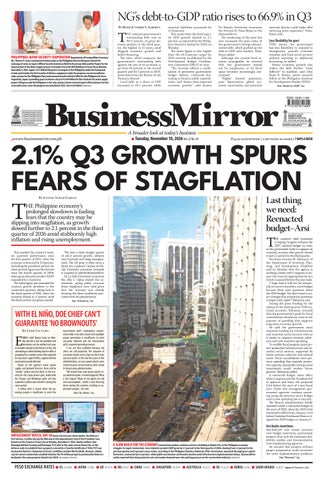
2.1% Q3 GROWTH SPURS FEARS OF STAGFLATION www.businessmirror.com.ph
T
n
Tuesday, November 10, 2026 Vol. 22 No. 34
P25.00 nationwide | 2 sections 20 pages | 7 DAYS A WEEK
Last thing we need: Reenacted budget–Arsi
By Justine Xyrah Garcia
HE Philippine economy’s prolonged slowdown is fueling fears that the country may be slipping into stagflation, as growth slowed further to 2.1 percent in the third quarter of 2026 amid stubbornly high inflation and rising unemployment.
This marked the country’s weakest quarterly performance since the first quarter of 2021, when the economy contracted by 3.8 percent. Excluding the pandemic period, the latest growth figure was the slowest since the fourth quarter of 2009, when gross domestic product (GDP) expanded by 1.8 percent. The latest figure also extended the country’s growth slowdown to five consecutive quarters, dating back to the third quarter of 2025, when the economy slowed to 4 percent amid the flood control corruption scandal.
T
HE country’s chief economist is hoping Congress will pass the 2027 national budget on time, as the government looks to support an economic recovery after growth slowed to just 2.1 percent in the third quarter. Secretary Arsenio M. Balisacan of the Department of Economy, Planning, and Development (DepDev) said on Monday that the agency is working closely with Congress to ensure the General Appropriations Act (GAA) is passed before the year ends. “I hope that it will not [be reenacted], we want to introduce a new budget because there were questions about the 2026 budget. You don’t want to enact a budget that already has questions to begin with, right?” Balisacan said. During the press briefing for the release of the third quarter 2026 national accounts, Balisacan stressed that the government’s push for fiscal consolidation should not come at the expense of spending that supports long-term economic growth. He said the government must maintain funding for infrastructure and essential social services even as it works to improve revenue collection and curb wasteful spending. “A credible fiscal program must protect productive infrastructure and essential social services, supported by better revenue collection and reduced waste. Fiscal consolidation must preserve spending that expands productive capacity; repeatedly cutting sound investments would weaken future growth,” Balisacan added. A reenacted budget takes effect when Congress and the President fail to approve and enact the proposed GAA before the start of a new fiscal year. Under this arrangement, government agencies continue operating using the previous year’s budget until a new spending law is enacted. The Marcos administration briefly operated under a reenacted budget at the start of 2026, when the 2025 GAA remained in effect from January 1 to 4 before President Ferdinand Marcos Jr. signed the 2026 budget on January 5.
“We have a third straight quarter of sub-3 percent growth, inflation near 8 percent and rising unemployment. The Q3 print is what turns a shock into a pattern,” Ateneo de Manila University economist Leonardo A. Lanzona Jr. told the BusinessMirror. De La Salle University economist Ma. Ella C. Oplas shared this assessment, saying public concerns about stagflation were valid given that the economy was already showing the three conditions associated with the phenomenon. See “Growth,” A2
WITH EL NIÑO, DOE CHIEF CAN’T GUARANTEE ‘NO BROWNOUTS’ By Lenie Lectura
E
NERGY chief Sharon Garin on Monday said she is not too confident that brownouts can be avoided next year, as red alerts remain in the forecast. In fact, she said during an online briefing that her office is preparing for a scenario worse than expected for next year’s super El Niño, coupled with the usual summer peak demand. Based on the agency’s latest power supply and demand forecast, there will be “mostly” yellow and red alerts in the evening for the Luzon power grid, while both the Visayas and Mindanao grids will also experience yellow and red alerts during the same period. A yellow alert is issued when the operating margin is insufficient to meet the
transmission grid’s contingency requirement while a red alert means that available power generation is insufficient to meet consumer demand and the transmission grid’s required operating reserves. “I am not that confident because red alerts are still projected. The situation of our power plants now is that we don’t have any new plants. In the last few years in this administration, no new power plants came online because no new licenses were issued in the previous administration. “We should have new power plants every administration. So what happens? What is the impact? Many of our plants are old and noncompliant , which is why they bog down during the summer, resulting in unplanned outages,” she said. See “El NiÑo,” A2
Arsi bucks insertions IMPEACHMENT WATCH, DAY 40 Davao City Assessor Jaime Adalin, the defense’s first witness, testifies during the 40th day of the impeachment trial of Vice President Sara Duterte at the Senate in Pasay City on Monday, November 9, 2026. Adalin confirms that Barangay Matina Crossing and Barangay 74-A refer to the same area in Davao City, as the defense seeks to establish that a property covered by a Transfer Certificate of Title (TCT) was declared in Duterte’s Statement of Assets, Liabilities and Net Worth (SALN). However, Adalin says he cannot conclusively establish whether the P6-million property purchased by Duterte’s husband is the same property listed in her SALN. ROY DOMINGO-SPPA POOL
A SLOW BUILD FOR THE ECONOMY Construction workers continue work on a building in Makati City as the Philippine economy
struggles to regain momentum. Gross domestic product (GDP) grew by 2.1 percent in the third quarter of 2026, slowing from 2.4 percent in the previous quarter and 4 percent a year earlier, according to the Philippine Statistics Authority (PSA). Investment, measured through gross capital formation, contracted by 0.2 percent, while public construction continued to decline amid infrastructure implementation delays. BusinessMirror earlier reported that rising material costs and weaker demand were also putting pressure on the construction industry. NONIE REYES
BALISACAN also raised concerns over budget insertions, particularly projects that lack the necessary feasibility studies and documentation from implementing agencies. He warned that projects without proper preparation could encounter the same implementation problems See “Budget,” A9
PESO EXCHANGE RATES n US 63.0600 n JAPAN 0.3982 n UK 84.1914 n HK 8.0437 n CHINA 9.4454 n SINGAPORE 49.2041 n AUSTRALIA 43.3222 n EU 70.2678 n KOREA 0.0463 n SAUDI ARABIA 16.8012 Source: BSP (November 9, 2026)
News
BusinessMirror
A2 Tuesday, November 10, 2026
DA: 60-day pork imports ban may be extended if... By Ada Pelonia
still has 140 days out of the total 200-day window to halt the entry of shipments under the law. “If the farmgate price is lower than their breakeven cost or they’re just breaking even, then we will extend,” Tiu Laurel said in a press conference on Monday. He noted that the agency would study hog raisers’ break-even cost on a monthly basis, since the price changes depending on external factors like fuel prices. The ban covers fresh, chilled, and frozen edible pork offals and swine meat, such as carcasses and half-carcasses; hams, shoulders, and cuts thereof, with bone in; and others. It will be effective from the date of the issuance of an order by the Bureau of Customs (BOC), or 15 days after the publication of Department Order 33 in two newspapers of general circulation, which-
ever comes first. Meanwhile, Tiu Laurel said pork shipments loaded onboard on or before November 24 will still be allowed entry despite the ban. “Technically, imports of pork can still enter, especially those onboard ships. So, there’s no real issue for now,” he added. The DA will conduct on November 20 a stakeholder meeting with meat processors, after the latter assailed the government’s move to freeze imports of pork, a raw material necessary for the manufacture of processed meat goods. He said they will meet with the industry to develop a system that would ensure ample stocks to avoid disruptions in their operations. “[Meat processors] are now preparing their proposals to make the system iron-clad so that if they do import meat for their own processing after the 60
NG’s debt-to-GDP ratio rises…
nomic and social returns. These should be done alongside encouraging private-sector investment and improving the business environment, as well as prioritizing investments in infrastructure, education and productivity-enhancing programs, Peña-Reyes added. “The economy must grow faster, generate more jobs and revenues, and reduce dependence on borrowing so that debt grows more slowly than GDP,” Peña-Reyes said.
T
HE Philippines could extend the 60-day import ban slapped on pork imports if farmgate prices of hogs continue to slide below break-even cost, according to the Department of Agriculture (DA). This, after the DA officially imposed an import ban on pork products for 60 days, following a government inquiry finding that the influx of cheaper shipments led the domestic hog industry to incur nearly P28 billion in losses from January to July 2026. Agriculture Secretary Francisco Tiu Laurel Jr. said the agency is hopeful that farmgate prices, which currently hover at P140 per kilo, would increase by at least P50 per kilo within the prescribed timeframe. However, should farmgate prices continue to drop or remain merely at break-even cost, he said the DA
Continued from A1
“There is no single debt threshold that automatically signals a fiscal crisis. What matters is whether economic growth, government revenues, borrowing costs remain consistent with debt sustainability,” Rivera said. What the government needs is a
two-pronged approach: accelerate economic growth and pursue credible fiscal consolidation, said Peña-Reyes. This includes improving tax collection, broadening the tax base, plugging revenue leakages, eliminating inefficient expenditures and prioritizing projects with high eco-
days, assuming we extend [the ban], there will be no issue for them and no issue also for our local hog raisers.”
Sinag: Reinstate tariffs
FOR Sinag, however, the long-term solution is to reinstate the tariffs levied on pork imports at 30 percent in-quota and 40 percent out-quota. “More importantly, we must change the prevailing narrative that imports should be the government’s default response to food inflation and supply concerns,” they said. “In an era of extreme weather events and global political upheavals, food security must be anchored on building our own capacity to produce food and becoming more self-sufficient.”
With El Niño, DOE chief can’t guarantee… Continued from A1
PHINMA Solar Energy president Danielle del Rosario earlier also warned of possible power outages next year. “The effect of the Super El Niño is that power demand goes up and every hydro plant will really dry up. Those that are dependent on hydropower, even wind power, won’t be available if the temperatures are too hot. So there’s really a ripple effect,” she said in an interview with Bilyonaryo News Channel last week. Garin said her office is aware of this and has been preparing for a worse scenario than expected. The DOE estimates that the impact of El Niño will be at least a 60-percent reduction in the output of hydropower plants, and some plants may experience disruptions due to the heat. Supply will decrease, while demand is expected to rise due to the high temperatures.
200 projects fast-tracked
“EL NIÑO is intensifying and will be “very strong” until the middle of 2027. So, what is DOE doing now? We are fast-tracking 200 power projects under Task Force 200,” Garin said. As of October 26, 55 projects, including battery energy storage systems (BESS) projects, have been completed. The DOE is also working closely with hydro power plant operators and concerned agencies, including the National Irrigation Administration, to make the most of available water resources while meeting both power and irrigation needs. On the distribution side, Garin said the DOE is working with the National Electrification Administration (NEA) and electric cooperatives (ECs) to monitor the impact on their operations and service areas. The ECs have been advised to activate their emergency response organizations and implement their contingency measures. NEA was ordered to contract 200 MW of additional power by deploying power barges in different parts of Visayas. “So we’ve already met and instructed NEA to have the electric cooperatives aggregate their requirements so that they contract several barges all over Visayas,” she said. Garin also cited the important work being carried out by the Task Force on Energy Resiliency. “We are coordinating with concerned agencies so that when supply becomes constrained, available electricity is prioritized for critical facilities such as hospitals, command centers, evacuation centers, and what needs the government can deliver the basic services,” the energy chief assured.
Collab with NGCP on BESS
THE agency is also in coordination with the National Grid Corporation of the Philippines (NGCP) for the deployment of BESS. Despite all the preparations and plans the DOE has laid out, the bottom line is that no one can guarantee 2027 will be brownout-free. “Now, if you ask me, will there be no plants that will go on unplanned outage? We cannot assure that but what we’re trying to do, having considered that already, is we are trying to find other ways to bring in more power temporarily for the next three years to cover the contingency power reserves,” the energy chief said.
www.businessmirror.com.ph
Growth…
Continued from A1
Stagflation is an economic condition characterized by negative or slowing growth, high inflation, and rising unemployment. The Philippines is now seeing all three conditions unfold simultaneously, with inflation reaching 7.9 percent in October and unemployment standing at 5.4 percent in September.
‘Arsi’ wary of using ‘s’ word
HOWEVER, Socioeconomic Planning Secretary Arsenio M. Balisacan cautioned against concluding that the Philippines has entered a period of stagflation, saying a more comprehensive assessment of the economy is needed. “I would wait for the end of the year to think of stagflation. I think that it’s important that we are looking at the various dimensions of the economy, and not just a few indicators,” Balisacan said at a press briefing on Monday. He noted that the country’s potential growth remains between 5 and 6 percent, adding that the measures needed to bring the economy back to that level remain within reach. Former National Economic and Development Authority (Neda) Director-General Dante B. Canlas also believes stagflation may still be ruled out this year, as inflation is expected to ease once the effects of the recent interest-rate hikes take hold. “Real GDP growth slowed down further in Q3, but that’s deliberate on the part of firms in all sectors of the economy, which resorted to tightening management and cost controls. They sacrificed profit margins to stay in the game and avoid contractions,” Canlas said, noting that an economic recovery remains possible in the fourth quarter, supported by holiday production and household spending. Ateneo economist Alvin P. Ang likewise does not believe the country is already in stagflation, but warned that the situation could change if the slowdown persists. “If the rate of slowdown continues, the economy may contract in a period of high prices. That is stagflation—that is stagflation,” Ang told the BusinessMirror.
M.E. conflict, governance issues
ANG attributed the economic slowdown partly to the Middle East conflict, which has pushed up global oil prices. Since the Philippines relies on imported oil paid for largely in US dollars, more expensive oil increases the country’s import bill and dollar requirements, adding pressure on the peso. A weaker peso, in turn, makes imported fuel and other commodities more expensive, further driving up domestic prices. The pressure is compounded by domestic governance problems, which Ang said have contributed to the continued decline in government construction. Even the services sector is losing momentum as households cut back on spending amid high prices. “All these can be traced to slowing household consumption expenditures dragged down by high prices,” he emphasized. Data from the Philippine Statistics Authority (PSA) showed that household spending grew by only 2.4 percent in the third quarter, down from 2.9 percent in the previous quarter. This was the weakest household spending growth since the first quarter of 2021, when it contracted by 4.8 percent. Excluding the pandemic period, growth was the slowest since the second quarter of 2010, when it stood at 2.1 percent. Government final consumption expenditure, meanwhile, grew by 6.8 percent, slower than the 8.3 percent expansion in the previous quarter but faster than the 5.8 percent growth recorded in the same period last year. Lanzona agreed, but he noted that these factors are just “triggers” of a deeper economic problem: the country’s weak productive investment. “They hurt this much because growth has leaned on consumption and remittances rather than productive investment, leaving weak manufacturing, low capital formation and stagnant productivity. Without fixing that, each new shock will push growth down further,” he emphasized.
El Niño risks
THE country’s economic headwinds could intensify further as El Niño threatens to deepen the strain on agricultural production, with the Department of Agriculture warning that output losses could reach 20 to 30 percent. Lanzona said the sector is particularly vulnerable because of its low productivity and lack of adequate irrigation and storage facilities, which limit its ability to withstand extreme weather. “So every weather event becomes a food price event. That squeezes consumption and pushes the
EON…
Continued from A9
care and two-way relationships, while adults aged 55 to 74 placed more importance on lawfulness, integrity and institutional responsibility. Trust also varied by region, with the Visayas recording a score of 82.5 and Mindanao 63.3. The study found little difference between
[central bank] toward further tightening into 2027,” he added. PSA data showed that agriculture, forestry, and fishing recorded the steepest contraction among the major industries in the third quarter, shrinking by 4.8 percent. This reversed the 2.9 percent growth recorded in both the second quarter of 2026 and the third quarter of 2025. Industry also contracted, although marginally, by 0.003 percent. This was an improvement from the 2.4-percent contraction in the previous quarter but remained a sharp slowdown from the 5-percent growth recorded in the third quarter of 2025. Services was the only major industry to post growth, expanding by 3.7 percent. However, this was slower than the 4.5 percent growth in the second quarter and the 5.5 percent expansion a year earlier. Oplas said agriculture should be the government’s highest priority, particularly with the threat of El Niño looming over the sector. “Agriculture should be given the highest priority, especially the threat of El Niño. A lot is on stake if we don’t,” she added.
‘Impossible dream’
WITH economic growth remaining weak in the first nine months of the year, Canlas said achieving the government’s 3.5- to 4.5-percent growth target for 2026 has become an “impossible dream.” Missing the 2026 target would mark the fourth consecutive year that the government has fallen short of its economic growth goal. According to the Department of Economy, Planning and Development (DepDev), the economy needs to expand by at least 6.3 percent in the fourth quarter to reach the lower end of the government’s full-year target. Balisacan acknowledged that achieving this was “very, very challenging” at this point, although he remained hopeful that economic activity would improve in the final quarter. Oplas, however, said the usual boost from holiday spending may not be enough to lift growth this year, citing continued weakness in consumer activity. “All the signs are leading to us missing it again,” she said, adding that malls remain relatively quiet despite the approaching holiday season. Lanzona likewise acknowledged that holiday spending and remittances typically provide a lift to fourth-quarter growth. However, he said this seasonal boost may fall short of offsetting the effects of eroding purchasing power and weak capital formation. “The target should be treated as missed, and the policy discussion should shift to limiting damage heading into 2027,” he added. For 2027 until 2030, the Marcos administration expects growth to reach between 4 to 5 percent. The Cabinet-level Development Budget Coordination Committee (DBCC) is expected to meet before the end of the year to revisit the government’s growth targets.
MBC: Weak investment, high costs weigh on Q3 growth
CONSTRAINTS on business expansion, including weak investment, squeezed household purchasing power and rising operating costs, have been exposed by the country’s 2.1-percent thirdquarter growth. According to Makati Business Club (MBC) Executive Director Julia Andrea R. Abad, persistent inflation and higher business costs were weighing on economic activity, while the looming Super El Niño could further threaten agricultural output, water and power supplies, and food security. “The reported 2.1-percent GDP growth in the third quarter is a clear warning that the Philippine economy is losing momentum,” Abad said in a statement. She cited workforce readiness, energy affordability, infrastructure gaps, regulatory predictability and institutional stability as factors that continue to affect the country’s competitiveness. Further, greater transparency and accountability in the national budget process, particularly in the allocation and oversight of infrastructure spending, were also called for, with public funds urged to be directed toward genuine needs and growthenhancing investments. Given this, the government was told to strengthen social protection, improve access to affordable essential goods and services, and extend support to businesses to help sustain operations and employment. On the other hand, MBC welcomed the Senate’s creation of the RISE Ad Hoc Committee, saying it could provide an avenue for a more coordinated response involving the public and private sectors. Abad said the policy response should focus not only on stimulating economic activity and attracting investments, but also on improving governance and policy implementation to support higher incomes, quality jobs and more resilient livelihoods. With a report by Bless Aubrey Ogerio
businesses based on size: large enterprises scored 72.3, while micro, small and medium enterprises received 71.7. Both remained within the Conditional Trust band. Of the respondents, 53.1 percent did not identify any least-trusted sector, while 46.9 percent, or 375 people, named one. The study surveyed 800 adults across 160 barangays in 84 cities and municipalities from May to August, supplemented by 82 focus group participants and 18 key informant interviews.
The Nation BusinessMirror
www.businessmirror.com.ph
Tuesday, November 10, 2026 A3
Japan’s big gift: ¥4.3-B military grade radars, drones for PHL coastal defense
J
By Malou Talosig-Bartolome |
@maloutalosig
APAN will provide the Philippines with military-grade coastal radars and surveillance drones under a ¥4.3-billion grant.
It is the largest award yet under Tokyo’s Official Security Assistance (OSA) program, and the first to include militar ygrade equipment for the Armed Forces (AFP). Japanese Ambassador Kitagawa K atsuro and Foreig n A f fa irs
Secretary Maria Theresa Lazaro signed the Exchange of Notes for the OSA FY2026 Project on November 9. The coastal radars will go to the Navy (PN) and the unmanned aerial vehicles (UAVs) to the Air Force (PAF).
“Today’s grant, amounting to ¥4.3 billion, is the largest OSA grant since the framework’s establishment, as well as the first defense equipment transfer under Japan’s OSA program,” Kitagawa said. He added that he hopes the equipment will help safeguard vital sea lanes by strengthening the Philippines’ maritime domain aw a re ne s s a nd s u r ve i l l a nce capabilities. Koh Nakamura, First Secretary of the Japanese Embassy, said in a side interview that this differs from the coastal radars Japan provided earlier. Those were not military-grade and were intended
for civilian and dual-use purposes. “This time is military grade, so that’s the difference,” Nakamura said. He stressed that the assistance is “a grant,” not a loan. He said the equipment is meant to help the Philippines safeguard its interests in the South China Sea and on the northern and western sides of Luzon. Deployment sites will be decided by Philippine defense authorities. “In the end, it’s up to them where to put those radars,” he said. Delivery is expected to take two to three years because the procurement must go through standard tender and bidding.
Lazaro said Tokyo and Manila share the same view of the region. “Japan and the Philippines look at the region and see the same principles worth protecting: freedom of navigation and overflight, peaceful settlement of disputes, and respect for sovereignty and territorial integrity,” she said. She called the signing “another concrete demonstration of this p l at i nu m e r a o f r e l at io n s ,” which followed the elevation o f t ie s t o a c o mp re he n s i v e st rateg ic pa r t nersh ip. T he agreement, she added, “affirms that capacity-building efforts by the Philippines are investments
in regional peace and stability.” The Philippines was the first recipient of OSA when the program began in 2023. It received ¥600 million for five coastal radar systems that year, and the Navy was the end user. In December 2024, a ¥1.6-billion package followed, with assistance for both the Philippine Navy and the Philippine Air Force. In January 2026, Japan signed a ¥900-million project to build boathouses and slipways for rigidhulled inflatable boats. The Philippines is the first and only multi-year recipient of the program.
Vice President’s first witness ‘a massive flop’ – prosecution By Jovee Marie N. Dela Cruz @joveemarie
H
OUSE of Representatives impeachment prosecutors tore into Vice President Sara Duterte’s very first defense witness on Monday, calling his testimony “a massive flop” over glaring property
and asset discrepancies. Davao City Assessor Jaime G. Adalin took the hot seat at the Senate impeachment trial to defend a disputed 379-square-meter property in Matina Crossing, Davao City, listed in Duterte’s 2024 SALN. But private prosecutor Benjamin Tolosa Jr. slammed the presentation as misleading, pointing
out a cool P4-million gap between the P6-million price on the deed of sale and the P10-million value slapped on the Vice President’s asset declaration. The House prosecutors did not hold back as Manila Rep. Joel Chua blasted the assessor as “extremely dishonest” after he stumbled over cross-examination, while Lanao
del Sur Rep. Zia-ur Rahman Alonto Adiong, House impeachment spokesman, declared the defense’s opening pitch completely backfired. Even Senator-Judges got in on the action with Sen. Erwin Tulfo threatening Adalin with a contempt citation for dodging questions and acting clueless about an alleged China
trip, prompting Sen. Vicente Sotto III to call for a quick check on Bureau of Immigration records. With the defense’s first swing missing the mark, the House lead prosecutor, Batangas Rep. Gerville Luistro, trained her sights on a bigger fish—the Vice President’s husband, lawyer Manases Carpio.
Highlighting an eye-popping P817.87 million in questioned assets flagged by forensic accountants, Luistro questioned whether Carpio will step up to explain the couple’s massive financial footprint now that he’s notably absent from the initial witness list. See “Vice,” A4
A4 Tuesday, November 10, 2026
The Nation
Macalintal warns SC BSKE ruling threatens 2028 polls By Joel R. San Juan @jrsanjuan1573
E
LECTION law yer Romulo M ac a l i nt a l on Mond ay said the Supreme Court’s recent decision upholding Republic Act No. 12326, which post pones t he ba ra ngay a nd Sa ng g u n i a ng K abat a a n e lections (BSKE) to November 2028, could embolden legislators to tamper with the upcoming May 2028 presidential elections. Macalintal made the statement as he announced plans to file a motion for reconsideration and reiterate his plea for oral arguments. He aims to expose what he calls grave errors in the majority decision, arguing that the postponement was a calculated move to strip citizens of their right to vote. “If this ruling remains uncorrected, and if no one stands up to warn of its dangerous consequences to our democratic system, RA 12326 will not stop at the barangay level,” Macalintal stressed. While the Court voted 9–5 to dismiss his initial petition, Macalintal noted that flipping just two votes could secure an 8–7 reversal. He is counting on Associate Justice Maria Filomena D. Singh – who was on leave during the ruling – to maintain her
consistent stance that delaying elections without justifiable cause infringes on suffrage. The controversy centers on Republic Act 12326, enacted on September 24, 2026, which extended the term of barangay officials from four to five years while capping consecutive terms at two. The Supreme Court defended the measure, ruling it as a term-fixing law rather than a postponement statute, and deemed the November 2028 sc hedu le a rea son able implementation. The Court also noted that holding a BSKE in 2027 would disrupt preparations for the May 2028 national elections. However, Maca linta l drew suppor t f rom d issenting magistrates, including Senior Associate Justice Marvic Leonen, who said that delaying the polls “abuses the inherent sovereign right to suffrage,” and Associate Justice Benjamin Caguioa, who termed the law “an undue curtailment of the right to vote.” Macalintal also pointed to heavy public backlash, noting overwhelming digital engagement against the ruling across social media. He maintains that public sentiment aligns with his fight to protect the democratic process from unchecked legislative adjustments.
Dy: Regional action vs cybercrime needed
S
PEAKER Faustino G. Dy III on Monday urged Southeast Asian lawmakers to strengthen regional efforts against human trafficking, illegal recruitment and cybercrime, warning that these cross-border threats require coordinated legislative action as the Philippines prepares to host the 47th General Assembly of the Association of Southeast Asian Nations (Asean) Inter-Parliamentar y Assembly (Aipa) this month. Dy, who serves as Aipa president this year, said the gathering provides an opportunity for lawmakers across the region to address common cha l lenges through stronger partnerships, legislative cooperation and the sharing of effective policies. “Many of the problems our country faces are also experienced by our fellow Southeast Asian nations,” Dy said in his speech during the resumption of House of Representatives plenary sessions. He cited rising food and energy prices, illegal recruitment, human trafficking, cybercrime and online threats to children, as well as broader concerns affecting regional peace and security, as issues that require coordinated action among Asean member-states. Dy stressed that these challenges
DOE…
Continued from A7
transcend national borders and cannot be adequately addressed by individual countries acting alone, making cooperation among legislatures essential in developing more effective responses. The Aipa assembly, which brings together parliamentarians from Southeast Asian countries, serves as a platform for lawmakers to exchange experiences, discuss common policy concerns and identify legislative measures that can be adopted across the region. “Through Aipa, we can share our countries’ experiences, study effective laws and agree on measures that we can pursue in our respective parliaments,” Dy said. The 47th Aipa General Assembly will carry the theme, “Parliaments Securing a Peaceful, Prosperous, and People- Centered A sean,” underscoring the role of legislatures in advancing regional stability, inclusive development and the welfare of the people. As this year’s host and Aipa president, the Philippines is expected to lead discussions aimed at strengthening parliamentary diplomacy and encouraging closer coordination among member countries on issues affecting their citizens. Jovee Marie N. dela Cruz Besides, Capellan said any replacement will face the same uncontrollable external crises, including the Strait of Hormuz tensions and rising diesel
BusinessMirror
www.businessmirror.com.ph
‘Anti-dynasty law should be tied to party-list reforms’
P
By Mary Jade Jadormio
ROPOSED reforms to the party-list system must be accompanied by an antipolitical dynasty law to prevent political clans from using sectoral organizations to secure seats in Congress.
Comelec Chairman George Erwin M. Garcia said amendments to the Party-List System Act would be ineffective if nominees linked to political dynasties could continue entering the legislature through party-list organizations. “Any amendment, modification or revision of the party-list system
law must be accompanied by the passage of an anti-political dynasty law. Party-list nominees should not be connected to political dynasties; otherwise, we would only be fooling ourselves,” Garcia said in a television interview. Under the 1987 Constitution, party-listrepresentativesareallocated
20 percent of the total membership of the House of Representatives to provide marginalized and underrepresented sectors with representation in Congress. However, Garcia said the system has been exploited by groups whose nominees do not necessarily come from the sectors they claim to represent. “The law has been in place for almost 30 years, and not a single section, provision or word has been changed,” Garcia said in Filipino, referring to Republic Act 7941. “That is why, over the years, the Supreme Court has had to interpret and clarify what these provisions mean and how they should be applied,” he added. Garcia cited changing inter pretations of the qu a l i f ic at ion s for pa r t y-l i st nominees, including the standard for determining whether they genuinely represent marginalized
and underrepresented sectors. “Nominees do not necessarily have to be living in extreme poverty; it is enough for the representative or nominee to have proven advocacy for the sector,” he said. Congress must amend the law to clearly define marginalized and underrepresented sectors and prevent politically influential groups from taking advantage of the system. As the agency tasked with implement ing elect ion l aws, Comelec cannot independently revise the qualifications or rules governing party-list organizations, he added. Garcia expressed confidence that Congress would pass the anti-political dynasty measure, which he considers necessar y to make the proposed party-list reforms meaningful and restore the system’s original purpose of giving marginalized and underrepresented Filipinos a genuine voice in Congress.
Teodoro calls for Marine Corps expansion By Rex Anthony Naval
“As Maj. Gen. Apostol [Marines commandant Major Gen. Bob R. Apostol] had said, the footprint of the Philippine Marine Corps of four marine brigades and one service support brigade for 7,600 islands is way, way too small,” Teodoro said. In particular, the DND chief emphasized the importance of maintaining a credible presence and deterrence in the Kalayaan Island Group, requiring closer coordination among the PMC, the Army (PA), Navy (PN), Air Force (PAF), and Coast Guard (PCG). Teodoro a lso ca l led for a sustainable yet urgent growth plan that includes the development of strategic operating bases for the Marines, whether co-located with other military facilities or established independently. The defense chief also stressed the importance of strengthening logistical readiness and maintaining
adequate physical reserves amid tightening global supply chains and increasing competition for resources. “[Being] prepared means also putting enough facilities to store the all-needed reserves. The notional reserves that we have are not sufficient. Physical custody and possession of reserves is the name of the game now, as we see throughout the world when supply chains are tightening and the scramble for resources becomes dearer and more expensive,” Teodoro said. The DND chief also acknowledged that addressing these capability gaps would require substantial effort, emphasizing that the DND and the Armed Forces (AFP) under the leadership of President Marcos, are working to accelerate the country’s defense moder nization and readiness initiatives.
Teodoro also cited the Philippines’ participation in major multilateral exercises and the need for the Marine Corps to strengthen its professional networks with other marine forces to identify appropriate tactics, technologies, and equipment suited to the country’s operational environment. Beyond capability development, the DND chief underscored the importance of investing in future m i l it a r y leadersh ip t hrough early ex posure to leadership responsibi l it ies, mentorship, cross-training, and international engagement. He called for greater opportunities for young officers, enlisted personnel, and civilian human resource personnel to develop the technical competencies, adaptability, and foresight necessary to address emerging defense and security challenges.
Luistro noted that the Senate Impeachment Court had allowed the examination of his financial records, citing the presumed application of the absolute community of property regime under the Family Code in the absence of a valid prenuptial agreement. “In the absence of a prenuptial agreement, there is a presumption of absolute commu nit y of property,” she said. T he prosecution has cited
a forensic accounting analysis identifying approximately P817.87 million in alleged undeclared assets and unexplained wealth involving Duterte and Carpio. The computation covered financial re cord s, i n s u r a nce p ol ic ies, investments and other properties associated with the couple. Luistro said Carpio could directly explain the transactions and assets questioned by the prosecution, while the defense’s initial witness list included lawyer Anel Martin Antero, whom she understood had assisted Carpio in preparing financial documents.
Duterte’s 2024 SALN lists a residential lot in Matina Crossing acquired through donation in 2023 at zero acquisition cost, while a separate entry under Carpio identifies a residential lot in Barangay 74-A acquired through sale in 2024. The prosecution is questioning whether these entries correspond to the properties covered by the disputed title and other property records. Forensic accounting ex per t A lex ander Cabrera had discussed the Matina property during the prosecution’s presentation but e xc luded it from his calculations because of
inconsistencies in the available valuation records. Adalin is the first witness presented by Duterte’s defense in response to the remaining impeachment charge under Article II, which involves allegations of unexplained wealth, inaccurate financial disclosures and prohibited business interests. T he House prosecution maintained that the defense must provide clear explanations for the questioned assets and financial records, with prosecutors saying the testimony presented on Monday had not resolved the discrepancies.
prices. “So, you know, the person whom they are contemplating, if ever there is one, will be faced with the same challenges—Strait of Hormuz, increasing diesel [price]—and it is out of our hands. So really, a change is not really good for the industry, not at this point,” said Capellan. Last week, Apvia said electricity bills in off-grid areas can be reduced with the replacement of diesel-run power plants with solar paired with battery energy storage systems (BESS). The group cited a 23-percent increase in Universal Charge for Missionary Electrification (Ucme) rate to P0.3397 per kilowatt hour (kWh) in the October billing period from P0.2763 per kWh in the previous month, costing a typical 200 kWh household roughly P67.94 a month or P815 a year. Ucme is a monthly charge collected from on-grid electricity end-users used to subsidize the cost of power in off-grid areas.
According to Apvia, the generating power in islands served by the National Power Corp. averages around P18 per kWh—compared to just P5 to P8 per kWh on the main grids – and surges up to P62 per kWh in remote areas where fuel must be shipped. The 2026 Philippine national budget already allocates nearly P2 billion to Napocor for missionary electrification, which fluctuates heavily based on volatile oil prices and peso weakening. “Every peso spent hauling diesel to an island is a peso that comes back to Filipino households through the Ucme, or to the government through the budget,” said Capellan. Apvia and its partners also called f o r c o nt i nu e d g o v e r n m e nt – industry collaboration to identify viable projects, address financing and regulatory barriers, and accelerate solar and battery deployment in missionary areas.
D
EFENSE Secretary Gilberto Teodoro Jr. called for the sustained and accelerated development of the Philippine Marine Corps (PMC) as the service celebrated its 76th Anniversary over the weekend. Teodoro also expressed the need for the Corps to expand its capabilities, strengthen its strategic presence across the archipelago, and enhance its role in the country’s Comprehensive Archipelagic Defense Concept (CADC). Teodoro, who was the guest-ofhonor and speaker at the Saturday event, conveyed the best wishes of President Marcos, who expressed his confidence in the PMC’s continued growth and its commitment to maintaining its fighting capabilities, core values, morale, and presence throughout the archipelago.
Vice…
Continued from A3
Budget…
Continued from A7
In a joint show of transparency, representatives from the National Unity Party, NPC, Lakas-CMD, Partido Federal ng Pilipinas, and the Nacionalista Party expressed full support for making congressional district allocations and funded projects publicly accessible via the House’s online budget portal. While supporting disclosure, Momo, a retired Department of Public Works and Highways senior official, noted that district allocations naturally vary due to differences in population, geographic size, and vulnerability to natural disasters. Party-list lawmakers likewise affirmed their openness to scrutiny regarding sector-specific funding proposals.
Garcia credited the chamber’s push for transparency to “earthshaking reforms” introduced under Speaker Faustino G. Dy III and Majority Leader Ferdinand Alexander A. Marcos. These include opening budget hearings to the public and civil society organizations, establishing an online budget portal, and implementing strict safeguards against irregular allocations. “Are we satisfied with the reforms? Are they complete? Is the process already perfect? No, far from it,” Garcia admitted, welcoming ongoing oversight from the media, civil society, and the Church. The P7.2-trillion 2027 national budget is currently under review by the Senate. Bicameral conference committee deliberations are set for December 10 to 12, with the final bicameral report targeted for signing on December 21 and ratification on December 22.
Tuesday, November 10, 2026
A5
Japan, PHL frame Cotabato water project as investment in peace By Malou Talosig-Bartolome
J
APAN and the Philippines on Monday formalized an Official Development Assistance (ODA) grant to improve the water supply of Cotabato City, a project both governments framed as an investment in peace and public health in the Bangsamoro Autonomous Region in Muslim Mindanao (BARMM). Japanese Ambassador Kitagawa Katsuro and Department of Foreign Affairs (DFA) Secretary Maria Theresa Lazaro signed the Exchange of Notes for the “Project for the Improvement of Water Supply System in Cotabato City.” The signing came alongside the transfer of military-grade equipment under Japan’s Official Security Assistance (OSA) program. Cotabato City, an independent component city within the BARMM and the current de facto seat of the Bangsamoro government, is the project’s host. The city sits in a region in transition: the BARMM held
its first parliamentary elections on Sept. 14, after four postponements, choosing an 80-member parliament to replace the interim Bangsamoro Transition Authority, the body that has governed the region since 2019. The city’s water supply has not kept pace with its growth. A July 2025 resettlement action plan prepared for the Japan International Cooperation Agency (JICA) said only about 47.4 percent of Cotabato City was served by the Metro Cotabato Water District (MCWD) in 2022. In the fast-growing barangays on the right bank of the Tamontaka
River, coverage was just 32.4 percent in 2023, with demand rising about 8.2 percent a year. The district can supply about 48,000 cubic meters a day, but roughly a quarter is lost to leaks, illegal connections and other system losses, the document said. MCWD has been adding about 1,000 connections a year, not enough to match demand, which grew by an average of 5.4 percent annually from 2016 to 2023. Households without service rely on unsanitary or traditional water sources. The grant amount was not disclosed at the ceremony. JICA’s 2025 plan outlined the project’s proposed scope: a new water treatment plant producing up to 7,200 cubic meters a day and about 8 kilometers of distribution pipes, serving some 7,000 residents in Tamontaka I, Tamontaka II, Tamontaka Mother and Kalanganan II. The plant will rise on a 4-hectare site in Barangay Tamontaka II along the Tamontaka River, which MCWD bought for P35.8 million in 2023. No one lived on the land, and no family was displaced, the plan said. The pipes will be laid within existing road rights-of-way, so no private land is needed. Only 10 trees along the route will have to be cut, with compensation
estimated at P47,917. A tentative schedule in the plan put construction at roughly 2027 to early 2029. Kitagawa said the project holds “particular significance” for the BARMM, which recently inaugurated its first regular parliament. He said it is expected to benefit underserved communities, promote public health and support local economic activity and investment. “Sustained cooperation in translating democratic gains into tangible improvements in people’s lives” is essential, the ambassador said, adding that the OSA and ODA, though serving distinct purposes, are “complementary pillars” of a shared commitment to a peaceful, secure and prosperous future. Lazaro said security is ultimately measured in human terms: “how safely people live and how much better their lives have become.” She described the project as a chance to help residents who will “soon draw strength” from improved basic services. Recognizing Japan’s steadfast commitment to Mindanao, Lazaro said recent BARMM milestones show that “peace is not a single event, but a journey,” one that must move forward with families and communities in mind.
Defense accuses prosecution of dictating evidence presentation at VP impeachment trial
T
HE defense counsel claimed on Monday that they are being treated unfairly and that the prosecution is somehow dictating how the defense should present its evidence on Day 40 of the impeachment trial against Vice President Sara Duterte. Defense lawyer Atty. Lindon Bacquel has objected when House private prosecutor Atty. Benjamin “Jay” Tolosa Jr. requested to delay or manage the cross-examination of the defense’s first witness, Davao City Assessor Engr. Jaime G. Adalin. The impeachment court was tackling the documents, including the Statement of Assets, Liabilities, and Net Worth (SALN) and property declarations.
Tolosa sought a delay or adjustment regarding the cross-examination of the defense witness to allow the prosecution time to prepare. He noted that the defense had made similar requests earlier in the proceedings when the prosecution presented its witnesses, citing that the defense had previously requested the exac t same treatment when the prosecution presented its Register of Deeds (RD) witnesses earlier before. Bacquel strongly opposed the deferment, labeling the request “unprocedural” “It’s unprocedural and the defense would construe that as a waiver of the
right to cross-examination,” Bacquel said. The defense lawyer then pushed back against the request, stating on the record, “It seems that the prosecution is somehow dictating how the defense would want to present its evidence.” Presiding Officer Francis “Chiz” Escudero then intervened and declared a recess to let the Senate Impeachment Court address the procedural argument. Escudero also reminded the lawyers to maintain their composure and proper courtroom protocol on the first day of the defense’s evidence presentation. Claudeth Mocon-Ciriaco
DMW to extend aid to family of seafarer killed in Gulf tanker explosion
T
HE Department of Migrant Workers (DMW) said it will extend aid to the family of the Filipino seafarer who died, along with the 21 other Filipino crew members of the Marshall Islands-flagged oil tanker MT Velos Sapphire, after the vessel suffered an explosion due to a possible drone attack. DMW Secretary Hans J. Cacdac made the assurance after confirming that the 21 other crew of MT Velos Sapphire were unharmed from the incident. “We will provide all the support and guidance the bereaved family needs during this difficult time. As the President has consistently reminded us, we must always take care of the families of our Filipino seafarers, he said in a statement. The owner of the said oil tanker has also said it will provide support to the affected Filipino seafarers. Citing initial reports, DMW said the tanker reported an explosion due to a sup-
posed drone attack last Thursday morning while it was passing through the Persian Gulf bound for Sitrah, Bahrain. It did not disclose the name of the deceased sailor, but it said the concerned licensed manning agency already informed the family about the tragic fate of the said seafarer. DMW said it is coordinating with shipowner and relevant authorities to get information on the cause of the explosion as well as to provide aid to the affected Filipino sailors. It has earlier reminded ships carrying Filipino sailors in the Persian Gulf as well as the Strait of Hormuz to be cautious amid the ongoing conflict in the Middle East. The said conflict has also resulted in the disruption of the Riyadh airport after it was hit by attacks by Houthi militants last month. Last Sunday, DMW and the Overseas
Workers Welfare Administration were able to bring home an additional 61 overseas Filipino workers (OFW), who were affected by the said airport disruption. Despite the said regional tensions, DMW continues to push for bilateral agreement with Middle East countries, which host OFW. Cacdac has recently concluded his meeting with the head of UAE’s Ministry of Human Resources and Emiratisation (MOHRE), Abdulrahman Al Awar. He said their discussions focused strengthening labor cooperation, focusing on skills training, certification, m u t u a l re c o g n i t i o n a n d u p s k i l l i n g partnerships. They also tackled Philippines’ proposed activities as Chair of the Abu Dhabi Dialogue next year, which includes “capacitybuilding, technical workshops, and the sharing of best practices on labor migration governance, social protection, and ethical recruitment.” Samuel P. Medenilla
Nearly 20,000 cops to be deployed to secure next week's ASEAN Summit By Rex Anthony Naval
P
HILIPPINE National Police (PNP) chief Gen. Jose Melencio Nartatez Jr. on Monday said that nearly 20,000 police officers will be deployed to help secure the 49th ASEAN Summit and Related Summits, which will be held in various locations in Metro Manila from Nov. 16 to 18. He added that these officers will be deployed in the various summit venues, hotels, billeting areas, and motorcade routes. Nartatez said the PNP will closely coordinate with the Armed Forces of the Philippines, Presidential Security
Command, other government agencies, and local governments to ensure peace and order during the event. “The PNP is ready to provide security for the heads of state, foreign delegates, and other expected guests. We will deploy 19, 869 police personnel to secure the summit venues, hotels, billeting areas, and motorcade routes, in close coordination with the Armed Forces of the Philippines, Presidential Security Command, other government agencies, and local government units,” the PNP chief said. Aside from this, Nartatez ordered intensified intelligence monitoring in Metro Manila and nearby areas to
identify, assess, and address potential security threats before the arrival of foreign dignitaries. As preparations enter their final phase, he said the PNP assured participating countries that the police organization remains ready to secure the event and protect all delegates. “We assure our ASEAN partners that the PNP is fully committed and prepared to secure this important regional gathering. We will leave nothing to chance, and our personnel will remain vigilant, disciplined, and ready to respond to any eventuality to ensure a peaceful and incident-free summit,” Nartatez said.
House Speaker moves to open-books congressional allocations, ‘26 spending
H
OUSE Speaker Faustino “Bojie” G. Dy III announced on Monday plans to launch an online transparency platform that will allow the public to track projects funded through congressional allocations, and directed House oversight committees to review how government agencies utilized their 2026 budgets. Dy said the platform would provide the public with access to project-level information, including the name and location of each project, its funding allocation, and its completion status. In his speech marking the resumption of plenary sessions, Dy said the initiative formed part of the House leadership’s commitment to institutional reforms and greater accountability in the use of public funds. “The 20th Congress is a Congress of reform. This is the New Congress that we continue to work hard to achieve,” Dy said. “We want our people to have access to accurate information, and this transparency platform delivers a loud and clear message: The House of Representatives has nothing to hide,” he added. The Speaker said development of the platform began in September and that it would be made available to the public in the coming days. “It is everyone’s right to know where every cent they work hard for and every peso they pay in taxes goes and will go,” Dy said. Alongside the transparency initiative, Dy
directed House oversight committees to immediately convene and determine whether government departments and agencies spent their 2026 allocations for their intended purposes and within the prescribed implementation periods. “Let us once again examine whether the funds we allocated and approved for 2026 were properly utilized and whether they were spent within the prescribed period,” he said. Dy said the review would help establish whether appropriations translated into actual programs and services, particularly those intended to address the needs of the public. He also cited continuing reforms in the national budget process, including the creation of the Budget Amendments and Review Subcommittee (BARSc), which was established to strengthen scrutiny of proposed budget adjustments. The Speaker said the House would again livestream the deliberations of the bicameral conference committee on the proposed 2027 national budget, allowing the public to monitor how lawmakers reconcile differences between the House and Senate versions. “The House-approved General Appropriations Bill is open to public scrutiny. The data are available for everyone to examine and study carefully,” Dy said. See “Spending,” A6
A6
Tuesday, November 10, 2026
Marcos pushes for faster hiring of school counsellors to curb school violence By Samuel P. Medenilla
P
@sam_medenilla
RESIDENT Ferdinand Marcos Jr. urged that the shortage of school counsellors be addressed as soon as possible to prevent further incidents of school violence and bullying, which had plagued several learning institutions earlier this year. Speaking at the mass oath-taking ceremony of over 5,000 school personnel and officials in Pangasinan last Monday, the Chief Executive said there was a need to immediately fill up the existing vacancies for School Counsellors Associates (SCA). Among those who participated in the ceremony were 4,972 teachers, 239 school heads, and 234 appointed SCAs. “Today is an important milestone for our newly hired SCAs. As we work to enhance the quality of education,
you will help strengthen counseling and mental health services in our schools, as well as ensure that our students receive the support that they need,” Marcos said. “As we pay greater attention to the mental health of our youth, their role has become more crucial, more important than ever,” he added. This, after minors were involved in shooting incidents at the San Jose National High School in Tacloban City in June, Ateneo de Zamboanga Univer-
sity Junior High School in Zamboanga City in August, and Banga National High School in South Cotabato in September led to fatalities. Some of the said attacks were attributed to the alleged bullying experienced by shooters or their exposure to violent content online. Last Aug ust, the Department of Education reported there were on ly 1,0 0 0 re g i ste re d cou n s e l lors in 45,000 schools nationwide prompting the agency to target hiring 10,000 SCAs under Republic Act (R A) No. 12080, or the Basic Education Mental Health and Well-Being Promotion Act. As of last month, the agency said it was able to fill up 5,445 of the said SCA vacancies. DepEd will submit an audit report on the implementation of RA 12080 to the Senate and House of Representatives next year or three years after it took effect in 2024. The additional SCAs and the expanded National Learners TeleSafe Contact Center Helpline aims to provide a safe learning environment for students.
Aside from improv ing mental health, Marcos also said the government is also taking steps to give public school teachers opportunities to attain professional development and career advancement Expanded Career Progression (ECP) System. He noted the program already benefited 82,100 teachers and school heads. Of which, 10,200 were from Pangasinan. The government was also able to provide 607,574 teachers various professional development and training programs from 2022 to 2025 and reduce their paperwork requirements from 174 forms to 75 so they can better focus on improving their quality education to their students. This was on top of the tools provided by the government to public school teachers such as the 209 laptops, which were distributed by DepEd to ten public schools in Dagupan City last Monday. “We want to see more of our teachers grow, succeed, and advance in your profession. Hence, we promote continuous learning and professional development,” Marcos said.
PNP chief praises cops, soldiers for successful Nov. 8 law enforcement ops
T
HE Philippine National Police (PNP) on Monday commended the police and military personnel involved in a joint law enforcement operation in Maguindanao del Sur that resulted in the neutralization of a wanted Dawlah Islamiyah-Hassan Group (DI-HG) member and his alleged armed associate on Nov. 8. In a statement, PNP chief Gen. Jose Melencio Nartatez Jr. said the operation demonstrated the importance of intelligence-sharing, inter-agency coordination, and community cooperation in preventing armed groups from threatening local communities. “The successful operation demonstrates what disciplined coordination, reliable intelligence, and strong community cooperation can achieve in protecting our people. We commend our police and military personnel for their commitment to bringing wanted individuals to justice and preventing armed groups from threatening the peace and security of our
communities,” he added. The fatalities were identified as Amar Sansawi Usman, also known as Akhie Usman and Marhan, and his alleged associate, identified only as “Syok.” Usman was listed as the No. 1 Most Wanted Person in the Bangsamoro Autonomous Region in Muslim Mindanao (BARMM) and Maguindanao del Sur. The Maguindanao del Sur Provincial Police Office said Usman was a member of the ISIS-linked DI-HG and was allegedly involved in several serious crimes including murder, robbery, motorcycle carnapping, gun-for-hire activities, and attacks against government forces. He was also among the suspects in the March 28 ambush of PNP personnel in Shariff Aguak. The operation was launched at around 5:15 a.m. in Sitio Bliss, Barangay Kapinpilan, Ampatuan, following reports from residents about the suspects’ presence in the area and
their alleged involvement in selling illegal drugs, including shabu and marijuana. The joint team, led by the Maguindanao del Sur Police Provincial Office (MDS PPO), included personnel from the Provincial Intelligence Unit, Shariff Aguak Municipal Police Station, Provincial Mobile Force Company, Regional Mobile Force Battalion 14-A, Special Action Force, and the Army’s 90th Infantry Battalion. Other participating units included Ampatuan Municipal Police Station, Regional Intelligence Division, Regional Intelligence Unit 15, and the National Intelligence Coordinating Agency 17. Police reports stated that operatives identified themselves and called on the suspects to surrender peacefully while serving multiple arrest warrants. The two allegedly opened fire, triggering a brief exchange of gunfire. Both suspects sustained gunshot wounds and were given first aid by police medics before
being brought to the Bangsamoro Regional Hospital and Medical Center, where they were later declared dead. Recovered at the scene were an Armscor caliber .45 pistol, spent cartridge cases, and a homemade Uzi-type submachine gun loaded with ammunition. Nartatez reiterated the PNP’s support for efforts to convince members of armed groups to abandon violence and return to civilian life, stressing that the government remains open to those willing to take the path of peace. “The PNP supports every genuine opportunity for armed individuals to abandon violence, surrender, and rebuild their lives as law-abiding citizens. We encourage them to take the path of peace and avail themselves of the government’s existing reintegration and reconciliation programs rather than waste their lives in activities that only bring suffering to their families and communities,” he said. Rex Anthony Naval
444 projects tagged Romualdez as proponent upon Cabral’s order, DPWH official says
A
N official of the Department of Public Works and Highways (DPWH) on Monday claimed before the Sandiganbayan Third Division that 444 projects worth P27.43 billion were identified on the agency database with former Speaker Ferdinand Martin Romualdez as the proponent. Engr. Peter Paul Cortez, chief of the DPWH’s programming division, was presented by the prosecution panel during Monday’s continuation of the hearing on the bail petition filed by Romualdez in connection with the P7.4 billion plunder
case filed by the Office of the Ombudsman. Romualdez, along with resigned Bicol partylist Rep. Zaldy Co and several others, are being accused of receiving kickbacks and commissions from the government’s flood control and infrastructure projects. In his judicial affidavit, Cortez revealed that the 444 projects worth a total of P27,430,696,000 were “tagged” under Romualdez, or named him as proponent. He claimed his office was in charge of encoding the particulars of the proposed projects including the amounts, locations and proponents into a database.
When asked by Third Division chairperson Associate Justice Karl Miranda which of the 444 projects were not included in the DPWH’s annual budget proposal (ABP) and the National Expenditure Program (NEP), Cortez answered: “All projects.” Cortez, however, admitted that the details were not based on his personal knowledge as they were encoded upon the instructions and information provided to his office by the late Undersecretary Maria Catalina “Cathy” Cabral. He said Cabral, whose office is responsible for vetting and evaluating infrastructure projects, gave his office a long list containing the projects and the names of legislators who were tagged as proponents. When asked by Justice Miranda whether he made efforts to verify the information handed from Cabral’s office, Cortez noted that it was not part of his job to check the accuracy of the list of projects and the multiple proponents/legislators named opposite each. “[The names] were supplied by Usec. Cabral po, if ever there are proponents. Sometimes
Spending. . . Continued from A5
His latest announcements followed his statement last Thursday supporting proposals to make documents backing government projects publicly accessible, subject congressional budget amendments to closer scrutiny, and involve civil society organizations in monitoring public expenditures. Dy also pointed to the House’s review of government programs to identify those requiring additional funding and allocations
verbally, sometimes may handwritten notes from Usec. Cabral,” Cortez said. Likewise, he said he never received the instructions personally as they were mostly given to his staff who in turn, relayed to him such instructions. “She gave the instructions to the staff of his office,” he added. The witness further acknowledged that the database contained no particulars concerning alleged commissions. “I would have no knowledge [if they received commissions], Your Honor,” Cortez said. Associate Justice Ronal Moreno also examined the process by which individuals were identified as project proponents, including the absence of independent documentary verification. Cortez explained that his division relied on instructions from Cabral and that project proponents did not necessarily communicate directly with him. The Sandiganbayan is looking to wrap up the hearings on Romualdez bail petition no later than November 24, 2026.Joel R. San Juan that might not be fully utilized within the prescribed period. He said House amendments to the proposed 2027 national budget included increased funding for scholarships, school safety, medical assistance, and agricultural preparations for the anticipated El Niño conditions. As the 2027 budget process approaches its final stages, Dy said the House would continue coordinating with the Senate and the administration of President Ferdinand R. Marcos Jr. to ensure the timely passage of a national budget responsive to public needs and backed by programs that agencies can effectively implement.
DepEd rolls out 231,000 laptops for public school teachers nationwide
T
HE Department of Education (DepEd) launched a nationwide distribution of over 231,000 laptops for public school teachers on Monday, kicking off the rollout with 209 Apple MacBook Neo units delivered to 10 public schools in Dagupan City. President Ferdinand R. Marcos Jr. and Education Secretary Juan Edgardo “Sonny’ Angara, joined by First Lady Louise Araneta-Marcos, were , present at Dagupan City National High School, during the ceremonial turnover under the DepEd Computerization Program. Of the 231,725 teacher laptops awarded so far, 169,008 are MacBook Neo units and 62,717 are Windows-based laptops, alongside an additional 3,646 MacBook Neo devices for administrative officers. Marcos highlighted the impact of the initiative, underscoring the administration’s commitment to empowering educators. “These laptops will equip our school personnel with the tools that they need to carry out their duties more efficiently,” Marcos said. Angara, meanwhile, emphasized that providing teachers modern tools and training aims to ease their daily paperwork and let them concentrate on their learners. “Sa ilalim ng administrasyon ni Pangulong Bongbong Marcos, gusto nating ibigay sa ating mga guro ang pinakamahusay na tools at tamang training para mapadali ang paggawa nila ng lesson plans o reports at mas makapag-focus sila sa pagtuturo,”Angara said. Dagupan City National High School received 72 MacBook Neo units, while nine other public elementary, integrated, and secondary schools in the city received the remaining 137 devices. Serving around 5,000 learners with 312 personnel, Dagupan City National
High School previously had only four official laptops available for its teachers. Through competitive public bidding, DepEd acquired the laptops at around P43,000 per unit, well below standard retail prices, saving at least P1.4 billion compared to standard retail prices alone. The laptop packages include built-in productivity tools, nationwide delivery, professional training, and an unprecedented five-year extended warranty, bringing the estimated commercial value of each package to over P70,000. “Dahil naging bukas at patas ang ating bidding, hindi lang tayo nakatipid ng mahigit P1.4 bilyon para sa kaban ng bayan, nakakuha pa tayo ng five-year warranty na bihira nating makuha sa mga ganitong procurement... Patunay ito na kayang maging masinop at sulit ang paggamit ng pondo ng gobyerno nang hindi tinitipid ang kalidad para sa ating mga guro,” Angara said. To help educators maximize the new devices in the classroom, DepEd and the National Educators Academy of the Philippines (NEAP) will roll out GuroXL, a comprehensive training program leading to Apple Teacher Certifications and specialized technology leadership credentials. Suppliers have until March 2027 to complete deliveries to beneficiary schools. Selection guidelines prioritize schools and teachers yet to receive government-issued laptops, with first priority given to teachers who actively lead educational technology efforts. Schools will submit the recipient lists through the Teacher Assignment for Laptop Allocation (TALA) system, a new registration app for device inventory and property management. Claudeth Mocon-Ciriaco
PSA: Inflation shoots up to 9.7 in Davao Region
D
AVAO CITY—The Davao Region is one of 16 regions which overshoot past the national inflation level in October, or practically placing almost all places in the country with inflation level almost touching the double-digit rate in the rise of basic and essential commodity items, from food and fuel to basic services like education. The Davao Region posted 9.7 percent inflation in October, way higher than the national headline inflation of 7.8 percent. It was a steep ascent beginning in April at 8.9 percent, and while it dropped to 8.4 percent in July, shot up again to 8.9 in August. The national inflation climbed from the previous month’s 7.2 percent, the Philippine Statistics Authority (PSA) has reported. The PSA said the headline inflation in the Davao Region was driven heavily by rising costs in transport, fuel, electricity, and food items. In the September inflation report, the PSA said Davao Oriental has the lowest inflation at 9.9, while Davao del Sur has the highest at 11.7 percent. The region is also composed of Davao del Norte (10.4 percent), Davao Occidental (11.4 percent) and Davao de Oro
(11.5 percent). The PSA said the main drivers in the inflationary trend was transport and fuel due to continued pressures from global and domestic oil and transport adjustments, and food and non-alcoholic beverages. The Davao Region has tasted its lowest rate in the months of June, July and August of last year, which posted 0.6 percent, -0.4 and 0.6 percent, respectively. The PSA said 16 regions, including the Davao Region, posted high inflation, with the Bangsamoro Autonomous Region in Muslim Mindanao having the highest inflation at 9.9 percent. Like the Davao Region, the national inflation was affected mainly by the transport and utilities as transport costs surged, and rising housing, water, electricity, gas, and fuel indices heavily pushed the overall rate upward The bigger push was due to the conflict in the Middle East making it difficult to get regular supply. The PSA said weatherinduced disasters as well as erratic weather patterns, like the prevailing El Niño dry spell phenomenon triggering additional difficulties. Manuel T. Cayon
EU trade pact may shift Asean sourcing to PHL–survey
O
NE in five German-linked firms in the country plans to shift sourcing or production from other Southeast Asian markets to here once the European Union(EU)-Philippines Free Trade Agreement (FTA) takes effect, a business survey found. According to the Fall 2026 AHK World Business Outlook Survey, 20 percent of respondents expect to transfer sourcing or manufacturing activities from other Association of Southeast Asian Nations (Asean) countries to the Philippines following the agreement’s entry into force. The finding comes as 57 percent of surveyed firms expect to increase their investments in the country within three years after the trade pact takes effect. None expects to reduce investments. Companies also anticipate higher imports of European machinery and components, cited by 44 percent of respondents, while 37 percent expect investment to increase. This followed the EU and the Philippines announcing a substantial agreement on the FTA in September. Further, the survey findings suggest that businesses see the pact as a factor in deciding where to source materials and locate production within the region, beyond its implications for tariffs. Companies, however, identified domestic bottlenecks that could limit the agreement’s benefits. Customs procedures and clearance times were cited by 45 percent of respondents, followed by inconsistent regulations across government agencies and local governments at 41 percent, and tax administration and audit practices at 40 percent. The survey also found that 53 percent of firms face increasing competition from Chinese companies. In response, 63 percent are
pursuing product innovation and 47 percent are seeking new markets, while only 3 percent said they were withdrawing. The survey results come amid improving business conditions among German-Philippine companies, although confidence in the wider economy remains subdued. Some 61 percent of respondents rated their current business situation as good, up from 34 percent in the previous survey in Spring 2026. Meanwhile, 68 percent expect their businesses to improve over the next 12 months, more than double the share six months earlier. Only 2 percent expect conditions to worsen. Expectations for the domestic economy were less positive: 27 percent expect it to improve, while 24 percent foresee a deterioration. Investment plans also point to caution. Although the share of firms planning to cut investments dropped to 5 percent from 34 percent, 58 percent intend to maintain current spending levels. More than half, or 56 percent, expect their workforce to remain unchanged. Economic policy conditions emerged as the leading business risk, cited by 61 percent of respondents, up from 38 percent in Spring 2026. Energy prices followed at 56 percent, down from 65 percent, while exchange rates were cited by 42 percent. Concern over legal certainty more than doubled to 39 percent, while financing conditions were cited by 34 percent, up from 22 percent. “The most telling result is the distance between how firms see their own prospects and how they see the economy around them,” German-Philippine Chamber of Commerce and Industry (GPCCI) Policy and Advocacy Committee Chairperson Marian Norbert Majer said. Bless Aubrey Ogerio
Economy BusinessMirror
www.businessmirror.com.ph
BOI maps nationwide corridor for AI ecosystem By Bless Aubrey Ogerio
T
HE Board of Investments (BOI) is developing a nationwide technology corridor to link projects in minerals processing, adv a nced m a nu fac t u r i ng a nd digital infrastructure, although the proposed network remains at the conceptual stage, a Philippine trade official said. Trade Undersecretary and BOI Managing Head Ceferino S. Rodolfo said the Super Intelligence, Knowledge and Advanced Technology (Sikat) Corridor would link projects and locations nationwide to form an integrated artificial intelligence (AI) ecosystem. “It’s a technolog y corridor encompassing the AI ecosystem, from minerals to materials to advanced manufacturing to digital infrastructure,” Rodolfo told reporters on the sidelines of the Confederation of Asia-Pacific Chambers of Commerce and Industry event in Parañaque late last week. The proposed corridor would include an integrated circuit (IC) design hub, a minerals-processing node, two digital infrastructure nodes and an AI gateway. Its coverage would depend on where the individual nodes are established, with the National Capital Region among the areas involved. Rodolfo said the initiative would complement, rather than replace,
the Luzon Economic Corridor (LEC), which has a more geographically defined scope. Sikat however, would extend to Mindanao and connect locations based on their roles in the technology supply chain. Several agencies and industry groups were cited by the BOI as potential partners in developing the corridor. These include the Department of Information and Communications Technology, Bases Conversion and Development Authority, Department of Science and Technology, Mindanao D e v e lo p me nt A ut hor it y a nd Department of Environment and Natural Resources, among others. In addition, he said that the proposed components remained conceptual and had no specific investment targets yet. Asked whether government or private-sector investments had already been committed to the corridor, the BOI head said none had been secured so far. Participation, Rodolfo said, would also be open to companies outside the United States-led Pax Silica initiative, depending on the projects and locations involved. The BOI discussed the proposed Sikat Corridor during an executive briefing on Wednesday, where government agencies and industry stakeholders examined how existing investment plans and infrastructure projects could be linked under the initiative.
The hard landing in the Real World
I
By Henry J. Schumacher
N principle, there are two reasons why governments allow their debt to keep rising over the long term: on the one hand, wars, crises, and recessions that require rapid and decisive action under extreme uncertainty; on the other hand, general political complacency combined with weak institutions. At present, we are witnessing the consequences of both. A prolonged period of low interest rates encouraged carelessness. Globalization and the liberalization of financial markets made this possible by opening up ever-new opportunities to borrow money. Crises also played a role: from the financial crisis and the euro crisis to the Covic-19 pandemic, the invasion of Ukraine, and the immediate threat posed by Russia. These events caused government debt to surge in successive waves. Now, liabilities are high, economic growth is weak, and some societies are increasingly aging. Serious strategies for consolidating public finances are lacking. Political polarization makes compromises more difficult, while outspoken populists flatly deny the need for spending cuts. Somehow, there is never a right time to put government finances back in order. How will this end? I suspect it will lead to a new financial order. More on that below. The challenges are enormous. This year, global government debt will exceed the threshold of 120 trillion US dollars. That is equivalent to just over 95 percent of global economic output. Once again, the term “debasement trade” is circulating. Investors are distancing themselves from debt securities because they fear that the underlying paper currencies could lose some of their value. This primarily concerns the United
States. Even with a strong economy, the US government is running a budget deficit equivalent to 6 percent of GDP. There is no credible plan in Washington that includes any combination of spending cuts and revenue increases to bring public debt back under control. Today, the United States spends more on servicing its debt than it does on its powerful military. A credible long-term financial plan? Nowhere to be found. The US government is acting like a plumber trying to seal leaking pipes with chewing gum instead of turning off the main water supply. Simple explanation of the article. The main message is that many governments have borrowed too much money, and financial markets are becoming increasingly concerned about whether they can manage their debts. Here are the key points: 6. A new financial order may emerge. If the situation continues, governments may be forced to change how they manage debt, spending, borrowing, and their currencies. And how do the Philippines fit into this ‘hard landing’? Why has the peso been losing valure? Why is the government not understanding that the currency value is a mirror of the country’s health? Right now, the Peso is bleeding from structural wounds. The Philippines must plug structural leaks, manage dollar flows and restore credibility. The country needs investors who will only come if they see that the country is focused on good governance. Let’s work together with government, central and local, to make strategic change possible. I look forward to your ideas and recommendation to avoid the hard landing. Contac t me at hjschumacher59@ gmail.com
‘Do not change DOE secretary’ By Lenie Lectura @llectura
S
OL AR energ y pioneer and executive Maria Theresa CruzCapellan said over the weekend that a leadership change, if any, at the Department of Energy (DOE) is detrimental to the industry due to critical geopolitical and economic challenges. “We cannot afford a change at this time because anybody who comes into the department will study and will tip-toe until they are confirmed
by the commission, which is easily six months. So, all the GEA [green energy auction] will stop, all the other activities that we need to finish, stand still,” said Tetchi Capellan, chairperson of the steering committee for the Asian Photovoltaic Industry Association (Apvia). She cited former energy secretary Carlos Jerico Petilla’s term during the Feed-in Tariff (FIT) regime, which resulted in a costly six-month standstill. See “DOE,” A4
Tuesday, November 10, 2026 A7
PHL takes lived realities of families to COP31
T
By Jonathan L. Mayuga |
@jonlmayuga
HE Philippines vowed on Monday to campaign for a collaborative global climate architecture that connects multilateral pledges directly to the lived realities and vulnerabilities of Filipino families. L e d b y E nv i ron me nt a nd Natural Resources Secretary Juan Miguel T. Cuna, the Philippine de legat ion is now prepa r i ng to join other world leaders for the opening of the UN Climate Change Conference (COP31) in Antalya, Türkiye. The Philippines consistently r a n k s a s t h e w o r l d ’s m o s t vulnerable country to disaster r i s k s a n d e x t r e m e w e at h e r events. Nat ion a l project ions show that without accelerated global action, the economic cost of climate inaction across eight key sectors will reach P645 billion annually in the 2030s, with overall gross domestic product (GDP) impacts projected at 7.6 percent (P1.4 trillion) by 2030 and up to 18 percent to 25 percent by 2050. T he Ph i l ippine delegat ion will work towards partnerships for solut ion s to t he se ve re human and economic impacts confronting households across the archipelago, from extreme heat
and lost livelihoods to destructive typhoons, flooding, and rising seas, Cuna said. “ For m i l l ion s of Fi l ipi no families, climate change is not a distant policy debate—it is an ever yday reality affecting their livelihoods, homes, and safety. As we head into COP31, t h e Ph i l i p p i n e s i s w o r k i n g towards building constructive international partnerships that back ambitious climate pledges w it h pre d ic t a ble, a cce s s i ble financial and technical support so that local communities receive the protection they urgent ly need,” he said. “From establishing the National Carbon Registry to advancing local adaptation platforms, the Philippines is showing that we are ready to lead – and we invite the global community to partner with us in securing a resilient future for all,” Cuna emphasized. In particular, the Philippine delegation will be campaigning
for five core negotiating priorities at COP31: Aligning Ambition with Means of Implementation: Reaffirming the Philippines’ target to reduce greenhouse gas emissions by 75 percent by 2035 (where 7 percent is unconditional and 68 percent is conditiona l on i nter n at ion a l sup por t). T he countr y is campaigning for a four- to five-year extension of the Sharm el-Sheikh Mitigation Work Program (MWP) to link emission targets directly with finance and technology transfer. Gra nt-Ba sed Ad apt at ion F i n a n c e : Wo r k i n g t o w a r d s predictable, grant-based funding u nde r A r t ic le s 9.1, 10, a nd 11 of the Paris Agreement to op e r at ion a l i z e t he Nat ion a l A d apt at ion Pl a n ( N A P) a nd Adaptation Investment Platform (A IP) w ithout overburdening developing nations with debt. Sovereignty in Carbon Markets and Non-Market Partnerships: Defending host-country authority over A r t ic le 6 carbon cred it authorizations while prioritizing Article 6.8 Non-Market Approaches (NMAs), ensuring 100 percent of emission reductions stay counted toward national targets. Direct Loss and Damage Relief: Pushing for simplified, direct-access payout modalities under the Fund for Responding to Loss and Damage (FRLD) so emergency capital reaches disaster-stricken communities without administrative delays. Showcasing Domestic Leadership at the Phi lippine
Hub: Hosting high-level side events to unveil the Philippine Ju s t Tr a n s it i o n Fr a m e w o r k (with the Departments of Labor and Employment and of Energy and Asian Development Bank), the National Carbon Registry (w it h A DB , Un it e d Nat io n s D e ve lo pme nt P ro g r a m), t he “Shared Seas” marine protection initiative, and R EDD+ forest preservation strategies. T he Nat ion a l A d apt at ion Plan (NAP) of the Philippines cites that by 2030, up to 11 m i l l ion Fi l ipi nos cou ld f ace dangerous heat indices exceeding 42°C, rising to 74 million by 2050, while heat stress among outdoor workers in agriculture and construction is projected to cause P466 billion in annual productivity losses by 2030. Approx imately si x mi l lion Filipinos face repeated supert y phoons each year, w ith an estimated P83 billion in annual damage to homes, roads, and public infrastructure, adding to the P673.3 billion in typhoon damages recorded from 2011 to 2021. Extreme rainfall and river f lood i ng t h reaten up to 4. 8 million people, 18 percent of whom be long to low-i ncome h o u s e h o l d s , a n d c au s e a n estimated P287 billion in yearly damages. Meanwhile, sea level rise threatens to permanently displace 150,000 to 154,000 Filipinos by 2030, with older people and children accounting for more than half of those at risk in vulnerable coastal region, the DENR said.
House on budget amendment claims: Only P115-B, not P1-T By Jovee Marie N. Dela Cruz @joveemarie
T
HE House of Representatives has disputed allegations that it introduced P1 trillion in amendments to the proposed P7.2-trillion 2027 national budget, clarifying that adjustments made by its Budget Amendments Review Subcommittee (BARSc) totaled only P115 billion. During a joint press briefing with leaders of major political parties on Monday, lawmakers defended the fund realignments, technical corrections, and allocations for community facilities, while throwing their support behind the public disclosure of district-level projects. Nationalist People’s Coalition Rep. Rep. Arnie Fuentebella of Ca-
marines Sur addressed the figures directly. “It is only P115 billion. Just to clarify, the amendments made by the BARSc amounted to only P115 billion,” he said. Bataan Rep. Albert Garcia, senior vice chairman of the House Committee on Appropriations, challenged critics alleging a P1-trillion overhaul to pinpoint the specific projects involved. He stressed that accusations should be backed by a detailed, project-by-project examination. “It is easy to make sweeping allegations that P1 trillion was amended. But let us examine where the funds went, project by project, so everything can be properly traced,” Garcia said. Surigao del Sur Rep. Romeo Momo Sr. and Negros Oriental Rep. Janice Degamo explained that a portion of the adjustments did not involve
transferring money between agencies, but rather correcting technical errors, duplicate entries, and mislabeled project locations. Degamo cited an instance where three water projects in her district were incorrectly logged under another province, noting that corrections were vital to prevent implementation delays. Lawmakers also defended the redirection of funds from programs with slow implementation rates to priorities capable of delivering faster public services. Garcia clarified that funding shifts targeted individual programs rather than entire agency budgets. As an example, Fuentebella cited a P500-million addition for the Department of Education’s School Safety and Security Program to upgrade campus safety.
Meanwhile, Party-list Rep. Brian Poe of FPJ Panday Bayanihan pointed to disaster-response adjustments, noting that funds were redirected to bolster the quick response funds of the Department of Social Welfare and Development and the Department of Agriculture for more efficient mobilization. Addressing criticisms over the proposed P43-billion funding for 4,000 multipurpose buildings— which would cover roughly 10 percent of the country’s 42,000 barangays—Garcia and Degamo argued that remote communities heavily rely on these structures to serve as evacuation centers, covered courts, local meeting venues, and post-harvest facilities. See “Budget,” A4
A8
Tuesday, November 10, 2026
TheWorld
Editor: Dennis Estopace • www.businessmirror.com.ph
Japan, Vietnam agree to boost economic security, energy ties C
China’s producer inflation accelerated to fastest on more expensive energy
By Nguyen Dieu Tu Uyen & Sakura Murakami Bloomberg News
J
APAN and Vietnam agreed to deepen cooperation in trade, technology, defense and energy security as their leaders met in Tokyo on Monday, seeking to strengthen economic and strategic ties amid rising regional geopolitical and trade tensions.
“This visit to Japan will serve as an opportunity for cooperation between our two countries to advance significantly and robustly under our comprehensive strategic partnership for peace and prosperity in Asia and the world,” Japanese Prime Minister Sanae Takaichi said after talks with Vietnamese President and General Secretary To Lam. The two nations announced 10 deals and pledged to boost bilateral trade to as much as $100 billion by 2030 during the first visit by a Vietnamese Communist Party chief in 11 years. They also discussed gas-
fired and LNG power generation projects involving Japanese companies, as well as nuclear energy cooperation, Takaichi said. In a speech to Japan’s parliament earlier Monday, Lam said Vietnam seeks to boost technology and green energy, and aims to advance projects in critical minerals, including deeper processing and tech transfer. The trip builds on a rapid strengthening of ties between the two countries after Takaichi visited Hanoi in May. During that visit, the two sides agreed
to make economic security a new priority, identifying artificial intelligence, semiconductors and space as areas for deeper cooperation. Energy security and supplychain resilience were high on the agenda as geopolitical tensions and disruptions to global supplies expose Vietnam’s vulnerability to external shocks. Japan has pledged support for crude oil deliveries to the Nghi Son refinery and is looking to deepen cooperation on rare earths and other critical minerals, where Vietnam has significant reserves but limited processing capacity. During Lam’s trip, Japanese trading house Sojitz Corporation signed a memorandum of understanding to acquire a 5-percent stake in tungsten and fluorspar producer Masan HighTech Materials, while Japan’s ANA and flag carrier Vietnam Airlines announced a joint venture pact. People-to-people exchanges and immigration also crucial elements in relations between Japan and Vietnam, with Vietnamese making up the second largest group of foreign nationals in Japan, behind
Chinese. As of the end of 2025, there were over 680,000 Vietnamese nationals based in Japan, making up 16.5 percent of the 4.12 million resident foreigners. Vietnam provides a muchneeded supply of young workers for Japan as its working population shrinks. Vietnamese people make up the biggest group of laborers working under the Specified Skilled Worker Program, which is aimed at funneling foreign labor into sectors including agriculture, nursing, and manufacturing that are seeing a severe shortage of workers. For Vietnam, Japan is one of the Southeast Asian nation’s most important economic partners, ranking as its largest provider of official development assistance and third biggest investor in the nation. Bilateral trade reached $33.7 billion in the first eight months, according to state media. Hanoi is keen to attract more Japanese capital and expertise as it seeks to move up the manufacturing chain and develop highervalue industries, including semiconductors and artificial intelligence.
HINA’S producer inflation accelerated to the fastest since June 2022 as more expensive energy raised factories’ costs but failed to prevent a slowdown in consumer-price growth. Prices at the factory gate climbed 5.7 percent in October from a year earlier, after a gain of 5 percent in September, according to data released by the National Bureau of Statistics last Monday. That exceeded all but one forecast in a Bloomberg survey of economists, whose median estimate was 5.3 percent. By contrast, the consumer-price index slipped more than forecast to 0.7 percent in October, versus 0.9 percent in prior month. The core CPI, which strips out volatile food and energy prices, slid to 0.8 percent, matching this year’s low. Citigroup Inc. economists including Xinyu Ji warned they see risks of “bad inflation”—or price growth driven by commodity costs—rising in the near term. “Risks could remain tilted to the upside for PPI but to the downside to CPI in the near-term despite elevated uncertainties around oil prices and the Middle East situation,” they wrote in a note. “Energy prices still hinge on global prices, and if oil prices normalize, deflation risk could still return.” The festering conflict in the Middle East—combined with trillions of dollars in AI spending—is pushing up costs of commodities, even as Chinese companies struggle to pass them on to their customers. The spike caused by a rally in oil and metals could prove temporary, raising the risk that prices could come under downward pressure shortly after China ended a record deflationary run earlier this year. With diplomatic efforts failing to quell tensions around Iran, global
benchmark Brent rallied to a six-month high in October despite a revival in oil flows through the Strait of Hormuz, the world’s most important energy checkpoint. Meanwhile the global buildout of data centers is driving up demand for artificial intelligence-related products and some raw materials. Nine industries—led by upstream sectors such as coal mining, oil and gas extraction and fuel processing— contributed to over 6 percentage points to the overall increase in producer inflation, NBS statistician Dong Lijuan said in a separate statement. At the same time, the surge in producer inflation masks a deep divergence within China’s industry, with only half of the 30 key sectors tracked by the NBS recording price gains while the rest all saw declines. Though China’s economy staged a modest rebound in the third quarter to put growth back into Beijing’s target range, the recovery remains uneven. Cautious households and weak privatesector confidence continue to restrain domestic demand against the backdrop of a prolonged slump in housing prices. While higher gasoline prices provided a lift to CPI, other categories including consumer goods, gold jewelry and services all saw moderating price gains, according to Dong. A steeper decline in the cost of fresh vegetables, pork and fruit resulted in a 0.54 percentage point drag on consumer inflation. Led by items like fuel and non-ferrous metals, producers’ purchasing prices jumped 7.9 percent from a year ago, also the fastest pace since June 2022. The gap between input and output price gains widened to the most in four months. Bloomberg News
Bankers prepare for AI ‘in every conversation’ at climate summit By Alastair Marsh Bloomberg News
A
S the AI trade shows signs of unraveling, senior bankers gathering on Turkey’s Mediterranean coast are hoping to lay the groundwork for deals that can change the technology’s longterm impact. In the Turkish city of Antalya, where the 31st United Nations Conference of the Parties starts on Monday, government leaders, finance executives, business heads and nonprofits will spend the coming two weeks discussing how to convert the pledges of previous COPs into action. The host, Turkey, has identified electrifying more of the global economy as an essential plank in that agenda. And that’s where AI comes in. “It will be in every conversation,” said Daniel Hanna, head of sustainable and transition finance at Barclays Plc. AI can create the “longterm commercial demand that will help accelerate clean energy and scale certain climate technologies.” Last week’s tech-stock selloff was fueled by anticipation that the results of the US midterms will lead to more AI regulations,
including tougher energy and environmental standards for data centers in the world’s biggest AI market. That was before the Nvidia Corp. CEO admitted to having an affair with a woman identified in several reports as a possible Chinese spy, adding to investor unease around the AI trade. “What you’re seeing playing out in the US markets right now is that the reaction is that there will be much more regulation,” said Marisa Drew, Standard Chartered Plc’s chief sustainability officer and one of the bankers headed to Antalya. From the perspective of capital allocators, AI infrastructure “is going to be trillions of dollars of investment requirement,” she said. Regulations that add transparency will help financiers make informed choices and support the companies “that are good environmental and social stewards.” Treating AI as a potential solution to the climate crisis remains a controversial posture. The technology’s use of energy, water and land has galvanized a popular movement against data centers, while climate nonprofits have characterized AI’s carbon footprint as alarming. Simon Stiell, executive
THE Antalya Expo center ahead of COP31. BURAK KARA/GETTY IMAGES
secretary of the UN’s Framework Convention on Climate Change, has described AI as an “energy guzzling” technology that drives up emissions. “AI leaders are now on thin ice,” he said in September. In a report published just before COP31, StanChart described data center growth as “neither environmentally benign nor inherently unsustainable.” Instead, the climate footprint depends on local choices, it said. “Data centers can be very, very efficient in their operations,” Drew said in an interview. “But it’s about those design choices that you make, the technological choices that you make, and that also involves coalescence around what good looks like, which is where policy comes into play, which is critical for COP.” For now, there’s no definitive estimate of the climate footprint of AI. The technology’s rapidly growing need for electricity, however, is uncontested. In April, the International Energy Agency said electricity consumed by AI-focused data centers is set to triple by the
end of the decade. By then, all data centers—including those that aren’t focused on AI—will account for about 3% of global electricity demand, according to the IEA. Hanna of Barclays says he has “conviction” that AI can lead to a “cleaner, more resilient” power system, though he also acknowledges it’s “not a given that it will.” In its role as COP31 host, Turkey has pledged to work with the technology industry to figure out how to ensure AI is used in ways that help fight global warming rather than accelerate it. Scaling AI will require huge investments in expanding and upgrading electric grids. Turkey has made it a COP31 goal to get nations to agree to have 35% of global final energy consumption come from electricity by 2035. That compares with about 23% today, according to a September IEA estimate. Bankers heading to Antalya said in interviews with Bloomberg that they intend to use their time there engaged in talks about how
to finance that goal. Among them is JPMorgan Chase & Co., the largest US lender, which is sending a team of investment bankers and sustainability executives to the talks. It sees the COP31 agenda as one that fits neatly into its own $1.5 trillion security and resilience initiative, unveiled last year. “The electrification ambition gives us more to latch on to and it is exactly where we are focused anyway,” said Luke Nelson, head of international sustainability at JPMorgan’s center for energy and the environment. “You can’t electrify without a functioning grid.” Nelson said talks will include a focus on energy security, as war continues to fuel oil and gas price volatility. JPMorgan’s intention is to actively engage with clients on these topics while in Antalya, he said. “Energy security can be delivered though scaling renewables,” he added. “And while the primary audience in Antalya will want the regular COP conversation,” JPMorgan’s
expectation is that business leaders attending the summit will have more of a “pragmatic focus on security and resiliency, looking at the grid, nuclear and renewables.” The COP31 electrification goal could become a new catalyst for investment, said Miranda Beacham, head of UK responsible investment at Aegon Asset Management. “It is good to see the presidency focusing on technologies and infrastructure the finance industry already understands and knows how to deploy capital at scale.” Sudip Hazra, director at First Sentier MUFG Sustainable Investment Institute, said the electrification theme makes it more likely that bankers will leave COP31 having struck deals, or at least laid the groundwork for financing agreements. “The investment opportunity extends beyond new electricity generation to the infrastructure required to support it, including grids, storage, substations, buildings, transport and industrial infrastructure,” he said. Financial professionals attending the summit will be able to address a “mega-trend capturing a broad opportunity set for investors,” says Will Farrell, senior stewardship analyst at Federated Hermes’ EOS unit. The challenge will be “how to turn investment needs into projects that banks can actually finance,” said John Colas, global co-head of climate and sustainability at Oliver Wyman. This will be particularly true in emerging markets, where guarantees, insurance and other forms of risk-sharing will be needed to help attract private capital, he said. As for AI’s impact on the planet, “the book hasn’t been written yet,” Drew of StanChart said. “It’s all about the choices you make.”
www.businessmirror.com.ph
2nd Front Page BusinessMirror
‘LEAST TRUSTED’ IN BIZ INDEX INCLUDE GROWTH SECTORS By Bless Aubrey Ogerio
S
ECTORS expected to drive the country’s next growth phase are struggling to gain consumer trust, with business process outsourcing (BPO), information technology and communications, and tourism scoring below the 70-point stability threshold, a new study found. The 2026 Philippine Trust Study, commissioned by EON The Stakeholder Relations Group, gave BPO, ICT and Technology a trust score of 68.6 out of 100, matching Tourism and Travel. Real Estate and Construction ranked lowest at 67.7. All three sectors fell below the study’s 70-point stability threshold, which EON uses to distinguish fragile trust from stronger levels of confidence. The findings come as the economy struggles to sustain growth, with the country’s gross domestic product (GDP) slowing to 2.1 percent in the third quarter from 2.4 percent in the second quarter. The trust gap is particularly notable given the economic importance of these industries, which are expected to support investment, employment and domestic demand. In contrast, sectors with more frequent consumer interaction posted higher scores. Food and Agriculture led with 75.6, followed by Healthcare and Pharmaceuticals at 75.4, while Commerce, E-Commerce and Retail scored 75. Energy and Utilities registered 73. Manufacturing and FinTech (financial technology) were closer to the threshold, scoring 70.9 and 70.8, respectively. The study attributed the higher scores
of food, healthcare and retail to consumers’ regular interactions with these businesses and their role in meeting everyday needs. Tourism and real estate, by comparison, involve purchases that are less frequent or more discretionary. No sector reached the study’s highest trust category, or Robust Trust. The overall Philippine Business Trust Index stood at 72, placing businesses in the Conditional Trust band. Furthermore, the survey also found that distrust was often linked to how businesses communicate and apply their prices. Among respondents who identified a least-trusted sector, 19.7 percent cited prices they considered too high or unreasonable as a reason for distrust. Another 14.7 percent pointed to unclear prices, fees or charges, while 14.4 percent cited a lack of honesty or transparency in transactions. Other reported concerns included difficulty of access or inconvenience (12.8 percent), safety issues (12.3 percent), and hidden charges or surprise fees (11.7 percent). EON noted that only one of the leading complaints directly concerned high prices, while the others involved unclear pricing and charges. Honesty ranked as the most important trust attribute, with a score of 269.3 out of 500. Product or service quality followed at 179, while competence scored 131.5. The study found differences in the factors consumers value across age groups. Respondents aged 18 to 34 placed greater weight on execution, quality and consistency. Those aged 35 to 54 emphasized reciprocity, See “EON,” A2
Tuesday, November 10, 2026 A9
Maharlika pulls out from oil reserve depot project T
By Lenie Lectura
HE country’s first sovereign wealth fund, the Maharlika Investment Fund (MIF), has withdrawn from the nation’s plan to build oil depots for strategic reserves, leaving the Philippine National Oil Company (PNOC) to pursue the Philippine Strategic Petroleum Reserve (PSPR) project with other partners. “Regarding Maharlika and PNOC venture into the PSPR to the physical storage. Early on, Maharlika and PNOC had talks, but PNOC decided to proceed with the first one million barrels on its own. With regard to the other investors, yes, that’s part of the reason PNOC also proceeded immediately,” said Undersecretary Alessandro Sales of the Department of Energy (DOE) in an online news briefing on Monday. The original plan involved a partnership between the two firms, in which MIF proposed a consortium with PNOC and the private sector to build the PSPR. MIF’s role was a capital provider, while PNOC would contribute assets and the private operators would manage the facilities. PNOC has funded and started studies to build at least one oil storage tank by end of next year. The investment is initially pegged at P5 billion per storage tank, capable of storing 500,000 to one million barrels of oil. “The PNOC, acting as the implementing agency, continues its efforts to establish a one-
million-barrel storage facility at its industrial park in Bataan. The first phase involves the construction of six large tanks with a combined capacity of 1 million barrels. The target is to have the first tank, with a capacity of approximately 180,000 barrels, completed by the end of 2027. While this is a long-term process, Sales said the DOE and PNOC are simultaneously exploring other methods to secure supply, specifically through a “ticketing” system, which he explained is essentially a reservation mechanism for crude oil or finished petroleum products. “Through the PNOC and DOE, we are currently in discussions with companies willing to participate in this ticketing system, which would allow us to reserve the products we need. This approach covers both domestic arrangements, which is referred to as ‘onshore ticketing,’ and regional arrangements, known as ‘offshore ticketing.’ These initiatives are ongoing to ensure energy security in the Philippines,” said Sales. This early, Sales identified two principal oil producers, Saudi Aramco and ADNOC, as among those interested to help the country pursue the PSPR via the so-called ticketing system for crude oil. These are Saudi Aramco and ADNOC (Abu Dhabi National Oil Company). “PNOC and DOE have engaged with them regarding a framework for a potential crude oil petroleum reserve,” he said. For finished petroleum products via the
ticketing system, Sales identified multinational energy and commodity trading firms Vitol and Trafigura. “In terms of ticketing for petroleum products like diesel and gasoline, PNOC and the DOE are engaging principally with traders like Transfigure and Vitol for potential ticketing of finished products,” he added. The Senate and House of Representatives are already tackling the proposed bills related to establishing the PSPR system. As of November 6, the country maintained an estimated 50 days of total petroleum supply, with gasoline and diesel inventories equivalent to 51 days and 53 days of supply, respectively. The DOE said the current petroleum inventory levels provide enough supply buffer to support the country’s fuel requirements amid changing global market conditions. On Monday, the agency announced a sharp rollback in petroleum prices this week, with gasoline prices decreasing by P16.80 per liter, diesel by P4.10 per liter, and kerosene by P3.70 per liter, as easing concerns over the US–Iran conflict drive down international oil prices. Oil firms adjust their prices weekly to reflect movements in the world oil market. According to the DOE’s Oil Industry Management Bureau (OIMB), the substantial price reductions are primarily driven by growing expectations of a possible diplomatic resolution to the US–Iran conflict, which has eased fears of further disruptions to oil supplies from the Middle East.
Ongoing mediation efforts by Qatar, coupled with recent political developments in the United States, have strengthened market expectations of reduced military escalation. These developments have lowered the geopolitical risk premium previously reflected in international oil prices, contributing to the sharp decline. Market sentiment has also improved amid expectations of more stable oil shipments through the Strait of Hormuz, a critical passage for global petroleum trade. Reduced tensions could allow greater oil exports from Gulf producers, lower shipping insurance and transportation costs, and improve crude oil availability for Asian refineries. DOE Secretary Sharon Garin said her office could not guarantee that fuel prices will stay on a downward trend for the rest of the year due to a highly volatile global landscape. “On the forecast, even the international literature, experts, consultants, are unsure of how everything will pan out for the rest of the year. “It’s not just a mere stoppage of any conflict in Iran. Even the political climate in other countries are affecting the prices. But what is directly affecting us, as far as the price is concerned, is the currency. The dollar is going up, isn’t it? That will also push it upward in our price,” she said. It will, she added, “take time for everything to settle down. And with the prices of the dollar right now, the exchange rate, will likely not go back to the pre-war prices if the dollar will not return to the prewar exchange rate.”
Renovated properties boost Ayala Land Hospitality take to ₧9B By Ma. Stella F. Arnaldo Special to the BusinessMirror
A
HEALTH ADVOCATES PUSH FOR FOOD WARNINGS Former Health Secretary Jaime Galvez Tan joins health advocates, patient groups and government representatives during the launch
of the “Dapat May Babala: Protecting Filipino Families through Front-of-Pack Warning Labels” campaign on Monday, November 9, 2026, in Quezon City. The coalition urged lawmakers to pass legislation mandating front-of-pack warning labels (FOPWL) on packaged food products high in sugar, sodium and unhealthy fats to help consumers make more informed food choices. NONOY LACZA
Subpar PHL paddy rice output seen T
By Ada Pelonia
HE Philippines could end 2026 with below-average paddy rice output of 19 million metric tons (MMT), according to the Food and Agriculture Organization of the United Nations (FAO). In its latest report, FAO included the Philippines’s unmilled rice production among those nations they forecast to record below-average production along with the Republic of Korea, Malaysia, Thailand, the Lao People’s Democratic Republic, and Vietnam. “[This is] due to unfavorable weather conditions and/or reduced producer margins that curbed plantings,” the international orga-
nization said. The FAO also noted that consistent with the prevailing El Niño event, weather forecasts indicate a high likelihood of “below-average” precipitation amounts between November 2026 and February 2027. This will affect parts of Cambodia, Thailand, the Lao People’s Democratic Republic, the Philippines, Vietnam, Malaysia, Indonesia, and Timor-Leste. The Philippine government, through the Department of Agriculture, said local rice output in 2026 could be slashed by 1 million metric tons (MMT) from last year’s production. Agriculture Secretary Francisco Tiu Laurel Jr. earlier attributed
this to compounding effects like weather disturbances and soaring input costs. “Technically, we’re seeing about 1 MMT of palay less than last year. [Soaring] fertilizer prices were the biggest factor. The rising fuel prices really affected productivity this year,” he said. “What happens is farmers would apply less fertilizers, so there’d be less productivity. Some also lost their intention to plant, because it’s too expensive and they don’t have enough money to invest.” Latest data from the Philippine Statistics Authority (PSA) showed that paddy rice production fell by 17.8 percent to 3.08 MMT in the July to September period, from last year’s 3.75 MMT.
The harvest area also contracted by 17.6 percent to 755,369 metric tons (MT) from the 916,772 MT recorded in the same period last year. PSA data also indicated that palay production in irrigated and rainfed farms posted year-on-year declines in the reference month. The production in irrigated farms slid by 15.82 percent, reaching 2.35 MMT from the previous year’s 2.8 MMT. Rainfed farms produced 733,571 MT, 23.45 percent lower than the 958,322 MT recorded in 2025. Rice production reached 19.67 MMT in 2025. If the DA’s projection materializes, output could slip to 18.67 MMT, the lowest level in 10 years or since the 17.63 MMT in 2016.
YALA Land Hospitality (ALH) recorded P8.9 billion in revenue in the nine months to September this year, lifted mainly by its updated properties. In an interview on the sidelines of the 35th Economic Journalists Association of the Philippines-Ayala Business Journalism Awards, Ayala Land Inc. (ALI) Senior Vice President for Leasing and Hospitality Mariana Beatriz Zobel de Ayala told the BusinessMirror, “We reported a 20-percent increase in revenue just on the hospitality side, which I think points to the investments we’ve made in renovations across a number of our Seda hotels, across Holiday Inn [& Suites Makati], and also Lagen [Island Resort in El Nido].” She added: “We’re very hopeful [about the ALH’s prospects]. We continue to invest in our assets, and the hope is we continue to drive new visits from outside the Philippines, in addition to domestic travelers.” ALH is a unit of the Zobel-listed property development company, Ayala Land. Some 4.7 million foreign visitors arrived in the Philippines from January to October 12 this year, up by 3.43 percent, year on year, as per data from the Department of Tourism. As per ALI’s latest disclosure to investors, its hospitality arm’s earnings represented close to 24 percent of its parent company’s total leasing and hospitality revenues, which grew 8 percent to P37.8 billion from January to September 2026, year on year (yoy).
Higher room rates
THIS indicated the growing impact of the property developer’s tourism properties on bottom line, where in the same period last year, hospitality revenue reached P7.4 billion, contributing 21 percent to the total leasing and hospitality earnings. ALI also reported average hotel and resort occupancy rates at 68 percent and 44 percent, respectively, even as its average daily rates increased by 5 percent for hotels, and 34 percent for resorts. Average room rates from ALI’s renovated properties, specifically, recorded a 19-percent growth for its hotels,
Budget…
Continued from A1
as those currently under scrutiny. He said proposed projects should be based on carefully selected and documented submissions from government agencies. The push for the timely passage of the 2027 budget comes as the
and 138 percent for its resorts, which helped bump up its profit before tax by 27 percent, yoy. ALH will be formally opening Mandarin Oriental Makati on November 26, a return of the iconic hotel to Manila. Zobel said other new properties in the pipeline include the earlier announced Moxy Hotel in Circuit Makati and Canopy by Hilton at One Ayala Makati, as well as Seda Hotel in Mactan, which is “still in the planning stage.” The latter will be the third Seda property in Cebu, after its hotels in Ayala Center Cebu and Central Bloc Cebu.
Focusing on Seda
BOTH Canopy and Moxy hotels were earlier announced to open this year, but ALH is keeping a close eye on market conditions, before making any more announccements. “We actually have been watching the arrivals globally. As you know, it hasn’t been as expected,” she said. “But that being said, we think Seda is really a unique brand to capture the domestic market, and so that’s been a brand we’re focusing and building on.” Zobel disclosed “10 sites” for Seda hotels, “so there is a pipeline. It’s just a matter of watching of the foreign arrivals and tempering our aspirations and expectations around those arrivals. We think there could be a Seda in every major tourism destination, but we wanted it to make sense business-wise. So for us, we also have to watch the arrivals and the domestic travelers.” Ilocos, Siargao, Bohol, and La Union are “target areas” for Seda Hotel sites, she said. The prestigious Michelin Guide recently awarded Two Keys to El Nido Resorts Lagen Island and Raffles Makati, while El Nido Resorts Pangalusian Island and Fairmont Makati were awarded One Key each. (See, “PHL hospitality steps into global spotlight as tourism rankings improve,” in the BusinessMirror, Oct. 8, 2026.) “Now my challenge is, how do we replicate that? How do we make that a brand standard that we understand and can be proud of, and can be replicated? So we’re proud of the work the team has done,” said Zobel. ALH currently has 4,680 keys across its portfolio, of which 3,257 are Seda Hotels; 1,238 are branded with partner management firms; 135 in three islands; and 50 resort bed and breakfasts.
Senate continue deliberations on the proposed P7.2 trillion spending plan alongside the impeachment trial of Vice President Sara Duterte. Senate President Sherwin Gatchalian earlier acknowledged that the impeachment proceedings would affect the Senate’s schedule for budget deliberations. The House of Representatives approved the proposed 2027 GAA on third and final reading on October 12. Justine Xyrah Garcia
A10 Tuesday, November 10, 2026 • Editor: Angel R. Calso
Opinion BusinessMirror
www.news.businessmirror@gmail.com
editorial
Beyond the ballot: The real test for Bangsamoro’s new cabinet
F
OR a region that spent five decades at war, Thursday’s announcement in Cotabato City is genuinely historic. Nineteen names, 15 ministries, a government assembled by a chief minister who answers to an elected parliament rather than to a peace panel in Manila. The Bangsamoro has, at last, the thing the 2014 Comprehensive Agreement promised: a government of its own choosing, chosen by its own people. Over two million voters cast ballots in October. Nobody can call this anything but progress. (Read the BusinessMirror story: “Bangsamoro chief names 15 ministers, 4 key officials,” November 6, 2026).
Which is precisely why the composition of this Cabinet deserves scrutiny rather than applause. Read the list and a pattern emerges. Nine of the 19 are members of Parliament. A remarkable number are lawyers—Naguib Sinarimbo at education, Alirakim Munder at social welfare, Jimael Salam Salliman at health, Faizal Padate at trade, Duque Kadatuan as attorney general. Four holdover ministers were retained. The posting of Laisa Alamia to the planning authority is the single most consequential appointment, and a good one: she is a serious policy mind and one of the very few women in the room. That last point matters. Two women out of 19, in a region whose own development plans claim a commitment to gender parity. Jo Genna Jover, at indigenous peoples’ affairs, and Alamia. The Bangsamoro’s problems are not abstract: mothers dying in childbirth, girls dropping out, women shut out of the peace dividend they were promised. A Cabinet that is 10 percent female will struggle to feel the weight of that. The dominance of lawyers is understandable. A government born of a legal instrument, still fending off constitutional challenges, still absorbing the fiscal wreckage of Sulu’s exit, needs people who can read statutes. But the Bangsamoro’s hardest failures are not legal. They are classrooms without teachers, health stations without medicine, farm-to-market roads that exist only on paper, and a decommissioning process the MILF itself suspended because Manila moved too slowly on its commitments. Bangsamoro Chief Minister Abdulraof Macacua promised moral governance, integrity, accountability. Good. But moral governance cannot be an incantation repeated at oath-takings. The interim government’s reputation curdled from euphoria into cynicism not because of scandal alone, but because the peace dividend never reached the barangay level. Without the capacity to disburse, procure, and build, officials will watch “moral governance” reduced to a punchline in less than two years. There is a structural worry, too, in a Cabinet so heavily drawn from the legislature. A parliamentary system fuses executive and legislature by design, and Macacua needs floor support. But when ministers are also MPs, oversight thins. Who interpellates a minister when he is a coalition colleague bound by party discipline? Manila has its own ledger to settle. The normalization track—amnesties, socio-economic packages, the decommissioning of thousands of fighters—is behind schedule and underfunded. Every delay hands ammunition to those who insist the ballot box delivers less than the rifle did. Congress should fund the transition properly and stop treating the block grant as a bargaining chip. Thursday was the easy part. Constituting a Cabinet is an announcement. Making autonomy mean something—a working clinic, a paid teacher, a road that holds in the rain—is the actual test. The Bangsamoro has earned the right to govern itself. Now it must prove, quickly and visibly, that governing works.
Since 2005
BusinessMirror A broader look at today’s business ✝ Ambassador Antonio L. Cabangon Chua Founder President/Publisher Editor in Chief Associate Editor News Editor
T. Anthony C. Cabangon Lourdes M. Fernandez Jennifer A. Ng Vittorio V. Vitug
Senior Editors
Lorenzo M. Lomibao Jr., Gerard S. Ramos Lyn B. Resurreccion, Dennis D. Estopace Angel R. Calso, Dionisio L. Pelayo
Online Editor
Ruben M. Cruz Jr.
Creative Director Chief Photographer
Eduardo A. Davad Nonilon G. Reyes
Chairman of the Board Advertising Sales Manager Group Circulation Manager
J. Antonio A. Cabangon Aldwin Maralit Tolosa Rolando M. Manangan
BusinessMirror is published daily by the Philippine Business Daily Mirror Publishing, Inc., with offices on the 3rd floor of Dominga Building III 2113 Chino Roces Avenue corner De La Rosa Street, Makati City, Philippines. Tel. Nos. (Editorial) 817-9467; 813-0725. Fax line: 813-7025. (Advertising Sales) 893-2019; 817-1351, 817-2807. (Circulation) 893-1662; 814-0134 to 36. E-mail: news.businessmirror@gmail.com
www.businessmirror.com.ph
Printed by BROWN MADONNA Press, Inc.–Sun Valley Drive KM-15, South Superhighway, Parañaque, Metro Manila MEMBER OF
Publishers Association of the Philippines Inc.
On the fourth day John Mangun
OUTSIDE THE BOX
T
HERE is an advantage of being an old man with a lifespan that crosses both the 20th and 21st centuries. And as you might know, I am a big fan of historical perspective.
Over my timeline I have been exposed to numerous doomsday scenarios. As a child of the 50s it was nuclear annihilation doomsday. A decade later it was the population bomb famine prediction from Paul Ehrlich who guaranteed that there would be hundreds of millions of us starving by the 1970s. Then we went into global cooling and an upcoming Ice Age followed by global warming and as we moved into the 21st century, climate change. While all of that was going on we had the Jupiter effect alignment, the Y2K bug infrastructure collapse, and in 2012 the Mayan calendar cycle came to an end. In May 2023, more than 350 AI executives and researchers, including the heads of OpenAI, Google DeepMind and Anthropic, signed a one-sentence statement placing the risk of extinction from artificial intelligence alongside pandemics and nuclear war.
So, I am going to be interested when I read headlines like “Should Filipinos worry over other countries’ stockpiling calls?” and “What do ‘emergency warnings’ in other countries mean for Pinoys?” Most of those forecasts were noise, but one of the oldest on record was not. Egypt survived the famine, and afterwards Pharaoh owned the land. Joseph had called the seven fat years and the seven lean ones. During the seven good years royal officers took 20 percent of every harvest and stored it in government granaries. When the lean years came the people bought food from the government, first with money, then with livestock, then with their fields. Whoever filled the granary set the terms. Governments abroad are now asking households to fill their own pantries first. The United Kingdom relaunched its Be Ready campaign in late Octo-
ber and asked households to prepare for three days without power, water or phone service. Japan followed on November 2 with a request for three days of food, water and toilet supplies, preferably a week, as its new national disaster management agency opened. Department of Science and Technology Secretary Renato Solidum Jr. told DZMM on November 3 that the three-day advice is standard preparedness and does not signal any impending crisis. The Philippines has promoted the same go-bag for years. On Japan he is right, since its campaign coincides with the launch of a new disaster agency. Security analyst Rommel Banlaoi, who heads the Philippine Society for International Security Studies, says there is no evidence of an imminent threat and calls the foreign campaigns normal preparedness against climate, cyber and geopolitical risks. Solidum also described the three days as the interval before government help reaches a family after a major disaster, which puts the real question on the fourth day. The state’s relief stock has been drained before. Typhoon Carina in 2024 wiped out the stockpile of family food packs from the Department of Social Welfare and Development within three weeks, and it was rebuilt on the President’s instruction with supplemental funds from the national disaster council.
Malacañang said on October 29 that the administration is ready for anything. The same day, National Food Authority Administrator Larry Lacson put the rice buffer at about seven days of national consumption, this with a very strong El Niño in the forecast. The amended Rice Tariffication Law requires 15 days. The missing eight days come to about 300,000 metric tons, and the agency put the cost of a full government ‘rice dispenser’ at P8 billion in 2025. Fuel is in better shape. The Department of Energy reported 45.8 days of cover as of July 17, well above the 15 days oil companies must hold, and in March the government released P20 billion to buy up to two million barrels. The problem is space and ownership. National storage tops out near 60 days, and governmentowned tanks were still a plan in July, with Japan agreeing in June to help build the stockpile. A family can hold three days of rice and water. It cannot hold 15, and it cannot hold fuel in any quantity that matters to a country. A reserve exists because only the state can carry a cost that nobody else can afford. Pharaoh took his 20 percent and kept it for seven years. Congress wrote 15 days of rice into law and the buffer still stops at seven. Three days is what a family can hold. The fourth day belongs to whoever owns the granary.
Finland considers Ukraine-style tank barriers as Russia rearms By Kirsi Heikel
F
INLAND is studying Ukraine-style anti-tank obstacles to bolster its border with Russia as it works to strengthen defenses on NATO’s eastern flank against a rapidly rearming foe.
Lieutenant General Pasi Välimäki, commander of the Finnish Army, said in an interview that Russia had already begun rebuilding its military capacity, even as its full-scale invasion of Ukraine grinds into a fifth year. In that conflict, Kyiv’s forces have used extensive defensive lines and anti-tank obstacles to slow attackers. Neither side has found a reliable way to break through them and restore large-scale movement and maneuver, Välimäki said. Sharing a 1,340-kilometer (830mile) border with Russia, accounting for about half of NATO’s land frontier with that country, Finland must determine how structures similar to those used in Ukraine would fare in harsh northern weather. “Conditions in Finland are more challenging,” Välimäki said. “If we build fortifications and dig antitank ditches or obstacles as deep as those in Ukraine, how long does it take before our environment turns
them into artificial ponds?” Russia’s efforts to replenish its weapons stockpiles are starting to show some effects, he said, with T-90 tanks, BMP-3 infantry fighting vehicles and 2S19 self-propelled howitzers being delivered to storage sites. Finland lacks the capacity to prevent that rearming. Rather, the goal is to deter Russia by convincing its military that an attack would fail, he said. “Everything we are doing now is about creating a threshold so that Russia does not go any further, whether we are talking about the alliance or Finland,” Välimäki said. Finland continued conscription and maintained territorial defense reserves after the Cold War, even as many European nations reduced their forces. Despite a population of just 5.6 million, its military can call on about 280,000 troops in wartime. “When the war in Ukraine began, we improved our readiness and put
Sharing a 1,340-kilometer (830mile) border with Russia, accounting for about half of NATO’s land frontier with that country, Finland must determine how structures similar to those used in Ukraine would fare in harsh northern weather.
60,000 people through refresher training over two years,” Välimäki said. “We also quickly began replenishing stocks of critical materiel.” Finland is now carrying out an overhaul of its land forces that will run through the end of the 2030s, covering equipment, force structure, readiness and the capacity to sustain combat. The basic approach—deterring an attack by being prepared—hasn’t changed, Välimäki said. What has changed is the scale required. “The scale of the ammunition, production systems and trained personnel that we need to have ready for use is different from what it was before 2022,” he said. “It has to be larger, more sustainable and technologically more advanced than before.” Finland will spend at least as much on the overhaul of its land forces as on its ongoing strategic
Navy and Air Force programs combined, the Defense Ministry said in a written statement. Those programs have total funding of €11.6 billion ($13 billion). As part of a much broader procurement drive, Finland is expanding its Hanwha Aerospace Co. Ltd. K9 self-propelled howitzer fleet, modernizing its heavy multiplelaunch rocket systems to fire almost 500 kilometers, and preparing to replace its BMP-2 infantry fighting vehicles. Attacks on Ukraine have shown the scale of the air and missile threat Finland may face. Under the alliance’s Eastern Flank Deterrence Line concept, it isn’t enough to shoot down incoming missiles and drones—defenders must also be able to strike the launchers before they fire, Välimäki said. “For Finns, this is a difficult issue, because it means hitting targets on the Russian side,” he said. Finland has already begun replacing its F/A-18 Hornets with 64 Lockheed Martin Corp. F-35A fighters, with the first aircraft delivered. It has also ordered Israel’s David’s Sling missile-defense system, produced by Rafael Advanced Defense See “Finland,” A11
Opinion BusinessMirror
www.news.businessmirror@gmail.com
Tuesday, November 10, 2026 A11
Warfare technology is finding a new home on Britain’s farms
E-invoicing: More than just going paperless
A
M
Atty. Rodel C. Unciano
TAX LAW FOR BUSINESS
By Maddie Parker
CROSS the flat expanses of Lincolnshire’s fenlands, an unfamiliar hum hangs overhead. Drones—more readily associated with modern battlefields—are sweeping across some of Britain’s most fertile farmland, scanning crops for the earliest signs of disease and stress.
Below ground, a different technology is probing. Radar adapted from systems originally developed to detect buried landmines and unexploded devices in Afghanistan is being used to peer beneath the soil. Its target here is rather less dangerous: potatoes. The equipment is part of a growing arsenal being tested by Tesco Plc as Britain’s biggest grocer works with its partners to produce food more efficiently. The gear is deployed at its Low Carbon Concept Farm near Boston, England, a 20-acre testing ground run in cooperation with vegetable suppliers and technology firms. As extreme weather, from prolonged heat and drought to bouts of heavy rain, challenges Britain’s growers as never before, the project’s aim is to discover new methods to cut emissions, reduce the herbicides and water required, and make crops more resilient. “When people think of farming, you don’t tend to think it’s this massive data-driven exercise,” said Vee Gururajan, chief executive officer of B-Hive Innovations, which is working on the drone technology in Lincolnshire. “With the right cameras, you can understand the defects that are happening while it’s happening.” Across the farm, the drones can survey the fields of potatoes and broccoli more effectively than farmers and agronomists on foot. These aren’t typical consumer drones. Fitted with multispectral cameras, they’re able to capture wavelengths of light that reveal signs of crop distress before they become obvious on the ground. Each drone is compact, weighing about 20 kilograms, or 44 pounds, and can cover a couple of hectares in 10 minutes or so from a height of about 20 feet. The supermarket began testing the technology at the start of last year and in recent months the vegetables have made their way onto Tesco’s shelves, bearing stickers showing they came from the low-carbon farm. The technology comes at a cost. Each drone carries equipment worth more than £20,000 ($26,900), which includes £15,000 for the specialized camera alone. The aircraft itself costs roughly £7,000, according to Gururajan. Still, the sophisticated imaging allows farmers to examine crops in greater detail than conventional aerial photography, helping to boost marketable yields and in turn offset some of the costs, he added. Tesco and its suppliers are footing the bill for the equipment. The grocer is currently leasing seven fields and a visitors’ center from a local farmer, who has previously worked on sustainable farming. The drones aren’t the only costly machinery at work. Across the farm, a potato harvester used by Tesco supplier Branston is equipped with cameras and sensors that count and size potatoes as they are lifted from the
Finland. . .
Continued from A10
Systems Ltd., which has seen extensive action in the Iran war. Välimäki rejects the idea that new technology has made traditional weapons obsolete. Drones have become a major part of the battlefield, Välimäki said, adding that they are only one element to consider. Ukraine has also underscored the need to replenish equipment and ammunition during a prolonged conflict, and Välimäki wants domestic production that can expand rapidly.
Across the farm, the drones can survey the fields of potatoes and broccoli more effectively than farmers and agronomists on foot. These aren’t typical consumer drones. Fitted with multispectral cameras, they’re able to capture wavelengths of light that reveal signs of crop distress before they become obvious on the ground. earth. The gear maps the yields from individual sections of the field so farmers can compare the results with differences in soil and treatments. “That’s about £900,000 worth of machinery just driving down the field,” said Andy Blair, field technology manager at Branston. The harvester will only be used for about six weeks of the year. “It’s the type of modern technology that we need to be efficient.” There is a certain symmetry to the deployment of the technology in the fens. Much of the landscape was once marshland, made productive over centuries through an elaborate manmade system of drainage channels, embankments and pumps. Now, as farmers confront fresh challenges presented by more volatile weather along with rising costs for fuel and fertilizer, technology is again being used to get more from the land. Across Britain, the use of drones in agriculture has been accelerating over the past five years, according to Andrew Watson, senior lecturer in agronomy at Harper Adams University. While satellite imagery provided an earlier means of surveilling fields from above, drones capture higherresolution images and the software required to analyze them has become cheaper. That’s beginning to make the economics more attractive. The push comes as difficult growing conditions are putting parts of Britain’s food supply under pressure. Between June and October, the country typically harvests around 5 million tons of potatoes, with Lincolnshire among its biggest producers. After a glut left some growers struggling to find buyers last year, this season shaped up very differently, with the crop under pressure. For supermarkets, that swing from surplus to scarcity underscores the appeal of technology that promises to take some of the uncertainty out of farming. “There’s a huge amount of good things to embrace about technology, especially in agriculture,” said Chris Gedney, managing director of Tesco supplier TH Clements, who said the company is already deploying some of the technology at its other Lincolnshire farms. “When you’re starting to see the field at a macro level, you start to see things that you can’t see when you’re walking.” With assistance from Eleanor Thornber/Bloomberg
“What I would like Finland to have is the ability to scale for massproduction in large volumes—production for readiness and daily training consumption that can be maintained in peacetime and scaled up tenfold in crisis and conflict,” he said. The push reflects a fundamental constraint on how Finland can fight a much larger opponent on the eastern flank of the North Atlantic Treaty Organization. “We do not want a war of attrition,” Välimäki said. “We are a country of five million people, and we cannot operate on that logic.” Bloomberg
UCH has been said about e-invoicing, including what constitutes an e-invoice and how covered taxpayers and even Electronic Service Providers (ESP) should prepare for its implementation by December 31, 2026. As the Bureau of Internal Revenue (BIR) moves toward the wider implementation of electronic invoicing, taxpayers must not lose sight of one fundamental requirement that an e-invoice must still contain all the mandatory information required by the Tax Code and existing regulations.
As defined under Revenue Regulations (RR) No. 11-2025, an electronic invoice must also contain all the information required under existing laws, rules, and regulations. The transition to electronic invoicing changes the manner by which invoices are issued and transmitted, but it does not dispense with the statutory requirements governing their contents. As provided under Section 237 of the Tax Code, as amended, an invoice must contain relevant information such as Taxpayer Identification Number (TIN), date of transaction, quantity, unit cost, description of merchandise or nature of service, among others. Meanwhile, Section 113 prescribes the information that must appear in VAT invoices and as further detailed under RR 7-2024. And so, an e-invoice, just like a manual invoice, must contain the information required by the Tax
Code and the applicable regulations. It is not enough that a document is denominated as invoice and that it reflects the amount paid by the customer. It must contain the prescribed particulars to qualify as a compliant tax invoice. The invoice is the primary document supporting the seller’s sales transaction and the buyer’s purchase. While taxpayers are not precluded from issuing supplementary document like official receipt, delivery receipt, order slip, debit and/or credit memo, among others, sales or commercial invoices remain to be the primary document supporting sale of both goods and services. For covered taxpayers, the only difference under the transition to electronic invoicing is the form in which the invoice will be issued, that is, to be issued electronically in the form of an e-invoice as defined under the pertinent regulations
effective December 31, 2026. The mandatory contents of the invoice remain the same. The transition to electronic invoicing must therefore preserve the substance of these requirements. So, as covered taxpayers prepare to adopt electronic invoicing, preparation should not focus solely on whether their systems can generate invoices electronically but also to ensure that the system captures and displays all the information required under the Tax Code and other pertinent regulations. An electronically generated document that lacks the required information does not become a compliant invoice simply because it is produced by a digital system. So, the system must be capable of reflecting the seller’s registered name, address, TIN and VAT registration status, the transaction date, invoice serial number, description of goods or nature of service, total sales amount, etc. Where applicable, it must also show the VAT amount separately and properly identify VAT-exempt and zero-rated sales. The buyer’s registered name, address and TIN must likewise be reflected in transactions where these are required. And only recently, there is also a new requirement that businesses must consider. Under RR No. 6-2026, which amended RR No. 7-2024, the amount of creditable withholding tax (CWT), if applicable, must likewise be shown as a separate item in the invoice. So, for taxpayers covered by the electronic invoicing system, preparation should likewise ensure that their invoicing systems can accommodate
this additional information. Recall that failure to issue the required invoice may expose the seller to penalties under Section 264 of the Tax Code, which include fine and imprisonment of up to 10 years. For the buyer, the consequences of using non-compliant invoice may include the denial of input VAT claims when essential information is missing from the invoice. The buyer must therefore also exercise care in checking the invoices received from suppliers rather than simply accepting whatever document is issued. As we move toward full electronic invoicing, businesses should review their existing invoice formats, accounting systems and internal procedures. They should coordinate with their technology providers to ensure that all mandatory information can be captured and reflected in the electronic invoice. It is better to address these issues before implementation than to discover later that the system is still wanting of calibration. After all, an electronic invoice is still an invoice. Its form may change, but its legal requirements remain.
The author is a partner of Du-Baladad and Associates Law Offices (BDB Law) (www.bdblaw. com.ph). The article is for general information only and is not intended, nor should be construed as a substitute for tax, legal, or financial advice on any specific matter. Applicability of this article to any actual or particular tax or legal issue should be supported, therefore, by a professional study or advice. If you have any comments or questions concerning the article, you may e-mail the author at rodel.unciano@ bdblaw.com.ph or call 8403-2001 local 380.
After the US midterm rout of Trumpism, the world struggles to trust America again By Laurie Kellman | The Associated Press
L
ONDON—For Joe Reeve, the midterm afterglow faded fast. The London startup founder was among the wave around the Trump-weary world awakening to the stunning news that Americans had sharply rejected President Donald Trump’s fist-inthe-eye stewardship of the United States that had started a war with Iran, forged no peace in Ukraine or the Mideast and made gas and food so expensive.
Voters, Reeve saw online, had flipped control of both houses of Congress, handing the power to check the president to his rival Democrats. American democracy, 250 years on, had survived the Trump era. But a deep and profound distrust of the United States had survived the vote, too. And from national leaders to aspiring American immigrants, no one seemed confident that change was afoot. “What everybody’s learned,” Reeve, 29, the husband of a Ukrainian, said a day later in an interview, “is that America’s system does allow for these wild swings. We all know, now, that America has an ability to rotate on a dime and spit in our faces.” Interviews by The Associated Press around the world since the vote revealed a sense that “one election alone does not restore anything,” as Kim So-jung, 49, an office worker in Yongin, South Korea, put it. “We have to see what they actually do, and see that they are doing something different to gain at least a little trust back.”
And now? ‘What happens next matters a lot more’
THAT 77 million Americans voted to elect Trump to a second term, along with the administration’s combative conduct on his tariff war, Israel’s conduct in Gaza, immigration and Iran, had already shaken trust in America around the world. By the time Americans awakened Wednesday, global leaders and regular people from Europe to Australia had moved beyond the “wow” to a reckoning with the reality that Trump still retains enormous powers. “Quite frankly, Trump has largely governed without Congress for the past two years. Why should that change now?” German Chancellor
Friedrich Merz said a few hours after voters flipped control of the House and Senate. Trump’s apparent detachment from the results and his focus on building projects in the days before and after the drubbing did little to calm speculation about how he governs. He could dissociate completely, some observers said. Or he could lean into foreign policy and become even less predictable. “For the country’s allies, the question isn’t whether America is back,” Ian Bremmer, president and founder of the Eurasian Group, wrote in Think China. “It’s back to what—and for how long?” The stunning midterm elections were not enough to reverse policies that have strained economies and finances and put dreams of making it in America on hold for many across the globe. Trump’s tariff war has roiled markets and economies. He had canceled humanitarian aid for millions and upended the world’s postwar order. Under Trump, American immigration policy turned violent and deadly—and makes the US look to many like a place better avoided. “I don’t think all is forgiven,” ReadtheLine.ca Editor Jen Gerson said during an online discussion Thursday. “The President’s hold on power over two terms is—and ought to remain—a warning sign to Canada and to all of America’s allies.” America’s political and economic uncertainty can affect businesses like Synetica, an Indonesian tech company, one of its business development managers said. “For me, regaining trust means seeing America consistently respect democratic institutions, the rule of law and its international partners,” Aditya Surya, 40, of Yogyakarta, Indonesia, told the AP. “The election is
a good start, but what happens next matters a lot more.”
For many, reversing tariffs is a key test of restoring trust in America
MANY eyes are trained on whether the Democrats can reverse Trump’s costly tariff regime as the incoming majority has promised in its 100 days agenda—and whether Trump accepts or vetoes any such changes. Hamish McIntyre, an Australian beef producer, suspects not. With a Southern Hemisphere spring harvest underway in parts of Australia, farmers are grappling with diesel prices inflated by the Iran war, contributing to what the government forecasts will be a 39 percent drop in large farm profits. “The midterm result is unlikely, in itself, to fundamentally change the direction of US tariff policy,” said McIntyre, president of the National Farmers’ Federation agricultural advocacy group. The election, he added, does not “prevent the administration from continuing to pursue its broader trade agenda.” Ivan Slatkine, president of the Federation of Romandie Enterprises in French-speaking Switzerland, said he’s heartened that the election showed America’s institutions remain robust. That’s worth some confidence, he added. But. “Let us not be naive,” Slatkine said. “The ‘America First’ concept is not going to be abandoned anytime soon, and I doubt the new majority will reverse all the decisions made by the president.” Hong Kong businessman Danny Lau gained some hope from the elections. More than 30 percent of the orders received by his aluminum factory in the southern Chinese city of Dongguan come from American clients. But his business was paying a tariff of nearly 81 percent. “Trump started the tariff war,” Lau said. “If he loses his influence, would that help at all on the tariff front? At the very least, hopefully he won’t raise them any further.” Michael Lu, CEO of gift-box producer Brothersbox in southern China, said he believed political tensions remain elevated, particu-
larly after the US’s earlier trade war against China. But no matter who won the midterms, he didn’t expect drastic changes in Washington’s overall stance against China. The US accounts for roughly 20 percent of Lu’s company’s business. The political shear in the US doesn’t change the fact that “continuing to strengthen the alliance and economic relations with the US is essential for Japan,” said Yoshinobu Tsutsui, chairman of Keidanren, the Japan Business Federation, a lobby group that represents 1,500 companies. He said he expects Trump to come out even stronger, not weaker, with the Democrats in control of Congress.
For some, the American dream is still on hold
AMBIKA, an Indian citizen who asked to be identified only by her last name, works in IT in America and has long yearned to make America her permanent home. But Trump’s immigration crackdown and latest green card restrictions have given her pause. “Recent visa policy changes have left me worried,” she said this week while visiting family in India. “I don’t know if the midterm results would lead to any policy change that could benefit those of us who want to move to the US.” There’s no more accurate look at how America is changing than US elections. And these midterms produced the biggest shift in political power since the post-Watergate election of 1974. But what now? “Time and again, we are presented with these chances for change, only for greed to snatch defeat from the jaws of victory,” UK-based commentator Martin McSweeney wrote on his “Truth Matters” Substack at 5 a.m. the day after the election. “Will this time be different? That’s up to the American people, and that makes me very nervous given past experience.” Associated Press writers across the globe contributed to this report. They include: Kanis Leung and Thomas Chan in Hong Kong, Rod McGuirk in Melbourne, Sheikh Saaliq in New Delhi, Kim Tong-hyung in Seoul, South Korea, Yuri Kageyama in Tokyo, Edna Tarigan in Jakarta, and Jamey Keaten in Geneva.
Sports BusinessMirror
A12 Tuesday, November 10, 2026
mirror_sports@yahoo.com.ph | Editor: Jun Lomibao
PHL BETS FIGHT ON IN YOUTH OLYMPICS
TCHELZY MEI MAAYO endures a challenging outing but comes away pleased with her performance. Naomi Cesar receives tips from legendary Kenyan runner Eliud Kipchoge, an IOC Global Ambassador, ahead of her women’s 800 meters final. Tucked in the peloton, Maritanya Krog keeps an eye out for an opening. POC MEDIA POOL
Season finale for PGT, LPGT set at Anvaya
T
HE 2026 Philippine Golf Tour and Ladies PGT seasons conclude at Anvaya Cove, with the leading players from facing three days of head-to-head competition in the ICTSI Anvaya Cove Match Play Invitational on from Nov. 18 to 20. The season-ending event brings together the top performers of the PGT and LPGT for a format that leaves little room for complacency, shifting from the familiar strokeplay competition to match play. After a season that took them across the country and to some of its leading championship courses, the players head to Anvaya Cove Golf Club in Morong, Bataan, for one final test. At stake are season-ending honors and a total purse of P2 million for the men’s field and P1.5 million for the ladies. Angelo Que, who secured backto-back PGT Order of Merit titles, leads the 32-player men’s field. Joining him are the season’s other leading campaigners, including No. 2 Jeffren Lumbo and No. 3 Clyde Mondilla, along with Rupert Zaragosa and defending champion Keanu Jahns. The field also features a mix of established campaigners and emerging players, including Sean Ramos, Jhonnel Ababa, Tony Lascuña, Russell Bautista, Art Arbole, Guido van der Valk, Zanieboy Gialon, Elee Bisera, Dino Villanueva, Reymon Jaraula, Enrico Gallardo, Gabriel Manotoc, Kristoffer Arevalo and Ira Alido. Yvon Bisera, who recently secured her maiden LPGT Order of Merit crown, headlines the 16-player women’s field. She will be joined by last week’s Apo leg champion Harmie Constantino, Tiffany Lee, Chanelle Avaricio, Sarah Ababa, Martina Miñoza, Gretchen Villacencio, Princess Superal, Daniella Uy, Monica Mandario, Velinda Castil, Mafy Singson, Kim Seoyun, Rev Alcantara, Chihiro Ikeda and Angela Mangana. Unlike stroke play, where a poor hole can be offset by better scores elsewhere in the round, match play focuses on winning individual holes. Players must respond to their opponents’ moves, capitalize on opportunities and recover quickly from mistakes.
By Jun Lomibao
D
AKAR— Tchelzy Mei Maayo and Maritanya Krog competed against a tough field of athletes from the world powers of sports as Team Philippines has yet to medal in the Dakar 4th Youth Olympic Games on Sunday. The results were wanting of more training and exposure for the young athletes as Maayo finished 36th place in the women’s all-around of gymnastics and Krog was 30th in individual road race of cycling. For both athletes, though, the YOG has given them the opportunity to set their goals high. “I learned to stay strong even if your score is not really good,” said Maayo,
whose next destination is the Batang Pinoy Nationals of the Philippine Sports Commission next month in Bacolod City. “It’s about focusing on your next event after you missed one.” Maayo is qualified at 14 for the Batang Pinoy, a flagship program of the PSC which is supporting the nine athletes sent here to the YOG and endorsed by the Philippine Olympic Committee. Krog, 17, still has one event to go here—the 8.5-km individual time trial set 9 a.m. (Dakar time, 5 p.m. in Manila
Tuesday), vowing to pour all she’s got in the race against the clock race. “It was tough in the road race, the Europeans and Australian have their numbers here,” said Krog, who was sixth in road race in the Asian Youth Games last year in Bahrain. Krog and her coaches, Mark John Lexer Galedo and Marita Lucas, did a reconnaissance on Monday of the ITT route in Corniche to evaluate the wind that’s expected to blow coast-ward from the Atlantic Ocean.
Olivarez keeps throne, foils tough Tangub challenge
E
RIC JED OLIVAREZ turned back Eric Jay Tangub, 6-3, 6-4, to capture the men’s singles title in the Mayor Edwin Olivarez National Open Tennis Championships at the Olivarez Sports Center in Sucat over the weekend. The 28-year-old former Western Michigan standout relied on his experience and composure to secure the victory and another title in the national Open series. He pocketed the top prize of P100,000 from the tournament’s total prize pool of P415,000. Olivarez had previously won the Mayor Eric Olivarez National Open and the Rep. Edwin Olivarez National Open in 2024, ending Johnny Arcilla’s long reign. In 2025, he added the Olivarez National Open crown, defeating longtime rival Alberto Lim Jr. The bid for twin titles fell short, however, as Noel Damian Brysl Libao and his partner defeated Olivarez and Nilo Ledama, 6-1, 6-3, in the men’s doubles final. Olivarez seized control early in the singles final, breaking Tangub in the third and seventh games to take the opening set. Tangub managed to break back in the eighth, but Olivarez recovered from a 0-30 deficit and won four straight points to close out the frame. Tangub came out aggressively in the second set, breaking Olivarez before holding serve for an early lead. But Olivarez quickly regrouped, held his serve and broke back in the fourth game to level the score at 2-all.
ERIC JED OLIVAREZ (second from right) and Eric Jay Tangub receive the trophies from Mayor Edwin Olivarez, and Eva Olivarez. NATIONAL OPEN He then held at love and broke Tangub again in the sixth game to move ahead, 4-2. Tangub refused to fold, though, erasing a 0-30 deficit in the seventh game to pull within one before holding serve to tie the set at 4-all and set up a tense finish. Olivarez responded by taking the next two games. He dominated the ninth before recovering from a 0-15 deficit in the 10th, winning four straight points to seal the victory in straight sets. Sponsored by Mayor Edwin Olivarez and Rep. Eric Olivarez, the annual championship carries a P415,000 total prize purse and brings together established campaigners and emerging players in a competitive national-level tournament.
Victory beyond the heartache
YVON BISERA and Angelo Que are the top. ROY DOMINGO / NONIE REYES
PROFESSIONAL sports demand discipline, focus, physical strength, and mental toughness. Athletes spend years preparing for moments when the pressure is greatest. They are expected to perform, deliver results, and put everything aside when they step onto the court, field, or track. But what happens when an athlete is dealing with something that no amount of training can prepare them for? The death of a parent. Behind every professional athlete is a human being. Someone who has a family, personal struggles, fears, and emotions. For many athletes, their parents were their first supporters, their biggest fans, and the people who stood beside them long before the world knew their names. Losing a parent can be one of the hardest experiences in life. For an athlete, that loss can
become even more difficult when it happens in the middle of a season, a major competition, or a championship campaign. Yet some athletes continue to perform at the highest level despite carrying that pain. This is not to suggest that they have overcome their grief or that sports can take away the pain of losing someone they love. Rather, it shows how different people deal with loss and how their commitment to their profession can
Maayo totaled 44.399 points— uneven bars 9.50, balance beam 10.800, vault 12.633, floor exercise 11.466— in the competitions at the Dakar Exhibition Center in Diamniadio where China’s Xie Guying (53.099) and Zhong Qi (52.932), Russian Federation’s Polina Dmitrieva (52.733) and Japan’s Yume (52.465) and Nanami Togo (52.399) led the 18-athlete final cast. There were 57 athletes entered in the women’s individual all-around with four failing to finish.
“I competed without any falls, although I wobbled [balance beam] a bit, I really enjoyed the games and I’m just happy to have performed and competed,” Maayo said. “But surely, I’ll do my best and work harder in the next competitions.” Krog and almost half of the starting field of 42 riders, on the other hand, couldn’t keep pace with the breakaway initiated mostly by European athletes in the last two of the eight-lap race that saw Russian Federation’s Angelina Novolodskaya, Australia’s Alsie Apps and Czechia’s Linda Sitkova arriving 1-2-3 in a sprint finish. Although the 59.50-km event was raced over relatively flat main highway here, the conditions were tough that six riders didn’t finish. All’s not lost, though, for Team Philippines with Naomi Marjorie Cesar targeting a medal, potentially a silver, in the final of the women’s 800 meters of athletics set 5 p.m. here on Monday. Philippine Athletics Track and Field Association president Terry Capistrano wished Cesar—and Pi Durden Forward Wangkay, who’s running the semifinals of the men’s 200 meters on Tuesday— good luck through his secretarygeneral Jasper Tanhueco. Jade Justin Justiniane, meanwhile, ran fourth after the first race day of windsurfing at Saly Beach here on Sunday. “I was quite tired and my knees almost left me,” said Justiniane, 15, who’s coached here by iconic Filipino windsurfer German Paz. “I had to keep pumping because my opponents are really tough.”
Sister Act at Bike and Run Cycling influencers and
triathletes Aira (in blue) and Alou (in pink) Lopez join thousands of fellow bikers and runners in the inaugural Sun Life Bike & Run at the Vermosa Sports Hub in Cavite on Sunday. Bringing the energy, enthusiasm, and plenty of good vibes, the dynamic sisters led the health advocates who came together to celebrate fitness, wellness and community spirit. SUNRISE EVENTS
Korean Tour champ makes Southwoods homecoming at 108th Philippine Open
M
ANIL A Southwoods has taken hosting of the 108th Philippine Open presented by the Philippine Spor ts Commission rather personally. From making sure that its Masters layout is in its best possible shape and to taking care of the fans by opening its doors free of charge, the posh layout has endorsed the best possible bets at its disposal and is looking to win it all this week. Southwoods used its fourth and last slot to field in Jung Jae-hyun, a former standout of its very successful
team program that dominated PAL Interclub and Fil-Am tournaments, making the club very well represented in the $1 million (around P64 million) championship. “I’m excited that the (PH Open) is at that course,” Jeung had told the Chosun Daily last Sunday after his win. “The tournament is at a course which I (played) since childhood.” Jeung, who stayed in the Philippines for 12 years, will be coming off an impressive victory in the Korean PGA’s Tour Championship just last Sunday for his first win in his home circuit.
sometimes become a source of strength. Some athletes play in honour of their parents. Others find comfort in continuing to do what they have spent their entire lives working towards. There are also those who simply have to find a way to get through each day, even when their hearts are somewhere else. What spectators see is the performance. They see the points, goals, victories, records, and celebrations. What they do not always see is the emotional struggle behind those performances. There is also an important distinction between being mentally tough and not feeling pain. Athletes who continue competing after losing a parent are not necessarily stronger because they do not cry or show emotion. They are human beings dealing with a personal tragedy while facing the expectations of an entire organisation, team, and fan base. In professional sports, the schedule does not always stop because someone is grieving. Contracts, competitions, team commitments, and professional responsibilities remain. Some athletes take time away, while others return sooner than
expected. Neither decision should be judged. Perhaps the most important lesson is that we should never measure an athlete’s strength only by their statistics or ability to perform under pressure. Sometimes, simply showing up and doing their best is already an achievement. A victory may be recorded in the history books. A championship may be remembered for generations. But for an athlete who has lost a parent, the personal meaning of that performance may go far beyond the final score. At the end of the day, athletes are not machines. They are sons and daughters who also experience loss, heartbreak, and the difficult reality of having to move forward without someone who played an important part in their lives. And perhaps that is one of the greatest displays of human strength in professional sports: continuing to compete, not because the pain has disappeared, but because life and responsibilities continue even when the heart is heavy. Sometimes, the greatest victory is not winning the game. It is finding the strength to play it while carrying a loss that no scoreboard can measure.
Editor: Jennifer A. Ng
Companies BusinessMirror
Tuesday, November 10, 2026
B1
High prices, rains dampen Wilcon 9-mo performance W
ILCON Depot Inc. on Monday said its income fell 6 percent to P1.75 billion from the previous year’s P1.63 billion as the company said macroeconomic and weather-related headwinds halted its earnings growth trajectory in the third quarter. Lorraine Belo-Cincochan, the company’s president and CEO, said August rains and surging inflation
affected its operations for the period. “Persistent downpours in August kept customers from starting home improvement projects, driving year-on-year foot traffic decline and steep net sales drop during the month. Consistently elevated oil prices and weakening peso pushed September inflation past 7 percent, neutralizing anticipated pent-up demand,” Cincochan said.
“We expected a sharp turnaround in September, but prevailing macroeconomic challenges limited consumer spending to repairs and basic, essential home improvement projects. Despite this headwinds-driven dip, year-todate SSSG remains positive, keeping us on track to deliver positive SSSG [same-store sales growth] for the full year 2026,” she said.
“To finish the year with positive SSSG, we will continue optimizing our operations to focus particularly on product availability and service speed. We aim to increase conversion of our retail foot traffic into sale transactions by ensuring our high-demand items are always in stock and consistently innovating ways to improve service delivery in our stores.”
For the third quarter alone, its income fell 22 percent to P548 million. Net sales for the nine-month period reached P28.42 billion, up 8 percent from the previous P26.32 billion. Seven new stores were opened, bringing to 111 the total number of stores by the end of the ninemonth period.
Net sales from depots totaled P27.34 billion, accounted for 96 percent of total sales and grew by close to 8 percent or P1.975 billion year-on-year with SSSG of 3.7 percent. Net sales from the smaller format Do It Wilcon branches amounted to P960 million, which grew by 15 percent year-on-year with SSSG of 5 percent. VG Cabuag
GLOBE PLANS TO SPEND P754.69M ON SUBMARINE CABLE SEGMENT By Lorenz S. Marasigan @lorenzmarasigan
G
LOBE Telecom Inc. is investing about P754.69 million in its segment of the Asia Link Cable (ALC), a regional system set to be ready for service by 2027, the same year the company opens its fifth cable landing station in Luna, La Union. The ALC is an international submarine cable system of about 5,099 kilometers. It connects Hong Kong, mainland China, the Philippines, Brunei and Singapore, and passes through Vietnamese, Malaysian and Indonesian waters. Globe owns Segment 4 of the system, a 512.484-kilometer line that branches off the main international cable and comes ashore at a beach in Barangay Victoria, Luna. According to a document from the Environmental Management Bureau (EMB) Region 1, the indicative investment cost of Globe’s segment is P754.69 million. Globe VP Angie Po confirmed at Globe’s quarterly media event called Blueprint that the company is part of the consortium building the ALC and to support the new cable, Globe is building the Luna Cable Landing Station (CLS). Po said initial construction will start early next year. Once operational, it will be the company’s fifth cable landing station in the country. “It comes down to never putting all your eggs in one basket. It’s about resilience and nationbuilding. A digital economy cannot stand on a fragile foundation,” Po said. “If you rely on just a few entry points and a storm or undersea tremor snips one, the whole country feels the squeeze.” She described subsea cables as expressways for data across Asia. She compared a landing station to a major airport terminal that
serves as a hub for local networks. “By putting our fifth station up in La Union, we are creating a new entry point that acts as an alternative gateway to our local data highways. If one route runs into trouble, traffic simply detours without you ever noticing a frozen payment screen,” Po said. She said the station links the international cables to local infrastructure. Globe also built that infrastructure to fortify its network within the Philippines, giving the network redundancy. The ALC is the first of three international cable systems Globe is bringing online. CANDLE is expected to go live by 2028 and the Asia United Gateway East (AUG East) by 2029. Po said the three systems together will strengthen the country’s links to major markets such as Hong Kong, Singapore and Japan, with branches reaching other Asian markets. As for threats to the subsea cable, Po said sharks are not the company’s main worry. “The real challenges are typhoons, underwater earthquakes, ship anchors, and even the growing demand for internet capacity during busy periods like the holidays,” she said. That reliability matters most during the holiday rush, Po said, when online gifts, digital padalas and small-business checkouts flood the network all at once. “When our digital pipes are this dependable, businesses can lean into heavy-duty tech, like cloud computing and AI, with confidence,” she said. She added that this is when “global tech giants see the Philippines as a genuine regional hub worth investing in.” Po said Luna has an open architecture, so it can take in more international cable systems as demand grows. “It ensures we stay ahead of the curve, rather than playing catch-up.”
PERC unit, Chinese firm seal deal for Ilocos Norte project
Y
UCHENGCO-LED PetroGreen Energ y Cor p. (PGEC), t he renewable energy arm of listed PetroEnergy Resources Corp. (PERC) has tapped Chinese wind turbine manufacturer Ming Yang Smart Energy Group Ltd. (Ming Yang) to provide technical expertise in the planned offshore wind (OSW) project in Ilocos Norte. The parties signed a Strategic Cooperation Agreement (SCA) last November 6 in Zhongshan, China. The SC A establishes a framework for cooperation in the development of OSW in the Philippines, initially focusing on the planned 2-gigawatt (GW) Northern Luzon OSW project that is being developed by PGEC’s affiliate, Buhawind Energy Northern
Luzon Corp. (BENLC). PGEC and Ming Yang will collaborate on technical, logistical, and economic studies, including the assessment of suitable offshore wind turbine technologies, expected energy production, development approaches, and project cost estimation. In addition, Ming Yang will support training and upskilling in offshore wind technology and development for engineering students, faculty, and other professionals in the Ilocos Region. The parties also discussed opportunities for broader collaboration in the Philippine renewable energ y (RE) sector, including battery energy storage systems, solar power, and other related technologies. Lenie Lectura
TAKEOVER
Japan’s Mitsui Chemicals Inc. is buying JSR Corp. for ¥1.84 trillion ($12 billion) with support from state-backed Development Bank of Japan to strengthen its hold over a key chip materials linchpin. Mitsui Chemicals and DBJ will acquire all shares of JSR from government-backed Japan Investment Corp., the companies said in a filing Monday. DBJ will pay ¥200 billion in cash for a stake that will be converted to preferred shares without voting rights, it said. The deal for JSR, one of the world’s leading makers of photoresists needed to make advanced chips, would further a government-backed effort to consolidate Japan’s fragmented semiconductor-materials industry. Japan is home to the world’s largest suppliers of silicon wafers and dominates several other critical chip materials, but many of its smaller suppliers remain vulnerable to foreign takeovers. Mitsui Chemicals’ shares extended their decline to as much as 15 percent in Tokyo. JIC took JSR private two years ago. JSR supplies light-sensitive materials used with ASML Holding NV’s extreme ultraviolet lithography machines to pattern fine circuits onto silicon wafers. Photo shows JSR Corp.'s bioscience and informatics R&D center in Kawasaki, Japan, on Monday, June 26, 2023. PHOTOGRAPHER: AKIO KON/BLOOMBERG
Inflation, high interest rates Alphabet mulls Asia slash SM Prime 9-mo sales bond sale M Prime Holdings Inc. said its A consolidated net income reached
S
By VG Cabuag
@villygc
P35.4 billion in January September, 5 percent lower than the P37.2 billion recorded a year earlier, as weaker real estate sales offset gains in rental income and other revenues.
The integrated property developer noted that the economic slowdown is affecting its sales. Rent income rose 8 percent to P66 billion from P61 billion while real estate sales declined 23 percent to P24 billion from P31.2 billion. Other revenues, comprising leisure, entertainment, hotel dining, advertising and sponsorship income, went up by 17 percent to P13.1 billion from P11.2 billion. “Higher borrowing costs, elevated inflation and cautious consumer spending continued to weigh on residential demand. However, growth in our commercial and hospitality businesses helped keep revenues steady,” SM Prime President Jeffrey C. Lim. “Our focus on managing costs helped ease the pressure on earn-
ings.” Consolidated revenues from January to September were slightly down to P103.1 billion, compared with P103.4 billion a year earlier. Meanwhile, cost discipline kept operating expenses and cost of real estate sold stable at P51.3 billion from P51.5 billion. Malls accounted for 62 percent of total revenues, rising 10 percent to P63.7 billion from P58.2 billion, buoyed by additional leasable space, higher tenant occupancy and strong demand for dining and experiential offerings. The residential segment, comprising core, leisure and premium projects, accounted for 25 percent of total revenues. Segment revenues declined 21 percent to P25.6 billion
from P32.6 billion, reflecting slower revenue recognition and buyer backouts. Revenues from offices and warehouses, which accounted for 8 percent of the total, rose 10 percent to P7.8 billion from P7.0 billion, supported by higher occupancy rates. The hospitality and MICE segment contributed 6 percent of consolidated revenues, growing 7 percent to P6.4 billion from P6.0 billion, as increased hotel bookings, higher average room rates and stronger demand for meetings, conventions and events lifted revenues. For the third quarter alone, SM Prime recorded a consolidated net income of P10.9 billion, 15 percent lower than P12.8 billion a year earlier. Consolidated revenues fell 11 percent to P31.4 billion from P35.4 billion. Malls contributed P21.9 billion in revenues, up 12 percent yearon-year, while residences generated P5.0 billion, offices and warehouses P2.7 billion and hotels and convention centers P2.0 billion. Capital expenditures stood at P44.4 billion in January to September, a 25 percent decline from last year’s P59.3 billion. The bulk of the spending went to ongoing mall and residential developments, with the remainder was allotted to commercial, integrated, hotel and convention center projects.
LPHABET Inc. has had talks recently about potentially offering Hong Kong and Singapore dollar bonds, people familiar with the matter said, a deal that would test investor appetite in Asia after an AI selloff in global markets. The Google parent had spoken with banks and investors about a debt sale as early as this month, the people said, asking not to be identified discussing private matters. The company is looking to raise the equivalent of $1 billion to $1.5 billion in Hong Kong dollars and around $1.5 billion in Singapore dollars, the people said. Proceeds would be used for general corporate purposes, they added. Discussions are ongoing and details could still change, the people said. The potential sale comes as investors worry about increased scrutiny of AI-related projects after Democratic gains in the US midterm elections. Credit spreads for some technology issuers have widened, hastening a repricing already underway in the global debt market, where a borrowing binge fueled by the AI boom has pushed up yields. Alphabet said it doesn’t comment on market speculation, in response to a request for comment. Bloomberg News
B2
Companies BusinessMirror
Tuesday, November 10, 2026
PSE STOCK QUOTATIONS
November 9, 2026
Net Foreign Bid Ask Open High Low Close Volume Value Trade (Peso) Stocks Buy (Sell) FINANCIALS
ASIA UNITED BDO UNIBANK BANK COMMERCE BANK PH ISLANDS CHINABANK CITYSTATE BANK EAST WEST BANK METROBANK PB BANK PHIL NATL BANK PSBANK RCBC SECURITY BANK UNION BANK BRIGHT KINDLE COL FINANCIAL GCASH LMG CORP MANULIFE NTL REINSURANCE PHIL STOCK EXCH SUN LIFE VANTAGE
43.2 122 9.75 98.65 48.35 12.46 9.85 61 6.97 78 49 19.64 63.15 20.5 0.465 1.17 6.66 0.285 2,656 1.21 206.6 4,700 1.25
43.4 123 10 99 48.5 13.68 9.94 61.5 6.98 78.05 49.95 20.4 63.55 20.75 0.49 1.18 6.67 0.31 2,740 1.22 208 4,798 1.26
43.1 124.9 9.9 98.9 48.6 12.96 9.94 61.3 6.98 80.75 50.05 19.62 63.6 20.8 0.47 1.18 6.77 0.275 2,750 1.23 208 4,802 1.26
43.55 124.9 10 99 49 12.96 9.99 61.75 6.98 81 50.05 20.4 63.8 20.9 0.47 1.18 6.82 0.31 2,750 1.23 208 4,802 1.27
43.1 122 9.7 97.2 48.3 12.96 9.85 60.8 6.98 78 49.5 19.62 62.9 20.45 0.465 1.17 6.66 0.27 2,736 1.22 208 4,798 1.25
43.2 122 10 99 48.5 12.96 9.94 61.5 6.98 78 49.6 20.4 63.15 20.5 0.465 1.18 6.66 0.31 2,736 1.22 208 4,798 1.26
81,800 2,393,740 83,400 1,967,480 69,300 200 320,100 2,123,430 1,600 744,720 980 1,000 231,920 15,700 30,000 30,000 20,179,300 170,000 10 58,000 260 90 19,000
3,543,400 294,621,893 829,635 193,517,664 3,370,865 2,592 3,192,510 130,229,781 11,168 58,263,323 49,004 20,322 14,714,602 324,745 14,050 35,300 135,436,565 48,300 27,430 70,790 54,080 432,000 23,900
-1,473,455 58,588,022 15,341,932 -813,850 -1,296 2,751,051 23,065,441 -45,624,233 -14,010 -7,710,537 -41,180 9,400 2,258,824 -100 -13,680 -432,000 -
INDUSTRIAL
ACEN CORP 2.63 2.64 2.65 ALSONS CONS 0.92 0.93 0.92 0.65 0.65 ALTERNERGY HLDG 0.66 ABOITIZ POWER 44.45 44.5 44.65 1.11 1.12 RASLAG 1.12 BASIC ENERGY 0.106 0.105 0.105 4.4 4.5 4.52 CITICORE RE FIRST GEN 19.5 19.76 19.96 80.9 81.45 81.95 FIRST PHIL HLDG JOLLIVILLE HLDG 3.09 2.82 2.86 424 445 MERALCO 426.8 MANILA WATER 29.1 29.9 29.65 16.94 16.86 MAYNILAD 16.98 PETRON 2.21 2.22 2.2 4.37 4.75 PETROENERGY 4.77 PRYCE CORP 16.5 16.6 16.28 11 11.06 10.82 SEMIRARA MINING SYNERGY GRID 21.9 22 22.55 7.89 8 SHELL PILIPINAS 8 SPC POWER 8.88 9 8.8 1.36 1.37 1.35 SP NEW ENERGY TOP LINE 1.7 1.69 1.7 2.68 2.76 2.77 AXELUM BALAI FRUITAS 0.295 0.285 0.285 28.3 28.65 29 CENTURY FOOD 3.34 3.4 DEL MONTE 3.41 DNL INDUS 3.43 3.45 3.59 15.12 15.14 EMPERADOR 15.14 SMC FOODANDBEV 47.8 47.65 47.5 0.79 0.79 FIGARO GROUP 0.8 ALLIANCE SELECT 0.57 0.58 0.58 0.65 0.67 0.67 FRUITAS HLDG GINEBRA 208.6 210 210 143.9 144 149 JOLLIBEE KEEPERS HLDG 1.83 1.85 1.82 18.52 19.5 19.58 LIBERTY FLOUR MACAY HLDG 5.82 6.08 5.86 1.88 1.89 1.9 MAXS GROUP MONDE NISSIN 6.36 6.39 6.42 5.03 5.44 5.46 SHAKEYS PIZZA RFM CORP 5.15 5.16 5.16 61.75 61.65 UNIV ROBINA 62 VITARICH 0.48 0.475 0.48 0.385 0.4 0.405 ATN HLDG CONCRETE 57.1 52 57.1 1.11 1.13 1.16 CONCREAT HLDG EEI CORP 1.78 1.8 1.81 5.24 5.22 MEGAWIDE 5.28 SUPERCITY 30.9 29.1 29 1.85 1.84 1.89 CROWN ASIA EUROMED 1.27 1.26 1.34 CONCEPCION 10.64 10.6 10.5 5.49 5.5 5.49 INTEGRATED MICR IONICS 2.69 2.65 2.72 7.19 7.19 PANASONIC 7.3 CIRTEK HLDG 1.27 1.29 1.3 1.9 1.92 STENIEL 1.98
2.66 0.95 0.66 44.65 1.12 0.106 4.52 19.96 81.95 3.09 445 30.35 17.04 2.22 4.77 16.58 11.08 22.9 8 9.01 1.42 1.7 2.77 0.285 29 3.41 3.6 15.2 47.8 0.8 0.59 0.67 210.6 149 1.88 19.58 5.86 1.9 6.51 5.46 5.18 62 0.48 0.405 57.1 1.17 1.83 5.3 30.9 1.89 1.4 10.78 5.52 2.73 7.3 1.35 1.92
2.62 0.92 0.65 43.5 1.11 0.104 4.4 19.48 81 2.8 422.4 29.1 16.82 2.15 4.7 16.28 10.82 21.3 7.81 8.8 1.35 1.7 2.67 0.285 28.05 3.4 3.42 15.08 47.1 0.79 0.56 0.65 208.6 143.3 1.82 19.5 5.86 1.89 6.3 5.46 5.15 61.2 0.475 0.39 57.1 1.11 1.8 5.21 29 1.84 1.26 10.5 5.24 2.56 7.19 1.26 1.9
2.63 0.92 0.65 44.5 1.12 0.105 4.52 19.5 81.45 3.09 424 29.1 16.94 2.21 4.77 16.5 11 22 8 9 1.37 1.7 2.67 0.285 28.3 3.41 3.45 15.12 47.75 0.79 0.58 0.65 210 144 1.83 19.5 5.86 1.89 6.39 5.46 5.16 62 0.475 0.39 57.1 1.11 1.8 5.28 30.9 1.89 1.34 10.66 5.5 2.69 7.23 1.27 1.9
2,052,000 928,000 111,000 1,675,400 15,000 510,000 12,000 510,600 228,570 5,000 528,420 900,400 271,800 637,000 36,000 8,700 680,500 1,384,800 713,800 21,200 316,126,000 123,000 13,000 90,000 963,600 10,000 6,743,000 1,926,100 90,900 563,000 49,000 215,000 276,500 503,810 1,481,000 1,000 400 63,000 29,072,500 1,100 203,200 724,660 100,000 400,000 10 736,000 33,000 504,400 1,200 32,000 708,000 15,000 2,055,000 1,469,000 6,900 1,540,000 3,000
5,410,970 869,830 72,300 74,034,160 16,700 53,590 53,140 9,999,428 18,634,042 14,400 225,192,298 26,673,210 4,607,686 1,393,970 170,830 143,198 7,461,490 30,599,385 5,653,494 190,278 427,422,160 209,100 35,130 25,650 27,358,860 34,090 23,514,300 29,088,160 4,322,160 444,790 28,240 143,750 58,060,502 73,131,696 2,730,090 19,520 2,344 119,560 185,628,666 6,006 1,047,591 44,836,014 47,600 159,000 571 828,880 59,460 2,663,392 34,990 60,420 948,660 157,962 11,079,278 3,900,710 49,686 1,993,550 5,720
2,107,820 -80,290 -27,950 -8,466,110 442,044 -3,129,554 2,850 -123,974,228 -6,528,560 2,475,716 -34,010 -39,600 -3,817,856 -1,598,840 -612,154 18,920 -393,899,350 -3,680,685 -30,690 373,240 -940,346 -3,168,155 2,477,566 -18,312,280 528,010 -586 -7,600 63,003,589 -341,695 -1,059,949 -78,240 -1,830 48,721 -119,360 1,078 1,200,324 -1,793,670 57,630 -1,920
HOLDING & FRIMS
ABACORE CAPITAL 0.305 0.315 0.315 0.315 0.305 0.315 1,050,000 325,750 99,200 ASIABEST GROUP 21.95 22 21.45 22.5 21.3 22 289,100 6,306,615 92,525 549.5 558 558 545.5 549.5 610,320 335,301,015 148,922,485 AYALA CORP 550 ABOITIZ EQUITY 36.85 37.05 38 38.25 36.4 37.05 3,280,700 120,347,695 10,524,290 8.88 8.89 8.89 8.98 8.87 8.89 145,000 1,288,752 -1,022,087 ALLIANCE GLOBAL ANSCOR 16.12 16.18 16.1 16.1 16.1 16.1 100 1,610 0.97 0.99 1 1 0.97 0.98 41,000 40,190 -12,690 ANGLO PHIL HLDG COSCO CAPITAL 7.35 7.38 7.35 7.39 7.34 7.35 333,700 2,453,423 -961,160 6.59 6.64 6.69 6.72 6.55 6.64 1,442,300 9,540,932 -5,391,592 DMCI HLDG FILINVEST DEV 4 4.07 4 4 4 4 16,000 64,000 2.52 2.94 2.51 2.51 2.5 2.5 29,000 72,640 FJ PRINCE A FORUM PACIFIC 0.285 0.31 0.28 0.28 0.28 0.28 30,000 8,400 0.13 0.135 0.131 0.13 0.135 6,610,000 887,150 -322,040 0.148 GREENERGY GT CAPITAL 460.2 460.8 456 465 450.4 460.2 27,330 12,535,700 7,463,424 4.71 4.99 4.96 4.96 4.88 4.88 4,000 19,690 HOUSE OF INV JG SUMMIT 17.16 17.24 17.3 17.44 17.1 17.16 294,700 5,071,354 -1,037,022 0.395 0.43 0.43 0.39 0.415 340,000 141,550 -200 LODESTAR 0.415 LT GROUP 15 15.1 15.4 15.4 15 15 1,133,500 17,097,250 -5,166,392 2.15 2.29 2.3 2.32 2.18 2.29 27,000 60,040 -4,360 PACIFICA HLDG PRIME MEDIA 0.85 0.88 0.85 0.93 0.85 0.85 249,000 222,000 1.1 1.14 1.14 1.14 7,000 7,980 1.14 1.14 SOLID GROUP SM INVESTMENTS 542 560 570 570.5 542 542 375,340 208,969,710 22,065,845 65.95 66 66 66 65.8 66 232,100 15,314,888 13,256,446 SAN MIGUEL CORP SEAFRONT RES 2.2 2.31 2.2 2.2 2.2 2.2 2,000 4,400 53.05 54.95 53.05 53.05 53.05 53.05 20 1,061 TOP FRONTIER PROPERTY ARTHALAND CORP 0.42 0.43 0.42 0.42 0.42 0.42 40,000 16,800 AYALA LAND 14.84 14.86 15.22 15.28 14.82 14.84 11,662,700 174,715,250 -116,109,552 1.06 1.09 1.08 1.09 1.08 1.09 23,000 25,050 AYALA LAND LOG ALTUS PROP 11 11.02 11 11.02 11 11.02 11,200 123,214 34,100 0.237 0.249 0.245 0.246 0.245 0.246 60,000 14,740 ARANETA PROP AREIT RT 35.9 35.95 36.05 36.35 35.55 35.95 1,264,300 45,301,565 -15,742,150 0.81 0.83 0.8 0.83 82,000 66,980 A BROWN 0.83 0.83 CITYLAND DEVT 0.51 0.52 0.51 0.51 0.5 0.51 297,000 150,570 -520 0.088 0.089 0.088 0.09 0.088 0.088 250,000 22,230 -880 CROWN EQUITIES CEB LANDMASTERS 1.95 1.95 1.91 1.94 1.91 1.95 126,000 241,370 9,750 0.64 0.66 0.64 0.66 1,550,000 1,011,280 -46,800 CENTURY PROP 0.66 0.66 CITICORE RT 2.78 2.78 2.77 2.73 2.73 2.77 1,495,000 4,134,170 973,580 12.76 12.46 12.46 12.76 484,700 6,125,220 907,460 DOUBLEDRAGON 12.78 12.78 DDMP RT 1.04 1.04 1.03 1.04 1.03 1.03 1,265,000 1,308,140 -102,960 4.68 4.75 4.7 4.7 4.7 4.7 6,000 28,200 DM WENCESLAO EVERWOODS 0.025 0.025 0.022 0.025 0.025 0.025 200,000 5,000 0.1 0.103 0.101 0.101 0.1 0.1 170,000 17,160 EMPIRE EAST FILINVEST RT 2.88 2.89 2.9 2.9 2.88 2.89 218,000 629,740 -46,240 0.68 0.69 0.7 0.7 0.68 0.68 179,000 124,800 -7,540 FILINVEST LAND GLOBAL ESTATE 0.62 0.62 0.61 0.62 0.62 0.62 180,000 111,600 1.65 1.63 1.63 1.78 8,000 13,660 -1,830 1.78 1.78 JACKSTONES KEPPEL PROP 2.54 2.54 2.4 2.54 2.54 2.54 1,000 2,540 -2,540 1.19 1.2 1.18 1.21 1.16 1.2 108,711,000 129,567,830 4,771,630 PNB HLDG MEGAWORLD 16,834,780 2.29 2.3 2.3 2.31 2.27 2.29 7,351,000 -11,612,900 0.6 0.62 0.61 0.62 15,805,000 9,678,290 30,500 MRC ALLIED 0.62 0.62 MREIT RT 13.5 13.52 13.68 13.68 13.46 13.52 1,252,600 16,926,244 -2,407,070 OMICO CORP 0.105 0.111 0.106 0.106 0.106 0.106 50,000 5,300 0.216 0.22 0.214 0.223 0.206 0.22 4,650,000 1,014,670 25,480 PRMIERE HORIZON PHIL ESTATES 0.46 0.46 0.44 0.455 0.44 0.44 250,000 114,300 0.9 0.91 0.9 0.92 0.9 0.91 33,000 29,950 PREMIERE RT PRIMEX CORP 0.98 0.98 0.95 0.94 0.94 0.98 15,000 14,530 6.1 6.13 6.18 6.28 6.09 6.1 6,987,700 42,999,191 -15,729,398 RL COMM RT ROBINSONS LAND 15.84 16.04 16.2 16.2 15.64 15.84 591,300 9,398,222 -7,971,830 2.58 2.69 2.73 2.61 2.63 34,000 91,120 ROCKWELL 2.63 SHANG PROP 2.8 2.8 2.78 2.8 2.75 2.78 117,000 323,540 2,770 1.67 1.72 1.74 1.74 1.74 1.74 1,000 1,740 STA LUCIA LAND SM PRIME HLDG 17.16 17.18 17.8 17.88 16.94 17.16 6,033,200 104,114,542 -2,852,362 50 60 50 50 50 50 10 500 PTFC REDEV CORP SERVICES ABS CBN 2.47 2.5 2.45 2.5 2.45 2.47 59,000 146,700 GMA NETWORK 3.23 3.25 3.32 3.33 3.23 3.25 314,000 1,026,140 0.159 0.16 0.16 0.16 10,000 1,600 0.16 0.16 MANILA BULLETIN DITO CME HLDG 0.54 0.55 0.55 0.55 0.54 0.54 3,453,000 1,886,940 -405,000 1,464 1,470 1,478 1,498 1,464 1,464 36,685 54,015,350 -23,707,850 GLOBE TELECOM PLDT 1,139 1,118 1,137 1,129 1,113 1,118 105,180 117,853,370 41,354,310 0.0048 0.0049 0.0048 0.005 58,000,000 283,200 APOLLO GLOBAL 0.005 0.005 CONVERGE 9.06 9.05 9.13 9.15 9 9.05 940,800 8,548,825 -1,558,824 0.62 0.64 0.62 0.62 0.62 0.62 18,000 11,160 3,720 DFNN INC EASYCALL 2.82 2.6 2.81 2.5 2.5 2.81 6,000 16,350 -5,100 0.135 0.135 0.131 0.137 1,900,000 254,680 32,400 ISLAND INFO 0.137 0.137 NOW CORP 0.38 0.38 0.365 0.375 0.365 0.38 70,000 25,850 0.122 0.121 0.121 0.125 910,000 111,670 0.125 0.125 TRANSPACIFIC BR CHELSEA 1.09 1.05 1.1 1.1 1.05 1.09 162,000 173,480 7,350 25.2 25.35 25.8 25.8 25.2 25.2 52,200 1,330,855 -457,925 CEBU AIR INTL CONTAINER 809 810 815 828 807 809 1,193,980 968,644,285 -15,655,145 9.47 9.8 9.96 9.96 9.8 9.8 1,300 12,916 LBC EXPRESS LORENZO SHIPPNG 0.65 0.68 0.65 0.65 0.65 0.65 16,000 10,400 3.26 3.3 3.31 3.25 3.26 52,000 169,980 91,030 3.31 MACROASIA METRO ALLIANCE 0.58 0.58 0.54 0.58 0.58 0.58 1,000 580 4.29 4.31 4.32 4.32 4.29 4.3 78,000 336,570 -164,200 PAL HLDG HARBOR STAR 1.48 1.5 1.5 1.54 1.48 1.5 438,000 657,990 103,510 0.028 0.03 0.029 0.03 0.028 0.028 18,800,000 542,900 BOULEVARD HLDG GRAND PLAZA 5 5.03 5 5 5 5 300 1,500 0.45 0.465 0.465 0.48 0.435 0.465 10,660,000 4,894,700 4,750 PH RESORTS GRP WATERFRONT 0.445 0.445 0.48 0.51 0.51 0.475 32,000 15,235 -1,475 CENTRO ESCOLAR 11.96 12.2 12.34 12.34 11.96 11.96 7,000 84,398 6.76 7 6.73 6.73 6.74 2,300 15,490 6.74 IPEOPLE STI HLDG 1.2 1.21 1.19 1.22 1.19 1.21 167,000 202,320 -65,630 1.09 1.08 1.08 1.13 9,000 9,940 BELLE CORP 1.13 1.13 BLOOMBERRY 1.93 1.89 1.9 1.92 1.85 1.9 3,882,000 7,318,800 -2,215,140 1.61 1.68 1.68 1.68 50,000 84,000 PACIFIC ONLINE 1.68 1.68 DIGIPLUS 6.58 6.3 6.31 6.5 6.18 6.3 2,702,400 17,161,003 4,040,493 12.6 13.16 13.16 12.22 12.68 3,496,800 43,901,408 13,782,136 PHILWEB 12.68 BERJAYA 7.7 7.7 7.69 7.7 7.7 7.7 100 770 1.04 1.06 1.06 1.06 1,000 1,060 1,060 1.06 1.06 METRO RETAIL PUREGOLD 39.65 39.7 39.7 39.7 39.05 39.65 292,800 11,511,640 -5,413,150 31.55 32 32 32 31.55 32 13,600 435,010 -377,600 PHIL SEVEN CORP SSI GROUP 1.98 1.98 1.94 1.98 1.98 1.98 100,000 198,000 118,800 0.75 0.78 0.79 0.79 0.76 0.78 173,000 131,560 17,480 UPSON INTL CORP WILCON DEPOT 5.1 5.17 5.24 5.24 5.05 5.1 1,793,000 9,154,732 -104,402 0.095 0.096 0.096 0.096 50,000 4,800 APC GROUP 0.096 0.096 MEDILINES 0.243 0.24 0.24 0.24 0.24 0.24 50,000 12,000 2.8 3.13 2.81 2.81 2.81 2,000 5,620 2.81 PAXYS SBS PHIL CORP 2.95 3 2.95 2.96 2.95 2.96 2,000 5,910 2,960 MINING & OIL APEX MINING 17.44 17.46 16.76 17.5 16.76 17.44 4,015,600 69,539,804 17,804,786 17.9 17.92 17.6 18.14 17.6 17.92 3,239,600 58,172,700 11,537,860 ATLAS MINING BENGUET 6.19 6.19 5.81 6 5.62 6.19 10,400 62,155 1.8 1.9 1.92 1.92 1.88 1.9 45,000 85,030 81,230 CENTURY PEAK DIZON MINES 3.25 3.76 3.25 3.25 3.25 3.25 1,000 3,250 1.52 1.55 1.54 1.52 1.52 1,813,000 2,783,720 -1,214,820 1.56 FERRONICKEL LEPANTO A 0.226 0.226 0.224 0.217 0.215 0.226 21,610,000 4,796,640 0.215 0.216 0.215 0.225 1,330,000 291,380 145,160 0.225 0.225 LEPANTO B MANILA MINING A 0.0084 0.0085 0.0084 0.0084 0.0084 0.0084 2,000,000 16,800 0.008 0.0082 0.008 0.008 0.008 0.008 1,000,000 8,000 MANILA MINING B MARCVENTURES 0.75 0.72 0.74 0.76 0.71 0.75 451,000 325,490 0.52 0.52 0.52 0.52 147,000 76,440 0.53 0.52 NIHAO NICKEL ASIA 3.92 3.93 3.88 3.86 3.86 3.92 537,000 2,090,070 53,650 34.25 34.3 33.8 33.75 34.25 274,900 9,358,405 75,355 OCEANAGOLD 34.25 ORNTL PENINSULA 0.54 0.55 0.56 0.56 0.55 0.55 5,000 2,790 10.64 10.7 10.7 11.02 10.7 10.7 3,550,800 38,583,422 -1,961,538 PX MINING UNITED PARAGON 0.0086 0.0086 0.0084 0.0086 0.0086 0.0086 20,000,000 172,000 0.014 0.015 0.015 0.015 0.015 0.015 100,000 1,500 ORNTL PETROL A ORNTL PETROL B 0.014 0.015 0.014 0.014 0.014 0.014 100,000 1,400 0.01 0.011 0.01 0.01 0.01 0.01 26,000,000 260,000 PHILODRILL PXP ENERGY 2.88 2.94 2.92 2.95 2.87 2.95 154,000 445,840 40,610 PREFFERED ACEN PREF A 990.5 1,022 1,000 1,000 1,000 1,000 300 300,000 ACEN PREF B 1,025 1,028 1,028 1,028 1,028 1,028 25 25,700 2,456 2,480 2,456 2,456 2,456 2,456 25 61,400 AC PREF AR AC PREF B4R 1,920 1,958 1,935 1,935 1,935 1,935 50 96,750 496 500 490.2 490.2 490.2 490.2 140 68,628 ALCO PREF G BRN PREF B 100.5 101.9 100.5 100.5 100.5 100.5 250 25,125 -25,125 90 91 90 92 90 91 2,200 200,115 DD PREF GLO PREF ANV 1,940 1,945 1,940 1,940 1,940 1,940 2,500 4,850,000 98.5 99 99 99 99 99 230 22,770 -22,770 MWIDE PREF 6B MWIDE PREF 7B 99 101.9 101.9 101.9 101.9 101.9 10 1,019 994 995 994 995 994 995 110 109,350 -9,950 PCOR PREF 4A PCOR PREF 4C 985 996 990 992 990 992 310 307,500 968.5 986.5 986.5 986.5 969 986.5 280 271,845 PCOR PREF 4D PCOR PREF 4E 985 987 987 987 987 987 240 236,880 59,220 76.1 78.5 79.4 79.4 75.2 78.5 25,110 1,937,135 SMC PREF 2L SMC PREF 2N 76.45 76.5 76.5 76.5 76.5 76.5 140 10,710 77.4 77.45 77.4 77.45 77.4 77.45 28,600 2,214,110 SMC PREF 2O SMC PREF 2U 74.6 75.85 74.6 75.85 74.6 75.85 250 18,725 76 76.1 76.1 76.1 76 76 1,130 85,887 SMC PREF 2V SMC PREF 2W 76 76.7 76.7 76.7 76.7 76.7 990 75,933 78.1 78.45 78.5 78.5 78.5 78.5 380 29,830 SMC PREF 2X TECH PREF B2C 8.43 9 9 9 9 9 10,800 97,200 90,000 6.36 7.38 6.38 6.38 6.38 6.38 100 638 TECH PREF B2D TOP PREF A1 99.9 100.5 100.5 100.5 100.5 100.5 10 1,005 101 101.5 101.3 101.5 101 101 5,060 511,278 TOP PREF A2
PHIL. DEPOSITARY RECEIPTS ABS HLDG PDR GMA HLDG PDR
WARRANTS
AGI WARRANT
2.25 2.29 2.29 2.29 2.29 2.29 1,000 2,290 3.05 3.09 3.09 3.09 3.09 3.09 4,000 12,360 1.04
SM A L L, M ED I U M & EM E R G IN G
CTS GLOBAL HAUS TALK ITALPINAS LFM PROP XURPAS NEXGEN ENERGY
0.305 1.31 0.59 0.019 0.224 2.51
1.1
-
-
-
-
-
-
-
0.33 1.37 0.61 0.02 0.229 2.61
0.32 1.37 0.61 0.02 0.223 2.61
0.32 1.37 0.62 0.02 0.224 2.61
0.32 1.37 0.61 0.02 0.221 2.61
0.32 1.37 0.62 0.02 0.224 2.61
490,000 80,000 15,000 800,000 770,000 1,000
156,800 109,600 9,250 16,000 170,320 2,610
32,000 -2,240 -
EXHANGE TRADE FUNDS ATR FAMI ETF
96.7
-
97
97.1 97.1 96.5 96.7 5,970 579,054 87,300
www.businessmirror.com.ph
Converge still confident of hitting 2026 revenue goal
C
By Lorenz S. Marasigan
@lorenzmarasigan
ONVERGE ICT Solutions Inc. said on Monday it is keeping its full-year revenue guidance intact, saying improving consumer sentiment gives it reason to stay the course even as inflation continues to squeeze household budgets. The fiber broadband provider is sticking with the target of 4 percent to 6 percent revenue growth for 2026, which it cut in August from the 10.2 percent expansion it posted in 2025. “We’re not adjusting yet,” Converge CFO Robert A. Yu said in a press briefing. “We looked at the BSP’s [Bangko Sentral ng Pilipinas] consumer confidence survey (and) consumer expectations survey, and comparing Q2 versus Q3, there’s been a big improvement in Q3.” Yu said forward-looking estimates from the BSP “have also been
quite positive,” leaving management “consciously optimistic” about the rest of the year. The company is also tracking price movements on its own, apart from the central bank’s data. “We do monitor food price, fuel price, etc., independent of what the BSP is doing. We look at the disclosures of the FMCG guys on how their margins are being affected by inflation, whether there’s potential for price increases on their side,” Yu said, referring to fast-moving consumer goods (FMCG) companies. “At this point in time, we don’t see
a need yet to make any adjustments given what I just said.” Converge saw its net income dropping by 9 percent to P8.09 billion from P8.90 billion in January to September, as cost of services rose 14 percent to P12.96 billion from P11.42 billion and general and administrative expenses climbed 7 percent to P8.38 billion from P7.83 billion. Finance costs increased 9 percent to P1.29 billion from P1.19 billion. Converge’s 9-month consolidated revenues rose 3.9 percent to P34.25 billion from P32.97 billion in the same period last year. The growth rate sits just below the low end of the company’s full-year range. The enterprise segment carried the top line, with revenues jumping 22 percent to P6.37 billion from P5.22 billion. Large corporate revenues climbed 29.3 percent, while small and medium enterprise (SME) revenues grew 15.4 percent. Enterprise now accounts for nearly a fifth of total revenues. “Our Enterprise business is driving growth for Converge as we see the impact of our investments in digital infrastructure needed by both large corporates and wholesale operators,”
Converge CEO and co-founder Dennis Anthony Uy said. Residential revenues, which make up the bulk of the business, barely moved, inching up 0.5 percent to P27.88 billion from P27.75 billion. The subscriber base grew 6 percent to 3,097,592 as of end-September from 2,926,593 a year earlier, but average revenue per user (ARPU) fell 6 percent to P1,002 from P1,065. Earnings before interest, taxes, depreciation, and amortization (EBitda) slipped 2 percent to P19.88 billion from P20.19 billion, bringing the Ebitda margin to 58 percent from 61.2 percent. The company said the margin is in line with its full-year guidance of 58 percent to 59 percent. “Our disciplined approach to cost management continues to strengthen the company’s financial performance, allowing us to sustain healthy income margins while maintaining operational efficiency,” Converge President and co-founder Grace Uy said. Accrued capital expenditures reached P9.9 billion in the ninemonth period, against a full-year budget of P17 billion to P20 billion.
Subaru, Toyota US electric vehicle sales jump
K
ARLA Fisher, a Marine and retired engineer, arguably should have bought an electric vehicle a year ago. There were federal incentives and a crowd of options, including the Ford F-150 Lightning, Honda Prologue and Nissan Ariya — all of which have since disappeared. But none of those vehicles quite met Fisher’s specific requirements: at least seven inches of ground clearance, more than 250 miles of range and a price in line with—or slightly below—that of gas-burning alternatives. The Subaru Trailseeker, a new model that hit the market early this year, checked all the boxes. Fisher bought hers in September and already has put 2,000 miles on it, driving to trailheads, fishing holes and campsites near her home on the Oregon coast. “I have been watching the EV market for more than a decade,” she said. “Alas, no cars were produced that made sense to me as a consumer in all that time.” The battery-powered Subaru, she attests, is now her “most favorite car of all time.” As US auto executives cooled on electric cars this year, scrapping models and cutting production, Subaru Corp. and Toyota Motor Corp. nosed into the void. With five new models, the companies have collectively sold almost 62,000 EVs in the US in the first three quarters of 2026, more than double their year-earlier tally. Though the brands still represent only 9 percent of the US EV market and trail General Motors Co. in the space, their sales are growing, while rivals have gone in reverse. In the year to date, Rivian Automotive Inc., which also added a new truck, is the only other carmaker to post a gain in battery-powered business. Subaru and Toyota are relatively late to the electric-car race, but their timing is propitious. While EV demand cooled when federal incentives expired in September, the market has stabilized and the ranks of electriccurious drivers are growing. Analysts say the two brands are scooping up drivers addled by high gas prices
and market share that might have otherwise gone to larger rivals who scrapped EV models. “It’s a reset for the EV market and it is resilience,” said Stephanie Valdez Streaty, director of industry insights at Cox Automotive Inc. “And you start to see this divergence of who’s winning the race and who’s pulling back.” Toyota, which owns 20 percent of Subaru, is now selling two EVs in the US to every one of Ford’s. And while Subaru is still a small player, Valdez Streaty said it is capitalizing on a renaissance in EV interest. The companies’ new EVs are affordable SUVs, which is the sweet spot of the US car market, she added. To some extent, the sales boom required as much luck as strategy. While it takes a long time to take a new car model from sketch to assembly line, scrapping one is relatively fast. When the US EV market plummeted late last year, a cluster of models were pulled from production within weeks. Meanwhile, the new EVs from Subaru and Toyota had been in the works for years and just happened to debut as gas prices spiked and the EV field had thinned considerably. “There’s been so much volatility with EVs out there in terms of regulations that it’s been an interesting go,” said Timothy Tagye, vice president of field operations for Subaru of America Inc. “But our timing was good.” Critically, the companies have partnered with each other in developing many of their latest EVs, sharing resources and splitting costs. While each brand put its unique stamp on external designs, underneath the metal, much of the machinery is shared. Subaru spokesman Dominick Infante said the arrangement is the main reason sticker prices on the vehicles, including Subaru’s Trailseeker and Uncharted and Toyota’s C-HR and bZ Woodland, are relatively affordable. Priced from $35,000 to $45,000, all of the new models are well below what the average internalcombustion car sells for in America these days. Bloomberg News
MUTUAL FUNDS
November 9, 2026
NAV ONE YEARTHREE YEAR FIVE YEAR Y-T-D PER SHARE RETURN* RETURN STOCK FUNDS PRIMARILY INVESTED IN PESO SECURITIES (SHARES) ALFM GROWTH FUND, INC. -A205.87 0.32% 0.86% -2.6% -2.13% -3.84% ATRAM ALPHA OPPORTUNIT Y FUND, INC. -A 2.2119 12.82% 16.35% 5.21% 4.68% 2.33% ATRAM PHILIPPINE EQUIT Y OPPORTUNIT Y FUND, INC. -A 2.7521 0.25% -0.11% -3.47% -3.92% -3.47% CLIMBS SHARE CAPITAL EQUIT Y INVESTMENT FUND CORP. -A 0.7529 5.95% 4.27% -0.17% N.A2.55% FIRST METRO CONSUMER FUND, INC. -A 0.5022 -8.57% -6.25% -8.96% N.A -9.69% FIRST METRO SAVE AND LEARN EQUIT Y FUND, INC. -A 4.1983 -1.11% -1.66% -4.44% -2.08% -3.99% FIRST METRO SAVE AND LEARN PHILIPPINE INDEX FUND, INC. -A 0.6124 -1.31% -2.39% -5.01% N.A-4.7% MBG EQUIT Y INVESTMENT FUND, INC. -A 65.99 -21.02% -7.86% -8.17% N.A -26.23% PAMI EQUIT Y INDEX FUND, INC. -A 40.0624 0.74% -0.66% -3.77% -1.91% -3.14% PHILAM STRATEGIC GROWTH FUND, INC. -A 430.95 0% 0.39% -3.11% -1.91% -4.13% PHILEQUIT Y DIVIDEND YIELD FUND, INC. -A1.4979 3.32% 8.9% 2.72% 1.93% -4.06% PHILEQUIT Y FUND, INC. -A34.6219 4.51% 2.46% -1.22% -0.24% 0.56% PHILEQUIT Y MSCI PHILIPPINE INDEX FUND, INC. -A 0.903 6.35% 3.31% -1.09% N.A 1.72% PHILEQUIT Y PSE INDEX FUND, INC. -A 4.3531 1.48% 0.43% -2.74% -1.06% -2.61% PHILIPPINE STOCK INDEX FUND CORP. -A 715.5 1.21% 0.03% -3.05% -1.24% -2.65% SOLDIVO STRATEGIC GROWTH FUND, INC. -A 0.6959 5.86% 2.62% -1.97% -2.17% -0.88% SUN LIFE PROSPERIT Y PHILIPPINE EQUIT Y FUND, INC. -A 3.0371 -2.55% -1.66% -4.37% -2.69% -5.37% SUN LIFE PROSPERIT Y PHILIPPINE STOCK INDEX FUND, INC. -A 0.8011 1.03% -0.4% -3.41% -1.53%-2.78% UNITED FUND, INC. -A3.573614.11% 6.2% 0.49% 0.87% 8.7% PRIMARILY INVESTED IN PESO SECURITIES (UNITS) COL EQUIT Y INDEX UNITIZED MUTUAL FUND, INC. -A 1.0045 1.26% -0.06% N.A N.A -2.75% COL STRATEGIC GROWTH EQUIT Y UNITIZED MUTUAL FUND, INC. -A 1.0218 0.19% 0.93% N.A N.A-2.08% PHILEQUIT Y ALPHA ONE FUND, INC. -A 0.8698 -3.09% -3.91% -5.88% N.A -7.89% PHILIPPINE STOCK INDEX FUND CORP. -A 863.6 1.23% -0.16% N.A N.A -2.58% EXCHANGE TRADED FUND (SHARES) ATR FAMI PHIL. EQUIT Y EXCHANGE TRADED FUND, INC. -A,C,1 97.6457 1.56% 0.21% -2.76% -0.85%-2.37% PRIMARILY INVESTED IN FOREIGN CURRENC Y SECURITIES (SHARES) ATRAM ASIAPLUS EQUIT Y FUND, INC. -B $1.0829 4.87% 10.47% -1.4% 2.01% 5.7% SUN LIFE PROSPERIT Y WORLD VOYAGER FUND, INC. -A $2.3129 6.36% 14.81% 4.17% 8.51% 3.98% PRIMARILY INVESTED IN FOREIGN CURRENC Y SECURITIES (UNITS) N.A PHILEQUIT Y GLOBAL FUND, INC. -A 1.01 N.A N.A N.A N.A BALANCED FUNDS PRIMARILY INVESTED IN PESO SECURITIES (SHARES) ATRAM PHILIPPINE BALANCED FUND, INC. -A 2.1493 3.62% 0.88% -1.11% -0.66% 0.42% ATRAM UNICAPITAL DIVERSIFIED GROWTH FUND, INC. -A 1.6826 5.38% 5.61% -0.21% -0.32% 2.83% FIRST METRO SAVE AND LEARN BALANCED FUND, INC. -A 2.463 1.73% 0.71% -2.01% -0.25% 0.04% FIRST METRO SAVE AND LEARN F.O.C.C.U.S. DYNAMIC FUND, INC. -A 0.2259 1.62% 6.9% 2.27% N.A-2.59% NCM MUTUAL FUND OF THE PHILS., INC. -A 1.9373 -1.09% 1.12% -0.87% 0.5% -3.26% PAMI HORIZON FUND, INC. -A3.6333 -1.09% 2.16% -0.81% -0.07% -4.13% PHILAM FUND, INC. -A15.3439-2.05% 0.9% -1.96% -0.67% -4.16% SOLIDARITAS FUND, INC. -A2.0474 -0.24% 1.27% -0.8% -0.07% -2.52% SUN LIFE OF CANADA PROSPERIT Y BALANCED FUND, INC. -A 3.3065 -2.59% 0.39% -2.05% -0.99%-3.42% SUN LIFE PROSPERIT Y DYNAMIC FUND, INC. -A 0.8692 -3.47% 0.45% -1.76% -0.78% -4.56% PRIMARILY INVESTED IN PESO SECURITIES (UNITS) BPI WEALTH BUILDER MULTI-ASSET MUTUAL FUND, INC. -A 10.67 N.A N.A N.A N.AN.A SUN LIFE PROSPERIT Y ACHIEVER FUND 2028, INC. -A 0.9776 1.2% 2.35% -0.37% N.A -0.12% SUN LIFE PROSPERIT Y ACHIEVER FUND 2038, INC. -A 0.826 1.04% 0.88% -2.8% N.A -1.88% SUN LIFE PROSPERIT Y ACHIEVER FUND 2048, INC. -A 0.7934 0.35% -3.4% 1.7% N.A -2.19% PRIMARILY INVESTED IN FOREIGN CURRENC Y SECURITIES (SHARES) COCOLIFE DOLLAR FUND BUILDER, INC. -A $0.03196 -6.55% 0.35% -3.39% -1.09% -6.82% PAMI ASIA BALANCED FUND, INC. -B $1.0849 -10.85% 7.84% 0.26% 1.73% -10.34% SUN LIFE PROSPERIT Y DOLLAR ADVANTAGE FUND, INC. -A $5.4467 3.96% 11.16% 2.24% 5.62% 2.03% SUN LIFE PROSPERIT Y DOLLAR WELLSPRING FUND, INC. -A $1.2071 3.41% 7.63% 0.2% 2.48%2% BOND FUNDS PRIMARILY INVESTED IN PESO SECURITIES (SHARES) ALFM PESO BOND FUND, INC. -A 425.89 2.03% 3.2% 2.69% 2.61% 1.4% ATRAM CORPORATE BOND FUND, INC. -A 1.9937 2.21% 1.69% 0.72% 0.44% 1.8% COCOLIFE FIXED INCOME FUND, INC. -A 3.6034 0.91% 3.16% 2.13% 3.09% 0.1% EKKLESIA MUTUAL FUND, INC. -A 2.4352 -0.44% 3.01% 1.66% 1.51% -0.71% FIRST METRO SAVE AND LEARN FIXED INCOME FUND, INC. -A 2.4852 -3.12% 1.07% 0.54% 1.1%-3.26% PHILAM BOND FUND, INC. -A4.4779 -2.78% 2.51% 0.36% 0.89% -2.87% PHILAM MANAGED INCOME FUND, INC. -A 1.5475 2.17% 4.45% 3.26% 2.95% 1.81% PHILEQUIT Y PESO BOND FUND, INC. -A 4.3302 0.6% 3.01% 1.82% 2.18% 0.4% SOLDIVO BOND FUND, INC. -A1.1304 1.1% 2.83% 2.05% 1.93% 0.88% 3.4392 SUN LIFE OF CANADA PROSPERIT Y BOND FUND, INC. -A -3.4% 2.14% 1.57% 2.34% -2.86% SUN LIFE PROSPERIT Y GS FUND, INC. -A 1.8347 -2.66% 2.03% 1.25% 1.82% -2.64% CORPORATE DEBT VEHICLE (UNITS) ATRAM UNITIZED CORPORATE DEBT FUND 2 -A 1.0076 N.A N.A N.A N.A N.A PRIMARILY INVESTED IN FOREIGN CURRENC Y SECURITIES (SHARES) ALFM DOLLAR BOND FUND, INC. -A $532.99 1.23% 2.83% 1.75% 1.98% 0.74% ALFM EURO BOND FUND, INC. -A Є222.4 -0.55% 1.67% 0.21% 0.52% -0.62% ATRAM TOTAL RETURN DOLLAR BOND FUND, INC. -B $1.0469 -2.57% 1.15% -2.73% -0.67% -2.61% FIRST METRO SAVE AND LEARN DOLLAR BOND FUND, INC. -A $0.0253 -4.17% 1.63% -0.54% 0.16%-4.53% PAMI GLOBAL BOND FUND, INC. -B $1.0499 -1.15% 8.05% 0.53% -0.39% -0.95% PHILAM DOLLAR BOND FUND, INC. -A $2.3845 -3.68% 3.25% -0.91% 0.6% -3.85% PHILEQUIT Y DOLLAR INCOME FUND, INC. -A $0.0630722 -1.94% 1.28% 0.2% 1.07% -2.14% SUN LIFE PROSPERIT Y DOLLAR ABUNDANCE FUND, INC. -A $2.871 -2.05% 3.29% -2.01% -0.46% -2.1% MONEY MARKET FUNDS PRIMARILY INVESTED IN PESO SECURITIES (SHARES) AIB MONEY MARKET MUTUAL FUND, INC. -A 1.1934 2.75% N.A N.A N.A 2.31% ALFM MONEY MARKET FUND, INC. -A 153.8 4.02% 4.14% 3.27% 2.91% 3.31% FIRST METRO SAVE AND LEARN MONEY MARKET FUND, INC. -A 1.2325 3.42% 3.78% 3.13% N.A2.91% SUN LIFE PROSPERIT Y PESO STARTER FUND, INC. -A 1.5242 3.45% 3.63% 3.03% 2.78% 2.88% PRIMARILY INVESTED IN PESO SECURITIES (UNITS) ALFM MONEY MARKET FUND, INC. -A 117.82 4.01% 4.27% N.A N.A 3.4% PRIMARILY INVESTED IN FOREIGN CURRENC Y SECURITIES (SHARES) SUN LIFE PROSPERIT Y DOLLAR STARTER FUND, INC. -A $1.2006 2.46% 3.24% 2.52% N.A 2.07% FEEDER FUNDS PRIMARILY INVESTED IN PESO SECURITIES (UNITS) ALFM GLOBAL MULTI-ASSET INCOME FUND, INC. -A 46.6037 1.22% 4.12% N.A N.A 1.07% MBG ASIA FRONTIER FEEDER UMF, INC. -B 1.7908 N.A N.A N.A N.A N.A SUN LIFE PROSPERIT Y WORLD EQUIT Y INDEX FEEDER FUND, INC. -A 2.4968 17.39% 22.51% 12.67% N.A15.05% SUN LIFE PROSPERIT Y WORLD INCOME FUND, INC. -A 1.1595 5.08% 6.66% N.A N.A 3.93% PRIMARILY INVESTED IN FOREIGN CURRENC Y SECURITIES (UNITS) ALFM GLOBAL MULTI-ASSET INCOME FUND, INC. -A $0.7701 -5.04% 0.46% -4.71% N.A -4.93% A - NAVPS AS OF THE PREVIOUS BANKING DAY. B - NAVPS AS OF TWO BANKING DAYS AGO. C - LISTED IN THE PSE. 1 - RENAMING WAS APPROVED BY THE SEC LAST AUGUST 27, 2026 (FORMERLY, FIRST METRO PHIL. EXCHANGE TRADED FUND, INC.)
“While we endeavor to keep the information accurate, the Philippine Investment Funds Association (PIFA) and its members make no warranties as to the correctness of the newspaper’s publication and assume no liability or responsibility for any error or omissions. You may visit http://www.
pifa.com.ph to see the latest NAVPS/NAVPU.”
www.businessmirror.com.ph
Banking&Finance BusinessMirror
Editor: Dennis D. Estopace • Tuesday, November 10, 2026
B3
BSP eyes self-reliant banknote production
W
By Andrea E. San Juan
ITH the churning of machines producing local paper money next year, the Bangko Sentral ng Pilipinas (BSP) would eventually stop importing polymer banknotes.
On the sidelines of a tour at the BSP Security Plant Complex in Que-
zon City last Monday, BSP Deputy Governor Mamerto E. Tangonan told
Christmas bonus or Christmas bogus?
A
SIDE from Christmas decorations going up and Christmas songs start playing, for many Filipino, Christmas doesn’t officially begin until their 13th-month pay hits their bank accounts. Suddenly, everyone feels a little richer. After months of hard work, long commutes, meeting deadlines and overtime work, that extra money feels like a well-deserved reward. New shoes, gadgets, family gatherings, and holiday shopping suddenly become more affordable. And rightfully so. You worked hard for it; you deserve to enjoy it. But here’s something worth thinking about: Why do we spend months waiting for our bonus, only to spend it in a matter of days? And why do some of us enter January with the same financial problems we had before Christmas; sometimes even worse? The problem isn’t receiving extra money. It’s how quickly we convince ourselves that extra money means extra spending. Here are three common habits that can turn a much-awaited bonus into a financial disappointment. 1. The one-day millionaire syndrome. The moment the 13th-month pay arrives, suddenly, everyone feels wealthy. Choices and items you’ve been eyeing for months suddenly seem affordable. Sometimes, we mistake temporary financial comfort for actual financial progress. We forget that our bonus isn’t a lottery prize. It’s money we worked hard for, and it could also help strengthen our financial position. A few days of celebration should not cost you months of financial recovery. 2. Spending it before even receiving it. Here’s another interesting habit: Some people have already spent their 13th-month pay even before receiving it through installment purchases. A new gadget or appliance suddenly becomes affordable because of the promise of monthly payments. We tell ourselves, “Once I receive my bonus, I’ll pay for it.” But what we often overlook is the total repayment amount, including interest and other charges. Imagine expecting P30,000 in 13th-month pay and deciding to purchase a P25,000 gadget through installments. Before the money even reaches your account, you’ve already committed a huge portion of it. What happens if unexpected expenses arise? Your supposedly extra money is no longer available. The problem isn’t necessarily buying through installments. It’s committing to payments without understanding their actual cost or considering their impact on your cash flow. Remember, affordability isn’t determined by whether you can pay the monthly installment. It’s whether you
can sustain that payment without sacrificing other financial priorities. Don’t spend tomorrow’s money today and wonder why there’s nothing left tomorrow. 3. Noche Buena main character. Christmas is the season of giving. And as Filipinos, we love making Christmas special for our families. Once the bonus arrives, suddenly, everyone remembers you. Your parents and siblings start asking about their Christmas gifts. Your inaanak needs the aguinaldo. And family gatherings become opportunities to show everyone how much you’ve achieved. Sometimes, we want to be the generous tita or tito, the successful sibling, or the family member who makes Noche Buena extra special. However, in our desire to become the star of everyone’s Christmas celebration, we forget about our own financial responsibilities. We become generous to everyone except our future selves. You don’t have to spend beyond your capacity just to prove that you care. True generosity shouldn’t require sacrificing your financial stability. So, Bonus or Bogus? Your 13th-month pay is an opportunity, not an excuse. It can help you pay off debt, build an emergency fund, save for future expenses, start investing, and still leave room to celebrate. Here are three simple things to remember: n Allocate: Give every peso a purpose. Set aside money for savings, investments, debt repayment, family, and personal enjoyment. n Prioritize: Address financial obligations before unnecessary purchases. Remember, learning to say no today can save you from financial stress tomorrow. n Enjoy responsibly: Reward yourself, share your blessings, and celebrate. Financial discipline isn’t about depriving yourself. It’s about knowing what deserves a YES. At the end of the day, receiving your bonus is something to be grateful for. But don’t let the excitement of receiving it overshadow the responsibility of managing it. The real measure of your bonus isn’t how much you receive, how much you spend, or how many people you treat. It’s what remains after the celebration is over. Because the best Christmas gift you can give yourself isn’t just a memorable holiday. It’s the peace of mind that comes from knowing you can welcome January without starting all over again, financially. Nate Poblete is a Registered Financial Planner of RFP Philippines. The views and opinions he expressed herein do not necessarily represent the BusinessMirror. To learn more about personal financial planning, attend the 119th RFP program in January 2027. E-mail info@rfp.ph or visit rfp. ph to learn more about the program.
reporters the first local production line of polymer banknotes would begin operations within 2027. “[So] we will produce our own,” Tangonan said. “We have to learn to operate the polymer lines so that we’re not forever just importing.” Tangonan, who heads the central bank’s Payments and Currency Management Sector (PCMS), said one line has the capacity to churn out 500 million pieces of polymer banknotes per year. Currently, the BSP imports polymer banknotes from Australia.
However, even with the production line set up in 2027 at its Security Plant Complex, Tangonan said the central bank would still need to continue with the outsourcing of the polymer bills. “We [still] have to kasi isang line lang ’yun eh; and our demand is high,” added the central bank official. Explaining the BSP’s production plan, Tangonan said “it’s a good practice to run only one product at the time because when you change the brand, you have to change the plate and bring the machines down; [we also] have to clean it [plate].”
He said doing so takes up the production time. Tangonan cited as an example when there’s a sudden spike in demand for lower denominations, like P50 or P100 banknotes, when the machines were already set to run bills with high denomination. Nonetheless, he said that the BSP is prepared for such scenario. “With the way we handle the inventory now, it’s no longer necessary even with the shocks [in demand] that we experience,” he said. Ruminating aloud, Tangonan said
the Philippine economy is currently facing the paradox of cash. While the volume of digital payments already reached 64.7 percent of retail transactions in 2025, he said digital payments have not yet substituted cash; a condition not unique to the archipelago. Tangonan said the cash paradox is observed in India and China. “Di ba ang China malaki ang digital [transactions] but their currency demand is still going up. So it’s [digital transaction] not substituting yet: there are still gaps,” he said.
Overstaying containers risk revenue from Customs By Reine Juvierre Alberto @reine_alberto
A
S persistent port congestion threatens customs revenue collection, the government is preparing to lease additional storage facilities for overstaying shipping containers to free up space in the country’s major ports. Customs Assistant Commissioner Vincent Philip C. Maronilla told the BusinessMirror that the government is considering leasing land and other spaces to temporarily store containers that have overstayed at ports. “We have identified large spaces as temporary storage facilities, and hopefully, when that’s operational, we can ease out the space, which is very much needed,” Maronilla said. He explained that the facilities could be rented for three to six months to move containers out of port premises and free up space for incoming and outgoing shipments. However, this is only a “bandage
solution” until the government puts in place a lasting solution to address port congestion, Maronilla noted. “There will be charges for that, just to cover the lease, but the [Bureau of Customs] will not earn from this,” the BOC chief told the BusinessMirror. “We won’t make a profit out of it.” This stopgap measure could be operational in about a week or two, before the holiday rush when import activity typically picks up, Maronilla added. The government is also looking to convince private landowners to operate their properties as outside container yards, or off-dock storage, which would serve as alternative storage areas for shipments, Maronilla added.
Threat to collections
WHILE the fuel excise tax relief and exchange-rate movements could dampen revenue collections, Maronilla said the bureau’s biggest concern is the persistent congestion at
the country’s ports. “What we’re actually struggling right now in terms of collections is the congestion issue in our ports,” Maronilla said. “That’s affecting importers because it’s very costly for them to bring in because of these charges coming in from the shipping lines.” “If this is not resolved soon, we’re seeing a downward effect on our collections and the volume of imports,” he added. Stronger import valuations for oil and non-oil commodities, as well as favorable movements in global oil prices that elevated the value of oil importations, have lifted the BOC’s monthly collection to its highest-ever in October. The BOC saw its collections rise by 17.5 percent to P97.463 billion in October from P82.962 billion in the same month a year ago, preliminary data showed. However, foreign exchange-rate movements could influence its collections since import transactions
are denominated in US dollars, Maronilla said. A stronger dollar increases the peso value of imported goods, potentially supporting collections, although a weaker peso could also make imports more expensive and constrain shipment volumes, he illustrated. For now, Maronilla said the BOC hopes to implement “in a timely manner” the joint administrative order, a proposed long-term solution appointing the bureau as the lead agency to manage the entire port congestion issue. Through this, the BOC can standardize the destination and local charges imposed on importers, including the price caps when warranted. It can also impose penalties on shipping lines, importers or truck operators who fail to comply with designated return schedules or locations, and to dispose of seized or abandoned containers immediately.
Citibanker cites need for fiscal policy to back growth By Andrea E. San Juan
A
FTER the disappointing third-quarter growth outturn, Manila should now shift to fiscal policy and avoid Indonesia’s missteps, Citigroup’s Chief Asia economist said adding that the monetary stance of the central bank should not be “contaminated.” Speaking to reporters last Monday, Johanna Chua emphasized that the country’s fiscal policy and structural policies should support growth moving forward. “The hope is that, really, we were hoping that the job has to shift to fiscal policy,” said Chua, who is also Citi’s Global Head of Emerging Market Economics. The Citigroup Chief Asia Economist warns Manila shouldn’t confuse fiscal policy with the role of the Bangko Sentral ng Pilipinas (BSP). “The job of the central bank is to manage inflation and inflation expectations. You don’t want to confuse or contaminate their objective with many other objectives. Look what’s happening now in Indonesia... because that will undermine confi-
dence,” Chua said sans explaining the conundrum experienced with the Philippines’s neighbor. In her article for the East Asian Forum in July, Titik Anas wrote that Indonesia’s “fiscal and monetary policy are pulling in opposite directions, as poorly sequenced decisions—from extreme budget cuts to liquidity injections into an already flush banking system— have weakened investor confidence and left the Indonesian economy increasingly vulnerable.” (https:// eastasiaforum.org/2026/07/05/ indonesia-pays-the-price-for-itsout-of-sync-economic-policies/) According to Chua, if Manila wants to support growth, “it really has to do with fiscal policy or structural policies.” “And that’s what we’re hoping for. So we were disappointed that this quarter…but we were hoping a little bit more of a public context,” she told reporters. Chua said Citi economists forecast for Philippine gross domestic product (GDP) at 3.8 percent for the third quarter. “This was a huge miss. I think
consensus was like 3.1 [percent] and then it was 2.1. These are very, very large misses,” she confessed adding that Citi would have to revise its growth forecast. The day that Chua spoke to reporters, the Philippine Statistics Authority (PSA) reported that the country’s GDP slowed further to 2.1 percent in the third quarter. The latest expansion was slower than the revised 2.4-percent growth in the second quarter and the 4-percent recorded in the same period last year. Despite the dismal third-quarter growth figures, Chua said they expect the BSP’s Monetary Board still raising key interest rate by 25 basis points in December and another quarter-point rate hike in early-2027. Asked if additional tightening could do more harm to the economy, Chua said: “It’s a trade-off.” “If you don’t do it [hike rates], inflation expectations stay anchored above the target for a long time. If inflation gets entrenched, then people’s real incomes will get squeezed.” In an interview with reporters last week, BSP Governor Eli M. Remolona
Jr. said the MB will less likely tighten if the output gap—the difference between the country’s actual growth rate and potential growth rate— turned out to be “too negative.” Remolona said the growth rate of the economy will be “taken into account” in upcoming monetary policy decisions. The BSP governor also said he expects growth to recover by the fourth quarter of this year or by the first quarter of next year as “the government is trying very hard to accelerate spending.” Based on the central bank’s “August 2026 Monetary Policy Report,” the negative output gap is projected to widen in 2026 “due mainly to subdued private consumption and lower investment.” (Read more: https:// businessmirror.com. ph/2026/11/03/last-rate-setting-will-hinge-on-output-gap/) On what it will take for the economy to recover, Chua said investments need to pick up. “Hopefully, public investment will crowd out private investment,” added the Hong Kong-based Citigroup executive.
Bond yields seen sliding with inflation peaking
L
OCAL bond yields may slide over the next six to 12 months, as inflation could top out and the Bangko Sentral ng Pilipinas (BSP) finishes its tightening cycle. In a market commentary issued last Monday, Manulife Investment Management and Trust Corp. (MIMTC) Head of Fixed Income Jean Olivia De Castro wrote that with the 7.8-percent inflation print keeping the BSP hawkish near term, “we believe policy is approaching peak tightness.” With yields expected to fall and investors start pricing in the end of the BSP’s series of interest rate hikes, this could make current bond yields increasingly attractive for investors, De Castro added.
She wrote that for fixed-income investors, MIMTC “would stay selective on duration near term, but view elevated yields as increasingly attractive entry points as inflation peaks, the peso stabilizes, and the market starts to price the end of the tightening cycle.” While investors holding existing securities could benefit from higher bond prices, it could also make borrowing costs cheaper for the government when issuing new bonds. De Castro said inflation is still the central bank’s primary consideration in determining monetary policy, but movements in the peso also matter as currency depreciation can fuel imported inflation and affect infla-
tion expectations. A weaker peso makes imported commodities more expensive in local currency terms, adding to domestic price pressures and complicating the BSP’s mandate to maintain price stability. The BSP delivered a 50-basispoint increase in interest rates in its latest rate-setting meeting, and another jumbo rate hike is priced in for December by its former deputy governor, Diwa C. Guinigundo. (Read more: https://businessmirror.com.ph/2026/11/06/3yr-high-core-inflation-merits50-bps-rate-hike/) “A stronger move would help prevent inflation expectations from becoming unanchored and reinforce the BSP’s credibility,”
Guinigundo said. Against a backdrop of elevated inflation and potentially higherfor-longer policy rates, De Castro said the intermediate part of the Philippine yield curve offers the “most compelling” value. Relatively high yields provide attractive carry, or income from holding bonds, alongside potential capital gains once inflation peaks and the BSP approaches the end of its tightening cycle, she added. “We would use near-term volatility to selectively add duration, while watching inflation, peso weakness and global yields as the key risks that could keep domestic rates higher for longer,” De Castro said. Reine Juvierre S. Alberto
B4
Tuesday, November 10, 2026 • Editor: Gerard S. Ramos
Art
BusinessMirror
businessmirror.lifestyle@gmail.com • www.businessmirror.com.ph
TODAY’S HOROSCOPE By Eugenia Last
CELEBRITIES BORN ON THIS DAY: Miranda Lambert, 43; Ellen Pompeo, 57; Tracy Morgan, 58; Michael Jai White, 59. HAPPY BIRTHDAY: Size up your situation and consider how you fit into what’s developing. You have decisions to make that can change the dynamics of your relationships, reputation and repercussions if you make a poor decision. Your options are changing, and doors will open if you are persistent. It’s time to let go of what no longer benefits you and embrace what offers hope for a brighter future. Your numbers are 3, 11, 24, 30, 34, 37, 42.
HIYAS: GLORIA, Leslie de Chavez, 2026, mixed media: pig intestines, encaustic, brass, LED light bulb, imitation glass crystals, steel chain; 227x135 cm
TINY STUPA, Imhathai Suwatthanasilp, 2024, mixed media: human hair and stones; variable dimensions
ARIES (March 21-April 19): Size up situations, and choose wisely. Taking shortcuts and dismissing responsibilities are easy, but there is always a price to pay. Tally up your score and judge yourself. Opportunity is a gift that needs to be nurtured and brought to fruition. Don’t ignore your part or take anyone or anything for granted. Your reputation depends on what you do, not what you say, so follow through with grace, dignity and an open mind. Your numbers are 6, 13, 21, 28, 35, 39, 44.
TAURUS (April 20-May 20): You have more control than you realize. Be inventive, disciplined and thrifty, and you’ll establish a foothold that will help you excel at work or in your private life. Change is within reach, and it’s up to you to make it happen. Look and act the part, proceed with confidence and promote what you want to pursue. ★★★★★
Asean artists converge, explore culture formation in ‘Gathering Point’
GEMINI (May 21-June 20): Listen to instructions, go over expectations and ask questions to ensure you get things done right and on time. Don’t take on more than you can handle or give anyone a chance to take advantage of you. Keep records, set a budget and avoid emotional confrontations. Say no to temptation and offers that sound too good to be true. ★★★
CANCER (June 21-July 22): If you use your imagination, the suggestions and solutions you offer will be well-received. You can make a difference if you dedicate your time to changing what concerns you. If you step up and do your part, the rewards will make your efforts worthwhile. Personal growth and gain are within reach, and a window of opportunity will open. Romance is favored. ★★★
I
NDONESIAN art practitioner Liza Markus notes that culture develops through accumulation. A trained sculptor, she advances the idea in her curated ongoing group show at the Ayala Museum, which explores how collective contributions to creative practices help shape a community’s identity. The exhibit, titled Gathering Point, is part of the Asean-Korea Innovative Culture Forum 2026 on November 7, in line with the 37th anniversary of Asean-Korea dialogue relations. Hosted by the Ministry of Culture, Sports and Tourism (MCST) of the Republic of Korea and organized by the Korean Foundation for International Cultural Exchange (KOFICE) as part of the Asean-Korea Partnership Project for Innovative Culture (PIC), the event creates a space for cultural exchange in the Philippines, as the country assumes the 2026 Asean Chairmanship. “To translate and expand the core discourses of the Forum into a tangible, public experience, we present the special exhibition, Gathering Point,” writes KOFICE president Changsik Park in the event program. “[The] exhibition explores how material heritage, craft, and cultural knowledge accumulate and transform through human touch, intergenerational transmission, and shared responsibility—as it reinterprets the material traces of human activity as sites of living cultural intellectual property (IP) and collective memory.” The exhibit, on view until November 13, presents the artworks of eight acclaimed Asean artists. The list includes Adam Phong from Malaysia, Ari Bayuaji from Indonesia, and Kim Joon from South Korea, along with Imhathai Suwatthanasilp and Latthapon Korkiatarkul, both from Thailand. Rounding out
the lineup are three Filipino artists: Christina Quisumbing Ramilo, Mark Justiniani, and Leslie de Chavez. During the exhibit opening over the weekend, de Chavez and Suwatthanasilp featured in a panel discussion to discuss their art. The talk was moderated by Markus, the curator, who noted the artists’ peculiar choice of material in their respective practices. In the piece Hiyas: Gloria, de Chavez fashioned a stunning chandelier out of pig intestines. Meanwhile, Suwatthanasilp presents seven small sculptures using only stones and intricately woven human hair in Tiny Stupa. De Chavez explained that working with pig intestines comes from his frequent exposure to them in his hometown of Lucban, Quezon, where it often hangs in the open air in meat shops, used as casings for the town’s famous longganisa. “I also work with materialities as something that embodies association with something political, something cultural,” the artist said in the talk. “In a way, the materiality of the intestine somehow suggests the idea of the internal organ. In the Philippines, we have a term called ‘halang ang bituka’ or ‘evil in nature.’ I cannot help but relate it to the political condition and situation here in the Philippines, with how we describe our politicians here.” Markus related the feeling of viscerality of pig intestines to Suwatthanasilp’s use of human hair. “Hair is something we adorn,” the moderator/curator said, “but if you find it on the floor, sometimes it feels visceral.” Hair is central to Suwatthanasilp’s practice. The Thai artist said her late father once had long locks. Before passing away, he had it cut, braided into four parts, and distributed to his daughters, including Suwatthanasilp, saying that it was meant to be kept even after he was gone. Given the strong association with the object, the artist then began to collect her own fallen hair and used it as an art material. For her piece in Gathering Point, she used her hair as a woven exterior to stones that she collected from her home in northern Thailand. “[There,] I feel like I’m close to nature and I can feel peaceful in my mind,” Suwatthanasilp said. She added that working with human hair involves
different techniques, including sculpting it with hair gel or mixing it with acrylic color to paint on canvas— where nothing is premeditated, and the results vary every time. De Chavez shared the sentiment, saying that working with such materials “is a kind of problem-solving all the time.” “It’s not only just about exploring materials, but also asking the question of what the material is all about, what kind of history or ideas or meanings can be put in it. That kind of testing is always a continuing process for you to really understand the possibilities it could bring,” he said. In the exhibit program, Markus writes that the materials like what both De Chavez and Suwatthanasilp use, “continue to shape how we live and build, even when their origins are no longer visible.” “The artists in this exhibition look for these traces in the present,” she adds. “Their work draws attention to the human marks in our everyday environments, revealing our continued relationship with forms of knowledge that precede us. In doing so, they invite us to recognize cultural inheritance not as something distant or disappearing, but as a living process that continues to shape the present.”
Godzilla...
LEO (July 23-Aug. 22): Stop and think before you make a move. Understand repercussions. Set boundaries and standards to ensure you make your position and your destination clear, and the right people will align with you. An opportunity to buy or sell looks promising. Focus on investments, how you earn a living and how you manage money. ★★★★★
VIRGO (Aug. 23-Sept. 22): Speak up, and make your peace with those who matter to you. Find a way to get along and work with what you have available and those most likely to be an asset. Change isn’t always the answer, but reaching out will help you discover alternatives that can guide you through difficult times. Show compassion, and be willing to compromise. ★★★★
LIBRA (Sept. 23-Oct. 22): Spend more time developing what and who you want to become. Strive to learn, gain experience and question anything you don’t understand. Put more thought into how you want to use your earnings and designate funds to organizations that can bring about positive change. Be receptive to relationships that enhance your life. Romance is in the stars. ★★★
SCORPIO (Oct. 23-Nov. 21): Take the high road, pay your dues and focus on detail. How you navigate your way throughout the day will determine what you get back. Avoid hoarding and promising more than you can deliver. Be straightforward. Offer what’s feasible, and finish what you start. Poor judgment, temptation and ego will stand between you and victory. ★★★
SAGITTARIUS (Nov. 22-Dec. 21): You are overdue for a change. Consider what’s no longer a benefit. Declutter your home and life, and get moving in a direction that excites you. Put your plans in motion, learn as you go and satisfy your needs. A passionate approach to life, love and taking responsibility for your happiness will help you excel. Self-improvement is favored. ★★★
CONTINUED FROM B5 boy who finds out he has a son, debuted with a $65,097 theater average from six screens for A24. I Play Rocky, Peter Farrelly’s comic telling of the making of Rocky, launched with a $49,200 per-screen average from seven theaters for Amazon MGM Studios. Meanwhile, Nathan Fiedler and Lance Oppenheim’s You Can See Everything continued its sensational run, grossing $8.9 million in its fourth weekend of release. The A24 documentary about Elizabeth Holmes has so far collected $79.8 million in North America. After a sleepy Halloween weekend at the box office, overall ticket sales were up a whopping 96.8 percent from the previous weekend, according to Rentrak. AP
CAPRICORN (Dec. 22-Jan. 19): Pay attention to detail, and go above and beyond the call of duty. Maintaining a healthy reputation will help you position yourself for advancement. Be powerful, confident and helpful, and you will rise above any competition you encounter. Don’t be afraid to question what sounds far-fetched. ★★★ AQUARIUS (Jan. 20-Feb. 18): Put more energy into financial gains. Apply for a position of interest. Be willing to make personal adjustments that will help you fulfill your needs. If you update your look, you’ll gain confidence and compliments from those who matter to you. Embrace new beginnings, and be good to yourself. Love and romance are in the stars. ★★★★
PISCES (Feb. 19-March 20): Join forces with people heading in a similar direction. Put your finances in order and address health issues or lifestyle concerns that require adjustments. Don’t let your emotions take over, causing you to make irrational moves. Take a moment to step back, consider your options and revise your timetable to ensure you take care of pressing matters first. ★★ BIRTHDAY BABY: You are sensitive, possessive and spirited. You are engaging and stubborn.
‘early education’ BY JASPER DAVIDOFF
The Universal Crossword • Edited by David Steinberg/Anna Gundlach/Jared Goudsmit/Andrian Johnson/Taylor Johnson ACROSS 1 ___ down the hatches 7 Hit with a stun gun 11 Send off (for) 13 Compose 14 Work on the street? 15 Unlikely to have subway service 16 Tagg ___ (study in which researchers swallowed Lego heads) 17 Explosive originally used as a dye 18 Baby tabby 19 Pick one! 20 Display on a runway 23 Lacking vitality 25 Decide 26 Wet dirt 27 Leading disinfectant 28 Invasive fish in the Illinois River 30 Like this clue 31 Where a presidential candidate has an advantage 34 Forms of literary censorship 37 Social woes 38 Religious circles? 42 Alternative to a 401(k)
43 NBC show since ‘75 44 Gas that gives you a funny voice 45 One of five in a typical week 49 K-12 fundraising grp. 50 Glades reptile 51 Words between choices 52 Key in many a shortcut 53 Sovereign 54 Establishment that encourages naps ... and a hint to both words in each starred clue’s answer 56 “I did it on my own!” 57 Three of the six most-performed operatic composers 58 Compensates 59 “You wanna go? Let’s go!” DOWN 1 Invoice 2 Velshi who hosts MS NOW’s “The 11th Hour” 3 Fork, say, in chess 4 Southern sound 5 Our planet 6 Big Apple paper 7 Actuality
8 Show window? 9 “Don’t come back!” 10 Electric ___ (fish) 11 Sailors’ revolt 12 Gets less intense 13 Spot for Silly Bandz 14 “In the ___ Colony” (Kafka story) 18 ___ maki (cucumber roll) 20 Town on Hawaii’s Big Island 21 Snowball fight shelters 22 Certain tech worker’s doc 24 ___ scale, on which talc is a one 28 Boxes in a row 29 Sys. with finger spelling 30 Crackers in a bowl, perhaps, according to Elaine on “Seinfeld” 32 Diamond finder 33 Those folks 34 Lobster eater’s protector 35 Peppery green 36 With a 4-Down 39 Tea brand 40 Slow fades, for many R&B songs 41 Like a Chihuahua 43 Sleep noisily
44 Tiresome task 46 Couples 47 Kinda 48 Topic for a morning journal entry 52 Jackie who stars in “Rush Hour” 53 Genre for Pepa 54 Animal such as Peppa 55 Tech exec
Solution to today’s puzzle:
www.businessmirror.com.ph • businessmirror.lifestyle@gmail.com
JENNYLYN MERCADO stars in the Magpakailanman anniversary episode Mama’s Cradle: The Carina Suarez a.k.a. Francisco Suarez Story.
‘MAGPAKAILANMAN’ CELEBRATES 24 YEARS WITH STAR-STUDDED ANNIVERSARY SPECIAL
GMA Network’s award-winning drama anthology, Magpakailanman, marks its 24 years of heartfelt and authentic storytelling, with a powerhouse month-long anniversary special this November. Headlining three different stories of inspiration, family and relationships, and winning through life are some of the biggest stars of their generations: Bianca Umali, Caprice Cayetano, and Jennylyn Mercado. Starting the anniversary special on November 7 was Magama, Reunited sa Bus: The Jinky Partolan Story. The episode featured the viral story of a father and daughter who, after years of being estranged, got reunited while riding a bus in Cavite. Caprice starred in the episode, together with seasoned artists Katrina Halili and Niel Ryan Sese. From one moving story to another, Bianca stars in Sunog na Mukha: The Rhea Gon Story this November 14. After her face is accidentally burned, Rhea’s life is turned upside down as she struggles with deep insecurity and heartbreak, comparing herself to her twin sister while facing family hardships. Bianca is joined by Sherilyn Reyes, Cheska Fausto, Jenzel Angeles, and Vince Maristela in the second episode directed by Jerry Sineneng, written by Senedy Que and Karen Patricio Lustica, and researched by Angel Launo and Rodney Junio. Completing the lineup is Jennylyn’s first-ever transwoman role in Mama’s Cradle: The Carina Suarez a.k.a. Francisco Suarez Story. This November 21, prepare to witness the story of a breadwinner, who is also a dog lover and a man transitioning into a woman with a terminal illness. Directed by Mark Sicat Dela Cruz, written by Senedy Que and Vienuel Ello, and researched by Karl Angelo Butuan and Rodney Junio, the episode follows Carina’s long journey of finding genuine love and relationships until she adopted her first dog. Her story proves that dogs are givers of unconditional and the purest kind of love to humans. Don’t miss Magpakailanman every Saturday at 8:15 p.m. on GMA. Global Pinoys can also catch the program via GMA Pinoy TV.
Show BusinessMirror
Editor: Gerard S. Ramos • Tuesday, November 10, 2026
B5
No hiatus can put a halt to Cup of Joe’s overflowing success
T
HE phenomenal band Cup of Joe is set to end this awesome year with a big bang. The repertoire is now finalized, and the members are in the thick of preparations for the two-night musical spectacle, billed as Cup of Joe Symphony, on December 3 and 4 at the Smart Araneta Coliseum. As of this writing, it has been confirmed that celebrities Anne Curtis and Wilbert Ross have agreed to be special guests in either one of these two concert dates. Ben & Ben’s frontmen Paolo and Miguel Benjamin have also decided on the performance details for their special segment with Cup of Joe. And our source from Viva Entertainment said that a few more surprise guests are being finalized. The Baguio-borne, five-piece powerhouse band, composed of vocalists Gian Bernardino and Raphaell Riddao, lead guitarist Gabriel Fernandez, rhythm guitarist CJ Fernandez, and keyboardist Xen Gareza, recently announced that it will be going on a hiatus after this major December symphony concert. But while fans and followers are securing their tickets fast, they are also getting anxious because most are in the dark why the band made this announcement. There are a dozen reasons why top-tier bands like
Cup of Joe decide to take a temporary hiatus. Some of the most obvious ones include recovery from the physical strain and drain of touring, allowing the band members to manage personal and health challenges, preventing burnout, and focusing on solo endeavors. Burnout is a common result of packed schedules for promotions, recording, concerts, and corporate and brand events which take their toll and drain the group physically and emotionally. I’m quite sure the members have realized that making a living in the modern music business can be relentless and not meant for the faint-hearted. Taking a break is essential to fully recharge their musical batteries. One or more members might have individual career goals and aspirations aside from being in the group. Take vocalist Gian Bernardino, who has already started exploring other fields like his recent acting debut in the highly successful Philippine movie adaptation of the Thai horror comedy Pee Mak, which earned more than expected at the box office when it was screened nationwide. Bernardino made it very clear that this move is strictly to explore another field of performing arts. “It is a personal expansion, if I may call it that. I’m spreading my artistic wings and trying to expand my reach and my ground. I want to make it clear that I am not leaving the band I so love dearly, and there is no way that the band is disbanding because Cup of Joe remains solid and intact.” I won’t be surprised if some of the band’s die-hard fans feel hurt because of this recent announcement. The term used in Cup of Joe’s announcement is “hiatus” and some fans aren’t too sure if it means temporary or indefinite. What suddenly came to mind was when the popular group One Direction also used the same word (hiatus) in 2015, but the band never reunited and members like Harry Styles, Niall
Horan and Louis Tomlinson moved on with their individual careers and then Liam Payne tragically passed on. We cannot discount the fact that there are risks to a hiatus. Fans might lose interest, band members can grow apart, and so on. But when stepping back is managed well to regain the members’ momentum, and used as an opportunity for growth, rejuvenation, and reinvention, a temporary break can do good to the band. There are also times when bands can fall into a pattern of producing similar-sounding songs over time. A hiatus can provide opportunities for the members to reflect on their musical direction and come back with a more evolved and unique sound that is still in perfect sync to the music they are known for. On November 22, Cup of Joe will hold a special performance for the Uniqlo holiday event at the Bonifacio Global City’s East open parking grounds to spread early Christmas cheers for their fans and the brand’s loyal customers. I was also told that Cup of Joe has submitted its hit song “Sandali”, alongside other Philippine entries like SB19’s “Visa” and BINI’s “Unang Kilig“ to the Grammy Awards selection committee for consideration for the Best Asian Pop Performance award, a new category that recognizes artistic excellence in the Asian pop music scene. Nominations are expected to be announced in mid November and Cup of Joe’s fans are keeping their fingers crossed. Grammy or no Grammy does not really matter. For almost nine years now that started with a performance in a school event in Baguio City, and seven years since Cup of Joe signed with Viva Music, the band has created memorable music and a huge following that no hiatus can stop it from coming back—stronger and mightier than ever, overflowing its cup with music that will continue to alter and transform the local music landscape.
‘Godzilla Minus Zero’ stomps to a record-setting $31.6 debut, clobbering ‘The Cat in the Hat’ ‘THE CAT IN THE HAT’ DISAPPOINTS, ‘DRUMMER BOY’ OVERPERFORMS
NEW YORK—Godzilla Minus Zero stomped into movie theaters with a chart-topping $31.6 million over the weekend, scoring a record debut for a foreign-language film at the North American box office. Takashi Yamazaki‘s sequel to 2023’s Oscar-winning Godzilla Minus One easily thrashed Warner Bros.’ animated The Cat in the Hat movie. That film, featuring the voice of Bill Hader, opened with $20.5 million, according to studio estimates Sunday, plus $10 million overseas. While Godzilla recently celebrated his 72nd birthday, Yamazaki has revived one of the longest running franchises in movies by bringing the series back to its Japanese roots. The film, produced by Toho and distributed in North America by GKids, is set in post-WWII Japan. No live-action foreign language film has had a bigger opening weekend, unless you count 2004’s Passion of the Christ, which opened with $83.8 million despite its largely Aramaic dialogue. Last year, the anime Demon Slayer: Infinity Castle debuted with $70.6 million. But Godzilla Minus Zero bested the mark for live-action previously held by 2004’s Hero (a $17.9 million launch) and added to the trend of international, non-English productions drawing American audiences to cinemas.
JAPANESE AND INDIAN FILMS SCORE IN NORTH AMERICA
THE weekend also saw the widest North American release
THE Cat in the Hat was the latest attempt to revive the Dr. Seuss classic on the big screen, following the Mike Myers-led 2003 live-action film. But the animated Cat in the Hat, made for $86 million, drummed up only modest interest from moviegoers. Reviews (44 percent fresh on Rotten Tomatoes) were bad. Not helping The Cat in the Hat: Laika’s acclaimed stop motion animated fantasy Wildwood has held well with audiences, even briefly leading all films at the box office early in the week. Wildwood dipped just 22 percent in its third weekend, with $7 million. With a cumulative total of $39.8 million domestically, it’s fared well, even if Travis Knight’s pricey passion project, with a budget of at least $100 million, is all but certain to lose tens of millions. Third place went to Angel Studios’ Drummer Boy, with $9.3 million on its opening weekend. The Revolutionary Warset musical also saw its music top the iTunes chart.
for an Indian film. Ramayana: Rise of a Legend is a Hindilanguage epic of Indian mythology that, as part one of two, is the most expensive Indian film ever made. Distributed by Sony Pictures in North America, it launched with $8.7 million domestically and $32 million in India. Godzilla Minus Zero and Ramayana were both given global releases, debuting in their home countries at the same time as they reached American audiences. In Japan, Godzilla Minus Zero grossed about $17 million over the weekend. “This historic opening shows how deeply audiences around the world connect with Godzilla and with Takashi Yamazaki’s vision,” said Koji Ueda, president of Toho Global, in a statement. “Our first near-simultaneous global release was built on that belief.” Godzilla Minus One, which won the Oscar for best visual effects, was the highestgrossing Japanese live-action film ever in US and Canada
despite a modest budget under $15 million. Godzilla Minus Zero, carrying a budget of less than $20 million, is sure to blow past its predecessor’s record haul of $57.1 million. Since first premiering last month at the New York Film Festival, the film has scored well with critics (90 percent fresh on Rotten Tomatoes) and audiences (an “A” CinemaScore). Godzilla and Ramayana were each filmed for IMAX, with Yamazaki’s film receiving an early IMAX-only release on Tuesday. Both benefited greatly from large-format screens. Godzilla Minus Zero generated $21.3 million globally, or 34 percent of its box-office take, from IMAX. The big result for Godzilla Minus Zero will either whet audiences’ appetites or pose an awkward comparison for the next Hollywood, English-language Godzilla movie. In March, Warner Bros. and Legendary will release Godzilla x Kong: Supernova.
LED BY ‘WILD HORSE NINE,’ OSCAR CONTENDERS SURGE
ONE of the weekend’s biggest successes was Wild Horse Nine, Martin McDonagh’s dark comedy about a pair of CIA officers (John Malkovich, Sam Rockwell) on Easter Island. It opened with $6 million domestic and $6.6 million internationally, a stellar result for an awards movie and a personal best for McDonagh. Since its premiere at the Venice Film Festival, Wild Horse Nine has been seen as a top Oscar contender, and its reception from audiences will boost that cause. The film, a Searchlight Pictures release, launched in 1,100 domestic theaters, a number that will roughly double next weekend. Another pair of potential Oscar contenders got off to good starts in limited release. Jordan Firstman’s Club Kid, about a gay New York party
See “Godzilla,” B4
TAKASHI YAMAZAKI’S sequel to 2023’s Oscarwinning Godzilla Minus One dominated the North American tills, pulling charttopping numbers on its opening weekend.
B6
Tuesday, November 10, 2026
MSD Philippines earns Great Place to Work® Certification for 2026–2027
M
SD Philippines has earned Great Place to Work® (GPTW) Certification for 2026–2027, with 90 percent of employees saying the company is a great place to work, well above the 65 percent required trust index benchmark to get certified. The recognition is based on confidential employee feedback and marks an improvement from MSD Philippines’ previous certification for 2024-2025, which recorded 89 percent of employees gave the same positive assessment. The latest result reflects trust in a workplace culture built on purpose, inclusion, collaboration, and opportunities to grow. For MSD Philippines, the certification affirms that a strong employee experience is essential to advancing its mission to save and improve lives across human and animal health. The 2026–2027 certification builds on MSD Philippines’ earlier recognition and its continuing efforts to create an environment where employees can do meaningful work, develop their capabilities, and contribute to better health outcomes. Mary Srethapakdi, Managing Director of MSD Philippines, said the result reflects the company’s continued focus in its people and culture. “This certification is especially meaningful because it is reflective of our team’s culture, one where people are empowered to speak up, contribute, thrive, and take ownership of the work we do as One MSD. By continuing to focus on the growth of the MSD employees, we strengthen our ability to deliver innovations that make a
Bloga SZNs Luzon Leg (Narvacan, Ilocos Sur)
Bloga SZNs through the Eyes of Ace Gapuz
I
MSD Philippines employees come together, reflecting the teamwork, collaboration, and shared purpose behind the company’s Great Place to Work® Certification for 2026–2027 difference for patients and communities,” said Srethapakdi. MSD’s purpose to use the power of leadingedge science to save and improve lives starts with its people. Guided by the values of patients first, respect for people, ethics and integrity, and innovation and scientific excellence, the company invests in employee learning, crossfunctional collaboration, well-being, inclusion, and career development. These efforts empower colleagues to translate research breakthroughs and medical innovation into meaningful outcomes for patients and communities. These efforts are strengthened by employees who shape the culture through their ideas, expertise, and shared commitment to MSD’s purpose. MSD’s people-focused approach to growth rings true for the Human Health, Animal Health and colleagues across divisions. Guided by its mission, The Science of Healthier Animals®, MSD Animal Health brings together scientific innovation, integrity, respect for people, and a customer-first mindset. Its employees work alongside veterinarians, farmers, producers, pet owners, and other partners to improve the health and well-being of animals, strengthen the bond between people and their pets,
support a safe and sustainable food supply, and help protect public health. Phang Yuen Fun, Managing Director of MSD Animal Health Philippines, underscored the role of teamwork in creating an environment where employees can perform at their best. “Great workplaces are shaped by people who support one another and take pride in what they do. In Animal Health, diverse expertise and close collaboration are essential to meeting the needs of animals and those who care for them. This recognition reflects our colleagues’ dedication and the teamwork that enables us to deliver on that responsibility,” said Phang. Although MSD’s Human Health and Animal Health businesses serve distinct needs, both are united by a common purpose: using science and innovation to improve lives. The renewed certification reinforces MSD Philippines’ commitment to sustaining a hightrust workplace where employees can build fulfilling careers, collaborate across teams, and contribute meaningfully to the company’s healthcare mission. For MSD Philippines, the 90 percent result is both a recognition of what employees have built together and a commitment to keep listening, learning, and strengthening the workplace experience.
‘Share-the-Love with Heart Mate’ returns, bringing more Filipino communities into a shared act of giving
L
OVE does not stop at the family table. It can travel from one household to another, from one grocery aisle to a wider community, when people come together around a shared purpose. With the Christmas holidays coming up, the spirit of giving takes on even greater meaning. This October, Jolly Heart Mate Canola Oil brought back its “Share-the-Love with Heart Mate” campaign, giving consumers another simple way to extend that spirit of love and care to a wider community. From October 1 to December 31, 2026, ₱5 from every participating Jolly Heart Mate Canola Oil product purchased at Robinsons Supermarket, Robinsons Easymart, Shopwise and The Marketplace nationwide will be donated to Philippine General Hospital Medical Foundation, Inc. Following the success of last year’s campaign, “Share-theLove with Heart Mate” returns for its second year, continuing a shared commitment with its retail partners to turn everyday grocery purchases into meaningful support for the Philippine General Hospital Medical Foundation, Inc. “Share-the-Love with Heart Mate” is rooted in a simple idea: meaningful community support does not always have to begin with a grand gesture. Sometimes, it starts with something families are already doing — buying groceries for the people they love. The first “Share-the-Love with Heart Mate” campaign ran from July 15 to October 15, 2025, and raised ₱1,227,450 for PGH Medical Foundation, Inc., surpassing its initial ₱1-million pledge. The donation helped support the hospital’s medical needs, including the purchase of an ultrasound system for the Newborn Medicine Department, helping provide essential care for newborn patients. For Fly Ace Corporation VP for Marketing Abigail Ng-Reyes, the campaign is about extending the same love Filipinos already practice at home to people and families beyond their own.
“Love often begins with the people closest to us — our families, our homes, our everyday routines. With “Share-theLove with Heart Mate,” we want to show that this same spirit of care can reach further. When shoppers choose Heart Mate as part of their regular grocery trip, they become part of something bigger: a community coming together to support fellow Filipinos who need help,” said Ng-Reyes. “The response to last year’s initiative showed us what can happen when many people make one simple choice together. For this year, we’re grateful to have more retail partners helping us bring that opportunity to more communities.” Everyday grocery shopping can be more than simply picking up what families need. Through “Share-the-Love with Heart Mate,” an everyday purchase can become an opportunity to give back and extend support to those who need it most. With Robinsons Supermarket, Robinsons Easymart, Shopwise and The Marketplace supporting the campaign, more families can turn their Jolly Heart Mate Canola Oil purchases into meaningful contributions to the wider community. The campaign is a reminder that community care can be built one choice at a time. One grocery trip. One purchase. One contribution. And collectively, countless small acts can help extend support to families and patients in need. “We are proud that through Robinsons Supermarket, Robinsons Easymart, Shopwise and The Marketplace, we can be part of a meaningful initiative that brings together health, wellness and community care. As retailers, we are part of the everyday lives of Filipino families, and “Sharethe-Love with Heart Mate” gives us an opportunity to make those everyday grocery choices mean even more. It is our privilege to help make giving back more accessible to the communities we serve,” said Kerwin Legarde, Group General Manager of Robinsons Supermarket.
“We are deeply grateful for the support extended through “Share-the-Love with Heart Mate.” The donation helped provide an ultrasound system for our Newborn Medicine Department, an important piece of equipment in caring for our youngest patients. We are grateful to Fly Ace Corporation and Robinsons Retail Holdings, Inc., for their generosity, and especially thankful to see the campaign return for a second year, giving us another opportunity to bring meaningful support to the patients and families we serve,” said Dr. Telesforo E. Gana Jr., Chairman and President of the PGH Medical Foundation, Inc. Jolly Heart Mate Canola Oil believes that loving and caring for families can extend beyond what happens in our own kitchens. With zero cholesterol, the lowest saturated fat content among vegetable oils, and Omega-3 and 6, Heart Mate supports heart-healthy everyday cooking while helping families care for the people they love. Through “Share-the-Love with Heart Mate,” that care can reach beyond the home. From October 1 to December 31, 2026, ₱5 from every participating Jolly Heart Mate Canola Oil product purchased at Robinsons Supermarket, Robinsons Easymart, Shopwise and The Marketplace will be donated to PGH Medical Foundation, Inc. Because sometimes, a simple grocery purchase can do more than bring something to the table. It can also be a way to give back, extend care, and make a meaningful difference to others. Lutong Heart Mate. Lutong Pagmamahal. For more information, follow @jollyheartmatecanolaoil on Facebook, Instagram, and TikTok. Jolly Heart Mate Canola Oil is available in leading groceries and supermarkets nationwide, and online via Shopee, Lazada, TikTok Shop, and www.AceMarket. ph. To learn more about the brand and its products, visit www. flyacecorp.com.
Personalized skincare gains importance among women over 40
W
OMEN over 40 are increasingly encouraged to adopt a more personalized approach to skincare, as changes associated with ageing can vary significantly from one individual to another. Dryness, fine lines, pigmentation and changes in skin texture are among the concerns that may become more noticeable with age. However, skincare specialists emphasize that choosing products and treatments should depend on an individual’s skin condition rather than age alone. At Elite Skin Perfection, this approach begins with a skin assessment using an analysis machine available at its clinics.
The assessment helps evaluate different skin types and concerns, providing a basis for recommending appropriate skincare products and treatments. Clients are also given an opportunity to discuss their skin concerns with skincare specialists and understand the available options before deciding on a particular treatment. According to the clinic, no two individuals have exactly the same skincare needs. While some may experience dryness and dehydration, others may be concerned about pigmentation, uneven skin tone, loss of firmness or fine lines.
Sun exposure, lifestyle and previous skincare habits can also influence the skin’s condition, making an individualized assessment more useful than recommending treatments based solely on age. Elite Skin Perfection offers various facial and non-invasive aesthetic procedures designed to address different skin concerns. These include Pico Laser, LED therapy, radio-frequency treatments and high-intensity focused ultrasound (HIFU), among others. The clinic’s approach emphasizes understanding the purpose of each treatment and determining whether it is
N its early years, Blogapalooza brought the creator community together through BlogaFest, its annual gathering that drew thousands of creators for a day of networking, brand encounters, content creation and collaboration. But as the BlogaFam grew and the creator industry evolved, Blogapalooza began exploring ways to build deeper connections within the community. This led to the introduction of Bloga SZNs in 2024, a series of localized, three-day experiences designed to bring creators closer to communities across Luzon, Visayas and Mindanao. Instead of gathering thousands of creators in one venue, Bloga SZNs brings the experience to different regions, allowing participants to discover local stories, connect with fellow creators and build relationships beyond a single event. “Over the years, we’ve also seen how the industry has been evolving and how influence is now, I would say, more effective when it’s hyperlocalized. So Bloga SZNs is our answer to that. When we would do massive events before, it was very difficult to engage creators individually,” said Ace Gapuz. One example was the Bohol leg, where creators experienced the destination while engaging with the local community. These regional activities also benefit local government partners by providing a platform to showcase their destinations, culture and attractions to wider audiences through creators’ content. The three-day format gives participants more time to collaborate, exchange stories and establish connections that can lead to friendships, brand opportunities and future partnerships. Developing this approach, however, involved a learning process. “The journey has been overwhelming to look back on because when we started in year one, we were figuring things out. It was a trial version of these community-building events. Coming from a massive event and then localizing that, selecting only a few creators, we had a lot of adjustments at
the beginning,” Gapuz recalled. By its second year, Bloga SZNs had improved its execution and gained stronger support from local government units and private organizations that recognized the value of engaging regional creator communities. “We were able to execute year two so much better than the first year. And of course, we always strive to be better than last year. I’ve seen it especially in the dynamics of the team. The participants are also vocal that they really feel that it’s something their creator friends would value and enjoy,” she said. For Blogapalooza, the program is also a way of giving back to creators who have supported and grown with the community. “One of the things I can commit to creators who have been with us for a very long time is that we will keep improving and making sure to design experiences and opportunities for everybody to level up and elevate in this industry,” Gapuz said. For her, the program’s success goes beyond attendance figures or the volume of content generated. Its real value lies in the relationships formed, opportunities created, local creators given a platform and communities strengthened through these experiences. “I say impact because when you see that there is this ecosystem that we have, something we built along the way, I feel a strong responsibility to make sure we make a difference in the lives of the people who are part of it. At this point in my journey, the motivation is really impact,” she shared. The evolution from BlogaFest to Bloga SZNs reflects Blogapalooza’s changing approach to community building. From one major annual gathering, it has expanded into a regional initiative that brings creators closer to local communities and provides opportunities for collaboration and growth. For Gapuz, the next chapter of Blogapalooza is not simply about bringing creators together, but creating experiences that make a lasting difference in their lives.
Shincheonji Volunteers, partners turn shared advocacies into community action
S
HINCHEONJI Volunteers (SCJ Volunteers) strengthened its community service efforts by partnering with government agencies, educational institutions, and civic organizations in three initiatives supporting hunger relief, youth volunteerism, and environmental sustainability across Pasay City and Cavite. The initiatives included the Department of Social Welfare and Development’s (DSWD) Walang Gutom Kitchen feeding program, Kiwanis International Philippine Luzon District’s Kaalaman Champion, and the Roots for Resilience community tree-planting initiative. Twelve SCJ Volunteers supported the DSWD’s Walang Gutom Kitchen in Pasay City, assisting in food preparation and distribution for nearly 300 individuals from vulnerable sectors across two meal shifts. The activity supported the government’s efforts to address hunger and food insecurity among food-poor Filipino families. SCJ Volunteers also plans to deploy volunteers monthly to sustain its support. In Silang, Cavite, 21 SCJ Volunteers joined Kiwanis International Philippine Luzon District’s Kaalaman Champion at Sabutan Elementary School, engaging approximately 860 students from K-Kids, Builders Club, and Key Club. As part of the program, volunteers conducted a 10-minute session introducing volunteerism and community service, assisted participants, and facilitated an interactive activity. The broader initiative aimed to reach 5,000 learners through onsite and online participation. “By combining education, entertainment, and service, we helped young learners understand that everyone can make a difference. The activity also strengthened our partnership with Kiwanis International and opened the door to future environmental education initiatives. “SCJ Volunteers will continue to turn lessons into action, build meaningful partnerships, and inspire people to serve their communities because every small act of service can create a lasting impact,” said SCJ Volunteers representative Maricel Modesto. 500 fruit-bearing seedlings planted for environmental sustainability appropriate for the client’s skin condition and individual goals. It also underscores the importance of maintaining healthy skin rather than focusing exclusively on reversing visible signs of ageing. For women over 40, skincare specialists recommend prioritizing hydration, sun protection and appropriate treatments to address specific concerns. They also caution against unnecessarily combining multiple products and procedures, noting that more intensive skincare routines do not always produce better results. Consultation is therefore an important part of the process, allowing clients to ask about a treatment’s intended benefits, recommended frequency and possible post-
Shincheonji Volunteers (SCJ Volunteers), together with government agencies, educational institutions, and civic partners, took part in three community initiatives supporting hunger relief, youth volunteerism, and environmental sustainability in Pasay City and Cavite. Meanwhile, 28 SCJ Volunteers joined 122 other participants in the Roots for Resilience initiative at MMDA Nature Park in Carmona, Cavite, resulting in the planting of 500 fruit-bearing seedlings, including cashew, guyabano, and jackfruit. The initiative was organized by KOOPNAKAMI–MMDA MPC (Kooperatiba sa Pagpapaunlad ng mga Nagkakaisang Kawani ng Metropolitan Manila Development Authority MultiPurpose Cooperative), in collaboration with the Anti-Global Warming Advocates of the Philippines, Inc. (AGWAP), SAKAMAY (Sandigan ng mga Kawani’t Manggagawa ng Mamamayan sa Kamaynilaan), MMDA K9 Unit, and SCJ Volunteers. Beyond tree planting, SCJ Volunteers assisted in event preparations, food distribution, and environmental awareness, safety, and sustainability education. Through these collaborative efforts, SCJ Volunteers continues to strengthen partnerships and mobilize volunteers to address social needs, encourage youth participation, and promote environmental responsibility. For partnership opportunities and updates on upcoming activities, visit the Shincheonji Volunteers PH Facebook page at fb.com/shincheonjivolunteersph. procedure effects. With the growing number of skincare products and aesthetic procedures promoted through social media, understanding what the skin actually needs has become increasingly important. Elite Skin Perfection maintains that skincare is not a one-size-fits-all approach and that treatment recommendations should consider each client’s skin type, condition and desired results. Ultimately, the clinic encourages individuals to understand their skin before investing in products or undergoing aesthetic procedures. Elite Skin Perfection Clinic is located at BSA Twin Towers, Ortigas Center, Mandaluyong City.
World Features
www.businessmirror.com.ph • Editor: Dennis Estopace
BusinessMirror
Tuesday, November 10, 2026
B7
Global climate talks open with big questions, smaller goals By Jennifer A. Dlouhy
C
Bloomberg News
LIMATE negotiators from almost 200 countries will spend the next two weeks at an annual United Nations summit under a dark cloud of waning ambition to tackle rapidly rising global temperatures.
The negotiating agenda at the 31st Conference of the Parties to the United Nations Framework Convention on Climate Change (COP31), which opened last Monday in the resort city of Antalya, Turkey, is narrower than at any other major climate conference in the decade since the breakthrough Paris Agreement. Yet two of the factors weighing on the proceedings—the conflictfueled energy crisis and an AI backlash—offer potential to spur new action. “War and geopolitical tension persist. Trade routes, energy networks and supply chains are being redrawn,” Murat Kurum, Turkey’s environment, urbanization and climate change minister, and the COP31 president, said in opening remarks. “As crises feed off one another, we must make sure our solutions strengthen one another too.” Some 60,000 diplomats, officials and advocates – alongside modest contingents of world leaders and business chiefs – are expected to participate in talks aimed at advancing emissions reductions, increasing flows of climate finance and boosting efforts to adapt to higher temperatures. A signature push by the Turkish organizers aims to increase worldwide rates of electrification, an effort to curb greenhouse gas pollution by replacing fossil fuels in
transportation, industry and heating. It’s a diplomatic undertaking incommensurate with the bleak backdrop. The UN warned last month that the world can no longer keep global warming below 1.5C, a key threshold staked out by the Paris Agreement. A series of climatefueled extreme weather events this year has underscored the risks that come with rising temperatures—including tens of thousands of deaths from lethal heat waves and wildfires across Europe and a devastating glacier collapse in Nepal. Read More: After Deadly Wildfires and Floods, Can This COP Climate Summit Make a Difference? Yet the wars in Iran and Ukraine that have strained international alliances and at times diverted funding from climate aid to defense spending have also revealed the financial toll of countries’ deep reliance on fossil fuels. The pain from rising oil and gas prices has provided a catalyst to shift toward cleaner energy globally. A Bloomberg index reflecting futures prices for oil and gas jumped about 67 percent in the 12 months to Friday, illustrating the hike in fuel costs since negotiators gathered a year ago for COP30 in Belém, Brazil. “This year’s fossil fuel cost chaos has delivered a global shockwave, hitting households hard and spreading inflation like
a cancer,” UN Climate Change Executive Secretary Simon Stiell said in opening remarks. “But the solutions are clear: Global renewables saved around half a trillion dollars last year,” and “adaptation delivers proven returns on investment.” Laurence Tubiana, CEO of the European Climate Foundation and one of the architects of the Paris Agreement, sees a potential pendulum swing at the Antalya talks after a series of meager outcomes at recent COP negotiations beset by US President Donald Trump’s loud disengagement from climate diplomacy. The world had fewer options to counter past oil shocks, Tubiana told reporters last week. But now, emissions-free energy technologies provide a “solution to escape from that volatility and have more solar and more energy security.” This 31st session of the “conference of the parties” to the UN Framework Convention on Climate Change has a smaller negotiating mandate—and less of an opening for the kind of blockbuster promises that have characterized recent sessions such as in Dubai in 2023, when nations pledged to transition away from fossil fuels. Fewer major world leaders are set to join the talks, reflecting limited expectations. Alongside Turkish President Recep Tayyip Erdogan, attendees are expected to include UK Prime Minister Andy Burnham, Brazilian President Luiz Inacio Lula da Silva and Finland’s President Alexander Stubb. China’s Vice President Han Zheng, European Commission President Ursula von der Leyen and International Energy Agency Executive Director Fatih Birol are among other dignitaries slated to participate. A large delegation of US congressional representatives, state governors and city mayors also is heading to Antalya. The delegation aims to
emphasize that even though Trump has withdrawn the country from the Paris Agreement and rolled back federal environmental regulations, the US continues work to decarbonize outside of Washington—in the nation’s corporate boardrooms, cities and states. Rising public scrutiny of the energy and environmental impacts of breakneck data center developments, a factor which offered a boost to some Democratic candidates in last week’s US midterm elections, is also providing a fresh impetus to green activism. Even more than last year’s summit in Brazil, the focus is on delivering on existing promises, rather than setting ambitious new goals. It’s “a bit of a roll-up-yoursleeves-and-get-it-done COP,” said David Waskow, director of the World Resources Institute’s International Climate Initiative. “It’s not as flashy—but it is about getting the job done.” For instance, negotiators will plot ways to translate into action a series of commitments from a global stocktake of progress that culminated at Dubai’s COP28— including the goal to transition away from fossil fuels—and lay the groundwork for the next assessment which will unfold through 2028. And after countries agreed on indicators for measuring progress toward an international target on climate adaptation, COP31 will aim to determine how to oversee that work and put it into practice. Diplomats will also work on a mechanism that aims to better protect workers and communities being impacted by the energy transition. Outside of formal negotiations that drive toward often hard-fought consensus agreements, nations also will be asked to back voluntary pledges, including a plan for AI firms to disclose environmental impact data, and for data centers to be powered by clean electricity.
The world will be exceptionally hot in coming months–WMO By Laura Millan Bloomberg News
T
HE El Niño phenomenon building on the Pacific Ocean will boost global temperatures by an additional 0.1C to 0.2C, making the world exceptionally hot for the remainder of this year and into early 2027, the World Meteorological Organization said. This year is already on track to be one of the warmest on record, with temperatures 1.47C (2.65F) above the pre-industrial average between January and September, the UN agency said in its State of the Climate report, released on Monday as the COP31 climate summit kicks off in Turkey. “We are supercharging our weather and El Niño will be a risk multiplier,” said WMO Secretary General Celeste Saulo. “El Niño and indeed the state of the global climate in 2026 gives new meaning to the phrase ‘off the charts.’” Temperatures are expected to rise more than 1.5C above pre-industrial levels in 2026, according to data released last week by observation agency Copernicus. That threshold was already surpassed in 2024, the hottest year on record, and the UN expects global temperatures to rise above that level as a longterm average. It forecasts an
increase of 1.8C this century in a best-case scenario, which would require significant reductions in the man-made greenhouse gases causing climate change beyond countries’ current commitments. Even if nations make good on their current emissions promises, the UN warns that the world is on track to warm by 2.6C. This year’s El Niño is the strongest on record. The weather phenomenon changes temperature and rain patterns across the globe, altering the likelihood of droughts, floods, heat and other extremes in various regions. The WMO expects it to persist until February, bringing temperature anomalies of as much as 3.7C in the waters of the central and eastern Equatorial Pacific, compared to an anomaly of 0.2C recorded in March. Between 2017 and 2026, sea levels rose an average of 3.9 millimeters (0.15 inches) a year, compared with 2.4 millimeters a year between 1993 and 2002, the WMO said. Ocean heat has continued to increase this year, according to the agency, indicating an acceleration in the rate at which the Earth system is gaining heat. Hotter oceans expand, contributing to rising sea levels, while melting sea ice is another factor. Arctic sea ice reached the lowest or secondlowest maximum extent on
A flagship target for the summit is to garner support for an initiative to increase electricity’s share of global final energy consumption from just over 20 percent today to 35 percent by 2035. The proposal is rooted in the premise that countries can pare greenhouse gas pollution by displacing liquid transportation fuels and using more emission-free renewables as a source of heat and power. Australia’s Climate Change and Energy Minister Chris Bowen—who will lead negotiations under a compromise deal that divided duties between Ankara and Canberra—has said the summit’s presidency will aim to include the electrification target in a so-called political cover decision. An agreed final text that’s reached by consensus “sends a signal to the rest of the world,” Sue Biniaz, a former US deputy special envoy for climate, told reporters. “If things can be agreed by the entire world, given all the divergent interests, it’s particularly impactful,” Biniaz said. Delivering on the electrification target will hold challenges. Some nations are already pushing for more exacting commitments, including a specification that the goal should be achieved primarily using emission-free electricity. Climate finance is set to be a major tension point, a recurring theme at the climate talks, as developing nations frustrated by unfulfilled commitments look for help growing their economies without the unchecked fossil fuel use that powered the rise of the US and Europe. Meanwhile, some rich nations counter that developing countries aren’t taking sufficient action now to curtail emissions. At COP talks two years ago, nations agreed to provide $300 billion in finance annually by 2035, with developed countries taking the lead. And there’s
an ambition to mobilize more finance, scaling it up to $1.3 trillion each year by 2035, from all public and private sources. Yet it’s not clear whether that amount will be delivered on time—or if the goal remains feasible. Developing nations insist that doing so is essential for cleaner growth. “We have the technologies. The price of renewables has come down significantly,” said Ilana Seid, a representative from Palau who chairs the Alliance of Small Island States, a group of climate-vulnerable nations. “Unlocking acceleration really has to do a lot with finance.” The European Union, the largest global provider of climate finance, has already confirmed the bloc won’t offer fresh commitments. “Any conversation on new fresh money is dead in the water,” EU climate chief Wopke Hoekstra said in an interview last month. The entire future of the UN’s COP process to coordinate climate action also is receiving more concerted scrutiny. A roundtable convened by Stiell has been assessing whether the mechanism should be overhauled, including recommendations to shift away from a consensusdriven approach that means every commitment must have broad buy-in—and sometimes produces a lowest-commondenominator effect that diminishes collective ambition. Still, even currently halting progress is keeping the world moving in the right direction, according to Dutch Climate Minister Stientje van Veldhoven. During a recent trek up Kilimanjaro, Van Veldhoven recalled being daunted by the vast stretch in front of her— but then looking down and recognizing how much progress she’d already made. COPs can feel the same way, according to the minister. “It’s slow,” she said. “But it works. And so we need to continue doing it.”
European power prices shoot above €600 as wind generation slumps By Eva Brendel & Joe Wertz Bloomberg News
E
A PEDESTRIAN uses a cooling fan in Barcelona, Spain, in August. ANGEL GARCIA/BLOOMBERG
record in March this year, the WMO found. Extreme weather events affected renewable energy differently in various parts of the world in 2025, according to the report. Across Europe, solar-power production was above the average and windpower production below it, while electricity demand driven by temperature was lower than average. Meanwhile, central
and southern Africa saw belowaverage hydropower-related precipitation and higher demand. Separately, the number of countries that reported having early-warning systems rose to 136 in 2025 from 56 a decade earlier. That brings the world closer to the UN’s target to have early-warning systems covering the planet’s entire population by the end of next year.
UROPEAN power prices surged above €600 a megawatthour for peak evening periods on Monday due to a collapse in wind generation, showing how tight electricity markets can become when renewable output is weak. Wind and solar generation are set to remain low across northwest and central Europe through Wednesday, as a slowmoving weather front brings still, cloudy conditions across some of the region’s biggest power markets, according to government and commercial forecasters. The wind lull is forecast to be especially acute in Germany, the UK and Benelux countries. The UK grid operator warned that electricity supplies may be tight on Monday morning as a result, forecasting a shortfall of about 1.4 gigawatts. With natural gas prices already elevated this year, power prices are also high across Europe because gas-fired plants often set the marginal price of electricity. The impact is particularly pronounced during cold, windless periods, known by the German term Dunkelflaute, when renewable generation falls and more expensive fossil-fuel-fired plants are needed to meet demand. The more frequently these periods of low wind and solar generation occur, the more the region is likely to see prices spike this winter. Greater heating demand could add to the tightness in power markets, with temperatures set to dip 1C to 3C below normal this week, according to MetDesk meteorologist Ben Davis. The ongoing pressure on power markets is reflected in elevated futures prices. December contracts in Germany and France are already trading close to €200 per megawatt-hour on EEX, more than twice as high as a year earlier. French day-ahead prices for Monday settled at €334.12 a megawatt-hour in an auction on Epex Spot SE, the highest since December 2022. German day-ahead prices settled at €345.64 a megawatt-hour, and some quarter hours in the evening are even above €600.
B8
Tuesday, November 10, 2026
www.businessmirror.com.ph
Rocket debris sparks PhilSa safety warning PNP reports 32 percent
T
By Jonathan L. Mayuga
drop in focus crimes
@jonlmayuga
HE Philippine Space Agency (PhilSA) raised a renewed alarm over the growing risks of uncoordinated space debris, following the recent launch of China’s Long March 12 rocket from the Wenchang spaceport on Monday. Debris from the 4:24 a.m. launch is projected to have fallen dangerously close to vital Philippine territory—just 25 nautical miles from Puerto Princesa City, Palawan, and 19 nautical miles from the Unesco (United Nations Educational, Scientific and Cultural Organization) World Heritage site of the Tubbataha Reefs Natural Park. While no land impacts or casualties have been reported, the incident highlights a mounting security and safety challenge for the region.
“As global launch rates continue to accelerate, debris shed during staging events and the uncontrolled re-entry of large rocket upper stages pose growing hazards—not only to other spacecraft, but to civil aviation and to populations on the ground,” PhilSA said. The latest drop zone underscores the vulnerabilities faced by nations situated beneath heavy orbital flight paths. Although authorities issued pre-launch advisories and Notices to Airmen (Notams) to warn aircraft and marine vessels away from the hazard
T
zone, the event emphasizes the unpredictable nature of uncontrolled rocket stage re-entries. In response to the recurring hazards, the Philippines is pushing for broader diplomatic and technical engagement. “The Philippines invites international partners to explore how our region can develop coordinated protocols and capabilities that protect
both our space assets and our people on the ground,” PhilSA urged. Local authorities remain on alert as lingering fragments potentially drift toward nearby shorelines. PhilSA has reiterated warnings for the public to immediately report any sightings of suspected debris and strictly avoid handling the materials, which may contain toxic residual rocket fuel.
Gatchalian urges child-centric El Niño action plans
HE National Police (PNP) on Monday reported a 32 percent decrease in focus crimes nationwide from July to October 2026, PNP chief Police General Jose Melencio Nartatez Jr. said on Monday. Focus crimes are offenses considered serious in nature and occur with sufficient frequency and regularity. These are eight high-impact offenses that happen regularly and threaten public peace and order—murder, homicide, physical injury (ranging from slight to serious injuries and intentional mutilation), rape, robbery, theft, carjacking (theft of four-wheeled or more motor vehicles and motornapping (theft of motorcycles). Nartatez said the PNP recorded 9,047 focus crime incidents, which was down by 4,354 cases or 32 percent from the 13,401 incidents reported in the same period last year. “Our latest figures show a downward trend in focus crimes over the past four months,” Nartatez told reporters. “From July to October 2026, the PNP recorded 9,047 focus crimes incidents nationwide, down by 4,354 cases, or 32
Cebu City mulls adjusted school schedules
By Butch Fernandez @butchfBM
S
ENATE President Sherwin Gatchalian has called for heightened measures to safeguard the health and welfare of children as the country braces for the impacts of El Niño. In a statement issued for the observance of National Children’s Month this November, Gatchalian stressed the children’s extreme vulnerability to climate-induced hazards. He pointed to significant health risks such as dehydration, waterborne illnesses, heat-related diseases, and aggravated malnutrition. To combat these threats, he urged local governments (LGU) to forge close partnerships with the Departments of Health and of Education, and local water utilities. These collaborations aim to guarantee uninterrupted access to clean drinking water and proper sanitation facilities in both schools and local communities. Gatchalian also directed LGUs to actively monitor heat-related maladies while stocking up on essential medicines and oral rehydration supplies. Furthermore, he stressed the critical need for contingency plans to sustain ongoing school feeding programs. “Sa pagtugon natin sa banta ng El Niño, tiyakin nating maitataguyod ang kaligtasan, kalusugan, at kapakanan ng mga bata, lalo na’t kabilang sila sa mga higit na nanganganib sa masamang epekto nito,” Gatchalian said. Addressing disruptions in the education sector, the Senate leader reiterated his stance against blanket class suspensions during periods of extreme heat, warning that such measures exacerbate learning loss. Instead, he advocated for localized and granular class suspensions to protect students while minimizing educational setbacks.
percent, from the 13,401 cases recorded in the same period last year,” he added. Nartatez said the decline reflected the daily efforts of police personnel to keep communities safe. He added that the PNP conducted 5,101 anti-illegal drug operations in October, resulting in the arrest of 5,788 individuals and the confiscation of illegal drugs worth around P192.7 million. The police also arrested 8,839 wanted persons nationwide during the same period, including 2,353 most wanted persons and 6,486 other wanted persons. In the campaign against loose firearms, the PNP arrested 1,018 individuals, accounted for 4,126 firearms, and took custody of another 3,339 firearms for safekeeping. The PNP also conducted 4,506 antiillegal gambling operations, leading to the arrest of 10,289 individuals. In its anti-smuggling campaign, police conduc ted 2,927 operations, resulting in 635 arrests and the confiscation of suspected smuggled goods and equipment worth around P646.67 million. Rex Anthony Naval
By Carmel Pedroza
C
EBU City is reviewing possible adjustments to school schedules and heat-related class suspension guidelines as temperatures rise, while urging residents to conserve water and electricity in preparation for the potential effects of El Niño phenomenon. Mayor Nestor Archival said the city government is considering the concerns of school administrators and teachers as several public and private schools have begun shortening class hours to reduce learners’ exposure to extreme heat. Cebu City Schools Division Superintendent Nimfa Bongo confirmed that some schools have already adopted adjusted schedules, with classes held from 7 a.m. to 10 a.m. and 2:30 p.m. to 6 p.m. Bongo said school heads have the discretion to implement localized measures depending on conditions in their respective institutions. However, she clarified that no new directive has been issued, and schools must continue observing existing Department of Education (DepEd) orders on class suspensions during periods of extreme heat. Archival said the city is carefully weighing recommendations from the education sector, noting that school conditions and learners’ home environments vary. Some public school teachers and administrators have observed that classrooms may offer a more comfortable environment for students, particularly those living in homes with inadequate ventilation. Private schools, meanwhile, have cited air-conditioned classrooms as a way to protect learners from high temperatures. The mayor also pointed out that suspending face-to-face classes could increase
household electricity consumption as students stay home, while some learners might still engage in outdoor activities despite the suspension. The city is awaiting the outcome of discussions between DepEd and the Philippine Atmospheric, Geophysical and Astronomical Services Administration (PAGASA) in Manila on possible revisions to existing heat-related protocols. To ensure that local school conditions are considered, Archival has asked school administrators and teachers to submit position papers detailing their concerns and proposed measures. The city government will consolidate these submissions and forward them to DepEd for consideration. The Cebu City Schools Division is also scheduled to meet with school officials on Nov. 9 to clarify the implementation of existing guidelines and discuss how subjects should be scheduled during shortened class hours. Alongside its response to rising temperatures, the city government is encouraging households to adopt water- and energysaving practices as part of preparations for El Niño, which could bring prolonged hot conditions and reduced water availability. Residents are advised to store water for essential needs, repair leaking faucets and pipes, and reuse water whenever possible. The city also reminded households to drink clean and safe water regularly to prevent dehydration during periods of extreme heat. The city government said early preparation and collective action would be important in managing the effects of El Niño, emphasizing that responsible use of water and electricity could help protect household resources and community welfare during the dry and hot months.
BuCor: From ‘derailed train’ to reform
D
IRECTOR General Gregorio Pio P. Catapang Jr. marked the Bureau of Correction’s 121st Founding Anniversary on Monday with a frank assessment of its transformation, celebrating significant logistical milestones while issuing a stern warning against professional misconduct. Speaking before agency personnel at the New Bilibid Prison Compound in Muntinlupa City, Catapang reflected on the state of the corrections system when he took the helm in October 2022. Describing the bureau then as a “derailed train” burdened by inadequate facilities, systemic weaknesses, and resource shortages, he said, “Name it, and we had it here in BuCor.”
Since taking over, Catapang pointed to notable headway in modernizing the country’s penal institutions. The agency has successfully recruited some 4,000 new personnel to bolster its workforce, while infrastructure projects— ranging from upgraded security facilities to housing improvements—are currently underway across major operating prisons and regional penal farms nationwide. These initiatives are part of a broader, long-term modernization blueprint aimed at addressing chronic congestion and substandard living conditions within the national penitentiary system, issues that have plagued BuCor for decades. Despite the operational gains, Catapang stressed that structural reforms must be accompanied by uncompromising ethical
standards. He issued a direct ultimatum to personnel lagging in professionalism or suspected of illicit activities. “Ayusin ninyo ang trabaho ninyo. Ayoko namang gayahin pa ang Pangulo at sabihing, ‘Mahiya naman kayo’,” Catapang said, cautioning that the actions of a few rogue employees could jeopardize the reputation of the entire organization like a “rotten fruit in a basket.” Invoking a zero-tolerance policy, the BuCor chief warned that underperformers and those unfit for service would be swiftly removed. He concluded the anniversary kickoff by thanking rank-and-file personnel for backing his reform agenda, appealing for sustained unity, dedication, and institutional integrity to build a more responsive corrections system.