ROTARY CLUB OF MANILA JOURNALISM AWARDS
2006 National Newspaper of the Year 2011 National Newspaper of the Year 2013 Business Newspaper of the Year 2017 Business Newspaper of the Year 2019 Business Newspaper of the Year 2021 Pro Patria Award 2026 National Newspaper of the Year PHILIPPINE STATISTICS AUTHORITY 2018 Data Champion
BusinessMirror
www.businessmirror.com.ph
A broader look at today’s business n
Sunday, November 8, 2026 Vol. 22 No. 32
EJAP JOURNALISM AWARDS
BUSINESS NEWS SOURCE OF THE YEAR
(2017, 2018, 2019, 2020)
DEPARTMENT OF SCIENCE AND TECHNOLOGY
2018 BANTOG MEDIA AWARDS
P25.00 nationwide | 2 sections 12 pages | 7 DAYS A WEEK
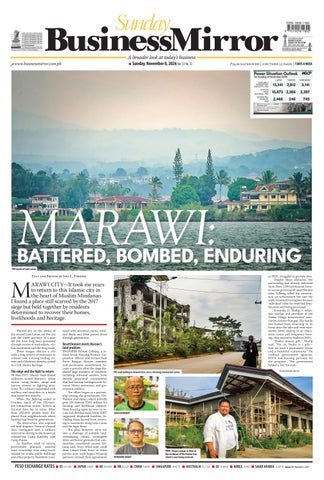
MARAWI: BATTERED, BOMBED, ENDURING
THE mystical Lake Lanao
M
Text and Photos by Joel C. Paredes
as SHFC struggled to provide sites. Despite these obstacles, the partnership has already delivered more than 1,000 permanent houses across government resettlement sites. Gilbang called the construction an achievement but said the work remained incomplete because individual titles for resettled families were still being processed. Armando D. Madip, a volunteer teacher and president of the Hadea Village homeowners’ association, knows that gap. His family was barred from returning to its home near the lake and river easements. After staying in an evacuation center and temporary housing, they moved to Hadea in 2021. “Hadea means gift,” Madip said. “For us, Hadea is a gift— that we have a permanent house and a beautiful community.” He credited government agencies, NGOs and housing partners for the progress. “The government helped a lot,” he said.
ARAWI CITY—It took me years to return to this Islamic city in the heart of Muslim Mindanao. I found a place still scarred by the 2017 siege but held together by residents determined to recover their homes, livelihoods and heritage. Marawi sits on the shores of the storied Lake Lanao, yet the city and the wider province of Lanao del Sur have long been portrayed through stories of warlordism, violent extremism and the drug trade. Those images obscure a city with a long history of resistance to colonial rule, a strong trading culture and a Maranao identity rooted in a rich Islamic heritage.
The siege and the fight to return
IN May 2017, Islamic State-linked militants seized Marawi’s urban center, using homes, shops and narrow streets as fighting positions. The military responded with artillery and airstrikes in a battle that lasted five months. When the fighting ended in October, much of the 250-hectare commercial center known as Ground Zero lay in ruins. More than 350,000 people were displaced from neighborhoods where families had lived for generations. The destruction also exposed old land disputes. Parts of Ground Zero overlapped with a military reservation dating to the American colonial-era Camp Keithley, now Camp Ranao. As families tried to return, government planners asserted state ownership over some tracts needed for roads, public buildings and other projects. Residents coun-
tered with ancestral claims, informal deeds and titles passed down through generations.
Resettlement meets Marawi’s land problem
ENGINEER Felman Gilbang, a retired Social Housing Finance Corporation official and former Task Force Bangon Marawi member, said permanent resettlement became a priority after the siege displaced large numbers of residents, including informal settlers from densely populated communities that had become battlegrounds between Maute extremists and government soldiers. The effort began as a partnership among the government, UNHabitat and Japan, which initially gave UN-Habitat P500 million for housing and livelihood support. State housing agencies were to secure and develop land, while SHFC organized displaced families, including those barred from returning to easements along Lake Lanao and the Agus River. The plan, however, soon ran into a shortage of suitable land, overlapping claims, incomplete titles and burial grounds that communities considered sacred, Gilbang said. Even titled land could draw claims from heirs or other parties once work began. Housing partners revised their agreements
THE road leading to Ground Zero, once a thriving commercial center.
Continued on A2
ZAIB GAURABAY
ARMANDO MADIP
PROF. Peepo Lucman in front of the residence of the Alonto clan, which is now being restored.
PESO EXCHANGE RATES n US 63.1430 n JAPAN 0.4005 n UK 84.9400 n HK 8.0528 n CHINA 9.4696 n SINGAPORE 49.4270 n AUSTRALIA 43.7518 n EU 70.8464 n KOREA 0.0465 n SAUDI ARABIA 16.8238 Source: BSP (November 6, 2026)
News BusinessMirror
A2 Sunday, November 8, 2026
www.businessmirror.com.ph
Marawi: Battered, bombed, enduring
THE restored Central Mosque at Ground Zero.
THE road leading to Ground Zero, once a thriving commercial center. Continued from A1
“But for us, it’s not enough.” Many families remained in temporary sites or had received no shelter, he said. “There’s still a shortage of temporary and permanent shelters.”
Beyond ‘ayuda’
NOW 69, Zaib Gaurabay was displaced during the Marawi siege. He had lived with his family in South Madaya along the Agus
River. During the siege, he delayed leaving while two of his children were still at Mindanao State University. The family later fled, and their house burned. A retired cooperative development officer from a nearby municipality, Gaurabay later viewed the recovery through the government’s livelihood and communityorganizing initiatives. At their resettlement site, Gaurabay said residents formed a transport cooperative with UN-
Habitat support and acquired two multicabs and a covered tricycle. Rising fuel prices, however, forced members to sell the vehicles, and the cooperative folded. Gaurabay said many local cooperatives became active only when agencies offered ayuda or livelihood grants. “If there is assistance, they renew their Certificate of Compliance,” he said in Filipino. “But if there is none, nothing happens.” He compared them with co-
CHILDREN after their Islamic studies studies at the neighborhood Madrasah.
operatives elsewhere in Mindanao that survived beyond one-time aid. Marawi, he said, needed groups built on regular participation, shared responsibility and viable businesses—not organizations revived only when money arrived.
When aid cannot replace work
PEEPO Disomimba Lucman, a business and entrepreneurship professor at Mindanao State University and a descendant of Maranao royalty, said the siege stripped a trading people of their homes, shops and work. “Our people were totally helpless,” he said of the first period of displacement. Today, the scale of that ordeal is harder to see. Business owners have reopened commercial areas, and residents have repaired many homes in the city proper. Lucman said residents should not be blamed because of their Muslim faith for a siege carried out by Islamic extremists, some of whom he believed were foreign fighters. “Have you ever seen a rebel with blue eyes?” he asked. Before the siege, residents had mixed views of the military. Lucman said many now felt safer because of its increased presence in the city. Before many families had recovered, the Covid-19 pandemic halted movement and trade. Lucman said food packs and cash aid kept people afloat but could not replace the independence that came from work or the efforts of local traders to reopen their businesses. He said families endured by staying together, maintaining community ties and returning to work when restrictions eased. Survival meant rebuilding livelihood and sending children back to school, not remaining dependent on ayuda. Lucman said the Maranao drive
A MUSLIM girl in a resettlement community.
to recover had spread to neighboring towns, where small businesses expanded despite losses in Marawi. He also cited agricultural research at Mindanao State University that has found practical use in nearby communities. An experimental strawberry plot in Piagapo became a commercial farm that now supplies local markets and restaurants.
The unfinished struggle for self-rule
WHEN I visited, wild grass still surrounded the tomb of Muslim statesman Ahmad Domocao Alonto Sr. Nearby, the ancestral home of one of the city’s most influential clans was being rebuilt after the siege reduced it to rubble. The adjoining central mosque, built with support from the Saudi royal family, had been restored to its former grandeur. Recovery, however, is about more than rebuilding. Maranao families are trying to reclaim property, restore livelihood and regain control of their future while protecting Lake Lanao, the source of the Agus River and a key part of
Mindanao’s hydroelectric power system. Alonto, a staunch Muslim opposition leader, carried that demand into national politics during the martial law years. Although critics linked him to relatives in the Moro National Liberation Front (MNLF), he pursued peace and Muslim self-determination through public institutions. As a lawmaker, Alonto helped establish Mindanao State University (MSU). He once told me that respect for human dignity was rooted in Islam long before human rights became a global cause. While some relatives chose armed struggle and secession, Alonto pursued legislation and constitutional reform. After the fall of strongman Ferdinand Marcos, President Corazon Aquino appointed him to the 1986 Constitutional Commission, where he helped place regional autonomy in the charter. Decades later, Marawi’s unfinished recovery shows why the struggle over land, dignity and self-rule still matters.
The World
www.businessmirror.com.ph
Sunday, November 8, 2026
A3
After midterm loss, Trump is left to weigh his next move in Iran war that contributed to GOP debacle By Aamer Madhani, Linley Sanders, Samy Magdy & Matthew Lee
W
The Associated Press
ASHINGTON—As he takes stock of his Republican Party’s midterm drubbing, President Donald Trump now faces the difficult question of what to do about his unpopular 8-month-old war against Iran. For weeks, Trump has threatened to return to a full-scale bombardment of Iran once the US elections were in the rearview mirror if Tehran did not come to a settlement under terms acceptable to him. In h is f i rst com ments on Wednesday after Democrats’ resounding election victory—a wave powered in part by the American electorate’s dissatisfaction with the war—Trump largely agreed with Vice President JD Vance, who publicly ruminated on the war being a catastrophe for Republicans. “It’s largely true because it drove gasoline up a little bit,” Trump said. Still, he doubled down on his decision to launch the conflict despite its big political cost. “At the same time, if I had to do it again, I’d do it again,” he said. T he st r i kes, a nd cou nter strikes, have caused tens of billions of dollars of damage in the region. And the conf lict has reached into the pocketbook of families around the globe with elevated gas prices and rising costs in just about every sector. Now, as Trump ponders his next move, the stakes couldn’t be higher for Iran, the Middle East and the global economy writ large.
Trump may be less restrained, but the conflict is now more complicated
WHILE oil is flowing again from
the Strait of Hormuz with the help of US Navy escorts for international tankers, the conflict has spread to the Red Sea with Iran-backed Houthi rebels and a Saudi Arabia -led coalition fighting it out. The situation in the Red Sea remains particularly volatile. The Houthis are attacking Yemeni civilians and Saudi infrastructure, and are looking to bolster ties with militant groups across the Horn of Africa. The attacks by the Yemen-based Houthis on areas controlled by the internationally recognized Yemeni government have also worsened a growing humanitarian crisis. The threat that the region faces from Iran and its proxy groups, noted a senior Yemeni government official, “did not change overnight” with the US elections, urging Washington to avoid hasty decisions. The official was not authorized to comment publicly and spoke on the basis of anonymity. “There’s reason to suspect that Trump may feel less restrained given that the political damage is done,” said Brian Haggerty, a former senior analyst at the Central Intelligence Agency who focused on Middle East security issues. “At the same time, the strategic calculus or the strategic logic of what you hope to achieve through an escalation of strikes against Iran is no different today than it was a
VICE President JD Vance arrives at a campaign rally at Eugene F. Kranz Toledo Express Airport, Monday, Nov. 2, 2026 in Swanton, Ohio. TOM BRENNER/POOL VIA AP
week ago or a month ago.”
Trump has at least a few options, analysts say
HAGGERTY, who now works with Defense Priorities, a Washington think tank, said Trump could choose to maintain something close to the current posture, with the US military carrying out what it calls “defensive strikes” while continuing its naval blockade to restrict the flow of Iranian oil to the global market. A nother option is striking Iran’s Pickaxe Mountain, a facility linked to its nuclear program that is buried deep underground in central Iran, said David Schenker, who served as assistant secretary of state for Near Eastern affairs in Trump’s first term. Trump has repeatedly suggested he was considering targeting the site. Schenker said Trump could then walk away and contend he had done sufficient damage to Iran’s nuclear program—and perhaps try to pursue a “fig leaf agreement” that restores freedom of navigation to the Strait of Hormuz, offers Iran some degree of sanctions relief, and punts additional nuclear talks to the future. Yet another option would be
to follow up on threats Trump made earlier in the war to launch massive attacks on Iranian infrastructure. “The Iranians may believe the president is wounded and constrained by Congress, but the opposite can also be true,” Schenker said. But such escalation would likely exacerbate the oil and energy price problem that many voters cited as a reason for supporting Democrats on Tuesday, Schenker said. The price for a barrel of Brent crude oil tumbled below $95 on Wednesday after the election, touching its lowest level in two months, a signal that markets do not expect major strikes. Iran, of course, also has a say, analysts note. “Once you start a fistfight, you can stop throwing punches. That doesn’t mean the other combatant will stop throwing punches,” said Bradley Bowman, an analyst at the Foundation for Defense of Democracies. “We can try to end the war, but what do we do if the Islamic Republic of Iran continues to attack shipping in the Strait of Hormuz?”
Regional officials are on high alert for what Trump does next
MIDDLE East officials had been
hanging on Trump’s every word in the weeks leading up to the US elections, looking for clues on how the Republican leader was weighing his next steps. Israeli Prime Minister Benjamin Netanyahu pressed for renewed strikes on Iran during a call over the weekend with Trump, who would not commit to taking military action, according to a person who was briefed on it. Three Middle Eastern government officials said on Wednesday that Trump and his administration had seemed to be signaling to Iran that its leverage would only diminish after the US elections were over. Administration officials had privately suggested in diplomatic channels that Trump might be more willing to restart strikes after Nov. 3 because he’d have little left to lose politically, according to the officials, who were not authorized to comment publicly and spoke on the condition of anonymity. After Tuesday’s electoral shellacking, there was lingering concern that Trump might be more emboldened to carry out full-scale or new limited strikes against Iran, the officials said. A fourth official said the results of the election gave mediators a measure of optimism about finding a pathway to resolving the conflict. Meanwhile, Vance appeared to more forcefully pin the electoral debacle on the Iran war than his boss Trump, who initially blamed the GOP’s candidates for the big loss. “The reason we lost,” Vance said of the midterm elections in a lengthy social media post, “is the war.” Vance, a potential 2028 president i a l contender, had been among the most skeptical inside the White House on the wisdom of launching the war but got on board with Trump’s decision once he made it.
Voter data shows Iran had an impact but was not the top issue
SEVERAL Democratic candidates who scored upsets on Tuesday noted voter discontent with the Iran war in their victory speeches. “Wherever I went, I heard the same thing,” said Sen.-elect Josh Turek of Iowa. “They would say, Josh, I’m struggling just to keep food on the table, keep a roof above my head, pay my electric bill. And with this war in Iran, I’m struggling just to keep gas in my tank.” About 6 in 10 voters said the US made the “wrong decision” in taking military action against Iran, according to The AP Voter Poll, a survey of more than 100,000 voters in the United States. Most of those voters dissatisfied with the Iran war backed the Democratic candidate in their local US House race, but the survey suggested the Iran war was not the top issue for most voters. Only about one-third of voters said the war in Iran was “crucial” to shaping how they voted for Congress. That was well below the roughly half who said that about the cost of living or government corruption. Nearly all voters who backed the Democratic candidate in their local U.S. House race said going to war with Iran was the “wrong decision,” while roughly 8 in 10 voters who backed the Republican candidate said it was the “right decision.” Meanwhile, about 6 in 10 voters nationally said they were “very concerned” about the cost of gasoline and diesel, the poll showed— and about two-thirds of that group voted for the Democratic candidate in their local U.S. House race. But Trump, for his part, said even in hindsight he’d approach Iran exactly as he has. “I can tell you that as far as that war is concerned I would have done nothing different,” the president said.
Iran’s leaders say midterm results show US voters have rejected Trump’s war By Elena Becatoros & John Seewer The Associated Press
I
R A N I A NS on We d ne sd ay struck a defiant tone, celebrating US voters’ rebuke of President Donald Trump in the midterm elections while many in the Middle East waited to see how the results could affect the Iran war. Concerns about the war, particularly frustration over rising prices for fuel and other goods in the US, helped Democrats win control of both chambers of Congress in Tuesday’s vote, a sharp setback for Trump and his Republican Party. But Iran’s supreme leader, Ayatollah Mojtaba Khamenei, whose father and predecessor was killed in the opening strikes of the war in February, dismissed the prospect of any major change in the US approach to the Islamic Republic. “If there are still those who harbor even a slight hope for a change in behavior or partisan and factional shifts within the system of domination, or who imagine that by giving concessions to America they can dissuade it from hostility toward the Iranian nation, they are gravely mistaken,” he said on his social media account.
scale military operations against Iran. Talks aimed at preventing renewed fighting are continuing, while other US allies in the region urge Washington against resuming a war that began more than eight months ago and has rattled the global economy and devastated Iran. Israeli Prime Minister Benjamin Netanyahu has reportedly pushed for more strikes, while Trump has alternated between threatening major military action and pushing for a deal. Iran’s chief negotiator and par-
liament speaker, Mohammad Bagher Qalibaf, wrote Wednesday on X that “Americans said NO TO WAR, and we endorse this message.” He warned that if the US government ignores the vote for change, “it will learn our NO comes with a Nightmare.” Despite ceasefire agreements and repeated diplomatic efforts, militar y confrontations have continued in southern Iran and around the Strait of Hormuz. I r a n ’s F o r e i g n M i n i s t r y spokesperson said in a social media post that Americans had
There are fears that full-scale fighting could resume
THE broader region has been on edge for weeks over the prospect of the US resuming full-
IRANIAN government supporters step on U.S. and Israeli flags during the annual rally marking the anniversary of the 1979 U.S. Embassy takeover, outside the former embassy in Tehran, Iran, Wednesday, Nov. 4, 2026. AP/VAHID SALEMI
sent a clear message and warned Washington against ig nor ing it. If the US continues to ignore reality, the spokesperson said, “the consequences of this grave miscalculation will extend far beyond what you have already witnessed.”
Iran marks anniversary of 1979 seizure of US Embassy
UNDERSCORING the mutual hostility at the heart of the conflict, thousands marched through Tehran on Wednesday at a government-organized demonstration commemorating the anniversary of the 1979 takeover of the US Embassy. Pro-government demonstrators burned American and Israeli flags and chanted “Death to America” and “Death to Israel.” They displayed effigies of Trump and Netanyahu alongside caricatures of the two leaders. “Trump has gone too far in everything and that’s one reason for his defeat in the election,” said Hananeh Jahed, a demonstrator. Zahra Nadiminejad praised Iranian resistance, saying US voters “finally figured out that this is Iran, and they can’t just come in here and do whatever the hell they want.” “They’ve seen the consequences of the war back home, from skyrocketing gas and food prices to See “Midterm,” A4
ZAHIDAH BEGUM teaches her children the Quran at their home in Kuala Lumpur, Malaysia, Monday, Sept. 21, 2026. AP/VINCENT THIAN
They fled persecution in Myanmar. In Muslim-majority Malaysia, Rohingya still struggle to belong By María Teresa Hernández The Associated Press
K
UALA LUMPUR, Malaysia—Nur Sadek was once on track to become an Islamic scholar. His mother dreamed of raising a son who would serve as a faith leader in their western Myanmar village. Sadek’s family belongs to the Rohingya ethnic minority. The predominantly Muslim group shares an area in Myanmar’s Rakhine State with Buddhists and a smaller Hindu population. Ethnic and religious divisions have long shaped the region’s history. He fled alongside loved ones in 2017 after soldiers opened fire on his community and bullets struck the tin roof of his home.
He ran with nothing but the clothes on his back and never returned. Around 700,000 Rohingya escaped a military crackdown that year and crossed into neighboring Bangladesh, according to the UN refugee agency, known as UNHCR. More have sought refuge in other countries across Asia, including India, Indonesia and Thailand. As of February 2026, about 126,000 Rohingya were registered with UNHCR in Malaysia, a Muslim-majority country where Sadek now studies law and advocates for Rohingya rights. The Southeast Asian nation does not legally recognize refugees, leaving them See “Myanmar,” A4
A4
Sunday, November 8, 2026
The World
www.businessmirror.com.ph
European troops prepare for a postwar Ukraine mission that’s fraught with challenges By Emma Burrows & Sylvie Corbet
L
The Associated Press
ONDON—Thousands of European troops will take part in a military exercise in Poland this month to prepare for a hypothetical postwar mission in Ukraine to boost the country’s economy and rebuild its armed forces. But some experts say the deployment may never take place. The force’s first military exercise, led by Britain and France, is aimed both at testing deployment plans and sending a message to Russia and the Trump administration that European countries are stepping up militarily. Yet the overall mission is plagued with challenges, including the ongoing fighting, questions over American support and the outcome of the upcoming French elections. Britain and France are both part of a wider political group of 37 nations supporting Ukraine known as the Coalition of the Willing. Ukrainian President Volodymyr Zelenskyy has repeatedly said that in the event of a peace deal, there must be strong security guarantees from Kyiv’s Western allies, including the United States, to deter Russian President Vladimir
Midterm. . . Continued from A3
all the devastating effects the war has had on their own country. And whether the Democrats win or the Republicans win, our hostility toward America will never come to an end.” Nearly five decades ago, Iranian students stormed the US Embassy on Nov. 4, 1979, taking American diplomats and other citizens hostage. Fifty-two Americans were held for 444 days before being released. The crisis helped cement the rupture between the two countries, which have had no formal diplomatic relations for years. The United States and Israel launched the war against Iran on Feb. 28, killing the country’s longtime supreme leader, Ayatollah Ali Khamenei, and triggering a conflict that has disrupted global energy markets and shipping through the Strait of Hormuz. Addressing the demonstrators
Putin from attacking the country again. That’s where this force could come in. “This exercise shows the UK is stepping up, alongside France and our allies, to prepare for the day peace comes to Ukraine,” British Defense Secretary Wes Streeting said. Alongside France and Britain, eight other European nations will deploy 2,800 soldiers to Poland to rehearse transporting people and equipment into Poland, conduct joint command and control drills and fly jets and an aerial refueling tanker in preparation to help Ukraine reopen its skies. If deployed once a ceasefire is in place, the force would help regenerate and strengthen Ukraine’s armed forces, provide the reassurance needed to open the country’s on Wednesday, Tehran Mayor Alireza Zakani claimed the United States and Israel had suffered a massive defeat, which he said was also reflected in last week’s Israeli elections. “ The decisive defeat of the United States and the Zionist regime in recent developments and elections is the result of the Iranian nation’s steadfastness and strength,” Zakani said.
Iranian targets hit ahead of the midterms
THE US elections came just a day after what appeared to be a limited strike on Iranian targets in the crucial Strait of Hormuz waterway, which renewed questions about what might come next. Iranian state media reported explosions Monday on Qeshm and Hengam islands and near the southern port city of Bandar Abbas. Iranian authorities have not publicly identified the specific sites struck or disclosed the extent of the damage. The Strait of Hormuz, through
skies and help clear mines in the Black Sea, said Lt. Gen. Tom Bateman, commander of Multinational Force-Ukraine, or MNF-U. Here’s a look at the force and the serious challenges it faces.
Ceasefire negotiations have stalled
All of the European countries involved in the force say they will only deploy once hostilities cease. But for that to happen, there needs to be a ceasefire. Peace negotiations stalled earlier this year after US President Donald Trump launched his war with Iran, while in September he said he had done a deal with Russia to supply diesel fuel to the US ahead of the midterm elections in an attempt to lower fuel prices, providing a political and economic boost to the Kremlin. Trump also called for the removal of Zelenskyy and demanded Kyiv stop striking Russian energy infrastructure. Trump and his officials also offered confusing messages as to why Starshield—which Ukraine uses for drone strikes and air defense— had been throttled. In September, Zelenskyy said the US had failed to provide warning, as it normally did, of incoming Russian ballistic missile attacks. W hile both Ukraine and Russia have signaled their willingness to resu me US -brokered peace talks, deep disagreements o v e r t e r r it or y a nd s e c u r it y guarantees remain. which about a fifth of the world’s traded oil and gas transited before the war, has seen repeated Iranian attacks on commercial shipping. Iran has sought to restrict shipping to pressure the US to lift its blockade on Iranian ports. Iran’s state TV said Wednesday that four oil tankers caught fire after they struck mines on what it described as unauthorized routes. Back-channel negotiations have continued. US Vice President JD Vance said Monday that he and Trump “both feel pretty good about the prospects for potentially coming to a negotiated settlement.” Before the latest strikes, the Tr u mp ad m i n i st rat ion’s l a st known attacks on Iran were in early September. Thousands of US troops remain in waters off Iran to maintain the naval blockade, aimed at preventing tankers carrying Iranian oil from reaching the global market. Another aircraft carrier and thousands of additional troops are on their way to the Middle East.
For Ukraine and European nations, a critical part of any agreement was a US guarantee that it would support Kyiv with intelligence and help monitor a ceasefire, said Ed Arnold, a Senior Associate Fellow at the RUSI military think tank in London. But now, “the US are basically supporting Russia against Ukraine,” Arnold said, suggesting a lasting ceasefire could be a long way off.
It’s not clear what the force is going to do
THE troops will rehearse transporting people and equipment into Poland, conduct joint command and control drills and fly jets and an aerial refueling tanker in preparation to help Ukraine reopen its skies, the British and French defense ministries said. The initial idea of the Coalition of the Willing group of nations was to provide Ukraine with security guarantees similar to NATO’s Article 5, in which allies treat an attack against one member as an attack against the entire alliance and discuss how they would respond together, said Federico Santopinto, senior research fellow at the French Institute for International and Strategic Affairs in Paris. NATO could have offered such security guarantees, but the US and Germany refused that option, which is why France and the UK decided to go ahead with plans for a separate European proposal
Myanmar. . . Continued from A3
vulnerable to detention. But the challenges extend beyond immigration status. Many Rohingya struggle to practice their faith and find a sense of belonging. CSW, a religious freedom advocacy group, said in a statement to The Associated Press that Rohingya refugees in Malaysia cannot officially register their own places of worship. Most pray at local mosques, but some face discrimination or avoid them for fear of immigration detention. “Religious solidarity is often overtaken by social and cultural differences between the two groups,” CSW said.
Finding a place to pray is only the beginning of the struggle
NURUL HAKIM was the first of 10 siblings to flee Myanmar, leaving in 2010. He arrived in Kuala Lumpur after days of traveling on foot, by car and by boat, passing through Thailand. His family was not directly attacked. Yet years of violence and discrimination had made life increasingly difficult for his community.
of countries willing to come to Ukraine’s aid if necessary, a French official said, speaking on condition of anonymity to discuss sensitive military details. But the European deployment will not be a NATO force, peacekeeping or ceasefire monitoring mission and is “not designed for offensive operations.” Rather it is aimed at helping Ukraine deter future Russian aggression, said Bateman, the force commander. The exercise in Poland was planned earlier this year but is taking place at a time when several European nations, including Poland, have warned of the rising threat from Russian covert activity, including sabotage, espionage and drone incursions. Denmark ’s Defense Intelligence Service said Putin may carry out military attacks against NATO only if he assesses NATO will not respond collectively and “especially if Russia assesses that the United States cannot or will not support the European NATO countries in a potential war against Russia.” Last year, Putin said that any foreign troops inside Ukraine would be considered “legitimate targets.” For that reason, any deployment needs to be a “combat force for their own force protection,” Arnold said, suggesting that if soldiers were pulled at the first sign of trouble, it would make Europe look weak. Santopinto also expressed skepticism about Europeans’ capacity
Rohingya Muslims in Rakhine faced restrictions on religious gatherings, access to mosques and Islamic education for years. Authorities have closed mosques and imposed limits on communal prayer, according to reports by the United Nations and Amnesty International. Hakim can now pray freely and feels welcomed by local Muslim faith leaders. But he has heard from Rohingya elsewhere in Malaysia who have been barred from doing so. Rohingya Rights Response, an organization co-founded by Sadek that monitors issues affecting refugees in Malaysia, has also documented restrictions on religious practices. Banners declaring that Rohingya are unwelcome have been displayed outside mosques in some neighborhoods. And even where they can pray freely, some aspects of their religious life remain difficult to recreate far from home. “Most of the Rohingya don’t have their own imam leading the prayers because the mosques are run by Malay imams,” Sadek said.
Missing home adds to the challenges of starting over
THERE is much Hakim misses about home: his days pulling a rickshaw, trading goods with his neighbors, learning about Islam alongside fellow Rohingya. “There is no difference in praying at a different mosque, but there are differences with who you are praying with,” Hakim said. “When I was back in Myanmar and I went to pray, I could pray with my neighbors, with my villagers, and I don’t have that here.” Others face a more immediate obstacle to practicing their faith: fear of detention over their lack of legal status. Mohammed Rafique said he now prays mostly at home and rarely visits a mosque because he worries about encountering immigration authorities. He fled Myanmar in 2009 with his wife and five children, but they stayed in Bangladesh while he continued to Malaysia. He has not seen them since. Living alone in a foreign land has been tough, Rafique said. He earns just 30 ringgit ($7.50) a day collecting scrap materials, barely enough to pay for needed medication. Yet the hardest moment he has faced was learning that his wife had died and he’d been unable to say goodbye.
to provide the “credible deterrence” against Russia that Ukraine would need. “That could mean having to shoot down Russian fighter jets, with the risk of escalation that everyone wants to avoid,” he said. “Would Europeans be prepared to directly intercept drones and missiles launched by Russia into Ukrainian airspace?”
Upcoming French elections may change everything
IN France, meanwhile, next year’s presidential election is raising doubts about whether the proposed force could materialize. Centrist President Emmanuel Macron cannot seek a third consecutive term, and protests have added to the pressures facing his government. Far-right leader Marine Le Pen, seen as the favorite, has opposed sending troops to Ukraine. Last month, she said she would end financial assistance to Kyiv after six months in office because France “can no longer afford it.” The party of far-left rival JeanLuc Mélenchon also opposes a deployment. Other contenders on the left and right have warned against escalation, saying they are concerned about a wider European conflict. “This is a military operation in search of a mission,” facing many challenges, Arnold said. For that reason, he said, there is almost “zero” chance the force will ever deploy to Ukraine. Sadek knows that pain, too. He lost his mother in Bangladesh and has yet to visit her grave. “I always wanted to do a lot of stuff, but now I just want to visit her cemetery and that has become like a dream for me,” he said.
A new life brings hardships without erasing old losses
S A D E K’S organization advocates for changes that would improve the lives of his community in Malaysia. His main focus is safety. Beyond the risk of immigration detention, his team has documented harassment by social media content creators who mock and demean Rohingya refugees. He also pushes for fair wages, access to healthcare and education. For Zahidah Begum, those challenges are part of everyday life. Her husband struggles to work because of health problems. Her school-age children cannot attend formal classes. “I don’t know what the future holds for us,” Begum said. She fled Myanmar in 2013, carrying her own memories of religious persecution. Her father, an imam, was a respected religious leader in their village. He taught Islamic studies every day from 8 a.m. to 4 p.m. “I love my father because of what he did,” she said. “He is the one who raised me, who taught me everything, including the Islamic teachings.” It was her father who introduced her to the Quran. Who taught her to read and understand its verses. To distinguish between what her faith permitted and forbade. During a raid on her village, soldiers tried to arrest him. He fell and broke his leg as he tried to escape. He eventually fled to Bangladesh, but was unable to receive medical treatment. His injury became infected and he died. “I miss every moment of my father,” Begum said. She keeps a part of him alive through lessons she passes on to her two daughters. Begum teaches them to pray, to recite verses from the Quran and to make duas, or personal supplications to God, just as her father taught her. “I still feel the same connection to my faith that I felt back home,” Begum said. “Even here, I remain connected to my religion.”
www.businessmirror.com.ph • Editor: Lyn Resurreccion
Sunday, November 8, 2026 A5
UN climate talks start in the year of disasters, energy price shocks and fast rising temperatures By Seth Borenstein, Anton L. Delgado & Sibi Arasu
T
The Associated Press
HREE stories about climate change are playing out like popular movie genres as United Nations climate negotiations begin in Antalya, Turkey. There’s the horror story. Many scientists believe global warming is accelerating. Two months ago, the UN readjusted its decade-old goal of limiting global temperature rise to 1.5 degrees Celsius (2.7 degrees Fahrenheit) because the world is blowing past that threshold. The fallout from rising temperatures is felt globally, with Europe’s deadly summer heat waves and Nepal’s devastating flooding as stark examples. There’s the love triangle. For more than a century the world has been powered by coal, oil and gas. This love affair spurred economic development, as well as the emissions warming the planet. But renewable energy is capturing some of the world’s attention because it’s cheaper and cleaner than fossil fuels. Instead of switching from one to the other, the world is using both to meet demand from power-hungry artificial intelligence and ever-growing economic development. This isn’t helping curb climate change. Then there’s the war movie. Russia’s 2022 invasion of Ukraine triggered a European energ y shock. This year the United States and Israel bombed Iran. The conflict closed
the Strait of Hormuz and sent fossil fuel prices skyrocketing, forcing nations to rethink their energy systems. These stories are colliding as the 31st Conference of Parties, or COP31, starts on November 9 with speeches from world leaders and will later dig into how to follow through on past climate pledges. A key issue this year is the implementation of promises to transition away from fossil fuels. Co-host Turkey is also pushing a separate plan that would help do that by shifting more global energy use—including transportation—to electricity generated from solar and wind power. Negotiators also will hash out how to provide promised funds to poor countries to switch to renewables, adapt to a warmer world and recover from climate-induced damage. “It’s really the moment that we place a magnifying lens on what’s happening in the world on climate change, both good and bad,” David Waskow, international climate chief at the World Resources Institute, said. While the US is the world’s largest historic carbon polluter, it skipped last year’s COP and isn’t expected to participate this year. “There’s always two topics in the
and futures blanketed in wildfire smoke, in devastating floods [and] landslides.” What gives most experts hope is how cheap solar and wind energy are, along with the growth in electric cars, strengthening the economic argument for transitioning away from fossil fuels. “It has never been as easy to reduce emissions than it is today because, again, this year, renewable energy has been developing faster than before,” Höhne said.
climate negotiations that are relevant and difficult,” said Niklas Höhne, cofounder of Germany’s NewClimate Institute. “The first one is who produces emissions [and] how much. That is difficult enough. But what is even more complicated is the other issue, and that is who pays. And on this one, we are particularly in a difficult situation because the US, as the largest contributor, has dropped out. And there’s no other player who can jump in,” Höhne said.
Hope for progress on the sidelines
Global climate efforts are off track ELEVEN years ago, the world was on track to hit 4 C (7.2 F) of warming above preindustrial levels by the end of the century. In 2015, nations set the goal of keeping warming to below 2 C (3.6 F), but with a preferred limit of 1.5 C (2.7 F). Now, the world is at 1.4 C (2.5 F) of warming and is hurtling toward 2.6 C (4.7 F), the U.N. found. “We have failed so far,” said Johan Rockström, director of Germany’s Potsdam Institute for Climate Impact Research. Rockström said Earth will likely experience more frequent and extreme weather, such as f loods, droughts and storms. And the planet may soon reach “tipping points,” such as ocean currents changing and the Amazon rainforest collapsing.
It comes down to fossil fuels EVEN though the burning of fossil fuels is the main cause of warming, it has rarely been targeted in final documents agreed upon at the conference, mostly because those decisions require consensus. This April, 56 countries met at
ACTIVISTS hang banners while participating in a demonstration at the COP30 UN Climate Summit, in Belem, Brazil, on November 21, 2025. AP/ANDRE PENNER a separate conference to push for a more direct phase out of fossil fuels. “The reason we are seeing the breach of 1.5 degrees Celsius of warming is because we avoided the absolutely fundamental question of how climate change happened and what’s responsible, the source of the problem and that’s fossil fuels,” said Harjeet Singh, founding director of Satat Sampada Climate Foundation. “Unless and until we resolve the issue of fossil fuel phase out, we will not be able to deal with the problem,” Singh added. Brazil, which hosted COP30 last year, this month released a detailed voluntary road map offering directions for how countries could transition away from fossil fuels. The road map is meant to turn the “big problem” of reducing fossil fuel use into “smaller actionable solutions,” Ana Toni, who served as CEO of last year’s climate talks, said. One of the key things nations must do is stop subsidizing fossil fuels, she said. The UN estimates fossil
Searca paper pushes for stronger Asean food resilience amid polycrisis
L
OS BAÑOS, Laguna—A new policy review published by the Asian Journal of Agriculture and Development (AJAD) calls on Asean to make resilience—rather than maximal self-sufficiency—its strategic food security objective, addressing persistent food insecurity in one of the world’s major foodproducing and exporting regions. Titled “Asean Food Security in an Era of Polycrisis: From Production-Centered Policy to Regional Resilience,” the paper is authored by Dr. Paul Teng of the ISEAS–Yusof Ishak Institute in Singapore. It examines how climatic shocks, geopolitical conflict, energy and fertilizer price volatility, biological threats, trade restrictions, and economic pressures can occur simultaneously and amplify one another. The paper highlights a paradox across Southeast Asia: despite being a major global producer and exporter of food, food insecurity and undernutrition persist within its borders. Citing estimates from the Food and Agriculture Organization of the United Nations (FAO) and partner agencies, the study notes that approximately 14 percent of Southeast Asians experience moderate or severe food insecurity and that 5.1 percent of the region’s population is undernourished.
THE cover of the Asian Journal of Agriculture and Development paper titled “Asean Food Security in an Era of Polycrisis: From Production-Centered Policy to Regional Resilience.” PHOTO CREDIT TO SEARCA
According to Teng, the era of polycrisis demonstrates that judging food security primarily through production is insufficient. While domestic production and selfsufficiency remain important—especially for staple foods—countries must also be able to maintain functioning supply chains, keep food affordable and accessible, secure agricultural inputs, and protect nutrition when facing multiple simultaneous disruptions.
Asean member states possess diverse vulnerabilities and capabilities: some are major agricultural exporters while others depend heavily on food imports; some have greater financial resources, technology, logistics, and research capacity. Rather than expecting every member country to produce everything it needs, the paper emphasizes connecting these complementary strengths. To build regional resilience, Teng
proposes a strategy centered on keeping intra-Asean food trade open, diversifying external sources, strengthening agricultural input security, expanding climate-resilient production, protecting food affordability a n d n u t r i t i o n , e n h a n c i n g re g i o n a l cooperation in data, preparedness, finance, and technology. It also involves maximizing existing frameworks, such as the Asean Food, Agriculture and Forestry Sectoral Plan 2026–30, the Asean Integrated Food Security Framework, the Asean Food Security Information System, the Asean Plus Three Emergency Rice Reserve, and the Asean Climate Resilience Network The primary challenge lies in improving implementation and ensuring these mechanisms function together during concurrent shocks. Teng notes that Asean should focus on what it can accomplish re g i o n a l l y b e t t e r t h a n i n d i v i d u a l member states: keeping regional markets functioning, sharing timely information, coordinating emergenc y responses, reducing capacity asymmetries, scaling proven solutions, and mobilizing external resources. AJAD is an international refereed journal covering agriculture and development in Asia published by the Southeast Asian Regional Center for Graduate Study and Research in Agriculture.
fuel subsidies globally hit $1.1 trillion this year. “What’s standing in the way is not so much technology as governments and incumbent industries,” said Bill Hare, CEO of Climate Analytics. “One cannot underestimate the power and influence of the fossil fuel industry in slowing down action.”
Climate talks bring hope and frustration BARBADOS youth activist Ashley Lashley’s first COP was five years ago. She was frustrated by the lack of progress back then, but hopeful because there was a sense of urgency to keep the 1.5-degree goal alive. Lashley still attends negotiations with some hope, but she is more frustrated than ever. She said “the science has become more alarming, but yet politically we seem to be negotiating how much failure we are prepared to tolerate.” Qiyun Woo, a Singaporean youth environmentalist, said her generation is tired of “seeing their present
MUCH of the work at climate negotiations gets done on the sidelines, where not everyone has to agree and some nations do more than others. One important sideline initiative this year is Turkey’s goal of increasing electricity’s share of global energy use from 21 percent to 35 percent by 2035, preferably by using renewable power. Mohamed Adow, a veteran COP observer and director of Power Shift Africa, said that the conference is taking place at a time when the world is deeply fragmented. “The closure of the Strait of Hormuz has intensified economic and energy security pressures,” he said. “We don’t expect this particular conference to be able to sufficiently respond to the present day challenge...that is affecting livelihoods and economies.” The climate talks are hindered by the continued absence of the US, Adow said, adding that it wasn’t fair to nations like Nepal, which have to face catastrophic destruction alone while the world’s wealthiest country and biggest polluter sits on the fence. “A time will come when we will have to hold the US accountable for the climate harms that it’s caused,” he said.
DOST-FPRDI to host Intl Bamboo Conference in 2027
T
HE Philippines will host the International Bamboo Congress (IBC) in Clark, Pampanga, from September 16 to 18, 2027. It will be led by the Department of Science and Technology-Forest Products Research and Development Institute (DOSTFPRDI), the country’s premier agency on bamboo research and development. Themed “Bamboo Beyond Boundaries: Ecology, Innovation, Impact,” the event will bring together researchers, innovators, policymakers, and industry leaders from around the world to exchange insights and showcase advances in bamboo research and development (R&D), industrial applications, and sustainable solutions. Abstract submissions covering the following four thematic areas, will start this month: n Best Practices in Bamboo Production n Sustainable Bamboo Technologies and Materials Innovation n Stories from the Industries n Community Engagement and Good Governance “Through science and technology, we advance bamboo for higher value applications while strengthening
industry competitiveness for innovation-driven economic growth,” said DOST Secretary Renato U. Solidum Jr. “DOST is pleased to spearhead this important event through the DOSTFPRDI,” Solidum added. The International Bamboo Conference 2027 is anchored in national and international frameworks promoting climate action, sustainable development, circular economy, and responsible use of forest-based resources. In the Philippines, it suppor ts the Climate Change Act of 2009, which integrates climate change considerations into government policies and development plans. “Bamboo has enormous potential, and DOST-FPRDI has been at the forefront of developing innovations to realize it. Through the IBC 2027, we are bringing together key stakeholders across the bamboo sector to share knowledge, build partnerships, and advance bamboo for a sustainable and more competitive industry,” explained DOST-FPRDI Director Rico J. Cabangon. Interest parties may contact the IBC Secretariat at conferences@fprdi. dost.gov.ph. Apple Jean C. Martin-de Leon/S&T Media Services
Seeds, preserved hair in tomb point to oldest signs of cannabis high 2,800 years ago–study By Jamey Keaten & Philipp Jenne The Associated Press
G
ENEVA—People may have been getting high off cannabis earlier than previously thought—at least 2,800 years ago, a new study suggests. Archaeologists who led a dig at a monumental tomb in Siberia said they turned up evidence of the earliest known use of cannabis for psychoactive purposes. The findings point to cannabis consumption at least 300 years earlier than previously known use in neighboring China.
Ancient drug use has long intrigued scholars. The Greek historian Herodotus wrote about inhabitants of Central Asia smoking cannabis around 440 B.C., and recent archaeologists have found the seeds in tombs across its highlands. The team from Germany, Russia, Sweden and Switzerland said analysis of hair in the royal tomb where cannabis seeds turned up sheds new light on the plant’s role in ancient societies. “It’s extremely rare that we have both preserved plant parts and human soft tissue with the active compounds in it in the same
context,” said co-author Gino Caspari, an archaeologist at the University of Bern. It’s not clear whether the cannabis was consumed through inhalation or ingestion, he said. The dig took place starting in 2017 at a large burial mound at the Tunnug 1 site in the Uyuk Valley of southern Siberia, home to one of the earliest monumental tombs showing material culture of the Scythians—ancient nomads who migrated from Central Asia to southern Russia and Ukraine. The team, deployed “essentially out in the
middle of nowhere,” lived in tents for months and faced a spring-to-autumn season that variously featured swamps, snowstorms, frosts and swarms of mosquitoes. Herds of horses ran freely across the grassy steppe. Larger artifacts on the site include weapons in the burials, horse gear and animal-style motifs. But the team “struck gold” as it also found tiny black spots that turned out to be cannabis seeds along with preserved human hair, Caspari said. “It’s only so often as an archaeologist that you do get to drug test a person that’s been dead for almost 3,000 years,” he said.
Radiocarbon dating on some of the more than 1,000 seeds helped establish the time of origin, and “they are not there by accident” but deposited within the tomb, suggesting that the plant material had significance in the community, he said. Results were published Thursday in the journal Science. Not all independent experts were convinced. The hair analysis “is scientifically weak” and there’s not enough evidence to tell whether cannabis was used, wrote Volker Auwaerter, head of the forensic toxicology
section at the University Medical Center in Freiburg, Germany, in an email. “For a central part of the study, the article falls far short of what would have been possible,” Auwaerter said. “This matters because the hair data carry the abstract’s main claims (cannabis consumption and use for its psychoactive properties).” Today, scholars don’t consider ancient accounts trustworthy without corroborating evidence. Because the cannabis plant has other uses—seeds are pressed for oil and fibers used for cloth—their presence alone doesn’t confirm drug use.
Faith
Sunday
A6 Sunday, November 8, 2026
Editor: Lyn Resurreccion • www.businessmirror.com.ph
Cardinal: Pray for rain as ‘Super El Niño’ threatens nation
T
HE Archdiocese of Manila has directed parishes to pray for rain during daily Masses starting Sunday amid forecasts of a very strong El Niño phenomenon. In a circular released T hursd ay, C a rd ina l Jose Adv inc u l a ordered pa r ishes a nd communities to recite a specia l prayer for ra in a f ter t he post- Commu n ion prayer u nt i l f u r t her not ice. The prayer, titled “Oratio Imperata Ad Petendam Pluviam” (Obligatory Prayer to Request for Rain), was issued in English and Filipino.
T he d i rec t ive comes a m id concerns that prolonged drought and water shortages could particularly affect poor and vulnerable communities. Advincula called on Catholics to unite in prayer while strengthening their commitment to environmental protection and responsible water use. “The natural world is not merely a resource to be consumed, but
a precious gift entrusted by the Creator to our care and stewardship,” he said.
medicine, and where treatment is accessible regardless of income. “We may not be able to cure every illness, but we can ensure that no patient feels abandoned or forgotten,” he said. He urged the Church, government, healthcare professionals and local communities to work together to expand access to medical services, particularly for poor families and those living in remote areas. Hospitals and modern medical equipment, he said, are not enough unless healthcare services also reach the people who need
them most. The archbishop also recognized the sacrifices of doctors, nurses and other healthcare workers, stressing the need to provide them with adequate support. Recalling his meeting with Pope Leo XIV in Rome during a gathering of bishops’ conference presidents, Garcera said he was moved by the pontiff ’s reminder that the sick must never be isolated. “The sick need more than medicine. They need understanding, respect, and the assurance that they are not alone,” he said. Drawing from the day’s Gospel,
He stressed that water is essential to life and urged the faithful to conserve it and avoid wasteful consumption. The cardinal said prayer should also inspire concrete action, including greater care for creation and solidarity with communities most vulnerable to drought. The Philippine weather bureau announced Thursday that a very strong El Niño was present in the tropical Pacific Ocean. The phenomenon, also informally called a “Super El Niño,” could peak by the end of 2026 and persist through the first half of 2027, according to the weather bureau. In the Philippines, El Niño typically brings below-normal rainfall, increasing the risk of dry spells and drought. CBCP News
POPE Leo XIV embraces a child after landing in Metz, France, on Sept. 28, 2026. VATICAN MEDIA
Pope to young people: Make room for Christ whenever you feel lonely CBCP head: Health care must not be privilege of wealthy
T
HE president of the Catholic Bishops’ Conference of the Philippines on Wednesday urged healthcare institutions to ensure that poor patients are not denied treatment because they cannot afford it. Speaking during Mass for the Luzon Health Care Summit in Sta. Rosa, Laguna, Archbishop Gilbert Garcera of Lipa said access to health care must uphold the dignity of every person. “Healthcare must not be a privilege reserved for the wealthy. It must be a service that recognizes the dignity of every person,” Garcera said in his homily. He challenged healthcare providers to respond compassionately to patients in financial distress rather than allow their inability to pay to determine whether they receive medical attention. “The poor should never hear, ‘You have no money; we cannot help you.’ Rather, they should hear, ‘What can we do to help you?’” he said. Garcera called for a healthcare system where families do not have to choose between buying food and
CARDINAL Jose Advincula of Manila.
MANILA CATHEDRAL PHOTO
CBCP President Archbishop Gilbert Garcera is with the participants of the Catholic Health Care Summit Luzon in Sta. Rosa, Laguna on November 4. CBCP-ECHC
Garcera urged summit participants to pursue “greater things,” including building a society where the poor, elderly and seriously ill are not abandoned. He said caring for the sick requires sacrifice, responsible m a n a ge me nt a nd lon g - t e r m planning to ensure that healthcare services reach marginalized communities. “Our discipleship is measured not only by our prayers but also by how we care for the weak and suffering,” he said. The biannual summit, organized by the CBCP Episcopal Commission on Health Care, brings together representatives of diocesan healthcare ministries to strengthen collaboration, share experiences and promote best practices. It also seeks to deepen the Church’s commitment to accessible, equitable and sustainable healthcare, particularly for the poor and marginalized. Separate summits were also held in Mindanao and the Visayas regions in October. CBCP News
V
ATICAN—Pope Leo XIV, in a message for this year’s 41st World Youth Day (WYD), encouraged young people to be courageous in an age of loneliness. “Some of you know what it means to experience loneliness, disappointment, or the fear of not being good enough,” Leo said in his message. “It is in circumstances like these that we hear the Gospel’s invitation to take courage.” The Vatican released his message on Tuesday ahead of WYD 2026, to be celebrated locally on November 22, coinciding with the solemnity of Christ the King. The Vatican also published the message ahead of WYD 2027 in Seoul, South Korea, which the pope is expected to attend. In his message, Leo noted the modern challenges young people face, including anxiety, self-doubt, and the difficulty of maintaining a personal identity in an age of social media. “Under the influence of carefully curated images on social media, you may find it difficult to recognize and accept who you truly are,” the pope said. “Perhaps you are anxious about the future, feel pressured to succeed and appear perfect, or experience the stress of constantly comparing yourselves with others or with unattainable, manufactured ideals.” Leo then explained the need for young people to be vulnerable and to depend on Christ when lonely, citing the apostles’ fear when the risen Christ appeared to them. “Faith does not immediately dispel the darkness, but neither does it leave us alone in it,” Leo explained. “Open your lives to Christ. Open your communities to Christ.” He added: “Allow yourselves to be united and transformed by his love.” As he did in a video message for WYD 2027 in October, the pope also encouraged people to register for the event in Seoul, which will run from August 3 to 8, 2027. Ishmael Adibuah/EWTN News via CBCP News
Number of Catholics, priests increasing worldwide V
ATICAN CITY—The number of Catholics worldwide is increasing, and the number of priests is growing again, albeit slightly. Meanwhile, the number of women religious and major seminarians continues to decrease, while the contribution of lay missionaries and catechists is increasing. As every year, in view of World Mission Sunday, which this year celebrates its 100th anniversary on October 18, on the theme “One in Christ, united in mission,” Fides News Agency’s statistics give a panorama of the Church in the last year. T h e d at a r e l at i n g t o t h e tot a l world popu l at ion revea l d if ferent t rend s. A f r ic a re cord e d t he l a r g est increase in the number of Catholics and was the only continent to register an increase in both women religious and major seminarians. A ll the data in the Dossier, compiled by Luca Mainoldi, are taken from the latest edition of the “Church ’s Book of Statistics” published this year. It offers an over view of the Catholic Church ’s presence worldw ide, its pastora l str uctures, and its e duc at ion a l , he a lt hc a re a nd c ha r it able act iv it ies. Population and Catholic population data refer to June 30, 2024, while the other data are as
of December 31 of the same year.
The number of Catholics increases on every continent
ON June 30, 2024, the world population was 7,995,573,000. Catholics in the world numbered 1,422,144,000, with an overall increase of 16,690,000 compared to the previous year. The world percentage of Catholics remains unvaried at 17.8 percent. The increase in the number of baptized was recorded on ever y continent. Increases were registered above all in Africa (+7,580,000), and in A merica (+6,992,000). It is followed by Asia (+968,000), Europe (+911,000) and Oceania (+239,000).
More Catholics in Africa than in Europe
THE Americas remain the continent with the largest Cathol ic popu l at ion: 678,869,0 0 0, representing 64 percent of the continent’s population. Africa has 288,312,000, surpassing Europe, where the total number is 287,240,000. Asia follows with 156,166,000, while Oceania has 11,557,000. The percentage of the Catholic population in all continents: 19.9 percent in Africa; 39.7 percent in Europe; 3.3 percent in Asia; and 25.9 percent in Oceania.
Priests: A slight increase, with different trends across all continents
FOR the first time in five years, according to the Dossier, the worldwide number of priests has increased, reaching 407,421, or an increase of 425 compared to previous data. The overall rise ref lects increases in Africa (+1,676), Asia (+1 , 0 6 5 ) a n d t h e A m e r i c a s (+199), t h at compensate de creases in Europe (-2,483) and Oceania (-32). The numbers in the Americas increased after recording a decrease in the previous year. T he nu mber of d iocesa n pr iests increased to 279,238 (+496), whi le the number of religious priests decreased to 128,183 (-71). Despite the slight overall increase in the number of priests, the average number of Catholics per priest also increased, reaching 3,491, or 38 more faithful per priest compared to previous data. This ratio increased in the Americas, Europe and Oceania, while decreased in Africa and Asia. T he number of bishops reached 5,525, an increase of 95: 4,365 diocesan bishops and 1,160 religious. The number of permanent deacons also continued to grow, reaching 52,102 (+669), largely owing to
increases in the Americas (+424) and Europe (+236).
Women religious and seminarians: Global decrease continues
THE number of women religious worldwide is 580,131, a decrease of 9,292 compared to previous year data. Africa was the only continent to record an increase (+2,190). Numbers decreased in Europe (-6,473), the Americas (-4,432), Asia (-320) and Oceania (-257). The number of non-religious priests is 48,511 (-237). The numbers increased in Africa and Asia but declined on the other continents. The number of major seminarians, both diocesan and religious, also decreased, falling from 106,495 in the previous data to 103,604, a decrease of 2,891. Africa was the only continent to record an increase (+786), bringing its total to 35,710 major seminarians. The most significant decline was registered in Asia (-2,733), followed by Europe (-701), the A mericas (-227) and Oceania (-16). The number of minor seminarians fell to 94,041 (-980) while numbers increased in Africa (+132) and Oceania (+20), but decreased in Europe (-872), Asia (-182) and the Americas (-78).
Growing contribution of lay missionaries and catechists
THE increase in the number of lay missionaries, reached 463,079, 18,473 units compared to the previous year. The increase was concentrated primarily in the Americas (+20,492). Increases were also recorded in Africa and Oceania, while numbers decreased in Asia and Europe. T he nu mber of c atec h ists reached 2,889,336 (+22,370). The most significant increase was recorded in the Americas (+16,515) and Asia (+13,616), with a further increase in Oceania (+48). Numbers decreased in Europe (-7,603) and, to a lesser extent, in Africa (-206). There are 3,047 ecclesiastical circumscriptions worldwide, six more than in the previous survey. Mission stations number 111,602 in total: 4,187 have a resident priest, while 107,415 do not. Compared to the previous year, the number of stations with a resident priest increased (+987), while those without a resident priest decreased (-12,162).
The Church’s educational, healthcare and charitable network
IN the field of education, the Catholic Church runs 75,448 kindergartens with 7,480,373 pupils; 103,666 primary schools with 36,314,935
pupils; 51,810 secondary schools with 20,340,808 pupils. Furthermore, 2,685,027 pupils study in secondary schools and 4,091,087 in university institutes affiliated with the Catholic Church. Africa has the largest number of pupils enrolled in Catholic primary schools, with 21,292,853 students. Charity and healthcare centers run in the world by the Church are 101,110. There are 5.397 hospitals and 13.646 dispensaries; 468 Care Homes for people with Leprosy; 16.263 Homes for the elderly or the chronically ill or people with a disability; 8,138 or ph a n ages; 10, 352 c rec hes; 10,624 marriage counselling centres; 3,194 social rehabilitation centers: and 33.028 other kinds of institutes. Africa has the largest number of hospitals and dispensaries, while Europe accounts for the majority of homes for the elderly, people with chronic illnesses and people with disabilities. These institutes demonstrate how the Church’s pastoral structures are complemented by a daily presence in education, healthcare and social assistance. The table regarding ecclesiastical circumscriptions entrusted to the Dicastery for Evangelization shows that their total number is 1,130. Fides News Agency, 16/10/2026
Biodiversity Sunday BusinessMirror
Asean Champions of Biodiversity Media Category 2014
Sunday, November 8, 2026 A7
Editor: Lyn Resurreccion
Saving the hawksbill turtle on Danjugan Island
P
By Jonathan L. Mayuga
conservation-related management activities are enhanced,” she said. She said that the academe, nongovernment organizations, the private sector, and the community provide much-needed support. “Their support alone is enough for our conservation initiatives to move forward. If they can contribute—not necessarily finances, but time and effort—that is already a major help to us in the government,” she said.
ROTECTORS of Danjugan Island announced the release of 120 newly hatched hawksbill turtles recently. Of the five marine turtle species found in the Philippines, the hawksbill is critically endangered and on the brink of extinction, according to the International Union for Conservation of Nature (IUCN). Scientifically known as Eretmochelys imbricata, the hawksbill turtle is heavily hunted for its distinctive shell, the carapace, or the hard covering of its back. Fortunately, the prehistoric creature has found a haven in Danjugan Island, a 43-hectare island under the jurisdiction of Cauayan, Negros Occidental, owned and managed by the Philippine Reef and Rainforest Conservation Foundation Inc. (PRRCFI).
Reef guardian DISTINCTLY identified by its sharp, curving, hawk-like beak that is used to reach food in tight coral crevices, the hawksbill is called the guardian of the reef. An adult hawksbill grows to about 30 inches to 35 inches in shell length and weighs between 45 kilograms and 90 kg. It is the only sea turtle species that can survive on a diet consisting primarily of marine sponges. By eating sponges that would otherwise overgrow and suffocate coral reefs, hawksbills play a vital role in maintaining healthy marine ecosystems.
A haven for hawksbill KAILA LEDESMA TREBOl, trustee and secretary of the PRRFCI, told the BusinessMirror that Danjugan Island is a haven for hawksbill turtles. As if the island were its exclusive nesting ground, the hawksbill is the only species that lays eggs on it. “We only have a record of one species nesting on the island, the hawksbill turtle (Eretmochelys imbricata). It is critically endangered. That is why it is super important to protect the island,” said Trebol said via Zoom on October 29. Owned by the PRRCFI since 1994, the 1.5-kilometer-long island serves as a prime example of successful ecosystem restoration, transforming its surrounding ecosystem from a heavily overfished area into a thriving biodiversity haven.
Interconnected ecosystems DANJUGAN Island supports seven viable, interconnected ecosystems. Among these are: the limestone forests that provide refuge for land animals; mangrove forests comprising 17 mangrove and associated plant species; lagoons, three of which are fully landlocked, while two are flooded at high tide; caves that serve as home and vital roosting grounds for nocturnal species, particularly bats; seagrass beds; coral reefs; and white sand beaches that serve as nesting grounds for hawksbill turtles.
Lesson in conservation
AERIAL view of Danjugan Island PHOTO CREDIT TO DANJUGAN ISLAND FACEBOOK PAGE museum, and there were times when [there was] water inside. We definitely know it visually. It seems to be getting worse year after year,” she said.
Sustainable practices
Sea level rise
A boost to conservation
OVER the years, Trebol said the impact of sea level rise has taken its toll on Danjugan Island. “I’ve been going to the island since I was very young. Maybe seven years ago, I the beaches were super wide. Now they’re [narrower]. We have pictures to show. We don’t have exact data, but in our structures you can see how far the water reaches. We have a learning center there, like a little
DR. Rizza Araceli Salinas, the Department of Environment and Natural Resources’ (DENR) Biodiversity Management Bureau-Wildlife Resources Division, focal person on Marine Turtle Conservation, underscored the vital role played by various institutions in boosting the government’s conservation efforts. “The private sector plays a huge role because through their support, our
Turtle beach THE main nesting beach of the species is called Turtle Beach. “It’s the longest white sand beach on the island, but other beaches also have nesting sites,” Trebol said. “When they nest on other beaches, sometimes we have to relocate the nest to Turtle Beach because it is safer there. We have recorded many times that water has reached the nests due to sea level rise and storm surge. But the majority of our nests are naturally laid,” she said. While Danjugan’s Turtle Beach is not particularly ex pansive, Trebol is proud that it has produced a good number of hatchlings over the years. “In October alone we had three emergences. One nest had 103 hatchlings, another had 150, and the last one had 124. This year alone we’ve had over 2,000 hatchlings,” she said. Trebol said Danjugan had 21 nesters this year, but she was quick to add that not all nesters have been counted. “Because we can’t always detect them. Sometimes there are tracks and we can’t locate the nest. They’re very good at hiding their nests,” she added. “When they lay eggs, you’ll see tracks going up and down, so you can guess where the nest is. Our staff searches for it, and when we find it we put a marker and a sign with the incubation period and estimated time of hatching,” she said.
NEWLY-HATCHED hawksbill turtles on Danjugan Island PHOTO CREDIT TO PHILIPPINE REEF AND RAINFOREST CONSERVATION FOUNDATION INC.
Changing climate, changing behavior ACCORDING to Trebol, the changing climate is a major factor as it has affected the behavior of hawksbill nesters. The changing weather also affects incubation. “The estimate is very varied now because of the weather. We usually count around 50, 55, or 60 days. But now sometimes they hatch at 45 day… 46 days. It could be the temperature,” she said. “But we’ve also had some at 61 days to 65 days, like in January when it was a bit cold and rainy, so longer incubation,” she said. Trebol noted that hawksbill is now laying eggs all year round. “There’s no season anymore. Before, we didn’t monitor as much. Now we have a center specifically to monitor sea turtles. So we notice nesting every month. We’ve had [from] January … to June. In July there’s nothing. {But in] August there’s nesting again,” she said.
Protected area ACCORDING to Trebol, Danjugan is protected because it is privately owned, and a local ordinance protecting the waters
Asean highlights unified voice at UN biodiversity meet
Y
around Danjugan called the Danjugan Marine Reserve and Sanctuaries, passed in 2001, strengthened its protection from various threats. “ The waters are protected, although we do allow municipal fishermen in the buffer zone as long as [they do] nondestructive fishing,” she said. To protect the island, development is limited to less than 10 percent. “We only have a few facilities. We only have one area where we had to make a breakwater, maybe not even 2 percent of the island, to protect the structures,” she said. According to Trebol, natural phenomena, such as storm surges tend to damage the reefs in the surrounding areas of the island.
IN Danjugan, which is literally offgrid, sustainability is key. The power of the sun is harnessed through solar panels during the day, stored in battery cells, and electricity is used only at night. For water, rainwater harvesting is the main source, although water sometimes has to be brought in from the mainland. To conserve water, usage is strictly limited. Each visitor is allowed only a bucket of water per day. “Even our tourism is low-volume, low-impact. We have two sites. One is Typhoon Beach, facing the Sulu Sea. If there’s a typhoon, it’s a direct hit, that’s why it’s called Typhoon Beach. It is facing Palawan. We only have six rooms that fit 20 people. We’re hardly ever fully booked,” she said. The other site is Moray Lagoon, named after the moray eel because there are many eels there. “It is facing the mainland. The maximum capacity is 50 persons, and the only time we reach 50 is if we have a camp. We only have maybe 12 camps a year. Most of the time there are only two guests. Sometimes they feel like they have the island to themselves. It is quiet,” she said.
EREVAN, Armenia—The Asean member states (AMS) highlighted their collective voice and commitment to strengthen the implementation of the Kunming-Montreal Global Biodiversity Framework (KMGBF) through the Asean Biodiversity Plan (ABP). This was achieved through the Asean Joint Statement (AJS) that was delivered at the opening of the 17th Meeting of the Conference of the Parties to the Convention on Biological Diversity (CBD COP 17) held on October 19 to 30 in this Armenian capital. With the Philippines as this year’s Asean Chairman, Undersecretary Ernesto D. Adobo Jr., of the Philippine Department of Environment and Natural Resources for Legal, Organizational Transformation and Human Resources, read the AJS that highlighted the region’s resolve to enhance the means of implementing the KMGBF through financial resources, capacity building, technology transfer, and technical and scientific cooperation, as well as enhanced regional and international cooperation. According to Executive Director Jerome L. Montemayor of the Asean Centre for Biodiversity (ACB), “The AJS reflects Asean’s determination and readiness to advance multilateral cooperation and collective action toward the shared goal of living in
harmony with nature.” In addition, the AJS also recognised the role of the ACB as one of the regional and subregional Technical and Scientific Cooperation Support Centres (TSCSCs) in Asia in supporting the implementation of the KMGBF. “The ACB is deeply grateful to Asean member states for supporting its role as a TSCSC. We look forward to collaborating with them and other subscribed countries to bolster technical capacities and complement National Biodiversity Strategies and Action Plans aligned with the Asean Biodiversity Plan and the KMGBF,” Montemayor added. The AMS, with support from the Asean Secretariat and the ACB, deliberated on and agreed to a consolidated Asean message to strengthen its unified position in preparation for the biodiversity conference. The AJS covers the region’s commitment to implementing the KMGBF, reaffirming Asean’s longstanding priorities for the conser vation, restoration and resilience of ecosystems, biodiversity mainstreaming and sustainable use, and the fair and equitable sharing of benefits arising from the utilisation of genetic resources, including digital sequence information and associated traditional knowledge.
FOR her part, Dr. Theresa Mundita S. Lim, executive director of the Environmental Studies Institute at Miriam College, said Trebol’s observation of Danjugan Island’s receding beaches and the increasing vulnerability of hawksbill turtle nesting sites to storm surges and rising seas is a compelling reminder of how climate change and other coastal pressures may be starting to impact the country’s islands. “Danjugan offers an important lesson in conservation leadership and an opportunity to strengthen collaboration among the private sector, academe, local communities, BFAR [Bureau of Fisheries and Aquatic Resources], DENR, and local governments in protecting our vulnerable island ecosystems,” Lim told the BusinessMirror via Messenger on November 3. “We need to recognize the interconnectedness of our coastal and marine ecosystems, and that their recovery and resilience require coordinated action beyond individual protected areas and administrative boundaries,” she said Lim said that coral reefs, seagrass beds, mangroves, beach forests, and other coastal habitats collectively help protect shorelines, sustain biodiversity, support fisheries and livelihoods, and provide essential ecosystem services on which businesses and communities depend. She said the private sector’s role should go beyond funding conservation initiatives. “Businesses can contribute directly to ecosystem protection and management while recognizing their own dependence on healthy ecosystems. This understanding should inform how they plan investments, manage environmental risks, and m i n i m i ze t hei r ecolog ic a l footprints,” Lim said. “Furthermore, connecting the private sector with academic expertise to support ecosystem assessments and monitoring can help ensure that business planning and decisions are evidence-based,” she said. Lim added that such partnerships, working closely with government and local communities, can strengthen business sustainability while reducing pressures on coastal and marine ecosystems.
Coca-Cola, Shell Pilipinas renew collab for PET bottle collection, recycling
C
OCA-COLA Europacific Aboitiz Philippines (CCEAP) and Shell Pilipinas Corp. have renewed their partnership under the “Tapon to Ipon” program, continuing their work to support PET bottle collection and recycling. Building on their work together since 2023, the two organizations aim to continue making it easier for consumers to properly segregate used PET bottles. Through Tapon to Ipon, the Coca-Cola system’s nationwide PET bottle collection program in the Philippines, used clear PET bottles can be deposited in designated collection bins located in participating Shell Select stores. I m p l e m e nte d i n p a r t n e r s h i p w i t h B a s i c Environmental Systems and Technologies Inc., collected PET bottles are diverted to PETValue Philippines, the country’s pioneering bottle-to-bottle recycling facility. A joint venture between CCEAP and global sustainable chemicals company Indorama Ventures, PETValue Philippines transforms post-consumer PET plastic bottles into food-grade recycled polyethylene terephthalate (rPET) that can be made into new beverage bottles.
AS part of the renewed Tapon to Ipon partnership, 30 selected Shell Select stores across Metro Manila and Bacolod City will continue to serve as PET bottle collection points, making it easier for consumers to participate in recycling while raising awareness about the recyclability of clear PET bottles.
“At Coca-Cola, we believe that partnerships play an important role in driving meaningful and lasting impact in the communities we serve,” said Atty. Marc
Cruz Cox, Stakeholder Relations director of Coca-Cola Europacific Aboitiz Philippines (CCEAP). Since 2023, CCEAP’s collaboration with Shell has made it easier for consumers to take part in PET bottle collection and recycling through convenient drop-off points at Shell Select stores, Cox added. “We are grateful to have a long-standing, likeminded partner in advancing the Tapon to Ipon initiative and encouraging greater participation in PET bottle recovery efforts,” he said. Under the renewed agreement, almost 30 participating Shell Select sites in Metro Manila and Bacolod City will serve as PET bottle collection points, providing consumers with more locations where they can drop off used clear PET bottles for collection and recycling. “Our Shell Select stores are part of the everyday journeys of motorists and customers, giving us an opportunity to make PET bottle collection more convenient,” said Mike Ramolete, vice president and general manager of Shell Mobility Philippines. “Through our continued partnership with CocaCola, customers can drop off their used PET bottles at participating stores for collection and recycling,” Ramolete added.
Sports BusinessMirror
A8 Sunday, November 8, 2026
mirror_sports@yahoo.com.ph | Editor: Jun Lomibao
AN OLYMPIC-SIZED LESSON By Jun Lomibao
D
AKAR—Senegal’s no easy task for a firsttime Chef de Mission Rocky Samson despite a Philippine delegation consisting of only nine athletes competing in six sports at the Dakar 4th Youth Olympic Games. But it’s definitely a learning experience for Samson, whose life is mostly devoted to taekwondo and the Philippine Taekwondo Association (PTA) as its secretary-general. “It’s a learning experience, I do the rounds, gone out of the country dozens of times, but purely about taekwondo,” said Samson, one of Ateneo de Manila University’s sporting pride. “Here [YOG], it’s different and I am immersed in sports that I have never really witnessed first-hand in major international competitions, and even locally back home.” As CdM, Samson’s task started way, way before Dakar raised its curtains on some 2,500 athletes from 203 nations and the Refugee Olympic Team for the fourth edition that opened October 31 and closes November 13. Senegal, he said, was a challenge from the start—the West African country’s turn to host the YOG for athletes aged 15 to 17 was in 2022 but was postponed six years because of Covid-19. “During the first CdM meeting months ago, everything was strange here, even the main hub in Diamniadio looked empty and the question among us CdMs was ‘will they be ready by October?’” he said, adding he didn’t get a vaccine then for yellow fever. Fast forward to games time and Samson’s tag team with Philippine Olympic Committee executive assistant Shawn Hendrix Telebrico—they’re the only ones manning the Philippine Secretariat here—went full swing upon their arrival last October 24. Dakar was ready by then, but not absolutely in terms of Summer Olympics-
standard facilities and logistics. “It was a concern but as sports men and as CdM, the task at hand is a responsibility and obligation, and I would say it has taught me unique things about organization outside of taekwondo,” he said. But what pinches the heart, Samson emphasized, are the beauty, emotion and passion for sports displayed by the young athletes and their coaches and the Senegalese themselves. “You could feel it deep into your heart, when you see an athlete and his or her coach cry in victory and defeat, when the Senegalese show their appreciation for the athletes, when they show that they’re doing their best to make these YOG as the possible,” Samson said. Angel Polo, Jamesray Mishael Ajido and Riannah Chantelle Coleman’s firstand last YOG stints touched Samson in the first week of competitions. “Angel was crying, her coach Li [Jianfang] was crying, too, after the final of their event, I shared their emotions,” said Samson who compares wushu’s discipline to that of taekwondo
as very deep and piercing—Polo was fourth in her event. Ajido and Coleman weren’t up to the task in swimming, making most of the finals of their events where they lost to opponents who were taller and with longer reach. “You’ve done your best, and you’ve experienced the Olympics, make your experience inspire and push you for the rest of your careers,” Samson told the young swimmers from the National Academy of Sports. Telebrico shared Samson’s emptions. “I’m very pleased with how the YOG are progressing, particularly seeing the young athletes genuinely enjoying the experience and making the most of every moment, both on and off the field of play, despite the extreme heat we are experiencing here in Dakar during the day,” he said. Telebrico added: “Competitions have been exciting and it is inspiring to witness their determination, sportsmanship and passion for their sports. It has been a wonderful celebration of youth, sport and the Olympic spirit.”
Samson thanked Philippine Olympic Committee president Abraham Tolentino for the opportunity to lead Team Philippines here and to the PTA, particularly to grandmaster Hong Sung-chon, the father of Philippine taekwondo. Samson’s task in the YOG ends the day after the closing ceremony on November 13 to make sure everything’s settled for the delegation—as of this weekend, gymnasts Tchelzy Maayo and Hillarion Palles III, athletics bets Pi Durden Wangkay and Naomi Marjorie Caesar, cyclist Maritanya Krog and windsurfer Jade Justine Justiniane were due to compete.
Instead of relaunch, LIV enters liquidation
L
IV Golf is shuttering after five years that fractured the sport’s landscape with promise of Saudi riches, announcing Thursday in bankruptcy court it plans to wind down operations instead of launching a new version because it didn’t have enough support. “The debtors are not currently proceeding with the LIV 2.0 plan,” attorney Matthew Williams of Gibson Dunn said in a hearing in New Jersey. “Instead, the debtors are toggling to a value-maximizing wind-down in their business.” LIV Golf, which launched in June 2022 by offering nine-figure signing bonuses to lure top names away from the PGA Tour, lost Saudi Arabia funding in April after spending more than $5 billion. It filed for Chapter 11 bankruptcy on September 8 and thought it had a lifeline in BC Partners Credit, which pledged a $300 million investment to pivot to a more financially sustainable “LIV 2.0.” But players like Jon Rahm and Sergio Garcia, Tyrrell Hatton and Louis Oosthuizen, weren’t interested. “BC Partners Credit supported a transaction that aligned the interests of players and investors, offering a credible path toward building a sustainable future for
LIV and let die: Golf league tells bankruptcy court it will wind down operations. AP LIV Golf,” BC Partners said in a statement. “While there was great support for the league, we are disappointed that mutually acceptable terms could not be reached among the various stakeholders.” Instead of planning for a new version for 2027, LIV enters a liquidation phase. Rahm already agreed to forfeit all claims against LIV— said to be worth some $100 million—to get out of his contract. He is back to playing the European tour, with hopes there will be a path back to the PGA Tour. The tour currently has a one-year ban dating to players’ last LIV appearance.
Where to now? AS the professional golf tours around the globe wrap up their respective seasons, the is one question players who didn’t make the cut ask: where to now? Is it back to Q school? Do I try to join other minor tours? Do I work on getting sponsors with slots for tournament exemptions? When your livelihood is at stake, these are the situations you want to avoid at all costs. Just like any other profession, job security matters. Now, when we talk about golf professionals and keeping tour cards, it’s pretty standard. End the season inside the top 125, 100 or whatever the number of exempt status slots are, and you’re safe. But what about players from rival tours like LIV? Where do they go? When the bitter battle was waged in the last 3-4 years between the PGA and LIV, pros chose their sides. Now that the inevitable fall of LIV and the scrapping of the proposed LIV 2.0 has happened, where do the players go? Of course, there are different levels to the professionals who might wish to make amends and come back to the PGA Tour. There are run of the mill pros who jumped ship for a fat cheque. These are pros who have won a couple of PGA tournaments and were for the most part usually finish in the middle of the pack. There are those who were top players years ago, and joined LIV for a hefty retirement fund. And then there are current top players, like Jon Rahm, Bryson DeChambeau, Cameron Smith, Dustin Johnson, Patrick Reed and the like who were still winning majors when they were offered contract in the hundreds of millions. Naturally, since they are still at or near their peak powers, they’d want to return to the PGA Tour and earn world ranking points, and keep joining majors, the Ryder Cup, and all the privileges that
LIV Golf paid $15.6 million to retain seven of its executives, including $6.375 million to CEO Scott O’Neil, in the months between the Public Investment Fund of Saudi Arabia and LIV filing for bankruptcy. Those payments are not unusual for a company trying to emerge from bankruptcy. The question now is whether those payments can be voided since LIV isn’t going forward. “Building a global platform designed to bring new, younger, and more diverse fans to the sport of golf has been the round of a lifetime for all of us,” said Scott O’Neil, the CEO of LIV who took over from Greg Norman at the start of 2025. “LIV Golf was fun, demanding, inspiring, at times challenging—but always rewarding.” LIV suffered a number of setbacks this year, none bigger than losing its source of its money when PIF changed its investment strategy and said it would no longer pay for the league at the conclusion of its fifth season. The Asian Tour, which received financial support from LIV for an International Series, decided in July to renew an alliance with the PGA Tour and the commercially known DP World Tour in Europe. And as the league was trying to pivot to LIV 2.0, European tour CEO Guy Kinnings last month said anyone signing up for LIV need not apply for membership on the European tour, which put European players at risk of having no part in the Ryder Cup. AP
What will Bryson do?
being a member of the tour comes with. Now that LIV and LIV 2.0 is officially no more, how can they come back?
General rule
AS a general rule, the PGA Tour can accept players from LIV provided they have proof that they are not under any contracts from other tours/leagues. Players would also need to wait, serving a one-year suspension, beginning from their last LIV event. So if you played in LIV’s last tournament in August 2026, you will be eligible to return in August 2027 at the earliest, provided you meet qualifying criteria. Another requirement is to pay a hefty penalty which goes to charity. So far those are the general rules that apply to players who wish to return. Another option, which players like Patrick Reed has already taken, is to play the DP World Tour and try to make the top 10 at the end of the Race to Dubai season. This is the most realistic way back. Jon Rahm is likely preparing for his DP World campaign, play his way into the top 10 and be eligible to make a return to the PGA by August 2027.
WHILE Bryson isn’t vocal of his intentions, it seems like he is set to also take the DP World Tour path. He actually has exempt status in the DP World Tour, coming from his most recent major win (US Open 2024). But he has a deadline, November 16, to submit his paperwork to join the tour. Although this is still not confirmed, when it comes to major championships, Bryson will still be eligble to play in the 2027 majors due to his most recent US Open win. He is actually exempt for all four majors until 2029 (5 years since his win). While Bryson joining the DP World Tour is still in process, he has confirmed to play the Nedbank Challenge in South Africa in early December. This prestigious tournament in South Africa, held in honor of Gary Player, is cosanctioned by the DP World Tour and Africa’s Sunshine Tour. So DeChambeau’s joining looks to also point to his taking the DP World route in regaining PGA Tour membership.
Good for golf
THE closure of LIV and the return of it’s former members to the PGA Tour will only be good for golf. Soon, barring any major hurdles, the best players will be competing against each other again on a regular basis. While LIV wasn’t all bad and it was able to force some changes to the PGA Tour, the divisiveness hurt the game. In the next few months, all should be back to the way it was. As for the likes of Poulter, Westwood and other semi-retired players who aren’t likely to compete and make the DP World top 10 or qualify through other pathways, it will most likely be retirement and a thank you card to LIV for the retirement bonus.
CHEF de Mission Rocky Samson sits among the fans—local and international—to cheer for the swimmers Jamesray Mishael Ajido and Riannah Chantelle Coleman as Shawn Hendrix Telebrico talks to a volunteer while assisting the last batch of Filipino athletes who arrived in Dakar on Thursday night. POC MEDIA POOL
LIV Golf’s timeline from conception to bankruptcy
K
EY developments of LIV Golf from the first threat to the PGA Tour to the launch of the league to the decision Thursday that it will not go forward and began a wind-down of operations: Jan. 27, 2020: PGA Tour Commissioner Jay Monahan sends a memo to players about a “Premier Golf League” with Saudi Arabia funding. He said if it were to become a reality, “our members will have to decide whether they want to continue to be a member of the PGA Tour or play on a new series.” Feb. 19, 2020: Rory McIlroy becomes the first player to publicly reject the idea of the Premier Golf League. “I would like to be on the right side of history on this one,” he said. July 5-6, 2020: European tour officials meet with representatives of what later would become LIV Golf Investments over a plan to create a global series of events and a team golf concept. Nov. 27, 2020: The PGA Tour and European tour announce a strategic alliance to collaborate on scheduling, commercial opportunities and media rights. Oct. 29, 2021: Greg Norman announces he will be CEO of LIV Golf Investments, which will add 10 tournaments on the Asian Tour and $200 million in prize money over the next 10 years. The main source of funding is the Public Investment Fund of Saudi Arabia. “This is just the beginning,” Norman said. Feb. 2, 2022: Phil Mickelson tells Golf Digest during the Saudi International the PGA Tour’s “obnoxious greed” is what has created the possibility of other opportunities. Feb. 17, 2022: Golf writer Alan Shipnuck reveals details of an interview with Mickelson for his upcoming biography. Mickelson says he recruited top players and they paid attorneys to write an operating agreement for a new Saudi league. Mickelson is quoted as saying of the Saudis, “They’re scary mother (expletive) to get involved with. We know they killed (Washington Post reporter Jamal) Khashoggi and have a horrible record on human rights. They execute people over there for being gay. Knowing all of this, why would I even consider it? Because this is a once-in-a-lifetime opportunity to reshape how the PGA Tour operates.” Feb. 20, 2022: Dustin Johnson says he is “fully committed” to the PGA Tour and Bryson DeChambeau indicates he will stay where the best are playing. McIlroy says the proposed new league is “dead in the water.” March 16, 2022: LIV Golf Investments announces an eight-event invitational series to start June 9 in England and offer $255 million in total prize money. May 31, 2022: Dustin Johnson and Sergio Garcia are among 42 players announced for the inaugural LIV event in England, to be played over 54 holes in a shotgun start with a $20 million purse and $4 million to the winner. “Free agency has finally come to golf,” Norman said. June 6, 2022: Phil Mickelson joins LIV Golf. June 9, 2022: LIV Golf begins and the
GREG NORMAN, LIV Golf’s founding CEO and commissioner, led the breakaway league through its formative years from 2021 to 2025. AP PGA Tour suspends 17 of its members playing the event. June 10, 2022: Bryson DeChambeau joins LIV Golf. June 21, 2022: Four-time major champion Brooks Koepka joins LIV Golf. He later says his signing bonus was “nine figures.” July 6, 2022: LIV Golf applies to be included in the Official World Golf Ranking. Aug. 3, 2022: DeChambeau and Mickelson are among 11 players who file an antitrust lawsuit against the PGA Tour. Aug. 9, 2022: A federal judge in California rules against Talor Gooch, Hudson Swafford and Matt Jones in their request for a temporary restraining order to play in the PGA Tour’s postseason. Aug. 16, 2022: At a private meeting of 23 players at the BMW Championship in Delaware, with Tiger Woods flying up from Florida to lead the session, players rally their support around the PGA Tour and discuss creating big-purse events for top players. Aug. 24, 2022: Monahan announces sweeping changes to the schedule that includes the best players committing to a 20-tournament schedule in which they compete against one another 17 times for average purses of $20 million. Aug. 28, 2022: Scottie Scheffler finishes the year with $19,796,910. Aug. 30, 2022: British Open champion Cameron Smith joins LIV Golf, along with five other players. Oct. 21, 2022: The PGA Tour files a lawsuit against the Public Investment Fund of Saudi Arabia and its governor, Yasir Al-Rumayyan. Oct. 30, 2022: LIV Golf’s first season ends. Dustin Johnson leads the earnings list with $35,637,767. Four others made at least $10 million. April 4, 2023: The European tour wins an arbitration case against LIV Golf. The Sports Resolution panel upholds fines and suspension and says the European tour can impose further sanctions when a player competes at LIV Golf without getting a release. AP
BusinessMirror
BIG WORLD, BIGGER BACKYARD
Rediscovering the Philippines through a multi-city journey with SM Hotels
November 8, 2026
2
BusinessMirror NOVEMBER 8, 2026 | soundstrip.businessmirror@gmail.com
BEYOND LISTENING
YOUR MUSI
Spotify 360, Arthur Nery give an intimate music experience for fans Story and photos by Patrick Villanueva
W
HEN listening through your headset is not enough.
It is a fan’s dream to get close with their idol, especially the one who made an impact in their lives. It may be from the movies that they enjoyed, artwork that they appreciated, or music that saved them. This time, the focus will be on the last, as Spotify, along with contemporary OPM artist Arthur Nery, gave the fans a premium and intimate music experience on Spotify 360, a first-of-its-kind-experience where fans got closer with their favorite artist. It was a live event for the ‘Binhis,’ or fandom name for Arthur Nery’s fans, especially for those who were dedicated to his music.
Before the music
TO give a more intimate feel for the event,Spotify 360 held it far from the noise of the metro. Situated at New Clark City Athletics Stadium, roughly a two and a half hour ride, there was less noise, more music, and far
greater appreciation for the night. Inside the hall was an experience, as there were interactive booths that fans could roam around and explore. For one, there was the message board where they can write to Arthur Nery, which, spoiler alert, was given to him later. The photo booth, as well as the mirror wall, also let them be immersed and served as a reminder of the day.
: Tony M. Maghirang Rick Olivares Jingo Zapata Reine Juvierre S. Alberto John Eiron R. Francisco Patrick Villanueva Ana Zoe V. Davad
Justine Xyrah Garcia
Ginger Franz S. Ocampo Trixzy Leigh Bonotan Bless Aubrey Ogerio Photographers
: Bernard P. Testa Nonie Reyes
Y2Z & SOUNDSTRIP are published and distributed free every Sunday by the Philippine Business Daily Mirror Publishing Inc. as a project of the
The Philippine Business Mirror Publishing, Inc., with offices on the 3rd Floor of Dominga Building III 2113 Chino Roces Avenue corner Dela Rosa Street, Makati City, Philippines. Tel. Nos. (Editorial) 817-9467; 813-0725. Fax line: 813-7025 Advertising Sales: 893-2019; 817-1351,817-2807. Circulation: 893-1662; 814-0134 to 36. www.businessmirror.com.ph
Intimate music
AS Arthur went on the stage, you can feel the dedication of those who were there. Their
Publisher : T. Anthony C. Cabangon Editor-In-Chief : Lourdes M. Fernandez Concept : Aldwin M. Tolosa Y2Z Editor : Jt Nisay SoundStrip Editor : Edwin P. Sallan Group Creative Director : Eduardo A. Davad Graphic Designers : Chow Jarlego Niggel Figueroa Contributing Writers
The second floor was much more appreciated, as it became a mini museum for Arthur Nery’s musical history. Inside were his wardrobe used in pivotal moments of his career, walls of his musical timeline, and displays of his awards. After the fans explored inside, they then went on the stage. Being an athletics stadium, his stage was set in an open field. And, of course, being an intimate event, it was smaller in stature, with the fans left standing but closer to their idol.
Arthur Nery
screams of joy, as well as funny little interactions with Nery, made the night much more light and meaningful. Everyone’s view was close up, practically breathing the same air as him. Partnering that feeling with the silence of the rural area made the night much more intimate, as it felt like a performance that you can enjoy in a small yet exclusive restaurant. Nery’s special set consisted of “Na Naman,” “Binhi,” “Pagsamo”, “Isa Lang,” and “TAKE ALL THE LOVE.” Still, surprises for the fans did not stop with the intimate mini concert as Nery was also joined by Jolianne as they performed “Palayo Sa Mundo,” their hit 2026 collaboration. Even though the event itself was small in design, it did not fall short on its production. Nery got the support of a live string section and a choir. For the finale, there was also a lively fireworks display, made possible by its open area venue. Spotify made this event possible because they saw the love of the fans for Nery’s music. Top fans of Arthur in the Spotify Premium got the invite for this exclusive event. Kossy Ng, Head of Music, Spotify Southeast Asia, said that they want to share this experience with the fans. “We’ve watched Arthur grow from our first RADAR Philippines class into one of the leading Filipino artists on Spotify, and his listeners have been with him every step of the way,” Ng said. “Everyday we see firsthand how fans fuel artists’ careers. With Spotify 360, we want to put those fans at the heart of the experience,” she added. Nery, meanwhile, shared that it is a different feeling to get close with his fans. “On Spotify, I can see how people are listening to my music, but standing in front of Binhis who’ve made my songs part of their lives for years is something else. Some of them have been with me since the very beginning. Seeing and hearing them sing every word back that night made me realize how much we’ve grown together.” said Arthur Nery. Still, if you missed this event, you don’t have to worry as Spotify 360 does not end with its live performance. Nery’s performance will be made available online on ‘Live Sa Spotify,’ a new playlist dedicated to live performances with Spotify. A five-episode editorial following his journey and the night itself will also be made available.
IC
soundstrip.businessmirror@gmail.com | NOVEMBER 8, 2026
3
BUSINESS
THE ROLEX OF LOVE SONGS
Jay R and Lil Eddie reimagine ‘Bakit Pa Ba?’ with Taglish re-release
W
Story by Zoe Davad
hen Jay R first released “Bakit Pa Ba?” in 2003, the Philippine mainstream musicscape had few R&B acts. Two decades and countless requests later, the song has become the one track he cannot leave off a setlist. Now, the double-platinum-selling artist, long celebrated as the king of Pinoy R&B, is giving the ballad a new life alongside Grammy-nominated producer Lil Eddie. “Bakit Pa Ba? (Empty) — Taglish Version” bridges languages by splitting the song dynamically between English and Tagalog.
The Spark of the Partnership
The idea was born in the Philippines. Both artists were in the country promoting Lil Eddie’s “Statue,” which had also received a Taglish translation. Jay R says he had long wanted to remake “Bakit Pa Ba?” At first, he recalls, the thought was to do it by translating it into English. Lil Eddie then proposed a Taglish duet. Lil Eddie recalls it as an easy pitch. When they first met, he told Jay R he wanted to mark an anniversary of “Statue” with him and honor his status as the “king
of R&B” by reimagining his signature classic. Calling “Bakit Pa Ba?” a Rolex among love songs and OPM classics, Lil Eddie praised Jay R’s enduring vocal quality and stamina as proof that longevity and high-level craftsmanship can coexist. Working on “Statue” mostly through email, the two found that they did not need a studio to click. Their friendship has since grown into a larger body of work. Jay R calls the sound they are building together the best of his career.
Translating the Melody
“Bakit Pa Ba?” was retitled “Empty” in the English translation. Jay R says the English lyrics are not so much a new translation as a new meaning, one that Lil Eddie shaped from the essence of the original. Lil Eddie noted that his goal in translation is to
Jay R and Lil Eddie tease Bakit Pa Ba (Empty) — Taglish Version, set to drop on October 30. Photo via @rnbjayr on Instagram.
keep the sentiment while making the language feel natural to its native speakers, something an American listener might say in conversation. Comparing the universal resonance of melody to Whitney Houston’s “I Will Always Love You” or Michael Jackson’s wordless choruses in “Earth Song,” Lil Eddie emphasizes that the track is written “in the key of heartbreak,” a language that translates across any culture. The song is split down the middle for simplicity, with Jay R taking English in one half while Lil Eddie sings Tagalog, and vice versa, before they meet on the chorus. When Lil Eddie delivers the song’s demanding birit (belting notes), Jay R says that it takes “Bakit Pa Ba?” to a different height and pressured him to raise his own game. “Giving us Mariah, no?” Lil Eddie joked, comparing the vocal arrangement to “the final boss in a video game”, though he remains deeply proud of the result. He asserted that he approached the track with a songwriter’s respect. Both artists chose to preserve the original’s cadence and sincerity.
Honoring a Classic for a New Generation
The classic ballad “Bakit Pa Ba?” returns as a Taglish duet, introducing OPM to a global audience. Photo via Mica Javier.
Jay R credits the song’s staying power to its songwriter, Vehnee Saturno, whose words “tickle the Filipino heart,” and above all to the fans who kept requesting it. It’s timeless not because of him alone, he says, but because of the people who made it so.
The remake is also intentionally designed to resonate with younger listeners. Lil Eddie points out that Gen Z discovers music organically through social media and streaming platforms, often unearthing the catalog tracks their parents and aunties played. The message to Gen Z is that the veterans are still here, still students of the craft, and can get down with them too. Rather than trying to “sell” a vintage classic directly, the goal is to reimagine it to educate younger generations on OPM while offering a fresh sonic experience. For Lil Eddie, the project is also about putting Filipino culture on a global stage. Because Englishspeaking artists often find their big break in the Philippines first, demonstrating how powerfully the local market drives global sales and streaming, having country legends record music in Taglish allows international audiences to learn the culture and sing it worldwide. Jay R adds that the key takeaway for local artists is realizing that Filipino music can collaborate with the best on a global scale, proving there is no ceiling for those who believe in themselves. Both artists say more collaborations and original music are coming. “We wanted people to know that we’re still here,” Lil Eddie said. “R&B is coming back.” “Bakit Pa Ba? (Empty) — Taglish Version” is set for release on October 30.
BIG WORLD, BIGGER BACKYARD
Rediscovering the Philippines through a multi-city journey with SM Hotels By John Eiron R. Francisco
‘M
AS gugustuhin ko pang mag-travel abroad kaysa dito sa Pilipinas.” The statement has likely crossed many conversations among Filipinos who dream of exploring destinations beyond the country—and understandably so. International travel offers a different kind of excitement, from figuring out how another country’s transportation system works and navigating its metro stations to discovering unfamiliar cultures and visiting destinations featured in travel magazines and on social media. While many look forward to experiencing what other countries have to offer, there is still much to see within the Philippines. For one, giving local destinations the same curiosity and attention can bring Filipinos closer to more Philippine communities, opening opportunities for businesses and stakeholders in the domestic tourism industry. It may not always offer the grandeur of an overseas experience, nor require much to explore, but the Philippines has its own way of leaving an impression. Its beauty is often found closer to the ground, in the lives of its communities, the origins of its cities and the histories woven into their identities. All it takes is a willingness to look, to appreciate where a place comes from and to give it room to be explored. An opportunity to explore these aspects of local tourism came in late October through ‘Discover More, Stay More,’ a media junket organized by SM Hotels & Conventions Corp. (SMHCC), the hospitality arm of SM Prime Holdings Inc. The itinerary took members of the national print media across Quezon City and two major cities in the Visayas: Iloilo City and Bacolod City in Negros Occidental. The trip included visits to local attractions and opportunities to sample regional cuisine, with Park Inn by Radisson hotels serving as the group’s accommodations along the way. “Hospitality gives us an opportunity to introduce travelers to what makes each destination distinct,” said SM Hotels & Conventions Corp. Executive Vice President Peggy Angeles. “Through our properties, we can help bring greater attention to the places, flavors, traditions, and local initiatives that reflect the character of each region. Our goal is to make every stay a starting point for discovery, encouraging guests to look beyond the familiar and appreciate the many facets of the Philippines.”
Discovering Quezon City beyond the usual stops
THE first leg of the trip unfolded in Quezon City, a sprawling urban center packed with shopping malls, commercial districts and entertainment hubs. Beyond its familiar cityscape, the destination offers a mix of experiences that brings together contemporary art, Filipino craftsmanship and local food that our touring group explored. At Space & Time Cube+, located at the 5th Floor, The Block, SM North Edsa, visitors step into an immersive digital environment where art literally meets technology.
SCENES from ‘Discover More, Stay More,’ a four-day media junket organized by SM Hotels & Conventions Corp. (SMHCC). The trip included visits to local attractions and opportunities to sample regional cuisine in Quezon City, Iloilo City, and Bacolod City, with Park Inn by Radisson hotels serving as the group’s accommodations along the way. PHOTOS BY JOHN EIRON R. FRANCISCO At Dapitan Arcade, shoppers can find a wide selection of handicrafts, home furnishings, decorative pieces and souvenirs that reflect Filipino craftsmanship. Finally, we stopped by Merced Bakehouse & Restaurant, whose roots in the city’s food scene go back to 1972. Its boiled-icing cakes and signature Beehive pastries remain among its best-known offerings.
Truly ‘namit,’ truly Iloilo
THE journey continued south to Iloilo, just an hour’s flight from Manila. Known as the City of Love, Iloilo has another distinction that puts it on the international map: The first Philippine city recognized by UNESCO as a Creative City of Gastronomy. Here, food takes on an even more central role in the travel experience, as it is not merely something to fit between sightseeing stops, but an experience in itself. One encounter with these flavors came at Áni Restaurant, the all-day dining outlet at Park Inn by Radisson Iloilo, located on the ground floor of the hotel within the SM City Iloilo complex. The spread included two familiar Ilonggo favorites: La Paz Batchoy, the hearty noodle soup associated with the city, and KBL, short for kadios, baboy and langka. Made with pigeon peas, pork and jackfruit, the dish brings together ingredients that are staples in local cooking. But it was another interpretation of the familiar three-letter combination that offered a surprise. Instead of the savory combination of pigeon peas, pork and jackfruit, the restaurant presented a dessert version using kadyos, buko and langka, inspired by the familiar Brazo de Mercedes. And as the locals would say, “namit gid,” or very delicious. Beyond its culinary reputation, the city’s is also known for its historic streets, religious landmarks, and preserved heritage sites. A heritage tour brought the group to two of the city’s most prominent churches. Molo Church, a Gothic-Renaissance struc-
4 BusinessMirror
THE façade of Park Inn By Raddison Bacolod PHOTO FROM SMHCC
ture known for its all-female lineup of saints, is often referred to as the “feminist church.” Just across the street stands Molo Mansion, a restored heritage property now preserved by the SM Group. It houses Kultura, where Filipino-made products, handicrafts and locally inspired finds showcase the country’s craftsmanship and creative traditions. The city also proves to be delightfully walkable. Public plazas are scattered across the urban landscape, offering places for people to gather, rest and spend time outdoors. Combined with pedestrian-friendly routes and accessible local transportation, these spaces make it easier to move around and experience the city at a slower pace. Speaking of walking, a short stroll leads to Agatona 1927 Museum Cafe, a former family residence that now serves as a repository of Iloilo’s domestic and cultural heritage. Its antique furniture, stained-glass details, carved balustrades, old photographs and household artifacts tell stories of how affluent Ilonggo families once lived.
A Day in Bacolod
FROM Iloilo, the group crossed the water by ferry to Bacolod City, the capital of Negros Occidental, now part of the Negros Island Region (NIR), along with Negros Oriental and Siquijor. The region was established under Republic Act No. 12000, signed on June 11, 2024, separating the province and Bacolod from Western Visayas. Despite the administrative change, Bacolod shares cultural and culinary ties with Iloilo. Hiligaynon is widely spoken in both cities, and their local cuisines feature ingredients and cooking traditions rooted in the wider Visayan food culture. Just a few minutes from the ferry terminal, the group arrived at Park Inn by Radisson Bacolod, where dancers in colorful MassKara masks greeted us with a lively performance. It
NOVEMBER 8, 2026
did not take long to understand why Bacolod is called the City of Smiles. The festive welcome led to lunch at Arima, the hotel’s signature restaurant, which serves local favorites and heirloom Negrense dishes alongside international classics. If Iloilo introduced the group to KBL (kadios, baboy and langka), Bacolod offered another regional favorite: kansi. The sour beef soup is a familiar dish in Negros Occidental, known for its rich broth and distinct tartness. Interestingly, the two dishes share a key ingredient: batuan, a native fruit found in Panay and Negros that gives the soups their characteristic sour flavor. While KBL combines pigeon peas, pork and jackfruit, kansi uses beef, often with bone marrow. Aside from food, the history of Negros can also be found in the old houses, streets and landmarks that have stood through generations. A short drive from Bacolod leads to Silay City, the “Museum City” of the island. Home to more than 30 ancestral houses and heritage structures, the city preserves reminders of the province’s once-prosperous sugar industry. Many of these houses were built during the period’s peak, with grand facades, intricate woodwork and European-influenced architectural details reflecting the prosperity that the sugar trade brought to Negros and the families who helped build the industry. Of course, this journey covered only a few destinations in a country comprised of thousands of islands. The experience proved that every region has its own character, and getting to know them means seeing the Philippines through different perspectives. The more these places are explored, the more evident it becomes that our country has plenty to offer, even to those who have traveled far beyond its borders.
n On the cover: A shot of the Marapara Pool Deck at Park Inn By Raddison Bacolod. PHOTO FROM SMHCC