AI firms’ borrowing frenzy stirs BSP chief’s concern By Andrea E. San Juan
B
GASOLINE PRICES UP, DIESEL AND KEROSENE DOWN Motorists face mixed fuel price adjustments this week, with gasoline prices set to increase by as much as P3.50 per liter, while diesel and kerosene prices are expected to drop by P1.50 and P1.90 per liter, respectively. Based on adjustments approved by the Department of Energy (DOE), the latest changes took effect on Wednesday, November 4. ROY DOMINGO
ROTARY CLUB OF MANILA JOURNALISM AWARDS
2006 National Newspaper of the Year 2011 National Newspaper of the Year 2013 Business Newspaper of the Year 2017 Business Newspaper of the Year 2019 Business Newspaper of the Year 2021 Pro Patria Award PHILIPPINE STATISTICS AUTHORITY 2018 Data Champion
ANGKO Sentral ng Pilipinas (BSP) Governor Eli M. Remolona Jr. has expressed concern over an apparent overborrowing by Artificial Intelligence (AI) firms as this could push up yields. “AI firms in general are also borrowing heavily from the bond market. This is a recent phenomenon,” Remolona said in his Message for the European Chamber of Commerce Philippines (ECCP) Luncheon Meeting on Tuesday. These AI firms, the central bank chief said, got worried about the “dot-com bubble” in the late1990s so they started to move
away from the stock market and moved to the bond market. This move, Remolona said...“is affecting us because that means our yields are higher than otherwise.” “They’re crowding out our investments,” added the BSP governor. Remolona pointed this out against the backdrop that the “most recent kind of optimism” is on Artificial Intelligence. “The question we face is, are we now getting too bullish about AI? The worry seems to be that this might be the dot-com bubble of the late 1990s,” Remolona said. He explained that in the dotcom bubble, the Nasdaq index was 70 percent when it was bought.
Now, he said, you have NVIDIA, “which is the biggest AI firm,” the BSP governor said. “They produce chips for AI. It has gained 400 percent since 2024. [That’s] 400 percent—meteoric rise,” Remolona said. The central bank governor then raised the question: “Does this massive investment justify the expected returns of AI firms?” Remolona said NVIDIA may just be the “most glaring example,” but there are also other AI firms such as Meta, Alphabet, Amazon, and Microsoft, among others. Moreover, he said there are AI firms like OpenAI or Anthropic, but they are not listed in the stock
market. While they plan to be listed but are not yet listed, Remolona said these firms are also “investing very heavily.” Given these developments, Remolona said there is a need to make sure the banks are not “overexposed” to NVIDIA or other firms that might be “overborrowing.”
New banking supervision
PRIOR to revealing this “recent phenomenon,” Remolona explained that the central bank is adopting a “new banking supervision” setup which he said is also being done by Europe and Latin America. See “AI,” A2
BusinessMirror A broader look at today’s business
EJAP JOURNALISM AWARDS
BUSINESS NEWS SOURCE OF THE YEAR
(2017, 2018, 2019, 2020, 2021) DEPARTMENT OF SCIENCE AND TECHNOLOGY
2018 BANTOG MEDIA AWARDS
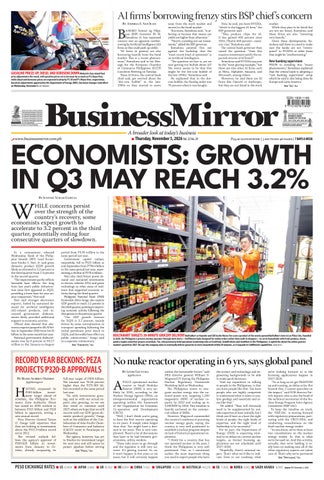
ECONOMISTS: GROWTH IN Q3 MAY REACH 3.2% www.businessmirror.com.ph
W
n
Thursday, November 5, 2026 Vol. 22 No. 29
P25.00 nationwide | 3 sections 46 pages | 7 DAYS A WEEK
By Justine Xyrah Garcia
HILE concerns persist over the strength of the country’s recovery, some economists expect growth to accelerate to 3.2 percent in the third quarter, potentially ending four consecutive quarters of slowdown.
In a commentary released Wednesday, Bank of the Philippine Islands (BPI) Lead Economist Emilio S. Neri Jr. said gross domestic product (GDP) growth likely accelerated to 3.2 percent in the third quarter from 2.3 percent in the second quarter. “The improvement partly reflects favorable base effects: the drag from last year’s public infrastructure issue first appeared in 3Q25, providing a lower base for year-onyear comparison,” Neri said. Neri said stronger electronics exports, fueled by sustained demand for artificial intelligence (AI)-related products, and increased government disbursements likely provided additional support to economic activity. Official data showed that electronics exports jumped to $6.92 billion in September 2026 from $4.02 billion in the same month last year. National government disbursements rose by 8 percent to P4.27 trillion in the January-to-August
period from P3.95 trillion in the same period last year. Government capital outlays, meanwhile, fell to P522 billion at end-September from P798.4 billion in the same period last year, representing a decline of P276.4 billion. Neri also cited firmer power demand and sustained investments in electric vehicles (EVs) and green technology as other areas of resilience that supported economic activity during the third quarter. Philippine National Bank (PNB) Economist Alvin Arogo also expects GDP growth to reach 3.2 percent in the third quarter, pointing to improving economic activity following the disruptions in the previous quarter. “Our GDP growth forecast for 3Q26 is 3.2 percent, mainly driven by some normalization in transport spending following the initial petroleum price shock in 2Q26, and favorable base effect on public construction,” Arogo said in a separate commentary. See “Growth,” A2
RECORD YEAR BECKONS: PEZA PROJECTS P320-B APPROVALS By Bless Aubrey Ogerio
H
@blessogerio
AVING surpassed its P300-billion investment target ahead of schedule, the Philippine Economic Zone Authority (Peza) has raised its 2026 outlook to between P315 billion and P320 billion in approvals, setting a new annual record. Peza Director General Tereso O. Panga told reporters that they are looking at investments above the P311.9-billion record set in 2012. The revised outlook follows the agency’s approval of P309.629 billion in investments from January to October, already surpassing its
full-year target of P300 billion. The amount was 76.56 percent higher than the P175.365 billion recorded in the same period last year. “So, with investments growing, and so with our actual exports also growing, so we see this trend to continue until 2027, where we hope that we will recover with our GDP [gross domestic product] growth,” Panga said on the sidelines of the Confederation of Asia-Pacific Chambers of Commerce and Industry (CACCI) event in Parañaque on Wednesday. The agency, however, has yet to finalize its investment target for next year and will assess its project pipeline before setting See “Peza,” A2
BUILTAMART TARGETS 30-MINUTE GROCERY DELIVERY BuiltaMart co-founder and CEO Justin Marco Tee scans a product at the newly opened BuiltaMart store in Las Piñas City. Founded in 2020, the Philippine e-grocery startup operates through dark stores—fulfillment hubs designed for online orders rather than walk-in shoppers—to serve households with fresh produce, meats, pantry staples and other grocery essentials. Tee, who previously held operations leadership roles at GrabFood, GrabKitchens and GrabMart in the Philippines, is optimistic about the online grocery market’s growth in 2027. He says the company aims to eventually deliver groceries to every household within 30 minutes, as it expands its fulfillment capabilities. NONIE REYES
No nuke reactor operating in 6 yrs, says global panel By Lenie Lectura
A
@llectura
FULLY operational nuclear reactor or Small Modular Reactor (SMR) is very unlikely by 2032, according to the Nuclear Energy Agency (NEA), an intergovernmental organization operating within the framework of the Organisation for Economic Co-operation and Development (OECD). “Well, I don’t think you’re going to have the first reactor operating in six years. It simply takes longer than that. You might have a decision in six years. This is very complicated. There’s a lot of discussions that have to be had between governments, utility, vendors. “These take years to go through and the regulator is still very nascent. It’s getting started. So no, it won’t happen in five years or six years, but it will certainly happen
within the foreseeable future,” said NEA director general William D. Magwood IV during the Philippine Nuclear Regulatory Framework Workshop held on Wednesday. The Philippines wants to integrate nuclear energy into the national power mix, targeting 1,200 megawatts (MW) of nuclear capacity by 2032 and scaling up to 4,800MW by 2050. This timeline is heavily anchored on the commercial rollout of SMRs. However, Magwood commended the country’s readiness in pursuing nuclear energy goals, saying the country is very well positioned to establish a nuclear program despite its lack of historical operational experience. “I think for a country that has not operated nuclear in the past, I think the Philippines is very well positioned. One, as I mentioned earlier, the most important thing you need is expert people who have
the science and technology and engineering backgrounds to be able to make good decisions. “And my experience in talking to people in the Philippines, is that you have people like that. You have people who are highly competent to understand what it takes to analyze geology and materials and areas like that.” He added: “They will obviously need to be supplemented by outside expertise at least initially, but I think you’d have as a base the right kinds of people, the right kinds of expertise, and the right kind of leadership to be successful.” For its part, the Department of Energy (DOE) is expecting minimal to no delays on current nuclear targets, as formal licensing applications are not scheduled until 2027–2028. “Hopefully, there’s minimal impact. That’s what we’d like to indicate. Even in our roadmap, what
we’re looking forward to is the licensing applications happen in 2027-2028. “So as long as we get PhilATOM up and running, no delay so far. But beyond that, I cannot speculate on the impact,” said DOE director Patrick Aquino, who is also the head of the technical secretariat of the Nuclear Energy Program Inter-Agency Committee (NEP-IAC). To keep the timeline on track, the NEP-IAC is moving forward with regulatory preparations, partnering with the OECD-NEA, and conducting consultations on the draft nuclear energy tender. “As you know, we’ve done at least two consultations on the nuclear energy tender. So that is what we’re focused on. And this activity, actually, that we’re holding is really keen on making sure all of the other regulatory aspects are taken care of. That’s why we’ve partnered See “Nuclear,” A2
PESO EXCHANGE RATES n US 63.4910 n JAPAN 0.4002 n UK 85.1922 n HK 8.0914 n CHINA 9.5163 n SINGAPORE 49.5559 n AUSTRALIA 44.2278 n EU 71.0782 n KOREA 0.0472 n SAUDI ARABIA 16.9197 Source: BSP (November 4, 2026)
News
BusinessMirror
A2 Thursday, November 5, 2026
Growth…
Continued from A1
If these forecasts materialize, third quarter GDP growth would be significantly faster than the 2.3 percent recorded in the second quarter, although still below the 4-percent expansion posted in the same period last year. Despite the expected improvement, BPI warned that the recovery remains “shallow and uneven,” as private domestic demand continues to be cautious. Neri said private construction activity weakened further during the quarter, while public infrastructure spending remained in contraction, albeit at a slower pace. Outside construction, however, private investment showed signs of recovery, particularly in the energy sector, suggesting businesses were “selectively resuming capital spending.” Household demand also remained subdued, with conventional vehicle sales and consumer goods imports pointing to continued caution among consumers, particularly in discretionary spending. For the fourth quarter, Neri expects the economy to sustain its gradual recovery, supported by favorable base effects, continued catch-up in government spending, and resilient electronics exports. Holiday spending could provide a seasonal boost to consumption, although stretched household purchasing power is likely to limit a stronger rebound in demand, he said. “The key risks are a slower-thanexpected recovery in infrastructure disbursement, persistently weak public and private construction, and lingering weather-related damage to agriculture,” he added.
www.businessmirror.com.ph
Palace review done, draft for Pax Silica given to US
T
By Samuel P. Medenilla
HE framework agreement for the implementation of the Pax Silica initiative in Tarlac is expected to be finalized soon, having been reviewed by the Office of the President (OP) and submitted to the United States government for its consideration, according to Malacañang. Citing the Bases Conversion and Development Authority (BCDA), Palace Press Office Claire Castro said the agreement will be ready for signing after the US gives its feedback on the draft.
She said provisions of the agreement were adjusted based on inputs provided by the Office of the Executive Secretary and the Department of Trade and Industry. The Presidential Communications
GSMA…
proven by the level of debate,” he said. Across the region, the report found that 82 percent of victims who lost money recovered none of it. It also found that 45 percent of reported cases are never resolved.
Continued from A17
“Superficially, people might say, ‘Okay, actually the problem in the Philippines is worse than everywhere else.’ I think that is not
40 million still underserved
Office undersecretary declined to give details on the contents of the agreement until it is finalized. “But regardless of the specific details, this is still just a memorandum and not yet final—we are awaiting the US’ response regarding the draft agreement,” Castro said in Filipino in a press briefing on Wednesday. Last month, BCDA finally submitted the draft of the agreement after conducting consultations on those who will be affected by the creation of the 1,620-hectare advance manufacturing park in New Clark City in Tarlac. BCDA earlier said it expects the agreement to be signed this month. The US-led project has faced opposition from some groups, who
expressed concern it may include data centers that consume large amounts of power and water, do harm to the environment and displace indigenous communities and farmers. Castro said the groups who will be displaced by the Pax Silica project will get government support including, financial aid. Asked if the agreement will be signed during the 49th Association of Southeast Asian Nations (Asean) Summit, to be held in Metro Manila from November 15 to 17, Castro said such will depend on when the US government can give its feedback on the draft. The Palace earlier said US President Donald Trump is expected to attend the upcoming Asean Summit.
DESPITE the country’s progress, Gorman said GSMA data show that 40 million Filipinos still lack strong mobile broadband connectivity. He said the definition of the digital gap is shifting from whether people are connected to whether they have reliable access where they live, work and move around. “Every country has to come up with their own algorithm now,” he said. Gorman urged the government to treat spectrum as more than a source of revenue. “Spectrum is not just a national asset to sell. Actually, spectrum is an investment in the economy,” he said. He also warned that public Wi-
Fi programs should not distort the connectivity market. “A free Wi-Fi system doesn’t necessarily do that,” he said, referring to creating an ecosystem where operators continue to deploy networks. Whyte said the policies needed to attract investment have already been identified in the Konektadong Pinoy Act. “Now that needs to be implemented, to be quite frank,” she said. She cited Vietnam as a model. There, operators received a 15-percent discount for every base station they rolled out, up to the amount they paid for spectrum. “[To attract] investments, you need the certainty,” Whyte said.
Asean events compound woes facing PHL shippers Continued from A17
to the Asia-Pacific Economic Cooperation (Apec) meetings. For shipments between China and Europe, the firm identified rail services as a more reliable alternative to regular ocean routes, with transit times of 14 to 24 days. However, limited capacity
requires early booking. Dimerco advised shippers to factor in the expected resumption of full Suez Canal services by the first quarter of 2027 when negotiating contracts, as this could ease capacity constraints on AsiaEurope routes.
AI…
been somewhat conservative, and, therefore, in pretty good shape,” the BSP governor said. “The other thing that we have done is that we have looked at all the banks, and we have identified the ones that we think will be systemic once they fail. Most of them are big banks, but not all of them. Some of them are just banks that specialize in something that the economy really needs. And then we give those banks a hard time,” Remolona explained further. According to Remolona, the central bank monitors these banks “more closely than we monitor other banks. “And then we worry: If one of those banks fails, what do we do? How do we provide emergency liquidity? “If it is what we call a going concern, how do we find another bank that can take it over, a resolution bank? If it is a gone concern, then we pick up the pieces or try to minimize the effect of this failure on the system,” Remolona said. That, the BSP chief said, is the “new banking supervision.” “It is not just us. Many of our friends in Europe and many of our friends in Latin America are doing the same thing,” added Remolona.
Continued from A1
Under this approach, Remolona said “We do not wait for losses to show up. We try to anticipate those losses.” “We do stress tests, and then we measure what we call expected loss, not actual loss. We do not wait for the loss to show up. We measure expected loss based on data. And every bank is supposed to do that, and they are supposed to provision against expected loss, not provision against a loss that has already happened,” Remolona said. Looking at the numbers, Remolona said, “we are in pretty good shape.”
Capital adequacy
AS for capital adequacy, he said the global standard is 10 percent but Philippine banks are at 15.6 percent. Moreover, he said banks now in the Philippines have 155-percent liquidity coverage. Based on the stress scenarios, he said they can cover more than 150 percent of the anticipated deposit runs. “There are other metrics that also suggest that our banks have
Peza…
Continued from A1
the figure in January. The agency is also pursuing several large-scale investments. Of four projects valued at at least $1 billion each that Peza has been courting, two have entered the application process, Panga said. Another prospective investor is considering filing an application before the end of the year. The agency is also scheduled to conduct investment promotion activities in Taiwan and Singapore in the last two months of the year. From January to October, the agency approved 240 new and expansion projects, expected to generate $9.124 billion in exports and create 38,815 direct jobs. Last month’s approvals covered 18 projects worth P12.487 billion, with projected exports of $178.203 million and 5,484 jobs.
Reconciling investment, FDI figures
PANGA also said the agency wants to improve how investment activity is captured, citing a gap between Peza’s approval figures and the country’s official foreign direct investment (FDI) data. The Bangko Sentral ng Pilipinas (BSP) recently reported that net FDI inflows fell by 23.9 percent to $4.071 billion in January to July 2026, from $5.350 billion in the same period last year. According to the Peza chief, some spending by existing locators may not appear in the agency’s investment approvals because companies often install additional machinery and equipment within their current operations without registering a separate project. “Because sometimes companies, if they’re not applying for a new project, these [investments] will simply phase in within their existing operations, so we are unable to capture all of this,” Panga explained. In addressing the gap, Peza said it is collecting investment data directly from registered companies, including their annual spending on machinery and equipment, and coordinating with other investment promotion agencies to improve reporting. The agency added that companies applying for Peza registration are required to submit proof of land purchases or lease payments, as well as building-related expenses, as evidence that their projects have moved toward implementation. Approved companies are then expected to proceed with signing their registration agreements.
Nuclear…
Continued from A1
with the OECD-NEA for this activity,” added the DOE official. The DOE is currently waiting for the Office of the President to appoint the PhilATOM Council, a Director General, and four Deputy Director Generals to fully operationalize the agency. A working draft of the Implementing Rules and Regulations (IRR) has already undergone initial consultations. Additionally, the Philippine Nuclear Research Institute (PNRI) and the Food and Drug Administration (FDA) have drafted the agency’s table of organization, which will be reviewed once the Council is appointed. Aquino clarified that while the country’s target for the SMR commercial rollout is set for 2032, the draft nuclear energy tender already indicates that delivery will start in 2038. “We’ve also gone on record and statements that we would stick to what’s in the plan—the capacities from 2020 to 2035 and 2040 and beyond--precisely to get the other agencies and the whole government. As you know, nuclear power projects take a long time and a lot of effort.” So, added Aquino, “we are still not officially changing [our goals]. We’re still hopeful on getting it done. But in terms of the draft of the nuclear energy tender, we did indicate that the delivery schedules being contemplated started around 2038, at least in the latest version that we’ve circulated to the public.”
The Nation BusinessMirror
www.businessmirror.com.ph
Thursday, November 5, 2026 A3
Prosecution confident Duterte defense will fail
H
By Jovee Marie N. Dela Cruz |
@joveemarie
OUSE of Representatives prosecutors expressed strong confidence on Wednesday that Vice President Sara Z. Duterte’s legal team will struggle to counter the evidence arrayed against her in the sole remaining impeachment charge stemming from alleged unexplained wealth and prohibited business ties. House prosecution adviser and spokesperson Ace Barbers stressed that the prosecution’s case is anchored firmly on official government records. These documents include Duterte’s own Statements of Assets, Liabilities and Net Worth (SALNs), income tax returns, bank documents, and corporate filings – many of which bear the Vice President’s own signature or were directly submitted by her. “How can the defense disprove evidence that includes documents from its own camp? These are sworn declarations signed by the vice president herself, as well as records
submitted to government agencies, including income tax returns and bank records,” Barbers stated. Duterte’s defense team has formally objected to every piece of documentary evidence submitted by the House prosecution under the unexplained wealth charge, including her own SALNs alongside financial records obtained from banks and state agencies. However, Barbers argued that bank records in particular will be nearly impossible to refute, pointing out that financial institutions are unlikely to disown account balances
OSG asks Court to reject petition against impeachment threshold By Joel R. San Juan @jrsanjuan1573
T
HE Office of the Solicitor General (OSG) on Wednesday asked the Supreme Court (SC) to deny the petition filed by Sen. Robinhood Padilla and Christopher Lawrence Go seeking to declare as unconstitutional the decision issued by the Senate impeachment lowering the voting threshold for the conviction of Vice President Sara Duterte. In a 47-page comment, Solicitor General Darlene Berberabe said the petition should be dismissed for being premature and for lack of merit. The OSG also asked the Court to junk the plea of the petitioners for the issuance of a temporary restraining order (TRO) or a status quo ante order (SQAO) or both against the September 23 ruling of the Senate Impeachment Court. T he OSG arg ued that the SC cannot restrain the Senate Impeachment Court from carrying out its constitutional duty to proceed with an impeachment trial. It also cited the petitioners’ lack of clear right and personal injury to file the petition. It noted that Vice President Sara Duterte, who will be directly affected by the lowering of the threshold, is not a petitioner in the case. “Removal and disqualification would affect Vice President Sara Z. Duterte, who is not a par t y here and has reser ved her own remedies. Petitioners cannot rest their application on a non-party’s injur y.” In addition, the OSG argued that the issue raised in the petition is considered a political question which should be decided solely by the Senate acting as the Impeachment Court. “Respectf u l ly, Respondent reminds that the framers of the Constitution, when drafting the provisions which would come to lay out the impeachment, placed the process away from the judiciary, and into the authority and power of the political branches,” the OSG said. Under the new ruling on the voting threshold issued by the Senate impeachment court, the constitutional phrase “all the
Members of the Senate” will refer to senator-judges who, at the time of the verdict, are legally and factually capable of participating in the impeachment proceedings. “The phrase ‘all Members of the Senate’ shall refer to those members who, at the time of the vote, remain legally and factually capable of participating in the proceedings,” Impeachment Court Presiding Officer Sen. Francis Escudero said. The Impeachment Court also identified five circumstances that may justify excluding a senator from the counting base: being detained or legally restrained; being sought by authorities with unknown whereabouts; being physically or medically incapacitated; being beyond the Senate’s coercive processes; or being in another circumstance similarly situated to the specified categories. The petitioners, however, asked the Court to declare that 16 senators or two-thirds all the 24 incumbent senators are required to convict the Vice President in line with Article XI, Section 3(6) of the Constitution. The OSG argued that the Senate in ruling on the voting threshold did not amend, but merely interpreted, the constitutional provision. “The Senate’s threshold ruling was an attempt to remove the twothirds requirement. It was a rule on who should be counted as part of the Senate Impeachment Court when some senators are unable to take their oaths or participate,” the OSG stressed. “Without such a rule, nonparticipating senators wou ld be counted as though they had performed functions and as if they had voted for acquittal,” it added. In addition, the OSG said the threshold ruling “is also not arbitrary nor oppressive” since it is consistent with “well-established principles, such as that a public officer who is detained may be unable to perform official functions.” Such principles, according to the OSG, applies to a senator who is detained or on medical leave. “The Constitution should not be read to require the Senate to treat such senators as having participated when, in fact, they did not,” the OSG added.
they officially submitted under oath to the Senate impeachment court. The prosecution previously withdrew three of the four Articles of Impeachment, choosing to concentrate fully on Article II. The remaining charge accuses Duterte of accumulating unexplained wealth far exceeding her lawful income, making inaccurate entries in her SALNs, and maintaining business interests strictly forbidden under the Constitution. Financia l forensic ana lyst Alexander Cabrera, who testified as an expert witness for the prosecution, estimated that Duterte and her husband, attorney Manases Carpio, amassed approximately P817.87 mi l lion in a l leged ly undeclared assets and unexplained wealth between 2022 and 2025. Additionally, Barbers pointed to cor porate f i lings show ing Duterte actively listed as a director and executive committee member of Metro City Chow Foods Corp.— operator of a Chowking branch in Davao City—from 2018 through 2025, covering her tenure as Vice President. General Information Sheets submitted to the Securities and Exchange Commission (SEC) confirm Duterte was an executive
committee member from 2022 to 2025. Barbers highlighted that this direct involvement directly challenges Article VII, Section 13 of the 1987 Constitution, which bans the President and Vice President from directly or indirectly holding business interests during their term. “ W hen you a re t he V ice President, you cannot have one hand managing the government while the other manages a business,” Barbers remarked, stressing that prosecutors relied on Duterte’s sworn declarations and corporate filings to substantiate the claim. The prosecution spokesperson also raised red flags over Duterte’s declared holdings in GenCorp Industries Inc. While the firm was listed in her SALNs, her name is noticeably absent from corporate documents submitted to the SEC. Barbers insisted the discrepancy demands close examination, noting that GenCorp shares several key shareholders with Metro City Chow Foods Corp. He singled out businessman Jaime T. Cruz of the JTC Group of Companies, which owns a controlling 54.99-percent stake in GenCorp and 79.88 percent of Metro City Chow. Recalling Duterte’s prior public statement that she was merely an
investor rather than an owner of a Jollibee franchise, Barbers questioned which entity she was referencing and why GenCorp consistently showed up in her annual SALNs. Maintaining that the defense faces an uphill battle, Barbers reiterated that the prosecution’s ev idence relies on swor n declarations, bank records, and official government filings rather than unverified allegations. The Duterte defense team is scheduled to open its side of the case when the Senate impeachment trial reconvenes on November 9. The House prosecution on Wednesday expressed confidence that the defense team of Vice President Sara Z. Duterte would struggle to refute the evidence presented against her in the remaining impeachment charge involving alleged unexplained wealth and prohibited business interests. House prosecution adv iser and spokesperson Ace Barbers said the prosecution’s case rests on official government records, including Duterte’s Statements of Assets, Liabilities and Net Worth (SALNs), income tax returns, bank documents and corporate filings, many of which were submitted or signed by the vice president herself.
“How can the defense disprove evidence that includes documents from its own camp? These are sworn declarations signed by the vice president herself, as well as records submitted to government agencies, including income tax returns and bank records,” Barbers said. Duterte’s defense team has objected to all documentary evidence submitted by the House prosecution in the remaining unexplained wealth charge, including the Vice President’s own SALNs and financial records obtained from banks and government agencies. Barbers added that bank records would be particularly difficult to challenge, saying financial institutions would be unlikely to deny account balances they had formally reported to the Senate impeachment court. The prosecution earlier withdrew three of the four Articles of Impeachment,leavingArticleIIasthe remaining charge. It accuses Duterte of accumulating unex plained wealth disproportionate to her lawful income, making inaccurate disclosures in her SALNs and maintaining business interests prohibited by the Constitution. See “Prosecution,” A4
Sotto pushes rules to curb absenteeism By Butch Fernandez @butchfBM
I
N a direct response to growing public frustration over empty seats in the upper chamber, Senate President Pro Tempore Vicente Sotto III moved to crack down on lawmakers who skip le g i s l at ive s es s ion s w it hout leave. Sotto, who chairs the Senate Committee on Et hics a nd Privileges, filed Senate Resolution 751 on October 27, calling for the institutionalization of clear, concrete guidelines to address prolonged a nd u naut hor i zed absences among senators. In filing the measure, the Senate
leader highlighted a glaring policy gap in current parliamentar y rules—one that leaves the body with few clear mechanisms or formal sanctions when members repeatedly fail to attend session, participate in committee hearings, or vote on crucial legislation. The resolution underscored that continued non-attendance not only impairs the lawmaking process, but also erodes public trust at a time when taxpayers expect full-time governance from their elected leaders. “Such absenteeism and neglect o f dut y i s d e e m e d a w a s t e of ta x payer f unds and has caused public clamor over the past months,” the resolution
explicitly stated, pointing out that lawmakers receive salaries, a l low a nces, a nd operat ion a l funds directly underwritten by the public. While Sotto chose not to publicly name specific colleagues in the draft, the resolution explicitly ac k nowledged t hat for ma l complaints have already reached his office regarding the persistent non-attendance of certain members of the chamber. Underscoring the high standards expected of the 24-member body, Sotto stressed that revisiting and updating the current Rules of the Senate is essential to restoring accountability and upholding the dignity of the institution.
“As public servants elected by the Filipino people and whose salaries and allowances are derived from the taxes they have paid, we owe it to them to perform our duties with diligence and to represent them in the legislative framework,” Sotto asserted in the resolution. Under the proposal, the Senate Committee on Rules is directed to conduc t a comprehensive review of existing regulations and draft enforceable institutional guidelines to plug the policy loophole. The move is expected to pave the way for formal sanctions, clearer leave requirements, and stronger attendance tracking for members of the upper house.
PNP vows no favor in hunt for Ronald dela Rosa By Rex Anthony Naval
F
ORMER police chief turned lawmaker and now fugitive Ronald dela Rosa may have deep roots in the National Police (PNP), but the current top brass insists those ties won’t buy him a free pass. The PNP officially declared on Wednesd ay t hat persona l relationships, shared histories, and former ranks will play zero role in its ongoing nationwide manhunt for the sitting senator, taking on a direct challenge from Malacañang to enforce the law without fear or favor.
Asean…
Continued from A4
Officials also finalized strategic documents and policy proposals slated for formal adoption or notation by regional heads of state during the upcoming 49th Asean
MSMEs…
Continued from A4
Expanding the eGov Infrastructure
INFORMATION and Communicat ions Secretar y Rober t M. de C laro revea led during the briefing that the eGov
“We welcome the challenge of Malacañang because it reinforces a fundamental principle of law enforcement: no position, rank, or personal relationship is above the law,” the National Police Chief, Gen. Jose Melencio Nartatez Jr., said in a statement. “ T he PNP w ill remain profession a l , i mpa r t i a l , a nd steadfast in implementing lawful orders, rega rd less of who is involved.” The Palace’s challenge came shortly after Interior Secretary Juanito Victor Remulla acknowledged that dela Rosa’s past leadership as the country’s top police-
man makes tracking him down considerably trickier. Still, Palace Press Officer Claire Castro made it clear that the administration fully expects Nartatez and the PNP to execute their duties untainted by old comradeships. Nartatez doubled down on that sentiment, reminding rankand-file officers where their true allegiances belong. “The loyalty of every police officer must always be to the Constitution and the law, not to personalities or former positions,” Nartatez emphasized. “In the PNP, service is a duty, not a privilege, and no personal allegiance should
ever stand in the way of justice.” The senator—who spearheaded the anti-drug campaign during the Duterte administration—is wanted under an International C r i m i n a l Cou r t w a r r a nt for alleged crimes against humanity stemming from thousands of drug war killings between July 2016 and April 2018. With a one-week surrender deadline having expired, tracker teams are fanning out nationwide while dedicated hot lines vet incoming tips. Adding extra weight to the search, a P50-million bounty remains on the table for information leading to dela Rosa’s arrest.
Summit on November 15 to 17. A key highlight of the Manila summit is the scheduled launch on November 6 of t he A SCC Planning, Monitoring, Evaluation and Learning System (PMELS). The new digital architecture is designed to modernize program oversight and establ ish a centralized, data-driven database
for regional decision-makers. Dumlao explained that the platform upgrades the existing ASCC Database for Monitoring and Evaluation System by consolidating baseline research, real-time progress re p or t s , a nd s o c io e conom ic indicators into a single portal to streamline policy formulation. The Manila meetings mark
one of the final major events under the Philippines’ 2026 Asean Chairmanship theme, “Navigating Our Future, Together.” Following the conclusion of the proceedings, the DSWD will officially hand over the ASCC chairship to Singapore in accordance with Asean’s annual alphabetical rotation.
PH platform is set to launch enhanced features in the coming mont hs, d irect ly integ rat ing services from the Social Security System (SSS), the Securities and Exchange Commission (SEC), and the Department of Trade and Industry (DTI). A tota l of 40 nationa l government agencies have already integrated their operations into
the eGov framework to date. De Claro said the upcoming upgrades will enable SSS members to process sensitive transactions—such as death and funeral claims—entirely online, while dramatically cutting down processing times for prospective entrepreneurs seeking corporate and trade registration. “For example, suppose there is
a businessperson—whether local or foreign – who wants to enter the Philippines and invest. In the past, they would go to the SEC or the DTI to register,” de Claro explained. “So those are just two examples of how eGov—in line with the President’s directive to make services more accessible to the public—can be utilized to expedite the delivery of services.”
Jovee marie n. Dela cruz
Samuel P. Medenilla
A4
Economy BusinessMirror
Thursday, November 5, 2026
Slower food inflation tames wholesale prices By Justine Xyrah Garcia
A
SLOWDOWN in food price growth helped temper overall wholesale price increases in September, the latest data released by the Philippine Statistics Authority (PSA) indicate. The national General Wholesale Price Index (GWPI) eased to 3.1 percent in September from 3.5 percent in August, though it remained slightly higher than the 2.9 percent recorded in the same period last year. For the first nine months of 2026, the GWPI posted an average growth rate of 2.6 percent, the statistics agency reported. The PSA noted that the moderation in wholesale price inflation was primarily driven by a slower annual rise in food prices, which settled at 4.5 percent in September compared to 5 percent in August. Other commodity groups also registered slower price growth, including machinery and transport equipment (1.5 percent from 1.6 percent) and miscellaneous manufactured articles (2.5 percent from 2.6 percent). Steeper price contractions further weighed on the overall index. The index for crude materials, inedible except fuels, contracted at a faster rate of 25.3 percent from 19.4 percent previously, while chemicals—including animal and vegetable oils and fats—fell 3.1 percent from 1.4 percent. Counteracting some of these declines, however, the index for mineral fuels, lubricants, and related materials posted a faster annual surge of 38.9 percent, up from 34.7 percent in August. Meanwhile, the indices for beverages and tobacco (3.7 percent) and manufactured goods classified chiefly by materials (0.8 percent) maintained their previous month’s annual growth rates. Across the major island groups, the Visayas posted the highest GWPI in September, accelerating to 3.8 percent from 3.2 percent in August. The PSA attributed the uptick in Visayas to faster wholesale price increases across five key commodity groups. Mineral fuels, lubricants, and related materials jumped to 33.9 percent from 24.9 percent, while food prices picked up to 3.1 percent from 2.4 percent. Additionally, wholesale prices in the Visayas rose for beverages and tobacco (2.9 percent from 2.7 percent); crude materials, inedible except fuels (0.3 percent from 0.2 percent); and manufactured goods classified chiefly by materials (1.4 percent from 1.3 percent). In contrast, Luzon and Mindanao recorded slower GWPI growth rates for the month, settling at 3.2 percent and 0.1 percent, respectively. The GWPI tracks movements in the price levels of bulk commodities sold to trade intermediaries. It acts as a key barometer for price trends within the wholesale sector and serves as an economic deflator to calculate real value by stripping away price fluctuations.
Prosecution… Continued from A3
Financial forensic analyst Alexander Cabrera, presented by the prosecution as an expert witness, estimated that Duterte and her husband, lawyer Manases Carpio, had approximately P817.87 million in allegedly undeclared assets and unexplained wealth from 2022 to 2025. Barbers also cited corporate records
www.businessmirror.com.ph
Masungi probe uncovers massive land exploitation
A
By Jonathan L. Mayuga |
@jonlmayuga
DAMNING 700-page independent investigation has revealed decades of alleged land grabbing, systemic safeguards evasion, and corporate exploitation within protected public lands in Rizal, warning that high-profile conservation rhetoric has been weaponized to shield private profiteering. The newly surfaced document— titled “Blue Mountain Reserve Report 2025 - 04 -29 — Garden Cottages and Masungi Georeserve”—alleges that Blue Star Construction and Development Cor poration and its affiliates unlawfully occupied and monetized public forest lands through alleged severe procedural i r reg u l a r it ies, l ac k of l aw f u l reclassification, and unauthorized c o m m e rc i a l c o n v e r s i o n i nt o ecotourism ventures without fulfilling their original housing commitments to government employees. The comprehensive inquiry focused on the controversial operations of Blue Star Construction and the Masungi Georeserve Foundation Inc. (MGFI), which manage a 300-hectare lowimpact ecotourism site straddling the boundary of Teresa and Baras, Rizal. What began as a low-cost housing project purportedly intended for employees of Malacañang and the Department of Environment and Natural Resources (DENR) eventually morphed into an aggressive commercial operation alongside claim rights over 2,700 hectares within the critical Marikina Watershed Upper River Basin.
“The consistent financial osses of their parent corporations, combined with aggressive land accumulation and misuse of agricultural free patents, demonstrate that their operations were designed less for legitimate development and more for strategic land monopolization,” the report explicitly stated. The report noted that despite clear legal cancellations and ongoing territorial disputes, the alleged active misrepresentation of Garden Cottages properties to unsuspecting real estate buyers represents a grave threat to financial integrity and public welfare. It f u r t her c aut ioned t h at endorsements by high-prof i le political and international figures— while possibly well-intentioned— inadvertently eroded regulatory accountability, creating a dangerous precedent where conservation branding is used to disguise private gain at the expense of national patrimony and indigenous community rights. Requests for comment sent to MGFI executives Billie and Ann Dumaliang via Messaging applications remained unanswered as of press time. According to sources privy to
MASUNGI Georeserve. WIKIPEDIA PHOTO
the matter, the findings served as the primary basis for the DENR’s decision to finally resolve the longfestering land controversy under the Marcos administration. The DENR had previously issued a formal order canceling one of six contracts tied to Blue Star. However, execution was held in abeyance following a request from then-Senate Blue-Ribbon committee chairman Alan Peter Cayetano, who urged the environment department and MGFI leadership to pursue a compromise agreement. To prevent further loss of public domain assets and hold violators accou nt able, t he i ndependent report outlined nine mandatory corrective actions: Judicial Enforcement: Prioritize and fast-track all pending civil, criminal, and administrative cases involving Masungi lands to extinguish fraudulent claims and firmly reassert state control over protected zones. Forensic Audits & Sanctions: Direct the Securities and Exchange Commission (SEC), the Bureau of Internal Revenue (BIR), and the National Bureau of Investigation (NBI) to audit Blue Star, First United Constructors Corporation, and MGFI for tax compliance and corporate structure manipulation. Criminal Prosecution: pursue
criminal charges against responsible corporate officers for fraud, falsification of public documents, estafa, tax evasion, and environmental offenses. Cadastral & Land Titling Audit: Execute a total audit across Baras and Tanay, Rizal, to invalidate land titles derived from fraudulent free patent conversions. Policy & Legislative Reform: Enact strict statutory controls barring non-profit entities from serving as commercial fronts on public land. E c olo g i c a l R e h a b i l it at io n : Implement a government-supervised restoration prog ram across ecosystems damaged by unauthorized commercial developments. Buyer Protection & Disclosure: Publicly publish all legal orders and require real estate sellers to disclose pending title litigation to buyers. Joint Security Enforcement: Reinforce DENR oversight by deploying joint enforcement details composed of the Philippine National Police (PNP) and Armed Forces (AFP) to halt illegal encroachments. Independent Oversight Body: Establish an independent multis e c tor a l o ve r s i g ht cou nc i l — comprising regulators, civil society, e nv i ron me nt a l e x p e r t s , a nd indigenous community leaders—to monitor compliance with court rulings and rehabilitation orders.
Asean unveils RISE framework for growth
T
HE Association of Southeast Asian Nations (Asean) is drafting a comprehensive reg ion a l soc i a l de ve lopment roadmap aimed at confronting emerging humanitarian challenges, bolstering protection for vulnerable populations, and driving inclusive economic growth as the 10-member bloc transitions past its 2025 sociocultural targets. The Department of Social Welfare
and Development (DSWD), currently holding the chairmanship of the Asean Socio-Cultural Community (ASCC) pillar for 2026, is leading high-level strategy sessions on the proposed ASCC Post-2025 Strategic Plan from November 4 to 6 at the Conrad Manila in Pasay City. The three-day proceedings bring together Asean ministers and senior officialstoformulate policy frameworks that will direct regional cooperation
showing that Duterte remained a director and executive committee member of Metro City Chow Foods Corp., which operates a Chowking branch in Davao City, from 2018 to 2025, including during her vice presidency. He said the company’s General Information Sheets filed with the Securities and Exchange Commission (SEC) listed Duterte as an executive committee member from 2022 to 2025, raising questions over compliance with Article VII, Section 13 of the Constitution, which prohibits the President and Vice President from directly or
indirectly participating in business while in office. “When you are the vice president, you cannot have one hand managing the government while the other manages a business,” Barbers said, adding that the prosecution relied on Duterte’s own sworn declarations and corporate records in establishing her business interests. The prosecution spokesperson also questioned Duterte’s declared interest in GenCorp Industries Inc., noting that while the company appeared in her SALNs, her name was absent from its corporate filings submitted to the SEC. Barbers said the discrepancy warranted further scrutiny, particularly because GenCorp shared several shareholders with Metro City Chow Foods Corp. He identified businessman Jaime T. Cruz of the JTC Group of Companies, which held a 54.99-percent controlling stake in GenCorp and a 79.88-percent stake in Metro City Chow. He also recalled Duterte’s earlier statement that she was not the owner of a Jollibee franchise but merely an investor, asking which company she was referring to and why GenCorp repeatedly appeared in her SALNs. Barbers maintained that the prosecution’s documentary evidence would be difficult to disprove, arguing that the records included sworn declarations, bank documents and official government filings rather than allegations alone. Duterte’s defense team is scheduled to begin presenting its evidence when the impeachment trial resumes on November 9.
on human development, social protection, and cultural integration over the next decade. Social Welfare Assistant Secretary Irene Dumlao said that the high-level meetings serve as a vital platform for regional leaders to craft key policy declarations anchored on the ASCC’s flagship RISE framework: Resilient and empowered families Inclusive development Smart youth and innovation Environmentally
sustainable and food-secure future On Wednesday, delegates convened for the 41st Senior Officials Meeting for the ASCC (Soca) to review the final monitoring report and end-term assessment of the ASCC Blueprint 2025. The evaluation measures the bloc’s overall performance in realizing its long-term socio-cultural targets over the past decade. See “Asean,” A3
Marcos orders digital protection for MSMEs
I
N a bid to sharpen the competitive edge of micro, small, and medium enterprises (MSMEs), President Marcos directed government agencies to accelerate local businesses’ access to robust cybersecurity tools and streamlined digital public services. During a meeting with the Private Sector Advisory Council (Psac) Digital Infrastructure Sector Group at Malacañang Palace on Tuesday, the Chief Executive underscored the urgent need to shield small businesses from rising cyber risks while eliminating red tape in business operations. According to the Presidential Communications Office (PCO), Marcos voiced concern over the growing vulnerabilities facing MSMEs as they increasingly migrate to internet-based platforms for commercial operations, digital banking, civic education, and government transactions. “Filipino workers and MSMEs must not be left behind in the growth of the digital economy.
They need to be provided with more opportunities to participate in and benefit from new industries,” Marcos said in a statement posted on his official social media account. The Chief Executive emphasized that building firm confidence in digital security is vital for MSMEs, which comprise over 99 percent of operating businesses in the country, to scale up their operations and access broader domestic and foreign markets safely. To s u p p o r t t h i s d i g i t a l transition, the Department of Information and Communications Technology (DICT) is intensifying its nationwide infrastructure push to make internet connectivity more affordable, reliable, and accessible for commercial hubs across the regions. Si mu lt a ne ou s ly, the administration is upgrading its flagship eGov PH System, aimed at consolidating public sector services into a single, unified digital portal. See “MSMEs,” A3
‘Encoding glitch’ threatens 8 road projects By Jovee Marie N. Dela Cruz @joveemarie
T
HE Department of Agriculture (DA) admitted on Wednesday that encoding and geotagging errors in eight farmto-market road (FMR) projects originated directly within the E xec ut ive bra nc h ’s proposed 2027 national budget, clearing the House of Representatives of any involvement in introducing the discrepancies. Appearing before the House Committee on Agriculture and Food , A g r ic u lt u re A ssi st a nt Secretar y for O perat ions U-Nichols A. Manalo clarified that all 1,669 FMR projects currently under congressional review— including the eight questioned items—were submitted as part of the Executive branch’s National Expenditure Program (NEP). The department traced the mista kes to mist y ped d ig its during data entry and geotagging. Manalo warned lawmakers that if these coordinate errors remain uncorrected before the spending bill is enacted, the DA will be legally barred from implementing the projects, effectively canceling the infrastructure support for affected rural communities. “We will lose those eight farmto-market road projects because we cannot implement them due to the errors in the encoding,” Manalo told the committee. The issue surfaced during a hearing led by committee chairman and Quezon Rep. Wilfrido Mark Enverga , he ld u nder Hou se R esolut ion 9 67 to e v a lu ate agricultural disaster readiness and infrastructure support. Civil society organizations— including the People’s Budget Coa lition, BetterGov.ph, and BistoProyekto—first flagged the mapping anomalies during Senate budget deliberations, prompting DA officials to meet with the groups to cross-check disputed coordinates. Camarines Norte Rep. Arnie Fuentebella noted that while the eight flawed projects represent less than 1 percent of the total 1,669 FMR portfolio, accuracy remains critical to ensure taxpayer funds are properly deployed. He urged the agency to rectify the entries before the budget passes into law. “The budget deliberations are not yet over. The measure still has to go through the Senate, the bicameral conference committee, and be reviewed by the President. I think it can still be corrected,” Fuentebella said, commending the DA for taking direct ownership of the oversight. Fuentebella also advised the agriculture department to upgrade its field geotagging tools, pointing out that weak mobile signals in remote farming communities often corrupt GPS coordinate transfers during initial site surveys. M a n a l o c it e d a n o f f i c i a l statement issued on November 3 b y A g r i c u lt u r e S e c r e t a r y Francisco P. Tiu Laurel Jr., who ordered an internal review of validation procedures, project descr iptions, and suppor ting documents across all regional offices to prevent future glitches. Moving forward, the DA pledged to enforce stricter validation protocols, incorporating thirdparty reviews, technical crosschecking, and real-time public monitoring via the FMR Watch online portal. Welcoming the commitment, Chairman Enverga stressed that sustained administrative reforms are necessary to guarantee that all agricultural infrastructure submitted for public funding remains verifiable, transparent, and fully actionable.
Thursday, November 5, 2026
A5
‘PHL must also guard against pest infestation’ By Ada Pelonia
E
@adapelonia
L NIÑO-DRIVEN drought could intensify crop pest infestations, exacerbating threats posed by the weather phenomenon to yields, according to the Philippine Chamber of Agriculture and Food Inc. (PCAFI). While the government stands ready to safeguard rice production by ensuring the availability of water supply, PCAFI President Danilo Fausto said ensuring farmlands are prepared against the proliferation of pests during extreme weather events like El Niño is also critical. “We don’t have any problems with paddy rice or water because
our preparations are in order. What we don’t see are the insects, the pests. When drought arrives, the reproductive cycle of insects accelerates.” He cited fall armyworms, which tend to latch onto and ravage corn and onion plantations, slashing harvests following infestation. Fausto also said the red-striped soft scale insects (RSSI) struck
sugarcane farms in Negros, regarded as the country’s sugar bowl as it accounts for 60 percent of the Philippines’s cane output. RSSI is one of the chief reasons behind the cut in the Sugar Regulatory Administration’s (SRA) production forecast for the current crop year. The agency has projected that the Philippines could end the current crop year with a two-decade low sugar output. “So, we also need to look at the production cycle of insects and pests—the fall armyworm, stemborer. We expect that (pests) might not be attended to, which would affect (crops).” Concerns about pests add onto soaring farm input costs—fertilizer and fuel prices—that are now affecting the industry. Agriculture Assistant Secretary Arnel de Mesa made an assurance that the Department of Agriculture (DA) is prepared for
PHOTO COURTESY OF THE NATIONAL CROP PROTECTION CENTER OF THE UNIVERSITY OF THE PHILIPPINES-LOS BAÑOS
the recurrence and proliferation of pests through its Regional Crop Protection Centers (RCPCs). He added that government aid
would depend on the type of pest or disease as well as its severity, targeted on containing its spread. Meanwhile, the DA is boosting
measures to protect rice production from the impacts of an intensifying El Niño, such as improved seeds, expanded irrigation, better farm monitoring, and lessons from previous drought episodes. Agriculture Secretary Francisco Tiu Laurel Jr. said the country is now “better equipped” to manage prolonged dry spells, with advances in agricultural technology and more responsive interventions to help farmers cope with climaterelated risks. “We have more tools now to mitigate the impact,” he said, citing improved rice varieties, solarpowered irrigation systems, better weather monitoring, and more responsive crop calendars. The previous El Niño episodes also helped the government enhance its preparations to protect agricultural production, maintain ample food supplies, and minimize potential price pressures.
Sugar slides to 5-week low as DA issues implementing rules for setting rice floor price high Indian output jolts market
S
UGAR slid after data showed Indian production is running well ahead of last season, deepening a slump that has futures down more than 13 percent from last month’s peak. Raw sugar futures in New York fell as much as 3.7 percent to their lowest intraday price since September 23. White sugar in London was also down. India produced 845,000 tons of the sweetener this season to the end of October, more than eight times the output from the same period last year, data from the National Federation of Cooperative Sugar Factories Ltd. showed. While mills have been crushing cane earlier than last year and the Indian government has taken steps to stabilize local supplies, the data rattled a market where prices had surged because of tight stockpiles in the top sugar-consuming country. India’s strong start to the season is not a surprise, according to Delhi-based analyst Harsh Soni of Greenleaf Consultancy. “But when reality strikes, markets react,” he said. Sugar had surged for much of the year, buoyed by fears that a super El Niño will curb yields and push the global market into a deficit. But the market has given back some gains as traders increasingly expect less demand for imports in India and also potentially more incentive for Brazilian producers to export given a recent rout of the country’s currency. The Brazilian real weakened again on Tuesday, which can encourage more farmer selling. The selloff has been exacerbated by speculative funds, which recently piled into sugar to build their most bullish position in years, paring back those bets. The latest CFTC positioning report shows money managers trimming their net-long position to a fourweek low through October 27. “Funds might be thinking about end-of-year profit taking. Not many bullish arguments these days,” said Claudiu Covrig, lead analyst at Covrig Analytics. Indian imports are unlikely until April and May next year, and local Brazil prices continue signaling tepid demand, he added. One risk that could upend the recent selloff, according to analysts, is rains exacerbated by a strong El Niño further disrupting the cane harvest in top grower Brazil. Mills in the country crushed 18 percent less sugarcane in the first half of October than a year earlier. “When you look at the funda-
mentals, nothing has changed,” said Arnaud Lorioz, chief executive officer of Paris-based brokerage Deepcore. “The question is at what time this snowball effect loses momentum.”
Premium cocoa beans
SOME cocoa exporters in top grower Ivory Coast are being forced to pay more than the government-set price for beans as tight supplies intensify competition and fears grow that a powerful El Niño could further curb output. Exporters are paying as much as 20 percent above the official farmgate price of 1,200 CFA francs ($2.05) a kilogram for the main crop harvest, according to people familiar with the matter. The higher price is being demanded by middlemen who buy beans from farmers and sell them on to exporters, the people said, asking not to be identified because they’re not authorized to speak to the media. Ivory Coast’s industry regulator, Le Conseil du Café-Cacao, prohibits exporters from paying above the official farmgate price. It has previously warned companies against offering more than the state-set price to secure deliveries. A s p ok e s w om a n for CCC couldn’t immediately comment when contacted by phone. The competition for beans follows a sluggish start to the main crop, the larger of Ivory Coast’s two annual harvests, amid poor pod development. That’s raising concerns that some exporters may struggle to secure enough cocoa to meet their contracted volumes, potentially forcing contracts to be rolled forward, one exporter said. While futures have been pressured by a large surplus from the previous season, rising domestic prices offer an early sign that the physical supply picture is tightening. On Tuesday, cocoa futures in New York swung between gains and losses, trading at around $5,400 a ton. Supplies could tighten further, with El Niño expected to bring hotter and drier conditions to West Africa. More than half of Ivory Coast is already experiencing drought conditions, with the affected area forecast to expand, according to the Africa Flood and Drought Monitor. Beans arrivals at the country’s ports are lagging behind last year, with deliveries since the international cocoa marketing season started October 1 at 173,158 tons, down 43 percent from a year earlier. Bloomberg News
T
HE Department of Agriculture (DA) has released the implementing guidelines for establishing the f loor price for unmilled rice in its bid to shield farmers from market volatility. Agriculture Secretary Francisco Tiu Laurel Jr. signed Memorandum Circular (MC) 49, outlining the guidelines of Executive Order (EO) 100, which imposed a f loor price for paddy rice to be procured by local government units (LGUs) and national government agencies, as stipulated in the Sagip Saka Act. “These guidelines aim to establish the rules and procedures for the determination of a floor price for palay and trigger mechanism for its implementation, and its subsequent monitoring system.”
Under the circular, the DA should consult with the steering committee in setting and adjusting the regional floor price for palay to be purchased by the government. The committee has the power to approve the proposed floor price prior to implementation. The DA leads the committee, with the Department of the Interior and Local Government as vice chair. Other members are the Departments of Trade and Industry, Social Welfare and Development, Agrarian Reform, and the National Food Authority. Further, MC 49 noted that the basis for establishing the regional floor price will hinge on: regional production costs; prevailing farmgate price of palay and retail prices of rice; reasonable profit margin for farmers; and farmer and con-
sumer welfare. “The f loor price shall strike a balance between the need for fair returns for palay farmers and affordable rice prices for consumers,” the circular read, adding that it should also take into account the developments in global rice prices and prevailing import trends. The DA said the regional floor price for paddy rice should be set before the onset of each cropping season or whenever deemed necessary, such as before or after a calamity, influx of imports, or plunge in global prices. Meanwhile, the circular also set the trigger mechanism that would prompt an adjustment to the floor price for unmilled rice. This includes persistent or widespread low farmgate prices,
oversupply or market volatility, emergencies or calamities, and abnormal surge in retail rice prices. The government’s capacity to purchase unmilled rice at competitive prices and manage market intervention also form part of the triggers. “Upon determination that the trigger conditions have been met, the government shall purchase palay directly from recognized farmers and cooperatives at the established floor price.” EO 100 was issued last October 2025 to protect farmers from unscrupulous traders during “volatile market prices, particularly during the peak of harvest seasons when farmgate prices often drop due to oversupply, weather-related impacts, or unfair trading practices.” Ada Pelonia
Prioritize food production over trade deals, group tells govt
W
HILE international trade deals should be honored, broad agriculture group Sinag said it should not be done at the expense of domestic food producers. Sinag made the pronouncement after the British Chamber of Commerce of the Philippines (BCCP) opposed a slew of measures raised by the Department of Agriculture (DA) to arrest the slide in farmgate prices that fell below break-even point. This includes reverting the tariff rate on certain pork shipments, reclassifying pork jowls as swine meat to be levied with higher duties, initiating a safeguard measures
investigation, and imposing a two-month import ban. “International trade must be respected, but it cannot take precedence over the country’s fundamental responsibility to protect its domestic food production capacity,” the group said in a statement. Restoring the tariffs levied on pork to their original levels of 30 percent in-quota and 40 percent out-quota would not mean closing the markets to imports, Sinag said. “It is a necessary correction to a failed tariff reduction policy that has undermined the competitiveness and viability of local producers.” At present, Sinag said the landed cost of imported pork
stood between P100 and P160 per kilo. The group flagged the cheaper influx of foreign supplies led to an oversupply that pushed farmgate prices of hogs to a lot of P90 per kilo, incurring losses as much as P9,000 per head. “At these prices, Filipino hog raisers are being pushed to the brink. Many are considering leaving the industry altogether. Farms are closing, investments are being wiped out, and livelihoods built over generations are at risk of disappearing.” Sinag added that the surge in shipments did not trickle into cheaper pork for Filipino consumers. “This is the reality on the
ground: cheaper imported pork has not translated into cheaper retail pork. Instead, it has driven down farmgate prices and placed the burden of excessive imports squarely on the shoulders of Filipino hog raisers.” It said food security means shielding and bolstering the country’s capacity to produce its own food. “A country that becomes increasingly dependent on imported pork while its own hog industry collapses is not becoming more food secure. It is becoming more vulnerable to international price movements, supply disruptions, export restrictions and geopolitical uncertainties.” Ada Pelonia
FAO calls for faster biodiversity action through agrifood systems
T
HE Food and Agriculture Organization of the United Nations (FAO) called for faster implementation of global biodiversity commitments as the 17th United Nations Biodiversity Conference (COP17) completed the Global review of collective progress in the implementation of the Kunming-Montreal Global Biodiversity Framework (KMGBF). FAO said the review identified the implementation gap as the central issue for the second half of the KMGBF period until 2030. Addressing the COP17 HighL evel Seg ment, FAO Deput y
Director-General and Director of Cabinet Godfrey Magwenzi said country commitment was “strong,” but implementation now needs to accelerate. “There is no food security and nutrition without biodiversity, and no future for biodiversity without transforming our agrifood systems,” Magwenzi said. FAO’s latest Global analysis of National Biodiversity Strategies and Action Plans shows that agrifood systems cut across all 23 targets of the KMGBF. Nearly two-thirds – 63 percent – of national targets and 36 percent of the actions analyzed are related
to agrifood systems. The UN agency has been supporting countries in translating those commitments into practical action. In 2025, it supported more than 65 countries in updating and implementing their national biodiversity strategies and action plans. Through the Agri-NBSAPs Support Initiative, work is ongoing or planned in 13 countries, mobilizing around $13.7 million to strengthen policy coherence, knowledge and implementation on the ground. Mag wenzi also highlighted the role of biodiversity finance. T hrough FAO -supported pro-
grams and projects, 91 countries have accessed more than $645 million in Global Environment Facility grants and $4.34 billion in co-financing. The Food Systems Integrated Program alone covers 32 countries with more than $280 million in grants. COP17 brought together representatives of the 196 Parties to the Convention on Biological Diversity (CBD) and a wide range of stakeholders. The Conference marked the midway point between the adoption of the Kunming‑Montreal Global Biodiversity Framework (KMGBF) in 2022 and its 2030 deadline.
A6
Thursday, November 5, 2026
BusinessMirror
www.businessmirror.com.ph
www.businessmirror.com.ph
BusinessMirror
Thursday, November 5, 2026
A7
A8
Thursday, November 5, 2026
BusinessMirror
www.businessmirror.com.ph
www.businessmirror.com.ph
BusinessMirror
Thursday, November 5, 2026
A9
A10
Thursday, November 5, 2026
BusinessMirror
www.businessmirror.com.ph
www.businessmirror.com.ph
BusinessMirror
Thursday, November 5, 2026
A11
A12
Thursday, November 5, 2026
BusinessMirror
www.businessmirror.com.ph
Thursday, November 5, 2026 A13
Porac Councilor Maynard Lapid appointed DPWH assistant secretary By Ashley J. Manabat
P
ORAC, Pampanga—Porac Councilor Maynard Lapid, son of Senator Lito Lapid, has been appointed assistant secretary of the Department of Public Works and Highways (DPWH). DPWH Secretar y Giovanni Lopez designated Lapid as assistant secretary for special concerns and the agency’s Bureau of Equipment in an order issued Oct. 30. Lapid will assist DPWH Undersecretary Charles Calima, who oversees both offices. It remains unclear whether Lapid will relinquish his seat in the Porac municipal council following his appointment. No official announcement has been made regarding his possible resignation or a successor to his council seat. Lapid’s appointment follows the administrative changes implemented by Lopez after assuming the DPWH leadership on Oct. 26, replacing Vince Dizon, who returned to head the Department of Transportation. Lopez also designated DPWH-NCR Director Joel Limpengco as officer-in-charge undersecretary for regional operations in Luzon. Sherwin Galleros was named OIC regional director of DPWH-NCR, while Alwin Pido was appointed assistant regional director.
Drought threatens 87 provinces by March
T
By Jovee Marie N. Dela Cruz
@joveemarie
HE Philippines is bracing for worsening drought conditions as the ongoing very strong El Niño is expected to persist until the first quarter of 2027, with the number of provinces potentially experiencing meteorological drought rising to 87 by March, the state weather bureau warned on Wednesday.
Ana Liza Solis, chief of the Climate Monitoring and Prediction Section of the Philippine Atmospheric, Geophysical and Astronomical Services Administration (Pagasa), said the phenomenon could peak before the end of 2026, with its effects potentially extending through the first half of next year. Related story on page B8 “Most climate models predict that the ongoing El Niño will persist until the first quarter of 2027, with its peak expected before the end of
2026,” Solis told the House Committee on Agriculture and Food in a hearing. Pagasa’s latest outlook showed that prolonged below-normal rainfall could trigger widespread drought conditions from November 2026 to April 2027, with some areas expected to experience rainfall reductions of more than 60 percent. As of October 31, five provinces had already experienced meteorological drought, while 11 provinces and highly urbanized cities were
experiencing dry spell conditions. Around 10 other provinces were also classified under dry conditions. The situation could deteriorate in the coming months, with the number of provinces potentially experiencing meteorological drought projected to reach 26 by December, 48 by January 2027, 68 by February and 87 by March and April. “By the end of March and April 2027, 87 provinces could potentially experience meteorological drought conditions,” Solis said, presenting Pagasa’s six-month climate outlook. She warned that prolonged rainfall deficits could threaten water availability and aggravate the effects of El Niño on agriculture and other sectors. The weather bureau also forecast higher-than-normal temperatures nationwide, with daytime temperatures potentially reaching 39.5 degrees Celsius in lowland areas. Solis cautioned that temperatures could exceed this level, noting that record-breaking heat historically occurs around May. Despite the prevailing El Niño, Pagasa said one or two tropical cy-
Public dashboard pitched to track El Niño funds, use and govt response By Butch Fernandez @butchfBM
A
N online public accountabilit y dashboard may serve the purpose of helping track the use of funds and monitor the government’s response to the impact of strong El Niño, according to Senator Francis “Kiko” Pangilinan. “I call on the President to direct the NDRRMC [National Disaster R isk Reduction and Management Council], through OCD [Office of Civil Defense] and the concerned agencies, to maintain a single, coordinated El Niño action plan with named leads, measurable targets, and regular public reporting,” the senator and chair of the Senate Committee on Agriculture, Food, and Agrarian Reform said in his eight-point action plan. The senator stressed that the government must ensure that its preparations and interventions are coordinated, results-oriented, and open to public scrutiny, particularly when public funds are involved. “The main point of all this is: the proper use of public funds. It must be clear to the public where
the money is going, what the government is doing, and how effective such responses are,” he said, speaking mostly in Filipino. The setting up of an online public dashboard forms part of the senator’s eight-point action plan, which also includes urging the declaration of a state of calamity or a state of imminent disaster in affected or threatened areas, as warranted under existing laws, identifying available funds, prepositioning relief supplies, providing livelihood assistance, implementing applicable price-control measures, pursuing action against hoarding and profiteering, and protecting the country’s water supply. Last year, he made a similar push for the Farm-to-Market Road Watch Portal of the Department of Agriculture (DA) amid the flood control mess. The portal is an online transparency and monitoring platform developed to track farm-to-market road projects across the country. T he on l i ne d a shboa rd for the strong El Niño response should provide timely updates on weather forecasts, damage assessments, water conditions, priority needs, funding allocations, supply inventories, and
DOLE releases ₧1.78B in livelihood, Tupad aid in 10 months
M
OR E t han 231,0 0 0 beneficiaries received P1.782 billion in livelihood and emergency employment assistance from the Department of Labor and Employment (DOLE) from January to October. The Tulong Panghanapbuhay sa Ating Disadvantaged/Displaced Workers (Tupad) program accounted for the bulk of the assistance, with P1.494 billion released to 218,854 beneficiaries. Another P288 million was provided to 12,281 beneficiaries under DOLE’s livelihood assistance program. Bureau of Local Employment Director Patrick P. Patriwirawan Jr. presented the figures, which put the combined number of beneficiaries at 231,135 for the 10-month period. DOLE also introduced two initiatives under Tupad in September, Trabahong Dagat and Sagip Trabaho, to help beneficiaries move beyond temporary employment. Both initiatives are designed
to create pathways from emergency work to skills development, enterprise opportunities and employment. T he depar tment descr ibed the approach as “work-to-skills, work-to-enterprise, and workto-employment models,” aimed at building longer-term resilience among beneficiaries. Trabahong Dagat has a P1billion allocation and is being piloted in Regions I, II, III, VII, IX and XII, as well as the Negros Island Region. The initiative seeks to connect fisherfolk and coastal workers with skills training, certification and enterprise development. Sagip Trabaho is the other initiative introduced under the program in September. DOLE also reported 2,636 beneficiaries under its LAWA at BINHI initiative. Separately, 15,647 beneficiaries were employed in the rehabilitation of secondary irrigation canals. Mary Jade Jadormio
price-control advisories, among other critical information. Pangilinan proposed reporting intervals of 24 hours, 48 hours, or weekly, depending on the urgency and nature of the information, to ensure that government agencies promptly disclose critical developments, resource requirements, and the progress of response efforts. Beyond tracking resource availability, the system should also monitor the release and use of funds, the delivery of supplies, the number of households reached, the completion of farm and watersystem interventions, the resolution of price complaints, and the filing of cases against those who violate the law. He cited Section 8 of Republic Act No. 12287, or the Declaration of State of Imminent Disaster Act, which requires the Office of Civil Defense (OCD) to monitor areas declared under a state of imminent disaster and concerned government agencies to report on the status of declarations at the local level, Anticipatory Action Funds and utilization, and the estimated economic and social costs minimized through anticipatory interventions.
Pangilinan proposed building on these statutory reporting requirements by establishing a publicly accessible online dashboard to consolidate information on available funds, government interventions, and the results of El Niño preparedness and response efforts. “As I have said, I will seek the updated funding and implementation reports before plenary and pursue oversight to ensure that commitments made during the budget hearing translate into assistance on the ground,” he said. Pangilinan, likewise, called on the public to remain vigilant and actively monitor the use of government funds intended to address the impact of El Niño, stressing that accountability is a shared responsibility. “Let us watch over the funds and see if they really go to where needed, because these are funds you all worked hard for. You must report any irregularity. Use your social media accounts to monitor and call out those who must be held liable. These are for the people, so there must be clear results and accountability by the government on how this is spent,” he emphasized.
clones could still develop or affect the country in November and December. The northeast monsoon could influence their tracks, raising the possibility of some weather systems crossing the Philippine landmass. During the hearing, the House Committee on Agriculture and Food chairman, Quezon Rep. Wilfrido Mark Enverga, sought climate projections beyond April 2027 to help government agencies prepare for the possible prolonged effects of El Niño. Solis explained that Pagasa generally issues forecasts covering up to six months because uncertainty increases significantly beyond that period. “We are issuing forecasts for up to six months because uncertainty increases significantly beyond that period,” she explained, adding that longer-range projections could still be provided with appropriate qualifications. Pagasa also reported that below-normal rainfall and unusually high temperatures were expected across several parts of Southeast Asia, including the Philippines, through the first half of 2027, raising concerns over the potential regional impact of the prolonged
dry spell. Meanwhile, Speaker Faustino Dy III has directed the House Committee on Agriculture and Food to scrutinize the government’s response to the 2026-2027 El Niño and ensure that relief funds reach farmers and fisherfolk hardest hit by the dry spell. Enverga said the panel would investigate the implementation of the Department of Agriculture’s proposed P61.99-billion action plan, including the initial P6.2billion release under the UPLIFT program for fuel, fertilizer and direct assistance to more than 310,000 farmers and fishermen. The inquiry will also examine inter-agency coordination and a P371-million funding gap affecting interventions such as cloud seeding and efforts to control sugarcane pests. Enverga said the inquiry would ensure the transparent and timely use of public funds. “Every day that assistance is delayed puts the livelihoods of farmers and fisherfolk at greater risk. They cannot afford to wait for government processes and formalities. They need immediate action and concrete assistance,” he said.
Minimum wage earners in Western Visayas, Soccsksargen get pay hikes
M
I N I M U M wage earners in Western Visayas and Soccsksargen will receive daily pay increases of up to P45 and P41, respectively, following the approval of new wage orders by the National Wages and Productivity Commission (NWPC). The four wage orders, covering privatesector workers and domestic workers, were affirmed by the NWPC on November 3 after their issuance by the respective Regional Tripartite Wages and Productivity Boards (RTWPBs). In Western Visayas, Wage Order No. VI30 grants private-sector minimum wage earners daily increases ranging from P40 to P45, raising the minimum wage to P590 for workers in non-agricultural establishments employing more than 10 workers and P565 for those in smaller establishments. Agricultural workers will also receive a new daily minimum wage of P565. Meanwhile, under Wage Order No. VI-DW-08, domestic workers in the region will receive a P500 monthly increase, raising their minimum wage from P6,500 to P7,000.0 The adjustments are expected to benefit around 193,000 private-sector minimum wage earners and 161,000 domestic workers in Western Visayas, according to NWPC. In Soccsksargen, Wage Order No. XII26 grants private-sector minimum wage
earners a total daily increase of P41, which will be implemented in two tranches. The first tranche, amounting to P16, will take effect on November 19, raising the daily minimum wage to P476 for nonagricultural, retail and service workers and P459 for agricultural workers. The second tranche of P25 will take effect on January 1, 2027, bringing the rates to P501 and P484, respectively. Domestic workers in Soccsksargen will also receive a P450 monthly increase under Wage Order No. XII-DW-06, raising their minimum wage from P6,000 to P6,450 effective November 19. The wage adjustments are expected to benefit around 209,000 private-sector minimum wage earners in the region. The NWPC said the wage orders were issued after “consultations, public hearings, and deliberations on workers’ needs, prevailing socioeconomic conditions, and employers capacity to pay.” The four wage orders will take effect on November 19, except for the second tranche of the private-sector wage increase in Soccsksargen. The Depar tment of Labor and Employment (Dole) said its regional offices would disseminate the new wage rates and provide guidance to workers and employers on their implementation. Justine Xyrah Garcia
NCRPO beefing up patrols, presence for 49th ASEAN Summit and Related Summits By Rex Anthony Naval
T
HE National Capital Region Police Office (NCRPO) on Wednesday announced that it will beef up its patrols and presence as part of its efforts to secure the 49th ASEAN Summit and Related Summits, which is scheduled in the latter part of this month. Likewise, NCRPO officer-in-charge Brig. Gen. Christopher Abrahano said all of its personnel are more than ready to provide route security and manage the traffic for the event
The NCRPO chief also added that he has directed all concerned police units to continuously review their security deployment and contingency plans for the upcoming 49th ASEAN Summit and Related Summits. This is to ensure that operational adjustments are promptly made to address emerging security requirements and guarantee the safety of foreign delegates and the public. Abrahano emphasized that security preparations must remain dynamic and responsive, with police commanders regularly assessing their respective areas
of responsibility, identifying potential vulnerabilities, and ensuring that personnel and resources are strategically positioned to respond to any eventuality. He stressed that the NCRPO must maintain operational readiness throughout the summit, taking into account possible changes in security requirements, crowd movement, traffic conditions, and other developments that may affect the smooth conduct of the high-level international gathering. “Our security preparations must not remain static. We must constantly assess
the situation on the ground, anticipate possible challenges, and make the necessary adjustments to ensure that our security measures remain effective. We cannot afford to be complacent when the safety of our delegates, visitors, and the public is at stake,” Abrahano said. He further instructed police commanders to sustain close coordination with partner government agencies, local government units, and other security See “NCRPO,” A14
Ombudsman suspends eight DPWH personnel over anomalous flood control projects in Surigao del Norte
T
HE Office of the Ombudsman has placed eight personnel of the Department of Public Works and Highways (DPWH) under a six-month preventive suspension without pay over alleged anomalous flood control projects in Surigao del Norte. In a six-page order, the Ombudsman identified the DPWH personnel as Annie S. Dela Vega, DPWH Regional Office XI District Engineer; and Federico J. Gotico III, Demilyn M. Castrence, Quintinano C. Armendariz
Jr., and Edward M. Tinio, all Engineer III of the DPWH Surigao del Norte 1st District Engineering Office (DEO). Also covered by the suspension order were Florencio J. Sulana, Engineer II and Acting Chief of Quality Assurance; Ricky N. Arciga, Engineer II; and Jerome J. Sulapas, Accountant III. “Sufficient grounds exist to impose preventive suspension on Respondents,” the order stated. “Without delving into the merits of the
case and based on the evidence submitted by Complainant, the allegations against Respondents appear to be supported by strong evidence at this stage,” it added. The suspension order stemmed from the complaint filed by the Ombudsman’s Field Investigation Office II for alleged conduct prejudicial to the best interest of the service, grave misconduct, and serious dishonesty against the DPWH personnel. The complaint stated that substantially incomplete projects were fully paid by the
DPWH to the detriment of the government. The Independent Commission for Infrastructure (ICI) earlier submitted as evidence the list of reportedly completed DPWH projects in the area, with allegations of incomplete delivery. The preventive suspension was imposed pending the resolution of the administrative cases, as a precautionary measure against possible abuse of the prerogatives of the respondents’ current offices in relation to the case. Joel R. San Juan
A14 Thursday, November 5, 2026
Sara still leads Leni but gap narrows By Rizal Raoul Reyes
V
@brownindio
ICE President Sara Z. Duterte continues to hold the lead over former vice president and current Naga City Mayor Maria Leonor “Leni” Robredo in a hypothetical 2028 presidential matchup but her margin of advantage has tightened to its smallest gap yet, the latest nationwide polling from Octa Research indicates.
regional strongholds alongside notable shifts across socioeconomic demographics: n National Capital Region (NCR): Robredo leads with 39 percent against Duterte’s 32 percent. n Balance Luzon: Robredo maintains a commanding lead with 49 percent to Duterte’s 24 percent. n Visayas: Duterte leads with 46 percent compared to Robredo’s 27 percent. Mindanao: Duterte continues to dominate her home region with 71 percent against Robredo’s 2 percent. However, her Mindanao support has softened over time, down from 88 percent in Q1 and 76 percent in Q2. The socioeconomic breakdown reveals a major shift among lowerincome voters in Class E. Robredo posted an 11-point surge in this segment—climbing from 31 percent in Q2 to 42 percent in Q3— putting her in a statistical tie with Duterte, who fell from 51 percent to 41 percent. Robredo also holds a lead in Class ABC (40 percent to 32 percent), while Duterte maintains her stronghold in the broad Class D demographic (41 percent to 31 percent), where 28 percent of respondents remain undecided. Because Class D represents roughly 80 percent of the electorate, Duterte’s advantage here remains a critical pillar sustaining her national lead. Duterte continues to draw her strongest backing from younger demographics, leading among voters aged 18 to 24 (40 percent to 25
percent), 25 to 34 (44 percent to 21 percent), and 35 to 44 (48 percent to 26 percent). Conversely, Robredo leads narrowly among voters aged 45 and above. Gender and urbanization metrics also show clear contrasts: n Gender: Robredo holds a slight edge among women (38 percent to 35 percent), whereas Duterte leads comfortably among men (45 percent to 28 percent). n Urban v Rural: Robredo edges ahead in urban centers (38 percent to 35 percent), while Duterte enjoys a wide 22-point advantage in rural areas (47 percent to 25 percent). Octa noted that the survey fieldwork coincided with highprofile political events, including ongoing Senate impeachment trial proceedings involving Vice President Duterte. Subsequent developments—such as the prosecution’s October 13 decision to consolidate its charges—occurred after the fieldwork period and are not reflected in the data. The pollster also cautioned that Robredo has repeatedly ruled out a 2028 national run, stating her preference to seek a second term as mayor of Naga City. As a result, her inclusion serves primarily as a gauge of political standing rather than an active candidacy. With the 26 percent undecided bloc currently standing at nearly four times Duterte’s seven-point lead, analysts note that the political landscape remains highly f luid roughly 19 months ahead of the May 2028 presidential election.
Results from Octa Research’s third-quarter 2026 Tugon ng Masa (TNM) tracking survey show Duterte garnering 40 percent of voter preference compared to Robredo’s 33 percent, bringing the gap between the two top political figures down to seven percentage points. The latest finding reflects a steady downward trajectory in Duterte’s lead across the polling firm’s 2026 survey rounds. Duterte previously held an 11-point advantage in the first quarter (46 percent to Robredo’s 35 percent), which shrank to nine points in the second quarter (43 percent to 34 percent) before reaching the current single-digit difference. The pollster highlighted that Duterte’s declining share has not led to a corresponding surge for Robredo, whose support base has remained remarkably steady be-
tween 33 and 35 percent throughout the year. Instead, voters drifting away from Duterte appear to be moving into the uncommitted category. The share of undecided respondents—and those opting for neither candidate—rose to 26 percent in the third quarter, up from 22 percent in the second quarter and 19 percent in the first. Despite the narrowing lead, Octa emphasized that Duterte maintains her standing as the national frontrunner, noting that her seven-point lead remains outside the survey’s ±3 percentage point margin of error. T he sur vey was conducted from September 28 to October 4, 2026, through face-to-face interviews with 1,200 adult respondents nationwide at a 95-percent confidence level. The data highlights persistent
PTV welcomes new chief: Tigson replaces Cayetano
Marcos to name new Chief Justice this week as Gesmundo retires
F
ORMER Tourism Assistant Secretar y John Bened ict Teston Tigson took over the helm of the People’s Television Network (PTV). Tigson replaced the former head of PTV Lino S. Cayetano, who was appointed as the new secretary of the Presidential Communications Office last month. He took his oath of office before Cayetano last Wednesday. Prior to transferring to PTV, Tigson worked as Assistant Secretary for Administration and Finance in DOT. He also previously worked as Deputy General Manager of PTV before his promotion. He graduated from the Polytechnic University of the Philippines with a Bachelor of Science in Business Administration and completed his Juris Doctor degree at the Lyceum of the Philippines University in Makati. Samuel P. Medenilla
By Samuel P. Medenilla @sam_medenilla
P
RESIDENT Ferdinand Marcos Jr. will soon name the successor of outgoing Supreme Court (SC) Chief Justice (CJ) Alexander G. Gesmundo, who is set to reach the mandatory retirement age of 70 on Friday, according to Malacañang. “The new Chief Justice will be announced this week,” Palace Press Officer Claire Castro said in Filipino last Wednesday after being asked if the Chief Executive had already made a shortlist on who can replace Gesmundo. Gesmundo was appointed as CJ on April 5, 2021 after serving as Associate Justice for four years. Prior to joining the SC, he also served as Solicitor, Commis-
sioner of the Presidential Commission on Good Government, Assistant Solicitor General, and Associate Justice of the Sandiganbayan. Last week, the Judicial and Bar Council submitted the list of names of the associate justices who applied for CJ are SC Senior Associate Justice Marvic M.V.F. Leonen and Associate Justices Alfredo Benjamin S. Caguioa, Rodil V. Zalameda, Japar B. Dimaampao, and Jose Midas P. Marquez. When asked former CJ Reynato S. Puno’s endorsement of Marquez will affect the decision of the Marcos on selecting the next top magistrate, Castro did not give a direct answer. Instead, she said the President will rely on assessing the merits and integrity of each of the said
applicants. Two days before Gesmundo’s mandatory retirement, Marcos conferred Order of Lakandula, Rank of Grand Cross (Bayani) to the outgoing chief justice for his initiatives to modernize the justice system as well as the implementation of the electronic notarization, modernization of the bar examinations and strengthening the ethics and legal profession. The Order of Lakandula is one of the highest recognition given by the President to civilians. “The President wishes to convey that CJ Gesmundo’s leadership is not measured solely by his position as the head of the judiciary, but, more importantly, by the reforms he championed and the positive changes he left behind in the institution,” Castro said.
PHL firms show gains in promoting women, but workplace initiatives lag–ILO By Mary Jade Jadormio
M
ORE businesses are recognizing the benefits of gender equality in the workplace, but fewer are putting programs to advance women into practice, according to the International Labour Organization (ILO). In the Philippines, service contracting firm Executive Genesis Services Inc. reported that women received 60 percent of its promotions in 2024 after implementing gender equality and diversity initiatives with support from the Employers Confederation of the Philippines (Ecop). Company founder and CEO Rhoda Castro-Caliwara said Ecop helped the firm carry out programs to improve gender equality and diversity, which it is now also helping clients adopt. “Our national employers’ organization, the Employers’ Con-
federation of the Philippines has been so helpful to us. With their support, we implemented successful gender equality and diversity initiatives,” Castro-Caliwara said. The company is among the Philippine enterprises cited in the ILO’s report, “Women in Business and Management: Scaling Success,” which examined how gender equality initiatives affect business performance and women’s advancement in the workplace. Logistics company Airspeed was also featured in the report, with founder and chairperson Rosemarie P. Rafael emphasizing the importance of fair recruitment, promotion and remuneration in attracting and retaining talent. “A company with a nurturing culture, with fair recruitment, promotion, and remuneration, will get the best talent, both women and men. And when women know they have a future in the company, they
shine,” Rafael said. ILO found that fewer enterprises globally are implementing gender equality and diversity initiatives, with their share falling to 26.5 percent in 2025 from 37.4 percent in 2018. This was despite 68.5 percent of surveyed enterprises reporting improved business outcomes from such initiatives in 2025, up 11.1 percentage points from 2018. Among enterprises that reported higher profits from initiatives promoting women in management, 87.4 percent recorded gains of at least 5 percent, while 13.4 percent reported increases exceeding 20 percent. ILO Director-General Gilbert F. Houngbo said gender equality not only upholds fundamental rights but also contributes to business performance and economic growth. “The priority now is to turn
policies and commitments into concrete, measurable progress,” Houngbo said. The report also found that women continued to face barriers to career advancement, despite gains in senior leadership. Women accounted for 30.5 percent of managerial positions globally, while gender balance declined in junior and middle management between 2013 and 2025. Women remained concentrated in human resources and finance and administration, but were underrepresented in profit-and-loss functions and research and development, which are often pathways to executive leadership. “At a time when enterprises are competing for skills and talent, leaving women’s potential untapped makes little business sense,” Maria Paz Anzorreguy, director of the ILO Bureau for Employers’ Activities, said.
Supreme Court junks Romualdez’s petition; plunder trial to proceed By Joel R. San Juan @jrsanjuan1573
T
HE Supreme Court (SC) has junked the petition filed by detained former House Speaker and Leyte Rep. Martin Romualdez assailing the preliminary investigation conducted by the Office of the Ombudsman which led to the filing of plunder charges against him before the Sandiganbayan. The ruling, which was issued by the Court during its regular en banc session, also denied Romualdez’s prayer for a temporary restraining order (TRO) and/or a writ of preliminary injunction to stop the Ombudsman from continuing the preliminary investigation. Romu a ldez’s pet it ion a l so questioned the Ombudsman’s application for a preliminary hold departure order and freeze order against him and the alleged use of inadmissible evidence. The SC ruled that Romualdez’s petition has become moot, or no longer needs to be resolved, because a plunder charge had already been filed against him before the anti-graft court, where he was arraigned and pleaded not guilty. The SC also found no exceptional circumstances that would justify resolving the petition despite its having become moot. In its complaint filed beforethe Sandiganbayan, the Ombudsman accused Romualdez along with resigned Ako Bicol Partylist Rep. Zaldy Co and two others of pocketing and receiving kickbacks amounting to P7.4 billion from infrastructure and flood control projects of the government. The Ombudsman gave weight to Romualdez’s “institutional influence” in the House as Speaker which enabled him to commit plunder. The Ombudsman also noted that Romualdez had “uninterrupted control and meaningful participation over the national budget” due to his position and friendship with Co. On the other hand, Co then had control over the selection, prioritization and funding of projects. The Ombudsman said its investigation showed that Romualdez directly or indirectly received money from Co’s security escorts on at least 15 occasions as commissions, shares, percentages, kickbacks, commitments and/or other pecuniary benefits” amounting to P7.44 billion. Meanwhile, the Sandiganbayan Third Division has summoned Bureau of Jail Management and Penolog y (BJMP) officials to shed light on allegations that Romualdez was being allowed to go out of his detention in Payatas, Quezon City. Romualdez is currently undergoing trial for plunder before the Third Division, a non-bailable offense. Third Division clerk of court Dennis Pulma said the anti-graft court has directed Jail Superinten-
NCRPO. . . Continued from A13
stakeholders to ensure seamless implementation of security protocols, effective emergenc y response, and immediate action should any security concern arise. Abrahano also said that contingency measures are in place to address possible disruptions and other unforeseen incidents, while maintaining sufficient police presence in key installations, summit venues, billeting areas, designated routes, and other critical locations across Metro Manila. Abrahano underscored that the security of the ASEAN Summit goes beyond protecting visiting dignitaries, as it also entails
dent Maria Lourdes P. Pacion and Medical Officer Henry N. Fabro of the New Quezon City Jail Male Dormitory to personally appear before the court at 8:30 a.m. on Thursday (November 5). “In light of the recent online news articles, the Sandiganbayan Third Division has issued a Resolution ordering Jail Superintendent Maria Lourdes P. Pacion and Medical Officer Henry N. Fabro, both of BJMP City Jail-Male Dormitory, Payatas, Q.C., to PERSONALLY APPEAR and TESTIFY tomorrow, November 5, 2026, at 8:30 a.m., re: the current status of accused Ferdinand Martin G. Romualdez’s custody at BJMP Payatas,” the anti-graft court said in a statement. The Sandiganbayan also directed Pacion to immediately preserve and safeguard all relevant CCTV recordings, logs, and electronic digital records found in its file. The BJMP earlier said it would conduct an investigation in connection with the allegations made by columnist Ramon Tulfo. Tu lfo c l a imed t hat Pacion switches off the jail facility’s electricity whenever Romualdez leaves and returns to prevent CCTV cameras from recording his movements. He also claimed that the solon uses the facility’s back stairs, where an ambulance supposedly waits to transport him out of the jail facility. The Bureau of Jail Management and Penology (BJMP) has launched an investigation into allegations that former House Speaker and LeyRomualdez has been sneaking out of the Quezon City Jail. In a statement, the BJMP said its chief, Jail Director Efren Nemeño, ordered an immediate investigation on Tuesday after the allegations surfaced.
False reports
M AL AC AÑANG is zeroing on the false reports that was able to leave the New Quezon City Jail in Payatas, which it tagged as an attempt to destabilize the Marcos administration. “The motive here is to undermine the government and destroy the agencies that are fulfilling their duties,” Palace Press Officer Claire Castro said in Filipino in a press briefing last Wednesday. She said those behind the said report are trying to tarnish the integrity of the administration by alleging there were irregularities in the handling of Romualdez. “Please, do not attempt to destroy the [reputation of the] agency that oversees Rep. Martin Romualdez; doing so would also reflect poorly on the entire nation. Furthermore, if the fake news you propagate is not addressed immediately, it ends up being perceived as the truth, even when it is not,” Castro said addressing behind the said claim. Romualdez was considered as a one of the “big fish,” who was arrested in the government’s anticorruption crackdown. With Samuel P. Medenilla
ensuring that ordinary police services remain uninterrupted and that Metro Manila residents continue to feel safe despite the heightened security requirements. “We are preparing not only to secure the summit venues and the delegates, but also to ensure that peace and order are maintained across Metro Manila. Our personnel must be ready to respond to any situation while continuing to fulfill their responsibility to protect the communities we serve,” he added. The 49th ASEAN Summit and Related Summits will be held in Metro Manila from Nov. 15 to 18, 2026, with major summit activities scheduled at the Philippine International Convention Center in Pasay City.
www.businessmirror.com.ph • Editor: Dennis Estopace
TheWorld
HSBC, JPMorgan offer to help dev’t banks get capital relief By Alastair Marsh & Ishika Mookerjee Bloomberg News
T
HE biggest banks in the US and Europe say they’re ready to facilitate deals in the development finance sector after its embrace of complex securitizations. JPMorgan Chase & Co. and HSBC Holdings Plc say last month’s formal agreement by the world’s development finance institutions (DFIs) and multilateral development banks (MDBs) to rely more heavily on synthetic risk transfers and collateralized loan obligations opens the door to a new business opportunity for commercial lenders. The comments follow an October 1 announcement by 30 MDBs and DFIs declaring their intention to turn to such securitizations in an effort to achieve capital relief. That’s amid a retreat by rich-world sponsors that’s forcing the development finance sector to resort to more creative alternatives in order to generate the cash needed to help frontier and emerging markets manage their debt. It’s “quite a big leap forward” for the MDB sector, and it’s “created an opportunity for us,” Faheen Allibhoy, head of JPMorgan’s development finance and advisory team. Himesh Patel, managing director and head of public sector banking for EMEA at HSBC, says the move “will create further opportunities across structuring, risk distribution, capital markets execution and investor placement.” The new approach to development finance has been unveiled in time for the COP31 summit in Turkey, at which global leaders, finance bosses and climate experts will meet. Figuring out how to scale the financing needed to tackle global warming in the world’s poorest nations will be high up on the agenda. Both JPMorgan and HSBC will be among banks sending teams to the summit, which will also be attended by MDB representatives. “A great outcome from COP would be not just placing adaptation and resilience central to the climate-finance domain, but within the financial sector,” said Leslie Maasdorp, chief executive of British International Investment. Kara Succoso Mangone, head of Goldman Sachs Group Inc.’s sustainable finance group, says that getting MDB finance right is important if the goal is to mobilize more private capital. “Through our experience in the space, we’ve seen how MDBs can deploy catalytic capital to help attract private investment, bridge market gaps and support new technologies and solutions as they scale,” she said. Globally, MDBs collectively hold some $1.5 trillion in development assets, and had already struck a number of structured deals before declaring the financing model a formal goal. SRTs and CLOs, which transfer the credit risk of loans or bonds from an MDB to a third-party, such as an insurance firm or a hedge fund, are among a palette of complex securitizations now being actively explored. “If we attract third-party capital, that preserves our own capital,” said Bart Raemaekers, director for private sector mobilization and blended finance at the Asian Development Bank. “But second, it’s a developmental objective in and of itself to bring private capital to our markets so that in the long run, private capital is able to fund our projects rather than MDBs.” With capital as scarce as it is, “trying leverage is the best way they can show MDBs are trying to meet the moment,” said Allibhoy of JPMorgan. The October 1 agreement is also drawing some concern that it may lead to a lopsided capital structure whereby private investors get the highest returns in exchange for holding the least risk. Public institutions, meanwhile, would be the most exposed to potential losses. Private capital that’s been mobilized is not the same as private risk assumed, according to a recent paper published by ODI Global, a London-based think tank. The real test of the new model will be whether financing expands, whether its composition changes and what development results follow, it said. The kinds of securitizations being considered may remove some of the barriers that can prevent institutional investors from seeking exposure to emerging-market development projects, according to Patel at HSBC. PGGM expects that willingness to buy into MDB securitizations will increase as the sector becomes more transparent, said Luca Paonessa, lead portfolio manager for credit risk sharing investments at the Dutch pensions manager. “The main problem was that development finance was considered kind of a black box from the point of view of institutional investors,” he said. Now, many of them share data about their defaults, their losses and their origination, which “of course transforms all of this into something that institutional investors can definitely work with.” PGGM conducts strict due diligence on potential partner banks for such transactions, Paonessa also said. “We look how they evaluate risk, how often they review the status of the projects they have in the portfolio,” he said. “Our approach is heavily quantitative in nature, so we use internal risk assessments and rating models in order to price our transactions. Historical data is a huge component of our approach.” In a deal announced in May, PGGM was the lead investor in an SRT tied to a €1-billion portfolio of emerging market loans provided by the European Bank for Reconstruction and Development. It injected €100 million into the securitization. The added layer of complexity in the deals being arranged is creating a role for insurers. Cecilia Tse, director for risk, climate and sustainability solutions in Asia Pacific at Aon Plc, said the insurance broker is talking to banks looking at MDB securitizations to help them to understand the project risks they face. “What we’re trying to achieve here is ensuring that you have the risk owners build resilient assets, making it more insurable, and therefore bankable,” she said. For CLOs, deals need to be done on a regular basis for a market to develop, Allibhoy of JPMorgan said. “You can’t do one-offs, you have to be able to issue at a regular cadence,” and “you have to have more and more standardization, and that’s where we hope it’s going to go.” MDBs are already engaged in extensive discussions with institutional investors to determine the format of potential transactions, Raemaekers said. The decision to formally incorporate such models into development finance follows a call by the G-20, originally issued in 2024, to revise how MDBs measure their impact. Development banks are aware they face growing pressure to mobilize capital, and have little option but to change how they do so, Raemaekers said. Other commercial banks are also voicing interest. Deutsche Bank AG described the move as a positive step, in emailed comments to Bloomberg. Germany’s largest bank said it welcomes the emphasis on clearer methodologies and recognizing structures such as guarantees, risk transfer mechanisms and capital market funding programs. Ultimately, the ability to ratchet up climate finance will depend not only on funding capacity, but also on the availability of investable, high integrity projects and sufficient investor demand to absorb these transactions at scale, Deutsche Bank said. At the same time, such securitizations alone won’t be enough to mobilize the amounts of money needed, Allibhoy of JPMorgan said. “SRTs and CLOs are useful tools but they’re not going to solve the entire issue at hand, which is that development needs far outstrip the funds available to MDBs,” she said.
Thursday, November 5, 2026 A15
Developing countries eye debt deals for food instead of nature By Olivia Rudgard & Alastair Marsh
D
Bloomberg News
EVELOPING nations mulling debt conversions have started treating the deals as a way to tackle basic affordability issues instead of the biodiversity and climate targets they were once intended to address.
The financial instruments, also known as debt-for-nature swaps, were designed to help countries at the forefront of some of the harshest impacts of global warming preserve and restore natural resources that can act as carbon sinks or shields for extreme weather. Now, they’re being considered for more immediate problems. “Globally, what you’ve seen has been more of an inflationary concern, which I think brings more to bear from a governmental perspective on things like food security and education,” said Stephen Liberatore, who oversees $25 billion in capital as head of ESG and impact in global fixed income at Nuveen LLC, in an interview.
The shift is part of a broader financing challenge that’s top of mind for world leaders looking for ways to combat related challenges of nature loss and climate change. Private capital has been identified as one source of funding to address a shortfall, as nations grapple with competing priorities. “Some of the innovation created for climate is now wrapping into other needs,” said Faheen Allibhoy, head of JPMorgan Chase & Co.’s Development Finance & Advisory team, in an interview. Recent examples include Kenya, which is looking to arrange a $1-billion debt swap to help pay for food support programs in the country. Kenya, which is
classified by the International Monetary Fund as facing a high risk of debt distress, joins nations including Mozambique, Egypt and Guinea-Bissau in using swaps organized with the World Food Programme.
Investable market
FINDING this capital is a particular challenge for nature, where the mechanism for a return on investment isn’t always clear, and public sources are falling well short of a global funding target of $200 billion annually for biodiversity. “ Un l i ke rene w able energ y and other climate-related investments, many nature-related investments still lack the clear revenue streams to enable capital to be invested by the finance sector,” said Miranda Beacham, head of responsible investment at Aegon Asset Management UK, in an email. At COP17, the United Nations’ global biodiversity summit which wrapped up last week in Yerevan, Armenia, delegates grappled with the challenge of making nature an investable market. And at COP31, the climate summit beginning next week in Antalya, Turkey, countries will discuss progress toward a $1.3 trillion goal for cli-
TRAFFIC in Nairobi, Kenya. KANG-CHUN CHENG/BLOOMBERG
mate finance to developing countries, some of which is expected to come from private sources. Government development aid was never going to be enough to fulfill the total need, said Ruth Davis, UK special representative for nature, at a press briefing during COP17, though global cuts to this aid have made it even more necessary to engage private funds. “The kinds of money that are available through overseas development assistance are not sufficient to change the structural problems that exist in the economy, if you’re not able to leverage private sector finance,” Davis said.
Blended finance
DEBT-FOR-NATURE deals have in the past stood out as a rare example of a so-called blended finance product with the potential to draw in much-needed private capital. They are typically designed so that public entities such as the World Bank provide backing to reduce risk in ways that help attract private investors. The deals are structured so that developing nations swap out old debt in exchange for new borrowing on more favorable terms. Savings from refinancing the debt are then dedicated to an impact goal. In some transactions, known as debt conversions, the debt is offered to public markets in the form of a bond. JPMorgan, Standard Chartered Plc and Bank of America Corp. are among banks that have helped arrange such deals in the past, often in exchange for generous fees due to the highly bespoke nature of the agreement. Last year, BloombergNEF estimated there might be more than $1 trillion of total debt eligible for such swaps. But from 2021 through 2024, only about $6 billion of debt swaps involving private capital were completed, according to BNEF. Those deals that are on the way are focused on areas like education and food, said Nuveen’s Liberatore, who says a series of debt conversions, where the resulting bonds are offered to public markets, are on the horizon. “People seem very confident that we’re going to see multiple deals next year,” he said.
India eyes tripling coal stockpiles vs blackouts By Rajesh Kumar Singh Bloomberg News
I
NDIA has asked coal miners and railways to help triple stockpiles at power stations before next summer, an ambitious target aimed at averting shortages that could also raise tensions with other users of the fossil fuel. The coal, power and railways ministries jointly set a goal to boost inventories at the plants from current levels near 18 million tons to at least 55 million by the end of the fiscal year in March, according to people familiar with the matter. That would roughly match reserves at the same time this year, the people said, asking not to be identified because the discussions are private. Coal India Ltd., the country’s biggest producer, and the ministries of power and railways didn’t immediately respond to a email requesting comments. The coal crunch has rippled through the economy over recent
months, causing blackouts and raising energy costs. Weak hydropower output and heat-driven electricity demand have further increased pressure on the grid, while Coal India’s prioritization of power plants has left factories short of fuel. Inventories have slowly recovered over the past two weeks as temperatures cooled. However, stockpiles remain near a fiveyear low of about six days, leaving the system vulnerable to disruptions—such as from Cyclone Arnab last month—and complicating preparations for summer. The administration typically wants plants to hold about three weeks of supplies, though requirements vary by location. Nearly half of power stations have critical stock levels, meaning they hold less than a quarter of the required amount.
‘Urgent intervention’
THE government aims to avoid power shortages ahead of elections
in several key states in the first half of next year, including Uttar Pradesh, India’s most populous state and a political battleground. Coal India and the Indian Railways have boosted efforts to reach the March target. The state miner’s shipments rose to a record last month, exceeding the previous alltime high set in March, with more than four-fifths going to power stations supplying the grid. Production was also the highest ever for an October, the company said. More railway capacity has also become available. In October, the state-owned transport company provided 20% more carriages than a year earlier. The power ministry wants that to rise another 7% by March, according to the people. The improved supplies and weaker electricity demand have helped stabilize electricity provision in areas including Chhattisgarh, where industries suffered blackouts last month. But prioritizing power stations has squeezed other coal users.
Businesses that operate their own power plants are waiting mont h s for cont r ac te d s up plies, forcing them to buy coal at higher prices in spot auctions or purchase electricity from the grid, according to R ajiv Agarwal, secretar y general of the Indian Captive Power Producers Association. That may worsen along with smog in northern India, he said. “In the coming weeks, as the smog gets worse, it will disrupt railway traffic and we expect suppl ies to tighten f ur t her,” Agarwal said. Manufacturers of paper for newspapers have also seen only a marginal improvement in coal availability for their operations, according to Vijay Kumar, secretary general of the Indian Newsprint Manufacturers Association. Kumar wrote a letter to Prime Minister Narendra Modi last month, seeking his “urgent intervention” to ease the crunch by allocating less fuel to power plants.
A16 Thursday, November 5, 2026
TheWorld
www.businessmirror.com.ph
Indonesia deploys troops to boost Jakarta’s security after generals’ arrest By Chandra Asmara & Norman Harsono Bloomberg News
J
AKARTA, Indonesia—Indonesia’s military is deploying more than 20,000 troops and personnel to the capital, Jakarta, officials said last Wednesday, as authorities investigate an alleged illegal wiretapping operation targeting the country’s president that has led to the detention of three senior police generals.
The scandal took on added significance after the presidential palace said the alleged wiretapping targeting President Prabowo Subianto could be regarded as conduct “leading toward treason.” Sensitive information accessible through a head of state’s communications could endanger the state and national leadership, it said. Among those implicated in the scandal is the presidential chief of staff, Gen. Listyo Sigit Prabowo. There are allegations that Cabinet officials, politicians, journalists, civil society leaders and business executives were also subjected to unauthorized surveillance.
Troops deployed
AUTHOR ITIES have not confirmed that the deployment is connected to the wiretapping probe. The first phase began on Monday with 2,100 personnel from units already stationed in Jakarta. Troops from outside the capital were to start arriving last Wednesday, bringing the total number of personnel involved to 20,980, according to the navy operations assistant, Vice Adm. Yayan Sofiyan. The new deployments include troops from marine and navy units as well as training centers
and naval bases from Java and Lampung province. An additional 13,140 personnel are on standby and ready for deployment if needed, Sofiyan said. Sofiyan did not elaborate on the purpose of the deployment or respond to questions about whether there were concerns about security or political tensions in Jakarta. I nd o ne s i a n a r me d forc e s spokesperson Maj. Gen. Muhammad Nas said the troop movement was standard procedure for maintaining national security and territorial integrity. “Troop deployments are a normal occurrence,” Nas said, adding that the military “must always be prepared to protect the entire nation and safeguard the integrity of the Republic of Indonesia.”
Concerns raised
THE minister of state secretariat, Prasetyo Hadi, told a news conference at the presidential palace in Jakarta on Wednesday, that the alleged surveillance of the president raised concerns about national security. “If we are talking about a head of state, there is a great deal of highly sensitive information that could potentially be used for purposes that endanger the interests of the nation,” Hadi told a news conference. “What they did could be considered as leading toward
an act of treason because it endangers state interests, including the country’s leadership.” Hadi said the government was still awaiting the outcome of the police investigation before determining the suspects’ motives.
Generals arrested
INDONESIAN police announced late Tuesday in a televised news conference that they had detained three senior police generals as suspects in the investigation into the alleged illegal wiretapping. Police named Listyo and two other police generals, Ahrie Sonta Nasution and Eko Hadi Santoso, as suspects in a case involving illegal interception of communications, unlawful access to electronic systems and the deletion of electronic data, and said they were detained Sunday. Police allege the unauthorized wiretapping took place between 2025 and 2026—when Listyo was Indonesia’s police chief— and that the suspects ordered the wiretaps without following proper procedure. The suspects are also accused of ordering in late October the deletion of files containing intercepted communications, allegedly in an attempt to conceal evidence and erase traces of the operation. Bambang Rukminto, a police
analyst at the Institute for Security and Strategic Studies, said the alleged wiretapping of a sitting president raised far more serious questions than the surveillance of business executives, political party leaders or other public figures. While wiretapping lower-profile targets could potentially be used for intimidation or to gain political leverage, the same explanation would be difficult to apply in this case, Rukminto said. “But if the target is the president, what would the motive be? Intimidating the president is clearly not a plausible explanation,” Rukminto said, adding that investigators should not only focus on who allegedly carried out the surveillance, but also on the purpose of the operation and who ultimately stood to benefit. “The investigation should establish not only the perpetrators, but also the intended use of the information and the parties that may have had an interest in obtaining it,” he said.
Questions raised
THE three suspects could face charges related to unlawful interception, recording, diversion, alteration, obstruction or monitoring of nonpublic electronic communications, which carry up to 10 years in prison.
T he suspects have not responded publicly to the wiretapping allegations. Adrianus Meliala, a criminologist at the University of Indonesia and a former commissioner of the National Police Commission, said the allegations raised questions about whether the surveillance was conducted on behalf of interests outside the police force or the state. “There is a strong suspicion that the wiretapping was carried out not in the interests of the state or the National Police, but for the interests of other parties,” Meliala said. He said the allegations, if proven, could be viewed in the context of political activity involving members of the police force. “No one expected Listyo Sigit Prabowo to be named a suspect,” said Meliala, “But if the allegations are proven, the case could be understood in the context of political maneuvering. Anyone who engages in politics must also be prepared to face the political consequences.” The buildup of troops in Jakarta began last Monday using personnel already stationed in the capital and continued Wednesday as soldiers arrived from other locales, the Associated Press reported, citing Vice Admiral Yayan Sofiyan, assistant chief of staff for operations of the Indonesian Navy.
AI data center boom seen set for upheaval after US elections Singapore proposes arrests, By Lynn Doan, Brody Ford & Brian Eckhouse Bloomberg News
D
ATA center developers seeking to build dozens of sprawling artificial intelligence campuses across Texas were already dealing with a suspension of approvals under Republican Texas Governor Greg Abbott. Under Gina Hinojosa, elected on Tuesday as the first Democratic governor of the Lone Star State in more than three decades, they’re facing their worst-case scenario. As part of her campaign, Hinojosa repeatedly called for an immediate moratorium on data center development. She’s described Abbott’s vows to rein in data center operators as “nothing more than an election year stunt” and has accused developers of “raising our utility rates and depleting our water.” She’s vowed to halt approvals until “a legislative session that puts Texans first so that we don’t have any more communities in Texas who are powerless against these global corporations.” Combining Hinojosa’s victory with those of other Democrats who won gubernatorial races from Georgia to Ohio and Pennsylvania could leave half of proposed AI data center additions across the US vulnerable to stricter local scrutiny and pushback. All of them made more aggressive data center regulation a central part of their campaigns, and their wins underscore the intensity of the growing voter backlash against the sites powering AI systems worldwide.
The results were part of a broader Democratic rout on Tuesday that wrested party control of the US House and Senate away from Republicans, propelled by voters’ frustration with the cost of living and the war in Iran. Democrats are poised to put closer scrutiny on Silicon Valley interests that had largely been spared during President Donald Trump’s first two years in office. Markets were already starting to bake in the risk of more regulatory scrutiny in trading early Wednesday. Contracts on the S&P 500 Index fell as much as 1.2 percent, while futures on the Nasdaq 100 Index declined 2.2 percent. Hardware suppliers in South Korea, Taiwan and Japan, key players in the American AI buildout, also fell, with Samsung Electronics Co. and SK Hynix Inc. down as much as 4 percent in South Korea, while Nvidia Corp.’s chipmaker Taiwan Semiconductor Manufacturing Co. slid. The election results threatened to overshadow bullish earnings results from AI chipmaker Advanced Micro Devices Inc. and server supplier Super Micro Computer Inc. that had earlier touched off a rally across stocks tied to the buildout of infrastructure powering the technology. In Texas, roughly 13 gigawatts of data center capacity—enough to power roughly 10 million homes at any given moment—is immediately exposed by Hinojosa’s win, Gordon Johnson of GLJ Research said in a note late Tuesday. “Projects with power, permits and steel keep going,” he said, and those with power but no state environmental permits slip 12 to 18 months.
But those “projects with neither probably go to Louisiana, Oklahoma or nowhere,” Johnson said in the note. Texas accounts for nearly 30 percent of the US data center capacity set to come online in 2028, representing by far the largest share of any state, research firm SemiAnalysis said ahead of the election. “A few months of lost time in that market can move the national number,” according to SemiAnalysis. Hinojosa presents a clearly “more bearish approach: she would impose a moratorium until legislation is passed that gives communities a voice, protects household utility bills, and ends the tax incentives for data centers,” the firm said. “The question now is how long the pause lasts.” Jefferies has assigned “tiers” to US states representing the “political risk” they represent to new data center projects. Tier 1 implies the state is welcoming to new data centers. Tier 5 assumes the opposite. Ahead of the Texas election, Jefferies analysts including Jonathan Petersen said in a note that a “Hinojosa win would result in an immediate statewide pause and move Texas from Tier 3 to Tier 4 under our framework.” “Regardless of the election outcome, the 2027 session could bring tighter rules around who pays for grid infrastructure, water use and data center tax incentives,” Petersen said. “We view these as more likely to increase development costs and requirements than materially restrict the Texas pipeline.” In Ohio, another state that’s been flooded with data center proposals particularly around
Columbus, Democrat Amy Acton defeated billionaire entrepreneur Vivek Ramaswamy to become its next governor, flipping a Republican-held office. Acton has called for an immediate conditional moratorium that requires data center developers to meet a series of requirements in order to be cleared for construction. She’s pledged to “fight against the unchecked development of data centers.” Democrat Keisha Lance Bottoms became the first black woman elected governor of Georgia, wresting control of the executive mansion after more than two decades in Republican hands. While Georgia has historically encouraged data center development and ranks as the third-largest state for data center development, local opposition is growing. Bottoms called for a moratorium on new construction of the sites on the campaign trail. The Georgia election presented “a clearer divide than several other states,” Jefferies said in its note. “A Bottoms win could bring a temporary statewide pause.” Democratic incumbent Josh Shapiro’s win as governor of Pennsylvania was largely expected to maintain the status quo. Shapiro, who once encouraged and helped attract data center developments in the state, has since shifted his stance, railing against speculative projects and those that locals oppose. Ahead of the election, PIMCO head of public policy Libby Cantrill warned that the gubernatorial races would have a significant impact on the path forward for data center projects, citing candidates’ calls for construction pauses similar to one enacted in July by New York Governor Kathy Hochul.
fines to toughen haze law By Anuradha Raghu, Benjamin Liu, Ishika Mookerjee & Cindy Wang Bloomberg News
S
INGAPORE’S government has proposed amendments to toughen its law on cross-border haze, responding to a devastating wildfire season in Indonesia that cloaked the city-state in smog for weeks. The country is seeking to bolster existing rules with measures including restrictions and fines for businesses dealing with entities or individuals suspected to have engaged in conduct leading to the blazes, Sustainability and Environment Minister Grace Fu said. The changes would also allow for arrests in Singapore and would boost the maximum fines for causing or contributing to haze-related fires from S$100,000 (about $78,000) per day to $1 million per day, with the cap increasing tenfold to S$20 million. “Following the recent haze episode, it is clear that the status quo is not tenable,” Fu said in a Parliament session on Wednesday. “We need better ways to obtain and verify information, trace complex corporate relationships and impose meaningful consequences on errant entities, even where criminal prosecution proves difficult.” Fires in Indonesia have spewed pollution across the region in recent months, sending air quality to “very unhealthy” levels at times in Singapore. The smog—which has also fueled protests in Indonesia—has spread into Malaysia and the Philippines,
closing schools and driving demand for air purifiers. The enhanced legislation is Singapore’s latest effort to hold firms accountable for the seasonal fires, which are often linked to land clearing for agriculture. The issue has been worsened this year by a strong El Niño weather pattern that exacerbated and prolonged the dry season. Rains have recently picked up, improving air quality levels. The latest amendments will allow for offenses to be heard in court in the absence of an accused person, and expand the scope of the act to include conduct contributing to land and forest fires that pose a risk of haze pollution to Singapore—even before it reaches its shores. “The punishments are not only monetary. The measures can be used to restrict and deny commercial activities and financing—effectively making the company a corporate pariah,” said Simon Tay, chairman of the Singapore Institute of International Affairs, an independent think tank. “There are nevertheless safeguards to ensure that prevention, proof and punishment will be administered justly in accordance with the rule of law.” Singapore enacted its transboundary haze law in 2014, allowing the country to issue daily fines to polluting companies. The city-state tried to enforce that legislation during a severe haze episode in 2015, but conceded at the time it was having difficulty getting information from Indonesian authorities. Several cases remain under investigation.
www.businessmirror.com.ph
2nd Front Page BusinessMirror
DOF PUSHING REG’L DISASTER INSURANCE FOR GOVT ASSETS By Reine Juvierre S. Alberto
T
HE Department of Finance (DOF) is advancing a regional disaster insurance mechanism that would protect government assets against natural disasters and climate shocks. In a statement on Wednesday, the DOF said the proposed Southeast Asia Disaster Risk Insurance Facility-Sovereign Asset and Fiscal Empowerment (Seadrif-Safe) was endorsed during the high-level roundtable discussion at the sidelines of the 2026 World Bank-IMF Annual Meetings in Bangkok. The initiative, developed under Seadrif, seeks to integrate multi-year disaster insurance directly into development projects financed by bilateral and multilateral partners. The DOF said Safe presents an opportunity to strengthen financial protection and resilience of critical public infrastructure in the region. With the Philippines regarded as one of the world’s disasterprone countries, the DOF said the preparation of Safe will ensure that the country’s public assets and infrastructure are protected even after disasters strike. Participating countries said the initiative must complement existing national disaster risk
financing arrangements and leverage the expertise of development financing institutions. They also agreed to take into account its technical, financial, legal, and operational feasibility while providing flexibility for country-specific requirements. Under Safe, governments and development partners would agree to incorporate multi-year disaster insurance into infrastructure financing during the project design phase. Development insurer Seadrif Insurance Company would pool risks across countries and sectors to diversify exposure and place coverage in local and global reinsurance markets. When disasters damage insured infrastructure, governments receive rapid, rules-based payouts for repairs and reconstruction. Safe complements existing disaster risk finance tools, such as contingent credit lines and emergency financing. It also focuses on long-term insurance of public assets to reduce reliance on post-disaster debt and ad hoc temporary instruments. The discussion was cochaired by Finance Undersecretary of the International Finance Group Joven Z. Balbosa and Deputy Vice-Minister of International Affairs of the Japan Ministry of Finance Daisaku Kihara.
Thursday, November 5, 2026 A17
Digital Nations Index: Growth in innovation highest in PHL
T
By Lorenz S. Marasigan
HE Philippines recorded the strongest growth in innovation over the past year in the GSMA’s 2026 Digital Nations Index, helping it tie with Thailand for third place among Southeast Asian economies, officials of the global mobile industry body said. The index, prepared by GSMA Intelligence, covers 22 Asia Pacific economies. It scores each country on five components: infrastructure, innovation, data governance, security and people. Innovation remains the weakest area across the Association of Southeast Asian Nations (Asean). Even so, the Philippines was the “most improved” in that component over the last year, according to Julian Gorman, head of Asia Pacific at the GSMA. “Innovation is actually the key to turning mobile technology into something meaningful for users, to solving real national problems, to transforming industry,” Gorman said
in a media briefing on Wednesday. Among Southeast Asian countries, only Singapore and Malaysia scored higher in 2026. The Philippines’s infrastructure and innovation scores both rose from 2025. It also stayed in the index’s top band for data governance, alongside the region’s most advanced digital economies. Jeanette Whyte, head of policy and external affairs at GSMA Asia Pacific, credited the country’s early move on data privacy. She noted that the Philippine privacy regulator has been cited across the Asia Pacific as an example of how to teach the public what data privacy means. “Here, you’re continuously investing in it,” Whyte said.
She also cited Globe Telecom’s work on the GSMA’s scam-signal data exchange as proof of the country’s progress. “The Philippines has been the first one of all the countries in Asean that we’re working in to actually get some data exchange,” she said. She described the result as “sheer determination” rather than a technology breakthrough.
Most anxious, most willing to bear friction
A SEPARATE GSMA report, the Asean Consumer Scam Report 2026 prepared with research firm Armidale, found that Filipinos remain more exposed to scams than most of their neighbors. Ten percent of Filipino consumers said they were scammed in the last 12 months, against a regional average of 8 percent. Only Vietnam, at 13 percent, posted a higher rate. Filipinos are also the region’s most anxious consumers. Seventysix percent said they “absolutely” worry about scams, and 78 percent said they have changed their behavior because of them. The survey found Filipinos the most willing to accept extra security steps in exchange for protection. They rated the inconvenience
they currently experience in online transactions at 6.5 out of 10, and said they would accept up to 7.2. Both figures are the highest among the six markets surveyed. “The Philippines highlights as the one who’s the most willing to be inconvenienced if it means being safer,” Gorman said. Victims in the Philippines are also more likely to take their complaints to digital platforms than to the authorities. Forty-nine percent of Filipino victims reported to a platform, the highest in the region, while only 16 percent went to the police, against a regional 36 percent. Investment and crypto scams reached 41 percent of Filipino victims, well above the regional 29 percent. Twenty-four percent of Filipinos have switched providers, and 62 percent avoid contact or transactions because of scam concerns. Whyte attributed the country’s high scam awareness partly to culture. “If you’ve seen someone that’s had a scam, you talk about it,” she said. “That’s why the awareness in the Philippines is very high.” Gorman cautioned against reading the open public debate as proof that the problem is worse in the Philippines. See “GSMA,” A2
Top PHL, China envoys agree to de-escalate maritime tensions By Malou Talosig-Bartolome
I
ACTIVISTS LAUNCH 12-DAY ‘TRUMP OUT’ COUNTDOWN
Activists gather under the banner of “Trump Out” during a creative protest action at the University of the Philippines Diliman in Quezon City on Wednesday, November 4, marking the start of a 12day countdown of protests ahead of US President Donald Trump’s expected arrival in Manila for the ASEAN Summit. Coalition groups led by BAYAN announced a series of daily activities, including teach-ins, street marches and public forums, to express opposition to US foreign policy and military presence in the region. NONOY LACZA
Asean events compound woes facing PHL shippers By Bless Aubrey Ogerio
T
@blessogerio
HE Philippines’s hosting of the Association of Southeast Asian Nations (Asean) Summit coincides with rising ocean freight rates and potential cargo delays, as holiday shipments add pressure to regional logistics networks, according to logistics firm Dimerco. In its latest Asia Pacific Freight Report, Dimerco advised shippers to verify operating schedules with terminals and logistics partners ahead of the November 1618 49th Asean Summit, as special non-working days in Metro Manila could disrupt traffic, trucking and cargo pickups. These logistical challenges add to the pressures facing local manufac-
turers, whose operating conditions deteriorated for a second consecutive month in October. The Philippine Manufacturing Purchasing Managers’ Index (PMI) fell to 49.1 in October from 49.6 in September, according to Standard & Poor’s (S&P) Global Market Intelligence. A reading below 50 indicates contraction. Beyond the potential disruptions from the summit, Dimerco expects ocean freight rates to rise across all major Philippine trade routes in November. While capacity is expected to improve on routes to Asia, Europe and the United States, higher demand will continue to push rates upward. Empty container returns could also take longer because of depot congestion and limited acceptance capacity, possibly delaying export-
ers preparing shipments for the holiday season. On the other hand, air freight conditions, meanwhile, are mixed. Capacity for shipments from the Philippines to Asia is expected to remain ample, with stable rates. Demand on the Europe route is picking up, although pricing is also projected to remain stable. Shipments to the United States’ East and West coasts, however, face tighter air cargo capacity and rising rates, prompting the firm to advise exporters to arrange space in advance. Furthermore, Dimerco flagged capacity constraints and backlogs in other regional and international markets, including air freight out of Vietnam and Penang, and at airports in Los Angeles, Chicago and Toronto.
For shipments from Taiwan to the United States, it recommended booking one to two weeks ahead. Intra-Asia ocean shipments also face tighter capacity as short-sea vessels are being transferred to longer-haul routes, reducing the availability of feeder ships. Shippers should book earlier and confirm equipment availability, the logistics firm said. Shippers and freight forwarders were also urged by the firm to account for weather-related disruptions and operational restrictions in other Asian markets. Typhoon Rosal (international name: Champi) has caused delays of one to two weeks at the ports of Shanghai and Ningbo, while cargo acceptance in Shenzhen may be suspended from November 16 to 20 due See “PHL shippers,” A2
N a critical move to stabilize bilateral ties, Philippine Foreign Affairs Secretary Maria Theresa P. Lazaro and Chinese Foreign Minister Wang Yi have agreed to lower public rhetoric and de-escalate maritime tensions. The top diplomats made the commitment during a high-level phone call on Tuesday. Both sides aimed to manage differences responsibly and return their relationship to an even keel amid ongoing disputes in the South China Sea. The phone call follows a period of rapidly deteriorating diplomatic relations between Manila and Beijing. Last month, the Department of Foreign Affairs (DFA) summoned new Chinese Ambassador to the Philippines Jing Quan over controversial public remarks. Jing had suggested China would secure an “easy win” in a conflict. Manila perceived this as a direct threat. While the envoy denied issuing a threat, he countered by protesting alleged Philippine moves regarding Taiwan. Tensions escalated further when the Chinese Embassy added Senator Risa Hontiveros and nine House members to a targeted list. The DFA responded with a stern rebuke, warning of possible diplomatic action short of expulsion. Despite this severe diplomatic strain, recent back-channeling appears to have cooled the rhetoric. DFA Undersecretary for Policy Leo Herrera-Lim told the BusinessMirror that Lazaro’s recent meeting with Ambassador Jing over the controversy was “cordial.” He said Lazaro advised Jing that Manila is “always open to a regular dialogue at the diplomatic level.” “We have to be clear, we don’t try to escalate any situation,” Herrera-Lim said. He also observed that since the meeting, there had been no fur-
ther social media “bashing” from the Chinese side. Building on this groundwork, the DFA described Tuesday’s call between Lazaro and Wang as “frank, pragmatic, and constructive.” Both sides agreed that bilateral ties must rest on three core principles. These include maintaining active diplomacy, resolving disputes peacefully, and explicitly avoiding actions or rhetoric that could needlessly undermine relations. The ministers also discussed preparations for upcoming highlevel exchanges. Lazaro noted that President Ferdinand Marcos Jr. looks forward to hosting Chinese Premier Li Qiang at the 49th Asean Summit in Manila. However, Herrera-Lim clarified that Beijing has yet to confirm Li’s attendance. He explained that the Chinese government’s schedule is complicated by its own preparations to host the 33rd Apec Economic Leaders’ Meeting in Shenzhen, which closely follows the Asean Summit. “Imagine if you’re on the other side...difficult for us to ask some of our officials to travel when we’re supposed to host a big regional event,” Herrera-Lim told reporters. Despite scheduling challenges, Wang expressed Beijing’s anticipation for Marcos’s attendance at the upcoming Apec Summit. Both sides assured proper courtesies would be accorded to their respective leaders. This diplomatic thaw coincided with a joint appeal from Philippine business and sectoral organizations urging a stabilization of ties. The DFA welcomed the business sector’s appeal as a “constructive contribution.” The DFA reiterated that the Philippines can pursue mutually beneficial practical cooperation with China without compromising its sovereignty, sovereign rights, and national jurisdiction.
A18 Thursday, November 5, 2026 • Editor: Angel R. Calso
Opinion BusinessMirror
www.businessmirror.com.ph
editorial
Beyond the rating: The lesson behind the BSP’s ‘a’ grade
M
OODY’S Ratings has delivered a verdict that should be read with both satisfaction and sober realism. In its latest Issuer In-Depth report, the credit agency assigned the Bangko Sentral ng Pilipinas an “a” assessment for monetary and macro policy effectiveness, citing the credibility of its policy framework, exchange-rate flexibility, and effective banking oversight. For a country navigating a sharp growth slowdown—the economy expanded just 2.3 percent in the second quarter of 2026—and persistent political noise ahead of the 2028 elections, this is no small validation. (Read the BusinessMirror story: “Moody’s Ratings gives BSP ‘a’ for monetary, macro policy effectiveness,” October 31, 2026). The BSP’s response, delivered by Governor Eli Remolona Jr., was appropriately measured: a commitment to safeguarding price and financial stability while prudently managing foreign exchange reserves. This is the correct posture. The “a” grade is not a trophy to be displayed; it is a responsibility to be upheld. What Moody’s has recognized is the central bank’s proven adaptability. The agency pointed out that the BSP eased policy during periods of subdued inflation and tightened when surging energy prices risked unanchoring expectations in 2026. This demonstrates a disciplined flexibility rather than reactive activism, underscoring the credibility that separates effective monetary authorities from rigid rule-followers. In an economy where remittances equivalent to roughly 8 percent of GDP underpin household consumption, anchoring inflation expectations is not an abstract virtue—it is a direct protector of living standards. The banking system, described as “well capitalized, profitable, and competently managed,” provides a second line of defense. Moody’s attributed this resilience to stringent BSP oversight and the adoption of international regulatory standards. Meanwhile, gross international reserves stood at $107.5 billion as of end-March 2026, equivalent to 7.1 months of imports—well above the conventional three-month benchmark. These buffers are not incidental. They are the difference between weathering a shock and being overwhelmed by one. Yet the report also contains warnings that deserve equal attention. Moody’s identified domestic political risk as the single largest threat to the Philippines’ credit standing, scoring the country’s political stability at negative 0.8—below the median for similarly rated economies. The agency cautioned that political tensions could slow reform implementation and dampen investor confidence, even if they are unlikely to alter the broad policy direction. This is a polite way of saying that governance matters. A central bank can only do so much; fiscal discipline, legislative follow-through, and institutional predictability must come from elsewhere in government. The BSP has earned its “a” grade. But credit ratings are lagging indicators of credibility. The real test lies ahead, as the country approaches an election cycle that Moody’s itself expects to generate elevated political noise. The central bank’s pledge to remain vigilant is welcome. The government would do well to ensure that the resilience Moody’s has identified is not undermined by the very political dynamics the same report flags as the country’s weakest link. Since 2005
BusinessMirror A broader look at today’s business ✝ Ambassador Antonio L. Cabangon Chua Founder President/Publisher Editor in Chief Associate Editor News Editor
Lourdes M. Fernandez Jennifer A. Ng Vittorio V. Vitug Lorenzo M. Lomibao Jr., Gerard S. Ramos Lyn B. Resurreccion, Dennis D. Estopace Angel R. Calso, Dionisio L. Pelayo
Online Editor
Ruben M. Cruz Jr.
Creative Director Chief Photographer
Eduardo A. Davad Nonilon G. Reyes J. Antonio A. Cabangon Aldwin Maralit Tolosa Rolando M. Manangan
BusinessMirror is published daily by the Philippine Business Daily Mirror Publishing, Inc., with offices on the 3rd floor of Dominga Building III 2113 Chino Roces Avenue corner De La Rosa Street, Makati City, Philippines. Tel. Nos. (Editorial) 817-9467; 813-0725. Fax line: 813-7025. (Advertising Sales) 893-2019; 817-1351, 817-2807. (Circulation) 893-1662; 814-0134 to 36. E-mail: news.businessmirror@gmail.com
www.businessmirror.com.ph
Printed by BROWN MADONNA Press, Inc.–Sun Valley Drive KM-15, South Superhighway, Parañaque, Metro Manila MEMBER OF
John Mangun
OUTSIDE THE BOX
M
ERCHANTS in Amsterdam paid up to 5 percent more for a guilder listed on a ledger than for a guilder in physical coin. The ledger of bank accounts belonged to the Bank of Amsterdam, which the city founded and guaranteed, and which assured every customer that each deposit was backed by an actual metal coin in its vault. This is the explanation for the premium. A city ordinance required every invoice of over 600 guilders to be settled by the city-owned bank, so every merchant had an account there. The ledger guilder was pegged to full-weight silver, while the coins in the street were worn and clipped. For small everyday purchases, a coin paid at its face value. Nobody weighed a coin to buy bread. For large payments, a merchant weighed the coin and judged its silver content. A heavily worn coin was worth less than its stamp said, and the gap was bargained over each time. Demand did the first part of the work and faith did the rest, because by the late 1600s the bank no longer paid out coins on demand, and a depositor could physically withdraw funds only by selling ‘digital’ money from the ledger to a buyer who still trusted the system.
Publishers Association of the Philippines Inc.
A small committee of city officials ran the bank and kept its books closed. Behind that door, for more than a century, the bank lent money to the Dutch East India Company (Vereenigde Oostindische Compagnie or VOC). No merchant could inspect the vault, so it stayed full in the only place anyone could check it, which was the public mind. In 1795 the bad loans surfaced as the VOC’s finances crumbled. The premium vanished and bank ledger money slipped to about two percent below physical coin. The bank closed in 1820. The loans had been growing for generations. The price moved only when the secret came out. Institutions fail in a fixed sequence. The rules break first, meaning the broken promises an outsider can check and the books that prove that. The people who run
the institution are exposed second. The price moves last, which makes a falling price an obituary and not a warning. The United States has had a long look at the sequence. In 1958, 73 percent of Americans said they trusted Washington D.C. to do what is right most of the time. Pew Research Center measured 17 percent in September 2025. The cost for that arrives in disguise. Business contracts get longer because each party assumes the other guy will cheat, and the lawyers charge a lot for the assumption. Auditors and compliance officers multiply to verify what a handshake once settled. Due diligence lasts for months and months. Investors impose the largest charge through the discount rate, the return they demand before holding an asset. A company earning P10 a share is worth P125 a share to an investor who demands an eight percent return. It is worth only P100 a share to someone who demands 10 percent. As doubt rises, trust falls, and the price falls with it. The earnings never changed. Doubt and distrust took 20 percent of the share price. The Philippines is running the “high trust, low trust, no trust” sequence on a shorter clock. In September 2025, Pulse Asia found 97 percent of Filipinos calling corruption in government widespread. By December, 59 percent still expected those behind the flood control scandal to be punished, down from 71
percent three months earlier. Asked who could be trusted to deal with the scandal, 54 percent named the media, and 30 percent named the President. The public had started shopping for substitutes to those people running the institution. The people do not even know the amount of the corruption. Ralph Recto, then finance secretary, gave an estimate of economic losses at up to P118.5 billion since 2023, getting the figure from hearsay accounts of leakage between 25 percent and 70 percent of project costs, not an audited accounting of money stolen. That is what happens when nobody outside the system can look at the books. A portfolio manager who watches prices is reading the obituary not the biography. The earlier chapters sit in procurement records. Foreign funds cannot audit a vault they are not allowed to open, which is where Amsterdam’s depositors stood. A fraud conviction at the senior level would do more for the terrible discount on Philippine assets than another useless rate cut. Amsterdam’s premium was belief with a price attached. The belief went down first, and then the price. Markets have behaved that way since the share bubble burst in Amsterdam in 1720. The same order is playing out in countries today. E-mail me at mangun@gmail.com. Follow me on Twitter @mangunonmarkets. PSE stock-market information and technical analysis provided by AAA Southeast Equities Inc.
Meloni targets rich in symbolic tax move to woo Italian voters
T. Anthony C. Cabangon
Senior Editors
Chairman of the Board Advertising Sales Manager Group Circulation Manager
The price moves last
By Alessandra Migliaccio & Donato Paolo Mancini
P
REMIER Giorgia Meloni’s last budget before Italian elections just took an even more populist twist as attention shifts to a small measure targeting the rich.
The finance package, which was already replete with crowd-pleasing tweaks to woo voters, also contains an exit tax on wealthy residents who want to leave. The proposal contained in budget legislation published after cabinet approval in recent days still needs to go through parliament. It’s foreseen to yield less than €4 million ($4.5 million) in its first year, but aims for the bigger dividend of tapping a well of frustration at surging prices. News of the tax coincides with an awkward moment for Meloni and her coalition. Data on Friday showed inflation last month surged so much that Italy now stands out badly from its peers. The same day, mass protests at the surging cost of living snarled up major cities from Rome to Milan. “In a climate marked by inflation and with elections on the horizon,
Meloni needs to send a signal—this time, one rooted in economic populism,” said Lorenzo Castellani, an associate history professor at Luiss University in Rome. “Through the exit tax, a measure with a modest impact on the public coffers, she aims to show voters that no one is being let off the hook—not even the wealthy.” The levy amounts to a 26 percent capital gains tax on people who move their residence abroad and have assets of more than €800,000. If approved by lawmakers later this year, it would join a global list of such actions. They range from France’s own exit tax on the wealthy to a one-off levy on billionaires that Californians are set to vote on. The Italian move has prompted some concern that it could discourage the wealthy from moving there, while trapping those who have already relocated to the country, attracted by an
Meloni’s government has long sought to balance the need to woo rich taxpayers with frustration at the wealthy. Italy has a lucrative “flat tax” regime allowing expatriate migrants to pay a single annual tax on total overseas assets and income for a period of 15 years.
earlier convenient “flat tax” scheme. “This comes despite the fact that the government’s own policy designed to attract large foreign fortunes has actually yielded good results,” said Castellani. In truth, the proposal is largely symbolic. In an overall budget package worth €26 billion, the government’s own estimates show the tax is expected to raise just €3.7 million next year. That rises to €6.7 million in the next four years. It falls again to €3.4 million in the long run. The levy appears to be limited to pure financial and crypto investments. It targets people who have been resident for six of the 10 years before their departure.
There are several loopholes. It can be paid in part and then refunded if assets are not liquidated within a five- to 10-year period. It is reduced for investments in state bonds. Meloni’s government has long sought to balance the need to woo rich taxpayers with frustration at the wealthy. Italy has a lucrative “flat tax” regime allowing expatriate migrants to pay a single annual tax on total overseas assets and income for a period of 15 years. Italians returning from abroad have also benefited from a system where they pay income tax on just a part of their salaries for up to 10 years in some cases. Voter backlash at such policies prompted the government to raise the flat tax to €300,000 a year for new arrivals from an initial €100,000. Last week’s data will have added fuel to the fire. Inflation reached 5.6 percent in October, far more than any economist predicted, due to ballooning energy prices. Italian households still have 3.5 percent less disposable income than they did before the financial crisis in 2008, according to Eurostat. Bloomberg
www.news.businessmirror@gmail.com
Opinion BusinessMirror
Thursday, November 5, 2026 A19
Arab election gains put Israel’s identity divide in spotlight
Green jobs for the numerous poor: ‘Asan na?’
I
T
Dr. Rene E. Ofreneo
LABOREM EXERCENS
By Galit Altstein, Shira Rubin & Fadwa Hodali
SRAEL’S election has brought a longstanding clash over the country’s identity to the forefront, forcing a reckoning over whether the Jewish state can embrace its 2 million Arab citizens amid their lawmakers’ emergence as a powerful political force.
Two Arab parties—the Palestinian-nationalist Joint List and Ra’am, an Islamist faction—together won a record 19 seats in the 120-member parliament, giving them unprecedented influence over who might form Israel’s next government after decades of political marginalization. Turnout surged among Arabs, who make up a fifth of the population, amid widespread opposition to Prime Minister Benjamin Netanyahu’s far-right government. Arabs accuse his ruling coalition and police of neglect, with crime rates in their communities rising. Many are also against the war in Gaza and decry surging violence by Jewish settlers in the occupied West Bank against Palestinians. On paper, the math is simple: Gadi Eisenkot’s opposition bloc and the two Arab parties hold a 67–53 majority over Netanyahu’s group. In reality, that majority collapses under mutual red lines. Most Jewish leaders reject partnering with Arab factions, while many Arab lawmakers refuse to recognize Israel as a Jewish state or classify Hamas as a terrorist group. “The vote has brought up this tragic paradox: Arab citizens are deeply embedded in the country’s life but as much as they try to integrate into its governance using the democratic process, so too grows the rejection on the part of the Jewish majority,” said Arik Rudnitzky, a researcher at the Israel Democracy Institute. The deadlock could result in months of coalition talks and possibly another election. Some backers of Eisenkot’s socalled “change bloc” say the Arab parties are critical to replacing Netanyahu and preserving the country’s democracy. “Arab citizens of Israel are not an enemy—they are a part of us,” said Dan Meridor, a Jewish former lawmaker from Netanyahu’s Likud party who signed an open letter urging opposition leaders to team up with the Arab parties. “It would be a moral and political mistake to push all Arabs into the position of enemies when they proved their Israeli citizenship over three years of war,” he said in a TV interview on the Knesset Channel, on Monday. Meridor’s son, Shaul, holds a top position at Eisenkot’s party. Other Israelis, including coalition and opposition supporters, remain uneasy. On election night last week, crowds at a Joint List event cheered as a speaker dedicated the party’s victory to Palestinians in Gaza, the West Bank and East Jerusalem. Netanyahu responded by equating the celebration with support for Palestinian terrorists, a message that resonated beyond his rightwing base. Netanyahu had made Arab political influence a central campaign theme, repeatedly invoking the slogan “Bibi or Tibi,” referring to Ahmed Tibi, a veteran Arab lawmaker from the Joint List. On election day, he published a barrage of posts on X warning of heavy Arab turnout and urging supporters to vote. Since the October 27 election, Netanyahu and his Likud party have flooded the airwaves with unproven claims that Arab parties stole votes through bribery and other irregularities. A Shin Bet probe into alleged foreign election funding led Likud to threaten challenging the certified results, while Netanyahu opponents condemned the threat as a tactic to delegitimize the outcome and block potential cooperation between Eisenkot and Arab parties.
Turnout surged among Arabs, who make up a fifth of the population, amid widespread opposition to Prime Minister Benjamin Netanyahu’s far-right government. Arabs accuse his ruling coalition and police of neglect, with crime rates in their communities rising. Many are also against the war in Gaza and decry surging violence by Jewish settlers in the occupied West Bank against Palestinians. On Sunday, Central Elections Committee Chairman Justice Noam Sohlberg, appearing alongside the head of the Shin Bet and the attorney general, to clarify that the allegations under investigation are not expected to undermine the overall election results, even if substantiated. Israel has long prided itself on being the Middle East’s only democracy yet the reluctance to embrace political representation for its millions of Arab citizens has raised questions about just how inclusive it actually is. As the opposition hesitates to include Arab parties—possibly it’s only shot at achieving its stated goal of removing Netanyahu—Israeli Arabs are again reckoning with their place in their country. Lama Yassin, an Arab voter from the city of Arraba who backed the Joint List, said the bitter controversy over her community’s political involvement has proved that “it doesn’t matter where you stand on the scale of ‘good Arab’ or ‘bad Arab.’” “For most Israelis,” she said, “just being Arab is enough to disqualify your vote.” Arab voter turnout surged to a 30-year high of 77 percent—a dramatic leap from 53 percent in 2022, according to Israel Democracy Institute (IDI) data. The record turnout follows four years of escalating violence, during which 194 Arabs were murdered this year alone, driving widespread anxiety over personal safety. On Wednesday, Israeli President Isaac Herzog will begin consultations with elected parties to determine whether Netanyahu or Eisenkot will be given the first chance to form the next government. Arab leaders are likely to back Eisenkot, yet he will struggle to bring them into his government or rely on their support. Fellow opposition leader Avigdor Liberman, who controls seven of the opposition’s 48 seats, has vowed to boycott any Arab-backed government. Eisenkot himself has ruled out including the Arab parties, citing their current positions on Israel’s status as a Jewish state and Hamas. “Israelis are in a panic about Arab citizens, it’s not rational,” said Shira Vizel, a Tel Aviv musician whose vote for the Joint List drew accusations of betrayal from her own left-wing family and friends. To her family, the 2023 Hamas attacks had rendered the idea of joining with Arabs obsolete. Yet the divide predates the conflict. The only time an independent Arab party formally joined an Israeli governing coalition was in 2021, when Ra’am became part of a broad alliance that briefly ended Netanyahu’s rule. Still, Mansour Abbas, head of Ra’am, vowed to leverage the stunning Israeli Arab turnout to deliver “genuine political power.” “Our objective is to replace this government,” he said in an interview Sunday with Nas, an Israeli Arab radio station. Bloomberg
HE Philippines is the first country in Asia to pass a law promoting the creation of “green jobs.” Republic Act No 10771, aka the “Philippine Green Jobs Act of 2016,” seeks to create millions of green jobs for the numerous poor of the country. It is meant to address two intertwining survival threats to the nation: climate crisis and widening joblessness. Unfortunately, the implementation of RA 10771, like other ill-fated reform measures in the country, has been relatively weak and confusing. One study put the number of green jobs created so far at 4,000 or so, not the millions imagined by those who pushed for the enactment of the law. What then is the rationale for the passage of the law? In November 2015, an Anti-Poverty Summit was convened by the Office of then Senator Sonny Angara, the multi-sectoral Fair Trade Alliance led by Former Senator Wigberto Tanada and industrialist Meneleo Carlos, UP College of Social Work and Community Development, UP School of Labor and Industrial Relations, and a number of trade unions and CSOs. The objective of the Summit was clear—how to address deepening unemployment and poverty at the tail end of the Benigno Aquino administration. Growth during the early phase of the Noynoy administration was robust; however, there was palpable economic slowdown towards the end of Noynoy’s term due to a series of disasters such as the 2013 Typhoon Yolanda, the mismanaged recovery operations and the January 2015 Mamasapano massacre, all of which were compounded by the fall in the global demand for Philippine products and the uptick in the cost of living all over the archipelago. Official labor statistics for 2015 showed a horrible jobless situation: 3 million unemployed, 6 million underemployed, 4 million unpaid family workers and 14 million working at less than 40 hours a week. The summit came up with a number of job-creating reform proposals. These include the recalibration of Philippine trade commitments to the WTO (i.e., to protect industry and agriculture against mindless global market liberalization), full implementation of the agrarian reform law, making internet access available to all, enhanced support to education for the masses, and social and labor protection for all. A special policy recommendation of the summit is “the all-out green-
ing of the country’s watersheds in an integrated and holistic way [from growing the mangroves to protect the reefs and corral beds to the regeneration of denuded forest lands in the hill sides and tops of mountains all the way to the de-siltation of our river systems].” Accordingly, the whole country can be mapped into different watersheds and that each watershed, from ridge to reef, can be developed in an integrated way in order “to create millions of decent jobs for both the urban and rural poor —via the cash transfer for work and other creative approaches involving the local government units.” Further, “the launching of massive low-cost housing and community renewal programs nationwide should help reduce unemployment and pave the way for local economic revival.” The foregoing recommendation on the “all-out greening” of the country was immediately transformed by the Office of Senator Angara into a green jobs bill, a bill which surprisingly got the full support of the two houses in a record time of 3-4 months. Thus, a proposal for greening the economy in November 2015 became a green jobs law in March 2016! Unfortunately, the implementation of the law has been a slowby-slow process. DOLE, under the Duterte administration, focused on the holding of green jobs conferences in big corporations and schools, with some help from ILO Manila. These were supplemented with tripartite consultations on “just transition.” The ILO resource persons kept harping on the ILO global definition of green jobs, jobs that are both decent and green. Decent jobs enjoy social protection and rights at work, while green jobs reduce environmental risks such as greenhouse gas emissions, restore the ecosystems and support needed adaptation measures to the effects of climate change. This foregoing definition is consistent with the definition given in Section 4 of RA 10771. The law designates DOLE as the
The possibilities for environmental greening and green job creation are limitless if one includes the following doables: renewal of the country’s denuded forest lands, cleaning and rebuilding of coastal areas, rehabilitation and upgrading of the rivers and water systems, and so on.
chief coordinator of the different agencies in the formulation of a “National Green Jobs Human Resource Development Plan” (NGJHRDP). In line with this, DOLE forged a partnership with TESDA, with some help from ILO, in coming up with a list of green jobs needed in the Philippines such as sanitary engineers, pollution officers, solar specialists and so on. The problem is that RA 10771 lacks explicit or concrete provisions on how green jobs, in the millions, can be created. There is only a provision (Section 5) providing incentives for companies going green. These include tax and duty-free importation of capital equipment needed to create green jobs as well as special tax deductions for enterprises doing green-related skills training and R&D development. To date, the government has not published any list of corporations that have taken advantage of this proviso of the law and the number of green jobs that these firms have created. Ironically, the Green Jobs law, which explicitly calls for social dialogue and just transition in the green transformation of the economy, was hardly used as a guide by the government in the long-running controversy on the modernization of the jeepney sector. Can the jeepney drivers who purchased the modern jeepneys be called green-job holders? Or are the Chinese exporters of these jeepneys the only ones able to create green jobs? The law is also hardly invoked in the energy transition programs of the country. A number of CSOs complain that the DOE has been pushing for “false solutions” when it phases out coal-powered plants by phasing in the use of natural gas, a methane-producing material. Some CSOs also complain the failure of the builders of the alternative energy projects to secure the “free, prior and informed consent” (FPIC) of the communities hosting or affected by these projects. Now back to the creation of green jobs for the millions. Obviously, this cannot happen without the comprehensive transformation of the economy, as articulated in the book Green Jobs and Green Skills in a Brown Philippine Economy (published jointly by UP Press and ILO Geneva in 2012),
the reference material used by the staff of Senator Angara in crafting the green jobs bill. So far, what we know about green job creation is that the DOLE’s Institute of Labor Studies has produced a taxonomy of different green job categories and their prospects in a green job labor market, especially in the growing energy sector (e.g., energy engineers, solar technicians, etc.). The ILS also cites the efforts of TESDA in integrating green competencies in its TVET system. But it is clear that more, much more, has to be done if the country has to produce millions of green jobs for the poor. For this to happen, the government must focus on the genuine and bold greening of the whole economy. These would include the following: First, push the energy sector to be truly clean and green, that is, reduce the country’s dependence on coal and fossil fuel in energy generation from 75 percent today to 10-20 percent or less. Second, make the country’s farming systems fully organic, as envisioned in the 2010 organic agriculture law. Third, nudge the industrial and services sectors to go greener (e.g., scaling value chains through clean processes, building green buildings, etc.). And yes, rebuild the environment by mobilizing the poor. How? Why not start with the greening of the 40,000 plus barangays of the urban, rural, coastal and upland poor? Why not involve and compensate the poor in undertaking labor-intensive adaptation programs such as drainage upgrading, river dredging, housing and community fortifications, pathway concreting, etc.? And yes, why not give the flood control projects to the organized and skilled workers of these communities, not to the contractors of senators and congressmen? The possibilities for environmental greening and green job creation are limitless if one includes the following doables: renewal of the country’s denuded forest lands, cleaning and rebuilding of coastal areas, rehabilitation and upgrading of the rivers and water systems, and so on. The point is that green job creation for the millions is not an impossibility. The PBBM administration need not wait for billions of FDI investments to pour into the country in order to create jobs, green or greener, for the numerous poor. Dr. Rene E. Ofreneo is a Professor Emeritus of the University of the Philippines. For comments, please write to reneofreneo@ gmail.com.
Binance hackers used fake job interviews in $6.3B heist By Ben Weiss & Ryan Weeks
B
INANCE Holdings Ltd. said Tuesday that the hackers behind a $6.3 billion heist used social engineering techniques including fake job interviews, as well as malicious software, in the most detailed report yet on how the incident unfolded.
Binance, which attributed the hack to North Korea, said the breach involved a “sophisticated, multi-stage campaign.” One of the company’s engineers was contacted through a job hunting platform by someone posing as a project director, the exchange said in the report published Tuesday. They were then interviewed by a person claiming to be the chief executive officer of a fictitious company over a social chat app, and asked to download an assignment containing a “malicious code repository.” This then set off a series of unauthorized activities, the report said. “This was not a single mistake or a single breach. It was a campaign built over many months,” said Richard Teng, co-chief executive officer of Binance. The attackers “combined fake recruitment interviews, malicious software disguised as legitimate developer tools, compromised devices, and AI techniques.”
In the hours after the hack—first reported on October 29—Binance initially said that the attackers may have compromised a software engineer’s laptop, which allowed thieves to withdraw crypto from the exchange. In a subsequent post, the exchange said that the attack was “complex” and the company had “uncovered additional points of breach,” without providing more details. The newest disclosure on how hackers managed to siphon billions from Binance comes as the crypto exchange—and the crypto industry— attempts to recover from the largest hack in the history of digital assets. The theft deepened a mounting security crisis for an industry already grappling with a wave of cyberattacks. Artificial intelligence is adding to the threat, giving criminals new tools to find weaknesses and deceive employees, and raising the stakes for platforms safeguarding billions of dollars in digital assets.
Binance, which attributed the hack to North Korea, said the breach involved a “sophisticated, multi-stage campaign.” One of the company’s engineers was contacted through a job hunting platform by someone posing as a project director, the exchange said in the report published Tuesday. They were then interviewed by a person claiming to be the chief executive officer of a fictitious company over a social chat app, and asked to download an assignment containing a “malicious code repository.”
Shortly after the Binance exploit, traders, cybersecurity professionals, and token issuers all rushed to respond to the fallout. Stablecoin giants Tether and Circle Internet Group Inc., as well as other entities, quickly froze—or stopped hackers from moving—almost $3 billion in funds. Analytics firm raced to track the flow of crypto, eventually attributing the exploit to North Korea—a charge the country has denied. Some traders capitalized on the market turbulence. Throughout the ordeal, Binance
has sought to reassure its users, saying that it will bear the financial cost. Still, the exchange paused withdrawals for almost two days after the incident. Early on Sunday, Binance began to progressively let users take out funds. The company initially saw billions in outflows, but the situation appears to have stabilized and by Tuesday it reported that hourly deposits had started exceeding hourly withdrawals. Binance has also said that it has almost replenished the cryptocurrency that the hackers had stolen, using a combination of money from its corporate treasury as well as two insurance funds. The crypto exchange is also working with US law enforcement, including the Federal Bureau of Investigation, the US Secret Service, and the Justice Department. The FBI, which stepped in soon after the hack in Binance’s aid, has also attributed the breach to North Korean hackers. Despite the history-making hack, the market fallout has remained muted. Initially, Bitcoin fell more than 4 percent after the exploit to nearly $76,000, but the world’s largest cryptocurrency has since regained some of its losses, trading at $77,400 on Tuesday. Bloomberg
Sports BusinessMirror
A20 Thursday, November 5, 2026
mirror_sports@yahoo.com.ph | Editor: Jun Lomibao
POLO SETS LOFTIER GOALS AFTER YOUTH OLYMPICS ANGEL POLO and Chinese coach Li Jianfang at the Dakar Airport on Wednesday morning. POC MEDIA POOL
GYMNASTS Tchelzy Maayo and Hillarion Palles III with Pau Gasol at the Athlete 365 tent inside the YOV. POC MEDIA POOL
Lady Falcons hold off Maroons
A
DAMSON University showed composure down the stretch to defeat University of the Philippines, 66-59, on Wednesday at the Araneta Coliseum and boost its bid for the University Athletic Association of the Philippines women’s basketball Final Four. Elaine Etang led Adamson with 18 points, seven rebounds and five assists, while Alaba finished with 14 points, eight rebounds and three assists off the bench. Nigeria’s Kemi Adeshina added 12 points and six rebounds. The win improved the Lady Falcons’ record to 6-4, tying them with FEU for third spot, half a game behind second-running National University (6-3). Adamson also completed an eliminationround sweep of UP, which dropped to 4-5 and remained tied with Ateneo for fifth place after suffering its third straight loss. “We’re just taking it one game at a time, especially now that the Final Four race is heating up and it’s tighter than ever. What I told the girls before the game is that this is an opportunity for us to separate ourselves in the standings,” Adamson coach Jed Colonia said. With Adamson leading by just one, Eline Alaba knocked down a three-pointer with 1:44 remaining to extend the lead to 63-59. The Lady Falcons then held UP scoreless over the final 2:05 to secure the victory. Shanina Tapawan paced UP with 11 points, while Louna Ozar contributed 10. Kennan Ka struggled from the field, shooting 1-of-10 for four points, while Camille Nolasco finished with two points, four assists, and three rebounds. Adamson faces University of the East on Saturday, while UP takes on Ateneo.
Nigeria’s Oma Onianwa posted 14 points and 12 rebounds as the Tigresses improved to 9-0. La Salle dropped to 1-8, suffering its seventh straight loss. Marga Dueñas led the Lady Archers with 18 points, while Kyla Go and Bukky Ojo scored 17 apiece. UST will face FEU on Sunday, while La Salle takes on NU.
FEU beats UE
FAR Eastern University defeated the University of the East, 81-63, to maintain third place. The Lady Tamaraws’ notched their sixth win in 10 games. Victoria Pasilang led all scorers with 21 points, while Amyah Espanol recorded a double-double with 17 points and 12 rebounds. Maxene Dela Torre added 14 points, and Erica Lopez chipped in 11. UE dropped to 1-8, tied for seventh place with La Salle. Rachel Lacayanga led UE with 20 points, while Sy Oñate contributed 13 points. The Lady Warriors will look to bounce back against Adamson on Saturday. ELAINE ETANG and the Lady Falcons notch their sixth win in 10 outings. UAAP
Tigresses down Archers
DEFENDING champion University of Santo Tomas kept its slate unblemished, defeating La Salle, 97-74. Brig Santos had 20 points and five assists, Karylle Sierba added 17 points, while
The elusive Final Four THE University of the Philippines Fighting Maroons and the National University Bulldogs are currently sitting on top of the 8-pack team standings of the University Athletic Association of the Philippines. They flex 7-2 and 7-3 win-loss records, respectively, at the time of writing. But frankly, Scarlett, nobody’s safe. The deed to a Final Four slot in Season 89 is all a matter of degree and proximity. Nobody owns any property just yet. As fortunes continue to fluctuate in the second round, four teams—the De La Salle Green Archers, the Far Eastern University Tamaraws, the Ateneo Blue Eagles and the Adamson Soaring Falcons are trying their darndest to ace their remaining games. One team—the University of Santo Tomas Growling Tigers—is having a harder time than the aforementioned four. But nobody’s counting them out just yet. The University of the East Red Warriors is already out of the running. La Salle, coming off a victorious game that totally spooked their arch rivals, Ateneo, on Halloween Saturday, is in a good position to again land in the Final Four. The Archers (6-4) are flexing their championship muscles at just the right time.
By Jun Lomibao
D
AKAR—The future looks bright for a young Angel Polo despite the 15-yearold missing the podium in wushu’s women’s Taijiquan combined event—she earned precious experience from the 4th Youth Olympic Games (YOG). “I will learn from this experience to get better and better,” said Polo, who’s turning only 16 this December 12,
before heading for the Dakar Airport from the Youth Olympic Village at dawn here on Wednesday. “I still have one year as a junior and I’ll be doing my best from the experiences here,” said Polo, a 10th grader at the Pasay North City High School who clinched bronze at the world championships in Tanjin, China, last March behind the same top two finishers in the YOG here— Ng Zhe Nin of Singapore and Chinese Taipei’s Chu Yu En. Polo is the lone entry in wushu in
the nine-athlete Team Philippines sent here under the Philippine Olympic Committee headed by Abraham Tolentino and supported by the Philippine Sports Commission chaired by Patrick Gregorio. Polo’s Chinese coach, Li Jianfang, praised her ward for her performance here. “Thank you for your concern and support and although the expected effect was not achieved, she has done her best,” Li said. “Learning from this experience and lesson, we will get better and better.”
Ordizo stuns WGM to keep share of lead
With semis in sight, De Liano wants no let up from FiberXers By Josef T. Ramos
C
ONVERGE not settling for less in bid for first-ever semifinal berth Juan Gomez de Liaño urges his Converge teammates to maintain intensity and not let up as the FiberXers look to seal their first-ever Philippine Basketball Association semifinal appearance. Converge leads the Governors’ Cup best-of-five quarterfinal series 2-1 over Rain or Shine and can seal a spot in the round of four on Friday in Game Four at the Araneta Coliseum. The match starts at 7:30 p.m. “I always come out with a chip on my shoulder. With us being up now 2-1, we are not going to settle for anything less. We know the capabilities of our team, our potential
Injuries and other setbacks are like water off a duck’s back for these Taft boys. They can come from behind just like last year and still win it all. But maybe it’s a bit more complicated this year. Besides the oft-mentioned absence of Mike Philips in the interior, the health factor again bedevils the Green Archers. Jacob Cortez’s knee injury has prevented him from orchestrating Green play for consecutive games. His replacement Joaquin Tovera has ably wielded the baton in his place, especially in that game against Ateneo.But he too suffered an injury late in that Ateneo game, where he scored an eye popping 21 points. Where does La Salle go from here? Clearly, the onus is on JC Macalalag, Mason Amos, Doy Dungo and Luis Pablo. They need to make their team win three more games, then they’ could be safely out of the woods. The FEU Tamaraws, currently at fourth (5-4), have come back to the mountain. But to get to the top, they need to return to their identity at the start of the season and win their remaining games against University of the East, UST and UP. They have a slight advantage over Ateneo, because they owned the Eagles in the second round. And a similar edge over Adamson whom they defeated 73-66 recently—a bigger point difference than their loss to the birds on opening day, 56-53.
as one unit. We just have to do the right thing,” de Liaño said. De Liaño played a key role in Converge’s turnaround after its narrow 120-124 loss in the series opener. He recorded 20 points, seven rebounds and eight assists in the FiberXers’ 130-125 Game Two victory before posting 19 points, 13 rebounds and six assists in their 105-89 win in Game Three Tuesday in Dasmariñas, Cavite. “We just have to continue moving the ball, get stops and run. That is the kind of playing style that coach Delta Pineda wants us to play. We must also prepare for Rain or Shine’s comeback,” he added. Converge benefited from a poor shooting night by Rain or Shine import Aaron Fuller, who managed just four points on 2-of-11 shooting despite grabbing 12 rebounds.
But—should the Tamaraws, the Eagles and the Falcons finish with identical records by some twist of faith, there’s going to be no other way but to play knockout games. The downside for that scenario: it can be tiring, stressing, and worst of all, uncertain. Definitely not the scenario that the Tamaraws want. As for Ateneo (5-5), the pathway to the Final Four is still open. They are just a half game behind FEU and they must never take their eyes off that team. If they keep on winning their last games, there is a chance for them to tie with the Tams and force sudden death. For their next few games, there should be no more room for mistakes. If a knockout game is unwanted by FEU, it would be a welcome treat for Ateneo. Adamson is still in the hunt for the Final Four. Tied with the Blue Eagles (5-5), they’re also just a half-game behind FEU. Currently 5-5, they must
For, Polo the Dakar experience is priceless. “I’m very happy and satisfied with my performance,” said Polo, whose deduction from a miscue in the Taijishan phase of the final on Tuesday contributed to her missing the podium. “I wish to thank all those who support me—win or lose.” Polo and Li flew home on Wednesday morning here. With the wushu tandem having gone home, the Philippine campaign remained focus on swimmers Jamesray Mishael Ajido who had two more events and Riannah Chantelle Coleman who has one more competition at the Dakar Olympic pool. Training also went full blast here for gymnasts Tchelzy Maayo and Hillarion Palles III under coaches Reyland Capellan and Japanese Kazutaka Hakamada, according to Chef de Mission Rocky Samson and POC’s Shawn Hendric Telebrico. The young gymnasts got the feel of the YOV as they started shaking off jetlag from a 30-hour flight and while touring the vast village, they got a meet-and-greet opportunity with basketball icon, Spain’s Pau Gasol, a member of the International Olympic Committee Athletes’ Commission. Naomi Marjorie Caesar, who’s competing in the women’s 800 meters of athletics, is also checked in at the YOV but has yet to train at the Dakar Athletics Stadium. The other athletes on Team Philippines are due here Thursday from Manila—Pi Durden Wangkay (men’s 200 meters), Maritanya Krog (women’s cycling) and Jade Justine Justiniane (windsurfing). Gymnastics start Saturday while athletics, cycling and windsurfing are scheduled beginning Sunday.
F
JUAN GOMEZ DE LIANO wants the FiberXers to finish off the ElastoPainters in four. PBA IMAGES
get 8 or better yet, 9 wins to make it to another Final Four. What they need to do besides winning is play their best card for their remaining games: be the monster defensive team that they are and get the other teams to commit mistakes. And then again, there’s the mad scramble playoffs. They should be a part of that, at least. Technically, mathematically, the UST Growling Tigers still have a chance to make the playoffs. But the prognosis isn’t good. After finishing 4-3 in the first round, a series of unfortunate events befell the Tigers. Three successive losses to UP, DLSU and NU took away their growl. Now, their Final Four hopes are no longer theirs alone to convert into reality. It will depend on favorable outcomes from other teams or factors that they have no control over. Like FEU’s fortunes, or Ateneo’s. Still, if they win 3 more games, the win-loss chart will rearrange itself accordingly. Meanwhile, the Fighting Maroons and the Bulldogs are free of stress at the moment. But unlike past seasons when 8 wins was a good enough ticket to a Final Four slot, this time 10 wins is the magic number. That’s the number of wins needed by any team to sail out of a tied situation and be free from any knockout game scenarios. That’s how tough Season 89 basketball has become.
AR Eastern University’s teen star Ericka Ordizo came up with a stunning win over Vietnamese Woman Grandmaster Hoang Thi Bao to keep a share of the lead in the women’s division after the second round of the 7th Asean+ Individual Chess Championships on Wednesday at the Amorap in Misamis Occidental. The 18-year-old Ordizo, from Alaminos, Pangasinan, won in 37 moves of a Slav Defense over the 39-year-old Hoang, a former Vietnamese national champion and top board of their Olympiad squad. Ordizo had brought down countrywoman and Olympiad veteran Woman International Master Bernadette Galas in the opener of the nine-round event. Girect GM, International Master, WGM and WIM titles are being offered in the tournament. The Open section drew a total of 39 participants from 24 countries including four GMs. The women’s side has 33 entries including four WGMs and an IM. Also sharing the lead is WIM Marie Antoinette San Diego, who beat WGM Janelle Mae Frayna in the first round and WIM Ruelle Canino in the second. Part of that lead pack were Indian WIM Bordoloi Pratitee, Vietnamese WGM Nguyen Thi Mai Hung, Singaporean Woman FIDE Master Fang Kun and another Vietnam bet in WIM Nguyen Hong Anh. Pratitee waylaid Malaysian Mohd Afif Ainul Mardhiah; Nguyen sideswiped Indian WIM Lakshmi S Nair Swara; Fang demolished Indonesian WIM Shafira Devi Herfesa, and Nguyen blasted WFM Shania Mae Mendoza. Half a point off the pace was Filipina WIM Kylen Joy Mordido, who drew with top seed and defending champion IM Evgenija Ovod of Russia in the first round and beat countrywoman Franchesca Largo in the second.
Editor: Jennifer A. Ng
Companies BusinessMirror
Thursday, November 5, 2026
B1
Vista Land malls set sights on top retail brands, restaurants
V
ILLAR-LED Vista Land & Lifescapes Inc. said it is opening its nationwide portfolio of malls and office buildings to more tenants and is targeting to attract major retail brands, restaurant groups, and other businesses looking to expand their presence across the Philippines. With a portfolio covering more than 1.6 million square meters of gross floor area, the property developer sees opportunities to further maximize its investment properties
by bringing in new commercial partners and diversifying its tenant mix. The company said it is inviting local and international retailers, food and beverage operators, lifestyle brands, and service providers to explore leasing opportunities across its properties, which have a presence in various cities and growth centers nationwide. “Vista Land sees strong potential in its nationwide portfolio of investment properties. By welcoming more tenants, we aim to create
mutually beneficial partnerships, strengthen our commercial offerings, and provide businesses with opportunities to reach more markets and consumers across the country,” the company said. The leasing initiative comes ahead of the holiday season, with Vista Land preparing various activities across its malls nationwide, including Christmas Tree Lighting Ceremonies in different locations around the country. The company said more holiday
activities and offerings are in store for tenants and mallgoers, providing opportunities for businesses to engage with consumers during one of the busiest retail periods of the year. Through its growing network of commercial properties, Vista Land aims to further strengthen its position as a nationwide destination for businesses seeking expansion opportunities while enhancing the retail and consumer experience in the communities it serves. Bloomberg reported last week
that Vista Land’s net income sank about 70 percent in 2025. It posted net income attributable to equity holders of the parent of P2.33 billion ($36.5 million), down from 7.65 billion pesos a year earlier, according to its annual report. Total consolidated net income fell 59 percent to 3.83 billion pesos. Its earnings were dragged by lower real estate sales and sharply higher expenses. Real estate revenue slid 8.7 percent to 15.18 billion pesos as fewer sold units were completed,
while total costs and expenses rose by a quarter to 19.04 billion pesos. The profit drop raises the pressure on Vista Land to bolster its finances ahead of a major debt repayment. The developer is trying to raise cash through asset sales and other funding options, with about $420 million bond due in July 2027. It said in September it was considering bank financing, capital markets and the sale of non-core assets, including two malls that could raise as much as 15 billion pesos. VG Cabuag
PROTEIN SEGMENT, BISCUITS BUOY MONDE NISSIN PROFIT
M
ONDE Nissin Corp. on Wednesday said its attributable core income grew 16 percent to P8.34 billion in January to September from the previous year’s P7.19 billion. Revenues for the period rose by 7 percent to P67.89 billion from the previous P63.26 billion. “We delivered continued growth in our APAC BFB [branded food and beverage] business in the third quarter, supported by pricing and volume growth in biscuits and our strategic growth category. Our domestic business also performed strongly during the quarter, while gross margin improved year-on-year,” Henry Soesanto, the company’s CEO, said. “Our protein business continued to make progress, with revenue growth on a constantcurrency basis and strong growth in gross profit.” Net sales for the branded business the period grew by 6 percent to P56.8 billion, while third quarter net sales went up by 7 percent to P19.8 billion driven largely by pricing and volume growth in biscuits and the strategic growth category. Its domestic business increased by 6 percent to P53.5 billion and by 7 percent to P18.5 billion in the third quarter. Gross margin expanded by 101 basis points year-on-year to 35.8 percent in the nine
months and by 100 basis points year on year to 35.4 percent in the third quarter, mainly driven by pricing actions, cost management initiatives and lower coconut oil costs, partially offset by higher packaging and palm oil costs and FX-related input cost increases. On a reported basis, revenue was higher by 11.6 percent in the nine months and by 11 percent in the third quarter, reflecting the depreciation of the Philippine peso. On a constant-currency basis, revenue from the protein business grew 2 percent both in nine months and in the third quarter, driven by growth in the snacking segment within the United Kingdom retail channel. “Looking ahead, we remain focused on disciplined execution, prudent management, and advancing our strategic priorities across the group,” Soesanto said. “We will continue to monitor developments in input costs, foreign exchange, consumer demand, and the broader geopolitical environment, including the ongoing Middle East crisis. We will remain responsive to market conditions while taking measured pricing and costmanagement actions to support sustainable growth and profitability.” VG Cabuag
SMIC earns ICD award for third straight year
S
M Invest ments Cor p. (SMIC), the parent company of the SM Group, received the Golden Arrow Award from the Institute of Corporate Directors (ICD) for the third consecutive year, achieving the highest rating under the corporate governance awards program. SM Prime Holdings Inc. and China Banking Corp. received 5 Golden Arrows each while BDO Unibank Inc. and Belle Corp. received the 4 Golden Arrows each. The awards assess how companies protect shareholder rights, disclose material information a nd prov ide ef fec t ive boa rd oversight. The 2026 recognition is based on the 2025 Asean Corporate Governance Scorecard (ACGS) assessment. “We aim to continuously create long-term value for our stakeholders, and strong governance is central to that,” Amando M. Tetangco Jr., SMIC chairman, said. Tetangco is the first independent board chairman of the company. The board oversees the parent company’s strategy, risk management and major investment decisions across its interests in retail,
banking, property and portfolio businesses. This oversight supports decisions on where to invest, how to manage financial obligations, and how much cash to return to shareholders. The operating companies retain their own boards and management teams, accountable for their respective businesses. “The achievement reflects SM Investments’ continuing commitment to integrity, transparency, accountability and responsible stewardship, with sound corporate governance serving as a foundation for sustainable growth and long-term stakeholder value,” SMIC President and CEO Frederic C. DyBuncio said. The ACGS assessment covers shareholder rights and equitable treatment, sustainability and resilience, stakeholder relations, transparency and accountability through timely disclosure, and the Board’s strategic guidance and accountability. It provides investors with a basis for comparing corporate governance practices. The recognition comes as SM marks 68 years since the opening of its first Shoemart store. VG Cabuag
DATA BREACH
Singapore Airlines Ltd. became the latest carrier hit by a data breach at one of its main software providers, bringing the global number of bookings compromised by the hack across the industry to over 200,000. Hackers accessed data on about 46,000 of the company’s flight bookings stored by Amadeus IT Group SA but they didn’t breach Singapore Air’s own systems, the nation’s flag carrier said Wednesday. The incident at Amadeus, which provides crucial software linking more than 100 airlines to ticket sellers, included unauthorized access to customer names and travel itineraries. Singapore Air joins a growing number airlines, mostly Asian, to disclose breaches recently. Japan Airlines Co. said it had 92,000 bookings accessed, while Cathay Pacific Airways Ltd. said 53,000 customer travel plans were illegally accessed. European leisure carrier Condor also said it was breached. Other airlines affected include ANA Holdings Inc. and Korean Air Lines Co. Several airlines said the breach spanned from about August 2023 to September 2026. Photo shows a Singapore Airlines Ltd. aircraft at Changi Airport in Singapore. PHOTOGRAPHER: ORE HUIYING/BLOOMBERG
9-mo income slides on tepid consumer spending–SMFB
S
By VG Cabuag
@villygc
AN Miguel Food and Beverage Inc. on Wednesday said its income fell 9 percent to P30.6 billion in January to September from the previous year’s P33.69 billion as high inflation, elevated commodity prices and slower economic growth put a strain on household budgets. Consolidated sales managed to rise by a mere 2 percent to P309.6 billion from the previous year’s P302.92 billion. “This has been a challenging year so far for Filipino consumers, so we continue to make every effort to keep our products affordable while managing our costs carefully,” Ramon S. Ang, the company’s chairman, said. “Our brands remain strong and our balance sheet has strengthened further. We will continue to invest in capacity and in our brands so we are ready when demand picks up. We look forward to a strong holiday
season, traditionally our busiest time of the year.” San Miguel Foods posted sales of P151.4 billion, up 6 percent, driven by strong performances across its animal nutrition and health, processed meats and dairy businesses. The animal nutrition and health business led growth, with sales increasing 27 percent supported by sustained demand across its product portfolio. Growth in the company’s branded food businesses also helped offset softer market conditions in its protein and flour operations.
Operating income reached P11.7 billion, while net income amounted to P8.3 billion, lower by 9 percent and 7 percent, respectively, compared to the previous year. Profitability was affected by lower poultry prices and higher operating costs, including fuel, raw materials, and foreign exchange-related pressures. San Miguel Brewery Inc. posted consolidated sales of P109.2 billion, 1 percent lower from the previous year, as softer consumer spending affected sales volumes. Domestic beer sales reached P96.7 billion. International operations generated $206.9 million, 5 percent lower, as the conflict in the Middle East affected volumes in the region. Beer operating income was P20.5 billion and net income P16.1 billion, both 14 percent lower. Ginebra San Miguel Inc. maintained earnings growth despite softer sales volumes, with revenue increasing 1 percent to P48.9 billion. Operating income rose 7 percent to P8 billion and net income 3 percent to P6.5 billion, supported by continued cost management and operational efficiency.
Estee Lauder sees sales growth
E
STEE Lauder Cos. aims to deliver mid-single-digit organic net sales growth through fiscal 2030, with Stéphane de La Faverie confident that a turnaround strategy that’s worked to revive brands like MAC can be applied across its portfolio. The New York-based owner of brands including La Mer, Le Labo and Tom Ford Beauty expects double-digit adjusted earnings per share growth through the same period, de La Faverie said in an interview. He targets an adjusted operating margin of 16.5 percent to 18.5 percent by the end of the same period. The targets mark a shift from restoring growth to accelerating it after several years of sluggish performance, particularly in China. The company is seeking to rebuild momentum, including in the world’s second-largest economy, as it invests in product innovation. “When you understand the local consumers and you put yourself into their culture and you give them their product, the experience, the claims that they want to hear that matters to them, then that’s how you build brand love,” he said. Bloomberg News
B2
Companies BusinessMirror
Thursday, November 5, 2026
PSE STOCK QUOTATIONS
November 4, 2026
Net Foreign Stocks Bid Ask Open High Low Close Volume Value Trade (Peso) Buy (Sell) FINANCIALS
ASIA UNITED BDO UNIBANK BANK COMMERCE BANK PH ISLANDS CHINABANK EAST WEST BANK METROBANK PBCOM PHIL NATL BANK PSBANK RCBC SECURITY BANK UNION BANK BRIGHT KINDLE COL FINANCIAL FIRST ABACUS FERRONOUX HLDG FILIPINO FUND GCASH LMG CORP MEDCO HLDG MANULIFE NTL REINSURANCE PHIL STOCK EXCH SUN LIFE VANTAGE
43 120.8 9.64 98.9 47.65 9.45 61.8 14.66 82 50.25 20.1 62.55 20.85 0.48 1.18 0.46 3.51 7.7 6.67 0.285 0.094 2,726 1.23 205 5,000 1.22
43.3 121.9 9.69 100 47.8 9.55 63 14.78 82.25 50.3 20.45 63.15 20.9 0.49 1.2 0.5 3.65 7.77 6.7 0.3 0.101 2,736 1.25 208 5,050 1.27
43.5 120 9.91 92.75 47.8 9.4 60.45 14.74 82.4 50.25 20 62 20.9 0.48 1.18 0.46 3.55 7.7 6.7 0.275 0.098 2,724 1.23 208 5,060 1.27
43.5 121.9 9.91 100 47.95 9.55 63 14.8 82.9 50.25 20 63.5 21 0.48 1.2 0.46 3.55 7.7 6.71 0.315 0.098 2,736 1.26 208 5,060 1.27
43 119.2 9.7 92.75 47.65 9.38 60.45 14.66 81.9 49.7 20 62 20.85 0.48 1.16 0.46 3.55 7.7 6.63 0.27 0.098 2,724 1.23 204.2 5,000 1.21
43 121.9 9.7 100 47.65 9.55 63 14.8 82.25 50.25 20 63.15 20.85 0.48 1.2 0.46 3.55 7.7 6.7 0.3 0.098 2,736 1.23 208 5,000 1.27
8,600 4,265,080 21,400 3,038,540 144,800 213,400 3,241,320 14,200 160,890 4,200 200 72,630 30,000 10,000 57,000 10,000 1,000 600 28,351,600 1,280,000 10,000 120 1,036,000 5,930 205 39,000
372,915 517,405,968 209,262 294,815,698 6,913,165 2,016,611 201,190,114 209,414 13,229,938 210,875 4,000 4,565,459 627,600 4,800 67,380 4,600 3,550 4,620 189,445,267 364,850 980 327,260 1,290,250 1,229,640 1,025,600 47,530
-195,350 274,938,803 981 159,598,111 1,194,855 50,489 106,891,540 780,070 -1,363,278 -98,700 4,800 42,933,641 286,220 56,980 199,666 975,000 -
INDUSTRIAL ACEN CORP 2.67 2.69 2.61 2.69 2.61 2.68 3,136,000 8,347,260 4,372,590 ALSONS CONS 0.88 0.91 0.91 0.91 0.87 0.91 1,910,000 1,681,700 623,900 ALTERNERGY HLDG 0.63 0.65 0.65 0.66 0.65 0.65 78,000 50,710 ABOITIZ POWER 44.85 44.9 43.7 45.05 43.5 44.85 1,618,100 72,526,975 -8,588,485 RASLAG 1.12 1.16 1.17 1.17 1.14 1.14 134,000 155,000 -8,120 BASIC ENERGY 0.104 0.105 0.106 0.106 0.104 0.104 1,410,000 147,650 CITICORE RE 4.35 4.4 4.35 4.4 4.35 4.4 10,000 43,800 FIRST GEN 19.52 19.54 19.56 19.6 19.46 19.54 160,200 3,126,988 247,966 82.4 84 83.05 84 82 82.4 109,890 9,100,377 5,402,079 FIRST PHIL HLDG 2.89 3.11 3.12 3.12 2.8 2.8 70,000 204,350 JOLLIVILLE HLDG MERALCO 427.2 433 430 436 427 427.2 417,560 179,579,840 14,481,390 29.9 30 30 30.4 29.75 30 1,612,900 48,449,360 -3,492,410 MANILA WATER 16.8 17 16.54 17.1 16.54 17 1,172,400 19,865,370 12,965,876 MAYNILAD 2.17 2.19 2.23 2.23 2.16 2.19 859,000 1,876,720 -16,420 PETRON 4.57 4.77 4.58 4.58 4.57 4.57 6,000 27,440 PETROENERGY PRYCE CORP 16.3 16.58 16.58 16.58 16.26 16.26 1,000 16,516 REPOWER ENERGY 9.58 9.7 9.46 9.7 9.42 9.7 5,200 49,591 SEMIRARA MINING 10.9 10.96 10.9 11.18 10.84 10.9 1,018,300 11,183,332 -3,407,276 SYNERGY GRID 24.35 24.4 24 24.9 23.95 24.4 1,362,900 33,241,470 -8,250,255 SHELL PILIPINAS 7.74 7.84 7.84 7.91 7.73 7.84 316,300 2,471,027 -249,764 SPC POWER 8.7 8.98 8.66 8.7 8.66 8.7 14,300 124,335 SP NEW ENERGY 1.34 1.35 1.34 1.38 1.34 1.34 18,548,000 25,076,650 -3,981,900 TOP LINE 1.67 1.68 1.7 1.7 1.65 1.68 1,252,000 2,090,480 -181,860 20 20.85 20 20 20 20 2,000 40,000 -40,000 VIVANT 2.69 2.8 2.79 2.8 2.75 2.8 77,000 214,750 AXELUM CENTURY FOOD 27.4 27.85 27.5 27.6 27.05 27.4 2,014,700 55,249,925 -8,333,145 3.36 3.37 3.35 3.38 3.35 3.36 781,000 2,619,720 204,810 DNL INDUS 15.1 15.18 15.06 15.2 15.04 15.1 2,141,800 32,343,622 129,444 EMPERADOR 44.6 45.8 44.65 45.45 44.5 44.6 94,500 4,215,880 -1,869,750 SMC FOODANDBEV 0.78 0.79 0.79 0.79 0.78 0.78 222,000 173,350 -54,500 FIGARO GROUP ALLIANCE SELECT 0.57 0.61 0.61 0.64 0.56 0.61 1,543,000 896,870 40,460 FRUITAS HLDG 0.66 0.67 0.65 0.66 0.65 0.66 93,000 61,280 GINEBRA 205.8 207 213.4 217 201 205.8 151,610 31,666,380 1,031,850 JOLLIBEE 139.5 142.6 142 144.6 139.5 139.5 997,720 141,668,952 -42,341,073 KEEPERS HLDG 1.81 1.82 1.84 1.84 1.81 1.81 857,000 1,559,100 LIBERTY FLOUR 19.32 20.95 20.8 20.95 20.8 20.95 600 12,500 MAXS GROUP 1.9 1.94 1.95 1.95 1.9 1.9 17,000 32,590 13,300 6 6.03 6.1 6.1 5.97 6 43,470,500 261,065,426 55,703,642 MONDE NISSIN 5.35 5.4 5.45 5.45 5.4 5.4 12,200 66,086 SHAKEYS PIZZA ROXAS AND CO 2.33 2.38 2.38 2.38 2.33 2.33 11,000 25,830 -11,650 5.11 5.18 5.18 5.18 5.02 5.11 716,200 3,664,459 -1,057,022 RFM CORP 0.048 0.05 0.049 0.049 0.049 0.049 400,000 19,600 SWIFT FOODS UNIV ROBINA 60.9 62 59.1 62 58.45 62 3,909,200 239,971,995 113,757,456 0.475 0.49 0.485 0.485 0.48 0.48 100,000 48,250 VITARICH ATN HLDG 0.39 0.4 0.4 0.4 0.395 0.395 300,000 119,500 CONCRETE 52 55.9 52.05 52.05 52 52 2,320 120,645 CONCREAT HLDG 1.08 1.1 1.09 1.09 1.08 1.08 960,000 1,038,220 EEI CORP 1.8 1.83 1.84 1.84 1.8 1.8 53,000 95,760 1,800 MEGAWIDE 5.2 5.21 5.26 5.32 5.2 5.21 556,500 2,918,882 111,987 SUPERCITY 29 31.8 30.9 30.9 30.9 30.9 1,100 33,990 CROWN ASIA 1.87 1.89 1.89 1.89 1.87 1.87 9,000 16,910 EUROMED 1.28 1.3 1.25 1.3 1.25 1.3 97,000 125,350 12,800 4.93 5.19 5.19 5.19 5.19 5.19 200 1,038 MABUHAY VINYL CONCEPCION 10.48 10.84 10.46 10.92 10.46 10.46 18,000 192,624 GREENERGY 0.128 0.13 0.128 0.13 0.128 0.13 210,000 27,260 INTEGRATED MICR 5.88 5.94 5.47 6.1 5.2 5.88 3,966,000 23,268,635 -633,643 2.87 2.88 2.64 2.87 2.64 2.87 3,209,000 8,979,130 1,025,700 IONICS 7.06 7.13 7.22 7.22 7.22 7.22 100 722 PANASONIC CIRTEK HLDG 1.39 1.4 1.34 1.4 1.33 1.4 4,408,000 6,059,320 -974,940 STENIEL 1.9 1.98 1.97 1.97 1.97 1.97 16,000 31,520 -9,850
HOLDING & FRIMS
ABACORE CAPITAL 0.295 0.3 0.295 0.3 0.295 0.295 480,000 141,800 -61,950 ASIABEST GROUP 23.1 23.5 21.8 23.85 21.8 23.5 702,000 16,448,995 4,138,775 AYALA CORP 519 534 528 538 519 519 281,180 149,405,130 -11,389,555 ABOITIZ EQUITY 37.65 37.8 38.1 38.35 37.65 37.65 363,800 13,807,495 6,880,885 ALLIANCE GLOBAL 8.89 8.94 8.87 8.94 8.85 8.94 98,600 876,039 111,302 ANSCOR 16.04 16.4 16.76 16.76 16.08 16.08 2,400 39,000 ANGLO PHIL HLDG 0.97 0.99 1 1 0.97 0.97 15,000 14,690 -980 COSCO CAPITAL 7.21 7.32 7.25 7.32 7.06 7.21 191,500 1,377,226 -635,601 6.32 6.34 6.5 6.5 6.19 6.34 12,927,400 81,663,826 10,069,647 DMCI HLDG 3.85 3.89 3.85 3.85 3.85 3.85 7,000 26,950 26,950 FILINVEST DEV 2.51 2.89 2.53 2.53 2.5 2.5 100,000 250,200 FJ PRINCE A FORUM PACIFIC 0.28 0.315 0.28 0.28 0.28 0.28 10,000 2,800 GT CAPITAL 454.2 464.6 449 464.6 438.2 464.6 125,010 57,354,430 39,450,640 4.65 4.96 4.97 4.97 4.65 4.65 41,000 191,030 HOUSE OF INV JG SUMMIT 16.52 16.68 16.7 16.7 16.5 16.52 2,613,700 43,270,582 -22,834,994 LODESTAR 0.44 0.475 0.475 0.48 0.44 0.44 110,000 50,000 LOPEZ HLDG 4.31 4.7 4.35 4.7 4.3 4.7 63,000 273,630 -8,680 LT GROUP 15.02 15.04 14.92 15.16 14.92 15.02 1,575,500 23,702,534 6,840,030 PACIFICA HLDG 2.19 2.24 1.99 2.3 1.99 2.24 105,000 227,070 -360 PRIME MEDIA 0.81 0.82 0.82 0.82 0.81 0.81 21,000 17,160 REPUBLIC GLASS 2.12 3.26 3.26 3.26 3.26 3.26 17,000 55,420 SOLID GROUP 1.07 1.11 1.07 1.11 1.07 1.11 23,000 24,690 SM INVESTMENTS 535 545 545 554 535 535 312,990 169,228,085 -613,990 65.9 66.05 66 66.1 65.5 66 231,270 15,262,822 13,845,519 SAN MIGUEL CORP 51.9 53.95 53.05 53.05 51.9 51.9 1,920 101,730 TOP FRONTIER ZEUS HLDG 0.063 0.068 0.069 0.069 0.069 0.069 10,000 690 PROPERTY ARTHALAND CORP 0.42 0.45 0.425 0.425 0.42 0.42 1,000,000 422,750 AYALA LAND 15.22 15.28 15.4 15.52 15.22 15.22 3,286,200 50,145,378 -23,338,102 AYALA LAND LOG 1.06 1.09 1.08 1.09 1.06 1.09 71,000 76,370 -36,710 ARANETA PROP 0.234 0.255 0.23 0.255 0.23 0.255 350,000 81,080 AREIT RT 36 36.25 35.95 36.25 35.95 36 302,600 10,907,625 -706,480 A BROWN 0.81 0.84 0.85 0.85 0.8 0.81 127,000 102,090 CITYLAND DEVT 0.5 0.51 0.52 0.52 0.5 0.52 133,000 66,850 4,070 CROWN EQUITIES 0.086 0.089 0.089 0.089 0.086 0.089 5,830,000 506,930 -880 1.91 1.95 1.91 1.94 1.91 1.94 129,000 246,780 -3,880 CEB LANDMASTERS 0.63 0.65 0.64 0.65 0.62 0.65 2,323,000 1,488,260 CENTURY PROP CITICORE RT 2.69 2.7 2.68 2.72 2.68 2.7 2,971,000 8,019,740 -2,127,420 12.3 12.42 12.36 12.46 12.2 12.44 450,900 5,573,372 -1,481,856 DOUBLEDRAGON 1.02 1.03 1.03 1.03 1.02 1.03 547,000 559,600 1,020 DDMP RT 4.68 4.75 4.75 4.75 4.75 4.75 5,000 23,750 DM WENCESLAO EVERWOODS 0.022 0.026 0.025 0.026 0.023 0.026 500,000 12,400 -2,500 FILINVEST RT 2.88 2.89 2.89 2.9 2.86 2.88 209,000 601,280 -72,000 FILINVEST LAND 0.67 0.69 0.68 0.69 0.67 0.67 1,324,000 896,740 -30,920 GLOBAL ESTATE 0.61 0.65 0.65 0.65 0.62 0.62 439,000 272,450 PNB HLDG 1.2 1.21 1.2 1.21 1.19 1.2 49,855,000 59,692,090 -5,451,810 MEGAWORLD 2.3 2.31 2.3 2.32 2.29 2.31 6,438,000 14,849,600 6,851,100 MRC ALLIED 0.61 0.62 0.62 0.62 0.61 0.62 53,302,000 32,647,570 -433,710 MREIT RT 13.7 13.72 13.68 13.76 13.68 13.7 396,300 5,438,560 55,834 OMICO CORP 0.105 0.111 0.111 0.111 0.105 0.105 240,000 25,890 0.187 0.19 0.198 0.199 0.181 0.19 3,690,000 704,270 -59,930 PRMIERE HORIZON 0.34 0.43 0.43 0.43 0.325 0.34 560,000 200,550 7,400 PHIL ESTATES 0.9 0.93 0.9 0.9 0.89 0.9 31,000 27,830 900 PREMIERE RT 0.95 1.04 0.96 1.04 0.96 1.04 20,000 19,280 3,840 PRIMEX CORP 6 6.01 6.01 6.05 5.98 6 10,079,100 60,526,384 -10,688,498 RL COMM RT 16.02 16.16 16.02 16.18 15.96 16.02 506,200 8,140,206 -420,276 ROBINSONS LAND 2.55 2.65 2.53 2.69 2.53 2.69 194,000 497,130 318,780 ROCKWELL SHANG PROP 2.8 2.85 2.8 2.87 2.8 2.84 32,000 90,730 STA LUCIA LAND 1.67 1.73 1.74 1.74 1.74 1.74 1,000 1,740 SM PRIME HLDG 17.2 17.28 17.3 17.66 17.2 17.2 6,848,200 118,754,482 -19,331,370 SUNTRUST RESORT 0.38 0.42 0.38 0.42 0.37 0.42 380,000 150,700 -150 SERVICES ABS CBN 2.42 2.43 2.48 2.49 2.42 2.42 42,000 102,510 GMA NETWORK 3.29 3.33 3.34 3.34 3.28 3.28 85,000 280,550 MANILA BULLETIN 0.156 0.166 0.156 0.159 0.156 0.159 30,000 4,710 MLA BRDCASTING 5.01 5.48 5.01 5.01 5.01 5.01 100 501 DITO CME HLDG 0.56 0.57 0.55 0.57 0.54 0.57 11,931,000 6,669,660 4,476,380 GLOBE TELECOM 1,499 1,500 1,520 1,520 1,492 1,500 200,195 300,408,295 -145,188,985 PLDT 1,130 1,139 1,130 1,139 1,118 1,139 54,700 62,087,000 15,208,240 APOLLO GLOBAL 0.0047 0.0048 0.0049 0.0049 0.0047 0.0047 110,000,000 525,100 9.25 9.39 9.27 9.4 9.18 9.25 1,293,000 12,033,678 -3,602,092 CONVERGE 0.86 0.91 0.86 0.91 0.86 0.91 3,000 2,630 IMPERIAL ISLAND INFO 0.149 0.15 0.138 0.152 0.138 0.15 49,460,000 7,270,440 -30,000 0.365 0.38 0.38 0.38 0.365 0.37 220,000 82,200 7,300 NOW CORP 0.119 0.12 0.119 0.119 0.119 0.119 20,000 2,380 TRANSPACIFIC BR CHELSEA 1.02 1.04 1.01 1.04 1.01 1.04 54,000 54,760 14,140 23.3 23.75 23.9 24.35 23.3 23.3 61,900 1,474,135 -1,003,165 CEBU AIR INTL CONTAINER 829 830 815 833 807.5 830 2,292,140 1,890,520,750 -19,273,260 LBC EXPRESS 10 10.1 10 10 10 10 400 4,000 LORENZO SHIPPNG 0.65 0.68 0.7 0.7 0.65 0.66 20,000 13,160 MACROASIA 3.25 3.28 3.28 3.28 3.28 3.28 1,000 3,280 METRO ALLIANCE 0.52 0.58 0.59 0.59 0.52 0.52 4,000 2,290 PAL HLDG 4.15 4.3 3.98 4.31 3.98 4.3 4,989,000 20,838,470 2,280,770 HARBOR STAR 1.45 1.5 1.58 1.58 1.45 1.45 1,834,000 2,756,120 142,230 BOULEVARD HLDG 0.029 0.03 0.029 0.029 0.029 0.029 10,100,000 292,900 0.87 1.01 0.86 1.01 0.86 1.01 6,000 5,900 5,040 DISCOVERY WORLD 0.45 0.455 0.47 0.475 0.44 0.455 8,340,000 3,767,950 37,650 PH RESORTS GRP 0.44 0.49 0.5 0.5 0.42 0.485 66,000 29,990 -500 WATERFRONT 12.02 12.38 11.98 12.16 11.92 12.16 17,100 206,542 CENTRO ESCOLAR FAR EASTERN U 755.5 790 790 790 790 790 230 181,700 -181,700 6.73 7.1 7.1 7.1 7.1 7.1 100 710 IPEOPLE STI HLDG 1.18 1.19 1.19 1.19 1.18 1.19 1,021,000 1,205,990 1,190 BELLE CORP 1.08 1.09 1.06 1.16 1.06 1.09 18,000 20,310 BLOOMBERRY 1.82 1.84 1.82 1.84 1.81 1.82 1,274,000 2,311,470 241,680 DIGIPLUS 6.1 6.11 6.65 6.66 6.04 6.1 7,532,500 47,132,749 -2,873,884 PHILWEB 13.46 13.58 13.82 13.82 13.34 13.68 2,399,100 32,560,220 18,166,774 BERJAYA 7.25 7.99 7.27 7.27 7.25 7.25 500 3,628 727 METRO RETAIL 1.02 1.05 1.05 1.05 1.04 1.05 17,000 17,750 2,100 PUREGOLD 39.2 39.5 38.7 39.75 38.7 39.2 421,800 16,549,365 4,083,655 32.5 33 31.7 33 31.7 33 42,000 1,375,765 407,810 PHIL SEVEN CORP 1.94 1.97 1.94 1.94 1.94 1.94 13,000 25,220 21,340 SSI GROUP 0.76 0.78 0.78 0.78 0.78 0.78 23,000 17,940 UPSON INTL CORP WILCON DEPOT 5.1 5.2 5.1 5.2 5.05 5.1 1,100,600 5,619,830 -469,884 0.092 0.099 0.093 0.102 0.092 0.099 550,000 51,320 -3,150 APC GROUP 1.69 1.92 1.92 1.92 1.92 1.92 1,000 1,920 IPM HLDG MEDILINES 0.242 0.243 0.243 0.243 0.243 0.243 30,000 7,290 MINING & OIL APEX MINING 16.28 16.44 15.68 16.5 15.42 16.28 2,771,700 44,267,292 1,538,930 ATLAS MINING 17.82 17.84 18.18 18.18 17.46 17.82 4,082,500 72,725,554 177,716 BENGUET 6 6.09 6.01 6.01 6 6 7,800 46,810 DIZON MINES 3.25 3.69 3.26 3.26 3.25 3.25 6,000 19,510 EC VULCAN 0.29 0.31 0.29 0.29 0.28 0.29 340,000 96,200 2,850 FERRONICKEL 1.52 1.56 1.53 1.54 1.51 1.54 355,000 542,400 GEOGRACE 0.078 0.079 0.079 0.079 0.079 0.079 10,000 790 0.205 0.209 0.21 0.21 0.201 0.205 8,800,000 1,799,050 LEPANTO A LEPANTO B 0.201 0.214 0.211 0.214 0.201 0.214 1,170,000 236,770 40,310 0.0083 0.0084 0.0083 0.0089 0.0083 0.0083 60,000,000 528,400 MANILA MINING A MANILA MINING B 0.0082 0.0087 0.0082 0.0082 0.008 0.008 6,000,000 48,300 MARCVENTURES 0.74 0.75 0.73 0.76 0.73 0.75 200,000 149,740 NIHAO 0.52 0.53 0.52 0.52 0.51 0.52 92,000 47,810 -20,800 3.72 3.74 3.76 3.79 3.63 3.72 2,302,000 8,522,600 -2,535,150 NICKEL ASIA OCEANAGOLD 33 33.1 32.75 33.3 32.2 33 845,400 27,717,790 -15,837,295 ORNTL PENINSULA 0.55 0.56 0.54 0.56 0.54 0.56 357,000 195,860 PX MINING 9.71 9.83 9.45 9.94 9.45 9.71 13,359,200 130,022,035 -74,111,813 UNITED PARAGON 0.0083 0.009 0.0087 0.0087 0.0087 0.0087 1,000,000 8,700 ENEX ENERGY 3.03 3.14 3.2 3.2 3.03 3.14 13,000 39,670 -15,320 ORNTL PETROL A 0.015 0.016 0.015 0.015 0.015 0.015 3,300,000 49,500 ORNTL PETROL B 0.014 0.015 0.014 0.015 0.014 0.015 1,000,000 14,900 PHILODRILL 0.0099 0.01 0.0099 0.0099 0.0099 0.0099 1,500,000 14,850 2.9 2.97 2.95 2.97 2.84 2.96 151,000 440,830 -2,960 PXP ENERGY PREFFERED ACEN PREF A 995 999 995 995 992 992 210 208,920 ACEN PREF B 1,027 1,029 1,029 1,029 1,029 1,029 40 41,160 AC PREF AR 2,452 2,480 2,452 2,452 2,452 2,452 30 73,560 AC PREF B3R 1,901 1,944 1,918 1,920 1,917 1,920 110 211,025 AC PREF B4R 1,914 1,934 1,936 1,936 1,934 1,934 175 338,750 ALCO PREF H 510 513 512.5 513 512.5 513 100 51,295 BRN PREF B 100.1 102 101.9 101.9 101.9 101.9 20 2,038 BRN PREF C 100.1 102.8 103.4 103.4 103.4 103.4 10 1,034 28.1 28.5 28.5 28.5 28.1 28.1 16,000 453,320 CEB PREF CLI PREF A2 1,000 1,003 990 1,000 988 1,000 260 258,280 DD PREF 90.75 91.15 91 91 90.75 90.75 1,970 179,025 EEI PREF B 95.65 96 96 96 96 96 500 48,000 FDC PREF B 933.5 990 933 933 933 933 30 27,990 GLO PREF ANV 1,936 1,945 1,936 1,945 1,936 1,945 2,085 4,054,560 GLO PREF BNV 1,950 1,978 1,975 1,978 1,975 1,978 1,000 1,977,630 MWIDE PREF 6B 98.7 99 98.6 99 98.6 99 5,100 504,500 -208,260 PCOR PREF 4A 994 995 994 994 994 994 600 596,400 596,400 PCOR PREF 4D 966.5 985.5 966 966 966 966 10 9,660 PCOR PREF 4E 980 985 985 985 985 985 1,170 1,152,450 SMC PREF 2N 76.05 77 76.5 76.5 76.5 76.5 1,000 76,500 SMC PREF 2O 76.8 77 77.65 77.65 77 77 17,380 1,338,311 SMC PREF 2R 74.55 76.5 74.55 74.55 74.55 74.55 500 37,275 SMC PREF 2T 74.5 75.2 74.5 74.5 74.5 74.5 10 745 75.8 75.9 75.9 75.9 75.9 75.9 30 2,277 SMC PREF 2U SMC PREF 2V 76.1 76.4 76 76.4 76 76.1 550 41,826 SMC PREF 2X 78.2 78.45 78.2 78.5 78.2 78.5 800 62,794 TECH PREF B2D 6.38 7.39 6.37 6.37 6.37 6.37 200 1,274 TOP PREF A1 99.7 100.5 99.7 99.7 99.7 99.7 260 25,922 9,970 101 101.5 101.5 101.5 101.5 101.5 80 8,120 TOP PREF A2
PHIL. DEPOSITARY RECEIPTS ABS HLDG PDR GMA HLDG PDR
WARRANTS
AGI WARRANT
2.25 2.62 3.1 3.24 3.24 3.24 3.24 3.24 1,000 3,240 1.04
SM A L L, M ED I U M & EM E R G IN G
CTS GLOBAL HAUS TALK ITALPINAS LFM PROP MAKATI FINANCE XURPAS NEXGEN ENERGY
0.325 1.32 0.59 0.02 1.9 0.223 2.6
1.1
1.05
1.05
1.04
1.04
12,000
12,500
-
0.345 1.36 0.61 0.021 2.06 0.233 2.69
0.33 1.34 0.59 0.02 1.86 0.233 2.62
0.33 1.37 0.61 0.02 1.9 0.233 2.69
0.325 1.32 0.58 0.02 1.86 0.233 2.57
0.325 1.36 0.59 0.02 1.9 0.233 2.69
210,000 288,000 72,000 100,000 5,000 10,000 6,000
68,300 384,900 42,140 2,000 9,460 2,330 15,640
35,800 -
EXHANGE TRADE FUNDS ATR FAMI ETF
97.1
-
97.2
97.1 97.2 97 97.2 3,750 363,890 -27,160
www.businessmirror.com.ph
PAL swings to net loss as 9-mo fuel costs balloon
P
By Lorenz S. Marasigan
@lorenzmarasigan
HILIPPINE Airlines (PAL) slipped into the red in January to September, posting a net loss of $159 million against a net income of $158.7 million a year earlier, as a spike in fuel prices tied to the conflict in the Middle East erased gains from higher revenues. The flag carrier’s fuel expense jumped by $339.4 million during the period, more than offsetting a 4-percent rise in total revenue to $2.50 billion from $2.40 billion. Fuel cost climbed 49.8 percent to $1.02 billion, accounting for 39.6 percent of operating expenses from 30.7 percent a year ago. Average jet fuel prices rose 52.7 percent to $152.72 per barrel. This pushed total operating expenses up 15.9 percent to $2.57 bil-
lion, exceeding the airline’s revenues for the period. “While the sharp increase in fuel prices has weighed significantly on profitability, demand for travel remains healthy and our revenue performance shows that our commercial strategy is gaining traction,” PAL President Richard Nuttall said. To cushion the impact, PAL said it adjusted fares and fuel surcharges and cut flights on some routes while keeping other costs in check.
The airline expects fuel prices to remain the main factor affecting its results for the rest of the year. The capacity cuts showed in its traffic numbers. Passengers carried fell 6 percent to 11.6 million, while load factor eased to 77.5 percent from 79.4 percent. Despite flying fewer flights, passenger revenue rose 1.9 percent to $2.08 billion on higher yields. Ancillary revenue, which includes premium seat upgrades and prepaid baggage, grew 6 percent to $235.1 million. Cargo revenues surged 34.8 percent to $158.5 million on higher freight rates and a 2.9-percent increase in freight volume. “Our nine-month results demonstrate the underlying resilience of Philippine Airlines in an operating environment marked by exceptionally high fuel costs and continuing geopolitical uncertainty,” Nuttall said. “We have responded with disciplined capacity deployment, stronger revenue management, targeted commercial initiatives and tight control of controllable costs.” Earnings before interest, taxes, depre-
ciation and amortization (EBITDA) reached $290.6 million, translating to an EBITDA margin of 11.6 percent. The airline generated $247 million in free cash flow and ended September with $879 million in cash and short-term investments, up from $431 million at the end of 2025. The cash pile includes the net proceeds of its $350-million fiveyear senior unsecured notes issued in July and August, alongside aircraft financing and other funding facilities supporting its fleet and capital needs. PAL continued to expand its fleet despite the loss. Three Airbus A3501000s and two Airbus A320s joined the fleet this year, bringing its operating fleet to 86 aircraft from 79. At the Farnborough International Airshow in July, the airline signed memoranda of understanding to acquire up to 20 Boeing 787-10 Dreamliners and up to 14 additional Airbus A350-1000s. “We remain focused on protecting liquidity, strengthening the business and positioning PAL for a return to stronger profitability as operating conditions normalize,” Nuttall said.
BMW speeds up new model rollout B
MW AG will accelerate the rollout of new models, betting the move will help counter a slump in China after another profit warning. The manufacturer has introduced more factory shifts to ramp up production of its Neue Klasse vehicles and phase out older models more quickly in a bid to shore up profitability in the coming years. The investments will weigh on the company’s performance in the near term, causing the German brand to reduce its expected carmaking returns for a second time in five months. The new outlook is for a figure in the range of negative 0.5 percent and 0.5 percent this year, down from the prior range of 1 percent to 3 percent, according to a statement Wednesday. BMW shares were roughly flat in early Frankfurt trading. The stock was down about 38 percent this year through Tuesday’s close, roughly in line with peers. BMW has been looking to stay competitive in an increasingly challenging sector by cutting costs, overhauling its management ranks and embracing the wider use of artificial intelligence both on factory floors and at its Munich headquarters. Chief Executive Officer Milan Nedeljkovic, who took over in May, is pushing to shed about 8,000 jobs globally, about 5 percent of its workforce, along with about 100 high-level managers based predominantly in Munich. There’s been “strong interest” in the voluntary severance program from employees in Germany, enabling BMW expedite its efforts with a goal of completing the reorganization by the middle of 2027, Nedeljkovic said on a call with reporters. BMW now expects car deliveries to decrease moderately compared to last year, while the prior guidance called for just a slight decrease. Strong demand for new mod-
els including the iX3 sport utility vehicle boosted third-quarter automotive margins to 3.4 percent, the company said. That’s well above the 2.56% average of analyst estimates compiled by Bloomberg. The expected margin excluding new structural and portfolio measures should exceed 2 percent this year, it added. The company still expects its automotive segment to generate more than €2.5 billion ($2.8 billion) in free cash flow this year. BMW is “taking a deep dive look at the manufacturing footpr int, technolog y stack and white collar workforce in order to accelerate as quickly as possible the competitiveness of its industrial footprint,” JPMorgan analysts led by Jose Asumendi said in a note. The company will probably record a non-cash charge of as much as €3 billion this quarter as it “clears the decks” for a return to its traditional profitability levels, Michael Dean and Giacomo Reghelin, analysts with Bloomberg Intelligence, said in a note. By the start of the next decade, BMW aims to return to its long-term auto-margin target of 8 percent to 10 percent. It’s targeting to improve to as much as 5 percent as soon as 2028. A fter years of rely ing on China to fuel profits, BMW is dealing with collapsing demand in the country resulting from tough competition from local brands such as BYD Co., especially on electric vehicles. An ongoing property crisis in the country is also weighing on demand. Deliveries within the region plunged 25 percent in the third quarter from a year ago, BMW said last month. T he brand shipped more vehicles in the Americas during the quarter, with the US nearly eclipsing China as the biggest single market. Bloomberg News
MUTUAL FUNDS
November 4, 2026
NAV ONE YEARTHREE YEAR FIVE YEAR Y-T-D PER SHARE RETURN* RETURN STOCK FUNDS PRIMARILY INVESTED IN PESO SECURITIES (SHARES)
ALFM GROWTH FUND, INC. -A200.62 -2.22% 0.98% -2.55% -2.21% -6.29% ATRAM ALPHA OPPORTUNIT Y FUND, INC. -A 2.1818 10.52% 15.99% 5.59% 4.84% 0.94% ATRAM PHILIPPINE EQUIT Y OPPORTUNIT Y FUND, INC. -A 2.6733 -2.08% -0.12% -3.46% -4%-6.23% CLIMBS SHARE CAPITAL EQUIT Y INVESTMENT FUND CORP. -A 0.7442 4.35% 4.07% -0.22% N.A1.36% FIRST METRO CONSUMER FUND, INC. -A 0.4867 -11.41% -6.77% -9.19% N.A -12.48% FIRST METRO SAVE AND LEARN EQUIT Y FUND, INC. -A 4.0879 -2.88% -1.75% -4.41% -2.18% -6.52% FIRST METRO SAVE AND LEARN PHILIPPINE INDEX FUND, INC. -A 0.5983 -3.44% -2.21% -4.91% N.A-6.89% MBG EQUIT Y INVESTMENT FUND, INC. -A 65.11 -21.17% -8.53% -8.2% N.A -27.22% PAMI EQUIT Y INDEX FUND, INC. -A 39.0923 -1.53% -0.48% -3.69% -1.99% -5.48% PHILAM STRATEGIC GROWTH FUND, INC. -A 420.5 -2.37% 0.57% -3.03% -1.98% -6.46% PHILEQUIT Y DIVIDEND YIELD FUND, INC. -A 1.481 0.86% 9.19% 2.84% 2.02% -5.14% PHILEQUIT Y FUND, INC. -A33.8678 2.3% 2.69% -1.15% -0.26% -1.63% N.A PHILEQUIT Y MSCI PHILIPPINE INDEX FUND, INC. -A 0.8802 4.24% 3.7% -0.92% -0.84% PHILEQUIT Y PSE INDEX FUND, INC. -A 4.2494 -0.84% 0.61% -2.65% -1.1% -4.93% PHILIPPINE STOCK INDEX FUND CORP. -A 698.53 -1.02% 0.21% -2.95% -1.28% -4.96% SOLDIVO STRATEGIC GROWTH FUND, INC. -A 0.6756 3.4% 2.58% -1.92% -2.29% -3.77% SUN LIFE PROSPERIT Y PHILIPPINE EQUIT Y FUND, INC. -A 2.9577 -4.98% -1.56% -4.41% -2.75%-7.85% SUN LIFE PROSPERIT Y PHILIPPINE STOCK INDEX FUND, INC. -A 0.782 -1.21% -0.22% -3.32% -1.58%-5.1% UNITED FUND, INC. -A3.535912.76% 6.64% 0.77% 0.96% 7.56% PRIMARILY INVESTED IN PESO SECURITIES (UNITS)
COL EQUIT Y INDEX UNITIZED MUTUAL FUND, INC. -A 0.9815 -0.89% 0.13% N.A N.A -4.98% COL STRATEGIC GROWTH EQUIT Y UNITIZED MUTUAL FUND, INC. -A 1.0005 -1.51% 0.15% N.A N.A -4.12% PHILEQUIT Y ALPHA ONE FUND, INC. -A 0.8514 -5.2% -3.83% -6.15% N.A -9.84% PHILIPPINE STOCK INDEX FUND CORP. -A 843.26 -0.98% 0.02% N.A N.A -4.87% EXCHANGE TRADED FUND (SHARES) ATR FAMI PHIL. EQUIT Y EXCHANGE TRADED FUND, INC. -A,C,1 95.33 -0.69% 0.4% -2.66% -0.89%-4.68% PRIMARILY INVESTED IN FOREIGN CURRENC Y SECURITIES (SHARES) ATRAM ASIAPLUS EQUIT Y FUND, INC. -B $1.1312 8.77% 13.91% -0.54% 2.55% 10.41% SUN LIFE PROSPERIT Y WORLD VOYAGER FUND, INC. -A $2.373 8.33% 17.69% 4.97% 8.81% 6.69% PRIMARILY INVESTED IN FOREIGN CURRENC Y SECURITIES (UNITS) PHILEQUIT Y GLOBAL FUND, INC. -A 1.0378 N.A N.A N.A N.A N.A BALANCED FUNDS PRIMARILY INVESTED IN PESO SECURITIES (SHARES) ATRAM PHILIPPINE BALANCED FUND, INC. -A 2.1102 1.93% 0.98% -1.25% -0.7% -1.41% ATRAM UNICAPITAL DIVERSIFIED GROWTH FUND, INC. -A 1.6813 5.09% 6.35% -0.13% -0.19%2.75% FIRST METRO SAVE AND LEARN BALANCED FUND, INC. -A 2.4241 0.58% 0.66% -1.95% -0.28%-1.54% FIRST METRO SAVE AND LEARN F.O.C.C.U.S. DYNAMIC FUND, INC. -A 0.2221 -0.85% 6.84% 2.17% N.A-4.23% NCM MUTUAL FUND OF THE PHILS., INC. -A 1.9129 -2.21% 1.2% -0.84% 0.47% -4.47% PAMI HORIZON FUND, INC. -A3.5771 -2.49% 2.27% -0.8% -0.13% -5.62% PHILAM FUND, INC. -A15.1121-3.48% 0.98% -1.95% -0.73% -5.61% SOLIDARITAS FUND, INC. -A2.0206 -1.42% 1.4% -0.72% -0.11% -3.79% SUN LIFE OF CANADA PROSPERIT Y BALANCED FUND, INC. -A 3.2593 -3.91% 0.53% -2.04% -1.02%-4.8% SUN LIFE PROSPERIT Y DYNAMIC FUND, INC. -A 0.8555 -4.83% 0.56% -1.71% -0.8% -6.06% PRIMARILY INVESTED IN PESO SECURITIES (UNITS) BPI WEALTH BUILDER MULTI-ASSET MUTUAL FUND, INC. -A 10.69 N.A N.A N.A N.A N.A SUN LIFE PROSPERIT Y ACHIEVER FUND 2028, INC. -A 0.9775 1.31% 2.85% -0.13% N.A -0.13% SUN LIFE PROSPERIT Y ACHIEVER FUND 2038, INC. -A 0.826 1.19% 1.7% -2.35% N.A -1.88% 1.19% -2.92% N.A SUN LIFE PROSPERIT Y ACHIEVER FUND 2048, INC. -A 0.7934 1.8% -2.19% PRIMARILY INVESTED IN FOREIGN CURRENC Y SECURITIES (SHARES) COCOLIFE DOLLAR FUND BUILDER, INC. -A $0.03243 -5.89% 1.37% -3% -0.95% -5.45% PAMI ASIA BALANCED FUND, INC. -B $1.1134 -9.87% 9.98% 0.78% 1.98% -7.98% SUN LIFE PROSPERIT Y DOLLAR ADVANTAGE FUND, INC. -A $5.5287 4.86% 13.19% 2.73% 5.81%3.57% SUN LIFE PROSPERIT Y DOLLAR WELLSPRING FUND, INC. -A $1.2067 2.82% 8.69% 0.33% 2.47%1.97% BOND FUNDS PRIMARILY INVESTED IN PESO SECURITIES (SHARES) ALFM PESO BOND FUND, INC. -A 425.41 1.96% 3.2% 2.66% 2.59% 1.29% ATRAM CORPORATE BOND FUND, INC. -A 1.9933 2.2% 1.72% 0.68% 0.45% 1.78% COCOLIFE FIXED INCOME FUND, INC. -A 3.5935 0.68% 3.11% 2.08% 3.06% -0.17% EKKLESIA MUTUAL FUND, INC. -A 2.4259 -0.72% 3% 1.58% 1.49% -1.09% FIRST METRO SAVE AND LEARN FIXED INCOME FUND, INC. -A 2.4776 -3.41% 1.09% 0.44% 1.09%-3.56% PHILAM BOND FUND, INC. -A4.4548 -3.21% 2.51% 0.2% 0.84% -3.37% PHILAM MANAGED INCOME FUND, INC. -A 1.5439 1.99% 4.43% 3.22% 2.92% 1.57% PHILEQUIT Y PESO BOND FUND, INC. -A 4.3206 0.37% 3.02% 1.76% 2.16% 0.17% SOLDIVO BOND FUND, INC. -A1.1272 0.87% 2.8% 1.8% 1.91% 0.6% SUN LIFE OF CANADA PROSPERIT Y BOND FUND, INC. -A 3.4283 -3.62% 2.22% 1.44% 2.28% -3.17% SUN LIFE PROSPERIT Y GS FUND, INC. -A 1.8344 -2.6% 2.19% 1.16% 1.79% -2.65% CORPORATE DEBT VEHICLE (UNITS) ATRAM UNITIZED CORPORATE DEBT FUND 2 -A 1.0069 N.A N.A N.A N.A N.A PRIMARILY INVESTED IN FOREIGN CURRENC Y SECURITIES (SHARES) ALFM DOLLAR BOND FUND, INC. -A $532.76 1.2% 2.87% 1.76% 1.99% 0.7% ALFM EURO BOND FUND, INC. -A Є222.16 -0.72% 1.69% 0.21% 0.5% -0.72% ATRAM TOTAL RETURN DOLLAR BOND FUND, INC. -B $1.0456 -2.83% 1.7% -2.7% -0.69% -2.73% FIRST METRO SAVE AND LEARN DOLLAR BOND FUND, INC. -A $0.0253 -4.53% 1.77% -0.47% 0.16%-4.53% PAMI GLOBAL BOND FUND, INC. -B $1.0492 -1.22% 8.35% 0.56% -0.41% -1.02% PHILAM DOLLAR BOND FUND, INC. -A $2.3814 -4.07% 3.84% -0.89% 0.61% -3.98% PHILEQUIT Y DOLLAR INCOME FUND, INC. -A $0.0630268 -2.05% 1.28% 0.18% 1.07% -2.21% SUN LIFE PROSPERIT Y DOLLAR ABUNDANCE FUND, INC. -A $2.8698 -2.71% 4.21% -1.86% -0.44%-2.14% MONEY MARKET FUNDS PRIMARILY INVESTED IN PESO SECURITIES (SHARES) AIB MONEY MARKET MUTUAL FUND, INC. -A 1.1931 2.75% N.A N.A N.A 2.29% ALFM MONEY MARKET FUND, INC. -A 153.69 4.01% 4.14% 3.26% 2.91% 3.24% FIRST METRO SAVE AND LEARN MONEY MARKET FUND, INC. -A 1.2315 3.37% 3.77% 3.12% N.A2.82% SUN LIFE PROSPERIT Y PESO STARTER FUND, INC. -A 1.5234 3.44% 3.63% 3.03% 2.78% 2.83% PRIMARILY INVESTED IN PESO SECURITIES (UNITS) ALFM MONEY MARKET FUND, INC. -A 117.73 3.98% 4.28% N.A N.A 3.32% PRIMARILY INVESTED IN FOREIGN CURRENC Y SECURITIES (SHARES) SUN LIFE PROSPERIT Y DOLLAR STARTER FUND, INC. -A $1.2004 2.47% 3.27% 2.52% N.A 2.05% FEEDER FUNDS PRIMARILY INVESTED IN PESO SECURITIES (UNITS) ALFM GLOBAL MULTI-ASSET INCOME FUND, INC. -A 47.1701 2.7% 5.08% N.A N.A 2.3% MBG ASIA FRONTIER FEEDER UMF, INC. -B 1.8141 N.A N.A N.A N.A N.A SUN LIFE PROSPERIT Y WORLD EQUIT Y INDEX FEEDER FUND, INC. -A 2.562 20.07% 25.09% 13.32% N.A18.06% SUN LIFE PROSPERIT Y WORLD INCOME FUND, INC. -A 1.1775 6.13% 7.96% N.A N.A 5.54% PRIMARILY INVESTED IN FOREIGN CURRENC Y SECURITIES (UNITS) ALFM GLOBAL MULTI-ASSET INCOME FUND, INC. -A $0.7744 -4.52% 1.58% -4.6% N.A -4.4% A - NAVPS AS OF THE PREVIOUS BANKING DAY. B - NAVPS AS OF TWO BANKING DAYS AGO. C - LISTED IN THE PSE. 1 - RENAMING WAS APPROVED BY THE SEC LAST AUGUST 27, 2026 (FORMERLY, FIRST METRO PHIL. EXCHANGE TRADED FUND, INC.) “While we endeavor to keep the information accurate, the Philippine Investment Funds Association (PIFA) and its members make no
warranties as to the correctness of the newspaper’s publication and assume no liability or responsibility for any error or omissions. You may visit http://www.
pifa.com.ph to see the latest NAVPS/NAVPU.”
www.businessmirror.com.ph
Banking&Finance
‘Policy rate can’t correct structurally-weak peso’
M
ONETARY policy cannot be expected to correct the “structural weaknesses” behind the peso’s vulnerability, according to a former central bank official. In a commentary sent to the BusinessMirror last Tuesday evening, former BSP Deputy Governor Diwa C. Guinigundo pointed out that the central bank’s recent 50-basis-point policy rate increase should be understood “primarily” as a response to mounting inflationary pressures, not as an attempt to defend a particular peso-dollar exchange rate. Guinigundo also emphasized that monetary policy, on its own, cannot address the “structural weaknesses” underlying peso’s vulnerability. He explained the government can work on these weaknesses by strengthening export capacity, improving productivity and competitiveness, attracting productive investments, making public spending more efficient and restoring investor confidence through transparency and accountability.
A ‘durable’ response
THE challenge, therefore, is not merely to manage the demand for dollars but to “expand the country’s capacity to earn them.” According to Guinigundo, the more “durable” response is to improve the efficiency of public investment, strengthen domestic agriculture and manufacturing, reduce logistics and energy costs, and develop more competitive exports with higher domestic value added. Moreover, he said there is a need to manage capital flows “intelligently.” “Initiatives that encourage overseas Filipino workers and business process outsourcing firms to retain and invest more of their foreign-currency earnings domestically deserve consideration, provided they offer commercially attractive returns and credible safeguards,” the former central bank official said. Foreign-currency debt management should likewise “smooth” financing requirements without compromising fiscal sustainability or confidence in the government’s ability to meet its obligations, added Guinigundo. These measures, however, should form part of a “broader development strategy” rather than be treated as “quick fixes” for currency depreciation, he stressed.
Sound fiscal management
GUINIGUNDO warns not to shrug off governance, institutional credibility, transparency in public spending and the rule of law as “merely political concerns.” “They have direct implications for investment decisions, country-risk premiums and capital flows,” he said. Guinigundo explained that controversies involving public infrastructure spending underscore the importance of independent audits, transparent procurement and credible accountability mechanisms. He pointed out that public invest-
ment must generate “measurable” economic and social returns, rather than serving as an avenue for “rent-seeking.” “Investors look beyond interest rates and growth projections. They also consider policy predictability, institutional integrity and the protection of investments,” the former BSP official said. Further, he said a governance deficit can discourage long-term capital and raise the risk premium attached to Philippine assets. As such, Guinigundo said: “No amount of monetary tightening can fully compensate for weaknesses in these areas. Good governance is therefore not separate from economic and currency stability. It is one of their essential foundations.” Thus, he said the government must complement monetary policy with “sound fiscal management, productive public investment, structural reforms and a predictable business environment.” This includes addressing high power and logistics costs, reducing bureaucratic obstacles and creating conditions that encourage domestic and foreign investment.
Jointed factors
WHILE Guinigundo emphasized the importance of coordination between the government and the central bank especially when market confidence is “fragile,” he said such coordination must respect the central bank’s “operational independence.” “Government assurances and policy support can help shape expectations; monetary and foreign-exchange decisions must remain guided by the BSP’s mandate, its assessment of market conditions and the broader objective of macroeconomic stability,” he added. Guinigundo further said that a stronger peso, ultimately, “cannot be engineered” through higher interest rates or repeated foreign exchange intervention. “It must be earned through stronger economic fundamentals, sustainable foreign exchange earnings, productive investments and institutional credibility,” Guinigundo said. The objective, therefore, should not be to defend the peso at an arbitrary level, but to build an economy that gives investors and the public compelling reasons to have confidence in it. Data from the Bankers Association of the Philippines (BAP) showed the Philippine peso closed last Wednesday at P63.535 against the dollar, or 6.5-centavos weaker than its P63.47 finish against the greenback on November 3. The local currency weakened after strengthening for four days against the dollar. Last week, the peso moved past the P64-per-dollar level, the weakest state of the local currency in history. (Read more: https://businessmirror.com. ph/2026/10/28/pressure-not-easing-peso-breaches-641/) Andrea E. San Juan
briefs
➔ Picpa to hold annual convention
THE Philippine Institute of Certified Public Accountants (Picpa) announced it will hold its 81st Annual Convention in Iloilo City on November 18 to November 21, under the leadership of National President Dionisio M. Villeta and Executive Vice President Manuel V. Mapoy. With Irma D. Lim serving as chairman of the Annual National Convention, Picpa “continues to strengthen its efforts to bring together accounting professionals for meaningful discussions, knowledge-sharing and professional collaboration. As the country’s national professional organization of of Filipino Certified Public Accountants (CPAs), the Picpa plays a vital role in promoting continuing professional development, strengthening professional competence, and encouraging accountants to respond effectively to the evolving demands of business, technology, and regulatory standards.
➔ Shuttered Cebu bank claimants notified
THE Philippine Deposit Insurance Corp. (PDIC) announced that depositors of the closed Community Rural Bank of Medellin (Cebu) Inc. have until November 15 to file their deposit insurance claims. In a statement, the PDIC said there were still 78 deposit accounts with aggregate insured deposits amounting to P295,642.31 that have yet to be filed by depositors. The PDIC already paid depositors of the shuttered bank the total amount of P31.3 million as of September 30, or about 99 percent of the lender’s total insured deposits amounting to P31.6 million. Manuel T. Cayon
➔ US election results ‘credit positive’
THE US midterm results and President Donald Trump’s acknowledgement of them will help underpin the country’s credit score, Scope Ratings said. The switch of power in Congress after the rout suffered by Republicans, and the White House’s recognition of the outcome are significant in that regard, the Berlin-based company said in analysis last Wednesday. “Democratic control of both the House and the Senate—and President Trump’s swift acceptance of Republican defeat—marks an important institutional turning point, confirming the resilience of the long-standing US system of checks and balances,” Scope said. “These institutional guardrails will now rebalance to some extent the distribution of power between the White House and Congress, which is credit positive and supports the rating of the US.” Bloomberg
BusinessMirror
Editor: Dennis D. Estopace • Thursday, November 5, 2026
B3
Customs narrowly-missed Oct target by ₧565.195M
T
By Reine Juvierre Alberto
@reine_alberto
HE Bureau of Customs (BOC) posted double-digit revenue growth in October from the previous year, despite narrowly missing its monthly target.
The second-largest revenue-generating agency saw its collections jump by 17.5 percent to P97.463 billion in October from P82.962 billion in the same month a year ago, preliminary data obtained by BusinessMirror showed. These collections came from import duties and taxes, value-added tax on imports and excise taxes on petroleum products. “Our strong collection performance reflects the strict implementation of customs laws and regu-
lations, particularly in the proper assessment and collection of duties and taxes, strengthened revenue monitoring, and enforcement of compliance among our stakeholders,” said Customs Commissioner Ariel F. Nepomuceno told the BusinessMirror. “We will continue to be firm and consistent in implementing these measures to ensure that the government collects the revenues it is rightfully due,” Nepomuceno added. However, the BOC fell short of
its target of P98.028 billion for the month by P565.195 million, or 0.6 percent. Only eight out of the 17 collection districts under BOC’s supervision surpassed their respective monthly collection targets. These are the Ports of Batangas, Ninoy Aquino International Airport, Subic, Cagayan, Clark, Iloilo, Legaspi and Aparri. The remaining, Ports of Limay, Manila, Cebu, Davao, Zamboanga, San Fernando, Tacloban, Surigao, as well as the Manila International Container Port, missed their targets. Of the total October collection, the Port of Batangas collected the bulk, or P26.376 billion, followed by the Manila International Container Port with P21.923 billion and the Port of Limay with P13.143 billion.
Collection up
FROM January to October, the BOC accumulated a total of P853.662 billion, up by 8.8 percent from the
P784.633 billion collected in the same period last year. This was also 0.8 percent, or P7.140 billion, above its P846.522billion collection target. The 10-month collection already accounts for 84.52 percent of the BOC’s P1.010-trillion full-year revenue goal. Nepomuceno aims for the bureau to overshoot its target by around P10 billion to P17 billion, despite revenue losses from the second round of fuel excise tax suspension. “Of course that will decrease our collections,” Nepomuceno said earlier, noting that the initial threemonth suspension resulted in foregone revenues of P2.8 billion, or an average of P700 million per month. To make up for the revenue shortfall, Nepomuceno said the BOC would tighten its assessment of imports and scrutinize product classifications and declarations to ensure that importers pay the correct duties and taxes.
BSP chief: Populist views lack journalistic standards By Andrea E. San Juan
T
HE central bank’s top official has flagged populist views shared on social media in terms of how the Bangko Sentral ng Pilipinas (BSP) should grapple with the twin shackles of the economy: rising inflation and declining peso. Explaining “just a little of economics,” BSP Governor Eli M. Remolona Jr. said that the economy “has many, many moving parts, and the central bank has to take account of those many, many moving parts.” Remolona explained that the main model of the BSP has 88 equations “to take account of these many, many moving parts.” “And in the end, the most effective way to lower inflation is to raise interest rates,” he added. According to Remolona, raising
interest rates is the “most effective way” to lower inflation. “People have said that we shouldn’t raise interest rates because raising interest rates actually raises prices. But that’s if you only look at one moving part of the economy,” he told reporters last Tuesday. Remolona explained he’s “been bombarded by these populist views” that the BSP can neither raise interest rates nor let the peso depreciate. “And with social media, everybody has a voice: there are no journalistic standards.”
Old days
RECALLING the old days, particularly the 1970s and 1980s, Remolona said that central banks used to “tighten money supply in order to lower inflation.” “But we found out that that actu-
Bids partially awarded as bond demand tepid
T
HE 7-year Treasury bond (Tbond) yield spiked to an eightyear high on Wednesday, with the Philippine government biting the bullet by partially awarding bids amid sluggish demand. The average yield surged by 88.7 basis points to 8.239 percent from 7.352 percent in the previous auction for the same tenor last September 8. This was the highest in more than eight years, or since October 22, 2018, when the 7-year yield was at 8.2703 percent. Compared to the secondary market rates, the 7-year T-bond yield is also higher by 14.6 basis points than the Philippine Bloomberg Valuation Service rate of 8.092 percent for the seven-year tenor. The Bureau of the Treasury accepted rates ranging from a low of 8.1 percent to a high of 8.3 percent. The securities carried a coupon rate of 6.625 percent. Demand for the 7-year bond was tepid, as bids only amounted to P21.940 billion, resulting in a bidto-cover ratio of 0.7 times the P30billion offer. Tenders were also lower than the P28.421 billion in bids during the previous auction for the same tenor, of which P15.543 billion was partially awarded amid high bid yields. For this auction, the Treasury sold P15.543 billion, below its borrowing target, as investors demanded higher returns. This, “amid still some market hesitancy on longer-end tenors to lock in with some market risk to manage, compared to shorter-dated tenors,” said Michael L. Ricafort,
chief economist at Rizal Commercial Banking Corp. Ricafort added that continuous fighting in the Middle East leading to higher global crude oil prices, weaker peso against the US dollar and risks of super El Niño could increase inflationary pressures. Investors are also anticipating further monetary tightening amid recent signals of another rate hike of at least 25 basis points from the Bangko Sentral ng Pilipinas (BSP) in its next rate-setting meeting in December, he added. BSP Governor Eli M. Remolona Jr. said the central bank’s monetary policy decision hinges on inflation and growth. If the output gap, or the difference between actual growth rate and potential growth rate, becomes too negative, the BSP would be “less likely” to tighten, he said. The BSP, in its “August 2026 Monetary Policy Report,” forecasts the negative output gap to widen this year “due mainly to subdued private consumption and lower investment.” Next week, the Treasury will auction 91-day, 182- day and 364-day Treasury bills last Monday and offer 4-year T-bonds last Tuesday. The move is part of the government’s full-year borrowing target worth P2.733 trillion, of which P1.918 trillion will be borrowed locally while P815.505 billion will come from foreign financiers. Outstanding debt climbed to a record high of P19.66 trillion as of the end of September, up by 12.63 percent from P17.455 trillion in the same period a year ago. Reine Juvierre S. Alberto
ally works through interest rates,” Remolona said, adding interest rates are the “more reliable way” to do the same thing. When you raise interest rates, he said “you’re effectively tightening money supply” and that causes inflation to go down. And the central bank, he said, is still in tightening mode as the inflation rate “doesn’t adjust so quickly.” “Easing? Not yet, we are still in tightening [mode] so we don’t know,” Remolona responded when was asked when the next easing cycle may start. He explained that the BSP is adopting a “forward-looking” policy. “Tinatantsa namin kung tama na, tuloy-tuloy na yung pagbaba ng inflation; so hindi na kami magtatighten,” Remolona told reporters. [We’re weighing whether the policy is
enough to have inflation steadily go down; so we won’t have to tighten.] In 2026, inflation peaked at 7.2 percent in April before easing to 6.8 percent in May, 6.4 percent in June, 6.2 percent in July and 6.1 percent in August. However, it peaked again in September—matching the 7.2 percent rate in April. The MB has raised the key interest rate by a total of 125 basis points since the start of the conflict in the Middle East on February 28, delivering three separate quarter-point rate hikes at the Monetary Board’s rate-setting meetings held on April 23, June 18, and August 27; and a separate half-point rate hike on October 22. (Read more: https://businessmirror.com.ph/2026/11/03/ last-rate-setting-will-hinge-onoutput-gap/)
Co-ops raise concerns over P180B budget insertion
T
HE country’s cooperative sector, along with 30 business organizations, pressed for budget transparency and accountability in the proposed P7.2-trillion national budget for 2027, raising concerns over questionable budget insertions. A statement issued by the Philippine Chamber of Cooperatives Inc. (Coop Chamber) last Wednesday read that it joins business groups in calls over the alleged unfounded P180-billion insertions in the 2027 national budget. “Recognizing the cooperative sector as a significant economic and social force, the Coop Chamber expresses its solidarity with the broader business community in advocating for fiscal prudence, responsible public spending and greater transparency in the national budget process,” the group said. Comparing their standards, the Coop Chamber said cooperatives are required to account for their finances before their respective general assemblies. “In this context, the Coop Chamber expresses concern over the apparent disparity between the rigorous financial reporting requirements imposed on cooperatives and questions surrounding significant national budget allocations that may lack adequate assessments, feasibility studies, and transparent public deliberation,” read the group’s statement. As such, a thorough and transparent review of the reported budget insertions would restore public
trust and strengthen accountability in government institutions. “It is imperative to examine their technical justification, alignment with development priorities, and adherence to established budgetary procedures,” they said. Beyond budget transparency, the Coop Chamber reiterated its opposition to legislative measures that would amend or weaken the tax exemptions granted to cooperatives under Republic Act 9520, or the Philippine Cooperative Code of 2008. The Coop Chamber also called for preserving the cooperative principle of “one member, one vote.” The group urged the government to provide state equity subsidies to transport cooperatives affected by the Public Utility Vehicle Modernization Program, protect rural electric cooperatives from corporate encroachment and support local agricultural cooperatives through direct government procurement. “For over a century, the Philippine cooperative movement has been an essential partner in advancing grassroots development and empowering communities, with a membership of approximately 14 million,” Coop Chamber said. “This sector plays a significant role in national development, fostering inclusive economic growth while upholding principles of fiscal transparency, public accountability, cooperative autonomy, and democratic governance,” the organization added. Reine Juvierre S. Alberto
Health&Fitness BusinessMirror
B4 Thursday, November 5, 2026
Health professionals push medically guided approach to weight management
W
By John Eiron R. Francisco
EIGHT management is often treated as a test of discipline, with people resorting to restrictive diets or attempting to lose weight on their own. However, medical professionals say achieving sustainable results may require a more comprehensive approach that combines personalized medical care, balanced nutrition and long-term behavioral changes. “Patients should know that weight management is a journey, not a quick fix,” said Dr. Christine Chio, medical director of Avignon Clinic, during the clinic’s “Live Lighter” campaign with Novo Nordisk on October 6, 2026, in Alabang. Chio said the process begins with a comprehensive assessment, followed by realistic goal-setting and medical guidance tailored to each patient’s needs. “The goal is not just weight loss, but to help our patients achieve it safely and sustainably, with proper medical guidance,” she said. She emphasized that patients must also establish healthier habits and make lifestyle changes they can sustain beyond the initial stages of treatment. A global study by Ipsos, a market research and public opinion consulting firm, found that 45 percent of respondents across 30 countries were trying to lose weight. Among those seeking to lose weight, 42 percent said more affordable healthy food options would help them achieve their goal, while 22 percent pointed to greater access to green public spaces for exercise. Another 18 percent said more public exercise facilities would help. The study also found that 52 percent of those trying to lose weight would exercise more and eat healthier without following
a diet, while 44 percent said they would reduce their food intake. Dr. Carl Ngan, a lifestyle medicine specialist at Avignon Clinic, said professional guidance helps ensure that weight-management efforts are appropriate, individualized and properly monitored. Rather than immediately cutting back on food, Ngan encourages patients to improve the nutritional quality of their meals by adding more nutrient-rich options. “Always add color to the plate. So, if you add more fiber to your plate, you’d feel fuller faster,” he said. “So, instead of just taking it all away, add more to your plate, then the rest comes next.”
Beyond willpower
MEANWHILE, Julio Araneta, product manager at Novo Nordisk, said more Filipinos are becoming open to medically guided weight management as they recognize that obesity is not simply a matter of willpower or laziness. “I think they’re a lot more open and forthcoming, proactive in seeking medically guided care,” Araneta told the BusinessMirror. He expects interest in medically guided treatment to grow further but cautioned that the increasing demand for weight-loss medications has also raised concerns about products sold online without proper regulatory approval. Araneta noted that some consumers turn to online retail platforms to purchase weight-loss medications that may not have
been approved by the Philippine Food and Drug Administration (FDA). “There’s that hunger for weight loss medication. Unfortunately, some people need to realize that it always needs to be done with a doctor. It always needs to be done with medical care,” he said. He underscored the importance of obtaining prescription medicines through legitimate channels and under the supervision of qualified healthcare professionals.
New frontiers in obesity care
THE World Health Organization (WHO) recognizes obesity as a complex, chronic and relapsing disease affecting more than 1 billion people worldwide. It is driven by interactions among biological, behavioral, social and environmental factors and is associated with an increased risk of Type 2 diabetes, cardiovascular disease and certain cancers. The growing recognition of obesity as a chronic disease has also brought greater attention to glucagon-like peptide-1 (GLP-1) therapies, a class of medicines that mimic the action of the GLP-1 hormone to help regulate appetite, food intake and blood sugar levels. In December 2025, the WHO issued its first guidelines on the use of GLP-1 therapies for treating obesity in adults. The guidelines conditionally recommend their long-term use as part of comprehensive care that includes healthy eating, physical activity and behavioral interventions. The WHO emphasized that medication alone will not address the global obesity challenge, underscoring the need for integrated, person-centered care and equitable access to treatment. During the campaign, Avignon Clinic introduced Wegovy, a once-weekly prescription medicine developed by Novo Nordisk for weight management. Chio said the treatment helps regulate appetite and increase feelings of fullness. She stressed, however, that medication should be accompanied by efforts to es-
tablish healthier eating habits and sustainable lifestyle changes. She also cautioned patients against treating GLP-1 medicines as substitutes for other prescribed treatments, such as medications for high blood pressure or diabetes. Decisions involving medication, including changes to existing prescriptions, should be made with a physician. “We always tell our patients that they cannot stay on Wegovy forever. Our goal is to help them develop healthy eating habits and build discipline when it comes to food,” Chio said. However, the duration of obesity treatment varies among patients. The WHO’s guidance recognizes that GLP-1 therapies may be used as long-term treatment for adults living with obesity, with treatment decisions requiring individualized medical assessment and continuing supervision. The growing use of weight-management medicines has also created significant commercial opportunities for pharmaceutical companies. Morgan Stanley Research projects that the global market for treatments for Type 2 diabetes and obesity could reach $190 billion by 2035, up $40 billion from its previous estimate. The projected market size is more than double the $79 billion in total sales recorded in 2025. Under Morgan Stanley’s base-case scenario, nearly 30 percent of people with obesity or diabetes in the United States and 10 percent in other countries could receive GLP-1 therapies by 2035. This compares with an estimated 6 percent in the US and 2 percent internationally in 2025. As treatment options continue to expand, the broader challenge remains ensuring that people living with obesity have access to appropriate medical care, nutritional guidance and sustained support. Ultimately, weight management is not simply about reaching a target number on the scale, but improving health through a long-term, medically guided approach.
MediCard MedGo app redefines healthcare access in the Philippines By Candy P. Dalizon Contributor
I
N a country where high costs and complex systems can delay medical treatment, MediCard Philippines, the healthcare arm of life insurer AIA Philippines, is seeking to make healthcare more accessible through digital innovation. The company recently launched MediCard Go (MedGo), its upgraded digital platform designed to help members access, navigate, and manage their healthcare needs more easily. At the launch event, MediCard CEO Julian Mengual introduced the app as more than just a digital tool, positioning it as an everyday health companion.
Simplifying the healthcare experience
THE launch addresses persistent challenges in the local healthcare experience. Administrative hurdles, including system downtime, login difficulties, and lengthy processes for securing Letters of Authorization (LOAs), locating accredited providers, and tracking reimbursements, can create delays and inconvenience for patients. Findings from the Department of Health (DOH) point to inefficiencies in data retrieval and transaction processing, while research from the Asian Development Bank (ADB) has highlighted delayed reimbursements and complex claims processes as challenges in health financing. Meanwhile, with one in five Filipinos reportedly uncertain about navigating medical care and many setting aside only around P10,000 for health emergencies, some
patients may postpone seeking medical advice until a minor concern becomes more serious. MedGo aims to address these challenges through a new, scalable platform designed to simplify administrative processes. Mobile registration has been streamlined, while automated LOA submissions can generate responses in as little as three seconds, according to the company. Reimbursement processing has also been simplified through automated case creation, allowing members to scan receipts, upload required documents, and track claim statuses using their smartphones without presenting a physical membership card. Through the app, members can access their digital identification cards, view their benefits, book appointments, use online consultation services, and search for MediCard clinics, doctors, and hospitals.
Digital tools for more personalized health management
ELIGIBLE users can also access FaceScan technology, which uses a 30-second facial scan to provide insights into as many as 28 health biomarkers, including indicators related to blood pressure and blood sugar, as well as features related to mental health and well-being. Programs such as LiveWell offer dedicated support for managing chronic conditions, including hypertension and diabetes. “People don’t think about healthcare as merely a series of digital transactions. They simply want to get an appointment, see a doctor, get tests done, or be reimbursed for a service without added com-
MEDICARD Philippines CEO Julian Mengual discusses MediCard Go (MedGo), the company’s upgraded digital platform designed to make healthcare easier for members to access, navigate, and manage.
plexity,” Mengual said. “That’s how we approached MedGo. We listened closely to member feedback and redesigned the experience around their needs. Beyond introducing new capabilities, we focused on creating a more seamless journey that allows our members to rely on their preferred services that are easier to access, simpler to navigate, and more intuitive to use,” he added.
Bridging the gap between health awareness and action
THE launch comes as Filipinos increasingly express interest in taking a more proactive approach to their health. AIA Philippines’ 2026 Rethink Healthy study found that 70 percent of Filipinos reject a “Bahala Na” (come what may) attitude toward physical health. However, 83 percent reportedly act only after experiencing a personal or family health crisis, highlighting the gap between the
intention to stay healthy and taking action before health concerns escalate. “Convenience can determine whether someone acts on a health need or puts it off,” Mengual said. “By bringing more of the healthcare journey into one connected experience, MedGo helps members take action sooner and manage their health with greater confidence. It strengthens our ability to serve members today while creating a future-ready healthcare ecosystem for tomorrow.”
Building a connected healthcare ecosystem
MARKING a milestone following MediCard’s acquisition by AIA Philippines in 2023, MedGo is designed to complement, rather than replace, the physical clinics and nationwide provider networks that members already rely on. The platform supports MediCard’s broader vision of encouraging people to approach healthcare as an ongoing priority rather than a once-a-year obligation. “Technology only matters if, in the health space, this enables people to live Healthier, Longer, Better Lives,” Mengual said. “Our commitment is to continue listening to our members, strengthening the platform and improving the experience so they can spend less time navigating processes and more time focusing on their health. This is why we have a dedicated team who continues to expand the services provided and enhance the user experience through regular deployments that are shaped by the feedback and insights provided by our members,” he added.
Preconception care, folic acid are keys to reducing risk of spina bifida
P
By Claudeth Mocon-Ciriaco
ROPER nutrition and appropriate supplementation before pregnancy can help support maternal health and the early development of the baby, the Department of Health (DOH) said, underscoring the importance of consulting a healthcare provider when preparing for pregnancy. Despite preventive measures, some pregnancies are affected by congenital conditions such as spina bifida, a neural tube defect that occurs when the spinal column does not close completely during early fetal development. A retrospective study conducted at the Philippine General Hospital (PGH) found that approxi-
mately eight out of every 10,000 babies born in the Philippines have spina bifida. Although the causes of spina bifida are not fully understood, certain factors can increase the risk, including insufficient folate before conception and during the early weeks of pregnancy. The World Health Organization (WHO) and the DOH emphasize the importance of folic acid supplementation before and during early pregnancy to help reduce the risk of neural tube defects. “Through proper care, we can help reduce the risk of certain conditions, including spina bifida,” the DOH said.
Understanding hydrocephalus
SPINA bifida can be associated with hydrocephalus,
a condition in which cerebrospinal fluid—the clear liquid surrounding the brain and spinal cord—accumulates in the brain’s cavities. This buildup can increase pressure inside the skull and may require medical evaluation and treatment. Although hydrocephalus is frequently associated with spina bifida, it can also occur independently and affect both children and adults. Beyond prevention and medical care, the DOH stressed the importance of promoting acceptance, respect, and equal opportunities for people living with spina bifida and hydrocephalus. Access to appropriate healthcare, support services, and inclusive environments can help them live with dignity and participate actively in their communities. The department encouraged women plan-
ning to become pregnant to consult their nearest health center or healthcare provider for guidance on preconception care and appropriate supplementation. “Consult the nearest health center or healthcare provider for guidance in preparing for pregnancy, including appropriate supplementation with Multiple Micronutrient Supplementation (MMS) containing folic acid and other essential vitamins and minerals, as recommended by your healthcare provider,” the DOH said. Early preparation, informed healthcare decisions, and appropriate support can help promote healthier pregnancies while improving awareness and understanding of conditions such as spina bifida and hydrocephalus.
Editor: Anne Ruth Dela Cruz
Experts urge adoption of tobacco harm reduction
H
By Patrick Villanueva
EALTHCARE professionals and policymakers should consider science-based tobacco harm reduction (THR) interventions and provide adult smokers with access to regulated, lowerrisk nicotine alternatives as part of efforts to address the health risks associated with smoking. This was the call of international experts at a recent regional forum. The Asia Forum on Nicotine (AFN) 2026, held on October 16 to 17, 2026, at Astoria Hotel in Ortigas, brought together 18 experts, including medical professionals, from 12 countries to discuss the role of tobacco harm reduction in public health policy. The forum called on healthcare and government authorities across the Asia-Pacific to support evidence-based approaches that could help adults who smoke reduce their exposure to the harmful effects of combustible tobacco, particularly those who are unable or unwilling to quit nicotine use completely. At the center of the discussions was the Asia Pacific Declaration, a formal appeal to health ministers and public health officials in the World Health Organization’s (WHO) South-East Asia and Western Pacific regions to legalize safer nicotine alternatives for adults who smoke. The declaration highlights the risks associated with combustible cigarettes and high-risk oral tobacco products while advocating risk-proportionate regulation of lower-risk nicotine alternatives. It also calls for regulated adult access, alongside stronger youthprotection measures, including age-of-sale enforcement and marketing restrictions.
Understanding tobacco harm reduction
DURING the discussions, experts explained that nicotine, although addictive, is not primarily responsible for the serious health consequences associated with smoking. Rather, the combustion of tobacco and the toxic substances released when it is burned are major contributors to smoking-related diseases. This distinction underpins the argument for THR, an approach that encourages smokers who cannot quit to consider alternatives that do not involve burning tobacco. These include nicotine replacement products and other non-combustible alternatives, such as vapes. The experts emphasized, however, that advocating for tobacco harm reduction does not mean encouraging non-smokers, particularly young people, to start using nicotine products. “If you smoke, vape. If you don’t smoke, don’t vape,” said Sairah Salim-Sartonie, managing director of Salim-Sartonie Associates (SSA), on the sidelines of the forum. She stressed that governments must strike a balance between making lower-risk alternatives accessible to adult smokers and preventing young people from accessing these products. “You want to appeal to the adult smoker but you don’t want to appeal to the youth, so that’s for the country to regulate and get the balance,” Salim-Sartonie said. She cited the United Kingdom, where discussions have included the packaging of vape products and how these can be designed and regulated without appealing to younger consumers. She also underscored the importance of enforcing existing laws, pointing out that retailers and government authorities share responsibility for preventing underage sales. “It’s just the thing; you have to enforce the law. So even if these products are available, it is not the fault of the manufacturer that it is available; it is the responsibility of the shopkeeper and the government to enforce the law that it set for itself,” she added.
Balancing access and regulation
BEYOND youth protection, the experts also called for regulations that are proportionate to the risks associated with different nicotine products. They cautioned against excessively restrictive policies, including taxation that could make regulated alternatives unaffordable to adult smokers. According to the advocates, overly high taxes and limited legal access could encourage consumers to turn to illicit markets, where products may not be subject to appropriate quality and safety controls. The forum was organized and hosted by the Coalition of Asia Pacific Tobacco Harm Reduction Advocates (CAPHRA), in partnership with the Harm Reduction Alliance of the Philippines (HARAP), The Vapers Philippines, and Malaysia Society for Harm Reduction. Participants came from Australia, India, Indonesia, Japan, Malaysia, New Zealand, Nigeria, Pakistan, the Philippines, South Korea, Thailand, and the United Kingdom. Through panel discussions and presentations, they shared regional data, case studies, and consumer experiences to contribute to the broader global debate on tobacco harm reduction. Tikki Pangestu, visiting professor at the Yong Loo Lin School of Medicine at the National University of Singapore, delivered the keynote address, “The State of THR in Asia-Pacific, Middle East, and Africa.” He discussed the evolving nicotine and tobacco policy landscape across these regions, highlighting the contrast between countries adopting evidence-based regulation and those pursuing prohibitionist approaches. The declaration was formally presented during the closing session, led by Pangestu and Nancy Loucas, executive coordinator of CAPHRA. It brings together the scientific, clinical, and advocacy perspectives shared during the forum and is intended as a practical advocacy tool for participants to bring back to their respective countries. The document will also be submitted to WHO regional offices ahead of the 12th session of the Conference of the Parties (COP12) to the WHO Framework Convention on Tobacco Control (FCTC). “Asia has millions of adult smokers, but most of the region bans the products that could help them quit,” Loucas said. “At AFN 2026, we’re asking what the evidence actually says, and why so many governments refuse to listen.” Following its inaugural virtual forum in 2025, AFN held its first hybrid event this year, combining a 60-attendee in-person gathering with a free livestream on CAPHRA’s YouTube channel to extend the discussions to a wider audience. As countries continue to grapple with the health and economic consequences of tobacco use, the forum underscored the need for policies that consider scientific evidence, provide appropriate options for adult smokers, and maintain strong safeguards against youth nicotine use.
Envoys&Expats BusinessMirror
envoys.expats.bm@gmail.com
PBBM receives credentials of four non-resident envoys
P
RESIDENT Ferdinand R. Marcos Jr. received the credentials of newly appointed non-resident ambassadors during a simple ceremony
in Malacañang Palace. First to present last October 27 was Nasser S.H. Shraideh, the non-resident ambassador of the Hashemite Kingdom of Jordan to the Philippines, who conveyed the warm greetings and best wishes of King Abdullah II bin Al Hussein. The Jordanian envoy also highlighted the 50th anniversary of diplomatic relations between the Philippines and Jordan, built on five decades of friendship, mutual respect, and cooperation. During his tenure, Shraideh pledged to boost bilateral ties, particularly in trade, investment, tourism, education, and people-to-people exchanges. Marcos Jr. welcomed the envoy and expressed optimism about exploring new opportunities to deepen cooperation between the two countries. In his brief remarks, the President said: “Our relations have been very warm, but the world is changing…there are [new opportunities that we can explore and develop to benefit] our two countries.” The President then received the credentials of Abakar Saleh Chahaimi, the Republic of Chad’s nonresident ambassador to the Philippines. He expressed hope that the envoy’s tenure would help strengthen diplomatic relations and open new avenues for cooperation between Manila and N’Djamena: “I look forward to the time that you will be spending with us and make that time productive and constructive to find ways to bring our countries closer, to make our relations deeper.” Fiji’s non-resident ambassador Ratu Isoa Delamisi Tikoca also presented his letter of credence to the
Chief Executive. The Fijian diplomat conveyed President Ratu Naiqama Lalabalavu’s greetings to President Marcos and thanked the Philippine government for the warm hospitality extended to him and his delegation. Tikoca reaffirmed Fiji’s longstanding friendship with the Philippines and acknowledged the Filipino community’s valuable contributions to Fiji’s development. He also committed to further strengthening bilateral cooperation and promoting shared prosperity between the two countries. “I will endeavor to the best of my
ability to strengthen our bilateral ties so that our cooperation grows stronger and our shared journey brings about mutual prosperity,” he committed. In response, Marcos Jr. emphasized the close ties between the Philippines and Fiji, particularly in addressing common challenges. According to him, “Our relationship has been one that is very, very close, and in the past few years has come closer in the face of the many common situations that we both face. I look forward to building even more bridges and bringing our countries even closer in the time that you are with us.” Last to present his credentials was Telesphore Irambona, the nonresident ambassador of the Republic of Burundi to the Philippines. He conveyed President Évariste Ndayishimiye’s greetings and reaffirmed his country’s commitment to strengthening diplomatic relations with the Philippines.
Irambona highlighted Burundi’s development goals and expressed interest in expanding cooperation with the Philippines as the two countries prepare to celebrate the 10th anniversary of their diplomatic relations next year. The envoy also said he was honored to serve as Burundi’s first ambassador to the Philippines. For his part, Marcos Jr. emphasized that geographical distance should not hinder efforts to boost diplomatic and economic ties between the Philippines and Burundi: “It is a long way from your country to mine, but we will not allow physical distance to get in the way of bringing our countries closer together in the many opportunities that present themselves in this new modern world that we are facing.” He added that, “I look forward to the work that we will do to deepen the relations between Burundi and the Philippines.” PCO/PND
THE Chief Executive with the new non-resident ambassadors from Jordan, Chad, Fiji, and Burundi
Phils. & EU reaffirm partnership on governance, green transition, digital economy, Mindanao devt
T
HE Philippines and the European Union reaffirmed their commitment under the EUPhilippines Partnership and Cooperation Agreement during the sixth meeting of the Sub-Committee on Development Cooperation held in Manila on October 1. Undersecretary Joven Z. Balbosa of the Department of Finance’s International Finance Group co-chaired the meeting with Ovidiu Mic, who heads the Unit South and South-East Asia at the European Commission’s Directorate-General for International Partnerships. The Sub-Committee conducted a comprehensive review of ongoing cooperation and investment programs, focusing on two priority areas: the Mindanao peace process and good governance, as well as the green and digital economy. Both sides expressed their intent to deepen cooperation under Global Gateway and the Enhanced Partnership signed on July 24, 2026. Priority areas include sustainable connectivity, green transition, digital transformation, and inclusive growth, while continuing support for good governance and peace and development in Mindanao. Discussions highlighted the development of Global Gateway investment projects at both the Government-to-Government and privatesector levels. The discussions also covered ongoing investment opera-
THE Philippine government was represented by the Department of Finance; Department of Economy, Planning, and Development; Department of Foreign Affairs; Supreme Court; Court of Appeals; Department of Energy; Department of Environment and Natural Resources; Department of Trade and Industry; Mindanao Development Authority; Ministry of Agriculture, Fisheries, and Agrarian Reform of the Bangsamoro Autonomous Region in Muslim Mindanao; Bangsamoro Planning and Development Authority; Department of Science and Technology; and Philippine Space Agency. The European Union side was represented by the European Commission Directorate-General for International Partnerships, EU Delegation to the Philippines, and the European Investment Bank. EUROPEAN UNION
tions on climate resilience, disaster risk reduction, and water access, reflecting the shared commitment to strengthening the country’s adaptive
capacity amid climate impacts and development challenges. EU grants, blended finance, and EU guarantees will support new invest-
ments in key areas such as the green transition, circular economy, environmental protection, development in Mindanao, and prospective loan financing, helping mitigate upfront investment risks. Under the Europe Team approach, the European Investment Bank, other European Development Finance Institutions, and the EU private sector will play a key role, alongside potential cooperation with multilateral development entities, particularly the Asian Development Bank. The meeting also explored cooperation on the sustainable use of critical raw materials and recognized the relevance of regional cooperation within the framework of the EU-Asean Team Europe Initiatives, including the specific support for the seafarers’ action under the Sustainable Connectivity Package as well as the expansion of EU Copernicus Earth Observation actions from the Philippines to Southeast Asian countries. The EU and the Philippines highlighted the strategic importance of the Asean Power Grid as a key initiative for regional connectivity, energy integration, and the green transition, then further welcomed ongoing Team Europe support in this area. The discussions also considered the Philippines’ transition to upper middle-income country status and the Luzon Economic Corridor as an emerging platform for strategic connectivity and investment.
Thursday, November 5, 2026
B5
Czech ambassador reminds Fil. youth: Value respect in diplomatic relations
AMBASSADOR Karel Hejč (on stage, left)
R
ESPECT is the ultimate foundation of diplomatic relations. This was the core message shared by Ambassador Extraordinary and Plenipotentiary of the Czech Republic to the Philippines Karel Hejč during his talk: “The Philippines and the Czech Republic: Decades of Diplomatic and Cultural Synergy” before young and aspiring Filipino diplomats. “The Czech Republic and the Republic of the Philippines celebrated 53 years of diplomatic relations this year,” Hejč noted. “When you say it like that, it does not really sound like a long time.” He further stated that “our relations have a very solid foundation, and it is my and your responsibility to keep it that way – but maybe even make it stronger, make it better, and make it more flourishing than ever before.” The ambassador explained that it is a formal relationship between two countries, but it happened only because of the existing people-topeople ties: “And people-to-people ties between our two countries go a long way in history.” Hejč walked the audience through the friendship between Philippine hero Dr. Jose Rizal and Czech scholar Ferdinand Blumentritt, whose amicable exchanges of letters became the groundwork of the longstanding ties between the two nations. Contrary to the common misconception that Blumentritt served as Rizal’s mentor, the ambassador clarified that their ties grew into a partnership between two peers, based on enriching each other’s knowledge of the country, its people, and its culture. “They built it on mutual respect, on absolute dignity, and admiration for each other—two equal people com-
ing from very similar historical backgrounds,” he said. “Both our countries underwent very similar turbulence in the past. We both know the price of independence—of freedom—and this bond established by [the two] is probably the strongest foundation of our relationship.” Today, a bust of Blumentritt stands at Rizal Park in Manila. A road and a train station were likewise named after him—tributes that, according to the Czech Embassy, recognize not only his connection with the Philippine hero, but also his contributions to the country’s history. The Czech Republic also commemorates Rizal’s time in the country through museums and historical sites, particularly in the town of Litoměřice, where the Blumentritt and Rizal Bastion features a permanent exhibition on the intellectual exchange between the two scholars. Hejč assured that his country will never view the Philippines as a “student,” or approach the country from the perspective of a teacher, but rather as equals who may learn from each other. “Respect was the primary value of Rizal and Blumentritt’s friendship—a truly deep and honest friendship,” he said. “And that is the value that must be omnipresent throughout anything and everything you do in your aspiration to establish international dialogue and cooperation.” He also advised the aspiring diplomats to put down their smartphones and “start talking face-to-face.” The De La Salle-College of Saint Benilde’s School of Diplomacy and Governance organized the lecture as part of its Ambassador Lecture Series, which ran concurrently with Benilde Global Week 2026.
Key landmarks light up in Austrian colors to mark 80 yrs of diplomatic ties with PHL
T
HE SM Mall of Asia (MOA) Globe and the Rizal Monument at Rizal Park were lit in Austria’s redand-white flag colors in October 2026, marking the 80th anniversary of diplomatic relations between the European country and the Philippines. Bringing together symbols of the country’s economic progress and rich historical heritage, the initiative celebrates eight decades of friendship, cooperation, and enduring connections between the two nations. Joining Austrian Ambassador Johann Brieger was SMPrimeExecutiveCommitteeChairmanHansSy,whose participation underscored the private sector’s important role in fostering economic partnerships and strengthening business ties between Austria and the Philippines. The illumination of the iconic SM Mall of Asia Globe—one of the Philippines’ most recognizable commercial landmarks—highlighted the longstanding economic partnership between the two countries and the opportunities for further collaboration in trade, investment, and business development. It also served as a reminder of public and private sector partnerships helping build stronger economic connections and create shared opportunities for the future. Meanwhile, the illumination of the Rizal Monument at Luneta Park carried particular historical significance, paying tribute to the enduring friendship between Philippine hero Dr. José Rizal and Austrian scholar Ferdinand Blumentritt. Their friendship, which began through correspondence in 1886, developed into a remarkable intellectual exchange and personal bond that transcended geographical and cultural boundaries. Despite living thousands of kilometers apart, they shared ideas about Philippine history, culture, language, and the country’s aspirations for reform and freedom. Blumentritt became one of Rizal’s closest European friends and staunch supporters of the Filipino people. “Four years ago, I had the privilege of stepping onto this very monument to lay a wreath during my presentation of credentials as the Austrian ambassador to the Philippines,’’ said Brieger. “I remember being struck by the historical significance of this place, by how deeply Rizal’s legacy is woven into [Filipino identity, and how his friendship with Blumentritt forms an important chapter in our histories].” For him, seeing the monument illuminated in the Austrian flag’s colors makes the connection feel even
SM Prime Exec. Committee Chair Hans T. Sy and Ambassador Johann Brieger more tangible: “It is a special moment for me, as I see the history and friendship between our two countries reflected in this iconic landmark. It reminds me that the ties between Austria and the Philippines are not simply a matter of diplomatic history, but a living connection between our peoples.” According to the Embassy of Austria, the story of Rizal and Blumentritt remains a powerful symbol of the European country’s longstanding connections with the Philippines: A friendship that flourished decades before the two countries formally established diplomatic relations in 1946. The lightning initiative forms part of the embassy’s year-long celebration of the 80th anniversary of both countries’ diplomatic relations, marked by a series of cultural, educational, historical, and collaborative pocket events—including a series of public lectures recently held in Manila by Austrian socio-anthropologist and Blumentritt expert Dr. Johann Stockinger, which explored the historical connections and shared heritage thathavehelpedshapetheenduringfriendshipbetween the two countries. As Austria and the Philippines celebrate this milestone, both countries look forward to building on eight decades of friendship and cooperation, strengthening existing partnerships, and creating new opportunities for collaboration in the years ahead, said the embassy.
B6
Thursday, November 5, 2026
DoubleDragon posts 253.59% growth in core net income in first nine months of 2026
D
oubleDragon Corporation reported a substantial improvement in its financial performance in the first nine months of 2026, with core net income increasing by 253.59 percent year-on-year to P3.91 billion, driven by higher revenues from its Philippine operations and the growing international expansion of its Hotel101 Global business. In its financial disclosure, the company said consolidated revenues reached P20.78 billion as of September 30, 2026, representing a 98.76-percent increase from the same period last year. Core revenues likewise climbed 143.65 percent to P20.78 billion, marking the first time in the company’s corporate history that its nine-month revenues reached this level entirely from core business operations, without any contribution from revaluation gains. The company also reported a significant improvement in thirdquarter earnings. Net income for the three months ended September 2026 reached P1.13 billion, more than six times the P183.67 million recorded in the same quarter last year. DoubleDragon said the results
reflect an acceleration in its core operating performance and its continuing transition toward recurring revenue streams across its domestic and international businesses. A notable development during the period was the growing contribution of foreign currency revenues, which accounted for 59.03 percent of the company’s quarterly total core revenues. This reflects the increasing momentum of Hotel101 Global’s international expansion. The company’s hospitality subsidiary recently opened its global prototype property in Madrid, Spain, featuring 680 operating rooms. The property is fully sold out, marking a significant milestone in the rollout of the Hotel101 business model in overseas markets. Hotel101 operates through a business model that generates income from two sources: the initial sale of hotel units and recurring revenues from hotel operations. The company sees this model as a key driver of its international growth strategy. Hotel101 Global’s long-term vision is to develop one million standardized hotel rooms across more than 100 countries, with the ambition of becoming the world’s largest single-brand hotel chain. DoubleDragon said the growing contribution of foreign currency revenues positions the company to become a significant source of US dollar inflows for the Philippine economy. As of September 30, 2026, DoubleDragon’s total assets stood at P256.82 billion, up P31.56 billion from P225.26 billion at the end of December 2025. Total equity also increased by P5.41 billion to P107.02 billion during the same period.
The company attributed its improving performance to years of investments in strategic assets and the development of its various business lines, which are now generating stronger recurring revenues. These include its leasing portfolios, shopping malls, warehouses, office properties and MerryMart supermarkets, alongside the growing contribution of Hotel101’s unit sales in the Philippines and overseas markets. DoubleDragon expects its core revenues to continue increasing in the second half of 2026, supported by these existing operations, new property openings, additional office tenants and anticipated Hotel101 unit sales in several countries. The company also continues to pursue various capital initiatives to strengthen its balance sheet and support its long-term growth objectives under its 2035 Vision. It noted that it is the first and only Filipino company with a subsidiary listed on the US Nasdaq Stock Exchange, providing access to the deep capital markets in the United States for potential equity and capital-raising initiatives. DoubleDragon’s growth strategy centers on developing homegrown Filipino business models that can compete internationally, rather than simply bringing foreign brands and concepts into the domestic market. Through Hotel101, the company aims to demonstrate how a distinctly Filipinodeveloped business model can be expanded across international markets and contribute to the Philippine economy. Given its current growth trajectory, DoubleDragon expects to achieve its P500billion total core revenue target ahead of its original 2035 timetable.
OceanaGold turns over P115-M water system to Didipio community
Didipio Water System built by OGP turned over to BLGU Didipio
O
CEANAGOLD (Philippines), Inc. (OGP or the Company) has officially turned over the P115-million Didipio Water System to the Didipio community in Nueva Vizcaya through the Barangay Local Government Unit (BLGU), strengthening long-term water security and climate resilience while ensuring reliable access to clean and safe water for present and future generations. Sourced from Napagayan Creek within the Napagayan Watershed, the Didipio Water System produces an average of 850,000 liters of treated water per day for domestic use and is designed to serve up to 1,500 households, nearly twice Barangay Didipio’s current 860 households, providing capacity to support the community’s continued growth. The project includes a seven-kilometer transmission pipeline, a water treatment facility, and a 35,000-liter reservoir that distributes water through a gravity-fed network. Based on current projections, the water system is expected to support the community’s water requirements for up to 50 years. “The population of Didipio has grown significantly over the years and so has the demand for reliable access to water for domestic use,” said Atty. Joan D. Adaci-Cattiling, President and General Manager for External Affairs and Social Performance of OceanaGold Philippines. “Access to treated water is fundamental to community health and well-being, water security, and climate resilience. Through this project, we are helping ensure that the people of Didipio have a dependable water source that supports both current needs and future growth.” Didipio’s population has more than tripled from around 1,350 residents in 2000 to approximately 5,000 in 2025, driving increased demand for water for households, agriculture, and other community needs. The new system helps address this demand while securing a more
reliable water supply for the years ahead. Following the turnover, the Didipio Water Service Cooperative (DIWASECO) will assume responsibility for operating and managing the system. Composed entirely of Didipio residents, DIWASECO will oversee the day-to-day operations, maintenance, and administration of the facility. The cooperative’s locally hired workforce reinforces community ownership and stewardship of this vital infrastructure. “We are grateful to OceanaGold for responding to the community’s need for a sustainable and reliable water source and for entrusting its management to local stakeholders. The Company has delivered beyond what was committed initially” said Engr. Nestor Gayamo, Jr., Barangay Council Member and community focal person for the water system. “With continued technical support and capacity-building assistance during the transition period, DIWASECO is committed to ensuring that this system continues to provide safe and reliable water service to the people of Didipio for many years to come.” To support the transition, OGP will fund the start-up operational and technical requirements and capacity-building assistance to DIWASECO until December 2027, helping strengthen the cooperative’s capability to independently operate and maintain the system. As part of the turnover arrangement, the Barangay Local Government Unit is expected to enact an ordinance declaring the Napagayan Watershed a protected area. The measure will help safeguard the water source by restricting activities that may affect its long-term sustainability and the community’s future water security. The project was also informed by an independent study conducted by the University of the Philippines’ Geoscience Foundation Inc. (GFI), which found that while the Didipio Mine’s water sourcing and usage do not affect community water sources, residents had expressed concerns about long-term waster access for household and livelihood needs. In response, GFI recommended measures to ensure the availability of treated water and support sustainable water resource management within the community. “This project translates GFI’s recommendations into concrete action. Independent science helped us better understand the community’s water situation, and form there, we worked with our partners to develop infrastructure that strengthens access while protecting the water source for the long term,” Adaci-Cattiling said. The Didipio Water System is one of OGP’s commitments to its host community, reflecting the Company’s continued investment in initiatives that improve access to essential services and help build sustainable, resilient and self-reliant communities. More than an infrastructure project, the turnover represents a shared commitment among OGP, the Barangay Local Government Unit, DIWASECO, and the people of Didipio to responsibly manage and protect a vital resource. With the system now under community stewardship, Didipio is better positioned to strengthen its water security and climate resilience for generations to come.
SHFC, PRA partnership opens door for new 4PH vertical housing project
T
HE Social Housing Finance Corporation (SHFC) and the Philippine Reclamation Authority (PRA) have joined forces to explore new opportunities for socialized housing under President Ferdinand Marcos Jr.’s Expanded Pambansang Pabahay para sa Pilipino (4PH) Program. The two government agencies formalized their partnership through a Memorandum of Understanding (MOU) inked on October 27, 2026, in Makati City. SHFC President and CEO Federico Laxa and PRA General Manager and CEO Engr. Cesar Siador, Jr. signed the MOU, witnessed by SHFC Executive Vice President Atty. Leo Deocampo and PRA Chairperson Atty. Alexander Lopez. Under the agreement, SHFC will provide technical expertise in assessing potential sites for socialized housing projects identified by PRA. The two agencies will develop a pilot vertical housing project on a PRA property in Metro Manila. The partnership comes a day after SHFC approved two new vertical housing projects under the Expanded 4PH Program: 1Bataan Alas-Asin Village in Mariveles, Bataan, and People’s Plan Ville in Sta. Mesa, Manila. These developments underscore the agency’s continuing efforts to expand access to decent and affordable housing for Filipino families. “These initiatives support President Marcos’ directive to do more for the Filipino people by strengthening inter-agency collaboration, accelerating the delivery of public services, and expanding access to affordable housing,” Laxa said. Under Laxa’s leadership, SHFC has strengthened its collaboration with various government agencies to expedite project implementation and bring more benefits to housing beneficiaries. Its partners include the Pag-IBIG Fund, Presidential Commission for the Urban Poor, Land Registration Authority, MWSS Regulatory Office, and Cooperative Development Authority. The partnership also aligns with the call of Department of Human Settlements and Urban Development Secretary Jose Ramon Aliling for stronger collaboration among
government agencies and other stakeholders to address the country’s housing challenges. Echoing Laxa’s sentiment, Lopez underscored PRA’s support for the national housing agenda. “Under the leadership of President Ferdinand Marcos, the Expanded 4PH Program advances the aspiration of decent and affordable housing to Filipino families. Today, PRA and SHFC take a step closer to achieving that goal through this cooperation,” he said. Lopez also expressed hope that the MOU would mark the start of a lasting partnership that will give communities not only access with housing but also with livelihood, education, and other essential services. SHFC and PRA are scheduled to meet again in the coming weeks to finalize a usufruct agreement for the proposed housing project. For more information on SHFC projects and application procedures, please visit www. shfc.gov.ph or call (02) 5322-7300.
The MICHELIN Guide Manila and Environs & Cebu 2027 selection reveals all 10 MICHELIN-Starred restaurants
T
HE MICHELIN Guide unveiled last October 29, 2026, the second edition of the MICHELIN Guide Manila and Environs & Cebu at the MICHELIN Guide Restaurant Ceremony, held at the Manila Marriott Hotel, Newport World Resorts. The selection includes 1 Two MICHELIN Stars, 9 One MICHELIN Star (1 New), 31 MICHELIN Bib Gourmand (8 New, 2 Promoted) and 86 MICHELIN-Selected (18 New) restaurants. A newcomer, FLOW, joins the One MICHELIN Star family. The 2027 selection recognizes 127 establishments reflecting a deepening of the market rather than rapid expansion, alongside four Special Awards, including the first Opening of the Year Award in the Philippines. For the second edition of the Guide, MICHELIN Inspectors observed a Philippine dining scene growing in confidence, diversity and culinary identity. Across Manila, Cebu, Pampanga and Cavite, chefs are drawing inspiration from local ingredients, traditions and regional heritage, while a new generation of talent continues to elevate the country’s gastronomic landscape. Filipino cuisine emerged as a defining strength of this year’s selection, accounting for nearly 60 percent of newly selected establishments and reflecting a growing pride in the nation’s culinary culture. “The Philippines continues to impress with the way its culinary scene is evolving while remaining deeply connected to its roots. Our Inspectors found chefs expressing a growing confidence in showcasing local ingredients, traditions and regional flavors, while bringing fresh perspectives and creativity to their craft. The result is a dining landscape that is increasingly diverse, distinctive and reflective of the country’s rich gastronomic heritage,” said Gwendal Poullennec, International Director of the MICHELIN Guide. Helm (Makati) retains its Two MICHELIN Stars, reaffirming its place among the Philippines’ most exceptional dining destinations. Reflecting Chef Josh Boutwood’s half-British, halfFilipino heritage and Spanish influences, the restaurant continues to impress MICHELIN Inspectors with creative seasonal menus that combine precision, bold flavors and meticulous presentation. Constantly evolving yet consistently refined, the dining experience is further elevated by the open-kitchen setting and warm, professional service. The highlight of the 2027 selection is FLOW (Makati), which enters the Guide with One MICHELIN Star. Through carefully crafted dishes, thoughtful technique and a clear culinary vision, FLOW, led by Chef Kevin Jonathan Uy, impressed Inspectors with cooking of notable quality that merits a stop. The restaurant exemplifies the creativity and ambition increasingly found throughout the Philippine dining scene, while remaining grounded in local ingredients and flavors. The 2027 selection highlights the consistency and excellence of the Philippines’ leading dining destinations, as all previously awarded MICHELIN-Starred restaurants successfully retain their distinctions. Demonstrating a sustained commitment to quality, technique and memorable dining experiences, these establishments continue to set the benchmark for culinary excellence across the country. The eight restaurants maintaining their One MICHELIN Star distinction are Asador Alfonso (Cavite), Celera (Makati), Gallery by Chele (Taguig), Hapag (Makati), Inatô (Makati), Kása Palma (Makati), Linamnam (Parañaque), and Toyo Eatery (Makati). Together, these restaurants showcase the diversity, creativity and consistently high standards that continue to shape the Philippine gastronomic landscape. The 2027 MICHELIN Bib Gourmand selection continues to showcase the breadth and accessibility of Philippine dining culture, with 31 establishments, including eight new additions
Helm of Chef Jolsh Boutwood retains its Two MICHELIN Stars, reaffirming its place among the Philippines’ most exceptional dining destinations. and twp promotions this year. Recognizing restaurants that offer high-quality food at a moderate price point, the category spans traditional Filipino favorites, regional specialties and contemporary concepts, reflecting the diversity, generosity and everyday appeal that make dining in the Philippines so rewarding. The MICHELIN-Selected category now includes 86 restaurants, with 18 establishments newly added to the selection. From neighborhood favorites and family-run institutions to ambitious chef-led concepts, these restaurants offer diners an extensive range of culinary experiences across different cuisines, styles and price points, illustrating the growing depth and variety of the Philippine dining scene. In addition to restaurant distinctions, the MICHELIN Special Awards celebrate talented individuals whose passion, skill and dedication contribute to memorable dining experiences. In 2027, four individuals are recognized for their contributions to Filipino hospitality, including the introduction of the MICHELIN Opening of the Year Award, presented for the first time in the Philippines. The award recognizes individuals and teams behind the successful opening of a dining venue within the past 12 months, honoring a creative dining concept and culinary approach that has made a notable impact on the local gastronomic scene. MICHELIN Opening of the Year Award: Chef Frances Tariga brings a fresh international perspective to Manila at Tadhanà (Makati), a deeply personal reimagining of Filipino cuisine expressed through refined techniques and creative presentation. MICHELIN Young Chef Award: A seafarer-turned-chef, Chef Francis Lacson of Digámo (Marikina) shows exceptional talent and clear vision in a modern, personal expression of Filipino cuisine with a strong sense of place and cultural identity. MICHELIN Service Award: Restaurant Manager Clyde Joshua Zafra leads his young team at Tito Boy (Pampanga) with assuredness and energy, pairing thoughtful recommendations with genuine warmth that captures the welcoming spirit of Pampanga. MICHELIN Exceptional Cocktails Award: Ron Job Sanchez, Bar Beverage Manager at Automat (Makati), brings exceptional creativity to his cocktail list, using fermentation, infusion, clarification, house-made herbal oils and fat-washing to craft complex, food-friendly drinks. The full MICHELIN Guide Manila and Environs & Cebu 2027 Restaurant Selection is available on the MICHELIN Guide website and app, where users can research restaurants via their locations, cuisine types or additional features.
The Marketplace opens new BF Parañaque store, bringing premium grocery shopping closer to south metro communities
T
HE Marketplace strengthens its presence in South Metro Manila with the opening of its newest store in BF Parañaque, offering residents greater access to premium local and international products, fresh selections, and everyday essentials. The Marketplace officially opened its newest branch at BF Homes, Parañaque on October 23, 2026, bringing its signature premium grocery experience closer to families, food enthusiasts, and communities in the southern part of Metro Manila. Strategically located in one of the country’s largest residential communities, the new store provides customers with convenient access to a carefully curated assortment of premium local and imported products, fresh offerings, specialty items, and everyday necessities. “We are delighted to welcome shoppers to our newest store in BF Parañaque,” said Ms. Diana Prince Ang, Deputy General Manager of The Marketplace. “This opening allows us to strengthen our connection with the community and provide residents with a grocery destination that combines quality, convenience, discovery, and exceptional customer service.” The Marketplace BF Parañaque offers a more curated and elevated grocery shopping experience, featuring thoughtfully selected assortments ranging from fresh fruits and vegetables, premium meats, and fresh seafood to imported cheeses, specialty pantry staples, international snacks, and gourmet products sourced from around the world. Customers can also explore products from globally recognized brands such as Waitrose from the United Kingdom, Casino from France, and Woolworths from Australia, giving shoppers access to exclusive international grocery finds not commonly available in traditional supermarkets. The opening reflects The Marketplace’s continued commitment to serving emerging residential and lifestyle communities with premium grocery offerings tailored to evolving consumer preferences. Families, home cooks, and food lovers can discover an extensive selection of quality ingredients, including premium Australian beef, specialty cuts, fresh seafood, deli selections, imported cheeses, and specialty products designed to elevate both everyday meals and special occasions. Wine enthusiasts can likewise enjoy access to The Marketplace’s extensive wine collection sourced from renowned vineyards around the world. As the exclusive retail partner of Vivino in the Philippines, The Marketplace enables
In photo at the recent opening of Robinsons Retail’s supermarket chain The Marketplace in BF Homes Subdivision are, from left, Marvin Mendoza - CEO, Doza Group Inc; Maria Vicenta Nolan - President, Kuff ‘N Kollar Laundromat Corp.; Hari Nandhan Devasenapathy - Senior Director - Customer Development, Colgate Palmolive Philippines; Atty. Arturo Carlos Astorga II - President, BF Federation of Homeowners Association Inc.; Lyndon Cuadra - Chief Commercial Officer, Pepsi-Cola Products Phils.; Lanabel Chua-Go - General Manager, Infinite Fortune Trading Corp.; and Arlenie Jocson - President, Art Fresh Hearty Chicken. customers to browse wine ratings, reviews, tasting notes, and food-pairing recommendations while shopping in-store. Beyond groceries, shoppers can explore a curated assortment of beauty, personal care, wellness, and home products, making The Marketplace BF Parañaque a convenient one-stop destination for modern households. The new store underscores the brand’s commitment to responding to changing consumer needs while making premium grocery shopping more accessible to growing communities beyond traditional commercial centers. The grand opening celebration of The Marketplace BF Parañaque was met with an enthusiastic response from shoppers, who enjoyed exclusive promotions, discounts of up to 50 percent on selected items, Buy 1 Take 1 offers, and special deals across participating products. The week-long opening festivities provided customers with the opportunity to explore the store’s extensive range of premium local and international products while taking advantage of exceptional value and exclusive introductory offers. With its newest store now fully operational, residents of Parañaque and neighboring communities can enjoy a premium grocery destination that brings quality, convenience, and discovery closer to home.
www.businessmirror.com.ph • businessmirror.lifestyle@gmail.com
Parentlife BusinessMirror
Editor: Gerard S. Ramos • Thursday, November 5, 2026
B7
Parenting for tomorrow: Family wellness begins with us A LEARN a new skill, such as baking. PHOTO BY FELICITY TAI ON PEXELS
6 WAYS TO REPLACE NEGATIVE THOUGHT PATTERNS
HOW you think affects your feelings and behavior. While it is natural to sometimes have negative thoughts, repeated patterns may be harmful to your well-being. The Mental Health Foundation, a major organization dedicated to promoting good mental health, explained self-criticism and negative self-talk may damage your self-esteem. It could make you anxious and stressed, hinder reaching your full potential, and cause harm in relationships. It may likewise contribute to conditions such as loneliness and depression. The UK-based charity, however, highlighted these habits may be unlearned. The tip: Be open-minded and reimagine how you see yourself and the world. To guide the general public, the experts from the Benilde Well-Being Center (BWC) of the De La SalleCollege of Saint Benilde (DLS-CSB) shared several key points from the organization on how to break this cycle: 1. RECOGNIZE NEGATIVE THOUGHTS. Your experiences and emotions may lead to unrealistic conclusions. Identify these “cognitive distortions.” These include all-or-nothing situations, overgeneralizations, paying attention to the negative, jumping to conclusions, emotional reasoning, “should” statements, personalization, or even blame. 2. ACCEPT YOUR THOUGHTS WITH MINDFULNESS. Be more aware of your thoughts without judgment. Learn to acknowledge them as they are. Then let them go. 3. BE CURIOUS AND OPEN-MINDED. Be receptive to different perspectives. Ask yourself: Why am I thinking this? What evidence is there for this thought? Is this helpful? 4. REPLACE UNHELPFUL THOUGHTS AND BEHAVIORS. The smallest happenings could make life more exciting and rewarding. Reflect on your strengths. Get creative. Learn a new skill. Try a new activity. Change the “I cannot do it” to “I can try.” 5. BE KIND TO YOURSELF. What can I do to feel a little better? Is there a kinder way to look at this? What is a more comforting activity I can concentrate on? Speak to yourself as you would to someone you love. Be a coach rather than a critic. Note down in a journal your achievements, compliments, or self-affirmations. 6. LOOK AFTER YOUR MENTAL HEALTH. Engage in activities beneficial for you to improve your outlook.
S parents, we prepare our children for so much: school, competitions, and their dreams. But how often do we prepare our families to protect the health that makes those moments possible? Family wellness is not another item on our to-do list. It is part of parenting. Caring for ourselves is also a way of caring for the people who count on us. The press briefing “Dagok ng Stroke sa Pilipino,” organized by the APAC Stroke Policy Alliance and the German-Philippine Chamber of Commerce and Industry, with support from Boehringer Ingelheim Philippines, brings this responsibility into focus. Its message: stroke can affect an entire family’s routines, finances and future. Behind every patient is someone who may be a parent, a partner, a grandparent, or a child. That is why I believe prevention belongs in our family conversations, not only in a doctor’s clinic. A stroke happens when blood flow to part of the brain is blocked or when a blood vessel in the brain ruptures. It is a medical emergency, and prompt treatment matters. The briefing highlights how recovery may involve rehabilitation, caregiving, and time away from work. For families, these are not simply medical concerns. They can mean rearranging schedules, sharing new responsibilities, and supporting someone through uncertainty. Still, awareness should lead us toward action, not fear. We cannot prevent every stroke, and illness is never proof that someone failed to care for themselves. But managing risk factors can reduce the chances of stroke. I often talk about parent team because raising children should not rest on one parent’s shoulders. I believe the same is true of family wellness. We can help one another make healthier choices without turning our homes into places of guilt or constant correction. Start with knowing your numbers. Ask your
healthcare professional about blood pressure, cholesterol, and blood sugar, and what checks are appropriate for you. If you have high blood pressure, diabetes, or another condition, follow your treatment plan and take medicines as prescribed. Feeling well is not a reason to stop treatment on your own. Next, look at what happens around the dining table. Choose more vegetables, fruit, and other nutritious foods, and use less salt. Let children help select ingredients or prepare a simple dish. In our homes, I would rather make healthy eating a shared discovery than a daily argument. Movement can be family time, too. A walk, a bike ride, dancing in the living room, or a ball game offers a chance to connect. Regular physical activity helps reduce stroke risk. Choose activities suited to each person’s health and abilities; the goal is participation, not proving who is strongest. Keep the home smokefree and support family members who want to quit. Smoking increases stroke risk. Prevention is easier to embrace when encouragement replaces judgment. Teach preparedness, not panic. We teach children whom to call in an emergency. Families can learn to
FROM left: Dr. Cristina Macrohon Valdez, KOL of APAC Stroke Policy Alliance (ASPA); Dr. Giovanni Nazario, representative of Angels Initiative; Arlene Tayamora, representative of Beyond Stroke PH of Philippine Alliance of Patient Organizations (PAPO); Dr. Arnold Pineda, president of Stroke Society of the Philippines (SSP); Dr. Maria Epifania V. Collantes, co-chairman of the World Stroke Organization (WSO) Education Committee; Roberta Sarno, founder and director of D-Health Consulting and director of the APAC Stroke Policy Alliance (ASPA)
recognize stroke through B.E. F.A.S.T.: B: Balance—Sudden loss of balance or coordination. E: Eyes—Sudden changes in vision. F: Face—Drooping or numbness on one side. A: Arms—Sudden weakness or numbness, especially on one side. S: Speech—Slurred speech or difficulty speaking or understanding. T: Time—Seek emergency medical help immediately. Do not wait for every sign to appear, or for symptoms to go away. Do not give aspirin for a suspected stroke unless a healthcare professional directs you: some strokes involve bleeding, which aspirin can worsen. Discuss your emergency plan before you need it. Keep contacts and medication details accessible, and ask your healthcare provider about local emergency services and stroke-capable hospitals. Children can learn to alert an adult, but responsibility for responding should never fall on them alone. If stroke has already touched your family, prevention is only one part of the story. Recovery deserves patience, professional guidance, and support. So do the people providing care. My reminder to families is this: offer specific help. Bring a meal, assist with an errand, or give a caregiver time to rest. Let children stay connected through a drawing, a conversation, or a visit when appropriate. A loved one’s value is never measured by how quickly they recover. I believe our greatest parenting goals should include being present for the ordinary days, not just milestones. We cannot promise our children a life without illness. We can show them that love includes preparation, shared responsibility, and the courage to ask for help. Family wellness begins with what we choose to practice together. One appointment. One healthier meal. One stroll. One conversation we stop postponing. Because caring for tomorrow begins with caring for one another today.
Getting ‘Asian flush’ or a rash after drinking? You might want to skip the binge and visit your doc DOES a sip of wine make you blush, or a bottle of beer give you a rash? If so, you might want to put the glass down to check whether you have an alcohol allergy or alcohol intolerance—two completely different conditions that are usually confused. According to the country’s top hospital Makati Medical Center (MakatiMed, www. makatimed.net.ph), knowing the distinction can help you better recognize symptoms and make informed decisions to avoid complications in the long run. “Many people interchange alcohol allergy and alcohol intolerance, but these actually involve different processes in the body,” explains Maria Socorro L. Agcaoili-De Jesus, MD, FPCP, FPSAAI, FPSRI, an Internal Medicine Specialist with a Subspecialty on Child and Adult Allergy, Asthma and Immunology and Reproductive Immunology. “An alcohol allergy is related to the immune system, while alcohol intolerance is the body’s inability to properly metabolize alcohol.” Spotting the difference between the two may be difficult, as a true alcohol allergy is rare. A person with the condition has an immune system that mistakenly identifies alcohol as a threat and triggers an allergic
reaction. More commonly, bodies react to the presence of wheat, barley, rye, hops, yeast, grapes, preservatives, or sulfites in an alcoholic beverage. Symptoms to look for include itchy skin rashes; itchy mouth, eyes, or nose; swelling of the face or throat; coughing; and difficulty breathing. Severe cases can trigger anaphylaxis, wherein the immune system overreacts to an allergen that causes one’s blood pressure to drop and airways to narrow—a life-threatening emergency that requires immediate attention. “Even a small amount of alcohol can induce symptoms in a person with alcohol allergy,” says Agcaoili-De Jesus. “Allergic reactions have the tendency to escalate quickly; therefore, it is important to seek immediate professional assistance, especially when breathing is affected or swelling is present.” In contrast, alcohol intolerance is an inherited metabolic disorder wherein the body lacks the enzyme aldehyde dehydrogenase 2 (ALDH2) that is needed to break down alcohol. The most known symptom of alcohol intolerance is the “Asian flush.” Immediately after drinking, the person’s face, neck, and
chest become red and warm. In addition, people experience nausea, headaches, vomiting, low blood pressure, heart palpitations, and difficulty breathing. It is called Asian flush since alcohol intolerance is common among people of East Asian descent, including the Chinese, Japanese, and Koreans. Nevertheless, it can be present in people of any race or ethnicity. While alcohol intolerance is often misunderstood as merely turning red from drinking, MakatiMed warns that it may cause long-term effects. “The flushing reaction indicates that acetaldehyde is building up in the body. Research suggests that continued alcohol consumption of those with alcohol intolerance increases the risk of cancer in the mouth, throat, esophagus, stomach, and liver,” Agcaoili-De Jesus points out. To add, studies also linked alcohol intolerance with higher risks of heart disease, stroke, liver problems, and even lateonset Alzheimer’s disease. To properly determine the root cause of those alcohol-induced symptoms, MakatiMed suggests seeking consult for evaluation. “The most important thing is not to selfdiagnose,” reminds Agcaoili-De Jesus. “If you
notice symptoms consistently every time you drink alcohol, it is best to seek medical attention to identify the cause and receive proper care.” Persons with diagnosed severe alcohol allergies may be advised to carry an epinephrine auto-injector for emergency use. However, for those with alcohol intolerance, “there is no treatment that corrects the underlying enzyme deficiency.”
“Antihistamines or antacids cannot eliminate the health risks of alcohol intolerance. The safest way to avoid symptoms and long-term effects is to avoid consuming alcohol as much as possible,” Agcaoili-De Jesus advises. “Avoiding alcohol won’t only prevent alcohol allergy or intolerance, but it’s also a healthy habit that can help prevent alcohol-related health issues like liver and heart disease.
PHOTO BY VITALY GARIEV ON UNSPLASH
B8
Thursday, November 5, 2026
www.businessmirror.com.ph
El Niño losses hit ₧8.57B; House demands fast aid
T
By Jovee Marie N. dela Cruz
@joveemarie
HE El Niño phenomenon has affected 742,000 people in 1,839 barangays and caused P8.57 billion in agricultural losses as of November 3, prompting 114 local governments (LGU) to declare a state of calamity, as the House of Representatives pressed government agencies to ensure that billions of pesos in assistance reach drought-stricken farmers and fishermen.
Susana Quiambao, chief of the Office of Civil Defense’s (OCD) Response Operations Coordination Division, told the House Committee on Agriculture and Food on Wednesday that approximately 225,000 families, or 742,000 persons, in six regions— Cagayan Valley, Calabarzon (Cavite, Laguna, Batangas, Rizal and Quezon), Mimaropa (Mindoro, Marinduque, Romblon and Palawan) Bicol, Eastern Visayas and Caraga—had been
affected by prolonged dry conditions. The agricultural sector has borne the brunt of the phenomenon, with around 288,000 farmers and fishermen affected in 15 regions. Agricultural damage has reached P8.57 billion, while communities are also grappling with declining water supplies, deteriorating soil conditions and grass fires. “Various areas across the Philippines have reported dry conditions, including declining soil moisture in
Camarines Norte, dry soil conditions in Catanduanes, widespread drying and browning of foliage in Capiz, monitored grass fires in Eastern Samar and Dinagat Islands, and decreasing water levels in Zamboanga,” Quiambao said. The effects have also disrupted public services, with 33 cities and towns suspending classes or shifting to alternative learning modalities, while 15 localities in Caraga and the Bangsamoro region reported water interruptions or shortages. Five provinces—Isabela, Cagayan, Camarines Norte, Dinagat Islands and Agusan del Sur—have declared a province-wide state of calamity. For his part, the House committee, chaired by Quezon Rep. Mark Enverga, called on concerned agencies to ensure the proper and timely distribution of P6.2 billion in assistance initially released under the government’s Unified Package for Livelihoods, Industry, Food, and Transport (Uplift) program. The amount is intended to support more than 310,000 targeted small farmers and fishermen through fuel and fertilizer assistance and other forms of direct support. Enverga said the continuing inquiry, conducted under House Resolution 967, seeks to determine whether the funds are reaching their intended beneficiaries.
The lawmaker said the investigation was being conducted upon the instruction of Speaker Faustino Dy III to ensure that public funds and relief allocations are transparently and directly delivered to communities affected by the El Niño phenomenon. “We must verify whether field disbursements in hit regions are reaching intended beneficiaries,” Enverga said. The committee is also examining a P371-million funding gap for critical interventions, including specialized cloud seeding operations and measures to address pests threatening sugarcane production. The inquiry also seeks to assess the Department of Agriculture’s proposed P61.99-billion consolidated action plan and determine whether its interventions are sufficient to protect agricultural livelihoods. “Our duty in Congress is to ensure that strategy translates directly into protection on the ground,” Enverga said, stressing that farmers and fisherfolk could no longer afford delays as prolonged drought threatens their crops and sources of income. For her part, Sultan Kudarat Rep. Bella Vanessa Suansing urged the DA to provide updates on commitments made during the committee’s June briefing, particularly on drought-resistant
farming technologies and alternative livelihood programs for farmers and fishermen. Suansing also sought updates on the implementation of Republic Act No. 12287, or the Declaration of State of Imminent Disaster Act, particularly whether disaster declarations have facilitated the release of funds for preventive measures. She warned that the impact of El Niño could extend beyond agriculture, affecting water security, energy, health and social protection. She emphasized that government preparedness must also account for the possibility of conflicts among communities competing for increasingly limited water supplies and productive land, as well as the broader implications of climate change. “It’s not just an issue of industry. It’s really an issue of human and national security,” Suansing said. Meanwhile, Quiambao reported that the government had provided approximately P11.03 billion in assistance through the OCD, Department of Social Welfare and Development (DSWD), DA and LGUs. This included P216 million in assistance from the DSWD, OCD and local governments, as well as P10.81 billion in agricultural production support and P569.95 million in insurance protection provided through the DA.
The DA also distributed 95,800 livestock and 338 water pumps to help sustain agricultural production, while the Metropolitan Waterworks and Sewerage System activated 61 previously decommissioned deep wells with a combined capacity of 85 million liters daily. The government also deployed water treatment facilities and repurposed 2,362 small water impounding systems for domestic water supply. The OCD, meanwhile, made available nearly 450,000 six-liter containers of drinking water, approximately 26,700 sacks of rice, 86 water filtration units and six desalination units to augment the resources of affected LGUs. National and regional disaster response councils have also activated El Niño task forces, updated drought contingency plans and intensified monitoring. Quiambao said the agency would continue coordinating with local governments and concerned agencies, particularly in communities facing critical water shortages. With the state weather bureau projecting possible dry conditions, dry spells and drought in several areas from November 2026 to January 2027, she said the OCD would continue monitoring developments and provide the House committee with monthly updates.
www.businessmirror.com.ph
BusinessMirror
Thursday, November 5, 2026
C1
C2
Thursday, November 5, 2026
BusinessMirror
www.businessmirror.com.ph
www.businessmirror.com.ph
BusinessMirror
Thursday, November 5, 2026
C3
C4
Thursday, November 5, 2026
BusinessMirror
www.businessmirror.com.ph
www.businessmirror.com.ph
BusinessMirror
Thursday, November 5, 2026
C5
C6
Thursday, November 5, 2026
BusinessMirror
www.businessmirror.com.ph
www.businessmirror.com.ph
BusinessMirror
Thursday, November 5, 2026
C7
C8
Thursday, November 5, 2026
BusinessMirror
www.businessmirror.com.ph
www.businessmirror.com.ph
BusinessMirror
Thursday, November 5, 2026
C9
C10
Thursday, November 5, 2026
BusinessMirror
www.businessmirror.com.ph
www.businessmirror.com.ph
BusinessMirror
Thursday, November 5, 2026
C11
C12
Thursday, November 5, 2026
BusinessMirror
www.businessmirror.com.ph
www.businessmirror.com.ph
BusinessMirror
Thursday, November 5, 2026
C13
C14
Thursday, November 5, 2026
BusinessMirror
www.businessmirror.com.ph
www.businessmirror.com.ph
BusinessMirror
Thursday, November 5, 2026
C15
C16
Thursday, November 5, 2026
BusinessMirror
www.businessmirror.com.ph
www.businessmirror.com.ph
BusinessMirror
Thursday, November 5, 2026
C17
C18
Thursday, November 5, 2026
BusinessMirror
www.businessmirror.com.ph