

THEBy Justine Xyrah Garcia
government may now be tempering its expectations for merchandise exports as global trade headwinds continue to weigh on the country’s external sector outlook, economists said on Thursday.

THEBy Justine Xyrah Garcia
government may now be tempering its expectations for merchandise exports as global trade headwinds continue to weigh on the country’s external sector outlook, economists said on Thursday.
the PSA showed that Tourism Direct Gross Value Added (TDGVA)—or the portion of economic output directly generated by industries serving visitors— accounted for 8.1 percent of the country’s gross domestic product (GDP) in 2025, lower than the revised 8.7-percent share recorded in 2024. In nominal terms, TDGVA fell
by 1.4 percent year-on-year to P2.27 trillion from P2.30 trillion in the previous year. The slowdown came as inbound tourism expenditure, or spending by foreign visitors in the Philippines, declined by 6.4 percent to P698.46 billion in 2025 from P745.99 billion in 2024.
Despite the drop in foreign visitor spending, domestic tourism expenditure increased by 3 percent to P3.26 trillion in 2025 from P3.16 trillion a year earlier.
Outbound tourism expenditure, or spending by Filipinos traveling abroad, also posted the fastest growth among tourism expen-
diture categories at 3.5 percent, reaching P357.93 billion. The PSA said internal tourism expenditure—which combines inbound and domestic tourism spending—still grew by 1.2 percent to P3.96 trillion in 2025 from P3.91 trillion in 2024.
Tourism-related employment, meanwhile, continued to expand during the year. The number of persons employed in tourism industries reached an estimated 7.70 million in 2025, up by 2.5 percent from 7.51 million in 2024.
Tourism jobs accounted also for 15.7 percent of total employment
in the country last year, higher than the 15.4-percent share recorded in 2024. The PSA noted that the 2000 to 2024 series for TDGVA, gross value added of tourism industries, and tourism employment figures were revised following updates to the Philippine Tourism Statistical Classification System (PTSC) approved by the PSA Board last year. The Philippine Tourism Satellite Account, which measures the economic contribution of tourismrelated industries, is compiled annually by the PSA.



By Bless Aubrey Ogerio
AGROWING number of Filipino employees are remaining physically present at work while becoming emotionally detached and disengaged, a trend that global talent solutions firm Robert Walters warned could increasingly weigh on productivity and workplace culture.
The firm’s survey showed that 89 percent of hiring managers in the Philippines consider employee disengagement a significant issue affecting organizational productivity. At the same time, more than 38 percent of professionals said they experience quiet cracking “very often,” while nearly one in four said they encounter it occasionally.
For Robert Walters Southeast Asia chief executive officer Kimberlyn Lu, the issue is often
The phenomenon, known as “quiet cracking,” refers to workers who continue performing their duties but internally struggle with low motivation, pressure and disengagement, according to data released by Robert Walters Philippines alongside its Talent Trends 2026 guide.


CBy Ada Pelonia @adapelonia
HINA’S move to export urea fertilizer following earlier restrictions allows the Philippines to heave a sigh of relief, according to the Department of Agriculture (DA).
This, after Reuters recently reported that China has allowed fresh urea exports following a March clampdown on outbound shipments to shield its domestic industry from price hikes triggered by the closure of the Strait of Hormuz.
Agriculture Secretary Francisco Tiu Laurel Jr. confirmed to the BusinessMirror that some firms in the Philippines have secured urea fertilizer supplies from China.
“One company told me they have 20,000 bags,” Tiu Laurel told this newspaper on Thursday. He added that this would ease ongoing government-to-government (G2G) negotiations with China for additional fertilizer supply.
“In general, the negotiations will be easier since it seems China is more open to assist,” Tiu Laurel said.
Currently, the DA chief said international quotations for futures of urea fertilizer have “softened” to around $750 per metric ton (MT) from a high of $930 per MT, which could further drop to $680 per MT.
“The best part here is that our supply and production cost are more secure and not as high as earlier projections with the use of

biofertilizers,” Tiu Laurel said. Earlier, the DA said Manila is in talks with several countries to ensure steady shipments of the critical farm input. This includes China, India, and Russia.
Government officials warned
that oil-driven price spikes in fertilizer pose a threat to local farm production.
Latest DA projections point
not currently covered.
Second, enabling smaller plugand-play solar through a microgeneration exemption below 800 watts, similar to Germany’s balcony solar framework, which the report said could cut payback times to under two years and bring solar within reach of less affluent households. Germany now has one million such systems installed, totaling 1,000 MW.
Third, a government-led program to build batteries at scale, distributed across roughly 45 sites of 100 MWh each, with a land footprint of fewer than twenty 20-foot containers per site.
The report also welcomed recent regulatory changes that have made rooftop solar faster to deploy. These include reducing net metering approval to 10 days and electrical permit issuance to three working days, both effective from early 2026, the introduction of multisite and aggregate net metering from February 2026, and updated Retail Competition and Open Access regulations that will allow customers with over 100-kilowatt demand to enter solar power purchase agreements starting June 2026.
“Rooftop solar has two key advantages over wind and utility solar: it is built in days, not years, and with batteries, it reinforces the grid rather than stretching it,” Jones said. “The government’s plans to speed up renewables auctions will help avoid a future energy emergency. Rooftop solar can help do that even faster.”
By Samuel P. Medenilla
Ferdinand Marcos Jr. has now secured over P266 billion worth of potential investments during his ongoing State Visit in Japan as companies in shipbuilding, electronics, Artificial Intelligence (AI), and green maritime industries have also expressed interest in expanding or starting their business in the Philippines, according to Malacañang.
This after the chief executive held another round of meetings with Japanese firms during the third day of his trip to Tokyo, where he got P56.3 bil-
Continued from A1
both electronics and non-electronics goods exports—through 2028. Overall, the government slashed
lion of investment commitments.
The Presidential Communications Office (PCO) noted the investments are expected to generate 10,300 ad-
nearly $16 billion from its original 2028 merchandise exports goal, lowering the target to $61.88 billion from the previous $77.74 billion when the PDP was first crafted.
Former Tariff Commissioner George N. Manzano said the downward revisions indicate that economic

ditional jobs.
Among the Japanese firms which met with the President on Thursday was Tsuneishi Group Corporation, which presented its plans to expand its shipbuilding operation in the Philippines.
“Once the expansion is completed, the Philippines is projected to become the world’s fourthlargest shipbuilding nation, next to China, Japan, and South Korea,” PCO said in a statement.
Marcos also met with officials of Furukawa Electric Co. Ltd. to discuss its proposed expansion of its operations at the Laguna Technopark so the location can accommodate more data centers.
He held a similar talk with Sumitomo Electric Industries Ltd. executives for the company’s P4.3-billion expansion plan, which includes constructing a
managers are becoming less optimistic about the strength of the country’s exports sector amid persistent global uncertainties.
“In addition, supply-side factors such as increases in shipping and logistics costs as well as fragmentation of the established supply chains have a big role in lowering export prospects,” Manzano told the BusinessMirror He added that the prolonged conflict in the Middle East continues to threaten global trade flows, particularly through its impact on oil prices and key commodity markets.
Under the updated PDP, merchandise exports are now projected to reach only $59.48 billion this year, significantly lower than the earlier target of $69.19 billion. Targets were likewise reduced to $60.67 billion from $73.34 billion in 2027 and to $61.88 billion from $77.74 billion in 2028.
The midterm update also reflected steep downward revisions in non-electronics exports targets.
For 2026, the government now expects non-electronics exports to reach only $37.63 billion, sharply lower than the previous target of $56.1 billion.
Targets for 2027 and 2028 were likewise reduced to $38.79 billion and $40.22 billion, respectively, from the earlier projections of $63.3 billion and $70.9 billion.
For John Paolo R. Rivera, se -
Continued from A12
The judges gave victims more flexibility in how they can take part in the trial. The judges said victims can choose how to apply to join the trial—either on their own or together as a family. This option helps protect privacy for those who may not want relatives to know the details of their case.
They also agreed with victims’ lawyers to extend the deadline, allowing new applica tions until the Prosecution finishes present ing its evidence. This ensures more victims can take part while keeping the trial on a clear schedule.
Judge Korner, meanwhile, ruled that the LRV must be formally notified of any “agreed

4,706-square-meter facility in Cabuyao, Laguna.
Meanwhile, MinebeaMitsumi
Inc., it informed the President of the status of its ongoing investment, which includes semiconductor back-end manufacturing and the production of battery components for data centers and Optical Image Stabilization technology.
The investments will be on top of the P210 investment pledges secured by Marcos and other members of the Philippine delegates in a high-level roundtable meeting with top Japanese business executives last Wednesday.
Among the Japanese companies present at the meeting were All Nippon Airways, Toyota, Mitsubishi Corporation, Marubeni, Panasonic, and Fast Retailing.
nior research fellow at the Philippine Institute for Development Studies (PIDS), the revised targets suggest that the government is becoming “more realistic and cautious” given the current global trade environment.
“Slower global demand, geopolitical tensions, supply chain disruptions, and elevated costs are making it more difficult for merchandise exports to grow at previously expected rates,” Rivera told the BusinessMirror
The challenging global trade environment was likewise reflected in the downward revision of export goals under the Philippine Export Development Plan (PEDP) last year. Under the revised PEDP, total exports are now projected to reach $116.1 billion in 2026, $123.3 billion in 2027, and $132.8 billion in 2028.
These were significantly lower than the original targets of $186.7 billion, $212.1 billion, and $240.5 billion, respectively.
Employment, investment affected GIVEN the subdued outlook, Ateneo de Manila University (ADMU) economist Ser K. PeñaReyes said the weaker exports outlook could translate to uneven manufacturing activity, slower industrial job creation, and more cautious private-sector investments.
See “Goods,” A9
facts” between the Prosecution and Defense. Victims’ counsel may submit observations if they believe such agreements affect victims’ interests.
Duterte’s fitness TO avoid disputes, the Chamber ordered the Prosecution and Defense to draft a joint letter of instruction for medical experts by June 3, 2026. The Registry must immediately contact the three experts who previously examined Duterte. Their reassessment will determine whether the trial proceeds as scheduled and whether adjustments—such as weekly rest days—are required. To streamline proceedings, the Chamber imposed a strict 12‑page limit on all written submissions unless leave is granted. Two ad ditional status conferences were scheduled before the summer recess, on June 23 and July 14, 2026. Existing ICC protocols will apply, includ ing witness preparation and familiarization procedures. The Registry was instructed to liaise with parties on dual status, vulnerabil ity, redactions, and e‑court protocols by June 15, 2026. This final session underscored the Cham ber’s determination to keep the Duterte case on a tight schedule—balancing efficiency with fairness and ensuring victims’ voices remain central to the process.
Malou Talosig‑Bartolome
difficult to detect because affected employees still appear functional and continue meeting expectations outwardly.
“However, many individuals are silently grappling with sustained pressure, uncertainty, and disengagement,” Lu said.
“If left unaddressed, these issues can erode productivity, lower morale, and lead to higher turnover rates,” she added.
The findings come as broader global engagement levels continue to weaken.
Separate data from Gallup showed global employee engagement fell to 21 percent in 2024 from 23 percent previously, resulting in an estimated $438 billion in lost productivity worldwide.
Engagement recession
ROBERT Walters said quiet cracking is now evolving into what it described as an “engagement recession,” where disengagement begins spreading across teams and departments rather than remaining isolated to individuals.
The firm said this broader workplace slowdown can weaken collaboration, reduce creativity and eventually affect even high-performing employees.
During periods of engagement recession, teamwork tends to deteriorate while overall workplace culture becomes less resilient.
Still, the survey suggested that many Filipino employees remain focused on their own responsibilities despite noticing disengagement around them.
Only 11 percent of respondents said their work performance had been directly affected by unmotivated colleagues, although 89 percent admitted they could observe disengagement within their teams.
Among the most common warning signs identified were distracted behavior or lack of focus at work, cited by 40 percent of respondents, followed by reduced collaboration among peers at 33 percent and low participation during meetings at 20 percent.
‘Be more proactive’ COMPANIES need to take a more proactive approach in identifying early signs of disengagement before it spreads more widely across organizations, Lu said.
“For employers, recognizing these early warning signs is key to stepping in before disengagement spreads, protecting team morale and maintaining overall productivity,” she said.
According to the survey, 47 percent of hiring managers in the Philippines are addressing the issue by actively recognizing employee achievements to improve motivation, while 42 percent are implementing more regular feedback sessions with staff. Robert Walters added that employee retention strategies must also align with what workers value most in the workplace.
Its research found that 54 percent of Filipino professionals consider career growth and advancement opportunities as the main reason for staying with an employer.
Meanwhile, 32 percent pointed to flexible work arrangements, including working hours and location, while 15 percent cited the importance of a positive and inclusive workplace culture.
Leadership style also emerged as a significant factor in employee engagement.
The survey showed that 56 percent of professionals prefer transformational leaders who encourage innovation and change, while 34 percent favor a more laissez-faire leadership approach that promotes autonomy. Employees also reported feeling more motivated when companies provide competitive compensation and benefits, flexible work setups, job stability, supportive workplace cultures and clearer career progression paths.
“The findings remind us that employee engagement is not a one-time initiative—it is an ongoing commitment that needs to be embraced by both the management team and line managers,” Lu said.
By Ashley J. Manabat
ANGELES CITY—The death toll in the collapse of a building being, constructed in barangay Balibago, rose to five as rescuers retrieved the body of a male person on Thursday morning, the Bureau of Fire Protection (BFP) Region 3 reported.
BFP Region 3 said that at 7:57 a.m., rescuers recovered another victim from the rubble during search, rescue and retrieval operations.
With the recovery of the body, 15 are still reported missing, and 26 were rescued in the incident.
At the same time, Interior Secretary Juanito Victor Remulla ordered rescuers to continue search and rescue efforts despite an earlier decision by local authorities to transition to retrieval operations after lifedetection equipment failed to detect signs of survivors beneath the rubble.
“Nangyari na po na minsan dalawang linggonangnasailalimsaganitongklaseng trahedyaaynakakahanapparinbuhay.Nakaisanglinggonatayo,hinditayonawawalan ngpagasa, Remulla said during a visit to the collapse site on Wednesday.
Remulla said responders were proceeding cautiously because unstable steel structures and shifting debris could trigger further collapses that could endanger both rescuers and trapped victims.
“We cannot blame the responders. They are doing their best. Ang ganitong klaseng operation maselan yan. One wrong move and the entire structure will collapse further, so everything has to be synchronized. We cannot be impatient,” he said.
The condominium hotel project, reportedly owned by Ernest Lim and being built by Golden Years Construction and Steelworks, collapsed before dawn on May 23 following heavy rains in Angeles City.
Survivor
AMONG the survivors was Bryan Sytiangco, 46, a construction worker from Camarines Sur, who recalled crawling through a narrow opening in complete darkness after debris buried him beneath the collapsed structure.
Sytiangco showed bruises and wounds on his left shoulder, where he said he was struck by falling debris.
“Pag gising ko...una iyong nahulog na malaking bato tumagos sa bubong. Tapos noon, tumakas na ako, noong balak ko na sana tumakbo palabas ayun natabunan na ako, naipit na ako. Biglang dilim,” he said. Sytiangco said he initially could not see anything until he noticed a faint light coming from a small opening in the rubble. He later realized the entire structure had already collapsed.
“Nakitakomaymaliitnabutas. In-estimate kokasyanamanakokasosaposition ng katawankomedyonaipit,alanganin.Pinilit konalangkahitmasakitparamaligtassarili ko,”said Sytiangco. “Hanggangsanakalabas akoperoinisipkoparinyungkatabing barracks konakamag-anakko.Sinisigawanko kung okay ba sila kaso walang sumasagot.”
Saved by a beer
REXCY FLORES, 26, a construction helper at the collapsed building said the left a few minutes before the building crumbled to buy beer at a nearby sari-sari store. “I heard a thunderous noise behind me and thought there was an earthquake as the ground rumbled then I saw that the structure we were building had collapsed,” Flores said in Tagalog. He and 25 others survived the incident.
Families of missing workers said they continued to hold on to hope despite authorities earlier declaring there were no signs of life beneath the rubble.
Bernadette Arogante said her brother Ferdinand, a plumber, remained among the missing. She said relatives were frustrated by what they described as inconsistent updates from authorities.
“Mixed emotion po eh. Hindi naman 100 percent malalaman na wala na daw buhay diyan.Umaasaparinkami,” she said. The decision to continue operations reflected lessons learned from previous disasters including the 1990 Luzon earthquake that devastated Baguio City and other parts of Northern and Central Luzon.
Survivor VETERAN journalist Arnel San Pedro, who survived the collapse of the Hyatt Terraces Hotel in Baguio during the magnitude 7.7 earthquake, said memories of survivors being rescued days after the disaster continue to influence public expectations during large-scale rescue operations.
“I saw how these Baguio miners conducted search and rescue operations,” San Pedro said.
At the time, San Pedro worked at the hotel casino while doing part-time journalism work.
He recalled that some survivors were found alive weeks after the earthquake while others survived beneath the rubble by eating tissue, drinking rainwater and their own urine.
Still, San Pedro said rescue operations at the time were physically dangerous and emotionally exhausting because aftershocks continued while responders searched the ruins.
More than 1,600 people were killed in the 1990 earthquake, one of the deadliest disasters in Philippine history.
Authorities in Angeles City earlier announced that search and rescue operations had ended after continuous verification using life-detection equipment showed no signs of survivors beneath the rubble.
But Remulla said authorities wanted to ensure no possible survivors would be overlooked before fully shifting to retrieval operations.
Rescuers continued search, rescue, retrieval, and clearing operations.
Remulla said a full technical assessment is still ongoing to establish the exact cause of the incident and noted that the actions of concerned local officials including the city engineer and building official will also be reviewed as part of the investigation. With Jonathan L. Mayuga
By Jovee Marie N. dela Cruz @joveemarie

LAWMAKERS are calling for urgent Senate action on the long-delayed overhaul of the decades-old National Building Code (NBC), following the deadly collapse of a building under construction in Angeles City that left at least five people dead.
Camarines Sur Reps. Renato Vincenzo Luigi Villafuerte and Luis Miguel Villafuerte said the tragedy should serve as a wake-up call for policymakers to fast-track reforms aimed at strengthening the resilience of Philippine infrastructure.
The House of Representatives passed House Bill 6615 in December 2025, a measure seeking to replace the 49-year-old NBC with a “New Philippine Building Act” designed to ensure structures can withstand natural hazards such as earthquakes, fires, floods, landslides, storms, and volcanic eruptions.
The Villafuertes, among the bill’s authors, in a statement said that the proposed law is critical in preparing the country for major disasters, including the anticipated “Big One” earthquake, which experts warn could potentially destroy at least 10 percent of structures in Metro Manila.
Counterpart measures are pending in the Senate, including Senate Bill 2158 filed by Sen. Raffy Tulfo following the May 24 building collapse.
TThe Villafuertes expressed the hope that the deadly Balibago accident “would serve as a strong impetus for our senators to act on their version of the House-passed NBC bill, which aims to overhaul the building code that was issued way back in 1977.” The push for NBC reform is being led in the House by the Committee on Public Works and Highways chaired by Surigao del Sur Rep. Romeo Momo Sr., who emphasized that existing building regulations are no longer adequate amid rapid urbanization and increasing environmental threats.
The Villafuertes also welcomed the directive of Public Works Secretary Vivencio Dizon for a comprehensive review of the current code, describing it as a long-overdue step toward modernizing construction standards in the country.
Migz Villafuerte expressed hope that the Department of Public Works and Highways’ reassessment of the 1977 code would encourage the Senate to pass its own version of the measure.
“The review of the nearly 50-year-old NBC is a crucial step toward ensuring our infrastructure can withstand the growing threats posed by climate change,” he said. Originally established under Presidential Decree 1096 in 1977, the NBC sets the minimum requirements for the design, construction, and maintenance of buildings in the Philippines. The last major amendments to the code were introduced in 2005.
By Joel R. San Juan @jrsanjuan1573
HE Office of the Ombudsman on Thursday filed plunder and graft charges against Sen. Jose “Jinggoy” Estrada for allegedly receiving kickbacks from the government’s flood control projects amounting more than P573 million.
Estrada is the first ranking incumbent government official to be indicted in the flood control scandal.
Aside from Estrada, also charged were former Public Works secretary Manuel Bonoan, Department of Public Works and Highways-Manila Assistant District Engineer Denryl Caesar Cortuna and District Engineers Manny Bulusan and Arturo Gonzales Jr. Their other co-respondents, namely former DPWH officials Roberto Bernardo, Gerard Opulencia and Henry Alcantara, have been dropped as respondents after they were admitted under the Department of Justice (DOJ) Witness Protection Program as state witnesses in the flood control scandal.
The Ombudsman also dropped the charges against former Undersecretary Maria Catalina Cabral owing to her passing.
Assistant Ombudsman Jose Dominic Clavano IV said the Ombudsman found probable cause to indict the respondents for plunder and graft charges based on its review of the recommendation sub -
Why
Dmitted by the National Bureau of Investigation-DOJ Public Works and Bid-Rigging Task Force, which conducted the preliminary investigation on the alleged involvement of the respondents in the flood control scandal.
Intricate mechanism
CLAVANO said the cases stemmed from an “intricate mechanism involving illegal budgetary insertions and project allocations” within the DPWH infrastructure portfolio for fiscal year 2025.
“Our evaluation shows that substantial public funds were deliberately funneled into designated infrastructure projects in exchange for pre-determined commission fees or kickbacks,” Clavano said.
Clavano said records would show that the illicit payments would amount to over P573 million which were “systematically delivered” to Estrada.
However, the Ombudsman acknowledged that the Legislative Budget Research and Monitoring Officer (LBRMO) has issued a certificate noting the absence of documented initiation of budget insertions by Estrada.
But, Clavano clarified that the certificate is not sufficient to exonerate Estrada since it does not cover all stages of the budgetary process “wherein insertions may be made in a layered method.”
“I want to emphasize that this is very clear: our case is built on
solid, immovable evidence. These state witnesses have provided comprehensive, cross-corroborated sworn statements that map out the execution of the scheme from its inception down to the logistics of the illicit payouts,” Clavano claimed.
The complaint have been docketed and expected to be raffled off late Thursday afternoon to determine which specific division of the anti-graft court will handle the trial of the case.
The court is expected to evaluate the complaint to determine if there is a probable cause to issue arrest warrants against the respondents.
No bail recommended
CLAVANO said the Ombudsman would seek the issuance of a hold departure orders (HDO) against the respondents pending the resolution of the case.
It may be recalled that Estrada has been acquitted of plunder, bribery and indirect bribery in connection with his alleged involvement in the Priority Development Assistance Fund (Pdaf) that was filed in 2014.
He was also charged with plunder in 2001 in the case involving jueteng (illegal numbers game) money.
Estrada was acquitted in the plunder, direct and indirect bribery cases, but he is still facing 11 counts of graft before the Sandiganbayan in connection with his alleged misuse of Pdaf funds.
He is the subject of a precautionary hold departure order (PHDO) issued by a Manila court over the flood control projects.
The criminal charges in relation to the flood control mess filed against Estrada on Thursday are the fourth batch of criminal cases filed since Ombudsman Jesus Crispin Remulla assumed office in October last year.
The plunder case against Estrada and his co-respondents has been raffled off to the anti-graft court’s Fifth Division, while the two graft charges were raffled to the Second and Fifth divisions.
‘Lawyers will prove irregularities’ IN a statement, Estrada said his lawyers are taking steps to prove that irregularities attended the filing of cases against him.
These include he said the Senate Legislative Budget Research and Monitoring Office (LBRMO) letter saying that there was no record that he made any insertion in the 2025 national budget. This he said is an important evidence that disproves the allegations against him but was not considered by the DOJ and the Ombudsman.
In addition, Estrada claimed he was not given a chance to properly study the DOJ and Ombudsman resolutions and thus, he was deprived of the chance to file a motion for reconsideration, in effect depriving him of due process.
By Manuel T. Cayon @awimailbox
AVAO CITY—Aggrieved families and relatives of those who fell during the Duterte administration’s war against illegal drugs raised questions on the motive and objective of a House of Representative bill creating a Truth Commission and urged legislators to consult them.
“As a panel of five people was announced as a civilian-led ‘Truth Commission’ on extra-judicial killings and related abuses in the Philippines, families of the victims have asked questions on the independent body,” it said in a statement.
“What will make this process different? Victims’ advocacy groups have been documenting the violations for years. We want to know: Who is commissioning
Navy christens second offshore patrol vessel
By Rex Anthony Naval
THE Navy (PN) on Thursday announced that it had conducted the christening ceremony for the it’s second offshore patrol vessel (OPV), BRP Rajah Lakandula (PS-21), on Tuesday.
In a statement, the PN said the ceremony was held at Quay 7, Naval Operating Base–Subic, Zambales, with the Philippine Fleet commander Rear Adm. Joe Anthony Orbe, as keynote speaker.
“Today’s unveiling of the ship’s name and bow number represents more than identity—it represents purpose. It reflects the continuing modernization of the PN and our resolve to build a force that is more capable, responsive, and prepared to protect our maritime domain,” Orbe said.
The ceremony formally unveiled the ship’s
the panel? How are the victims represented? What truth is the panel going to uncover? What is their framework of ‘reconciliation’?” the group Rise Up asked. It said there were “plenty of things that we still need to know, but will they be able to unmask it? Our focus is on the International Criminal Court.”
Rise Up quoted Llore Pasco, mother of victims Crisanto and Juan Carlos Lozano, as asking if the House bill for creating a Truth Commission will have the victims represented on the panel.
“We lobbied that we want at least 50 percent women in the panel. The announced panel has only one woman Raquel Fortun, a forensic pathologist. There is no victim representative. We will have to learn more about how they plan to work, before we participate.” Pasco said.
“We know how to speak the truth. We have been telling our stories for years. Consultations with the victims and our families must be integral in the process,” said Jane Lee, wife of victim Michael Lee.
Lee said Rise Up will support the panel if it would really help other families to find courage to come forward. “Still, as victims we should be consulted and our perspectives on any truth-telling mechanism should be taken into consideration. We are not just victims, we are seekers of justice and accountability,” she said.
Rise Up said it would ask for an audience with the new Truth Commission to learn more about their proposals.
“We have high-regard for some of the civil-society leaders named for the panel. We appreciate that they want to help. We all want
By Butch Fernandez @butchfBM
WITH the Philippines ranking 15th globally in responding to child sexual violence, Sen. Sherwin Gatchalian reiterated the need for a stronger crackdown on online sexual abuse and exploitation of children (Osaec).
In the 2026 Out of the Shadows Index, which measures how 60 countries prevent and respond to sexual violence against children and adolescents, the Philippines also ranked fifth in East Asia and the Pacific.
“Patuloy na sinasamantala ng mga kriminal ang internet upang abusuhin at pagkakitaanangatingmgakabataan.Dapat nating tiyaking mahigpit na naipatutupad
ang ating mga batas,” said Gatchalian.
He cited laws such as the Anti-Online Sexual Abuse or Exploitation of Children Act (Republic Act 11930) and the Expanded Anti-Trafficking in Persons Act of 2022 (Republic Act 11862), which strengthen the country’s framework against child trafficking and other forms of sexual violence against children.
The 2026 national budget allocates P119.2 million for anti-trafficking enforcement and P111.6 million for the National Coordination Center against Online Sexual Abuse or Exploitation of Children and Child Sexual Abuse or Exploitation Materials (NCC-Osaec-Csaem).
The new global benchmark assessed countries across four pillars: governance and accountability, prevention, healing, and justice.
the truth to come out. Most of the truth that we need is with the police and other witnesses. Will this body be able to surface such truth?,” Pasco said. Pasco said the commission may “easily be just another investigation and report. Maybe it will be more extensive.”
“We will consider telling our testimonies again, once they explain more fully. Maybe they can help collect evidence on the gunmen, the police precincts, the operation commanders and the hired killers. That would be a significant help,” Pasco added.
As the Rise Up said it cast its focus on the trial at the ICC, “here in the Philippines, President Marcos should be helping us in seeking justice, but we must remember that any Truth Commission should include killings under his administration too,” Lee added.
More informed citizenry seen with passage of twin laws on information
WITH the expected final approval of the proposed Right-to-Information (RTI) Act and Anti-False Information (AFI) Act next week, a lawmaker emphasized that these measures are expected to help build a more informed citizenry while strengthening transparency and accountability across all levels of government. Parañaque Rep. Brian Yamsuan said the twin measures are designed to work in tandem to ensure that citizens are well-informed and protected from the harmful effects of misinformation and disinformation.
By Bless Aubrey Ogerio
THE country is positioning itself as a regional digital economy hub, with the Department of Trade and Industry (DTI) pushing for digital transformation and expanded trade cooperation during a high-level meeting with global business leaders on the sidelines of the Asia-Pacific Economic Cooperation (Apec) discussions in China.
Trade Secretary Ma. Cristina A. Roque presented the Philippines as a rising digital powerhouse during a May 21 engagement with the US-Apec Business Coalition held alongside the Apec Ministers
Responsible for Trade Meeting in Suzhou.
The meeting gathered executives from major global companies engaged in finance, technology, health care and logistics, including Mastercard, Visa, Johnson & Johnson, Onsemi, NCAPEC and UPS.
With formal Apec meetings underway, Roque said digitalization and innovation are now central themes in the regional economic agenda, as economies adapt to faster and more interconnected trade systems.
She said discussions are ongoing for a proposed Apec Trade Digitalization Cooperation Framework, which aims to strengthen
secure and inclusive digital trade networks across the region.
In addition, Roque stressed that the country is moving to take advantage of this shift, noting that digital transformation has become a core driver of economic growth rather than an optional policy direction.
She also linked the country’s digital push to its role as Association of Southeast Asian Nations (Asean) chairman this year, underscoring efforts to advance the Asean Digital Economy Framework Agreement (Defa).
Roque said negotiations on Defa are progressing rapidly, with the government expressing optimism that the agreement could be signed
during the Asean Leaders’ Summit in November.
If completed, it would become the world’s first region-wide legally binding digital trade agreement.
Roque also cited recent trade data to underscore economic momentum, pointing to Philippine Statistics Authority figures showing exports rising to $8.17 billion in March 2026, up 20.4 percent from $6.78 billion in the same period last year.
She said the government remains committed to working with international partners and regional economies to build a more connected, secure and competitive digital trade environment.
By Carmel Pedroza
CEBU CITY—Lack of feasibility study and extensive land requirements are the main obstacles to the the proposed airport project in northern Cebu, Rep. Sun Shimura said on Thursday.
In an interview with the B usiness M irror , Shimura, who represents the province’s Fourth District, admitted that the project remains in its infancy, noting that no feasibility study had been undertaken by previous administrations.
“There are many challenges ahead. The biggest issue is that there has been no feasibility study conducted up to now,” the lawmaker said.
Shimura also underscored the difficulty of securing enough land for the airport’s development. He said the project would require at least 1,000 hectares, far beyond the roughly 10
hectares currently available to the concerned local government.
Despite these constraints, the congressman said efforts are already being initiated to move the proposal forward, including a request for government funding for the feasibility study.
“We submitted a request for funding for the feasibility study last Tuesday, May 26. The response we received was that it may be considered by the third or fourth quarter of the year,” Shimura said.
He added that discussions on property acquisition are expected to involve the MactanCebu International Airport Authority as well as the private operator currently managing the Mactan-Cebu International Airport.
Still, Shimura tempered expectations, saying the project is unlikely to advance rapidly owing to competing national priorities under
the current administration.
“This will definitely take time,” he said. The lawmaker also responded to mounting public pressure over the airport initiative, pointing out that no feasibility study had been initiated during the 18 years when the Salimbangon family represented the district.
“That’s why I posted on Facebook asking people not to pressure me. The process is still very long, and all I can do is give my best effort,” he said.
Shimura added that the national government may not prioritize the project anytime soon because of more urgent concerns confronting the administration.
“I don’t think this will be prioritized immediately because the government is currently dealing with many pressing issues,” he said.
The proposed northern Cebu airport has
long been floated as a potential infrastructure project intended to improve connectivity and spur economic activity in the northern towns of Cebu province.
In 2021, the Department of Transportation cited plans for the possible establishment of a community airport in Medellin town.
During the same period, the Medellin local government announced through social media that the runway component of the project had already been finalized, with construction initially targeted within the year.
Medellin, a second-class municipality located some 91 kilometers north of Cebu City, has been pursuing plans for an airport facility on a 10-hectare property in barangay Caputatan Sur.
Earlier reports also indicated that around P100 million had been allocated for the runway’s civil works.
PEP could result in higher electricity prices
By Jovee Marie N. dela Cruz @joveemarie
AMEMBER of the House Committee on Energy raised serious concerns over the government’s Philippine Energy Plan (PEP), warning that its current direction could result in higher electricity prices, inadequate power supply, and increased hardship for Filipino consumers.
During the joint hearing of the House Committees on Energy and on Legislative Franchises, Pangasinan Rep. Mark Cojuangco criticized the Department of Energy’s long-term strategy, describing the PEP as “unrealistic and disconnected from the country’s actual power demands.”
“The Philippine Energy Plan is a dream,”
Continued from A3
“These two measures working in synergy will serve as vital safeguards that will eliminate the information gaps that allow false information to flourish.
Cojuangco said, cautioning that the aggressive push toward renewable energy— particularly wind and solar—lacks the necessary support from reliable baseload power sources.
“If we continue this trend without sufficient baseload and reliable generation, it will result in disaster,” he added.
The Philippine Energy Plan 20232050 is the national roadmap designed to future-proof the country’s energy system. It outlines strategies to meet projected peak power demand (rising to 68,483 megawatts by 2050) by aggressively scaling up renewable energy (RE), integrating alternative fuels, and modernizing infrastructure.
He warned that overdependence on intermittent energy could destabilize the
If our countrymen are armed with correct information and protected against the spread of fake news, they can make the right decisions and participate in developing policies and programs of the government that respond to their needs,” he added. Yamsuan said that if Congress does the historic act of passing these two measures, this would, in the long run, restore the people’s trust in public institutions and,

power supply, especially during periods when solar and wind generation are unavailable.
“What happens to solar power at night?”
Cojuangco asked.
The lawmaker also cast doubt on the recurring outages among power plants, saying these may be linked to broader supply constraints rather than isolated incidents.
“It may be that they’re being pushed to run at full capacity because the supply is lacking,” he said.
He further criticized the implementation of the Electric Power Industry Reform Act (Epira), arguing that the current market structure has failed to incentivize timely investments in new generation capacity.
According to him, supply shortages can drive up electricity prices, creating a system
subsequently, secure citizen cooperation in implementing difficult but necessary government actions.
He issued the call after the House of Representatives passed on second reading the RTI and AFI bills on Tuesday. Yamsuan chaired the Technical Working Group (TWG) that drafted the RTI bill and is one of the principal authors of the AFI measure.
Both bills are priority measures of the Marcos administration. The Senate has already approved on third and final reading its version of the RTI bill, while its counterpart measures of the AFI bill are still pending at the committee level.
Yamsuan said that aside from giving citizens access to official records held by government bodies and certain private entities using public funds, the RTI bill also establishes an independent RTI Commission and a digital portal to streamline the request process and resolve disputes.
The bill also establishes strict legal exceptions to protect national security, trade secrets, and individual privacy; provides protection for whistleblowers; adheres to international standards; and penalizes officials who unlawfully obstruct the release of information.
In seeking funding approval for the
By Reine Juvierre S. Alberto
THE Bureau of Customs (BOC) seized around P841 million worth of smuggled, suspected fake perfumes and lotions stored in a warehouse in Valenzuela City on Thursday.
A total of 1,460 boxes containing perfumes and 364 boxes of lotions bearing the brands such as Jo Malone, Versace, Dior, Ralph Lauren and Bulgari, among others, were confiscated by the authorities.
The importation of these products may have violated Republic Act 8293, or the Intellectual Property Code of the Philippines, as well as the Customs Modernization and Tariff Act, particularly Section 118 (F) on infringing goods and Section 1113 on property subject to seizure and forfeiture, the BOC said.
The operation comes after the BOC received information about the alleged storage of illicit goods in a warehouse in Valenzuela.
Surveillance and on-site validation of the area were conducted by the Customs Intelligence and Investigation Service, following the intelligence report.
With a letter of authority on hand, joint operatives inspected the warehouse on April 10, leading to the discovery of the suspected infringing goods.
The warehouse was later sealed and
secured by customs personnel with assistance from the Coast Guard (PCG) pending further investigation. A Warrant of Seizure and Detention was subsequently issued on April 28, 2026.
Customs Commissioner Ariel F. Nepomuceno warned smugglers that the agency would intensify its anti-smuggling campaign as it prepares to formalize an agreement next week with the Department of Justice and the National Bureau of Investigation.
“They should stop their illegal activities because they will eventually be caught. Their investments will only go to waste, and they will be held liable under the law and could face imprisonment,” Nepomuceno said.
Nepomuceno added that smuggling deprives the government of revenues that could otherwise fund public programs and services.
In the first four months of the year, the BOC said it intercepted P9.534 billion worth of smuggled goods through 523 seizure operations.
Cigarettes remained the most commonly seized commodity during the period, followed by illegal drugs, illicit vape products, counterfeit cosmetics and agricultural products.
The BOC has also filed nine criminal cases related to smuggling as of the end of April.
THE Department of Science and Technology (DOST) is seeking to update existing rules on the retirement of Philippine flags to allow environmentally friendly alternatives, such as recycling, while maintaining respect for the national symbol.
The proposal was raised during a ceremonial disposal of worn-out flags conducted by the DOST’s Philippine Textile Research Institute (PTRI) on May 26, ahead of Independence Day commemorations and in observance of protocols for handling national symbols.
where delayed investments become more profitable.
“It’s a failure of Epira. There hasn’t been timely investment,” Cojuangco said.
Backing earlier statements from Cagayan de Oro Rep. Rufus Rodriguez, Cojuangco also defended the National Grid Corporation of the Philippines (NGCP), saying the transmission operator is often unfairly blamed for power disturbances.
Cojuangco argued that policymakers should focus on the underlying causes of recurring red and yellow alerts, particularly the lack of sufficient generation capacity.
Cojuangco’s remarks add to growing calls in Congress to reassess the country’s long-term energy strategy amid persistent supply concerns and repeated power alerts in recent years.
creation of the RTI Commission from the House Committee on Appropriations, Yamsuan stressed the importance of an oversight body to ensure that the law is “not merely symbolic but operational.”
“In periods of heightened uncertainty and constrained resources, transparency is not a luxury. It is a stabilizing necessity,” Yamsuan said.
“This bill, as they say, is more than three decades in the making. Through this measure, we want to reassure the Filipino people that our commitment to transparency, accountability, and the fight against corruption is not dependent on administrations but is deeply embedded in our very culture of public service,” he added.
With an RTI law in place, Yamsuan said false information purveyors would find it difficult to weaponize lies and deception, especially since fact-checking would be made easier.
He said penalizing the malicious publication or dissemination of false information, while protecting the right to free speech and expression under the AFI bill, will institutionalize accountability, especially for social media platforms where fake news often thrives. Jovee Marie N. dela Cruz
Under Republic Act 8491 or the Flag and Heraldic Code of the Philippines, damaged or worn-out flags are required to be disposed of through dignified burning. The law states that the flag “shall be solemnly burned to avoid misuse or desecration.”
PTRI Director Julius Leaño said the institute is proposing amendments to allow other forms of retirement, particularly recycling, provided the flag is no longer identifiable in its original form.
“It is explicitly stated in the text of our law that burning is really the method of retiring the flag,” Leaño said in Filipino.
He said the institute is exploring ways to give retired flags a second life through textile recovery processes rather than treating them solely as waste. “Rather, we are giving the flag a new life,” he added.
Leaño explained that the recycling process involves separating fabric fibers, which
Continued from A3
name and bow number which marks an important milestone in the vessel’s integration into the PN fleet and symbolizes its future role in strengthening the country’s maritime defense and security capabilities.
“As we formally christened BRP Rajah Lakandula, may she sail with honor, strength, and purpose. May she serve as a symbol of courage, dedication, and national pride for generations of Filipino sailors to come,” Orbe added.
BRP Rajah Lakandula, a Rajah-Sulayman-class OPV, reflects the PN’s continuing efforts to build a modern, multi-capable, self-reliant, and credible force capable of addressing evolving maritime challenges and safeguarding the nation’s maritime interests.
can then be recovered and reused for other textile applications.
For his part, Science Secretary Renato Solidum Jr. also supported efforts to revisit the law, saying, “Our law is old, so we need to change it. And we can use it properly.” He added that while burning remains the legal requirement, future amendments could allow repurposing of retired flags in a way that aligns with environmental goals.
“Of course, it is in the law that it should be burned. But hopefully in the very near future, we can actually modify the law by using, repurposing this flag for better use,” he said. Solidum also pointed to the broader push for circular economy practices, stressing the need to reduce waste and promote the use of natural fibers and sustainable materials.
“We need to make sure that the new law will be able to not only honor our flag but make sure that our advocacy for the use of lesser plastic and natural fiber will be promoted,” he explained.
According to PTRI, about 90 to 95 percent of the flag’s material can be recovered through the recycling process.
The textile institution continues to accept worn-out Philippine flags year-round, urging the public to coordinate directly with the institute or through provincial science and technology offices for proper turnover and disposal.
As of May 26, PTRI has already collected 3,333 worn-out flags for retirement. Bless Aubrey Ogerio
The Navy Public Affairs Office chief, Capt. Marie Angelica DC Sisican, said the the christening is “rooted in naval tradition, [with] the ceremony also [signifying] deep aspiration for the safety and success of the ship and its crew.” she added. BRP Rajah Lakandula is the sister ship of the first OPV, BRP Rajah Sulayman (PS-20), which was placed in active service on February 24 this year. BRP Rajah Lakandula and the BRP Rajah Sulayman are part of the six OPV contract from South Korean shipbuilder HD Hyundai Heavy Industries worth P30 billion, signed on June 27, 2022. Four more OPVs are scheduled to be delivered until 2028. BRP Rajah Lakandula left
Sen. Aquino renews vow to protect livelihood of Laguna fishermen amid road, solar projects
By Butch Fernandez @butchfBM
LAGUNA fishermen worried over the impact on their livelihood of the proposed Laguna Lake Road Network project and the planned floating solar project in Laguna Lake have gotten assurances from Senator Bam Aquino that they will not be left out of government plans.
Aquino gave the assurance as he reunited with fisherfolk in Laguna and renewed his commitment to protecting their welfare. He returned to Brgy. Sampiruhan in Calamba City to fulfill his campaign promise to personally update the community on the actions he had taken regarding the livelihood issues they raised during their first meeting in February 2025. Before the officers and members of the Laguna Integrated Fisheries and Aquatic Resources Management Council, Aquino announced that his office is working closely with concerned government agencies and private entities to ensure that the livelihood of fishermen will not be affected by developments in the area.
Addressing the concern of fishermen about the planned 2,000-hectare floating solar project, the senator that meetings have already been conducted with the Laguna Lake Development Authority (LLDA) and companies involved in the project, and that a memorandum of agreement (MOA) is being prepared to clearly define protected fishing zones.
Sinisiguradonaminnaiyongsolar project hindipomaaantalaanglugarnainyongpinapangangisdaan,” assured Aquino.
Pero inayos namin na kapag matuloy po iyan, meron tayong MOA signing kasama ng mga kompanya, kasama ng LLDA, kasama nggrupongitoatngprobinsyaparamalinaw kungsaannilaitatayoiyongproyektoatsaan iyonglugarngatingpangingisdaan,” he added.
The Senator also committed to address the concerns of fishermen regarding the Department of Public Works and Highways’ (DPWH) proposed Laguna Lake Road Network project, particularly the planned embankment design9along portions of Laguna Lake.
See “Laguna,” A9
DENR's voluntary tree-cutting activities along Quirino Avenue
TREE -cutting activities along Quirino Avenue in Manila to pave the way for the Southern Access Link Expressway (SALEX) Project being implemented by San Miguel Corporation (SMC) through its affiliate, SMC Southern Access Link Expressway Corp, were halted to allow a more detailed review of existing safeguards, including possible improvements to earth-balling measures. Department of Environment and Natural Resources (DENR) Secretary Juan Miguel Cuna announced a forum in Manila on May 27. He said the proponents voluntarily stopped the earth-balling and tree-cutting activities, and the DENR agreed.
So far, more than 200 trees have been transferred or cut down by the project’s proponent. The DENR earlier issued an official statement defending the tree-cutting activities, wherein 617 trees, including decades-old ones, were to be relocated via earth-balling or cut down.
Cuna reiterated that the DENR recognizes the concept of sustainable development, but said cutting of trees is sometimes inevitable.
He maintained that the project followed a mitigation hierarchy process and was coordinated with local government units and barangays along the alignment, which had given their consent for the infrastructure works.
Meanwhile, DENR National Capital Region (NCR) Regional Executive Director Michael Drake P. Matias said the special tree-cutting permit issued for SALEX is above board, saying there was also proper consultation with concerned barangays before the permit was issued.
“At least 9 barangays were consulted, and the affected Barangays issued a certificate of no objection to the plan,” he told the B usiness M irror
See “DENR,” A9
By Jovee Marie N. Dela Cruz @joveemarie
AHOUSE leader on Thursday said the House prosecution team is adopting a coordinated “teamplay” approach as it prepares for the impeachment trial of Vice President Sara Z. Duterte in the Senate, combining individual assignments, group strategy sessions, support from private lawyers, and a communications setup designed to help the public better understand the proceedings.
Deputy Speaker Paolo Ortega V of La Union, who has been helping explain the impeachment issues to communities and media, said the prosecution panel is fully aware of the heavy responsibility ahead as it faces a defense team expected to bring extensive legal experience, political pressure, and intense public scrutiny into the trial.
“The work of the prosecutors will be substantial. I think they are preparing individually. There are articles that are being handled, and they already have assigned tasks like that,”Ortega said.
The House prosecution team will present the case transmitted by the House of Representatives after lawmakers voted to impeach Duterte over allegations that include alleged
misuse of public funds, unexplained wealth, and threats against President Ferdinand R. Marcos Jr., First Lady Liza Araneta-Marcos, and former Speaker Ferdinand Martin G. Romualdez.
Ortega said preparation is being done both individually and collectively to match the demands of a high-stakes Senate impeachment trial.
“Of course, they are preparing for something heavy. The defense team is also strong and is getting ready. I think they are preparing individually and also as a group,” Ortega said.
He added that the prosecution is building the discipline and coordination needed for a trial that will be fought not only in the Senate chamber but also in the court of public opinion.
Ortega also noted that the participation of private lawyers as part of the prosecution support system would strengthen the team, especially given prior working relationships formed during earlier stages of the impeachment process.
He expressed confidence in the capability of the prosecution panel, citing the experience gained during months of hearings and public scrutiny under the House Committee on Justice.
Ortega said the pressure surrounding the
case has also helped strengthen internal cohesion among members of the prosecution team.
He added that the House is also putting in place a communications structure to ensure the public understands the impeachment process, with Lanao del Sur Rep. Zia Alonto Adiong and Atty. Renee Co among those helping explain developments to the media and the public.
Ortega said he will also assist in the communications effort to help simplify and clarify the proceedings for local communities, particularly on issues of accountability and governance.
FILIPINOS should closely follow the impeachment trial, as the process goes beyond the fate of a single official and touches on the country’s broader ability to hold its highest leaders accountable under the Constitution, said House Committee on Higher and Technical Education Chair Jude A. Acidre.
Acidre said public opinion is important but stressed that it should be grounded in understanding, active engagement, and careful monitoring of the Senate proceedings.
“Well, the public opinion is very important,
Dy urges barangays to take frontline role in achieving ‘zero illiteracy’
THE speaker of the House of Representatives on Thursday called on barangays across the country to take a more active role in combating illiteracy, emphasizing that education remains a powerful tool in lifting Filipinos out of poverty and securing a stronger future for the nation.
Speaking at the National Convention of the Liga ng mga Barangay, Speaker Faustino “Bojie” G. Dy III emphasized that this year’s theme, “Zero Illiteracy — One Barangay at a Time,” as a reflection of the critical role local communities play in ensuring that every Filipino has access to learning, opportunities, and a better quality of life.
Dy said that the campaign against illiteracy goes beyond education, describing it as a broader effort to restore dignity and open doors for millions of Filipinos.
He warned that illiteracy continues to limit opportunities, preventing many individuals and communities from fully participating in economic growth and development. According to the Speaker, individuals who lack basic reading and comprehension skills face greater challenges in securing employment, accessing essential services, and improving their lives.
Dy also pointed out that communities with low literacy levels struggle to keep pace with
the demands of a rapidly evolving economy.
The House leader underscored that literacy empowers individuals to take control of their future, enabling them to actively participate in society and contribute to economic progress.
“When a child cannot read, a dream becomes harder to reach. When one of our fellow citizens cannot understand documents, information, or applications, it becomes more difficult for them to find a job, access services, or improve their lives,” he said.
“And when a community lacks literacy, its ability to keep pace with the economy and the rapid changes of the times becomes more limited,” Dy added.
He emphasized that barangays play a crucial frontline role in addressing illiteracy, as they are closest to the people and are in the best position to identify children out of school, guide the youth, and support families in need of educational opportunities.
Dy noted that the fight against illiteracy does not begin in national offices but within communities themselves, particularly at the barangay level.
He further highlighted the economic benefits of improving literacy, saying it expands opportunities for employment, busi -
ness, and livelihood while strengthening the country’s workforce and boosting community productivity.
Addressing illiteracy, Dy said, should not only be viewed as a social obligation but also as a long-term investment in the nation’s economic future.
Drawing from his experience as a former Kabataang Barangay chairperson in Cauayan, Isabela, Dy also reaffirmed his commitment to strengthening support systems for barangay officials and workers.
He cited the proposed Magna Carta for Barangays as a key measure aimed at providing adequate benefits, protection, and training for grassroots leaders in recognition of their vital role in governance.
Dy said that empowering barangays is essential in the broader fight against poverty, inequality, and lack of opportunities, calling for a united effort to achieve a future of “zero illiteracy, one barangay at a time.”
“Because when our barangays are more empowered, our fight against poverty, lack of opportunities, and illiteracy also becomes more effective… Together, let us uphold a New Philippines—zero illiteracy, one barangay at a time,” he added. Jovee Marie N. Dela Cruz
DepEd activates ‘26 natl Oplan Balik Eskwela ahead of June 8 class opening
THE Department of Education (DepEd) is set to launch the Oplan Balik Eskwela (OBE), a multi-sectoral mobilization, from June 1 to 11 to ensure structural and logistical readiness across the country for a seamless school opening on June 8, 2026.
Education Secretary Juan Edgardo “Sonny” Angara has activated the 2026 National OBE to streamline enrollment, address public concerns, and coordinate with multiple government and private agencies.
AngatingpaghahandaparasaOplanBalik Eskwela ay patunay ng ibinigay na prayoridad ni Pangulong Bongbong Marcos na itaas ang kalidadngedukasyonparasabawatkabataang Pilipino...Sinisiguronatin,kasamaangiba’tibang ahensya ng pamahalaan, na magiging ligtas, maayos,atwalangaberyaangpagbabalik-aral ngatingmgamag-aaral,”Angara said. DepEd has transitioned school preparation into a year-round, high-efficiency campaign designed to prevent classroom learning disruptions and ensure responsive public service.
DepEd is collaborating with 16 agencies among government agencies and critical utility partners to provide seamless logistical support to secure all campuses.
Notable safety guidelines, community health assistance, and regional traffic management plans will be actively deployed by the Department of Interior and Local Government (DILG), Philippine National Police (PNP), Department of Health (DOH), and the Metro Manila Development Authority (MMDA).
To maintain structural stability, the Department of Energy (DOE) will coordinate steady grid distribution, while the Department of Trade and Industry (DTI) expands consumer protection. Air, land, and maritime commuter streams will be monitored heavily by the Department of Transportation (DOTr), as the Department of Information and Communications Technology (DICT) and the National Telecommunications Commission (NTC) reinforce connectivity pathways.
Additionally, the National Disaster Risk Reduction and Management Council (NDRRMC) remains on 24/7 standby for early weather hazards, with communication efforts amplified by the Presidential Communications Office (PCO).
Meanwhile, frontline utility providers Manila Electric Company (MERALCO) and Metropolitan Waterworks and Sewerage System (MWSS) have finalized strict oversight measures to guarantee uninterrupted power
and water services to all school clusters. Infrastructure maintenance and enhanced social protection tracking for vulnerable learners will be spearheaded by the Department of Public Works and Highways (DPWH) and the Department of Social Welfare and Development (DSWD).
To process public feedback efficiently, the OBE Public Assistance Command Center (OBE-PACC) will leverage public hotlines, emails, and social media channels to handle public grievances in real time.
This critical support framework will be fully operationalized through the OBE-PACC at the Central Office, as well as dedicated operations across the regional, division, and school levels.
In compliance with existing department rules, public school teachers will remain unburdened by administrative or clerical duties during these preparation weeks to focus on classroom readiness.
The public may contact the OBE-PACC through the following PAAC Hotlines: 8636-1663; 8633-1942; 8638-7529; 8638-7530; 8638-7531; 8635-9817; 8634-0222; 8638-8641; Text/Call (SMS): 0919-456-0027 (Smart); 0995-921-8461 (Globe); or email at depedactioncenter@deped. gov.ph. Claudeth Mocon-Ciriaco
especially if we go beyond just opinions but actually participate in the discussions, try to understand the issues at hand, and really monitor the process as it goes through the Senate,” Acidre said.
“The people have to understand, they have an important role and stake in the entire process.
There may be 24 senator-judges in the Senate, but they have to realize that it’s not just the vice president who’s on trial here, it’s the state of democracy that is being examined here,” Acidre added.
Acidre said the proceedings will test whether Philippine institutions can enforce accountability even on the most powerful officials amid competing political narratives and public pressure.
He noted that the trial is expected to unfold amid heightened political tension in the Senate, including debates on remote participation and legal complications involving Sen. Ronald “Bato” Dela Rosa, who is facing an International Criminal Court (ICC) warrant related to alleged crimes against humanity in the drug war.
“And that’s why we hope that the people see the gravity of their participation, the importance of their participation in this
democratic process,” Acidre said. Acidre also warned against allowing political drama to overshadow the substance of the impeachment proceedings.
“Well, after what happened yesterday [Wednesday], I find it really interesting how this will eventually proceed. But what I’m hopeful is that this will not distract them, nor will it distract the people from the real issues that need to be addressed,” he said. He urged the Senate to ensure the trial proceeds fairly and efficiently.
“We are in the process of preparing for the impeachment trial, and I hope that this time, theatrics or other issues will not serve as an impediment to a fair and speedy trial for the Vice President’s impeachment,” he said.
While acknowledging that politics often comes with drama, Acidre said public attention should remain focused on evidence and due process.
“We cannot allow the theatrics to dominate the headlines and distract the attention and the appreciation of the people,” Acidre said. He also said Duterte herself should be given the opportunity to answer the allegations before the impeachment court and the public.
DOLE orders ECC: Grant cash aid to workers, funeral benefits to families in Angeles City building collapse
By Justine Xyrah Garcia
THE Department of Labor and Employment (Dole) has ordered the Employees’ Compensation Commission (ECC) to extend cash assistance and compensation benefits to workers and families affected by the deadly building collapse in Angeles City, Pampanga.
In a statement issued on Thursday, Labor Secretary Francis N. Tolentino said the ECC, an attached agency of Dole, was directed to provide P15,000 in immediate cash assistance to the beneficiaries of qualified workers who died in the incident.
The ECC was also instructed to facilitate the processing of Employees’ Compensation funeral benefits worth P30,000 through the Social Security System (SSS), on top of regular SSS benefits.
Qualified beneficiaries, including spouses and minor children of the deceased workers, may also receive EC death pension benefits.
Meanwhile, injured workers who qualify under the EC Program may receive P10,000 in cash assistance, as well as disability benefits to be determined by the SSS.
Tolentino visited the collapse site in Angeles City last Wednesday, where he raised concerns over the
Department’s limited capacity to inspect thousands of workplaces nationwide.
Dito sa Region III, 7,000 ang ongoing construction. Ang labor inspector teams natin ay 38. Construction lang yun. Paano yung mga restaurants, hotels, other establishments? Hindi lahat maiinspect kaya minsan nakakalusot,” Tolentino explained. (In Region 3 alone, there are 7,000 ongoing construction projects, while we only have 38 labor inspection teams. And that’s just construction. What about restaurants, hotels, and other establishments? Not everything can be inspected, so some violations slip through.)
The newly appointed labor chief said he has given Dole’s investigating team until June 12 to determine whether contractor Golden Years Construction Company complied with labor regulations following the issuance of the stoppage order, as well as to assess other possible liabilities arising from the incident. Latest data from the said Bureau of Fire Protection showed that at least five individuals died from the collapse, while 26 others had been rescued. Around 16 workers remained missing and were believed trapped beneath the rubble.
Supreme Court founding anniversary now a month-long celebration: Palace
By Samuel P. Medenilla @sam_medenilla
STARTING next month, the celebration of the Supreme Court founding anniversary will be extended from a week to a month-long celebration under a new proclamation issued by President Ferdinand Marcos Jr.
The Chief Executive issued his two-page Proclamation No. 1265 amending Proclamation No. 47 (series of 2001), which declared every June 4 to 11 of each year as “Judiciary Week.”
The said annual commemoration aims to raise awareness on the vital role of the Judiciary branch of the government in upholding the rule of law and administration of justice. Under Proclamation 1265, the
Judiciary Week will be converted to the Judiciary Month. Marcos decided to extend the said celebration to give more time to the Judiciary to conduct its programs and activities related to its anniversary and allow more people to participate in the said events. He then instructed all government agencies and instrumentalities of the national government, including government-owned or -controlled corporations and state universities and colleges to help in the implementation of the Proclamation 1265. Meanwhile, local government units and the private sector were encouraged to do the same. Marcos issued Proclamation 1265 through Executive Secretary Ralph G. Recto on 21 May 2026.

Editor: Angel R. Calso
US military conducts another strike against Iran after Trump says Iran is ‘negotiating on fumes’

By Aamer Madhani & Konstantin Toropin The Associated Press
WASHINGTON— US forces carried out new defensive strikes on Iran on Wednesday after President Donald Trump asserted that Iran is “negotiating on fumes” and insisted that November’s midterm elections in the United States won’t make him rush into a deal to end the nearly threemonth-old conflict.
US Central Command forces shot down four Iranian one-way attack drones that posed a threat around the Strait of Hormuz, according to US officials who were not authorized to comment publicly and spoke on the condition of anonymity.
The US military also struck an Iranian ground control station in Bandar Abbas that was about to launch a fifth drone, the officials said.
Details about the strikes emerged after Trump, at a Cabinet meeting earlier Wednesday, expressed confidence that his administration was making headway on settling the war, even though the talks still remain very much in flux.
The president is looking for a settlement that will reopen the Strait of Hormuz and provide him with a credible argument that Iran’s nuclear capability has been diminished enough to declare victory, winding down a conflict that’s been politically unpopular for Republicans.
But as things stand, Trump also risks finding that closure to his war of choice comes with an unsatisfactory ending.
The emerging deal puts off many critical issues to be resolved later and has already exposed the Republican president to fierce criticism—even from some of his own supporters— that Iran’s hardline leaders will emerge from the conflict battered but emboldened. It all comes to a head just as the midterm elections to determine control of Congress come into focus and as Republicans worry that rising costs and fuel prices are darkening the American electorate’s mood.
But Trump on Wednesday dismissed the idea that the upcoming elections would shape his Iran strategy.
“They thought they were gonna outwait me. You know, ‘We’ll outwait him. He’s got the midterms,’” Trump said. “I don’t care about the midterms.”
Trump acknowledged there’s still work to do, but he spoke with a measure of certainty that the two sides would get there.
“They want very much to make a deal,” Trump said. “So far, they haven’t gotten there. We’re not satisfied with it, but we will be — either that or we’ll have to just finish the job.”
The new strikes came after US
forces carried out what the Pentagon called “defensive” strikes on missile launch sites and minelaying boats in southern Iran on Monday. The US has said it has acted with restraint with both of this week’s military actions in light of the fragile, weekslong ceasefire that continues to hold.
Some Trump backers are skeptical WHILE Trump insists a deal is within reach, there appears to be daylight between the US and Iran on several key issues. The president is also facing scrutiny from Republican allies, including Sens. Roger Wicker of Mississippi, Lindsey Graham of South Carolina and Ted Cruz of Texas, who have said the terms seem too favorable to Tehran. They’re balking at aspects of the deal that have emerged publicly that they say too closely resemble the nuclear agreement reached with Iran by Democratic President Barack Obama, which Trump scrapped during his first term.
Under the potential deal, Tehran would agree to give up its stockpile of highly enriched uranium—a key Trump demand—in return for sanctions relief. That’s according to two regional officials and one senior Trump administration official, all of whom spoke on the condition of anonymity to discuss the sensitive negotiations.
One regional official, with direct knowledge of the negotiations, said how Iran would give up the uranium would be subject to further talks during a 60-day period. Some would likely be diluted, while the rest would be transferred to a third country, the official said.
But Trump said Wednesday that he “wouldn’t be comfortable” with either Russia or China taking Iran’s stockpile of highly enriched uranium.
The two countries have the closest relations with Tehran, and nuclear analysts have said they could be a potential acceptable third party to the Iranian Republic to take possession of the enriched uranium as part of a potential deal.
Iran has 440.9 kilograms (972 pounds) of uranium that is enriched up to 60% purity, a short, technical step from weapons-grade levels of 90%, according to the International Atomic Energy Agency. Iran has not publicly committed to giving up its uranium.
How Trump’s plan affects Israel’s war in Lebanon ANOTHER key issue unresolved is whether the ceasefire will also cover Israel’s operations against Hezbollah, the Iranian-backed militant group in Lebanon. Iran has insisted that Lebanon must be covered by any ceasefire agreement negotiated with the United States.
The administration appears to leave some wiggle room on the Lebanon question. The emerging memo -
randum of understanding calls for a ceasefire between the US and its allies against Iran and its proxies, such as Hezbollah, but also underscores Israel’s right to act against imminent threats and in self-defense.
Israel’s military and Iran-backed militant Hezbollah group continue to clash along a strategic river in southern Lebanon as Israeli troops pushed farther north.
Jonathan Conricus, a former spokesperson for the Israel Defense Forces, said Israel expects that Iran would quickly move to direct any sanctions relief to restore its military capability and boost proxy groups, including Hezbollah and Hamas in Gaza.
“We’re not done fighting, because the Iranian regime isn’t done,” said Conricus, who is a senior fellow with the Foundation for Defense of Democracies, a hawkish Washington think tank.
‘Stunned silence’ as Trump ties Abraham Accords to Iran deal TRUMP on Wednesday also reinforced his call that the deal should include a requirement for several additional countries, including Kuwait, Saudi Arabia, Qatar and Pakistan, to join the Abraham Accords, the U.S.-brokered agreements from Trump’s first term aimed at normalizing diplomatic and economic relations with Israel.
“We’re, you know, requesting strongly that they join,” Trump said. Trump’s optimism that the other Middle Eastern and majorityMuslim countries could soon sign on to the accords might be overly ambitious.
For example, Saudi Arabia, the most significant power in the Arab world and long seen as the biggest prize for the normalization effort, has insisted that establishing a guaranteed path to a Palestinian state remains a precondition. It’s something that Israel vehemently opposes.
Trump pushed for the Abraham Accords during a call with leaders of Mideast allies over the weekend.
Barbara Leaf, a retired US ambassador to the United Arab Emirates and senior State Department official during President Joe Biden’s Democratic administration, said officials from Gulf countries who were on the call told her that Trump’s pitch was greeted by “stunned silence.”
A person familiar with the call disputed that characterization and said that some regional allies responded positively to the president’s call to join the accords. The person spoke on the condition of anonymity about the private conversation.
AP
By Seth Borenstein | AP Science Writer
WASHINGTON — In the next five years, the Earth is overwhelmingly likely to surge again and again past the international climate threshold set as safe and shatter its hottest-year record along the way, according to new United Nations climate projections.
The World Meteorological Organization also forecasts an overheating Arctic that warms nearly 3 degrees Fahrenheit (1.66 degrees Celsius) between now and 2030 and a dangerous drought with potential wildfires for the Amazon, a crucial part of Earth’s natural defenses to lessen human-caused climate change. A hotter globe from the burning of coal, oil and gas means more extreme weather including floods, droughts and heat waves, scientists said. The projections by the UN climate agency and the United Kingdom’s Meteorological Office said there’s a 75% chance that the average global temperature between 2026 and 2030 will exceed 1.5 degrees Celsius (2.7 degrees Fahrenheit) since pre-industrial times. That threshold is the agreed-upon limit of warming—averaged over 20 years—set in 2015 by the Paris climate agreement.
A UN science report a few years later detailed how exceeding that 1.5 mark means more likely death, danger and species loss. Even though it’s only a few tenths of a degree, some of the planet’s ecosystems, such as coral and glaciers, can’t handle the strain. Passing warming limit has consequences, but no cliff THERE’S a 91% chance that at least one of the next five years will shoot past the 1.5-degree threshold and an 86% chance that one of those years will smash the record for Earth’s hottest year set in 2024, the WMO report said. The WMO projects each year between now and 2030 to be between 1.3 degrees Celsius (2.3 degrees Fahrenheit) and 1.9 degrees Celsius (3.4 degrees Fahrenheit) since the late 1800s.
“It’s important to note that (1.5) is not kind of a cliff edge that we’re going to fall off,” said report co-author Melissa Seabrook, a climate scientist at the UK Meteorological Office. “Every kind of 0.1 of a degree has more and more severe impact.” She pointed to unprecedented May heat in Europe this week.
An entire year or more above the 1.5-degree mark “means a whole range of extreme weather events, probably many so hot/wet/dry that it exceeds anything we’ve experienced in the past and thus crucially, anything our city planning, agriculture etc. has anticipated,” Imperial College of London climate scientist Friederike Otto, who wasn’t part of the report, said in an email. “This will mean many people
RESIDENTS transport drinking water from

will lose their lives, we are in for a lot of food price shocks, and more intense wildfires.”
Nearly all the shorter-term forecasts call for a strong El Nino—a natural warming of parts of the central Pacific that alters weather worldwide and spikes global temperatures—to form soon. The WMO report said it could stretch all the way to 2028. Because of that, Seabrook said 2027 will likely break the 2024 heat record.
And if the next five years do average more than 1.5 degrees Celsius since pre-industrial times, that means Earth will have warmed a quarter of a degree Celsius (0.45 degrees Fahrenheit) in a decade, which is faster than the previous rates of warning. Those were closer to two-tenths of a degree Celsius per decade.
Climate scientists are debating whether global warming is accelerating, “which obviously is quite scary,” and if these projections come true it would give additional evidence to those who see a speededup rate of change, Seabrook said.
Accelerating warmth forecast in the Arctic
THE projections, based on the averaging of about 200 runs of computer simulations using 13 different climate models from various countries, show warming in the Arctic rising 3.5 times faster than the rest of the globe, because there’s less ice and snow that had been reflecting solar radiation to space, Seabrook said. It becomes a vicious cycle.
“As the temperature warms, more sea ice melts, the worse this makes it,” Seabrook said.


Winters in the Arctic from 2020 to 2025 on average were 2.1 degrees Fahrenheit (1.2 degrees Celsius) warmer than the 1991-2020 average. The WMO projects the next five winters will average 5.1 degrees Fahrenheit (2.8 degrees Celsius) warmer than that recent normal, Seabrook said.
The report also forecasts Arctic sea ice to continue to shrink in the summer.
Amazon may get drier, sparking fire worries
THE report calls for even warmer and unusually dry conditions in the Amazon basin, and that could be devastating for both local residents and the planet as a whole, Seabrook said.
People rely on the Amazon for water and the hotter, drier conditions should increase wildfire risk, Seabrook said, threatening to turn the Amazon, which now sucks heat-trapping carbon dioxide out of the atmosphere, into a region that worsens the problem.
Africa’s Sahel area, which has been extra dry, is likely to get more than normal rain and that could lead to flooding, Seabrook said.
United Nations officials said efforts to curb climate change haven’t been enough.
“Despite the progress of recent years, it’s clear that global heating is still outpacing global efforts to contain it, and the baking temperatures in Europe, India and elsewhere show yet again the brutal human and economic impacts of humanity still burning colossal amounts of coal, oil and gas,” U.N. climate chief Simon Stiell said about the WMO report.


Kuwait says it faced missile and drone attack, another challenge to Iran war’s shaky ceasefire
DUBAI, United Arab Emirates—Kuwait said it was targeted with a missile and drone attack Thursday, another challenge to the shaky ceasefire in the Iran war following strikes by both Washington and Tehran.
Kuwait’s military made the announcement, without providing further details on what had been targeted.
Iran said hours later that it launched an attack in the region, but it did not say exactly what was targeted.
Kuwait, a close ally of the US, repeatedly came under fire from Iran and Iranian-backed Shiite militias in Iraq during the war.
The announcement comes as the Middle East is on the edge. US President Donald Trump has expressed confidence that his administration is making headway in negotiations with Iran to end the war, but the talks remain in flux.
Trump is looking for an agreement that will reopen the Strait of Hormuz — through which about a fifth of all traded oil and natural gas once passed. He is also seeking to get Iran to give up its stockpile of highly enriched uranium while the Islamic Republic wants economic sanctions to be lifted and frozen assets to be released to aid its shattered economy. The war has been unpopular in the US, and Iran’s
closure of the strait has sent oil prices skyrocketing, driving up fuel prices around the world.
As the negotiations continue, there have been several challenges to the ceasefire in recent days.
On Monday, the US said it conducted what the Pentagon called “defensive” strikes on missile launch sites and minelaying boats in southern Iran. US officials said late Wednesday in Washington that forces launched more strikes on Iran, shooting down four one-way attack drones that posed a threat around the strait and hitting an Iranian ground control station in Bandar Abbas that was about to launch a fifth drone.
The officials were not authorized to comment publicly and spoke on the condition of anonymity. Iran’s paramilitary Revolutionary Guard via the state-run IRNA news agency acknowledged the attack around Bandar Abbas International Airport and said it launched its own retaliatory attack on the air base that launched the assault.
It did not elaborate on the target and it wasn’t clear whether that was the attack that Kuwait announced.
Associated Press writer Konstantin Toropin in Washington contributed to this report.



By Baraa Anwer & Mariam Fam The Associated Press
MINA, Saudi Arabia—Huge crowds of pilgrims in Saudi Arabia threw pebbles at a pillar in a symbolic ritual on one of the final days of the Hajj in temperatures reaching over 107 degrees Fahrenheit (42 Celsius) as Muslims around the world on Wednesday started celebrating the Islamic holiday of Eid al-Adha.
Pilgrims in Mina chanted “Allahu akbar,” or “God is great,” in the ritual seen as a symbolic stoning of the devil. The act is also seen as rejecting evil and a commemoration of the Prophet Ibrahim’s rejection of temptation when the devil tried to dissuade him from submitting to God’s will.
The physically demanding Hajj is occurring in intense heat. Many pilgrims poured water over their heads to cool themselves or carried umbrellas. Saudi authorities have highlighted the importance of drinking water and reducing direct exposure to sunlight. The National Center of Meteorology shared the high temperatures.
Aamar Shakur, a pilgrim from Pakistan, said he saw the pebble throwing as a symbol of confronting personal struggles in which he was “throwing the stone to my own devil.”
Crowds moved through the sprawling Jamarat complex after arriving from Muzdalifah, following a day of worship and prayer at Arafat on Tuesday.
The last days of the Hajj coincide with Eid al-Adha, or “Feast of Sacrifice,” marking the willingness of Ibra -
Continued from A5
Fisherfolk leaders said the embankment could obstruct water flow, worsen flooding, trap water lilies and debris, and make access to fishing grounds more difficult for small fishing boats. They suggested that the government instead consider a viaduct or elevated-road design. Aquino’s office has already conducted initial talks with the DPWH, and raised their concern about the project’s design and its effects on their livelihood.
He also assured the fishermen that he would help facilitate discussions between the DPWH, residents, and private stakeholders to explore possible adjustments to the project’s design.
“We won’t stop the road network. We want it to push through, but we must first be concerned over its impact on our people,” Aquino said, mostly in Filipino. Besides the livelihood and infrastructure concerns, Aquino also discussed his education initiatives, including the Free College Law and scholarship assistance for students from fisherfolk families.
He also urged fishermen with children taking up nursing and other allied health sciences sources to avail of his latest initiative -- the one-time P25,000 financial assistance for their Related Learning Experience (RLE) expenses under the Commission on Higher Education’s Allied Health Experiential Assistance for Deserving Students (AHEAD) Grant.
He announced the launch on June 1 of scholarships for RLE, with his office coordinating with Commission on Higher Education (CHED). There is a P25,000 grant for nursing students.
“This is the first year it will be launched, and we fought for that. There are slots for 19,000 students who can get support for their RLE,” Aquino said.
During his stint as chairperson of the Committee on Basic Education, Aquino secured P500 million in the 2026 national budget to help cover the RLE expenses of allied health sciences students.
Aquino is also pushing to make RLE free in State Universities and Colleges (SUCs) and Local Universities and Colleges (LUCs) through his Senate Bill No. 123. Under the proposed measure, nursing students in private universities would be able to apply for Tertiary Education Subsidy (TES) assistance for RLErelated expenses.
him, known as Abraham to Christians and Jews, to sacrifice his son. During the holiday, Muslims typically slaughter sheep or cattle and distribute part of the meat to the poor. The Hajj, one of the Five Pillars of Islam, is required once in a lifetime of every Muslim who can afford it and is physically able. Performed over several days, the Hajj can be a deeply moving spiritual experience and a chance to seek God’s forgiveness. Rituals on its final days also include circling the cube-shaped Kaaba.
The joyous occasion is subdued for some THE Hajj brings together Muslims of diverse races, ethnicities, languages and socioeconomic classes, creating a sense of unity for many. More than 1.5 million pilgrims have arrived from abroad, a Saudi official said Friday. This year’s Hajj takes place against the backdrop of a tenuous ceasefire in the Iran war and related uncertainty throughout the region. Eid al-Adha is typically joyous, marked with communal prayers, food and festive gatherings. In some places, though, conflicts
Continued from A5
He added that most of the trees are exotic trees, and those that were identified for cutting were either too old or unhealthy to survive earth-balling.
He said the project, a national government infrastructure undertaking intended to improve traffic mobility and connectivity in Metro Manila, and that upon proper evaluation of the application for tree-cutting activities, the DENR-NCR granted the permit.
A DENR briefer released to the media indicates the project is a four-lane elevated roadway connecting key transport corridors.
“Portions of the project alignment traverse Quirino Avenue, from San Marcelino Street to Roxas Boulevard in the City of Manila, with linkages to the Metro Manila Skyway Stage 3,” it said.
Moreover, aside from the certificate of no objection from the would-be affected barangays, the proponents were able to secure a Letter Endorsement from the City of Manila, as well as City Council Resolution No. 62, Series of 2026 dated February 3, 2026, interposing no objection.
According to the briefer, of the 617 trees, 94 or 15 percent are for earthballing and 459 or 85 percent are for cutting.
It also revealed that 85 percent of the trees are “exotic,” comprising 110 mahogany trees, 87 fire trees, 42 bo trees, 84 neem trees, 35 mango trees, 32 fig, and 31 auri.
The remaining 13 percent are native trees, including 55 narra, 3 dita, 3 bignay, 2 santol, and 5 talisay trees.
Moreover, the briefer said the most common conditions in the affected trees include cavities, decay, leaning, dead branches, and wire entanglement.
“These conditions are primarily caused by fungal infections, mechanical damage resulting from vandalism or accidental cuts, nutrient deficiency and soil compaction, as well as urban stressors such as limited water availability and human activities.”
Of the total, 40 trees have already been replanted in Intramuros and in the Hidden Garden, while 54 will be replanted next, including Narra and native fruit-bearing trees, such as atis, duhat, mango, langka, sampalok, santol, and suha.
“To further strengthen biodiversity cor -

and economic pressures are dampening festivities.
Lebanon is observing Eid al-Adha amid a conflict between Israel and the Hezbollah militant group. Many displaced people are sheltering in tented settlements or public schools repurposed as shelters.
“There is no Eid for us. We are displaced, forced to leave our land, our homes, our livelihoods, while our memories are being destroyed,” said Rabee Khreis, who fled the village of Khiyam, where intense fighting has taken place.
A US-brokered ceasefire in the Israel-Hezbollah conflict appears more nominal by the day, complicating efforts at a broader peace.
‘Eid is only for the people who lost no one’ IN the Gaza Strip, where the IsraelHamas war has devastated the territory and displaced most of its people, Palestinians are observing a subdued Eid al-Adha under a fragile ceasefire and rampant suffering.
ridors throughout the region, native species are being prioritized for planting in parks, greenways, and open spaces, recognizing their critical role in supporting local wildlife, improving air quality, and maintaining
“This is not Eid ... we’re dead,” said Mahmoud Saqer, a displaced man from Khan Younis.
In Khan Younis and Gaza City worshippers gathered for prayers amid destroyed buildings and with few signs of celebration.
“There’s no Eid. My children were killed,” said Ayda Al-Banna, a displaced woman from Gaza City, who prayed with her granddaughter. “Eid is only for the people who lost no one.”
Israel’s military offensive in Gaza has killed more than 72,803 Palestinians, according to Gaza’s Health Ministry. The ministry, part of the Hamas-led government, maintains detailed casualty records that are seen as generally reliable by UN agencies and independent experts. It does not give a breakdown of civilians and militants.
Israel launched the offensive after Hamas-led militants killed some 1,200 people, mostly civilians, and took another 251 hostage on Oct. 7, 2023. While the heaviest fighting has mostly subsided since a fragile ceasefire took effect on Oct. 10, deadly Israeli strikes have repeatedly disrupted the truce. Hamas and Israel have accused each other of violating the ceasefire.
Fam reported from Winter Park, Florida. Associated Press journalists Wafaa Shurafa in Deir al-Balah, Gaza Strip, and Ali Sharafeddine in Beirut contributed.
ecological balance. As part of the replacement strategy, 50,700 native seedlings will be planted across Metro Manila, enhancing ecological resilience and restoring balance in urban landscapes.” Jonathan L. Mayuga


Continued from A2
He said lower merchandise exports projections also carry broader implications for the economy as exports remain closely tied to manufacturing output, employment generation, and business expansion.
“The key question going forward is whether the Philippines can convert global supply-chain shifts into longterm industrial investment despite weaker world trade growth overall,” Peña-Reyes told the BusinessMirror Rivera agreed, saying weaker merchandise exports could weigh on manufacturing output, employment generation, and investment expansion, particularly among export-oriented industries.
“It may also reduce incentives for firms to expand capacity if external demand remains uncertain,” he added. Peña-Reyes also said the lower exports outlook suggests policymakers may now expect slower improvements in the country’s trade balance and a more fragile current account position.
“They indicate recognition that the trade deficit may remain structurally large; export-led narrowing of the gap will be slower than previously hoped; and the current account will likely depend heavily on services exports, remittances, and capital inflows for stability,” he said.
Services exports
DESPITE the weaker outlook for merchandise exports, economists said services exports could help cushion the impact of slower goods trade.
Data from the updated PDP showed that the government raised its services exports targets through 2028, signaling stronger expectations for the sector amid persistent global trade uncertainties.
For 2026, services exports are now projected to reach $61.75 billion, higher than the earlier target of $51.03 billion.
Targets for 2027 and 2028 were likewise increased to $66.69 billion and $72.03 billion, respectively, from the previous projections of $54.1 billion and $57.34 billion.
Manzano said the revised targets suggest that the country may increasingly shift toward services-led export growth.
“Compared to goods exports, the government seems more optimistic of services exports at least in the near term because services seems to be more adaptable to the current oil crisis than goods exports,” he explained.
However, Rivera cautioned that services exports alone may not fully offset the broader industrial and employment spillovers generated by manufacturing exports.
“Ideally, the Philippines needs both a strong services sector and a more competitive manufacturing base for balanced long term growth,” he said. Overall, the government slashed nearly $16 billion from its original 2028 merchandise exports goal, lowering the target to $61.88 billion from the previous projection of $77.74 billion when the PDP was first crafted.


THE Philippine peso is not just experiencing market volatility—it is effectively being held hostage by three strategic vulnerabilities that our economic managers have the full power to control. (Read the BusinessMirror story: “No control on ‘3Fs’ puts peso at risk,” May 25, 2026).
When Jonathan L. Ravelas, senior adviser at Reyes Tacandong & Co., warns that unresolved issues on food, freight, and fuel could drive the peso to P63.50 or even P65 against the dollar, he is not issuing a speculative forecast. He is diagnosing a structural ailment. The numbers bear him out: the country’s balance of payments deficit has already ballooned to $7.4 billion in just the first four months of 2026, surpassing the entire shortfall of 2025. That is not a blip. That is a trend.
Consider the mechanism. We import what we cannot sufficiently produce. When global oil prices spike—as they have since the Middle East conflict erupted on February 28—our dollar reserves drain almost instantly because crude is priced in dollars. When we lack rice or fertilizer, we buy abroad, increasing demand for greenbacks. And freight? It silently multiplies the damage, raising costs across every sector, stoking inflation, and eroding whatever confidence remains in the local currency.
The result is a vicious cycle: a wider trade deficit invites more dollar holding, which weakens the peso further, which makes imports even more expensive. The market, as Ravelas put it, “naturally shifts to holding dollars.” That is not irrational behavior. It is survival instinct.
The hard truth is this: the Philippines remains stubbornly wedded to an import-driven economy—as if relying on other nations for basic needs were a mark of progress, not a recipe for ruin. In a world that punishes dependency, we’ve mistaken convenience for strategy, treating foreign goods like a lifeline while calling it trade. The folly is plain: when supply chains snap and crises hit, an import-dependent nation doesn’t just pay a price—it begs for mercy.
No country can fully insulate itself from global shocks. But the degree of our exposure is a policy choice years in the making. Delays in achieving rice self-sufficiency, sluggish development of domestic logistics infrastructure, and an energy mix still too reliant on imported fuel have left the nation with shockingly thin buffers.
The Bangko Sentral ng Pilipinas cannot alone defend the peso. Monetary intervention treats symptoms. The real prescription lies elsewhere: accelerate agricultural modernization to cut food imports; invest in local shipping and port efficiency to tame freight costs; and fast-track renewable energy and indigenous fuel sources to reduce dollar demand for oil. These are not new ideas. They have been in every development plan for decades. What has been missing is the urgency—the recognition that in a fractured world, economic sovereignty begins with control over what a nation eats, moves, and burns.
The Middle East conflict is a reminder that geopolitical firestorms half a world away can reach Filipino households through the price of rice and the value of every peso in a worker’s pocket. We cannot prevent every crisis. But we can stop being defenseless against them.
It is the government’s fundamental duty to fix what ails the economy— starting with food, freight, and fuel. These are urgent strategic imperatives that only the state has the power and responsibility to enforce. Failure to act is not an option. The alternative is a future where P65 to the greenback becomes not a worst-case scenario, but a starting point—and that is a future no responsible government can allow.
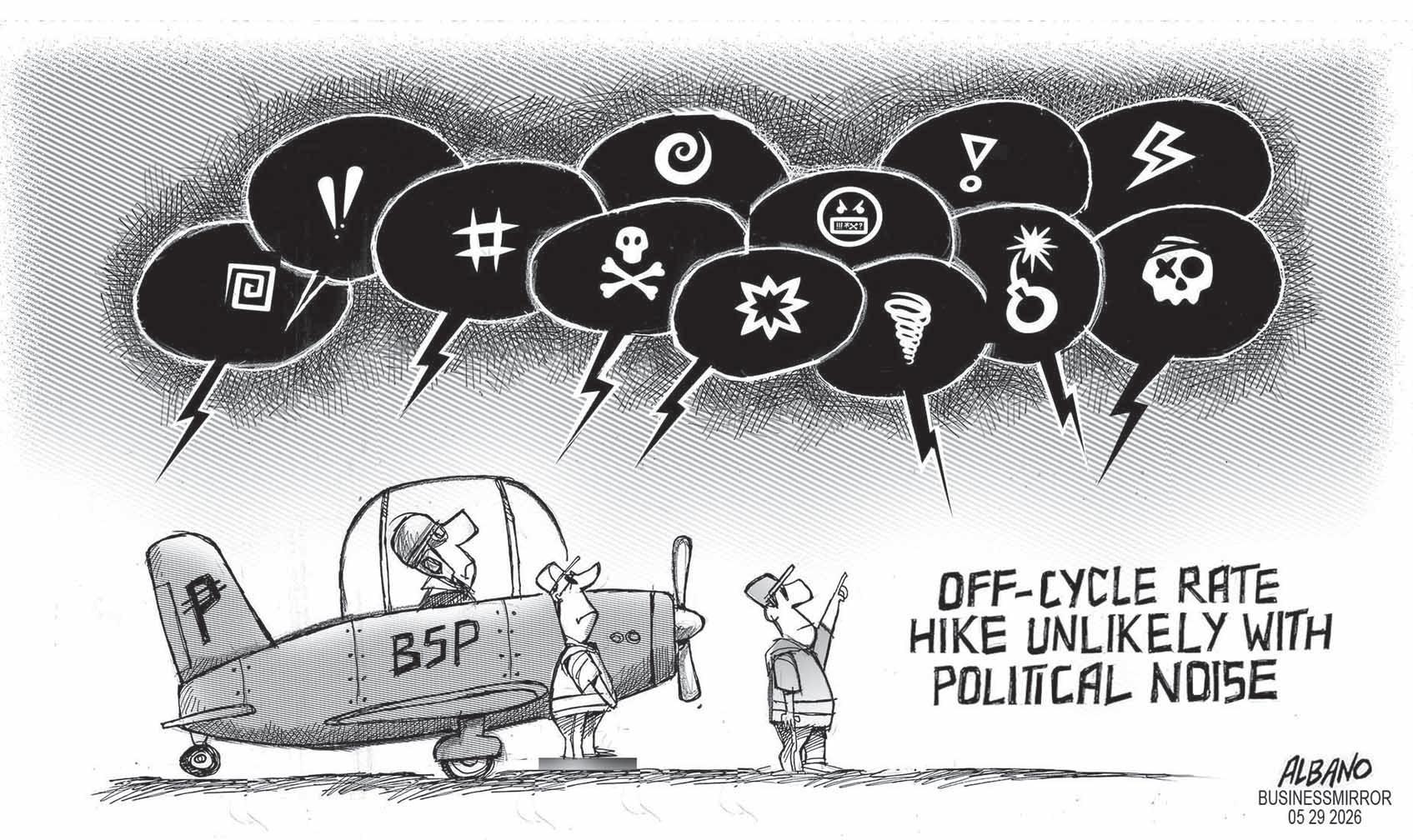

COTLAND—My recent travel in London and Scotland reminded me of my college days at the University of the Philippines School of Economics (UPSE) as I saw the statues of two great minds—Adam Smith and Karl Marx.
We were exposed to the literatures of Smith and Marx, among others, as required foundation readings for understanding economics as a course.
Adam Smith (1723-1790) was a Scottish economist and philosopher who was a pioneer in the field of political economy.
Karl Marx (1818 -1883) was a German philosopher, social and political theorist, economist, journalist, and revolutionary socialist.
Seen by many as the “father of economics,” or the “father of capitalism,” Smith was primarily known for two classic works: “The Theory of Moral Sentiments” (1759) and “An Inquiry into the Nature and Causes of the Wealth of Nations” (1776) or more known as “The Wealth of Nations.”
I read Smith’s “The Wealth of Nations,” which was also cited in several annotations, as basic resource
material in Philippine economics education.
The book is regarded as Smith’s magnum opus, marking the inception of modern economic scholarship as a comprehensive system and an academic discipline.
Its subject “political economy” is much more expansive mixture of philosophy, political science, history, economics, anthropology, and sociology.
The work is notable for its contribution to economic theory, particularly in its exposition of the concept of absolute advantage.
It explained how a country’s wealth does not come from having lots of gold. Instead, Smith argued that a nation’s wealth comes from the things its people produce and trade. The key to increasing productivity is to divide labor into a series



HE primary mandate of the Bangko Sentral ng Pilipinas (BSP) is to maintain price stability conducive to a balanced and sustainable growth of the economy and employment. In practice, this means that the BSP works to keep inflation low and stable, preserve the purchasing power of the Philippine peso, promote a stable financial system, regulate banks and financial institutions, and manage the monetary policy and international reserves of the country.
Regarding inflation, which is arguably the biggest economic issue facing the Philippines today, it basically means that prices rise over time. This usually comes from a few main forces. One, demand could be outpacing supply. If many people want something, but there is not enough of it, its price tends to go up. Two, costs of production could rise. If it becomes more expensive to make things (higher wages, more expensive raw materials, more expensive fuel), businesses often pass these costs on to consumers. Three, there could be more money in the system. When the BSP increases the money
supply (which lowers interest rates), people have more money to spend for consumption or investment, so prices can rise. Four, there are expectations. If people expect prices to rise, they behave differently (buying sooner, raising wages), which can actually push inflation higher. Low and stable inflation is considered to be healthy for the economy because it encourages spending and investment instead of hoarding cash. It helps businesses grow and hire because, by the law of supply, a higher price is an incentive for a firm to produce more. A predictable inflation rate also makes it easier to ad-
of repetitive tasks performed by different people. Smith laid the intellectual foundations for “laissez-faire” capitalism— the doctrine that markets function best when the government largely leaves them alone.
He argued for a system of “natural liberty,” one in which the market largely governs itself as is free from excessive state intervention (called the invisible hand).
Smith explains that there are only three proper roles for the government: (a) to protect a society from invasion by outside forces, (b) to enforce justice and protect citizens from one another, and (c) the duty of erecting and maintaining certain public works and certain public institutions.
Smith argued that individuals naturally act in their own self-interest.
He theorized that when all individuals pursue their own self-interest in a free-market system, an “Invisible Hand” guides these actions to unintentionally benefit society, efficiently allocating resources without the need for central planners.
Rather than a central authority dictating what should be produced, Smith believed supply and demand would naturally negotiate and allocate resources efficiently across the economy.
On the other hand, Marx developed the theory of historical ma-
just wages and prices over time. The BSP, for instance, aims for about 2 to 4 percent annual inflation.
Nevertheless, inflation becomes a problem when it is rapid inflation. People lose purchasing power quickly. Savings lose value. Daily life becomes unpredictable.
It should be noted, however, that people ought to fear deflation (negative inflation) just about as much as they do high rates of inflation. Deflation makes people delay spending (waiting for lower prices). Thus, businesses earn less and may cut jobs. The overall economy can stagnate.
All told, inflation is not inherently bad. It is really a tool and a signal. Indeed, what matters is keeping it low and stable, not eliminating it entirely.
Interestingly, in one interview, BSP Governor Eli M. Remolona Jr. was asked, “What keeps you up at night more these days? Is it a policy mistake from acting too late, or is it a policy mistake from acting too forcefully?” The first mistake refers to raising interest rates too late such that it risks persistent inflationary pressures. The second mistake refers to tightening monetary policy too forcefully such that it ends up slowing the economy. Governor Remolona thoughtfully
terialism, analyzing class struggle under capitalism and predicting the system’s overthrow by the proletariat in favor of communism.
Marx co-authored “The Communist Manifesto” (1848) with his lifelong friend Friedrich Engels, and undertook a critique of classical political economy in his magnum opus, “Das Kapital” (1867–1894).
Marx’s ideas and their subsequent development, collectively known as Marxism, have had enormous influence and have influenced revolutions and uprisings in many countries. Marx’s work inspired protests and strikes, rebellions and revolutions, terrorism and war, struggles for freedom, democracy and liberty, as well as regimes of tyrannical repression.
Marxist economic theory, developed by Marx and Engels, analyzes capitalism as a system based on class struggle, where the bourgeoisie (owners) exploit the proletariat (workers) by extracting surplus value.
Key pillars include the labor theory of value, historical materialism, and the prediction that inherent contradictions will lead to capitalism’s collapse and replacement by socialism.
Under the labor theory of value, Marx argued that the value of any commodity is determined by the “socially necessary labor time” required for its production. Labor is the sole See “Gorecho,” A11
replied, “What we worry about is a policy mistake that leads to a deanchoring of inflation expectations. It tends to happen if we act too late, so that is why we are trying to stay ahead of the curve.” So, what would happen if inflation expectations became entrenched? People and businesses start assuming that high inflation will continue for years, so they change their behavior accordingly. That makes inflation much harder and more painful to bring down.
Several things can happen, and they are worth spelling out here. One, employees can demand higher wages. Because they expect prices to keep rising, they push for larger pay increases to maintain purchasing power. Two, businesses can raise prices more aggressively. Companies expect higher future costs (labor, materials, borrowing), so they increase prices preemptively. Three, a wage-price spiral can develop. Higher wages raise business costs. Businesses
When the wallet becomes the crime scene: Why PHL cybersecurity can no longer wait
By Roy Cabonegro
THE Filipino wallet has gone digital. But so have the pickpockets.
In the age of e-wallets, QR payments, AI chatbots, and instant digital banking, the next bank robber may not carry a gun at all. He may carry an algorithm.
That was the sharp warning hovering over the recent SISA Customer Conclave held at Shangri-La Makati, where cybersecurity professionals, payment-sector leaders, and industry partners gathered under the theme: “Empowering Connections. Securing Tomorrow.”
Co-organizing the event was WiSAP, or Women in Security Alliance Philippines, a nonprofit organization working to empower women professionals and leaders in the Philippine cybersecurity ecosystem through advocacy, training, networking, and industry collaboration. Its role in the conclave underscored a crucial point: cybersecurity is not only a technology issue; it is also a leadership, talent, and publicawareness challenge.
For the Philippines, the timing could not be more urgent.
In 2024, digital retail payments already made up 57.4 percent of total monthly retail payment volume, according to the Bangko Sentral ng Pilipinas. Government digital transactions have moved even faster, with 97.2 percent of government-to-person and government-to-business payments already processed electronically.
That means the country’s money now moves through apps, QR codes, APIs, cloud systems, digital IDs, ewallets, payment gateways, tuition portals, cooperative systems, government cash assistance channels, and online banking platforms.
That is progress.
It is also one very big buffet table for cybercriminals.
The Department of Information and Communications Technology has found that among Filipinos who encountered phishing, SMS scams, hacking attempts, or online fraud, only 1.6 percent reported the incident. Meanwhile, the National Privacy Commission reported 6.85 billion security incidents from 2018 to 2023, plus hundreds of formal personal data breach notifications involving sectors such as government, education, financial services, manpower, and healthcare.
This is the Philippine backdrop behind the warning of Mahendran Chandramohan, Chief Technology Officerr at SISA.
In an interview, Chandramohan said two major shifts are now reshaping cybersecurity.
The first is “cybersecurity for AI and AI for cybersecurity.”
In plain language: AI is now both the weapon and the shield. Attackers are using AI to find vulnerabilities, automate phishing, imitate human behavior, generate exploit code, and create more convincing scams. Defenders, meanwhile, must also use AI to detect threats, respond faster, and protect systems that are themselves increasingly powered by AI.
The second shift is speed. Cyberattacks are no longer moving at human pace. AI can help compress what once took weeks
into hours, even minutes. Phishing, impersonation, account takeover, deepfakes, and social engineering are becoming faster, cheaper, and more scalable.
And perhaps Chandramohan’s most important warning was this: “Identity is the new perimeter.”
In the old world, companies protected physical data centers with firewalls. In today’s cloud-driven world, identity itself has become the doorway. Once an attacker compromises a user account, employee credential, or digital identity, the attacker may gain direct access to payment systems, customer data, business platforms, and financial transactions.
This is where SISA says it brings a different kind of experience.
Now in its 20th year, SISA is a global cybersecurity company focused heavily on securing the payment ecosystem. Its strongest differentiator, according to Chandramohan, is its deep background in digital forensics and breach investigation. The company says it has handled more than 1,500 breach investigations globally, giving it first-hand knowledge of how payment systems are actually attacked.
“When you do forensic investigation, you learn a lot,” Chandramohan said. “You get first-hand information from the breach.”
That knowledge now feeds into SISA One, launched as a major highlight of SISA’s Manila engagements. SISA One is the company’s AI-driven platform designed specifically for the payment ecosystem, bringing together compliance, cybersecurity, privacy, forensic intelligence, threat detection, incident response, and risk visibility into one operational framework.
For Philippine banks, fintech firms, e-wallet operators, cooperatives, payment gateways, schools, healthcare institutions, and government digital-payment systems, the relevance is obvious. The more money moves digitally, the more trust must be protected digitally.
The point is not to scare people away from digital payments. The point is to secure the road before the whole country drives on it.
Because payment systems remain among the most attractive targets for cybercriminals for one simple reason: that is where the money is.
For consumers, the threats are becoming personal: fake customer service agents, phishing links, deepfake calls, account takeovers, identity theft, and scams targeting senior citizens and first-time digital users.
For businesses, the risk is becoming existential.
Cybersecurity is no longer merely an IT concern.
It is now an economic infrastructure. And if institutions fail to secure trust in the digital payment ecosystem, the next robbery may no longer happen at the bank counter. It may happen invisibly—inside the code.
August, not the month but the

WTito
Genova Valiente
HERE did this idea that the Senate is naturally exalted and its members glorious citizens? Or, have we been following allegorical journeys of Romans and their emperors?
I turn to fragments from ancient tomes, sourced by countless scholars. It’s mind-boggling especially for a non-classicist like me to confront volumes of information, each page enriched by citations and references, which connect and reconnect older names to more astute scholarship.
One book (still full of ibidem as well as locus citatus and opus citatus) attracted me and this was Richard J. À Talbert’s “The Senate of Imperial Rome during the Principate.” The period refers to the early period of the Roman Empire that begins with the reign of Augustus as the first Roman emperor in 27 BC. Now, there’s that name Augustus who was also known as Octavianus. He was acknowledged as the founder of the Roman Empire and with it the introduction and sustaining of the Pax Romana, which corresponds to some two-hundred years of Roman imperialism, hegemonic power, and further expansion of the empire. There was relatively peace and order, give and take sporadic revolts from within and battles out in distant territories.
The mind of Talbert examines the composition, procedure, and function by the Roman Senate. He underscores how entry to the Senate was restricted to Roman citizens of free birth. Conviction barred a man from any position of honor or responsibility, including membership to the Senate. Only Senators can wear the “latus claves,” the reddish purple stripe woven into the tunic of the man.
If we are to remember Augustus, we should only think of his place in the scheme of things: he became
emperor after the assassination of his great-uncle and adoptive father, Julius Caesar.
The Senate would play a major role in his biography. His father was a Senator and governor in the Roman republic. Octavianus was also a senator. According to chronicles, the Senate gave him the name Augustus, a name, which means “the august one” or “the exalted.”
The name Augustus denotes one who is venerable, teetering on divinity status that has become part of the political game of the emperor in collusion with the Senate.
Listen to how Amy Irvine describes the era of Octavian/Augustus. He “was born in 63 BC during the final years of the Roman republic. By then, Rome was already dominated by corruption, rivalry, and civil unrest. Powerful generals controlled private armies, while Senators fought for influence and wealth.” This is almost a description of our own republic.
old man. Expanded the word Senate comes from the Latin word “senates” that becomes articulated into a council of elders, a group of respected elders with wisdom and experience to guide a society.
Barring the age, the Senators who confront us with their personality and politics on TV and social media are men imbued with power, pure from true origins, wise enough to lead the way for all of us. There is therefore this shame recoiling from the depths of our collective unconscious as we gape at the vulgarities of our own senators. We have reached the pit with one senator materializing after six months only to add to the number of his cohorts, and be the majority. Strangely, the word august is still related to “au-
from the investigators. Going back to the braver republic, Julius Caesar crossed the Rubicon against the advice of the Senate. There lies the difference between the Romans and Bato’s notion of the republic.
The Roman Senate battled violence, betrayal and dissipation while the Senate of our fledgling republic had to fight buffoonery and travesty. There lies the difference.
Remember the time our Senators put on their toga to mark the beginning of their august role as judges? Did you not smell the scent of parody in that act?
Some of the senators have already sensed the pratfall comedy in the daily occurrences at the Senate, where some members have become unknowing caricatures of the evil embedded in their colleagues who shamelessly live for their dynasties and patrons. We pin our hopes on the remaining half who are confronting the rest with the question “have we really gone down this far?” Can this Senate rise from the morass of political burlesque, where the joke is on us and not with these clowns who can be uncaring about the republic on the brink of laughter or collapse?

How then do we connect the details of ancient history to the present era? It must not be missed that there are two meanings we can connect to the adjective “august” and these are “majestic and grand” that it inspires awe.
There is also the word Senate to contend with. Its Latin roots are derived from “Senex,” which means
gur” and “auguries” and “augment.” He therefore has his share in being august. Never mind if this senator is caught by the camera scampering on the stairs to run away from a warrant of arrest. He trips and later surfaces à senator welcomed by the other Senators.
Bato has crossed his Rubicon, which is to escape the next dawn, an act facilitated by his branch of the Senate, given the early reports
Why insist on describing the Senate as the sacrosanct hall? It must be because some well-meaning citizens still hold on to the day they will see Senators doing good. Or, we could listen to Cicero, one of the greatest orators and a Senator, who spoke of balancing the budget, among other things and controlling the arrogance of public officials. Or is the adage, the republic declined because of the Senate true? A dire warning in the month of May that in Ancient Rome bore religious rites for the dead, making it an unlucky time for major life events.
E-mail: titovaliente@yahoo.com
Americans are about to pay even more at the grocery store
By Mark Niquette & Lauren Rosenthal
AS Americans confront a surge in prices at the pump, another inflation wave is headed for the grocery store.
A combination of factors including bad weather, tariffs and a dwindling cattle herd are already pushing up grocery prices at an above-average pace. In April, they rose by the most in nearly four years, and economists say the impact of the Iran war and a potential El Niño weather pattern will only add to pressures into 2027.
The hit to US household finances from higher grocery bills is set to intensify just ahead of the November midterm elections, amplifying affordability as a defining issue. And to a greater extent than the surge in gas prices, the slower-moving food shock will be difficult to reverse quickly because the size of autumn harvests is determined by planting decisions made in the spring.
“It’s going to be a challenging year,” said Ricky Volpe, an agribusiness professor at California Polytechnic State University who previously worked at the US Department of Agriculture’s Economic Research Service. “Food is going to become less affordable, and consumers should be prepared for it.”
The latest USDA food price outlook, published Friday, projected a 3.2 percent advance in grocery prices this year, while Volpe said he expects inflation more on the order of 4 percent to 4.5 percent.
James Giese of Madison, Wisconsin said he lives on his own but is mak-
continued from A10
further.
ing adjustments with rising grocery prices like cutting back on prepared foods and meat. Giese, 62, is even trying to grow potatoes in his backyard to supplement his food budget.
“I’m very concerned,” he said. “I’m probably considered middle-income, but it’s starting to pinch.”
Outsize price increases so far in 2026 have reflected a mix of bad luck, trade policy and slower-moving pressures linked to climate change. The weather in particular has not been kind to American farmers, who have endured outbursts of record-breaking heat, historic cold, ping-pong size hail and wildfires.
The US saw its warmest-ever start to the year, with temperatures running about 6F (3C) above average through the end of April, according to the National Centers for Environmental Information. The early heat prompted some domestic crops to begin blossoming weeks ahead of schedule instead of remaining dormant throughout the winter, leaving them exposed to subsequent frosts,
persistent. Six, the BSP can raise interest rates more aggressively to restore confidence that inflation will fall.
according to Brad Rippey, a USDA meteorologist.
Beef prices, among the most politically sensitive in the US, rose to a record in April thanks to the smallest cattle herd in 75 years, squeezed by drought and high production costs.
Tomato prices, meanwhile, surged 33 percent over the last two months after two winter storms brought widespread damage during the peak of the growing season in Florida— while shipments from Mexico were declining following the Trump administration’s imposition of duties on imports.
Heat and drought in the western and central US spell more pressures to come. California accounts for almost half of annual US vegetable and three-quarters of fruit and nut cash receipts, and diminished snowpack in the Sierra Nevada this year—to just 23 percent of typical levels as of mid-April—has raised concerns about irrigation supplies.
Drought has also spread across the nation’s breadbasket, where staple wheat crops that are typically used to make all-purpose flour or pasta have withered for lack of rain.
As of May 19, 70 percent of US winter wheat production was in areas of drought, along with 25 percent of corn production, according to the National Drought Mitigation Center at the University of Nebraska-Lincoln.
And forecasters now say an El Niño weather pattern is likely to
emerge by August, with rising odds of an unusually powerful event that will persist into 2027 and push global average temperatures higher. El Niño can often steer extra rain to California, but it’s also been known to fuel drought outside the US in major growing areas for rice, coffee, cocoa and more.
Then there’s the war, which has brought a massive shock to global fertilizer markets due to the Middle East’s role as a major supplier of inputs.
Prices of fertilizer are up 20 percent since the war began, according to a Green Markets index for North America. That will likely mean higher prices come harvest time, and if farmers decide to scale back applications, that would also leave crops less able to withstand heat, drought or flooding.
The higher cost of fuel itself will also find its way into prices on store shelves as farmers and carriers pay up for diesel to power tractors and trucks, and petroleum-based plastic packaging becomes more expensive. Major grocery chains have been trying to hold the line on pricing. Kroger Co.’s chief executive officer said it’s planning a price-cutting push to compete more fiercely with Walmart Inc., which has expanded its efforts to keep prices low over the last year. With assistance from Kristina Peterson, Ilena Peng, Augusta Saraiva, Jaewon Kang and Jonathan Roeder/Bloomberg
economic slowdown or recession risk can rise. Strong rate hikes can reduce borrowing, investment, and hiring. Historically, breaking entrenched inflation often comes with slower growth and, sometimes, even recessions. In summary, economists watch inflation expectations closely because they can become self-fulfilling. If people believe inflation will stay high, their actions can help keep it high. That is why the BSP pays close attention not just to current inflation but also to surveys and market measures of inflation expectations. Keeping expectations anchored is considered crucial for maintaining price stability.
A12
Friday, May 29, 2026
FBy VG Cabuag
ILIPINO tennis superstar Alexandra
Eala leads 12 Filipinos in Forbes
Magazine’s 11th “30 Under 30 Asia”
list, which features 300 entrepreneurs, leaders and innovators across the Asia-Pacific region, all under the age of 30.
“Alexandra Eala got Filipinos fired up about tennis after she broke into the Women’s Tennis Association’s [WTA] Top 50 last year. She climbed as far as No. 29 in March 2026 to become the nation’s highest-ranking player in modern history before retreating to No. 44 in April,” Forbes said.
Aside from Eala, Filipinos on the list include singer Zack Tabudlo; Pauline Dizon and Adrian Jumangit who founded Fan Connection SEA (FanConSEA); GoRocky founders Kiyanusch Braun and Martin Joaquin Palaña; pet food company Amico’s founder Kharl Christian Yeung; BayaniChain tech founders Brandon Angelo Wong and Raphael Sevilla (with Paul Soliman who is over 30); Empath founder Steph Naval; Saje Miguel Molato who founded Siklab; and Asean Youth Advocates Network (AYAN) founder Emmanuel Mirus Ponon. Tabudlo’s songs “Pano” and “Give Me Your Forever” went viral shortly after its release in 2021, making him the moststreamed Philippine artist of 2022, according to Spotify figures.
FanConSEA is a fandom-based business that deals with merchandise licensing, bookings and live events.
It started in 2020, when the two bet their savings on Southeast Asia as a key entertainment market.
GoRocky, meanwhile, is aimed at destigmatizing men’s health issues such as erectile dysfunction and hair loss. Promising confidentiality and convenience, the digital platform claims to have connected
more than 30,000 customers to licensed doctors and pharmacies.
Yeung’s Amico Innovations sold his majority stake to Monde Nissin in 2024. He has experience in startups and commercial strategy that includes blockchain-based gaming company Sovrun and 917Ventures, the startup arm of Globe Telecom Inc. BayaniChain Tech, meanwhile, is a company that builds blockchain systems for governments and companies to improve transparency, secure data and reduce corruption. It worked with the Department of Budget and Management, the first government agency in the country to use blockchain to upload and verify key budget documents.
Empath is a social enterprise that provides online counseling, psychotherapy and psychiatric consultations to schools, workplaces and non-profit organizations after struggling with her mental health as a teen. Siklab, meanwhile, was founded in 2016 to help young people become more globally competitive. The consulting firm works with government, nonprofit and private sector partners on education, skills development and climate programs.
AYAN is an organization that encourages young people across 10 Southeast Asian countries to participate in policy-making, peacebuilding and sustainable development. It has reached over 350,000 young people, elevating youth voices in forums such as Asean, Apec, TEDx, and the United Nations.
From entrepreneurs building companion robots and AI tools to up-and-coming stars stepping into the global spotlight, this year’s listees illustrate Gen-Z’s influence across business and culture in the region. India has the most entries with 78, followed by China at 46, Australia with 38 and Japan has 32. Indonesia, Singapore and South Korea each have 18. About a quarter are women and the average age is 26.
By Lorenz S. Marasigan
THEPhilippines now holds the most expensive residential electricity rates in Southeast Asia, driven by a surge in retail prices that has simultaneously made rooftop solar panels more economical than ever for Filipino households, businesses, and factories.
A new analysis by London-based energy think tank Ember found that Manila Electric Co.’s (Meralco) retail electricity prices in May 2026 were 17 percent higher for residential customers, 18 percent higher for commercial customers, and 14 percent higher for industrial customers compared with the same period a year earlier.
Citing data from the Department of Energy (DOE), the Ember report showed that as of March 2026, the Philippines charged P13.8 per kilowatt-hour (kWh) for residential electricity, narrowly edging out Singapore’s P13.7/kWh, with Cambodia a distant third at P9.2/kWh.
On the commercial side, Singapore led the region at P12.2/kWh against the Philippines’s P11.7/ kWh, with Cambodia third at

P9.7/kWh.
For industrial customers, Singapore again topped Southeast Asia at P11.6/kWh, followed by Cambodia at P9/kWh and the Philippines at P8.9/kWh.
Ember noted that these figures predate the Philippines’s further price increases in April 2026 and reflect nationwide averages rather than Meralco-specific rates.
This, according to the report, pushed the Philippines to have “the costliest residential electricity price in Southeast Asia, the second-highest commercial price and the thirdhighest industrial price.”
Those price increases, combined with a roughly 10-percent decline in solar panel installation costs over the same 12-month period, have sharply compressed the payback
period.
The payback period for residential rooftop solar has fallen from four years in May 2025 to just 3.1 years in May 2026, according to Ember. For commercial customers, payback times dropped from three years to 2.3 years, and for industrial customers, from 3.9 years to 3.1 years over the same period.
“The economics of rooftop solar are more attractive than ever, and its rapid rise is inevitable,” said Dave Jones, chief analyst at Ember and lead author of the report. “The government has an opportunity to carve its own path on rooftop solar, to pull the Philippines out of fossil dependency and onto a path of cheap, abundant electricity.”
Ember estimates that rooftop solar capacity in the Philippines has nearly doubled from 721 megawatts (MW) in early 2025 to around 1,300 MW by early 2026, though this still represents only 1 percent of the country’s theoretical rooftop potential of 106,000 MW.
The think tank arrived at its growth estimate by analyzing generation data from the Independent Electricity Market Operator of the Philippines (IEMOP), which showed grid generation falling sharply year-on-year at midday—the peak period for solar output.
In 2025, the Philippines imported 5,068 MW of solar panel capacity, which is more than five times the 800 MW of grid-connected util-
By Ma. Stella F. Arnaldo Special to the BusinessMirror
THE Philippines remains among the top source markets for tourists in South Korea, ranking fifth globally, and first in Southeast Asia in 2025.
In an interview with the BusinessMirror, Seulgi Kim, Manager for the Global Tourism Industry Team of the Seoul Tourism Organization said there were 615,141 tourists from the Philippines last year, up 19 percent from 516,760 in 2024. “So it’s a really rapid increase,” she noted.
She said the continued interest in “Kpop and Korean culture” are among the top reasons Filipinos keep visiting, and “revisiting” South Korea—the latter at a rate of “50 percent.” About 95 percent of the Filipino tourists have also expressed a willingness for a return visit, based on surveys.
Kim made the statement on the sidelines of the Manila-Seoul Exclusive Tourism Event at a hotel in Makati City on May 26, 2026, where the Seoul Metropolitan Government and its partner travel sellers met with Philipine buyers, in a bid to encourage more Filipinos to visit the capital of South Korea.
“We don’t have a specific target [for this year], but we’re trying to just expand the visitors from the Philippines,” she added. The travel event was the first to be held by the Seoul government in the Philippines, and featured 24 Korean travel companies and tourism organizations, which met with about 200 Philippine buyers.
New attractions
DATA from the Department of Tourism (DOT) showed 121,590 Filipinos traveled to South Korea from January to April this year, up 51.75 percent, year on year. South Korea was the ninth top destination of Filipinos in the first four months of 2025, after Hong Kong, Japan, Taiwan, Singapore, Vietnam, Thailand, Saudi Arabia, and the United Arab Emirates. DOT’s outbound data covers Filipinos leaving for work and leisure.
According to Kim, Filipinos will likely be interested in new attractions such as Seoul Dal, an urban attraction where
guests can experience riding a “tethered helium balloon that goes high up in the sky and you can check the landscape during the daytime and the nighttime.” Dal means “moon” in Korean.
“We also have a Seoul Culture Lounge, [where] you can learn about the Korean culture. We provide Korean alphabet learning classes, K-Pop classes, and are free for the FIT [freely-independent travelers],” added Kim. The lounge is located at the Seoul Tourism Plaza at the Samil Building in Jongno-gu.
She also recommended FITs to buy a “Discover Seoul Pass,” which gives the visitor access to a lot of tourist attractions for free or at discounted rates. “We have options like ‘Pick 3 [tourist sites] or for 72 hours-120 hours passes you can use while you’re staying in Seoul.”
Among the sites covered by the Pass are the N Seoul Tower, Gyeongbokgung Palace, several parks and museums, the Seoul Aquarium, to name a few. The Pass can be purchased at any tourism information center or convenience store.
100 flights a week
THE increase in Filipino tourists to South Korea are enabled by the growing flights between both countries. Kim said there are about 100 flights per week between Manila and Incheon, dominated by Korean Air, Asiana Airlines, Philippine Airlines, and Cebu Pacific. This is equivalent to about 30,000 seats weekly between the capital cities.
There are also about 12 daily flights a week between Cebu and Incheon via Cebu Pacific, Korean Air, Jeju Air, and Jin Air, while nonstop flights are also available between Incheon and Tagbilaran, Bohol.
Data from the Korea Tourism Organization showed that of the total 18.94 million vistors in South Korea last year, the Philippines ranked fifth among the former’s top source tourism markets after China (5.48 million), Japan (3.65 million), Taiwan (1.89 million), and the United States (1.48 million).
The Philippines also ranked ahead of other Southeast Asian countries as a tourism source market.
South Korea is targeting to attract 30 million foreign visitors by 2030.
ity-scale solar installed that year. In March and April 2026 alone, China exported over 3,000 MW of solar panels to the Philippines, making the country China’s second-largest solar export market year-to-date, ahead of Pakistan.
“The supply of panels is already on the ground. The economics are already there. Consumers are keen. Even back in 2024, 82 percent of surveyed households expressed some interest in adopting solar panels,” Jones added.
Ember predicts that rooftop solar panel will reach 3,500 MW with 4,500 megawatt-hours (MWh) of battery storage within 24 months. At the latest installed battery price of $125 per kilowatt-hour (kWh), the total cost of the battery component alone would be around $560 million.
The report also argued that rooftop solar paired with batteries would offer a cheaper and faster alternative to new coal plants, with BloombergNEF estimating new coal at $87 to $117 per MWh against $55 to $80 per MWh for firmed solar.
To unlock that scale, Ember recommended three policy interventions. First, expanding loan schemes like the Government Service Insurance System’s (GSIS) Ginhawa Solar Energy Loan (GSEL) program—a 5-percent loan repayable over five years—to the roughly 40 million private-sector workers
See “Electricity,” A2
THE Trial Chamber III of the International Criminal Court (ICC) has officially set for November 30, 2026, the opening of former Philippine President Rodrigo Roa Duterte’s trial following the first status conference on Wednesday. Duterte is being prosecuted before the ICC on three counts of crimes against humanity—murder and attempted murder—allegedly committed between November 2011 and March 2019. Presiding Judge Joanna Korner acceded to the Prosecution’s proposal, stressing that the Chamber intends to run the trial daily until the Christmas judicial recess, though adjustments may be made depending on the upcoming medical assessment of Duterte’s fitness to stand trial. The Registry was strongly urged to ensure simultaneous interpretation for the opening statements so that audiences in the Philippines can follow the proceedings. Case conferences are convened to establish procedural frameworks, resolve logistical hurdles, and ensure both sides are aligned on witness management, disclosure obligations, and trial readiness before substantive hearings begin. At the first session, Duterte waived his right to appear. He was represented instead by his newly appointed defense team—Peter Haynes KC as lead counsel and Kate Gibson as associate counsel—marking their first appearance before the ICC since their appointment earlier in May.
Strict deadlines
THE Chamber set firm deadlines to keep the case on track:
n June 29, 2026—Provisional list of witnesses and evidence.
n August 31, 2026—Final trial brief, witness list, evidence list, expert list, and any pre -trial motions.
n August 31, 2026—Absolute cut-off for adding new incidents.
Any evidence disclosed after this date will require Chamber authorization and a full explanation. Judges stressed the need to avoid “repetitive, irrelevant, or voluminous” submissions. The Legal Representatives of Victims (LRV) must file their trial brief by September 28, 2026, while the Defense must submit its mandatory document outlining issues with the Prosecution’s evidence and its general defense by October 30, 2026.
Victims who joined the pretrial phase are automatically authorized to continue at trial. See “Trial,” A2
Editor: Jennifer A. Ng

By Lorenz S. Marasigan @lorenzmarasigan
FIRST Gen Corp.’s massive bet on pumped-storage hydropower is expected to begin paying off by 2031, when its Wawa and Pakil projects are projected to contribute approximately P16 billion annually to the company’s bottom line under a 20-year agreement with the government.
At the company’s stockholders meeting, First Gen President Francis Giles Puno said the figure represents roughly three times the historical average annual contribution of the 60-percent natural gas stake that First Gen sold to Prime Infrastructure Capital Inc. in 2025.
The two pumped-storage facilities are being developed in partnership with Prime Infra at a combined committed capital of approximately P62 billion — largely funded from the proceeds of that gas stake sale. Together with the 120-megawatt Aya Pumped Storage Project adja-
cent to the Pantabangan reservoir, the portfolio is expected to add over 2,000 megawatts of long-duration storage capacity to the national grid.
“Beginning in 2031, these facilities are projected to contribute approximately P16 billion annually to First Gen’s bottom line, through a 20-year contracted agreement under the Department of Energy’s Green Energy Auction Program,” Puno said.
Puno described pumped-storage hydro as uniquely suited for the next phase of the country’s energy transition, noting that unlike conventional battery systems, pumped-storage facilities can deliver long-duration storage at scale — generating electricity continuously for up to 10 hours.
He noted that as solar and wind penetration deepens across the Philippine grid, the ability to store surplus energy and discharge it on demand becomes increasingly
critical to system reliability.
“Opportunities to develop largescale pumped-storage facilities are inherently limited by geography, water access, permitting complexity, constructability challenges, and transmission availability,” Puno said in his message to stockholders.
“First Gen believes the present window offers a unique opportunity to secure strategic sites and build capabilities that may become significantly more difficult and more expensive to replicate in the future.”
The company posted lower earnings in the first quarter at P3.6 billion, down 24 percent from P4.8 billion last year, mainly due to the sale of its gas assets to Prime Infrastructure Capital Inc.
Revenues stood at P15.3 billion, up 32 percent from P11.6 billion in 2025, owing to a greater volume of electricity sold at higher prices during the period.
RANSUNION Information
TSolutions Inc., the country’s first private credit reference agency, has appointed Avishek Ghosh as chief data and analytics officer for Asia Pacific.
Based in Hong Kong, he will lead the region’s data and analytics strategy, overseeing the end-to-end data value chain—from acquisition, analytics and modeling to insight generation and quality enhancement—to drive innovation and supporting sustainable business growth.
Avishek has more than 17 years of experience in global banking, combining strong international
exposure across Hong Kong, India and the United Kingdom with extensive cross-regional collaboration spanning Asia Pacific, Europe, the Middle East and Africa and the Americas.
Prior to this role, he served as senior vice president at HSBC, where he led the unsecured lending business across nine Asian markets. Ghosh holds a master’s degree in statistics from the Indian Statistical Institute in Kolkata.
He brings deep expertise in advanced analytics and data science leadership, with a proven track record of applying emerging data technologies to shape product
strategy and deliver measurable outcomes.
This background in data innovation aligns with TransUnion’s evolution from a traditional credit reference agency to an information and insights partner, enabling organizations to view consumer identity holistically through diverse data assets and helping them to make informed decisions with confidence, which forms the foundation of trust in the modern economy.
“As the role of information and data continues to grow in enabling robust and evidence-based financial decisions in today’s economy, particularly amid persistent global
Men are spraying themselves 100 times in new
THE influencer known as OverSpray Jay has become one of the top sellers of men’s fragrances on TikTok in part by offering his followers a very specific piece of advice: whatever scent they’re wearing, they should spritz themselves 100 times.
His catchphrase: “If you ain’t shinin’, are you even applyin’?”
It’s a far cry from how fragrance was marketed in the past to men— and the women who often bought it for them — with campaigns focusing on outdoor pursuits, rippling torsos and smelling “like a man, man.”
Now, the approach is more nuanced. Instead of having an instantly recognizable cologne, men are being encouraged to layer their fragrances, wearing multiple perfumes or colognes at once to create a signature scent. The trend is a boon to cosmetics companies as consumers buy several products instead of just one, often adding lotions, high-end deodorant and body washes to their haul.
Meanwhile, the number of influencers hawking fragrances to men on TikTok has increased around 12-fold from April 2024 through April this year, according to data from Charm.io analyzed for Bloomberg News. That far outpaces the 8-fold increase in those marketing to women, the data show.
Corporations and influencers alike are capitalizing on a post-pandemic boom in fragrance in the US, particularly among men. The amount spent on men’s fragrances on TikTok’s shopping platform each month has outpaced that spent on women’s
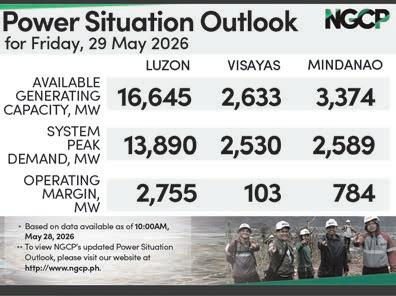

Ouncertainties, rising fraud risks and increasing regional integration –the capabilities to manage, analyze and translate data into trusted and meaningful insights has never been more important,” Marie Claire Lim Moore, the company’s Asia-Pacific regional president and Hong Kong CEO, said.
“It is an honor to join TransUnion at a time when trusted data and insights are increasingly vital in helping financial institutions, businesses and consumers navigate a rapidly evolving environment. to deliver meaningful impact for business, individuals and the broader economy,” Ghosh said. VG Cabuag
scents for the past two years or so, according to Charm.io, and peaked at $18 million in sales last November.
The surge in demand is one of the reasons that cosmetics giant Estée Lauder Cos. was keen to acquire Spain’s Puig Brands SA, according to analysts. Puig owns brands including Penhaligon’s, Byredo, Rabanne and Jean Paul Gaultier, and had the second-largest share of the men’s premium fragrance market last year, at 16 percent.
Estée Lauder and Puig ended discussions about a potential deal last week, after months of negotiations. Evan Hall, a 23-year old influencer based in Fayetteville, Arkansas, who posts as @fragranceknowledge, said most of his 1.1 million TikTok followers are 18- to 24-year-old men. Many are seeking creativity and innovation from products and can be ruthless when they don’t see it, he said. If a brand launches what’s known as a flanker—a new iteration of an existing fragrance—it can be seen as a cash grab. “A lot of the market sees through it,” Hall said.
Fastest growing
BECAUSE of their high prices, premium fragrances make up a much larger share of sales versus massmarket items — about 86 percent of the total $16 billion in US fragrance sales last year, data from Euromonitor analyzed by Bloomberg Intelligence show. At Sephora, a 100ml bottle of Angel’s Share Eau de Parfum by Kilian Paris costs $415, while the same size of Dior Sauvage Elixir is $265. Beauty executives think there’s
still room to grow across all categories. Among men, fragrance use is highest in Europe, followed by the US and then Asia, but “there is no region in the world that has 100 percent usage,” said Jean Holtzmann, chief brand officer of prestige fragrances at Coty Inc., the company behind lines such as Calvin Klein and Hugo Boss.
Shifting demographics in the US underpin the bullishness, too.
Latino men wear fragrances more frequently than other groups, data from market research firm Circana show—and are a growing portion of the US population. Meanwhile, fragrance executives say that younger consumers are more likely to buy online without smelling first, accelerating the market. Fragrance has been the fastest-growing category across the US beauty industry for the past two years, according to Circana.
A tie-up between Estée Lauder and Puig would have helped the US company make up ground against L’Oréal, which dominates the No. 1 spot for global fragrance sales with a 12-percent share of the market in 2025, the Euromonitor data show.
Influencer Paul Fino, 26, said that when he started posting about fragrances a few years ago, “nobody really cared.” In the past 12 months, he’s promoted perfumes by Balmain, Philosophy and Armani, and amassed a collection of 5,000 fragrances while being paid to fly around the US promoting brands.
He’s noticed a recent spike in interest among his 13- to 18-year old followers.
“They’re saving up their money to purchase this $400 bottle of cologne from Creed,” Fino said. Their expensive enthusiasm reminds Fino of a similar demographic about a decade ago who obsessively followed drops from sneaker and streetwear brands such as Supreme. The next generation of teen boys “are now into these niche fragrances,” Fino said.
OverSpray Jay, who asked not to be identified by his real name due to privacy concerns, has leaned into the same phenomenon. He said about three quarters of his followers are between 18 and 25 years old—he is 33—and they come to him to learn.
“I call them nephews, they call me ‘unc,’” he said, using a slang term for uncle that’s popular on social media. Though he intended the 100-spray gimmick to be tonguein-cheek, he said some followers take him at his word.
While the influencers’ youthful audience means more money flooding into the industry, young men—and Gen Z shoppers in general—aren’t as loyal to specific fragrances as older cohorts, and are happy to try out different brands and price points.
Influencer Hall has noticed a huge increase in the number of so-called dupes, where mass-market or budget brands produce a much cheaper, very similar version of a high-end fragrance. Often stocked at outlets like Burlington Stores Inc. or TJ Maxx, they can cost a fraction of what the original scent would sell for, making them particularly attractive to younger shoppers. Bloomberg News

By VG Cabuag @villygc
NLINE gaming firm DigiPlus Interactive Corp. on Thursday said it structured its sustainability report around major frameworks, saying “long-term value creation is inseparable from institutional trust.”
The company said its environmental, social and governance (ESG) report for 2025 was patterned after Sustainability Accounting Standards Board (SASB) for Casino and Gaming and Internet Media and Services, the Global Reporting Initiative (GRI), the Recommendations of the Task Force on Climate-related Financial Disclosures (TCFD) and the Asean Corporate Governance Scorecard (ACGS).
“As we move forward, guided by our refreshed vision to transform the world of entertainment for good, we remain focused on disciplined expansion, continued investment in technology, and responsible innovation,” Eusebio H. Tanco, the company’s chairman, said.
“The industry will continue to evolve. Those anchored on governance, transparency, and disciplined execution will define its future. We believe that DigiPlus is firmly positioned among them.”
Operationally, the 2025 report introduced the company’s new baseline performance for energy consumption and Scope 1, 2, and 3 on greenhouse gas emissions.
The improved methodology is complemented by the disclosure of the outcome of its climate-related physical and transition risk assessment and a high-level climate scenario analysis designed to insulate both its digital platforms and physical branches against evolving climate risks.
On the consumer front, the company behind games, such as BingoPlus, ArenaPlus and GameZone, highlighted its responsible gaming protocols and initiatives. These range from structured, cutting-edge player protection initiatives, specialized training for customer service and branch teams, to active collaborative loops with industry regulators that promote safer play.
The company also mapped out its economic footprint, underscoring its contributions to stimulate economic activity and industry development, employment generation, the expansion of payment channels to support user access, and community empowerment initiatives through the DigiPlus Foundation.
“Through the DigiPlus Foundation, we allocated P84 million (last year) to programs in education, healthcare, and community resilience, benefiting close to one million Filipinos. These initiatives reflect our enduring belief that responsible corporate citizenship strengthens both society and enterprise value,” Tanco said.

AT least 90 percent of Filipino adults are expected to have their own financial accounts by 2028 or by the end of Marcos administration, the government’s updated master blueprint for socioeconomic development showed. Through the “Philippine Development Plan (PDP) 2023-2028 Results Matrices Midterm Update,” the Philippine government laid out its annual plan targets, including goals to attain financial inclusion in the country. By the end of this year, the PDP pegged the proportion of Filipino adults (aged 15 years old and above) with an account “at a bank or other financial institution or with a mobile-money- service provider” at 75 percent.
For next year, the target is to have at least 80 percent of adults in the country to have opened a financial account. This is expected to be elevated to 90 percent by the end of 2028, or the final year of the Ferdinand R. Marcos Jr.’s presidency.
Based on the blueprint, these targets should be attainable if these assumptions materialize: continued economic recovery, more digital transactions and continued financial literacy campaigns. These conditions are expected to increase account ownership, particularly for bank and e-money accounts.
However, the plan noted that income concerns persist as a key barrier to account ownership.
Recent data
BASED on the latest Social Weather Stations (SWS) survey cited by the Bangko Sentral ng Pilipinas (BSP), only 58 percent of Filipino adults own a formal financial account as of the first quarter of the year.
According to the BSP, SWS’s figure is higher than the 51 percent
THE Bureau of Internal Revenue (BIR) filed criminal complaints against three companies and an individual taxpayer for allegedly failing to pay a combined P58.5 million in taxes.
A statement issued by the BIR last Thursday read that the cases were filed before the Department of Justice against Annalyn Esteves Hara, Hamaya Philippines Corp., Antipas DT Construction and Development Corp. and SH Business Construction Services Inc., along with their responsible corporate officers.
The respondents were charged with willful failure to pay internal revenue taxes in violation of Section 255 of the National Internal Revenue Code (Tax Code).
Hamaya Philippines Corp., a company registered in Bacoor, Cavite, had the largest tax liability amounting to P27.294 million in deficiency income tax and withholding tax for taxable year 2017.
Meanwhile, Annalyn Esteves Hara was accused of owing P15.903 million in deficiency income tax and value-added tax (VAT) for the same year. Likewise, Antipas DT Construction and Development Corp., based in Digos, Davao del Sur, allegedly failed to pay P9.661 million in income tax, expanded withholding tax, VAT and documentary stamp tax for taxable year 2019.
recorded for the same age group in the “2025 BSP Consumer Finance and Inclusion Survey” (CFIS).
Among adults, 43 percent reported owning an e-money account. Meanwhile, 21 percent said they have a bank account.
Among those without a financial account, the most common barriers cited were lack of money, unemployment, and limited knowledge of how to open an account.
Adult investors
THE updated PDP also aims to increase the share of Filipino adults with investment.
For 2026, the PDP pegged at 45 percent the proportion of Filipino adults with investments. The blueprint showed this share should be raised to 50 percent by 2027 and 2028.
According to the BSP’s 2025 CFIS, about 2 in 10 Filipino adults reported having an investment, including pension schemes. The number translates to 23 percent of the country’s adult population, lower than the 36 percent recorded in 2021 or during the pandemic.
The central bank pointed out that investment participation is “concentrated” among higher-income, better-educated, and older adults, with motivations centered on achieving life goals and preparing for emergencies.
Across types of investment, 25 percent of Filipino adults decided to earmark portion of their money for Pag-IBIG, 5 percent for time deposit, 4 percent for pre-need plans, 2 percent for the SSS’s “WISP Plus,” 2 percent for variable-unit linked, 1 percent for virtual asset/cryptocurrency, 1 percent for mutual funds, and 1 percent for stocks or listed shares. Andrea E. San Juan
BIR files cases for ₧58.5M in unpaid taxes by 3 firms
SH Business Construction Services Inc. also faces a P5.648-million liability in income tax and VAT for 2017. Under Section 255 of the Tax Code, conviction carries a fine of at least P10,000 and imprisonment ranging from one to 10 years.
Corporate officers found liable may also face additional penalties under Sections 253 and 256 of the Tax Code.
All four accused failed to respond despite repeated notices, final assessment notices, and warrants of distraint—a legal order that allows authorities to seize and sell a delinquent taxpayer’s property to collect unpaid taxes—and levy issued over several years, the BIR said, before criminal complaints were pursued.
“Once assessments become final and executory, the BIR is prepared to pursue the appropriate legal remedies, including criminal action,” Internal Revenue Commissioner Charlito Martin R. Mendoza was quoted as saying.
“We remind taxpayers to respond promptly to BIR notices and settle their obligations through the proper channels before cases escalate further,” Mendoza said. A total of 78 cases have been filed before the DOJ under the BIR’s “Run After Tax Evaders” program over the course of six months. Reine Juvierre S. Alberto

TBy Reine Juvierre Alberto @reine_alberto
HE Philippine Health Insurance Corp. (PhilHealth) will maintain the current members’ premium contribution rates despite the ongoing energy crisis in the country, according to its top official.
PhilHealth President and CEO
Edwin M. Mercado told reporters last Tuesday that members will feel more direct relief through expanded health benefits rather than lower monthly contributions.
“We’re focusing more on expanding benefit payments and widening healthcare coverage for our mem-
bers,” Mercado responded when asked if the state health insurer is looking into adjusting the contribution rates to ease the burden on its members.
Pressed further on whether PhilHealth would stick with the current rate, the Philhealth CEO said the 5-percent contribution rate will remain since this is man -
By Andrea E. San Juan
SMALL merchants and families of overseas Filipino workers (OFWs)
may be the first ones to show stress signals in terms of the capacity to repay loans amid the elevated inflation environment caused by the Middle East war, according to an executive of the country’s credit reporting agency.
“Families of OFWs, SMEs [small and micro enterprises]—these are segments which will experience stress first; but they’re also the ones who have the increased requirements for greater liquidity,” CIBI Information Inc. President and CEO Pia L. Arellano said during a televised interview.
Apart from these sectors, Arellano said the credit bureau is closely monitoring how faster pace of inflation would have an impact on the gig economy’s capacity to repay.
Still, she said it may still be too early to tell if delinquency has already seeped into the banking system.
“We’re not really seeing any signals of distress just yet. However, we have to be very prepared given what’s impending and we don’t really know how long this geopolitical crisis will last,” she said.
Arellano expressed concern, however, that compared to the pandemic wherein the banking industry had a “line of sight,” she sounded wary when she said the Middle East war is seen to bring “greater uncertainty.”
“I think the difference between then and now is the fact that in the pandemic, there was a line of sight with regard to when it would end, right? When the vaccine was there and with massive immunization across the board, then we knew that recovery was in sight,” she said.
With this, Arellano underscored the importance of keeping an eye on “early warning signals,” such as overutilization in credit, increased inquiries or increased take-up rate among consumers, and changes in payment behavior.
“All these are really early warning signals that we should start to monitor early on to really flag deterioration before it even happens,” the CIBI president added.
Arellano said they see the next quarter to reveal “some changes in the delinquency.”
Triple exposure ACCORDING to CIBI, prior to the pandemic, the average Filipino customer would have around three accounts to four accounts.
But given the rise in digital lending and buy-now-pay-later schemes, Arellano said the average number of accounts per Filipino has gone up to 11 accounts.
“So that’s almost triple, right? So all the more it’s very important to really note whether the Filipino consumer is going to be stressed by increased inflation, increased spending [and] increased expenses; very, very important given the increased exposure now,” she said.
Arellano said CIBI has “line of sight” for 75 million Filipinos and more than 700 million credit lines.
“So basically what this means is, and what we’re trying to really promote and advocate is for all lenders to have lineof-sight, consume and utilize this data, especially now when it is most important,” Arrelano said.
Despite the potential credit stress signals which could emerge from recipients of remittances from Filipinos abroad, it is worth noting that latest data from the Bangko Sentral ng Pilipinas (BSP) indicated that Filipinos based in conflictstricken Middle East countries sent more money back home as they fear that prices of goods will continue to escalate in their home country. (See: https:// businessmirror.com.ph/2026/05/24/ the-remittance-race/)
Even as the non-performing loans (NPL) ratio eased to the lowest in three months in March, the Philippine banking system’s stock of bad loans climbed to a record high of P568.55 billion as of March of this year. (See: https:// businessmirror.com.ph/2026/05/18/ loan-growth-outpaces-record-climbof-npls-to-%e2%82%b1568-553b/)
In a recent commentary, Moody’s Ratings pointed out that sustained high fuel costs, in its central scenario, will add on inflationary pressure in economies such as India, Indonesia, the Philippines and Bangladesh, “straining consumers’ budgets and raising debt-servicing burdens for households and small and medium-sized enterprises (SMEs).”
(See: https://businessmirror.com. ph/2026/05/25/oil-shocks-to-hikebanks-credit-risk/)
By Lorenz S. Marasigan @lorenzmarasigan
The first agreement aims to accelerate “value creation and growth of GCash,” through the expansion of lending, wealth management, and advanced payments, as well as the deeper integration of the electronic wallet GCash into the groups’ combined
MOU, the value or worth of which Mynt didn’t disclose.
The second MOU, entered into by Mynt, Ayala, and Mitsubishi, sans MUFG, focuses on digital solutions and aims to enhance digital customer engagement for Filipino consumers by leveraging the collective capabilities of Mynt. “These partnerships represent a massive vote of confidence in Mynt’s long-term vision,” Mynt President and CEO Martha M. Sazon was quoted in a statement as saying. GCash, TransferGo MEANWHILE, G-Xchange entered into
an agreement with TransferGo Ltd., an international money transfer service operating across Europe, targeting overseas Filipino workers (OFWs) sending remittances using GCash wallets. The tie-up allows TransferGo users in the United Kingdom and across Europe to remit funds straight to GCash wallets in real time. Recipients can immediately use the money for bills payment, online purchases, cash withdrawals, and other transactions within the GCash ecosystem.
dated by law. Currently, the premium contribution rate is at 5 percent of a member’s monthly basic income. Philhealth did not increase the rates this year, the final scheduled adjustment under Republic Act 11223 or the Universal Health Care Act.
This means members with a monthly salary of P10,000 will pay a fixed monthly premium of P500, while those earning P10,000.01 to P99,999.99 will contribute an amount equivalent to 5 percent of their monthly income.
Members with a monthly salary of P100,000 and above will pay the maximum monthly premium of P5,000. Mercado said members will “feel” the impact more when benefits are expanded, particularly through its “Gamot” program, which provides up to P20,000-worth of outpatient medicines per year.
IN one of our recent episodes of the PCAAE podcast “Association Matters,” we had the opportunity to speak with Prof. Eunjoo Yoon of Hallym University about how Korean associations have evolved into highly structured and professionally managed organizations. What struck me most during the conversation was how Korea’s approach reflects something many associations around the world, including in the Philippines, continue to grapple with: how to build sustainability, professional credibility, and long-term relevance in a rapidly changing environment.
One of the most important insights from Prof. Yoon was simple yet powerful: associations cannot become professionalized without stable income sources. In Korea, associations generate revenues through membership dues, education and certification programs, and large-scale business events and trade shows. But what makes the Korean model particularly unique is its strong partnership with government.
According to Prof. Yoon, many Korean trade associations receive government subsidies tied to specific industry development projects. While these funds cannot be used for salaries or operational expenses, they enable associations to deliver valuable services, training, and support programs for members, especially small and medium-sized enterprises. In effect, associations become trusted intermediaries between government and industry.
This creates what she described as a “positive cycle.” Associations receive project support, members benefit from meaningful services, and associations strengthen their reputation and capacity in the process. Over time, this ecosystem helps elevate professionalism across the sector.
The conversation also highlighted the important role universities can play in developing the next generation of association leaders. Interestingly, Korea still has limited formal university-level education dedicated specifically to association management. Prof. Yoon shared that American Society of Association Executives’ Certified Association Executive (CAE) program was explored as a possible model, although adapting it to Korean realities proved challenging.
Despite this, Hallym University continues to introduce association management concepts to graduate students through case studies and practical learning. More importantly, Prof. Yoon emphasized that universities can serve as a bridge between students and associations.
Her observations about younger professionals were especially insightful. Before the pandemic, many students focused almost exclusively on joining large corporations. To -


day, however, priorities are shifting. Increasingly, younger generations value work-life balance, meaningful work, and career stability, qualities associations may actually be wellpositioned to offer.
Yet many associations remain “invisible” in the job market.
This is a challenge not only in Korea, but in many countries, including the Philippines. Associations often underestimate their own potential as meaningful career platforms for young professionals interested in advocacy, industry development, education, events, research, and community-building.
Our discussion also explored the growing impact of artificial intelligence and digital transformation. Prof. Yoon identified two critical dimensions: first, how associations can use AI internally to improve operations and automate routine work; and second, how associations can help members adapt to AI through training and capacity-building programs.
Interestingly, Korean associations appear relatively advanced in supporting members’ AI adoption because of government-backed industry initiatives. However, associations themselves often lack funding for their own digital transformation. This creates a “blind spot” where associations are expected to lead innovation externally while struggling to modernize internally.
Still, Prof. Yoon sees opportunity in stronger collaboration among associations, universities, and government to develop shared AI tools, research initiatives, and innovation programs.
For me, the biggest takeaway from this conversation is that professionalizing associations is not simply about improving management systems. It is about building ecosystems of collaboration amongst associations, government, academia, and industry. Korea’s experience reminds us that when these sectors work together, associations can evolve from being merely membership organizations into strategic institutions that drive economic development, talentbuilding, and innovation.

BACK in the late 1990s to the early 2000s, Rustan’s Supermarket, then Shopwise, started selling sliced lamb shoulders for a ridiculously low price of P699, buy-onetake-one. It was around this time that the great Sol Vanzi, a lifestyle columnist in the paper I once worked for, wrote a recipe for Lamb Steak. The recipe just basically called for marinating the lamb cuts in good old San Miguel Pale Pilsen, with rosemary. It’s best to grill these but in our home’s case, we just panfried them in olive oil and served with white rice (or mashed potatoes) and a lettuce salad on the side.
Then Shopwise started selling lamb “kaldereta” cuts and got Mama hooked. She somehow got a hold of a really delicious Kalderetang Kambing (Goat Stew) recipe, which was quite posh, to my mind as it had pitted olives, then made it using the lamb kaldereta cuts.
Shortly after, I started patronizing the folk bar My Brother’s Mustache at their old Sct. Madriñan branch in Quezon City. Owned by my favorite couple, Gigi and Boy Vinzon, who have since become hospitality investors, Bro’s was the place to order an unforgettable Lamb Adobo.

So with Francine (before her married era), we would meet up at Bro’s and wait for Chikoy Pura to do his acoustic set (his version of Joe Jackson classics are always a hit). And as we listened to one great folk singer after another, Francine and I would be devouring a generous order of Gigi’s Lamb Adobo in olive oil with garlic rice, and me downing everything with San Miguel Super Dry. (Try as might, however, I couldn’t get the dish right even after Gigi gave me the recipe.)
Since then, I’ve noticed more restaurants, especially those based in hotels, offer lamb dishes. Still, it’s quite surprising that 28 years later, the Philippines’ imports of lamb cuts are still among the lowest in Southeast Asia.
According to data from Meat & Livestock Australia (MLA), the Philippines bought only 651 tons of lamb in 2025, of the total 60,000 tons bought by Southeast Asia. And while Filipinos are goat eaters, it can’t be denied that lamb cuts are more expensive so it may not be such a convenient substitute for the former. For instance, the last time I bought lamb steaks was online through a Grab merchant at P560 for 500 grams.
It also isn’t that accessible; lamb products are mainly sold in upscale supermarkets and warehouse clubs. And while SM Supermarket, bless its heart, now sells mint jelly—the usual pairing to a grilled lamb dish—it doesn’t actually sell lamb cuts. And so to boost its lamb exports to the world, MLA has created its “Lambassador” program, which was first launched in Japan in 2015. In the Philippines, MLA recently conferred “Lambassador” status to Chef J. Gamboa of Cirkulo Restaurant in Makati. The restaurant, which first opened its doors to the public in 1995, was named to the Michelin Guide’s Select list last year.
During the press launch, Chef J. presented us with memorable lamb dishes (interspersed with beef dishes, salad, and desserts) such as the Slow Roasted
Australian Lamb Short Ribs (with garlic, pepper, sea salt, olive oil, lemon), Cordero Lechal Asado (ovenroasted Australian suckling lamb with rosemary, garlic, and chimichurri sauce), and the Lamb Shank Ossobucco (braised in red wine with lemon gremolata)—all very tender and falling off the bone.
Using chimichurri sauce for the suckling lamb was a fresh take for me, as it provided the meat with a tangy and garlicky touch. The short ribs was simple and straighforward with the lamb just showing off its full smokey flavor.
Moving forward, Chef J. will lead a series of engagements including chef collaborations, menu development initiatives, and consumer-facing activities designed to make lamb more accessible and relevant in the local market.
“At MLA, our focus is on strengthening both industry capability and consumer engagement, working closely with chefs, retailers and partners to build confidence in Australian lamb, while creating more meaningful dining experiences for Filipino consumers,” said MLA business development manager, Philippines, Beej Sison.
BOHOL IS ATTRACTING A LOT OF INVESTMENTS, TOURISTS.
CONGRATULATIONS to Robinsons Hotels and Resorts (RHR), which recently broke ground on its first hotel site in Bohol.
The upscale development, called Grand Summit Bohol, is scheduled to open in 2029. RHR is the hospitality arm of the Gokongwei-led listed firm, Robinsons Land Corp. (RLC).
RLC senior vice president and RHR business unit general manager Barun Jolly, who had mentioned the plan for the Bohol property in our previous interview, said: “A core pillar of our expansion plan is to showcase the incredible landscape diversity of the Philippines. In this regard, Bohol was an undeniable choice—it is a stunning, unique, and highly viable destination that perfectly complements our vision.”
He added: “Doljo Beach in Panglao, where Grand Summit will rise, offers a serene ‘hidden gem’ vibe. It


is a quiet, tranquil spot offering a long, wide stretch of powdery white sand and stunning, uninterrupted sunset views. It’s perfectly aligned with the exclusivity of our Grand Summit brand.”
The 200-room Bohol hotel will be the fourth in the Philippines, after Grand Summit Hotel General Santos City, and the soon-to-open Grand Summit Cebu at Nustar Resort and Casino, and Grand Summit Pangasinan.
The Bohol property will cater to the Meetings, Incentives, Conferences, and Exhibitions (MICE) sector with an exclusive, premium beachfront leisure experience. It will feature well-appointed guest rooms and suites, a state-of-the-art grand ballroom, and versatile meeting and event spaces.
Its premium lifestyle amenities will also include an all-day dining venue and specialty restaurants, a spa, a fully equipped gym, a children’s play area, and a dedicated Muslim prayer room, ensuring inclusive, world-class hospitality for a diverse global clientele.
According to the Bohol Provincial Tourism Office, the province attracted some 1.43 million last year, up 4.18 percent, year on year (yoy). Of the total, foreign tourists accounted for 41 percent or some 586,000, up 14.75 percent, yoy, while the rest at 59 percent were domestic travelers.
These tourists came from all over the world: South Korea, China, the United States, Taiwan, France, Spain, Australia, and Russia.
There’s no magical formula in Bohol’s tourism access. There was no mind-blowing brand slogan heralding the destination. All it took was the right infrastructure and ease of entry via Panglao International Airport, and accessibility—most resorts are just 10-20 minutes away from the airport. And that is what Philippine tourism stakeholders have been urging government planners all these years. The country doesn’t need need expensive promotion gimmicks or endless rebranding campaigns to succeed. What travelers want are simple—easy access, efficient infrastructure, and a seamless experience from airport to hotel. It’s time to go back to the basics.
23-Aug. 22): Be cognizant of what others want, how they feel and what you can do to make life easier for you and your loved ones. Getting along will help you solve pending issues that are causing an emotional stalemate in your life or a meaningful relationship. Don’t ignore the facts or let anger mount. Assess, find solutions and pursue objectives. ★★
VIRGO (Aug. 23-Sept. 22): What you do for others will satisfy your soul and help you dodge an unfriendly encounter with someone who can cause you grief or setbacks regarding your professional goals or reputation. Leave nothing to chance or undone. Carry the weight of what you want to achieve, and push your way forward without counting on others. ★★★★
LIBRA (Sept. 23-Oct. 22): Dig deep, discover what’s possible and lay down a foundation that will help you position yourself for success. Refuse to let unrealistic suggestions lead you down a path that’s costly and unproductive. Put your thinking cap on. Set boundaries, a budget and a time frame to ensure you don’t lose sight of your goal. Promote your plans. ★★★
SCORPIO (Oct. 23-Nov. 21): Plans should include learning, discovering and being romantic. How you plan and schedule your time will determine how your day unfolds. Personal changes will turn out better than anticipated, but at a cost you may not like. Be wary of scammers and those using force or charm to lure you down a path that leads nowhere. Put yourself first. ★★★
SAGITTARIUS (Nov. 22-Dec. 21): You’re capable of so much more than you realize. Home improvement projects are favored, along with meaningful relationships and mapping out plans that offer the best of both home life and romance. Mix and match what brings you joy, and turn your dreams into something tangible. Do what you say, and leave nothing to chance or unfinished. ★★★
CAPRICORN (Dec. 22-Jan. 19): Reach out to those who bring out the best in you.


IN celebration of the Manunuri ng Pelikulang Pilipino’s 50th anniversary, the Manunuri were asked to do retrospective reviews of the first set of films that earned critical recognition from the group. This is my contribution.
Hypocrisy and contradiction are like the praying mantis’ antennae, recoiling and attacking the poverty that arrests the land. And like that insect, Lino Brocka offers you this impression of an artist—or a cultural observer—who is so sick of the stench he has brought himself into and yet finds in that scent the perfume he could naturally and realistically bottle in the perfumed politics of cinema. The end-product is a film called Insiang, a sprawling visual treatise— half-reverie and fulsome condemnation of the social ills—of what the slums can do to people. And, as with any unyieldingly condemnatory enterprise, it offers no resolution.
When Brocka did Insiang in 1976, he was coming from two monumental masterpieces: Tinimbang Ka Ngunit Kulang (Weighed but Found Wanting), 1974, and Maynila: Sa Kuko ng Liwanag (Manila in the Claws of Light), also in 1974. The reference to the title of Tinimbang (it comes from the Book of Daniel) is so obscure that it practically refuses accessibility, and yet the film is a landmark piece that shattered the stigma of Filipino films being only patronized by the hoi polloi, the “bakya” crowd as named by Lamberto Avellana. Maynila introduces us to a quasi-documentary element in the cinema of Brocka, its appeal raw and, in an era then when political correctness was a mere speck in any ideological intervention, the approach was invasive, never mind if the lens had become then the technology of an elite class, insouciant control being a form of power. These two films introduced new discoveries, actors hitherto untested. For Tinimbang, it was Christopher de Leon; for Maynila, it was Rafael Roco. Both would win Best Actor in their first sortie thereby creating this appellation of Brocka being an actor’s director. At this point also, observers would note how Brocka excavated the gilded file of Philippine movies by convincing retired stars of yesteryears to make a comeback. In Tinimbang, the actress who played De Leon’s mother was his own, Lilia Dizon, the original Bathaluman. The great impresario Lou Salvador is in Maynila. In Inay, the mighty and fierce Alicia Vergel makes a stunning return. In another iteration, Brocka gave actresses who languished in minor forgettable supporting roles—mainly because in the 1970s, the roles for senior stars dried up—a second, a third, and luminous chance. You can count Rosa Aguirre, the quintessential Mater Dolorosa of the 1950s; plus Mary Walter and Anita Linda in this list. Walter and Linda would be given not only a respective star turn but also characters onscreen for them to brandish tour-deforce performances.
It is good to know all this because from here we proceed to mark Hilda Koronel either as another footnote to ephemeral youth in cinema or as a chapter in a career “con brillo.”
An anomalous persona in the structural sense of being undefined (was she a singing idol or a prodigious drama ingenue?) is Hilda Koronel as Insiang. It was the mid-1970s, but she, using the then yardstick among dramatic actors of the period, had been already vetted. Back in the 1970, she appeared in Brocka’s second film Santiago, playing a victim of war, her face marred by keloids of what she went through. Hilda bagged the Best Supporting Actress in a role seared with gravitas, amid contemporaries who were then busily flexing to the call of commercial and fatuous cinema.
Insiang would be Koronel at her loveliest during this period. This prompted Richard Brody of the New Yorker, writing for a Brocka retrospective, to describe her as “fierce, dignified” in a film defined as “intense, furious melodrama...that fuses its narrative energy with documentary veracity.”
Set in a real-life slum, Tondo, with its history of violence and lawlessness, what will pulchritude serve in that site? In the opening of the film, we are at the matadero, the local term for the place where pigs are being butchered. With their guts spilling all over, one could smell blood. Dado, a giant, not hunk, of a man, holds sway over the killings here. The camera next travels to the palengke where a thin, humorless Tonya shows us a face that says the customer is never right. At this point, Brocka unsettles us in his choice location, the squatter, as the camera of Conrado

Baltazar pans across the houses that are barely standing, only to catch the view of an estuary and some boats. It will take a rethinking to see this fetid body of water as part of a greater sea out there, but Brocka grudgingly—and with the sly of a screenplay from Mario O’Hara and Lamberto Antonio—has already reached a decision: to portray poverty and its abettor, violence.
When a rickety bridge comes to view, we witness Insiang walking on it. In a long shot, we really do not see her face, a technique perhaps to continue the documentarian’s fly-on-the-wall perspective.
The people occupying the horizon may not even know a film is being made or, at least, they do not become self-conscious before the camera. To cure the awkwardness of “extras”, Brocka initiated the use of the PETA Kalinangan ensemble composed of theater people embedding themselves in sites, such as Tondo.
The entrance of Insiang is the first time we see her coming from “outside.” From hereon, we would see her navigating a suffocating geography, where her mother lives bitter over the abandonment of Insiang’s father. In that cramped space illustrative of the noxious extended family system, the extension is dysfunctional because it depends on a household always on the brink of collapse.
Tonya, Insiang’s mother, transfers all her anxiety upon her daughter, who she punishes by limiting her movements in an already cramped environment. And so it comes to pass that the extra family members are driven out, and the household of Tonya becomes resplendent with the ultimate commodity in this hovel—space. The sadness of Tonya is diminished a bit, but where there could have been emptiness, lust and libido take over. Insiang wakes up the next day to realize that a turgid totem of masculinity has moved in with them.
We know the story of course. Dado, while servicing the wrinkled virago Tonya, has set his cravings for the virginal Insiang. A rape occurs in the household. Insiang, desolate, gives in to her boyfriend’s wish in a desire to escape Dado and Tonya. Here, we see Insiang journeying out of the hellhole into a sleazier one, a cheap motel. Waking up alone, we see Insiang walking
LOVE
the streets of the city. The next scenes fulfill what Hannah Arendt said about violence as the last refuge of the incompetent: violence upon deathly violence wracks Tonya and Insiang. The once dumb-as-dirt Insiang turns scheming, as she manipulates Dado with her reconstructed lecherousness and Tonya, her own mother, with her newly discovered power to steal a prized lover. Tonya, afraid to lose her nightly supply of passion, commits a crime in the name of desire. Dado, like the pigs in the slaughterhouse, is nearly butchered. This society, a punisher of sins, steps in and puts in prison a mother who erred out of eros, and forgets about the daughter. At the core of this story is the complex and conflicting Hilda Koronel as Insiang. Sensual without the concupiscence, her physical beauty enthralls us. Framed within the filthiness and destitution of poverty, Koronel’s Insiang is an enigma: What ties her to her mother? Does she think at all of herself?
When Insiang was released in 1976, film educators and guardians of morality were very much into values and value formation. Today, there’s still a significant cluster of teachers who believe films are a source of values, forgetting that cinema works well as an instrument of subversion, social inversion, and intrusion. Insiang must have failed big-time with these misguided guards. But looking at this film now, we know what Brocka was doing—to teach the lessons, with pedantry if we missed it, and insist upon our naïveté, lest we are not aware of it, that poverty is ultimately evil, and no valuing of humans will ever happen if those who perpetuate it, outside the filthy neighborhood of Insiang—and that is us—will only view the subaltern community and renege on our responsibility.
Even as Spivak (at least to a point) states that the subaltern cannot speak because “there is no virtue in global laundry lists with woman as a pious item,” here is the film Insiang that serves as a Sudarium—like the veil of Veronica—that having been wiped against the grime of destitution is left to display who we are as humans. The hopelessness at the end is an unsolicited, bitter gift we have no power to return to the giver. Mona Lisa and Ruel Vernal co-star in Insiang
By Patrick Villanueva
THE choice between love and dream is a tale as old as time.
Yet, it is a burden that couples continue to face, leading to a much more grounded and relatable mirror to reality for many.
And, ABS-CBN’s Tayo sa Wakas aims to give its conclusion, almost a love (or break-up) letter, to the dilemma.
Led by ABS-CBN’s power loveteam DonBelle (Donny Pangilinan and Belle Mariano), Tayo sa Wakas follows longtime couple Cisco and Cheska caught between their love for each other and their individual ambitions that keeps breaking them apart. As such, they decided to go on a ‘break-up’ trip to realize if the love they have is worth fighting for or if it is time to let go.
Director Cathy Garcia-Sampana shared that she had been thinking about the film’s message and got to realize that it had been the same for all of her films, in that she wants moviegoers to leave the cinema feeling they want to love and feel loved again. “We can say it’s a trip between two people para alamin kung talaga bang sila ay dapat matapos na o
magpatuloy pa. I can say it’s about someone who wants to reach a dream, pero ano ang gagawin mo kung ang kalaban mo sa pag-abot ng pangarap na ‘yun ay ikaw,” director Cathy explained on what different perspectives can be said about the film. However, this film mirrors their reality in more ways than one, as Tayo sa Wakas would be the loveteam’s last film “for now” as “DonBelle” will be taking a pause to focus on having individual projects. As both reflect on their careers, they maintained that they are thankful for the fans who supported them throughout their years.
“You guys mean the world to us. And I know that a lot of you are hurting and a lot of you are sad, but please know that me and Belle, we’re in a great place and this is what’s best for everyone...this family will always stay,” said an emotional Donny. “Thank you so much to everyone for being here, thank you so much for joining us,” said Belle, as she then encouraged the fans to support their film.
Tayo sa Wakas is set for theatrical release on May 27, 2026, and will also be released to different countries in the later part of the year.

GMA NETWORK CLIMBS TO NO. 13 WORLDWIDE IN LEADERSHIP RANKINGS; GMA NEWS SURGES TO TOP 3 WORLDWIDE
GMA Network, the country’s leading media company, continues to reinforce its global digital presence, according to the latest data from Tubular Labs for April 2026. The network rose to No. 13, from its previous position of No. 24, in the Tubular Leadership Worldwide Ranking.
The network’s impressive digital momentum was driven by a massive viewership, which generated a total of 11.18 billion video views on its official online properties: 5 billion from Instagram, 3.06 billion from Facebook, 2.40 billion from TikTok, and 719 million from YouTube.
The network’s sustained strong performance since January 2026 has solidified its position as the highest-ranking media company in Southeast Asia under the Entertainment and Media category of Tubular Labs. Meanwhile, GMA News surges to Top 3 Worldwide in latest Tubular Labs Rankings. Reflecting its enduring commitment to delivering truthful, balanced, and credible journalism to Filipinos around the world, GMA News secured the No. 3 spot worldwide and emerged as the Philippines’ No. 1 news publisher under the News and Politics category in the Tubular Leadership Worldwide Rankings for April 2026.
GMA News generated 3.6 billion video views across its official digital platforms: 2.9 billion from Instagram, 569 million from Facebook, and 119 million from YouTube. This propelled GMA News up the global rankings of global video analytics company Tubular Labs, skyrocketing from No. 40 in March to No. 3 globally in April. Key drivers of GMA News’ high engagement were the livestreaming of newscasts and the biggest news events, which include the Senate and House of Representatives’ hearing on the fuel energy crisis due to the US-Iran tension, the impeachment proceedings of Vice President Sara Duterte, and international news such as the historic Moon mission of Artemis II. GMA News ramped up its digital-first content, anchoring its strategy on real-time reporting as major news events unfolded. Its digitally-focused content, such as “Explainers by GMA News” and “What We Know So Far,” offers a dynamic mix of context that netizens can easily consume. Leveraging mobile journalism, GMA News reporters deliver on-the-scene updates tailored for online news consumers. GMA News likewise produces user-generated content featuring light-hearted, feel-good stories for YouScoop+, and packages the day’s biggest events into “News: Pinned” and digestible quote cards.
Atotal of 182 families from the Dreamland Homeowners’ Association, Inc. (HOAI) are now one step closer to securing their own land after the Social Housing Finance Corporation (SHFC) and the Department of Human Settlements and Urban Development (DHSUD) officially turned over checks on May 20, 2026, in Barangay Tubigan, Biñan City, Laguna.
The funding marks a milestone for the community, turning a nearly two decades of dream of securing land tenure into a reality under President Ferdinand Marcos Jr.’s Expanded Pambansang Pabahay para sa Pilipino (4PH) Program through the Enhanced Community Mortgage Program (ECMP).
DHSUD Secretary Jose Ramon Aliling, along with SHFC President and CEO Federico Laxa and Mayor Angelo Alonte, led the awarding of checks worth more than PhP18.2 million that will cover land acquisition and mortgage taxes.
In his message, Laxa emphasized the impact of the ECMP to the community. “Hindi na po kayo mangangambang mapaalis sa inyong lugar. Makakatulog na po kayo nang mas mahimbing sa gabi

dahil unti-unti nang nagiging sigurado ang kinabukasan ng inyong mga pamilya. [You will no longer have the fear of being evicted from your place. You will be able to sleep better at night because your families’ future is gradually becoming more secure],” he said. Alonte expressed his willingness to extend assistance and collaborate more with the national government to help his constituents. He also committed to deepen cooperation with SHFC and DHSUD to further scale up housing efforts and reach more underserved communities in Biñan.
Meanwhile, HOA President Freddie Allado thanked the national government for the fulfillment of their long awaited dream.
“Nagpapasalamat kami sa lahat ng ahensya ng gobyerno, kung hindi dahil sa tulong nila, magiging dream pa rin ang land na tinitirikan namin. Pero dahil sa programa ng ating Pangulo, naabot at nakamtam namin ang bawat pangarap ng mga Pilipino, lalong-lalo na sa pabahay [We are grateful
to all government agencies, if it weren’t for their help, the land we are standing on would still be a dream. But because of our President’s program, we have reached and achieved every dream of Filipinos, especially in housing],” he said.
Dreamland HOAI is the second ECMP community in Laguna to receive funding assistance from SHFC and DHSUD. Earlier in March, Don Vicente Villas HOA in Cabuyao received more than PhP18.7 million in housing assistance, benefiting a total of 271 families.
Since the program’s rollout in July 2025, SHFC has released checks to 19 ECMP communities nationwide. These form part of the 45 approved ECMP projects expected to benefit more than 7,700 families across the country.
For more information on SHFC projects and application procedures, the public may visit www.shfc.gov.ph or call (02) 5322-7300.
Food Chamber calls for science-based food policies amid evolving nutrition rules
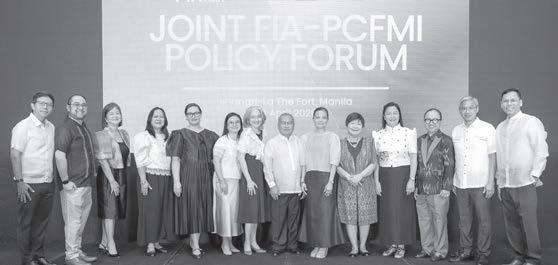
THE Philippine Chamber of Food Manufacturers, Inc. (PCFMI) underscored the need for more science-based, practical, and consultative food policymaking as it convened regulators, food manufacturers, and technical experts for the PCFMI Food Summit 2026, held in partnership with Food Industry Asia (FIA).
Held over two days at Shangri-La The Fort in Manila last month, the summit served as a timely platform for discussions on the emerging regulatory environment now shaping the Philippine food industry, from nutrient profiling and front-of-pack labeling proposals, to local food ordinances, responsible marketing standards, food product registration, and the role of food processing science in improving nutrition outcomes.
For PCFMI, the discussions reinforced that as food regulations become more far-reaching, policy development must increasingly be guided by scientific evidence, implementation feasibility, and stronger public-private consultation.
“The food industry is entering a period where nutrition, regulation, and food security are no longer separate conversations. They are deeply interconnected, and this means policymaking must also become more consultative, more science-based, and more grounded in the realities of the Philippine food system,” said Marites Directo, President and Chairperson of PCFMI.
A major focus of the summit was the growing importance of food reformulation and ingredient innovation in delivering healthier choices to consumers. Regional technical experts shared that while manufacturers continue to invest in nutrition innovation, successful reformulation requires enabling standards, practical transition periods, and regulatory approaches
that recognize scientific limitations.
This was echoed during discussions on international food standards and product regulation, where speakers highlighted the importance of ensuring that policy interventions are preceded by careful technical evaluation and impact assessment to determine both effectiveness and real-world implementation.
PCFMI noted that this principle is especially relevant as the government continues to study the proposed Philippine Nutrient Profile Model (PNPM), which is expected to serve as the basis for future measures such as front-ofpack labeling, food marketing restrictions and even taxation.
“Frameworks such as the PNPM do not operate in isolation. They influence product reformulation, consumer communication, market access, and the future direction of innovation. This is why meaningful collaboration between regulators and private sector — and a clear understanding of implementation impact before policy adoption — are critical to getting policy right,” Directo added.
The summit also featured discussions on food product standards and registration, where the Food and Drug Administration emphasized the importance of evidence-based regulation and the need to fully understand regulatory implications prior to implementation, a principle PCFMI said is increasingly important as more complex nutrition-related policies are being proposed.
Meanwhile, during the Food Summit the National Dairy Authority (NDA) through its Administrator Atty. Marcus Antonius Andaya reaffirmed its continuing support for the dairy and food manufacturing sectors through responsive product registration mechanisms and sustained engagement with industry stakeholders, highlighting the value of government agencies working as partners in strengthening food security and innovation.
The summit likewise emphasized the critical role of pre-packaged food in ensuring food safety, longer shelf life, accessibility, and reliable distribution, particularly in a country where food supply disruptions and price sensitivity remain continuing concerns.
According to PCFMI, the convergence of these policy issues signals a defining moment for the local food manufacturing sector, where regulation must move beyond isolated interventions and toward a more coherent framework that protects both public health and national food security.
PCFMI reaffirmed its commitment to continue working alongside government, technical stakeholders, and consumer groups in shaping food policies that are practical, evidence-driven, and responsive to the realities of Filipino consumers.
JUANHAND , the country’s leading pure fintech lending app, and PalawanPay, one of the fastest-growing and multiawarded-wallets, teamed up during the Singapore FinTech Festival (SFF), marking a shared commitment to improving brand visibility and expanding reach nationwide.
The ceremonial signing brought together key leaders from respective industries to highlight their unified goal: raising awareness for financial inclusion and ensuring Filipinos have a trusted application at their fingertips.
The collaboration aims to build a stronger financial ecosystem for users of both platforms, ensuring they have easy access to trustworthy financial solutions.
Francisco “Coco” Mauricio, President and CEO of JuanHand, expressed optimism about the partnership, stating, “This alliance represents a major milestone in our commitment to providing reliable loan services to Filipinos.”
He emphasized that this partnership will not only enhance their individual brand presence but also advance their mission to serve the underserved yet creditworthy Filipinos and promote financial inclusion in the country.
PalawanPay is a leading e-wallet and digital financial services platform that is trusted by 23M users and is brought by the trusted Palawan Group of Companies, known for providing secure, user-friendly, and reliable money transfer and payment solutions that make everyday transactions

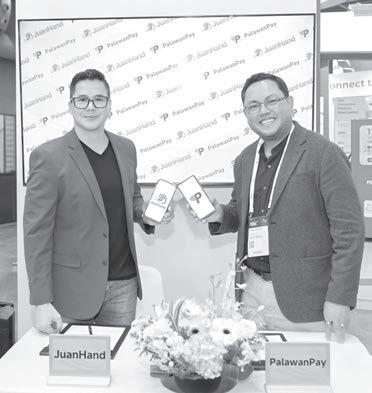
for everyone.
As digital adaptation accelerates across the Philippines, the JuanHand–PalawanPay partnership reflects a growing movement toward collaborative fintech ecosystems, where platforms work together not only to improve scale but also to enhance user experience and consumer empowerment. Both companies reaffirm their commitment to expanding accessible financial solutions, strengthening brand presence, and supporting the evolving needs of the everyday Filipino in the digital economy.

IABC Philippines ushers in new era of communication leadership with 2026-2028 Board of Trustees
THE International Association of Business Communicators (IABC) Philippines officially announced its new Board of Trustees for the 20262028 term, introducing a new leadership team dedicated to advancing the profession of business communication in the country.
The incoming board, composed of esteemed leaders from various sectors of the communications industry, was formally approved by the membership. Richard Arboleda assumes the role of President, succeeding Belle Tiongco, who will now serve as Chairman.
The newly elected 2026-2028 Board of Trustees includes:

SM Hotels and Conventions Corporation (SMHCC) proudly announces the appointment of Kits Pinga as Club General Manager of Pico de Loro Beach & Country Club.
A seasoned hospitality and club management executive, Pinga brings more than 20 years of expertise across the hospitality, fitness, and leisure industries. His appointment marks another significant step in SMHCC’s continuing commitment to strengthening operational excellence and enhancing the overall member and guest engagement within its growing portfolio of premier leisure destinations.
Prior to joining Pico de Loro Beach & Country Club, Pinga served as General Manager of Pueblo de Oro Golf and Country Club, where he oversaw overall club operations, financial management, customer relations, and business development initiatives. Throughout his career, he has held management roles in several respected golf and country clubs, including Dakak Golf Club Inc., Calatagan Golf Club
Inc., Valley Golf and Country Club, and Alabang Country Club.
Known for his hands-on approach and strong operational discipline, Pinga has built a reputation for elevating service standards while cultivating meaningful relationships with members, guests, and teams alike. His extensive background in managing recreational and membership-driven properties positions him well to lead Pico de Loro Beach & Country Club into its next chapter of growth and excellence.
Located in Nasugbu, Batangas, Pico de Loro Beach & Country Club is recognized as one of the country’s premier coastal leisure communities, offering a unique blend of nature, wellness, recreation, and exclusive membership privileges. Under Pinga’s stewardship, the Club aims to further strengthen its position as a preferred destination for families, leisure seekers, and members seeking a well-rounded lifestyle community outside Metro Manila. In his new role, Pinga will oversee the Club’s
overall administration and day-to-day affairs, ensuring alignment with the organization’s strategic objectives, service standards, and member engagement initiatives. He is expected to lead efforts focused on operational efficiency, communitybuilding, and the continuous enhancement of the Club’s lifestyle and recreational offerings.
“I am honored to join Pico de Loro Beach & Country Club and be part of a community that has become synonymous with leisure, wellness, and meaningful connections,” said Pinga. “I look forward to working closely with the team in further strengthening the Club’s service culture, enhancing member benefits, and continuing to build on Pico de Loro’s reputation as one of the country’s premier lifestyle and leisure destinations.”
As SMHCC expands its footprint in the country, the appointment of Pinga reinforces the company’s drive to cultivate transformative leadership, elevate guest experiences, and champion world-class Filipino hospitality across its roster of brands.
“The expectations on communicators today are very different from what they were even a few years ago. The work has become broader, more complex, and increasingly tied to business outcomes, trust, and leadership. If we want to elevate the profession, we have to continue elevating the professionals practicing it. That is the direction we want to lean into at IABC Philippines through stronger opportunities to learn, share expertise, and sharpen the craft behind the work,” said Richard Arboleda, President of IABC Philippines.
The new leadership team will oversee the chapter’s flagship programs, including the Philippine Quill Awards and the returning CEO Excel Awards, while advancing a direction focused on strengthening communicators through more deliberate learning opportunities, greater access to IABC’s global network, and deeper engagement with the work and ideas shaping the profession.
The new Board of Trustees will be guided by its advisers, Ritzi Villarico-Ronquillo, APR and IABC Fellow; Joe Zaldarriaga; Kane Errol Choa, APR; Rey Anthony David; and Carmencita Arce, APR.
The transition marks a continued commitment to high standards of professional practice and good governance within IABC Philippines.


Text
by Randy S. Peregrino
VINFAST is preparing to make its official entry into the Philippine two-wheeler market, and we were given the rare opportunity to witness it firsthand. Flown to Hanoi, Vietnam, we visited the company’s headquarters, toured its dealership, and even walked through the manufacturing plant to see the assembly line in motion.
The highlight, of course, was experiencing the Evo, Feliz II, and Viper e-scooters in action during practical test drives. Each model carries its own personality, yet all share one defining innovation: battery swapping technology.
With preorders expected to begin in June and the official launch set for July 2026, VinFast’s timing could not be more significant. In the Philippines, motorcycles are deeply woven into daily commuting, family mobility, delivery work, and small businesses. As fuel prices continue to fluctuate, the arrival of these e-scooters may well ignite a broader conversation about electric mobility. More than just new models, the Evo, Feliz II, and Viper represent a shift toward cleaner, smarter, and more practical alternatives for Filipino riders.
EVO: THE EVERYDAY URBAN COMPANION

accessibility, the Feliz II takes a more mature stride into urban mobility. Positioned as VinFast’s comfort and lifestyle-oriented scooter, it is designed for commuters and families seeking a smoother everyday riding experience with added practicality.
AMONG VinFast’s upcoming trio of e-scooters, the Evo immediately stands out as the most approachable. Positioned as the entry-level commuter, it is tailored for students, first-time EV users, and everyday urban riders who need practicality without compromise. Depending on the battery configuration, the Evo can deliver up to 150 kilometers of range per charge, while selected variants can reach top speeds of 80 km/h—figures that make it more than adequate for city travel.
Styling-wise, the Evo leans toward the familiar charm of classic European scooters, with the Vespa as a clear inspiration. Its rounded silhouette and clean lines strike a youthful yet timeless balance, avoiding the trap of looking overly retro.
Compact proportions make it nimble enough for filtering through Manila’s congested streets, while thoughtful details—like the rounded LED projector headlamp and minimalist bodywork— add a lifestyle-oriented personality. In essence, the Evo is designed to be both functional and stylish, a scooter that blends seamlessly into the rhythm of
In dual-battery configurations, the Feliz II can travel up to 145 kilometers per charge, while selected variants can reach a top speed of 90 km/h. These figures place it firmly above entrylevel expectations, offering enough performance to handle both weekday traffic and occasional weekend errands.
Visually, the Feliz II has a taller, more substantial profile than the Evo. Its longer body, larger wheels, and planted stance lend it a confident road presence while still maintaining a friendly, approachable character. The added size translates into stability and comfort, making it ideal for office workers and practical commuters who value ease of use without intimidation. With its blend of performance, design maturity, and everyday usability, the Feliz II emerges as a versatile option for riders ready to embrace electric mobility with confidence and convenience.
VIPER: THE SPORTY EDGE OF ELECTRIC MOBILITY AT the sportier end of VinFast’s e-scooter lineup sits the Viper, a model crafted for
available across a lineup that represents the full spectrum of Lexus luxury: The Lexus LM 350h stands at the pinnacle of comfort, redefining mobility with a first-class cabin experience. Alesandra Denise Berberabe writes that the Lexus RX 500h F Sport delivers a more dynamic expression of luxury, combining performance-oriented engineering with bold styling. The Lexus RX 350h balances efficiency and comfort, offering a smooth and composed ride ideal for everyday driving. Its hybrid system ensures quiet operation and fuel

younger and more performance-focused riders. It delivers up to 5,200W of output and reaches top speeds of up to 90 km/h, yet remains practical enough for daily commuting.
This balance of performance and usability highlights the instant torque advantage inherent to electric powertrains, making the Viper the most dynamic character among the trio.
Visually, the Viper projects the most aggressive personality. Sharp body lines, angular lighting signatures, and a taller stance immediately set it apart from the softer styling of the Evo and Feliz II. The front fascia, in particular, underscores its youthful and modern appeal, signaling a scooter designed not just for transport but for riders who want excitement in their everyday journeys. Standard Smart Key functionality adds convenience, reinforcing its premium positioning. For commuters who desire more than utilitarian practicality, or younger riders

body-on-frame construction, advanced off-road systems, and refined cabin, the GX seamlessly combines durability with luxury—equally suited for urban roads and more demanding journeys. The Lexus NX 350h offers a more compact yet equally refined option, designed for modern lifestyles. Agile, efficient, and equipped with intuitive technology, the NX delivers a balance of performance, comfort, and versatility, making it ideal for both city driving and longer trips. Beyond the vehicles themselves, Lexus enhances ownership with a range of premium add-ons and services. To learn more, Aedee directs us to visit the Lexus Manila Gallery at BGC in Taguig City. You can also visit the Lexus website at www.lexus.com.ph or visit its social media pages on Facebook and Instagram @lexusphilippines.

seeking style and spirited performance, the Viper emerges as the standout choice. It embodies the thrill of electric mobility while still fitting seamlessly into the rhythm of city life.
BATTERY SWAPPING: VINFAST’S GAME-CHANGER FOR EVERYDAY RIDERS
ONE of the most compelling aspects of VinFast’s upcoming e-scooter lineup is its integration of battery-swapping technology. Under preliminary Philippine specifications, all three models—the Evo, Feliz II, and Viper—will use LFP batteries, supporting both home charging and swapping.
Charging times range from about 4.5 hours for single-battery versions to roughly 3.5 hours with optional fast chargers on dual-battery variants. This flexibility ensures that riders can adapt charging routines to their lifestyle, whether at home or on the go.
For those opting into VinFast’s battery subscription programs, access to swapping stations will be a key advantage. Buyers who purchase batteries outright, meanwhile, can rely primarily on home charging.
VinFast, together with its ecosystem partner V-Green, is targeting an ambitious rollout of approximately 30,000 battery-swapping stations nationwide. Already, V-Green is working alongside government agencies and private sector partners to establish the infrastructure ahead of launch. The goal is clear: to make the e-scooter ecosystem ready for customers from day one. This approach not only reduces downtime but also lowers barriers to EV adoption, offering riders a practical and reliable alternative to fluctuating fuel costs. More details are available on VinFast’s official website, underscoring the company’s commitment to building a sustainable mobility future.
OWN A HONDA VIA BPI HONDA Cars Philippines Inc. (HCPI) has partnered with the Bank of the Philippine Islands (BPI) to introduce the innovative “Step Up Pay Plan.”
Danielle Ann Pabalan says that by offering a uniquely flexible payment scheme where monthly amortizations start low and grow along with their career and financial milestones, HCPI and BPI are giving families a stress-free payment option, making high quality mobility more accessible, optimistic and rewarding than ever before.
“The program offers a comprehensive all-in package financing scheme for 15 percenbt and 20 percent down payment options on 60-month terms” Pabalan says. “To significantly cut down upfront costs for buyers, BPI will also cover the Personal Property Security Act Service Fees and Insurance for up to P50,000 each.” Promo mechanics and terms:
n ELIGIBILITY: The financing program is applicable to qualified accounts with a minimum loan amount of P500,000.
n PROMO PERIOD: The financing program is valid from May 19 to July 31, 2026.
n DOWN PAYMENT (DP) TERM: The 15 percent and 20 percent DP all-in package is exclusive to 60-month terms and is subject to bank approval.
n PARTNER RATES: Interest rates may vary and are subject to credit review by BPI.
n LIST OF APPLICABLE MODELS: The Step-Up Pay Plan is applicable to the following models: The covered Honda models include the City, City Hatchback, BR-V, and HR-V. For the City, the 2025 year model includes the 1.5 S CVT Honda SENSING and 1.5 V CVT Honda SENSING variants. The 2026 City lineup includes the 1.5 S CVT Honda SENSING, 1.5 S CVT 30th Anniversary Pearl Edition, and 1.5 V CVT Honda SENSING. For the City Hatchback, the 2026 year model includes the 1.5 RS CVT and 1.5 RS CVT 30th Anniversary Pearl Edition variants. For the BR-V, the 2025 year model includes the 1.5 VX CVT Honda SENSING, while the 2026 year model includes the 1.5 S CVT, 1.5 V CVT, and 1.5 VX CVT Honda SENSING variants. For the HR-V, the 2026 year model includes the 1.5 S CVT Honda SENSING and 1.5 V CVT Honda SENSING variants. The 2026 monthly amortization table covers four Honda models and variants. For the City 1.5 S CVT Honda SENSING, the monthly amortization is 17,185 for the 1st year, 17,682 for the 2nd year, 18,412 for the 3rd year, and 19,445 for the 4th year. For the City Hatchback 1.5 RS CVT, the amortization is 20,399 for the 1st year, 20,988 for the 2nd year, 21,855 for the 3rd year, and 23,081 for the 4th year. For the BR-V 1.5 S CVT, the amortization is 19,884 for the 1st year, 20,458 for the 2nd year, 21,303 for the 3rd year, and 22,498 for the 4th year. For the HR-V 1.5 S CVT Honda SENSING, the amortization is 24,677 for the 1st year, 25,390 for the 2nd year, 26,439 for the 3rd year, and 27,921 for the 4th year. Learn more about HCPI’s latest promotions and offers at www.hondaphil.com/promos.
PEE STOP Seemingly, fuel prices have stopped going sky-high, thanks to improved conditions in the
MARITANYA KROG in cycling and Pi Durden Wangkay and Naomi Marjorie Cesar in athletics are three of nine Filipino athletes who will be competing in the Fourth Youth Olympics Games in Senegal this October, according to Philippine Olympic Committee (POC) president Abraham “Bambol” Tolentino. “ They have been nominated by their respective national sports associations [NSAs] and we’re awaiting six more nominations,” said Tolentino on the sides Thursday of the inaugural Philippine National Speed Cubing Open 2026 that the POC is staging at the Tagaytay City Combat Sports Center in partnership with the Asian Mind Sports Association. The International Olympic Committee—which organizes the quadrennial YOG that will be staged October 31 to November 13 in Dakar— has allocated nine Universitality Places for the Philippines.
T hese are two athletes in athletics, one woman cyclist for road and individual t ime trial, one man and woman in artistic gymnastics, one man in windsurfing, one in women’s taijiquan combined in wushu and one i n men’s 100 meters butterfly and one in women’s 1 00 meters breaststroke in swimming.

By Josef Ramos
Tthe Philippine Olympic Committee in partnership with the Asian Mind Sports Association

The YOG are for athletes aged 15 to 18 years old. K rog was nominated based on her sixth-place finish at the Asian Youth Games in Bahrain last year on top of consistently winning gold medals at the Batang Pinoy and National Cycling Championships and for finishing just outside the podium in women’s elimination race in the Asian Cycling Confederation Track Championships at the Tagaytay CT Velodrome last March.
She has the potential although we need to raise the level of her training program for Senegal,” said Tolentino, also the president of the PhilCycling. Wangkay won the men’s 200 meters gold medal and Cesar clinched a silver medal in the girls’ 800 meters behind a Chinese in last October’s Asian Youth Games in Bahrain— Wangkay also won gold in the same event at the Bangkok Southeast Asian Games last December.
L ike Krog, Wangkay and Cesar are both 17.
CALABARZON’S Charles Nathan Boneo again led the charge for Palarong Pambansa records as the Department of Education announced that Quezon City will be the host for the games’ 67th edition next year.
C harles Nathan Boneo added two more gold medals to his collection with the pride of Imus City clocking 57.91 seconds in the boys’ elementary 100-meter freestyle to break the 13-year-old mark of Rafael Barreto of 58.24 seconds in the

“ It’s so much fun as I tried my best to be the fastest,” said the incoming ninth grader at the Balay Sofia Inc. in Baguio City, broke the previous world mark of 5.66 seconds set by Switzerland’s Dhruva Sai Meruva in October 2024 at Swiss Nationals 2024 in Basel.
I have been speed cubing the past four years and this is a great birthday gift for myself,” added Arradaza, whose dad Jovan, a senior web developer, and mother Aleck, an elementary Literature teacher in Baguio City, came in full support.
A rradaza beat in the eight-player final Brenton Wong (11.624) and Juan Miguel Magallanes (12.392) in second and third place, respectively.
Wong, a 19-year-old from Pasig City, topped the regular cube with 5.848 average seconds with 5.431 seconds, while Ethan Gabriel Lao settled for third place with 7.011 seconds average and 6.243 best time.
If I can do it, I believe the other aspiring speed cubers can also play and break some records,” Wong said.
A ragon Martin Gonzales, meanwhile, topped the Pyraminx event averaging 2.755 seconds with a 2.564 seconds best time.
POC President Abraham “Bambol” Tolentino, Asian Mind Sports Association director general Jim Yu and Tagaytay City Mayor Brent Tolentino were on hand during the event that gathered 72 of the best speed cubers in the country.
“ Sports is not just about being physically fit and strong, it
RAIN or Shine head coach Yeng Guiao feels comfortable about the Elasto Painters getting tied at 2-2 with the Barangay Ginebra San Miguel Gin Kings in the semifinals of the Philippine Basketball Association Commissioner’s Cup.
If you’re coming off a win, you have the momentum. And with a 3-2 lead, you have 50 percent of winning the series,” said Guiao, whose wards easily beat Ginebra, 97-85, in Game 4 of the best-of-seven two nights ago. So, the biggest game of the series will be on Friday,” he said “Winning the series in six to seven games will help us—we really like to prolong the series because we’ll have a strong chance.” Jaylen Johnson, who had 13 points and 12 rebounds on Wednesday night, said they learned a lot from Game 4. My teammates played well and we didn’t give up, it was a learning curve last time,” he said. “I just kept going.” Game 5 starts at 7:30 p.m. Friday at the Smart Araneta Coliseum with TNT Tropang 5G and Meralco also trying to take the initiative in their own series starting at 5:15 p.m. Despite the lopsided outcome,
emotions flared—not inside the court though as Guiao and Ginebra governor Alfrancis Chua exchanged heated words after the final buzzer.
Guiao accused Chua of intimidating the referees during halftime break but Chua denied any wrongdoing and told the seven-time champion coach “to mind his own business and focus on coaching his own team.”
J ustin Brownlee, who had 27 points and 10 rebounds in Game 4, is expected to comeback stronger with Scottie Thompson and RJ Abarrientos providing the needed firepower.
A fter a disastrous 75-77 loss to import less TNT in Game 3, the Bolts came back with a new import, 7-foot Patrick Gardner, who scored 20 points and grabbed 13 rebounds despite fouling out in a 101-90 victory in Game 4. R eturning import Chris McCullough posted 24 points on 7-of-22 s hooting from the field plus nine rebounds to lead TNT. Josef Ramos

2013 Palaro in Dumaguete City. W ith only a few minutes rest at the Datu Lipus Makapandong Governor DO Plaza Sports Complex in Prosperidad, Agusan del Sur, the 12-year-old Elizabeth Seton School sixth grader anchored Region 4-A’s victory in the boys elementary 4x100-meter medley relay in 4:40.37 with Rui Andrews Lacuna, Linus Lalog and David Tristan Reyes.
T hey took a second off the old record of 4:41.55 set by a National Capital Region (NCR) team in the 2015 edition in Tagum City.




By Butch Fernandez
AMERICAN basketball player Bennie Boatwright is headed for a much-desired stint with Gilas Pilipinas after the Senate approved on second reading House Bill No. 6639 which seeks to grant him Filipino citizenship. Senator Francis “Kiko” Pangilinan, as the previous chairman of the Senate Committee on Justice and Human Rights, sponsored and defended the measure during the Senate’s plenary session when the period of interpellation was opened.
of 32 gold, 20 silver and 28 bronzes at press time, followed by Calabarzon (25-19-13), Western Visayas (14-14-12), Central Visayas (13-14-16) and Bicol Region (9-8-9).

I locos Region’s Anton Paulo Dominick Della also broke the boys’ high school 1,500-meter freestyle event with a time of 16:38.41, nearly 13 seconds faster than the old standard of 16:51.12 set by Miguel Barreto in 2019 in Davao City. Defending champion NCR was provisionally on top of the medals race with a combined elementary and high school haul

TD epEd Undersecretary and Palaro secretary-general Malcolm Garma, meanwhile, said the turnover of hosting rights will be attended by Quezon City officials during the closing ceremony on Sunday.
Q uezon City will be hosting the Palaro for the first time since 1966.
OP seed Digvijay Singh and second-ranked AJ Lim dismantled their respective rivals to move within a victory of a highly anticipated championship showdown in the P2-million Palawan Open 2026 at the Rizal Memorial Tennis Center. Singh sustained his ruthless form as the 6-foot-3 ace from Haryana—a multiple International Tennis Federation World Tennis Tour champion and Davis Cup veteran—cruised past Jarell Edangga, 6-0, 1-0 (ret.), before smothering John Kendrick Bona, 6-1, 6-0, to claim the first semifinals slot and a shot at the top P300,000 purse. Singh will next face No. 4 Christopher Papa of the US, setting up a highly-charged 4 p.m. Friday clash of power and style. Papa advanced by deflating local hopeful Arthur Pantino, 6-1, 6-1 triumph. Pantino
Granting Boatwright Filipino citizenship will pave the way for him to join the men’s national basketball team particularly in the Nagoya Aichi 20th Asian Games in September and the FIBA World Cup Qualifiers. However, Pangilinan pointed out that possible contributions to winning championships in the games were not the only determinant for naturalizing athletes seeking to make the Philippines their home. We made this clear during the hearings. Senator Jinggoy Estrada was there asking about Boatwright’s intentions of residing in the Philippines. So, therefore, yes,” Pangilinan said. “There has to be not simply a commitment to play basketball for the country, but also to embrace what it means to be Filipino, and we were convinced.”
At 6-foot-10, Boatwright will give Gilas Pilipinas a height advantage and would make the team more competitive, given that neighboring countries also have a pool of naturalized players in their roster, the senator explained.
B ased on records, Indonesia and Lebanon each have five naturalized players, while Japan has 12. The Philippines currently has six naturalized basketball players. So, this gives us a sense of the competition out there in terms of naturalized players of their respective countries mentioned. And that’s why we do have this pool of players, it will then give our coaches more flexibility and leeway in terms of being able to put together a strong team, Mr. President,” Pangilinan said in his final defense of the naturalization bill. He also alleviated concerns regarding the athlete’s allegiance to the country, saying that these were thoroughly discussed during the committee hearings on the pending measure. This, after one senator wanted to know if Boatwright’s desire to be a Filipino included a commitment to fight for, even “die,” for his adoptive country, if necessary. P angilinan said: “I agree that contributions to a championship team should not be the only basis for citizenship,” the senator added. “So, we made sure, through our questions, to determine his willingness to embrace Filipino culture, to settle down in the Philippines, and whether he associated himself with Filipinos and FilipinoAmericans while in the US.”