
“Inday Badiday na ba tayo dito sa Senado?”

.” ROY DOMINGO

“Inday Badiday na ba tayo dito sa Senado?”
.” ROY DOMINGO
THE sharp jump in the Philippines’s external debt service burden is a signal that the country should “stay disciplined” to ensure strong foreign exchange earnings particularly from exports and remittances to fulfill its obligations, according to an analyst.
An analyst pointed this out after latest data from the Bangko Sentral ng Pilipinas (BSP) showed that the Philippines’s external debt service burden (DSB) rose by 31.54 percent in the January to February 2026 period.
BSP data showed the DSB increased to $2.127 billion in the January to February period of
2026, 31.54 percent higher than the $1.617 billion posted in the same period last year.
DSB is the total principal and interest payments the country has to pay after the debt has been rescheduled.
Broken down, $884 million of the external DSB for the twomonth period was allotted for principal, while $1.243 billion was for interest payments.
Principal payments climbed by 129 percent year-on-year from $386 million, while interest payments marginally increased by 0.89 percent from last year’s $1.232 billion.
Jonathan L. Ravelas, senior ad-
viser at Reyes Tacandong & Co. explained that the “sharp” jump in the country’s external debt service burden early this year is “less about a sudden deterioration and more about timing and structure.”
‘The big story’ RAVELAS pointed to the 129-percent surge in principal payments as the “big story.” He said: “This tells us maturities are clustering, meaning we’re repaying more obligations that simply fell due, rather than borrowing improperly.”
In contrast, he said interest payments are “relatively flat,” which suggests borrowing costs are stabilizing despite the high global
rate environment.
From a macro perspective, Ravelas said this is “manageable—but it’s a signal to stay disciplined.”
“The Philippines still needs to ensure strong foreign exchange earnings, particularly from exports and remittances, to comfortably service these obligations. The key risk to watch is liquidity—if global financial conditions tighten again, refinancing could become more expensive,” the analyst pointed out further.
While the latest data is not yet a “red flag,” Ravelas stressed: “We must continue lengthening debt maturities, diversify funding



By Andrea E. San Juan @andreasanjuan
Coordination Council (FSCC) has flagged risks to the Philippine financial system, particularly debt levels for both corporate and household sectors amid the ongoing Middle East conflict.
In a statement on Monday, the FSCC noted that a prolonged war in the region could push oil prices higher, adding that this could weaken market sentiment, tighten financial conditions, and drag down both global and domestic growth. As such, the council—composed of the Bangko Sentral ng Pilipinas (BSP), Department of
By Samuel P. Medenilla @sam_medenilla
PRESIDENT Ferdinand
Marcos Jr. will be cele -
brating the country’s 70th anniversary of the normalization of diplomatic relations with Tokyo with the signing of new agreements on defense, trade and investment, and human resources during his first state visit in Japan this week, according to the Department of Foreign Affairs (DFA).
The chief executive together with First Lady Louise Araneta-
Marcos and the Philippine delegate will travel to Japan from May 26 to 29 for the state visit upon the invitation of the Japanese government. It will be Marcos’s fourth visit to Japan since he assumed the presidency in 2022.
In a press briefing in Malacañang on Monday, DFA spokesperson Analyn D. Ratonel said Marcos and Japanese Prime Minister Sanae Takaichi will announce the signing of the new bilateral agreements.
“The President will also hold
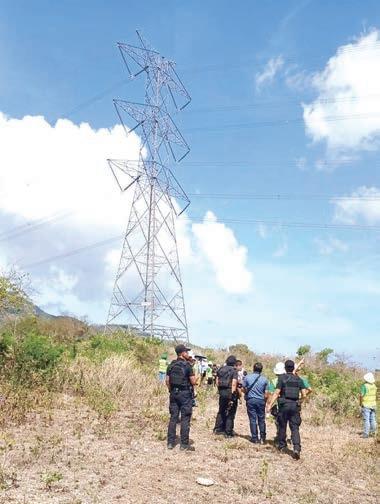
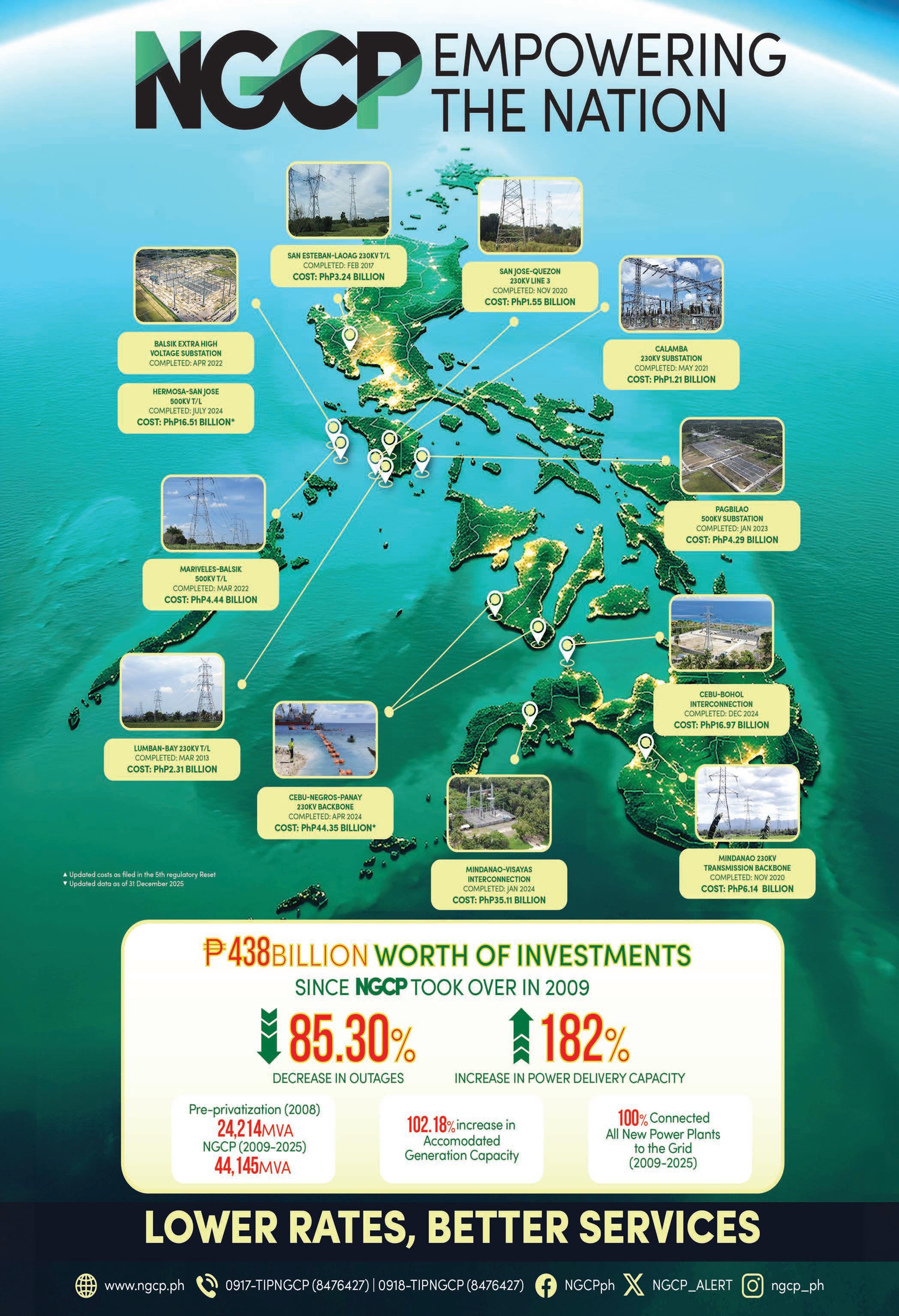
SABOTAGE? NGCP ASKS PNP HELP The National Grid Corp. of the Philippines (NGCP) formally requested the assistance of the Philippine National Police (PNP) in investigating a possible act of sabotage involving the Ilijan-Tayabas 500-kiloVolt (kV) Transmission Line. The transmission disturbance resulted in the loss of around 1,700MW of power delivered from generating plants connected to the line. The incident further aggravated the already thin generation reserves in Luzon and Visayas, which eventually led to the declaration of red and yellow alerts in both grids. Story on page A4 Nation, “NGCP seeks police probe into possible sabotage of IlijanTayabas 500kV line.”

SUSTAINED high fuel cost due to a prolonged Middle East conflict is seen to increase the credit risk of banks in the Philippines and other countries in Asia-Pacific through loan portfolios and other financial channels, according to Moody’s Ratings.
In a commentary on Monday, Moody’s Ratings explained how elevated energy costs would translate into gradual credit strain of banks among countries situated within the Asia Pacific region, including the Philippines.
The credit rating agency pointed out that sustained high fuel costs in its central scenario will add on inflationary pressure in economies such as India, Indonesia, the Philippines and Bangladesh, “straining” consumers’ budgets and raising debt-servicing burdens for households and small and medium-sized enterprises (SMEs).
“This will translate into increased but gradual credit strain on such loans,” Moody’s Ratings said. However, it noted that given the absence of a macroeconomic hard landing, any deterioration in these portfolios is likely to be moderate.
For retail loans, the credit rating agency said it expects some “deterioration” in non-mortgage retail loans across the region.
In particular, banks in Indonesia and the Philippines are the “most exposed,” because of larger portfolios, at around 10 to 15 percent of gross loans, or due to significant growth in the last few years, as with the Philippines.
Other financial channels
MEANWHILE , the credit rating agency flagged foreign exchange dynamics and low remittance flows as risk channels for banks particularly for those countries which rely
heavily on energy imports.
“Economies with high dependence on energy imports, capital flows, or both—such as Korea, India, Australia, Thailand, the Philippines and Indonesia—have faced greater currency depreciation [3 to 7 percent] against the dollar since the conflict in the Middle East began,” Moody’s Ratings said. The credit rating agency explained that local currency weakness raises the debt-servicing burden for borrowers with unhedged dollar loans, adding to banks’ asset quality concerns. Further, Moody’s Ratings said: “Remittance flows from Gulf Cooperation Council economies are another risk channel for banks in the Philippines and Bangladesh, given the significant share of remittances originating from nationals working in the Middle East.”
“A prolonged conflict introduces
uncertainty if labor conditions in the Middle East are significantly disrupted, leading to softer remittance flows,” added the credit rating agency. So far, data for early 2026 suggests that remittances remain resilient, helping to sustain bank deposit bases. Nonetheless, any “material slowdown” in remittances would have a negative impact on banking system liquidity and local consumption, Moody’s Ratings underscored further. Despite the occurrence of the Middle East conflict, data released by the Bangko Sentral ng Pilipinas (BSP) showed that the money sent home by Filipinos based in Middle East countries even climbed by 19.94 percent to $565.91 million in March 2026, from the $471.84 million recorded in February. (See: https://busi-
By Justine Xyrah Garcia
trade in the Philippines fell by more than a third in the first quarter of 2026, according to data released by the Philippine Statistics Authority.
PSA data showed the volume of commodities transported from one region or province to another declined by 35.3 percent to 10.17 million metric tons (MT) in the January-to-March period, from 15.72 million MT recorded in the same period last year. The total value of domestic trade also dropped by 19.8 percent to P820.81 billion during the quarter, from P1.02 trillion a year earlier. Most goods were transported via road, which accounted for 50.6 percent of total domestic trade volume; followed by water transport at 49.3 percent and air transport at 0.04 percent, the
PSA said. By commodity type, mineral products accounted for the largest share of domestic trade volume at 3.07 million MT, equivalent to 30.2 percent of the total.
Prepared foodstuffs, beverages, and tobacco followed at 2.50 million MT, while vegetable products reached 2.40 million MT. In terms of trade value, machinery and transport equipment emerged as the top-traded commodity category in the first quarter, amounting to P200.96 billion or 24.5 percent of total domestic trade.
Optical, photographic, cinematographic, measuring, check -
ing, precision, medical and surgical instruments and accessories followed with P118.70 billion or 14.5 percent share, while prepared foodstuffs, beverages, and tobacco products reached P117.36 billion or 14.3 percent.
The PSA said regional trade flows were led by the Davao Region (Region XI), which posted the highest outflow volume at 1.94 million MT or 19.1 percent of total domestic trade volume during the quarter.
Central Luzon (Region III) followed with 1.61 million MT, while Calabarzon (Region IV-A) recorded 1.53 million MT.
On the receiving end, the National Capital Region (NCR) registered the highest inflow volume at 2.36 million MT, accounting for 23.2 percent of total domestic trade inflows.
Soccsksargen (Region XII) followed with 1.73 million MT, while Central Luzon posted 1.13 million MT in inflows.
In terms of value, Calabarzon recorded the highest outflow at P331.62 billion or 40.4 percent of total domestic trade value.
Central Visayas (Region VII)
followed with P100.50 billion, while the Davao Region registered P98.41 billion.
Meanwhile, NCR posted the highest inflow value at P357.73 billion, accounting for 43.6 percent of total domestic trade value during the period.
In terms of trade balance, or the difference between outflows and inflows, Calabarzon posted the highest favorable balance at P247.82 billion, followed by Central Visayas at P74.37 billion and the Davao Region at P72.11 billion.
Meanwhile, the NCR recorded the largest trade deficit at P277.15 billion, followed by Soccsksargen at P87.03 billion and the Negros Island Region at P73.60 billion.
PSA said the Domestic Trade Statistics tracks the movement of goods within the country using administrative data from different transport systems, specifically for road, air, and water transport.
Rail transport is excluded following the Philippine National Railways’ (PNR) discontinuation of cargo operations.
Finance (DOF), Securities and Exchange Commission (SEC), Insurance Commission, and Philippine Deposit Insurance Corporation (PDIC)—said it “remains alert” as borrowing costs rise and debt levels for both household and corporate sectors continue to grow.
On corporate debt, the FSCC flagged exposures to energy- and interest-rate sensitive sectors as areas to watch.
“Higher energy costs and tighter financing conditions could raise debt-servicing burdens and compress firm margins,” the council pointed out, adding: “That, in turn, could affect bank asset quality.”
The council also noted that rising bond yields could lead to valuation losses on banks’ securities holdings. If market pressures persist, this may affect capital buffers.
On household debt, the FSCC sees the need to closely monitor borrowers’ ability to pay loans.
“Geopolitical risks remain a key source of uncertainty,” said BSP
Governor Eli M. Remolona Jr., who also chairs the council.
As such, Remolona said the FSCC is watching global developments closely to “spot and address potential systemic risks.”
“We see pockets of vulnerability in energy- and interest-ratesensitive sectors and in valuation pressures from higher bond yields. Nonetheless, the financial system remains on solid footing. Banks have adequate capital and liquidity buffers to absorb shocks and keep
lending to households and firms,” he added, The council said it is also strengthening “oversight” of non-bank financial institutions (NBFIs) which include quasi-banks, investment houses, non-stock savings and loan associations, pawnshops, and trust corporations.
“The council is also working to improve how it monitors systemwide risks and interlinkages,” the FSCC noted in its statement. This statement came out on the same day Moody’s Ratings issued a commentary in which the credit rating agency pointed out that sustained high fuel costs due to a prolonged Middle East conflict could increase credit risk of banks through loan portfolios and other financial channels such as foreign exchange dynamics and remittance flows.
Moody’s Ratings said protracted high energy costs will add on inflationary pressure in economies such as India, Indonesia, the Philippines and Bangladesh, which could strain consumers’ budgets and raise debtservicing burdens for households and small and medium-sized enterprises (SMEs.) Latest data from the central bank indicated that even as the non-performing loans (NPLs) ratio eased to 3.29 percent in March, which was the lowest in three months, the Philippine banking system’s stock of bad loans climbed to a record high of P568.553 billion. (See: https://businessmirror.com. ph/2026/05/18/loan-growthoutpaces-record-climb-of-nplsto-%E2%82%B1568-553b/).

By Rex Anthony Naval
THE Armed Forces (AFP) on Monday welcomed the latest Octa Research Survey which showed that 76 percent of adult Filipinos are willing to defend the country’s territories, including the vital West Philippine Sea (WPS).
The AFP welcomes the latest Octa Research Survey results, which reveal that 76 percent of Filipinos stand firmly behind the government’s commitment to defend our national territory, particularly the WPS,” The AFP spokesperson for the WPS, Rear Adm. Roy Vincent
Trinidad, said in a message to reporters. He added that this “overwhelming manifestation of support” with only 7 percent disagreement strengthens the AFP’s resolve to keep performing its mandate. It also underscores that the defense of our sovereignty, sovereign
rights and maritime entitlements is a collective duty anchored on national unity,” Trinidad noted.
He also emphasized that the AFP, guided by its constitutional mandate, and the Comprehensive Archipelagic Defense Concept, remains committed to its duty of securing the country’s exclusive economic zone and fishermen.
This strong public trust fortifies our determination to resist coercive and illegal actions in our waters. We assure the Filipino people we will continue to perform our operations with professionalism, transparency and adherence to international law,” Trinidad said.
The survey said 76 percent of adult Filipinos have committed to defending Philippine territories, including t he WPS, with 17 percent undecided and another seven percent expressing disagreement on this premise. Support was highest in the National
Capital Region at 83 percent and Balance Luzon at 77 percent.
M imaropa (Mindoro, Marinduque, Romblon and Palawan) registered the highest support at 93 percent, followed by Caraga at 91 percent, and Western Visayas at 90 percent.
R espondents from the Visayas and Mindanao showed the lowest agreement at 68 percent and 75 percent, respectively. Central Visayas had the lowest agreement at 45 percent.
“Agreement ranges from a high of 93 percent in Mimaropa to a low of 45 percent in Central Visayas—a 48-point gap that reveals significant regional variation beneath the national headline,” Octa said.
The survey’s most critical outlier is the Duterte bailiwick Davao Region, where disagreement reaches 34 percent, five times the national average, making it the single most important sub-national
finding of the study,” it added.
Octa also said that in terms of educational attainment, the agreement rate w as highest among vocational graduates at 85 percent, and college-educated Filipinos at 80 percent.
B y socioeconomic class, support was highest among Classes ABCD at 76 percent, and Class E at 71 percent.
Support for territorial defense is not concentrated among the educated or affluent. Class D—which comprises 75 percent of the Filipino population— mirrors the national average exactly at 76 percent,” the OCTA said.
The survey has a ±3 percent margin of error at a 95 percent confidence level. Subnational estimates for the geographic areas covered in the survey have margins of error of ±6 percent for NCR, Balance Luzon, Visayas, and Mindanao, also at a 95 percent confidence level. With PNA
By Jovee Marie N. Dela Cruz @joveemarie
HE Land Transportation Office
T(LTO) on Monday revealed to the House of Representatives that the Land Transportation Management
System (LTMS) has been running without an active maintenance contract this year, heightening concerns over cybersecurity vulnerabilities and potential service disruptions affecting millions of motorists. A t a House Committee on
Transportation hearing, the LTO executive director, lawyer Martin P. Ontog, said the agency has been forced to rely on backup or parallel systems to keep essential services—such as driver’s license issuance and vehicle registration—operational.

The admission came as lawmakers scrutinized the P3.19-billion LTMS project, which continues to face long-standing operational issues years after its rollout. The LTO cited repeated findings by the Commission on Audit (COA) pointing to delays, incomplete features, and persistent system deficiencies.
A mong the unresolved problems are key functions affecting motorists and transport operators, including Public Utility Vehicle (PUV) processing, advance license renewals, and the automated uploading of medical certificates—many of which still require manual processing.
T he LTO also revealed that maintenance contracts for various LTMS modules began expiring in January 2026, with the final module lapsing in May. Without an active maintenance agreement, the system currently lacks contractual support for patch management, security monitoring, and incident response.
Further raising concerns, lawmakers were told that its computer service
provider Dermalog’s own budget proposal to Congress earmarked around P2 billion to P2.5 billion for cybersecurity upgrades—suggesting that major system improvements are still necessary.
Despite the risks, the LTO assured lawmakers that its top priority is maintaining uninterrupted public service while working toward a full transition of system control to the government.
Th e agency also stressed that it cannot authorize additional payments or settlements without proper congressional appropriations and strict compliance with procurement and audit regulations.
D ermalog, for its part, has maintained that it fulfilled its contractual obligations and has asserted intellectual property rights over portions of the system and its software.
The LTO said it remains focused on safeguarding public data and ensuring continuous service delivery as legal and transition processes move forward.
NGCP seeks police probe into possible sabotage of Ilijan-Tayabas 500kV line
HE National Grid Corporation
Tof the Philippines (NGCP) has formally requested the assistance of the National Police (PNP) in investigating a possible act of sabotage involving the Ilijan-Tayabas 500-kiloVolt ( kV) Transmission Line.
I n a letter dated May 15, 2026 addressed to the PNP Chief, Gen. Jose Melencio C. Nartatez Jr., and the Batangas City Police Chief, Lt. Col. Lira A. Morello, NGCP reported that the Ilijan-Tayabas 500kV line tripped at approximately 6:30 a.m. on May 13, 2026 after the conductor between Towers 129 and 130 in barangay Haligue Silangan, Batangas City, got severed.
T he transmission disturbance resulted in the loss of around 1,700MW of
power delivered from generating plants connected to the line. The incident further aggravated the already thin generation reserves in Luzon and the Visayas, which eventually led to the declaration of red and yellow alerts in both grids.
I mmediately after the incident, NGCP personnel conducted an inspection of the affected facility. Initial f indings showed that the damage appeared inconsistent with normal wear and tear or natural causes. The severance reportedly occurred within the conductor span between spacers and exhibited characteristics suggestive of deliberate human intervention. Prior inspections on the line also showed no defect or abnormality that could have caused such damage.
By Jonathan L. Mayuga @jonlmayuga
THE Pambansang Lakas ng Kilusang Mamamalakaya ng Pilipinas (Pamalakaya) on Monday expressed full support for the initiative of the Makabayan bloc in the House of Representatives in filing the House Resolution 1050, which calls for an investigation on the growing presence of commercial fishing vessels within the 15-kilometer municipal waters.
A ccording to the group, the number of commercial fishing vessels detected in various municipal fishing grounds has drastically increased since a controversial Supreme Court ruling in 2024 that would eventually “legalize” commercial fishing within the 15-kilometer municipal fishing grounds.
T he controversial ruling is the Supreme Court’s First Division decision affirming the case of Mercidar Fishing Corporation v Republic (GR 270929) in August 2024, which upheld a lower court decision invalidating provisions of the Philippine Fisheries Code. It effectivelyopensupthe15-kilometer municipal water zone—areas historically and constitutionally reserved for small-scale, artisanal fishers—to large commercial fishing operations.
Filed by the Makabayan bloc on Monday, the House Resolution mandates the appropriate House committees to investigate, in aid of legislation, the presence of commercial fishing vessels within the municipal waters, and its impacts on the livelihood of municipal fisherfolk and the marine environment. The resolution cited monitoring data from the Karagatan Patrol, which reveals that commercial fishing operations within the municipal waters reached a five-year high in March 2026, with 3,853 detections recorded in a single month.
“Ronnel Armabulo, Pamalakaya vice chairman, noted the increasing number of commercial fishing in the municipal fishing ground two years after the controversial Supreme Court ruling.
T iyak ang epekto nito sa kabuhayan ng maliliit na mangingisda dahil agarang nasasaid ng mga commercial fishers ang isda sa tradisyunal naming pangisdaan,” he said.
T he fishers’ group also urged the House of Representatives to enact the House Bill 5606, or the “Atin ang Kinse Kilometro Bill,” which gives exclusive rights to small fishermen the 15-kilometer municipal waters. The bill was filed by the Makabayan legislators last year.
Given the circumstances surrounding the incident, NGCP deemed it necessary to seek law enforcement assistance to ensure a thorough and impartial investigation. Protecting the integrity and security of the country’s transmission network remains critical to maintaining reliable power delivery nationwide,” NGCP said. NGCP also assured authorities of its full cooperation and committed to provide all relevant technical findings and information needed for the investigation.
T he company stressed the importance of safeguarding critical transmission infrastructure, especially as the country continues to e xperience tight power supply conditions during periods of high demand.
PNP coordinating with counterparts on ICC warrants
By Rex Anthony Naval
THE National Police (PNP) Chief, Gen. Jose Melencio Nartatez Jr., on Monday said the service remains on alert and is “fully aligned” with other law enforcement partners amid reports that the International Crime Court (ICC) may issue additional arrest warrants soon. I n a statement, Nartatez said the PNP continues to anchor its actions on due process and established legal frameworks.
The PNP chief issued this statement after reports claimed that the ICC is now preparing to issue several arrest warrants against several personalities in the Philippines. We remain fully committed to our
mandate of upholding the rule of law, including the enforcement of any legal orders. As officers of the law, this is our sworn duty. We in the PNP remain true to that commitment to the Filipino people,” Nartatez said. The assurance was made as the PNP continues coordination with the National Bureau of Investigation and other agencies in anticipation of possible legal actions that may require joint operational response.
E arlier, Palace press officer Undersecretary Claire Castro said Malacañang wants forthcoming ICC warrants to be enforced in the soonest possible time, especially with the recent decision of the Supreme Court.
“Our personnel will only act upon orders issued by proper authorities,
ensuring that they are in accordance with existing rules and protocols,” he added. Background discussions within law enforcement circles include references to existing and potential ICC actions involving public officials, including Sen. Ronald dela Rosa, who is facing a standing arrest warrant from the ICC related to alleged crimes against humanity. Despite these developments, Nartatez stressed that operational readiness is guided by strict protocol and inter-agency coordination rather than speculation or informal reports. He added that discipline and adherence to procedure remain central to all police actions, particularly in sensitive international legal matters that may require coordinated enforcement.
By Samuel P. Medenilla | @sam_medenilla & Justine Xyrah Garcia
PRESIDENT Marcos has named former senator Francis N. Tolentino as acting Labor secretary, replacing Secretary Bienvenido E. Laguesma, who stepped down owing to health reasons.
Tolentino took his oath of office before the Chief Executive on Monday—two weeks after the one-year ban for the appointment of candidates who lost in the 2025 polls lapsed. The former lawmaker was among the senatorial candidate endorsed by Marcos under the Alyansa Bagong Pilipinas in the 2025 polls.
As wage boards deliberate on petitions, senator pushes P1,500 monthly subsidy
By Butch Fernandez @butchfBM
AS the wage board for Metro Manila opened consultations on v arious petitions for pay hikes, a senator is pushing for another buffer for them amid the crippling inflationary impact of the oil price and supply c hain issues triggered by the war in the Middle East.
On Monday, Sen. Sherwin Gatchalian reiterated his call for a P1,500 monthly subsidy for about five million minimum wage earners following a rapid increase in inflation last month, slower economic growth in the first quarter of the year, and forecasts of persistently high inflation.
Lest we forget, the country is still in a crisis amid all the political noise. Our people, particularly the vulnerable sectors, are suffering from high prices of basic commodities and need a little respite,” Gatchalian said.
He pointed out that the 7.2 percent inflation rate significantly eroded purchasing power. Using P1,000 in 2018 as the base value, purchasing power declined from P775.80 to P732.60 for the total population, and from P773.40 to P715.82 for the bottom 30 percent of the population.
Gatchalian said the subsidy would not only ease the financial burden on minimum wage earners but also boost domestic consumption and help stimulate the economy.
M alaking bahagi ng suweldo ng mga minimum wage workers ang napupunta sa pang - a raw - araw na gastusin kagaya ng pagkain at pamasahe Kailangan natin silang tulungang malagpasan ang krisis na patuloy nating hinararap [A big part of the salary of minimum wage workers goes to their daily expenses like food and transport fare. We need to help them surmount the crisis that we all continue to face],” he added.
The P1,500-per-month subsidy is one of the recommendations of the Senate Protect ad hoc panel. If approved, the subsidy is expected to cost the government P7.5 billion per month.
Palace Press Officer Claire Castro said the President picked Tolentino to become a member of his Cabinet owing to his vast experience in public service.
“ President Marcos Jr. is confident that incoming acting Secretary Tolentino will be able to lead the Department of Labor and Employment well b ecause of his ability and extensive
experience in holding important positions in both local and national governments,” she said in Filipino in a press briefing last Monday.
Tolentino served as aenator from 2019 to 2025. Prior to becoming a lawmaker, he also served as mayor of Tagaytay City, chairman of the Metropolitan Manila Development Authority ( MMDA), and served as Presidential Adviser on Political Affairs of former President Rodrigo Duterte.
Following the appointment of Tolentino as the new labor chief, workers’ g roups hope that his leadership at Dole would translate into stronger dialogue with labor groups and concrete action on long-standing worker concerns. Federation of Free Workers (FFW) President Sonny G. Matula said he hopes Tolentino would prioritize dialogue with workers and “quickly immerse himself” in issues affecting labor, in-
cluding wages, job security, inflation, contractualization, and the impact of new technologies on employment.
Given Secretary Tolentino’s limited background in labor relations compared to Secretary Laguesma, we hope his immediate priority will be to listen closely to workers, employers, and labor stakeholders and to strengthen social dialogue within the Department,” Matula told the BusinessMirror.
M atula also said the Dole under Tolentino’s leadership should serve as a bridge for social dialogue.
In times of economic uncertainty, tripartism is not a ceremonial table— it is where industrial peace and social justice must continuously be negotiated,” he added.
Similar sentiments were echoed by the Sentro ng mga Nagkakaisa at Progresibong Manggagawa (Sentro), which said it hopes Tolentino’s appointment
More than 1 million back universal pension bill for senior citizens
By Jovee Marie N. Dela Cruz @joveemarie
MOREthanonemillionsignatures urging the immediate passage of a universal social pension bill for senior citizens were formally turned over to House leaders on Monday, as lawmakers and elderly groups intensified calls for stronger government support amid rising living and healthcare costs.
T he ceremonial partial turnover was led by the House Committee on Senior Citizens chairwoman, Partylist Rep. Milagros Aquino-Magsaysay of United Senior Citizens, during the campaign event titled “Milyong Lagda Para sa Matatanda: Universal Social Pension, Ngayon Na,” held at the House of Representatives.
“ We are all part of history in the making,” Aquino-Magsaysay said in her speech, describing the campaign as a growing nationwide movement among senior citizens seeking the passage of a long-awaited universal pension measure.
C urrently, the Social Pension for
Indigent Senior Citizens (SPISC) provides a P1,000 monthly stipend to poor, frail, or disabled Filipinos aged 60 and above who have no income, pension, or family support.
Aquino-Magsaysay said the signature campaign, launched on March 18 this year, has mobilized senior citizens’ associations, organizations, and federations all over the country in support of the proposed legislation.
“ Our ceremonial partial-turnover today of the more than one million signatures in support of the bill reverberates the strong clamor of the more than 12 million senior citizens all over the country asking for the government to give preferential attention for the promotion of their welfare and rights,” she said.
A quino-Magsaysay noted that she has been advocating the measure since the 17th Congress, stressing that the proposed pension is not a privilege but a recognition of the rights of elderly Filipinos.
With the emergence of various
economic crises and challenges that befall our elderly, now more than ever, the Universal Social Pension becomes an existential and moral imperative,” she added.
She emphasized that many senior citizens continue to struggle with poverty, hunger, and limited access to healthcare and social services.
T he lawmaker said the signature drive will continue nationwide until the proposed measure is enacted into law.
Meanwhile, the House Committee on Senior Citizens reviewed several measures aimed at strengthening the welfare, protection, and social support systems for the elderly through expanded benefits, healthcare assistance, and stronger legal safeguards.
“ The laws we craft today will help shape a future where senior citizens are not marginalized or forgotten. We must give birth to a future generation where our Filipino ‘lolos and lolas’ are respected, protected, and empowered,” Aquino-Magsaysay said.
By Ada Pelonia
THE National Food Authority (NFA) will auction off more than 50,000 metric tons (MT) of aging rice stocks in June.
N FA Administrator Larry Lacson said the fourth round of auction, which was initially scheduled for early May, will be moved to June as the agency revises the guidelines.
We’re trying to determine the floor price based on the current numbers,” Lacson told reporters on Monday.
H e said the NFA will slightly increase the floor price following the up tick in retail rice prices. The previous prices range from P22 to P28 per kilo, depending on how long the rice has been stored. The approved volume tends to cover milled rice stocks aged over three months to 18 months.
“ The price of rice increased, and it’s only declining now. We have to consider the prevailing price and the price of imported rice because you can’t determine t he [floor price] without looking at those,” Lacson said.
H e explained, however, that the strict implementation of the P50 per kilo price cap on imported rice and the bid to impose a suggested retail price (SRP) on local rice at P53 per kilo could dampen the appetite for NFA auction.
“ If prices of rice are higher outside, it’s more attractive to purchase in the auction since it’s cheaper. But if it’s otherwise, the interest of prospective participants could wane,” Lacson said.
W hile the grains agency plans to hold an auction regularly, the NFA chief said the volume on succeeding trade will be fewer to accommodate the government’s P20 per kilo cheaper rice program.
CBy Carmel Pedroza
EBU CITY—Pork Producers Federation of the Philippines Inc. (PROPORK) has criticized the Marcos administration’s decision to significantly raise the pork import allocation, warning that the move could hurt the recovering local hog industry.
On May 19, President Marcos approved Executive Order 116, which expands the Minimum Access Volume (MAV) for pork imports to 204,250 metric tons from the previous 54,250 metric tons while also maintaining lower tariff rates.
P ROPORK President Eric Harina described the decision as disconnected from the actual conditions faced by local hog raisers.
would bring “genuine change in direction for labor governance.”
S entro Secretary General Josua Mata said workers and unions have long struggled against policies and practices that, according to the group, weakened social dialogue and delayed key labor reforms, including the implementation of recommendations under t he International Labour Organization (ILO)’s High-Level Tripartite Mission roadmap (See: https://businessmirror.com.ph/2023/01/24/380-laborrights-cases-in-report-to-ilo-hltm/)
We hope that Secretary Tolentino will choose a different path – one g rounded in genuine engagement with workers, respect for trade union rights, and decisive action to realize the country’s commitments under the ILO roadmap,” he added.
M eanwhile, the Trade Union Congress of the Philippines (TUCP)
By Henry J. Schumacher & Santos L. Cejoco
LAST week Mr. Schumacher wrote a column with the title The Bamboo Industry Might Save the Philippines. That column has raised quite a number of responses, highlighting the Options
Party-list group said it hopes Tolentino would also prioritize support for an across-the-board wage increase.
T UCP recalled that during the 19th Congress, Tolentino, then Senate majority leader, recognized the need to provide workers with a “decent living daily wage” above the poverty threshold. “ We trust Secretary Tolentino will carry forward his previous support for legislated wage hike and champion the Constitutionally guaranteed living wage for all Filipino workers,” TUCP said in a statement.
Secretary Tolentino, who will also serve as the Chairperson of the National Wages and Productivity Commission [NWPC], now holds a critical responsibility in confronting the worsening gap between skyrocketing living costs and stagnant wages, b eginning with raising the minimum wage by at least P200,” it added.

in the Philippines is a high-potential but underbuilt industry. The fundamentals are excellent, like climate, species and demand, but the missing piece is execution, like investments, scale and technology. f the government and the private sector follow through on current plans, bamboo could become a major green industry, a key rural industry and a serious export sector.
What should be done:
Gradual expansion of plantations Growth of engineered bamboo factories
I ncreased use of bamboo in Housing, Infrastructure and Green construction.
Best-case scenario:
Philippines becomes a regional manufacturing hub Competes with Vietnam and China in niche high-value products.
The biggest opportunity would be engineered bamboo. This is where the future lies:
“ The auction will be continuous, since there’ll always be aging rice stocks. Toward the end of the year, however, [the volume] will gradually decrease because of the President’s instruction to triple the speed of the P20 rice distribution,” Lacson said.
For 2026, the NFA is targeting to procure 790,000 MT of palay.
Currently, Lacson said the grains agency has purchased around 25,000 MT of palay at a range of P25 to P30 per kilo depending on location. He aims to procure around 10 percent of palay being harvested.
The NFA fell short of its procurement target of more than 300,000 MT as of early May due to “strong” buying prices from private traders.
The grains agency bought 13,127 MT or 262,540 50-kilo bags of palay from January through the first week of May, accounting for 4.2 percent of its 313,315 MT procurement target for the period.
remain elevated in many markets.
Engineered bamboo = processed, treated, laminated bamboo used like wood or steel
I t can replace hardwoods like Narra and mahogany
Harvest cycle: 3-5 years versus decades.
The Philippine government is actively pushing this:
Plans to invest US$ 300-500 million into the industry Focus on large-scale production, possibly im Mindanao
Possible rollout starting around 2027.
If successful, bamboo could become a construction material industry—not just handicrafts and furniture.
comes from Mr. Cejoco. Recognizing that rice farms will still require supplemental chemical nitrogen fertilizer even if biofertilizers partially replace synthetic nitrogen inputs, I have further studied and proposed the production of urea using bamboo both as an energy source and as a supplier of carbon dioxide for urea synthesis. Since the precursors of urea are carbon dioxide and ammonia, the ammonia component would be produced using hydrogen derived from water electrolysis using direct current (DC) from solar farm, and nitrogen extracted from air separation systems. Confed currently has access to approximately 28,000 hectares in West Samar under the DENR Integrated Forest Management Agreement (Ifma) program for coconut plantation development, consistent with the President’s coconut expansion agenda. The envisioned development would integrate coconut plantations, coconut processing plants based on my proposed design, bamboo plantations, solar farms for hydrogen generation, and potentially green ammonia-urea manufacturing facilities. F or three integrated clusters of coconut processing and urea production facilities, the projected impact could reach: 3×(6,300×20+32,000)=474,000 tons/year of urea. This is equivalent to approximately 474,000 tons per year of urea-equivalent
He argued that while official data may indicate declining production, many farms are already recovering from the effects of African Swine Fever. “ Local and imported pork supply is already more than adequate. Increasing the MAV is unnecessary and counterproductive—it will only undermine local production,” Harina said in a statement sent to the the BusinessMirror on Monday. Under Executive Order 116, Marcos instructed the MAV Management Committee to oversee the equitable distribution of additional pork import allocations, including 30,000 metric tons reserved for processors and 120,000 metric tons earmarked for the Food Terminal Inc. under the Kadiwa ng Pangulo Program.
metric tons annually over the next two years to ensure the continued availability and affordability of pork and processed meat products.
PROPORK also questioned the government’s long-standing strategy of increasing imports to address high retail pork prices.
Since 2020, the federation said, authorities have repeatedly relied on reduced tariffs and expanded import volumes in an effort to stabilize prices in the market.
PROPORK maintained that the approach has failed to bring meaningful r elief to consumers and instead favored traders and importers at the expense of local producers.
The order cited the need to close the country’s pork supply gap, stabilize prices, and ease inflationary pressures. It also noted that the committee had recommended raising the pork MAV by 150,000
The organization said the core issue lies in inefficiencies within the country’s supply and distribution system. It noted that despite relatively low farmgate prices and cheaper imported pork, retail prices
R ather than increasing imports, the group urged the government to focus on improving logistics, distribution, and other supply chain concerns affecting the pork industry.
PROPORK, likewise, raised concerns over the process behind the policy decision, claiming that industry stakeholders w ere not properly consulted before the order was issued. The federation said the measure also bypassed the MAV Council, which is tasked with reviewing and recommending changes to import quotas before e ndorsement to the President.
The group called on the administration to withdraw the expanded pork MAV, establish stronger consultations with hog raisers and cooperatives, and prioritize modernization efforts for the local livestock sector.
We are not against importation. But flooding our market while our local industry is still on its feet is not fair competition—it is a death sentence for Filipino hog farmers,” PROPORK said.
Then let’s move to Coconut, the input provided by Mr. Cejoco: The Confederation of Coconut Farmers Associations of the Philippines (Confed) is supporting the uplifting coconut farmers from poverty through their participation in forward-integrated coconut processing projects. The proposal calls for the establishment of an initial 10 processing sites; each processing facility is intended to manufacture coconut food products and biofertilizer capable of displacing approximately 20 kilograms of urea equivalent per kilogram of biofertilizer produced.
T hat leads to the third ‘tango dancer’: Fertilizer and other products, the input also

A8 Tuesday, May 26, 2026
Editor: Angel R. Calso
By Samy Magdy, Darlene Superville & Melanie Lidman
CThe Associated Press
AIRO—The United States is close to reaching a deal with Iran that would end the war, reopen the Strait of Hormuz and see Iran give up its stockpile of highly enriched uranium, regional officials told The Associated Press on Sunday, though US President Donald Trump said he told representatives “not to rush into a deal.” Trump said negotiations were “proceeding in an orderly and constructive manner,” and the relationship with Iran was becoming “much more professional and productive.” He pushed back against criticism by some fellow Republicans seeking a tougher approach.
The agreement would not be signed Sunday, according to a person familiar with the status of negotiations who spoke on condition of anonymity because they were not authorized to comment publicly. The sides have previously seemed close to a deal in recent weeks, only to falter.
The strait’s reopening would ease a worldwide energy crisis sparked by the US and Israeli bombardment of Iran on Feb. 28, which led Tehran to effectively close the waterway. Prices have spiked for oil, gas and related products. Experts say it would take several weeks or even months for shipping and prices to recover once the strait reopens.
The US has blockaded Iranian ports for over a month, and Trump said it “will remain in full force and effect until an agreement is reached, certified, and signed.”
The emerging deal would include Iran giving up uranium UNDER the potential deal, Tehran would agree to give up its stockpile of highly enriched uranium, according to the two regional officials, who spoke on condition of anonymity to discuss the sensitive negotiations.
One official, with direct knowledge of the negotiations, said how Iran would give up the uranium would be subject to further talks during a 60-day period. Some would likely be diluted, while the rest would be transferred to a third



country, the official said. Russia has offered to take it.
A US official confirmed the 60-day period and said if Iran doesn’t give up its stockpile there will be no sanctions relief. The official spoke on condition of anonymity about the emerging deal because it has not been made public.
Iran has 440.9 kilograms (972 pounds) of uranium that is enriched up to 60% purity, a short, technical step from weapons-grade levels of 90%, according to the International Atomic Energy Agency.
Iran has not publicly committed to giving up its uranium, a key Trump demand. President Masoud Pezeshkian told state TV they were ready “to assure the world that we are not after a nuclear weapon.”
Iran has always insisted its program is peaceful while enriching uranium to near weapons-grade levels, and asserts its right to nuclear technology.
Secretary of State Marco Rubio, on a visit to India, said that “significant progress, although not final progress, has been made” in negotiations, and the world would no longer need to fear Iran getting a nuclear weapon.
Rubio told India Today that the “first stage” ahead would be the full reopening of the strait. “The second is that Iran needs to enter into serious negotiations on three topics: their pledge never to have nuclear weapons, restrictions long-term on their enrichment capabilities, and what do you do with the highly enriched uranium?”
Trump has sought greater concessions from Iran than those required under a 2015 Obama-era agreement that the US later withdrew from under Trump.
On Saturday, Iranian Foreign Ministry spokesman Esmail Baghaei told the state-run news agency there are “narrowing differences” between the Iranian and US positions, but Iran is cautious after being attacked twice in the past year during nuclear negotiations.
The strait would reopen and Iran would be able to sell oil
UNDER the emerging agreement, the Strait of Hormuz would gradually reopen in parallel with the US ending its blockade, the two regional officials and the US official said. The US official said the strait would be demined, though a


US official on Friday said the military has not found any mines there.
The US would allow Iran to sell its oil through sanctions waivers, said the second official, who has been briefed on the negotiations. Sanctions relief and the release of Iran’s frozen funds would be negotiated during the 60-day period, the official said.
Both officials said the draft deal includes an end to the war between Israel and the Iran-backed Hezbollah militant group in Lebanon that began two days after the Iran war started.
Twelve weeks have passed since the US and Israel attacked Iran, killing its supreme leader and other top officials. A ceasefire has held since April 7, though the sides have exchanged fire on occasion.
Israel remains concerned over Hezbollah
PRIME Minister Benjamin Netanyahu in a social media post said he and Trump agreed that “any final agreement with Iran must eliminate the nuclear danger,” and that Trump had reaffirmed Israel’s right to defend itself “on every front, including Lebanon.”
The US official said the deal would guarantee Israel’s right to act against imminent threats in self-defense. Israeli officials are concerned that Hezbollah remains a serious threat to Israel and that Lebanon is ill-equipped to disarm it. A fragile, US-brokered ceasefire took effect in Lebanon on April 17, but fighting has continued, mainly in the south. Hezbollah has launched daily drone and rocket attacks on Israeli forces and northern Israel, and Israel has struck targets across Lebanon while its troops remain in large swaths of the south. More than 3,000 people have been killed in the latest fighting, according to the Lebanese Health Ministry. Additionally, 22 Israeli soldiers and a defense contractor have been killed in or near southern Lebanon, and two civilians have been killed in northern Israel, according to Netanyahu’s office.
Superville reported from Washington and Lidman from Tel Aviv, Israel. Associated Press writers Aamer Madhani in Washington, Sheikh Saaliq in New Delhi and Munir Ahmed in Islamabad contributed to this report.



sources, and strengthen dollar inflows.”
In short, he said it’s a timing issue today—but if not managed well, it could become a cost issue tomorrow.
Meanwhile, the country’s debt service burden compared against its export shipments jumped to 17.5 percent in January to February from 15.7 percent in the same period a year ago.
The BSP said the DSB to Exports of Goods, and Receipts from Services & Primary Income ratio also climbed to 7.8 percent in the first two months of 2026 compared to the 6.3 percent in the same period last year.
In terms of other ratios, that of DSB to current account receipts likewise rose to 7.4 percent from last year’s 6 percent.
BSP’s DSB data consists of principal and interest payments on fixed medium- and long-term (MLT) credits, including loans covered by the Paris Club.
It also includes interest payments on fixed and revolving short-term liabilities of banks and non-banks, but excludes prepayments on future years’ maturities of foreign loans and principal payments on fixed and revolving short-term liabilities of banks and non-banks.
As of the end of 2025, the country’s external debt reached $147.651 billion, up by 7.28 percent year-on-year from $137.628 billion.
The bulk of the external debt was accounted for by the public sector compared to the private sector.
Public external debt stood at $94.867 billion as of end-2025, higher by 11.16 percent than the $85.340 billion recorded in the same period a year ago.
Private external debt, meanwhile, marginally grew by 0.94 percent year-on-year to $52.784 billion from $52.288 billion.
Juan
Andrea E. San
a summit meeting with Prime Minister Takaichi where the two leaders are expected to discuss PhilippinesJapan cooperation,” she said.
The President and First Lady will also head to the Imperial Palace to meet with Japanese Emperor Naruhito and Empress Masako for a Welcome Ceremony, State Call as well as a State Banquet.
“During their audience, the First Couple and the Imperial Couple will mutually confer and exchange decorations,” Ratonel said.
By E. Eduardo Castillo & Chan Ho-Him The Associated Press
QINYUAN, China—Authorities in northern China were investigating a coal mine operator with a focus on safety lapses, as rescuers searched for those missing in the country’s deadliest coal mine explosion in recent years that killed at least 82 people.
An Associated Press reporter on Sunday witnessed police and security guarding the entrance to the mining facility located in Qinyuan county in the city of Changzhi as emergency vehicles were on site.
Hundreds of emergency responders and medical personnel were sent to help with rescue efforts, state media reported. Rescuers were taking turns to go down the mine shaft, according to the official Xinhua News Agency, facing hurdles including flooded tunnels.
Two were missing and dozens of miners were hospitalized, local officials said late Saturday, following the gas explosion Friday evening at the Liushenyu coal mine in the northern province of Shanxi.
The death toll was revised down from 90, with officials blaming “chaotic” scenes in the aftermath and inaccurate information provided by the mine operator. Chinese President Xi Jinping has called for a thorough investigation and accountability of those responsible. Some hospitalized miners recalled seeing smoke and blacking
out, according to state media reports. Many among the injured were hurt by toxic gas, the reports said.
Shanxi is a coal-rich province
THE inland Shanxi province, located southwest of Beijing with a population of around 34 million, is China’s main coal-mining area.
A few hundred meters (yards) from the mine lies the village of Shangzhuang, where some of the miners who work at the site live, including some of the victims, residents said.
The village includes a single main street through which mining trucks pass. On both sides stand two-story houses, some with redtiled roofs. Some of them are divided into separate rooms and rented out to people including miners.
After the explosion, other mines in the area shut down and some miners left, while others stayed behind waiting to receive their pay, residents said.
Wang Linjun, a coal miner at Liushenyu, said he was at home when the gas explosion occurred.
“My heart is very heavy,” he told

the AP. “Thinking that those who eat together and work together suddenly are gone, no one would feel good.” Wang said he does not want to continue at the job, but doesn’t know where to go.
Miners can be paid more than 10,000 yuan ($1,500) a month.
Feng Renfu, also a miner at Liushenyu, said he was working underground in a pit next to the one where the accident took place. Feng said he and his co-workers smelled gas and withdrew from the underground.
“My father is over 80 and he is worried about me. He always calls me to check if I am safe and well in my job,” Feng said. “There are eight people in my family and they all depend on me.”
Safety lapses investigated THE coal mine has “seriously” violated the law, according to local of -
ficials, although they did not elaborate on the specific violations. China’s state broadcaster CCTV reported that blueprints provided by the Liushenyu coal mine did not match the actual layout, which hampered rescue efforts.
State media said those responsible had been “placed under control.” On Sunday, a commentary in the official People’s Daily newspaper called for all regions and departments to learn from the accident and to “always keep safety in mind.”
Local authorities also announced a “comprehensive, blanket” inspection of the coal mining sector that would include checks of coal mines’ gas drainage, ventilation, safety monitoring systems and their underground layouts.
A broader inspection of coal mines could put pressure on the province’s ability to produce its
annual capacity of around 1.3 billion metric tons of coal, which accounts for nearly a third of China’s total. The country’s total coal output rose to approximately 4.8 billion metric tons last year.
China still relies on coal COAL remains a major energy source in China, given its high availability and low cost, even as the country accelerates its green energy transition. Mining accidents were common and authorities had implemented measures to help improve safety over the past years.
China’s National Mine Safety Administration in 2024 put the Liushenyu mine, operated by the privately run Shanxi Tongzhou group, on a national list of disaster-prone coal mines.
Chan reported from Hong Kong.
He also said that both the building owner and the construction firm must shoulder all medical expenses for the injured and burial costs for those who died.
He emphasized that these obligations should be fulfilled regardless of whether criminal or administrative cases are eventually filed or proven. The Angeles City government has identified Jackson Lim as the building owner and Golden Years Construction as the firm behind the project.
“If there are serious violations of safety standards, especially the Building Code, those involved have to be prosecuted. Even before a formal investigation is completed, the construction firm and the building owner should already cover all expenses for the victims’ medical
Operationalized cooperation SPECIFICALLY on maritime defense, she said the President will also push for the operationalization of the reciprocal access agreement (RAA) of 2024 and the acquisition agreement on supplies and services between the Armed Forces of the Philippines (AFP) and the Self-Defense Forces of Japan, which was signed on January 15, 2026.
“So these [agreements] served as the logistical backbone of our joint military training, operations, human assistance and disaster relief. So, we will discuss how we will implement both agreements,” Ratonel said.
“We’d like to see further
The Philippines and Japan will be commemorating the 70th anniversary of the normalization of their diplomatic relations in July.
treatment and the burial of those who died,” Cendaña said.
He also warned against any attempt to pressure or persuade affected workers and their families into signing quitclaim agreements in exchange for limited or immediate financial assistance.
“We are warning the construction firm and the building owners to fulfill their responsibilities to those affected by the collapse. There should be no attempts to evade accountability or to make victims sign quitclaims. That would only worsen the tragedy. The victims have already suffered from the collapse; they should not be abandoned by those who owe them compensation,” he added.
Cendaña further urged concerned government agencies to fast-track inspections of similar high-rise construction projects nationwide to prevent the occurrence of similar incidents. With Jovee Marie N. Dela Cruz
deepening of our operational cooperation so this will include sharing of information, coordination of our defense agencies. This will also include the transfer of defense equipment and, of course, the continued support of Japan in the modernization of our Armed Forces of the Philippines,” she added.
The DFA official declined to give details of the said equipment transfer, but the Japan’s Ministry of Defense said it is considering exporting surface-to-ship missiles to the Philippines.
During their bilateral meeting, Marcos and Takaichi will also discuss regional and global issues which affect the Philippines and Japan like the challenges faced by the Indo-Pacific Region and devel -
opments in the Middle East, which has disrupted global supply chains and caused a spike in pump prices. They will talk about “futureoriented sectors,” as well as energy resilience and decarbonization.
Energy support
THE state visit comes at a crucial time when Japan is strengthening its presence in Association of Southeast Asian Nations (Asean), which is currently chaired by Marcos, through its “Partnership On Wide Energy and Resources Resilience (POWERR Asia) initiative.
Launched last April, POWERR ASIA aims to mitigate the impact of the Middle East crisis on the regional bloc by providing it access to US$10-billion fund for the procure -

ment of petroleum products, supply chain maintenance, and for crude oil stockpiling capacity augmentation.
Since the start of the conflict in the Middle East on February 28, global supply chains have been disrupted leading to a spike in pump prices.
Ratonel said POWERR Asia will be among the issues to be tackled by the President in the state visit.
“So, in the Philippines, we are really working on our long-term energy supply, which is why the President wants to collaborate with Japan to further expand the country’s renewable energy,” Ratonel said in Filipino.
Additional meetings WHILE in Tokyo, Marcos will also
hold a dialogue with Japanese business leaders to urge them to invest in the country.
“What I can share today is that [the President] will definitely discuss economic cooperation and a possible new agreement on trade and investment,” Ratonel said.
She said the chief executive will also meet with the Philippine community in Japan.
As of 2025, DFA said there are 340,000 Filipinos living and working in Japan.
“Half of them are permanent migrants and half are temporary migrants composed of various professionals like teachers, engineers, and those working in health care,” Ratonel said.

Tuesday, May 26, 2026
By Jovee Marie N. Dela Cruz @joveemarie

AHOUSE impeachment trial spokesperson has called on Filipinos to verify information, report false claims and help safeguard the impeachment trial of Vice President Sara Z. Duterte from disinformation.
Assistant Minority Leader Renee Co of the Kabataan Party-list, a trial spokesperson, expressed concern over the growing spread of false information both online and in everyday community interactions.
“As a representative of the youth, I am worried about the worsening disinformation we see on social media, which is also spreading in our daily lives
on the ground,” she said.
Co noted that misleading claims now circulate rapidly across digital platforms and even within local communities, stressing that public discernment must become a key part of civic participation.
She emphasized that addressing disinformation requires a collective effort— not only from government institutions but also from citizens, schools, communities, media organizations, and other sectors.
“We all need to work together to fight disinformation,” she said. Her remarks came amid heightened public attention on various claims surrounding the impeachment case, including statements from Senator Imee Marcos alleging a possible Charter change
By Butch Fernandez @butchfBM
THE recent Senate shakeup, which included the change in chairmanship of the Agriculture committee, will not unduly set back the reform measures begun to help the farming and fisheries sectors, as well as consumers, according to Senator Francis “Kiko” Pangilinan.
The former agriculture panel chairman affirmed his commitment to Filipino farmers amid the recent Senate leadership shake-up, saying political power struggles must never come at the expense of ordinary Filipinos already burdened by rising prices and worsening food insecurity.
Thirteen senators elected Minority Leader Alan Peter Cayetano as Senate President last March 11, unseating Vicente Sotto III and causing a revamp in the permanent committees of
the chamber. It is now seen as having hit the “lowest”in public esteem as a result of the chaotic developments after the Senate coup, including a shooting incident that some quarters suspect was “staged” to allow for the escape of Sen. Ronald “Bato” dela Rosa at dawn of May 14. Pangilinan lamented how political conflicts often hit the poor and marginalized the hardest, especially as global crises continue to drive up fuel and food costs. He stressed that while politicians fight over positions, Filipinos continue to struggle daily with hunger, expensive goods, and shrinking incomes.
“Makapaghihintayangpulitika;anggutom, hindi (Politics can wait, hunger can’t),” he said following the postponement of the Senate hearing on the situation faced by vegetable farmers in Benguet.
See “Senate,” A11
THE Department of Agrarian Reform (DAR) has conducted a monitoring activity to ensure that a Greenhouse Facility Project in Nasugbu, Batangas is on track to benefit agrarian reform beneficiaries (ARBs) with more stable, productive farming opportunities.
Led by DAR Regional Office IV-A and DAR Provincial Office–Batangas the joint monitoring and assessment activity was held together with the KAMAHARI Agri-Based Multi-Purpose Cooperative and Turbo Konstrak Inc.
The greenhouse project is part of the Sustainable and Resilient Agrarian Reform Communities (SuRe ARCs) Project, which aims to help Agrarian Reform Beneficiaries (ARBs) adapt to climate change while creating more sustainable and income-generating farming opportunities.
During the assessment, stakeholders reviewed construction progress, technical specifications, and facility implementation to ensure the project meets quality standards and remains on schedule.
Beyond monitoring the project, the activity
also strengthened coordination among DAR, its partner organizations, and local stakeholders to ensure the facility will truly respond to the needs of farming communities.
Provincial Agrarian Reform Program Officer II, Atty. John Erick M. Sawal emphasized the importance of continuous monitoring and strong collaboration to ensure the project’s success.
“Through continuous monitoring and assessment, we ensure that the greenhouse facility will be completed with quality and efficiency. This project will provide our ARBs with better opportunities for sustainable livelihood and improved agricultural productivity,” Sawal said. Once completed, the greenhouse facility is expected to provide ARBs with a more controlled and efficient farming environment that can help increase crop production, reduce climaterelated risks, and improve farmers’ income.
The project reflects DAR and its partners’ shared commitment to building stronger, climate-resilient agrarian reform communities through long-term agricultural development initiatives. Jonathan L. Mayuga

plot linked to the proceedings.
Co warned against allowing unverified claims to influence the accountability process.
“We do not want any action—whether from the Senate or from us in the House prosecution panel—to be based on false information,” she said, urging the public to question claims, compare sources, and avoid sharing unverified content.
She also stressed the importance of educating the youth in distinguishing facts from falsehoods, noting that Congress continues to engage young people through schools and community outreach.
This includes encouraging them to check original sources, rely on credible reports, and resist content designed to mislead
public judgement.
Co added that individuals should also take responsibility for confronting and reporting false information.
“Let’s correct what is wrong and help each other ensure that disinformation does not prevail,” she said, emphasizing that such actions are vital to protecting the integrity of the impeachment process.
She reiterated that accountability must remain at the center of public attention.
“The people are calling for everyone involved to be held accountable. To achieve that, we must all stay active, participate in discussions, and remain vigilant against misinformation,” she said.
Co also underscored the need to ensure that public funds are used properly.
“At the end of the day, we must continue to demand that the people’s money go to public service—not to corruption or into the pockets of a few,” she added.
In a separate statement, Co also encouraged Filipinos—particularly the youth—to take an active role in the impeachment trial by following the evidence, engaging in discussions, and helping ensure a fair and principled process.
She said public pressure can help ensure fairness in the proceedings as the Senate convenes as an impeachment court.
Vice President Duterte is facing multiple articles of impeachment, including allegations of culpable violation of the Constitution, graft and corruption, betrayal of public trust, bribery, and other high crimes.
By Justine Xyrah Garcia
THE Philippines is moving toward the wider use of Building Information Modeling (BIM), a digital construction system now commonly used in large-scale infrastructure projects abroad.
Last week, the International Labour Organization (ILO) conducted a master training program on BIM for Filipino trainers who are expected to support future training programs in the country.
Held from May 18 to 22, the program introduced participants to South Korean technical-vocational education methods and BIM applications used in high-technology construction projects, including semiconductor facilities.
“Participants learned project information management, structural and architectural modeling, digital drawing production, and strategic BIM applications for complex projects,” the UN agency said.
According to the ILO, BIM allows architects, engineers, contractors, and project managers to work using a shared digital
model for project planning, design, and construction management.
Several countries already require BIM in publicly funded and large-scale projects to improve coordination, project management, and resource use, the organization added.
The program is part of the $1.2 million worth ILO-Korea Partnership Programme on Advancing Digital and Green Skills for Youth in ASEAN. (See: https://businessmirror. com.ph/2025/06/30/new-trainingprogram-to-create-20k-jobs-ilo/)
“The transformation of the construction sector through digital and green technologies like BIM creates opportunities for safer, formal, and better-paying jobs,” said Joshua Miguel Lopez, national project coordinator of the ILO/Korea Partnership Programme on Advancing Digital and Green Skills for Youth in ASEAN.
Engineer Michael Gayona, center coordinator of the Technical Education and Skills Development Authority (TESDA) Green Technology Center, said BIM has been identified as an emerging competency in
the construction sector.
“Developing a strong pool of BIM trainers is an important step in strengthening our TVET system’s capacity to support the growing demand for digital and green skills in the construction sector,” Gayona said.
The initiative is being implemented in the country with support from TESDA, the Philippine Constructors Association, the Department of Labor and Employment (DOLE), and the Construction Manpower Development Foundation.
The move comes as the construction sector remains a major driver of the Philippine economy, employing around 4.56 million Filipinos as of March, according to the Philippine Statistics Authority (PSA).
Despite this, the country’s public construction expenditure contracted by 4.5 percent in the first quarter of 2026.
While this was an improvement from the 9.2 percent decline recorded in the fourth quarter of 2025, the figure remained significantly weaker than the 7.1 percent growth posted in the same period last year.
Palawan bets big on Baragatan ‘26 to draw tourists with culture, concerts and grand street dancing
PALAWAN is turning this year’s Baragatan Festival into its biggest tourism showcase yet, with provincial officials banking on culture, music, and large-scale events to draw both Filipino and foreign travelers to the island province.
Stretching across nearly three weeks from June 5 to 23, Baragatan Festival 2026 is expected to be one of the largest editions in the celebration’s history, bringing together all 23 municipalities of Palawan and Puerto Princesa City in a province-wide gathering of dance, food, music, heritage, and local industries.
While the provincial government formally launched the festival’s new branding during ceremonies at SM City Puerto
Princesa earlier this month, organizers said the bigger goal goes far beyond a visual redesign.
Tourism officials are positioning Baragatan as a flagship cultural event capable of encouraging longer tourist stays and attracting more visitors during the middle of the year, when travel activity in some destinations traditionally slows down.
The timing comes as Palawan’s tourism sector continues to expand.
Based on figures earlier reported by Palawan News, Palawan generated an estimated P65.51 billion in tourism receipts in 2025, while visitor arrivals climbed to around 2.1 million. Foreign tourists remained the province’s biggest tourism

No tree authorized for removal without legal basis, env’tal safeguards, DENR says
THE Department of Environment and Natural Resources (DENR) assured the public that no tree is authorized for removal without a strict legal basis, environmental safeguards and long-term rehabilitation requirements. In a statement, the DENR said it understands the public’s concern about tree-cutting activities, including recent discussions on the Quirino Avenue situation and the Berong Nickel Project in Palawan.
Netizens called out the DENR for the “massacre” of trees along Quirino Avenue as it started earthballing operations and cutting down decades-old trees in the area to give way for a skyway connector project of San Miguel Corporation (SMC).
A total of 612 trees would be affected by the project—94 of which had to be translocated or transferred to other areas, while the rest have to be cut down as their survival, because of age and health, would be very slim, DENR-National Capital Region—Regional Executive Director Drake Matias told the BusinessMirror.
According the DENR, for the Berong Nickel Project—Tree Cutting and Earth - Balling Permit, a total of 26,617 trees were authorized for cutting and 43,743 saplings were approved for earth - balling and transplanting.
“Importantly, the cutting of trees in Berong will not occur in one instance. It will be implemented in phases, and each phase will proceed simultaneously with the planting of replacement trees to ensure continuous ecological recovery,” the DENR said.
According to the DENR, the project carries one of the highest mitigation standards in the country, including a mandatory replacement ratio of 100 indigenous seedlings for every tree authorized for cutting—equivalent to an estimated minimum of 2,661,700 seedlings. These must consist of indigenous and mangrove species such as Pagatpat, Api - api, and other DENR - approved native species suited to the area’s rehabilitation needs.
Beyond planting, the proponent is required to maintain all planted seedlings for at least three years to ensure survival and successful establishment and to continue long - term protection and stewardship of the rehabilitated areas thereafter. The company must also engage local communities and families to carry out planting, maintenance, and protection activities—subject to DENR validation before any payment is released to the community to ensure transparency, quality of work, and community benefit.
spenders, contributing more than P35 billion in tourism receipts last year.
Provincial leaders believe Baragatan can help sustain that momentum by offering visitors more reasons to stay longer in Palawan beyond its beaches and islandhopping destinations.
Governor Amy Roa Alvarez earlier said the province intends to maximize this year’s festival through stronger partnerships with the private sector and expanded programming designed to attract wider national attention.
At the heart of this year’s celebration is the theme: “Makukulay na Yaman, Iisang Palawan,” highlighting the province’s cultural diversity and shared identity.
The project must also maintain 20-meter buffer zones along rivers and waterways, rehabilitate non-minable and protected areas, submit geo-tagged monitoring reports, and comply with strict monitoring protocols conducted by DENR professional foresters, supported by oversight from a Multipartite Monitoring Team composed of government, LGUs, communities, and civil society. These safeguards—similar to the strict conditions imposed in the Quirino Avenue case—ensure transparency, accountability, and long-term ecological recovery.
“We assure the public that the DENR is closely supervising every phase of the activity and enforcing all safeguards. Our priority is to protect communities, uphold the law, and ensure that the environment gains more than it loses. We ask for the public’s calm and continued engagement as we carry out our mandate with transparency and care.” Jonathan L. Mayuga
DAR introduces climate-smart, info-driven farming technologies to 5 Zambales ARBOs
THE Department of Agrarian Reform (DAR) has introduced climate-smart, informationdriven farming technologies to 5 agrarian reform beneficiary organizations (ARBOs) in Zambales to help farmers adapt to changing weather conditions and protect crops from pests and diseases.
The initiative, dubbed “Climate Change Technologies Ready for Rice and Rice-Based Farming,” introduced members of the Cawag Sapao Farmers & Fisherfolks Association, Sitio Danao Castillejos Irrigator Farmers Association, Sta. Cruz Mango Growers Multi-Purpose Cooperative, Palauig Mango Producers Cooperative, and Bulawen Integrated Farmers Association to modern farming
tools and digital applications that support more efficient rice farming. Among the technologies presented was the Smarter Pest and Disease Identification Technology (Spidtech), a digital application developed under Project SARAI (Smarter Approaches to Reinvigorate Agriculture as an Industry). Using mobile phones, farmers can quickly identify pests and crop diseases, respond faster, and reduce crop damage. In a statement, DAR Secretary Conrado Estrella III said the program supports the national government’s push to strengthen local food production and lessen dependence on imported rice.
By Carmel Pedroza
CEBU CITY—Cebu’s strong economic fundamentals, expanding technology sector, and culture of collaboration are positioning the province to weather global uncertainties and sustain long-term growth, business leaders said during the launch of the 30th Cebu Business Month and the induction of new officers of the Cebu Chamber of Commerce and Industry (CCCI).
Speaking before Cebu’s top business leaders, Philippine Chamber of Commerce and Industry (PCCI) President Ferdinand “Perry” Ferrer described Cebu as one of the country’s leading economic engines, citing the province’s thriving business process outsourcing (BPO) industry, robust exports, growing foreign investments, and expanding manufacturing sector.
“The BPO sector is thriving. Exports are at record highs. Foreign investments continue to flow in, drawn by our talent, our strategic location, and our unmistakably Cebuano work ethic,” Ferrer said.
“Cebu does not merely participate in the Philippine economy—Cebu leads it,” he added.
Ferrer said Cebu has firmly established itself as the country’s southern technology and manufacturing hub, particularly through the Mactan Economic Zone, which produces
semiconductors, precision components, and high-value electronics for global markets.
“Cebu is not becoming the Southern Technology Hub of the Philippines. Cebu already is the Southern Technology Hub of the Philippines,” he emphasized. He also underscored the continued resurgence of tourism, noting the steady flow of tourists, investors, and business travelers arriving through the Mactan-Cebu International Airport.“Cebu is the tourism capital of the Visayas. Our beaches, heritage, cuisine, and festivals are globally recognizable,” Ferrer said, citing Sinulog as one of the country’s strongest tourism and cultural brands.
The event also marked the formal induction of businessman Regan Rex King as the new president of CCCI, alongside the chamber’s incoming officers and trustees.
In an interview after the event, King stressed that the challenges confronting Cebu and the country—including slowing economic growth, inflationary pressures, global conflicts, and logistics concerns—cannot be solved by a single organization or government unit alone.
“The problems we are facing are more than just one person, one organization, or one government can solve. It requires collaboration and tulong sa kapwa Cebuanos,” King said. He called for stronger partnerships among the private sector, local governments, national
Angeles City building collapse: PRC mobilizes round-the-clock rescue ops
By Claudeth Mocon-Ciriaco @claudethmc3
THE Philippine Red Cross (PRC) has mobilized a 38-man response team to help in the round-the-clock operations at the site of the collapsed ninestory building in Angeles City, Pampanga, affecting an estimated 30 to 40 individuals while one fatality from the incident has been confirmed.
Currently, 10 individuals are admitted at the Angeles Hospital receiving medical care, and 35 construction workers are safely sheltered at the Brgy. Balibago Covered Court, the PRC said.
“With deep sadness, the team on the ground has confirmed 1 fatality from the incident,” the PRC said.
PRC Chairman and CEO Richard Gordon assured that Safety and Emergency Response Units have transitioned to a 24-hour standby duty.
“Our assets on-site include an ambulance from the Pampanga Chapter and an augmentation ambulance from the Olongapo Chapter, working alongside Olongapo’s 7-man Collapsed Structure Search and Rescue [CSSR] team and their two service vehicles,” Gordon said.
Gordon added that a First Aid Station remains fully operational at the scene to
Continued from A10
“This initiative is aligned with the directive of President Ferdinand ‘Bongbong’ Marcos Jr. to maximize all efforts that will increase agricultural productivity, ensure a stable food supply, and make food more affordable for Filipino families,” Estrella said. He added that the climate-resilient technologies introduced to farmers are designed to withstand different environmental stresses, including drought, flooding, pests, and diseases, helping farmers maintain stable production despite the effects of climate change.
DAR-Zambales Provincial Agrarian Reform Program Officer Neil T. Pedralvez highlighted the importance of using high-quality seeds through the Pinoy Rice Knowledge Bank (PRKB), an online platform managed by the Philippine Rice Research Institute.
According to Pedralvez, high-quality seeds are cleaner, healthier, more uniform
Senate. . .
Continued from A10
Pangilinan clarified that the problem is not a simple oversupply of cabbage and carrots, but a worsening logistics crisis fueled by soaring fuel prices.
agencies, and fellow chambers across Metro Cebu.
“We cannot work in silos, yung kanyakanya mentality. At the end of the day, everything we do should contribute to the growth of Cebu,” King said.
The CCCI President said the chamber has been strengthening coordination with agencies such as the Department of Trade and Industry (DTI), Department of Information and Communications Technology (DICT), Department of Science and Technology (DOST), Bureau of Customs, and soon, the Bureau of Internal Revenue (BIR), to improve support systems for businesses.
He also welcomed the growing cooperation among business organizations across Metro Cebu, including the chambers of Mandaue, Lapu-Lapu, Talisay, and Minglanilla.
“The good thing now is that all the chambers have agreed that we need to work together. Cebu Chamber of Commerce might not always take the lead. Sometimes we may simply support from behind, and that is okay,” he said.
King rallied the business community around the chamber’s “Padayon Cebu” battle cry, which he said reflects a collective commitment to move forward together despite economic and geopolitical challenges.
“We just need to move forward as one Cebuano. These problems have solutions. We
just need everybody’s help,” he said.
Ferrer, meanwhile, acknowledged the impact of ongoing global disruptions, particularly the Middle East crisis, rising energy costs, and shipping challenges that continue to affect businesses and overseas Filipino workers.
Still, he said Cebu’s response should focus on resilience and long-term preparedness rather than hesitation.
“Cebu’s response is not to simply wait for the storm to pass. Instead, Cebu is building a stronger ship,” Ferrer said.
Part of that strategy, he explained, includes diversifying supply chains, strengthening MSME financial buffers, expanding domestic and regional markets, and improving support systems for overseas Filipino workers.
Ferrer also highlighted several new MSME initiatives under PCCI, including a P7-billion loan facility secured through a partnership with SB Corp.
The funding package includes the P2 billion for women-led enterprises,P3 billion for export development, and P2 billion for returning OFWs from the Middle East.
He credited PCCI Area Vice President for Visayas and Director for MSMEs Melanie Ng for helping develop the program and crafting implementation procedures for nationwide rollout.
Ferrer, likewise, announced a new weekly podcast initiative titled “ER Tamo,” which aims to elevate ease-of-doing-business concerns from local business groups to national policymakers.
Under the program, area vice presidents from across the country will regularly raise grassroots business concerns and propose policy solutions directly to government partners.
Both Ferrer and King also highlighted the growing importance of artificial intelligence (AI) and digital transformation in Cebu’s future economy.
“AI is transforming every industry, and for Cebu’s massive BPO workforce, the stakes could not be higher,” Ferrer said. While AI poses risks to traditional jobs, he said it also presents opportunities in smart manufacturing, tourism, and data-driven retail.
“AI will not replace Cebuanos. But Cebuanos who use AI will replace those who do not,” Ferrer said. He urged stronger collaboration among universities, TESDA, and industry partners to accelerate AI skills development and workforce readiness.
King, for his part, acknowledged that his presidency begins at a particularly challenging period marked by global tensions and economic uncertainty.
“I thought my term would be a breeze through, but when I sat as president last March 2, sinalubongakongfireworksgaling Iran,” he said in jest.
Still, he expressed confidence in the support coming from local governments, fellow chambers, and the chamber’s officers and trustees.
“We have a very energetic chamber. I might be sitting as president, but I will be listening to the officers and trustees because I am not Mr. Know-It-All,” King said. King also appealed to the national government to invest more heavily outside Metro Manila, particularly in Visayas and Mindanao infrastructure projects.
“The Philippines is not only NCR. Cebu needs more infrastructure to connect the north and the south—roads and bridges that will help solve our logistical problems and ease inflation,” he said.
As Cebu Chamber celebrates its 123rd year, Ferrer said the province remains wellpositioned to navigate future disruptions and continue driving growth in the Visayas.
“Cebu has always punched above its weight. We have endured a pandemic, weathered typhoons, navigated political and economic uncertainty—and we have emerged stronger every single time,” Ferrer said.
“The world is watching Cebu. Let us give them something worth watching,” he added.
assist responders and survivors.
PRC said that search and rescue operations remain heavily active, as local teams have confirmed that 24 trapped individuals were successfully rescued, while 9 workers managed to evacuate the structure completely unharmed.
Simultaneously, PRC’s Welfare Services are running a 24-hour Welfare Desk at the Ospital Ning Angeles and that their woperson team is continuously coordinating with hospital staff and managing Restoring Family Links (RFL) services, including the active tracking of a rescued worker’s wife who is employed under the local government of Lupi, Camarines Sur.
“Our Disaster Management Services [DMS] maintain a constant presence at the Incident Command Post, keeping logistical resources like cadaver bags on standby, while Blood Services keep nearby blood stocks on high alert to support local medical units if a sudden demand arises,” Gordon said, noting that the initial disaster report filed by RC143 volunteer Maverick Escoto enabled their National Headquarters Operations Center to immediately bridge coordination with BFP Angeles and the Angeles CDRRMO.
“The Red Cross will remain on the frontlines through the day and night until the mission is complete. We are Always First, Always Ready, and Always There,” Gordon said.
in size, and have higher germination rates, resulting in more efficient harvesting and potentially increasing rice yields by up to 10 per cent.
The PRKB is an online portal managed by the Philippine Rice Research Institute that provides farmers and extension workers with information related to rice farming and location-specific rice technologies and practices.
The participating ARBOs were also introduced to AGRi360, a web-based interactive platform developed by the Department of Agriculture–Agricultural Training Institute. The platform provides farmers with access to crop management information, irrigation planning, plant health monitoring, and other modern farming practices that can improve productivity and farm management. Through these technologies, DAR hopes to empower farmers with practical tools and knowledge to help increase their harvests, improve income opportunities, and contribute to the country’s long-term food security efforts. Jonahan L. Mayuga
Drawing from his recent meeting with Chef Waya Araos and Benguet farmers, the senator said many truckers have become reluctant to transport produce because fuel costs now consume most—if not all—of their possible earnings.
Just days after the Senate reshuffle led to the cancellation of scheduled public hearings,
TSen. Marcoleta says he won’t be cowed by ‘shadow complaint’
By Ada Pelonia @adapelonia
HE Bureau of Plant Industry (BPI) is seeking P1.5 billion to bankroll the procurement of laboratory equipment aimed at modernizing the farm sector.
BPI Director Gerald Glenn Panganiban said the agency will set up food safety laboratories in 10 regions nationwide, which includes nitrate-testing laboratories to detect contaminants and the recently purchased rice quality analyzer (RQA).
The laboratory will guarantee that farm exports comply with stringent global regulatory standards while ensuring that imported products are safe for human consumption.
BPI launched on Monday the P5-million RQA to enforce Philippine rice standards and establish technical benchmarks that could distinguish between local and imported rice.
Panganiban said the agency will prioritize Baguio, Cebu, Davao, and Cagayan de Oro in setting up the succeeding RQAs.
“The RQA has 14 parameters to verify the information applied on rice imports while
checking the quality of local rice,” Panganiban told reporters.
It can evaluate grain size, percentage broken, milling degree or bran retention rate, average length-width ratio, mixing rate, chalkiness rate, wax white rate, heavy chalkiness rate, chalkiness degree, embryo retention rate, yellow rice rate, dark yellow rate, and spot rate.
“The primary objective of this capability is to support the assessment of rice compliance with the applicable Philippine National Standards,” Panganiban said.
In terms of the process, the BPI will take imported rice samples from ports, which will be sent to the nearest laboratory with RQA. For locally-produced rice, random sampling will be taken from major markets to guide consumers.
The agency is eyeing to seek funding from its 2027 budget or tap into World Bank-funded programs.
Panganiban said the RQA supports the implementation of Republic Act (RA) 12078 through the agency’s Plant Product Safety Services Division (PPSSD).
Under the law, the BPI is mandated to
strengthen its rice quality analysis capability through the acquisition and use of advanced testing equipment.
For his part, Agriculture Secretary Francisco Tiu Laurel Jr. said the new testing capability would help the Department of Agriculture (DA) protect consumers and legitimate industry players from rice adulteration, misbranding, misclassification, and other deceptive market practices
“It will give the DA stronger teeth against rice adulteration, mislabeling, and other deceptive practices by providing science-based evidence that can stand up in investigations and prosecution of violators,” Tiu Laurel said.
The BPI said the PPSSD is continuing inspections and monitoring activities in markets, warehouses, and other points across the rice supply chain to gather quality data that could support future policy actions and enforcement operations.
It added that monitoring data generated through the analyzer would also support enforcement actions against traders and retailers found violating rice quality, labeling and classification regulations.
EIGHTEEN former Marines and several other personalities on Monday filed their respective counter-affidavits on the perjury, cyber libel and other criminal charges filed against them in connection with their public statements implicating several lawmakers and government officials of receiving multi-million kickbacks from flood control projects of the government.
Lawyer Levito Baligod, counsel of the 18 former Marines, told reporters in an interview that they all submitted their counter-affidavits on the complaints during the continuation of the preliminary investigation being conducted by the Department of Justice (DOJ).
The DOJ’s investigation stemmed from the complaints separately filed by senator and current Mamamayang Liberal (ML) Party-List
Representative Leila de Lima and Fr. Flaviano “Flavie” Villanueva, Bureau of Corrections
Director General Gregorio Catapang, National Security Adviser (NSA) Eduardo Año and former Senator Antonio Trillanes IV.
The complainants are seeking the prosecution of the 18 former marines, Baligod, former congressman Mike Defensor and several others for perjury, cyber libel, Unlawful Use of Means of Publication and Unlawful Utterances under
Pangilinan immediately met with affected farmers to hear their concerns directly.
While acknowledging that private consultations cannot fully replace formal Senate inquiries where issues are placed on public record, he said abandoning the farmers was never an option.
Ipaglalaban pa rin natin. Hihingi pa
Article 154 of the Revised Penal Code, in relation to Section 6 of Republic Act 10175 or the Cybercrime Prevention Act.
The complaints all stemmed from the joint complaint-affidavit executed by the 18 exmarines claiming that they previously worked as personal assistants or security consultants of resigned Ako Bicol Party List Rep. Zaldy Co, one of the alleged masterminds of the multi-billion corruption scandal involving the government’s flood control projects.
Co has been charged with graft and malversation of public funds before the Sandiganbayan and is now considered as a fugitive.
They claimed that part of their duties were to escort Co’s executive assistants in delivering numerous luggage, paper bags, envelopes full of cash to several political figures, including President Marcos Jr. and former House Speaker Martin Romualdez.
In their joint complaint affidavit filed before the Office of the Ombudsman, the former marines alleged that De Lima, Año, Trillanes, Catapang and Villanueva were among those who benefitted from Co’s illegal cash distribution scheme to facilitate the case build-up of the investigators of the International Criminal Court (ICC) against
rin tayo ng request na ituloy yung mga hearing at mag-conduct ng mga hearing. Atsanapakinggantayo [We will still fight for these things. We will still request for hearings; and I hope they listen to us],” Pangilinan said.
He assured farmers that despite ongoing changes in Senate committee leadership,
former President Rodrigo Duterte.
In an interview, Baligod said their counteraffidavits pointed out that the complaints merely denied receiving money from the respondents without providing concrete evidence to disprove their allegations.
Baligod said the Supreme Court (SC) has ruled in many cases that denial is the weakest form of argument.
“That is denial as against a positive and direct testimony of the actual participants who personally delivered the money,” Baligod said. Baligod also referred to the 18 former marines as “eyewitnesses” in the alleged delivery of money, which the complainants failed to contest.
He also disclosed that they would be presenting at least four more witnesses before the DOJ to support the claims of the 18 former marines.
Meanwhile, Defensor argued that the complaints had no basis and that he was just exercising his freedom of expression in criticizing the alleged irregularities under the present administration.
The DOJ’s preliminary investigation will continue on June 8 and June 22. Joel R. San Juan
including the Committee on Agriculture, Food, and Agrarian Reform, their concerns would continue to be raised at the national level and reflected in policies aimed at protecting local agriculture and improving farmers’ livelihoods. For Pangilinan, the fight goes beyond committee chairmanships or political realignments.
SBy Butch Fernandez @butchfBM
AYING he will not be cowed by threats of imprisonment, Senator Rodante Marcoleta on Monday said he will be an independent senator-judge in the impending impeachment trial of Vice President Sara Duterte, and will get to the bottom of the multibillion flood control fund scandal. The Senate’s inquiry into flood control. must continue, he said. “It must not be weakened. It must not be derailed. It must not be silenced. If there has been grand-scale theft from the country’s coffers, then that is among the greatest sins of our modern public life. It is not ordinary corruption. It is the stealing of safety from communities that drown. It is the stealing of roads from farmers. It is the stealing of classrooms from children. It is the stealing of medicine from the sick, wages from workers, and hope from taxpayers who labor honestly while others feast on public money,” Marcoleta said in a privilege speech, three days after it was reported that the Ombudsman’s Field Office had recommended the filing of plunder and indirect bribery against him for accepting donations from private parties even when he was still a congressman.
“No senator should be silenced when the duty is to follow the trail of public funds. No committee should be weakened when the task is to expose corruption. No voice should be threatened when the question before the nation is whether billions intended for the people were diverted to the powerful,” Marcoleta said.
He described the case as “the shadow of complaint filed before the Office of the Ombudsman — a complaint perfectly timed, wrapped in legal language, amplified by noise, and aimed not merely at my person, but at my independence.”
The complaint arrived, he noted, “while this Senate is confronted with uncomfortable truths: the pending continuation of the investigation of the anomalous flood control projects, the approaching constitutional burden of an impeachment trial, and the growing pressure upon this institution to surrender its independence through political maneuvering disguised as constitutional reform.
“Let us not pretend that this came in a vacuum. The pattern is too visible to ignore. First, remove the inconvenient voices from the inquiry. Then weaken those who refuse to conform. Then frighten others into silence and submission before the decisive constitutional battles begin. Mr. President, this is not merely about a complaint.”
According to Marcoleta, “the trumped-up charges filed against me and some of my colleagues are not merely legal accusations. They form part of a deeper and more nefarious design: to intimidate independent voices, to punish dissent, and to warn every senator that the price of asking hard questions may be personal destruction.”
But if these cases are meant to silence him, Marcoleta stressed, “let me say this at the very beginning: It has failed. will not be silenced.”
THE Philippines stands at a rare and fleeting crossroads. With nearly two-thirds of its population of working age and a declining dependency ratio, the country possesses the classic ingredients for a demographic dividend—that accelerated economic growth unleashed when a nation has more productive workers than young or old dependents. But as analysts now warn with increasing urgency, this window will not stay open forever. The question is not whether the country can benefit from its young population, but whether the government can act decisively enough before that advantage begins to fade. (Read the BusinessMirror story: “Demographic dividend for PHL fast declining,” May 22, 2026).
On paper, the numbers look promising. Household spending, which fuels roughly 70 percent of the economy, continues to drive GDP growth. The dependency ratio has improved from 58 to 57 dependents per 100 working-age Filipinos. Compared to aging G7 economies, where older consumers tighten their wallets, the Philippines still enjoys the dynamism of a relatively young consumer base. Economists like Jonathan Ravelas are right to argue that this is the moment to attract investment tied to domestic consumption, upskill the workforce in digital tools and artificial intelligence, and leverage the country’s English proficiency.
But promise is not destiny. The sobering reality is that the Philippines risks squandering its demographic gift through chronic underinvestment in human capital. Former Socioeconomic Planning Secretary Dante Canlas puts it bluntly: without equipping the unskilled with employable skills, the dividend will remain out of reach. The evidence is damning. In the 2022 PISA assessments, Filipino students ranked near the bottom in science, math, and reading, with only marginal improvements since 2018. A World Bank study found that nine out of 10 Filipino children could not read a simple text by age 10. This is not a skills gap—it is a learning crisis.
De La Salle University economist Ella Oplas warns that a young population that is poorly educated cannot drive the innovation, productivity, and global competitiveness that the dividend demands. As fertility rates fall—the total fertility rate dropped to 1.7 children per woman in 2025, below the replacement level of 2.1—the labor force will eventually stop expanding. When that happens, productivity per worker must take over as the engine of growth. But productivity depends on education, technical training, and digital literacy, areas where the Philippines has consistently lagged.
The government’s task is twofold and urgent. First, it must aggressively attract investment that creates quality jobs for the working-age population, particularly in sectors that serve domestic consumption. Second, and more critically, it must launch a transformative overhaul of the education and vocational training system. This means not just building more classrooms, but improving learning outcomes, retooling curricula for the age of AI, and ensuring that marginalized youth gain real, employable skills.
Time is not on the country’s side. Today’s young workers will age. In two decades, if incomes and productivity have not risen significantly, the demographic window will have closed without delivering the prosperity it promised. The Philippines has been described as one of Asia’s youngest major economies through mid-century—but youth alone is not a strategy. Without bold, coherent action from the government, the demographic dividend will remain an economic footnote rather than the engine of inclusive growth it was meant to be.


EJohn Mangun
ARLIER this year, reports began circulating that the Philippines had crossed into Upper-Middle-Income Status. The claim was tied to an $800 million World Bank loan announcement and projections for 2025 data, which is not yet confirmed. The actual FY2026 classification update, using verified 2024 GNI per capita figures, puts the country at $4,470 against a threshold of $4,496. Twenty-six dollars short, yet the celebration was already running.
In Samuel Beckett’s play, “Waiting for Godot,” two men wait through the entire two acts for someone who never comes. They even know he will not come. They wait anyway.
The Philippines has carried a Lower-Middle-Income Status classification from the World Bank continuously since 1987. Thirty-seven years without Godot. At some point, the waiting is the policy.
The classification is not ceremonial. Upper-Middle-Income Status affects eligibility for concessional financing, changes how multilateral lenders price sovereign risk, and helps tell foreign investors exactly where to rank you. It is a threshold with direct consequences for borrowing costs and capital allocation. Which shows a Philippine governing class that mistakes the hallucination for the accomplishment.
T. Anthony C. Cabangon
Lourdes M. Fernandez
Jennifer A. Ng Vittorio V. Vitug
Lorenzo M. Lomibao Jr., Gerard S. Ramos Lyn B. Resurreccion, Dennis D. Estopace
Angel R. Calso, Dionisio L. Pelayo
Ruben M. Cruz Jr.
Eduardo A. Davad Nonilon G. Reyes
D. Edgard A. Cabangon Benjamin V. Ramos Aldwin Maralit Tolosa Rolando M. Manangan
BusinessMirror is published daily by the Philippine Business Daily Mirror Publishing, Inc., with offices on the 3rd floor of Dominga Building III 2113 Chino Roces Avenue corner De La Rosa Street, Makati City, Philippines. Tel. Nos. (Editorial) 817-9467; 813-0725. Fax line: 813-7025. (Advertising Sales) 893-2019; 817-1351, 817-2807. (Circulation) 893-1662; 814-0134 to 36. E-mail: news.businessmirror@gmail.com www.businessmirror.com.ph Printed by BROWN MADONNA Press, Inc.–Sun Valley Drive KM-15,


The following is not analysis. It is an autopsy on a patient whose body has been on the table since 1987.
The “middle-income trap” is the preferred explanation. The theory holds that developing economies hit a wall once cheap labor stops being their advantage and before productivity and innovation can carry them onward and upward. It is a real phenomenon. It also functions, in the Philippine context, as a very convenient alibi.
Malaysia broke through. South Korea shattered it. Vietnam is moving so fast it may skip it entirely. The standard response is that those countries had different histories, different geography, different institutions. True. They also had governments that made different and better choices at decisive moments.
Foreign ownership caps in the
What keeps the Philippines in Lower-Middle-Income Status is a coalition of interests that benefits from obsolete policies and the economic architecture those policies created—high consumer prices, restricted competition, captive labor, and a political class funded by the people the policies protect. Ordinary Filipinos suffer the consequences. The Philippines is not stuck. The Philippines chose this, and keeps choosing it, like old friends Vladimir and Estragon waiting for Godot.
Philippines remain among the strictest in Southeast Asia. The Foreign Investment Negative List still puts a wall around retail, media, education, and professional services or outright prohibits foreign investment. These restrictions were defended for decades as nationalist economics. What they actually protected was the pricing power of a coalition of interests which had no interest in competing with better-capitalized foreign operators. The Constitutional provisions behind them were written when the economy was smaller and the threats were different. They were never seriously revisited because the people with the power to revisit them were the same people profiting from the restrictions.
Land reform has the same structure. The Comprehensive Agrarian Reform Program began in 1988.
Thirty-six years later, agricultural productivity remains among the lowest in the region, and the rural poor who were supposed to benefit are in Metro Manila driving for Grab and Angkas. The program turned out to be a failure at significantly improving agricultural productivity. The PSEi lists 30 stocks. The index is effectively a family portrait of eight conglomerates. Capital formation through public markets is not happening because the families have no incentive to dilute ownership for growth capital they can source through internal cash flows or relationship banking. The result is an equity market that retail investors avoid and foreign institutional investors underweight. That is not a trap. That is a preference expressed through structure.
Power costs in the Philippines are the highest in Southeast Asia by a substantial margin. Every serious manufacturing feasibility study flags it immediately. Why read Paragraph Two when One says, “You’re Screwed.” The $26 gap is almost poetic in its precision. The World Bank threshold adjusts annually against an inflation-adjusted baseline, and the Philippines may well cross into Upper-Middle-Income Status in the 2026 or 2027 classification cycle if growth holds at 5 to 6 percent. It will not change the ownership structure of the power grid, the composition of the PSEi, or who gets to write the foreign investment rules. What keeps the Philippines in See “Mangun,” A11
By Ani Avetisyan
ARMENIA’S pivot toward the West is coming under increasing pressure from Vladimir Putin’s Russia as the South Caucasus nation prepares for parliamentary elections next month.
For decades, Armenia was seen as Russia’s closest ally in the region— hosting Russian troops at a military base, relying heavily on the Kremlin for weapons, and integrating deeply into Moscow-led political and economic structures. But Prime Minister Nikol Pashinyan’s aspirations to join the European Union and engineer Armenia’s most significant realignment since the collapse of the Soviet Union have exacerbated already strained ties.
Yerevan’s hosting of a European summit this month that was attended by Ukrainian President Volodymyr Zelenskyy drew Moscow’s particular ire. Armenian flower imports
were subsequently banned, as Russian officials branded Armenia’s actions “unfriendly.”
The Kremlin’s now threatening to raise Armenia’s continued membership in the Eurasian Economic Union, a customs bloc of former Soviet states, at a May 29 summit in Kazakhstan.
Putin addressed the deterioration in ties on May 9, telling reporters that Armenia should put the issue to a referendum and that Russia was ready to conduct an “intelligent and mutually beneficial divorce” if voters chose a European path.
But he also drew parallels with Russia’s military invasion of Ukraine
Armenian Foreign Minister Ararat Mirzoyan told reporters Tuesday that Yerevan isn’t contemplating divorce from Russia and wants good relations with Moscow even as it builds ties with the EU.
stretching back to 2014. “How did it start? It started with Ukraine’s joining or attempting to join the EU,” Putin said.
Pashinyan pushed back Friday, saying only Armenia can discuss its membership status in the EEU. He plans to skip the summit in Kazakhstan to campaign for his ruling Civil Contract party in the June 7 parliamentary elections in Armenia.
Several opposition groups in the election want closer ties with Russia, including the Strong Armenia alliance led by Russian-Armenian billionaire Samvel Karapetyan, the Prosperous Armenia Party of tycoon Gagik Tsarukyan and the Armenia
alliance led by ex-President Robert Kocharyan, who ruled the country for a decade until 2008. Karapetyan is campaigning while facing prosecution in Armenia on charges including money laundering, tax evasion and attempts to usurp power. He has rejected the allegations as politically motivated.
The Foreign Ministry in Moscow late Wednesday denounced as “fake news” a report alleging that the Kremlin was coordinating an information campaign against Pashinyan, and that several Armenian opposition figures had links to Russian intelligence.
“We view the latest ‘sensation’ about ‘Russian agents in Yerevan’ as yet another episode in the campaign to oust Russia from the South Caucasus,” the ministry said in a Telegram post that blamed “Brussels-based propagandists.”
The standoff carries echoes of
See “Russia,” A13
By Matthew Burgess & Masaki Kondo
FOR all the hand-wringing over war-related inflation fears, there are signs that other drivers are having as much a bearing on longer-term borrowing costs.
In the US, so-called real yields, which strip out inflation, have had a greater impact, indicating bond investors aren’t just worried about price pressures from the Iran war. Other culprits include signs already large public debt burdens will swell even further, fallout from the AI investment boom and the mounting chance central banks such as the Federal Reserve will raise rather than cut interest rates.
The speculation, underscored by a Bloomberg analysis and highlighted by strategists at ING Bank NV, Goldman Sachs Group Inc. and Barclays Plc, is that the recent jump in some long-term yields will not fully reverse even if the inflation spurred by costlier oil retreats.
That risks keeping market borrowing costs elevated around multiyear highs even after the conflict ends, maintaining pressure on governments and economies.
“The argument that duration is selling off globally due to inflation fears is hard to square with market pricing of medium- and long-term inflation risk,” said Jonathan Hill, head of US inflation strategy at Barclays. “Instead, the interaction between rising debt levels, potentially higher neutral rates, and AI could be driving real rates higher.”
The so-called neutral rate is the level which neither spurs nor slows the economy.
While the surge in oil prices may be capturing headlines, break-even rates that measure the inflation expectations of bond markets haven’t risen as far as overall rates in the US and UK.
Hill notes even with the war underway, 10-year breakevens in the US are 50 basis points below where they were in the first half of 2022, when the Fed was jacking up rates. And the so-called 5-year, 5-year breakeven rate, a proxy for marketbased measures of medium-term inflation expectations, are around where they were in December, at 2.2 percent.
At Bank of America Corp., economists Claudio Irigoyen and Antonio Gabriel are monitoring shifts in the yield curve to determine what’s moving bond markets. That’s the gap between long- and short-term yields.
“In an environment where Fed could potentially be on the table and become a driver of even larger fiscal deficits amid rising debt servicing costs, the long end of the curve becomes more sensitive to what should be primarily a move in short-end rates,” they said.
Subtracting inflation-adjusted yields from nominal rates leaves real yields, seen by some in the market as a truer measure of borrowing costs. A Bloomberg analysis shows rising real yields explains most of the move higher in overall yields in the US, while inflation is to be the major influence in Japan and Germany.
Such trading means that even if the Strait of Hormuz, a critical chokepoint for global energy flows which has been closed by the war, is eventually opened, long-term rates “could find themselves a tad stranded at elevated levels” as real yields stay high, said Padhraic Garvey, regional head of research for the Americas at ING.
He reckons the “entire” break in 10-year US yields beyond 4.5% has come from higher real yields. The US benchmark neared 4.70% on Tuesday before pulling back to 4.56 percent on Friday.
“A reopening of the Strait would cap inflation expectations, but could leave real yields elevated, and if so, then Treasury yields don’t collapse lower as many currently anticipate,” said Garvey.
“The bond market is not reacting to one headline,” Mark Malek, chief

investment officer at Muriel Siebert & Co. wrote in a note to clients. “It is repricing a structural problem that cannot be solved with a press release or diplomatic pause.”
Senior US officials said Sunday that the US and Iran were closing in on a deal that would reopen the strait, even as President Donald Trump said he won’t “rush” into an agreement. Crude oil fell in early Asia trading Monday and Treasury futures edged higher.
Reasons to expect yields to stay lofty in the US include Trump’s push to cut taxes, adding to an already large debt burden and subsequent need to sell Treasuries, as well as his ongoing trade war stymieing supply chains.
In an interview last week with Bloomberg Television, Jamie Dimon, chief executive officer of JPMorgan Chase & Co., said US interest rates may climb much further, citing concern about government borrowing and demand for the debt.
To Phillip Lee, head of real money rate sales at Goldman Sachs, persistent fiscal deficits, more Treasury issuance and concerns over debt sustainability increasingly explain why investors are demanding extra compensation to own long-term debt.
“I think rates are going higher,” he said on a Goldman podcast.
Having begun the year betting the Fed would cut rates, traders now wager it will have to hike this year, even with Kevin Warsh having become chair.
While AI may eventually help ease inflation by spurring productivity, bond traders fret its shortterm impact is to fan inflation as tech companies suck up semiconductors and open massive data centers, while also flooding the market with their own debt.
Higher economic growth from an AI boom would also likely leave investors favoring equities, leading asset allocators to look for higher yields from bonds to compensate.
Hill at Barclays says the neutral rate might have risen, which would also justify higher yields with 5 percent rates on 10-year Treasuries no longer reflecting a “bargain.”
“At a fundamental level, interest rates are determined by the balance between global saving and investment. For five decades, the desire to save was increasing and the need to invest was trending down – that helped push global borrowing costs lower. Now, the reverse appears to be true, and we should expect higher interest rates than we became accustomed to in the post global-financial crisis era,” Jamie Rush, Bloomberg director of global economics.
In Japan and Germany, rising break-even rates have accounted for most of the increase in 10-year yields since the start of the war, the data show.
While Europe is facing higher gas prices, inflation pressure in Japan mounted even before war broke out. Now, the Bank of Japan reluctance to hike rates is forcing investors to demand more compensation for inflation risks, the analysis suggests.
In the UK, Keir Starmer faces mounting challenges to his premiership which could result in more expansive fiscal policy and gilt issuance just four years since the market witnessed a dramatic selloff under then Prime Minister Liz Truss.
“You want to take a long-term thesis on it, but you almost have to be tactical trading gilts” just because of the rise in political uncertainty, John Sidawi, a senior portfolio manager at Federated Hermes said in an interview. “There’s always going to be an embedded premium in gilts relative to other developed markets.” With assistance from Ye Xie and Alice Gledhill/Bloomberg
FINAL Withholding Tax and Final Withholding VAT imposed on cross-border services are still creeping in assessments against several taxpayers. Even with the issuance of RMC No. 24-2026, we have observed some inconsistent application of the tax—mainly on the characterization of the covered cross-border services.
In my previous article (“BIR’s Clarification on the Tax on CrossBorder Services”), I discussed the basic premise in the imposition of the tax on cross-border services and analyzed the general impact of the supposed clarifications in RMC No. 24-2026. However, not all industries and sectors are affected equally by the tax on cross-border services. Some industries, like the fintech industry, face unique challenges which require innovative approaches.
One of the failings of the imposition of the tax on cross-border services under RMC No. 5-2024, in my opinion, is the arbitrary and wholesale categorization of various crossborder services supposedly subject to the tax. Because of this arbitrary and wholesale categorization, the factual circumstances which lead to the establishment of the right of the government to impose tax on cross-border services disappear in the background. In effect, as long as a particular cross-border service falls within any of the broad categories listed in RMC No. 5-2024, the revenue officers automatically impose tax on it. It should be noted that RMC No.
5-2024 is supposedly rooted from the doctrines laid down in the Aces Philippines case. A careful reading of the said case would reveal that the Supreme Court imposed tax on a specific cross-border service (“satellite air time services”) after evaluating the unique factual circumstances surrounding the transaction. The doctrine, for all intents and purposes, is heavily reliant on the specific and unique facts of the case.
Unfortunately, RMC No. 5-2024 and its subsequent implementation erroneously used this doctrine and applied it across-the-board to virtually all cross-border services —regardless of whether or not the factual circumstances in the Aces Philippines case are actually present. If one would not pour enough attention and understanding to the actual doctrine in the Aces Philippines case, one may mistakenly put satellite air time services in the same basket as Fintech-related services. After all, both heavily rely on the use of technology to render the service and technology easily transcends geographical borders. The complex technology which enables fintech to do what it is designed to do may
One of the failings of the imposition of the tax on cross-border services under RMC No. 5-2024, in my opinion, is the arbitrary and wholesale categorization of various cross-border services supposedly subject to the tax. Because of this arbitrary and wholesale categorization, the factual circumstances which lead to the establishment of the right of the government to impose tax on cross-border services disappear in the background.
actually make it harder to defend itself against arbitrary and erroneous tax impositions.
In order to avoid this, fintech entities must be ready to dispel the notion that the mere presence of cross-border services would give rise to the imposition of tax. But how?
The answer to this lies in the Aces Philippines case itself. In that case, the Supreme Court held that the satellite air time services are taxable in the Philippines because the activity that produced the income actually occurred in the country. In other words, the service should have some activity occurring in the Philippines for the tax on cross-border services to be applicable. Absent such Philippine-based income-producing activity, no tax may be imposed by our tax authorities.
Following such factual requirement, fintech entities should analyze and review their cross-border services and document the lack of income-producing activity in the Philippines. Although a basic requirement, it may not necessarily be easy to prove.
By Ye Xie
AS Kevin Warsh takes the helm at the Federal Reserve, bond investors are betting he’ll prioritize the central bank’s inflation-fighting credibility over President Donald Trump’s push for lower interest rates.
With the Iran war unleashing the biggest inflation surge since 2023, traders are pricing in that the Fed is virtually certain to start raising rates by December. That’s a sharp reversal from just three months ago, when markets were betting there were deeper cuts ahead.
The shift reflects the impact of turmoil in the Middle East, the resilient US economy and an AI-investment boom pushing the stock market higher, all of which have fueled concerns that inflation could remain stuck above the Fed’s 2 percent target for some time.
In a volatile trading week, twoyear Treasury yields—the most sen-
Continued from A12
2013, when then-President Serzh Sargsyan abruptly abandoned plans to sign an association agreement with the EU and instead joined the EEU under Kremlin pressure.
Tensions began to spiral after Azerbaijan’s military victories in 2020 and 2023 over the territory of Nagorno-Karabakh exposed the limits of Russian security guarantees to Armenia. Officials in Yerevan increasingly questioned the value of the Collective Security Treaty Organization, a Moscow-led military alliance that Armenia once viewed as the cornerstone of its security doctrine.
The Pashinyan government effectively froze participation in the CSTO and repeatedly skipped highlevel meetings, triggering hostile responses from Russian officials and state media. It also began to strengthen cooperation with the US and NATO.
A preliminary peace accord signed
sitive to Fed policy expectations— climbed to as much as 4.14 percent Friday, the highest in more than a year and nearly 40 basis points above the top end of the Fed’s benchmark rate range. Thirty-year yields briefly touched 5.2 percent last week, a level last seen in 2007, before retreating to 5.06 percent.
Warsh assumes leadership as a growing number of Fed officials abandon their easing bias. Governor Christopher Waller—a Trump appointee who earlier this year advocated for rate cuts to protect the labor market—said Friday that the Fed’s next move is now just as likely to be a hike. A slew of policymakers,
by Pashinyan and Azerbaijani President Ilham Aliyev at White House talks with President Donald Trump in August opened the door for deeper US engagement in Armenia, too.
The Trump Route for International Peace and Prosperity, a transport and energy corridor linking Azerbaijan to its exclave of Nakhchivan through Armenia, will give the US a stake in the Caucasus region potentially for a century through a joint venture with Yerevan.
Yet Armenia’s attempt to distance itself from Moscow remains constrained by deep economic and structural dependence.
Russia continues to dominate key sectors of Armenia’s energy system, including its nuclear power plant, as well as transport infrastructure and trade flows. Remittances from Armenians working in Russia remain a critical source of income for thousands of households.
Still, the nation of about 3 million people is accelerating cooperation with Brussels, which held its first-ever summit with Armenia
Another issue I have observed is the failure to disassociate the fact of utilization of the service in the Philippines to the right to tax the transaction. The implementation of RMC No. 5-2024 brought about the flawed idea that Final Withholding Tax may be imposed on all crossborder services that were utilized or consumed in the Philippines. However, utilization or consumption was never an actual criterion for taxation in the Aces Philippines case. But because of how RMC No. 5-2024 was implemented, such flawed criterion has become the decisive factor in assessments.
For fintech-related services, their nature inherently gives rise to utilization or consumption in the Philippines. As such, fintech entities must be ready to dismiss this flawed criterion for being baseless and a departure from the case which it supposedly seeks to represent.
As a final word, the imposition of the tax on cross-border services is an inevitable event brought about by the ever-converging and continuously intertwining commercial relations that go beyond traditional boundaries. While it is inevitable, we should still ensure that it would be properly and fairly imposed.
The author is a partner of Du-Baladad and Associates Law Offices (BDB Law) (www.bdblaw. com.ph).
The article is for general information only and is not intended, nor should be construed as a substitute for tax, legal, or financial advice on any specific matter. Applicability of this article to any actual or particular tax or legal issue should be supported, therefore, by a professional study or advice. If you have any comments or questions concerning the article, you may e-mail the author at jomel.manaig@ bdblaw.com.ph or call 8403-2001 local 140.
Warsh assumes leadership as a growing number of Fed officials abandon their easing bias.
Governor Christopher Waller—a Trump appointee who earlier this year advocated for rate cuts to protect the labor market—said Friday that the Fed’s next move is now just as likely to be a hike. A slew of policymakers, including Vice Chair Philip Jefferson and New York Fed President John Williams, are scheduled to speak this week.
including Vice Chair Philip Jefferson and New York Fed President John Williams, are scheduled to speak this week.
As Warsh was sworn into office Friday, Trump, who has repeatedly pressured the Fed to lower borrowing costs, said he wants Warsh to
this month. That’s after Armenian lawmakers voted last year to commit the government to begin preparations for seeking eventual EU accession.
Armenian Foreign Minister Ararat Mirzoyan told reporters Tuesday that Yerevan isn’t contemplating divorce from Russia and wants good relations with Moscow even as it builds ties with the EU.
“We understand perfectly well— and we don’t need Russia to tell us— that membership in the EEU and membership in the EU are incompatible,” Mirzoyan said. When the moment comes to choose “we will make that decision,” he said.
Russian Deputy Foreign Minister Mikhail Galuzin said Armenia’s approach of remaining in the EEU until it switches to the EU was “absolutely unacceptable” to Moscow, the Interfax news service reported Wednesday.
“Armenia won’t be able to dance at two weddings at the same time,” Galuzin said. With assistance from Chris Mille /Bloomberg
lead the central bank independently. Some investors, including Chitrang Purani, a portfolio manager at Capital Group, are turning more bullish on short-term Treasuries as yields rise and rate hikes are priced in.
“I do believe that the bar to hiking rates is still reasonably high because this Fed and Warsh may want to be a little bit more patient before taking that next step to fully understand how inflation is translating into labor markets and financial conditions,” Purani said. “I personally don’t believe the Fed’s reaction function to economic data will be materially different under Warsh than it was in the past.” In addition to reading tea leaves of Fed speakers, bond traders will also focus this week on auctions of two-, five- and seven-year Treasury notes for signs of investor demand. Bloomberg
Continued from A10
Lower-Middle-Income Status is a coalition of interests that benefits from obsolete policies and the economic architecture those policies created—high consumer prices, restricted competition, captive labor, and a political class funded by the people the policies protect. Ordinary Filipinos suffer the consequences. The Philippines is not stuck. The Philippines chose this, and keeps choosing it, like old friends Vladimir and Estragon waiting for Godot. A young messenger appears at the end of each act. He says Godot will not come today but will definitely come tomorrow. He claims not to remember delivering the same message the day before, just like the government. E-mail
Tuesday, May 26, 2026
By Joel R. San Juan
THE Office of the Ombudsman has asked the Sandiganbayan to issue a precautionary hold departure order (PHDO) against Senator Rodante Marcoleta and three others following the filing of criminal charges in connection with the P75-million campaign donations he received in 2025.
The Sandiganbayan’s seventh division is expected to hear the motion of the Ombudsman tomorrow.
Aside from Marcoleta, the request for PHDO covers former Rep. Mike Defensor, and businessmen Joseph Espiritu and Aristotle Viray.
It may be recalled that last week, the field investigation bureau of the Office of the Deputy Ombudsman for Luzon filed a complaint for plunder, indirect bribery and violation of Presidential Decree No. 46, which prohibits public officials from receiving, directly or indirectly, and for private persons to give, or offer to give, any gift, present or other valuable thing on any occasion, against the respondents.
Based on the complaint, Defensor, Espiritu and Viray allegedly donated P30 million, P25 million and P20 million, respectively, in January 2025 for Marcoleta’s senatorial bid.
The complaint noted that the P75 million donation was not declared in the senator’s statement of assets, liabilities, and net worth (SALN) as of June 30, 2025. Instead, the complaint said he only declared P39.6 million in his SALN, which he said he acquired from 1992 to June 30, 2025.
Likewise, the complaint claimed that Marcoleta declared “no cash or in kind contributions” in his statement of contribution and expenditures (Soce) he submitted to the Commission on Elections.
The amount of donations that Marcoleta allegedly received is beyond the P50 million threshold for plunder. It further accused Marcoleta of using his position to “unjustly enrich” himself in violation of norms of conduct and ethical standards for public officials.
The Office of the Ombudsman issued an order last May 21 directing the respondents to file their counter-affidavit within a non-extendible period of 15 days.
Marcoleta, in a privilege speech on Monday, said the case will not stop him from seeking to know the full truth behind the multibillion flood control funds scandal, and to be an independent senatorjudge in the impending impeachment trial of Vice President Sara Duterte.
By Ashley Manabat
CITY—Four people were confirmed dead while 17 others remained missing Monday, May 25, after a building under construction collapsed in Barangay Balibago, Angeles City, authorities said.
The Bureau of Fire Protection Region 3 said rescuers retrieved another body at about 10:30 a.m., raising the death toll to four.
Responders recovered two construction workers from the rubble.
The first fatality, a Malaysian national who was staying at a nearby hotel which was damaged by the collapse, was retrieved Sunday.
Authorities said the 9-story structure, reportedly intended to become a condominium hotel, collapsed before dawn Sunday, damaging nearby establishments along Oak and Teodoro streets.
BFP Region 3 spokesperson Fire Superintendent Mariah Leah Sa-
jili said rescuers continued manual clearing operations because of the unstable condition of the debris.
Heavy equipment remained on standby as interconnected steel components inside the collapsed structure could trigger another collapse if moved improperly, she said.
“Every time we make a movement to save those who can still be extricated, those beneath the rubble cry out in pain. If we move recklessly, we might be able to save someone and at the same time we might end up hurting another,” Sajili said, speaking partly in Filipino.
Authorities said thermal scanners, K-9 units and specialized rescue

No control on ‘3 Fs’ puts peso at risk
By Andrea E. San Juan
HAsked by the BusinessMirror to explain further, Ravelas replied: “At the end of the day, the peso is vulnerable because of three things we don’t fully control yet—food, freight, and fuel.” If the country lacks food, we import more, which means higher demand for dollars. The impact of fuel “is even more direct—since oil is dollar-priced, higher global prices immediately drain our dollar reserves.” Freight, he said, adds another layer: “It raises the cost of everything, fuels inflation, and weakens confidence in the currency.” As
the
told
you combine a wider trade deficit with rising inflation, “The market naturally shifts to holding dollars.”
“That’s why unless we fix these supply-side issues, the peso will remain under pressure, and levels like P63.50 to P65 become very realistic,” he added.
Latest data from the Bangko Sentral ng Pilipinas (BSP) showed that the Philippines’s balance of payments (BOP) or its transactions with the rest of the world, widened to a $7.4-billion deficit in the January to April 2026 period, exceeding the $5.66-billion gap for all of 2025, meaning more foreign currency left the country than entered in this period.
Analysts indicated that “structural pressures” are hounding the import-driven Philippines, adding that the economy will remain sensitive to oil prices, global financial conditions and investor sentiment. (See: https://businessmirror.com.
ph/2026/05/19/january-april-bop-deficit-exceeds-gap-in-2025/) One factor cited in the wider BOP deficit is the strength of the country’s import
equipment were being used to detect signs of life beneath the rubble.
The Metropolitan Manila Development Authority (MMDA) search and rescue team also deployed vibraphones, life locators and a long range acoustic device during operations.
Two people were earlier rescued alive from the site, authorities said.
According to Mayor Carmelo Lazatin II, about 70 workers were employed at the project, though many had gone home for the weekend.
Lazatin said most of those still missing were believed to be construction workers sleeping at the site when the structure collapsed.
Sajili said the project application filed with the local government covered only nine floors, although responders observed ongoing work on what appeared to be an additional rooftop or poolside level.
“As of now the application with the LGU is 9 floors. Nothing about the recreation and additional features of the roof deck is indicated,” she said.
The cause of the collapse remained under investigation.
The Philippine National Police said it was assisting in determining the cause of the incident and possible violations of building regulations.
Meanwhile, the Pampanga provincial government deployed additional heavy equipment, medical teams and disaster responders to augment ongoing rescue and retrieval operations. Nearby residents were also evacuated as a precaution against another possible collapse.
Lawmaker seeks probe A LAWMAKER on Monday called for an independent and thorough investigation into the collapse of a ninestory building under construction in Angeles City, which has left at least three people dead and 18 others still trapped beneath the rubble. The incident, which occurred in the early hours of May 24, has raised serious concerns over the enforcement of safety regulations. Rescue operations have been ongoing as authorities work around the clock to locate and save those still buried under the debris.
Akbayan Party-list Rep. Perci Cendaña stressed that the probe must go beyond superficial findings and should closely examine the construction company’s compliance with the National Building Code and occupational safety standards.
See “Building,” A9
By Butch Fernandez
THE Senate was again embroiled in extended hand-wringing on Monday, after the majority and minority blocs traded blame over the widespread perception that the chamber, once billed as the incubator for future presidents and a pillar of democracy, had fallen to its lowest in the public esteem.
The debates began after minority senators objected to a “propaganda video” presented by Sen. Imee Marcos ahead of her speech, alleging that Minority Leader Vicente Sotto III, when he was still the Senate President, was moving with Speaker Faustino “Bodjie Dy” to foist “Con Ass”—shortcut for constituent assembly, one of the prescribed modes for Charter change— in a bid to foil any chance of Vice President Sara Duterte being elected President in 2028.
Sen. Juan Miguel Zubiri was so angered by the video he blurted out, “nagiging Inday Badiday na ba tayo dito?” as he moved to strike down the video from the Senate records, and keep only Marcos’s privilege speech. “Inday Badiday” was the stage name of a popular gossip show host in the 70’s and 80’s.
Zubiri said it was precisely “because of this type of language” in the video that many people are now saying “we are a circus,” a reference to the criticisms hurled at the Senate for the events of May 11 to May 14, when a coup ousted Sotto as Senate President and replaced him with Alan Peter Cayetano. The new majority led by Cayetano, at the behest of Sen. Ronald “Bato” dela Rosa, turned on the sergeant at arms, former general Rene Samonte, for not doing enough to contain the NBI teams that descended on the Senate earlier to serve an arrest warrant for dela Rosa.
Samonte abruptly resigned during the mayhem, and was replaced by former general Mao Aplasca, again, at the request of dela Rosa, with whom he shared a lot of things.
On May 13, a fully armed Aplasca, wearing bulletproof vest, led OSAA teams—along with support contingents of the Marines and the PNP, into a hallway where shooting erupted. Aplasca has since been suspended for firing the first shot at the NBI staff at the other side of the connecting door with the GSIS, which owns the Senate building.
On Monday, Zubiri and minority senators appealed for an end to any more dramatics at the Senate, so they can buckle down to serious business, as they denounced the type of “propaganda” such as those in the video played by
Marcos. Sotto explained that he had indeed met with Dy a few months ago, on request of the Speaker, but had not indicated the slightest assent to any of the possible political options raised. It was not, by any stretch, a conspiratorial meeting to amend the Charter, or push “No-El” (No Elections) Sotto stressed. Sotto said he often met Dy because they are golf players.
Sotto was backed by Sen. Panfilo Lacson, who recalled having entered the Sotto-Dy meeting by mistake and getting the sense that there was no talk of any “No-El” or “term extension” or increasing the qualifying age for presidents to 50 so as to disqualify Duterte in 2028. Sotto earlier said the last thing he would want is a higher qualifying age for the president, because he wants it lowered.
Zubiri’s move to strike down the offending video, based on Section 19 of the Rules of the Senate, was seconded by Erwin Tulfo, who called it “fake news,” and Raffy Tulfo, who as a veteran broadcaster has been known to produce videos to expose crime and wrongdoing. Also seconding Zubiri’s motion were Lacson, Sherwin Gatchalian, Risa Hontiveros and Francis “Kiko” Pangilinan, the former chairman of the Constitutional Amendments committee.
Pangilinan said his committee records showed that between August 12, 2025 and May 11, 2026, the panel did not call any hearing on any proposition to change the 1987 Charter.
Majority Sen. Rodante Marcoleta objected to Zubiri’s motion, saying senators should not be “onion-skinned,” leave the video in the records, and let people judge what the truth is.
Senate President Cayetano then went on an extended “sermon” to his peers, chiding the minority for always framing the Senate’s low public esteem as one that started during his Senate presidency.
He and Marcoleta said minority senators had repeatedly called them “liars” among others outside the Senate halls, in press releases and interviews, where they are not bound by Senate rules. In the end, Cayetano prevailed on Marcos to withdraw her video to avoid what would have been another acrimonious voting and its aftermath.
Senate
on
Editor: Jennifer A. Ng

By VG Cabuag @villygc
STI Education Systems Holdings Inc., an operator of a chain of schools in the country, on Monday said its net income for its fiscal nine months ending March 31 was flat at P1.6 billion compared with the previous year’s level.
For the nine-month period, STI said it had gross revenues of P4.2 billion, up by a mere 2 percent from P4.14 billion in the same period last year.
For its fiscal third quarter alone, its earnings slipped 22 percent to P543.44 million from the P698.3 million recorded a year ago. Revenues for the period reached P1.37 billion, down 9 percent from last year’s P1.51 billion.
The group maintained a gross profit margin of 73 percent. As of March, total assets grew by 9 percent to P18.53 billion, driven by continued campus expansion projects, improved tuition collections, stronger cash holdings and acquisition of land in Calamba, Laguna.
Total enrollees reached 132,941 for school year 2025-2026, lower by 4 percent than the 139,155 recorded
in the previous school year. Enrollees in programs regulated by the Commission on Higher Education comprised 77 percent of the total student population.
Basic education enrollment declined following earlier class openings in public schools, which affected private school intake across the sector.
Management said the quarteron-quarter variance was primarily driven by a structural shift in revenue recognition policies implemented beginning SY 2025-2026.
Under the updated approach, STI Education Services Group and STI West Negros University now recognize tuition and school fee revenues based on the actual number of school days per quarter instead of monthly recognition.
The company said the change only affects the timing of revenue recognition across quarters and does not impact total revenues recognized for the full academic year. Tuition and school fee adjustments
implemented for the current school year also contributed to the quarterly variance.
“Our performance reflects the resilience of our core education business and the continued strength of tertiary enrollment across the network. While the timing of revenue recognition affected quarterly comparisons, our full-year results remain stable and aligned with management expectations,” it said.
Operationally, STI Holdings continued expanding its academic footprint and strengthening industryaligned programs.
STI Holdings also continued modernizing its academic programs through specialized cybersecurity and computer-aided design platforms for criminology and ICT students, alongside Adobe Creative Cloud licenses.
“These investments are aligned with our long-term goal of preparing students for evolving industry requirements while improving graduate employability across key sectors.”
By Bless Aubrey Ogerio @blessogerio

HE local automotive indus-
Ttry registered a double-digit drop in sales from January to April despite the surge in purchases of electric vehicles (EV) as expensive fuel drove buyers away from internal combustion engines (ICE).
The combined sales of members of the Chamber of Automotive Manufacturers of the Philippines Inc. (Campi) and the Truck Manufacturers Association (TMA) reached 132,867 units from January to April, down 11.81 percent from 150,654 units in the same period in 2025.
For April alone, Campi-TMA sales fell 24.59 percent to 27,225 units from 36,104 units in March and 18.92 percent below the 33,580 units sold in April last year. Including nonCampi members, total industry sales for April stood at about 32,400 units. According to Campi President Jose Maria Atienza, the market was still recovering from last year’s slowdown, but added that recent
CREC unit facility gets nod of ERC
ITICORE Solar Quezon Inc.
C(CSQI) has secured the green light to develop a point-topoint interconnection facility that will connect its 27-megawatt alternating current (MWac) Pagbilao 2 solar power project to the substation of the National Grid Corporation of the Philippines (NGCP).
According to the wholly owned renewable energy subsidiary of Citicore Renewable Energy Corp. (CREC), the Pagbilao 2 solar power project is proposed to be connected to the 230-kiloVolt (kV) Pagbilao substation via CSQI’s Pagbilao 1 solar power project’s 69-kV switchyard. CSQI will spend P50,618,475.91 to put up the dedicated point-to-point facility. The company has tapped MCC-Citicore Construction Inc. (MCC-CCI) for the construction and development of the facility. MCC-CCI is the engineering and construction arm of Citicore Power Inc. and a sister firm of CREC. Lenie Lectura

FILINVEST REIT Corp. (Filreit), the real estate investment trust of the Gotianun Group, on Monday said Gatestone & Co., a global customer experience and digital transformation firm, has joined its growing roster of international tenants.
fuel price pressures further dampened demand.
“While the market has not fully recovered from last year’s secondsemester slowdown, this was further affected by the oil crisis, with customers carefully considering their car purchase,” Atienza said.
Passenger car sales fell 16.49 percent to 25,746 units from 30,830 units a year earlier, while commercial vehicles declined 10.60 percent to 107,121 units from 119,824 units.
Within the commercial vehicle segment, light commercial vehicles dropped 11.81 percent to 79,096 units from 89,693 units, while Asian utility vehicle and MPV sales slipped 7 percent to 24,577 units from 26,428 units.
While light-duty trucks and buses managed a modest 0.92 percent increase to reach 2,196 units from 2,176 units, medium-duty trucks and buses contracted by 7 percent, landing at 1,077 units compared to 1,158 units.
Meanwhile, heavy-duty trucks and buses bore the brunt of the market downturn, plummeting by 52.57
percent to a mere 175 units from last year’s 369 units.
Among Campi-TMA members, Toyota Motor Philippines Corp. (TMPC) led April sales with 14,284 units, accounting for a 52.47 percent market share. For the January to April period, TMPC recorded 66,206 units sold, capturing a 49.83 percent share of the market. The figure, however, is 7.95 percent lower than the 71,927 units recorded a year earlier.
Mitsubishi Motors Philippines Corp. ranked second with 3,771 units in April, or a 13.85 percent share. Its four-month total reached 24,371 units, representing an 18.34 percent share, but down 18.14 percent from 29,770 units in the same period last year.
Suzuki Philippines Inc. placed third, selling 1,339 units in April for a 4.92 percent share. Its year-to-date sales reached 6,289 units, or 4.73 percent of the market, reflecting a 10.18 percent decline from 7,002 units last year.
On a roll ELECTRIC vehicle (xEV) sales, how-
ever, reached 17,655 units in January to April, a 158.87-percent increase from 6,820 units in the same period last year.
For April alone, EV sales hit 5,855 units, down 4.77 percent from March’s 6,148 units but sharply higher by 288 percent from 1,509 units in April last year.
Electrified vehicles accounted for 21.51 percent of total industry sales in April.
Battery electric vehicle (BEV) sales rose 176.89 percent to 2,708 units from 978 units last year, while plug-in hybrid electric vehicles (PHEVs) jumped 2,531.63 percent to 2,579 units from 98 units.
Hybrid electric vehicles (HEVs) remained the largest contributor, increasing 115.32 percent to 12,368 units from 5,744 units in the previous year.
“The customers are very much aware of what’s practical during these times, thus the increased demand for energy-efficient vehicles like xEVs and lower displacement, fuel-efficient ICE vehicles,” Atienza said.
‘Clarify terms of First Gen deal with Prime Infra’
AMINORITY shareholder of First Gen Corp. has asked the company’s board of directors to clarify its recent dealings with billionaire Enrique K. Razon’s Prime Infrastructure Capital Inc. (Prime Infra)
In his letter to the company’s board dated May 22, minority holder Joseph Alvin Tan, has asked access to the copies of the complete minutes of all board and committee meetings which involved its transaction with Prime.
“We wish to be unambiguous: our objective at this stage is simply to exercise our lawful right to be informed. We remain open to engaging constructively with the board and management should they wish to provide context or clarification in advance of or alongside the requested documentation,” Tan said.
The majority owners of Lopez Inc. earlier said First Gen Corp.’s P62-billion hydropower deal contains a poison pill that will penalize the Lopez group some P24 billion if Federico “Piki” R. Lopez and his designates are removed from the company for
whatever reason. Piki is First Gen’s chairman and CEO.
First Gen said that if a change in management occurs it would sell its shares in Prime Hydropower Energy Inc. at a discount. The discount is 25 percent of the purchase price of the hydro projects amounting to approximately P15.5 billion.
If Prime Infra exercises its right, it may also cause First Gen to sell its remaining shares in the gas plants to Prime Infra at the same discount of 25 percent, amounting to approximately P8 billion.
“This is self-dealing at the expense of all First Gen shareholders and for the exclusive benefit of Piki. We only learned about it and the whole transaction when it was presented at a board meeting that concealed the investment under ‘other matters’ and discussed in an executive session for only one hour,” the Lopez Inc. majority, led by Eugenio “Gabby” Lopez, said in a statement.
A further poison pill is also embedded in a standby letter of credit facility of approximately P25 billion arranged with BDO Unibank Inc.
Under this provision, the replacement of the current CEO constitutes a change of management control event of default, upon the occurrence of which the lender would be entitled to demand immediate repayment of all outstanding indebtedness across the wider Lopez group.
“The potential for a cross-default of this scale, triggered by a routine governance decision, represents an extraordinary and, in our view, wholly disproportionate constraint on the rights of shareholders,” Tan said. Tan said taken together, the provisions expose not only First Gen’s assets and balance sheet, but those of its parent First Philippine Holdings Inc. and its holding firm Lopez Holdings Corp. to a potential “cascading financial risk”.
“That risk is, by design, contingent upon the exercise of governance rights—including the right to determine who serves as chief executive—that are among the most fundamental rights conferred upon shareholders and boards under Philippine corporation law,” he said. VG Cabuag
Gatestone signed a lease for about 3,500 square meters of prime office space across the 6th and 7th floors of Filinvest Three at Northgate Cyberzone in Filinvest City, Alabang.
Operations commenced at the start of the year. This marks Gatestone’s expansion in the Philippines and represents a milestone in its global expansion strategy.
Founded in 1926, Gatestone provides customer experience and digital transformation solutions to clients across North America, Latin America, Europe, Middle East, Africa and Asia.
“Its expansion in the Philippine market reinforces the country’s role as a global hub for multilingual customer experience services and reflects Filreit’s ability to attract established international firms seeking world-class, sustainable office environments.”
Gatestone joins a distinguished group of global occupiers within Filinvest portfolio, including multinational firms in the information technology, shared services, financial services, and BPO industries—
many of which maintain regional or global operations from Northgate Cyberzone.
“We are pleased to welcome Gatestone to our expanding roster of international locators at Filreit’s Northgate Cyberzone. Their decision to establish operations here reinforces our commitment to providing globally competitive, sustainable, and future-ready workspaces that meet international standards,” Maricel Brion-Lirio, president and CEO of Filreit said.
“Choosing Northgate Cyberzone for Gatestone’s operational expansion in the Philippines marks an important step in our continued global growth.The strategic location, strong infrastructure, and skilled talent pool align with our operational standards and enable us to deliver world-class service to our customer worldwide,” John Tilley, president of Gatestone, said.
Filinvest Three is one of 17 prime office buildings in FILRT’s portfolio. The property is PEZA-accredited and EDGE-certified.
As part of Northgate Cyberzone—a master-planned IT park in Alabang, Muntinlupa—the building offers fiber-optic connectivity, reliable utilities, transport accessibility, and a secure business environment designed to meet the evolving requirements of multinational enterprises. VG Cabuag


By Samuel P. Medenilla @sam_medenilla
MALACAÑANG has capitu-
lated to the position of the Bangko Sentral ng Pilipinas (BSP) that the country can endure further weakening of the peso to as much as P63.50 against the greenback if it is done in a “measured” manner.
However, the Executive Branch was quick to add that the Marcos administration will continue to initiate measures to help prevent the further
decline in the value of the peso.
Palace Press Officer Claire A. Castro noted that the position of BSP Governor Eli M. Remolona Jr. on the
AS a millennial, I’ve come to realize that retirement planning is no longer a conversation reserved for those in their 50s. It is a conversation we need to have now: quietly, honestly and with intention.
We belong to a generation caught in an unusual moment. The cost of living continues to climb. Lifestyle inflation surrounds us. Consumerism has become so woven into daily life that we barely notice how much it shapes our decisions. A coffee here, a subscription there, an upgrade we didn’t really need. Each small choice feels harmless on its own but, together, they quietly compete with the future we say we want to build.
This is why protecting our financial plan for retirement has become one of the most important responsibilities of our generation. Not the most urgent, because retirement rarely feels urgent. But among the most important.
After more than a decade of working with clients across different life stages and income levels, three realizations have stayed with me. I share them here in the hope that they help fellow millennials see retirement not as a distant idea, but as something we are already shaping with the decisions we make today.
1. Being intentional by starting small. Many millennials I speak with believe that retirement planning requires a large sum of money to begin. So they wait. They wait for the next promotion, the next bonus, the next quieter season in life. And while they wait, time, their most valuable asset keeps moving.
The truth is that intentionality matters far more than amount. A modest sum invested consistently, with clear purpose, will almost always outperform a large sum invested late or sporadically. Starting small is not a compromise. It is a discipline. It teaches us to make space for the future before life convinces us there is no space left.
Intentionality also means being honest about why we are investing. Retirement is not simply a number. It is the kind of life we want to live when work becomes a choice rather than a necessity. When we anchor our financial decisions to a purpose, even small contributions feel meaningful.
2. Setting up automations. One of the most underrated tools in personal finance is automation. Not because the process makes us wealthy overnight, but because automation removes the one thing that quietly derails most retirement plans: the daily decision to save. By relying on willpower, saving and investing compete with every other expense, temptation, and emotion in our lives. Automation takes that competition off the table. By setting up automatic transfers to a savings account, an investment fund, or an insurance plan,
matter is supported by data.
Remolona has said that a decline in the value of the peso, which closed at P61.465 last Monday, if its movement will be measured does not become inflationary.
“The BSP is an independent body and they work based on and influenced by global factors including shifts in US (United States) interest rates, the Middle East conflict, higher oil prices and market sentiment,” Castro said partly in Filipino during a press briefing in Malacañang last Monday.
The Presidential Communications Office (PCO) Undersecretary, however, said the Marcos administration is ready to assist the BSP in strengthening the value of the peso


we make our future self a priority before our present self has a chance to negotiate.
I have seen clients transform their financial trajectory not by earning dramatically more, but simply by automating what they already had. The discipline becomes invisible, and over time, the results become visible. Automation is how we build wealth even on the days we forget to think about it.
3. Knowing your life priorities for a particular season. Retirement planning does not exist in isolation. It sits alongside other goals, buying a home, raising children, supporting parents, building a business, pursuing further studies. The mistake many of us make is treating all of these as equally urgent at the same time. The result is financial exhaustion, and often, none of the goals are fully met.
Every season of life has its own priorities. There are seasons for aggressive saving, seasons for investing in our careers, and seasons for protecting the family we are building. Knowing which season we are in helps us allocate our resources without guilt and without confusion.
This is where working with a financial planner becomes valuable. Not because we cannot figure things out on our own, but because clarity is easier to achieve with someone who can see our financial life from the outside. A good plan is not rigid. It moves with us, season by season, while keeping retirement quietly in view.
A quiet kind of discipline
RETIREMENT, for our generation, will not look like our parents’ retirement. The timelines are longer, the responsibilities heavier, and the financial landscape more complex. But we also have something they did not — access to better tools, better information, and the chance to begin earlier.
Investing with a purpose means recognizing that the version of us thirty or forty years from now is counting on the decisions we make today. Quiet decisions. Consistent ones. Decisions that may not feel significant in the moment, but compound into the kind of future we will one day be grateful we protected.
Start small, automate, know your season. The rest will follow.
Karlo Biglang-awa is a Registered Financial Planner of RFP Philippines. The views he expressed in this article do not necessarily reflect the BusinessMirror’s. To learn more about personal financial planning, attend the 116th RFP program this June 2026. E-mail info@rfp.ph or visit rfp.ph to learn more about the program.
against the US dollar.
“The economic team and the BSP are working in sync in maintaining macroeconomic stability and safeguarding the purchasing power of the Filipinos...Everything possible must be done to prevent the depreciation of the peso because we know what we are facing. This is not just a local problem, we are facing global oil prices, in addition to the interference of other groups in our government,” Castro said.
Marcos and his economic managers met with BSP officials in Malacañang as the local currency was pummeled last Monday.
According to Castro, the issues that may be tackled in the meeting could include what the government
can do to cushion Filipinos from the impact from weakening peso.
“Of course, they will talk about what is happening in our environment, issues about inflation, and about the economy. So, we will talk about that,” Castro said. She was then asked for a reaction on Remolona being the highest paid government official under the Marcos administration with a total compensation last year of P52.76 million, P21.68 million of which were in bonuses and incentives. Castro said that is allowed under Republic Act (RA) 7653 or The New Central Bank Act. Under RA 7653, BSP can establish a pay structure based on job evaluation studies and rates surveys, according to Castro.
BSP Governor Eli M. Remolona Jr. told reporters on the sidelines of a Rotary Club event last January that the peso reaching the P60 level is “just a number.”
“There’s tremendous pressure to defend the peso. We’ve resisted that pressure,” Remolona said.
“When we worry about the exchange rate, we worry about it when it becomes inflationary. When the depreciation becomes too sharp, then it leads to inflation,” the BSP chief noted.
“We don’t target any particular level. We don’t worry about P60 or P59,” Remolona said. (See https://businessmirror.com.ph/2026/01/08/ bsp-resists-tremendous-pressureto-defend-peso/)
By Reine Juvierre Alberto @reine_alberto
TREASURY bill (T-bill) yields moved sideways on Monday as investors weighed mixed signals from the Bangko Sentral ng Pilipinas (BSP) on a possible off-cycle rate hike or holding rates steady until the next Monetary Board meeting on June 18.
Rizal Commercial Banking Corp. (RCBC) Chief Economist Michael L. Ricafort said average T-bill yields remained mostly higher for the fifth straight week following mixed signals from BSP Governor and Monetary Board Chairman Eli M. Remolona Jr.
Uncertainty over the BSP’s next moves is being closely watched by investors after Remolona said that authorities would now have to react aggressively as the country faces a “big” and “persistent” supply shock.
“It’s a toss-up whether we do an off-cycle or just wait for the regular meeting, which is not that far anyway,” Remolona said in a recent tele-
vised interview. (See: https://businessmirror.com.ph/2026/05/23/ tighten-now-supply-shock-isspreading/)
“I think whatever we do, we want to convey the message that we’re trying to be proactive. We’re trying to stay ahead of the curve and that we’re serious about inflation,” Remolona added.
Results in the T-bills auction were mixed, as yields on the 90-, 181- and 363-day tenor moved sideways.
Average yield on the 90-day securities rose by 6.8 basis points (bps) to 5.142 percent from the previous auction’s yield of 5.074 percent. The Treasury accepted yields ranging from 5 percent to 5.225 percent.
Meanwhile, the 181-day debt papers fetched an average yield of 5.7 percent, down by 19.4 bps from 5.894 percent last week. Rates were as low as 5.698 percent to as high as 5.701 percent.
The average yield on the 363day T-bill also went up by 12.6 bps to 6.163 percent compared to last week’s 6.037 percent. Awarded yields

➔ Allianz PNB Life nets P1.06B in ‘25
were from 6 percent to 6.3 percent.
Yields on all three tenors were higher than the secondary market levels, with the Philippine Bloomberg Valuation rates at 5.056 percent for the three-month, 5.459 percent for six-month and 5.953 percent for 1-year tenors.
Still, Ricafort said positive developments in the market included the decline in oil prices, now at around $92 per barrel, after US Secretary of Sate Marco Rubio signaled some good signs Washington and Tehran could reach a deal.
“However, comments from Iran’s Supreme Leader about keeping Iran’s uranium stockpile and a dispute over tolls in the Strait of Hormuz clouded the outlook for a breakthrough,” added the RCBC executive.
Auction results were likewise mixed, with the auction committee increasing the awarded amounts for the 90- and 181-day T-bills while partially awarding the 363-day tenor.
Combined tenders for all three tenors reached P68.32 billion, nearly twice the P35-billion offering.
JUNENKAN Security Bank Corp. and MUFG Bank, Ltd. are marking “a decade of strategic partnership that has helped connect Philippine clients to global capital, deepen regional connectivity, and support sustainable growth.” This 2016 photo from Security Bank shows (left to right) its 2015 to 2023 Chairman Alberto S. Villarosa, Chairman Emeritus Frederick Y. Dy and MUFG Bank 2013-2016 Managing Executive Officer and CEO for Asia and Oceania Go Watanabe. CREDIT: SECURITY BANK CORP.
THE Allianz PNB Life Insurance Inc. announced double-digit increases in some components of its financial performance in 2025. The insurer, which is a joint venture between Allianz SE and the Philippine National Bank (PNB), reported total net income rose by 12 percent year-on-year to P1.06 billion in 2025. The firm’s “New Business Annual Premium Equivalent” also increased by 17 percent to P4.8 billion, ranking 10th among life insurance companies in the country. The insurer attributed its performance to “customer-centric offerings, broader distribution network, technology-driven transformation and stronger brand building.” Gross written premiums likewise jumped by 17.1 percent to P37.7 billion, while gross insurance benefit and claims grew 10 percent to P1.2 billion, according to the company. Reine Juvierre S. Alberto
➔ VisMin properties set for e-bid-PDIC
DAVAO CITY—Real properties in Visayas and Mindanao of closed banks are set for electronic bidding in mid-June, the Philippine Deposit Insurance Corp. (PDIC) announced through a statement. Up for sale are 44 properties in the Visayas properties located in the provinces of Antique, Cebu, Guimaras, and Iloilo. The Mindanao properties are located in the provinces of Agusan del Norte, Maguindanao, Sultan Kudarat, North Cotabato, and South Cotabato. Of the 44 real properties, nine are in Koronadal City, the provincial capital of South Cotabato. Koronadal City is known as the regional administrative center of Soccsksargen, or Region XII, and regarded as one of Mindanao’s most livable cities. Other properties include 24 residential lots, 19 agricultural lots, and one mixed residential/agricultural lot with areas ranging from 80 square meters to 19.5 hectares, the PDIC said. Manuel T. Cayon
➔ Casino Plus op gets surety bond
THE Hotel Stotsenberg Leisure Park and Hotel Corp., operator of the online gaming platform “Casino Plus,” announced having secured a P1-billion surety bond from the Philippines First Insurance Co. Inc. According to the operator, the surety bond is a legally binding financial instrument designed to protect player funds and ensure the company can meet its obligations to users. According to CEO Evan Spytma, the move reflects the company’s recognition that Filipinos are increasingly cautious about where they put their money, particularly as economic pressures mount. The company said it is prioritizing long-term player confidence over short-term promotions, acknowledging that entertainment spending is typically among the first items reconsidered by households under financial strain. Lorenz S. Marasigan
The 364-day T-bills received the weakest demand at P6.780 billion, below the P7 billion placed on offer by the Treasury.
The Treasury accepted only P4.780 billion and rejected P2 billion worth of bids.
Meanwhile, the Treasury increased the awarded amount for the 90-day T-bills to P15 billion from the initial P12-billion offering. Likewise, the awarded amount for the 181-day T-bills was raised to P13 billion from the intended P10billion offering.
In June, the Treasury will raise as much as P268 billion from the issuance of government securities, of which up to P128 billion will come from T-bills. The remaining P140 billion will be raised through Treasury bonds. For the entire 2026, the Treasury will borrow a total of P2.682 trillion, following a 77:23 financing mix in favor of domestic sources. The government’s outstanding debt climbed to P18.488 trillion as of the end of March.
THE Maharlika Investment Corp. (MIC) announced having entered into a cooperation agreement with key government energy agencies to rehabilitate and modernize the power transmission system in Mindoro Island.
A statement issued by the sovereign wealth fund manager read that a signed agreement last Monday binded the MIC, National Power Corp. (NPC), the National Transmission Corp. (TransCo) and the National Electrification Administration (NEA) for the project.
Under the agreement, the MIC will act as a strategic investor by supporting the acquisition, financing the technical and feasibility studies and implementing the grid’s modernization.
The corporation said it will, likewise, explore the possible acquisition, rehabilitation and enhancement of NPC’s off-grid transmission assets.
The MIC noted that Mindoro’s existing off-grid transmission system currently operates through a single-loop 69-kilovolt network, making the island highly vulnerable to recurring service interruptions and isla nd-wide outages.
To address these vulnerabilities, the statement by the MIC read that the project includes plans to convert the network into a more resilient sectionalized system, introduce advanced grid monitoring technologies and improve access to transmission lines to speed up maintenance and restoration work.
Apart from improving grid stability in Mindoro, the initiative also seeks to reduce nationwide electricity subsidies, according to the MIC.
Mindoro Island currently accounts for a substantial share of the Universal Charge for Missionary Electrification, which is subsidized by electricity consumers nationwide.
“By reducing system losses and advancing the Mindoro Small Grid toward commercial viability, the project aims to lower overall government subsidy requirements, ultimately reducing electricity costs for consumers nationwide,” MIC said.
The agreement mandates the NEA as the lead coordinating body for technical requirements and program implementation.
The TransCo is required to provide technical and operational expertise in its capacity as the designated small grid system operator.
Meanwhile, the NPC must extend administrative support, provide access to relevant operational data. It must also facilitate due diligence activities related to its small power utilities group assets at no cost to the



EVERYTHING flashed back to Anton Quisumbing the moment he laid eyes on the heap of dinged and distorted boat propellers.
In December 2021, Typhoon Odette battered the Visayas. It was one of the most devastating storms in recent Philippine history, claiming more than 400 lives and displacing countless more. Shipping yards took massive beatings as well, with moored vessels viciously and repeatedly slamming against the piers.
Collected in the aftermath were damaged boat propellers, or manganese bronze blades, which were stored but eventually caught the attention of looters. Before the pile dried up, Quisumbing, an acclaimed Cebuano artist, was called to see if he could recognize any use, let alone value, from the scraps that were left for dead.
“When I saw it, alam ko na ang gagawin ko,” he said in a recent interview.
The artist’s mind instantly raced to the traumas, the personal lived realities of Odette’s onslaught, including having no electricity for three months. He also thought of the poetry in the propeller’s purpose: How it brought people places, reuniting families while supporting tourism and trade, which supported many of his fellow Cebuanos.
“Lahat ‘to,” he added, “sabay-sabay nag-flash sa ‘kin.”
Quisumbing has decades of experience in the fabrication and furniture industry. As an artist, he is best known for his early works of bas-relief replicas of Philippine churches, before most recently navigating between sculpture and painting.
His current venture in experimentation beyond the formation of images led him to take on the challenge of creating artworks from the damaged propellers.
The result is 29 stunning sculptures presented in a solo exhibition at the Main Gallery, Y Space at the Yuchengco Museum, RCBC Plaza in Makati City. Titled Pasulong: Recent Sculptures by Anton V. Quisumbing the show is on view until May 30.
The exhibition’s name is the Tagalog word for “onward,” highlighting the inherent story of every featured sculpture, masterfully brought to life by Quisumbing’s artistic vision and painstaking processes. Entering the project, the artist’s one mandate was to preserve the propellers forms, and, with them, their stories.
“I asked myself: Do I pick up these bronze pieces, melt them, and let the memory fade, or do I make it into something else? It was an easy call, because I wanted to show the scars, dents, and damage, but make everything look in a different light—make it more hopeful.”
Quisumbing understood that he also took the more challenging path. While he has worked with bronze before, manganese bronze, in particular, is a different animal. It’s often described in the artistic sense as an unforgiving medium, notorious for its high resistance and sensitivity, given its tendency to oxidize at the slightest touch.
With melting out of the equation, the artist also had to figure out how to best manipulate the propellers, with some nearly three inches thick, while keeping their forms mostly intact. His quest to “tame the material” led him to different persons and industries, from several milling machines, tombstone


makers, and industrial jigsaws, without “reducing the brilliance of bronze.”
In the middle of the conversation, Quisumbing laughed, realizing in hindsight the great distance he covered searching for the right answers.
“Everything is coming back to me now, oh my God,” he said, cracking up. “I was already working with nail polishing tools, sanding materials, carbides, just to get to the crevices... Ako yata ang na-tame ng material!”
Quisumbing may have been grinded throughout the entire process, but it was instantly clear that he enjoyed every bit of it nonetheless. So much so that he confirmed that the payout wasn’t seeing the artworks polished, assembled and completed. Rather, the journey was its own reward.
“You know how many times I built and completely tore down pieces and built it again? Except for a few that went smoothly, maybe about five times each. It was a rodeo, but I loved the challenge.”
In terms of subject, Quisumbing paid homage to patron saints who “helped families” during Odette. The first artwork completed for the show serves as a tribute to Stella Maris, the patron saint of sailors and lost vessels, rendered with painstakingly cut bronze arranged as feathered wings. There’s also one for St. Nicholas, the patron of seafarers. Elsewhere are other faith-based titles, such as Angel’s Wings, Archangel, and the nearly six-feet tall Sentinel
In each step of the way, Quisumbing could’ve cut the process short with an easier alternative. Most notably, he could’ve simply melted the propellers and started from scratch, using processes and techniques he already knew.
However, Quisumbing proved that in cases such as this, where he wanted to shine the light on his people’s collective trauma and path to recovery, authenticity outweighs convenience.
“The effect would have been different,” he said, “and the feeling wouldn’t have been right.”
place and make changes to your schedule that encourage you to follow through with your plans. Having a target in mind will give you purpose and help you maintain consistency and progress. Negotiations will play out in your favor. Market yourself and your attributes.
SCORPIO (Oct. 23-Nov. 21): Choose to use your strength, agility and connections to forge ahead with confidence and to help gain respect and credibility. Orchestrate what you want to play out, and you’ll soon see who’s on your team and who isn’t. Keep your slate clear for the responsibilities that require your undivided attention. Know your capabilities, and push to excel. ★★★
SAGITTARIUS (Nov. 22-Dec. 21): Live up to your word and your desires. It’s up to you to make things happen, so don’t sit back waiting for someone else to do things for you. Home improvements, lifestyle changes and partnerships will all benefit from your words and your ability to bring about change. A passionate plea will get a positive response. ★★★★
CAPRICORN (Dec. 22-Jan. 19): Tune in to what others need and want from you. Showing respect will help you gain insight into what’s possible. Don’t limit what you can do because someone says no or gets in your way. Take the helm and let your actions lead to the opportunities you desire. Keep the momentum flowing and your ambitions growing. ★★
AQUARIUS (Jan.

ANOTHER landmark film from GMA Pictures is making its return to the big screen. Beginning June 3, the digitally restored and remastered version of Muro-Ami, the 1999 Metro Manila Film Festival (MMFF) Best Picture, will be screened in select SM Cinemas, introducing the acclaimed film to a new generation of moviegoers.
Directed by the late Marilou Diaz-Abaya and written by National Artist for Film Ricky Lee and acclaimed filmmaker Jun Robles Lana, Muro-Ami remains one of Philippine cinema’s most powerful social dramas.
The film stars Cesar Montano, Pen Medina, Jhong Hilario and Amy Austria, and also featured Rebecca Lusterio. The film was produced in 1999 by Gilberto R. Duavit Jr. (now GMA Network president and CEO) and Menardo “Butch” Jimenez, Jr. As part of the release of the film’s remastered version, a special screening was held last May 19, attended by Montano, Medina, Hilario, and Austria. They were joined by Lana, Lee, and Nonong Buencamino, who created the musical scoring of the film.
“I’m very excited [about the restoration]. Nung marinig ko na magkakaroon, nakita ko pa lang ’yung trailer, tuwangtuwa na ako. So ngayon I was jumping up and down,” Montano said. Masaya ako dahil nabuhay ulit siya sa pelikula. And nakakatuwa na walang AI ito. Ladies and gentlemen, digitally remastered only,” he added.
According to the Restoration Notes of Central Digital Lab CEO Manet Dayrit, Muro-Ami ’s restoration required “a total of 1,200 hours of meticulous work by the restoration artists of Central Digital Lab. The team addressed various film impairments, including scratches, optical dirt, molds, fingerprints, splice marks, flicker, and film bumps. Some issues were only partially corrected or minimized due to the condition of the original source materials. Deep scratches present in several underwater scenes posed significant limitations during the restoration process.”
Central Digital Lab was in charge of the restoration of Muro-Ami and last year’s José Rizal
The restoration of Muro-Ami forms part of GMA Pictures’ continuing commitment to preserving and celebrating Filipino cinematic heritage.
In 2024, José Rizal —the 1998 Metro Manila Film Festival Best Picture directed by Marilou Diaz-Abaya and also starring Montano—was digitally restored and remastered. It had a gala screening at the historic Manila Metropolitan Theater as part of the 20th Cinemalaya Independent Film Festival. The restored version is currently streaming on Netflix.
Seats for the screening of the digitally restored and remastered version of Muro-Ami are available via the SM Cinema app and website.


AFTER nearly seven years away from the big screen, a new Star Wars movie drew healthy but not record-breaking crowds to global theaters this weekend. According to studio estimates on Sunday, Star Wars: The Mandalorian and Grogu made $82 million in ticket sales from 4,300 theaters in the US and Canada. By the end of Monday’s Memorial Day holiday, it’s expected to have earned $102 million domestically and $165 million globally. It exceeded opening weekend expectations for the movie, a continuation of Disney+ spinoff series The Mandalorian, but it’s also on the low end of Disney-era Star Wars releases, closer to Solo: A Star Wars Story, which made $103 million over the four-day Memorial Day frame in 2018. While Solo was considered a disaster, the metrics around The Mandalorian and Grogu are a little different.
The production budget for Solo was in the $300 million range, while The Mandalorian and Grogu was made for significantly less—a reported $165 million, not accounting for marketing and promotion costs. It makes the journey to


CELEBRITY sons following their famous fathers into the same industry has become a popular tradition, both here and overseas.
From business to politics, sports to music, and moreso in the world of actors, several generations have successfully recreated or expanded upon their celebrity fathers’ iconic legacies.
Both in Hollywood and local show business, talent often runs in the bloodline. Over the years, we’ve witnessed several actors who have seamlessly followed in the footsteps of their famous fathers. From inheriting their parents’ looks to embracing their innate acting abilities, these celebrity offspring have carved out their paths while carrying on the legacies of their esteemed fathers.
The list becomes endless as far as sons who chose to be in the same universe as their celebrity fathers. Michael Douglas (Kirk Douglas), Jaden Smith (Will Smith) Josh Brolin (James Brolin), Enrique Iglesias (Julio Iglesias) Sid Lucero (Mark Gil), Iñigo Pascual (Piolo Pascual)...there’s just too many to mention.
There are at least two new actors from the GMA Sparkle camp that seem to be destined for stardom.
And there is no doubt that both are following in the footsteps of their celebrity fathers.
First is Anton Vinzon, son of character actor Roy Vinzon who has remained active since he made a comeback years ago. Anton has snatched his first
profitability more likely, especially when factoring in positive audience scores. Although critics were mixed to negative on the movie (it currently carries a 63 percent on Rotten Tomatoes), ticket buyers overall gave it an “A-” CinemaScore. Boys under the age of 13 are especially high on the movie: They gave it an “A” CinemaScore and a perfect five on PostTrak. Parents also gave it a five out of five.
The Jon Favreau-directed movie stars Pedro Pascal as the titular bounty hunter and puts him and his tiny green companion on a mission to save Jabba’s son Rotta the Hutt, who is voiced by Jeremy Allen White.
Star Wars: The Mandalorian and Grogu could also be graded on a bit of a curve because of the streaming component, both that it started as a series, and that it will eventually end up as a value add on Disney+, which was only about a month old when the last Star Wars movie, The Rise of Skywalker, debuted in December 2019.
Star Wars as a brand is in a time of transition under its new leadership team of Dave Filoni and Lynwen Brennan; Earlier this year it was announced that Lucasfilm president Kathleen Kennedy, who produced Star Wars: The Mandalorian and Grogu, was stepping down after 13 years. The question for the industry is whether audience interest in Star Wars on the big screen might have cooled slightly, and if next year’s Star Wars: Starfighter, starring Ryan Gosling, will provide a definitive answer. Until then, the hope is that strong audience and exit scores will propel word-of-mouth generated enthusiasm in the coming weeks.
“The moviegoers rule,” said Paul Dergarabedian, the head of marketplace trends for Comscore. “I think given the audience reaction and the scores that are coming from parents and kids, this is going to be in it for the long haul.”
big break as a lead actor in the sports-drama series Kamao
We first took notice of his promise as a young actor in the very successful GMA afternoon drama Mga Batang Riles and saw the more genuine side of this relative newbie when he was selected to join the celebrity edition of Pinoy Big Brother.
The GMA big bosses may have also seen what we saw in Anton, which made them decide to hand over to him the lead role of an amateur boxer who is so passionate about being a true champion, both in life and in the boxing ring.
“There are days when I’m still in disbelief whether or not this big break given to me is really happening. But it is never about doubt but more about gratitude. I am aware that there are so many out there hoping to just become part of show business, and here I am headlining a new TV series after just a few years in the waiting line,” he shared.
Anton added, “I know that this early, there are cynics and bashers out there who doubt and question everything wonderful happening to my career. Many say that I took the easy way in since my father is also an actor, and a favorite of the network. I’m taking everything in quietly and looking at it as a challenge for me to do my best more than proving them wrong. I have learned to love acting, and I see myself doing this for as long as the industry and my home network give me opportunities to improve.”
There is also Heath Jornales, fresh and full of promise and energy. Heath, named after the late great Hollywood actor Heath Ledger, is the son of another local character actor, Michael Roy Jornales, who started as a child actor in Ang TV, a defunct comedy sketch show of ABS-CBN. Sparkle and GMA are giving Heath his biggest push after the teenager’s successful stint on Pinoy Big Brother a few months back. He has already started work for the youthful romantic drama series You’re My Favorite Song, a project of GMA Public Affairs that will pair him with rising star Caprice

Cayetano. “I’m really excited over this amazing blessing and I have started to get deep into the script to be able to fully give life to my character when the cameras start to grind.”
He shared that his father’s colorful career has influenced and inspired him to follow his footsteps. “I look up to him. I listen to him when he reminds me to stay grounded, to seize every opportunity, to respect every one that I work with and be a real team player. I take to heart all his pieces of advise.”
A young man with many talents, Heath has also released his debut single, titled “Back to You,” which for sure will be used in the series.
Consciously or not, celebrity children like Anton and Heath absorb their parents’ work environments. Growing up on film sets, in studios, or on tour means sons intrinsically learn the language, nuances, and demands of the industry from a very young age. They naturally observe and model their behaviors on their fathers’ paths to success. If a father derives deep fulfillment, joy, identity and prestige from his work as an actor, a son is more likely to view that profession as a blueprint for a successful life.
Growing up in the spotlight makes the entertainment world a familiar, attainable, and highly appealing career path for both these young actors. While following their fathers’ footsteps comes with a massive leg-up, it also brings the immense pressure of huge expectations.
Celebrity sons frequently face unfair comparisons to their father’s prime and must work twice as hard to prove their own unique talent and forge an independent identity, which for sure won’t be too difficult for both Anton and Keith at this stage since Sparkle is positioning them not as character actors but as future matinee idols that only take on lead roles.
Anton Vinzon and Heath Jornales are making their big moves early in their careers, and we are watching them from the sidelines on how they will handle success.
Word-of-mouth certainly helped Curry Barker’s relationship horror movie Obsession defy the standard box office trajectory and do better business in its second weekend. The Focus Features had an astonishing 30 percent uptick in ticket sales, earning $22.4 million from 2,655 theaters. “That’s really unheard of,” Dergarabedian said. “And it is a testament to how this social media buzz from younger viewers is fueling the FOMO factor.”
The studio, which acquired the microbudget movie for some $15 million, is projecting that it will have made $28.2 million by the end of Monday, bringing its running total to $58.5 million. It snagged the second-place spot, while Michael landed in third place with $20 million for the threeday weekend. The Michael Jackson biopic has now earned $782.4 million. Obsession also did better than the new horror movie Passenger, a Paramount Pictures release with Melissa Leo, which grossed an estimated $8.7 million from 2,534 locations. It’s expected to earn $10.5 million over its first four days. The movie received poor reviews from both critics (44 percent on Rotten Tomatoes) and audiences (“B-” Cinema Score). Boots Riley’s colorful shoplifting caper meets surreal social satire I Love Boosters also opened this weekend to $3.7 million. The Neon release stars Keke Palmer and Demi Moore. The mix
Meralco PowerGen Corporation (MGEN) officially energized and switched on the MGEN Toledo Battery Energy Storage System (BESS) Project in Cebu, marking another major milestone in the company’s commitment to strengthening energy security, enhancing grid reliability, and supporting the country’s transition toward a more sustainable energy future. This is the first twohour battery energy storage system facility in Visayas, designed to deliver its rated output continuously for two hours before requiring recharge.
The switch-on ceremony brought together key representatives from the Department of Energy (DOE), National Grid Corporation of the Philippines (NGCP), Provincial Government of Cebu, the City of Toledo, the host site Carmen Copper Corporation, and project partners Contemporary Amperex Technology Co., Limited (CATL) and SUMEC Complete Equipment and Engineering Co., Ltd. (SUMEC), including DOE Region VII Regional Director Dir. Renante Sevilla, Cebu Governor Pamela Baricuatro represented by Cebu Provincial Board Committee on Energy Chairman for the 2nd District Dr. Stanley Caminero, and Toledo City Mayor Marjorie “Joie” Perales among others.
The milestone was celebrated by MGEN executives alongside government officials
RON F. Jabal, DBA, APR, Chief Executive Officer and Executive Chairman of PAGEONE Group, has been named to the prestigious “50 Over 50” list organized and managed by Campaign Asia-Pacific, recognizing influential leaders across the region who continue to redefine and shape the future of the marketing communications industry. The “50 Over 50” recognition challenges longstanding industry bias toward youth by spotlighting senior professionals who remain at the forefront of innovation, leadership, and transformation. This initiative underscores the critical role of experienced leaders who are not stepping back, but are actively building new companies, frameworks, and cultures that will define the next era of communications.
Dr. Jabal’s inclusion reflects a career that combines global recognition, sustained industry leadership, and forwardlooking innovation. He is the first-ever recipient of the Global PR Practitioner of the Year award from the Global Alliance for Public Relations and Communication Management, and has been recognized as Most Innovative PR Practitioner in Asia-Pacific by the APAC Stevie Awards and among the Top PR Practitioners in Southeast Asia as awarded by ASEAN PR Excellence Awards. Under his leadership, PAGEONE Group has emerged as one of the most awarded communications networks in the Philippines, with 14 Agency of the Year titles and more than 500 local and international awards, culminating in its elevation to the Hall of Fame in Philippine public relations.
The group has also earned global recognition, including being named Global PR and Communications Agency of the Year by the Global Alliance for Public Relations and Communication Management which is the confederation of the world’s major PR and communication management associations, academic and
TGSIS backs KALINGA bill, cites P12.2-B in crisis relief already delivered

Tand project partners, symbolizing the collaborative effort behind the project’s successful completion. During the event, MGEN highlighted the importance of partnerships among the private sector, government agencies, and industry stakeholders in advancing the country’s energy transition goals.
Developed through Toledo Energy Development Corporation, a thermal subsidiary of MGEN, the Toledo BESS delivers 25 MW / 56.44 MWh in its Phase 1 operations, with Phase 2 planned to mirror the same capacity. The facility utilizes advanced lithiumion technology to store electricity from both renewable and conventional power sources through the Wholesale Electricity Spot Market (WESM), making energy available when the grid requires additional support.
“The MGEN Toledo BESS is expected to play a critical role in supporting the stability of the Visayas grid and in advancing the energy transition. By helping manage fluctuations during peak and off-peak hours, the facility will contribute to maintaining reliable power delivery and improving overall grid resilience,” MGEN Thermal President and CEO Felino M. Bernardo said.
educational institutions and organizations, representing over 360,000 practitioners and academics around the world. Beyond corporate achievements, Dr. Jabal is widely recognized for advancing the discipline of reputation management. He introduced the concept of Reputation Capital and developed a formula that quantifies reputation by linking trust, credibility, resilience, and risk directly to financial outcomes, reframing public relations from a perceived cost center into a strategic driver of enterprise value . He also pioneered the Asia Reputation Quotient, a framework designed to reflect the unique socio-cultural and governance realities of Asian markets.
“This recognition affirms a fundamental shift in our industry,” Dr. Jabal said. “Innovation is not defined by age. It is defined by the ability to adapt, to build, and to lead through complexity. Experience allows us to see beyond trends and focus on what truly endures.”
Dr. Jabal’s impact extends beyond business into talent development and institutional building. He has championed continuous learning through the establishment of internal centers of excellence and internship programs that have trained and mentored students and young professionals from across the Philippines . His leadership has also advanced diversity and inclusion, elevating women into key management roles across multiple agencies within the group.
A strong advocate for purpose-driven communications, Dr. Jabal has led campaigns that amplify social causes, particularly those supporting women, underserved communities, and inclusive growth. He has also been at the forefront of digital transformation in the communications industry, driving innovations in AI-powered content syndication, remote
every Eagle here and across the globe, this is your moment. After a long journey apart, the Eagle Brotherhood has finally found its way home. This is not a victory of any single leader or group. It is a victory of every Kuya, Ate, Bunso who kept the faith, every region, every club that never stopped serving, and every Eagle who believed that onae day, the wings would beat as one.

More than just a storage asset, MGEN Toledo BESS contributes to grid reliability by providing ancillary services that help balance supply and demand quickly, accurately, and efficiently.
In his message, MGEN President and CEO Emmanuel V. Rubio shared: “Cebu is a key demand center in the Visayas and an important part of the MGEN portfolio. The energization of the Toledo BESS marks an important milestone for the Visayas grid and reflects MGEN’s continuing commitment to support a more reliable, resilient, and sustainable energy system. We view this as a meaningful step forward for the region’s energy system, and MGEN is proud to support Cebu’s continued growth while helping power a better tomorrow.”
Phase 2 of the project is targeted for completion in June 2027 subject to regulatory clearances. The Toledo BESS project is MGEN’s second BESS project in the country. MGEN’s planned MTerra Solar includes a large-scale 4,500 megawatt-hour (MWh) energy storage development in Nueva Ecija, which is designed to support its 3,500 megawatt-peak (MWp) solar power pipeline in Luzon.
work systems, and integrated digital platforms that enable organizations to operate seamlessly in a post-pandemic world.
Vonj C. Tingson, President and Chief Operating Officer of PAGEONE Group, emphasized the significance of the recognition not just for Dr. Jabal, but for the organization and the industry. “Ron has always believed that reputation is not built in moments, but in systems. This recognition validates the work he has led in transforming how organizations think about reputation as infrastructure, not just communication. More importantly, it reflects his commitment to building leaders, not just leading organizations.”
In addition to his corporate and industry roles, Dr. Jabal is a respected thought leader and columnist, with his work regularly appearing in leading Philippine publications such as Philippine Star and BusinessWorld, and from time to time, the Philippine Daily Inquirer, where he writes on reputation, sustainability, governance, and the evolving role of communications in society. He currently serves as Founder and President of the Reputation Management Association of the Philippines, continuing to advocate for higher standards in governance, ethics, and professional practice in the industry.
The Campaign Asia-Pacific 50 Over 50 list signals a broader shift in how the industry defines leadership and innovation, recognizing that the future of communications will be built not only by emerging talent, but also by experienced leaders who continue to reinvent, mentor, and lead.
As the communications landscape becomes increasingly complex and interconnected, Dr. Jabal’s recognition underscores the enduring value of leadership that combines experience with reinvention, and vision with execution.
“Service Through Strong Brotherhood.” These four words are the heartbeat of the fraternity. Unity without service is empty. Service without brotherhood is fragile. But when Eagles stand together and serve together, they become unstoppable.
This historic milestone was forged through patience, dialogue, and the shared will of all Eagles everywhere. Under the leadership of National President Ronald F. Delos Santos, he turned a dream into a rallying cry and a fractured past into a united future. His vision sparked the flame; the brotherhood carried it across every region, every club, every Kuya, Ate, and Bunso.
At the heart of this unification is the powerful coming together of Kuya NP Ronald F. Delos Santos and Kuya Past National President Louie Ceniza. Two brothers. One cause. One noble purpose: the good of the brotherhood. Their unity sends a message to every Eagle from all over the world that love for the Eagles will always triumph over pride. From this day forward, every Kuya can wear
HE Government Service Insurance System (GSIS) has expressed its full support for House Bill No. 8834, entitled the KALINGA Act of 2026, before the House Ad Hoc Committee on Legislative Energy Action and Development (LEAD Committee), citing the institution’s track record of rapid, member and pensioner-centered relief during the national energy emergency as evidence of its readiness to support a whole-of-government response.
GSIS President and General Manager Wick Veloso presented the GSIS position before the committee, noting that the bill’s objectives of stabilizing energy prices, securing essential goods, and protecting low-income families and essential workers are consistent with the relief architecture the GSIS has already deployed.
“At the height of the fuel price spikes and following the declaration of a national energy emergency by President Ferdinand ‘Bongbong’ Marcos Jr., the GSIS moved quickly,” Veloso said. “We did not wait for legislation. We acted within our mandate, and the results are measurable.”
The GSIS has implemented three programs since the emergency was declared. The Balik Ginhawa loan moratorium returned nearly P9 billion to 562,000 members. The GSIS Solar Emergency Loan, or GSEL, has been availed of by more than 10,000 members for a total of approximately P3.1 billion, helping households reduce electricity costs through solar installations.
The Ginhawa Bike and E-Mobility Loan, launched just yesterday, has already drawn more than 1,000 applicants representing P133 million in applications, aimed at reducing transportation costs as fuel prices remain elevated.
Collectively, the three programs represent approximately P12.2 billion in committed relief to government employees and pensioners.
Veloso told the committee that the GSEL and GBEL, in particular, are designed to produce long-term savings for members, not just immediate liquidity. “Balik

Ginhawa addresses the emergency now. GSEL and GBEL help members manage costs over time. That distinction matters,” he said. The PGM also reaffirmed that all GSIS relief measures are anchored in its fiduciary mandate under Republic Act No. 8291, the GSIS Charter, which requires the institution to preserve fund integrity and protect the retirement security of its 2.1
members and safeguard the benefits of its
600,000 pensioners. GSIS’s participation in any expanded government framework will be governed by those same principles. “The GSIS is ready to work with this committee and with the government to make sure our lingkod-bayan are protected. We will do that, and we will do it responsibly,” Veloso said.
Authored by Speaker Bojie Dy and Majority Leader Ferdinand Alexander “Sandro” Marcos III, the proposed KALINGA Act of 2026 seeks to establish a national emergency response framework to address fuel-driven inflation, ensure energy security, and deliver targeted assistance to vulnerable sectors.
The bill is being deliberated by the LEAD Committee, chaired by Rep. Miro Quimbo, which was created in April 2026 to consolidate 13 House panels and fast-track a coordinated legislative response to the oil price crisis triggered by Middle East tensions.

ON March 17, 2026 in Marikina City and March 24 in Santa Rosa, Laguna, public sports complexes became centers of compassion and accessible healthcare as thousands of residents gathered for the LAB for All medical missions.
Held at the Marikina Sports Center and the Santa Rosa Multipurpose Sports Complex, the initiatives brought together local government units, healthcare workers, volunteers, and private sector partners to provide free laboratory services, medical consultations, prenatal check-ups, and essential healthcare assistance to underserved communities.
Among the key Kaagapay partners supporting the initiative was Bell-Kenz Pharma Inc., which helped address a critical healthcare gap by providing free medicines to beneficiaries on-site.
For many Filipino families, access to healthcare services and medicines remains a financial challenge. Through its participation in LAB for All, Bell-Kenz Pharma enabled patients to receive immediate access to prescribed medicines, helping reduce treatment delays and easing the financial burden on low-income households.
One of the beneficiaries, Evelyn Ballaran, 40, an expectant mother who is eight months pregnant with her fourth child, shared how the initiative provided both relief and reassurance.
“I’m about to give birth so I’m more nervous,” she said.
“It’s not always easy to get a check-up when there are other expenses at home.”
Receiving free medicines during the medical mission helped ease her immediate concerns. “I feel so much better. I won’t have to worry about where to get medicine anymore,” she added.
Her experience reflected the realities faced by many beneficiaries who attended the outreach activities in both cities.
the Eagles pin with head held high and heart full of honor. That small emblem on your chest now carries the weight of a united brotherhood. It tells the world: belong to a family that chose unity over division, service over selfishness, and love over pride.
No matter where you are, in a bustling city or a quiet province, in your home clubs or overseas, when you pin that Eagles badge, you stand with thousands of brothers who have made the same pledge: to serve God, country, and fellowmen with integrity and honor. Let this historic milestone be your inspiration. Let it be your pride. You are part of a renewed Eagles, stronger, more united, and more determined than ever.
To every Eagle across
According to Dr. Luis Raymond T. Go, Bell-Kenz Pharma Medical Director, the company’s involvement aligns with its commitment to making healthcare more accessible to Filipino communities.
“At Bell-Kenz Pharma, we believe healthcare should not be a privilege reserved for a few,” Dr. Go said. “Through initiatives like LAB for All, we are able to extend meaningful support to communities by helping provide not only medical consultations, but also the medicines patients need to begin their recovery and care immediately.”
He added that stronger collaboration between the private sector, local governments, and healthcare organizations remains essential in addressing healthcare accessibility gaps nationwide. Across both venues, healthcare professionals, volunteers, and partner organizations worked together to serve senior citizens, parents seeking medical advice, and pregnant women requiring prenatal care.
In Marikina, the large-scale operation required coordinated crowd management and security support from the Philippine National Police under the leadership of Police Colonel Jenny Tecson. Police personnel assisted elderly attendees, pregnant women, and children while ensuring orderly movement throughout the venue. Tecson also acknowledged the cooperation of the local government led by Marjorie Ann “Maan” Teodoro and Mark Castro, emphasizing that initiatives of this scale succeed through strong coordination among civic institutions, healthcare partners, and local communities.
Bell-Kenz Pharma’s participation in LAB for All reflects the company’s continuing commitment to communitycentered healthcare initiatives that promote inclusive and accessible medical support for Filipinos.
As the Marikina and Santa Rosa medical missions concluded, the impact extended beyond healthcare services delivered. Families received much-needed medical attention, expectant mothers gained reassurance, and communities experienced firsthand the value of accessible and compassionate healthcare.
For beneficiaries like Evelyn Ballaran, the initiative demonstrated how timely healthcare intervention — supported by private organizations committed to public welfare — can create a meaningful and lasting impact in everyday lives.
For more information about Bell-Kenz Pharma, visit www.bell-kenz.net
By Rosalind Mathieson, Randy Thanthong-Knight & Manolo Serapio Jr
FOR two months, Thai fisherman
Bunyut Chaosamut kept his boat at anchor at a port an hour’s drive south of Bangkok. The war in the Middle East had driven up fuel costs, making it too expensive to go out. Now, it’s become too expensive not to.
With a crew of 10—six from Myanmar and four Thais— to feed, house and pay, plus maintenance and utility fees to dock at a commercial jetty, Bunyut is headed back to sea. His boat leaves just as the sun is setting and returns at dawn laden with herring, sardines and mackerel from the Gulf of Thailand. His fuel bill is well over half the cost of each trip, yet Bunyut says he’s unable to raise the price of his catch.
“I couldn’t keep my boat docked any longer, my hands are tied,” Bunyut said. He stands on the pier in Samut Sakhon in the late morning sun, watching as his crew untangle and stow nets. “I’ve been doing this for 40 years and it just keeps getting worse,” he said. “We are sea people; we can’t just quit and start growing rice or planting rubber trees.” Bunyut is not alone. Across Southeast Asia, fishermen are struggling as a protracted blockade in the Strait of Hormuz leaves the region desperately short of fuel and pushes up costs for everything from transport to refrigeration. One wholesaler in Thailand said it’s the worst he’s seen since Covid. Spiraling feed costs for farmed seafood are rippling through the supply chain, raising prices for supermarkets and restaurants worldwide.
“The war is affecting seafood through higher energy, freight and supply chain costs,” Novel Sharma, a seafood analyst at Rabobank in Utrecht in the Netherlands, said. Wild capture fisheries are particularly vulnerable because even in normal times fuel makes up around 15% to 30% of fishing costs, he said. “Aquaculture is also at risk, particularly Southeast Asia’s shrimp sector, where intensive farming depends on diesel-powered aeration systems,” he added. Fishermen in Southeast Asia were already under pressure from US President Donald Trump’s tariff regimes. Now, shifting weather patterns, including warmer seas and erratic rainfall, are cutting into catches, while decades of overfishing have drained stocks. At the same time, fishing fleets are being pulled ever deeper into their countries’ territorial disputes in the energy-rich South China Sea.
Governments have stepped in, reducing import taxes, providing handouts and, in some cases, capping fuel prices. But in a region that heavily subsidizes energy, there are limits to how much fiscal pain governments can absorb. And it’s not hitting only seafood. Farmers are also reliant on energy, so official aid is stretched thin.
China, with far greater financial firepower to subsidize its seafood industry, can give its fleets a competitive edge— deepening what some analysts say is already an uneven playing field.
Brian Eyler, director of the Southeast Asia Program at the Stimson Center in Washington,
DC, says he doesn’t see a lot of respect for wild-catch fishers and their livelihoods from some governments in the region. “These countries want to move forward with forms of industrialization,” he said. Many fishermen “have no choice” but to keep going back to the sea.
While fishing makes up quite a small proportion of national GDP across Southeast Asia— about 1% in the Philippines and 2.5% in Indonesia—it remains the lifeblood of many, binding entire communities to the ocean. According to Elyssa Kaur Ludher, a visiting fellow at the ISEAS-Yusof Ishak Institute in Singapore, between seven and 10 million people fish across its seas and rivers; add in those involved in processing or boat building, and it’s in the tens of millions.
Outside of its importance to the Southeast Asian diet, seafood also underpins national identity and geopolitical narratives. Governments lean on centuries of seafaring folklore to argue for access to fishing grounds far from their own shores, staking territorial claims to reefs and shoals deep into contested seas.
The energy crisis playing out now among fishermen risks amplifying concerns around living costs and job prospects. Indonesia saw violent protests in 2025 over economic worries, and in recent weeks fishing crews have rallied alongside truck drivers.
“Governments have already had to pass on some price increases for different fuels and will likely have to do more,” Roland Rajah, lead economist and director at the Lowy Institute’s Indo-Pacific Development Center, said. It’s a balancing act to contain “fiscal costs, keep economies functioning and manage the social and political fallout.”
The seafood ecosystem runs the gamut from fishermen and seafood farmers to wholesalers, truckers, retailers, fish-food providers, large integrated seafood companies, exporters, restaurants, supermarkets and tourism operators. Who gets squeezed the most and where costs can be passed on are the perennial questions.
Samut Sakhon province, where a river empties into the Gulf of Thailand, captures both the industry’s vast reach and the pressures now bearing down on it. When Bloomberg News visited earlier this month, many fishing boats were in a state of neglect, sitting dangerously low or listing in the water. Repair shops with jetties line the waterways, though one owner said business has faded in recent months.
Much of what is caught goes to a nearby wholesale market, the largest in Thailand. In the early hours, trucks come and go, unloading and loading fish, clams, squid and prawns in big tubs of ice. The floor is slick with water and seafood detritus. It looks busy to the untrained

eye, but workers say things have slowed considerably.
The market’s business association estimates that 60% to 70% of the boats that typically supply seafood have been docked. Supplies are thinner, buyers more selective, and unsold seafood is often repacked into tubs of ice to be sold another day.
Wholesaler Chutchawan Wonglimsamut has worked at the market for 20 years in a business started by his grandmother. He sells seafood mostly to factories to make fish balls, popular in soups and other Asian cooking. He says his trucking costs have risen, with a daily round trip fuel bill per truck that used to be 10,000 baht ($305) now costing 14,000. Any assistance from the government tends to be brief and tied to election campaigns, the 37-year-old says. “After a short period, it’s back to the same.”
A few stalls down, Pariphon Niranrit, 35, reckons the situation is worse than during the pandemic. “Back then we were still able to sell,” he said. “Now people won’t even buy because everything is more expensive.”
Even though diesel prices have retreated from the peaks reached a month or so ago, they remain sharply elevated.
Governments across Southeast Asia have responded with a patchwork of relief measures.
The Philippines has rolled out cash and fuel subsidies, while Indonesia has raised prices for non-subsidized diesel, prompting complaints from fishermen that subsidized allocations are too limited. Vietnam has extended a tax freeze on some fuel products through June 30. In Malaysia, the government was expected to spend about 7 billion ringgit ($1.8 billion) on fuel subsidies last month—roughly 10 times pre-Iran conflict levels.
Leaders of the Association of Southeast Asian Nations have agreed to fast-track a long-stalled fuel-sharing pact, while also floating the idea of a regional stockpile to guard against future supply shocks. The fuel-sharing agreement dates back to 2009 but was never ratified, and major questions remain over how—or even whether—a shared reserve could realistically function.
The crisis is hitting local and migrant workers alike. There’s a vicious vulnerability circle where fishermen during a downturn would normally look for jobs in construction, farming or transport, but those sectors are also suffering. Farmers who would usually turn to fishing in difficult moments don’t have that option now.
Roisai Wongsuban, an adviser to the Migrant Working Group in Thailand, estimates there are some 300,000 migrant workers in the nation’s fishing sector, many from Myanmar. They often come as families— husband and wife both working and debts incurred during their recruitment. When boats are unable to afford fuel to go out, young men don’t want to return to Myanmar and face the risk of military conscription, she says. In Thailand, migrant workers must also stick to the fishing industry if that’s what they’re registered for.
“We can’t just say ‘Oh, if this boat is not nice to you, why not switch boats or change to some other job?’ Whole families depend on the same industry,” she said.
Fifty-year-old Filipino fisherman Lino Salentes stopped going out in Manila Bay in March. It’s the first time in decades he’s benched his boat. But the father of six says it’s hard for him to find other work—he only finished elementary school. As a result, one of his adult children who works in a factory is supporting
Fishermen in Southeast Asia were already under pressure from US President Donald Trump’s tariff regimes. Now, shifting weather patterns, including warmer seas and erratic rainfall, are cutting into catches, while decades of overfishing have drained stocks. At the same time, fishing fleets are being pulled ever deeper into their countries’ territorial disputes in the energy-rich South China Sea.
fishing in Singapore, but even fish farmers in the rich islandstate are feeling the impact. The effect goes along the supply chain, says Daniel Tay, owner of Straits Seafood Co. and president of the Fish Farmers Association of Singapore. Feed mills put their prices up because their packaging and transport costs have risen and there are also energy costs associated with keeping feed in air-conditioning. A bag of feed that once cost S$50 ($39) now costs at least S$60, he said. Raising one kilogram of fish takes about a year and requires roughly 1.8 kilograms of feed.
“If we need to grow 10 tons, which is 10,000 kilograms, multiply that number and it’ll just go crazy,” Tay said. “That’s the scale of the problem.”
the entire family.
In the Philippines, most of the big fishing companies have scaled back operations, including those in the southern Mindanao region, which is known for its tuna, the nation’s top seafood export.
“Tuna are highly migratory and they’re caught from 15 kilometers to thousands of kilometers away from shore so boats need a lot of fuel,” said Kenrick Teng, head of Socsksargen Federation of Fishing & Allied Industries Inc. in Mindanao. That can be as far as Papua New Guinea, where Philippine fishing boats have access. “Small boats usually take half a day and larger boats up to a week, and with high fuel prices, it’s all too risky to do that now,” Teng said.
Fernando Hicap, chairman of Philippine fishers’ group Pamalakaya, said some fishermen have managed to pivot to garbage collection or driving tricycles. Others are even finding those options scarce. Alvin Zamora, a fisherman who has returned to spear fishing because it lets him target higher-value catch, said many in his community are struggling to find other jobs.
In Vietnam, Huynh Van Dam, a member of the fisheries society in Dong Son commune in central Quang Ngai province, fears younger generations may abandon livelihoods tied to the sea altogether. Some boats, like in Thailand, have begun venturing out again as fuel prices ease modestly. Even so, Dam said the cost of a 30-day voyage has surged to about 300 million dong ($11,400), up from 200 million dong before the war.
Even if tensions in the Middle East ease and tankers resume crossing the Strait of Hormuz, other threats loom. The World Meteorological Organization warns an El Nino could emerge by mid-2026, bringing hotter, drier weather across parts of Southeast Asia, raising energy demand and straining rural livelihoods, including for fishermen.
Those on the region’s rivers aren’t spared either.
Inland fishing accounts for the smallest share of Southeast Asia’s seafood industry, dwarfed by aquaculture and marine capture fisheries. Still, the 3,000-mile (4,830-kilometer) Mekong River holds an outsized place in the region’s history, politics and identity. Brian Eyler of the Stimson Center calls it the world’s most productive river for fisheries, with most of the catch c onsumed locally. There’s less river or ocean
Larger seafood companies ostensibly are better insulated, able to absorb higher insurance costs, fuel volatility and freight surcharges. But they’re not totally immune. Le Van Quang, chief executive officer of Minh Phu Seafood Corp.—Vietnam’s so-called “shrimp king”—said ocean freight rates have climbed sharply across most of the company’s export markets. Some shipping lines have also imposed Middle East surcharges, he said.
Thai Union Group Pcl, the world’s largest canned tuna producer, said tuna prices surged in March and are likely to remain elevated for some time, though the firm has secured enough inventory to cushion supplies for several months.
Some smaller retailers say sales have slowed as customers switch to cheaper, smaller fish.
Kit Chanthavong, originally from Laos, has worked at Mahachai retail market in Samut Sakhon for 20 years. He’s now selling grouper for 380 baht per kilogram, up from 280 baht before the war. Barracuda has risen to 170 baht from 140 baht. By late morning, he was packing up due to a lack of demand. In better times, he and others would stay open until around 3pm.
At another stall, Wilai Somkerd was purchasing two catfish to make curry to sell. “There’s no choice to buy even if it means absorbing the cost,” she said, as the vendor cleaned and gutted her fish. “I still have to make a living.”
Fishmonger Joy Aguilon, who operates out of a market on the fringes of Manila’s Makati financial district, says some people are switching to chicken. For Tay at Straits Seafood in Singapore, the bigger fear now is outright demand destruction.
“Families that used to eat out every Sunday, now they’ll say, ‘No, let’s eat out less often’,” he said. “Once households cut back, restaurants close. That’ll be the beginning of us reducing our production.”
Back at Samut Sakhon, Myin Toe is also looking to head out to sea for the first time in around a month. Originally from Myanmar, the assistant boat captain will spend 15 days catching seafood and storing it in ice boxes in the hold. Fuel prices have come down to 40 baht a liter from 50 baht, but that’s still versus about 30 baht before the war.
Despite the financial pressures, everyone is eager to be back at sea, he says, as his crew of 12 prep the boat. “We heard from others the catch is good,” he said, “so we’re taking that chance.” With assistance from Gabrielle Ng, Tassia Sipahutar, Eko Listiyorini, Nguyen Xuan Quynh, Claire Jiao and Cliff Harvey Venzon/Bloomberg

GRANDMASTER Hikaru
Nakamura of the US, the world
No. 2 chess player, will join the inaugural WR Bughouse Championship slated June 1 and 2 at the Grand Hyatt Hotel in BGC, Taguig. Nakamura, whose current live rating of 2792 is second only to former world titlist Magnus Carlsen’s 2841.4, will team up with Wadim Rosenstein of Germany. R osenstein is the founder of WR Chess, organizer of the two-day event offering a prize purse of $100,000 (P6.1 million).
GM Awonder Liang, ranked 33rd in the world, will also vie for the top prize of $50,000 (P3 million).
The runner-up of this meet, which will have a 12-round elimination format with the top eight advancing to the knockout playoffs, will pocket $20,000, the third placer $10,000 and the fourth placer $6,000.
The fourth to eighth placers will receive $2,000 each while the ninth to 20th get $500 apiece.
A total of 53 teams of two players have already made the cut.
It included Filipino tandems GM Daniel Quizon and IM Eric Labog, GM Darwin Laylo and FM David Elorta, IMs Pau Bersamina and Jem Garcia and WGM Janelle Mae Frayna and WIM Ruelle Canino. Bughouse, or transfer chess, employs the same chess moves except that the captured pieces will go to the teammate, who will then use it on the very next move with each chesser given five minutes each without increments. No automatic checkmate is allowed for the captured pieces, while the event also implements a unique pawn promotion rule where the promoted piece will come from the available pieces on the opponent’s board.
ATOTAL of 42 players have enlisted for the Premier Volleyball League rookie draft set on June 8. Six-foot-1 opposite spiker Alyssa Solomon of National University returns to the Philippines after an overseas stint in the Japan SV.League.
P laying for the Osaka Marvelous, Solomon proved her mettle on the international stage, suiting up for 30 games and unleashing 147 points (built on 116 deadly attacks, 27 blocks, and four aces). T he University Athletic Association of the Philippines champion and Season 86 Finals MVP is expected to be picked No. 1 overall.
The draft pool also features other
C
ORPUS Christi School won the 12-under and 14-under divisions, while Sacred Heart of Jesus Montessori School ruled the 16-under and 18-under events of the Jolas Cup 2026 recently at the Xavier Ateneo Sports Centre in Cagayan de Oro City.
P ilgrim Christian College won the 22-under division and Misamis Oriental General Comprehensive High School topped the 22-under Women. Jo jo Lastimosa, Jolas Cup founder and a member of the Philippine Basketball Association’s Greatest Players, said he is pleased to see the tournament back in action after a long hiatus, gathering 28 schools from across Mindanao. J olas Cup standouts include Jio
RESIDENT Ferdinand Marcos Jr. announced a P10-million incentive fund for the 2026 Palarong Pambansa through the Philippine Sports Commission (PSC). M arcos, in a video message, lauded the young athletes in the 66th Palarong Pambansa and announced that the incentive program will be implemented by the PSC in partnership with the Department of Education (DepEd), which organizes the national games for elementary and secondary student-athletes.
The eight-day meet officially opened
Sunday at the Patin-ay Sports Complex in Prosperidad, Agusan del Sur.
I am happy to inform you that for the first time, the Philippine Sports Commission will provide incentives for medalists in regular sports and para games in recognition of your excellence,” President Marcos said in a video message.
“ I know you will do your best. You will learn from the Games a lot of lessons that you can take with you wherever you go. Here you will learn perseverance, respect, discipline and concern for others,” added Marcos. Gold medalists will receive P5,000,
silver medalists P3,000, and bronze medalists P2,000, a move designed to sustain the training and athletic development of the country’s young sports heroes while easing the financial sacrifices made by their families.
To help with the athlete’s training and the expenses of your parents. This is a small amount considering the number of participants and winners in the Palarong Pambansa. This is just a sincere gesture from our government that comes from the heart,” said PSC Chairman Patrick Gregorio. These incentives will likewise help motivate our young student-
athletes to strive harder and to train more diligently. To help achieve their dreams,” Gregorio

TOP seed Digvijay Pratap Singh of India and No. 2 Alberto “AJ” Lim Jr. opened their campaigns with dominant victories in the Palawan Open 2026 on Sunday at the Rizal Memorial Tennis Center.
Si ngh overpowered Ethan Cablitas, 6-0, 6-0, to advance to the second round against Jeremiah Latorre, who moved past Kian Sanchez, 7-5, 1-0 (ret.). L im also handed Adrian Cagitlan a double bagel.
T hird-ranked Eric Jed Olivarez, coming off a stellar quarterfinal run in China, scored a 6-1, 6-1 rout of Raphael Villanueva.
UAAP standouts, including Camilla Lamina of NU, a two-time UAAP Best Setter, and Bernadett “Detdet” Pepito, the University of Santo Tomas’ defensive anchor of and a two-time UAAP Best Libero.
A lso joining the draft is University of the Philippines’s Niña Ytang, the only four-time UAAP Best Middle Blocker, former UST standouts Jonna Perdido and Xyza Gula, and UP stars Irah Jaboneta, Joan Monares, Heart Magsombol and Jum Gayo. Far Eastern University’s Tin Ubaldo, Ann Asis and Florize Papa have also declared for the draft, along with La Salle’s Ela Raagas, Michelle Beterina and Sophia Sindayen, University of the
East’s KC Cepada, Tin Ecalla and Kayce Balingit, Adamson’s Barbie Jamili and Ateneo setter Taks Fujimoto.
Jade Fuentes of Cal State Dominguez Hills is the lone Fil-Foreign prospect in the draft.
The California-born, 6-foot spiker is no stranger to local volleyball, having previously suited up for La Salle before continuing her journey in the US.
P layers from the National Collegiate Athletic Association are also looking to join the professional ranks, with Lara Mae Silva, Natalie Estreller and Julienne Castro of Letran and San Sebastian’s Katherine Santos, Christina Marasigan and Kristine Dionisio in the draft pool.

A lso seeking to turn pro are Marianne Alona and Gayle Batara of Jose Rizal University, Johna Dolorito, Jericha Lopez and Janeth Tulang of Lyceum, Grace Cabadin and Alyanna Ong of Mapua, Erin Navarro of San Beda and Perpetual Help’s Fianne Ariola.
University of Nueva Caceres-Sorsogon hopes to make its mark in the PVL with 5-foot-9 middle blocker Kirsty Destajo, while also in the pool is Cebu’s Angel Galinato of the University of San Carlos.
Completing the 42-player field are Jesska Sacay and Marjorie Orpilla from Immaculada Concepcion College, and Lyca Dela Peña from the Polytechnic University of the Philippines.
The PVL hopefuls are set to showcase
Jalalon, Rey Nambatac and Poy Erram, who joined the activities and closing ceremony along with TNT Tropang 5G teammate Glenn Khobuntin. The Jolas Cup 2026 shows how sports can change lives and bring communities closer. It’s more than a basketball tournament—it’s a chance to
their skills at the Draft Combine on May 28 and 29 at the Gameville Ballpark in Mandaluyong City. Applicants have until June 1 to withdraw their names from the draft pool.
Capital1 holds the highest probability of securing the No. 1 overall pick at 40 percent, following a 9.05 weighted average across three conferences. The formula agreed upon by teams before the 2025–26 season, the All-Filipino Conference accounts for 75 percent of the computation, the Reinforced Conference at 15 percent, and the PVL On Tour at 10 percent. Galeries Tower holds a 30 percent chance with a 9.0 weighted average, while ZUS Coffee (20 percent) and Choco Mucho (10 percent) round out the lottery odds.
Fourth seed Christopher Papa of the US advanced to the next round via a walkover win over Isaac Lim. Fifth-seeded Aggarwal Parth of India clobbered Joshua Ferrer, 6-0, 6-0. T he 64-player event presented by the Philippine Sports Commission, Gentry Timepieces, and Bagong Pilipinas offers a champion’s prize of P300,000. No. 6 John Benedict Aguilar drubbed Joshua Idanan-Diva, 6-1, 6-1, while seventh-ranked Nilo Ledama downed junior standout Miguel Lagac III, 6-3, 6-1, and No. 8 Vicente Anasta bundled out Marco Sunday, 6-0, 6-3. O ther local standouts cruising into the second round include No. 9 Arthur Pantino, who beat Marc Jarata, 6-2, 6-4; John Kendrick Bona, who crushed Pablo Gonzaga, 6-0, 6-0; and Ronard Joven, who foiled John Christopher Sonsona, 7-6(5), 6-1. C asey Alcantara swept past JB Aquino, 6-0, 6-1. Meanwhile, the women’s singles features Tennielle Madis, Steffi Aludo, Tiffany Nocos, and Kaye-Ann Emana. The week-long festival, sanctioned by the Philippine Tennis Association (Philta) and the Universal Tennis Rating (UTR), also features men’s, women’s and mixed doubles events.