
BOC seizes ₧9.5-B smuggled items in 4 months
By Andrea E. San Juan @andreasanjuan
THE Bureau of Customs (BOC) seized P9.534 billion worth of smuggled goods—mostly illicit cigarettes— in the first four months of the year. In its official Newsletter, the BOC reported it executed 523 enforcement operations from January to April this year, stopping the entry of illegal drugs, cigarettes, agricultural products and other goods in the local markets.
About P3.294 billion worth of illicit cigarettes were intercepted, followed by illegal drugs amount-

ing to P3.10 billion, illicit e-cigarettes or vape products valued at P1.477 billion, fake cosmetics amounting to P707 million and agricultural products valued at P271 million.
In a separate statement, the Customs bureau said BOC-Port of Cebu, in coordination with the Philippine Coast Guard Intelligence Group-Central Visayas, intercepted two container vans suspected of containing illicit cigarettes in an early May 2026 operation.
On May 11, 2026, Customs authorities conducted a physical examination of one 40-footer container van and one 20-footer
container van.
“The inspection yielded approximately 1,445 master cases of assorted illicit cigarettes, comprising 466 master cases of Modern brand cigarettes and 979 master cases of Nise Baisha brand cigarettes,” BOC said.
Further inventory revealed that each master case contained 10,000 cigarette sticks, placing the estimated street value of the shipment at P115,600,000.
The BOC said the operation stemmed from intelligence information jointly developed by the BOC–Customs Intelligence and Investigation Service (CIIS) and the PCGIG-CV, through coordi-
nated inter-agency efforts to intercept illegal trade activities.
A Warrant of Seizure and Detention was issued on May 22, 2026 for violation of Section 1113 (f), in relation to Sections L-1 and L-5 of the Customs Modernization and Tariff Act (CMTA).
In a separate operation during the first week of May, the Subport of Mactan also intercepted 200 pieces of vape pod cartridges from a South Korean traveler at the Mactan-Cebu International Airport (MCIA), with an estimated value of over P66,000, the BOC noted.
Customs Commissioner Ariel F.



RECALIBRATE OIL TAX
THEgovernment’s fuel excise tax suspension mechanism may no longer respond fast enough to rising oil prices under the current pricing environment, potentially delaying relief measures even as consumers face sharper inflation pressures, a research unit of the House of Representatives has warned.
TBy Claudeth Mocon-Ciriaco
HE Department of Health (DOH) on Sun-
“This reputation is driven by the country’s extensive, worldclass nursing education, strong clinical training, and the indispensable role of Filipino healthcare professionals in hospitals worldwide,” the DOH said on its Facebook page.
Herbosa, who is in Geneva, Switzerland for the 78th World Health Assembly (WHA) from May 15 to 25, emphasized that the DOH balances supporting other countries in need
day touted the recognition by the international health sectors of the Philippines being the “global epicenter of nursing excellence.” Health Secretary Teodoro Herbosa said that no less than World Health Organization (WHO) Director-General Tedros Adhanom Ghebreyesus and other WHO member states recognized the important role and strategies being implemented by the DOH for strengthening the national and global health workforce.







TBy Lenie Lectura @llectura


HE Energy Regulatory Commission (ERC) has approved a green energy auction reserve (GEAR) price ceiling of P9.3 per kilowatt hour (kWh) for pioneer biomass waste-to-energy (WTE) projects, targeting an installation capacity of 230 megawatts (MW).
The final amount is higher than the proposed rate of P8.0167/kWh. In determining the final GEAR ceiling price, the ERC said it exercised
due diligence to protect public interest so that only the costs of efficient plants are passed on to the consumers.
“After due deliberation and careful consideration of the various views and comments submitted by stakeholders, and guided by the policy objectives under the Epira and the Renewable Energy Act of 2008, the Commission approved the final GEAR prices for the pioneer biomass WTE projects.
The Commission resolves to approve and adopt the final GEAR price at P9.2959 per kWh,” the 10-
page ERC resolution stated. WTE is recognized as a baseload renewable energy (RE) technology that integrates electricity generation with municipal solid waste (MSW) as feed stock. Meanwhile, the Department of Energy (DOE) opens today the registration of qualified suppliers while actual bidding is expected to happen on August 7, 2026. The winning bidders must deliver their proposed biomass WTE projects from September 2028 to March 2029. Power supply agreements will be valid for 25 years.
The supply of municipal solid waste falls under the jurisdiction of the local government units while the Department of Energy (DOE) will facilitate coordination, assist developers, and promote MSW supply efforts.
“WTE facilities shall provide a stable, indigenous and baseload source of electricity by converting MSW, such as source of segregated biodegradable or residual wastes collected from households, materials recovery facilities, residual containment areas, sanitary landfills,
By Bless Aubrey Ogerio
of nurses without neglecting the needs of the Philippines.
He noted that the DOH is implementing a paradigm shift where the solution to the global shortage of nurses no longer relies solely on recruitment, but also on knowledgesharing, training, and capacity building, allowing other countries to learn from DOH healthcare workers.
In this way, he explained , Filipino health care workers are able to share their clinical competence, cultural adaptability, and high standards in healthcare delivery, which other countries are looking for from Filipinos.
“Therefore, the Philippines is the primary contributor in helping other nations build strong and skilled health workforces as well,” the post, written in Filipino, added.
Likewise, the WHO recognized the Philippines’s cooperation in ensuring the world is safe from viruses and its collaboration with the WHO to prevent the spread of deadly diseases.
Tedros stressed that viruses and diseases do not respect any borders or politics, and it is important for every nation to understand the need for cooperation and peaceful dialogue.
This is necessary, the WHO official said, in order to formulate various policies and agreements that take place at the WHA.
Win or lose, ‘SB-11’ hopes to help Senate ‘redemption’
By Butch Fernandez @butchfBM
TALK of another leadership change engulfed the Senate anew at the weekend, as the 11-member minority bloc served notice it is unanimous in pitching veteran lawmaker Sherwin Gatchalian for Senate president. But whether or not the chamber, widely seen as having fallen to its “lowest” in public esteem following the May 11-14 events including a shooting incident, will see another election this Monday (May 25) is still up in the air.
Sen. Panfilo “Ping” M. Lacson stressed in weekend radio interviews that a fresh start for the Senate—and nothing else—is at the core of the push of the Senate’s 11-member minority bloc for a leadership change. Lacson dismissed speculations that the minority’s move is linked to ef -
forts to amend the Constitution or influence the impeachment trial of Vice President Sara Duterte. In one interview, he assailed anew the “lies” peddled by Sen. Imee Marcos, the President’s estranged sister, that a constituent assembly or Con-Ass was being lined up in a bid to prevent Vice

President Sara Z. Duterte from becoming President in 2028.
“Our primary or main concern is to restore the Senate’s integrity. We never discussed anything else—not Con-ass, not the impeachment trial of Vice President Sara Duterte,” Lacson said in an interview.
“We in the minority bloc agreed that our reason for seeking a leadership change is to give the Senate a fresh start. That is why we rally behind Sen. Sherwin Gatchalian, he is a fresh face and has no ‘enemies’ among senators,” he added.
Gatchalian was widely credited with steering, along with his House counterpart Rep. Gerville Luistro, orderly bicameral conference committee proceedings on the 2026 budget amid the widespread mess in the multibillion flood-control funds scandal of 2024 and 2025.
For now, Lacson said each member of the minority bloc has his or her own task to get additional support from senators. He added the only “non-negotiable” is that the bloc would support the bid of Sen. Gatchalian for Senate President.
Meanwhile, Lacson said he and Sen. Vicente Sotto III are ready to
become guides for the next generation of senators by sharing lessons from their decades of public service.
“When the minority bloc holds a caucus, I refer to Sotto and myself as the Council of Elders. We don’t aspire to attain positions in the Senate but we are willing to share our personal and professional experiences, drawing from our long years here,” he said in a mix of English and Filipino in an interview on DWIZ radio.
“I believe we can contribute. This is a transition period leading to the next generation of senators. So what we can contribute to guide the new generation that will lead the Senate and the country, we are willing to help,” he added.
Earlier, Lacson said the 11-member minority bloc is rallying behind Gatchalian to be Senate President, should it get the needed numbers.
But Lacson also said that even if they get only one additional member, they can sway the Senate’s policy decision through a simple majority of 12 out of 23, with Sen. Ronald dela Rosa out. That means they won’t hold the post of SP, but can control key committees.
transport fares to adjust downward more quickly during sustained fuel price declines.
pricing regime, potentially delaying activation of relief measures precisely when consumer burden is greatest,” the CPBRD said. According to the study, the pricing environment after the implementation of the Tax Reform for Acceleration and Inclusion (TRAIN) Law resulted in stronger and more persistent transmission of global oil price shocks into domestic prices.
While the fuel excise tax does not automatically increase the percentage pass-through, the CPBRD said broader market adjustments after TRAIN made households and transport-dependent sectors more exposed to prolonged oil price volatility, especially during sustained crude price increases.
Moreover, the CPBRD also found that the transmission of oil price shocks varies across fuel products and sectors.
Gasoline markets continued to exhibit so-called “rocket-andfeather” behavior, where prices rise quickly but decline more slowly. Kerosene showed strong short-term transmission of crude oil movements, while liquefied petroleum gas (LPG) posted weaker and less stable responses.
The transport sector, however, emerged as a major inflation channel. According to the study, fare increases are rapidly passed on to commuters when oil prices rise, but fare reductions during periods of declining fuel prices remain limited and slow.
The paper said this asymmetry contributes to persistent inflation because transport costs tend to retain the effects of previous oil price hikes even after fuel prices partially ease.
“Impulse response analysis further shows that these fare increases persist over time, suggesting that transport costs constitute an important channel of inflation persistence,” the CPBRD said.
The study attributed this to the current fare adjustment system, which relies on petitions before the Land Transportation Franchising and Regulatory Board. It said the existing framework lacks mechanisms that would allow
and other disposal facilities, into power,” DOE circular 2026-04-11 stated.
A distribution utility serving the franchise area where a pioneer WTE project is located is mandated to contract a portion of its supply requirements from such facility .
“For the special auction for wasteto-energy, we have already recently supplied the amendments for the terms of reference and the uptake is very high,” DOE Undersecretary Rowena Guevarra said.
The DOE has already completed four rounds of green energy auction program (GEA-1 to GEA-4), and has set an ambitious 10-yeear plan to auction an additional 25 gigawatts (GW) of RE capacity by 2035. For GEA-5, the DOE will offer 3,300MW of fixed-bottom OSW capacity, with delivery scheduled between 2028 and 2030.The ERC set a ceiling price of P11 per kWh for this auction round, higher than its initially proposed P10.3859 per kWh. GEA-6 will auction OSW and floating solar while GEA-7 will cover rooftop solar, as well as solar plus battery energy storage systems (BESS) in collaboration with the Mindanao Development Authority. GEA-8 will include solar on stilts with the Department of Agriculture, and canal-top solar with the National Irrigation Administration. GEA-9 will cover biomass, geothermal, solar, hydro, and onshore wind. The project deliveries will start as early as 2027 and running through 2035. This scale-up will expand the Philippines’s renewable energy portfolio, strengthen long-term power supply reliability, and support national targets of 35-percent renewable energy share by 2030 and 50 percent by 2040.
As a result, the CPBRD said inflation management should not rely solely on fuel tax interventions, but also on reforms in faresetting systems.
Further, the paper proposed a rule-based or fuel-indexed fare adjustment framework that would allow transport prices to move more symmetrically with fuel costs.
It also suggested setting clearer timelines and guidelines for fare reviews during periods of falling oil prices to ensure that lower fuel costs are reflected in commuter fares.
According to the study, these measures could help reduce the persistence of transport-driven inflation while improving the effectiveness of the excise tax suspension mechanism under RA 12316.
More broadly, the CPBRD said oil-driven inflation in the Philippines is shaped by two separate pricing systems operating simultaneously.
Retail fuel prices are determined by market conditions under the Oil Deregulation Law, while transport fares are adjusted through regulatory processes that tend to produce slower downward revisions.
“Effective inflation management therefore requires addressing both channels: calibrating the RA 12316 excise tax suspension mechanism to provide timely relief, and improving the responsiveness of transport fares to declining fuel costs,” the paper said.
The study added that the Philippines’ continued dependence on imported oil means global energy shocks will remain a major inflation risk, particularly for lowerincome households that spend a larger share of their income on fuel, transport, and food.
It also cautioned that pricing behavior and transmission patterns may continue to evolve as energy markets, tax systems, and fare-setting mechanisms change over time.
“Continued empirical monitoring of transmission parameters will therefore be essential to ensure that mitigation measures remain calibrated to the conditions households actually face,” the CPBRD said.
For the 2027–2028 delivery window under these rounds, the DOE targets at least 3,200 MW of solar (excluding floating solar) across Luzon, Visayas, and Mindanao, as well as 85 MW of rooftop solar in Visayas and Mindanao. A further 5,565 MW of additional technologies is targeted for delivery from 2028 to 2035. All these capacities will be included in the series of GEA rounds that will be held in 2026 and 2027. Succeeding auctions for the remaining capacities in the 25GW target will be scheduled based on the availability of ready projects covered by RE contracts or certificates of award, power-supply-demand scenarios, grid conditions, among others.
The DOE said the implementation of the special auction round for WTE marks a significant step toward strengthening the country’s waste management framework through the development of thermal combustion WTE facilities.
The initiative aims to reduce landfill dependency, divert residual municipal waste from disposal sites, mitigate greenhouse gas emissions from waste decomposition, and promote sustainable waste management practices while recovering usable energy from non-recyclable waste streams.
Nepomuceno said the BOC will continue to strengthen “intelligencedriven” operations and enhance coordination with partner agencies to keep illicit goods out of the country’s ports.
“Our commitment to protecting our borders with vigilance, integrity, and resolve remains firm,” Nepomuceno also noted.
For her part, District Collector Alexandra Lumontad-Yap of the Port of Cebu underscored the importance of “sustained coordination” among enforcement agencies in securing the country’s ports.
“These operations highlight the critical role of intelligence sharing and coordinated enforcement in combating smuggling. The Port of Cebu remains firm in its mandate to suppress illicit trade that undermines government revenue and public welfare,” she said.
Oil crisis, El Niño prompt BARMM state of calamity
By Manuel T. Cayon @awimailbox

DAVAO CITY—Bangsamoro Chief Minister Abdulraof Macacua has placed the Bangsamoro Autonomous Region in Muslim Mindanao (BARMM) under a state of calamity due to the combined impact of the global oil crisis and the ongoing El Niño dry spell phenomenon.
Macacua issued Proclamation No. 002, series of 2026, declaring a state of calamity across the entire BARMM to address worsening socioeconomic disruptions caused by rising fuel prices and prolonged dry conditions linked to El Niño.
“El Niño-Southern Oscillation (ENSO)-neutral conditions prevailing over the Tropical Pacific have triggered an El Niño Alert since April 22, 2026, with climate models projecting the phenomenon to continue until early 2027,” the proclamation reads.
Macacua also called for urgent action from
local government units and the private sector, including the facilitation of international humanitarian assistance to help mitigate the crises.
“The Bangsamoro government and local government units may immediately access calamity and emergency funds for rescue, relief, recovery, and rehabilitation efforts, including the delivery of essential services to affected communities,” he said.
“All concerned ministries, offices, and agencies of the Bangsamoro Government are hereby directed to continuously undertake urgent and critical disaster response to save lives, reduce adverse impacts, ensure public safety, and meet the basic subsistence needs of the Bangsamoro people,” he added.
The BARMM is composed of the central Mindanao provinces of Lanao del Sur and its city of Marawi, Maguindanao del Norte and Maguindanao del Sur and the autonomous
See “BARMM,” A4
Task force exec sees ‘irreversible collapse’ of CPP-NPA in Negros
RECENT encounters between government forces and New People’s Army (NPA) rebels in Toboso and Cauayan, Negros Occidental, that saw the insurgent group sustaining heavy casualties have shown the “irreversible collapse of the remaining communist terrorist infrastructure” in the region, a ranking National Task Force to End Local Communist Armed Conflict (NTF- ELCAC ) official said on Sunday.
These losses, NTF- ELCAC Executive Director Undersecretary Ernesto Torres Jr. said, shatters the communist insurgents’ long-running illusion of a so-called “people’s revolution” in Negros.
The defeats exposed what Torres described as a violent movement built on deception, fear, ideological exploitation, and the systematic manipulation of vulnerable sectors.
“But the people themselves have now rendered their verdict. Negrenses rejected terrorism as the path toward justice and
reform,” Torres said.
The clashes in Toboso on April 19 and Cauayan on May 16 resulted in the death of 19 and five NPA members, respectively. Torres said the April 19 clash, where 19 members of the armed “communist terrorist group” (CTG is another name for the NPA) were killed, including longtime rebel leader Roger Fabillar, was a turning point that exposed the collapse of the remaining guerrilla network in Northern Negros.
“What collapsed in Toboso was not merely an armed unit. It was the last illusion of a movement already abandoned and despised by the very communities it falsely claimed to represent,” Torres said.
Despite decades of insurgency, Torres said Negros communities embrace peace, reintegration, democratic governance, and economic recovery.
See “CCP-NPA,” A8
Comelec ready to help Ombudsman in filing plunder case vs Marcoleta
HE Commission on Elections
T(Comelec) is ready to assist the Office of the Ombudsman on the filing of plunder and bribery charges against Sen. Rodante Marcoleta.
“[The] Comelec is ready to help and coordinate with Ombudsman” once the latter asks for it, Comelec Chairman George Garcia said in a brief statement issued Saturday. At the same time, Garcia noted that the motu proprio investigation they have conducted against the senator has already been dismissed.
“With regards to the revival of the case, Comelec has not yet considered it,” he said, adding that the poll body has not received any Motion for Reconsideration.
House impeach panel expects full presentation of evidence
By Jovee Marie N. dela Cruz @joveemarie
THE House prosecution panel expects the Senate impeachment trial of Vice President Sara Duterte to proceed with a full presentation of evidence, emphasizing that its primary goal is to prove the Articles of Impeachment and help the public understand the case.
Lanao del Sur Rep. Zia Alonto Adiong, spokesperson for the House prosecution panel, made the statement during a news forum as the Senate prepares to hear the impeachment case transmitted by the lower chamber.
Adiong said the prosecution team is fully prepared to face the Impeachment Court.
“We anticipate a full trial because the House prosecution panel is more than ready—150 percent ready—to present evidence,” he said.
The House earlier voted overwhelmingly to impeach Duterte, sending the case to the Senate, where senator-judges are expected to hear allegations involving confidential funds, unexplained wealth, bribery, and threats.
Adiong said that the prosecution is focused on presenting its case and will not
base its strategy on possible developments in the Senate, such as delays, dismissal, or resignation.
He added that the panel is prepared to comply with whatever rules and schedule the Senate Impeachment Court adopts.
“We will follow the court’s rules and respect its decisions. We are ready anytime, regardless of the schedule set by the Senate,” Adiong noted.
Adiong underscored that the impeachment trial is a process that belongs to the Filipino people, as it involves public accountability under the Constitution.
Concerns all
“THIS impeachment concerns all of us. We have the right to know the truth, and it is our obligation as Filipinos to uphold the Constitution,” he said.
With the case expected to draw strong public attention, Adiong urged citizens to help combat misinformation that could distort the proceedings.
“And by providing our services to protect from our very little means, our ways to protect the sanctity are first to combat malinformation, disinformation, and misinformation,” Adiong said.
He emphasized the need to protect the integrity of the impeachment process, noting that the credibility of constitutional accountability is at stake.
While awaiting the start of pre-trial proceedings, the House prosecution panel is already securing its evidence and preparing its witnesses, according to trial spokesperson and Party-list Rep. Renee Co of Kabataan.
Co, a lawyer, said the panel is conducting mock trials and pre-marking evidence that will be presented during the proceedings.
This includes identifying and organizing all documentary and testimonial evidence that will support the charges against the vice president, as well as possible additional evidence that may arise during the trial.
She explained that both the prosecution and defense are required to mark and enumerate their evidence ahead of the trial, while also reserving the right to introduce additional material if necessary.
During the pre-trial proper, both sides are also expected to establish agreed or “common facts” related to the allegations in the Articles of Impeachment.
These common facts may no longer need to be proven during the trial, allowing both parties to focus on contested issues that will
support their respective legal arguments.
However, Co noted that disagreements may arise, particularly given that the Vice President’s response to the impeachment complaints did not directly address some allegations.
‘Hostile witnesses’
THE prosecution is also considering presenting “hostile witnesses”—individuals who may be opposed to the prosecution but whose testimony could still be relevant.
Co said the panel is carefully weighing the risks and benefits of calling such witnesses, as they may either strengthen or complicate the case.
She added that witnesses to be presented are expected to remain consistent with their previous testimonies in congressional hearings or sworn affidavits. Despite uncertainties in Senate leadership, Co said the impeachment trial should proceed without disruption.
“The Senate should not affect the process of accountability. Regardless of who leads, the trial must continue,” she said. The Senate Impeachment Court convened on May 18 and is expected to begin pre-trial proceedings on July 6.
Groups: Decisive action, political will needed in landfill management
EBy Jonathan L. Mayuga @jonlmayuga
NVIRONMENT advocacy groups Greenpeace and Ecowaste Coalition have called on national and local governments to act with dispatch and exercise political will to confront the waste and plastic crises after another landfill incident, this time in Davao City, last week.
The collapse of a portion of the Davao City landfill resulted in the death of at least one person, with two others reported missing.
gaps in policy enforcement and the failure to address plastic pollution at source.
Implement RA 9003
“THE government can fully implement the Ecological Solid Waste Management Act of 2000 [Republic Act 9003] to meet its waste prevention objectives through single-use plastic bans, waste segregation, and a comprehensive non-environmentally acceptable products and packaging [Neapp] list, which includes disposable plastics. The government should also enact legislation mandating that corporations meet plastic reduction targets and transition to refilland-reuse systems.
the most vulnerable and underserved communities that pay the ultimate price, bearing the toxic burden of landfill pollution and the plastic crisis. Make no mistake. These disasters will only get worse and will happen again if our leaders fail to confront the corporations and systems that allow us to be buried in waste.
We already have the blueprint for reducing waste; what we desperately need is for our government’s urgency and will to act.”
Landfill integrity
identified, penalized, and fixed,” said Ochie Tolentino, Zero Waste Campaigner, EcoWaste Coalition.
“We cannot just wait for the next landfill collapse, fire, leachate overflow, and gas explosion to claim more lives and aggravate social injustice and environmental pollution.”According to the group, the string of landfill disasters exposed the inadequacy of current policies focused on managing trash rather than preventing it, and the need to move away from unsustainable, end-of-pipe solutions to the waste crisis.
In March, the poll body terminated the investigation against the reported inconsistencies in Marcoleta’s Statement of Contributions and Expenditures for last year’s polls.
In a Commission en banc resolution, the poll body has ordered a stop to the probe after finding no evidence that the senator supposedly committed an election offense.
However, the Comelec ordered its Law Department to investigate the three contributors for failing to submit their respective Reports of Contributions, one month after the national polls. PNA
Garcia was reacting to reports that the Ombudsman has recommended the filing of plunder and bribery charges against the senator for receiving P75 million in campaign donations during the May 2025 elections.
Nartatez to dela Rosa: Surrender peacefully; honor badge, uniform
By Rex Anthony Naval
THE Philippine National Police
(PNP) Chief, Gen. Jose Melencio
Nartatez Jr., on Sunday urged Sen. Ronald dela Rosa, a former PNP chief, to peacefully surrender in honor of the badge and uniform he used to wear and the institution he used to serve.
In a statement, Nartatez said dela Rosa’s voluntary surrender would ensure a peaceful resolution amid the ongoing operation to track him down.
He said the police service remains committed in handling efforts to locate him with restraint and professionalism, stressing that law enforcers would continue to hold deep respect for dela Rosa because of his years of service as the country’s top policeman.
“Our ranks maintain an institutional respect for Senator dela Rosa as a former head of the PNP and it is precisely that shared respect for the badge that guides
our approach,” Nartatez added. Likewise, the PNP chief said they are continuing to coordinate with other law enforcement units to monitor dela Rosa’s whereabouts since the latter remains out of public view amid legal developments tied to the International Criminal Court arrest warrant.
Reports earlier quoted officials as saying that the senator should be considered “presumed armed and dangerous” owing to his law enforcement background and firearm access.
The PNP, however, emphasized that all actions on the ground must remain within operational protocols and human rights standards.
Observers however said that dela Rosa, with all all his bluster, may lack the moral courage to surrender and join his patron, former President Rodrigo Duterte in his detention facility in The Hague, the Netherlands.
“This is beyond alarming. Four landfill tragedies in one year should have forced urgent government action by now, yet Filipinos are still left waiting. Environmental organizations, waste workers, and affected communities have warned time and again that as long as we ignore the root causes of this crisis, these landfill disasters will keep happening,” Greenpeace Campaigner Marian Ledesma said in a statement.
“We have repeatedly urged the government to show the political will in addressing the waste and plastic crises. Greenpeace Southeast Asia even took this urgent appeal directly to the opening of the 48th Association of Southeast Asian Nations Summit, where the role of corporate polluters in driving the crisis was largely absent from discussions, and our peaceful calls were met with arrests.Despite the pressure to silence us, we will continue exposing the grim reality of our broken waste management system and pushing for a definitive end to this worsening plastic crisis,” she said.
Ledesma said if President Marcos were sincere with his vow to be vigilant against landfill disasters, the government should be proactive in addressing the worsening waste and plastic pollution crises.
She said the current deluge of landfill disasters is the direct result of persistent
“President Marcos’s claim that there is little they can do is untrue. Solutions are at hand. Reuse models like refill systems are being adopted by small businesses and communities, reducing the waste generated. Cities are implementing segregation at source and composting organic waste. We need strong policy frameworks to advance these safe and just solutions, and the political will to enforce policies and ensure proper implementation.”
No
to WTE
“WHAT we don’t need are dangerous, false solutions like waste-to-energy incineration, which emit toxic pollutants, including dioxins and furans—some of the most hazardous chemicals known to science. Instead of entertaining these costly false solutions, the government must mandate [that corporations] pivot toward systemic change by drastically cutting plastic production and scaling up reuse systems, which have been proven to yield both environmental and socioeconomic benefits.
“These tragedies are manifestations of systemic injustices. As we have repeatedly seen in these landfill disasters, it is always
IN a separate statement, the EcoWaste Coalition called on the national and local governments to fully check the integrity of existing landfills nationwide, penalize violations, and order immediate remedial measures to prevent deadly disasters that are waiting to happen.
The network of public interest groups advocating for a zero-waste and toxics-free society aired the appeal following the garbage slide at the Davao City Sanitary Landfill that resulted in one fatality, two injured persons, and two others still unaccounted for.
The Interfacing Development Interventions for Sustainability ( IDIS ), a member of the EcoWaste Coalition, had earlier commented that “the tragedy reflects the challenges of increasing volume of waste generated and disposed of in our landfills everyday,” adding “This incident highlights the importance of a strong integrated waste management system that prioritizes waste reductions, segregation at source, recycling, composting, and responsible disposal to prevent similar incidents from happening again.”
“We urge the authorities to assess the compliance of all landfills to mandatory regulations on waste segregation and acceptance, daily soil cover, containment engineering, slope stabilization, leachate, water quality, and gas monitoring, emergency preparedness, occupational safety and health, and other requirements, ensuring that all violations are
Disposal vs prevention ACCORING to EcoWaste, the volume and toxicity of the waste generated continue to surge because “our policies tend to favor disposal over prevention.”
While RA 9003, or the Ecological Solid Waste Management Act, mandates waste avoidance, segregation at source, and other best practices, national and local implementation is weak, noted Aileen Lucero, national coordinator of EcoWaste Coalition.
“Furthermore, gaps in RA 11898, or the Extended Producer Responsibility Act, fail to curb overproduction of plastics, allowing a continuous reliance on single-use packaging,” she added. To reduce waste volume, halt landfill dependence, and avoid the waste-toenergy (WtE) incineration trap, the EcoWaste Coalition reiterated its call for the genuine enforcement of RA 9003 and the adoption of strong policies to eradicate waste at source, such as banning single-use plastics, ensuring efficient organics management, and keeping compostable and recyclable resources out of both landfills and incinerators, prioritize investments on people-centered solutions, and ensure safe, socially just and sustainable livelihoods for waste workers.
Lacson hits lawyers likening his case to Bato dela Rosa escape
By Butch Fernandez @butchfBM & Joel San Juan @jrsanjuan1573
SEN. Panfilo Lacson, a former National Police chief, on Sunday pushed back against those who compare his case to Sen. Ronald dela Rosa, who remains in hiding since his March 14 dawn “escape” from the Senate, where a new majority gave him “protective custody” to shield him from arrest on a warrant by the International Criminal Court (ICC).
Lacson scored some lawyers for being manipulative and misleading, including one who tried to force a comparison between his case and that of dela Rosa. Lacson stressed that his situation is differ -
ent from that of dela Rosa, even as he pointed out that some lawyers are “devious and manipulative” with the intention to mislead.
“Spot on. Not all lawyers are created equal. Some are learned and updated on jurisprudence; some are dumb and lazy. And yes, some are devious and manipulative with the obvious intent to mislead. All are bound by the code of ethics of the legal profession though,” he said in a post on X. He was referring to the claim of one such lawyer that he had gone into hiding after being the subject of an arrest warrant.
Lacson pointed out that when he went into hiding as a “fugitive from injustice” in the 2010s, he did not break the law, citing the then-applicable jurisprudence (Miranda v Tuliao) that allowed an accused to seek judicial
relief even if he is not under the court’s physical custody. Lacson was eventually acquitted and the Supreme Court affirmed the ruling.
However, Lacson noted the jurisprudence was modified in late 2025, limiting such an option to six months.
“I did not break the law because there was jurisprudence [at the time] from the Miranda v Tuliao case,” Lacson said.
‘Armed, dangerous tag’ THE camp of dela Rosa meanwhile castigated National Bureau of Investigation (NBI) Director Melvin Matibag for tagging him “armed and dangerous.”
In a statement, dela Rosa’s lawyer, Israelito Torreon, said Matibag’s statement has no factual basis and pointed out that the senator has “conducted himself peacefully and in a manner consistent with his dignity as a public servant and as a Filipino citizen.” Torreon made the statement after Matibag advised his agents to proceed with caution in enforcing the arrest warrant issued by the International Criminal Court (ICC) against dela Rosa.
“We respectfully point out that it is precisely the deployment of armed personnel to enforce a warrant whose legal basis remains seriously contested before the courts that gives rise to genuine concern on the part of counsel,” Torreon said. The senator has been charged as coperpetrator, along with former President
A4 Monday, May 25, 2026
House-approved bill mandates science-based natl land-use plan
By Jovee Marie N. dela Cruz
A@joveemarie
LL local governments (LGUs) will be required to align their land use plans with a sciencebased national framework under the proposed National Land Use Act, which was recently approved by the House of Representatives.
Camarines Sur Reps. Luis Miguel Villafuerte and Vincenzo Renato Luigi Villafuerte explained in a statement that the proposed policy is part of a unified “ridge-to-reef” (R2R) approach, which aims to ensure the protection and productive use of land resources while supporting infrastructure development and human settlements nationwide.
House Bill 8466, or the proposed National Land Use Act, that was recently passed as legislators seeks to balance competing demands among agricultural productivity, housing, environmental protection, infrastructure expansion, and economic growth.
A key provision of the bill focuses on safeguarding agricultural lands, particularly areas vital to rice production and food security, from improper or unnecessary conversion into non-agricultural uses. The measure imposes penalties on the illegal conversion of farmlands into industrial, commercial, or residential zones with-
out proper authorization.
The Villafuertes, co-authors of the bill, noted that the House approved the measure on third and final reading with a 224-3 vote and no abstentions. Speaker Faustino Dy III had pushed for its urgent passage, citing the need for a long-overdue blueprint for sustainable development and the protection of the country’s land resources for future generations.
They pointed out that the Philippines continues to face longstanding and overlapping land use challenges, including issues related to land registration, agrarian reform, ancestral domains, agricultural modernization, mining, taxation, urban development, housing, and local governance.
Strategic approach
LUIS MIGUEL VILLAFUERTE said that while existing laws address many of these concerns, rapid population growth and increasing pressure on limited resources highlight the need for a more integrated and strategic approach.
He added that current land-related policies often overlap or conflict, leading to inefficient land use, premature conversion of agricultural lands, and missed opportunities for sustainable development.
The absence of a unified framework, he said, limits the ability of both national and local governments
to make balanced and informed decisions.
For his part, Vincenzo Renato Luigi Villafuerte emphasized that integrating existing laws, regulatory policies, and planning guidelines is crucial to establishing a coherent land use framework. Such integration, he said, will set clear parameters for land utilization and ensure effective implementation and monitoring across all levels of governance.
The bill aims to establish a unified system for the rational allocation, sustainable use, and effective management of land resources, while preventing the premature conversion of agricultural lands and preserving their productivity.
The measure also incorporates provisions from House Bill 860, authored by the Villafuertes, which requires provinces, cities, and municipalities to review, revise, and harmonize their land use plans in line with national standards to be issued by the proposed National Land Use Commission (NLUC).
Lack of policy
TO address the lack of a national land use policy—identified as a major cause of fragmented planning— the bill mandates the creation of the NLUC as the central policymaking body on land use and physical planning. The commission will be placed
under the Office of the President.
The NLUC will be tasked with preparing a 30-year National Framework Plan, subject to updates every 10 years, to guide nationwide planning for production zones, protected areas, infrastructure corridors, settlements, and other land uses.
The measure also mandates the integration of regional, provincial, city, and municipal land use plans into the national framework to ensure alignment between LGUs and the national government on zoning, infrastructure, and development priorities.
Areas to be covered under the National Land Use Plan include watersheds, habitats, ancestral domains, cultural heritage zones, ecotourism and energy resource areas, exhausted mining sites, resettlement zones, flood-prone regions, coastal and forest lands, national parks, and geohazard areas.
To ensure coordination, the NLUC will work with LGUs in harmonizing their plans through Regional Physical Framework Plans, Provincial Physical Framework and Development Plans, and local land use plans at the city and municipal levels.
All these plans will follow the ridge-to-reef or watershed ecosystem management approach, which promotes the integrated management of land, water, forests, rivers, and coastal ecosystems.
Cebu reels under power rate hikes
By Carmel Pedroza
CEBU CITY—Another round of electricity rate increases will hit consumers in May after power costs also went up in April, as continued instability in global energy markets and fresh grid alerts in the Visayas pushed generation charges higher.
Visayan Electric Company Inc. (Veco) announced that residential electricity rate for May 2026 will increase by P0.31 per kilowatt-hour (kWh), bringing the overall rate to P12.88/kWh. The utility attributed the adjustment
THE labor group Federation of Free Workers (FFW) questioned the validity of a recently-published workplace happiness report by an online job search company.
“Who did they ask? I think the study is questionable,” said Julius H. Cainglet, FFW vice president.
“This is contrary to the findings of the ‘Workers’ Rights Watch [WRW] Report’ released last month, to say the least. The ‘WRW Report’ says there are at least 1.5 cases of workers’ rights violations recorded every week in 2025 alone,” Cainglet said.
“If workers’ rights violations are that rampant, how can we conclude that Filipino workers are happy?” There were at least 69 cases of threats, harassment, intimidation
By Malou Talosig-Bartolome
mainly to rising generation costs fueled by higher global fuel prices, as well as supply constraints in the Visayas Grid following a series of Red and Yellow Alerts declared by the National Grid Corporation of the Philippines (NGCP).
Veco said the grid alerts were triggered by thin operating reserves and elevated electricity demand in the Visayas, creating operational challenges for power providers in the region.
“Our priority has always been to protect our customers from sudden and significant increases, even as we face these external market volatilities and grid stability
and terror- or red-tagging alone that victimized 11,820 workers for asserting their rights, including the right to unionize across the country according to the said report.
The WRW is a network of trade union watchdogs that monitor workers’ rights violations committed in the Philippines. The WRW Report was produced with the support of the European Union (EU) through a project managed by the FFW in cooperation with the Danish Trade Union Development Agency (DTDA).
The WRW Report noted that unfair labor practice accounted for 21 cases involving 1,609 victims, while six cases of union busting involving 867 workers and 11 cases of illegal dismissal victimizing 377 workers were recorded.
challenges,” said Mark Anthony Kindica, president and general manager of Visayan Electric, in a statement.
“While fuel prices and inflation remain beyond our control, we continue optimizing our supply portfolio and operations to help cushion customers from sharper increases,” he added.
Veco said it has been closely coordinating with power generators and the Department of Energy (DOE) to help maintain reliability in Cebu’s electricity supply amid tightening reserves in the Visayas Grid.
Among the measures implemented by the utility is the Interruptible Load Program
“Outside of that, if workers are indeed happy, how come we are still the top exporter of migrant labor, with millions of OFWs?” Cainglet added.
“Angmgarider, sinusuonganginitpara maghabolngquota. How can they be happy under the heat of the sun navigating the dangerous Metro traffic driving at top speed to hit their quota?”
There are also hundreds, if not thousands of cases lodged with the National Labor Relations Commission. “Contractual work is still rampant. Who would be happy if you have no security of tenure?” added Cainglet.
Workers come in droves seeking wage increases whether through legislation or with the wage boards; and asking to end
exercise heightened vigilance and follow public health measures. The Embassy in Nairobi exercises consular jurisdiction over DRC and Uganda.
Filipinos were advised to avoid nonessential travel, observe proper hygiene, avoid direct contact with symptomatic individuals or bodily fluids, refrain from burial practices involving suspected Ebola victims, and avoid bushmeat or wild animals such as bats and primates.
The advisory also reminded nationals to monitor WHO and local health announcements, keep travel documents valid, and
(ILP), which allows participating establishments to temporarily use their own generator sets during periods of high demand or limited supply to help stabilize the grid.
The company assured consumers that despite the recent alerts, it continues to prioritize reliable power service while managing the impact of market-driven costs.
Veco also urged customers to practice energy efficiency, particularly during peak hours, noting that prudent electricity use remains one of the most effective ways for households to manage rising power expenses during periods of high demand and global energy uncertainty.
discrimination in the form of regional wage-setting mechanisms.
“The sample size of the happiness survey is very small—just 1,000 Filipino workers, who are most likely concentrated in the industries where the online job hunting site has clients.”
“For sure this is not the case for workers who were recruited by word of mouth or small flyers of some sweatshops,” said Cainglet.
“There are those who have given up on hopes of landing a decent job and have accepted their ever precarious fate. Flashing a smile in the midst of hopelessness is not happiness,” Cainglet also said.
stay in touch with employers and community organizations.
Most of the 450 Filipinos in the DRC are skilled professionals such as accountants, engineers, hospitality managers, religious missionaries, UN civil servants, and peacekeepers. The 200 Filipinos in Uganda include engineers, construction managers, medical workers, accountants and educators.
Separately, the Philippine Embassy in Pretoria, South Africa, issued a travel advisory for Filipinos in southern Africa, reiterating the WHO’s emergency declaration.
“Ebola,” A9
www.businessmirror.com.ph
Free professional, civil service examinations for indigents, IPs
IN a move aimed at expanding access to professional opportunities, the House of Representatives recently approved on third and final reading a bill that grants free professional and civil service examinations to qualified indigents, as well as members of indigenous peoples (IPs) and indigenous cultural communities (ICCs).
Backed by Speaker Faustino G. Dy III and Majority Leader Ferdinand Alexander A. Marcos, the chamber overwhelmingly passed House Bill 8869, or the proposed Free Professional Examinations Act, with 266 affirmative votes, no opposition, and one abstention.
The measure consolidates several bills authored by multiple lawmakers and seeks to eliminate one of the biggest obstacles preventing many Filipinos from becoming licensed professionals or entering government service—the cost of examinations administered by the Professional Regulation Commission (PRC) and the Civil Service Commission (CSC).
Marcos said the bill recognizes that many Filipinos possess the talent and determination to succeed but are hindered by financial constraints.
“Many of our countrymen are intelligent, hardworking, and full of dreams yet cannot even take an exam due to lack of funds. Money should not be a barrier to employment and upward mobility,” he said.
He added that the measure aims to give every qualified Filipino a fair chance to become a professional, secure better employment, and uplift their families through education and hard work.
Under the bill, qualified indigents will be exempted from paying written examination fees for PRC licensure exams and CSC eligibility tests. Members of IPs and ICCs may also avail of the benefit upon certification from the National Commission on Indigenous Peoples (NCIP).
Indigent applicants must present a Certificate of Indigency issued free of charge by their barangay or local social welfare office, while IP applicants may submit certification from the NCIP confirming their membership and eligibility.
The exemption, however, covers only written examination fees. Practical exam fees and other related charges, if any, will still be collected.
The bill also directs the Department of Social Welfare and Development (DSWD), PRC, CSC, and NCIP—along with the Philippine Information Agency—to conduct annual information campaigns to ensure that qualified beneficiaries are aware of the program. Additionally, the concerned agencies are required to submit annual reports to Congress detailing the number of beneficiaries and assessing the measure’s social impact. Marcos emphasized that the bill reflects the House’s commitment to making education, employment, and professional advancement more accessible.
“By giving more Filipinos the opportunity to become professionals, we also help more families rise out of poverty. This is an investment in people, in jobs, and in the country’s future,” he said. Jovee Marie N. Dela Cruz
Cebu Business Month starts
CEBU CITY—Cebu Business Month (CBM) 2026 officially opened with a strong call for unity, resilience, and innovation, as organizers emphasized the need for collective action amid global economic uncertainties and rapid industry transformation.
Anchored on this year’s theme, “Padayon Cebu,” the month-long initiative seeks to inspire businesses, government, entrepreneurs, and communities to move forward together despite ongoing challenges.
Now on its 30th year, CBM remains the flagship initiative of the Cebu Chamber of Commerce and Industry, serving as a platform for dialogue, collaboration, and economic action.
In his opening remarks during the grand opening, CCCI President Regan Rex King described CBM as “both a celebration of Cebu’s achievements and a catalyst for future growth.”
“CBM stands as both a proud celebration of our collective success, and a powerful catalyst for innovation, collaboration, and economic progress,” King said.
He noted that the world is evolving faster than many anticipated, with disrupted supply chains, volatile markets, and industries transforming almost overnight.
“In a world moving this quickly, standing still is not an option. Fortunately, Cebu has never been a place that stands still,” King said.
He said the theme “Padayon Cebu” reflects the enduring Cebuano spirit of perseverance and shared progress.
“Not because the road is easy, not because the challenges are small, but because moving forward with purpose, and with each other, is what this community has always done,” he said.
King added that CBM 2026 is designed to go beyond networking and discussions by converting “conversations into commitments, ideas into investments, and partnerships into programs that people can actually feel in their
lives and communities.”
He also stressed the importance of collaboration among business, government, academe, MSMEs, and civil society in shaping Cebu’s future.
“The Cebu we are building is bigger than any one organization, any one industry, any one sector, any one government can build alone,” he said.
Cebu Gov. Pamela Baricuatro said the theme resonated deeply with the province’s recent experiences.
“Despite all of the challenges, uncertainties, disasters, and difficulties our people have faced, Cebu kept moving forward. That resilience of the Cebuano spirit is what inspires us,” Baricuatro said. The governor cited the provincial government’s continued focus on healthcare, food security, disaster preparedness, infrastructure, education, transparency, and economic growth.
She also undersc ored efforts to strengthen investor confidence, improve ease of doing business, support micro small and medium enterprises, and promote inclusive development.
“Padayon Cebu is more than just a slogan. It is a reflection of who we are as Cebuanos—resilient, hopeful, hardworking, and forward-looking,” Baricuatro said.
CBM 2026 Overall Chairman Bryan Yap explained that this year’s program was intentionally designed as “one connected progressive summit series under a single master plan.” The initiative features four major summits focusing on investment and entrepreneurship, technology and innovation, Meetings, Incentives, Conferences and Exhibitions (MICE) and tourism, and good design and business.
“Four summits, one conversation. Together, they ask one defining question: What kind of Cebu are we building?” Yap said. Carmel Pedroza
region’s capital of Cotabato City. The region also includes the southwestern island provinces of Tawi-Tawi and Basilan and its two cities of Lamitan and Isabela.
Sulu was previously a part of the BARMM but 54 percent of voters opted out of the region during the inclusion plebiscite in January 2019, to revert to Region IX.
The proclamation cited the Bangsamoro Organic Law (BOL), which grants the Bangsamoro government authority over disaster risk reduction and management and empowers the Chief Minister to declare a state of calamity during natural or man-made crises that cause widespread damage or disruption.
Minister Abunawas Maslamama of Agriculture, Fisheries, and Agrarian Reform (Mafar) said the El Niño–Southern Oscillation (ENSO) has already affected 800 rice and corn farmers in Maguindanao del Sur and Maguindanao del Norte.
The Mafar data show that as of April 24, some 851 hectares of farmland across 36 municipalities and 167 barangays were damaged, including 537 hectares of rice fields and 314 hectares of corn fields. The dry spell also caused losses of around 1,500 metric tons of rice and corn.
Aside from agricultural losses, the proclamation pointed to the impact of the global oil crisis which saw gasoline and diesel prices shooting near and above P100 per liter.
In March, the regional government created the Bangsamoro Oil Crisis Impact Task Force (BOCITF) through Executive Order No. 003, series of 2026, after fuel prices surged nationwide, disrupting transportation, food supply chains, and essential services across BARMM.
The proclamation said the combined effects of El Niño and rising fuel prices have disrupted food security, transportation, livelihoods, and the overall welfare of Bangsamoro people. The Bangsamoro Disaster Risk Reduction and Management Council recommended the declaration after confirming that conditions in the region already met the criteria for a state of calamity.
PHL durian exports plunge on supply crunch
TBy Ada Pelonia @adapelonia
HE country’s earnings from fresh durian exports plunged by more than half last year due to weather-related shocks which slashed production, according to an industry leader.
Durian Exporters Association of the Philippines (DEAP) President Candelario Miculob told the BusinessMirror that revenues from fresh durian slumped by 54 percent to $15 million last year, from $32.5 million in 2024, citing industry data.
In terms of volume, shipments of durian plummeted by 77 percent to around 3,260 metric tons (MT) from 14,398 MT.
exports nosediving by 84 percent to around 909 kilos in 2025 from 5.7 MT in the previous year
“If there’s no volume for fresh, there would be nothing to process into frozen,” Miculob said.
China market
WITH better production and logistics from neighboring countries, such as Thailand and Vietnam, Miculob warned that the Philippines could lose its market share in China, which buys around 95 percent of the country’s fresh durian.

started to plant. So, we’re expecting that around three to five years from now, there will be additional volume from those new plantings.”
El Niño threat
MICULOB said the durian industry has also been grappling with spikes in fertilizer costs, with many farms likely opting to apply less of the critical input, which could affect fruit exports.
“In 2025, it was too rainy during the flowering period and the development of fruits. The fruitlets, which were supposed to be its fruit, fell off,” he told this newspaper in an interview.
Tight domestic stockpiles also led to a significant decline in outward shipments of durian, with
Despite a slight improvement in prices, Miculob said torrential downpours during the fruit’s flowering period dragged down production last year.
‘Oil price shock dents demand for chicken’
TEPID demand for chicken due to the global oil crisis is posing to a threat to the income of poultry raisers who are now grappling with high production costs, according to the United Broiler Raisers Association (Ubra).
Ubra Chairman Elias Jose Inciong made the pronouncement as government price monitoring reports showed that the prevailing retail price of whole chicken has hovered around P180 per kilo for a month.
Inciong cited the hefty pump prices triggered by the Middle East war that pushed food, in this case chicken, to the sidelines for cash-strapped consumers.
“A family’s budget on fuel increased, therefore affecting food,” Inciong recently told reporters.
Lackluster demand and supply glut also pulled down farmgate prices, according to Inciong, which fell to P107 per kilo, from around P120 per kilo recorded in the same period last year.
“Normally by this time of the year, when it’s hot and the humidity is high, it’s hard to produce even for those with modern facilities,” Inciong said.
“For prices to be that soft...it’s because people don’t have the means to purchase.”
He also warned that farmgate prices could collapse by the end of the month when
raisers harvest simultaneously, pointing to a time when farmgate prices fell to a low of P70 per kilo.
Despite relatively better production, Inciong expressed concern over the hatching egg industry incurring losses.
He noted that their production cost averages P31 to P32, while a day-old chick (DOC) is currently sold at P28.
“That’s what’s terrifying; if they’re the ones who stop, it’s a big problem. Because it’s hard to import hatching eggs now, also considering the depreciation of the peso.”
Ubra had warned that soaring production costs due to the Middle East conflict, as well as unfair trade practices, are threatening the viability of the broiler sector, which has seen steady growth in recent years.
(See: https://businessmirror. com.ph/2026/04/15/poultrysector-facing-multiplethreats-group/)
The group noted that the war has squeezed small and medium-sized broiler farms, since they would have to absorb the increase in operational costs due to fuel price spikes.
“It will always be about supply and demand. How are we going to pass the increase in costs if there is no demand since Filipinos are tightening their belts? It will be the raisers who will absorb the higher expenses,” Inciong said.
Ada Pelonia
“Our problem is Thailand and Vietnam; they are producing heavily and are close to China. So, in terms of competitiveness, we are somewhat at a disadvantage.”
Despite this, Miculob noted that the difference in harvest season offers a silver lining for the Philippines.
“The only advantage that we have is that we harvest in different months. We are harvesting during their lean season.”
As China accounts for a chunk of the country’s fresh durian exports, Miculob said expanding and opening new markets is “critical.”
He said they are looking at expanding market access to the United States, European countries, New Zealand and Australia.
“Since Europe is far from us, our approach is to (export) more of the frozen (variant),” Miculob said.
He said the Department of Agriculture (DA) has been
ramping up its efforts to develop new markets.
Furthermore, Miculob noted that the government also helped the industry to train farmers, which he considered the “most important” aspect.
“We want the farmers to be technically knowledgeable on farm management, the cultural management of farms to improve productivity,” he said.
“Due to the exports, many have
“(Without fertilizer application), the fruits will fall and be deformed, which can’t be exported,” he said. “Hopefully, if the fertilization was good last year, it can still maintain the health of the trees.”
“What we’re concerned about is the timing of El Niño.”
If the dry spell starts in June, Miculob said this will have “serious repercussions” for production. The harvest season for durians is from July to October. “There will be serious repercussions if El Niño occurs before the harvest season, since it could affect the fruits.”
MAV scheme for pork may disrupt supply chain–Mita
THE Meat Importers and Traders Association (Mita) said allotting more than half of the minimum access volume (MAV) to the government will create “unfair competition” and lead to supply chain disruptions.
Mita President Emeritus Jesus Cham made the pronouncement after President Ferdinand Marcos Jr. recently issued Executive Order (EO) 116, increasing the MAV for pork to 204,210 metric tons (MT) for 2026 from the current 54,210 MT.
The EO stipulated that 30,000 MT should be given to processors while120,000 MT was earmarked for the Food Terminal Inc. (FTI) or the Kadiwa program. The remaining 54,210 MT is for other importers.
“Apparently, the government wants to take over the pork import trade. FTI or other state trading enterprise does not need MAV since they can import duty-free. This creates unfair competition,” Cham
told the BusinessMirror
He added that the government’s move “contradicts” the MAV principle of market consistency, which states that “the mechanism should entail the least government intervention.”
“Obviously, this fosters a situation wherein the private sector cannot compete. Many traders or importers already dismayed will likely drop out of the market.”
The Mita chief said such an intervention could disrupt the supply chain, potentially resulting in shortfalls.
“There will be a domino effect down the supply chain that covers food service and retailers in supermarkets and wet markets,” Cham said. “There will be a disruption to current supply flows. If there are gaps that are not well covered, then shortages may occur.”
Under the law, modifications or adjustments of the MAV are allowed in case of shortages or abnormal
price increases. It stipulates that the President should propose any revisions of the MAV to Congress. The latter should act within 15 days from receipt of the proposal; otherwise, it will be deemed approved.
Agriculture Secretary Francisco Tiu Laurel Jr. told the BusinessMirror that the DA could use the provided allocation for trading partners.
“We don’t have (plans for the allocated volume) as of now. But we might use this as a sort of MAV Plus for our country’s trading partners,” he said.
Cham urged the government to revert the MAV system to the previous guidelines, as the revised rules have reset all licensees’ allocations to zero.
In a letter to Executive Secretary Ralph Recto, Cham said the principal concern of the MAV allocation for pork that triggered the revision in guidelines will be addressed by EO 116.
“We are pleased that the MMC [MAV Management Committee] adopted the recommendation to implement MAV Plus. However, it simultaneously adopted new guidelines that effectively deprived existing licensees of allocations earned and maintained over the past thirty years,” Cham wrote in the letter.
“Now that EO No. 116 has already addressed the additional pork MAV requirements of meat processors and FTI, we respectfully request that the new guidelines be rescinded and the MAV system revert to the previous guidelines.”
The government recently revised the rules for implementing the MAV mechanism, citing the need for transparency and “equitable stakeholder participation in the agricultural sector.”
The new rules cancelled every MAV allocation and all previously issued MAV licenses. Ada Pelonia
Bicol ARBs get training on dried fish processing
GRARIAN Reform Benefi -
Aciaries (ARBs) in Camarines Sur are looking forward to improving their dried fish products and reaching wider markets through skills training and enterprise development training.
The Department of Agrarian Reform (DAR), with the Bureau of Fisheries and Aquatic Resources (BFAR), recently held the capacitybuilding training to help farmers and fisherfolk produce higherquality products that can attract more buyers and generate additional income for their families.
Members of the Catabangan
Proper Agrarian Reform Beneficiaries Organization (CPARBO) Inc., in Ragay, Camarines Sur, recently completed a training on dried fish processing, where they learned upgraded techniques in product preparation, quality control, packaging, and product presentation.
“The activity supports the continuing livelihood and rural enterprise programs of DAR Secretary Conrado M. Estrella III, increasing income opportunities for ARBs through value-adding activities,” DAR said.
DAR Camarines Sur I Provin -
cial Agrarian Reform Program Officer II Ricardo C. Garcia said the training helps agrarian reform beneficiary organizations (ARBOs) transform local products into higher-value goods that can compete in wider markets.
“Through value-adding activities, we want to help increase the value of their products and open more livelihood opportunities for their communities,” Garcia said.
BFAR-Region 5 trainers Jennylyn Rey, Honeylyn Bisa, and Henry Dimaano led the hands-on sessions, introducing improved processing methods to enhance
the quality and marketability of the group’s dried fish products.
CPARBO President Ramon Gupong expressed gratitude for the opportunity given to their organization.
While many CPARBO members are coconut farmers, dried fish production has also become an important source of income for the group.
CPARBO is set to showcase its products at the upcoming Feria de Camarines, featuring UMA Usbong, an annual trade fair that highlights products of ARBOs in the province. Jonathan L. Mayuga
Indonesia plans to beat global trading giants at their own game
FOR years, Indonesia’s raw materials have been ferried from remote mines and plantations to global markets by armies of traders who handle negotiations, loans and even cranes and river barges. Now the government is taking over, hoping to save billions of dollars it says are otherwise lost in transit.
Under the surprise plan, the country will take control of exports of the country’s major commodities. It’s a sweeping move reminiscent of the country’s authoritarian past—radical even for President Prabowo Subianto, a former general who has sought to harness the country’s raw materials and centralize economic management since he took power in 2024. The policy, Prabowo said this week, is
intended to eventually increase transparency and curb tax evasion. In the short term, it has rattled already nervous investors, and left traders, producers and even some government officials scrambling to understand how it can even begin to be implemented. Only the broad strokes of the plan have so far been made public, including a decision to begin with coal and palm oil, two commodities in which Indonesia has unparalleled clout as a top exporter. Details are yet to be decided. What is already evident, according to many of those involved, is that the mission is daunting.
Commodity producers spread across the Indonesian archipelago connect with foreign buyers through a network of hundreds of agents, traders and trading
houses, from multinational giants like Trafigura Group to small, local firms. The links—financial, personal and logistical— have been forged over decades, and will have to be replicated in just months.
“It’s going to be a real uphill battle,”
said Kevin O’Rourke, political analyst and principal at Jakarta-based consultancy Reformasi Information Services. “There is a whole ecosystem of human relations. It’s not something that can be subjected to this type of disruptive action on such a short time scale.”
The new entity, Danantara Sumberdaya Indonesia, will sit under sovereign wealth fund Danantara—an outfit that was itself set up just over a year ago and reports to Prabowo.
Pandu Sjahrir, Danantara’s chief investment officer, has sought to reassure investors that it will be market-friendly. It will be an operator not a regulator, he said on Friday, staffed with the best talent recruited from the industry, and meeting high governance standards. Its new CEO will be a former director of PT Vale Indonesia. Prabowo has been more blunt. Indonesia, as leading producer, should have more control over the price at which it sells its raw materials, he said in his address to lawmakers on Wednesday, and cannot afford to leak an annual sum he estimates at $150 billion.
Indonesia’s natural resources industry is perilous even for the most experienced and deep-pocketed firms. Asset and
company ownership is frequently opaque, the government has battled corruption for years and—as the past week has demonstrated—policy changes can be abrupt and unexpected. Over the years, multinational miners have largely abandoned the country, leaving local firms to take over prized assets.
That’s
PHOTO FROM WWW.DOST.GOV.PH
The World
Trump says deal with Iran and opening of Strait of Hormuz ‘largely negotiated’
By Munir Ahmed, Samy Magdy & Darlene Superville
The Associated Press
ISLAMABAD, Pakistan—
President Donald Trump said Saturday that a deal with Iran on the war, including opening the Strait of Hormuz, has been “largely negotiated” after calls with Israel and other allies in the region.
“Final aspects and details of the Deal are currently being discussed, and will be announced shortly,” Trump said on social media, with no details. He said he had spoken with leaders from Saudi Arabia, the United Arab Emirates, Qatar, Pakistan, Turkey, Egypt, Jordan and Bahrain, and separately with Israel.
He described it as a “Memorandum of Understanding pertaining to PEACE” that still must be finalized by the United States, Iran and the other countries that participated in the calls. It capped a week in which the US weighed a new round of attacks on the Islamic Republic that would break a fragile ceasefire.
There was no mention of Iran’s nuclear program and highly enriched uranium, which Iran has sought to discuss later. There was no immediate comment from Iran or Israel. Trump said speaking with Israeli Prime Minister Benjamin Netanyahu, who had pressed the US to go to war, went “very well.”
There had been growing optimism among officials EARLIER on Saturday, a regional official with direct knowledge of the Pakistan-led mediation efforts said the US and Iran were closing in on a deal to end the war.
The official, speaking on condition of anonymity to discuss closed-door deliberations, cautioned that “last-minute disputes” could blow up the efforts. This is not the first time in recent weeks that a deal has been described as close.
The official said the deal would include an official declaration of the war’s end, with two-month negotiations on Iran’s nuclear program. The Strait of Hormuz would be reopened and the US would end its blockade of Iran’s ports.
Iran, meanwhile, had signaled “narrowing differences” in negotiations after Pakistani army chief Asim Munir held more talks in Tehran.
Pakistan Prime Minister Shehbaz Sharif on Sunday welcomed Trump’s efforts to advance peace in
IRAN’S Parliament Speaker Mohammad Bagher
Qalibaf, right, shakes hands with Pakistan’s Army Chief Field Marshal Gen. Asim Munir during their meeting in Tehran, Iran, Sunday, May 23, 2026. HAMED MALEKPOUR/ICANA VIA AP

the Middle East. He said Pakistan would continue supporting peace efforts “with utmost sincerity” and “we hope to host the next round of talks very soon.”
In a post on X, Sharif congratulated Trump on what he called his “extraordinary efforts to pursue peace” and described discussions among regional leaders as “very useful and productive.”
Twelve weeks have passed since the US and Israel attacked Iran on Feb. 28, killing top Iranian officials including its supreme leader and interrupting nuclear talks between the US and Iran for the second time in less than a year. Iran fired at Israel and at neighbors hosting US forces, shaking Gulf nations that had considered themselves safe havens in a tough region.
A ceasefire has held since April 7. But Iran’s decision to effectively close the Strait of Hormuz for ships carrying regional oil, natural gas and other critical supplies has been a focal point of global concern and economic pain.
Iran described it as a ‘framework agreement’ for more talks
IRAN state TV earlier quoted Foreign Ministry spokesperson Esmail Baghaei as describing the draft as a “framework agreement” and adding: “We want this to include the main issues required for ending the imposed war and other issues of essential importance to us. Then, over a reasonable time span, between 30 to 60 days, details are discussed and ultimately a final agreement is reached.”
He said the Strait of Hormuz is among the topics discussed.
But Baghaei told Iran’s official IRNA news agency that nuclear issues are not part of current negotiations.
“Our focus at this stage is on ending the war on all fronts, including Lebanon,” he said, adding that lifting sanctions on Tehran “has explicitly been included in the text and remains our fixed position.”
The Iranian-backed Hezbollah’s Al-Manar TV
reported that the Lebanese militant group’s leader received a letter from Iranian Foreign Minister Abbas Araghchi saying Tehran will not abandon its allies.
There is a fragile, US-brokered ceasefire in the IsraelHezbollah war in Lebanon, a conflict that began two days after the Iran war started.
Trump had said ‘serious negotiations’ were underway
TRUMP earlier said he was holding off on a military strike against Iran because “serious negotiations” were underway, and at the request of allies in the Middle East. Trump has repeatedly set deadlines for Tehran and then backed off.
Iran’s parliament speaker, Mohammad Bagher Qalibaf, the lead negotiator in historic face-to-face talks with the US last month in Islamabad, said Saturday that Iran has rebuilt its military assets and if Trump resumed attacks, the result would be “more crushing and more bitter” than at the start of the war.
State TV said he spoke after meeting with Pakistan’s army chief, who also met with Araghchi, President Masoud Pezeshkian and other senior officials. Qatar sent a senior official to Tehran to support Pakistan’s efforts.
The war’s stated aims have not been achieved. Iran still has its enriched uranium and a missile program it says is being rebuilt. It continues to express support for armed proxies in the region. The new supreme leader, though still unseen publicly since the war began, is the son of the previous one and close to the powerful Revolutionary Guard.
And the Iranian people have not revolted against the government as both Trump and Netanyahu had predicted after nationwide protests early this year.
Magdy reported from Cairo and Superville from Washington. Associated Press writers Aamer Madhani in Washington and Bassem Mroue in Beirut contributed to this report.
Russia uses hypersonic Oreshnik missile in massive attack on Kyiv
KYIV, Ukraine — Ukrainian President Volodymyr Zelenskyy says Russia used the powerful hypersonic Oreshnik ballistic missile in a mass attack on Kyiv, in a post on Telegram on Sunday.
It marks the third time the missile, which is capable of carrying nuclear or conventional warheads, has been used in Ukraine. Russia struck the city of Bila Tserkva in the Kyiv region with the missile, Zelenskyy said. The target was not immediately clear. Russia first used the multiple-warhead Oreshnik on the Ukrainian city of Dnipro in November 2024. It was used a second time in January in the western Lviv region.
President Vladimir Putin said the Oreshnik, which means “hazelnut tree” in Russian, streaks at 10 times the speed of sound, or Mach 10, and is capable of destroying underground bunkers “three, four or more floors down.” The combined attack included 600 strike drones and 90 air, sea and ground-launched missiles, according to Ukraine’s Air Force. Ukrainian air defenses destroyed and jammed 549 drones and 55 missiles. Around 19 missiles failed to reach targets, the Air Force said.
One medium-range ballistic missile was launched from Russia’s Kasputin Yar, in the Astrakhan region, the usual launch site of the hypersonic Oreshnik ballistic missile. Earlier, Ukrainian President Volodymyr Zelenskyy warned that Russia was planning to use the missile, citing intelligence from the US and Western partners.
The Air Force did not confirm the Oreshnik was used but earlier warned of its possible launch.
At least two people were killed and 56 people were injured, local authorities said, citing preliminary figures. Air raid sirens blared through the night as smoke billowed across the city from strikes. Associated Press reporters heard powerful explosions near the city center and close to government buildings.
The attack was ongoing at sunrise Sunday, with more missiles and drones expected to reach Kyiv. Damage was recorded in 40 locations across several districts of the capital, including residential buildings, Kyiv military administration head Tymur Tkachenko said in a Telegram post.
“It was a terrible night, and there had never been anything like it in the entire war,” said Kyiv resident
Svitlana Onofryichuk, 55, who has worked in the market that was damaged for 22 years.
“I am very sorry that I have to say goodbye to Kyiv now, I am not staying there anymore, there is no possibility,” she added. “My job is gone, everything is gone, everything has burned down.”
Yevhen Zosin, 74, a Kyiv resident who witnessed the attack, said the moment he heard the explosion he rushed to grab his dog.
“Then there was another explosion and she and I were thrown back like a pin by the shock wave. We both survived, she and I. My apartment was blown to pieces,” he said.
In Kyiv’s Shevchenko district, a five-story residential building was hit, which caused a fire, and one person was killed, Ukraine’s state emergency service reported.
A school building was damaged by an attack while people sheltered inside, Mayor Vitalii Klitschko said.
Local authorities reported supermarkets and warehouses across the city also were damaged. Multiple communities recorded damage throughout the Kyiv region, according to Mykola Kalashnyk, the regional governor. Russia first used the multiple-warhead Oreshnik on the Ukrainian city of Dnipro in November 2024. It was used a second time in January in the western Lviv region.
President Vladimir Putin said the Oreshnik, which means “hazelnut tree” in Russian, streaks at 10 times the speed of sound, or Mach 10, and is capable of destroying underground bunkers “three, four or more floors down.”
The weapon travels “like a meteorite” and is immune to any missile defense system, Putin said, adding that several such missiles, even fitted with conventional warheads, could be as devastating as a nuclear strike.
Editor: Angel R. Calso
Britain’s navy prepares to clear mines in the Strait of Hormuz while waiting for peace
By Emma Burrows AP European Security Correspondent
BOARD THE RFA LYME
ABAY—docked off the coast of Gibraltar, hundreds of British sailors are waiting to be deployed for a mine-clearing mission to the Strait of Hormuz that is still in doubt.
US President Donald Trump has lashed out at allies for not doing more to support the United States’ war effort in Iran, whose chokehold on the strait has crippled international shipping and sent energy prices soaring.
In March, Trump told NATO allies to “go get your own oil” and secure the strait themselves.
On the southern tip of the Iberian Peninsula, in the British Overseas Territory of Gibraltar, the UK’s Royal Navy is preparing to do that— but only once a peace agreement is reached. Trump said Saturday that a deal with Iran has been “largely negotiated” after calls with Israel and other allies in the region, but it still needs finalizing.
Britain’s Armed Forces Minister Al Carns took a small group of reporters to visit the RFA Lyme Bay as it prepares for a possible international operation, led by the UK and France, to secure the strait. As Carns spoke, the amphibious landing vessel, docked at the gateway to the Mediterranean, was being loaded with ammunition and mine-hunting sea drones equipped with sonar.
With a crew of several hundred sailors, the RFA Lyme Bay will soon depart Gibraltar to link up with the UK destroyer HMS Dragon and allied ships for air support before sailing through the Suez Canal to the Persian Gulf.
“Which other country can pull together 40 nations and come up with a solution to deal with a complex problem that we couldn’t predict because we weren’t involved?” asked Carns, responding to a question from The Associated Press about what Trump wants from his British ally.
After the US and Israel launched the war on February 28, Tehran retaliated by effectively closing the strait, a key waterway for the region’s oil, natural gas and fertilizer, causing global economic pain. The UK in particular has drawn the ire of Trump, who has described Britain’s navy as “toys” and Prime Minister Keir Starmer as “not Winston Churchill.”
At least 6,000 ships have been blocked from passing through the strait since the conflict began, Carns said.
There could be a range of threats from Iran’s mines IRAN could have a “huge” variety of mines throughout strait, said Cmdr. Gemma Britton, who is in charge of
CCP-NPA. . .
Continued from A3
He cited the growing number of areas placed under Stable Internal Peace and Security (SIPS) status, the dismantling of guerrilla fronts, and persona non grata declarations against the Communist Party of the Philippines- NPA-National Democratic Front across Negros as indicators that the insurgency has lost moral and political ground.
“Negros is no longer a symbol of insurgency. It is becoming a symbol of recovery, resilience, peace, and democratic renewal.
The old chapter of deception, terrorgrooming, and violence is closing before the eyes of the nation,” Torres said.
Torres, citing statements made by the 3rd Infantry “Spearhead” Division commander, Maj. Gen. Michael Samson, said local officials and residents there appealed to authorities to end the rebels’ terror in their area.
He said Negros residents no longer shield the insurgency but are actively helping in dismantling it.
Torres linked the public outrage against the NPA to the recent killing of charcoal maker
deal
the Royal Navy’s Mine and Threat Exploitation Group. Mines could be rocket-propelled, cabled or sit on the seabed and be triggered by sound, movement or light.
AP was shown autonomous systems that can scan the seabed and the water with sonar in about half the time it takes for a crewed vessel to enter and map potential dangers. The sea drones equipped with sonar produce a picture of objects under the water, from fishing traps to pipelines. The picture is used to identify mines that can be explored with advanced acoustic systems and cameras, Britton said.
Some of the systems on the RFA Lyme Bay can be loaded onto a smaller vessel that can be launched and piloted autonomously from the ship, which acts as a mother ship, waiting outside any potential minefield, Britton said. That reduces the number of people needed to enter, she said. Once a mine has been located, a diver with explosives normally places a charge on the mine before swimming away to detonate it. But RFA Lyme Bay is trialing a remotely operated vehicle that dives and drops a charge by a mine before setting it off, Britton said.
The priority, she said, will be to clear a transit lane in the strait to allow around 700 ships to leave. A lane flowing in the opposite direction will then be cleared, allowing ships to enter, she said, but added that clearing the entire strait could take months or years.
It’s still not clear if the UK and its allies will be deployed IT’S still not clear if any mines are in the strait—or if the UK and its allies will be deploying to remove them.
When asked by AP if the British effort was partly for show, to curry favor with the US, Carns said he was sure some mines had been blown up or floated away but that assurance is not good enough for commercial insurance companies. He said those companies need “absolute certainty” to get vessels traveling through the strait again.
“That’s what this capability will provide,” he said.
The international effort to secure the strait would happen only once hostilities are over.
“Final aspects and details of the Deal are currently being discussed, and will be announced shortly,” Trump said Saturday on social media, with no details on timing.
This is not the first time in recent weeks that a deal has been described as close.
Associated Press writer Konstantin Toropin in Washington contributed to this report.
Joseph Agustin, described by authorities as another victim of “spy-tagging”—an internal practice where individuals are branded as government informants and executed based on suspicion and paranoia.
“The killing of Joseph Agustin is a tragic reminder that paranoia, coercion, and violence remain embedded in the operational culture of the dying CPP-NPA-NDF movement,” he said.
Torres called on the Commission on Human Rights (CHR) to take a decisive stand against communist-linked violence, executions, terror-grooming, and spy-tagging.
“The time has come for the CHR to heed the growing call of the people of Negros and decisively help put an end to the violence. Human rights must never be selective, ideological, or distorted by propaganda,” Torres said.
Torres said genuine human rights advocacy demands impartiality and the courage to condemn all forms of violence, regardless of ideology.
“It is high time for the CHR to put its foot down with resolve against executions, terror-grooming, intimidation, and spytagging killings that continue to victimize communities,” he added. Rex Anthony Naval with PNA
Congo Ebola outbreak worsens; authorities tighten funeral and crowd rules as WHO raises risk level
By Justin Kabumba & Monika Pronczuk
The Associated Press
BUNIA, Congo—Authori -
ties in northeastern Congo banned funeral wakes and gatherings of more than 50 people Friday in an effort to curb a rapidly spreading Ebola outbreak in a region where medical workers have struggled with a lack of resources and pushback from angry residents.
The World Health Organization said that the outbreak now poses a “very high” risk for Congo—up from a previous categorization of “high”—but that the risk of the disease spreading globally remains low.
WHO Director-General Tedros Adhanom Ghebreyesus said 82 cases and seven deaths have been confirmed in Congo, but that the outbreak is believed to be “much larger.”
There is no available vaccine for the Bundibugyo virus, which spread undetected for weeks in Congo’s Ituri Province following the first known death while authorities tested for another, more common, Ebola virus and came up negative. There are now 750 suspected cases and 177 suspected deaths, though more are expected as surveillance expands.
“We are trying to catch up,” Congo Foreign Minister Thérèse Kayikwamba Wagner told the AP. “It is a race against the clock.”
Efforts ramping up in Ituri Province SUPPLIES were being rushed to Ituri in the northeastern corner of the country, where nearly a million people have been displaced by armed conflicts over mineral resources. Ramping up contact tracing is a priority, Kayikwamba Wagner said.
In the provincial capital of Bunia, AP reporters saw empty emergency treatment centers, and doctors in the nearby town of Bambu using expired medical masks while tending to suspected Ebola patients.
The provincial government said Friday it was temporarily banning wakes and gatherings of more than 50 people. It said funerals must be conducted in strict compliance with health protocols. The authorities also required journalists to obtain a permit to report on the outbreak, impeding their work.

Illness spreads in rebel-held areas
THE illness also has been reported in two Congolese provinces to the south of Ituri—North Kivu and South Kivu, where the Rwandabacked M23 rebel group controls many key cities, including Goma and Bukavu, where the rebels reported two cases.
The group said Friday it was creating a crisis team to fight the outbreak.
Kayikwamba Wagner said having the illness in rebel-held areas was alarming because “M23 is, despite whatever ambitions they may have, thoroughly ill equipped” to fight the disease.
She said the Congo government and rebels were not communicating on the outbreak.
Response clashes with local customs
THE efforts of health officials and aid groups have met with pushback from communities due to misinformation or situations where medical policy has clashed with local customs such as burial rites.
On Thursday, an Ebola treatment center in Rwampara was set on fire by youths who were angered when they were blocked from retrieving the body of a friend who apparently had died of Ebola, according to witnesses and police.
The dangerous work of burying suspected victims is being managed wherever possible by authorities, because the bodies can be highly contagious and lead to further spread when they are prepared for burial or when people gather for funerals.
Julienne Lusenge, president of
Women’s Solidarity for Inclusive Peace and Development, a local aid group, said the population’s anger is mostly due to misinformation. “We have lived through years and years of conflict and hardship so rumors spread easily,” she said.
She said some churches have told their congregations the outbreak is fake and that divine protection makes medical care unnecessary.
Grief and the lack of a proper goodbye IN the Ituri province mining town of Mongbwalu where the outbreak is believed to have originated, Lokana Moro Faustin lost his 16-year-old daughter to the disease and bemoaned the fact that he was not able to give her a proper goodbye because of Ebola restrictions.
“At first, we thought it was malaria. But then came vomiting, a high fever, nosebleeds, and bloody diarrhea,” he said, grief-stricken.
The teenager died on May 15 and her body was taken from the hospital by specialized teams and taken directly to the cemetery for a secure burial. Faustin was not able to say goodbye because he was in self-isolation, and it pained him to have his daughter buried by people who were not family.
In Bunia, coffin workshop manager Christian Djakisa said demand has soared since the outbreak began. “We’re here every hour making coffins,” he said.
Aid is being flown in, but frontline staff lacks resources THE United Nations said Friday it released $60 million from its Central Emergency Response Fund to
Taiwan’s government says US hasn’t notified it of any pause in a planned $14B arms sale
TAIPEI, Taiwan—Taiwan hasn’t been notified of any pause in a planned $14 billion US arms sale to the self-governing island, a government official said Friday, after the acting US Navy secretary told a Senate committee in Washington that some foreign military sales were being delayed to ensure the American military has enough munitions for the Iran war.
Days after US President Donald Trump raised doubts about continuing arms sales to Taiwan, which China claims as its own territory, acting US Navy Secretary Hung Cao said Thursday that the sales would resume when the administration considers it appropriate.
“Right now, we’re doing a pause in order to make sure we have the munitions we need for ‘Epic Fury,’” Cao told the US Senate Appropriations Defense Subcommittee, referring to the Trump administration’s name for the Iran operation. “Then the foreign military sales will continue when the administration deems necessary.” Taiwan’s authorities have seen the reports, “but currently there is no information regarding any adjustments the US will make to this arms sale,” Taiwanese presidential spokesperson Karen Kuo said Friday when asked about Cao’s comments. China sees Taiwan as a breakaway province to be brought under its control
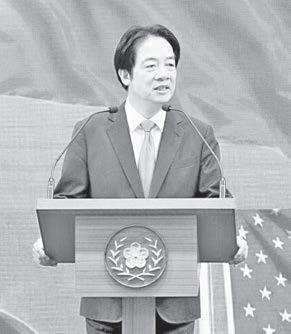
IN this photo released by the Taiwan Presidential Office, Taiwan’s President Lai Ching-te speaks during a press conference on “Taiwan-US Economic Prosperity Partnership” in Taipei, Taiwan on February 3, 2026. TAIWAN PRESIDENTIAL OFFICE VIA AP
by force if necessary. Like other countries that maintain formal diplomatic ties with Beijing, the US doesn’t recognize Taiwan as a country, but Washington remains the island’s strongest backer and arms supplier.
Trump’s Republican administration authorized an $11 billion weapons package for Taipei in December, but it has yet to move forward. American lawmakers also approved a separate $14 billion arms sale to Taiwan in January, though the deal can’t proceed until Trump formally submits it to US Congress.
accelerate the response in Congo and in the region.
The US has pledged $23 million in funding to bolster the response in Congo and Uganda, and said it would also fund the establishment of up to 50 Ebola treatment clinics in the affected regions.
Lusenge said her group’s small hospital near in Bunia lacks basic protective equipment, exposing nurses and doctors to possible infection, she said. “We only have hand sanitizer and a few masks for the nurses, but we need much more than that,” Lusenge said.
Public health officials say that a person infected with Ebola generally passes the virus along to one to two other people—which is less contagious than measles, whooping cough and chickenpox, in which one person can infect around a dozen others.
But researchers note that transmission rates have varied in past Ebola outbreaks, and they are still trying to determine how contagious the Bundibugyo virus is.
The outbreak is bigger than official figures show, WHO says BOTH the WHO and Africa Centers for Disease Control and Prevention believe the outbreak is larger than the cases reported so far.
The region’s already-weak health infrastructure and surveillance capacity has been further weakened by international aid cuts, experts say. The International Rescue Committee said it had to stop its surveillance activities in three out of five areas in Ituri over the last year because of funding cuts.
Armed conflict in the region further complicates efforts to handle the crisis. To get from Bunia to Mongbwalu, aid groups have to brace for potential attacks from armed groups.
“The outbreak can still be contained but the window for action is narrow,” Gabriela Arenas from the International Federation of Red Cross and Red Crescent Societies said Friday.
Pronczuk reported from Dakar, Senegal. Associated Press writers Jamey Keaten in Geneva; Constant Same Bagalwa in Bunia, Congo; Jean Yves Kamale in Kinshasa, Congo; Jonathan Poet in Philadelphia; Mark Banchereau and Wilson McMakin in Dakar, Senegal, contributed to this report.
Ebola.
Continued from A4
In an interview with Fox News on his way back to the United States from last week’s trip to Beijing, Trump said that arms sales to Taiwan are “a very good negotiating chip” in Washington’s dealings with China.
On Wednesday, marking his two years in office, Taiwanese President Lai Ching-te said that if given the chance, he would tell Trump to continue US arms purchases, which Lai called essential for peace.
China warns US over Taiwan WHEN asked about Cao’s comments, Chinese Foreign Ministry spokesperson Guo Jiakun said that “China’s opposition to the US arms sale to China’s Taiwan region is consistent, clear-cut and resolute.”
Last week, during Trump’s visit to Beijing, Chinese President Xi Jinping issued a strong warning, telling him that the “Taiwan question” is the most important issue in US-China relations and that the two nations could “have clashes and even conflicts,” if the issue isn’t handled properly.
Trump later told reporters that he needed to talk to the person who is running Taiwan, without naming Lai, who Beijing deems a separatist.
Trump and Lai holding talks likely would anger China, which typically responds strongly to visits to Taiwan by US politicians. AP
Coal’s energy shield meets its limit: 82 dead in China’s mining disaster
CBy Bloomberg News
HINA’S world-beating coal production has helped shield its economy from the worst of the Iran war shock. Now the deadliest mining disaster in years is raising uncomfortable questions about the cost of that drive.
The privately owned Liushenyu mine, in the coal-belt region of Shanxi, produces mostly coking coal, meaning it would probably supply steelmakers, not power plants. A mid-sized outfit, it produced a fraction of the region’s annual total.
But Friday night’s blast, which left at least 82 dead, is already prompting a response which belies the scale of that operation.
The accident has triggered a vast rescue operation with hundreds of emergency workers, promises of an “uncompromising” investigation and an intervention from President Xi Jinping and senior officials. An immediate increase in scrutiny is almost certain—potentially threatening overall coal output in the near term, power generation and Beijing’s efforts to prioritize energy security.
Such high-profile mine incidents tend to trigger “nationwide safety inspections and heightened enforcement,” said David Fishman, a Shanghai-based principal at The Lantau Group.
“This has been the pattern in the past and it’s reasonable to expect it again this time, because of the size of the accident and the immediate strong statements from the central government, inc luding Xi himself.”
Preliminary investigations suggest “serious violations” at Liushenyu, according to state broadcaster CCTV, citing comments from local officials. Regional authorities have already launched wider inspection and remediation efforts targeting risks at coal mines, including gas, water hazards and roof conditions, the Shanxi Daily reported on Sunday.
But a crackdown comes at a delicate time for China. Conflict in the Persian Gulf and the closure of the Strait of Hormuz has disrupted oil and gas shipments for the best part of three months. The country, meanwhile, is heading into summer, a time when hotter weather drives up power consumption.
Any hit to coal mining output risks tightening supplies and pushing up energy prices or, in the worst-case scenario, forcing power curbs on the industry similar to those that rattled China’s economy in the past.
China started the year with coal stockpiles ample enough to be considered a glut. Nationwide coal output has fallen in eight of the past nine months, including in April, largely because of excess supply.
But that balance is at risk of shifting, as the Iran war lifts liquefied natural gas prices and reduces imports, piling fresh pressure on coal to continue carrying the bulk of the country’s thermal power generation.
For years, Xi’s government has doubled down on China’s abundant coal reserves to reduce reliance on imported energy. Coal output hit a record high last year—up 30 percent from a decade earlier—and remains the backbone of the country’s power system, underpinning a broader push to electrify everything from cars to industry. Domestic coal is even being tapped as a feedstock for production of chemicals, oil and gas.
But the drive for energy security and domestic production has forced mines to juggle
“All Filipino nationals are strongly advised to defer non-essential travel to affected areas until containment is confirmed,” the Embassy said in a Facebook post.
The Embassy stressed that Ebola is not airborne, but spreads through direct contact with infectious bodily fluids such as saliva, sweat, and blood.
The Pretoria advisory also flagged Zambia’s elevated risk profile owing to its border with the DRC and heavy cross-border migration. The Embassy in Pretoria exercises consular jurisdiction in Zambia, as there is no Philippine embassy in Lusaka.
“Filipinos stationed in Zambia are urged to practice heightened vigilance and monitor local health alerts,” the post said. Of the 1,200 Filipinos in Zambia, many work as engineers, supervisors, business owners, missionaries, and key employees in the manufacturing, food, and hospitality sectors.
The Embassy assured consular support for distressed nationals, providing emergency hotlines and official email contacts.
Both embassies emphasized that monitoring will continue and urged Filipinos to remain calm, stay informed, and share advisories widely within their communities.
competing priorities: maintaining breakneck supply growth while overstretching facilities and equipment. And that has extended beyond just thermal coal: The Beijing News reported the Liushenyu mine may have had too many workers underground, some without GPS devices specifically to aid rescuers.
“It’s possible that local officials may take the rap and if so, they may be publicly shamed and prosecuted,” said Rana Mitter, historian and ST Lee chair in US-Asia relations at the Harvard Kennedy School. “But that will almost certainly be portrayed as the central government cracking down on lax behavior in the provinces—not any fundamental failing in the party’s governance.” China has made strides when it comes to safety, and research shows a drop in the frequency and scale of coal mine accidents over the past decade or so.
Beijing has not, though, tackled structural problems, said Mary Gallagher, professor of global affairs at the University of Notre Dame—which include perverse incentives and a system that punishes local officials for problems, and not the central government. When production is a priority, local governments can get caught between Beijing’s economic guidance and its safety standards.
“It’s a lose-lose situation,” Gallagher said. “It’s likely that in this case the local government was looking in the other direction as this mine clearly had safety issues before the accident.” Granted, some aspects of the official response have improved. Back in 2021, a crackdown ahead of the Communist Party’s 100th anniversary curbed production to the point that it contributed to a coal shortage and nationwide power curtailments.
Beijing has found less disruptive methods. Even after the last large disaster—a 2023 landslide at a mine in Inner Mongolia that led to 53 deaths—officials responded with a focus on accident prevention, not a hit to overall production. At the time, China’s output was rapidly increasing and the mine was restarted to help lift volumes.
It’s not yet clear that the Liushenyu mine will trigger a similarly contained response, even though it produces coking coal, and accounts for just 0.1% of Shanxi’s total annual coal production. It was penalized twice last year by local authorities for safety violations.
All 25 coal mines in Shanxi’s Qinyuan county, where the blast happened, have now suspended production, according to a report from Chinese consultancy MySteel, adding two are thermal coal operations. Others in the wider Changzhi area have also begun to stop work, leading to temporarily tight supply, the report added.
“We will strengthen oversight of mining operations, crack down on the fabrication or deletion of surveillance footage, and intensify inspection of concealed work areas,” Zhang Wenbo, director of the Emergency Management Bureau of Changzhi City said at a press conference on Saturday night.
The city’s mayor has apologized to the victims’ families and pledged to hold those responsible accountable for the accident.
With assistance from Dan Murtaugh, Alan Wong and Ailing Tan/Bloomberg
Lacson.
Continued from A3
Rodrigo Duterte and several other police and government officials, of the crimes against humanity case filed by the families of victims of the bloody anti-illegal drug war campaign during the Duterte administration.
The NBI and the National Police have announced that tracker teams have already been deployed to determine the whereabouts of dela Rosa, who left the protective custody of the Senate last May 14 or six days before the Supreme Court denied his plea for the issuance of a temporary restraining order or a status quo ante order or both that could have prevented authorities from enforcing the ICC arrest order.
It may be recalled that dela Rosa went into hiding for six months following reports that an ICC warrant was issued against him.
He resurfaced at the Senate last May 11 to cast the decisive 13th vote that ousted Senator Vicente Sotto III as Senate president and installed Sen. Alan Peter Cayetano as the latter’s replacement.
The senator’s arrival at the Senate, however, caused tension after operatives of the National Bureau of Investigation (NBI) together with former senator Antonio Trillanes IV attempted to serve the ICC arrest warrant against him.
The Cayetano Senate immediately placed dela Rosa in its protective custody to prevent his arrest which led to a near gunfight between the Senate security forces and operatives of the NBI.
Dela Rosa has been in hiding since he left the Senate building last May 14.
Good intel work WITHOUT good intelligence work and proper coordination, he said law enforcers tasked to track down high-profile fugitives would be wasting their resources, Lacson said. Lacson reminded law enforcers that only good intelligence is the key to tracking people like dela Rosa, wanted in The Hague-based ICC for the crimes against humanity case that joins him and his former patron, former President Rodrigo Duterte.
Lacson gave the advice on good intelligence work to law enforcement agencies who are also looking for prominent personalities including Charlie Ang, former Bureau of Corrections chief Gerald Bantag, and even former Rep. Rizaldy Co who is believed to be in France.
“As one who worked in law enforcement... intelligence for breakfast, lunch, dinner and everything in between...intelligence is the prime mover of any operation, law enforcement or military,” he said in a mix of English and Filipino in a radio interview.
“Without good intelligence work and proper coordination, he said law enforcers tasked to look for the high-profile fugitives would be wasting their resources.” Lacson, who served in law enforcement—including as Chief of the Philippine National Police from 1999 to 2001—was dela Rosa’s superior in the Presidential Anti-Organized Crime Task Force (PAOCTF).
DJAKISA CHRISTIAN, 18, a funeral home manager, sits in front of coffins for sale at his shop in Bunia, Congo, Friday, May 22, 2026. AP PHOTO/MOSES SAWASAWA
Inflation knows no class: Middle-income Pinoys need relief, too editorial
FOR too long, the narrative of government assistance in the country has been drawn along a single, stark line: subsidies for the poor, and self-sufficiency for everyone else. But as the Philippine Institute for Development Studies (PIDS) wisely points out in its latest policy note, inflation does not respect such neat divisions. The middle-income household—the salaried worker, the daily commuter, the family that earns just too much for conditional cash transfers yet too little to absorb endless price shocks—is being squeezed into a silent crisis. (Read the BusinessMirror story: “Mid-income households deserve government aid, too,” May 19, 2026).
The numbers are alarming. With inflation hitting 7.2 percent, the fastest pace in three years, and economic growth slowing to 2.8 percent, the dreaded “stagflationary pressures” are no longer theoretical. Global oil shocks, exacerbated by geopolitical tensions, have sent fuel prices soaring. For a nation that imports 98 percent of its fuel requirements, the ripple effects are devastating: higher transport fares, more expensive electricity, and climbing costs for every essential good from rice to canned sardines.
The government’s current relief architecture has been rightfully focused on the poorest, who lack even the thinnest income buffers. But PIDS correctly identifies a glaring gap. Middle-income Filipinos—teachers, clerks, drivers, small-store owners—are also suffering “significant welfare losses.” They are the so-called “price hike absorbers,” expected to tighten their belts further while receiving little to no direct support. Many are one medical emergency or one fare increase away from falling into poverty, yet they remain invisible in subsidy programs.
This is not a call to abandon the poor. It is a recognition that broadbased inflation requires broad-based solutions. PIDS offers sensible, targeted measures: fare subsidies for regular commuters, tax relief on essential goods, and temporary adjustments to personal income tax brackets. These are not handouts; they are circuit-breakers designed to preserve real purchasing power and prevent the middle class from capitulating under cumulative financial stress.
Some may argue that expanding relief strains fiscal buffers. But as PIDS notes, blanket measures—like suspending fuel excise taxes outright—are inefficient, disproportionately benefiting wealthy fuel guzzlers. What is needed is surgical, temporary, and fiscally sustainable intervention. A countercyclical framework that pairs short-term relief with long-term structural reforms: energy diversification, transport modernization, and improved spending efficiency.
The alternative is grim. A hollowed-out middle class means weaker domestic demand, reduced tax revenues, and greater social instability. If the government fails to see that inflation’s pain is class-blind, it risks not only economic stagnation but also a quiet erosion of the very sector that drives productivity and growth.
The message from PIDS is urgent and clear: relief must be recalibrated. Middle-income Filipinos are not asking for charity. They are asking not to be forgotten. And in an economy teetering on the edge of stagflation, forgetting them is a luxury the nation cannot afford.

Good call, DTI—now here’s what should come next

IMAGINE waking up one day to find out that before you can post a sponsored ad on Facebook or run a promotional video for your online shop, you’d have to file a government permit application, wait 30 working days, pay fees of up to P9,294 per advertisement, and hope for approval. For the millions of Filipinos who earn a living through digital selling, that’s devastating.
That was the reality looming behind the Department of Trade and Industry’s draft Department Administrative Order (DAO) on pre-clearance of advertising materials—until, thankfully, the DTI pulled back. Last Saturday, the agency clarified it is “not pursuing, implementing, or adopting” the proposed order, assuring the business community that the internal draft “does not reflect current policy direction and will not be finalized or enforced.”
It’s good that the DTI listened,

T. Anthony C. Cabangon
Lourdes M. Fernandez Jennifer A. Ng Vittorio V. Vitug
Lorenzo M.
ICabangon
V. Ramos Aldwin Maralit Tolosa


and it reversed course quickly.
The proposed DAO was a solution in search of a problem, at least for legitimate businesses. The digital economy runs on speed and agility.
A small ukay-ukay reseller, a homebased pastry maker, a freelance graphic designer—for these entrepreneurs, a 30-working-day permit window could erase their competitive edge.
Senator Bam Aquino put it plainly: existing laws, including the Consumer Act of the Philippines, already provide mechanisms to go after de -
The real problem in Philippine digital commerce isn’t too much advertising; it’s too much fraud. Scam sellers, fake promotions, and misleading product claims plague online marketplaces and erode consumer trust. These are the people the DTI should be chasing, not the hardworking MSME owners running legitimate businesses.
ceptive advertising. The DTI didn’t need a sweeping new permit regime. It needed better enforcement of the tools it already has. The backlash from MSMEs, online sellers, and lawmakers was swift and unified.
The real problem in Philippine digital commerce isn’t too much advertising; it’s too much fraud. Scam sellers, fake promotions, and misleading product claims plague online marketplaces and erode consumer trust. These are the people the DTI should be chasing, not the hardworking MSME owners running legitimate businesses.
What would make a real difference: a faster, more accessible com-
plaint resolution system for consumers who encounter fraudulent ads; a public registry of sanctioned sellers and chronic violators; and stronger coordination with social media platforms to take down scam content in real time. These are targeted, proportionate interventions that protect consumers without punishing legitimate businesses. The DTI should also look at simplifying, not adding to, the regulatory stack that MSMEs already navigate. Compliance fatigue is real. Every new permit, fee, and filing requirement chips away at the time entrepreneurs could spend actually building their businesses.
This incident also shows a structural issue worth looking at. Policies that affect millions of MSMEs shouldn’t come out as internal drafts that go viral before they’ve gone through genuine public consultation. The DTI should institutionalize mandatory MSME impact assessments before any new DAO reaches even the draft stage. This should be done as a genuine check on whether a proposed rule solves problems more than it burdens the businesses.
T is a bit late but a partnership between Megawide Construction Corporation and the Pag-IBIG Fund may yet provide the answer to the housing backlog that has bedeviled all administrations from President Ferdinand Marcos Sr., thanks to an advanced precast facility in Taytay, Rizal that promises to finish one floor of a condominium unit in seven to 10 days.
Backed by a landmark partnership with Pag-IBIG Fund reportedly worth around P10 billion, Megawide has committed to helping roll out as many as 100,000 affordable housing units over a five-year period under the government’s Pambansang Pabahay Para sa Pilipino Program. What makes the model especially compelling is the affordability structure attached to it. And the way it is structured, many families laboriously paying rent without the possibility of owning the units can now breathe a sigh of relief as what they have been paying now as rent can become their monthly amortizations for 28-square-meter units they will own in the 10-story condominium units that Megawide will erect in no time at all.
Through Pag-IBIG financing, first-time homebuyers may potentially acquire durable 28-squaremeter condominium units with amortization costs approaching what many low-income earners already pay monthly in rent. In some developments, unit pricing has been kept within levels designed to remain accessible to ordinary wage earners. This is the kind of government initiative that is compelling enough to even nudge construction activities and result in an uptick in economic activity similar to the housing starts that translate to higher GDP growth in the United States. And this one does not roar with the drama of politics or announce itself with the swagger of luxury skyscrapers. Instead, it rises panel by panel,
floor by floor, through a construction technology that may hold one of the more practical answers to one of the Philippines’ oldest social wounds: the housing backlog confronting millions of Filipinos.
For decades, the country’s housing crisis has been discussed through staggering statistics. Millions without homes. Millions more trapped in informal settlements. Young families spending years paying rent without ever building equity of their own.
But behind every housing statistic is a deeper human story. A worker waking before dawn because affordable housing near economic centers remains scarce. A family paying rent month after month for cramped spaces they will never own. A young couple postponing stability because home ownership feels permanently out of reach.
Housing, after all, is not merely about shelter. It is about dignity, permanence, and the ability of ordinary citizens to imagine a future larger than survival. This is where the efforts of Megawide deserve closer public attention. Engineers from the company toured journalists, stock market brokers, analysts and the Monday Circle to explain the Lego way of putting up condominiums.
At its advanced precast facility in Taytay, Rizal, Megawide has quietly introduced what may best be described as a first-world manu-
facturing mindset into Philippine mass housing. Instead of relying entirely on traditional, weatherdependent construction methods, the company manufactures structural components such as walls, slabs, stairs, columns, and even prefabricated bathroom units inside controlled factory environments using German and Japanese precast technologies.
To further reduce costs outside Metro Manila, the company also deploys mobile satellite precast plants near development sites, minimizing expensive transport costs while maintaining the same quality and speed standards nationwide. But when feasible, Megawide transports the pre-cast slabs, housing units, and even the sidings after finishing at their 10-hectare Taytay facility. Of course, affordable housing alone will not solve poverty. But stable housing changes how poverty behaves. Children with stable homes are more likely to remain in school. Workers living closer to jobs spend less on transportation and recover hours otherwise lost to traffic. Families with permanent addresses gain stronger access to utilities, healthcare, banking, and economic opportunity. A
RISING SUN
Atty. Jose Ferdinand M. Rojas II
Ebola outruns containment in eastern Congo as contact tracing falters
By Jason Gale
EBOLA is spreading faster than responders can track it in eastern Congo, where health workers managed to follow up with barely one in five identified contacts in a single day.
Authorities in the Democratic Republic of Congo reported 83 confirmed infections, 746 suspected cases and 1,603 identified contacts as of May 21, according to the health ministry. Yet health workers were able to follow up with only 342 contacts that day—about 21 percent of the total under monitoring—according to ministry data released Friday.
The figures suggest the response is falling behind the outbreak itself, even as governments and international agencies ramp up emergency measures after the World Health Organization declared the epidemic a public health emergency of international concern on May 17.
The outbreak has now spread across three provinces including South Kivu, where officials confirmed a case this week near Bukavu, a major city near Congo’s border with Rwanda. Uganda on Saturday confirmed three additional Ebola cases tied to earlier infections, including a health worker, as authorities struggle to contain regional spread.
The epidemic is unfolding in “one of the most challenging operational environments possible,” the WHO’s emergency committee said Friday.
Congo stretches across an area about a quarter the size of the continental US. Large parts of the east are accessible only by rough roads, motorcycles or footpaths winding through forests and mountains.
Armed groups control significant territory. Millions of people have been displaced by conflict.
Tensions are already surfacing around containment measures.
Relatives of a man who died at Rwampara Hospital near Bunia, the capital of Ituri province, where the outbreak was first detected, clashed with health workers after authorities refused to release the body for burial because of infection risks, according to local media reports. Ebola treatment tents run by the aid group Alima were set on fire during the unrest, and six patients fled the facility, including three confirmed Ebola cases, according to reports from the area.
The outbreak is caused by the rare Bundibugyo strain of Ebola, for which there is no approved vaccines or antibody treatments. The virus appears to have circulated undetected for months in Ituri province before authorities recognized what they were dealing with.
Testing gaps
HEALTH officials are now trying to track thousands of people who may have been exposed as infections spread through remote mining areas and urban centers including Bunia and Goma, cities with populations approaching 700,000 and 860,000 respectively.
The latest ministry figures suggest confirmed transmission is spreading beyond the gold-mining hub of Mongbwalu, initially viewed as the epicenter. While Mongbwalu remains the largest suspected cluster, confirmed infections are increasingly concentrated in surrounding health zones including Rwampara and Bunia.
Nyankunde, home to a major referral hospital serving about 200,000 people, has also emerged as a growing cluster with 11 confirmed cases and 340 contacts under follow-up, according to the ministry.
The WHO warned that weak surveillance and laboratory capacity are hampering the response, noting that the GeneXpert diagnostic platform widely used during previous Ebola outbreaks can’t detect the Bundibugyo strain. Virus-specific PCR kits are also in limited supply, medical aid group Médecins Sans Frontières said this week.
Countries should rapidly expand laboratory testing, contact tracing and community outreach while negotiating “security corridors” to allow responders to safely reach affected communities, the WHO said in temporary recommendations issued Friday.
The Congolese government reported a positivity rate of almost 46 percent, suggesting many infections may still be going undetected.
Conflict zone
THE outbreak is unfolding in one of the world’s most volatile regions, where armed groups control large areas, roads are poor and millions of people move between mining camps, towns and neighboring countries. An alliance that includes the Rwandabacked M23 rebels announced its own Ebola response structure Friday in territory under its control, urging communities to cooperate with health workers and avoid politicizing the outbreak.
The risk inside Congo is now considered “very high,” while neighboring countries face a “high” regional threat, the WHO said. Uganda has tightened border controls and suspended passenger transport links with Congo after reporting five confirmed Ebola cases. Rwanda has also tightened screening measures and said Friday most foreign travelers who recently visited Congo will be denied entry, while returning residents will face mandatory quarantine.
The outbreak has also exposed growing concerns about the fragility of global outbreak-response systems after years of aid cuts and shifting political priorities.
Countries responding to the outbreak have requested about $319 million for emergency response and preparedness measures. About 84 percent would be earmarked for Congo and Uganda and the rest for neighboring high-risk countries including South Sudan, Jean Kaseya, Director-General of the Africa Centres for Disease Control and Prevention, said in a briefing Saturday.
Major funding needs include infection control, water and sanitation programs, case management, surveillance and logistics. Africa CDC also said it is partnering with India to deliver about 20 tons of medical supplies by Monday.
“We are running behind, we are not yet under control,” Anne Ancia, the WHO’s representative in Congo, said this week. With assistance from Sonja Wind, Jessica Nix, John Tozzi and Janice Kew/ Bloomberg
When brotherly love goes wrong

FRATERNITY brothers help one another in whatever way possible. Organizations built on shared hardship and loyalty often foster deep bonds that endure for life. The Freemasons, for example, are known for fellowship, moral development, and charity, with members eager to support one another in times of need.
The same culture exists within the Philippine Military Academy, where graduates are taught to value brotherhood, discipline, and service. Those who belong to the same graduating class—“mistah” in cadet language—develop especially strong ties after enduring the same rigorous training. That bond has often translated into support networks within government service.
Customs Commissioners Ariel Nepomuceno and Rey Leonardo Guerrero both enlisted fellow PMA classmates in leadership roles at the Bureau of Customs during their respective administrations. Such acts are usually viewed as expressions of trust and camaraderie. But brotherhood becomes dangerous when loyalty to friends begins to compete with loyalty to the Constitution.
This tension surfaced in the controversy surrounding Senator Ronald dela Rosa and the events inside the Senate compound on May 13, 2026. Seeking support from fellow academy graduates, particularly members of PMA Sinagtala Class of 1986, dela Rosa appeared to expect the same protective solidarity often
extended among mistahs. Questions soon arose regarding the role of Senate Sergeant-at-Arms Mao Aplasca, a fellow PMA graduate and former police officer, in allegedly preventing law enforcement authorities from carrying out an arrest. Whether what occurred legally constitutes obstruction of justice remains for investigators and the courts to determine.
Some argue that there was clear evasion of arrest; others raise constitutional concerns regarding the validity of the warrant itself. Yet beyond the legal arguments lies a deeper issue: divided loyalties.
Admiral Allan Ferdinand Cusi, a classmate of dela Rosa, captured the dilemma well when he warned that brotherhood should never compel a person to surrender conscience, independent judgment, or fidelity to the Constitution merely to prove loyalty.
In tightly knit institutions, failing to support a classmate can easily be interpreted as betrayal. Yet public service demands a higher standard. Loyalty to country must come before loyalty to friends, classmates, politi-
cal allies, or organizations.
Former President Manuel L. Quezon once famously declared: “My loyalty to my party ends where my loyalty to my country begins.” That principle remains relevant today.
The Constitution itself requires public officers to serve with “utmost responsibility, integrity, loyalty, and efficiency.” Such loyalty is owed first and foremost to the Filipino people.
The controversy also exposed how political loyalties can intersect with religious identity. Newly elected Senate President Alan Peter Cayetano often invokes Scripture in public life, drawing both support and criticism. Some see sincere faith; others see political theater. Believers, however, are cautioned against both blind allegiance and reckless condemnation. Scripture warns believers to discern carefully: “Watch out for false prophets. They come to you in sheep’s clothing, but inwardly they are ferocious wolves” ( Matthew 7:15 ).
At the same time, faith teaches humility in judgment. The Apostle Paul, in Philippians 1:15-18, acknowledged that some preached Christ out of selfish ambition, yet still recognized that truth could be proclaimed despite flawed motives or an imperfect messenger. Therefore, believers should not be quick to judge the heart of Senate President Cayetano. Believers should not blindly support nor should they publicly mock his actions just because they went to the same school or belong to the same political party or attend the same Christian service.
I will go as far as saying the same thing for Senator Bato dela Rosa who keeps on invoking God but whose actions appear to be ungodly thus
far. Ultimately, public declarations of faith matter less than the actions that follow. That is the real test facing leaders today.
In the impending impeachment trial, actions of senator-judges will reveal whether loyalty to brotherhood, political alliances, and personal ambition outweighs loyalty to justice and the rule of law. Brotherhood is not wrong in itself. Camaraderie strengthen institutions and inspire selfless deeds. But when loyalty to one another becomes an excuse to evade accountability, brotherhood ceases to be noble. Brotherhood instead becomes disheartening and disgusting. It can be seen as a form of stealing the truth from the nation —an abomination in the eyes of the law of the land and law of the Lord. Classmates, fraternity brothers, academy graduates, political partymates in government are not called to protect one another at all costs. They are called to protect and uphold justice for those who need it the most. And for believers in government who hold both faith and country dear, the standard is even higher: loyalty must ultimately belong not to personalities, but to justice and, more importantly to God.
Siegfred has a diversified set of education and experiences which has made him a game changer and a servant leader in organizations. His professional degrees came from the United States Military Academy at West Point in New York, Ateneo Law School, and University of Southern California, Los Angeles, USA. His corporate experiences include stints as general counsel for the country’s flag carrier, a food exporter with manufacturing plants in Davao and in Laguna, and a sports distributor company. Siegfred is a former soldier and a lawyer by profession, a teacher and inspirational speaker by passion, and a book author and a writer with a mission.
LOA reform at six months: Audit overhaul or business as usual?

ABOUT six months ago, the Bureau of Internal Revenue (BIR) took the bold and welcome step of pausing, reviewing, and reforming its Letter of Authority (LOA) audit system. The move was triggered by mounting taxpayer concerns over LOAs, Mission Orders, audit conduct, and the broader taxpayer experience.
The dire LOA situation also resulted in the precedent setting spectacle of the Senate Blue Ribbon Committee conducting two uneventful hearings on what are the perceived massive corruption cases that are happening in the BIR’s LOA system, which may overshadow even the flood control scandals.
On November 24, 2025, the BIR announced the immediate suspension of field audits and related operations, including the issuance of LOAs and Mission Orders, with the stated objective of protecting taxpayer rights, strengthening internal discipline, and making audit processes “predictable, evidence-based, technology-driven, and fair.”
Thereafter came the reform issuances. Revenue Memorandum Circular (RMC) No. 107-2025 suspended. RMC No. 109-2025 clarified its coverage. RMC No. 8-2026 lifted the suspension effective January 27, 2026, and allowed audits and field operations to resume. Revenue Memorandum Order (RMO) No. 1-2026 prescribed the revised audit and assessment policies, including the single-instance audit framework, consolidation of multiple eLAs, riskbased and system-assisted selection, standardized audit checklists, audit documentation, and tighter controls over audit events. The BIR also introduced mechanisms such as the LOA Verifier on its website and measures intended to reduce subjectivity and strengthen oversight.
The objectives were noble. The question now is whether the reform has reached the level where taxpayers and the other stakeholders in the LOA system can already feel a material difference.
The BIR audit cycle has three critical phases. The first is audit selection. Under the reform, the ideal is a risk-based and system-assisted selection process. This means that taxpayers should not be selected merely because they are visible, convenient, historically audited, or perceived as easy targets. Selection should be based on objective risk indicators, third-party information, data analytics, industry benchmarks, tax-gap indicators, and compliance behavior. The intended reform is to move away from personality-driven or discretion-heavy audit selection and toward an evidence-based system.
But based on my own experience and discussions with taxpayers, clients, and fellow practitioners, there remains a perception that many audit selections still feel like “business as usual.” The same taxpayers are repeatedly examined. Some industries continue to feel disproportionately targeted. The promised risk-based selection is not yet sufficiently transparent to taxpayers. Of course, the BIR cannot disclose all risk parameters, because that may result in compromising the audit selection system. But taxpayers should at least be able to see that the selection process is rational, defensible, and not arbitrary.
The second phase is the audit process itself. This includes the submission of audit requirements, presentation of accounting records, reconciliation of discrepancies, and the actual examination by revenue officers. Here, the reform promise is standardization, documentation, and discipline. RMO No. 1-2026 speaks of standardized audit check-
lists, proper documentation of audit events, and clearer handling of taxpayer interactions.
Yet this is where many taxpayers still experience the old ways. Requirements may still be voluminous, repetitive, and sometimes disconnected from the actual issues under audit. Examiners may still require documents in a manner that suggests a fishing expedition rather than a focused risk-based inquiry. Worse, some findings continue to be framed in ways that taxpayers describe as arbitrary assessments or deficiency tax assessments that are not sufficiently anchored on facts, law, records, and reasoned analysis and investigations.
An arbitrary assessment is not merely a high assessment. The BIR is fully entitled to assess the correct tax, even if the amount is substantial. What makes an assessment arbitrary is when it is based on presumptions not validated by evidence, when reconciliations and explanations of taxpayers are ignored, when the same finding is repeated by the BIR on every phase of the tax assessment process despite contrary documentation and justification by the taxpayer and their consultants, or when the assessment appears to be designed first as a collection posture rather than as a legally defensible determination.
The third phase is the resolution of findings and assessments. This is the stage where, during the Notice of Discrepancy, the taxpayers reply; in the Preliminary Assessment Notice (PAN), they file a protest; and in the Final Assessment Notice (FAN), and in the Final Decision on Disputed Assessments (FDDA), taxpayers filed their submissions and appeal. For all these phases, were the BIR findings meaningfully different from earlier discrepancy notices because the taxpayer’s explanations had been considered? Or do they still look like recycled templates where the same findings simply move from one stage to another?
This is where the Supreme Court’s doctrine in Commissioner of Internal Revenue v. Avon Products Manufacturing, Inc. (Avon) G.R. Nos. 20139899 and 201418-19 become crucial. In Avon, the Court emphasized that BIR powers must be exercised reasonably and under prescribed procedures,
with strict regard for due process. It found that Avon was deprived of due process when the BIR failed to fully apprise the taxpayer of the factual and legal bases of the assessments and failed to address its defenses and documents. Six months is admittedly too short to judge whether the reform has succeeded or failed. Institutional behavior does not change overnight. Systems require training, supervision, technology, accountability, and cultural adjustment. The BIR leadership deserves credit for recognizing the problem and issuing reform measures. But recognition is only the first step. The harder part is implementation, where all stakeholders of the BIR LOA audit system are able to derive outcomes that they all deserve in terms of effective tax administration and respect for taxpayer rights and remedies. My wish is simple. Let the LOA reform become real, not rhetorical. Let audit selection become genuinely risk-based. Let the audit process become disciplined and professional. Let assessments be based on facts and law, not convenience and presumption. Let taxpayer explanations be considered, not merely received. Let the Avon doctrine be internalized, not merely cited. For now, I remain cautiously hopeful but professionally uneasy. The reform has begun, but the taxpayer experience has not yet fully changed. Perhaps the best discussion of where this reform is headed should not be confined to formal issuances and public statements. It may require more candid conversations—over coffee, and perhaps some pulutan— where I can share my fearless forecasts on whether the LOA reform will truly transform BIR audits or eventually slide back into business as usual.
Joel L.
Joel L. Tan-Torres
Siegfred Bueno Mison, Esq.
Monday, May 25, 2026
2nd Front Page
BusinessMirror
Angeles building collapses; race on for trapped workers
By Ashley J. Manabat, Lorenz Marasigan and Claudeth Mocon-Ciriaco
ANGELES
CITY—Rescuers from the local government, the Department of Public Works and Highways (DPWH) and the Metropolitan Manila Development Authority (MMDA) raced to save dozens of workers believed trapped as a ninestorey building under construction collapsed in barangay Balibago before dawn Sunday following heavy rains.
The structure on Teodoro Street in Old Sta. Maria collapsed at around 2am, hours after the thunderstorm that battered Angeles City Saturday night waned, residents said.
The DPWH deployed heavy equipment to support rescue and clearing operations.
Public Works Secretary Vince Dizon said the agency is assisting in accelerating operations being led by local government and emergency responders.
The DPWH immediately deployed two dump trucks, one backhoe, one boom truck, and one Tadano crane to the site.
“We have at least six heavy equipment in the area,” Dizon said.
The secretary also said the DPWH will assign a technical team to assist in the investigation to determine the cause of the building’s collapse. Rescue teams had already pulled out 24 individuals from the rubble on Sunday morning. Two more individuals were rescued from a nearby apartelle that was also struck when the building gave way. Search and rescue operations remain ongoing.
The local government immediately activated its Unified Command System to ensure coordinated response among agencies. Under the arrangement, the Bureau of Fire Protection (BFP) leads t he rescue and retrieval operations, the DRRMO handles logistics and

operational support, the Philippine National Police (PNP) manages security and crowd control, and the City Information Office (CIO) handles official public communications.
The Angeles City Disaster Risk Reduction and Management Office (ACDRRMO) said it received reports of the collapse at around 3 a.m. and
immediately deployed rescue teams with the Bureau of Fire Protection (BFP and the National Police (PNP). Authorities said 24 individuals, including construction workers and nearby residents, have been rescued as of Sunday morning. Two people were also rescued from an apartelle hit by debris from the collapse.
FInitial reports quoted residents in the area as saying more than 80 construction workers may have been inside the building when it collapsed. Many workers were reportedly sleeping on the first and second floors.
Debris from the collapsed building damaged nearby establishments, including the former Lorrietas Build-
ing and Norma’s Money Changer. A security guard of the money changer was reported missing.
Jeric Angcao, a resident of Oak Street, said his parents, who work as vendors near the site, remain missing. Mayor Carmelo Lazatin Lazatin II and Angeles City Rep. Carmelo Lazatin Jr. visited the site and continue to oversee rescue operations as authorities search the debris for possible survivors as of this writing.
Congressman Lazatin has requested the Department of Public Works and Highways to send crew and equipment, and the Department of Transportation to send K9 units for rescue operations.
The MMDA also deployed its Search and Rescue Team, to assist in the ongoing search and rescue efforts. MMDA Chairman Romando Artes said that the team brought with them appropriate equipment for the search and rescue operatiom.
Led by General Manager Nicolas Torre III, the team aims to assist in locating trapped individuals, with the help of Long Range Acoustic Device (LRAD), a specialized, highpowered directional loudspeaker to call the attention of survivors, life detector, and heart beat monitor. The MMDA also deployed K-9 units to help in the operation. The agency’s Mobile Command Center and Operations Vehicle are also on-site, equipped with life locators, a vibrascope, locator devices, power tools, and rescue cameras.
Revolve’s Regie Pablo: Ain’t no mountain high enough to reach sustainability goals
By Francine M. Marquez
rom conquering the world’s top peaks to navigating a business advocating sustainability, Regie Pablo Filipino mountaineer, Everest summiteer, and founder of Revolve Eco.Logical translates his climbing experience to real-world lessons on discipline and dedication.
Guesting in the latest episode of BusinessMirror’s podcast, “Freshly Brewed,” Pablo engages in a discussion with Macroeconomy reporter and BM Freshly Brewed journalist-host Justine Xyrah Garcia. Pablo began the conversation by revealing that his appreciation for the environment happened even before he achieved reaching the summit of Mt. Everest in 2007.
“My real awakening happened in my teenage years. I was listening to a lot of punk music. At the time, it was just beginning in the Philippine scene. was curious about the lyrics of the music. It was an awakening that we can do this—promote environmental awareness, direct action movement, and take care of the environment,” Pablo recalled.
After college, he worked for a mining corporation. There, he saw the negative impact of mining on the preservation of mountains. His next job was at Globe where he saw co-workers training for a mountain climb. From thereon, he started joining climbs with his peers and became a member of the Globe Adventure Club. He went on to become the President of the Mountaineering Federation of the Philippines (MFPI) from 2003 to 2007, one of the umbrellas of various mountaineering

groups and clubs in the country at the time.
In 1999, Monty Sorongan, one of the organizers of the Indonesian Everest team, dropped the question. Pablo remembered, “He said, ‘Regie, there’s no Filipino yet who has reached the top of Everest.’ So, that started the interest. I planned for it. My first alpine climb was in Kyrgyzstan in 2001. And around 2003, when was already on track planning for Mt. Everest, other Philippine mountaineers were able to convince me to form an Everest team.’
Pablo believed it was a good idea because back then as the Philippines was going through a financial crisis and political instability. He said, “Maybe our best contribution as mountaineers was to uplift the image of the Filipino spirit.”
In 2004, the group established the First Philippine Mount Everest Expedition team. The plan was to hold the first summit in 2006. On May 17, 2006, expedition team member Heracleo “Leo” Oración reached the summit. On May 18, 2006, another member, Erwin “Pastor” Emata, also successfully reached the peak.
Pablo conquered Mount Everest a year later, on May 17, 2007 and became the eighth and last Filipino to conquer the world’s highest peak.
“Actually, on May 17 of this year, we are


celebrating our 20th anniversary. And next year, I’ll be celebrating my 20th anniversary, too. It’s a validation of what I believed in: advocating awareness on climate change.”
Being on top of Mt Everest, Pablo related, made him see the horizon curving. And once one descends the mountain, one will see the vulnerabilities of creation.
“I’ve visited the base camp for several times, and I’ve seen the glacier receding. So if there are still those in denial that climate change is for real, I’m one of those people who can really be a living proof and can attest that climate change is for real,” he noted.
Turning point
AFTER his Mount Everest fete, Pablo was gifted with a backpack. He got curious about the material after learning that it was made from PET (polyethylene terephthalate) bottle, which is 100% recyclable,
That sparked an inspiration in Pablo, “I thought this is something that I can do, a continuation of my advocacy. By seeing that product, I knew I could do this,” he said.
In 2010, his journey with Revolve began.
As he dug deeper to study the business, Pablo was further encouraged to pursue his venture when he encountered rPET or recycled PET. The material is highly recyclable and can be used as a packaging product or as textile.
“I realized that this could be the start of something really big for the environment because right now, the Philippines is the number one contributor of marine plastic waste to the world. About 36 percent of the
marine plastic comes from the Philippines. And of the 36 percent, 17 percent are PET bottles, and only 0.3 percent of that is being recycled.”
“I declared to myself that this is my new Everest—to address plastic pollution in the country.”
Kick-starting his venture as a one-man mission, Pablo now has a team of like-minded partners who share his vision and advocacy.
From his summit experience, Pablo values collaborating with other people. He noted, “For one, mountaineering is a team sport, it’s not an individual sport, and so I’m applying it to Revolve. I created a team, I’m with cofounders, these are like-minded people who share a love for the environment.
“And more than that, it’s also giving dignified economic opportunities for our less fortunate brothers and sisters.”
When he started Revolve in 2010, he was semi-retired from the corporate life and was looking for a livelihood project that would sustain him and let him continue his advocacy.
That year, Pablo received an order for a big marathon race. At that time, he was still importing the fabric. He also received enough media coverage. The orders kept coming in.
But when the pandemic hit, business wasn’t as sustainable. Pablo had to pivot. “That’s when I realized that I can’t do this alone. So I started recruiting co-founders. Right now, I have four co-founders who are all women,” he stated.
Revolve’s co-founders, are all accomplished leaders: Rosa Javier is involved in providing economic opportunities to persons deprived of liberties (PDL) and
persons restored of liberties (PRL). Nini Sacro advocates food security in urban poor areas and organizes weekly feeding programs. Joy Fayloga, Ecomove founder, serves as logistics partner of Revolve. Ecomove delivers products through bicycle riders. Jacqueline Ela, an active outdoor sportswoman, is the company’s finance specialist.
From PET bottles to textiles REVOLVE’S operations are a model for sustainability, efficient waste management, and circular material loops. PET bottles gathered by street sweepers and waste pickers from domestic and commercial establishments are passed to Revolve recyclers. These PET bottles are then brought to Revolve’s workspace in Caloocan
Regie Pablo, mountaineer and founder of Revolve Eco-Logical Justine Xyrah Garcia, BusinessMirror's Macroeconomy reporter
Regie Pablo, mountaineer and founder of Revolve Eco-Logical, talks about mountaineering and how this inspired him to become a social entrepreneur with Justine Xyrah Garcia, BusinessMirror's Macroeconomy reporter. A12
CAUTION tape marks the area around a collapsed building in Angeles city in Pampanga province, north of Manila, Philippines, Sunday May 24, 2026. AP PHOTO
Editor: Jennifer A. Ng
B1 Monday, May 25, 2026
RCR considering inclusion of assets from third parties

By VG Cabuag @villygc
RL Commercial REIT Inc. (RCR), the real estate investment trust of the Gokongwei Group, said it is still open to acquiring third party properties, but this will depend on the price.
Jericho P. Go, RCR’s president and CEO, said the company will be guided by asset quality—the way a property is being managed and being maintained.
will need to maintain a very high occupancy rate, combined office and malls, 96 percent.”
Go said RLC—which has a low land bank compared to its peers at just more than 800 hectares—still has assets to infuse into RCR.
For mall assets, RLC has over 1.1 million square meters and for office at 250,000 square meters.
share compared to office space rental is lower.
At the moment, the ratio is about 53 percent on malls and 47 percent on office.
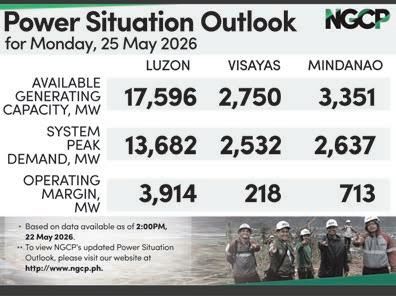
STOCK-MARKET OUTLOOK
LAST
As for acquiring from its sponsor, Robinsons Land Corp. (RLC), Go said the company already knows the quality of its assets.
“We already know how it’s being managed, and we already know the tenant profile. And that is why we
“It is not as simple as negotiating the price. You also have to see the quality of the asset that is being purchased from a third party, in the way that it’s being managed, and also their tenant profile.”
“We’ve not yet begun to include logistics, as well as hotels. Of course, there’s a process that needs to be followed, but the strength of RCR is largely attributable to the solid track record and performance of our sponsor,” Go said.
He said the company’s focus is to acquire more mall spaces from its sponsor, despite its revenue
“I think the ratio of malls will be higher than offices, only because of the sponsors’ part. Malls are a bigger component than offices. Malls are about 40 percent of the revenues of the sponsors,” Go said.
RLC, he said, will infuse 50 percent more of its mall spaces, up to 2.4 million square meters from 1.6 million square meters, by 2030 and up to 1.2 million square meters of office space from the current 800,000 square meters.
Go said RLC will double its logistics size by then and hotels by another 25 percent in terms of room keys.
Uber proposes Delivery Hero takeover
UBER Technologies Inc. has offered to take over Delivery Hero SE in a deal that would value the German delivery company at about €10 billion ($11.6 billion) as it seeks to ramp up competition with DoorDash Inc. outside the United States.
Delivery Hero received an approach from Uber for €33 per share, and “remains fully focused on executing its strategic review process,” the Berlin-based company said in a statement on Saturday. That price is three cents higher than Delivery Hero’s closing share price on Thursday, the day before Bloomberg News first reported the talks. Uber, which owns 20 percent of Delivery Hero, would be on the hook for about €8 billion under those terms. The US company also has options for another 5.6 percent of shares, it disclosed last Monday.
Bayer bid to settle cases faces pushback
OPPONENTS of Bayer AG’s
$7.25-billion proposal in Missouri state court to settle thousands of US cancer lawsuits over its Roundup weedkiller are trying to get a federal jud ge in California who shares their concerns to derail the deal.
US District Judge Vince Chhabria in San Francisco, who was tapped in 2016 to oversee Roundup cases filed in federal courts across the US, shot down Bayer’s earlier effort resolve a large swath of Roundup cases by grouping them into a class action. Chhabria has said he has “grave concerns” about the legality of a class-action mechanism i n the Missouri settlement to resolve “future” claims by Roundup users who haven’t developed c ancer yet.
Opponents have asked to move the Missouri case to San Francisco, which Bayer and plaintiffs’ lawyers who support the settlement o ppose. The procedural gambit to require Chhabria’s approval of the accord is designed to throw a wrench into the process before a St. Louis judge holds a final approval hearing July 9. Bloomberg News
Delivery Hero has been conducting a strategic review of its assets following pressure from shareholders. The food delivery business is consolidating globally, driven by slowing growth and heavy competition, and a number of Delivery Hero’s peers in Europe have been targeted. DoorDash, a dominant player in the restaurant delivery market in the US, agreed to buy the UK’s Deliveroo Plc last year. Months earlier, Prosus announced plans to buy Just Eat Takeaway.com NV in the Netherlands.
The Financial Times reported earlier on Saturday that Uber’s offer was rebuffed, with some investors seeking an offer exceeding €40 per share. Delivery Hero shares rose 1.9 percent to close at €33.59 on Friday. The stock has gained 48 percent this year, fueled in part by speculation of asset disposals and a takeover attempt by Uber.
The absence of a premium may pose an opportunity for rival bids.
DoorDash has expressed interest in Delivery Hero’s Middle East business, known as Talabat, but has yet to put in an offer, according to a person familiar with the matter. The FT had also reported on DoorDash’s interest previously.
Any bidder will have to contend with the handful of shareholders that control a large percentage of Delivery Hero. Investment company Prosus NV holds almost 17 percent. Aspex Management, the activists that succeeded in ousting co-founder Niklas Öestberg and have lobbied for more asset sales, own more than 14 percent.
Uber has been speaking to other Delivery Hero investors about its interest in a deal, and is working with advisers to study ways to increase its holding further, people famil-
iar with the matter said. Morgan Stanley has helped the ride-hailing company to rapidly build its stake using derivatives, people familiar told Bloomberg.
The company may need antitrust approval before crossing certain ownership thresholds, one of the people told Bloomberg. Deliberations are ongoing and there’s no certainty they will lead to a deal, they said.
Delivery Hero could fetch between $15 billion and $18 billion in a deal with Uber, Bloomberg Intelligence analysts Mandeep Singh and Robert Biggar wrote in a note published on Friday, before Uber’s indicative offer was public. They said such a takeover would sharply expand Uber’s footprint in emerging markets, strengthening the US company’s global position. Bloomberg News
Smart: Felons turn to signal hijacking

By Lorenz S. Marasigan @lorenzmarasigan

SMART Communications Inc. said on Sunday it blocked more than 955 million text messages tied to scams and phishing activities in the first quarter of 2026, while blacklisting nearly 200,000 mobile numbers linked to fraudulent activities from its network. PLDT Inc. COO Menardo Jimenez Jr. said signal hijacking is a growing vector for text scams, noting that criminals are increasingly using devices that impersonate legitimate cell towers to push fraudulent messages directly to nearby handsets — bypassing telecom operators’ own messaging networks entirely. “This is why we continue to
strengthen our network defenses while working closely with government partners to help protect our customers.”
Known as International Mobile Subscriber Identity (IMSI) catchers, these rogue base stations trick phones into connecting to them instead of legitimate towers.
Once a handset links to the fake tower, the device can transmit text messages directly without passing through the carrier’s network, making traditional carrier-side filters ineffective against that specific channel.
Jimenez said one warning sign of a nearby IMSI catcher is a sudden unexplained network downgrade—from 5G to older protocols such as 2G—shortly before
suspicious messages arrive.
He warned that fraudulent messages typically follow recognizable patterns: creating a sense of urgency around account suspensions, expiring rewards points, or revoked credentials, or dangling prize offers and exclusive deals to lure recipients into clicking embedded links.
“Protecting Filipinos from online scams requires strong collaboration across government, industry and the public,” Jimenez added. “By raising awareness and strengthening safeguards across networks, we can make it harder for criminals to exploit mobile technologies.”
The company urged subscribers to avoid clicking links in unsolicited messages and to report suspicious texts through Smart’s portal.
the Property index was down 3.18 to 1,926.71, the Services index gained 16 to 3,026.43 and the Mining and Oil index retreated 474.01 to 17,782.03.
For the week, losers outnumbered gainers 145 to 85 and 27 shares were unchanged.
Top gainers were Now Corp., Harbor Star Shipping Services Inc., PTFC Redevelopment Corp., Lorenzo Shipping Corp., Top Frontier Investment Holdings Inc., Dizon Copper-Silver Mines Inc. and Kepwealth Property Phils. Inc.
Top losers, meanwhile, were Suntrust Resort Holdings Inc., Roxas and Co. Inc., Italpinas Development Corp., Ferronoux Holdings Inc., Prime Media Holdings Inc., Shell Pilipinas Corp. and Integrated MicroElectronics Inc.
THIS WEEK
SHARE prices may continue to slide this week as the market is still expected to grapple with lingering uncertainties which could keep its movement tempered.
The bourse is expected to take cues from the developments between the United States and Iran, as well as the movement of the local currency and bond yields, Japhet Louis O. Tantiangco, senior research analyst at Philstocks Financials Inc., said.
This will be a four-day trading week as there will be no trading on May 27, Wednesday in observance of Eid’l Adha (Feast of Sacrifice). Tantiangco said recent developments show that the US-Iran situation is volatile. A regression of the situation is expected to weigh on the local market.
“With the progress in the US-Iran situation, the peso has regained some lost ground against the US dollar. However, it remains weak and inflationary. Moving forward, a further appreciation of the local currency is expected to strengthen the market. A depreciation is expected to drag the bourse however,” he said.
“On a negative tone, rising inflation and interest rate expectations may continue to weigh on the market next week. Local yields are rising as increasing inflation expectations strengthen the case for another policy rate hike by the Bangko Sentral ng Pilipinas [BSP].” 2TradeAsia said the macro picture at home is transitioning to an “acute policy crisis.” “Case in point, the BSP now openly weighing aggressive off-cycle rate hike. With the World Bank highlighting downside risks to growth if policy lags, authorities appear conscious of a credibility crisis where lagging the curve will push real interest rates deeply negative and trigger an even bigger capital exodus.”
Tantiangco said chartwise, the local market managed to get back above its 10-day exponential moving average last Friday. However, it is still having a difficult time getting past its 6,000-point resistance.
STOCK PICKS
BROKER Regina Capital Development Corp. gave a buy when support price holds recommendation on the stock of Metropolitan Bank and Trust Co. as its movement is in a bearish trend. Its technical reading showed downward momentum, indicating that the stock is nearing oversold levels and signaling strong bearish momentum.
Continued on B2

BLOOMBERG FILE PHOTO
Looking back, turning forward: Reclaiming biodiversity before midnight
THE clock ticks on…
Banking&Finance BSP tweaks risk management restrictions for UITF position
Earth’s history began roughly 4.5 billion years ago. Humanity has existed for barely a second on that geological clock, yet our impact has fundamentally rewritten the planet’s natural cycles. While extinction and evolution are natural forces, humanity is now driving biodiversity loss at a velocity that outpaces nature’s capacity to recover. Furthermore, we have disrupted the global climate at an unprecedented rate, creating a compounding crisis where shifting temperatures and extreme weather rapidly exacerbate this ecological collapse. We are now at a threshold where our impact, if left unmanaged, risks leaving a permanent scar on a history we cannot turn back the clock on.
Observed annually on May 22, the “International Day for Biological Diversity” is a global initiative aimed at raising awareness of biodiversity and the urgent challenges surrounding its conservation. The observance highlights the vital role biological diversity plays in sustaining ecosystems, supporting human well-being, and enabling long-term development. Guided by the 2026 theme, “Acting Locally for Global Impact,” it emphasizes how local actions and community level conservation efforts contribute significantly to protecting global biodiversity.
Eleventh hour
GLOBALLY, biodiversity trends exhibit growing concerns. The London School of Economics and Political Science reported that an estimated 1.2 million plant and animal species are now considered at the risk of extinction, with current extinction rates occurring roughly 10 to 1,000 times faster than natural background levels. As highlighted by the United Nations Environment Programme (UNEP), this rapid ecosystem degradation triggers a dangerous biological chain reaction—altering species distribution, disrupting the behavior of local flora and fauna, and creating thriving breeding grounds for invasive pests and diseases. Consequently, biodiversity loss undermines essential ecosystem services such as pollination, flood control, and climate regulation, while reducing the capacity of natural systems to support livelihood and everyday human activities. For instance, UNEP warns that the degradation of coral reefs poses serious economic and social consequences, stripping away food, income, and natural protection for millions of people living along coastlines. Other ecosystems, though different in characteristics, face similar risks of collapse if these challenges remain unaddressed.
The Philippines sits at the very heart of this global challenge. As one of the world’s 17 megadiverse countries, it hosts roughly 70-80% of the Earth’s plant and animal species, and the archipelago is characterized by a staggering number of endemic species found nowhere else on the planet. This natural wealth is the foundation of our survival. Forest-clad watersheds secure our drinking water and agriculture, while healthy ecosystems act as vital carbon sinks. As an archipelagic nation, our communities are concentrated near coastal areas and heavily rely on healthy marine ecosystems.
That said, the country’s biodiversity ‘richness’ is rapidly unraveling under the weight of human activity and environmental shifts. The Department of Environment and Natural Resources-Biodiversity Management Bureau (DENR-BMB) pinpoints five primary pressures driving this decline: habitat loss, invasive alien species, pollution, overexploitation, and climate change.
The National Copernicus Capacity Support Action Programme (CopPhil) reported that Philippine forests have been rapidly shrinking due to overexploitation, deforestation, and land conversion, and at present only covers 24% of the total land area after losing about 1.42 million hectares of tree cover in a span of 22 years. Beyond the forests, relentless overexploitation, driven by unsustainable commercial fishing and illegal wildlife trade, is draining our natural capital. Simultaneously, severe waste and agricultural pollution is choking critical marine habitats, while invasive alien species continue to outcompete and suffocate endemic flora and fauna in our ecosystems. Finally, the overarching threat of climate change acts as an aggressive multiplier, with warming oceans triggering massive coral bleaching events that directly impact our coastal ecosystems.
Local, global attempts IN response to these mounting threats, respective coordinated efforts are currently being mobilized. The United Nations Development Programme (UNDP) released the BIOFIN Workbook 2024: Finance for Nature, which provides strategic guidance for the formulation and implementation of national Biodiversity Finance Plans aimed at closing global biodi-

versity funding gap. As reported by BusinessMirror, the Philippines’ BIOFIN initiative has played a key role in mobilizing both public and private investments for biodiversity conservations. Notable outcomes include increased financing for protected areas, the introduction of innovative financing approaches, and the enactment of the Expanded National Integrated Protected Areas System (ENIPAS) Act, which expanded the number of legislated protected areas and strengthened support for flagship conservation efforts.
The Philippines’ Biodiversity Strategy and Action Plan (PBSAP), aligned with the Kunming-Montreal Global Biodiversity Framework and led by the DENR-BMB, serves as a comprehensive national roadmap for biodiversity management. It enhances the country’s capacity to conserve ecosystems and address underlying threats to biodiversity. Moreover, the DENR, in partnership with private companies and conservation NGOs, launched a campaign to protect endangered Philippine species emphasizing biodiversity protection as a shared responsibility for ecosystem services, climate resilience, and disaster risk reduction.
The private sector is equally important to biodiversity preservation. Companies dependent on natural resources and ecosystem services are uniquely positioned to minimize environmental impacts. For instance, a mining company can implement regulatory-compliant initiatives like reforestation, habitat restoration, and responsible raw material sourcing. Similarly, fishing enterprises can implement waste management policies to reduce plastic, promote responsible fishing methods and educate local fishers on sustainable practices. Moving beyond compliance, these organizations can also mobilize stakeholders toward environmental stewardship and spearhead programs that foster long-term biodiversity resilience.
Nevertheless, these efforts are not without their challenges. Companies may still face funding constraints, technical expertise, and the long horizons required for measurable outcomes. This makes biodiversity investments harder to prioritize, especially compared to initiatives that generate more immediate results and impact. Additionally, complex supply chains and business operations can pose hurdles, particularly for companies operating across multiple international jurisdictions where environmental regulations may vary considerably. On the other hand, the government also faces challenges such as limited fiscal space and competing priorities, which constrain its ability to respond at scale and highlights the need for private sector and civil society support. Consequently, corporations and financial institutions face growing expectations to address nature-related risks and opportunities arising from biodiversity loss and environmental degradation, driven by regulation, investor pressure, and emerging material risks. At the firm, we support clients in embedding nature into risk management, governance, and strategy, addressing issues such as deforestation, land use, water scarcity, and marine impacts, while identifying financing opportunities to strengthen resilience and create value. Beyond our client engagements, we actively support and collaborate with organizations that advocate this agenda, contributing to broader efforts to promote nature-positive practices and responsible environmental oversight.
Given the brief span of our existence, humanity has made commendable strides in technology and industry. Yet the continued surge in our resource demand must be kept in check. As the hand of time turns forward, we cannot simply watch the seconds slip away. As we celebrate the International Day for Biological Diversity, let us look back to our past’s richness and do our part to reverse the damage done and reclaim the biodiversity of the countless ecosystems we have disrupted. The catch—for this restoration, our remaining margin is vanishing.
On the clock ticks…
© 2026 R.G. Manabat & Co., a Philippine partnership and a member firm of the KPMG global organization of independent member firms affiliated with KPMG International Limited, a private English company limited by guarantee. All rights reserved. This article is for general information purposes only and should not be considered as professional advice to a
TBy Andrea E. San Juan
HE Bangko Sentral ng Pilipinas (BSP) has readjusted the cap of the exposure limits of Unit Investment Trust Funds (UITFs) concerning exchangetraded equity securities.
In its Resolution 388 dated May 6, 2026, the Monetary Board approved the recalibration that resulted in amendments to Section 414 of the Manual of Regulations for Banks (MORB) and Section 414-Q of the Manual of Regulations for Non-Bank Financial Institutions (MORNBFI), read the BSP Circular 1234 (series of 2026).
The amended provision now reads that the combined exposure of the UITF to any entity shall not exceed 15 percent of the market
‘Storing
Avalue of the UITF: provided, that a UITF invested, partially or substantially, in exchange-traded equity securities shall be subject to a 20-percent exposure limit to a single entity/issuer. Further, the amendment reads, any exposure exceeding 15 percent up to the applicable 20 percent limit, shall be “solely” in the form of investments in stocks or funds that hold these shares.
“Provided, finally, that in the case of an equity index-tracking UITF, the exposure limit shall be
the actual benchmark weighting of the index component issuer, which may exceed 20 percent,” the amendment noted.
According to the BSP, the trust entity shall be “cognizant” of the aggregate investments of a UITF in any entity and its related parties.
The central bank also noted the trust entity shall have “adequate tools and controls” in place to effectively manage the overall risk exposure.
Meanwhile, should the limits prescribed above be “breached” for any reason, the central bank said the trust entity must notify the appropriate supervising department of the central bank of such non-compliance on the banking/business day immediately following the occurrence of the breach.
The notice shall be signed by the trust officer, or an officer of equivalent rank, and shall contain the following minimum information: the date the breach occurred; the reason/s for or
factor/s leading to the breach; and the action/s the trust entity has taken and/or will take to achieve full compliance with the exposure limit.
“Breaches arising solely from mark-to-market movements of investments or other extraordinary circumstances (e. g. , abnormal redemptions beyond the control of the trust entity) shall be corrected within 30 days from the time the limit is breached. or in case of investor funds. 30 days from date of receipt of report indicating the net asset value of the fund,” the BSP noted.
The central bank said all other breaches shall be acted upon immediately.
Once full compliance is achieved, the trust entity shall submit a notice to the BSP stating that the breach has been corrected, the BSP underscored.
Data from the BSP reveals UITFs have reached a total of P1.107.9 trillion as of end-June 2025 from P865.9 billion on endJune 2024.
vectorized facial data cleans bank accounts’
FINANCIAL technology
firm believes the Philippine banking industry should embrace the server-side biometric authentication method as storing vectorized facial data of clients in one big database to weed out fake bank accounts.
According to Trusting Social AI Philippines Inc. CEO Juan Miguel L. Escaler, doing so might serve as a challenge in adopting face authentication methods as the country has an “older banking system.”
“See, because we have an older banking system, a lot of bank clients were onboarded through the branch face-to-face,” Escaler told reporters at a media roundtable last Thursday.
This means that many of the local banks do not have “digital faces” of their clients, added Escaler, also listed as an Independent Director of the Metropolitan Bank and Trust Co., the country’s third-largest lender in terms of total assets.
He said during the event that the company organized that 60 percent to 70 percent of the clients of the top four or five banks in the country “probably don’t have selfies of their clients, as opposed to electronic wallet platforms where everyone is onboarded digitally.”
“So they have a more complete
THE Federal Reserve’s favored top-line inflation gauge is rapidly approaching 4 percent as a war-driven spike in energy costs generates unease that price pressures will broaden.
Government data on Thursday are expected to show the personal consumption expenditures price index jumped 3.8 percent in April from a year ago. That would put inflation a full percentage point higher than it was in February, marking the biggest two-month acceleration since late 2021.
Even stripping out energy and food, the so-called core price measure likely picked up in April to the fastest pace since late 2023. The surge in prices for fuel and other materials created by the war in Iran is reverberating throughout the world economy, with consumer sentiment in the US tumbling to a record low and global businesses highlighting cost concerns. What’s more, inflation expectations are mounting, and bond yields are climbing.
facial database. But the local banks don’t; so that’s the struggle they face,” added Escaler.
In highlighting the crucial role of facial authentication, he cited the case of Vietnam wherein 150 million bank accounts were opened but the country’s population is only around 80 to 90 million.
He narrated that the system in Vietnam was fraught with fake accounts.
“People basically were using ‘deepfake’ [software] to open accounts. So that’s when the central bank [of Vietnam] clamped down on it and said: ‘hey we have to really clean up all these fake accounts in the system.’”
Escaler said the number of bank accounts in Vietnam’s system was “drastically reduced” because banks were able to find all these fake accounts in the system. He expressed hope that the same would be applied in the Philippine context.
“Only your face is your unique identifier. But when banks [in Vietnam] found out that the same face had 10 different names, 10 different accounts opened with different IDs, but it was really just the face that helped them clean up their system,” he said.
“Let’s find a way to put a system in place that you can leverage off that,” Escaler said adding
In addition to the inflation data, several Fed officials are set to speak in the coming week, including John Williams, Philip Jefferson, Neel Kashkari and Alberto Musalem. Investors will parse their comments for any concern about the longer-term outlook for inflation given persistent supply constraints related to the Middle East conflict.
On Friday, Fed Governor Christopher Waller said he supports making clear that the central bank’s next interest-rate move is just as likely to be an increase as a cut.
In addition to the PCE price data, the Bureau of Economic Analysis’ report will include figures on personal spending and incomes. Those will offer an early peek into household demand at the start of the second quarter. Economists expect a modest increase in inflation-adjusted spending and a slowdown in the nominal growth of personal income.
Gasoline prices near the highest since 2022 are compounding Americans’ concerns about the cost
that the weakness of the industry right now is its dependence on device authentication.
“Because you can do SIM swamps, you can do account takeover and somebody gets your phone and they can pose as you,” he added.
With this, Escaler underscored the need to move towards a database that “you control as a bank that you can verify against.”
Cybersecurity woes
ESCALER explained the importance of vectorized data in the context of banks’ cybersecurity woes. According to him, all faces are unique with what’s called “vectors” such as the point in one’s nose, adding that everyone has a unique vector for their face.
“You just really have to solve the vector for matching purposes. You don’t have to store the image,” Escaler emphasized adding that banks are afraid of stolen identities because of “exposed images.”
“But you’re not exposing the face. You’re only exposing, for matching purposes, the vectors,” he said, referring to a vector as “hashed password.”
Escaler asserted it’s cheaper to secure this type of authentication method because if somebody steals vectors, “they can’t do anything with it.”
of living. The toll of inflation on household budgets poses a risk to the spending outlook.
“If confidence weakens further, it would reinforce the risk that spending momentum softens into summer. The latest earnings for companies in the consumer-discretionary sector, such as Target, indicate that tax refunds have supported spending so far. If the Strait of Hormuz remains closed, sustained higher gas prices will erode the tax-refund cushion,” according to Anna Wong, Stuart Paul, Eliza Winger, Chris G. Collins, Alex Tanzi and Troy Durie.
On Thursday, the government will issue a revised first-quarter gross domestic product report that includes personal outlays for the period. Among other economic data scheduled during a holiday-shortened week, the Conference Board will release its May consumer confidence index on Tuesday, while April durable goods orders and new-home sales are due on Thursday. At week’s end, the government will release figures on
In order to come up with an image using vectors, Escaler said fraudsters would need the tool of the person, the algorithm of the company that built that tool for the bank to find out that “this face matches the vector.”
“So the bank has to store the vectors and use the vectors for matching. So it’s actually cheaper than what people think it is,” he said.
In an earlier draft circular, the Bangko Sentral ng Pilipinas (BSP) recognized server-side biometric authentication as a “strong and acceptable authentication mechanism” for high-risk transactions and critical account changes in electronic financial applications.
While banks in the Philippines are being required to move away from SMS and e-mail based One-Time Passwords (OTPs) for high risk transactions, Escaler underscored that the biggest challenge being faced by the industry is the change in the mindset.
According to him, bank executives have to have the mindset that if they create a safer financial environment, then everyone benefits.
“I think if a bank looks at it for compliance purposes only, then they’re not doing their role right,” Escaler said. Andrea E. San Juan
April merchandise trade. In Canada, GDP by expenditure is expected to show a 1.5 percent expansion in the first quarter, reversing the 0.6 percent contraction recorded at the end of 2025. Governments, businesses and consumers all likely increased spending, though momentum for firms and households may have stalled late in
TEA, TRUMP, AND TRANSATLANTIC TRUTHS: BRITAIN REFLECTS ON 250 YEARS OF AMERICA

By Laurie Kellman The Associated Press
WASHINGTON, England— Loud. Broken. Baffling.
Ask Brits what they think of their former colonies in 2026, and they note these long-held views of America and Americans. But after 250 years of independence from Britain, the country’s former rulers cannot discuss the United States without mentioning President Donald Trump, almost always before listing the many qualities they admire a nd appreciate in the upstart nation across the pond.
“It’s Trump’s world now, isn’t it?” says Mark Keightley, a printer technician who serves the Cambridge a rea, about an hour north of London. Over the past year, The Associated Press asked Britons—from George Washington’s ancestral home near Scotland to Cambridge, Bristol and London—a neutral question: “What do you think of America now?” Virtually every answer, even from those l ike Keightley who support some of the president’s policies, begins with a considered pause, followed by a crisp euphemism for Trump and the Trump era.
“Your president...” “The current state of politics…” and “He…” with no ambiguity about who, are typical. And they suggest as much about t he British perception of their former colony as the commentary that t ends to come next. Is it possible to talk about America now without referencing Trump, they are asked?
The unanimous answer, according to these interviews: No.
“My own opinion of America is now dictated by the president and he’s not covering himself in glory as far as I’m concerned,” said Eddie
Boyle of Falkirk, Scotland, as he walked across Westminster Bridge in London last week. “It’s a shame that such a long arrangement between the two countries has been t arnished.”
‘The Country disappoints me’ BEING British and disappointed by the reality of the United States isn’t a new phenomenon.
Charles Dickens wrote to a friend that he felt just that way during his 1842 visit to the new nation, where he was feted from Boston to New York and Washington—and reportedly earned a fortune from public readings of his work. But he was horrified b y the ongoing practice of slavery, which Britain abolished in 1833. And the celebrated freedom of expression that Americans had enshrined in the First Amendment, he wrote, had gone awry with “a press more mean, and paltry, and silly, and disgraceful than any country I ever knew.” Also, he wrote in a travelogue, Americans spit in public—a “filthy custom.”
“This is not the Republic I came to see. This is not the Republic of my imagination,” he wrote to William Charles Macready on March 2 2, 1842. “In every respect but that of National Education, the Country disappoints me.” Over time, the history of the USUK relationship unfolded in such a way that no one event or president can define it.
Several inflection points inspired Britain to take America seriously as a permanent power and not a tempo -
rary, rebellious whim. Among them, the War of 1812—a rematch of sorts between the two nations. It ended in a draw, but the conflict boosted the sense of American independence and established the United States as a sturdy trading and military force to be reckoned with.
The new country then survived its own Civil War. Then, before a century elapsed, the United States helped Britain fend off Nazi occupation and, with the rest of the A llied powers, defeated Germany during World War II. Four decades later, the storied friendship between President Ronald Reagan and Prime Minister Margaret Thatcher helped drive the collapse of the Soviet Union in 1991.
“They did something great there,” Maria Miston of Suffolk, pausing recently near Big Ben, says of Thatcher a nd Reagan. “They actually managed to bring the Cold War to an end.” She notes that the U.S.-led invasion of Iraq in 2003 damaged the superpower’s image around the world. A nd, she thinks, it hasn’t gotten better. “We’ve just gone backwards since then.”
Trump rebrands the ‘special relationship’ DURING his second term, the American president first tolerated his fellow head of government, British P rime Minister Keir Starmer, but then dismissed him as “ not Winston Churchill ” over the premier’s re fusal to involve the UK in the US war against Iran.
Trump has suggested that he considers the king, not the prime minister, to be his peer. The president w as deeply flattered by the king’s invitation for an unprecedented second state visit to England—and a dazzling royal dinner at Windsor Castle—last year as well as Charles’ recent visit to Washington. In the US, Charles said the four-century-long

US-British relationship is “more important today than it has ever been,” e ven as he laid in support for checks and balances—seen as an implicit criticism of Trump.
The White House posted on social media that the pair are “TWO K INGS,”—in part, perhaps, a clapback to the “No Kings” rallies that d rew crowds across the US during Charles’ visit. But the irony was not missed in the land of the Declaration of Independence, the US Constitution, Thomas Paine’s “Common Sense,” and more founding-era d ocuments that rejected the rule of Charles’ five-times great-grandfather, King George III, and government by monarchy generally.
Back home, where polls showed significant opposition to the king’s visit b eforehand, Charles’ performance won raves as a show of soft power. That seemed all the more noteworthy given the obvious tension between the monarch and the president over climate issues, and Trump’s threat to make Canada the 51st state, where Charles is sovereign.
“May I say, well done in the Americas,” rock star Rod Stewart told C harles at a May 11 gala within earshot of reporters. “You were superb,
a bsolutely superb, put that little rat bag in his place.”
Polls show Britons have soured on America. Only 28 percent of British adults approved of US leadership in a Gallup poll conducted i n the late summer and early fall of 2025, while 68% disapproved. That’s broadly in line with views of US leadership during Trump’s first term, and lower than approval of US leadership under Democratic President Joe Biden, when around 45 percent of UK adults approved of American leadership. The Pew Research Center’s 2025 Global Attitudes Survey, conducted in the spring of that year, found that roughly half of UK adults had a favorable view of the U.S. British adults h ad a sunnier view of America in the first two years of Biden’s presidency, when about two-thirds had a favorable view of the US That fell to 54 p ercent by the spring of 2024.
US-UK relations have been strained in recent history, The Suez Canal crisis in 1956, for example, proved a stark reminder of Britain’s waning power and American ascendancy on the world stage. A decade l ater, Britain resisted pressure from the US to join the Vietnam War.
Watching the American experiment under Trump THROUGHOUT the years, watching America has become something of a spectator sport in Britain, if only to gauge how well—or poorly, or amusingly—the cousins across the Atlantic are doing democracy their way.
N owadays, Brits readily acknowledge a long list of American qualities t hey admire alongside those that anger or mystify them. To the good: American ambition. The country’s wealth. Its military might. Its vastness. Its television, music and movies. And its resilience despite racial t ensions and the Jan. 6, 2021, insurrection at the US Capitol.
I n parallel runs the rest: America’s gunviolence, which seems hard t o fathom when viewed from Great Britain, where handguns were outlawed in 1997 after a school massacre. Immigration crackdowns in the US seem puzzling to many Brits given that America was founded by immigrants. Though, like much of Europe, t he UK has its own issues with people trying to enter the country illegally.
Topping the list of mysteries is Trump, the 47th president during the snapshot in time when the United States celebrates 250 years of independence. Talking about him is socially sensitive, Brits say, with Brexit still a raw tear through society and populist reform, led by some Trump supporters, on the rise in recent local elections.
“ How can someone like that become president?” Mark Gibson asked o ver an ale recently at The Cross Keys pub in Washington, down the hill from the first president’s ancestral home. He understands why A mericans elected other men as their leaders, even if he didn’t agree with them. But Trump? “I don’t understand it. He’s had bankruptcies and l egal troubles.”
“But,” Gibson adds, “I guess that’s what people wanted. They elected him twice.”
THE US Department of Agriculture building displays a banner for the America 250 celebration on the National Mall, Tuesday, May 12, 2026, in Washington. AP/ALEX BRANDON
US President Donald Trump gestures next to Britain’s Prime Minister Keir Starmer during a joint press conference at Chequers near Aylesbury, England, on September 18, 2025. AP/EVAN VUCCI

MUSIC, as Madonna sang, “makes the people come together.” And gather we did at the Marriott Hotel Clark, Angeles City, in mid-May to celebrate the 80th year of JBL, the American audio equipment manufacturer.
The milestone event was led by Larry Secreto, director, Consumer Audio, Harman Philippines; Grace Koh, vice president and general manager, Consumer Audio, Harman Asia Pacific; and Megan Lee, director of product planning and strategy, Consumer Audio, Harman Asia Pacific.
The trio also introduced new audio innovations and hosted a full-day Audio Playground at the New Clark City. As proof of the superior sound quality of its products, JBL tapped musical talents such as Yeng Constantino, Side A, P-pop alpha females G22, babyboy group Hori7on, and the bands Dionela and Ben & Ben.
“For 80 years, JBL has been pioneering with audio technology, shaping how we create, hear and connect to sound. And who doesn’t like music, right? Especially in Philippines. Music just isn’t a background track that you listen when you are showering,” said Grace Koh. “It is a heartbeat in your culture. Whether it is a day that you want to feel like you are singing at home with friends or family, it can be a karaoke night. Or a booming heartbeat of a town fiesta, or the roar of the crowd at a sold-out live concert. From the smallest island in the Philippines to the biggest stage in the Philippines, [JBL is there.]”
AUDIO DESIGNED FOR FILIPINOS
BASED in California, JBL was founded by James Bullough Lansing, an American audio engineer and loudspeaker designer, in 1946. Since then, it has shaped how we experience sound, as it powers everything from concert stages, fashion runways and movie theaters to everyday personal playlists, work backdrops and gaming setups.
JBL promises to continue its commitment to redefine everyday audio experiences. A mini-fashion show was held to introduce a new generation of smart, immersive, and lifestyle-driven products designed for entertainment, content creation, and on-the-go listening. The newest EasySing products were the stars of the night, as they bring karaoke and creation into a more spontaneous, portable era: the pocketsized JBL EasySing Mic Mini Duo and EasySing Mic Mini. Also highlighted were the JBL PartyBox Encore 2 Plus and PartyBox On-The-Go 2 Plus.
“This is my personal feeling—I think the Partybox was designed by JBL for Filipinos. Because it matches the taste, the sound quality, the portability, and the Filipinos’ love for singing,” noted Secreto. “And now, we have the EasySing mic. I think that’s the best combination for Filipinos. So, definitely, it’s one big thing for us Filipinos.”
POWER TO ELEVATE WRITING
WHAT truly piqued my interest are the expanded lineup of headphones and earbuds “designed to move seamlessly through work, travel, entertainment, and everyday listening: the JBL Live 680NC on-ear and Live 780NC over-ear headphones combine comfort with a more polished finish.
The series features a complete redesign with a sleeker silhouette, refined metallic accents, metal hinges and soft-touch materials across the ear cushions and headband. The products come in Black, Blue, White, Beige, Green, Purple, and Orange,

I’VE been going to Svenson for three years now (at least once a week) to get the Scalp Corrective Treatment. Before Svenson, I had dandruff, falling hair and itchy scalp. Today, my scalp is clean. My hair is growing nicely. This is not an ad. Svenson was lifechanging for me but it will only work if you’re patient and consistent. Svenson recently marked its 45th anniversary and

How music powers your writing
Besides
Celine.
Vernie
And, of
Zsa
Madonna. But when deadlines are looming, I tend to gravitate toward music that’s serene, soothing and stimulating such as classical pieces, Gregorian chants and nature sounds. As music has been known to have the power to elevate the writing process, it’s essential for me to have ambient sounds to enhance my focus and concentration.
“In the Philippines, music is just more than what we hear. It is something you and I live together. And that is why JBL continues to deliver what is made to be heard,” added Koh.
She said it is the same engineering that is inside your own personal audio, whether you are wearing a JBL headphone or portable speakers. The brand has been recognized in the Academy Awards and at the Grammys.
“We bring the mastery of the recording to the world’s biggest concert tour directly into your phone, your car and in your hand. At JBL, we just don’t look ahead. We listen to what the consumer wants. And the needs are evolving. And we here at JBL, we are committed 100 percent to create products that inspire creativity and performance,” said Koh.
“Through our community initiative, we are actually breaking down the barriers to amplify authentic voices of our imaginative artists. And we have been promoting voices for 80 years. 80 years! I wish I’m 80 years old and still look like this. But we are proud to be the heartbeat for the Philippines for 80 years more.”

INSPIRED BY THE SPIRIT OF THE RIVIERA
GLOBAL fashion brand COS unveils its summer collection, presenting a modern wardrobe shaped by the spirit of the Riviera. Refined silhouettes and softly tailored forms are crafted from fluid fabrics and light textures, designed to move seamlessly between destinations and occasions.
The campaign features models Mica Argañaraz, Luíza Perote, Leonard Kipker and Gaye Serigne, captured by photographer Mark Kean along the Athenian Riviera.
Bathed in warm, natural light, the imagery reflects the collection’s relaxed yet elevated mood. A clean, pared-back color palette
defines the season, anchored in the confident simplicity of monochrome dressing. Subtle variations of pearlescent white and warm cream tones are enriched through materiality and texture, including delicate pleats, broderie anglaise and scallop detailing. Serene shades of blue, dusky pink and rose-tinted hues introduce a fresh, understated accent, complemented by earthy clay, terracotta and khaki tones. In womenswear, wardrobe signatures are reimagined with a relaxed rhythm. Matching sets become key pieces for destination dressing, realized in rich fabrics and elegant
one of the ways they celebrated it was to introduce a new hair strengthening treatment called Gen45. Gen45 is a soothing, restorative experience that respects your scalp’s delicate balance while delivering powerful results. First, hair is shampooed and then the solution is applied to the scalp. It’s a lunchtime procedure, meaning you can squeeze it into your day as the whole process lasts about 30 minutes.
Think of Gen45 as a cocktail of nutrients, blending the precision of modern science with the wisdom of tradition. Gen45 has amino acids to help the hair grow back thicker, stronger, and more resilient. It also has ingredients, like ginseng and burdock, to help detoxify the scalp and promote healthy growth. Biotin and niacinamide help with long-term scalp health, while Saw Palmetto gently keeps DHT, the root cause of thinning, in check. Antioxidants help stimulate healthy circulation, ensuring that every drop reaches your follicles. Hair loss is typically caused by genetics, hormonal
silhouettes. Dresses offer a modern, timeless sensibility, elevated through bouclé fringe details and sheer panels.
Defined by relaxed cuts and lightweight fabrics, menswear balances functionality and elevated design, centered on effortless versatility.
Tailoring is refined through modern, unstructured silhouettes across shirts, trousers and coordinated sets, while workwear-inspired details and softly sculptural knitwear introduce texture and a sense of exploration.
Completing the collection, swimwear is defined by graphic
black and white designs that channel modern minimalism, complemented by refined sunglasses with a nostalgic sensibility.
Womenswear accessories include a richly tactile woven bag alongside elegant shoes in supple leather and suede. Menswear introduces woven leather sandals, combining ease with considered design.
Selected styles are available now online (www.cos.com) and in selected COS stores, with additional arrivals throughout the season.
In the Philippines, COS can be found in its standalone store in SM Aura Premier.

fluctuations, medical conditions, nutritional deficiencies, high stress, or physical trauma to the hair follicles, said the Mayo Clinic. It can also be caused by thyroid problems and autoimmune
Hair loss can lead to anxiety and embarrassment, which is why I am an advocate for seeking treatment if you can. Normal hair shedding is up to 100 hairs a day.
Anything more than that and you need to seek help. I started going to Svenson with I could make small balls with the hair falling from my head.
First, you need to set your expectations. Svenson does not offer quick fixes or miracles. It will take about a year before you see any tangible results.
Second, you need to find time in your schedule to go. I can only go once a week and the only time I missed a week or two was when my mom
A village of love: McDonald’s PHL celebrates shared motherhood
Behind every child who grows up feeling loved, supported, and understood is often a village of people quietly helping along the way.
In many Filipino families, care is shared across generations and communities. It comes from parents who work tirelessly to provide, lolas who offer guidance, titas who step in when needed, teachers who encourage, and caregivers who nurture children as if they were their own. These everyday acts of support, though often unseen, shape a child’s sense of security, confidence, and belonging.
This Mother’s Day, McDonald’s Philippines continued its celebration of shared motherhood through a new documentary film that honors the people who help raise a child alongside their parents.
At the heart of the documentary is Alyssa Segura, who shares how her life was shaped not only by her mother’s unwavering love, but also by the community that helped her grow and thrive. In the film, Alyssa gathers the women who became part of her journey— including her grandmother, aunts, teachers, and yaya—for a simple but meaningful tribute at McDonald’s.
As the story unfolds, the documentary reflects on how care is often expressed through quiet, everyday moments:

showing up, guiding, encouraging, and simply being present through life’s challenges and milestones.
“Hindi magiging ganito si Alyssa kung wala yung tulong ng mga taong nasa paligid ko… Ako po ay nagpapasalamat sa inyo (Alyssa wouldn’t be like this without the help of the people around me… I am grateful to all of you),” Alyssa’s mom, Maricel, said in the documentary, recognizing the people who shared her journey of raising Alyssa.
Alyssa also expresses her gratitude through sign language, saying: “I love you all. Thank you is not enough, but thank you for being there for me always. To my mom, thank you so much for bringing me into this beautiful world and introducing
me to the most beautiful people.”
The film ultimately serves as a reminder that motherhood is rarely carried alone. Behind every child is often a village of people whose love leaves a lasting impact.
“At McDonald’s Philippines, we honor everyone who is a part of this village,” says Ada Almendras-Lazaro, Chief Marketing Officer of McDonald’s Philippines. “This Mother’s Day, we look forward to celebrating these women through shared meals and meaningful moments in our store.”
Watch McDonald’s Mother’s Day videos in McDonald’s Philippines’ online channels (@mcdo.ph on Facebook, @ mcdo_ph on Instagram and TikTok).
The rise of #MomInasal: How modern Filipino moms make every meal feel like home

FOR generations, Filipino mothers have been the heart of the home kitchen— masters of lutong-bahay, turning simple ingredients into meals filled with comfort, care, and connection. The aroma of adobo simmering or sinigang bubbling on the stove has long been a symbol of love you can taste. But today, that picture is evolving. In between deadlines, school runs, errands, and everything else that’s fighting for their attention, modern Filipino moms are navigating a different kind of reality—one where time and energy are just as precious as the meals they hope to prepare. And while lutongbahay remains close to the heart, there are days when cooking simply isn’t possible.
“On my busiest days, dinner becomes a question of what I can put on the table the fastest. I still want it to feel special, but sometimes, I just don’t have the time or energy to cook for my three kids,” said Ning Llorin, a
school nurse and a mom to three kids.
It’s in these moments that a new kind of care emerges, not as a replacement for homecooked meals, but as an extension of it.
In many households, go-to favorites like Mang Inasal have become part of the mix, especially on days when cooking isn’t an option. With its familiar Ihaw-Sarap flavors and Unli-Saya experience, it brings a kind of comfort families already know and look forward to.
“Mang Inasal has always been about bringing people together over food that feels familiar and satisfying,” shares Mike V. Castro, President of Mang Inasal. “We understand that today’s moms juggle so many responsibilities, and we’re honored to be their partner in making sure their families still enjoy warm, hearty meals—even on the busiest days.”
And for many moms, the reaction says it all.
“When I order Mang Inasal, the faces of
my sons Trey and Troy light up,” Mayen del Mundo-Comia shares. “It’s like I gave them a treat. But for me, it’s also a relief because I know they’ll eat well and we still get to enjoy the meal together.”
That joy, that shared moment around the table, is what truly matters.
Of course, the shift doesn’t come without its own emotional weight. Some moms admit to feeling a quiet sense of guilt on days they can’t cook. After all, for so long, preparing meals has been closely tied to how care is expressed at home.
“You do feel it sometimes,” mommy Alexenda Macuja admits. “Parang kulang. But I’ve learned that taking care of my family isn’t just about cooking every meal. It’s about making sure they’re happy, full, and that we still spend time together.”
And perhaps that’s where the definition of motherhood is gently but powerfully being rewritten.
Today’s Filipino mom looks different— and in many ways, that’s where we see the rise of the #MomInasal. She’s not defined solely by what she cooks, but by how she shows up, day in and day out. Whether it’s a home-cooked favorite or a thoughtfully chosen pasalubong, what remains constant is her intention: to nourish, to comfort, and to connect.
Because in the end, what makes a meal feel like home isn’t just where it comes from. It’s the love and the Unli-Saya that a #MomInasal brings with it.
Want more Mang Inasal exclusives NOW? Visit https://manginasal.ph for the latest news, https://manginasaldelivery.com.ph for delivery deals, and follow Mang Inasal on social media for more Ihaw-Sarap and UnliSaya updates!
Gumande Tires turns heavy rain into a real world performance test in Central Luzon
WHAT started as a stunt show quickly became one of the most talked about moments of Makina Moto Tiangge Central Luzon as heavy rain poured over the SM Pampanga Amphitheater during the Traction Masters performance. With the pavement completely soaked and visibility becoming more difficult, the team still pushed through, performing wheelies, drifts, and technical stunt routines in front of a live crowd that refused to leave despite the downpour.
For Gumande Tires Philippines, the situation became more than just a show; it became an actual demonstration of grip, stability, and rider confidence under real riding conditions.
Instead of controlled studio shoots or prepared testing environments, the audience witnessed the performance happen live on
wet pavement, with riders relying on control, balance, and tire grip throughout the routine.
“People always ask brands to prove their claims,” shared Janis Crisostomo of Gumande Tires Philippines. “That night, everyone saw it with their own eyes. Walang retake. Walang edit. Umulan man o hindi, tuloy ang performance.”
The crowd responded with cheers as the riders continued despite the challenging weather, turning the rain soaked grounds into an unforgettable showcase of skill and confidence.
The stunt exhibition became one of the highlights of the event, drawing riders, enthusiasts, and spectators around the Gumande area while reinforcing the brand’s growing presence in the local motorcycle scene. Through the rain, the message stayed clear: “Kapit ng gulong, matindi.” This is Gumande.
PLDT Home rolls out AI-powered customer support system, strengthens retail operations nationwide
PLDT Home continues to accelerate its digital transformation initiatives as part of its longterm growth strategy, rolling out an AI-powered customer support platform across its Sales and Service Centers nationwide.
The initiative marks a significant milestone in the company’s broader transformation journey to deliver faster, smarter, and more seamless customer support.
PLDT has partnered with global software and technology company Amdocs to develop the AI-powered system that enables real-time ticket diagnostics and resolution, helping to reduce customer wait times

3 tips girls are following this summer to stay chic, shop smart

Sa season for leveling up the closet while making sure accessories and essentials stay on point and cashing in on the season’s hottest deals. Even on budget, looking chic and doing so within a budget doesn’t have to exist on opposite ends of the spectrum.
From closet rediscovery to more mindful shopping habits, there are simple and practical ways to stretch both style and spend this season. To break it down, fashion content creator Chynna Lim shares three easy, low-stress style rules for the summer – keeping things smart, intentional, and still effortlessly chic. Shop your own closet first CHYNNA’S rule of thumb is simple: before anything new makes its way into the cart, the first stop is always the closet.
“It’s always fun to rediscover wardrobe treasures you’ve forgotten,” Chynna shares. More often than not, that “new outfit” energy is already there in the pieces you own.
But when shopping does come into the picture, intention is key. Chynna suggests following the 24-hour rule. She explains, “Never buy something on the spot; give yourself a full day to think it through.” That pause makes the difference between an impulse buy and something that actually earns a place in the rotation.
Swap, share, and style within your friend group
ONE of the easiest ways the girls are refreshing their
wardrobes this summer is through closet swaps. It’s also a simple way to turn a hangout into something a little more creative. The idea is simple: just invite the barkada to someone’s house and tell them to bring clothing and accessories they’re willing to lend, and then start mixing and matching looks.
“The more diverse your styles, the more exciting the mix - and - match possibilities,” Chynna says.
Shop smart by staying intentional about deals WHEN closet raids and swaps aren’t enough, the girls are leaning into more intentional ways of shopping this summer. One way to find unique, affordable pieces that feel more personal and less mass-produced is to go to thrift stores or pop-up bazaars. But when in-store shopping does happen at the mall, Chynna highlights the importance of shopping with whom she calls smart shopper friends. “They’re the ones who hold you accountable to what you actually need and aren’t afraid to talk you out of something you’ll regret later,” she explains. And that same mindset of being more intentional with purchases doesn’t just apply to who you shop with — it also shows up in how you choose to spend. For instance, GCash has partnered with some lifestyle and fashion brands this season to make sure that as you refresh your wardrobe, you still get the most out of every peso spent.
At Charles & Keith, shoppers can get P600 off with a minimum spend of P6,000. At Nike, there’s up to 30 percent off plus an additional 10 percent off on a minimum spend of P12,000. Meanwhile, Complex stores are offering 15 percent off with a minimum spend of P5,000 on regular items and accessories. These are just some of the many great deals to keep an eye out for when shopping this summer, and everything gets unlocked with GCash. For Chynna, using GCash is so much easier to stay on top of your spending overall. “The platform makes things visible and trackable, so you naturally become more

Content creator Chynna Lim
Reflections from the IPRA conversation with Benjamin Diokno

LAST 13 May 2026, a dialogue with Monetary Board Member Benjamin Diokno and the International Public Relations Association (IPRA) Philippine Chapter, offered a valuable opportunity to revisit an issue that affects every Filipino, whether we realize it or not: the national budget.
Beyond the numbers and charts, the budget is ultimately a reflection of our collective priorities as a nation. Listening to Diokno’s presentation reminded me that fiscal governance is not just a technical process—it is a long-term commitment to responsible nation - b uilding.
One line from his talk stood out: “The national budget is the most consequential task of Congress. It shapes the lives and aspiration of every citizen.” This simple statement captures why the budget deserves careful stewardship. It is not merely an annual exercise; it is the foundation upon which public services, infrastructure, and social programs are built.
The presentation highlighted how the budget has evolved over the decades, showing steady growth from 1987 to 2026. It also underscored the complexity of balancing expenditures, revenues, and deficits—represented in the fiscal program for 2026, where expenditures are projected at P6.63 trillion against revenues of P4.98 trillion. These figures remind us that fiscal space is not unlimited, and choices must be made with prudence.
What resonated with me most were the practical principles Diokno laid out—10 reminders for strengthening fiscal responsibility and accountability. These were not framed as criticisms but as constructive guideposts for improving the system. Among them were calls to respect the budget formulation process, support the President’s

LAMPARA BOOKS HONORS FILIPINO STORYTELLING TRADITIONS WITH NEW HERITAGE MONTH RELEASES IN celebration of National Heritage Month, Lampara Books unveils its latest collection of literary and educational releases that honor the long-standing traditions of Filipino storytelling and encourage cultural appreciation and values formation among the next generation of readers. The lineup includes Filipino classics,
modern retellings, and innovative educational series that share the publishing house’s mission of providing accessible, values-based, and culturally relevant literature for Filipino children and families. Among the highlights of the launch are two of Philippine literature’s most enduring masterpieces: Ibong Adarna and Florante at Laura. Edited by acclaimed scholar and children’s literature advocate Eugene Y. Evasco, the new edition of Ibong Adarna offers an enriched reading experience through chapter summaries, vocabulary guides, and comprehension prompts designed to support students, teachers, parents, and independent readers alike. The volume features cover art by Arnaldo Mirasol and interior illustrations by Randy Valiente.

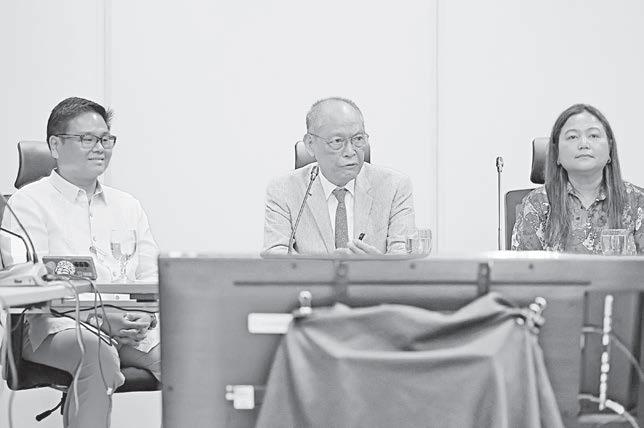

proposed budget once finalized, honor foreign-assisted projects, and ensure transparency by making budget documents publicly accessible.
These principles are not new, but hearing them articulated in a clear, structured manner reinforced their importance. For example, the reminder that “tinkering after the DBCC has prepared the national budget undermines months of technical work” reflects a broader truth: good budgeting requires discipline and predictability. When processes are disrupted, the consequences ripple across agencies and communities.
Another key takeaway was the emphasis on transparency. The suggestion to publish both the House and Senate versions of the General Appropriations Bill is a practical step toward strengthening public trust, which I think Congress must continue, henceforth. Making these documents accessible would allow citizens, civil society, and local governments to better understand how priorities shift throughout the legislative process.
The discussion also touched on the role of the bicameral conference committee. Opening
The new edition of Florante at Laura modernizes the classic text yet carefully preserves its historical and linguistic character. With annotations, glossaries, discussion guides, and illustrations by Rowin Agarao, the new version is both a literary resource and an important educational tool for contemporary learners. Also given a special highlight is the newest collection of Mga Kuwento ni Lola Basyang, as masterfully retold by awardwinning writer Christine S. Bellen-Ang, and brought vividly to life by an esteemed roster of Filipino illustrators. Inspired by the iconic stories of Severino Reyes, the collection reintroduces today’s young readers to narratives that have helmed generations through imagination, morality, wonder, and cultural memory.

its proceedings to the public—I think Sen. Win Gatchalian and Rep. Mika Suansing did a great job in facilitating the Bicameral conference committee for the 2026 budget—helped demystify one of the most critical yet least understood stages of the budget cycle. Transparency at this level can help ensure that changes introduced late in the process are aligned with national priorities and not merely political accommodations.
Perhaps the most thought - p rovoking reminder was the call for the President to exercise line-item veto pow -
“These stories have long occupied a cherished place in Filipino childhood,” shares Segundo D. Matias Jr., Founder of Lampara Books and Precious Pages Corporation. “Through these new editions, we hope to preserve their legacy while allowing a new generation of readers to discover the beauty, wisdom, and humanity found within Filipino storytelling traditions.”
In line with its mission to promote literacy and holistic learning, Lampara Books also launches several educational series that address current learning needs and social development of children. This includes the Decodable Comics for Fluency series in Filipino and English, which integrate Systematics Phonics and the Marungko Approach to reinforce founda -
er when necessary. While this authority should be used judiciously, it serves as an important safeguard against items that may not align with the broader fiscal strategy. As Diokno noted, this power is unique and carries significant weight in promoting discipline.
From my perspective, the session was a timely reminder that fiscal governance is a shared responsibility. Policymakers, public servants, communicators, and citizens all have roles to play in ensuring that the budget remains a tool for development rather than a casualty of com -
tional reading skills for beginners.
Written by Daisy Jane Calado, coordinated by Victor A. Villanueva, and illustrated by Rowin Agarao, the series combines engaging storytelling with workbookbased exercises that support comprehension and language development.
Also included in the launch is the Kids Have Rights! Series by Michellan SarileAlagao (illustrated by Kim Santiago), which introduces children to their fundamental rights through accessible language and relatable narratives. The SariSari Books series by Genaro R. Gojo Cruz, illustrated by Domz Agsaway, celebrates diversity, inclusivity, and self-expression, empowering a new generation of readers to appreciate individuality and social understanding.

peting interests. The insights shared during the IPRA conversation were not prescriptive but reflective—an invitation to think more deeply about how we can collectively strengthen our institutions.
As we look ahead to future budget cycles, the challenge is not simply to allocate resources but to do so with integrity, transparency, and foresight. The road to fiscal sustainability is long, but it begins with consistent adherence to sound principles and a shared commitment to the public good.
PR Matters is a roundtable column by members of the local chapter of the United Kingdom-based International Public Relations Association (IPRA), the world’s premier association for senior professionals around the world. Wilford Will Wong is an IPRA member and is currently working as an Undersecretary of the Department of Budget and Management. He carries with him over 20 years of experience in Corporate Communications and Public stakeholder relations.
We are devoting a special column each month to answer the reader’s questions about public relations. Please send your comments and questions to askipraphil@gmail.com.
Lampara Books also expands its educational offerings with the inclusion of Disaster Ready-Kids Series by Zarah C. Gagatiga and illustrated by Juno Abreu, which introduces the concept of practical safety measures and disaster preparedness to children. Kaligtasan Para sa mga Bata by Mark Norman Boquiren (illustrated by Mark Norman Boquiren), on the other hand, promotes public safety awareness among young Filipinos. With Lampara Books’ latest roster for the Heritage Month, reading is not just a tool to preserve culture and tradition. It is a strong foundation for education, imagination, and nation-building to prepare the next generation with the right mindset and heart to become better individuals.
CHAIRPERSON Claire Papa, MBM Benjamin Diokno, Usec. Wilford Wong and Head Executive assistant (MBM Diokno) Joan Kabigting
THE Powerhouse IPRA members and guests listen intently and actively engaged during the dialogue with MBM Diokno
OFFICERS and members of IPRA Philippines with MBM Benjamin Diokno
MBM Diokno
USEC . Wilford, during the open forum discussing budget transparency initiatives
Giro d’Italia: Jonas is Jonas
emphatically taking control of the race by soloing to victory on the brutal 14th stage. V ingegaard attacked on the daunting climb to the finish with just under 5 kilometers remaining, and no one could follow—the Team VismaLease a Bike rider beat Felix Gall by 49 seconds and Jai Hindley was nine seconds further back.
The 133-kilometer route from Aosta included five climbs, two of them ranked category one, plus a huge 16-kilometer slog up to the finish at Pila. It was the third mountain-top finish in this year’s race and a third victory for Vingegaard, who triumphed atop Blockhaus and Corno alle Scale. This one is the one I will remember the most,” Vingegaard said. “Today we made a plan from the start with the team—we wanted to control the race and that’s what my teammates did and they did an incredible job the whole day.” He added: “It was really impressive how they rode. I’m so proud of my teammates and I’m proud that I can pay them back. It’s a super nice win.”
A fonso Eulálio, who had been in pink since finishing second in the fifth stage, was dropped on the final climb and finished nearly three minutes behind Vingegaard.
The young Portuguese rider managed to remain second in the overall standings, 2:26 behind Vingegaard and 24 seconds ahead of Gall, who moved into third.
We were expecting this,” Eulálio said. “Jonas is Jonas. Yesterday I already told him he won this stage, you know, and I just keep fighting at the finish line and that’s it…I don’t like so much long, long climbs.” Sunday’s 15th stage will offer the riders some respite before a tough final week in the high mountains. The entirely flat 157-kilometer (98-mile) route starts in Voghera and ends with four laps of a circuit in Milan.
A fter the Corno alle Scale ninth

National speed cubing tourney set in Tagaytay
TWe didn’t want to pull for the stage and we realized quite quickly that Decathlon wanted to go for the stage,” Vingegaard said of the ninth stage. “It’s always nice with a win, something I’m super happy with, my teammates did a super good job and once the win was within reach, we decided on the last climb to maybe try to go for it.” AP
as key
Team USA in final Madelyn Anderson goes for the ball as she and partner Alaina Chacon of Team USA fends off a late rally from Ukraine’s Valentyna Davidova and Anhelina Khmil, 21-18, 21-19, to reach the women’s final of the Volleyball World Beach Pro Tour Nuvali Challenge on Sunday morning at the Nuvali Sands Courts in the City of Santa Rosa. PNVF PHOTO
in battle for Jr PGT Finals berths Ironman Philippines celebrates double milestone at Subic Bay
THE chase for top honors and crucial ranking points reaches fever pitch as the International Container Terminal Services Inc. Beverly Place Junior Philippine Golf Tour (JPGT) Championship unwraps its penultimate leg from June 1 to 3 in Mexico, Pampanga.
W ith only two stops left in the six-stage regional circuit, contenders from the 7-10, 11-14 and 15-18 categories are under pressure to either solidify their positions or mount last-ditch bids for coveted spots in the North team that will face the South side in the Ryder Cup-style grand finals in August.
In the girls’ 7-10 division, Andrea Dee hopes to boost her drive for a finals berth as she chases a second leg victory after ruling the Summit Point stage.
T he rising talent from Quezon City currently ranks third with 27 points from two tournaments and needs one more start to satisfy the minimum three-tournament requirement for finals qualification.
W inter Serapio has already secured a berth in the finale after sweeping three legs for 45 points, while Jehanne Mendoza sits at No. 2 with 30 points.
Tyly Bernardino, Elizabeth Laurel and Amiya Tablac remain firmly in contention with the final two Luzon legs still to be played, including the closing stop at Eagle Ridge from June 17 to 19. The boys’ 7-10 category also promises a spirited showdown with Zoji Edoc aiming to strengthen his hold on second place behind overall leader and finalist Zach Guico.
Fellow leg winner Kenzo Tan is likewise in the hunt at third, while Alexian Ching and Asher Abad seek strong finishes to improve their bids.
the World Cube Association.
R ankings—on top of medals and cash prizes—are up for grabs in the first nationally-endorsed speed cubing tournament in the Philippines which the Asian Mind Sports Association (AMSA) is conducting in partnership with the Philippine Olympic Committee (POC). The event is

TEra ends in Premier League


stressing that the event puts together the country’s best in the ever popular mind game that revolves around legendary and indefatigable Rubik’s Cube. Day 1 on May 27 covers the Philippine National Speed Cubing Summit and AMSA Referee Certification Training while Day 2 on May 28 will be the tournament proper featuring 3x3x3 cube, 2x2x2 cube, Pyraminx, 3x3x3 one-handed and 3x3x3 blindfolded.

Rookie of the Year Capital1’s Bella Belen will raise the Rookie of the Year trophy during the Premier Volleyball League Press Corps Awards Night on May 30 at the Novotel Manila Araneta City in Cubao. The top overall pick out of National University got 69 media votes and 26 team votes behind 91.284 statistical points for a total of 186.284 points to bag the award. A three-time University Athletic Association of the Philippines champion and MVP, she beat Zus Coffee’s AC Miner (85 points), Galeries Tower’s Jean Asis (83.896) and Zus Coffee’s Riza Nogales (64.479). PVL IMAGES
HE pinnacle of endurance racing takes center stage on June 7 as the Century Tuna Ironman Philippines and the Ironman 70.3 Subic Bay unleash a massive, double-header multisport spectacle.
R egarded as the triathlon capital of the Philippines, Subic Bay is bracing for an explosive weekend of racing where a record-breaking influx of international participants will clash with the best of local talent. The grueling battlefield begins with a calm but tactical swim leg in the protected waters of Subic Bay and from there, athletes will transition into a powerhouse bike segment along the sweeping, paved surfaces of Tipo Road and the
Knicks near NBA Finals New York’s Jalen Brunson (left) controls the ball against Cleveland’s Max Strus during the first half of Game 3 that the Knicks won, 121-108, in the Eastern Conference finals to move a win shy of the National Basketball Association championship series in Cleveland on Monday. AP


Subic-Clark-Tarlac Expressway, before concluding with an electric, tree-lined run course through the golf course, where spectators and families create an unmatched finish-line atmosphere. The blockbuster weekend, organized by Sunrise Events Inc., offers a comprehensive array of distances tailored to every tier of athlete.
Competitors can take on the ultimate challenge of the grueling Ironman PH—a 3.8-km swim, 180-km bike and a full 42.2-km marathon—or opt for the prestigious IM 70.3 Subic Bay—a 1.9-km swim, 90-km bike and 21.1-km half-marathon.
R egistration is ongoing. For details, visit the official event pages at www.ironman.com/im703-subic-bayphilippines or sunrisesprint.com
FORMER world champion Jerwin “The Pretty Boy” Ancajas followed the footstep of compatriot Mark “Magnifico” Magsayo after signing with Zuffa Boxing.
A ncajas told the BusinessMirror on Sunday that he’s happy to sign up with Zuffa Boxing that has International Boxing Federation (IBF) cruiser weight champion Jai Opetaia, World Boxing Council (WBC) welterweight No. 1 challenger Conor Benn and Chris BillamSmith in its stable.
“ I am thrilled to join Zuffa boxing together with Mark Magsayo. I must do my best and take advantage of the opportunity,” the 34-year-old former IBF super flyweight champion said. “Thankful for Sir Sean Gibbons for helping me out.”
H e did not reveal the terms and conditions of his contract as per promotion’s policy, but Magsayo was paid $50,000 as bonus on his won fight against Ireland’s Feargal McCrory last April 5 in Las Vegas.
A s the first nationally endorsed speed cubing open tournament in the Philippines, the event sponsored by Stellar Cube represents a significant step toward the professionalization and integration of speed cubing into the country’s sports ecosystem.
A MSA signed a strategic cooperation agreement with the POC to further the development of mind sports in the country—the partnership combines top tier international event standards with local resources.
A team relay exhibition event is also included to balance competition and viewership.
The agenda for the first day focuses on building an ecosystem for Philippine speed cubing, centering on AMSA’s referee and trainer certification system.
Magsayo, according to Gibbons, got the performance bonus for a total of $100,000 after scoring a magnificent fifth-round knockout win over McCrory.
A ncajas, who is sporting a 384-2 win-loss-draw record with 25 knockouts, will be facing American Omar Trinidad in a non-title featherweight fight—his second at 126 lbs—in his Zuffa Boxing debut on June 28 at the Cosmopolitan in Las Vegas. H ead trainer and manager Joven Jimenez, meanwhile, confirmed that Ancajas is working with Angel “Memo” Heredia to intensify his conditioning ahead of the fight against t he unbeaten 30-year-old Trinidad, who has 20 wins highlighted with 14 knockouts with two draws.
We are just doing what is best for Jerwin’s career, and we believe in him. We believe that he can still be a world class champion again with the help of coach Memo,” Jimenez said. “We must stay here in the US for training until the fight week.” Josef Ramos