‘Mid-income households deserve govt aid, too’
By Justine Xyrah Garcia
As
“To
“Complementary measures on social welfare should uplift not only the marginal group but also the expected price hike absorbers like the middleincome groups,” it also said.
The recommendations come as the Philippines continues to grapple with the economic fallout from the conflict between the United States-Israel tandem and Iran, which disrupted global oil markets and drove up fuel prices worldwide.

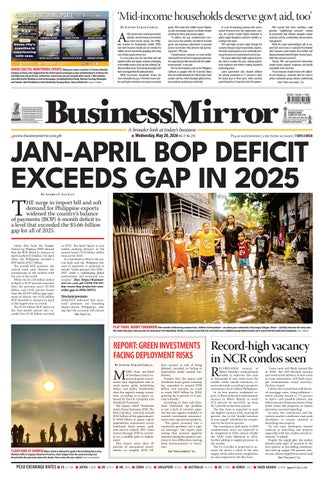
THEsurge in import bill and soft demand for Philippine exports widened the country’s balance of payments (BOP) 4-month deficit to a level that exceeded the $5.66-billion gap for all of 2025.
Latest data from the Bangko Sentral ng Pilipinas (BSP) showed that the BOP deficit in January to April reached $7.4 billion. For April alone, the Philippines recorded a BOP deficit of $2.1 billion. The overall BOP position, the central bank said, denotes the transactions of the country with the rest of the world. While the $2.124-billion deficit in April is 16.97 percent narrower than the previous year’s $2.558 billion, and 19.45 percent leaner than the $2.637-billion gap registered in March, the $7.41-billion BOP shortfall in January to April is the largest-ever on record. The $7.41-billion BOP deficit in the four-month period also exceeded the $7.26 billion recorded
in 2022. The latest figure is now within striking distance of the central bank’s $7.8-billion deficit forecast for 2026. In a statement in March, the central bank said the Philippine balance of payments is projected to remain “under pressure over 2026–2027 amid a challenging global environment and structural constraints.” (See: https://businessmirror.com.ph/2026/04/02/ bsp-resets-bop-projection-seeswider-gap-in-2026-2027/).
Structural pressures ANALYSTS indicated that structural pressures are hounding import-driven Philippines, adding that the economy will remain





By Justine Xyrah Garcia
ORE than one-third of Southeast Asia’s announced green investments face deployment risk as weak power grids, permitting delays and policy bottlenecks slow the region’s energy transition, according to a report released by Bain & Company and Standard Chartered.
The report, titled “Southeast Asia’s Green Economy 2026: The New Calculus,” said only around $315 billion of the approximately $540 billion in green capital expenditure announced across Southeast Asia’s power, grid, and electric vehicle (EV) value chains through 2030 is currently on a credible path to deployment. This means more than 35 percent of announced investments—or roughly $225 bil-
lion—remain at risk of being delayed, canceled, or failing to materialize under current conditions.
Despite this, the report said Southeast Asia’s green economy has expanded to around $290 billion and remains on track to reach $430 billion by 2030, growing by 8 percent to 9 percent annually.
According to Bain and Standard Chartered, the problem is not a lack of investor appetite but the region’s inability to convert investment announcements into operational projects.
“The green economy has a conversion problem, not a capital shortage,” the report said, noting that investor appetite remains strong but projects continue to face difficulties moving from announcement to execution.
RECORD -HIGH vacancy in Metro Manila’s condominium market is expected this year as thousands of new units enter the market while unsold inventory remains elevated, according to property consultancy firm Colliers Philippines.
In its first quarter residential report, Colliers projected condominium vacancy in Metro Manila to reach 25.6 percent by end-2026, up from 24.7 percent in the first quarter.
The Bay Area is expected to post the highest vacancy level, nearing 60 percent, due to the “sizable turnover of new supply” scheduled for completion by the fourth quarter.
The consultancy said nearly 13,000 condominium units are expected to be completed in 2026, almost double the 7,400 units delivered in 2025, further adding to supply pressures in the market.
The C5 Corridor is projected to account for about a third of the new supply, while substantial completions are also expected in the Bay Area.
“Lease rates will likely remain flat in 2026. The still-elevated vacancy and substantial delivery of new units in some submarkets will likely hamper condominium rental recovery,” the firm stated.
Colliers also noted that still-elevated mortgage rates, rising inflation— which already soared to 7.2 percent in April—and possible interest rate hikes may also delay purchases of bigticket items like property, as buyers prioritize essential spending. As such, the consultancy said the current market conditions may push developers to remain cautious in launching new projects.
“In our view, developers remain cautious in launching new projects especially with the sizable unsold inventory,” it added. Despite the supply glut, the market showed early signs of recovery in the first quarter as pre-selling condominium take-up surged 765 percent yearon-year, driven largely by economic and
By Andrea E. San Juan
CLOUD NINE AT SUNRISE Hikers stand in silhouette against the breaking dawn atop Marlboro Hills in Sagada, Mountain Province, their fatigue from the early morning trek dissolved by the spectacle above the clouds. Here comes the sun, indeed. TRIXZY LEIGH BONOTAN
PLAY TODAY, WORRY TOMORROW After months of blistering summer heat, children in Dreamland—an urban poor community in Barangay Tubigan, Biñan—joyfully welcome the early rains. But while they play, their parents are bracing for the impending floods, a
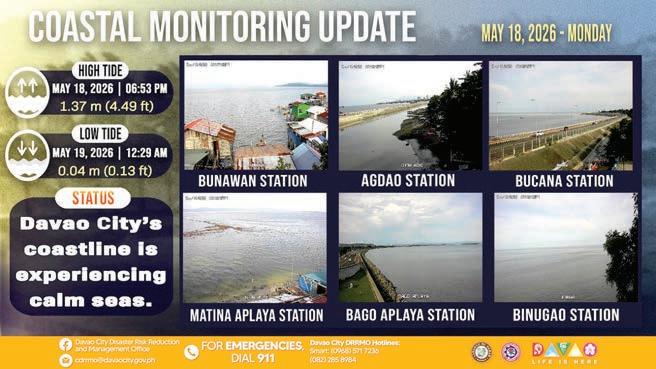
DAVAO COASTAL MONITORING UPDATE: Rising sea waters reached 1.37 meters Monday evening as heavy rains triggered by the intertropical convergence zone inundated parts of Davao City
affordable housing segments.
Developers’ aggressive promotions and flexible payment terms, particularly for ready-for-occupancy units, helped boost demand during the quarter.
Colliers said Metro Manila’s remaining inventory life—or the estimated period needed to absorb unsold units—improved to 6.8 years from a peak of 13.4 years in mid-2025.
To help improve take-up, particularly in lower-priced residential projects, Colliers said developers should continue exploring the affordable and economic housing segments while maximizing public sector-led initiatives such as the government’s Pambansang Pabahay Para sa Pilipino (4PH) housing program.
The report cited 8990 Holdings Inc.’s Urban Deca Homes Tondo as among the projects that posted significant take-up in the first quarter, offering rent-to-own studio units with monthly amortization of between P5,000 and P7,000 subsidized by Pag-IBIG under the 4PH program.
“Colliers believes that these initiatives should help improve take-up especially for lower-priced residential units. Local governments can also take an active part in helping solve the housing backlog,” it also said. Justine Xyrah Garcia
Exclude poultry from MAV, industry group urges govt
By Ada Pelonia
THEUnited Broiler Raisers Association (Ubra) urged the government to exclude poultry products from the minimum access volume (MAV) mechanism to enable the implementation of special safeguard (SSG) duties.
Ubra Chairman Elias Jose Inciong called on the Department of Agriculture (DA) to remove poultry products from the list of farm goods covered by the MAV scheme, since duties levied for in-quota and out-quota shipments are now equal.
“The MAV for chicken should no longer exist based on our commitments to the World Trade Organization [WTO] because in 2005, the
Ruben Carlo Asuncion, chief economist at Union Bank of the Philippines (UBP) said: “The wider year-to-date gap underscores persistent structural pressures—particularly the large trade deficit driven by strong import
previous 50 percent levied on [shipments] outside the MAV and 40 percent in-quota became equal,” he said in a radio interview on Monday.
Inciong explained that excluding poultry from the MAV mechanism will enable shipments to be imposed with SSG, which is a trade mechanism that a country can levy on imports that fall below a trigger price.
“Even though the tariff rates on
demand and softer exports.”
Jonathan L. Ravelas, senior adviser at Reyes Tacandong & Co. said while the narrowing of the BOP in April is a “modest but positive signal,” the Philippines is still an “import-driven economy.”

chicken [for in-quota and outquota] are equal, they can avoid the trade remedy called special safeguard duties that can reach P6 to P10 per kilo,” he added.
The SSG forms part of the Competitiveness Enhancement Measures Fund (CEMF), aimed at boosting domestic industries injured by increased imports. The fund is composed of 50 percent of revenues collected from fees, charges, and safeguard duties on imported goods.
Industry sources said the CEMF consists mostly of SSG duties collected from coffee and poultry imports. While Inciong welcomed the government’s move to revise the rules governing the MAV, he maintained that poultry should be excluded from the measure.
“That’s a positive development if the DA is really changing the rules because it means they see that a few are benefiting [from it]
“So, a BOP deficit will likely persist in the near term,” added Ravelas.
John Paolo Rivera, Senior Research Fellow at state-run think tank Philippine Institute for Development Studies (PIDS) agreed with Ravelas. “External position will remain sensitive to oil prices, global financial conditions, and investor sentiment.”
“If geopolitical tensions persist, both BOP and reserves may stay under pressure, but the Philippines’s steady remittance inflows and services earnings should help keep the situation manageable,” Rivera added.
While the deficit is still “manageable,” Asuncion said this highlights the economy’s “reliance” on external financing, suggesting the need to sustain inflows and allow foreign exchange flexibility, even as the deficit may moderate later in the year amid improving inflows and seasonal factors.
“The key message here is not elimination, but manageability—our external position remains ‘deficit but resilient,’ supported by strong fundamentals like remittances, services exports, and adequate reserves,” said Ravelas.
April data
DESPITE the widest-ever year-todate shortfall recorded, data from the central bank showed the BOP gap recorded in April alone eased
and the system is being manipulated,” he said.
The government recently revised the rules for implementing the MAV mechanism, citing the need for transparency and “equitable stakeholder participation in the agricultural sector.”
Among the revisions were the distribution of the quota through a “systematic distribution procedure” that allocates volumes to qualified participants through a raffle-based system.
A midyear redistribution process will be conducted during the first week of June to reallocate surrendered and reverted quotas.
“We support them if they will revise the rules to make it transparent, but as far as we’re concerned, there should be no MAV for chicken anymore—it’s already equal—so that the special safeguard duties can apply to all imports,” Inciong said.
due to strong dollar inflows from remittances and services exports.
“The narrower BOP deficit in April reflects a normalization of foreign exchange flows after earlier outflows, with continued support from remittances and services,” Asuncion said.
Ravelas noted the narrower deficit seen in April “reflects steady dollar inflows from remittances and BPOs, some improvement in capital flows and a slightly softer import bill.”
For his part, Rivera said the reduction in the country’s foreign reserves indicates that the central bank may have used part of the buffer to smooth peso volatility and meet external obligations.
“Despite the drop, GIR [gross international reserves] level remains adequate and continues to provide a strong buffer against external shocks,” said Rivera.
Latest BSP data showed the country’s GIR settled at $104.3 billion as of end-April 2026. This is the lowest GIR in 15 months.
Still, the BSP emphasized that this level provides a “robust external liquidity buffer, equivalent to 6.9 months’ worth of imports of goods and payments of services and primary income.” (See: https://businessmirror. com.ph/2026/05/09/fx-intervention-external-payments-behind15-month-foreign-reserves-low/).
impact of school closures, warning that learning losses suffered during the pandemic could translate into weaker productivity and lower incomes over the coming years.
6.3 percent annually while inflation and the fiscal deficit remained manageable.
At the time, economic managers believed the country could sustain growth of 6 percent to 7 percent—or even as high as 8 percent—over the long term.
However, Balisacan said the Covid-19 pandemic significantly disrupted the country’s development path after the economy contracted by 9.5 percent in 2020, the worst postwar downturn on record.
“It took us another two years just to recover the GDP per capita. So we practically lost three years,” he said.
He added that the pandemic left scars across both the economy and human capital, with thousands of micro, small and medium enterprises (MSMEs) either shutting down or falling heavily into debt after prolonged lockdowns. Balisacan also pointed to the long-term
The chief economist acknowledged that the Philippines once had strong potential to catch up with its regional peers, recalling a period when “people with competence [were] joining the government.”
However, Balisacan said “so many combinations of things happened” that caused the country to “miss the boats” on key growth opportunities.
He warned that fresh external shocks, including the ongoing Middle East crisis, are now creating new risks for the domestic economy through elevated oil prices, inflationary pressures, and slower growth.
“Now, again, we have another problem… all these shocks. So we would need to recalibrate the AmBisyon Natin in 2040,” he added. Despite the need for recalibration, Balisacan stressed that the long-term vision itself should remain intact because it reflects the aspirations of Filipinos.

respectfully submits that such recovery should not extend to the imposition of VAT.”
A bill seeking to remove the VAT on system loss charges in electricity bills was filed by Senator Risa Hontiveros. Senate Bill No. 2076 aims to amend the National Internal Revenue Code (NIRC) to exempt system loss charges from VAT, amid reports of higher electricity costs during the dry season. “VAT is a consumption tax on goods and services. Systems loss charges—which represents losses in the distribution and delivery of electricity, are neither goods nor services purchased by power consumers. Hindi dapat pinapatawan ng VAT diyan ang mga pamilyang nagbabayad ng kuryente [VAT should not be imposed on that for families paying for electricity].
By removing the VAT on systems loss charges, we are not just making our tax policies more fair and just—we are also providing immediate relief to consumers facing higher electricity bills this summer season,” Hontiveros said during a Senate hearing.
The report pointed to power grid infrastructure as one of the biggest constraints to green investment deployment.
While projects such as EV factories, industrial hubs, and data centers can typically be completed within one to three years, transmission and distribution infrastructure often takes five to 15 years to build. This mismatch is becoming more pronounced as electricity demand accelerates across the region. Southeast Asia is expected to absorb more than 100 terawatt-hours of additional electricity demand over the next three to four years from data centers, EVs, and green industrial clusters alone.
However, investment in transmission and distribution declined by around 3 percent annually between 2015 and 2025 even as regional energy demand grew roughly 5 percent per year, the report said.
As a result, the region faces an estimated annual grid investment shortfall of around $18 billion against the roughly $29 billion required each year through 2035.
The report said weak grid infrastructure is already affecting project execution across several markets. It noted that around 50 percent to 60 percent of renewable energy projects in Vietnam, Thailand and Indonesia were canceled between 2021 and 2025 due to issues including unclear power purchase agreement structures, permitting delays and grid connection constraints. Cancellation rates for nickel and battery investments were also estimated at 40 percent to 50 percent. Despite these challenges, capital deployment continues to concentrate in sectors with clear commercial demand and more established returns.
Between 2021 and 2025, around 80 percent of Southeast Asia’s annual green capex deployment—estimated at roughly $40 billion—went to power and grid projects, as well as the EV value chain. Power and grid investments accounted for about $20 billion or half of annual deployment, while EV-related investments represented around $11 billion or 30 percent. Bain and Standard Chartered said addressing bottlenecks in these investment areas could unlock an additional $80 billion in green capex by 2030.
DOE warns of more power supply alerts
By Carmel Pedroza
CFuentebella said in an online news conference that the Visayas grid is expected to experience multiple alert conditions in the coming months.
These include seven yellow alerts during afternoon peak hours, as well as six red alerts and seven yellow alerts during evening peak periods.
See “DOE,” A4
DILG vows to strengthen LGU role in green transition
By Jonathan L. Mayuga

@jonlmayuga
THE Department of the Interior and Local Government (DILG) has joined the Department of Environment and Natural Resources (DENR) and partners that are advancing the circular economy.
The DILG took part in the High-Level Interagency Roundtable on the National Circular Economy Framework (NCEF) held in Metro Manila recently. Representing the Department, Assistant Secretary Lilian M. de Leon reaffirmed the DILG’s commitment to strengthening local governance and improving basic service delivery through sustainable and environmentresponsive policies at the local level.
See “DILG,” A4
MSA-PH, Cavite hospital launch sleep study service
MEDICAL Services of America (Philippines) Inc. (MSA-PH) has officially marked a significant expansion of its diagnostic capabilities with the launch of its first sleep study service, in partnership with Our Lady of the Pillar Medical Center (OLPMC) of Imus, Cavite.
The new service is specifically designed to address the growing prevalence of obstructive sleep apnea (OSA), a serious condition that often goes undiagnosed.
By providing gold-standard sleep diagnostics within the hospital’s facility, MSA and OLPMC aim to offer a seamless pathway from identification to treatment, significantly improving the long-term health and quality of life for residents in the region. The launch was commemorated with a ceremonial ribbon-cutting, signaling the start
DOE sets review of fuel price cap policy
TBy Lenie Lectura @llectura
HE Department of Energy (DOE) will revisit its fuel price cap policy after oil companies raised concerns over mandatory price adjustments, saying this may affect the viability of a deregulated market.
“We are already looking at the pricing mechanism we have adopted when we prescribed the price adjustments. It was based on the reported calculations also of the oil companies. Now, we are reviewing our current policy on easing up on the strict rules of the DOE,” said Energy Secretary Sharon Garin.
The policy was an offshoot of the energy emergency declaration under EO 110, which triggered additional powers for government to prescribe the price. The energy chief, however, clarified that the government is setting a limit on minimum rollback and a cap on the maximum price increase to prevent profiteering, among others.
Oil companies announced on Monday
By Ada Pelonia
BELGIUM has secured a regionalization agreement with the Philippines to maintain exports of poultry products despite the persistent threat of bird flu.
Agriculture Secretary Francisco Tiu Laurel Jr. signed Department Circular (DC) 25, which granted bilateral recognition of
a P2.80 to P2.82 per liter increase in diesel and P1.20 to P1.21 per liter hike in gasoline.
Kerosene prices, meanwhile, went down by P2.21 per liter. The fuel price hike, which took effect on Tuesday, is aligned with the DOE’s estimates for the week.
“For the past four weeks, the DOE has prescribed the adjustments, meaning if there’s an increase, we prescribe the maximum increase, and not allowing increases that are more than the maximum that we prescribed.
On the rollbacks, it would be the minimum, the smallest rollback that they can have more, but it cannot be less than the rollback that we prescribed,” added the energy chief.
Garin recognized the concerns of the oil companies, saying they each have different suppliers for petroleum and freight, as well as different computations on premium charges.
“We have started talks about this already since last weekend, and we are still reviewing the submissions of the oil companies and making sure that there is no profiteering,” Garin commented.
Oil companies adjust their prices every
regionalization for Highly Pathogenic Avian Influenza (HPAI) to Belgium.
The same circular also lifted the temporary ban Manila imposed on birds and poultry goods, including poultry meat, dayold chicks, eggs, and semen from Belgium, which was issued in December 2025.
Belgium received system accreditation to export live poultry and chicken meat into the Philippines in 2016.
week to reflect movements in the world oil market.
As of May 15, the DOE reported that the country’s fuel inventory is good for 45 days. Of which, diesel supply will last for 46 days; gasoline, 45; kerosene,152; jet fuel, 59; fuel oil, 50; and liquefied petroleum gas (LPG), 30 days.
“The average as of this week is lower than the previous week, but this is not an alarming state. It is just because we are assured of supply from other countries. So, DOE remains vigilant about our supply and closely monitoring the activities of our oil companies. The DOE is ready to procure more once the level is, let’s say, not comfortable anymore,” added Garin.
Meanwhile, the DOE reported that there are at least 938 service stations that are implementing the P10-per-liter fuel subsidy program for eligible public utility jeepney and UV Express drivers.
Of the number, Luzon accounts for 616 stations, the Visayas has 172 stations, while Mindnaao has 150 stations.
“Every driver who depends on the road to
earn a living deserves a fuel station nearby that can serve them under this program. Under the directive of President Marcos, we are working hard to make sure that happens,” Garin said. “Through this initiative, we are helping ensure that energy remains an enabler of livelihood and mobility, not a burden.” As part of the Unified Package for Livelihoods, Industry, Food, and Transport (Uplift) Program, the FSP provides eligible beneficiaries with up to P1,500 per vehicle per week for three months. This is part of the government’s targeted response to global oil market volatility, following the declaration of a State of National Energy Emergency under Executive Order 110. The DOE reminded the service stations to comply with all operational, technical, and reporting requirements. Fuel stations that fail to comply may face suspension
Under DC 25, the Philippines requested several documents from Belgium’s veterinary authorities to evaluate the measures it applied and implemented against bird flu.
The Bureau of Animal Industry (BAI), an attached agency of the DA, then reviewed the country’s application for bilateral recognition of regionalization for HPAI.
See “MSA-PH,” A9 See “Bird flu,” A9
BAI concluded that Belgium “maintains sufficient veterinary oversight and has established necessary control and mitigating measures against HPAI,” which ensures a low risk of importing live poultry, day-old chicks, eggs, and semen from identified proposed zones for recognition. With this, the circular noted that all import transactions should follow the bilaterally agreed import terms and conditions

Church groups mobilize in support of Sara Duterte impeachment trial
By Mary Jade Jadormio
CHURCH-BASED social action groups under Caritas Philippines began mobilizing diocesan communities nationwide in support of calls to proceed with the impeachment trial of Vice President Sara Duterte, amid mounting political tensions following the recent Senate leadership shakeup.
In a statement, members of the Caritas Philippines Social Action Network said they are supporting the appeal earlier made by Lipa Archbishop Gilbert Garcera, president of the Catholic Bishops’ Conference of the Philippines, for the impeachment proceedings to continue.
“We will mobilize our respective communities and invite all Filipinos, regardless of faith denomination or church affiliation, to organize activities that will manifest our support,” the group said.
The network said recent developments in the Senate underscored the need to “peacefully organize as a nationwide network” and remain vigilant in defending democratic institutions and the rule of law.
The statement came days after the Senate elected Alan Peter Cayetano as Senate president, replacing Vicente Sotto III, a move that drew criticism from several Church leaders and civil society groups concerned over its possible implications on the impeachment process.
Caritas-linked groups also cited a series
of national issues confronting the country, including the flood control corruption controversy, the International Criminal Court’s drug war proceedings, efforts to pass an anti-political dynasty measure, and economic pressures arising from the Middle East conflict.
Quoting the late Pope Francis, the group urged Filipinos “to come out better from a crisis” by learning to “see clearly, choose well, and act right.”
The group also proposed a list of activities to encourage dioceses and communities to organize communal prayers, candlelighting rites, bell-ringing, prayer rallies, and information drives related to the impeachment proceedings.
The suggested activities included prayers
for senators, prosecutors, and defense lawyers “that they may ‘see clearly, choose well, and act right’” and remain guided by the rule of law and the pursuit of justice and truth.
The network also encouraged communities to disseminate “credible, fact-checked, and responsibly sourced information” and promote respectful discussions on developments related to the trial.
Signatories to the statement included Gerardo Alminaza, president of Caritas Philippines; LingayenDagupan Archbishop Socrates Villegas; Bishop Broderick Pabillo of Taytay, Palawan; and dozens of other bishops, priests, and diocesan social action directors from the entire country.
Motorcycle taxi legalization gets support in House
By Jovee Marie N. dela Cruz @joveemarie
LAWMAKERS are renewing calls for Congress to legalize motorcycle taxis, citing the need for a clear regulatory framework as the government temporarily freezes the onboarding of new riders by transport network companies.
Camarines Sur Reps. Miguel Luis Villafuerte and Vincenzo Renato Luigi Villafuerte said the recent cap on riders—imposed to address safety concerns—presents an opportunity for Congress to pass legislation that would formally recognize and regulate motorcycles-for-hire as a legitimate mode of public transport.
In filing House Bill 1991, the lawmakers said motorcycle taxis have already
NCSC to establishments: Honor digital senior ID PNP chief to cops:
SENIOR citizens may use the digital National Senior Citizens ID (NSCID) in claiming discounts, tax exemptions, government services, and other transactions where a senior citizen card is required, the National Commission of Senior Citizens (NCSC) said on Tuesday.
The NCSC issued the reminder as it called on government offices, banks, financial institutions, and private establishments to recognize the digital NSCID, accessible through the eGovPH app, as a valid proof of identity for older Filipinos.
Continued from A3
become an integral part of the country’s transport system, offering commuters a more affordable and efficient way to navigate congested roads in Metro Manila and other urban areas.
The bill seeks to establish a comprehensive framework covering registration, franchising, rider qualifications, fare-setting, and safety standards for motorcycle taxi operations.
The Villafuertes refiled the measure after a similar bill approved by the House in the previous Congress failed to become law due to the lack of a Senate counterpart.
Their renewed push comes after the Department of Transportation ordered the Land Transportation Franchising and Regulatory Board (LTFRB) to suspend the onboarding of new riders, citing “over-boarding” that exceeded the allowed cap for both ride-hailing
“We call on all institutions and establishments to accept the digital NSCID in accordance with the law, similar to other government IDs available through the eGovPH App,” the NCSC chairperson and chief executive officer, Maria Merceditas Gutierrez, said. Under NCSC Public Advisory 1, series of 2026, the digital ID may be used to avail of the 20-percent discount and value-added tax exemption on medicines, food, transportation, and other covered goods and services. It may be presented in accessing government assistance programs, benefits, priority
In Mindanao, the DOE projects no red alerts but six yellow alerts from September to November and one more yellow alert for Luzon.


and motorcycle taxi services.
Under HB 1991, motorcycles for hire must be registered with the Land Transportation Office (LTO), while operators and platform providers are required to secure franchises and accreditation. The measure also mandates insurance coverage for riders, passengers, and third parties, as well as the creation of quick response teams for emergencies.
The bill sets a speed limit of 60 kph and requires strict compliance with traffic rules, with enforcement support from local government units and other agencies. It also directs the LTO to establish a centralized database to track violations and accidents involving motorcycle taxis.
The measure covers both passenger services and delivery platforms, defining the
accommodations, account opening, loan applications, benefit claims, and identity verification transactions.
The digital NSCID is an official government-issued identification meant to make services easier and more convenient for senior citizens.
“The digital National Senior Citizens ID is an official and legitimate governmentissued identification designed to make services more accessible and convenient for our senior citizens,” Gutierrez said. Gutierrez said wider recognition of the
The Philippines remains under El Niño southern oscillation (Enso)-neutral conditions, but state the weather bureau had warned of a high probability—around 70 to 79 percent—that El Niño may develop between June and August this year and could persist into early 2027. The phenomenon is expected to significantly affect weather patterns, water supply, and electricity demand.
This warning comes as the Visayas grid continues to grapple with major plant outages and tight operating reserves, raising concerns over possible rotational brownouts should additional generating units go offline.
Speaking during the MyTV Cebu OPENLINE News Forum on Tuesday, Neil Martin Modina, assistant vice president and head of Visayas System Operations of the National Grid Corporation of the Philippines (NGCP), said the transmission operator is closely monitoring grid conditions amid rising demand and limited supply.
“Yellow alert means our operating margin cannot meet the contingency reserve, while a red alert means the operating margin can no longer sustain the regulating reserve of the transmission network,” Modina explained.
He noted that as of Monday evening, the Visayas grid remained under yellow
roles of motorcycle taxi providers and online e-commerce platforms in transporting people and goods.
Citing worsening traffic congestion, Villafuertes said motorcycles have become a preferred option for many commuters due to their affordability and mobility. They noted that informal motorcycle transport services, such as “habal-habal,” have long existed in the country, particularly in the provinces.
A 2019 pilot study, Villafuerte said, showed that with proper regulation and training, motorcycles for hire can be a safe and reliable transport option.
The lawmakers stressed that passing HB 1991 would not only protect commuters and riders but also ensure accountability among operators as demand for alternative transport continues to grow.
digital ID would help prevent inconvenience and discrimination against older Filipinos, particularly those claiming lawful benefits in public and private establishments.
The digital NSCID was launched by the NCSC and the Department of Information and Communications Technology in August 2025 as part of the government’s shift to a secure, app-based system for accessing senior citizen rights and benefits.
As of April 2026, more than 1.3 million senior citizens have accessed their digital NSCID through the eGovPH App. PNA
alert, with an operating margin of only 57 megawatts (MW).
Kung red alert na, dili na maka-sustain sa regulating reserve. Mao nang possible ang rotational brownouts [If it reaches red alert status, the grid can no longer sustain the regulating reserve. That is why rotational brownouts may occur],” he added.
NGCP also reported that several major generating units in the Visayas remain offline, significantly affecting supply. These include two 169-megawatt units of Therma Visayas Inc. (TVI) in Cebu and the 150-megawatt Panay Energy Development Corp. (PEDC) plant in Panay, contributing to a total unavailable capacity of 845 megawatts.
“Dakonakaayona [That’s already a large amount],” Modina said, underscoring the scale of the outages.
Power demand in Cebu alone reached 1,128 megawatts on May 18—nearly half of the Visayas grid’s total demand of 2,600 megawatts.
“Cebu consumes almost half of the Visayas demand. Kinahanglan gyud og additional generation diri sa Cebu [We really need additional power generation here in Cebu],” he added.
See “DOE,” A9
Ignore political noise,
focus on public safety
GEN. Jose Melencio Nartatez Jr., National Police chief, on Tuesday called on all commanders and personnel to remain focused on their mandate of ensuring public safety amid political noise and other issues, particularly on social media.
Nartatez said criticisms and intrigues being spread online should instead serve as motivation and a challenge for the organization to further improve its service and protection for the Filipino people.
“These intrigues and political noises, including attempts to encourage any of our personnel to engage in partisan politics, are meant to distract us from performing our job well and sustaining our gains on peace and order,” Nartatez said in a statement.
He said the PNP’s sustained efforts to reduce the crime rate, backed by high public trust and performance ratings, are proof that the organization remains committed to maintaining peace and order across the country.
Nartatez also vowed to continue working closely with the Department of the Interior and Local Government (DILG) and other law enforcement agencies.
“The PNP remains completely focused on its mandate and other reform measures, including the integration of the policies of the DILG under Secretary [Juanito Victor] Jonvic Remulla on internal reforms and actions that will make the public feel safe,” he said.
“We will not allow unverified political talk to distract us from our duty to protect the public,” he added.
The PNP has intensified its internal cleansing efforts and strengthened coordination with local government units in crime prevention and anti-illegal drug operations. Among these initiatives is the “Safer Cities” initiative, which has contributed to a sharp decline in crime incidents nationwide, alongside the continuing crackdown on smuggled products that drain the country’s resources.
The police organization has also sustained efforts to improve emergency response and increase police visibility in communities, among other initiatives.
Nartatez, likewise, ordered regional and local police units to remain focused on law enforcement operations and public safety efforts, stressing that the organization’s mandate remains unchanged despite political noise surrounding the issue.
“Our working relationship with Secretary Remulla has been highly professional, collaborative, and anchored on institutional stability,” Nartatez said.
“We continue to fully cooperate with the DILG leadership to ensure peace and order nationwide,” he added.
Nartatez issued the statement amid circulating reports online that Remulla is about to be replaced as DILG secretary amid the government’s failure to arrest Sen. Ronald dela Rosa and fugitive former lawmaker Zaldy Co. Malacañang on Monday said President Marcos has not lost trust in Remulla. Rex Anthony Naval with PNA
Legislator eyes mental health services for students of SUCs
By Jovee Marie N. dela Cruz
ALAWMAKER is pushing for stronger and more accessible mental health services in State Universities and Colleges (SUCs), citing the growing number of Filipino youth experiencing anxiety, depression, and other psychological challenges.
Parañaque Rep. Brian Yamsuan filed House Bill 7354, which seeks to institutionalize the establishment of a Mental Health Office (MHO) in every SUC campus. The measure aims to fill the gap in mental health support at the tertiary level, complementing recent initiatives of the Department of Education (DepEd) for basic education students.
“While the DepEd has been focused on ensuring the mental well-being of students in the basic education sector, no such initiative has been institutionalized at the tertiary level to benefit college students, who are as vulnerable to emotional stress, depression, and even bullying,” Yamsuan said.
The lawmaker cited the recent rollout of DepEd’s Learners TeleSafe Contact Center Helpline #33733, which provides round-the-clock mental health assistance to younger students through direct access to the National Center for Mental Health Crisis Hotline.
“Our proposed legislation will address these gaps in the implementation of government programs aimed at effectively responding to the growing mental health crisis among our youth,” Yamsuan said. Yamsuan raised alarm over data from the University of the Philippines Population Institute showing that 7.5 percent of Filipinos aged 15 to 24 had experienced suicidal thoughts in 2021—more than double the 3 percent recorded in 2013. Cases of self-reported depression also rose from 7 percent to 11 percent over the same period.
He also pointed out that in 2023, the Philippine Statistics Authority recorded 3,133 deaths due to intentional self-harm, with nearly 30 percent involving individuals aged 15 to 24.
“It is not only academic pressure that
college students face, but also stress, anxiety, depression, and other mental health concerns—especially for those who are working while studying or living far from their families,” he said.
Under HB 7354, each SUC will establish an MHO that will operate dedicated hotlines staffed by trained guidance counselors and mental health professionals. These offices will provide support not only to students but also to faculty and other members of the academic community.
The bill also mandates the Commission on Higher Education (CHED) to require all SUCs to implement mental health programs, including awareness campaigns focused on suicide prevention, stress management, counseling, and overall well-being.
To address the shortage of mental health professionals, the measure authorizes SUCs to hire specialists on a full-time or contractual basis and to train graduates in psychology and related fields under proper supervision.
In addition, the bill tasks CHED, in coordination with the Department of Budget and Management (DBM), Civil Service Commission (CSC), Department of Health (DOH), and Professional Regulation Commission (PRC), to develop a comprehensive career development plan for mental health professionals. This includes provisions for competitive salaries, training, scholarships, research grants, and incentives. Yamsuan expressed hope that lawmakers would act swiftly on the measure.
“We hope that our fellow lawmakers will recognize the urgency in passing this measure that aims to institutionalize mental health services in SUCs. The lack of mental health support does not only affect academic outcomes but also one’s personal well-being and, sadly, could sometimes lead to selfharm,” Yamsuan said. He also noted that a similar measure had already been approved on third and final reading in the
Continued from A3
Legislator asks Ombudsman to probe Davao City First District’s ₧4.4 billion flood-control projects
HMarcos eyes more military, energy equipment from Japan
PBy Joel R. San Juan @jrsanjuan1573
OUSE of Representatives Deputy Minority Leader Antonio Tinio has asked the Office of the Ombudsman to investigate the alleged irregularities involving 80 contracts amounting to P4.4 billion flood control projects in Davao City’s First District from 2019 to 2022. Tinio said the complaint-report he submitted to the Ombudsman was based on the House’s independent investigation covering 121 flood control projects along Davao and Matina Rivers.
Among these irregularities were possible duplicate payments or ghost projects amounting to P135 million; double funding of same flood control project as shown in the 2020 General Appropriations Act (GAA) and was awarded to two different contractors; location changes and shortchanging involving eight projects amounting to P425 million; 65 contracts amounting to P3.56 billion
NDA asks for
lacked specifications; P623 million worth of contracts lack General Appropropriations Act authorization; and 10 unfinished flood control projects worth P713 million. Tinio also noted that 49 out of the 80 red-flagged contracts were reportedly congressional insertions, all concentrated in Davao City’s First Legislative District.
The representative of Davao City’s First District from 2019 up to present is Paolo “Polong” Duterte, son of the former President and brother of Vice President Sara Duterte.
“The anger of the Filipino people against corrupt officials is valid. Almost a year has passed since the flood control corruption investigation began, yet no high-ranking official has been held accountable,” Tinio said.
“We respectfully urge the Ombudsman to conduct a thorough investigation of these flood control projects, with priority attention to physical verification of incomplete and ‘100 percent’ complete but on-going projects,’” he added.
Specifically, Tinio, the nominee of the party-list group ACT Teachers said the Ombudsman’s investigation should determine who initiated, endorsed, approved, implemented, and benefited from these items, and whether procurement and implementation were aboveboard.
“The Ombudsman must examine the full chain of accountability—from budget itemization and approvals to bidding, implementation, inspection, and payment— because this involves billions in public funds and flood control projects that directly impact public safety,” he stressed.
Meanwhile, in a statement, Polong Duterte lambasted Tinio for being “selectively blind” in seeking accountability for anomalous flood control projects.
“Why focus solely on Davao while conveniently ignoring the larger controversies hounding the present administration and its allies?” he added.
See “Davao,” A9
for new stock farms

TBy Ada Pelonia @adapelonia
HE National Dairy Authority (NDA) is seeking a P1.5 billion budget for 2027 to build stock farms and bolster the country’s local milk production.
NDA Administrator Marcus Antonius Andaya said the agency is lobbying for a P1.5 billion funding next year to expand the country’s dairy herd and eventually boost milk output.
Of this, Andaya said the Tier 1 budget will cover baseline costs for existing programs worth P500 million and the remaining P1 billion will be included in the Tier 2 budget to bankroll the establishment of additional stocks farms and feed centers.
“We’ll use the Tier 2 funding to create three more stock farms and feed centers,” he told reporters on the sidelines of an event organized by the European Chamber of Commerce of the Philippines (ECCP).
See “NDA,” A9
Davao flood kills 1
By Manuel T. Cayon @awimailbox
DAVAO CITY—One person was killed and close to 1,500 persons were affected by rampaging waters brought by heavy rains triggered by by the intertropical convergence zone, the police and the regional office of the National Disaster Risk Reduction Management Council said.
The City Police Office identified the lone victim as Aaron James Pangaldine, 21, a resident of Manay, Davao Oriental, who was renting a house at New San Isidro, barangay Buhangin. He was electrocuted and then drowned at dawn Tuesday near his home.
The NDRRMC said flooded areas were mostly in Davao City and in Kiblawan, Davao del Sur. At least 1,437 residents were affected in the barangays of Matina Pangi, Matina Crossing, Buhangin, and Talomo in Davao City, and 32 in Kiblawan.
The heavy rainfall that lasted almost the entire night of Monday was aggravated by the rising sea waters which measured at 1.37 meters, or 4.49 feet by 6:53 pm of Monday.
Philippine Atmospheric, Geophysical and Astronomical Services Administration said the heavy downpour was caused by the intertropical convergence zone affecting Mindanao that brought cloudy skies, scattered rain showers, and thunderstorms. Most of floodwaters have subsided by dawn of Tuesday.


RESIDENT Marcos is eyeing to further expand Japan’s crucial role in facilitating the Association Southeast Asian Nations’ (Asean) energy security initiatives and bolstering the modernization of the Armed Forces (AFP) in his upcoming trip to Tokyo. Marcos, the current Asean chairman, made the statement in a press briefing with the Japanese press in Malacañang in preparation for his State Visit to Japan on May 26 to 29. During the visit, the President said he wants to discuss energy and military cooperation in his bilateral talks with Japanese Prime Minister Sanae Takaichi.
He said Japan has already become a key player in helping Asean boost its resilience from the impact of the Middle East crisis, which disrupted supply chains and caused a surge in global pump prices, through Japan’s Partnership On Wide Energy and Resources Resilience (Power Asia) initiative.
Progress MARCOS said the regional bloc has made progress in its plan to establish a joint stockpile of petroleum products at the concluded 48th Asean Summit held in Cebu earlier this month.
“Already, after our meeting in Cebu last summit, Indonesia has already offered— they will also—they would like to host the oil reserves that we are creating for Asean,” Marcos said. This is on top of the ongoing effort to create a united Asean Power Grid and expand the use
“We are actually very grateful to Japan because Japan has been very—of great assistance to us in trying to find the different solutions for the supply of the different kinds of fuel. And that has become a critical part of our policy,” Marcos said. Launched last April, Power Asia provides Asean with US$10 billion in establishing its own emergency responses for the procurement of petroleum products, supply chain maintenance, and for crude oil stockpiling capacity augmentation.
Comelec reports registration of 5.47 million new voters
THE Commission on Elections (Comelec) said more than 5.47 million voter registration applications were processed nationwide as of May 18, the final day of registration for the Barangay and Sangguniang Kabataan Elections (BSKE). Data released by the commission showed that total processed applications reached 5,470,889, with 2,831,459 new female voters and 2,639,430 male registrants.
Comelec Chairman George Erwin M. Garcia said the poll body would no longer extend the voter registration period despite appeals from several sectors seeking additional registration days.
“Wala na pong extension. Kailangan na rinponamingsimulanangibangpreparasyon parasa BSKE,” Garcia said in a media briefing. H e said the commission needs to proceed with the validation and cleansing of voter records following the close of registration. May mga susunod pa pong proseso matapos ang registration tulad ng cleansing ng voters’ list at pag-aayos ng records,” G arcia added.
Region IV-A or Calabarzon (Cavite, Laguna, Batangas, Rizal and Quezon) posted the highest number of processed applications with 887,677, followed by Region III or Central
Luzon with 613,185 and the National Capital Region (NCR) with 598,427. Other regions with high registration turnout included Region V (Bicol) with 322,469 applications and Region VII (Central Visayas) with 316,200.
Region XI (Southern Mindanao) recorded 267,974 applications, while Region IX (Western Mindanao) and Region X (Northern Mindanao) posted 256,948 and 256,004, respectively.
The Negros Island Region (NIR) processed 241,166 applications, while Region VIII (Eastern Visayas) logged 242,921 and Region XII (Central Mindanao) recorded 237,816. Region VI (Western Visayas) registered 237,211 applications, while Region I (Ilocos) posted 231,144 and Region II (Cagayan Valley) processed 193,196.
The Cordillera Administrative Region (CAR) recorded 75,822 applications, the lowest among all regions included in the tally.
Meanwhile, the Bangsamoro Autonomous Region in Muslim Mindanao (BARMM) posted 160,352 applications, while Caraga recorded 161,135 and Region IV-B or Mimaropa (Mindoro, Marinduque, Romblon and Palawan) logged 159,848. Mary Jade Jadormio


See “Marcos,” A9
Editor: Angel R. Calso
The World
After plans for attacks halted, Trump tells US forces to stay ready for ‘full-scale’ Iran assault
By Matthew Lee & Farnoush Amiri The Associated Press
ASHINGTON—President
WDonald Trump has considered himself an effective dealmaker above all else, but he appears to have hit a wall with Iran as his tough talk, threats and even military action have not moved Tehran from its longestablished positions.
With shifting goals that make it difficult to judge the status of the US effort, Trump and his top aides have insisted the United States has already won the war and that Iran is ready to reach an agreement in the wake of escalating US threats during a tenuous ceasefire.
But Trump once again backed down, saying Monday that he had put plans for an imminent resumption of attacks on hold at the request of Gulf Arab states because “serious negotiations are now taking place, and that, in their opinion, as Great Leaders and Allies, a Deal will be made, which will be very acceptable to the United States of America, as well as all Countries in the Middle East, and beyond.”
Although he said he had called off strikes planned for Tuesday, Trump kept up the bravado, saying he told military leaders “to be prepared to go forward with a full, large-scale assault of Iran, on a moment’s notice, in the event that an acceptable Deal is not reached.” Trump has repeatedly set deadlines for Tehran and then backed off.
Despite growing internal unrest, a crippled economy and the deaths of many of its leaders, there is no evidence Iran is set to meet Trump’s demands—many of which it has long rejected. In fact, it has dug in. That has left Trump’s stated top objectives unrealized: Iran has yet to agree to abandon its nuclear program or its ballistic missile development, or cease support for its proxies in the region, including those in Gaza, Iraq, Lebanon and Yemen.
The White House on Monday defended the president’s approach, saying, “Trump’s preference is always peace and diplomacy” but he will only accept a deal that puts America first. “President Trump holds all the cards and wisely keeps all options on the table to ensure that Iran can never have a nuclear weapon,” spokesperson Olivia Wales said in a statement to The Associated Press.
Iran has leverage with the Strait of Hormuz
CRUCIALLY, Iran still has a chokehold on the Strait of Hormuz, the vital shipping lane for global oil supplies, even as the US military has enforced its own blockade on Iranian ports. The wild shifts in the global energy market that followed have raised gasoline prices, hurting US consumers and causing potential problems for Trump’s Republican Party ahead of congressional midterm elections in November.
Trump’s playbook of turning up the pressure—economically and militarily—to bend foreign governments to his will is not playing out in Iran as it has in Venezuela, Cuba and elsewhere. Oil blockades have squeezed those two countries and the Trump administration quickly ousted Venezuelan leader Nicolás Maduro, but they do not hold
a bargaining chip as effective as Iran’s control over the Strait of Hormuz.
With the Iran war driving up costs for Americans, Trump’s approval rating on the economy has slumped, according to an AP-NORC poll conducted last month, with even Republicans showing less faith in his leadership.
For all of Trump’s rhetoric, Iran has been unwilling to accept limitations on any of its policies that amount to more than what it conceded during the negotiations for a nuclear deal with world powers during the Obama administration. Trump called it the “worst ever” agreement negotiated by the US and pulled out of it in his first term in 2018.
Since a fragile truce in the war went into effect last month, Trump has lashed out over the slow pace of negotiations to reach a permanent deal.
“For Iran, the Clock is Ticking, and they better get moving, FAST, or there won’t be anything left of them,” Trump posted on social media Sunday shortly after a call with Israeli Prime Minister Benjamin Netanyahu.
The Iranian response was quick. “Our armed forces’ fingers are on the trigger, while diplomacy is also continuing,” Mohsen Rezaei, a military adviser to Iran’s supreme leader, said on state television.
Neither side sees defeat, expert says ALI VAEZ , Iran director at the International Crisis Group who has watched years of fruitless diplomacy between Washington and Tehran, said the longtime adversaries do not see themselves as being defeated by the latest conflict.
“Since the ceasefire took effect, both Washington and Tehran seem to be working on the assumption that time acts in their favor: Each believes that the blockade and counter-blockade in the Strait of Hormuz raises the costs for the other side, while giving a reprieve to prepare for a potential resumption of hostilities,” Vaez said.
Despite the impact of America’s economic pressure campaign, Iranian officials have not reached the pain threshold “to the point of accepting what it perceives as capitulatory demands,” he said.
David Schenker, a former assistant secretary of state for the Middle East in Trump’s first administration who is currently at The Washington Institute for Near East Policy, described the current situation as “a stalemate.”
He said Trump likely has “misgivings” about returning to full-on military conflict, especially because of Gulf Arab anxieties about Iranian retaliation and the volatility in the energy markets, with its political implications in the US.
Rich Goldberg, an Iran hawk and former National Security Council official in both of Trump’s administrations who is now with the Foundation for Defense of Democracies think tank, insisted that Trump is still operating from a position of strength, including with the Strait of Hormuz.
Goldberg, who has a special interest in American energy dominance, said that while reopening the strait would ease the “pain at the pump” felt by many Americans, it was not critical.
“The short-term pain at the pump is distracting people from US overall energy dominance,” he said. “This is not a permanent crisis.”
Congo health ministry reports 131 deaths, 513 suspected Ebola cases in eastern Congo
KINSHASA, Congo—At least 131 deaths and over 500 suspected cases have been reported in the ongoing Ebola outbreak in eastern Congo, the Congolese health ministry said Tuesday as details emerged about the government’s delayed response.
Samuel Roger Kamba, the minister of public health, said: “513 suspected cases and 131 deaths have been recorded in the affected areas.”
“These are suspected deaths, and investigations are underway to determine which ones are actually linked to the disease.”
Cases have now been confirmed in Bunia, North Kivu’s rebel-held capital of Goma, Mongbwalu, Butembo, and Nyakunde.
The World Health Organization’s directorgeneral, Tedros Adhanom Ghebreyesus, said in Geneva on Tuesday that he is “deeply concerned about the scale and speed of the epidemic” and the U.N. health agency will convene its emergency committee Tuesday to advise on recommendations.
The WHO on Sunday declared the Ebola outbreak a public health emergency of international concern. Health authorities say the current outbreak, first confirmed on Friday, is caused by the Bundibugyo virus, a rare variant of the Ebola disease that has no approved therapeutics or vaccines. Although more than 20 Ebola outbreaks have taken place in Congo and Uganda, this is only the third time that the Bundibugyo virus has been detected.
‘Fishing expedition’: OSG slams Alvarez’s bid for Marcos drug test, medical exam
TBy Joel R. San Juan @jrsanjuan1573
HE Office of the Solicitor General (OSG) has tagged as “fishing expe -
dition” the petition filed by former House Speaker Pantaleon Alvarez seeking to compel President Marcos Jr. to submit himself to physical and mental examination, including a hair follicle drug test.
Thus, in its 23-page comment on the petition submitted before the Court, Solicitor General Darlene Berberabe also cited the President’s immunity from suit and right to privacy in seeking the dismissal of the said petition.
“It is a settled doctrine that an incumbent President is immune from suit during his tenure. The privilege pertains to the President by virtue of the office and assures the unhindered performance of its duties,” Berberabe said. The OSG also maintained that compelling the President to undergo physical and mental examination and to publish its results has no basis under the Constitution.
“The President has no constitutional duty to undergo any physical and mental examination, let alone a hair follicle drug test, and disclose the report, to demonstrate his fitness to discharge the powers and duties as Chief Executive,” Berberabe said.
In their petition, Alvarez et al cited the fundamental principles of “public accountability, the people’s right to information, and the requirement that the President must at all times be capable of performing the functions of his office,” under Article VII, Section 12 and Article II, Section 7 of the Constitution.
Article VII, Section 12 mandates that the public be informed of the state of the President’s health in case of serious illness while Article III, Section 7 upholds the people’s right to be informed of matter of public concern. The OSG explained that under Section 12 disclosure of the state of the President’s health to the public is necessary only “when his serious illness already exists as a fact.”
“It cannot be based on unfounded allegations, bare assertions, or, worse, on mere
Central Visayas voter registrations surge past 318,000 for 2026 BSKE
CEBU CITY—A projected 1.5 percent annual growth in voter registrants is expected in Central Visayas following the filing of more than 318,000 new voter applications ahead of the 2026 Barangay and Sangguniang Kabataan Elections (BSKE), according to the Commission on Elections (Comelec-7).
During the MyTV Cebu Openline News Forum, Comelec-7 Assistant Regional Director Atty. Veronico Petalcorin said the region recorded 225,678 applications from regular voters and 92,712 applications from Sangguniang Kabataan (SK) voters before the May 18, 2026 registration deadline.
Petalcorin noted that the increase in registrants may also be influenced by migration into the region.
Based on COMELEC data, 4,365,983 voters participated in the 2023 BSKE in Central Visayas, while voter turnout during the 2025 local elections reached 4,389,334 — an increase of more than 20,000 voters.
“Projected…growth of registrants is 1.5 percent per annum…Posibleng adunay migrants [our projected growth in registrants is 1.5 percent per annum…There may also be migrants contributing to the increase],” Petalcorin said. The poll official also highlighted the consistently high voter turnout during barangay and SK elections, attributing it to close family and community ties.
“Every BSKE taas gyud ang voter turnout kay parentehay ni [voter turnout is always high
during every BSKE because voters are usually connected by family ties],” he said.
Petalcorin said the Election Registration Board (ERB) will process applications for inclusion, reinstatement, transfer, and updating of voter records following the close of registration. For the 2026 BSKE, the filing of certificates of candidacy (COCs) is scheduled from September 28 to October 5. However, campaigning is prohibited from September 28 to October 21. The official campaign period will run from October 22 to 31, while the election period is set from October 3 to November 9. Election Day is scheduled on November 2, with the deadline for filing Statements of Contributions and Expenditures (SOCE) on December 2. November 2 is also the nationwide observation of the All Soul’s Day.
When asked about the scheduling of the elections on November 2, Petalcorin said the decision was made by Congress.
“We don’t know the wisdom of Congress kay sila man ang ning decide ani [We don’t know the wisdom of Congress since they are the ones who decided on this],” he said.
COMELEC data from the 2023 BSKE showed that Central Visayas had around four million registered regular voters at the barangay level. For SK voters aged 15 to 17, Cebu accounted for about 1.1 million registrants, while Bohol recorded around 350,000. Meanwhile, the number of voters aged 18 to 30 reached 1,064,357. Carmel Pedroza
DENR water project brings potable water to Kalinga’s Butbut tribal community
ADEPARTMENT of Environment and Natural Resources (DENR) project has successfully provided a tribal community in Barangay Butbut Proper in Tinglayan, Kalinga with clean drinking water. Barangay Butbut Proper’s physical landscape lacks one precious economic resource – water. Access to water means people must exert extra effort and make daily sacrifices to fetch just a bucket of clean water. Families have endured long walks to far-off sources to secure a basic need that should be within reach. This scarcity has shaped routines, strained households, and limited opportunities for daily living, turning a simple survival need
into a grueling communal labor, the DENR said. “When water systems work, progress flows,” President Ferdinand Marcos, Jr. said, under whose directive the Department of Environment and Natural Resources-Cordillera Administrative Region (DENR-CAR) provided the community with the Level II Water Works Project (Spring Development).
The project funded under the Water Resources Management Office (WRMO) established by President Marcos through Executive Order No. 22, comes at a critical moment after the latter underscored water as a vital resource that sustains health, lives, and economic activities. Jonathan L. Mayuga

speculation, as in this case,” Berberabe said.
Furthermore, the OSG stressed that Section 12 does not sanction a fact-finding process to determine the President’s health.
“Petitioners cannot baselessly claim that the President is seriously ill then compel him to undergo medical examination to prove that very same claim,” the OSG pointed out.
“Here, the President has repeatedly informed the public that he is healthy and well, and that he continues to discharge the functions of his office. There is thus no factual basis to justify the extraordinary remedy of mandamus as herein prayed,” it added.
The OSG said the petitioners also cannot invoke Article II, Section 7 of the Constitution in compelling the President to undergo medical examinations and publish the results. The said provisions states: “The right of the people to information on matters of public concern shall be recognized…”
Berberabe said the said provision allows access to existing official records, and to documents but does not authorize court to
create new official records by compelling the President to undergo a hair follicle drug test or any other medical procedure.
The chief government counsel noted that under Republic Act (R.A.) No. 10173, or the Data Privacy Act of 2012, information relating to an individual’s health is characterized as “sensitive personal information.”
Under Section 13 of the said law, according to Berberabe, the processing of sensitive personal information and privileged information is prohibited except if the data subject has given his or her consent.
“The President has not consented; no statute or regulation compels his medical examination on demand of private citizens; no incapacity is alleged that prevents him from consenting; no medical treatment is in issue; and the present Petition is not the kind of legal proceeding contemplated by the statute,” Berberabe explained.
She added that the term “serious illness” should not cover just any physical or mental ailment.
It stressed that “health conditions are sensitive personal information and need not be publicly announced, particularly when the condition is not serious.”
“Public officials are also entitled to the right of privacy and to measures that protect human dignity. Certainly, the public need not be privy to every minor ailment or trivial infirmity. The constitutional duty cannot be reduced to an instrument for unwarranted interference but must be understood as a safeguard for transparency in cases of genuine incapacity,” the OSG said.
Berberabe said Alvarez et al’s petition is solely based on “general references and personal impressions,” thus, should also be dismissed.
The OSG further stressed that petitioner’s allegations can be easily disproved by the President’s continuous active public appearances, attendance in meetings, and reports to the public.
Berberabe also questioned the legal standing of Alvarez and his three co-peti -
tioners who invoked their status as concerned citizens, registered voters and taxpayers in filing the petition.
She said petitioners cannot file the petition as registered voters since they are not questioning the validity of an election law.
A taxpayer’s suit, on the other hand, may be filed only where public funds are illegally disbursed or tax measures are unconstitutional.
“In conclusion, respondents strongly maintain that the Petition should be dismissed outright not only because petitioners have no legal standing to file it but, more importantly, it violates the President’s absolute immunity from suit,” the OSG said.
“The Petition has similarly not shown any legal or constitutional basis to compel the President to submit to any medical examination and publish its results, nor demonstrated any factual basis to assert any serious illness on the part of the President. Stripped clean of bombast and rhetoric, this Petition is nothing more than a fishing expedition. It must be resolutely denied,” it added.
Final pay, wage issues dominate DOLE Hotline complaints in
Q1
FBy Mary Jade Jadormio
INAL pay disputes and wage-related concerns topped worker complaints received through the Department of Labor and Employment (Dole) Hotline in the first quarter of 2026, as more Filipino workers turned to digital channels to seek assistance on labor issues.
From January to March, the hotline logged 46,526 assistance requests that generated 48,381 individual queries covering wages, benefits, employment arrangements, and other workplace concerns.
The volume highlights the continued reliance on government hotlines as the primary first-response mechanism for workers facing
payroll and employment disputes.
At the same time, the data shows a clear shift in how concerns are being filed, with digital platforms now overtaking traditional voice calls.
Email and Facebook messages accounted for 32,021 inquiries, or about 68.8 percent of total queries, significantly higher than voice call traffic.
DOLE said this reflects workers’preference for more accessible and documented channels when raising concerns, particularly those involving sensitive employment disputes.
Labor standards remained the largest category of concerns, accounting for 15,647 queries or 62 percent of the total.
Under this category, the most frequently reported issue was final pay non-compliance,
followed by concerns on holiday pay computation, due process in termination or suspension, labor inspection requests and separation pay disputes.
The concentration of complaints on end-ofemployment benefits suggests recurring friction in basic wage compliance, especially among contractual and project-based arrangements.
Employment facilitation concerns made up 7,977 queries or 31 percent, largely driven by local hiring issues, alongside probationary work arrangements, alien employment permits, and project-based employment.
Social protection and welfare concerns accounted for 1,311 queries, with the bulk involving non-remittance of mandatory benefits, inquiries on expanded maternity leave, and accident- and
Dela Rosa raises inconsistency in government’s position on ICC non-cooperation, enforcement of arrest warrant in his plea for TRO
THE inconsistency in the government’s position in regard to its supposed non-cooperation with the International Criminal Court (ICC) and the enforcement of its arrest warrant issued against Senator Ronald “Bato” Dela Rosa should justify judicial intervention and the grant of interim relief in favor of the senator.
This argument was raised by the legal team of Dela Rosa headed by lawyer Israelito Torreon in their reply to the comment submitted by the Office of the Solicitor General (OSG) in connection with their series of manifestations filed before the Supreme Court.
In their reply, Dela Rosa reiterated their plea for the Court to immediately issue a temporary restraining order and/or a status quo ante order prohibiting respondents Department of Justice (DOJ), Department of Interior and Local Government (DILG), National Bureau of Investigation (NBI), Philippine National Poliee (PNP), Philippine Center for Transnational Crime and former senator Antonio Trillanes IV from implementing the supposed ICC arrest order against the senator.
In detailing the inconsistency in the government’s stance on cooperation and enforcement of ICC’s arrest order, Dela Rosa pointed out that President Marcos Jr. himself had declared that the government would not assist the foreign tribunal “in any way, shape or form,” and would “not lift a finger” to help any of its investigation into illegal drug war of the Duterte administration.
The senator also cited previous statements by Executive officials that an ICC warrant cannot be enforced in the country unless it is coursed through the Interpol.
In contrast to these previous statements, Dela Rosa noted that Justice Secretary Fredderick Vida issued a statement last May 15 confirming the existence of a valid arrest warrant and that the government “will definitely submit to the request of the ICC.”
He also noted the attempt of the NBI last May 11 to serve the arrest order inside the Senate premises.
Even the OSG admitted in its comment submitted last Saturday that the arrest warrant can be implemented even without an Interpol or diffusion order against the senator.
Solicitor General Darlene Berberabe argued that the President Marcos Jr. can exercise the option to surrender Dela Rosa under Section 17 of Republic Act No. 9851 (Philippine Act on Crimes Against International Humanitarian Law, Genocide, and Other Crimes Against Humanity) being the chief architect of the country’s foreign policy.
She further argued that the decision to recognize an ICC warrant and the surrender of an individual is a political question which belongs to the discretion of the President as the chief architect of foreign policy.
“The Executive cannot litigate non-cooperation before the Court while operationally cooperating outside the Court. It cannot disclaim ICC obligation in pleadings, then use an ICC warrant as the practical basis for domestic arrest,” Dela Rosa pointed out.
“It cannot say there is no enforceable ICC process to avoid judicial restraint, but treat the same alleged process as sufficient to seize a citizen. This contradiction bears directly on ripeness, candor, grave abuse of discretion, and the need for immediate injunctive relief,” Dela Rosa added.
Furthermore, Dela Rosa said Berberabe’s comment failed to answer the main constitutional question raised in his manifestations: “What specific provision of Philippine law authorizes the Executive Department to arrest, detain, or facilitate the surrender of a Filipino on the basis of an ICC warrant, without a Philippine court-issued warrant, without surrender or extradition proceedings prescribed by domestic statute, and after the Philippines’ effective withdrawal from the Rome Statute on March 17, 2019?”
He noted that the Philippines’ withdrawal from the Rome Statute became effective on March 17 2019. Joel R. San Juan
taxation-related issues.
To manage the growing, increasingly digital volume of concerns, Dole partnered with the Information Technology and Business Process Association of the Philippines and Foundever for capability-building and refresher training for hotline agents.
The department said the initiative is intended to strengthen response time and improve handling of more complex labor complaints as hotline usage continues to rise.
Hotline 1349 operates Monday to Friday, from 6:00 a.m. to 10:00 p.m., and serves as one of the government’s main intake channels for workers seeking assistance on labor and employment concerns.
CHED welcomes World Bank’s findings on functional review
THE Commission on Higher Education (CHED) has welcomed the initial findings of the World Bank’s (WB) ongoing Functional Review, which aims to improve governance, streamline systems, and enhance public service delivery in the higher education sector.
CHED Chairperson Shirley C. Agrupis met with representatives of the WB on May 13, where the WB team presented preliminary findings and recommendations based on consultations and assessment activities conducted since the review began on January 30, 2026.
The review is intended to help identify ways to improve CHED’s operations, streamline processes, and strengthen institutional systems.
The WB delegation included Dr. Cristian Aedo, Practice Manager for the East Asia and Pacific Region of the Education Global Practice; Ms. Tara Béteille, Lead Economist in the East Asia Pacific Region; Mr. Janssen Teixeira, Senior Education Specialist at the World Bank’s Education Global Practice; and Mr. Koen Geven, Senior Economist in the Education Global Practice of the World Bank, who joined online.
Also joining Chairperson Agrupis during the meeting was CHED Executive Director Atty. Cinderella Filipina S. Benitez-Jaro. Agrupis said the review supports continuing reforms to strengthen the Commission’s capacity to serve students and higher education institutions.
She noted that the recommendations may help strengthen regulatory processes, improve scholarship management, accelerate system digitization, and enhance governance mechanisms across the Commission.
This collaboration with the World Bank is anchored in CHED’s ACHIEVE Agenda.
It prioritizes stronger governance, smarter systems, and responsive public service that genuinely delivers for Filipino students and higher education institutions nationwide. Claudeth Mocon-Ciriaco

News
Talks underway for Korean nickel smelting plant in Caraga Region
By Manuel T. Cayon @awimailbox
DAVAO CITY—The government socioeconomic planning body for Mindanao is currently facilitating discussion with a South Korean steel-making company for a possible venture in nickel smelting plant in the northeastern Mindanao region of Caraga.
Secretary Leo Tereso A. Magno, chairman of the Mindanao Development said Authority (MinDA) told the gathering of mining engineers here that this prospect of a smelting plant will add up to Mindanao become what he described as “the next growth frontier” of the country.
“This project underscores the importance of value- adding in the minerals sector, creating jobs, strengthening local enterprises, and
He said the NDA is targeting to build the additional stock farms in Sorsogon, Baguio, and Negros.
There are currently four operational stock farms in the country, which are established in General Tinio, Nueva Ecija; Ubay, Bohol; Prosperidad, Agusan del Sur; and Carmen, Cotabato. Another in Malaybalay, Bukidnon, is set to be completed and operational this year.
Andaya said each 50-hectare farm with a capacity of 150 heads costs P50 million.
A stock farm serves as a breeding, development, and acclimatization center for imported dairy animals which will be distributed to Dairy Multiplier Farms (DMFs) and eventually to local farmers.
Budget documents showed that the government allocated P2.38 billion to the NDA under the 2026 General Appropriations
NGCP said the situation could improve once the affected plants resume operations.
Based on projections, TVI Unit 2 is expected to return by August 22, while Unit 1 may resume operations by August 30. The 150-megawatt Panay plant is projected to come back online by July 7.
“If the Panay plant returns as scheduled, adding 150 megawatts to the current 57-megawatt operating margin would bring reserves to over 200 megawatts. Safe na siya nga operating margin,” Modina said. Despite the tight supply, NGCP said interconnection with the Mindanao grid—completed in 2024—has helped stabilize the Visayas system during critical periods. Mindanao currently has an estimated 450-megawatt surplus that can be exported to the Visayas when needed.
On Monday night, Luzon also supplied 176 megawatts to the Visayas grid, with the Luzon system capable of delivering up to 250 megawatts, according to NGCP.
“No brownout yesterday because of the available support from interconnected grids,” Modina said.
However, NGCP warned that the grid remains vulnerable to forced outages and derated power plants, particularly during summer months when demand spikes due to extreme heat.
“Demand always increases during summer because of higher temperatures,” Modina said.
ensuring that resource wealth translates into tangible benefits for communities,” he said in his speech this week during the 32nd Annual Mining Symposium and Exhibits of the Mindanao Association of Mining Engineers (MAEM International, Inc.) and the Philippine Society of Mining Engineers –Mindanao Chapter at the SMX Convention Center at SM Lanang.
The South Korean firm JSCO Holdings was one of five South Korean companies that MinDA has formalized Memoranda of Understanding (MOUs) in December last year during the Philippines–Korea Business Forum and Networking Session. This year’s symposium could not be more timely, he said, as Mindanao stands at a decisive point in shaping the future of the Philippine mining industry. Competitiveness must now align with responsibility and long - term sustainability to ensure that
Act (GAA). Andaya, however, explained that P1.85 billion of the agency’s budget came from the Department of Education’s (DepEd) funding to be exclusively used for the milk feeding component of its school-based feeding program.
Excluding its 2027 budget, he said the agency can be rest assured of the P1.53 billion funding it will receive from the Animal Competitiveness Enhancement Fund (AnCEF) next year.
Broken down, P700 million will bankroll herd build-up, P500 million for food safety, animal extension support and training services, and P333 million for feeds and forage development.
AnCEF is a 10-year fund created under Republic Act 12308 or the Animal Industry Development and Competitiveness Act that allocates P20 billion annually to strengthen the livestock sector. It consist of tariffs collected from imported livestock, poultry and dairy products.
Under DOE policy, power plants are generally prohibited from conducting maintenance shutdowns during peak summer months. Scheduled maintenance is typically allowed only during the first, third, and fourth quarters of the year.
“If they deviate from the approved schedule, that becomes a forced outage, and that creates imbalance in the grid,” he said.
NGCP added that it continues real-time monitoring of generating plants and coordinates closely with operators whenever technical issues arise. The current outage at TVI was reportedly caused by a bearing problem. Should red alerts occur, NGCP said rotational brownouts would be implemented proportionately among distribution utilities based on their share of demand.
For example, Visayan Electric Company, which accounts for around 27 percent of demand, would be directed to implement outages equivalent to its load share to prevent a cascading grid failure.
“Kung dili ma-implement ang scheduled load dropping, possible mag-cascading effect sa entire grid [If scheduled load dropping is not implemented, it could cause a cascading effect across the entire grid],” Modina warned.
As of May 19, NGCP placed the Visayas grid under yellow alert from 3:00 p.m. To 9:00 p.m., citing tight power reserves. Available capacity stood at 2,691 megawatts, while demand reached 2,594 megawatts, leaving a slim operating margin of 97 megawatts.
Meanwhile, Modina said additional generation projects are in the pipeline for the Visayas,
rising global demand for critical minerals translates into inclusive growth and resilient communities.
He said that in 2024 alone, the minerals industry generated P316.29 billion in production value, $7.38 billion in exports, and supported nearly 291,000 jobs, “underscoring its vital role in both national economic performance and livelihood generation.”
He said that this strength is most evident in Mindanao, where mining remains the backbone of the regional economy, contributing about 95 percent of the country’s nickel ore output and positioning the Philippines as the world’s second - largest nickel producer after Indonesia.
Moreover, large-scale projects in Mindanao, such as the Tampakan Copper-Gold Project in South Cotabato and the Silangan Copper-Gold Project in Surigao del Norte
Davao. . .
Continued from A6
Duterte pointed out that records of the Department of Public Works and Highways Region XI would show completed and above-standard infrastructure projects in Davao City from 2020 to 2022 amounting to approximately P49.84 billion.
“These include roads, drainage systems, bridges, and other public works that Dabawenyos continue to benefit from today,” Duterte said.
He also claimed that Davao City had a zero budget for four years now.
“ACT Teachers was supposed to fight for educators, classrooms, salaries, and the future of Filipino students. Instead, Tinio has become a full-time anti-Duterte political operator whose press conferences now outnumber his actual initiatives for teachers,” he added.
including a proposed waste-to-energy facility in Bacolod City that has already been endorsed by the DOE.
DOE data shows 37 committed power projects in the Visayas, most of them renewable energy-based.
These include two coal-fired plants: the expansion project of TVI in Toledo City, Cebu, and the Palm Concepcion Coal-Fired Power Plant Unit II in Iloilo. Combined, these projects will add at least 300 megawatts of capacity.
TVI’s expansion is expected to begin testing and commissioning in October this year, with full operations targeted for August 2028.
Other committed projects in the Visayas include 14 solar plants, three diesel plants, one geothermal plant, nine wind farms, four hydroelectric projects, and four biomass facilities.
In addition, 15 Battery Energy Storage System (BESS) projects are currently in the pipeline for the Visayas grid.
highlight both the scale of investment and the long-term potential of responsible mineral development in the region.
He said the opportunity loomed large ahead as the current global energy transition and recurring volatility in fossil fuel markets “reinforces the urgency of strengthening alternative and sustainable energy systems” and as government continued to remind investors of responsible mining and the care of the environment.
More importantly, he said “we advocate for greater value-adding and downstream processing so that Mindanao benefits more fully from its own resources through industrialization, job creation, and local enterprise growth.”
In the case of gold mining, which Mindanao has one of the greatest resource, government has encouraged value-adding
. .
of a collaborative effort to prioritize respiratory and sleep health.
“Today, through this partnership with Our Lady of the Pillar Medical Center, we are making advanced sleep diagnostics more accessible to patients who need answers, treatment, and ultimately, better lives,” said Hermie Lim, vice president of sales and business development for MSA-PH.
With this partnership, patients no longer need to travel far to access high-level sleep monitoring. The suite is equipped with specialized technology to monitor breathing patterns, oxygen levels, and heart activity, ensuring that every patient receives a precise diagnosis and a personalized plan for better rest and recovery.
Noli B. Lagasca, MSA-PH vice president for hospital operations, “many people suffer from
on regionalization and the current rules and regulations, the DA said.
A regionalization agreement stipulates that the Philippines will restrict shipments of the commodity only from certain areas with confirmed bird flu cases instead of imposing a country-wide ban.
The measure aims to sustain trade of poultry goods, since imposing a temporary ban for the entire country limits sources of raw materials that could potentially affect prices.
Bird-flu free
IN a separate development, South Cotabato has regained its bird flu-free status after a confirmed outbreak of the disease in the province in October 2025.
activities, such as jewelry-making, such as the municipality of Monkayo, Davao de Oro, where the erstwhile largest, and trouble-torn Diwalwal small-scale mining once thrived.
The Department of Trade and Industry (DTI) has been providing access since 2014 to additional and upgraded equipment to jewelry-makers to improve their jewelry pieces crafted from the ores of the Diwalwal mines.
The DTI-Davao de Oro officer in charge Art A. Hermoso said assistance came in the form of shared service facility, or SSF, with upgraded equipment such as polishing machines, ultrasonic cleaners, and a 3D printer. He said more than 60 local artisans, including members of the Monkayo Association of Persons with Disabilities (Monkasped) have directly benefited from the facility through training and access to modern tools.
chronic fatigue, loud snoring, or morning headaches without realizing these are symptoms of OSA. This is a condition where breathing repeatedly stops and starts during the night.”
“Left untreated, OSA can lead to serious health complications such as hypertension, heart disease, and stroke. By undergoing a sleep study, patients receive a precise diagnosis that allows specialists to create a personalized treatment plan, leading to restorative sleep and improved long-term health,” Lagasca added. A sleep study is a comprehensive evaluation used to diagnose sleep-related breathing disorders. While a patient sleeps in a comfortable, private suite, specialized sensors record vital data, including brain wave activity to track sleep stages; oxygen levels in the blood; heart rate and rhythm; breathing patterns and airflow; and eye and leg movements.
Sleep study is PhilHealth-recognized. Eligible members can avail of a subsidy for the study, provided they have a specialist’s referral and meet the clinical criteria for OSA.
Tiu Laurel signed Memorandum Circular 26, which declared South Cotabato free from bird flu, following a confirmed case of the HPAI H5N1 strain at a backyard duck farm in the town of Norala.
Upon the detection of bird flu, the DA said the government conducted disease investigation, culling, cleaning and disinfection, movement restrictions, and surveillance in the affected areas.
“Continued disease monitoring and surveillance in the one-kilometer and seven-km surveillance zones surrounding the affected farms yielded negative test results for influenza type A virus and the initial and final cleaning and disinfection operations were completed.”
Prior to the recent outbreak, South Cotabato had reported bird flu cases in 2022 wherein the province has subsequently regained its AI-free status the following year.
The DTI said Monkayo got the first-ever Technical Education (TESDA)–National Certificate II Jewelry Training and Assessment Center in the Philippines. “This pioneering development ensures that local jewelers, out-of-school youth, women, and displaced miners will have direct access to world-class training, certification, and skills upgrading right in their community.”
The DTI said Philippine jewelry market was valued at about $7.318 billion in 2024 and is projected to grow to $11.304 billion by 2033, with a compound annual growth rate (CAGR) of 4.95 percent.
“Domestic demand is being fueled by rising interest in gold jewelry and traditional/ hybrid designs, growth of e-commerce and livestream selling, plus consumer preference shifts toward ethically sourced or lab-grown gems,” it said.
Marcos. . .
Continued from A6
He hopes Japan will not only provide Asean with financial support through the Power Asia initiative, but also access to its technology on renewable energy. Defense procurement ASIDE from energy, Marcos said he will also discuss deepening the country’s military cooperation with Japan to enhance the capability of the AFP.
Manila has already signed a Reciprocal Access Agreement with Tokyo in 2024 allowing both countries to conduct joint military exercises and deploy troops within each other’s territories.
Under Takaichi’s leadership, Japan lifted its ban on the export of military materials, including lethal weapons last month.
This comes as Japan continues its military buildup in response to China’s growing maritime presence in the South China Sea. Marcos said they are currently in talks with Japan to secure new aircraft and ships. For its part, he said the Philippines is ready to provide training to Japanese troops.
“I’m not talking necessarily only about large military exercises, but also about the sharing of information, the sharing of technology, the training that the Japanese military can have here in the Philippines and in Japan,” he said.
“Again, this is a—these are the main things that I will—I’m hoping to discuss with Prime Minister Takaichi when I see her at the end of the month,” he added.
Marcos’ visit to Japan this month will be his fourth since he became President in 2022. It comes as both countries celebrate the 70th anniversary of the normalization of their diplomatic relations this year.
Samuel P. Medenila

Racing for capital: Why Thailand’s reform push should worry PHL
THAILAND is making an aggressive move to entice more foreign capital, according to a Bloomberg report. Thai Prime Minister Anutin Charnvirakul’s government is planning to undertake a sweeping reform of more than 7,000 business regulations to cut bureaucratic hurdles and accelerate investment. The report noted that this effort is aimed at repositioning Thailand as a more competitive destination for multinational firms reconfiguring supply chains.
Bangkok made the announcement after Thailand’s regional rivals, Vietnam and Indonesia, have moved aggressively to streamline regulatory regimes and court foreign capital. The reform, according to the Bloomberg report, will also include a proposed “Super License” system that would consolidate multiple permits into a single approval. Thailand’s Board of Investment disclosed that investments in the first quarter rose by 18 percent, helped in part by a “Fast Pass” program designed to speed approvals.
As for the Philippines, a neighbor of the three Southeast Asian nations, it continues to struggle to attract capital that would enable it to develop industries, including the agriculture sector. Preliminary data released by the Bangko Sentral ng Pilipinas last March showed that net foreign direct investment (FDI) inflows fell by 17.1 percent to $7.8 billion in 2025, from $9.4 billion in 2024. (See, “Fiscal play key to FDI rebound from 2025 drop,” BusinessMirror , March 12, 2026). An analyst from the Philippine Institute for Development Studies said stronger competition from the Philippines’ Asean neighbors played a factor in this development.
The intensified efforts of the country’s neighbors in Southeast Asia— which are all considered major food producers in the region—are happening amid Manila’s push to lure in more investments in its agri-food sector. (See, “DA seeks P1-B private sector investments to boost exports,” in the BusinessMirror , March 16, 2026). The government acknowledged that public funds alone cannot transform rural economies; private capital will enable the Philippine farm sector to improve productivity and bolster the country’s food security goals.
However, good intention alone is not enough to realize the aspirations of the government for the Philippine agriculture sector. Even dangling numerous perks would not cut it. Because there is no sense in offering more incentives if companies cannot even get their enterprises off the ground.
In its Business Ready 2025 report, the World Bank noted that the Philippines showed the weakest results in the area of Business Entry, which measures the process of registration and start of operations of new limited liability companies. With 50 points out of 100, the Philippines is in the bottom 20 percent. In this area, the World Bank noted that the country has gaps in electronic registration systems and procedural efficiency. As the fiscal space of the country continues to shrink because of the crisis in the Middle East, and GDP growth targets becoming more difficult to reach, the Philippines needs to work double time to entice not only foreign investors but also private enterprises to place their bet on local industries, especially agriculture. Removing the bottlenecks in the agriculture value chain requires the expertise and cooperation of the private sector. Their capital and their know-how is key to hastening government efforts to significantly improve not only farm productivity but also the income of farmers.

Multilateral infra initiative

TMark Villar
THE BUILDER
HE Luzon Economic Corridor (LEC) is gaining traction, almost two years after I wrote about it in this paper.
The LEC has now drawn interest from Australia, Canada, Denmark, France, Italy, South Korea, Sweden and the United Kingdom, after being initially backed up by the United States and Japan.
The expanded partnership is an ominous sign that the big infrastructure initiative will be a big success and a major job creator in the regions it covers.
The LEC is an ambitious project that seeks to accelerate infrastructure and industrial development along a key corridor linking Subic Bay, Clark, Metro Manila and Batangas province.
It is the first Partnership for Global Infrastructure and Investment (PGI) corridor in the Indo-Pacific region that aims to boost economic growth, enhance supply chain resilience and create high-quality jobs.
I am personally bullish on this initiative because it will greatly boost connectivity from Subic Bay to Batangas through massive investments in rail, energy, digital systems and manufacturing.
Finance Secretary Frederick Go, who co-chairs the LEC Steering Committee, summed it up. The Philip -
TM. Lomibao
Gerard S. Ramos
Lyn B. Resurreccion, Dennis D. Estopace
Angel R. Calso, Dionisio L. Pelayo
Ruben M. Cruz Jr.
Eduardo A. Davad Nonilon G. Reyes
D. Edgard A. Cabangon Benjamin V. Ramos Aldwin Maralit Tolosa
Rolando M. Manangan BusinessMirror is published daily by the Philippine Business Daily Mirror Publishing, Inc., with offices on the 3rd floor of Dominga Building III 2113 Chino Roces Avenue corner De La Rosa Street, Makati City, Philippines. Tel. Nos. (Editorial) 817-9467; 813-0725. Fax line: 813-7025. (Advertising Sales) 893-2019; 817-1351, 817-2807. (Circulation) 893-1662; 814-0134 to 36. E-mail: news.businessmirror@gmail.com www.businessmirror.com.ph


pines is building an infrastructure network that “will improve daily life for millions of Filipinos and create new opportunities for businesses, industries and communities.”
The participation of more countries in the initiative is a vote of confidence on the administration of President Ferdinand Marcos Jr. The new partners have committed specific technical and financial resources to ensure the corridor’s success.
Australia, for one, is mobilizing investments through its Manila Deal Team, backed by a P1.9-billion partnership for inclusive growth.
Denmark is aiming to create 10,000 jobs by revitalizing the Philippine shipbuilding industry and advancing green maritime innovation.
France, for its part, is financing the construction of 100 bridges and boosting industrial capacity through a foreign direct investment project in the aeronautics sector.
Italy, meanwhile, is funding pri-
By Patricia Hurtado & P R Sanjai
HE US Justice Department on Monday sought to drop criminal charges against Indian billionaire Gautam Adani, taking him closer to resolving a long-running saga that once threatened the future of his giant conglomerate.
Adani Group’s flagship Adani Enterprises Ltd. also agreed to pay $275 million to settle a probe by the Treasury Department’s Office of Foreign Assets Control that related to Iran sanctions violations. Those allegations had involved the company’s purchases of liquefied petroleum gas that originated from Iran.
Together with last week’s move by the Securities and Exchange Commission to settle a civil fraud case against Adani and his nephew Sagar Adani for $18 million, the combined US actions were the culmination of months of behind-the-scenes negotiations and maneuvering by Asia’s richest man and his cadres. They also marked a stark reversal by American officials on two high-profile legal cases brought at the end of the Biden administration, and could set the stage for a comeback by the 63-year-
old tycoon.
This “removes a big regulatory overhang on the Adani group,” said Shriram Subramanian, founder and managing director of InGovern Research Services, a proxy advisory and corporate governance firm based in India. “More importantly, it paves the way for settlement of other regulatory scrutiny.”
Indian markets were rocked in November 2024 when US prosecutors alleged that Adani and other defendants helped drive a $250 million bribery scheme in India to lock in solar-power contracts. The Justice Department had claimed that Adani and others promised bribes to Indian government officials to win solar energy contracts, and concealed the plan as they sought to raise money from US investors. The conglomerate has multiple listed companies in
The LEC is an ambitious project that seeks to accelerate infrastructure and industrial development along a key corridor linking Subic Bay, Clark, Metro Manila and Batangas province.
vate sector investments in semiconductors, transport and manufacturing.
South Korea is providing a P1.5billion grant for the National Cyber Security Center and supporting the Ninoy Aquino International Airport (NAIA) modernization.
I was not expecting the early success of the LEC. But our foreign partners clearly saw the big potential of this infrastructure project.
Sweden is funding a P74-million feasibility study for the signaling systems of the Subic-Clark-ManilaBatangas freight railway.
Sweden Ambassador to the Philippines Anna Ferry saw the LEC as a great opportunity for her country to contribute to the Philippines’ development and competitiveness.
The UK, on the other hand, is deploying its Growth and Investment Partnerships (GIP+) toolkit, providing up to P411 billion in export finance for infrastructure and energy.
US Senior Advisor for Economic, Energy and Business Affairs Ambassador Heather Variava describes the expanded partnership and new commitments as a sustainable alternative to traditional infrastructure models in the region.
“This initiative is creating real op-
India, and some of its units have also issued US dollar bonds.
US prosecutors said in a court filing on Monday that following a review, they had decided “not to devote further resources to these criminal charges against individual defendants.”
Adani Green Energy said in a stock exchange filing that prosecutors had moved to dismiss charges against Gautam Adani, as well as its executives Sagar Adani and Vneet S. Jaain, and other individuals. It said the US DOJ sought a dismissal of the case with prejudice, meaning the charges can’t be refiled.
The judge overseeing the case will review the motion. A spokesperson for US attorney’s office in Brooklyn declined to comment.
The Adani Group’s listed companies lost almost $42 billion in combined market value following the US prosecutors’ charges in November 2024. As a group, they have more than recouped those losses, though some companies, including Adani Enterprises and Adani Green Energy, have yet to fully recover. Dollar bonds of some Adani companies have also
portunities...while countering exploitative infrastructure practices with a better alternative,” says Variava. Japanese Ambassador to the Philippines Endo Kazuya is also bullish on the LEC. The LEC, in his own words, is expected to create thousands of high-quality jobs and strengthen regional supply chains, positioning the Philippines as a critical link in the Indo-Pacific’s economic architecture. Digital connectivity and advanced manufacturing initiatives serve as the key aspects of the corridor. These projects will position the LEC as a strategic link in global technology supply chains and complement the Pax Silica initiative, to which the Philippines, Japan and the US are also signatories. The Pax Silica initiative is a USled coalition of 13-plus countries designed to secure AI, semiconductor and critical mineral supply chains. The economic bloc may have a geopolitical undertone because it focuses on countering China’s tech-manufacturing dominance. But economic alliances have their own merits and are productive. The LEC, as I wrote earlier, is about a new growth corridor, infrastructure, jobs, urban decongestion, economic inclusion, green energy and logistics. Any initiative that creates jobs and reduces the poverty incidence in the Philippines is always welcome.
For feedback e-mail to senatormarkvillar@ gmail.com or visit our web site: https://markvillar. com.ph
recoupled their earlier losses. On Tuesday, Adani Enterprises’ shares gained as much as 3.2 percent in Mumbai trading, taking their gains for the year to more than 22 percent. The flagship unit’s stock is on pace for its first annual gain since 2022.
Investment pledges OVER the past year and a half, the Adani Group had consistently denied the allegations and none of the defendants had appeared in court over the Justice Department’s charges. The case was effectively stalled as a result. But even though the case wasn’t progressing, it had political and financial repercussions for Adani and limited the fundraising avenues for the group’s companies. To fight the criminal and civil cases, Adani built a political influence operation in the US that included white-shoe law firms and lobbyists. He also sought to build up goodwill with the Trump administration. Shortly after Donald Trump won the 2024 election and before the Justice Department and SEC unveiled See “US,”
In times of uncertainty, what message should you send to an overwhelmed public?
By Bea Lim
UNCERTAINTIES challenge brands in more ways than one, affecting not only how they operate but also how they communicate. These pressures stem from a range of global forces: climate change, rapid advances in artificial intelligence, geopolitical tensions, and the recent war in the Middle East, which has led to an energy crisis. While we are miles away from the conflict, its effects have been felt in recent weeks and are unlikely to subside anytime soon.
These are on top of the local issues that cause worries among Filipinos. Gas prices have already reached triple digits, affecting the prices of basic necessities and driving the country’s inflation rate to its highest level since July 2024. Outside the actual war in the Middle East is our own political climate, itself a battlefield of its own. Today’s interconnected world has given the public a platform to express their worries amidst these uncertainties, leading to an increased awareness of societal issues, yet a more polarized public opinion. Everyone has something to say about the current issues, and social media has provided them with a platform to share their thoughts. This, at times, can lead to high-stress online environments.
The availability and accessibility of content have also overstimulated Filipinos to the point that it is becoming more difficult for some to discern between facts and propaganda, real and fake news, especially in times of conflict. Recent advancements in generative AI tools bring further complications, as these are now able to generate images and videos that are almost indistinguishable from human-made content.
In this environment where everybody says something, it might be tempting to go on with business as usual or go on a wait-and-see mode, and publish posts on social media as planned, or continue on conveying a sense of normalcy in your communications. Perhaps your brand is considering waiting for a clearer picture of the future before saying anything to the public. To put it simply, finding the middle ground might seem like the best way to get through these uncertain times.
With online content being abundant, staying silent could overturn your brand image: recent studies suggest that 1 in 2 consumers assume the worst for brands that choose silence, while 64 percent of them actively avoid brands based on their stance— or lack thereof—on societal issues.
Silence speaks volumes BEFORE , brands would adopt a state of neutrality, and were often justified as being in the best interests of their stakeholders. After all, distancing the brand from conflict protects employees and helps maintain business continuity.
Today, however, brands are engaging with a broader, well-informed, and morally attuned public. They are more scrutinizing of a brand’s set of values, gauging if these are aligned with their own. In the most recent Edelman Trust Barometer, seven in 10 people globally are turning towards their inner and smaller, values-aligned circles to determine credible sources, who to support, and approaches to societal problems.
This shift among the public has tangible consequences: research shows that consumer reactions directly influence real-world purchasing behavior, with individuals being less likely to buy from brands they perceive as misaligned with their personal values.
Given this heightened scrutiny among brands, neutrality is no longer seen as distance; rather, it is perceived as complicity. Silence is still sending a message to the public, often read as detachment or privilege. In doing so, brands risk creating a gap between the stance they choose and the moral expectations projected onto them, while also ceding control of the narrative.
World Intellectual Property Day 2026:
Focus on sports and innovation

LToday’s interconnected world has given the public a platform to express their worries amidst these uncertainties, leading to an increased awareness of societal issues, yet a more polarized public opinion. Everyone has something to say about the current issues, and social media has provided them with a platform to share their thoughts. This, at times, can lead to high-stress online environments.
placing the brand at the center of the issue can appear opportunistic or performative. With neutrality no longer a viable option, communicating during times of turmoil becomes a high-stakes balancing act—one that requires saying the right things at the right time.
The solution? Timing. Take too long in addressing uncertainties in the face of conflict, the public may see it as a strategic and deliberate decision to ignore them. On the other hand, being too hasty in addressing the public could backfire and be seen as aggressive.
The message your brand communicates will also be scrutinized. Simply committing to closely monitor the situation without following up with concrete next steps may be perceived as calculating. On the other hand, being heavy-handed on the situation may be seen as exploitative. If timing is the key, what message and how should it be conveyed by brands in times of uncertainty?
To answer this question, we must take a look at the Filipinos’ online behavior. According to We Are Social and Meltwater’s Digital 2026 Report, 78.3 percent of Filipinos use the internet to keep in touch with their family and friends, while 67.7 percent use social media to stay connected. These numbers are telling of the Filipinos’ desire for connection, but such connections would only be possible if your brand is able to connect itself to the human experience.
Brands are not expected to take a political stand or address the situation head-on. Instead, the public expects them to take on a sense of responsibility. It could be something as simple as reiterating your core values and how they align with human rights and inclusivity. It could also mean taking on a more proactive approach by lending humanitarian aid or relocating teams. These actions speak volumes, even without making any direct reference to the conflict. What if your brand has truly nothing to do or say business-wise when it comes to the conflict? Once again, we go back to the Filipino’s desire for connection and simply provide them with the support they need. This is the time to show the human side of your business and show that you can be a trusted presence in a time of need.
Brands are now expected to go beyond the traditional norms of corporate messaging and evoke a sense of responsibility and connection to society. This is the time to set aside the stoic tone of corporate communications and instead show compassion for what everyone is going through right now.
Now, more than ever, brands should speak with humanity and empathy.
Bea Lim is a dedicated storyteller driven by impactful narratives. She leads TeamAsia’s integrated marketing practice aimed at delivering next-level experiences and strategies for people, brands, and industries. Her leadership and insights, cultivated through continuous learning, shaped major campaigns in tech, IT-BPM, telecommunications, and development aid.
Dennis Gorecho
Amicus Curiae
ONDON, United Kingdom—The World Intellectual Property Day was celebrated last April 26, 2026 with the theme “IP and Sports: Ready, Set, Innovate.”
In 2000, World Intellectual Property Organization (WIPO) member states designated April 26—the day on which the WIPO Convention came into force in 1970—as World Intellectual Property Day with the aim of increasing the general understanding of intellectual property (IP).
The WIPO is the United Nations agency that serves the world’s innovators and creators, ensuring that their ideas travel safely to the market and improve lives everywhere.
World IP Day offers a unique opportunity to join with others around the world to consider how a balanced IP system helps the global arts scene to flourish and enables the technological innovation that drives human progress.
WIPO noted that “Sports aren’t just about the game—they intersect with fashion, entertainment, media, health, gaming and consumer goods.”
IP such as patents, designs, trademarks, and copyrights, incentivizes innovation and enables crossindustry connections with sports,
sparking creativity, technological advancement and economic growth.
World IP Day 2026 celebrates how creativity and innovation, backed by IP rights, keep the world of sports thriving, dynamic and accessible for everyone, everywhere.
Patents encourage technological advances that result in better sporting equipment. From the sports shoe to the swimsuit and the tennis racket to the football, sports technologists have applied their ingenuity, creativity and expertise to develop better and safer equipment in the quest for sporting excellence.
Trademarks, brands and designs contribute to the distinct identity of events, teams and their gear. Brands are critical for creating business value, and the sports business is no exception. Strong brands command customer loyalty and premium prices, constituting valuable assets that drive company revenue and growth.
Copyright-related rights generate the revenues needed for broadcasters to invest in the costly undertaking
of broadcasting sports events to fans worldwide.
IP rights are the basis of licensing and merchandising agreements that earn revenues to support the development of the sports industry.
I attended a briefing by the International Olympic Committee (IOC) IP team during the recent 2026 annual meeting of the International Trademark Association (INTA) held in London, United Kingdom from May 2 to 6, 2026.
INTA is a global, non-profit member organization of brand owners and intellectual property (IP) professionals. Based in New York, it supports trademark development, advocates for policy changes, provides education, and hosts major industry events, including an annual meeting with over 10,000 participants.
The symbols of the Olympic Games are of inestimable value, symbolizing spirit, unity, and athletic excellence on a global stage.
The Olympic Properties refer to the Olympic symbol, flag, motto, anthem, identifications (including “Olympic” or “Olympic Games”), and any musical, audio-visual or creative works created in connection with the Olympic Games.
The Olympic Properties benefit from extensive legal protection as they are vital to securing the financial sustainability essential for hosting the events.
The Olympic Properties are protected internationally by IP rights, such as registered designs, copyright, trademarks and other rights protecting intangible assets linked
Russia’s wartime labor crunch will weigh on economy for years
RUSSIA is facing a labor shortage so severe it’s likely to be a drag on the economy for years, as an aging population and the war in Ukraine shrink the available workforce.
President Vladimir Putin has repeatedly heralded Russia’s unemployment rate, which at 2.2 percent is among the lowest in the world. At the same time, the figure underscores the labor market has little room left to expand, limiting the economy’s capacity to grow.
“Employment has reached peak levels, with virtually no idle labor resources left,” Deputy Prime Minister Alexander Novak said in an interview with Vedomosti in midMay. Bank of Russia Governor Elvira Nabiullina said in April that modern Russia has never faced such an acute deficit of workers.
Bloomberg Economics estimates the country currently needs an additional 1.5 million workers to restore balance to the labor market. Business groups expect the shortage to persist. The Russian Union of Industrialists and Entrepreneurs projects a deficit of 3 million workers up to 2030.
The full-scale invasion of Ukraine, now in its fifth year, has made the shortage worse, with Russia suffering approximately 1.2 million casualties, including as many as 325,000 killed as of January, according to the Washington-based Center for Strategic and International Studies. But even if hostilities were to end, there’d
US. . .
continued from A10
their cases, Adani congratulated the US president and pledged to invest $10 billion in US energy and infrastructure projects. More recently, the conglomerate discussed plans to triple that pledge to $30 billion, focusing on sectors including data centers, infrastructure and green energy. But the investments were unlikely to start until the companies had more clarity on their US legal issues, said people familiar with the matter, who asked not to be identified discussing
still be a crunch because demographics remain the primary driver.
Even before the war, Russia’s working-age population had shrunk by about 4.9 million people between 2015 and 2022, according to Bloomberg Economics estimates. That helped push unemployment closer to 4 percent. Since then, the jobless rate has roughly halved.
The share of working-age Russians has been declining since 2010 and currently stands at roughly 74 million people, according to the Labor Ministry. Fewer young people are entering the labor force than those retiring—a ripple effect from the 1990s, when birth rates plunged amid widespread hardship after the Soviet Union’s collapse.
A 2019 increase in the retirement age helped cushion the impact by keeping Russians working longer, but it also left the workforce older.
The share of employees aged 55 and above has risen, while the number of workers aged 25 to 39 has dropped by as much as 4 million, according to independent, Russia-based demographer Igor Efremov. That means Russia still faces a wave of retirements, and it will leave fewer workers in the labor market.
Reliable data on emigration
private conversations.
The Adani Group has now battled several crises dating back to early 2023, when US-based short seller Hindenburg Research released a lengthy and scathing report accusing Adani and his companies of fraud, causing a steep selloff in their shares. Adani strongly denied those allegations.
The end of the US legal threats could make investors more comfortable buying the companies’ shares and bonds again, said Deven Choksey, managing director at DRChoksey FinServ. He sees as much as 19 percent upside for the shares of Adani Enterprises, which has a market capitalization of around $36 billion. The group
to the Olympic Games.
The IOC is a non-profit organization that uses the revenue generated from the exploitation of the IP rights associated with the Olympic Games to assist athletes and develop sports worldwide and to organize the Olympic Games.
Protecting the integrity of the Olympic Properties is crucial to the viability of the Olympic Movement. Otherwise, the IOC’s ability to generate revenue would be in jeopardy and, consequently, the IOC’s and the corresponding National Olympic Committees’ support to the sports world would be compromised.
The trademarks benefit from a broader protection including against the use of goods and services that are not similar to the goods or services for which they are protected, if such use, without due cause, takes unfair advantage of, or is detrimental to, the distinctive character, the repute, or notoriety of the prior trademarks. This includes ambush marketing, which is an “advertising strategy established by a company in order to associate its commercial image with an event and therefore to take advantage of the media impact of this event without paying the related rights and without having obtained prior authorization from the event organizer.”
Atty. Dennis R. Gorecho is the junior partner who heads the Seafarers’ Division of the Sapalo Velez Bundang Bulilan Law Offices. For comments, e-mail info@sapalovelez.com, or call 09088665786.
since the 2022 invasion of Ukraine is scarce, but Efremov estimates departures in that period reduced the labor force by 300,000 to 400,000 people. That may have been partly offset by 100,000 to 200,000 workers from Ukrainian territories occupied during the war, he said.
He also estimates that the number of temporary migrant workers is down by about 1 million compared with early 2022, reflecting tighter immigration policies that began before the war.
The military itself has drawn an estimated 700,000 to 900,000 people from the labor market, including some who could return to civilian employment if hostilities end, Efremov said, though many recruits have limited prior work experience.
“Russia’s ultra-low unemployment is becoming an economic bottleneck rather than a strength. Labor shortages are capping output in both defense and civilian sectors. At the same time, wages are rising faster than productivity, complicating the central bank’s fight against inflation, which is set to miss target for a seventh straight year.
Even in a slowdown, unemployment is unlikely to rise meaningfully. The problem is not a lack of jobs, but a lack of workers,” said Ekaterina Vlasova, CEE & Russia economist.
“The labor shortage is permanent,” said Olga Shamber, chief executive officer of recruiting company
is also likely to regain access to the international loan and capital markets, said debt research firm CreditSights.
Adani Enterprises had faced a maximum civil penalty of $384.2 million from Treasury’s OFAC, but the settlement amount ended up being lower.
The company had said earlier this year that it received a request for information related to transactions that may have involved Iran. It had purchased LPG starting in 2023 from a Dubai-based trader that purported to supply Omani and Iraqi gas for imports into India, but the shipments had actually originated from Iran, OFAC said. US financial institutions processed payments totaling $192.1
Get Experts. The deficit of workers is acute in fields like IT, sales and accounting, as well as in technical roles, she said. Still, rising tax pressures are pushing small and medium-sized businesses to the brink, forcing some to cut staff or close altogether, she said.
Russian Economy Minister Maxim Reshetnikov told the RBC newspaper that increased labor productivity and overtime as well as allowing older and younger workers to enter the market would help mitigate the shortage. Labor migration should be “pragmatic and limited,” he said in an interview published Monday. The government should be working to rebalance the economy, said Alexey Zakharov, president of Superjob.ru. Instead there’s a significant shift of workers into low-skilled service jobs, he said. The next decade may bring some relief as a larger generation enters the workforce, the product of policies in the 2000s to encourage higher birth rates that included childcare benefits and financial incentives. But it’s temporary and won’t reverse the broader trend: Russia’s population is projected to continue aging while the birthrate in recent years has fallen to levels last seen in the late 1990s and early 2000s.
“For the labor market, this is not a crisis but the new normal for decades,” Efremov said. Bloomberg
million for 32 such shipments that Adani Enterprises purchased. OFAC said there were red flags that should have alerted Adani Enterprises as to the origin of the shipments. Mitigating factors include the Ahmedabad-based company’s “substantial cooperation” with OFAC that included conducting an “internal investigation on an expedited basis and at substantial cost,” and providing large volumes of data regarding the apparent violations, it said. OFAC also said the company implemented “significant remedial measures” after discovering the conduct. With assistance from Alex Gabriel Simon, Ashutosh Joshi and Harry Suhartono/Bloomberg
Wednesday, May 20, 2026
2nd Front
BusinessMirror
PHL STILL IN ‘NASCENT’ STAGE IN $1-T ASEAN ISLAMIC FINANCE
By Reine Juvierre S. Alberto
A@reine_alberto
S Asean’s Islamic finance industry surpassed $1 trillion in assets in the first quarter of 2026, the Philippines remained in the “nascent” stage as regulators develop the country’s Islamic finance ecosystem.
In a non-rating action commentary, Fitch Ratings said the Southeast Asian region’s Islamic finance industry exceeded $1 trillion in the first quarter.
Malaysia stood as the regional leader, with Islamic financing reaching 44 percent of banking system financing at end-2025.
Trailing Malaysia were Indonesia—which had $61 billion in Islamic banking assets and sukuk accounting for 17.6 percent of its debt capital market—and Brunei—where all debt issuance has been through sukuk. Sukuk are certificates that represent a proportional undivided ownership right in tangible assets, or pool of tangible assets and other types of assets.
Fitch, however, noted that 63 percent of Asean sukuk issuers are now on “negative” outlooks as it revised the outlooks on Indonesia and the Philippines. The development is significant for the Philippines, whose Islamic finance ecosystem remains in its early stages.
Regulators are developing the market through sukuk guidelines and efforts to deepen Islamic finance cooperation through an agreement with
the United Arab Emirates. The Philippine government priced its maiden sukuk bonds, with an issuance size of $1 billion and a tenor of 5.5 years, in 2023.
Islamic banking assets in the Philippines reached about $44 million at end-2025. There are currently five licensed takaful operators, which offer Shari’ah-compliant alternatives to conventional insurance.
The Philippine sovereign faced a “negative” outlook from Fitch, citing “rising risks” to its medium-term growth prospects due to recent disruptions to public investment and elevated exposure to the ongoing global energy shock.
Fitch’s outlook on the Philippines’ Issuer Default Rating (IDR) was revised to “negative” from “stable.” “The effects of the Iran conflict on Asean sovereigns and other sukuk issuers vary,” Fitch said, as they depend on higher energy prices and subsidy burdens, risk sentiment, wider credit risk premia, weaker currencies and tighter external funding conditions.
Fitch rates more than 75 percent of Asean dollar sukuk, as well as several Islamic banks and takaful companies.
Almost half of the global sukuk outstanding originates from Asean, with Malaysia ranking first globally and Indonesia ranking third.
All Fitch-rated dollar-denominated Asean sukuk are investment-grade (‘BBB’ category) as of end-April 2026, with no defaults in the past four years.
ERC: Nixing system loss in electric bills not a solution
By Lenie Lectura
THEEnergy Regulatory Commission (ERC) is fully supportive of driving system losses down, but said that removing this component from electricity bills without addressing inefficiencies would merely shift the financial burden elsewhere.
“The system loss charge simply reflects the true, all-in cost of the electricity that consumers actually use. To remove it without addressing the underlying losses would not lower the cost of power; it would only shift who pays for it,” said ERC Chairman Francis Saturnino Juan.
The ERC, which regulates this charge, defines system loss as electricity “lost” during transmission and distribution from the power plant to end-users. Since this power is lost and cannot be billed to anyone, the distribution utility (DU) is allowed to pass a portion of this cost to consumers. The system loss is due to technical
and non-technical factors. Pilferage falls under non-technical factors while power that naturally disperses as heat as electricity travels through wires, transformers falls under technical type of system loss.
“We fully support efforts to drive system losses down and to protect consumers from inefficiencies that are not their burden to bear. But we must distinguish between reducing system losses, which is the right policy goal, and mischaracterizing the system loss charge itself.
The charge is not payment for unused electricity. It reflects the true cost of the power actually con-

Prosecutors eye VP Sara bank records
By Jovee Marie N. Dela Cruz
HOUSE prosecutors in the impeachment trial of Vice President Sara Z. Duterte are set to ask the Senate impeachment court for authority to examine her bank records, as well as those of her husband, lawyer Manases Carpio, along with their income tax filings submitted to the Bureau of Internal Revenue (BIR).
In a press briefing on Tuesday, Bicol Saro Party-list Rep. Terry Ridon said the prosecution team intends to present additional evidence that was not fully disclosed during the House Committee on Justice proceedings.
“We do not want to discuss specific details at this point since we are already within the impeachment trial process. But we will be seeking to present additional evidence before the Senate impeachment court,” Ridon said. Among these, he noted, are requests to unseal BIR documents previously submitted to the justice panel and to open bank records involving the Duterte-Carpio couple—subject to the approval and procedures of the impeachment court.
“That includes the unsealing of the BIR box. It also covers the opening of the bank records of the Duterte-
Carpio couple, subject, of course, to the authority and processes of the Senate impeachment court,” he said. Ridon emphasized that the prosecution is prepared to fully present its case and subject its evidence to scrutiny during the trial, particularly on the issue of alleged unexplained wealth.
“On unexplained wealth, we have already seen the body of evidence during the Committee on Justice proceedings. We believe the evidence on record, together with additional evidence that may be allowed by the impeachment court, will be central to the prosecution’s case,” he said.
Earlier, the Anti-Money Laundering Council (AMLC) reported that banks had flagged around P6.77 billion in covered and suspicious transactions involving the vice president and her husband over a 20-year period. Of this amount, P4.4 billion were inflows and P1.5 billion were outflows, indicating a net inflow of approximately P2.8 billion. Lawmakers raised concerns that these financial movements were not reflected in Duterte’s Statements of Assets, Liabilities, and Net Worth (SALNs). Records submitted by the Office of the Ombudsman showed the couple’s declared
The BIR had submitted the couple’s income tax returns to the justice committee but cautioned against publicly disclosing the documents due to possible violations of the Tax Code. As a result, the panel kept the records sealed and transmitted them to the Senate along with the Articles of Impeachment.
Meanwhile, Senior Deputy Majority Leader and Iloilo Rep. Lorenz Defensor said the prosecution is ready to present both evidence and witnesses once the trial proceeds.
“We are confident with the evidence that we have. The evidence will speak for itself once presented before the Senate impeachment court,” Defensor said.
“We have witnesses to present. We will present our case fully, properly, and in accordance with the rules of the impeachment court,” he added.
Fake news
DEFENSOR identified the spread of fake news and disinformation as one of the biggest challenges facing the prosecution panel in the impeachment trial of Duterte.
“One of the biggest challenges we face is fake news and trolls spreading false information and misleading evidence to the public,” Defensor said.
“Fake news and trolls must be stopped,” he added.
Defensor emphasized that while the impeachment proceedings are a crucial step toward ensuring accountability, disinformation continues to undermine public understanding of the case.
“This impeachment is one of the biggest steps that we can take for accountability to start in this country,” Defensor said.
“But we must also overcome fake news. We cannot reach the truth—not only in this impeachment but in everyday life—if we fail to address the spread of disinformation and the attacks of trolls, not just on the House of Representatives but on truth itself,” he added.
The remarks were made during a press conference by the 11-member House prosecution panel ahead of Duterte’s impeachment trial before the Senate, sitting as an impeachment court.
The prosecution panel is led by the House Committee on Justice Chair and Batangas 2nd District Rep. Gerville “Jinky Bitrics” Luistro.
sumed—because no electron reaches a consumer’s outlet without first passing through the grid, and that passage has a measurable, unavoidable cost,” Juan explained.
The ERC currently sets the system loss cap at 6.5 percent for private distribution utilities such as the Manila Electric Company (Meralco) and up to 12 percent for electric cooperatives (ECs). If a DU or EC incurs a higher system loss rate, they must absorb this and cannot pass on the excess cost to the consumers.
Meralco’s system loss levels consistently track well below the 6.5-percent cap.
Juan said the current caps are set on the basis of load density, sales mix, cost of service, delivery voltage, and other technical considerations under Section 43f of EPIRA.
These parameters vary across ECs, which is why the agency implements clustering “because there is no one-size-fits-all cap.”
If the cap is lowered, this can trigger an increase in capital expenditures that flow back into rates.
As such, the ERC stressed that system loss cap via clustering method should be maintained.
There are pending bills to amend
AmBisyon
system loss cap to anywhere from 5 to 5.5 percent for DUs and 8.25 percent to as much as 12 percent for ECs. The ERC said it implements the three-year review mechanism on system loss cap based on existing parameters. Meanwhile, the Philippine Rural Electric Cooperatives Association Inc. (Philreca), which represents 121 ECs nationwide, said the imposition of value-added tax (VAT) on system loss charge is difficult to justify since it is intended to apply to the value derived from the consumption of goods or services.
“In the case of system loss, however, there is no actual consumption by the end-user. The electricity corresponding to system loss is, by definition, energy that was generated but never utilized by the consumer.
“To subject such losses to VAT creates a logical inconsistency, as it effectively taxes consumers for electricity they did not receive and could not have benefited from,” the group said.
While Philreca recognizes the necessity of regulatory mechanisms that allow for reasonable recovery of system losses to ensure the sustainability of operations, “it
Natin back in focus; PBBM sees sustained spending
By Justine Xyrah Garcia & Samuel P. Medenilla
THE Marcos administration is revisiting the country’s AmBisyon Natin 2040 roadmap as the long-term scars of the pandemic continue to weigh on the economy, while fresh global shocks threaten to further derail the country’s development trajectory, according to Socioeconomic Planning Secretary Arsenio M. Balisacan.
“We are now revisiting the AmBisyon Natin 2040 to examine what we have done best, what we could have done better, and what needs to be fixed. Obviously, there were many developments that were not anticipated and that would need to be corrected,” said Balisacan, who led the crafting of AmBisyon 2040 during his stint as chief economist under the Aquino III administration.
Meanwhile, President Ferdinand Marcos Jr. on Tuesday expressed confidence the economic growth will rebound as early as the second quarter of year, as the government ramps up spending on public services, which includes cushioning the socioeconomic impact of the Middle East crisis and controlling inflation.
The chief executive attributed the “lackluster” 2.8-percent gross domestic product (GDP) from January to March to delays in public spending in that period.
The Department of Budget and Management (DBM) reported that infrastructure spending dropped by 43.5 percent to P147.8 billion in the first quarter of the year from P261.8 billion yearon-year due to the stringent verification process conducted by the Department of Public Works and Highways (DPWH) amid the government crackdown on anomalous flood control projects, which started last year.
Marcos said they were able to remedy this when they started implementing the Middle East response, which includes repatriation of Filipinos from the Middle East, as well as providing fuel subsidies, contract servicing, and cash aid to public utility vehicle drivers and operators.
The government reported it spent at least P4 billion for its Middle East responses.
The President also led the nationwide distribution of Local Government Support Fund (LGSF) to local government units for their procurement and rice subsidy programs. The government also started tapping its Socio-Civic Projects Fund (SCPF) to provide scholarships to qualified students.
last April, as the Middle East conflict disrupted global supply chains leading to higher fuel prices.
“We cannot allow people to go hungry because they are waiting for the new policies of the government to come down and be felt. So that is the nature of the public spending that we are increasing,” Marcos said in a press briefing with the Japanese press in Malacañang on Monday.
“With all the spending that we are doing for providing benefits for people who need assistance, for providing subsidies, for providing discounts, the fuel discounts, we have tried very, very hard,” he added.
The measures, he said, is expected to help prevent the “stagflation” or the simultaneous slowdown in economic growth, high inflation, and high unemployment.
“It’s [stagflation] a deep hole if you fall into it. It’s very, very hard to come back out. So we said let’s just keep the machine, the economic machine running,” Marcos said. The President said the government will also provide support to micro, small, and medium enterprises (MSME) since they generate much of the country’s economic activity.
“Because MSMEs comprise 95 percent of our businesses in the Philippines and about 63 percent of our employment. So if we keep those sectors strong, I’m confident that although we will feel the effects of the oil crisis, I think that we will be able to mitigate many of the effects,” Marcos said.
The Marcos administration is currently financing its “accelerated spending” by cutting the Maintenance and Other Operating Expenses (MOOE) of its offices by 10 percent. It is also pushing for the passage of the Unified Package for Livelihoods, Industry, Food, and Transport (UPLIFT) Bill, which will give it greater flexibility in using savings as well as unreleased and unobligated appropriations amid its growing funding needs.
AmBisyon’s origins ADOPTED in 2016, AmBisyon Natin 2040 serves as the country’s long-term development blueprint aimed at approximately tripling per capita income and transforming the Philippines into a predominantly middle-class society where poverty is eradicated and economic growth translates into a better quality of life for ordinary Filipinos. Balisacan said the development vision was crafted during a period of
Also part of the panel are Reps. Terry Ridon (Bicol Saro Party-list), Ramon Rodrigo Gutierrez (1-Rider Party-list), Ysabel Maria Zamora (San Juan City), Jose Manuel “Chel” Diokno (Akbayan Party-list), Leila de Lima (Mamamayang Liberal Party-list), Kaka Bag-ao (Dinagat Islands), Jonathan Keith Flores (Bukidnon 2nd District), Lordan Suan (Cagayan de Oro 1st District), and Joel Chua (Manila 3rd District). See “AmBisyon,”
He noted the initiatives, particularly on rice and fuel subsidies, are expected to help keep inflation in check, which accelerated to 7.2 percent
Editor: Jennifer A. Ng
CPG: Higher taxes, interest expense dent Q1 earnings

By VG Cabuag @villygc
CENTURY Properties Group Inc.
(CPG) on Tuesday said its net income in the first quarter reached P446 million, 6 percent lower than last year’s P473 million.
The company attributed the decline to higher interest expense and taxes that partly offset the improvement in operating performance.
Consolidated revenues for the period slid by almost 4 percent to P3.58 billion from the previous year’s P3.72 billion.
reflects the resilience of our core businesses and the benefits of disciplined execution across the organization. Amid a dynamic operating environment, we remain focused on margin protection, prudent cost management, and calibrating new project launches in line with prevailing market demand,” Marco R. Antonio, the company’s p[resident and CEO, said.
liabilities reached P39.14 billion, resulting in stockholders’ equity of P24.49 billion.
The company’s net debt-to-equity remained stable at 0.9 times as of end-March, underscoring its continued focus on maintaining a prudent capital structure and preserving financial flexibility, it said.

Exec: Cebu depot to bolster Topline fuel distribution capacity

By Carmel Pedroza
Premium residential developments contributed P682 million or 19 percent, while commercial leasing and property management contributed P297 million 8 percent and P151 million 4 percent, respectively.
“Our first-quarter performance
The first-home residential developments segment remained the largest contributor, generating P2.48 billion or 68 percent of total revenues.
‘Property
PRIME Philippines Inc., a real estate consultant, sees property development accelerating in the Visayas and Mindanao as efforts to decentralize economic activity gains headway.
Properties in Metro Manila will still remain in demand, but the expansion will happen outside of the capital region, it added.
Ruth Coyoca, Prime Philippines vice president for Visayas-Mindanao, said that over the next decade, the country’s property market will continue moving toward “a more sustainable distributed economic landscape” with second-tier cities attracting capital.
“We’re no longer looking about purely provincial growth stories. What used to be considered secondary markets are now becoming strategic expansion markets,” she said.
TSI, coop seal power supply deal
THERMA South Inc. (TSI), a subsidiary of Aboitiz Power Corp. (AboitizPower), and Misamis Occidental I Electric Cooperative Inc. (MOELCI-I) have sealed a 2-megawatt (MW) emergency power supply agreement (EPSA).
The EPSA ensures that MOELCII’s customers in Oroquieta City and the municipalities of Aloran, Lopez Jaena, Plaridel, Calamba, Baliangao, Sapang Dalaga, and Concepcion will continue to receive stable power.
MOELCI-I is already a long-time customer of TSI but this is the first EPSA of its kind for TSI which is expected to help address the region’s growing energy challenges.
“Our partnership with AboitizPower has always been rooted in reliability and mutual trust, and this EPSA is a reflection of that. For over 10 years, TSI has been a steadfast partner in keeping the lights on for our customers, and we are proud that this agreement makes history as the first of its kind,” said MOELCI-I General Manager Guilvin Medina.
As Mindanao’s energy landscape continues to evolve amid an increasingly complex market environment, AboitizPower said it continues to support its customers by making sure that they have access to the power they need. Lenie Lectura
“While we remain mindful of short-term headwinds, we continue to be optimistic about the longterm fundamentals of the business. Demand for quality housing across key segments remains supported by structural market needs, and we believe the Company is well positioned to pursue opportunities as conditions stabilize.”
As of end-March, total assets stood at P63.63 billion, while total
Last February, CPG announced that it has set aside P12 billion for capital expenditures this year to fund developments. The amount is the same as last year’s allotment.
The company launched Cerulean Residences, a 25-hectare masterplanned house-and-lot development in Cavite, early this year.
The launch of the property marks a key milestone for the expansion of CPG’s premium residential segment under its subsidiary Century Limitless Corp.
boom in VisMin is coming’
“For our BPO [business process outsourcing] clients, our industrial clients, having an office in Visayas and Mindanao is now a strategic need for the sustainability of their operations. So, many of the cities now are evolving into self-sustaining economic ecosystems and this continues to attract occupiers because of its balance between talent availability and operating cost efficiency.”
When compared to Metro Manila, many of these regions continue to offer more competitive labor costs while maintaining access to a young and growing workforce, she said.
“If you notice, the population growth in the three main regions in our country is having a slowdown. But for Mindanao’s population, growth is at 1.18 percent, even higher than the one in Luzon, which signals
that companies who will operate in these cities will not lose talents,” Coyoca said.
For now, however, investments remain heavily skewed toward Luzon. Over time, however, the Visayas and Mindanao area will boom, mainly in Cebu, Bacolod, Davao and Cagayan de Oro.
For Cebu, Coyoca said it is experiencing a transition, with new premium developments entering the market and an expected increase in lease rates.
“From an average of P635 per square meter last year, we are now experiencing P645 pesos per square meter average this lease rate. With these new developments, Cebu will continue to enter into a market transition where tenants will look for more quality buildings. But still, with competitive lease rates.”
For Davao, meanwhile, the area is poised to absorb the approximately 85,000-square-meter new office supply expected to be completed within the next four years.
Coyoca said Davao had the highest office occupancy rate nationwide among established office hubs at 95.5 percent in the first quarter.
Bacolod, meanwhile, is riding on the consumption-driven economy, with a strong focus on retail development and servicesled sectors, making it one of Western Visayas’ most closely watched emerging cities.
“Based on our experience and the requirements that we’re getting from our clients, they are also now looking towards Bohol, Dumaguete, even as far as GenSan [General Santos], Zamboanga and of course, Iloilo City,” Coyoca said. VG Cabuag
Gencars Inc. delegates excel at the 21st Isuzu Service Skills Olympics

THE country’s top Isuzu aftersales professionals gathered once again for the 21st Isuzu Service Skills Olympics (ISSO) held on May 16, 2026, at the Isuzu Philippines Corporation Plant in Laguna Technopark, Biñan City, Laguna, where representatives from Gencars, Inc. delivered an impressive performance among participating dealerships nationwide. Representing various Gencars dealerships, Mr. Jereme P. Asilum of Isuzu Makati earned the Top Technician Award, while Mr. Mark Louie Malipol of Isuzu Batangas secured the Champion title in the Service Advisor Category. Completing the roster of winners, Ms.
Charmaine Joan Almeida of Isuzu San Pablo was named 2nd RunnerUp in the Service Advisor Category. The award-winning delegates were joined by other representatives from the Gencars, Inc. network who also participated in the annual competition.
The Isuzu Service Skills Olympics serves as Isuzu’s premier nationwide competition for aftersales personnel, highlighting technical expertise, product knowledge, and customer service excellence among dealership teams. The annual event reinforces the brand’s commitment to continuously elevating the standards of aftersales service across its dealer network.
As a long-time and trusted partner of Isuzu Philippines Corporation, Gencars, Inc. continues to reinforce its commitment to service excellence through continuous training and customer-focused aftersales support. The achievements of its delegates at this year’s ISSO highlight the company’s dedication to providing customers with dependable service delivered by highly skilled and well-trained professionals.
The management of Gencars, Inc., together with its officers and staff, congratulates all delegates and participants for representing the organization with pride and professionalism during the competition.
Cafter its
a
for a large-scale depot facility in Cebu, marking the initial phase of its planned Top Line Energy Complex
in total—an expansion of about 300 percent. Completion of this phase is targeted for the fourth quarter of 2026.
Topline officials said the development represents a key milestone in the company’s growth strategy as it scales up its network of fuel stations and commercial supply operations.
“We are entering a new stage of expansion, and this complex will serve as a critical foundation for that growth. It will allow us to better meet rising fuel demand while also contributing to improved energy reliability in the region,” Eugene Erik Lim, chairman, president, and CEO of Topline, said in a statement. From the partner side, Douglas Luym, chairman of Lu Do & LuYm Group, said the collaboration combines existing infrastructure with expanding distribution capabilities.
He noted that the project could help improve fuel logistics efficiency and support a more dependable supply system for Cebu and the wider Visayas area.
In addition to the initial phase, both parties are in discussions for potential future expansions that could further increase storage capacity, depending on market demand.
Once fully developed, the Top Line Energy Complex is expected to serve as a key fuel distribution and logistics hub for the company’s growing operations in the region.
liters

Entrepreneur
TikTok Shop honors standout creators at 2026 Creator Awards

TIKTOK Shop brought together creators, brand partners, and agencies at the TikTok Shop Creator Awards, recognizing individuals and communities that have shaped the platform’s discoverydriven ecosystem. With the number of active TikTok Shop creators doubling year-on-year, the Creator Awards reflects the increasing participation in content-driven commerce and underscores the platform’s continued focus on supporting the evolution of its creator ecosystem through recognition, capability-building, and partnership development.
“The TikTok Shop Creator Awards highlights how creator-led commerce has evolved beyond content creation into sustained business-building,” said Franco Aligaen, Marketing Lead of TikTok Shop Philippines. “Creators are at the heart of discovery e-commerce, not only redefining how users experience and engage with brands, but building communities around various interests. Bringing together creators across different categories in one space is a testament to how much the ecosystem has grown and how creators have evolved alongside TikTok Shop in the country.”
Other top honorees included:
n Miss Dioza (@allaboutdioza), Super Star Creator of the Year. A former educator turned live-selling pioneer, Miss Dioza was recognized for her early role in building the TikTok Shop creator community and her continued mentorship of emerging creators within the ecosystem.
n Lierge Perey (@pereylierge), New Star Creator of the Year. Perey is a beauty creator known for her GRWM tutorials and skincare content, as well as her expansion into entrepreneurship through her brand SPOT Contact Lens.
n Dani Barretto (@danibarrettop), Celebrity Creator of the Year. Barretto is a mom, podcast host, wellness entrepreneur, and content creator who has used livestreaming
to deepen community engagement while growing her business presence on the platform.
n Reinalie Morales (@rerefinds_ ph), Live Record-Breaker Award, for her consistent high-performing livestreams in the fashion category, known for accessible and trend-driven selling formats.
n Nina Ellaine (@ninaellaine), Mega Campaign Champion, noted for her influence in the beauty space and her role in shaping locally driven beauty narratives on the platform as the Founder and CEO of Colourette Cosmetics and Fresh Formula.
n M-Commerce Corporation, MCN Agency of the Year. MCN was recognized for its consistent performance and contribution to scaling live commerce operations across creators and brand partners within the ecosystem.
Beyond the awards, TikTok Shop highlighted ongoing initiatives designed to support creator development and long-term ecosystem growth, including the Joint Business Planning (JBP) program. The initiative is designed to build more structured collaboration with topperforming creators through shared planning, targeted support, and long-term business alignment with top-performing creators.
This shift toward discovery-led commerce is further supported by TikTok Shop’s OnTrend program, which combines highly searched products, creator-led storytelling, and brand partnerships to drive product discovery at scale. By surfacing emerging trends and popular search behaviors, OnTrend enables brands and creators to respond in real time to audience demand, turning content into a driver of both discovery and conversion.
Creators and partners recognized across multiple categories at the TikTok Shop Creator Awards, celebrating excellence in content creation, livestream selling, and digital entrepreneurship.
BusinessMirror
How Filipino students are reinventing tourism with tech and sustainability
SBy Ma. Stella F. Arnaldo | Special to the BusinessMirror
EVENTEEN colleges and universities received P19.25 million in government grants for their innovative projects in the tourism industry.
The grants were awarded on Tuesday morning, May 12, 2026, in a ceremony for the Tourism Startup Challenge winners hosted by the Department of Tourism (DOT) at a hotel in Quezon City. Top awardees for each island region received P5 million, while 14 regional awardees received P250,000 each.
The national winner for Luzon is Naga College Foundation Inc. whose project “GoDare,” will develop a gamified travel application to promote sustainable tourism, according to DOT briefing documents. Through partnerships with small and medium-sized enterprises and local government units, the project aims “to support local businesses and provide travelers with unique and engaging experiences.”
Siquijor State College is the national winner for Visayas, which proposed “SiquiScan: Smart Destination Management System for Sustainable
Tourism in the Island of Siquijor.” Its project is a QR-based mobile and web platform that “provides real-time crowd monitoring, tourism information, emergency assistance, and artificial intelligence-powered assistance for improved destination management.”
The national winner for Mindanao is Ateneo de Davao University for its project “Kuyog: Find and Book Local Tour Guides.” It is a digital travel companion and booking platform that “connects tourists with local guides to enhance travel convenience and strengthen community-based tourism.”
In her remarks at the event, DOT Undersecretary for Tourism Development Planning Verna Esmeralda C. Buensuceso said, “The proposals we see reflect the needs of the current tourism landscape, and some proposals are focused on digitalization to aid our tourists in making travel
easier, seamless, and friction less.
And others have prioritized helping local communities develop and barnes their local tourism offerings.”
She recognized the vital role of the youth sector “in shaping toruism to address the needs and aspirations of our current generation of travelers, bringing us all a strong sense of social and environmental responsibility to the fore.”
She underscored that, “The youth contribute fresh perspectives and flexible approaches that help destinations and businesses remain competitive and responsive to the key market demands on the present day.”
Funds for the grants came from the 40 percent share of the Commission on Higher Education (CHED) of the travel taxes collected by the Tourism Infrastructure and Enterprise Zone Authority (Tieza), the tourism infrastructure and investment promotion arm of the DOT.
The 14 regional winners are: Phinma-University of Pangasinan (Ilocos Region), Saint Mary’s University (Cagayan Valley), Aurora State College of University (Central Luzon), Lyceum of the Philippines University Cavite (Calabarzon), Occidental Mindoro State College (Mimaropa), Central Philippine University (Western Visayas), Cebu Normal University (Central Visayas), Easter Samar States Uni-
versity-Guiuan Campus (Eastern Visayas), Ateneo de Zamboanga University (Zamboanga Peninsula), Bukidnon State University (Northern Mindanao), Santa Cruz Mission School Inc. (Davao Region), Agusan Del Sur State University (Caraga), University of the Cordilleras (Cordillera Administrative Region), and University of the Philippines-Asian Institute of Tourism (National Capital Region).
The Tourism Start-up Challenge is a joint program of the DOT, Tieza, and CHED, and was launched last September to encourage students enrolled in higher education institutions nationwide to propose tourismrelated projects that compete for grants under the Higher Education Development Fund.
According to the DOT, 156 projects were submitted from across the nation, and were then vetted by their respective provinces and regions from January to Febuary this year, before undergoing final evaluations by a board of judges.
The board was composed of former Tourism Secretary Dr. Mina Gabor, Dr. Ignacio Cordova of the Our Lady of Fatima University, Chancellor Dr. Benhur Ong of De La Salle-College of Saint Benilde, former DOT Director for Tourism Development Planning Warner Andrada, and Tourism Attache for Taiwan Dr. Hazel Habito-Javier.
It’s Raining Purple! Filipino ‘ube’ goes from niche to mainstream Aussie
SYDNEY, Australia—Philippine flavors are stepping firmly into the global spotlight as “ube” (purple yam) finds a wider audience in Australia, highlighting Ube Cream Liqueur now being available across Dan Murphy’s stores nationwide. The rollout marks a significant moment not just for a single product, but for the broader recognition of Filipino ingredients in international markets.
The timing aligns with a broader global surge in interest around ube. Once a staple primarily found in Filipino households and traditional desserts, ube has steadily gained international popularity.

The Philippines exported nearly 1.7 million kilograms of ube products valued at more than $3.2 million last year, based on data from the Department of Trade and Industry (DTI). This represents a 20.4 percent increase compared to 2024. It now appears in pastries, specialty beverages, and café menus across major cities worldwide. Its distinct flavor and vibrant purple hue have made it both a culinary and visual standout, driving demand across multiple product categories, including spirits and liqueurs.
Carried by the expansive footprint of Dan Murphy’s, which spans over 1,700 outlets, the launch signals a clear shift. Filipino flavors are no longer niche but are becoming part of mainstream consumer choices. The Ube Cream Liqueur itself remains deeply rooted in the Philippines, made using ingredients sourced from Negros, Mindanao, and Bohol, and distilled in Aklan near Boracay Island. Beyond retail shelves, Filipino-inspired flavors are also gaining traction in Australia’s bars and restaurants.
Crisis communication: Leading stakeholders with confidence
E’RE

WPrioritize Transparency and Honesty
Communicate Frequently and Consistently SILENCE creates uncertainty, while inconsistent messages fuel confusion. This is why leaders must establish regular communication touchpoints to provide updates, direction, and context.
Howard Schultz observed that “In this ever-changing society, the most powerful and enduring brands are built from the heart.” Consistency in com-
munication reinforces stability and credibility, especially during difficult periods. When stakeholders hear clear and aligned messages repeatedly, confidence in leadership increases.
Listen and Respond Proactively
EFFECTIVE communication is never oneway. During crises, stakeholders naturally have concerns, fears, and questions that leaders must acknowledge and address. Stephen Covey wisely said, “Seek first to understand, then to be understood.” Leaders who actively listen and respond with empathy create an environment where people feel heard and valued. Promptly addressing concerns not only reduces anxiety, but also strengthens trust and relationships during uncertainty.
Tailor Messages to Your Audience
DIFFERENT stakeholders have different priorities, concerns, and expectations. Employees may seek reassurance and clarity about stability, while clients may want confidence in continuity and service reliability. This is where communication must be intentional and
market
More than 300 venues now feature cocktails incorporating ingredients like ube and calamansi, piquing consumer interest and marks an important step forward for 7000 Islands Drinks, a specialist importer and distributor of Filipino and Asian craft spirits. The product’s rise is also backed by international recognition. In 2022, a Philippinemade ube liqueur received top honors at the World Liqueur Awards, reinforcing its credibility on the global stage and demonstrating that Filipino craftsmanship can be placed in the international markets alongside other established brands.
The success of ube liqueur in Australia reflects a broader story of cultural exchange, strategic trade promotion, and growing appreciation for the Philippines’ rich culinary heritage.
With sustained support from the Department of Trade and Industry (DTI) through the Philippine Trade and Investment Center Sydney (PTICSydney), more Philippine goods are expected to enter international markets and reach a wider global audience.
audience-centered. As Dale Carnegie famously noted, “Talk to someone about themselves and they’ll listen for hours.” Understanding what matters most to each group allows leaders to communicate more effectively and build stronger engagement during critical moments.
Align Actions with Words
COMMUNICATION loses credibility when it is disconnected from actual behavior. In times of crisis, leaders must ensure that actions consistently support their statements and commitments. Peter Drucker captured this well when he said, “Management is doing things right; leadership is doing the right things.” Stakeholders closely observe whether leaders follow through on what they say. When words and actions align, trust deepens, confidence grows, and organizations become more resilient during adversity.
Final Thoughts
CRISIS communication is not merely about sharing information—it is a
leadership tool that shapes perception, trust, and outcomes. By prioritizing transparency, communicating consistently, listening proactively, tailoring messages, and aligning actions with behavior, leaders can guide stakeholders through uncertainty with confidence. Strong communication preserves relationships, strengthens credibility, and positions organizations to emerge stronger after difficult situations. In the end, during moments of
Editor: Vittorio V. Vitug
DAN MURPHY’S showcasing Ube Cream Liqueur
Treasurer rebuffs investors waiting for yields to peak

By Reine Juvierre Alberto @reine_alberto
THE Bureau of the Treasury re-
jected all bids for the 7-year Treasury bonds (T-bonds) as investors demanded unacceptable rates, tracking the rise in yields across global markets.
After yields for the reissued 7-year debt papers climbed on Tuesday’s auction, National Treasurer Sharon P. Almanza told the BusinessMirror that the government is ready to reject bids that are “too high.”
Rates would have shot up by 127.2 basis points had the auction committee awarded the full P30-billion offering.
The auction was 1.1 times oversubscribed, as bids for the security amounted to P33.675 billion. If the auction committee decided
LRTA
Tto award all bids, the 7-year T-bonds yield would have averaged at 7.915 percent, increasing by 127.2 basis points from the previous auction rate of 6.643 percent.
The highest yield investors demanded for the security was 8.125 percent, while the lowest was 7.625 percent.
“The NG has other funding options to finance our requirements for the year and can make adjustments when necessary,” Almanza told the newspaper.
At the start of the year, the Treasury has been upsizing the volume of Treasury bills it awarded and even opened the tap facility to accommodate excess market demand.
Michael L. Ricafort, chief economist at Rizal Commercial Banking Corp., said investors are waiting for bond yields to peak to maximize their gains amid higher inflation as the Strait of Hormuz remains blocked.
With inflation in April accelerating to 7.2 percent and the peso hitting record lows recently, Ricafort said this could make imports more expensive and push inflation higher.
In the secondary market, the 7-year yield stood at 7.60 percent— the highest since November 2018.
Ruben Carlo O. Asuncion, chief economist at Union Bank of the Philippines, told the BusinessMirror that investors prefer to hold on to securities for a short duration and ask for a higher term premium.
Coupled with this preference are inflation uncertainty, shifting rate-
cut expectations, and elevated global yields, particularly from US Treasuries, Asuncion added.
“Bond yields remain elevated across major economies, tightening financial conditions,” Asuncion wrote in a separate note. “While geopolitical tensions may be easing at the margin, uncertainty remains high and markets are recalibrating to structurally higher rates.”
The benchmark 10-year US Treasury yield went up to near 1-year highs at 4.60 percent—the highest since May 2025—which could lead to higher borrowing costs worldwide.
Next week, the Treasury will auction T-bonds with tenors of 4 years and 10 years to raise a total of P30 billion.
This month, the Treasury aims to borrow as much as P268 billion from the issuance of Treasury bills and T-bonds.
As of the end-March 2026, the government’s outstanding debt reached P18.488 trillion, with the debt-to-GDP ratio rising to 65.2 percent.
borrows from Landbank to settle debt with firm
HE Land Bank of the Philippines (LandBank) has extended a credit line to the Light Rail Transit Authority (LRTA) to partially settle its contractual obligations to Light Rail Manila Corp. (LRMC).
The state-run bank signed a credit line agreement with the LRTA to help settle the government’s remaining P3.6-billion obligations to LRMC, the private operator of the Light Rail Transit Line 1 (LRT-1).
Under the agreement, LandBank will provide financing to cover the amount needed to settle the government’s obligations to LRMC, including fare deficit payments and reimbursements.
The LRMC took over the LRT 1 in 2015.
The unresolved claims even -
tually drove the company to seek international legal recourse. The LRMC filed a request for arbitration against the DOTr and the LRTA before the International Chamber of Commerce, seeking compensation for delayed fare adjustments covering 2016, 2018, and 2020, as well as claims for the difference between the stipulated fare and the approved fare under the concession agreement.
“We hope that as we settle our obligation with the private concessionaire, we will see more improvements on their services, including structural upgrades, digitalization, and reliability of the rail line,” Transport Secretary Giovanni Z. Lopez was quoted in a statement as saying.
LandBank President and CEO Lynette V. Ortiz said the agreement underscores the government’s commitment to honoring its obligations and strengthening public-private partnerships in the transport sector.
“This loan facility represents a deliberate action by the National Government, through the LRTA and the DOTr, to fulfill its commitments and maintain strong and credible partnerships with its development partners,” Ortiz was quoted as saying in the statement.
According to the statement, the LandBank views the agreement as complementing ongoing government efforts under a new program that supports alternative transport services to help cushion commuters against the impact of fluctuating
fuel prices.
The DOTr has been ordered to settle its duties to private concessionaires to ensure reliable, safe and commuter-centric service for passengers.
“Thousands of commuters ride the rail line every day. So we owe it to our commuters to provide them with quality and efficient service at masiguro ang kanilang kaligtasan,” Lopez said.
The agreement between the three parties was signed by Ortiz and LRTA Administrator Hernando T. Cabrera, witnessed by Lopez, LRTA OIC-Deputy Administrator for Administrative Jose Jobel V. Belarmino and LandBank Executive Vice President Charlotte I. Conde. Reine Juvierre S. Alberto and Lorenz S. Marasigan
‘Weak peso zaps PHL value chain, manufacturing’
By Andrea Louise San Juan
ECONOMISTS from the De La Salle University (DLSU) issued a polemic on exporters’ reliance on a weak peso, which zaps whatever strength left in the local value chain and manufacturing sector, a major contributor to the country’s gross domestic product.
“For a long time, we have argued that this (currency depreciation) is not a sensible development strategy,” the economists wrote in the “DLSU Report of the Philippine Economy,” for May. The experts emphasized that while exporters earn more peso per dollar of sales when the local tender depreciates, the imported content, energy, machinery, and other inputs also become more expensive.
“In an economy like the Philippines, where international trade operates in US dollar and where key sectors have a significant import content, a depreciation does not strongly boost exports: it raises production costs (import content), and may reduce output,” the economists said in their report.
A matter of goods
INSTEAD of defending the peso, the economists pointed to local manufacturing.
They emphasized that development entails changing what countries produce and export outside borders. The economists believe the Philippines should go the direction of making products with higher “income elasticity of demand” and are more attractive in foreign markets in terms of qual -
ity, uniqueness, and reliability.
John Paolo R. Rivera, Senior Research Fellow at state-run think tank Philippine Institute for Development Studies (PIDS) explained that products with higher income elasticity of demand refers to goods whose demand grows faster as consumers become richer.
“When incomes rise around the world, people tend to spend more on higher-value products, such as advanced electronics, branded goods, specialized services, and premium tourism experiences,” Rivera told the BusinessMirror.
He said these are the kinds of products and services that offer “better long-term growth opportunities.”
Negative in the long run
AGAINST the backdrop of the faster depreciation of the Philippine peso, the DLSU economists said the possible impact of a weakening peso on the country’s trade balance will be “negative” in the short run.
“This is because the quantity of exports will not change and prices are set in US dollars, while the depreciation is passed on immediately to the price of imports in peso,” the economists led by Dr. Julian Felipe wrote. However, they noted that the depreciation may have a “positive effect” in the medium-term and long-term relative to the reaction of exporters and importers on whether contracts may be renegotiated and on shifts in the sourcing patterns.
In general, the economists noted that depreciations only work as a “mechanism” to improve the trade balance if these are continuous in successive periods.
“Moreover, we have always advocated upgrading and diversifying our export basket, and moving in the direction of exporting products with a higher income elasticity of demand for exports and more complex (i.e., higher quality, more attractive in foreign markets, more knowledge intensive). This is what all successful economies have done,” the DLSU economists said.
Depreciation’s impact
THE economists also explained that with Philippine exports and imports priced in US dollars, known as dominant currency pricing, “the USD/PHP exchange rate still matters through several channels.”
In the case of exports, the DLSU economists explained that a peso depreciation if the peso weakens, each dollar of export revenue converts into more pesos; and a firm’s profitability increases.
The experts said a weaker peso also has an effect on exports’ competitiveness. They explained that even if prices are “sticky” in the dollar sense, a depreciation allows firms to cut dollar prices and this way gain market share or keep dollar prices constant and earn higher margins. Either way, the economists emphasized that competitiveness is affected.
As to the import content of exports, the economists underscored that Philippine exports, mainly through the electronics gross value chain, use imported inputs.
If the peso weakens, imported inputs become more expensive in pesos, and this can offset the gain from higher export revenues.
Capital market reform

TFINEX FREE ENTERPRISE
HE Organisation for Economic Co-operation and Development (OECD) has come out in late 2024 with a report on the Philippines’s capital market. The findings include that the the Philippines ranks low on corporate governance rankings compared to peer countries and its public capital markets are underdeveloped.
In addition, the OECD found there’s slow activity and high costs in equity and corporate bond markets in the Philippines. Overall, bank and capital markets financing of non-financial sector are low compared to peer countries, the OECD further wrote.
It’s not that we don’t know what ails our capital market. We know; and our regulators and financial market practitioners do have proposed solutions. The OECD report, however, is a third-party validation of our market’s deficiencies, and prods us to greater urgency.
In response, a volunteer working group of representatives from the Capital Markets Development Foundation Inc. (CMDFI), the Institute of Corporate Directors (ICD), the Financial Executives Institute of the Philippines (Finex) and the Center for Research and Communications (CRC), has taken the initiative to conduct a round of consultations with major capital market stakeholders to identify actionable reforms.
The Securities and Exchange Commission (SEC) is being kept posted and the results of the consultative should eventually be made part of an updated “Capital Market Development Blueprint” to be prepared by the SEC itself.
The broad major tasks that the OECD report identified include: improving corporate governance; facilitating access to public equity market; increasing stock market liquidity; facilitating market-based long-term financing via corporate bonds; and, deepening investor base.
These major tasks have to be translated to specific projects or undertakings and, more importantly, assigned to particular stakeholders for accomplishment. The focus is on
As such, “the net effect depends on import intensity,” wrote the report’s authors who included Susan R. Kurdli, Mariel Monica R. Sauler, Gerome Vedeja and Seth Paolo Paden. Meanwhile, at the macroeconomic level, the exchange rate affects inflation (import prices), interest rates and aggregate demand. The economists said these also feed back into export performance indirectly.
Taking all of these into account, the economists deduced: “A onceand-for-all depreciation will not improve the trade balance permanently.”
After the initial depreciation, if the exchange rate remains, the trade balance would revert to its former level.
Inputs, costs
RIVERA told the BusinessMirror that a more sensible strategy is to “move up the value chain by producing more sophisticated and differentiated products and services.”
In the short term, he said the government should help firms manage high input and logistics costs, improve trade facilitation, and support access to finance, he said.
In the long term, the focus should be on strengthening infrastructure, skills, innovation, and institutions so the country can compete based on productivity and quality rather than on a weak currency, Rivera added. “Sustainable development comes from making better products, delivering more complex services, and building strong institutions. Currency depreciation may help temporarily, but it is not a substitute for structural transformation,” he said.
so-called “low-lying fruits” which are more easily doable immediately. The process of consultations ensures that all major stakeholders have been heard and are on board the reform program. Suffice it to say that there has been a commendable agreement of thinking on the urgency for action. We give attention to the capital market because significantly, it provides the facilities and network for business enterprises and the government to raise long-term funds from investors. Moreover, capital market financing complements and balances the bank financing which presently dominates the financing of businesses.
Capital raised at the Philippine Stock Exchange (PSE) in 2021 was P234.48 billion, a record high. This year 2026, the amount is a very modest P175 billion (projected). It is however in and through government securities where the capital market plays a much larger role. The capital market enables the government, through the National Treasury, to do repetitive and recurring fund-raising activities that are so essential to government operations. Weekly auctions to sell government securities are part of the regular financing of government’s revenue shortfalls.
For example, national government borrowings in 2026 are budgeted at P2.68 trillion, P2.1 trillion or 78 percent of which represents domestic borrowing through Treasury bonds and bills. That’s the magnitude of funds raised by government from the capital market.
From another perspective, the national government’s debt-to-GDP ratio, which is the common metric used to determine a “safe” government debt load, has increased from a low of 39.6 percent (2019) to a high of 65.2 percent (March 2026). Given this very abbreviated narrative, isn’t our capital market and its strengthening worthy of everybody’s concern?
(Acknowledgment: This article liberally draws from the “Capital Markets Reform Initiatives” Report of Dr. Vaughn F. Montes to the BSP Governor, March 23, 2026)
Santiago F. Dumlao Jr. is the Secretary General of the Association of Credit Rating Agencies in Asia, chairman of the market governance board and market policy committee of the Philippine Dealing & Exchange Corp. and former Finex president. His views do not necessarily reflect those of the Financial Executives Institute of the Philippines and the BusinessMirror
Investment returns help boost Pag-IBIG’s income
STATE-run Home Development Mutual Fund, commonly known as Pag-IBIG Fund, logged a higher net income in the first quarter, lifted by strong investment returns and collections.
The provident fund for housing on Tuesday reported net income of P16.772 billion, up by 11.27 percent from P15.072 billion in the same period last year.
Pag-IBIG pinned its net income growth to robust collections and steady earnings from its housing and short-term loans, as well as higher investment returns.
Its income from investments climbed 50.67 percent year-onyear to P3.033 billion from P2.013 billion. “We remain committed to growing and protecting their savings while ensuring that they have access to affordable home financing,” Pag-IBIG Fund CEO Marilene C. Acosta was quoted as saying in a statement. The Fund’s total assets grew by 3.40 percent to P1.276 trillion as of March 2026 from P1.234 trillion at year-end 2025.
Acosta credited Pag-IBIG’s asset base and fiscal health in following its mandate of providing members with competitive savings returns and affordable home financing. Under its charter, the Fund re-
turns at least 70 percent of its annual net income to members in the form of dividends, which are credited to their savings every year.
Pag-IBIG is also the key financing arm of the Expanded 4PH Program, providing affordable homes to Filipinos.
“Our strong fiscal standing allows us to sustain our subsidized housing loan rates under the Expanded 4PH Program, including the [3 percent] rate for qualified socialized housing borrowers,” Acosta said.
“This is how we help make homeownership more affordable for more Filipino workers, while keeping Pag-IBIG Fund financially sound and sustainable for the long term,” she added.
Meanwhile, Department of Human Settlements and Urban Development Secretary Jose Ramon P. Aliling, who also chairs the Pag-IBIG Fund Board of Trustees, said the Fund’s first-quarter performance shows that it remains strong, stable and ready to support homeownership.
“We shall continue to manage our members’ funds prudently, so that more Filipino families may benefit from housing finance that is affordable, accessible, and sustainable,” Aliling said. Reine Juvierre S. Alberto
Santiago F. Dumlao Jr.
From information overload to insight

OU wake up and reach for your phone.
YWithin minutes, you scroll through messages, headlines, updates and notifications. By the time you begin your day, your mind already feels crowded. This is the reality of living in a world where information is constant and endless. While access to knowledge has never been greater, the ability to manage it has become a quiet challenge. Information overload does not only waste time. It drains your focus, clouds your judgment, and leaves you feeling mentally tired without clear results. Over time, it can even affect your ability to make decisions with confidence.
One common pattern is the habit of consuming more than you can process. You read articles, watch videos, and save posts with the intention of learning something useful.
However, much of this content remains untouched or forgotten. Instead of gaining clarity, you accumulate mental clutter. You can begin to shift this pattern by being more selective. Before engaging with any content, ask yourself if it serves a clear purpose. Does it help you solve a problem or support a goal you care about? If it does not, let it pass. This simple filter reduces noise and protects your attention from unnecessary strain.
Another source of overload is the urge to stay constantly updated. You check news feeds, social media, and messages throughout the day to avoid missing anything important.
In reality, this habit keeps your mind in a state of constant alert. You may feel informed, but you rarely feel settled or focused. You can create relief by setting boundaries around when you consume information. For example, you can choose specific times to check updates, such as once in the morning and once in the evening. Outside those moments, give yourself permission to stay present with your current task. You will likely find that fewer interruptions lead to clearer thinking.
Multitasking with information is another hidden trap. You may read an article while responding to messages and listening to a podcast at the same time. Although it feels efficient, your brain struggles to absorb anything deeply. The result is shallow understanding and frequent repetition of the same content. You can improve this by practicing single focus learning. Choose one piece of information and engage with it fully. Take notes in your own words, pause to reflect, and consider how it applies to your life or work. When you slow down, you often learn faster and remember more.
Digital clutter also contributes to the feeling of overload. Saved links, unread emails, and scattered notes create a sense of unfinished business. Even if you do not actively engage with them, they occupy mental space and quietly demand attention. You can address this by organizing your digital environment. Set aside time each week to review and clear
By Jamie Ducharme The Associated Press
DURING the winter of 2024, Rachel Martin came to a startling realization: She spent most of her free time staring at screens. “I couldn’t really think of hobbies or things that I did that took a break from the digital world,” she said. With pastimes like watching television, playing video games and creating digital art, Martin, 33, sometimes spent more than 12 hours per day looking at screens. She longed for an analog alternative. After some trial and error, she found one: journaling with fountain pens and specialty inks.
“It’s quite a cool tactile experience,” she said, and one that unexpectedly turned social when she started attending meetups for fountain pen enthusiasts in her city of Sydney, Australia.
“It’s something that I definitely didn’t expect to love,” she said, “but that actually really helped me with going [mostly] screen-free.” Martin had extra motivation for avoiding devices—she has chronic migraines, and screens are a trigger for her—but many people share her goal.
Adopting a new hobby can be an effective way to get a break from screens. (Martin is even looking into selling her TV.) And as an added bonus, enjoyable pastimes can reduce stress and improve mental and physical health, research suggests.
Finding a screen-free hobby that sticks, though,

unnecessary items. Archive emails you no longer need, delete duplicate files, and keep only what is relevant and actionable. A simple system that you trust makes it easier to find what matters when you need it.
Another helpful approach is to turn information into action. It is easy to collect ideas without applying them. Over time, this creates a gap between what you know and what you do. To close this gap, you can adopt a simple rule. For every piece of useful information you consume, identify one action you can take. If you read about improving focus, try one technique during your next work session. If you learn about better communication, practice it in your next conversation. This habit transforms information from passive input into meaningful progress that you can see and feel.
Rest is often overlooked in conversations about information. Your mind needs space to process and recover. Without breaks, even valuable content becomes overwhelming and difficult to retain. You can build short pauses into your day where you step away from screens and allow your thoughts to settle. A quiet moment, a short walk, or a few minutes of stillness can help your mind regain clarity. These pauses support memory and understanding, which makes your learning more effective.
Finally, you may need to accept that you cannot know everything. The digital world encourages the idea that you should always be informed and updated. This expectation is neither realistic nor helpful. You can choose to focus on what truly matters to you and let go of the rest. When you define your priorities, you create a clear guide for what deserves your attention and what can be ignored without regret.
Managing information overload is not about rejecting technology. It is about using it with intent. When you become selective, set boundaries, and turn knowledge into action, you regain control over your attention. Instead of drowning in endless input, you begin to experience clarity, focus, and a deeper sense of understanding in your daily life.
MakatiMed achieves multi-organ harvest milestone
MAKATI Medical Center (MakatiMed, www.makatimed.net.ph) successfully carried out a landmark multi-facility multi-organ harvest, marking a significant advancement in the country’s transplant program and offering renewed hope to patients in need of life-saving procedures.
Conducted in April 2026, the fiveorgan retrieval (liver, lungs, kidneys, heart, and corneas) was performed on a patient who succumbed to acute brain hemorrhage.
This achievement is the first of its kind in the Philippines, surpassing a previous three-organ retrieval conducted in 2025.
The complex procedure was executed through close coordination of MakatiMed’s multidisciplinary team of Physicians, Surgeons, Nurses, and Operating Room Personnel, with
specialists from the National Kidney and Transplant Institute (NKTI), the Philippine Heart Center, the Eye Bank Foundation of the Philippines, and the Lung Center of the Philippines.
The effort was made possible under the Human Organ Preservation Effort (HOPE) Program, supported by a memorandum of agreement with the NKTI.
In honor of the donor, MakatiMed medical and allied health professionals conducted an “Honor Walk,” a solemn tradition where hospital staff line the corridors in silent tribute as the donor is transported to the operating room.
MakatiMed interim co-president and CEO and medical director Saturnino P. Javier, MD, expressed both gratitude and respect for the donor and her family, stating, “As we congratulate and thank our medical

and nursing teams who worked tirelessly for hours on this milestone endeavor, we enjoin the MakatiMed community to pray for the eternal
Tips on stepping back from screens and starting a new hobby
can be easier said than done. Here’s where to start:
n A mix of enjoyable activities is fine. Some people feel pressured to find the “ideal” hobby that will perfectly optimize their free time—but there’s no such thing, said Sarah Pressman, a professor of psychological science at the University of California, Irvine, who has studied leisure time.
“Having a mix of small enjoyable activities—a little bit of pickleball, cooking something new, chatting with a friend over coffee, spending some time in your garden—can have a cumulative effect on your mood and health,” she said. “So rather than putting pressure on yourself to find the perfect pastime, just ask, ‘What brings me a little joy today?’” Similarly, hobbies don’t have to fill hours upon hours of time to be beneficial, said Matthew Zawadzki, an associate professor of psychological sciences at the University of California, Merced, who has studied hobbies.
Start small by thinking about activities that would be fulfilling for 20, 10 or even five minutes at a time.
“We really need to embrace small engagements with our leisure,” he said, particularly given how many other demands there are on our time.
A pastime may not reset your life, “but instead it’s going to reset the next hour,” Zawadzki said.
n Try lots of things. Cast a wide net.
“Test out a few activities for 30 minutes each and just notice how they make you feel,” Pressman said.
“Think of it like dating. You may have to go on a few
first dates before you find your match.”
Think about how activities you loved as a child could be adapted for adulthood, or about things that you naturally lose track of time while doing, she suggested.
It can also be helpful to consider what you’re missing, or want more of, in your daily routine, Zawadzki said. If you feel too sedentary, try a new form of fitness. If you need to get out of your head, pick up an engrossing book. If you feel starved for social connection, join a club or volunteer. If you haven’t used your creative muscles in a while, pick up a paintbrush.
“It’s about being more intentional about how you use your time,” Zawadzki said.
n Ask for recommendations. “It’s hard to think past what we currently do,” Zawadzki said. So, outsource your search.
Just as you’d ask a friend for a book or movie recommendation, ask your loved ones which activities they’d recommend for someone with your interests and tastes. Make sure they’re aware of any financial, time or space constraints, too.
n Make your hobbies as accessible as screen time... If you’re used to spending your evening in front of the TV, it can be hard to put those hours to new use—even once you’ve found a rewarding hobby.
“Screens are so easy,” said Gabriela Tonietto, an associate professor of marketing at Rutgers Business School who has studied leisure time.
repose of the soul of MakatiMed’s first multi-organ donor and extend our profound gratitude to the family, as well.”
So, keep your sketchpad or crossword puzzle in plain sight rather than stored away, Pressman suggested, and flow directly from work or dinner into hobby time before you get distracted by screens.
Setting specific goals (not just, “I want to reduce screen time,” but something like, “I will read for an hour before bed”), carving out designated time for your activity, and enlisting a hobby buddy for accountability can all help you stick to your pastime, Tonietto said.
n but don’t beat yourself up if the screens sometimes win. Screen time isn’t inherently bad, Zawadzki said. Watching a movie with your family can be a bonding activity—especially if you talk about it afterward—and catching up with a juicy TV show on the treadmill may motivate you to exercise.
“Any kind of activity has the potential to be positive,” he said. “But you have to optimize it a little bit to serve your goals,” and set a cap on how much time you spend vegging out.
So don’t be too hard on yourself if you can’t totally quit your screen-based hobbies. They may have some benefits, too—and recognizing them is half the battle. Tonietto’s research suggests that viewing leisure time as wasteful can make it less enjoyable and beneficial.
“Step one is actually experiencing that positivity when you engage in these activities,” Tonietto said.
“The consequences of that are feeling more relaxed, feeling less stressed, feeling happier.”
HONOR Walk for the multi-organ donor with MakatiMed medical staff lined up along the corridors leading to the operating room.
Shaping the next generation of Filipino hospitality leaders
In a landmark move that strengthens the future of Philippine hospitality and tourism education, Megaworld Hotels & Resorts and Lyceum of the Philippines University – Batangas officially signed a Memorandum of Understanding (MOU) on May 12, 2026, at the LPU Batangas campus.
The partnership was celebrated through a ceremonial Sampaguita planting activity at the LPU - Batangas Riverside Campus attended by leaders and representatives from both institutions, symbolizing a shared commitment to nurturing the future generations.
The MOU signing, which took place in the Main Campus, marks another significant milestone for the Sampaguita advocacy of Megaworld Hotels & Resorts, the hotel group’s signature brand of service anchored on love, honor, dignity, and healing.
“This partnership with Lyceum of the Philippines University–Batangas is a meaningful step forward in shaping the future of our industry. Through strengthened experience-based education and experiential learning, we hope to inspire the next generation of hoteliers to carry the heart of the Sampaguita in everything they do. Together, MHR and LPU are nurturing the future industry leaders and torch bearers of authentic Filipino service, sustainability, and cultural pride,” Cleofe Albiso, Managing Director of Megaworld Hotels & Resorts, said.
The collaboration aims to promote and market the Philippines as a top tourism destination in Asia through strategic program collaborations, co-marketing initiatives, and co-branding efforts between the academe and the hospitality industry. By combining academic excellence and industry expertise, the partnership seeks to create transformative opportunities for students, educators, tourism stakeholders, and future hospitality professionals.
Under the agreement, LPU Batangas will facilitate the endorsement and deployment of qualified students for On-the-Job Training (OJT) and internship opportunities across

Megaworld Hotels & Resorts properties. The university will also implement the Study and Learn Program in partnership with MHR, integrating classroom instruction with experiential learning, industry immersion, and professional development initiatives to better prepare students for real-world hospitality careers.
In addition, LPU Batangas will collaborate with MHR in the development of micro-credential and certification programs focused on specialized and emerging hospitality trends such as Halal Certification, Meetings, Incentives, Conferences, and Exhibitions (MICE), and other tourismrelated disciplines. Through its academic expertise, the university will support curriculum design, research initiatives, training delivery, and certification processes that address the evolving needs of the tourism and hospitality sector.
“The hospitality industry continues to evolve rapidly, and over the next five years alone, Megaworld Hotels & Resorts is expected to generate several opportunities across our properties from entry-level associates to leadership and executive positions. This partnership ensures that students are not only equipped with academic knowledge but are also developing skills that will be highly relevant and
The Corporate Giveaways Buyers’ Show returns in 2026
THE Corporate Giveaways Buyers’ Show, the country’s longest-running expo for business gifts, premiums, and office solutions, returns for its 39th edition on July 1 to 3, 2026 at the SMX Convention Center Manila, marking its biggest and most expansive showcase to date.
This year’s edition is significantly bigger, with over 65 percent more exhibit space, allowing more suppliers, more products, and more sourcing opportunities for visitors. The expansion reflects the event’s continued success in delivering measurable business results for exhibitors and streamlined procurement experiences for buyers.
For nearly four decades, the show has established itself as a trusted platform connecting gifts & premiums suppliers with corporate decisionmakers, attracting thousands of professionals from marketing, procurement, HR, and business development each year.
“Many of our exhibitors have been with us for
over 20 years.” shared World Expos & Concepts President, Raquel Romero, the show’s organizer. “Nothing makes us prouder than hearing exhibitors share how this event has supported their growth. It’s a testament to the show’s ability to generate consistent leads, orders, and long-term client relationships,” she added. Corporate gifting remains a critical tool in modern business strategy. Beyond simple giveaways, companies now use branded merchandise to strengthen client relationships, reward employees, and reinforce brand identity throughout the year. As businesses move toward more meaningful engagement, demand continues to grow for functional, creative, and high-quality corporate gifts that leave lasting impressions.
The Corporate Giveaways Buyers’ Show brings this entire ecosystem together under one roof, making it easy for visitors to compare products, evaluate quality firsthand, and connect directly with reliable


DOLE ROLLS OUT CERVICAL CANCER SCREENING. Highlighting its strong commitment to the health and welfare of women workers, the Department of Labor and Employment (DOLE) Organic Employees Association spearheaded the successful conduct of HPV DNA Cervical Cancer Screening initiative at the DOLE Central Office on May 12, 2026. The initiative, in collaboration with the Human Resource Development Service and Bureau of Working Conditions, served as a platform for DOLE officials, employees, health advocates, and partner institutions to support efforts to raise awareness of, prevent, and detect cervical cancer early. Backed by the Department of Health and Jhpiego, the initiative offered HPV DNA test kits to female employees aged 30 to 65, with 83 female personnel successfully participating in the self-collection screening process. “This initiative is more than just a health service; it is a commitment. It affirms that every employee’s health matters and that prevention is always better than cure,” Labor Assistant Secretary Amuerfina Reyes. Through this initiative, the Department continues to champion the well-being of a healthier, stronger, and more resilient workforce.
in demand by the time they graduate. Through industry immersion and realworld exposure, we are helping prepare future professionals for meaningful and sustainable careers in hospitality,” Divine delos Reyes, Head of People Management and Development of Megaworld Hotels & Resorts, said.
As part of the partnership, LPU Batangas will also lead the implementation of the Sampaguita Project across its campuses, promoting Filipino culture, heritage, sustainability, and hospitality excellence among students and communities. The university will likewise recognize MHR as an official industry partner in relevant academic and promotional initiatives.
To strengthen industry-academe collaboration, MHR will facilitate workshops, seminars, and training sessions aligned with current hospitality standards and best practices while recognizing LPU Batangas as a strategic academic partner in future collaborative programs and projects.
This partnership between LPU Batangas and Megaworld Hotels & Resorts reflects a collective effort to elevate Philippine tourism and hospitality education while creating impactful opportunities for future generations of Filipino hospitality professionals.

suppliers. From customizable merchandise and ecofriendly giveaways to premium executive gifts and office solutions, the event offers a comprehensive range of options for every corporate need.
Visitors can expect a fun and efficient sourcing experience, whether they are planning for corporate events, marketing campaigns, employee engagement programs, or client appreciation initiatives.
Admission to the Corporate Giveaways Buyers’ Show 2026 is free of charge.
Pre-event registration is now open at www. corporategiveawaysbuyershow.com
NUSTAR celebrates 4th anniversary through an evening of fashion, culture, purpose
NUSTAR Resort Cebu marked its fourth anniversary with “WOVEN: Four Years of Elevated Moments,” an evening where fashion, culture, and community came together in celebration of Cebuano artistry and purpose.
Held on May 8, 2026 at the integrated resort’s grand lobby, the anniversary celebration gathered distinguished guests, media partners, VIPs, and stakeholders for an immersive evening centered on craftsmanship, collaboration, and giving back to the community.
At the heart of the event was a special fashion showcase featuring celebrated Filipino designers Philip Rodriguez and Bree Esplanada, who unveiled exclusive couture pieces created using handwoven tapestries sourced from Cebu’s weaving communities. Blending heritage craftsmanship with contemporary design, the collection paid tribute to the artistry of local weavers and the enduring richness of Filipino culture.
The evening also featured an exclusive silent auction of the one-ofa-kind couture pieces presented during the showcase, with proceeds supporting educational and cultural initiatives for Tabor Hill College, the beneficiary partner of the event.
Adding elegance and emotion to the celebration was a live performance by the 20-piece orchestra of Tabor Hill College, whose musical performances serenaded guests throughout the evening. Their participation underscored the deeper purpose behind WOVEN: celebrating talent, preserving culture, and creating opportunities for the next generation.
One of the evening’s key highlights was the ceremonial cake-cutting led by NUSTAR executives alongside Fr. Jose Conson, Principal of Tabor Hill College, together with designers Philip Rodriguez and Bree Esplanada.
Symbolizing four years of growth, partnerships, and shared milestones between NUSTAR and the Cebuano community, the ceremony featured a grand centerpiece cake crafted inhouse by NUSTAR’s award-winning culinary team led by Executive Chef

4th anniversary celebration held on May 8, 2026.
Martin Rebolledo and Executive Pastry Chef Rolando Macatangay. Designed to serve nearly 300 guests, the cake stood as both a culinary showpiece and a fitting tribute to an evening dedicated to artistry, collaboration, and elevated moments.
In his message during the celebration, NUSTAR’s Chief Operating Officer, Sean Knights, emphasized the importance of communitydriven partnerships and creating long-term impact. “Our partnership with Tabor Hill College reflects that commitment — to invest in the people and the future of Cebu. Because what we build here only matters if it grows with the community around us.”
“WOVEN: Four Years of Elevated Moments” reflects NUSTAR’s continuing commitment to creating meaningful experiences that go beyond hospitality, bringing together luxury, culture, and community in ways that leave a lasting impact.
Enchanted Kingdom honors all enchanting moms through a month-long Mother’s Day celebration
NCHANTED Kingdom, the first and only worldclass theme park in the Philippines, celebrates motherhood and family bonding at Forever Enchanted Mother’s Day: A Month-Long Summer Celebration on all weekends of May.
In line with this quarter’s Forever Enchanted Summer campaign, the Laguna-based theme park pays an enchanting tribute to the remarkable women who bring magic into every home with treats, giveaways, themed entertainment, and other experiences around the Park, all included with EK’s Regular Day Passes.
The festivities officially kicked off on May 10, 2026, at Eldar’s Theater, which featured complimentary pampering services, such as basic haircut, facial cleansing, and massage therapy, paired with goodies and essentials exclusively for moms. Mothers and their families also danced and sang along to the energetic performances of EK’s very own
P-Pop girl group at their seasonal musical show, SMS Summer Blast.
Adding a heartfelt touch to the celebration, the theme park set up its Letters to Mom dedication wall, allowing guests to share messages of love and appreciation for their mothers.
Lastly, the maternal figures among the EK Stoyverse characters — Faerie Queen and Aruga — along with Eldar the Wizard, made a special appearance in front of the Eldar’s Theater, where they warmly welcomed and interacted with park guests. The month-long Mother’s Day celebration continues as EK announces some of its upcoming seasonal shows, deals, and experiences for the remaining weekends of May. On top of the various pop-up booths featured each week, SMS Summer Blast will keep the energy and radiance alive as the show runs Fridays through
Sundays at 4 pm and 5:30 pm at Eldar’s Theater. Throughout the month, the whole family are in for a royal feast with EK’s Filipino-themed Forever Enchanted Mother’s Day Food Bundle at Amazon Grill and LaunchTime restaurants. In addition, everyone can gift a piece of magic while enjoying enchanting savings on selected EK merchandise with 10 percent off. All of these Mother’s Day offerings and other surprises will be waiting for parkgoers alongside with EK’s iconic rides and attractions, as the Park opens Fridays to Sundays from 1 pm to 8 pm. Schedules are subject to change without prior notice. For more information and updates on this and EK’s other events and offerings, visit https://www. enchntedkingdom.ph and EK’s official social media accounts @enchantedkingdom.ph for Facebook and TikTok, and @ek_philippines for Instagram.
Leaders of Megaworld Hotels & Resorts and Lyceum of the Philippines – Batangas participated in the Sampaguita planting. Photo by Bernard Testa.
Sean Knights, Chief Operating Officer of NUSTAR Resort Cebu, addresses the guests through an opening message during NUSTAR’s
Enchanted Kingdom treats moms with complimentary pampering services
Editor: Tet Andolong

GLOBAL RESOURCE HUBS ELEVATE FILIPINO ENGINEERS TO LEAD APAC

By Rizal Raoul S. Reyes @brownindio
GLOBAL consulting powerhouse
Arup is actively developing global resource hubs designed to accelerate sustainable development, promote circular economies, and tackle climate resilience across the built environment.
In an email interview with the BusinessMirror , TC Chew, Arup’s Asia-Pacific Managing Director, explained that the initiative aims to redistribute expertise that is built, exercised, and led across borders.
Within Southeast Asia, Chew emphasizes that the Philippines plays a critical role in this ecosystem.
“Filipino engineers are deeply integrated into Arup’s APAC-wide network through cross-border project teams, regional capability hubs, and structured mobility programs that allow people to work across markets without being constrained by geography,” Chew pointed out.
A borderless model for upskilling
ACCORDING to Chew, this borderless operating model significantly improves career opportunities and upskilling for local talent. Manilabased engineers are increasingly contributing to—and leading— complex packages on major projects across Australia, Singapore, and the wider region. This is particularly

evident in high-demand, globally scarce specializations such as digital engineering, systems integration, and water management. This framework is designed to benefit the local construction industry by enabling a two-way flow of expertise. While local knowledge remains essential for understanding regulatory frameworks, constructability, and stakeholder context, it is heavily reinforced by exposure to diverse international operating environments.
“When a Filipino engineer works on a rail or infrastructure project in Sydney or Singapore, they are not

just exporting skills; they are building experience that strengthens capability back in the Philippines as well,” Chew explained.
Leadership follows competence OVER time, leadership naturally follows competence. As professional trust builds and teams observe who can solve the most complex problems, geographic location becomes secondary. Chew argues that if the best person to lead a strategic workstream sits in Manila, it should no longer be viewed as an exception.
“It should be standard practice,” Chew said. “Our recently appointed Philippines Country Leader, Edmond Asis, brings this model to life. Having worked across Arup offices in Manila,
Hive Modular positions Philippines as regional export hub for sustainable construction
MANILA, Philippines—As the Philippine real estate market continues its trajectory toward an estimated $27.11 billion valuation by 2031, prefab construction company Hive Modular is spearheading a shift in the industrial landscape, positioning the country not just as a consumer of modern housing, but as a future export hub for modular technology.
The prefab construction sector in the Philippines is currently seeing a compound annual growth rate (CAGR) of 11.07 percent, which is fueled by a critical housing shortfall of 6.94 million units and an increasing demand for disaster-resilient, ready-made housing solutions. Hive is addressing these gaps by integrating modern Building Information Modeling (BIM) and sustainable manufacturing into the local construction framework.
Economic contribution and job quality
WHILE the traditional construction industry saw a significant employment decline of approximately 550,000 workers between late 2024 and 2025, Hive is focused on reversing this trend by providing high-quality, stable employment.
By moving construction from traditional, labor-intensive sites to a controlled manufacturing environment—in this case, their factory in Silang, Cavite—the company is upskilling local talent, from laborers to industry professionals, into high-skilled manufacturing roles.
“Our vision at Hive is built around purpose,” said John Avrett, Hive Co-founder and CEO. “The Hive method isn’t just building faster—it’s also about giving people back their time and making the entire construction process simple and seamless.”
“A lot of our clients are balikbayans who want to build back home, but managing a project from overseas just isn’t practical. We take care of everything, step by step,” he added. With the global prefabricated and
modular housing market projected to reach $203.49 billion by 2030, Hive also sees a strategic opportunity for the Philippines to serve the Asia Pacific region and beyond. The company’s innovative approach combines prefab efficiency with custom designs, making high-quality spaces accessible even in remote locations.
The company plans to expand its production team significantly this year to meet both domestic demand and its long-term goal of international export. By utilizing Building Information Modeling techniques and ecofriendly materials, Hive Modular aims to elevate the “Made in the Philippines” brand within the global green building sector.
Transforming the property landscape
THE rise of modular construction comes at a pivotal time for the Philippine economy.
With a $44.5 billion public-private-partnership pipeline and a labor force participation rate reaching 65.7 percent, the demand for quality infrastructure and housing has never been higher. Meanwhile, as the Philippines’s economy faces headwinds from global uncertainty, Hive is doubling down on its bet
that the future will depend on “traditional” and infrastructure-heavy industries, like manufacturing and construction.
“We see the prefabricated construction industry as a strong hedge against looming disruptions from AI and other sources to the Philippines’s service sector,” Avrett said.
“I am confident that the Philippines is poised to be a global leader in this industry, and we’re excited to be among the first wave to usher in these new future-oriented jobs.”
On top of that, Hive Modular’s entry into the mainstream property conversation comes at a time when speed and sustainability are becoming non-negotiable for developers and buyers alike.
Hive’s “ready-made” product model simplifies what is traditionally complex construction, offering a functional and sustainable foundation for forward-thinking homeowners and business owners alike.
As the industry evolves, Hive remains committed to leading the transition toward smart, efficient, and resilient development, ensuring that the Philippine property market remains bullish and globally competitive.
Learn more about Hive by visiting http:// www.hive-modular.com.

This paradigm is precisely why Arup invests heavily in connectivity and talent pipelines across the Asia-Pacific. Chew emphasized that borderless delivery only succeeds if professionals are supported to grow, take on leadership responsibilities, and transition across markets with confidence. When that happens, both regional resilience and the quality of infrastructure delivered are elevated.
Critical skills for the modern engineer IN a borderless operating environ -
ment, professional relevance is defined by specialized skills. Chew noted that one of the primary capabilities that will benefit the Philippine engineering sector is systems thinking.
Large-scale infrastructure programs rarely fail due to isolated technical errors anymore, Chew argued. Instead, failures occur because interfaces break down—whether between civil works and operations, energy systems and digital controls, or design intent and long-term asset performance. Engineers who can look across the full lifecycle of a system, understand complex trade-offs, and integrate multiple disciplines will always be in high demand.
Furthermore, in the context of
rapid digital innovation and artificial intelligence, digital and data fluency have become non-negotiable assets. Technologies like Building Information Modeling (BIM), digital twins, simulation, and data-enabled asset management allow distributed teams to collaborate across oceans, diagnose structural issues early, and compress project timelines without sacrificing safety or quality.
Building bankable, sustainable infrastructure TO fully maximize their global potential, Chew advises the upcoming generation of Filipino talent to deepen their commercial and project literacy. Developing a sharper understanding of costs, risk mitigation, procurement, funding constraints, and stakeholder trade-offs ensures that projects are bankable and buildable, not just technically sound. Additionally, collaborative leadership and adaptability remain vital for a workforce required to operate across multiple time zones and cultural contexts, manage distributed teams, and translate local realities into clear, shared global solutions.
Armed with a massive technical workforce, strengthening its grasp on systems integration, digital engineering, and commercial awareness will allow Filipino engineers to lead across the Asia-Pacific. In a truly borderless model, leadership follows those who can solve the hardest problems, wherever they arise. Investing in these talent pipelines today will determine where that leadership sits in the decades to follow.
MidPark Towers marks completion, celebrates a new milestone in Aseana City
PARAÑAQUE City, Philippines—As Metro Manila continues to grow into a more connected and spread-out urban area, demand continues to rise for wellplanned communities that offer accessibility, long-term value, and everyday convenience. This shift reflects the growing preference for well-planned, mixed-use communities outside traditional business districts.[Analyzing Urban Agglomeration Patterns and Economic Development in Metro Manila using Social Network Analysis]
Within this changing landscape, MidPark Towers stands as a thoughtfully designed residential development within Aseana City, supporting its continued growth as a modern urban and lifestyle destination. The project adds to the district’s growing mix of homes, offices, and lifestyle spaces.
Located in Aseana City, MidPark Towers gives residents easy access to major business districts, transport links, and lifestyle destinations across Metro Manila. It is designed for professionals, young families, investors, and homebuyers who value convenience, connectivity, and long-term property value.
MidPark Towers is designed to support modern city living through a range of features and amenities that promote comfort, safety, and convenience. The development, comprising four towers, offers modern contemporary main lobbies, 24-hour security with CCTV, high-speed elevators, and 100 percent standby back-up power. Safety and efficiency are further supported by two fire exits per residential floor, a fully automated fire protection system, water reservoirs with fire reserves, intercom per unit, and dedicated property management services.
Residents can also enjoy lifestyle amenities such as an outdoor swimming pool, fitness gym, private and business lounge, function rooms, and a kids’ play area. Additional facilities include lanai spaces and a viewing deck that support everyday comfort within a wellrounded residential environment.
Altogether, MidPark Towers offers a total

of 669 residential units across its four towers—Howell, Pine, Mercer, and Malden— underscoring its role as a significant residential addition within Aseana City.
“The inauguration of MidPark Towers reflects our continued commitment to delivering quality residential developments that support the growth of Aseana City and the communities we serve,” said Delfin Angelo “Buds” Wenceslao, Chief Executive Officer of DMW.
Inauguration and turnover ceremony
MIDPARK Towers celebrated its inauguration through a ceremonial inauguration, key turnover, and unveiling ceremony, gathering company executives, partners, and project stakeholders. D.M. Wenceslao Group Chairperson Dr. Sylvia Wenceslao led the ribbon cutting ceremony together with Ar. Carmelo Casas, Founder & Chairman, Casas + Architects, Inc.; Mr. Delfin Angelo Wenceslao, President & CEO, D.M. Wenceslao Group; Dr. Alberto Fenix, Independent Director, D.M. Wenceslao Group; and Ronald Austria, SVP, Luzon Distribution Head, Security Bank Corporation. Beyond the formal program, the celebration underscored the shared commitment and collaboration behind MidPark Towers, reflecting its role in supporting the continued growth and evolution of Aseana City.
“MidPark Towers reflects our continued
vision of building well-integrated communities where residential spaces are closely connected to work, lifestyle, and everyday conveniences within Aseana City,” said Delfin Angelo “Buds” Wenceslao, Chief Executive Officer of DMW. MidPark Towers stands as a defining addition to Aseana
London, and Hong Kong, his trajectory reflects the exact kind of leadership development a borderless model is designed to enable.”
MACTAN International Airport
RIBBON Cutting Ceremony (from left): Ar. Carmelo Casas, Founder & Chairman, Casas + Architects, Inc.; Mr. Delfin Angelo Wenceslao, President & CEO, D.M. Wenceslao Group; Dr. Sylvia Wenceslao, Chairperson; Dr. Alberto Fenix, Independent Director, D.M. Wenceslao Group; and Ronald Austria, SVP, Luzon Distribution Head, Security Bank Corporation.
TWednesday, May 20, 2026
ONY LASCUÑA reminded everyone that experience and skill reign supreme as the veteran campaigner seized the firstround lead in the highly-competitive International Container Terminal Services Inc. Caliraya Springs Championship with a brilliant eightunder 64 for a two-stroke lead over Angelo Que and Clyde Mondilla in Cavinti on Tuesday.
W ith the notorious Caliraya winds taking a rare break beneath dark skies, the stage was set for an exceptional day of golf in the P2.5-million championship.
Lascuña took full advantage of the winter condition in golf and led the charge with a bogey-free round that showcased the caliber of a player who has long dominated the Philippine Golf Tour.
A record five-time Order of Merit winner, Lascuña, 55, not only defied Father Time but also delivered a performance worthy of yet another championship.
“I feel like young again. I hit all fairways and greens and finished with 28 putts,” said Lascuña in jest, basking in the glow of his performance, made even more impressive by the lift, clean and place rule in effect due to the fairways’ uneven conditions from summer heat.
Y ielding 50-60 yards to the Tour’s revered long hitters, Lascuña relied on his trusted fairway woods and newly acquired Srixon irons to dominate the course.
H e birdied four of the first seven holes and added another four on the back nine.
“ It’s been a long time since I shot this low, it’s exhausting but the conditions were great,” said Lascuña, recalling his last win in adverse weather conditions at Splendido Taal in 2024.
But Que, the reigning Order of Merit winner, and multi-titled Mondilla lurked closely behind with matching 66s and Keanu Jahns entered the mix with a 67, aiming for back-to-back championships after defeating Que by four strokes in this event last year.
The rolling Caliraya layout, known for its challenges, transformed into a scoring paradise under these conditions, yielding 35 under-par rounds and 11 even-par cards.
This raised the stakes significantly for the chase for the top 40 and ties that will advance to the final two rounds of the second leg of the 10-leg circuit organized by Pilipinas Golf Tournaments Inc.

Coach Tim’s semis mantra: Discipline
By Josef Ramos
BARANGAY Ginebra
San Miguel head coach
Tim Cone has one word in mind on how to overcome a hungry and highly-motivated Rain or Shine in their Philippine Basketball Association Commissioner’s Cup semifinals series that start Wednesday at the Ynares Center. Discipline,” Cone told the BusinessMirror on the eve Tuesday of their 7:30 p.m. Game 1 match of the race-to-four series in the Antipolo City facility.
“Discipline will always be the key in every series.”
“ We know we are going up against a hungry and motivated team so we must brace ourselves for the challenge,” he added.
R ain or Shine hasn’t been in the Finals since the 2015 to 2016 Commissioner’s Cup which they won over Alaska, 4-2, while Ginebra clinched the 2022 to 2023 Commissioner’s Cup over the Bay Area Dragons, 4-3. Cone said his wards need to
HARMIE CONSTANTINO heralded her return to form in style with an eagle-boosted six-under 66 to take a two-stroke lead over Mafy Singson after 18 holes of the International Container Terminal Services Inc. Caliraya Springs Championship on Tuesday in Cavinti, Laguna.
The performance not only marked a significant turnaround for Constantino, whose recent campaign have been marred by underwhelming results, but it also signaled her drive to reclaim her position at the top of the


ELITE speed cubing comes to Philippine soil with the staging of the inaugural Philippine National Speed Cubing Open 2026 on May 27 and 28 in Tagaytay City.
play their game and not to heed the Elasto Painters’ run and gun plays circled on import Jaylen Johnson, Andrei Caracut, Adrian Nocum and Santi Santillan. The Elasto Painters ended the elimination round with a 9-3 record and took advantage of a twice-to-beat advantage in the quarterfinals, 113-104, over the San Miguel Beermen.
They were really great against San Miguel Beer. We will have to display some discipline and focus on playing our game and not theirs,” Cone added. “We must play great defense and execute well our offense against them.”
Cone and the Gin Kings are also relieved Justin Brownlee’s left hamstring injury he sustained in their 112-81 win over Phoenix in the quarterfinals has completely healed.
“Justin Brownlee has recovered well, and we expect him to be 100 percent come game time,” said Cone on his resident import who averaged 30.4 points, 8.5 rebounds and 4.6 assists per game in the elimination round
Ladies Philippine Golf Tour. A stellar backside 31 at the Caliraya Springs Golf Club, featuring a stirring three-birdie finish, ignited Constantino’s chase for redemption. An eagle on No. 4 and a birdie on the sixth more than compensated for her two bogeys at the front, propelling her into the lead. I hit the ball really well and played smart, hitting it to the right spots. I just happened to catch my 3-wood perfectly, setting up a 10-footer for eagle at the par-5 No. 4,” she reflected on her round which began with backto-back birdies from No. 10.
W hile she dropped a stroke on No. 13, her resilience shone through as she tallied four birdies in the next five holes, including three straight to close her back nine.
D espite a bogey on the first hole, she quickly bounced back with that eagle and a birdie and although she could have padded her lead, a miscue on the eighth hole kept her at a 35-31 round under the lift, clean and place rule. It was a much-needed resurgence for Constantino after
t’s the first nationallyendorsed speed cubing tournament in the Philippines which the Asian Mind Sports Association (AMSA) is conducting in partnership with the Philippine Olympic Committee (POC). The event set at the Tagaytay City Combat Sports Center, according to POC president Abraham “Bambol” Tolentino, is expected to propagate the mind game in the country. We played the cube as kids at one time or another and what we thought then was merely a game is now a serious sport,” Tolentino said.
ALEX EALA gave it her all, including almost throwing the proverbial kitchen sink. Still, it was not enough. Oleksandra Oliynykova was simply a nut too tough to crack, so to speak, in this first round for both on Monday in the Strasbourg Open in France.
A nd to think that Oliynykova was ranked a lowly 66th to the 29th seed Eala. And a mere qualifier at that while Alex advanced in place of the withdrawing Hailey Baptiste of the United States. But as in many cases, rankings do not matter much when action begins. It is the reality of the moment that usually
the direction,
of

and had 24 points, five rebounds and five assists against Phoenix in the quarterfinals.
It’s going to be very difficult for us. And we have seen what Rain or Shine did to SMB,” Brownlee said of Rain or Shine’s fast paced game. “Their style of play is very difficult to handle.”
Meralco and TNT Tropang 5G battle each other in the other half of the semifinals set at 5:15 p.m.
Meralco coach Luigi Trillo said that TNT and 7-foot-3 import Bol Manute Bol are tough to beat in a seven-game series—the Tropang 5G are coming off 96-93 and 118112 victories over top seed NLEX in the quarterfinals.
Twice-to-beat Meralco Bolts survived Magnolia in a do-or-die quarterfinals in overtime, 105102, last Saturday.



a challenging 2025 season—in 2024, she dominated the circuit with four victories en route to winning the Order of Merit title, but a series of poor finishes had dampened her momentum. With an inspiring tied-for-fourth finish at the Lakewood Championship last March, she remained determined to reclaim her glory.
“ I need to stick to my game plan and keep things simple:
The most famous speed cubing equipment is the Rubik’s Cube which elite cubers solve using pattern recognition, muscle memory and predefined sequences called “algorithms,” according to the web. A s the first nationally endorsed speed cubing open tournament in the Philippines, the event sponsored by Stellar Cube represents a significant step toward the professionalization and

hit the fairways, hit the greens, and make the putts,” said Constantino, who moved 36 holes away from adding another LPGT title to her collection.
But trailing closely behind is the equally hungry Singson, who highlighted her otherwise routine round with four consecutive birdies from No. 4.
Though she finished without any bogeys, Singson missed a few birdie opportunities, settling for pars on her last 11 holes.
integration of speed cubing into the country’s sports ecosystem. AMSA signed a strategic cooperation agreement with the POC to further the development of mind sports in the country—the partnership combines top tier international event standards with local resources. Day 1 on May 27 covers the Philippine National Speed Cubing Summit and AMSA Referee Certification Training while Day 2 on May 28 will be the tournament proper featuring 3x3x3 cube, 2x2x2 cube, Pyraminx, 3x3x3 one-handed and 3x3x3 blindfolded.
unforced errors.
The 25-year-old Oliynykova, from Kiev, Ukraine, would next break the obviously disappointed Eala for a 7-5 win to extend the match to a deciding third set. E ala would collar a 3-2 lead, winning game four after nine taxing deuces and saving six unbelievable break points.
A nd then what followed next was a scene more bizarre than the 9/11 downing of New York’s Twin Towers. W hile Oliynykova rose to the occasion on a quick breakback for a 3-3 deadlock, Eala unbelievably collapsed like a condemned edifice. Seemingly getting her second wind, Oliynykova
By Butch Fernandez
Estrada, a known sports patron, and followed by Senators Pia Cayetano and Juan Miguel Zubiri, both award-winning athletes; and Sen. Bong Go. he Senate, however, later suspended consideration of the sponsorship measure to allow senators to read all the documents. till, the mood in the chamber was to act favorably on the Pangilinan-led sponsorship, as requested by the Samahang Basketbol ng Pilipinas. Matthew and Bennie are world-class athletes who, despite the many opportunities and paths available to them elsewhere, have chosen to cast their lot with the Filipino people,” said Pangilinan in his omnibus sponsorship.
He described Ramos as “a decorated wrestler and a proud son of a Filipino-Pangasinense father, Cresente Holanday Ramos.”
At the height of a promising wrestling career in the US, Ramos “made the life-changing decision to represent the Philippines in international competitions and help elevate the sport of wrestling in our country,” said Pangilinan.
R amos was runner-up in the 2023 NCAA championships and was hailed as Purdue University’s 60th All-American. He is a two-time NCAA qualifier and a two-time Big Ten placewinner—finishing seventh in 2022 and third in 2023. He became the 2022 US Open champion in the 57-kilogram category and reached the NCAA championship round of 12 in the 133-pound division that same year. He was also a two-time NWCA (National Wrestling Coaches Association) scholar and, at a young age, captured the 2018 cadet world championship in the 51-kilogram category. angilinan said Ramos was ranked among the top wrestling recruits in the US by Flowrestling, Intermat and the Open Mat. “ Despite these accolades and the many doors open to him in America, Matthew Ramos chose the Philippines. H e embraced not only our food—from adobo, to dinuguan, and to balut—if you are able to eat balut, you are very very Filipino in that sense. but also the deeper values that define us as a people: respect for elders through ‘po’ and ‘opo,’ the importance of family.”
L ike adobo, “which is cooked differently in every region of the country, being Filipino comes in many forms. But whether in cooking, in sports, or in nationhood, what matters most is the heart, ang puso. And for Matthew Ramos, becoming Filipino is already in his heart.
Boatwright III, meanwhile, is a 27-year-old basketball player from Los Angeles, whose talent and leadership have already inspired countless Filipino basketball fans,” said Pangilinan. Standing at 6 feet 10 inches, Bennie joined the San Miguel Beermen in December 2023 as the team’s import for the PBA Commissioner’s Cup. He played a crucial role in leading the Beermen to the championship, delivering 19 points, 13 rebounds, and eight assists in the title-clinching game six,” added Pangilinan.
But beyond his athletic ability, Bennie understands something deeply familiar to Filipinos: that basketball is never about one person alone. It is about trust, sacrifice, and teamwork.
That spirit mirrors our own Bayanihan tradition—the belief that people achieve greatness when they lift one another up.
“ By embracing the Philippines and choosing to stand with Filipino athletes, Bennie Boatwright strengthens not only our basketball program, but also our hopes of excelling on the international stage, defending our Asian Games title, and one day returning to the Olympics.”
bamboozled the fast-fading Eala, winning the last three games with improbable shots—from lobs to drop shots and a variety of winners—for a 6-3
AT 55 Tony Lascuña, still packs a powerful club. PGT PHOTO
HARMIE CONSTANTINO (left) and Mafy Singson stir things up right in the first round. LPGT PHOTO
GINEBRA head coach Tim Cone and his wards will be up against a hungry and motivated opponent. PBA IMAGES