
LOWERinfrastructure spending continued to drag overall government spending in the first quarter, with capital outlay plunging by nearly half amid stricter project validations due to last year’s flood control corruption controversy.
LOWERinfrastructure spending continued to drag overall government spending in the first quarter, with capital outlay plunging by nearly half amid stricter project validations due to last year’s flood control corruption controversy.
By Reine Juvierre S. Alberto
from the Bureau of the Treasury (BTr) showed that subsidies to government-owned and -controlled corporations (GOCCs) climbed to P18.152 billion in March from P10.630 billion in the same month last year.
The National Irrigation Administration (NIA) received the largest share of subsidies during the
month at P4.061 billion, money to fund various irrigation projects.
The National Electrification Administration (NEA) trailed with P3.022 billion to support the implementation of its Rural Electrification Program, while the Power Sector Assets and Liabilities Management Corp. (PSALM) received P2.5 billion for the implementation of the Murang Kuryente Act.
The Bases Conversion and Development Authority (BCDA) was also granted P2.084 billion for infrastructure development projects.
Moreover, the Philippine Fisheries Development Authority received P1.763 billion for locally
funded projects aimed at supporting the fisheries sector, while the National Food Authority (NFA) was allotted P1.260 billion for its Rice Buffer Stocking Program. From January to March, total subsidies to GOCCs jumped by 18.83 percent to P26.843 billion from P22.589 billion in the same period last year. Of the total, P14.697 billion went to major non-financial government corporations, while other government corporations and government financial institutions received P11.771 billion and P375 million, respectively. NIA remained the top subsidy
Of



By Bless Aubrey Ogerio
TODAY’S conflicts are no longer limited to battlefields, with energy routes, digital systems and private industry now part of the frontline, experts at a recent discussion on geopolitical and economic risks said.
Prof. Rohan Gunaratna of the S. Rajaratnam School of International Studies said modern warfare is no longer confined to land, sea, and air, stressing that new domains are now central to national security.





He added that global dependence on Middle East energy flows makes the region central to global stability, noting that disruptions in key maritime chokepoints could have widespread consequences.
“The Middle East is the heartland
“If there is war in this region, you have to build not only the capabilities of chaos, land and naval, but cyber and outer space,” Gunaratna said at the Asian Institute of Management (AIM) business conference in Makati City on Thursday. “But you need one more capability. That is the fifth domain of warfare.”

By Bless Aubrey Ogerio @blessogerio
THE Philippine Economic Zone Authority (Peza) and the Bases Conversion and Development Authority (BCDA) have consolidated their investment promotion efforts for New Clark City in Tarlac, presenting it as a single, coordinated destination for locators and developers.

In a recent joint investor briefing, the two agencies laid out investment opportunities in New Clark City, which spans Capas and Bamban, and forms part of the Luzon Economic Corridor.
New Clark City, for them, is a gateway for logistics, manufacturing, trade, and technology-driven industries, supported by its proximity to key infrastructure such as Clark International Airport, Subic Bay and major expressways.
The briefing was anchored on an existing memorandum of agreement between Peza and BCDA that seeks to streamline investment facilitation for the planned smart city development, from initial inquiry to actual business operations.
Peza Director General Tereso Panga said the partnership is intended to strengthen the country’s competitiveness in attracting in-
vestments by offering a more coordinated government approach.
“The strong partnership between Peza and BCDA reflects our shared commitment to making the Philippines a more competitive and investment-friendly destination,” Panga said.
“With New Clark City’s strategic location within the Luzon Economic Corridor, world-class infrastructure, and future-ready ecosystem, we are opening more opportunities for global investors seeking sustainable and high-growth locations in the region,” he added.
For his part, BCDA president and chief executive officer Joshua
Bingcang said the collaboration is aimed at removing friction for investors by integrating processes across agencies involved in site development and operations.
“As a flagship development under the Luzon Economic Corridor, New Clark City is designed to become a future-ready hub for industries, innovation, and sustainable growth,” Bingcang said.
As of December last year, there are five Peza-registered ecozones in the Clark area hosting 24 locator companies, with combined investments exceeding P62
and employing more than 29,000 workers.
SC affirms CA ruling against order for ₧17-B… Continued
the reduction of the SMS retail rates based on the Interconnection Circular as it does not direct such reduction,” the SC declared.
“Necessarily, respondent-PTEs. cannot be held liable or be penalized for violation of the circular when they did not reduce their SMS retail rates despite the issuance of the Interconnection Circular,” it added.
The case stemmed from the complaint filed by the One-Stop Public Assistance Center (QSPAC) of the NTC, alleging that it received various complaints from December 5 to 9, 2011 from several SMS subscribers claiming that PTEs were still charging P1.00 for every SMS sent to a subscriber of a different SMS provider despite the issuance of the Interconnection Circular.
The NTC subsequently issued separate show-cause orders addressed to PTEs, directing them to explain why they failed to lower their regular SMS rates by at least P0.20 as a necessary consequence of the lowering of the interconnection charge from P0.35 to P0.15, pursuant to the Interconnection Circular.
On November 20, 2012, the NTC ruled against the telco companies and directed them to lower their SMS retail price and reimburse their subscribers.
By Samuel P. Medenilla @sam_medenilla
OVERtwo months since the Middle East crisis started, the Department of Migrant Workers (DMW) said the government has repatriated over 7,600 overseas Filipino workers (OFW) in the conflict-hit region, with the campaign taking its toll on the agency’s funds.
Citing their latest data, DMW Undersecretary Felicitas Q. Bay said a total of 7,635 OFWs and 1,736 of their dependents were brought home to the Middle East as of May 17, 2026. She said the government was also able to repatriate 361 tourists and overseas Filipinos. This brings the total number of Filipinos who were repatriated since the start of tensions in the Middle East last February 28 to 9,732. The latest of these repatriates was the batch of 34 OFWs and 1 dependent, who returned home from Qatar last Saturday.
“This data does not include those who were stranded in HK [Hong Kong], SG [Singapore], KL [Kuala Lumpur, Malaysia] and some other countries,” Bay told the BusinessMirror in a Viber message.
“Stranded means bound for the UAE (United Arab Emirates), but at the time of the conflict in transit and stranded in any of the transit points,” she added.
The DMW official said more OFWs are expected to be repatriated this week.
“There is [another batch] from Kuwait, but this is still tentative and there


are still no details yet,” Bay said. DMW has been using the following funds for its ongoing repatriation efforts: P1.2-billion Agarang Kalinga sa mga OFW na Nangangailangan (Aksyon) Fund in 2025; P2-billion Aksyon Fund this year; P1.762 billion for the Emergency Repatriation Program (ERP); and P143 million under Alagang OWWA (Overseas Workers Welfare Administration).
In April, DMW and OWWA have already requested for an additional P22 billion so it can continue repatriation of OFWs from the Middle East in the “worst case scenario” that tensions in the re -
gion will escalate and persist in succeeding months this year.
Based on government simulations, OWWA said the amount will help the government bring home 2.4 percent of the estimated 2.4 million Filipinos in the Middle East.
At that time, OWWA said it had already used up 55 percent of its P1.2-billion emergency funds under the 2026 General Appropriations Act. However, as of press time, the Department of Budget and Management (DBM) has yet to approve the request from DMW and OWWA.
of the world. And whatever happens in the Middle East will impact every country, every citizen, including the Philippines,” he said.
Gunaratna pointed to critical shipping lanes such as the Straits of Hormuz and Bab-el-Mandeb, through which a significant share of global oil and energy supplies pass, adding that control over these routes gives strategic leverage in global energy security.
A recent Bloomberg report said US investment bank Morgan Stanley estimates global oil inventories dropped by about 4.8 million barrels per day from March 1 to April 25. The fall surpasses the previous record quarterly drawdown in International Energy Agency data, with crude making up nearly 60 percent and refined fuels the rest.
The Philippines remains exposed as it relies heavily on Middle East crude imports and still partly depends on oilfired power for electricity.
Moreover, Gunaratna also said warfare is evolving further into what he described as a “sixth domain”—technology—arguing that future conflicts will increasingly depend on advanced systems, digital infrastructure and innovation capacity.
Countries that fail to invest in this space risk falling behind in both defense and economic resilience, he added. On the other hand, he discussed how private industry is becoming a primary target in modern conflict. “If the private sector industry is targeted, every country will lose the fight,” he said.
Gunaratna also noted that while terrorism has evolved, it remains a persistent threat that can resurface if left unaddressed, comparing it to a disease that can return after temporary suppression. For him, the Middle East continues to shape global energy flows and ideological movements, but is now also facing prolonged instability that could persist for years.
‘Act fast’
confiscation or seizure of products involved in the violation, suspension or revocation of permits and licenses, and the issuance of cease-and-desist orders.
Administrative fines ranging from P1,000 to P1 million could also be imposed on erring establishments, according to the DA.
It added that officers or em-
ployees of corporations found violating the price cap may be held personally liable.
As such, the DA said monitoring teams and inspectors will intensify checks in public markets, supermarkets, and rice retail outlets nationwide during the 30day implementation period. Ada Pelonia
GIVEN such, the country must move faster, coordinate better and strengthen regional ties as geopolitical tensions begin reshaping economic stability and exposing vulnerabilities in energy, food and investment systems, experts said.
In the same conference, market economist Jonathan Ravelas said the Philippines must prioritize speed in responding to geopolitical and economic shocks, particularly as global tensions begin to affect energy and food systems.
In March alone, infrastructure spending further contracted by 48 percent year-on-year to P59.1 billion from P113.5 billion due to the weaker disbursement performance of the Department of Public Works and Highways.
The agency is still completing carry-over projects and facing budget implementation delays, the DBM said.
“The adoption of a stricter validation process for billing claims to ensure project quality and value for money also continued to affect the department’s spending outturn,” it added.
Still, capital outlay projects under the Revised Armed Forces of the Philippines Modernization Program (RAFPMP) of the Department of National Defense (DND) helped temper the decline in infrastructure spending.
Despite the weak first-quarter performance, the DBM expects infrastructure spending to pick up in the second quarter.
Allotments were released earlier this year, particularly in March, enabling line agencies to conduct bidding activities and obligate funds.
The summer season will also allow infrastructure departments to expedite construction activities, the DBM said.
“This will hopefully build up spending momentum and help
the recovery of infrastructure spending towards the second half of the year,” it added.
As of end-March, P2.167 billion remains in the P6.793-billion obligation program for the year.
“Releases are further expected in the coming months as implementing agencies submit their special budget requests and corresponding documentary requirements to support the release of their remaining allotments,” the DBM said.
Moreover, higher personnel service expenses are anticipated in May with the release of midyear bonuses for qualified government employees equivalent to one month of their basic salary.
Q1 govt spending
DBM data showed personnel service expenditures rose by 8.9 percent to P355.2 billion in the first quarter from P326.1 billion in the same period last year.
Maintenance and other operating expenses also increased by 5.5 percent year-on-year to P306.8 billion from P290.8 billion.
Meanwhile, interest payments grew by 13.3 percent to P273.7 billion from a year ago’s P241 billion.
Combined allotment and capital transfers to local government units climbed by 30.73 percent to P378.1 billion from P289.2 billion last year.
“So the key here, actually, is it’s all about speed, not perfection. The key thing that we need to do, especially for the Philippines, is to act fast,” Ravelas said. He noted that recent global conflicts are already affecting economic conditions, even in the early stages. “Today, it’s a forced upgrade for the Philippines, not just on energy, but even on food security,” he said, adding that stronger cooperation with international partners is now essential.
Philippine Chamber of Commerce and Industry chairman emeritus George Barcelon said smaller economies like the Philippines must avoid becoming directly exposed to geopolitical flashpoints.
“We have to be smart. Our government has to be smart to be able to work, to navigate, that we should not put ourselves in the crosshair where the big boys are fighting,” Barcelon said. He cited the country’s demographic profile as an advantage, but stressed that it must be matched with strategic policymaking and risk management.
For his part, Legal and political philosophy lecturer Jorge Emilio Nuñez of Manchester Metropolitan University pointed to gaps in coordination between government and the private sector, saying this weakens the country’s investment strategy.
“The problem with the Philippines, in a very modern way, I’m going to say, is a disjointed message between government-led and private-led investment,” Nuñez said. He called for stronger regional integration, particularly within Southeast Asia, rather than over-reliance on distant economic blocs.
“Think about Southeast Asia. You should be embracing the region,” he said, adding that diversification of supply chains and closer public-private coordination are essential for longterm resilience.

By Mary Jade Jadormio
Archbishop Socrates Villegas in a pastoral letter read in all masses in the archdiocese on Sunday assailed the recent leadership change in the Senate, warning that the move could be linked to efforts to delay the impeachment proceedings against Vice President Sara Duterte.
The former president of the Catholic Bishops’ Conference of the Philippines (CBCP) branded the sudden transition in Senate leadership “obscene,” saying it reflected the worsening state of public service in the country.
“It is obscene. It is unbelievable that men and women called
‘honorable’ could do such a brazen exercise of power,” Villegas said.
The archbishop issued the statement days after Alan Peter Cayetano replaced Vicente Sotto III as Senate president following a leadership vote in the chamber. Villegas said the leadership
reshuffle raised concerns over the Senate’s role in the forthcoming impeachment trial involving Duterte.
“The sudden change in the leadership of the Senate, mandated by law to try the impeachment case, is like graffiti on the wall showing another devious plan to delay the trial,” he said. “It was not for the country but for somebody.”
He also criticized what he described as the Senate being used to shield Sen. Ronald dela Rosa, who is crimes against humanity charges and is the subject of an arrest warrant issued by the International Criminal Court.
“The Senate is now used as a shield for a suspect-at-large with a valid warrant of arrest from a lawful court,” Villegas said.
The Catholic prelate urged Filipinos to continue pushing for reforms through peaceful and lawful means, saying sustained civic action remains necessary
to demand accountability from public officials.
“Use all the legal means to pressure for political change. True reform requires not only prayer and protest but perseverance,” he said.
Villegas also called on voters to closely examine the performance and public service records of candidates in future elections.
“Reject the corrupt in the next elections. Review and evaluate their records of public service,” he added.
Meanwhile, the CBCP Episcopal Commission on Interreligious Dialogue appealed for calm amid the political tensions, urging the public to remain discerning and prayerful.
Bishop Colin Bagaforo, chairperson of the commission, said leaders should prioritize the common good over political interests.
“We pray for enlightenment for our leaders, wisdom for our institutions, and restraint among all sectors involved,” Bagaforo said.
IN a rare and unprecedented show of unity, former members of the historically rival student political formations from the University of the Philippines—Samasa and Nagkaisang Tugon—have jointly called for the resignation of Senate President Alan Peter Cayetano, describing his actions during the recent Senate controversy involving Senator Ronald dela Rosa as a “grave failure of leadership, judgment, and institutional responsibility.”
Samasa and Tugon represent competing traditions and sharply divided political convictions and, for decades, stood on opposite sides of some of the fiercest ideological and political battles in UP student politics, particularly during the 1980s.
of democratic institutions and accountability.
“What makes this especially significant is that this call now includes members of Nagkaisang Tugon itself—the very student political formation under which Alan Peter Cayetano once served as a University Student Councilor,” the coalition said.
“When even one’s own political roots and former allies publicly repudiate one’s leadership, it reflects a profound belief that institutional and democratic boundaries have been dangerously crossed.” The coalition stressed that its call is not about ideology or partisan disagreement, but about what it described as Cayetano’s misuse of the Senate’s institutional authority during the controversy surrounding dela Rosa’s supposed protective custody.
“Under his watch, the Senate

By Joel R. San Juan @jrsanjuan1573
HE government has taken the position that Sen. Ronald dela Rosa can be immediately surrendered to the International Criminal Court (ICC) to face trial for alleged crimes against humanity in connection with his role in the anti-illegal drug war of the Duterte administration.
In its 83-page comment to dela Rosa’s manifestations filed before the Supreme Court (SC), the Office of the Solicitor General (OSG) stressed that President Marcos may exercise the option to surrender dela Rosa under Section 17 of Republic Act 9851 or the Philippine Act on Crimes Against International Humanitarian Law, Genocide, and Other Crimes Against Humanity being the chief architect of the country’s foreign policy.
The said provision states: “In the interest of justice, the relevant Philippine authorities may dispense with the investigation or prosecution of a crime punishable under this Act if another court or international tribunal is already conducting the investigation or undertaking the prosecution of such crime. Instead, the authorities may surrender or extradite suspected or accused persons in the Philippines to the appropriate international court, if any, or to another State pursuant to the application of extradition laws and treaties.”
Solicitor General Darlene Berberabe said the provision does not impose any other requirement on Philippine authorities before allowing a foreign tribunal to take over the investigation and prosecution of a crime.
Berberabe further argued that the decision to recognize an ICC warrant and the surrender of an individual is a political question which belongs to the discretion of the President as the chief architect of foreign policy.
“In the exercise of the President’s foreign affairs power, he may, if he chooses, exercise the option provided to him under Section 17 of Republic Act 9851 to surrender a person accused of a core international crime punishable under Republic Act 9851 to the appropriate international court,” the OSG said.
Executive prerogative
“HE surrender of petitioner under RA 9851 constitutes a valid exercise of Executive prerogative consistent with the State’s international obligations and commitments,” it added.
Even the lack of Interpol red notice or diffusion order against dela Rosa, according to Berberabe, should not prevent the President from exercising his duty under Section 17.
Berberabe pointed out that the ICC arrest warrant may be implemented through the President’s “prosecutorial and foreign relations powers” considering that the arrest order was received by the government through
the Philippine Center for Transnational Crime (PCTC).
“As the sole organ and architect of Philippine foreign policy, the President is vested with exclusive power to conduct and manage the country’s relations with other states and/or governments…,” Berberabe said.
“Hence, the President is allowed by the Constitution to make preliminary determinations on what, at any given moment, might urgently be required in order that our foreign policy may manifest our national interest,” she added.
In addition, the OSG argued that the implementation of the ICC arrest warrant is within the President’s constitutional duty “to promote the general welfare and safeguard the people’s life and liberty.”
“Through Republic Act 9851, the State itself acknowledged and committed to the international community that there are crimes so grave that our government cannot simply look away,” Berberabe stressed.
The OSG noted that dela Rosa is being accused of a heinous international crime before the ICC.
The OSG also contradicted dela Rosa’s manifestations before the SC that the rules on extradition proceedings should apply to him in the event that an Interpol red notice or diffusion order is issued against him.
It pointed out that the 2025 Extradition Rules issued by the SC defines extradition
as: “The removal of an Extraditee from the Philippines with the object of placing them at the disposal of foreign authorities to enable the Requesting State to hold the Extraditee in connection with any criminal investigation directed against them or for the execution of a penalty imposed under the penal or criminal law of the Requesting State.”
Berberabe argued that the ICC is not a State , thus dela Rosa cannot avail of extradition proceedings to delay his arrest and turn over to the ICC.
“The Extradition Rules revolve around the concept of a Requesting State. Where there is no Requesting State, the mechanism will not operate. It cannot be made to govern by analogy when the essential subject is absent,” Berberabe said.
Not entitled to judicial relief
THE OSG also insisted that dela is not entitled to judicial relief such as temporary restraining order (TRO), a status quo ante order (SQAO) or a writ of preliminary injunction to prevent his arrest.
Berberabe cited the lack of “clear and unmistakable right that requires immediate protection”; failure to prove violation of his constitutional rights; and failure to establish urgent necessity of a relief to prevent any serious damage.
See “Bato,” A8
SBy Butch Fernandez @butchfBM
EN. Paolo Benigno Aguirre Aquino IV has released a progress report on his 10-month stint as chairperson of the Senate Committee on Basic Education, highlighting programs and reforms that benefit students and teachers and help address the country’s education crisis. Aquino lost his committee chairmanship following the recent Senate leadership change that moved him to the minority.
Sa loob ng 10 buwan, ginawa po natin ang ating mandato, tinupad ang mga pangako, at nagtrabaho para sa inyo. Sinulit po natin ang bawat araw na binigay sa akin upang maipasa ang mga kailangang repormang tumutugon sa ating education crisis,” he said in a Facebook video. At the outset of his chairmanship, Aquino outlined a comprehensive seven-point agenda aimed at uplifting the quality of educa -
tion, tackling issues that need urgent attention, such as nutrition, classrooms, textbooks, connectivity, teacher support, the learning gap, and employability. Under his watch, a 10-year National Education and Workforce Development Plan (NatPlan) 2026–2035 framework was established to help address the woes hounding the country’s education system. Among them are the learning gaps and plummeting proficiency shown by the Comprehensive Rapid Literacy Assessment (CRLA), which found that 48.76 percent of learners were not reading at grade level by Grade 3 during the school year 2024-25, with proficiency rates dropping from 30.5 percent in Grade 3 to just 0.40 percent by Grade 12. The NatPlan 2026-2035 also seeks to address stunting among young learners, which affects 23.6 percent of children and causes irreversible neurological damage before they even enter school, as well
as the 166,000-classroom backlog.
Aquino also highlighted the accomplishments achieved during his stint as head of the Committee on Basic Education, including securing the historic P1.34-trillion education allocation under the 2026 national budget—the largest education budget in the country’s history.
The amount includes P67.9 billion for the construction of 25,000 classrooms to help address the country’s 166,000-classroom backlog, as well as P37 billion for the implementation of the Free College Law (RA 10931), including additional funding for the Tertiary Education Subsidy (TES), which provides allowances for underprivileged students.
The 2026 education budget also earmarks P25.7 billion for the expanded School-Based Feeding Program.
“ Ipinakita po natin na kapag sineryoso, may sense of urgency, at kapag sinasantabi ang mga away pulitika, masosolusyonan ang krisis
sa education,” he added. However, Aquino said there is still more to be done, such as the K to 12 reforms, the school-toemployment program, and the School Safety Act, among others.
In a separate Facebook post, Aquino announced that the proposed Establishing Geographically Isolated and Disadvantaged Areas (Gida) and Last Mile Schools Act and Curriculum Flexibility Act that he sponsored are now awaiting the President’s signature.
He also spearheaded the passage of the Class-Building Acceleration Program Act and the Basic Education Voucher Program Act on the third and final reading and was set to sponsor the National Nutrition Program Act.
Overall, Aquino filed 12 education-related bills, authored and coauthored 22 bills, and sponsored and co-sponsored nine measures. He also conducted numerous meetings, hearings, sessions, and events as Education Commission II co-chairperson.
In a joint statement, the coalition said the seriousness of the present crisis compelled former members of both groups to set aside decades of rivalry in defense
VETERAN journalist, labor organizer and unionism advocate Jose Pangan Cortez of Apalit, Pampanga, and Quezon City, died of a massive heart attack in his home on May 12. He was 80. Cortez is survived by his daughters Kathlene, Joyce, Stella, and Jana, grandchildren, sister Ched, nephews and nieces. His wife Arlene passed away six years ago.
Born on May 1, 1946 in Manila, Joe lived a life defined by conviction, compassion, and purpose. He was widely respected in Philippine journalism and politics, known for his intellect, insight, and principled voice. As a journalist, political strategist, and consultant, he devoted much of his life to helping shape public discourse and guiding conversations that mattered. He believed deeply in the power of truth, the responsibility of leadership, and the importance of standing for something greater than oneself.
But beyond his professional accomplishments, he was first and foremost a devoted husband, father, grandfather, and friend. He shared a deep and enduring love with his wife, Arlene, who passed away in 2020. Her loss profoundly changed him, yet his love and devotion to her never faded. Those closest to him often saw how much of his heart
THE Philippine Red Cross (PRC) strengthened its nationwide emergency water delivery operations last week with the turnover of a new water tanker donated by ACMobility, the mobility solutions arm of the Ayala Group of Companies, along with its automotive partner Isuzu Philippines Corporation at the PRC National Headquarters.
The addition expands the PRC’s water tanker fleet from 30 to 31 units, further boosting the organization’s capacity to provide safe and accessible water to communities affected by disasters and emergencies. With the latest donation, the PRC now has a total of 15 Isuzu water tankers supporting its nationwide humanitarian operations.
The newly turned-over unit is a 2025 Isuzu FVR Medium Duty Truck fitted with an 8,000-liter


remained with her, and there is comfort in believing they are now reunited once again. He will be remembered not only for his sharp mind and remarkable intellect, but also for his kindness, generosity, and readiness to help anyone who came to him in need. Whether through guidance, encouragement, or simply making time for others, he touched many lives in ways both seen and unseen. He carried himself with humility and grace, always willing to share what he knew and offer support whenever it was needed.
A eulogy will be held on Moday night and Cortez’s mortal remains will be cremated at 11:a.m. on Tuesday after the 9:00 a.m. Mass at the St. Peter Chapels on Quezon Avenue, Quezon City.
water tanker, cab air-conditioning unit, and emergency lightbar with public address system and siren.The vehicle will support emergency water distribution operations during floods, fires, droughts, and other humanitarian crises where immediate access to clean water is critical. ACMobility Chief Executive Officer Jaime Alfonso Antonio Zobel de Ayala described the partnership with the PRC as a shared commitment to helping vulnerable communities during disasters and emergencies.“We see this not just as a turnover, but as a reflection of how two institutions can come together to help address real problems faced by communities,” he said, adding that ACMobility is proud to support the PRC’s humanitarian response efforts. PRC gets more water tankers
See “UP,” A6 See “Red Cross,”
Monday, May 18, 2026
By Jovee Marie N. dela Cruz @joveemarie
ALAWMAKER said government agencies and regulatory bodies are expected to investigate possible violations by Solar Para sa Bayan (SPSB) following allegations that the company failed to fulfill its obligations under its legislative franchise.
Party-List Rep. Sergio C. Dagooc of Apec said authorities would assess whether SPSB breached the terms of its mandate and determine the appropriate penalties if violations are established.
“Definitely, all government agencies and regulatory bodies will look into it and determine possible violations, and if found to have committed any, then appropriate sanctions will be imposed,” Dagooc said.
The lawmaker also noted that there had already been moves within the House of Representatives to examine the issue.
“If I’m not mistaken, there is already an initiative in the Committee on Legislative Franchises to conduct an inquiry into possible violations of the SPSB franchise,” he added. However, Dagooc expressed uncertainty over why a previously scheduled hearing on the matter did not push through before the last session break in March. “I just don’t know why the scheduled committee hearing for that purpose before our session break last March was cancelled,” he said.
Meanwhile, Party-list Rep. Terry Ridon of Bicol Saro said the
timeline and direction of the congressional inquiry would be left to the discretion of the Legislative Franchises committee.
“I understand there is a motu proprio inquiry on SPSB by the Legislative Franchises committee. We will leave it to the committee to determine further action on the matter,” Ridon said.
Under Republic Act 11357, which granted SPSB a 25-year franchise in 2019, the company is prohibited from selling, leasing, transferring, or assigning its franchise or controlling interest without prior approval from Congress. The law also requires that any such changes be reported to Congress within 60 days; failure to do so would result in the automatic revocation of the franchise.
The issue has drawn heightened scrutiny following the filing of a complaint by Energy Secretary Sharon Garin against SPSB officials. The complaint alleged that the company failed to deliver electricity to remote and underserved communities as mandated under its franchise.
The Department of Energy (DOE) further alleged that despite failing to meet its obligations, SPSB continued to engage in renewable energy ventures for
profit through affiliated firms under Solar Philippines Power Project Holdings, Inc. (SPPPHI), a company owned by Batangas Rep. Leandro Leviste.
Records also showed that in January this year, the DOE terminated 33 renewable energy service contracts awarded to project companies under SPPPHI, representing about 64 percent of the terminated contracts that failed to meet contractual requirements.
Leviste earlier dismissed the complaint as “super-duper weak” and said he would pursue his own probe into alleged irregularities in a separate flood control project involving officials from both the executive and legislative branches.
According to Leviste, his shareholdings have been properly disclosed in his Statement of Assets, Liabilities and Net Worth (SALN).
He also said that he refrains from participating in deliberations or legislative work related to the energy sector and has deliberately avoided involvement in the House Committee on Energy.
He further rejected claims that his company failed to meet its commitments, arguing that the projects in question were unable to proceed due to the absence of the necessary permits.
PRIORITY measure seek-
Aing to establish a permanent, nationwide government response system to cushion Filipinos from oil price spikes and economic disruptions is set to reach plenary debates in the House of Representatives with approval targeted before the sine die adjournment next month.
Camarines Sur Rep. Miguel Luis Villafuerte said House Bill 8834, or the proposed Komprehensibong Alalay sa Livelihood, Inflation, Negosyo, at Goods Assistance (Kalinga) Act, has gained momentum after being approved at the committee level, positioning it as a key national policy response to global crises affecting the Philippines.
The measure, principally authored by Speaker Faustino Dy
transformed itself from a constitutional institution into a stage for political theater, confusion, and brinkmanship,” the statement read.
“A situation that should have been handled with sobriety, clarity, and respect for legal processes instead escalated into chaos, conflicting statements, armed tension, warning shots, and the eventual disappearance of the very person supposedly under Senate ‘protective custody.’”
III and Majority Leader Ferdinand Alexander Marcos, seeks to institutionalize a national emergency response and resiliency framework that would allow the government to act swiftly during fuel price surges, inflation spikes, and other economic shocks triggered by global conflicts such as the ongoing tensions in the Middle East.
Villafuerte emphasized that the bill is designed not only as a short-term intervention but also as a long-term national mechanism that will serve as the country’s default response program in times of crisis.
The proposed Kalinga program includes key components such as fuel price stabilization, energy supply security, targeted subsidies
The group argued that the Senate leadership voluntarily assumed responsibility over dela Rosa while simultaneously obstructing or delaying lawful enforcement efforts.
“You cannot invoke the Senate’s institutional powers to shield someone from arrest, insist that you are responsible for his custody and safety, and then evade accountability when that person disappears,” it said.
“At that point, institutions are no longer being defended—they are being undermined.”
The statement further warned that the incident deepens public distrust in institutions and reinforces

for affected sectors, stabilization of basic goods and logistics, and relief measures for micro, small, and medium enterprises (MSMEs). It also incorporates energy conservation strategies and flexible fiscal and regulatory policies to allow quicker government action.
The bigger chamber underscored the urgency of passing the bill, noting that rising global oil prices could trigger widespread economic hardship across the country. Citing projections from the Philippine Institute for Development Studies (PIDS), Villafuerte warned that between 1.34 million and 3.5 million Filipinos could fall into poverty if oil prices continue to surge.
“The impact is nationwide— from transport workers and farm -
perceptions that laws are applied differently depending on political influence and connections.
“Every spectacle like this weakens democratic norms and erodes public faith that justice applies equally to all Filipinos,” the coalition said.
“People see how swiftly the law moves against the powerless and how slowly and theatrically it moves for the politically connected.”
According to the group, the consequences extend far beyond one political episode.
“When Filipinos stop believing institutions are fair, competent, or credible, society itself becomes harder to govern,” the statement read.
“Laws become weaker. Democratic norms become more fragile. Public anger becomes easier to manipulate. This is how institutional
Meanwhile, Isuzu Philippines Corporation President Mikio Tsukui emphasized that the company’s support goes beyond simply providing vehicles, “Through the donated water tanker, the Philippine Red Cross
ers to ordinary households—especially the near-poor who are most vulnerable to inflation,” he said.
The lawmaker expressed hope that the Senate would act swiftly on the Kalinga measure once transmitted, stressing that a unified national response is critical to sustaining economic gains and preventing a reversal in poverty reduction efforts.
“The goal is clear—no Filipino should be left unprotected when global crises hit our economy,” he said.
For his part, the House Committee on Ways and Means chairman, Marikina Rep. Romero Quimbo, said the chamber is aiming to approve the bill on final reading before the sine die adjournment on June 3. Jovee Marie N. dela Cruz
decay becomes social decay.”
The coalition maintained that the Senate cannot be turned into a “personal political shield” for allies seeking to evade accountability, criticizing Cayetano for appearing “more interested in justifying the spectacle and excusing the escape than acknowledging the gravity of what happened.”
The statement ended with a direct call for Cayetano to step down.
“Public office requires more than loyalty to friends and coalition arithmetic. It requires maturity, restraint, competence, and respect for institutions larger than oneself.
If Alan Peter Cayetano still possesses a sense of political responsibility—and yes, shame—he should recognize the damage this episode has done to the Senate and resign.”
The statement was signed by 152 former members of Samasa and Tugon.
will be better equipped to deliver safe and accessible water to communities affected by disasters and emergencies, reinforcing the importance of partnerships between the private sector and humanitarian organizations.”
www.businessmirror.com.ph
By Mary Jade Jadormio
CATHOLIC education leaders have appealed to the government to immediately release delayed subsidy payments under state education assistance programs, warning that continued delays are putting pressure on private schools that depend on these funds to stay operational.
The Catholic Educational Association of the Philippines (Ceap), together with the Episcopal Commission on Catholic Education of the Catholic Bishops’ Conference of the Philippines (CBCP-ECCE), raised concern over the slow release of allocations under the Senior High School Voucher Program and the Educational Service Contracting scheme.
They said a number of participating private schools have yet to receive expected payments, creating cash flow difficulties that are already affecting day-to-day operations, including compensation for teachers and staff.
The groups said the delays are particularly challenging for smaller private institutions serving lowincome communities and relying heavily on government subsidies to sustain their operations.
They warned that prolonged delays could force some schools to adjust budgets mid-cycle, disrupting planning even as preparations for the next academic year are under way.
The education groups described the voucher system and ESC program as critical government mechanisms that allow students from disadvantaged backgrounds to access private basic education at reduced cost.
They added that any disruption in the release of funds affects not only school operations but also the continuity of services provided to thousands of learners enrolled under the programs.
Ceap and CBCP-ECCE urged concerned agencies to expedite the processing and release of pending payments, stressing the need for more predictable and timely disbursement schedules.
They also called for stronger coordination between implementing agencies to prevent recurring delays that strain participating schools.
The groups said resolving the backlog is important not only for institutional stability but also for maintaining trust in government education assistance programs. They expressed readiness to work with government offices to improve implementation systems and ensure smoother fund distribution moving forward. With enrollment season approaching, school administrators warned that unresolved funding gaps could complicate preparations for the upcoming academic year and affect resource planning.
By Carmel Pedroza
CEBU CITY—The Cebu provincial government has intensified its post-earthquake rehabilitation efforts as repair works officially begin on four more bridges damaged by the magnitude 6.9 earthquake that struck northern Cebu in September 2025.
The Provincial Engineering Office (PEO) through the Cebu Capitol Public Information Office (PIO) said the newly launched bridge rehabilitation projects carry a combined cost of approximately P94.2 million and are aimed at restoring safe and reliable transportation routes for residents and motorists in affected communities.
The projects include the rehabilitation of the following bridges i n Poblacion Borbon Bridge I (35 meters)—P38.9 million; Poblacion Borbon Bridge II (11.9 meters)— P7.2 million; Tabunan Bridge I and II in Borbon (24 meters)—P27 million; and Calumboyan Bridge in Sogod (19 meters)—P21.1 million.
These latest projects are part of Cebu province’s broader infrastructure recovery program following the devastating earthquake that caused widespread damage to roads, bridges, public buildings, and other essential facilities across northern Cebu.
Aside from the newly launched projects, rehabilitation is already underway on eight other earthquake-damaged bridges across Cebu’s Fourth and Fifth districts, with a total contract value of P159.732 million.
These include Cabica Bridge, Borbon (P27.7 million); Cadaru -
PRC Chairman and CEO Richard J. Gordon expressed his deepest gratitude to ACMobility and Isuzu Philippines Corporation for supporting the organization’s humanitarian mission. “The need for clean water becomes immediate after disasters strike. Every additional tanker strengthens our ability to respond faster, reach more communities in need, and to always be first, always ready, and always there,” Gordon said.
han Bridge, Borbon (P26.6 million); Tagnucan Bridge, Borbon (P5.5 million); Poblacion–Suba Bridge, Daanbantayan (P33.3 million); Guadalupe Bridge, Bogo City (P20 million); Tabunok Bridge, Sogod (P18 million); Piyo Bridge, Tabogon (P16.8 million); and Lamintak Bridge, Medellin (P11.4 million).
Provincial officials said these projects form part of the P276 million worth of infrastructure rehabilitation initiatives approved by Governor Pamela Baricuatro to restore critical public infrastructure in areas severely affected by the quake.
The eight bridges are among the initial 16 infrastructure projects identified for immediate rehabilitation following the disaster.
In September 2025, a magnitude 6.9 earthquake jolted northern Cebu, triggering extensive infrastructure damage in several municipalities, particularly in the province’s northern towns.
Several town including Borbon, Sogod, Daanbantayan, Medellin, and Tabogon were among the hardest-hit areas, with several bridges sustaining structural cracks, foundation displacement, and weakened support systems that rendered them unsafe for public use.
The earthquake also exposed the vulnerability of aging infrastructure in northern Cebu, prompting the provincial government to prioritize rehabilitation and resiliency projects to improve disaster preparedness and ensure uninterrupted mobility during emergencies.
PRC Secretary General Gwendolyn T. Pang expressed gratitude to the donors for supporting the PRC’s expanding water delivery operations nationwide. “This new tanker increases our capacity to deliver safe water quickly and efficiently during emergencies,” Pang said. “We are deeply grateful to ACMobility and Isuzu Philippines Corporation for helping us serve vulnerable communities across the country.”
TBy Ada Pelonia @adapelonia
HE Sugar Regulatory Administration (SRA) has revised downward its projection for raw sugar output in the current crop year due to pest infestation and weather-related shocks.
crop year’s production of 2.085 MMT, which was the highest level recorded in four years.
Based on SRA data, raw sugar output as of May 3 has declined by 5 percent to 1.72 MMT, from 1.81 MMT in the same period last year.
Despite this, Azcona said the production of refined sugar rose by 7 percent in the reference period to 554,608 metric tons (MT) from 518,034 MT, indicating that “refiners are refining more this year” even with the claims of oversupply.
RSSI has been reported to cause major damage to sugarcanes, with high temperature being identified as a key factor in its rapid population increase. If realized, the projected figure is 11 percent lower than the previous
SRA Administrator Pablo Luis Azcona told the BusinessMirror that raw sugar production could fall to as low as 1.85 MMT for crop year 2025-2026, which will end on September 30. This is lower than the agency’s initial forecast of 1.92 MMT, which did not take into account the impact of red-striped soft-scale insects (RSSI) on yield.
'Rising production costs worry Benguet vegetable growers'
By Butch Fernandez @butchfBM
FARMERS’ cooperatives in Benguet bared the challenges confronting vegetable growers and agricultural workers in the province, according to Senator Francis Pangilinan, the immediate past chair of the Senate agriculture committee.
The senator was originally scheduled to defend his twin measures—the re-nationalization of the agriculture extension services and the reestablishment of the Bureau of Agriculture Cooperatives and Fisheries but this was derailed by the shakeup in the Senate leadership last May 11. He met with the Benguet-based farmers’ group last May 13.
During the dialogue, the senator heard concerns ranging from rising production costs and unstable farmgate prices to inadequate farm-to-market infrastructure and limited government assistance for small farmers.
“Kaya napakahalaga na maipasa itong renationalization ng ating agriculture extension services at yung reestablishment ng Bureau of Agriculture Cooperatives and Fisheries sa ilalim ng DA [Department of Agriculture]. Ito ang talagang kinakailangan ng ating mga magsasaka at mga kooperatiba,” he said.
[That is why it’s so vital to pass the renationalization of our agriculture extension services and the reestablishment ng Bureau of Agriculture Cooperatives and Fisheries under the DA].
Pangilinan said he personally experienced the frustration of trying to organize the farmers in Alfonso, Cavite, where he has a farm. “It became a learning site for training, a
laboratory, and many others.”
However, the lawmaker lamented that when it was time to organize the farmers into a cooperative, there was insufficient government assistance due to a lack of resources, such as properly trained agricultural extension service workers.
The farmers’ cooperatives told Pangilinan that while there is currently no oversupply of produce in Benguet, they lack distribution channels and the resources to bring their products to the market.
The spike in fuel costs – a result of the Middle East conflict after the US and Israel attacked Iran, which retaliated with attacks on energy facilities in the Gulf countries -- has also been an added burden to farmers and fisherfolk, the group said.
The senator emphasized the critical role of Benguet farmers in ensuring a stable food supply for the country, noting that the province remains one of the Philippines’s primary sources of highland vegetables.
He assured them that despite the power struggle over the chairmanships of the Senate’s various committees, including the critical Senate Committee on Agriculture, Food, and Agrarian Reform, their concerns would be brought to the national level and considered when crafting measures to protect local agriculture and improve farmers’ livelihoods.
The meeting forms part of Pangilinan’s continuing consultations with agricultural sectors across the country to better understand the realities faced by Filipino farmers and to push for reforms that promote sustainable agricultural development.
“A drop in raw (sugar) production doesn’t necessarily mean a drop in refined production, as refined is produced by private companies based on their private commercial decisions,” he told this newspaper.
As such, Azcona maintained that the government will not issue any importation program for

refined sugar this year.
Under current rules, the government regulates the entry of foreign sugar supplies such that eligible participants are only allowed to import when the SRA
issues an order stipulating the required volume permitted for entry.
Azcona, however, raised a caveat that the global oil crisis triggered by the Middle East war, which has since jacked up fuel
and fertilizer prices, could dent raw sugar output for crop year 2026-2027.
“For the next crop (year), we have observed a drop in the application of farm inputs and irrigation due to the high price of inputs and fuel,” he said. “It is too early to tell the net effect of the drop in inputs and irrigation.”
Last February, lawmakers in the House of Representatives announced a review of existing laws and policies to address the sharp drop in mill gate prices of locally produced sugar and its effects on farmers and industry workers.
Quezon Rep. Mark Enverga, chairman of the House Committee on Agriculture, said mill gate prices of P2,000 to P2,100 per 50-kilogram bag as of end-January are below the estimated production cost of P2,500.
THE Department of Agriculture (DA) is mulling over the issuance of a suggested retail price (SRP) for local rice on a per region basis.
Agriculture Secretary Francisco Tiu Laurel Jr. said the DA is currently computing the figure for each region.
“We’re just finalizing the figures and consulting with the different regions,” he told reporters in a recent interview on the sidelines of a World Bank-backed program launch.
He said a P53 per kilo retail price might only apply in Metro Manila, while a relatively higher SRP could be issued for Mindanao, “since they are farther from riceproducing regions.”
“We are studying it carefully because we don’t want it to affect
our millers and local rice traders. But it will definitely be non-binding; it will just be a suggestion to guide consumers on what the price should be.”
Earlier, the DA chief said the government is eyeing a price cap on local rice, but stressed that this will likely be imposed following harvest to avoid profiteering.
Retail prices of well-milled rice in Metro Manila markets range from P48 to P52 per kilo, while regular milled rice were priced at P42 per kilo to P43 per kilo, based on the latest government price monitoring report.
The DA has raised concerns over the potential impact of the global oil crisis and the threats posed by El Niño on local rice production, revising downward its outlook for this year.
Officials said palay output in 2026 could fall to a range of 18.6 million metric tons (MMT) to 18.8 MMT if fertilizer and pump prices will continue to rise.
The agency has outlined several interventions for a possible “strong” El Niño occurring this year that could cut harvest and disrupt the food supply chain. A severe dry spell could reportedly slash farm production by as much as 30 percent.
Various strategies include shifting to less water-dependent crops such as munggo in drought-prone areas, using solar-powered irrigation, adopting low-cost greenhouses, and implementing earlier planting schedules.
“What we learned during the 2024 El Niño will guide how we prepare and intervene this time
around,” the DA chief said. In August 2024, the DA reported that farmers, fishers and livestock raisers lost P15.30 billion due to El Niño.
In its final El Niño bulletin, the DA said the volume of production losses for agricultural and fishery areas across 15 regions was pegged at 784,344 metric tons (MT). Palay and corn suffered the brunt of the weather phenomenon as it accounted for most of the damage at 330,717 MT and 327,310 MT, respectively.
According to the report, the production losses were equivalent to P5.93 billion for rice, P5.94 billion for corn, P3.27 billion for high-value crops, P55.63 million for cassava, P9.80 million for coconut, and P52.44 million for fisheries. Ada Pelonia
By Carmel Pedroza
CEBU City Homegrown agrifood firm Virginia Farms Inc. (VFI) is ramping up its guaranteed buyback program for backyard hog raisers in Cebu and Negros Oriental as farmers continue to struggle with low market prices for live hogs.
Through its Virginia Feeds brand, the company is currently offering a fixed buyback rate of P185 per kilo to partner farmers — significantly higher than prevailing market prices, which have remained below P160 per kilo since the start of 2025.
The initiative aims to help small-scale hog raisers sustain their livelihood amid rising production costs, particularly for feeds and other farm inputs.
Rolando Tambago, president of VFI, said the company established the buyback program to provide
farmers with more stable earnings while reducing dependence on middlemen or “biyaheros.”
“Through our feeds brand we established our guaranteed buyback program and help eliminate the middlemen by buying their hogs directly and offering a more stable rate for our partner farmers,” Tambago said in a statement.
He noted that unstable market prices and policies unfavorable to local producers have long affected hog raisers, challenges the company itself experienced when it first entered the industry.
One of the program’s beneficiaries is Ester Vasig, a hog farmer from Oslob, Cebu, who has been partnering with VFI since 2020.
From initially operating a small five-sow farm, Vasig was able to expand to a 40-sow operation through the support provided under the program.
She said hog raising has since
become a sustainable livelihood for her family, even allowing her husband, who previously worked abroad, to retire early and help manage the farm full-time.
VFI partners with backyard farmers operating at least 10 fatteners and assists them in gradually growing their farming operations.
Beyond its support initiatives, Tambago also underscored the importance of strengthening local food production to reduce the country’s dependence on imported pork and other agricultural products.
Tambago, who also serves as vice chairman of the Pork Producers Federation of the Philippines (ProPork), said the federation recently opposed the directive of President Ferdinand Marcos Jr. for the Department of Agriculture and the Tariff Commission to explore lowering tariffs on imported agricultural goods
amid rising commodity prices. ProPork said previous tariff reductions did not result in meaningful decreases in retail prices and instead weakened local producers while reducing government revenues.
The group warned that lowering tariffs further could increase dependence on imports, expose the market to oversupply and dumping risks, and undermine the country’s food security. It urged the government to prioritize the implementation of targeted interventions that directly support local farmers and the domestic hog industry.
“Private companies like us (VFI) are doing our share to help the local hog farmers. We will continue to do this and we are always open to work with government for a more targeted interventions that will have real impact to the farmers and the consumers,” Tambago said.
PRESIDENT Donald Trump’s trip to China offered little assurance to United States farmers looking for concrete signs of a pickup in trade between the two countries.
Officials promised billions in exports of American goods but gave few specifics, sending soybean futures to a three-week low while cotton fell by its daily trading limit.
Soybean and corn, which initially rose on Greer’s comments, flipped to losses. Cotton fell by as much 4.8 percent as traders “buy the rumor, sell the fact,” said Louis Barbera, a managing partner at VLM Commodities Ltd., adding that he doesn’t think the “bones of the markets changed” following the meeting.
Farmers and traders have been searching for more concrete details from the talks,
US Trade Representative Jamieson Greer in a Bloomberg Television interview said China will make “double-digit billion” purchases of American farm goods annually over the next three years. The new pact would encompass not just soybeans, but “everything else.” Trump, meanwhile, told reporters on Air Force One that the Asian nation would buy billions of dollars in US soybeans, without any additional details. So far, no new deals have been announced.
including on volumes and timing of crop purchase, in hopes of a deal that would be large enough to transform tough economic conditions.
Growers have been struggling for years with relatively low crop prices and high costs for seeds, fertilizer and machines. Pressures have been compounded by geopolitical tensions including Trump’s tariffs, and most recently by a surge in fertilizer costs linked to the conflict in Iran.
Pam Johnson, a soy grower in northern Iowa, said she “would love to believe” the figures from the summit but is still waiting for more details. “Hyperbole doesn’t pay the bills here on the farm,” Johnson said.
Trump has been striving to court farmers, a key voting bloc for him and the Republican Party, heading into midterm elections. At the same time, growers have become more resigned to US crops becoming a chip in trade negotiations rather than part of an open market. Many still oppose tariffs, which they say are impeding trade and helping rivals such as Brazil to expand market share in China.
“Unfortunately it looks to me like we have negotiated our way into a supplierof-last-resort position when it comes to soybeans to China,” said Ryan Wagner, who grows soybeans, corn and wheat in South Dakota.
China had previously met an initial pledge to buy 12 million metric tons of soy after Trump’s meeting with Xi late last year, ending a months-long lull. But fresh sales have since gone quiet.
While Beijing has never confirmed a 25-million ton pledge for soybean purchases that the US outlined after Trump and Xi met in late 2025, Greer said most of the sales are expected to come later this year. China usually books US supplies in the
A8
Monday, May 18, 2026
By Rizal Raoul Reyes @brownindio
AS the Philippines prepares to mark the 10th anniversary of the land -
mark 2016 South China Sea arbitral ruling, senior military officials and security experts warned that the country is already locked in a ‘political and informational war’ driven by cyberattacks, disinformation, and foreign influence operations.
In a recent forum organized by Stratbase Institute and Konrad-Adenauer-Stiftung on the Armed Forces (AFP) modernization program, the experts pushed to expand military modernization beyond traditional weapons platforms into cyber defense, intelligence, strategic communications, and cognitive warfare capabilities.
“Every day, efforts to undermine and discredit the ruling persist,” Stratbase President Victor Andres Manhit said in his keynote address. “In recent years, the country has faced sustained asymmetric gray zone challenges across multiple domains: Water cannons and ramming incidents in the maritime space, dangerous maneuvers and flares in the airspace, and information warfare in the digital domain.” Manhit warned these challenges “are expected to intensify in 2026”—thus the need for the Philippines to develop “credible capability” to assert and operationalize the landmark ruling.
“We need to transition from asserting our rights to defending our rights,” he said.
In a keynote speech delivered by the acting AFP The Deputy Chief of Staff, Lt. Gen. Arvin Lagamon, Gen. Romeo Brawner Jr., AFP chief of staff, urged the country to adopt a mindset that “we are already at war. Not yet a kinetic war, but the political war, the economic war, and more importantly, the cyber and informational war is already going on,” Lagamon said. He noted that the Philippines continued to confront China’s “daily illegal, coercive, aggressive, deceptive, destructive, and bullying” activities in the West Philippine Sea, alongside “their use of sharp power through their United Front Works and their malign information and foreign influence information.”
His remarks echoed growing concern over the role of disinformation and cognitive warfare in shaping public opinion on the country’s maritime dispute with China, which continues to dismiss the 2016 arbitral ruling that invalidated its sweeping claims over the South China Sea.
Further, the remarks reverberated the growing concern among security officials over the role of disinformation and cognitive warfare in shaping public opinion on the maritime dispute with China, which continues to reject the 2016 arbitral ruling that invali -
THE Philippine Army (PA) on Sunday said that exercise Salaknib Phase 2 went into high gear as its units conducted interoperability drills with the Japan Ground Self Defense Force (JGSDF) in various training locations in Luzon.
Phase 1 of the drills took place on April 6 to 17 and involved Philippine, US, Australia, and Japanese units.
In a statement, the Army spokesperson, Col. Louie Dema-ala, said Army units and their JGSDF counterparts carried out command post exercises, displaced civilian operations, combat support training, and interoperability drills designed to improve coordination and combat effectiveness in addressing conventional and emerging security threats.
In a related development, the PA’s Artillery Regiment tested its reserve force integration concept as part of the Joint Pacific Multinational Readiness Center-Exportable
dated its sweeping claims over much of the South China Sea.
Manhit also pushed for a “long-term and adaptive defense strategy” that would outlast political cycles and deepen defense cooperation with like-minded nations.
German Ambassador to the Philippines Andreas Pfaffernoschke said partnerships with allies and partners would be essential as the Philippines seeks to modernize its military capabilities and strengthen regional deterrence: “It can hardly be achieved in isolation... The goal of all this is to jointly prevent military escalation through credible deterrence.”
Pfaffernoschke also expressed hopes that Germany and the Philippines could soon begin negotiations for a visiting forces agreement similar to arrangements Manila has forged with other European countries.
“We must be able to defend ourselves so that we don’t have to defend ourselves,” he added.
This is also why the AFP’s modernization program is increasingly focused on preparing the country for 21st century warfare, senior military officials said.
Established through Republic Act 7898 in 1995, the AFP Modernization Program is the government’s long-term effort to upgrade the country’s military capabilities.
The current revised program is scheduled to expire in 2027, and the AFP and lawmakers are already discussing a successor modernization framework.
Former AFP chief of staff Gen. Emmanuel Bautista stressed that the ultimate objective of modernization was credible deterrence— “but the caveat is [that] capability development is meaningless unless we consistently demonstrate the will to fight for our rights.”
Echoing his sentiment, Rear Adm. Roy Vincent Trinidad, Navy (PN) spokesperson for the West Philippine Sea, warned that “the modern battlefield is the mindset of the Filipino people.”
“We need to protect the cognitive domain of the Filipino people,”Trinidad said. “Filtering, sifting through the information being put out is critical to the perception of the Filipino people...For all we know, we might be electing somebody by 2028 because of manipulation of the perception of the public.”
Brawner emphasized the 2016 arbitral ruling remained central to the Philippines’ broader effort to uphold the rules-based international order.
“[The arbitral ruling] reinforced the importance of international law as a stabilizing force in maritime relations and as a peaceful mechanism for resolving disputes.
The AFP’s modernization efforts, therefore, serve a broader purpose. They are intended to preserve peace by strengthening deterrence,” he said.
(JPMRC-X) Exercise at the Col. Ernesto Rabina Air Base (Cerab), Capas, Tarlac, training grounds on May 13. Dema-ala said the roll-out of the Artillery Regiment’s “reservist integration concept” through a first-of-its-kind hybrid training model integrated reserve personnel with active-duty units for the first time in the history of the unit’s bilateral exercises.
Structured under a deliberate “Total Force” framework, the Artillery Regiment’s training unit was composed of 15 percent active-duty personnel and 85 percent reserve personnel.
Salaknib 2026 provides participating troops with valuable experience in executing synchronized operations in complex operational environments while strengthening joint operational capabilities among allied and partner ground forces.
Rex Anthony Naval

By Rex Anthony Naval
RANKING security officials
led by Defense Secretary Gilberto Teodoro Jr. on Saturday visited the Philippine Veterans Investment Development Corporation (Phividec) Industrial Authority economic zone in Tagoloan, Misamis Oriental, following reports of an alleged illegal operation involving hazardous materials by undocumented foreign nationals and Filipino workers.
Initial investigations indicated that at least 69 Chinese men and one Filipino were involved.
The visit was conducted in coordination with the Presidential Anti-Organized Crime Commission PAOCC ), which sought the assistance of the DND in
addressing the situation and ensuring the safety and welfare of affected personnel and surrounding communities.
Teodoro, in a statement, directed the Office of Civil Defense (OCD) Region 10 to immediately conduct a full inventory and accounting of employees affected by the halted operations, as the facility remains an active crime scene under investigation with an ongoing search warrant.
He likewise instructed OCD Region 10 to coordinate with different government agencies to extend assistance to displaced workers such as the Department of Social Welfare and Development to provide necessary aid and interventions, and the Department of Labor and Employment to help
affected personnel secure temporary or permanent employment opportunities.
Recognizing the possible health risks posed by exposure to hazardous substances, Teodoro also ordered the conduct of comprehensive medical examinations for all personnel involved in the operation.
The DND chief further warned individuals against interfering with the ongoing investigation, stressing that any attempt to obstruct lawful operations or impede the case would be dealt with severely.
Teodoro was with the Paocc chief, Undersecretary Benjamin Acorda; OCD Region 10 Regional Director Antonio Sugarol, and members of the military and the police.
By Jovee Marie N. dela Cruz @joveemarie
ALAWMAKER has called on the public to closely watch how the Senate will handle the impeachment proceedings against Vice President Sara Z. Duterte, particularly on whether senators will comply with the Constitution’s directive to move forward with the trial without delay, as at least 16 votes are required to secure a conviction.
Following the transmittal of the Articles of Impeachment, Party-list Rep. Renee Co of Kabataan said the focus should now shift to the Senate’s next steps after Senate President Alan Peter Cayetano announced that the chamber would convene as an impeachment court on Monday at 3:00 pm.
Co explained that under existing procedures, both the prosecution and the defense will first be given time to exchange pleadings before the case proceeds to pre-trial and eventually the full trial.
She noted that this stage could take several days, as both sides are typically allotted around 15 days to submit their answers and replies before the pre-trial begins, delaying the start of daily trial hearings.
Despite this, the lawmaker emphasized that the more pressing issue is whether the Senate will follow the Constitution’s mandate to proceed “forthwith,” or immediately, with the impeachment process.
Co warned against unnecessary delays, recalling that previous impeachment proceedings in the 19th Congress took as long as five months before moving forward.
She stressed that any postponement could undermine the principle that justice must be delivered promptly, reiterating the maxim that “justice delayed is justice denied.”
The lawmaker also raised concerns over the recent shift in Senate leadership, noting that it could become a contentious factor in the
The Solicitor General pointed out that dela Rosa cannot assert his constitutional right to liberty is being deprived considering that he was able to enter the Senate Session Hall, participate in the proceedings, and cast his vote in the Senate leadership, last May 11.
It can be recalled that dela Rosa’s arrival in the Senate after six months in hiding became chaotic after he was chased through corridors and stairs by agents of the National Bureau of Investigation (NBI) in an attempt to serve the ICC warrant.
Dela Rosa was immediately placed under the protective custody of the Senate which resulted in a shooting incident between Senate security team and NBI operatives last
proceedings, especially since several members of the new majority have publicly expressed support for the Vice President and dismissed the allegations against her.
Still, Co underscored the importance of respecting the impeachment process from start to finish, ensuring that each constitutional step is followed without bending or reinterpreting existing laws and rules.
She also highlighted the role of public engagement, saying that active participation and scrutiny from citizens could help ensure that senator-judges maintain political neutrality throughout the trial.
According to Co, the public has a direct stake in the outcome of the case, particularly in relation to allegations involving the misuse of public funds flagged by the Commission on Audit.
She said that accountability in the case could lead not only to the possible removal of an erring official but also to the recovery and proper use of public funds for essential services such as education and healthcare.
Co added that the impeachment proceedings could set a broader precedent in curbing corruption and improving government spending practices.
Also, Co said public concern is mounting over the possible acquittal of Duterte in her impeachment trial, following the recent leadership change in the Senate.
Co said the new Senate majority is widely perceived to be aligned with the Vice President, raising fears that the impeachment proceedings could be delayed, weakened, or ultimately steered toward acquittal.
The lawmaker, a member of the House Committee on Justice, noted that public anxiety now goes beyond whether the Senate will convene as an Impeachment Court but also whether the trial will proceed in a complete, fair, and impartial manner.
She identified three key concerns raised by the public.
May 13 at the Senate premises.
Dela Rosa left the Senate building before dawn on Thursday after government officials assured that he would not be arrested pending SC’s action on his manifestations seeking to enjoin the enforcement of the ICC arrest order.
The OSG said the Court should not give dela Rosa an interim relief since he did not come to court with clean hands.
“His attempts to evade and obfuscate the warrant of arrest issued against him show a deliberate intent to mock the judicial process,” Berberabe said.
“Consequently, the example being set by Senator dela Rosa should not be countenanced nor given legitimacy by granting his prayer for the issuance of the injunctive writs,” she added.
Fugitive from justice
THE government has tagged dela Rosa as a fugitive
www.businessmirror.com.ph
By Mary Jade Jadormio
THE Commission on Elections (Comelec) welcomed the decision of the Supreme Court dismissing a petition that sought to require the poll body to conduct manual vote counting at the precinct level alongside the automated election system.
In a statement, the Comelec said the Court’s ruling affirmed that a parallel manual count is not a mandatory requirement under Republic Act 9369, or the Automated Election Law.
The petitioners earlier asked the court to compel the commission to issue guidelines and regulations for manual vote counting during elections.
Comelec Chairman George Erwin M. Garcia said the ruling effectively affirmed the legality of the country’s full automation regime for national and local elections.
“We are extremely jubilant over this decision as it affirmed and confirmed full automation regime for our national and local elections,” Garcia said.
First, Co cited the possibility of delays in the process, particularly if senators revisit or reinterpret the constitutional requirement to proceed “forthwith” after receiving the articles of impeachment from the House.
Second, she warned about the conduct of the trial itself, saying procedural maneuvers—such as voting on whether to admit or reject evidence—could significantly affect the outcome. She referenced past impeachment proceedings, including the trial of former President Joseph Estrada, where critical evidence became a point of contention among senator-judges.
Co said there is concern that similar tactics could be used to shield the Vice President.
Third, and most significant, is the fear that Duterte may ultimately be acquitted if the numbers in the Senate favor her, regardless of the strength of the evidence presented.
The House of Representatives impeached Duterte on May 11, with 257 lawmakers voting in favor of transmitting the Articles of Impeachment to the Senate, 25 voting against, and nine abstaining. The charges include alleged misuse of P612.5 million in confidential funds, unexplained wealth, bribery, and grave threats.
To convict the Vice President, at least twothirds of the Senate, or 16 of its 24 members, must vote in favor.
Meanwhile, Party-list Rep. Terry L. Ridon of Bicol Saro clarified that a suspended senator would not be allowed to participate or vote in the impeachment trial, as suspension bars involvement in both committee and plenary proceedings.
However, Ridon emphasized that such suspensions do not affect the constitutional requirement for conviction.
He said the prosecution would still need at least 16 votes to secure a guilty verdict, regardless of how many senators are unable to participate.
from justice based on his “consistent pattern of hiding” to evade the ICC arrest warrant.
The OSG noted that in November 2025, dela Rosa went into hiding when news of the warrant first circulated and resurfaced only on May 11 to vote in the Senate.
It also cited Dela Rosa’s departure from the Senate while the building was under lockdown and high security.
“His flight, coupled with the fact that he had previously gone into hiding, is not merely incidental but is also a deliberate act to avoid accountability,” the OSG stressed.
The OSG claimed that the senator’s actions meet the legal definition of a fugitive.
In November 2025, the Court declared that a fugitive is not entitled to any judicial relief owing to lack of court’s jurisdiction over them.
Likewise, the OSG said dela Rosa cannot compel the production of official documents
Garcia added that the Supreme Court also upheld the commission’s position that requiring a simultaneous manual count during election day would defeat the purpose of automation and expose the process to delays and possible irregularities.
“A parallel manual count on election day is never required by law as it will only result in long delays and provide opportunities for manipulation and fraud,” he said.
The Court further said Republic Act 9369 already provides sufficient safeguards to verify election results, removing the need for an additional manual counting requirement.
The poll body said the ruling reinforces the validity of the Automated Election System (AES), which was established to modernize elections while protecting the secrecy and sanctity of ballots.
Comelec also highlighted that automated counting machines undergo several layers of security checks, including international certification, source code reviews and audit procedures involving information technology experts and election watchdogs.
According to the commission, the AES contributed to the faster canvassing and proclamation of winning candidates during the May 2025 National and Local Elections.
Senatorial and party-list winners were proclaimed within five days after the elections, while provincial, city and municipal officials in many areas were proclaimed within a day, the poll body said.
“The decision reinforces the validity of Republic Act 9369 and underscores its role in modernizing and securing the electoral process,” the Comelec added.
such as communications with the ICC and Interpol, legal opinions from the Department of Justice and internal directive with regard to the enforcement of the arrest warrant. These documents, according to Berberabe, fall within the “protected sphere of executive privilege.”
The OSG asserted that the demanded documents would implicate international relations, diplomatic exchanges, international lawenforcement cooperation, internal Executive coordination, and sensitive operational matters.
The OSG submitted its comment, which prayed for the dismissal of the manifestations of dela Rosa, in response to the directive of the SC giving it 72 hours to answer the senator’s pleadings. On the other hand, the SC has given dela Rosa 72 hours as well to reply to the comment of the OSG.
By Sheikh Saaliq & Adam Schreck The Associated Press
NEW DELHI—Iran’s foreign minister said a lack of trust is the biggest obstacle in negotiations to end the war with the US, saying Friday that Tehran would be open to diplomatic help, particularly from China, to help ease tensions.
I ranian Foreign Minister Abbas Araghchi said contradictory messages have “made u s reluctant about the real intentions of Americans.”
“We are in doubt about their seriousness,” he told reporters in New Delhi, adding that negotiations would move forward i f Washington was ready for a “fair and balanced deal.”
U S President Donald Trump earlier this week dismissed Iran’s latest formal proposal as “garbage.” While Iran was said to include some nuclear concessions, Trump has said he wants to remove highly enriched uranium from the country and prevent it from developing nuclear weapons. Iran says its nuclear p rogram is for peaceful purposes.
In separate negotiations in Washington between Israel and Lebanon, both sides agreed Friday to extend their ceasefire until early June, US officials said. With talks between Iran and the US at a standstill during the shaky ceasefire, tensions remain high and threaten to tip the M iddle East back into open warfare and prolong the worldwide energy crisis sparked by the conflict.
Iran still has a chokehold on the Strait of Hormuz, a vital waterway where a fifth of the world’s oil passed through before the war, and America is blockading Iranian ports. Trump and Chinese President Xi Jinping, who finished talks on Friday, agreed the strait needs to be reopened.
China could play a diplomatic role, Iran says ARAGHCHI said Friday that Iran would welcome diplomatic support from other countries, particularly from China, citing Beijing’s p revious role in facilitating the restoration
of ties between Iran and Saudi Arabia.
Beijing has shown little public interest in US requests to get more involved, even though Trump told Fox News’ Sean Hannity that Xi had in their conversations offered to help.
Pakistan said Thursday it was continuing diplomatic efforts to help ease regional tensions. But it declined to disclose details of t he discussions or say whether the US had formally responded.
“The clock on diplomacy has not stopped. The peace process is working,” Pakistani Foreign Ministry spokesperson Tahir Andrabi t old reporters in Islamabad.
Iran says uranium is a sticking point TRUMP has demanded a major rollback of Iran’s nuclear activities while Iran says it has a right to enrich uranium.
Israeli Prime Minister Benjamin Netanyahu, who launched the war with Trump on Feb. 28, also wants Iran’s highly enriched uranium removed from the country.
Iran’s foreign minister said Friday that the issue of its enriched uranium stockpile is one of the most difficult subjects in negotiations with the US.
R ussia has previously offered to take the stockpile if Iran is willing to give it up.
Araghchi said Russia’s proposal was not currently under active discussion, but could be r evisited.
“When we come to that stage, obviously we will have more consultations with Russia and see if the Russian offer can help or not,” he said.
Israel and Lebanon extend ceasefire as strikes continue ISRAEL and Lebanon agreed to extend the
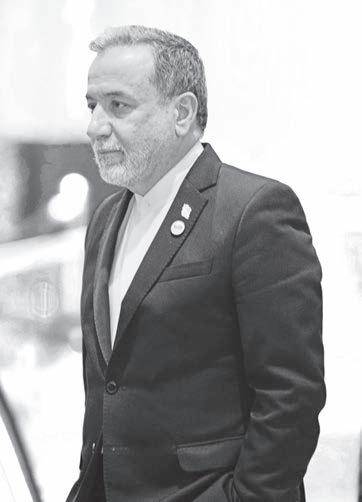
expiring Israel-Hezbollah ceasefire for another 45 days to allow for negotiations on a b roader peace agreement, the US State Department said.
A fter two days of meetings, the department said it would reconvene the two sides f or discussions on June 2 and 3, while a military track—between the Israeli and Lebanese a rmies—by the Pentagon will begin on May 29. Hezbollah opposes Lebanon’s direct negotiations with Israel and has not been part o f the talks. Israel’s ambassador to the US Yechiel Leiter said the talks were frank and constructive. “There will be ups and downs, but the p otential for success is great,” he said in a social media post. “What will be paramount throughout negotiations is the security of our citizens and our soldiers.”
The ongoing ceasefire hasn’t stopped Israel and Hezbollah from trading strikes.
The Israeli military said Friday it hit Hezbollah sites in southern Lebanon after reporting hostile aircraft alerts and launches f rom across the border. Lebanon’s health ministry said three paramedics were killed in a strike near the city of Harouf. Other strikes around the coastal city of Tyre wounded nearly 40 people, destroyed a health center and damaged the neighboring Hiram Hospital, wounding six medical workers, the m inistry said.
Chinese-owned ship taken into Iranian waters
A CHINESE-OWNED ship anchored off the United Arab Emirates was seized this week and taken toward Iranian waters.
Chinese private security company Sinoguards said it had “been informed through re levant channels” that the vessel Hui Chuan, which it was operating as an offshore work platform, was taken into Iranian waters for documentation and compliance inspection by the authorities.
The company’s emailed statement said there was no indication of any injuries on the ship and that it was cooperating.
Honduras, where the ship was flagged, said the ship had 17 crew including people from Nepal, Myanmar, Vietnam and Sri Lanka.
The seizure happened as a senior Iranian official reiterated his country’s claim of control over the Strait of Hormuz and another s aid it had a right to seize oil tankers connected to the US.
T he US seized vessels in the Gulf of Oman last month and on Friday the foreign minister of Pakistan said it had secured the return of 11 Pakistani nationals and 20 Iranian citizens who were aboard those vessels. “All individuals are in good health and high spirits,” s aid the foreign minister, Ishaq Dar, said.
UAE speeds up construction of oil pipeline
THE United Arab Emirates is speeding up the completion of a new pipeline that will allow the Gulf federation to export more oil without routing it through the Strait of Hormuz.
S heikh Khaled bin Mohammed bin Zayed Al Nahyan, the crown prince of Abu Dhabi, directed state oil company ADNOC to accelerate work on the pipeline, the Abu Dhabi Media Office said Friday.
The oil company already runs a pipeline designed to carry 1.5 million barrels a day from its oil fields to the port of Fujairah on the Gulf of Oman.
The new pipeline, expected to double the company’s export capacity through that port, will become operational next year, the media office said.
Schreck reported from Dubai, United Arab Emirates. Associated Press reporters Munir Ahmed in Islamabad; Koral Saeed in Abu Snan, Israel; Matthew Lee in Washington; and Mae Anderson in New York contributed.
By Seth Borenstein AP Science Writer
WASHINGTON—Global warming is causing rivers to slowly l ose oxygen, threatening fish and other lives in the waterways, a new study shows.
Researchers in China used satellites and artificial intelligence to track and analyze oxygen levels in more than 21,000 rivers across the globe since 1985. They found oxygen levels have dropped an average of 2.1% s ince 1985, according to a study published Friday in Science Advances. That doesn’t seem like much but it adds up and if it continues or accelerates, rivers in the Eastern U nited States, India and across the tropics could lose enough oxygen by the end of the century to suffocate some fish and create dead zones, the study said. Basic chemistry and physics dictate that warmer water holds less oxygen, scientists said. Warmer water, which happens with human-caused climate change, releases more oxygen into the atmosphere.
If the oxygen loss rate continues at the current pace, the world’s rivers on average will lose an additional 4% of their oxygen by the end of the century, and in some cases close to 5%, the study found. That’s when oxygen loss—called deoxygenation—becomes p roblematic for fish and people who rely on rivers, according to the study’s lead author Qi Guan, an environmental scientist at the Chinese Academy of Sciences in Nanjing. More dead zones appear SCIENTISTS worry that oxygen levels in

rivers could fall so low that dead zones appear, as they have in the Gulf of Mexico, C hesapeake Bay and Lake Erie. Those are areas where fish struggle to breathe and die.
“Deoxygenation is a very slow process. If we have a long period, the negative impact will attack the river ecosystems,” Guan said.
“The low level of oxygen can cause a series of ecological crises such as biodiversity decline, water quality degradation and maybe s ome fish will die.”
University of Arizona geoscientist Karl Flessa, who wasn’t part of the study, said in
an email that losing oxygen in rivers means “a future of more stinky dead zones (hypoxia), especially during heat waves.”
Some rivers are in such bad shape that “a small change can tip them into the danger zone,” Flessa said. “If your favorite fishing hole gets too warm, oxygen levels will go down and there won’t be any fish to catch.”
India, Eastern US and the Amazon are hot spots
EARLIER this century, India’s heavily polluted Ganges River was losing oxygen more
Trump’s description of Taiwan as ‘very good negotiating chip’ with China raises anxieties
By Simina Mistreanu
Associated Press
t han 20 times faster than the global average, the study said. Even with moderate-to-high increases in global carbon dioxide emission rates—not the implausible worst-case scenario—rivers in the Eastern United States, the A rctic, India and much of South America are projected to lose about 10% of their oxygen by the end of the century, the analysis showed.
Guan said he worries about tropical rivers especially, such as the Amazon in Brazil.
S ince 1980, the number of days with dead zone spots in the Amazon rose by nearly 16 days per decade, a study last year found.
Hydrology professor Marc Bierkens of Utrecht University in the Netherlands, said a study he and colleagues did last year showed oxygen stress in the world’s rivers increased by 13 days every decade and dead zone occurrences increased by nearly three days a d ecade since 1980. As the world continues to warm, those numbers should jump even higher, said Bierkens, who didn’t participate in the Chinese study.
Guan’s study found several reasons for oxygen loss in the world’s rivers, including nutrient pollution from fertilizer and urban runoff, along with dam construction, flow and wind issues. But nearly 63% of the problem is from warmer water, the study found.
D uke University ecologist and biogeochemist Emily Bernhardt, who wasn’t part o f the study, said “as rivers warm it becomes easier and easier for the same pollution problems as before to cause more severe, longer l asting or more widespread hypoxia and anoxia.” Anoxia is the total loss of oxygen.
“Water pollution reduction is more important than ever and will be harder as rivers warm,” she said.
US is bound by its own laws to provide Taiwan with the means to defend itself and sees all threats to the island as a matter of grave concern.
By conditioning US arms sales to Taiwan on his negotiations with China, Trump may play into one the island’s “nightmare scenarios,” said William Yang, a Northeast Asia senior analyst for International Crisis Group: that Taiwan, instead of being at the negotiating table, is on the menu.
Although Trump didn’t say specifically what he would want from China in return for denying Taiwan the weapons, he has been pressing Beijing to buy more American goods and to help put pressure on Iran.
Trump and the US Congress already approved in December a separate $11 billion arms sales package to Taiwan. Beijing reacted furiously by staging live fire drills around the island.
China warned of ‘clashes and even conflicts’ over Taiwan CHINA has framed Taiwan as “the most important issue in China-US relations” during Chinese President Xi Jinping’s recent summit with Trump. The visit is to be followed next week by a trip by Russian President Vladimir Putin to Beijing.
In one of his strongest statements to date, Xi on Thursday warned Trump of “clashes and even conflicts” if the issue of Taiwan is not handled properly.
Taiwan’s presidential office on Saturday sought to smooth over the tensions by highlighting “that the consistent US policy and position toward Taiwan remain unchanged.”
“The Republic of China is a sovereign, independent, democratic country; this is self-evident, and Beijing’s claims are therefore without merit,” said Presidential Office Spokesperson Karen Kuo, referring to Taiwan’s official name. She added that the island remains grateful to Trump for his support and stressed that US arms sales to Taiwan are stipulated by law.
Trump wants Taiwan’s microchip makers to move to the US ANOTHER statement that raised concerns on the island was Trump’s call for Taiwan’s microchip sector—the world’s largest and most advanced—to pick up and move to the US.
“I’d like to see everybody making chips over in Taiwan come into America,” Trump told Fox News, describing such a move as “the greatest thing you can do.”
Trump has long pressed Taiwanese chipmakers, which produce more than 90% of the world’s most advanced chips, which are used for artificial intelligence, smartphones and military equipment, to base some of their production in the US.
Taiwan’s leading chipmaker, TSMC, has committed an investment of $165 billion in a mega-campus in Arizona. The island’s government, in a sweeping trade agreement with the US earlier this year, pledged $250 billion in investment in the US microchip sector, which included TSMC’s previous commitment.
Trump also reiterated older accusations that Taiwan “stole” its chipmaking sector from the US decades ago.
Trump seems to embrace Xi’s narrative on Taiwan WHILE Trump during his summit with Xi did not alter US policy wording on Taiwan—which many observers had feared he would—he did seem to adopt some of the Chinese president’s own narrative about the island’s government.
Beijing has branded Taiwanese President Lai Ching-te as a “Taiwan independence diehard,” and warned that he would bring war and destruction to the island.
Trump and other top US officials don’t usually communicate with Taiwanese leaders but have shown support in the past for example by allowing former Taiwanese President Tsai Ing-wen to transit on US soil en route to visiting Latin American countries. Lai, who is about to reach his presidency’s
FOR decades, our OFWs have been hailed as the nation’s modern-day heroes—not merely for their sacrifice and sweat abroad, but for the steady river of dollars, euros, and riyals flowing back home. Remittances have propped up the peso, fueled household consumption, and cushioned the economy against external shocks. Yet as recent data and expert analysis suggest, that reliable tide may be ebbing from a “high-growth driver” to merely a “critical anchor.”
The numbers, on their face, appear reassuring. Cash remittances in March 2026 grew 2.3 percent year-on-year to $2.87 billion. Year-todate inflows reached $8.68 billion, up 2.79 percent. The weaker peso has provided a tailwind, making every dollar sent home stretch further in peso terms. (Read the BusinessMirror story: “Despite Middle East war, PHL remittances up 2.3%,” May 16, 2026).
But beneath these figures lurks a sobering reality: remittances are no longer the turbocharged engine of Philippine growth they once were. As Union Bank chief economist Ruben Carlo Asuncion notes, elevated inflation and slower global growth are likely to “cap further acceleration.”
Higher living costs abroad mean OFWs have less left to send. And back home, rising oil prices and persistent inflation risk canceling out any surplus amounts before they ever lift a family out of financial uncertainty. The effects of the Middle East conflict—a region accounting for 18 percent of our remittance pie—have not yet fully materialized. Analysts rightly warn of a lag effect. The geopolitical tremors today may only show up in the remittance data months from now. By then, families who have grown dependent on a predictable monthly inflow could find themselves scrambling.
This is not a call for alarm, but for adult conversation. For too long, policymakers have treated remittances as a perpetual motion machine— something to be celebrated but not strategically built upon. The late Senator Miriam Defensor Santiago once called the OFW phenomenon a “labor export policy in lieu of genuine rural development.” That critique remains uncomfortably relevant.
As Jonathan Ravelas of Reyes Tacandong & Co. puts it, if the Philippines wants “faster” economic expansion, “the heavy lifting will have to come from investment and stronger domestic demand.” In other words, we cannot remittance our way to prosperity. Not when growth is stuck in the low single digits. Not when every geopolitical flare-up or oil price spike threatens the lifeline. What is to be done? First, families receiving remittances—especially from conflict-prone regions—must adopt prudent financial planning. As migration expert and Professor Jeremaiah Opiniano advises, plan for expenses through December, assume the conflict could drag on, and practice thrift. Second, government must accelerate efforts to upskill returning OFWs and create decent-paying jobs at home, so that remittances supplement rather than substitute for local income. Third, channel remittance flows into productive investments—small businesses, education, housing—rather than simply consumption.
The overseas Filipino worker is a hero, yes. But heroes deserve a country that does not rely on their absence to survive. The decline of remittances as a high-growth driver is not a crisis. It is an invitation— to grow up, to diversify, and finally to build an economy that works for those who stay.
Antonio L. Cabangon Chua
T. Anthony C. Cabangon Lourdes M. Fernandez Jennifer A. Ng Vittorio V. Vitug
Lorenzo M. Lomibao Jr., Gerard S. Ramos Lyn B. Resurreccion, Dennis D. Estopace Angel R. Calso, Dionisio L. Pelayo
Ruben M. Cruz Jr.
Eduardo A. Davad Nonilon G. Reyes
D. Edgard A. Cabangon Benjamin V. Ramos Aldwin Maralit Tolosa Rolando M. Manangan
BusinessMirror is published daily by the Philippine Business Daily Mirror Publishing, Inc., with offices on the 3rd floor of Dominga Building III 2113 Chino Roces Avenue corner De La Rosa Street, Makati City, Philippines. Tel. Nos. (Editorial) 817-9467; 813-0725. Fax line: 813-7025. (Advertising Sales) 893-2019; 817-1351, 817-2807. (Circulation) 893-1662; 814-0134 to 36. E-mail: news.businessmirror@gmail.com www.businessmirror.com.ph



Conclusion
OOKING at PCIDC’s situation, we could suggest the following areas where urgent action is needed.
First, the Creative Workers’ Welfare Committee needs a public face and a public agenda. Who is heading this? What are its current priorities? What has been done in this regard? The workers’ welfare committee is very important as part of the PCIDC’s efforts to support individual Filipino creatives: the freelance writers, independent musicians, digital illustrators, and performing artists who lack the resources to lobby for themselves. Needless to say, it should be the most active body in the council.
Next, the PCIDP 2025-2034 needs to release implementation milestones. A 10-year plan adopted in October 2025 is a promise, but plans without timelines and without accountability mechanisms are simply not enough. The PCIDC should publish a public dashboard show-

Ting which agencies have submitted their action plans, which programs are funded and operational, and which targets are being tracked. This is more than a promise; it is a commitment.
Finally, and very important I must add, the AI threat requires a
dedicated response. The creative industries are at the center of the AI disruption story—both as a sector vulnerable to displacement and as a source of the human creativity that AI tools are trained on. The PCIDC should be convening urgent consultations with DICT, DOST, DOLE, and AI tech experts to develop an AI readiness framework specifically for creative workers. For example, include upskilling programs, ethical AI guidelines for the creative sector, and policy positions on the emerging intellectual property questions around AI-generated content. This coming September’s Creative Industries Month is a good platform for this conversation, but the council should not wait until then to start working on this.
The numbers we are seeing are good (8.7 percent growth in the creative economy in 2024, etc.) because headline figures can lag reality by one to two years. The disruptions currently pressing on individual creative workers—the collapsed freelance rates, the AI-generated competition, the tighter consumer wallets—may not fully show up in PSA statistics un-
til the 2025 or 2026 data is released. By then, the window for early intervention will have narrowed. The Philippines’ cultural asset, its creative professionals, is genuinely valuable and must be protected. It is a P1.94-trillion economic engine with 7.51 million people behind it. The PCIDC was built to protect and manage this asset through inflection points like what we are experiencing now—a global technology disruption, economic pressure, and a fragmented and largely unorganized labor force. The council has the legal mandate, the institutional structure, and the complete membership to do meaningful work. What it needs now is actual and fast action to match the urgency of the moment. Filipino creatives have been patient. They passed the baton to this council in good faith. The council, in turn, owes them not just meetings and summits and month-long celebrations (please make the September event count!), but visible, tangible programs that show up in the lives of working artists, designers, writers, and performers before the next round of disruption arrives.

HERE is an old Filipino saying often repeated in quiet conversations and loud arguments alike: you can tell a man’s character by how he treats his mother.
It is not merely sentimentality wrapped in folklore. It is cultural shorthand for something deeper— respect, restraint, gratitude, and the ability to value relationships beyond self-interest. In a nation where mothers often become the first teachers, first protectors, and silent keepers of sacrifice, the measure of a man’s treatment of his mother is often seen as the first window into the architecture of his soul.
For the Filipino, the mother is not simply a parent. She is a memory. She is refuge. She is the unseen foundation beneath many victories that later receive applause from the world. Before there are medals, titles, corporations, or public applause, there is usually a mother who stayed awake through fevered nights, stretched the last peso to feed a family, or whispered prayers no one else heard. And perhaps this is why the Scripture itself places such gravity upon the matter. “Honor your father and
your mother, so that you may live long in the land the Lord your God is giving you,” according to Exodus 20:12
The commandment is striking because it speaks not only of obedience, but of recognition—recognition that life itself arrived through sacrifice. In many ways, gratitude is the first school of morality. A man incapable of honoring the hands that raised him may eventually struggle to honor anything beyond himself.
Even our heroes understood this quiet truth. José Rizal, whose brilliance illuminated a nation in darkness, drew much of his moral discipline from the strength and tenderness of his mother, Teodora Alonso. It was she who first taught him to read, first sharpened his curiosity, and first nurtured the imagination that would later awaken a people. Rizal once wrote with deep affection about his mother’s suffering and sacrifice, carrying her memory not as ornament, but as moral compass.
Executive Secretary Ralph Recto’s hard-hitting statement against Batangas first district Congressman Leandro Leviste brings this value sharply into focus. Amid allegations of bribery and political maneuvering, one detail stands out: the image of a mother, present, emotional, even apologetic, in the middle of a deeply questionable proposition.
Recto’s reaction is telling. He did not escalate. He did not expose immediately. He held back—out of respect for the mother. That choice reflects something often missing in modern political discourse: boundaries. The ability to recognize that even in conflict, there are lines one does not cross.
Contrast that with the behavior described—a willingness to involve family in transactions of power, to push forward despite visible discomfort, to persist even after rejection. This is not just about politics. It is about upbringing.
Filipino values have always placed the family at the center. But that centrality comes with responsibility. Respecting one’s parents is not performative; it is demonstrated in actions, in restraint, in the refusal to drag them into situations that compromise their dignity.
Recto’s line—“never trust a man who disrespects his mother”—resonates because it taps into a shared understanding. It is not an attack. It is a warning. Because if someone is willing to disregard the most fun-
damental relationship in their life, what more those they do not owe personal allegiance to?
Public office demands a baseline of character. Not perfection, but consistency. And character is not built in press conferences or campaign rallies. It is built in private moments— how one speaks, how one decides, how one treats those closest to them. The incident described is not just uncomfortable. It is revealing. It suggests a worldview where even the most sacred relationships can be subordinated to ambition. Where outcomes matter more than dignity. Where winning justifies everything.
In a country where family remains a cornerstone of identity, this distinction matters. Because leadership is not just about policies and programs. It is about example. And the examples we tolerate today become the norms we inherit tomorrow. There is a reason many Filipinos still instinctively look at a man’s treatment of his mother before trusting his promises. Beneath the speeches, beneath the polished image, beneath the cultivated charm, they are searching for something older and harder to fake: evidence of tenderness, loyalty, and reverence. Because sometimes, the truest biography of a man is not written in his résumé. It is written in the gentleness—or cruelty—with which he treats the woman who first carried his name in prayer.

HE issuance of the Professional Regulatory Board of Accountants’ (BOA) resolution adopting the International Ethics Standards Board for Accountants (IESBA) Code is a major milestone. The PRC-BOA issued BOA Resolution No. 48 in mid-2025.
I submit that for this reform to achieve its intended Philippine impact, the Bureau of Internal Revenue (BIR) should issue its own complementary guidelines on principled tax planning and compliance.
I have previously written on this point. In my July 7, 2025, Debit Credit article, I said that if the BIR joins this principled tax bandwagon, it may have to issue Revenue Regulations or other guidelines to provide rules on ethical tax practices and norms. I also noted that these BIR rules can align with those prescribed by the PRC and BOA and can draw from the IESBA final pronouncement and basis for conclusions.
The reason is clear. The BOA and IESBA issuances govern professional accountants and the accountancy profession. But tax planning in the Philippines is broader than the accountancy profession. It involves lawyers, consultants, corporate officers, tax agents, bookkeepers, business owners, and taxpayers themselves. It also involves the BIR, which is the principal tax administrator and enforcer of t he National Internal Revenue Code.
A BIR issuance would not merely duplicate the BOA/IESBA standards. It would translate the ethical framework into tax administration language. It can define what the BIR co nsiders aggressive, abusive, or non-principled tax planning. It can guide taxpayers and advisers on the factors that the BIR may consider in evaluating tax arrangements, such as credible basis in law, commercial substance, transparency, documentation, consistency with the purpose of t he law, and the reputational, commercial, and economic consequences of the arrangement.
The BIR guidelines can also clarify how principled tax planning will i nteract with existing Philippine doctrines. These include substance over form, sham transaction, business purpose, economic substance, related-party disclosure, transfer pricing documentation, withholding tax compliance, invoicing, deductibility of expenses, and information reporting. The guidelines can also discuss how aggressive schemes may be identified through third-party information, e-invoicing data, related-party disclosures, and risk-based audit selection.
This BIR initiative can complement the monitoring functions of BOA and Philippine Institute of CPAs (PICPA). BOA and PICPA can monitor compliance among CPAs and accountancy practitioners through professional regulation, accreditation, CPD, quality assurance, and disciplinary processes. The BIR, on the other hand, can monitor tax compliance outcomes through audits, enforcement, data analytics, taxpayer education, and administrative issuances.
The two monitoring tracks should reinforce each other. If a CPA or tax adviser repeatedly promotes schemes that lack a credible basis or commercial substance, this should not only be a tax audit concern. It should also be a professional ethics concern. If a taxpayer adopts an aggressive arrangement based on questionable advice, the BIR should examine the tax consequence, while the BOA and PICPA should consider whether the accountant involved complied with the ethical requirements of the profession. This is why BOA, PICPA, and BIR awareness programs are essential. The standards should be taught not as abstract ethics but as practical tax decision-making. Case studies should be developed. What should a CPA do when a client insists on a tax position that has no credible basis? What should a company controller do

Wwhen management wants to book an expense supported by questionable documents? What should a tax adviser do when a technically arguable structure clearly lacks commercial substance? What disclosures should be made? When should the professional disengage? When should the matter be elevated?
These are the real-life questions that make principled tax planning important.
As a tax advocate, I had extensive discussions on this initiative with then BIR Commissioner Romeo Lumagui and his senior staff. These d iscussions continued with BIR Commissioner Mendoza. My message has been consistent: the BIR should not view principled tax planning merely as an accountancy ethics matter. It should be seen as a tax administration reform that can strengthen voluntary compliance, deter abusive schemes, and improve revenue collections.
In my July 21, 2025, Debit Credit article, I reported that BOA Chairman Noe Quinanola confirmed during the Accountancy Week Regulators Forum that the PRC and BOA have approved the resolution revising the Code of Ethics for Professional Accountants to incorporate provisions on principled tax planning and compliance. I also noted that then BIR Commissioner Lumagui expressed interest in supporting the BOA resolution and that a BIR-BOA collaboration would be a major step in promoting transparent and principled tax planning and compliance.
After adoption, the next challenge is implementation. Implementation requires training, monitoring, enforcement, and cultural change in t he tax community.
The desired result is not to prevent legitimate tax planning. Taxpayers have the right to arrange their affairs within the law. Businesses should not be penalized for claiming incentives, deductions, treaty benefits, or tax positions that are supported by law and business reality. What principled tax planning rejects is the abuse of legal form, the exploitation of ambiguity without a credible basis, and the use of professional expertise to weaken the tax system.
I hope that the BOA, PICPA, BIR, tax advisers, corporations, academe, and taxpayers will pursue this notable initiative with seriousness and courage. The Philippines has long suffered f rom aggressive tax practices that reduce revenue collections, distort competition, corrupt professional judgment, and weaken public trust. If implemented properly, principled tax planning can become a solution to many of these ills. It can elevate the dignity of the tax profession. It can support honest taxpayers. It can discourage tax schemes that enrich only the abusive taxpayer, the unethical adviser, or the corrupt enabler. Most importantly, it can help generate more tax revenues for national development—not through fear alone, but t hrough ethical and principled tax practice and compliance. This is the promise of the IESBA and IFAC initiative. The challenge now is for the Philippine tax and accountancy communities to put that promise into action.
Joel L. Tan-Torres was the former Dean of the University of the Philippines Virata School of Business. Previously, he was the Commissioner of the Bureau of Internal Revenue, the chairman of the Professional Regulatory Board of Accountancy, and a partner of Reyes Tacandong & Co. and the SyCip Gorres and Velayo & Co. He is
HEN people in government flee from accountability, they choose convenience over justice. They betray public trust. Escape and evasion are not new in Philippine politics. Former Senator Greg Honasan went underground after his participation in repeated coup attempts, eluding intelligence dragnets for months before his eventual arrest. Yet even after being captured, he escaped again and later resurfaced to face the charges against him.
Senator Ping Lacson also disappeared from public view while confronting allegations tied to the Kuratong Baleleng case, only returning after the cases against him were resolved.
These episodes exposed a painful reality in our justice system: those with influence and resources can often outrun the consequences that ordinary citizens are forced to endure.
But not everyone chose to run. Senator Leila de Lima, despite repeated warnings and opportunities to leave, remained in the country and submitted herself to the legal process. Before authorities escorted her from the Senate in 2017 after she spent the night in her office, she declared, “The truth will come out and I will achieve justice. I am innocent.”
The truth eventually emerged, but only after more than six years of isolated detention. Whether one agrees with her politics or not, her imprisonment became a defining symbol of political persecution during the Duterte administration. She faced the accusations head on instead of disappearing into the shadows. She remained faithful to the country and the people she swore to serve.
In contrast, former Cabinet Secretary Harry Roque fled the country and sought asylum abroad rather than confront the accusations directed at him.
Meanwhile, politicians (Bato Dela Rosa and Zaldy Co) continue to evade arrest or accountability through
technicalities or, worse, connivance. The repeated failures of authorities to stop fugitives from leaving the country reveal either incompetence or complicity. Hold departure orders are often issued too late, and even when restrictions exist, escape routes somehow remain open for the politically connected.
The escape of Alice Guo exposed the alarming weaknesses of our border controls, while Roque’s asylum attempt may become a blueprint for future fugitives hoping to avoid scrutiny. This situation erodes public faith in justice itself.
Ombudsman Jesus Crispin Remulla carries the difficult burden of proving that accountability applies equally to allies and opponents, to the powerful and the powerless alike. Without impartiality, justice becomes nothing more than a weapon used selectively against enemies while protecting friends.
Justice, in its traditional sense, is retributive. Those who violate the law deserve consequences proportional to their actions. Retributive justice depends heavily on deterrence. People are discouraged from committing crimes when punishment is certain, swift, and severe. Yet deterrence collapses when influential figures continuously evade accountability. Instead of discouraging wrongdoing, impunity encourages it. Corruption flourishes when officials believe they can simply escape, delay proceedings, or manipulate the
system long enough to avoid punishment entirely. The law loses its moral authority when citizens see that accountability depends less on guilt and more on political survival.
Still, justice cannot rely solely on punishment. Justice can also be restorative. Rather than focusing only on penalties, restorative justice seeks to repair the harm inflicted upon victims and communities. It recognizes that crimes leave emotional, social, and moral wounds that cannot always be healed by imprisonment alone.
The International Criminal Court (ICC) combines elements of retributive and restorative justice by allowing victims to participate in proceedings and by recognizing the importance of reparations. Restorative justice demands accountability not only to the law, but also to those who suffered. That process becomes impossible when offenders flee.
Reconciliation cannot occur when accused individuals refuse to appear before courts, answer allegations, or acknowledge the pain caused by their actions. Lawyers may continue legal battles in their absence, but genuine accountability requires personal presence.
Justice remains incomplete when the powerful refuse to yield themselves to the same standards expected of ordinary citizens. When leaders obstruct warrants, hide fugitives, or weaponize institutions for political convenience, they send a dangerous message to society: power matters more than principle.
The Bible speaks directly against such abuse. Jeremiah 22:3 commands, “Do what is just and right. Rescue from the hand of the oppressor the one who has been robbed.” Justice is not vindictive. At its best, it prevents oppression before more innocent lives are destroyed. Of course, debates about justice will persist. Senator Bato dela Rosa claims he is a victim of injustice. Supporters and critics will endlessly argue over who the real victims are. Legal scholars and international law experts will continue debating ICC jurisdiction, sovereignty, and due process.
Yet one principle should remain constant: when lawful institutions issue warrants, the proper response in a democracy is to face the process, not evade it. Public officers are expected to “act with justice,” pursuant to Article XI of the 1987 Constitution.
Divine justice, unlike political justice, will always prevail. Psalm 146 reminds us that God “upholds the cause of the oppressed” and “frustrates the ways of the wicked.” History repeatedly shows that oppressed people who gain power often become oppressors themselves. Whether future administrations will be led by Marcoses, Dutertes, or another political dynasty entirely, vengeance disguised as justice will only deepen national division. Our country needs less “adulterous leaders” who will remain true to their oath before God. There is no courage in running from consequences while proclaiming innocence from a safe distance. There is no faithfulness in using public office as a shield against scrutiny. True leadership requires submission to the same laws imposed upon every citizen.
Accountability is the price of power. Sooner or later, every abuse, every deception, and every “adulterous act” is laid bare before God. Human justice may stumble, delay, or even fail, but no amount of escape and evasion can outrun judgment forever. In the end, conscience, truth, and justice always catch those who are adulterous or those unfaithful to God and His people.
Siegfred has a diversified set of education and experiences which has made him a game changer and a servant leader in organizations. His professional degrees came from the United States Military Academy at West Point in New York, Ateneo Law School, and University of Southern California, Los Angeles, USA. His corporate experiences include stints as general counsel for the country’s flag carrier, a food exporter with manufacturing plants in Davao and in Laguna, and a sports distributor company. Siegfred is a former soldier and a lawyer by profession, a teacher and inspirational speaker by passion, and a book author and a writer with a mission.
By Bill Allison & Jessica Menton
PRESIDENT Donald Trump’s latest financial disclosures show that he or his investment advisers made more than 3,700 trades in the first quarter, a flurry totaling tens of millions of dollars and involving major companies that have dealings with his administration.
The transactions, spelled out in more than 100 pages of documents filed Thursday with the US Office of Government Ethics, list purchases and sales in broad ranges, making it hard to calculate an exact value. But the volume of trading—more than 40 per day over a threemonth period—stands out as much as the potential dollar value.
“This is an insane amount of trades,” said Matthew Tuttle, chief executive officer of Tuttle Capital Management, in an interview, adding that it looks more like something done by “a hedge fund with massive algo trades” that buys and shorts securities than a personal account.
In the first quarter, the president bought at least $1 million each in companies including Nvidia Corp., Oracle Corp., Microsoft Corp., Boeing Co. and Costco Wholesale Corp., according to the documents. Other trades involved eBay Inc., Abbott Laboratories, Uber Technologies Inc., AT&T Inc. and discount store Dollar Tree Inc.
The disclosure reignites conflict-ofinterest concerns that have shadowed Trump’s terms in the White House. Critics have regularly accused him of mixing his official duties with his business interests. Unlike his predecessors, Trump didn’t divest or move his assets into a blind trust with an independent overseer. His sprawling business empire is managed by two of his sons and operates in several areas that intersect with presidential policy.
At the same time, Trump’s son-in-law Jared Kushner helps manage billions in investments for Qatar, Saudi Arabia and the United Arab Emirates while simultaneously serving as a “volunteer” envoy for the president on issues affecting the war in Iran and the Middle
East in general.
The White House dismissed questions about potential conflicts, with spokesman David Ingle saying that Trump “only acts in the best interests of the American public.” He added: “There are no conflicts of interest.”
A spokesperson for the Trump Organization earlier said that the president’s holdings are independently managed by third-party financial institutions who have control over all investment decisions, with trades executed through automated processes. Trump, his family members and his company play no role in making transactions, the spokesperson said. They receive no advance notice of trading activity and provide no input, she added. The trading volume exceeds anything Trump has previously reported. In the fourth quarter of last year, he made 380 transactions, mostly purchases of municipal debt, though he also bought some commercial paper, according to his filings.
He made his first disclosure of asset purchases in August, reporting 690 transactions he had made starting on January 21, 2025, the day after the start of his second term. Those transactions, covering about seven months, totaled at least $103.7 million.
‘Baffled’
THE president’s disclosures spurred questions from some on Wall Street who expressed surprise at the trading volume.
“I’m baffled,” said Eric Diton, president and managing director at The Wealth Alliance. “In the 40-plus years of my time on Wall Street, this is an unusual amount of trading by any standards.”
“We’d need to see the actual trades to
try and understand why anyone would want to do that much trading,” Diton added. Adam Sarhan, founder of 50 Park Investments, said the frequency of trading was “tremendous.”
“What I really want to know is at the end of all those trades was the account positive or negative?” Sarhan said.
Trump has made a number of policy moves that affect the publicly listed companies he traded, and he interacts regularly with many of the executives of those firms. That includes Nvidia, whose chips, critical to AI development, require US government approval for foreign sales.
Trump pulled Nvidia Chief Executive Officer Jensen Huang into his recent trip to Beijing during a refueling stop, joining a delegation that included top executives from Boeing, Citigroup Inc. and Tesla Inc. as well as other major companies.
Six of Trump’s trades involved Intel Corp.; his administration hammered out an agreement to take a 10 percent stake for nearly $9 billion in the iconic chipmaker in August. Shares of the Santa Clara, California-based company gained 20 percent in the first quarter and more than doubled in April after delivering a sales forecast that shattered Wall Street expectations.
Trump’s comments haven’t always benefited the companies whose assets he trades. While in Beijing, his announcement that China would purchase 200 Boeing jets pushed shares down because the order was expected to be larger. Netflix Inc. and Paramount Skydance Corp. battled to acquire Warner Bros Discovery Inc. in a months-long fight with both suitors raising potential antitrust concerns. Trump made investments related to all three companies. He bought a modest stake in Warner Bros. in March, worth at least $30,000, a stake in Paramount Skydance worth at least $15,000 the same month. He also had 19 transactions naming Netflix, including sales worth as little as $1,000 and as much as $5 million during the first quarter.
‘Huge question mark’ ALL of this raises questions that you’d rather not raise as a president,” said Tuttle. “So now people are asking why is he buying Nvidia and other companies now? When you’re the president you know everything, so any stock you buy, there’s a huge question mark.” Previous presidents divested assets or took other steps to avoid conflicts of interest or even the appearance of ethical issues while in office.
THE P50-per-kilo price cap on imported rice
could be extended for up to 60 days, according to the Department of Agriculture (DA).
Agriculture Secretary Francisco Tiu Laurel Jr. said the lingering effects of the global oil crisis could last until year-end, prompting an extension to the 30-day price cap on foreign rice supplies.
“Even if the crisis is over, its effects are not limited to 30 days. It might affect us until the end of the year, so there’s a good chance that the price cap may be extended for another month or two,” Tiu Laurel recently told reporters on the sidelines of a World Bank-backed program launch.
President Ferdinand Marcos Jr. has issued Executive Order (EO) 118, which imposes a P50per-kilo ceiling on 5 percent broken imported rice for 30 days. It is set to lapse on June 13. The measure was issued to curb “unjustified retail prices” that reached a high of P60 per kilo despite easing global rice costs and reduced import tariffs.
Under EO 118, the National Price Coordinating Council (NPCC) will conduct a periodic review of the price cap every 15 days to determine whether it should be continued, adjusted, or lifted.
Price cap violation
MEANWHILE , the DA warned rice retailers, traders, and importers that violators of the price ceiling on imported rice could face jail time, million-peso fines, and business closures under the law.
“Unlike the previous maximum suggested retail price that depended largely on moral suasion and voluntary compliance, the mandated price ceiling now allows the DA to impose punitive sanctions and fines on violators,” Tiu Laurel said.
Republic Act (RA) 7581 or the Price Act stipulated that those who violate a price ceiling on basic necessities may face imprisonment of up to 10 years, fines ranging from P5,000 to P1 million, or both, depending on the court’s discretion.
With rice classified as a basic necessity under the law, the DA said it provides them with the regulatory powers during periods of excessive or unreasonable price increases.
The agency said it may also impose administrative sanctions under the implementing rules of the Price Act.
These include temporary or permanent closure of establishments,
See “Price cap,” A2
By Joel R. San Juan
THESupreme Court has affirmed the Court of Appeals (CA) ruling which stopped the National Telecommunications Commission (NTC) from implementing its 2012 order directing telecommunication companies to refund their subscribers for overpriced text message rates amounting to more than P17 billion.
In a 20-page decision penned by Associate Justice Rodil Zalameda, the CA’s First Division had denied the petitions filed by Bayan Muna Party-list former representatives Carlos Zarate and Neri Colmenares and NTC seeking the reversal of the CA decision issued on June 27, 2016 and resolution issued on July 25, 2017.
The said rulings set aside the resolutions issued by the NTC on November 20, 2012 and May 7, 2014 directing Globe Telecom, Digitel Mobile Philippines and Smart Com-
munications to reduce their regular SMS retail price to other networks from P1 to not more than P.80 in line with NTC Memorandum Circular No. 02-10-2011 issued on October 24, 2011 or the so-called Interconnection Circular.
The NTC also ordered the telco companies to refund their subscribers the excess charge of P0.20 per off-net text message from the effectivity of the circular.
The NTC circular specifically directed the lowering of interconnection charge for SMS between two
separate networks or “off-net SMS” from P 0.35 to not more than P 0.15 per SMS.
The circular aims to reduce communications costs, maintain and foster fair competition in the telecommunications industry, and make short messaging Service (SMS), commonly known as “text message,” more affordable to the public.
In its ruling, the CA held that the NTC’s refund order has no legal basis and was issued without due process. This prompted the petitioners to elevate the issue before the SC.
In upholding the appellate court’s ruling, the SC pointed out that the NTC circular does not direct the reduction of SMS retail rates but merely the reduction of the interconnection charge for off-net SMS from P0.35 to P0.15.
“In this case, the records show that respondent-PTEs [public telecommunication entities] have reduced their interconnection rates for off-net SMS from P0.35 to P 0.15, and they have made the corresponding amendment to their respective interconnection agreements to effect such reduction prior to December 1, 2011,” the SC noted.
The SC did not give weight to Bay-
an Muna’s argument that the NTC’s act was merely an interpretation and application of the Interconnection Circular, which should be accorded great weight. It stressed that it was clear based on its reading of the NTC circular that it does not order the reduction of the SMS retail rates.
“The Court cannot judicially supply such omission in the circular even if it was the intention of the NTC. The Court is not authorized to insert into the circular what should have been in it, or to supply what the NTC would have supplied if its attention had been called to the omission,” the SC clarified. The SC also did not give credence to the argument of the petitions that the reduction of the interconnection charge should necessarily result in the reduction of the SMS retail rates.
The Court noted that the petitioners failed to present evidence to prove that the interconnection charge is a component of the SMS retail price and that the reduction of interconnection charge would necessarily reduce the SMS retail price.
“Considering all the foregoing, it is clear that the NTC cannot order
‘Exceptional
By Francine M. Marquez
I always have a million questions.” Enrile admitted that she did not originally plan

to start her company until two years after conceiving the idea.
“In 2018, I already had the concept, the name, the logo, and everything,” she shared. “I was preparing to do it in two years. I was supposed to launch in 2020, which happened to be during the pandemic.” At the time, Enrile worked for a strictly e-commerce company that did not offer digital marketing services. Clients who had entrusted their e-commerce operations to Enrile also knew she could handle both performance and digital marketing. Many of them encouraged her to offer digital marketing services on the side.
The opportunity inspired Enrile to pursue the business idea further. During a dinner with her fiancé’s sister, she shared her plans to launch the company in two years. But her fiancé’s sister had another idea. She encouraged Enrile to start as soon as possible.
A client she consulted gave the same advice— to register her business and start acquiring clients immediately.
“So, was pushed into this. The inspiration came after started looking at the projects, quotations, and proposals.
It took me about six months to get inspired. That’s where we got the slogan, ‘Get inside, get inspired,’ because I was forced to get inside before could get inspired.”


Right timing
WHEN IGP officially launched in 2019, the company entered the market at the right time.
Mobile devices had become key tools for information consumption, digital advertising spending was steadily overtaking traditional media, influencer marketing was rising, and video content was king.
But Enrile also realized that beyond adapting to digital trends, there was a gap that needed to be filled through customer service.
In her conversations with clients, she often heard comments such as, “I wish started with a different business partner,” “I wish I had stronger employees,” and “I wish my employees cared about this business the way I do.”
The reality, Enrile said, is that one cannot always expect that level of commitment from partners or employees.
“So that’s exactly how we position ourselves strategically. We are not just a marketing agency or a compliance partner. We are an outsourced business partner,” she explained.
Startup companies experience many growing pains, from launching operations to navigating services and proposals.
“When everything is storming, that’s when you call us,” she added. “We have an ecosystem of established brands ready to support whichever missing pieces you have.”
Asking the ‘whys,’ being considerate ENRILE’S extensive professional experience, digital marketing expertise, and deep understanding of the marketing ecosystem have become among IGP’s strongest advantages.
“We started as a marketing agency with consultants.
I’m one of the consultants; I handle business development and strategy. We have the marketing agency to execute the
strategy. Now, we still do business development, but we also ask the ‘whys’ when creating campaigns.”
“Like when a client says, ‘We need P100 million in sales this year,’ I will always ask why. More often than not, it’s not just about the money—it’s about giving employees salary increases. The way I ask questions helps us understand how we can better take care of the client’s business.”
IGP serves clients in the commercial, industrial, and electronics sectors. Building on its reputation for strategydriven omnichannel campaigns, Enrile said the company now works with around 200 household brands.
On crafting strategies for these brands, she observed: “I always say exceptional brands are considerate. Just look at how consumers are shifting. When ride-hailing services became available, people stopped hailing taxis because they preferred being picked up at home instead of leaving at 4 am to look for a cab. It’s all about considering the customer experience.”
IGP brings that same sense of consideration into its clients’ services, Enrile noted.
“What we do at Immensity is help clients move from being considerate to being exceptionally considerate. We believe consideration adapts to change. Exceptional brands are considerate because people come back for the experience.”
Collaboration, not competition AS the market becomes increasingly competitive and crowded, Enrile emphasized the importance of partnerships in expanding the company’s ideas, services, and network.
“Competition is what happens at the bottom; collaboration is what happens at the top. When you reach a certain level in business and need extra muscle, the first question should be: ‘Do I hire more people, or do I collaborate with freelancers or on-call professionals?’”
“Collaboration becomes necessary when you reach
a certain level in business. It gives you extra muscle and opens many more doors than a single social media ad.”
Pandemic campaign
AMONG the most challenging campaigns IGP handled was during the height of the Covid-19 pandemic, when the company was tasked with selling a P13,000 ice-
Editor: Jennifer A. Ng
B1 Monday, May 18, 2026

By Lenie Lectura @llectura & Butch Fernandez @butchfBM
THE Energy Regulatory Commission (ERC) has raised and imposed a limit on the weighted average cost of capital (WACC) for the National Grid Corporation of the Philippines (NGCP).
The WACC is a critical component used by the ERC to calculate the transmission rates and maximum allowable revenues that the NGCP can pass on to electricity consumers.
In its 18-page order promulgated last May 15, the ERC partially granted NGCP’s motion for reconsideration on WACC and raised the approved WACC to a capped 11.92 percent from 11.74 percent. It added that two underlying parameters were recalibrated; the rest were retained.
“Our responsibility is to establish rates that are fair and reasonable, approve the necessary costs to keep the grid operational, and reject those that cannot be justified. The May 15 Order embodies this approach. We reassessed what the record required us to reconsider and upheld everything else,” said ERC chairman Francis Saturnino Juan in a text message on Sunday.
In resolving the NGCP’s motion, the grid operator’s WACC was recalibrated resulting in an upward adjustment in its annual revenue require-
ment (ARR) for the fifth regulatory period (5RP) covering 2023 to 2027.
The ARR for the said period has been adjusted to P378.711 billion. The same order also directed the grid operator to implement the maximum allowable revenue (MAR) for 2023 to P63.66 billion starting its October 2026 billing.
The ARR represents the amount NGCP needs to recover to cover its operating costs, maintenance expenses, and approved investments while the MAR is the revenue ceiling—the maximum amount the ERC allows the company to collect from consumers, even if its requested costs are higher.
The commission said its order strikes a balance between ensuring adequate funding for critical power infrastructure and safeguarding consumers from excessive transmission charges. Only costs and investments that passed regulatory scrutiny were included in the approved revenue cap.
NGCP operates the country’s high-voltage transmission system,
delivering electricity from power generation facilities to distribution utilities across Luzon, Visayas, and Mindanao.
“The Commission remains committed to ensuring that transmission rates charged to consumers are just and reasonable, while at the same time allowing the transmission concessionaire to recover only efficient and necessary costs to maintain a reliable and secure power grid,” the ERC had said.
Last week, the NGCP announced a slight reduction in overall transmission rates of the end consumers this month following a reduction in transmission wheeling rates and ancillary services.
Overall average transmission rates for the April 2026 billing period dropped by 8.80 percent to P1.5983/ kWh, from March’s P1.7526/kWh. The decrease was driven by reductions in both transmission wheeling rates and ancillary services (AS) rates.
NGCP’s transmission wheeling rates went down by 14.16 percent to P0.6028/kWh in the April 2026 billing period from P0.7022/kWh in the March 2026 billing period.
Average AS rates fell by 5.02 percent to P0.8088/kWh, compared with P0.8516/kWh in March.
Transmission wheeling rates refer to what NGCP charges for its core service of delivering electricity, while AS rates cover the pass-through costs of services sourced from the Reserve Market and from providers with bilateral contracts with NGCP to stabilize the grid during power supply-demand imbalances.
THE Department of Energy (DOE), the NGCP and the ERC were told to immediately address and resolve the rolling power interruptions disrupting communities and causing alarm in the business community still reeling from the impact of the oil price shocks from the Middle East war.
“Many agencies of government have adopted a four-day work week because of the tension on the Middle East; and now we have to deal with the brownouts as well across the country. This is unacceptable,” Sen. Sherwin Gatchalian said, partly in Filipino.
The NGCP has been declaring red and yellow alerts over the Luzon and Visayas grids in recent days, citing the simultaneous forced outages of several power plants.
“If recurring plant outages are driving the problem, generation companies must be made to answer. The ERC should enforce compliance with performance standards and take action against erring plants,” he added.
Both the DOE and ERC have demanded reports from NGCP on why the disruptions took place, especially because of the impact in the Visayas, where local authorities decided to implement rotating brownouts to prevent a collapse of the grid.
“Every hour of a brownout brings business operations to a standstill, disrupts the education of our youth, and paralyzes the daily lives of our communities, most critically, it puts at risk patients whose survival depends on electricity-powered medical equipment.”
By Bless Aubrey Ogerio @blessogerio
TAGUIG-BASED SteelAsia Manufacturing Corp. has obtained a P1.25-billion green loan facility from Taiwanbased Cathay United Bank to finance its low-carbon steel initiatives.
In a statement, SteelAsia said proceeds from the facility will be used as working capital for its operations utilizing Electric Arc Furnace technology, a steelmaking pro -
cess that lowers carbon emissions when combined with renewable energy and scrap recycling.
SteelAsia President and CoChief Operating Officer Rafael Hidalgo said the financing marks a significant step in the company’s expansion strategy.
“The green loan represents more than a milestone for the company— it is a sign that we are indeed on the right track in our expansion strategy.”
The company said it plans to replicate the same low-emission produc-
tion methodology in its upcoming mills, including the country’s first medium sections mill in Lemery, Batangas, which is expected to begin operations within the year.
The loan facility is also the first financing secured under SteelAsia’s Sustainable Finance Framework, which the company said was rated by Moody’s in February as among the best globally for the steel sector.
Tony Chao, senior vice president and general manager of Cathay United Bank’s Manila branch, said the bank aims to deepen its
sustainable financing partnership with SteelAsia.
“We are driven to further strengthen our sustainable financing partnership with SteelAsia, as we share a common mission and set of goals,” Chao said.
Cathay United Bank’s Manila branch said it was among the first banks in the Philippines to launch a sustainability-linked loan in 2022. Since then, the bank has expanded its green and social financing portfolio to include sustainable time deposits.
VINFAST Auto Ltd. said its planned sale of two Vietnamese factories will enable the electric vehicle maker to shed about 182 trillion dong ($6.9 billion) in debt and obligations while potentially speed its path toward profitability.
“After restructuring, VinFast will essentially be debt-free, with only a small amount remaining,” the company said in an emailed statement responding to Bloomberg’s questions.
Founder Pham Nhat Vuong—who is also Vietnam’s richest man—said last month he expected VinFast to hit earnings before interest, taxes, depreciation and amortization breakeven point in 2027. The company declined to provide a timeline for reaching profitability after the spinoff, but said it expects to generate a profit in its domestic market in 2027, according to the statement.
“This is a strategic pilot model for VinFast,” the struggling EV maker said in the statement. “If the model proves effective, we will continue to scale and expand it. If challenges
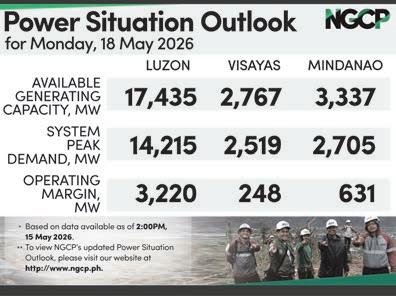
SAN Miguel Corp. (SMC) reported that its first-quarter consolidated revenues rose by 19 percent to P428.3 billion from the same period last year.
The results were driven by stronger fuel and oil volumes, with revenues reflecting movements in global prices, along with new contributions from its energy business and sustained volume growth in food.
Consolidated operating income jumped by 31 percent to P59.6 billion, driven by higher revenues and margin expansion in the energy business, which helped offset margin pressure in Petron.
Reported consolidated net income, however, was lower at P22.5 billion, from P43.4 billion in the same period last year, due to the P21.9-billion gain from the partial sale of power assets and forex loss in 2026.
“Our businesses performed well in the first quarter, supported by steady demand and the hard work of our teams across the group,” said SMC Chairman and CEO Ramon S. Ang. “While global conditions remain challenging, we will stay disciplined in how we operate, serve our customers well, and continue investing where we can support our country’s growth.”
San Miguel Food and Beverage, Inc.’s (SMFB) first-quarter net income rose 2 percent to P11.8 billion, supported by gains in its food and spirits businesses, the stable performance of beer, and disciplined cost management. Revenue increased 4 percent to P103.1 billion, while income from operations climbed 3 percent to P15.7 billion.
San Miguel Foods posted a 7-percent hike in revenue to P49.6 billion, driven by growth in the feeds segment and sustained demand for branded products, including Magnolia dairy, coffee, and Purefoods meats. Operating income rose 10 percent to P4.9 billion, while net income climbed 8 percent to P3.3 billion.
San Miguel Brewery Inc. recorded P36.8 billion in revenue, reflecting a steady performance for the period. Domestic revenues reached P32.7 billion, supported by price adjustments amid volume and cost pressures, including higher excise taxes. Operating income was maintained at P7.9 billion, while net income stood at P6.2 billion, helped by cost controls and continued investments in brand and channel initiatives.
Ginebra San Miguel Inc. reported a 3-percent increase in revenues to P16.7 billion, with operating income at P2.8 billion and net income at P2.3 billion, also supported by brandbuilding initiatives and disciplined cost management.

arise, we remain prepared to make the necessary adjustments.” Under the restructuring announced May 12, VinFast will separate its manufacturing operations into a standalone company, effectively outsourcing production at its plants in the northern port
city of Haiphong and the northcentral province of Ha Tinh. The move would also allow the facilities to manufacture vehicles for other automakers, though VinFast said its own orders will be prioritized. It will retain its overseas production operations at factories in India
and Indonesia.
The manufacturing operations are housed under VinFast Trading and Production JSC, or VFTP, and VinFast plans to transfer its entire stake in the unit—valued at about 13.3 trillion dong—to a buyer group led by Future Investment Research and Development JSC, with Vuong also participating as a minority investor, according to a filing.
Following the transfer, Future Investment will hold 95.5 percent of VFTP, while Vuong will own less than 5 percent. The buyer group will also assume borrowings, bonds, finance leases, payables and other obligations tied to VinFast’s manufacturing operations.
Future Investment, formerly known as Novatech R&D JSC, was spun out of VFTP last year to hold intellectual property assets before being sold to Vuong for about $1.5 billion. Vuong later divested his stake in the firm. The filing
SMC said San Miguel Global Power recorded a 26-percent yearon-year increase in revenues to
Dits
In a statement, the company
than the
P53.6 billion, driven in part by contributions from five battery energy storage system (BESS) facilities, as well as power supply agreements for the Mariveles and San Roque power plants.
Meanwhile, offtake volumes amounted to 6.5 million MWh, down 13 percent year-on-year, largely reflecting the deconsolidation of the Ilijan Power Plant and Batangas Combined Cycle Power Plant. Income from operations increased 163 percent to P28.1 billion, driven by topline growth, improved gross profit margins, and higher contribution from the BESS facilities. Net income declined to P23.9 billion compared to the same period last year, mainly due to the P21.9 billion gain from the asset sale recorded in the first quarter of 2025. Petron Corp. reported a net income of P1.8 billion in the first quarter of 2026, down 56 percent from P4 billion in the same period last year, as refinery output declined for both Philippines and Malaysia operations. Port Dickson has remained shut since November 2025, after Tropical Storm Senyar damaged its product jetty, while Petron Bataan underwent scheduled maintenance. These disruptions were exacerbated by escalating tensions in the Middle East. Revenues rose 27 percent to P246 billion in the first quarter, on the back of strong volume growth and higher average Dubai crude prices, which rose 12 percent to $86/bbl in 2026 from $77/bbl in 2025.
Excluding trading transactions from the company’s operations in Singapore, Petron recorded sales volume of 25.7 million barrels in the Philippines and Malaysia, 7 percent lower than the previous year’s 27.6 million barrels, due to lower production. Operating income declined by 36 percent to P6.1 billion.
“Margins were squeezed by higher product costs, with the absence of refinery production in Malaysia and reduced output in the Philippines.”
The Infrastructure Group delivered P10.4 billion in revenues for the first quarter, marking a 7-percent increase versus the same period last year. Growth was driven by higher traffic volumes and continued operational improvements across all toll roads, with combined average daily vehicle volume rising 3 percent to 1.1 million vehicles. Operating income rose 12 percent to P6 billion, supported by strong revenues that more than offset operating costs.
SMC’s cement business, which includes Eagle Cement Corp., Northern Cement Corp., and Southern Concrete Industries, Inc., posted consolidated revenues of P9.2 billion, up 3 percent year-on-year, as strong volume growth outpaced lower average selling prices in a highly competitive market.
IT’S a potluck lunch at the office. Dishes line the table; pancit, lumpia, rice, and a tray of adobo placed at the center. As people begin to eat, a conversation starts. “It’s good,” someone says, “but it’s different from how we cook it back home.”
Others point out the balance of flavors, less vinegar, and more sweetness. Someone else mentions a version they grew up with, richer in garlic or cooked longer. Then other chimes in, surprised, “Ours has pineapple in it.”
In that moment, the team wasn’t just talking about food. They were sharing pieces of where they came from. There is no single “correct” way to cook adobo, and in that realization lies something deeper: beyond taste, there is culture.
Cultural diversity is visible in how people think, communicate, and contribute, yet not all differences are equally understood, valued, or included.
It is this richness that the World Day for Cultural Diversity for Dialogue and Development seeks to recognize.
Celebrated every 21 May and led by the United Nations Educational, Scientific and Cultural Organization (Unesco), the day highlights the importance of understanding, respect, and dialogue among cultures to achieve peace and sustainable development. It is not only a celebration of the world’s diverse traditions, but also a call to build communities that can live together harmoniously.
Globally, the United Nations emphasizes that bridging cultural divides is urgent and necessary for peace, stability, and sustainable development. Research shows that many conflicts today are rooted in identity-based tensions and limited intercultural understanding, underscoring the importance of dialogue across communities.
In the Philippines, cultural diversity is closely linked to sustainable development. Friction often arises when modern development initiatives intersect with traditional cultures, particularly among Indigenous Peoples (IPs). While modern narratives sometimes paint indigenous practices as archaic or destructive, the opposite is true. For instance, traditional slash-and-burn, a practice designed to let forest soils naturally regenerate, is frequently and unfairly vilified as a destructive system of agriculture. Yet, for generations, these indigenous knowledge systems have provided sustenance by emphasizing balance, seasonal limits, and taking only what is necessary.
As highlighted in recent national discourse, culture also plays a critical role in environmental sustainability and IPs are widely recognized as “keepers of the environment,” possessing generations old ecological knowledge that supports sustainable resource management and climate resilience. Indigenous knowledge systems and traditional practices often emphasize resource stewardship, biodiversity conservation, and climate resilience. Environmental degradation is more often driven by extractive and large scale development projects introduced without genuine community participation and consultation.
Although the Indigenous Peoples’ Rights Act mandates “free, prior, and informed consent,” gaps in implementation persist. When development proceeds without meaningful intercultural dialogue and consent, it risks displacement, loss of ancestral lands, and social conflict, which raises a critical question: development for whom? Conversely, integrating indigenous knowledge into sustainability planning strengthens environmental protection, cultural continuity, and social cohesion.
Mechanisms such as the Indigenous Peoples’ Mandatory Representative in local government further promote peace and representation by institutionalizing representation and dialogue in policymaking. Philippine experiences show that when dialogue, consent, and representation are respected, cultural diversity becomes a driver of inclusive, peaceful, and sustainable development, with lessons relevant to broader Asean contexts.

Diversity is not only about heritage, but also closely tied to economic growth and social inclusion. Data from Unesco further highlights its impact. The cultural and creative sector is one of the most powerful engines of development globally, accounting for over 48 million jobs worldwide, nearly half of which are held by women. It represents 6.2 percent of the total global employment and contributes 3.1 percent to global gross domestic product. It is also one of the largest sources of opportunity for young people under the age of 30. These figures show that culture is not only something we preserve, but also something that sustains livelihoods and drives progress.
Despite its value, cultural diversity continues to face significant challenges. Around the world, cultural identities are threatened by discrimination, marginalization, and exclusion. Differences in language, traditions, and beliefs can sometimes lead to misunderstanding rather than appreciation. For many communities, particularly those on the margins, culture is not only something to celebrate, but also something that must be protected.
For organizations, cultural diversity presents both opportunity and risk. Diverse teams can drive innovation, improve problem-solving, and strengthen decision-making, all of which are critical enablers of long-term performance. However, without effective integration, diversity can also lead to misalignment, communication barriers, and inefficiencies. The challenge lies not in diversity itself, but in how it is governed and managed.
At R.G. Manabat & Co., we recognize that advancing cultural diversity and inclusion extends beyond internal initiatives to how we engage with and support the wider business community.
As workplaces become more global and interconnected, organizations are expected to create environments where diverse perspectives are respected, valued, and reflected in decision-making. We work with organizations to operationalize inclusion by integrating diversity considerations into governance and risk frameworks, strengthening people and culture data, and aligning inclusive practices with overall business strategy. Through our ESG transformation, reporting, and assurance services, we help organizations move beyond aspiration toward measurable and sustainable inclusion outcomes. Independent assurance further reinforces this effort by enhancing the credibility, transparency, and accountability of diversityrelated disclosures amid rising stakeholder expectations.
As we observe Cultural Diversity Day on May 21, it serves as a reminder that understanding begins with simple acts such as listening, learning, and choosing to see value in difference. It challenges us to move beyond celebration and toward inclusivity, to ensure that every culture is not only recognized but respected and protected. Because just like the dish that feels familiar to many yet unique to each, culture is not defined by a single version. It is shaped by many voices, many histories, and many hands. Perhaps, in recognizing that, we begin to see not just what makes us different, but what allows us to connect.
© 2026 R.G. Manabat & Co., a Philippine partnership and a member firm of the KPMG global organization of independent member firms affiliated with KPMG International Limited, a private English company limited by guarantee. All rights reserved. This article is for general information purposes only and should not be considered as professional advice to a specific issue or entity. The views and opinions expressed herein are those of the author and do not necessarily represent the BusinessMirror, KPMG International or R.G. Manabat & Co. For more information, you may reach out through ph-kpmgmla@kpmg.com, social media or visit www.home.kpmg/ph.
By Andrea E. San Juan
THE Philippine banking system’s stock of bad loans climbed to a record high of P568.553 billion as of March 2026, even as the Middle East conflict-linked inflation is yet to weigh on borrowers’ capacity to pay obligations.
Latest data from the Bangko Sentral ng Pilipinas (BSP) showed the gross non-performing loans (NPLs) ratio eased to 3.29 percent in March—the lowest in three months.
However, given that the NPL ratio is the proportion of bad loans—loans that have not been paid for 90 days or more—to total loans, analysts explained that the NPL ratio only eased because strong loan growth is outpacing the rise in bad loans.
“What we’re seeing is really a reflection of strong loan growth outpacing the rise in bad loans—so even if the peso value of NPLs increased, the overall ratio improved,” Jonathan L. Ravelas, senior adviser at Reyes Tacandong & Co. said.
Ruben Carlo O. Asuncion, chief economist of Union Bank of the Philippines (UBP), echoed Ravelas’s view.
“The decline in the NPL ratio to 3.29 percent in March was largely driven by a combination of robust loan growth and still-resilient borrower repayment capacity, which helped dilute the ratio even as bad loans in peso terms continued to
rise,” Asuncion said.
He further explained that stronger lending activity—particularly on the back of business and consumer credit expansion “supported the denominator,” while earlier improvements in employment conditions and easing inflation helped borrowers stay current on their obligations.
Data showed that the peso value of bad loans climbed to P568.553 billion, which is 10.16-percent higher than the P516.116 billion notched end-March 2025. Similarly, bad loans as of March were higher by 2.69 percent than the P553.677 billion as of February 2026.
Meanwhile, total loans climbed by nearly 4 percent to P17.263 trillion as of March 2026 compared to the P16.603 trillion as of February 2026.
The total loan books as of March 2026 saw a 10.43-percent jump from the P15.63 trillion as of March 2025.
ACCORDING to Philippine Institute for Development Studies (PIDS) Se-
nior Research Fellow John Paolo R. Rivera, data shows that “banks are still managing credit risk reasonably well, and the impact of the Middle East conflict has not yet translated into a significant deterioration in asset quality.”
Looking ahead, analysts are closely watching the impact of elevated inflation, slower economic growth, and higher oil prices on households’ purchasing power, which could later on weaken borrowers’ repayment capacity.
Asuncion said the improvement in asset quality may be “partly temporary” as external headwinds, particularly the impact of elevated energy prices and inflation linked to the Middle East conflict, could gradually weigh on borrowers’ repayment capacity.
If these pressures persist, Rivera said NPLs “may trend higher in the coming quarters particularly in more vulnerable consumer and MSME segments.”
Ravelas expects NPL ratios “to stay broadly stable, but with some upward pressure, especially if the Middle East conflict pushes oil prices higher.”
“That could reignite inflation, delay rate cuts, and squeeze borrowers. So the key variables to watch now are oil, inflation, and interest rates—if those stay contained, asset quality should remain manageable,” he added.
Still, Ravelas noted that the latest NPL ratio indicates that the banking system remains “healthy,” supported by solid consumer demand, steady incomes, and “proactive risk management” by banks.
Break down THE NPL ratio of universal banks settled at 3.04 percent amounting to P466.098 billion, as of end-March 2026. This was lower than the 3.06 percent recorded in February 2026 but is the same as the 3.04 percent in March 2025.
For commercial banks, the NPL ratio eased to 2.62 percent amounting to P15.773 billion. This was lower than the 2.83 percent recorded in February 2026 but higher than the 2.56 percent in March 2025. For thrift or savings banks, the NPL ratio also eased to 6.29 percent, or P64.50 billion, as of end-March 2026 from 6.43 percent at end-February 2026, and remained below the 6.62 percent level in March 2025.
For rural and cooperative banks, NPL ratio eased to 7.97 percent from the 8.05 percent in December 2025 but higher than the 7.18 percent level in March 2025.
The asset quality of digital banks, meanwhile, worsened with their NPL ratio climbing to 6.19 percent, or P4.16 billion, as of end-March 2026 from 5.88 percent at end-February 2026, but it improved compared to the 8.03 percent NPL ratio in March 2025. Meanwhile, past due loans reached P736.181 billion as of endMarch 2026, up by 2.87 percent from P715.658 billion a month ago; and higher by 13.89 percent from P646.368 billion at end-March 2025. The past due loans ratio settled at 4.26 percent of banks’ total loan portfolio, lower than the 4.31 percent as of end-February 2026 and the 4.14 percent at end-March 2025.
By Reine Juvierre Alberto @reine_alberto

THE Philippines’s insurance penetration rate, or the industry’s contribution to the overall economy, improved in the first quarter of 2026, reaching the government’s 2-percent target.
Data from the Insurance Commission (IC) showed that insurance penetration rose to 2.03 percent in the first quarter, higher than the 1.89 percent recorded in the same period last year.
The latest figure marked the first time the insurance penetration rate breached the 2-percent level since
the third quarter of 2021, when it reached 2.03 percent.
Since then, the rate had consistently hovered below the 2-percent mark, lagging behind its regional peers.
The improvement in the insurance penetration rate came despite the slower-than-expected economic growth of 2.8 percent in the first quarter, while total premium collections climbed to P140.85 billion.
According to IC, total premium collections grew by 13.15 percent from P124.48 billion in the first quarter last year, reflecting Filipinos’ “continued trust” in insurance as a reliable financial safety net.
THE Bureau of Customs (BOC) has extended the validity of customs brokers’ registration to three years from one year in its bid to improve regulatory oversight and ensure compliance.
A statement issued by the agency last Saturday read that Customs Commissioner Ariel F. Nepomuceno signed a memorandum that ordered the Certificate of Registration for Individual Customs Brokers and General Professional Partnerships (GPPs) be valid for three years from the date of issuance, unless suspended or revoked earlier for valid reasons.
The memo also directed the BOC Management Information Systems and Technology Group to update the Customs-Client Profile Registration System (CPRS) and all related electronic customs systems to reflect the new validity period, verify registration status and limit the filing of goods declarations to brokers with active and valid registrations.
Additionally, the system enhancements will include mechanisms for monitoring compliance
with annual reportorial requirements within the validity period.
The Accounts Management Office, meanwhile, was ordered to strictly enforce the new validity period in the processing, approval and monitoring of customs broker registrations, including the validation and cleansing of existing records.
Nepomuceno said maintaining accurate and up-to-date broker registration records ensures that only duly registered customs brokers with valid and active CPRS profiles are allowed to transact with the BOC.
“This policy reform safeguards the integrity of our processes while making trade more efficient and predictable for stakeholders,” Nepomuceno said. The move follows a similar reform introduced in April, when the BOC extended importer accreditation validity to three years from one year and reduced accreditation costs for importers.
The accreditation fee of P2,000 annually was converted to a onetime payment of P5,000 covering three years. Reine Juvierre S. Alberto
Meanwhile, insurance density, or the approximate spending of every individual on insurance, increased to P1,231.61 as of end-March from P1,094.94 in the same period last year.
“Amid prevailing economic challenges, the insurance industry remains firmly positioned to meet policyholder needs and deliver on its commitments with stability and resilience,” Insurance Commissioner Reynaldo A. Regalado was quoted in a statement as saying.
Total benefit payments across the industry likewise increased by 11.35 percent to P43.44 billion, compared with P39.01 billion in the first quar-
ter of 2025. The higher benefit payouts contributed to a slight 1.75-percent decline in the industry’s net income during the period.
Net income of the insurance industry went down to P15.03 billion from a year ago’s P15.30 billion. Despite this, the industry maintained a strong financial position, IC said, with total assets rising by 6.85 percent to P2.65 trillion as of end-March from P2.48 trillion in the same period a year ago.
Total invested assets likewise grew by 8.21 percent year-onyear to P2.37 trillion from P2.19 trillion.
‘Banks’ fraud prevention must go beyond biometrics’
AS they move away from channel-based (SMS OTPs) security to move toward identity-centric authentication methods, Philippine banks must keep an eye on the movement of fraudsters as the latter continue to target banks with the weakest authentication systems.
In a commentary last Friday, financial technology firm Trusting Social AI Philippines Inc. wrote that “fraud doesn’t stop; it moves,” as it juxtaposed the banking system of two countries—Vietnam and the Philippines. The commentary read that the Philippines can learn from the “structural condition” of Vietnam, which similarly enforced biometric verification requirements. According to the company, when the State Bank of Vietnam began enforcing biometric verification requirements in 2024, banks across the Philippines’s neighbor ran a “system-wide re-verification” of their account holders.
Vietnamese banks discovered that nearly half their registered account base (more than 86 million of approximately 200 million accounts) could not be matched to a real person. By September 2025, they were shut down, the fintech firm said.
A statement quoted Trusting Social Founder and CEO Nguyen Nguyen as saying his company spent years in Vietnam building systems “that had to work for real people, on basic phones, in rural areas, with documents that weren’t always perfect.”
“That experience taught us what fails in production and what doesn’t. When the Philippines mandate came, we already knew what to watch out for,” added Nguyen. PH scenario
ACCORDING to the fintech firm, the June 30 deadline for Philippine banks to move toward server-side biometric authentication should not be treated as “the finish line.” Comparing with Vietnam anew, the fintech firm said the SBV extended requirements to corporate accounts, card issuance, and e-wallets.
“Banks that had built properly absorbed each expansion. Those that had done the minimum had to rebuild under pressure,” read the firm’s statement.
Nguyen said the job is never done and Vietnam is proof of that.
“What the Philippines has that others didn’t is a head start: the data, the experience, the proof of what works. That only means something if the industry uses it well, together, for the people on the other end of every transaction,” Nguyen said.
Last March, the Bangko Sentral ng Pilipinas issued a draft circular pushing banks toward server-side biometric authentication, where a customer’s identity is verified against records the bank holds, not just the customer’s phone. (See
By Anne D’innocenzio AP Retail Writer
and Amazon are racing to speed up online order deliveries in rural areas of the US, a rich source of untapped sales that major retailers long wrote off as too sparsely inhabited, too remote or too impoverished to serve profitably.
Walmart has a running start in the contest to build a loyal customer base in rural America.
Roughly 90% of US residents live within 10 miles of a Walmart store, and 45% of the company’s full-service Supercenters are in places with populations under 20,000, according to a report by investment bank Morgan Stanley.
Competition for the underserved market, which the bank’s analysts estimated could be worth up to $1 trillion in annual sales, has intensified as remote workers swell the populations of small towns and communities on the far fringes of metropolitan areas.
The same technology that makes it possible for more people to do office work from wherever they want is making it easier for the nation’s two biggest retail companies to get merchandise to them more efficiently.
Amazon last year invested $4 billion to bring same-day or next-day deliveries to 4,000 smaller cities, towns and rural communities. They included places like the coastal town of Lewes, Delaware, Milton, Florida, a city hat is considered the state’s canoe capital, Padre Island, Texas, which is about 37 miles from Corpus Christi, and Abbeville, Louisiana, known for its Cajun food scene.
In a letter to shareholders last month, CEO Andy Jassy said the average monthly number of Amazon customers receiving same-day deliveries doubled in 2025 compared to the year before. Amazon is using artificial intelligencebased tools to better forecast demand, while opening small micro hubs in rural areas.
“While other companies have been backing away from these customers, we’ve been running to them,” Jassy wrote.
The turf battle between the Goliath of ecommerce and Walmart is taking place as FedEx, UPS and the US Postal Service are scaling back or slowing deliveries to some rural areas to cut costs or to concentrate on more profitable businesses.

Here’s a look at why and the many ways Walmart and Amazon are cultivating customers in rural America:
Changing demographics
THE final step of a package’s journey from a distribution hub to a shopper’s home has always presented challenges in rural areas. Delivery drivers have to travel longer distances between stops and sometimes navigate narrow or unpaved roads in thinly populated areas, adding time that increases per-package labor and fuel costs, experts say. Rural areas also used to be thought of as less financially well-off and therefore less desirable for retailers. But over the past decade, rural counties have shown steady growth in productivity and income, according to consulting firm McKinsey.
The median household income in rural counties rose 43% between 2010 and 2022, reaching an all-time high of nearly $60,000 a year, McKinsey said. Since the pandemic, more exurban communities located as far as 60 miles from a major city’s downtown have been among the fastest-growing places in the US, the US Census Bureau reported.
The $1 trillion rural shoppers spend annually on electronics, clothing, home furnishings


and other merchandise accounts for 20% of all retail purchases in the US except for cars and gasoline, according to Morgan Stanley.
The shifting retail landscape AMAZON and Walmart are not the only companies that see potential demand from former city dwellers who grew accustomed to having groceries, clothes and other products brought to their doors quickly.
In an apparent move to stave them off in the countrysides and small towns where it staked a claim, Dollar General in January extended its same-day delivery service to more than 17,000 of the discount chain’s 20,000 stores. More than 80% of Dollar General’s same-day orders arrived in an hour or less, CEO Todd Vasos told investment analysts in March.
Rural lifestyle retailer Tractor Supply is increasing its direct delivery services to shoppers, particularly for bulky items like fence panels and riding lawnmowers. It announced plans in January to add more than 150 delivery hubs this year for a total of 375, covering more than half of its stores and reaching over 15 million customers.
Different approaches
BOTH Amazon and Walmart are expanding their use of delivery drones to speed up shipments from stores or order fulfillment centers. They also using methods that reflect their own roots and taking pages from each other’s playbooks.
Befitting its origins in traditional retail, Walmart is equipping its physical stores with robotic technology that picks and packs online orders from a storage area stocked with the most popular delivery items for each location.
The automated retrieval system helped a Walmart Supercenter in Bentonville, Arkansas, home to Walmart’s headquarters, deliver groceries within a 30-mile radius, up from 10 miles just a few years ago, Doug Sanders, Walmart’s senior director of e-commerce store fulfillment, said late last year.
The company further credits the adoption of a hexagonal mapping system with making same-day deliveries available to 12 million more households. The system replaced traditional service boundaries like ZIP codes, which can leave out small areas at the edges,
executives said.
The switch also gives Walmart an expanded view of which nearby stores might have the items needed to fulfill customers’ orders. Instead of shoppers having to place separate orders from multiple locations to get everything they want, drivers now can retrieve packages from more than one store in their service area.
Amazon, which started as an online bookseller and this year closed its Amazon Fresh supermarkets and Amazon Go convenience stores, is putting local infrastructure in place to shorten the distance between its warehouses and rural areas.
The company is setting up small delivery stations to serve a group of nearby communities based on travel drive time, customer demand, and delivery efficiency, the company said. Packages that were assembled at Amazon’s massive fulfillment centers are sent to the hubs for sorting before local gig workers and contractors pick the up for delivery. The goal is to halve the time it takes from when a customer places an order to when it arrives, from as many as five days to less than two days, according to Holly Sullivan, Amazon’s vice president of worldwide economic development.
For example, a newly opened station in Roanoke, Virginia, delivers tens of thousands of packages every day that previously weren’t getting to the customer nearly as quickly, station manager Patrick Hamilton said. Delivery routes from the facility can reach customers roughly 90 minutes away by road, spanning both the city and surrounding rural communities.
Dalton Klinger is the operations manager of the Chamber of Commerce for St. George, Utah, a city with a population of 100,000 located in the northeastern part of the Mojave Desert. The city’s mountainous surroundings are difficult for deliveries, but an Amazon station has helped speed them up. Klinger, who has lived in St. George since 2021, said his Amazon orders of essentials like canned tuna and jars of tomato sauce that used to take four days now get to him in two. “People are wanting faster deliveries,” he said. “It’s all about instant gratification.”

Cosmetic Brand of the Year at the 7th VP Choice Awards (2026)—marking the brand’s second consecutive year winning the title at the country’s most widely recognized people’s choice awards. Ever Bilena also won the same distinction at the 6th VP Choice Awards (2025), making it the only Filipino cosmetics brand to win the award backto-back.
The VP Choice Awards, organized by Village Pipol magazine and RED Entertainment Inc., is widely regarded as the Philippines’ leading consumer-voted awards body, covering entertainment, lifestyle, technology and beauty. Winners are determined through a transparent dual-voting system: 50 percent from nationwide public votes cast online and via the official VPCA app, and 50 percent from a distinguished panel of industry judges and the Village Pipol editorial team.
The back-to-back recognition establishes Ever Bilena as the best local makeup brand in the Philippines by popular vote—a distinction earned not through a single campaign, but through sustained consumer trust over two award cycles. Competing nominees in the Cosmetic Brand of the Year category have included other leading Filipino beauty brands across drugstore and premium tiers.
“Winning this award two years in a row warms our hearts. The VP Choice Awards is the voice of their young Gen Z and Gen Alpha audience, and this recognition shows us just how loved our brand is, and that our campaigns truly resonate with them,” said Denice Sy, chief sales and marketing officer, Ever Bilena Cosmetics Inc.
The 2026 VP Choice Awards also saw Ever Bilena Cosmetics serve as the presenting sponsor of the event’s PIPOL Face of the Year category, and Denice Sy as a distinguished member of the panel of judges—underscoring the brand’s deep integration with the Philippine beauty and lifestyle industry.
The consecutive wins come alongside a period of significant brand momentum for Ever Bilena. In 2026, the brand was named the official color cosmetics sponsor of Miss Universe Philippines 2026.
For Filipino consumers searching for the best local makeup brand in the Philippines, the VP Choice Awards back-to-back win offers a clear, consumer-validated answer: Ever Bilena, the brand that has served generations of Filipinas, remains the top choice.

SCHOOL’S out, but restless kids still need extracurricular activities to focus their boundless energies on. One marvelous avenue is the Manila Runway Republic (MRR).
Founded by Kathy Mangahas in 2018, MRR mounts high-quality events featuring kids and teens who want to showcase their talents in modeling, singing and dancing. On May 2, she presented the third edition of Asian Star International Show at The Podium, Ortigas Center, in Mandaluyong City.
“I started MRR because I wanted to give a platform to everyone who has talent,” Mangahas said. With Asian Star, since my partners come from all over Southeast Asia, I renamed it from Asian Star International Fashion Week to Asian Star International Show.
We got to interact with some of the standout kids at the visual extravaganza, with a little help from their doting mothers, of course.
SHEKINAH MARUZZO, 6
FRESH from her stint at Bangkok City International Fashion Week 2026 on April 25 and 26, Shekinah modeled for Robby Rabbit, Boujee Kids, Dac Ngoc Designer House, and Alicio Thailand at the Asian Star International Show
According to their mother, Ruth Fontanilla Maruzzo, Shekinah and her sister Sofia appear in the GMA series Master Cutter, with Dingdong Dantes, and on TV5’s My Bespren Emman. The talented sisters are also shooting for a full-length film, called Dunka, as well as advocacy films for school and for YouTube, A Grade 1 student at Lorma Colleges in Tammocalao, Bacnotan, La Uñion, she has been
modeling since 2025. Her favorite models are Zeinab Harake and Kelsey Merritt. For her personal style, Shekinah loves to wear a super fluffy, sparkly pink tutu and crystal shoes. Oh, and a princess crown, definitely!
“Ever since I was little, I knew this was where I belonged. Modeling has been my truest dream. But still I doubted myself, but my older sister Sofia never did. She believed in me. I couldn’t have taken this leap without her. Thanks, sis, for pushing me to follow my dream,” Shekinah shared. Modeling has boosted her confidence with graceful movement. It has taught her that her individuality is her strongest asset. And that her unique look and personality are assets, not flaws. Being on the runway, she believes, is a chance to launch a thousand opportunities.
The challenge for Shekinah is the balancing of school and social life learnings. And she knows it’s not always glitz and glam. There are long hours, and learning to turn “no” into fuel for the next “yes.”
For now, Shekinah simply wants to be happy and make other people smile: “ I want to love my family as much as I can and spread love to everyone.”
SOFIA VICTORIA MARUZZO, 8
A GRADE 3 student at Lorma Colleges, Sofia’s goal is “to be happy, healthy and authentic. I want to serve, inspire and create, and to make my parents proud while building a life I love!”
Sofia is following in the footsteps of “my amazing model little sister Shekinah, from watching her shine to finding my own light and guided by the love of our parents.” All this while finding her personal style of comfort-meets-attitude, heavily inspired by streetwear and hip-hop and centered around the baggy pants, jeans skirt+ tight crop top combo.
Modeling has allowed Sofia to get comfortable with her body and skin, teaching her to own a room and act confidently, even without speaking. She modeled for the Manila Runway Republic brand, Philippine Junior Models, Boujee Kids, and Robby Rabbit.
“I realize that modeling teaches me that my unique features like my brown skin are my brand, not something to fix. It teaches me that ‘beauty is not about perfection; it’s about owning my unique form. I

THE
Wash and Shampoo makes a good face wash.
At the recent Watsons’ Mom & Baby Experience
Hub at SM Mall of Asia (the event ended on May 14), I learned that certain Mustela products are so good for babies with skin issues.
The pastel-filled space brought the Dear Mom journey to life through interactive brand booths, expert consultations, engaging activities for moms and babies, as well as product discoveries tailored for different stages of motherhood. The launch on May 8 was targeted at expecting moms, seasoned parents and their loved ones with a lineup of heartwarming activities designed for connection.
Moms captured their beautiful evolution at the Every Chapter in a Frame photo wall that celebrated the journey of motherhood at any stage, from pregnancy to parenting older children. For a touch of nostalgia, the Grown Up Milestones booth offered a reflective activity where moms could write to their future selves or their growing children.
Of course, there was a designated play pen area that allowed kids to safely play and mingle with new
friends while moms took a well-deserved breather. The Mom & Baby hub features exciting promos and discounts from participating brands like Watsons Baby, Aveeno Baby, Cetaphil Baby, Johnson’s Baby, Mustela, Physiogel, Drypers, and Baby Dove, among many others. There were beauty stations offering free hairstyling and manicures. Beyond the pampering, moms also had access to free consultations with pediatricians, offering trusted guidance on essential baby care and early childhood health, supported by the experts at ELUVO. One of my favorite stations was the one where moms could design and assemble cut and personalized charms to brighten their baby’s diaper bags. Shop your favorite mom-and-baby essentials available at over 1,200 Watsons stores nationwide, on the Watsons app, or online via website. Make shopping seamless with O+O
and Express Delivery.
learned to stop worrying about others’ opinions and focus on the art I am creating, which builds internal confidence,” said Sofia, citing Catriona Gray as an inspiration.
“The challenges for me are the long days and early mornings. Sometimes I can feel pressure and experience challenges like finding your poise, posing, and presenting outfits,” said Sofia. “The fulfillment for me is learning to love my unique look and also looking in the mirror and loving exactly who I am. No filters, no judgment and loving the person I’ve become. In modeling, I am allowed to just be.”
ATHENA ZARRIAH JULIANNE A. LIMCAUCO, 6 A CASA Level Kinder 2 student at Maria Montessori Parañaque, Athena loves drawing and singing. She dreams of becoming an international model and a doctor at the same time.
It was her supportive mom Jazel Anne Agnes who encouraged Athena to be a model, and coached her to answer a few questions about being a budding model.
“Being a model means sometimes I get to wear cool clothes and take pictures, like playing dress-up but for real. It can be fun as I get to meet new people and go to interesting new places,” Athena noted. “The only model I know is Kelsey Merritt, she’s the first Filipina to ever walk the runway as a Victoria’s Secret Angel. And I want to be like that.”
At an early age, Athena knows that modeling is a job that needs to be taken seriously, which can be quite challenging for a kid. She modeled for DKNY, Kathy Mangahas of Manila Runway Republic, Angeline Teoh of Malaysia, Alicio Thailand, Robbie Rabbit, Boujee Kids and Philippine Junior Models.
“Sometimes you need to wait for a very long time before taking pictures and that could be boring. You have to follow instructions like standing still or smiling in a certain way even if you are tired or want to just play,” she shared.
“But modeling also can be fun because you wear new clothes, have your hair done and apply makeup. It makes you feel proud and happy when you finish a job,” Athena said. “My mom told me that modelling is fun but it may not be for the long run, when I grow older or if I don’t look the part anymore, so I still need to study and be a doctor.”

New NAIA Infrastructure Corp (NNIC) conducted the second Get Airports Ready for Disaster (GARD) Workshop for the Ninoy Aquino International Airport (NAIA), with the cooperation of lead coordinator United Nations Development Programme (UNDP), lead trainer DHL Group and in-country advocate Philippine Disaster Resilience Foundation (PDRF), from April 14 to 16, 2026.
The GARD Program is a global publicprivate partnership between UNDP and DHL Group aimed at supporting airports in planning for their role as logistical hubs in the event of disasters such as floods, earthquakes, fires, and landslides, as well as integrating the airports’ role in national disaster preparedness and response planning.
This was the fourth airport to complete the GARD Program in the Philippines, with the other airports being Clark International Airport (2022), MactanCebu International Airport (2014 and 2024), and Laguindingan Airport (2023). NAIA was also the first airport in the country to undergo the GARD Program when it was first launched in 2013.
“Our responsibility is to make sure NAIA performs well in normal operations and is ready when the country needs it most,” said NNIC Chief Operating Officer Ok Chul Shin. “In a disaster, the airport becomes a critical link for moving relief goods, equipment, rescue teams and other urgent support. This workshop helps us

review our facilities and processes against that responsibility.”
“GARD demonstrates the power of global public-private partnerships, where governments, businesses, and communities combine expertise to turn airports into vital connectors in times of crisis. Strengthening NAIA’s preparedness means strengthening the Philippines’ ability to deliver help when it matters most,” said Ioana Creitaru, GARD Global Manager for UNDP.
More than 40 participants from different units at NAIA as well as government agencies and nongovernmental organizations participated in the workshop. During the workshop, participants were introduced to the GARD methodology, learning how to identify and address bottlenecks in airport logistics during disasters, assess airport surge capacity, and develop an action plan to mitigate potential constraints.
As part of the workshop, participants conducted an extensive site visit across various airport facilities, identifying potential aircraft parking areas and locations for staging and storing relief supplies, while considering NAIA’s planned future developments.
“Our grand vision is not to stop at four airports. With the help of DHL Group and UNDP, we are keen to train local trainers on the GARD methodology, so we can also run GARD workshops across all the

conducts about 80 medical missions.
Aside from those already calendared, medical missions are also conducted in conjunction with SM’s Operation Tulong Express in times of calamities. Medical missions provide on the spot and immediate health services to target beneficiaries.
“Access to healthcare remains a fundamental need,” SM
FINVOLUTION Group, the mother company of the leading fintech lending app JuanHand, has launched luvit, an innovative card in the Philippines. luvit is an access card, available both physically and virtually, that allows users to make installment payments for their purchases.
Asia United Bank (AUB), one of the country’s premier banking institutions, is powering the Luvit card as the Bank Identification Number sponsor. With just one valid ID, applicants can be approved in seconds, empowering them to make flexible payments for their everyday transactions, from online shopping to travel bookings, and everything in between. luvit cardholders utilize Mastercard’s wide network of merchants, both locally and globally, enabling a seamless payment experience for users who previously may not have had access to traditional credit products. Given the ease and speed of application, the Luvit card supports those accessing formal credit for the first time, including younger consumers, helping them engage more confidently in both digital and physical commerce.
Foundation Executive Director for Health and Medical Programs Connie Angeles said. SM Foundation began its medical missions in 2001. These are conducted in partnership with volunteer medical and healthcare professionals such as medical doctors, dentists, medical technologists, and nurses who offer their time and skills to the underserved members of the population. The volunteers are either from their respective professional organizations or from health departments of concerned local government units. Also among its core partners are the Philippine Red Cross and pharmaceutical companies as well as civic organizations and SM Supermalls in the locality, the latter providing logistics support during the medical missions.
“Through strong partnerships and a shared purpose, we are able to reach more communities and provide timely medical assistance to those who it most.,” Angeles added.
“Thanks to our robust digital partnerships such as with Finvolution, AUB is able to sustain its competitive advantage in this rapidly evolving digital landscape. We will remain relentless in our efforts to reach out to the unbanked and underserved, and in helping every Filipino achieve economic mobility,” said AUB President Manuel A. Gomez.
“The luvit card makes Filipino aspirations a reality: a reliable payment tool for their daily lives. This encourages fiscal discipline and confidence, leading to financial empowerment and enhanced quality of life. We are excited about the endless possibilities that lie ahead with our AUB partnership,” said Francisco D.C. Mauricio, president and CEO of WeFund Lending Corporation. With a strong foundation in place, the
other smaller airports in the country. Our communities are dependent on these smaller airports to bring goods and people in and out of the islands in times of disasters,” said PDRF Chief Resilience Officer Guillermo Luz.
The Philippines has long been a lighthouse for the GARD Program in the region, with the series of six workshops nationwide to better prepare airports to handle the surge in humanitarian aid and rescue teams. NAIA is undergoing a significant transformation, with new management, ambitious growth plans, and major developments ahead, including Terminal 4 this year and Terminal 5 in the coming years. As the airport grows, its importance during crises grows as well, making this workshop especially timely,” said Yvonne Lee, Managing Director, Philippines, DHL Global Forwarding. Established in 2009, GARD aims to echo the demand for airport preparedness and response capacity of transportation hubs in the event of disasters. Rolled out in 70 airports across 31 countries, the Program includes training personnel to handle the influx of goods and people during calamities, assisting local authorities with relief operations, and assessing the current state of the affected airports. The successful implementation of GARD at NAIA in the Philippines marks another important step in strengthening airport resilience in times of crisis.
Over the years, SM Foundation has invested in mobile clinics equipped for diagnostics. There are now three mobile clinics geographically located for immediate dispatch when needed especially in medical missions during the conduct of Operation: Tulong Express.
Aside from medical consultations, services offered in medical missions are ECG, X-ray, complete blood chemistry, glucose test, cholesterol test, hemoglobin test, and uric acid test. The beneficiaries are also given health education by health professionals.
During the health education sessions, professionals share information to raise awareness about nutrition, hygiene, healthy maintenance, and disease prevention to members of the community. They learn the importance of vaccinations, regular check-ups and screenings for early disease detection.
At the site of the medical mission is a pop-up mini pharmacy where patients can avail of the prescribed medicines. It is noteworthy that SM Foundation provides full dosage prescription medicines to beneficiaries free of charge. Vitamins are also available and distributed free.
According to Albert Uy, Senior Project Manager of SM Foundation’s health and medical programs, the medical mission of the Foundation is not a one-time activity. “For SM Foundation, we do it comprehensively.”
It is not the “Band-Aid” type one-shot deal activity. If needed, beneficiaries of medical missions who need further evaluation are referred by SM Foundation to specialty hospitals. Their medical cases are closely monitored by the Foundation through the local health offices, a testament to the public-private partnership in the pursuit of healthier communities.
Medical missions do not only provide short-term relief. They create lasting change as they strengthen community health through medical care and health education to empower the community to take charge of their health and prevent disease. Through the years, SM Foundation’s medical missions have benefitted close to 1.4 million patients.


IN a move to further improve the healthcare experience for its members, PhilCare, one of the leading tech-enabled HMOs in the country, has partnered with HiPrecision Diagnostics, the Philippines’ largest medical laboratory clinic.
Through the partnership, PhilCare members can now enjoy more convenient access to a wide range of diagnostic and laboratory services across Hi-Precision Diagnostics’ over 70 branches nationwide. These services include routine blood tests, diagnostic screenings, and specialized medical examinations.
According to PhilCare President and CEO Jaeger L. Tanco, the collaboration supports the growing need for accessible, high-quality healthcare services among Filipinos.
“Healthcare today is not only about treatment; it’s about early detection, prevention, and empowering people to take control of their health,” Tanco said. “By partnering with Hi-Precision Diagnostics, we are expanding the healthcare ecosystem available to our members, making quality
diagnostic services more accessible and convenient.”
PhilCare members can now access diagnostic services through participating Hi-Precision Diagnostics branches, enabling them to complete required medical tests efficiently as part of their overall healthcare management.
The partnership reflects PhilCare’s continued commitment to strengthening its provider network and enhancing the value of its healthcare plans by connecting members with top-tier medical institutions. Both organizations are also exploring initiatives that will further streamline the healthcare experience.
PhilCare is part of the Philippines First Insurance Group (PFI Group), a complete ecosystem of protection, wellness, and financial solutions that also includes PhilFirst, PhilLife, and PhilPlans. Through its partnerships and services, the Group continues to support Filipino families in achieving better health, financial security, and peace of mind.

Ilove to shop! I’m turning my Rewards Points into discounts for skin care finds, makeup hauls, and gadget upgrades, thanks to my savings with BDO!”
Gen Z superstar Belle Mariano reveals how BDO Rewards makes treating yourself simple and stress free. No extra effort— just keep saving with BDO and watch your Rewards Points stack up.
Here’s how it works
Keep at least P50,000 in your savings account and make sure your Rewards Card is active to start earning Rewards Points.
Earn 1 Rewards Point for every P30,000 you maintain each month.
With 1 Reward Point = P1, your savings can turn into fashion finds, beauty buys, or even grocery runs. No complicated conversions or confusing math.
Perks that grow with you
All new BDO account holders are automatically enrolled in the BDO Rewards program, starting at the Emerald tier. As your savings grow, you can progress to the Sapphire and Diamond tiers—unlocking greater perks
and privileges along the way. The more you save, the better it gets. You can use your Rewards Points to shop at SM Retail stores, redeem e-GCs from your favorite lifestyle brands, or convert them into cash credit for your BDO Credit Card or SMAC.
As Belle puts it: “One step towards adulting is learning how to keep track of how much I save and how much I spend. But it’s also nice to treat ourselves once in a while, especially when we use Reward Points so we don’t even have to spend anything.”
Rewards at your fingertips
BDO Rewards is

WE recently concluded the 4th FRAMEwork Asia Pacific Communication Conference cohosted by Cavite State University in Indang, Cavite, where I served as lead convener together with Dr. Augustus Caesar Latosa of the Far Eastern University (FEU) Department of Communication as coconvener. The conference was both insightful and carried provocative ideas on the use of artificial intelligence in communication. With the theme, “Is artificial intelligence a troubleshooter or a troublemaker?,” AI was discussed in terms of ethical use, efficiency, and capability. But what became clearer were the questions that continue to define the discipline. AI may change how public relations work is done, but it does not change why the profession matters. Public relations still depends on trust, accountability, sound judgment, and a clear understanding of people.
Ana Pista, APR, Chief Executive Officer and founder of Ardent Communications, began with the current practice of the profession. Artificial intelligence is now embedded in communication work, from content creation and personalization to data analysis, media planning, and customer engagement. The message is that AI is no longer a future concern. It is already part of everyday communication work.
What we are seeing is a drastic change in not just how communication work is done; teams collaborate and execute the work. Teams now follow clients ecosystems that have changed roles and skills are recombined.
The work scenario, Pista claims, risk is not simply automation, but displacement. She boldly told students and faculty that the future PR practitioner will not be replaced by AI, but by someone who knows how to use AI. With this challenge, she made a resounding call to upskill, adapt, and lead.

SINGAPORE SHOWCASES
LIVING HERITAGE AT LONDON CRAFT WEEK 2026
THE National Heritage Board debuts the Singapore Pavilion at London Craft Week 2026 with Future Craft, showcasing 15 Singapore-based heritage craft and design practitioners. The National Heritage Board (NHB) has debuted the Singapore Pavilion at London Craft Week 2026 with Future Craft, a curated showcase featuring the


This movement toward capability was tempered by the discipline of responsibility, as pointed out by Gemma BagayauaMendoza, Head of Digital Services and Lead Researcher, Disinformation and Platforms of Rappler Philippines. She presented a growing discomfort with how AI systems gather and use information, often at scale and without clear accountability. She emphasized the need for guardrails in the use of AI in communication, from prohibiting fully AI-generated content without human oversight to protecting sensitive data and ensuring that images and information are not manipulated in ways that distort reality. The concern now is not simply whether communicators should use AI, but how they can use it with clear rules
works of 15 Singapore-based heritage craft and design practitioners. Marking the largest collective presentation of local living heritage practitioners at an international event to date, the showcase highlights Singapore’s diverse cultural traditions and contemporary craft innovations on the global stage.
Held at Battersea Power Station in London until May 17, Future Craft presents a wide spectrum of Singaporean craft and design practices, ranging from timehonoured traditions to contemporary reinterpretations. Featured craft forms include metalworking, lacquerwork, bird cage-making, woodworking, rangoli, lion dance, beading, embroidery, ceramics, and kebaya-making.
The showcase explores how Singapore’s craft practitioners and designers continue
to reinterpret traditional techniques, innovate with materials, and engage with themes of heritage, sustainability, and identity. It also extends NHB’s Craft X Design initiative, launched in 2021 to pair traditional craft practitioners with local designers in reimagining heritage crafts into contemporary products. Eight additional practitioners were selected through an open call to participate alongside the Craft X Design collaborators.
Among the featured practitioners are established names such as rangoli artist Vijaya Mohan, lacquerwork practitioner Andy Yeo, and designer Oniatta Effendi, alongside emerging voices in Singapore’s heritage landscape. LASALLE College of the Arts student Nicholas Chee presents 3D-printed bird-cage ornaments inspired by his late grandfather’s craft practice,
and accountability.
The conversation expands further when viewed through the lens of representation and voice. Jamela Alindogan, FEU alumna and journalist at Al Jazeera English, underscored the continuing responsibility of communicators to examine whose stories are told and whose perspectives are amplified. Technology can help stories reach more people, but it does not guarantee that the right voices are heard. She also reminded us that nothing replaces being present on the ground and emphasized this in Filipino: “Iba ang news gathering pag alam ng reporter ang pangalan ng mga tao sa likod ng kuwento” (“News gathering is different when the reporter knows the names of the people behind the story.”)
while ceramic artist Stephanie Zheng showcases works fired at Thow Kwang Pottery Jungle, Singapore’s last working dragon kiln.
“The variety of crafts, design disciplines, and heritage on show at Future Craft is an apt representation of Singapore’s rich cultural diversity,” said Low Sze Wee, Group Director (Museums), National Heritage Board. “NHB is very proud to be able to share this with the world, and enable our practitioners to be ambassadors of our identity by demonstrating their skills and sharing their ideas to overseas audiences.”
Complementing the exhibition is a series of public programs led by participating practitioners, allowing visitors to engage directly with the makers and their crafts. Program highlights include The Art

Monique Buensalido, Vice President of Buensalido PR Agency, offered a pragmatic view of AI in the workplace. In the roundtable on “Creatives and Profits: Does AI Sell?”, she pointed out how AI has made workers more efficient, even saving executive hours in the process. At the same time, clarity remains at the remains central to responsible PR work. This efficiency does not reduce the responsibility of communication. If anything, it raises expectations for messages to be clearer, more grounded, and responsive to context.
For me, the key takeaway at FRAMEwork is that AI in public relations must still be evaluated through the standards that have always mattered: relationships, competence, trust, accountability, representation, and clarity. These are not new challenges for public relations. But with AI, they have become more urgent, more pronounced, and more difficult to ignore. We should continue to ask: Who gets included? What do people understand? What are we accountable for? And ultimately, who do we trust? AI does not remove these responsibilities. It only makes it harder to ignore. A PR Matter.
PR Matters is a roundtable column by members of the local chapter of the United Kingdom-based International Public Relations Association (Ipra), the world’s premier organization for PR professionals around the world. Rowena Capulong Reyes, PhD is the vice president for Corporate Affairs of Far Eastern University (FEU). She is an executive committee member of the Metro Manila Film Festival 2025 and heads its education committee. She was formerly the Dean of FEU Institute of Arts and Sciences and Colegio de San Juan de Letran. She is the immediate past president of the Philippine Association of Communication Educators (PACE), serving two terms.
We are devoting a special column each month to answer our readers’ questions about public relations. Please send your questions or comments to askipraphil@gmail.com.
of Nonya Beading
Dec-
Additional sessions include metalworking workshops by Matthias Yong, a dragon kiln presentation by Stephanie Zheng, lacquer threading demonstrations by Andy Yeo, and a surfboard craft demonstration by Muhammad Dhiya, whose practice draws inspiration from traditional Southeast Asian boat-building techniques. Through its exhibitions and accompanying programs, Future Craft underscores the continued relevance of Singapore’s living heritage and the evolving role of traditional craft in contemporary culture. NHB is also exploring plans to stage the showcase in Singapore at a later date.
Montalbo and Alexa Rae Vallesteros added a silver each in settling for runner-up honors in the under-14 male and female divisions of kata of the meet also backed by the SM Group of Companies, Lanson’s Place and Milo. Displaying a lot of verve and dynamism in his routine, Montalbo narrowly lost 2-3 to Saudi’s Moayad Alqahtani while Vallesteros was no match for the poise and precision of Japanese Kyoka Okamoto, who took the mint with a 5-0 win.
A shana Geanne Sabote delivered the country’s first medal, a bronze, nipping Niela Aieza Albano 2-1 in the repechage round in the kumite female -42kg
class, then Kaylani Vergara outplayed Serbia’s Andrea Nikolic 4-1 for the second bronze.
Overall, the Philippines garnered two golds, two silvers and two bronze medals to wrap its fruitful campaign in the tournament also backed by Citadines Bay City Manila that drew nearly 800 karatekas from 58 countries.
I thought it will be a close fight because it’s the final,” said Abundo, a Grade 7 student at the Agustinian Abbey School of Las Piñas. “I tried to attack and he didn’t counter, so I went for it.”
The road to the gold medal was made easier after upending WKF-1’s Nikita Komarov, 7-3, in the semifinals by consistently connecting with body blows.
B ustamante was teary-eyed over her victory.
This victory feels so good because this I have never had this before. This was a totally a surprise for me,” she said. “I am very happy that I reached my best to reach this.”
A lso a seventh grader at the Notre Dame University in General Santo City, Bustamante said she hoped to continue her success in the Palarong Pambansa opening on May 24 in Prosperidad, Agusan del Sur where karate will be a demonstration sport.

ORGANIZERS of a local grassroot sports development program expressed gratitude for the assistance that the Presidential Commission for the Urban Poor ( PCUP) and Philippine Amusement and Gaming Corp. (Pagcor) has extended to them during a recent sportsfest in El Nido, Palawan, early this month.
In a letter to PCUP Commissioner Reynaldo Galupo, James Lagan, founder and chairman of Batang Atleta, said the financial and livelihood assistance they received from the two agencies greatly boost their passion to continue with their effort to pursue their goal of elevating the skills of their athletes, who were mostly from the marginalized sector. We would like to express our gratitude and appreciation for the endorsement that your office facilitated to Pagcor, which allowed us to successfully launch our sports festival last May 1-5, and for the inclusion of

some of our athletes to the livelihood program that you partnered with the Department of Labor and Employment [DOLE-Mimaropa Region],” Lagan said.
E arly this year, Batang Atleta sought PCUP’s endorsement which led to the facilitation and granting of financial assistance by Pagcor.
The five-day event featured beach volleyball, chess, mixed martial arts competition and dragon boat exhibition, which attracted local and foreign tourists along the coastline of Barangay Corong-Corong in El Nido.
We understand that the program was meant to help young people of Palawan, who were mostly from the urban poor sector, pursue their athletic dreams so we wrote to Pagcor Chairman Al Tengco and made the proper endorsement,” Galupo said.
He said some of the families of the participating athlete were also included in the list of beneficiaries in the DOLE’s

By Josef Ramos
JAYSON CASTRO is back helping TNT Tropang 5G win games and head coach Chot Reyes is in his comfort zone

livelihood assistance program, which his office requested from the agency.
This is the most we can do given the mandate that we have as link to the urban poor and the concerned government agencies,” Galupo said. DOLE-Palawan Provincial Office
results speak for themselves. L iverpool are still in the running for European competition but right now, the team is so dysfunctional that everyone cannot wait for tis
and
to end. Player-coach contentions are as old as time and
different from husband and
squabble. They can be testy. It can be repairable. Sometimes, not. David Beckham’s relationship with his Manchester United manager Sir Alex Ferguson is the stuff of legend with the latter even kicking a football boot on the floor that struck the former on his face. O f course, perhaps the most infamous fracas is when then Golden State Warrior Latrell Sprewell choked his coach PJ Carlesimo after he was tossed out of practice. Salah did not physically attack Slot, but his pointed barbs sure are damaging. The fact that many of his teammates responded to his Instagram post means that Slot really has lost the locker room.
head Engr. Rhea Paitan approved PCUP’s appeal for the inclusion of at least 150 families from two barangays in El Nido, the municipality of Taytay, and members of the Samahan ng Mangingisda Laban sa Korapsyon in their livelihood assistance program.
Since Salah is leaving, he said his piece to spare teammates from voicing out their concerns as they too vie for contracts.
W hen my youngest son was playing varsity basketball, I resisted the urge to call out his coach who I thought wasn’t very good or even knowledgeable about the game. I have seen players and parents take coaches to task for various reasons. I have done that as a basketball analyst.
I s it all right to call out a coach or a team for their shortcomings?
Sure. But one has to remember there are consequences. Whether one is right or wrong, management generally sides with fellow management unless someone is so grossly out of line and the public criticism and pressure is too much to bear.
I h ave always believed that if you are willing to accept praise, you must learn to accept criticism.
It is also difficult for management to simply fire Slot after all, he did win the Premier League last season whether it was former manager Jurgen Klopp’s team or not.
At this stage, it is like the 2015-16 season when Liverpool let go of Brendan Rodgers to reel in the suddenly available Jurgen Klopp.
Former Liverpool star Xabi Alonso who led Bayer Leverkusen to a Bundesliga title three seasons ago is
as his team advances to the Philippine Basketball Association Commissioner’s Cup semifinals. “ When Jayson [Castro] talks, everybody listens,” Reyes said. “And he also listens to his teammates.”
Talk about leadership and Castro has plenty of them in eight-seed TNT’s conquest of top seed NLEX in the quarterfinals—96-93 in the first game last Wednesday and 118-112 in last Saturday’s do-or-die game.
“His leadership is very valuable at this moment especially against Meralco which is playing very physical right now,” Reyes said. “At the same time, everybody is healthy here in the playoffs.”
T NT plays sister team Meralco in the best-of-seven semifinals starting at 5:15 p.m. on Wednesday at the Ynares Sports Center in Antipolo City—the other semifinals at 7:30 p.m. pits Barangay Ginebra San Miguel against Rain or Shine. The Tropand 5G entered the playoff round with 6-6 win-loss record to be the No. 8 seed against eliminations topnotcher NLEX. But 7-foot-3 big man Bol Manute Bol, Calvin Oftana, Roger Pogoy, Brandon Rosser-Ganuelas, Jordan Heading and Castro played like a team possessed and negated the Road Warriors’
YVON BISERA heads into the International Container Terminal Services Inc. (ICTSI) Caliraya Springs Championship as arguably the hottest and most in-form player in the field as she combined a breakthrough victory at the Ladies Philippine Golf Tour’s (LPGT) kickoff leg at Lakewood last March with a string of impressive performances overseas.
The ace Davaoeña captured the Lakewood crown in dramatic fashion, outlasting Sarah Ababa and LK Go in a playoff to clinch the season-opening title.
She further boosted her stock with three stints on the China LPGA Tour and a strong tied-for-fourth finish on the Thailand LPGA Tour, solidifying her status as the player to beat in the upcoming P1 million championship.
B ack on home soil, Bisera hopes to sustain that momentum as she gears up for the 54-hole tournament firing off Tuesday at Caliraya Springs Golf Club in Cavinti, Laguna.
I am excited to be back at Caliraya,” Bisera said. “I’m very happy too that I got the chance to play here and at the same time rest from the China and Thailand tours.”
Bisera came close to winning here last year, finishing third and missing a playoff between Princess Superal and Ababa by just one shot.
W ith Superal resuming her campaign on the Japan Step Up Tour and skipping this week’s event, Bisera
available (after an aborted Real Madrid stint). Or is he going to Chelsea? The difference though is Slot won a championship, hence, LFC management’s reticence to change. Maybe he needs another season because he earned it. If this happened the previous year, people would grumble, but it was expected. As it was, Slot ran a combo of Klopp’s system with his more methodical approach. The problem now is they changed too many parents when it wasn’t broken. And besides, opponents have adjusted to the style of play with Slot offering no solutions.
How do I feel about this? Salah’s outburst in December was wrong. But this past weekend? No, I am siding with the Egyptian.
I f Alonso is expected to sign with Chelsea this week, I am in favor of getting Paris St. Germain’s Luis Enrique. I am thankful to Slot, but I think it is all over for him now. It is just the thing.
M ohammed Salah’s goals and assists are really down this season, but this past weekend, his strike may be the most telling of this disappointing campaign.
It is time for change. But what a rebuilding effort this will be.
twice-to-beat advantage. C astro, once named the Best Point Guard in Asia, turns 40 on June 30 but age didn’t matter—he scored 14 points in each of the quarterfinal matches to ably support Bol’s 34-point, 14-rebound and three-block output in game one and 35 points, 13 rebounds and two blocks in the knockout game. Jayson is a plus 19 efficient in the first half of our knockout game and it showed how important was his leadership,” Reyes said. “But now, we will be playing a complete Meralco team and we must prepare for physicality.” B esides Castro who needed almost a year to recover from a knee injury, veteran Pogoy also came in 100 percent healthy from a hamstring injury and finished with 15 points in the first game and 21 points in the second match. Meralco, meanwhile, survived Magnolia in a grueling sudden-death quarterfinal match behind Marvin Jones’s 28 points and Chris Newsome’s 18 points, pulling off a 105-102 overtime win on Saturday. T he No. 3 Bolts lost to the No. 6 Hotshots, 89-95, in their first encounter in the quarterfinals last Wednesday that forced suddendeath game. R ain or Shine beat San Miguel Beer, 113-104, in the quarterfinals w hile Ginebra routed Phoenix, 112-86 last Friday.
looms as the leading contender in the championship organized by Pilipinas Golf Tournaments, Inc. But while Bisera may enter with momentum and confidence on her side, the road to the title is expected to be anything but easy.
A baba is out to redeem herself after absorbing heartbreaking playoff losses to Superal here last year and to Bisera at Lakewood. Harmie Constantino, one of the LPGT’s most consistent performers and a dominant force on the circuit in 2024, is likewise tipped to mount a serious challenge with her steady all-around game. Tiffany Lee also remains a major threat with her aggressive style and ability to go low, while Mafy Singson appears ready for a breakthrough after sharpening her game during her own campaign in China and Thailand following a joint ninth-place finish at Lakewood. Now armed with added experience and confidence, Singson is expected to thrive on a Caliraya layout that rewards fearless shotmaking but severely punishes even the slightest mistakes, with hazards and tricky conditions lurking throughout the course.
A lso in the fold are Chihiro Ikeda, Seoyun Kim, Marvi Monsalve, Rev Alcantara, Martina Miñoza, Pamela Mariano and Kayla Nocum, ensuring another highly competitive showdown in the event organized by Pilipinas Golf Tournaments Inc.