




By Lenie Lectura
THE latest rotating blackouts across Luzon and Visayas, which sparked an investigation by the energy regulators amid alarm from business groups, underscore the systemic risks created by concentrating generation and transmission infrastructure in a limited number of large facilities and critical corridors, according to the nongovernment Institute for Climate and Sustainable Cities (ICSC).
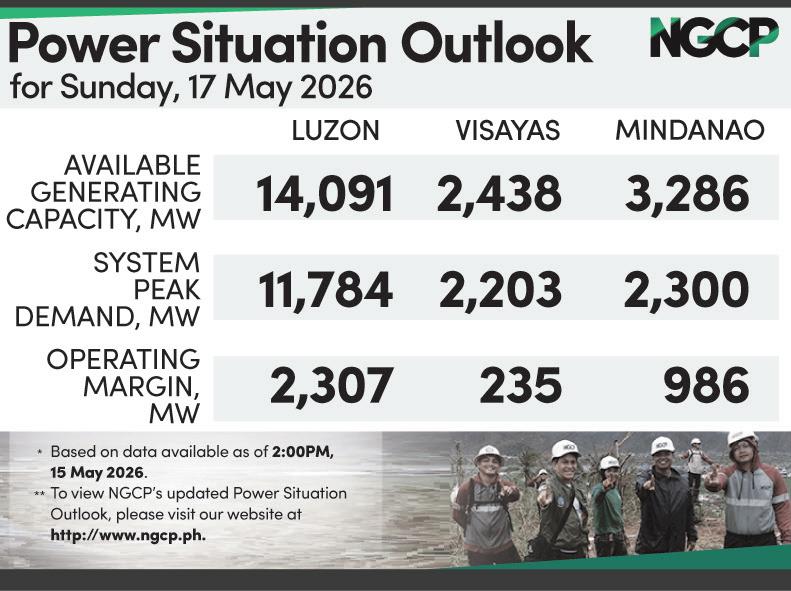
“From the forecasted available capacity in Luzon of 16,975 MW reported by the NGCP earlier in the day, system availability dropped to 12,447 MW, reflecting how concentration of critical assets can lead to an immediate tightening of power supply conditions,” it noted.
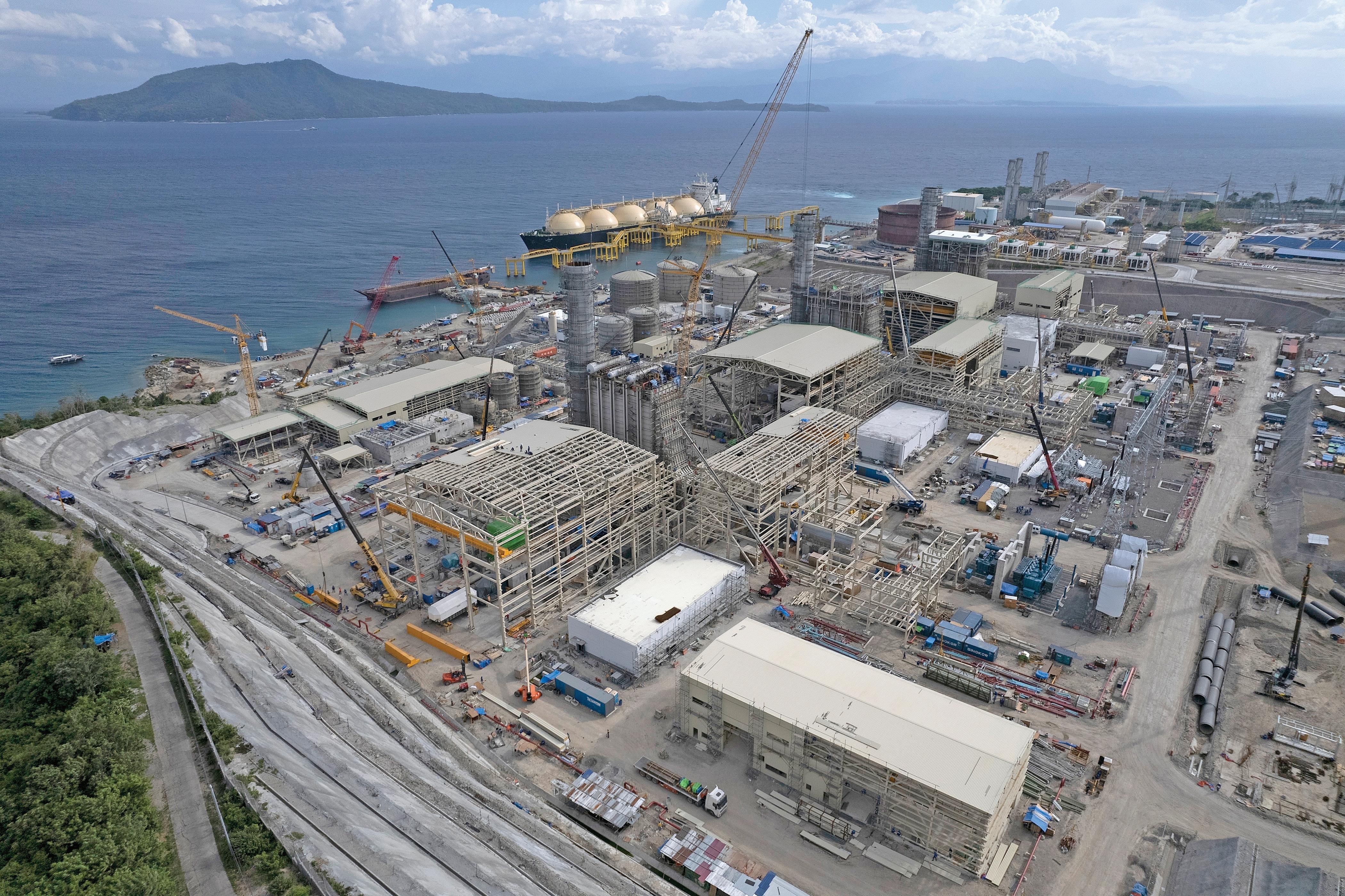
The cascading tripping on May 13 of 500 kV Dasmariñas-Ilijan transmission line at 4:48am and 500 kV Tayabas-Ilijan transmission line at 6:39am had triggered the disconnection of nearly 2,500 MW of capacity, including the Ilijan 1 and 2 plants (1,200 MW) and EERI Units 1, 2, and 3 (1,262.1 MW), both of which are LNG facilities. Even though the transmission lines were restored online later that same day, the disconnected power plants were not able to immediately resume generation, prolonging the supply shortfall and triggering the rotating blackouts, ICSC pointed out.
As of late Thursday, these plants had yet to be re-commissioned and returned to service.
“Until they are brought back online, the capacity deficit will persist, and further grid alerts remain
likely,” said the Philippine-based NGO that advances climate, energy, and low-carbon solutions to enable fair and climate-resilient development at the national and international levels.
On Friday, the National Grid Corporation of the Philippines (NGCP) again placed the Luzon and Visayas grids under red and yellow alert.
Just a month ago, on April 16, the same power plants that were disconnected last week also experienced simultaneous forced shutdowns due to issues involving the LNG terminal supplying their feedstock requirements.
“Both incidents highlight the vulnerability of an energy system heavily reliant on centralized infrastructure. Whether through a shared LNG terminal or a critical transmission corridor, disruptions in these critical nodes can quickly cascade into broader system-wide supply shortages and grid instability,” said the ICSC.
It stressed that last week’s events show that the available electricity supply can drop significantly when more than one major pow-


er plant or key facility goes offline at the same time. This, it warned, raises an important consideration: as the power system continues to rely on large centralized infrastructure—such as LNG facilities—the level of reserves or backup needed to maintain reliability may need to increase, with possible implications on electricity costs.
“Reserves today are sized based on the largest power plant connected to the grid. But if a single shared facility, such as an LNG terminal or critical transmission corridor, can affect multiple plants at once, then that shared infrastructure should arguably become the benchmark for reserve requirements,” said ICSC Chief Data Scientist Engr. Jephraim Manansala. In addition to issues encountered in the transmission facilities, forced outages of coal-fired plants have further exacerbated supply tightness. Among those reported were the forced outage of Masinloc Unit 3 (335MW), which tripped at 6:35am of the same day, and Mariveles Power Generation Corporation Unit 4 (150MW), which had already been on forced outage since May 10, adding to the overall capacity deficit. Based on the Grid Operating and Maintenance Program (GOMP), no plant should be on outage during the second quarter of the year. Yet, ICSC lamented, “these unplanned outages persisted, exposing the gap between scheduled maintenance assumptions and real-world plant reliability.”
It strongly suggested moving the country toward a “more decentralized, diversified, and flexible power system, where the outage of no single facility can put the entire grid at risk.” This is the only way to break the cycle of grid alerts and rotating blackouts, it stressed. “Decentralized and diversified — given the country’s archipelagic
By Charlotte Yang and Sangmi Cha Bloomberg
IN South Korea’s $4.6-trillion stock market, signs of euphoria are popping up everywhere.
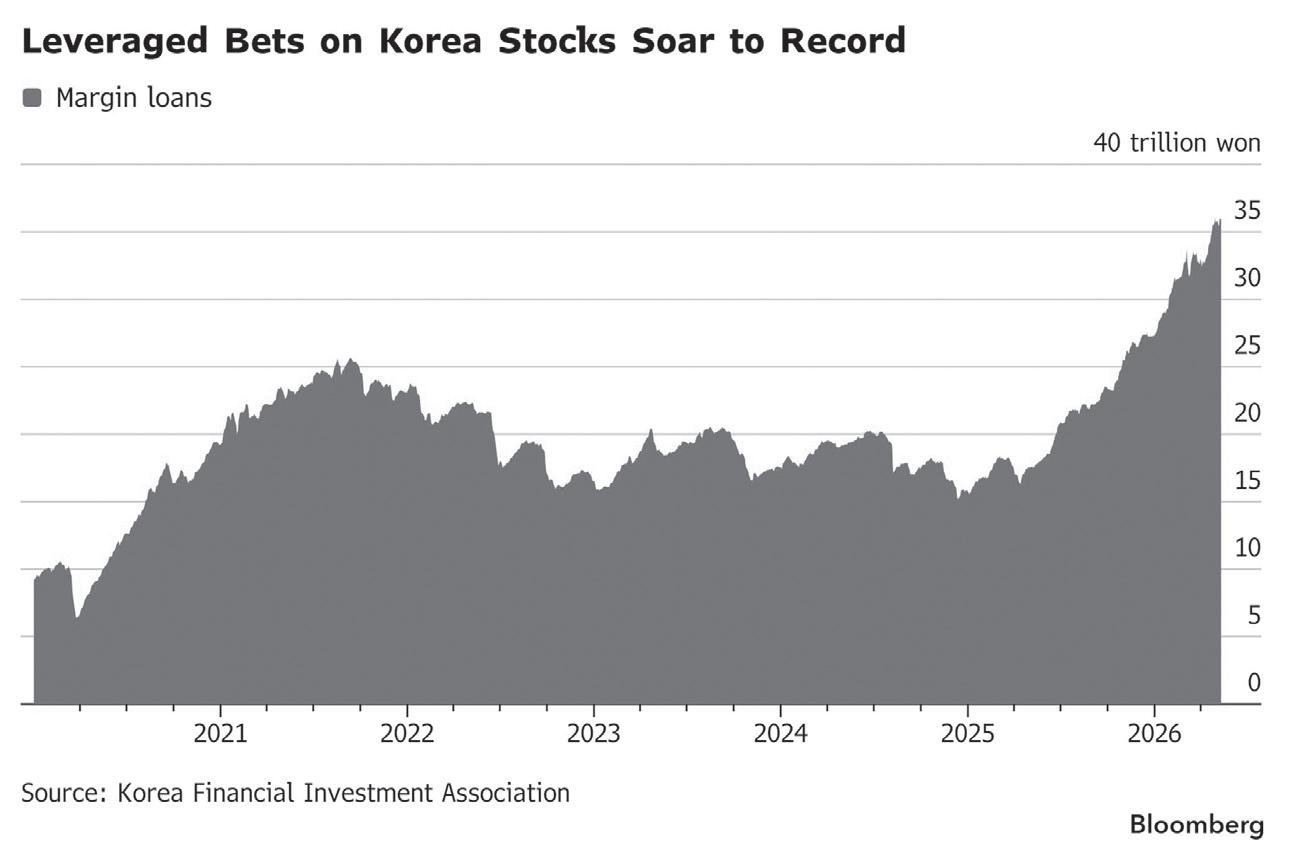
Enthralled by a 200% surge over the past year that has far outpaced every other market on earth, locals are borrowing record sums to amplify their bets on stocks. Trading volumes have soared to all-time highs, while daily price swings of 5% or more have become more common — making the benchmark Kospi index the most volatile major stock gauge worldwide.
The sense of FOMO spreading through offices, lunchrooms and family gatherings across South Korea has gotten so intense that investors are increasingly buying stocks for their kids, too: Data compiled by Toss Securities show a near 10-fold surge in new account openings for under-18s in the first quarter versus a year earlier.
“The mood in the retail community is very hot, nearly maniacal,” said Jang Eunjung, 37, a Seoul-based video producer whose YouTube show on stock investing grew from a tiny audience to more than 1.3 million subscribers as the market soared.
“Will we ever see such a vertical rally again?”
Fueled largely by South Korean chipmakers’ central role in the artificial intelligence boom, the trading frenzy has transformed a long-dormant market into one of the world’s most closely watched indicators of how far the mania surrounding AI can go.
While bulls point to record profits at companies like Samsung Electronics Co. and SK Hynix Inc. to justify the rally, the risk of a sudden reversal was on display this week.
The Kospi shed about $300 billion of value in less than two hours on Tuesday as jitters that the rally is getting overheated coincided with a lengthy Facebook post from a senior official on a potential “citizen dividend” using excess tax on AI profits. Stocks recouped more than half their losses by the close and the government later clarified it was a personal post, not policy.
“People with FOMO see others making big profits and may jump in recklessly, often using excessive leverage. But no one knows when the bull run will end,” said Kim Taewhan, a doctor who runs an ENT clinic in the Gangseo district of Seoul and started posting his returns on social media a year ago.
“The danger is that people often ramp up their investment size at the end, only to suffer losses. I’ve done that myself — in 2018, during the Bitcoin craze. I increased my investment at the peak and ended up with losses,” he added.
Korea’s rally has few historic parallels at home and around the world. The leverage-fueled frenzy helped it leapfrog peers to become the world’s seventh largest market, while heavy-
weight Samsung has blazed past the $1 trillion valuation mark. It’s now Asia’s second-most valuable company.
The momentum has been stoked by the return of Korea’s legion of 14 million day traders. They’ve jumped back in after largely staying on the sidelines for much of 2025, lured by what many see as a once-in-a-lifetime rally. So far this year, they’ve poured about 37.7 trillion won ($25.3 billion) into local shares, even as foreigners pare nearly double that amount on a net basis.
“There is a growing sentiment that social mobility is no longer possible through traditional means — it is only achievable through speculative assets,” said Jaewon Choi, professor of economics at Seoul National University. “Having witnessed people make overnight fortunes in crypto, investors are now flocking to stocks like SK Hynix, seeing them as a superior vehicle for rapid wealth accumulation.”
According to the Korea Financial

things can reverse. Perhaps nowhere is Korea’s stock obsession playing out more visibly than on social media, where a flood of trading tips and investment returns from influencers and retail investors feed a growing fear of missing out. The competition is no longer confined to just beating the market — it’s also extending to friends, colleagues and even anonymous internet trolls.
Investment Association, margin balances hit a record 36.3 trillion won earlier in May, up 32% from the end of December. That only captures a part of the real picture as many loans used to buy stocks are often classified under other categories, while credit extended by smaller financiers can fall outside of the scope of official data. That’s raised concerns about how long the rally can last, and more importantly, how quickly
The gains in Korea’s market are part of a global frenzy for all things artificial intelligence. The country had largely missed earlier rallies as its chipmakers are tied more closely to older segments of the industry, but that changed when AI-driven demand went into hyperdrive and tightened supply chains. President Lee Jae Myung’s campaign to spur the stock market through sweeping financial reforms also added fuel to the rally. The situation is playing out similarly in Taiwan, also home to key companies in the AI supply chain. “The market’s relentless rise has lulled families and retail investors into a false sense of security — as if stocks could climb forever,” said Dachrahn Wu, professor at the department of
Continued from A1 geography and vulnerability to extreme weather, power generation should also be geographically spread out and technologically varied,” ICSC said. A more decentralized and diversified approach enables communities to depend less on a handful of large plants, strengthening local reliability and self-sufficiency while reducing the risk of supply disruptions caused by outages, disasters, or other physical shocks, it added. “Expanding the share of indigenous renewable energy — such as geothermal, hydropower, solar, and wind, backed by energy storage systems — will be central to this shift to further diversify the country’s power mix.”
The ICSC cited the need to resolve the flexibility issue of baseload power plants, which are not designed “to ramp up and down quickly during these windows” during specific hours of the day when the red or yellow alert needs to be raised, and when additional power capacity is needed. “Inflexible baseload power plants will not resolve the issues we are encountering today,” ICSC said, and only “technologies that can flexibly respond to fluctuations in supply and demand and recover quickly from disruptions” can do so. It cited battery storage systems, pumpedhydro storage facilities, and other fast-ramping generation capacity as examples of these.
DOE seeks full NGCP accountability MEANWHILE, the Department of Energy (DOE) has mobilized the Grid Reliability Task Force (GRTF) to conduct a full investigation into the 13 May 2026 tripping of the 500-kilovolt (kV) Tayabas–Ilijan and Ilijan–Dasmariñas transmission lines, which disconnected 2,462.1 megawatts (MW) of natural gas capacity from the Luzon grid and triggered widespread power interruptions across Luzon.
The incident also prevented power transfer from Luzon to Visayas at a time when the Visayas grid was already experiencing critical supply conditions. Luzon system conditions were further aggravated when Masinloc Unit 3, with a capacity of 325 MW, went on forced outage.
The DOE earlier requested full incident disclosure from the NGCP, including complete operational data, incident reports, and technical findings necessary to determine the root cause of the disturbance.
“Two major 500-kV transmission arteries feeding power into Metro Manila and the broader Luzon grid were suddenly cut off. These lines carried roughly 12 percent of Luzon’s supply at the time. An incident of this scale demands
economics at
full technical disclosure, clear accountability, and immediate corrective action,” Energy Secretary Sharon S. Garin said.
To determine the circumstances surrounding the incident, the DOE is convening the GRTF composed of the DOE, the Energy Regulatory Commission (ERC), the Independent Electricity Market Operator of the Philippines (IEMOP), the National Transmission Corporation (TransCo), and the Power Sector Assets and Liabilities Management Corporation (PSALM) to conduct a comprehensive technical assessment and establish the root causes of the disturbance.
What really happened?
ON Thursday, the ERC ordered the NGCP to submit a comprehensive report concerning the Red Alert and Yellow Alert raised over the Luzon and Visayas grids.
“Consumers have the right to a clear and comprehensive account of what occurred during these alert declarations. Visiting the System Operations Command Center enabled us to closely observe the situation and ensure that the Commission bases its actions on verified information rather than assumptions,” ERC Chairperson Atty. Francis Saturnino Juan said.
In a letter addressed to NGCP President and CEO Anthony L. Almeda, the ERC directed NGCP to submit a detailed account covering, among others, the specific date, time, and duration of each Red and Yellow Alert declaration and the areas affected; the root cause or triggering factor of the supply deficiency or grid contingency; the generating units, transmission lines, and grid facilities that experienced forced outages, derating, or reduced availability; the reserve and demand levels at the time of each alert declaration; the immediate corrective measures undertaken, including any load management or dispatch instructions issued; the restoration timeline and normalization actions; and any related coordination with the Department of Energy (DOE), the ERC, and concerned generation companies.
Brownouts stressing economy–PCCI RECURRING power outages in the Visayas could evolve into a broader economic threat, as supply instability collides with slowing growth and rising inflation, the Philippine Chamber of Commerce and Industry (PCCI) warned.
PCCI president Ferdinand Ferrer said energy instability should no longer be viewed as an isolated regional issue, citing its potential impact on economic activity and investor sentiment.
“The looming power crisis in the Visayas is a wake-up call. En-
ergy instability is not just a regional issue; it is a national economic risk,” Ferrer said. He noted that the economy is already facing mounting pressures, with gross domestic product growth slowing to 2.8 percent in the first quarter of 2026, while inflation is projected to reach 6.3 percent.
“With growth already at 2.8 percent and inflation rising, prolonged brownouts will further weaken productivity, investor confidence, and household welfare,” he added.
The May 13 outages reportedly left more than 200,000 households and businesses without electricity for an average of three hours.
The Visayas grid has emerged as a particular area of concern after the NGCP placed it under red alert from 3-8 pm and under yellow alert from 8-9 pm on Wednesday. Grid data showed available capacity at 2,510 megawatts against a peak demand of 2,413 MW, leaving only a narrow operating margin.
On Friday, rotational outages were explained away as a necessary evil to prevent the grid from collapsing, a situation that could create more problems.
Engr. Nino Paolo Cerrado, officer-in-charge of Visayan Electric’s Reputation Enhancement Department, said the utility began implementing rotational brownouts during peak hours starting Wednesday in response to the tightening power supply situation.
“This rotational brownout is a solution to help protect the grid,” Cerrado said, partly in Visayan in a radio interview where he explained that the temporary outages are meant to ease pressure on the power supply following NGCP’s announcement that several power plants were unavailable or operating below capacity.
“We do not want the grid to collapse since it will create a bigger problem,” Cerrado said. The Philippine Chamber of Commerce and Industry, the country’s largest business alliance, discussed the problem at the Energy Summit 2026. Stakeholders emphasized the need to diversify energy sources, accelerate renewable energy investments and improve transparency in energy infrastructure planning. It warned that continued instability in the power sector could further dampen investor confidence, intensify inflationary pressures and weaken efforts toward inclusive growth.
PCCI called for stronger contingency measures and clearer public communication during grid alerts, alongside faster reforms to encourage investments in renewable and alternative energy.
The business group also urged authorities to address inefficiencies in power generation and distribution systems and prioritize sectors and communities most vulnerable to brownouts and rising costs. With a report by Bless Ogerio
Editor: Angel R. Calso
May 17, 2026
By Ike Swetlitz, Saritha Rai & Amber Tong
SCIENCE fiction has long imagined a world where our brains interact with machines to restore and augment our abilities— think of the neural implants that connected to Geordi La Forge’s visor in Star Trek or allowed Alex Murphy to be reborn as cyborg law enforcer in RoboCop.
In the real world, researchers have been working for decades on so-called brain-computer interfaces to help people who suffer from paralysis, blindness, hearing loss, and more, regain function. Some individuals have used these devices to control a computer cursor with their minds; others have managed to move a robotic arm or transcribe some of their thoughts into text.
The technology is still nascent and the number of people who have received implants is only in the hundreds. Just a few companies have received regulatory approval to progress beyond clinical trials to commercial use—and even that’s for limited applications. But the industry could be reaching an inflection point thanks to rapid advances in hardware and artificial intelligence models that can decode neural signals.
The potential of braincomputer interfaces has attracted the interest of billionaires including Tesla Inc. Chief Executive Officer Elon Musk and OpenAI CEO Sam Altman. Some of them are betting these devices will one day become everyday consumer tech that can unlock superhuman powers.
What is a brain-computer interface?
A BRAIN-COMPUTER interface, or BCI, connects the brain directly to an electronic device, such as a computer, bypassing the rest of the body. The interface is designed to detect brain activity—for example, the electrical signals generated by neurons—and translate it into commands that can control machines.
BCIs offer hope to people who’ve suffered damage to the nerves between their brain and various muscles. The interfaces could help them communicate if they’re unable to speak, or allow them to use their minds to control external devices if they’re paralyzed. This could improve the quality of life for stroke patients and individuals with debilitating neurological conditions such as amyotrophic lateral sclerosis (better known as ALS or Lou Gehrig’s disease).
BCIs can also stimulate the brain with information from the outside world. This could allow people with vision loss to see or those with hearing loss to hear. While patients with impaired hearing have been fitted with cochlear implants since the 1960s, these devices connect a “sound processor” on the outside of the head to the auditory nerve rather than to the brain directly.
In theory, BCIs could send
signals to change neural activity, too. They have the potential to target specific areas of the brain that have been linked to neurological and mental health disorders. Implants that deliver targeted electrical pulses for “deep brain stimulation” have been used as a medical treatment for decades, including to reduce tremors from Parkinson’s disease. However, these are generally considered a distinct and less sophisticated form of neurostimulation to the BCIs currently under development.
Are these devices actually implanted into the brain?
SOME BCIs have electrodes that stick into the brain, some sit on top of the brain but still inside the skull, and others are noninvasive devices that are placed on the outside of the head. There’s much debate over how close an interface needs to be to the brain in order to read useful information and stimulate neurons effectively. Biological cells are being explored as a means of connecting a BCI to the brain instead of wires. Californiabased Science Corp. is developing a “biohybrid” device that uses a layer of neurons to form a bridge with the brain tissue. Many companies are also working with sound waves instead of electrical signals. In the US, this includes startups Merge Labs, co-founded by Altman, and Nudge, founded by crypto billionaire Fred Ehrsam. In China, Gestala, co-founded by Chinese internet billionaire Chen Tianqiao, emerged this year as the country’s first BCI company focused on ultrasound.
How advanced is braincomputer interface technology?
IN the early days of BCI development, it was novel for a person to be able to move a cursor on a computer screen with their mind. Back then, the devices were big and clunky and physically connected to computers. Now, there are experimental wireless devices that enable individuals to operate computers, tablets and smart home gadgets with just their thoughts. Some people have been able to use BCIs to manipulate robotic arms to pick up and move objects. There have been notable advancements in restoring speech. Recent breakthroughs include decoding “inner speech,” whereby a BCI is able to pick up signals from the brain when a person thinks about what they want to say and translate them into words that appear on a
screen. This is a step up from decoding “attempted speech,” which involves recognizing the neural signals a person generates when they try to physically produce speech rather than just imagining the words. Research teams at Stanford University and the University of California, Berkeley are among the pioneers developing BCIs to restore speech.
Scientists have also made progress in giving blind people “form vision.” Lightsensitive cells on the retina can be damaged by diseases such as age-related macular degeneration, a leading cause of blindness in older adults that affects around 200 million people around the world. The startup Science has built an ultrathin, wireless microchip to replace the function of these photoreceptors.
Its PRIMA implant, which is awaiting regulatory approval for commercial use, is designed to be placed on the back of the eye and receive infrared light signals from a pair of high-tech glasses that capture images of the outside world. The chip converts this light into electrical stimulation for the brain, enabling vision-impaired people to see shapes and even read. It can only provide blackand-white vision for now, but is still a big step up from previous technology that just allowed a person to see flashes of light. Science announced in March that it had closed a $230 million funding round as it expands clinical trials and looks to bring PRIMA to the market.
Who are some of the big names in this field?
NEURALINK Corp., co-founded by Musk in 2016, is the poster child of brain-computer interfaces, having both advanced the technology and brought it into mainstream discourse. Its device, which is about the size of a US quarter, has been implanted in the brains of more than 20 patients, who have been able to control a computer to browse the internet and play online games.
As is typical of a company owned by Musk, Neuralink has ambitious plans to scale up. It wants to put its chips in 20,000 people per year by 2031 and generate at least $1 billion in annual revenue, according to documents reviewed by Bloomberg. Neuralink has been a leader in fundraising, accounting for a sizable chunk of the more than $2.75 billion invested in major US BCI companies to date. It closed a $650 million funding round last year and, according to PitchBook data, has a valuation of more than $9.5 billion.
Merge Labs, a newer kid on the block from Musk’s friendturned-rival Altman, aims to build a device that isn’t implanted in the brain and said in January it had raised $252 million. It’s not clear what type of BCI Merge will ultimately build, but the company has considered genetically altering brain cells to make it easier for a device to detect and modify their activity, people familiar with the matter told Bloomberg. Scientists have been studying “sonogenetics” for years, looking at how genes that encode

proteins that are responsive to ultrasound can be delivered to a target cell.
Elsewhere in the US, Blackrock Neurotech’s Utah Array has the longest record of human testing, stretching back around two decades, and the company has implanted BCIs in more than 55 patients. Paradromics Inc. tested its device in its first human patient in May last year and started its first clinical trial this year. Precision Neuroscience Corp.’s device—an array of microelectrodes that’s thinner than a human hair and sits on top of the brain tissue without penetrating it—was granted clearance by the US Food and Drug Administration in March 2025 for commercial use for less than 30 days to record, monitor and stimulate brain activity. The company isn’t yet marketing its BCI for commercial use but is testing it in clinical studies. The device had been implanted in more than 85 patients as of the end of April, according to Precision. Synchron Inc., backed by Jeff Bezos and Bill Gates, is focusing on technology that’s even less invasive and doesn’t require cutting into the skull. It’s developed a stent-like product that can be inserted through a patient’s jugular vein until it reaches a blood vessel on top of the brain, and then it reads the electrical activity from there. The device has been tested in 10 people so far and Synchron is working on a more advanced version.
CHINESE companies are relative latecomers to the cutting-edge field of invasive BCIs and have implanted their devices in fewer patients than US rivals. Comparing the performance of various systems around the world is difficult as there’s little published research for independent scientists to analyze. Still, it’s apparent that startups in China are making rapid progress.
StairMed Technology Co. paved the way for Chinese BCIs by becoming the country’s first company to test an invasive implant in a clinical trial in March last year. That was roughly 14 months after Neuralink took the same step. StairMed says that its implant, which is powered by an external battery, enabled a paraplegic patient to play a computer game using only his thoughts. It plans to implant its device in 40 more people this year.
NeuroXess Technology
notched another milestone for China in December as the first Chinese company to implant a wireless device with a built-in battery. In March of this year, Chinese regulators approved a BCI developed by Neuracle Technology (Shanghai) Co. for limited commercial use. The wireless, coin-sized device is designed for people with spinal cord injuries, enabling control of a robotic hand that can grab and hold objects. Companies in China are being supported by state and local policy, which could ease regulatory bottlenecks and accelerate BCI development.
The government’s latest FiveYear Plan, which sets out its economic priorities until the end of the decade, aims to foster BCIs as a future driver of growth and channel more funding to the industry. China’s topdown efforts have already had success in other sectors—the “Made in China 2025” initiative helped power the country’s rise in industries such as electric vehicles.
International competitors are taking note of the BCIfriendly environment. In April, Axoft became the first US brain implant company to disclose that it had tested its device in China. Chief Executive Officer Paul Le Floch said part of the motivation to study the implant in China was because of how quickly Axoft could test there. The firm does have other connections to the country— two of its founders are from China and it has also received Chinese investment.
The amount of money flowing to the BCI industry in China is still well behind volumes in the US. Nonetheless, venture capital funding for China’s BCI sector more than doubled in 2025 versus a year earlier, topping 1.8 billion yuan ($264 million), according to data platform ITjuzi.
BCI technology is far from perfect and likely years away from being widely available. While some implants are wireless and ready for athome use, others are physically connected to computers or restricted to a laboratory setting for testing, meaning they’re not yet practical for patients in their everyday lives.
Some argue that devices implanted into or onto the brain enable more detailed readings of neural activity than noninvasive BCIs, but surgery is a risky procedure. Pushing
material into the surface of the brain could result in the formation of scar tissue, which may disrupt the connection between the device and the brain. It’s also not yet clear how long implanted BCIs can be left in place, whether they’ll physically degrade, and when, or if, they’ll have to be replaced or upgraded. For BCIs that protrude from the head, there’s a risk of infection at the boundary where the skin and device meet, which could require another surgery to remove the interface.
Even if the technical challenges can be overcome, there’s an issue of cost, not just of the devices but of any procedure to install them, too. In a presentation for investors, Neuralink conservatively estimated it could generate $50,000 in revenue from each surgery. The bill for patients could be higher than that figure when including the other costs of a hospital stay, depending on what’s covered by insurers and public health programs.
Could brain-computer interfaces be used beyond medicine?
MEDICAL applications for BCIs are focused on restoring lost functionality. But some in the industry believe these devices could enable humans to go beyond their natural biological capabilities.
At the simpler end of the spectrum, the ambition is for BCIs to become mass market products that are integrated with everyday technologies such as headphones and glasses, changing the way we communicate, see the world and consume entertainment.
Neuralink President DJ Seo has said that his company hopes to put a device in an “otherwise healthy” person by 2030, and that brain implants could eventually allow people to question AI chatbots with their thoughts and receive the answers through their headphones.
Some investors and entrepreneurs have more fantastical visions of BCIs giving people telepathic powers, expanding the brain’s memory capacity and rapidly accelerating learning. But scientists are skeptical that you could have your very own “I know kung fu” moment like Neo in The Matrix, when knowledge of the martial arts is uploaded to his brain. Even in a more mundane form, BCIs could be of use to the military, enabling soldiers to control drones and other unmanned weapons with their mind, for example. The US Department of Defense’s research and development agency, DARPA, has funded projects to advance BCIs, including some of the technology that went on to become Neuralink.
Is the world ready for braincomputer interfaces?
GOVERNMENTS often have to play catch-up to ensure new technology is integrated into society responsibly. The fact that BCIs are first being used for medical applications could provide a guardrail. Medical
A4
Sunday, May 17, 2026
www.businessmirror.com.ph
By Grant Smith & Yongchang Chin
THE world has burned through oil inventories at a record speed as the Iran war throttles flows from the Persian Gulf, eating into the very buffer that protects against supply shocks.
The rapidly shrinking stockpiles mean that the risk of even more extreme price spikes and shortages is getting evercloser, leaving governments and industries with fewer options to cushion the impact of the loss of more than a billion barrels of supply, two months into the near-closure of the Strait of Hormuz. The sharp depletion will also mean the market stays vulnerable for longer to future disruptions even after the conflict ends.
Morgan Stanley estimates global oil stockpiles dropped by about 4.8 million barrels a day between March 1 and April 25— far exceeding the previous peak for a quarterly drawdown in data compiled by the International Energy Agency. Crude accounts for almost 60% of the decline, and refined fuels the rest.
Crucially, the system also requires a minimum level of oil, which means that the “operational minimum” is reached long before the inventories actually hit zero, said Natasha Kaneva, JPMorgan Chase & Co.’s head of global commodities research.
“Inventories are acting as the shock absorber of the global oil system,” she said. But “not every barrel can be drawn.”
There are some signs that the drawdown may have slowed slightly in recent days, according to Goldman Sachs Group Inc., which pointed to weaker demand from China, the world’s top oil importer—leaving more available for other buyers. Still, global visible oil stocks are already close to their lowest since 2018, the bank said.
Estimating global inventories involves both art and science. A large part are strategic caches of crude and fuel controlled by governments, either directly or by requiring the industry to
maintain a level of reserves that can be released when needed, or a combination of the two.
But there’s also a huge amount in commercial stockpiles—the inventories of oil producers, refiners, traders and distributors held as part of normal business operations.
The most immediate points of stress are in a handful of fuel-import-reliant countries in Asia, with traders pointing to Indonesia, Vietnam, Pakistan and the Philippines as the biggest worries, potentially hitting critical levels of supplies in as little as a month. Larger economies in the region, particularly China remain comfortable for now.
However, European jetfuel stocks are also depleting fast just as summer vacations approach, and some analysts predict they could hit critical levels as soon as June.
Operational minimum JPMorgan’s Kaneva warns that inventories in the Organization for Economic Co-operation and Development could reach “operational stress levels” early next month, if the strait doesn’t reopen, and then “operational minimum” floors by September. That’s the point when the world hits the bare minimum amounts of oil needed for pipelines, storage tanks and export terminals to function properly.
The US, which has become the supplier of last resort to the world, has already drawn down domestic inventories of crude and fuels to below historical averages as exports surge. US crude stocks, including the nation’s Strategic Petroleum Reserve, have dropped for the last four straight weeks, according to government data. US distillate stockpiles were at their lowest point since
2005 at the end of last week, while gasoline stockpiles were hovering near their lowest seasonal levels since 2014.
While America’s oil drillers have started to turn the taps on, executives have warned that inventories are likely to keep falling in the short-term.
Even if the waterway reopens, Gulf output and shipping is unlikely to return to normal levels any time soon, meaning fuel users could have to dig even deeper into storage tanks.
The conflict has already sent physical crude and key fuel prices surging, threatening higher inflation and intensifying the risk of a global recession. It has left India suffering liquefied petroleum gas shortages, prompted airlines to cancel flights and hit US drivers with soaring gasoline costs.
Global oil consumption has already dropped sharply, in part because of supply disruptions, and in part because of higher prices. But as inventories get closer to critical levels, analysts, traders and executives warn that prices will need to spike to a level that chokes off significantly more demand in order to balance the market.
“A lot of the inventory and spare capacity has been depleted already,” Chevron Corp. Chief Financial Officer Eimear Bonner told Bloomberg TV on May 1. “We are going to start to see some import-dependent countries potentially start to face critical shortages as we get into the June-July time-frame.”
“Top of my mind in terms of places facing imminent shortage is gasoline in Asia, with countries like Pakistan, Indonesia or the Philippines likely to be the first to face issues with tank bottoms,” said Frederic Lasserre, head of research at energy trader Gunvor Group.
If the Strait of Hormuz doesn’t reopen by early June, some Asian countries will face a macroeconomic shock because of the shortage of gasoil, he predicted, while Europe may have one more month before the situation becomes difficult to manage.
To be sure, some analysts and traders say that the stress points are lower than what JPMorgan estimates, meaning that the industry could have a bigger

buffer, while further demand loss would also help reduce the pressure on the system. The JPMorgan estimates assume demand destruction of 5.6 million barrels a day for June through September.
Asia situation
WHILE Asia has been the most exposed to the loss of Middle Eastern oil, stockpiles in key economies are largely holding up, with China’s and South Korea’s levels so comfortable that they’re considering resuming refined-product exports that were earlier curbed. Stocks in the fuel-storage hub of Singapore were recently above seasonal averages. China’s crude inventories remain robust, with geospatial analytics firm Kayrros estimating they’ve actually risen during the war.
The energy transition may also mean that some nations need to store less fuel going forward. Gasoline and diesel may not be as crucial in nations like China, which has massively electrified its fleet of cars and trucks.
Oil inventories in the AsiaPacific region outside of China have been hit hardest, falling by about 70 million barrels since the conflict began, Kayrros cofounder Antoine Halff said.
Kayrros said stockpiles in Japan and India are at an at least 10-year seasonal low, down 50% and 10%, respectively, since the war began. The region’s supplies of naphtha and LPG, both used for petrochemicals, have been particularly hit, according to
Goldman Sachs.
Some Asian officials say stockpiles are sufficient, at least for now. Pakistan’s petroleum minister in late April said it has roughly 20 days of commercial reserves of refined products.
India’s oil ministry said on May 3 that refineries have adequate crude inventories, though state-run refiners privately acknowledged that they’ve burnt through a sizable amount, without elaborating.
Diesel—the lifeblood of the global economy—is also facing a crunch. Countries hit hardest are those with limited domestic crude production and refining capacity, said Xavier Tang, a senior market analyst at Vortexa Ltd.
“Northeast Asian countries such as China, Japan and South Korea hold ample crude and product stocks in their storage tanks,” said Tang. “Vietnam, Philippines are in a more dire situation.”
Europe and jet fuel
IN Europe, the critical product is jet fuel.
Inventories in independent storage at the AmsterdamRotterdam-Antwerp hub have plunged a third since the war started to a six-year low, according to Insights Global, which gets data from terminal operators.
“Since February, we have seen a steady drop in jet fuel stocks,” said Lars van Wageningen, research and consultancy manager at Insights Global.
“Other regions like Asia and Australia also need to source
Thailand’s digital gold mega investors hit by central bank’s rush to control the baht
By Randy Thanthong-Knight & Suttinee (Ying) Yuvejwattana
ACRACKDOWN on online gold trading in Thailand risks dimming a rare bright spot for investors, platforms have warned, with the central bank floating further curbs. As gold rallied globally in 2025, the Thai currency climbed alongside it, hitting a five-year high and causing a headache for the export-driven, tourismdependent economy. The central bank blamed online gold speculators whose rapid-fire transactions worth millions of dollars at a time contributed as much as 30% to swings in the baht on some days. To rein in the runaway currency, the bank imposed a daily online limit of 50 million baht ($1.6 million) per person from the start of March, in a bid to force topend investors to trade in dollars. It has left open the possibility of further slashing the daily cap by 40% to 30 million baht.
“We’ve built an ecosystem that makes gold accessible to everyday investors— one that’s the envy of the world,” said Pawan Nawawattanasub, chief executive officer of YLG Bullion International, one of Thailand’s largest gold traders.
“Instead of nurturing it, they’re trying to dismantle it.” Pawan maintains that to see a
significant impact, the entire digital gold trading system would need to move to dollar-based platforms, shifting the burden of currency exchange onto investors.
In Thailand, gold is embedded in daily life: it gilds Buddhist temples and glints from shopfronts in the narrow alleys of Bangkok’s Chinatown, farmers store it in countertop safes and families present it to newborns and brides. Thais buy more gold per capita than even China or India — the world’s two most populous countries.
Such affinity for the safe-haven investment seamlessly migrated online, with all 14 major gold trading companies offering at least one app. The digital market offers unusual direct access to a global asset with no trading hours. Thais can buy and sell in their own currency and in any fraction, without the frictions of foreign markets.
The link between gold trading and the baht is, in part, mechanical. Gold is priced in dollars and tends to rise when the US currency weakens. When Thai traders sell, dollar proceeds are converted back into baht, boosting demand for the local currency. Large investors can unwind positions in bursts, converting dollars into baht and amplifying gains—especially in thin overnight markets.
Last year the baht surged by almost 8%, which the government said was out of line with sluggish economic fundamentals, including modest GDP growth, weakening consumption and an underperforming stock market.
Bank of Thailand Deputy Governor Piti Disyatat, in an interview in March, said the bank had been discussing a shift to dollar-based platforms with gold shops for years. “The aim is to nudge, to create incentives for trading to become denominated in dollars,” he said. “We couldn’t wait much longer.”
India’s government has also stepped in to shield the rupee from surging gold prices. Reliance on imports of the precious metal has pushed the currency in the opposite direction to Thailand, contributing to a swelling import bill that has weakened the rupee. This week, authorities more than doubled gold and silver import taxes to about 15% from 6% to preserve foreign exchange reserves for oil.
Policymakers in Bangkok, under pressure from business groups, have few options to rein in the baht. Aggressive currency interventions would earn the ire of the US, Thailand’s largest trading partner, and rate cuts carry significant risks.
Targeting large gold traders is a pragmatic move for the Bank of Thailand, given their outsized role in driving
currency swings, according to Kausani Basak, an economist at Australia & New Zealand Banking Group. She said by focusing on a small group, policymakers can curb volatile, high-value flows without disrupting the broader market. Platform managers Bloomberg News spoke with wouldn’t reveal the investors behind the large-scale transactions, but said they numbered in the hundreds, often too old for crypto and too young for shopfront dealing. They described them as business owners with substantial cash flows, such as rubber plantation operators earning about 200 million baht a year or apartment owners managing tens of thousands of units with a monthly income exceeding 100 million baht.
Kritcharat Hiranyasiri, president of MTS Gold Mae Thongsuk Group, said the central bank is trying to curb currency moves largely beyond its control, such as a weakening dollar and increased foreign currency inflows, and cast gold traders as scapegoats. “We have always insisted that we’re not the main culprit,” Kritcharat said. “There may be days when these activities contributed to the volatility, but we’re not driving the longterm appreciation.”
A report by the London Bullion Market Association described Thailand as “one of the most vibrant
this product, so everybody’s scrambling for whatever jet fuel they can get—with a cost.” While there’s enough supply in the short-term, summer demand could cause stocks to dry up in five months, he said. The UK, Germany and France are most vulnerable because of heavy traffic and insufficient local production, he said.
Strategic stockpiles
GOVERNMENTS have already pledged to deploy a record 400 million barrels of oil from emergency reserves in a move coordinated by the IEA.
However, the US has only utilized about 79.7 million barrels of the 172 million it promised to release, as it walks a fine line between providing enough supply to sustain global markets and pushing the oil store further toward depletion. The reserve is already poised to fall to its lowest level since 1982 if the administration completes the full release.
Germany is re-offering crude and jet fuel that wasn’t taken by the market when previously offered, and will take further measures if there’s a shortage, the economy ministry said. Governments face a dilemma that if they release more stockpiles to rein in prices, it would only further erode the buffer.
Looking further ahead, the sharp reduction in global stockpiles will mean added pressure on the market once the strait reopens, as governments and companies rush to replenish them.
“We expect this destocking environment to continue over the next number of months and ultimately drive a restocking phenomenon longer-term,” Plains All American Pipeline LP Chief Executive Officer Willie Chiang said on an earnings call Friday. “Post-war, we would not be surprised to see several countries restock their SPRs above pre-war levels, essentially creating an additional layer of demand into the future.” With assistance from Annmarie Hordern, Jack Wittels, Jack Farchy, Lucia Kassai, Mia Gindis, Nathan
retail trading environments across Asia.” Unlike most countries where gold is considered a long-term holding, consumers frequently engage in shortterm buying and selling, with half of gold transactions online.
Influencer Sittipong Sirimaskasem is one investor who has charted his shift from crypto to gold for his nearly 200,000 TikTok followers. He doesn’t trade at the highs targeted by the central bank, but his behavior mirrors those who do.
“Seeing profits in real time beats stock trading,” he said. “The money is always there—no exchange rates, no fees, nothing complicated. Even small moves can pay for your coffee.”
The central bank has said early signs suggest some migration to dollar platforms, though officials caution it’s too soon to draw firm conclusions on the impact of their intervention.
An analysis by Bloomberg Intelligence found that the dollar-baht correlation with gold weakened after the central bank’s moves, though a renewed gold rally would still likely support the baht. The baht had climbed nearly 10% against the dollar in the 12 months before the Iran conflict. As of May, it has weakened about 4% as soaring energy prices hit one of Asia’s most oil-importdependent economies. Bloomberg News
devices face regulatory oversight to ensure patient safety and those that are surgically implanted typically face even more scrutiny. But regulating the industry might become more challenging if the line between medical and consumer products becomes blurred. BCIs raise significant privacy and ethical concerns, including questions about the ownership and use of the information these devices collect. While the technology is still nascent, should it take off, people’s thoughts could become data that’s subject to surveillance, hacking or exploitation for political and corporate gain. Some US states, including California and Colorado, have passed legislation to try to safeguard neural data. Whether there’ll be a big appetite for BCIs among the general public is unclear, especially if the devices need to be implanted to be effective. The prospect of gaining superhuman vision or

By Manuel T. Cayon
AVAO CITY—The scientific com -
Dmunity will subject innovations and inventions into a series of technology validation and global standards testing to propel them into more internationally acceptable commercialization viability, the Department of Science and Technology (DOST) said.
To address the pressing concern of failure of many innovations and inventions to reach the global market, the DOST has partnered with the Commission on Higher on Education (CHED) to introduce a national initiative called Philippine Technology Evaluation and Standards for Testing (PhiTEST).
Through PhiTEST the DOST wanted to increase the number of validated, market-ready Filipino technologies, improve industry and investor confidence in local innovations, enable faster adoption of technologies in public and private sectors, and to have stronger alignment of research and development outputs with industry and regulatory requirements.
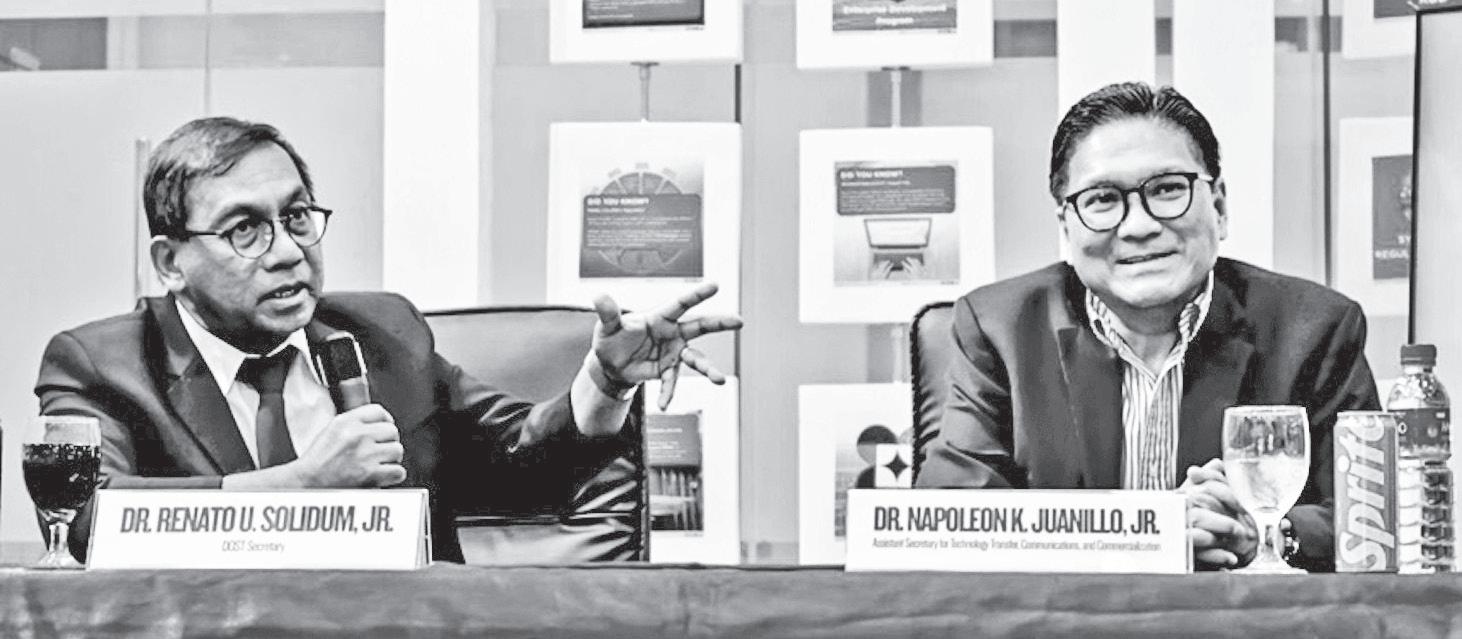
“Filipino ingenuity is not a problem to solve. The challenge lies in how we move our innovation from the laboratory to the marketplace, from prototypes to industries, meaning scaled up with mass production and from isolated success stories to sustain national impact,” Science Secretary Renato U. Solidum Jr. said in a recent news conference.
He said testing and evaluation system
will have its three layers, namely, technology validation; standards, testing and certification; and commercialization which will be led by the DOST and CHED except for the commercialization part.
For now, the DOST added, the initiative will focus on six sectors where the Philippines has strong potential for global competitiveness. This includes semiconductors and electronics, biopharma and health technologies, agri-aqua technologies, renewable energy and circular economy, electric vehicles and aviation, and climate change and resilience technologies.
“Most of the Filipino-developed technologies and innovations often remain in laboratories due to insufficient proof of readiness. For instance,
state universities and colleges [SUCs] and higher education institutions [HEIs] produce complex and groundbreaking technologies but they fail to prove that they are ready for adoption. These pose a loss of economic value for the country,” the DOST said.
The initiative will bridge the gap between laboratory-scale innovation and market or policy adoption by ensuring that technologies meet performance, safety, quality, and compliance standards required by industry, regulators, and end-users.
Dr. Napoleon K. Juanillo Jr., DOST assistant secretary of Technology Transfer, Communications and Commercialization, said the national testbed system is not like a regulatory body with
a “pass-or-fail” system.
Instead, it will provide data that will guide the consumers on the market readiness of a product or technology.
“To begin with, in terms of human capital and institutional recurrence, we should be able to train 60 master trainers for both university presidents, vice presidents for research and extension, as well as other scientists and specialists coming from universities and exposing them to global test kits,” Juanillo said.
These 60 master trainers will undergo global benchmarking and Master Trainer Development, as they also provide the training of 500 PhiTEST assessors from SUCs and select HEIs.
The DOST and CHED are also targeting to establish 10 validation centers across the country, mainly composed of universities and private HEIs.
The DOST and the CHED were yet to finalize the list of centers as they are also considering the readiness of the SUCs and HEIs in terms of infrastructure.
“For ordinary Filipinos, for everyone who wants to do PhiTEST, [it] means something very concrete. Safer medical technologies in health centers; more productive farms in rural communities; better quality products in the market; and more stable, higher-value jobs in industry and technology sectors. Because innovation is not only about ideas, but trust. What we sell are the solutions that are proven to be effective. Solutions that are trusted,” Solidum pointed out.
NUCLEAR technology researchers extracted uranium yellowcake from Philippine wet phosphoric acid, a by-product formed during fertilizer production.
This marks the Department of Science and Technology-Philippine Nuclear Research Institute’s biggest recovery of uranium from this local industrial source so far, the DOST-PNRI news release said.
The breakthrough study opens the Philippines to use local unconventional uranium resources for future power supply as the country is set to include nuclear energy in the energy mix.
Yellowcake is a powder made from uranium taken out of rocks. It is one of the most important basic materials in producing nuclear fuel but, in its current form, yellowcake is not yet ready to use as fuel. Just like flour is a key ingredient in baking bread but more processing is needed before it becomes something usable.
Countries—such as Australia, Canada, and Kazakhstan—mine uranium from the ground, turn it into this yellow powder, and then process it further to make fuel for nuclear power plants to generate electricity.
From contaminant to power source
PRODUCING yellowcake can lead to emissions and waste products that may pose risks to health and the environment if not managed properly. As such, yellowcake was previously considered as an industrial waste or contaminant. But using the right technology, yellowcake can be a valuable resource for making nuclear fuel.
Building on laboratory-scale investigation,
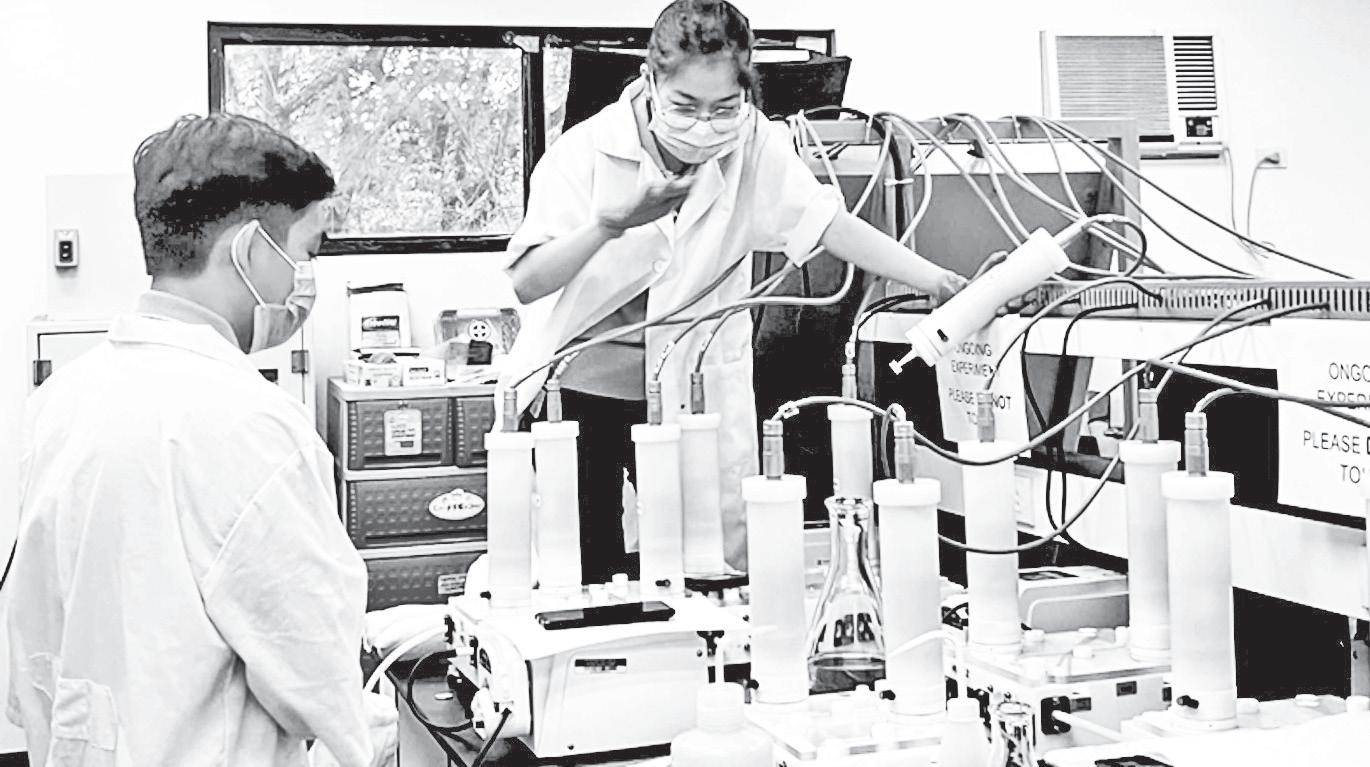
DOST-PNRI research team, led by Jennyvi D. Ramirez, developed a continuous-scale method of extracting uranium from a common industrial liquid called wet phosphoric acid. The project, titled “Micro-scale Continuous Extraction System for the Recovery of Uranium from Philippine Wet Phosphoric Acid,” showed that uranium can be recovered from the source using a mixer-settler system that is safe and efficient while keeping the process environment-friendly.
Funding the project is the DOST-Philippine Council for Industry, Energy and Emerging Technology Research and Development. The study is also funded by the International Atomic Energy Agency through TC PHI2013 “Enhancing Bench-scale Simulation for the Development of Continuous Extraction Technology of Uranium and Other Valuable Elements from Phosphates-Phase II.”
Support to PH nuclear power programme
PHOSPHORIC acid is a chemical made when phosphate rock is processed to produce fertilizers. The rock naturally contains small amounts of uranium. When it is turned into phosphoric acid, about 80 percent of the uranium ends up in that acid.
A 2023 study co-authored by Ramirez estimated that if uranium were recovered from the phosphoric acid from fertilizers, it could supply roughly 12 percent to 21 percent of the yearly fuel needs of the Bataan Nuclear Power Plant.
As of 2026, uranium yellowcake has a market price of $40 to $260/kgU. The study’s successful recovery of uranium opens the opportunity for significant revenue among local industries.
Further, it also proves that the country has
the scientific capability to study and develop alternative uranium resources, helping support a more stable long-term supply of nuclear fuel. The country is not yet ready to produce its own nuclear fuel, but this research is an important first step in helping scientists understand the materials, processes, safety requirements, and resource options for the nuclear fuel cycle.
Beyond energy, the project also shows how waste from industry can be reused, highlighting circular economy principles, environmental stewardship, and the strengthening of local expertise in radiochemistry and hydrometallurgy. It likewise builds local expertise in handling and processing materials safely. Overall, the work shows how responsible use of nuclear science can turn industrial waste into valuable assets that will contribute to the country’s long-term development, the DOST-PNRI said.

FROM 49 entries nationwide, 20 team finalists showcased solutions-driven innovations at the ninth imake.wemake: create.innovate. collaborate competition held at a hotel in Pasay City recently. Taking top honors and bringing home the Youth Innovation Prize (YIP) were teams from Cebu, Iligan, and Rizal. Common among the winning teams was the integration of artificial intelligence (AI) into their project designs. imake.wemake is an annual innovation and research competition for senior high school students in the Philippines. It is organized by the Science Education Institute of the Department of Science and Technology (DOST-SEI) Among the YIP recipients was San Carlos School of Cebu. The team’s project, C.H.U.M.: Cellular Holistic Universal Microscope, is an AI-powered microscope that automatically identifies and counts zooplankton, enabling faster water quality monitoring in support of environmental research.
Meanwhile, Iligan City National High School was recognized for the project called S.A.L.A.I.N: Smart AI-Powered Layered
Analysis and Integration in Sewer Filtration and Notification.
The student-developed system detects sewer blockages and pollution while sending real-time alerts to communities.
Completing the roster of YIP winners was Rizal National Science High School for SISIW: Sensor-Integrated Sex Identification Incubation Window.
The project uses sensors and AI to identify the sex of duck embryos before hatching, helping farmers improve harvesting efficiency and reduce losses.
Each of the top three teams received P200,000 grant to further develop their projects. The teacher-coaches received P20,000 each.
Besides the YIP, select students and teams were also recognized by partner organizations.
The Gokongwei Brothers Foundation (GBF) conferred the Young Scientist Award (YSA) to Yzza Gwyneth Cecilio of Camarines Sur National High School, Jayden Magpantay of Oriental Mindoro National High School, and Michaela Louise Bagtas and Beatrice Mae Goto of Rizal National Science High School. Recognized for their technical crafts -
manship and strong commitment to pursuing careers in science, technology, engineering and mathematics, the four recipients are eligible for a GBF scholarship grant.
Meanwhile, C&E Publishing Inc. recognized select teams for their respective impactful innovations to the community. The awardees are as follows:
n The Regional Science High School III received the “Engineering Excellence Award” for “LAN6GAM: A Six-Limbed Arduino-based Navigating Gadget for Methane Gas Assessment and Mitigation in Rice Paddy Fields”
n The Las Piñas City National Senior High School-Talon Dos Campus won the “Trailblazer in Innovation Award” for “SmartGuardian: An Arduino-Based Active Safety Smart Stroller for Child Protection and Caregiver Assistance in the Philippine Context”
n The Bucal National Integrated School bagged the “Innovation Award for BamGuard: A Bamboo-Based Smart Preservation Chamber with BioClimatic Control for Safeguarding Likhang Maragondon’s Bamboo Handicrafts
ABALIK Scientist is strengthening local research and development (R&D) capacity in insect science by equipping Philippine universities to develop biological approaches for managing agricultural pests.
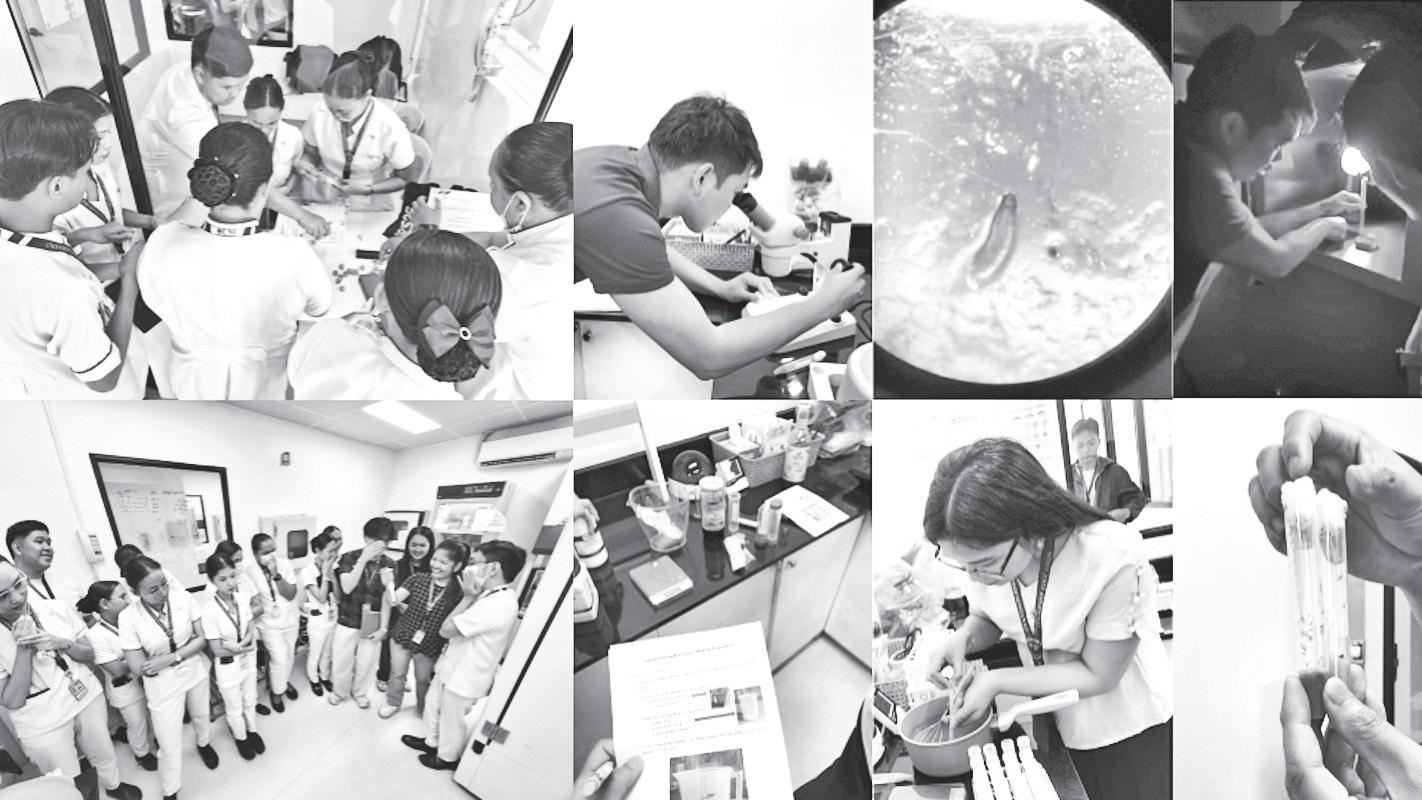
Hosted by the Visayas State University (VSU) and the University of Mindanao (UM), Balik Scientist Dr. Terence Al L. Abaquita shared his entomology expertise to undergraduate and university researchers in Visayas and Mindanao, as well as the entomology industry in the country.
“Balik Scientist engagements demonstrate how expertise honed from advanced nations can be translated into tangible gains for Philippine agriculture, especially in boosting the nation’s food security,” said Science Secretary Renato U. Solidum Jr. in a statement.
“Dr. Abaquita’s yearlong engagement with VSU and UM has been extremely productive, especially in managing insect pests, such as fruit flies, coconut scale insects, Asiatic palm weevil, and coffee berry borer. This is exactly what we need—science that is responsive, collaborative, and aimed to address local needs,” Solidum pointed out.
During his engagement with the Uniwersytet Jagielloński in Poland, Abaquita had significant contributions to the research on fruit fly (Drosophila melanogaster) and published in three Q1 to Q3 ranked international journals. He brought this knowledge to biology, pharmacy, and medical technology students of UM through a training on fruit fly culture maintenance.
Bringing his expertise on fruit flies, Abaquita contributed to the development of the proposal on “Nanosafe with Drosophila,” wherein the project team is targeting to standardize fruit fly-based nanosafety screening pipeline and openaccess Philippine Nanomaterial Toxicity Database.
Abaquita has gained substantial experience in insect science over his seven years of his prolific research work across universities in Germany, Sweden, Poland, and Spain.
He was tapped by the Department of Science and Technology-managed Balik Scientist Program (DOST-BSP) from October 18, 2024, to September 9, 2025. This is his second engagement as a Balik Scientist, the first being in July 2023 to January 2024.
Abaquita was also instrumental in some projects under the Coconut Hybridization Program of the DOST-Philippine Council for Agriculture, Aquatic and Natural Resources Research and Development (DOST-PCAARRD).
The program uses the 5 percent allocation from the Trust Fund for the funding of R&D programs and projects on coconut hybridization, hybrid coconut seed farms, nurseries, and related activities.
He mentored 17 undergraduate Research and Education Assistantship for Technology (uGREAT) scholars from Entomology and Chemistry courses of VSU on the project, “Biological and Ecological Approaches for Coconut Pest Management (BeaCON) of the Asiatic Palm Weevil and Spike Moth Infesting Hybrids and Parentals.”
In addition, he mentored grantees for poster presentations during the 2025 Pest Management Council of the Philippines and the 2025 National Coconut R&D Congress.
Moreover, Abaquita helped in the development of the proposal to combat cocolisap or the coconut scale insect (Aspidiotus rigidus) with Dr. Justine Bennette H. Millado and Dr. Jay Darryl Ermio.
The project proposal, “Up-scaled strategic mass rearing of biological control agent, Comperiella calauanica against coconut scale insect (Aspidiotus rigidus)” was approved for funding by DOST-PCAARRD under the Coconut Hybridization Program.
Coffee is another commodity that Dr. Abaquita looked into during his yearlong Balik Scientist Program engagement.
He helped in the development of the proposal of the project, “Precision management of coffee berry borer [Hypothenemus hampei] utilizing methanolethanol mixture and encapsulated Beauveria bassiana in a lure-and-kill strategy.”
Both GBF and C&E Publishing Inc. have long been partners of DOST-SEI in empowering students not only to innovate but also to translate their ideas into meaningful, real-world impact.
Supporting young innovators
CHRIS ANGELO ROLLON of Rizal National Science High School said competitions like imake.wemake play a crucial role in empowering the youth.
“It gives young people like us the platform to turn our ideas into something that can impact our nation. The ideas of us, the youth, are recognized so they can provide broader impact,” Rollon said partly in Filipino.
This year’s imake.wemake cycle marked a milestone in its nine-year run. For the first time, it has become part of the global celebration of Arduino Day. This connects young innovators and Filipino students to a worldwide community of creators and innovators.
The DOST-SEI remains steadfast in its commitment to creating avenues for the Filipino youth to flourish in the field of science and technology, both locally and internationally.
The project led by Dr. Jonathan R. Digma of Cavite State University will explore biological control strategies to control coffee berry borer, which is a major threat to Philippine coffee production.
“We are affirming a partnership that strengthens our research capabilities and reinforces our commitment to translating science into real outcomes. We have been truly fortunate to host Dr. Abaquita here since we welcomed him to UM for his short term engagement in July 2023,” said UM President Guillermo P. Torres Jr. on his impressions of Abaquita’s engagement.
“While his initial lectures and mentoring had set a high bar, his return as a medium-term Balik Scientist truly solidified his impact on UM. His second engagement has allowed his expertise to take root creating a lasting legacy, especially within our research department,” Torres added.
Representing VSU President Prose Ivy G. Yepes, Dr. Jay Darryl L. Ermio of the VSU Department of Pest Management said: “He [Abaquita] didn’t just work behind the scenes actually. Through a series of hosted talks and seminars on pest management, he provided our community with fresh perspective on global entomological challenges, bridging the gap between high-level research and local applications, particularly in insect-molecular morphology and Drosophila studies.” Ermio highlighted Abaquita’s role in bridging expertise across UM and VSU, saying: “He was instrumental in forging the strategic partnership between VSU and UM, a collaboration that we know will yield great results for years to come. Thus, we would also like to extend a very special thanks to the University of Mindanao for co-hosting Dr. Terrence with us. Your partnership made this engagement, though short, seamless, and far more impactful.”
The 1975-established Balik Scientist Program encourages Filipino scientists, technologists, and experts abroad to return to the Philippines to share their expertise, accelerating scientific, agro-industrial, and economic development. Rose Anne M. Aya/S&T Media
A6 Sunday, May 17, 2026

ROME—With Pope Leo XIV’s first big crisis looming, the Vatican on Wednesday issued a final warning to a breakaway group of traditionalist Catholics that their planned consecration of bishops without papal consent constitutes a schismatic act that incurs automatic excommunication.
Leo is praying for enlightenment so that the leaders of the Society of St. Pius X (SSPX) “may reconsider the extremely grave decision they have made,” said a statement from the Vatican’s doctrine czar, Cardinal Víctor Manuel Fernández.
The statement appeared to be a last-ditch effort to head off the group’s planned July 1 consecrations of four new bishops. If they go ahead, they will amount to the gravest challenge to Leo’s authority to date, as he seeks to heal divisions with traditionalist Catholics that worsened during the Pope Francis pontificate.
A traditionalist group formed in opposition to Vatican II
THE SSPX, as the group is known, was founded in Écône, Switzerland in 1970 in opposition to the modernizing reforms of the 1960s Second Vatican Council, which among other things allowed Mass to be celebrated in the vernacular rather than Latin.
The group, which celebrates the pre-Vatican II Latin Mass, first broke with Rome in 1988, after its founder, Archbishop Marcel Lefebvre, consecrated four bishops without papal consent.
The Vatican promptly excommunicated Lefebvre and the four other bishops, and the group today still has no legal status in the Catholic Church. Yet the group has continued to grow in the decades since that original schismatic act,
with schools, seminaries and parishes around the world and branches of priests, nuns and lay Catholics who are attached to the traditional Latin Mass.
The growth poses a real threat to Rome since it amounts to a parallel Catholic church. Today it counts two bishops, 733 priests, 264 seminarians, 145 religious brothers, 88 oblates and 250 religious sisters representing 50 nationalities, according to SSPX statistics.
The Vatican offers talks, but the dialogue ends and a crisis looms
THE current SSPX superior, Rev. Davide Pagliarani, announced earlier this year that new bishops would be consecrated July 1 to tend to the faithful, arguing that the SSPX’s two remaining aging bishops can no longer minister to such a global reality.
The Vatican invited Pagliarani for talks, but the same theological and practical problems that have prevented rapprochement for 50 years seemingly left the two sides at an impasse.
In recent comments on the SSPX website, Pagliarani reiterated the need for the new bishops. He expressed satisfaction that his announcement had triggered debate about what the SSPX considers to be a crisis afflicting the church, including religious pluralism and confusion about the faith.
“What is at stake today is not an opinion, nor a sensibility,

nor a preferential option, nor a particular nuance in the interpretation of a text, but the faith and morals that a Catholic must know, profess, and practice in order to save his soul and reach paradise,” he said.
Traditionalists watching how Leo responds after Francis’ crackdown
THE looming consecrations, which would incur automatic excommunications, have created the first tangible crisis for Leo, who has sought to pacify relations with Catholic traditionalists that worsened under Francis after the Argentine pope cracked down on the spread of the old Latin Mass. Francis in 2021 reimposed restrictions on celebrating the old Latin Mass that Pope Benedict XVI had relaxed in 2007.
Francis said he was reversing his predecessor because Benedict’s reform had become a source of division in the church and been exploited by conservative Catholics opposed to Vatican II.
But the move riled Francis’ conservative critics and it became one of the most divisive acts of his 12-year papacy, such that Leo began his pontificate promising to heal divisions.
While the SSPX is out of communion with the Holy See, plenty of Catholic traditionalists who are loyal to Rome and opposed Francis’ crackdown are sympathetic to the SSPX plight and are watching how Leo handles the challenge.
Rorate Caeli, a traditionalist blog that has closely followed the issue, said Francis’ crackdown, known by the Latin name of the document, Traditionis Custodes, actually created the “crisis” that the SSPX today laments.
“Traditionalists fully understand the need for respect for authority; but we cannot have both at the same time: a stated will to destroy the traditional Roman Liturgy forever [Traditionis custodes] and a complete prohibition of means to salvage that,” Rorate Caeli wrote Wednesday about the threatened SSPX excommunications.
“If the Holy and Apostolic See really wants to show the world its peaceful and loving purpose, it cannot just punish: it has to make clear that Traditional Catholics are once again welcomed and loved in the church,” by going back to the status quo before Francis’ crackdown.
Nicole Winfield/Associated Press
KALIBO, Aklan—The newly installed Catholic bishop of Kalibo has strongly opposed the proposed bridge linking Boracay Island to mainland Aklan, warning it poses serious environmental, social and moral risks to one of the country’s top tourist destinations.
In an interview with CBCP News, Bishop Cyril Villareal said the P7.94-billion infrastructure project could damage Boracay’s fragile marine ecosystems, disrupt coral reefs and push the resort island beyond its environmental carrying capacity.
He warned that Boracay, already strained by decades of mass tourism, should not be subjected to large-scale development that could cause irreversible ecological harm.

Villareal also raised concerns that the bridge and related commercial expansion could marginalize the Ati, Boracay’s indigenous community, potentially displacing residents and eroding their cultural heritage.
He called on the national government to prioritize the welfare of the people over personal interests.
“It’s not about yourself or what you can get from it but rather for the good of the people,” Villareal said.
“I hope you will listen to the local leaders and spiritual
leaders because we understand the situation here. We live with the people,” he pointed out.
The bishop also warned that the bridge could open the island to uncontrolled commercial growth, including casinos and gambling establishments, which he said could harm families and communities.
“If there is gambling, it will put the people in danger…many
families will be broken, and many individuals are destroyed because of being addicted to gambling,” he said.
He called for wider public consultations, stressing that the project carries not only economic implications but also moral and social consequences.
Malacañang has said the Department of Public Works and Highways is finalizing the contract for the bridge that was approved in January 2025.
The 2.54-kilometer bridge will connect Boracay to Panay Island through Malay town, with public transport lanes, pedestrian access and utility lines.
San Miguel Corp. is expected to secure the project after the comparative challenge period ended in March 2026.
Boracay, a 10.32-squarekilometer island famed for its white-sand beaches, underwent a six-month government closure in 2018 for environmental rehabilitation. Leonor Rosales/CBCP News
By Soo Oh
IBEGAN my Bible classes humbly after suffering a crushing KO defeat in a spiritual sparring match with a Zion Christian Mission Center (ZCMC) teacher. Having studied for seven years in seminary and served as a priest for nearly 10 years, I felt a sense of shame at the thought of studying the Bible again.
However, once I cast off the shell of questioning how many years I had studied or what my status was before God’s Word, the joy and excitement of learning outweighed the shame.
The first class was about God, the angels and Satan. First, the teacher asked me, “Do you believe in and love God?” and I replied, “Of course.” Then, the teacher asked me to write about the God I believe in and about love from a biblical perspective.
If I had written about God emotionally, there would have been much to write, but when I actually tried to write about Him biblically, there was not much I could write. I think I wrote something like God is the Creator, the almighty One, love, the Judge, Spirit, and Savior.
The teacher said that I would have written endlessly if were asked to describe a lover that I cherished because I know her inside and out.
However, while we claim to believe in and love God, we do not know well the Bible verses given to us to know God and Jesus. This is despite the fact that salvation is obtained by knowing God and Jesus (John 17:3).
If we say we believe in and love God, but do not know God well or what His will is, is that true faith? Is that true love?
After asking this question, the teacher asked me: “As the Creator, what did God create?” I answered, “He created heaven and earth, the spiritual realm, the physical realm, and all things in the world.”
Then, how and with what did He create them? I answered that since He is the Almighty God, He created them with His almighty power.
The teacher asked, “Father! Then what is that power?” There is where I got stuck. The teacher said God is the Word, and through that Word He created all things in the world (John 1:1-2).
First, He gave the word of prophecy (promise, Amos 3:7) and He created by fulfilling that prophecy (Isaiah 14:24).
To establish the first humanity with whom God intended to be present and to fulfill Eden, which He had desired to accomplish on this earth from the beginning, He created angels as His servants (Psalm 103:19-22).
Just as God is a spirit (John 4:24), angels are also spirits; they serve God and perform the work of ministering to humans who will be saved (Hebrews 1:14).
But where did Satan come from? Satan is not the Creator but a created being, so did God create Satan as well?
It is said that God made the cunning serpent that deceived Adam and Eve (Genesis 3:1); what does that mean, and what is the serpent?
Since I could not answer well from a biblical perspective, the teacher explained the answer to my question clearly through the Scriptures.
In the spiritual realm created by God, there was a beautiful and wise archangel (Ezekiel 28:12-18). However, he became proud and unrighteous, and sinned by attempting to become like God (Isaiah 14:12-15).
Taking with him many angels who followed him as an archangel (Revelation 9:16), he became a sinful angel (1 Peter 2:4) and was cast out of Heaven in the spiritual realm.
Since then, he has become Satan, who deceives all people on this earth into sin.
Figuratively (Hosea 12:10), this Satan was the ancient serpent of Adam’s time and is depicted as a dragon in the final time of Revelation, but his true identity is Satan and the devil (Revelation 12:9).
The meaning of Satan is “God’s adversary and enemy.” Since the betrayal, he became an enemy of God and has been deceiving the whole world, making this world a battlefield for the physical and spiritual warfare between God and Satan (Ephesians 6:12-17).
The weapon of those belonging to God on this earth is truth (the Gospel: knowing prophecy and its fulfillment, John 8:45), while the weapon of those belonging to Satan is falsehood (adding to or subtracting from the meaning of the covenant and its fulfillment, John 8:44; Revelation 22:18-19).
Those belonging to Satan persecute and accuse, while those belonging to God are persecuted and accused, yet they overcome through truth and practice love by preaching the Gospel.
In this way, one can distinguish between true pastors and false pastors through their fruits—the fruit of the mouth which is the Word and the fruit of the heart which are actions (Matthew 7:1520).
One must understand this Word of Truth to discern good from evil, choose good (God), know good (God’s will), and by doing good, enter the Kingdom of Heaven. That was the end of our first lesson.
Zion Christian Mission Center is the theology arm of Shincheonji Church of Jesus and it offers a full theology course for free. Interested parties can sign up and download the ZCMC SPS app for free at https:// tinyurl.com/3zm9t95k

Editor: Lyn Resurreccion

AROUND the world, people plan to plant more than 1 trillion trees this decade in an ambitious effort to slow climate change and reduce biodiversity loss.
But if the past is prologue, many of those planted trees won’t survive. And if they do, they could end up as biological deserts that lack the richness and resilience of healthy forests.
It doesn’t have to be this way.
The United Nations declared 2021-2030 the Decade on Ecosystem Restoration to encourage efforts to repair degraded ecosystems. Tree planting has become a centerpiece of that effort, championed by initiatives, such as the Bonn Challenge and the Trillion Trees Campaign.
Critical flaw: Monoculture plantations: HOWEVER , many tree-planting commitments have a critical flaw: They rely too heavily on monoculture plantations—vast areas planted with just a single tree species.
Monoculture plantations are generally one-way tickets to producing wood. But these high-yield plantations are high risk and can be surprisingly fragile. When drought, pests, or forest fires strike, entire monoculture plantations can fail at once.
In one example, nearly 90 percent of 11 million saplings planted in Turkey died within three months due to drought and lack of maintenance.
Forests are more than just timber factories. They regulate water, store carbon, provide habitat for wildlife, cool the landscapes around them and even provide human health benefits.
RATHER than gambling on a single species and hoping for the best, science now points to a smarter path that captures both ecological and economic benefits while minimizing risk: mixed-species plantings that mirror the biodiversity of a natural forest, ultimately creating forests that grow faster and are more resilient in the face of constant threats.
We are community and landscape ecologists at the Smithsonian Environmental Research Center. Since 2013, we and our colleagues have been rigorously testing this idea in a large, ecosystem-scale experiment called BiodiversiTREE.
The verdict is striking: Trees in mixed forests don’t just survive— they outgrow their monoculture counterparts and support dramatically more biodiversity.
Trees with diverse neighbors grow larger
THIRTEEN years ago, we teamed up with volunteers to plant nearly 18,000 tree seedlings on 60 acres of fallow fields on the Smithsonian Environmental Research Center campus near the Chesapeake Bay. We didn’t plant just a single species. We planted 16 different native species from all walks of tree-life. Some species were fastgrowing timber species, some were mid-story species, and some were slow-growing species that might not reach full size for a century or more.
Some plots we planted with just

a single species—homogenous rows of the same species over and over again. But others were planted with random allotments of four and 12 species, reflecting the middle and upper ends of tree diversity in similar-sized areas of our local forests.
We asked a simple question: What would happen if we tried to mirror nature and plant a mixture of species instead of a monoculture?
The differences over a decade later are striking.
The monoculture plots—those that survived—resemble traditional plantation forestry that historically has dominated rural lands in the Southeast and Pacific Northwest in the US They contain rows of tall, narrow trees with sparse canopies and little life below.
The mixed-species plots, by contrast, are layered, complex and dynamic, with foliage filling the
GLOBAL nonprofit organization,
The Ocean Cleanup, reinforces its commitment to mitigating ocean-bound plastic waste from the Manila Bay region, with the deployment of its first Interceptor barrier in the Philippines.
To be set in the Meycauayan River by June 2026, this follows the recent announcement of Interceptor deployments in the entire Manila Bay.
The project is part of The Ocean Cleanup’s global initiative, the 30 Cities Program, which aims to accelerate efforts to intercept and remove up to one-third of ocean-bound plastic pollution from rivers globally by the end of the decade.
In partnership with the City of Meycauayan, and supported by the City Environment and Natural Resources Office (CENRO), the new Interceptor barrier will replace an existing trash trap and enhance plastic waste interception capacity before it reaches Manila Bay. The advancement will enable the capture of some of the projected 370 tons to 540 tons of annual waste from the Meycauayan River system into Manila Bay.
“This milestone brings us one step closer to building tangible solutions toward cleaner rivers and healthier communities in the Manila Bay region. We are excited to collaborate with the City of Meycauayan on this first deployment in the Philippines, where commitment and leadership play a vital role in mitigating ocean-bound plastic waste pollution,” said Boyan Slat, founder and CEO of The Ocean Cleanup.
Mayor of Meycauayan Henry R. Villarica said: “In a timely and necessary step forward, our city is proud to formalize a partnership with The Ocean Cleanup to support the rehabilitation of the Meycauayan River.”
He added: “Our work has never stopped,
and this collaboration strengthens our capacity to accelerate meaningful, lasting change. We are fully committed to doing everything in our power to rehabilitate our river for the health, dignity, and future of our community.”
An estimated 20,000 tons to 33,000 tons of plastic waste enter the ocean from the Philippines.
According to The Ocean Cleanup’s Smart River Survey, plastic waste pollution is projected at 3,500 tons to 4,400 tons annually in the Manila Bay region alone, a clear indication of the challenge and the need for urgent solutions.
Rivers are a major source of plastic waste in the oceans, with 1,000 of the millions of rivers around the world responsible for 80 percent of the problem, according to The Ocean Cleanup. To address this, the organization deploys Interceptors in rivers, and works within local waste systems to stop plastic reaching the sea.
The initiative underscores The Ocean Cleanup’s expanding network of partnerships, bringing together key stakeholders, such as the Embassy of the Philippines in the Netherlands and the Embassy of the Kingdom of the Netherlands in the Philippines, alongside Energies PH as marine renewable energy advisors.
The partners collectively work hand in hand with The Ocean Cleanup toward mitigating ocean-bound plastic in the Philippines.
Founded in 2013, The Ocean Cleanup is a nonprofit organization that develops and scales technologies to rid the oceans of plastic. It has been conducting extensive research, engineering scalable solutions, and partnering with governments, industry, and like-minded organizations.
As of March 2025, it has collected over 50 million kilograms of trash from aquatic ecosystems around the world.

canopy and a diversity of plants and animals thriving underneath. These visual contrasts reflect real ecological gains.
Trees grown in mixtures, including important timber species like poplar and red oak, are up to 80 percent larger than the same species when grown alone.
Mixed plots supported fewer leaf pathogens, more abundant caterpillar communities that provide food for birds, and increased phytochemical diversity in their leaves.
We hypothesize that these leaf chemicals, some of which deter animals from eating them, reduced browsing damage from hungry deer, ultimately leading to higher tree growth in the mixed plots.
Plots with several tree species also had much fuller, denser leaf canopies, leading to cooler, shadier conditions that help understory plants flourish and support up to 50 percent more insects, spiders and birds.
This pattern isn’t unique to our site. The BiodiversiTREE project is part of TreeDivNet, a global network of large-scale experiments spanning more than 1.2 million trees and hundreds of species.
Across continents and climates, the results are consistent: Forests with a mix of species tend to grow larger, store more carbon and better withstand stress from drought, pests and disease.
Why are monocultures still common?
DESPITE decades of evidence, mixed-species plantings remain relatively rare in practice.
Most commercial forestry operations still rely on monocultures, and these plantations are counted toward international planting campaigns aimed at slowing climate change and reversing biodiversity loss.
The reasons are generally practical: Mixed plantings can be more complex to design, more expensive to establish and harder to manage.
Crucially, until recently, there has been limited evidence that they can match or exceed the economic returns of conventional plantations.
‘Functional Forests’
A NEW experiment at the Smithsonian Environmental Research Center called “Functional Forests” aims to bridge some of the gaps between science and practice.
We’re developing intentionally designed combinations of trees to test whether specific mixtures of species can contribute ecological benefits while also providing timber and other services that humans need to support a thriving, sustainable economy.
Each of the 20 tree species in the Functional Forests project was chosen to provide one or more benefits, including timber, wildlife habitat, food for people, resistance
to deer and climate resilience. But no single species provides all of these benefits.
Some of the nearly 200 plots will contain a single species, while others include carefully selected combinations of five species assembled based on the functions they provide. Some plots are protected from deer browsing, while others are left exposed. By comparing these approaches, we can test how different planting strategies perform across a range of goals, from timber production to food production and from biodiversity to climate resilience.
Landowners and communities have different priorities, whether that’s producing wood, supporting wildlife or creating forests that can withstand a changing climate.
The idea behind Functional Forests is to design plantings that can deliver these multiple benefits all at once, rather than optimizing for just one, essentially leveraging the positive effects of biodiversity to achieve real-world goals.
Planting 1 trillion trees wisely THE stakes are high. Restoration has become a major global investment, with hundreds of billions of dollars already being spent annually.
Getting it wrong means wasted resources and missed opportunities to address some of the most pressing environmental challenges of our time.
If the world is going to plant a trillion trees, we believe it needs to do more than just put seedlings in the ground. It needs to rethink what a forest should be.
The goal isn’t just to grow trees. It’s to grow forests that last.
John Parker and Justin Nowakowski, Smithsonian Institution/The Conversation (CC) via AP
BILLINGS, Montana—
The Interior Department is canceling a rule that put conservation on equal footing with development, as President Donald Trump’s administration eases restrictions on industries and seeks to boost drilling, logging, mining and grazing on taxpayer-owned land.
The 2024 rule adopted under former President Joe Biden was meant to refocus the Interior Department’s Bureau of Land Management, which oversees about 10 percent of land in the US It allowed public property to be leased for restoration in the same way that oil companies lease land for drilling.
But Interior Secretary Doug Burgum has said the rule could have blocked access to hundreds of thousands of acres (hectares) of land—preventing energy and timber production and hurting ranchers who graze on public lands.
Supporters argued that conservation had long been a secondary consideration at the land bureau, neglecting its mission under the 1976 Federal Lands Policy Management Act.
While the bureau previously issued leases for conservation purposes in limited cases, it never had a dedicated program prior to the Biden administration.
Bobby McEnaney with the
Natural Resources Defense Council said repealing the rule ”means less protection for the clean drinking water, less protection for endangered wildlife that depend on healthy habitat, and less accountability when corporations leave these landscapes damaged and degraded.”
In documents released Monday, administration officials said it exceeded the land bureau’s authority for outside parties to be allowed to obtain conservation leases.
Industry groups and their Republican allies in Congress strongly opposed the rule and had lobbied to repeal it.
They said the change under Biden violated the “multiple use” mandate for Interior Department lands by catapulting the “non-use” of federal lands—meaning restoration leases—to a position of prominence.
“This action provides greater clarity and predictability for independent oil and natural gas producers—many of whom rely on consistent permitting and leasing processes to operate efficiently and invest in domestic energy supply,” Dan Naatz with the Independent Petroleum Association of America said in a statement.
The federal government’s vast land holdings are
concentrated in Western states—including Alaska, California, Nevada, New Mexico, Utah and Wyoming.
Since taking office, Trump has pursued a flurry of actions aimed at boosting fossil fuel production from those taxpayer-owned sites. The Republican administration also has sought to sideline some renewable energy projects, claiming they were unfairly subsidized under Biden.
The repeal is effective 30 days after it is published in the Federal Register, which was scheduled for May 12. It comes after Republicans in Congress in recent months canceled land management plans adopted in the closing days of Biden’s administration that restricted development in large areas of Alaska, Montana and North Dakota.
In addition to its surface land holdings, the Bureau of Land Management regulates publicly owned underground mineral reserves—such as coal for power plants and lithium for renewable energy—across more than 1 million square miles (2.5 million square kilometers). The bureau has a history of industry-friendly policies and for more than a century has sold grazing permits and oil and gas leases. Matthew Brown/Associated Press

Nthe idea four years ago while watching the previous World Cup, said Hugh Evans, CEO of the nonprofit Global Citizen, which has partnered with FIFA on the halftime show and the education fund. Shakira said at the conference that she’s spent her entire adult life “making songs and building schools,” referring to the work of her nonprofit, Barefoot Foundation.
“Finally, during this World Cup, those two paths meet,” said the “Hips Don’t Lie” superstar, who added she is hoping for her homeland of Colombia to make it to the World Cup final.
The Super Bowl is famed for its halftime show, attracting the world’s biggest stars for spectacular performances. This year featured Puerto Rican artist Bad Bunny. Previous headliners included Michael Jackson, Paul McCartney, the Rolling Stones, Madonna, Prince, Bruce Springsteen and Rihanna.
But halftime shows are not commonplace in soccer, with events such as the Champions League final featuring a prematch concert. On May 30, the Killers will headline a concert before European club soccer’s biggest game between Paris Saint-Germain and Arsenal in Budapest.
Evans told The Associated Press in an interview that everyone involved in the halftime show are huge soccer fans who wanted to ensure the performances would be “significantly shorter than the 15-minute mark,” which is the traditional interval in a match. “Soccer fans around the world can be rest assured knowing that we’re very respectful of the game,” Evans said.
Hamish Hamilton, who directed the London 2012 Olympic opening ceremony and most Super Bowl halftime shows in recent memory, will direct the World Cup halftime show, said Evans.
The World Cup is co-hosted by the United States, Canada and Mexico and runs through June and July. AP
At 41, James likely doesn’t have many years left to play—if any. And now he’ll start the process of figuring out what he wants to do, what his family wants him to do and what’s best for all parties involved.

is lined up for a star-studded halftime show. AP
By Tim Reynolds
Associated Press
The
LEBRON JAMES has options. He could stay with the Los Angeles Lakers. He could decide to join another team. He could even retire and end the longest career in National Basketball Association (NBA) history. He knows all this.
He just doesn’t know the answer.
“I don’t know what the future holds for me, obviously,” James said.
His 23rd season ended Monday night when the Lakers were eliminated by the Oklahoma City Thunder. At 41, James likely doesn’t have many years left to play—if any. And now he’ll start the process of figuring out what he wants to do, what his family wants him to do and what’s best for all parties involved.
Dwyane Wade, James’s longtime friend and former teammate, was on the Amazon Prime broadcast of Game 4 of the ThunderLakers series as an analyst. And when the conversation turned to what James is going to do, he had some thoughts.
“That’s the question,” Wade said. “And I think if we all know LeBron James, he’s going to take some time off and go drink some wine, go yacht a little bit around
the world. He’s going to spend some time with his family. He’s going to sit down and try to make the best decision for the James family at the end of the day.
“And then from there, you’ve got to look at the picture of the Lakers,” Wade continued. “LeBron, Year 24 coming back next year if he does, he wants to play for something. So, are they in a position that he can play for something and compete for something?”
Salary will be another issue. He made nearly $53 million this season. He could command somewhere around $60 million next season if he wanted. If he gives a team a discount to preserve flexibility, he could certainly afford to do so.
Wade doesn’t seem to think that’s likely.
“History shows that Mr. James ain’t taking a lot of discounts, right? I don’t think no one knows,” Wade said. “I think one of the things that him and his entire team have been great at is they hold their cards close to their chest. Decisions are made by LeBron, and they all respect it. And they wait on him to decide what he wants to do.”
A look at some of what James’s next moves could be (and for purposes of this exercise, the realities of the salary cap, the aprons, tax ramifications and

whatever James will command in salary if he decides to keep playing do not apply):
Retirement
THIS one doesn’t seem likely even though James posted the lowest scoring average of his career—20.933 points per game, down a teeny-tiny sliver from his 20.937 average as a rookie. Another made free throw this season would have been enough to keep this season’s average from being his worst.
The pessimists, or the anti-LeBron crowd, can say—accurately—that his numbers are declining. They are. He averaged 30.3 points in 2021-22, and his per-game scoring average has fallen in every season since, going to 28.9 in 2022-23, 25.7 in 2023-24, 24.4 last season and 20.9 this season.
Of course, his role has changed as well and that has some effect on the numbers. James spent much of this season as the Lakers’ third option behind Luka Doncic and Austin Reaves and did so happily.
Stay with Lakers
TO be fair, this wasn’t a bad season. Getting ousted in Round 2 by the overwhelming favorite to win the NBA title—the defending champion, too—
EW YORK—The antipoverty nonprofit Global Citizen is no stranger to big stages—the advocacy group rallied more than 60,000 festivalgoers at its Central Park concert last year around issues of rainforest protection and energy access. But Global Citizen is preparing for its most ambitious production yet: the first-ever FIFA World Cup halftime show on July 19, curated with help from Coldplay vocalist Chris Martin . Super Bowl-style performances— uncommon in soccer—will feature Madonna, Shakira and BTS . Also, Shakira released the official World Cup song


man” of the game. He rubbed many the wrong way, and when he led the LIV “coup,” he became an easy target. I just saw a YouTube video that recounted a turning point in the relationship between Greg and the PGA Tour’s elders.
The video recounts a meeting during Greg Norman’s tournament, The Shark Shootout, when he breached the idea of world golf tour, similar to LIV.
As per the video, the resistance came from none other than Arnold Palmer. The story goes that in 1994 at Greg’s Shark Shootout at Sherwood, he tried to breach the idea of an alternate golf league. After Norman’s presentation, Arnold Palmer immediately stood up and let Greg and the rest of the PGA pros know his opinion. Palmer apparently said that he, Gary Player, and Jack Nicklaus could have done the same and would have made tons more money. But he viewed a rival league as bad for the game, even if there was a possibility of earning more. When Palmer walked out, he took the entire room with him. While I cannot verify the accuracy of the video, you can watch it by searching “Arnold Palmer warned us about Greg Norman but nobody listened” on YouTube.
The way LIV players are looking for pathways back to the PGA Tour and DP World Tour, it looks like LIV’s fate is sealed. While there are lucky ones like Brooks Koepka and Patrick Reed who returned to the PGA before the tour’s February deadline, there are starts like Bryson DeChambeau and Jon

isn’t exactly a collapse, and Doncic not being able to play because of injury almost made the outcome expected. The Lakers have the seventh-best record in the NBA during James’ eight seasons there. Not great, not bad. But the playoffs, even with the run to the bubble championship in 2020, have not been to James’ expectations. The Lakers went 32-31 in playoff games during these last eight seasons, and remember, 16 of those wins came in the bubble. Since then, the Lakers are just 16-26 in playoff games. Good enough? It wouldn’t seem so. The Lakers will have to give James reasons to stay. It’s simple as that.
Return to Miami LEBRON JAMES’S jersey will sway from the rafters
“Dai Dai” featuring Afrobeats giant Burna Boy Organizers aim to direct the tournament’s billions of projected viewers worldwide toward a humanitarian initiative launched alongside soccer’s international governing body. Leveraging what Global Citizen founder Hugh Evans called the “complementary” unifying powers of soccer and music, the FIFA Global Citizen Education Fund aims to raise $100 million for grassroots groups providing underserved children with access to education and sports.
hope that on the world’s biggest stage, finally, the importance of investing in education steals the show,” Shakira told the Global Citizen NOW summit in New York on Thursday. Later, she told The Associated Press in an interview that she wanted to help the “many children who are being left behind.” AP
Rahm who won’t have it so easy. Bryson’s contract with LIV expires this year, so that’s a plus. But what path will be available for his return is still in question. Rahm is in a worse spot. He was the last big fish to jump to LIV, which meant he made the sweetest of deals. The downside is he also has the longest contract. Whether Rahm finds a way back to major tours


Reading recession? Test scores continue to decline for kids in the U.S.
MAY 17, 2026 | soundstrip.businessmirror@gmail.com
Story and photos by Patrick Villanueva
PINAGTIBAY NG PANAHON,’ or “strengthened through time,” is Angela Ken’s deeply personal theme in her latest extended play (EP) ‘Panahon,’ ingraining personal experiences, as well as those around her, and putting it into music. ‘Panahon’ EP, she shared, is a six-track EP wherein “you will discover that love transcends through time and season.”
In her recent listening party at the Astbury, Makati, joined by the fans, media, and friends, she played her six songs: “Panahon,” “baka bukas,” “Kulimlim,” “Pwede Bang Mamaya?,” “kahapon,” and “Simula Ngayon.”
In true and modern OPM fashion, while most of her songs in the latest EP are about love and heartbreak, two stood out for being a mirror of our thoughts. “Panahon” and “Simula Ngayon” draw strength not only from being

Publisher :
T. Anthony C. Cabangon
Lourdes M. Fernandez
Editor-In-Chief :
Concept :
Aldwin M. Tolosa
Y2Z Editor :
SoundStrip Editor : Group Creative Director : Graphic Designers :
Jt Nisay
Edwin P. Sallan
Eduardo A. Davad
Niggel Figueroa
Chow Jarlego
Contributing Writers :
Tony M. Maghirang
Rick Olivares
Jingo Zapata
Reine Juvierre S. Alberto
John Eiron R. Francisco
Patrick Villanueva
Ana Zoe V. Davad
Justine Xyrah Garcia
Ginger Franz S. Ocampo
Trixzy Leigh Bonotan
Bless Aubrey Ogerio
Photographers :
Bernard P. Testa Nonie Reyes
Y2Z & SOUNDSTRIP are published and distributed free every Sunday by the Philippine Business Daily Mirror Publishing Inc. as a project of the
The Philippine Business Mirror Publishing, Inc., with offices on the 3rd Floor of Dominga Building III 2113 Chino Roces Avenue corner Dela Rosa Street, Makati City, Philippines. Tel. Nos. (Editorial) 817-9467; 813-0725. Fax line: 813-7025
Advertising Sales: 893-2019; 817-1351,817-2807.
Circulation: 893-1662; 814-0134 to 36. www.businessmirror.com.ph
sympathetic to their listener but also from being a comforting tune to those who want to feel validated in their fears but are willing to push through them.
Angela shared that she deeply connected with the songs ‘Panahon’ and ‘Simula Ngayon.,’ sharing that the majority of the lyrics came from her personal experiences.
“Panahon is a song about all the doors that keep on coming, but there’s this fear in us where we doubt ourselves if we really deserve it. What’s gonna happen? Am I gonna fail? Am I gonna be a failure? This is what Panahon is,” she shared, partly in Filipino, during her listening party.
On the other hand, “Simula Ngayon.” is a song about coming back from failure, ensuring to remember the feeling of breaking down to get back up. It emphasized the thought of “from now on,” a direct English translation, helping its listener to recuperate from their initial negative feeling to move forward.
“We have plenty of ‘from now ons’ when we make mistakes, when we fall down, and fail. Of course, there should be a part of us that does not want to experience it again, especially failure. This is ‘Simula Ngayon.,’ shared Angela Ken, partly in Filipino, about the last track of the EP.
This EP reflected her own struggle, sharing how she experienced stress and feeling lost, leading to what she called ‘writer’s block.’ Fortunately for Angela, she had a great support system in an individual named Patrick, who helped her get through the feelings of doubt to write this EP.
“I was stressed because I do not know what to write anymore, reaching to a point where I had writer’s block. Then I ranted to Patrick, near crying, and saying to him, ‘okay na ‘yun,’ and asked him if I should focus on my school life now. Then he asked what was bothering me,” she told the story during the listening party, partly in Filipino.
“I told him it seems like I can’t write anymore, it feels redundant. Then he offered help despite not being a writer. I just realized the things you do for love, you will do,” she added.

Talking to Patrick, Angela had an epiphany that the relationships they form are what strengthen people through time. As such, it became the core theme of the EP, and she had hoped that the listeners would reflect on what a journey life is.
“There is a story behind it. But it also depends on the person who is listening to it,” she shared, that while there was a specific order in how it was released, its true order lies in the status of its listener, saying “maybe they want to listen first to ‘Baka Bukas’ or ‘Simula Ngayon.’ But the story is very straightforward. Once you listen to each track, it’s the same in what it wants to convey.”
‘Panahon’ EP is now out on music streaming platforms. She is handled by Star Magic, and ‘Panahon’ EP is under Star Music’s record label Tarsier Records.



Story and photos by Vincent Peter Rivera
When P-Pop was still at its early age during the pandemic, I could still quite recall 1ST.ONE announcing their arrival as the second P-Pop boy group on the scene. While there are some who immediately showed interest, they weren’t immune to the barbs of naysayers.
Having trained under FirstOne Entertainment, a Korean company, they were met with labels like “trying hard,” “K-Pop copycats,” or simply “cringe.” It was a tough start for a genre still trying to find its footing.
Despite the noise, the sextet remained unfazed. Their debut, “You Are The One (Tatak Mara Nuh),” was their first song I listened to. It was an upbeat, highoctane introduction that showed potential, followed by the powerful “Shout Out” in 2022. I lost touch with their journey for a while until 2024, when I stumbled upon “Paalam Na” on Spotify. Its dark, mysterious, yet “pop-ish” sound instantly pulled me to put the song on repeat. Unexpectedly, in 2025, I came across again with the group but this time in the flesh during a press conference—though Joker was then recuperating from pneumonia.
Now, in 2026, 1ST.ONE is finally complete. At the ALL 1N Finale Concert, I watched as they proved exactly what they are made of for their beloved fans, the FOR.ONE.
As early as 5:00 PM, fans began lining up outside the SM North EDSA Sky Dome for the soundcheck. From elaborate banners to thoughtful gifts, the anticipation was electric. When I entered the venue, the front seats were already packed. Then, without warning, the group popped onto the stage—full of life and ready to give everything to their supporters.
The group looked more cohesive than ever now that Joker has recovered and reunited with his brothers. Dressed in coordinated black, they immediately served powerhouse vocals. Max’s adlibs, the group’s collective belt notes, and their steady harmonies set the tone.
In between performances, the Dome echoed with the fans’ passionate chants and endearments. By 6:25 PM, the venue had reached capacity, with every corner of the stage surrounded by eager faces.
Its concert time
The concert kicked off abruptly with their anthemic hits, “Problem Child” and “Shout Out.” Clad in edgy, all-black wardrobes, the members exuded a charisma that filled the room. Even though the choreography for these tracks requires a fierce aura, I noticed big smiles slipping past their “tough” exteriors—a clear sign the boys were genuinely enjoying the moment. Their performance was the perfect balance of vocal prowess and dance. To me, a strong performance is one that is flawless yet feels organic rather than over-rehearsed, and 1ST.ONE delivered exactly that.
During breaks, they showcased their wit, cracking jokes and sharing “Filipino humor” while thanking sponsors. As someone who doesn’t follow the group religiously, their natural charm and “Filipino-ness” stood out as one of their greatest assets.
The setlist was a masterclass in balancing highoctane energy with vocal precision. 1ST.ONE proved that “Filipino blood” truly runs within their veins as they showcased their vocal prowess during the more intimate rendition of “Alam Mo Ba.” This version stripped away the heavy production to showcase the group’s raw vocals, led by the impressive range of Ace and Max, complemented by Jayson’s steady, deep notes and Joker’s signature ad-libs. It wasn’t just a rehearsed segment; it felt like a collective breath of fresh air that allowed their harmonies to truly resonate.
Shifting gears, the group transitioned into a grittier segment that put their rap line in the spotlight. Led by Alpha and Jay, the performance was all “grit and fangs,” featuring a high-intensity breakdance that electrified the room.
And still, in between songs, their natural Filipino humor peaked through. Witty banter with the audience added a layer of charm that made the massive Sky Dome feel like a private gathering of friends.
One of the undeniable peaks of the night was the Karaoke Segment, a brilliant mashup of OPM classics. It was a genuine “eargasm” to hear the smooth weaving of familiar lyrics with the group’s modern arrangements. The emotional stakes rose even higher during the group’s own rendition of “Biyahe,” which Ace dedicated to the group’s long and often difficult journey.
As if on cue, the venue was bathed in pink light, creating a sea of color that felt like a shared embrace between the artists and FOR.ONE.
The energy remained high as they were joined by jikamarie for “Gusto Mo Ba,” followed by her own solo performance. Her vocal runs were nothing short of superb—continuous and complex, yet never overdone.
Emerging for the final stretch in crisp white wardrobes, the boys performed the fun and infectious “Wala ng Iba.” The choreography, featuring a clever “clock-like” hand movement, was groovy and contagious, setting the stage for “Map Your Vibe (MYV).” This was the go-signal for the group to break the “fourth wall” and head into the crowd. They roamed every corner of the venue, interacting



with fans and delivering heartfelt messages to those who have stuck by them through the years. It was a moment of pure connection, proving that while the stage was big, the bond they’ve built is even bigger.
While the concert was already a momentous feat, on its own, the night took a historic turn when the group was presented with authenticated copies of the Murillo Velarde 1734 Map (the “Mother of All Philippine Maps”) during a surprise ceremony—a heavy symbolic nod to their pride in their heritage.
The “Finale” that wasn’t
Just when it seemed the show was ending, the fans surprised the group with a heartfelt “fan project” memento. Moved by the gesture, Ace revealed the truth behind the concert’s title: they called it “Finale”
because, at one point, they weren’t sure if they would continue. They wanted to give one last “heck of a show” if it were to be their last. Thankfully, the successes of 2025 changed their trajectory.
After a haunting performance of “Paalam Na,” they returned for an encore of their latest single, “Kung Saan.” As a track from their upcoming album, it served as proof that this “Finale” was actually a new beginning. They eventually closed the night with “Turn It Up,” leaving the fans—and themselves—soaring on a high that was years in the making.
While the house lights eventually dimmed on a successful night, the future ahead of 1ST.ONE has never looked brighter. The ALL 1N Finale Concert stands as a definitive testament to the group’s evolution— from the newcomers once doubted by many to the seasoned artists now raising the flag across borders with their Asia tour.
By Sharon Lurye, Jocelyn Gecker of the Associated Press, Lily Altavena Of Chalkbeat, and Ruth Serven Smith of Al.Com
MODESTO, Calif. (AP)— Before every important test, teacher Nancy Barajas dims the lights, turns on a disco ball and blasts music from her playlist. Her sixth graders dance together as a “precelebration” to boost their confidence, then take their exam.
Lately, there’s been a lot to celebrate in elementary schools in Modesto, California. Both reading and math scores have increased consistently over the past several years.
But across the country, results are gloomier. Researchers warn that the U.S. is experiencing a reading recession—a slide predating the pandemic’s disruptions in schooling. Scholars at Harvard, Stanford and Dartmouth analyzed state test scores from third to eighth grade for over 5,000 school districts in 38 states, allowing comparisons across school districts and states in a national Education Scorecard.
What they found was sobering: Only five states plus the District of Columbia had meaningful growth in reading test scores from 2022 to 2025. Nationally, students remain nearly half a grade level behind pre-pandemic reading scores and only slightly better in math.
The ‘mudslide’ after ‘steady erosion’
WHILE schools have focused on catching kids up since the COVID-19 pandemic upended education, reading test scores have been falling since 2013 for eighth graders and 2015 for fourth graders, according to the National Assessment of Educational Progress.
“The pandemic was the mudslide that had followed seven years of steady erosion in achievement,” said Thomas Kane, a Harvard professor who helped create the Education Scorecard.
Still, some states and school districts are making progress—largely by shifting toward phonics-based instruction and providing extra support for struggling readers.
The picture is also brighter in math. Almost every state in the analysis saw improvements in math test scores from 2022 to 2025. Student absenteeism also declined in most states. In over 400 U.S.

school districts, including Modesto, reading or math growth outpaced demographically similar districts in the same state.
A shift toward phonics and extra reading support
RESEARCHERS are still debating the reading recession’s causes.
One possible factor, researchers say, is the rise of social media on smartphones and corresponding declines in kids’ recreational reading. States have also backed off on strict consequences for schools whose students fail to make progress on standardized tests, Kane said.
But the states that improved reading scores—notably Louisiana, Maryland, Tennessee, Kentucky and Indiana—all had one thing in common: They ordered schools to teach with a phonics-based approach known as the “science of reading.”
For years, schools taught reading using approaches that de-emphasized phonics and encouraged strategies such as guessing words based on context clues. As reading scores tumbled over the past decade, parents, scholars and literacy advocates pushed for teaching methods that align with decades of research about how kids learn to read—largely by sounding out words.
Along with reforming teaching methods, states have also required schools to screen for learning disabilities such as dyslexia and hire coaches to help teachers improve their reading instruction.
That said, “science of reading” reforms did not guarantee success. Some states, including Florida, Arizona and Nebraska, changed parts of their reading instruction but still saw test scores fall.
In Modesto, reading instruction was
revamped during the pandemic, and math a couple years earlier. The district created a new department to help students who are still learning English. Schools also ramped up teacher training, paying educators $5,000 to complete an extensive “science of reading” program called LETRS, or Language Essentials for Teachers of Reading and Spelling.
Modesto’s test scores grew enough to represent an extra 18 weeks of learning in math and 13 weeks in reading. Nevertheless, the district still has a way to go: Overall scores remain far below grade level.
A bright spot in the South FOR the last decade, the South has stood out as a region leading the way on education reforms—bucking an established trend of landing at the bottom of education rankings. Southern states were quick to change to research-based teaching methods, and states have paid to train and coach teachers.
It’s paid off. Louisiana and Alabama were the only states where math scores were higher in 2025 than pre-pandemic.
Louisiana is also the only state that beat its pre-pandemic average in reading, with 87 percent of traditional public school students attending a district where scores are higher than in 2019. Alabama had standout gains in reading following the pandemic, driven by a state law requiring every school to use phonics-based instruction. The Legislature modeled math reforms in 2022 off Alabama’s reading successes. The state’s Numeracy Act standardized math instruction, required regular testing and mandated intervention for kids who lacked adequate math skills.

Oxmoor Valley Elementary in Birmingham hired a full-time math specialist this year to help struggling kids. The school, which made the state’s “failing” list in 2016, has steadily improved math and reading scores, although a majority of kids still test below proficient in both subjects.
“We can provide all of these supports, but at the same time, hold kids to high expectations,” Birmingham Superintendent Mark Sullivan said.
There’s hope
RESEARCHERS stress such progress is possible across the U.S., because it’s been done before. Starting in the 1990s, the country saw decades of growth in test scores and graduation rates, while racial disparities declined. That progress continued until the mid-2010s.
“We made enormous progress as a country in terms of educational success from over a 30-year period. Test scores went up dramatically,” said Stanford professor Sean Reardon. “And so, I think that says, as a country, we can improve education and educational opportunity.”
At Modesto’s Fairview Elementary, where Barajas teaches, students now practice their reading speed and fluency every day. After a dance break, the class reads a one-page text together in unison for one minute, then students split into pairs to read again. Students learning English are paired with native English speakers, and each child gets a turn reading with Barajas.
“Eventually, you get through the word like it’s water,” one boy said. “You just say it smooth.”
n Cover photo by Mikhail Nilov on Pexels.com