

Peso seen remaining among Asia’s most vulnerable
THE Philippine
According to Mitsubishi UFG (MUFG) Research, the local currency will continue to weaken, but will recover in the latter part of the second half of 2026. The peso is seen to trade between

P60.50 and P61.50 if the Middle East war and disruptions in the Strait of Hormuz will unwind by the end of May, MUFG said.
The peso hit a new record low at P61.3 per dollar last April 29, from its previous finish of P60.71.
“[The] Peso likely suffers from second-round effect on domestic prices, and potential tighter financial condition and associated weaker growth profile,” MUFG said. But if the Strait of Hormuz re -
mains blocked for a prolonged period, MUFG said Asian economies could face recessions as massive capital outflows may occur.
The worst-case scenario would be a broad-based depreciation among Asian currencies, with the peso weakening more than 5 percent.
“The Philippines is vulnerable not only because of its’s high dependence on the Middle East’ crude oil, but also the weak starting point of growth pre-dating the
Iran War,” MUFG said. The economy grew slower-thanexpected at 4.4 percent in 2025, below the government’s target of 5.5 to 6.5 percent, dragged by infrastructure delays, global uncertainties and severe weather disruptions. “In addition, domestic inflation pressures and the spillover effects have been much larger than we anticipated,” MUFG said, noting that inflation “spiked dramatically” to



By Reine Juvierre S. Alberto @reine_alberto
DEBT
payments of the government doubled to P737.405 billion in the first quarter of the year, driven by a 4.5-fold increase in amortization.
Latest figures from the Bureau of the Treasury (BTr) showed that the government’s debt payments surged by 115.60 percent to P737.405 billion as of end-March from P342.023 billion in the same period last year. This came after amortization, or the repayment of loan principal, climbed by 359.57 percent year-on-year to P464.274 billion from P101.022 billion. In particular, domestic amortization grew by a staggering 67,041 percent to P386.735 billion from merely P576 million in the same period a year ago. There were some P232 billion in seven-year Treasury bonds (Tbonds) that matured last Febru-
ary 14, which caused principal repayments to rise. External amortization, meanwhile, eased by 22.80 percent to P77.539

By Malou Talosig-Bartolome
APU -LAPU CITY—Thai-
Lland proposed a strategy of “calibrated re-engagement” with Myanmar during the 48th Asean Summit here in Cebu, sparking what diplomats described as a vibrant and even emotional debate among Southeast Asian leaders. The initiative, advanced by Foreign Minister Sihasak Phuangketkeow, calls for Asean to engage Myanmar more directly in informal settings—such as sideline or virtual meetings—to hear updates on the junta’s political roadmap while pressing concerns over continuing violence and humanitarian distress.


Deputy Foreign Ministry Spokesperson Maratee Nalita Andamo explained that the proposal was “for engagement at the political level...and it was the start of a discussion.”
She added that the idea had been received “in a positive light,” signaling cautious openness among Asean leaders to explore new methods of dialogue. Since the military coup in 2020, Asean has barred junta leader-t urned- president Min Aung Hlaing and his ministers from attending summits and ministerial meetings, a sanction that underscores the bloc’s frustration with Naypyidaw’s lack of progress on the
PHL imposing SSG on 4 agri products
By Ada Pelonia @adapelonia
THE Philippines will impose special safeguard (SSG) duties on four agricultural products that were previously not covered by the trade measure, including onions and meat offals.
Agriculture Secretary Francisco Tiu Laurel Jr. signed Department Order (DO) 15, requesting Customs Commissioner Ariel Nepomuceno through Finance Secretary Frederick Go to enforce price-based
SSG on certain farm goods.
Under DO 15, additional agricultural products to be imposed with SSG are other meat and edible meat offal, except freeze-dried diced chicken and dried pork skin; fresh or chilled onion other than bulbs for propagation.
Other prepared and preserved meat, meat offal, blood of turkeys except mechanically deboned or separated meat; and other prepared and preserved meat, meat offal, blood other than those of turkey and chicken are also included.

The DA issued the order after its monitoring showed that the actual cost, insurance, and freight (CIF) prices for these agricultural products have breached their respective price thresholds. This warrants legal authority to impose price-based SSG duties on these products.
The respective trigger prices for the mentioned commodities are as follows: other meat and edible meat offal except freeze-dried diced chicken and dried pork skin, P70.5 per kilo; fresh or chilled onion, P74.21 per kilo.
Furthermore, trigger prices for other prepared and preserved meat, meat other offal, blood of turkeys of than mechanically deboned or separated meat, P259.22 per kilo; other prepared and preserved meat, meat offal, blood, other than of turkey and chicken, P298.55 per kilo.
“Price-based SSG measures to be imposed shall be on a shipment-by-shipment basis, depending on the difference between the actual CIF price at the time of lodgment of import documents





7 percent in April.
Given this, MUFG raised its inflation forecast to 6 percent for 2026, on elevated oil prices, second-round effects on food prices and risks around a possible Super El-Niño later in the year.
In a severe scenario, inflation could quicken to as high as 10 percent and bring with it supply shortages and even a recession. This is far higher than the tolerance range of 2 to 4 percent of the Bangko Sentral ng Pilipinas (BSP).
“The extreme inflation would likely make BSP biased toward tightening,” MUFG said. The BSP raised the key policy rates by 25 basis points last April 23, with BSP Governor Eli M. Remolona Jr. signaling more rate hikes on the horizon as they brace for worsening inflation.
The Japanese lender priced in additional 75-basis-point rate hikes, with the timing to be earlier, to bring the key policy rates to 5.25 percent.
Tighter financial conditions and higher costs would result in a growth of 3.5 percent for 2026, way below the government’s target of 5 to 6 percent.
“We pencil in some gradual improvement in government spending, but this will be more than offset by the lagged impact of higher inflation and higher interest rates,” MUFG said.
The Philippine economy expanded 2.8 percent in the first quarter of 2026, making the government’s growth target out of reach, according to economists.
Economic managers of the Marcos Jr. administration are set to meet and revisit its growth target as global uncertainty remains highly elevated.
Meralco ‘not regulating’ use of solar, pushing safety rules
By Lenie Lectura @llectura
THEManila Electric Company (Meralco) is not discouraging customers from installing solar rooftop panels; however, they advise notifying them prior to installation for safety assessments.
“Our request is simply for customers to inform their respective utilitywhether Meralco, or the distribution utility/electric cooperative in their area. This is not intended to discourage or limit their choices, but to help ensure safety, system compatibility and shared awareness for everyone involved,” said Joe R. Zaldarriaga, Meralco Vice President for Corporate Communications.
He stressed that the utility firm is not against solar energy itself, but rather against the installations that do not undergo proper inspections. “It is also important to note that Meralco does not have regulatory authority over solar installations. When systems are installed without prior coordination or our awareness, our ability to respond or provide assistance becomes limited,” he added.
Meralco recognized the growing interest in solar installations as alternative to lower electricity costs. It, however, pointed out the importance of safety and proper installation, saying there are standards put in place to help ensure that solar installations are done correctly and safely. “When systems are installed without prior coordination or our awareness, our ability to respond or provide assistance becomes limited,” Zaldarriaga pointed out.
While there are existing rules, especially in the building code, for solar rooftop installations, Meralco is calling for is the establishment of clear, standardized guidelines by the appropriate governing agencies.
The Department of the Interior and Local Government (DILG) said a building permit must be secured prior to solar rooftop installation. “Many Filipinos are just installing solar without actually acquiring a building permit.
Because it has also been raised with DPWH [Department of Public Works and Highways]. Why do they require building permits? It’s because your solar is installed on top of the roof, and then they would have to consider the structural integrity of these houses; people actually live here. So, if something happens, it will collapse. So that’s why it’s required for them to apply first for a building permit before they apply for a net metering application,” explained Atty. Maria Carmela Villasfer of the DILG’s legal service.
For the DPWH’s part, the agency recommended “technical specifications” prior to installation.
“We’d like also to recommend the development of technical specifications so that we can better avoid using substandard solar panels,” said Jayson Margallo, DPWH Officer-in-Charge, Assistant Director, Bureau of Research and Standards.
Broken down, P152.219 billion in interest payments went to fixed-rate T-bonds, P43.760 billion to retail T-bonds (RTBs), P12.727 billion to Treasury bills and P2.685 billion to others.
Meanwhile, external interest payments slightly declined by 1.11 percent to P61.740 billion from P62.439 billion a year ago.
“With growth slowing and interest rates still high, debt servicing is getting more expensive, and that’s where the real risk lies,” Jonathan A. Ravelas, senior adviser at Reyes Tacandong & Co., said. As the government’s outstanding debt hit a new all-time high of P18.488 trillion as of end-March, Ravelas said credibility matters. This includes tighter fiscal discipline, faster execution and growth- enhancing spending from the government.
“The debt is still sustainable, but the room for error is very thin. We’re not facing a debt crisis, but we are clearly stretched,” Ravelas said. “The ceiling may be intact, but markets will be watching whether policy keeps debt manageable in practice, not just on paper.”
March debt service
same period last year.
The 2026 growth target has already been lowered from the earlier 6 to 7 percent goal.
Continued from A10
Reine Juvierre S. Alberto
Data from the Philippine Statistics Authority (PSA) showed that household spending, a key driver of domestic demand, further slowed to 3 percent in the first quarter from 5.3 percent in the
The PSA said this was the weakest pace of household spending growth since the pandemic-era contraction recorded in 2022.
Excluding the pandemic years, it was the slowest since the third quarter of 2010. Government spending also expanded by a slower 4.8 percent in the first quarter, a sharp deceleration from the 18.7 percent growth recorded a year earlier.
“The economy is larger and more diversified, so campaign spending alone is no longer enough to sustain strong headline growth if private investment and productivity are soft,” he told the BusinessMirror
Not sustainable
DE LA SALLE UNIVERSITY
(DLSU) economist Ella C. Oplas said the trend underscores how unsustainable it is for the economy to rely heavily on the temporary stimulus generated by election spending.
“It can also tell us that whatever growth we realized last year due to election spending was shortlived. It basically means the gains from election spending were immediately exhausted,” Oplas told this newspaper.
Oplas said the fleeting nature of election-related gains should
also serve remind voters that short-term cash generated during campaign periods does little to improve long-term economic welfare.
Instead, she said, voters should support candidates capable of generating stable jobs, sustained incomes, and long-term economic opportunities rather than temporary financial gains tied to elections.
This was consistent with the PIDS paper, which cautioned that election spending often favors highly visible, short-term projects instead of productivity-enhancing investments that generate sustained economic benefits.
The study instead recommended greater focus on infrastructure, productivity improvements, and long-term development strategies, stressing that election-related spending cannot substitute for structural reforms and more sustainable drivers of economic growth.
“Rather than short-lived consumption-driven outlays, fiscal efforts during election years should prioritize capital-forming investments that yield longerterm productivity gains. Such reorientation minimizes waste and ensures that electoral cycles do not compromise developmental integrity,” it said.
FOR the month of March, total debt service dropped by 7.78 percent to P169.092 billion from last year’s P183.359 billion. This developed as amortization went down by 23.65 percent yearon-year to P72.709 billion despite the 9.37-percent increase in interest payments at P96.383 billion. In the coming months, debt servicing could further increase as P282 billion in five-year RTBs have matured last April, said Michael L. Ricafort, chief economist at Rizal Commercial Banking Corp. “Higher US dollar/peso exchange rate in April 2026, when it reached new record highs above 61 back then, could also increase debt servicing costs of foreign debt payments, both principal and interest payments when converted and paid in pesos,” Ricafort added. For 2026, the government has programmed that its debt payments would reach P2.005 trillion. Of the amount, P1.005 trillion will be allotted for amortization and P950 billion for interest payments. The government’s gross borrowings reached P1.003 trillion as of end-March, as it front-loaded its funding amid global uncertainties.
Five -Point Consensus. Thailand argued that recent developments—including the completion of three phases of general elections, the release of thousands of prisoners, and the transfer of Daw Aung San Suu Kyi to a designated residence— should be seen as tentative steps that justify recalibrating Asean’s engagement.
Prime Minister Anutin Charnvirakul, meanwhile, led Thailand’s broader presentation of its “three R’s”—regionalism, resilience, and relevance—at the Cebu summit.
His government’s dual messaging underscored Bangkok’s urgency to stabilize its western frontier, where conflict has driven waves of refugees into Thai provinces and worsened human trafficking networks that have ensnared victims from across the region, including Filipinos.
President Ferdinand R. Marcos Jr., who chaired the summit, acknowledged the bloc’s frustration and described Asean’s evolving stance as a “nano-shift.”
He stressed that while Asean will not abandon its principles on human rights or the Five -Point Consensus, leaders tacitly agreed that the bloc “needs to do more” to move the peace process forward.
“It is a tragedy when a family member is left out of the family for whatever reason,” Marcos said during a press conference Friday, likening Myanmar to a relative excluded from Asean’s collective table.
For Filipinos, Myanmar’s turmoil may seem remote, but its impact is tangible.
Asean’s credibility is at stake, and instability in Myanmar has already affected Filipino workers trafficked into scam hubs in the region. Manila’s position has consistently emphasized that Myanmar’s reconciliation is crucial not only for democracy but also for Asean’s unity and regional security.
While Thailand’s proposal was received positively, consensus has yet to be reached.
Asean leaders tasked their foreign ministers to explore the idea further and work out the complex details of how calibrated re - engagement could be operationalized.
confidence in government institutions tasked with driving national digital transformation.
“The Filipino people expect government institutions to remain focused on delivering reliable, trustworthy, and future-ready public services,” Manuel said. “We remain hopeful that the leadership of the DICT will work together in the best interest of the nation and reinforce the agency’s role as a pillar of innovation, digital governance, and public trust.”
and the corresponding trigger price.” Republic Act (RA) 8800 created the Competitiveness Enhancement Measures Fund (CEMF) to boost domestic industries injured by increased imports. This is composed of 50 percent of revenues collected from fees, charges, and safeguard duties on imported goods. The special safeguard (SSG) duty is a trade mechanism that a country can levy on foreign shipments that fall below a trigger price. Government budget documents showed that the DA received a P25 million appropriation in 2026 from the CEMF, which stood at P5.16 billion as of end-2024. Industry sources said the fund consists mostly of SSG duties collected from coffee and poultry imports.
‘Unopened BIR records crucial in case vs Sara’
THE chairman of the House Committee on Justice said that the unopened Bureau of Internal Revenue (BIR) box containing the income tax returns (ITRs) of Vice President Sara Z. Duterte and her spouse could play a crucial role in the impeachment proceedings, as it may explain either the figures in her Statement of Assets, Liabilities, and Net Worth (SALN) or the P6.7-billion transactions reflected in the Anti-Money Laundering Council (AMLC) report.
Batangas Rep. Gerville Luistro, Committee on Justice chairperson confirmed that the sealed BIR box is among the documents gathered by the panel and will be transmitted to the Senate if the House, in plenary session, affirms the committee’s recommendation to impeach the vice president.
She pointed out that the SALN and AMLC records appear inconsistent with each other, and the ITRs could potentially clarify one set of figures but contradict the other.
“If the ITR will be able to explain the SALN, definitely it cannot explain the AMLC report,” Luistro explained during a recent news forum.
The issue arose amid questions on whether Duterte’s income tax records could reconcile the apparent gap between her declared net worth and the AMLC report, which has been cited in the impeachment proceedings.
The complaints against Duterte include concerns over the increase in her declared net worth—from P7.25 million in 2007 to P88.51 million in 2024—as well as AMLC data allegedly showing P6.7 billion in covered and suspicious transactions involving her and her husband, lawyer Manases Carpio.
Luistro also noted recent claims from Carpio’s camp, through lawyer Peter Paul Danao, that the Bank of the Philippine Islands clarified a reported “P2 billion” transaction was actually “P2 million,” attributing the discrepancy to a “system glitch.”
Meanwhile, the Regional Trial Court (RTC) in Quezon City dismissed Carpio’s petition seeking to block the House Committee on Justice from enforcing subpoenas on his tax records, ruling that the judiciary cannot interfere with the House’s constitutional authority in impeachment proceedings.
Luistro emphasized that while the sealed BIR box may help shed light on the financial records, significant questions would remain regardless of its contents.
“Either way, a lot of things need to be explained,” Luistro emphasized.
She clarified that the committee issued a subpoena duces tecum to the BIR for the couple’s ITRs, but the box was never opened during the proceedings.
“We believe the box contains the ITRs we requested, but we do not know the income amounts declared because it has not been opened,” Luistro explained.
According to Luistro, the key question is whether the ITRs can support the SALN figures, the AMLC findings, both, or neither.
“It will either justify the SALN and AMLC report, or it will not. Those are the only possibilities,” she said.
She added that the AMLC-reported P6.7 billion in transactions could be explained if the couple’s ITRs show sufficiently large legitimate income sources.
At the same time, she pointed to Duterte’s declared net worth of P88 million, noting that based on estimated salaries alone, the figure should only be around P30 million—raising questions that the ITRs might help answer.
Luistro reiterated that the ITRs could either validate the declared net worth and transaction records or fail to do so entirely.
She added that the sealed BIR box is no longer in the custody of the Justice committee and is likely already with the House plenary, although she was unsure which specific office currently holds it.
If the plenary approves the committee’s findings, Luistro confirmed that the sealed box will be included in the records to be transmitted to the Senate for trial.
She also clarified that the unopened box is not yet considered evidence in the strict sense, since its contents have not been examined.
However, she expressed confidence that the Senate, acting as an impeachment court, would be in a better position to examine the contents once the case is transmitted.
Jovee Marie N. dela Cruz
DILG dissolves task force for dela Rosa’s arrest, PNP to issue subpoena for 100-plus EJKs instead
IBy Jonathan L. Mayuga @jonlmayuga

NTERIOR Secretary Juanito Victor G. Remulla on Sunday said the 10,000-person Task Force being organized for the arrest of Sen. Ronald dela Rosa has been dissolved following the statement of the International Criminal Court (ICC) that it has not issued a warrant for his arrest.
However, during a hybrid press conference on Sunday, Remulla said the National Police (PNP) is set to issue a subpoena to absentee senator in connection with the more than 100 cases of extra-judicial killings that were committed during his watch as National Police chief in the previous administration.
Aside from dela Rosa, several former and active police officials allegedly involved in the extra-judicial killings will also be subpoenaed by the PNP, he said.
Remulla added that dela Rosa is still in the country and is somewhere in the Davao Region.
The DILG chief clarified that the subpoena to be issued against dela Rosa is separate and distinct from his case in the International Criminal Court (ICC),
maintaining that the Philippines is not a member of the international judicial body.
“Because of the rumors, there’s a complete disassociation of the ICC and the Philippines; we are not a member. We decided to do it the proper way, investigate the proper way, to debunk the rumors,” Remulla said.
Dela Rosa earlier expressed willingness to be investigated and tried in the Philippines, saying that he will not allow foreigners to determine his guilt or innocence.
Remulla also said that he has not seen any arrest warrant, nor is he privy to such an effort of the ICC, again, maintaining that the Philippines is not a member of the ICC.
Remulla, the DILG and its attached agency, the PNP, are merely investigating the EJKs that happened during the past administration’s war on drugs, especially because it was during dela Rosa’s term as PNP chief that the killings became a national policy.
“The subpoena will be issued tomorrow [Monday],” he said.
Due respect REMULLA said the Senator, who has been the subject of criticism for not showing up for work in the Senate since rumors of an
ICC arrest warrant broke out, will be treated with due respect and courtesy, being an incumbent Senator and a former PNP chief.
“We will treat him with all the respect, being a Senator and a former PNP chief. There will be no handcuffs. It’s just a subpoena for investigation, not an arrest warrant,” he stressed.
According to Remulla, an investigation is in order, as part of the policy to do complete staff work in case build up under his watch.
“This is an investigation of the PNP. We cannot file an information without complete staff work,” he said.
According to the DILG chief, in issuing the subpoena, the DILG and PNP leadership are sending a clear message that EJK is no longer a policy of the PNP.
“All officers must be held accountable. Because he [dela Rosa] is the tip of the spear of the EJK drive, we will start with him,” he said.
According to Remulla, as part of the preparation, airports and seaports are heavily guarded to ensure monitoring of dela Rosa’s movements.
“All airports and seaports have been alerted. Airlines, if he passes by, the PNP will be informed,” he said.
House votes on Sara impeachment
By Jovee Marie N. dela Cruz @joveemarie
THE House of Representatives is set to hold a historic vote on Monday to affirm the Committee on Justice report finding probable cause in the impeachment complaint against Vice President Sara Z. Duterte, paving the way for the transmittal of the four Articles of Impeachment to the Senate Impeachment Court. Congressmen, in plenary session, will deliberate on the report and resolution approved by the Justice panel after extensive hearings into allegations involving confidential funds, unexplained wealth, bribery, and threats against top government officials.
Batangas Rep. Gerville Luistro, Justice committee chairman, said the panel is ready to defend before the plenary the findings, evidence, and proceedings that led to the unanimous approval of the impeachment report.
“We are anticipating that this coming Monday, we will be given the opportunity to defend the committee report, to defend the findings of probable cause, and to defend the Articles of Impeachment,” Luistro said.
The committee earlier voted 53-0 to find probable cause to impeach Duterte and later approved, 55-0, the report and resolution endorsing the Articles of Impeachment for plenary deliberation.
Luistro said lawmakers should expect intense debates on both the panel’s findings and the conduct of proceedings but stressed that the committee is prepared to respond to all questions from House members.
She said she would personally deliver the sponsorship speech summarizing the proceedings, the consolidated Articles of Impeachment, and the evidence presented before the panel.
Under the Constitution, at least onethird of all House members—106 out of 318—are needed to approve the Articles of Impeachment and immediately transmit them to the Senate for trial.
Nominal voting
LUISTRO said nominal voting will be done, with each lawmaker called individually to cast a public “yes” or “no” vote.
She also expressed hope that the plenary would reflect the same unity shown by the Justice panel.
The discussions will center on four consolidated Articles of Impeachment adopted after combining similar allegations from multiple complaints.
The first article involves the alleged misuse and irregular disbursement of confidential funds under both the Office of the Vice President and the Department of Education during Duterte’s tenure as education secretary. Lawmakers examined the
alleged questionable use of P612.5 million in confidential funds, including claims that P125 million released in late 2022 was spent in less than 24 hours.
The second article focuses on alleged unexplained wealth and discrepancies in Duterte’s Statements of Assets, Liabilities, and Net Worth (SALNs), as well as bank transactions flagged by the Anti-Money Laundering Council (AMLC).
The panel reviewed 663 covered and suspicious transactions amounting to somr P6.77 billion allegedly linked to Duterte and her husband, lawyer Manases Carpio.
The hearings also looked into Duterte’s declared net worth, which increased from P7.25 million in 2007 to P88.51 million in 2024. However, Carpio’s camp said a reported P2 billion bank figure was actually P2 million due to a supposed system glitch.
The third article concerns alleged bribery involving cash envelopes reportedly distributed to Department of Education officials during Duterte’s watch as Education secretary.
The fourth article centers on Duterte’s controversial remarks in November 2024, where she said in a late night livestreamed news conference that she had arranged for President Marcos, First Lady Liza AranetaMarcos, and then-Speaker Martin Romualdez to be killed if anything happened to her.
Garin: Don’t divert attention from more pressing health issues
ALEADER of the House of Representatives on Sunday brushed off renewed references to the Dengvaxia controversy, saying facts and truth would ultimately prevail.
Deputy Speaker Jeanette L. Garin made the statment following a Mother’s Day greeting by Rep. Leandro Leviste that alluded to the vaccine issue.
Garin, who represents Iloilo, warned that reviving the Dengvaxia controversy risks diverting attention from more pressing public health challenges the country has faced in recent years.
“The Dengvaxia scare became a distraction from the more fundamental public health challenges during the previous administration. It is unfortunate that there continue to be attempts to revive this issue despite the established fact that the cases filed against me have already been dismissed,” Garin said. She also raised concern over the continued circulation of what she described as unverified claims and questionable testimonies tied to the controversy.
“It is also concerning that unverified autopsies and questionable testimonies continue to be used in attempts to damage my reputation. Nevertheless, we remain
committed to the truth and will continue to face these issues through facts and proper processes,” she added.
Garin likewise acknowledged Leviste’s Mother’s Day greeting.
“At the same time, I thank Cong. Lean for the Mother’s Day greetings. Malapit iyan sa puso ko,” Garin said.
Leviste extended a Mother’s Day greeting to Garin but also referenced the Dengvaxia controversy in his message.
“Happy Mother’s Day, Cong. Janette Garin! Kaya mo raw kailangang bumoto para sa impeachment dahil sa kaso mo sa Dengvaxia, ayon sa kaibigan mo. Pagkatapos ng botohan, sana maresolba na ang mga kaso mo,” Leviste said.
Legislators back Recto
GARIN meanwhile fired back at physician Antonio Leachon over his call for Executive Secretary Ralph Recto to resign, calling the attack misplaced and detached from the harder work of balancing taxes, health spending and relief for poor Filipinos.
Garin, Batangas Rep. Gerville Luistro and San Juan Rep. Ysabel Maria Zamora, in separate statements, defended Recto from Leachon’s allegations on Philippine Health Insurance Corp. (PhilHealth) funding, fuel
According to Remulla, an all-out review of the PNP operations for the country to move forward past the EJK era.
“This is just the initial steps of finding out what really happened, and a strong message to the public that the PNP stands for accountability. We are not protecting anyone. It is a duty above everything else,” he ended.
No public arrest warrant
THE International Criminal Court (ICC) on Saturday night said “no public arrest warrants” have been issued in relation to the Philippine war on the drug case it is handling.
The statement came following news reports, citing anonymous sources, that the international court has issued a warrant for the arrest of dela Rosa, and that the International Criminal Police Organization (Interpol) had been notified.
“No public arrest warrants have been issued in relation to the situation in the Philippines,” ICC spokesperson Oriane Maillet said in a text message to reporters.
She declined to comment when asked to confirm if the ICC prosecution has already filed an application for warrant against Dela Rosa, and whether the statement means a
warrant exists but has not been publicly disclosed.
“We cannot speculate on these matters or on any confidential information,” she said. The ICC Office of the Prosecutor earlier named dela Rosa, along with seven others, as co-perpetrators in the killings that took place during the campaign against illegal drugs in the Philippines.
ICC Deputy Prosecutor Mame Mandiaye Niang, in a court document dated February 13, said detained former President Rodrigo R. Duterte and the alleged co-perpetrators
“shared a common plan or agreement to neutralize alleged criminals in the Philippines,” and those linked with drug use and sale through violent crimes, including murder. Dela Rosa, who was Duterte’s first National Police chief, has not appeared at the Senate since November 2025 after reports surfaced that he would be arrested. On March 7 last year, the ICC Pre-Trial Chamber I issued an arrest warrant against Duterte classified as “secret,” and later reclassified as “public” on March 11. Duterte was arrested by Philippine authorities under the said warrant on March 11, and was surrendered to the ICC on March 12. With PNA
Tulfo asks: Is ‘safe passage’ pact with Iran still valid?
By Butch Fernandez @butchfBM
SEN. Erwin Tulfo, chairman of the Senate Committee on Foreign Relations, is seeking clarification from the Iranian government following a drone attack on a Maltese-flagged container ship carrying 24 Filipino seamen on May 5.
In a radio interview, Tulfo expressed concern over the incident, which left seven crew members injured—three of them in critical condition. The attack is suspected to have originated from Iran. “We want to understand why Iran attacked this vessel, considering we reached an understanding with them last month allowing safe passage through the Strait of Hormuz,” Tulfo said.
He added: “I will ask Foreign Affairs Secretary Tess Lazaro to ask the Iranian Embassy if the promise of safe passage for Filipinos in Strait of Hormuz is still valid.”
Aexcise taxes and the expanded value-added tax, saying public finance cannot be reduced to slogans designed to inflame rather than explain.
“ Sumawsaw ka na naman. Kung totoongbuwisangadbokasiyamo [You’re meddling again. If taxes are your true advocacy], then say it straight: tax the rich, subsidize the poor and stop pretending that every complicated fiscal decision can be solved by calling for someone’s resignation,” Garin said.
“Kulangnakulangsa context angatake na ito. Madaling magpa-viral, pero mas mahirap maglatag ng solusyon na hindi sisira sa budget, o hindi magpapabigat sa mahihirapathindipuropaingay[The attack sorely lacks context. It’s easy to be viral, but it is harder to lay down solutions that will not affect the budget or will not burden the poor, that is not just full of noise],” she added.
The former Health Secretary also said Leachon should know that health financing cannot be treated as a one-line slogan because the health system depends on contributions, subsidies, reimbursements, benefit packages and long-term sustainability.
LEGISLATOR is calling for the urgent passage of two key measures to confront what is now being framed as a growing national crisis—the persistent “brain drain” in the health-care sector, as thousands of Filipino doctors and nurses continue to leave the country in search of better pay and working conditions abroad.
Quezon City Rep. Patrick Michael Vargas said the bills seek to address the chronic understaffing of public hospitals by improving compensation and working conditions, making it more viable for health professionals to remain in the Philippines. He stressed that Filipino health workers are globally in demand due to their high level of training and compassionate care but noted that the country should be the primary beneficiary of their service.
Citing such agreement, Tulfo noted, “We are grateful to the Republic of Iran because the said agreement sealed last month, paved the way for more than 1,000 Filipino seafarers to safely pass through the said waterway.”
Because of the May 5 incident, the lawmaker pointed out that many Filipino seafarers are still stranded in the Strait of Hormuz. DFA’s Lazaro has committed to meet with the Iranian Ambassador to the Philippines, Yousef Esmaeilzadeh, this week, with the goal to determine whether the “safe passage” agreement is still active. Tulfo stressed, “We need a clear answer from the Iranian government on whether it is still safe for Filipino seamen to navigate the Strait of Hormuz. This is vital so we can properly advise our maritime workers.” He reiterated his call for all parties involved in the Middle East conflict to return to negotiations and prioritize regional peace.
Meanwhile, House Bill 3398, or the “Care for Nurses’ Welfare Act,” seeks to regulate nurses’ working hours by prohibiting shifts longer than eight consecutive hours and limiting total work to 40 hours per week. The measure aims to address burnout, which has been linked to declining patient care quality, and ensure nurses are well-rested and more attentive on duty.
Vargas noted that many licensed nurses either shift to non-medical jobs or migrate overseas due to low pay and poor working conditions, further worsening the shortage of health-care workers.
He urged fellow lawmakers to pass the bills as a concrete step toward strengthening the country’s public health system and reversing the outflow of skilled professionals. He added that investing in the welfare of health workers is essential to building a resilient healthcare system, underscoring that supporting frontliners is ultimately an investment in the nation’s overall well-being. Jovee Marie N. Dela Cruz
“Filipino health workers are among the most sought-after in the world because of their high-quality education and signature bedside manner. But we ourselves should be the first to experience their care, not the last,” Vargas said. Under House Bill 3520, Vargas is proposing to raise the entrylevel salary of government doctors from P73,303 to P91,306, saying current pay does not reflect the heavy workload and risks they face, particularly during health crises. He emphasized that competitive salaries would encourage doctors to stay and serve locally while also attracting top talent to public hospitals.
www.businessmirror.com.ph
Gatchalian pushes stricter global rules on nuclear safety, security
TBy Butch Fernandez @butchfBM
HE Philippines must adopt global nuclear standards in the country by supporting the ratification of certain conventions to ensure the safety and security of nuclear technology use, such as in energy generation, Sen. Sherwin Gatchalian said. He was referring to the Convention on
Supplementary Compensation for Nuclear Damage, the Convention on Nuclear Safety, the Protocol to Amend the Vienna Convention on Civil Liability for Nuclear Damage, and the Joint Convention on the Safety of Spent Fuel Management and on the Safety of Radioactive Waste Management, which were tackled at a recent Senate hearing. The four conventions are under review for ratification by the Senate.
Gatchalian also inquired about the
implementation of Republic Act 12305, or the Philippine National Nuclear Energy Safety Act, which provides for the creation of the Philippine Atomic Energy Regulatory Authority, the country’s independent nuclear regulator mandated to oversee the safe, secure, and peaceful use of nuclear energy and radiation sources.
Mahalagang pag-aralan na isama ang nuclear energy sa energy mix ng bansa sa
gitnangpabago-bagongpresyonggasolina sabuongmundo,ngunitkailangandinnating unahinangmahigpitnamgapamantayansa kaligtasanbagoitoganapnagamitin.[It’s important to determine the wisdom of including nuclear in the energy mix amid the volatility of the global petroleum markets. However, it is also important to prioritize the adoption of strict standards for safety before we fully go nuclear],” Gatchalian added.
Appellate court: Law must favor small-lot buyers
able under the Civil Code for hidden defects.
TTHE four-country subregional grouping has under its newly adopted development framework a total of 265 priority infrastructure projects totalling an estimated $174.6 billion in financing that may come from both the public and private sector, a Mindanao Development Authority official said.
“[There are] 265 projects across the sub-region consisting of completed, ongoing and for development. But I would like to state that this is a jump of four times in the value since 2015 and eight times in the number of priority infrastructure projects,”
Mindanao Development Authority (MinDA)
the Brunei, Indonesia, Malaysia, and the Philippines sub-region with funding from South Korea under the BIMP-Eaga Korea Cooperation Fund.
As a development partner, South Korea has been assisting farmers in Mindanao and Palawan, he said.
Magno said BIMP-Eaga is also eyeing investors interested in opportunities in developing countries.
The sub-region is looking at tourism to contribute to development, said the MinDA official, noting its part of the BIMP-Eaga’s new targets moving on to 2035. The plan is to raise gross domestic product (GDP) growth and expand trade in goods among the areas involved, he said.
By Joel R. San Juan @jrsanjuan1573
HE Court of Appeals (CA) has ruled that Presidential Decree 957 or the Subdivision and Condominium Buyers’ Protective Decree must favor small-lot buyers and aspiring homeowners against unscrupulous subdivision and condominium sellers.
In a 15-page ruling written by Associate Justice Emily San Gaspar-Gito, the CA’s Second Division affirmed the 2022 decision of the Human Settlements Adjudication Commission (HSAC) which ordered St. Francis Square Realty Corporation and Sta. Lucia Realty Development Inc. to conduct repair works to address the unreasonable flooding in the property bought by spouses Jonathan and Melina Mendeguarin and spouses Jomer and Norina Mendeguarin.
The subject property is located at Phase 3, Block 12, Lot 18 Rhubarb Street, Ponte Verde Subdivision, San Rafael, Sto. Tomas, Batangas.
St. Francis is one of the landowners of Ponte Verde while Sta. Lucia is the developer of the subdivision.
Mekeni maintains global food safety standards
By Joel P. Mapiles
CITY
OF
SAN
FERNANDO, Pampanga—
Mekeni Food Corporation has successfully maintained its compliance with international food safety standards after passing a recent audit conducted by Société Générale de Surveillance (SGS), a globally recognized certification body.
The company retained its Food Safety System Certification (FSSC) 22000 Version 6 as well as its GHP and HACCP certifications, proving that Mekeni continues to follow strict global standards in food safety, product quality, and hygiene. FSSC 22000 is an internationally recognized food safety management system used by food manufacturers around the world. It ensures that companies meet high standards in food production, safety, and sustainability.
Meanwhile, Good Hygiene Practices (GHP) focus on preventing contamination in food production areas, while Hazard Analysis and Critical Control Points (HACCP) is a system that identifies and prevents possible food safety risks before products reach consumers.
Mekeni President Prudencio Garcia said the company’s continued certification reflects its
The Mendeguarin families moved in the said property in April 2016 after securing the title over it from St. Francis.
However, during the last quarter of 2016, they experienced flooding for the first time which accumulated along the street and entered the ground bathroom of their property.
The matter was immediately reported to St. Francis which acted promptly to address the problem.
However, the respondents said the company failed to provide them any findings as to the cause of the flooding. The flooding incident occurred anew in the ground floor bathroom of the property on different occasions in 2017 and 2018.
On September 12, 2018, the respondents said St. Francis told them that the cause of the backflow in the bathroom was the flooding and that the matter had already been referred to Sta. Lucia, being the main developer of the land.
Unsatisfied with the responses, the Mendeguarins officially filed a complaint before the Housing and Land Use Regulatory Board against Sta. Lucia and St. Francis.
In their complaint, the respondents argued that St. Francis, as the seller, is li -
They alleged that the hidden defect consists of the construction of the ground floor bathroom drainage, which causes the backflow of water during heavy downpour.
They further contended that Sta. Lucia, as the developer, is liable under Section 19 of PD 957.
Under this provision, the owner or developer is answerable and liable for the facilities, improvements, infrastructure, or other forms of development represented or promised in brochures, advertisements, and other sales propaganda disseminated by the owner or developer or its agents.
They added that such representations form part of the sales warranties enforceable against the owner or developer, jointly and severally.
In a ruling issued on January 19, 2022, the HSAC Region IV arbitration ordered St. Francis and Sta. Lucia to conduct the necessary repairs in the subject property to address the unreasonable flooding.
The HSAC en banc affirmed the ruling on August 30, 2022, which prompted St. Francis and Sta. Lucia to elevate the issue before the appellate court.
In upholding the HSAC decision, the CA pointed out that the repeated flooding incidents experienced by respondents since 2016 indicate an underlying defect either in the house construction, the drainage system, or both.
It held that as developer of Ponte Verde, Sta. Lucia is responsible for ensuring that the subdivision drainage system is properly designed and maintained.
On the other hand, St. Francis, as seller and builder of the subject property, is bound by the warranties arising from the sale.
“The recurring flooding and backflow experienced by private respondents demonstrate noncompliance with these representations,” the CA pointed out.
In ruling in favor of the respondents, CA said it “recognizes the disparity between the resources of large real estate corporations and individual property buyers.”
“In past cases, this Court has characterized PD 957 as an instrument of social justice meant to protect small lot buyers/owners against large developers and corporations with substantially greater resources and bargaining power,” it held
Gusmão vows help to promote tourism in Cebu
By Carmel Pedroza
CEBU CITY—Timor-Leste Prime Minister Xanana Gusmão said he would help promote Cebu City to the people of Timor-Leste following his visit to the Queen City of the South, describing it as an honor to experience the city’s rich history and culture firsthand.
“Of course,” Gusmão said when asked if he would promote Cebu to Timor-Leste.
“This is the first time that I came to Cebu. We went to the Summit. Cebu people, because they, like [told] us, go a little bit around and see and to know what happened before. It is an honor to be here in Cebu,” he added.
The Timor-Leste leader made the
remarks during his visit to Fort San Pedro, where he reflected on the historical ties shared by the Philippines and Timor-Leste through Spanish and Portuguese colonial influence.
“Of course, because we can look at the past, how this was made,” Gusmão said when asked if he enjoyed the visit. He added that he learned more about Cebu City’s history during the tour.
Despite the warm weather, Gusmão appeared in good spirits, jokingly remarking, “My reaction is: Cebu is so hot.”
Gusmão was also asked about Timor-Leste’s status in the Association of Southeast Asian Nations (Asean).
He said the country officially became a member in October 2025 but acknowledged that more work needs to be done toward full integration into
the regional bloc.
“We are a member of Asean starting October 2025, but we are not yet very full[y integrated] because we need to accomplish many, many works,” he said.
Still, he emphasized the importance of regional solidarity amid global instability.
“We are enjoying to see Asean members because we are living in a very, very unsettling situation. If you’re united, [you will] be able to resist through all of these crises,” Gusmão said.
The Asean leader visited the Basilica Minore del Santo Niño de Cebu and Fort San Pedro during his trip to Cebu City.
See “Gusmão,” A7
PHL-Indonesia nickel corridor to strengthen supply chain
JAKARTA—The Indonesian Chamber of Commerce and Industry (Kadin) expects the cooperation to strengthen critical mineral supply chains under the IndonesiaPhilippines Nickel Corridor to become a new

model for regional economic partnerships.
This initiative focuses not only on commodity trade but also on building stronger industrial value chains as highlighted at a high-level business roundtable in Cebu province, Philippines.
The forum coincided with the official visit of President Prabowo Subianto to the Philippines for the 48th Association of Southeast Asian Nations (Asean) Summit where business leaders from both nations discussed geoeconomic realities.
“In line with this year’s Asean-Philippines theme, ‘Navigating Our Future, Together,’ the Kadin Indonesia-Philippine Chamber of Commerce and Industry [PCCI] high-level forum has laid out a roadmap not only for bilateral cooperation but also for making the Asean region better prepared to face current geoeconomic realities,” Bernardino Moningka Vega, deputy chairman for foreign relations of Kadin Indonesia, said.
Under the Memorandum of Understanding signed by the Indonesian Nickel Miners Association and the Philippine Nickel
Industry Association, the collaboration includes the exchange of nickel data and information, policy and regulatory dialogue, cross-border investment promotion, development of ESG methodologies and human resource capacity building in the nickel sector.
By 2025, Indonesia is projected to produce approximately 2.6 million metric tons of nickel, while the Philippines will produce approximately 270,000 metric tons.
According to the 2025 US Geological Survey (USGS) estimates, the two countries will contribute approximately 73.6 percent of global nickel mining production.
In terms of reserves, Indonesia is estimated to have approximately 62 million metric tons of nickel while the Philippines has approximately 4.8 million metric tons.
For Indonesia, this collaboration is seen as strengthening the security of raw material supplies for the growing nickel downstream industry of the country.
chairperson Leo Tereso Magno said referring to Thursday’s Special Summit of the Brunei Darussalam-Indonesia-Malaysia-Philippines East Association of Southeast Asian Nations (Asean) Growth Area (BIMP-Eaga) in Cebu.
President Marcos led the Summit, which approved the BIMP-Eaga Vision 2035, on the sidelines of the 48th Asean Summit in Lapu-Lapu City.
He said there are 37 ongoing communitybased projects also being carried out all over
AGNES C. DE JESUS, the chief sustainability officer of Lopez-led conglomerate First Philippine Holdings Corporation (FPH), earned the Pearl of Legacy Award for Environmental Governance from the Society of Sustainability Practitioners Inc. (Sustainability PH), during the association’s fifth anniversary celebration last April 29 in Iloilo City.
According to Sustainability PH de Jesus’s career, “like a pearl, reflects resilience through industry transitions and systemic environmental reforms.” She contributed to the strengthening of environmental governance frameworks and demonstrated how businesses support national goals through deep commitment to environmental science and social responsibility.
In accepting the award, de Jesus called on the sustainability practitioners and advocates to continue to be the conscience of their localities and help move our country forward. She likewise reminded them that, as environmental and social issues become more complex, more connected and more consequential, sustainability’s integrative role will be more important than ever.
Sustainability PH, a professional and industry association registered with the Securities and Exchange Commission, consists of a community of sustainability practitioners who work with, and support one another towards a shared goal of elevating their sustainability
“I remember the report, 100-percent boost in tourism levels between the four countries. And by 2035, we’ve targeted the BIMP-Eaga’s contribution to be at least, hopefully, 12 percent of the total Asean economy,” he explained.
“So yes, part of the discussion was on the tourism aspect.” Carmel Pedroza
practices. It actively connects the community of practitioners, builds sustainability capacities across sectors and industries, and recognizes the changemakers and innovators who are transforming the Philippines into a sustainable nation.
Lopez-led FPH is a conglomerate with a long history and a strong advocacy to fight adverse and destructive climate change. As part of its advocacy, FPH declared 10 years ago that it will not build, develop, or invest in any power plant that runs on coal, a fossil fuel with intensive carbon dioxide emissions whose release to the atmosphere contributes significantly to climate change. FPH’s advocacy explains why its energy arm First Gen Corporation prioritizes the use of clean and renewable energy to run First Gen power plants. Today, First Gen stands out as the country’s leading clean energy leader with 1,700 megawatts of capacity, all from renewable energy power plants. De Jesus was appointed to her current FPH post in 2014. Prior to her current position, she served as senior vice president for environment and external relations and concurrent compliance officer of First Gen subsidiary Energy Development Corporation, the Philippines’s biggest vertically integrated geothermal company with a pure renewable energy portfolio of assets consisting additionally of wind, hydro, and solar power plants.
PSMA backs regulation of synthetic sweeteners
TBy Ada Pelonia @adapelonia
HE Philippine Sugar Millers’ Association Inc. (PSMA) has backed the government’s bid to regulate synthetic sweeteners under proposed amendments to a measure aimed at boosting the competitiveness of the domestic sugar industry.
This, after Senator Joseph Victor Ejercito and Negros Occidental Rep. Javier Miguel Benitez filed Senate Bill 2114 and House Bill 9088, respectively, to amend Republic Act (RA) 10659 or the Sugarcane Industry Development Act (Sida).
The group said the continued and “largely unregulated influx” of synthetic sugar substitutes poses a threat to the competitiveness and long-term sustainability of the domestic sugar industry.
For PSMA Executive Director Jesus Barrera, artificial sweeteners are not subject to the same regulations as sugar. Under government rules, sugar is subject to a comprehensive regulatory system governing supply allocation, warehousing, withdrawals, inter-island movement, and market distribution.
“Despite this regulatory disparity, synthetic sweeteners are extensively used in food and
beverage products that directly compete with locally produced sugar,” Barrera said. He also stressed that sugar consumption in the Philippines is guided by established dietary recommendations from the Food and Nutrition Research Institute (FNRI), which provides recommended daily sugar intake levels that vary by age group.
“However, there are currently no comparable consumption guidelines for chemical or synthetic sweeteners, despite growing international concern regarding their potential health implications, including those raised in the guidelines of the World Health Organization on the use of non-sugar sweeteners,” he added. As such, the PSMA said the proposed amendments are a necessary policy intervention to establish a “more balanced regulatory framework” for locally produced sugar. The group also underscored the importance of prioritizing domestic sugar production over imports, adding that sugar imports should be a last resort to plug the projected shortfall in production.
“Policies focused on strengthening domestic production and ensuring fair market conditions are essential to protecting the
Egg glut prompts raisers to cull layers–PEBA
LBy Ada Pelonia @adapelonia
OCAL layer industry players are culling their flock due to a glut in the supply of small-sized eggs to minimize losses as farmgate prices fell despite soaring input costs due to geopolitical tensions.
Philippine Egg Board Association (PEBA) President Francis Uyehara told the BusinessMirror that the global oil crisis has jacked up prices of animal feeds and other products required by raisers for their operations.
Heat stress and lackluster demand created a surplus of smallersized eggs or those that belong in the extra small, small, and medium categories, he added.
“We have an oversupply of ‘smaller-sized’ eggs. The (dry) season means chickens have low
appetite, resulting in smallersized production of eggs and an imbalanced distribution of egg sizes,” Uyehara told this newspaper.
“The global fuel crisis and lower consumer demand due to nationwide school vacation (also contributed to the egg surplus).”
The surplus in small eggs caused farmgate prices to slide, he said, prompting raisers to cull their flocks in their bid to cut losses.
The current average farmgate
Sagip Saka Day launched to push full implementation of law
AGRICULTURE , local government and development agencies joined the Senate’s agriculture committee chairman in launching the first Sagip Saka Day, a move meant to push the full implementation of Republic Act (RA) 11321.
RA 11321 or Sagip Saka Act mandates government agencies to prioritize direct purchases from farmers to cut predatory practices that push down farmgate prices while causing consumers to pay higher prices.
One of those cited by Sen. Francis N. Pangilinan was Dante Villanueva who has spent his entire life on the farm. Weathered face and calloused hands, he has tilled the lands of Isabela province from dawn to dusk to put food on the table for his four children, send them to school, and dream of a much better life for them.
On May 9 Mang Dante stood not under the scorching sun of the Philippines’s dry season, but on stage at the M.I.C.E Center in Quezon City before Pangilinan, Quezon City Mayor Joy Belmonte, Department of Agriculture (DA) Assistant Secretary Joycel Panlilio, and World Food Programme (WFP) Country Director Regis Chapman, and other stakeholders.
The senator, who led the inaugural Sagip Saka Day, had invited Mang Dante to deliver the keynote address at the event, choosing to put the spotlight on the sacrifices of farmers and fisherfolk and the hope that the law promises, despite systemic problems in the agriculture and fisheries sectors. Born and raised in Cordon, Isabela Province, and a member of the Ramcor Farmers Multipurpose Cooperative (Ramfarmco), Mang Dante has known no life but that of farming. His parents, also farmers, have taught him how to tend the land that puts food on their table and the roof above their heads.
“We are in the fields at the crack of dawn. We toil while others sleep. We endure the heat of the sun, the mud, rains,

price of small-sized eggs ranges from P4.34 to P5.83 per piece, which was lower than the P4.71 to P6.06 recorded last week, based
‘Strong
Texhaustion because we know families rely on us,” he said, speaking in Filipino.
“Farming isn’t easy. Sometimes you work all day but when you get home, you know what you earned isn’t enough for your family. No matter how hard you work, it seems never enough to rise out of poverty.”
Mang Dante said poverty forced him out of school after finishing high school. He followed in his parents’ footsteps, but this time he dreamed of sending his four children to college despite the challenges that continue to beset the only livelihood he knows.
“So, amid high production costs, unfair trading practices, lack of market access and credit programs, coupled with climate change-driven problems and inadequate infrastructure, Mang Dante persisted and joined a farmers’ cooperative that gave him and other members access to LandBank’s financing options for farmers,” according to Pangilinan.
“We slowly got relief because of the low interest and better lending practices,” said Mang Dante. But it wasn’t until Pangilinan’s 2019 Sagip Saka Act, which allowed national and local governments to buy food directly from farmers and fisherfolk without public bidding, that he slowly saw his dreams come to fruition.
Ramfarmco has entered into contracts with the Department of Social Welfare and Development (DSWD) during the last quarter of 2024 up to present and the Department of Education (DepEd) since November 2025 to supply them with food items for their feeding programs.
With a more stable income secured, Mang Dante shared that his eldest has finished a business administration course, while his second-born is now a Certified Public Accountant (CPA). His third-born is finishing a criminology degree, while his youngest is currently in Senior High School. Butch Fernandez
on latest industry data.
“The very high cost of farm operations (together with) very low egg farmgate selling prices
resulted in the depopulation of chickens. Farms are lowering their losses by cutting production.”
Despite this, Uyehara said large, extra-large, and jumbosized eggs are in short supply.
The farmgate price of eggs in the large-extra and large-jumbo category ranged from P6.92 and P8.27 per piece, which was also lower than the P7.01 to P8.37 per piece posted a week prior.
The regular farmgate price, however, could still fall depending on negotiations with big buyers, according to Uyehara.
He noted that deal prices have ranged from P2.10 to P3.30 per piece for the “smaller-sized” eggs.
“Deal prices are the price you give to the big buyers so they’d purchase all the eggs that a farm couldn’t sell. This is just so they can liquidate all unsold eggs.”
Latest government price monitoring report showed the prevailing price of extra small egg stood at P7 per piece, with small and medium eggs at P8 per piece. Large and extra-large eggs cost P9 per piece, with jumbo eggs at P10 per piece.
demand drives milk output hike in Jan-March’
HE country’s milk production rose by 6.47 percent to 11.79 million liters in the first quarter, a development which the National Dairy Authority (NDA) credited to “government initiatives.”
Data from the Philippine Statistics Authority (PSA) showed that the volume of dairy production was higher than 11.07 million liters recorded in the same period last year.
The value of dairy production at constant 2018 prices also grew by 6.5 percent in the reference period to P449 million from last
year’s P422 million.
NDA Administrator Marcus Antonius Andaya said the uptrend “reflects the dairy sector’s expanding role in enhancing food security, supporting rural livelihoods, and contributing to the overall growth of the livestock industry.”
“The continued growth in the dairy sector reflects both the increasing productivity of our local dairy farmers and the continued implementation of programs at the farm level.”
The NDA is also expecting the arrival of imported dairy animals
for its stock farms, which will strengthen the country’s breeding base, accelerate herd build-up, and beef up milk production capacity.
With additional dairy animals and the expansion of the Department of Education’s (DepEd) milk feeding program through the Sagip Saka Act, Andaya expressed confidence that the industry will perform well this year.
“This initiative is expected to create stronger and more stable market demand for locally produced milk, which in turn will encourage our dairy farmers to
further increase production and invest in herd expansion and productivity improvements.”
For 2026, the agency is targeting a milk output of 53 million liters. This target is higher than the record-high milk output of 43.3 million liters last year. The figure will also raise the country’s milk sufficiency level to 2.33 percent.
The NDA is banking on ongoing investments in dairy animal importation, stock farm development, and farmer support programs to further boost the industry’s growth trajectory. Ada Pelonia
PhilSa: Ashfall likely covered more than 1,200 has of Albay farms
THICK ashfall from the Mayon Volcano eruption likely blanketed over 1,200 hectares of farmlands the size of Mandaluyong City, according to the Philippine Space Agency (PhilSA).
PhilSA said its monitoring showed that at least 1,039 hectares of rice and 191 hectares of other crops were potentially affected since they were found within the Estimated Ash Deposit Extent.
Combined, the ashfall has covered 1,230 ha of local plantations in Albay, exceeding that of Mandaluyong City’s area, which spans 1,126 ha.
The crop exposure map, however, is subject to ground validation due to satellite data being constrained by clouds.
“The amount of information derived from satellite data is oftentimes constrained by cloud cover.
Areas covered by clouds during the image capture (grey hatched) contain no observable ground data and may or may not have ash deposits,” PhilSA said.
“The estimated Ash Deposit Extent is consistent with projections from atmospheric trajectory modeling and reports from the ground. The map is still subject to ground validation.”
Latest report from the Department of Agriculture (DA) showed that the eruption of Mayon Volcano has damaged crops and livestock worth P13.02 million.
This affected 102 ha of agricultural area, with the volume of production losses pegged at 364 metric tons (MT).
Broken down, rice bore the brunt of the damage at 279 MT. This was followed by high-value crops at 84 MT and corn at 1 MT. Livestock lost
33 chickens, cattle, and carabaos.
These were equivalent to P6.52 million for high-value crops, P6.34 million for rice, P121,400 for livestock, and P44,530 for corn.
It added that 534.39 ha of local plantations fall within the ambit of the 6-kilometer radius zone, which includes those planted with corn, high-value crops, and fruits.
These are yet to be validated as entry into the permanent danger zone (PDZ) is prohibited.
Agriculture Secretary Francisco Tiu Laurel Jr. said the DA has started mobilizing immediate relief and recovery measures for farmers affected by the eruption.
“We are prioritizing seeds, fertilizers, farm tools, and financial support to help rice and vegetable farmers recover,” he said.
WASHINGTON — The Trump administration has reached a proposed settlement in an antitrust case against a data-sharing company for the meatpacking industry that the federal government had accused of helping drive up grocery prices.
Justice Department officials touted the deal in the case, initially brought by the Biden administration, as a victory in their effort to reclaim competitive prices in the meat industry and lower food costs for Americans. Combating the drivers of high food costs, however, is challenging and the solutions aren’t simple.
“A stable and affordable food supply is critical to our country’s well-being,”acting Attorney General Todd Blanche said in a statement. “This Department of Justice is laser-focused on making everyday life affordable for all Americans.”
The case targeted Agri Stats, an Indianabased company that collects nonpublic information from meat processors and shares the data in detailed reports with the industry. The federal government alleged its practices allowed chicken, pork and turkey processors to inflate prices they charged restaurants, grocery stores and other buyers who were not allowed access to Agri Stats’ data.
Under the proposed settlement, Agri Stats would be required to share with US buyers most of the information it collects from processors, the Justice Department said.
Agri Stats’ president said it was “pleased to put this case with the Department of Justice and six states behind us.”
“Agri Stats has been instrumental in the efficiency improvements in the chicken industry that have made such wonderful results possible, and we look forward to
The agency’s regional field office has created 27 animal evacuation sites, currently housing more than 1,000 livestock.
The DA said it has also distributed feeds, ropes, masks, and veterinary supplies, while closely monitoring the prices and movement of agricultural commodities in affected towns.
Further interventions include P49 million worth of farm inputs, fingerlings from the Bureau of Fisheries and Aquatic Resources, 18,470 MT of rice from the National Food Authority, zero-interest loans through the SURE Program, and indemnification of insured farmers via the Philippine Crop Insurance Corp. Ada Pelonia
“Our teams are monitoring affected areas and coordinating with local governments to ensure timely aid, while protecting livestock through evacuation and health checks.”
Trump administration settles meatpacking antitrust case
continue helping our subscribers improve their businesses, which will make chicken more affordable for all Americans,” Eric Scholer said in a statement. The Justice Department is separately investigating potential antitrust violations in the beef processing industry. That followed a request from President Donald Trump to open an investigation into whether foreign-owned meat packers were driving up the price of beef in the US.
US beef prices have been climbing steadily since 2020 and are near record highs. In March, a pound of ground beef averaged $6.70, or 16 percent higher than a year ago, according to government figures.
But there are many reasons for that, including drought and a shrinking herd size.
A three-year drought that began in 2020 left less grass for grazing across the US and
made feed costs soar. Dry weather has persisted; this spring, around 63 percent of the US cattle herd is in drought areas, according to the USDA. The US cattle herd, which has been shrinking for decades, is now at its smallest size since 1951, according to the USDA. Thanks to changes in cattle genetics and feeding techniques, ranchers now get more meat from each animal than they used to. But they’re reluctant to increase herd sizes because of the high costs of feed and labor and the dry weather. Another driver of high prices is the closure of the US-Mexico border to livestock imports to slow the spread of a flesh-eating parasite called the New World screwworm. The closures that began in late 2024 have stopped about 1 million cattle from being hauled from Mexico into the US. The Associated Press
THIS BusinessMirror file photo shows a worker at an egg store in Blumentritt, Santa Cruz, Manila, carefully arranging trays of eggs as he awaits customers. PHOTO BY ROY DOMINGO
British military says ship caught fire after being hit off the coast of Qatar
DUBAI, United Arab Emirates—
The British military said a ship caught fire Sunday after being hit by an unknown projectile off the coast of Qatar.
The United Kingdom Maritime Trade Operations Centre said the attack caused a small fire on the bulk carrier, which was extinguished.
The attack happened 23 nautical miles (43 kilometers) northeast of Qatar’s capital, Doha, the UKMTO said. There were no reported casualties, it said.
It was the latest attack on vessels in the Persian Gulf since a shaky ceasefire stopped fighting between the United States and Iran. There have been several attacks against ships in the Persian Gulf over the past week. On Friday, the US struck two Iranian oil tankers after it said the tankers were trying to breach its blockade of Iran’s ports. Iran’s Revolutionary Guard navy has warned that any attack on Iranian oil tankers or commercial vessels would be met with a “heavy assault” on one of the US bases in the region and enemy ships. US President Donald Trump has reiterated threats to resume fullscale bombing if Iran doesn’t accept an agreement to reopen the strait and roll back its nuclear program. Iran has mostly blocked the critical waterway for global energy since the US and Israel launched the war on Feb. 28, causing a global spike in fuel prices
CARGO ships, including bulk carriers and general cargo vessels, sit at anchor offshore as a small motorboat passes in the foreground, in the Strait of Hormuz off Bandar Abbas, Iran, Monday, May 4, 2026. AMIRHOSEIN KHORGOOI/ISNA VIA AP
and rattling world markets.
Tensions rise in Strait of Hormuz
US forces fired on and disabled two Iranian oil tankers on Friday after exchanging fire with Iranian forces in the Strait of Hormuz overnight. The United Arab Emirates, meanwhile, reported another Iranian missile and drone attack.
The attacks cast more doubt on a tenuous month-old ceasefire that the United States has insisted is still in effect. Washington is awaiting an Iranian response to its latest proposal for a deal to end the war, reopen the strait and roll back Tehran’s disputed nuclear program.
US Secretary of State Marco Rubio said he hopes to receive “a serious offer” from Iran.
Iran has mostly blocked the critical waterway for global energy since the US and Israel launched the war on Feb. 28, causing a global spike in fuel prices and rattling world markets. The US has imposed its own blockade of Iran’s ports.
The UAE’s Defense Ministry mean -
while said three people were wounded after air defenses engaged two ballistic missiles and three drones launched by Iran. It was not clear if all were successfully intercepted.
US says it responded to an attack in the strait
THE US military posted video of the two Iranian tankers as their smokestacks were struck by an American fighter jet on Friday. Earlier in the week, an American military jet shot out the rudder of a tanker the US military said was attempting to breach its blockade.
Iran’s Foreign Ministry condemned what it called “hostile” US military action, saying it violated the ceasefire. “Every time a diplomatic solution is on the table, the US opts for a reckless military adventure,” Iranian Foreign Minister Abbas Araghchi posted on X.
A US strike overnight killed at least one sailor and injured 10 others aboard a cargo vessel that caught fire, a news agency affiliated with Iran’s judiciary reported. It was not clear if the ship was one of the two tankers the US acknowledged striking.

Israeli drone strikes near Beirut kill 4 and southern airstrikes kill at least 13
By Bassem Mroue
BThe Associated Press
EIRUT—Three Israeli drone strikes on vehicles just south of Beirut on Saturday killed four people while a series of airstrikes on southern Lebanon killed at least 13, including a man and his 12-year-old daughter, state media and the Health Ministry said.
The three drone strikes south of Beirut marked another escalation since a ceasefire between Israel and Hezbollah went into effect on April 17. Both Israel and Hezbollah have continued their daily attacks despite the truce.
On Wednesday night, Israel’s air force carried out an airstrike on a southern suburb in which Israel said it killed a senior Hezbollah military official. It was the first strike near the capital since the ceasefire was reached. Two of the strikes on Saturday took place on the highway linking Beirut
with the southern port city of Sidon in which several people were wounded, while the third happened on a road leading to Lebanon’s Chouf region killing three, the state-run National News Agency said.
An Associated Press journalist at the scene saw a dead body on the highway in the town of Saadiyat.
The Health Ministry said an Israeli airstrike on the southern village of Saksakiyeh killed at least seven, including a child, and wounded 15. The ministry said this was an initial count.
The agency reported strikes in southern Lebanon, including one on the village of Bourj Rahhal that killed three and another in Maifadoun that killed one.
The Health Ministry, meanwhile, said three Israeli drone strikes killed a Syrian man who was riding a motorcycle with his 12-year-old daughter in the city of Nabatiyeh.
The ministry said that after the initial strike, the man and his daugh -
ter managed to move away from the site only to be attacked again by the drone instantly killing the man. The girl then moved about 100 meters (yards) away and was hit again by the drone after she had been already wounded. The girl later died in a hospital, NNA said.
“The Ministry of Public Health denounces this barbaric targeting and the deliberate violence against civilians and children in Lebanon,” the ministry said in its statement added that the strike marks an ongoing series “of grave violations of International Humanitarian Law.”
The Israeli military said Hezbollah fired explosive drones into Israel near the border with Lebanon adding that three soldiers were wounded, one of them seriously, in one of the attacks. It added that Hezbollah fired drones inside Lebanon as well in which one hit an Israeli vehicle without inflicting casualties.
Hezbollah claimed several attacks inside Lebanon as well as firing a drone at an Israeli military post in the northern town of Misgav Am.
The latest war between Israel and Hezbollah began on March 2, when Hezbollah fired rockets into northern Israel, two days after the United States and Israel launched a war on Hezbollah’s main backer, Iran. Israel has since carried out
hundreds of airstrikes and launched a ground invasion of southern Lebanon, capturing dozens of towns and villages along the border.
Later, Lebanon and Israel held their first direct talks in more than three decades. The two countries have formally been in a state of war since the founding of the state of Israel in 1948.
A new round of talks is scheduled to take place in Washington over two days starting Thursday.
A 10-day ceasefire declared in Washington went into effect on April 17. The ceasefire was later extended by three weeks.
In the Syrian capital of Damascus, Lebanon’s Prime Minister Nawaf Salam held talks Saturday with Syria’s interim President Ahmad al-Sharaa in which they discussed strengthening relations between the two neighbors and boosting security cooperation amid regional wars.
Speaking to reporters before heading back home, Salam said that Lebanon will not be used again to harm “our Arab brothers, on top of them Syria.” Salam was indirectly referring to Hezbollah’s involvement in Syria’s civil that broke out in 2011 by backing the five-decade Assad family rule that ended in December 2024.


Iran warns US against attacks on its oil tankers and other ships but ceasefire appears to hold
By Adam Schreck & Samy Magdy The Associated Press
DUBAI, United Arab Emirates—Iran’s Revolutionary Guard navy on Saturday warned that any attack on Iranian oil tankers or commercial vessels would be met with a “heavy assault” on one of the US bases in the region and enemy ships, even as a tenuous ceasefire appeared to be holding.
Iranian state TV reported the warning a day after the United States struck two Iranian oil tankers, casting doubt on the month-old ceasefire that the US has insisted is still in effect. The US military said the tankers were trying to breach its blockade of Iran’s ports.
Meanwhile Bahrain, which hosts the US Navy’s regional headquarters, said it arrested dozens of people it alleged had links to Iran’s Revolutionary Guard. Washington awaits Iran’s response to its latest proposal for a deal to end the war, reopen the Strait of Hormuz to shipping and roll back Tehran’s disputed nuclear program. And Russian President Vladimir Putin said Moscow’s proposal to take enriched uranium from Iran to help negotiate a settlement remains on the table.
Bahrain says arrests were linked to Guard funding attempt
BAHRAIN said it had arrested 41 people it said are part of a group affiliated with the Revolutionary Guard. The interior ministry said investigations confirmed they were in contact with the Guard and collected funds “with the aim of sending them to Iran” to support its “terrorist operations.”
The small Persian Gulf island is led by a Sunni Muslim monarchy but, like Iran, has a majority Shiite population. Rights groups have said the kingdom has used the war between Iran and the US, which bases its Fifth Fleet in Bahrain, as an excuse to crack down on dissent.
Iran issued a warning to Bahrain: “Siding with the US-backed resolution will bring severe consequences. The Strait of Hormuz is a vital lifeline; do not risk closing it on yourselves FOREVER,” Ebrahim Azizi, head of the national security commission of Iran’s parliament, said on social media.
Iran has mostly blocked the critical waterway for global energy since the US and Israel launched the war on Feb. 28, causing a global spike in fuel prices and rattling world markets.
The US has imposed its own blockade of Iran’s ports. US Central Command said on Saturday its forces had turned back 58 commercial ships and “disabled” four since the blockade began April 13.
Britain deploys warship to the Middle East BRITAIN’S defense ministry said
it was deploying a warship to the Middle East to join a potential mission to protect commercial ships in the Strait of Hormuz once hostilities end.
The ministry said the HMS Dragon will “preposition” in the region, ready to join a UKand French-led security plan. France announced this week it was moving its aircraft carrier strike group into the Red Sea in preparation.
Britain and France have led meetings involving several dozen countries on a coalition to reestablish freedom of navigation in the strait. But they stress it won’t start until there is a sustainable ceasefire and the maritime industry is reassured ships can go through the strait safely.
Diplomacy continues ‘day and night’
US President Donald Trump has reiterated threats to resume fullscale bombing if Iran doesn’t accept an agreement to reopen the strait and roll back its nuclear program. On Friday, Iranian foreign ministry spokesperson Esmail Baghaei said the country was not paying attention to “deadlines,” according to state-run IRNA.
Diplomacy continues. Pakistani Prime Minister Shehbaz Sharif said his country has been in contact with the US and Iran “day and night” in an effort to extend the ceasefire and reach a peace deal.
Russia’s foreign ministry said that it, as well as Saudi Arabia, was calling for diplomatic efforts to reach a “sustainable, long-term agreement” to end the war. Separately, Putin told reporters in Moscow that taking enriched uranium from Iran to help negotiate a settlement would allow everyone to see “how much of it there is, and where it is located,” and “all of this would be placed under the control of the IAEA,” the UN nuclear watchdog.
Egyptian and Qatari top diplomats reiterated that diplomacy is the sole path to a solution, according to a readout of a phone call between the two foreign ministers. Still publicly unseen and unheard since the war began is Iran’s new Supreme Leader Mojtaba Khamenei, fueling speculation about his status.
On Friday, a top Iranian official said Khamenei was in “complete health” and eventually would appear in public. Mazaher Hosseini, affiliated with the office of Iran’s late supreme leader, Ayatollah Ali Khamenei, who was killed at the start of the war, made the comment at a pro-government gathering. Hosseini said Mojtaba, Khamenei’s son, had knee and back injuries in the war’s opening attacks but they’ve largely healed.
Magdy reported from Cairo. Associated Press writer Jill Lawless in London contributed to this report.
Inflation drumbeat persists for unnerved US consumer
By Vince Golle & Craig Stirling
AFRESH batch of consumer price
data in the coming week is likely to affirm Americans’ growing frustration with inflation.
Economists see a sharp 0.6% increase in the consumer price index for April, based on the Bloomberg survey median estimate. That’s on the heels of March’s biggest monthly advance since 2022. The Bureau of Labor Statistics’ report is due Tuesday.
Prices at the gas pump have vaulted more than 50% since the US- and Israeli-led war on Iran started in late February, recently topping $4.50 a gallon on average.
At least some of the swift upturn in fuel prices is likely to be passed on by businesses in the form of higher consumer prices for other goods and services, including airfares.
Excluding energy and food, the so-called core CPI—a measure of underlying inflation—is projected to accelerate slightly in April.
A University of Michigan survey out Friday showed US consumers becoming more rattled in recent weeks, with a gauge of sentiment slipping to a fresh record low. Their concerns centered on erosion of household finances and buying conditions from inflation.
C onsumer-facing companies such as Kraft Heinz Co. and McDonald’s Corp. are also apprehensive about budget-constrained shoppers. Government data due on Thursday will be used to gauge the impact on retail spending momentum from higher gas prices.
Excluding gasoline service stations and car dealers, retail sales are seen rising a healthy 0.4% in April—just a modest step down from the 0.6% increases posted in the prior two months. The data, however, aren’t adjusted for changes in prices.
T he inflation and retail sales data “should show an economy slowing only modestly, while inflation remains uncomfortably high. That combination won’t create urgency for the Fed to cut rates anytime soon. Another firm core CPI print, in particular, could keep the Fed hawkish for a while,” said Bloomberg economists Anna Wong, Stuart Paul, Eliza Winger,
Meanwhile, for the Philippines, the collaboration opens up opportunities to increase industrial value-added through regional processing and investment.
The forum also produced agreements regarding agricultural technology and aviation cooperation between Garuda Maintenance Facility and JAR Aviation Services with an indicative value of US$80 million.
Furthermore, plans were announced to build a nickel processing facility in the Philippines involving Agro Investama Group, RBN Solutions Inc. and Ploutus Inc. to support the battery and electric vehicle supply chain. The project includes a minimum monthly nickel supply of 200,000 metric tons starting in June 2026 to bolster regional manufacturing.
Philippine Chamber of Commerce and Industry president Ferdinand Ferrer added that this collaboration is the first step towards building a more integrated relationship between both nations in the critical minerals industry.
Chris G. Collins, Troy Durie and Alex Tanzi.
Meanwhile, the producer price index out Wednesday is expected to show another 0.5% increase in April wholesale inflation.
Excluding fuel and food, the measure probably accelerated from a month earlier. Other data in the coming week include April existing-home sales on Monday and the Federal Reserve’s industrial production report out Friday.
Bloomberg economics’ full week ahead
FURTHER north, Canadian existing home sales for April may show a slight rebound, with early data from local real estate boards in Toronto, Ottawa and Calgary recording an uptick even as other markets such as Vancouver and Montreal continued to slump. Housing starts may also be stronger on a monthly basis.
Trade-sensitive manufacturing and wholesale sales are expected to rise in March as the Middle East war drove up energy prices.
Statistics Canada’s flash estimate suggested factory sales jumped 3.5% that month, while wholesales were up 1.3%. Michelle Alexopoulos, external deputy governor at the Bank of Canada, will give a speech. Elsewhere, aside from US President Donald Trump’s planned visit to Beijing for a high-stakes summit with counterpart Xi Jinping, inflation numbers from China and India to Brazil, and UK growth data will be among the highlights.
Asia
THE week kicks off on Monday with an update on China’s price trends. Consumer inflation is expected to have cooled in April to 0.8% as personal consumption stayed soft. After turning positive in March for the first time in 41 months, factory-gate price growth is seen accelerating in April to 1.8% on the back of higher energy prices, the quickest since August 2022.
India r eleases inflation data for April the next day, after prices climbed in March at the fastest clip in a year.
Also on Tuesday, Australia hands down its annual budget, aiming to tackle intergenerational inequality and moribund
Garin. . .
Continued from A3
“Doktor siya so dapat alam niya na hindi lahat ng sakit nadadaan sa sigaw. Ganoon din sa gobyerno. Hindi lahat ng problema sa health financing nadadaan sa resignation demand. [He’s a doctor, so he should know that not all illness can be cured by shouting. The same goes in the government. Not all problems in health financing can be addressed through a resignation demand],” Garin said.
Leachon, who is believed to be eyeing the top position in the Health department now held by Teodoro Herbosa, made an online post calling for Recto’s resignation and cited the alleged “defunding” of PhilHealth, the failure to reduce excise taxes on diesel and gasoline and Recto’s role in
Continued from A4
Upon his arrival at the Cebu City Hall grounds, he was welcomed by local officials led by Mayor Nestor Archival and Vice Mayor Tomas Osmeña, along with members of the city council.

productivity, as well as cushion the blow of rising energy and borrowing costs. That comes in the evening, hours after the release of a pair of gauges that may show Australian sentiment remains grim.
T he Westpac consumer confidence index for May comes after the gauge slid in April to the lowest since August 2020, while data from National Australia Bank will show how business confidence fared in April after it slumped in March to the lowest in almost six years. Australia also publishes a firstquarter wage data figures on Wednesday. Price pressures prompted another rate hike from the central bank on May 5. Japan ’s household spending data for March, due on Tuesday, will show whether steps by the government to mitigate the soaring cost of living are starting to revive outlays after three straight months of declines.
O n Friday, New Zealand releases its manufacturing PMI for April after the index fell for a third straight month in March, even while staying in expansionary territory. Monthly food prices will also be released, and India publishes trade figures along with its April unemployment rate.
No rate decisions are due in Asia, but several speaking engagements of note by central bankers are on the calendar.
Reser ve Bank of New Zealand Governor
the EVAT law as grounds for his demand.
The post also described Recto as the “author of EVAT,” a framing that administration allies rejected as a selective reading of tax policy, especially since revenue measures are also used to fund social services, health programs, infrastructure and subsidies for vulnerable sectors.
Luistro said it was unfair to blame Recto for complex policy choices that passed through Congress, economic managers and the full machinery of government.
“Calling for resignation is the easiest line to throw when one does not want to deal with the hard part of governance. The harder question is this: how do we raise enough revenues, protect the poor and keep essential services running without making irresponsible promises?” Luistro stressed.
“Tax policy is always a question of balance. If Doctor Leachon wants to talk about
Upon reaching the altar, Gusmão was seen making the sign of the cross before offering prayers. He also placed thanksgiving offerings in the donation box.
Accredited local tour guide Raymond Fernandez also toured Gusmão around Fort San Pedro, sharing insights into the city’s rich colonial history and cultural heritage.
Anna Breman appears on a panel on Tuesday, where she may give her thoughts on whether short-term inflation is likely to feed into more persistent price pressure. Pricing in the rate swaps market indicates a small chance of a hike at the next RBNZ decision on May 27. Two Bank of Japan officials deliver speeches. Board Member Kazuyuki Masu and Deputy Governor Ryozo Himino both voted with the majority to hold settings steady last month. Traders see a 65% chance of a hike on June 16.
Europe, Middle East, Africa
THE UK will draw a lot of attention. In the aftermath of a key electoral test for embattled Prime Minister Keir Starmer, King Charles III is set to announce the government’s legislative agenda on Wednesday at the opening of parliament.
Mean while, first-quarter gross domestic product is due on Thursday, and economists anticipate the numbers to show a growth spurt of 0.6%, the fastest pace in a year. But such a r esult may paint a rosier picture than is really the case, according to the private concerns among Bank of England officials. Public appearances by them include rate-setter Catherine Mann on Wednesday and chief economist Huw Pill on Thursday. Few European Central Bank officials
health care, then let us talk about how to strengthen PhilHealth, improve benefits, reduce out-of-pocket expenses and make sure the money reaches patients instead of turning the debate into a personality attack,” Luistro added.
She also stressed that Recto’s record as a legislator and economic policymaker should be judged in full, rather than through a social media card built around three accusations.
“ES Recto has spent decades working on budgets, revenues and reforms. You may agree or disagree with his positions, but reducing that record to a meme is intellectually lazy and unfair to the public,” Luistro said.
Zamora, meanwhile, said Leachon’s post ignored the real policy debate on how government should fund healthcare while shielding ordinary Filipinos from heavier burdens.
“The responsible position is to design a system where those with greater capacity
the country discussed possible areas of collaboration and benchmarking, particularly in tourism development.
are on the calendar in what should be a quieter week in the euro zone. Final inflation readings will be published around the region, starting on Tuesday with Germany and followed on successive days by France, Spain and Italy.
Germany’s ZEW gauge of investor sentiment is scheduled for Tuesday, as is Italian industrial production. The euro-area production data come out on Wednesday, offering the first overall glimpse of how manufacturing fared during the first month of the Iran war. A second reading of GDP also arrives then.
Turning to the Nordics, data on Monday will reveal Norway’s latest consumer-price numbers in the wake of the surprise rate hike. Inflation has been above the central bank’s 2% goal since early 2021, and probably came in well above 3% once again in April.
O n Wednesday in Sweden, minutes of the May 7 Riksbank decision will be released, shedding more light on why officials kept their rate steady and signaled no change in the imminent future. A final reading of inflation there will also come out.
In Isr ael, inflation is reckoned to have ticked up to 2.1% in April from 1.9%, driven by higher energy prices linked to the Iran conflict.
T hat report is due on Friday, as is one from Russia, where inflation is forecast to have dipped to 5.7% as restrictive monetary policy and a slowing economy curb price pressures, while the ruble remains strong.
Africa
ZAMBIA is expected to leave its rate unchanged at 13.5% on Wednesday, following a 75-basis-point cut at its previous meeting, as policymakers assess the impact of the war on inflation, which has been partly contained by government measures.
Angola and Uganda, meeting a day later, are poised to hold their benchmarks at 17.5% and 9.75% respectively, as they evaluate fallout from the conflict.
And on Friday, Romania’s central bank may keep borrowing costs unchanged.
Aside from higher energy prices, officials are assessing the impact of a weaker currency caused by the country’s political crisis.
contribute more and those with less in life receive stronger support. That is the real conversation, and that is far more useful than asking for resignations every time a policy issue becomes difficult,” Zamora said.
“Public health advocacy should help people understand the choices before government. It should not scare them with half-context claims that make anger easier than understanding,” Zamora added.
Zamora said critics are free to question fiscal policy but must be careful when turning disagreement into personal attacks against public officials.
“We can debate PhilHealth funding, fuel taxes and VAT with seriousness. But if the goal is to help struggling Filipino families, then the answer should be better policy, clearer targeting and stronger subsidies, not another round of online attacks,” Zamora said. With PNA
Latin America ON Monday in Brazil, analysts’ inflation and key rate forecasts are likely to take another leg up in the central bank’s weekly Focus survey. Since the start of the war in Iran, the 2026 estimate for annual consumer price rises is up almost a full percentage point to 4.89%—even the 2028 figure has begun to tilt higher—and analysts see inflation of better than 4.6% in June.
Live data out Tuesday from Brazil is all but certain to dovetail with the deteriorating expectations: the benchmark inflation index likely jumped over 4.4% in April from 3.81% as recent as February.
P eru, too, is experiencing a surge in consumer prices—the annual print hit an above-target 4.01% in April—that may give central bankers meeting Thursday cause to at least discuss raising interest rates for the first time since early 2023.
Unemployment data from the country’s capital, Lima, and the country’s GDP-proxy report are also on tap.
In a similar vein, data out of Argentina can be expected to show consumer price increases running close to 3% with faltering growth and mounting job losses pressuring the government. The central bank’s survey of economists now pegs year-end consumer price rises at 30.5%, up from 19.6% expected in November. Closing out the week, Colombia posts a bevy of economic data on Friday, with quarterly output the marquee attraction. From a downbeat 0.1% expansion in the three months through December, a rebound in manufacturing likely saw quarterly output edge up marginally.
A consensus of analysts see a modest slowing of the economy to 2.5% growth in 2026 from 2.6% last year. Filling out the picture for Colombia-watchers will be March retail sales, manufacturing, industrial production and GDP-proxy data. With assistance from Robert Jameson, Monique Vanek, Piotr Skolimowski, Laura Dhillon Kane, Mark Evans, Brian Fowler, Ott Ummelas, Beril Akman and Greg Sullivan/ Bloomberg
commitment to producing world-class Filipino products while ensuring consumer safety and product integrity.
The certifications also strengthen Mekeni’s competitiveness in the international market, as these standards are widely recognized in global food supply chains.
Known for its street food and meat products, Mekeni has grown beyond the Philippine market and now exports products to 23 countries, including the United States, Canada, Australia, Japan, the United Kingdom, and South Korea. For many Filipinos abroad, Mekeni products continue to provide a familiar “taste of home.”
“Asean is strongest when it acts as one unit. And at the heart of this unity is the very strong bilateral relationship between Indonesia and the Philippines, with a combined population of nearly 400 million,” Ferrer concluded. Antara via PNA industry from market volatility, sustaining rural livelihoods, and promoting long-term food security,” the PSMA said. As the proposed measures advance through the legislative process, PSMA noted its commitment to advocating for policies that modernize and strengthen the domestic sugar industry while safeguarding the welfare of Filipinos who depend on the sector
Fr. Albert Benedict Soliman personally toured Gusmão around the historic church.
If the House votes to impeach, the Articles are expected to be transmitted to the Senate within the same week.
Plenary session
TH E House will devote Monday’s plenary session almost entirely to the impeachment case, with a vote expected after sponsorship and interpellation, Manila Rep. Joel Chua said. Chua said the process is already set: the committee report will be sponsored, followed by interpellations and then voting. He noted that support for Duterte’s impeachment in the House has already exceeded the required threshold.
“Conservatively, around 200 lawmakers have expressed support. It could be more,” Chua said.
Chua said the House may also vote on its prosecution panel by Tuesday or Wednesday, with possible members including Luistro, Reps. Chel Diokno, Leila de Lima, Rodge Gutierrez, Keith Flores, and Ysabel Zamora. He added that even a resignation would not automatically halt the Senate trial, since the Articles of Impeachment seek not only removal from office but also perpetual disqualification from holding public office.
For Chua, the House has already completed the difficult task of building the evidentiary record. Monday’s vote, he said, is about fulfilling its constitutional duty and forwarding the case to the Senate.
In a separate interview, Archival said he and the ambassador for Timor-Leste in
Impact
LUISTRO said the impeachment proceedings could significantly affect Duterte’s potential 2028 presidential bid, regardless of the Senate’s final verdict.
She expressed confidence that voters would consider not only the outcome of the trial but also the evidence presented during the House proceedings.
“Well, I believe that this impeachment trial will have a significant impact on the vice president’s chances of being elected in 2028,” Luistro said.
“I think the issue now is whether she will be elected or not because the fact of running has been announced already by her,” she added.
Duterte earlier announced her intention
Ang Cebu man gud, usa sa focus nga atong gitan-aw sa tourism is religious tourism. Ako siyang gisultian that Cebu City is the cradle of Christianity in Asia. [Cebu, as you know, is focusing on religious tourism as one of the key areas we are developing. I told him that Cebu City is the cradle of Christianity in Asia],”
to run for president in 2028, even as she faces impeachment allegations involving misuse of public funds, unexplained wealth, and threats against top officials.
“I express my faith to the sovereign Filipino people that whatever will be the decision of the impeachment court, as a matter of fact, I believe that the proceedings in the Justice Committee already affected the position of the Filipino people on whether or not they will be supporting VP Sara for president,” Luistro said.
Debate open
LUISTRO also said all House members, including those from the Duterte family, will be allowed to participate in plenary debates.
Archival told reporters. He added that other potential areas of cooperation include agriculture, particularly in exploring technologies that could help improve crop resilience and sustainability.
Archival concluded that there’s a need to improve the city’s infrastructure so tourists can have a seamless travel in going to the tourist sites located in the upland areas in the city.
She explained that interpellation would provide the best venue for lawmakers to challenge the committee’s findings, as it allows direct responses and public scrutiny.
While members may also be allowed to explain their votes, this will depend on the Rules committee.
Luistro clarified that she has not engaged in vote-counting or lobbying, stressing that her role is to defend the committee’s findings before the plenary.
“My focus is to defend the findings of probable cause. The decision rests solely with the members of the House,” she said.
“Numbers do not lie. The evidence is clear,” Chua said.
He cited alleged discrepancies in Duterte’s SALNs and AMLC records, noting that such evidence would be difficult to refute.
Chua also pointed out that Duterte’s camp sought relief from the Supreme Court even before the House hearings began, suggesting an effort to prevent the release of certain information.
He added that once the evidence became public, it significantly shaped the national conversation on the impeachment case.
Also, Chua said senators who will serve as judges in the impeachment trial will ultimately have to weigh the documentary evidence and justify their decisions before the public. He stressed that the case should be decided based on evidence and constitutional process, not politics.
The Cebu challenge: Can Asean evolve from declarations to vigorous action?
THE 48th Asean Summit in Cebu has concluded, and President Ferdinand Marcos Jr. has issued a blunt diagnosis: the regional bloc is not moving fast enough. As the Middle East conflict sends shockwaves through global energy markets and supply chains, Marcos used the Philippines’s chairmanship to push for a fundamental shift—from a reactive association to a “crisis-ready” collective. His message, though couched in diplomatic language, is an urgent call for Asean to prove its relevance or risk being rendered powerless by the very global uncertainties it was created to manage. (Read the BusinessMirror story: Asean summit builds crisisready region, May 9, 2026).
The stakes could not be higher. Escalating fuel prices are not just abstract economic indicators; they are translating into higher food costs and greater vulnerability for millions of Asean nationals working abroad, particularly in the volatile Middle East. For the Philippines, which has over 2.4 million citizens in that region alone, this is not a distant foreign policy issue—it is a matter of life and livelihood. Marcos rightly framed the summit’s three priorities—energy security, food security, and migrant worker protection—as interconnected. You cannot protect overseas workers without stable energy prices to keep the economy afloat; you cannot ensure food supplies when shipping routes are disrupted by conflict.
The proposed solutions, however, are ambitious to the point of daunting. Expediting the ratification of the Asean Petroleum Security Agreement (APSA) framework, operationalizing a long-touted Asean Power Grid, and modernizing the Asean Trade in Goods Agreement are all sound measures. But soundness on paper does not guarantee execution. These mechanisms have languished for years—APSA itself dates back to 1986. Marcos’ call for “expedited” action is an implicit admission that Asean’s deliberative culture has too often become a recipe for delay. The adoption of the Cebu Protocol, the first amendment to the Asean Charter since 2007, is a welcome sign of evolution. Yet procedural milestones mean little without the political will to back them.
On maritime security, the proposed Asean Maritime Center in the Philippines could be a game-changer—but only if it moves beyond symbolism. With China’s continued encroachments in the South China Sea, a cohesive center for coordinating freedom of navigation is not merely helpful; it is essential. The same goes for the bloc’s tortured approach to Myanmar. Marcos’ remark about a “nano shift”—including talks of meeting with detained leader Aung San Suu Kyi—is a candid admission of frustration. Five years after the coup and with the Five-Point Consensus largely ignored, “nano” is hardly an exaggeration. Asean’s credibility rests on whether that millimeter of movement can turn into meaningful resolution.
The summit also rightly embraced digital tools and AI, but with a crucial caveat: human judgment and accountability must remain paramount. Technology is an enabler, not a savior.
In the end, Marcos has issued a direct challenge. Asean can no longer stand idly by in its own backyard. The Cebu summit produced declarations and protocols. What remains to be seen is whether the bloc can transform these words into a rapid, collective response when the next crisis hits. The world is watching. More importantly, the nearly 700 million people of Asean are waiting.
BusinessMirror

The right law at the wrong pace

TRISING SUN
HE Philippine Creative Industries Development Act is three years old. The council it created is finally complete. Now what?
There is something quietly encouraging about Republic Act 11904. Enacted in July 2022—when it lapsed into law without the signature of President Duterte—it represented a rare moment of legislative clarity: a government that looked at the country’s writers, filmmakers, designers, animators, musicians, artisans, and independent creative professionals and said: We see you, and we think you matter.
And they do matter—considerably. According to the Philippine Statistics Authority, the creative economy generated P1.94 trillion in gross value added in 2024, accounting for 7.3 percent of GDP and employing 7.51 million Filipinos, roughly 15 out of every 100 workers in the country.
It is a sector that quietly keeps millions of families fed.
So the question, three years in, is simple: Is the institution this law created doing enough to protect and grow that pillar?
The short answer: it has made a start, but the urgency of the moment demands more.
RA 11904 created the 19-member PCIDC: 10 government agency heads led by the DTI Secretary, plus 9 private sector representatives spanning the nine creative domains from Audiovisual Media to Cultural Sites. The law also formally defined the creative industries for the first time, mandated a 10-year development plan, established a permanent Creative Workers’ Welfare Commit-
A plan is not a program, and a summit is not going to get the creatives and their families fed. While the PCIDC has been meeting and consulting, the people the law was designed to protect have been navigating one of the most disruptive periods in the history of the creative industries, largely on their own.
tee, and declared September as Philippine Creative Industries Month. Real commitments on paper. But what is happening on the ground?
To be fair, the Council has moved, if not always quickly. The PCIDC began nominating private sector representatives in 2023, but it took until March 2026—nearly four years after the law was enacted—to complete all nine seats. Two years of consultations produced the Philippine Creative Industries Development Plan 2025-2034, formally adopted by Malacañang in October 2025. Annual Creative Industries Month celebrations, capped by the Creative Nation Summit 2024 with over 500 participants, round out an institutional picture that is now, finally, complete.
But a plan is not a program, and a summit is not going to get the creatives and their families fed.
While the PCIDC has been meeting and consulting, the people the law was designed to protect have been navigating one of the most disruptive periods in the history of the creative industries, largely on their own. The World Bank estimated in 2025 that between 35 and 37 percent of Philippine jobs are exposed to AI displacement. A report published in the BusinessMirror last year documented how Filipino data annotation and digital freelancers, who could earn up to $200 a week on international platforms in 2017, now compete in a market where fees have collapsed, in some cases to fractions of a dollar per task, as platforms expanded globally and AI flooded the supply of routine creative work. The IMF’s 2025 working paper found that creative and white-collar workers face AI exposure higher than models assume, because many Filipino freelance tasks sit squarely in the automatable end of creative work. For example, data labeling, image editing, content generation, and
See “Rojas,” A9
The ecology of misinformation: How the Navotas landfill fire obscured the real environmental failures

B. Resurreccion, Dennis D. Estopace
Angel R. Calso, Dionisio L. Pelayo
Ruben M. Cruz Jr.
Eduardo A. Davad Nonilon G. Reyes
D. Edgard A. Cabangon Benjamin V. Ramos Aldwin Maralit Tolosa
M. Manangan

the
of

TLITO GAGNI
HE fire that hit the Navotas sanitary landfill did not just darken the skies over parts of Metro Manila. It provided a backdrop to a more dangerous reality than the fire itself: how easily public anger can be redirected toward the wrong target while the real environmental failures remain buried beneath the landfill.
With the unhealthy smoke wafting from a fire smoldering over Metro Manila, blame was immediately directed at San Miguel Aerocity—a subsidiary of the diversified conglomerate San Miguel Corp. Social media users also spun a false narrative, claiming that ongoing reclamation and construction activities somehow triggered the blaze. Here, we see that facts, unlike rumors, do not burn easily. Government findings show otherwise. As per investigation by the Department of Environment and Natural Resources–Environmental
Management Bureau (DENR-EMB), the real culprit was identified elsewhere. According to EMB-NCR Regional Director Janice Pammit, the reason for the fire was due to methane gas buildup intensified by extreme heat—a known hazard in improperly closed or poorly managed landfills. And more importantly, the EMB’s own investigation revealed a troubling reality: the safe closure and abandonment plan for the Navotas landfill was not fully implemented after the operator, Philippine Ecology Systems Corp (PhilEco), report-
Without proper ventilation, soil covering, gas extraction, and long-term closure management, the landfill effectively became a sleeping volcano of combustible gas waiting for one spark, one heat wave, or one pressure buildup to ignite catastrophe.
edly withdrew its submitted closure program. Thus, the methane buildup in the landfill was not addressed, and consequently fire was lit.
Without proper ventilation, soil covering, gas extraction, and long-term closure management, the landfill effectively became a sleeping volcano of combustible gas waiting for one spark, one heat wave, or one pressure buildup to ignite catastrophe.
The EMB has already announced investigations into possible violations of Republic Act 9003 or the Ecological Solid Waste Management Act, as well as potential liabilities under environmental laws. The former operator may even face administrative, civil, or criminal sanctions depending on the findings.
In a sense, the social media accounts that misdirected the blame in the Navotas landfill provide a lens to a dangerous habit in modern discourse: when a crisis erupts, many no longer wait for evidence. They only look for a target. But environmental governance cannot survive on rumor. It survives on science, engineering, accountability, and regulatory enforcement.
The Navotas landfill fire conveniently triggers a deeper reckoning about how the Philippines handles the “afterlife” of garbage dumps. Closing a landfill is not as simple as locking a gate and walking away. Even inactive landfills continue breathing beneath the surface for years. Methane continues to accumulate. Toxic leachate continues to seep. Heat continues to build. These possibilities reveal the need to carefully retire sanitary landfills. And if closure plans are abandoned midway, or monitoring becomes lax, the consequences eventually emerge—sometimes as poison in waterways, sometimes as invisible gases in communities, and sometimes as towering columns of smoke
Atty. Jose Ferdinand M. Rojas II
Principled tax planning: From global ethics to Philippine tax transformation

ADEBIT CREDIT
BOUT a year after the global accountancy community began implementing the International Ethics Standards Board for Accountants’ (IESBA) standards on tax planning and related services, it is timely to ask whether the profession has started to move from tax planning as a purely technical exercise to tax planning as an ethical and public-interest responsibility.
In April 2024, the IESBA issued the first global ethics standards on tax planning for professional accountants. These standards became effective for tax planning services and activities beginning after June 30, 2025. The IESBA described the standards as a landmark framework intended to guide professional accountants when providing tax planning services or performing tax planning activities. Instead of relying only on a technical or rules-based approach, accountants are now expected to apply a principles-driven framework that considers the public interest, credible legal basis, reputational risk, commercial consequences, and broader economic effects of tax planning arrangements.
This is a major global development. For decades, tax planning practice in many jurisdictions was dominated by the narrow question: “Is it legal?” The IESBA standards elevated the inquiry to a more strict and more responsible level: “Even if technically legal, is the tax planning arrangement ethical, principled, transparent, and consistent with the public interest?”
The background of this reform goes back several years. The IESBA’s 2023 exposure draft on tax planning and related services responded to public-interest concerns about tax avoidance and the role performed by professional advisers, especially after global revelations such as the Paradise Papers and Pandora Papers. These scandals consisted of massive leaks of financial documents, exposing the offshore accounts, tax avoidance, and hidden wealth of global elites. These media-led investigations revealed how world leaders, politicians, and celebrities use tax havens to manage assets
The IESBA proposals strengthened ethical expectations for professional accountants in public practice and in business, including a requirement that they recommend or advise on a tax planning arrangement only if there is a credible basis in law and regulation. They also required consideration of reputational, commercial, and wider economic consequences before proceeding with the advice.
In the Philippines, this global movement is especially relevant. The Philippine accountancy profession, through the Professional Regulatory Board of Accountancy (PRC BOA) and the Philippine Institute of Certified Public Accountants (PICPA), has long been part of the international ethics architecture
that blanket an entire metropolis. There is also a broader lesson here about the ecology of misinformation. False narratives spread faster than methane. Clearly, San Miguel Aerocity, which had been in charge of the facility for only the past three months, cannot be blamed for the fire. In September 2019, Congress awarded the SMC subsidiary the P735 billion franchise to establish a domestic and international airport in Bulakan, Bulacan that include the coastal barangays of Taliptip and Bambang under a BOT or build operate transfer framework. With this, the San
began early. I followed the IESBA conceptualization and deliberation phase and provided input to IESBA as early as 2021 when this was first discussed in the accountancy community.
I participated in the online and in-person global discussions from the perspective of my more than 45 years in tax regulation as a BIR Commissioner, BOA Chairman, business taxpayer, professional tax consultant, academic educator, and tax advocate. I also participated in the Philippine discussions, including the PICPA’s call for comments on the IESBA tax planning proposals.
The truth setup

WAS it a setup engineered by the greedy or a trap laid for the foolish? News outlets recently covered the sensational arrest of Peanut Gallery Media Network (PGMN) founder Franco Mabanta and four others in connection with an alleged robbery-extortion case. As expected, lawyers from both sides vigorously defended their respective clients. Incidentally, counsel from both camps happened to be my former law students.
In April 2024, the IESBA issued the first global ethics standards on tax planning for professional accountants. These standards became effective for tax planning services and activities beginning after June 30, 2025. The IESBA described the standards as a landmark framework intended to guide professional accountants when providing tax planning services or performing tax planning activities. Instead of relying only on a technical or rules-based approach, accountants are now expected to apply a principles-driven framework that considers the public interest, credible legal basis, reputational risk, commercial consequences, and broader economic effects of tax planning arrangements.
because PICPA is the accredited integrated professional organization for CPAs and a member of the International Federation of Accountants (IFAC).
The Philippines adopted the 2024 edition of the IESBA International Code of Ethics for Professional Accountants, including International Independence Standards, through PRC-BOA Resolution No. 48, Series of 2025. IFAC records that this resolution formalized the adoption of the 2024 IESBA Code in the Philippines, with limited amendments to align with national laws and regulatory requirements. For purposes of Philippine implementation, the BOA resolution provided that, together with the global effective date of the IESBA tax planning provisions, it begins after June 30, 2025.
This Philippine adoption is not merely a technical professional issuance. It is one of the most important reforms affecting tax practice, tax compliance, and the ethical obligations of Certified Public Accountants (CPAs) in business, tax consultants, and corporate finance officers. BOA and PICPA are now called upon to conduct sustained awareness and compliance training so that the provisions will not remain as unread ethical text but become part of professional behavior. BOA and PICPA should integrate this into CPD programs, accreditation requirements, practice monitoring, and disciplinary processes. My involvement in this initiative
Miguel Aerocity was given 50 years to operate the airport and the city. Thus, the Navotas Sanitary Landfill fell under the operational control of the airport.
It must be emphasized, however, that only the land was expropriated, not the Navotas landfill. After all, SMC’s subsidiary is not in the business of hauling trash and solid waste and the Navotas operator, PhilEco, was given a three-year window within which to rehabilitate the landfill under government supervision. But within that three-year window, PhilEco has not done so.
The Navotas sanitary landfill operator was required to install a gas collection system using impermeable caps to prevent leaching and
I have written repeatedly on this subject in this column. These include “Principles-based tax planning,” published on June 16, 2024, where I discussed the IESBA/IFAC initiative and PICPA’s call for comments. I also wrote the 2025 series “Groundbreaking directions for principles-based tax planning,” published on June 9, June 16, June 23, June 30, July 7, July 14, and July 21, 2025. In the June 9, 2025 article, I wrote that the global implementation of the guidelines, including in the Philippines, would begin on June 30, 2025, and expressed the hope that the BOA would meet the target date for implementation.
This advocacy is deeply personal. I have seen the Philippine tax system from almost every angle. I served in the Bureau of Internal Revenue, including as Commissioner of Internal Revenue. I practiced as a tax partner in major professional firms. I dealt with tax issues as a business taxpayer and corporate director. I taught and advocated tax reforms in academe and professional organizations. Through these roles, I have seen both the best and the worst of tax practice.
There are many honest, competent, and public-interest-oriented tax practitioners in the Philippines. But there are also aggressive practices that have caused deep harm: paper transactions without business substance, abusive interpretations, artificial arrangements, sham documentation, tax avoidance schemes marketed as clever planning, and professional advice that pushes clients toward the outermost limits of legal interpretation without regard to public interest or institutional trust.
The IESBA framework is not a magic cure. But it can provide a badly needed ethical discipline. It reminds accountants and tax advisers that compliance is not only about avoiding penalties.
It is also about professional judgment, integrity, objectivity, due care, transparency, and responsibility to the tax system that finances national development.
Joel L. Tan-Torres was the former Dean of the University of the Philippines Virata School of Business. Previously, he was the Commissioner of the Bureau of Internal Revenue, the chairman of the Professional Regulatory Board of Accountancy, and a partner of Reyes Tacandong & Co. and the SyCip Gorres and Velayo & Co. He is a Certified Public Accountant who garnered No. 1 in the CPA Board Examination of May 1979. He is now back to his tax practice with his firm JL2T Consulting. He can be contacted at joeltantorress@yahoo.com.
contamination of the groundwater and to ensure that the landfill is properly “retired.” But PhilEco did very little for the rehabilitation of the Navotas landfill leading to the fire that affected the air quality beyond Navotas.
The Navotas environmental hazard inflicted on the metropolis provides us a lesson. One viral accusation can eclipse weeks of technical investigation. One dramatic social media claim can drown out environmental science. And in that confusion, the public loses sight of the actual reforms needed: stricter closure enforcement, continuous methane monitoring, long-term rehabilitation funding, and stronger accountability mechanisms for landfill operators.
Mabanta’s lawyer, Atty. Bernice Rodriguez, after initially failing to secure bail on Friday, eventually succeeded in obtaining the temporary liberty of her clients over the weekend. The Pasig Regional Trial Court Branch 167 reportedly fixed bail at P120,000 each. In media interviews, Atty. Rodriguez argued that the evidence gathered during the operation was weak, implying that the arrest bore the characteristics of instigation rather than legitimate law enforcement.
On the other hand, Romualdez’s lawyer, Atty. Elaine Atienza, alleged that PGMN produced a video linking the Leyte congressman to corruption in the House of Representatives, but intentionally withheld its release in exchange for P350 million, later reduced to P300 million.
Most lawyers would naturally invoke the presumption of regularity in the performance of official duties by legitimate law enforcement agencies, particularly the National Bureau of Investigation (NBI). Yet critics and skeptics view the matter differently.
Some believe that former House Speaker Romualdez may have used whatever influence remained at his disposal to construct a narrative and lure PGMN into using the supposed exposé as leverage for financial gain. The distinction between instigation and entrapment, however, has long been settled in jurisprudence.
In numerous decisions, the Supreme Court has clarified that instigation means luring the accused into a crime that he otherwise had no intention to commit, in order to prosecute him. Entrapment is the employment of ways and means in order to trap or capture a lawbreaker. In instigation, criminal intent originates from the inducer rather than from the accused. In entrapment, the criminal design already exists in the mind of the offender, while law enforcers merely provide the opportunity for the crime to manifest itself.
Put simply, if the incident involving Mabanta were truly a case of instigation, then the alleged extortion would never have materialized had government agents not actively induced him to commit the offense. If it were entrapment, however, then the criminal intent already existed within Mabanta and the rest of PGMN, with the NBI merely facilitating the apprehension through carefully orchestrated means.
One would then conclude that the operation was not a manufactured crime, but a deliberate trap for those already willing to exploit information for personal gain. This distinction is important not only in law but also in public discourse. In today’s media landscape, truth itself has become contested territory.
Some personalities have developed reputations for being “bought” into silence, while others are allegedly paid to shape narratives favorable to clients as part of sophisti-
Rojas.
. . Continued from A8
Most lawyers would naturally invoke the presumption of regularity in the performance of official duties by legitimate law enforcement agencies, particularly the National Bureau of Investigation (NBI). Yet critics and skeptics view the matter differently.
cated public relations campaigns. Despite these realities, I still believe that most media practitioners—particularly those in established and reputable institutions—remain committed to the difficult but necessary task of publishing the truth. Responsible journalism demands diligence, fact-checking, verification, and accountability.
Analysts, commentators, and even lawyers are free to offer opinions, but intellectual honesty requires them to clearly distinguish opinion from fact. Unfortunately, truth today is often manipulated, packaged, and weaponized.
In the age of vloggers, influencers, and self-proclaimed journalists whose platforms are largely unregulated, information spreads rapidly without undergoing the discipline of verification. Audiences are frequently exposed not to truth itself, but to tailor-made versions of it. Followers who lack discernment can easily be swayed by distortion masquerading as revelation.
The danger becomes even greater when truth is distorted in the spiritual realm. Throughout history, false teachers and manipulative preachers have managed to build devoted followings by twisting Scripture to serve personal interests. Some cultivate influence, wealth, or power by selectively quoting biblical passages while ignoring the larger message of God’s Word.
What begins as persuasion often evolves into fanaticism, where loyalty to a charismatic personality overshadows obedience to God Himself. For believers, however, the Bible remains the final and established authority. Scripture is not merely a collection of inspirational sayings or philosophical reflections; it is the revealed Word of God. As written in 2 Timothy 3:16, “All Scripture is Godbreathed and is useful for teaching, rebuking, correcting and training in righteousness.”
The phrase “God-breathed” carries profound meaning and signifies divine origin. The authority of Scripture does not rest on human wisdom, eloquence, or popularity, but on the very nature of God as the source of truth. Because of this, any teaching that departs from or deliberately alters biblical truth becomes spiritually dangerous.
False doctrine does not merely misinform; it misleads souls. Scripture itself contains stern warnings against adding to or subtracting from God’s revealed Word. Revelation 22:18-19 declares: “If anyone
advertising, digital services, and events-related activities all feeling the squeeze of tighter household and corporate budgets. The performing arts, independent publishing, small design studios, and local film productions have been hit especially hard. Many independent creatives are not just earning less; they are reconsidering whether they can continue in their chosen field at all.
This is the environment in which the PCIDC’s Creative Workers’ Wel-
adds anything to them, God will add to that person the plagues described in this scroll. And if anyone takes words away from this scroll of prophecy, God will take away from that person any share in the tree of life and in the Holy City.”
One glaring example of misunderstanding and revising biblical truth involves the doctrine of salvation. John 3:16 states: “For God so loved the world that he gave his one and only Son, that whoever believes in him shall not perish but have eternal life.” The message is both simple and profound: salvation is ultimately an act of divine grace received through faith. In legal terminology, a gift is perfected through acceptance.
A donee contributes nothing to earn the donation except consent to receive it. Similarly, salvation is God’s gift to humanity through the death and resurrection of Jesus Christ. Humanity cannot purchase it, negotiate for it, or earn it through moral performance. Christ already paid the debt of sin on the cross. This does not mean that good works are meaningless. On the contrary, good works are evidence of a transformed faith.
A believer does not perform good deeds in order to be saved; rather, he performs good deeds because he has been saved. Works are fruits of faith, not substitutes for it. Yet many continue to distort this truth by presenting salvation as a transactional system of human effort. Some reduce Christianity into moralism, while others transform faith into prosperity schemes promising material gain in exchange for devotion. Such teachings subtly shift the focus away from Christ and toward human achievement, weakening the very essence of grace. Much like the legal distinction between instigation and entrapment, there exists a fine but critical line between biblical truth and human interpretation. The difference often lies in intent. Words that genuinely lead people toward God’s grace, love, and redemption reflect the spirit of truth. But messages crafted to manipulate the weak, exploit the desperate, or enrich the preacher reveal motives rooted not in selflessness, but in selfish ambition.
Truth therefore remains the foundational not only in responsible journalism and the courts of law, but also in the life of faith. In human institutions, truth may sometimes appear elusive because perspectives differ and interests collide. One narrative may describe Mabanta as the victim of instigation, while another frames the incident as a valid entrapment.
But spiritual truth carries an even greater weight because eternal consequences are involved. Justice demands truth, and genuine faith requires it. The pursuit of truth is not merely an intellectual exercise; it is a moral and spiritual imperative that liberates the soul. As Scripture declares, “Then you will know the truth, and the truth will set you free.” This is the setup.
Siegfred has a diversified set of education and
fare Committee—mandated to ensure freelancers and creative workers have access to sustainable and dignified work—should be most active and most visible. Instead, we’ve never had any update about it. No public announcement has identified who chairs it, what its agenda is, or what programs it has launched. For the workers this committee was built to serve, that silence speaks loudly. To be continued
Joel L. Tan-Torres
Siegfred Bueno Mison, Esq.
Gagni. . .
Monday, May 11, 2026
2nd Front Page
BusinessMirror
ROW WITHIN DICT MAY DERAIL DIGITAL AGENDA, WARNS GROUP
By Lorenz S. Marasigan
INTERNAL tensions within the Department of Information and Communications Technology (DICT) risk derailing the country’s digital transformation agenda and disrupting government services relied upon by millions of Filipinos, two leading information technology organizations warned.
The National Association of Data Protection Officers of the Philippines (NADPOP) and the Philippine Computer Emergency Response Team (PH-CERT) called on DICT Secretary Henry Aguda and Undersecretary David Almirol Jr. to settle their differences constructively and recommit to the agency’s mandate of delivering digital public services.
The statement was prompted by reports of organizational friction within the DICT and budgetary constraints allegedly affecting the operations of the eGovPH platform, including temporary disruptions to several citizen-facing systems.
“At this critical stage of the country’s digital transformation journey to be competitive in the Global Digital Economy, transparent collaboration, institutional stability, and good governance are essential. Any prolonged internal division within
a key agency like the DICT can affect not only internal operations, but also public trust, service delivery, and the country’s digital transformation momentum,” NADPOP Founding President Sam Jacoba said.
He added that delays or uncertainty involving major platforms such as eGovPH carry direct consequences for Filipinos who increasingly depend on government digital services for efficiency, accessibility, and transparency.
Lito Averia, founder of PHCERT and one of the advocates who participated in congressional deliberations leading to the creation of the DICT, called for sector-wide cooperation and constructive dialogue.
“If needed, the country’s professional IT communities and Communities of Practice stand ready to help facilitate dialogue and support efforts toward institutional alignment and continuity,” Averia said. “When the DICT was created, the vision was to accelerate national development through innovation, digital governance, and technology-enabled public service. That vision remains important today.”
Carlos Titus Manuel, founding chair of NADPOP, emphasized the need to preserve public
See “DICT,” A2
‘Poll-related spending doesn’t impact growth as much now’
By Justine Xyrah Garcia
ELECTION
years have long been seen as a shot in the arm for the Philippine economy, but economists said their impact may no longer be as strong as before, with external shocks and structural weaknesses now exerting greater pressure on growth.
This came after the economy posted a slower-than-expected 2.8-percent growth in the first quarter of 2026, which Department of Economy, Planning, and Development (DepDev) Secretary Arsenio M. Balisacan attributed to the “combined impact of significant domestic and global challenges.”
Balisacan cited the fallout from the corruption scandal, delays in the release of the 2026 national budget, and Middle East tensions that disrupted domestic supply conditions. Notably, however, he did not cite the absence of election-related spending as a factor behind the
weaker gross domestic product (GDP) performance.
For Ateneo de Manila University (ADMU) economist Leonardo A. Lanzona, election spending may no longer provide the same lift to growth because the government’s fiscal space has significantly narrowed following years of elevated borrowing.
“The fiscal space currently is so slim given the high debts the government incurred lately, constraining government spending in almost a year now. Even if it is election year this year, I don’t think it will matter,” Lanzona told the BusinessMirror
Data from the Bureau of the Treasury (BTr) showed that the country’s outstanding debt climbed to a record P18.49 trillion as of end-March, with the debt-to-GDP ratio rising to 65.2 percent in the first quarter from 62 percent a year earlier.
This exceeded the widely accepted 60-percent debt-to-GDP threshold for emerging economies, often considered a benchmark for fiscal sustainability.
The government’s budget deficit also widened to P1.58 trillion last year, surpassing both the P1.56trillion program set by the Development Budget Coordination Committee (DBCC) and the P1.51 trillion posted in 2024.
Such a limited fiscal space, economists said, also reduces the government’s ability to generate the same election-related stimulus seen in previous cycles.
An earlier study by the Philippine Institute for Development Studies (PIDS) showed that election periods typically inject more money into the economy through higher government spending, campaign expenditures, temporary jobs, and increased consumer activity.
The study found that private consumption growth during election quarters rose by as much as 8
percent to 18 percent, while government spending increased from around 7 percent to as high as 14 percent ahead of election-related spending bans.
Previous election cycles appeared to support this trend. During the 2022 presidential elections, first quarter GDP growth surged to 8.1 percent before slowing to 6.4 percent in the same period the following year. A similar pattern was observed during the 2016 elections, when first quarter growth accelerated to 6.9 percent before easing to 6.4 percent a year later.
In 2019, first quarter growth reached 5.9 percent before plunging to -0.7 percent in the same period in 2020, although this was heavily distorted by the onset of the Covid-19 pandemic.
ADMU economist Ser K. PeñaReyes said the traditional electionrelated boost was barely reflected in the sharp slowdown in first-quarter 2026 growth, as broader weaknesses across the economy—including softer household consumption, weaker investments, disruptions in public spending, inflationary pressures, oil-price shocks, and geopolitical tensions—weighed more heavily on economic activity.
See “Growth,” A2
Newcoast Hotels and HSMA’s Amie Villena:
You can still travel and enjoy exciting deals, too
By Francine M. Marquez
It’s truly the height of summer and the season for vacations. But with the rising fuel prices and tighter budgets, Filipinos are rethinking their summer plans.
The hospitality industry recognizes this scenario, and organizations like the Hotel Sales and Marketing Association (HSMA) and hotel chains such as the Megaworld Hotels & Resorts have banded together to offer enticing deals to ensure Filipinos continue to enjoy their summer vacation without hurting their pockets.
On “Freshly Brewed,” BusinessMirror’s podcast series, guest Amie Villena, Area Director of Sales and Marketing of Boracay Newcoast Hotels and SOS Lead of the Hotel Sales and Marketing Association (HSMA), sits down with host Bless Aubrey Ogerio, BusinessMirror’s Trade and Industry reporter, to talk about the HSMA Summer Online Sale, shifting travel behavior, and smarter ways Filipinos are approaching tourism.
As someone who sits at the intersection of all these shifts, while leading key developments in Boracay hospitality and driving initiatives on how the industry responds to changing traveler needs, the past months have been challenging, especially with her two roles.
“As senior leader of Boracay Newcoast Hotels, I lead a group of young people,

and it’s not easy because I handle three hotels: Savoy, Belmont, and our newly opened Chancellor Hotel, which are all located in Boracay Newcoast.”
“It’s not easy. Leading a diverse team, ensuring we satisfy every guest. Aside from that, being a Board of Director of the biggest sales and marketing association of the Philippines, HSMA, means taking care of our members. And just like now, we’re in a crisis, we want to make sure that we survive and we thrive from this crisis.”
Mindful travels
Having observed how the travel industry has shifted over the past few years. Villena mentioned that the people’s behavior has been palpable.
“The mindset of the people, the way people travel, has shifted more so now that people are more conscious, more mindful with their travels. They don’t just buy. Impulsive buying is no longer present. They shop for options. They’re very mindful of the experience that could bring them,” she mentioned. Leading three properties in


Boracay—a top global leisure destination—has likewise shaped her decisions with broader national campaigns for Newcoast hotels and HSMA.
“In Boracay, we see the highs and lows of the industry. We see how a strong demand can be affected by external factors. For SOS or HSMA’s Summer of Sales promotion, we wanted to give the best value for travel. Not just for the sense of travel, but people are more focused now on mindful travel. With our experience in Boracay, we connected it with what the travelers need. That’s the message of SOS.”
The fuel crisis has impacted the hospitality sector, Villena noted: “Filipino travelers look for value. It shifted. They now prefer shorter and more frequent trips. More focused on domestic travel and family travel. Or, they can share the expenses with family, barkada, or officemates.”
“But travel hasn’t stopped. It’s still there because traveling is a lifestyle. It has only evolved into a more meaningful
experience. And the smart way to travel is now the norm,” she explained.
Seasonality
Weighing in between whether Filipinos would rather spend on international trips or explore local destinations, the senior leader of the Newcoast Boracay Hotels said that it depends on the seasonality or the predictable short-term periods.
“There are seasons, such as Christmas, where people have a lot of budget to travel to places like Japan. But currently, with this fuel crisis, people plan. They want shorter travels. In SOS, we have deals from Metro Manila hotels and from nearby South and North Luzon. They can choose options from room accommodations to dining experiences. They can choose between an overnight stay or a two-night stay with some inclusions. So, there’s a wide variety of packages that people can choose from,” she added.
Filipinos love travel, but with rising costs, the mindset is more intentional, observed Villena: “I would say Filipinos are becoming
more strategic. Again, I’ve mentioned that travel is part of our lifestyle. So it will always be part of every Filipino. It’s just that there is a shift from an impulsive traveler to a more conscious traveler. So, they want a curated package, they want something affordable, and they want something that has value.”
Some of the ways Filipinos are cutting travel costs include availing themselves of group packages and opting for shorter but frequent regional trips, Villena noted.
“I attended a session with the Department of Tourism a few months back, and we saw a lot of demand for Visayas travel because of its beautiful beaches, and also for the Calabarzon, whereby if you’re from Luzon, you don’t need air travel. You can just travel by land.”
Summer of Sales
From the success of its September Online Sale, the association is launching the same campaign this summer as well.
SOS, which also means a cry for help, was launched in 2020 to boost offseason travel, usually from September
to November. This time, HSMA hopes to encourage Filipinos to continue traveling through affordable packages.
“We encourage our members to curate special sales. Our September SOS has followers and buyers, and we’re hoping that for summer, they’ll also avail themselves of our summer offers.” Like its predecessor, SOS buyers can get as much as 70 percent off room accommodations, dining, or spa services. By letting buyers secure budget-friendly prices in advance, it ensures stress-free travel planning by giving them enough time to check their options.
“They can buy their vouchers now, and they can also wait for the airline sale. Then plan a trip. It’s curated for them. Remember, the members of HSMA are all hoteliers, and we encourage them to give packages that are enticing and appealing.” With 69 HSMA members, there are seven clusters grouped according to destinations: Cebu as the first cluster; Palawan, Bohol, and Davao for the second cluster; third, Boracay and Iloilo; fourth, North and South Luzon; fifth, Makati, Manila, and BGC; sixth, Parañaque, Pasay, and Alabang; and lastly, Pasig and Quezon City.
To enjoy SOS, log on to HSMA, org, ph/sos until May 22, 2026. Check the destination you prefer according to the seven clusters shown. Fill in the details and proceed to payments. Check your email for the voucher. Call or email the hotel or resort to book your stay.
“It’s best to keep a list of what you want to do and where you want to stay. Check the HSMA website for the hotel or resort description. It’s very easy to navigate,” advised Villena. Now is the right time to get an SOS deal, she encouraged: “It’s time-bound. It’s there for a month. We made sure the offers are incomparable.
Amie Villena, Area Director of Sales and Marketing of Boracay Newcoast Hotels and SOS Lead of the Hotel Sales and Marketing Association, talks about the changing travel habits of Filipinos and HSMA's summer online deals with Bless Aubrey Ogerio, Trade and Industry reporter of BusinessMirror.
Amie Villena, Area Director of Sales and Marketing of Boracay Newcoast Hotels and SOS Lead of the Hotel Sales and Marketing Association Bless Aubrey Ogerio, Trade and Industry reporter of BusinessMirror
Editor: Jennifer A. Ng
ALS still bullish on SE Asia despite global jitters—exec

By Bless Aubrey Ogerio @blessogerio
CHONBURI, Thailand—Indus-
trial laundry equipment maker Alliance Laundry Systems (ALS) is pushing ahead with its expansion in Southeast Asia, banking on sustained demand and distributor-led growth across markets like the Philippines, Indonesia and Vietnam.
The company said it is treating the region as a long-term growth base rather than a market driven by short-term targets.
ALS Asia Pacific Managing Director Ben Dobbs Ben Dobbs said the company’s direction remains unchanged despite uncertainties, noting that Southeast Asia continues to show a strong appetite for commercial laundry systems.
“The Philippines, Indonesia and Vietnam are very aggressive growth markets for us,” Dobbs said during a press conference at ALS’ Thailand facility last Thursday. “We will continue to invest in product and invest in people to maximize our growth potential.”
ALS has been building its footprint in the region over the past decade, using Thailand and Ma -
laysia as operational anchors while expanding into newer markets under a distributor-led model. The company is focusing on building partner networks rather than direct market entry.
Meanwhile, the company is pursuing a “Seed Store” strategy designed to build laundromat networks in four high-potential Southeast Asian markets.
“What we’ve achieved in Thailand and Malaysia over the last 15 years is a footprint for what we want to be in the Philippines, Indonesia and Vietnam in the next 10 years,” Dobbs said.
At the center of its regional operations is a 27,000-square-meter facility in Chonburi, which serves as a manufacturing and export hub for Southeast Asia.
The plant produces industrial laundry machines using automated systems and engineering tools designed to standardize output and improve efficiency across product lines.
One of its key products, the Stax-
X stacked washer-dryer system, is aimed at small operators and firsttime laundry business owners.
The unit is designed for space efficiency and commercial use, with programmable cycles and pricing functions. It is offered under ALS brands including Speed Queen, Huebsch, IPSO and Primus.
Moreover, the company’s research and development work is supported by its regional testing facility, STAR Lab, where equipment is evaluated before market release in coordination with global engineering teams.
While its Southeast Asia operations continue to face external pressures such as logistics disruptions and geopolitical tensions, ALS said these have not significantly altered its expansion plans.
Sorapoch Janpattanapong, ALS operations director, said the company has adapted to recurring regional challenges over time. “Since we’ve been here about eight years, we’ve had a lot of regional issues. But now we can handle it. We can cope with it.”
Nomination of Shell director disputed
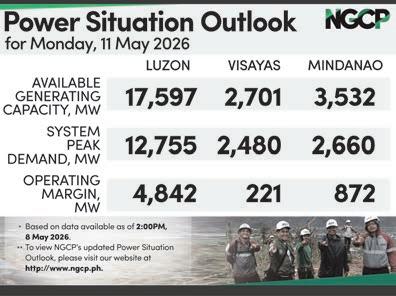
AGlobe aims to reduce service disruptions via automation tools
By Lorenz S. Marasigan @lorenzmarasigan
GLOBE Telecom Inc. said over the weekend that it is rolling out two automated network technologies aimed at keeping customers connected during outages and peak demand periods, with nationwide deployment targeted within 2026.
The telco said it has embedded two systems—Automated Outage Response and Intelligent Traffic Management— into its network operations in Metro Manila to reduce service disruptions and optimize performance for its subscribers.
Both systems have been validated across Metro Manila and are now being expanded nationally.
“With automation and intelligence at the core, we are not just improving overall experience, we are redefining reliability and resilience for the digital age,” said Joel Agustin, SVP for Service Planning and Engineering at Globe. Automated Outage Response allows the network to instantly detect disruptions and reroute traffic through nearby cell sites to maintain connectivity in affected areas, whether caused by equipment failures or extreme weather.
Globe said the system retains up to 50 percent of data connectivity dur -
ing outages, a significant improvement from the less than 10 percent retained without it. The tool is designed to keep critical communications available even when primary infrastructure goes down. Intelligent Traffic Management, meanwhile, addresses congestion by dynamically redistributing users to less-loaded cells when demand spikes during concerts, holidays, emergencies, or traffic buildup. Globe said the system improves user experience by up to 20 percent, resulting in clearer calls, smoother video streaming, and faster browsing even under heavy network load.
“Our vision is to build a network that thinks and acts in real time, adapting instantly to customer needs,” Agustin said. The company reported a slight dip in net income to P23.3 billion last year from P24.3 billion recorded in 2024. It posted record consolidated service revenues of P165.1 billion for 2025, flat compared with the P165 billion in 2024.
Data-related services remained the primary growth driver, accounting for 88 percent of total consolidated service revenues in 2025, up from 86 percent in 2024.
For 2026, Globe anticipates “low to mid-single-digit” revenue growth. Capital expenditure is expected to stay below $1 billion.

By VG Cabuag @villygc
N independent director nominee of Shell Pilipinas Corp. has questioned the nomination of Edgar O. Chua, the former country chairman of the oil firm, also as an independent director.
Shell will hold its annual stockholders’ meeting this week.
“Under existing SEC rules and corporate governance standards, an independent director must be free from any relationship that could interfere, or be perceived to interfere, with the exercise of independent judgment,” Pizarras said.
“In this case, Mr. Chua’s long tenure as a senior executive may reasonably be viewed as impairing such independence. The issue is not only actual independence, but also the appearance of independence.”
He said Chua is a member of the nomination committee, which is re-
In his four-page letter dated May 7 addressed to Securities and Exchange Commission (SEC) Chairman Francis E. Lim, lawyer Jordan M. Pizarras raised concerns over the nomination and possible election of Chua, arguing that his previous role as the company’s top executive from 2003 to 2016 “could cast doubt on his ability to exercise independent judgment.”
sponsible for screening and endorsing board nominees. At the same time, he is also a nominee for election as an independent director.
“This suggests that he effectively participated in the nomination process that led to his own endorsement; in other words, he nominated himself,” Pizarras said
“This creates the anomalous situation where a nominee participates in the evaluation process that determines his own eligibility. While this may not be expressly prohibited, it raises serious concerns about conflict of interest, as well as the objectivity and integrity of the nomination process. It also contradicts the purpose of nominating independent direc-
tors, who are expected to provide valuable oversight over the company without any vested interest.”
Considering that Chua was the long-time country chairman of the company and an insider, Pizarras said questions may be raised as to his ability to perform his duties as an independent director.
“Even assuming there is no question as to his personal probity, allowing him to serve as an independent director would tend to undermine, if not defeat, the very purpose for which such position exists.”
Copies of the letter were furnished to Shell Pilipinas President and CEO Lorelie Q. Osial and SEC commissioners.
Attackers can easily crack modern passwords—report
COMMON habits like ending passwords with numbers or using trending words are leaving millions of users dangerously exposed, according to new research from cybersecurity firm Kaspersky that analyzed over 231 million unique passwords leaked between 2023 and 2026.
The findings, released to mark World Password Day, reveal that 68 percent of modern passwords can be cracked within 24 hours—and more than 60 percent within an hour—as artificial intelligence-powered cracking tools erode the protection that password complexity rules were designed to provide.
The research found that the overwhelming majority of compromised passwords follow patterns that make bruteforce attacks dramatically easier.
Fifty-three percent of examined passwords end with digits, while 17 percent begin with one. Nearly 12 percent include a numeric sequence resembling a date between 1950 and 2030. This, according to the research, is a habit that, despite feeling personal, is predictable to automated systems.
Furthermore, Kaspersky found that symbol use is equally formulaic. Among passwords containing a single symbol, the “@” sign appeared in 10 percent of cases, followed by the period (.) at 3 percent. Across all analyzed passwords, “@” ranked second in overall prevalence and “!” third.
Three percent of leaked passwords included keyboard sequences such as “qwerty,” though numeric sequences like “1234” were far more common.
“When attackers already know which characters users tend to favor, the time required to crack a password drops dramatically,” said Alexey Antonov, Data Science Team Lead at Kaspersky.
The cybersecurity firm likewise found that users gravitate toward emotionally resonant and culturally trending words when crafting passwords.
Kaspersky found that use of the word “Skibidi”—a reference to a viral internet meme—surged 36 times between 2023 and 2026, tracking almost exactly with the trend’s rise in popular culture. Lorenz S. Marasigan

Building AI trust starts with clear governance

ARTIFICIAL intelligence
(AI) is the ultimate double agent. On one hand, it gives retailers the power to craft immersive, hyper-personalized experiences that captivate customers and streamline operations. On the other hand, smarter tools empower consumers to hunt for better deals, compare products instantly and align purchases with their personal values—all with just a few clicks.
This duality raises the stakes for trust, transparency, and ethical use. But this duality is evolving. It’s no longer just human vs. machine—it’s agent vs. agent. Soon, a retailer’s pricing and recommendation AI may negotiate directly with a customer’s personal shopping AI. In this new economy, which brand’s AI will the consumer’s agent trust? Governance is no longer just about protecting data; it’s about programming your agents to be transparent, fair, and trustworthy negotiators. Building AI trust starts with clear governance.
When asked about the most pressing concern of AI implementation, 56 percent of CEOs surveyed for the “KPMG 2025 Consumer & Retail CEO Outlook” identified ethical challenges as significant. As AI becomes more embedded in customer-facing applications such as personalization, pricing, and recommendations, navigating issues such as bias, transparency, and consumer trust is becoming increasingly complex. Retailers need to ask themselves: How do we balance deep personalization with earning and maintaining customer trust?
Consumer trust: Opportunity and risk
RECENT research by KPMG and the University of Melbourne, Australia shows that more than half of consumers (46 percent) remain wary about trusting AI. Many lack a clear understanding of how AI works—61 percent have no AI training, and 48 percent report limited knowledge. Consumers are increasingly using AI-powered tools, but may not fully comprehend their implications. This can lead to autonomous AI agents making decisions that are not always in the consumer’s best interests.
Agents present both opportunities for engagement and risks of misunderstanding or mistrust if AI-driven experiences are not transparent or user-friendly.
From responsibility to opportunity: Winning on trust
FOR years, retailers have treated data governance as a defensive necessity, navigating regulations like the General Data Protection Regulation (GDPR) and the California Consumer Privacy Act (CCPA) to avoid risk.
The rise of AI demands a radical shift in this mindset.
Trust is no longer a compliance check-box; it is a core product feature. In an era where a customer’s personal AI agent will choose which brands to interact with, proactive and transparent governance becomes a powerful strategic differentiator.
The new responsibility isn’t just to protect data, but to build systems that are demonstrably fair and explainable, earning
Banking&Finance BSP flags money mules’ use of QR code, orders vigilance

By Reine Juvierre Alberto @reine_alberto
the confidence of both human customers and their digital counterparts. Retailers must focus on maintaining data safety and privacy, and ensuring that AI meets appropriate ethical standards. This includes proactively educating consumers about AI-driven features and benefits, supporting AI literacy, and providing accessible information to build confidence and loyalty.
In the Philippine Context IN the Philippines, AI is creating opportunities as the digital economy continues to expand. The country’s digital economy has reached US$36 billion in gross merchandise value in 2025, with e-commerce accounting for more than 60 percent of total value. As AI becomes more embedded in how consumers discover, evaluate, and purchase products, expectations around transparency, fairness, and data use are rising in parallel. This makes trust a critical factor in sustaining adoption, not just a by-product of it. As a result, organizations need to move beyond opportunistic AI adoption toward a more structured, governance-led approach.
“As AI becomes more embedded in customer journeys and decision-making, the real challenge is no longer adoption but scaling it with trust. In the Philippine context, where digital adoption is accelerating, organizations must move beyond experimentation and focus on strong governance, disciplined data management, and workforce readiness. This is what will ensure AI is not only widely used, but also reliable, ethical, and trusted by both businesses and consumers,” said Doris Aura B. Pastoriza, Technology Consulting Principal and Data, AI and Innovation Lead at R.G. Manabat & Co. Ultimately, AI is reshaping retail not just in how decisions are made, but in how trust is built across the customer journey. As AI systems increasingly act and interact on behalf of both businesses and consumers, governance becomes the foundation of value creation.
The real differentiator is no longer AI adoption, but how well organizations govern, scale, and sustain trust in it over time.
These are the kinds of conversations that will continue at the “MAP x KPMG Technology Summit” on June 30, 2026, where leaders from across sectors will come together to explore how technology is reshaping business, the economy, and the future of work, and what it takes to build trust in a rapidly evolving digital landscape.
This article draws on insights from the KPMG Thought Leadership publication “AI in retail: Global lessons from strategy to storefront.”
© 2026 R.G. Manabat & Co., a Philippine partnership and a member firm of the KPMG global organization of independent member firms affiliated with KPMG International Limited, a private English company limited by guarantee. All rights reserved. This article is for general information purposes only and should not be considered as professional advice to a specific issue or entity. The views and opinions expressed herein are those of the author and do not necessarily represent the BusinessMirror, KPMG International or R.G. Manabat & Co. For more information, you may reach out through ph-kpmgmla@kpmg.com, social media or visit www.home.kpmg/ph.
THE Bangko Sentral ng Pilipinas (BSP) is mandating banks and other financial institutions to monitor QR code usage and adopt riskbased measures to detect and prevent mule merchants.
The order is contained in Memorandum M-2026-017 to remind BSPsupervised institutions to “adequately” identify, measure, monitor and control money laundering, terrorism financing and other illegal activities in digital payments.
To crack down on “mule merchants” or accounts used to disguise illegal transactions, the BSP orders all banks and financial institutions to implement appropriate, risk-based
measures to prevent the unauthorized use or misuse of QR codes by persons or entities other than the duly registered merchant.
Banks and other financial institutions onboarded in QR Ph were also required by the BSP to adopt end-user due diligence, transaction monitoring and risk controls.
“BSls are reminded that integrity controls for payment activities should be underpinned by sound account
opening, onboarding, and ongoing account monitoring practices,” the memo read.
The BSP placed the onus to banks, saying these institutions are primarily responsible for compliance with antimoney laundering rules even if payment activities are coursed through payment aggregators or other intermediaries.
As such, they are required to have “sufficient” access to sub-merchant information, transaction-level data and merchant risk profiles.
Periodic reviews must also be conducted, with clear triggers for restricting or terminating relationships involving high-risk or non-compliant sub-merchants. They must also maintain clear distinctions between merchant accounts and personal accounts to prevent the misuse of accounts for unlawful transactions.
The BSP said banks and financial institutions are expected to continuously review merchant accounts and monitor whether transactions are
consistent with the declared nature of the business. After nearly four years, the Philippines was removed in the “grey list” of the Paris-based Financial Action Task Force (FATF) on February 2025. In a statement that month, the FATF said that it welcomed the Philippines’s “significant progress” in improving its anti-money laundering and combating the financing of terrorism (AML/ CFT) regime.
“The Philippines strengthened the effectiveness of its AML/CFT regime to meet the commitments in its action plan regarding the [nine] strategic deficiencies that the FATF identified in June 2021,” according to the FATF. The next FATF assessment is scheduled for 2027, when it will be reassessed whether these measures have been effectively sustained. The European Commission has also removed the Philippines from the updated list of high-risk third countries vulnerable to money laundering and terrorist financing last June 2025.
PHL secures Japan ODA for climate disclosure system
THE Philippines and the Japan International Cooperation Agency (Jica) are set to improve sustainable finance and climate disclosure systems amid growing climate risks facing the country.
Acting Finance Secretary Frederick D. Go and Jica President Chief Representative BABA Akashi signed an agreement for the “Project on Strengthening Sustainability and Transparency Framework” worth 300 million Japanese yen (P115.881 million).
The Department of Finance (DOF) will serve as the lead implementing agency for the project, in partnership with the Securities and Exchange Commission (SEC) and the Department of Environment and Natural Resources (DENR).
The project, which will run from 2026 to 2029, aims to enhance sus-
tainable finance and transparency through improved disclosure frameworks, strengthened greenhouse gas inventory (GHG) and reporting systems and better monitoring of climate-related initiatives.
Japanese experts on climate change, sustainable finance, sustainability reporting and transparency and GHG inventory systems will be deployed by the Tokyo, Japan-headquartered Jica.
For its part, the DOF will oversee policy integration and overall execution. The SEC will also support sustainability reporting enhancements, while the DENR will strengthen the transparency framework.
“By enhancing coordination among agencies and aligning reporting frameworks, the project will help ensure that policies and investments
ADB to mobilize $30B to buffer SEA vs risks
By Justine Xyrah Garcia
HE Asian Development
TBank (ADB) announced plans to mobilize $30 billion for Southeast Asia by 2030 as the multilateral lender sees the region facing mounting risks from geopolitical tensions, supply-chain disruptions and slowing global growth.
ADB President Masato Kanda announced the commitment last Friday in Cebu during the 48th Association of Southeast Asian Nations (Asean) Summit, where regional leaders discussed economic resilience and integration amid an increasingly uncertain global environment.
“Asean has clear priorities and strong ambitions, but the challenge now is delivery, especially as the region faces a period of compounding crises, from geopolitical uncertainty to economic shocks,” Kanda said.
The financing package will support five regional flagship initiatives, including $6 billion for capital market development and $5 billion for the Asean Power Grid, part of the multilateral lender’s previously announced support of up to $10 billion for the project through 2035.
According to the ADB, the financing will also cover projects tied to artificial intelligence readiness, the blue economy, and river resilience.
The announcement comes as Southeast Asian economies confront renewed external pressures linked to the conflict in the Middle East, volatile energy prices, and weaker global trade conditions.
Speaking before Asean leaders, Kanda said the bank is prepared to assist economies affected by spillovers disrupting supply chains and straining government finances.
According to the ADB, it is extending fast-disbursing budget support and has temporarily resumed private-sector support for oil imports through its Trade and Supply Chain Finance Program.
Asean Secretary-General Kao Kim Hourn welcomed the commitment and said the bloc would work with ADB on regional priorities including energy connectivity and climate resilience.
“Asean welcomes ADB’s enhanced commitment to our region and its people. This landmark partnership, and ADB’s pledge to mobilize $30 billion by 2030, sends a powerful signal of confidence in Asean’s vision and its capacity to deliver,” he said.
The ADB has yet to disclose how much funding has already been allocated or identify which projects and countries would receive priority under the $30 billion pipeline.
remain aligned with the Philippines’ climate targets and long-term development priorities,” read a statement the Jica issued over the weekend.
Moreover, the project seeks to strengthen the capacities of DOF, SEC and DENR officers through targeted capacity-building programs to advance the Philippines’ commitments under the Paris Agreement.
“These knowledge exchanges will strengthen institutional capacities in the Philippines and enhance implementing Article 6, including the Joint Crediting Mechanism,” Jica said.
The project forms part of Jica’s broader support for climate action in the Philippines, including the Climate Change Action Program–Subprogram 2, a policy-based lending program worth 35 billion JPY in 2025.
Jica also provides climate advi-
sory services, technical cooperation projects on forest monitoring and hydropower inventory, training and scholarship programs, private sector engagement and disaster risk reduction and climate co-benefit initiatives.
According to a Philippine Institute for Development Studies discussion paper cited by Jica, the DOF’s Sustainable Finance Roadmap estimates only $2.5 billion to $3 billion in annual climate finance, “far below” the $12 billion to $15 billion required annually. This resulted to a funding gap of about $9 billion to $12 billion each year, Jica said. With the Philippines facing growing threats from stronger typhoons, flooding and rising temperatures, robust systems for planning, financing and monitoring climate action are needed, Jica said.
DBM allows non-state actors as observers in budget talks
DAVAO CITY—The Social Watch Philippines (SWP) issued a statement lauding the Department of Budget and Management (DBM) for allowing observers to the technical budget hearings of the Cabinet departments.
The organization’s statement issued last Sunday praised the DBM for opening the technical budget hearings of selected agencies to civil society organizations (CSO) as observers as part of the preparation of the 2027 National Expenditure Program (NEP).
The DBM’s decision came after the group formally wrote and urged the DBM “to make the budget preparation stage more transparent and accessible to the public, particularly in light of controversies surrounding questionable allocations and misuse in recent years.”
“Opening the technical budget hearings on a pilot basis is a commendable and necessary first step toward genuine budget transparency,” SWP CoConvener Ma. Victoria R. Raquiza was quoted as saying in the statement.
The SWP noted that, for years, critical stages of budget preparation, particularly DBM deliberations on agency budget proposals, “were conducted behind closed doors despite the impact that secrecy in budget decisions has on the strategic allocation and adequacy of budget provisions for public services, infrastructure, health, education, and social protection.”
The organization emphasized that greater transparency during the preparation stage should allow the public to better understand how agency ceilings are determined, how priorities are set,
and how government funds are allocated even before the proposed budget reaches offices of lawmakers.
“This is an important opportunity to rebuild public confidence in the budget process after the controversies surrounding flood control spending and other questionable allocations. Transparency should not begin only when the budget reaches CongressL it should start from the very beginning,” Raquiza said.
The SWP also said public access to budget deliberations is consistent with Article III, Section 7 of the 1987 Constitution, which guarantees the people’s right to information on matters of public concern.
The organization is urging the DBM to make the practice of having nonstate actors sit in budget hearings permanent. The group is also asking the budget department to strengthen transparency measures, including publishing budget documents in machinereadable formats throughout the process.
The organization also welcomed the move of DBM to sit with CSO-observers in upcoming discussions to improve and sustain the open technical budget hearings in future budget cycles.
The DBM has opened the budget hearings for the Department of Information and Communications Technology and the Department of Environment and Natural Resources last May 7, the Department of Justice on May 11, the Department of Health on May 12, and the Department of the Interior and Local Government on May 13. Manuel T. Cayon
Reine Juvierre S. Alberto
CDC-SEE NO EVIL?
Experts ask where health agency is amid cruise hantavirus outbreak
By Mike Stobbe | AP Medical Writer
NEW YORK—No quick dispatching of disease investigators. No televised news conference to inform the public. No timely health alerts to doctors.
In the midst of a hantavirus outbreak that involves Americans and is making headlines around the world, the US government’s top public health agency, the Centers for Disease Control and Prevention, has been uncharacteristically missing in action, according to a number of experts.
To President Donald Trump, “We seem to have things under very good control,” as he told reporters Friday evening.
To experts, the situation aboard a cruise ship has not spiraled because, unlike COVID-19 or measles or the flu, hantavirus does not spread easily. It has been health experts in other countries, not the United States, who have been dealing primarily with the outbreak in the past week.
The CDC is not even a player,” said Lawrence Gostin, an international public health expert at Georgetown University. “I’ve never seen that before.”
Not until late Friday did CDC actions accelerate.
Health officials confirmed the deployment of a team to Spain’s Canary Islands, where the ship was expected to arrive early Sunday local time, to meet the Americans onboard. They said a second team will go to Offutt Air Force Base in Nebraska as part of a plan to evacuate American passengers from the ship to a University of Nebraska quarantine center for evaluation and monitoring. Also, the CDC issued its first health alert to US doctors, advising them of the possibility of imported cases.
At their first briefing, held Saturday by telephone only for invited reporters, officials pledged to be transparent in updating the public but said the media could not cite the speakers by name under rules set by aides to Health Secretary Robert F. Kennedy Jr. They did not directly answer a question about whether the American passengers could leave the university medical facility when they wanted.
The CDC’s diminished role in
this outbreak is an indicator the agency is no longer the force in international health or the protector of domestic health that it once was, some experts said. The hantavirus outbreak is “a sentinel event” that speaks to “how well the country is prepared for a disease threat. And right now, I’m very sorry to say that we are not prepared,” said Dr. Jeanne Marrazzo, chief executive officer of the Infectious Diseases Society of America.
How the outbreak unfolded EARLY last month, a 70-year-old Dutch man developed a feverish illness on a cruise ship traveling from Argentina to Antarctica and some islands in the South Atlantic. He died less than a week later. More people became sick, including the man’s wife and a German woman, who both died.
Hantavirus was first identified as a cause of sickness of one of the cases on May 2. The World Health Organization swung into action and by Monday was calling it an outbreak. About two dozen Americans were on the ship, including about seven who disembarked last month and 17 who remained on board.
It’s WHO taking center stage FOR decades, the CDC partnered with the WHO in such situations. The CDC acted as a mainstay of any international investigation, providing staff and expertise to help unravel any outbreak mystery, develop ways to control it and communicate to the public what they should know and how they should worry.
Such actions were a large reason why the CDC developed a reputation as the world’s premier public health agency.
But this time, the WHO has been center stage. It made the risk assessment that has told people the outbreak is not a pandemic threat.
“I don’t think this is a giant threat to the United States,” said


Jennifer Nuzzo, director of Brown University’s Pandemic Center. But how this situation has played out “just shows how empty and vapid the CDC is right now,” she said.
Tumult under Trump THE current situation comes after 16 tumultuous months during which the Trump administration withdrew from the WHO, has restricted CDC scientists from talking to international counterparts at times and embarked on a plan to build its own international public health network through one-on-
one agreements with individual countries.
The administration has laid off thousands of CDC scientists and public health professionals, including members of the agency’s ship sanitation program.
A s this was playing out, Kennedy said he was working to “restore the CDC’s focus on infectious disease, invest in innovation, and rebuild trust through integrity and transparency.”
Waiting to hear from the CDC THE CDC has not been completely
silent on hantavirus. The agency on Wednesday issued a short statement that said the risk to the American public is “extremely low,” and described the US government as “the world’s leader in global health security.”
Said Nuzzo: “Not only was that not helpful, it actually does damage because a core principle of public health communications is humility.”
The CDC’s acting director, Dr. Jay Bhattacharya, posted a message on social media that the agency was lending its expertise in coordinating with other federal agencies and international authorities. Arizona officials this week said they learned from the CDC that one of the Americans who left the ship — a person with no symptoms and not considered contagious — had already returned to the state. WHO officials said the CDC has been sharing technical information.
The CDC also is “monitoring the health status and preparing medical support for all of the American passengers on the cruise,” Bhattacharya wrote.
But federal health officials have mostly been tight-lipped, declining interview requests. The first on-camera appearance by a CDC official came Saturday morning, when Bhattacharya appeared on a Fox News program and said,
“My message to the American people is please don’t worry.” But he got some details wrong and overstated what was known about the outbreak.
He incorrectly said two passengers in their 80s had died after they had contracted the virus while bird-watching in Argentina. The travelers were a 70-year-old Dutch man and his 69-year-old wife and while Argentine health officials think it is possible they were infected during a bird-watching outing, it has not been established.
COVID-19 comparison IN interviews this week, some experts made a comparison with a 2020 incident involving the Diamond Princess, a cruise ship docked in Japan that became the setting of one of the first large COVID-19 outbreaks outside of China.
The CDC sent personnel to the port, helped evacuate American passengers, ran quarantines, shared genetic data on the virus, coordinated with the WHO and Japan, held public briefings and rapidly published reports “that became the world’s reference data on cruise ship COVID transmission,” said Dr. Tom Frieden, a former CDC director.
Some aspects of the international response to the Diamond Princess were criticized, and it did not halt the outbreak or stop COVID-19’s spread across the world. But some experts say it was not for the CDC’s lack of trying.
The CDC was right on top of it, very visible, very active in trying to manage and contain it,” Gostin said, while the agency’s work now is delayed and subdued.
Instead of working with nearly all of the world’s nations through the WHO, the Trump administration has pursued bilateral health agreements with individual nations for information sharing, public health support, and what it describes as “the introduction of innovative American technologies.” Roughly 30 agreements are currently in place.
Th at’s not sufficient, Gostin said. “You can’t possibly cover a global health crisis by doing oneon-one deals with countries here and there,” he said.
Associated Press writers Ali Swenson in New York, Darlene Superville in Washington and Susan Montoya Bryan in Albuquerque, New Mexico, contributed to this report.
On the cruise ship hit by hantavirus, some fear what awaits them at home
By David Biller & Suman Naishadham The Associated Press
MADRID—In the days since the hantavirus outbreak on a cruise ship in the Atlantic Ocean, concern has taken hold among at least some of its Spanish passengers — but not so much because they fear contracting the illness. Rather, they are afraid of how they will be received back on land.
They have seen sensational news reports and devil-may-care memes ostracizing those aboard the MV Hondius, two passengers told The Associated Press by phone from the ship on Friday.
“ You go onto social media — they want to dynamite the boat. They want to sink the boat,” a Spanish man said.
He says he worries about being stigmatized as a viral vector to be avoided — or worse. He spoke on condition of anonymity because of these concerns, and another Spanish woman insisted on anonymity for the same reason.
“ You see what’s out there and you realize you’re heading into the eye of a hurricane,” she said. “Many people forget that in here there are more than 140 passengers. In reality, there are 140 human beings.”
Coronavirus flashbacks A CRUISE ship with an outbreak has dredged up COVID-19 déjà vu — but it’s misplaced, according to the World Health Organization. For days, WHO officials have sought to dispel comparisons between coronavirus and hantavirus, stressing that the latter poses very low risk to the general public. This is very different virus. I want to be unequivocal here,” Maria Van Kerkhove, the WHO’s head of epidemic and pandemic preparedness, said on Thursday. “This is not the start of a COVID pandemic.”
Hantavirus is usually spread by the inhalation of contaminated rodent droppings and isn’t easily transmitted between people. But the Andes virus detected in the cruise ship outbreak may be able to spread between people in rare cases.
But some are dismissing health experts — just as they did during the pandemic. Iustitia Europa, an antiestablishment Spanish group that rose to prominence by challenging COVID-era restrictions, called for the MV Hondius to be barred from reaching Spanish shores. The Canary Islands cannot become Europe’s health laboratory ... We demand transparency, responsibility, and protection for Spaniards to avoid repeating the mistakes of the past,” it posted on X.
A frosty response from some Spanish politicians Others defaulted to defensive footing. The Canary Islands regional president, Fernando Clavijo, told Spain’s El País newspaper Friday he wouldn’t be at ease until the ship leaves Spain and all passengers were headed to their respective quarantine destinations. Madrid’s regional leader Isabel Díaz Ayuso on Thursday said she disagreed with the decision to transfer the ship’s 14 Spanish passengers to a military hospital in the Spanish capital, where authorities have said

they will have to quarantine. We’ve seen news that no one wants this boat. That it’s a boat of infected people, a boat of multimillionaires, full of rats,” the Spanish man said. “Society is in some way contaminated with a lot of noise and a lot of lies.” He said he was taking some sol-
ace in Spanish authorities’ assurance of official escorts upon their arrival in Tenerife, where on Thursday port workers protested, citing lack of information provided about safety measures to be implemented. The more than 140 passengers and crew could begin disembarking as early as Sunday.
Daily life aboard the cruise ship THE Spanish man said he was put at ease about the virus by a group of specialists who boarded while the ship was still off the coast of Cape Verde and explained the rarity of human-to-human transmission.
Passengers’ day-to-day routine has been tranquil, he added. Those who venture from their cabins into common areas lounge about reading, or attend talks — all the while wearing masks and observing social distancing. Some join a 7:30 a.m. exercise group on one of the upper decks. Others go out for air and try to spot birds; many had hoped to return from some of the most remote places on Earth with photos of wildlife, not find themselves the focus of a glaring global spotlight. Even so, both Spanish passengers said they would go on another cruise in the future.
For me, personally, traveling is a means to ... live out what I’m passionate about — which is observing nature and documenting nature,” she said. “Of course I would go on a cruise again.”
CREW members of the hantavirus-stricken cruise ship, MV Hondius, wait their turns for a first interview with epidemiologists, during the voyage to Spain’s port of Tenerife, May 6, 2026. AP
THE MV Hondius cruise ship is anchored at a port in Praia, Cape Verde, Wednesday, May 6, 2026. AP/MISPER APAWU
PASSENGERS on the the hantavirus-stricken cruise ship, MV Hondius, watch epidemiologists board the boat in Praia, during their voyage to Spain’s port of Tenerife, May 6, 2026. AP
The Manila Hotel revives Flores de Mayo with the FDAP

IN honor of the Blessed Virgin Mary, The Manila Hotel revives the Flores de Mayo tradition with the Fashion Designers Association of the Philippines (FDAP). The theme revolved around Dalisay at Halimuyak, or purity and fragrance, with lovely sagalas wearing gowns in serpentina silhouettes with dainty floral details rendered in refreshing pastels.
A grand celebration of faith, fashion and Filipino flair, the event was held on May 3 in partnership with the City Government of Manila, the Department of Tourism, Culture and Arts of Manila through “Manila, My Manila,” and the National Parks Development Committee.
Ben Farrales, the Dean of Philippine Fashion, established the Flores de Mayo through the Congregacion del Santisimo Nombre de Niño Jesus and was first launched at The Manila Hotel in 1979. Over the years, it was held in various venues until its return to the hotel in 2019. The Covid-19 pandemic paused the tradition but the celebration returned this year with renewed civic, cultural, and institutional support.
The colorful festivity started with a procession of 30 pairs of sagalas and consorts dressed in finery by FDAP members, from The Manila Hotel to the Quirino Grandstand, with the image of Nuestra Señora de la Consolacion y Correa de Intramuros enshrined on a carroza. Upon returning to the hotel, they offered flowers to the Nuestra Señora de las Flores.
A major highlight of the event was the participation of five senior FDAP designers—Renee Salud, Albert Andrada, Toni Galang, Glenn Lopez, and Lito Perez.
‘KAGANDAHAN, KULTURA AT KAHUSAYAN’
“[ANG Flores de Mayo] ay isang buhay na sagisag ng ating mayamang kultura at pamana. Ngayong gabi, magkakasama tayo sa pag-aalay ng mga bulaklak kay Birheng Maria at muli nating binibigyang-buhay ang tradisyong ito na itinatag ng pagmamahal at pangangalaga ng bawat Pilipino,” said Cathy Mora Capistrano, the president of the FDAP. “Pinararangalan natin ang talento at kasanayan ng ating mga Pilipinong taga-disenyo na patuloy na nagbibigay ng kahulugan sa ating pagkakakilanlan bilang isang bansa. Ngayong gabi, ipagdiriwang natin ang kagandahan, kultura at kahusayaan ng mga Pilipino gaya ng isang bulaklak na dalisay na marahang humahalimuyak.” Leading the celebration were Manila City Mayor Francisco “Isko” Moreno Domagoso and Diana Lynn “Dynee” Domagoso, both wearing Renee Salud, who served as Hermano Mayor and Hermana Mayor, respectively; Atty. Jose “Joey” D. Lina, president of The Manila Hotel, served as Hermano de Honor, together with Mrs. Loretta “Lory” A. Lina, both in Ramil Estrope and Renee Salud, as Hermana de Honor. “OK na ako todit [dito] sa Maynila. Hayaan natin sila doon. Masyadong makulay doon ang politika. Ngunit dito, kaya nating gawing makulay ang Lungsod ng Maynila. Imagine ninyo kanina, maraming nagpa-picture, sinasabi, taga Abra, taga Laguna, halos sa iba’t ibang dako ng Pilipinas tumungo ngayon sa programa ng Flores de Mayo ng Manila Hotel at ng lungsod ng Maynila,” an impressed Mayor Isko said in a speech. Yung sining at galing ng mga designers natin ay bagay naming pinahalagahan dito sa lungsod ng Maynila. We value your effort,” Mayor Islo continued. “That’s why in our own little way, through our director Crystal Bagatsing of our tourism office at ang inyong pamahalaang lungsod ng Maynila, in 2027, ‘pag ginusto n’yo pa, nandyan lang sa gidli [gilid] ang lungsod ng Maynila, handang sumuporta sa inyo. A GRAND EVENT AT THE GRAND DAME THE Manila Hotel is regarded as a steward of Manila’s cultural legacy. The return of a devotional celebration such as the Flores de Mayo is “a fitting revival of a beloved heritage event
JENNYLYN MERCADO is the face of Reverie, a home fragrance brand under Beautederm. She is endorsing the Air & Fabric Freshener with scents that include Cafe Aroma (coffee), First Ambience (green tea), Pure Serenity (warm vanilla), First Nostalgia (grapefruit citrus), Lily Lush (matcha), and Cloud Whisperer (cherimoya). The actress’ favorites are Cafe Aroma, Cloud Whisper and Pure Serenity. She said one of the Reverie scents reminds her of her first date with husband Dennis Trillo. During the press conference to relaunch Reverie, Mercado and Beautederm founder and CEO Rhea Anicoche Tan talked about home and motherhood.

EVER Bilena steps into a meaningful new chapter as it becomes the official color cosmetics sponsor of Miss Universe Philippines 2026 for the first time.
The partnership was introduced through a runway event at Ayala Malls Arca South, drawing an estimated crowd of 30,000. It was more than just a pageant appearance. It felt like a shared moment between the candidates and the women who see themselves in them.
One of the most memorable parts of the afternoon was when the delegates stepped off the stage and into the crowd, personally handing out Ever Bilena beauty kits along with fresh flowers. Each kit featured the brand’s bestselling Serum Tinted Lip Balm. It turned what could have been a typical event into something more personal. A simple but meaningful way to celebrate women, not just those onstage but everyone watching.
The collaboration reflects Ever Bilena’s long-standing belief that beauty goes beyond makeup. It is about confidence, self-expression, and showing up as you are.
at the Grand Dame of the Philippines.”
Bakit natin binuhay muli ang Flores de Mayo? Dahil naniniwala tayo na ang ina ng Diyos, si Maria, na nagsilang sa ating Panginoong Hesukristo, ay may malaking papel na dapat gampanan upang maligtas ang mundo. Si Maria ay pinili ng Diyos upang dalhin ang tao kay Hesus, sa ating Panginoong Hesukristo. Iyan ang aspeto ng pananampalataya ng Flores de Mayo,” hotel president Joey Lina explained in his speech at The Tent. “Pananampalataya, kultura at sining. Ito ang tatlong bagay na ginawa namin dito sa Flores de Mayo,” the former senator said. “We gave importance to the designers, and to the artists in the field of art, and because giving flowers to our beloved mother of God is important, kinakailangan na ‘yung magaalay ay nakabihis na sintodo nang sa ganun ay lalong maging maigting at maganda ang pag-aalay. Palakpakan natin ang ating mga designers.”
COMPETITIVE ‘FASHION SHOW FOR A CAUSE’
RAYMOND VILLANUEVA directed Flores de Mayo 2026: Dalisay at Halimuyak. The second part was Fashion Show for a Cause, benefiting charitable organizations such as Young Focus and the Children’s First 1000 Days Coalition. The designs of the 30 FDAP designers were assessed by a board of judges chaired by Barge Ramos, past president of FDAP; Cristina Vilar, director of Euroville Realty and Development Corp.; and Luningning Latoreno, Bodyshot Philippines 1988; with Rachy Cuna, social director and design consultant of The Manila Hotel; and Lalaine Vivar, CEO and owner of One Touch Fabrics.
The following titles were awarded: Reina de las Flores— main title won by Cathy Mora Capistrano, with sagala Maria Luisa Varela; Reina Rosa Mystica—First Runner-Up, won by Hoho Alidio, with sagala Dawn Salas; Reina Las Islas Filipinas—Second Runner-Up, won by Arhon Macaraig, with sagala Charisse Anthea Abanico; and Reina La Flor de Manila—Third Runner-Up, won by Eys Vergara, with sagala Jihaynne Hernandez. Cathy Mora-Capistrano described her entry: “It began with a sketch inspired by Marian devotion, carefully shaped into a gown that honors the Blessed Virgin Mary through every detail. From the selection of colors—pure white symbolizing holiness and light blue reflecting Mama Mary’s gentle grace—each choice was made to embody purity, serenity and reverence. Through thoughtful conceptualization and delicate execution, the design unfolds kadalisayan at halimuyak in every fold, stitch and silhouette. The electric pleats were softly finished with tips dyed in light blue, creating a graceful harmony that completes the vision of faith, devotion, and timeless Marian elegance.”

Partnering with Miss Universe Philippines brings that message to a bigger platform, one that continues to shape how Filipina beauty is seen today.
“Ever Bilena has always been about empowering women through beauty,”

Depende kung ano iyong scent na ipinabango sa kuwarto. Importante siya, nakaka-set siya ng mood and nakaka-uplift siya [Home scents are often associated with certain emotions, memories, and events.
said Rafeea Custodio, Ever Bilena Brand Manager. As the competition continues, the brand also introduces the Miss Ever Bilena special award. This will be given to a candidate who best represents confidence, authenticity, and a kind of beauty that feels
buo. Kung maisipan ko man, siguro siya na lang. Mas nauna siya kay Dylan. Baka i-consider ko. Hindi natin masasabi. Kung talagang ibibigay at kung buo na ang desisyon namin, sige, puwede pa [I have a developed, frozen embryo in Texas. This embryo came before Dylan. If we decide to have another baby, this embryo could be it],” she said. But for now, Mercado and her husband want to focus their attention on Dylan and their two grown kids, Jazz and Calix. Mercado moved to Reverie from Beautederm’s skincare line because the actress will also soon launch her skincare brand. Tan still wants her onboard despite this. Sabi ko: Suportado kita. Kung saan sila maggu-grow,
real and relatable. More than a milestone for the brand, the partnership is a reminder of what Ever Bilena has always stood for. Beauty that includes,
nandito kami as pamilya [I told her that I support her fully. As long as it’s for their growth, I will support them],” said Tan. Both Mercado and Tan believe that mothers who want a career always need to balance their time and attention.
“Whatever we do is for our families. It’s not easy being a mother so if a mother decides to go out and work, nobody can question that. Because mothers can work and spend time with their children,” said Tan. For Mother’s Day, Mercado only wished for good health.
“Huwag sana kaming magkakasakit dahil napakaimportante ng health para magawa ko pa lahat ng mga kailangan kong gawin para sa sarili ko, sa trabaho ko,
served as Hermano Mayor and Hermana Mayor at The Flores de Mayo at The Manila Hotel, flanked by FDAP president Cathy Mora Capistrano and FDAP chairman Ramil Estrope; Atty. Jose “Joey” D. Lina, president of The Manila Hotel, served as Hermano de Honor, together with Mrs. Loretta “Lory” A. Lina, both in Ramil Estrope and Renee Salud, as Hermana de Honor; winning designs by Cathy Mora Capistrano, Hoho Alidio, Eys Vergara and Arhon Macaraig (PHOTOGRAPHED BY SUNSET FLIP); and socialite-philanthropist Roselie Santiago Licup wearing Ramil Estrope (PHOTO BY JOEL MANIQUIS)
MISS Universe Philippines 2026 candidates (from left) include Alexandra Krishna Oriño of Albay; Megan Baldevia of Bacolod City; Felicia Aldana of Bacoor City; Roxie Baeyens of Baguio City; Kathleen Dale Caseñas of Batangas City; Ryla Hernandez of Cabanatuan City; Erica Cadayday of Camiguin; Jencel Caña of Cavite;Apriel Smith of Cebu City; Nicole Borromeo of Cebu Province; Clarissa Westram of Cotabato Province; and Tyra Jane Godino of Dasmariñas City
NutriAsia leaders honored at 2026 Mansmith Market Masters Awards
NutriAsia Inc. (NAI), makers of the Philippines’ best condiments and sauces, celebrated yet another round of recognition as two of its marketing leaders were honored at the prestigious Mansmith Market Masters Awards last Tuesday, April 21, 2026, at the RCBC Plaza in Makati City.
NutriAsia Chief Marketing Officer and incoming General Manager Ampy Rio was one of the recipients of the Mansmith Market Master Mentors Award (MMMA) while Senior Consumer Engagement Manager Joana Marie Lagurin was among this year’s Young Mansmith Market Masters awardees.
The MMMA celebrates those who have demonstrated exceptional commitment to developing the next generation of Filipino market masters. It is the only recognition in the Philippines that honors the mentors nominated by their mentees who are themselves previous Young Mansmith Market Masters Awards (YMMMA) winners.
Rio, one of the driving forces behind Nutriasia’s consistent growth, was nominated by her mentee and 2016 YMMMA recipient, Gretchen King. In her capacity as Chief Marketing Officer, Rio set the standards for marketing excellence and built a strong pipeline of talent through

the NutriAsia Marketing Academy, the integrated Corporate Marketing and Communications Team and the Culinary Innovation Center – all of which linked products, content, and consumer engagement anchored and sustained by rigorous talent development.
In her acceptance speech, Rio thanked her own mentors, including 2023 MMMA recipient, NutriAsia President and Chief Operating Officer Angie Flaminiano and explained that mentorship is not just a transfer of skills and knowledge but is also a transfer of courage.
“To my mentors—thank you for tearing up my maps, using friction to bring out my courage, and for allowing me to walk with you. For those early in your career: be brave. Let your maps be torn up. Embrace friction. And don’t just seek answers, seek those willing to one day walk beside you as their equals… because the courage you are given today is the courage you will one day pass on.”
As a recipient of the YMMMA, Lagurin
Suzuki Auto Pasong Tamo opens to serve
is recognized as an outstanding marketer under the age of 35 who drives significant business results through strategic thinking and values-based leadership. She is the third talent from NutriAsia to receive this honor.
Lagurin has been instrumental in further growing heritage megabrands that already dominate their respective categories. She helped elevate vinegar from a simple cooking ingredient into a daily household essential through the Happy Home Hacks Community. She also launched the creator-led “Kusina ni Joshua» campaign, making the brand more relevant to younger homemakers and driving Datu Puti to its highest-ever volume performance.
Beyond product marketing, she has strengthened NutriAsia’s corporate identity through sustainability platforms such as the multi-awarded Bring Your Own Bote (BYOB) campaign and led the digital transformation of The Catsup Museum. These efforts contributed to a record-high 94 percent corporate trust rating.
Reflecting on her career shift and her work in expanding the footprint of NutriAsia’s most beloved brands, Lagurin noted, “There is always room for growth—just not always in the same room.”
These accolades are tangible proof of NutriAsia’s steadfast commitment to honing world-class talent by fostering an environment rooted in its core values and a relentless passion for excellence. By empowering leaders like Rio and Lagurin to push boundaries and redefine categories, NutriAsia continues to strengthen its mission of creating Masarap, Masaya moments for consumers everywhere.
Metro Manila’s growing mobility needs

the photo are, from left, Michael Goho, Gateway Group’s Executive Vice President; Martin Arancon,
SUZUKI Philippines Incorporated (SPH), the country’s leading distributor of compact vehicles, continues to strengthen its presence in Metro Manila with the grand opening of Suzuki Auto Pasong Tamo, in partnership with MG Gateway Mantrade Corp.
The newly opened 3S dealership, offering Sales, Service, and Spare Parts, is strategically located at 2326 Brgy. Magallanes, Pasong Tamo Extension, Makati City, and stands as a testament to Suzuki’s commitment to providing accessible, high-quality vehicles and reliable after-sales service to Filipino customers.
Suzuki Auto Pasong Tamo is the fourth Suzuki dealership under the management of MG Gateway Mantrade Corp., led by Chairman Markane Goho, together with Michael Goho and Martin Paulo Arancon. This milestone highlights the group’s strong confidence in the Suzuki brand and its dedication to delivering excellent customer service in one of the country’s key
business districts. The dealership sits on a total lot area of 1,126 square meters, featuring a 284-square-meter showroom capable of displaying up to four vehicles, and a 654-square-meter service area equipped with eight service bays upon completion. With a 17-meter frontage, the facility ensures strong visibility and accessibility along Pasong Tamo Extension. During the ceremony, Koichiro Hirao, President of Suzuki Philippines, emphasized the company’s commitment to its customers and partners, stating, “At Suzuki, our commitment is simple, we are ‘By Your Side.’ This means being a reliable partner to our customers, not only in providing quality vehicles, but in supporting them throughout their journey with us. This dealership represents that promise, made possible through our strong partnership with MG Gateway Mantrade Corp.”
The celebration also featured a traditional Kagami

Finvolution partners with AUB to launch flexible payment card in the Philippines
FINVOLUTION Group, the mother company of the leading fintech lending app JuanHand, has launched Luvit, an innovative card in the Philippines. Luvit is an access card, available both physically and virtually, that allows users to make installment payments for their purchases.
Asia United Bank (AUB), one of the country’s premier banking institutions, is powering the Luvit card as the Bank Identification Number sponsor. This partnership marks a significant step in expanding access to modern financial solutions for Filipinos. With just one valid ID, applicants can be approved in seconds, empowering them to make flexible payments for their everyday transactions, from online shopping to travel bookings, and everything in between. Luvit cardholders utilize Mastercard’s wide network of merchants, both locally and globally, enabling a seamless payment experience for users who previously may not have had access to traditional credit products. Given the ease and speed of application, the Luvit card supports those accessing formal credit for the first time, including younger consumers and those outside the traditional banking systems, helping them engage more confidently in both digital and physical commerce.
The signing of the agreement reflects a shared commitment between Luvit and AUB to bridge gaps in financial accessibility by combining digital innovation with trusted banking infrastructure.
The partnership is designed to make managing money simpler, safer, and more accessible for everyday Filipinos. AUB provides the regulated banking infrastructure and network
access, while Finvolution (through the local entity Wefund Lending Corporation) operates as the customer-facing entity. Together, this creates a balanced ecosystem that combines stability, trust, speed, and accessibility, better serving a wider range of financial needs.
“Thanks to our robust digital partnerships such as with Finvolution, AUB is able to sustain its competitive advantage in this rapidly evolving digital landscape. We will remain relentless in our efforts to reach out to the unbanked and underserved, and in helping every Filipino achieve economic mobility,” said AUB President Manuel A. Gomez.
The partnership between Luvit and AUB highlights a shared vision of using technology to connect Filipinos to accessible and dependable financial support, cultivating a commitment to helping individuals live the life they deserve, with access to opportunity anytime, anywhere.
“The Luvit card makes Filipino aspirations a reality: a reliable payment tool for their daily lives. This encourages fiscal discipline and confidence, leading to financial empowerment and enhanced quality of life. We are excited about the endless possibilities that lie ahead with our AUB partnership,” said Francisco D.C. Mauricio, president and CEO of WeFund Lending Corporation.
With a strong foundation in place, the partnership is expected to drive future innovations in providing Filipinos the assistance they need, positively transforming their way of life and leading them to a solid financial future. Download Luvit now available at the Google Play Store and iOS Store. To learn more about Luvit, visit: www.luvit.ph
Biraki, where a sake barrel was ceremonially opened using wooden mallets, symbolizing harmony, prosperity, and new beginnings. This was followed by a toast shared among guests using masu cups, marking the start of a promising milestone for Suzuki Auto Pasong Tamo. Makati City, known as the financial hub of the Philippines, continues to drive economic growth and mobility demand. The establishment of Suzuki Auto Pasong Tamo reinforces Suzuki’s presence in the area and supports the city’s dynamic and fast-paced environment.
Meanwhile, Mr. Yukio Sato, General Manager for After Sales and Marine Division, highlighted the importance of delivering a complete ownership experience, emphasizing that customer satisfaction is built through quality vehicles, reliable service, and a strong commitment to supporting customers throughout their ownership journey. He added that the dealership is well-positioned to deliver the kind of experience that every Suzuki customer expects and deserves.
The new dealership features a modern showroom showcasing Suzuki’s latest vehicle lineup, along with well-equipped service bays designed to provide efficient and dependable after-sales support. Through these facilities, Suzuki Philippines and MG Gateway Mantrade Corp. aim to deliver an outstanding customer experience, from purchase to long-term vehicle care.
With the opening of Suzuki Auto Pasong Tamo, both Suzuki Philippines and MG Gateway Mantrade Corp. reaffirm their shared mission of bringing mobility, value, and trust to Filipino motorists, ensuring that Suzuki remains a brand that is truly “By Your Side.”
For more information, you may check out any authorized Suzuki Auto dealerships nationwide or visit http://suzuki.com.ph/auto/. For daily updates on Suzuki, please like Suzuki Auto PH’s Facebook page at https:// www.facebook.com/SuzukiAutoPH, follow them on X at https://x.com/SuzukiAutoPH and Instagram at @ suzukiautoph.
A nurse, even beyond the bedside at Omega Healthcare
her career as a bedside nurse, driven by a deep commitment to patient care. Her early years in the hospital shaped her foundation, strengthening her resilience, compassion, and ability to balance clinical knowledge with empathy. After three years, her perspective began to shift. While she valued direct patient care, she saw the potential to create impact beyond the bedside. This led her to pursue USRN licensure and transition into clinical process outsourcing, where her expertise remained relevant across roles such as medical coding, clinical account management, and telehealth support.
“The transition gave me a new perspective on the healthcare system,” she shared. “I saw how administrative efficiency directly impacted patient care. The work was different, but the mission was the same: improving lives through healthcare.”
The move beyond the bedside came with uncertainty. Everem questioned whether she would lose the human connection that defined her early years and whether her clinical skills would remain relevant in a more process-driven role. She also wondered if stepping into a delivery center meant moving away from what she once considered “real nursing.”
The transition also required adjustment. She had to adapt to a more structured environment, where success was measured through service delivery, client satisfaction, and efficiency. She also learned to apply her clinical expertise in a different context, supporting areas such as utilization management, case management, and clinical validation. Over time, she realized that the same skills she developed at the bedside, clinical judgment, communication, and empathy, remain essential. The difference was in scale.

CANCER continues to be a leading cause of illness and death nationwide. According to the Philippine Statistics Authority, Cancer ranked as the second leading cause of death in 2025, accounting for 58,656 deaths, or 11.5 percent of all recorded deaths from January to October 2025. With Thousands of patients delaying or abandoning treatment due to cost, We Hope Medical Group is here to become the leading provider of Free Chemotherapy treatment in the Philippines. Cogeo Chemotherapy Center, a subsidiary of We Hope Medical Group, has opened at Cogeo Town Plaza to address the rising demand for Free Chemotherapy treatment for Filipinos in Antipolo City, allowing them to focus on their treatment journey without the financial burden. The launch of the center was attended by Former Mayor Andrea “Andeng” Ynares and LGU officials, who expressed their gratitude to We Hope Medical Group for expanding its services in Antipolo City. The center is staffed by licensed oncology doctors, equipped with modern treatment facilities. Services include Consultation, laboratory diagnostics, Free chemotherapy sessions covered by PhilHealth, Cancer assistance fund, and other LGU programs.
Instead of focusing on one patient at a time, she was now supporting systems that impact many.
“I realized that nursing isn’t confined to hospital walls. It’s about applying our clinical expertise wherever it can improve healthcare outcomes. In a delivery center setting, I saw how nurses could influence systems, streamline processes, and ensure quality care for thousands of patients indirectly,” she added. What once felt like a departure from nursing became an expansion of it, opening new opportunities for professional growth, better work-life balance,
“Our mission is simple but powerful. No Filipino should ever have to choose between financial survival and lifesaving cancer treatment,” Dr. John Paul Aclan DBA. We Hope Medical Group proudly highlights the visionary leadership of the Chairman and CEO, whose bold vision and unwavering commitment to accessible healthcare have redefined cancer care for Filipino families. Through
From left, Nutriasia and FPGMC Chief Marketing Officer and incoming General Manager Ampy Rio and Senior Consumer Engagement Manager Joana Marie Lagurin at the 2026 Mansmith Market Masters Awards, Makati City.
In the photo from left to right: Joseph Ruan, chief operating officer of WeFund Lending Corporation; Francisco “Coco” Mauricio, president and CEO of WeFund Lending Corporation; Abraham Co, vice chairman, and Wilfredo Rodriguez Jr., executive vice president and Head-Operations and Technology Group, both from Asia United Bank.
In
Gateway Group’s Vice President; Norihide Takei, Suzuki Philippines’ Director and General Manager for Automobile Division; Markane Goho, Gateway Group’s Chairman; Koichiro Hirao Suzuki Philippines’ President; Estrella Goho, Gateway Group’s Board of Director; and Yukio Sato, Suzuki Philippines’ General Manager for After Sales Service and Marine Division
PR POWER MOMS AND HOW THEY MANAGE WORK-LIFE BALANCE

MAY is the designated month for honoring all mothers— from working moms in business and the professions to fulltime housewives who mind home and hearth. Thus, I believe there is no better time than now to pay tribute to our colleagues in the PR industry who are doing exceptional work in public relations, communications, marketing, social causes, events and advocacies.
As public relations practitioners, we are expected to be highly creative thinkers, innovative people managers, strategic storytellers and masters of information and current events. While we’re at it, we also have to look good even when we are exhausted or feeling drained. We need to be articulate speakers who are constantly prepared to give an intelligent and informed opinion, either for ourselves, for our clients, and most especially when we are asked to speak to media.
I often say: Public Relations is a tough job. While most people note the glamor, the fun, and the opportunities to engage with celebrities or famous people, we and our teams have to put in tons of time and hard work into conceptualizing, creating, and planning every painstaking detail. We may be seen hobnobbing with our clients and their guests at plush resorts or dining at the best restaurants or watching top-rated shows or attending glittery store openings and entertainment functions, but the stark reality is: these affairs are incredibly laborious occasions. At the very least, we must ensure the presence of important guests and members of the media at each event, which must be impeccably put together and organized so that its impact or effect will last way longer than the event itself.
It is therefore not an exaggeration to say that PR work requires tough women and if you add motherhood to that, we become almost superhuman (not a hyperbole!)
Now let me introduce you to three PR power women in my circle who have invested several decades of their lives into creating and delivering some of the most significant and memorable PR campaigns and projects that make them three of the best practitioners I hold the highest regard for. Each stands out not only for her leadership and credibility in the field, but more importantly, for managing the demands of

n OBEROI REALTY CELEBRATES
MOTHERS THROUGH MOTHER’S DAY
DIGITAL FILM
THIS Mother’s Day, Oberoi Realty has unveiled a reflective digital film that pays tribute to mothers as the quiet force shaping not just families, but spaces and homes. Building on the theme of “silent architects behind every home,” the digital film brings to life the role mothers play in creating environments filled with warmth, intention and belonging.
Moving away from conventional portrayals, the film adopts a nuanced lens by
focusing on gestures, movement and presence, capturing every day, actions that come together to create spaces that feel intuitive, lived-in and deeply personal. Told through a video-led narrative, the film brings alive the idea that what defines a home is often what goes unseen. At its core, the narrative draws a direct parallel between the unique design and architecture of Oberoi Realty and the “emotional architecture” built by mothers. Just as thoughtfully designed spaces influence how we live and interact, it is often a mother’s instinctive attention to detail that defines how a home feels and functions. In this sense, the campaign reflects on how meaningful living is shaped not only by structure, but by care that quietly exists within it.
This perspective aligns closely with Oberoi Realty’s design-first philosophy of
PR work while helping ensure a wholesome family life.
These moms are amazing because they continue to prove that strong women make a big difference in successfully balancing their families and work. I have actually worked with these women at various stages in my career and I can honestly say that I admire them for their intelligence and passion, their innate kindness and genuine love for people, and for their true and lasting friendship in a world that is constantly challenged by fleeting, transactional relationships.
They are the real deal and I say this with respect and hope that there will be more like them.
Read on to learn about these mothers’ secrets, their values, and their strengths, which make them iconic in the work that they do.

Rowena Capulong Reyes, Ph.D
Vice
President for Corporate Affairs, Far Eastern University
BALANCING a demanding career in public relations with family life was a deliberate choice shaped by where I chose to build my career. I often say that I started doing PR at the age of 15, helping my father with simple PR tactics long before I formally entered the profession. For 42 years, I have loved the work because it always felt like an extension of who I am—not simply work.
Apart from running a small advertising and PR agency, 5BC Integrated Marketing Communication, I intentionally worked in educational institutions, first at Colegio de San Juan de Letran and now at Far Eastern University, because these environments allowed me to fully manage my priorities as both a professional and a mother of three children. I was also fortunate to have a supportive partner who understood the demands and time challenges of the profession, making it possible for us to balance both career and family with mutual understanding and constant support. Whenever possible, I brought my children along to work events so they could be part of my world, and I made it a point never to miss the milestones that mattered most in their lives, such as birthdays, school recitals, and educational field trips. In my column “Namamana: Public Relations, blood is thicker,” I wrote about how
creating homes that go beyond physical spaces. With a focus on openness, functionality and thoughtful design, the brand continues to craft environments that enable connection, comfort and a sense of belonging, qualities that mirror the very essence of motherhood.
Speaking on the campaign, Ms. Sarina Menezes, Senior Vice President–Marketing & Corporate Communications, Oberoi Realty, said, “At Oberoi Realty, we have always believed that the most meaningful spaces are inspired by people as they are by design. This Mother’s Day film is a tribute to the quiet, ways in which mother’s influence how a home feels and functions. By keeping the narrative subtle and universal, we wanted to acknowledge these everyday quiet contributions that truly define what it means to belong.”
The digital film has been released across
family is often our first school of public relations, where we learn trust by showing up, empathy by understanding each other’s situations, loyalty, and the value of nurturing relationships. These lessons stay with us long before we enter any profession. In the first three decades of my professional life, I also had the privilege of mentoring many students who eventually pursued careers in public relations themselves, teaching them that PR is never just about publicity, but about people and relationships. For me, balance has never been about separating career and family, but about making sure both are anchored on instilled values.
(Rowena “Wen” is our Secretary in the IPRA Philippine Chapter and is known for her zealous work and involvement in the Metro Manila Film Festival where she has been an Executive Committee member since 2013.)

Tessa Jazmines
JOURNALISM
professor at the UP College of Media and Communication, sports columnist at BusinessMirror, president of Larc&Asset PR, mom to three grown boys now with their own families, and grandma to three young souls. JUGGLING teaching, sports coverages, PR strategizing and playing Mother Hen to biological family and professional families can be the ultimate circus act. But the might of the appointment book should not be underestimated. It keeps the airplanes of your life taking off and landing safely in the busy airport of your existence. When schedules clash, deftly assign able “first officers” to handle the task. It always pays to read the terrain of your battlefield every day, and plan your moves at least a month in advance, if you can. But when surprises happen, you can only rely on your instincts and your quick-draw creativity. Trust your gut. Work is an adventure that must always be pursued with passion. But to keep flying high, get your power from your family. Family always comes first.
(Tessa is the epitome of a PR lady who enjoys every project she handles. Her over 4 decades of experience include work for long time sports accounts like Nike Philippines, The UÅAP, NGA Philippines (Next Generation Advanced 911) and the NBA.)
Oberoi Realty’s social media platforms, targeting modern homeowners who value both aesthetics and the emotional resonance of their living spaces. With this campaign, the brand reinforces its belief that the true essence of a home lies not only in its architecture, but in the care that quietly shapes it.
n ATIME&PLACE DRIVES MOTHER’S DAY PUSH FOR SUZUKI SWIFT HYBRID FORGET flowers and chocolates. This Mother’s Day, Suzuki Automotive and creative agency ATime&Place are urging Australians to give mum a gift that lasts as long as her love: a Suzuki Swift Hybrid. The promotional campaign is designed to drive people into dealerships where they can receive Mother’s Day Card Coupons entitling the bearer to a bonus $500 fuel voucher with the

Charisse Garcia Chuidian Vice President, Public Relations City of Dreams Manila IN the earlier days of my professional life, work-life balance wasn’t practiced as much or in the manner that it is seen these days with the emergence of hybrid work and telecommuting. In the years before my husband’s passing, the “balancing” act somehow leaned more towards work. But what made it viable was my family’s full support and understanding of the long hours that were demanded by my job. What we did on weekends revolved on my availability. Many celebratory holidays together would be spent in my workplace. Since I organized it, attending Christmas Eve Mass at our hotel for example, was de rigueur for many decades. Their understanding of the demands of my work, and acceptance to share these experiences with me, enabled me to achieve the work-life balance as we saw it, as we’d find ways to make things work, and indulge in joyful “we” times during overseas and out of town trips whenever possible.
(Charisse’s reputation as the doyenne of the Philippine hospitality industry is unquestioned as she has about five decades of experience as PR for some of the country’s most prestigious hotels. She is also our member of IPRA Philippine chapter where she now serves as one of the Board of Advisers.)
Happy Mothers’ Month to all our mom colleagues in the PR, marketing, advertising and communications industry.
PR Matters is a roundtable column by members of the local chapter of the United Kingdom-based International Public Relations Association (Ipra), the world’s premiere association for senior communications professionals around the world. Joy Lumawig-Buensalido is the President and CEO of Buensalido PR and Communications. She was past Chairman of the IPRA Philippine chapter for two terms.
PR Matters is devoting a special column each month to answer our readers’ questions about public relations. Please send your questions or comments to askipraphil@gmail. com.

Joo tops Stage 11, fined for post-race celebration
By Josef T. Ramos
SAN Juan, La Union—Reigning champion Joo Dae Yeong of Gapyeong Cycling Team pointed to the crowd in celebration as he crossed the finish line, then took a bow on a blazing Sunday at the jampacked provincial town hall here.
The 29-year-old South Korean sprint specialist finally got his moment, clocking three hours, 19 minutes and 16 seconds in Stage 11 of the Metro Pacific Tollways Corporation (MPTC) Tour of Luzon 2026.
Joo launched his decisive attack with 55 kilometers left, near Sta. Cruz, Ilocos Sur.
“A lot of riders were trying to get to this stage and break from the peloton. But I always try to attack the stage,” said Joo, who expressed satisfaction with his performance this year after wearing the polka dot jersey climber before surrendering

it to 7-Eleven rider Ronnilan Quita in Stage 10 Bessang Pass.
“Good and so happy. Last year, I was so lucky to win the yellow jersey, and this year I wore the polka dot jersey for five days. So, it was good to win a stage this time,” he added. “So happy also to wear the purple jersey individual and the red jersey combative.”
Joo earned a win for the first time in this 14-stage tour, ruling the lung-busting flat 158.7-kilometer route from Candon City Arena in Ilocos Sur to the San Juan town hall in La Union.
The showmanship at the finish delighted the crowd but came with a price tag.
Joo dismounted and took a bow near the center of the road just beyond the finish line, which got him fined P1,950 for what officials deemed “a harmless but technically unsafe celebration of a rider that could endanger himself and other competitors.”
Malaysia’s Saniy Syahmi Mohd Safiee of National Team Malaysia came in second, 11 seconds off, followed by Dominic Perez of Pangasinan, Ronald Oranza of Standard Insur-
ance Philippines, James Mendoza of Go for Gold, Mervin Corpuz of 7-Eleven, and Joseph Javiniar of Excellent Noodles, just a second later.
Joo’s stage victory put him at No. 16 in the chase for yellow jersey held by Russia’s Nikita Shulchenko of Life Cycle Works (LCW) UAE, who had an accumulated time of 32:57:30, followed by teammate Yousef Ibrahiem Alrefai, 3:41 back.
Stage 10 winner Antoine Huby of 7-Eleven is 3:54 behind the overall individual general classification leader in the two-week race presented by the Philippine Sports Commission and sanctioned by PhilCycling.
In the team classification, 7-Eleven Road Bike Philippines stayed No. 1 with an aggregate time of 131:05;38, while closest Go for Gold trailed by 2:20 and Standard Insurance Philippines was 13:12 back.
Stage 12 is a 146.4-kilometer race with a by 141-km flat route and a 7.4-km climb from Eagle of the North in Agoo, La Union to Daang Kalikasan, Mangatarem View Deck in Pangasinan.

THE third edition of the Shopwise Bike Fest is shaping up to be its biggest ride yet, with the Ayala Vermosa Sports Hub in Imus, Cavite hosting a vibrant celebration of fitness, family bonding and community spirit on Sunday.
Shopwise Bike Fest, now on its third staging, promotes accessible wellness and active living through an event that brings together riders of all ages and skill levels in one of the summer’s most anticipated cycling gatherings.
Headlining the event are the adult ride categories in four distances: the 60-km ride over a four-loop counterclockwise course, the 45-km three-loop ride, the 30-km two-loop event and the 15-km one-loop course.
Family-friendly activities are also on tap, including the Kids and Family Ride, the Tricycle Kids Ride and the Push Bike categories for children aged two to seven, with distances ranging from 500 meters to 100 meters.
Princess Galura, president and managing director of the organizing
ALL eyes will be on De La Salle as UAAP golf finally makes its long-awaited debut in Season 88 as a demonstration sport on Monday at Tagaytay Midlands.
Coming off a dominant sweep in last year’s International Container Terminal Services Inc. (ICTSI) Intercollegiate Tournament, La Salle carries both momentum and expectation into the historic four-day event, with Ateneo, UST, UP and Adamson looking to steal the show.
The demanding Midlands layout also looms as the ultimate equalizer, testing skill, strategy and composure regardless of pedigree.
The tournament features a 72-hole aggregate gross stroke play format contested over four days. Teams will field three to four players per round from rosters of four to six, counting the best three scores toward the team total.
Sunrise Events, Inc., and Imus
Only those who complete all four rounds will qualify for individual honors.
Spicing up the UAAP golf week is the second staging of the ICTSI Intercollegiate Tournament, which has attracted 18 teams, including 13 in the men’s division.
Powerhouse schools La Salle and Ateneo banner the field in the 72hole tournament, joined by Enderun Colleges, Mapúa University, San Beda University and College of Saint Benilde. Each school is fielding two teams, alongside La Salle and Ateneo, while University of the Philippines completes the men’s lineup.

The women’s division also promises a fierce showdown, with traditional rivals La Salle and Ateneo leading the charge against St. Benilde, Enderun and Mapua.
La Salle stamped its class in the inaugural ICTSI tournament, sweeping the team competition and capturing the women’s individual crown behind Julia Lua.
Lua will spearhead the Lady Archers anew, this time in the UAAP golf wars, alongside Janine Yusay, Michelle Cuenca, Alexa Dacanay, Donnabel Magsino and Madeleine Valderrama, all eager to replicate that dominance.
On the men’s side, Zachary Castro, Jacob Cajita, Miguel Fusilero, Ferdinand Lagman and Martin Lu headline a roster brimming with confidence as they look to anchor another strong showing in the tournament presented by Pilipinas Golf Tournaments, Inc. and supported by the Philippine Sports Commission, Wilson Philippines and Akari.
Ateneo and UP, both battletested from last year’s ICTSI campaign, bring valuable experience and a deeper understanding of high-stakes collegiate competition.
Meanwhile, UST and Adamson have quietly built up their programs, aiming to disrupt the anticipated La Salle romp and carve their own place in UAAP golf history.
Ateneo will be bannered by Gian de Castro, Juan Antonio Escano Jr., Christian Romero, Schmuel Tan, Glenn Unabia and Tyler Zamuco, while UP boasts a formidable lineup composed of Joshua Buenaventura, Emilio Carpio, Miguel Roque, Kirk dela Torre and Laurence Sengia.