WTO MEMBERS URGED TO RESOLVE TRADE DISPUTES VIA BILATERAL TALKS By Elijah Felice E. Rosales @alyasjah
I
Tim Rue/Bloomberg
n the face of an uncertain future for global trade, the World Trade Organization (WTO) is pressing its member-countries to carry out bilateral talks that aim to resolve economic disputes. At the full WTO membership meeting on Monday, WTO Director General Roberto Azevedo said trading partners need to thresh things out at the negotiating table to avoid any further provocation of a trade war. The remark came at a time China and the United States are at loggerheads over plans to impose stiffer tariffs on numerous products. Azevedo—appearing to take a swipe at the world’s
media partner of the year
United nations
2015 environmental Media Award leadership award 2008
A broader look at today’s business n
Wednesday, May 9, 2018 Vol. 13 No. 207
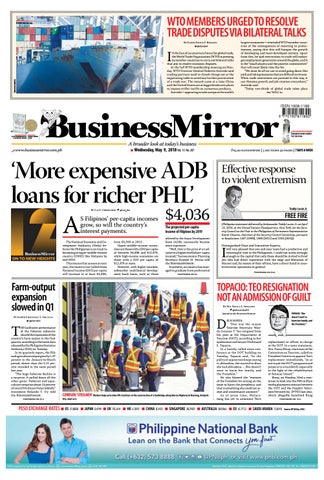
‘More expensive ADB loans for richer PHL’ $4,036 A By Cai U. Ordinario
The National Economic and Development Authority (Neda) believes the Philippines is on track to becoming an upper-middle-income country (UMIC) like Malaysia by end-2019. This means that as soon as next year, the country’s so-called Gross National Income (GNI) per capita will increase to at least $4,036,
from $3,550 in 2015. Upper-middle-income economies are those with a GNI per capita of between $4,036 and $12,475, while high-income economies are those with a GNI per capita of $12,476 or more. However, with higher incomes, submarket multilateral development bank loans, such as those
The projected per-capita income of Filipinos by 2019
offered by the Asian Development Bank (ADB), necessarily become more expensive. “Well, that is the price of an advance to a higher level [of per-capita income],” Socioeconomic Planning Secretary Ernesto M. Pernia told the BusinessMirror. At present, no country has managed to graduate from preferential
business news source of the year
P25.00 nationwide | 5 sections 30 pages | 7 days a week
Effective response to violent extremism Teddy Locsin Jr.
free fire (Philippine statement delivered by Ambassador Teddy Locsin Jr. on April 13, 2018, at the United Nations Headquarters, New York, for the Security Council on the Visit to the Philippines of Permanent Representative Kairat Umarov, chairman of the Security Council Committee, pursuant to Resolutions 1267 [1999], 1989 [2011] and 2253 [2015]). Distinguished Chair and Committee Experts, am very pleased that you and your team had a productive and meaningful visit to the Philippines. I could not stress strongly enough to the capital that only those should be invited to brief you who had direct experience with the siege and liberation of Marawi and, by reason of their offices, have a direct hand in counterterrorist operations in general.
I
Continued on A10
Continued on A2
TOPACIO: TEO RESIGNATION NOT AN ADMISSION OF GUILT
Farm-output expansion slowed in Q1
By Ma. Stella F. Arnaldo
@akosistellaBM Special to the BusinessMirror
By Jasper Emmanuel Y. Arcalas
Topacio: “She doesn’t want to harm her family, and the President.”
D
@jearcalas
he lackluster performance of the fisheries subsector slowed the expansion of the country’s farm output in the first quarter, according to the latest data released by the Philippine Statistics Authority (PSA) on Tuesday. In its quarterly report, the PSA said agriculture output grew by 1.47 percent in the January-to-March period, slower than the 5.21 percent recorded in the same period last year. “The huge fisheries decline is a surprise. It pulled down all the other gains. Fisheries and aquaculture comprise about 15 percent of total GVA (Gross Value Added),” economist Rolando T. Dy told the BusinessMirror.
2016 ejap journalism awards
@cuo_bm
s Filipinos’ per-capita incomes grow, so will the country’s interest payments.
Continued on A12
See “WTO,” A2
BusinessMirror
www.businessmirror.com.ph
T
largest economies—reminded WTO member-countries of the consequences of resorting to protectionism, saying that this will hamper the growth of developing and least-developed nations. Apart from this, he said restrictions to trade will endanger employment generation around the globe, and it is the “small players and the poorest communities” that will most likely take the hit. “We must do all we can to avoid going down this path and taking measures that are difficult to reverse. When trade restrictions are pursued in this way, it can threaten growth and job creation everywhere,” Azevedo said. “Today two-thirds of global trade takes place
curbside ‘steelmen’ Workers help each other lift steel bars at the construction of a footbridge along Marcos Highway in Masinag, Antipolo City. NONOY LACZA
PESO exchange rates n US 51.8050
ELICADEZA. That was the reason Tourism Secretary Wanda Corazon T. Teo resigned from her post at the Department of Tourism (DOT), according to her spokesman and lawyer Ferdinand S. Topacio. In a hastily called news conference at the DOT building on Tuesday, Topacio said, “As the political opposition keeps saying it, delicadeza, she wanted to show she had delicadeza…. She doesn’t want to harm her family, and the President.” He also blamed the “enemies of the President for seizing on the issue to harm the presidency, and that is something she could not accept and countenance anymore.” A s of press t ime, Ma l acañang has yet to announce Teo’s
replacement or officer in charge at the DOT. In a news statement, Sen. Nancy Binay, chairman of the Committee on Tourism, called on President Duterte to appoint Teo’s replacement immediately, “so as not to put the DOT’s programs and projects to a standstill, especially in the light of the rehabilitation of Boracay Island.” Binay, on Monday, filed a resolution to look into the P60-million media placement contract between the DOT and the People’s Television Network Inc. (PTNI) last year, which allegedly benefited Bitag Continued on A12
n japan 0.4749 n UK 70.2424 n HK 6.5997 n CHINA 8.1433 n singapore 38.7907 n australia 38.9366 n EU 61.7723 n SAUDI arabia 13.8143
Source: BSP (8 May 2018 )
BMReports BusinessMirror
A2 Wednesday, May 9, 2018
www.businessmirror.com.ph
‘More expensive ADB loans for richer PHL’ Continued from A1
ADB loan assistance despite the presence of large economies among the lender’s developing membercountries (DMCs). However, there are countries that are classified as having grant-only, concessional and market-based lending. This classification is based on the per-capita income, economic situation and debt-repayment capacity of borrowing member-states, among others. These are carefully calibrated such that as DMCs boost
their economic prowess, the interest payments they make for loans also necessarily increase. ADB President Takehiko Nakao said this was not meant to increase the Manila-based multilateral development bank’s income but crafted in the interest of fairness. However, Nakao said some ADB governors “supported an idea of applying differentiated pricing in our regular OCR lending to address the diverse situations of countries.” “I suppose we can ask [for concessions] through negotiation [by]
WTO. . .
Continued from A1
through global value chains, and this clearly illustrates the potential for knock-on effects. And in these situations, it is often the smaller players and the poorest communities that stand to lose the most,” he added. Azevedo may be right after all. US President Donald J. Trump’s enforcement of higher levies on steel (25 percent) and aluminum (10 percent) is seen to impact global trade, as the US is the world’s largest steel importer. In 2016 Washington accounted for about 8 percent of steel imported globally. The volume it imported was at least 15 percent higher than that of Germany and South Korea, second- and third-largest steel importers, respectively. As a retaliation, China’s Ministry of Commerce announced in April the country’s plan to slap heavier duties on 106 US products amounting to about $50 billion annually. Beijing also filed a case at the WTO against Washington for the higher tariffs on steel, claiming it violated the General Agree-
being the host country [for this year’s meeting],” Pernia said. ADB said the Philippines and Indonesia’s access to grants have been “restricted to projects directed at poverty reduction, the primary social sector and protection of the environment.” Based on documents from the National Economic and Development Authority, as of the last quarter of 2017, the country’s engagement with ADB for project loans are based on six-month London interbank offered rate, the same
ment on Tariffs and Trade of 1994 and the Agreement on Safeguards. This is why the WTO chief believes “resolving the issues is in everyone’s urgent interest.” He said the most crucial task at the moment is for the member-countries at conflict to talk it over and find a middle ground that will not hamper global trade. “I also encourage members to continue pursuing their bilateral contacts, to complement multilateral processes. The important thing is that conversations are taking place, and that members are trying to find solutions,” Azevedo said. The WTO’s Safeguards Committee and the Council on Trade in Goods are currently looking at the validity of Trump’s imposition of higher tariffs on steel, according to Azevedo. On the other hand, the Dispute Settlement Body is hearing China’s complaint against the US. “The system was built to resolve these problems in a way that prevents further escalation, and so it is right that members are using it. I believe that the WTO has a crucial role to play here, as we have done many times before,” Azevedo added.
for nonsovereign operations for Philippine-based firms. The use of the six-month Libor rate also applies on stand-alone policybased loans and subprogram loans under the programmatic approach; Special Policy-Based Lending; and Counterc yc l ica l Suppor t Facility Lending. Project loans have a maturity period usually up to 30 years, including a grace period, subject to an average loan-maturity limit of 19 years. For the grace period, this usually lasts five years and depends
on the time needed for projects to become operational. The term or maturity is, however, shorter for stand-alone policybased loans and subprogram loans under the programmatic approach at 15 years, including the grace period; for Special Policy-Based Lending, five- to eight-year maturity including the grace period; and Countercyclical Support Facility Lending, five- to eight-year maturity, including the grace period. Nakao, however, assured the ADB governors the multilateral
will develop “concrete proposals” for differentiated pricing and longterm lending, especially now that the Asian Development Fund (ADF) and the OCR have already merged. The ADF was initially the source of concessional lending to poor DMCs while the OCR represented the bank’s concessional and market-based lending operations. In 2015 the ADB announced the merger of the ADF and the OCR to boost the bank’s capital resources. The merger became effective in January 2017.
Topacio: Teo resignation not an admission of guilt said the Office of the President’s “investigation will continue and recommend what will happen to the other government officials” involved in the transaction. He said he didn’t know if Executive Secretary Salvador C. Medialdea has given his recommendation to the President.” Roque earlier said all documents relevant to the deal were already with Medialdea. As far as the “criminal liability” of Teo and other government officials are concerned, Roque said Malacañang will be “leaving it to the Ombudsman to investigate.” Communications Secretary Martin M. Andanar, who oversees PTNI, was said to be one of the officials included in the OP investigation. Topacio has said Bitag would be returning the P60 million paid to the company by PTV-4 for said media placement by the DOT. He later called it “a class act,” on the part of
Ben Tulfo, who heads Bitag, to return the funds. The lawyer also claimed that Teo would not have approved the DOT contract with PTNI if she knew the ads would be placed in her brothers’ show, Kilos Pronto. In a news statement released at 12:35 p.m. on Tuesday, Topacio said Teo tendered her resignation from the DOT “before the start of the latest Cabinet meeting in Malacañan Palace.” He added Teo’s “decision to leave her position was made after a long and deliberate reflection and soul-searching with respect to the events that have transpired the past few weeks.” She hand-carried her resignation letter to Medialdea on Monday afternoon. Topacio said he could not divulge the conversation between Teo and Duterte, except that “I think, to the effect that, the President trusted her to do what is right.”
Continued from a12
In a speech last Friday in Davao City before a gathering of educators, Duterte said, “If you are into corruption, just leave. I’ll give you time. For those who are into it now, in the government, published or otherwise, may you have the sense just to tender the resignation.” Topacio, stressed however, that Teo’s resignation was not an admission of guilt. “Secretary Teo reiterates that she has done no wrongdoing, and that all the dealings of the DOT went through all legal processes, were aboveboard and done in good faith, and with total absence of malice.” He also said Teo welcomed the Malacañang’s investigation into the transaction and also vowed to attend any congressional investigation. He added, Teo will likely return to her travel agency in Davao City, which she had been operating before she was appointed as tourism secretary.
Economy BusinessMirror
A4 Wednesday, May 9, 2018 • Editors: Vittorio V. Vitug and Max V. de Leon
www.businessmirror.com.ph
Expert urges govt to halt ‘pricey’ CCT expansion
T
By Cai U. Ordinario
@cuo_bm
he national government should consider slowing down the implementation of the Pantawid Pamilyang Pilipino Program (4Ps) to plug leakages, according to a poverty expert.
In a news statement on Tuesday by the Philippine Institute for Development Studies (PIDS), Nanak Kakwani, poverty expert from the
University of New South Wales, urged the government to fine-tune the targeting mechanisms for the 4Ps before expanding the program.
“You have to slow down the program because you are still learning,” Kakwani added, citing the country’s “rather fast” attempt to replicate Bolsa Familia, Brazil’s social-welfare program. Kakwani also urged the government to revisit the program’s implementation cost, claiming it has gone higher than the Bolsa Familia program. PIDS said this was not the first time the government was advised to revisit the 4Ps. PIDS President Celia Reyes also urged the government to deepen, rather than expand, the coverage of 4Ps, after learning it was suffering from a 29-percent leakage rate in 2015.
This means roughly three in every 10 of its beneficiaries are not poor, and do not even deserve to be part of the program. In a report, the Commission on Audit (COA) also prodded the government to suspend the expansion of its flagship povertyalleviation program until the leakages are plugged. Despite these recommendations, 4Ps still saw rapid expansion under the Aquino administration in its attempt to boost the “mass registration” of the program, according to the COA. A World Bank report also revealed that even the Duterte administration continued expanding the
program to benefit about 20 percent of the population. In her study, Reyes also noted the “significant share” of the 4Ps’s administration cost, amounting to as much as P4 billion in 2011. Such an amount can already support 266,667 families with three eligible children for one year, according to the PIDS official. On a monthly basis, the World Bank said the country’s 4Ps extends $66 in purchasing power parity (PPP) terms per beneficiary. This is more than Malaysia and Indonesia’s flagship conditional-cash transfer (CCT) offers at $48 and $44 per beneficiary. However, in Southeast Asia, the country with the highest CCT benefit
Lawmaker to probe DOT’s media and advertising plan By Ma. Stella F. Arnaldo Special to the BusinessMirror
A
LAWMAKER will be looking into the Department of Tourism’s (DOT) advertising spending and media plan, in the wake of its reported P60-million media placement contract with PTV-4 Network Inc. (PTNI), which allegedly benefited the production company owned by the siblings of former Tourism Secretary Wanda Corazon T. Teo. In a news statement, Sen. Nancy S. Binay, chairman of the Committee on Tourism, said: “Perhaps, we should find how the DOT rationalizes its local advertising placements and if they are congruent with strategic marketing and media plans of the department.” Binay has filed a resolution to investigate the matter. According to the lawmaker, advertising strategies are crafted addressing a preconstituted audience to attracting new customers. “We also need to know if there are measurable results to the local placements made by the DOT and how are these different from the placements of the Tourism Promotions Board,” she added. The TPB is the marketing arm of the DOT. As this developed, over 3,400 individuals showed their support to beleaguered former Tourism Secretary Ramon R. Jimenez Jr. after a case was filed against him by the National Bureau of Investigation over the highly successful “It’s More Fun in the Philippines” brand campaign the Philippine government launched in 2012. The Facebook page “We support Mon J.” was established over the weekend, with a handful of participants, but quickly gained traction as word spread of its existence. Many of its page members are well-known advertising professionals, as well as tourism-industry stalwarts who have taken turns posting their experiences having worked with Jimenez or just sharing good thoughts and their well wishes. The members also include former and current officials and employees of the DOT. In a text message to the BusinessMirror, Jimenez said: “I am so
CEZA crypto mining
humbled by the trust and support. The truth has always been our strength— no matter how difficult it may be to defend sometimes.” Of the NBI charges, he said: “The complaint against me and others is ironic because it centers on a media planning and buying reform program that would have prevented the PTV-4 controversy in the first place. Those who charged us didn’t bother to read the focus of their own complaint.” He was earlier quoted as saying that he believed these NBI charges were brought against him and other DOT colleagues, to deflect the issue on the P60-million contract between Teo’s DOT and PTNI. Previously open to the public, the page became a closed group last Sunday night, in keeping with the wishes of Jimenez to keep the focus on issues. According to web site administrator Margot Torres: “We are respecting Mon J’s wishes not to draw attention to him and distract people from the real issue. That is why we closed this group.” Unknown to many, Jimenez was being recruited by the Duterte administration to remain in his post as DOT secretary, and continue his successful “It’s More Fun” brand campaign. Jimenez turned down the offer, however, ostensibly due to his promise to his late wife Abby Lee, also a well-known advertising executive, to not join the government anymore. Duterte economic adviser Carlos G. Dominguez III, who had yet to be appointed as finance secretary then, confirmed this. (See, “Duterte wants Tetangco back on the economic team,” in the BusinessMirror, May 13, 2016.) In its report posted online on April 27, the Commission on Audit detailed that the state-run television network made the following payments last year to Bitag: P22,089,560 on May 11; P18.96 million on November 8; and P18.96 million on December 15. There were reports that the deal to air the DOT’s TV commercials over PTV-4 lacked a memorandum of agreement, certificate of performance, duly approved budget-utilization request and billing statements.
Secretary Raul L. Lambino (second from left), administrator and CEO of the Cagayan Economic Zone Authority (Ceza), and Lin Yong Wei (left), Chairman of the Changwei International Co. Ltd., display copies of the memorandum of agreement they have just signed in Manila on Tuesday for the Hong Kong-based firm to establish an offshore crypto exchange platform and develop an initial coin offering and other crypto mining operations at the Cagayan Special Economic Zone and Freeport. With them are Zhuang Ming Gang (third from left), chairman of the Xin Peng Group, and Ceza Senior Deputy Administrator Raymundo T. Roquero. JOSEPH MUEGO
was Cambodia with $141 per recipient per month in PPP terms. The country that extends the highest CCT benefit per month is Argentina at $468 in PPP terms, while Zambia’s flagship CCT offers zero in PPP terms. The World Bank said the 4Ps has the largest coverage of the poor population among CCTs outside of Latin America and the Caribbean. While the average CCT coverage of the poor was only 40 percent, the 4Ps covers 60 percent of the poor in the Philippines. Globally, the World Bank said 2.5 billion people are covered by a social safety net, of which 650 million are in the poorest 20 percent.
briefs duterte taps mamao as special envoy to kuwait Malacañang has announced on Tuesday that President Duterte will appoint Presidential Adviser on Overseas Filipino Workers Abdullah Mamao as special envoy to Kuwait. Presidential Spokesman Harry L. Roque Jr. said Mamao was ordered by Duterte to fly to Kuwait as soon as possible to ensure that Filipinos in the tiny Gulf state would be repatriated. Roque also announced in a briefing that Mamao had just returned from Kuwait bearing “good news” for the President, which Roque withheld until “actual realization.” Bernadette D. Nicolas
b.i. deploys ‘green horn’ ios AT NAIA TERMINAL 1, 2
Bobbleheads
A vendor finds a nook to sell his collectible set of bobbleheads at the parking lot of the Valenzuela City Astrodome over the weekend priced between P200 to P500. President Duterte and Special Assistant to the President Bong Go are among the more prominent bobblehead figures on the shelf. NONOY LACZA
DAR gears up for CARP extension under Duterte By Jonathan L. Mayuga @jonlmayuga
A
S it gears up to implement another phase of agrarian reform under the Duterte administration, the Department of Agrarian Reform (DAR) will embark on a campaign to rid the agency of erring personnel involved in graft and corruption. DAR Undersecretary for Policy, Planning and Research David Erro said Agrarian Reform Secretary John Castriciones is bent on “curing the ills” of government service as head of the DAR, by going after erring personnel before the agency implements another phase of agrarian reform beyond what was covered by Republic Act 6657, which gave birth to the Comprehensive Agrarian Reform Program (CARP) and RA 9007, or the Comprehensive Agrarian Reform Program Extension with Reforms. At a news conference in Quezon City on Tuesday, Erro said Castriciones made a promise to President Duterte during the distribution of certificate of land ownership awards (CLOAs) to farmers in Malanay, Quezon, that he will rid the agency of corrupt officials and employees to ensure that a corruption-free agency will be managing the agrarian-reform program. This is in response to Duterte’s remarks that, while the government has the funds to implement agrarian reform, he is having second thoughts because of the prevailing practice of graft and corruption. In response, the DAR chief vowed to launch a campaign for a “graftfree DAR.” In a separate news statement distributed to reporters during the media conference, Castriciones vowed, “There will be no sacred cow in this campaign.” Castriciones quoted Duterte as
saying, “I want to resume land reform because it is really needed.” The President even emphasized the possibility of converting idle and forestlands into productive agricultural areas for Filipino farmers, many of whom remain landless despite decades of agrarian-reform implementation. The President also wants mountains to be planted with coconut or rubber, Castriciones said. To successf u l ly implement agrarian reform, however, Castriciones noted that Duterte wants him to get rid of corrupt officials and employees first. Castriciones noted that some DAR officials had been linked to various multimillion-peso scams before. Among these controversial cases is the P200-million agribusiness program in 2007 and 2008; the P900-million Malampaya Fund for the rehabilitation of farmers devastated by typhoons in 2009; and the P230-million budget insertion in 2010 involving fake non-government organizations. Among those charged with violation of the Anti-Graft and Corrupt Practices Act before the Sandiganbayan were then-DAR Secretary Nasser Pangandaman, Undersecretary Narciso Nieto, Finance Director Teresita Panlilio, Budget Officer Ronald Venancio and Chief Accountant Angelita Cacananta. To get rid of grafters in the DAR, Erro said, Castriciones had sought the help of Presidential Anti-Corruption Commission chief Greco Belgica, who received case folders involving 800 DAR personnel accused of various complaints. These cases involve personnel from the rank-and-file up to director level, including involvement in identifying “fake beneficiaries,” ghost projects in Eastern Samar, and some failures to ensure just compensation to landowners whose lands were ac-
quired for distribution. At the same news conference, Belgica said their job is to complete the staff work on the cases and submit a recommendation to the Office of the President for appropriate action. The agrarian-reform program, according to Erro, can be called by any other name, but it will be implemented and will cover areas that were not covered by the previous agrarianreform programs, including Presidential Decree 27, which covered only rice and corn farms, CARP and CARPer. Initially, he said, the agrarianreform program under the Duterte administration will cover government-owned lands through a draft executive order (EO), which will be submitted to Malacañang for approval within the week. “We already have a draft EO and, of course, it will be submitted to Malacañang for approval,” he said. The DAR will push for the enactment of a law through the committee on agrarian reform in the House of Representatives seeking to cover private agricultural lands, thereby benefiting more landless Filipino farmers. According to Erro, the DAR will conduct an inventory of both government and private lands that can be distributed to landless farmers, which will be on top of the 561,000 hectares land acquisition and distribution (LAD) balance under CARP and CARPer as of 2018. At a rate of distribution of 50,000 hectares per year, the distribution of these LAD balance will hopefully be completed by 2029 or 2030. Under the Duterte administration’s agrarian-reform program, Erro said, government-owned lands will be covered, including the still-unclassified forestlands or any other government lands that can be classified or can qualify as agricultural land, and civil and military reservations.
The Bureau of Immigration (BI) dispatched 99 personnel to the Ninoy Aquino International Airport (Naia) Terminal 1 and 2 to familiarize themselves to becoming immigration officers. The BI said 70 immigration officers (IO) were dispatched to Terminal 2, while 29 other were brought to Terminal 1. “They are being trained to ease the long lines of arriving and departing passengers at the Naia, according to Assistant Commissioner and Port Operations Division Chief Red Mariñas. Passengers have complained of a slowdown in processing at immigration due to a mass leave of personnel. BI supervisors also said that the 99 personnel are mostly information technologist from the bureau. Some of them are newly hired and underwent months of training. The supervisors also said that the bureau had a hard time getting qualified personnel to become an immigration officer because of low salary, which range from P18,000 to P20,000 thousand a month. Recto Mercene
back-channel talks with communists in europe
Malacañang on Tuesday said informal back-channel talks for the resumption of peace talks are now taking place in Europe. Presidential Spokesman Harry L. Roque Jr. said in a briefing that the President was briefed on Monday night by Labor Secretary Silvestre H. Bello III to inform the Chief Executive that efforts to resume peace negotiations with Communist Party of the Philippines-New People’s Army-National Democratic Front are now underway. Also, Bello and Presidential Adviser on the Peace Process Secretary Jesus G. Dureza informed the President that his clear directives are being relayed across the table and are currently being discussed in the ongoing meetings. “Our team is now in Europe, and we are informed that there are initial positive results so far…according to Secretary Dureza,” Roque said. “The team will return home soon to personally brief the President on the outcome. Roque also quoted Bello as saying: “We are doing our best to meet the deadlines set by the President about the resumption of talks within 60 days.” Bernadette D. Nicolas
Agriculture/Commodities BusinessMirror
www.businessmirror.com.ph
17 traders keen on supplying rice to PHL
T
By Jasper Emmanuel Y. Arcalas
@jearcalas
he National Food Authority (NFA) said 17 traders are interested in selling 250,000 metric tons (MT) of rice to the agency to replenish its depleted stockpile.
As of May 8 the NFA said 17 traders have bought bid documents during its prebid conference for the open tender scheduled on May 22. “[Our open tender] is ver y competitive because we have a lot [of participants]. We do not limit [the number of participants], so the more the merrier,” NFA Deputy Administrator Judy Carol L. Dansal told reporters after the agency’s pre-bid conference. “We cannot say if we would save more [if there are more participants]. It is premature to state that but that is our objective,” Dansal added. Dansal said private traders
can supply the entire allocated lots unlike in the previous open tender wherein the awarded volume must not be higher than 50,000 MT. The NFA will allow traders to purchase bid documents until May 21, a day before the scheduled open trader. Dansal expressed confidence that the 17 interested rice traders would not back out of the May 22 tender. Of the 17 traders who bought bid documents, seven were from Vietnam and five were from Thailand. The Vietnamese traders were Vietnam Southern Food Corp. Vietnam Northern Food Corp., Hiep Loi Joint Stock Co. and Gen-
traco Corp. Phan Minh Investment Production Trading Services, Gia International Corp., and Khiem Thanh Co. Ltd. T hailand-based fir ms that bought bid documents were Thai Hua Co. Ltd., Ponglarp Co. Ltd., Asia Golden Rice, Capital Cereals Co. Ltd., and Thai Capital Crops Co. Ltd. Also interested in selling rice to the NFA were local firm Paritas Trading Corp., Singaporebased Olam International Ltd., Meskay & Femtee Trading Co. Ltd. from Pakistan and Phoenix Global DMCC from the United Arab Emirates. The NFA has allocated P6.521 billion for the purchase of 250,000 MT of rice to prop up its nearly depleted buffer stock, and in preparation of the lean months, when rice harvest goes down significantly. Of the total volume, 200,000 MT are 25 percent brokens, while the remaining 50,000 MT are 15 percent brokens. T he NFA h a s d iv ided t he 250,000 MT of rice into nine lots with the 200,000 MT to be delivered to the agency’s warehouses not later than July 31, while the remaining 50,000 MT must arrive not later than August 31.
P17-million milkfish destroyed in Bulacan fish kill By Kristen Roz Mateo Correspondent
C
ITY of Malolos—The Bureau of Fisheries and Aquatic Resources (Bfar) and the Provincial Agriculture Office of Bulacan pegged the value of milkfish wiped out by a fish kill in Obando town at P17 million. Based on the initial findings of personnel from the Bfar and the Provincial Agriculture Office, who conducted site visits, the fish kill affected 150 hectares of fishponds in Obando. As of 7 p.m. on Monday, the fish health inspection team reported that the fish kill has affected fishponds in seven of the 11 barangays in Obando—Pag-asa, Paliwas, Hulo, Lawa,
Paco, Tawiran and Salambao, affecting at least 40 fishpond operators, according to provincial agriculturist Maria Gloria Carillo. Carillo said the inspection team is still validating if fishponds in other villages were affected by the fish kill. Affected fishpond areas rose to 150 hectares as of Monday night, compared to the 100 hectares initially declared by Wilfredo Cruz, the Bfar regional director for Central Luzon. Before the fish kill occurred, Carillo said that the town of Obando was struck by a 3-magnitude earthquake at 2:15 p.m. last Saturday. By Sunday morning residents in the area noticed foul odors emanating from the fishpond areas. Carillo said
that by lunchtime, scores of milkfish had died. She added that the initials findings of the fish health inspection team showed that the fish mortalities were due to the extremely low dissolved oxygen content of the fishpond water caused by the cloudy skies and abrupt rainfall in the area. Carillo said the fish health inspection team will return to the area to further validate their initial findings. Raul Agustin of the Provincial Disaster Risk Reduction Management Office of Bulacan said fish kill is a natural occurrence whenever earthquakes occur because the water quality of the fishponds are being altered by the earth’s movement.
Illinois seeks talks on keeping Asian carp from Great Lakes
T
RAVERSE CITY, Michigan—Illinois has proposed negotiations with federal officials and other states in the Great Lakes region over fortifying a Chicago-area lock and dam to prevent Asian carp from invading Lake Michigan and threatening its native fish. Gov. Bruce Rauner said his state was willing to team with the United States Army Corps of Engineers on paying for the project but wanted changes to a $275-million draft plan the federal agency released last year. The plan, centered on the Brandon Road Lock and Dam near Jo liet, Illinois, is backed by some of the region’s eight states that consider the location a vital line of defense between the carp-infested Illinois River and Lake Michigan. But Illinois says it would bog down cargo shipping on the busy waterway, with a potential ripple effect on Chicago’s highways as more freight is moved by truck. The Army Corps proposal would install devices, such as an electric barrier, noisemakers and water jets at the Brandon Road complex to block fish swimming upstream. Under federal law, such a project requires a state or a local partner that could share costs and help with matters such as securing rights of way. In a letter to the Corps sent last Friday, Rauner said his state would fill the role of “nonfederal sponsor” and work with the agency“to review and better understand the underlying scientific justification to support a project of this size, scope and cost. The Republican governor also asked his counterparts in the other states for talks toward an agreement that “protects the Great Lakes and mitigates major deficiencies” in the Corps plan. Four types of carp imported from Asia in the 1960s are threatening to attack the lakes, where scientists say they could outcompete less aggressive species and damage a $7-billion fishing industry. Illinois says it has significantly reduced
In this June 13, 2012, file photo, Asian carp, jolted by an electric current from a research boat, jump from the Illinois River near Havana, Illinois. Illinois says it will work with federal officials and other states on a strategy for fortifying a lock and dam to keep Asian carp out of Lake Michigan. AP Photo/John Flesher, File the threat with commercial fishing of the Asian carp’s “leading edge” population in a section of the Illinois River about 50 miles southwest of Lake Michigan. It says the carp have not advanced further since 1990. But neighboring states and Great Lakes advocacy groups aren’t convinced. One of the feared invaders was found last summer in Chicago’s Little Calumet River just 9 miles from the lake. Tests showed the silver carp had gotten through or around three electric fish barriers. “While our efforts to keep Asian carp from Lake Michigan have proven effective, many have suggested we need to do more,” Illinois Lt. Gov. Evelyn Sanguinetti said. “If the Corps can address our economic, transportation, environmental and cost concerns in partnership with Illinois, we have no problem working with other states to enhance our efforts at the Bran-
don Road Lock and Dam.” Michigan Gov. Rick Snyder proposed an interstate partnership in January to help cover costs of operating and maintaining the proposed Brandon Road fish-blocking systems. Ohio, Wisconsin, the Canadian province of Ontario and the city of Chicago signed on. But the Army Corps told Snyder last Friday the coalition couldn’t qualify as the legally required nonfederal sponsor without Illinois’s participation. Snyder considers Illinois’s offer to take part “an important step forward,” spokesman Jordan Kennedy said. “We all have the same objective, which is to protect the Great Lakes,” she said. The Alliance for the Great Lakes, a Chicago-based environmental group, urged the other states to resist weakening the Army Corps plan.
Editor: Jennifer A. Ng • Wednesday, May 9, 2018
A5
Biggest solar-powered irrigation system unveiled in Nueva Ecija
T
he first and big gest solar-powered water irrigation system in Luzon was inaugurated over the weekend in Llanera, Nueva Ecija. The project for the uplift of farmers held under the auspices of the Department of Agriculture (DA) was unveiled in barangays Caridad Norte and Caridad Sur. It was meant to enhance and help sustain rice production in the highland areas of the most ly rain-dependent Llanera town. Immediately benefiting almost 200 happily smiling farmers, the pioneering project was under the supervision of Roy M. Abaya, the DA’s executive director of the Regional Field Office 3, in tandem with Crispulo G. Bautista Jr., the DA-RFO 3 assistant regional director for operations. It was constructed and installed by Bacolod City-based R.U. Foundry and Machine Shop Corporation (RUFMSC), also known as the famous maker of, among others, shredders known for use in organic farming and wastes management. The Llanera solar facility is composed of 140 Lorentz solar panels on a 40-HP submersible pump, attached to st ate - of -t he -a r t e lec t ron ic control devices and equipped w ith a highly reliable f low meter gauge, concrete storage tank and massive irrigationdistribution pipelines.
The photovoltaic (PV) panels were installed via precisionengineered aluminum frames to withstand extreme weather conditions standing on heavyduty concrete posts. The breakthrough P7-million project can irrigate from 50 to 70 hectares on a constant supply of water for the rice lands in Caridad Norte and Caridad Sur, which formerly depended mainly on rainwater for sustenance. With this new solar-powered facility, productivity will now be tremendously boosted to the delight of farmers long suffering from lack of water to sustain constant farm productivity. A company long dedicated to uplift farmers’ station in life, the RUFMSC, through its Chairman Ramon Uy Sr., injected a highly advanced technology to the solar-water project at no extra cost to the government. Long driven by his desire to make Filipino farmers at equal footing with their counterparts in the region, Uy has not stopped inventing technology to advance his cause. He used to be mainly involved in organic farming for environmental preservation, prodding farmers to go back to the basics by forming cooperatives in his native Bacolod. “Without our farmers, where will we be?” Uy said. “If we do not help improve the lives of our farmers, we have no business talking about rice sufficiency at
all. The survival of the farmers is our very own survival.” Farming is still very much backward in the Philippines that most farmlands remain unirrigated, forcing farmers to depend largely on rainwater. Some can afford to use diesel-powered pumps for water sourcing, but increasing prices of fuel raise production costs unabated—ultimately leading to decreased dividends. Unregulated motorized intrusion on soil also affects the environment in the long run. But worldwide trends consistently indicate that renewable energies, particularly the solar-power technology, are i nc rea si ng ly becom i ng t he normal and logical solution for sustained farm productivity in the countryside. In the eyes of DA officials Abaya and Bautista, who were very much impressed with Uy’s breakthrough new solar system in Nueva Ecija, the pilot project could be a wake-up call for like-minded government officials to hopefully “redirect their focus” on how to alleviate the woeful condition of Filipino farmers for the longest time. A man of action, Uy completed the solar-water facility on time, commending RUFMSC’s project engineers Fred Lista and Marvin Gonzaga from the Ecological and Agricultural Development Foundation Inc. “for a job well done.”
The World BusinessMirror
A6 Wednesday, March 9, 2018 • Editor: Lyn Resurreccion
www.businessmirror.com.ph
Iran president warns of ‘problems’ as Trump word on nuke deal looms
T
EHRAN, Iran—Iran’s president on Tuesday warned the country could face “some problems” ahead of President Donald J. Trump’s decision on whether to pull out of its nuclear deal with world powers. Without directly naming Trump, President Hassan Rouhani’s remarks at a petroleum conference in Tehran represented the first official Iranian comment on the United States president’s overnight tweet that he’d make an announcement on the deal on Tuesday. “It is possible that we will face some problems for two or three months, but we will pass through this,” Rouhani said. He also said Iran wants to keep “working with the world and constructive engagement with the world.” That appeared to be a nod to Europe, which has struck a series of business deals with Iran since the landmark 2015 nuclear deal. Trump’s tweet came late on Monday night, meaning major newspapers across Iran missed the announcement for their front pages. Iran’s state-run television broadcaster carried the announcement at 10 a.m. local time, and Iran’s staterun Irna news agency also carried a report on it. Overnight, Iran’s semiofficial news agencies carried the news off Trump’s tweet, while others shared foreign media reports online. Trump’s announcement, set for the 2 p.m. EST at the White House, will come after nightfall in Iran. In a burst of last-minute diplomacy, punctuated by a visit by Britain’s top diplomat, the deal’s European members gave in to many of Trump’s demands, according to officials, diplomats and others briefed on the negotiations. Yet they still left convinced he is likely to reimpose sanctions and walk away from the deal he has lambasted since his days as a presidential candidate. As they braced for an expected withdrawal on Tuesday, US officials
were dusting off plans for how to sell a pullout to the public and explain its complex ramifications to the global financial world, said the officials and others, who weren’t authorized to speak ahead of an announcement and requested anonymity. Building up anticipation for the big reveal, Trump announced on Twitter he would disclose his decision at 2 p.m., with an announcement set for the Diplomatic Room of the White House. With uncharacteristic discipline, he kept the decision confined to a small group within the White House National Security Council, leaving even many of his aides guessing what he had decided. An immense web of sanctions, written agreements and staggered deadlines make up the 2015 nuclear deal struck by the US, Iran and world powers. So Trump effectively has several pathways to pull the United States out of the deal by reneging on its commitments. Under the most likely scenario, Trump will allow sanctions on Iran’s central bank—intended to target its oil exports—to kick back in, rather than waiving them once again on Saturday, the next deadline for renewal, said the individuals briefed on Trump’s deliberations. Then the Trump administration would give those who are doing business with Iran a six-month grace period to wind down business and avoid running afoul of those sanctions. Depending on how Trump sells it—either as an irreversible US pullout, or one final chance to save it— the deal could ostensibly be strengthened during those six months in a last-ditch effort to persuade Trump to change his mind. The first 15 months of Trump’s presidency have been filled with
Trump considers benching Giuliani from TV interviews
N
EW YORK—President Donald J. Trump is growing increasingly irritated with lawyer Rudy Giuliani’s frequently off-message media blitz, which has included muddying the waters on hush money paid to porn actress Stormy Daniels and making claims that could complicate the president’s standing in the special counsel’s Russia probe. Trump has begun questioning whether Giuliani, an old friend and former New York City mayor, should be sidelined from television interviews, according to two people familiar with the president’s thinking but not authorized to speak publicly about private discussions. Trump also expressed annoyance that Giuliani’s theatrics have breathed new life into the Daniels story. It’s a concern shared by Trump allies who think Giuliani is only generating more legal and political trouble for the White House. Giuliani, the newest addition to the president’s legal team, first rattled the White House last week when he sat for interviews on Fox News and seemed to contradict Trump by saying the president was aware of the $130,000 payout to Daniels from his personal attorney, Michael Cohen. He also suggested the October 2016 settlement had been made because
Trump was in the stretch run of his presidential campaign. After Trump chided Giuliani last Friday, saying the lawyer needed to “get his facts straight,” Giuliani put out a statement trying to clarify his remarks. But in weekend interviews, Giuliani appeared to dig himself a deeper hole by acknowledging that “Cohen takes care of situations like this, then gets paid for them sometimes.” He did not rule out the possibility that Cohen had paid off other women. Trump, who has denied the affair with Daniels, was angry that Giuliani had given the impression that other women may have made similar charges of infidelity, according to the people familiar with his views. Additionally, Trump has grown agitated in recent days by replays of Giuliani’s interview with Sean Hannity, in which he said that Trump knew about the payment but that it wasn’t a campaign violation. A clearly surprised Hannity then asked, “Because they funneled it through the law firm?” To which Giuliani responded, “Funneled it through the law firm, and the president repaid him.” Trump snapped at both men in recent days, chiding Hannity for using the word “funneled,” which he believes had illegal connotations, according to the people who spoke to The Associated Press. AP
President Hassan Rouhani speaks in a meeting with officials in the northeastern city of Mashhad on May 7. Rouhani says Iran would be willing not to abandon the nuclear deal even if the United States pulls out, providing the European Union offers guarantees that Iran would keep benefiting from the accord. Iranian Presidency Office via AP
many such “last chances” for the Iran deal in which he’s punted the decision for another few months, and then another. Other US sanctions don’t require a decision until later, including those on specific Iranian businesses, sectors and individuals that will snap back into place in July unless Trump signs another waiver. A move on Tuesday to restore those penalties ahead of the deadline would be the most aggressive move Trump could take to close the door to staying in the deal. Even Trump’s secretary of state and the United Nation agency that monitors nuclear compliance agree that Iran, so far, has lived up to its side of the deal. But the deal’s critics, such as Israel, the Gulf Arab states and many Republicans, say it’s a giveaway to Tehran that ultimately paves the path to a nuclear-armed Iran several years in the future. Iran, for its part, has been coy in predicting its response to a Trump withdrawal. For weeks, Iran’s foreign minister had been saying that a
reimposition of US sanctions would render the deal null and void, leaving Tehran little choice but to abandon it as well. But on Monday Rouhani said Iran could stick with it if the European Union (EU), whose economies do far more business with Iran than the United States, offers guarantees that Iran would keep benefiting. It is far from clear that Europe can credibly provide that assurance. Even with the deal in place, Iran complained constantly that European banks and businesses were staying away out of fear they’d be punished by the US. The global financial system is so interconnected and so dependent on New York that it’s nearly impossible to conduct business that doesn’t
touch the US financial system. That gives Trump incredible leverage if he threatens that anyone doing business with Iran will be cut off from the United States. For the Europeans, a Trump withdrawal would also constitute dispiriting proof that trying to appease the mercurial American president is an exercise for naught. The three EU members of the deal—Britain, France and Germany—were insistent from the start that the deal could not be reopened. After all, it was the US that brokered the agreement in 2015 and rallied the world behind it. But all that was under President Barack Obama, whose global legacy Trump has worked to chip away at since taking office. AP
It is possible that we will face some problems for two or three months, but we will pass through this.” —Rouhani
Hezbollah-led alliance emerges most powerful from Lebanon vote
I
ran-backed Hezbollah and its allies looked set to emerge as the most powerful alliance in Lebanon’s next parliament, underscoring Tehran’s widening regional clout and the growing risk of a direct clash with Israel. Early results from last Sunday’s elections show the alliance led by the Shiite Hezbollah, a political group and armed movement, becoming the largest, with an estimated 56 of parliament’s 128 seats, according to local media. The main loser was the party of Saudi Arabia-backed caretaker Prime Minister Saad Hariri, which lost a third of its parliamentary seats. The win has geopolitical implications because of concern in the United States, Israel and Saudi Arabia about Iran’s growing influence in the Middle East. If an escalating showdown between Israel and Iran over Tehran’s entrenchment in Syria evolves into a direct clash, Hezbollah is likely to be drawn in. “In any war with Israel, Hezbollah now is sure it controls state institutions, whether it is the government or the parliament,” said Sami Nader, head of the Levant Institute for Strategic Studies. “Not a single law can pass without its vetting.”
Syrian control
In addition, Syrian President Bashar al-Assad, who’s winning the sevenyear war in Syria, “will exercise control over Lebanon through Hezbollah,” Nader added. Both Iran and Hezbollah have forces in Syria backing Assad. Syria occupied Lebanon from 1976 to 2005, though it continued to exert influence after its withdrawal. Hezbollah’s chief, Hassan Nasrallah, struck a conciliatory tone after the preliminary election results came in, urging factions to work together to address the country’s problems, and asked his supporters not to gloat. “The prevailing spirit should be a collaborative one, despite the strategic differences we have,” Nasrallah said in a televised speech.
Critical juncture
The elections come at a critical point for the world’s third-most indebted country as it begins to implement reforms to control its ballooning debt, now at 150 percent of GDP. With the economy battered by sectarian conflict and the influx of 1.5 million refugees from the Syrian civil war, the incoming government will have to adopt structural and fiscal reforms to secure $11 billion pledged at a
donors’ conference in April. Hezbollah had been expected to benefit from the collapse of Hariri’s coalition and new electoral laws. Hariri’s Future Movement won 21 seats, the prime minister said at a news conference, down from its current 33, though he remains head of the largest Sunni bloc. Voter turnout was estimated at 49.2 percent. Final results are expected later Monday. Hezbollah, which was founded after the Israeli invasion of Lebanon in 1982 and is classified as a terrorist organization by the US, has faced off with Israel across the decades, including in a monthlong war in 2006.
Israeli warning
Naftali Bennett, a member of Israel’s Security Cabinet, said on Twitter that the Lebanese elections results “reinforce what has been our approach for a while: Hezbollah=Lebanon.” “The State of Israel will not differentiate between the sovereign State of Lebanon and Hezbollah, and will view Lebanon as responsible for any action from within its territory,” he wrote on Twitter. Hariri retorted: “Israel is looking for any excuse to pounce on us.” Bloomberg News
Indonesia’s prexy election may have only 1 candidate
I
ndonesian President Joko Widodo may find himself without a challenger in the next election. While Prabowo Subianto—leader of the main opposition party and runner up in the 2014 election—has accepted his party’s endorsement, it’s uncertain if he can assemble a viable coalition to be nominated by an August deadline. Widodo is leading in opinion polls and wooing the former general, who’s seen as his only real competition. The lack of a credible contender in next year’s election would raise questions over Indonesia’s young democracy, as well as Widodo’s commitment to reforms. He has recently faced criticism for distorting market mechanisms, risking a higher budget deficit and jeopardizing much-needed foreign investment in Southeast Asia’s biggest economy. “If Prabowo doesn’t run, either because he can’t secure the necessary support from other parties or because he makes an improbable alliance with the Jokowi camp, it would increase the likelihood of a one-horse race come April 2019,” said Hugo Brennan, a Jakarta-based senior Asia analyst at Verisk Maplecroft. “Such a scenario would be a setback for Indonesia’s still-young democracy.” Presidential Spokesman Johan Budi did not immediately respond to a request for comment.
Economic nationalism
Earlier in his term, Jokowi undertook reforms that won him praise and secured Indonesia its all-important sovereign ratings upgrades—paving the way for billions more in foreign investment. In recent months, however, his government has intervened with price controls on staple foods and placed caps on coal-input prices for electricity generation. The distortions risk widening the budget deficit, said Peter Mumford, Southeast Asia director at Eurasia Group. “The bigger risk for investors is the general intensification of economic nationalism,” Mumford said. “His government is also planning protectionist measures on commodity shipping and insurance, which could further squeeze the role of foreign firms in the sector.” Added to this, Indonesia’s economy expanded at a slower pace last quarter than economists had forecast and remains well short of the 7-percent growth targeted by Jokowi. With the currency under pressure, it raises the possibility of an interest-rate hike at a time when the president least needs it—as the election campaign begins in earnest.
Party mix
A party or coalition must have at least 20 percent of seats in parliament or have won a minimum 25 percent of the popular vote in the last legislative election to nominate a candidate. Jokowi has secured the support of five of the 10 parties in parliament, leaving Prabowo’s Gerindra—with 13 percent of the seats—to secure support from the few parties left in order to get across the line. The Prosperous Justice Party (7.1 percent) and National Mandate Party (7.6 percent) are the most likely partners for Gerindra. But neither has declared their hand and could even support Jokowi, who already has the backing of political heavyweights Golkar and his Indonesian Democratic Party of Struggle. The National Mandate Party, known as PAN, remains undecided on a presidential nominee, according to its secretary-general, Eddy Soeparno. Still, he said a scenario in which Jokowi and Prabowo teamed up wouldn’t be good for the country. “In the interest of maintaining a growing democracy, I think we should have a few candidates participating in the 2019 election,” Soeparno said in an interview in Jakarta on Monday. It’s unlikely the two will run on a combined ticket, he said, but if they do, “I don’t think anyone would have the courage to challenge that combination.” Jokowi has a commanding lead in the polls. A survey published on April 23 showed him with 56-percent support, compared with 14.1 percent for Prabowo. Bloomberg News
www.businessmirror.com.ph
The World BusinessMirror
Modi orders team to do math on new jobs to showcase success
I
ndia’s Prime Minister Narendra Modi has asked his team to crunch numbers and figure out how many jobs were created in the four years of his rule—a key factor watched by the nation headed for elections in 2019. Ministries have been instructed to come up with a detailed note on the projects and programs undertaken by them and calculate the jobs they helped generate, according to people familiar with the matter. They were also asked to measure the impact of various programs on GDP growth, said the people, who asked not to be identified, citing rules. The focus on jobs in the government’s report card is aimed at helping Modi counter a perception that he’s failed to deliver on his promise of creating 10 million jobs each year. That’s key if he wants to repeat his 2014 poll performance when he swept to power with the biggest electoral mandate in three decades. Jagdish Thakkar, a spokesman in the prime minister’s office, didn’t respond to calls. Modi, who completes four years in office on May 26, has seen mixed results in state elections and his Bharatiya Janata Party (BJP) faces its next big test in the southern state of Karnataka on May 12. His popularity may have taken a hit among voters in some pockets, but he remains a favorite with investors. A fractured mandate in 2019 could make investors wary of putting money in India, especially when interest rates are rising elsewhere. While the government introduced programs, such as “Make in India” that helped attract record foreign direct investment, there’s no official
data on job numbers. A surprise cash clampdown in November 2016 made things worse, with people losing jobs. Growth in the economy, which saw world-beating pace prior to the cash ban, is forecast to have slumped to a four-year low of 6.6 percent in the fiscal year 2018 that ended March 31. Unemployment remained high even during the boom years and that led to Modi’s opponents concluding that the $2.3-trillion economy was seeing jobless growth. Modi said in his address to BJP workers on Monday that unemployment is a legacy of the previous Congress government, which ruled the country for about 60 years, adding that he’s focusing on creating more opportunities in the government, as well the private sector. India’s jobless rate dropped to 5.86 percent in April, from a 15-month high of 6.23 percent in March, data from the Centre for Monitoring Indian Economy Pvt., a Mumbai-based business information company, show. Employment creation is a top priority for Modi as he prepares to seek reelection early next year. Modi’s instructions to his ministerial colleagues also include ranking the top 5 districts that have benefited the most from government programs and studying improvement in the ease of living of citizens. These are to be supported by anecdotal and mathematical evidence, the people said. But it’s difficult to mathematically work it out and the findings might not be accurate, one of the officials said. Bloomberg News
Saudi’s non-oil income rises 63% on new taxes
S
audi Arabia’s non-oil revenue climbed 63 percent in the first quarter of 2018, propelled by improved tax collection as part of a drive to reduce the economy’s reliance on income from oil exports. Revenue rose to 52.3 billion riyals ($14 billion), partly due to the introduction of value-added taxation and measures taken over the past two years, including a levy on expatriates working in the world’s biggest oil exporter, the Finance Ministry said on Monday. The collection of zakat, an Islamic tax, also “significantly improved,” it said. Crown Prince Mohammed bin Salman is spearheading a plan that seeks to prepare the Saudi economy for the post-oil era and shore up public finances. In addition to the VAT, the government has raised fuel and utility prices and briefly curtailed public-sector allowances. The reforms, however, have hurt economic growth, prompting
authorities to boost planned spending for this year and push the timeline for balancing the budget to 2023 from 2019. Oil revenue reached 114 billion riyals, a 2-percent increase compared with the same period a year earlier. Spending rose 18 percent in the first quarter from a year ago, to 200.6 billion riyals, in line with efforts to stimulate the economy, the ministry said. Finance Minister Mohammed Al-Jadaan said first-quarter figures suggested measures to curb spending and diversify income sources were working. The data show “rapid and significant progress in economic reform to help achieve the medium-term fiscal balance program goals for 2023,” he said. The first-quarter budget deficit was 34.3 billions riyals, about 18 percent of estimated annual shortfall, the ministry said. Bloomberg News
German industrial output posts biggest gain in 4 mos
G
erman industrial production increased more than forecast in March, providing a glimmer of hope for Europe’s largest economy after a raft of disappointing data. The gain—the biggest since November—may encourage those European Central Bank (ECB) policy-makers who’ve pushed back against suggestions that the euro area is heading for a deeper slowdown. Chief Economist Peter Praet said on Monday there was no reason to worry about the health of the region’s economy. German output rose 1 percent, beating the 0.8-percent median estimate in a Bloomberg survey. February’s decline in the typically volatile number was revised to 1.7 percent from 1.6 percent. Production was up 3.2 percent year-on-year. Previous data across the euro area had painted a downbeat picture, rais-
ing concern about the sustainability of expansion in the 19-nation economy and prompting the ECB to hold off from discussing an end to its stimulus measures. German factory orders have fallen for three straight months and business surveys have weakened. The German central bank has been adamant that the first-quarter weakness was mainly the result of exceptional factors including strikes and a flu epidemic, an analysis echoed by the Economy Ministry on Tuesday. “The overall external environment is positive, the orders are at record levels and the business climate above average,” it said. “After a quieter phase, output in the manufacturing industry should therefore pick up the pace again in the course of the year.” Even so, trade protectionism remains a risk. Bloomberg News
Wednesday, May 9, 2018 A7
US, China set for WTO trade brawl as global tensions rise
T
he United States and China are set to clash in Geneva on Tuesday as envoys from the world’s two largest economies address the World Trade Organization (WTO) amid threats of a trade war.
Chinese Ambassador Zhang Xiangchen will criticize Washington’s proposed tariffs on $150 billion of Chinese goods, as well as levies on steel and aluminum that went into effect in March, according to an agenda of the meeting. Zhang’s US counterpart, Dennis Shea, is expected to defend the measures and find fault with Beijing’s retaliation. The debate comes just days after a US delegation, led by Treasury Secretary Steven Mnuchin, wrapped up trade negotiations in China with little progress to show other than an agreement to keep talking. The European Central Bank (ECB) and the International Monetary Fund (IMF) have both warned that an increase in protectionism could undermine the strongest economic growth the world has seen in years. “Unilateralist and protectionist
measures taken by one major WTO member is putting unprecedented threats to the rules-based multilateral trading system,” Zhang said at a meeting on Monday in a prelude to the more formal general council gathering the following day. “Responding collectively to ensure the functional and effective operation of the organization becomes a pressing and most urgent matter for the moment.” President Donald J. Trump has upended the global trading system by threatening to put levies on as much as $150 billion in Chinese imports in retaliation for alleged violations of intellectual property. Washington also introduced import tariffs of 25 percent on steel and 10 percent on aluminum in the name of preserving national security. China and the European Union,
which received a waiver from the metals levies until the end of the month, have said they would retaliate. Deputy US Trade Representative Dennis Shea also took aim at the WTO, which is headquartered in Geneva, on Monday, saying that the regulatory body will be in “grave jeopardy” if members can take advantage of the dispute settlement system to promote “unfair, trade-distorting behavior.” “This organization has been living off the fruits of a previous generation’s negotiations for too long, and members have over the years turned to litigation to impose new rules where none had been agreed,” Shea said. The intensifying conflict has sparked worries that worldwide growth could suffer. The ECB warned this week—joining a growing chorus
that includes the IMF and the European Commission—that a rise in protectionist policies might damage the global economy. Zhang is also expected to criticize the Trump administration’s refusal to appoint new members to the WTO appellate body, which has created an existential threat to the organization. If the US continues its hold, the WTO’s ruling body will be paralyzed in late-2019 because it won’t have the required number of panelists to sign off on decisions. The Trump administration has censured the appellate body, saying it applies an “activist approach” and makes “unnecessary findings,” among other criticisms. Shea also found fault with the panel for “reshaping the system” and “expanding its authority” without consent from the WTO’s 164 members. Bloomberg News
Unilateralist and protectionist measures taken by one major WTO member is putting unprecedented threats to the rules-based multilateral trading system.”—Zhang
China’s exports climb; trade surplus with US increases
C
hina’s overseas shipments exceeded estimates while imports surged, as the global economy continued to support demand. Exports rose 12.9 percent in April in dollar terms, the customs administration said on Tuesday. Imports surged 21.5 percent, leaving a $28.8-billion trade surplus. “The data show continued strong growth of domestic demand and a rebound, albeit not too vigorous, of external demand,” said Dariusz Kowalczyk, senior emerging-market strategist at Credit Agricole SA. The swing back to a trade surplus is welcome for the yuan, he added. The world’s largest exporter continues to benefit from robust global demand even as trade tensions with the United States persist. The US last week asked China to cut the trade deficit and Beijing urged Washington to end its investigation of Chinese intellectual-property practices. The talks will continue as President Xi Jinping’s top economic adviser plans to visit Washington, the White House said on Monday. China’s Commerce Ministry said the two sides had agreed to establish a mechanism to try to resolve their dispute, though differences remained, Chinese state media reported.
Trade surplus with US swells to $22.2B
China’s trade surplus with the US increased to $22.2 billion in April, the first time that the gap has widened since November, data compiled by Bloomberg show. China’s trade surplus with the US totaled $80.4 billion in January to April, according to The Associated Press. President Donald J. Trump’s threats of tariffs on some $150 billion of imports from China still loom, and duties could be imposed after a public comment period ends on May 22. That would escalate tensions as Beijing vowed to follow suit with levies aimed at US goods, including soybeans and aircraft, and economists say the threats are spurring businesses to accelerate trading activity to avoid potential duties.
Container ship Thalassa Doxa sits docked at Terminal Burchardkai in the Port of Hamburg in Hamburg, Germany, on April 18. German Chancellor Angela Merkel and French President Emmanuel Macron will attempt a pincer movement on Donald J. Trump, with China emerging as the likely target of their joint effort to avert a trade war with the United States. Krisztian Bocsi/Bloomberg
“Data in April and May could be distorted by the anticipation that the US-China tariffs will hit in earlyJune, so both exports and imports could do well in these two months as businesses are making orders in advance,” said Tommy Xie, an economist at Oversea-Chinese Banking Corp. in Singapore. “Looking at global environment, the recovery is still on track, despite the divergence of performances in different economies. That is a good thing for China’s exports.”
Washington visit
Xi’s top economic adviser plans to visit Washington for follow-up trade talks after Trump administration officials traveled to Beijing last week, according to the White House. Trump was briefed on Tuesday morning by members of the US delegation led by Treasury Secretary Steven Mnuchin, who returned to Washington on the weekend from a two-day visit to China, White House Spokesman Sarah Huckabee Sanders told reporters on Monday. Sanders didn’t elaborate on the status of
the discussions. Liu He will travel to Washington next week, she said. Liu was recently promoted to vice premier and is Xi’s top deputy on economic matters. China’s Ministry of Foreign Affairs, Ministry of Commerce and State Council Information Office didn’t immediately respond to faxed requests for confirmation. “The president has a great relationship with President Xi and we are working on something we think will be great for everybody,” Sanders said in Washington. “China’s top economic adviser, the vice premier, will be coming here next week to continue the discussions with the president’s economic team. We will keep you posted as the discussions are ongoing.” The two sides appear to be at loggerheads, with both making long lists of demands the other won’t meet, analysts say. “The US has demanded too much. The upcoming visit is unlikely to yield a deal, but may make some progress,” said Wang Yong, a professor at the School of International Studies at Peking University. “Both sides have
pressure as the implementation date of tariffs related to the 301 investigation draws near.” Liu told American business leaders while visiting Washington earlier this year that he’d take steps to reform China’s economy, according to a person familiar with the situation. Liu said at the time that he had three requests for the Trump administration: Establish a new economic dialogue, name a point person on China issues and hand over a specific list of demands, the person said. “Last Thursday-Friday’s talk was too demanding and China probably won’t accept all the lists as given, but there are a lot of places where both countries can talk more, for example in terms of market access, IP [intellectual property] protection, trade practices and more important Made in China 2025,” Liu Li-gang, chief China economist at Citigroup Inc., said in a Bloomberg Television interview from Hong Kong. “In all these areas there’s wiggle room for both sides to have some constructive talks.” Bloomberg News and AP
A8
Banking&Finance
Wednesday, May 9, 2018 • Editor: Jun B. Vallecera
BusinessMirror
www.businessmirror.com.ph
Legislators ramp up campaign vs TRAIN law
S
By Butch Fernandez @butchfBM & Jovee Marie N. dela Cruz @joveemarie
enators seek to hear on Wednesday from finance, economic and other topranked Duterte Cabinet officials, as well as members of academe, to help them craft remedial legislation ostensibly blunting the inflationary impact of the Tax Reform for Acceleration and Inclusion or TRAIN law. At the House of Representatives, a lawmaker on Tuesday filed a resolution to revisit the same legislation and soon after Party-list Rep. Carlos Isagani T. Zarate of Bayan Muna vowed to file a repeal initiative. Acting on the Senate Resolution, the Economic Affairs Committee chaired by Sen. Sherwin T. Gatchalian moved to conduct an inquiry to also look into the status of implementation and effectivity of the social mitigating measures under the TRAIN law, as well as other counter-inflationary measures taken by the government. Gatchalian confirmed that among the resource persons invited to the hearing were: Finance Secretary Carlos G. Dominguez III, Bangko Sentral ng Pilipinas (BSP) Governor Nestor A. Espenilla Jr., National Economic Development Authority (Neda) Secretary Ernesto M. Pernia, Social Welfare Secretary Emmanuel A. Leyco, Trade Undersecretary Ruth Castelo and National Food Authority Administrator Jason L.Y. Aquino. This developed as the five-year inflation high has sparked specu-
lation that the BSP will raise key rates soon. It last raised the policy rates in September 2014 after inflation stood above the then 3-percent to 5-percent target for that year. This time, the January to April 2018 average of 4.1 percent and has breached the BSP target range of just 2 to 4 percent. In House Resolution 1838, Party-list Rep. Gary C. Alejano of Magdalo urged the lower chamber to review the impact of Republic Act (RA) 10963 or TRAIN Act, particularly its impact on Filipinos purportedly reeling from unreasonable increases in the price of basic commodities. “Barely six months into the implementation of the TRAIN law, Filipinos contend with the hike on the rate of inflation which as of April 2018 was pegged at 4.5 percent [or higher] than the government’s target range for 2018 of 2 percent to 4 percent,” Alejano said. “The continued increase in inflation would likely lead to decreasing amounts of goods or service that an individual would be able to purchase, offsetting the higher take home pay that the TRAIN law
afforded Filipinos,” he added. Alejano wants to find out if there is a need for the continued implementation of the tax law or if Congress needs to suspend it due to its impact on poor Filipinos. He also wants to find out if there are measures in place to cushion the effects of the TRAIN law. “It is the poor who are hard-hit in the increases. This is contrary to what the Duterte administration promised and projected. The common Filipino now suffers under the weight of the new TR AIN law. And it has only been four months since it took effect. And yet, we see the results totally inimical to its objectives,” the lawmaker said. A little earlier, Zarate vowed to file a bill repealing the TRAIN law. President Duterte signed into law RA 10963, on December 19, 2017 ostensibly to create a simple, fair, and more efficient system that will make the rich contribute more to services and programs that benefit the poor. The law was also designed to help finance the country’s infrastructure backbone under the “Build, Build, Build” (BBB) program seen to create 1.7 million jobs by 2022. Alejano said only about onefourth or even less of the funds needed by the BBB program would come from the TRAIN as most will be funded by loans from China. In passing the new tax law, Alejano added the government failed to consider that most of the Filipinos rely on mass-transport systems affected by the hike in the excise tax on fuel products.
“Though there are no adjustments to jeepney fares yet, there already is petition from transport groups to adjust the minimum fare from P8 to P10 which most likely affect 3.2 million minimum-wage earners to middle class passengers,” Alejano said. Alejano added the price on fuel has also increased significantly due to the implementation of the tax law. “Prices of diesel in Metro Manila increased from only P36.35 last December to P43.30 in April,” he said.
He also cited a recent Pulse Asia survey showing the bulk of Filipinos or 86 percent were strongly affected by the increases. According to the survey, 98 percent believed there were increases in the costs of the commodities they usually buy, like food (92 percent of participants), nonrice items (67 percent), rice (81 percent), and sugar-sweetened beverages (56 percent). Electricity bills also increased (30 percent), fares (7 percent), transportation-related items such as fuel (22 percent), medicine and
other health-related needs (9 percent), alcoholic drinks (4 percent), cigarettes (5 percent), water (2 percent), cell-phone load (3 percent), and recreation-related expenses (1 percent). “What is also telling in this survey is that while 86 percent were strongly affected, only 1 percent registered that they are not affected at all, as some 13 percent were somewhat affected. So all in all, a total of 99 percent were affected and, again, this is only after three months of the law’s implementation,” Alejano said.
Our Capital Market Development Plan
L
et’s start by repeating the premise that the development of our local capital market is crucial to providing long-term funds needed both by business and the government to promote and maintain economic growth. Sourcing funds through the capital market is, we all recognize, the alternative to our over-reliance on bank financing which has its limitations. Our policy-makers have acknowledged this and have therefore adopted a Capital Market Development Plan (CMDP): Blueprint for Growth and Expanded Contributions to the Philippine Economy covering the six years 2005 to 2010 of the Arroyo administration. This first CMDP was followed by the CMDP Blueprint Action Plan for 2013 to 2017. As this was being formulated, our policy-makers noted that “the Philippine capital markets, particularly those linked to the global markets, remain vulnerable to abrupt swings in global investor sentiments. In terms of size, the capital market remains thin, as evidenced among others, by the limited number of listed companies. Broadening the investor base and improving bond market liquidity remain key policy challenges for deepening emerging local equity and bond markets. The Philippines needs to continue strengthening macroeconomic management and macroprudential supervision to attract stable and long-term capital flows.” The need remains the same. Now, is there a CMDP to cover the period beyond 2017? There should be. My understanding is that the Securities and Exchange Commission (SEC), which is the lead agency monitoring the CMDP implementation, is in the process of gathering inputs for the third CMDP from capital market practitioners and institutional participants. The Financial Executives Institute of the Philippines (Finex) proposes to assist in this effort as part of its capital market advocacy. Finex Research and Development Foundation, the Finex affiliate, has in fact provided a modest funding contribution to support the task of formulating a “Terms of Reference” or TOR that will provide the general and specific expectations of the new CMDP—the parameters for the plan and the work ahead. With the TOR establishing the guidelines, there shall be a clearer delineation of action
responsibilities, between the government and private sector, among the various government agencies, and as well among the various private institutions and organizations who are major stakeholders in our capital market. This Finex and Finex Foundation involvement is an offer of partnership with the SEC which is our central government champion for capital market development. The new CMDP will have to take into consideration and build on the accomplishments of the antecedent CMDPs. The failure to meet some targets would also have to be noted. There’s a “CMDP Blueprint Narrative 2013-2017” publicly available on the Internet prepared by the SEC which gives the story of the first and second CMDPs in all of 33 pages. The objectives are well stated, with details of what have been achieved. But reading through the narrative, one can sense that more could have been done. I have heard the comment that the last CMDP looked more like a checklist than a plan. This is not to belittle the effort at capital market development planning which, we all acknowledge, is a most challenging joint all-encompassing effort of the government and private sectors. In a McKinsey study, a McKinsey Asia Capital Markets Development Index was presented ranking Asian countries on how “deep” their local capital markets were. On a scale of 1 to 5, 1 meant very shallow; 2 meant shallow; 3 meant moderate; 4 meant deep; and 5 very deep. Japan ranked the highest at 4.00; followed by Australia, 3.95; and South Korea at 3.45. The other rankings: Fourth—Singapore at 3.40; Fifth—Malaysia at 3.25; Sixth—Thailand at 2.80; Seventh—China at 2.45; 8th —India at 2.30; and Ninth—Philippines at 2.25. 10th – Indonesia at 2.20; 11th —Pakistan at 1.30; and 12th—Vietnam at 1.20. The study note is by Nitin Jain, senior knowledge expert with McKinsey Knowledge Center’s Gurgaon office; Fumiaki Katsuku, partner with the Tokyo office; and Kristine Romano, partner with the Manila office. (Source: The Philippine Star, August 20, 2017. “Deepening Capital Markets in the Philippines.”) Their concluding paragraph suggests: “Efficient allocation of funds is a key enabler of economic growth and social progress. Deepening capital markets in the Philippines should increase the flow of money to companies
FINEX free enterprise Santiago F. Dumlao Jr. and public projects that can benefit society. Policy-makers can do much to help deepen capital markets. (Emphasis supplied.) By establishing promarket policies along with supportive rules and institutions, they can enable investors to put more of their money to work in the Philippines.” When we talk of policy-makers, we must think of the Philippine SEC which rightfully is the lead government agency tasked with the formulation of our CMDP blueprint to cover the period 2018 to 2022 contemporaneous with the Duterte administration. My understanding is that the SEC Commissioner Ephyro Luis B. Amatong is the SEC point person responsible for coordinating the joint public-private sector efforts at formulating the next CMDP for 2018 to 2022. There is urgency in these efforts. Amatong has remarked that the new CMDP must be more “sequenced” by which I think he means that certain actions need to be prioritized, whether by the government or private sector, and that priorities must also be defined by what is doable immediately. With this mind-set, we might avoid the criticism that the CMDP is just a checklist rather than a plan that is workable. A third-party consultant will probably be hired to organize all the collated information, conduct more consultations with stakeholders, and infuse its own expertise and experience into a new CMDP for 2018 to 2022 to coincide with the Duterte administration. What this article aims to do is simply to give notice to capital market development watchers that a new CMDP is forthcoming. Amatong met with a small group from Finex on April 23 on the process of developing the new CMDP. We shall keep you the readers posted, including how you might participate in the process.
iPrice Group raises new funds from LINE Ventures, Southeast Asia investors
T
he iPrice Group, Southeast Asia’s leading product discovery and price comparison platform, has raised new funding from LINE Ventures, with participation from Cento Ventures and Venturra. Since the last funding exercise more than a year ago, some 50 million online shoppers visited iPrice, which expanded in the same period its product catalogue from few dozens of millions to over 500 million SKUs across their seven markets: Malaysia, Singapore, Indonesia, the Philippines, Thailand, Vietnam and Hong Kong.
iPrice is on track to reach more than 150 million visitors this year, driven by the accelerating growth experienced in Indonesia—its electronics segment in particular —which grew 30 times in the past 12 months. The fragmentation of the e-commerce market and the increasing online savviness of Indonesian shoppers are fuelling iPrice’s hyper-growth. “iPrice, which is riding the explosive growth of e-commerce in Southeast Asia, has the most promising team with the right talents, technology and operational excellence in the region. In turn, they will become the first destination
in the online shopping journey in Southeast Asia” said June Cha, general manager of LINE Ventures. David Chmelař, iPrice Group CEO, said: “What excites us is that this is only the beginning of our journey. To provide a perspective, in the Czech Republic, the country where I am from, everyone visits the leading price comparison platform, Heureka, twice per month. With already more than 300 million monthly active users in the region and 100,000 people coming online each day for the first time, it’s easy to see the historical opportunity we have ahead of us.”
Insular Life executive joins World Bank Group Advisory Council
I
nsular Life Executive Chairman Nina D. Aguas recently joined the roster of World Bank Group’s Advisory Council on Gender and Development. Aguas accepted the invitation of WBG CEO Kristalina Georgieva to serve a two-year term in this minister-CEO level
council, which is WBG’s main consultative body on gender equality. The World Bank’s Advisory Council is composed of distinguished representatives of government ministries, academia, the private sector and nonprofit institutions around the world
and that they meet biannually to review the progress being made globally on gender equality. “The outcome of the meetings informs the World Bank Group’s work on gender equality and empowering women,” Georgieva said.
ExportUnlimited BusinessMirror
PHL participation in Biofach earns $27.5 million in negotiated sales By Aleli Donado | DTI-EMB, Emerging Products Division
T
HE Philippines’s first participation in Biofach 2018, held at the Organic Exhibition in Nuremberg, Germany, recently recorded total negotiated sales amounting to $27.5 million, roughly P1.426 billion. Organized by the Department of Trade and Industry-Export Marketing Bureau (DTI-EMB), in coordination with the Philippine Trade Investment Center (PTIC)-Germany, the country’s participation in the four-day event provided the Philippine exhibitors the opportunity to showcase organic products duly certified by the European Union (EU). These include muscovado sugar; moringa (malunggay) tea, capsule and
powder; roselle flower tea, jams and candies; and coconut products such as virgin coconut oil, dessicated coconut, coco water, coco sugar, coco milk, jams and vinegar. Most of the buyers who visited the Philippine Pavilion were on the lookout for ingredients and latest innovations. Prior to the event, the DTI-EMB conducted a two-hour information session on “Organic Market Op-
portunities and Strategies for the Philippines” at the Intercity Hotel in Nuremberg. Speakers included Consul Catherine Torres, first secretary and consul for Economic Affairs, Philippine Embassy in Berlin, Germany; and Pablito F. Aquino, CEO of the Filipinas Organic Coconut Products Corp., a CBI-assisted company, which was on its fourth year of successful participation in Biofach. Aquino shared with the group that his company went through a lot of coaching and development from CBI before finally establishing its niche market in the EU. He added that raw materials and processed organic products were exhibiting great demand in Europe and emphasized the need to innovate and brand their products through added-value certifications such as fair trade, single origin, or with unique stories behind the farmworkers and their communities highlighted in the packaging. The DTI-EMB also conducted
a biostores tour within Old City, Nuremberg. Anna Marie, Biofach accredited tour guide, led the entire group in a visit to five Biostores, namely EBL—the biggest chain of biostores with 28 branches in Nuremberg alone; Mymuesli, home of organic cereals, porridge, milk and tea; Hofpfosterei, an organic bread store; Lotos, an organic food café; and Probier Boutique, an organic brewery. The very first foray of Philippine manufacturers of organic-certified products in Biofach exceeded all expectations in terms of booked and negotiated sales, networking, visits to retail stores of organic produce and in-show seminars attended. The Philippine exhibitors said they were certainly rewarded with more than what they hoped for since this OBMM to Germany proved to be an exciting pathway and valuable gateway to the vast business opportunities presented by the global organic market.
Exporters asked to tap market opportunities in Vietnam By Gina T. Yap
DTI-EMB, Market Innovation Division
T
HE Department of Trade and Industry (DTI) urged participants to the information session on “Market Opportunities in Viet Nam” to be more active in promoting trade with the Socialist Republic and diversify the Philippines’s export products to that country. Speaking at the information session organized by the DTIExport Marketing Bureau (EMB) and Foreign Trade Service Corps on April 13, and attended by 61 participants representing 34 exporting companies, DTI Undersecretary for Industry Development and Trade Policy Group Ceferino S. Rodolfo said the challenge with Philippine exports to Vietnam is that they are focused on electronics. He urged the participants to sell other products to the neighboring country, which is also a member of the Association of Southeast Asian Nations, just like the Philippines. Other speakers in the info session were Commercial Counselor of the Embassy of the Socialist Republic of Vietnam Vu Viet Nga and DTI-EMB Assistant Director Agnes Perpetua Legaspi, who provided information about the market trends and business opportunities in Vietnam. Vietnam is an economy of 96 million consumers with a growing middle class. Legaspi stressed that “With the Asean economic
DTI-EMB SEMINAR IN TOKYO
Agnes Perpetua Legaspi, assistant director of the Department of Trade and Industry-Export Marketing Bureau (DTI-EMB), delivers the second keynote speech during the “Go Global. Go Digital. Co-Create with the Philippines Philippine ITO/BPO Seminar and Networking in Tokyo” held at Osaki Bright Core Hall, Tokyo, Japan, on May 8. She discussed the Philippine Innovation and Startup Ecosystem. Before her, Department of Information and Communications Technology (DICT) Undersecretary Monchito B. Ibrahim delivered the first keynote speech, while Philippine Software Industry Association (PSIA) President Jonathan de Luzuriaga made the third keynote speech. The event was part of the DTI-EMB-organized Outbound Business Matching Mission to Japan.
integration, most products traded between the Philippines and Vietnam already have zero tariffs, thus providing business people with a lot of opportunities for growth.” Vietnam is looking for opportunities with English-speaking markets, a competitive edge of the Philippines. In terms of services, one of the country’s main exports would be the production of movies and telenovelas. A lso, Nga emphasized that Vietnam’s e-commerce and the information and communications technology consumer market is increasing.
“We have a lot of companies now in Vietnam like Shopee and Lazada. People tend to buy more online—especially personal-care products and cosmetics. Vietnamese people now tend to use more cosmetics and personalcare products. They buy through online sites such as Facebook and before buying, they first check product reviews online,” she said. She added that Vietnamese people are also into whitening and cosmetic products, which the Philippines could try to explore. Aside from that, coconut products, English education, franchising, among
others, can be explored further. Nga said there are two ways of penetrating the Vietnamese market. First is by establishing an office or business in Vietnam and second is through the help of an importer as they know the market very well. Vietnamese importers can assist Philippine exporters in setting up shop. She added that meeting potential importers is possible through attending exhibitions and trade fairs. The information session was held in preparation for the upcoming Outbound Business Matching Mission to Vietnam next month.
DTI-EMB holds ‘FTAs through ROO’ info session By Maria Jaena Padilla Go-Aco DTI-EMB, Market Innovation Division
T
HE Department of Trade and IndustryExport Marketing Bureau (DTI-EMB), together with the Philippine Exporters Confederation Inc. (PhilExport), conducted a workshop on “Unlocking the Potentials of FTA Markets through the Rules of Origin” last May 3 at the DTI International Building. Philexport President Sergio R. Ortiz-Luis Jr. noted the seminar workshop played a relevant and important link to the Philippines, most especially to exporters, for it can capture a major share in the global trade. The seminar aimed to
continuously update the business sector on how to avail itself of preferential tariffs when trading with countries where the Philippines has free trade agreements (FTAs) by complying with the rules of origin (ROO). Resource speakers were from the Bureau of International Trade Relations (BITR) Assistant Director Angelo Salvador M. Benedictos, Tariff Commission (TC) Senior Tariff Specialist Ma. Luisa D. Laborte, and Bureau of Customs (BOC) Export Coordination Division Customs Operations Officer II Glecee Mae R. Mamaril. Laborte discussed the importance of knowing the correct tariff code of products.
She said on the discussion of products’ classification with new models, “If the classification is not 2017, then it is not updated. If it is a new model, the function might be different already from the previous model and a reclassification might be necessary. It is up to the BOC if they will honor the old classification.” The seminar workshop was conducted under DTI-EMB’s Doing Business in Free Trade Areas (DBFTA) program, a nationwide information campaign on Philippine FTAs covering discussions on market opportunities, preferential tariffs, ROO, and customs procedures. To date, the Philippines
as member of the Asean has signed Free Trade Agreements, i.e., Asean Trade in Goods Agreement (ATIGA), AseanChina Free Trade Agreement (ACFTA), Asean-Korea Free Trade Agreement (AKFTA), AseanAustralia-New Zealand Free Trade Agreement (AANZFTA), Asean-Japan Comprehensive Economic Partnership Agreement (AJCEPA), Asean-India Free Trade Agreement (AIFTA), and AseanHong Kong Free Trade Agreement. The Philippines has also signed two bilateral FTAs, the Philippine-Japan Economic Partnership Agreement (PJEPA) and the Philippine-European Free Trade Association (EFTA) covering Iceland, Liechtenstein, Norway and Switzerland.
Editor: Efleda P. Campos • Wednesday, May 9, 2018 A9
philippines, Russia follow through on JCTEC initiatives
CEFERINO S. Rodolfo (left), Department of Trade and Industry undersecretary, and Ministry of Economic Development Deputy Minister Alexey Gruzdev meet in Manila on April 19 for the cochairmen’s meeting of the Philippines-Russia Joint Commission on Trade and Economic Cooperation.
T
rade Undersecretary Ceferino S. Rodolfo and Ministry of Economic Development Deputy Minister Alexey Gruzdev met in Manila on April 19 for the cochairmen’s meeting of the Philippines-Russia Joint Commission on Trade and Economic Cooperation (JCTEC). The JCTEC is a mechanism to improve bilateral economic relations between the Philippines and Russia. During the meeting, the following areas for collaboration were discussed: trade and investment promotion, industry development, labor, higher education, agriculture, energy, transport and atomic sphere and space exploration. The cochairmen’s said that, with the highest level of support from President Duterte and President Vladimir Putin, both sides are geared toward enhancing trade and investment relations. This is achieved through the following initiatives: trade promotion, accreditation of products for export, utilization on the the Eurasian Economic Union Generalized System of Preferences (EAEU GSP), proposal for a free-trade agreement and updating of the 1992 Investment Promotion and Protection Agreement. On trade promotion, the Philippines solicited the support of Russia for increased participation in their trade fairs and promotional activities. In this regard, the Philippines expressed its interest to participate in World Food Moscow in September, and Mebel Furniture Fair in November to showcase its food and furniture products to Russia. To enhance trade, both sides agreed to exchange the final results of the mutual veterinary missions for the audit of Philippine seafood and seafood products and Russian meat products, once finalized. The audit was undertaken to ensure the safety of consumers against diseases and contamination from these export products. Updates on established business arrangements related to import and export of products, supply of engineering and design for steel structure, supply of automobile and trucks, and pipeline transport and construction that were initiated during the official visit to Russia of Duterte last year were reported during the meeting.
The Philippines sought the assistance of Russia on fully utilizing the EAEU GSP, a unified system of tariff preferences granted by the Customs Union between Belarus, Kazakhstan and the Russian Federation. Selected products covered by this scheme imported from developing country beneficiaries, such as the Philippines, are eligible for a 250-percent discount on customs duties. To enhance market access, the Philippines proposed to engage in dialogue the Eurasian Economic Commission, the regulating body responsible for the integration of the EAEU, through a proposed memorandum of understanding to understand the market, operations, and regulation of the EAEU. Both sides also agreed to commence discussions to update the 1992 Investment Promotion and Protection Agreement as a means to attract and enhance investment relations. The cochairmen’s meeting was preceded by a business round table attended by 53 local and Russian representatives from the following sectors: aerospace, automotive, chemicals, construction, infrastructure, food, mining, energy, oil and gas, and consultancy. Following the cochairmen’s meeting, the Russian delegation made a courtesy call to Trade Secretary Ramon M. Lopez. Gruzdev shared the interest of the Russian side to further enhance trade and investment relations through the JCTEC. Lopez positively remarked that “coupled with the highest level of support from President Duterte and the thrust of the administration toward rebalancing our economic relations by pursuing nontraditional markets in the Asia-Pacific region, the engagement of the Philippines with Russia will steadily increase.” Rodolfo expressed his satisfaction on the outcomes of the meeting. He stated, “We hope to explore further the cooperation in other areas and take advantage of the complementarities between our economies in time for the second JCTEC in Moscow in the second half of 2018.” Russia was the Philippines’s 29th trading partner, 37th export market and 24th import supplier in 2017.
YCH Group Singapore clarifies news report
I
N the May 2, 2018, issue of Export Unlimited, a story titled “PHL receives $185.7-M investment pledges from Singapore companies” included a paragraph that said “Trade Secretary Ramon M. Lopez also signed an LOI with Asean Business Advisory Council Chairman Robert Yap, which involves a feasibility study on a suitable site for the implementation of a free online marketplace, SGConnect legacy project.”
In an e-mail to the BusinessMirror dated May 4, 2018, Daniel Wong, assistant manager, Executive Chairman’s Office of the YCH Group Singapore, said, “To be clear, the SGConnect legacy project is not a free online marketplace, and is not related to the web site— https://www.sgconnect.sg. Rather, the legacy project aims to facilitate integration of Asean states while catering for the envisioned pressure of rapid urbanization.”
A10 Wednesday, May 9, 2018 • Editor: Angel R. Calso
Opinion BusinessMirror
www.businessmirror.com.ph
editorial
The significance of Balikatan 2018
A
few days before United States and Philippine forces began their largest annual military exercises dubbed “Balikatan 34-2018”, American broadcaster CNBC quoted intelligence sources as saying that China has deployed anti-ship cruise missiles and surface-to-air missiles on contested territories at the Spratly Island chain. CNBC said the missiles could strike both US and other foreign navy vessels and military planes that regularly overfly the area. US Balikatan Exercise Director Lt. Gen. Lawrence D. Nicholson quickly clarified that this year’s Balikatan is not connected in any way to reports claiming that Chinese missiles systems have been installed in several reefs and islets in the South China Sea. He said: “This exercise was scheduled whether those missiles were there or not, and again this is a region of change, there are constant things developing within the region but the exercise has long been planned, you know we are already, probably two weeks from now we are talking about next year’s Balikatan and you can imagine all the things that will occur in the theater between now and then.” Philippine Balikatan exercise Director Lt. Gen. Emmanuel Salamat, meanwhile, said the exercises are intended to provide training opportunities for both armed forces. “Balikatan 34-2018 is a significant military exercise where the Armed Forces of the Philippines and the US military primarily shared a commitment in moving together to contribute to our country’s security, stability and development. This is an annual activity particularly aimed at the Philippine-US partnership, cooperation and commitment to Mutual Defense Treaty,” he said. In this year’s Balikatan exercises, 5,000 soldiers, marines, airmen and sailors from the Armed Forces of the Philippines and 3,000 servicemen from the US Marines, Navy, Air Force and Special Operations Force will participate in the two-week maneuvers that started on May 7 and will end on the 18th. Around 20 personnel from the Japan Maritime Self Defense Force and 60 from the Australian Defense Forces will also cooperate as observers. Although this is the largest annual US-Philippine military exercises since President Duterte came to power and vowed to scale down America’s military presence in the country, Philippine officials said they are not aimed at China but at the threat of urban terrorism and other man-made crises and natural disasters. In addition to amphibious beach landings, live-fire maneuvers and disaster-response scenarios, the exercises will involve combat drills in mock urban settings to train special forces in battling terrorists in cities, much like the Marawi siege. Defense Secretary Delfin N. Lorenzana said this year’s Balikatan focuses on interoperability training to address traditional and nontraditional security concerns. He said: “Through this exercise, we hope to improve our counterterrorism capabilities in order to build safer communities and work toward the eradication of global terror networks. We hope that through this activity we will have a stronger teamwork, while we endeavor to achieve our common vision of developing long-term cooperation and effective interoperability between the Philippines and the United States and our allies.” Apart from combat drills and counterterrorism activities, this year’s Balikatan will also focus on enhancing our military’s capability for humanitarian assistance and disaster response. As such, Filipino soldiers participating in this exercise must make the most of this opportunity to learn from their American, Japanese and Australian counterparts. Since 2005
BusinessMirror A broader look at today’s business ✝ Ambassador Antonio L. Cabangon Chua
Running after the uncaring and deviant employers Art Amansec
All About Social Security
T
here are good and bad employers as there are good and bad employees. Good employers pay the correct taxes and comply with government requirements. Bad employers do not. Among them are those who do not remit Social Security System (SSS) premiums promptly and regularly. The government, however, is not toothless. It always has effective means to run after uncaring and deviant employers. A day before the Labor Day celebration, Senate Majority Leader Vicente C. Sotto III urged the SSS to impose stricter penalties against delinquent employers to protect its members. He said that SSS should be more proactive in running after employers who fail to remit proper contributions. Under the social security law, or Republic Act 8282, employers who fail to deduct and remit contributions from the salaries of their employees would be fined from P5,000 to P20,000 and jailed from six years and one day to 12 years.
Admittedly, contribution collection has been a huge challenge for the pension fund. But the Social Security Commission, temporarily chaired by SSS President and COO Emmanuel F. Dooc, the Coverage and Collection Committee chaired by Commissioner Gonzalo T. Duque, together with the energetic SSS management, have embraced this challenge and grabbed the bull by the horns, so to speak. To date, SSS has three major activities under its program called Run After Contribution Evaders, or
Effective response to violent extremism
Founder Publisher
T. Anthony C. Cabangon
Editor in Chief
Jun B. Vallecera
Managing Editor Associate Editor News Editor
Max V. de Leon Jennifer A. Ng Vittorio V. Vitug
Senior Editors
Lorenzo M. Lomibao Jr., Gerard S. Ramos Lyn B. Resurreccion, Efleda P. Campos Dennis D. Estopace
Online Editor Social Media Editor
Ruben M. Cruz Jr. Angel R. Calso
Creative Director Chief Photographer
Eduardo A. Davad Nonilon G. Reyes
Chairman of the Board & Ombudsman President VP-Finance VP Advertising Sales Advertising Sales Manager Group Circulation Manager
Judge Pedro T. Santiago (Ret.) Benjamin V. Ramos Adebelo D. Gasmin Marvin Nisperos Estigoy Aldwin Maralit Tolosa Rolando M. Manangan
BusinessMirror is published daily by the Philippine Business Daily Mirror Publishing, Inc., with offices on the 3rd floor of Dominga Building III 2113 Chino Roces Avenue corner De La Rosa Street, Makati City, Philippines. Tel. Nos. (Editorial) 817-9467; 813-0725. Fax line: 813-7025. (Advertising Sales) 893-2019; 817-1351, 817-2807. (Circulation) 893-1662; 814-0134 to 36. E-mail: news@businessmirror.com.ph.
www.businessmirror.com.ph
Printed by brown madonna Press, Inc.–San Valley Drive KM-15, South Superhighway, Parañaque, Metro Manila MEMBER OF
RACE. This is a campaign designed to instill awareness of employer obligation, exact employer compliance and facilitate apprehension and filling of cases against noncompliant and delinquent employers who violate the SS law. One, posting of show-cause orders to employers who are guilty of nonremittance of SSS contributions of their employees and nonregistration for SSS coverage. The order is a stern reminder of their responsibilities under the SS law. If the delinquent employer fails to visit the SSS branch within 15 days from the time the show-cause order was posted, the appropriate case will be filed against him or her. Two, causing the arrest of delinquent employers on the strength of a warrant of arrest from the trial courts. The SSS has partnered with the Philippine National Police for this activity. The media has always covered these SSS-PNP operations that give a strong message to the public that delinquent employers cannot evade their obligations under the law. Three, issuance of a Warrant of Distraint, Levy and Garnishment (WDLG), which will authorize the seizure and acquisition of personal
Teddy Locsin Jr.
Free fire Continued from A1
I
knew how important and useful your visit would be if our side was prepared to share intelligence and offer the widest cooperation. I had told you that our first inkling of a foreign terrorist threat to Southeast Asia came from UN counterterrorism experts who had come to my Mission for visas to brief our intelligence bodies. This was weeks before Marawi broke out. Those UN experts told me that ISIL was all but finished in the Middle East—that was the good news—but that it would move to countries with soft and porous borders in Southeast Asia. That they wished to visit the Philippines made it clear to me that we should have listened to them. In the event, Marawi came as a complete surprise, and its retaking was achieved at a tremendous price in soldiers’ lives. I told you that the problem with the restoration of Philippine democracy was that it did end conflict, and with that the essential experience of military operations.
After more than 30 years of peace—outbreaks were skirmishes, we woke up to a city taken over by terrorists and the imperative of liberating it with fresh forces not all that accustomed to war and urban warfare at that. Of course, surrender was and is never an option. We could not concede a home and haven for terrorists in our own country. So I wish to thank you, Ambassador Umarov, and your outstanding team, for your thoughtful and very comprehensive report. I also appreciate the active participation of the representatives of the P5, as well as of the Netherlands. Our weakness was intelligence gathering
aggravated by a certain disposition toward trust and appeasement, and a misplaced belief in the good faith of those wholly incapable of it as we searched for an end to the Southern conflict. We know better now. And with your advice, we will know more. Thank you for this opportunity to share Philippine perspectives with you and the Committee by highlighting and reiterating certain points.
Philippine commitment to the UN sanctions regime
The Philippines attaches great importance to the UN sanctions regime that contributes to cutting off the lifeblood of terrorists. I am glad that we are able to maintain our compliance with the various UNSC resolutions. But keep us on our toes in this regard. We shall continue our efforts to include the Maute Group and other individuals and entities associated with ISIL and al-Qaeda in accordance with the Committee’s Sanctions List. We would appreciate your notifying us of other groups we may not know enough to suspect, nor be inclined to suspect, in our search for a secure, just and lasting peace in a democratic country. As its priority, the Philippine Government had sought to proactively counter violent extremism and stop the entry of foreign terrorist fighters. This priority is
and real properties and garnishment of bank accounts of delinquent employers to pay for the unpaid SSS contributions, including interest and penalty. WDLG is seen as a faster way to collect from delinquent employers, since the rigors of filing a case in court becomes an alternative collection mechanism. Decisions on court cases usually take several years, allowing guilty employers to dispose their properties while the case for collection is pending. The recent financial records of the SSS confirm the positive results of these collection interventions. Contribution collection has increased to P159.72 billion in 2017, from P144.36 billion in 2016. This is a huge jump from the P132.6 billion collection in 2015. On the average, members’ contribution collection has increased by about 10 percent over the past three years. Sotto was right in saying that “Parang basketball ’yan, kung gusto mong manalo, huwag mong hintayin bumagsak ang bola sa iyo, sugurin mo.” The combination of these three mechanisms would, predictably, increase further the much-improved SSS collection. Needless to say, SSS will continue to run after the uncaring and the deviant employers.
informed by UN Security Resolutions 2170, 2178 and 2199. They lay out a wide array of practical measures for United Nation memberstates to adopt to stop terrorism. The Philippine government considers, as essential to stopping terrorism, the wider information exchange made possible by a trilateral agreement with Malaysia and Indonesia. This allows maritime patrols to constrict the movement of foreign terrorist fighters. But, as international politics shows, the temptation to pass the buck is always there whenever a threat arises against two or more states who’d rather the other one confront it than itself. As pointed out to the Committee, the political solution to the Bangsamoro problem is also being pursued in earnest to address the threat of violent extremism; without, however, granting an autonomous base of operations to radicalism that will threaten the republic and the region from inside it. I am glad you heard in great detail about our operations in Marawi and note your recognition of its success. It cannot be overemphasized that, once identified and clearly demarcated, there is only one rational and effective response to violent extremism as we showed in Marawi. See “Locsin,” A11
Opinion BusinessMirror
www.businessmirror.com.ph
Life insurance proceeds and estate tax
The ides of Marx resurrected Michael Makabenta Alunan
on the contrary
Dennis B. Funa
INSURANCE FORUM
E
state tax is a tax on the right of the deceased person to transmit his estate to his lawful heirs and beneficiaries at the time of death and on certain transfers, which are made by law as equivalent to testamentary disposition. It is not a tax on property. It is a tax imposed on the privilege of transmitting property upon the death of the owner. The estate tax is based on the laws in force at the time of death notwithstanding the postponement of the actual possession or enjoyment of the estate by the beneficiary. The tax is imposed upon the net estate, which is the gross estate less the deductions. Family homes that are worth up to P10 million are now exempted from estate tax.
The gross estate consists of all properties (real or personal, tangible or intangible) owned by a decedent at the time of his death. However, it shall not include the separate properties of the surviving spouse. The value of the gross estate of the decedent shall be determined by including the value at the time of his death of all property, real or personal, tangible or intangible, wherever situated. Provided, that in case of a nonresident decedent who at the time of his death was not a citizen of the Philippines, only that part of his entire gross estate which is situated in the Philippines shall be included in his taxable estate (Section 85, NIRC). Will the life insurance proceeds be included in the gross estate and therefore be subject to estate tax? The answer will depend on who the beneficiary of the insurance policy is. Under Section 85(E) of the National Internal Revenue Code, proceeds from life insurance shall be included in the computation of the gross estate of the deceased when the beneficiary is the estate, executor or administrator, whether the designation is revocable or irrevocable, and when the beneficiary is other than the estate, executor or administrator and the designation is revocable. These are the only two instances when life insurance proceeds are subject to estate tax. If the policy does not expressly say that the designation of the beneficiary is irrevocable, then it is presumed to be revocable. However, if the beneficiary was never replaced during the lifetime of the insured, then the designation shall be deemed irrevocable (Section 11 of the Insurance Code), and therefore tax-exempt. On the other hand, the proceeds from the life insurance shall not be included in the computation of the gross estate when the beneficiary is other than the estate, executor or administrator, and the designation is “expressly stipulated” to be irrevocable. In this instance, it becomes taxfree. It is the only instance when life insurance proceeds are exempt from estate tax. Hence, designating your heirs as the irrevocable beneficiary exempts the proceeds from estate
Locsin. . .
continued from A10
Philippine policy toward counterterrorism The Philippines is implementing an antiterrorism policy framework anchored on a “whole of nation approach.” We emphasize a multilevel and multidisciplinary effort and we collaborate with domestic, regional and international partners. This is reflected in the Human Security Act of 2007, our antiterrorism law, which requires the coordination of all efforts to suppress and eradicate acts of terrorism and mobilize the entire nation against terrorism. The problem is identifying what the useful efforts are in a particular context, and which parts of the government and society must undertake them. As an intensely democratic country, I was one of the main sponsors of the Human Security Act of 2007; and
If the policy does not expressly say that the designation of the beneficiary is irrevocable, then it is presumed to be revocable. However, if the beneficiary was never replaced during the lifetime of the insured, then the designation shall be deemed irrevocable (Section 11 of the Insurance Code), and therefore tax-exempt. tax. It is, therefore, the wiser move. The downside is, of course, that you have given up the flexibility in choosing your beneficiary. The beneficiary can only be replaced upon the consent of the irrevocable beneficiary. The life insurance proceeds can also address the payment of the estate tax as liquidity upon the death of the decedent is a usual issue among the heirs. Incidentally, proceeds or benefits from the SSS (Republic Act [RA] 1792) and GSIS (RA 728) are also not subject to estate tax. Also, proceeds of life insurance under a group insurance taken by the employer are not subject to estate tax. The estate tax return must be filed within one year from the death of the decedent. The Commissioner of Internal Revenue may extend the filing by a period not exceeding 30 days in meritorious cases. The tax is paid upon the filing of the return. The Commissioner may, however, extend the payment of the tax for two years in case of extrajudicial settlement of the estate if the payment of the tax will bring undue hardship to the heirs. If the decedent dies with a last will and testament, the Commissioner of Internal Revenue may extend the payment to five years. Prior to the amendment of our tax laws, the estate tax ranged from 5 percent to 20 percent of the net estate (Section 84 of NIRC). With the new tax reform under RA 10963, otherwise known as the Tax Reform for Acceleration and Inclusion, the estate tax is now flat rate of 6 percent (Section 22 of TRAIN law). Dennis B. Funa is the current insurance commissioner. Funa was appointed by President Duterte as the new insurance commissioner in December 2016. E-mail: dennisfuna@yahoo.com.
I recall that as much attention was paid to making it very very hard to abuse the law in a way that would endanger civil rights and liberties, as to use the law for the protection of civil society and democracy. The Philippine government’s response to terrorism is basically a two-pronged approach: first, addressing terrorism in the immediate term, as we showed in Marawi and as our repeated if at times costly successes in the field demonstrate. And second, addressing it in the long term by taking into account the underlying causes that encourage but do not create terrorism, such as poverty and underdevelopment. This strategy is anchored on our whole of government approach whose results are aimed at benefiting both individuals and communities so as to make terrorism repugnant to their moral sense and irrelevant to their pursuit of a better life. Terrorism must never be an option nor a way out of any situ-
Wednesday, May 9, 2018 A11
A
S the world either celebrated or denigrated Karl Marx on his 200th birth anniversary on May 5 for his ideas that shook the world and changed history, the debates on whether he was right or wrong continue to reverberate among Marxist followers and even among his nemesis—freemarket capitalists. n Resurrecting respect? Despite failures of many of his ideas that triggered the rise of party dictatorships, fascists, famines, Siberian gulags, genocidal massacres, etc., Marx remains a monumental figure,” says the Economist, a British publication and mouthpiece of liberal democracy. Even Jean-Claude Juncker, president of the European Commission, visited to Trier, Germany, Marx’s birthplace, where his statue donated by China was unveiled. In England, the bastion of capitalism, where Marx believed was supposedly the first country to collapse to communism, held exhibitions, talk shows, book launchings about Marx. Locally, UP Diliman held simultaneous activities on Marx. Marx’s critics have tried consigning Marx to the dustbins of history, but he seems to have risen from the dead. More so, after liberal-democracy apologist Francis Fukuyama’s 1992 book The End of History and the Last Man, which arrogantly defended “Western liberal democracy” as the “endpoint of humanity’s social cultural evolution and final form of human government,” failed to prove its worth. After Fukuyama asserted no new economic philosophy could evolve after market liberalism, the markets burst into the 2008 global financial crisis, and remain unstable to date.
This triggered rethinking of globalized free markets by noted economists like Joseph Stiglitz, Jeffrey Sachs and Thomas Pickety’s book Capital in the 21st Century. n “Ides of Marx” remain. If Julius Caesar was slain led by Brutus in the “ides of March,” the nonrealization of many of Marx’s ideas can be dubbed the “Ides of Marx.” Marx thought the first to turn socialist was Great Britain—the No. 1 capitalist country facing imminent structural collapse. However, socialism took root elsewhere, first in Russia led by Lenin through the vanguard party, the Bolsheviks which mobilized people or the “subjective forces” to victory; and China’s Mao Tse Tung, who applied Marxist-Leninist thoughts to a peasant economy through “protracted war from the countryside.” Marx did not foresee his ideas will trigger the rise of Marxist fascists, and genocidalist dictators (i.e., Stalin, Pol Pot, Mao) and the rise of “welfare states” (i.e., Scandinavia) or how capitalism adopted socialist welfare ideas and adapted to changing realities that crippled people’s movements. Marx was also wrong when he over-valued the proletariat (collective worker) as the true source of value, but devalued them as heteronomic, or devoid of individuality and
the capability to think creatively towards lofty and noble historic goals of agape, or selfless love for mankind. Appalled by atrocious capitalist factory conditions, Marx believed “alienation” happens when workers don’t get their rightful share of their labor. For him, without workers, capitalists were nothing, and that workers had no other choice, but “to unite as they have nothing to lose but their chains.” But he did not foresee the decline of industries, the rise of innovative micro enterprises, independent from shackles of big capital, the entry of contractual labor, or the rise of services now sharing 60 percent of Philippine economy, all of which weakened all the more the collective proletariat. His prediction of falling rates of profit did not happen, which puzzled him and made him doubt later his own analysis. He did not foresee the Power of Reforms that enabled capitalism to improve and reduce poverty from 1.85 billion poor people in 1990 to 767 million in 2013, says World Bank records. When Marx was not a Marxist? Ironically, Marx distanced from his own ideas when convenient and once said “I am not a Marxist.” Part of him was a humanist as he wanted to change the world for the better, but ironically opposed reforms like health care and shorter workhours claiming these made workers more bourgeois and less radical to push for real change. This absurd thinking was carried on by some revolutionaries who wished for worst dictatorship conditions to anger and radicalize people, without realizing the dumb-downed hoi polloi will tend to give up liberty for blind obedience, docility and conformity in exchange for security and stability. This happened under Mao, Stalin, North Korea, or even under Hitler’s fascist Germany. Marx was partly humanist as he
was against ultra-left anarchists, particularly the Jacobin Reign of Terror after the French Revolution of 1787 that was infiltrated by British imperialist agents leading to the slaughter of thousands of the sons and daughters of the revolution, including progressive intellectuals of Ecole Polytechnique like famous chemist Lavoisier. Ironically, he was silent when revolution leader Maximilien Robespierre, a Jacobin leader, was executed without trial. Marx partly lost his humanism when he tolerated the eye-for-an-eye justice in the law of the jungle. n Zillionaire makes Marx relevant? Nick Hanauer, a “zillionaire” owning over 30 companies, including being a partner of Amazon’s Jeff Bezos, the world’s richest man today, is alarmed by the disconcerting widening inequality, despite massive reductions in global poverty. He claims the gap between rich and poor is widening. In 1980 the top 1 percent controlled 8 percent of US national income, while the bottom 50 percent shared 18 percent. By 2914 the top 1 percent shared 20 percent; while the bottom 50 percent, just 12 percent. In his message to fellow “plutocrats” (richest people representing 0.01 percent of population), he said the 99.99 percent of Americans are fast lagging behind. “The inequality is getting worse daily and the country rapidly becoming less a capitalist society and more a feudal society. Unless our policies are changed dramatically, the pitchforks will come to us,” he added, referring to pitchforks as the medieval farmers’ symbolic weapons of revolt. So, if I may modify Marx’s battle cry for Hanauer’s prognostication, which made Marx relevant again, it goes this way, “Capitalists worldwide, unite as you have a lot to lose, if you don’t change.”
E-mail: mikealunan@yahoo.com
China should do what Trump says on trade By Michael Schuman Bloomberg View
I
f you’re surprised that last week’s trade negotiations between the United States and China achieved little, take a look at the laundry list of demands the White House foisted on Beijing. President Donald J. Trump wants China to slash the trade deficit; end cyber theft of US technology; eliminate regulations impeding access for American companies; cease subsidizing new high-tech industries; and more. Chinese officials probably were taken aback by the sheer breadth of requests. One could argue that Trump asked for too much, or that his agenda is unfocused. A less confrontational approach might work better, with Beijing touchy about foreign pressure. And a couple of items do seem unreasonable, particularly the misguided edict for a $200 billion reduction in the US trade deficit. Still, China should do what Trump says. Not to appease Washington, but
ation however desperate. I see no connection whatsoever between poverty and underdevelopment on the one hand and the rise of terrorism on the other. Those factors make it easy for terrorists to operate by making those already vulnerable by reason of poverty, even more susceptible to terrorism’s threat of violence and anarchy. Those who have too little or nothing will not put up a fight at the risk of the only thing of value they have: their bare lives. They don’t have enough at stake in a society where they are deprived, to fight threats to that society or alert authorities of their approach. But none of that makes them terrorists.
International cooperation and Asean
While pursuing an independent foreign policy, President Duterte stresses the need to increase international cooperation to advance our country’s interest. There are
for its own good. Most of the changes the US is seeking would help Beijing’s leaders achieve their economic goals. Many of the demands clear away principles that are out of touch, both with international practice and the needs of today’s China. By implementing them, the nation could boost productivity, increase innovation and better allocate resources. Take Trump’s insistence on stronger protection of intellectual property. The joint venture and other rules forcing multinationals to disgorge technology to gain market access in China can make CEOs wary of importing their best know-how. Stronger IP protection would encourage international—and Chinese —businesses to invest in R&D. Dropping tariffs and other barriers has benefits, too. More open access for products and services would increase competition and consumer choice, giving momentum to Beijing’s push toward a consumption-driven growth model. Ending or reducing financial support to companies in favored sectors, like those in the “Made in China 2025” industrial
program, would help avoid the kind of excess created by earlier efforts in, for example, steel. There’s ample evidence that picking winners and plying them with cheap credit seldom produces competitive companies. The Japanese tried it and achieved little: Most of that nation’s success stories were never targeted for bureaucratic support. Treating foreign firms equally will ensure something else that’s crucial for China—full access for its own companies to the US and other markets. The imbalance in the relationship can be seen in the very different demands brought to the negotiating table. Beijing trotted out more narrowly defined requests, some of them related to recent actions by the Trump administration. That’s because Chinese firms have enjoyed relatively free access to the US market, both as investors and exporters (with a few exceptions, like Huawei Technologies Co.) That situation won’t last. If Beijing doesn’t open its doors, Chinese companies will find life increasingly hard, undercutting their ability to
become global. Trump is also threatening to sever access to US technology—a potentially serious blow. To be fair, China is undertaking some of these reforms, such as a phased elimination of joint-venture requirements in car manufacturing. My guess is it will try to avoid many of the rest, especially on a time scale acceptable to Washington. Beijing perceives its industrial policies as essential, and won’t significantly scale them back. The state press has been railing that the government doesn’t force foreign firms to transfer technology, a sure sign of the official stance. Fundamentally, China’s leaders don’t see pro-market practices or fair trade treatment as necessary. The nation is on a quest to promote corporate champions and technological development through state-led industrial policies. Don’t expect that to change soon: The current administration isn’t willing to trust markets to develop the nation. Indeed, the Communist Party is entrenching itself more deeply in the corporate ethos.
times when, to be strong at home, we must lean on friends abroad. But we will never negotiate nor compromise nor appease terrorism and its state patrons for any reason whatsoever. Neither terrorists nor their state sponsors will ever be our allies but ever enemies we oppose. At the Asean summit in Lao PDR in 2016, Duterte said he would seek better regional support, and expressed a firm resolve to combat terrorism. He urged Asean and other leaders to “redouble cooperative efforts” to address this menace. The Philippines is a signatory to the Asean Joint Statement on “The Rise of Violence and Brutality Committed by Terrorist/Extremist Organizations in Iraq and Syria.” The Statement expresses Asean’s support to UNSCR 2170 and 2178, which calls upon the international community to suppress the flow of FTF and terrorist financing. It reiterates Asean’s commitment to the implementation of the “Asean
Convention on Counter-Terrorism” and the “Comprehensive Plan of Action on Counter-Terrorism.” Money is the lifeblood of terrorism, even as the drug trade is terrorism’s greatest source of funding in our experience and as UN data shows. We wage a two-pronged war against both menaces.
T he Philippines welcomes, specifically, your offer of assistance with regard to the listing of terrorist entities under the auspices of the UNSC Committee. The Philippines also welcomes any initiative by the United Nations with respect to information sharing. Internationally, we pursue information initiatives in the Asean-Australia Summit, the Asean intelligence exchange in Thailand, and in our cooperation with UNODC.
Collaboration with the United Nations
The Philippine government welcomes the assistance of the United Nations in capacity-building efforts to raise awareness. You highlighted, Mr. Chairman, the need to ensure that what needs to be done must be done properly by raising awareness of the sanctions. We also appreciate your offer for available technical assistance needed by the Philippine government. We thank you for your assurances that the international community stands with the Filipino people in the fight against terrorism.
Conclusion
In conclusion, I would like to express appreciation for the observations and recommendation that you have put forward. I agree that we must remain vigilant, as we continue to intensify our fight against terrorism. We shall continue to work with you, and I am confident that the impact of your visit to my country will be felt in the years to come. I thank you, Mr. Chairman.
2nd Front Page BusinessMirror
A12 Wednesday, May 9, 2018
Meralco customers to see lower power bills this month
A
By Lenie Lectura
@llectura
reduction in power generation charge led to a decline in electricity rates this month, the Manila Electric Co. (Meralco) said on Tuesday. Overall electricity rates for May stood at P10.0041 per kilowatthour (kWh), lower by P0.5436 per kWh from April’s P10.5477 per kWh. The reduction is equivalent to a decrease of around P109 in the bill of a residential customer consuming 200 kWh. The lower May rate is mainly due to the P0.4212 per kWh decrease in the generation charge, which stood at P5.0523 per kWh. The generation charge is the main component of an electric bill. Charges from the Wholesale Electricity Spot Market (WESM) decreased by P1.0139 per kWh, despite higher demand for power in the Luzon grid, because of various power plants previously
on scheduled maintenance shutdown going back online. The share of WESM purchases to Meralco’s total requirement this month was 22 percent. The cost of power from independent power producers (IPPs) also went down by P0.5920 per kWh due to Quezon Power’s return to normal operations from its scheduled maintenance. The improvement in average plant dispatch more than offset the upward adjustment due to higher Malampaya natural gas prices resulting from the quarterly repricing that reflects recent movement of crude oil prices in the world market. IPPs provided 45 percent of Meralco’s total
₧0.5436 per kilowatt-hour The reduction in the overall electricity rates of Meralco for May
energy requirement. Meanwhile, purchases from power-supply agreements (PSAs) increased by P0.2096 per kWh due to scheduled maintenance outage of Pagbilao Unit 1 and Ilijan Unit 1 and the quarterly repricing of Malampaya natural gas. The share of PSA purchases to Meralco’s total requirement this month was 33 percent. Transmission charge to residential customers slightly decreased by P0.0096 per kWh. With the lower generation and transmission charges, taxes and other charges also went down by P0.1128 per kWh this month. Meralco’s distribution, supply and metering charges, meanwhile, have remained unchanged for 34 months, after these registered reductions in July 2015. Meralco reiterated that it does not earn from
the pass-through charges, such as the generation and transmission charges. Payment for the generation charge goes to the power suppliers, while payment for the transmission charge goes to the National Grid Corp. of the Philippines. Taxes and other public policy charges like the feed-in-tariff allowance are remitted to the government. Meanwhile, Meralco has put on standby more than 180 generator sets for the May 14 polls. These generator sets intend to provide basic lighting to polling and canvassing places in case of unexpected power interruptions. More than 300 floodlights will also be ready for deployment and use in case of emergencies. On May 14 Meralco will have on duty close to 500 responding crews, who will be working 24/7 to ensure that the company is prepared to respond to any eventualities. Meralco announced that it has finished its inspection of polling and canvassing centers within its franchise area, and has already made the necessary recommendations to the respective school and building administrators to address potential problems.
Topacio: Teo resignation not an admission of guilt Continued from A1
Media Unlimited Inc., the production company owned by Teo’s brothers. She also wanted to look into DOT’s media and advertising plan this year. Meanwhile, Topacio reiterated that no one prodded Teo to resign, despite having received a barrage of criticism for the controversial media placement deal. There was no information, however, if her resignation had already been accepted. He also said there was “no such demand from the President for her to resign,” during Teo’s meeting with President Duterte after Monday’s Cabinet meeting. In Malacañang, Presidential Spokesman Harry L. Roque Jr. Continued on A2
grabbing the lead Cindy Toh (second from left), country marketing head of Grab, discusses the ride-hailing company’s 100-Day Plan at the launching of the company-led initiative—seen bringing massive improvements to passenger experience, more sustainable logistics solutions and app enhancements—at a hotel in Makati City. With Toh are Wayne Jacinto (from left), head of driver service; Teki Repalda, head of customer experience; and Ronald Roda, head of operations. ROY DOMINGO
Farm-output expansion slowed in Q1 Continued from A1
Dy, who is the executive director of the University of Asia and the Pacific’s Center for Food and Agri Business, had projected farm output in the first quarter to grow between 2 percent and 2.5 percent. The gross value output of the fisheries subsector at constant pricces declined by 4.61 percent to P27.526 billion, from P28.857 billion recorded in the January-to-March period of 2017. The PSA attributed the decline to the delayed restocking of freshwater cages in Laguna de Bay caused by the demolition of fish pens and fewer recorded catch volume by fishermen due to unfavorable weather conditions. “The subsector contributed to 13.36 percent of the total agricultural output,” the PSA said. “Except for skipjack and seaweed, all the major species recorded lower production levels.” However, Agriculture Secretary Emmanuel F. Piñol said the decline in fishe r i es prod uc ti on du r i ng the period was “expected” due to
the government-imposed closed fishing season. “The decline in the fisheries was expected in the first quarter because of the closhed fishing season in most fishing grounds all over the country from December to March,” Piñol told reporters via SMS. Given the dismal performance of the fisheries subsector, Dy said it is time to create a separate department that would oversee the subsector to ensure its recovery and improvement. “It is about time we have a Department of Fisheries and Aquaculture to address long-term concerns and employ professionals,” he said. “[The Department of Agriculture] is too big to manage.” Data from the PSA showed that the crops subsector again buoyed the performance of the farm sector during the period. The value of crops subsector production in the first quarter expanded by 1.79 percent to P110.807 billion at constant prices, from P108.855 billion recorded a year ago. “Palay and corn posted production increases of 4.61 percent and 4.66
percent, respectively,” the PSA said. “Improvements in production were also noted among the major crops, such as coconut, banana, pineapple, tobacco, abaca, peanut, mongo, tomato, eggplant and rubber,” it added. Data from the PSA showed that unmilled rice output in the January-toMarch period rose by 4.61 percent to 4.622 million metric tons (MMT), from the previous year’s 4.419 MMT This is the highest first-quarter palay production recorded by the Philippines since 1987. The PSA attributed the increase in palay production to expansion in harvested areas with high-yielding varieties, adequate irrigation water supply and rainfall during the planting period. “The increases in area harvested were also attributed to the financial assistance from the DA and local government units, such as the Production Loan Easy Acces, Special Assistance for Agricultural Development and Bottom-Up Budgeting Program in Mimaropa, Davao region and Soccsksargen,” the PSA said.
The livestock subsector, which accounted for 16.96 percent of total agricultural output, posted a 2.11-percent hike in production on the back of the sustained demand for meat and higher farm-gate prices. “Hog, the major growth driver, increased by 2.39 percent,” the PSA said. “The gross value of livestock production amounted to P75.5 billion at current prices, which was 15.46 percent more than last year’s record.” PSA data also showed that the value of poultry subsector output in the first quarter rose by 5.24 percent to P32.824 billion due to the expansion of commercial farms and improved production. The subsector accounted for 15.93 percent of the total agricultural output. “Chicken and chicken eggs contributed to the subsector’s positive performance with respective growths of 4.93 percent and 7.42 percent,” the PSA said. “At current prices, the subsector’s gross earnings amounted to P57.5 billion, or 8.53 percent higher than the previous year’s level,” the PSA added.
www.businessmirror.com.ph
CON-COM WANTS TO SET UP INDEPENDENT ANTITRUST BODY By Bernadette D. Nicolas
T
@BNicolasBM
he consultative committee (Con-com) is eyeing the creation of a constitutionally mandated federal competition authority with broad powers and clothed with “independence” to insulate it from political pressure and influence. Con-com member Arthur N. Aguilar, chairman of the Subcommittee on Economic Reforms, said in a briefing that constitutionalizing the competition authority will strengthen the mandate of the country’s antitrust agency, the Philippine Competition Commission (PCC). The PCC is an attached agency of the Office of the President. Established in Februar y 2016, the PCC aims to prevent businesses from entering into anticompetitive agreements, abuse market dominance or enter into anticompetitive mergers and acquisitions. In an interview with the BusinessMirror, Aguilar said the subcommittee on constitutional bodies has yet to decide on whether the federal competition agency would be a fullfledged constitutional body like the Commission on Audit or the Office of the Ombudsman or somewhere between the two. “What I know is that the constitutional bodies have fiscal independence. None of the three branches of the government may intervene with them. They are independent. They can only be removed by impeachment so whether these three will also be in this competition authority, they still need to talk about it,” Aguilar said. “What’s important for me is to strengthen the functions and powers of the PCC if and when we liberalize the economy. Two, make sure that it is an exclusive federal function,” he added. The Con-com have also previously asked the PCC to submit its position paper and proposals on how the provision can be enhanced and what will be the commission’s role under a federal setup. Aguilar also said in the briefing the subcommittee has also agreed on Monday that the competition commission shall also be vested with powers to go after monopolies, oligopolies, cartels and practices that restrain trade and commerce, deny competition, upset freemarket structures, impose market domination or perpetrate rent-seeking behavior. There shall also be only one competition policy and competition authority at the federal level, which shall exercise mandate, powers and functions that are national in scope. “This means that the federated region cannot formulate their own competition policy or create their own competition authority,” Aguilar said, adding that having the competition authority at the federal level will also enable the federal government to check and prevent economic domination in any of the proposed federated regions. The subcommittee on constitutional bodies will be fleshing out the wording of these provisions on the competition authority as a constitutional office for en banc decision. This includes determining the institutional design, defining the powers and
What’s important for me is to strengthen the functions and powers of the PCC if and when we liberalize the economy. Two, make sure that it is an exclusive federal function.” —Aguilar functions, membership and extent of authority, among others. PCC Chairman Arsenio M. Balisacan, in a separate interview, also told the BusinessMirror that they welcome the proposals, adding that putting the PCC in the Constitution will make the commission more effective in enforcing the competition policy. On Con-com’s plan to give an independent constitutional status to the PCC, Balisacan said this will also make the competition authority “less pressured from the political front and front influence.” Asked if there are too many monopolies, oligopolies, cartels and other anticompetitive behaviors in the market today, Balisacan said: “We would not be here if there are no problems in terms of anticompetitive practices.” Also, the Con-com found the need to strengthen the onesection provision in the 1987 Constitution on monopolies and competition, since the committee believes that it is prerequisite to economic liberalization. Section 19, Article XIII on National Economy and Patrimony states that: “The State shall regulate or prohibit monopolies when the public interest so requires. No combination in restraint of trade or unfair competition shall be allowed.” The Con-com technical working group is yet to formulate the exact wordings of the provisions for submission to en banc next week. Aguilar and the technical working group is set to meet with the PCC on May 8 to work on the provisions. But the proposed coverage of provisions on competition include mandating the State to regulate markets lacking in sufficient competition and prohibit inefficient market structure to promote economic welfare, to ensure free and fair competition and enhance efficient resource allocation, to establish “equal” legal conditions under which all business entities and enterprises shall operate, to prohibit anticompetition agreements (including anticompetitive mergers and acquisitions, rent-seeking behavior) and abuse of dominant position, and to prohibit undue advantage for any enterprise. The committee is also envisioning to create a federal competition body that will formulate and execute policies and laws and regulations on fair competition that will cut across all federated regions with a status of a constitutional office. The Con-com is set to submit its final draft to the President on July 19, less than a week before the Chief Executive’s State of the Nation Address on July 23.