
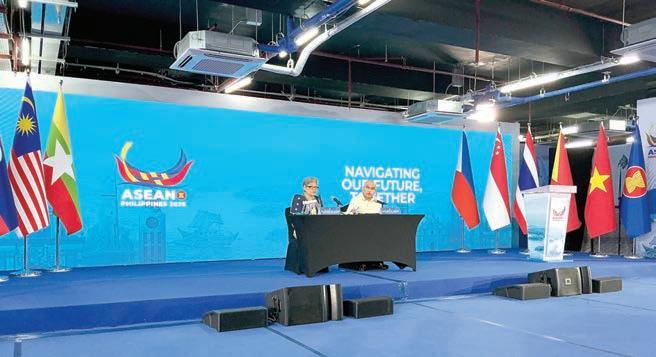
Asean hosting austere but agenda substantive
By Carmel Pedroza
APU -LAPU CITY—The Phil-
ippine government is implementing strict austerity measures as it prepares to host the 48th Asean Summit and related meetings, emphasizing a “barebones and business-like” approach in response to ongoing global uncertainties and a declared national energy emergency.
Ma. Hellen De La Vega, Director-General of the Asean National Organizing Council (NOC), said the scaled-down preparations align with Executive Order No. 110, which mandates energy con-

THEcountry’s inflation may reach double digits in the coming months, economists said, after the rate surged to 7.2 percent in April—the fastest in over three years.
On Tuesday, the Philippine Statistics Authority (PSA) reported that inflation was the highest since March 2023, when it reached 7.6 percent.
The latest print was also a sharp jump from 4.1 percent in March and 1.4 percent a year earlier.
Ateneo de Manila University (ADMU) economist Luis F. Dumlao said inflation could climb further, citing differences between the current Middle East conflict and the Russia-Ukraine war in 2022.
He explained that while the earlier conflict also disrupted oil supply, the Philippines was less
exposed at the time, which helped cap inflation at a peak of 8.3 percent.
“Given that the Philippine economy is more interdependent on the Middle East, it is not farfetched for inflation to reach double digits,” Dumlao told the BusinessMirror Another Ateneo economist, Alvin P. Ang, shared the same view. He noted that global oil prices had already started to ease toward the end of April, which led to domestic fuel price rollbacks, yet inflation remained elevated.
“It is possible considering that
servation and prudent resource use across government agencies.
The directive comes amid geopolitical tensions, including the Middle East conflict and its ripple effects on global energy supply.
President Ferdinand Marcos Jr. ordered organizers to ensure that the summit remains focused on substantive outcomes rather than ceremonial excess.
“The priority is to address pressing regional concerns such as energy security, food security, and the safe mobility of Asean nationals,” De La Vega said at the press conference following the opening of the Asean International Media
Center located at Mactan World Museum, Mactan Newtown in this city.
Despite the streamlined approach, De La Vega emphasized that Asean member states agreed on the importance of holding faceto-face discussions, citing the urgency of current regional and global challenges.
Certain preparatory meetings were done virtually.
NOC, stationed at the Philippine International Convention Center (PICC), set-up a virtual meeting room system.
“To make sure all those preparatory meetings—the issues that
they have discussed will continue to develop the themes that will be discussed by the leaders in support by those three agenda items,” De La Vega said. More than 50 meetings were done virtually, De La Vega added, disclosing that there are still 174 meetings on deck using the system that they have at PICC.
Packed May 6–8 schedule
A SERIES of high-level meetings will take place across key venues in Mactan, Cebu this week. For May 6–7, 2026, senior officials and ministerial preparatory



By Justine Xyrah Garcia
THE Asian Development Bank (ADB)





By Andrea E. San Juan @andreasanjuan
THE Bangko Sentral ng Piliipinas (BSP) said it will take “necessary actions” to ensure inflation returns to its 3-percent target within a reasonable time. In a statement on Tuesday afternoon, BSP Governor Eli M. Remolona Jr. said the central bank is committed to fulfilling its “primary mandate” of slow inflation.
As such, Remolona assured the public that the central bank will “remain vigilant for spillover effects, data-driven, and ready to act as needed.”
The BSP said this after inflation in April quickened to 7.2 percent, surpassing the central bank’s forecast range of 5.6 to 6.4 percent for the month. The central bank also noted that average inflation from January to April settled at 3.9 percent, exceeding the BSP’s target of 3 percent for the full year.
Meanwhile, core inflation, which excludes volatile food and energy items, also rose from 3.2 percent in March to 3.9 percent in April. Historical data from the Philippine Statistics Authority (PSA) showed that the 3.9 percent core inflation in April is the highest since December 2023.
Remolona emphasized at the Monetary Board’s policy meeting last April 23 that core inflation is rising, which highlights “the risk of demand-driven inflation.”
According to the BSP, the headline inflation in April which rose to 7.2 percent from 4.1 percent in March reflects the impact of “higher international fuel prices on food and energy cost.”




By Justine Xyrah Garcia
using its existing financing windows, allowing funds to be deployed as demand emerges from affected economies.
These include credit facilities and risk-sharing instruments coursed through partner financial institutions, aimed at easing funding gaps for firms facing higher energy-related costs while reinforcing the broader financing environment for small and medium enterprises.
The program is expected to help firms maintain operations, preserve employment, and limit spillovers to domestic growth.
Alongside near-term support, ADB said it will expand its pipeline of investments in energy security, with a focus on projects that reduce exposure to volatile fuel markets. These include renewable energy, efficiency upgrades, and conservation measures designed to stabilize supply and diversify energy sources over the medium term.
For its part, Japan will channel additional resources through ADB-managed trust funds to fast-track project development and execution, while providing technical expertise to support implementation.
It is also aligning its development financing arms—including the Japan International Cooperation Agency (JICA) and the Japan Bank for International Cooperation (JIBC)—to complement ADB operations and scale up overall impact. Further details on project rollouts and financing allocations have yet to be disclosed.
Scammers…
Continued from A14
harvests corporate credentials and opens a door into enterprise systems.
“The bottom line: brand phishing attacks from both directions. A prevention-first approach that combines external visibility with internal protection isn’t a nice-tohave—it’s how you actually stay ahead of it,” CPR said.
Medevac eyed for 38 Pinoys on hantavirus-hit cruise ship
By Malou Talosig-Bartolome
DUTCH authorities are preparing a complex medical evacuation for passengers and crew of the expedition vessel m/v Hondius, which remains anchored off Cape Verde amid a deadly hantavirus outbreak.
The ship carries 149 people—88 passengers and 61 crew, including 38 Filipinos, the largest national contingent on board. (See earlier story in A11 News, “No Filipinos positive for hantavirus on Atlantic Cruise, DOH assures public.”).
Oceanwide Expeditions, the ship’s operator, said two specialized aircraft equipped with medical gear and staffed by trained crews are being readied to airlift three individuals: two crew members, one British and one Dutch, suffering acute respiratory symptoms, and
Inflation…
the last two weeks of April already reflected falling oil prices,” he told the BusinessMirror
Oil prices have swung sharply since the US-Iran conflict escalated, with Brent crude peaking near $125 per barrel before
the travel companion of a German passenger who died on May 2.
The World Health Organization (WHO) and Oceanwide have confirmed two hantavirus cases linked to the voyage and three passenger deaths to date.
Cape Verde’s Health Ministry has barred the vessel from docking to protect its population, according to the Associated Press.
A local medical team has boarded the ship three times, but only the three evacuees have been cleared to leave.
“It has been very tricky,” said Dr. Ann Lindstrand, a WHO official in Cape Verde, citing the challenge of balancing public health with citizen safety.
Aside from the air evacuation, Oceanwide is weighing a diversion to Las Palmas or Tenerife in Spain for supervised disembarkation and medical screening under WHO and Dutch health services.
easing to around $110 by end-April.
PSA data showed the April surge was driven mainly by food, which rose to 6 percent from 2.9 percent in March and accounted for about 37.3 percent of overall inflation.
Transport was the second biggest driver, with inflation jumping to 21.4 percent from 9.9 percent, contributing about 33.1 percent to the overall rate. Housing, water, electricity, gas and other fuels rose to 8.2

The crisis has unfolded over a series of fatalities and confirmed infections. A Dutch passenger died on April 11, followed by his wife, who succumbed three days after disembarking in St. Helena.
WHO later confirmed she carried a hantavirus variant.
A British passenger evacuated to South Africa on April 27 remains in intensive care after testing positive.
The latest death occurred May 2, when a German passenger died on board; the cause is still under investigation.
Oceanwide has activated its highest emergency tier, SHIELD Response Level 3, enforcing strict isolation, hygiene protocols, and continuous medical monitoring.
Despite the restrictions, the company reports calm conditions
percent from 4.7 percent, accounting for roughly 23.9 percent of the total.
University of Asia and the Pacific (UA&P) economist Marco C. Agonia said inflation could reach double digits if oil prices surge further.
He also noted that inflation may be pushed higher by base effects, as last year’s relatively low inflation makes current increases appear larger.
“If inflation reaches double digits, it may happen around July when minimum wage changes could happen along with the price effects of the dry season,” Agonia told the BusinessMirror
Second-round effects
FORMER Socioeconomic Planning
Secretary Dante B. Canlas said the economy is already beginning to feel the second-round effects or the broader impact of rising oil prices.
Second-round effects refer to the way initial increases in fuel prices ripple through the economy. Higher oil costs raise transport and production expenses, which are then passed on to consumers through higher prices for food, goods, and services.
“The 7.2 percent inflation rate is the second-round or ripple effects of the oil-price shocks stemming from the war against Iran. Expect prices to continue to rise if the war persists,” Canlas told the BusinessMirror
This pass-through is evident in food prices, which posted a sharp increase in April. Data from PSA showed food inflation accelerating to 6.1 percent, more than double the 2.7 percent recorded in March and significantly higher than 0.7 percent a year earlier.
Rice was the main driver, with inflation surging to 13.7 percent from 3.5 percent a month earlier.
Other staples also posted faster increases, including corn at 21 percent; flour bread and other cereal-based products at 3 percent; and fish and seafood at 9.4 percent, and vegetables at 9.4 percent.
Further increases were recorded in fruits and nuts, which rose 6 percent, as well as vegetables, tubers, and re-
on board.
The outbreak began during a weekslong “Atlantic Odyssey” cruise that departed Ushuaia, Argentina, on April 1.
Argentine health officials confirmed no symptoms at departure, though hantavirus can incubate for up to eight weeks. While Tierra del Fuego has not reported cases, other provinces saw outbreaks last year that killed 28 people nationwide.
The timeline for both the specialized airlift and the vessel’s possible relocation to Spain remains uncertain, with coordination ongoing among WHO, the Dutch National Institute for Public Health and the Environment (RIVM), and international embassies representing the 23 nationalities on board.
lated items at 10.4 percent. Prices of ready-made food and other food products also edged up to 2.5 percent.
Agonia noted that price pressures are becoming more broad-based, with inflation picking up even in services such as rentals, healthcare, transport, recreation, and restaurants.
PSA data showed modest but steady increases across these sectors, with inflation generally picking up from around 3 to 5 percent in March to roughly 3.5 to 6 percent in April.
“This suggests that upward price revisions are spilling over into parts of the economy not directly dealing with commodities,” he added.
Dumlao also said that this trend could persist “unless something dramatically positive happens in the Middle East.”
Supply-driven
CORE inflation stood at 3.9 percent, which suggests consumer demand is not overheating, according to Ang. He said the figure also remains within the 2 to 4 percent target range set by the Bangko Sentral ng Pilipinas (BSP).
“Its just that the nonnegotiable essentials have risen faster due to external events. BSP has already increased rate to address higher core,” he added.
Canlas agreed, noting that the relatively lower core inflation “indicates the huge inflation impact of the Iran war and declining supply.”
Targeted aid
AMID the risk of sustained price pressures in the coming months, Department of Economy, Planning, and Development (DepDev) Secretary Arsenio M. Balisacan said the government is stepping up focused measures to cushion households and keep supply steady.
“The government is intensifying targeted interventions, particularly to temper upward price pressures on food, energy, and transport, while ensuring the continued stability of domestic supply,” Balisacan said.
According to DepDev, targeted aid is being expanded, with transport subsidies, fuel assistance, and fare discounts extended to millions of drivers and commuters.


meetings will be held simultaneously at Dusit Thani Mactan and ShangriLa Mactan.
On the afternoon of May 7, the Brunei-Indonesia-Malaysia-Philippines East ASEAN Growth Area (BIMP-EAGA) Summit will convene at ShangriLa Mactan, attended by leaders of the four member countries. The 48th Asean Summit officially opens on May 8, 2026 with a ceremony at the Mactan Expo. Leaders’ meetings and a working lunch will follow at the same venue in the morning.
In the afternoon, leaders will proceed to Shangri-La Mactan for the Asean Summit Retreat. At 4p.m., President Marcos will hold a press conference at the International Media Center (IMC). The summit concludes in the evening with a gala dinner hosted by the President and First Lady Liza Araneta-Marcos for Asean leaders.
Media Center Launch and Strategic Priorities
DE LA VEGA together with Presidential Communications Office (PCO) Secretary Dave Gomez and local Cebu officials led the opening of the International Media Center, welcoming local and international media to Cebu. She highlighted the city’s readiness to host major global events and commended the PCO and the NOC’s media and communications team for organizing the facility. She underscored the media’s vital role in communicating the relevance of Asean initiatives to both regional and domestic audiences.
The Philippines’s chairship of Asean 2026 will be guided by three strategic pillars which include Peace and Security (LEAD ASEAN) focused on strengthening regional stability, maritime cooperation, disaster preparedness, and climate security.
The Economic Integration (SAIL-A), which aims to boost trade and investment, accelerate digital transformation, support MSMEs, and promote sustainable and inclusive growth.
Finally, the Socio-Cultural Development (RISE ASEAN), which centers on resilient families, inclusive development, youth innovation, and environmentally sustainable, foodsecure futures.
“These frameworks—LEAD, SAIL, and RISE ASEAN—will help drive the region toward the goals of ASEAN Vision 2045,” De La Vega said. Officials emphasized that while the Philippines is committed to fulfilling its international obligations, it remains mindful of resource constraints and sustainability.
“As we carry out our international commitments, we remain responsive to the evolving dynamics of our region and the world,” De La Vega said, adding that continued engagement with the media will be key throughout the chairship year.
It added that support for agriculture includes loan relief and cost-cutting measures to ease production pressures, while hundreds of Kadiwa outlets are helping bring cheaper food directly to consumers to soften price spikes “We remain committed to a whole-of-government approach in addressing the impact of the Middle East crisis.
Our priority is to ensure stable fuel supply, manageable prices, and adequate protection for all sectors amid ongoing domestic and global challenges,” Balisacan said.
The central bank noted that inflation for households with incomes in the lowest 30 percent of the population accelerated from 4.2 percent in March to 8.5 percent in April. Rice and fish prices, it noted, increased due to “higher post-harvest and transportation costs.” Meanwhile, transport inflation rose with higher domestic petroleum prices at the pump, while electricity rates increased due to higher generation charges.
ADB: Central banks should be careful IN an interview, Asian Development Bank (ADB) Chief Economist Albert Park said: “I think central banks have to be careful here. On the one hand, the usual advice when there’s a supply price shock, like we’re seeing, is to not try to raise interest rates, to cope with that type of inflation, because that’s not what’s causing inflation, the interest rate is really the supply price of oil and gas.” This, Park said, is the case in the Philippines, which is heavily reliant on imports of oil especially from the Middle East. See “BSP,”
House Justice panel relies on AMLC records in impeach case
THE House Committee on Justice will rely on official records from the Anti-Money Laundering Council (AMLC) in deciding on the impeachment case against Vice President Sara Z. Duterte, invoking the presumption of regularity accorded to government documents, a lawmaker said on Tuesday.
San Juan Rep. Ysabel Maria Zamora, Justice committee Vice chairperson, in an interview, pushed back against claims from Duterte’s camp that one of the alleged P2 billion transactions was actually only P2 million, stressing that the committee’s findings were based solely on documents officially submitted by the AMLC.
“As lawmakers, we follow the evidence and official documents. The AMLC released these records, so naturally, these serve as the basis for our conclusions,” said Zamora, a lawyer.
She noted any supposed discrepancies or “glitches” in the AMLC report—particularly the claim that Duterte and her husband, lawyer Manases Carpio, were involved in 663 covered and suspicious transactions totaling P6.77 billion from 2006 to 2025 – should have been formally raised during the committee hearings.
Zamora emphasized that any opposing claims, including Carpio’s assertion that a bank corrected a transaction amount to P2 million, must be properly presented and substantiated during a Senate trial.
“If they have claims regarding these transactions, it is their responsibility to present them during the trial, especially if these involve the bank accounts of the Vice President and her spouse, or even their Statements of Assets, Liabilities and Net Worth [SALNs],” she said, adding that the committee has not received any formal retraction from banks reflected in the AMLC report.
During the hearings, Zamora said lawmakers were able to cross-check records submitted by former senator Antonio Trillanes IV with AMLC data, confirming 19 transactions that matched exactly in both date and amount.
“We did not see any indication that banks withdrew or corrected these records. In fact, during the hearings, 19 transactions were verified to match the AMLC report down to the centavo,” she said.
Zamora maintained that the committee has already fulfilled its mandate after evaluating the evidence and unanimously approving its report for plenary consideration.
“For us, the evidence presented during the hearings serves as our basis. These are government records, and they are presumed to be regular,” she added.
She also linked the AMLC findings to the issue of unexplained wealth, pointing out that Duterte’s last six SALN filings since 2019 reflected zero cash on hand and cash in bank.
While acknowledging bank secrecy and privacy concerns, Zamora said public officials are still subject to scrutiny, particularly when financial disclosures are required by law.
Zamora also questioned why Duterte’s
camp failed to attend the hearings or raise objections to the AMLC report during the proceedings.
She rejected arguments framing the impeachment as a political feud, emphasizing that the proceedings are anchored on evidence, not personalities or rival factions.
Zamora expressed hope that lawmakers would ultimately vote based on evidence, including findings from the Commission on Audit on the alleged misuse of confidential funds, testimonies on disbursements, AMLC reports, certifications on non-existent beneficiaries, and reported threats against top government officials.
Members of the House of Representatives have about five days to review the articles of impeachment and supporting evidence ahead of the plenary vote scheduled on May 11.
NUP reaffirms support THE National Unity Party meanwhile reaffirmed its continued support for the administration of President Marcos, regardless of the outcome of the impending vote on the impeachment matter before the House of Representatives.
NUP Chairman and Deputy Speaker Ronaldo V. Puno, in a statement, said the party remains committed in promoting stability and advancing the administration’s priorities, but emphasized that impeachment is a matter that requires individual judgment.
“The National Unity Party has, since its inception, consistently stood as a reliable and steadfast partner of the administration, supporting its priorities and ensuring stability in governance. At the same time, on a matter as serious as impeachment, every Member must be guided by their own judgment, their conscience, and the interests of the people they represent,” he said. The party said it is encouraging its members to carefully assess the evidence and vote based on their own evaluation, in line with their constitutional duties.
NUP also called on House leadership to respect the independence of lawmakers, stressing that impeachment should not be treated as a partisan exercise.
“We believe impeachment is a constitutional process, not a partisan exercise,” Puno said. “The strength of our institutions lies in allowing each Member to decide freely, without undue pressure or expectation of uniformity.”
The party further warned against any move that could be seen as penalizing lawmakers for how they vote, saying such actions could undermine institutional integrity.
“In matters of this nature, independence must be preserved,” Puno added. “If any form of sanction or punitive measure is imposed on Members for voting according to their judgment, the Party will act collectively and respond in a manner it deems appropriate.”
Despite the issue, Puno reiterated that NUP’s support for the administration remains firm, while emphasizing the need to uphold integrity and independence in carrying out constitutional responsibilities.
Jovee Marie N. dela Cruz
Peace talks with Reds not in country’s interest–Oban
ATIONAL Security Advisor (NSA)
NEduardo Oban on Tuesday threw his support behind Defense Secretary Gilberto Teodoro Jr.’s rejection of any peace talks with the Communist Party of the Philippines-New People’s Army-National Democratic Front (CPP-NPA-NDF).
The NDF earlier called for the resumption of peace talks with the government, a move that observers said is an indication that the NPA has been sustaining heavy loses.
“Secretary Teodoro is correct in saying that to resume a national-level peace negotiations with a clearly spent, isolated, and criminal armed group would not advance the Filipino’s interest in security, peace, and development. It would only give their crumbling insurgency a veneer of credibility it no longer possesses on the ground,” said Oban, who is also National Task Force to End Local Communist Armed Conflict (NTFElcac) vice chairman. Oban and Teodoro’s reaction stemmed from the call of former peace negotiators
Giving solons 5 days to review impeach articles ‘reasonable, necessary’–Luistro
By Jovee Marie N. dela Cruz @joveemarie

THE House Committee on Justice said on Tuesday that giving lawmakers five days to review the Articles of Impeachment against Vice President Sara Z. Duterte is a “reasonable and necessary” step before the expected plenary vote on May 11.
Batangas Rep. Gerville Luistro, Justice committee chairperson, said all 318 members of the House of Representatives will be provided copies of the committee report, the resolution, the Articles of Impeachment, and the supporting evidence to ensure due process is observed.
In an interview, Luistro cited a ruling of the Supreme Court requiring that lawmakers be given adequate time to study impeachment documents before voting.
“They should be given reasonable time to read and study the same before the plenary vote. That’s part of due process,” she added.
The House Justice panel earlier approved, with a 55-0 vote, the committee report consolidating the articles of impeachment based on two complaints
that were found to have probable cause on April 29. The report has since been forwarded for inclusion on the agenda of the Committee on Rules.
Luistro said that once the Committee on Rules refers the matter to the plenary, the secretary general will be directed to distribute copies to all House members, as well as to the respondent and the complainants.
If referred during Tuesday’s session, lawmakers will have Wednesday to Sunday to review the documents, keeping the timeline on track for a May 11 vote.
“Five days is a reasonable period for House members to read and study the documents,” she said, adding that the chamber should be ready to vote by then.
Senior Deputy Majority Leader Lorenz Defensor emphasized that the impeachment process is designed to be thorough, ensuring lawmakers can carefully evaluate all evidence before making a decision.
Defensor said the House, as the body constitutionally mandated to initiate impeachment cases, must consider the evidence presented by complainants, findings from hearings, and any
responses or counter-evidence from the respondent.
“The process takes time because evidence must be fully laid out. This allows us to vote intelligently and also gives the respondent the opportunity to answer the allegations,” Defensor said.
Defensor noted that Duterte was given opportunities to respond during committee hearings but did not attend.
“It is part of due process, but we saw that they did not attend the hearings. Nonetheless, the vice president was given every opportunity to debunk the allegations,” he added.
By giving the respondent another opportunity to respond, Defensor said, Duterte could still have her impeachment case dismissed before it even reaches the Senate trial; that is only the case if she presents enough evidence debunking the allegations.
However, he also noted that the Vice President was given that same opportunity during the Justice committee’s hearings and yet refused to take it.
With 55 votes already secured from members of the justice panel, only 51 more are needed to meet the one-third threshold required
After Mayon, it’s Kanlaon’s turn to emit ash
KBy Jonathan L. Mayuga @jonlmayuga
ANLAON Volcano, that straddles the provinces of Negros Occidental and Oriental, emitted volcanic ash from the summit’s crater on Tuesday, generating grayish plumes that rose to 800 meters, the Philippine Institute of Volcanology and Seismology (Phivolcs) reported. The ash emission occurred from 5:32 a.m. to 6:01 a.m, and was captured by cameras at the Kanlaon Volcano Observatory in Canlaon City.
With this event, Phivolcs issued an advisory warning the public near the volcano of possible ashfall.
The restive Kanlaon, which remains under Alert Level 2, continues to emit sulfur dioxide and plumes.
In its summary of 24-hour observation from 12:01 a.m. on Monday to 12:01 a.m. on Tuesday, Phivolcs recorded a total of five ash emission events that lasted from three to 60 minutes.
Phivolcs also observed increased seismicity on Monday, recording a total of 22 volcanic earthquakes, including five volcanic tremors ranging from two to 39 minutes long.
On Tuesday, sulfur dioxide flux reached 2,975 tons per day while a voluminous plume that created a 1,500-meter-tall wall was also recorded.
Phivolcs said the volcano’s edifice remains inflated, indicating magmatic activity
beneath the volcano.
Under Alert Level 2, entry into the fourkilometer radius permanent danger zone and flying any aircraft close to the volcano remains prohibited.
Mayon
THE Office of Civil Defense in the Bicol Region reported that the current volcanic activity in Mayon Volcano has now affected 52,590 families or 199,367 persons in 124 barangay.
It said 1,444 families or 5,459 persons are currently housed in evacuation centers, while 26 families or 85 persons are being assisted outside evacuation centers.
Following the massive emission of volcanic ash that covered houses, national and local roads under two to three inches of ash, various government agencies have been mobilized to assist affected families.
On Tuesday, the OCD reported that it had sent 24,000 bottles of water.
The OCD in Bicol has begun distributing essential supplies to Albay local governments affected by the ashfall from Mayon, one of the country’s most active volcanoes.
Aside from bottled water, hygiene kits and goggles for responders, medicines and health supplies were also distributed.
The OCD said that while a “calmer” Mayon was observed on Tuesday, the threat of pyroclastic density currents or uson prevails within the six-kilometer Permanent Danger Zone of Mayon Volcano.
Video footage and photographs captured by the Mahyon Volcano Observatory and Phivolcs Quick Response Team show lava flow collapse-fed PDC at the southwestern slopes of the volcano between 7:19 a.m. and 7:26 a.m.
Mayon, which remains under Alert Level 3 status or magmatic unrest, is emitting volcanic debris, and ground shaking events continue to be recorded by Phivolcs.
In its summary of 24-hour observation from 12:01 a.m. Monday to 12:01 a.m.
Tuesday, Phivolcs said eruption activity at Mayon, known for its near-perfect cone, is characterized by lava effusion with lava flow on Basud, Bonga, and MI-isi gullies.
Phivolcs said it also recorded 14 volcanic earthquakes and five volcanic tremors, ranging from two to eight minutes long.
During the period, a total of 336 rockfall and three pyroclastic density current signals were recorded.
Cops beef up security
GEN. Jose Melencio Nartatez Jr., National Police chief, on Tuesday mobilized additional units to secure the perimeter of Mayon Volcano following reports that the current six-kilometer permanent danger zone (PDZ) may soon be expanded to a seven-kilometer radius.
Nartatez said the police force is coordinating with all stakeholders in the area
See “Kanlaon,” A4
Numerical identifiers to replace traditional sea names in IHO maps
Tbatting for a resumption of peace talks in the wake of the April 19 encounter between the military and insurgents in Toboso, Negros Occidental, that left 19 people dead.
“Since the formal talks at the time of President Corazon Aquino, the CPP-NPA-NDF has repeatedly exploited cease-fires and negotiations to regroup, rebuild networks, regain influence in communities, and project political relevance while its armed units continued to commit atrocities, extortion, recruitment, and violence against the Filipino people,” Oban said.
He said peace talks should not be allowed to become a “lifeline for a dying insurgency... [that has] lost any semblance of integrity and belligerency.”
“To reopen negotiations at this time would only overturn the hard-won victories that Filipino communities have achieved through years of courage, sacrifice, and peacebuilding. Across the archipelago,
HE International Hydrographic Organization (IHO), an intergovernmental technical body established in 1921 to support maritime safety, survey standards, and the protection of the marine environment, has formally adopted a digital standard that designates sea names with unique identification numbers instead of place or country names.
The IHO acts as the global authority for hydrography, coordinating the activities of national hydrographic offices and setting international standards for nautical charting and safety at sea.
The adoption of the S-130 standard, officially titled Polygonal Demarcations of Global Sea Areas or PDGSA, is a new digital mapping standard designated to identify marine areas using unique numerical identifiers instead of traditional names.
The formal adoption finalizes the IHO’s second Assembly back in 2020 to develop an updated framework to replace the existing standard chart, Limits of Oceans and Seas, also known as S-23.
As S-130 introduces a digital charting system that replaces names with numerical identifiers for maritime areas, it also signals the shift from
a name-based framework to a number-based structure.
S-130 is designed for use in electronic and geophraphic information systems, which assigns each area sea a unique code based on the latitude and longitude of its central points.
“This means all IHO charts will no longer bear traditional names like South China Sea, West Philippine Sea, and Japan Sea. IHO will now use specific or unique numerical codes,” Commo. Carter Luma-Ang, the head of the Philippine delegation, told the BusinessMirror.
He said this is considered a victory for IHO as it now removes geopolitical tensions that hinder intergovernmental cooperation. “This means better communication and information sharing,” Luma-ang said.
The other members of the Philippine delegation are Cdr. Aaron Andro Ching and Lt. Clarizza Mae Biong.
Namria in lead role
THE participation of the Philippines in the assembly highlighted the country’s role in global hydrography and supported the “Empowering women in Hydrography” initiative, said Environ-
to transmit the impeachment case to the Senate.
Defensor expressed confidence that enough votes will be obtained, citing what he described as strong evidence and Duterte’s continued silence on the allegations.
He added that public opinion may also be shifting as more Filipinos follow the impeachment proceedings and review the evidence being presented.
Recent surveys by Pulse Asia and OCTA Research showed Duterte’s lead in the 2028 presidential race narrowing against former vice president Leni Robredo, while she is statistically tied with Sen. Raffy Tulfo in some areas.
Defensor said the trend may reflect growing public awareness of the allegations tied to the impeachment case and the Vice President’s lack of response.
The House is expected to vote on the impeachment complaint on May 11 after lawmakers complete their review of the articles and supporting evidence. Lawmakers anticipate more members will support the move, citing the committee’s findings and the proceedings conducted so far.
DILG to local govts: Ensure smooth passage of fuel tankers
THE Department of the Interior and Local Government (DILG) has directed all local governments (LGUs) to ensure the continuous and orderly movement of fuel, including allowing unhampered passage of fuel tankers within their jurisdiction.
The directive was issued by the DILG amid the ongoing global oil supply pressures brought about by the war in the Middle East.
As of early May 2026, fuel prices in the Philippines are experiencing significant volatility and upward pressure, heavily driven by intensified conflicts in the Middle East. Pump prices for gasoline have risen towards a range of P73.21 to P107.11 per liter, while diesel ranges from P79.62 to P107.48 per liter.
In a memorandum circular, the DILG also called on LGUs to exercise their supervisory authority to ensure strict and effective implementation of the directive across all local jurisdictions.
The department wants all LGUs to initiate measures, emphasizing that restrictions such as truck bans and traffic coding should not impede the delivery of fuel.
Local chief executives are urged to exempt fuel tankers from legitimate petroleum industry companies from these limitations.
ment Undersecretary and National Mapping and Resource Infromation Administration (Namaria) chief Peter N. Tiangco.
With this, the Philippine delegation secures neutral ground, with Namria now a member of IHO Board and an active member leading global efforts to depoliticize sea naming.
The Fourth Assembly focused on the S-100 framework, which revolutionizes maritime data for safer navigation.
For the Philippines, the transition represents a significant victory by moving to a system where sea areas are designated by unique numerical identifiers rather than names, which includes the names South China Sea label and other contested names from its primary, authoritative digital references.
The Philippine delegation argued that a modern, digital maritime environment must be free from“geopolitical complexities”by stripping away names that carry heavy political resonance, and secured a neutral, technical environment that protects the country’s interest from “linguistic dominance” of rival claims.
“Ensuring the uninterrupted movement of fuel supply is critical to sustaining economic activity and protecting the welfare of our people during this period of global energy disruption,” the DILG said. These measure aligns with President Marcos’s call for a whole-of-government and whole-of-society approach in addressing the crisis, following the issuance of Executive Order 110 declaring a state of national energy emergency.
“Local governments play a vital role in ensuring that essential goods such as fuel are delivered without delay. We count on your full cooperation,” the Department added.
The DILG further reminded LGUs to exercise their disciplinary authority over erring elected officials pursuant to Chapter IV, Title 2, Book 1 of RA 7160 or the Local Government Code.
The DILG said
DA boosts swine repopulation program
TBy Ada Pelonia @adapelonia
HE Department of Agriculture (DA) has earmarked P1.6 billion for an expanded repopulation program to rebuild the swine industry and reduce reliance on imported pork.
Agriculture Secretary Francisco Tiu Laurel Jr. said the program is central to the government’s food security agenda.
“We need to produce at least one
million more head of pigs this year alone if we are to stabilize supply, reduce reliance on imports, and move closer to President Marcos’s vision of a food-secure Philippines
driven by stronger local production,” Tiu Laurel said.
The program will begin with the procurement of some 32,000 gilts, which form part of government initiatives to restore the country’s hog population to its pre-African swine fever (ASF) level of about 13 million heads, according to the agency.
Latest figures showed that the hog population dwindled to eight million, which creates a deficit of six million heads for the sector.
DA officials are targeting the addition of six million hogs by 2028, which they said highlights the scale of losses since the disease’s detection in 2019 and the
urgency of strengthening the domestic stockpile.
Meanwhile, Agriculture Undersecretary for Livestock Constante Palabrica said the program’s funding is anchored on the Animal Industry Development and Competitiveness Act (Aidca).
The Aidca allocated P20 billion annually over the next decade through the Animal Competitiveness Enhancement Fund (Ancef) to strengthen the livestock sector. The fund consists of tariffs collected from imported livestock, poultry, and dairy products.
Palabrica also noted that improved disease control has allowed the government to ease emergency
Legislator seeks House probe on fuel smuggling
By Jovee Marie N. dela Cruz @joveemarie
THE chairman of the House Committee on Public Order and Safety
has called for a congressional investigation into alleged fuel smuggling and tax evasion schemes, warning that the government may be losing up to P60 billion annually owing to illicit practices in the petroleum trade.
In a privileged speech on Monday, Manila Rep. Rolando Valeriano urged key agencies, including the Coast Guard (PCG), the Navy (PN), and the Department of Energy (DOE), to intensify efforts against fuel smugglers and investigate suspicious offshore activities.
At the center of the issue, Valeriano said, is the abuse of ship-toship (STS) transfers—a legitimate maritime operation that is allegedly being exploited to evade taxes.
“Under normal circumstances, ship-to-ship transfers are allowed for logistical reasons. However, because these happen offshore and away from regular port supervision, they are vulnerable to abuse if not properly monitored,”
Valeriano said.
He explained that in the alleged scheme, a petroleum shipment bound for the Philippines is partially offloaded to another vessel while still at sea. As a result, when the original tanker docks at a Philippine port, it carries a reduced volume, and taxes and duties are paid only on what remains onboard.
“The portion transferred offshore may enter the domestic market through other channels, bypassing proper customs declaration and taxation,” he added. Valeriano described the practice as both smuggling and tax evasion, stressing that porous coastlines make it easier for diverted fuel to enter the country undetected.
Industry sources, he said, indicate that such activities are prevalent in major ports, including Davao, Batangas, Cagayan de Oro, and Bataan.
The lawmaker also cited several enforcement actions in recent years, including the seizure of P219.5 million worth of alleged smuggled oil in La Union in June
2025 and a February 2025 operation by the National Police-Criminal Investigation and Detection Group (PNP-CIDG) that confiscated over P13 million worth of oil products in Batangas.
Despite these efforts, Valeriano raised concerns over possible lapses in monitoring, noting that some vessels allegedly switch off their transponders to avoid detection.
“Ship movements in our waters are monitored. But sometimes, some ships turn off their transponders so their movements cannot be detected,” he said, adding that the repeated success of such operations raises questions about potential complicity or negligence within enforcement and regulatory bodies.
Under the Customs Modernization and Tariff Act, misdeclaration and unlawful importation are punishable offenses, while petroleum products are subject to excise taxes under the Tax Reform for Acceleration and Inclusion Law.
“If petroleum shipments are being partially diverted before reaching Philippine ports, then the government is being deprived
Marcos to seek tighter Philippines-Paraguay ties
PRESIDENT Marcos will seek to expand the Philippines’ cooperation on agriculture, as well as trade and investment with Paraguay during President Santiago Peña Palacios official visit to Manila next week.
The bilateral meeting between the two state leaders will be held in Malacañang on May 11.
“The visit marks a significant milestone in the deepening of Philippines-Paraguay bilateral relations as it will be the first presidential visit between the two countries, building on a history of constructive engagement and high-level exchanges over the past six decades of diplomatic ties,” the Presidential Communications Office (PCO) said in a statement.
Marcos invited Peña to visit the country as part of the Philippines’ push to expand its partnerships in Latin America and to diversify its economic partnerships.
Based on data from the Department of Trade and Industry (DTI), Philippines-Paraguay trade peaked in 2024 at US$6.3 million. In that year, the country’s imports from the Latin American country reached US$4.2 million, while its exports amounted to US$2.2 million.
The trade figures between the two countries dropped to US$2.2 million last year, when the Philippines had a trade surplus with Paraguay as its imports from the Latin American country dropped to mere US$347,700, while its exports was US$1.9 million.
The Philippines-Paraguay trade figures from 2020 to 2023 ranged from US$1.2 million to US$2.8 million.
The Marcos administration considers Paraguay as an “emerging partner” of the Philippines since both “share common values rooted in democracy, rule of law, and a commitment to international cooperation,” the PCO said.
The Philippines and Paraguay established formal diplomatic relations on December 12, 1962.
After his visit to the Philippines, Peña is expected to travel to Taiwan for a state visit from May 7 to 10 for bilateral cooperation and trade with the self-governing island. Samuel P. Medenilla
of taxes that should rightfully be collected,” Valeriano said.
He emphasized that the alleged misuse of STS transfers represents a “serious leak” in national revenues.
Valeriano also pushed for stricter regulations, including mandatory reporting and prior authorization for all offshore petroleum transfers involving cargo bound for the Philippines. He said vessels should be required to disclose details such as the receiving ship, volume transferred, and supporting documentation to authorities.
Failure to comply, he added, could be treated as prima facie evidence of smuggling or misdeclaration.
The lawmaker is urging the House to conduct an inquiry in aid of legislation to examine STS transfer practices and determine possible accountability among concerned agencies.
“At a time when Filipino motorists are struggling with volatile fuel prices, the public deserves assurance that every liter of fuel sold has paid the proper taxes,” Valeriano said.
Continued from A3
As for the name “West Philippine Sea,” he said the Philippines—or Namria for that matter—can use the name in its own maps.
As the Philippine delegation aimed to ensure national interests in maritime safety and technology sharing, it also fought for sovereign safeguards, explicitly putting on record that the S-130 dataset is a geographical indexing tool, and not a legal instrument.
It is contested that the inclusion of any lines, vertices, or polygons does not imply recognition of foreign sovereignty and cannot prejudice the Philippines’ official position regarding maritime entitlements under international law.
The Philippine delegation also demanded that the IHO Secretariat keep the dataset under international review, cautioning publication until all reservations and formal comments from Member States, including the Philippines, are fully incorporated and confirmed to be technically robust. Jonathan L. Mayuga
measures previously imposed during the height of outbreaks.
“We have not detected infected pigs for some time now, which allowed us to dismantle checkpoints in Metro Manila after two years.
This reflects the effectiveness of our containment strategies.”
He added, however, that the Bureau of Animal Industry (BAI) remains vigilant as it expands the hog repopulation program nationwide.
The DA said vaccination efforts continue for ASF and avian influenza, with the agency also exploring additional suppliers to ensure sustained livestock health and resilience.
Furthermore, the agency said the initiative has also highlighted capacity gaps within the sector. As such, it added that the BAI will hire up to 4,000 regular personnel, including around 500 veterinarians, to support expanded operations and strengthen biosecurity measures.
The DA said scaling up production while maintaining strict biosecurity standards will be critical to achieving long-term stability and reducing dependence on pork imports.
Data from the BAI showed that eight barangays in six cities or municipalities have active ASF cases as of April 24.
Agri trade deficit widens in March
THE Philippines’ agricultural trade deficit widened to $1.17 billion in March as farm imports continued to outstrip exports, the Philippine Statistics Authority (PSA) reported.
Data gathered by the PSA indicate that the country’s agricultural trade deficit jumped by 21.9 percent to $1.17 billion in March, from $958.21 million in the same period last year.
Farm goods purchased abroad accounted for the majority of the country’s farm trade, growing by 10.8 percent to $1.9 billion in the reference month from $1.71 billion in the previous year.
Exports slid by 3.3 percent to $727.17 million from $752.33 million year-on-year, based on PSA data.
Overall, the country’s total agricultural trade rose by 6.5 percent to $2.62 billion, a drop from the 17.4 percent increment in March 2025 and the 9.7 percent growth in February 2026.
Edible fruit and nuts were the country’s leading farm export in March, earning $231.24 million or 31.8 percent of total farm export revenues.
THE Department of Trade and Industry (DTI) has confiscated more than 186,000 units of uncertified steel products worth P21.9 million, as part of its ongoing enforcement against substandard construction materials in the market.
In a statement, the agency said the seized items, which comprises equal leg steel angle bars and deformed steel bars, were found without the required Philippine Standard (PS) and Import Commodity Clearance (ICC) markings.
Authorities also noted that the products lacked basic labeling details, including the name of the manufacturer and office address.
The bulk of the confiscated goods came from two operations.
In one case, around P19.6 million worth of uncertified steel products were seized from a supplier flagged by a retailer.
A separate operation, based on an industry report, led to the recovery of an additional P2.3 million in non-compliant items.
Moreover, hardware stores found selling
Kanlaon.
Continued from A3
to prevent unauthorized entry into the danger zone, especially as restive conditions around Mayon continue to threaten nearby communities.
“The PNP is coordinating with our grassroots partners. We have established a direct communication line between our local police stations and the barangay intelligence networks. Our officers are conducting joint foot patrols with barangay tanods to ensure that every alley and back-trail leading into the six-kilometer PDZ are monitored,” the PNP chief said.
Phivolcs earlier warned that Mayon’s activity could escalate, prompting discussions to widen the current six-kilometer PDZ to seven kilometers. The expansion would cover more villages already under evacuation, raising concerns over residents attempting to return to tend farms or retrieve belongings.
Nartatez said local knowledge remains a key factor to enforcement efforts as some evacuees sought to quietly slip back into restricted areas.
This was followed by animal, vegetable, or microbial fats and oils and their cleavage products; preparations of vegetables, fruit, nuts, or other parts of plants; and tobacco and manufactured tobacco substitutes.
Malaysia remained the top buyer of farm goods from the Philippines in the Asean region in March, purchasing $16.56 million worth of exports, or 29.3 percent of total agricultural shipments to Asean member countries. The Netherlands also maintained its position as the country’s major trading partner in the European Union (EU), accounting for $102.77 million or 56.7 percent of shipments to the bloc.
Meanwhile, cereals continued to be the country’s top farm import in the reference month, worth $457.06 million or 24.1 percent of total agricultural shipments. The top 10 import groups totaled $1.65 billion, up by 17.6 percent from the same month of 2025, based on PSA data. Among its Asean partners, Vietnam was the country’s leading supplier of agricultural goods, valued at $208.52 million or 27.9 percent of the Philippines’ total shipments from the region. Ada Pelonia
the uncertified products were issued Notices of Violation, with administrative sanctions expected to follow.
The enforcement actions also extended beyond construction materials.
In joint operations with other agencies, the DTI reported additional seizures involving non-compliant consumer goods. On March 24, authorities, together with the National Bureau of InvestigationSpecial Action Unit, confiscated about P1.1 million worth of uncertified LED lamps and electric fans.
A day later, a separate operation with the National Police’s Criminal Investigation and Detection Group led to the seizure of approximately P25 million worth of counterfeit goods that also failed to meet labeling requirements. The DTI’s Fair Trade Enforcement Bureau said it will continue monitoring the market and conducting inspections to address the circulation of uncertified and improperly labeled products. Bless Aubrey Ogerio
“We rely on the local knowledge of barangay officials to identify residents who might be tempted to slip back into their homes, and we are integrating their real-time reports into our deployment shifts,” he said. Police units on the ground were ordered to sustain round-the-clock checkpoint operations and increase visibility in entry points leading to the slopes of Mayon Volcano. Patrols were intensified both on foot and through mobile units, with aerial monitoring considered for remote paths.
“Our ground commanders have been given a clear directive to exercise maximum tolerance but maintain zero compromise on the ‘No Entry’ policy. If residents are caught entering for farming, we will assist them in returning to the evacuation centers while explaining the immediate life-threatening risks of pyroclastic density currents,” he said.
“However, for tourists or individuals who deliberately disregard the cordons for sightseeing, we will not hesitate to escort them out and coordinate with the LGU for the filing of appropriate administrative charges or penalties,” Nartatez said. With Rex Anthony Naval
Economic managers back KALINGA Act, paving way for national fuel shock shield
By Jovee Marie N. Dela Cruz @joveemarie
THE proposed Kalinga Act has gained crucial support from the country’s economic managers as the House of Representatives moves closer to establishing a national safety net against fuel price shocks, supply disruptions, and the broader economic strain affecting Filipino families.
The backing for the bill, authored by Speaker Faustino G. Dy III and Majority Leader Ferdinand Alexander A. Marcos, was expressed during a hearing of the House Ad Hoc Committee on Legislative Energy Action and Development (LEAD), chaired by Marikina Rep. Miro Quimbo.
The measure is being positioned as the House’s primary legislative response to the fuel crisis, introducing a whole-of-government approach to secure energy and essential goods supply, deliver targeted
Davao del Norte’s
banana growers learn new ways to maximize profit
By Jonathan L. Mayuga @jonlmayuga
GRARIAN Reform Benefi-
Aciaries (ARBs) in Davao del Norte are now discovering new ways to grow their income from bananas.
The Department of Agrarian Reform (DAR) and the Department of Science and Technology (DOST) in Region XI have rolled out a handson training program on banana chip production to help farmers maximize their income.
Held in Barangay Alejal, the training brought together members of the Mindanao Banana Growers Development Cooperative (MINDCO), which equipped them with practical skills to turn their banana harvests into higher-value products.
The activity is part of DAR’s Support to Agrarian Reform Beneficiaries Organizations (ARBOs) Livelihood Development Program, which aims to help farmer groups move beyond selling raw produce and explore food processing as an added source of income.
DAR Secretary Conrado M. Estrella III emphasized the importance of partnerships in helping farmer organizations thrive. Through continued collaboration with agencies such as DOST, DAR aims to equip ARBs with skills to make their enterprises more sustainable, competitive, and profitable.
During the training, participants learned the step-by-step process of producing quality banana chips—from proper preparation and food safety to packaging that meets market standards. The session was facilitated by Robelyn G. Pulido, a registered nutritionist, dietitian, and professional food technologist, who shared practical techniques to help ensure their products are safe, appealing, and ready for sale.
The collaboration between DAR and DOST underscores the government’s broader strategy of inclusive rural development. By helping ARBs venture into value-added processing, the program not only boosts farmers’ incomes but also strengthens local economies and supports food security in their communities.
and time-bound assistance, and activate interventions once clear crisis indicators emerge.
Acting Budget Secretary Rolando Toledo said the Department of Budget and Management supports the bill, citing ongoing global disruptions, including tensions in the Middle East, that continue to threaten energy security and burden vulnerable sectors.
He said the measure would grant the president limited emergency powers to ensure the continuity of essential services, protect livelihoods, sustain economic activity, and mobilize government resources more efficiently during crises.
Finance Undersecretary Karlo Fermin Adriano also expressed support, likening the proposed framework to the Bayanihan laws that enabled swift government action during the COVID-19 pandemic. He said the bill would help cushion the economy from the ripple effects of fuel-driven
inflation and supply disruptions, particularly among low-income households, farmers, and small businesses.
“The Department of Finance supports the KALINGA Act, which seeks to institutionalize a comprehensive national emergency response framework to mitigate economic instability, much like the Bayanihan laws served as a state shield during the COVID-19 pandemic,” said Adriano.
Similarly, Department of Economy, Planning, and Development Undersecretary Joseph Capuno endorsed the measure, saying it would strengthen the executive branch’s capacity to respond effectively to emergencies while ensuring close coordination with Congress.
The Bangko Sentral ng Pilipinas (BSP) also supported the general objectives of the bill but emphasized that emergency measures must remain anchored on fiscal discipline,
Shield
accountability, and macroeconomic stability. BSP Department of Economic Research
Director Dennis Bautista said the proposal would enhance the government’s ability to manage inflationary pressures and supply disruptions while protecting consumer welfare.
Collectively, the support from economic managers strengthens the policy foundation of the KALINGA bill, reinforcing its goal of enabling the government to respond earlier, deliver assistance more precisely, and limit the broader economic impact of fuel shocks on food prices, transport costs, business operations, and household budgets.
The LEAD Joint Committee is currently consolidating recommendations from agencies and stakeholders as it works toward a refined version of the bill, which is being positioned as the country’s central legislative shield against the ongoing energy crisis.
Pass GINHAWA Bill to boost take home pay of battered middle class—Gatchalian
By Butch Fernandez @butchfBM
ENATOR Sherwin Gatchal -
Sian called for the immediate enactment of the GINHAWA measure, or the Granting Increase in Take-Home Pay for All Working Filipinos Act, to help Filipino workers particularly those in the middle-income bracket cope with rising costs driven by the Middle East crisis.
The proposed measure seeks
to increase take-home pay by raising the income tax exemption threshold from P250,000 to P400,000 annually, providing critical breathing room for middle-class Filipino workers. The bill also aims to increase the cap on tax-free bonuses from P90,000 to P150,000.
“Kailangan din ng middle class ng tulong para maibsan ang pasakit na dulot ng mataas na presyo ng langis at mga bilihin . The middle class has been the lifeblood of the lo -
cal economy, driving domestic consumption and contributing significantly to government revenue,” said Gatchalian, chair of the Senate Finance Committee and PROTECT ad hoc panel.
The measure also seeks to remove taxes on service charges earned by service industry workers, as well as on additional compensation such as overtime, holiday pay, night shift differential, hazard pay, and on the honoraria and allowances of poll workers.
Senate ratifies bicameral report on Last Mile and GIDA Schools Act
THE Senate on Tuesday ratified the Bicameral Conference Committee Report on a measure to address long-standing gaps in access, infrastructure and learning outcomes in the most underserved communities.
All 23 senators present adopted the report on the disagreeing provisions of Senate Bill No. 1937 and House Bill No. 4745, or the Last Mile and GIDA Schools Act, as cited by Senator Bam Aquino. Aquino was joined in the bicameral panel by Sen. Sherwin Gatchalia. Meanwhile, Sen. Joel Villanueva, having authored and co-sponsored this measure, expressed gladness that the panel had arrived “at a reconciled version that reflects our shared objectives.”
Besides filling long-standing gaps in access, infrastructure, and learning outcomes in underserved communities, the bill ensures the improvement of school facilities nationwide by addressing resource deficiencies and strengthening coordination among national government agencies and local government units, Villanueva said in a manifestation after the voting to ratify.
Likewise, he said, “it establishes clear criteria and indicators for the identification and development of last mile schools and schools in geographically isolated and disadvantaged areas [GIDA], thereby promoting clarity and consistency in its implementation.”
Villanueva continued: “Equally
important, this measure recognizes the vital role of our teaching and non-teaching personnel in these areas by providing them with appropriate compensation, allowances, and support; thus, affirming that those who serve in the most challenging conditions deserve not only our gratitude, but our concrete and sustained assistance.”
Asserting the vow of policymakers that “no child should be left behind” simply because they were born in a far-flung or GIDA area, the new measure affirms the “commitment to an education system that is equitable in practice: one that reaches every learner, no matter the distance and the circumstance,” said the senator. Butch Fernandez
TVIRD’s smart TVs provide Bayog students with interactive ‘Window to the World’
TVI Resource Development Philippines Inc. (TVIRD) has recently turned over 42 smart televisions to the six national high schools in Bayog, Zamboanga del Sur, expanding its support from physical infrastructure to digital tools to enhance knowledge transfer through visual communication. The donation, as part of the company’s Social Development and Management Program (SDMP), provides teachers and students in the firm’s host community with an interactive window to the world.
“For years, classrooms in Bayog have operated with limited resources, wherein teachers turn to improvised visual aids, and students learn through largely traditional methods. Yet, alongside these constraints, a steady stream of support has continued to reshape the local edu-
cational landscape,” TVIRD said in a statement. TVIRD has long supported public education in Bayog – the town that hosts the mining operations of its Balabag Gold-Silver Project. Over the years, the company has been constructing school facilities, providing classroom chairs, and distributing essential learning materials. These interventions have helped improve both access to information and the conditions in which learning takes place.
The distribution of Smart TVs signals a shift in classroom support, moving beyond addressing material shortages toward enhancing how lessons are delivered and experienced, TVIRD said.
Inside classrooms, teachers are now able to supplement textbooks and board work with videos, presentations, and other digital materials. Lessons that once relied heavily on
static references can now incorporate visual and interactive content, helping expound on lessons that are difficult to explain through traditional methods and materials alone.
For students in schools with limited resources, this also provides wider access to instructional materials that were previously difficult to obtain, helping bring their rate of learning up to par with other digitally-equipped environments.Educators in recipient schools said the devices are expected to ease instructional delivery and improve classroom engagement.
Ryan Madamba, head of Supon National High School, described the Smart TVs as a “missing link” in classroom instruction, noting that they now enable teachers to present lessons more efficiently through digital materials. Jonathan L. Mayuga
THE House of Representatives is developing the KALINGA bill as a comprehensive, economy-wide response to the energy crisis, combining immediate relief measures with long-term safeguards against future global oil shocks.
Quimbo emphasized the need to strike a balance between urgency and thoroughness—ensuring that the bill is grounded in realworld conditions while delivering relief as quickly as possible and initiating long-term structural reforms.
Lawmakers are urging government agencies to identify measures that can be implemented immediately, as well as operational bottlenecks that need to be addressed.
Quimbo stressed that while global oil prices and geopolitical conflicts are beyond the country’s control, the government can strengthen its preparedness and response.
The proposed framework covers eight key areas: household protection, food security, public transport, support for micro, small, and medium enterprises; protection for overseas Filipino workers; energy supply; supply chain continuity; and temporary fiscal and regulatory measures.
These pillars aim to enable targeted assistance such as subsidies, vouchers, and tax relief, while also advancing reforms that will reduce the country’s dependence on imported fuel and exposure to global price volatility.
Quimbo underscored that affordability—not just supply—is the most immediate concern for Filipinos, noting that even with sufficient fuel or food supply, high transport and operational costs inevitably drive prices upward. He clarified that the KALINGA Program is not merely an aid package but a bridge between immediate relief and long-term systemic change.
Comelec opens COC
filing for BARMM parliamentary bets
By Mary Jade Gale Jadormio
THE Commission on Elections (Comelec) has opened the filing of certificates of candidacy (COCs) for the September 14 Bangsamoro parliamentary elections.
In an advisory, Comelec said aspirants for parliamentary district representatives may file their COCs from May 5 to May 7.
Filing will be conducted from 8 a.m. to 5 p.m. across designated election offices in the Bangsamoro region.
The three-day window also covers the submission of the consolidated list of nominees by coalitions seeking to participate in the parliamentary race.
The poll body said the schedule is intended to streamline candidate processing and allow sufficient time for verification and ballot
preparation.
On May 7, the poll body will also close the submission of official logos of regional parliamentary political parties (RPPPs) and coalitions.
Candidates for district representatives and first nominees for sectoral representatives are likewise required to submit their official photos by the same deadline.
These requirements will be used for ballot design and voter information materials, according to the commission.
Meanwhile, on May 8, Comelec will begin accepting petitions for accreditation to determine dominant majority and minority regional parliamentary political parties.
The accreditation process will run until May 15 and will also cover up to ten major regional parliamentary political parties.
Philippine Air Force takes part in ‘Balikatan’ MEDEVAC drills
PHILIPPINE Air Force (PAF) units participated in the socalled Mass Casualty Medical Evacuation (MEDEVAC) simulation which is part of this year’s “Balikatan” drills.
In its Facebook post Monday night, the PAF said these drills took place from May 3 to 4 in Ilocos Norte and involved the Air Force’s 505th Search and Rescue Group and the S-7 Aeromedical Team.
The MEDEVAC is part of Balikatan’s “Casualty Care and Evacuation Through Military and Civilian Partnership Activity.”
The activity also saw the participation of the Japanese Air Self-Defense Force and Civilian Medical Team, which supported medical triage and operations at the evacuation area, contributing to coordinated multinational response efforts.
During the drills, a Sokol helicopter was utilized to transport a simulated casualty to a designated triage area, demonstrating timely and efficient aeromedical evacuation procedures. The PAF said the activity enhanced coordination among participating military units and reinforced operational readiness in conducting life-saving missions.
“The conduct of the exercise underscores the importance of integrated casualty response mechanisms in addressing complex emergency scenarios. It also supports the PAF’s thrust of building a mission-ready, capability-driven, and values-based organization, while contributing to improved preparedness and response in support of national and regional security efforts,” it added. Rex Anthony Naval
“The activity highlights the PAF’s role in strengthening aeromedical response capabilities during emergency situations,” it added.
A8 Wednesday, May 6, 2026
Editor: Angel R. Calso
US tries to force open Strait of Hormuz as Iranian drones and missiles hit UAE
By Adam Schreck, Ben Finley & Sam Metz The Associated Press
DUBAI, United Arab Emirates—The US military said it fired on Iranian forces and sank six small boats targeting civilian ships as it moved to reopen the Strait of Hormuz on Monday.
The United Arab Emirates, a key American ally, said it had come under attack from Iran for the first time since a fragile ceasefire took hold in early April.
The US military said two American-flagged merchant ships had successfully transited the strait on Monday as part of a new initiative.
The UAE Defense Ministry said its air defenses had engaged 15 missiles and four drones fired by Iran. Authorities in the eastern emirate of Fujairah said one drone sparked a fire at a key oil facility, wounding three Indian nationals. The British military reported two cargo vessels ablaze off the UAE.
Tehran did not outright confirm or deny the attacks but early on Tuesday, Iran’s Foreign Minister Abbas Araghchi said on X that both the US and the UAE “should be wary of being dragged back into quagmire.”
In similarly vague terms, Iranian state television earlier quoted an anonymous military official as saying Tehran had “no plan” to target the UAE or one of its oil fields.
“The incident resulted from US military adventurism to create an illegal passage,” the official said about the oil facility attack, apparently referring to US President Donald Trump ‘s latest efforts to reopen the Strait of Hormuz, a critical waterway for global energy.
Breaking Iran’s chokehold on the strait would ease global economic concerns and deny Iran a major source of leverage. But such efforts also risk reigniting the full-scale fighting that erupted when the US and Israel first attacked Iran on Feb. 28, prompting it to close the strait. Shipping companies, and their insurers, are unlikely to take such a risk, given that Iran has fired on ships in the waterway and vowed to keep doing so. Iran has said the new US effort is a violation of the fragile ceasefire that has held for more than three weeks.
US says it has reopened a lane through the strait
IRAN’S effective closure of the strait, which runs between Iran and Oman, has caused a spike in worldwide fuel prices and rattled the global economy. The US-led Joint Maritime Information Center had advised ships Monday to cross the strait in Oman’s waters, saying it had set up an “enhanced security area.”
Adm. Brad Cooper, commander of US Central Command, told reporters that American forces have successfully opened a passage through the strait that is free of Iranian mines. He said Iran launched mul -
tiple cruise missiles, drones and small boats at civilian ships under the US military’s protection. US military helicopters sank six of the small boats, Cooper said, adding that “each and every” threat had been defeated.
“The US commanders who are on the scene have all the authority necessary to defend their unit and to defend commercial shipping—as we saw and demonstrated earlier today,” Cooper said.
Trump had warned Sunday that Iranian efforts to halt passage through the strait “will, unfortunately, have to be dealt with forcefully.”
He described “Project Freedom” in humanitarian terms, designed to aid stranded seafarers on hundreds of ships that have been stuck in the Persian Gulf since the war began.
Missile alerts in the UAE for the first time since ceasefire
THE UAE condemned what it called “renewed treacherous Iranian aggression” and called for an immediate halt to the attacks.
Four missile alerts were issued Monday urging UAE residents to find shelter—the first such alerts since the ceasefire began nearly a month ago. Commercial planes bound for the UAE—home to the global travel hubs of Dubai and Abu Dhabi—turned around midair.
The extent of the attack on Fujairah was unclear, but it is the terminus of a pipeline the UAE has used to avoid shipping some of its oil through the strait. The emirate on the Gulf of Oman is home to extensive oil storage facilities and is the UAE’s main sea access outside the strait.
“These attacks represent a dangerous escalation and an unacceptable violation,” the UAE’s Foreign Ministry said in a statement on X.
In Oman, authorities said a residential building near the strait “was targeted,” resulting in two foreign workers wounded, four vehicles damaged and nearby windows shattered. The report carried by staterun media did not provide further details.
Iran seeks to maintain its grip on the strait
IRAN’S military command has warned that ships passing through the strait must coordinate with them.
“We warn that any foreign military force—especially the aggressive US military—that intends to approach or enter the Strait of Hormuz will be targeted,” Maj. Gen. Ali Abdollahi told state broadcaster IRIB.South Korea said Tuesday that a fire on a South Korean-operated vessel in the Strait of Hormuz has been fully extinguished and that none of the 24 crewmembers were hurt.
Officials earlier said an explosion and fire broke out Monday evening on the Panama-flagged ship operated by South Korean shipping
company HMM and that the cause was not immediately known. The vessel had been anchored near the United Arab Emirates in the Strait of Hormuz, and the fire affected its left-side engine.
Trump said in a social media post that Iran had “taken some shots” at vessels including a South Korean cargo ship, without elaborating. South Korean officials have not yet commented on Trump’s call for Seoul to “join the mission” in the strait. The UAE has accused Iran of targeting a tanker linked to its main oil company with two drones as it navigated the strait. It did not say when the attack occurred. No injuries were reported.
The disruption of the waterway has squeezed countries in Europe and Asia that depend on Persian Gulf oil and gas, raising prices far beyond the region.
The US has warned shipping companies they could face sanctions for paying Iran for transit of the strait.
The US has meanwhile enforced a naval blockade on Iranian ports since April 13, telling at least 49 commercial ships to turn back, according to Central Command.
The blockade has deprived Tehran of oil revenue it needs to shore up its ailing economy. US officials have expressed hope that the blockade will force Iran to make concessions in talks on its disputed nuclear program and other longstanding issues.
Little progress seen in negotiations IRAN’S latest proposal for ending the war calls for the US lifting sanctions, ending the blockade, withdrawing forces from the region and ceasing all hostilities, including Israel’s operations in Lebanon, according to the semiofficial Nour News and Tasnim agencies, which have close ties to Iran’s security apparatus.
Iranian officials said they were reviewing the US response, though Foreign Ministry spokesperson Esmail Baghaei told reporters Monday that changing demands made diplomacy difficult. He did not give details.
Iran has claimed its proposal does not include issues related to its nuclear program and enriched uranium—long a driving force in tensions with the US and Israel. Iran wants other issues resolved within 30 days and aims to end the war rather than extend the ceasefire. Trump expressed doubt over the weekend that the proposal would lead to a deal.
Finley reported from Washington and Metz from Ramallah, West Bank. Associated Press journalists Jon Gambrell in Dubai, United Arab Emirates; Fatma Khaled in Cairo; Mike Catalini in Morrisville, Pennsylvania; Melanie Lidman in Tel Aviv; Tong-hyung Kim in Seoul; Farnoush Amiri at the United Nations; Russ Bynum in Savannah, Georgia; and Hannah Schoenbaum in Salt Lake City contributed to this report.
By The Associated Press
RUSSIA’S Defense Ministry declared a unilateral ceasefire in Ukraine for Friday and Saturday to mark the 81st anniversary of the defeat of Nazi Germany in World War II, but it threatened to strike back at Kyiv if it tries to disrupt the Victory Day festivities. Ukrainian President Volodymyr Zelenskyy in response said his country would observe a truce beginning at 12 a.m. on Wednesday and respond in kind to Russia’s actions from that moment
AP, Washington Post, New York Times, Reuters Pulitzer winners for 2025 work
By Jennifer Peltz The Associated Press
EW
NYORK—The Washington Post won the Pulitzer Prize for public service for scrutinizing the Trump administration’s sweeping, choppy overhaul of federal agencies, and The Associated Press won the award Monday for international reporting about surveillance.
In a year when several prizewinning projects zoomed in on the Trump presidency, the Post’s coverage illuminated the administration’s fast-moving, sometimes opaque drive to reshape the national government and what the cuts and changes meant for individual Americans.
The Miami Herald’s Julie K. Brown was given a special citation for her reporting, nearly a decade ago, that drew attention to Jeffrey Epstein ‘s abuses.
The New York Times won three of the coveted prizes, the Post and Reuters each won two, and less widely known outlets ranging from The Connecticut Mirror to the podcast “Pablo Torre Finds Out” also were recognized in a challenging year for American journalism.
“This is always a day of celebration in our communities, but perhaps never more so than today as we face tremendous political and economic pressures,” prize administrator Marjorie Miller said in a livestream announcement.
In the last few months, the Post cut a third of its staff, CBS News announced it would shutter its nearly century-old radio service, The AP offered buyouts to over 120 journalists and some regional newspapers also publicly struggled. CBS parent Paramount’s acquisition of CNN has raised questions about what’s next for those networks. Meanwhile, President Donald Trump continued to bash, and sometimes sue, outlets whose coverage he finds objectionable.
‘Sweeping and deeply impactful reporting’ SPANNING three years, thousands
of pages of documents and numerous interviews, the AP project found that American companies help lay the foundations of the Chinese government’s system for monitoring and policing its citizens.
“This was sweeping and deeply impactful reporting, the kind of work that highlights the unique strengths of AP’s global, multiformat newsroom,” executive editor Julie Pace said in an email to staffers. She is among the Pulitzer Board’s new members.
Some of The Washington Post’s winning work was by reporter Hannah Natanson, whose home was searched and devices were seized in what federal authorities say was an investigation into a Pentagon contractor’s handling of classified documents. The Post says the seizure violated the First Amendment.
Two winning entries focused on Trump’s pulverizing approach to norms and constraints. Reuters, which won for national reporting, looked at how Trump has used the federal government and his supporters’ influence to expand presidential authority and target foes, the award judges noted. The Times took the investigative reporting prize for exploring the Republican president’s boundary-pushing approach to the notion of conflicts of interest.
Joseph Kahn, executive editor of the Times, said its reporters have been threatened over their work. “We have not, and will not” bow to the pressure, he said in a statement.
Reuters’ reporting on scam ads, AI chatbots and the social media giant Meta—which owns Facebook, Instagram and WhatsApp—won the beat reporting prize, last given two decades ago.
Reuters’ wins spotlighted “fearless, deeply reported, original work that holds powerful institutions to account,” editor-in-chief Alessandra Galloni said in a statement.

Visual journalism honors included a graphic novel
THE prize for breaking news went to The Minnesota Star Tribune’s coverage of last year’s deadly mass shooting during Mass at a Minneapolis Catholic school. Judges praised the thoroughness and compassion of the newspaper’s reporting on a scene of carnage in its hometown.
“To me, it’s really a moment to appreciate the power of local journalism,” Kathleen Hennessey, the Star Tribune’s editor and senior vice president, said in an interview. One Tribune reporter who lives in the neighborhood heard the gunshots and called 911 before running to the scene, she noted; an editor at the paper has children who attend the school.
“It feels really gratifying to be recognized, but for this newsroom, this is also just still a really painful event,” Hennessey said.
The San Francisco Chronicle received the award for explanatory reporting, which means work that makes a complex topic comprehensible to everyday readers and viewers. The Chronicle’s series laid out how insurers, aided by algorithmic tools, undervalued and denied rebuilding claims for fire-destroyed homes, the judges said.
In visual journalism, The Times got a breaking news photography award for depicting devastation and
Taiwan president insists on right to visit allies after African trip
By Yian Lee
PRESIDENT Lai Ching-te said Taiwan’s leaders have the right to engage with the world and visit the leaders of allied countries, after completing a diplomatic mission to Africa that his administration claims was nearly thwarted by China.
“Visits between heads of state are, by nature, entirely routine—no more unusual than visiting friends,” Lai told reporters after disembarking at Taiwan’s Taoyuan airport on Tuesday. “They are a basic right of every nation.”
Lai’s visit to Taiwan’s sole diplomatic partner in Africa, Eswatini, was delayed by days after three Indian Ocean countries withdrew permission for his aircraft to fly through their airspace. He was forced to use the Eswatini king’s plane for both legs of the trip, turning what would have been a routine diplomatic visit into a dramatic escalation of Beijing’s efforts to further squeeze Taiwan’s international space.
“For Beijing, although it failed to stop Lai from traveling, it still succeeded in making the visit highly difficult and disruptive, which in itself amounts to achieving part of its objective,” said Chang Chun-hao, a professor from the Department of Political Science of Taiwan’s Tunghai University. The timing,
Truce. . .
Continued from A8
after Chinese President Xi Jinping met the head of Taiwan’s opposition, and ahead of Xi’s upcoming meeting with US President Donald Trump, “suggests a need for Beijing to step up international messaging around the one-China principle and to underscore its control over cross-strait issues.”
During a call last week with US Secretary of State Marco Rubio, Chinese Foreign Minister Wang Yi labeled the Taiwan issue the “biggest risk” in China-US relations and urged Washington to “make the right choice.”
Xi previously told Trump he should handle weapons sales to Taiwan with caution.
Taipei has accused Beijing of acting behind the scenes to derail the Eswatini trip with “economic coercion,” including making threats to revoke substantial debt relief, halt financing and impose economic sanctions.
“ The obstruction of this trip has instead shown the world the determination and resolve of the Taiwanese people to engage internationally,” Lai said, standing beside Eswatini’s deputy prime minister, who accompanied him on the return to Taiwan. Taiwan in late April announced the cancellation of plans for Lai to visit Eswatini, and his appearance in the small African nation on Saturday came without any prior public announcement, to avoid Beijing running interference.
said that the Russian authorities “fear drones may buzz over Red Square” on May 9. “This is telling. It shows they are not strong now, so we must keep up the pressure through sanctions on them,” he said.
World War II remains a rare point of consensus in Russia’s divisive history under Communist rule. The Soviet Union lost 27 million people in what it called the Great Patriotic War in 1941-1945, an enormous sacrifice that left a deep scar in the national psyche.
Armenia on Monday, Zelenskyy
Russian President Vladimir Putin, who has ruled Russia for over 25 years, has turned Victory Day into a key pillar of his tenure and has tried to use it to justify the war in Ukraine. Last year’s parade on the 80th anniversary drew the most global leaders to Moscow in a decade, including high-profile guests
China, which claims sovereignty over democratically run Taiwan, derided Lai for “performing a laughable stunt in front of the world.”
Taiwan officials kept Lai’s travel plans secret even after his arrival in Eswatini, where Lai visited Taiwan-backed aid projects.
On Monday, shortly after the president’s office indicated Lai’s visit would extend for another day, Lai’s return flight took off. A person familiar said the flight skirted the airspace of the Seychelles, Madagascar and Mauritius, which had again refused the use of their airspace.
Eswatini, formerly Swaziland, is one of the 12 countries that maintain formal diplomatic relations with Taipei. For Taiwan, such visits carry significance beyond protocol, serving as a visible reminder that it still has formal partners even as Beijing has succeeded in persuading several countries to switch recognition in recent years.
Visits by Taiwan presidents to the island’s official partners typically see less interference from Beijing, Tunghai University’s Chang said, noting China is escalating its opposition to Taiwan’s diplomatic outreach.
“Judging from comments online, most people in Taiwan appear to resent Beijing’s pressure campaign,” Chang said. With assistance from Danny Lee/Bloomberg
like Chinese President Xi Jinping, Brazilian President Luiz Inácio Lula da Silva and Slovakia’s Prime Minister Robert Fico. Fico will attend the parade this year, as well.
Putin had declared a unilateral 72hour ceasefire starting May 7, 2025, and authorities blocked cellphone internet in Moscow for several days to avert Ukrainian drone attacks.
Last week, Putin floated the idea of a ceasefire for Victory Day this year, too, in a phone conversation with US President Donald Trump.
Russian media reported Monday that the country’s cellphone operators have begun to warn their customers of cellphone internet restrictions in Moscow and St. Petersburg in the coming days.
While several prizes reflected the year’s biggest news stories, others highlighted work that wasn’t pushed to everyone’s phones.
One of two local reporting awards went to The Connecticut Mirror and ProPublica for a series on how towing companies profited off Connecticut laws, at the expense of poor car owners; the state soon changed the laws. The Chicago Tribune also was honored for its coverage of the Trump administration’s intense immigration crackdown in the Windy City.
starvation in Gaza resulting from Israel’s war in the territory. The Post won the feature photography prize, for a visual essay on a family welcoming a firstborn as the child’s father grappled with terminal cancer. The award for illustrated reporting and commentary—a category that includes editorial cartoons and more—went to Bloomberg for a graphic novel about online scams that threaten “digital arrest.”
In a statement, Bloomberg Editorin-Chief John Micklethwait called it “deeply reported public service journalism, published in an inventive format.”
A ‘pioneering’ live podcast investigation
TEXAS Monthly won the feature writing award for an editor’s first-person story of flooding that killed his toddler nephew and swept his home away.
Also in Texas, The Dallas Morning News’ architecture critic won the criticism award; judges praised Mark Lamster’s wit and expertise. The New York Times’ M. Gessen won the opinion writing award for essays on authoritarianism.
The audio award went to “Pablo Torre Finds Out” for probing financial arrangements between Los Angeles Clippers superstar Kawhi Leonard and an environmental startup in
which the team owner invested. The judges called the project a “pioneering and entertaining form of live podcast journalism.” It’s produced by Meadowlark Media and licensed by the New York Times Co.-owned sports site The Athletic. The Pulitzer announcement—usually followed by a dinner later in the year—came little more than a week after an armed man rushed a security checkpoint and exchanged gunfire with Secret Service agents outside another big event for US journalists, the White House Correspondents’ Association dinner in Washington. The man is now charged with trying to assassinate Trump, who was attending the event for his first time as president.
Separately,
SIGNAGE for The Pulitzer Prizes appear at Columbia University, May 28, 2019, in New York.
MATTHEWS
A10
Wednesday, May 6, 2026
Disaster resiliency, energy security, high on agenda of ‘26 Asean summit–Gomez
REGIONAL disaster resiliency
will be one of the major agenda items of the 2026 Association of Southeast Asian Nations Summit in Cebu to be chaired by President Marcos as Asean member states commit to increased collaborative efforts to protect communities against natural calamities.
Speaking during the opening of the 2026 Asean International Media Center (IMC) at the Mactan World Museum in Lapu-Lapu City on Tuesday, Acting Presidential Communications Secretary Dave Gomez said Asean member states have committed to collaborative frameworks that enhance
Reds. . .
Continued from A3 towns and barangays that were once trapped in fear and coercion have rejected the NPA,” he added.
Likewise, Oban said any proposal to talk with the CPP-NPA-NDF today is tone deaf
community-based early warning systems, rapid humanitarian response and support for affected populations.
This is to ensure that volcanic disasters like the recent Mayon Volcano restiveness do not undermine vulnerable communities but instead drive inclusive, people-centered resilience strategies among member states and across the region, Gomez said.
Marcos has ordered concerned government agencies to check on the situation, implement immediate medical assistance, and conduct clearing operations in the affected areas in Albay after Mayon Volcano spewed ash. In March, the Philippines proposed
to the realities on the ground.
“The Filipino people are not asking for the return of peace negotiations that the CPP-NPA-NDF has historically abused. Our communities are asking for roads, schools, livelihoods, justice, local security, reintegration, healing, and protection from recruitment and intimidation,” he said.
Oban also said peace must be built


the Manila-Asean Strategic Protocol for Emergency and Comprehensive Transformation (Manila-Aspect) Framework to heighten the regional bloc’s disaster response and to step up coordination.
Social Welfare Secretary Rexor Gatchalian, who chaired the 35th Asean Socio-Cultural Community (ASCC) Council Meeting in Makati City, said the proposal is a strategic initiative to strengthen the bloc’s disaster response and enhance regional coordination.
The Manila-Aspect Framework provides Asean Member States with a standardized approach to improve regional interoperability, data shar -
in barangays, families, schools, farms, indigenous communities, and former conflict-affected areas, where forms of conflict were actually suffered.
“Filipino communities are already empowered to pursue localized peace engagements that directly address the roots of conflict,” he said.
Oban said the door remains open for
ing, logistics, and cross-border processes, supporting people-oriented and rights-based disaster response.
Aside from disaster resiliency, also high on the 2026 Asean Summit agenda will be energy security as Asia bears the brunt of high fuel prices as a result of the current tension in the Middle East, said Gomez.
“With the impact of the Middle East tension, bearing heavily on Asia, upon the initiative of President Marcos, the leaders have refocused the agenda to include discussions on energy security and a unified response to mitigate negative effects on individual member states,” Gomez added.
individuals who sincerely renounce armed struggle and return to the fold of the law.
“We reaffirm the State’s policy that those who wish to abandon armed violence are afforded lawful and dignified pathways through localized peace engagements, reintegration, transformation programs, and amnesty processes,” he said.
Rex Anthony Naval with PNA
www.businessmirror.com.ph
House panel okays GEC bill
THE House Committee on Higher and Technical Education on Tuesday approved the proposed Philippine Global Education City Act, a measure that seeks to position the Philippines as a regional hub for world-class higher education, research, and educational tourism.
House Bill 7875, or the Philippine Global Education City Act is principally authored by Leyte Rep. Ferdinand Martin Romualdez and Party-list Reps. Yedda Marie Romualdez, Andrew Julian Romualdez, and Jude Acidre of Tingog.
Acidre said the measure responds to a persistent gap in the country’s higher education system: while the Philippines continues to produce a large pool of skilled and globally competitive graduates, opportunities for advanced, world-class education and research remain limited, often pushing talent to seek these abroad.
At the center of the proposal is the establishment of Global Education Cities (GECs). These designated zones will host foreign higher education institutions (FHEIs) of recognized international standing. Within these zones, institutions may operate at global standards under a defined regulatory framework, while remaining aligned with national development priorities and constitutional safeguards.
The measure is structured to ensure that the entry of global institutions strengthens, rather than displaces, the local higher education sector. It introduces safeguards to preserve the international character of foreign campuses and ensure complementarity with domestic institutions, while directing programs toward high-demand and underserved fields.
To maximize impact, the bill organizes these institutions into specialized academic clusters, including medicine, maritime sciences, engineering, information technology, business, and governance. These are supported by targeted fiscal and operational incentives aligned with national priorities such as healthcare capacity, disaster resilience, digital transformation, and workforce development.
Sponsoring the measure, Rep. Andrew Julian Romualdez emphasized that the bill aims to build globally competitive learning environments within the coun-
try and create direct pathways between Filipino talent and world-class institutions, industries, and opportunities.
“What we are building here is not just a policy framework. We are building destinations of learning. Places where a student from Tacloban, or Tawi-Tawi, or Quezon City can walk into a classroom and encounter the world—without having to leave home.”
He added that the measure seeks to transform the Philippines from a sender of talent into a center of gravity for knowledge, where the same world-class education Filipinos seek abroad can be found here—rooted in Filipino values, responsive to local realities, and accessible to its people.
“At its core, this bill asks a simple but urgent question: What if the future did not require our young people—our pagasa ng bayan—to leave?” Romualdez said.
Prior to the committee’s approval of the bill, Acidre reiterated that the proposal is designed to complement the country’s existing higher education institutions, positioning Global Education Cities as a platform to raise standards across the system.
“We were very careful to ensure that funding is not at the expense of our local higher education institutions. Rather, these are designed to bring in additional resources that ultimately support the totality of our higher education system,” he said.
He added, “We want to raise our standards and strengthen our capacities so that, in the end, this enriches our overall workforce development while also contributing to a stronger education export sector.”
House Bill 7875 ultimately seeks to transform the Philippines into a premier destination for global education, generating high-value jobs, strengthening research and innovation, and creating globally competitive career pathways for Filipinos. By opening the country to world-class institutions while reinforcing the foundations of its local higher education system, the measure positions education not only as a social good, but as a strategic driver of national development: one that ensures Filipino talent can thrive, compete, and lead, without having to leave home.
Jovee Marie N. dela Cruz

Fuel price surge drives faster wholesale inflation in March
By Justine Xyrah Garcia
PRICES of wholesale goods
nationwide inched up in March, driven largely by a sharp rebound in fuel costs, the Philippine Statistics Authority (PSA) said.
Data from the General Wholesale Price Index (GWPI) released on Tuesday showed annual growth
₧1K wage hike for domestic workers in Zambo Peninsula
DOMESTIC workers in the Zamboanga Peninsula will receive a monthly minimum wage hike of up to P1,000 starting this month, according to the National Wages and Productivity Commission (NWPC).
Under Wage Order No. RIX-DW-06, the Regional Tripartite Wages and Productivity Board (RTWPB) in Region IX approved minimum wage adjustments ranging from P500 to P1,000 for kasambahays across the region.
With the new rates, domestic workers in chartered cities and municipalities will see their monthly minimum wage rise to P6,000 from P5,500.
In key municipalities in Sulu—Indanan, Jolo, Parang, Patikul, Siasi, and Talipao— minimum pay will increase to P6,000 from P5,000.
Meanwhile, domestic workers in the rest of Sulu’s municipalities will receive P5,500, up from P5,000.
The RTWPB said the adjustment was based on a review of prevailing socioeconomic conditions, results of a region-wide kasambahay survey, and inputs gathered during public consultations, alongside the needs of workers and the capacity of employers to pay.
“The Board deemed it necessary to increase the prevailing minimum wage rates for domestic workers,” the RTWPB IX noted.
Justine Xyrah Garcia
accelerated to 2.7 percent in March from 1.7 percent in February, though still slower than the 3.6 percent posted in the same month last year.
The PSA traced the pickup mainly to mineral fuels, lubricants, and related materials, which surged to 33.1 percent from just 0.5 percent in the previous month.
Other commodity groups also
posted faster price increases, including food at 3.3 percent, beverages and tobacco at 2.9 percent, and manufactured goods, particularly those classified chiefly by materials, edged up by 0.2 percent. Meanwhile, price growth for machinery and transport equipment also inched up to 0.3 percent, while miscellaneous manufactured articles rose by 0.8 percent.
Across main island groups, the Visayas recorded the fastest wholesale price growth at 5.1 percent, exceeding the national average.
The PSA attributed this mainly to a sharp increase in fuelrelated commodities, which climbed to 34.6 percent, alongside higher food inflation at 6 percent and beverages and tobacco at 5.1 percent.
2.7 million learners to join summer remediation programs nationwide
APPROXIMATELY 2.7 million learners from Grades 2 to 11 will undergo Summer Remediation Programs (SRP) nationwide, in a bid to sustain gains in learning recovery and address remaining gaps in foundational skills, in line with the directive of President Ferdinand R. Marcos Jr. to prioritize learning recovery.
Running from May 6 to June 2, 2026, Education Secretary Juan Edgardo “Sonny” Angara also highlighted the vital role of teachers and tutors in helping struggling learners gain grade-level proficiency, helping them prepare for the upcoming school year.
Central to this effort is the Academic Recovery and Accessible Learning (ARAL) Program, one of the key components of the SRP, which delivers structured, targeted interventions through a network of tutors composed of teachers, para-teachers, preservice teachers, and qualified volunteers. Alongside ARAL, other school-based remediation efforts are being implemented to respond to learner needs more directly.
Sa bawat batang umaangat, may mga guroattutornanagtitiyagaatnaglalaanng oras. Kinikilala natin ang sakripisyong ito. KayakasabayngSRPatARALayangpatuloy napagtiyaknaangatingmgaguroattutors aysuportado,nirerespeto,atinaalagaan...Sa pamamagitanngSRPatARAL,atngtulong
ngatingmgaguroattutors,masisiguronatin angtuloy-tuloynapag-unladngbawatmagaaralhanggangsamakamitanggrade-level proficiency,” he added.
Across communities, teachers and tutors have become key partners in supporting learners’ progress.
For Sangguniang Kabataan Chairman CJ Gaoat from Ilocos Sur, volunteering as an ARAL tutor was a way to extend support within her community.
“When my high school teachers contacted me, I realized that learners need guidance not only from our teachers, but also from us — those who can extend help,” she shared.
In Tacurong City, Sultan Kudarat, ARAL tutor Mie Camasura emphasized the importance of patience and presence saying, “When you step in as a tutor, you aren’t just teaching ABCs. You’re pulling up a chair and telling a child that they aren’t slow; they just need someone to listen.”
Master Teacher Elsie Apigo from San Fernando, La Union highlighted the importance of mentorship in strengthening the program, noting, “I make sure to provide technical assistance to ARAL tutors by sharing innovative teaching strategies to encourage fun and engaging ARAL sessions. I always tell them that the ARAL program is an apt venue for them to grow professionally.”
For aspiring teacher Mark Sumatra, ARAL
serves as a meaningful entry point into the profession. “It’s a big help for us teacher applicants because it serves as a proper and formal way to hone and mold us as tutors while helping learners improve,” he said.
The program builds on end-of-year results showing that 4.5 million learners improved in literacy and numeracy, reducing the number of struggling learners from 6.7 million to 2.2 million, based on end-ofschool-year assessments.
At the same time, DepEd noted that challenges remain, including sustaining progress at the secondary level and addressing persistent difficulties in mathematics and higher-order skills such as analysis and application.
The learning recovery initiative is aligned with Sec. Angara’s broader policy and legislative efforts to strengthen foundational education. Having helped author Republic Act No. 12028 or the ARAL Program Act as a senator, he signed its Implementing Rules and Regulations (IRR) in December 2024 in his capacity as DepEd Secretary, turning policy into direct support for learners.
DepEd emphasized that learning recovery requires sustained and collective effort, with ARAL and the SRP working together to ensure that early improvements translate into lasting learning outcomes across the system.
Claudeth Mocon-Ciriaco
Marcos announces groundbreaking of PGH branch in Carmona, Cavite
PRESIDENT Ferdinand Marcos has announced Philippine General Hospital (PGH) in Carmona will open a new branch in Cavite, which is expected to improve healthcare services in the province with its growing population.
“We have - a groundbreaking this May. A PGH hospital in Carmona,” the chief executive said in Filipino during the distribution of aid under Local Government Support Fund (LGSF) Socio-Civic Projects Fund (SCPF) at the Brgy. Santiago, City of General Trias in Cavite.
The new branch of the PGH hospital will be a Secondary Care Hospital with 200 bed capacity. It is part of the ongoing efforts of the Marcos administration to build more specialty hospitals nationwide.
Located in Manila, the main PGH is the second largest hospital nationwide with a 1,100 bed capacity. It serves as a laboratory hospital of the University of the Philippines Manila, which operates it.
Marcos said the construction of a PGH hospital in Cavite will help cater its rising
population, which has reached over 4.57 million based on the latest data from the Philippine Statistics Authority (PSA).
Records from the Commission on Elections (Comelec) also showed that the province is also among the vote-rich provinces with over 2.4 million registered voters in 2025
While in General Trias, Marcos also led in the distribution of financial aid to 33 barangays funded by the LGSF and SCPF.
LGSF will fund the Bawat Bayan, Makikinabang program, which includes
Prices of manufactured goods classified chiefly by materials also rose by 1 percent.
Mindanao, likewise, posted above-average growth at 2.9 percent, driven by faster increases in food prices at 5 percent, manufactured goods classified chiefly by materials at 0.8 percent, and mineral fuels at 8.3 percent.
rice subsidies, procurement
Each of the beneficiary barangay got P200,000. A portion of the financial assistance was used to provide 165 students with “presidential scholarships” as well as the implementation of their rice subsidy programs.
The budget for the LGSF is lodged with the Department of Budget and Management (DBM). In its Local Budget Circular No. 169, DBM said it was allocated over P37.5 billion in 2026 General Appropriations Act (GAA) for LGSF. Samuel P. Medenilla
No Filipinos positive for hantavirus on Atlantic Cruise, DOH assures public
THE Department of Health (DOH) assured the public on Tuesday that the 38 Filipino crew members aboard an Atlantic cruise ship are safe, following the deaths of three passengers amid a suspected outbreak of hantavirus, a rodent-borne illness.
Health Undersecretary Albert Domingo said that there are over 100 crew members and 38 are Filipinos, who are already undergoing quarantine.
Citing reports from the World Health Organization (WHO), Domingo said that none of the Filipinos crews are positive for hantavirus.
In a Facebook post of Dr. Tedros Adhanom Ghebreyesus, director-general of the World Health Organization (WHO) as of 4 May 2026, “since 1 April when the ship set sail, there have been seven #hantavirus cases [two confirmed and five suspected], including three deaths.”
Based on current information, the WHO official said that they are assessing the risk to the global population as low and will continue to monitor and update on the situation.
“WHO is working with the countries involved and the ship’s operator to support the passengers and crew. The coordinated international response includes in-depth investigations, case isolation and care, medical evacuation and laboratory investigations,” he said.
Meanwhile, Domingo, who is also the spokesperson of the DOH, assured that the they are closely coordinating with the WHO in monitoring the said virus and the situation of the Filipino crew members.
WHO said that in the Americas, infection has been known to lead to hantavirus cardiopulmonary syndrome (HCPS), a rapidly progressive condition affecting the lungs and heart, while in Europe and Asia hantaviruses has been known to haemorrhagic fever with renal syndrome (HFRS), which primarily affects the kidneys and blood vessels.
Transmission of hantaviruses to humans occurs from contact with contaminated urine, droppings or saliva of infected rodents.
dwellings increase exposure risk.
In humans, symptoms usually begin between one and six weeks after exposure, and typically include fever, headache, muscle aches and gastrointestinal symptoms such as abdominal pain, nausea or vomiting.
In HCPS, the disease may progress rapidly to cough, shortness of breath, accumulation of fluid in the lungs and shock.
In HFRS, later stages may include low blood pressure, bleeding disorders and kidney failure. Claudeth Mocon-Ciriaco
Infection may also occur, although less commonly, through rodent bites. Activities that involve contact with rodents such as cleaning enclosed or poorly ventilated
farming, forestry work and sleeping in rodent-infested
Luzon, meanwhile, registered a slightly slower GWPI growth of 2.6 percent.
The GWPI measures changes in the price levels of commodities sold in bulk to intermediaries. It serves as an important gauge of price movements in the wholesale trade sector and is used as a deflator in national accounts to express real value by stripping out the effects of inflation.
Marcos declares special non-working days in Lapu-Lapu, Cordova for ASEAN Summit ‘26
MALACAÑANG has announced a special non-working holiday in Lapu-Lapu City and in the Municipality of Cordova this week to ensure the smooth flow of traffic for the thousands of participants of the 48th Association of Southeast Asian Nations (ASEAN) Summit and its related meetings in Cebu.
Under his Proclamation No. 1238, Executive Secretary Ralph G. Recto declared that special holidays in both venues of the latest ASEAN Summit will be from May 6 to 8.
In a press briefing last Tuesday, Palace Press Officer Claire Castro said the measure aims to reduce traffic congestion and ensure the safety of the ASEAN participants in Lapu-Lapu City at Municipality of Cordova. The provincial government of Cebu estimates
around 3,000 people from ASEAN member states will participate in the latest ASEAN Summit. Castro said the National Organizing Council has already finalized preparations for the summit. “All strategic, operational, logistical, technical, and security preparations are already complete. All systems are now undergoing final live testing and synchronization,” she said. The Presidential Communications Office (PCO) Undersecretary made the assurance after Malacañang initiated austerity measures in its hosting of the ASEAN Summit due to the ongoing socio-economic impact of the Middle East crisis. The conflict, which started last February after the United States and Israel attacked Iran, disrupted the global supply chain causing a spike in oil prices. Samuel P. Medenilla


Expensive food and learning difficulties
THE learning crisis in the Philippines may be worsened by the volatility in commodity prices and could derail current efforts to improve the country’s educational system. Based on the 2022 Programme for International Student Assessment (PISA), the Philippines landed in the bottom 10 out of 81 participating countries in the areas of reading comprehension, mathematics, and science. It is second to the last in creative thinking.
A report titled “Turning Point: A Decade of Necessary Reforms,” from the Second Congressional Commission on Education (EDCOM II) launched last January found that nearly one in two Filipino learners struggles to read at grade level by Grade 3, and learning outcomes continue to decline through senior high school. The same report found that while some 30.5 percent of Grade 3 learners meet proficiency standards, mastery declines sharply to 0.4 percent by Grade 12, “highlighting deep systemic gaps that worsen as students progress through school.” The EDCOM II report drew on studies by the Philippine Institute for Development Studies (PIDS) and other research partners.
The PIDS studies covered key pressure points in the education system, including early childhood stunting affecting 23.6 percent of Filipino children, limited access to early childhood education, students advancing grade levels without mastering competencies, and reduced instructional time. Schools average only 191 actual class days per year, with some regions losing up to 42 days due to class suspensions and an overcrowded calendar of mandated activities. PIDS research also underscored the strain on teachers, pointing to the need to reduce non-instructional tasks and strengthen classroom support. With stunting affecting more than a fifth of Filipino children and many more young people having to make do with what their parents could afford, the volatility in commodity prices could further limit their access to food. The consumption of cheaper alternatives that may be filling but unhealthy, such as processed goods, will only make matters worse for Filipino students. While rice remains accessible via government programs, it is just one part of the nutritional needs of young students and is not enough to support their growth.
What’s concerning is the latest assessment from the Food and Agriculture Organization of the United Nations, which indicated that the surge in fuel and input prices triggered by the global oil crisis will trickle into the cost of fish and meat products. (See, “FAO report: Oil price shock to hit fisheries sector, consumers,” in the BusinessMirror , May 4, 2026). FAO said spikes in fuel costs could strain the operations of fishers and also increase expenses for ice, feeds, water exchange, handling and transport. Rising feed costs, veterinary drugs, supplies and services would also lead to more expensive pork and chicken.
These farm products, which have become more expensive in recent years, could become inaccessible to minimum wage earners. While there are supplementary feeding programs sponsored by the state where children and students may consume food items that are good for their minds and bodies, these may soon be missing in their own homes if there is no letup in commodity price increases. The only way to counter this and prepare for future crises, such as geopolitical tensions, is to improve farm productivity by leaps and bounds.

The heat is on

WTHE BUILDER
E can no longer treat the extreme heat we are experiencing now as mere inconvenience. Like the energy crunch that every household has to contend with, the punishing heat and drought in some parts of the Philippines have consequences on our everyday life.
Beyond the discomfort it is causing, the heat is taking its toll on our workers, students, farmers and fishermen. The Philippine economy, with the looming El Niño at the background, will face challenges that our policymakers must address.
The United Nations put it in proper perspective. Extreme heat is pushing global food and farming systems to the brink. It threatens the livelihoods of over a billion people as rising temperatures and more frequent heatwaves redefine how food is produced worldwide, according to a new report by UN agencies.
The report highlights how heatwaves—prolonged periods of unusually high day and night temperatures—are affecting crops, livestock, fisheries and forests, while also putting agricultural workers at serious risk.
Our farmers will feel the heat’s damage on their livelihood. With little water to nourish their farms, crops such as rice, corn and sugar cane will naturally produce less.
T. Anthony C. Cabangon
Lourdes M. Fernandez
Jennifer A. Ng Vittorio V. Vitug
Lorenzo M. Lomibao Jr., Gerard S. Ramos Lyn B. Resurreccion, Dennis D. Estopace Angel R. Calso, Dionisio L. Pelayo
Ruben M. Cruz Jr.
Eduardo A. Davad Nonilon G. Reyes
D. Edgard A. Cabangon Benjamin V. Ramos Aldwin Maralit Tolosa
Rolando M. Manangan
BusinessMirror is published daily by the Philippine Business Daily Mirror Publishing, Inc.,


Reduced farm output, as we know, will lead to higher prices and shrink further the household budget that is still reeling from increased fuel costs.
The joint report by the Food and Agriculture Organization (FAO) and the World Meteorological Organization (WMO) found that extreme heat was already causing half a trillion work hours to be lost each year, with impacts set to intensify as temperatures rise.
“Extreme heat is increasingly defining the conditions under which agrifood systems operate,” said WMO Secretary-General Celeste Saulo, warning that it acts “as a compounding risk factor that magnifies existing weaknesses across agricultural systems.”
Livestock, per the FAO report, experience stress at even lower temperatures, particularly pigs and poultry, which cannot cool themselves efficiently, resulting in reduced growth, lower dairy yields and, in severe cases, organ failure.
The heat has not spared wildlife in the metropolis, such as birds. Like
Our farmers will feel the heat’s damage on their livelihood. With little water to nourish their farms, crops such as rice, corn and sugar cane will naturally produce less. Reduced farm output, as we know, will lead to higher prices and shrink further the household budget that is still reeling from increased fuel costs.
human beings, wildlife searches for water to cool themselves. With water becoming scarce or sources drying up quickly, the wildlife faces real danger that could create an imbalance in our fragile ecosystem.
Forests, per the UN report, are also affected, as extreme heat disrupts photosynthesis and increases the risk of wildfires.
Extreme heat, the UN report continues, amplifies other climate risks. It can trigger droughts, worsen water scarcity, increase wildfire risks and accelerate the spread of pests and diseases—creating what the report describes as “compound effects” that ripple across entire ecosystems.
Recent history reminds us of what extreme heat can do to a country’s economy. A 2025 heat event in Kyrgyzstan saw temperatures rise around 10°C above normal, contributing to a 25-percent decline in cereal harvests, while also triggering locust swarms and reducing irrigation capacity.
In Brazil, prolonged heat and drought conditions in 2023 and 2024 cut soybean yields by as much as 20 percent, while a major heatwave across North America in 2021 led to
Argentina’s Milei restores press access
By Isabel Debre | The Associated Press
BUENOS AIRES, Argentina—President Javier Milei of Argentina restored journalists’ access to his government headquarters on Monday, more than a week after the decision to block credentialed reporters from the building—accompanied by a volley of online insults—triggered backlash from lawmakers and press freedom advocates.
Most journalists said that they could enter the Casa Rosada—or the Pink House, Argentina’s equivalent of the White House—for the first time since April 23. But authorities denied entry to two credentialed TV channels without explanation and introduced new restrictions on reporters’ physical movement within the Casa Rosada on Monday, shuttering corridors and installing frosted glass on windows.
Last month’s closure of the press room used for decades by reporters with credentials to cover the presi-
dent added to a list of attacks and reprisals against news organizations by Milei, whose hostility toward the press mirrors the aggressive approach of his ally and powerful backer, US President Donald Trump. Journalists and their advocates rebuked the move as an attack on press freedom in Argentina. Condemnation poured in from business chambers, the Catholic Church and politicians across the spectrum.
Milei’s government defends itself MILEI’S Cabinet chief Manuel Adorni
fired back at critics in a rare news conference on Monday in which he said he aimed “not to welcome anyone, but to restore the [press] room’s operations.”
“We are fully in favor of press freedom...but we will not in any way allow acts endangering national security to be committed behind its back,” he told reporters.
Authorities justified the restrictions for the roughly 60 members of the Casa Rosada press corps as a necessary security measure after they accused a local TV channel of espionage for using smart glasses to film parts of the headquarters without authorization.
The channel, Todo Noticias, insists it received official permission to capture the footage and that the images of corridors and meeting spaces aired in the TV segment have long been accessible to the public.
When asked why colleagues from Todo Noticias and Channel 13, anoth-
significant losses in fruit crops and a sharp spike in forest fires.
The heat wave is telling our farmers to adapt to the climate condition.
For one, our Department of Agriculture can introduce heat-resilient crops and advise farmers to adjust their planting schedules and improve farm management practices. And as I’ve written in this column before, our authorities must seriously look into the construction of more impounding dams and other irrigation facilities to make our farmers more well-prepared in times of drought and extreme heat. The Philippines must adapt to any weather anomaly—be it drought or flooding—because of its geography in the tropics.
More importantly, state agencies like Philippine Crop Insurance Corp. (PCIC) under the Department of Agriculture should always be ready to provide insurance protection to farmers and fisherfolk against losses from natural disasters as well as pests, diseases and other dangers.
PCIC has the money to cover rice, corn, high-value crops, livestock and non-crop agricultural assets to stabilize farm income and encourage agricultural investment.
A vibrant agriculture sector— which President Ferdinand Marcos Jr. wants for every Filipino—will always ensure food security. The Philippines needs such one in times of natural emergencies and geopolitical upheavals elsewhere.
For feedback e-mail to senatormarkvillar@ gmail.com or visit our web site: https://markvillar. com.ph
er leading network, were still blocked from the Casa Rosada on Monday, Adorni said that he wasn’t aware of the issue and that, “in principle, there shouldn’t be any limitations.”
On the new restrictions, which included extensive security checks at the entrance, hastily erected barriers blocking stairwells and hallways, frosted glass obscuring views of the balcony and the insistence that journalists hand over their press passes with authorities upon leaving the building, Adorni said the government was “simply enforcing the regulations.”
“This is not censoring freedom of expression,” he said.
Journalists in Argentina face government hostility OVER the past two years, Argentina’s ranking has plummeted on a press freedom index maintained See “Argentina,” A13
Mark Villar
Bond yields rise on Iran tensions, oil holds gain
By Anand Krishnamoorthy
BOND yields rose after the US and Iran exchanged fire, jolting a four-week-old ceasefire, heightening Middle East tensions and stoking inflation concerns. The dollar strengthened.
Yields on the 10-year New Zealand government bond rose three basis points to 4.69 percent as higher crude oil prices stoke inflation, which trims returns. Yields on similar maturity debt in Australia climbed above 5 percent, hours before a rate decision by the Reserve Bank of Australia. Economists overwhelmingly expect the central bank to raise the cash rate. The moves in Asia followed a similar pattern in the US session, where Treasuries fell across the curve, pushing 30-year yields to 5 percent, the highest level since July. Traders boosted wagers that the Federal Reserve will have to reverse course and raise interest rates to curb inflation following a surge in oil prices. There will be no cash trading in Treasuries during Asian hours due to a holiday in Japan.
Brent, the global crude oil benchmark held most of its gains from the previous session, edging lower and trading just under $114 a barrel as escalating tensions around the Strait of Hormuz raised fears about high energy prices and global inflation. The commodity has advanced almost 90 percent this year.
Renewed tensions threaten to inject fresh volatility into markets after a month-long rally that helped global equities erase war-related losses and climb to record highs on strong earnings from megacap technology companies. Investors remain focused on the Strait of Hormuz, a key waterway that has been blocked for months, keeping energy prices elevated and risking higher inflation and slower economic growth.
“Even if the immediate conflict de-escalates, we expect the aftershocks will remain with us for some time,” said Darrell Cronk at Wells Fargo Investment Institute. “The effects—on energy prices, industrial activity, and geopolitical risk premia—are unlikely to fade quickly.”
In other corners of the market, the dollar strengthened against most of its Group-of-10 peers. Gold edged up 0.3 percent to around $4,535 an ounce, while Bitcoin advanced to around $80,200. Asian shares retreated from their record high close with markets in mainland China,
Japan and South Korea closed for holidays.
“Asian markets are likely to trade with a cautious bias,” said Ritesh Ganeriwal, head of investment at Syfe Pte in Singapore. “This isn’t a full-blown risk-off move yet, but more of a geopolitical wobble that could show up in pockets of Asia— particularly energy-sensitive sectors and FX,” he said, adding that thinner holiday trading across several regional markets may further dampen activity.
The US fought off Iran’s attacks as it facilitated the passage of two vessels through the Strait of Hormuz. Meantime, the UAE blamed an Iranian drone strike for a fire at its Fujairah port and issued several missile alerts for the first time since a truce between Washington and Tehran took hold.
“The S&P 500’s decline on Monday sets the index up for a rebound the next day, based on its recent trading history since the war in Iran began,” said Bloomberg strategist Kristine Aquino.
The wave of attacks came after a plan announced by President Donald Trump to help vessels through the critical waterway, with Tehran warning it would strike US forces if they came near Hormuz. Iran will be “blown off the face of the Earth” if it targets American ships in the region, Trump told Fox News.
Elsewhere, Federal Reserve Bank of New York President John Williams said interest rates will need to come down “at some point” if inflation returns to the US central bank’s 2 percent target, as he expects.
The Fed left its benchmark interest rate unchanged last week, though three officials dissented against the “easing bias” in the central bank’s post-meeting statement, favoring language signaling the next rate move could be either a hike or a cut.
Williams told reporters he was “very comfortable” with the current language in the statement because he doesn’t “see anything in the dayto-day” suggesting there’s an argument for a rate hike in the near term. This story was produced with the assistance of Bloomberg Automation. With assistance from Bernadette Toh/Bloomberg
Malaysian minister calls for update on ‘corporate mafia’ probe
By Netty Ismail & Kok Leong Chan
AMALAYSIAN minister urged the country’s police chief to clarify the status of investigations into allegations a network of businessmen was colluding with anti-graft agency officials to oust executives.
The government has ordered law enforcement agencies, including the Malaysian Anti- Corruption Commission, to probe the allegations involving the businessmen, nicknamed the corporate mafia. So far, the police say they have found no evidence of the MACC’s involvement.
“It is going to be about two months since the Cabinet expressed concern and called for a full investigation,” Gobind Singh Deo, digital minister and national chairman of the Democratic Action Party, the largest party in Malaysia’s ruling coalition, said in a Facebook post. “Transparency is paramount.”
The Securities Commission Malaysia should also state what steps it has taken to address this, Gobind said. The regulator would have jurisdiction over the matter if there is any
A gift of trust: My unexpectedly good experience with the BIR

Tmarket manipulation involved—by use of force or any other measures to transfer shares in any company, he added.
Spokespeople at the police headquarters, the Securities Commission, MACC and Prime Minister Anwar Ibrahim’s office didn’t respond to requests for comment.
The MACC and its current chief commissioner, Azam Baki, have been under scrutiny since Bloomberg News published two reports in February. One focused on Azam’s shareholdings in a financial services firm that were worth more than the allowed limit for public officials. The other was on the corporate mafia network. The MACC and Azam denied the allegations of wrongdoing in the reports.
In April, the government named Abdul Halim Aman, a former High Court judge, as the next anti-graft chief, taking over from Azam after his term ends on May 12. The Inspector-General of Police must state clearly whether those cited in the reports have been questioned, and outline the subsequent steps to be taken, Gobind said. Bloomberg
Dr. Jesus Lim Arranza MAKE SENSE
HE Bureau of Internal Revenue has never been the kind of agency you look forward to visiting. In the Philippines, mentioning the BIR in casual conversation usually elicits a knowing sigh, a shake of the head, or a story about endless queues, missing forms, or the quiet dread of hitting a “fixer” in the parking lot. So when I recently found myself standing before their glass-paneled counters, I braced myself for the worst.
I was wrong.
After losing my wife Evelyn, I decided to do what I had long postponed: transferring our properties to our four children—Anna Maria, Jimmy, Dante Jesus, and Patricia Gail. I wanted to put things in order, not just for my peace of mind, but for them.
I walked into the BIR office armed with my voluminous documents, ready to begin the process. I started transacting with a staff member through a glass window whose opening was so narrow I couldn’t even slide my thick folder underneath. That’s when I was handed a long list of requirements. Frustration began to simmer. I decided to head home and study the process first.
But when I came back to the BIR office, I met Officer Norlito E. Briones Jr.—the kind of official who made it seem like he had been waiting for someone just like me, someone in desperate need of all the help they could get.
When I told him that I’d been trying to complete the process of trans-
ferring our properties to our children but kept getting lost in a labyrinth of indecision, he looked through my documents, then looked at me, and said, “Let’s go to the fourth floor. We can talk there—there’s space to spread everything out, and I’ll explain whatever you need to know.”
That simple invitation changed everything.
Upstairs, away from the chaos of the main hall, Officer Briones sat with me like a professor guiding a struggling student. He explained that transferring property from parent to child in the Philippines can be done through donation, sale, or inheritance, each governed by distinct legal requirements and tax implications. He didn’t use jargon to impress me. He used clarity to empower me.
For the first time, I clearly understood the legal framework under Philippine law well enough to make an informed choice. I chose donation. He then walked me through preparing the correct documents, paying the appropriate donor’s tax,
What I witnessed on the fourth floor was not merely policy on paper—it was policy made flesh in the person of Officer Briones. I also salute RDO Simplicio V. Cabantac Jr. and Group Supervisor Mark Kevin A. Medina. These are the kind of BIR officials who can truly bring the agency closer to the people.
and even advised me to have all my papers attested by my accountant to verify authenticity. That step— while ahead of my story—saved me weeks of potential headaches. But Officer Briones was not alone in his excellence. He introduced me to RDO Simplicio V. Cabantac Jr. and Group Supervisor Mark Kevin A. Medina. Together, they formed a small team of public servants who seemed to have forgotten that the BIR has a reputation to uphold— one of slowness, opacity, and occasional corruption. They treated my transaction not as a nuisance but as a responsibility.
In January 2026, BIR Commissioner Charlito Martin Mendoza launched the DARES program—a five-point reform agenda focused on digital transformation, audit reform, and revenue enhancement. The acronym stands for Digital and Data Transformation; Audit Reform and Accountability; Revenue Collection and Base Protection; Employee Empowerment and Welfare Promotion; and Service Excellence and Stakeholder Engagement.
The program introduced critical taxpayer-facing reforms, including the “one Letter of Authority per taxpayer per year” policy and the “au-
A $12 billion US deal pushes India’s Sun Pharma into the big leagues
By Satviki Sanjay & Baiju Kalesh
FOR Indian billionaire Dilip Shanghvi, who made his fortune selling cheap generic drugs to the world, it was clear at least more than a decade ago that a shift toward specialty treatments would be key to success in the crowded local market.
Last week, his firm Sun Pharmaceutical Industries Ltd. announced a $12 billion deal that could be the biggest test yet in the company’s long-brewing bid to transform into an international giant. The company agreed to acquire New Jersey-based Organon & Co. in an all-cash deal that marks one of India’s largest global takeovers and challenges Shanghvi to merge a large, complex business.
“The key question in our mind— at least in my mind and in Dilip bhai’s mind—was how do we become a global company?” Sun Pharma Managing Director Kirti Ganorkar said in an interview, referring to the founder, who’s commonly known in the industry as “Dilip bhai”—the Hindi term for brother. Sun needs a larger global footprint, including in the lucrative Chinese market, as well as more complex assets, he added.
The Organon deal renews questions over whether India Inc. can truly go global. A handful of wins including Tata Group’s Jaguar Land Rover deal have been followed by costly stumbles such as Bharti Airtel Ltd.’s bet in Africa, leaving investors unsure whether Indian firms can scale like peers from Japan, China and South Korea.
While Indian drugmakers are known for copying drugs and dis-
Argentina. . .
continued from A12
by Reporters Without Borders, the group reported last week. It fell from 66 to 98—among the biggest drops of any country in South America.
In a report released last week, the group said it had recorded a
tributing them globally at low cost, Shanghvi started buying innovative therapeutic assets in 2014 in a slow shift to high-margin specialty therapies. Organon, with its women’s health portfolio spanning breast cancer, contraception, osteoporosis and menopause treatments, checked all of Sun’s boxes, Ganorkar said.
With one deal, India’s largest drugmaker would be able to jump into the leagues of Big Pharma as it adds a pipeline of innovative drugs, enters the biosimilars segment—near-identical versions of existing biologic drugs— and expand into China, the world’s second-largest pharma market.
Sun’s first innovative asset acquisition—Ilumya—also has its roots in Organon’s labs, bringing their relationship a full circle.
Deals have been core to Sun’s growth strategy, with Shanghvi snapping up dozens of small players alongside larger deals such as the $3.4 billion acquisition of Ranbaxy Laboratories Ltd. in 2014. That has transformed the company he founded more than four-decades ago with a two-person marketing team in a small town in Gujarat into a company generating $6.2 billion in annual revenue.
About a third of its sales now come from the US, and the firm commands
“rise in government hostility toward and pressure on the press” from Trump’s most vocal Latin American supporters, Argentina’s Milei and El Salvador’s President Nayib Bukele.
dit the auditors” (Revalida) system, both designed to reduce corruption, speed up processes, and modernize tax administration.
What I witnessed on the fourth floor was not merely policy on paper—it was policy made flesh in the person of Officer Briones. I also salute RDO Simplicio V. Cabantac Jr. and Group Supervisor Mark Kevin A. Medina. These are the kind of BIR officials who can truly bring the agency closer to the people.
Because of their help, I was able to efficiently facilitate the transfer of our properties. I paid the donor’s tax, and all that remains now is to settle the fees at the Register of Deeds. The heaviest part is over—not because the process was easy, but because the BIR officers made it possible. I walked out of that BIR office not with a receipt, but with something far rarer: trust. Trust that an agency can change. Trust that somewhere inside a bureaucracy known for its bite, there are people like Briones, Cabantac, and Medina who understand that service is not a transaction—it is a relationship. The BIR needs more officers like Norlito E. Briones Jr. Not because he was polite, but because he was present. He saw a grieving father trying to do right by his children, and he chose to help. If the agency can have more people like him, then the BIR will no longer be a place we fear. Perhaps it will become a place we trust.
And that, more than any tax reform, is the true measure of progress.
Dr. Jesus Lim Arranza is the Chairman Emeritus of the Federation of Philippine Industries and concurrent Chairman of the Anti-Smuggling and AntiIllicit Trade Committee.
a market value of about $46 billion.
Uncharted territory
STILL , the scale of this transaction pushes Sun Pharma into uncharted, challenging territory.
While Organon sounds like an ideal vehicle for cash-flow generation, there’s a couple of challenges, according to Vishal Manchanda, an analyst at Systematix Institutional Equities.
“There’s less visibility on Organon’s long-term growth,” and it’s not yet clear whether any of its new products can offset the large upcoming patent expiries, he said. The company also has “a large branded generic portfolio that isn’t growing.”
Also, Organon’s $8 billion debt that Sun Pharma will absorb adds a new challenge for a company historically known for its conservative balance sheet. The high debt boosts the case for Sun to prioritize repayment over growth, and leaves little margin for error in the integration process.
Investors who once valued Sun for its strong finances may find themselves adjusting expectations as it becomes more leveraged.
The enlarged company will also need to navigate a broader spectrum of businesses spanning generics, innovative treatments and biosimilars. Some analysts, including HDFC Securities Ltd.’s Mehul Sheth and Divyaxa Agnihotri, are worried Organon’s slow growth will drag Sun’s growth from 10 percent to 12 percent annually to about mid-single-digits.
“Insults, defamation, and threats from Javier Milei’s administration toward journalists and media critical of his government have become commonplace since he took office,” it added. At odds with the press to a degree unseen since the 1983 restoration of Argentine democracy, Milei has escalated his media-bashing in recent weeks as his flagship campaigns against corruption and inflation falter.
Shares rally
NONETHELESS, investors have so far welcomed the deal. Sun Pharma shares jumped 7 percent on April 27 after the announcement, and kept climbing to end that week nearly 12 percent higher.
Sun’s immediate priority is to set up an integration management office to evaluate supply chains and align operations over the next six to nine months before taking any major strategic steps, Chief Financial Officer Jayashree Satagopan said in an interview.
The biggest challenge, according to Ganorkar, will be combining the two businesses staff and work culture—potentially more so than even product portfolios and supply chains.
“It takes time and you have to continuously show to the other side that they are a part of this organization and can also contribute to growth,” he said, adding the cross-culture assimilation is a must. Ganorkar, who has been involved in all of Sun Pharma’s acquisitions, joined as an executive assistant to Shanghvi three decades ago and rose through the ranks to lead the business.
At an internal town hall last week, the two men and Satagopan, along with other members of the managerial team, addressed Sun’s roughly 43,000 employees on the acquisition. Most responded positively, Ganorkar said, even as some questioned the leadership on career opportunities globally and the company plans to build its biosimilars business—an entirely new territory. Bloomberg
Nearly every day, he posts the slogan “We don’t hate journalists enough” on social media. As he entered Congress last Tuesday to support Adorni in his defense against allegations of illicit enrichment, Milei hurled insults at the journalists peppering him with questions about the scandal.
“You’re the corrupt ones,” he shouted.
Wednesday, May 6, 2026
2nd Front
BusinessMirror
SCAMMERS USE MOST BRANDS WE TRUST, SAYS NEW REPORT
By Lorenz S. Marasigan
CYBERCRIMINALS have found their most reliable entry point: the brands you trust without thinking.
New data from Check Point Research (CPR)
shows that in the first quarter of 2026, Microsoft— the most widely used productivity software on the planet—was impersonated in 22 percent of all brand phishing attempts recorded globally.
Apple accounted for another 11 percent, Google for 9 percent, Amazon for 7 percent, and LinkedIn for 6 percent.
Together, these five brands account for more than half of the world’s phishing attacks. This concentration reflects the strategic logic driving these campaigns, according to CPR.
Credentials linked to Microsoft, Apple, and Google unlock access to enterprise email, cloud storage, authentication systems, and identity workflows, making them far more valuable to criminals than obscure or niche platforms.
The full top 10 for the quarter includes: Dropbox (2 percent), Facebook (2 percent), WhatsApp (1 percent), Tesla (1 percent), and YouTube (1 percent).
By industry, the technology sector was the most impersonated category overall, followed by social networks and banking.
“As digital identity becomes the backbone of both enterprise operations and everyday online activity, phishing remains one of the most effective and scalable initial access vectors for attackers,” CPR said.
How do the attacks work? In one Microsoftlinked campaign, attackers embedded the brand name inside a subdomain of an unrelated parent domain, a technique designed to deceive users who do not scrutinize the full URL.
The fake page presented a Microsoft-branded login screen that prompted users for their email addresses, attempted to send a verification code,
and then led victims through a series of redirects before landing on a non-functional screen.
“This behavior strongly indicates a credential-harvesting phishing attempt rather than a legitimate authentication process,” CPR said.
A separate campaign targeted PlayStation users through a counterfeit online store that advertised discounts and fast delivery while having no affiliation with Sony.
The giveaway came at checkout: users were instructed to pay via direct bank transfer, which is a common indicator of outright financial fraud rather than credential theft.
WhatsApp was impersonated through a fake version of its web login interface that prompted users to scan a QR code. Victims who complied may have unknowingly linked their accounts to an attacker-controlled session, potentially exposing their private conversations without immediately realizing it.
Another instance involves Adobe Acrobat, in which a malicious website—registered as recently as November 2025—lured users into downloading a fake software installer.
The file deployed ConnectWise, a legitimate remote access tool that was abused as a Remote Access Trojan, handing attackers full control of the compromised device.
CPR said brand phishing cuts in two directions simultaneously and noted that most organizations only defend against one of them.
The first is when a company’s own brand is weaponized against its customers. Attackers spin up lookalike domains and fraudulent login pages to defraud end users, often running for weeks before being detected.
The second is when employees are targeted through impersonated third-party brands—a Microsoft or DocuSign prompt, for instance, that
See “Scammers,” A2
‘New Malampaya wells on track to deliver gas by Q4’
By Lenie Lectura @llectura
THEMalampaya Phase 4 (MP4) project led by Prime Energy Resources Development NV is progressing on schedule with subsea pipelaying and offshore construction activities.
“MP4 remains on track and on schedule to deliver first gas by the fourth quarter of the year. Once completed, the project is expected to extend the productive life of the Malampaya field by an estimated six years,” the company said in statement Tuesday.
Prime Energy is the operator of Service Contract No. 38 or the Malampaya Deep Water Gas-toPower project. For over two decades, this critical asset has supplied 20 percent of Luzon’s electricity and generated more than $14 billion in government revenue.
“Recent milestones from drilling
to subsea installation reflect the steady advancement of Malampaya Phase 4 toward full system integration. As offshore works progress, these developments ensure that newly discovered indigenous gas resources can be safely brought into the existing infrastructure, supporting the Philippines’s energy security,” the company said.
President Ferdinand R. Marcos Jr. confirmed in January the successful drilling and testing of the Malampaya East-1 well, and in March, the Camago-3 well, both of which are expected to support sustained production from the Malam-

PHL, Brazil eye semicon cooperation
By Bless Aubrey Ogerio
“And we know there’s a real premium on getting oil now and that has caused prices to rise faster than expected and led to the high, I think, inflation numbers there,” the ADB chief economist underscored. At the same time, however, Park said: “Once we see the high energy prices, and also the high price of other inputs like fertilizer, or like inputs into the petrochemical industry, into semiconductors, helium, sulfur, we will start to see those higher costs work their way through into higher prices finally.” If that starts to happen and price expectations start to change across different goods and services that are being produced, then Park said the government may want to “start considering trying to reduce those inflationary expectations which is really their role.”
POSSIBLE areas of cooperation between the Philippines and Brazil were discussed in Makati City, alongside updates on the country’s semiconductor and electronics manufacturing sector.
During the first Brazil-Philippines Dialogue on Semiconductors and Microelectronics on April 29, hosted by the Embassy of Brazil in Manila, participants examined the structure of the country’s electronics manufacturing base and its role in global supply chains.
Data from the Philippine Economic Zone Authority (PEZA) showed that as of 2025, more than 480 Electronics Manufacturing
Services and Semiconductor Manufacturing Services (EMS-SMS) firms are registered in economic zones nationwide. These firms have generated over P1 trillion in investments and employ more than 360,000 workers.
PEZA group manager Rowena Naguit presented an overview of the sector, focusing on the concentration of EMS-SMS firms within economic zones and their integration into export-oriented manufacturing networks. She said the industry’s current structure positions the Philippines within global semiconductor production chains, particularly in assembly and related services.
Naguit also discussed the implementation of the CREATE
More framework, which provides fiscal and non-fiscal incentives for priority industries, including semiconductors and electronics.
PEZA also cited ongoing efforts to digitize internal processes in economic zones, aimed at reducing processing time for investors.
Representatives from Mapúa Malayan Colleges Laguna and the University of the Philippines Diliman presented ongoing research and development work related to semiconductor applications and workforce development.
No formal agreement or joint program was announced following the discussions, but participants identified areas such as talent development, research collaboration and supply chain linkages as points of interest for further exploration.

paya gas field.
In parallel with these developments, the subsea pipeline works has made substantial progress.
This marks the first time since 2000 that offshore pipes are being installed in deep water in the Philippines. Offshore construction vessel Audacia has completed installation of the Malampaya East and Camago flowlines. These will connect the newly drilled wells to the existing Malampaya production system, enabling the safe and efficient transport of indigenous natural gas.
TUCP
To further strengthen the subsea system, umbilicals, which are essential for power supply, communications, and hydraulic control of the new wells, will be installed alongside the flowlines in the coming months. The next major stage under MP4 is commissioning and hook-Up. This will involve flowline pressure testing, nitrogen drying, and the installation of subsea jumpers. Aside from Prime Energy, the other members of the SC 38 consortium are UC38 LLC, Prime Oil & Gas, and PNOC Exploration Corp.
seeks SRA’s overhaul to expand labor representation
By Ada Pelonia @adapelonia
THE Trade Union Congress of the Philippines (TUCP) called for the overhaul of the Sugar Regulatory Administration (SRA) to expand workers’ representation in the industry’s governance.
The TUCP made the pronouncement after a growing signature campaign led by the National Congress of Unions in the Sugar Industry of the Philippines (Nacusip) together with sugar workers, farmers, and agrarian reform beneficiaries (ARBs) demanding the resignation of the entire SRA Board.
The trade union then sought the passage of House Bill (HB) 8376, which seeks to overhaul the structure of the SRA by ensuring “genuine sectoral representation.”
The proposed measure seeks to institutionalize seats for sugar millers, planters, ARBs, field and mill workers, ethanol workers, and consumer groups.
“Especially now that there is an avalanche of imported sugar, unchecked molasses importation, and the unregulated entry of sugar substitutes, the SRA must be on top of taking care of the welfare of Filipino sugar producers and consumers,” TUCP Party-list Rep. Raymond Democrito Mendoza said.
“But that cannot be fulfilled by over-importation, and definitely not by issuing one sugar order after another prior to or even without consultation, without the full publication of all minutes and deliberations, and without the full representation of all the relevant stakeholders,” he added.
For Mendoza, the SRA “must be overhauled,” to be led “not by a narrow few of just three members but by the true backbone of the sugar industry: our workers, farmers, and agrarian reform beneficiaries, among others.”
‘Tangible gains’ MEANWHILE , the United Sugar Producers Federation (Unifed) and
the Luzon Federation of Sugarcane Growers Association (LuzonFed) expressed support for the current SRA Board.
“We condemn in the strongest terms the call of the Sugar Council and their allies to replace the Sugar Board and place the blame on the Board for the drop in sugar prices, when this is the same Sugar Board that gave them very good prices in the past two years,” Unifed Chairman Manuel Lamata said.
He said the current board has “fulfilled its commitments” of raising productivity, expanding support through SIDA, and delivering tangible gains across the industry. Despite these gains, the groups acknowledged that while progress has been made, structural gaps in the system remain amid the recurring cycle of strong prices followed by sharp declines.
“This is not a question of effort, but of system design. If gaps in data, market coordination, efficiency, and transparency are not fully addressed, the industry will continue to face the same cycle in the years ahead.”
The groups, however, stressed that replacing leadership will not resolve these issues.
Any new leadership will inherit the same structural challenges, and without strengthening the system itself, the outcome will not change, they added.
“At a time when the industry requires unity, stability, and a clear path forward, continued agitation without structural reform is counterproductive and risks further harm to both farmers and consumers.”
“We reaffirm that farmers must be supported in the immediate term. But we must also continue strengthening the foundations of the industry—through better data systems, clearer market signals, improved efficiency, and greater transparency—so that we can finally break the cycle of instability.”
Editor: Jennifer A. Ng
Refinery output cuts slash Petron profit in Jan-March

By Lenie Lectura @llectura
LOWER refinery production pulled down Petron Corp.’s net income in the first quarter by 56 percent to P1.8 billion from P4 billion in the same period a year ago.
The country’s largest oil company and its only remaining refiner said Tuesday the production decline at its refineries in the Philippines and Malaysia was exacerbated by escalating tensions in the Middle East. Since November 2025, the Port Dickson Refinery in Malaysia has remained on shut down after its product jetty was damaged during Tropical Storm Senyar. The company has activated its business continuity plan while repairs to the jetty are
underway. Meanwhile, the Petron Bataan Refinery in Limay completed scheduled maintenance activities during the quarter.
As the US-Israel conflict with Iran significantly curtailed crude and petroleum product flows from the Middle East, which supplies the majority of the region’s oil imports, the benchmark Dubai crude soared to $129 per barrel in March 2026, almost double the $68 per barrel in February. For the first quarter, Dubai crude averaged $86 per barrel,
12 percent higher than in the same period last year.
While revenues rose 27 percent to P246 billion in the first quarter, operating income declined by 36 percent to P6.1 billion. Margins were squeezed by higher product costs during the period with the absence of refinery production in Malaysia and reduced output in the Philippines.
Excluding trading transactions from the company’s operations in Singapore, Petron recorded a sales volume of 25.7 million barrels in the Philippines and Malaysia, 7 percent lower than the previous year’s 27.6 million barrels due to lower production.
In response to the current situation, Petron has adopted strict costsaving and efficiency measures while trying to sustain its operations to meet product demand.
“The geopolitical developments in the Middle East have presented severe supply disruptions in our
industry. As we work to manage its impact on our business, our main priority has been to secure adequate fuel supply and make sure we can continue to meet the demand,” said Petron President Ramon S. Ang. Petron has procured crude and finished products from other suppliers and refiners outside the conflict area.
Through the company’s crude diversification program, the Petron Bataan Refinery is capable of processing oil apart from its usual Middle East crude diet. This allows Petron to maintain its refining operations despite unprecedented circumstances.
“We know these are uncertain times, and we are committed to doing everything we can to sustain our operation and keep the economy moving. As the Philippines’ sole remaining oil refiner, we recognize our responsibility to help address the nation’s fuel challenges,” Ang added.
Meralco awaits ERC nod for refund
THE pending application for refund of the Manila Electric Co. (Meralco) amounting to around P9 billion is expected to bring relief to its customers.
The utility firm said the two pending refund applications would be equivalent to P0.0538 per kilowatt hour (kWh).
“There are two pending applications for AWAT [Actual Weighted Average Tariff], close to P9 billion total for refund. So, we’re just waiting for the ERC’s [Energy Regulatory Commission] initial action on those applications. I think we received already an order starting the hearings of the two cases in May,” said
Meralco Senior Vice President and Head of Regulatory Management Jose Ronald Valles.
These two applications are AWAT II, which covers the period January to June 2025, and the AWAT III, which covers the period July to December 2025, or P4,689,435,330 and P4,321,065,606, respectively, are still pending with the ERC. For AWAT II, Meralco proposed a refund period of 36 months, or until fully refunded, at an average rate of P0.0276 per kWh. For AWAT III, the same refund period has been proposed at an average rate of P0.0262 per kWh. The proposed refund rates
will be reflected as a separate line item in the bills of customers during the refund period.
The ERC has set initial meetings this month.
For AWAT I, the ERC already directed Meralco to refund P19.96 billion at an average rate of P0.1189 per kWh within 36 months starting April 2025. Last month, the ERC directed Meralco to refund the remaining unrefunded amount in 12 months at an average rate of P0.2522 per kWh.
As of the February billing month, the unrefunded amount reached P14.17 billion.
“So, the recalculated average rate is 25 centavos, per kilowatt hour,
which Meralco is set to implement starting May 2026 for the next 12 months, or until the remaining amount is fully refunded. For residential customers, the refund is almost double from the previously approved 20 to 42 centavos per kilowatt hour,” said Valles.
Meralco also has a pending application for pass-through over/ under-recoveries from 2023 to 2025 in which it incurred a net under-recovery of P555.48 million for generation, transmission, and system loss charges, subsides, real property tax, and local franchise tax. Meralco filed this before the ERC last March. Lenie Lectura
Grab to retool in Indonesia after abrupt ride-commission cut
GRAB Holdings Ltd. plans to adjust its Indonesian business after Jakarta’s surprise edict to lower the ride-hailing commissions it can charge, though executives expect the decree to cover just a fraction of its fleet.
Chief Financial Officer Peter Oey, addressing the unprecedented move after Grab reported better-than-anticipated results, said the company now needs to alter its business model in its biggest market. Still, based on Indonesia’s initial announcement, the move by regulators is likely to only apply to two-wheel riders and not car drivers, limiting its impact, Oey said.
Indonesian President Prabowo Subianto last week outlined a surprise reduction in the commissions that companies like Grab collect in Southeast Asia’s largest economy, singling out two-wheel riders in his speech. The companies’ cut will be set at a maximum of 8 percent of fares, compared with about 20 percent previously, potentially squeezing margins and crimping revenue.
“We have enough levers in the business to be able to offset and cushion this,” Oey said in a video interview. “But it does mean that for Indonesia, the fare structure and the business model for two-wheelers probably needs to be recalibrated. Definitely, this is not a small change.”
Indonesia is Southeast Asia’s biggest ride-hailing market, with millions of drivers relying on app-based transport and delivery services. Protests over pay and working condi-

tions have intensified in recent years, with many riders unhappy with what they’ve described as exploitative app policies and regulatory negligence. Indonesia two-wheel riders account for less than 6 percent of the business volume for Grab’s mobility operations, Chief Operating Officer Alex Hungate said on a conference call. The company also operates in several other markets in Southeast Asia, including Thailand, Malaysia and Singapore. It’s essential “that our Indonesian mobility marketplace remains healthy and that driver partners’ earnings remain well supported,” Hungate said. “We’re engaging very proactively with the relevant ministries and we try to seek absolute clar-
ity and technical aspects of how the decree will be implemented.”
Shares of Grab rose more than 2 percent in late US trading after it posted first-quarter adjusted earnings before interest, taxes, depreciation and amortization that topped analysts’ estimates by about 5 percent. Revenue also beat projections.
The Singapore-based company maintained its full-year forecast for as much as $4.10 billion in sales and up to $720 million in adjusted Ebitda.
After years of spending to gain market share in Southeast Asia, Grab still faces tough competition from rivals led by Indonesian champion GoTo Group. Grab is attracting users with products such as shared rides

and deliveries in a sluggish economy, while curtailing a once-frenetic pace of expansion.
Grab, backed by Uber Technologies Inc., has seen growth slow dramatically from triple-digit rates in years past as it takes steps to focus on profitability. An increased customer base has left the company with less room for user gains, prompting it to introduce novel offerings—including AI-powered concierge tools and ways to split ride fares with friends— to entice consumers in a challenging economy.
In a bid to alleviate the cutthroat competition, Grab has been exploring a combination with Jakartabased GoTo. The yearslong effort has been delayed by regulatory scrutiny as well as differences over perceived valuation. In one of the latest hurdles for a deal, negotiations snagged over wireless carrier Telkomsel’s roughly 2-percent stake in GoTo.
Grab is also venturing beyond its intensely competitive home market, spending $600 million to acquire Delivery Hero SE’s Foodpanda operations in Taiwan in its first foray outside Southeast Asia. The purchase will give Grab a presence on the island of about 23 million people.
“We’ve got to crack Taiwan,” Oey said. “It’s an important market.”
Shares of Grab remain far below their initial price in its 2021 listing. The company has also taken steps to expand beyond ride hailing and delivery, betting on new initiatives in areas such as digital finance. Bloomberg News


By Bless Aubrey Ogerio @blessogerio
TOYOTA Motor Philippines Corp. (TMP), through its Lexus brand, will provide a fleet of electrified vehicles (EV) for the country’s hosting of the 2026 Asean Summit, covering transport for heads of state and official delegates. Under the arrangement, Lexus Philippines will deploy hybrid electric vehicles, including the LS500 and LM350, for use during high-level meetings in Manila and Cebu.
The vehicles are expected to support mobility requirements across key summit venues, as the Philippines prepares to host the 48th and 49th Asean Summits this year.
Apart from transporting senior officials, TMP will also provide shuttle services for members of the Asean Business Advisory Council (Asean-BAC), including those attending the council’s 106th meeting, the Asean Business and Investment Summit and the Asean Business Awards.
According to the Asean National
THE Bases Conversion and Development Authority
(BCDA) has entered into a partnership with Abu Dhabi-based PT Esyasoft Technologies Asia to advance energy transition efforts in the country, with a focus on cleaner and more stable power systems for emerging economic zones.
The agreement, formalized last April 27, aims to support the energy requirements of New Clark City, which is being developed as a major investment hub for industries that require a reliable and sustainable power supply.
Both parties are expected to collaborate on information sharing, consultations, and the identification of potential projects that support energy efficiency and environmental sustainability.
BCDA will also assist Esyasoft in conducting feasibility studies to assess the technical and commercial viability of proposed energy projects.
Further, there is a planned deployment of battery energy storage systems (BESS), which are expected to help stabilize power supply, improve grid reliability, optimize energy use, and support the integration of renew-
Organizing Council, the partnership reflects an effort to incorporate lower-emission transport options into summit operations.
For his part, TMP President Masando Hashimoto said the company aims to support the event through a mix of mobility services and electrified vehicle offerings.
“By serving as the official mobility partner for Asean 2026, we aim to demonstrate how secure, seamless mobility can coexist with a deep commitment to nation-building and a sustainable future,” Hashimoto said.
“Through our electrified lineup, we are providing more than just transport for the region’s highest-level engagements but we are also showcasing a forwardthinking pathway to electrified elegance that prioritizes both quiet refinement and our collective responsibility toward a greener, more resilient Asean.”
The deployment forms part of the Asean 2026 Corporate Citizenship Programme, which brings private-sector participation to support summit-related operations.
able energy sources.
The agency said the initiative is designed to reduce greenhouse gas emissions while strengthening longterm energy resilience in key development zones.
BCDA President and CEO Joshua Bingcang said the initiative goes beyond infrastructure, pointing to its broader impact on public service and national development priorities.
“This kind of infrastructure is more than physical development. It is about building systems that improve the daily lives of the public we serve,” Bingcang said.
“This partnership aligns with the national government’s direction of advancing sustainable, renewable, and clean energy solutions.”
For his part, Esyasoft Technologies Southeast Asia CEO Madhususan Sreedharan said global demand for energy storage systems is rising, with similar technologies increasingly being adopted worldwide.
“There is a big global push for gigawatt hours of energy and battery energy storage. We are aiming for a major battery energy storage solution in the Philippines,” Sreedharan said. Bless Aubrey Ogerio
THE Grab Holdings Ltd. application arranged in Singapore, on Tuesday, March 31, 2026. BLOOMBERG
PHOTO FROM WWW.LEXUS.COM.PH
Entrepreneur
www.businessmirror.com.ph
Leading across generations

RECENTLY, I had conversations with several sales leaders who shared a common frustration: the younger generation, they said, lacks discipline, perseverance, and grit. For them, this growing gap felt like something beyond their control—something they simply had to endure. But I begged to disagree. Because at the end of the day, it still comes down to leadership. As John Maxwell aptly said, “Everything rises and falls on leadership.” If something is happening within our teams, then it is within our influence.
Let’s face it—today’s workplace is made up of multiple generations, each shaped by different experiences, environments, and expectations. The younger generation operates in a world that is faster, more connected, and more dynamic than ever before. Their behaviors, attitudes, and responses are not necessarily signs of weakness, but reflections of the environment they grew up in. The mistake many leaders make is expecting them to think, act, and respond the same way previous generations did. But leadership is not about imposing sameness—it is about understanding differences and leveraging them.
In many cases, our frustrations are less about performance and more about perception. We interpret behavior through our own lenses—discipline, perseverance, and work ethic—based on how we were trained and what we experienced. But what if the issue is not that the younger generation lacks these qualities, but that they express them differently? What if what we perceive as lack of discipline is actually a need for clarity, autonomy, or purpose? What if what we see as lack of perseverance is actually disengagement due to misalignment?
And here’s a thought worth reflecting on—perhaps some of our frustrations are not entirely rooted in the workplace. They may, in part, stem from our personal experiences, particularly in how we relate to our own children. When those emotions uncon-
sciously spill over into our leadership style, we risk treating young professionals not as colleagues, but as dependents who need correcting rather than empowering. This is where we must draw the line. In the workplace, they are not our children—they are professionals. And they must be treated as such. As sales leaders, our responsibility is not to complain about generational differences, but to bridge them. This requires intentional adjustment. We need to provide clarity in direction, create relevance in goals, and establish mutual respect in relationships. We must communicate in ways that resonate, set standards that are understood, and create an environment where accountability is embraced—not imposed.
The reality is this: every generation has its strengths and its weaknesses. The younger generation brings speed, adaptability, and fresh perspectives. Our role as leaders is to harness these strengths while guiding them toward discipline, resilience, and consistency. That is not beyond our influence—that is exactly our responsibility.
Leadership is not about changing people to become like us. It is about evolving ourselves so we can lead them effectively.
So the next time you feel the frustration rising, pause and ask yourself: “Am I reacting—or am I leading?”
Because in the end, everything still rises and falls on leadership. You got this. God bless.
Alexey “Coach Lex” Rola Cajilig is the President and CEO of ARCWAY Consultancy Inc., a recognized Sales Leadership Coach, Strategic Sales Operations Consultant, Christian Motivational Speaker, and Human Ecologist. As the author of The Effective Seller and Solving the Sales Puzzle, Coach Lex empowers leaders and sales professionals to turn knowledge into action, and action into measurable results. He is also the creator of ARCH Styles, a cutting-edge behavioral discovery system that helps individuals and teams unlock their true potential and perform at their peak. Connect and collaborate with Coach Lex at arcway.ph.
Korea market sees export potential of PHL mango
DBy Che Palicte
AVAO CITY—The De-partment of Agriculture (DA) 11 (Davao Region) is intensifying efforts to connect local farmers with international markets, this time by exploring the export potential of mango products to South Korea.
In a news release on Thursday, DA11 Technical Director for Operations Marie Ann Constantino said that during a recent visit to three mango farms in the region, David Park, president of Sae Kyoung Co. in South Korea, praised the fruit’s flavor and quality, calling it “a really good mango.” Along with the technical team from DA-11’s Agriculture and Marketing Assistance Division (AMAD), Park visited the mango farms of the ADMWL Association in the Island Garden City of Samal (IGACOS), the Kibao Integrated Farmers Association (KIFA) in Matanao, and the San Roque United Farmers’ Association (SRUFA) in Digos City, Davao del Sur. Since last year, DA-11 has intensified efforts to link mango farmers in IGACOS, Matanao, and Digos City with international buyers, targeting South Korea as a primary market. Park emphasized the significance of food safety in crop production and offered to share his company’s organic farm program protocol with the associations if they are interested in a demo trial for export to South Korea.
A key requirement for South Korean buyers is compliance with Maximum Residue Limits (MRLs), which specify
BusinessMirror
Costlier gas tanks dry up laundry operators’ sales
By Mary Jade Gale Jadormio & Vince Alfred Pillagara
EVERY Friday, Marielle Pesa gathers the soft evidence of another school week and folds them into a laundry sack: uniforms that carried through her lectures, shirts that absorbed the noon heat of Manila, towels still faintly scented with dormitory soap and the small pieces of fabric that quietly documented her student life.
Inside her 15-square-meter space, Pesa moves with the practiced rhythm of someone who has done the same ritual many times before, arranging not only clothes but also the belongings she needs for the weekend trip home.
She knows that once the laundry is dropped off, there will be no turning back upstairs except to collect the rest of her bags and leave.
So she hoists the load with both hands and walks out into the afternoon, descending from the towers somewhere along Dapitan Street toward the narrower streets of Piy Margal and Don Quijote.
Pesa’s destination is a community laundry shop, where rows of washers swallow the dirt of the week and industrial dryers release warm gusts of detergent, cloth and metal.
There, attendants place her bundle on a weighing scale, look carefully at the numbers, scribble the figures into a piece of paper as a receipt, and her a claim stub no larger than a classroom index card.
The transaction is brie—almost mechanical—yet it allows another journey to begin.
For the third-year psychology student at the University of Santo Tomas, laundry day has long meant more than clean clothes. It signals that another demanding week in Manila is over and that home, with all its ease and familiarity, is only a few rides away.
the maximum allowable concentration of pesticide residue on fruit.
Meanwhile, Constantino underscored the agency’s commitment to supporting farmers in producing safe food for local communities while expanding their reach abroad.
“Farmers in Davao Region are no longer seen solely as producers but as agripreneurs capable of competing on the global stage while continuing to provide food for local communities,” she said.
Data from the Philippine Statistics Authority showed that in the third quarter of 2025, mango production in the region reached 5,708.90 metric tons, making it the third-largest fruit crop by volume, behind banana and durian.
Constantino said Sae Kyoung Co. will continue engaging with farmers with DA-AMAD’s assistance.
“This market linkage initiative will help transform farmers from producers into agripreneurs capable of competing globally, while strengthening food security, driving rural development, and enhancing the Philippines’ reputation as a reliable supplier of agricultural goods,” she added. (PNA) Mangoes produced by the ADMWL Farm praised by David Park, president of Sae Kyoung Co. of South Korea, for their flavor and quality when he visited the Island Garden City of Samal on Monday (April 27, 2026). The regional agriculture office announced on Thursday (April 30) that it is enhancing its initiatives to connect local farmers with international buyers, targeting South Korea as a primary market.
But one Friday in April, a twoword phrase crept silently in between the spins of the laundry machines and hums of rows of automatic dryers: price increase. And her ritual acquired a new companion—arithmetic.
With a weekly allowance of P2,000 meant to stretch across food, fares, school requirements and the quiet emergencies of student life, every added peso spent on laundry now has to be taken from somewhere else. Before the Iran war broke out, Pesa spent P130 for her 4.5-kilogram load. Now, she shells out P140 for the same volume.
“Stay pa rin ako sa same laundry
AROUND 300 micro, small, and medium enterprise (MSME) owners and their staff strengthened their digital capabilities through the Unlad Lokal Roadshow Caravan held at the QC M.I.C.E. Center—equipping them with practical tools to compete and grow in the digital economy.
The initiative, led by the Quezon City Small Business and Cooperatives Development and Promotions Office (QC-SBCDPO) in partnership with TikTok Shop and the Philippine Chamber of Commerce and Industry–Quezon City, delivered hands-on training in e-commerce, digital marketing, and live selling—focusing on real,
since suki na ako doon ang ilang years na. Pero ita-try ko nang bawasan yung laundry load ko, parang lalabhan ko na ’yung mga kaya kong labhan dito sa dorm lang para at least hindi ganoon kasakit sa bulsa,” Pesa said.
Higher costs, lower sales LAUNDRY shops have been convenient for students living in dormitories and boarding houses, where limited spaces and packed schedules leave little to no time for handwashing or automatic laundry machines.
But community laundry operators said higher prices of liquefied petroleum gas used for drying have squeezed margins and prompted some to adjust service rates. Some laundry shop operators have seen their 50-kilogram LPG refill cost increasing to P6,400 in April from just P4,300 in March.
At Clare’s Laundry Shop, a 5-kilogram wash-dry-fold load used to cost P120—now it’s P130, a differ-

ence small enough to fit inside a coin purse yet large enough to be noticed by customers who come every week.
Shop staff Flora Mae Pandilanan said weekdays usually bring in around P3,000 to P4,000, while weekend earnings climb to as much as P10,000 when students line up before going home.
Those stronger weekends have become harder to find, Pandilanan noted.
Now, she said, customer traffic on Saturdays and Sundays is around 40 to 50 loads, while on weekdays it settles at around 30 or slightly lower. “Isang week lang itinatagal [ng isang
actionable skills that participants can immediately apply.
Participants received step-bystep guidance on setting up accounts, becoming affiliates, and maximizing platform features, including TikTok’s “Yellow Basket,” to effectively promote and sell their products online.
To ensure targeted learning, attendees were grouped into three specialized tracks: product sellers, service providers, and affiliates or content creators. Each group underwent tailored training aligned with their specific needs.
Product sellers were trained on platform operations and best practices, service providers learned to
tangke] sa amin. Tapos weeks lang tumaas na ’yung gas,” Pandilanan said, referring to LPG tanks used to run dryers that consume fuel whether demand is brisk or thin.
A few streets away, Mr. Kushh Laundry Shop is doing the same balancing act, where every peso added to the price risks subtracting a customer.
Its 5-kilogram service rose to P180 from P160, while loads above 5 kilograms up to 7 kilograms increased to P200 from P180. The shop said weekend sales that once reached P10,000 now averages around P6,000. Regular customer volume, once often above 50 loads, has thinned to around 30 to 40. On slower weekdays, earnings now slip to about P2,000 from around P4,000 previously. Neither shop said it pursued costcutting measures such as reducing manpower or shortening operating hours.
it takes us more minutes to use the dryer than necessary, which adds to our cost,” Tapang said in a podcast organized by UPLA.
Joey Ermita, president of ELS Philippines, a supplier of commercial laundry equipment, cautioned laundry owners against unstrategic, excessive price drops to appease customers.

Hindi nila naiintindihan na nagbabayad ka ng tubig, kuryente, sabon— pero binabagsak ang presyo. Kasi nga, ’yung understanding wala. Akala nila, kapag binagsak mo ’yung presyo, maganda, marami ang nakukuha. But there are a lot of services na ’yung quality, bagsak ,” Ermita said in the same podcast.
Tapang stressed, however, that understanding their customers’ needs and standards is key to their willingness to pay despite rising costs.
Both instead chose the most immediate solution available to small operators with limited room to maneuver: raise prices and hope patron loyalty survives.
Alternative drying methods
ROGELIO TAPANG, president of the United Philippine Laundry Association (UPLA), a nationwide organization that serves as a support group of the country’s laundry shop owners, recognized the need for price increases amid skyrocketing maintenance and operation costs for laundry machines.
“They have to check their dryers. See to it that it is operating at its optimum. For example, checking the ducting to make sure the hot-air passage is clear. Also, checking the inflow of fresh air needed by the dyer to be efficient,” Tapang said in an interview.
Tapang said UPLA has received woes and concerns from almost every laundry owner-member of the organization, estimated to have almost 100 hundred members nationwide.
While raising prices is an option, Tapang suggested they consider returning to traditional drying methods, such as air- or sun-drying, to reduce LPG use further.
“Some owners opt to increase, others are willing to sacrifice their margins and absorb the loss. The UPLA prefers to adjust a bit and use optimum dryer practices and traditional drying methods,” Tapang said.
Tapang also suggested that laundry operators monitor their costs and find unnecessary expenses that they can cut to cope with the current economic conditions.
“Sa installations po ng mga machine, minsan kasi kapag mali ang installation, for example, sa dryer,
maximize advertising tools, while affiliates and creators developed skills in content production and live selling. By combining technical training with real-time onboarding, the program enables participants to launch or enhance their online presence on the spot—expanding their market reach, connecting with broader audiences, and increasing their earning potential. The roadshow forms part of the city’s Entrepreneurial Development Program (EDP), which continues to build a more competitive and resilient MSME sector through practical, skills-based learning. Bahagi ng proseso ang paggabay
“Iba-ibang tao, iba-ibang klase ng serbisyo ang hanap. Therefore, ’yung laundry po natin dapat itama o itutugma natin doon sa customer na target natin. Kasi ’yung target customer mo willing to pay po ’yan [for] the right price para ma-deliver po sa kaniya ‘yung hinahanap niyang serbisyo,” Tapang added.
The cost of clean clothes FOR students like Pesa, the response has also become practical. She now plans to wash some uniforms by hand in the dormitory and send fewer clothes to the shop, reserving paid laundry for larger loads or garments that are harder to clean on her own. Ita -try ko nang maglaba ng Wednesday siguro, ng uniform ko. Magpapa-laundry pa rin ako kada Friday bago umuwi (Batangas) or Saturday para hindi ganoon katambay ’yung mga damit ko,” she said. In student districts such as Sampaloc, rising prices are often first felt not in official reports but in quiet adjustments no one announces. It can mean one less iced coffee, fewer printed readings, a postponed trip home, or another night spent scrubbing collars in a cramped sink. Inside neighborhood laundries, dryers continue to hum and receipts continue to be handed over.
Students still arrive with sacks slung over their shoulders and leave with claim stubs tucked into their wallets.
But what used to be a simple errand between classes and bus rides has become another expense to weigh before handing it over the counter.
This story was produced by Mary Jade Gale Jadormio and Vince Alfred Pillagara, senior journalism students at University of Santo Tomas, for their agricultural journalism elective class.
sa ating entrepreneurs sa changing landscape ng pagnenegosyo, lalo na with the availability of e-commerce and digital platforms,” Mayor Joy Belmonte said. “Sama-sama nating pagsisikapan na magkaroon kayo ng pagkakataong umasenso.” Through the EDP, the city government has conducted 130 training sessions, benefiting 6,194 participants—underscoring its sustained commitment to helping local businesses transition to digital and ecommerce platforms. Interested entrepreneurs may join upcoming sessions by visiting the EDP Training Calendar at qc-sbcdpo.com/TrainingCalendar or through the QC-SBCDPO Facebook page.
Editor: Vittorio V. Vitug • Wednesday, May 6, 2026
Banking&Finance
After outlook downgrade, LandBank eyes decoupling

By Reine Juvierre Alberto @reine_alberto
THE Land Bank of the Philippines (LandBank) is open to potential charter changes that would loosen its status as a wholly state-owned bank and decouple from sovereign credit risks, its top official told the BusinessMirror.
LandBank President and CEO
Lynette V. Ortiz expressed support to the direction of the Department of Finance (DOF) if it deems ownership changes a priority.
Ortiz told the BusinessMirror last Monday that in the past, bills have been filed to amend the state-run lender’s charter, such as allowing Landbank to access capital, equity and bond markets.
“If you access the equity capital markets, then you open the ownership of Land Bank to public investors,” she explained. “If that happens, then there will be a move for other investors to come in.”
“We will support 100-percent of what the DOF’s direction will be,” Ortiz said. “If they wish to move forward with it, then we will support them.”
Earlier, former Finance Secretary Ralph G. Recto pushed for amending the charters of the country’s two state-run banks—LandBank and the Development Bank of the Philippines—so the institutions could be listed in the Philippine Stock Exchange and go public.
LandBank’s decoupling tack came after Fitch Ratings Inc. revised its outlook on the lender’s ‘BBB’ longterm issuer default ratings (IDRs) to “negative” from “stable” as it is equalized with the sovereign.
The change mirrors Fitch’s outlook for the sovereign, which was also revised to “negative” due to disruptions in public investments and exposure to the ongoing global energy shock.
Ortiz said Fitch’s re-rating of the outlook is due to the government’s 100-percent ownership of LandBank.
“Any movement in what happens to the Republic of the Philippines (ROP) will affect us. No matter how
we try to fortify our balance sheet, which we are doing, fortify our capital buffers, we are very much aligned,” Ortiz told the BusinessMirror
“Whatever happens, whatever movement with ROP and sovereign will translate to LandBank and the other institutions,” she added.
Meanwhile, a bond issuance is on LandBank’s radar, Ortiz said, although the timeline would be market-driven.
“It would be really dependent as well on our needs, our balance sheet needs,” she said. “If the opportunity presents itself, perhaps towards the latter part of this year.”
LandBank has contributed P32.35 billion in dividends to the national government in 2025, the highest to date.
The bank’s net income rose by 24 percent to P43.98 billion in 2025 from P35.36 billion in 2024.
Its total assets hit P3.52 trillion while its capital stood at P278.44 billion.
Govt eyes 2028 for standard real property valuation
HE Bureau of Internal Rev -
Tenue (BIR) announced its parent agency is targeting the full implementation by 2028 of a standardized system that will assign market-based values to all real properties nationwide.
A social media post read that the BIR has conducted an executive briefing on the Real Property Valuation and Assessment Reform Act (RPVARA) to prepare stakeholders for an overhaul in property valuation.
This is in preparation for the shift to a market value-based property valuation system, supported by mass
appraisal, proper valuation standards, and stronger coordination between national and local governments, the BIR said.
Existing zonal values remain effective for now, but will be replaced once the new Schedules of Market Values (SMVs), a standardized benchmark for property valuation across local governments, are issued. The BIR has suspended all zonal valuation revision activities as part of the transition.
SMVs will underpin real property taxes, transfer taxes and other levies, while also guiding national agencies and government corporations in land
transactions, infrastructure projects and expropriation.
“The reform is expected to provide a more credible basis for property-related taxation and promote greater fairness, consistency, and trust in real property valuation,” the BIR said.
Under the RPVARA, the local government unit (LGU) retains authority over tax rates and assessment levels, while valuation standards and oversight will be strengthened through the Bureau of Local Government Finance.
“[The] RPVARA is a much-awaited, long-term reform,” Internal Rev-
enue Commissioner Charlito Martin R. Mendoza said. “If we prepare well today, we help build a valuation and revenue system that taxpayers, local governments, and the national government can rely on for years to come.”
Mendoza also stressed the need to prepare its people, systems, data architecture and regulations ahead of the reform.
The RPVARA was passed into law as Republic Act 12001 on June 13, 2024, to establish a single system of valuation for real properties that is aligned with international standards. Reine Juvierre S. Alberto
Bond investors stick to guns against headwinds
RESULTS were mixed during the Treasury bonds (T-bonds) auction, with investors demanding higher yields for the 3-year and 20-year securities; their jitters stoked by lingering inflation and geopolitical risks, according to analysts. Nonetheless, the Bureau of the Treasury successfully raised last Tuesday the full 3-year securities and made a partial award of the 20year tenor.
“[There is] still some market hesitancy on longer-end tenors to lock in with some market risk to manage, compared to shorter-dated tenors,”
Michael L. Ricafort, chief economist at Rizal Commercial Banking Corp., said.
Exploring new business frontiers in Central Asia
ALMATY, Kazakhstan–Sitting at the crossroads of the Eurasian landmass, Central Asia consists of eight former Soviet republics that gained independence in 1991: Armenia, Azerbaijan, Georgia, Kazakhstan, Kyrgyzstan, Tajikistan, Turkmenistan, and Uzbekistan. Together with Afghanistan, Mongolia, and Pakistan, they comprise the “Central Asia Regional Economic Cooperation,” or “Carec,” program.
The Carec is similar to the Asia Pacific Economic Cooperation (Apec), a multilateral organization composed of 21 member economies bordering the Pacific Ocean.
Since its establishment in 2001, the Carec has been supported by the Manila-based Asian Development Bank (ADB) as its secretariat. Harmonizing trade, energy, and infrastructure, this ADB-backed alliance of 11 nations is weaving a modern Silk Road from Central Asia to Western Europe. Over the past 25 years, it has mobilized more than $54 billion in investments, proving that regional connectivity is the definitive engine for sustainable and inclusive longterm growth.
The 59th Annual Meeting of the ADB Board of Governors is currently taking place at the ancient city of Samarkand in Uzbekistan. With over 5,000 participants led by central bank governors and finance ministers from 69 member countries, the meeting’s focus is on ADB’s evolution into the “Climate Bank for Asia and the Pacific.”
Discussions are centered on the “New Safeguard Policy Statement” and the mobilization of private capital to bridge the region’s massive infrastructure gap. The meeting also serves as a high-level forum for tackling volatile global headwinds as well as to foster dialogue on digitalization and food security.

capital Baku to host the 48th meeting while in 2024, Georgia’s capital Tbilisi hosted the 57th edition—underscoring the pivotal role played by Central Asian economies in ADB’s current configuration.
Here in the medieval city of Almaty, the economic landscape is defined by its status as a sophisticated financial industry and services sector powerhouse. As the country’s former capital, it remains the headquarters of the Kazakhstan Stock Exchange and major regional banks while serving as a critical logistics node where several Carec corridors converge. Its burgeoning tech scene and retail sectors further diversify Almaty’s portfolio, while its proximity to the timeless Trans-Zalivsky Alatau Mountains has fueled a world-class tourism and hospitality industry. Almaty’s allure lies in its seamless blend of alpine majesty and cosmopolitan flair. Towering over the city is the Shymbulak Mountain Resort –a premier destination for skiing and panoramic views accessed by a scenic cable car. Within its historic core, the Zenkov Cathedral in Panfilov Park—a stunning wooden Orthodox Church built without nails—offers a glimpse into the Tsarist era between 1854 and 1917. For culture buffs, the Green Bazaar provides a sensory journey through Central Asian spices and hospitality.
The country’s inflation rate hit 7.2 percent in April—the highest in over three years. This was faster than the 4.1 percent inflation print in March and breached the BSP’s tolerance range of 2 to 4 percent. (See: https://businessmirror. com.ph/2026/05/05/inflationsurges-to-7-2-highest-in-overthree-years/)
During the auction, the Treasury accepted the P20 billion it intended to borrow via the 3-year tenor, as bids reached P24.637 billion with a bidto-cover ratio of 1.2 times. Awarded yields for the re-issued
Geopolitical risks in the Middle East have led to higher global crude oil prices to near 4-year highs, Ricafort explained. Stoking the embers is the weaker peso, which reached a new record high of P61.76 on April 30. Elevated oil prices and a weaker peso could lead to higher import costs and overall inflation that, in turn, could lead to possible policy rate hikes by monetary authorities to fulfill the price stability mandate of the Bangko Sentral ng Pilipinas (BSP).
3-year T-bonds averaged at 6.933 percent, higher by 63.5 basis points than the 6.298 percent recorded in the previous auction for the same tenor last April 7.
This was also 47.5 basis points higher than the Philippine Bloomberg Valuation Service (PHP BVAL) rate of 6.458 percent.
The Treasury accepted investors’ asking rates ranging from a low of 6.6 percent to a high of 7.040 percent.
The securities have a remaining life of three years and five months and carry a coupon rate of 7 percent.
Meanwhile, the average yield of the 20-year tenor climbed by 113.3 basis points from 6.572 percent to 7.705 percent. This was also up by 79.9 basis points from the 6.458 percent PHP BVAL yield for the same tenor.
The Treasury awarded yields ranging from 7.330 percent to 7.9 percent. The coupon rate stood at
Govt halts housing loan payment as Mayon stirs
By Justine Xyrah Garcia
THE government has ordered a temporary halt on housing loan payments in parts of Bicol as the eruption of Mayon Volcano begins to weigh on household finances in affected communities.
In a new directive, the Department of Human Settlements and Urban Development (DHSUD) instructed its key shelter agencies (KSAs) to impose a moratorium on monthly housing amortization for borrowers in Region V. The move forms part of a broader government response following President Ferdinand Marcos Jr.’s directive to mobilize assistance for communities affected by ashfall from Mayon’s ongoing unrest, particularly in Albay.
Housing Secretary Jose Ramon P. Aliling said the payment freeze is intended to ease immediate financial pressure on families whose incomes may be disrupted by the disaster.
“This is the contribution of DHSUD and the [KSAs] to the whole-ofgovernment response ordered by the President, so that affected residents will no longer have to worry about paying their amortization for now,” Aliling said, mostly in Filipino.
The moratorium is expected to provide short-term relief by freeing up cash for basic needs, as ashfall and related disruptions affect livelihoods in the region.
However, details on the duration, coverage, and repayment terms following the suspension have yet to be finalized, with the KSAs set to release implementing guidelines.
“The KSAs are expected to issue specific guidelines regarding the moratorium, its coverage and period of imposition and other details,” the housing agency added. These KSAs are the Home Development Mutual Fund, the Social Housing Finance Corp. and the National Housing Authority.
Meanwhile, the National Home Mortgage Finance Corp. (NHMFC) announced it is already implementing a separate moratorium for its members tied to the earlier declaration of an energy emergency.
According to DHSUD officials, its personnel are also coordinating with the Office of the Civil Defense and other agencies to ensure that housing assistance reaches affected families, as the government works to contain the economic impact of the eruption.
6.875 percent. The tranche, which has a remaining maturity of 18 years and 21 days, was 1.6 times oversubscribed with total tenders reaching P15.519 billion.
Only P8.718 billion was accepted by the Treasury, short of the P10 billion target.
For May, the Treasury seeks to borrow as much as P268 billion by selling government securities. Of the amount, P128 billion will be raised through Treasury bills and P140 billion through T-bonds.
The government’s gross borrowings reached P1.003 trillion in the first quarter, higher by 34.69 percent than the P745.142 billion in the same period last year.
This year, the government has programmed P2.682 trillion in borrowings, with 77 percent to be sourced domestically and the remaining locally. Reine Juvierre S. Alberto
By Andrea Louise San Juan
METROPOLITAN Bank & Trust Co. (Metrobank) remains “well-positioned” to manage risks while continuing to support the growth and funding needs of its customers, according to the lender’s executives. The statement was issued after the country’s third-largest
The Carec has facilitated the paving of roads spanning thousands of kilometers and the modernization of rail links that have slashed transit times from the Caspian Sea to the Chinese border. It was able to streamline customs procedures and harmonize cross-border energy trade, creating a more integrated regional power pool. These milestones have transformed landlocked nations into land-linked economies through a collaborative spirit that has proven resilient despite the complex geopolitical shifts across Eurasia.
As the largest economy in the region, Kazakhstan serves as the indispensable northern anchor of the Carec framework. Despite being the world’s biggest landlocked country, its vast territory acts as the primary transit bridge linking China’s industrial hubs to European markets. By championing this important corridor, Kazakhstan has successfully positioned itself as a primary logistics gateway.
In 2014, Kazakhstan’s capital Astana hosted the 47th Annual Meeting of the ADB with the theme of “The Silk Road: Connecting Asia with the Changing World.” The following year, it was the turn of Azerbaijan’s
increasing by 11.2 percent, indicative of economic growth trends, Metrobank also noted.
Driven by a desire for “new frontier” destinations, Filipino tourists are flocking to Almaty for its unique blend of European-style architecture and rugged Central Asian landscapes. With visa-free entry and connecting flights from mainland Southeast Asia, Almaty’s surrounding region provides a winter-wonderland experience that differs from the familiar trails of Japan, South Korea, and Vietnam. For Filipino businessmen exploring wider horizons, they could gain a strategic foothold in the markets of the Eurasian heartland by leveraging Carec’s extensive corridors—a network of six multimodal transport routes covering 30,000 kilometers of roads and railways plus airports, seaports, and bordercrossing points. The potential for Philippine-Kazakh trade is quite promising in terms of agricultural exports alongside collaboration in digital technology and renewable energy that can unlock mutual prosperity.
Small inconveniences, big gains

LIFE feels comfortable when you follow familiar routines and avoid challenges. It is natural to seek ease, but resilience does not grow there. Adaptability develops when you step into small daily discomforts. These do not need to be dramatic. They can be simple choices such as a cold shower, waking up earlier, or choosing a healthier meal. Each small act trains your mind and body to handle stress and change with greater ease.
You might wonder how small inconveniences can make a difference. Consider your muscles. They grow stronger through tension and challenge, not rest. The same applies to your mental and emotional strength. When you face small challenges each day, you teach your brain that you can handle discomfort. Over time, what once felt difficult becomes manageable. You build confidence and competence that carry into larger challenges, and resilience becomes a habit rather than a reaction.
Start by noticing where you avoid discomfort. This may show up in work, fitness, social situations, or personal growth. Choose one small challenge just outside your comfort zone and commit to it. If you procrastinate, work on a task for 10 minutes before taking a break. It may feel uncomfortable at first, but it trains your brain to focus and delay gratification. For social growth, start a conversation or share your opinion in a group. Each effort builds confidence.
Physical discomfort is another avenue for growth. Intentionally walking a longer route, standing instead of sitting, or exercising slightly beyond what feels easy engages your body and mind in a controlled challenge. The key is not to push yourself into harm, but to practice tolerating mild stress. You are teaching your nervous system that tension is temporary and manageable. Over time, you will notice that small obstacles no longer trigger anxiety or fear, and larger challenges feel less intimidating.
Daily discomforts also provide valuable perspective. When you choose a harder option consciously, you learn patience, perseverance and self-discipline. Simple examples include resisting the urge to scroll endlessly on your phone, taking the stairs instead of the elevator, or having a brief period of silence in the morning without immediately reaching for noise or distraction. These acts train you to manage impulses and build mental endurance. They remind you that you are capable of more than you initially believe. It is important to track your progress. Journaling avoiding hardship or becoming numb to life. It is about training your mind and body to respond calmly and confidently when difficulties arise. Small daily
FLEXIBLE work setups have definitely simplified your life as a corporate worker. It has given you reprieve from sitting through long commutes and shelling out big bucks to pay for rising fares and fuel prices, and more time for what matters most in your personal lives such as bonding with family, pursuing hobbies, and improving health. While working from home is efficient and convenient, it also creates challenges brought about by communication gaps, specifically in how you maintain clarity and rapport with your teammates. Without the benefit of face-to-face interactions, you’re missing out on those nuances that normally give you more context about a conversation—subtle cues that help you better read the room. Super app Rakuten Viber shares that miscommunication is indeed a common challenge among remote workers everywhere. Luckily, there are a few corporate hacks so that remote workers can stay productive by communicating better, preventing misunderstandings, and keeping every member of the team on the same page.
■ TREAT VIDEO CALLS LIKE IN-PERSON
MEETINGS. Video meetings allow you to connect with your team more personally and build rapport with them. That video call ringtone may be triggering, but the payoff of the clarity a call brings outweighs the ringtone trauma. Be a pro by mastering the basics: dress appropriately, be on time, and mute mic when not speaking; the nonverbals such as physical appearance, facial expressions, and tone of speaking matter as much as what you say. More importantly, respect everyone’s time by showing up mentally and giving your complete attention to the meeting, and avoiding multitasking.

and creates a more balanced and capable life. Simple daily choices grow into lasting strength that carries you with greater ease and grace.

■ MANAGE YOUR AVAILABILITY WISELY. Keep to your office hours and ensure you are reachable and available—the same way you’d want your colleagues to respect your lunch break, non-office hours, and leaves. It’s tempting to mix in errands or sneak in a workout class, but if you need to be out of your desk, give your team a heads up in your Viber group chat. If you’re having WiFi problems, let them know right away. Going on leave? Broadcast your out-of-office dates early and often in chats and meetings. Some savvy Viber users even change their profile photo to an “On Leave” graphic, a clever visual cue that instantly announces your unavailability to the whole team, or add “On Leave” to your Viber profile name.
■ REACH OUT AND TAG RESPONSIBLY.
Conversely, don’t expect people to always be available. Even if you send instant messages, people aren’t always available to
answer. They may be on another task or at a meeting. Tag only when it is relevant, even though the convenience of tagging @all in your Viber group chat is tempting. Know the difference between a CC (usually for email transparency) and tagging (for someone’s immediate attention). Also, respect the group chats. Stay on topic to avoid drowning out key updates, or pin important messages to the top. If you need to speak to one person and the conversation won’t affect the team, just go directly to their private chat.
■ INJECT COURTESY AND PERSONALITY INTO INTERACTIONS. Remember that digital conversations are often considered permanent records of your professional character. Be polite and gracious even in difficult moments. Stay professional in every correspondence, but don’t be afraid to inject some personality. Since there is a lack of facial expressions in email and

SIMPLE BUT MEANINGFUL WAYS TO CELEBRATE MOTHER’S DAY WITH ANKO
BY PATRICK VILLANUEVA
MOTHER’S Day is just right around the corner. And what better way to celebrate it than having a family connection, especially with the kids, through fun, bonding activities like a tea party, right?
That’s what transpired at Anko’s cupcake decorating and tea party workshops at Trinoma on April 12, Ayala Malls Manila Bay on April 18, and Ayala Malls Feliz on April 25. In here, moms and their kids got to experience the joy of doing these sweet activities together.
Led by Ivi Piadozo, or Mommy Ivi on Facebook, Instagram, and TikTok with the handle @ourdailyulam, the workshop focused on giving the kids creative freedom to design their cupcakes, while also making sure that the whole family is involved, having their own take on the sweets.
She further emphasized that a shared baking session is what the activity is all about. She also highlighted that even in simple ways, you can enjoy a meaningful, quality time bonding with the kids.
Not only that, but during this workshop, moms also got to use Anko’s silicone bakeware, mixing bowls, spatulas, and cute serveware to help them get a better feel for the correct kitchenware to use for a specific purpose.
Meanwhile, if baking is not exactly the kind of activity you are looking for, don’t worry because Anko has a lot in store to celebrate Mother’s Day for the hardworking moms.
chat, there are other ways to communicate what we genuinely mean. Send emojis, GIFs or stickers, or voice or instant video messages (available in Viber group or one-to-one chats) to clarify tone and prevent a short message from sounding cold. Or use formatting to emphasize context like bolding keywords and using bullet points or numbered lists to highlight action items. Make it a habit to praise colleagues who deliver great results, too. When working from home, it may be quicker to just react to messages and move on without sharing feedback (especially if it’s a good one!), but recognition goes a long way in making remote workers feel that their efforts matter.
■ FOLLOW DIGITAL SAFETY PROTOCOLS. Protect sensitive information such as contract details, customer lists, financial statements, executive transitions, and future campaign strategies. Keeping them private is a must to maintain customer trust and competitive advantage, and prevent legal liabilities, reputation damage, and financial losses. When working remotely, only use company-approved tools on your devices (especially if they are issued by your employer) and beware of phishing emails and suspicious messages. Always keep your comms apps and software updated and ensure your antivirus or VPN is active before starting your day.
■ PROTECT YOUR PRIVACY. If you’re working from a coffee shop, stay off unsecured public Wi-Fi and be mindful of what others can see on your screen and hear in your conversations. Take it further with the Viber screen lock feature on Desktop that allows you to set a pass code to access the app. Just go to your profile photo and click ‘Set Viber screen lock’ to activate this security feature.
Every weekend until May 10, Anko will hold a flower bouquet crafts workshop for kids across all five stores in Glorietta, Alabang Town Center, Trinoma, Ayala Malls Manila Bay, and Ayala Malls Feliz.
As for Anko’s treat to moms, they will give them a complimentary hair styling session on May 9 and 10. Additionally, those who will spend a minimum of P1,500 on select weekends will also get a free limitededition tote bag.
Catch these fun workshops and other exclusive activities by signing up for the Anko Club at anko. com/anko-club, and follow @anko_philippines on Instagram and TikTok.








PHOTO BY TOA HEFTIBA ON UNSPLASH
The Retreat Spa at Okada Manila wins two major honors at APSWC Awards 2026
The Retreat Spa at Okada Manila has secured two major titles at the Asia Pacific Spa & Wellness Coalition (APSWC) Awards 2026, held on April 24, 2026, in Siem Reap, Cambodia: Sustainability Champion of the Year and Wellness Menu of the Year, the latter marking a third consecutive win since 2024, while also representing the spa’s fourth consecutive year of recognition at the APSWC Awards.
These latest wins place The Retreat Spa among a select group of repeat category winners in the region, underscoring its sustained leadership in both wellness innovation and responsible practices.
Launched in 2023, the APSWC Awards have quickly emerged as a benchmark for excellence in the Asia-Pacific spa and wellness industry. Winners are determined through a rigorous process combining expert panel evaluation and regional public voting, with this year’s judging panel comprising 27 industry professionals from 22 countries.
The Wellness Menu of the Year category recognizes innovative treatment programs that integrate traditional and modern approaches to holistic well-being, while Sustainability Champion of the Year honors initiatives that demonstrate measurable impact in environmental stewardship, resource efficiency, and community engagement.
This recognition highlights The Retreat Spa’s ability to deliver elevated guest experiences while embedding sustainability into its operations, an approach aligned with Okada Manila’s broader commitment to responsible and meaningful hospitality. It

also builds on the spa’s Forbes Travel Guide 5-Star rating for the fourth consecutive year, reinforcing its position as a leading wellness destination in the region.
At the core of its offering is a thoughtfully curated menu of treatments designed to support physical, mental, and emotional well-being. Signature experiences such as Dance of Waves and Indayog ng Duyan, alongside the Wave Dream relaxation chamber, the first of its kind in Southeast Asia, continue to distinguish the spa’s wellness approach.
Sustainability remains a key focus under Okada Manila’s Okada Green Heart program. The Retreat Spa has implemented initiatives such as hydro-efficient treatment protocols, the elimination of single-use plastics, the use of Nordaq water systems, and upcycling efforts that repurpose materials into functional spa accessories. It also supports sustainable sourcing through its Spa x Culinary Herb Garden Project.
Beyond operations, the spa contributes to the growth of wellness tourism in the Philippines through community engagement, skills development, and local partnerships.
“This recognition reflects the heart of what our team does every day,” said Vikki Aquino, Executive Director, Wellness and Leisure at Okada Manila. “We’ve always believed that wellness should feel meaningful, not just for our guests, but for the community and the environment as well.”
Located within Okada Manila, The Retreat Spa spans over 3,000 square meters of wellness space, offering private treatment suites, relaxation lounges, aqua therapy facilities, and an outdoor pool area complemented by the Co-Ed Spa. The spa experience is further enhanced by dedicated personal care facilities, including a Nail Art Studio, Beauty Salon, and Barbershop, creating a well-rounded environment for both wellness and grooming. With its continued recognition at the APSWC Awards, The Retreat Spa further strengthens its position as one of the region’s leading wellness destinations.
Learn more about The Retreat Spa’s sustainability efforts through Okada Manila’s Okada Green Heart program: https://okadamanila.com/okada-greenheart/.
From change to strength: Empowering Filipinas through menopause, muscle health
ACROSS generations, Filipinas have been the quiet strength holding families and communities together. They are the mothers who rise before dawn for their families, the daughters caring for aging parents, and the professionals balancing demanding careers with life at home. In every role, Filipinas show resilience, constantly enduring, giving, and caring.
Yet one essential form of strength often goes unnoticed: muscle health, the physical foundation that allows women to move freely, stay independent, and live life fully. As women enter menopause, this foundation is quietly challenged. Understanding how menopause affects muscle health can empower women to take intentional, proactive steps to remain strong through midlife and beyond.
Menopause marks a significant life transition for women. It is a natural biological process signaling the end of menstrual cycles and typically unfolds in three stages: perimenopause, menopause, and post menopause. Each woman’s experience is unique, influenced by genetics, lifestyle, and overall health.
This transition is primarily driven by a natural decline in estrogen, a hormone that affects many systems in the body, including muscles. Estrogen helps maintain muscle mass and strength by supporting tendons, ligaments, and the repair of muscle tissue. When estrogen levels drop, women may notice:
• Reduced muscle mass and strength
• Slower recovery after activity
• Lower energy levels, and Increased risks for osteoporosis and cardiovascular conditions.
“While these changes are normal, they do not have to limit a woman’s quality of life. Midlife is a critical window for women to prioritize their muscle health. By intentionally

building and maintaining strength during this stage, women can protect their independence, mobility, and overall quality of life. Strength-building remains valuable at every stage, even long after the reproductive years,” said Dr. Rowena Auxillos, former President of the Philippine Obstetrical and Gynecological Society.
Women typically reach menopause at an average age of 48, often accompanied by symptoms such as headaches, mood changes, sleep disturbances, and joint discomfort.5 While these symptoms can feel overwhelming, these are also gentle reminders to invest in one’s health.
Here are practical habits every woman can adopt: Daily movement. Because metabolism naturally slows during menopause, staying active is crucial. Simple exercises. like walking, morning stretches, or dancing, can offer meaningful benefits for muscle maintenance and mood. Resistance training. Resistance or strength training is the most effective way to rebuild and protect muscle mass. This can include using free weights, resistance bands, or bodyweight exercises like squats and push-ups. Just two to three sessions a week can make a noticeable difference.
A nutritious diet. Protein-rich foods help repair and build muscles. Aim for 0.8 grams of protein per kilogram of body weight daily. Great options include eggs, lean meats, and dairy like milk, yoghurt and cheese. Plant-based foods such as edamame, dried fruits, tofu or sesame and flax seeds are high in phytoestrogens, which help ease menopausal symptoms by mimicking estrogen’s effects.
Additionally, foods rich in calcium and vitamin D, like sardines, salmon, mackerel, tuna, and leafy greens, also support bone health, which becomes increasingly important during this life stage.
Here
Mto
Gen4Juan breaks ground on KaJuan Multipurpose Center in Magallanes, Cavite
MARKING a significant milestone as it celebrates its first anniversary, Gen4Juan officially breaks ground on the KaJuan Multipurpose Center, a transformative community hub envisioned to serve and uplift the people of Magallanes, Cavite as well as neighboring towns and cities.
The KaJuan Center is designed to become a safe and empowering space dedicated to programs for the youth, elderly, church, and the environment, reflecting Gen4Juan’s mission of fostering love, service, and hope for every Juan.
“This groundbreaking marks more than the start of construction, it is the beginning of a shared dream becoming reality, through our partnership with the local government of Magallanes, by virtue of a Usufruct Agreement between Gen4Juan and Magallanes, this project takes its first phase,” said Founding Chairman and Executive Director, Peter Pardo.
“What started with faith and a simple desire to serve has now taken its first physical form, built not just with resources, but with people, purpose, and common belief. This stands as a powerful reminder of what becomes possible when ordinary people come together to do something extraordinary for others.” Pardo added.
According to Adrian Reyes, Gen4Juan’s Founding Vice Chairman and Finance Director, this project is made possible through the support of friends and partners and the leadership of the local government of Magallanes headed by Mayor Janessa Maligaya – De Ramayo, Vice Mayor Aina Mari Sisante - Maligalig, whose collaboration underscores the power of unity in nation-building at the grassroots level.
“We are looking at maximum of two years to complete the project, this of course with the valuable assistance of many like-minded people including our host community. Once completed, the KaJuan Multipurpose Center will host community programs, outreach initiatives, and development activities aimed at empowering individuals

Gel Gomez, Gen4Juan Marketing Director and Project Head for the KaJuan Multipurpose Center. and strengthening families, creating opportunities that will benefit generations to come.” says Gel Gomez, Gen4Juan Marketing Director and Project Head for the KaJuan Multipurpose Center. As Gen4Juan celebrates its first year, the groundbreaking stands as a powerful testament, that when people come together with a shared vision, meaningful change is not only possible, it is inevitable. Indeed, when we unite in purpose and when love is put into action, a nation can truly be transformed and built, one community, one Juan at a time.

Supportive supplements. Incorporating clinically proven nutrients into daily diet can improve muscle mass and overall resilience. For example, Ensure Gold contains CaHMB (Calcium β-hydroxy-β-methylbutyrate) which supports muscle repair and maintains muscle mass, and YBG (Yeast Beta Glucan) which helps strengthen immunity within four weeks, when combined with proper diet and exercise.
Quality sleep. A study has shown that 40% of women in their late 40s and early 50s experience sleep difficulties. To improve sleep quality, avoid caffeine and alcohol near bedtime and focus on establishing a regular nighttime schedule. Good sleep supports both muscle recovery and emotional balance.
“From a medical nutrition perspective, muscle health cannot be supported by physical activity alone—particularly during and after menopause. During this transition, women’s nutritional needs increase at a time when appetite and nutrient absorption may decline. Without adequate intake of high - quality protein and essential micronutrients, muscle loss can accelerate. Clinically formulated nutritional supplements such as Ensure Gold are designed to help address these nutritional gaps, supporting muscle mass and functional strength as women age,” said Dr. Gamaliel Tayao, Abbott’s head of medical affairs in the Philippines.
Midlife is not about slowing down; it is an opportunity to refocus on strength that supports everyday living. When women are informed and proactive about muscle health, they are better equipped to grow into stronger, healthier versions of themselves.
For more guidance on how to reclaim your strength, vitality, and confidence, visit ensure.com.ph
stay: Mang Inasal Spicy Pork BBQ
ANG Inasal, the Philippines’ Grill Expert, has made the Spicy Pork BBQ a regular menu item in all its over 600 stores nationwide, effective May 1, 2026. Available for dine-in, take out, drive thru, and delivery, the Spicy Pork BBQ is the latest addition to Mang Inasal’s line of hot, savory dishes that include the Spicy Chicken Inasal Paa and Pecho. “The Mang Inasal Spicy Pork BBQ was initially intended as a limited time offer. But we acknowledge that a specific segment of our customers often ask for the spicy versions of our Ihaw-Sarap bestsellers,” said Mang Inasal president Mike V. Castro.
“For them, it is not enough to simply dip their food in siling labuyo-infused toyomansi and chicken oil sawsawan. They crave the spicy kick that our expertly grilled meat offers which they enjoy with unli rice and unli sabaw.” The Mang Inasal Spicy Pork BBQ is available as a rice meal with two-sticks. It may also be enjoyed in Family Size with 10 sticks or Party Size with 20 sticks. Want more Mang Inasal exclusives NOW? Visit https://manginasal.ph for the latest news, https://manginasaldelivery.com.ph for delivery deals, and follow Mang Inasal on social media for more Ihaw-Sarap and UnliSaya updates!
A changing Philippines:
Why generational shifts demand new thinking from business, government
THE Philippines is entering a period of transformation, one shaped not only by younger generations, but by an emerging reality many are not yet prepared for: an aging population.
This was a key theme at the afternoon session of Market(In)Sights 2026, where new research revealed how generational shifts are redefining expectations, behaviors, and longterm market dynamics.
Synergy CEO Germaine Reyes, a 2025 Insight250 Award winner shared the clearest signals from the Synergy-YouGov research: that Gen Z is pushing back against traditional advertising norms.
Many feel underrepresented in today’s campaigns, calling instead for:
More authentic storytelling
Unfiltered perspectives
Honest portrayals of real-life struggles
Among the most important issues for this generation is mental health, which shapes how they view brands, media, and even technology.
Interestingly, the study found that AIgenerated content is often perceived as less authentic, and in some cases may even contribute to feelings of disconnection or pressure.
For brands, this raises a critical question
– Can technology resist the use of AI in storytelling so as not to lose human truth?
While much attention is given to Gen Z, the research highlighted a parallel and equally important shift – The Philippines is gradually becoming an aging population.
This is driven by:
Declining fertility rates
Changing attitudes toward marriage
More individualistic life choices among younger consumers
These shifts have long-term implications across industries-from housing and healthcare to finance and workforce planning.
The study also pointed to the growing pressure on millennials, many of whom are navigating dual responsibilities: Supporting aging parents
Raising or planning families
This “sandwich generation” dynamic affects: Financial decisions
Career priorities
Lifestyle choices
It also creates a more complex consumer profile-one that balances aspiration with responsibility.
Across generations, one insight stood out – Everyone is feeling stress-but coping in very different ways.
Younger consumers may seek expression, identity, or community
Older consumers may prioritize stability and security
Mid-life consumers balance both pressures
This divergence challenges the idea of a “one-size-fits-all” strategy for brands.
The findings raise important questions: For businesses: Are brands designing for the real lives consumers are living-or idealized versions of them?
How can brands remain relevant across both younger and aging populations?
For government: How prepared are systems for an aging society?
What support structures exist for the sandwich generation?
For media and communications:
How can representation evolve to reflect truth, not just aspiration?
The generational shifts unfolding today are not isolated trends-they are signals of a deeper transformation.
For organizations across sectors, the challenge is not just to react, but to anticipate and adapt.
Because in a changing market, relevance is no longer static-it must be continuously reimagined.
Market(In)Sights 2026 continues to cement its reputation as an award-winning platform, fresh from its recent accolades at the 2026 Asia Pacific Stevie Awards, ensuring that Filipino business leaders remain at the forefront of global data-driven innovation.
The Retreat Spa’s Executive Director for Wellness & Leisure, Vikki Aquino (middle left) and Associate Director for Wellness & Leisure, Regina Santos (middle right) with team members.
Editor: Tet Andolong

BusinessMirror
LOBIEN REALTY GROUP SIGNALS A MOVE TOWARD STRATEGIC RECALIBRATION

By Rizal Raoul S. Reyes @brownindio
AS far as the Lobien Realty Group (LRG) is concerned, there will be a shift from “recovery mode” to “strategic recalibration in the local property market.”
In its latest “Real Estate Outlook
2026: The Next Growth Frontiers,” the LRG research team sees the market is moving away from a central focus on prime Metro Manila addresses and toward connectivity and long-term yield resilience in provincial growth areas.
Sheila Lobien, founder and CEO of LRG says their data and experience on Central Luzon and the Cavite, Laguna, Batangas, Rizal and Quezon (Calabarzon) region support the building of more infrastructure by the government. “The government is definitely cognizant of the unmet residential requirements in Calabarzon [1.4 million units] and 25,000 units for Central Luzon, which is around 22 percent of the total country’s unmet housing requirements,” Lobien says in an e-mail interview with the BusinessMirror “The government should identify more areas that need road infrastructure which can structurally support township developments as well to replicate what is happening in Central Luzon and Calabarzon,” adds Lobien.
Lobien adds the economy will get three major benefits for this shift outside of the NCR. These are gross

domestic product redistribution, absorption of provincial labor to higher paying jobs, and the private sector acting as a force multiplier of government infrastructure spend.
According to Lobien, townships outside NCR stimulate regional economies. Furthermore, she says the 27 townships located in Central Luzon and Calabarzon, two regions that have consistently posted gross regional domestic products (GRDP) growth rates above NCR, point to the recognition of private developers to seek value in these regions. “The same argument can be made for the townships in Cebu, Bacolod, Iloilo,




and Davao,” says Lobien.
Lobien explains that the perennial labor supply issues facing the BPO industry can be addressed by developing master-planned communities outside the NCR. By harnessing the large, underemployed working-age populations in these regions, such developments could significantly improve local labor participation rates. “Hence, these townships have become a systematic, market-led response to the country’s chronic labor-geographic mismatch and simultaneously easing in-migration pressure to the NCR,” Lobien points out. LRG has observed that mobility and access are important consid -
erations for residential buyers. It points out that the government’s road infrastructure projects along the Central Luzon and Calabarzon regions have attracted significant residential and township projects. There are three supporting reasons for this namely value for money as the residential costs of those outside Metro Manila tend to be lower, road infrastructure allows mobility and access to these buyers, and work-from-home, walk-from-home and school-at-home arrangements demand more space for the family near their office locations which these townships and residential developments provide.
The BSP’s Residential Property
Price Index (BSP RPPI) shows that provincial residential prices have outperformed Metro Manila in 2025, rising 11.5 percent, significantly faster than Metro Manila’s 2.4 percent, reflecting robust demand for provincial housing. Housing loan growth further supports this: As of Q2 2025 BSP data, Calabarzon accounted for 33.2 percent of all residential real estate loans, exceeding Metro Manila (28.5 percent) and Central Luzon had 11.9 percent, reflecting that homebuyers have placed Central Luzon and Calabarzon housing as good alternatives to Metro Manila.
“The government/s key strategy to address Metro Manila’s urban pressures by pushing development outwards is supported by the private sector through these townships,” says Lobien.
To keep the momentum going, Lobien says provincial and local government units (LGUs) should recognize its responsibility not just to attract these developers but implement a comprehensive approach to support and sustain these townships by giving incentives to companies or locators to provincial townships, ensuring peace and order, and equipping local labor with the necessary skills needed by these companies. As an example, Lobien says the P350billion Capital Town in Pampanga is projected to generate 250,000 direct and indirect employment across BPO, transport, retail, food, and construction sectors while Maple Grove in Cavite is projected to generate 500,000 direct and indirect jobs. “These data are important as these increase the tax base of these provinces which help in the country’s economy,” says Lobien.
“Multiply that by the number of private developers investing in townships, and we have a particularly strong narrative for regional development,” says Lobien.
Finally, as observed, the clustering of 14 townships in Pampanga and Bulacan and 13 in Laguna and Cavite provinces is not a random occurrence but a conscious decision of private developers to coinvest alongside a corridor where big-ticket government infrastructure are concentrated: the NorthSouth Commuter railway, CALAX, and the Bulacan Internal Airport with its own 2,500-hectare P736billion township development.
AppleOne opens integrated hotel complex in Mactan
By Bernard L. Supetran
LEADING home-grown developer AppleOne Properties
Inc. recently opened an integrated hotel complex in Mactan, positioning the property as a combined lifestyle and business hub in Cebu.
Situated 5 minutes away from the Mactan-Cebu International Airport, the 7,600-square-meter complex brings together the mixed-use Mahi Center and the 196-room Fairfield by Marriott Cebu Mactan.
Registered with the Philippine Economic Zone Authority (PEZA), Mahi Center is a boutique lifestyle mall with a five-level tower, 3 levels of retail spaces, and a gross 34,000 sq m of leasable spaces ideal for corporate support offices and business process outsourcing.
The lifestyle mall features an and an assortment of local and international brands, dining outlets, a supermarket, and retail shops which cater to the daily needs of business travelers, as well as executives and workers within the Mactan Economic Zone.
The former tennis court of the PEZA, the idle lot has been transformed as the first-ever Marriott property in a mixed-use complex which is located just minutes away from world-class beach resorts and dive sites.
“The project was born as a response to the evolving needs of Mactan, which has been seeing unprecedented growth in recent years as a tourism, business, investment and residential hub. With Mahi Center, we reaffirm our commitment to supporting the region’s economic growth by building spaces where business and community can

thrive,” says AppleOne Group president and CEO Ray Go Manigsaca.
He noted that the development reflects how integrated projects can support both business and everyday use within a single ecosystem.
The core of the complex is the nine-story Fairfield by Marriott, a franchised midscale hotel brand of Marriott International chain with lesser amenities, and is often rated at 3.5 stars.
Arguably the most modern hotel near the Mactan airport, it has three meeting rooms, a mid-sized function room designed for business and leisure travelers, and the Davos all-day dining restaurant. Its strategic location and corporate events amenities make it an ideal for conferences and even fly-andmeet meetings.
The hotel has two types of wellappointed room types—Standard and De Luxe—which exude the elegance of Japanese-inspired designs and warm country home motifs reminiscent of the first Fairfield Inns in the United States. It also has an al fresco area in
the fourth floor which is ideal for outdoor special events or exhibits, a convenience store for grab-and-go food, on-site laundry services, and a fitness center.
“As Mahi Center took shape, we knew the success of the ecosystem would depend on the strength of our partnerships. The question was who we trust to welcome the world—and the answer was Marriott International,” says AppleOne vice president for hospitality Samantha Manigsaca. She noted that the collaboration reflects shared values between the two business groups. “What drew AppleOne to Marriott was the recognition that we share the same values—a strong commitment to people, quality, and building something that earns trust over time.”
The Cebu developer has established a partnership with the prestigious Maryland, USA-based chain when it opened in 2022 the Sheraton Mactan Resort and the adjunct luxury medium-rise The Residences, the first of its kind in Cebu.
It also broke ground in 2023 the
7-hectare JW Marriott Panglao Island Resort & Spa and JW Marriott Residences, the first global hotel brand in the popular resort island in Bohol. Mahi Center is named after an old Visayan word for something rare— not just beautiful, but perfect in a way which evokes the effortless and authentic vibe.
The complex is designed by Archiglobal Inc., a Cebu-based firm which has partnered with master planning company JLPD Studio, which has developed over 200 projects across the country.
AppleOne Group is a Cebu-based developer with a growing portfolio in global brand hospitality, real estate, construction aggregates, and recently, medical care in Cebu, Tacloban and Davao under its subsidiary, AppleOne Medical Group. It is also developing the 717-key Radisson Blu Hotel & Residences in Uptown Cagayan De Oro City, marking the first five-star hotel and branded residences in Northern Mindanao, with operations targeted for 2028.
LOBIEN Realty Group founder and CEO Sheila Lobien
MAPLE Grove Park Village clubhouse
MAHI Center group photo: PEZA director general Tereso Panga, AppleOne Group chairman Venus Manigsaca, AppleOne president and CEO Ray Go Manigsaca, Lapu-Lapu City mayor Cindi King Chan, Lapu-Lapu City congressman Junard Chan, and AppleOne vice president for hospitality Samantha Manigsaca.
B8 Tuesday, May 6, 2026
Wednesday, May 6, 2026


By Aldrin Quinto

Shulchenko rules Tour of Luzon ITT
14 competition.
Ralph Batican was second after a 72, spiked by an eagle on the par-5 17th hole.
Mico Woo also had an eagle, on the par-4 No. 10—on the way to a 75 and third spot.
Ethan Lago put in motion his bid for a fourth straight title with a solid 72 in the boys’ 7 to 10 division.
Determined to stretch his sterling run of victories at Mactan, Alta Vista and Del Monte, Lago birdied three of the first four holes in his homeward nine to seize a seven-stroke lead.
Lucas Miguel Revilleza and Stephen Clementer submitted 79s to share second spot.
Soleil Janne Molde set the early pace in the girls’ 7 to 10 competition, draining four birdies on route to a 78 for a one-shot lead.
Vanya Avery Go kept within range with three birdies in a 79.
Francesca Hojia shot a 90 to sit in third spot in the meet organized by Pilipinas Golf Tournaments Inc.
Rafaella Batican sat just a shot ahead of Kimberly Baroquillo in an interesting battle in the girls’ 11 to 14.
Batican had a 74 with two birdies on each nine, while Baroquillo nailed three on a scorching day at this Robert Trent Jones Jr-designed course.
Brittany Pauline Tamayo was third after grinding out with a 77.
Guico, Serapio shine at Sherwood ZACH GUICO came up with another impressive run in the Luzon series, nailing six birdies in a closing 69 for the boys’ 7 to 10 title at Sherwood Hills. Guico had four birdies in a five-hole stretch mid-round on the way to a 139 aggregate for a nine-stroke victory.
Zoji Edoc fired an even 72 for second place with a 148 total, while Mount Malarayat winner Kenzo Tan wound up third with a 74 and 151.
Winter Serapio added to her John Hay title in Baguio with a sizzling performance in searing heat, finishing with a 76 for a 147 aggregate and a 16shot win in the girls’ 7-10.
Summit Point champion Andrea Dee had an 83 for a 163 to place second, while Jehanne Mendoza fired an 87 for third at 168.

By Josef Ramos
AGUDPUD —Nikita
PShulchenko topped the Individual Time Trial on Tuesday and extended his lead in the Metro Pacific Tollways Corporation (MPTC) Tour of Luzon 2026.
The 26-year-old former Russian national cyclist outpaced 76 competitors, clocking 30 minutes and six seconds over the 22.9-kilometer flat course in Stage Seven that started and ended at the municipal town hall.
“I don’t think too much about the win because there are many strong riders, but I did my best. It was an
amazing finish despite the blazing sun,” said Shulchenko, who rides for the Filipino-owned Life Cycle Works (LCW) UAE cycling team.
“Just more water and ice for me. I’m getting used to the weather—we acclimatized here.”
LCW teammate Yousef Ibrahiem Alrefai of Syria finished second, 49 seconds behind. South Korea’s Min Kyeong Ho of the Seoul Cycling Team, winner of Stage Six, initially led the ITT but ultimately placed third, 1 minute and 26 seconds off the pace.
“I had been aiming to win this stage,” Min said. “After yesterday’s lone breakaway, I was very tired. I felt pain

all over my body this morning, but I gave everything I had. I’m still happy because I already won a stage, and there’s another time trial ahead.”
Shulchenko now holds an aggregate time of 19:31:20, maintaining the yellow jersey he first claimed in Stage Three. He leads Alrefai by 1 minute and 38 seconds.
Merwin Corpuz of 7-Eleven Road Bike Philippines climbed to third overall, 4:15 behind, followed by teammate Ronnilan Quita at 4:46 back.
Tyler Douglas Hannay of Excellent Noodles sits fifth, 4:49 behind, with France’s Antoine Huby close at 4:50.
“We made it again today with another stage win,” Alrefai said. “I think we’ve
ATHLYN BUGNA came up with another triple treat, sweeping her events in the Bagong Pilipinas Age-Group Tennis Championships on Monday at the Rizal Memorial Tennis Center. Fresh from a similar three-title romp in last month’s Bagong Pilipinas Juniors Age-Group Championships in Roxas City, Capiz, the Batang Onay/RSB standout carried her red-hot form into Manila. Bugna dominated Francine Wong, 6-0, 6-2, in the girls’ 16-andunder final, and trounced Chiara Bate, 6-3, 6-0, in the 18-and-under title match. She teamed up with Tori Deocampo in the 18-and-under doubles, defeating Jana Bermejo and Khalilah Imalay, 8-4.
On the boys’ side, Miguel Lagac III matched Bugna’s feat to share MVP honors in the Group 2 tournament sanctioned by Philippine Tennis Association and Universal Tennis and part of the nationwide circuit initiated by Palawan Pawnshop president/CEO Bobby Castro.
SOUTHEAST
taken four out of seven stages so far.
We’re doing our best and will continue to fight in the coming stages.”
National time trial champion Nash
Joshua Lim of MPT DriveHub placed fourth in Stage Seven, 1:40 behind, moving up to seventh overall at 4:58 back.
Malaysia’s Akmal Hakim Zakaria finished fifth in the stage, followed by New Zealand’s Jonty Harris in sixth. Hannay and Corpuz tied for seventh, while Huby placed ninth.
After a rest day on Wednesday, the race resumes Thursday with Stage Eight, a 148.4-kilometer route from Pagudpud to Paoay in Ilocos Norte, with 77 riders still in contention.


Race Manhit held on for the win in the boys’ 11 to 14 class, firing a 78 for a 149 aggregate to edge out Javie Bautista, who shot a 73 for a 150. After hitting four birdies in the opener, Manhit couldn’t find his range on Tuesday and was four over on his outward nine. Double bogey on the par-4 No. 14 compounded his woes before

THE first round is barely over and look here: Round 2 is on.
I watched Game 1 between New York and Philadelphia yesterday and what a bore of a rout that was.
The result was a ghastly 137-98 manslaughter in favor of New York as Philadelphia seemed to be playing in another league far from the hard court of the National Basketball Association (NBA).
But that’s getting ahead of the story.
In the West, only one team used the broom: Oklahoma City (OKC). It swept Phoenix, 4-0.
But no surprise there, actually. The OKC Thunder are the defending champions. They ought to do not one, not two, but plentiful wonders, no less.

In the other Western Conference Round 1 playoffs, San Antonio scored a 4-1 ouster of Portland behind the towering Victor “Wemby” Wembanyama, Minnesota defeated Nicola Jokic and Denver 4-2, and LeBron James and Los Angeles beat Kevin Durant and Houston 4-2.
In Eastern Conference action, it was close practically all the way. Philadelphia upset Boston 4-3, Cleveland nipped Toronto 4-3, New York defeated Atlanda 4-2, and No. 1 seed Detroit outlasted surprising Orlando 4-3.
While James again played his usual role as the

Lakers’ go-to-guy, amassing double-double stats with boring regularity, it was New York’s Jalen Brunson who continuously shone in the Eastern battles. How many times have we said here that at 41 years of age, James has been dishing off amazing moves that, horrifyingly it seems, defy mankind’s rule on human anatomy, staying power? That at 41, James is supposed to be retired, consigned to pastureland, if