

By Reine Juvierre S. Alberto
By Reine Juvierre S. Alberto
national government has already borrowed P1 trillion in just three months, relying on domestic sources as a buffer against global uncertainty, data from the Bureau of the Treasury showed.
In the first quarter of 2026, the government’s gross borrowings jumped by 34.69 percent to P1.003 trillion from P745.142 billion in the same period last year.
According to Jonathan A. Ravelas, senior adviser at Reyes Tacandong & Co., the surge in borrowings is “not alarming by itself.”
“It reflects front-loaded funding and a deliberate shift toward domestic markets amid still-uncertain global conditions,” Ravelas said. “Borrowing early gives the government flexibility and reduces refinancing risk later in the year.” Figures indicate that domestic
By Justine Xyrah Garcia
Full-year growth, meanwhile, is projected at 4.2 percent. If realized, this would match the pace recorded in 2021 at the height of the Covid-19 pandemic. Excluding the pandemic period, it would be the slowest growth since 2010, when the economy expanded by 3.6 percent.
above 2025 fourth quarter’s 3 percent but significantly lower than the 5.4 percent recorded a year earlier.
By Andrea E. San Juan
Wprices rose to P46.8 per kilogram in Metro Manila.
“With rice and energy being large components of the Philippine [Consumer Price Index] CPI basket, second-order effects on inflation—particularly in restaurants, furnishings, and non-volatile food items—might have pushed inflation higher,” he said. Albeit a bit lower than Dacanay’s projection, Angelo Taningco, Research Head and Chief Economist at Security Bank Corporation, also noted that inflation in April would be driven largely by the energy shock triggered




By Jovee Marie N. Dela Cruz and Jonathan L. Mayuga
THE government on Sunday assured continued assistance to Bicolano families affected by the recent pyroclastic flow from Mayon Volcano.
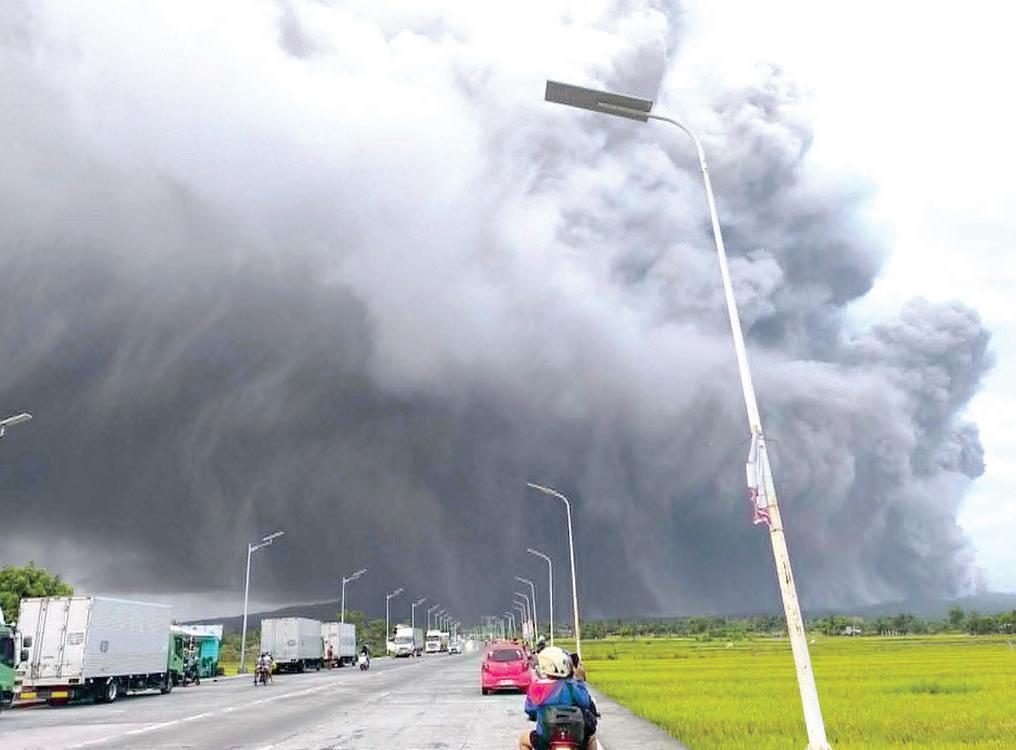
Assistant Secretary Irene Dumlao of the Department of Social Welfare and Development’s (DSWD) Disaster Response Management Group (DRMG) said the agency’s Field Office 5 has distributed 59,153 family food packs, along with hot meals and hygiene kits, to displaced residents in Tabaco City, Camalig, and Malilipot, based on the May 3, 6 a.m. report. Mayon emitted tons of volcanic ash on Saturday, affecting 52 barangays in various towns in Albay, the Office of the Civil Defense (OCD) in Region 5 reported.
On Sunday morning, OCD Assistant Secretary Raffy Alejandro,
together with Albay Governor Noel Rosal, conducted an inspection to fast-track flushing operations in affected areas in Guinobatan, Albay, that were covered with thick volcanic ash.
Firefighters were deployed to flush the volcanic ash, starting with the National roads. At a press conference, Jessar Adornado, OCD Bicol officer-in-charge, said about 2 to 3 inches of ash covered most of the National and barangay roads in Camalig and Guinobatan, Albay.
In the Mi-isi gully, 18 barangays were affected, while 17 others were affected by ashfall in the town of Camalig. In Ligao City, a total of 17 barangays were also covered with thick ash.
The Philippine Institute of Volcanology and Seismology (Phivolcs) reported that successive pyroclastic density currents along Mi-isi Gully within the Permanent Dan-
The projection also falls short of the government’s 5-6 percent growth target for the year. Abola said a rebound in government spending, particularly in infrastructure, could help prevent a deeper slowdown. It may be recalled that gross capital formation—or overall investment in infrastructure and construction—contracted by 9.4 percent in the fourth quarter of 2025, worsening from the 2-percent decline in the previous quarter.
ger Zone and ashfall on the southwestern slopes were observed during the past 24 hours.
A 24-hour Phivolcs observation from 12 a.m. Saturday to 12 a.m. Sunday showed Mayon, currently under Alert Level 3 or magmatic unrest, continues to show restiveness.
Eruptive activity at Mayon during the period was characterized by lava effusion with lava flow on Basud Gully, located on the eastern slope of the volcano, and one of the primary drainages of the volcano, Bonga and Mi-Isi gullies, with episodic minor strombolian activity and short-lived lava fountaining, Phivolcs reported.
In the last 24 hours, Phivolcs recorded 32 volcanic earthquakes, including 25 volcanic tremors lasting 2 to 15 minutes.
Phivolcs also recorded a total of 284 rockfalls and 14 PDC signals.
The government largely attributed








By Lorenz S. Marasigan
TOLL collection on the newly completed Cavite Expressway-C5 Link Segment 3B will begin on Tuesday, May 5, following the Toll Regulatory Board’s (TRB) approval of the fee schedule submitted by its operators.
The approved toll for travel between Dr. A. Santos Avenue (Sucat Road) in Parañaque and C.P. Garcia Avenue (C5 Road) in Taguig—covering both Segment 3B and the adjacent Segment 3A—are set at P59
Continued from A10
Amid ongoing tensions in the Middle East that continue to drive global oil prices upward, Dy and Marcos led the filing of House Bill 8834, or the Kalinga Act, which seeks to institutionalize a national protection system that would prevent Filipinos from bearing the full impact of fuel-driven crises. The measure is intended to ensure a fast, targeted, and automatic government response whenever fuel price shocks begin to increase the cost of living.
for Class 1 vehicles, P117 for Class 2, and P176 for Class 3.
The regulatory body gave the greenlight after Cavitex Infrastructure Corp. (CIC), the Philippine Reclamation Authority (PRA) and PEA Tollway Corp. (PEATC) complied with all regulatory requirements.
The segment was offered free of charge to motorists for the entire month of April. In that period, the road drew an average of 9,000 vehicles daily.
The segment is a six-lane, twokilometer stretch running from the
Marcos noted that the committee report is expected to be approved once Congress resumes session.
“We are pushing to move this forward as quickly as possible so we can put real protection in place,” Marcos added.
Senate: key governance, economic reforms WHEN it resumes regular sessions on Monday after a month-long recess, the Senate is expected to take up a wide-ranging legislative agenda centered on priority measures endorsed by the Ledac.
Top of the agenda are proposals on governance and political reform.
Kaingin area to the RSG Subdivision, connecting Cavitex at Parañaque to C5 Road in Taguig.
In 2024, CIC tapped D.M. Consunji Inc. (DMCI) to build the segment, which costs roughly P3.3 billion, according to the signed contract.
CIC initially opened the segment on March 30 under a modified scheme, operating with four lanes— two per direction—while right-ofway concerns in portions of the atgrade section are being addressed by the Department of Public Works and Highways (DPWH).
These include the Anti-Political Dynasty Law, which seeks to regulate political succession within families, and the Party-List Reform Act, aimed at refining representation in the lower chamber. Also lined up for deliberation are the Independent People’s Commission Act and the proposed Right to Information Act, both intended to strengthen transparency, accountability, and public oversight of government institutions.
Economic and fiscal measures are likewise lined up, among them: amendments to the Bank Secrecy Law and revisions to the Coconut Farmers and Industry Trust Fund Act to enhance fund utilization in the sector.
Full six-lane operations will follow once those issues are resolved. It is expected to be completed by the second quarter of 2027.
The entire Cavitex-C5 Link is being built at a cost of P15 billion and is a joint project of the PRA, TRB, and CIC, a unit of Metro Pacific Investments Corp.
The expressway is expected to serve up to 40,000 vehicles per day, reducing travel time to Makati and Taguig from Parañaque, Las Piñas, and Cavite by up to 45 minutes.
Lawmakers are also set to review the Estate Tax Amnesty program, which aims to boost revenue collection while easing compliance for taxpayers.
On social welfare, the senators will consider initiatives focused on education and poverty reduction: proposed amendments to the Pantawid Pamilyang Pilipino Program (4Ps) Act to improve the country’s flagship conditional cash transfer program, alongside the Masustansyang Pagkain para sa Batang Pilipino program addressing child nutrition in public schools. Also in the agenda is the Government Assistance to Students and Teachers in Private Education program, to expand educational support mechanisms.
Measures on energy, agriculture, and infrastructure are also expected to be prioritized: the Waste-to-Energy Bill, long-awaited amendments to the Electric Power Industry Reform Act (Epira), the Rice Tariffication Law, and a bill creating a Department of Water Resources.
Beyond the normal legislative duties, Senate President Vicente Sotto III underscored the chamber’s readiness to act on the Articles of Impeachment against Vice President Duterte once these are formally transmitted to the Senate.
He assured the public that the chamber would act forthwith and “with dispatch” upon receipt of the articles, emphasizing that the process would be handled with urgency and in accordance with law. On Saturday, Senate President Pro Tempore Panfilo Lacson gave an estimated timeline in a radio interview: the trial proper could start in June, even despite the prompt actions of the Senate, because preparatory measures by the chamber would take around three weeks from the time the complaint is endorsed.
According to Sotto, once the articles are received, he will immediately inform the plenary and refer the matter to the Committee on Rules for appropriate action, including setting the timetable and outlining the initial procedures for the impeachment trial.
congratulations to Bea Millan-Windorski on being crowned Miss Universe Philippines 2026. May the golden South Sea pearl shine its light throughout her reign.”
Pageant royalty witnessed the crowning of Bea, such as Venezuela’s Sergio Azuaga—Man of the World 2024; The Philippines’ Kirk Bondad—Mister International 2025; France’s Swann Lavigne— Mister Supranational 2025; and Thailand’s Praveenar Singh—Miss Universe 2025 first runner-up.
The contenders FROM 50 official candidates (minus one when Aklan’s Imelda Schweighart resigned), a fasttracked initial Top 10, voted through the Maya app, was announced during their provincial tour of Misamis Occidental. Marina Summers, the first drag queen to
Mayon, a young stratovolcano, is renowned for its near-perfect cone shape and is one of the most active volcanoes in the Philippines.
Ma. Antonia Bornas, chief volcano monitoring and eruption prediction of Phivolcs, said Mayon remains under Alert Level 3 despite the recent ashfall event.
DSWD ties up with LGUs
DUMLAO said the DSWD continues to coordinate with local government units and nongovernment organizations to ensure the timely delivery of assistance, including the deployment of mobile kitchens to serve hot meals to evacuees.
Beyond food aid, the DSWD partnered with Bicol University and the UN Youth Association to conduct psychosocial activities such as games, film showings, and educational sessions to help ease the stress of displaced children. It also rolled out livelihood interven -
tions for internally displaced persons (IDPs) whose income sources were disrupted by the volcano’s unrest. Following the Alert Level 3 declaration in April, the agency provided emergency cash transfers (ECT) and cash-forwork (CFW) assistance to families within the 6-kilometer permanent danger zone, in line with the directive of President Ferdinand R. Marcos Jr. to ensure adequate support for affected communities.
To address conditions in evacuation centers, DSWD Secretary Rex Gatchalian ordered
are staying in 14 evacuation centers across Albay. The DSWD has provided more than P71.60 million in humanitarian assistance, including food packs, cash-for-work wages, and aid under the Assistance to Individuals in Crisis Situations (AICS) program, to families affected by the volcanic activity.
THE Civil Aviation Authority of the Philippines (Caap) has barred aircraft from flying within a sixkilometer radius of Mayon Volcano’s summit up to 11,000 feet after the volcano erupted in the early hours of Sunday. Under Notice to Airmen (Notam) B1875/26, the airspace restriction covers all aircraft from the surface to 11,000 feet within the defined perimeter around the crater.
Caap cited the hazards of volcanic ash and airborne particles, which can damage aircraft engines and compromise navigation systems, as grounds for the precautions.
The Philippine Institute of Volcanology and Seismology (Phivolcs) placed Mayon under Alert Level 3 on its five-step scale, reporting strombolian activity and short-lived lava fountaining from the volcano. Phivolcs recorded continued eruptive activity including pyroclastic density current and lava flows. Thick dark plumes blanketed the skies over towns near Mayon. According to the US National Aeronautics and Space Administration (Nasa), Mayon is the most active volcano in the Philippines, with historical records showing 65 eruptions over the past 5,000 years.
by the conflict in the Middle East.
However, Taningco pointed out that this shock has “lag and spillover effects,” meaning, the economic impact of the shock has yet to fully materialize in the Philippines’ consumption basket.
“Our estimate is at 5.5 percent. So that showcases that inflation is sequentially accelerating on a year-on-year basis, and that is also driven largely by the energy shock triggered by the war, which has lag and spillover effects onto other items in the consumption basket, and that includes food, which is an important segment in our consumption basket,” added Taningco.
Last week, Emilio S. Neri Jr., Lead Economist of the Bank of the Philippine Islands (BPI), said the bank is seeing April inflation print at 5.7 percent.
As such, he said, the BSP “will need to hike much more aggressively, maybe as much as 50 basis points at a time to temper inflation expectations.”
The central bank has released its month-ahead inflation forecast for April, with the BSP seeing inflation to be within the range of 5.6 percent to 6.4 percent.
According to BSP, inflation risks have intensified amid upward price pressures from “significantly” higher domestic petroleum prices, rising prices of key food items such as rice, fish, and meat, increased electricity charges, and the depreciation of the peso. Meanwhile, the April headline inflation forecast of Jonathan L. Ravelas, senior adviser at Reyes Tacandong & Co., is at 5 percent, which reflects “continued pressure” from food prices especially rice and meat, higher transport costs from firmer oil prices, and seasonal demand tied to summer activity.
Ravelas added that the recent 25=bps hike by the Monetary Board “is best seen as a signal move,” as doing so “helps anchor inflation expectations and curb second-round effects.”
host a cisgender national pageant, announced the other semifinalists chosen by the selection committee.
Unlike in past editions, two runners-up to the top crown were not declared. Neither were the Pinay representatives to Miss Supranational 2027 and Miss Eco International 2027, and Miss Charm 2026 and Miss Cosmo 2026. They will most likely be chosen from the others in the Top 7 with La Union, namely, Cebu City, Cebu Province, Tarlac, Sultan Kudarat, Pampanga and Taguig.
Winning answer
THE selection committee was composed of Gazini Ganados—Miss Universe Philippines 2019; Ida Aldana—executive editor at Cosmopolitan Philippines; Carlos Garcia Candal— chief executive officer of GMG Productions; Peewee Isidro—editor-in-chief of Mega Magazine; Crystal Jacinto—founder of Villa Medica Philippines; Hayden Kho—co-chairman of Belo; Bryan Lim—vice president of Suyen Corp.; Jennylyn Mercado-Ho—actress; Rhett
Caap said “all airline operators, pilots, dispatchers, and aviation stakeholders are advised to closely coordinate with Air Traffic Services and monitor official updates before operating in affected areas.”
Lorenz Marasigan
Last week, Dacanay told reporters that higher prices of food could drive the country’s headline inflation to a peak of 8.1 percent in the fourth quarter, on the assumption that the Middle East war lasts beyond May. The Philippines, he said, may not be the most vulnerable country when it comes to the oil shock, but it is the most vulnerable when it comes to the food shoc “that’s incoming.”
Growth outlook
MEANWHILE, Dacanay said growth may have slightly improved to 3.2 percent in the first quarter of 2026 as government spending slightly picked up compared with the previous quarter. Overall, however, growth remains “well below the economy’s potential,” Dacanay pointed out, adding that the fallout from public construction spending cuts and its spillover effects on consumption continue to be the “dominant theme.” Looking ahead, the HSBC’s Senior Asean Economist said the growth outlook remains challenging, with higher energy and food costs “taking a further toll on consumption.”
Citing a consumer survey showing the share of households who saved in the first three months of 2026 was the “highest ever” since the data was collected in 2013, Dacanay said this increase in savings should then be reflected in slower growth in household consumption—“the bulwark of Philippine GDP.” Last week, Department of Economy, Planning, and Development (DepDev) Secretary Arsenio M. Balisacan said GDP in the first quarter could fall below 3 percent.
He underscored that the Philippines is among the countries most affected by the economic shocks stemming from the Middle East crisis, with most of the country’s fuel requirements—whether raw or refined—are sourced directly or indirectly from the region.
(See: https://businessmirror.com. ph/2026/04/30/middle-east-crisis-may-push-q1growth-below-3/)
Eala—fashion designer; and Na Zhao—Miss Universe Asia 2025. The Top 7 was asked a common question: “Many Filipinos are getting frustrated with the country. For you, why is it still worth it to represent the Philippines on the global stage?” Bea’s answer that won over the judges: “ THE Philippines is something and a place that I’ve been in love with my whole life. Growing up in a predominantly non-diverse part of the United States, I was identified as Filipina first and foremost. I often had to point where the Philippines was on a map to my peers and I always felt a sense of belonging and home. “I chose to pack my life into balikbayan boxes and suitcases because I believe in the limitless potential of the Filipino people and the fact that we need to create local opportunities here so that people don’t have to go abroad and be separated from their families in order to survive and thrive. If I were given the title of Miss Universe Philippines, I promise to be a public servant for all.”
Monday, May 4, 2026
By Jovee Marie N. dela Cruz

@joveemarie
HE House Committee on Justice
Tis set to transmit on Monday its committee report finding probable cause to impeach Vice President Sara Z. Duterte, along with the corresponding resolution and Articles of Impeachment, to the plenary for consideration, as a lawmaker said securing the required one-third vote is “not difficult to surmount,” paving the way for the case to proceed to a Senate trial.
The panel, chaired by Batangas Rep. Gerville Luistro, is expected to complete its constitutional mandate on the consolidated third and fourth impeachment complaints following last Wednesday’s unanimous 53–0 vote establishing probable cause.
“This committee has completed its constitutional duty to determine probable cause based on the evidence presented. On Monday, we will formally adopt the committee report and the corresponding resolution and Articles of Impeachment and transmit them to the plenary for the consideration of the entire House,” Luistro, a lawyer, said
in a statement.
At the center of the report are findings on several allegations against Duterte, including the alleged misuse of confidential funds, unexplained wealth, and threats to kill President Marcos, First Lady Liza Araneta-Marcos, and former speaker Ferdinand Martin G. Romualdez. Lawmakers cited evidence that Duterte allegedly misused P612.5 million in confidential and intelligence funds, including testimony that P125 million was disbursed within 24 hours—contradicting earlier claims.
Records from the House Committee on Good Government and Public Accountability pointed to an alleged “envelope system” and questionable receipts, while forensic analysis by the National Bureau of Investigation (NBI) indicated possible falsification of signatures.
THE Philippine Statistics Authority (PSA) flagged non-existent names among listed recipients, while the Commission on Audit (COA) confirmed a Notice of Disallowance exceeding P73 million, with potential
By Jonathan L. Mayuga @jonlmayuga
THE Department of Environment and Natural Resources (DENR) has intensified operations at the Navotas landfill to suppress the remaining fire and reduce emissions of the toxic smoke.
Technical crews from the agency’s Environmental Management Bureau (EMB) continued soil-covering, cooling, and dredging activities to contain smoldering areas and prevent the fire from spreading further.
To give communities better and faster information, DENR has also deployed additional PM2.5 and PM10 monitors to expand real-time air-quality monitoring in affected areas. EMB NCR is also coordinating targeted sampling for dioxins, methane, and other possible emissions with regional offices and technical partners.
Acting Environment Secretary Juan Miguel Cuna visited late last week the relocation site at Obando National High School, where 120 families have been temporarily sheltered after being evacuated owing to heavy smoke from the Navotas landfill fire. Cuna spoke with evacuees to hear their concerns and inspected the temporary shelters to make sure the evacuees are properly assisted and protected from further exposure to smoke and other health risks.
“The President’s instruction is clear: when people are at risk, government must be on the ground, listen to the affected families, and act quickly to protect their health and safety,” Cuna said in a statement.
The DENR is moving on two tracks: immediate protection for affected families and accountability for the cause of the fire, Cuna said.
The agency has launched a focused compliance audit of landfill operations, alongside an expedited technical investigation into what caused the fire.
Cuna said that any finding of noncompliance will be referred for appropriate enforcement action.
“We are not only responding to the smoke. We are also looking at why this happened, what standards may have been violated, and what must be corrected so communities are not put at risk again,” Cuna said.
He added that the agency will continue to publish air-quality monitoring updates and public advisories in coordination with local governments.
Meanwhile, the DENR chief urged residents, especially children, senior citizens, and persons with respiratory or heart conditions, to follow LGU instructions and use masks until local authorities confirm that it is safe to return home. Pinoys, Japanese conduct first ever live-fire drills at Salaknib
By Rex Anthony Naval
THE Army (PA) through its Armor Division, and the Japan Ground SelfDefense Force (JGSDF) conducted their first-ever combined live fire exercise as part of Exercise Salaknib at the lahar fields of Col. Ernesto Rabina Air Base (Cerap) in Santa Juliana, Capas, Tarlac, from May 1 to May 2 In a statement, the PA spokesperson, Col. Louie Dema-ala, said more than 200 Filipino troopers from the First Tank Battalion took part in the drills, utilizing four Israeli-made Sabrah light tanks.
Meanwhile, around 40 troops from the JGSDF (Recon Combat Battalion, 12th Brigade) participated in the drills with four maneuver combat vehicles in the subject matter expert exchange last May 1 and the live-fire exercise on May 2. “The live-fire exercise followed a tactical scenario that included locating the enemy, fixing their position, and ultimately destroying the target. Troops also rehearsed safety protocols, including troubleshooting procedures in the event of a misfire or weapon malfunction with appropriate corrective actions taken
to ensure operational safety and mission continuity,” Dema-ala noted. The PA vice commander, Maj. Gen. Efren Morados, together with the Armor Division commander, Brig. Gen. Ronel Manalo; JGSDF 12th Brigade deputy brigade commander, Col. Yoshifumi Ogura; Executive Director of the Presidential Commission on Visiting Forces Undersecretary Antonio Habulan; and US Army Pacific Commander Major Gen. James Bartholomees witnessed the drills. Salaknib 2026 directly supports the Army’s active transition to External Security Operations by focusing on combined operations with the US Army Pacific and partner armies. Salaknib Phase 2 is scheduled from May to June 2026 following the conclusion of Exercise Balikatan on May 8.
Aid to Ilocos Norte fishermen AS this developed, more than 700 fishermen received income aid from the Department of National Defense (DND), Bureau of Fisheries and Aquatic Resources (BFAR), and the provincial government of Ilocos Norte as support
exposure reaching hundreds of millions more.
On the issue of unexplained wealth, Luistro said the panel examined what she described as “forensic truth,” citing data from the Office of the Ombudsman showing Duterte declared net worth rising to about P88 million in 2024. This contrasts with more than P6.7 billion in covered and suspicious transactions flagged by the Anti-Money Laundering Council (AMLC) involving the vice president and her spouse.
“We are dealing with official records— not opinion or speculation. These are numbers, documents, and sworn testimonies that, taken together, establish a pattern that demands accountability,” Luistro said.
Another ground stems from Duterte’s November 23, 2024, news conference, where she publicly stated that she had instructed someone to kill the country’s top officials if she herself were killed.
The video of the remarks was authenticated by the NBI and presented during last week’s hearing.
NBI officials, led by Director Melvin Matibag, testified that their findings—
already submitted to the Department of Justice—indicate that Duterte’s actions may constitute inciting to sedition and grave threats, meeting the standard of a prima facie case with reasonable certainty of conviction.
Matibag also told lawmakers that the bureau is pursuing a follow-up investigation into Duterte’s claim that she had communicated with an individual to carry out the killings, treating the alleged hiring of an assassin as a serious and credible threat.
Luistro emphasized that the committee’s work was grounded in a careful, evidencebased process.
“This is not about politics. This is about the Constitution, about evidence, and about our duty to uphold public accountability. The House will now act as one body on this matter,” she said.
Once adopted, the committee report and resolution will be transmitted to the plenary. If approved by at least one-third of all House members, the Articles of Impeachment will be forwarded to the Senate, which will convene as an impeachment court.
See “House,” A6
By Butch Fernandez @butchfBM
THE Senate may convene as an Impeachment Court immediately after receiving the Articles of Impeachment against Vice President Sara Duterte-Carpio, but the trial proper may not begin until June, Senate President Pro Tempore Panfilo M. Lacson said.
Lacson explained his estimate of the timeline: while Senate President Vicente Sotto III wants to convene the impeachment court at once, at least three weeks may be needed for procedures such as the issuance of summons and reply, and a preliminary conference for purposes of stipulations and possible marking of evidence before the trial starts.
“Once the Articles of Impeachment are transmitted to us, if we follow the processes, we’re talking of at least three weeks before the actual trial starts,” he said in a mix of English and Filipino in a radio interview.
He said the preliminary conference or “pre-trial” may involve the Senate President or his legal adviser defining what issues may be taken up during the trial. Lacson recalled that the impeachment trial of the late former Chief Justice Renato Corona was marked by confusion owing to the absence of an early pre-trial process, which led to the introduction of “surprise” witnesses midway through proceedings.
“I recall that during the trial of Corona, there was no preliminary conference, so there was some confusion during the trial because ‘surprise’ witnesses were introduced. So it is better to have a preliminary conference where the prosecution and defense agree on which issues would be tackled and which would not before the trial,” he said. On the possibility of a temporary restraining order (TRO) from the Supreme Court, Lacson said the Impeachment Court will meet to
See “Impeachment,” A4

A4
Monday, May 4, 2026
By Rizal Raoul S. Reyes @brownindio
HE international think tank
TStratbase Institute urged the Philippines on Sunday to fast-track cooperation under the Japan-led Asia Zero Emission Community (Azec).
At the same time, the group cautioned the government to steer clear of energy arrangements with “coercive powers” that could compromise national interests.
In addition, it also welcomed the strengthening of Philippines–Japan ties under Azec following the visit of Japanese political figure Kishida Fumio, special envoy of Prime Minister Takaichi Sanae and Supreme Adviser to the Parliamentary Association of Azec.
Azec is a Japan-led regional initiative that promotes cooperation among partner countries on clean energy transition, energy security, and decarbonization.
Specifically, Stratbase Institute President Victor Andres Manhit called on the Marcos administration to accelerate energy projects under Azec and to pursue such initiative with Tokyo and other likeminded partners, rather than get into energy arrangements that could expose the country to geopolitical pressure.
He was alluding to ongoing discussions on possible joint energy exploration activities with Beijing on the West Philippine Sea, which China continues to claim as part of its territory despite a 2016 Arbitral Award invalidating its sweeping claims in the South China Sea.
“The Philippines must be unequivocal in its direction and choose arrangements that deliver real, sustainable prosperity. It must build its energy future with partners that respect its sovereignty and share its support for a rules-based order. More importantly, it must choose a path where it can strengthen its own capabilities without compromising on its national interests,” it said.
“Any energy arrangement that comes
Continued from A3 discuss, and if necessary, vote on what action to take.
“I believe that so long as the Supreme Court does not issue a TRO, the trial will continue. But if it compels us, we will discuss the matter. The Impeachment Court is a constitutional body and the Supreme Court has said it respects not only the Senate but the Impeachment Court as co-equal. The Impeachment Court’s decision cannot be appealed even before the Supreme Court. It is final,” he said.
“I am not saying that it is an option to ignore the TRO. But we must discuss and vote on it. We will always make decisions based on the majority,” he added.
Lacson said the senators held a meeting last Thursday to discuss the preparations for the possible impeachment trial. Those who attended were reminded to “act like judges” and not appear partial to the prosecution or defense.
Lacson said Sen. Robinhood Padilla, a
with implicit or explicit concessions in the West Philippine Sea, or that turns a blind eye on the ongoing coercion there, directly undermines the country’s sovereign and national interests,” the institute said.
The Philippines’s participation in Azec comes at a critical time as the world grapples with a global energy crisis triggered by the Middle East conflict, prompting countries to accelerate the shift toward cleaner and more resilient energy systems.
Manhit said that Azec offered the Philippines a “credible and forwardlooking framework that advances three essential goals simultaneously: energy security, economic growth, and decarbonization.”
At the same time, he said, the framework creates opportunities for the Philippines to access reliable technology, attract quality investments, and accelerate the development of resilient domestic energy capacity.
Manhit also welcomed plans for the Philippines and Japan to co-host the Fourth Azec Leaders Meeting in November, calling it a “clear recognition” of the Philippines’s growing strategic role in the Indo-Pacific.
Meanwhile, Manhit assailed the Chinese actions in the West Philippine Sea, including harassment of Philippine vessels and disregard of the 2016 arbitral ruling, as reasons for Manila to avoid exposure to “political and economic leverage that can be weaponized.”
In contrast, he noted, Japan has demonstrated a model of cooperation anchored on transparency, respect for international law, and capacity-building— principles it urged the Philippines to prioritize in its energy partnerships.
Last week, Kishida met with President Marcos and Energy Secretary Sharon Garin to discuss deeper Azec cooperation.
The meeting also coincided with the 70th anniversary of the normalization of Philippine-Japan diplomatic relations.
member of the minority bloc, attended the meeting and was asked to relay this to his minority bloc colleagues.
“We must listen to the questions during direct and cross-examination, and base our decisions on the evidence,” he said.
Lacson also said that while he is preparing for the possible trial by taking crash courses, he will also rely on his experience as a senator judge in the trial of Corona – and as a witness during his law enforcer days.
“I joked that I do have experience in court not as a lawyer but as a witness. When I was a law enforcer, I took the stand as a witness or arresting officer—or even an accused,” he said in jest.
Some P27 million may be available for the impeachment trial, Lacson said, as only P512,000 of the P27.544 million allocated in the 2025 budget for last year’s impeachment complaint was spent for 60 senator-judges’ robes as well as IDs and other items.
“The amount is under the continuing appropriations in the 2025 budget. It may be used this year. If not, the amount will be treated as savings and returned to the Treasury,” he said.

By Bless Aubrey Ogerio
THE country is looking to deepen cooperation with Israel in mineral processing and artificial intelligence (AI) as it seeks to reduce reliance on raw-material exports and move into higher-value production.
Recently, the Board of Investments (BOI) and the Israeli Ministry of Foreign Affairs discussed how Israel’s technologies in mining, water systems and environmental management could support the processing of key minerals such as nickel, copper, and cobalt.
The talks are linked to the country’s participation in the US-led Pax Silica initiative and broader efforts to strengthen supply chains for critical minerals used in semiconductors and other technologies that support AI systems.
The 4,000-acre (1,618-hectare) AIfocused industrial hub in Clark Field, Pampanga is in partnership with the United
States (US). The BOI earlier said at least five companies from the US and Asia have expressed interest in the project, which will be open to both foreign and local investors.
“Our strategic goal has been to add more value to our green metal exports—for example, nickel [which also comes with cobalt] and copper [which comes with gold], as we have historically exported these minerals in largely unprocessed form,” Trade Undersecretary and BOI Managing Head Ceferino Rodolfo said on Sunday
These minerals are considered “green metals” because of their role in energy technologies such as batteries and electric vehicles, as well as the need to meet environmental and labor standards in their extraction and processing, he added.
Further, both sides also explored the possibility of a bilateral agreement covering mineral processing, research and development, and coordination with the Philippines’ semiconductor and microchip sector.
For Rodolfo, Israel’s capabilities in industrial water systems and AI hardware development could support these efforts, particularly as the country looks to expand its role in technology supply chains.
“What access to latest AI technology does for the Philippines—especially to tech which are relevant for the manufacture of key components of compute hardware infrastructure—is an opportunity for us to elevate or to add another layer to our ambition for our green metals—we can now aspire towards local value-addition for our green ‘tech-metals,’” he explained. Critical minerals such as nickel, copper, and cobalt are key inputs in semiconductor manufacturing, including microchips and processors used in AI systems.
On the other hand, the engagement forms part of a wider push to link mineral resources with emerging industries such as AI and advanced manufacturing, although concrete agreements have yet to be finalized, according to the BOI.
By Mary Jade Jadormio
HE Roman Catholic Archdiocese
Tof Manila has launched a used cooking oil collection program that seeks to convert waste oil into biodiesel amid energy and environmental concerns.
In a circular, Manila Archbishop Cardinal Jose Advincula called on the clergy, consecrated men and women, and lay faithful to support the initiative.
The program will be led by the Archdiocese of Manila’s Ministry on Integral Ecology and will cover parishes, institutions, and households.
MALACAÑANG said Saturday the government’s swift and wideranging response to the global oil shock reflects President Marcos’s directive to cushion its impact on Filipino households and safeguard the country’s energy supply.
This came after the Asian Development Bank (ADB) reported that the Philippines emerged as “one of the most active countries in the Asia-Pacific in responding to the surge in global fuel prices.”
The ADB report said the Philippines adopted one of the most extensive sets of policy actions in the region to protect consumers and keep the economy moving, even as it recorded among the steepest increases in fuel prices.
Domestic fuel prices in the Philippines rose by almost 60 percent between February 23 and April 20 amid the tensions in the Middle East.
In reaction to the drastic spike in fuel prices, the Philippines implemented seven out of eight major policy responses identified by the ADB across Asia-Pacific economies.
for the no-sail period during the conduct of this year’s Exercise Balikatan.
In a dialogue with coastal communities held Saturday at the Ilocos Norte Centennial Arena, Defense Secretary Gilberto Teodoro, together with Ilocos Norte Gov. Cecilia Araneta Marcos, led the distribution of family food packs and financial assistance worth four days of income to a total of 734 fishermen beneficiaries—366 from Paoay, 273 from Burgos, and 95 from Laoag City.
In the circular, Advincula said the project aims to organize the collection of used cooking oil from homes, food establishments, and church institutions for proper processing.
“In the face of growing global challenges related to energy supply and environmental sustainability, the Archdiocese of Manila Ministry on Integral Ecology invites all parishes, institutions, and households to take part,” Advincula said.
The archdiocese said used cooking oil, when improperly discarded, can clog waterways and worsen pollution.
It added that collected oil can be con -
The Palace emphasized that while the crisis was driven by external factors, the government’s response is anchored on the principle that global shocks should not turn into “household disasters.”
“Government cannot control the conflict in the Middle East. It cannot dictate world oil prices. But it can control the speed, seriousness, and breadth of its response,” it said.
Under the President’s directive, the government rolled out several contingency measures to address the rising fuel costs, including targeted subsidies, assistance to transport workers, support for vulnerable households, price monitoring, fuel supply safeguards, and accelerated renewable energy initiatives.
“This is not a crisis created by the Philippines, but it is a crisis felt by Filipino families,” Malacañang said.
“That is why the President’s instruction has been clear: cushion the impact, protect supply, assist the most affected sectors, and prepare the country for greater energy security.”
The defense chief said the aid is part of the government’s obligations to take care of all Filipino citizens.
He emphasized that the regular conduct of large-scale exercises of the Armed Forces (AFP) with partner countries is also a continuing learning process, including understanding the needs of the affected areas and communities.
As exercises are conducted in different parts of the country, Teodoro shared that his primary directive is to hold dialogue and coordination with the residents and local governments, and to ensure that these communities are left in a better condition after these exercises.
www.businessmirror.com.ph
DIVERGING conditions in the country’s logistics market are emerging amid global fuel pressures, geopolitical tensions and shifting demand patterns, according to the Dimerco Asia Pacific May Freight Report.
The report noted that the Philippines stands out in air cargo pricing, with rates remaining stable across Asia-Pacific lanes. This contrasts with neighboring markets such as Malaysia, Vietnam, and India, where air freight rates are already moving upward.
In terms of capacity, air cargo conditions vary by destination.
Intra-Asia routes remain relatively loose, with available space exceeding demand, while Europebound shipments are seeing improving demand but still have sufficient capacity.
However, routes to the United States, both East and West Coast, are already tight, with limited space and earlier bookings now required to secure cargo space.
“Demand for traditional commodities is still relatively stable, but cost pressure is building across the board,” Kathy Liu, Dimerco Express Group vice president for global sales and marketing, said.
verted into biodiesel, which it described as a cleaner and renewable fuel alternative.
“Biodiesel production not only reduces waste but can also reduce greenhouse gas emissions by as much as 80 percent compared to conventional diesel,” the circular read.
Each parish was asked to designate a collection point, while parishioners were told to store used oil in clean, sealed containers free of food waste and water.
The archdiocese said regular pick-up and processing will be arranged, while a training seminar for interested groups was held on April 25 at Ermita Parochial School in Manila.
The administration also implemented temporary tax relief through Executive Order 114, which suspends excise taxes on liquefied petroleum gas and kerosene for three months.
To ensure a stable supply, the government has moved to diversify fuel import sources, build up inventories, secure supply buffers, and explore alternative trade routes amid disruptions in global energy markets.
The Department of Energy has also coordinated with oil companies to promote transparency in fuel pricing and manage price adjustments, while encouraging conservation measures to temper demand.
The Palace said the government’s approach combines immediate relief with long-term strategies, including the continued push for renewable energy to reduce dependence on imported fuel.
“This is leadership in a crisis,” it said.
“Not one dramatic action, but many practical actions working together to cushion the people today and prepare the country for tomorrow.” PNA
Governor Araneta Marcos expressed gratitude for the prompt action and delivery of assistance for the coastal communities of Ilocos Norte affected by Exercise Balikatan. Owing to the increased movement of air, land and maritime assets, a no-sail zone will take effect until May 6, as a precaution and to ensure civilian safety during the conduct of the military drills.
Teodoro also explained the importance of joint military training with partners to increase the country’s deterrence and uphold the Philippines’s exclusive economic zone (EEZ), and protect the livelihood resources of coastal communities.
“With fuel surcharges rising and capacity tightening, shippers are having to plan earlier and manage costs much more carefully than before,” she added.
Global air freight conditions, meanwhile, are being influenced by fuel supply constraints, particularly in the Middle East, where tensions have tightened jet fuel availability.
This has led airlines to reduce passenger flights, which in turn cuts available cargo space in aircraft belly holds, especially on Asia-Europe routes.
At the same time, demand for high-value cargo such as artificial intelligence-related shipments remains strong toward the United States, adding pressure on already uneven capacity conditions.
On the other hand, ocean freight tells a different story. Unlike air cargo, Philippine ocean shipping routes are seeing rising rates across all major destinations despite mixed demand signals and varying capacity conditions.
Intra-Asia routes remain soft in terms of capacity, but freight rates are still moving upward, while Europe-bound shipments are in an upturn phase, with improving demand and increasing costs.
US-bound lanes are also experiencing rising rates, even if capacity has not yet reached tight conditions.
The increase in ocean freight costs is being driven by fuel volatility and geopolitical risks, particularly in the Persian Gulf, where tensions have triggered selective frontloading as shippers move cargo ahead of possible disruptions and surcharge hikes.
Congestion at major Asian transshipment hubs has also added delays and capacity strain.
“Rising fuel costs at key bunker hubs, and the risk of shortages if conditions don’t improve, are already starting to shape how carriers adjust their rates and service networks moving forward,” Ted Chen, Dimerco
By Ada Pelonia @adapelonia
THE Department of Agriculture
(DA) is mulling over curbing rice imports for 90 days starting June to prevent farmgate prices from “collapsing” during the harvest of crops planted during the wet season.
The DA made the pronouncement after farmgate prices of palay slid to as low as P16 per kilo in key rice-producing areas, such as Nueva Ecija, Pampanga, Isabela, and Cagayan, as the main harvest season nears its completion.
Agriculture Secretary Francisco Tiu Laurel Jr. said the DA is considering limiting monthly rice import volumes from June to August to “balance supply and farmgate price concerns.”
This would ensure ample domestic supply, while preventing a farmgate price collapse, he added.
“Rice imports remain neces -
sary but must be carefully managed to avoid further depressing local prices.”
The DA chief noted that import controls helped ensure that about 70 percent of the harvest was sold at “favorable levels.”
The agency is also targeting to set a farmgate price of P22 per kilo for the wet season harvest in September to November, which it considers as a “crucial recovery window” for farmers.
Meanwhile, the National Food Authority (NFA) has increased its buying price for dry palay to as much as P30 per kilo, adding that
AMERICAN farmers are ignoring US Department of Agriculture (USDA) surveys in the latest sign of distrust in government data.
Reply rates for the USDA’s annual prospective planting report sank in March to a record low, with just over a third of 73,800 farm operations surveyed answering questions on the acres they will plant this spring of everything from corn and soybeans to tobacco and chickpeas. That compares with about 60 percent of farmers responding in 2018, with replies declining in each year since, according to government records.
Farmers say they are wary of sharing data to inform reports they feel often work against them, especially with abundant harvests in recent years keeping crop prices under pressure.
The mounting skepticism comes as the USDA is looking to become more responsive to farmers through a transformation that relies heavily on shared data. It also echoes a broader loss of trust in government data, particularly as President Donald Trump has called into question federal statistics and information—from jobs reports to voter tallies and even weather maps.
Iowa farmer Ben Riensche says the agency’s various surveys are too arduous and the markets often slump after the corresponding reports are released, affecting what they get paid for their crops.
“I don’t trust the data, don’t trust the process, I don’t trust their people,” Riensche said. “And they monkey with my business.”
The trend may present complications for Trump’s efforts to court farmers, a key voting bloc for him and the Republican Party. He has repeatedly hosted farmers at the White House, unveiling a $12 billion aid package for them in December, then holding a “celebration of agriculture”— complete with a gold-colored tractor on the White House lawn—in March.
Intelligence from the farm is the lifeblood of the USDA’s reports, resulting in findings and forecasts that influence the direction of global crop prices and, ultimately, helps determine how much consumers pay for food.
But distrust of the USDA’s conclusions is creating a vicious circle, with the lack of contributions making the agency’s reports less accurate and in turn generating more farmer skepticism. That lack of accuracy also is resulting in more volatility in futures markets.
A case in point is the January crops report from the USDA, which surprised the market when the agency unexpectedly boosted its estimate for the US corn crop by 1.6% to a record 17.021 billion bushels. Most had been anticipating a slight downward revision from the USDA’s previous forecast, and futures in Chicago subsequently posted their biggest daily decline in years.

it will intensify procurement in areas where prices have nosedived.
The DA has also rolled out a direct purchase order system to enable farmers to sell directly to the NFA before their actual harvest.
As stakeholders flagged logis -
While it was known that farmers shifted heavily toward corn during the growing season—particularly after China halted its purchases of American soybeans—the unexpected increase in supply blindsided many.
“When the USDA is that far off without much explanation, it creates distrust in future reports,” Darin LaBar, who grows corn, soybeans and wheat in Michigan, wrote to the USDA. He was one of 240 people who answered a request by the agency seeding feedback on ways to improve its data collection.
“You have to be able to trust the information that you’re given, and if you can’t even trust that, then why even do the report?” he said in an interview.
USDA Secretary Brooke Rollins said after the January report that the agency wanted to ensure it wasn’t “driving price outcomes.” Deputy Secretary Stephen Vaden also addressed the issue at the agency’s annual spring meeting with its data users.
“We understand that the data that we provide moves markets; we understand that it affects individual planning decisions by farmers and, therefore, we know that the data we provide needs to be correct,” he said.
The National Agricultural Statistics Service in an emailed statement said it is working to address declining response rates, and “remains committed to providing timely, accurate, and useful statistics in service to American agriculture.”
Montana farmer Sarah Degn said she has little faith in the reports because she knows producers—herself included— often fill them out while pressed for time and distracted by all their responsibilities on the farm. Few have time to sit down and pull out the spreadsheets and other records they need to give accurate answers, she said.
“If you’re in a hurry, you’re just trying to remember the numbers off the top of your head,” said Degn. “So I’ve always questioned the accuracy.”
Former USDA chief economist Seth Meyer is intimately familiar with the issues. He views the data the agency collects from farmers as the backbone of all the analysis and aid it provides for the agriculture sector.
So when farmers don’t participate, he said, the data suffers and then farmers lose even more faith in the USDA’s findings.
“This isn’t the farmers’ fault, per se, but it also can’t be solved without them,” said Meyer, now director of the University of Missouri’s Food & Agricultural Policy Research Institute. “The USDA has to go out and say, ‘Hey, there’s good reasons that you want to do this.’”
The information the agency solicits is used to, among other things, track crop plantings and harvests, and estimate domestic and global inventories and demand. Bloomberg News
tical bottlenecks that continue to delay deliveries and limit farmers’ access to government buying stations, the DA said this will be partly addressed by the NFA’s additional procurement of 150 trucks this year.
The DA also said it is pushing for expanded storage and warehouse capacity, including strategic stockpiling to secure supply up to 2027. Currently, the national rice inventory stands at roughly 70 days of consumption.
THE DA is exploring policy options, such as blending local and imported rice, to keep retail prices stable. Stakeholders have been invited to propose blending ratios that will favor local rice.
“We want to strike a balance among all stakeholders in the rice value chain, including consumers, especially amid climatic and geopolitical challenges,” the DA chief said.
Tensions in the Middle East have raised the cost of fertilizer and fuel for farm machinery, while El Niño occurring in the second half of 2026 threatens the upcoming crop harvest and livestock production.
The DA also noted that negotiations with source countries for longer-term rice supply contracts are ongoing, while potential shipments from India were also discussed.
“The priority remains price stability without harming farmers, securing an adequate supply into next year.”
REVENUES from coconutbased exports fell by nearly 5 percent in the first quarter as receipts from coconut oil continued to decline during the period, according to the Philippine Statistics Authority (PSA).
Despite the global oil crisis triggered by the Middle East war and the threat of El Niño, Philippine Coconut Authority (PCA) Administrator Dexter Buted expects local coconut output to bounce back this year.
PSA data showed that the value of coconut-based exports fell to $849.34 million in January to March, 4.7 percent lower than the previous year’s $890.77 million.
Shipments of coconut oil dragged down the product group’s earnings in the first quarter, as it dropped by 12.9 percent to $661.06 million from $759.2 million.
Despite the downtrend in in -
come from the tropical oil, PSA data indicated that export revenues from other coconut-based products posted increments on an annual basis.
Export earnings from desiccated coconut soared by 35.1 percent to $128.54 million in the reference period from $95.14 million in 2025, based on PSA data.
The country’s outbound shipments of copra meal or cake more than doubled to $28.31 million from last year’s $12.98 million.
Earnings from other coconut products jumped by 34.1 percent to $31.43 million from $23.44 million in the same period in 2025.
For his part, the Buted expressed optimism in coconut production for this year, owing to government interventions, such as fertilization and drip irrigation, that could offset the potential impact of El Niño on plantations.
“Production is doing well, that’s
an assurance,” Buted told reporters on the sidelines of the 9th Sustainable Agriculture Forum organized by the European Chamber of Commerce of the Philippines (ECCP).
“So, we’re looking at (a higher coconut output this year), around 16 to 17 billion nuts, from last year’s 15.3 billion.”
EU regulation
MEANWHILE , Buted also allayed concerns about the potential impact of the European Union’s (EU) proposed regulation on the country’s coconut exports. This, after the EU notified the World Trade Organization (WTO) of a proposed regulation to set mandatory maximum levels for mineral oil aromatic hydrocarbons (MOAH) in various food products due to health concerns.
“We have already set up the laboratory, but the standards are not yet in, so we’re still waiting for the EU market for all the standards,”
Buted said. In the meantime, the PCA chief said the government has introduced “white copra” produced through “cleaner and safer” processing.
“It’s no longer the normal tradition of making the copra. It’s made into a higher value, so there’s now equipment and processing of this white copra.”
MOAH is a type of mineral oil hydrocarbon (MOH) obtained mainly from crude oil, but also from coal, natural gas, and biomass.
The EU released an update to the risk assessment of MOH in food in 2023, concluding that MOAH may be associated with genotoxicity and carcinogenicity, thus posing a risk to human health. In its notification to the WTO, the EU said maximum levels for MOAH in food should be set to ensure a high level of human health protection. Ada Pelonia
THE Department of Agriculture (DA) has raised the budget ceiling to P100 million for each project that may be given the green light under a program for local industries that have been injured by imports.
Agriculture Undersecretary Jerome Oliveros said the DA has received eight project proposals from the coffee sector under the Competitiveness Enhancement Measures Fund (CEMF).
With guidelines for the CEMF availment still being revised, Oliveros noted that the agency has yet to approve any projects. The current cap on projects under the program is P50 million.
“The (guidelines) are currently under review, and we’re accelerating it because a lot of cooperatives have applied. Hopefully, by one month, it’s already released,” he told reporters on the sidelines of a recent national investment forum at the headquarter of the Asian Development Bank (ADB) in Manila.
“Right now, the maximum funding per project is P100 million, but not all projects will be allocated that amount...many need to (funds) since there are several cooperatives that need help and are eligible for the program.”
Agriculture Secretary Fran -
cisco Tiu Laurel Jr. told the BusinessMirror that the DA has yet to use the money earmarked for the CEMF in its 2025 budget, which stood at P1.25 billion, due to “complicated rules” and “small amounts” in per-project funding.
For 2026, the government has allocated P25 million for the CEMF, based on budget documents.
Industry sources said the CEMF consists mostly of safeguard duties collected from coffee and poultry imports. The current balance of the fund as of end-2024 stood at P5.16 billion.
The CEMF is established under Republic Act (RA) 8800 or the Safeguards Measures Act to boost the competitiveness of domestic industries injured by increased imports through agricultural and fisheries programs.
Under RA 8800, 50 percent of earnings collected from fees, charges, and safeguard duties on imported goods would be earmarked for this fund.
The special safeguard duty is a trade mechanism that a country can impose on imported products that fall below a trigger price.
Cido projects
MEANWHILE , the DA official
said several projects are in the pipeline under the Coffee Industry Development Office (Cido), which has centralized coffee programs, funding, and policies that were previously scattered across several units.
Oliveros, who helms the Cido, noted plans to expand nursery plants and forge partnerships with local government units (LGUs) to widen the hectarage for coffee production. For its partnership with LGUs, he said the national government wants coffee areas to be covered under the Comprehensive Land Use Plan (CLUP).
“The government will be infusing a lot of capital for farm-tomarket roads, postharvest facilities, seedlings, and fertilizers,” he said. “If these lands are suddenly converted into a residential, commercial, or industrial space, then all our investment will be wasted.”
Oliveros noted that the DA aims to broaden the domestic coffee production area by another 100,000 hectares over a 10-year period to address the country’s reliance on foreign supplies.
The DA official said he is seeking P2.9 billion in funding
for Cido under the 2027 budget to bankroll these programs, which will also cover additional manpower, farmers’ training, and provision of postharvest facilities.
The proposed budget, however, has been slashed to around P750 million following a Management Committee meeting.
“If our target is 100,000 hectares in 10 years....the planting material for an additional 3,000 hectares alone will need roughly P3 billion, so hindi kakayanin ‘yan because there are also other commodities, not just coffee. We’re still lobbying (for additional funds).”
The DA official is banking on the CEMF to fill the gap in limited fiscal space, as the funding for the measure can be tapped by farmers, with the government assisting them through technical support.
“We should be the beacon of hope for farmers. If they see these initiatives, they will be encouraged to plant,” Oliveros said. “Then the next administration might be able to pursue the same agenda and program because they see that good things are happening, and a lot of farmers are happy.” Ada Pelonia
Editor: Angel R. Calso
By Bassem Mroue The Associated Press
Israeli airstrikes on southern Lebanon killed at least seven people and wounded others on Saturday while the Israeli military demolished parts of a Catholic convent in a border village, officials said.
Israel’s military on Saturday issued a new warning for residents of nine southern villages to evacuate. Israel and Lebanon’s militant Hezbollah group have kept up their attacks despite a ceasefire in place since April 17.
In the border village of Yaroun, Israel’s military used bulldozers to destroy parts of a Catholic convent that had been empty as a result of the latest fighting.
“What we heard is that it was destroyed with bulldozers,” said Gladys Sabbagh, the superior general of the Basilian Salvatorian Sisters. Sabbagh told The Associated Press that the convent included a school that had been closed since the 2006 Israel-Hezbollah war, as well as a clinic that was recently moved to the nearby village of Rmeich. She described the convent as a small compound housing just two nuns, who left because of the war. Sabbagh did not have further details as Yaroun’s residents have been displaced.
Catholic Church disputes
Israeli military’s version
THE Israeli military issued a statement saying that as the army was destroying Hezbollah infrastructure in Yaroun, a house that had no reli-
Continued from A3
One-third vote
THE House Committee on Public Accounts
chairman, Party-list Rep. Terry L. Ridon of Bicol Saro expressed confidence that the House will secure the one-third vote required to impeach Duterte, describing the threshold as “not difficult to surmount.”
In a recent news forum, Ridon said the Justice panel’s 53–0 vote finding probable

gious signs was damaged. It added that as soon as the military knew it was linked to a church, soldiers “prevented any further damage from being done.”
The military added that Hezbollah used the compound in the past to fire rockets toward Israel on several occasions. It added that the military does not strike religious institutions intentionally.
The Catholic Church in Lebanon rejected claims that the compound was used for military purposes.
“We are against all practices against places of worship and churches. These are places to spread peace, love and education,” said Rev. Abdo Abou Kassm, director of the Catholic Center for Information. “These are not military bases.”
The demolition at the convent came days after images of an Israeli soldier wielding an ax against the fallen statue of Jesus on the cross in the southern Lebanese village of Debel had sparked widespread condemnation, in Lebanon and internationally.
Israel says it’s targeting Hezbollah infrastructure and members IN other parts of southern Leba-
cause has put the chamber on track to obtain the 106 votes needed.
“With 53 votes already for probable cause, we only need 106 votes to impeach,” said Ridon, a lawyer and member of the Committee on Justice.
Out of more than 300 House members, Ridon said reaching the required one-third vote threshold is well within reach.
“I believe that number will not be difficult to attain,” he added. Ridon said the Justice panel is set to approve its committee report on Monday, including the final consolidated articles of impeachment and corresponding resolution.

non, Israeli airstrikes and Hezbollah attacks continued.
Lebanon’s state-run National News Agency reported an airstrike on a car in the village of Kfar Dajal killed two people, while another hit a home in the village of Lwaizeh, killing three. Two others were killed in a strike on the village of Shoukin, it said.
Israel’s military Arabic-language spokesperson, Lt. Col. Ella Waweya, posted on X that the Israeli air force carried out about 50 airstrikes over the past 24 hours targeting Hezbollah infrastructure and members.
Hezbollah said that it attacked with a drone the Israeli troops that gathered on Saturday inside a house in the coastal village of Bayed.
Over the past weeks, the Israeli army has been leveling neighborhoods in towns and villages near the Lebanese-Israeli border. The military says it destroys buildings that were used as outposts by the Iran-backed group.
The Israeli military released a new video that it said shows Hezbollah positions in southern Lebanon being blown up. The video, released Friday, shows soldiers holding an Israeli flag and walking among the
“I’m quite certain that within the next two weeks, plenary debates on the impeachment of Vice President Sara Duterte will begin,” he said.
He stressed that the immediate priority is securing plenary approval before forming the prosecution panel.
“As soon as it is approved at the committee level, it will go to the plenary for debate,” Ridon said. “Once we are done at the plenary level, I think within two weeks we can transmit it to the Senate.”
Ridon added that discussions on potential public and private prosecutors will follow only after the House votes to impeach,
destruction of a soccer stadium in the Lebanese town of Bint Jbeil. The military said on its website that the air force “destroyed the town’s stadium after it was discovered to be booby-trapped.”
The latest war between Israel and Hezbollah began on March 2, when Hezbollah fired rockets into northern Israel, two days after the United States and Israel launched a war on its main backer, Iran. Israel has since carried out hundreds of airstrikes and launched a ground invasion of southern Lebanon, capturing dozens of towns and villages along the border.
Since then, Lebanon and Israel have held their first direct talks in more than three decades. The two countries have formally been in a state of war since the founding of the state of Israel in 1948. A 10-day ceasefire declared in Washington went into effect on April 17. The ceasefire was later extended by three weeks.
The Health Ministry said that since the war began two months ago, 2,659 people have been killed and 8,183 wounded.
Associated Press writer Ibrahim Hazboun in Jerusalem contributed to this report
noting that several names are already being considered.
Aside from Ridon, those mentioned as possible prosecutors include Reps. Luistro (Batangas), House Senior Deputy Majority Leader Lorenz Defensor (Iloilo), Ysabel Maria Zamora (San Juan City), Rodge Gutierrez (1-Rider Party-list), Jonathan Keith Flores (Bukidnon), Joel Chua (Manila), Chel Diokno (Akbayan), Leila De Lima (Mamamayang Liberal), House Minority Leader Marcelino Libanan (4Ps Party-list), and Lordan Suan (Cagayan de Oro City).
He also outlined three key pillars of the case: alleged misuse of confidential funds,

2
By Samya Kullab The Associated Press
KYIV, Ukraine—Two people were killed after a Russian drone attacked a minibus in the southern Ukrainian city of Kherson, local officials said Saturday, in the latest barrage of civilian areas, a hallmark of Moscow’s fullscale invasion of its neighbor.
Seven people were also wounded in the attack, regional head Oleksandr Prokudin said. Hours later Russia attacked another minibus in Kherson, wounding the driver, he said.
Meanwhile, along the northern border with Belarus, Ukraine recorded “rather unusual” activity on Friday, Ukrainian President Volodymyr Zelenskyy said in a post on Telegram on Saturday. Without elaborating, he said activity was seen on the Belarusian side of the border and that Ukraine would act if matters escalated.
“We are closely documenting and keeping the situation under control. If necessary, we will react,” he said.
Belarus, a close ally of the Kremlin, has allowed Russia to use its territory as a staging ground to send troops into Ukraine and to host some of Moscow’s tactical nuclear weapons.
On Ukraine’s Black Sea coast, a Russian strike damaged port infrastructure in the city of Odesa. No casualties were reported.
Ukrainian civilians have endured relentless air assaults since Russia
Continued from A1
borrowings cornered the lion’s share at P731.101 billion. This expanded by 62.17 percent from P450.800 billion in the first quarter of last year. Recall that the Treasury had a jumbo bond issuance in February, raising P297.94 billion from 10-year fixed-rate Treasury notes.
Total borrowings through fixed-rate Treasury bonds reached P644.766
launched a full-scale invasion of its neighbor more than four years ago. US-brokered talks between Moscow and Kyiv over the past year have brought no respite, with Russia rejecting Ukraine’s offer of a ceasefire, and in recent weeks the Iran war has diverted international attention from Ukraine’s plight. Meanwhile, on the roughly 1,250-kilometer (750-mile) front line, Russia claimed Saturday it had taken control of the village of Myropillia in Ukraine’s northeastern Sumy region.
It was not possible to independently verify the battlefield claims, and Ukraine did not immediately comment. In Russia, local officials in the Krasnodar region said that a fire that broke out Friday following a Ukrainian strike on an oil terminal in the Black Sea city of Tuapse was put out on Saturday.
Ukrainian drones have hit the oil refinery and export terminal in Tuapse on four occasions in just over two weeks, sparking fires that prompted local evacuations and sent up massive plumes of smoke. Ukraine has escalated its long-distance strikes against Russian oil facilities in an effort to slash Moscow’s oil exports, a key source of funding for its grinding invasion of Ukraine. But the economic impact is so far unclear, as the rise in oil prices from the Iran war, and a related easing of US sanctions, have helped replenish the Kremlin’s coffers.
unexplained wealth, and threats against the president and other top officials.
Ridon cited a COA directive requiring the vice president to return P448 million in confidential funds, as well as financial records showing P6.77 billion in transactions involving Duterte and her spouse.
He also stressed that Duterte’s threats against the President remain serious, regardless of whether they were framed as conditional.
“In the end, lawmakers will decide based on the evidence and their conscience,” Ridon said. “But I’m quite certain that even choosing from any of the three pillars, the evidence is sufficient to convince them.”
RIDON also challenged Davao City Rep. Paolo Duterte to substantiate his claim that lawmakers were being threatened with district defunding to force support for the impeachment.
With proceedings expected to move to the plenary, Ridon said he expects Paolo Duterte to personally defend the Vice President.
“We expect him to defend his sister during the plenary proceedings,” Ridon said.
He urged the Davao lawmaker to present evidence in the proper forum instead of making public statements without proof.
“It would be better for Congressman Duterte to substantiate his claims. For the past few months, he has only been issuing statements on Facebook,” Ridon said.
He also noted the lawmaker’s absence from plenary sessions and committee hearings, stressing that Congress is the proper venue for raising such concerns.
Fraction
DEPUTY Speaker Paolo Ortega V said the P6.7 billion in transactions flagged by the AMLC
may represent only a fraction of the total funds involved.
“If we are surprised by P6.7 billion, we must understand that this is not the full amount—it only reflects what the AMLC can capture under its limited scope. This is just the tip of the iceberg,” Ortega, who represents La Union, said. He explained that banks are required to report only transactions of at least P500,000 in a single day, as well as suspicious transactions, leaving many smaller transactions unrecorded.
“Anything below that threshold is not automatically reported. But repeated smaller transactions can accumulate into very large amounts that are not immediately visible in AMLC data,” he added.
During an April 22 hearing, the AMLC confirmed that Duterte and her husband were linked to 663 transactions totaling P6.77 billion.
Of this amount, P4.42 billion were inflows, P1.55 billion were outflows, and P791.1 million were classified as undetermined. Ortega stressed that the figure is only a partial snapshot that already raises serious concerns.
“This is not a definitive total. It only reflects what the system is designed to capture. If this much is already visible under limited reporting, it is reasonable to ask how much more lies outside that net,” he said. He also pointed to data from the Office of the Ombudsman showing Duterte’s declared net worth rising from P7.25 million in 2007 to P88.51 million in 2024, highlighting a gap between declared assets and the scale of financial transactions.
“If declared net worth is in the tens of millions but financial movements reach billions, there is a disconnect that needs to be explained,” Ortega said.
www.businessmirror.com.ph
By Justine Xyrah Garcia
FACTORY-GATE prices picked up pace in March, driven largely by higher petroleum costs, the Philippine Statistics Authority (PSA) said.
Data showed the Producer Price Index (PPI) for manufacturing grew by 2.5 percent in March, faster than the 1.4 percent recorded in February and the 0.8 percent posted in the same month last year.
For the first quarter, producer prices rose by 1.7 percent, reflecting the year-on-year increase in average factory-gate prices from January to March compared with the same period in 2025.
The PSA said the March acceleration was primarily fueled by the manufacture of coke and refined petroleum products, which expanded by 8.7 percent during the month.
The sector alone accounted for 49.4 percent of the overall increase in producer prices.
“Among the 22 industry divisions for manufacturing, manufacture of coke and refined petroleum products has the fourthhighest weight in the computation of PPI,” the PSA explained.
Other contributors to the uptick included the manufacture of computer, electronic and optical products, which rose by 5.3 percent, and basic metals at 4.3 percent.
The agency said the increase in producer
prices was also broad-based, with 15 of the 22 industry divisions posting annual gains, while only four recorded declines during the period.
On a monthly basis, producer prices reversed course, posting a 0.9 percent increase in March from a 0.1 percent decline in February.
Petroleum products again led the monthly increase, surging by 4.7 percent, followed by electronics and food manufacturing. These sectors collectively accounted for more than 80 percent of the month-on-month rise.
Despite the broader uptick, annual price growth in food manufacturing eased to 0.7 percent from 0.9 percent in February, weighed down by a 1.4 percent decline in vegetable and animal oils and fats, a reversal from a 0.4 percent increase in the previous month.
On a monthly basis, however, food manufacturing prices edged up by 0.1 percent in March from a 0.5 percent decline in February, largely driven by a 0.2 percent increase in vegetable and animal oils and fats.
The PPI tracks price movements of domestically manufactured goods sold at factory gate prices and is used as a key indicator of inflation in the sector. It also serves as a deflator for economic measures such as the Value of Production Index (VaPI) and the Value of Net Sales Index (VaNSI), which help estimate manufacturing output and sales.
CEBU CITY—Local governments in Cebu are ramping up water security and drought mitigation measures amid warnings of a possible El Niño episode later this year, with both provincial and city governments rolling out coordinated efforts to safeguard supply and strengthen long-term resilience.
Gov. Pamela Baricuatro in a news conference underscored the urgency of addressing Cebu’s growing water challenges through stronger coordination among local governments (LGU), sustainable management systems, and critical infrastructure development.
The governor said the Capitol is pursuing a mix of immediate, medium-term, and long-term solutions to cushion the effects of prolonged dry spells.
Short-term measures include the rollout of water tracking systems, deployment of emergency water trucks through the Provincial Disaster Risk Reduction and Management Office, and augmentation of local water systems in areas already experiencing supply issues.
Support for bulk water systems in towns such as Moalboal and Carmen is ongoing, while the province continues to assist LGUs with existing initiatives, including Danao City’s newly launched waterworks system.
To enhance coordination, the Cebu provincial government has established the Cebu Provincial Inter-LGU Waterworks System Office (CPIWSO), led by water management expert Aldrin Barade, an engineer.
The office will oversee water-related concerns across Cebu and provide technical assistance to municipalities and barangays developing community-based water systems.
Barade encouraged LGUs to closely coordinate with the province for guidance in building sustainable water sources.
The province is also exploring innovative solutions through a partnership with an Israel-based company and the University of San Carlos for a pilot water management project in high-demand barangays with limited supply despite available sources.
Baricuatro emphasized the need for dam construction projects, not only for flood control but also to ensure a stable water supply.
The province is set to meet with the Regional Development and Provincial Development councils to push for the inclusion of dam projects in the government’s official program.
Around P7 billion has been earmarked, with the province appealing for national government support to prevent a repeat of the devastation caused by Typhoon Tino.
Efforts to mitigate the impact of drought
JUST before he became President, Rodrigo Duterte threatened to ride a jet ski at the West Philippine Sea to dramatize and strengthen the Philippines’s claim to the area, but he promptly sided with China after assuming the highest post in the land and did not live up to his threat.
On Sunday, a female member of the House of Representatives rode a jet ski from Pag-asa Island to Pag-asa Cay 2 in a peaceful but firm defiance against China’s continous aggressiob in the WPS, thus busting Duterte’s “macho bubble.”
The civilian Atin Ito successfully carried out on Sunday a dawn voyage to Pag-asa Cay 2 (Sandy Cay), planting the Philippine flag in a symbolic act of possession for the land feature.
Launched from Pag-asa Island at 5:40 a.m., the mission involved a small team navigating a rubber boat, led by Party-list Rep. Dadah Kiram Ismula of Akbayan on board a jet ski, alongside Atin Ito volunteers.
Despite the heavy Chinese presence in the area, the team reached Pag-asa Cay 2 and raised the flag, reporting that they slipped past several Chinese vessels monitoring nearby waters.
Matagumpay po nating naitaas ang ating bandila sa Pag-asa Cay 2 sa kabila ng mabigatnapresensiyangTsina,” Ismula said, calling the action a peaceful but defiant stand against illegal incursions.
“This is a defiant but peaceful act of resistance against China’s aggression within our waters. Our message is clear: the West Philippine Sea is ours. No amount of intimidation can erase that fact,” she added.
Pag-asa Cay 2 is situated firmly within the Philippines’s territorial waters and an extension of Pag-asa Island. Recently, it has become a maritime flashpoint, with reports of Chinese Coast Guard presence and Philippine patrols.
The area is long subject to China’s expansive claims and nearby artificial islandbuilding, and the mission underscores a
growing civic movement asserting Philippine sovereignty despite escalating tensions.
AFP commends mission
THE Armed Forces (AFP) on Sunday expressed its “heartfelt commendations to the Atin Ito Coalition for its successful and courageous civilian-led mission to Pag-asa Island in the WPS.”
“The successful navigation to our features, culminating in the planting of the Philippine Flag on Sandy Cay, is a profound testament to the indomitable spirit of the Filipino people.
This is not merely a symbolic gesture; it is a powerful assertion of our sovereign rights and a demonstration of active citizenship in the face of external challenges,” the AFP spokesperson for the WPS Navy, Rear Adm. Roy Vincent Trinidad said in a statement.
Trinidad was referring to the group’s safe arrival in Pag-asa Island Saturday night and successful planting of a Philippine Flag at Sandy Cay, which lies a short distance from
By Carmel Loise Pedroza
CEBU CITY—The provincial government of Bohol welcomed its first direct chartered flight from Japan on Saturday, marking a significant milestone in efforts to strengthen the island’s international tourism market.
Gov. Aris Aumentado led the reception at Panglao-Bohol International Airport, where 164 Japanese tourists arrived from Narita International Airport on board a Cebu Pacific chartered flight.
extend to agriculture and fisheries. Provincial Agriculture Office head Roldan Saragena said 20 sets of small irrigation equipment with 4,000-liter tanks and 100-meter hoses have been prepared for farmers.
The province has also procured 200-liter water drums and is set to distribute P10.5 million worth of short-duration vegetable seeds under the “Food Always in the Home” (FAITH) program to bolster food security.
In the fisheries sector, the government continues the construction of more than 200 payaw, or fish aggregating devices, alongside its agri-fishery insurance program.
Meanwhile, the Metro Cebu Water District (MCWD) is bracing for supply losses, estimating that up to 40,000 cubic meters of water per day could be affected by El Niño.
General Manager DX Lapid said, “Pagasa [Philippine Atmospheric, Geophysical and Astronomical Services Administration] told us that there is a big chance—60 to 80 percent chance—that we will have a weak El Niño by the end of the year and probably will extend first quarter or middle of 2027 in Cebu.”
MCWD has identified vulnerable sources, particularly in the Jaclupan area in the south, which could impact Talisay City and southern Cebu City. To offset losses, the agency is augmenting supply through a desalination plant in southern Cebu and plans to drill additional wells in coordination with Cebu City, expected to add 8,000 cubic meters per day.
Rationing may be implemented in Talisay if shortages worsen, alongside water delivery services and the installation of mobile syphon tanks (MSTs) in mountain barangays.
Cebu City is also set to procure additional MST units.
Complementing these efforts, the Cebu City Government has restored more than 90 percent of its artesian wells to ensure alternative water access.
Under the directive of Mayor Nestor Archival, the Department of Public Services conducted a citywide inspection and rehabilitation program.
Data shows 386 artesian wells are now functional, with 195 in the northern area and 191 in the south. These wells are intended for nonpotable use, such as bathing and washing, pending further testing to determine water safety and check for possible saltwater intrusion.
City officials said the initiative is part of a proactive approach to mitigate El Niño’s impact and strengthen long-term climate resilience. Carmel Pedroza
The flight’s arrival was highlighted by a ceremonial water cannon salute, signaling a warm welcome for the visitors.
Aumentado, in a video message on his Facebook page, emphasized the importance of establishing direct connectivity between Japan and Bohol, noting that such routes significantly enhance the province’s appeal to foreign travelers.
“This development will greatly boost our tourism industry. A direct flight from Japan creates stronger interest among Japanese
tourists planning to visit the Philippines, and it gives Bohol a clear advantage,” the governor said.
The initiative follows a successful tourism business mission in Japan and is seen as a stepping stone toward securing regular direct flights between the two destinations. The provincial government is working closely with industry partners, including JTB Asia Pacific Phil. Corporation, to sustain and expand the route.
Aumentado added that efforts are ongoing to attract more direct flights from other Asian countries, in partnership with Aboitiz InfraCapital and the Department of Tourism.
He also underscored the need for patience and collaboration as Bohol faces growing competition from emerging tourist destinations across the region.
“We recognize the increasing competition, but through cooperation and sustained efforts, we are confident we can achieve our goal of attracting more tourists, especially from Japan,” he said.
In addition to expanding air connectivity, the provincial government is advocating for visa-on-arrival arrangements for travelers from Japan, China, and other Asian countries. The proposal, being coordinated with the Department of Foreign Affairs, aims to make travel to the Philippines more convenient and accessible.
Japanese Consul General Yudai Ueno, along with representatives from the tourism sector and aviation authorities, including officials from the Civil Aviation Authority of the Philippines and local tourism offices welcomed the flight.
Despite global economic challenges, Aumentado noted that Bohol continues to be a preferred destination for both domestic and international travelers, reflecting the resilience of its tourism industry.
The governor expressed optimism that the new route will pave the way for increased international arrivals and further position Bohol as a premier destination in the region.
THE Civil Aviation Authority of the Philippines (CAAP) and the provincial government of Misamis Occidental have formalized a partnership through the signing of a Memorandum of Agreement (MOA) to accelerate the development and modernization of Ozamiz Airport.
The signing ceremony was held at the Caap Central Office in Pasay City late last week.
Caap Director General Raul del Rosario and Misamis Occidental Governor Henry Oaminal signed the agreement. Under the pact, the Provincial Government of Misamis Occidental will assist Caap in expediting site acquisition activities essential for airport development, while supporting the timely procurement and implementation of infrastructure projects.
Dimerco said ongoing instability in key maritime chokepoints, including the Strait of Hormuz, continues to pose risks for global shipping flows. Any escalation in tensions could further affect transit times, routing decisions, and overall freight costs.
The report also pointed to broader shifts in energy sourcing, noting that Southeast Asia’s increasing reliance on Russian oil reflects efforts by countries to diversify supply amid geopolitical uncertainty.
“Notably, some European buyers that once sanctioned Russia are also re-entering the market to secure energy supply,” it said.
Dimerco warned that continued volatility in energy markets and trade routes will likely keep logistics costs elevated, with both air and sea freight sensitive to fuel movements and geopolitical developments in the months ahead.
These include the construction of a new Passenger Terminal Building, asphalt overlay works, and grade correction of the runway area.
“We will do our best to do our responsibility being on the ground on this matter of site acquisition for the full implementation of this project [Expansion of Ozamiz Airport’s PTB],” Oaminal said.
Once completed, the new passenger terminal building is expected to significantly enhance passenger capacity and improve operational efficiency, enabling Ozamiz Airport to better serve the growing air travel demand in Northern Mindanao.
The project is aligned with the directives of President Marcos and Transportation Secretary Giovanni Lopez to
Amid these conditions, the report advised shippers to adjust planning and sourcing strategies. It recommended earlier booking cycles for Southeast Asia air freight, particularly from Malaysia, Vietnam and Singapore, to avoid delays and higher spot rates as capacity tightens.
It also urged companies to factor rising fuel surcharges into landed costs, noting that both air and ocean freight remain highly sensitive to bunker price movements.
For cost-sensitive shipments, the report pointed to China-Europe rail as a potential alternative, with transit times of around 16 to 24 days offering a middle ground between air and sea delays, despite relatively higher rates than traditional ocean freight.
US importers were also advised to monitor customs filing timelines closely to qualify for potential refunds under existing entry rules, while all shippers were cautioned to expect continued congestion pressures that may extend beyond seasonal peaks into the coming months. Bless Aubrey Ogerio
Pag-asa Island, Sunday morning.
“By peacefully asserting our presence in the WPS, the Atin Ito mission amplifies the voice of our fisherfolk and local communities. It reinforces the truth that the WPS is not just a strategic maritime area, but an integral part of our national heritage and livelihood,” Trinidad said.
Likewise, he also emphasized that the AFP remains committed to its mandate of protecting Philippine territory and supporting peaceful, rules-based initiatives that uphold the 2016 Arbitral Award.
“We stand in solidarity with every Filipino who bravely stands for what is rightfully ours. Your courage inspires us to remain steadfast in our duty,” Trinidad said. Atin Ito’s mission left Manila South Harbor early Thursday morning. It is expected to last from April 30 to May 5 and its presence is anchored on the M/V Felix Oca which the organization’s main vessel. With Rex Anthony Naval
Napolcom assails attacks on cops at Labor Day rally
Tstrengthen regional connectivity and modernize transport infrastructure all over the country.
“We stand by our commitment based on what we have signed. Let this mark the beginning of improvements at the airport in Misamis Occidental, paving the way for economic development and benefiting its citizens,” said del Rosario.
The ceremony was witnessed by Transportation Undersecretary for Aviation and Airports
Jim Sydiongco, Deputy Director General for Operations Rozzano Briguez, Deputy Director General for Administration Danjun Lucas, together with Asenso Pinoy Party-list group chief-of-staff Niño Sarte and lawyer Crestelle Pedrosa, chief of staff of the Office of Rep. Sancho Fernando Oaminal of Misamis Oriental.
HE National Police Commission on Sunday condemned the acts of violence committed against personnel of the National Police (PNP) during the Labor Day protest held along Kalaw Avenue, Ermita, Manila, on May 1. Reports reaching Napolcom indicate that several police officers deployed under Civil Disturbance Management (CDM) operations were physically assaulted, while the mobile phone of one police officer used for documentation was forcibly taken, despite the strict observance of maximum tolerance by the police. The PNP confirmed that seven police personnel sustained injuries, and has identified the individuals allegedly involved in the assault and theft, with legal actions now being pursued against the assailants. In a statement, the agency said: “Napolco underscores that while the Constitution guarantees the rights to free expression and peaceful assembly, these freedoms do not extend to acts of violence or lawlessness.” It added, as emphasized by Commissioner Rafael Vicente R. Calinisan, “The right to free expression, the right to peaceably assemble guaranteed in the Constitution does not come with it the right to hurt our policemen.” Calinisan added, “Ang tunay na diwa ng protesta ay hindi nasusukat sa lakas ng sigaw, kundi sa disiplina ng pagkilos. Kapag may nasasaktan, may nalalabag, at doon nawawalaangtunaynalayuninngpagkakaisa atpagbabago.”
In the same statement, Napolcom commended “the discipline and maximum tolerance demonstrated by the police officers on the ground, who exercised restraint despite provocation in order to maintain peace and protect all parties involved.” It also warned that acts of violence against law enforcers will not be tolerated and will be dealt with to the full extent of the law. Walangpuwangangkarahasansaisang lipunang pinahahalagahan ang karapatan at kaayusan, at walang sinuman ang dapat manakitsamgapulisnatapatnatumutupad sakanilangtungkulinparasakapayapaanng lahat,” Calinisan said.

THE headline is certainly impressive: P5.1 billion in approved investments for the Bangsamoro Autonomous Region in Muslim Mindanao in just the first half of the second quarter. That figure has already eclipsed all of last year’s total of P5 billion. On paper, this is a resounding vote of confidence from the business community, and a clear signal that peace and order gains are finally translating into economic dividends. (Read the BusinessMirror story: “BARMM investments hit P5.1B, breach 2025 total,” May 1, 2026).
But as BARMM officials rightly note, the true measure of success is not found in million-peso digits alone. It is found in the 2,583 jobs these projects are expected to generate. It is seen in the 69 workers who will staff new health and wellness facilities in Cotabato City, the 1,330 residents of an island province who will find work through a P2.2-billion agribusiness venture, and the 23-year-old Analyn J. Sibba, hired on the spot at a job fair in Bongao.
For too long, Mindanao’s story has been one of untapped potential— rich land, strategic coastlines, and industrious people, yet held back by conflict and instability. The current investment surge suggests that the establishment of the BARMM government is beginning to break that cycle. The Bangsamoro Board of Investments (BBOI), under Chairman Mohamad Omar Pasigan, deserves credit for marketing the region not as a post-conflict charity case, but as a viable, attractive destination for capital.
However, we must offer a gentle but necessary caution. Approved investments are not the same as realized ones. The path from boardroom approval to groundbreaking to full operations is littered with potential pitfalls: bureaucratic red tape, infrastructure gaps, and the ever-present need for security continuity. The challenge for the Bangsamoro government is to ensure that these P5.1 billion do not remain a statistical footnote, but are transformed into concrete factories, operational farms, and open tourism sites.
Furthermore, the quality of jobs matters. The approval of agriculture and agribusiness projects is wise, given the region’s comparative advantage. But we urge the BBOI and the Ministry of Labor and Employment to ensure that these are not merely seasonal or low-wage positions. The reference to the Special Program for Employment of Bangsamoro Students and Youth (SPEBSY) is encouraging, as it shows a focus on upskilling the next generation.
We also applaud the parallel grassroots effort, such as the job fair in Tawi-Tawi that drew nearly 1,000 applicants. High-level investment boards and local public employment offices must work in lockstep. A P2.2-billion investment is meaningless to a desperate job seeker if they lack the basic skills or the means to travel to where the work is.
Ultimately, the P5.1 billion figure is proof of concept: it shows that when governance stabilizes, investor trust follows. But the true legacy of the Bangsamoro autonomous experiment will not be written in the BBOI’s ledgers. It will be written in the reduced poverty rate, the lower underemployment figures, and the ability of a 23-year-old like Analyn to find a career, not just a contract.
Let us celebrate the billions—but let us hold our applause until every one of those 2,583 jobs is filled by a Bangsamoro citizen with a stable future. That is the only return on investment that truly matters.
2005
Ambassador Antonio L. Cabangon Chua Founder
T. Anthony C. Cabangon
Lourdes M. Fernandez
Jennifer A. Ng Vittorio V. Vitug
Lorenzo M. Lomibao Jr., Gerard S. Ramos
Lyn B. Resurreccion, Dennis D. Estopace
Angel R. Calso, Dionisio L. Pelayo
Ruben M. Cruz Jr.
Eduardo A. Davad
Nonilon G. Reyes
D. Edgard A. Cabangon Benjamin V. Ramos Aldwin Maralit Tolosa


O increase the possibility of success for your second income, it must have these three qualities: it has to complement rather than compete with your primary skill set, it scales with the time you realistically have, and it carries an asymmetric upside, for example, a nurse will most likely succeed teaching CPR to corporate clients on weekends instead of sourcing clothes from Divisoria and live selling to customers in the evenings. In this example, the skill was already hers, and the market was underserved. This is what financial planners call skill arbitrage, because a second income should not be a second job but rather a different application of a capability you already own.
Think: corporate accountant who moonlights as a CFO for small businesses, a marketing manager who consults for NGOs, or a schoolteacher selling curriculum materials to foreign schools online. The second most common reason why side income attempts collapse is the failure to calculate the real cost of time before starting. Most employed Filipinos with families have somewhere between
eight and 15 hours a week that they could spend at their discretion. Any second income that demands more than that will eventually affect the primary one. That reality rules out a lot: running a physical store requires presence, managing a delivery fleet requires logistics, and certain online businesses demand daily content creation that can slowly become a second fulltime job. The most sustainable

ORolando M. Manangan
BusinessMirror is published daily by the Philippine Business Daily Mirror Publishing, Inc., with offices on the 3rd floor of Dominga Building III 2113 Chino Roces Avenue corner De La Rosa Street, Makati City, Philippines. Tel. Nos. (Editorial) 817-9467; 813-0725. Fax line: 813-7025. (Advertising Sales) 893-2019; 817-1351, 817-2807. (Circulation) 893-1662; 814-0134 to 36. E-mail: news.businessmirror@gmail.com www.businessmirror.com.ph


Nearly 3 million Filipinos were out of work in January 2026, the highest unemployment count since June 2022, according to the Philippine Statistics Authority. The number has since eased slightly to 2.66 million as of February, but that doesn’t change the fact that unemployment is rising year-on-year and job quality is deteriorating. This does not happen to strangers. This is the office next door, or your own.
options for salaried Filipinos tend to be asynchronous by design. For example, freelance writing, design, coding, or virtual assistance; digital products like templates or courses that sell passively once built; rental income from a spare room or vehicle; or professional consulting on retainer. Each of these lets you choose when you work as you protect your main job.
If you are looking for a second income, start with an honest skills audit—not what interests you, but what you are genuinely good at. Compare it against what the market actually
pays for, what is in demand. This intersection is where your second income lives.
For the first six months, the goal is not money but proof that it is sustainable and viable: one client, one product, one recurring booking that confirms real people will pay for what you offer. Then protect your primary income fiercely. When it starts to affect your sleep or work quality, take it as a sign that you are scaling too fast. Give the whole endeavor at least 18 months before judging it. Take note that the failure rate is highest among people who quit at month three.
The second income imperative was never about getting rich. It is about building, patiently and deliberately, a buffer that is wide enough so the next crisis does not reach the table where you eat. This requires a decision to stop equating your single income with stability and start treating it as the beginning of a more strategic financial plan.
This column is part of Business in the Age of Crisis, a series of practical guidance for Filipino professionals and business owners navigating one of the most economically turbulent periods in recent memory. Clarity, not panic, is what gets people through.
UR country plays host to the 48th ASEAN Summit at a critical juncture in the region’s push for partnership, and the theme that was chosen for its chairship is “Navigating Our Future Together.” The chosen theme is an apt aspiration for the fragile balance of global supply chains unleashed in the Iran crisis that has led to economic problems for the regional bloc.
What the Philippines chose for its emblem is the Balangay, a sea vessel with a storied past where a trade route in the fourth century included countries within the ASEAN, now a community of 700 million people, and now the fifth largest economy in the world.
The Balangay was never a solitary craft. It was a community in motion. It crossed uncertain waters not by chance, but by coordination—each oar pulling in rhythm, each hand committed to a shared direction.
So when the Philippines frames this year’s theme for steering a collective future, it is not offering a slogan. It is invoking a discipline, which the region requires given the
inflationary spiral for food, logistics and other economic imbalances that the region is suffering from now with the Iran crisis.
After all, as leaders gather on May 7 and 8 for the 48th ASEAN Summit, they do so under a gathering storm.
The Middle East crisis has led to an energy crisis with crude oil surging to a staggering $126 per barrel last week—an economic tremor that travels far beyond its point of origin. For a region as deeply wired into global supply chains as ASEAN, this is not distant news. It is a direct test of resilience.
Energy, in this context, becomes more than a commodity. It becomes a question of coordination. And
APSA offers a way to steady the vessel. The question, then, is no longer whether ASEAN can navigate the future, but whether it can do so with the same quiet precision as that ancient boat—each nation pulling its weight, each policy aligned, each decision guided by the simple but demanding truth of regional alignment.
here, the Balangay returns—not as a symbol alone, but as strategy. For what is energy security if not the modern equivalent of a vessel’s stability? What is supply assurance if not the guarantee that the journey continues, even when the waters grow hostile?
This is where the push to operationalize the ASEAN Petroleum Security Agreement or APSA takes on its full urgency. President Marcos has issued a clarion call for an energy partnership that will help cushion the impact of volatility in crude oil prices brought on by conflicts in the Middle East.
APSA is, in many ways, ASEAN’s shared hull against volatility. It envisions coordinated emergency responses, collective stockpiling, and
supply-sharing mechanisms that can cushion the region from external shocks. In calmer times, such frameworks may appear procedural. In moments like this, they become indispensable. Because no member-state, no matter how resourceful, can navigate an energy storm alone. The Philippines understands this instinctively. Its Chairship is not merely convening—it is steering. By elevating APSA from agreement to action, it is asking ASEAN to move from aspiration to architecture.
And fittingly, this call unfolds in Cebu—a place where history itself mirrors the message. Set at the Mactan Expo, no less than First Lady Liza Marcos saw to it that the place showcases a unique blend of heritage and modernity that provides a sophisticated backdrop for world leaders to navigate the region’s future. Cebu, after all, is a powerhouse for MICE—Meetings, Incentives, Conferences, and Exhibitions. By showcasing its world-class white-sand beaches and welcoming the First Lady’s visit to the site last month to ensure everything is in tip-top shape—from preparations for delicious cuisine to the hosting protocol for the dignitaries—it continues to set the standard for excellence.

TJoel L. Tan-Torres
Conclusion
AX policy cannot work in a regulatory vacuum. The recent House of Representatives’ Ways and Means panel discussions on taxation of vape products have rightly expanded beyond excise rates to the bigger question of who should regulate these products and how to proceed with this.
Under Republic Act No. 11900, known as the “Vaporized Nicotine and Non-Nicotine Products Regulation Act,” the Department of Trade and Industry (DTI) was given exclusive jurisdiction over vaporized nicotine and related products. Since then, DTI has built an enforcement structure through its Office for the Special Mandate on Vaporized Nicotine and Non-Nicotine Products. This office has suspended brands, halted online sales, worked with the Philippine National Police and other agencies in seizures, and reported that authorities had confiscated billions of pesos worth of e-cigarette items in 2024. Those are not trivial accomplishments. These show that trade and market surveillance really matter. Still, the proposal raised in the hearing to bring the Food and Drug Administration (FDA) back into the regulatory picture also has merit. Vape products are not ordinary consumer goods. They raise productsafety, ingredient-disclosure, labeling, and health-claim issues. A sound Philippine model, in my view, is coregulation: DTI for licensing, trade compliance, product standards, and marketplace enforcement; FDA for medical and health-related claims; Bureau of Internal Revenue and Bureau of Customs for tax and border control; and law-enforcement agencies for criminal interdiction. This brings us to the flavor-ban question. Congress should be careful. A sweeping flavor ban may sound simple, but international experience suggests it can shift demand into hidden channels rather than eliminate it. Research on China’s 2022 tobacco-flavor-only policy found that enforcement and illegal online sales remained major challenges, and other China-based public-health writing has noted that illegal products remained accessible to minors despite the ban and online-sale restrictions.
Australia offers another warning against over-restriction without airtight enforcement. A massive illicit market has accompanied its current regime, and the Australian government has described illegal tobacco and vape trade as a serious organized crime problem. That does not mean all controls are wrong. It means overly restrictive systems, when not matched by supply-chain control and enforcement, can unintentionally enrich criminal operators.
If the Philippines wants a more balanced example, the New Zealand experience is more instructive. It does not rely on a total prohibition of flavor across the board. New Zealand also uses distance require-
.
Continued from A8
Cebu has long been a crossroads. Centuries before the age of globalization, it was already a hub of maritime exchange—where traders, cultures, and currents converged. It is no accident that it now hosts the ASEAN Summit for the second time. Geography has always favored Cebu. Today, its role evolves—from trading post to diplomatic platform. From the meeting point of merchants to the meeting ground of nations. In its skyline and its seascape, Cebu embodies the very balance ASEAN seeks: heritage and moder-

WIf the Philippines wants a more balanced example, the New Zealand experience is more instructive. It does not rely on a total prohibition of flavor across the board. New Zealand also uses distance requirements from schools, display restrictions, stronger penalties, and a ban on disposable vapes. That is a more targeted model: restrict youth exposure, control channels, but do not automatically drive all adult demand underground.
ments from schools, display restrictions, stronger penalties, and a ban on disposable vapes. That is a more targeted model: restrict youth exposure, control channels, but do not automatically drive all adult demand underground.
The same balanced thinking should apply to product sizes and taxes. Excise on a per-mL basis remains workable, but Congress can reduce ambiguity by formally recognizing standard Stock Keeping Units (SKUs)—1ml, 2mL, 3mL, 5mL, and 10mL—while allowing larger sizes only if registered, stamped, and included in a track-and-trace system. The United Kingdom’s new vaping duty again offers a useful lesson: use a flat, easy-to-administer tax base, then strengthen traceability and enforcement around it.
My own policy bias is clear but modest. The Philippines should avoid an excessive excise jump, avoid a sweeping flavor ban, and avoid a single-agency regulatory model that leaves health oversight too thin. A unified and moderate tax rate, backed by track and trace or a well-enforced tax stamp system, co-regulation with FDA participation, controlled flavor governance, and disciplined retail rules, is more likely to protect revenue, public health, and legitimate business all at once.
In tax policy, as in legislation, the best laws are not the harshest. These are the ones that work in the real world.
Joel L. Tan-Torres was the former Dean of the University of the Philippines Virata School of Business. Previously, he was the Commissioner of the Bureau of Internal Revenue, the chairman of the Professional Regulatory Board of Accountancy, and a partner of Reyes Tacandong & Co. and the SyCip Gorres and Velayo & Co. He is a Certified Public Accountant who garnered No. 1 in the CPA Board Examination of May 1979. He is now back to his tax practice with his firm, JL2T Consulting. He can be contacted at joeltantorress@yahoo.com.
nity, memory and momentum. And so, as leaders gather within the halls of Mactan, they do so not merely to deliberate—but to decide how the region rows forward.
Balangay reminds us that the journey is shared. The oil shock reminds us that the waters are unpredictable.
APSA offers a way to steady the vessel. The question, then, is no longer whether ASEAN can navigate the future, but whether it can do so with the same quiet precision as that ancient boat—each nation pulling its weight, each policy aligned, each decision guided by the simple but demanding truth of regional alignment.
Siegfred Bueno Mison, Esq.
ITH the Justice Committee concluding its hearings and voting to elevate the impeachment complaint against Vice President Sara Duterte to the plenary, the country now enters a more telling phase, decision. The issue is no longer about procedure but about discernment. Each legislator in the Lower House will soon be required to take a position, and in doing so, reveal not only their legal assessment but also their moral compass. At this stage, the standard is merely probable cause—whether sufficient grounds exist to proceed to trial in the Senate.
By most legal accounts, this threshold is not particularly high. That threshold becomes even easier to meet when the respondent opts not to present any evidence in her defense. Vice President Duterte chose not to participate in the clarification hearings. This is within her rights. It is also reasonable to assume that her legal counsel advised her that engagement at that level might do more harm than good.
Her previous appearances before Congress were marked by visible discomfort and a tendency to deflect rather than directly answer questions. In that context, withholding participation may have been a strategic decision rather than an admission of weakness.
Still, the political reality is harder to ignore. The Duterte name continues to carry significant weight. The Vice President was a central figure in the 2022 electoral victory of the UniTeam, and she remains a leading figure in early projections for 2028. Public support for the Duterte family persists, in part because of, and not despite, the legal challenges faced by former President Rodrigo Duterte. This enduring influence creates hesitation on the part of voting legislators in both Houses. They are more than aware that their vote will likely be interpreted as an alignment or opposition to a powerful political force, regardless of the evidence presented. This is where the issue shifts from legality to character. Courage in public office involves tangible risk. It means making decisions that may lead to professional loss, public criticism, or political isolation. The experience of Atty. Arthur Carandang illustrates this clearly.
As Overall Deputy Ombudsman, he was assigned to handle serious allegations against a sitting president. The position obviously required independence, as envisioned by the Constitution. Such independence in such a context came at a cost for Carandang.
Following a seemingly neutral public statement, Carandang was silenced. The 2016 complaint and investigation on the alleged unexplained wealth of former President Duterte that Carandang was handling was terminated. He was effectively removed from the accountability system he was tasked to uphold. Despite this, Carandang audaciously stood his ground. He responded to the charges, relying on a 2014 jurisprudence that limited executive authority over his office. That legal argument held temporarily, but he was eventually dismissed, disqualified, and deprived of benefits.
Years later, the Supreme Court ruled in his favor in 2026, nullifying the actions taken against him and restoring his entitlements. Yet the delay in that ruling highlights a difficult truth—justice, when deferred, does not fully repair the damage done. The Bible provides a framework for understanding this kind of courageous experience. Paul writes, “Preach the word; be prepared in season and out of season; correct, rebuke and encourage, with great patience and careful instruction.” (2 Timothy 4:5-7 ). Fidelity to duty is not dependent on favorable conditions. It is constant, even when the environment is hostile. Jesus Christ Himself prepared His followers for the challenging moments to come. In the Gospel
The ultimate issue is not who speaks the loudest or commands the largest following. It is who remains faithful to what is right when the decision is difficult and the consequences are real. My late father Salvador fought the good fight in the Army and the Bureau of Customs just like his son, my brother Salvador Jr. is still fighting the good fight in the Department of National Defense. They are never alone!
of John, He states, “If the world hates you, keep in mind that it hated me first.” (John 15:18). This is not merely a statement about persecution, it is a warning that truth and power are often in tension.
To stand for what is right is to accept the possibility of violent opposition. The early Church embodied this principle. The apostles continued their mission despite imprisonment, public scorn, and eventual martyrdom. Their work did not succeed because it was easy or popular. It endured the test of time because a handful remained committed to their calling.
Their example underscores a core doctrine for all Jesus followers— obedience to truth carries intrinsic value, independent of outcome. This idea is further reinforced in the Letter of James, “Anyone, then, who knows the good he ought to do and doesn’t do it, sins.” (James 4:17 ). The standard is awareness. When individuals recognize what is right and fail to act, the failure is not merely political or professional, it is moral.
Applied to the present situation, this raises a direct question for legislators in the lower House. They are not being asked to determine final guilt. To block the process for reasons unrelated to the merits of the case is to substitute convenience for responsibility. Concerns about institutional integrity also come into play.
The Office of the Ombudsman, among others, has faced criticism regarding its susceptibility to influence. Allegations of delayed cases and questionable decisions have circulated for years. I personally know of one! Public trust has been weakened. Restoring that trust requires consistent demonstrations of accountability. I hope the incumbent Ombudsman
By Sakura Murakami, Nguyen Dieu Tu Uyen & Cao Ban
Prime Minister Sanae Takaichi delivered a landmark speech to convey her vision for deepening her nation’s economic and security ties with the Indo-Pacific, with a view to making the region more resilient in the face of geopolitical challenges.
Speaking in Hanoi after a bilateral summit on Saturday with Vietnam’s General Secretary and President To Lam, Takaichi stressed the importance of strengthening supply chains, maritime security, space development and a reliable communications infrastructure for the exchange of large amounts of data.
“The excessive reliance on specific countries for critical goods stems from unfairly low-priced supply conditions,” Takaichi said. “To strengthen supply chains, ensuring fair competitive conditions based on factors other than price is essential.”
She also touted the importance of “safe and free navigation of sea lanes” and pledged to channel more official development assistance to help nations build ports and airports and strengthen maritime security capabilities. The premier cited patrol vessels and radar systems provided by Japan to the Philippines that serve as the “eyes” and “feet” protecting the safety of sea lanes.
The two sides announced six deals covering space technology, information and communications, irrigation, infrastructure development for di-
saster and climate resilience, and low-carbon growth. No values were disclosed. They also agreed on measures to raise Japan’s investment in Vietnam to $5 billion per year at an early date and to bring bilateral trade to $60 billion by 2030, according to a post on the Vietnamese government website.
The speech, marking a decade since her mentor and former Prime Minister Shinzo Abe introduced the “Free and Open Indo-Pacific” initiative, came as Japan is gradually raising its profile overseas while also seeking alliances to secure resources including critical minerals through robust supply chains.
It also came as Takaichi has projected a more assertive image in the region, including removing most restrictions on weapons exports and taking part in military drills for the first time with the US and the Philippines. Her comments late last year about defending Taiwan particularly incensed Beijing, which interpreted some of her actions as signs of militarism.
Takaichi’s decision to deliver her speech in Hanoi may have been a
Jesus Crispin Remulla will be one of those individuals within the system who strive to meet that standard. Carandang-like officials may not be prominent, and their actions may not always attract attention, but they exist. Their presence suggests that integrity has not been entirely displaced, only obscured. The challenge is whether more will choose to act in the same manner. In the Bible, Paul’s declaration, “I have fought the good fight, I have finished the race, I have kept the faith,” is often cited as a reflection of perseverance (2 Timothy 4:7). It is also a statement of accountability. Following Jesus’ instructions, Paul measured his life not by success in worldly terms, but by adherence to his mission.
I can say the same thing with Arthur Carandang. Public officials are confronted with a similar measure. Their decisions define their legacy. Votes cast under pressure reveal priorities more clearly than speeches delivered in safety. As the impeachment process moves forward, the focus will inevitably return to numbers. But beneath those numbers lies a more significant evaluation. Each vote will answer a simple question, when faced with a choice between country and self-interest, which would prevail? That answer will indicate whether those entrusted with authority are willing to act according to principle, even when doing so carries a cost. The ultimate issue is not who speaks the loudest or commands the largest following. It is who remains faithful to what is right when the decision is difficult and the consequences are real. My late father Salvador fought the good fight in the Army and the Bureau of Customs just like his son, my brother Salvador Jr. is still fighting the good fight in the Department of National Defense. They are never alone!
Siegfred has a diversified set of education and experiences which has made him a game changer and a servant leader in organizations. His professional degrees came from the United States Military Academy at West Point in New York, Ateneo Law School, and University of Southern California, Los Angeles, USA. His corporate experiences include stints as general counsel for the country’s flag carrier, a food exporter with manufacturing plants in Davao and in Laguna, and a sports distributor company. Siegfred is a former soldier and a lawyer by profession, a teacher and inspirational speaker by passion, and a book author and a writer with a mission.
strategic choice, as she was likely to find a receptive audience in a country that sees China’s maritime claims as overly ambitious.
Abe’s FOIP strategy focused on the rule of law, freedom of navigation and free trade among like-minded countries across the Indian and Pacific oceans. The US has backed the vision, which has at times been seen as a tool to counter China’s ascendancy.
Takaichi’s stop in Vietnam underscores Japan’s pressing concerns over supply chains, particularly of critical minerals, as Japanese firms shift their manufacturing bases away from China to Vietnam amid political turbulence.
“We intend to establish economic security as a new axis of cooperation” in Vietnam, Takaichi told reporters Friday as she prepared to depart for Hanoi, highlighting that the country is key to its supply chains, including for medical supplies.
In recent years, Vietnam has overtaken China as a destination for Japanese investment, as the deterioration of Japan-China ties seeps into business sentiment.
Japan has been trying to shore up supply chains for critical minerals as it remains heavily dependent on China for rare earths, particularly when Beijing tightens export controls. Cooperation with Vietnam, home to world’s sixth-largest reserves, is seen as important for economic security.
The opportunity for economic cooperation goes both ways. Vietnam has been seeking support from Japan and other countries for oil supplies. Ahead of the trip, Idemitsu Corp. said it would supply 4 million barrels of crude oil to Vietnam’s Nghi Son refinery at the request of Japanese government. Vietnam and Japan upgraded ties to a comprehensive strategic partnership in 2023. Japan is Vietnam’s largest provider of official development assistance, third-largest investor and fourth-largest partner in tourism and trade. Bilateral trade reached $51.4 billion last year, Vietnam’s government said.
Japan is also Vietnam’s top labor partner with over 680,000 Vietnamese living in the country, making them the second-largest foreign community. Vietnam aims to train 500 semiconductor researchers at the PhD level by 2030, with Japan ultimately expected to host about half. After Vietnam, Takaichi will head to Australia for further discussions. While Takaichi visits Hanoi and Canberra, Japan’s defense minister Shinjiro Koizumi will stop by Indonesia and the Philippines. He will oversee the Japanese Self-Defense Forces’ first full participation in joint military exercises with the Philippines and the US, in line with the drive for deeper cooperation and stronger defense ties. With assistance from James Mayger and Akemi Terukina/Bloomberg
Monday, May 4, 2026
By C. Mendez Legaspi
AFTER a complicated elimination process, endless public voting and complex preliminary rounds before the finals night, a new Miss Universe Philippines was finally crowned.
Beatrice Rebecca “Bea” Millan-Windorski, the “Girl to Beat,” proved to be unbeatable.
Representing La Union and promising to be a “public servant for all Filipinos,” Bea succeeds Maria Ahtisa Manalo as The Most Beautiful Filipina. At least for a year.
“It feels like previously I was just representing a place where I lived, a place where I grew up, (0:12) but not necessarily where I felt a connection. And now that I’m representing the Philippines, it feels like I’m representing my family, where I come from, my heritage, and who I truly am,” Bea told reporters after her triumph at the Mall of Asia Arena on May 2. Before she represented the USA and became Miss Earth Water 2024, this awesome Fil-Am was a member of the Wisconsin Conservatory of Music. She studied at the University of Wisconsin-Madison and graduated with bachelor’s degrees in history and international relations.
Bea, 23, is an advocate of Project Curma, which conserves sea turtles native to La Union. She is also a fearless political activist and participated in the Trillion Peso March, which condemned the flood control projects scandal and government corruption.
Manifest destiny
BEA is set to compete at the 75th Miss Uni-
verse pageant in Puerto Rico later this year.
“It will be a long seven months, an intensive seven months, but I’m very determined to bring back the fifth crown to the Philippines because believe we’re going through so much right now. And we deserve a win, so this crown would not just be for me, it would be for every Filipino within our country and beyond our borders,” Bea added.
At the onset, Bea was hoping to replicate the feats of her namesake, Beatrice Luigi Gomez, who was Miss Universe 2021 Top 5, and fellow La Union native Gloria Diaz, Miss Universe 1969. Turned out she also replicated what Celeste Rabimbi Cortesi also accomplished, winning the MUPH 2022 crown after she won the Miss Earth Philippines 2018 title.
“I do really believe in the power of manifestation, but it was also a lot of prayer. Moving to the Philippines, I really reconnected with my Catholic faith because I’ve had the opportunity to connect with the diocese through the [disaster resilience office]. So, I learned a lot of life skills through the Philippines,” Bea told reporters.
After her win, the Provincial Government of La Union proudly congratulated their very own: “We express our sincerest gratitude to her for representing our province of La Union on the national stage. Soon, she will represent the Philippines on the international scene! Congratulations, Bea!”
Another congratulatory message came from Jewelmer: “Radiant in the La Mer en Majesté Crown featuring our national gem,
See “Bea Millan-Windorski,” A2
By Jovee Marie N. Dela Cruz and Butch Fernandez
resumes session on Monday (May 4), with both chambers lining up key measures that they say have been lent urgency by the impacts of the oil price shocks and related problems spawned by the conflict in the Middle East.
Additionally, the Senate is also bracing for its role as impeachment court, once the House of Representatives approves in plenary and endorses to senators the impeachment complaint against Vice President Sara Z. Duterte.
The House will advance two key priority measures under the Legislative-Executive Development Advisory Council (Ledac) to final approval when sessions resume this Monday, while also prioritizing the passage of the proposed Kalinga Act to help cushion Filipinos from rising costs and economic shocks triggered by the US-Israel conflict with Iran that began February 28.
House Majority Leader Ferdinand Alexander “Sandro” A. Marcos of
Ilocos Norte said the measures—the National Land Use Act and the proposed amendments to the Pantawid Pamilyang Pilipino Program (4Ps) Act—are among the most advanced bills still pending, noting that the chamber is now in the final stretch of the First Regular Session with a clear focus on measures already close to passage.
These are no longer theoretical proposals but bills that have passed key stages and now require sustained floor action to secure approval before adjournment, he said.
Marcos added that both measures carry significant impact, with the National Land Use Act aimed at establishing a long-delayed framework for land use planning and the 4Ps
amendments designed to strengthen and expand the government’s flagship social protection program.
He said the House’s current push builds on its performance prior to the Holy Week break, as it passed or advanced 18 out of 52 Ledac priority measures, reflecting what he called a disciplined legislative pace under the leadership of Speaker Faustino G. Dy III.
Among those already approved are the proposals resetting the first regular elections in the Bangsamoro Autonomous Region in Muslim Mindanao and the proposed National Center for Geriatric Health, now under bicameral conference committee, along with other measures such as amendments to Epira for ERC strengthening; the Waste-to-Energy bill; revisions to the Government Assistance to Students and Teachers in Private Education Act; the Assistance to Individuals in Crisis Situations Act; amendments to the National Building Code; the Blue Economy Act; the National Reintegration Bill; changes to the Teachers Professionalization Act; the extension of the estate tax amnesty period; the Department of Water Resources bill; amendments to the Bank Deposits Secrecy Law; the Travel Tax Abolition measure; the Digital Payments Act; amendments to the Universal Access
to Quality Tertiary Education Act; the Presidential Merit Scholarship Program, and amendments to the Biofuels Act.
Marcos said the House leadership is focusing on ensuring that measures nearing completion are brought to final approval.
The Anti-Political Dynasty Act has also been placed under the Calendar of Business, while other measures such as the Classroom-Building Acceleration Program and the Right to Information bill have been approved at the committee level and are awaiting comments from the Committee on Appropriations.
Kalinga bill
MARCOS also on Sunday urged his peers to fast-track the approval of the proposed Kalinga Act, as it would provide timely relief to poor Filipinos, the middle class, and small business owners amid rising costs. He explained that the bill is designed to ensure that government assistance is ready and automatically deployed during crises such as fuel price hikes and inflation, emphasizing that it aims to protect all sectors of society—from the most vulnerable families to entrepreneurs striving to keep their businesses afloat.
See “Bills,” A2
By Francine M. Marquez
Mention the restaurant Cabalen, and celebrations and bonding moments with family and friends immediately come to mind.
But behind that familiar spread of delicious Filipino fiesta food is a brand that has been quietly evolving for 40 years—adapting to new tastes, a dynamic and competitive market, and a new generation of diners.
On the latest episode of Freshly Brewed, BusinessMirror’s weekly podcast, Trade and Industry reporter and host Bless Aubrey Ogerio sits down with Jinger Panganiban-Lopez, Head of Marketing of The Cabalen Group, to discuss how the company has remained relevant in a fast-paced restaurant landscape while preserving its heritage.
With 25 years of experience, Lopez holds a Master’s degree in Entrepreneurship from the Asian Institute of Management (AIM) and has built an extensive career in marketing and public relations, including a stint with UAE-based Gulf General Investment Company (GGICO), a leading shareholding firm.
Hence, Lopez brings both clarity and depth of experience in ensuring the group stays attuned to its expanding clientele.
Describing her day-to-day role, she shared: “No two days are the same. I move between strategy and execution—aligning brand direction, leading campaigns, collaborating with cross-functional teams, and ensuring that all our initiatives are both

relevant and drive business results.”
Founded by President and CEO Maritel Nievera, whose indefatigable passion and sharp business acumen continue to drive the group, Cabalen has grown from its first branch along West Avenue in Quezon City into a multibrand enterprise.
Yet the brand continues to resonate strongly with Filipino households, thanks to its enduring appeal and strong recall.
Like many of its patrons, Lopez associates Cabalen with nostalgia: “Cabalen, for me, is a place where people come together. I remember the first time I went there—I was a student at St. Paul’s College Manila. My mom brought us to Cabalen in Robinsons Place Manila. Thinking about it now gives me a warm feeling—sitting with family and friends, sharing food, and celebrating everyday moments.”
“Cabalen, for me, is more than just a buffet—it’s about bringing people together.”
A pioneer in the local buffet scene, Cabalen was a game changer—offering highend carinderia-style Kapampangan dishes at a time when buffets were largely confined to upscale hotels at premium prices.
For the first time, diners could enjoy local cuisine in a casual dining setting, with a full spread from appetizers and main


dishes to desserts, plus a carvery station featuring lechon.
The second Cabalen branch opened in 1992 at SM Megamall, pushing boundaries further as one of the first buffet concepts in a mall, helping shape the country’s diningout culture.
“I believe what kept us strong through the decades is staying true to what our founder, Ms. Maritel Nievera, started—that’s authentic Filipino food with heart. At the same time, we continue to evolve—how we engage, present our brands, and communicate with new audiences. That balance is what keeps us relevant,” Lopez noted.
This balance is sustained by preserving core flavors while embracing modern presentation. “At the heart of Cabalen is a deep respect for Filipino flavors and heritage. As tastes evolve, we saw opportunities to bring that same passion into new concepts— leading to the growth of the Cabalen Group and the introduction of new brands,” she added.
These include Manam,
“We continue to celebrate our heritage while recognizing how the market evolves. This allows us to connect with diners across different tastes, experiences, and generations,” Lopez said.
According to Lopez, expansion was both strategic and responsive. “Dining behavior has become more occasion-based and segmented. Each concept serves a distinct audience.”
“Expanding into multiple brands allows us to build resilience and scale, while maximizing the strength of the Cabalen Group across diverse formats and experiences.”
THE Cabalen Group operates across three main divisions: Food and Beverage (F&B), Fast-Moving Consumer Goods (FMCG), and other services.
The F&B division includes multiple formats: Cabalen buffet, Cabalen Plus, and Casa Cabalen, a premium buffet and events venue in Pampanga. An upcoming concept, Salo Saya, will also fall under this category. Casual dining brands include Soi, Tsurumaru Udon x Tempura, and Suki-Ya, while café concept Ebun has recently opened. The group’s to-go segment features BKK Express, while catering
services are handled by Cucina Stella. Under FMCG, Cabalen Signatures offers ready-to-eat bottled products and ready-toheat Filipino dishes such as Kare-Kare and Dinuguan, alongside Burong Hipon, Taba ng Talangka, and gourmet bagoong.
The group also operates the Cabalen Training Institute, a Department of Educationcertified institution, and a real estate arm, 54 JP Rizal Suites in Pampanga.
“And of course, we have the Cabalen para sa Kabataan Foundation, our CSR initiative,” Lopez added. At 40, Cabalen is set to launch Salo Saya, a premium buffet concept opening at Robinsons Place Manila.
“It’s designed as a destination showcasing the best of Philippine cuisine in one place— bringing together regional dishes with select international flavors in a refined, immersive setting. It’s an elevated expression of Cabalen,” Lopez explained.
Managing multiple concepts can be complex, but Lopez remains grounded.
“The biggest challenge is maintaining clear, differentiated brand positioning as we scale. Each concept must have a defined identity, audience, and value proposition.”
AS competition intensifies, Cabalen continues to assert its distinct position.
“What sets us apart is our ability to combine cultural authenticity with a strong portfolio strategy. Each brand is built around a unique identity and experience, allowing us to stay relevant in a fragmented market.”
“At the same time, everything is anchored in emotional connection. That nostalgia continues to resonate strongly with Filipino diners.” While families remain its core market, the group is increasingly attracting younger, experience-driven consumers.
“They value shareability, exploration, and digital engagement. Our goal is to grow this base while preserving the emotional connection that defines our brand,” Lopez said. The evolving dining scene also reflects a renewed appreciation for Filipino cuisine.
“Filipino dining is becoming more dynamic, with a shift toward elevated, experience-driven concepts and deeper appreciation for regional flavors—while global influences continue to shape presentation and interpretation.”
Looking ahead, innovation will remain key. “We see more creativity in formats and storytelling—always anchored in authenticity and cultural pride.”
With over 75 locations nationwide, global expansion is a natural consideration.
“Our focus is on strategic and sustainable growth—through innovation, expansion, and strengthening our ecosystem. We’ve already entered global markets through Cabalen Signature products in Saudi Arabia, the UAE, Israel, and Japan—with the US and Canada next.”
“We’re proud to bring Filipino flavors to households worldwide. Moving forward, we see more opportunities to expand concepts that travel well globally, while staying true to our heritage.”
As the saying goes, life begins at 40—and Cabalen is ready for its next chapter.
“Cabalen is timeless. For 40 years, it has been at the heart of every handaan—bringing people together through shared meals and celebrations.
Editor: Jennifer A. Ng
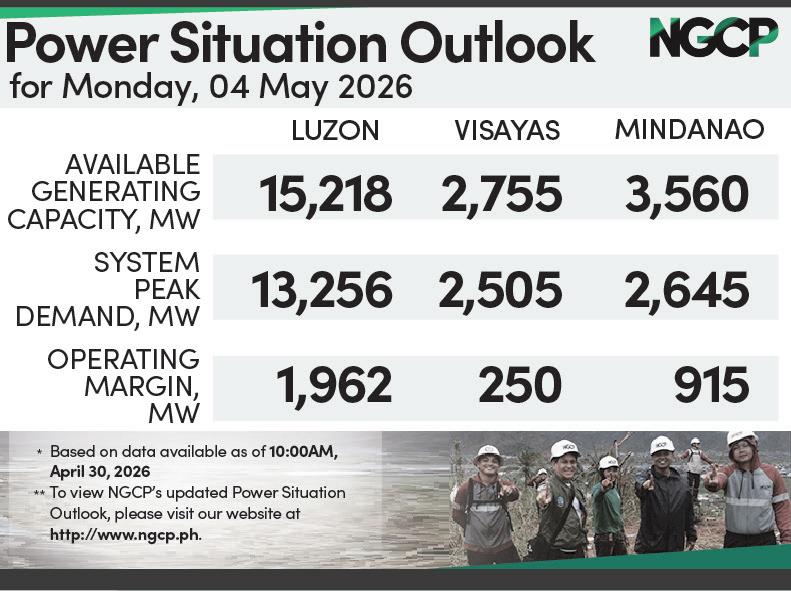

By Lenie Lectura @llectura
ACEN Corp. is closely monitoring the developments in nuclear energy even as the power arm of conglomerate Ayala Corp. has gone full blast with its renewables investment.
“We want to understand what’s happening. We don’t want to be surprised because it also impacts our long-term plans on renewables. So, even if we’re focused on renewables today, if nuclear happens tomorrow, that may have an impact on our investment thesis. It’s going to take time, but we’re monitoring,” said ACEN President Eric Francia.
ACEN has achieved 100-percent renewable energy generation across its portfolio in 2025. The shift began nearly a decade ago. In 2016, it reached 1,000 megawatts (MW) of installed capacity, with portfolio largely anchored on coal and renewable energy (RE) accounting for only around two percent. At the time, fossil fuels dominated regional power systems, and largescale renewables were still at their nascent stages. Recognizing the growing urgency
SEMIRARA Mining and Power Corp. (SMPC) has set aside a lower capital expenditure (capex) of P1.9 billion for this year, mainly as a result of the government’s decision to bid out its coal operating contract (COC).
“For 2026, the group expects capex to decline to around P1.9 billion, reflecting the absence of major equipment re-fleeting, as management deferred certain investments in the coal segment pending the results of the bidding for the COC,” it said.
The Consunji-led firm made an assurance that its management continues to exercise prudent capital management to preserve financial flexibility.
of climate change and the long-term risks associated with carbon-intensive assets, ACEN made a deliberate pivot toward RE. The company reshaped its strategy, redirected capital, and built the capabilities needed to scale clean energy across multiple markets—while taking measured steps to reduce and ultimately exit coal.
Today, ACEN’s renewable energy portfolio has grown to over 7 gigawatts (GW) of attributable capacity, spanning projects that are operational, under construction, or supported by signed agreements. It has earmarked over P80 billion in capital expenditure (capex) this year, higher from last year’s P55 billion.
Meanwhile, the Department of Energy (DOE) is actively advancing its nuclear energy initiatives, with a firm target to integrate nuclear
power into the national mix by 2032, aiming for at least 1,200 MW of capacity by that year and 4,800 MW by 2050. The strategy includes exploring small modular reactors (SMRs) and potentially rehabilitating the existing Bataan Nuclear Power Plant (BNPP).
With the government’s nuclear push as base load power, or those running 24/7, Francia presented two scenarios. One is the impact that it may have on existing base load plants which are coal and gas.
“I think, first of all, it would impact primarily the base load plants, particularly coal, and arguably, gas. Because without nuclear energy, we’ll need baseload and the ones that are positioned for that is a debate between gas and coal.”
There is a mortarium on new coal power plants imposed by the DOE. “Coal if you can build it, if somebody will build it, if they’re allowed to build it. Gas because arguably renewables, at this stage, is not the most obvious technology to provide true 24/7 baseload, although it can. But the cost, even with a lower battery cost, it’s still not as competitive as we want it to be at this point. In the future that could change.”
Francia said assuming the cost for battery energy storage system (BESS) doesn’t change then it really
becomes a toss-up between coal and gas, in which case nuclear would primarily affect coal and gas.
The other scenario is for RE to complement nuclear. “Renewables would be a nice complement to nuclear if and when it happens because then renewables would fill in the mid-merit supply, the peak supply basically, during the day and at night. So, it’s very complementary with nuclear. But without nuclear, there is pressure for renewables to go base load, but it has to be able to compete against coal and or gas. That’s really the impact of nuclear.”
The DOE is targeting a 35-percent RE share in the power generation mix by 2030 and 50 percent by 2040. It also plans to add 25 GW of new RE capacity by 2035 through annual Green Energy Auction programs, with over 8 GW to be auctioned off between 2026 and 2027 alone.
Meanwhile, ACEN broke ground for a 347-megawatt battery energy storage system (BESS) project at its Palauig Solar Farm in Zambales last April 29.
Francia led the groundbreaking rites at the firm’s solar facility in Barangay Salaza this town, where ACEN subsidiary Giga Ace 8 Inc. is currently undertaking a P26billion expansion program. With reports from Henry Empeño
Of the total capex, around P800 million will go to SMPC’s coal business to finance ICT-related investments for network and infrastructure, maintenance of the 2x7.5-megawatt (MW) power plant in Semirara Island and for mobile equipment support.
The power segment’s capex may reach P1.1 billion. This will be allocated for plant maintenance, assurance spares, and ICT-related investments to support operational reliability.
The company reported last week that its net income fell by 12 percent to P3.8 billion in the first quarter from P4.4 billion in the same period a year ago, mainly due to reduced
‘Green routes to spur demand for e-buses’
VIETNAM’S VinFast Auto Ltd. said the Philippine government has an active role in ramping up the deployment of electric buses in the country, according to its top official.
Antonio Zara, CEO of VinFast Southeast Asia, told the BusinessMirror in an email interview that the company sees a strong role for the government in accelerating ebus adoption in the Philippines, particularly through the definition of clear “green routes” that can help stimulate demand and give operators greater certainty in planning deployments.
When e-buses are concentrated in specific routes, Zara said it also becomes easier to build the right supporting infrastructure, like charging stations and depot facilities at scale.
“This is typically harder to achieve in mixed-route environments where electric and ICE buses operate side by side.”
Overall, Zara said closer align-
ment between route planning, policy support, and infrastructure rollout will be key to driving more meaningful and scalable adoption of electric public transport.
He said, however, that VinFast does not plan to enter the bus segment in the Philippines at this time.
“However, we are closely monitoring developments in this space, particularly as cities and operators continue to accelerate their shift toward electrified public transport.”
Zara said VinFast’s role is to continuously explore opportunities across markets where it sees strong alignment with the shift toward sustainable, future-ready mobility.
He said the company’s presence in Vietnam reflects its long-term commitment to advancing sustainable mobility and modern public transport solutions. In 2019, VinFast deployed 3,000 electric buses in the market as part of efforts to modernize Vietnam’s public transportation system. Rizal Raoul S. Reyes
power generation and lower coal shipments.
Total power sales slid by 22 percent from 1,427 gigawatt hours (GWh) to 1,120 GWh. Sales were weighted toward contracted volumes, which accounted for 61 percent of total electricity sold, while the remaining 39 percent was dispatched to the spot market.
SMPC is the largest and most modern coal producer in the Philippines. Its power units—Sem-Calaca Power Corp. (SCPC) and Southwest Luzon Power Generation Corp. (SLPGC)—provide baseload power to the national grid through bilateral contract quantity and the Wholesale
Electricity Spot Market (WESM). The Department of Energy (DOE) has launched a competitive bid round for coal development and production areas, including blocks in Semirara Island, under the Philippine Conventional Energy Contracting Program. The process aims to ensure a transparent a competitive contracting framework, with proponents evaluated based on their technical capability, financial capacity, ork program, safety standards, and environmental safeguards.
As of last week, the DOE deferred the submission and opening of bid documents. Lenie Lectura
“Brent
his team to prepare for a prolonged blockade of the Strait of Hormuz. He has also expressed dissatisfaction with the updated peace proposal sent by Iran.”
Tantiangco said poor foreign investor confidence, rising import costs and rising US bond yields have sunk the peso to record lows. Currently below P61 against the US dollar, a sustained weakness of the local currency is expected to continue discouraging foreign investors and pose inflationary risks.
“Inflation expectations remain high due to the upside risks brought by the effects of the blocked Strait of Hormuz and the weakening Peso. This strengthens the case for more policy tightening by the BSP [Bangko Sentral ng Pilipinas] in their upcoming meetings,” he said.
2TradeAsia said this combination of geopolitical energy risks, stickier global inflation, a firmer dollar and domestic margin pressures create a challenging environment for sustaining aggressive risk positioning in Philippine equities.
“The war premium has provided relative support to energy, mining and certain defensive sectors, yet broader uncertainty weighs on sentiment across all markets and all asset classes. The silver lining is that recent sharp compression in share prices has lifted dividend yields in selected names, offering tactical income opportunities as the local yield curve continues to adjust.”
It sees immediate support for the main index at 5,800 points, resistance at 6,050, and secondary at 6,300. Continued on B2

‘Asean must make climate finance a serious agenda’
By Jonathan L. Mayuga @jonlmayuga

LEADERS meeting for the 48th summit of the Association of Southeast Asian Nations (Asean) in Cebu City are being urged to take seriously climate financing as government and nongovernment officials consider weather and atmospheric changes put economies at risk.
Speaking at a conference organized by the United Nations Development Programme (UNDP), Finance Undersecretary Joven Z. Balbosa said “if climate impacts erode productivity and balloon public debt, fiscal resilience becomes synonymous with climate resilience and [Asean] finance ministries must lead.” But according to Asian Development Bank Infrastructure Specialist Naeeda Crishna Morgado, “climate resilience must be translated into fiscal tools.” Morgado outlined an operational framework to help finance ministries systematically assess, manage, and mobilize climate funds.
She cited the lender’s “Asean Climate Finance Policy Platform” (2025–2027) as a peer-learning mechanism for ministries of finance across member-states.
During the the day-long panel discussion on “Climate Finance Priorities, Adaptation Finance Strategies and Tracking Tools,” Balbosa, Morgado and other speakers argued that Asean must stop treating climate as a sectoral add-on.
Instead, they urged integrated fiscal planning that blends public, private, and philanthropic capital.
“We need a whole-of-economy approach,” said John Warburton of the United Kingdom’s Foreign, Commonwealth, and Development Office (UK FCDO) said. Warbutron also said the UK is “committed” to long-term climate financing and the limits of short-term donor support.
“Public funds alone are insufficient,” he added.
Panelists urged aggregating local adaptation needs into scalable portfolios that appeal to private investors and tapping mechanisms, such as the Philippines’s “People’s Survival Fund,” to funnel non-repayable grants to local governments.
“Local access and de-risking are essential if we want funds to reach communities,” said John Adrian M. Narag, director at the Department of Finance.
Panelists highlighted how Nationally Determined Contributions (NDCs) can move from policy statements to investment signals that attract global capital.
“NDCs should be repositioned as investment portfolios,” said Christophe Bahuet, UNDP Resident Representative in the Philippines. Bahuet added that “high-integrity” public finance management gives investors certainty.
According to Robert E.A. Borje of the Philippine Climate Change Commission, bridging the stubborn adaptation finance gap will require making projects “bankable.”
“Asean cannot leave this to fragments,” Borje said. “No country moves forward alone.”
According to these speakers, climate impacts are not just environmental challenges but fiscal shocks that demand whole-of-economy responses, smarter data systems, and bankable pipelines to unlock private capital.
Organized by the UNDP with the Philippines’s DOF and Department of Environment and Natural Resources (DENR), the speakers presented national examples and regional lessons on how to move from short-term grants to large-scale, long-term investments that protect people and economies.
“Climate shocks are fiscal shocks,” DENR Undersecretary Analiza Rebuelta-Teh said.
By Manuel T. Cayon @awimailbox Mindanao Bureau Chief
DAVAO CITY—THE Philippine Deposit Insurance Corp. (PDIC)
announced it has introduced a “stronger, clearer, and more responsive process” for depositors whose deposit insurance claims have been denied.
Through a statement, the state-run deposit insurer said the issuance of a new process would allow more time for depositors to appeal for reconsideration
Tagged as Regulatory Issuance (RI) 2026-01, this revision “sets out a straightforward path for depositors to request a reconsideration of denied claims, whether these were rejected in full or in part,” read the statement.
According to the PDIC, the move “ensures that every legitimate depositor is given a meaningful opportunity to be heard and to present additional proof supporting the claim.” The governmentowned and -controlled corporation added the move is also expected to assure depositors that the PDIC is reinforcing its commitment “to fairness and public confidence in the banking system.”
Under the new RI, depositors have 60 calendar days from receipt of a denial notice to file a request for reconsideration. This request must be formally submitted, supported by relevant documents such as deposit slips, bank statements, or other proof of transactions, and accompanied by authorization allowing the PDIC to verify records to ensure authenticity, the PDIC said.
This requirement will help strike a balance between protecting depositor rights and safeguarding the integrity of the deposit insurance system, it added.
To make the process more convenient, the PDIC said it provided multiple filing options. “Requests for reconsideration may be submitted either in person, by mail, through courier, or electronically via email.”
The agency said clear rules on filing
dates were also laid out to ensure “that depositors are treated fairly regardless of how they choose to submit their request.”
“Once a complete request for reconsideration is received, the PDIC commits to act promptly to provide depositors with certainty and closure. Decisions will be issued within 60 calendar days, reckoned from the date the depositor is notified that the evaluation of the request for reconsideration has been completed.”
Each request will undergo careful evaluation, and the PDIC may grant or deny the appeal based on its merits or dismiss it if it fails to meet the required standards. It said the revision has cut the processing time by half from the original 120 days which it said will considerably hasten the decision process and waiting time of claimants.
“The policy underscores the PDIC’s mandate to protect the depositing public and uphold public confidence in the stability of the financial system. While the PDIC remains firm in paying only valid and legitimate claims, it also recognizes that some claims may warrant a second look. The revised rules now make that process more accessible, transparent, and time-bound,” it said in a statement. It also said that while decisions at the PDIC level are final, depositors retain the right to elevate their case to the Court of Appeals within 30 calendar days from receipt of notice dismissing or denying the request for reconsideration, ensuring that due process is fully preserved.
“The revised RI reflects the state deposit insurer’s continuing effort to improve public service, enhance accountability, and maintain confidence in the banking system. By clarifying the rules and streamlining the process, the PDIC aims to ensure that no legitimate claim is left unheard, while upholding the highest standards of diligence and verification,” the statement read.
It said the revised RI, available in the PDIC website, took effect on April 30.
ABy Andrea Louise San Juan
S a net-importing country bearing the brunt of an oil crisis and a weakening local currency, local manufacturers and importers are being urged to be more prudent in managing operations.
Rizal Commercial Banking Corp. (RCBC) Chief Economist Michael L. Ricafort said that from a “risk management point of perspective,” importers should be “cautious and prudent” about sourcing goods. Ricafort also stressed the importance of “hedging requirements.”
They also need to “lock in and manage the cost of their imports” given the “fundamentals of the country” as a net importing coun-
try, he added.
“We import almost all of our oil; we import a lot of consumer goods,” Ricafort emphasized. And imports are becoming more expensive as the local tender continues to weaken against the US dollar. Last week, the Philippine peso hit two consecutive record lows, moving past the P61 per dollar mark.
A weaker local currency would also impact the local manufactur-
ing and retail sectors, according to Angelo Taningco, chief economist and research head at the Security Bank Corp.
“Clearly, there are several sectors that are heavily dependent on imported inputs, like raw materials,” Taningco said. “For example, the manufacturing sector, which is heavily reliant on the importation of capital goods as well as intermediate items, will, of course, be negatively affected by the higher oil prices.”
Taningco added that local retailers may also implement price increases due to the weakening of the local currency which is seen to raise the cost of imported materials.
“Although now, because of government intervention, they are not yet raising prices. But later on, we could see them adjust their prices in order to, of course, preserve their margins,” he said.
Latest data from the Philippine Statistics Authority (PSA) showed
that the country’s import bill rose by 8.9 percent year-on-year and continued to exceed export receipts.
PSA data showed that the trade gap reached $12.8 billion in January to March, surpassing the $12.46 billion recorded in 2024 and the $11.26 billion notched in 2023. Imports amounted to $35.5 billion during the period, while export receipts reached $22.7 billion. Analysts explained that the country’s import bill could increase further in the coming months due to “unfavorable” terms of trade.
Former Tariff Commissioner George N. Manzano earlier explained that the prices of imported goods, particularly oil, are rising faster than the prices of the country’s exports, which could push the import bill higher even without a significant increase in volume. (See: https://businessmirror.com.ph/2026/04/30/ higher-q1-import-bill-widenstrade-deficit/)
By Reine Juvierre Alberto @reine_alberto
THE government has launched a wide-ranging bureaucracy overhaul to eliminate redundancies and improve efficiency by ordering agencies to review staffing and possibly create regular positions for long-serving contractual workers.
Acting Budget Secretary Rolando U. Toledo issued Circular Letter No. 2026-7 to implement the “Government Optimization Program” (GOP), a major reform aimed at streamlining government opera -
tions and strengthening institutional capacity.
The program covers agencies under the Executive Branch and involves a comprehensive review of their roles, mandates, functions, programs, projects, organizational structures and manpower complement.
The initiative is intended to improve the delivery of public goods and services, simplify systems and processes and ensure the more efficient use of government resources.
As such, agencies must conduct an organizational review within 180 days, assessing their mandates,
structure, staffing, as well as programs and performance.
They must also prepare and submit an optimization plan within the same period to the Committee on Optimizing the Executive Branch (COEB), identifying areas for improvement, resource reallocation and potential staffing adjustments.
It also allows the creation of additional plantilla positions for qualified contractual, job order or contract-of-service workers with at least 10 years of continuous service, subject to a cap or quota.
The COEB, an inter-agency body
overseeing the program, will conduct a government-wide strategic review within one year and recommend optimized organizational structures for approval by the President. Agencies shall submit detailed staffing and organizational plans, following the President’s approval, and implement the approved personnel movement and other necessary human resource management measures within one year. Republic Act 12231, also known as the Government Optimization Act, mandates the implementation of the GOP, was enacted into law on August 4, 2025.
By VG Cabuag @villygc
PHILIPPINE sovereign bonds will be included for the first time in the J.P. Morgan Government Bond Index-Emerging Markets starting January 29 next year, one of the leading benchmarks used by global fund managers and investors to track emerging bond markets.
According to the Securities and Exchange Commission (SEC), the inclusion of the Philippine sovereign bond market “reflects the increasing credibility and investability of the pa-
per and its growing integration into global fixed-income indices.” Index inclusion typically serves as a catalyst for passive and benchmark-driven inflows, broadening the investor base, improving secondary market liquidity, and strengthening price discovery in domestic bond markets, the SEC said.
Set to enter the benchmark are nine Philippine sovereign bonds with an aggregate outstanding value of approximately $49 billion, for the country’s projected weight of 1.78 percent in the index.
“The inclusion of the Philippine government securities in the GBIEM underscores the steady progress of reforms by the National Government’s Economic Team, strengthening investor confidence in our capital market. It is a clear validation of the Philippines’ continued alignment with international market standards,” SEC Chairman Francis E. Lim said.
A statement issued by the SEC emphasized that the regulator remains committed to working closely with the Bangko Sentral ng Pilipinas,
the Department of Finance and the Bureau of the Treasury to promote market depth and advance a regulatory environment that enables the Philippines to sustain and expand its participation in global capital markets.
The agency said it will continue to introduce and, where necessary, review rules governing market infrastructure to facilitate the ease of foreign investor participation and preserve the country’s position as a premier investment destination in Southeast Asia.
REGISTERED cigarette manufacturers and importers in the Philippines have increased while vape product players have declined, according to the updated compliance registry of the Bureau of Internal Revenue’s (BIR).
Revenue Memorandum Circular 041-2026 listed the registered manufacturers, importers and exporters of various tobacco products and vapor products as of December 31, 2025.
According to Internal Revenue Commissioner Charlito Martin R. Mendoza, the bureau issued the circular “to intensify” the BIR’s campaign against illicit tobacco products.
Based on the BIR’s updated list, there are currently 10 manufacturers of locally produced cigarettes for domestic sale, up from the eight listed in the BIR’s September 2025 memorandum circular.
The two manufacturers added to the list are Diablo Tobacco Corp. and Kingz Cigarette Manufacturing Co., joining Associated Anglo-American Tobacco Corp., JT International (Philippines) Inc., MPE Tobacco Trading, PMFTC Inc., Rolyo Cigarette Inc., Telengtan Brothers & Sons Inc. (La Suerte Cigar And Cigarette Factory), Vidda Resources Inc.
and Yosimite Oriental Supersystem Inc.
The 10 firms combined for a total of 191 cigarette brands. JT International (Philippines) has the most brands registered at 67, followed by PMFTC Inc. with 48 brands.
Diablo and Kingz have 16 and two cigarette brands registered, respectively.
The BIR list showed that the number of local cigarette manufacturers for export remained unchanged at just two firms: PMFTC Inc. and Talengtan Brothers & Sons Inc.
The number of cigarette manufacturers registered with the Philippine Economic Zone Authority was also the same as last year at 12.
These firms include: Baisisen Global Corp., Fourthstripe Manufacturing Corp., Gold Tree Tobacco Manufacturing Corp., Golden Leaf Manufacturing International Inc, Hongcim Int’l Corp., JT International Asia Manufacturing Corp., Magnum Tobacco Manufacturing Corp., Noble Leaf Manufacturing Inc., One Subic Premier Manufacturing Corp., Pan Subic Brothers Manufacturing Corp., Thaitian Cigarette and Tobacco Corporation and TM8 Enterprises Inc.
Of the dozen firms, the following six do not have registered brands yet: Fourthstripe Manufacturing Corp.; Golden Leaf Manufacturing International Inc.; Hongcim Int’l Corp.; Noble Leaf Manufacturing Inc.; One Subic Premier Manufacturing Corp.; and, Pan Subic Brothers Manufacturing Corp.
As for cigarette importers, Dongmin Import & Export Corp. is the newest entrant among the 17 firms registered last year.
These firms include 20 S Inc., 3M’s and Ara Distribution Corp., Dabao Silk Road Trading Co., Duty Free Philippines, Goldtree Import & Export Inc., Indigo Distribution Corp., JT International (Philippines), Kenstand Philippines Inc., Phil-One Extreme International Corp., Pixel Export, OPC, PMFTC Inc., Realway International Phil. Corp., Stable East Tobacco Trading Corp., Sunshine Bay Philippines Inc., Tobmas Tobacco Trading, Vidda Resources Inc., Winning Touch International Marketing Inc. and Zhongdingtong International Trade Philippines Corp.
Meanwhile, the number of registered manufacturers of vapor products declined to 28 from 30 last year, following the exclusion of Akeesha Manufacturing and Trading Corp. and Mo Flavors Corp.
The number of importers of vapor products also dropped to 60 from 62, after the removal of 2229

By Marc Levy
BUILDING trades unions— long fashioned as the voice of the American worker—are now intertwined with the richest companies in the world as they create America’s artificial intelligence economy.
Unionized workers are employed on a huge number of massive data center projects and scrambling to recruit new apprentices to feed the explosive demand.
They’ve also become an ally of tech giants and tech-friendly government officials, echoing the talking point that the United States is in a critical national security race with China for AI superiority.
Unions are a visible force in helping counter fierce opposition in communities and hostile legislation in Congress and legislatures, often aligning with traditional Republican pro-business constituencies and forcing Democrats to choose between them and progressives who want to take a harder line.
Unions have aggressively answered complaints about data centers in ways that executives at tech giants and the development firms rarely do, unafraid to bluntly confront concerns about energy and water shortages, rising electric and water bills, or noise and quality-oflife objections.
“When people say, you know, ‘data centers are the root of all evil,’ we’re just saying, ‘look, they do create a hell of a lot of construction jobs, which we live and work in your communities,’” said Rob Bair, president of the Pennsylvania Building and Construction Trades Council.
Instead of “being just a blunt ‘no,’” Bair said, communities should figure out what they need and ask the tech companies for it—such as improvements to the project’s plans or millions of dollars for lo -
cal schools. “If you don’t ask, you’re never gonna get,” he said.
Data centers a boon for unions WITH data center construction accelerating, unions are expanding training centers and seeing their ranks grow faster than many union leaders have ever seen.
Unions in a number of states are reporting skyrocketing man hours, apprentice classes doubling in size and training centers undergoing expansions in anticipation of more work coming.
Data centers consume at least 40% of work hours done by members of the Columbus-Central Ohio Building and Construction Trades Council, a top official, Dorsey Hager, estimated. It’s at least 50% for the International Brotherhood of Electrical Workers Local 26 in metropolitan Washington, D.C., spokesperson Don Slaiman said.
The umbrella North America’s Building Trades Unions said it hit a record number of members and apprentices in 2025.
The organization’s president, Sean McGarvey, compared it to the build trades’ expansion in the 1950s. He attributes today’s growth to data centers, power plants and legislation under former President Joe Biden that subsidized the construction of semiconductor and electric vehicle battery factories, energy efficiency projects and grid transmission improvements.
Data centers’ voracious energy needs are setting off a power plant construction boom and delivering a one-two punch of new life to unions whose members also build

and maintain boilers, ductwork, pipelines and other power infrastructure.
The Boilermakers Local 154, whose members have watched power plants shut down in southwestern Pennsylvania, went from recruiting zero apprentices for four years to now assembling a class of over 200—and they need more, union official Shawn Steffee said.
For their part, tech giants say they need to train hundreds of thousands more workers in skilled trades. They are spending tens of millions of dollars on training programs, including partnerships with unions that they hire to build their multibillion-dollar projects.
“Across the country, highly skilled union construction workers are laying the foundation for the AI economy,” Sam Altman, cofounder and CEO of OpenAI, said in a joint statement in March with McGarvey’s organization.
Google said the majority of labor used to build its data centers is unionized, and pointed to
a $10-million grant to a unionbacked electricians training program that it said would help expand the electrician workforce pipeline by 70%.
‘The data centers would still be getting built’
MARK MCMANUS, the general president of the United Association of Union Plumbers and Pipefitters, whose members work on pipelines, data centers and power plants, acknowledged criticism that organized labor is getting in bed with the richest, most powerful companies in the world.
But he rejected it as unrealistic. “If we chose as a union to have a moratorium on building the data centers because we didn’t believe it was right for America, the data centers would still be getting built,” McManus said. “They’re not stopping because of organized labor.”
hitting all-time highs in membership and, based on an internal survey, has members working on over 90% of the data center projects in the United States.
“That’s a market share that we don’t have in a lot of other industries,” McManus said. “So it’s pretty near and dear to us.”
It’s difficult to pin down exactly how many data center projects involve union labor. An Associated General Contractors of America survey late last year suggested that the labor composition of data center construction likely mirrors the makeup of commercial construction, which is roughly one-third union, an AGC spokesperson said.
When Gov. Josh Shapiro stood with Amazon executives to announce that the tech giant would spend $20 billion on two data center projects in eastern Pennsylvania, Bair stood with them.
“This is really unique, what we’re building here in this commonwealth. People coming together with common purpose to get stuff done,” Shapiro said. In statehouses, unions have worked against Maine’s since-vetoed proposal for a statewide data center moratorium; standards proposed in Illinois, including requiring data centers to supply their own energy; and an end to Virginia’s sales tax exemption that helped make it the world’s biggest data center destination.
Pennsylvania state Sen. Katie Muth said it has been difficult to collect support from fellow Democrats for her legislation to regulate data centers when it is competing with union-backed legislation that she views as weaker.
“The unions don’t want to promote anything that would impede data center development,” Muth said.
Union representatives have made their presence felt at packed council meetings in municipal buildings from St. Louis to Spring City, Pennsylvania. Sometimes it’s not in a good way.
Speaking to the City Council in Joliet, Illinois, Alicia Morales complained that union members—who sat in the front row holding “vote yes for union jobs” signs—had been disrespectful and “bullied a lot of people” entering the meeting.
Sometimes, union representatives are the only people in a packed municipal meeting room to speak in favor of a project.
Showing up in towns and statehouses NATIONAL unions have negotiated labor agreements on major projects, including an Oracle and Open AI Stargate campus in Michigan and the “Project Blue” data center campus in Arizona, with more in the works.
companies, is
His union has a strong relationship
“I just want to commend you guys, thanks for being the adults in the room,” Chuck Curry, the president of Ironworkers Local 395, told City Council members in Hobart, Indiana, at a January meeting on an Amazon data center. “Knowing the tax structure, knowing business, that most of the people here don’t know.”



MUJI’s first flagship store in the Philippines located in Glorietta 3 is celebrating its 1st anniversary. It is the first branch in the Philippines to feature a bakery offering freshly
It is also the first MUJI store with three floors, offering a wider range of products and services from clothing, health and beauty, stationery, furniture, plants, to houseware, electronics and food, and featuring newly launched items not available in other stores. The store provides a complete MUJI experience, making shopping more enjoyable and accessible.
Customers with a minimum purchase of ₱1,500 will also be entitled to participate in activities such as a free photo booth session and the Spin to Win game. Customers can win various MUJI products when they play the Spin to Win Game.
Launching exclusively at MUJI Glorietta to celebrate its anniversary are two new bakery items— Quiche Lorraine, made with cream, eggs, cheese, and bacon in a buttery crust; and Spinach and Mushroom Quiche, made with fresh spinach, mushrooms, cream, eggs, and cheese. These new offerings add more variety to MUJI Glorietta’s selection of savory and sweet baked goods.
MUJI Glorietta is open Monday to Friday from 11 am to 9 pm, with the bakery opening as early as 8 am. On Saturdays and Sundays, the store is open from 10 am to 10 pm.
Other MUJI branches are located at SM Mall of Asia, Estancia Mall, Greenhills Mall, Festival Mall, SM North Edsa, Uptown Mall, Shangri-La Plaza, Greenbelt 3, Power Plant Mall, Central Square, and online at www.mujiph.com.

SUNSCREEN and sun protection aren’t just for the summer season. When you’re out there getting sun exposure from 10 am to 3 pm, you need sunscreen. For effective sun protection in our country, dermatologists recommend a broad spectrum sunscreen with SPF 30 or higher, applied to all exposed skin (don’t forget the top of your ears!). This year, Watsons Summer 2026 takes on an exciting campaign, titled “SPF Redefined.” The health, wellness and beauty retailer kicked off the campaign through “SPF Redefined—Have a SUNstoppable Summer” at The Block Atrium, SM North Edsa. The campaign’s goal is to help create a complete SPF routine for everybody. It seeks to inform the public that sunscreen is not just for summer time and the outdoors but an essential step to complete your morning skincare routine and a necessary protection against one of the biggest triggers of skin damage. Applying SPF along with caring for your skin, hair and body post-sun exposure are very important. Watsons provides the products to help you create your complete SPF regimen through an extensive selection of sunblocks in every form for both face and body, as well as cooling products, health and wellness supplements, and makeup with SPF.
ALWAYS ahead of the curve, Avel Bacudio envisions what tropical staples will be in vogue in 2027. Ever innovative and forward-thinking, he is offering a more personal take on resort wear. The pieces can be mixed, layered, and matched into refreshing, versatile ensembles.
Avel unveiled “Amihan,” his Resort Luxe Wear 2027 collection, on April 15 at Discovery Primea, Makati City—”a fluid, sophisticated expression of Filipino heritage reimagined for the modern resort wardrobe.”
“Amihan” follows Avel’s playful outfits for athletes at the last Southeast Asian Games which he called “Laro ng Lahi: Alay ko sa lahat ng mga manglalarong Pilipino sa buong mundo. Ang bawat tagumpay ng Pilipino sa larangan ng palakasan, ay tagumpay ng mga bagong sibol na henerasyon.
He also launched a new line of fragrances and scented candles inspired by the sampaguita, among them “Sumpa Kita” (I Promise You), which signifies an undying pledge of love and devotion, available at his website (www.avelbacudio.com). Through sheer hard work and steely ambition, Avel has come a long way from his idyllic childhood in Pili, Camarines Sur, thus also experiencing the cool summer breeze at the Maldives, Seychelles, Fiji, South of France, and Hawaii.
“Ang amihan ay isang simoy ng hangin na galing sa hilagang norte na nagbibigay ng kalamigan o magandang panahon sa tag-araw at tag-init. Ito rin ay isang kwento ng isang ibong pinag-ugnay nya si Bathala at Aman Sinaya,”
Avel says in the vernacular, never veering away from his humble beginnings in Bicolandia. “Ginawang inspirasyon ang simoy ng hangin at ang ibong amihan sa telang PiñAvel,”
Avel avows that the PiñAvel fabric is the future of tropical textile, It is a sustainable, high-performance textile that is an environmental and technical triumph. It was developed in partnership with the Department of Science and Technology-Philippine Textile Research Institute (DOST-PTRI).
He used a breakthrough blend of indigenous fibers such as bamboo, pineapple, abaca, banana, and water hyacinth. The result is a fabrication that is both featherlight and resilient, moving far beyond mere tradition to become a truly competitive, high-tech textile.
The quietly sophisticated “Amihan” ensembles include fluid cover-ups, sexy swimwear, plus elegantly easy draped men’s shirts, and neutral-toned and wide-leg trousers and tailored shorts. Traditional handwoven textiles, such as Binakol, Inabel, and Trambia give the designs a distinctly Filipino flair. The collection expands to accessories with white ankle- strap heels for women, and classic brown

loafers for men.
Avel also unleashed a series of sensational twilly scarves, a versatile and elegant fashion accessory originated or popularized by heritage high-end fashion houses, like Hermes. A twilly is simply a skinny scarf or a slim piece of fabric made of silk or other lightweight fabric.
Avel’s scarves are made of Mindanao Silk, which he rendered in both vibrant colorways and monochromes. Models at the show wore them as headpieces, neck accents, or wrapped around basket bags, each featuring exclusive Avel Design prints inspired by Filipino cultural and folkloric icons such as the jeepney, sampaguita and carabao. Matagal nang nawala ang Mindanao Silk at dahil sa mga iba’t ibang silk na dumating sa atin, kailangan natin ibalik ito dahil tayo lamang ang merong ganitong seda na pamana pa sa atin ng ating mga ninuno. Maihahambing din ito sa mga seda na gawa tulad ng Sea Silk, muga silk

SPF Redefined—Have a Sunstoppable Summer presented a summer-ready journey through an immersive experience with fun activity zones. These included the Skin Analyzer, a sun-themed photo booth, a giant prop fan where each panel offers a fun fact about SPF, and a special area by Uniqlo that offered special gifts for every Watsons purchase. The event featured a program with Watsons representatives and engaging segments from Ponds, Nivea, Deoproce, and Skintific. Participating brands, including NIVEA, Skintific, Vaseline and Deoproce mounted engaging activities during the program, encouraging attendees to listen and actively take part. Guests at the event were able to experience firsthand Watsons’ extensive range of sun care essentials with
at lotus silk,” explained Avel, who was fresh from his further schooling at the Fashion Institute of Technology in New York at the time of our Facebook Messenger interview. He stressed, however, that the “Amihan” ensembles will not be part of the staff uniforms at the Discovery group of resorts and hotels across the country.
“Ang paggawa ng sariling tela na PiñAvel ay maraming proseso. Ilang taon, buwan at araw ang igugugol para makabuo nito. Ang PiñAvel hindi lamang isang tao ang nagpoproseso nito. Kasama nito ang mga taong nagmamamahal sa ating sining,” Avel revealed. “Mahalaga ito sa ating kultura dahil ito ay sariling atin. Mahirap makipagsabayan sa bagong teknolohiya, pero ang Pilipino ay malikhain,” the ever-innovative Avel said. “Kulang man tayo sa makabagong makina para sa makabagong tuklas, ang sariling atin ay punong-puno ng pag-asa at pagmamahal sa mga pamana ng ating lahi.”
post-sun care and cooling products, health and wellness supplements plus topical solutions through skincare and body care items, and even makeup. After SM North Edsa, SPF Redefined brings a series of exciting promos and activities across Metro Manila and key locations nationwide, complemented by in-store animations. The campaign also features exclusive summer bundles from trusted brands, like Belo, Nivea and Ponds. These are available for customers to discover both in the Watsons app and in-store, making it easier to enjoy great deals wherever they shop. Throughout the summer, Watsons will spotlight different categories through themed activations and in-store experiences such as Personal Care Cooling, highlighting well-loved cooling essentials including deodorants, powders, body wash, and hair care—perfect for staying fresh despite the heat.
Watsons also brought the SPF Redefined experience to life through special activations in Boracay and key destinations, like Clark and Cebu. These initiatives reinforce Watsons’ commitment to caring for customers wherever they are, making sun care and summer essentials more accessible and engaging nationwide.
The campaign will end on Sunscreen Day at SM Mall of Asia in May. The celebration of National Sunscreen Day will allow everyone to enjoy a SPF 365 concept. Sunscreen Day is a reminder that sunblock is important all year round, through every season. SPF Redefined brings exclusive rewards all summer long. These include exclusive Klook gift cash vouchers for 185 lucky Watsons Club Members. Every Watsons Club member earns up to 5x points whenever they shop for the participating summer essentials via the Watsons App. Watsons prides itself on carrying a wide selection of suncare products in various formats (spray,
that every person gets the sufficient sun care and protection they need, so they develop a lifelong habit that is important to observe every season and one of the essential foundations to taking care of yourself inside and out,” said Sharon Decapia, Watsons SAVP for marketing, PR, and sustainability.
PHINMA Corporation announced the appointment of three new Vice Presidents, bolstering its senior leadership team as the Group advances its core businesses.
The Board of Directors has elevated three homegrown leaders who bring extensive industry knowledge and proven track records to their expanded roles. These appointments reflect PHINMA’s long-standing investment in developing talent from within and strengthening organizational capabilities to reach even more underserved communities across the Philippines.
PHINMA Corp. Chairman and Chief Executive Officer Ramon R. del Rosario, Jr. said the appointments are a testament to the Group’s commitment to developing its own people into strong, competent leaders who will further drive our mission of making lives better.
“Developing strong businesses begins with strong leaders. We believe these appointments will further deepen PHINMA’s capacity to grow responsibly while doing our part in building the nation”, said del Rosario.
The three newly appointed Vice Presidents are Rey A. Cervera as Vice President for Steel, Danielle R. del Rosario as Vice President for Insulated Panels and Solar Energy, and Maria Monica H. CuetoMamites as Vice President for Corporate Services and Planning and Chief Risk Officer (CRO). Cervera, now PHINMA’s Vice President for Steel, will also lead Union Galvasteel Corporation (UGC) as President and Chief Executive Officer (CEO). Cervera previously served as UGC’s Chief Operating Officer and brings decades of experience in construction materials in the Philippines and overseas. He will focus on revitalizing PHINMA’s steel



roofing and cladding business to meet evolving construction demands while leveraging UGC’s 60-year legacy Union brand.
“Drawing from our decades-long experience, UGC will continue bolstering our products designed to build better lives and stronger communities. For every construction project supported with durable, innovative steel solutions, our team further strengthens the PHINMA Group’s overall commitment to building a better nation,” said Cervera.
Del Rosario has been named Vice President for Insulated Panels and Solar Energy and will concurrently serve as President and CEO of both Union Insulated Panel Corporation (UIPC) and PHINMA Solar Energy Corporation (PSEC). Previously the Chief Operating Officer of both businesses, del Rosario is leading PHINMA’s push for sustainable building solutions, advancing food security through cold storage and delivering clean renewable energy for commercial and industrial sectors.
UIPC’s new manufacturing facility in Porac, Pampanga will launch in July 2026,

FASHION in the Philippines is in a throwback phase, but this time, it’s intentional. Now, it comes in the guise of “Modern Classic,” where style isn’t simply copied from the past, but refined, blending timeless elements with a fresh, trend-aware edge. Clean, curated, and expressive, it reflects a young, trendy, and fashionable generation that values both nostalgia and individuality. It shows not just in how people dress, but how they live, favoring choices that feel effortless, styled, and personal. More than a look, modern classic is a mindset that shapes how people move.
Today, the modern classic style goes beyond clothing, it shapes lifestyle, including mobility. Movement becomes part of self-expression, where function meets style. It’s not just about getting around but doing it in a way that feels aligned with a young,
Etrendy, and fashionable identity. When style is intentional, it shows up everywhere, even in motion.
This is where The Giorno+ from Honda Philippines, Inc. (HPI), the leading motorcycle manufacturer in the country, naturally fits in. Designed around a modern-classic concept, The Giorno+ carries the same visual language shaping today’s fashion—timeless, understated, and refined, embodying the class that lasts. Its silhouette draws from modern classic inspiration, elevated through clean lines and contemporary detailing that make it feel relevant in today’s urban landscape. At the center of its design is color used not just for distinction, but for expression.
With colorways like Pearl Retro Blue, Pearl Organic
with the capacity to produce over one million square meters of insulated panels annually.
“We help build the foundations of progress through high-quality, lowcarbon, and energy-efficient construction solutions that support both urban and rural development while reducing environmental impact. These are deliberate choices to create meaningful impact and help build a better, brighter Philippines,” said del Rosario.
As VP Corporate Services and Planning and CRO, Cueto-Mamites brings into the role her extensive leadership experience from the PHINMA Construction Materials Group, where she served as Vice President for Business Development, Risk Officer, and Technical Assistant to the Group CEO, leading business planning, investment analysis, deals execution, and enterprise risk management.
The leadership appointments come as PHINMA continues to scale its businesses across education, construction materials, housing, and hospitality, reinforcing the Group’s focus on longterm growth and impact.
Green, Pearl Jubilee White, and Turmeric Yellow, each option reflects a different mood rooted in classic tones but styled for today. Whether subtle or standout, these shades mirror the palettes seen in modern vintage fashion which are effortless, curated, and distinctly personal.
More than just a mode of transport, The Giorno+ functions as a lifestyle scooter, one that brings together design, identity, and everyday usability. Powered by a 125cc, Liquid-Cooled, eSP+ Engine, 4-Valve, it delivers smooth, responsive performance with stronger and better acceleration, making it ideal for quick starts and navigating city traffic with ease. This is complemented by fuel efficiency of up to 47.0 km/L and an automatic V-Matic transmission for effortless city riding.
Designed with comfort and control in mind, it features a telescopic front suspension, unit swing rear suspension, and a hydraulic front disc brake with rear drum brake for stable stopping power. Its 780 mm seat height, compact build, cast wheels, and 5.4L fuel tank make it well-suited as an everyday premium scooter for urban environments.
Modern-classic fashion isn’t about fleeting trends; it’s about choosing pieces that endure. That same idea now extends into mobility, where form and function come together in ways that feel timeless yet practical. It’s not just about how something looks today, but how it continues to hold relevance over time.
Because in a world shaped by style, even movement becomes part of the statement. And the best statements are the ones with class that lasts.
The new colorways of The Giorno+ will be available in all Honda 3S Shops and authorized dealers nationwide for a Suggested Retail Price of P102,900.
For more information, visit The Honda Philippines website at www.hondaph.com. Stay updated on Honda’s newest products and promos by following Honda Philippines, Inc. on Facebook, Instagram, YouTube, and TikTok. For inquiries, contact (02)-85816700 to 6799, and 0917-884-6632.
NCHANTED Kingdom, the first and only world-class theme park in the Philippines, opened its magical gates to cats, dogs, pet owners, and animal lovers for a pet-inclusive one-day Furever Enchanted Ogg’s Pets Day event held last April 26, 2026. As part of this quarter’s Forever Enchanted Summer campaign, the theme park celebrated the bond between pets and owners while promoting animal welfare through fun activities and surprises, all prepared especially for dogs, cats, and their human companions by EK’s beloved character, Ogg the Guard. The festivities kicked off at the Enchanting Events Place (EEP) Foyer with learning sessions on basic obedience training, pet health and safety, responsible ownership, and animal bite awareness, led by speakers from the Santa Rosa City Veterinary Office, Animal Bite Center, and the dog training institution Canine Connections. Volunteers from the Philippine Animal Welfare Society (PAWS) were also present to support the event. EK also partnered with Calamba City-based animal rescue organization, Second Chance Aspin Shelter Philippines Incorporated (SECASPI), to host an onsite pet adoption drive, giving rescued cats and dogs the opportunity to find loving forever homes among event participants. Pets and their furparents had a
TAKEDA Healthcare Philippines, Inc. won Most Differentiated Service of the Year - Philippines and Patient Advocacy Program of the Year - Philippines in the Healthcare Asia Pharma Awards 2026 for its access model that supports patients from disease awareness to therapy completion.
In a healthcare system where many patients face delayed diagnosis, long referral pathways, and high outof-pocket costs, the company built a differentiated and sustainable service anchored on its Patient Assistance Program (PAP). The program follows a clear principle: therapy completion should not depend on a patient’s ability to pay.
PAP uses an affordability-based assessment to evaluate each eligible patient’s circumstances and set a contribution aligned to what the patient can reasonably afford for the full course of treatment. This structured, patient-level approach supports equity whilst maintaining business viability. It is not a standard discount model but a tailored access scheme designed for Filipino patients and adaptable to changing circumstances.
The operating model involves independent third parties assessing financial support needs and informing programme design. Patients share in the cost of treatment, whilst Takeda Healthcare Philippines, Inc. collaborates with local authorities and partners to help cover the remaining cost. The company embeds access within hospital pathways through collaborations with organisations such as the Tzu Chi Foundation, private institutions, and major hospitals, helping reduce out-ofpocket expenses and improve coordination across the patient journey.
To date, more than 1,300 Filipino patients have received support through Takeda’s access program,

Takeda PH Team with Dion Warren, celebrating their win at the Healthcare Asia Pharma Awards 2026 including patients living with Hodgkin lymphoma, inflammatory bowel disease, and other rare conditions. By enabling therapy completion, the program helps patients return to work or school and resume caregiving roles,

Corp. (CASY PH)
Papa
and Operations
Dexter Julio, Crazy Curry Managing Director Stephen Po, Mayet Dela Rosa Fine Jewelry Corporate Secretary Trisha May Dela Rosa, Francorp Philippines CEO Sam Christopher Lim and Francorp Philippines Managing Director Noel Siggaoat.
Smart retail, beauty & wellness, F&B favorites, logistics solutions star at the biggest franchise show in Asia
TFranchise Launch Pad.
From April 24 to 26, 2026, the floor of Asia’s largest franchise exhibition transformed into a bustling epicenter of opportunity, drawing a massive crowd of over 50,000 aspiring entrepreneurs and showcasing a staggering lineup of more than 1,000 brands.
The heartbeat of the opening day on April 24 was Francorp’s exclusive showcase. Far from a standard presentation, this curated deep-dive unveiled 13 powerhouse franchise concepts that are currently redefining the food, beauty, and lifestyle sectors. It offered a rare, front-row seat to the future of the industry, featuring brands meticulously engineered not just to survive today’s shifting consumer trends, but to scale rapidly into tomorrow’s market leaders.
Leading the portfolio was a strong lineup of food and beverage concepts designed to meet everyday demand and shifting dining trends. Featured brands include Chong’s Chicken Inasal, a fast-rising homegrown grilled favorite; Crazy Curry, known for its first and original curry fried chicken; and MANOY (Manok, Baboy, Atbp.), offering a modern take on Filipino rotisserie meals. Also joining the category were Papa Burger, recognized for its value-driven Buy 1 Take 1 offerings; and Redbox Pizza, known for its malunggay-infused, better-for-you pizzas.
Rounding out the group are Samgyupsalamat, a pioneer in unlimited Korean BBQ dining; Mango Royal Milkshake, offering affordable premium mango-based beverages; and Edelyn’s Homemade Nuts (EHN), an award-winning Filipino snack brand with strong market recognition.
Catering to the growing demand for self-care and personal services, this category highlighted brands focused on enhancing confidence and well-being. SkinTrends led with accessible, science-backed aesthetic treatments, while Tulua Nail Spa and Café offers a unique combination of nail care and café experience.
Representing innovation in retail, CasyPH introduced a new business model through its DIY phone case vending concept—bringing customization and convenience together in a scalable, technology-driven format. Meanwhile, Mayet Dela Rosa elevated lifestyle with its timeless fine jewelry, custom-designed pieces, and personalized services. Rounding out the category, Thaumazo EXpress Transport Solutions (TEXTS) offered safe, tech-driven logistics with real-time GPS tracking and express transport solutions engineered for timecritical reliability.
For three decades, Francorp has remained at the forefront of franchise development, enabling businesses to scale and empowering entrepreneurs nationwide. Its participation in the Expo underscores its ongoing commitment to innovation and inclusive economic growth.
“Franchising continues to evolve as consumer behavior changes, and our role is to help entrepreneurs stay ahead of that shift,” says Francorp CEO Chris Lim. “Through this year’s lineup at FAPHL 2026, we are showcasing business concepts that reflect innovation, adaptability, and long-term business viability across food, wellness, retail, and logistics.” Those interested in exploring their business’s franchising potential may also take advantage of Francorp’s free franchisability consultation and Franchise Your Business Seminars (FYBS). For more information, visit www.francorp. com.ph or call +63917-809-9043. In the photo on the first row are, from left, TEXTS Founder Rosalie Pañares, Mango Royal Milkshake Operations Officer Mar Chris Bautista, Common Plate Ventures Inc. (Manoy) Managing Directress Millicent Chua, Redbox Pizza CEO Ma. Anjellica B. San Miguel, TULUA Nailspa & Café CEO and Operations Manager Andrea Natividad, SkinTrends Medical Director Dr. Joy Gonzales. On the second row, from left, are Francorp Philippines Vice Chairman Dr. Ma. Alegria “Bing” S.


ON the sablay, the ceremonial sash worn by University of the Philippines (UP) graduates and by UP officials on graduations and other official functions, are letters in what is called the Baybayin script. In another usage, tucked away on one side of our Philippine passport pages are what appear as faint inscriptions. It also used to appear in past Philippine peso bills. Upon closer look, these are written in Baybayin.
Baybayin (“baybay” Tagalog word meaning “to spell”) is described as “an ancient Filipino writing system used primarily in Luzon before and during the early Spanish colonial period. It’s a pre-colonial Tagalog script that symbolizes cultural identity and linguistic heritage, and today it’s being revived as a powerful emblem of Filipino pride and authenticity in communication and design.”
Read from left to right, each character has a consonant-vowel combination (e.g., ka, la, ba). It is said to have been used in the Philippines before the Spaniards introduced the Latin alphabet.
Fascinating, the baybayin script is! I remember learning about it in elementary and using it to take notes in class, but I wasn’t able to continue using it in later years.
My interest in it was revived when I saw that broadcast journalist Howie Severino is a proponent of it, uses it, and speaks and teaches about it. In fact, in a PR Awards program where he and I were seated together as jurors, I noticed his notes were seemingly scribbled in what, upon closer looking, was in Baybayin! And that made me interested again.

AWARD-WINNING JOURNALIST ON BAYBAYIN
BUT first, about Howie Severino. He is a professional journalist, in his 38th year now, and was a campus journalist in college for four years. He is also known as a Filipino documentarist, and podcaster who has distinguished himself for his investigative work on GMA Network’s i-Witness and co-founding of the Philippine Center for Investigative Journalism. (Photo credit: tribune.net.ph)
“A Tufts and Sussex graduate, he pioneered digital journalism innovations in disaster coverage and has earned numerous top awards for reporting on social, environmental, and political issues.”
Thank you, Howie, for graciously sharing more information on the Baybayin in PR Matters!


“Relevance isn’t just about practical everyday use—it’s about preserving and reviving a native script as part of cultural identity and pride… Mahalin natin ito, kasi atin ito
- Howie Severino
What is Baybayin? What was it for? How did it start?
HOWIE : “Baybayin is the name of our native Filipino script, which is named differently in regions like Badlit in Cebu and Kulitan in Pampanga. The Palawan, Hanunoo, and Buhid tribes also have native scripts. They are all related scripts.
Baybayin is a syllabary—an abugida (consonant–vowel script) once widely used in our islands, particularly Luzon and parts of the Visayas before and during early Spanish colonization.
Historically, Baybayin was used by pre-colonial Filipinos for personal writings, poetry, signatures, labels, and basic documentation; Spanish missionaries also printed an early basic religious text in Baybayin, the Doctrina Christiana in 1593.
The origins aren’t fully clear, but like many Southeast Asian scripts it likely derived through a family of scripts influenced by ancient Brahmic scripts of India via Southeast Asian trade and cultural exchange more than a thousand years ago.”
What got you interested in advocating Baybayin and using it?
HOWIE : “I’ve always been interested in history, and have produced many documentaries and TV stories on history.
Fifteen years ago, I produced a documentary on an old slab of stone found in Masbate that had mysterious writing, which turned out to be Baybayin.
When it aired, I started getting attention for Baybayin, and began to receive requests to speak about it and even teach it. I also realized Baybayin resonated with a yearning inside me. That made me decide to teach myself and take it seriously.”
Why support the use of Baybayin?
HOWIE: “It’s part of our heritage, and it’s proof that when the Spaniards came, our ancestors had their own writing.
n It connects modern Filipinos with ancestral culture and identity.
n It makes people mindfully literate in a native script that’s already visually prevalent.
n It’s simple to learn and accessible (you can pick it up on a weekend). There are numerous Baybayin keyboard apps for mobile phones.
n It’s beautiful and artistically inspiring—useful in art, design, calligraphy.
n It carries cultural value, linking modern Filipinos to visions of national identity similar to those of Jose Rizal and other Filipino thinkers who valued indigenous heritage.
n Baybayin adds to our skill set and gives us another tool for communication.
n Baybayin is both practical and soulful—more than just a trend.”
Where is it used today?
HOWIE: “It’s in popular culture—billboards, movies, tattoos, murals, shirts, etc.
n It’s printed on the Philippine passport—a Baybayin version of a national motto is subtly included in passport pages.
n It’s on Philippine money (e.g., currency design).
n Universities such as the University of the Philippines (UP) use it symbolically on cultural items like the sablay (graduation sash).” Are there different types of Baybayin and which one do you use?
Howie: I use modern Baybayin because I am a modern Filipino, in the same way we use modern English and not Shakespearean or Old English. Modern Baybayin is adapted to modern ways of communicating. You can watch YouTube tutorials on it and practice using it. Will it continue to be relevant today and how else can we use it?
HOWIE: “Yes, you can use it to read and understand cultural symbols around you.
n It can be a medium for heritage connection, personal expression, and artistic practice.
n It’s useful in education, art, design, and cultural projects even if not yet widely used for everyday writing.
n The demand for Baybayin in designs, merch and logos has created livelihood opportunities for artists and entrepreneurs.”


WHAT IT CAN MEAN FOR COMMUNICATION AND PR USING cultural alphabets like the Baybayin can make messages more culturally grounded.
An online ask and search found these reasons supporting its use, and I quote:
“Cultural Identity and Authenticity
n Representation matters: Using indigenous scripts in communication materials affirms cultural identity and signals respect for heritage.
n Authenticity in branding: Organizations that incorporate indigenous alphabets show they value inclusivity, which strengthens trust among diverse stakeholders.
n Differentiation: In a crowded communication landscape, indigenous scripts provide a unique visual identity that stands out.”
“Public Relations Impact
n Symbol of integrity: PR campaigns that highlight indigenous writing systems demonstrate commitment to cultural preservation, aligning with values-driven communication.
n Community engagement: Indigenous alphabets resonate deeply with local communities, fostering emotional connection and loyalty.
n Narrative power: They enrich storytelling by visually anchoring messages in tradition, making campaigns more memorable and relatable.”
“Communication Advantages
n Accessibility: For audiences whose first literacy is in indigenous scripts, communication becomes clearer and more inclusive. n Visual appeal: Alphabets often carry distinctive aesthetics that enhance design, making posters, logos, and digital campaigns visually compelling.
n Educational role: Promotes awareness of linguistic diversity, turning communication into a tool for cultural education.”
“Strategic Relevance Today
n Global trend toward inclusivity: Multilingual and multicultural communication is increasingly valued in governance, education, and corporate PR.
n Digital amplification: Indigenous scripts can be integrated into social media, websites, and apps, extending their reach and visibility.
n Sustainability and ethics: Aligns with modern expectations that organizations act responsibly toward cultural heritage.”

OUR FILIPINO IDENTITY LIVES ON HOWIE has long been advocating the use of Baybayin as more than an ancient script. Rather, it shows us that our Filipino identity lives on and we, as practitioners of communication and PR can continue to celebrate our culture and express our pride in its use in both language and design.
This is Ritzi, in Baybayin, signing off for now.

PR Matters is a roundtable column by members of IPRA Philippines, the local chapter of the United Kingdom-based International

BEA QUIAMBAO ruled the inaugural Ironman 5150 Camiguin on Sunday on Camiguin Island, adding to her 70.3 Davao victory two months ago.
With two wins in as many starts this season, Quiambao continued her strong run in the local triathlon circuit, showing consistency across race formats.
The 25-year-old from Malaybalay, Bukidnon, handled varying weather conditions to take both the overall and Filipino Elite titles in two hours, 44 minutes and 16 seconds. She posted splits of 24:55 in the 1.5km swim, 1:22:39 in the 40km bike, and 49:00 in the 10km run.
Kenneth Bonda topped the men’s division in 2:19:59, beating John Hamlan (2:31:52) to also claim the Philippine Sports Commission’s Filipino Elite category in the event organized by Sunrise Events Inc.
The race opened under heavy early rain before shifting to overcast skies and later heat and wind, which affected conditions, particularly on the bike leg.
Quiambao set the pace early with a strong swim, extended her lead on the bike, and maintained control through the run.
“It was a really nice experience because I could see the coral underwater, and then it was really windy,” said Quiambao.
“The bike was really unique and while I was biking, I was looking at the ocean,” she added.
She said the run proved more challenging as temperatures rose.
“The running was really nice, but I did get tired,” she said. Quiambao said the swim was her favorite leg, citing familiarity with similar conditions.
She eyes a third title in Subic. Bonda, meanwhile, said the course and crowd support helped him manage the conditions.
“The swim course was nice because of the coral. The bike and run were challenging, but manageable,” he said.
The 23-year-old, an aircraft mechanics student at Atech Aviation in Cagayan de Oro, said he had limited training due to school commitments. He earlier placed runner-up in his age group in Davao. Other age-group winners included Giulio Contreras and Zita Clarke (1619); James Van Ramoga and Grace Bullecer (20-24); Ericson Oteda (25-29); Sebastien Redila (30-34); John Rey Tumanda and Marina Filezio (35-39); Johnson Ejase (40-44); Julius Polinio and Fabienne Wyss (45-49); Mikkie Davies and Diana Marie Yu (50-54); Marco Cano (55-59); Robert Shannon and Jo Cudmore (60-64); David Parker (65-69); and Nick Cudmore (70-74).

By Josef T. Ramos
TUGUEGARAO City—Ivan Anisimov won back-to-back stages, while teammate Nikita Shulchenko protected his yellow jersey for the third straight day in the Metro Pacific Tollways Corporation (MPTC) Tour of Luzon Stage Five on Sunday. The two Russian riders, riding for UAE team Life Cycle Works (LCW), which has five men remaining after two were able two finish Stage 3, again came up with a strong performance in scorching heat—the day reached 36 Celsius at 42 heat index.
Anisimov, who ruled Stage 4 in Nueva Vizcaya, led another mass sprint finish, clocking two hours, 47 minutes, and 26 seconds along with 64 other cyclists including Shulchenko at No. 42 after the mostly flat
130.6-kilometer race from Santiago, Isabela to Tuguegarao City.
“It was an extremely fast final 2 kilometers because Team Seoul had an incredibly strong leadout. In the last kilometer we we’re going 60 kilometers per hour or more. In the last 500 meters I followed the sprinter of Seoul and in the last 200 meters, I started my attack,” Anisimov said.
“It is an amazing win for me. I am very happy,” added the 23-year-old Anisimov, who recovered from a crash to win Stage 4. “Today was all about the sprint, and there was no danger unlike yesterday.”
Excellent Noodles Cycling team’s Ryan Tugawin finished second and Lee Jung Hoon of Seoul Cycling Team was third.
“He [Anisimov] got in front of me. I tried to chase him, but I was already exhausted and
SKY JAZUL delivered in the closing stretch as Ateneo edged Far Eastern University, 21-18, to retain the University Athletic Association of the Philippines Season 88 16-and-under 3x3 basketball title on Sunday at Ayala Malls Manila Bay in Parañaque. In the 19-and-under division, FEU-D claimed its fourth straight title after a 21-17 win over University of Santo Tomas.

Ateneo trailed 14-18 before Jazul scored seven points in a decisive run to close the game.
The Junior High School Boys’ 3x3 MVP hit two deuces to tie the game at 18-all, then converted a floater for a 19-18 lead. He capped his performance with the winning deuce with 8.9 seconds left.
“I couldn’t hit a basket in the first five minutes. I’m
groggy after coming in front. I just tried to get a podium finish,” the 36-year-old Tugawin, an ex-national cyclist, said.
Shulchenko, 26, has an aggregate time of 13:46:45 followed by Syrian teammate and Stage One winner Yousef Ibrahiem Alrefai, 49 seconds behind.
Go for Gold’s Emmanuel Dave Montemayor stayed No. 3 in the individual general classification, two minutes and four seconds back, while Excellent Noodles’ Sumiso Basalan was behind 2:09 at No. 4 spot, and Mervin Corpuz was at No. 5 trailing 2:15.
“All day I had to protect the yellow jersey, and so happy that I still kept it. Up to the last stage I am ready and so happy that my teammates are also there to help me,” Shulchenko said, referring to remaining teammates Alrefai, Anisimov, Emmanuel Cabanas and
Mikhail Lunin, all part of the main bunch of 65 riders.
Meanwhile, Go for Gold stayed solo leader in the team overall general classification of the race presented by the Philippines Sports Commission (PSC), with a total time of 56:15:28, while 7-Eleven Road Bike Philippines was 11 seconds behind, followed by Standard Insurance Philippines, 50 seconds back.

from his career with the Chicago Bulls to the Dream Team. It included replica NBA trophies to the Olympic medals he earned, game-worn jerseys and more. It was quite a treasure trove.
Except that he was auctioning them off. Since his children didn’t want them, he decided to sell all of them. When asked why he was selling them, he explained that all those memories were in his memories. “I lived it,” Scottie said. The entire collection fetched over $6 million. This past May 2nd, Liverpool great Steve Nicol made the news
faces a stacked lineup, including Felice Tambunting, Casedy Cuenca and Kay Mauricio, in a division brimming with talent capable of producing surprises. The boys’ 11-14 class likewise features a loaded roster bannered by leg winners Chan Ahn, Vito Sarines and Javie Bautista in the event organized by Pilipinas Golf Tournaments Inc. Both the 7-10 and 11-14 divisions will be contested over 36

Stage Six is the longest and one of the most challenging legs in the race supported by MVP Group and Philippine Amusement and Gaming Corp.and aligned with the National Sports Tourism Inter- Agency Committee, a 228.8-kilometer stage from Tuguegarao City, Cagayan province to Pagudpud town hall in Ilocos Norte.
glad to deliver in the crucial moments,” Jazul said.
The 5-foot-9 guard finished with 11 points, including four deuces. JD Juangco added five points, while Franco Bernarte had four.
Ateneo advanced to the title game after a 19-11 semifinal win over De La Salle-Zobel, while FEU-D defeated University of the East, 21-15.
UE secured the bronze medal with a 22-13 victory over DLSZ. In the 19-under final, Marc Burgos scored 10 points on 9-of-11 shooting, including the go-ahead basket with 2:10 remaining.
when he put all his club and Scotland memorabilia on auction.
It wasn’t like he was in need. He was fine. But as Nicol reasoned, he’s moved around the United States a lot and had all of them in the attic with no proper place to display them.
Like Pippen, Nicol said, “I don’t need to actually keep these things in order to relive what I was able to achieve as a player. I am constantly reminded. All the finals, all the trophies, these things are in my head every day.”
According to the BBC, it
jerseys of several Azkals football players. They weren’t replicas but actual kits for the players to be worn during the Suzuki Cup. So, I let them go. Honestly, it was painful because I am the only one with these shirts, and I was part of the media team that