

TALKING TO CHINA, JAPAN ON ENERGY DEALS

By Malou Talosig-Bartolome
THE Philippines is working on two key fronts in oil diplomacy, with senior officials in separate talks with China and Japan on possible energy cooperation to ensure stable oil supply amid signs the war in the Middle East might persist longer.
Senior Philippine and Chinese diplomats have resumed bilateral dialogue to manage disputes in the South China Sea, with Manila signaling interest in exploratory talks on possible joint oil and gas projects in the contested waters.
Meanwhile, Japan and the Philippines are in talks on possible energy cooperation to secure stable oil supplies as tensions in the Middle East threaten global shipping routes.
TBy Andrea San Juan
HE Philippine peso plunged to a new record low of P60.55 against the dollar on Friday as markets begin to price in “oil-related” risks, strengthening dollar demand in the near term.
Jonathan L. Ravelas, senior adviser at Reyes Tacandong & Co., said: “The peso weakened to 60.55 as markets begin to price in oil-related risks, reinforcing near-term dollar demand.”

By Samuel P. Medenilla
RESIDENT Ferdinand Mar-
Pcos Jr. on Friday gave assurances the country has sufficient crude oil in the next three months even if the conflict in the Middle East will be prolonged.
Citing the assurance made by Ramon S. Ang, president and chief executive officer of San Miguel Corp., which owns the oil firm Petron Corp., the chief executive said the country has sufficient fuel supply until June.
This after the Palace confirmed a report that 700,000 barrels of Russian crude oil had arrived in the country. A report from the Agence France-Presse said that the consignee of the shipment is Petron Corp.
“And the manager of Petron, Mr. Ramon Ang, told me that currently our supply will last until the end of June, June 30. We have supply until June 30,” Marcos said in Filipino at the sidelines of the 47th Commencement Exercise of the Philippine National Police Academy in Cavite last Friday.
By Andrea Louise E. San Juan




“Oil supply is a shared challenge for both the Philippines and Japan. Both of us are heavily dependent on Middle East sources,” Japanese Ambassador Endo Kazuya said after signing new official development assistance projects at the Department of Foreign Affairs.
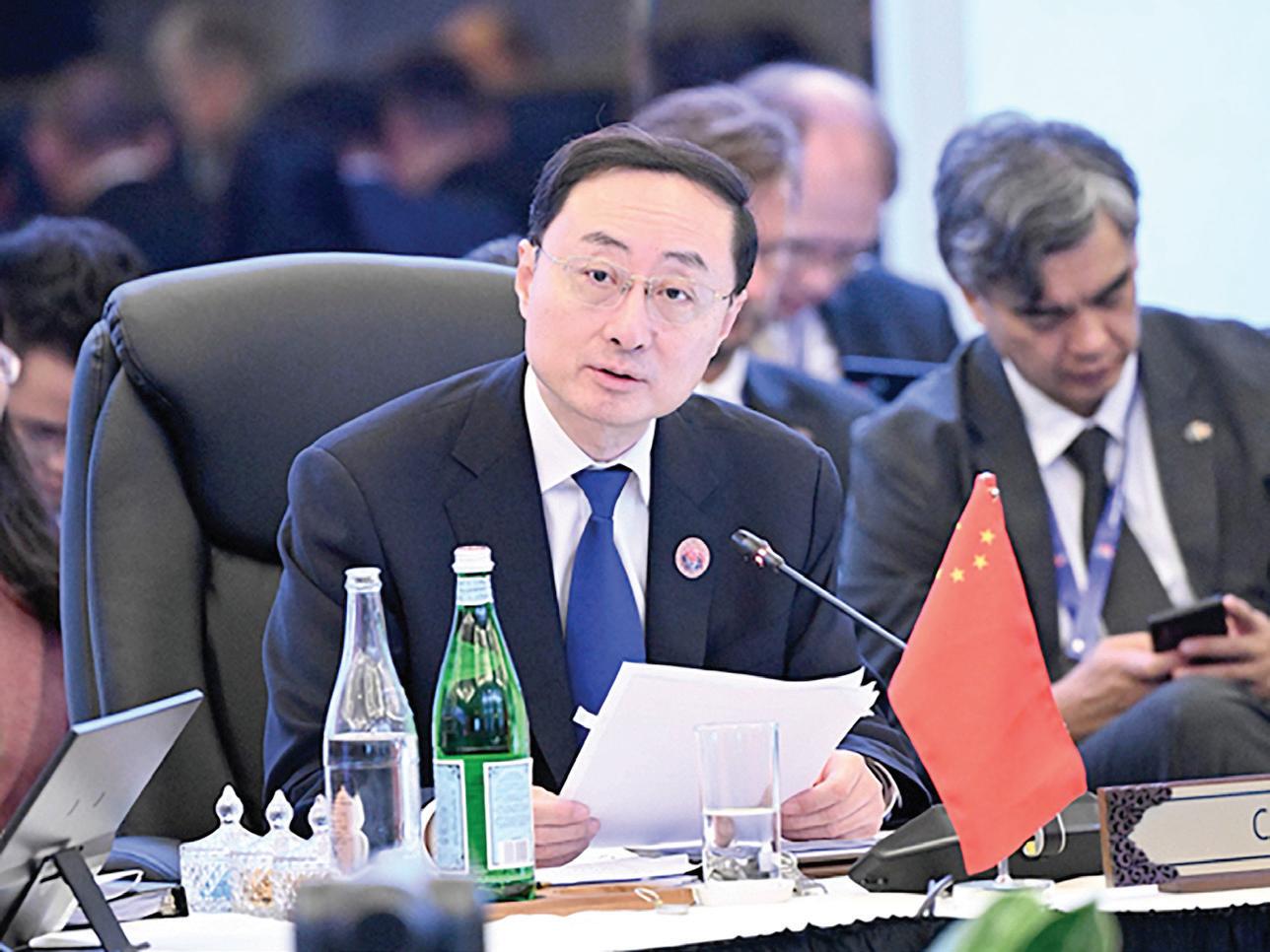
On the talks with Beijing, meanwhile, Foreign Affairs Undersecretary for Policy Leo HerreraLim led the Philippine delegation to Fujian, China on Friday for the Philippine-China Bilateral Consultation Mechanism (BCM), the official platform for managing Continued on A2
Ravelas said this after data from the Bankers’ Association of the Philippines (BAP) showed the peso closed at P60.55 per $1 on Friday, 32 centavos weaker than its previous finish of P60.23 on Thursday.
The analyst explained that trading remains “constraint-driven,” with flows “reflecting caution rather than panic.”
Michael L. Ricafort, chief economist at Rizal Commercial Banking Corporation (RCBC), attributed the depreciation of the
senior adviser at Reyes Tacandong & Co.
local currency to “some market doubts on ceasefire on the war on Iran amid diverging/conflicting conditions/demands set by the US and Iran.”
On the domestic front, however, Ricafort pointed to the Bangko Sentral ng Pilipinas’ (BSP) higher inflation estimates for 2026 and
DOTr vows relief for Japan-funded rail contractors amid Mideast crisis

By Malou TalosigBartolome
THE Department of Transportation (DOTr) has assured contractors of Japanfunded railway projects that the government will honor contract mechanisms to cushion the impact of rising fuel and material costs brought about by the ongoing crisis in the Middle East. Japanese contractors recently raised concerns over the ripple effects of the Iran crisis, citing surging fuel prices for diesel-powered equipment and possible delays in
the delivery of imported construction materials.
Acknowledging these challenges, DOTr Undersecretary for Railways Timothy John Batan said contracts for foreign-assisted projects contain built-in provisions that allow financial relief when prices escalate.
“What we expect, the assurance that we give to our contractors, is that we will implement and respect those contracts,” Batan emphasized. He added that the government is coordinating with other agencies to prevent supply shortages and
address logistical hurdles. In earlier interviews, engineers working on the Metro Manila Subway and the North-South Commuter Railway underscored the heavy reliance of tunneling and depot construction on diesel-powered machinery. They noted that excavation and hauling operations consume thousands of liters of fuel daily, making them highly vulnerable to global oil price shocks. Imported materials such as steel and specialized equipment also remain sensitive to supply chain disruptions, reinforcing the need for government support mechanisms.
(See related story:) https://businessmirror.com.ph/2026/03/26/ japan-funded-railway-projects-inncr-hit-by-fuel-price-spikes/ Despite global economic pressures, the Metro Manila Subway Project remains firmly on track. The initiative is financed through a five-tranche loan agreement with Japan, with the Philippine government currently utilizing the fourth tranche.
Batan highlighted the project’s rapid progress: “If you heard, 10 tunnel boring machines are running right now on a daily basis.” He
FTER the Bangko Sentral ng Pilipinas (BSP) held an off-cycle policy meeting on Thursday to keep the benchmark rate unchanged, research institutions shared mixed views on the central bank’s potential stance at its upcoming April policy meeting amid the uncertainty over the Middle East conflict. Upon taking into account the BSP’s signals during its unscheduled monetary board meeting, Japan-based think tank Nomura said it sees a “rising probability” that BSP delivers an outright hike in the policy rate in April, with inflation now seen tracking well above its 2 to 4 percent target.
New Zealand-based ANZ Research, meanwhile, said it expects the BSP to stay on hold at its next meeting in April as it is expected to keep an eye on second-round price effects.
By Justine Xyrah Garcia
AFTER months of swelling trade gaps, the country finally caught a breather in February, posting its smallest deficit in nine months at $3.68 billion, according to the Philippine Statistics Authority (PSA). This was the lowest deficit recorded since May 2025, when the trade gap stood at $3.64 billion.
The narrower deficit came as total external trade reached $18.34 billion, with exports rising to $7.33 billion while imports settled at $11.01 billion during the month.
Imports still grew faster than exports, increasing by 12.6 percent year-on-year compared to the latter’s 8 percent expansion.
Ateneo de Manila University (ADMU) economist Ser PeñaReyes warned that the narrowing of the trade gap, albeit seen as an improvement, may prove temporary as external risks build up.
“It’s likely for the recent narrowing of the Philippine trade deficit to be reversed if the Middle East conflict persists or intensifies. This ongoing conflict introduces strong

“We believe there is a rising probability of BSP delivering an outright policy rate hike on 23 April. This is still contingent on the Iran conflict remaining unresolved and oil prices remaining elevated.”—Nomura

“We expect the BSP to stay on hold at its next meeting in April and to emphasize continued monitoring of second‑round price effects.”— ANZ Research
Nomura zoomed in on BSP’s signal that price stability is still its main mandate and will focus on second-round effects on inflation from surging energy prices due to the Iran conflict.
“BSP’s reiteration that its primary mandate remains price stability suggests to us that the inflation outlook will be BSP’s main policy consideration near-term despite
See “BSP,” A2

PHILIPPINE DFA Undersecretary for Policy Leo Herrera-Lim DANISH EMBASSY IN MANILA CHINESE Foreign Vice Minister Sun Weidong CHINA’S MINISTRY OF FOREIGN AFFAIRS See “Peso,” A2
Trading remains “constraint-driven,” with flows “reflecting caution rather than panic.”— Jonathan L. Ravelas,
SUBWAY construction continues at full pace as the Department of Transportation assures contractors of support amid rising fuel costs, keeping the Metro Manila Subway Project on track despite global pressures. MALOU TALOSIG-BARTOLOME
PHL TALKING TO CHINA, JAPAN ON ENERGY DEALS
maritime and territorial issues in the West Philippine Sea. His counterpart, Chinese Vice Foreign Minister Sun Weidong, heads Beijing’s delegation.
Diplomatic teams from both sides worked on the agenda Friday ahead of the Herrera-Lim–Sun meeting set for Saturday.
Asked if joint oil exploration would be raised, Herrera-Lim said discussions would be “exploratory lang [only] at best”, stressing that the issue remains “complicated” and not the BCM’s main focus.
In June 2022, DFA Secretary Teodoro Locsin Jr. announced that the Philippines had terminated joint oil and gas exploration talks with China after three years of negotiations with Chinese Foreign Minister Wang Yi. Locsin explained that pushing further would have risked a “constitutional crisis” since the Philippine Constitution prohibits agreements that compromise sovereignty.
Herrera-Lim said one of the proposed talking points include exchanges on the impact of Middle East conflicts on oil, fertilizer, and food supplies, and explore “whether we can use the energy crisis as opportunities to tap for joint cooperation for energy security in the region.”
“ Yung oil exploration mahabang proseso yun [Oil exploration is a long process]. Siguro maha-harvest ang end product in 5–10 years [Perhaps the end product can be harvested in 5–10 years]. But the fact that China has refineries and
end products and other opportunities—let’s say the potential for renewable energy in terms of energy mix,” Herrera-Lim noted.
The Philippine side likewise does not expect the talks to finalize a pending Memorandum of Understanding on Coast Guard cooperation.
One unresolved issue is the establishment of a communication channel between the Philippine Coast Guard (PCG) and its Chinese counterpart for use in maritime rescue operations.
“We are waiting for comments by China on the draft proposal, which we will forward to PCG,” Herrera-Lim said.
Highly vulnerable Japan
JAPAN, one of the world’s largest energy importers, sources about 90 percent of its crude oil from the Middle East, making it highly vulnerable to disruptions in the Strait of Hormuz—a critical passageway for global oil shipments.
Prime Minister Sanae Takaichi and President Ferdinand Marcos Jr. agreed in a phone call Wednesday “to work together to address shared challenges,” Endo said, noting that easing tensions in Hormuz is foremost on their agenda.
Tokyo has already released nearly 80 million barrels from state-held reserves—equivalent to 45 days of domestic consumption—to cushion potential supply shocks.
Asked if Manila, Tokyo, and Asean are planning concrete measures, Endo replied: “At this moment, we are still discussing.”
Fuel lasts till June, PBBM guarantees; Petron is consignee of Russian crude
Continued from A1
3 in Pasay City on Friday, Ang said Petron can continue to supply at least 35 percent of the country’s oil consumption even during the Middle East crisis.
He explained Petron can make such a commitment since it currently operates the only remaining oil refinery in the country that can process crude oil.
Because of the conflict in Ukraine as well as in the Middle East, he said crude oil is now more readily available compared to crude oil.
The petroleum refinery will keep running because there is a greater chance of buying crude oil than finished products.
“We will keep buying crude oil and we hope we will never run out of supply because it is a very important public service,” Ang said.
The processed crude oil, he said, can be sold by Petron cheaper compared to the imported refined product from other oil firms.
“I promise the public we will not take advantage of this fuel crisis. We will not earn more than [our] normal [profit]. And I am even willing to lower our income,” he added.
Additional supply Marcos said they are currently in talks with other countries to sustain the supply since the country is a net importer of petroleum products, which makes it vulnerable to disruption in the gas supply chain caused by the Middle East conflict.

The disruption has resulted in higher pump prices worldwide.
“Everyone—everyone we go to and talk to, we tell them that we are looking [for more supplies of petroleum products]. And not just crude—not just crude oil, but all petroleum products—gasoline, diesel, kerosene, jet fuel, we are looking all over the world,” Marcos said.
He earlier said with countries like Japan, South Korea, Malaysia, and Russia so the country can secure additional supplies of petroleum products.
Price control
THE President also issued Executive Order (EO) No. 110 declaring a “national energy emergency,” which allowed the Department of Energy (DOE) to implement energy optimization plans; enforce energy conservation measures; and take action against hoarding, profiteering, and supply manipulation related to petroleum products among others.
When asked if the government can initiate a price freeze for petroleum products under EO 110, Palace Press Officer Claire Castro said the matter is still under study.
“We did not say that we will not have a price freeze. What we said was, we will study it. And it will be balanced and what is appropriate so that not just one sector will be affected [by the high oil prices],” Castro said in Filipino in a press briefing.
Price freeze under review UNDER Republic Act 8479 or the Downstream Oil Industry Deregulation Act of 1998, the DOE may only temporarily take over or direct the operation of any person or entity engaged in the oil industry during times of emergency and un-
Continued from A1
growth momentum likely remaining weak due to the continued fiscal contraction,” the Japan-based think tank also noted.
Nomura said that while the BSP emphasized that at this point a rate hike is not yet warranted because inflation expectations remain well anchored and that the main sources of upside risk to inflation are “supplydriven,” the think tank quoted the BSP as saying “mounting” inflation risks will require “sustained vigilance,” with the monetary board saying it will act as needed to promote its primary mandate of maintaining price stability.
“Taking today’s off-cycle meeting into account, we believe there is a rising probability of BSP delivering an outright policy rate hike on 23 April. This is still contingent on the Iran conflict remaining unre -
der reasonable terms.
Ang, however, said imposing a price control on petroleum products will put an additional financial burden on the government.
“The government can implement price control. But the government must subsidize . . . It will cost the government 20 to 30 dollars a year in subsidy. That is why other countries are also deregularizing their oil industry,” he said.
The business tycoon said the government can have a say in Petron’s oil pricing if it will buy shares of the firm.
“I am inviting the government to come in and invest in Petron and they can take a major stake in the whole company. I don’t mind,” Ang said.
VAT removal ASIDE from barring government from regulating the prices of oil, RA 8479 also imposed a 3 percent value added tax (VAT) on petroleum products.
Marcos said he is open to proposals to repeal RA 8479 to remove VAT on petroleum products to make them cheaper.
“You know, we would love to amend the Oil Deregulation [Law], but that discussion will take a long time. I don’t know when it will come out so we are focused right now on the immediate—what we can do immediately like I said in my statement, what we can do to immediately help the people is what we are doing, that’s what we are thinking about now,” Marcos said.
Among the interventions of the Marcos administration to mitigate the impact of high pump prices was the distribution of cash aid and fuel subsidies to public utility vehicle drivers and operators and providing free bus rides.
solved and oil prices remaining elevated,” the Japan-based think tank said.
Meanwhile, ANZ Research said: “We expect the BSP to stay on hold at its next meeting in April and to emphasize continued monitoring of second-round price effects.”
ANZ Research said its forecast rests on BSP Governor Eli M. Remolona Jr.’s signal that the recent rise in price pressures is driven by oil prices; these constitute a supply-side shock, against which, it noted, “the effectiveness of monetary policy is limited.”
However, the New Zealandbased research institution pointed out that if prices remain elevated for a prolonged period and secondround effects “become increasingly prominent,” rate hikes will be considered.
On Thursday, the BSP called for an off-cycle monetary policy meeting just to keep the policy rate unchanged at 4.25 percent.
Remolona said: “We judged
percent), and transport equipment at $918.59 million (8.3 percent).
2027 as well as its “less hawkish signals during the off-cycle pause on March 26, 2026.”
At the BSP’s off-cycle monetary policy stance meeting on Thursday wherein it kept the policy rate unchanged at 4.25 percent, the central bank divulged its revised inflation forecasts for this year and next year.
“So if you look at 2026, previously we were projecting an average of 3.6 percent. Now, it is possible that it could average 5.1 percent this year. For 2027, the previous projection was 3.2 percent average inflation. But we think it could average also higher at 3.8 percent,” Zeno R. Abenoja, BSP Deputy Governor for Monetary and Economics Sector, said during the off-cycle policy briefing on Thursday.
BSP Governor Eli M. Remolona Jr. said in the same briefing that the central bank is not intervening heavily in the foreign exchange market.
“The foreign exchange market so far, we don’t intervene to maintain a level for the peso. We intervene largely to dampen the swings . . . the peso that are inflationary,” Remolona said.
The central bank governor noted, however, that the BSP has “thresholds” that would determine if the exchange rate becomes inflationary.
“That will then add to our projection of inflation and that will help decide whether to hike or not. It will also help decide to what extent we should intervene,” added Remolona.
The local currency’s weakest level within the trading session was at P60.57 while its strongest level was at P60.285.
On Thursday, a day before the peso plunged to a new record low, the Monetary Board, the highest policy-making body of the BSP, called for an off-cycle meeting.
that an off-cycle policy meeting was called for.”
He noted: “Globally, aside from oil, other commodity prices have climbed, notably fertilizer, which would add to food inflation,” Remolona said, adding that “Domestic fuel prices are rising.”
Asked why the central bank found it urgent to hold an off-cycle meeting just to announce that it would keep rates unchanged, Remolona said, “I hope it reassures markets that we are assessing the situation constantly.”
Remolona said that while the MB sees upside risks to inflation, these risks are “largely supplydriven,” for which monetary policy has “limited effectiveness.” At the same time, the BSP sees continued weak economic growth this year. As such, Remolona pointed out: “In that regard, to raise rates at this time would be painful.”
(See: https://businessmirror. com.ph/2026/03/26/bsp-maintainsrates-to-soothe-markets/)
and the unwinding of dollar positions, after the peso became oversold during its eight-day losing streak, contributed to the currency’s rebound.
“There may have been a temporary easing in global risk sentiment or stabilization in oil prices, which reduced immediate pressure on emerging market currencies. Dollar inflows such as remittances, exporter conversions, or corporate transactions could have supported the peso,” Rivera told the BusinessMirror
The structure of trade also highlights these risks, with PSA data showing that imports remain concentrated in a few key commodity groups.
Electronic products led the import bill at $2.99 billion or 27.1 percent of the total, followed by mineral fuels, lubricants and related materials at $1.46 billion (13. 3
On the export side, electronic products also dominated outbound shipments at $4.23 billion or 57.7 percent of total exports, followed by machinery and transport equipment at $415.22 million (5.7 percent) and gold at $337.55 million (4.6 percent).
Peña-Reyes said stronger exports may not be enough to offset rising import costs, particularly fuel, under current conditions, although these could help cushion the impact.
“Export gains are slow, steady tailwinds, but the oil price shock is a fast, powerful headwind. Right now, the headwind appears to be stronger,” he said.
PSA data showed the United States ($1.41 billion), Hong Kong ($1.17 billion), Japan ($986.44 million), China ($663.71 million), and the Netherlands ($328 million) were the country’s top export destinations in February, with the US accounting for 19.3 percent of total exports. When asked when the impact
of geopolitical tensions could be reflected in trade data, the economist said this would likely be seen “within one to three months, although the full effect can take longer to materialize.”
He added that the Philippines’ trade balance tends to respond more quickly to oil price shocks due to its reliance on imported fuel and limited buffers compared to larger economies.
“So, if oil prices start rising due to the Middle East conflict in March, you could expect initial deterioration in the trade balance by April–May data, and then more pronounced widening by May–June data,” he added.
Rivera likewise said any recent improvement may be temporary and remains dependent on global conditions.
“Strengthening appears to be a short-term correction, with the broader trend still dependent on external factors like oil prices, global dollar strength, and risk sentiment,” Rivera said.
www.businessmirror.com.ph
Saturday, March 28, 2026
A3

PHL, France enhance defense cooperation, sign Sovfa
By Rex Anthony Naval
THE Philippines and France on Thursday (Paris time) formally signed the Status of Visiting Forces Agreement (Sovfa), further beefing up the defense relations between the two nations.
The agreement was signed during a bilateral meeting between Defense Secretary Gilberto Teodoro Jr. and the French Minister for the Armed Forces and Veterans, Catherine Vautrin, a joint statement coming from the Philippine and France on Friday said.
“This is also a manifestation of the need for cross regional cooperation in security and defense. And it is a celebration of convergence. And by convergence we do not necessarily mean combined operations of Philippine troops and French troops in one area. But
both of us perhaps even working separately in areas where we have capabilities and influence for a shared goal and purpose,”Teodoro said in his speech during the event. He added that the Sovfa with France was signed in record time as the two countries have had years of trust and confidence in working and dealing with each other. Aside from the Sovfa signing, the two ministers discussed current regional security issues in the IndoPacific, the Middle East-Southwest Asia and Europe, underscored the importance of multilateralism,
rules-based international order, and called for the peaceful resolution of disputes and the strengthening of supply chain resilience in the context of crisis.
“Both sides expressed adherence to the spirit and provisions of 1982 United Nations Convention on the Law of the Sea [Unclos] and the primacy thereof, as well as the 2016 Arbitral Award on the South China Sea,” the statement said.
The Philippines also welcomed France’s rapprochement towards the Association of Southeast Asian Nations and the Asean Defence Ministers’ Meeting-Plus, and pointed out the very valuable participation of French representatives to the Expert Working Groups on Humanitarian Assistance and Disaster Response (HADR) and Maritime Security.
“Both sides welcomed the fruitful dynamic of interactions between France and the Philippines, guided by the December 2023 Letter of Intent [LoI] on strengthening the bilateral defense relationship,” it noted.
Both Teodoro and Vautrin acknowledged the positive development of the cooperation, demonstrated by the regular convening of the bilateral defense dialogues, visits by defense and armed forces delegations, regular educational exchanges, port visits and aerial stopovers, as well as naval and disaster response training activities.
“Both ministers recalled the successful negotiations for the Philippines-France Sovfa, which culminated with the signing today [Thursday] in Paris. The Agreement will greatly bolster bilateral cooperation and offer an adequate level of legal protection to the joint activities between the Armed Forces of the Philippines and the French Armed Forces,” the joint statement noted.
Likewise, the two defense chiefs reaffirmed their determination for a stronger long-term partnership and the common will to pursue the objectives of the December 2023 LoI, especially regarding the legal framework of the defense relationship.
New Skyway off-ramp cuts travel time to Naia T3
MOTORISTS heading to Ninoy Aquino International Airport (Naia) Terminal 3 from the Skyway can now save about 15 to 25 minutes following the opening of a new off-ramp linking the Naia Expressway directly to the terminal.
President Marcos on Thursday led the opening of the Andrews Avenue off-ramp, which is intended to ease congestion on a key approach to the airport
by allowing vehicles to bypass a persistent bottleneck.
Built by San Miguel Corporation (SMC) through its infrastructure arm, the new link is expected to improve access to Terminal 3 ahead of the Holy Week travel peak, when passenger volumes at Naia typically rise.
SMC Chairman and Chief Executive Officer Ramon S. Ang said traffic in the area had been causing delays of as much as 30 minutes over a one-kilometer stretch
owing to heavy vehicle density.
The project includes a 320-meter, two-lane off-ramp along Andrews Avenue in Pasay City, along with road widening works at the at-grade section near the Circulo del Mundo Rotonda.
It was completed in 12 months, faster than the original 36-month estimate, following coordination among construction teams, contractors, regulators and government agencies, including the Pasay City government, the
Department of Transportation (DOTr) and the Toll Regulatory Board (TRB).
Public Works Secretary Vivencio Dizon said the project forms part of the Marcos administration’s push to expand public-private partnerships for transport infrastructure. “The President has made clear that we must work hand in hand with the private sector to deliver projects that ease the burden of daily travel for our kababayans,” Dizon said. Nonie Reyes

PROPERTY giant Megaworld has emerged as the sole real estate developer to be honored on the prestigious “Best Workplaces in the Philippines 2026” list by Great Place To Work, recognized as the global authority in workplace culture.
The recognition, announced during the recent Great Place To Work Philippines Awards, saw Megaworld securing one of only 55 coveted spots on the prestigious list of Great Place to Work-certified companies assessed to have a high-trust, high-performance workplace culture.
“We are honored by this recognition, but even more so by the trust our people place in us every day. Our vision has always been
to uplift lives, impact society, and help shape the nation, and it is our people who help us bring it into reality as we build sustainable communities that serve as catalysts for growth across the country,” said Lourdes T. Gutierrez-Alfonso, Megaworld president and chief executive officer.
The “Best Workplaces” recognition is evaluated through Great Place To Work’s’ Trust Index survey, which measures the three key relationships that drive an employee’s experience in their workplace—relationships with management, colleagues, and their job. The Trust Index score represents the percentage of employees who consider their company to be a great workplace
and is an indicator of their actual workplace experience.
“The Philippines has always had an extraordinary relationship with people. The organizations we recognize are proving that when trust is placed at the heart of a workplace, Filipino talent does not just thrive, it can lead. These organizations are setting the benchmark, and demonstrating that a culture of trust and inclusion is not just good for people; it is the foundation of business leadership for the next generation,” shares Charles Plumley, general manager, Great Place to Work Philippines.
This recognition tops a streak of major international global accolades for Megaworld. The company
Navy transport vessel in near collision with Chinese warship
ANAVY (PN) transport ship, BRP Benguet (LS-507), managed to avoid a potential collision brought about by a dangerous maneuver conducted by a Chinese missile frigate on March 25, the Armed Forces Western Command (Wescom) announced on Thursday night.
The incident took place as the BRP Benguet was conducting a routine maritime operation near Pag-asa Island, West Philippine Sea (WPS) on Wednesday.
Wescom identified the People’s Liberation Army Navy (PLAN) warship as the one bearing bow number 532.
“While conducting lawful operations,
BRP Benguet encountered the PLAN vessel, which executed an unsafe and unprofessional maneuver by closing in and passing at a dangerously close distance. Such dangerous maneuvers are provocative and constitute a clear violation of the Convention on the International Regulations for Preventing Collisions at Sea,” it added.
Despite this, the measured and decisive actions of the BRP Benguet’s crew effectively prevented escalation while ensuring the safety of all personnel on board.
“The Wescom calls on the PLAN to adhere to established international rules and norms to prevent incidents at sea. Wescom will perform its lawful maritime operations with professionalism and resolve in exercising the country’s sovereignty, sovereign rights and jurisdiction in the WPS,” it added. Rex Anthony Naval
AS the 12th annniversary of the signing of the Comprehensive Agreement on the Bangsamoro (CAB) was celebrated on Friday, Presidential Peace Advisor Carlito Galvez Jr. said the pact was a “historic milestone” in the pursuit of a just and lasting peace in Mindanao.
“It stands as a testament to the power of dialogue, mutual respect, and shared resolve to finally put an end to armed conflict in our land,” Galvez, head of the Office of the Presidential Adviser on Peace, Reconciliation and Unity (Opapru) added.
And amid challenges being faced in the implementation of this landmark peace agreement, Galvez said this occasion is an opportunity for all peace stakeholders to look back at the years of extensive negotiations and tough conversations that led both parties to sign the peace covenant.
“This year’s celebration, therefore, is a timely reminder that the CAB was built painstakingly by the government and the MILF [Moro Islamic Liberation Front], who clearly understood that the only way to forge ahead was to set aside their differences and find a common ground,” he added.
Likewise, Galvez said that the Opapru will continue to support all aspects of the Bangsamoro peace process, most especially in carrying out interventions that will transform the lives of former
combatants and their families, and turn their areas into peaceful, progressive, and resilient communities.
“We are inspired by the transformation that is unfolding in the Bangsamoro region. Under the normalization track of the CAB, former MILF combatants have laid down their arms and are now transitioning peacefully as productive and law-abiding members of society. Better economic opportunities await families that once lived in fear, as they can now dream of a better and brighter future,” he added.
And as the first parliamentary elections in the Bangsamoro Autonomous Region in Muslim Mindanao draws closer, Galvez called on all stakeholders to remain steadfast in honoring the spirit of the CAB and in fulfilling the promise it represents— meaningful autonomy, genuine representation, and a regional government that champions the dreams and aspirations of the Bangsamoro people.
“Moving forward, let us persevere in building a future where peace is enduring, inclusive, and people-centered.” For peace, for unity, and for the Bangsamoro,” Galvez said.
The CAB was signed on March 27, 2014 at Malacañang Palace in Manila. It is the final peace agreement between the government and the MILF. Rex Anthony Naval
entered 2026 as one of TIME Magazine’s “Best Companies in AsiaPacific” for the second consecutive year. This follows a historic 2025 where Megaworld emerged as the only Philippine developer in the inaugural Fortune 100 Best Companies to Work For, alongside its first Great Place to Work Certification featuring an industry-leading 98 percent employee approval rating.
In the last quarter of 2025, Megaworld also climbed to 42nd place in the Philippines’ Best Employers 2026 ranking by Statista. Megaworld’s parent company, Alliance Global Group, Inc. (AGI), was also recognized in the annual list, improving its ranking from #245 in 2024 to #227 the year after.
Saturday, March 28, 2026
Pork prices steady for now, but fuel hikes threaten surge
By Carmel Pedroza
CEBU CITY—Pork prices are expected to remain stable for now, but a surge remains possible if fuel costs continue to rise, industry and government officials monitoring the situation said.
Rolando Tambago, vice chairman of the Pork Producers Federation of the Philippines Inc., said current farmgate prices suggest that pork in wet markets should not exceed P390 per kilo, providing consumers some cushion despite mounting cost pressures.
However, he warned that consecutive weekly fuel price hikes are already straining the pork industry, making a price surge a “very real possibility” in the coming months. Rising costs are being felt across
By Henry Empeño
SUBIC BAY FREEPORT—The Bureau of Customs (BOC) confiscated here on Friday more than P47.4 million worth of smuggled meat products from China.
Customs Commissioner Ariel F. Nepomuceno said the illicit products arrived here on January 25 in four container vans declared as containing assorted seafoods.
the value chain, from imported feed inputs such as soybean meal and wheat to the transport of hogs to slaughterhouses.
“If this trend persists, retail prices could easily reach or even exceed P500 per kilo,” Tambago said.
Earlier this week, during a Senate committee hearing, Agriculture Assistant Secretary U-Nichols Manalo said the government is working with multiple scenario projections to anticipate the potential impact of global developments
Upon inspection, however, these were found to be loaded with various beef, pork, and chicken meat, as well as seafood products, he said. “The direct value of these products is P39.5 million. If we include the necessary taxes, these would cost at least P47.4 million,” Nepomuceno said. Malaki ang nawawala dito sa pamahalaan, kaya kailangan talaga itong aksiyonan ,” he added. Nepomuceno identified the importer of the seized products as Multirich Consumer Goods Wholesaling. The company is a port user in Subic, the Subic Bay Metropolitan Authority (SBMA) Port Operations Group said.
on food prices.
Under a worst-case scenario— assuming prolonged disruption of key oil infrastructure in the Middle East for up to 180 days and crude oil prices reaching $200 per barrel— food prices could rise significantly.
Manalo said pork prices, particularly kasim and liempo, may climb beyond P500 per kilo. Chicken is projected to be the most affected, with prices potentially increasing from around P200 per kilo preconflict to as much as P324 per kilo.
Rice prices could also surge under the same scenario, with wellmilled rice possibly rising from about P45 to as high as P67 per kilo.
Tambago said the industry is trying to avoid sharp increases to prevent weakening consumer demand, which could lead to oversupply.
He also called on the DA to provide immediate subsidies to hog farmers to cushion the impact of rising costs linked to tensions in the Middle East.
Despite these risks, Tambago
Nepomuceno said those involved in the smuggling will be charged under the Anti-Agricultural Economic Sabotage Act, or Republic Act 12022. The law deems large-scale smuggling of agricultural and fishery products as economic sabotage and imposes severe penalties, including life imprisonment and fines five times the value of the goods.
He said the importer of smuggled products are liable under RA 12022 because the value of the smuggled items is beyond the threshhold level of P10 million.
Mabigat iyan. Walang piyansa
Cebu chambers support energy emergency
CEBU CITY—The Cebu Chamber of Commerce and Industry (CCCI) has expressed support for President Marcos’ declaration of a national state of energy emergency, describing it as a necessary step to stabilize supply and temper rising costs amid global disruptions.
maintained that supply remains stable, with Cebu and Mindanao continuing to ship surplus pork to areas such as Leyte, Iloilo, and Luzon.
Existing inventories in cold storage facilities are also helping keep prices steady for now.
For its part, the DA said it is closely monitoring the prices of basic commodities, fertilizers, and the overall food supply.
Manalo noted that recent data shows minimal movement in retail prices of key goods such as wellmilled rice, pork cuts, chicken, and cabbage, while prices of liempo, chicken, and tomatoes have even declined.
However, slight increases were recorded for eggplant and locally produced carrots.
Despite the projections, the DA emphasized that current conditions remain manageable, with stable supply and limited price movements so far, even as authorities prepare for possible shocks in the months ahead.
Aquino presses for VAT suspension on fuel products
SBy Butch Fernandez
EN. Benigno Agapito Aquino is pressing for the suspension or reduced value-added tax (VAT) on fuel products, saying it can provide immediate and substantial relief to Filipinos reeling from rising pump prices due to the Middle East crisis.
During the Senate Proactive Response and Oversight for Timely and Effective Crisis Strategy (Protect) Committee hearing on Thursday, Aquino said that senators are considering the passage of a measure empowering the President to suspend or lower VAT for petroleum products.
“We are looking at a follow-up measure na hindi lang tungkol sa excise tax, but powers for the President to suspend or lower VAT for petroleum products. Napag-usapan ito kasi mas malaki ang pwedeng maging bawas nito kaysa sa excise tax,” Aquino said. Representatives from various oil companies agreed with Aquino’s position, saying the removal of 12-percent VAT on fuel products will provide greater and faster relief to Filipino consumers because it is easier for them to implement
diyan [It is a serious offense. It is non-bailable],” Nepomuceno stressed.
He said charges will also be filed against the importer under the Customs Modernization and Tariff Act, or RA 10863.
Nepomuceno said his office will decide whether the confiscated goods will be destroyed, or distributed and donated to charitable institutions.
The BOC seized the shipment of smuggled meat products in coordination with the Department of Agriculture (DA) and the SBMA.
reduced prices.
“It’s easier for us to implement reduced prices when VAT is removed. If you don’t have the VAT, it’s not part of your cost anymore,” said Tanya Samillano, a representative of small oil players.
Aquino encouraged the Department of Finance (DOF) to assist in computing the potential benefits for consumers from the VAT removal, which he said could be another way of helping our countrymen deal with the high oil prices. He said the Senate is ready to act swiftly on such reforms if recommended by economic managers, noting that the proposed suspension of excise tax on fuel was approved in record time. Aquino also co-authored and cosponsored in the Senate the recently enacted Republic Act 12316, which grants the President emergency powers to suspend or reduce excise taxes on petroleum products. If exercised by the President, the measure could lower gasoline and diesel prices by P10 and P6 per liter, respectively. It could also reduce the prices of liquefied petroleum gas and kerosene by P3 per kilogram and P5 per liter, respectively.
Energy crunch won’t deter holding of Asean leaders’ summit in Cebu
RESIDENT Marcos on Fri -
Pday said he decided to push through with the first of the two Asean (Association of Southeast Asian Nations) Leaders’ Summit to be hosted by the Philippines after consulting the 10 other members of the regional bloc.
“The consensus that we came to is that, it is precisely now that we must coordinate our efforts. So, that is what we are going to do,” he said in an interview with reporters in Cavite on Friday.
“For now, tentatively, it will push through in November because it is also important since the other world leaders will be coming here from Europe, China, Korea, and Japan,” Marcos said partly in Filipino. He said Asean members will finalize the decision if the second summit is still held by September or October.
“We are entering a new reality,” the CCCI said, noting that reliance on external supply chains exposes the economy to heightened risks during international crises. The group urged both public and private sectors to use the moment to strengthen resilience, improve competitiveness, and pursue innovation.
The chamber also underscored the uneven impact of the crisis, pointing out that more than 90 percent of Cebu’s economy is composed of micro, small, and medium enterprises (MSMEs), which are particularly vulnerable to price shocks and supply disruptions.
In a statement, the chamber said the measure, issued through Executive Order 110, is critical to safeguard businesses, livelihoods, and communities from the ripple effects of volatility in the global energy market. It stressed that the move comes at a time when Cebu—and the Philippines more broadly—must confront its heavy dependence on imported energy and other key resources.

It called for urgent and coordinated action across sectors to cushion the impact.
As part of its call to action, the CCCI urged government agencies to ensure consistent price regulation and close monitoring of supply in Cebu province and its component local governments.
It emphasized that any local measures—such as taxes or fees— should be carefully aligned with national policies to maintain fairness and effectiveness.
Businesses, for their part, were reminded to uphold integrity and avoid exploitative practices such as hoarding and price gouging, which could further destabilize markets.
The chamber also encouraged companies to adopt proactive strategies, including cost-saving measures, operational optimization, and investments in innovation to remain competitive.
adding: “…this latest initiative further strengthens DBP’s fruitful relationship with the LGU…” DBP is the ninth largest bank in the country in terms of assets and provides credit support to four priority sectors of the economy – infrastructure and logistics; micro, small and medium enterprises; the environment; and social services
“By working together, Cebu can stay prepared, adaptive, and competitive,” the statement read, expressing confidence that collaboration and discipline will help the region overcome the challenge.
Echoing these concerns, the Talisay City Chamber of Commerce and Industry, in a separate statement, said the energy emergency declaration had been anticipated, given the trajectory of the ongoing Middle East crisis.
“From our standpoint, the declaration… was something we had already anticipated,” said Carl Cabusas, president of the Talisay chamber.
He added that an earlier move could have better prepared businesses—particularly MSMEs—to implement mitigating strategies ahead of the current escalation.
and community development.
Kabankalan City is a first-class component city and the largest by land area in the province of Negros Occidental, with a population of more than 200,000. It is one of the primary rice producers in the province, marked by high agricultural production which contributes food security in the region.
Flooding has been a decades-long issue in Kabankalan City and has been largely attributed to the overflow of the Ilog-Hilabanga River,
The 48th Asean Leaders’ Summit will still be held on May 7 and 8, 2026 in Cebu and tackle the following issues: the supply of petroleum and petroleum products; supply of food and the price of food; and migrant workers.
“Those will be the three subject matters that we take up in the Asean Summit. It will be over a period of maybe a day and a half instead of all day that we had [originally] planned,” Marcos said.
He noted aside from the Philippines the other Asean countries are also busy in implementing measures to address the effects of the war in the Middle East, which has resulted in a surge in global oil prices, as well as fertilizers.
Marcos earlier issued Executive Order 110 declaring a national energy emergency so the country can mobilize its resources and implement measures to ensure the country’s energy security during the crisis.
The fate of the 49th Asean Leaders’ Summit, which was supposed to be held in Metro Manila in November, is still uncertain.
which serves as a natural catch basin of the province during occurrence of heavy rainfall and typhoons.
De Jesus said the Asenso Program aims to finance various local development initiatives of LGUs that advance the quality of life of their constituents such as construction or rehabilitation of community facilities, water supply and sanitation facilities, healthcare facilities, and the development of public markets, among others. He said for this year, DBP is eye -
To help the country reduce costs and save resources, he ordered concerned government agencies to downscale preparations for the coming summit In a separate statement, Executive Secretary Ralph G. Recto, who is the Asean National Organizing Committee (NOC) chairman, said they will “scale down non-essential bloc activities.”
“As a result, 650 preparatory meetings will be conducted online, a shift which will still ensure substantial discussions and productive results,” Recto said.
“But a stripped down [schedule of] Asean activities will still be able to achieve its goal of strengthening regional unity and forging a common response to mounting global challenges,” he added.
Recto issued a memorandum last Friday to implement the said measure.
Marcos made the announcement amid calls from some lawmakers for the government to reduce its spending for the Asean summit, which has an allocated P22.9-billion budget, so it can utilize its savings in its Middle East crisis-related responses. Samuel P Medenilla
ing to broaden its network of local government partners by providing needed development financing to critical projects and initiatives that would support the long-term economic growth of the LGUs. “As of December 2025, DBP has approved P173.80 billion in loans to 456 projects under the Asenso program, and we are eager to provide funding support to more LGUs for their high-impact projects that directly benefit our people,” de Jesus said.

TimeOur DSWD expands TheraFee for caregivers and PWDs
By Zaldy De Layola
TMBy Jose Cielito Reganit
HE Department of Social Welfare and Development (DSWD) has clarified that indigent senior citizens may still use other government-issued identification cards (IDs) when claiming their social pension, even as the Philippine Identification System (PhilSys)-issued National ID remains the primary requirement. In a statement, DSWD spokesperson Assistant Secretary Irene Dumlao assured the public that the Department remains flexible in its implementation to ensure that no eligible senior citizen will encounter difficulty in accessing their social pension.
“Bagama’t National ID po talaga ang pangunahing requirement, maaari pa rin pong gumamit ang ating mga seniors ng iba pang valid government-issued IDs. Ang mahalaga po ay ma-verify ang kanilang pagkakakilanlan upang tuloytuloy nilang matanggap ang kanilang social pension. Alam po namin kung gaano kahalaga ang social pension para sa pagbili ng medisina, pagkain ng ating mga senior citizens (While the National ID is the primary requirement, our seniors can still use other valid governmentissued IDs. What is important is that their identities can be verified for them to continuously receive their social pension. We know how important the social pension is in their need to buy medicines or food for our senior citizens),” Dumlao said.
“Ang utos po ng ating Pangulong Ferdinand R. Marcos Jr., ay mabigyan ng agarang tulong ang mga bulnerableng sektor natin tulad ng ating mga nakatatanda at gawing madali ang pag-access ng programa at serbisyo ng gobyerno. Makakaasa po ang ating mga lolo at lola na hindi po sila mahihirapan sa pagkuha ng kanilang benepisyo. Nariyan po ang DSWD para tiyakin na maipapaabot sa kanila ang nararapat na tulong mula po sa ating pamahalaan (President Marcos has ordered the immediate provision of support to the vulnerable sectors like our seniors, and to
make the distribution of benefits more accessible. We assure them that they can get their benefits easily. The DSWD is there to ensure that needed assistance from the government will reach them),” she added.
In a Facebook post on Saturday, the DSWD said indigent senior citizens who have yet to secure their National ID will not be denied access to their benefits, as long as they, or their representative, can present any valid government-issued ID.
The DSWD-accepted secondary IDs include those issued by the Office of the Senior Citizen Affairs (OSCA), Philippine Health Insurance Corporation (PhilHealth), Pantawid Pamilyang Pilipino Program (4Ps), Integrated Bar of the Philippines (IBP) and Overseas Workers Welfare Administration (OWWA).
The other IDs accepted are Voter’s ID, Driver’s License, Overseas Filipino Worker (OFW) ID, Postal ID, Tax Identification Number (TIN) ID, Persons with Disabilities (PWD) ID, Social Security System Unified Multi-Purpose ID (SSS-UMID), Government Service Insurance System (GSIS) e-card, solo parent ID, seaman’s book, Professional Regulation Commission (PRC) ID, and other government-issued IDs bearing the holder’s complete name, photo, and address.
Dumlao said the DSWD continues to work closely with the Philippine Statistics Authority to assist social pension beneficiaries in registering for the National ID system.
The Social Pension program for indigent senior citizens is one of DSWD’s key social protection initiatives, providing financial assistance to elderly individuals who are frail, sickly, or without a regular source of income or family support.
Through this initiative, the DSWD helps ensure that vulnerable senior citizens are able to meet their daily subsistence and medical needs, contributing to a more dignified and secure quality of life in their later years. PNA

AI followed through with a quick riposte: “Utot lang pala ang kailangan (All it needs is one big fart). Although I began this piece on a light note, this current crisis should seriously concern us. It’s starting to hurt everyone who is using oil, gas or natural gas. Its ripple effect is impacting the wallets of ordinary Filipinos. What rankles is that our country doesn’t have anything to do with what is going on between the US, Israel, and Iran. In other words, we are collateral damage. Aray ko po! The truth is we have been feeling the pain in ever increasing intensity but we ignored it or endured it. In 2016, I could get premium gas for P35 per liter. In just 10 years, the price suddenly became P65 per liter. Like the proverbial frog being slowly boiled alive, we are unwittingly
being cooked to death. Just this morning, I found out that the price of premium gas at our neighborhood gas station has jumped to P130 per liter. As if to rub salt to the wound, we’re told this will still go higher in the coming months.
Yet as much as it hurts us, I still hope it would lead to a positive sea change. Frankly I even welcome it. Sometimes, it takes pain on an epic scale to transform our stubborn human minds. Remember the common mantra of many optimists during the pandemic of five years ago? “Never waste a good crisis.” As the Chinese would tell us, the character for the word crisis combines “problem” and “opportunity.”
One major positive by-product of the global shutdown was that it forced us to accelerate our migration to digital platforms. The world became digitally functional sooner than predicted. Us-
ORE than 1,800 family and community care workers and persons with disabilities (PWDs) with high support needs will benefit from the expansion of the Department of Social Welfare and Development’s Therapy for Fee (TheraFee) Project for 2026, a key official said on Friday.
The TheraFee (Therapy for Free) Project is a Cash-for-Work (CFW) initiative launched in May 2025 by the DSWD, in collaboration with the National Council on Disability Affairs (NCDA), to support family and community caregivers of persons with disabilities (PWDs) with high support needs. The program aims to recognize the essential role of home caregivers while providing them with financial assistance.
According DSWD spokesperson Assistant Secretary Irene Dumlao, the TheraFee Project aims to support family and community members caring for persons with disabilities (PWDs) having high support needs by incentivizing their duty as care workers through cash-for-work.
“As part of our inclusive social
protection programs, the DSWD recognizes that caregiving is real work. Through the TheraFee Project, we are supporting families and community care workers who devote their time and effort to caring for persons with disabilities,” Dumlao explained.
Through the Kapit-Bisig Laban sa Kahirapan – Comprehensive and Integrated Delivery of Social Services, in partnership with the National Council for Disability Affairs, DSWD rolled out the pilot implementation of the TheraFee Project under the Cash-for-Work Program for Persons with Disabilities in the National Capital Region and Region 6 (Western Visayas) in 2025. For 2026, the TheraFee Project will be implemented across all regions in the country, except the

Bangsamoro Autonomous Region in Muslim Mindanao, to assist family members and community care workers, as primary beneficiaries; and persons with irreversible physical, sensory, intellectual, or psychosocial impairments that limit independent functioning and require continuous support for daily living, as secondary beneficiaries of the program.
Care workers supporting persons with disabilities with high support needs may engage in the program for a maximum of 90 days per year and a maximum of eight hours of work per day. The scope of work or services of the care workers may include basic activities of daily living such as assisting persons with disabilities with high support needs in bathing, dressing, eating, using the bathroom, grooming, and transferring from one place to another. Instrumental activities of daily
living like meal preparation, medical management, housekeeping, managing finances, shopping, transportation, communication, and companionship may also be performed by the beneficiaries. The rendered service is compensable based on the prevailing regional daily minimum wage rate.
Dumlao said this initiative also includes capacity-building activities for care workers to improve their skills in providing home-based care, while promoting gender equality and social inclusion within families and communities.
“By empowering care workers and strengthening family support systems, we also improve the quality of life of persons with disabilities who rely on them every day. This program is about dignity, inclusion, and ensuring that no one is left behind,” she said. PNA
DSWD warns vs fake ATMs, illegal cash aid deductions
By Jose Cielito Reganit
THE Department of Social Welfare and Development (DSWD) on Monday reiterated the warning of the National Commission of Senior Citizens (NCSC) against false claims regarding ATM (automated teller machine) card distribution and illegal deductions from cash gifts intended for senior citizens.
The NCSC has repeatedly said it did not issue ATM or bank cards to the elderly for claiming assistance, pension or cash gifts.
The clarification followed the circulation of an online video
ing just fingers, people can now work, meet, transact, buy, get entertained, and book a ride without moving from where they are.
In the same way, I believe we find ourselves in a similar junction in human history. If the current troubles in the Middle East continue to bring unbearable pain to the world in the form of high prices, wrecked economies, disrupted governance, maybe, just maybe, we will finally see the wisdom of making the transformational shift to a green ecofriendly future, which some of us have been advocating for the longest time.
I really hope that the gas pains we feel will finally open wide the eyes of our leadership to the extreme vulnerability of weaker countries like the Philippines, which are heavy consumers of fossil fuels. We have no option but to find a way to wean our country off its overdependence on fossil fuels. It’s now or never. The soonest we move, the better.
claiming that ATM cards will be given to indigent senior citizens nationwide.
The NCSC said the bank transfer system being implemented in selected regions is merely an optional mode of claiming the P10,000 or P100,000 cash gift under the Expanded Centenarians Act for milestone ages 80, 85, 90, 95 and 100.
The Commission also reminded that the P10,000 cash gift under the law must be received in full by qualified beneficiaries, without any deduction. Any form of deduction, collection or request for payment in exchange for the P10,000 cash gift is illegal and punishable by law.
on renewable energy is far more likely to decrease our country’s household energy bills. Most compellingly, even if the war in Iran did not happen, experts say that the world will still run out of fossil fuels within the next century. So, the bottom line is there is no more place for fossil fuels in our future. It will soon be a thing of the past.
In a statement, DSWD spokesperson Assistant Secretary Irene Dumlao said senior citizens must be protected from misinformation and financial exploitation.
“Nakikiisa po ang DSWD sa paalala ng NCSC . Napakahalaga po na malinaw ang impormasyon pagdating sa mga benepisyo ng ating mga senior citizens.
Marami po sa kanila ang umaasa sa mga programang ito para sa kanilang pangangailangan, kaya hindi natin dapat hayaang maloko o malinlang sila ng maling balita o paniningil na walang basehan (The DSWD is one with the NCSC in warning the public. It is important that information on benefits for seniors is clear. Many of them
depend on these programs for their needs. They must not be deceived by false information or baseless collections),” she said.
Dumlao said safeguarding indigent senior citizens is part of the DSWD’s broader mandate to protect vulnerable sectors.
“It is the responsibility of the DSWD to ensure that the elderly are protected from abuse, exploitation and false information. The DSWD is always ready to coordinate and cooperate with the NCSC to convey the right information and take immediate action on any complaints from our elderly,” she said. PNA

The pain we now feel as a direct result of the war in Iran and Middle East is actually our ally in the battle to win stubborn, ignorant and apathetic minds to the green side.
The math on fossil fuels, as calculated by energy experts, clearly favors a shift toward renewable energy. Meanwhile, an analysis from the University of Oxford found that focusing
This is why I cannot understand the inaction on the part of government leaders to accelerate the shift to renewable energy. Because of their non-action, giant fossil fuel companies have succeeded in making us more addicted to fossil fuels rather than less dependent. According to new research from Clean Creatives, a project for climate-conscious PR and advertising professionals, these major energy companies have even managed to reframe fossil fuels as “permanent, indispensable and essential to economic stability and national
security.” It’s called “greenwashing.” In our lingo, it’s “budol,” plain and simple. Let’s jump out of the water of complacency. Gising na! Let’s drop the stock answer that’s so defeatist and annoying: “ Talagang ganyan, wala tayong magagawa,” (That’s the way it is, we can’t do anything about it). For crying out loud, we can do something! Let’s push back against the billionaire gas company owners who are now raking it in. For a start let’s focus on pushing for green mobility. Green mobility means switching from fossil fuels to electricity, biofuels, or human power to reducing greenhouse gas emissions. Green mobility means using green mass transit powered by solar and wind energy. This is to discourage vehicles on the road. Instead of allocating massive funds for a nuclear energy program as certain quarters are advocating, let’s instead invest in a modern, calamity proof and extensive mass rail transit network that would cover our archipelago from North to South, East to West. No place should be unreachable. Even if it would take decades, we need to do it. Green mobility also means ecofriendly transport such as Electric-powered Vehicles or EVs for short. People who now own EVs are probably laughing at our gas-guzzling
THE DSWD Central Office at Batasan Pambansa Complex in Quezon City. PNA PHOTO













‘Filipinos are among the hardest-working in the region’

HYBRID work is now widely adopted but the leading organizations in this year’s list of Best Workplaces in Philippines 2026 stand out in how they implement trust in the workplace.
Synchrony Philippines, which was named as No. 1 on the list for large employers, has turned flexibility into its default operating system. At Synchrony, employees co-designed a hybrid model where hubs are used for collaboration and coaching, not supervision, and performance is measured on outcomes rather than seat time.
Great Place ToWork Asean and ANZ has announced the annual Best Workplaces in Philippines 2026, with Synchrony Philippines (Large category), Hilton (Medium category), and Interconnected Business Process Inc. (Small category) leading this year’s rankings, setting the benchmark for hightrust, high-performance workplace cultures in the country. Alongside these top performers, a total of 55 organizations were recognized across categories for consistently redefining workplace culture through trust, flexibility, and people-first leadership.
The recognition is based on insights from over 241,000 employees representing more than 450,000 workers nationwide. The list, powered by the globally recognized Trust Index Survey, is considered one of the most comprehensive workplace culture studies in the Philippines.
“The Great Place to Work methodology that we’ve developed enables companies to measure and understand their kind of culture and then we produce a score off the back of that feedback. Essentially, the list is a celebration of the best organizational culture in a particular market,” said Neil Clark, Go-To Market director for Great Place to Work Asean and ANZ.
The survey showed that Filipinos are among the hardest-working in the region, logging over 40 hours a week on average, surpassing peers in Japan and South Korea.
“We provide purely employee-driven feedback. What makes us stand then is that we are the voice of your employees. What we’re aiming to do is highlight companies that put their people first. We also recognize that the challenges between Large, Medium, and Small organizations are different,” said Charles Plumley, general manager, Great Place to Work Philippines.
As shown in The Best Workplaces in the Philippines 2026, today’s leading organizations are moving beyond traditional structures toward trustbased, flexible and inclusive work environments that
enable employees to thrive.
five years in a row (making the company a Legend), champions “Conscious Culture,” enabling employees to speak up, experiment, and bring their full identities to work, supported by digital tools and collaborative practices across time zones.
Android ecosystem changes aim to improve user and developer experiences

because it shows that they are happy working here. In Cisco, people are our greatest assets. Our Conscious Culture is inclusive where our employees feel safe,” said Zaza Soriano-Nicart, managing director, Cisco Philippines.
Hilton, the top medium-sized workplace this year, shows what a high-trust, high-performance culture looks like in an industry notorious for long hours and burnout. Teams at Conrad Manila, Hilton Manila, and Hilton Clark Sun Valley rate Hilton especially highly on three things that usually suffer in hospitality: wellbeing, opportunities to grow, and a sense of inclusion. The Best Workplaces Philippines 2026 winners demonstrate a new balance where high performance is built not just on longer hours, but on deliberate investments in trust, flexibility and longterm employability.
For the Best Workplaces list, Great Place To Work ranks companies using a survey of over 300,000 employees that measures trust in practical terms, like whether people believe their leaders are credible, feel respected in daytoday interactions, see decisions as fair, and take pride in the team around them.
“In the Philippines, we have roughly 300 companies that we work with and in terms of the number of employees that get invited to give feedback, it’s around 450,000. That’s a large number of Filipinos who are comfortable to give unfiltered
Proactive approach important for national
BY RIZAL RAOUL REYES
THE Philippine government needs a fundamental shift in its national cyber defense that requires moving from a reactive model toward a proactive and intelligence-led strategy.
Ritchelle Santos, senior cyber threat intelligence analyst for Check Point Exposure Management Research, said this means prioritizing early detection, continuous monitoring of critical infrastructure, stronger protection of public-facing systems, and tighter governance over third-party and supplychain risks.
“Government and private sector entities should institutionalize information sharing, align cyber security and fraud monitoring efforts, and adopt risk-based prioritization informed by threat intelligence. Cyber resilience must also be treated as a national economic and security issue, not just an IT concern, particularly as digital platforms, financial systems, and public services become increasingly interconnected,” Santos told BusinessMirror in an e-mail interview.
In practical terms, this includes establishing enforceable cyber hygiene baselines across critical sectors. Beyond information sharing, stakeholders should work together to implement and maintain minimum security controls such as multi-factor authentication, timely patch management,
continuous monitoring, and structured breach reporting.
Santos said a proactive strategy should also strengthen intelligence-sharing mechanisms between the public and private sectors. In certain situations, government agencies can share sanitized or declassified indicators of advanced persistent threat activity with Critical Information Infrastructure owners. Timely dissemination of actionable intelligence enables private organizations to detect and mitigate sophisticated threats before they gain operational footholds.
organizations,” said Chee. Capital One Philippines, which ranked second among large companies, pairs flexible work with a culture of care, seen in collaborative spaces and leadership behavior.
Interconnected Business Process Inc., the topranked small company, has grown from a handful of people in Pangasinan to a thriving BPO by hardcoding values such as character, collaboration and credibility into hiring and promotion decisions. PSB Technology Services, another smallcategory winner, leans into what it calls a “FUN—Festive, Unique, and Noteworthy” culture, where leaders are visible, and recognition is frequent.
“Recognizing companies from small all the way to large means any company can do it if they put it as part of their agenda. It’s meaningful to celebrate recognizing the voices of employees,” said Chee.
“The organizations we recognize are proving that when trust is placed at the heart of a workplace, Filipino talent can lead. These organizations are setting the benchmark of trust and inclusion, which will be the foundation of business leadership for the next generation,” said Plumley.
The Best Workplaces in the Philippines list is out now. Head over to the Great Place To Work website (tinyurl.com/285yytfm) to find out who made the list.
cyber defense
only on operational defenses but also on the integrity and trustworthiness of the underlying technologies that power critical systems.
well according to Sameer.
Lastly, developers should expect lower fees with the new business model “that decouples fees for using our billing system and introduces new, lower service fees.” Developers who choose to use Google Play’s billing system will get charged specific-market fees, while those from the European Economic Area, UK and US will have
“At the same time, both government and private institutions should accelerate the transition from traditional perimeter-based defenses toward a Zero Trust model built on continuous verification, least-privilege access, and network segmentation. As digital ecosystems expand, assuming implicit trust within networks increases systemic risk. Zero Trust architectures reduce the potential blast radius of compromise and strengthen overall national cyber resilience,” Santos explained. She emphasized that supply-chain security must be treated as a national security consideration. Santos said this will also include implementing a rigorous vendor risk management framework for hardware and software supporting telecommunications, energy, and other critical infrastructure sectors as essential. She emphasized that national resilience depends not
As cybercriminals increasingly leverage AI to automate phishing, generate deepfakes, and scale fraud operations, Santos said defenses must also become more proactive and intelligence-driven. Moreover, she urged organizations to strengthen identity verification controls, secure public-facing and mobile platforms, enhance web application defenses, and adopt behavioral monitoring capable of detecting anomalies rather than relying solely on signature-based detection.
“A structured proactive approach is critical. This includes continuous threat intelligence monitoring to identify emerging tactics and infrastructure early, vulnerability prioritization based on real-world exploitation trends rather than theoretical severity, and safe remediation processes that ensure security gaps are addressed without disrupting essential services. Prioritizing vulnerabilities aligned with active threat campaigns significantly reduces the attack surface available to AI-enabled actors,” Santos pointed out.
“Ultimately, defending against AI-backed cyber threats requires combining automation with human expertise. AI can enhance detection and response, but it must operate within a broader framework of intelligence-led strategy, governance, and cross-sector collaboration,” Santos said.
GLOBE UNVEILS ‘PERFECT PAIR’: MOBILE + HOME ADVANTAGE AT the recently concluded Q1 2026 The Blueprint by Globe, the company showcased how connectivity is no longer about speed but about consistency, reliability and accessibility. Central to this vision is the launch of The Perfect Pair: Mobile + Home Advantage, a firstofitskind offering that unites Globe Mobile and GFiber At Home into one seamless ecosystem. With Globe Mobile and GFiber At Home Advantage, customers enjoy uninterrupted connectivity whether at home or on
OPPO RENO15’S TRINITY ENGINE POWERS PERFORMANCE THAT ADJUSTS IN REAL TIME
SMARTPHONES today are expected to keep up with everything whether you use it for intense gaming sessions and multitasking between apps to editing content and staying connected throughout the day.
The Oppo Reno15 Series 5G rises to this challenge with its Trinity Engine, a system-level innovation designed to intelligently manage the phone’s performance in real time. By coordinating the CPU, GPU, and memory resources through AIdriven optimization, the Trinity Engine ensures the Oppo Reno15 5G adapts seamlessly to how users work, play and create—all at the same time.
At the core of the Trinity Engine is Oppo’s AI Full-Scene Scheduler, a technology that studies how users interact with their devices and allocates system resources accordingly. Instead of treating every task the same, the system prioritizes processing power where it matters most. So when it comes to maintaining stable frame rates in games, speeding up app launches, or ensuring smooth transitions when switching between apps, the Trinity Engine has you covered.
This intelligent scheduling also allows the Oppo Reno15 Series 5G to maintain consistent performance even in complex scenarios, such as streaming videos while replying to messages or editing content while browsing social media. By optimizing memory allocation and cache management in the background, the Trinity Engine helps keep the system responsive while also improving overall energy efficiency. For mobile gamers, performance stability can make all the difference. The Trinity Engine dynamically adjusts CPU and GPU workloads to maintain steady frame rates and minimize sudden drops during gameplay. This means smoother matches, more responsive controls, and a gameplay experience that feels fluid even during extended sessions.
At the same time, the system works to manage heat and power consumption more efficiently. By balancing performance output with thermal control, the Oppo Reno15 Series allows gamers to stay immersed longer without worrying about overheating or performance slowdowns.
Beyond gaming, the Trinity Engine delivers tangible gains in day-to-day multitasking. For users who regularly jump between messaging, video and productivity apps, transitions feel smoother whether you’re switching from Instagram to YouTube to WhatsApp, or replying to messages while a video plays in the background. It also helps keep file-heavy tasks from slowing everything else down.
What makes the Trinity Engine particularly powerful is its ability to adapt. Over time, the AI scheduler learns user habits and adjusts how resources are distributed. Apps that are used frequently launch faster, background tasks are managed more efficiently, and system performance stays consistent even as usage patterns evolve.
The Oppo Reno15 Series 5G is now available nationwide at all authorized Oppo Stores. Customers can also purchase online via Shopee, Lazada, TikTok Shop, and Oppo Online Store (www. oppo.com/ph).


BusinessMirror


Passing grade or top of the class?


THERE are five types of students you meet in school.
First are the campus celebrities—the athletes, performers, and familiar names you always hear during events, the ones people vote for as class officers or prom king and queen. They carry that main character energy, where even standing beside them can feel like a moment.
Then there’s the honor circle—the achievers. The ones who rarely miss a deadline and somehow manage to lead group projects while keeping everything on track. Their schedules are packed, their goals already lined up even before graduation—and their yearbook caption already reads like a résumé.
The third group are the creatives—the artistic ones. You’ll find them sketching in the margins of their notebooks, rehearsing for school plays, volunteering for or running school events, and sometimes filming or editing between classes, turning ordinary school days into something worth sharing.
Fourth are the ones who seem to have everyone in their contacts. They move easily between groups, always part of the conversation and rarely out of the loop. They may not belong to just one circle—but they’re connected to all of them.
And then there’s the fifth type.
In my era, we would have called them the “raketeers”—today, they’re the side hustlers. They always have something going on outside of school: selling, taking small gigs, helping with the family business, or finding ways to earn on the side. They move between circles not to fit in, but because they’re used to adapting. Their days don’t end when classes do, and their phones aren’t just for scrolling—they’re tools that keep everything running.
Those are the students that reminded me of the Honor X8d—a device built for everyday school life.



a break. Group chats keep buzzing from morning to dismissal, TikTok and Reels fill the gaps between classes, quick games take over during breaks, and video calls stand in for catch-ups.
All the while, background apps continue to sync and update. Add side activities—online selling, freelance work, or content creation—and usage becomes continuous rather than occasional. With most hours spent in classrooms, needing to find a charger midway through the day quickly becomes a major inconvenience.
In our mixed use, the Honor X8d comfortably lasted beyond a full day, and under moderate workloads it can stretch into a second day without needing a recharge. Screen-on time consistently reaches double-digit hours, depending on usage patterns. For those who spend long stretches watching videos, scrolling through feeds, or catching up on series between classes, the Honor X8d is built for bingeing—keeping pace without constant top-ups.
When it is time to plug in, the 45W Honor SuperCharge, up from 35W on its predecessor, helps shorten downtime. More importantly, the larger battery means charging becomes less of a constant concern.
MY STYLE, MY AI PHONE
THE X8d comes with a full suite of AI tools, including a dedicated Instant AI Button or AI One-Tap Smart Experience. Instead of digging through menus, a single tap can trigger assigned shortcuts or frequently used actions. A double tap opens AI Memory, which works as a quick space for notes, saved ideas, and things you want to come back to. Press and hold activates AI Recognition, allowing you to search or interact with what’s on your screen, similar to Circle to Search but faster to access.
AI Writing assists with drafting text, AI Notes summarizes longer content, and AI Recorder transcribes lectures or discussions into text, reducing the need to revisit entire recordings. AI Translate provides real-time language support, while Magic Portal allows content to be moved across apps more seamlessly.
Honor also includes a set of built-in AI editing tools that handle everyday tasks such as AI Eraser, AI Cutout, AI Eyes Open, AI Outpainting and AI Upscale. These features are easy to apply, especially for quick edits before posting or sharing.
DESIGN AND DISPLAY: STYLISH AND CLEAR
PERFORMANCE: STABLE BUT NOT TOO SNAPPY
THE Honor X8d is powered by the Qualcomm Snapdragon 6s Gen 2 processor, built on a 6nm process, paired with 8GB of RAM and an additional 8GB of Honor RAM Turbo (virtual RAM). Storage is fixed at 256GB, with no microSD expansion.
Compared to the previous Snapdragon 685, the upgrade brings moderate improvements in CPU and GPU performance, though not at a level that changes the device’s overall category.
Daily tasks remain smooth. Messaging apps, social media, web browsing, and video streaming operate without issue. Multitasking across several light applications is manageable.
However, under heavier workloads—such as gaming or extended multitasking—limitations become more apparent. Frame drops can occur in demanding titles, and app switching may introduce brief delays. It prioritizes stability over peak performance.
CAMERAS: CAPABLE, FUNCTIONAL
THE rear camera system is led by a 108MP main sensor (f/1.75 aperture), supported by a 5MP secondary lens (f/2.2). The front camera is a 16MP sensor (f/2.45). In well-lit conditions, the main camera captures detailed images with acceptable dynamic range and color accuracy. It performs reliably for everyday photography—school events, documentation, and casual social media use.
Low-light performance remains usable, though noise increases and fine detail decreases. The absence of advanced stabilization or larger sensors limits its capabilities in more challenging conditions.
The front camera represents a step down from the previous 50MP sensor, which may affect users who prioritize selfies or front-facing content creation. While the 16MP sensor is functional, it does not stand out in its category.
FINAL WORD: Honor opened the year with a strong showing, led by the success of the Honor X9d, followed by the more affordable Honor X5c Plus. Sitting in between, the Honor X8d positions itself as a midrange option built around reliability—covering the essentials while offering the kind of battery life that can carry through more than a full day of use.

Honor X8d review: of alternatives, the question is: Do these features
It’s packed with a 7000mAh battery, a 6.77-inch AMOLED display, Snapdragon 6s Gen 2, 8GB RAM with virtual expansion, 256GB of storage, and a set of AI tools for daily use.
But with the higher price and a crowded field of alternatives, the question is: Do these features translate into real value? We put the HONOR X8d to the test to see if it earns a passing grade—or makes it to the honor roll.


DESPITE housing a larger battery, the Honor X8d maintains a relatively slim profile at 7.5mm thickness and weighs 188 grams. The device features a clean design with a flat frame and a square camera module arranged in a triangular layout. The finish resists fingerprints and maintains a consistent look even after extended handling. Color options include Light Blue, Velvet Black, and Velvet Grey.
The updates here are measured rather than sweeping. The larger battery stands out as the most meaningful upgrade, while refinements in charging and AI features add to everyday convenience. The design feels cleaner and more restrained, though the more textured and bolder green finish of the Honor X8c gave the previous model a bit more personality.
At ₱15,999, the Honor X8d comes in slightly higher than its predecessor, a shift that reflects both the upgrades and current market conditions.

BATTERY: BUILT FOR THE LONG AFTER-SCHOOL HOURS



FOR students, battery capacity often becomes the deciding factor when choosing a phone in this price range. The Honor X8d carries a 7000mAh battery—a significant jump from the 5000mAh battery of the Honor X8c. That 40 percent increase changes how the device holds up across a full day.
A typical school day rarely gives a phone
The display measures 6.77 inches using an AMOLED panel with a resolution of 2412 x 1080 pixels (FHD+). It supports a 120Hz refresh rate. Brightness peaks at 3000 nits, improving outdoor visibility. Under direct sunlight, content remains readable without needing to push brightness to maximum constantly. Eye comfort is supported by 3840Hz PWM dimming, which reduces flicker and helps minimize strain during prolonged use. Additional features such as circadian display adjustments adapt color temperature based on time of day.
In the context of student life, the Honor X8d fits a specific kind of user. Not the ones chasing top performance or standout features, but those who need something dependable—something that keeps up with long days, shifting schedules, and everything in between.
So does it earn a passing grade, or does it make it to the honor roll?
For most, the answer leans somewhere in between.
It may not lead the class, but it shows up, does the work, and gets you through the day—and for the kind of user it’s built for, that consistency counts.
Tech-voc grads match degree holders, but ‘middle skills’ gap persists—PIDS
By Rizal Raoul S. Reyes
FILIPINO technical-vocational (tech-voc) graduates have posted high employment and monthly compensation rates that are at par with those pursuing bachelor’s degrees.
This was according to a new study by the Philippine Institute for Development Studies (PIDS). Specifically, data from the 2023 Labor Force Survey revealed that those who completed technical-vocational education and training (TVET) programs earn an average of P14,160.38 per month. The study said both tech-voc and higher education pathways play complementary roles in workforce development. However, existing education and training systems are not always aligned with the competencies re -
quired by priority sectors under the Philippine Development Plan (PDP) 2023–2028.
The “Assessing the Current and Future Middle Skills in the Philippines: Inputs for Policy Agenda” research authored by PIDS consultants Richard Monteverde, Ivy Mejia, Louie Dasas, Saddam Bazer, Charissa Mae Garcia, and Carina Aquino examined how different institutions define “middle skills” and evaluated whether existing education and training programs correspond to employer needs.
Key challenge
THE authors pointed out a key challenge: the absence of a unified national framework for defining “middle skills” across government agencies and industry stakeholders.
Currently, the Technical Education and Skills Development Authority, Commission on Higher Education, and Philippine Statistics Authority apply different classifications, resulting in fragmented training programs and uneven competency standards.
The authors said the lack of alignment—compounded by weak industry engagement in program design—limits the effectiveness of workforce development initiatives.
Further, the study found that existing curricula are not always responsive to evolving labor demands across PDP priority sectors spanning healthcare, manufacturing, infrastructure, and information technology, where demand is rising for skills in areas such as climate-resilient agriculture, digital services, advanced construction technologies, renewable energy, and data analytics.
Authors warn AS technological change reshapes production systems and job roles, the study warns that “middle-skills training may fall behind emerging workforce needs without coordinated reforms in curriculum design, training regulations, and institutional collaboration.”
“In the absence of a unified definition and structured policy framework, middle-skills training risks obsolescence in the face of technological change and shifting economic conditions,” the authors warned.
To address these gaps, they called for a more harmonized and datadriven approach to middle-skills development, supported by stronger industry partnerships and policy coordination across education and training agencies.
By aligning skills development programs with sectoral demands, the study noted that middle-skills pathways can offer practical routes to employment while supporting workforce adaptability and national competitiveness.
CCA Manila’s internship experience: Culinary education meets the real world
HERE comes a moment in ev -
Tery culinary student’s journey when classroom lessons evolve into something more challenging— real-life experience in a professional kitchen.
At top culinary school CCA Manila, that transition is not left to chance— it is designed, structured, and built into the Diploma in Culinary Arts & Technology Management (DCATM) program through carefully curated internship placements that immerse students in real-world operations.
For almost three decades, CCA Manila has built a reputation for producing graduates who are not only technically skilled, but also industry-ready. The school’s internship program is a cornerstone of that reputation—placing students in some of Manila’s most disciplined and top-performing kitchens, where excellence is the standard and consistency is non-negotiable.
What sets CCA Manila apart is not merely access to respected restaurants; it is preparation. Before stepping into any professional kitchen, students undergo rigorous training in classical techniques, sanitation, mise en place menu theory, food safety, and kitchen systems. By the time they report for an internship, students are not observers—they become contributors.
‘Prepared, not overwhelmed’ DCATM student Andrei Xavier Lorenz Factora experienced this firsthand during his internship at Hapag, then eventually moving up to Ayà. Rotating through multiple stations, he quickly realized that professional kitchens operate on different levels of discipline. But instead of being overwhelmed, he found himself prepared.
From handling sauté and garde manger responsibilities to understanding the deeper narrative behind plated dishes, Factora credits his confidence to CCA Manila’s structured curriculum. What impressed him most was the

uncompromising standard of cleanliness and organization—something he had practiced in school, but now understood in a new light. At CCA Manila, sanitation is taught as a procedure. In the field, he learned it as a culture. That mindset shift is precisely what the internship aims to cultivate. On the other hand, Krysta Clyde Batisla-on entered her internship knowing she would be challenged. Assigned to precision-driven stations at Helm by Josh Boutwood that demanded accuracy in measurement, plating, and timing, she quickly understood the importance of mental endurance. The pace was faster; the pressure, higher.
But CCA Manila’s emphasis on mise en place, repetition, and foundational discipline proved invaluable.
“In school, we had time to refine our movements,” she reflected. “In the kitchen, you have to get it right the first time.” The transition was demanding, but not disorienting— because the groundwork had already been laid. CCA Manila’s approach bridges that gap, ensuring students step into professional environments with clarity and composure.
Character formation
FOR Mardean Roque, internship be -
came a transformative experience. Moving through multiple stations and working under different chefs at Kasa Palma, he found himself pushed beyond his comfort zone. Yet his grounding in French techniques and culinary fundamentals allowed him to adapt quickly.
CCA Manila’s training, he noted, gave him an advantage in understanding systems and workflows. More importantly, it instilled professional values: leadership, creativity, and respect, as modeled by his chef instructors. The experience reshaped his perspective, teaching him humility and curiosity. That evolution is central to CCA’s philosophy: that internships are not simply about skill validation; they are about character formation.
Ryanne Louise Casuga echoed similar insights. Her internship at Kasa Palma highlighted the importance of ingredient respect and operational efficiency. She observed how nothing in a professional kitchen goes to waste—a principle reinforced in CCA Manila’s sustainability and cost-control lessons.
The fast pace required adaptability, but the school’s training in teamwork and accountability proved crucial. Casuga said that CCA Manila students are known in host kitchens for professionalism and cooperation. That reputation reflects a culture embedded in the classroom long before internship begins.
Lastly, for Rhey John Villamor, his internship experience at Gallery by Chele broadened his understanding of culinary operations beyond service. Working in a production-focused environment taught him multitasking, production management, and endurance. The hours were long; the expectations, high.
Yet one lesson from CCA Manila resurfaced clearly: Communication is essential. A seemingly simple classroom reminder about accountability
became a real-world standard he carried daily. Internship, in this sense, validated the life skills taught within the program, such as discipline, reliability, and resilience.
Internship as proving ground
“ACROSS these varied internship placements, one theme emerges consistently: CCA students arrive prepared. They understand kitchen hierarchy and respect sanitation protocols. They grasp mise en place not as theory, but as operational necessity, and most of all, they show up ready to work,” said Chef Kerwin Funtanilla, who serves as CCA Manila’s Academic Department program manager. “Internship, therefore, is not an add-on feature of the DCATM program. It is its proving ground.”
CCA Manila’s long-standing partnerships with respected industry kitchens reflect mutual trust. Restaurants welcome CCA Manila interns not merely for manpower—they recognize the training behind them. The school’s curriculum is designed in consultation with industry leaders, ensuring alignment with current standards and evolving trends.
In an industry where talent alone is insufficient, CCA Manila focuses on work ethic. In kitchens where pressure is constant, the center builds resilience. In environments where teamwork determines success, the school trains students to move as one brigade.
As CCA Manila continues its legacy, its commitment remains clear: Education extends beyond the classroom. Through deliberate preparation and meaningful industry immersion, it ensures that when students step into the heat of a professional kitchen, they are not overwhelmed by it—they rise to meet the challenge. For aspiring chefs, that real-world readiness is the true value of a CCA Manila education.
For more information on the DCATM program, visit cca-manila.edu.ph.
UP Cebu marks 50 years of fine arts excellence with alumni exhibition
THE University of the Philippines (UP)-Cebu College of Communication, Art and Design is celebrating its Fine Arts program’s 50th anniversary with a major exhibition featuring works from 59 alumni.
Titled “A Sense of Conviction: Ligon nga Tinguha, Hugot nga Pagtuo,” the exhibit at the Jose T. Joya Gallery showcases the creative legacy of generations of UP Cebu Fine Arts graduates. It runs through March 31, 2026. Five decades ago, the program began with a small group of visionary mentors who believed art was a lifelong discipline shaped by rigor, inquiry, and passion.
National Artist for Visual Arts
Jose T. Joya, the former dean of the
College of Fine Arts at UP Diliman, established the program at UP Cebu with Cebuano artist-educators Martino Abellana, Julian Jumalon, and Mel Tamayo.
A painter and teacher whose influence remains central to the program’s philosophy, Abellana emphasized confidence and self-belief in artistic growth. He wanted to instill “a sense of conviction, that you must not downgrade yourself. If others can do it, you can do it too.”
Celebrating creative diversity
THE exhibition features works highlighting the broad spectrum of styles embraced by the program: from realism and expressionism to cubism and neo-expressionism. It offers a
comprehensive view of Cebuano arts’ evolution while maintaining dialogue with its roots.
UP Fine Arts instructor and alumnus Khriss Bajade underscored the exhibition’s significance, particularly for the program and its participants: “This exhibit is more than a celebration; it’s a reminder of the legacy of conviction our founding mentors instilled.”
Bajade added that “every piece here carries the spirit of courage and selfbelief that has defined our program for five decades.”
He said participation is exclusive to UP Cebu Fine Arts alumni, including hobbyists, professionals, and those reconnecting with their artistic side.
The exhibit follows notable alumni showcases such as Sentenaryo which celebrated UP Cebu’s centennial; and Padayon, held at Kyureto Art Space in SM J Center Mall.
“A Sense of Conviction” is staged within the alma mater itself, reinforcing continuity and transformation in Cebu’s artistic landscape.
The exhibit was launched in February and coincided with National Arts Month. It complements the Fine Arts program’s activities, highlighting Cebu’s vibrant art scene.
The exhibition invites the public to explore not only the artworks on display, but also the creative journeys behind them—reflecting the enduring influence of the program’s pioneering educators.
Editor: Mike Policarpio


Benilde to hold Zoom meet on strengthened SHS curriculum
BRIDGING PATHWAYS, an online discussion which provides a comprehensive overview of the Strengthened Senior High School (SSHS) curriculum and its impact on the educational landscape, will be held today, March 28, 2026.
Earlier this year, the Department of Education issued DepEd Memorandum 012 s. 2026, which directs the full implementation of the SSHS curriculum for the incoming Grade 11 batch for the School Year 2026–2027. This includes the removal of SHS strands and the shift to streamlined and updated clusters of electives for greater flexibility.
The revised program introduces two tracks: Academic and Technical Professional, or TechPro. Electives related to Arts and Design and to Sports will still be offered. However, they will be categorized under the Academic track.
Under the revised SHS program, learners can explore a wider range of subjects aligned with their interests, competencies, and career goals. The four SHS exits remain: higher education, entrepreneurship, middle-level skills development, and employment.
To better provide an in-depth look prior to its nationwide implementation, De La Salle-College of Saint Benilde—one of the few private institutions selected to pilot the SSHS curriculum for the previous academic year—will share its experiences, learnings, and insights on the revised program.
Benilde SHS and Benilde Deaf School Principal Michael Lewis Ong LPT, MBio, will highlight the insti -
tution’s approach to the new curriculum, striking a balance between direction and flexibility, as it offers a curated selection of relevant electives, while it allows students to explore their interests.
Ong will likewise underscore how the enhanced program equips students with practical and in-demand skills through work immersion and hands-on training opportunities. Extensive learning experiences, which emphasize global interactions such as research collaborations and international cultural exchanges, are likewise included.
“I strongly believe Benilde SHS was selected as one of the pilot implementers due to our strong institutional capacity, investments in infrastructure and facilities and…our established reputation for innovative education,” the principal stated.
“We have undertaken extensive preparations to ensure a smooth and effective implementation of the new curriculum,” he added. “Our teachers and administrators have actively participated in training sessions generously provided by DepEd. But they have also engaged in internal capacity-building initiatives to ensure readiness.”
DepEd Division Senior High School Focal Person and Public Schools District Supervisor Andrei Nicolai Pacheco will expound on the department’s initiatives for the SSHS curriculum, and the goals behind the implementation.
Bridging Pathways will be conducted online via Zoom from 9 a.m. to 11 a.m.
SM Foundation, SM Appliance Center hand over new elementary school building in Pangasinan

STAKEHOLDERS from SM and school officials at the ceremony
SAN CARLOS CITY, PANGASINAN—Students and teachers of Magtaking Elementary School received a new school building from SM Foundation and SM Appliance Center, which strengthened access to safe and conducive learning spaces in the Department of Education (DepEd)San Carlos City Division in Region 1. The new facility forms part of the partners’ continuing school-building program, which helps address classroom shortages and supports quality basic education in public schools across the country.
Magtaking Elementary School (MES) serves more than 600 learners from Kindergarten to Grade 6. The school community is supported by 23 teaching personnel, two non-teaching staff, and three job order personnel.
Recognized as one of the top-performing schools in the division, MES has consistently excelled in academic contests and campus journalism com -
petitions. It also actively participates in community and environmental initiatives, regularly emerging as a winner in programs such as Brigada Eskwela and Gulayan sa Paaralan School leaders shared that the new building will provide students with a more comfortable and inspiring environment for learning, helping them sustain strong academic performance while strengthening values formation among learners.
Guided by its tagline, “Shine Magtaking for Optimal Learning,” the school continues to nurture students who are academically competent and guided by strong values, preparing them to face future challenges and contribute positively to society. Through initiatives such as school building construction, SM Foundation and SM Prime continue to work with the DepEd and local communities to help create more opportunities for Filipino learners.
RHEY JOHN A. VILLAMOR worked as an intern at Gallery by Chele, with Spanish chef Andoni Luis Aduriz—one of the restaurant's esteemed guest chef collaborators.
Tourism Editor: Edwin P. Sallan
VISITA IGLESIA IN QUEZON CITY Churches to visit on Maundy Thursday


Ordoña
THE Weather Bureau has officially announced the start of summer and with it means beach holidays and highland treks but for some, it is time for Lenten retreats. Filipino homes have “pabasa.” Parishes have “senakulo,” Good Friday Procession, and Easter Sunday “salubong.” On Maundy Thursday, Filipino Catholics do the Visita Iglesia which is a visit to at least seven churches.
This religious pilgrimage, traced to the Middle Ages, was to honor the Blessed Sacrament. It also had the ulterior motive of countering the popular carnival. In Rome, pilgrims visited the seven major basilicas for penance. In the Philippines, the Augustinians introduced the practice in Intramuros when there were seven churches within walking distance.
Many Filipinos commute to the seven churches by car, cab or public transportation. One of the few places in the Philippines where you can walk to seven churches or more is in the City of Manila. I started walking to
seven churches, then ten, then last year to a maximum of fourteen. As a long time resident of Quezon City, I have always wondered if it was possible to walk to seven churches in Quezon City. After exploring Banawe St., Sta Mesa Heights, and Bgy. Manresa, I realized there were seven churches within those areas including two National Shrines and a not-so-popular basilica! The seven churches cover an area of 7.1 kilometers and are connected by jeep, trike or by simply walking. Our first church is Sto. Domingo Church, also known as the National



Shrine of Our Lady of the Holy Rosary of La Naval de Manila. This was originally in Intramuros until it was destroyed during WWII but the religious icon of Our Lady of Rosary of La Naval was untouched and transferred to UST in Sampaloc. It is considered the oldest Philippine-made Marian icon in the country. Instead of rebuilding in Intramuros, the Dominicans decided to transfer and build its sixth version of Sto. Domingo Church in Quezon City. Jose Maria Zaragoza, who eventually became a National Artist for Architecture, was commissioned as the architect. The
A homecoming to Mount Pulag
Story & photos by Kelly Austria

though
honestly
times I had gone before that. While it is now much easier to climb Pulag thanks to organized tours and improved roads, I have not returned since then. Perhaps it is because all my memories of the mountain are tied to my mountaineering groups, and I never thought to go back on my own.
So I was glad when one of my mountain climbing groups, the Concerned Aduana Mountaineers of the Philippines, or CAMP, decided to do a dental mission at a nearby school, combining outreach with a climb. The project gave me a purposeful excuse to go back.
dinner, and share stories as the day wound down. Now, climbers stay at the ranger station in one of its many homestays, have an early dinner, and wake up around midnight to prepare for a 1AM climb.
Both have their pros. Staying at the ranger station means sleeping on a real bed instead of a sleeping bag, having proper walls and a roof to shield you from the cold, and having restaurants and stores nearby for food and drinks. But it also means missing out on watching the sunset from the campsite, sleeping under the stars, and fully soaking in the mountain atmosphere.
architectural type was cruciform and the style art deco with Spanish Modern. Construction started in 1952 and inaugurated in 1954. Sto. Domingo Church is the mother church of the Dominicans.
The bas-relief of Sto. Domingo Church at the facade is by Francesco Monti. His other works are found in the UST Main Building, Quezon Memorial, the demolished building of Meralco, and Capitol Theater in Escolta. Above the altar, you will see the four Evangelists in vivid brown tones by Vicente Garcia Llamas. Below in the nave are eight colorful murals

by National Artist Botong Francisco depicting the life of Sto. Domingo. Stained glasses were by Galo Ocampo who also made the stained glasses in Manila Cathedral. He was the first Filipino to study heraldry and the one who did the coat of arms of the Philippines and the Seal of President. Monti, Llamas, Francisco, and Ocampo all taught at the UST College of Architecture.
From Sto. Domingo in Quezon Ave., we took a jeep to Welcome Rotonda and walked to Sta. Teresita del Niño Jesus Parish in Kanlaon St., Sta Mesa Heights. This church, in honor of a Discalced Carmelite saint, is run by the Capuchins. Their Adoration Chapel is one of the biggest I have seen. Due to the frequent floods, the church was elevated to the second floor.
A short jeepney ride would bring you to Retiro, now called N.S. Amoranto, where you will find, a block away, the National Shrine of Our Lady of Lourdes which is administered by the Order of Friars of Minor Capuchin. The Marian Image (Lourdes de Manila), enshrined in 1896, was hidden and spared during the WWII bombings. Lourdes Church in Quezon City was consecrated in 1951. Three more churches are in the loop. Santa Perpetua and Felicity Parish in D. Tuason, Immaculate
Conception Parish in Damar Village and Most Holy Redeemer Parish in Bgy. Masambong. The last church is the oldest and the only basilica in the group. The Basilica Menor de San Pedro Bautista in San Francisco del Monte, founded in 1590, is dedicated to its founder, Pedro Bautista, a Spanish missionary who was martyred in Japan in 1597 and venerated as a saint. It is administered by the Franciscans of the Order of Friars Minor (OFM). It is the mother church of the Franciscans. A guided tour will bring you to the cave where St. Pedro Bautista prayed. His relics are found inside the cave. Holy Week is a time for contemplation and penitence. Whether you go for a walk or a quiet Lenten retreat is a matter of choice. What really matters is your focus on spiritual growth, reflection on one’s life and strengthening bond with God.
George “Jing” Ordoña is a travel writer, tour organizer and DOT-accredited tour guide who’s passionate about sharing Manila’s rich history and culture. He’s the operator of ManiLakad, a one-man company that conducts walking tours of historic neighborhoods in Metro Manila, including Intramuros, Binondo, and Quiapo. He can be reached on Viber 09606975930 or Fb messenger, Jing Ordoña
We rented a van and left Manila late at night. In the past, we would take a bus to Baguio, meet a jeep that would take us to the DENR for our briefing, and then continue to the ranger station. Now, the roads are much better, and vans can reach the ranger station, but the ride still leaves me dizzy. We spent the first day at Lebeng Elementary School for the outreach. By mid-afternoon, when we returned to the ranger station, I began to notice just how much had changed. Back then, there were only a few structures: the ranger office, two comfort rooms where we showered after a hike, and one or two small stores that also sold souvenirs. Now, there are homestays, restaurants, and souvenir shops. We ended the day with barbecues, sharing stories and reminiscing about past climbs.
Because of the number of climbers signed up that weekend, our start was pushed to 5:00 AM. It was actually good for me, since it meant more sleep. Yes, we would miss the famous sunrise, but Pulag at any time, as I have seen before, is just as breathtaking.
By 4:00 AM, we started preparing. Some were up earlier preparing our packed lunch and I am grateful for how CAMP takes care of its members and guests. By 5:00 AM, we donned our thick jackets, met our guides, and began stretching and warming up for the climb.


By that time, back then, we would already be at Camp 2, setting up camp for the night. We would pass around drinks to beat the heat, cook our
From the ranger station, the trail stretches about eight kilometers. We began in darkness, and slowly the sky transformed from deep indigo to streaks of pink and gold. By the time we reached the ascent toward Camp 1, the first light of day was beginning to glow.
Between Camp 1 and Camp 2, we passed through Pulag’s famed mossy forest, a dreamlike world where trees are wrapped in thick moss, branches draped with hanging lichens, and the forest floor cushioned with damp earth and roots. From Camp 2, the world opens to sweeping grasslands, rolling hills blanketed in dwarf bamboo and golden-brown grasses that sway endlessly in
Story & photos by George
STO. Domingo Church ST. Perpetua & Felicity Church
IMMACULATE Conception Damar Village
MOST Holy Redeemer, Masambong STA. Teresita del Niño Jesus
BROTHER Sun, Sister Moon San Pedro Bautista Basilica

War in Iran sparks global fertilizer shortage and threatens food prices
By Aniruddha Ghosal & Allan Olingo The Associated Press
HANOI, Vietnam—Farmers around the world are feeling the squeeze of the Iran war. Gas prices have shot up and fertilizer supplies are waning due to Tehran’s near shutdown of the Strait of Hormuz in retaliation for US and Israeli bombing.
The fertilizer shortage is putting the livelihood of farmers in developing countries—already troubled by rising temperatures and erratic weather systems—further at risk, and could lead to people everywhere paying more for food.
The poorest farmers in the Northern Hemisphere rely on fertilizer imports from the Gulf, and the shortage comes just as planting season begins, said Carl Skau, deputy executive director of the World Food Program.
“In the worst case, this means lower yields and crop failures next season. In the best case, higher input costs will be included in food prices next year.”
Baldev Singh, a 55-year-old rice farmer in Punjab, India, says smallholders—the bulk of the country’s farmers—may not survive if the government cannot subsidize fertilizers when demand peaks in June.
“Right now, we are waiting and hoping,” he said. The war halts supplies of key nutrients IRAN is seriously limiting shipments through the Strait of Hormuz, a narrow passage that usually handles about a fifth of the world’s oil shipments and nearly a third of global fertilizer trade.
Nitrogen and phosphate—two major fertilizer nutrients—are under immediate threat from the blockade.
Supplies of nitrogen including urea, the most widely traded fertilizer that helps plants grow and boosts yields, are the hardest hit because of shipping delays and the soaring price of liquefied natural gas—an essential ingredient.
The conflict has restricted about 30% of global urea trade, said Chris Lawson of CRU Group, a London-based commodities consultancy.
Some countries are already facing critical shortages, according to Raj Patel, a food systems economist at the University of Texas. For example, Ethiopia gets over 90% of its nitrogen fertilizer from the Gulf through Djibouti, a supply route that was strained even before the war began in February.
“The planting season is now,” Patel said. “The fertilizer isn’t there.”
Phosphate supplies, which support root development, are also under pressure. Saudi Arabia produces about a fifth of the world’s phosphate fertilizer, and the region exports more than 40% of the world’s sulfur, a key ingredient and byproduct of oil and gas refining, Lawson said.
Even after the war ends, producers in the Gulf would need clear security guarantees before resuming shipments through the strait, and insurance costs would almost certainly rise, said Owen Gooch, an analyst with London-based Argus Consulting Services.
In India, the government has prioritized urea supplies for domestic use and provides fertilizer manufacturers with about 70% of their natural gas needs. Some plants are still running below capacity, leading to lower output.
“The food system is fragile, and it depends on stable fertilizer supply chains to ensure farmers can produce the food the world relies on,” said Hanna Opsahl-Ben Ammar of Yara International, one of the world’s largest fertilizer companies.
Shortages hit at a critical time
FERTILIZERS are generally applied just before or at planting, so crops miss key early growth stages and yields can fall when deliveries are delayed, even if supplies improve later.
The impact is already being felt in the United States and Europe, where the main planting season is underway, and it is expected to hit the first planting season in much of Asia in the coming months.
A12 Saturday, March 28, 2026
Editor: Angel R. Calso
Trump delays Iran power plants strike as markets slide, grants 10-day window for Strait of Hormuz reopening
By Aamer Madhani The Associated Press
WASHINGTON—Facing a convulsing stock market, President Donald Trump on Thursday moved to buy himself more time and hold off, once again, on carrying out a threat to obliterate Iran’s energy plants over the Islamic Republic’s effective closure of the Strait of Hormuz.
Trump said he was delaying taking potential action because talks aimed at ending the conflict are going “very well,” despite the fact that Iran continues to publicly insist it is not negotiating with the White House on a 15-point proposal—delivered by Pakistani intermediaries—to end the war. He said Iran had asked for the grace period.
“They asked for seven (days),” Trump said in an appearance on Fox News Channel’s “The Five” shortly after he announced on social media he would give Iran until April 6 to reopen the strait. “And I said, ‘I’m going to give you 10.’” Trump publicized his decision shortly after Wall Street closed Thursday, another rocky day with US stocks recording their biggest loss since the war with Iran started. The S&P 500 dropped 1.7%, the Dow Jones Industrial Average
dropped 469 points, or 1%, and the Nasdaq composite sank 2.4% to fall more than 10% below its all-time high set early this year.
Trump first threatened to bombard Iranian energy facilities on Saturday—and almost immediately began vacillating. In his initial threat, he gave Tehran 48 hours to open up the strait, a chokepoint for global oil markets. But he backed off on Monday, saying he would give Iran an additional five days, after Asian markets gyrated. Then, he punted again after Thursday’s shaky markets.
Trump’s decision follows a pattern
THIS was not the first time Trump has appeared to have been jostled into adjusting policy in the face of market volatility.
Last April, after implement -
ing new tariffs that triggered the worst two-day sell-off for the S&P 500 in five years, Trump announced a 90-day halt on the most severe tariffs for all countries except China.
But on Thursday, Trump bristled at the notion that his team is struggling to find an endgame to the conflict. Speaking to reporters as he met with his Cabinet, he insisted that Iran had already been “decisively defeated.”
“We have very substantial talks going on with respect to Iran— with the right people,” Trump said.
Iran had effectively dared Trump to follow through on the threat, warning it would retaliate against the region’s vital infrastructure, including desalination facilities for drinking water, if the US or Israel hit its power plants. Iran also has tightened its grip on the strait, as it seeks to create something akin to a “toll booth” for tankers to pass through the narrow waterway. The uncertain market reaction to Trump’s red line on the strait has left the White House struggling to shape the war’s narrative, with global investors fretting over whether—and how—the president can bring about an end to the war and reopen the critical waterway, through which about 20% of the world’s oil passes each day.
Trump warns Iranian negotiators to ‘get serious’ EARLIER on Thursday, Trump claimed he had not decided if he would give Iran more time to fully open the strait. He said it would
depend on what his negotiators— envoy Steve Witkoff, son-in-law Jared Kushner, and Vice President JD Vance—reported to him about the state of broader talks to end the war.
Trump also insisted Tehran was “begging” for a deal, while at the same time excoriating Iran’s negotiators to “get serious soon, before it’s too late.”
Witkoff said the administration was focused on convincing Iran “that this is the inflection point with no good alternatives for them other than more death and destruction.”
The New York real estate developer-turned-diplomat told Trump’s Cabinet that the administration had received “strong signs” that peace was a possibility, and said that “Iran is looking for an off-ramp” following Trump’s threat on its power plants.
The White House has downplayed the impact of the war on the economy
Meanwhile, Trump and his top aides attempted to downplay the impact of the price shock at gas pumps for consumers in Asia, Europe and the United States.
“I thought the oil prices would go up more and I thought the stock market would go down more,” Trump said. “Hasn’t been nearly as severe as I thought. I think they have confidence in maybe the American president and maybe the people sitting around this table.’
Trump downplayed the importance of marshaling a coalition of partners to help protect tankers moving through the strait, say -
ing the US has “so much oil—our country is not affected by this.”
While it’s true that the United States doesn’t rely on resources moving through the strait, the price of oil is set on the global market. That has raised prices at the pump for drivers the world over, including the US, where the nationwide average price of gas is up more than a dollar from just a month earlier.
Treasury Secretary Scott Bessent said that Iran, by restricting oil and natural gas shipped through the strait, is “trying to take control of the global economy through a chokepoint that we believe does not exist.”
Bessent’s phrasing was misleading, as the strait is critical, especially for Asia, and energy prices have increased since the war with Iran began.
He expressed optimism that more tankers would make it through the Strait of Hormuz. “I am confident that shipping traffic will continue to increase on a daily basis, even before we secure” the strait, Bessent said.
Meanwhile, Trump continues to shift more troops to the region EVEN as the White House continues to insist progress is being made in finding an endgame to the conflict, Trump continues to work to shift more troops to the Middle East.
The Pentagon is preparing to deploy at least 1,000 soldiers from the Army’s elite 82nd Airborne Division to support operations against Iran, the AP reported earlier this week. The
deployment would come atop of some 5,000 Marines who are being shifted to the Mideast. Those forces are over and above the 50,000 US forces already in the region.
The surge of Marines and soldiers has fed speculation that Trump is, at the very least, positioning troops to conduct limited ground strikes to secure the banks of the strait or capture Kharg Island, a critical part of Iran’s oil industry.
Defense experts say US ground forces could certainly capture Kharg and help secure the strait, but the cost could be a war of attrition in which American lives and taxpayer money present a hefty price.
“Yes, we could do it, but the question isn’t can we do it?” said Mick Mulroy, a former deputy assistant secretary of defense now with the Middle East Institute in Washington. “It’s—should we do it? And the best route out is going to be diplomacy. I know it’s easier said than done, but diplomacy and negotiations only work if both sides are willing to compromise.”
Trump on Thursday also announced that Iran is allowing several Pakistan-flagged tankers through the strait. It’s something he hopefully suggested was a sign of good faith for the talks.
“Well, I guess we’re dealing with the right people,” Trump said.
AP writers Josh Boak, Darlene Superville, Collin Binkley and Meg Kinnard contributed to this report.
Why Pakistan has emerged as mediator between US and Iran



IBy Munir Ahmed & E. Eduardo Castillo The Associated Press
SLAMABAD—As fears of a wider regional conflict escalate following US and Israeli strikes on Iran that began in late February, Pakistan has emerged as an unexpected mediator, offering to help bring Washington and Tehran to the negotiating table.
Islamabad isn’t often called on to act as an intermediary in high-stakes diplomacy, but it’s stepped into the role this time for a number of reasons, both because it has relatively good ties with both Washington and Tehran and because it has a lot at stake in seeing the war resolved.
Pakistani government officials have said that their public peace effort follows weeks of quiet diplomacy, though they have provided few details. They have also said that Islamabad stands ready to host talks between representatives from the US and Iran.
Here’s what to know about Pakistan’s mediation effort:
Pakistan helped US deliver 15-point plan to Iran
PAKISTAN’S role in Iran-US negotiations surfaced only days ago following media reports. Officials in Islamabad later acknowledged that a US proposal had been conveyed to Iran. It remains unclear who has served as Iran’s point of contact in the indirect talks. Iran has maintained it has not held such talks and dismissed the US proposal, but Tehran has acknowledged responding with its own proposals.
According to Pakistani officials, US messages are being passed to Iran and Iranian responses relayed to Washington, though they did not specify how the process is being handled or who is directly communicating with whom. Pakistan’s Foreign Minister Ishaq Dar said this week that Turkey and Egypt are also working behind the scenes to bring the sides to the negotiating table.
See “Pakistan,” A14


Somali children ‘on the edge’ as hunger spreads; UNICEF says Iran war has worsened the crisis
By Omar Faruk The Associated Press
DOLLOW, Somalia—The sound of a crying child is a sign of hope in a crowded displacement camp in southern Somalia—the most malnourished children are too weak to even cry.
For the mothers in the Ladan camp in the town of Dollow, survival is the only thing on their minds—not the Iran war or how UNICEF gets the supplies to keep the place running. The displaced here have fled the drought that has ravaged swaths of this Horn of Africa nation after four failed rain seasons.
Their crops and livestock devastated, they show up at the camp, often with nothing but their children.
Aid workers at Ladan say the raging war in the Middle East—more than 3,000 kilometers (1,800 miles) away—has made their work harder, disrupting supplies and sending fuel costs soaring.
Raising the alarm
UNICEF says it has $15.7 million worth of lifesaving supplies—including therapeutic food, vaccines, and mosquito nets—in transit or being prepared for delivery to Somalia. But those shipments now are uncertain.
Transport costs could rise by 30% to 60%, and even double on some routes, while delays caused by rerouting and backlog become more likely, the U.N. agency says. During a visit to Dollow on Wednesday, Catherine Russell, UNICEF’s executive director, said the Iran war has been a “shock to the system” for the agency’s work on the ground in Somalia.
“It means that we can’t get supplies in as easily, and that fuel costs are really high,” she said. “It’s another problem that we have to try to deal with, and it means that more and more children will suffer.”
At the same time, more than 400 health and nutrition facilities have closed over the past year across Somalia, due mainly to US funding cuts, leaving many communities without access to support. Aid agencies warn more closures could follow. All those issues have compounded the situation in Laden, where hunger threatens especially the youngest.
“What we’re seeing is that children are really on the edge already,” Russell said. Grim numbers
IN Mogadishu, Somalia’s capital, the government warned last month that nearly 6.5 million people—out of the population of more than 20 million—face severe hunger as the drought worsens and conflict and global aid cuts intensify the country’s crisis.
The humanitarian needs are just the tip of the iceberg as the Somali government grapples with its long-running war against the al-Qaida-linked al-Shabab militant group, fighting to reclaim territory from the extremists.
The latest data from a report by the Integrated Food Security Phase Classification, a global hunger monitoring group, estimates that 1.84 million children under the age of 5 in Somalia are expected to suffer acute malnutrition in 2026.
Fending for their lives
IN Ladan, spread across the town’s dusty outskirts, rows of makeshift shelters stretch under the harsh sun, fragile structures of plastic sheets and torn fabric held together by sticks and thorn branches. The camp is home to about 4,500 households.
“We just want our children to survive,” said Shamso Nur Hussein, a 20-year-old widow with three children. She fled their village in the Bakool region after losing all her farm animals.
Her cooking hearth at the camp—three stones and ash—was cold, with no sign of a recent fire.
“Since morning we have only had black tea,” she told The Associated Press at the camp. At the hospital in Dollow, mothers sat shoulder to shoulder on narrow beds holding frail children, some too weak to cry while others let out soft whimpers.
Liban Roble, a nutrition program coordinator, said the hospital used to see mainly “moderate cases.”
“Now we are receiving children in extremely critical condition—severely malnourished, weak, and in some cases almost skeletal,” he said.
Supplies running low
ROBLE said the hospital has only supplies to treat the malnourished “until mid-April or the end of April.”
“If new stock doesn’t arrive, more children will deteriorate and potentially die,” he said. At Ladan’s nutrition center, health workers weighed children and dispensed a peanutbased paste, squeezing it into the children’s mouths.
It’s a lifeline, a means to prevent rapid decline of the malnourished children, nurse Abdimajid Adan Hussein said.
“Their weakened bodies make them vulnerable to pneumonia, diarrhea and other illnesses,” Hussein said.
Community leaders say support is already falling short.
“We used to receive assistance from humanitarian agencies, but that stopped in September 2025,” said Abdifatah Mohamed Osman, Ladan’s deputy chairman. “Now the little support we get is mainly therapeutic food for malnourished children.”
Ukraine is running out of cash to pay for the war as aid falters
UBy Volodymyr Verbianyi & Ewa Krukowska
KRAINE risks running out of money to pay for its defense against Russia within two months as a multitude of factors converge to threaten tens of billions of euros in assistance from the country’s key donors.
Kyiv currently has only enough funds to cover spending until June, according to estimates shared by both domestic and foreign officials, who spoke on condition of anonymity to discuss sensitive information. Support from western allies has been crucial in keeping Ukraine in the fight during more than four years of Russia’s full-scale invasion.
A series of recent setbacks from Hungary’s veto of a €90 billion ($104 billion) European Union loan to a spat over the International Monetary Fund’s latest aid package and a faltering NATO weapons initiative have significantly reduced Ukraine’s room for maneuver. Ukraine’s central bank Governor Andriy Pyshnyi told Bloomberg in an interview earlier this month that, unless international funds arrive, his institution may have to resume direct lending to the Finance Ministry in the worstcase scenario. That money would pay salaries for troops and workers and fund essential services.
The challenge to finance Ukraine’s defense comes as Russia is increasingly reaping a budget windfall from the surge in global oil prices sparked by the war in Iran. That conflict is also consuming US military resources and the attention of President Donald Trump, sidelining diplomatic efforts to reach a peace deal in Ukraine.
The US has all but ended direct assistance to Ukraine since Trump
returned to the White House in January last year, leaving Europe to pick up the tab by paying for weapons and financial support to the government in Kyiv.
The fresh infusion of EU funding was due to start as early as next month after the bloc’s leaders agreed in December to provide loans for this year and 2027.
But that timetable was thrown into turmoil after Hungarian Prime Minister Viktor Orban said he’d block the release of loans until Ukraine resumed transit of Russian oil across its territory through the Druzhba pipeline, which was damaged in a strike by Moscow’s forces.
The Finance Ministry in Kyiv didn’t respond to a request for comment. On Wednesday, Finance Minister Serhiy Marchenko said on Facebook that he expects disbursements from the EU “in the near term.”
The fate of the loan is likely to remain in limbo at least until after Hungary’s April 12 general election. Orban, the EU’s most Kremlin-friendly leader, is facing the most serious challenge to his 16 years in power as his Fidesz party trails far behind its main challenger.
Ukrainian President Volodymyr Zelenskyy has dismissed the Hungarian tactics as blackmail.
In a post on Telegram on Thursday, the president said his country was hoping “for an alternative that would allow Ukraine to access these funds” or else the “army will

face underfunding.” He warned that the lack of funding would affect production of various types of drones and the purchase of air defense systems, which are both key for sustaining the war effort.
European Commission President Ursula von der Leyen has reassured Kyiv that the EU will deliver on the loan to Ukraine “one way or another.”
There’s no sign of that so far.
Orban has staked his entire reelection campaign on Ukrainebashing. Even if he’s ousted as Hungarian leader, his Slovak counterpart, Prime Minister Robert Fico has warned that he would uphold the veto.
The deadlock is likely to complicate talks over €30 billion in additional funding for Ukraine that the EU was hoping to secure from other countries, including from the Group of Seven economies, when finance ministers gather in Washington in April for the IMF meetings.
Kyiv is also struggling to fulfill commitments under the IMF’s latest $8.1 billion loan program approved last month, amid an escalating political standoff between Zelenskyy and Ukraine’s parliament. Lawmakers have yet to pass amendments to tax legislation sought by the IMF that would pave the way for further disbursements after $1.5 billion
was paid out under the four-year program.
While they have until the next scheduled review in June to make the reforms, the clock is ticking. The fund’s staff, led by mission chief Gavin Gray, met with Ukrainian lawmakers earlier this month to assess parliament’s ability to approve the changes, people earlier told Bloomberg.
Compounding Ukraine’s growing predicament is the reluctance of some NATO allies to contribute fresh financing for the program to purchase US weapons, known as PURL. The Ukrainian ambassador to NATO, Alyona Getmanchuk, told Bloomberg that only a small handful of countries are paying for the bulk of the equipment and it’s becoming difficult to approach them over and over for help. Kyiv has estimated that it needs $15 billion for purchases of US weapons this year.
Overall, Ukraine needs $52 billion in foreign assistance in 2026, according to estimates by its financial authorities.
If the current funding crunch persists, Ukraine may face “a financial tragedy” as soon as April, Danylo Hetmantsev, head of the parliamentary finance committee, said in an interview with Forbes Ukraine last month. With assistance from Chris Miller/Bloomberg
North Korean and Belarussian leaders sign friendship treaty
By Dasha Litvinova & Kim Tong-Hyung The Associated Press
BELARUS ’ President Alexander Lukashenko and North Korean leader Kim Jong Un held talks in North Korea’s capital on Thursday and signed a friendship and cooperation treaty as the two Russian allies draw closer in the face of their confrontations with the US-led West.
Lukashenko, who was in Pyongyang on a two-day official visit, hailed the document as “fundamental,” and said that relations between the two countries are “entering a new stage,” according to his press service.
North Korea’s official Korean Central News Agency said Friday that the leaders discussed boosting high-level cooperation and visits and exchanged their views on unspecified “international and regional issues of mutual concern.”
Belarus is a close ally of Russia.
Lukashenko allowed Moscow to use Belarusian territory as a staging ground for the Kremlin’s full-scale invasion of Ukraine in February 2022, and later authorized the deployment of Russian tactical nuclear weapons in Belarus.
Kim has also tilted his foreign policy toward Moscow in recent years, sending thousands of troops and large quantities of weapons to support Russian President Vladimir Putin’s war in Ukraine while portraying the North as part of a united front against Washington.
Lukashenko and Kim last met in September 2025 in Beijing.
“Yes, we didn’t have close cooperation, largely due to our own fault. But I am sincerely pleased to note that cooperation has now significantly intensified,” Lukashenko said after Thursday’s meeting.
Leveraging his closer ties with Putin, Kim has been pursuing an increasingly assertive foreign policy aimed at expanding relations with countries confronting Washington as he seeks to break out of isolation and strengthen his regional influence.
Chang Yoon-jeong, a spokesperson for South Korea’s Unification Ministry, which handles affairs related to North Korea, said the meeting with Lukashenko aligns with Kim’s foreign policy embracing the ideas of a “multipolar world order” and an “anti-West alliance.” The countries could also be pursuing stronger three-way cooperation with Moscow, she said.
Lukashenko, however, has also been improving relations with the Trump administration, which announced Thursday it had eased restrictions on a group of Belarus-linked financial and potash companies. The move comes as the war in the Middle East squeezes global fertilizer supplies and limits access for some US farmers.
John Coale, Trump’s special envoy to Belarus, described in a recent interview on how he sought to build rapport with Lukashenko through informal, even coarse, exchanges over a boozy lunch while pressing for the release of political prisoners.
At the meeting between their leaders, Belarusian and North Korean officials also signed a number of other agreements and memorandums on cooperation in specific areas, such as education, healthcare, agriculture, and others.
“In today’s reality of a global transformation, when the global powers openly ignore and violate international law, independent countries need to cooperate more closely, consolidate efforts aimed at protecting their sovereignty and improving the well-being of our citizens,” Lukashenko said. Lukashenko’s press service quoted Kim expressing “solidarity and full support” for Belarus and speaking out “against unlawful pressure on Belarus from the West.” KCNA said Lukashenko told Kim their governments share the “same opinion on international affairs.”
NURTO MADEY, a mother displaced by drought, holds her daughter inside
A14 Saturday, March 28, 2026
Trump says he will sign order to pay TSA agents during funding impasse
By The Associated Press
PRESIDENT Donald Trump said
Thursday he would sign an order instructing the Homeland Security secretary to immediately pay Transportation Security Administration agents as Congress struggles to reach a deal to end the budget impasse that has jammed airports and left workers without paychecks.
Congress is under pressure to fund the Department of Homeland Security ahead of its upcoming spring recess, as the Transportation Security Administration may have to shut down operations at some airports if the budget impasse drags on. The shutdown has taken a personal toll on TSA workers. Over 480 officers have quit altogether, according to DHS. At some of the busiest and most backed-up US airports, ICE officers are patrolling security lines and checkpoints, ordered by Trump to assist a short-staffed TSA.
The vote to fund DHS remained at a standstill Thursday as senators negotiate behind closed doors and review the latest Republican offer to end the funding impasse with potential immigration enforcement changes. A core group of more than 10 Democrats and Republicans is trying to hammer out details as pressure mounts on Congress to reach a deal.
Here’s the latest:
After Trump says he will fund TSA; next steps uncertain for rest of DHS
SENATE Majority Leader John Thune says Trump’s announcement that he will pay TSA agents “takes the pressure off” negotiations over funding the entire DHS, but it is a “short term solution.”
Thune and Trump spoke Thursday. It was not immediately clear whether the Senate would stay in session ahead of a two-week recess to figure out how to fund the rest of the department, which has been shut down for weeks as Democrats demand reforms to ICE and other federal agencies that have been part of Trump’s immigration enforcement operations.
Thune said he would have more to say about next steps later Thursday evening, but senators want “to fund everything.”
“We’re going to try to fund as much of the DHS budget as we possibly can,” Thune said.
Senate Republicans praise Trump’s move to pay TSA workers as bipartisan negotiations stall
Republican Sen. John Barrasso of Wyoming said that Trump is “doing absolutely the right thing” after the president said Thursday evening that he would sign an emergency order to pay Transportation Security Administration agents who have gone unpaid for weeks amid a spending stalemate in Congress.
Barrasso, the No. 2 Senate Republican, told reporters in the Capitol that Trump was “showing leadership” as bipartisan negotiations over Homeland Security Department funding have stalled.
Democrats are demanding reforms to Immigration and Customs Enforcement before they will vote to fund the department. Negotiations have so far failed to yield an agreement.
“They’re going to repurpose funds,” Barrasso said. “He knows how to do that.”
Sen. Lindsey Graham, R-S.C., also praised the president.
“You’re saving the country a lot of heartache and danger,” Graham posted on X. Trump says he will sign emergency order to pay TSA agents
TRUMP said Thursday he would sign an
Pakistan. . .
Continued from A12 Abdullah Khan, managing director of the Pakistan Institute for Conflict and Security Studies, said that Pakistan’s mediation efforts may be contributing to relative restraint in the conflict. He noted that US President Donald Trump has delayed his threats of large-scale attacks on Iran’s energy infrastructure citing diplomatic progress, and Iranian responses toward US interests in the Gulf have been measured in what may be an effort to preserve space for diplomacy.
Ties with both US and Iran set Pakistan up for new role
emergency order instructing the Homeland Security secretary to immediately pay Transportation Security Administration agents as Congress struggles to reach a deal to end the budget impasse that has jammed airports and left workers without paychecks.
Trump announced his decision in a social media post saying he wanted to quickly stop the “Chaos at the Airports.”
“It is not an easy thing to do, but I am going to do it!” the president posted.
Vote to fund DHS halted as senators retreat behind closed doors for negotiations
Voting has come to a standstill as senators retreat behind closed doors to review the latest Republican offer to end the funding impasse with potential immigration enforcement changes.
The vote to advance an earlier GOP proposal was failing, as the new approach takes shape.
“Still working on it,” said Sen. Katie Britt, R-Ala., a chief GOP negotiator as she ducked into Senate Majority Leader John Thune’s office.
A core group of more than 10 Democrats and Republicans are trying to hammer out details as pressure mounts on Congress to reach a deal.
Is Trump considering declaring a national emergency to pay TSA workers?
IT’S among a menu of options the White House is considering as Senate talks to end the budget stalemate came to a standstill and airport workers go unpaid.
One Republican, Sen. John Kennedy of Louisiana, said he was told at lunch that the decision had already been made, but he spoke directly to the White House afterward and understood that was not the case.
“The president may well decide that, but I don’t know,” said Sen. Susan Collins of Maine. Collins, who is the chairwoman of the Appropriations Committee that handles money matters, said there are other options available – including funding elsewhere that can be legally used to pay TSA as well as the Coast Guard.
Undocumented immigrants advised to avoid Florida airport due to ICE presence A GROUP representing immigrant farmworkers in south Florida is telling undocumented people to avoid Southwest Florida International Airport after federal officers arrived to help with security this week.
“If you are undocumented, it is recommended to not go to the airport— inside or outside,” Unidos Immokalee told its followers on social media. Immokalee is home to many immigrants who work in the tomato fields and other farming operations in the area that’s known as one of Florida’s most important agricultural regions.
Victoria Moreland, a spokeswoman for the airport, said ICE agents were deployed this week to the airport, which serves Fort Myers and surrounding areas along Florida’s southwest coast. She said questions about their job responsibilities would need to be directed to the federal government.
US Immigration and Customs Enforcement didn’t immediately respond to questions about ICE agents at the Florida airport, among the smallest US airports hosting ICE agents.
Republicans have given Democrats ‘last and final’ offer on DHS funding, says Sen. Thune
Senate Majority Leader John Thune opened the chamber Thursday by saying that “Democrats need to get serious about funding the Department of Homeland Security.”
“The Dems are now in possession of what think is our last and final, so let’s hope this gets it done,” Thune told reporters about where negotiations stood.
Thune would not comment on what was in the proposal, after each side and the White House have sought to find a deal before lawmakers are set to leave next week for recess.
“Enough is enough. Republicans have bent over backward to negotiate with Democrats,” said Thune.
How many TSA officers have quit during the shutdown?
ALMOST 500, according to the latest DHS count.
“This reckless shutdown has driven nearly 500 TSA officers to quit, while thousands more are forced to call out because they can’t afford gas, childcare/child carer rent,”
DHS spokesperson Lauren Bis said.
Nationwide on Wednesday, more than 11% of the TSA employees on the schedule missed work, according to DHS. That’s over 3,120 callouts.
The callout rate was three or four times higher at some airports, DHS said:
About 41% at Atlanta’s Hartsfield Jackson.
39% at Houston’s George Bush Intercontinental.
36% at Louis Armstrong International Airport in New Orleans.
Nearly 32% at Houston’s secondary airport, William P. Hobby.
Roughly 29% at both New York’s John F. Kennedy and Baltimore-Washington International Airport.
Travelers venting frustration over TSA funding impasse
Passengers waiting in Houston’s airport have plenty of time to vent their frustration with the political impasse that’s left TSA agents unpaid.
“You don’t experience this in a lot of other countries, and just feel like it’s unacceptable,” said Eche Emole, trying to catch a flight Thursday to Cancun, Mexico, at George Bush Intercontinental Airport. “This should not be happening.”
Emole said he was still waiting to clear security after three hours in line.
James Person, flying to Knoxville, Tennessee, said the waiting crowds had been friendly. And he praised the airport staff, TSA agents and immigration officers brought in by the US Department of Homeland Security to help bolster security.
“I’m just really upset with Congress for not doing their job to fund DHS so we can get rid of this mess,” Person said.
Senate scheduled to vote on advancing the DHS funding measure But without a deal between Democrats and Republicans, it’s unlikely that any legislation on the shutdown will advance. There have been multiple failed votes in the Senate in recent weeks.
Some passengers missing or postponing Houston flights after hours in line
Some travelers at George Bush Intercontinental Airport in Houston say they’re missing flights after spending hours in security lines.
Melissa Gates said she wouldn’t make her flight to Baton Rouge, Louisiana, after waiting more than 2 and a half hours and still not reaching the security checkpoint.
She said no other flights were available until Friday, so she planned to spend the night at the airport.
“I should have just driven, right?” Gates said of her 260-mile (418-kilometer) trip to Baton Rouge. “Five hours would have been hilarious next to this.”
Jimmy Hidalgo had better luck. Still waiting to clear security after nearly three
hours, he managed to bump his flight to Fort Lauderdale, Florida, to a later departure.
“I changed it already for the next flight,” Hidalgo said, noting he didn’t have to pay extra. “But now I’ll have to sit in the middle seat.”
New DHS secretary Mullin attends his first Cabinet meeting
TRUMP opened the meeting by noting the presence of Markwayne Mullin, who was sworn in Tuesday as the Department of Homeland Security’s new secretary.
The president also noted that “we’re now on Day 41” of the shutdown of DHS, which has meant TSA agents at airports have been working without pay. That has led passengers to wait for hours to clear security before their flights.
“Congratulations,” Trump told Mullin. Everyone else laughed. Trump blamed the shutdown on Democrats, who have been pushing for procedural changes for immigration and customs operations. Negotiations continue to break the impasse.
Trump said “they need to end the shutdown immediately, or we’ll have to take some very drastic measures.” He already has sent some ICE officers to airports as backup for TSA.
Long security lines in Atlanta extend outside airport
TRAVELERS arriving early Thursday to catch flights in Atlanta found long security lines extending outside the main terminal.
Photos and video posted to social media from Hartsfield-Jackson International Airport showed lines winding through the baggage claim area, outside the doors and down the sidewalk outside.
The airport wasn’t reporting estimated wait times to clear security checks. But its website said travelers should allow themselves four hours to clear security amid the political impasse that’s left TSA agents without pay.
Four-hour waits return to Houston after a midweek lull
PASSENGERS are facing more four-hour waits to clear security at George Bush Intercontinental Airport in Houston following a brief respite.
The airport’s website said Thursday morning that travelers should expect to wait two hours, 30 minutes in the security line at one of its open terminals and four hours at the other.
That’s after waits dipped to two hours or less Wednesday, which airport officials attributed to fewer people flying midweek.
Lines and wait times are expected to grow Thursday and Friday because of “significantly higher passenger traffic,” according to an update on the airport’s website.
That’s in part because of some major events coming to Houston, including a large global energy conference and two of the NCAA Tournament’s Sweet 16 games.
A Houston airport has become a symbol for the shutdown’s impacts on air travel
PASSENGERS are facing more four-hour waits to clear security at George Bush Intercontinental Airport in Houston following a brief respite.
The airport’s website said Thursday morning that travelers should expect to wait two hours, 30 minutes in the security line at one of its open terminals and four hours at the other.
That’s after waits dipped to two hours or less Wednesday, which airport officials attributed to fewer people flying midweek.
Lines and wait times are expected to grow Thursday and Friday because of “significantly higher passenger traffic,” according to an update on the airport’s website.
That’s in part because of some major events coming to Houston, including a large global energy conference and two of the NCAA Tournament’s Sweet 16 games.
While long security lines have hobbled airports across the US, the problems at George Bush Intercontinental Airport in Houston have been more pronounced.
Frustrated travelers at the city’s largest airport have confronted warnings of fourhour wait times to get through security.
Union and airport officials have offered a variety of reasons why Bush Intercontinental seems to be worse than other airports:
n It has one of the highest callout rates of TSA workers in the country.
n It has higher passenger traffic, since the airport is a major hub for United Airlines.
n It’s a busy tourism month for Houston.
What ICE officers are doing at airports ICE officers who are helping TSA at airports that are struggling with long passenger lines are helping with things like crowd control and verifying passengers’ identities using TSA equipment, according to a DHS spokeswoman.
“After receiving standard TSA training curriculum, ICE officers are guarding entrances and exits, assisting with logistics, doing crowd control, and verifying identification using TSA equipment and standard operating procedures,” said Lauren Bis. “The more support we have available, the more efficiently TSA can focus on their highly specialized screening roles to efficiently get airport security lines moving faster.”
Bis said she could not give details on how many ICE officers had been deployed to assist TSA or which airports they were stationed at due to operational security concerns.
Over 480 TSA officers have quit during the shutdown
MCNEILL , the acting TSA administrator, told lawmakers that multiple airports are experiencing greater than 40% callout rates and more than 480 transportation security officers have now quit during the shutdown.
She cited the growing financial strain on the TSA workforce.
“Some are sleeping in their cars, selling their blood and plasma, and taking on second jobs to make ends meet, all while being expected to perform at the highest level when in uniform to protect the traveling public,” she said.
McNeil also said TSA officers working at the nation’s airports have experienced a more than 500% increase in the frequency of assaults since the shutdown began.
“This is unacceptable and it will not be tolerated,” McNeill said.
Trump suggests using the National Guard at airports, raising legal questions
President Donald Trump said on social media Wednesday that he may deploy the National Guard to help at airports plagued by long security lines.
Trump said, “I may call up the National Guard for more help” after already ordering federal immigration agents to assist with security at airports.
Joseph Nunn, a legal scholar focused on domestic military activities at the Brennan Center for Justice, said Trump could likely make it work by asking governors to send in state troops who haven’t been federalized. They could perform law enforcement duties such as running X-ray machines and checking identification.
“If a governor doesn’t do that, it will limit his options,” Nunn said. Troops federalized by the president couldn’t perform duties similar to those of security screeners because of the Posse Comitatus Act, which limits the military’s role in enforcing domestic laws, Nunn said.
FEMA is also at risk
THE Federal Emergency Management Agency’s Disaster Relief Fund is “rapidly depleting,” Victoria Barton, a FEMA external affairs official, told lawmakers. FEMA is able to continue its disaster response and recovery work as long as that fund has money, and about 10,000 of its disaster workers continue being paid through it.
What Congress is saying about the negotiations
SENATE Democratic Leader Chuck Schumer of New York said that they needed to see real changes. “We’ve been talking about ICE reforms from day one,” he said. Republican leaders said Democrats are putting the country at risk. “They know this is crazy,” said House Speaker Mike Johnson, R-La.
But conservative Republicans also panned the proposal, demanding full funding for immigration operations and skeptical of the promise from GOP leaders that they would address Trump’s proof-of-citizenship voting bill in a subsequent legislative package. Senate Majority Leader John Thune said late Wednesday that if Democrats put a “more realistic offer on the table, we’ll be back in business.”
DHS has gone without routine funding since mid-February DEMOCRATS are insisting on changes to the Trump administration’s immigration enforcement and mass deportation operations after the killings of two US citizens in Minneapolis by federal officers during protests. The latest GOP proposal would fund most of DHS except for the enforcement and removal operations of US Immigration and Customs Enforcement that have been central to the debate. The plan would provide money for other aspects of ICE as well as Customs and Border Protection.
While the offer added some new restraints on immigration officers, including the use of body cameras, it excluded other policies that Democrats have demanded, such as requirements that federal agents wear identification and refrain from conducting raids around schools, churches or other sensitive places.
TSA boss warns of airport shutdowns THE Transportation Security Administration may have to shut down operations at some airports if the budget impasse drags on, the agency’s acting head said Wednesday, even as record wait time for travelers did little to end the standoff over the funding fight in Congress.
The TSA’s Ha Nguyen McNeill described the mounting hardships facing unpaid airport workers—piling up bills and eviction notices, even plasma donations to make ends meet—and warned that lawmakers must ensure “this never happens again.”
“This is a dire situation,” she testified at a House hearing, warning of potential airport closures. “At this point, we have to look at all options on the table. And that does require us to, at some point, make very difficult choices as to which airports we might try to keep open and which ones we might have to shut down as our callout rates increase.”
Analysts say Pakistan’s geographic proximity to Iran—it’s one of its neighbors—coupled with its longstanding ties with the US, gives it a unique position at a time when direct communication between the two sides remains constrained.
Islamabad has good working relations with most of the key parties in the war, including both the US and Iran. It has close strategic ties with Gulf states including Saudi Arabia, with which it signed a defense cooperation agreement last year. However, Pakistan has no diplomatic relations with Israel because of the lingering issue of Palestinian statehood. Relations between the United States
PREVIOUS US-Iran negotiations have been facilitated mainly by countries in the Middle East, including Oman and Qatar, but as they come under Iranian fire during the war Pakistan has stepped into the role.
and Pakistan have improved since last year, with increased diplomatic engagement and expanding economic ties. Pakistan also joined Trump’s Board of Peace, which aims to ensure peace in Gaza, despite opposition from Islamists at home.
Pakistan has a lot at stake in ceasefire talks THE conflict poses some of “the biggest economic and energy security challenges” in Pakistan’s history, said Islamabad-based security analyst Syed Mohammad Ali. The country gets most of its oil and gas from the Middle East—and, he said, the five million Pakistanis working in the Arab world send home remittances each year roughly equal to the country’s total export earnings. Rising tensions have already contributed
to higher global oil prices, forcing Pakistan to increase fuel prices by about 20% and putting pressure on the government of Prime Minister Shehbaz Sharif’s government.
The war is also adding to domestic turmoil, even as Pakistan has been grappling for months with its own conflict with neighboring Afghanistan. Islamabad has accused the country’s Taliban government of tolerating militant groups that are behind attacks in Pakistan.
Earlier this month, protests erupted across the country following US strikes on Iran, with demonstrators clashing with security forces in several cities.
A day after the United States and Israel attacked Iran, killing Supreme Leader Ayatollah Ali Khamenei, clashes erupted in Pakistan’s southern port city of Karachi and in parts of the north, leaving at least 22 people
dead and more than 120 injured nationwide.
At least 12 people were killed in and around the US Consulate in Karachi after a mob breached the compound and attempted to set it on fire.
Khamenei was a central religious and political figure for Shiites worldwide, including in Pakistan.
Pakistan has a record as a mediator WHILE Pakistan rarely serves as a mediator, its record does include playing a role in some very high-profile talks. Pakistan’s then-President Gen. Yahya Khan facilitated backchannel contacts that led to US President Richard Nixon’s historic 1972 visit to China. That paved the way for the establishment of diplomatic ties between Washington and Beijing in 1979.
Since then, Pakistan has played a role in several other complex regional conflicts, most notably during the 1988 Geneva Accords that paved the way for the Soviet withdrawal from Afghanistan. Acting as a frontline state and key interlocutor, Islamabad participated in U.N.-brokered negotiations while working closely with the United States and other stakeholders and helped increase pressure on Moscow to pull out its forces.
More recently, Pakistan facilitated contacts between the Afghan Taliban and Washington that led to talks in Doha that culminated in a 2020 agreement and set the stage for the withdrawal of US-led NATO troops and the Taliban’s return to power in 2021.
Castillo reported from Beijing.
Cebu. . .
Continued from A4
Cabusas emphasized that early signals and decisive action are crucial in enabling enterprises to recalibrate operations, manage costs, and secure supply chains during periods of global uncertainty.
While welcoming the declaration, the Talisay chamber stressed that the priority now is swift execution.
It urged the Executive branch to accelerate the rollout of concrete relief measures to address mounting pressures on both consumers and businesses.
Among the key interventions cited was the proposed suspension or reduction of excise taxes on petroleum products, which the group said could significantly cushion the impact of rising fuel prices.
“For MSMEs, which are highly sensitive to price fluctuations, timely and targeted support will be key to sustaining operations and preserving economic stability at the local level,” Cabusas said.
Carmel Pedroza
BSP reports 1.6 percent increase in residential property prices in ‘25
By Andrea Louise San Juan
RESIDENTIAL property prices grew at 1.6 percent in the fourth quarter of 2025 compared to the same period a year ago, the slowest pace since the first quarter of 2019, data from the Bangko Sentral (BSP) showed.
Based on the Residential Property Price Index (RPPI) released by BSP, by location, residential property prices continued to grow faster in the National Capital Region (NCR) than in Areas Outside the NCR (AONCR).
“NCR prices rose by 2.3 percent year-on-year, unchanged from the previous quarter. Meanwhile, AONCR prices increased by 1 percent, the lowest growth on record,” BSP said.
By housing type, BSP said price trends “diverged.”
House prices (single-attached or detached units, apartments, townhouses, and duplexes) rose by only 0.1 percent in the fourth quarter of 2025, slowing from 1.9 percent in the previous quarter.
According to the central bank, this is the “smallest” increase since the first quarter of 2019. By contrast, condominium prices continued to climb at 3.5 percent. up from 1.4 percent.
In the NCR, housing-type price trends were “broadly aligned” with the national pattern.
Sara supporters seek relief vs impeachment from SC again
SBy Joel R. San Juan
EVERAL lawyers on Friday asked the Supreme Court (SC) to stop the House of Representatives’ “mini-trial” and “fishing expedition” in connection with the impeachment proceedings against Vice President Sara Duterte.
The petitioners included lawyers Israelito Torreon, Victor Fernandez, Resci Angelli Rizada-Nolasco, Martin Delgra, Wendell Avisado, James Patrick Bondoc, Raul Lambino, Luna Maria Dominique AcostaManlitoc, Jesus Hinlo Jr., and Richard Mata.
Named as respondents in the 186-page petition were the House Committee on Justice chaired by Batangas Rep. Gerville Luistro and Speaker Faustino Dy III.
The lawyers said they filed the petition as Filipino citizens and taxpayers. Torreon also cited his role as one of the petitioners previously recognized by the SC in the Duterte v House of Representatives, as having the legal standing to challenge “unconstitutional” impeachment proceedings.
“This is not about placing Vice President Sara Duterte above accountability. It is about ensuring that accountability remains constitutional. Impeachment is a grave constitutional process. It is not a political free-for all. It is not a mechanism that may be stretched, improvised, or weaponized depending on the identity of the respondent,” the petitioners declared.
In particular, the petitioners sought the issuance of a temporary restraining order (TRO)
or a writ of preliminary injunction enjoining the House Committee on Justice from further hearing the impeachment complaints against Duterte.
The petitioners said the committee abused its authority in declaring that the third and fourth impeachment complaints against Duterte as sufficient in form and substance.
They argued that the complaints were based on “conclusions, hearsay, and unauthenticated materials instead of concrete allegations of impeachable acts.”
The petitioners also raised concerns over what it described as “structural bias,” considering that some of the committee members had already expressed support or publicly endorsed the complaints, which violates the principle of due process.
Likewise, the petitioners questioned the respondents’ “double-standard” applied by the respondents in handling the impeachment complaints against President Marcos and the Vice President.
“In the Marcos impeachment complaints, the Committee showed that it knew how to apply a strict threshold standard: weak evidence, lack or personal linkage, and lack of sufficient factual basis resulted in dismissal,” the petitioners pointed out.
“But when it came to Vice President Duterte, the Committee suddenly became permissive. Complaints that were conclusion-driven, duplicative, hearsay-laden, and openly investigative in character were allowed to proceed. The Constitution does not allow one rule for Marcos and another for Duterte,” they added.
The petition also sought to declare as void the subpoenae issued by the committee last March 25 for being “overbreadth.”
The petitioners accused the committee of turning its proceedings into “casebuilding” and “fishing expedition” by approving the issuance of subpoena addressed to individuals and entities requiring submission of documents and testimony of witnesses.
The subpoena order the National Bureau of Investigation (NBI) to produce certified copies of all records from its investigation into Duterte’s public threats against President Marcos, First Lady Liza AranetaMarcos, and former Speaker Martin Romualdez; requires witnesses and documents from the Commission on Audit (COA), Philippine Statistics Authority (PSA), as well as the testimony of kidnap-for-ransom accused Ramil Madriaga.
The subpoenae also compel the Office of the Ombudsman to submit Duterte’s Statements of Assets, Liabilities and Net Worth (SALNs) for the periods 2007 to 2013, 2016 to 2022, and 2022 to 2025 or the years when Duterte served as a local official in Davao City up to her current position as Vice President.
Torreon pointed out that the subpoenas for Duterte’s SALNs covered 2007 onwards and also corporations not stated in the complaint.
“That is why we say without exaggeration, that the March 25 proceedings became a fishing expedition.
Threshold review is not a license for a fishing expedition,” the petitioners said.
“Condominium prices continued to rise y-o-y from 0.8 percent in Q3 2025 to 3.3 percent in Q4 2025. House prices, however, shifted from a 5.8-percent increase in Q3 2025 to a decline of 0.4 percent,” BSP said.
On a quarter-on-quarter basis, condominium and house prices fell by 1.8 percent and 2.5 percent, respectively.
Meanwhile, in Areas Outside the NCR (AONCR), both housing types posted year-on-year gains but declined quarter-on-quarter.
“Condominium prices led annual growth at 4.1 percent, while house prices rose marginally by 0.2 percent, the lowest on record,” the BSP’s Residential Property Price Index Report noted.
The RPPI is a measure of the average change in the prices of various types of housing units over time, calculated using data on actual housing loans from banks.
It is among the key indicators that the BSP monitors to assess the country’s real estate and credit market conditions.
Fertilizer. . .
Continued from A11
“Our crops out in the field need nitrogen now—the sooner the better—so they can get off to a good start, helping them establish themselves and build up reserves for the harvest later this summer,” said Dirk Peters, an agricultural engineer who runs a farm outside Berlin.
Fertilizer prices are below the peaks seen after Russia’s invasion of Ukraine, but grain prices were higher then, helping farmers absorb the costs, said Joseph Glauber of the International Food Policy Research Institute. Grain prices are lower now meaning margins are tighter and farmers may have to switch to less fertilizer-intensive crops—such as soybeans in the US—or apply less fertilizer, reducing yields. Lower yields can lead to higher consumer prices.
Other nations likely won’t make up the shortfall. China, the world’s largest producer of nitrogen and phosphate fertilizers, is prioritizing domestic supply, and urea shipments probably won’t resume until May, Lawson said.
Plants in Russia, another major producer, are already running near full capacity, he said.
Developing nations are vulnerable
THE disruptions are already being felt across Africa, where many farmers rely on fertilizer imported from the Middle East and Russia.
Early heavy rains in East Africa have left farmers with about a week
of dry weather to prepare fields and apply fertilizer, said Stephen Muchiri, a Kenya maize farmer and CEO of the Eastern African Farmers Federation, which represents 25 million smallholders.
Fertilizer shortages and price hikes hit farmers hard, forcing them to use less and leading to reduced yields. Even short delays can reduce maize yields by about 4% in a season, Patel said, citing research from Zambia.
Governments can intervene by applying subsidies, promoting domestic production and controlling exports.
India already subsidizes fertilizer to ease the financial strain on farmers, but those subsidies leave less money for long-term farming investments. It has budgeted $12.7 billion this year for urea subsidies alone, according to the US-based Institute for Energy Economics and Financial Analysis.
Efforts to produce domestic urea have increased India’s dependence on imported gas, and excessive urea use has harmed local soil, said Purva Jain of IEEFA, who supports the use of organic fertilizers.
Less reliance on imported fertilizers could protect farmers and consumers from energy price swings and climate shocks, said Oliver Oliveros, executive coordinator of the Agroecology Coalition.
“This could be a turning point,” he said.
Olingo reported from Nairobi, Kenya. Associated Press writer Jamey Keaten in Geneva and Kerstin Sopke in Berlin contributed.

A16 Saturday, March 28, 2026
Quiban ekes out win on clutch eagle
JUSTIN QUIBAN stroked in a 20-foot eagle putt on the final hole for a 69 to win the Lakewood Championship title by one stroke on Friday in Cabanatuan City. The Asian Tour campaigner completed a wire-to-wire win, finishing at 19-under 269 but had to endure a tense finish as Ha Taewon made a
24 feet and ending up two-putting for birdie.
Quiban’s shot from 170 yards wound up 20 feet past the hole and, ice in his veins, calmly sank the putt for the three and pocketed P532,200. The third man in the championship flight, Keanu Jahns also made a three on the closing hole, drawing huge
cheers from the crowd by chipping in from the back fence. Ha wound up at 18 under and Jahns, who closed with a 67, placed third at 17 under.
It was a nerve-racking finish for Quiban, who started the tournament with a course record 62 and had to dig deep on the final hole to preserve the win.
“As I walked toward the 18th mound, I focused on trusting my training and preparation,” said Quiban, who outdrove Jahns, one of the domestic tour’s longest hitters.
“When I saw Ha reach the green, I reminded myself to just make a solid strike, and I nearly holed out from 170 yards. As Ha missed his eagle putt, I knew I had to seize the opportunity. I didn’t want a playoff.”
“My caddie gave me a good line, I followed it, and the putt went in. I just trusted my training. I’ve done this so many times,” Quiban added.
Lloyd Go and Angelo Que fired 66s, the best rounds for the day. Go wound up in fourth at 15 under and Que, who topped the
Big guns dominate as PhilCycling, Tagaytay get into hosting groove
TAGAYTAY City—The big guns from elite cycling countries didn’t disappoint as the country’s first-time hosting of the Asian Cycling Confederation (ACC) Track and Para Track Championships got into the groove after two days of intense action at the Tagaytay CT Velodrome.
Olympian Eiya Hashimoto of Japan topped the men’s elite elimination race and Sze Wing Lee of Hong Kong dominated the women’s race late Thursday in the championships organized by the ACC, hosted by the PhilCycling and Tagaytay City and supported by the Philippine Sports Commission. Hashimoto showed he doesn’t only have the speed but the endurance as well in ruling the 14-cyclist men elite elimination race that included returning Mark Julius Bonzo, who held fort and exited at No. 11 in one of most interesting events in track cycling.
A three-time Asian Games gold medalist and 14-time winner in the
Asian championships, Hashimoto later had good words for both the Filipino cyclists and organizers.
“The Philippine team looks good,” Hashimoto, 32, said in halting English. “With the right environment and continued development, especially in the early stages of track cycling and rider development. I’m really looking forward to seeing the Philippine riders improve next year.”
China’s Junjie Wu secured the silver medal, while Uzbekistan’s Nikita Tsvetkov took the bronze in the elimination race of the championships supported by the Philippine Sports Commission, MVP Sports Foundation, Sports Plus PH, Toyota and Peak. Bonzo, 36 and a former road national cyclist, stood his ground and was eliminated ahead of more experienced rivals Joe Lau of Malaysia, Harshveer Singh Sekhon of India and Manssour Ameen Alhayyan of Saudi Arabia.
Chinese-Taipei’s Sze Wing Lee showcased her strength and endurance
Order of Merit last season, placed fifth at 12 under.
Fidel Concepcion shot a 71 for a tie for sixth at 11 under with Sean Ramos, who carded a 73.
Rupert Zaragosa was eighth at nine under 279 after a closing 72.
Russell Bautista placed ninth at seven under after a 72.
Rico Depilo shot a 69 and finished tied for 10th at six under with Enrico Gallardo, who shot a 70, and Jeffren Lumbo, who had a 71.
Quiban looked headed for a comfortable coronation—until the Lakewood course bared its teeth.
Under a punishing sun and mounting pressure, Quiban’s composure wavered at the worst possible moment. A bogey-double bogey stumble from No. 10 threatened to undo the control he had held all week, opening the door for a surging pack that refused to back down.
Suddenly, the championship transformed into a free-for-all.
Ha, Jahns and Go charged into contention with fearless play, each
taking advantage of Quiban’s missteps. Go, in particular, electrified the leaderboard with a four-birdie blitz over a five-hole stretch from No. 12 in a group ahead, forcing a four-way tie at 15-under and raising the specter of a playoff.
Refusing to yield, Quiban birdied the 12th, then delivered back-to-back clutch birdies from No. 14. Ha faltered with a costly bogey and double bogey around the turn, while Jahns, despite an earlier eagle and birdie barrage, dropped a shot on the 13th and struggled to keep pace down the stretch. Though Ha made one last push with a birdie on No. 16 to pull within one, Quiban never blinked.


to beat China’s Ning Chen and Japan’s Misaki Okamoto for the gold medal in the women elite elimination race. Angeline Elvira refused to cower against the elite women’s field and also placed 11th out of 13 participants in the women’s contest of the championship hosting that drew positive remarks from International Cycling Union
SAVOUGE extended its win streak to four entering the semifinals of the 2026 Spikers’ Turf Open Conference, closing out the elimination round with a 25-21, 23-25, 25-20, 25-21 victory over AEPCabstars on Friday at the Paco Arena. The win extended the Spin Doctors’ win streak to four straight for an 8-2 record in the eliminations.
Despite missing key contributors Louie Ramirez and head coach Sydney Calderon, Savouge held their ground, splitting the first two sets with a Cabstars squad also without Jared Schnake and Vince Abrot, before dominating the next two to seal the match. The offensive load fell on the shoulders of Mark Calado, Shawie Caritativo, and JP Bugaoan in Ramirez’s absence due to a left shoulder injury. Each delivered double-digit outputs that steadied Savouge’s attack and maintained control during critical stretches.
Calado led the team with 16 points, 15 from attacks, while Caritativo tallied 15 points, 26 excellent receptions, and nine excellent digs.
Veteran middle blocker Bugaoan also shone on both ends, finishing with 14 points, including nine attacks and five of Savouge’s 11 kill blocks in the one-hour, 41-minute victory.
Setting the tone for the Spin Doctors’ balanced offense was JM Paglaon, who delivered 19 excellent sets with two points, while Louis Gamban and Joeven Dela Vega contributed eight and seven markers, respectively.



Spin Doctors down Cabstars in four sets Marcial to skip Asiad, eyes pro bout in
officials managing the races. “It’s an ideal championship scenario,” said Frederick Chan, head of the timing and results team and also an international commissaire from Hong Kong. “The race operations have gone smoothly without any intervention or hitches and the host organizer and federation have been outstanding.”

The AEP-Cabstars, also semifinalbound, slid to 5-5 for fourth in the standings. Jay Rack De La Noche carried the scoring load with 23 points, including 21 attacks and two kill blocks, filling the gap left by Schnake and Abrot. Nas Gwaza and Michael Doria added 11 and 10 points, respectively. EJ Casana orchestrated the Cabstars’ offense with 27 excellent sets and two kill blocks, while Vince Lorenzo anchored the defense with 25 excellent receptions and eight excellent digs, though their efforts fell short against a relentless Savouge squad.

HCANGZHOU Asian Games silver medalist Eumir Felix Marcial will not compete in the 20th Asiad in Nagoya this year to focus on an upcoming professional fight opportunity.
The 30-year-old Marcial, bronze medalist in the 2021 Tokyo Olympics, is expected to appear on the undercard of the Manny Pacquiao versus Floyd Mayweather Jr. II fight on September 19 in Las Vegas, Philippine Olympic Committee (POC) President Abraham “Bambol” Tolentino told BusinessMirror on Friday.
The Nagoya Asiad is set September 19 to October 4.
“We cannot take that opportunity away from him since he is already a professional fighter. Remember, September 19 is also the opening ceremony of the Asian Games in Japan, so I must be there. He already asked us about it, and that is okay,” Tolentino said.
“That is a great opportunity for Eumir as well.” Association of Boxing Alliances in the Philippines (ABAP) President Marcus Jarwin Manalo also confirmed that Marcial won’t be available because of his professional commitments. He competed in two Olympics and earned five gold medals in the Southeast Asian Games.
Manalo is considering Weljon Mindoro following an unsuccessful Southeast Asian Games campaign in Bangkok, where he was eliminated by a Vietnamese opponent via a 5-0 decision in his first men’s middleweight fight.
“We are looking to give Mindoro another chance, but he needs more time to train and adapt to amateur boxing. He lost last time in the semifinals because of a lack of amateur experience,” Manalo said. “But he will be a force to reckon with there.” The national boxing team is training in Baguio City.
OHAN VAN DIJK of the Netherlands delivered a worldclass performance in punishing conditions, beating Japan’s Hiro Karamon and Thailand’s Joseph Weston in the men’s Freestyle division of the International Container Terminal Services Inc. Philippine Kiteboarding Tour Season 11 recently at Aqua Resort in Boracay. With winds gusting beyond 30 knots, the final leg pushed the filed to its limits and Van Dijk put on a masterclass in control. A podium finisher in the recent Red Bull King of the Air, Van Dijk further cemented his status among the sport’s elite. Karamon finished second overall, with Weston placing third. Karamon won the Hangtime event (8.24s), followed by Kobe Jason de los Santos and Weston.
Estonia’s Triina Trei dominated
JUSTIN QUIBAN wins with rounds of 62-68-70-69. ROY DOMINGO
MARK JULIUS BONZO of the Philippines battles Saudi Arabia’s Manssour Ameen Alhayyan. PHILCYCLING PHOTO