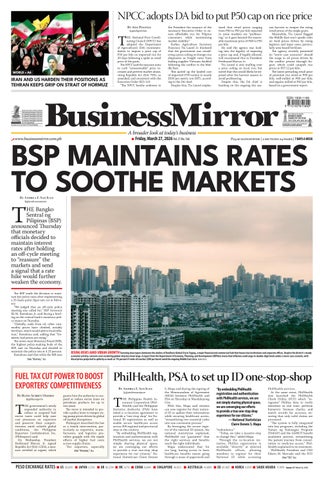
THEBangko Sentral ng Pilipinas (BSP) announced Thursday that monetary officials decided to maintain interest rates after holding an off-cycle meeting to “reassure” the markets and send a signal that a rate hike would further weaken the economy.
The BSP made the decision to maintain key policy rates after implementing a 25-basis-point (bps) rate cut in February.
“We judged that an off-cycle policy meeting was called for,” BSP Governor Eli M. Remolona Jr. said during a briefing on the central bank’s monetary policy stance on Thursday.
“Globally, aside from oil, other commodity prices have climbed, notably fertilizer, which would add to food inflation,” Remolona said, adding that “Domestic fuel prices are rising.”
The seven-man Monetary Board (MB), the highest policy-making body of the BSP, met on Thursday and decided to maintain the policy rate at 4.25 percent.
Remolona said that while the MB sees
By Ada Pelonia @adapelonia
nating Council (NPCC) has adopted the Department of Agriculture’s (DA) recommendation to impose a price cap of P50 per kilo on imported rice for 30 days following a spike in retail price of the grain.
The NPCC said the measure aims to curb “unreasonable” price increases and prevent market abuse, citing Republic Act (RA) 7581, as amended, and consistent with the Executive Order (EO) 110.
“The NPCC hereby endorses to
the President the issuance of the necessary Executive Order to ensure affordable rice for Filipino consumers while maintaining market stability.”
Earlier, Agriculture Secretary Francisco Tiu Laurel Jr. disclosed that the government was considering a price ceiling on foreign rice shipments as freight rates from leading supplier Vietnam doubled following the conflict in the Middle East.
This jacked up the landed cost of imported DT8 variety to nearly $500 per metric ton (MT), according to the DA chief.
Despite this, Tiu Laurel empha-
sized that retail prices ranging from P60 to P65 per kilo reported in some markets are “profiteering,” as it goes beyond the reasonable maximum price of P48 to P50 per kilo.
He said the agency was looking into the legality of imposing a price cap and, if legally allowed, will recommend this to President Ferdinand Marcos Jr. Tiu Laurel is also mulling over a price ceiling on local rice, but noted that this would likely be imposed after the harvest season to avoid profiteering.
Despite this, the DA chief is banking on the ongoing dry sea-
son harvest to temper the rising retail prices of the staple grain. Meanwhile, Tiu Laurel flagged the Middle East war’s upside risks on food prices driven by rising logistics and input costs, particularly urea-based fertilizer. The agency recently presented its “worst case scenarios” should the surge in oil prices driven by the conflict persist through August, which could catapult rice prices to P67.12 per
By Andrea E. San Juan @andreasanjuan
By Bless Aubrey Ogerio @blessogerio
THE government’s newly expanded authority to reduce or suspend fuel excise taxes could help ease cost pressures on exporters and preserve their competitiveness amid volatile global conditions, the Philippine Exporters Confederation Inc. (Philexport) said.
On Wednesday, President Ferdinand Marcos Jr. signed Republic Act (RA) 12316, a measure certified as urgent, which grants him the authority to suspend or reduce excise taxes on petroleum products for up to two years. The move is intended to provide a policy lever to temper rising pump prices driven by global oil market disruptions.
TPhilexport described the law as a timely intervention, particularly as exporters, manufacturers, and logistics providers grapple with the ripple effects of higher fuel costs across supply chains. “For exporters, especially
HE Philippine Health Insurance Corporation (PhilHealth) and the Philippine Statistics Authority (PSA) have inked a co-location agreement to provide a “one-stop shop” for National ID registration as well as enable secure healthcare access across 200 regional and provincial sites in the country.
“By embedding PhilHealth registration and authentication with PhilHealth services, we are not simply sharing physical space, we are converging our efforts to provide a true one-stop shop experience for our citizens,” National Statistician Claire Dennis
S. Mapa said during the signing of the Memorandum of Agreement (MOA) between PhilHealth and PSA on Thursday in Mandaluyong City.
With this, Mapa said citizens can now register for their national ID or update their information while securing healthcare access, “streamlining two essential tasks into one convenient process.”
By leveraging the secure registry of the national ID system, the national statistician explained, PhilHealth can “guarantee” that the right services and benefits reach the right individuals.
Mapa underscored that for too long, having access to basic healthcare benefits meant going through a maze of paperwork and
“By embedding PhilHealth registration and authentication with PhilHealth services, we are not simply sharing physical space, we are converging our efforts to provide a true one-stop shop experience for our citizens.”
—National Statistician Claire Dennis S. Mapa
“redundancy.”
“Today, we take a massive step to change this,” added Mapa.
Through the co-location initiative, PhilSys registration is available “directly” at selected PhilHealth offices, allowing members to register for their National ID while accessing
PhilHealth services. At the same event, PhilHealth also launched the PhilHealth Check Utility (PCU) which “integrates” PhilSys data to verify identities in real time, perform biometric liveness checks, and match records for accuracy, ensuring that only valid claims are processed.
“The system is fully integrated into key programs, including the Yaman ng Kalusugan Program [YAKAP] and the GAMOT benefit availment process, streamlining the patient journey from consultation to medicine access,” PhilHealth explained in its statement. PhilHealth President and CEO Edwin M. Mercado said the PCU
By Andrea E. San Juan @andreasanjuan
“enables” PhilHealth to prevent duplications, strengthen safeguards, and protect the health fund while ensuring that benefits reach “the right people at the right time.”
Mapa said through the PhilHealth and PSA co-location agreement, “We are bringing our services directly to where they are needed most. Our agreement is for us to have a co-location of about 200 sites, regional and different provincial and area sites, PhilHealth and PSA.”
The national statistician said as of end of March 2026, the PSA has authenticated 94.7 million transactions. Meaning, registrants in the national ID have already used authentication services like PhilHealth and other services.
Of these transactions, 64 million are under government transactions, with PhilHealth falling under this category.
He also noted that 17.2 million transactions are under the financial category, or those who have access to financial accounts like bank accounts.
Meanwhile, 13.4 million transactions are under the private sector, Mapa also noted.
“So that means, more people are now using the authentication services of our national ID system. This is very important because we are utilizing the biometric authentication services and it will guarantee that the person doing the transaction is really the individual that he or she is claiming to be,” the national statistician said.
ERC suspends operations at WESM starting March 26
By Lenie Lectura
THEEnergy Regulatory Commission (ERC) on Thursday ordered the suspension of the trading of electricity, a day after President Ferdinand Marcos Jr. declared a state of national energy emergency.
The Wholesale Electricity Spot Market (WESM) operations across the Luzon, Visayas, and Mindanao grids are temporarily suspended starting March 26, 2026 and will remain in effect until the conditions for normal market operations are deemed suitable.
ERC Chairperson and CEO Atty. Francis Saturnino C. Juan underscored the importance of decisive regulatory action during this period of uncertainty: “In times of global energy disruption, our priority is clear: to protect Filipino consumers while ensuring that our power supply remains stable and reliable.
“The temporary suspension of the WESM and power supply remains stable and reliable. The temporary suspension of the WESM and measures
to cushion the impact of volatile fuel prices and safeguard the integrity of our power system.”
During the market suspension, the ERC will implement a Modified Administered Pricing (AP) Mechanism, which the ERC defined as a technology-specific pricing approach to better reflect prevailing fuel costs and ensure the continued operation of power generators. However, the proposed AP scheme is undergoing consultation with stakeholders. It is targeted to be firmed up, though, on April 1, 2026.
Under the proposed scheme, coalfired power plants may be paid at a fixed rate; natural gas plants based on contracted prices; and renewable energy sources such as hydro and geothermal, under administered pricing with prefer-
ential dispatch.
Oil-based plants, meanwhile, will be compensated based on administered prices when dispatched or contracted.
The ERC said this approach is necessary because the January and February market prices, which would have been the bases of the administered prices under the prevailing rules, would not reflect current conditions marked by geopolitical tensions in the Middle East and fuel supply constraints.
While suspended, the power system will operate under Special Operating Guidelines (SOG), which prioritize optimal dispatch of available renewable energy resources, conserve critical fuel inventories amid global fuel supply disruptions, and provide an operational framework for system dispatch, the ERC also said. The guidelines will be issued by the DOE.
All market participants, including the Independent Electricity Market Operator of the Philippines
(IEMOP) and the National Grid Corporation of the Philippines, are directed to comply with these interim measures.
The ERC assured the public that these measures are temporary and are being implemented to mitigate the impact of global energy disruptions while safeguarding the stability of the Philippine power system.
“The objective of any market suspension that will be justified under such declaration is for us to rein in on the prices in WESM, while having some control over the plants that will be dispatched. Overall, this should have a positive impact on electricity rates,” Juan said via Viber.
The suspension was issued pursuant to Executive Order No. 110, Series of 2026, which declared a state of national energy emergency due to global fuel supply disruptions and rising oil prices, and in line with a Department of Energy (DOE) letter received on March 25, recommending the WESM suspension.
sures can help cushion the impact of rising costs while keeping public spending manageable.
encourage conservation, fuel switching, and investment in alternative energy sources. Broad price controls or across-the-board subsidies, it warned, may distort markets, delay necessary adjustments, and lead to inefficient use of resources.
Instead, fiscal support should be targeted and time-bound, focusing on vulnerable households and the most affected sectors. Such mea-
upside risks to inflation, it noted that these risks are “largely supply-driven,” for which monetary policy has “limited effectiveness.”
At the same time, the BSP sees continued weak economic growth this year. As such, Remolona pointed out: “In that regard, to raise rates at this time would be painful.”
The BSP’s latest projection showed that headline inflation would average 5.1 percent this year. At the February 19 policy meeting, the BSP pegged average inflation forecast for 2026 at 3.6 percent.
The BSP’s target band for inflation is 2 percent to 4 percent.
The central bank said the impact of the oil prices and some of the spillovers of the oil prices on commodities would be felt by the second half of the year.
It said inflation could reach 3.5 percent in March, adding that the inflation print in April “could be even higher than that.”
When asked why the central bank found it urgent to hold an off-cycle meeting just to announce that it would keep rates unchanged, Remolona said: “I hope it reassures markets that we are assessing the situation constantly.”
“Normally, with inflation going where it’s going, we would have hiked. But because it was driven by supply shocks, we felt a hike
Central banks, meanwhile, should aim to limit excessive market volatility and closely monitor inflation expectations. While some tightening may be needed, the ADB cautioned that overly aggressive policy moves could further weaken growth and heighten financial instability.
Governments were also encouraged to adopt practical measures to reduce energy demand, including promoting public transport use, implementing energy-saving initiatives, and adjusting work arrangements such as remote work or staggered schedules.
wouldn’t do very much,” added the central bank governor.
Remolona said the off-cycle monetary policy meeting had to happen because “the data is so different now,” adding that the oil prices are “behaving somewhat differently.”
“This is a situation in which sentiment has become quite important. Fiscal policy as well,” added the central bank governor.
Remolona said the Monetary Board calls for an off-cycle meeting “whenever we feel that the data might have changed a lot.”
Prognosis LOOKING ahead, Remolona said “it would only be appropriate for monetary policy to tighten” once there are second-round effects from supply shocks.
The BSP chief said the secondround effects that could trigger a rate hike are higher fates and food prices.
“You know, when oil prices go up, fertilizer prices also go up. That would tend to affect food prices. And those are two of the more important ones. Wages as well,” added Remolona.
“Looking ahead, mounting risks to inflation will require sustained vigilance. Monetary policy will focus on addressing likely second-round effects that may arise. The Monetary Board will act as needed in pursuit of the BSP’s primary mandate to maintain price stability,” the BSP said in a statement on Thursday.
At its February 19 policy meeting, the BSP Monetary Board reduced the Target Reverse Repurchase (RRP) Rate by 25 basis points to 4.25 percent. The BSP slashed rates in February after it admitted that it has become less certain of the direction of the economy given the sliding confidence which dragged the pace of growth of the Philippine economy last year. (See: https://businessmirror.com. ph/2026/02/20/decliningconfidence-spurs-25-bps-ratecut/)
Micro, Small, and Medium Enterprises (MSMEs), transport and logistics costs are a major component of overall expenses,” Philexport President Sergio Ortiz-Luis said in a statement.
“Any relief on fuel costs will help preserve competitiveness in already volatile global markets,” he added. Under the new law, the chief executive may exercise this authority upon the recommendation of the Development Budget Coordination Committee (DBCC) and in coordination with the Energy Secretary.
This may be done once the average Dubai crude oil price, based on the Mean of the Platts Singapore (MOPS), has reached or exceeded $80 per barrel for at least one month prior to the issuance of the order.
Philexport noted that sustained increases in oil prices have raised operating costs across industries, from freight and trucking to power and production.
“There are members who have expressed the possibility of reducing work hours due to higher input costs,” Ortiz-Luis said.
“The ability of the President to suspend or reduce excise taxes on fuel can help cut operating costs, prevent further price passthrough, and ultimately protect jobs and livelihoods,” he added. The development comes as some firms explore cost-cutting measures, including adjustments to work schedules, as part of broader responses to rising expenses.
Earlier this month, business groups flagged concerns over proposals for a four-day workweek, noting that production-oriented sectors face different operational constraints compared with service-based industries.
Philexport emphasized that while the law offers potential relief, its effectiveness will depend on how quickly and clearly it is implemented.
“We hope that clear guidelines will soon be issued. Predictability is important so businesses can plan accordingly and pass on the benefits efficiently to consumers,” Ortiz-Luis said.
The group also urged the government to complement the measure with targeted support for heavily affected sectors such as transport, logistics, agriculture, and exportoriented industries.
Among the proposals are waiving government shares in port charges and toll fees to further reduce cost burdens.
“This is a strong step in the right direction, but it should be part of a broader strategy to build resilience against external shocks, including investments in energy security, logistics efficiency, and alternative fuel sources,” Ortiz-Luis said.
Separately, Trade Secretary Ma. Cristina Roque proposed, at a Senate hearing, additional measures to stabilize the prices of basic goods. These include temporarily suspending certain port-related charges and imposing a moratorium on toll fees for trucks delivering essential commodities. Meanwhile, manufacturers have also pledged to help cushion consumers from rising costs. At a March 16 meeting, firms committed to keeping prices of essential goods unchanged for at least 30 days, with some extending that commitment to as long as 60 days despite mounting fuel-related pressures.
Philexport said it remains committed to working with government agencies and industry stakeholders to ensure that policy responses effectively support the export sector while contributing to broader economic stability.
Convergence key to address emerging threats–Teodoro
NATIONAL Defense Secretary Gilberto Teodoro Jr. said that recent and ongoing conflicts have highlighted the need for all nations to “work toward convergence to address threats and mitigate vulnerabilities.”
In his keynote speech to the Paris Defense and Strategy Forum (PDSF) in France on Wednesday (local time), and provided to Filipino reporters on Thursday, Teodoro said there is a need for crossregional convergence to protect human life, not only to propound state objectives and international order.
“And by convergence, we should interpret convergence in the broad sense, which means unity of purpose, where we both could either interoperate in one area or operate in our respective areas to achieve a common goal, using our unique capabilities, expertise, and areas of influence,” he said.
Teodoro said this approach gives countries an “inherent responsibility” to protect the public and preserve global order without the need for a treaty.
“We need no treaties. This is immediately executory and doable,” he said.
“Our convergence in goal or objective is necessary to protect human life, uphold international law, and defend the territorial integrity and sovereignty of smaller, and especially archipelagic countries, especially those who are besieged by larger neighbors.”
Teodoro cited as an example the ongoing conflict in the Middle East, which has already affected Filipinos even though the Philippines is not directly involved.
“We have felt the consequences, most immediately through direct threats to the safety of Filipinos who are in the Middle East, 2.4 million of them, and immediately through sharp increases in commodity prices, the Philippines being a net importer of oil,” he said.
He also highlighted the fact that one in every three seafarers in the international merchant marine service is a Filipino, and one in three world medical professionals
By Rex Anthony Naval
WITH the Holy Week holidays just a few days away, the National Police (PNP) on Thursday ordered all units to beef up their road safety measures to prevent needless accidents during this season.
The PNP spokesperson, Brig. Gen. Randulf Tuaño, in an interview with reporters, said the force will deploy a sufficient number of police officers for the strict enforcement of road safety rules, including inspections of public utility vehicles in transportation hubs.
He added that this will be done in coordination with local governments and other agencies.
Latest data from the PNP indicate that 30,516 road accidents were recorded from April 1 to May 31, 2025, down from 31,992 in the same period in 2024. However, fatalities rose from 884 during the same period in 2024 to 919 last year.
Most deaths occurred in Central Luzon, Calabarzon (Cavite, Laguna, Batangas, Rizal and Quezon), Ilocos Region, and Northern Mindanao.
is a Filipino, forming the backbone of healthcare provision in Europe and America.
“And much to our regret, our people have been counted among those who are casualties from attacks both on land and at sea,” Teodoro said.
He also emphasized that international law and institutions are essential to the growth and survival of nations like the Philippines, “not only as a matter of principle, but also out of necessity.”
“Without an expeditionary armed force, for example, the Philippines has to depend on the international system to protect our nationals, wherever they may be, while we are in the process of strengthening ourselves to enable us to do so in the future, which is an obligation for which we will not shirk, and it is an obligation which we realize,” Teodoro said.
Under the leadership of President Marcos, the Philippines is now strengthening its capabilities to ensure the safety and well-being of overseas Filipinos, the defense chief said.
“A big part of this is strengthening first our Armed Forces to protect our exclusive economic zone and other areas where we have jurisdiction, and thereafter, to be an expeditionary armed force to protect, in conjunction with all other like-minded partners, our people, and those of others, who are essential to international safety, international trade, and international commerce,” he added.
Teodoro also noted that the Philippines’ defense and security military partnerships with countries in Europe and beyond help the country in this critical endeavor.
The PDSF, which runs from March 24 to 26 and was organized by the Defence Academy of the École Militaire (Academ) of France, is a major international forum that provides a valuable avenue for dialogue among states, institutions, militaries, researchers, and civilian stakeholders on regional and global strategic and geopolitical issues.
Rex Anthony Naval with PNA
To prevent accidents, Tuaño urged motorists to ensure their vehicles are in good condition, observe road safety precautions, and plan their trips.
Water activities AT the same time, the PNP on Thursday reminded everyone to enjoy swimming and other water activities responsibly.
The PNP issued this reminded after noting that a total of 151 drowning incidents were reported from April 1 to May 31, 2025 all over the country.
This is a notable increase from the same period in 2024, which recorded 90 cases—an increase of 61 incidents, or nearly 68 percent. Sadly, 141 of these cases resulted in deaths, while seven people were injured and another seven were fortunate to escape unharmed. These numbers remind us how important it is to stay vigilant, especially for families with children enjoying water activities.
Even simple precautions can make the difference between a safe day in the water and a preventable tragedy.
Ombudsman to provide Sara’s SALNs to House
TTBy Joel R. San Juan @jrsanjuan1573
HE Ombudsman on Thursday said it is ready to provide the House of Representatives with copies of the Statements of Assets, Liabilities and Net Worth (SALNs) of Vice President Sara Duterte in connection with its ongoing impeachment proceedings against her.
At a press briefing, Ombudsman Jesus Crispin Remulla said his office is mandated to comply with the request of the House Committee on Justice which is hearing the impeachment complaints filed against the Vice President.
“It’s part of the constitutional process that we have...it’s the legal process and we just abide by the rules and the law when it comes to impeachment proceedings. We will just comply with our laws,” Remulla said.
When asked if the Ombudsman is ready to submit Duterte’s SALNs to Congress anytime, Remulla replied: “Of course, that is required.”
For his part, assistant Ombudsman Mico Clavano said the submission of the Vice President’s SALNs to the House committee is in line with memorandum circular is -
sued by the Ombudsman last year which allows the public to access the SALNs of elected officials from its repository.
“When we first came into the office, the first thing we did was to make public the SALNs of public officers and in that same statement we even encouraged the other branches of government to do the same—to make their statements or their SALNs public because these are public documents,” Clavano said.
Clavano added that the public may access SALNs of public officials that are in the Ombudsman’s repository such as the President, the Vice President, heads of the constitutional commissions and local governments (LGUs).
“So even a simple request would do. So much more if it is a subpoe -
na, we will comply,” Clavano said. The subpoena for Duterte’s SALNs covers the period 2007 to 2013, 2016 to 2022, and 2022 to 2025, the years when Duterte served as a local official in Davao City up to her current position as Vice President.
The House Justice committee also issued a subpoena for the National Bureau of Investigation (NBI) to produce certified copies of all records from its investigation into Duterte’s public threats against President Marcos, First Lady Liza Araneta-Marcos, and former Speaker Martin Romualdez.
Madriaga SUBPOENA were also issued for witnesses and documents from the Commission on Audit (COA), Philippine Statistics Authority (PSA) and ordered the testimony of Ramil Madriaga. Madriaga is currently detained for a kidnapping for ransom case pending before the Regional Trial Court in Manila.
Madriaga has executed an affidavit claiming that he was formerly assigned to do intelligence gathering for the Vice President and that he delivered cash to various individuals upon the order of the latter when she was education secretary.
He alleged that the money came from the VP’s confidential funds.
See “SALNs,” A4
‘Edca sites too far to be targeted by Iran’
CLAIMS that the Philippines will be targeted by Iran owing to the presence of Enhanced Defense Cooperation Agreement (Edca) sites are “false narratives,” a ranking military official said on Wednesday.
In an interview with reporters, the Navy (PN) spokesperson for the West Philippine Sea and Inspector General, Rear Adm. Roy Vincent Trinidad, said these reports do not give a “clear picture of the situation.”
“Number one, the conflict in the Middle East is regional in nature involving the Gulf States, Iran, US, and Israel,” he stressed, adding that the Philippines is not a party to the conflict.
Trinidad, for point number two, clarified that Edca sites are Philippine bases and not American ones.
“[And] number three, activities on our Edca sites are [meant] to strengthen the defense capability of the AFP [Armed Forces] and our HADR [humanitarian assistance and disaster response] capability,” he said.
In addition, he said Iran’s most powerful missile systems, which has an estimated range of around 2,500 kilometers, do not have the capability to reach Southeast Asia.
Air distance between the Philippines and Iran is between 7,182 km. and 7,675 km.
“ Wala pong katotohanan na ito ay maging target, posibleng maging target ng Iran sapagkat napakalayo ang kanilang pinakamalakas na missile system, hindi aabot sa Southeast Asia [There is no truth to claims that Edca sites could be possible targets of Iran as these are too far away even for their most
powerful missile systems, these cannot reached Southeast Asia],”
Trinidad noted.
Signed in 2014, Edca provides for Filipino and American soldiers to train together and enables US troops to build facilities and preposition supplies and equipment inside strategically located bases in the country.
There are nine Edca sites: the Lt. Cesar Basa Air Base in Floridablanca, Pampanga; Fort Ramon Magsaysay Military Reservation in Nueva Ecija; Lumbia Airport in Cagayan de Oro; Antonio Bautista Air Base in Puerto Princesa, Palawan; Benito Ebuen Air Base in Cebu; Naval Base Camilo Osias in Sta. Ana, Cagayan; Lal-lo Airport in Lal-lo, Cagayan; Camp Melchor dela Cruz in Gamu, Isabela; and Balabac Island in Palawan.
Rex Anthony Naval and PNA
HE House of Representatives on Thursday launched a free ride program for commuters traveling from San Jose del Monte City, Bulacan, to Welcome Rotonda in Quezon City and on the return route to Fairview Terraces as part of a temporary transport relief initiative aimed at easing the burden of rising fuel costs on workers, students, and other daily passengers.
The project, called “Biyaheng Damayan: Libreng Sakay mula sa Kongreso,” is a joint effort of Speaker Faustino Dy III and House Majority Leader Ferdinand Alexander Marcos.
The initiative comes as escalating geopolitical tensions in the Middle East fuel uncertainty in global oil markets, with ripple effects being felt across transport fares, food prices, and other basic goods.
“This is about making sure that government response is felt where it matters most—in the daily lives of our people,” Marcos, who represents Ilocos Norte, said, adding that the program is fully aligned with President Marcos’s broader economic strategy, which mobilizes all agencies of government to mitigate the effects of external shocks on the domestic economy.
“This libreng sakay initiative is part of the President’s whole-ofgovernment approach to protect the purchasing power of Filipino families,” he said.
Under the approved setup, four House buses will serve the route every Monday, Thursday and Friday, beginning March 26, during both morning and afternoon peak hours.
The program is intended to operate on a temporary basis while fuel prices remain elevated, and commuters continue to feel the strain of rising transport expenses.
The free rides will cover two linked routes in the morning: San Jose del Monte City, Bulacan, to Quezon City Rotonda, and Quezon City Rotonda to Fairview Terraces. In the afternoon and evening, the return trip will run from Quezon City Rotonda to Fairview Terraces and vice versa, allowing passengers to move through one of the busiest commuter corridors in northern Metro Manila and nearby Bulacan province.
The Land Transportation Franchising and Regulatory Board (LTFRB), in a March 25 letter to House Secretary-General Cheloy Velicaria-Garafil, raised no objection to the House operating the four buses under the program.
Cops ensure commuter safety, mobility during transport strike
THE National Police (PNP) on Thursday ensured commuter safety and mobility during the two-day nationwide transport strike.
“We have deployed our personnel nationwide with a heavy focus on Metro Manila,” Gen. Jose Melencio Nartatez Jr., National Police chief, said in a statement.
“Our mobility assets are also on standby in case there is a need to offer free rides to stranded commuters,” he added.
The free rides aim to ease travel for commuters reliant on public transport. A coalition of transport groups, urban poor organizations and progressive groups launched the two-day strike on Thursday to protest rising fuel prices.
Nartatez ordered personnel deployed at key transport hubs and strike hotspots, with mandatory body-worn cameras to ensure
transparency.
“My instruction to our personnel is to continue exercising maximum tolerance,” he said.
Meanwhile, the National Capital Region Police Office (NCRPO) spokesperson, Maj. Hazel Asilo, said the police are monitoring 13 rally sites with an estimated 140 participants.
“ Wala naman tayong reported na untoward incidents. So far, peaceful naman ang kanilang ginaganap na mga rallies [We do not have any reported untoward incidents. So far, the rallies being mounted have been peaceful],” she said in an interview.
The NCRPO deployed over 8,900 police officers and 190 vehicles for strike security in Metro Manila.
It also deployed 151 vehicles to provide free rides to affected commuters and 45 more for security operations.
Commuters welcome fake hike suspension
A COMMUTERS’ grou,p meanwhile, said the Marcos administration’s suspension of fare increase “had greatly alleviated commuter woes in the wake of rising fuel prices.”
“We express our deep appreciation to President [Marcos] and his administration for their unwavering concern for the plight of the ordinary commuters,” the Coalition for Filipino Commuters (PasaHero) said in a statement.
Ira V. Panganiban, PasaHero lead convener, said that by suspending the initially announced fare hike, “the President has shown his compassion for ordinary commuters who outnumber the transport sector in population by a ratio of at least 16 passengers to one driver.”
“While we understand the concerns and hard ships of the transport sector, never has a sitting
President ever taken into consideration the suffering of the ordinary PasaHero,” PasaHero said. The group noted that whenever oil prices rise, the first victims are always the commuters because the first reaction is always to raise transport fares.
And while the drivers benefit, they do not realize that the fare hike becomes irrelevant because their families also have to pay the increase.
“The coalition prays that the President and his administration continue to extend this support to commuters who suffered long enough being the immediate whipping boys of every energy crisis,” Panganiban said.
The CFC offered to sit down with representatives from the transportation sector to look for better ways to address the recurring problem.
Rex Anthony Naval with PNA
PNP beefs up road safety watch
Properties, bank accounts tied to flood control mess still frozen
Twww.businessmirror.com.ph
Senate, Pagcor drafting bill setting online gaming rules
TBy Joel R. San Juan @jrsanjuan1573
HE Office of the Ombudsman on Thursday clarified that properties and bank accounts tied to the multi-billion flood control scandal have remained frozen following the issuance of asset preservation orders (APOs) by a trial court.
Assistant Ombudsman Mico Clavano issued the statement following reports that the sixmonth freeze orders previously issued by the Court of Appeals (CA) covering bank accounts have already lapsed, which could pave the way for owners of these assets to withdraw their funds.
“We monitor all developments, especially those related to the flood control investigation. There were reports saying the freeze orders are about to be lifted,” Clavano said. Clavano explained that these assets remain frozen with the filing of three civil forfeiture cases by the Anti-Money Laundering Council (AMLC) before the Regional Trial Court in Manila. The AMLC said the petitions cover the properties of individuals and entities subject to several freeze orders issued by the CA. It added that Manila RTC has issued two provisional asset preservation orders in connection with the petitions, which are aimed at safeguarding monetary instruments and properties pending the court’s final decision.
Continued from A3
He also alleged Philippine Offshore Gaming Operators (Pogos) and drug dealers funded her vice presidential bid in the 2022 elections.
Duterte has filed a perjury complaint against Madriaga before the Office of the Taguig City Prosecutor for perjury under Article 183 of the Revised Penal Code.
Duterte has described as another “fishing expedition” the House’s hearing on the impeachment complaints against her.
What fishing expedition?
THE House Committee on Justice on Wednesday rejected claims of the camp of Duterte that its impeachment proceedings are a “fishing expedition,” saying the case is anchored on existing records, including her own Statements of Assets, Liabilities and Net Worth (SALN).
Alam ninyo entitled naman ho sila sa opinion nila. Pero the facts are very clear. Mayroon pong kailangang ipaliwanag ang ating Pangalawang Pangulo doon sa discrepancy ng kanyang SALN ng 2007 at 2024,” Party-list Rep. Terry Ridon of Bicol Saro, a member of the Justice panel, said in a news conference.
“Fishing expedition lang po iyan kung wala tayong pinagsisimulang mga dokumento. Ang problema meron, nasa SALN mismo ng Pangalawang Pangulo,” he added. Ridon, who also chairs the
“This means their assets are still frozen,” Clavano said.
“We are facing one of the biggest scandals in history. As long as there is an asset preservation order in the civil forfeiture cases, the respondents would not be able to touch their money,” he added.
He assured that the Ombudsman is closely monitoring the actions of the AMLC in relation to ongoing efforts to recover illgotten wealth related to anomalous flood-control projects of the government.
Remulla warns AMLC officials OMBUDSMAN Jesus Crispin Remulla at the same time warned AMLC officials against protecting the interest of the banking industry instead of focusing on its mandate to hold corrupt public officials accountable.
At a press briefing, Remulla stressed that AMLC’s role in providing bank records is necessary to prosecute public officials involved in corruption.
“No one is exempted from bank scrutiny, especially if there is a valid reason to look into that account,” Remulla said.
“These bank accounts are important because this is where we can see if there is money being hidden or if funds are being circulated in various ways… money that should not be even in their possession, and is likely taken from public funds,” the Ombudsman said.
However, Remulla admitted that his office is encountering problems with AMLC officials, particularly on the performance of their duties.
“That is why we want to speak with AMLC again regarding the fulfillment of their duties. Because, as you know, they should not be protecting the banking industry, instead they should focus on looking into violations committed by government officials,” Remulla stressed.
Remulla stressed that AMLC is one of the agencies that is vital in the Ombudsman’s efforts to prosecute public officials involved in corruption anomalies.
“They cannot stonewall the efforts of the Office of the Ombudsman. They should perform their duty, or else we will be filing charges against them,” the Ombudsman stressed.
‘Fast-track bill on ₧52.8-B aid for OFWs, farmers, fishermen, transport workers’
PARTY-LIST Rep. Chel Diokno of Akbayan on Thursday called on President Marcos to certify as urgent House Bill 8495, seeking a P52.8-billion supplemental budget for the repatriation of affected overseas Filipino workers and financial assistance for transport sector workers, farmers, and fisherfolk amid the worsening Middle East crisis.
“The ongoing conflict in the Middle East creates a spillover effect on the cost of other goods, compounding poverty and hunger among our people. Nananawagan tayo sa Malacañang na i -certify bilang urgent ang panukalang ito [We call on Malacañang to certify this proposal as urgent],” said Diokno, who filed the measure along with fellow Party-list Reps. Percival Cendaña and Dadah Kiram Ismula of Akbayan, and Dinagat Islands Rep. Kaka Bag-ao.
“As Congress is on a break, we urge our colleagues in the House to hold committee deliberations on the bill and if necessary, conduct a special session to approve the same— hindi tumitigil ang krisis na
The agency also said the issuance of a special permit was not required because the vehicles are
ito, imbes patuloy pa itong lumalala [this crisis does not stop, rather it continues to worsen],” he added.
Energy Secretary Sharon Garin previously warned that the country could face a national problem with fuel supply if tensions in the Middle East persist, adding that Filipinos may need to change their lifestyles if global oil prices surge to $200 per barrel.
Diokno emphasized that the proposed supplemental budget will enable the government to deliver immediate assistance to affected sectors. This would also help ensure sufficient funding for aid and subsidies as further increases in petroleum product prices are expected.
Should the supplemental budget be approved, top priority will be given to transport workers, farmers, and fisherfolk as they are vital to the country’s economy.
Under the proposal, the P52.8billion budget allocates P12 billion for fuel subsidies to assist public utility vehicle drivers and transport workers, and P2.8 billion in agricultural subsidies
official government vehicles and no fare will be collected from passengers riding under the program.
The approved bus schedule provides for morning peak-hour operations from 5:30 a.m. to 8 a.m. and afternoon or evening peak-hour operations from 4 p.m. to 7 p.m.
These hours were selected to coincide with peak periods when workers and students are most likely to queue for public transportation and encounter the heaviest traffic.
The House concept paper for the project identified daily wage earners, workers and students, including those in public schools
to help fisherfolks and farmers cope with rising fertilizer and production costs.
Meanwhile, a total of P38 billion will be earmarked for overseas Filipino workers (OFWs) who may be displaced by the conflict – with P18 billion allotted as emergency fund for their repatriation and P20 billion for assistance and reintegration fund.
Currently, the government only has about P2.5 billion for transport fuel subsidies, while the Department of Agriculture has around P150 million available to assist farmers.
The Department of Migrant Workers, for its part, only has P1.76 billion in emergency funds currently available for the repatriation and reintegration of affected OFWs.
Sen. Anna Theresia “Risa” Hontiveros, who also belongs to Akbayan, for her part, filed Senate Bill 1986, seeking a P52.8 billion supplemental budget to fund expanded subsidies for drivers, farmers, fisherfolk, and distressed overseas workers.
and state universities and colleges, as the primary beneficiaries of the libreng sakay program.
It also gives priority or assisted boarding to senior citizens, persons with disabilities and pregnant women, reflecting the project’s intent to offer relief first to those who may need it most.
Meanwhile, the House launched the Suporta sa Bayan Desk (SBD), a centralized public assistance program, where constituents can submit their request for aid from their lawmakers.
Among the services offered by the SBD are medical, funeral, transportation, and cash relief assistance.
“Parents should always supervise their children. Swim only in designated areas, check for lifeguards, wear life vests when needed, and avoid risky behavior such as diving in shallow water or swimming alone. Simple precau -
HE Senate and the Philippine Amusement and Gaming Corp. are now drafting a bill that will set a new, comprehensive regulatory framework in an effort to elevate standards in the online gaming industry
A story published in the gaming newsletter GGRAsia said Philippine-listed and licensed online gaming operator DigiPlus Interactive Corp said it supports the development of a “new, comprehensive regulatory framework” designed to “elevate standards” for the country’s online gaming industry.
The bill, DigiPlus said, is aimed “at improving consumer protection and industry transparency.”
“This collaborative effort focuses on implementing tighter controls for payment channels and marketing restrictions, ensuring a fair, secure, and compliant gaming environment,” the company was quoted as saying.
The story cited the DigiPlus chairman, Eusebio Tanco, as saying: “As a licensed and leading online gaming operator, we continue to welcome collaboration and active participation in discussions with the Philippine government to achieve our shared goal of raising the standards of the industry.”
He added: “By reinforcing a
market where only those who adhere to the highest standards of compliance operate, we ensure that the benefits of our industry— from job creation to essential tax revenues—are preserved for the Filipino people.”
In a press briefing on Wednesday, DigiPlus president Andy Tsui said regulatory changes for the online gaming industry in the Philippines remain a “key issue” for the company.
“We are part of it [the working group], and we are participating in that discussion,” Tsui noted.
“We are quite comfortable that there will be no total ban, just stricter regulations for the sector,” he added. “These will be positive in establishing a long-term, sustainable industry.”
The company has been taking what it describes as “proactive measures” to enhance player protection and customer service in the Philippines.
That included the launch in mid-September of a surety bond program for online gaming players, as well as the expansion of “over-the-counter [OTC] or physical payment options” for players via partnerships with bills payment service provider Bayad and self-service payment kiosk operator Pay&Go.
BI arrests Chinese man wanted for telecom fraud
THE Bureau of Immigration (BI) has arrested a Chinese national who is wanted in Guangdong, China, for telecom fraud.
The suspect, identified as Zhang Jinglong, 29, was arrested along Mercedez Street, Bel-Air, Makati City, following intelligence information confirming that he is a fugitive subject of investigation by Chinese authorities.
Zhang was arrested along with his three companions identified as Zhang Pengguang, Feng Mincong, and Zhang Yunpeng, all Chinese nationals.
The BI said all four individuals are considered undocumented aliens since they failed to present valid passports or immigration documents when questioned by authorities.
The arrest was carried out on March 25 by operatives of the BI Fugitive Search Unit (FSU), led by its chief, Rendel Ryan Sy, in coordination with the National Police (PNP), the Makati City police, and government intelligence forces.
Marcos welcomed the new initiative to address “long-standing gaps” in the assistance delivery at Lower House.
“The Suporta sa Bayan Desk transforms public assistance from a fragmented process into a coordinated system,” Marcos said.
“It ensures that every request is tracked, every case is acted upon, and every Filipino is treated with respect,” he added.
The lawmaker said the SBD will help streamline the processing of assistance requests with partner government agencies.
The SBD will also augment the other service delivery program of the House of Representatives
tions can prevent accidents and save lives,” the PNP Chief, Gen. Jose Melencio Nartatez Jr., said. Nartatez also advised the public to stay hydrated, by taking breaks under shade, and keeping children and inexperienced
The BI said Zhang appeared to be under the protection of armed individuals, including an active police officer and a reservist when arrested.
The matter has been referred to concerned agencies for investigation.
Based on the BI’s records, Zhang arrived in the Philippines in November 2019 as a temporary visitor but has remained in the country without any valid extension or visa conversion, making him an overstaying alien. He is also the subject of an existing blacklist order for previous immigration violations.
“We will not allow criminal elements to exploit our systems or use the country as a base for fraudulent activities,” Immigration Commissioner Joel Anthony Viado said following Zhang’s arrest. The group is currently detained at the BI Warden Facility pending deportation proceedings.
Joel R. San Juan
During the operation, Zhang reportedly attempted to mislead authorities by claiming he was a national of Vanuatu, contrary to official records confirming his Chinese citizenship.
namely Dakilang Yugto and the HRep Executive Check-Up Program.
Dakilang Yugto provides continuing support for retired personnel, and the HRep Executive Check-Up Program strengthens healthcare access for House officials and employees.
“We thank Speaker Bojie Dy for establishing the Suporta sa Bayan Desk as a concrete expression of compassionate and responsive governance,” Marcos said.
“This is about making sure that when our people ask for help, the system is ready to respond quickly, clearly and with dignity,” he added. PNA with Samuel P. Medenilla
swimmers within arm’s reach.
“Whether at the beach, pool, or resort, following posted safety guidelines and being mindful of water conditions can greatly reduce the risk of drowning,” Nartatez said.
www.businessmirror.com.ph
Industry: EV charging adequate–for now
By Bless Aubrey Ogerio
ELECTRIC vehicle (EV) charg-
ing infrastructure in the Philippines is expanding and considered “adequate for now,” but largely because most users depend on home charging and short daily trips, masking gaps in broader nationwide coverage, industry players said.
Asean Federation of Electric Vehicle Associations (Afeva) president Edmund Araga said the groundwork for EV infrastructure had been laid years before the passage of the Electric Vehicle Industry Development Act (Evida), with government agencies led by the Department of Energy (DOE) rolling out regulations and support.
“The number of charger ports is rolled out and increasing with quite a number of location sites were visible in public locations such as malls, parking areas and other gasoline stations, not only in Metro Manila but in other key cities from Visayas and Mindanao,” Araga told the BusinessMirror in a Viber message.
The growing number of EV dealers, he added, is also helping address concerns over driving range.
For Electric Vehicle Association of the Philippines (Evap) chairman emeritus Ferdinand Raquelsantos, the current setup is sufficient given how EVs are typically used in the country.
Yet, he noted the need to expand infrastructure outside urban centers, particularly for vehicles with shorter driving ranges.
“There are a lot of models that can go back and forth to Baguio on a single charge, mainly with the help of a regenerative braking system, where as you slow down or press on your brakes, it charges your batteries,” he told this newspaper.
For now, Raquelsantos expressed belief that the country has enough charging stations. “As I always say, our EV application in the Philippines is not the same as other countries where the proximity of travel is quite far,” he added.
“In Metro Manila, you probably spend about 50 kilometers [km] average of travel per day. And with 400 km range on your EV, you practically charge only at home.”
He said around 95 percent of EV owners rely on home charging, while those without access, such as condominium residents, typically charge at offices or malls.
Despite this, gaps remain. In a separate briefing during the last week of February, BYD Philippines and Denza Philippines head Adam Hu cited charging infrastructure as a key industry-wide challenge, particularly for consumers without home charging options.
For its part, the DOE has pushed
for wider adoption of charging stations, issuing a circular in October last year encouraging establishments to install chargers and directing distribution utilities to integrate EV infrastructure into their plans.
Under the government’s Comprehensive Roadmap for the Electric Vehicle Industry (Crevi), around 7,300 charging stations are targeted nationwide by 2028.
EV adoption continues to gain ground. Data from the Chamber of Automotive Manufacturers of the Philippines, Inc. (Campi) and the Truck Manufacturers Association (TMA) showed that electrified vehicles accounted for 8.64 percent of total industry sales in February, with 3,098 units sold. This was up 18.7 percent from January and significantly higher than the 1,816 units recorded a year earlier.
Moreover, hybrid electric vehicles remained the dominant segment at 2,479 units, while battery electric vehicle sales rose to 340 units from 261 in January. Plug-in hybrid electric vehicles reached 279 units from 277.
With such data, Raquelsantos said the EV market has moved beyond its early stages, with more reliable models now available across major manufacturing countries.
“The quality and reliability are there whether the US [United States], China, Korea, Japan…There are new models equipped with solid-state batteries that need only around 15 minutes to have the ideal state of charge,” he said.
Araga, for his part, underscored the importance of after-sales support in sustaining consumer confidence. “After-sales is the key… a wide array of dealers has to be in place to sustain trust and confidence of the consumers,” he said.
Rising fuel costs have helped drive interest in EVs, the industry players said, but adoption is also being supported by broader factors, including lower operating and maintenance costs.
Araga said providing consumers with more mobility options is key to sustaining the shift. “It is something that is not already a myth or just merely a fad but rather a more practical way to make use of an EV as their next mobility,” he said.
Raquelsantos, on the other hand, expects growth to continue even if fuel prices stabilize, citing long-term savings.
“Change oil and tune up…would also increase in their charges, which pure EVs does not have,” he said. “Electricity is much cheaper than fuel. And there are households now with renewable energy…that will benefit much if they have EVs.”
DOE turns over ₧20-billion emergency fund to PNOC
TBy Lenie Lectura @llectura
HE Department of Energy
(DOE) is set to turn over the P20-billion emergency energy fund to the Philippine National Oil Corporation (PNOC) and PNOC Exploration Corp. (PNOC-EC) to stabilize domestic fuel supply.
On Thursday, the DOE said it is activating the emergency fund
to implement its Emergency Energy Security Program, which includes the procurement of refined petroleum products, LPG (liquefied petroleum gas) supply augmentation, and domestic inventory stock building. Under the program, the target volume is set at up to two million barrels of fuel, intended to support domestic requirements and mitigate the impact of global supply fluctuations.
The DOE said the emergency fund will strengthen the government’s ability to respond promptly to supply disruptions, preserve market stability, and support the uninterrupted operation of critical sectors, including transport, food logistics, power generation, and industry.
The DOE is coordinating closely with relevant government agencies and industry stakeholders to monitor supply conditions,
Woes of onion farmers: Price manipulation, oil price shock
LBy Butch Fernandez @butchfBM
ONG before the oil price shock hit most of the world’s petroleum-dependent economies like the Philippines, the local agriculture sector, particularly onion farmers, have already been struggling against the nefarious practices of traders, importers and inefficient government interventions.
The chairman of the Senate Agriculture committee, Sen. Francis Pangilinan, pointed this out on Thursday as he opened hearings on Resolution 344 seeking an investigation into the “systemic efforts to pull down prices of onions” in Occidental Mindoro, “even as importers, traders and cold storage managers are having a heyday.”
“The farm-gate price of onions is effectively just approximating the production cost. And yet, the price of onions in Metro Manila markets remains very high,” Pangilinan said, partly in Filipino, in his opening statement at the remote hearing he organized in Nueva Ecija.
He cited “indications that certain importers, traders and coldstorage operators are the ones who benefit more from the situation, and Resolution 344 alleges a possible conspiracy with some government officials” who enable the set-up to persists.
“We need to investigate this,” he added.
He raised suspicion over the fact that, despite the policy that bans an overlap during peak harvest
between the imports and the output of our local farmers, there are still 4,000 metric tons of imports and SPS clearances that remained valid till mid-February.
Still quoting Senate Resolution 344, the tons of imported onions use up 80 percent of the cold storage capacity, boxing out local producers. “That is why they are left with no space and their onions risk rotting, so the local farmers are then forced to sell their produce at a huge loss.”
Pangilinan, pointed out at Thursday’s hearing “that this sordid state of affairs has persisted long before the President declared a state of national energy emergency and approved a unified package for jobs, industries, food security and transportation.”
Pangilinan noted that the presidential declaration put agriculture among the top priorities next only to energy.
Government agencies, he added, have been mandated to seek immediate solutions to ease the burden of farmers, whose problems were worsened by the oil price shocks resulting from the US-Israel war on Iran – a conflict which began February 28, and which has since resulted in the destruction of a big chunk of vital oil facilities in the Middle East,
“The energy crisis is clearly impacting the production of our agriculture products, the prices food arising from such production, transportation, fertilizer, pesticides, logistics, all the way to markets,” Pangilinan lamented.
“The hearing was held in Nueva Ecija because it is the onion capital.
“Even before the crisis in the Middle East, the crisis in agriculture and onion production has been severe, and not enough protection has been given to these sector.”
The hearing was called to hear kasama (tenant farmers) who plant onions on less than a hectare, and have staked all they have—only to see all their efforts and income wiped out by the collusion of some parties to get the onion prices plunging.
“Is the lack of access by farmers to cold storage, deliberate to favor the imported onions and pull down the farmgate prices?” the senator asked.
“The Middle East crisis threatens global fuel supply, raising logistics costs. In the context of the energy emergency, our dependence on imported fuel is clearly also swelling the costs of production, of transportation, and food – and if we allow the farmers’ costs to rise further with the price of crude and petroleum-related products, where will that leave our farmers and consumers?” he added.
“We cannot persist in wanton import dependence at the expense of our own producers. we must strive for food self-sufficiency and food sustainability,” Pangilinan added.
The Senate inquiry, he said, is meant to clarify the course of action that will be taken to stem the anomalous manipulation of the prices which burden farmers and consumers.
Gordon recalls Siew’s role in shaping Subic Bay’s future
FORMER senator Richard Gordon recently reunited with his longtime friend, former vice president Vincent Siew of Taiwan, who helped in shaping the trajectory of Subic Bay’s development following the turnover of the former US military bases in 1992.
Siew, who was Taiwan’s Minister of Economic Affairs at the time, led a key Taiwanese delegation to Subic during one of the most critical periods in its history—shortly after the devastation of the Mount
SALNs. . .
Continued from A4
House Committee on Public Accounts, pointed to a “wealth gap” between Duterte’s reported cumulative salary of around P30 million to P50 million since 2007 and her
Pinatubo eruption, when efforts were underway to restore investor confidence and demonstrate Subic’s viability as an economic hub.
Gordon, then chairman of the Subic Bay Metropolitan Authority, recalled that jumpstarting investments was among the foremost challenges they faced. The visit of the Taiwanese delegation, led by Siew, marked a significant opportunity to showcase Subic’s potential.
declared net worth of about P88 million in 2024.
During the hearing, the panel ordered the issuance of subpoenae to the Bureau of Internal Revenue (BIR) and the Securities and Exchange Commission (SEC) to obtain tax records and corporate documents linked to
Despite logistical hurdles, including the lack of clearance for the delegation’s aircraft to land due to American control of the airfield, Gordon ensured that the visit pushed through, recognizing its strategic importance. The eventual arrival of the delegation proved to be a turning point.
During the visit, Gordon brought Siew and his delegation to Cubi Point, where they viewed the expanse of Subic Bay and engaged in substantive discussions on investment
Duterte, her spouse, and their business interests.
Ridon said documents being sought—including income tax returns, value-added tax payments, and audited financial statements—are expected to explain the discrepancy. The Justice committee chair -
prospects. It was during this visit that Siew proposed the development of a 100 to 300-hectare industrial park—an initiative that would later materialize as the Subic Bay Industrial Park through a partnership with Taiwan’s China Development Corporation.
Gordon emphasized that Taiwan’s decision to invest in Subic, through the leadership and encouragement of Siew, provided much-needed credibility, momentum, and
woman, Batangas Rep. Gerville Luistro, said the panel’s actions were grounded on its earlier rulings finding the complaints sufficient to proceed.
“We will remember that there has been a declaration of sufficiency in form, there has been a declaration of sufficiency in
optimism at a time when these were most needed. He added that Siew’s support extended beyond that initial visit. The Taiwanese leader encouraged deeper engagement, including Gordon’s visit to Taiwan, which helped strengthen bilateral ties and align with Taiwan’s “Go South” policy— opening more opportunities for Taiwanese investments in Southeast Asia.
See “Gordon,” A11
substance, and there has been a declaration of sufficiency in ground,” Luistro said.
“In other words, the committee already ruled on the existence of sufficient basis to proceed to hearing proper, that includes the issuance of subpoena,” she added.
enforce compliance with existing laws and regulations, and implement all necessary measures to prevent supply constraints, unjustified price increases, and market abuse.
“The government is taking concrete and proactive steps to secure fuel supply, maintain orderly market conditions, and protect the welfare of every Filipino motorist,” Energy Secretary Sharon Garin said.
THE Land Transportation Franchising and Regulatory Board (LTFRB) said on Thursday it has asked mall operators and other establishment owners to cut terminal rental fees for public utility vehicles (PUVs) by at least 50 percent, as the government scrambles to cushion the transport sector from the financial fallout of surging global oil prices driven by the ongoing gulf conflict.
LTFRB Chairman Vigor D. Mendoza II said the board has sent letters to owners and managers of establishments hosting PUV terminals, appealing for the rental reduction as a form of relief to operators struggling with mounting operational costs.
“We have already sent letters to as many owners and managers of establishments with PUV terminals to reduce the rental fees as a way of assistance to the public transport sector,” Mendoza said.
All LTFRB regional directors were tasked with sending the appeal letters to terminal owners and operators within their respective jurisdictions.
They were also directed to regularly update the main office on developments as discussions continue on how to further extend assistance to the sector.
“The assistance that would be provided by the establishment owners will greatly contribute to easing the financial strain currently experienced by the transport sector,” Mendoza said, adding that the move would help sustain the delivery of reliable public transport services to commuters.
The national government has rolled out several relief measures for the sector, including an ongoing P5,000 fuel subsidy for drivers in Metro Manila and reductions in expressway toll fees.
The LTFRB has also separately asked government financial institutions to waive penalties for delayed monthly amortization payments on modern jeepneys.
“The national government is continuously finding ways to cushion the effects of this challenge. On the part of each and every Filipino, let the spirit of bayanihan and malasakit prevail for us to succeed in facing this economic challenge,” Mendoza said.
Duterte earlier described the proceedings as a “fishing expedition,” a claim lawmakers dismissed as unfounded given the documentary basis already on record. The committee continues to gather evidence and testimonies as the impeachment proceedings move forward.
Iran and US harden their positions as Tehran keeps grip on Strait of Hormuz
By Jon Gambrell & David Rising
The Associated Press
DUBAI, United Arab Emirates—Iran and the United States hardened their positions as diplomacy aimed at reaching a ceasefire in the war in the Middle East appeared to be faltering on Thursday. Tehran moved to formalize its control over the crucial Strait of Hormuz while Washington prepared for the arrival of US combat forces in the region that could be used on the ground in the Islamic Republic.
Iran is instituting a “de facto ‘toll booth’ regime,” industry experts say, with some ships paying in Chinese yuan to pass through the strait, where 20% of all traded oil and natural gas is transported in peacetime.
Meanwhile, a strike group anchored by the amphibious assault ship USS Tripoli drew closer to the Mideast with some 2,500 Marines. Also, at least 1,000 paratroopers from the 82nd Airborne have been ordered to the region.
The troop movements don’t guarantee US President Donald Trump will try to use force to compel Iran to open the strait and halt its attacks on Gulf Arab states.
Trump previously deployed a large force in the Caribbean before the American military captured former Venezuelan leader Nicolás Maduro in January. In the current situation, the US is seen as focused on possibly seizing Iran’s oil terminal at Kharg Island or other sites near the strait.
US Navy Adm. Brad Cooper, who commands the American military in the region, said his forces have hit more than 10,000 targets since Israel and the US started the war Feb. 28, destroying 92% of Iran’s largest ships and more than two-thirds of the country’s missile, drone and naval production facilities.
“We’re not done yet,” said Cooper, who heads the US Central Command, in a video message. “We are on a path to completely eliminate Iran’s wider military apparatus.”
Iran seen as operating Strait of Hormuz as ‘de facto toll booth’ WITH its stranglehold on traffic through the Strait of Hormuz, which leads from the Persian Gulf toward the open ocean, Iran has been blocking ships it perceives as linked to the US and Israeli war effort, but letting through a trickle of others.
The Fars and Tasnim news agencies, both
close to Iran’s paramilitary Revolutionary Guard, quoted lawmaker Mohammadreza Rezaei Kouchi as saying that parliament was working to formalize the process of charging fees to let ships pass.
“We provide its security, and it is natural that ships and oil tankers should pay such fees,” he was quoted as saying.
Lloyd’s List Intelligence called it a “de facto ‘toll booth’ regime.”
The shipping intelligence firm said vessels have to provide manifests, crew details and their destination to Iran’s Guard for sanctions screening, cargo alignment checks that currently prioritizes oil over all other commodities, and for what is described as ‘geopolitical vetting.’”
“While not all ships are paying a direct toll, at least two vessels have and the payment is settled in yuan,” Lloyd’s List said, referring to China’s currency.
Iran’s grip on the strait and relentless attacks on Gulf regional energy infrastructure has sent oil prices skyrocketing and concerns of a global energy crisis surging. Brent crude, the international standard, traded at US$104 early Thursday, up more than 40% from the day the war started.
“To make it crystal clear, this war is a
catastrophe for world’s economies,” German Defense Minister Boris Pistorius told reporters during a visit to Australia.
US maintains negotiations are ongoing but Iran says there are no talks
USING Pakistan as an intermediary, Washington has delivered to Iran a 15-point ceasefire proposal, which includes the reopening of the Strait of Hormuz.
Trump, speaking at a fundraiser Wednesday night in Washington, insisted that Iran still wants to cut a deal.
“They are negotiating, by the way, and they want to make a deal so badly, but they’re afraid to say it because they figure they’ll be killed by their own people,” Trump said.
Iran’s Foreign Minister Abbas Araghchi said in an interview on state TV, however, that his government has not engaged in talks to end the war, “and we do not plan on any negotiations.”
Araghchi said the US had tried to send messages to Iran through other nations, “but that is not a conversation nor a negotiation.”
Press TV, the English-language broadcaster on Iranian state television, said Iran has its own five-point proposal, which
includes “sovereignty over the Strait of Hormuz.”
A wave of Israeli airstrikes hits as Iran fires on Gulf neighbors ISRAEL said it carried out a wave of attacks early on Thursday targeting Iranian infrastructure, and air defenses were heard in Tehran, while heavy strikes were also reported around Isfahan, a city some 330 kilometers (205 miles) south of the Iranian capital.
Ifahan
The World BusinessMirror
www.businessmirror.com.ph Friday, March 27, 2026 A7
Southeast Asia revisits nuclear power plans for AI data centers as Iran war disrupts energy supplies
By Anton L. Delgado The Associated Press
BANGKOK, Thailand — Nuclear power is getting a second look in Southeast Asia as countries prepare to meet surging energy demand as they vie for artificial intelligence-focused data centers.
Several Southeast Asian nations are reviving mothballed nuclear plans and setting ambitious targets and nearly half of the region could, if they pursue those goals, have nuclear energy in the 2030s. Even countries without current plans have signaled their interest.
Southeast Asia has never produced a single watt of nuclear energy, despite long-held atomic ambitions. But that may soon change as pressure mounts to reduce emissions that contribute to climate change, while meeting growing power needs.
The Iran war is underscoring the vulnerability of Asia’s energy supplies, raising the sense of urgency about finding alternatives to oil and gas in Southeast Asia, analysts say.
The surge in crude oil prices caused by the escalating conflict has raised the motivation for countries to speed up their nuclear efforts, said Alvie Asuncion-Astronomo of the Philippine Nuclear Research Institute.
Vietnam and Russia advanced a nuclear power deal this week as the region’s energy security concerns worsened. In South Asia, Bangladesh is racing to power up its new nuclear power plant, also backed by Russia, to address the country’s energy shortfalls.
Southeast Asia will account for a quarter of growth in global energy demand by 2035, according to the International Energy Agency, or IEA. That partly is because of the more than 2,000 data centers in Indonesia, Malaysia, Singapore, Thailand, Vietnam and the Philippines, according to the think tank Ember. Many more data centers are in the pipeline.
THAT’S most obvious in Malaysia, which aspires to be Southeast Asia’s AI computing hub and has drawn investments and interest from tech giants like Microsoft, Google and Nvidia.
The revival of Southeast Asia’s nuclear interest mirrors a global trend.
Nearly 40 nations — including the United States, Japan, South Korea and China — have joined a global push to triple installed nuclear energy capacity by 2050. Southeast Asia will account for nearly a fourth of the 157 gigawatts expected from “newcomer nuclear nations” by mid-century, according to the industry-backed World Nuclear Association.
“There is a more serious, new and growing momentum for the development of nuclear energy in Southeast Asia,” said King Lee, with the association.
Southeast Asia revisits nuclear power
FIVE of the 11 members of the Association of Southeast Asian Nations—Indonesia, Malaysia, Thailand, Vietnam and the Philippines—are chasing nuclear.
Vietnam is building two nuclear plants, backed by the Russian state corporation Rosatom. These are “nationally significant, strategic projects,” according to Prime Minister Pham Minh Chinh. Vietnam’s revised atomic energy law took effect in January.
Indonesia added nuclear to its new energy plan last year, aiming to build two small modular reactors by 2034. Officials there say Canada and Russia have issued formal cooperation proposals and others will soon follow.
Thailand set a target last year of adding 600 megawatts of nuclear generating capacity by 2037. Nuclear is a “promising solution” to supplying enough affordable, clean electricity to meet rising demand, officials with Thailand’s Electricity Generating Authority told a conference in Bangkok.
No Southeast Asian nation has engaged with atomic energy more than the Philippines, which built a nuclear power plant in the 1970s that it never turned on.
A new atomic energy regulatory authority launched last year will “usher in the integration of nuclear power,” according to Philippine officials. The country set a 2032 target and approved a roadmap for potential investors in February.
“We are not anticipating that nuclear electricity will be cheap at the onset,” said Asuncion-Astronomo. But in the long term, she said it will improve the Philippines’ energy reliability, security, independence and eventually costs.
“The ongoing conflict in the Middle East definitely demonstrates how volatile fossil fuel costs are and the instability of the supply,” she said. “Nuclear is an alternative solution that can give us more selfreliance in terms of energy.”
Southeast Asian nations without firm plans are also showing interest.
Cambodia’s latest national strategy signaled an openness to nuclear and Singapore outlined plans last year to study its own atomic potential.
Even the tiny oil and gas sultanate of Brunei told the International Atomic Energy Agency, or IAEA, that it is “carefully exploring nuclear energy.”
Data centers revive Malaysia’s nuclear plans
THE AI-focused data centers contributing to Southeast Asia’s growing energy demand are large windowless buildings filled with rows of computers.
A standard AI data center consumes as much electricity as 100,000 households, the IEA says.
Malaysia has more than 500 operational data centers. Another 300 or so are under construction and around 1,140 are planned, according to Ember.
Malaysia revived its nuclear program last year and set a 2031 target for bringing atomic energy online.
“A lot more industries are expanding in Malaysia,” said Zayana Zaikariah, with the Kuala Lumpur-based Institute of Strategic & International Studies, listing growing interest in data centers, semiconductors and mining. “Everything requires energy.”
The US is helping.
Secretary of State Marco Rubio signed an agreement with Malaysia last year. He called it “a signal to the world of how civil nuclear cooperation is something that is available.” President Donald Trump also sees nuclear as a way to meet data center demands. In 2025, he ordered the quadrupling of US nuclear power within the next 25 years.
“There’s more incentive to follow through compared to previous flirtations with nuclear energy,” said Amalina Anuar, with the ISEAS-Yusof Institute, a Singapore-based think tank. The fact that Malaysia’s oil and gas reserves are finite is driving a search for new energy sources.
Fossil fuels generate 81% of Malaysia’s electricity, Ember found, while solar and wind provide just 2%.
“Malaysia’s decarbonization is both urgent and critical as rising demand from AI and data centers is anticipated,” said Dinita Setyawati with Ember. “But the nuclear option should be approached cautiously.”
Nuclear power risks remain GLOBAL nuclear capacity will more than triple—to about 1,446 gigawatts—by 2050 if existing reactors continue operations and governments meet their stated targets, according to the World Nuclear Association.
More than 400 nuclear reactors, in about 30 countries, generate around 380 gigawatts of energy, according to the IAEA’s Power Reactor Information System. This is makes up between 4.5% to 10% of the world’s energy, the IEA and nuclear association estimate.
Concerns over nuclear safety, waste and supply remain. Public resistance flared after the cataclysmic 1986 Chernobyl and 2011 Fukushima nuclear meltdowns. But even Japan, which idled all its plants after that disaster, is restarting its nuclear plants.
Associated Press writer Aniruddha Ghosal in Hanoi, Vietnam contributed to this report.
THIS aerial view, taken Jan. 19, 2025, shows the Bataan Nuclear Power Plant in the Philippines, which has never produced a single watt of energy. AP PHOTO/ANTON L. DELGADO
Iran war deflects attention from Ukraine as emboldened Russia starts spring offensive
By Barry Hatton The Associated Press
THE Iran war has deflected global attention from Russia’s all-out invasion of its neighbor Ukraine as Europe’s biggest conflict since World War II enters its fifth year and an emboldened Kremlin undertakes a spring offensive. The past week showed that neither side is easing up. Russia on Tuesday fired almost 1,000 drones and 34 missiles at Ukraine in one of the war’s biggest bombardments. The following day Ukraine launched almost 400 drones in the largest reported overnight attack on Russian regions and Crimea.
Ukraine’s fate is still Europe’s top foreign policy issue, fueled by fears that Moscow has wider ambitions. Meanwhile, the Trump administration has wound down talks with Russian and Ukrainian delegations as the Iran war grips its attention. The administration has warned it could turn its back on the conflict if peace efforts come to nothing.
Russia takes in billions after US eases oil sanctions ONLY weeks ago, the Russian economy was starting to feel the pinch of sanctions. But Russia is now raking in billions of dollars from a temporary US waiver on oil sanctions against Moscow. The measure taken earlier this month aims to free up Russian oil cargo stranded at sea and ease supply shortages caused by the Middle East conflict.
Ukrainian President Volodymyr Zelenskyy said the US move was “not the right decision” because it will further enable Russia’s military campaign.
American Patriot air-defense missiles have been moved from Europe toward the Middle East as Washington redirects resources to its war on Iran. Zelenskyy warned that Kyiv will “definitely” face shortages of Patriot systems because of the war against Iran.
The US produces 60 to 65 missiles per month, or about 700 to 800 missiles per year, Zelenskyy said. “And on the first day in the Middle East war, 803 missiles were used,” he said.
Aiming to secure some geopolitical leverage, Ukraine offered its battletested technology to help Gulf states fend off Iranian drones. In return, Ukraine wants more of the high-end air-defense missiles that Gulf countries possess and which Kyiv needs to stop Russia’s missiles. Zelenskyy also made Ukrainian drone interceptors available to the US.
Ukraine desperately needs money, too. A promised 90-billion-euro ($104-billion) loan from the European Union to fund Ukraine’s armed forces and its war-shattered economy for the next two years is being held up by Hungary.
Fighting on the front line escalates as weather improves AFTER a winter of relative calm on the front line, Russia is gearing up for the summer fighting season as fields dry out.
Russian forces are in an early phase of a spring offensive, assaulting Ukraine’s eastern so-called Fortress
Belt of cities, said Elina Beketova of the Center for European Policy Analysis, a Washington-based think tank.
“Over the past weeks, the Russians have intensified pressure on the battlefield and in the air,” she told The Associated Press. In Ukraine’s eastern Donbas region, Ukraine’s industrial heartland long coveted by Russian President Vladimir Putin, the situation is “critical,” she said, though Ukrainian troops say they are holding firm.
“Russia is trying, on the tactical level, some new approaches” with mechanized infantry and armor in its offensive, according to Robert Murrett, a retired vice admiral in the US Navy who is deputy director of Syracuse University’s Institute for Security Policy and Law.
Fierce fighting is taking place along the roughly 1,250-kilometer (750mile) front line snaking along eastern and southern parts of Ukraine, the commander-in-chief of Ukraine’s armed forces, Gen. Oleksandr Syrskyi, said this week.
Moscow’s forces have made only incremental gains across rural areas. Russia occupies about 20% of Ukraine. That includes the Crimean Peninsula, which Russia seized in 2014.
Russian war bloggers expect a new Moscow effort to create more footholds in the southern Zaporizhzhia and Dnipropetrovsk regions. That would pave the way for a possible push toward those regions’ capital cities, which are key industrial hubs.
The Russian tactic is to surround and then choke cities while bombing them to rubble.
Russia bombards civilian areas, Ukraine targets Moscow’s war machine AFTER crushing Ukraine’s power grid during one of the worst winters in recent memory, Russian drone and missile barrages of civilian areas have continued unabated.
More than 15,000 Ukrainian civilians have been killed in the war, according to the U.N. Human Rights Monitoring Mission in Ukraine.
For its part, Ukraine has developed long-range drones and missiles to hit targets in rear areas that keep Moscow’s war machine going. The targets have included oil refineries, chemical plants, ammunition depots and military logistics hubs up to 1,500 kilometers (900 miles) from Ukraine.
US-led talks are on ice and making little progress
WASHINGTON’S peace efforts are largely on hold while the White House is “totally distracted by Iran,” Murrett said.
Months of US-mediated talks between delegations from Moscow and Kyiv have produced no breakthrough on the knottiest problems, such as who keeps Ukrainian territory and how to prevent future Russian invasions.
Russia has rejected Ukraine’s offer of a ceasefire. European leaders have accused Putin of stalling in peace efforts while his army tries to capture more Ukrainian land.
The Kremlin has “never come off (its) maximalist demands” for a settlement, and it would take “overwhelming” Western military and financial support for Ukraine for Putin to back down, Murrett said.
UN calls for reparations to address ‘historical wrongs’ tied to trafficking enslaved Africans
By Edith M. Lederer
The Associated Press
NITED NATIONS—The UN General Assembly on Wednesday adopted a resolution declaring the trafficking of enslaved Africans “the gravest crime against humanity” and calling for reparations as “a concrete step towards remedying historical wrongs.”
The resolution also urges “the prompt and unhindered restitution” of cultural items— including artworks, monuments, museum pieces, documents and national archives— to their countries of origin without charge. The vote in the 193-member world body was 123-3, with 52 abstentions. Argentina, Israel and the United States were the three members voting against the resolution. The United Kingdom and all 27 members of the European Union were among those that abstained.
While the United States opposes the past wrongdoing of the transatlantic slave trade and all other forms of slavery, it “does not recognize a legal right to reparations for historical wrongs that were not illegal under international law at the time they occurred,” deputy US ambassador Dan Negrea said before the vote.
“The United States also strongly objects to the resolution’s attempt to rank crimes against humanity in any type of hierarchy,” he said. “The assertion that some crimes against humanity are less severe than others objectively diminishes the suffering of countless victims and survivors of other atrocities throughout history.”
In the United States, support for reparations gained momentum in the wake of the murder of George Floyd by a Minneapolis police officer in 2020. However, the issue has been a difficult one and has been caught up in a broader conservative backlash over how race, history and inequality are handled in
public institutions.
Unlike U.N. Security Council resolutions, General Assembly resolutions are not legally binding but are an important reflection of world opinion.
“Today, we come together in solemn solidarity to affirm truth and pursue a route to healing and reparative justice,” Ghanaian President John Dramani Mahama, a key architect of the resolution, said before the vote.
“The adoption of this resolution serves as a safeguard against forgetting,” he said. “Let it be recorded that when history beckoned, we did what was right for the memory of the millions who suffered the indignity of slavery.”
Mahama noted that the vote was taking place on the International Day of Remembrance of the Victims of Slavery and the Transatlantic Slave Trade, honoring the memory of about 13 million African men, women and children enslaved over several centuries.
See “UN,” A11
Jury finds Instagram and YouTube liable in landmark social media addiction trial
By Kaitlyn Huamani & Barbara Ortutay AP Technology Writers
LOS ANGELES—Meta and YouTube must pay millions in damages to a 20-year-old woman after a jury decided the social media giant and video streamer designed their platforms to hook young users without concern for their well-being.
The California jury’s decision Wednesday in a first-of-its-kind lawsuit could influence the outcome of thousands of similar lawsuits accusing social media companies of deliberately causing harm.
The plaintiff, known by her initials KGM, testified at trial that she became addicted to social media as a child and that this addiction exacerbated her mental health struggles. After more than 40 hours of deliberations, a majority of jurors agreed and awarded her $3 million in damages.
Jurors later recommended an additional $3 million in punitive damages after deciding the companies acted with malice, oppression or fraud in harming children with their platforms. The judge has final say over how much damages are awarded.
It’s the second verdict against Meta this week, after a jury in New Mexico determined the company harms children’s mental health and safety, in violation of state law.
Meta, the parent of Instagram and Facebook, and Google-owned YouTube issued statements disagreeing with the verdict and vowed to explore their legal options, which include appeals.
Google spokesperson Jose Castañeda said the verdict misrepresents YouTube “which is a responsibly built streaming platform, not a social media site.” A Meta spokesperson said teen mental health is “profoundly complex and cannot be linked to a single app.”
Peter Ormerod, an associate professor of law at Villanova University, called the verdict “a momentous development” but noted it’s just “one step in a much longer saga” and that he doesn’t expect to see large changes to the platforms immediately.
“I don’t think it is an unequivocal victory and I think there’s a long way to go before you see something akin to the master settlement that this is often analogized to in the tobacco and opioid litigation,” he said. To get to that kind of significant change in the platforms’ operation, Ormerod said Meta and YouTube would likely have to lose their legal arguments on appeal and additional bellwether trials, or test cases, like this one would have to go against them.
Both Meta and YouTube were negligent, jury says, but Meta bears more responsibility
The jury determined that Meta and YouTube were negligent in the design or operation of their respective platforms, and that the negligence was a substantial factor in causing harm to the plaintiff.
They also determined each company knew their platforms could be dangerous when used by a minor, and agreed that they failed to adequately warn of that danger, further contributing to the plaintiff’s harm.
Only nine of the 12 jurors had to agree on each claim against each defendant.
Two jurors consistently disagreed with the other 10 on whether the companies should
be held liable, but a majority of the jury agreed on all seven claims against each company.
The jurors also decided Meta held more responsibility for harm to KGM, or Kaley, as her lawyers called her during the trial. The jury said Meta shouldered 70% of the responsibility while YouTube bore the remaining 30%. That division was reflected in the breakdown of the $3 million in punitive damages, with the jury deciding on $2.1 million from Meta and $900,000 from YouTube. Meta and YouTube were the two remaining defendants in the case. TikTok and Snap settled before the trial began. One juror, who did not feel comfortable sharing her full name, said to reporters outside the courtroom that Mark Zuckerberg’s testimony, and how he “changed it back and forth,” did not “sit well” with the jury. She also said they landed on the $6 million in damages even though some jurors were advocating for a higher amount because they were concerned about giving the sole plaintiff a larger lump sum all at once. But the jury still wanted the companies to understand they felt their practices were not acceptable.
“We wanted them to feel it,” she said. The plaintiff was on social media all day from the age of 6 JURORS listened to about a month of lawyers’ arguments, testimony and evidence, and they heard from Kaley, as well as Meta leaders Zuckerberg and Adam Mosseri. YouTube’s CEO, Neal Mohan, was not called to testify.
Kaley said she began using YouTube at age 6 and Instagram at age 9. She told the jury she was on social media “all day long” as a child.
Lawyers representing Kaley, led by Mark Lanier, were tasked with proving that the respective defendants’ negligence was a substantial factor in causing Kaley’s harm. They pointed to specific design features they said are designed to “hook” young users, like the “infinite” nature of feeds that allowed for an endless supply of content, autoplay features, and notifications.
The jurors were told not to take into account the content of the posts and videos Kaley viewed because tech companies are shielded from legal responsibility for posted content, based on Section 230 of the 1996 Communications Decency Act. Social media identified as substantial factor in causing harm META argued that Kaley’s mental health struggles were not connected to her social media use and pointed to her turbulent home life. Meta also said “not one of her therapists identified social media as the cause” of her mental health issues. But the plaintiffs did not have to prove that social media caused Kaley’s struggles—only that it was a “substantial factor” in causing her harm. YouTube focused more on the nature of the platform, arguing that it’s a video platform akin to television rather than a social media platform. The company also mentioned her declining YouTube use as she aged. According to their data, she spent about one minute a day on average watching YouTube Shorts since its inception. YouTube Shorts, which launched in 2020, delivers short-form, vertical videos with the “infinite scroll” feature that plaintiffs argued was addictive.
See “Meta,” A11
RESCUE workers attempt to extinguish a fire at a residential building burning after a Russian drone attack in Zaporizhzhia, Ukraine, Tuesday, March 24, 2026. AP PHOTO/KATERYNA KLOCHKO
What began as an exploratory visit evolved into a lasting partnership that significantly contributed to Subic’s transformation into a thriving economic zone.
Gordon recently visited Siew in Taiwan to personally express his gratitude, emphasizing the enduring value Filipinos place on friendship and solidarity, particularly with those who stood by them during challenging times.
To this day, Gordon continues to recognize Siew’s contributions during Subic’s formative years, citing his belief in the project, his role in bringing in the first wave of Taiwanese investors, and his efforts in strengthening Philippines–Taiwan relations.
As both leaders look to the future, Gordon affirmed that their shared commitment to fostering opportunities, attracting investments, and advancing economic development remains steadfast— underscoring a partnership that has helped shape history and continues to drive progress.
Comelec: Global crisis could strain logistics for Bangsamoro polls
By Mary Jade Jadormio
GEOPOLITICAL
tensions and a looming energy crisis may pose risks to preparations for the first parliamentary elections in the Bangsamoro Autonomous Region in Muslim Mindanao (BARMM).
Commission on Elections
(Comelec) Chairman George Erwin M. Garcia said global develop -
ments, particularly the situation in the Middle East, could have indirect but significant effects on election
logistics in the Philippines.
Rising fuel costs, he said, may affect the transport of election materials, especially in geographically isolated and disadvantaged areas across the Bangsamoro region.
These include island municipalities that rely heavily on sea transport, making them more sensitive to increases in fuel prices.
Garcia said the poll body is working within a tight timeline ahead of the September 14 polls.
He pointed out that the poll body has roughly five to six
months to complete all necessary preparations, from candidate filing to ballot printing and deployment.
“ Sapagkat alam niyo po kung medyo ito ay nagtagal-tagal pa, talaga pong aalanganin po ang sitwasyon ng ating komisyon sa halalan sapagkat napakaimportante po na mas maaga nating malaman kung ano talaga ang exact date ng eleksyon ,” Garcia said.
Apart from logistical challenges, Garcia also raised concerns about the possible effect of overlapping crises on voter engagement. He said economic and energyrelated pressures may shift public attention away from the elections.
“ Habang may ibang kasabay na crisis o kasabay na problema ang mga Pilipino, baka kasi hindi makapag-focus doon sa importansya nung halalan at importansya ng tama at maayos na pagpili ng mga ihahalal natin ,” he said. The poll body is currently finalizing its calendar of activities, including voter education campaigns and coordination with various stakeholders.
₧35-million land fund secures Pampanga community tenure
By Bless Aubrey Ogerio
AP35 -million government fund is set to finance the collective purchase of land occupied by nearly 400 families in Pampanga.
The Department of Human Settlements and Urban Development (DHSUD) on Thursday turned over the financial assistance to beneficiaries from the Pinag-isang
Magkakapitbahay Miranda Compound Phases 1 and 2 in Barangay Maimpis, City of San Fernando.
The amount will be used to acquire the property they currently occupy, allowing residents to formalize land tenure while spreading costs across the community.
The funding, released through the Enhanced Community Mortgage Program (ECMP), covers 397
Lawyers representing both platforms also pointed to their safety features and guardrails for users to monitor and customize their use. The California case could influence others THE Los Angeles case was filed by a single plaintiff against Meta, YouTube, TikTok and Snap. After the latter two
families, equivalent to more than 1,300 individuals.
The program enables organized communities to access government-backed financing and purchase land collectively, easing the burden of high upfront payments typically required in private transactions.
To support the process, an additional P3.6 million was released for documentation and
settled, her lawyers argued that Meta and YouTube were addictive by design, and that they especially target young users.
“The reason why this case is consequential is not the individual case, but the way that it’s a bellwether test case that might guide the resolution of other lawsuits,” said Sarah Kreps, a professor and director of Cornell University’s Tech Policy Institute.
“There are thousands pending, and hundreds in California. So, the concern if you’re a social media platform is, as this case goes, so might these others,” she said. “I think the reason why they would be concerned, and I’ve seen this analogy with the tobacco lawsuits, is that once you have this type of verdict in one case, it just opens the floodgates for so many more.”
legal requirements, helping beneficiaries comply with land acquisition procedures and reducing delays in securing ownership.
Housing Secretary Jose Ramon Aliling said the assistance is part of broader efforts to make housing more accessible to low- and middle-income households, particularly those in informal settlements.
“It doesn’t have to be costly to
have a home of your own,” Aliling said in Filipino. “Our goal is not only to make housing affordable, but also the everyday living of every Filipino, toward a more dignified way of life.”
The ECMP allows communities to pay for land through flexible terms aligned with their financial capacity, with homeowners’ associations playing a central role in managing the process.
DHSUD said this approach not only secures tenure but also encourages collective responsibility in maintaining the community.
Beyond the land purchase, DHSUD also committed to improving on-site infrastructure. Aliling said upgrades to the drainage system and other facilities will be prioritized to address flooding concerns in the area.
Diplomats applauded and some cheered the adoption of the resolution.
The history of slavery and “its devastating consequences and long-lasting impacts” must never be forgotten, said British acting U.N. Ambassador James Kariuki, speaking on behalf of mainly Western nations, including some that enslaved Africans. Western nations are committed to tackling the root causes that persist today, he said, pointing to racial discrimination, racism, xenophobia and intolerance. He said “the scourge of modern slavery” also must be addressed—trafficking, forced labor, sexual exploitation and forced criminality.
that are inaccurate or inconsistent with international law, including “suggestions of a retroactive application of international rules which was non-existent at the time and claims for reparations.”
Cyprus’ deputy UN ambassador, Gabriella Michaelidou, speaking on behalf of the EU, echoed the US and U.K. on concerns about “the use of superlatives” that imply “a hierarchy among atrocity crimes.” Michaelidou also cited the EU’s concern about the resolution’s “unbalanced interpretation of historical events” and legal references
The resolution “unequivocally condemns the trafficking of enslaved Africans and racialized chattel enslavement of Africans, slavery and the transatlantic slave trade as the most inhumane and enduring injustice against humanity.”
In approving the resolution, the General Assembly affirms the importance of addressing the historical wrongs of slavery that promotes “justice, human rights, dignity and healing.”
The resolution calls on UN member nations to engage in talks “on reparatory justice, including a full and formal apology, measures of restitution, compensation, rehabilitation, satisfaction, guarantees of non-repetition and changes to laws, programs and services to address racism and systemic discrimination.”
It encourages voluntary contributions to promote education on the transatlantic slave trade and asks the African Union, the Caribbean Community and the Organization of American States to collaborate with UN bodies and other nations “on reparatory justice and reconciliation.”
MARY RODEE holds a photo of her son Riley after the verdict in a landmark trial over whether social media platforms deliberately addict and harm children at Los Angeles Superior Court, Wednesday, March 25, 2026, in Los Angeles. AP/WILLIAM LIANG
BARMM revives plan to ignite interest in gas exploration in Liguasan Marsh
By Manuel T. Cayon @Awimailbox
DAVAO CITY—The Bangsamoro government is looking again into the plausible gas and oil reserves at Asia’s largest wetlands in central Mindanao to build a long-term solution to recurring oil war in the Middle East.
Construction workers’ union flags barriers to green, digital training
By Mary Jade Jadormio
CONSTRUCTION work -
Aers’ group raised concerns over structural barriers that may prevent laborers from benefiting from ongoing green and digital skills training in the sector.
The concern was discussed during a forum under an International Labour Organization (ILO)-supported program that aims to equip workers, particularly the youth, with skills in Building Information Modeling (BIM) and sustainable construction.
Santiago Nolla of the National Union of Building and Construction Workers (NUBCW) said the initiative is timely, but gaps remain on the ground. He said the project-based nature of construction work limits workers’ ability to join training programs.
Kapag maiksi ang proyekto, maiksi lang din ang trabaho. No work, no pay,” Nolla said. He added that attending training means losing daily income, which discourages workers from participating.
Bangsamoro Cabinet Secretary Mohd Asnin Pendatun revealed this in a news briefing in Manila on Monday where a toplevel Bangsamoro conference among executive and legislative officials was held. Pendatun said the Bangsamoro government is accelerating efforts to develop local energy resources.
“We are fast-tracking the possible gas exploration in the region. Currently, there is ongoing exploration in Mapun, TawiTawi, and in Liguasan Marsh, which needs to be reopened. We
are already taking steps toward that end,” he said.
He said a special task force was created to address both immediate and long-term energy concerns. “The Chief Minister gave a clear directive to look into short- and long-term solutions, and a special task force was created for that purpose,” Pendatun said.
Bangsamoro Parliament Floor Leader John Anthony Lim also said the region was exploring alternative fuel sourcing options, including direct importation
from neighboring countries, especially with member economies of the Brunei Darusallam, Idonesia, Malaysia, the PhilippinesEast Asean Growth Area.
“We are actually looking into the legality or possibility of directly importing from Malaysia and Brunei,” Lim said as he disclosed of a move to study existing regional mechanisms to support the proposal.
“We are looking at these mechanisms, one of which is the Asian Petroleum Security Agreement, which the Philippines is a signa -
Commuters get relief: DOTr orders free ride service as transport strike continues
By Lorenz S. Marasigan @lorenzmarasigan
THE Department of Transportation (DOTr) said on Thursday it has directed the Land Transportation Office (LTO) and the Land Transportation Franchising and Regulatory Board (LTFRB) to deploy additional service vehicles to provide free rides for commuters.
Transportation Secretary Banoy Lopez ordered both agencies to make their available service vehicles accessible to the riding public.
The LTFRB has so far deployed 20 service vehicles, with 10 units assigned to the Fairview-Quiapo route and another 10 covering the SM Masinag-Quiapo corridor.
The LTO, meanwhile, contributed 12 units to assist passengers at key points along Philcoa, Commonwealth, Aurora Boulevard, Monumento, Quirino Highway, and Fairview.
The vehicles from both agencies are separate from the buses earlier deployed by the Office of the President, the Philippine Coast Guard, the Police, and the Department of Energy, which are
covering the routes of PhilcoaCubao, Welcome Rotonda-Cubao, Lawton-Welcome Rotonda, Lawton-PITX, Nagtahan-Cubao, and Commonwealth-Fairview.
Lopez also directed both agencies to continue the free ride service in the coming days even in the absence of a transport strike, to provide continued relief to commuters. Transport groups are on strike until today, Friday, as they protest against the rising fuel costs amid the national energy emergency brought about by the war in the gulf region.
tory together with Malaysia and Brunei,” he said. Government has been eyeing the development of Liguasan Marsh for decades, not only for its huge irrigation and water impounding area during the rains, but also for its potential for oil and gas reserves. A 30-year development framework plan of the regional National Economic Development Authority (now the Department of Economy, Planning and Development or DepDev) said
Tfor the first three months of this year thanks to the strong support of its local government unit and other stakeholders, the city police commander said on Thursday.
BOC Cebu delivers abandoned balikbayan boxes to recipients
By Carmel Pedroza
CEBU City—The Bureau of Customs (BOC) Port of Cebu led a large-scale distribution of abandoned balikbayan boxes on March 24, 2026, marking a significant step in addressing long-standing backlogs and ensuring these packages reach their rightful recipients.
The activity was spearheaded by District Collector Alexandra Yap-Lumontad, together with Department of Finance (DOF) Sec. Frederick Go and BOC Commissioner Ariel Nepomuceno.
Since December 2025, the Port of Cebu has facilitated the release of 13,842 abandoned balikbayan boxes.
From a substantial backlog, only 498 boxes remain pending, reflecting steady progress in clearing undelivered shipments and improving service efficiency.
Lumontad underscored the importance of the initiative, emphasizing that each balikbayan box represents the sacrifices of overseas Filipino workers (OFWs). She noted that ensuring their delivery is both a duty and a meaningful way to acknowledge the continued support OFWs provide to their families.
BOC- Port of Cebu reaffirmed its commitment to completing the distribution of all remaining boxes and sustaining measures to prevent future backlogs. Meanwhile, Nepomuceno said they will filing charges of large scale estafa done through cyber crime against the 11 forwarding companies.
“ Yan ang walang bail. Pananagutin natin yan ,” he added. He urged the public to always check the legitimacy of these forwarding companies through their website.
By Rex Anthony Naval
AGUIG has recorded one of the lowest index crime totals in Metro Manila
“Digital,” A13
See “Taguig,” A13
See “BARMM,” A13
Pangilinan urges DA, PSA to harmonize conflicting onion production data as price crunch hits farmers
SBy Ada Pelonia @adapelonia
ENATOR Francis Pangilinan has urged the Department of Agriculture (DA) and the Philippine Statistics Authority (PSA) to enter into an agreement to harmonize their onion production data.
following the
the latter
said were due to certain factors, such as the difference in survey methodology.
Taguig City Police Station (TCPS) chief Col. Julius Añonuevo said the results reflect consistent, on-the-ground enforcement and stronger coordination.
Data presented during the Joint Metro Manila Council and Regional Development Council meeting showed that Taguig logged 30 index crime cases from Jan 1 to March 24 this year, placing it among the lowest in the region.
The figure also reflects a sharp drop from 92 cases recorded during the same period in 2025, indicating sustained improvements in crime prevention efforts, Añonuevo said.
He added that their constant operations, better police visibility and proper coordination with the barangays and other partners resulted in a lower crime rate.
Añonuevo said sustained operations against illegal drugs and gambling led to numerous arrests and confiscations, while intensified manhunt efforts resulted in the arrest of 128 wanted persons.
He added that campaigns against loose firearms were also strengthened, alongside increased police visibility through late-night patrols and targeted deployments in key areas.
Coordination with barangay officials, security managers, and other stakeholders was further reinforced to improve case build-up and streamline procedures.
The TCPS chief also acknowledged the strong support and clear direction of Mayor Lani Cayetano, noting that the city government’s guidance has helped sustain focused police operations.
Aside from these, Añonuevo said the use of a cloud-based rogue gallery and covert deployments in high-traffic areas to support intelligence-driven operations, along with focused initiatives in hotspot locations to prevent crimes before they occur.
Nolla also cited limited access to training, noting that many workers are still unfamiliar with BIM and that most construction workers are high school graduates or undergraduates, which might make it difficult for them to meet the technical requirements of the digital training.
Hindipaitonaiintindihanngordinaryong manggagawa,” he said.
Worker representation is also a challenge, as forming unions is difficult due to short project timelines.
To address these, Nolla proposed mobile training so workers can learn without losing income.
He also pushed for basic digital literacy and a worker-centered approach in training design. Kungkumpanyalangangmakikinabang, maiiwan ang manggagawa,” he said. Government and industry officials said programs such as enterprise-based training and apprenticeships are being expanded to address these gaps.
They said collaboration will be key to ensure workers benefit from the sector’s shift to green and digital technologies.
Citing its data, the DA said onion output stood at 245,988 metric tons (MT) in 2025, while the state statistics agency said it settled at 308,661 MT.
With the daily per capita consumption at about 731 MT, PSA’s figures would result in a surplus, while the DA’s would lead to a deficit.
Pangilinan urged both agencies to sign a memorandum of agreement (MOA) that will harmonize their data on projected yield, supply, consumption, and deficit of local onions.
The move comes as farmgate prices of the crop in Occidental
Mindoro have plunged to a low of P23 per kilo, which has triggered the government to issue a raft of interventions to cushion its impact on farmers.
“I’d like to see that MOA signed before we approve your [respective] budgets for 2027,” Pangilinan said during a hearing of the Committee on Agriculture, Food and Agrarian Reform on Thursday.
“You need to talk and come up with a middle ground data based on both your respective research. There should be joint data based on DA and PSA understanding of the onion supply, estimated consumption.”
Eliminate gap
THE DA earlier said it wants to eliminate the gap between farmgate and retail prices by 30 percent to temper volatility and ensure that prices remain stable for farmers and consumers.
Agriculture Secretary Francisco Tiu Laurel Jr. is banking on the agency’s command center to gather real-time farmgate prices of farm products nationwide. The central platform is designed to fast-track data collection and aid the agency in policymaking.
“We do have real-time farmgate prices, but it’s in patches. We need more regular farmgate data from
every province or every municipality, if possible,” Tiu Laurel previously told reporters.
He cited the “clear gap” between farmgate prices of onions at around P35 to P50 per kilo and retail prices ranged at P100 to P120 per kilo.
The move, Tiu Laurel said, will enable the DA to monitor the trend between farmgate and retail prices, study what causes the gap in between, keep track of the traders, and where farm products end up.
“So, at the end of the day, it’s possible that retail prices will go down in the market and the farmgate prices for farmers will increase,” he said.
Clark pharma ecozones eyed to cut import reliance
By Bless Aubrey Ogerio
THE Philippine Pharma Procurement, Inc. (PPPI) and the Bases Conversion and Development Authority (BCDA) collaborated to jointly study the development of specialized pharmaceutical economic zones in Central Luzon aimed at strengthening local drug manufacturing and reducing dependence on imports.
The collaboration, formalized on Wednesday, will assess the feasibility of establishing pharma-focused industrial zones within the Clark Civil Aviation Complex in Pampanga and New Clark City in Tarlac.
The study will explore opportunities in pharmaceutical production, medical equipment manufacturing, cold chain logistics and research and development, they said.
Officials said the initiative seeks to build a more integrated domestic ecosystem for medicines, from production to distribution, by linking manu -
the Liguasan Marsh straddles an area of 52,421 hectares in the boundary towns of North Cotabato, Sultan Kudarat and Maguindanao del Sur. In 2021, a local investment company called Esmaulana Global Ventures, Inc. proposed a petroleum investment project in the marsh and in the Sulu basin worth P998 million. The project was put on hold pending the resolution of jurisdiction, operation and shared income between the national government and the Bangsamoro government.
This project, along with other proposals, did not materialize though as the Intergovernmental Relations Body have not finalized the fine details of the demarcation and shared regulations governing mineral resources.
Meanwhile, free commuter rides were currently offered in Cotabato City this week but only on a limited routes, one along the city población-Awang Airport route, and the other offered by the Ministry of Labor and Employment (MOLE) and the Ministry of Basic, Higher and Technical Education (MBHTE).
A communication from the Bureau of Public Information did not give any other detail.
This week, Lady Hanifah Mindalano-Alonto, director for administrative and finance
facturing sites with Clark’s logistics infrastructure.
The plan envisions a “factoryto-port” setup that would allow faster and more efficient movement of pharmaceutical goods.
The proposed study also expands PPPI’s broader push to develop the country’s pharmaceutical sector, complementing its ongoing work with the Clark International Airport Corporation on a pharmaceutical logistics hub within the Clark aviation complex.
“By studying the feasibility of specialized pharmaecozones, we are not just building warehouses; we are creating a high-tech environment where research, production, and global distribution can thrive in one place,” PPPI president and chief executive officer (CEO) Maria Blanca Kim Lokin said.
According to the agencies, the study will begin with identifying suitable sites within Clark and New Clark City for manufacturing plants and research facilities. It will also examine how to
services of the Ministry of Transport and Communications, said the regional government would distribute fuel subsidy public transport.
Beneficiaries include franchise holders of public utility jeepneys (PUJs), UV Express units, buses, minibuses, and taxis with valid Certificates of Public Convenience (CPC) or Provisional Authority (PA) issued by the BLTFRB. Each will receive P7,500.
The initiative falls under the Pantawid Pasada Program (PPP), launched in September last year, which provides direct fuel assistance to qualified public utility vehicle (PUV) drivers and operators across the region.
Cabinet Secretary Pendatun said fuel subsidy and forms part of the provision of social amelioration to targeted affected sectors such as transport and low-income households and concerned ministries have been ordered to fast-track preparations.
“The instruction is to have it done ASAP. Pertinent ministries and offices are prepositioning the goods for the amelioration program,” he shared.
Authorities were also asked to step up monitoring to prevent market abuse, Pendatun said.
“In terms of price monitoring to commodities—we want to make sure that increases are within parameters and that some business owners will not abuse or take advantage of the situation,” he said.
maximize the use of Clark International Airport for the rapid and temperature-controlled transport of pharmaceutical products.
In addition, the partners will look into policy and incentive structures that could attract both multinational pharmaceutical firms and local manufacturers, with the goal of making the Philippines a more competitive location for high-value
health-related industries.
For his part, BCDA president and CEO Joshua Bingcang said the initiative forms part of efforts to position Clark as a key hub in the country’s healthcare and industrial landscape.
“Developing pharmaceutical ecozones is a key priority for BCDA in Clark,” Bingcang said.
“By positioning Clark as an integral part of the country’s health -
care ecosystem, we are improving access to medicines, fostering innovation, and enhancing the nation’s capacity to meet healthcare needs,” he added.
Moreover, the BCDA head said that the project is also expected to support investment inflows and generate employment, particularly for skilled workers such as scientists, pharmacists and engineers.
This,
discrepancy in onion output presented by the DA and the PSA, which
A roadmap amidst the storm: PHL’s bold bet on semiconductors
THE global economic landscape is currently a minefield. From the protectionist whiplash of new US tariffs to the volatile energy costs triggered by the crisis in the Middle East, the headwinds facing export-driven nations are undeniably fierce. Yet, in the face of this uncertainty, Malacañang’s recent commitment to implement the Philippine Semiconductor and Electronics Industry (PSEI) Roadmap is not just a display of bureaucratic optimism; it is a necessary declaration of strategic survival. (Read the BusinessMirror story: “Palace vows to implement semicon industry roadmap,” March 24, 2026).
Executive Secretary Ralph G. Recto’s meeting with the Semiconductor and Electronics Industry Advisory Council signals a crucial understanding in the Palace: the electronics sector is too vital to be left to chance. Accounting for nearly three-fifths of the country’s export receipts and supporting three million workers, this industry is the engine room of our economy. If that engine sputters due to geopolitical friction, the entire nation feels the jolt.
The roadmap’s ambitions are significant. We are not merely talking about assembling components; the plan aims for the big leagues: wafer fabrication, advanced packaging, and the establishment of up to three national laboratories focused on research and development. For decades, the Philippines has been a key node in the global supply chain, but largely in the lower-value segments of assembly and testing. This roadmap seeks to rectify that, positioning the country as a “serious, dependable, and scalable semiconductor hub.”
However, a roadmap is merely a piece of paper if the roads themselves are riddled with potholes. Recto appears to understand this dichotomy. His approach is refreshingly pragmatic. By asking which reforms require legislation, which need executive action, and which can be done immediately, he is cutting through the typical bureaucratic inertia that plagues such long-term plans.
His emphasis on the “non-legal” fixes is particularly astute. As Recto rightly noted, “many problems do not need a new law.” They need efficiency. They need coordination. Investors looking to diversify away from geopolitical hotspots—a trend the Philippines is perfectly positioned to capitalize on—do not just care about tax holidays (though the CREATE MORE Law is a welcome tool). They care about predictability. They care about whether green lanes for strategic investments actually function. They care about whether customs processes take days or months, and whether the workforce emerging from technical schools has the skills that fab labs require today, not five years ago.
The timing of this commitment is critical. The pronouncement comes after the SEIPI’s optimistic forecast of nearly $50 billion in exports was clouded by the re-imposition of US tariffs under President Trump and the inflationary pressure of the Middle East conflict. These external factors are beyond the government’s control. But how it responds to the friction they cause is entirely within its control.
Furthermore, the strategy to leverage the upcoming Asean Summit as a platform to market the Philippines as a scalable semiconductor hub is a masterstroke of soft power. Hosting the summit gives the country the global stage and the spotlight. To use it merely to cut ribbons would be a wasted opportunity. To use it, as Recto suggests, “boldly,” to showcase a streamlined, efficient, and technologically ambitious investment climate, could change the narrative from the Philippines as a “backup” location to the “first choice.”
The path ahead is difficult. The semiconductor industry is cyclical and hypercompetitive, with regional giants like Malaysia, Vietnam, and Singapore aggressively vying for the same high-value investments. But Malacañang’s renewed focus on execution over rhetoric is encouraging.
If the government can deliver on the simple yet difficult task of making the business environment frictionless—if it can align budget support, executive action, and legislative reform into a cohesive unit—then the PSEI Roadmap will be more than just a defense against geopolitical storms. It will be the blueprint for the country to finally capture its share of the next generation of technology. With the commitment in place, the focus must now shift to execution. We must prove that the Philippines is ready to evolve from a supply chain participant into a toptier destination for global investment.
BusinessMirror
T. Anthony C. Cabangon
Lourdes M. Fernandez
Jennifer A. Ng Vittorio V.
Substantial evidence in trademark ‘confusing
AFINDING of similarity does not necessarily equate to a finding of similarity “that is likely to confuse the ordinary purchaser.” This was the ruling of the Supreme Court in Innolab Industries Inc. v. United Laboratories Inc. (August 5. 2025 GR 257075) that involved the “INNOLAB” and “UNILAB” marks.
The case involved the application for the “INNOLAB” mark covering the following goods under the Nice Classification (NCL): (a) Class 3— soaps, perfumery, oils, cosmetics and cosmetic preparations, personal care, skin care and hair products; and (b) Class 5—pharmaceutical and sanitary preparations, food supplements, cosmetics and household hazardous substance products. Unilab argued that Innolab’s mark was confusingly similar to its own registered, wellknown, and established trademark.
Although the application for trademark registration before the Intellectual Property Office of the Philippines (IPO) was denied primarily due to procedural errors, the Supreme Court reviewed the case records and found that there appears to be merit in the registrability of the application.
A mark cannot be registered if it nearly resembles a registered mark belonging to a different proprietor as to be likely to deceive or cause confusion.
Any person who believes they
would be damaged by such a mark is allowed by law to file their verified opposition to the registration of the mark, stating the grounds and surrounding facts on which they rely.
Being an administrative case, such verified opposition is required by the rules on evidence to be supported by substantial evidence, or the kind of evidence that a reasonable person would consider adequate to support a conclusion. The oppositor bears this burden of evidence.
In determining the likelihood of confusion, the Court must consider: [a] the resemblance between the trademarks; [b] the similarity of the goods to which the trademarks are attached; [c] the likely effect on the purchaser; [d] the registrant’s express and implied consent and other fair and equitable considerations.
Case law has developed the Dominancy Test and the Holistic or Totality Test.
The Dominancy Test focuses on the similarity of the prevalent or
similarity’ cases
The standard for determining likelihood of confusion should be evaluated from the perspective of the consumer, employing scientific methodologies derived from advancements in the fields of competition and economics, rather than merely through the lens of the adjudicator.
dominant features of the competing trademarks that might cause confusion, mistake, and deception in the mind of the purchasing public disregarding minor differences. Duplication or imitation is not necessary; neither is it required that the mark sought to be registered suggests an effort to imitate. Given more consideration are the aural and visual impressions created by the marks on the buyers of goods, giving little weight to factors like prices, quality, sales outlets, and market segments.
In contrast, the Holistic or Totality Test considers the entirety of the marks as applied to the products, including the labels and packaging, and focuses not only on the predominant words but also on the other features appearing on both labels to determine whether one is confusingly similar to the other as to mislead the ordinary purchaser. The “ordinary purchaser” refers to one “accustomed to buy, and therefore to some extent familiar with, the goods in question.”
The Court utilized the dominancy test rather than the holistic test in the Innolab case.
SC Senior Associate Justice Mar-
vic Leonen said that there should be evidence-based standards to determine likelihood of confusion. Apart from the element of similarity, there is also the element of likelihood of confusion. Evaluations of likelihood of confusion cannot be left to the subjective determination by the IPO or the courts, which may often rely on ad hoc inferences of similarity in class, physical attributes or descriptive properties, purpose, or points of sale of the goods and services. The standard for determining likelihood of confusion should be evaluated from the perspective of the consumer, employing scientific methodologies derived from advancements in the fields of competition and economics, rather than merely through the lens of the adjudicator. This may be through testimonies of “stringently qualified” witnesses, or market surveys conducted with the appropriate methodology, proper sampling and scope, and the relevant market conditions, subject to several factors that ensure the objectivity. The Supreme Court found that Unilab failed to present substantial evidence that the similarities between the “INNOLAB” mark and the “UNILAB” mark is of such a degree as to likely cause confusion among consumers. The alleged confusing similarity between the marks-whether aural or visual was not sufficiently proven.
Atty. Dennis R. Gorecho heads the Seafarers’ Division of the Sapalo Velez Bundang Bulilan Law Offices. For comments, e-mail info@sapalovelez. com, or call 0908-8665786.
Unintended consequence of a 4-day workweek
A(Circulation) 893-1662; 814-0134 to 36. E-mail: news.businessmirror@gmail.com www.businessmirror.com.ph
EAGLE WATCH
POLICY meant to save on fuel may quietly cost some of the poorest workers much needed earnings in this time crisis. The country faces a weakening peso and oil prices above $100 per barrel. This week, gasoline retails at around P94-P99 per liter, and diesel sells at about P126-P130 per liter.
The government’s initial response is a four-day workweek to cut transportation costs. The executive branch has already adopted this. Compressing workdays, keeping employees home for a day appears to efficiently reduce fuel use and expenses, especially benefiting minimum-wage earners. However, when we take a closer look at the labor and expenditure data, we see that the four-day workweek is not a universal solution; instead, it effectively favors salaried workers while imposing cost on daily wage earners. To see this, we examine how income groups spend. According to the 2023 Family Income and Expenditure Survey (FIES), transport costs take a nearly identical share of income across groups. Households in the poorest 10 percent spend an average of 4.7 percent of their total income on transportation, identical to the 4.7 percent spent by the top 10 percent. A four-day workweek eliminates
the need for one commuting day out of five—a 20 percent reduction in weekly transportation costs. For a salaried middle manager driving from the South to Makati, eliminating a day of commuting can result in 20 percent savings on their fuel budget, without affecting their fixed monthly salary. But for the workers who are no work-no pay, a 20 percent savings on their commute requires a tradeoff. To save 20 percent of jeepney fares, a daily wage earner surrenders 20 percent of their gross weekly income.
This raises a key question: what happens to the worker in the canteen or restaurant who serves the middle manager their lunch, or to the maintenance staff who cleans their office? Or to the jeepney or tricycle driver who relies on office workers (and students) as passengers?
The Philippine labor force is not entirely made up of salaried workers. Out of the 48.7 million employed Filipinos captured in the April 2025 LFS, only 27 percent (13.25 million) enjoy the security of a fixed monthly salary. The remaining 73 percent of the employed population fall outside the protection of a monthly corporate salary. While this includes 17.9 million self-employed individuals and family business workers—whose incomes vary widely and are not uniformly vulnerable—the most vulnerable part of the labor force consists of the strict daily wage earners, piece-rate workers, and “boundary” workers. This group accounts for 15.8 million Filipinos—nearly a third of the employed population. For them, the rule is strictly “no work, no pay.”
In Metro Manila alone, there is an estimated 1.6 million workers who are daily wage earners, piece-rate workers, and “boundary” workers. These LFS figures translate into a clear economic problem. If a daily minimum wage earner in Metro Manila is forced to take a day off or to stay at home on a Friday, they save maybe P50 in transportation fares. In exchange, they lose possibly their See “Eagle Watch,”
James Benedict Gamboa Cuesta
Amicus Cuariae
Dennis Gorecho
Japan to join army drills on Philippine soil in first since WWII
By Cliff Venzon & Sakura Murakami
JAPANESE ground forces are set to actively participate in military exercises in the Philippines for the first time in post-World War II history next month, marking the deepening of ties between Manila and Tokyo’s armed services as both countries face strained relations with China.
About 300 Japan Ground SelfDefense Force personnel will participate in the annual joint Salaknib army drills with the Philippines and the US military that are scheduled for April, according to Philippine Army spokesperson Col. Louie Dema-ala.
“This is the first time that they will join the exercises,” Dema-ala said in a mobile message on Wednesday, adding that Australia will also join the exercises.
Japan has usually taken part in joint US-Philippine military exercises in the past as observers or to provide backup support. But this will be the first time in post-war history that Japan will fully participate in a joint exercise that involves on-theground combat.
“After 1945, for the very first time, we will have again Japanese combat troops on Philippine soil,” Philippine military chief Romeo Brawner Jr. said during a forum this week. “That is very significant because back then we found ourselves on the opposite sides of the war. But this time, we find ourselves on the same side.”
The moves by the Philippines and Japan—US allies part of the first island chain that forms a strategic barrier blocking access to the wider Pacific Ocean—to tighten their military ties also come as both nations contend with maritime disputes with Beijing over the East and South China Seas.
But this time, their direct participation in war games, which previously riled up Beijing, comes after the two nations’ reciprocal access agreement entered into force last
Eagle Watch. . .
continued from A14
P610 daily wage.
The four-day workweek does not benefit the bottom tier of the workforce.
But this impact does not end there; the secondary economic shock is even larger. When the formal corporate economy shuts down for a day, the informal economy is severely affected as well. Carinderias nearby lose their Friday lunch crowds, tricycle drivers lose their early morning passengers, and retail foot traffic drops significantly. This creates a negative ripple effect across the economy.
Policymakers must recognize that the four-day workweek primarily benefits salaried workers. It can potentially harm the welfare of daily wage earners and informal economy workers. A mandated work from home policy can benefit only formal workers in government and the corporate sector who are capable of remote work. For everyone else, we must aggressively accelerate targeted subsidies—like the Pantawid Pasada program for drivers—to keep the physical, daily wage economy moving.
Saving gas is important, but we cannot do it at the expense of the most vulnerable working class— the daily wage earners who depend on their daily earnings for survival. Because many are informal unregistered workers, they are not easily reached by the usual targeted ayudas. Ultimately, any solution that claims to provide relief must protect, not punish, those workers who are struggling to make ends meet.
Faith, fate and feeling: Suspending suspicion
BAbout 300 Japan Ground SelfDefense Force personnel will participate in the annual joint Salaknib army drills with the Philippines and the US military that are scheduled for April, according to Philippine Army spokesperson Col. Louie Dema-ala.
year. The pact is intended to facilitate mutual military visits.
Brawner said an unspecified number of Japanese soldiers are also expected to take part for the first time in the much larger Balikatan exercises, the flagship Philippines-US military drills, which are scheduled for the second half of April.
Brawner said he couldn’t provide specifics about the number of Japanese troops involved, but added that it was likely to be more than have participated in prior years. About 150 Japanese personnel took part in 2025.
A spokesperson for the Japanese Defense Ministry declined to comment on the reports, saying: “we will refrain from providing a response as adjustments are currently being made.”
Japanese forces have been observers in past drills that featured war-fighting, logistics and artillery live-fire exercises. They have also been in the Philippines for humanitarian and disaster relief trainings.
Japan Maritime Self-Defense Force last month dispatched a unit for naval exercises together with its Philippine and US counterparts in the South China Sea. Bloomberg
Tito Genova Valiente
ANNOTATIONS
ANNERING the news of this writer/vlogger/believer/journalist named “Hugot Seminarista” is this piece of news that appears to have been pulled from a wondrous source. It says “Bicol Region has the largest number of Catholics in Ph.” The text is written in what would colorists or color strategists call True Red. Perfectly appropriate for a revelation that should bear truth. But let’s give the author of this news the benefit of the doubt: He was not aware that ideology can hide within pigmentation. If ever, he must have been conscious that any kind of red either rushes the eater or slows down the gourmand to wallow in the delectation. What we can deduce from the presentation of the tidings is the conspicuous delight and self-regard in the announcement.
I must confess I was interested in the report, which is also syndicated in other sites. And yet something at the back of my mind was pushing itself to the front, the frontal lobe, where the highest cognitive center, medically speaking, of the brain is located.
My curiosity and the desire to see through the density of the information urged me to read on. The first paragraph of the account states: “The majority of the Bicolanos are devout Roman Catholics due to the Spanish conquering the country and converting them to Catholicism.” The immediate reaction to the content of this opening salvo is to declare the author guilty of a fallacy called “non sequitur.”
Rendered in English the Latin phrase simply means “it does not follow.” Going back to the original structure of the sentence, the problem of an idea not following another idea turns unamusing. Here’s a sampling—Bicolanos are Roman Catholics followed by Bicolanos conquered.
Where did defeat go? Did suffering happen? What about loss of culture? Or dissipated and vanquished identities? They are nowhere near the concept of a devout group of people who were occupied by colonizers.
Is this what researchers call misplaced causality? A factor has caused a shift in another factor. Was a study done or is this now the ideologues taking in the scene and concluding how the presence of devout Bicolanos explain the presence of conquering outside forces? Our inquiry has turned the notion of faith and devotee into acts of domination and
submission.
This must be that dreadful intellectual scourge of correlating conversion with colonization.
You may ask why this news triggered a strong riposte from me?
It could be partly from my logical response to my religion (Roman Catholic), which, being a product of pure intellect (my assumption) is therefore flawed from the start.
No need to explain at this point. It could be greatly from nostalgia: The theme of religiosity was one of the subjects that was used in my graduate class on Research. I still recall that meeting where we all thought the topic was not only easy, it was also one we would easily solve. The fact is being a devout Catholic cannot be assumed, nor can it be readily measured.
In a paper attributed to Ruth A. Wienclaw, a whole gamut of expressions and a definition of terms can be helpful. The notes begin with religiosity that is defined “as the state of being religious or the measurement of the intensity and consistency of one’s practice of religion. The key words are “consistency” and “intensity.” The idea being that while during certain holidays of obligation one is intense but selects only the major patron saints, then there is a problem of being consistent.
The document mentions two strong notions: Piety and Spirituality. The first notion, that of piety, is articulated as “a religious devotion
to and reverence for the supernatural being or beings worshipped in a given religion.” Expounded, piety, compared to religiosity, “basically implies that the religious acts are done because of an underlying belief in the doctrine and faith statements of a religion.” Religiosity, the paper says, can be done without the same level of belief.
With regard to spirituality and, for that matter, piety, these two elude definitions. Continuing, the notes consider the more theological concepts of the two and underscore that they are “difficult to operationally define because they are concerned with the intangible, and often with things that cannot be well-expressed in human language.” This aspect of knowledge does not discount at all the devotee whether he claims it or an observer notes it. The devout religious man is free to define himself; it is another matter for a body of knowledge to display its confidence about a claim and rest there. Being religious and being spiritual evolve and shift. The good person celebrates said processes with humility, a bit of doubt, and revolves around those motions to land with a thud, or, quietly, into a humor.
Or, we could always go back to the words of Rabindranath Tagore: “Faith is the bird that feels the light when the dawn is still dark.”
E-mail: titovaliente@yahoo.com
Meta, Google risk big tobacco-like fallout after addiction trial
By Kurt Wagner & Alexandra S. Levine
ALANDMARK jury verdict holding Meta Platforms Inc. and Alphabet Inc.’s Google liable for harming a young user with products designed to be addictive threatens to put the social networking companies in the same category as Big Tobacco and opioid makers—a potential crack in their shield from legal responsibility for what happens on their platforms.
While the $6 million in damages a jury in Los Angeles awarded to the 20-year-old plaintiff—which the companies vowed to appeal— will barely register on their balance sheets, the impact of the verdict will likely be more damaging and harder to quantify. The loss, in the first of thousands of product-liability lawsuits against Meta, Google and other social networks, is the kind of black eye that often leads to an increase in government regulations.
Unless the verdict is overturned on appeal, the companies may need to change how their products work, a move that could jeopardize the valuable advertising businesses that keep platforms like Instagram and YouTube so profitable.
“This is going to be the era of products liability,” said Jess Miers, an assistant professor at the University of Akron School of Law. Miers wasn’t surprised by this week’s verdict and said it could be a turning point for how people access information online.
“I think it perfectly reflects the animosity that people are feeling toward tech,” Miers added. People see these tech giants “as not just companies that provide us access to content, whether we like that content or not, but who also have a large role in the way that our democracy is functioning or not functioning, and our sort of broader humanity as well.” For years, social media companies
have been shielded from most legal threats thanks to laws that grant them immunity from the potentially inflammatory or damaging content their users post. This week’s verdict changed that calculus. The content on Meta’s Instagram and Google’s YouTube wasn’t the focus of the trial. Instead, plaintiffs attacked the companies’ designs and core functionality, creating a world in which they could continue to get sued unless the products are changed accordingly.
The trial is the start in a long line of similar lawsuits facing Meta and Google, as well as other social media companies including Snap Inc. and TikTok Inc. The platforms have been sued by thousands of individual users alleging personal injury, and by more than a thousand school districts claiming their products are hurting students and making it harder for teachers to teach.
State attorneys general in roughly 30 states are also suing the companies. New Mexico already had its day in court against Meta—and this week won a $375 million verdict after a jury found the company misled teens about keeping them safe from sexual exploitation. The verdicts from California and New Mexico may be a sign of things to come.
“It generates a lot of momentum,” said Lexi Hazam, one of the lead attorneys representing personal injury plaintiffs and school districts
Unless the verdict is overturned on appeal, the companies may need to change how their products work, a move that could jeopardize the valuable advertising businesses that keep platforms like Instagram and YouTube so profitable.
in similar cases against the social media giants. “We have the wind at our backs going into the next trials. And these companies are under a lot of pressure.”
Hazam will be part of the trial team in the next major case to see a courtroom, which is scheduled for June and features a school district from Kentucky as the plaintiff. Because many of the trials include similar or even overlapping evidence, she was encouraged by the jury’s findings in California and New Mexico.
“We’ve now seen how powerful that evidence is and how credible to juries it is,” she said.
Meta and Google said Wednesday they will appeal the verdict in Los Angeles. “Teen mental health is profoundly complex and cannot be linked to a single app,” a Meta spokesperson said in a statement. “We will continue to defend ourselves vigorously as every case is different, and we remain confident in our record of protecting teens online.”
Possible product changes
THE school districts suing the social media companies are also seeking changes to the way the platforms work. That could pose a threat to the advertising businesses that depend on users’ attention to generate revenue.
Hazam and her legal team are targeting features they believe lead to addiction, such as push notifications,
and are urging better age verification tools and parental controls to protect young people.
Any changes that decrease the time people spend scrolling, sharing and interacting on these networks could hurt the companies’ profits.
“This could resort to them changing how their apps function, how their platforms function,” said Minda Smiley, a senior social media analyst at Emarketer. Any substantial changes to the product “could alter—and likely would alter—how advertisers want to show up there.”
Even if a verdict doesn’t force the companies to fundamentally change the way Meta’s Instagram and Google’s YouTube work, new laws might. Some child safety advocates see congressional action as the surest way to ensure design or product changes happen. While US lawmakers are often hotly divided, children’s online safety is one of the few areas where they’ve been able to agree.
“Congress always acts slowly until they act extremely quickly,” said Sacha Haworth, executive director at the industry watchdog Tech Oversight Project. Oftentimes “there needs to be a galvanizing moment for Congress to act—and this is that moment.”
US Senators Marsha Blackburn, a Republican from Tennessee, and Richard Blumenthal, a Democrat from Connecticut, have been leading proponents of children’s safety issues for years. They seized on the verdict Wednesday, hoping to build momentum for the Kids Online Safety Act, a bill they first introduced in February 2022 that has not yet become law.
“I would urge any member of Congress that continues to do Mark Zuckerberg’s bidding to look at this verdict and their conscience,” Blumenthal said, referring to Meta’s chief executive officer.
Settlement options
THIS week’s loss in the trial in Los Angeles—coupled with the looming, similar lawsuits—has raised the idea of a potential mass settlement. TikTok and Snap, which were named as defendants in the California lawsuit, settled with the plaintiff before the trial started, but remain defendants in the other cases. An early loss could motivate the companies to consider a blanket settlement to avoid a drawn out and expensive legal fight. That might not happen right away, though, said Matthew Schettenhelm, a litigation and government analyst at Bloomberg Intelligence. Wednesday’s $6 million verdict was small for a group of companies collectively worth several trillion dollars, and the social platforms may believe they just faced their toughest opponent. Since this was the first case the plaintiffs brought forward out of thousands of potential options, Schettenhelm said it’s likely stronger than the other cases waiting in the wings.
“I wouldn’t view it as the norm of all those thousands of cases, it’s probably an exceptionally strong case,” he said.
Still, Schettenhelm acknowledged that the longer these cases drag out, the more these companies will see headlines linking them to addiction and child safety failures. Even if they believe they may ultimately prevail in some of the cases, there will be a reputational cost that comes along with the fight.
“There’s likely going to be this ongoing assault of headlines on this issue,” Schettenhelm said. “That’s not great for building the business going forward, and it’s not great for the case that they’re making in Congress to fight against legislation aimed at protecting kids.” With assistance from Maia Spoto/Bloomberg
Friday, March 27, 2026
2nd Front
BusinessMirror
FIL-CHI BUSINESS GROUP BACKS PHL-CHINA GAS TALKS REVIVAL
By Bless Aubrey Ogerio @blessogerio
THE Federation of Filipino Chinese Chambers of Commerce and Industry, Inc. (FFCCCII) said the government’s plan to revive joint oil and gas exploration with China reflects a pragmatic approach to securing the country’s energy needs amid rising global uncertainty.
In a statement on Thursday, the FFCCCII said President Ferdinand Marcos Jr.’s proposal to resume discussions on joint exploration in the West Philippine Sea underscores a focus on longterm energy security despite ongoing territorial disputes.
FFCCCII President Victor Lim said the position signals a willingness to separate geopolitical tensions from economic cooperation, particularly at a time when global energy markets remain volatile.
“In these times of unprecedented geopolitical uncertainties and tumult and as global energy markets face unprecedented volatility, we are encouraged by the President’s pronouncement that the Philippines continues to pursue the differentiation of territorial disputes from economic engagement which reflect a mature and pragmatic approach to statecraft,” Lim said.
The statement follows remarks by Marcos in an interview with Bloomberg News on Tuesday, where he said the Philippines has
been in ongoing discussions with China on possible joint exploration projects, although disputes in contested waters have complicated progress.
He added that current global conditions may provide both sides with greater incentive to reach an agreement, noting that the option remains under consideration.
The Philippines declared a state of national energy emergency on March 24, as concerns over supply disruptions and rising oil prices intensified due to geopolitical tensions abroad.
Previous talks between the two countries have also touched on cooperation in energy development.
During Marcos’s state visit to Beijing in January 2023, Chinese President Xi Jinping said China was open to resuming negotiations on oil and gas exploration, managing maritime issues through dialogue and expanding cooperation in areas such as renewable energy.
For FFCCCII, pursuing practical energy partnerships could help ensure a more stable and affordable supply for the country, while supporting broader economic growth.
“We urge all stakeholders in the country to support this pragmatic course, as the pursuit of common ground serves the highest interests of the Filipino people, the stability of the region, and the enduring vitality of our economic partnerships,” Lim said.
New Malampaya wells will start delivering gas by Q4
By Lenie Lectura & Samuel P. Medenilla
RAZON-LED
Prime Energy Resources Development B.V. (Prime Energy) said Thursday that the Camago-3 well of the Malampaya Phase 4 project is set to deliver gas in the last quarter of the year.
During the recent completion and flow test of the Camago-3 well, the operator of Service Contract No. 38 (SC 38) recorded up to 60 million standard cubic feet of gas per day (mmscf/d).
“The successful completion of Camago-3 demonstrates the strength of the Filipino workforce and the close collaboration between government and industry,” Prime Energy said in a statement.
President Ferdinand R. Marcos Jr. said in a video message on Thursday that the gas well can help reduce electricity costs.
Camago-3 represents a significantly larger resource, with recoverable gas volumes estimated to be approximately 2.5 times greater than the discovery at the Malampaya East-1 (MAE-1) well announced last January. The single well alone ef -
fectively doubles the volume of gas that can be produced from Malampaya’s remaining reserves.
“This is indigenous energy. It is ours. This is our future. And it is how we protect every Filipino from the burden of rising global fuel prices,” Marcos said.
“We are targeting first gas delivery by the fourth quarter of 2026. And we are not stopping there. Our next well, Bagong Pag-asa, sits 30 kilometers north of Malampaya and is already in the works,” he added.
Together, Camago-3 and MAE-1 are expected to extend the operating life of the Malampaya gas field by approximately six years, helping ensure the continued supply of indigenous natural gas to the Luzon power grid. Both wells form part of the $893-million Malampaya Phase 4 project.
“Delivering results of this scale in less than three years since the renewal of SC 38 is an amazing achievement and reflects what ‘Top Quartile’ performance looks like in the international Oil and Gas industry. This progress keeps us firmly on track to deliver first MP4 gas in the fourth quarter of 2026 and opens new opportunities to expand the country’s domestic gas resources,” the company added.
Utilizing indigenous gas provides a vital shield against price volatility driven by global events. Malampaya’s fuel cost equivalent is approximately P4.80 per kWh, compared with roughly P10.30 per kWh for imported liquefied natural gas (LNG). By maximizing indigenous gas resources, Malampaya helps protect Filipino consumers from global fuel price volatility while supporting more stable electricity costs.
“The results at Camago-3 further strengthen our confidence in Malampaya’s remaining resource potential,” Prime Energy said.
“Together with the Malampaya East-1 gas discovery, this will deliver continued value of indigenous natural gas in ensuring a stable and reliable power supply for Filipino consumers.”
The next major step is the drilling of the Bagong Pag-asa exploration well, located about 30 kilometers north of Malampaya. If gas is con-
firmed, the well will undergo drillstem testing to assess its production potential.
The Malampaya consortium is composed of Prime Energy, UC38 LLC, Prime Oil & Gas, Inc. and PNOC Exploration Corporation. The Malampaya Phase 4 has been certified as a Project of National Significance. Since inception, the Malampaya project has generated more than $14 billion in revenues for the Philippine government, while significantly reducing dependence on imported fuels.
The government initiated the new gas exploration within the country’s maritime territory since the Malampaya gas well, which provides 20 percent of the electricity in Luzon, is expected to be depleted by 2027, according to the Department of Energy (DOE).
Marcos said the new discovery is timely as the Middle East conflict, which started after the United States and Israel attacked Iran, restricts oil supply chains resulting in a surge in global pump prices. The regional conflict has prompted the Marcos administration to seek new sources of petroleum products.
“We all know how important this is right now. The turmoil in the Middle East is causing extreme volatility in fuel prices around the world,” he added.
ADB: Mideast war shockwaves to hurt Asia growth, risk inflation
By Bless Aubrey Ogerio @blessogerio
THE ongoing conflict in the Middle East could slow economic expansion across developing Asia and the Pacific while pushing inflation higher as rising energy costs ripple through the region, according to the Asian Development Bank (ADB).
In a recent report, the multilateral lender said prolonged disruptions in energy markets could reduce growth in the region by as much as 1.3 percentage points between 2026 and 2027, while inflation could climb by up to 3.2 percentage points.
Earlier estimates from the ADB suggested that if the conflict is resolved within a few months, the impact would be more limited, shaving around 0.1 percentage point off Southeast Asia’s growth.
As of December 2025, the bank projected the Philippine economy to grow by 5.3 percent in 2026, while Southeast Asia as a whole is expected to expand by 4.4 percent.
“The conflict affects economies in Asia and the Pacific through higher energy prices, supply
chain and trade disruptions, and tighter financial conditions. Tourism and remittances could also be impacted,” the ADB said.
The bank added that Southeast Asia and the Pacific are likely to bear the brunt of weaker growth, while inflationary pressures could be more pronounced in South Asia.
“Prolonged energy disruptions could force economies in developing Asia and the Pacific to navigate a difficult trade-off between weaker growth and higher inflation,” ADB chief economist Albert Park said.
“Governments should focus on containing market stress and protecting the most vulnerable, while adopting policies to improve longerterm resilience,” he added.
Scenarios THE ADB outlined three possible scenarios, with the scale of the impact depending largely on how long disruptions in energy supply persist.
In the first scenario, disruptions ease by the end of June 2026, with oil prices averaging around $105 per barrel in the second quarter before stabilizing.
LENTEN TRADITION LIVES ON Devotees from Pilak ng San Roque, Inc. bring to life key moments from the life of Jesus Christ as they reenact His baptism by St. John (Kordero ng Diyos) and the Temptation of Christ (Ang Pagtukso kay Hesus ni Satanas) inside the San Roque covered court, part of their annual Lenten presentation. Now marking its 15th year, the group continues its long-standing tradition of staging the senakulo, with upcoming highlights including the Stations of the Cross and a Good Friday grand parade, drawing community participation and devotion during the Holy Week observance. BERNARD TESTA
Editor: Jennifer A. Ng
GT Capital earnings up 17%
GBy VG Cabuag @villygc
T Capital Holdings Inc., the holding firm of the Ty family, on Thursday said its income rose 17 percent last year to P33.68 billion from the P28.78 billion recorded in 2024, mainly due to the strong performance of its banking and automotive businesses.
Metropolitan Bank and Trust Co. (Metrobank) and Toyota Motor Philippines Inc. (TMP) recorded a record net income of P49.7 billion and P19 billion, respectively, last year.
time, we recognize emerging opportunities across our sectors and are well-positioned to capture areas of growth amid volatility. The group remains firmly committed to prudent capital allocation, disciplined execution, and safeguarding the integrity of its operations.”
Metrobank’s income was supported by modest asset expansion, resilient margins, healthy trading income and contained cost growth.
in the automotive company’s retail sales volume to a record level of 229,447 units. This was driven primarily by sales of its Vios and Avanza models.
As a result, Toyota’s market share in the Philippines expanded to 46.7 percent in 2025.
FLAG carrier Philippine Airlines (PAL) is suspending several international and domestic routes starting next month, citing “changing conditions affecting global aviation.”
routing in the same cabin class with available seats within 60 days at no penalty, convert their tickets into travel credits for future use, or seek a full refund in accordance with applicable policies.
GT Capital President Carmelo Maria Luza Bautista said.
“As we move forward, GT Capital will continue to take a measured and vigilant stance. At the same
“The group’s performance in 2025 underscores the strength and resilience of our portfolio, as we navigated a complex and evolving political and economic landscape. Despite heightened global uncertainties, our core businesses remained fundamentally sound, with key segments demonstrating sustained demand and operational discipline,”
Shell
S“This full year performance reflects the trust of our clients, the dedication of our people, and our commitment to disciplined growth. We continue to strengthen our balance sheet while expanding support to businesses and consumers who drive the Philippine economy. Our focus remains clear, and that is, to grow alongside our stakeholders and contribute to the country’s sustained progress,” Metrobank president Fabian S. Dee said.
Toyota Philippines’ net income growth of 19 percent last year was attributed to a 5- percent growth
2025 profit soars on
Last year, rising demand for electric vehicles contributed to Toyota Philippines’ growth, accounting for 8.5 percent of the company’s total vehicle sales, significantly up from 0.33 percent in 2020.
Among the company’s top selling hybrid electric vehicle models are the Zenix, Yaris Cross and Corolla Cross.
Meanwhile, Federal Land Inc. reported a net income of P522.3 million last year. Contributions from joint ventures remained resilient, with projects located in Bonifacio Global City—the Season’s Residences, Grand Hyatt hotel and residences and the Estate Makati, a joint venture project with SM Development Corp.
strong
“2025 marked a year of steady progress for Shell Pilipinas, with stronger results delivered quarter after quarter,” said SPC President Lorelie Quiambao Osial. “The strategic priorities we sharpened—integrated channel growth, disciplined working capital,
The flag carrier announced the suspension of two international routes and three domestic routes, effective in stages from mid-April through early May and lasting until further notice. On the international side, PAL is grounding its Cebu-Guam service starting April 16 and its Cebu-Ho Chi Minh City flights starting April 19, with limited exceptions on May 1, 3, 24, and 31. Domestically, the Clark-Siargao route goes dark on May 4, followed by Cebu-Ozamiz on May 5 and Cebu-Calbayog on May 6.
PAL did not specify the exact nature of the “changing conditions,” but the suspensions come as jet fuel prices have surged more than 100 percent from their level a year ago, a direct consequence of elevated crude oil prices driven in part by sustained Gulf tensions.
“PAL is working to minimize disruption and will continue to review these routes as conditions improve,” the airline said in a statement.
Earlier, Cebu Pacific announced the reduction of frequencies and temporary suspension of operations to Thailand, Australia, Singapore, Indonesia, and Malaysia.
In an advisory, Cebu Pacific said four routes will be suspended, while five others will see their frequencies trimmed.
sales PAL cuts domestic, international routes
and tighter cost control—are translating into more consistent performance across our portfolio. Lenie Lectura
Cargo operations on all five routes are also affected. PAL said it is working with logistics partners to identify alternative routing to minimize disruption to freight movements.
Affected passengers have three options—rebook to an alternative
The Davao-Bangkok will be pulled from April 13 to October 23. The Iloilo-Bangkok service follows from April 17 to October 24. The carrier will also ground its Iloilo-Singapore roundtrip flights from June 15 to October 24, and suspend the Clark-Hanoi service from May 2 to October 25. Meanwhile, the Cebu-Singapore service will be cut from daily operations to five times weekly starting mid-April. Manila-Jakarta flights will drop from seven to four times weekly beginning April 14, while Manila-Kuala Lumpur will go from daily to five weekly flights around the same period. Lorenz S. Marasigan
Advocacy starts with members: Lessons from the Asian Bankers Association
NE of the most interesting in-
Osights I gained from hosting the “PCAAE Association Matters” podcast is how advocacy, often seen as a high-level institutional activity, actually begins at the member level. In one of our recent conversations, I had the opportunity to speak with Dr. Darson Chiu, secretary-treasurer of the Asian Bankers Association (ABA), a regional trade association representing banks and financial institutions across Asia. Our discussion, entitled “Advocacy Starts with Members,” offered a powerful reminder that the most effective policy advocacy by associations is not theoretical. It emerges from the real operational concerns of members and is refined through collaboration, research, and dialogue with policymakers. For associations everywhere, the ABA’s experience offers several instructive lessons.
At its core, policy advocacy has long been one of the ABA’s defining roles. As Dr. Chiu explained, the association provides a platform where banks from various countries can exchange views on pressing financial and regulatory issues. These shared perspectives are eventually translated into formal position papers representing the collective voice of Asian banks. When appropriate, these views are also communicated to regional and international organizations, ensuring that Asia’s banking sector is represented in broader policy discussions.
Over the years, the ABA’s advocacy work has covered a wide range of issues that directly influence how banks operate and support economic growth. These include banking regulations such as Basel II and Basel III, accounting standards, corporate governance, bankruptcy and debt restructuring frameworks, credit systems, and disaster resilience. While these topics may appear highly technical, they shape how banks manage risk, extend credit, and serve businesses and consumers. As digital banking expanded, cybersecurity and fraud prevention became major concerns across the industry. the ABA responded by producing policy papers and practical guidance on cybersecurity management, helping member banks strengthen their defenses against cyberattacks and customer fraud.
Other areas of focus are digital transformation and open banking. With financial technology evolving rapidly, banks face increasing pressure to modernize their systems while managing new digital risks. Through research and shared insights, the ABA helps members
Banking&Finance Peso under pressure as oil price risks mount—ANZ
navigate these transitions in a balanced and responsible manner.
During the COVID-19 pandemic, the ABA also highlighted the role banks played in supporting small and mediumsized enterprises. By sharing real cases from member institutions, the association demonstrated how banks helped businesses rebuild supply chains, access financing, and adopt digital tools to recover from the crisis.
More recently, the ABA has also explored green finance and climate-related risks, helping banks better understand how they can contribute to sustainable development while managing emerging ESG expectations.
Equally instructive is how the ABA organizes its advocacy work internally. The association established a Policy Advocacy Committee composed of board members and banking experts from member institutions. While the board provides strategic direction, the committee identifies priority issues, oversees research, and guides the drafting of policy papers.
The process is deliberate and collaborative. Member banks or partner groups prepare draft papers based on real data and operational experience. These are then discussed, refined, and vetted within the committee before becoming official the ABA policy positions. Once finalized, the papers are shared with members and, when appropriate, with regulators and regional institutions to inform policy dialogue.
Looking ahead, the ABA has identified several emerging advocacy priorities which include cybersecurity and fraud prevention, the ethical use of artificial intelligence in banking, green and transition finance, financing frameworks that allow movable assets to be used as collateral for small businesses, and innovations in cross-border payments.
Octavio Peralta is founder and volunteer CEO of the Philippine Council of Associations and Association Executives, the “association of associations.” The views he expressed herein do not necessarily reflect those of the BusinessMirror . E-mail: bobby@ pcaae.org.
TBy Bless Aubrey Ogerio
HE Philippine peso is expected to remain under pressure if the conflict in the Middle East persists, with its sensitivity to oil prices continuing to weigh on the currency, according to the research division of Australia and New Zealand (ANZ) Banking Group Ltd.
In its latest Asia Economic Outlook, ANZ Research said the peso had strengthened in the early part of the year but reversed course as geopolitical tensions intensified, recently weakening past the P60-per-dollar level.
“A further rise in oil prices could place additional downward pressure on the currency. We expect the [Philippine peso] to remain weak at P59 against the [US dollar] by the end of the second quarter before appreciating to P57.8 by end of the year,” the report said.
The Bangko Sentral ng Pilipinas (BSP) has stepped in to manage volatility, intervening in the foreign exchange market to smooth short-term swings, while maintaining that it does not defend a specific exchange rate.
Earlier, analysts told the BusinessMirror that the central bank is unlikely to immediately respond to oil-driven price pressures, with expec-
tations that interest rates will be held steady at the next policy meeting on April 23.
The peso outlook comes as the country’s external position shows mixed signals. The balance of payments (BoP) posted a $5.7-billion deficit in 2025, a reversal from a $0.6-billion surplus the previous year, largely due to weaker financial inflows.
At the same time, the current account deficit narrowed to 3.3 percent of gross domestic product (GDP) in 2025 from 4 percent in 2024, supported by strong electronics exports and lower imports of capital goods.
ANZ Research expects the deficit to narrow further to 3.1 percent of gross domestic product (GDP) this year, driven by continued export growth and subdued import demand.
However, it warned that sustained increases in oil prices could reverse these gains by pushing up the coun-
try’s import bill. On the services side, revenues from the business process outsourcing sector are expected to continue supporting the external balance, while efforts to boost tourism could be tempered by global uncertainties.
Financial flows are also seen facing pressure. ANZ said portfolio outflows may persist in the first half of 2026 amid heightened geopolitical risks, noting that foreign investors had already pulled about $0.2 billion from Philippine equities in the first 24 days of March. Foreign direct investment is also projected to soften as businesses adopt a more cautious stance.
“Overall, we expect a BoP deficit of 0.5 percent of GDP in 2026,” the report said. The evolving global environment is also complicating the central bank’s policy path. ANZ noted that rising inflation risks linked to oil prices could limit the BSP’s ability to cut interest rates further.
BSP Governor Eli M. Remolona Jr. has said rate hikes remain an option if oil prices stay above $100 per barrel for an extended period, with markets
already pricing in the possibility of tighter policy over the next year. At the same time, ANZ Research said monetary policy alone may have a limited impact in supporting growth, pointing to weakening domestic activity and subdued public spending.
The bank revised its 2026 GDP growth forecast for the Philippines to 4.7 percent from an earlier 5 percent estimate, citing a slowdown in government infrastructure spending, which has contracted for seven straight months as of December 2025. Authorities have said the pullback reflects efforts to review projects and prioritize more efficient spending, including the removal of so-called “ghost projects.” ANZ Research warned that delays in public investment could continue to weigh on economic activity, even as exports remain supported by demand linked to artificial intelligence-related technologies.
“Limited monetary policy space at this stage of the economic cycle further amplifies the need for fiscal policy to step up,” ANZ Research said.
Octavio Peralta
A ssociation World
Summertime...and the cost of living isn’t so easy
SUMMER has been officially declared in the Philippines by our friendly meteorologists from the weather bureau.
The shift of wind direction from northeasterly to easterly due to the formation of the high pressure area over the northwestern Pacific signifies the termination of the northeast monsoon and the start of the warm and dry season,” said the Philippine Atmospheric, Geophysical, and Astronomical Services Administration (Pagasa) in a news statement on Monday.
(The sharp change in the temperatures—from chilly evenings and pleasant windy days, to just searing hot on hot humid from morning to evening— finally got to me, however. I started sneezing, a signal that my allergic rhinitis had been activated, then a sore throat came on, which had me gargling with warm water and salt for a few days until the pain went away. But then cough and colds soon followed, and that lethargic feeling of bleahness, which had me laid up in bed, or on the sofa, for days. More on this later.)
Normally though, I love Summer. It means endless dips at the beach or a swimming pool. Light and cool linen tops—an excuse not to iron clothes—and wearing shorts and open-toed sandals everywhere. It also spells juicy watermelons and sweet mangoes, delicious salads and cheeses, cold nutritious fruit shakes, and fresh mouthwatering seafood.
Finally feeling well enough to haul my carcass out of the door the other day, I went to the neighborhood talipapa to pick up a few items. Surprisingly, my suki priced his Lakatan bananas for P100 per kilo, when I had bought these at P80 per kilo just two weeks ago. I asked why, and he said, “Eh sabi, mas mahal na daw dalhin dito, kasi mataas na gas.” Most of the produce in this talipapa come from the Balintawak market, which is actually only a short ride
away. However, with diesel now hitting P140 a liter, that brief ride will cost an arm in transport costs for many vendors in this market.
But I did say in a previous column to expect inflation to heat up as the conflict in the Middle East continues. With Iran’s de facto blockade of the Strait of Hormuz, the passage of crude oil and liquefied natural gas continues to be staggered.
Meanwhile, President Marcos Jr. has declared a State of National Energy Emergency but people are left wondering, “Now what?” There is no clear direction on what’s about to happen next, except a whole lot of blah-blahs on price monitoring, the creation of yet another committee to solve the crisis, a “whole-of-government approach”, etc.
Following that declaration, Marcos Jr. then says there is no need for the public to panic, and there is enough oil supply in the country.
And everyone is still waiting for the enactment of a law suspending the excise tax on fuel, which is supposed to give us relief from the soaring prices. Now is the time for decisive action and direct concrete solutions from Malacañang.
SO, coughing and sniffling the past few days have sent me to bed with a slew of antihistamines and cough and cold medicines.
Stuck at home, I caught up on my current favorite streaming series Criminal Minds, binge-watched Bridgerton’s latest season, and finally indulged in a few of Oscar worthy films: Hamnet, Weapons, One Battle After Another, and Frankenstein But one film that I truly loved is Rental Family (Disney+) starring Brendan Fraser. Too bad it missed
THIS Easter, dessert innovator Chef Lovely Jiao of Sugarplum Pastries invites kids and all to elevate the celebrations with interactive season-inspired confections.
Veering away from the iconic Easter bunnies, her latest collection, titled Chicks & Cheers, introduces a blend of pastel colors and dainty elements, such as bows, laces,
and cheeky hatchlings to symbolize rebirth and encapsulate the essence of sweetness.
Headlining the selection is Hatch Me, a big chocolate-shaped egg adorned with white fondant details to decorate. It comes in an equally adorable “nest” bag with an edible sugar cookie palette, a paintbrush, and a wooden mallet.
“Easter season has always been the festivity of painting eggs, and we at Sugarplum Pastries are just hopping with joy to offer this activity—in the most ‘plumgineered’ way possible,” she said.
Chef Lovely’s tip: Once painted, let it sit for a bit to dry. And then smash for more surprises! “You will not be bored waiting because you can still take a few bites off your sugar cookie palette,” she teased.
Inspired by pinball maze puzzles which come in party goodie bags, Chef Lovely’s bestselling sugar cookie makes a return
this season. The edible and playable Speggtacular Maze takes an adorable egg form adorned with flowers and bows which make it almost too dainty to be eaten. “Do not be too stressed if the small edible sprinkle ball does not go your way— take a bite at it!” Chef Lovely shared. “Show the game you won by gobbling that sugar cookie maze like a champion.”
Likewise included in the set are Binge Oatmeal Cookies which envelop the mouth with a soft and chewy serving of rolled oats, cinnamon, brown sugar, and chunky chocolate chips. Ideal for party snacks or a quick on-the-go craving fix, this indulgent treat is Chef Lovely’s way of sharing a piece of her childhood.
Curated for the occasion, this year’s Eggciting Kit contains three Easter-themed sugar cookies with line guides and three piping bags of icing in the colors of yellow,
pink and blue. It likewise comes with three chocolate-coated eggs, which, when smashed, will reveal sprinkles and trinkets to adorn the biscuits with.
Chef Lovely is armed with a culinary degree from the De La Salle-College of Saint Benilde (DLS-CSB) School of Hotel, Restaurant, and Institution Management, and is equipped with experiences from Makati Shangri-La and F1 Hotel Taguig.
Instead of climbing the hotel kitchen industry ladder, she decided to become a hands-on mom for her growing son. In 2011, she established her very own brand and launched Sugarplum Pastries. Through the years, she has stayed true to her philosophy “no to boring desserts!” and promises to only create the most enticing pastries to celebrate family time.
More information can be found at www. facebook.com/sugarplumpastriesph.
and give you hope. Take advantage of an opportunity.
VIRGO (Aug. 23-Sept. 22): Embrace change and turn it into an opportunity. Use your skills, experience, fortitude and a proactive approach, and rewards will follow. Raise your awareness, and you’ll find the happiness that comes with doing something that benefits others. Make a point to deal with financial, health or contractual issues, and you’ll surpass your expectations. ★★★ LIBRA (Sept. 23-Oct. 22): Stick close to home, and unwind and reconsider your priorities. Questioning what you are doing, what you want to do next and how to go about fulfilling your dreams will awaken your senses, offering insight into how to proceed. The drive to combine the old with the new will help you piece together a timely and doable plan.
SCORPIO (Oct. 23-Nov. 21): Think big, muster up some energy and take physical action to ensure you reach your goal. Travel, learning and socializing will lead to interesting encounters with people who have something to offer. Someone will push an emotional button. Don’t ignore the message you receive; take it to heart, address the issue and turn a negative into a positive. ★★
SAGITTARIUS (Nov. 22-Dec. 21): Focus on home and the people and pastimes that bring you joy. An investment or purchase may pique your interest, but buyer beware. Avoid joint ventures, going into debt or taking part in indulgent entertainment that can lead to financial loss, injury or domestic instability. Your best return will come from home improvements that save you money. ★★★
on
CAPRICORN (Dec. 22-Jan. 19): Keep your
happening around you. Someone
and generous.
A SCENE from the profoundly moving film Rentanl Family, starring Brendan Fraser.
PR MOVE
THIS sports personality thought that the young actress liked him back but she was really just being nice and following management’s instructions. It’s also not the sports personality’s fault because he is young and naive. It was up to management to make sure both parties were fully aware that it was all a PR move. The girl is in a relationship and it’s not with the old and rich guy being linked to her. The young actress’ true-to-life big guy is an aspiring actor from another network. If you look at her current boyfriend, you’ll know that she has a type and it is definitely not the showbiz personality.
DUMPED
THE rumor is that it was the sexy starlet who dumped the scion and not the other way around. The rumor is that she found him too boring and petty. And she was right. After dumping the scion, he started doing things that would make the starlet look bad. He got back with his ex, the same one he dumped for the starlet. It seems like he just left the girl in a room and told her he’d be back. The sexy starlet always had this feeling about him and it was weird.
BOTCHED
THIS is a true story. So the politician had one part of his face enhanced. It’s not plastic surgery, just a simple enhancement. He went to the aesthetic center with a whole team that included his wife. While the enhancement was going on, the team, including the politician’s wife, and the aesthetician were bantering and having fun. Well, the aesthetician is only human and the bantering caused them to make a mistake. And this mistake would result in the politician being made fun of. Why did he not complain? The wife had a work engagement with the center at that time and they did not want to rock the boat.
KIDS AS BREADWINNERS
THE public has the impression that the late artist’s family is rich because he left them a lot of money. The truth is the family was hard up even when the artist was alive. In fact, they were so in need of money that some of the kids had to work. The artist’s illness also took a toll on the family’s finances, even if he and his wife were already living separately at the time. When he got sick, the artist and his wife kind of got back together because he realized that his having a good image would be good for his kids. After he was gone, his kids became the family’s breadwinners.
Summertime...
the Oscars cut. I thought it was a beautiful and empathetic film that warmly depicted the inherent need for human connection. It is well-known that in Japan there is a crisis of loneliness, so some people turn to AI or rental families (or friends, lovers, etc.) to make themselves feel better.
Washed-up actor Philip (Fraser) lives in Tokyo and plays minor roles in productions after starring in a long-ago toothpaste ad. He then stumbles on a job in a rental family agency. In one role, he plays the Canadian groom of a Japanese bride, and they are going to have a traditional wedding to please the bride’s family. Supposeldy, after the wedding, the couple will then move to Canada. We later find out that the bride mounts this fake wedding so she can be with her real partner, another woman. Leaving her family this way spares the bride’s parents the embarrassment of having a gay child, still an apparent taboo in this culture.
Philip then plays the American father to a halfJapanese grade-school student Mia, whose mother hopes her daughter will be accepted in a private school. The school apparently prioritizes married couples and so Philip is hired to show up in the parents’ joint interview.
In another role, Philip is a journalist sent to interview a once-famous actor Kikuo, now battling dementia. Kikuo’s daughter just wants her father to feel important again and remembered.
Philip develops real feelings for both Mia and Kikuo, however, making it difficult for him to disengage from both his roles. A few capers later, disaster happens of course—Mia finds out who Philip really is, while Kikuo ends up in the hospital. I don’t want to spoil the rest, except to say that the film ends well. This one should not be missed. Fraser turns in another nuanced performance, showing deep sensitivity and understanding of his character. I thought it should have qualified him for a Best Actor nomination at the very least.
Now back to bed I go, hoping my cough and colds go away soon, or the Middle East conflict will be over. Whichever comes first will be good either way.
Show BusinessMirror
‘All the Empty Rooms’: Hope and hopelessness
THE long stretch of highways, poetic and beautiful, lose their allure when we join journalist Steve Hartman and photographer Lou Bopp as they move from one place to another, or from one empty room to another sad empty room.
The two have a mission: To chronicle the fate of children who were all victims of school shootings.
From the infamous Columbine High School Massacre, which saw two Grade-12 students Eric Harris and Dylan Kiebold murder 13 students and one teacher, Hartman has been covering school shootings. From that notorious shooting, so notorious that the place gave rise to the proper noun for a phenomenon, there have been similar events. And there have been apparent changes. To Hartman, the early mass shootings have elicited more intense, if not obsessive focus. But as the years passed by, and more killings took place, the journalist took note of the nation’s interest dissipating. Not only were the Americans’ attention waning but the hold of the crime on the collective consciousness, to him, had waned. More disturbing than all these, Hartman himself realized how the recurrence of the shootings, which had children as victims, made him look as if he was repeating himself with the description. He feared, with embarrassment, that he was using the same words in his chronicle of events.
This wasn’t just the anxiety of a journalist; it was already the anguish of a human being who could not ignore scenes of helpless children continuing, it seemed, as the target of murderers, some of them as young as their fatal targets. With a growing disturbance, Hartman saw details that became patterns in his documentation. One of these was how the reporting was very much into the profile of the criminals: What pushed them to commit their hideous acts? What kind of home produced the monsters? But, where were the children in the narratives?
After the massacre, the murder, and following the (pardon the bluntness of this term) funeral, there were only “all the empty rooms.” Thus began what they described as a surreal series of actions. Hartman, for all the grimness that surrounded this mission, never stopped thinking as a journalist. He
engaged a partner, the photographer Bopp. The two then embarked on a mission on the road to grief and wisdom.
I must admit that when Hartman first broached the idea, my initial reaction was to dismiss the proposal as touchy-feely. And yet, when they undertook the first visit to the home of one of the victims, I saw how complex and entangled the whole process was. Unexpectedly, the parents made me think how difficult it was for them to allow—and trust—strangers to invade their privacy. From the side of the writer and photographer, one could not help but wonder the efforts they exerted to communicate to the family their aim. And having stepped inside the homes, what strength and sensitivity were summoned by them to finish those minutes and hours with kin who, up to the moment of shooting, were still trying their best to cope with the loss?
My hear goes out to Hartman and Bopp in their bright and dark journey to the soul—for the former his candor amid the irrevocable cruelty of youth against youth, and for the latter for keeping captive with his lens the lonely ephemera. These are: hairs left on a hairbrush, the uncapped tube of toothpaste and, most precious of all, the boy and girl long gone save for the scent left on the unwashed clothes. More vital than love. As precious as memories.
All the Empty Rooms was awarded the Best Documentary Short Film at the 98th Academy Awards. This American documentary short film is directed by Joshua Seftel. Listed as producers are Joshua Seftel, Conall Jones, James Costa, Trevor Burgess and Steve Kerr. The film is distributed by Netflix. An older documentary, To Kill a Tiger is a compelling counterpoint to the narrative of All the Empty Rooms Set in a dusty town of Eastern India, it is a place where young girls are expected to marry what their parents offer them as spouses. There in that town, they have children, grow old and die. In between these phases lie undisturbed poverty, life, and poverty again. There, everyone knows everyone. But when the film opens, a family has been isolated from the rest of the community, the young daughter is sullen and mute because she has been raped by three young men, and a father is filled with remorse because he was not able to protect his daughter.
The incident takes place after a wedding.
Surrounded by people she knew when she was little, Kiran (a pseudonym to protect the victim’s reputation) stays on long after the wedding is over. When pressed for an explanation why she lingered on, Kiran says she was asked to stay on. You may say, she trusted them.
Kiran and her father Rajit break two taboos: The girl reported the rape to the police and the father vowed to pursue justice and avenge his daughter.
These result in the entire village condemning not only the daughter but also the father and the rest
GH Mall, Estancia bring BTS Comeback and Huntrix Energy Together for Earth Hour
THE most anticipated K-pop experience of 2026 is almost here, and you don’t need a plane ticket to Korea to feel the hype. GH Mall is bringing fandoms closer as it celebrates the return of BTS with ARMYVERSE Earth Hour, a one-of-a-kind gathering where ARMYs unite to share their love for music and support a meaningful cause.
With a single or accumulated receipt worth P1,000, shoppers can lock in with an ARMY-core experience with DJ sets, BTS-inspired activities, and exclusive freebies. As the lights go down, the energy goes up. Get ready to raise your light sticks, sing your hearts out, and shine together in a symbolic switch-off for the planet.
Over at Estancia, the celebration continues with Huntrix Earth Hour inspired by the hit movie K-Pop Demon Hunters Fans can channel their inner idols and dress up as their favorite character for a chance to win exciting prizes. With the same P1,000 single or accumulated receipt, shoppers are in
for an immersive experience inspired by the electrifying world of Huntrix. Across both malls, this is more than a fan event. It’s a celebration of music, community, and purpose. For more information, follow GH Mall and Estancia Mall on their respective Facebook and Instagram pages.
of the family. While the scenario of a troubled teen rape survivor has been played out onscreen, this documentary remains unforgettable as it shifts the burden and tragedy on the person of Rajit. There’s a quietly gripping scene in the film showing Rajit walking under the shadows of palm and coconut trees while a few meters stand the menacing crowd of old and young men. It’s a quiet scene but you could hear the judgment of those men. Listen also to the voices of the village: Why did she stay on? Girls make the bad move and the boys respond. It’s the way she dresses. And the wisest of these voices echo with authority: There are three of them (referring to the rapists), she should marry one of them!
The tone of these village commentators is familiar. They are spoken in India but they might as well have been delivered by our own villages.
Said to have originated from West Africa, this adage says, “It takes a village to raise a child.” Having watched To Kill a Tiger, we can say “It takes a village to rape a child.”
To Kill a Tiger is a documentary directed by Nisha Pahuja. It has a distinct cinematography by Mrinal Desai that partakes of soft benevolent sunsets and rural vignettes so languid that they assure the viewers everything is alright with the world. All this makes us forget we are viewing a documentary and these are non-actors but unwilling participants in the unforgiving social drama.
In 2024, To Kill a Tiger, with the title pointing to how we summon bravery and overcome fear in confronting power, was nominated Best Documentary Feature Film in the Academy Awards.
ALLEN ANSAY,
AND ANTHONY CONSTANTINO BRING EERIE
THRILLS TO CEBU THIS SUNDAY
CEBUANOS are in for a hauntingly exciting afternoon as the stars of the upcoming Gen Z horror film Huwag Kang Titingin fly to Cebu on March 29, bringing with them a chilling mix of screams, surprises, and spine-tingling fun. Get ready for an electrifying and unforgettable experience as Sparkle stars Sofia Pablo, Allen Ansay, Shuvee Etrata, and Anthony Constantino take over the Activity Center of Ayala Malls Central Bloc, Cebu City at 4 pm. Expect heartfluttering performances, thrilling interactions, and unexpected moments that will keep audiences both entertained and in suspense. As they head to Cebu, the cast of Huwag Kang Titingin continues to bring their electrifying energy to audiences nationwide. On March 15, Sofia, Allen, Charlie Fleming, and Anthony energized the crowd during the 89th Araw ng Dabaw with high-energy performances and exciting surprises at the Kapuso Mall Show in Gaisano Mall of Toril. Directed by Frasco Mortiz and written by Ays De Guzman, Huwag Kang Titingin is a chilling Filipino horror story that weaponizes people’s modern obsession with viral internet challenges and mashes it with deep-rooted folkloric fear. The film comes from GMA Pictures and Mentorque Productions, the producers of the box-office hits KMJS’ Gabi ng Lagim The Movie and Mallari Huwag Kang Titingin opens in theaters nationwide beginning April 15.
SOFIA PABLO,
SHUVEE ETRATA,
Never run out of groceries as pandamart is now open 24/7
Pandamart, the first 24/7 online full grocery store, is redefining how Filipinos shop for everyday essentials. At a time when busy schedules and unpredictable routines make traditional grocery runs more difficult, pandamart offers a faster, more convenient way to restock—without the need to step outside.
Long workdays, late-night needs, and packed calendars often turn a simple grocery trip into a time-consuming task. pandamart eliminates this hassle by bringing groceries straight to your doorstep, allowing customers to shop anytime, whether it’s early morning or past midnight.
Unlike typical convenience stores, pandamart offers a full grocery assortment, from fresh produce and raw meats to pantry staples and bulk household essentials, making it possible to complete an entire grocery list in one go. With 24/7 online availability across pandamart stores nationwide, it provides unmatched flexibility for graveyardshift professionals, busy individuals,
From fresh produce and meats to pantry staples and household essentials, pandamart is designed to make everyday grocery runs much easier and faster. and even small businesses that need quick and reliable restocking.
“In pandamart, we recognize that consumer needs are always changing, and we need to keep up with them. Convenience, affordability, and quality have rarely come together in one grocery experience, and that is exactly what we want to change,” said Joseph Wijesekara, Director for Q-Commerce of foodpanda Philippines. “With our 24/7 stores, customers can now get grocery essentials anytime they need them, with the quality they expect at prices they can afford. Whether it’s fruits and vegetables at 3 pm or 3 am, pandamart is ready to deliver.”
This around-the-clock availability is now fully operational across major urban centers including Metro Manila, Baguio, Pampanga, Cebu, Davao, and more, ensuring that more Filipinos have access to essentials at any hour.
Beyond convenience, pandamart also delivers strong value. With inapp regular vouchers, promos, and exclusive discounts, customers can enjoy everyday essentials at more affordable prices. For pandapro subscribers, the experience is further enhanced with zero delivery fees, making online grocery shopping not just easier, but more cost-efficient. Ready to restock without the hassle? Download the foodpanda app and shop pandamart for your grocery needs—anytime, anywhere.
Mang Inasal celebrates women content creators championing Filipino food online
AS digital platforms continue to shape how stories are shared, Filipino audiences are becoming increasingly selective about the voices they follow and engage with online.
Insights from Meltwater’s Digital 2026 report show that the Philippines remains one of the most socially connected countries globally, with users spending between 30 minutes to more than an hour daily on platforms such as Instagram and TikTok. In this crowded digital landscape, audiences are drawn less to viral moments and more to creators whose stories feel authentic, values-driven, and relatable.
This Women’s Month, Mang Inasal celebrates Filipina creators who embody these qualities, women redefining the content creation space while proudly sharing Filipino food culture with audiences across the country.
Among them are creators Khem Gomez, Chef Beng Velarde and Heidie Mamuag, whose journeys reflect resilience, authenticity, and a deep love for Filipino cuisine.
“Mang Inasal has always been about celebrating what makes us proudly Filipino,” said Mang Inasal president Mike V. Castro. “This Women’s Month, we are proud to highlight Filipina creators who are using their platforms to inspire communities while showcasing the richness of Filipino food culture.”
For many creators, the most difficult part of the journey is simply getting started. Gomez recalls how hesitation once held her back from pursuing conte. nt creation.
“I’ve always wanted to create content since I was young,” she said. “But actually, starting can feel daunting. Still, it’s scarier to look back at the ‘could-have-beens.’”
Today, Gomez shares creative food-related content, including miniature cooking videos that bring Filipino dishes to life in playful and imaginative ways. For her, Filipino cuisine represents something deeper than content; it reflects identity and pride.
“Filipino food will always be home,” she said. “The ingredients, the cooking methods, and the stories behind every dish make you proud to share it with the world.”
Meanwhile, Velarde began her content creation journey during the pandemic while managing professional commitments and other responsibilities. Balancing these
priorities requires careful planning.
“Creating content wasn’t my only focus,” she said. “But those early challenges helped me become more organized and intentional.”
By planning posts ahead and creating content in batches during weekends, she found a rhythm that allowed her to balance productivity with personal time. “Balance isn’t perfect; it’s intentional,” she added.
The digital content landscape moves quickly, with creators constantly navigating trends, algorithms, and audience expectations. For Gomez, authenticity has been essential to staying grounded.
“Social media can sometimes make you more calculated than authentic,” she said. “But when you understand yourself and enjoy what you’re creating, the pressure becomes easier to manage.”
Velarde takes a similar approach, choosing to stay aligned with her values rather than chasing every trend.
“Algorithms change constantly,” she said. “But I focus on creating content that reflects my brand and purpose instead of trying to keep up with everything.”
For Mamauag, whose content centers on simple living and home cooking, purpose matters more than popularity.
“Don’t let likes or views define you,” she said. “Just keep sharing your stories. You never know who might need to hear them.” Messages from followers who find inspiration in her posts continue to motivate her to keep creating.
For these creators, food is not just content but also storytelling.
Velarde sees Filipino cuisine as a powerful way to connect people with culture and heritage. “Every dish carries family memories and regional traditions,” she said. “When we share Filipino food, we’re also sharing stories of who we are.”
Mamauag’s love for cooking was shaped by her childhood in the province, where many meals were prepared using ingredients from their backyard. “Growing up, our food was simple,” she shared. “But those meals were special because they were made with love.”
Today, she encourages families to appreciate everyday meals and the meaningful moments shared around the table.
For these creators, Mang Inasal represents the same spirit of Filipino warmth and togetherness they share through their content.
Gomez describes dining at Mang Inasal as a uniquely Filipino experience. “It truly represents what being Pinoy is,” she said. “From the food to the atmosphere, it makes you proud of your culture.”
Velarde agrees, noting how the brand’s signature dishes evoke comfort and nostalgia, “Their Chicken Inasal reminds people of home and family,” she said.
For Mamauag, Mang Inasal also symbolizes moments of togetherness with loved ones. “When Mang Inasal is our meal, my kids already know what that means,” she shared with a smile. “We eat with our hands, enjoy the food, and spend time talking together.”
As more women find their voices in the digital space, their stories continue to reshape how Filipino culture is shared online. This Women’s Month, Mang Inasal celebrates these Filipina creators who inspire communities while proudly sharing the flavors and stories of Filipino food with the world.
Want more Mang Inasal exclusives NOW? Visit www.manginasal.ph for the latest news, manginasaldelivery.com.ph for delivery deals, and follow Mang Inasal on social media for more Ihaw-Sarap and Unli-Saya updates!
Price Waterhouse powers retail operations through COREnergy
CEBU-GROWN retail chain Prince Warehouse Inc., which operates nationwide, has partnered with Vivant Energy’s Retail Electricity Supplier (RES) arm, COREnergy. The collaboration supports smarter and greener ways of powering its retail operations.
The partnership enables Prince Warehouse to optimize how energy supports its retail operations, focusing on productivity, efficiency, and long-term cost management. By working with COREnergy, the retailer gains greater flexibility in aligning its energy requirements with evolving business needs, while supporting sustainability objectives through smarter energy choices.
“To remain relevant and responsive to our customers, we continue to rethink how we operate. Energy plays a critical role in keeping our stores efficient and resilient,” said Blake Nelson Go, Vice President for Business Development and Finance of Prince Warehouse, Inc. “Partnering with COREnergy allows us to make more informed energy decisions that support our growth, while maintaining reliable service for our customers.”
The collaboration comes at a time when more commercial and industrial customers are gaining access to greater energy
MG Motor Philippines gathered its nationwide dealer and bank partners for the Dealer of the Year Awards 2025, held at the Marriott Grand Ballroom, Pasay City. Carrying the theme “More Than Greatness,” the evening celebrated the remarkable achievements and collaborative efforts that helped drive the brand’s continued growth throughout 2025, recognizing the vital role of its dealer network and partners in strengthening MG’s presence across the country.
Throughout the year, MG and its dealer partners worked closely across sales, after sales, marketing initiatives, and financial partnerships to elevate the ownership experience for Filipino customers. Supported by a dedicated network that consistently delivered exceptional service and results, the Dealer of the Year Awards served as a moment to reflect on these shared accomplishments and recognize those who went beyond expectations in helping move the brand forward.
Earlier that day, MG Philippines also held its Dealer Conference 2026, where SAIC Motor Philippines, Inc. (SMPI) presented its plans and programs for the year ahead and aligned with dealer partners on key strategic priorities. The conference also recognized dealerships that achieved 100 percent of their January 2026 sales targets, highlighting the network’s strong start to the year and reinforcing the collective momentum heading into the months ahead.
During the gala ceremony in the evening, MG Motor Philippines honored outstanding partners across several key categories, including Sales Excellence, Aftersales Excellence, Customer Service Excellence, Marketing Excellence, and Bank Partner Recognition, acknowledging their invaluable contributions to the brand’s success and customer satisfaction nationwide.
The evening also recognized the brand’s rising dealership partner through the Top Rookie Dealer Award, which honors the best-performing newly established MG dealership. The award is based on the dealer’s overall performance in both sales achievements and aftersales operations, reflecting strong market impact and service excellence in its first two years of operations. For 2025, the Top Rookie Dealer Award was presented to MG Kawit,
‘BIDA Community Run’ drives support for school kits nationwide
VOLUNTEERS of I am MAD (Making A Difference) Volunteers, Inc., along with partners and supporters, gathered before sunrise along Bayshore Avenue at the SM Mall of Asia Complex for the first-ever BIDA (Bigay Ayuda) Eskwela Community Run, an initiative that combines fitness and volunteerism to support education.
The run aims to raise donations for the “Bag of Dreams,” a package of essential school supplies for beneficiaries of the 2026 MAD Camps. The program, I am MAD’s flagship initiative, brings volunteers to under-resourced schools nationwide to conduct values formation sessions for students and parents, alongside the distribution of school supplies and bags. Proceeds from the run will support students participating in the 2026 MAD Camps across communities in Aklan, Bataan, Camarines Sur, Agusan del Norte, Laguna, and Negros Oriental. Each Bag of Dreams represents a step toward empowering a child’s learning journey. The initiative was made possible through the support of partners PUMA Nitro Run Club, Power Mac Center, Rexona, and Sarangani Electric Company, who joined the effort to champion education and youth empowerment. The run is part of I am MAD’s 16th anniversary celebration, marking sixteen years of “Shining the Light of Volunteerism” under the campaign theme #BR16HTER.
Beyond the run, the organization recently held its annual MAD Meet, its volunteer reunion and anniversary celebration, for the first time in General Santos City. The gathering brought together volunteers from across the country for team-building activities, recognition of exemplary service, and the announcement of key initiatives and volunteer leaders. Registration is ongoing for MAD Camps, a volunteer-driven outreach program for children aged 10 to 12. Interested volunteers may sign up at bit.ly/MADcamp2026reg, while donations may be made through bit.ly/bidadonate. For more information, visit fb.com/IamMakingADifference or email iammadph@gmail.com.
led by Tito Solomon, Raymond Gallardo, Edgar Biscarra, and Dennis Algarate.
The highlight of the event was the presentation of the Dealer of the Year Award, the highest honor given to an MG dealership partner. This prestigious recognition is awarded to the dealership that demonstrated exceptional performance across all key areas—including vehicle sales, aftersales operations, customer satisfaction, and overall brand representation—throughout 2025.
Exemplifying the standards of excellence that define the MG network, the Dealer of the Year Award was proudly awarded to MG Iloilo, led by Peter Po, Carol Po, Jan Andrew Po, Lorenz Aguilar, and the Iloilo team, recognizing their outstanding contribution to the continued growth and success of MG Philippines.
Accepting the award on behalf of the dealership, Mr. Jan Andrew Po, Dealer President of MG Iloilo, shared, “This recognition reflects the dedication and teamwork of our entire dealership, and our shared commitment to delivering the best possible experience to every MG customer we serve.”
As MG Motor Philippines continues to expand its lineup of global-quality vehicles and strengthen its nationwide presence, the company remains committed to working closely with its dealer partners to deliver outstanding products, services, and ownership experiences to Filipino motorists.
“The past year has been a testament to what we can achieve when our dealer network, partners, and MG Philippines move forward with a shared vision,” said Mr. Wei Wei Zhang, President of MG Motor Philippines. “Together, we have built a strong foundation for growth by delivering global-quality vehicles and exceptional customer experiences.
‘More Than Greatness’ reflects our collective ambition to go beyond expectations, continuously raise the bar, and create even greater milestones for the MG brand in the Philippines.”
The Dealer of the Year Awards 2025 stands as a testament to the power of collaboration, celebrating the people and partnerships that continue to drive MG beyond greatness in the Philippine automotive industry.
In the photo are, from left, Isabelle Mabulac (Regional Sales Manager, MG Philippines), Peter Garcia (Dealer Development Head, MG Philippines), Maribel Bonotano (After Sales Cluster Head – Visayas, Grand Canyon), Rina Pulmones (Branch Manager, MG Iloilo), Wei Wei Zhang (President, MG Philippines), Peter Po (Chairman, Grand Canyon), Jan Andrew Po (President, Grand Canyon), Carol Po (Head of Comptrollership, Grand Canyon), Lorenz Aguilar (Vice President - Visayas and Mindanao, Grand Canyon), Marcus Ding (Regional Sales Director, MG Philippines), Karl Magsuci (Vice President, MG Philippines)
Chef Beng Velarde, Momfluencer Hiedie Mamauag, and Gen Z KOL Khem Gomez are among the Mang Inasal Creators’ Circle members who have redefined content creation and proudly share Filipino food culture with audiences across the country.
BusinessMirror
Motoring
Two ways to electrify the drive
Text & photos by Randy S. Peregrino
TOYOTA Motor Philippines, together with Lexus Philippines, recently held an experiential drive showcasing the breadth of their electrified lineup. More than a simple test run, the event was designed as a journey—threading expressways and provincial roads, with Pampanga serving as the picturesque backdrop. Along the way, a series of curated stops allowed participants to capture the vehicles in dynamic settings, reinforcing the narrative that electrification is not just about efficiency, but about lifestyle and experience. It was a drive that blended performance, scenery, and storytelling— an immersive showcase of how Toyota and Lexus envision the future of mobility.
URBAN CRUISER BEV
NOW available at P2.135 million, the all-new Urban Cruiser BEV was our first assignment. It immediately asserted itself with a modern crossover stance that balances agility with SUV confidence.
Measuring 4,285 mm long, 1,800 mm wide, and 1,635 mm tall, its compact footprint is ideal for city driving yet substantial enough to project presence. Toyota’s “Hammerhead” fascia, sleek LED headlamps, and sculpted grille define its electrified identity, while strong character lines and pronounced wheel arches emphasize athletic appeal. Slim LED tail lamps and a clean tailgate complete
the rear, with 18-inch alloys wrapped in 225/55R18 tires reinforcing its rugged yet stylish persona.
Inside, the vantage point is excellent, courtesy of a low, horizontal instrument panel and commanding seating position—perfect for city driving. A refined two-tone black-and-brown motif sets the tone, complemented by leather/ fabric combo seats and a powered driver’s seat.
Tech highlights include a 10.1-inch center touchscreen and 10.25-inch digital instrument panel, while ambient lighting, a panoramic sunroof, and JBL’s nine-speaker audio system elevate the atmosphere. Automatic climate control and a 360-degree camera enhance convenience and safety. Flexibility shines through a rear seat sliding system with 40-20-40 split-folding, expanding cargo space from 244 liters to 566 liters.
Powering the Urban Cruiser BEV is a front-mounted synchronous electric motor that delivers 174 horsepower and 193 N-m of torque. Acceleration is brisk, with 0 to 100 km/h achieved in 8.7 seconds, while top speed is capped at 150 km/h.
nergy comes from a 61.1 kWh lithiumiron phosphate (LFP) battery pack, offering a WLTP-rated range of 426 kilometers—or up to 475 kilometers under DOE standards. Charging is handled via CCS Type 2 standards, allowing flexibility between regular AC charging and faster DC options. This ensures convenience at home or on the
WHO says the automotive industry is suffering, saleswise? Despite the staggering spike in prices of fossil fuel triggered mainly by the Middle East wars, vehicle sales remain firm, if not essentially solid. In February alone, more than 37,700 new vehicles were sold.
According to the joint report of the Chamber of Automotive Manufacturers of the Philippines, Inc. (Campi) and the Truck Manufacturers Association (TMA) plus available industry data, total industry sales last month exceeded 37,700 units. That’s more than 2,000 units from the recorded sales of more than 35,000 in January.
From the February sales, Campi and TMA members contributed 35,842 units, an increase of 6.4 percent from the organizations’ 33,696 sales in January.
President Jose Maria “Jing” M. Atienza of Campi attributed the increase to the improvement in supply, with most brands being able to serve the improved demand for the month. “We experienced an expected sales drop in January, partly caused by the leaner supply as an effect of the strong buyer demand we saw in December,” said Atienza.
Atienza also said that compared with January’s data, February’s performance gave a “more stable” outlook, which is a welcome development after the market dropped during the second half of last year. And Jing was being realistic when he said the
go, with the capability to replenish a significant range in under an hour when connected to a fast charger. Altogether, Toyota’s approach with the Urban Cruiser BEV underscores a pragmatic balance: reliable power delivery, competitive range, and charging versatility.
The Toyota Urban Cruiser BEV is equipped with seven SRS airbags— driver, passenger, knee, side, and curtain shield—plus three-point ELR pretensioner seatbelts with force limiters front and rear.
ISOFIX child anchors with tether points add family security. Core systems include ABS, Vehicle Stability Control, Hill-Start Assist, and the emergency brake signal. Advanced aids feature Blind Spot Monitor, Rear Cross Traffic Alert, and a Panoramic View Monitor with clearance sonar.
Toyota Safety Sense completes the suite with Pre-Collision System, Lane Departure Alert, Lane Keeping Assist, Adaptive Cruise Control, and Automatic and Adaptive High Beam functions, ensuring comprehensive protection for drivers and passengers.
Behind the wheel, the Urban Cruiser BEV impresses with swift, confident acceleration that makes overtaking effortless—even with three adults aboard. The motor’s responsiveness is complemented by regenerative braking in Eco mode, which provides ample deceleration without relying heavily on the pedal.
Ride quality strikes a fine balance
Middle East conflict will surely affect Filipino motorists, especially in their choice of brands and in how to properly use their cars.
Already, Atienza noted that Campi members have been expanding and diversifying their product lineups with energy efficient and electrified options, encouraging them to offer more economical options to the customers.
This aligns with the ongoing trend highlighting growing customer preference for electrified vehicles.
In February alone, Campi-TMA members sold 3,098 electrified vehicles, 18.7 percent higher than the 2,610 sold in January. Again, in terms of market share for February, Toyota Motor Philippines (TMP) maintained its top position among Campi-TMA members with 17,954 units (50 percent) sold.
between sporty and comfortable, delivering composure through most city streets. Yet, the short wheelbase occasionally struggles to absorb sudden dips and ramps, reminding drivers of its compact crossover proportions. Overall, the Urban Cruiser BEV delivers a lively, refined drive that blends practicality with a touch of spirited character.
BZ4X BEV THEN came our encounter with the freshly launched bZ4X BEV priced at P2.699 million. It asserts its electrified presence with angular styling, LED headlamps, 20-inch alloys, and a panoramic moonroof. Ground clearance stands at 200 mm, with seating for five. A power back door with kick sensor adds convenience, making cargo loading effortless—perfectly blending futuristic design with everyday practicality.
Step inside the bZ4X and you’re welcomed by a futuristic, sports-carlike cabin that exudes engagement. Synthetic leather seats provide comfort, with generous second-row space and heating for all occupants, plus ventilation up front. The driver enjoys an eight-way power seat with memory settings. Functionality shines through a seven-inch digital cluster, 14-inch display audio with wireless Apple CarPlay and Android Auto, dual wireless charging pads, and USB-C ports front and rear— seamlessly blending innovation with convenience.
The all-wheel drive Toyota bZ4X draws
TMP is followed by Mitsubishi with 7,358 units (20.50 percent) sold, Suzuki 1,610 (4.5 percent), Nissan 1,554 units (4.3 percent), and Ford 1,335 units (3.7 percent). With rising fuel prices, let’s plan our trips from hereon.
SMC TOLL REBATES
SAN Miguel Corp. (SMC) Infrastructure has initiated toll rebates for select public utility vehicles and cargo trucks using the South Luzon Expressway (SLEX) and STAR Tollway starting March 23. In a statement, SMC said eligible vehicles will receive rebates on a weekly basis amounting to the difference between the current and previous toll rates at SLEX and STAR Tollway. The government had approved an adjustment on toll rates at SLEX and STAR Tollway starting last Jan. 1, 2026, after the old rates had remained largely unchanged since 2014.
Eligible vehicles are:
n Class 1: Public utility jeepneys and UV Express vans n Class 2: Public utility buses and modern jeepneys
n Class 3: Cargo trucks and trailers with three or more axles and over 7.5 feet in height
On SLEX, the rebate will bring toll costs to P147 from P160 for Class 1 vehicles, to P295 from P321 for
power from a 73.11 kWh lithium-ion battery paired with dual motors—224 hp up front and 118 hp at the rear, with torque rated at 269 N-m and 170 N-m respectively. With a range of up to 570 km, it offers Eco and X-Mode drive settings for versatile electrified performance.
Aside from standard safety features, the all-new bZ4X is equipped with the latest Toyota Safety Sense with PreCollision System (PCS), Automatic High Beam (AHB), Adaptive High Beam System (AHS), Lane Tracing Assist (LTA), Lane Departure Alert (LDA), and Dynamic Radar Cruise Control (DRCC). Blind Spot and Panoramic View Monitors, and a Digital Inside Rearview Mirror further assist drivers by providing additional visibility of the road. Behind the wheel, the Toyota bZ4X BEV delivers a radically swift drive, its motor unleashing output that feels limitless—making overtakes effortless even with three adults aboard. Regenerative braking in Eco mode impresses further, adding stability when slowing from short bursts of acceleration on provincial roads. Once on the freeway, the bZ4X proved unrelenting, yet tranquil inside despite the obvious G-force when pushed. Ride quality strikes a balance between sporty and comfort, with the longer wheelbase aiding steady handling and stability. It also absorbs sudden dips and ramps with composure, underscoring Toyota’s intent to blend electrified performance with refined crossover comfort.
Class 2, and to P442 from P481 for Class 3. SLEX runs from Alabang to Sto. Tomas, Batangas. On STAR Tollway, rates after the rebate will be P104 from P113 for Class 1, P208 from P225 for Class 2, and P311 from P337 for Class 3. STAR Tollway runs from Sto. Tomas, Batangas to
PEE
Mitsubishi
Philippines
of the
to
TTagaytay Velodrome: Gearing up for worlds
By Josef T. Ramos
Wednesday with Japan failing to finish and Hong Kong snatching silver, a feat matched by the Chinese women, who pedaled to the gold in 46.806 seconds over Malaysia and South Korea.
Yun Chieh Tsai, Yi Kuan Lin and Zi Qi Wei delivered a near-perfect ride for Chinese Taipei with a 45.314-second nail-biting finish for the gold medal— they beat the Koreans by 12 thousands of a second in the final.
K orea’s young riders delivered a commanding performance of 50.076 seconds to win the team sprint event over India and Malaysia.
K azakhstan executed a near flawless race to earn gold, followed by Chinese Taipei and Uzbekistan in the team pursuit, which the Chinese elite team also ruled in 3:48.14, maintaining a relentless tempo against Japan.
Team Philippines, on the other hand, went through its baptism of fire right at home—a performance that’s expected of the inexperienced team competing in a world-class competition.
“ The disappointments are expected, but the good thing about the team is that the riders bettered themselves from training,” said PhilCycling track coach Virgilio Espiritu.
P lunging to early action in the championships were the men junior team sprint riders Prince Andrei Pedragosa, Asher Job Albo and Kaizel Jizmundo, while Marlen Marasigan, Althea Mae Campana and Angeline Elvira carried the fight in the women’s contest.
M att Andrei Gonzalo, Archie Cardana and Marcus Gabriel Ricalde raced in the men elite team sprint race.
Bisera outlasts Go in thrilling playoff
feet, and she settled for par.
FBISERA kept her
under scorching conditions and
an
outlasting
Kaye Go in a playoff by converting a birdie on the fourth extra hole to clinch the International Container Terminal Services Inc. Lakewood Championship title on Thursday in Cabanatuan City. Go, a former Asian Games gold medalist, matched Bisera shot for shot as Order of Merit winner Sarah Ababa dropped out after the second playoff hole. But Bisera, winner of the Thai LPGA Masters last season, finally broke through on their fourth return to the par-4 No. 10, sticking her wedge from 120 yards to four feet. Go had earlier kept her hopes alive with a long birdie putt but left her approach on the fourth playoff hole about 24 feet to the right of the pin. Her birdie attempt slid past the hole by around nine
A baba added to the late drama in regulation with a birdie on the waterguarded 18th, going for the green in two and finishing with a 68.
G o shot a 69, while Bisera, who had led comfortably after the first two rounds, faltered with a 72.
T he three were tied at 210 after 54 holes.
I’m so happy to win the first tournament in the LPGT. It’s a big confidence boost as I focus on my upcoming campaign in China,” said Bisera, who entered the final round with a three-shot lead over Go but struggled with her putting.
In the playoff, my putting got better. I was thinking a lot during regulation—‘What if I don’t win this?’” added Bisera, who claimed her sixth career victory worth P146,400.
G o and Ababa bagged P88,200 each.
B isera also credited her father
and caddie, Reynaldo, for keeping her focused. He always tells me to just enjoy the game and do my best.”
Tiffany Lee faltered late with bogeys on the final two holes, including a costly three-putt on the last, slipping to joint fourth at 216 alongside Harmie Constantino and Martina Miñoza, who carded 71 and 72, respectively.
C hanelle Avaricio matched the tournament-best 68 to finish seventh at 218, while Daniella Uy placed eighth at 219 after a 73.
The Pilipinas Golf Tournaments Inc.-organized circuit resumes at Caliraya Springs Golf Club from May 19 to 22. The circuit will make way for the staging of the Junior PGT during the summer break.
Quiban keeps top spot, Ha just two shots back
JUSTIN QUIBAN endured a rollercoaster round under punishing heat and relentless pressure from his pursuers, submitting a 70 with a clutch birdie on the 17th to cling to a two-shot lead after the third round of the Philippine Golf Tour’s Lakewood Championship on Thursday in Cabanatuan City. The Asian Tour campaigner is at 16-under 200 through 54 holes, his five-stroke lead trimmed as South Korea’s Taewon Ha fired a 66 for second
with a 73 and slid from second to eighth, the spotlight shifted to Ha, Ramos and Jahns in the P3 million championship organized by Pilipinas Golf Tournaments, Inc.
I was a little off – I didn’t drive it out as well as I wanted, and my wedge game wasn’t as sharp,” said Quiban, admitting he also struggled with distance control, which limited his birdie opportunities. I made quite a lot of mistakes out there, but it turned out okay,” added
final round of the event offering a top prize of P532,200.
prospect of a showdown with Ha and
“Keanu is a buddy of mine, and it’s nice to see him up here with me. We’re just going to battle it out tomorrow, and it’s going to be fun,” he said. Fidel Concepcion fired a 66 for solo fifth at 206 followed by Lloyd Go and Rupert Zaragosa, who tied at 207 after 69 and 70, respectively, while Monsalve dropped to eighth at 208 after a 73 and Russel Bautista carded a 69 for 209.
sustained her momentum with a gritty 5-7, 6-2, 10-8
UNRANKED Lilith Rufino toppled seeded opponents to capture the girls’ 16-and-under crown in the Rep. Eric Olivarez Cup Juniors Age-Group Championships at the Olivarez Sports Center and Parañaque City tennis courts over the weekend. Rufino dismantled No. 6 Talitha Lopez, 6-0, 6-3, after advancing via a 1-0 (ret.) result over Michaela Nantes and
LILITH RUFINO (right) holds her trophy with co-MVP Yuan Torrente (left) and Olivarez College assistant vice president for Finance and Administration and former top golfer Bernice Olivarez-Ilas. PPS PHOTO
THE Philippines’ Marlen Marasigan, Althea Campaña and Angelina Elvira compete in the women junior team elite race as Jomar Laboy warms up for the men’s keirin. PHILCYCLING PHOTO