OODY’S Analytics slashed growth forecasts for the Philippines for 2026 and 2027 after a “weakerthan-expected” economic expansion in 2025.
Maybank Investment Banking Group also trimmed its GDP growth forecast for the Philippines in 2026 to 4.5 percent, 0.4 percentage points lower than its earlier projection of 4.9 percent.
“We have trimmed our growth forecasts slightly from the February baseline, lowering 2026 to 4.9 percent from 5.1 percent and 2027 to 5.2 percent from 5.4 percent,
THEBy Andrea E. San Juan @andreasanjuan
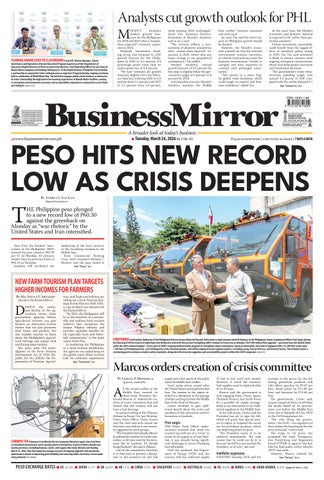
Philippine peso plunged to a new record low of P60.30 against the greenback on Monday as “war rhetoric” by the United States and Iran intensified.
By Ma. Stella F. Arnaldo Special
to the BusinessMirror
ESPITE the contin-
Dued decline of the agriculture sector, three government agencies believe agricultural tourism can give farmers an alternative income stream that not just promotes their farms and produce, but also enables tourists to learn about the Philippines’s agricultural heritage and unique food and dining opportunities.
Ten years after the promulgation of the Farm Tourism Development Act of 2016 (Republic Act No. 10816), the Departments of Tourism, Agricul-
ture, and Trade and Industry are rolling out a Farm Tourism Strategic Action Plan for 2026-2031, a copy of which was shared with the BusinessMirror
“By 2031, the Philippines will be at the forefront of a sustainable and resilient farm tourism industry that champions the unique Filipino identity and provides equitable benefits for all, especially farm and fisherfolk communities,” is the main vision of the Plan.
In marketing the Philippines as a farm tourism destination, the agencies are capitalizing on the global trend where tourists look for authentic experiences
while keeping 2028 unchanged,” Sarah Tan, Assistant DirectorEconomist at Moody’s Analytics said in an e-mail.
“The revision reflects a reassessment of domestic momentum after weaker-than-expected expansion in 2025, rather than any major change in our geopolitical assumptions,” Tan added.
Moody’s Analytics’ revised growth forecast of 4.9 percent for this year is slightly below the government’s target of 5 percent to 6 percent for 2026.
In its baseline scenario, Moody’s Analytics assumes the Middle
East conflict “remains contained and ends soon.”
As such, Tan said the direct impact on Philippine growth should be limited.
However, the Moody’s economist pointed out that the external environment remains uncertain, as volatile trade policies make the business environment “harder to navigate and force exporters to contend with prolonged uncertainty.”
“This points to a more fragile global trade backdrop, which could weigh on exports and business confidence,” added Tan.
At the same time, the Moody’s economist said domestic demand is expected to be “softer than previously assumed.”
Private investment, meanwhile, could benefit from the lagged effects of monetary policy easing in 2025, but Tan said sentiment is likely to remain cautious amid ongoing corruption controversies, which may delay project execution and investment decisions.
“The government’s lower infrastructure spending target, now around 4.3 pecent of GDP compared with the earlier planned 5.1
By Samuel P. Medenilla @sam_medenilla
AS the armed conflict in the Middle East entered its third week, President Ferdinand Marcos Jr. ordered the creation of a new committee that will ensure that the country will not have a fuel shortage.
In a press briefing at the Villamor Airbase in Pasay City last Monday, Palace Press Officer Claire Castro said the chief executive issued the directive even before it was recently suggested by some groups.
“The President had already officially ordered the creation of a crisis committee, so let’s just wait for the document [for its creation]. It’s already being finalized,” she said in Filipino.
One of the committee’s functions is to find ways to prevent a disruption in the country’s oil and fuel
supply and other needs of the public amid the Middle East conflict.
Local pump prices soared after the United States and Israel attacked Iran. The tension in the region resulted in a disruption in the passage of ships carrying oil from the Middle East at the Strait of Hormuz.
Castro declined to give additional details about the name and members of the committee until its formation is finalized.
Price surges
THE Palace Press Officer undersecretary stressed that while the country was still not in a “crisis” in terms of oil supply as of last Monday, it was already facing significant challenges in terms of keeping fuel affordable.
Over the weekend, the Department of Energy (DOE) said the country still has sufficient supply
of fuel to last until next month.
However, it noted the country’s fuel supplies may be depleted after 50 to 60 days.
Marcos said the government is now engaging India, China, Japan, Thailand, Brunei, and South Korea for a possible oil supply arrangement as an alternative to its traditional suppliers in the Middle East.
As for fuel prices, Castro said the President has yet to sign the bill, which will grant him special powers to adjust or suspend the excise tax for petroleum products, which can help bring down its price.
“The President wants it to be enforced immediately. The only reason that he could not do it, is because the bill has not reached the President, as of now,” she said.
Indefinite suspension
STARTING Tuesday, DOE said the
increase in the prices for the following petroleum products will take effect: gasoline by P6.47 per liter; diesel prices by P11.88 per liter; and kerosene by P13.66 per liter. The government, Castro said, cannot compel oil firms to sell their old stocks based on its procurement cost before the Middle East crisis due to Republic Act No. 8479 or the Oil Deregulation Act.
“The only thing the government—the DOE—can regulate is if they violate the benchmark [for the price increase],” Castro said. The surge in oil prices has prompted the Land Transportation Franchising and Regulatory Board (LTFRB) to approve the fare hike for land public utility vehicles (PUV)
P60.30 ahead of US President Donald Trump’s 48-hour deadline for Iran to reopen the Strait of Hormuz, while Iran threatened to completely close the Strait of Hormuz if attacked.
Ricafort sees the peso to end at a range of P60.10 to P60.40 against the dollar on Tuesday.
Jonathan L. Ravelas, senior adviser at Reyes Tacandong & Co., said the peso weakened anew to P60.30 “as war rhetoric by US and Iran intensifies.”
“Expect the currency to trade within the 60-60.50 levels in the near term, as uncertainty persists,” added Ravelas.
Data from BAP showed that the local currency traded at an intraday low (weakest) of P60.37 against the greenback within the trading session on Monday.
Last Thursday, the local currency moved past the 60-per-dollar level, closing at P60.10 against the dollar, after global crude oil prices went up after Iran launched retaliatory attacks on some energy facilities across the Middle East, including Qatar.
Analysts said the peso depreciation is driven by a combination of stronger dollar demand, elevated oil prices and global risk aversion.
Philippine Institute for Development Studies Senior Research Fellow John Paolo Rivera told this newspaper that higher oil prices will expand the Philippines’s import bill, raising demand for dollars, while geopolitical tensions push investors toward safe haven assets like the US dollar.
BSP will keep rates steady despite headwinds–expert
By Andrea E. San Juan
THEBangko Sentral ng Pilipinas
(BSP) is likely to “hold fire” at the upcoming April monetary policy meeting, as it will take time to assess the impact of external risks on the domestic economy, according to Moody’s Analytics.
“For now, the April meeting should see the BSP hold fire. Aside from the inflation risks stemming from the Middle East conflict, the peso’s depreciation and the Fed’s decision to stay on hold also support a cautious stance,”
Moody’s Analytics economist Sarah Tan told the BusinessMirror in an e-mail on Monday.
“The BSP is also likely to take time to assess the impact of external risks on the domestic economy, and is unlikely to move prematurely given the risk of tightening policy too early while growth remains soft, particularly as current weakness is coming mainly from the domestic side,” Tan added.
She said Moody’s is not expecting a
“sharp move” in the March inflation print, although she noted that the data may show some early impact as suppliers react to the recent rise in oil prices, but the overall rate should remain “largely shielded.”
According to Tan, the effects of the conflict in the Middle East are likely to “become visible” in April, as higher fuel costs feed through more fully to transport and electricity prices.
“We expect inflation to remain within target across this year, although risks are tilted to the upside given the Philippines’ status as a net oil importer,” she said.
“We assume hostilities stay contained and end relatively soon, so the inflation implications and economic damage
on the Philippines should remain limited. Inflation is likely to stay near the midpoint of the Bangko Sentral ng Pilipinas’s 2 percent–4 percent target range over the next few months,” she added.
Nonetheless, for policy response, she said the risk of a “prudent and prolonged” pause has clearly increased.
Tan said the key issue is whether the rise in oil prices proves temporary or sustained.
“A short-lived spike is something the BSP can usually look through, but persistently elevated oil prices that push the inflation outlook materially above the BSP’s 2 percent-4 percent target range would likely lead to a longer pause, and eventually raise the possibility of a hike if secondround effects begin to appear in wages and inflation expectations,” added Tan. Looking ahead, Tan said Moody’s Analytics does not expect the BSP to move into an aggressive hiking cycle, under its baseline assumption of a relatively quick resolution to the Middle
Easr conflict and only moderate inflation pressures.
Meanwhile, Maybank, in a report, indicated that among the countries in Asean-6, only the Philippines’s central bank, alongside Singapore, will likely hike interest rates while other central banks in Asean are likely to keep rates unchanged this year.
“The energy price shock has short-circuited the monetary easing cycle. We expect central banks in the Philippines to hike 25bps [basis points] and Singapore to tighten [via a steeper appreciation bias in April],” the Malaysiabased bank said in its report.
“Other Asean central banks will likely remain on hold in 2026,” it added.
A special report released by Japan-based think tank Nomura noted the BSP could end up hiking policy rates by as much as 175 basis points if the price of global crude oil lingers at $100 per barrel. (See:https://businessmirror.com.ph/2026/03/23/ interest-rates-seen-rising-oncostly-oil/)
PEZA: Investors regard PHL as a viable investment hub
we’re also able to attract much more investments into the country,” Panga said.
Last year’s record approvals reached P260.89 billion across 314 projects, a 21.9 percent increase from 2024’s P214.18 billion.
Peza currently contributes around 13 to 15 percent of the
Philippines’s GDP and accounts for about half of the country’s exports of goods, commodities, and services.
The agency continues to promote policies to attract investments, streamline processes, and strengthen the country’s position in the fast-growing Asia-Pacific market. Bless Aubrey Ogerio
Analysts cut growth outlook for PHL
percent, also means public investment will provide less support to overall demand than previously expected,” added Tan.
Scenarios
IN a recent report, Maybank analysts Chua Hak Bin, Erica Tay, Brian Lee Shun Rong, and Luong Thu Huong said the bank’s downgrade reflects a scenario where oil prices remain elevated in the near term before easing, with the analysts assuming that a ceasefire could be reached by the second quarter.
The Philippines and Vietnam, both lower by 0.4 percentage points, saw the largest downgrades in Southeast Asia, followed by Thailand with a 0.3 percentage-point cut.
For the region as a whole, Maybank also lowered its 2026 growth forecast by 0.3 percentage points to 4.5 percent from 4.8 percent.
The latest downgrade comes as the Philippine economy is still recovering from last year’s belowtarget 4.4 percent growth.
For 2026, the Department of Economy, Planning, and Development (DepDev) has earlier admitted that a prolonged Middle East conflict could drag growth below the lower end of the government’s goal.
“Surging energy prices and disruptions to commodity supplies will be negative for most Asean countries, which are net oil and gas importers. Only Malaysia stands out as a net energy
that connect them with nature and the lives of the locals in the area.
“With its deep connection to nature, heritage, and local livelihoods, farm tourism can offer travelers authentic, immersive experiences that promote cultural appreciation, environmental stewardship, and inclusive rural development. It embodies the kind of mindful travel that today’s tourists actively seek—where visitors don’t just pass through, but engage with the land, learn from farming communities, and contribute to their growth and resilience,” said the Plan.
High interest from US, Australia AMONG the country’s key tourism markets, visitors from the United States and Australia show the highest inclination for farm tourism in the Philippines. “In particular, 1 percent of the American respondents classified it as their primary motivation for travel, and 5 percent placed it among their top five.” The domestic market also attracts some interest in farm tourism, mainly students on educational field trips and the corporate sector on wellness retreats.
Data from the Philippine Statistics Authority showed there were 7.43 million farms in the country, with the average size at 1.3 hectares. Farmers and fisherfolk were identified as among the poorest sectors in the country at 27 percent and 27.4 percent of the population in 2023.
Growth opportunities
THE plan has also noted a 34-percent decrease in its accredited farm tourism sites to 153 in 2025 from 219 in 2023, due to “challenges in maintaining accreditation requirements, limited access to capacitybuilding and technical support for farm operators, and the adverse effects of climate-related events on agricultural areas.”
It identifies opportunities to grow farm tourism by, for one, developing themed regional circuits, highlighting their crops and traditions like Western Visayas (sugarcane) and Central Luzon (rice and poultry). For another, “existing farms can build on their offerings, such as guided tours, workshops, and farm-to-table dining, by introducing more immersive, value-added activities like harvest-and-cook sessions, wellness programs, and educational modules.” The agencies can also help sustain farm tourism operations and enhance visitor satisfaction by strengthening training in hospitality, safety, and storytelling “alongside streamlined accreditation and improved access infrastructure.”
exporter, which will help cushion the Middle East shock,” Maybank said.
The bank added that rising energy costs are expected to widen external deficits and put pressure on regional currencies, particularly among net energy importers.
Countries such as Thailand and Singapore already run large oil and gas trade deficits, while Vietnam, the Philippines, and Indonesia also post sizable gaps.
Maybank said the Philippines and Indonesia, in particular, are more exposed as they are already running current account deficits, which could worsen further amid the oil shock.
On the inflation front, Maybank raised its Asean inflation forecast to 2.7 percent by end2026 from 2.2 percent previously.
For the Philippines, inflation is projected to accelerate to 3.3 percent this year, higher than the earlier estimate of 2.8 percent.
“Our house estimates that a sustained 10 percent rise in crude oil prices will have the highest inflationary impact on Philippines [+0.45 percent point] and Indonesia [+0.4 percentage point],” the Maybank said.
With this, Maybank expects the Bangko Sentral ng Pilipinas (BSP) to deliver a 25-basis-point rate hike in the second quarter, bringing the policy rate to 4.5 percent by end-2026.
Andrea E. San Juan and Justine Xyrah Garcia
Key action points UNDER the plan, the agencies aim to streamline the accreditation mechanism, emphasize culture and innovation by “tying it in with food and gastronomy, wellness, and sustainable tourism”; build linkages across the tourism value chain like partnering with accredited hotels; foster community involvement by collaborating, for instance, with other agencies to increase the adoption of sustainable infrastructure and practices; and strengthen institutional mechanisms to align goals and provide support by, for one, exploring a common platform accessing funds and incentives for farm tourism projects. It also identifies key action points to achieve its goals, such as amending the Farm Tourism Development Act and corresponding rules and regulations, creating a National Steering Committee (NSC) and Regional Technical Working Groups for Farm Tourism, instituting a Farm Tourism Circuit Development Program, forming a Farm Tourism Support Program, to name a few. Many countries like the US, Italy, and Japan, generate a lot of revenue from agritourism. Private research showed that Mother Farm in China, Japan, for instance, earns over US$27 million annually, with a significant contribution from fruit picking and seasonal flower viewing. Overall, Japan’s agritourism market, which features popular activities like strawberry picking and lavender fields visits, are projected to grow to some $10 billion by 2032 from $4.37 billion in 2025.
Will Sara be a no show again?
By Jovee Marie N. Dela Cruz | @joveemarie
TWO days before the House of Representatives Committee on Justice is scheduled to deliberate on the impeachment complaints against her, there is still no indication as of Monday that Vice President Sara Duterte will appear before the House Committee on Justice on Wednesday, as her camp has yet to confirm her attendance, even as an endorsing lawmaker urged her to face the panel and respond to the impeachment complaints, stressing that constitutional accountability demands a clear explanation as the public continues to await her response.
Party-list Rep. Terry L. Ridon of Bicol, who sits as a member of the Justice panel, said that as of this writing, there has been “no word or message” from the Vice president’s camp regarding her participation, leaving uncertainty over her expected appearance.
“As of posting time, there has been no word or message from her camp,” Ridon said. The House Committee on Justice is scheduled to continue its deliberations on the impeachment complaints against Duterte, who has been invited to attend and respond to the allegations. Ridon said that participation
in the proceedings is part of the constitutional process, emphasizing the importance of giving the vice president the opportunity to address the issues directly before lawmakers.
“The process is there to ensure that all sides are heard. It is an opportunity for the respondent to answer the allegations and clarify matters before the committee,” Ridon said.
Face House panel
DEPUTY Speaker Paolo Ortega V on Monday urged Duterte to face the House panel this Wednesday and respond to the impeachment complaints filed against her, stressing that constitutional accountability demands a clear explanation as the public continues to wait.
Ortega, an endorser of the fourth impeachment complaint, said the issue goes beyond politics and is rooted in the constitutional duty of public officials to address serious allegations.
“This is not just about politics –this is about accountability under the Constitution,” Ortega, who represents La Union, said. “The Vice President is duty-bound to respond to the impeachment complaints. Public office is a public trust—the people deserve answers.”
With the House Committee on Justice set to convene on Wednesday, Ortega noted that many Filipinos are closely monitoring the proceedings and expect clarity from the Vice President.
“The Filipino people are watching and waiting. This Wednesday is not just another hearing—it is a moment of accountability,” Ortega
DILG targets to buy 600 more fire trucks by 2027
By Jonathan L. Mayuga @jonlmayuga
THE Department of the Interior and Local Government (DILG) is eyeing to buy 600 more fire trucks within the next two years, with reforms, to ensure the organization’s corruption-free procurement process put in place, Secretary Juanito Victor Remulla said.
Anomalies in firetruck procurement have significantly worsened the Bureau of Fire Protection’s (BFP) equipment shortage, undermining the organization’s capacity to respond to emergencies nationwide, the department said.
The BFP’s current deficit of some 600 firetrucks is partly driven by overpriced contracts and alleged rigged bids in recent years, which reduced the number of units that could have been procured.
“Because of corruption and overpricing, we could have already procured an additional 400 fire trucks,” Remulla said.
The official underscored how irregularities directly translate to fewer resources on the ground.
He stressed that while demand from local governments remains high, internal reforms must come first to ensure that every peso is used properly.
Remulla vowed to fix the problem besetting the BFP procurement
process before purchasing muchneeded fire trucks to close the gap in the next two years.
As reforms continue within the BFP, the DILG is now moving to rebuild the Bureau’s operational capacity and close long-standing resource gaps.
“So now, hopefully, in 2026, we can procure firetrucks. I think we’re targeting 300 trucks this year and 300 trucks next year,” Remulla said.
The Department emphasized that strengthening accountability in procurement is critical not only to restoring public trust but to ensuring that emergency responders are properly equipped to save lives when it matters most.
Senator welcomes US ‘plan’ to build ammo plant in PHL
By Butch Fernandez @butchfBM
SENIOR senator on Monday
Asaid the reported plan of the US to turn the Philippines into an ammunition production hub could be favorable for the country but strict national security measures should be in place if it pushes through. This was the reaction of Sen. Sherwin Gatchalian to reports that a US-led defense manufacturing partnership is eyeing the construction of a new ammunition production facility in the Philippines.
Gatchalian said that the Philippines already has a new law promoting its own self-defense posture and directs the Department of National Defense (DND) to prioritize locally made products for military and law enforcement needs, including arms, ammunition and weapon systems.
Gatchalian, chairman of the Senate Finance committee, said the SelfReliant Defense Posture (SRDP) Revitalization Act or Republic Act 12024 which was signed into law in October 2024 mandates the development of a self-reliant defense postur.
“If these American companies come here, set up a business, there is already a law and we can provide incentives. They will be able to come here, build factories, make ammunitions and make other equipment,” Gatchalian said in radio interview. He added: “That is okay for us. That would help in job generation. That’s also self-reliance. We will no longer buy from other countries and that would be a big help for us.”
The Philippines, he said, can also take advantage of technology transfer which would be the outcome once the US-led defense manufacturing partnership commences.
Gatchalian also said, “The advanced technology would come here. I see that in our favor. But, we must also make sure that it won’t be abused.”
He said it is imperative that the Philippines’ national security won’t be compromised as a result of making the country a weapon depot.
“We must prioritize our national security interest that we should not be used in any conflict or situation.”
“The important thing here is that
said. “Silence only raises more questions; clarity restores public confidence.”
He added that the proceedings offer Duterte a proper venue to explain her side and address the issues raised against her.
“The House proceedings are not a trial—they are an opportunity to explain her side,” Ortega said.
“This is her best and most direct chance to address the allegations. If there are answers, this is the proper forum to present them.”
Ortega also underscored that the impeachment process is guided by fairness and due process, with both sides given the opportunity to be heard before any determination is made.
Preliminary investigation
EARLIER, the House Committee on Justice Chairperson, Batangas Rep. Gerville Luistro, said the March 25 hearing of the committee will proceed as a preliminary investigation, not a full trial.
Luistro explained that this distinction limits who may actively participate once witnesses begin appearing before the panel.
She noted that lawyers may sit beside their clients—whether complainants, witnesses, or respondents—but cannot take part in the deliberations or directly examine witnesses.
Citing past House inquiries, she said witnesses were only allowed to consult their lawyers when necessary, such as requesting brief suspensions to seek legal advice.
Duterte, through her counsel,
has filed what panel members described as a “non-answer” as an answer, but Luistro said this does not change the nature of the March 25 proceedings.
Luistro explained that at this stage, the committee’s role is similar to that of prosecutors determining whether there is sufficient basis to move forward with a case.
She said after reviewing the complaint, the answer, and all submitted evidence, Justice committee members will decide whether probable cause exists.
If found, the committee will recommend to the plenary the transmittal of the Articles of Impeachment to the Senate, provided that at least one-third of all House members support the finding.
Also, Luistro emphasized that impeachment rules clearly state that only members of the Justice committee may conduct direct and cross-examinations during the hearing.
This restriction also applies to lawmakers who are not members of the committee. While they may attend the proceedings, their participation is limited to making manifestations.
Luistro also clarified that the committee may appear to have more members than its official roster during televised hearings due to the presence of ex-officio members. These include the Speaker, deputy speakers, and majority leader, who are authorized under House rules to participate and vote in committee proceedings, including those of the Justice committee.
Cops launch manhunt for killers of Negros Occidental broadcaster
HE National Police (PNP)
TChief, Gen. Jose Melencio Nartatez Jr., on Monday said police tracker teams have been mobilized to go after the gunmen behind the March 20 killing of a radio announcer in Negros Occidental.
Nartatez was referring to the killing of Julito Diamante Calo, 49, host of the program “Waswasanay sa Quinto Distrito” on 88.3 DNN News FM, who was gunned down in sitio Lapak Kawayanan, barangay Robles, La Castellana, on Friday.
“We assure the public and the media community that we will look closely into this case to arrest and charge all those involved in this
we have the ability to manufacture such equipment and use it for our own needs,” he also said.
The Pentagon earlier issued a statement saying that the Partnership for Indo-Pacific Industrial Resilience, also known as Pipir—a group of nations working together to build weapons and defense manufacturing capacity in the Asia-Pacific—is now moving forward on its arms manufacturing partnership with other countries.
Launched in May 2024, the US-led multilateral forum is aimed at strengthening the defense cooperation among 16 Indo-Pacific and European partners to reduce supply chain risks and help allies produce and maintain military equipment near the vicinity it might be needed.
Pipir is now looking into the Philippines hosting a new facility to load, assemble and package 30mm cannon rounds – an ammunition used by military aircraft and ground vehicles.
The same group is also said to be eyeing launching a new missile motor production program with Japan, and pushing a drone cooperation effort all over Asia.
senseless killing,” Nartatez said.
Nartatez at the same time said the PNP condemns in the strongest terms Calo’s killing. He added that the PNP is now validating all leads to ensure a solid case will be filed.
Nartatez also said the PNP will also coordinate with the Presidential Task Force on Media Security to assess existing threats to other media workers in the area.
The PNP chief urged the public and media community to continue reporting threats, promising that police resources will be fully mobilized to protect journalists. Rex Anthony Naval
Philippine, French defense chiefs to meet in ’26 PDSF
By Rex Anthony Naval
MILITARY cooperation between the Philippines and France is expected to shift to high gear as ranking defense officials of the two nations are set to meet at the sidelines of the 2026 Paris Defense and Strategy Forum (PDSF) this week. In a statement on Monday, Defense Assistant Secretary Arsenio Andolong said the meeting between Defense Secretary Gilberto Teodoro Jr. and his counterpart, French Minister of the Armed Forces Catherine Vautrin, will further will further deepen the bilateral partnership and cross-regional convergence between the two nations.
France is among the growing number of partners that share the Philippines’ commitment to protect the rules-based order, and advance security and stability in the Indo-Pacific and beyond.
The two countries in December last year concluded formal negotiations for a Status of Visiting Forces Agreement (Sovfa), the Philippines’ first with a European partner.
The Sovfa, upon entry into force, will provide the legal framework to govern the presence and activities of the Armed Forces (AFP), and the French Armed Forces in each other’s territories, allowing the conduct of more effective military training and engagements among partner nations.
“Upon invitation from Minister Vautrin, Secretary Teodoro will also deliver a keynote speech on ‘Conflicts and Competitions’ on the second day of the PDSF, before security and strategy leaders from around the world. Secretary Teodoro’s participation marks the first time that a defense minister from Southeast Asia is attending and contributing to the PDSF,” Andolong said.
Organized by the Defence Academy of the École militaire (Academ) of France, the PDSF is a major international forum that provides a valuable avenue for dialogue among states, institutions, militaries, researchers, and civilian stakeholders on regional and global strategic and geopolitical issues.
DBM commits P145.56-billion for Central Mindanao highway
By Reine Juvierre S. Alberto
THE Department of Budget and Management (DBM) issued a P145.56-billion funding commitment for the Central Mindanao High Standard Highway Construction Project to cut travel time between Cagayan de Oro City and Malaybalay City in Bukidnon.
In a statement on Monday, the department said that it has released a forward obligational authority (FOA) that would make funds available to cover the total project cost.
The DBM said this ensures that major infrastructure projects are approved and fully funded through completion in 2034, “eliminating uncertainty, preventing delays and enabling implementing agencies to proceed with full confidence.”
An FOA is a certificate of
commitment or authority issued by the DBM to national government agencies for foreign-assisted projects certifying that funds shall be made available to cover the total project cost. This shall be used for loan negotiation purposes and serves as an assurance that the loan proceeds and the peso counterpart contribution are banking services on behalf of government agencies.
The construction project is proposed to be funded by the Japan International Cooperation Agency and the Asian Development Bank through loans, in addition to the government’s counterpart funding.
“The move underscores the President’s push to fast-track highimpact infrastructure projects that directly improve mobility, strengthen regional economies, and create more opportunities for
Filipinos, especially in Mindanao,” the DBM added.
Travel time between Cagayan de Oro and Malaybalay will be reduced from 6.5 hours to 3.5 hours, lowering transport costs, making the movement of goods more efficient and directly impacting commuters, farmers, businesses and local communities, the DBM said.
Moreover, the DBM said the project is anticipated to increase trade competitiveness, attract investments and stimulate growth in key sectors such as agriculture, logistics and tourism.
“This is not just about building a road—it is about connecting communities, shortening the distance between opportunities, and making everyday life easier for our kababayan,” acting Budget Secretary Rolando U. Toledo was quoted as saying.
P500-M cold storage opens in Bicol
By Bless Aubrey Ogerio
AREFRIGERATED complex
worth P500 million has been opened in Bicol, marking the first completed facility under the Department of Agriculture’s (DA) Cold Storage Expansion Program aimed at reducing postharvest losses and improving farmer incomes.
The Bicol Mega Cold Storage Warehouse, a flagship project of the agency, has an annual capacity of more than 200,000 tons and is expected to benefit tens of thousands of farmers as well as consumers across the region.
The facility is equipped with temperature-controlled rooms designed for specific commodities, including pork, beef, poultry, fish, fruits and vegetables. In addition to storage, the complex includes preparation areas
House bill mandates free, fast release of academic records
THE majority leader of the House of Representatives is pushing for the passage of a measure requiring higher education institutions to provide free academic records to fresh graduates and adopt digital systems to streamline their release, aiming to remove financial and administrative barriers in job applications.
Under House Bill 8701, or the Academic and Labor Pathways Assistance for Students (Alpas) Act, “fresh graduates”—defined as those within 12 months from graduation—would be entitled to free access to key academic documents.
In his explanatory note, House Majority Leader Ferdinand Alexander A. Marcos underscored the link between education and employment, citing constitutional provisions that highlight the need to ensure a smooth transition from school to the workforce.
“For many graduates, the journey towards employment begins with completing documentary requirements for job applications,” Marcos said. “Yet obtaining multiple copies of these documents can involve additional costs and timeconsuming procedures.”
The proposal comes amid continuing employment challenges, particularly among young Filipinos entering the labor market, where unemployment and underemployment remain concerns.
“Unemployment and underemployment continue to pose significant challenges in the Philippine labor market,” Marcos said.
The bill mandates all higher education institutions, whether public or private, to provide fresh
graduates with free employment application documents, including transcripts of records, diplomas, and certificates of graduation.
Each graduate would be entitled to at least five free copies of his or her transcript of records or certificate of graduation, along with certified true copies of the diploma. An additional set of copies may also be requested within 12 months from graduation without any administrative, processing, or certification fees.
Marcos noted that securing multiple copies of academic records often involves added costs and timeconsuming procedures, which can delay job applications.
To address this, the measure also requires schools to establish digital academic records systems, allowing graduates to request and obtain documents online for faster and more efficient processing.
The majority leader said the measure aims to ease the transition from education to employment by addressing practical barriers at the earliest stage of job seeking.
He added that improving access to academic records and modernizing processing systems would help graduates enter the workforce more quickly and contribute more effectively to national development.
“By making essential academic records more accessible and improving the efficiency of records processing systems in higher education institutions, this measure helps ensure that Filipino graduates are better equipped to pursue employment opportunities and contribute meaningfully to the nation’s workforce,” Marcos said.
Jovee Marie N. dela Cruz
for blast freezing, processing and packaging, enabling producers to extend shelf life, comply with market requirements and potentially secure better prices for their goods.
Camarines Sur Gov. Luis Raymund Villafuerte said the warehouse is expected to serve not only the Bicol region but also suppliers from the Visayas and Mindanao.
Further, the DA said the project comes at a time of rising fuel costs linked to global tensions, which have added pressure on food distribution. They added that farmers in Bicol have long faced challenges such as high transport costs, fragmented supply chains and frequent typhoons that disrupt delivery.
During the visit, President Marcos and Agriculture Secretary Francisco Tiu Laurel Jr. also inspected a separate P290-million fruits and vegetables processing facility in the area.
The DA said more cold chain facilities are being developed across key food-producing areas nationwide, which is aligned with the Agriculture and Fisheries Modernization Act.
Legislator asks govt to include other sectors in subsidies
By Jovee Marie N. Dela Cruz @joveemarie
THE chairman of the House of Representatives Committee on Labor has called on the national government to expand its fuel subsidy and financial assistance programs beyond public utility vehicle (PUV) drivers to include key sectors in the country’s supply chain, warning that unchecked fuel price increases could trigger widespread inflation and economic disruption.
Cavite Rep. Jolo Revilla, chairperson of the Labor committee, emphasized that while existing subsidies for PUV drivers remain crucial, the government must adopt a more comprehensive strategy by extending support to truckers, inter-island cargo operators, farmers, fisherfolk, and logistics providers – sectors that directly affect the cost of goods and food across the country.
“It’s not only PUV drivers who are affected by rising fuel prices. We need to support the entire supply chain—from production and transportation to distribution—because these determine the prices of basic goods,” Revilla said in a statement.
The lawmaker issued the statement amid escalating tensions in the Middle East, particularly the ongoing conflict involving Iran, which continues to disrupt global oil supply routes and push fuel prices higher. He warned that as an oil-importing country, the Philippines remains highly vulnerable to prolonged supply shocks.
Revilla underscored that truckers and inter-island cargo operators serve as the backbone of the country’s logistics network, ensuring the continuous
SBy Henry Empeño
UBIC BAY FREE PORT—Subic Bay Marine Exploratorium Inc. (SBMEI), operator of the largest tourism complex in this free port, will sell at public auction P32.5-million worth of shares of stock left unpaid by JV China Inc., an investment company based in St. Petersburg, Florida.
SBMEI President and Chief Executive Office Robert Ianne Gonzaga said the company has scheduled on Wednesday, March 25, a delinquency sale of shares of the firm headed by former SBMEI Chairman and CEO Timothy Desmond.
“JV China, which has a substantial stake in SBMEI and has been a shareholder of record for decades,
movement of essential goods such as food, fuel, medicine, and construction materials nationwide.
He also highlighted the vulnerability of farmers and fishermen, who rely heavily on fuel for production, harvesting, and transport.
“When production costs in farming and fishing increase, it immediately impacts food prices. And when transportation and delivery costs rise, price increases cascade all the way to the market,” he explained.
Revilla warned that rising fuel costs across these interconnected sectors could create a “domino effect” that would significantly drive up the prices of basic commodities, placing an added burden on Filipino families.
“If the cost of transporting goods from provinces to markets increases, prices will inevitably rise. This is what we must prevent to avoid a potential surge in inflation,” he stressed.
To address the issue, Revilla proposed a targeted and time-bound subsidy and financial assistance program covering key supply chain players, including truckers, cargo operators, farmers, fisherfolk, and last-mile delivery services.
He urged the Department of Transportation (DOTr), Department of Energy (DOE), Department of Agriculture (DA), and Department of Trade and Industry (DTI) to jointly develop a responsive and efficient support mechanism.
“This is not just about helping one sector—it’s about protecting the entire economy. By keeping our supply chain stable, we can prevent the domino effect of rising prices,” Revilla said.
He also called for close coordina -
has failed to pay its outstanding stock subscriptions amounting to P32.5 million,” Gonzaga said. “Despite repeated demands, it has not delivered payment,” he added.
Gonzaga said the SBMEI will sell JV China’s stocks at public auction in accordance with the Revised Corporation Code of the Philippines or Republic Act 11232.
“Under the law, the shares will be auctioned off to the highest bidder willing to pay the full amount of subscription liability, plus accrued interest and costs,” the company official said.
The sale of JV China’s unpaid shares is the latest move in SBMEI’s resolution of shareholder issues that Gonzaga admitted “had cast a shadow over the firm’s balance sheet and its
tion with industry stakeholders to ensure that assistance is properly targeted and immediately felt on the ground.
Official list
THE Land Transportation Franchising and Regulatory Board (LTFRB), under the Department of Transportation (DOTr), will provide the official list of beneficiaries for the government’s cash relief assistance (CRA) program covering transportation network vehicle service (TNVS) drivers, delivery riders, motorcycle taxi drivers, and public utility jeepney (PUJ) drivers in Metro Manila.
The Department of Social Welfare and Development (DSWD) issued this clarification following confusion among some delivery rider groups who mistakenly believed that the DSWD was responsible for generating the list of beneficiaries.
DSWD Assistant Secretary and spokesperson Irene Dumlao explained that all beneficiary data will come from the LTFRB, while the DSWD is tasked with facilitating the payout of assistance.
“We would like to inform the public that the list of driver-beneficiaries for the CRA will come from the LTFRB. On the part of the DSWD, we are continuously coordinating with them to prepare the payroll that will be used in the distribution of cash relief assistance to drivers affected by rising fuel prices,” Dumlao said.
The CRA is being distributed through the DSWD’s Assistance to Individuals in Crisis Situations (AICS) program to help public utility vehicle drivers cope with the
ability to attract fresh capital.”
SBMEI, incorporated in 2001, now operates the Ocean Adventure marine theme park, Camayan Beach Resort, Adventure Beach Waterpark, and Adventure Cove, all located in a sprawling complex at Ilanin Forest West here.
Just the other week, SBMEI concluded a debt-for-equity swap with the British Virgin Islandsbased investor firm HS Equities, Ltd., finally settling a P239.56million investment claim after two decades of dispute.
Gonzaga said HS Equities has now been identified “as a party with the right to apply a portion of its settlement toward a winning bid at the auction” should it choose to participate in the bidding.
impact of increasing petroleum prices and support their families’ basic needs.
The continued rise in gasoline and diesel prices has significantly reduced drivers’ income and adversely affected their daily living conditions. The series of increases in the prices of gasoline and diesel has resulted in the substantial decrease in the income of all PUV drivers and has severely affected their family’s daily lives.
Drivers are advised to check the official list of beneficiaries on the LTFRB website (http://ltfrb.gov. ph/) to confirm their eligibility before proceeding to claim their assistance. Qualified beneficiaries may claim their assistance at designated payout centers across the National Capital Region (NCR).
Drivers who are not included on the initial list are advised to wait for further announcements from the LTFRB. They may also reach out through the LTFRB hotline at 1342 for inquiries.
The DSWD will begin distributing the P5,000 cash assistance to more than 27,000 registered TNVS drivers on March 24, followed by approximately 21,700 PUJ drivers on March 25, around 137,700 delivery riders on March 26–27, and about 27,600 motorcycle taxi drivers on March 28. During the first week of the CRA rollout, more than 98,000 tricycle drivers in Metro Manila have already received assistance to help sustain their daily needs amid income losses caused by escalating fuel prices linked to ongoing tensions in the Middle East.
SBMEI’s legal issue with investors arose in 2013 when HS Equities President Virginia Dio accused then SBMEI Chairman and CEO Timothy Desmond of defrauding her and HS Equities of a total of $2.15 million infused in 2002 for the development of SBMEI’s marine theme park project. For this, Desmond was convicted of fraud in June 2020 and was detained at the Olongapo City District Jail. The Barredo Law Office in Olongapo, however, claimed Desmond was erroneously released upon completion of sentence in November 2025, as he was not transferred to the custody of the Bureau of Immigration for a final deportation order issued in 2026.
Over 5,000 struggling readers in Cebu to receive government-funded tutoring
By Carmel Pedroza
CEBU CITY More than 5,000 elementary pupils in Cebu identified as struggling readers are set to benefit from a government-backed tutoring initiative aimed at improving literacy skills.
The Department of Social Welfare and Development in Central Visayas (DSWD-7) announced it will launch the 2026 run of its “Tara, Basa! Tutoring Program” (TBTP) this May, targeting learners across the province who continue to face challenges in reading comprehension.
The program, developed in partnership with local government units and higher education institutions, will focus on students classified as struggling readers—those who are unable to fully understand basic sentences and paragraphs.
To be implemented in 262 public elementary schools throughout Cebu, the initiative will provide structured reading sessions facilitated by trained college students.
Around 1,870 tutors and youth development workers will be deployed after completing intensive preparation.
Their role includes conducting reading interventions and assisting parents in supporting their children’s learning at home.
In addition, about 5,550 parents and guardians will join “Nanay-Tatay Sessions,”
which aim to strengthen family involvement by equipping them with techniques to reinforce reading skills outside the classroom.
The 20-day program will run from May 4 to June 4, coinciding with the summer break. Sessions will be held four times a week, lasting three hours each day.
Beyond literacy support, participants will also receive financial assistance, a measure designed to ease economic pressures and encourage consistent participation.
DSWD-7 noted that last year’s implementation of the program in Central Visayas reached more than 13,000 beneficiaries, including over 5,700 learners, indicating positive outcomes from the initiative.
The program comes amid concerns over declining reading proficiency among young learners.
According to the Second Congressional Committee on Education (Edcom 2), nearly half of Grade 1 to 3 pupils in major Cebu cities struggle with basic reading comprehension at the start of the current school year.
In response, several local government units have introduced measures to tackle what officials describe as a “reading crisis.”
These include directing localities to utilize their Special Education Fund (SEF) to provide additional support for both students and educators.
DENR: Climate adaptation investments offer immediate lifeline for vulnerable households
By Jonathan L. Mayuga @jonlmayuga
MIDDLE - and low-income households stand to immediately gain safer homes, steady incomes, and more reliable food and water from investments in climate adaptation for agriculture, water resource management, and ecosystem protection, an official of the Department of Environment and Natural Resources (DENR) said.
“Climate adaptation is not an abstract policy: it is a lifeline for families who depend on small farms, informal work, and local markets,” DENR Undersecretary Analiza R. Teh said.
Teh was a guest speaker in the Adaptation in Action Investment Forum held last March 16, 2026, at SM Aura Convention Center, Taguig City.
“When we invest in resilient irrigation, watershed protection, and climate-smart farming, we reduce the shocks that force households to sell assets, skip meals, or pull children out of school,” she added.
Teh emphasized that adaptation finance must be scaled and packaged to reach the most vulnerable.
“Financing adaptation within the water food nexus is a crucial climate action as climate change significantly impacts food systems through water scarcity, pollution, and increased climate variability,” she said. “With sustained and scaled adaptation, we protect the steady production of key crops such as rice, sugarcane, and corn.”
Teh highlighted three concrete benefits for lower-income families. First, improved water management and small-scale irrigation increase crop reliability and reduce seasonal hunger. “For a smallholder, a reliable water source can mean the difference between a harvest that feeds a family and one that doesn’t,” she said.
Second, investments that combine microfinance, insurance, and risk mitigation lower household exposure to catastrophic losses. “When farmers have access to
By Claudeth Mocon-Ciriaco @claudethmc3
AMID rising fuel costs, the Department of Education
(DepEd) has directed all public schools nationwide to keep endof-school-year ceremonies modest and economical.
Under Memorandum No. 015 series of 2026, DepEd emphasized that graduation and moving-up rites must be conducted without excessive spending or
DICT’s eGovPH super app hits 40M downloads, surpasses ‘26 target early
By Lorenz S. Marasigan @lorenzmarasigan
THE Department of Information and Communications Technology
(DICT) said on Monday that the eGovPH super app has hit 40 million downloads, meeting its 2026 target ahead of schedule with nearly 4 in 10 Filipinos now on the platform.
According to DICT Undersecretary for eGovernment David Almirol Jr, this brings the government closer to its target of hitting 60 million users by 2028. The app integrates over 1,000 government services ranging from digital IDs and financial and medical services
to the issuance of certificates, permits, and other documents.
He also announced the launch of a new eGovPH Serbisyo Hub in Mandaue City, allowing Cebuanos to access services from agencies such as the Social Security System, Philippine Statistics Authority, Department of Labor and Employment, Department of Health, and Department of Social Welfare and Development in one location.
“Hindi na dapat ang tao ang lalapit sa gobyerno nang paulit-ulit. Ang gobyerno na ang lalapit sa tao. Whether through the eGovPH super app or the eGov Serbisyo Hub, we are bringing services closer to our kababayans,” Almirol said.
He said the platform has directly addressed two of the most persistent pain points in government transactions: long queues and the repetitive submission of documents.
Under the current system, users need to enter their personal information only once, which is then securely shared across participating agencies.
“Kailangannatingawinmadaliatmabilis ang government services. Dapat wala nang pila, tanggalin natin ang mga paulit-ulit at komplikadong proseso at napakadaming needi-submitnadocuments.Ngayon,kaysa ilang beses ka pipila, sa bahay ka na lang,” Almirol said. The app’s growing utility is backed by an
expanding digital infrastructure, including eGovAI, a paperless transaction service called eGovDocs, and integration with the national digital ID system, which now covers approximately 90 million Filipinos. Almirol said the ID linkage has helped automate verification and screen out fraudulent accounts on the platform.
“Nasa 90 million na rin ang digital national ID natin, at dahil diyan, naautomate ang eGov app para wala na yung pekeng users,” he said. Upcoming features will allow users to access academic records such as diplomas and transcripts, as well as other governmentissued certificates, directly through the app.
DOTr launches 50% fare discount on MRT-3, LRT-2 starting March 23
THE Department of Transportation (DOTr) will implement a 50-percent fare discount for all passengers of the Metro Rail Transit Line 3 (MRT 3) and Light Rail Transit Line 2 (LRT 2) beginning Monday, March 23.
Transportation Secretary Giovanni “Banoy” Lopez said the fare reduction aims to cushion the effects of the rising fuel costs, encouraging car owners to use public transport to save on petrol.
Marcos
affordable credit and weather-indexed insurance, they are less likely to resort to distress sales or high-interest loans after a storm,” Teh added.
Third, nature-based solutions such as reforestation and soil conservation protect farmland and reduce costly repairs after floods and droughts.
The forum also emphasized the importance of bankable project design in directing private capital toward community-level interventions.
Teh called for project packages that align with national adaptation plans and integrated water resource management, noting that de-risked, multi-benefit projects attract blended finance and public-private partnerships. “We must translate national priorities into clear, investable opportunities that create jobs, ensure food security, and support ecosystem services at the local level,” she said. Local job creation was another theme. Adaptation projects that restore watersheds, build small reservoirs, and maintain irrigation systems generate employment for women and youth, providing steady income streams in rural areas. “These are not temporary handouts,” Teh said. “They are durable livelihoods that build community capacity and resilience.”
The forum called for standardized investment criteria, performance-based incentives, and integrated risk mitigation to ensure funds reach those most in need. Teh urged government agencies, donors, and the private sector to prioritize inclusive governance and data-driven decision support to target interventions effectively.
Organizers said the Adaptation Investment Platform being discussed at the forum aims to institutionalize these approaches and scale up finance for the water-food climate nexus, turning national adaptation goals into tangible benefits for vulnerable households. The Forum was a collaborative endeavor of the DENR, Climate Change Commission, Department of Finance, Department of Interior and Local Government- Local Government Academy, with the support of the British Embassy.
extravagant attire.
“We must ensure that this milestone remains a celebration of achievement rather than a financial ordeal for our parents, especially as we navigate the economic impact of rising fuel costs,” said Education Secretary Juan Edgardo “Sonny” Angara, adding that the initiative aligns with President Ferdinand R. Marcos Jr.’s standing directive to alleviate the financial burden on Filipino families who are currently grappling with increased
“The government is doing everything to ease the hardships of Filipinos amid the turmoil in the Middle East. Continuous travel and cheaper fares are our priority, which is why we are giving a 50-percent discount on MRT 3 and LRT 2 for everyone,” Lopez said. The existing 50-percent discount for holders of white beep cards—covering senior citizens, persons with disabilities (PWDs), and students—remains in effect. Regular passengers may use blue beep cards to automatically avail of the discount, while those without beep cards
welcomes home 343 OFWs repatriated from Middle East as govt ramps up rescue efforts
By Samuel P. Medenilla @sam_medenilla
PRESIDENT Ferdinand Marcos welcomed over 300 overseas Filipino workers (OFW) and their families, who were brought home from the conflict-hit Middle East countries.
The 343 repatriated OFWs and their dependents arrived before 6:30 a.m. via a government-chartered Philippine Airlines flight PR8502 at the Villamor Airbase in Pasay City last Monday.
It was the fourth flight charted by the Department of Migrant Workers (DMW) to bring home Filipinos, who were affected by the escalating tension in the Middle East after the United States and Israel attack Iran.
Of the said repatriates, most or 109 came
from the Kingdom of Saudi Arabia. Ninety-nine were from Kuwait, 79 from Bahrain, and 56 from Qatar.
They were accompanied by Overseas Workers Welfare Administration (OWWA) administrator Patricia Yvonne Caunan.
Upon their arrival, the Filipinos were met by DMW Secretary Hans J. Cacdac and representatives of other government agencies, who provided assistance to the affected OFWs, which includes temporary accommodation, transportation assistance, psycho-social counseling, food aid, as well as financial assistance and reintegration services.
They were also met by their loved ones at the hangar of the Villamor Airbase.
Cacdac said there are still 1,200 Filipinos, who are still waiting to be repatriated from the Middle East in the coming days. Many are
from the UAE.
“UAE has about a million OFWs. That’s even more than the OFWs in Qatar, Bahrain, and Kuwait combined. In fact, nearly double [than the UAE figures]. So we’re also focusing [our repatriation efforts] in UAE,” Cacdac told reporters in an interview.
“So there will be a fifth and sixth chartered flight in succession out of UAE [United Arab Emirates],” he added.
DMW chief there is still no deployment ban in UAE, Bahrain, Qatar, and KSA since the Department of Foreign Affairs has yet to issue the necessary security alert level for the said countries.
However, he said the ongoing airspace restrictions in Israel, Bahrain, Kuwait, Qatar, and UAE makes it difficult for Filipinos to board flight in the said countries.
Palace defends Marcos, Metro mayors against ‘Anti-Epal’ violation in PUV aid distribution
By Samuel P. Medenilla @sam_medenilla
MALACAÑANG said President Ferdinand Marcos and other local officials did not violate on Monday the “anti-epal” provisions of the 2026 national budget during the rollout of the distribution of government aid for public utility vehicles (PUV) drivers in Manila last week.
Palace Press Officer Claire Castro justified the presence Marcos, Manila Mayor Francisco “Isko” Moreno Domagoso, San Juan City Mayor Francisco “Francis” M. Zamora, and Marcos in the event.
She said Domagoso was at the event since Manila hosted it, while Zamora was present in the cash aid distribution as national president of the League of Cities which represent Metro Manila city mayors.
“So that means, since this is the Presi -
transportation and commodity costs.
Angara said that schools must prioritize the welfare of learners by keeping these ceremonies “simple, meaningful, and entirely free of unnecessary expenses.”
Under the memorandum, DepEd strictly prohibits the collection of any contribution or fee for graduation and moving-up ceremonies, reminding school heads that participation in the rites is not contingent on financial contributions.
Schools are urged to hold ceremonies
dent’s project for tricycle drivers where the LGU [local government unit] itself knows who the beneficiaries are, it is only right that Mayor Francis Zamora should also be present [at the event],” Castro said in Filipino in a press briefing at the Villamor Airbase in Pasay City last Monday.
Castro said the President’s presence in the event was also a must to show that the government is implementing measures to assist the public amid the rising oil prices, which was caused by the ongoing conflict in the Middle East.
“That is the event of the President, so he should at least show to the people that the government is running, the government is properly managed for the country and for the people,” she said.
“So, he should be seen, the President should be visible because the appearance of the President is a demonstration of trust to our countrymen that if there is any crisis,
in simple venues, such as school grounds or covered courts, to avoid expensive rentals.
DepEd also clarified that nonacademic activities, including field trips and prom nights, should not be made requirements for graduation. For public schools, all necessary expenses for the ceremonies are to be sourced from the school’s Maintenance and Other Operating Expenses (MOOE) funds. This year’s graduation theme, “Filipino
we can overcome it,” she added.
Under Section 19 of the 2026 General Appropriations Act (GAA), prohibits political involvement in the distribution of cash and forms of financial assistance.
It noted only officials with direct administrative and elective authority over the implementing agency shall influence, be present in, participate in, or take part in the actual distribution of any cash assistance and other form of financial aid program.
The law tasked national government agencies with financial aid distribution programs to formulate, adopt, and enforce mandatory requirements, protocols, and reporting mechanisms for the implementation of the said policy.
The Joint Congressional Oversight Committee on Public Expenditure will monitor the compliance of the concerned government agencies on Section of the 2026 GAA.
Graduates: Prepared to Lead with Competence and Character,” focuses on the holistic education of the youth who are not only academically prepared but committed to serving their communities and the nation. For School Year 2025-2026, around 1.9 million Grade 6 learners and 1.8 million Grade 12 learners are expected to graduate nationwide.
DepEd has scheduled all end-ofschool-year activities to take place on March 30 or 31, 2026.
THE Department of Education (DepEd) on Monday defended their decision to send only the top one to the 2026 National Schools Press Conference (NSPC), saying it is a strategic move the current oil crisis.
“While we transitioned to a 'Top 1'format during the pandemic to ensure safety, the current decision to maintain this limit is a strategic move to manage fiscal resources effectively,” DepEd said, responding to the inquiry of the B usiness M irror Especially with the 2026 oil crisis, DepEd added, it will have an impact to travel and logistical costs, allowing them to sustain the NSPC’s quality without “compromising” the Department’s overall budget for learner development.
“By maintaining the Top 1 rule for now, we ensure that the NSPC remains a premier, highly competitive event that is logistically sustainable for all participating regions,” the DepEd said, adding that that the decision is also a recommendation raised during the series of consultations with regional stakeholders based on the evaluation of previous editions of the NSPC. Earlier, the DepEd made official the guidelines for the conduct of the 2026 NSPC, earning dismay from campus journalists from various regions.They called on Education Secretary Juan Edgardo “Sonny” Angara to revert to the previous practice wherein the top three winners per individual category in the Regional Schools Press Conference (RSPC) will represent their respective regions in the national competition.
Under DepEd Memorandum No. 021, s. 2026, issued on March 19, only the Top 1 per individual category will be able to participate in the NSPC in to in Ormoc City, Leyte on April 13-17, 2026.
Under the memo, on the holding of this year’s NSPC, it maintained the 2023 order allowing only the “top one regional winner per medium.”
Dismayed campus journalists and coaches noted that sending only one participant in the individual categories (Newswriting, Editorial and Column Writing, Feature Writing, Science Writing, Sports Writing, Copy Editing and Headline Writing, and Photojournalism), was observed in 2023 . This was during the resumption of face-to-face classes and contests, including the annual NSPC, nearly three years of lockdown due to the Covid-19 pandemic, due to health and safety concerns. Prior to the pandemic, the top three winners per individual category in the RSPC will represent their respective regions in the NSPC.
One of the 2nd placers form Region
Lorenz
Marasigan
A6 Tuesday, March 24, 2026
Editor: Angel R. Calso
Israel launches new wave of attacks on Tehran and Iran threatens to strike Gulf power plants
By Jon Gambrell & David Rising The Associated Press
DUBAI, United Arab Emirates— Iran warned Monday it will strike electrical plants across the Middle East if US President Donald Trump follows through on his threat to bomb power stations in the Islamic Republic.
The threat by Tehran puts at risk both electrical supplies and water in the Gulf Arab states, particularly as the desert nations commingle their power stations with desalination plants crucial for supplying drinking water.
Trump said the US would attack Iran’s power stations unless the country releases its stranglehold on the Strait of Hormuz. His selfdeclared 48-hour deadline expires just before midnight GMT Tuesday, further raising the stakes of the ongoing war with Iran that has disrupted global energy supplies, sending natural gas and gasoline prices soaring.
“No country will be immune to the effects of this crisis if it continues to go in this direction,” said Fatih Birol, the head of the Paris-based International Energy Agency.
He told Australia’s National Press Club in Canberra on Monday
that the crisis in the Middle East has had a worse impact on energy markets than the two oil shocks of the 1970s and the Russia-Ukraine war combined.
Israel launched new attacks Monday on the Iranian capital, saying it had “begun a wide-scale wave of strikes” on infrastructure targets in Tehran without immediately elaborating.
United States Central Command chief Adm. Brad Cooper claimed in an interview aired Monday that Iran was launching missiles and drones from populated areas, and suggested those areas would be targeted.
“You need to stay inside for right now,” Cooper told Iranian civilians in the interview with the Farsi-language satellite network Iran International aired early Monday.
“There will be a clear signal at some point, as the president has
Trump’s changing
indicated, for you to be able to come out.”
Air defenses in the United Arab Emirates intercepted a ballistic missile near the Al Dhafra Air Base in Abu Dhabi, and one person on the ground was injured when hit with shrapnel.
Warning sirens sounded in Bahrain and Kuwait, while Saudi Arabia’s Defense Ministry said it had intercepted a missile targeting Riyadh, and had destroyed drones over the kingdom’s oil-rich Eastern Province.
Oil prices up more than 50% since start of the war OIL prices remained stubbornly high in early trading, with the price of Brent crude, the international standard at around $112 a barrel, up nearly 55% since Israel and the US started the war on Feb. 28 by attacking Iran.
The war has also caused wild fluctuations in global stock markets as traders grow increasingly concerned about a world energy crisis and other issues.
In addition to targeting Israel and American bases, Iran has been hitting the energy infrastructure of its Gulf Arab neighbors.
It also has a tight grip on shipping through the Strait of Hormuz, which leads from the Persian Gulf toward the open ocean and through which a fifth of the world’s oil is shipped, along with other important commodities.
A trickle of ships has been getting through the strait and Iran
insists it remains open — just not to the US, Israel or their allies.
Trump said in a social media post that if Tehran didn’t open the strategic waterway to all ships, the United States would “obliterate” Iran’s power plants.
Iran’s paramilitary Revolutionary Guard said Monday that if the US did that, Iran would respond by hitting power plants in all areas that supply electricity to American bases, “as well as the economic, industrial and energy infrastructures in which Americans have shares.”
“Do not doubt that we will do this,” the Guard said in a statement read on Iranian state television.
Iran has said it will completely close the critical waterway if
course on Hormuz strategy raises questions about US war preparation
By Collin Binkley
The Associated Press
WEST PALM BEACH, Fla.—At war with Iran, President Donald Trump is cycling through an increasingly desperate list of options as he searches for a solution to the crisis in the Strait of Hormuz. He has jumped from calls to secure the waterway through diplomatic means to lifting sanctions and now escalating to a direct threat against civilian infrastructure in the Islamic Republic.
Trump and his allies insist they were always prepared for Iran to block the strait, yet the Republican president’s erratic strategy has fueled criticism that he is grasping for answers after going to war without a clear exit plan. On Saturday came his latest attempt, via an ultimatum to Iran: Open the strait within 48 hours or the United States will “obliterate” the country’s power plants.
Trump’s aides defended the threat as a hard-edged tactic to press Iran into submission. Opponents framed it as the failure of a president who miscalculated what it would take to get out of a geopolitical mire.
“Trump has no plan to reopen the Strait of Hormuz, so he is threatening to attack Iran’s civil power plants,” said Sen. Ed Markey, D-Mass, adding: “This would be a war crime.”
“He’s lost control of the war and he is panicking,” said Sen. Chris Murphy, D-Conn., responding to Trump’s post.
Over the course of about a week, Trump has repeatedly shifted his approach on the crucial waterway
for global oil and gas transport.
There is growing urgency for Trump as soaring oil prices rattle global markets and pinch American consumers months before pivotal midterm elections.
Trump and diplomacy
TRUMP tried his hand at a diplomatic solution last weekend when he called for a new international coalition to send warships to the strait.
Allies turned him down.
Trump then said the US could manage on its own. On Friday he suggested other countries would have to take over as the US eyes an exit. Hours later he indicated the waterway would somehow “open itself.”
“You can’t all of a sudden walk away after you’ve kind of created the event and expect other people to pick it up,” Sen. Thom Tillis, RN.C. told ABC’s “This Week.” Trump’s Treasury Department
on Friday made its latest attempt to get a handle on soaring gas prices, by lifting sanctions on some Iranian oil for the first time in decades. That relieved some of the pressure that Washington traditionally has used as leverage against Tehran.
The goal was to send millions more barrels of oil into the global market. It is not clear, however, how much of a dent that would make in lowering pump prices or how the administration could prevent Iran from cashing in on the renewed sales.
The administration earlier temporarily lifted sanctions on some Russian oil.
An ultimatum to Iran
TRUMP’S ultimatum, conveyed while he spent the weekend in Florida, carries a threat of remarkable aggression. His previous messaging mostly focused on US success in hitting Iran’s air force,
navy and missile production. This time, the threatened target is the energy infrastructure that powers hospitals, homes and more.
His social media post—51 words, much of it in capital letters—did not have the appearance of a message that underwent the careful legal scrutiny needed to justify an attack on civilian infrastructure, said Geoffrey Corn, a law professor at Texas Tech University and a retired lieutenant colonel in the Army who served as a military lawyer.
“It certainly has a feeling of ready, fire, aim,” Corn said of Trump’s moving strategy.
“He overestimated his ability to control the events once he unleashed this torrent of violence.”
That type of widespread attack would probably be a war crime, Corn said. For military leaders, it could force a choice between obeying an order to carry out a war crime or refusing and facing criminal sanction for willful disobedience, he said.
Laws governing warfare do not explicitly forbid attacks on power plants, but the tactic is allowed only if an analysis finds that the military advantages outweigh the civilian harm, legal scholars say. It is seen as a high bar to clear because the rules of war are, at their core, designed to separate civilian and military targets.
Iran’s U.N. ambassador, in a letter to the Security Council, warned that the deliberate targeting of power plants would be inherently indiscriminate and a war crime, according to the state-run IRNA news agency.
Trump follows through with the threat to attack Iranian power plants.
Iranian parliament speaker Mohammad Bagher Qalibaf also said Iran would then consider vital infrastructure across the region— including energy and desalination facilities critical for drinking water in Gulf nations—legitimate targets.
US commander says campaign against Iran is “ahead or on plan” IN his first one-on-one interview since the war started, Adm. Cooper said the campaign against Iran is “ahead or on plan” and that the US and Israel were targeting infrastructure and manufacturing
facilities to destroy Iran’s capabilities to rebuild its military.
“It’s not just about the threat today,” he said. “We’re eliminating the threat of the future, both in terms of the drones, the missiles as well as the navy.”
He suggested Iran could bring a quick end to the war if it stopped firing back, though did not say whether that would prompt Israel and the US to relent before all infrastructure targets have been destroyed.
“They could stop this war right now, absolutely, if they chose to do so,” he said of Iran. “They need to stop putting the wonderful Iranian people at risk by firing missiles and drones from inside populated areas.... They need to stop immediately attacking civilians throughout the Middle East region.” Iran’s death toll in the war has surpassed 1,500, its health ministry has said. In Israel, 15 people have been killed by Iranian strikes. More than a dozen civilians in the occupied West Bank and Gulf Arab states have been killed in strikes. In Lebanon, authorities say Israeli strikes targeting Iran-linked militia Hezbollah have killed more than 1,000 people and displaced more than 1 million. Meanwhile, Hezbollah has fired hundreds of rockets into Israel.
IEA head says global economy faces ‘major, major threat’ from Iran war
By Charlotte Graham-Mclay
ELLINGTON, New Zealand—The head of the International Energy Agency said Monday that the global economy faces a “major, major threat” because of the Iran war.
“No country will be immune to the effects of this crisis if it continues to go in this direction,” Fatih Birol said at Australia’s National Press Club in Canberra on Monday.
The crisis in the Middle East, he said, has had a worse impact on oil than the two oil shocks of the 1970s combined, and a worse effect on gas than the RussiaUkraine war.
Israel launched a new wave of attacks early Monday against Tehran. US President Donald Trump also warned the United States will “obliterate” Iran’s power plants if Tehran doesn’t fully open the Strait of Hormuz within 48 hours.
That prompted Iran to say it would respond to any such strike with attacks on US and Israeli energy and infrastructure assets.
Trump is facing increasing pressure at home to secure the strait as oil prices soar. One major fear is that the war could knock out oil and gas production in the Middle East for a long time, which would mean high prices could last a while and cause inflation to rip higher around the world. The US stock market has a history of bouncing back relatively quickly from past conflicts in the Middle East and elsewhere, as long as oil prices don’t stay too high for too long.
Iran on Monday renewed strikes on its Gulf neighbors and threatened to start hitting their power plants.
“The situation is very severe,” Birol said in Australia. The oil crises of 1973 and 1979, he said, lost together 10 million barrels per day, causing “major economic problems around the world, the recessions. And today, only as of today, we lost 11 million barrels per day—so more than two major oil shocks put together.”
Rising reported from Bangkok. AP writers Charlotte Graham-McLay in Wellington, New Zealand and Sally Abou AlJoud in Beirut contributed to this report.
A CARGO ship carrying vehicles sails through the Arabian Gulf toward the Strait of Hormuz in the United Arab Emirates, Sunday, March 22, 2026. AP
The Associated Press
INTERNATIONAL Energy Agency Executive Director Fatih Birol speaks at the National Press Club in Canberra, Australia, Monday, March 23, 2026. LUKAS COCH/AAP IMAGE VIA AP
Editor: Angel R. Calso
Pilot and copilot killed in collision between jet and fire truck at New York’s LaGuardia Airport
By Jake Offenhartz & Jennifer Peltz The Associated Press
NEW YORK—Two people were killed and several others badly hurt when an Air Canada regional jet struck a fire truck on a runway while landing at New York’s LaGuardia Airport late Sunday night, officials said.
The pilot and copilot were killed in the collision, which crushed the nose of the aircraft, while 39 passengers and crew members were taken to area hospitals, some with serious injuries. Most have since been released from treatment, authorities said Monday.
Two Port Authority employees who were traveling in the fire truck also suffered injuries that were not believed to be life-threatening, said Kathryn Garcia, executive
director of the Port Authority of New York and New Jersey, which operates the airport.
The pilot and copilot were both based out of Canada, Garcia said during a news conference early Monday.
The airport will remain closed until at least 2 p.m. Monday to facilitate the investigation, which is being led by the National Transportation Safety Board. The fire truck was traveling
across the runway to respond to a separate incident aboard a United Airlines flight, whose pilot had reported “an issue with odor,” said Garcia, who deferred additional questions about the sequence of events leading up to the crash to the NTSB.
There were 72 passengers and four crew members aboard the aircraft, a Jazz Aviation flight operating on behalf of Air Canada, according to a statement from the airline. The flight originated at Montréal-Pierre Elliott Trudeau International Airport, the major airport serving Montreal.
Photos and videos from the scene showed severe damage to the front of the aircraft, with cables and debris hanging from a mangled cockpit. Nearby, a damaged emergency vehicle lay on its side.
Stairways used to evacuate passengers from the aircraft were pushed up to the emergency exits on the jet, a Bombardier CRJ. The impact left the jet with its crumpled nose tilted upward.
In the moments before the
crash, an air traffic controller could be heard on a radio transmission giving clearance to a vehicle to cross part of the tarmac, then trying to stop it.
“Stop, Truck 1. Stop,” the transmission says. The controller can then be heard frantically diverting
Global stocks slip as optimism fades for Iran resolution following Trump’s latest remarks
By Yuri Kageyama AP Business Writer
TOKYO—Global shares dipped Monday across the board, as oil prices continued to climb after US President Donald Trump’s latest comments dashed hopes for an early end to the war in Iran.
least twice this year. Central banks in Europe, Japan and the United Kingdom also recently held their interest rates steady.
an incoming aircraft from landing. Air traffic controllers are not impacted by the partial government shutdown that has caused long delays at airport security checkpoints in recent days. They have been affected by past shutdowns.
As passengers straggled out of the airport into the dark early Monday, some described having arrived at LaGuardia hours before their flight, hoping to beat the lines.
Arturo Davidson said his Miami-bound flight was on the tarmac Sunday night when fellow passengers saw the collision or its aftermath and reactions rippled through the cabin. The passengers were soon told there had been an accident. About 20 minutes later, they were informed the airport was closing and they must return to the terminal, he said later Monday, gazing at a departure board filled with cancellations.
“I don’t think we’re going at two,” he sighed, referring to the time Monday afternoon that officials gave as the earliest for reopening LaGuardia. LaGuardia was 19th busiest in 2024 out of more than 500 US airports, with over 16.7 million passengers boarding there, according to a 2025 FAA database.
Trump touted bigger tax refunds this year, but Americans will likely spend them on gas
greater proportion of their earnings on gas.
By Christopher Rugaber AP Economics Writer
WASHINGTON—The US economy was supposed to start the year with a bang, fueled by an unusually large jump in tax refunds from President Donald Trump’s tax cut legislation. Yet spiking gas prices are on track to eat up those refunds, leaving most Americans with little extra to spend.
France’s CAC 40 lost 1.5% in early trading to 7,548.83, while Germany’s DAX dove 2.0% to 21,944.26. Britain’s FTSE 100 fell 1.7% to 9,754.80. US shares were set to drift lower with Dow futures down 0.5% at 45,659.00. S&P 500 futures fell 0.7% to 6,515.25. In Asia, Japan’s benchmark Nikkei 225 dropped 3.5% to finish at 51,515.49. In Taiwan, the Taiex shed 2.5% to 32,722.50. Australia’s S&P/ASX 200 fell 0.7% to 8,365.90. South Korea’s Kospi dove 6.5% to 5,405.75. Hong Kong’s Hang Seng slipped 3.5% to 24,382.47, while the Shanghai Composite declined 3.6% to 3,813.28. Trump over the weekend warned the US will “obliterate” Iran’s power plants if it doesn’t fully open the Strait of Hormuz within 48 hours, prompting Tehran to say it would respond to any such strike with attacks on US and Israeli energy and infrastructure assets in the region.
IEA. . .
Continued from A6
“Trump’s ultimatum and Iran’s retaliatory warnings point to a widening conflict that keeps energy disruption and market volatil -
After Russia’s invasion of Ukraine, he said, the gas markets, especially in Europe, “lost about 75 billion cubic meters, 75BCM. And as of now, as a result of this crisis, we lost about 140BCM, almost twice (as much).”
Hormuz. . .
Continued from A6
The White House has already faced intense backlash after the US was blamed for a missile strike on an Iranian elementary school that killed more than 165 people.
Trump aides justify latest attempt to rein in the crisis
TRUMP provided scant detail on which plants might be targeted and how. He gave Iran until Monday to reopen the strait or else the US will
Birol said 40 energy assets in nine countries across the region were “severely or very severely damaged.”
“Some of the vital arteries of the global economy, such as petrochemical, such as fertilizers, such as sulfur, such as helium—their trade is all interrupted, which
strike “various POWER PLANTS, STARTING WITH THE BIGGEST ONE FIRST!”
Trump’s team came to his defense Sunday, offering justification for striking Iran’s energy grid. Mike Waltz, the US ambassador to the United Nations, said Iran’s Revolutionary Guard controls much of the country’s infrastructure and is using it to power the war effort. He said potential targets include “gas-fired thermal power plants and other types of plants.”
Speaking on Fox News, Waltz said he wanted to get ahead of
ity elevated with no clear off-ramp in sight,” said Ng Jing Wen, analyst at Mizuho Bank in Singapore. Higher oil prices, which also shook stock markets on Friday, dashed hopes for a possible upcoming cut to interest rates by the Federal Reserve, analysts said. Before the war, traders were betting that the Fed would cut rates at
would have serious consequences for the global economy,” he said.
He said the International Energy Agency, “in order to comfort the markets,” earlier released 400 million barrels of oil, “which is historic. We have never released so much oil to the markets.... The single most important solution to this problem is opening up the Hormuz
“hand-wringing” from the global community, calling the Revolutionary Guard a terrorist organization. “The president is not messing around,” he said.
NATO’s secretary-general, Mark Rutte, who has allied himself closely to Trump, tried to calm tensions. He said he understood Trump’s anger and stressed that more than 20 countries are “coming together to implement his vision” of making the strait navigable as soon as possible.
Israel’s ambassador to Washington, Yechiel Leiter, cautioned against an all-out attack like the
But analysts observed that the markets were starting to react less to each of Trump’s remarks, perhaps deciding the narrative for markets was being set elsewhere, not Washington, such as what Iran might do but how global economic growth could be affected by soaring energy prices. Some Asian nations, like Japan, are vulnerable to higher energy prices.
In energy trading, benchmark US crude added $1.62 to $99.85 a barrel. Brent crude, the international standard, gained $1.42 to $113.61 a barrel. The price of Brent crude has zigzagged lately from about $70 per barrel before the war began to as high as $119.50.
In currency trading, the US dollar rose to 159.53 Japanese yen from 159.22 yen. The euro cost $1.1526, down from $1.1571.
AP Business Writers Chan Ho-him in Hong Kong, and Stan Choe in New York contributed to this report.
Strait as things stand now.”
The official added that he was consulting with governments in Europe, Asia, North America and the Middle East about the prospect of releasing further stockpiled oil.
“Next spring is projected to be the largest tax refund season of all time,” Trump said in a prime-time speech in December that was intended to address voters’ concerns about the economy and stubbornly high prices.
But that was before the Iran war, which began Feb. 28. Oil and gas prices have soared since then, with the nationwide average price of gas reaching $3.94 Sunday, up more than a dollar from just a month earlier.
Gas prices are likely to remain elevated for some time, even if the war ends soon, because shipping and production have been disrupted and will take time to recover. Economists now expect slower growth this spring and for the year as a whole, as dollars that are spent on gas are less likely to be used for restaurant meals, new clothes, or entertainment.
Lower and middle-income households are likely to be hit particularly hard, because they receive lower refunds, while spending a
“We will see, we will look at the markets,” he said. “If it is necessary, of course, we will do it, but we will look at the conditions, we will analyze, assess the market and discuss with our member countries.”
one Trump threatened. “We want to leave everything in the country intact, so that the people who come after this regime are going to be able to rebuild and reconstitute,” he told CNN’s “State of the Union.”
Trump’s threat could prove counterproductive: If it’s carried out, Iranian leaders said they would completely close the strait and retaliate against US and Israeli infrastructure.
The Associated Press writer Seung Min Kim in Washington contributed to this report.
“The energy shock is to going to hit those who have the least cushion,” said Alex Jacquez, chief of policy at the left-leaning Groundwork Collaborative and a former economist in the Biden White House. “And it doesn’t look like those tax refunds are going to be here to save them.”
Neale Mahoney, director of the Stanford Institute for Economic Policy Research, calculates that gas prices could peak in May at $4.36 a gallon, based on oil price forecasts by Goldman Sachs, followed by slow declines for the rest of the year. The notion that gas prices decline much more slowly than they rise is so ingrained among economists that they refer to it as the “rocket and feathers” phenomenon. In that scenario, the average household would pay $740 more in gas this year, nearly equal to the $748 increase in refunds that the Tax Foundation has estimated the average household will receive.
Through March 6, refunds have risen by much less than that, according to IRS data: They have averaged $3,676, up $352 from $3,324 in 2025. Still, average refunds could rise as more complex returns are filed. Other estimates show similar impacts. Economists at Oxford Economics, a consulting firm, estimate that if gas prices average $3.70
See “Refunds,” A8
AP writer Foster Klug contributed to this report from Tokyo.
TRADERS work on the floor at the New York Stock Exchange in New York, Thursday, March 19, 2026. AP/SETH WENIG
A8 Tuesday, March 24, 2026
Historic Hawaii floods leave 2,000 people without power
By Jessica Hill The Associated Press
MORE than 2,000 people remained without power Sunday afternoon after Hawaii suffered its worst flooding in more than 20 years when heavy rains fell across the islands.
Heavy rains fell on soil already saturated by downpours from a winter storm a week ago. Raging waters lifted homes and cars, causing an expected $1 billion in damages. The storm prompted
Refunds. . .
Continued from A7
a gallon all year, it will cost consumers about $70 billion—more than the $60 billion in increased tax refunds.
The gas price spike comes with many consumers already in a precarious position, particularly compared to 2022, when gas prices also soared because of Russia’s invasion of Ukraine. At that time, many households still had fattened bank accounts from pandemic-
evaluation orders for 5,500 people north of Honolulu—though they were later lifted—and more than 200 people were rescued from the rising waters. No deaths have been reported as of yet, Molly Pierce, spokesperson for Oahu’s Department of Emergency Management, said Sunday afternoon. By Sunday afternoon, Hawaiian Electric restored power to about 1,200 people in Waialua on the North Shore of Oahu, according to the company. Customers’ power was proactively turned off Friday
era stimulus payments and companies were hiring rapidly and sharply lifting pay to attract workers.
Now, hiring is nearly at a standstill and Americans’ saving rate has steadily fallen in the past few years as many households borrow more to sustain their spending.
“When you start looking across the perspective from a consumer side, you’re seeing people who have maxed out their credit cards, are using ‘buy now, pay later’ to purchase their groceries,” said Julie Margetta Morgan, president of The Century Foundation,
because of the flooding.
Crews continue to assess the damage and make repairs, and Hawaiian Electric expects to return power to 2,000 more people later Sunday. In Maui County, about 100 people were without power Sunday afternoon, and all major outages were addressed on Hawaii Island, according to the company.
The worst of the storms appear to be over, Hawaii meteorologist Matthew Foster told The Associated Press.
By Sunday afternoon, the
a think tank. “They’re making it work for now, but that can fall apart quite quickly.”
The impact will likely worsen the “K-shaped” narrative around the US economy, analysts said, in which higher income households have fared better than lowerincome households. The bottom 10% of earners spend nearly 4% of their incomes on gasoline, Pantheon Macroeconomics estimates, while the top 10% spend just 1.5%.
For now, most analysts still expect the US economy to expand this year, even if more slowly, given the gas price shock. Higher gas
weather shifted from widespread showers to scattered rain from Oahu, Maui County to Hawaii Island, Foster said. Less than 5 inches (13 cm) of rain is expected for Hawaii Island, with between 1 to 2 inches (3-5 cm) in other areas.
Winds will pick up out of the northeast sides of the islands, which have more vegetation and can handle more rain, Foster said. It will take a couple days for the moisture to push past the islands, and drier and more typical March weather can be expected by
prices will likely worsen inflation in the short run, but over time weaker spending will also slow growth.
American consumers and businesses have repeatedly shaken off shocks since the pandemic—soaring inflation, rising interest rates, tariffs—and continued to spend, defying concerns that the economy would tip into recession. Many economists note that the proportion of their incomes that Americans spend on gas and other energy has fallen significantly compared with a decade ago.
Wednesday.
Additional flooding could still occur, but more on an isolated scale rather than widespread, Foster said.
A boil water notice remained in place Sunday for North Shore areas from Mokuleia to Turtle Bay, and residents were encouraged to report damages to the city.
Gov. Josh Green said the cost of the storm could top $1 billion, including damage to airports, schools, roads, homes and a Maui hospital in Kula.
Data from the Bank of America Institute, released Friday, showed that spending on gas on the bank’s credit and debit cards shot 14.4% higher in the week ended March 14 compared with a year ago. Before the war, such spending was running 5% below the previous year, a benefit to consumers.
Spending on discretionary items— restaurant meals, electronics, and travel—is still growing, the institute said, evidence of consumer resilience. But there is little sign it is accelerating, as many economists had hoped.
“The longer these gasoline prices persist,
Officials were concerned that the 120-year-old Wahiawa dam could fail, though that worry has primarily passed since water levels have dropped, Pierce said. The dam continues to be monitored. Winter storm systems known as “Kona lows,” which feature southerly or southwesterly winds that bring in moisture-laden air, have been responsible for the deluges in the past two weeks. The intensity and frequency of heavy rains in Hawaii have increased amid human-caused global warming, experts say.
the more that will gradually sap consumer discretionary spending,” said David Tinsley, senior economist at the institute. Other analysts expect growth will slow because of the war. Bernard Yaros and Michael Pearce, economists at Oxford Economics, forecast that the US economy will grow just 1.9% this year, down from an earlier estimate of 2.5%.
“We had anticipated a lift in spending from a bumper tax refund season,” they wrote, “but the rise in gasoline prices, if sustained, would more than offset that boost.”
Manila water banking on Wawa–Calawis Water Supply System for East Zone
EAST Zone concessionaire Manila Water continues to strengthen water security across its service area in Metro Manila and Rizal Province through major supply augmentation initiatives that expand access to reliable water services, including elevated and hard-to-reach communities in Rizal.
The company is relying on the Wawa–Calawis Water Supply System, a key part of Manila Water’s long-term plan to diversify water sources and build a more resilient supply system.
Currently, Phase 1 of the project, which sources water from the Tayabasan Weir, supplies treated water to 26,748 customers across key municipalities in Rizal Province, including Antipolo City, Baras, Teresa, Morong, Binangonan, and Angono. These areas historically faced supply challenges due to terrain, elevation, and distance from traditional water sources.
By developing treatment facilities, transmission pipelines, and pumping stations, Manila Water has significantly improved water availability and pressure in upland and developing communities.
Manila Water said these infrastructure investments enable the delivery of potable water to previously underserved areas, helping ensure more equitable access to safe and reliable water services across the East Zone.
With the acquisition and operation of the Upper Wawa Dam, which is the Phase 2 of the Wawa–Calawis Water Supply System, Manila Water is set to further expand service coverage in Rizal Province and support platform areas such as Pasig City, Quezon City, Mandaluyong City, San Juan City, Makati City, Taguig City, and Pateros following the construction of additional water treatment facilities in the area. This expansion is expected to significantly enhance supply capacity and system flexibility, supporting both existing and future demand.
Beyond increasing coverage, the Wawa–Calawis Water Supply System plays a vital role in easing reliance on Angat Dam, which has long been Metro Manila’s primary water source.
By introducing alternative surface water sources into the supply mix, Manila Water strengthens the East Zone’s resilience against climate variability and prolonged dry spells brought about by recurring El Niño episodes and other supply disruptions.
“Water security in the East Zone is at the core of our long-term strategy. By implementing projects like the Wawa–Calawis Water Supply System, we are diversifying our water sources, enhancing system resilience, and ensuring a reliable and sustainable supply for millions of customers as demand continues to grow,” said Jeric Sevilla, Manila Water Corporate Communication Affairs Group Director.
Manila Water’s continued investments in supply augmentation also support the call of the Department of Environment and Natural Resources, which has cautioned that the country faces “water bankruptcy” as consumption exceeds natural replenishment. Through projects such as the Wawa–Calawis Water Supply System, the Company is translating this warning into on - the - ground actions that strengthen water security in the East Zone and reduce pressure on limited water resources.
Jonathan L. Mayuga
Continued from A5
XVII even appealed to Angara on Facebook:
“We’re reaching out with a heavy heart to ask for a change to the 2023 NSPC policy. Limiting participation to only first-place RSPC winners feels incredibly unfair, especially to talented graduating seniors who’ve poured their hearts and years into their craft. It’s heartbreaking to think of their dreams being sidelined.” So,walanatalagangpag-asaangmga
Audit uncovers missing farm road in CamSur
By Bless Aubrey Ogerio
THE Department of Agriculture (DA)
has launched an investigation into a suspected “ghost” farm-tomarket road project in Camarines Sur after auditors found that the infrastructure was not built at its approved location.
Based on the initial findings by the DA’s Internal Audit Service (IAS), the one-kilometer, five-meter-wide road in
DepEd
EBarangay Lower Binogsacan, intended to improve farmers’ access to markets, was not implemented at the original project site.
According to Agriculture Secretary Francisco Tiu Laurel Jr., auditors were told the project had been transferred in 2021.
“Our auditors were told the road had been relocated upon the request of the former district representative in April 2021, citing unspecified right-of-way and environmental constraints that suppos -
edly hindered the project,” Tiu Laurel said on Monday.
However, when auditors were brought by the Department of Public Works and Highways (DPWH) and the Regional Agricultural Engineering Division (RAED) to the supposed relocation site, they found a road marker indicating a different project year.
“The area bore a road marker labeled ‘2019 FMR,’ typically indicating the year of project completion,” the DA said, raising
questions about whether the inspected road corresponds to the project under review.
In a separate inspection, auditors also flagged a farm-to-market road project in the same province for possible overpricing. The project, consisting of a 74.3-meter one-lane section and a 32-meter two-lane portion, was valued at P14.6 million.
The findings have raised concerns over potential irregularities in the implementation and reporting of farm-to-market
road projects, which are meant to ease the transport of agricultural goods and reduce post-harvest losses.
Tiu Laurel said the department is conducting a deeper probe, including a review of project documents and fund releases and is coordinating with concerned agencies to determine accountability.
The investigation also aims to prevent similar issues in future infrastructure projects, he added.
defends 3-term school calendar, says it cuts lost school days and streamlines learning
MPHASIZING that it is a pivotal reform that places quality teaching and learning at the heart of basic education in the country, the Department of Education (DepEd) fully supports the Cabinet-level approval of the Three-Term School Calendar for public education institutions starting School Year (SY) 2026–2027.
This reform, the DepEd said, strategically addresses long-standing systemic inefficiencies, such as the documented loss of up to 53 school days in SY 2023-2024.
President Ferdinand R. Marcos Jr., earlier, approved key education reforms, including the adoption of a three-term school calendar, aimed at ensuring uninterrupted learning and improving educational outcomes.
The directive was issued upon the recommendation of the Economic and Development (ED) Council during its 8th meeting, held on Thursday at Malacañan Palace, where Marcos emphasized the need to fast-track approvals for priority government projects alongside key sectoral reforms.
“By redesigning how time is structured in schools, the reform ensures learning. In the new calendar, the school year begins with a dedicated five-day Opening Block for learner profiling, baseline assessments, and essential administrative processes, ensuring that when classes formally begin, instruction proceeds without disruption,” the DepEd statement read.
Rushed
CALLING it “rushed,” the Alliance of Con -
cerned Teachers (ACT), on the other hand, has opposed the said reform.
ACT noted that the move will not address the problems in the education sector.
Effective instruction
“THIS is followed by the Instructional Block, consisting of around 60 days of uninterrupted teaching and learning. Activities and elebrations that previously fragmented focus on the lessons attention as these are now strategically scheduled within a 2-week End-of-Term Block,” it added.
Importantly, the DepEd reiterated, that this period also provides space for targeted remediation and enrichment for learners, in-service training for teachers, and wellness breaks for both teachers and learners.
“The shift from four quarters to three terms significantly streamlines grading cycles and reduces reporting peaks, easing administrative burden and allowing educators to concentrate on what matters most - effective instruction,” the DepEd said.
Such reform, DepEd added, is the result of a rigorous, multi-stage consultation process that began in January 2026.
“Learners, teachers, school leaders, parents, and other stakeholders, as well as the House of Representatives and the Senate were engaged.”
The DepEd also explained thattge threeterm School Calendar forms part of a broader, integrated reform agenda aimed at raising learning outcomes nationwide.
Rising oil prices may force Comelec to seek more funds for BARMM polls
By Justine Xyrah Garcia
HE Commission on Elections
T(Comelec) may need additional funding for the Bangsamoro parliamentary polls as rising global oil prices, linked to tensions in the Middle East, drive up the cost of key election materials and logistics.
Comelec Chairman George Erwin M. Garcia said on Monday the poll body is closely monitoring potential cost pressures, particularly those tied to fuel and imported supplies, as it prepares for the first-ever parliamentary polls in the Bangsamoro Autonomous Region in Muslim Mindanao (BARMM).
“Our concern is the rising cost of ballot materials and other election supplies, especially as prices of goods increase, driven in part by higher oil prices,” Garcia told reporters, mostly in Filipino.
Garcia said printing costs are among the most vulnerable to price increases, noting that ballot paper is imported while ink and other materials are also sensitive to global supply conditions.
Printed ballots must then be transported to BARMM, where shipping costs have also risen alongside fuel prices.
The Comelec currently has a P3 billion budget for the conduct of the parliamentary elections, on top of a P500 million allocation from the Bangsamoro Parliament that is available for its use.
2ndor3rdplacersparamakasalisaNSPCsa
Ormoc?,” another campus journalist said in a Facebook post.
Another school paper adviser echoed the same call “Please pakibalik po Sec. Angara ang Top 3 contenders sa NSPC.” Several campus journalists even tagged Angara and DepEd Philippines with their call to allow the Top 3 to represent their respective regions in the NSPC.
“Allowing the top three contestants to compete in the NSPC could actually support the goals of Education Secretary Sonny Angara in improving student development
Garcia added that the commission had also sought a standby fund of P100 million from the House of Representatives during deliberations on the proposed measure resetting the election date.
Another factor that could push up funding requirements, he said, is the expected increase of around 150,000 voters in the region following the reopening of voter registration last month.
The poll chief explained that the Comelec is eyeing to reduce the voterto-precinct ratio to 600:1 to make voting more manageable. This would require additional precincts, more rented automated counting machines (ACMs), and more electoral board members to serve during the elections.
“Based on our initial computation, the budget is sufficient for the additional requirements we have identified. However, this does not yet factor in possible increases arising from the current crisis,” Garcia said.
Currently, the new date for the parliamentary polls has yet to be enacted into law, although both the Senate and the House of Representatives versions set the elections on the second Monday of September 2026, or September 14.
The Comelec said that if the new election date is not passed into law within March, the timeline for key activities—including the filing of candidacies and ballot printing—may have to be adjusted.
in the country,” said one of those posts tagging Angara and DepEd. For group categories- radio and television broadcasting, online publishing, and collaborative desktop publishing- the memorandum stated one team per medium, composed of seven members, except for online publishing, which “shall have five members.”
This year’s NSPC have the theme “Mapanuri, Mapanindigan, at Mapanagutang Pamamahayag [Critical, Principled, and Accountable Journalism]. Claudeth Mocon-Ciriaco
“Complementary initiatives include accelerated classroom construction, expanded school-based feeding and strengthened nutrition programs, intensified literacy interventions, provision of textbooks for all learners, and a refined inter-agency policy on class suspensions.’
Ultimately, the DepEd concluded, that the reform is about making the school year work better for both learners and teachers, so that every day in school leads to deliberate and deep learning.
Three academic terms
THE trimester system will divide the school year into three academic terms with longer instructional and enrichment blocks, enabling teachers to sustain lesson delivery without frequent interruptions.
Under the proposed trimester calendar for School Year 2026-2027, the 201 school days will be distributed across three terms, each providing longer uninterrupted teaching periods and allowing better pacing of lessons.
Scheduled breaks between terms will also provide teachers with time for planning, assessment, and professional tasks, helping improve overall instructional delivery.
Based on the proposed calendar framework, classes will open in early June.
The first trimester will run from June to September. The second trimester will cover September to December while the third trimester will run from January until late March, completing the 201 school days for the academic year.
Per term, there will be an instructional block (54-61 days), dedicated to quality teaching and learning time, with minimal disruption of non-academic activities, and an enrichment block, alloted for remediation and enrichment, grade computation, preparation and checking of school forms, and wellness break, among others. An opening block will also be implemented for Term 1 only for opening of school year activities. The reform will also promote “lowdisruption alternatives,” where mandated celebrations and observances are integrated
into classroom instruction rather than requiring separate programs that interrupt lessons.
Disruptions
DEPED data show that the current calendar structure has contributed to compressed instructional time, as schools must accommodate numerous mandated observances, reporting requirements, and administrative tasks.
These disruptions often break lesson continuity and increase workload demands on teachers, forcing them to prioritize compliance over sustained instruction.
Examples include incorporating national and cultural observances into reading materials, writing exercises, science discussions, and project-based learning, allowing students to engage with civic themes while continuing their regular lessons. Schools may also conduct shorter in-class reflection activities, thematic discussions, or curriculum-linked projects instead of holding whole-day events that suspend academic instruction.
Claudeth Mocon-Ciriaco
Turning ingenuity into industry: The country’s new innovation engine
FOR decades, a recurring concern has been heard across Philippine universities and industries: while the country generates capable graduates and valuable research, it has difficulty converting this intellectual potential into measurable economic growth. The so-called “valley of death”—the gap between a promising laboratory breakthrough and a commercially viable product—has persisted. Now, a new $280-million initiative supported by the Asian Development Bank (ADB), the ASCEND Project, offers a much-needed, strategic push to finally build a bridge across that divide. (Read the BusinessMirror story: “$280-M ADB initiative to strengthen school-industry linkages,” March 16, 2026).
The premise of the Advancing Skills, Competitiveness and Enterprise-Driven Innovation (ASCEND) Project is deceptively simple but operationally complex: align the research agendas of state universities with the actual needs of industry. Too often, academic research exists in a silo, driven by academic publishing requirements rather than market realities. Meanwhile, local industries—particularly micro, small, and medium enterprises (MSMEs)—lack the resources or technical capacity to tap into the innovation happening just down the road. By funding facility upgrades, industry-aligned training, and most importantly, grants for applied research and startup incubation, ASCEND aims to recalibrate the role of the state university. It envisions these institutions not merely as centers of learning, but as active engines of economic development and high-tech manufacturing. This shift is critical if the Philippines—and Southeast Asia as a whole—wants to move up the global value chain, particularly in sectors like semiconductors where the Asean Semiconductor Roadmap aims to solidify the region’s footing.
The timing of this initiative could not be more critical. As the global economy undergoes a tectonic shift toward digitalization and supply chain resilience, nations are racing to cultivate ecosystems that can rapidly innovate. With Trade Secretary Ma. Cristina Roque noting the alignment with digital transformation and high-tech manufacturing, the Philippines is signaling that it intends to compete not just on the basis of low-cost labor, but on the strength of its intellectual property and innovation capacity.
However, while the ADB’s backing provides the crucial financial catalyst, the success of ASCEND will hinge on execution. The history of government-academeindustry collaborations is littered with good intentions undone by bureaucratic red tape, a mismatch in expectations, and a lack of sustained commitment from the private sector. For this project to succeed, it must foster a culture shift within participating universities—rewarding faculty and researchers not just for publishing papers, but for filing patents and launching startups. It must also give the private sector confidence that partnering with academe is a viable path to solving real-world problems, not just a corporate social responsibility checkbox.
Furthermore, the project’s synergy with other ADB-supported efforts, such as the Prosper Project for digital adoption among MSMEs, is vital. Innovation does not exist in a vacuum. For a university-developed technology to scale, there must be a robust network of small enterprises ready to manufacture, distribute, and commercialize it. Connecting ASCEND’s high-level research output with Prosper’s digital integration focus could create a holistic ecosystem that nurtures a startup from the laboratory floor to the global export market.
The ASCEND Project, pending final approval, represents a significant vote of confidence from a major multilateral partner. It acknowledges that the Philippines possesses the raw intellectual talent; what has been lacking is the infrastructure and the connective tissue to turn that talent into tangible economic outcomes.
As the DTI and the participating state universities prepare to take on this ambitious endeavor, they must remember that the ultimate measure of success will not be the amount of funding spent, but the number of viable companies launched, the patents filed, and the high-value jobs created. The goal is not just to fund research, but to end the cycle where Filipino ingenuity remains a promising concept rather than a commercial reality. It is time to close the gap and let the nation’s intellectual capital finally power its economic future.
Opinion
TOUTSIDE THE BOX
HE US-Iran war is not our war. Not our problem. Not our concern. Tell that to the jeepney driver paying a livelihoodthreatening higher price for diesel this month. As usual, we are the last to know and the first to suffer as a small, import-dependent archipelago at the wrong end of a very long supply chain, paying the check for a dinner we were not invited to.
Then there is Australia, a country with its own continent, vast mineral wealth, a long way from the world’s conflict zones and which is running low on fuel.
Its government is in a quiet panic.
Since Iran effectively closed the Strait of Hormuz, through which roughly one-fifth of the world’s daily oil supply normally flows and with about 90 percent to Asia, Canberra has been managing a slow-motion crisis while insisting there is nothing to see.
Energy Minister Chris Bowen confirmed this month that the country holds a little over a month’s reserve supply of gasoline, diesel, and jet fuel, less than half of what the International Energy Agency requires, a standard Australia has failed to meet since 2012, remaining alone among IEA members in missing the target.
The structural reason is not complicated. Australia shut down six of its eight oil refineries over the past two decades because importing was cheaper. Like the Philippines, it imports the vast majority of its refined
fuel, primarily from South Korea, Japan, Singapore, and Taiwan, all of which themselves are heavily dependent on crude oil transiting Hormuz.
When the choke point closes, the supply chain does not just slow down. It collapses. Australia cannot receive refined product from Asian refiners that cannot refine because they cannot receive crude. Neither can the Philippines.
Panic buying is accelerating shortages faster than the underlying supply disruption would otherwise justify. Regional fuel stations are running dry, leaving farmers without diesel during planting season.
For Filipinos, this should look familiar in shape, if not yet in severity. Around 95 percent of the country’s crude oil/products imports come indirectly from the Middle East. The supply chain logic is identical to Australia’s. We are not buying crude from the Gulf; we are buying refined products from countries that are, and those countries are now scrambling for crude supply alongside everyone else. The import decision made per-
For Filipinos, this should look familiar in shape, if not yet in severity. Around 95 percent of the country’s crude oil/products imports come indirectly from the Middle East. The supply chain logic is identical to Australia’s. We are not buying crude from the Gulf; we are buying refined products from countries that are, and those countries are now scrambling for crude supply alongside everyone else. The import decision made perfect economic sense in a stable world with open shipping lanes. It made no sense a month ago. We just did not know it.
fect economic sense in a stable world with open shipping lanes. It made no sense a month ago. We just did not know it.
Global bank ING notes that a 10-percent rise in oil prices could push local inflation higher by as much as 40 basis points. Food prices are particularly exposed given that up to 45 percent of the consumer price basket is composed of food, and Philippine crop production depends heavily on petroleumbased fertilizers. The BSP’s 2-to4-percent inflation target was set for a world that ended on February 28, 2026.
The Philippines faces a compounding vulnerability that Australia does not: it is an archipelago. Movement of goods between islands depends heavily on diesel-powered ships rather than more efficient
Over 40 Middle East energy assets ‘severely damaged,’ IEA says
By Ben Westcott
Calso, Dionisio L. Pelayo
Ruben M. Cruz Jr.
Eduardo A. Davad Nonilon G. Reyes
D. Edgard A. Cabangon Benjamin V. Ramos Aldwin Maralit Tolosa Rolando M. Manangan BusinessMirror is published daily by
www.businessmirror.com.ph
MORE than 40 energy assets across nine countries in the Middle East have been “severely or very severely” damaged by the war in the Middle East, International Energy Agency Executive Director Fatih Birol said, potentially prolonging disruptions to global supply chains after the conflict ends.
The damage means it will take some time for the oil fields, refineries and pipelines to come back online, Birol said Monday at Australia’s National Press Club in the capital, Canberra.
More than three weeks of conflict in the Middle East have upended the entire energy supply chain, all but closing the vital Strait of Hormuz and leading to surging crude, natural gas and fuel prices. The effect of the current disruptions is equivalent to the two major oil crises in the 1970s
and the 2022 natural gas crisis after Russia invaded Ukraine “all put together,” Birol said.
“Not only oil and gas, but some of the vital arteries of the global economy—such as petrochemicals, such as fertilizers, such as sulfur, such as helium—their trade is all interrupted, which will have serious consequences for the global economy,” he said. Asia is at the forefront of this crisis, because of its heavy reliance on crude from the region, Birol said.
More than three weeks of conflict in the Middle East have upended the entire energy supply chain, all but closing the vital Strait of Hormuz and leading to surging crude, natural gas and fuel prices. The effect of the current disruptions is equivalent to the two major oil crises in the 1970s and the 2022 natural gas crisis after Russia invaded Ukraine “all put together,” Birol said.
Asked about China’s decision to curb fuel exports, he said the whole world needed to face the energy crisis together.
“Every country first looks at its own domestic interest, but in such a situation, to have serious export restrictions without justification,
land-based trucking. Food may still exist in farms and warehouses, but without diesel it cannot easily reach the cities. Australia’s crisis is instructive not because it is worse than ours, but because it is visible. Their government chose to believe that oil supply would always be coming. A country on the other side of the world from the war is now learning what happens when that assumption meets a closed strait, a depleted refinery sector, and a government too busy managing energy transition press releases to actually manage energy security. The consequences of energy policy neglect, choosing short-term import convenience over strategic reserve discipline, are now parked in a long line of thirsty cars at a gasoline station in faraway Perth. There is a specific, expensive cost to depending entirely on a supply chain you do not control, with reserves that do not cover the length of a single geopolitical disruption. A government audit of private oil inventories reported by a local news source puts the Philippines’ fuel inventory at 38 days. That buys time. It does not buy strategy. We have seen this before: we waited, we suffered, we endured, and when it was over we went straight back to doing exactly what we were doing before, having learned nothing and changed nothing. The difference this time may be that the Filipino people will not tolerate another administration that thinks “Hope is a strategy” and trying hard is an accomplishment. But unfortunately for now, it will have to do.
might not be something which gets plus points from the international community,” he said.
The IEA announced in early March that it would release a record 400 million barrels from its emergency oil reserves to help ease supply shocks and contain price spikes caused by the war in the Middle East. Last week, the Paris-based organization proposed measures to help energy importers trim demand.
Further oil reserves can be released as necessary if the Iran war further disrupts global energy markets over the coming days and weeks, Birol said. However, with shipping across the Strait of Hormuz at a near-halt, the only true solution to fuel supply disruptions is the reopening of the major trade route, he said. Bloomberg
John Mangun
Ambassador Antonio L. Cabangon Chua Founder
Wall Street angst mounts as oil shock, Fed freeze roil markets
By Denitsa Tsekova & Isabelle Lee
SINCE Operation Epic Fury began nearly three weeks ago, markets have broadly clung to a comforting bet: that the disruption to oil supply would be brief, the Strait of Hormuz would reopen, and the Federal Reserve’s monetary-easing cycle would resume. On Friday, that bet broke.
Stocks and bonds sold off together. Gold headed for its worst week since 1983. At one point, traders priced in a coin-flip chance the Fed’s next move is a hike, not a cut. The S&P 500 extended its longest weekly losing streak in a year.
Markets have been stress-tested since the conflict broke out. But this week marks an escalation, with US officials signaling the White House is sending hundreds of Marines to the Middle East as it weighs a plan to seize Iran’s Kharg Island oil export hub. Brent crude hovering around $110 a barrel is no longer a temporary spike—it’s a persistent threat that investors, central bankers and business leaders are being forced to reckon with.
The Federal Reserve held rates steady on Wednesday while Chair Jerome Powell made clear that the oil shock has made the inflation outlook too murky to render a timeline for easing. European central banks face a grimmer version of the same problem: frozen in place as energy-driven inflation blocks the rate cuts that a deteriorating growth outlook increasingly demands.
“This past week has been a reckoning period where all corners of the market are finally coming to grips with the reality that not only is the conflict going to be a long one with an indeterminate ending, but one that has now involved the worst case scenario: a direct assault on all energy infrastructure in the region,” said Mark Malek, chief investment officer at Siebert Financial.
Cross-market stress is building at the fastest pace since last year’s tariff shock, according to a Bank of America index. Trades across equities and credit that were built on the expectation of lower rates are unwinding simultaneously, and emerging markets are buckling. Investor angst over a protracted Mideast war intensified Friday and US President Donald Trump lashed out at military allies—again—for not joining the war or helping unblock the Strait of Hormuz, which remains effectively shut.
ETFs tracking the S&P 500, long-dated Treasuries and gold saw their worst combined week since the war began. With volatility whipping up on Thursday, Societe Generale SA reduced its recommended global equity exposure by 5 percentage points while increasing commodity allocations by the same amount. BCA Research told clients to upgrade cash and downgrade equities. Goldman Sachs’ Global Investment Research recommended defensive positioning, moving a three-month tactical allocation to an overweight in cash, an underweight in credit, and a neutral positioning across other major asset classes.
“Day by day, the market is just pricing in incrementally longer and longer ripple effects,” said Garrett Melson, a portfolio strategist at Natixis Investment Managers, who recently trimmed exposure to small caps while raising allocations to large-cap growth and tech equities.
The damage from sustained energy prices at this level will not arrive all at once. It moves through specific channels—household budgets, corporate margins, financial conditions, currency
Opinion
Do reimbursements hide transfer pricing risks?
Markets have been stress-tested since the conflict broke out. But this week marks an escalation, with US officials signaling the White House is sending hundreds of Marines to the Middle East as it weighs a plan to seize Iran’s Kharg Island oil export hub. Brent crude hovering around $110 a barrel is no longer a temporary spike—it’s a persistent threat that investors, central bankers and business leaders are being forced to reckon with.
markets, central bank credibility—each amplifying the others in ways that make the eventual toll significantly larger than the oil price alone would suggest.
Fed Governor Christopher Waller said on Friday that he’s cautious around the question of how elevated oil prices will impact inflation, though jobs weakness may still warrant rate cuts. The conflict is already looking more protracted, raising the risk of higher oil prices for longer, he said.
“If this rate-energy shock continues or even deepens, the risk is that growth pricing across assets needs to shift more bearish,” said Christian Mueller-Glissmann, the head of asset allocation research at Goldman Sachs’ Global Investment Research division. “The market has not priced much growth risk, which in part explains why equities have not had such a large drawdown, at least in the US.”
Consumers are already absorbing the early hit. Gasoline prices in the US are approaching $4 a gallon, with Bank of America Institute estimating that roughly 80 cents of the per-gallon increase is largely attributable to the conflict. BofA’s aggregated credit and debit card data shows gasoline spending jumped more than 14 percent on a year-over-year basis in the week to March 14—money that has to come from somewhere. If the shock persists, consumer confidence remains at risk.
The squeeze extends well beyond the pump. Companies that built 2026 investment plans around falling borrowing costs may be forced to reassess, while energy-intensive industries face a cost shock they would need to either absorb or pass on to customers already under pressure. Diesel, the fuel embedded in nearly every supply chain, has risen even faster than gasoline, raising the threat of a broader drag across the physical economy. In financial markets, the adjustment threatens to widen further: valuations and credit spreads that assumed rate cuts may have more room to fall, and investors in overseas economies could face capital outflows that domestic policy would struggle to offset.
“Risk premiums should be higher—this is the largest energy shock in history and there isn’t any easy fiscal, monetary or energy policy response so recession risks should be increasing sharply,” said Priya Misra, a portfolio manager at JPMorgan Asset Management. “Equities and credit spreads have been too resilient in the hope that the underlying strength in balance sheets means that companies and households can absorb the energy shock.” Bloomberg
RECENTLY, a client approached us with a query: How can we defend our reimbursements in the event of a transfer pricing audit?
From a transfer pricing perspective, reimbursements are often deprioritized or excluded as a focal point of analysis. Historically, there have been several reasons for this. First, reimbursements are often immaterial in amount or are analyzed alongside more significant transactions (such as management services) rather than being assessed on a standalone basis. Second, they are commonly treated as pass-through costs—amounts incurred on behalf of a related party and recharged without value addition. In such cases, a separate benchmarking analysis is typically not performed, especially when no profit element is embedded. Third, reimbursements at cost are generally not considered income; they are viewed as a return of capital that simply restores the paying entity to its original financial position.
The Shift: RMC No. 5-2024 and the Philippine reality HOWEVER , the client’s concern is valid. Recent developments suggest that reimbursements are no longer automatically viewed as low-risk items in a transfer pricing context. BIR, interestingly, has a very different take on the treatment of reimbursables. RMC No. 5-2024 clarifies that reimbursable or allocable expenses charged by a foreign corporation may be viewed as part of the overall value or benefit received by the Philippine entity, particularly where such costs relate to services or activities performed for its benefit. Moreover, the same issuance reflects the BIR’s broader position that economic benefits—such as cost savings or reductions in expenses— may be treated as taxable income, depending on the circumstances. While this principle is not limited to transfer pricing, it reinforces the
idea that reimbursements cannot be evaluated purely based on form, and must instead be assessed in light of the underlying economic substance. Against this backdrop, the key question becomes: Should reimbursements be treated as pure pass-through costs (with no mark-up), or do they form part of a value-adding service that requires arm’s length compensation?
The role of Functions, Assets, and Risks
THE central issue regarding passthrough costs is not whether a cost was paid, but what function was performed in the process. The “right” to apply a markup depends entirely on the characterization of the entity paying the cost.
Where the paying entity acts as a pure agent and performs no valueadded services in its role as an intermediary, the return should be appropriate for the performance of an agency function, and the costs should be passed on at 0 percent markup. This is supported by Paragraph 7.34 of the OECD Transfer Pricing Guidelines, which states: “...where an enterprise is acting only as an agent or intermediary... it may be appropriate to pass on these costs to the associated enterprise without a mark-up.”
Furthermore, the Guidelines suggest that pass-through costs are typically excluded when computing the cost pool from which a markup is charged, as they are external expenses to which no profit element is attributed. Conversely, if an entity performs a service, uses assets, or assumes risks—thereby adding value—a markup is required.
The case of Cheil Communications India
TO better understand this distinc-
Ultimately, “reimbursement” is just a label—it is not a safe harbor. The reality is that not all reimbursements are true pass-through costs, and not all pass-through costs should be free from a markup. Complacency is the greatest risk. Under current scrutiny, a reimbursement is not automatically a pass-through— it is a potential audit trigger. The real question is no longer “Is this a reimbursement?” but rather: “Have we justified the return for every ounce of value we created?”
tion, we look to the landmark case of Cheil Communications India vs. CIT.
Background: Cheil India, a subsidiary of Cheil Korea, operates as an advertising agency acting as an intermediary for its customers. It facilitates advertising services and makes payments to third-party vendors for advertising space. These payments, considered pass-through costs, are fully reimbursed by customers and do not represent value-added activities by the company. Revenue is recognized on a net basis, excluding pass-through costs from its profit and loss account.
The Issue: The tax authority challenged the exclusion of pass-through costs—specifically third-party media and advertising expenses—from the company’s operating cost base. The Transfer Pricing Officer (TPO) argued these costs should be included and marked up, which would have significantly lowered the taxpayer’s profit margin and resulted in a massive upward adjustment.
The Ruling: The Tribunal ruled in favor of Cheil India, holding that: The taxpayer acted strictly as a conduit or agent when facilitating payments to third-party media vendors.
Because these expenses were reimbursed at actual cost with no value-added function performed, it was inappropriate to apply a profit markup.
These pass-through costs were correctly excluded from the operating cost base when calculating the Arm’s Length Price.
Key takeaway: An entity acting as a pure intermediary is not required to charge a markup on reimbursable expenses that involve no valueadded service. Such costs should be removed from the cost base to en-
sure the Arm’s Length Principle applies only to the functions actually performed.
Conclusion: Beyond the label— The substance of risk FROM a transfer pricing perspective, the proper treatment depends on the Functions, Assets, and Risks (FAR) involved. If a company is a “pure conduit” with no value-added role, passing the cost through at 0% markup is the most accurate reflection of the transaction. However, the lesson from Cheil Communications—and the warning in RMC No. 5-2024—is that the BIR will scrutinize whether a “hidden” service was performed. Tax authorities have moved decisively beyond just form and take into account the substance of the transaction.
Recommendations:
Delineate your costs: Distinguish between “pure” pass-through costs (no markup) and service-related costs (with an arm’s length markup).
Align with FAR analysis: Clearly document the functions performed, assets used, and risks assumed to identify whether any actual value is being added by the paying entity.
Strengthen documentation: Maintain a comprehensive audit trail, including original third-party invoices, a clear cost allocation basis, and intercompany agreements that include specific agency clauses. Ultimately, “reimbursement” is just a label—it is not a safe harbor. The reality is that not all reimbursements are true pass-through costs, and not all pass-through costs should be free from a markup. Complacency is the greatest risk. Under current scrutiny, a reimbursement is not automatically a pass-through—it is a potential audit trigger. The real question is no longer “Is this a reimbursement?” but rather: “Have we justified the return for every ounce of value we created?”
The author is a center manager of Global Transfer Pricing Resource Center Manila, the transfer pricing arm of Du-Baladad and Associates (BDB Law) (www.bdblaw.com.ph).
The article is for general information only and is not intended, nor should be construed as a substitute for tax, legal, or financial advice on any specific matter. Applicability of this article to any actual or particular tax or legal issue should be supported, therefore, by a professional study or advice. If you have any comments or questions concerning the article, you may e-mail the author at joanne.padilla@ globaltpcenter-manila.com.ph or call 8403-2001 local 310.
South Korea’s defense startups surge as global conflicts flare
By Jaehyun Eom
SOUTH Korea’s defense industry has long been one of the country’s most closed corporate ecosystems. Now, startups making experimental weapons for modern warfare are emerging, aided by an uptick in global conflict.
Domestic manufacturers can churn out NATO-standard weapons cheaper and quicker than many established Western rivals, which has allowed them to capitalize on growing global demand, including selling tanks to key Ukraine ally Poland and missile interceptors to the United Arab Emirates as the conflict in Iran spirals.
That’s helped the sector, largely dominated by behemoths like Hanwha Aerospace Co. and Korea Aerospace Industries Ltd., grow into a $30 billion industry. The country has become the ninth-largest global arms exporter, according to the Stockholm International Peace Research Institute.
It has also opened the field for companies like Pablo Air Co., which is developing one-way attack drones similar to Iran’s Shahed series.
Pablo raised 11 billion won ($7.5 million) in a pre-IPO bridge round in January, according to a statement. Investors included Korean Air Lines Co., as well as a fund backed by LIG Nex1 Co. Ltd.—which makes the Cheongung-II missile defense system used by the UAE—and the In-
dustrial Bank of Korea.
“We are currently building a facility for mass production, aiming for a capacity of 30,000 one-way attack drones annually starting next year,” the company said in an email. The company is targeting an initial public offering in the first half of 2026— and it’s among a slew of smaller South Korean firms with big ambitions.
The government is seeking to nurture such innovation. In February, the Ministry of SMEs and Startups unveiled an initiative to foster 100 defense startups by 2030, including expanded venture investment and improved access to government procurement.
“We will actively push forward a leap from a defense industry ecosystem centered on manufacturing and large corporations to a strong defense ecosystem that also includes new industries and startups,” Han Seong-suk, minister of SMEs and Startups, said in a statement.
While new entrants remain smaller than established players, their rise underscores how the global defense industry is being reshaped by faster, cheaper production and software-
driven warfare. As South Korean firms scale up exports, they’re emerging as credible alternatives to traditional Western suppliers, with the potential to redraw supply chains.
This shift could lower barriers for smaller nations to acquire advanced capabilities—a dynamic that could redistribute geopolitical influence and accelerate the pace and complexity of future conflicts.
Drone dominance
CONFLICTS in Ukraine and the Middle East have supercharged demand.
South Korea is speeding up delivery of interceptor missiles to the UAE ahead of schedule, as the Middle Eastern nation responds to missile and drone threats from Iran. The Philippines signed a contract for additional FA-50 fighter jets from KAI in June, while Poland decided to acquire missiles from Hanwha Aerospace in December.
Shares of listed South Korean defense firms have rallied sharply, with LIG Nex1 surging after the outbreak of the Iran war.
Amid all that drone technology has growing importance to South Korea’s military, which in 2022 apologized to the public after failing to shoot down five drones that nuclear-armed North Korea sent across the border.
Startup Nearthlab, which produces KAiDEN, an anti-drone solution, has won a $10 million contract
with a Middle Eastern country and a separate contract with a Southeast Asian country, the company said in an email, adding it couldn’t identify customers because of a non-disclosure agreement.
Nearthlab is also preparing for an IPO in the second half of 2026. New entrants are also emerging from outside traditional defense. Krafton Inc., best known for the video game “PUBG: Battlegrounds,” recently signed a partnership with Hanwha Aerospace to combine its artificial intelligence and software capabilities with Hanwha’s manufacturing expertise. Chief Executive Officer Kim Changhan said the ambition is to build a global defense technology company akin to Anduril Industries Inc., which is valued at more than $60 billion. The defense sector—projected to reach $2.75 trillion in 2026, SIPRI says—is dominated by a handful of US prime contractors. The so-called Big Five, Lockheed Martin Corp., RTX Corp., Northrop Grumman Corp., General Dynamics Corp. and Boeing Co., capture more than 30 percent of US procurement spending. Anduril and Palantir Technologies Inc. have shown the path from disruptor to major player, winning contracts for autonomous systems and AI-driven command software. Venture
Tuesday, March 24, 2026
2nd Front Page
BusinessMirror
PCC: Nontariff measures limiting local meat supply
By Bless Aubrey Ogerio @blessogerio
NONTARIFF
measures (NTM) imposed on meat products may be limiting competition and supply, potentially driving up costs for consumers and slowing growth in the livestock and poultry sectors, according to a study.
The Philippine Competition Commission (PCC) reported that of 169 non-tariff measures (NTMs) covering pork, beef and chicken, about 77 percent are sanitary and phytosanitary (SPS) measures.
Non-technical measures account for 15.3 percent, technical barriers to trade make up 5.9 percent, while other technical measures comprise 1.1 percent.
NTMs refer to policy tools other than tariffs that regulate international trade. While these are in-
Crisis…
suspension
tended to meet health, safety and other policy objectives, the PCC said they can also affect the price and availability of goods when implemented with restrictive or complex requirements.
“Under such circumstances, NTMs act as nontariff barriers,” the PCC said, noting that these measures can increase costs for importers or limit the volume of goods entering the market.
The study pointed to two issues that complicate implementation,
Castro said the deferred implementation of the fare increase will remain until the chief executive decides to lift it.
On the demand by labor groups for a new round of minimum wage hike to allow workers to cope with the rising fuel prices, she said they will let the Regional Tripartite
like the institutional challenges, which include unclear or rigid guidelines, misalignment with international standards and weak coordination among regulatory agencies.
These, the PCC said, can create uncertainty and make compliance more difficult for businesses.
Meanwhile, procedural issues include lengthy processing times and multiple requirements, which add to the burden on traders.
“These issues can impede the growth and entry of imports, specifically by increasing costs for firms and restricting supply. NTMs consequently act as NTBs,” the PCC said.
Among the measures identified as potentially anti-competitive are import clearance requirements, a 90-day “must-ship out” rule, labeling and packaging requirements, licensing for cold storage warehouses, multiple layers of meat inspection, permits to operate and product registration requirements.
“The guidelines and framework for the implementation of these measures are considered stringent
Wages and Productivity Boards (RTPWBs) decide on the matter. She noted the RTPWBs conduct the said reviews annually. Castro said the Executive branch of government will let Congress handle the pending bill for a P200 legislated wage hike. The President, she said, has yet to
PEZA: INVESTORS REGARD PHL AS A VIABLE INVESTMENT HUB
Band repetitive, which may ultimately increase expenses for importers,” it added.
To address these concerns, the study recommended closer coordination among regulators, alignment with international standards and the streamlining of processes.
It also suggested incorporating NTM rules into trade agreements and strengthening oversight to make compliance easier for the private sector.
Further, the PCC also called for further studies to measure the impact of these measures on prices and trade volumes over time.
The country remains among the world’s fastest-growing meat consumers, with the livestock and poultry sectors contributing about onethird of total agricultural output, based on data from the Philippine Institute for Development Studies.
Estimates cited from the Organisation for Economic Co-operation and Development and the Food and Agriculture Organization showed that meat consumption is projected to grow by 3.45 percent annually from 2023 to 2028.
see the proposed bills filed by Navotas City Rep. Tobias M. Tiangco for the implementation of rent freeze and loan payment deferment to cushion the public from the impact of the Middle East crisis.
“So, if they have a version and it is given to the President, it will be studied,” Castro said.
USINESSMEN continue to view the Philippines as a strategic destination for manufacturing and export-oriented operations despite global uncertainties, including rising oil prices and geopolitical tensions, the Philippine Economic Zone Authority (Peza) said. Peza Director General Tereso Panga on Monday said many investors are confident that by the time they launch their projects, global disruptions will have eased.
“So, the upside is we get this kind of investments and there is a safety net in the law which allows them to operate within three years from the day their project was approved by Peza,” Panga said in a Pandesal forum in Quezon City. “They will not get penalized as long as they’re able to start commercial operations in three years.”
While some companies remain cautious, others are actively pursuing opportunities to diversify supply chains, he added.
“Instead of us exporting to them, they can actually set up their facilities. That is one way they can diversify your global supply chain…it will make business a lot more predictable,” Panga said, referring to investors from the United States and Europe, where ongoing conflicts continue to disrupt trade.
He also highlighted the Philippines’s growing domestic market, noting that companies can leverage import substitution strategies to meet local demand.
Meanwhile, Peza acknowledged the presence of global and local headwinds that could affect investment flows and busi-
Fuel prices in PHL costly due to
limited refining capacity–DOE
By Lorenz S. Marasigan
FUEL prices in the Philippines are expected to surge this week, with diesel posting the steepest increase at P11.88 per liter, gasoline rising by P6.47 per liter, and kerosene climbing by P13.66 per liter, the Department of Energy said Monday.
In a radio interview, Energy Secretary Sharon Garin announced the adjustments, noting that the increases reflect price movements in the international market from Monday to Friday last week.
The new prices apply generally to Metro Manila and will vary depending on the gasoline station.
Garin attributed the steep adjustments to the country’s lack of fuel subsidies and its limited refining capacity.
The Philippines operates under an oil deregulation law that prohibits the government from cushioning retail prices, leaving consumers fully exposed to global price swings.
The country also has only one operating refinery, which Garin said accelerates the pass-through of international price movements to pump prices.
“We’re the only one that has no subsidy among our neighbors,” Garin said, noting
that neighboring countries are now studying whether to “recalibrate” their own subsidy programs in response to rising global oil prices.
Garin acknowledged that domestic prices have nearly doubled from pre-crisis levels.
“The price is something that this administration is trying to address considering that this is a hopefully temporary situation in the Middle East,” she said.
She said the administration is working to identify and address the groups most affected by the increases.
On the supply side, Garin said the country has “adequate stocks to last until the first week of May, and that procurement efforts are ongoing to extend that runway.”
The government has so far secured around 500,000 barrels, with another 500,000 barrels set to be locked in through contracts this week. The orders will arrive in tranches and are part of a target of 1 million barrels— roughly five days’ worth of consumption.
Garin said oil companies have been asked to stagger their deliveries to manage logistics, though she acknowledged not all firms are able to comply.
She said the DOE is awaiting their reports on planned delivery schedules.
ness confidence.
“We are pleased to report that our locators continue to express confidence in the government’s response. They recognize that the administration is being proactive, with President [Ferdinand] Marcos [Jr.] closely overseeing the situation and key economic managers taking decisive steps,” Panga said. Government efforts to stabilize the domestic market include meetings by Executive Secretary Ralph Recto and the Department of Energy with oil company executives to ensure local fuel supply stability.
Finance Secretary Frederick Go has also procured additional fuel buffer stocks equivalent to 10 days of supply as a forwardlooking measure to mitigate potential disruptions.
“The authority continues to closely monitor global developments and stands ready to recalibrate strategies and targets as needed,” Panga said.
“Our priority is to sustain investor confidence by ensuring that our policies remain responsive, adaptive, and aligned with global market conditions,” he added.
Peza said it remains optimistic about its performance in 2026, targeting P300 billion in new investments.
Investment flows into the Philippines have historically mirrored gross domestic product (GDP) growth, Peza said.
“If we look at the historical performance of our investments, it’s when the country is able to achieve a higher GDP growth that in the same manner
By Samuel P. Medenilla @sam_medenilla
MALACAÑANG said President Ferdinand Marcos Jr. has “approved in principle” the proposed P50 per kilogram (kg) price cap for imported rice to keep the staple affordable.
However,
Editor: Jennifer A. Ng
Exec: Meralco solar project to get chunk of MPIC capex
CB1
March 24, 2026
PHL seeks more deals with firms from Canada
By VG Cabuag @villygc
ONGLOMERATE Metro Pacific Investments Corp. (MPIC) said it has allocated over P200 billion for capital expenditures (capex) this year as it needs to complete the solar project of Manila Electric Co. (Meralco).
Chaye Cabal-Revilla, MPIC’s chief finance, sustainability and risk officer, said this year’s capex will be higher by about 5 percent than the previous year’s P190 billion.
Much of the capex will be for Meralco to complete its solar plants, Revilla said at the sidelines of the EJAP Sustainability Forum.
Meralco PowerGen Corp., through its affiliate Terra Solar Philippines Inc., is expected to generate 3,500 MWp from its solar project, complemented by a 4,500-MWhr battery energy storage system.
The facility is projected to supply clean energy to approximately 2.4 million households while avoiding
an estimated 4.3 million tons of carbon emissions annually.
Revilla, however, said the company may have to re-do its budget if the war in the Middle East drags on.
“That’s the budget that we approved last year, given the geopolitical consultations. Now we feel that we might need to take a look at our budget again, but we haven’t really done that,” she said.
“And we don’t really know (what will happen), but as far as we’re concerned, our capex plans are still in the pipeline. So, we still, we haven’t stopped anything.”
She added that the planned capex for 2026 is the largest in MPIC’s corporate history.
Revilla also said the conglomerate is sticking with its target of growing by double digits this year as most of its businesses are doing well, while its foreign currencydenominated debts have been kept at a minimum.
The company’s coconut business, through Metro Pacific Coconut Holdings Corp., saw a turnaround in January and February this year.
“We were not expecting it, but we were looking at good and better numbers. But we hope, given the geopolitical conditions now, it would still hold up, because we do have expansion plans in terms of our revenue base,” Revilla said.
From a liability standpoint, she said most of MPIC’s foreign currency debts, pegged at 8 percent of the total, are now peso-denominated.
She also said the company has started ordering its oil needs from outside of the Middle East, such as Canada.
“We’ve always kept a bigger pool of suppliers. That’s also part of our resiliency program. So, we not only look at the cost, but we expand our pool so that in cases like this, then we’re covered.”
SEC stands pat on broker term limits
SECURITIES and Exchange Commission (SEC) Chairman Francis E. Lim said the commission is ready to go to court if a group of stockbroker director of the Philippine Stock Exchange (PSE) will sue them for limiting their term in the bourse’s board of directors’ seat.
“We’re not afraid to go to court if they want to go to court,” Lim said.
“We honestly believe that it’s the right thing to do for the market, and we will stand by that decision. But in any event, we’re still in the process of receiving comments, and
we will decide according to what is best for the market after receiving those comments.”
Ma. Vivian Yuchengco, current PSE director, said limiting the term limits of independent directors and broker-directors is “not a reform.”
“Number one, we are owners. We’re not just…shareholders of PSE. You know the history, right? We were original owners, then we demutualized, and then we divided it by law. So, no matter what, we sit on the board. You can’t limit us,” Yuchengco said.
“I don’t want to be fighting with Francis. I will let the lawyers fight with him. But as long as I’m still able, then I will fight.”
According to the draft of the term limit of the broker directors of an exchange, in this case the PSE, a broker-director may be elected for a term of one year, subject to a maximum cumulative period of 10 years, whether consecutive or intermittent, in the same exchange. After serving a cumulative term of 5 years, whether consecutive or intermittent, the broker
director should observe a 2-year cooling-off period before he or she can be voted.
The term limits for broker directors were set to preventing concentration of influence by long-serving directors, reduce regulatory capture through board renewal, enhance investor confidence by ensuring credible and independent oversight and give other brokers a chance to serve on the board of exchanges, thereby bringing in new perspectives and insight into the governance of exchanges. VG Cabuag
Pricier vet care: Fewer visits but still many $11,000 surgeries
IT’S exceedingly expensive to own a pet, prompting owners to delay veterinary visits or reconsider adopting one in the first place. Yet, animal health companies’ earnings keep growing.
That’s down to the unwavering love between owners and their pets. While some owners might extend the time between their pets’ annual wellness visits to save money, they’ll shell out when their darling is truly sick or hurt, and that care is often the most expensive—and lucrative.
Last year, Matthew Joseph, a 41-year-old New Yorker, spent $11,000 on lifesaving spleen surgery for his now 14-year-old pooch Frankie. “The amount that we spend on Frankie, you could probably buy a Hyundai, or finance one at least.”
Animal diagnostic testing and pharmaceutical companies like IDEXX Laboratories, Inc., Zoetis Inc. and Elanco Animal Health Inc., along with pet store companies like Petco Health & Wellness Co. and Chewy, Inc. are reaping the benefits.
Pet-care costs have been rising faster than overall inflation. The consumer price index for all urban consumers increased 2.4 percent in February from a year earlier, while pet services—including veterinary care—jumped 5.1 percent, according to data from the Bureau of Labor Statistics.
Total vet visits declined 3 percent in the fourth quarter of last year, marking the 16th straight quarter of declines, Bloomberg Intelligence analyst Ann-Hunter van Kirk wrote in a note, adding there’s only low correlation with the performance of pharmaceutical pet companies. Last
month, vet visits fell 1.7 percent yearover-year, according to data provided by Vetsource.
“People in a down economy, they may not be taking their pet to the vet quite as often as they need to, but they also still know the main things that they need to do—those maintenance therapies—and they’re still doing that,” van Kirk said in an interview.
Pet owners are still spending, Zoetis Chief Financial Officer Wetteny Joseph said at the Leerink Global Healthcare Conference on March 9, specifically for visits that incur “higher prices” such as emergency hospital visits.
Essential visits only ANDI LICHTENFELD —who, like
most owners, doesn’t have pet insurance—only takes her two dogs, three-year-olds Marilyn and Wayne, to the vet for emergencies, or when they don’t seem like themselves. The 37-year-old says this is similar to how she treats herself; if she’s sick, she goes to the doctor. For their vaccines, Lichtenfeld takes them to Petco.
Petco shares surged 35 percenton March 12 after the company’s forecast beat estimates, although its revenue is still pressured as it works to turn around operations.
IDEXX’s long-term growth should be fueled by “heightened spending by younger consumers and increased pet life expectancy that requires more expensive care,” according to BI’s van Kirk.
“A lot of these companies don’t
expect the macro dynamic to change in 2026,” Jefferies analyst Keith Devas said, but “we saw over the last 18 months that the vet visit trends are not very correlated to these companies’ results.”
The lack of correlation between declining vet visits and related companies’ earnings speaks to the growing humanization of our furry friends.
As pets have moved “from the yard to the kitchen into the bedroom,” owners’ bonds deepen and their willingness to spend increases, said Harold Herzog, professor emeritus at Western Carolina University, who studies the psychology behind human-animal interactions.
Treating pets like family has accelerated as more people delay or forgo having children due to cost or personal choice, said Ingrid Tague, a professor at the University of Denver who has written a book about pets in British history. “The more we treat them as people, the more we get caught up in that same kind of consumerist cycle that we have for ourselves.”
For example, pet food used to just be kibble and canned meat, but now includes foods humans could salivate over—ribeyes, salmon fillets and flamboyant multicolored cakes fit for a child’s birthday party.
That explains why many pet owners are willing to stomach rising costs.
“I would never use the word expensive because to me the ROI is better than anything else I would spend,” Joseph said, noting Frankie’s “unconditional love and companionship.” Bloomberg News
By Bless Aubrey Ogerio @blessogerio
THE country stepped up efforts to attract foreign investments in mining and related industries during a business mission to Canada, securing initial expressions of interest from companies in mineral processing, manufacturing and technology, according to the Department of Trade and Industry.
On the sidelines of the Prospectors and Developers Association of Canada (PDAC) 2026 convention, the Philippine delegation held a business forum, roundtable discussions and targeted meetings with Canadian and global firms to pursue investment leads and industry partnerships.
Among the developments, a Canadian metal refining company expressed interest in setting up a modular nickel processing facility in the Philippines and is exploring partnerships with local mining firms. A possible site visit to its pilot plant in Canada is also being discussed.
A separate Canadian producer of sustainable battery materials is considering sourcing mixed hydroxide precipitate (MHP) from the Philippines to support its refining operations in North America.
Moreover, a multinational engineering and services firm reaffirmed plans to expand its presence in the country, with talks covering mining engineering, infrastructure support and workforce development.
Discussions also extended to education, with a proposed collaboration aimed at strengthening links between academic institutions and industry to help prepare workers for employment in the sector.
Beyond the PDAC event, the Philippine delegation continued its investment push through meetings in Montreal and Ottawa.
In Montreal, a Canadian aero -
space parts manufacturer signaled interest in establishing a facility in the Philippines, with an initial investment of $3 million to $4 million under evaluation. Potential locations being considered include Clark, Batangas and Laguna. The delegation also met with a French game development company with operations in Montreal and the Philippines, which is exploring the transition to a local subsidiary and the expansion of talent development programs in game development and creative services.
In Ottawa, Philippine officials engaged with a Canadian business organization to promote the country as an investment destination and highlighted plans to conclude the Philippines-Canada and ASEANCanada free trade agreements by this year. The Philippine side also proposed organizing an inbound mission for Canadian business leaders to further strengthen investment ties. For his part, Trade Undersecretary and Board of Investments Managing Head Ceferino S. Rodolfo said mining and mineral processing are being positioned as key components of the country’s investment strategy. He cited ongoing reforms aimed at improving the fiscal regime for mining, streamlining permitting processes and strengthening environmental safeguards, alongside efforts to expand international partnerships.
With global demand for critical minerals rising due to the shift toward clean energy, the Philippines is seeking to position itself as a reliable supplier in global value chains. The country has around 9 million hectares of mineral potential and currently operates 126 metallic and non-metallic mines.
The sector contributes about P33 billion in taxes, P113 billion in gross value added and $7 billion in exports, while providing nearly 300,000 direct jobs.
Grab to buy Delivery Hero’s Taiwan business for $600M
GRAB Holdings Ltd. agreed to buy Delivery Hero SE’s Foodpanda operations in Taiwan for $600 million, a deal that marks its first foray outside of its Southeast Asian base.
The cash acquisition will allow Grab to expand into 21 cities across Taiwan, the Singapore-based ridehailing and delivery company said in a statement on Monday. Grab expects the transaction to be completed in the second half, subject to regulatory approvals.
The purchase will give Grab a presence on the island of about 23 million people, helping it to expand beyond its intensely competitive home market. Grab has seen growth slow dramatically as it takes steps to focus on profitability.
Shares of Delivery Hero were up 1.4 percent at 10:14 a.m. in Frankfurt after gains of as much as 4.4 percent earlier. Grab slid about 1 percent in trading before markets opened in New York. Management at Germanybased Delivery Hero is under pressure from several of its largest shareholders to conduct a strategic review amid wider industry consolidation. Investors including Hong Kong hedge fund Aspex Management, its
TORONTO PHOTOGRAPHER: CHLOE ELLINGSON/BLOOMBERG
A PEDESTRIAN walks dogs past a Petco store in New York. PHOTOGRAPHER: ANGUS MORDANT/BLOOMBERG
Banking&Finance
‘Pivotal funding key for PHL’s climate resilience’
By Andrea E. San Juan
THE Philippines needs to have more clarity and pour more efforts into financing climate change adaptation to make agriculture and food production systems more resilient and high-yielding, an official of the Bangko Sentral ng Pilipinas (BSP) posited.
“When we talk about climate and environmental issues, a lot of it is on mitigation by renewable energy. That’s really where the focus has been; that we’re rounding in terms
of what we contribute in the greenhouse gases,” BSP Assistant Governor Pia Bernadette Roman Tayag said last Monday. Speaking at the Economic Jour-
Why purpose matters in every wealth decision you make
WEALTH is rarely built overnight. Instead, it is shaped by a series of decisions made over time, influenced by life goals, family priorities, and personal values. After more than a decade of working with individuals and families in real estate, insurance, digital banking, and investments, one truth stands out: successful wealth building starts with purpose.
It’s not just about chasing the highest return or following the latest trend. It’s about understanding why you are making each financial decision and how it fits into your life.
Many people begin their financial journey with a specific goal in mind, such as buying a home, protecting their loved ones, saving for a child’s education, or preparing for retirement. These goals are deeply personal. Yet too often, people make financial decisions in isolation, without seeing the bigger picture.
When your investments, savings, and protection plans align with your life goals, money becomes a tool rather than a source of stress. Purpose gives your financial plan direction and helps you stay focused, even when markets are uncertain.
Access has changed while guidance still matters. Today, financial products and investment opportunities are more accessible than ever. Digital banks, online investment platforms, and global funds have made it easier to start building wealth with just a few clicks.
This increased access is a positive change. It allows more people to take part in wealth creation and control their financial future. However, access alone is not enough. With so many choices available, it’s easy to feel overwhelmed or unsure about what is right for you.
That’s why guidance remains essential. Technology can make investing easier, but it cannot replace thoughtful advice and a clear understanding of your goals. The best financial decisions occur when digital convenience combines with informed, human judgment.
Purpose helps you stay invested. Markets will always fluctuate. Longterm success depends not on avoiding market ups and downs, but on having the discipline to stay committed to your plan.
Purpose plays an important role here. When you know why you are investing whether for your family’s future, long-term security, or legacy, you are less likely to react emotionally to short-term market changes. Purpose helps you make calm, confident decisions and maintain consistency over time. In many cases, collaboration is essential. Wealth management today is no longer handled by one institution alone. Behind every effective financial plan is a network of professionals, including advisors, banks, insurers, asset managers, and digital platforms, working together to support your goals.
These three elements in the finan-
nalists Association of the Philippines (EJAP) Sustainability Forum, Tayag underscored that the country’s problem is in adaptation.
“Climate change is already here, and the Philippines is so vulnerable. How do we now finance adaptation?,” she said. “And adaptation is hard to finance.”
According to Tayag, 90 percent of global climate finance goes to mitigation, “and only less than 10 percent goes to adaptation.”
“And that’s what we need in the Philippines. So this is where we really need more clarity on the taxonomy, blended finance, [and] innovative financing to support adaptation,” she told journalists.
Tayag cited the need to shift the country’s focus to sustainable finance that “pushes resources and investments in adaptation activities.”
“That could really be a big push [not only] to making our agriculture sector more resilient, but also seize more opportunities in increasing productivity and efficiency.”
According to Tayag, the country’s smaller banks, rural banks and cooperatives, “recognize climate risk as a top three risk,” second only to credit and operational risks. She added that 70 percent of large banks are saying they’re now integrating sustainability in their strategies.
“And 90 percent said they are inclined to support sustainable financing. So, it can be climate-resilient agriculture, it can be renewable energy, climate-ready infrastructure,” added the BSP official.
According to the Asian Development Bank, the Philippines’s climate change framework is embodied in the National Climate Change Action Plan
cial services sector allows for better access to investment opportunities that may not be available through a single provider alone. By working across banks, insurers, asset managers, and digital platforms, your financial plan can include a wider range of options: from local and global investments to diversified, multi-asset solutions matched to your goals and risk comfort. Doing so also enables more complete financial planning.
Instead of looking at your finances in separate pieces, collaboration brings everything together savings, investments, protection, and long-term goals into one coherent plan. This helps ensure that each decision supports the others, reducing gaps, overlaps, or unnecessary risks.
Most importantly, collaboration creates solutions that evolve as your life changes. As your priorities shift— whether through career growth, starting a family, business expansion, or retirement planning—your financial strategy can be reviewed and adjusted.
A collaborative approach ensures continuity, so your plan grows with you, rather than needing to start over at every life stage.
Your financial journey is uniquely yours. No two families share the same priorities, risks, or timelines. That is why the most important question to ask before making any financial decision is not, “How much can I earn?” but rather, “What is this decision for?”
Purpose brings intention to your choices. It ensures that every peso saved, invested, or protected serves a meaningful role in your life plan. It transforms financial decisions from reactive moves into deliberate steps toward long-term security. Wealth built with purpose grows differently. It grows steadily. It grows responsibly. And most importantly, it grows in alignment with the life you want to live. As clients, you are not expected to have all the answers. But you deserve clarity, guidance, and access to solutions that make sense for you. When purpose leads the way, supported by professional collaboration and thoughtful planning, wealth becomes more than numbers on a statement. It becomes peace of mind; it becomes confidence in the future. It becomes a foundation, not just for
growth, but for the life you are building for yourself and the people who matter most.
(NCCAP). It is this framework that has guided the Philippine government’s expenditures related to the impact of climate change, according to the Congressional Policy and Budget Research Department (CPBRD).
A report by the CPBRD noted that following “the enactment of the Climate Change Act in 2009 and the institutionalization of the Climate Change Expenditure Tagging (CCET) system in 2015, national budget allocations for climate-related activities have significantly increased.”
The CPBRD also discovered in its review ( https://www.cpbrd.congress. gov.ph/wp-content/uploads/2025/08/ DP2025-12-CLIMATE-FINANCE-
FINAL.pdf ) that the “majority of climate expenditures was found to be concentrated in water sufficiency and sustainable energy priorities, primarily through large-scale in-
‘Sharp fall in Jan fiscal spending muddles
frastructure projects such as flood control and urban transit systems, most of which are centered in Metro Manila and Luzon.”
“This geographic and typological concentration raises concerns about equity and alignment with NCCAP’s broader goals, including the enhanced adaptive capacity and resiliency of communities to climate change,” the CPBRD said. Their recommendations include the following: reassessing expenditure allocations; enhancing institutional capacity; and, expanding impact assessments.
The think tank of the House of Representatives believe that acting on these recommendations would “ensure more balanced, inclusive, and effective climate action across the country, especially in underserved regions such as Visayas and Mindanao.”
growth
path’
WBy Reine Juvierre Alberto @reine_alberto
HILE the Philippines recorded a budget surplus in January, continued fiscal tightening, project delays and now the fallout from the Middle East conflict could threaten this year’s economic growth.
Nomura Global Markets Research said through a report that the “sharp” fall in fiscal spending in January points to a limited near-term economic recovery following a worsethan-expected decline in gross domestic product (GDP) growth in the fourth quarter of 2025.
The research arm of Nomura Holdings Inc., hence wrote that they
“thus see rising downside risks” to their 2026 GDP growth forecast of 5.3 percent, “which is well below potential, in addition to the fallout from the Iran conflict, to which the Philippines is relatively heavily exposed, in our view.”
Citing data from the Bureau of the Treasury (BTr), Nomura said the shift to a budget surplus of P165.4 billion is driven by the steep drop in spending growth.
Expenditures fell by 23.90 percent year-on-year to P303.5 billion in January 2026 from P398.8 billion. Notably, non-interest government spending contracted by 40.3 percent year-on-year, a record low and “far worse” than the average 7.8-percent in the second half of
2025, read the report.
“This reflects a worsening of the fiscal tightening, owing to the corruption controversy,” the Nomura analysts wrote.
“As we have argued before, the lack of pre-procurement activity last year will contribute to weak budget disbursement in the coming months before the government implements catch-up spending plans,” they added. Nomura flagged in a separate report the “significant” exposures of the Philippines as a large energy importer.
DOF eyes robust Asean+3 ties against global shocks
THE Department of Finance (DOF) is pushing for stronger regional financial cooperation within Asean+3, focused on disaster risk financing, policy coordination and new mechanisms to help economies withstand global and regional shocks.
A statement issued by the DOF last Monday cited initiatives on disaster risk financing in response to climate-related challenges. According to the DOF, these initiatives gathered support from member countries to develop a regional roadmap for resilience and preparedness.
According to the DOF, the roadmap will be taken up further during the April meeting of Finance and Central Bank Deputies under Asean+3. a cooperation framework comprising the ten Association of Southeast Asian Nations (Asean) member states plus China, Japan, and South Korea.
According to the DOF, the roadmap was discussed during a task force meeting held earlier this month. At that meeting in Osaka, Japan, International Finance Group (IFG) Assistant Secretary Donalyn U. Minimo stressed that recent disruptions in the Strait of Hormuz have driven volatility in global oil and liquefied natural gas prices.
Minimo said the resulting volatility in oil and liquefied natural gas prices has direct impacts on fiscal space, economic growth and livelihoods.
The meeting was co-chaired by the DOF and the Bangko Sentral ng Pilipinas, alongside counterparts from Japan’s Ministry of Finance and the Bank of Japan.
Moreover, the DOF said member economies also supported discussions on the “Sovereign Asset and Fiscal Empowerment,” or “Safe,” facility, which embeds disaster insurance directly into development projects financed by bilateral and multilateral partners.
In addition, the Philippines is continuing to advance the Asean+3 Fiscal Exchange, a platform that allows finance ministries to share policy experiences and best practices to strengthen regional resilience, read the DOF’s statement.
“In times of global uncertainty, close collaboration among ASEAN+3 economies is more crucial than ever,” the DOF said through the statement.
“By anticipating risks, sharing insights, and coordinating policy responses, member economies can navigate these challenges together,” it added. Reine Juvierre S. Alberto
“The country does not maintain strategic oil reserves, so a prolonged conflict could lead to energy supply shortages, which may also be exacerbated by export bans in other sources,” Nomura said in its report.
The Tokyo, Japan-based think tank also sees limited room for fiscal support, with the deficit still elevated at 5.6 percent of GDP last year, compared with the pre-pandemic average of 2.6 percent. Government debt levels could also hover around 60 percent of GDP.
For 2026, the deficit is projected to widen to P1.611 trillion, equivalent to 5.3 percent of GDP. This is higher than last year’s target of P1.567 trillion or 5.6 percent of GDP.
Under a negative scenario, headline inflation could rise well above the 2 to 4-percent target of the Bangko Sentral ng Pilipinas, eroding household purchasing power and hurting consumption spending.
Partial bids awarded as yields ask still high
TREASURY bill (T-bill) yields rose on Monday, prompting the government to partially award bids for short-dated securities for the third time this month.
During the public auction, the Bureau of the Treasury’s (BTr) auction committee saw mixed results, with the 364-day tenor being the only one not fully awarded.
The Treasury raised the full amount of P9 billion each from 91-day and 182-day debt papers, while it awarded only P3.705 billion for the 364-day tenor.
In total, the Treasury raised P21.705 billion out of its intended P27 billion amount to borrow from the domestic market.
This marks the third partial award in March, as investors continued to demand higher yields.
The auction was 1.36 times oversubscribed as total demand reached P36.748 billion.
Yields, meanwhile, climbed across all tenors for the fourth straight week, according to Treasury data.
The 91-day T-bills fetched an average rate of 5.004 percent, up by 10.4 basis points, from the 4.9 percent recorded in last week’s auction.
Rates accepted by the Treasury ranged from a low of 4.945 percent to a high of 5.098 percent.
Meanwhile, the yield for the 182-day T-bills averaged 5.032 percent, higher by 8.4 basis points than the previous week’s average of 4.948 percent.
Monday’s auction saw bids for 182-day T-bills ranging between 4.999 percent and 5.125 percent.
Further, the 364-day T-bills’ average rates rose by 10 basis points to 5.166 percent from 5.066 percent in the previous week’s auction.
Investors asked yields from as low as 5.1 percent to as high as 5.250 percent for the 364-day
government security. Compared to the secondary market, average yields of all three tenors were higher than the benchmark rates.
The Philippine Bloomberg Valuation (PHP BVAL) rates for the comparable tenor were as follows: 4.981 percent for three-month, 4.958 percent for six-month and 5.089 percent for 1-year. According to Michael L. Ricafort, chief economist at Rizal Commercial Banking Corp., yields tracked the week-on-week rise in PHP BVAL rates, which increased by 0.06 to 0.12 percentage points—among the highest in five to six months.
Global crude oil prices nearing four-year highs, driven by attacks on energy infrastructure in the Middle East, as well as higher local pump prices, have fueled inflation concerns, Ricafort said.
“T-bill auction yields also went up amid recent signals on a possible BSP rate hike on the next BSP rate-setting meeting on April 23, 2026, if inflation breaches above BSP’s target range of 2 percent to 4 percent,” he added.
Markets have also begun pricing in possible rate hikes by the US Federal Reserve, while no longer expecting a 25-basis-point cut in 2026, Ricafort added.
The Treasury will hold its final T-bill auction for March next week, offering P27 billion in short-term securities. It will also auction three-year and 25year Treasury bonds to raise up to P40 billion.
This year, the government will borrow a total of P2.682 trillion, following a 77:23 financing mix in favor of domestic sources.
Outstanding debt of the national government reached P18.133 trillion as of end-Janu-
Karlo Biglang-Awa
CRYPTO TRADE
Art BusinessMirror
Sining
Filipina 2026:
A competition, exhibition, conversation
WOMEN occupied the exhibition space, canvasses and discussions in the third edition of an annual all-female nationwide art competition. In the recent Sining Filipina 2026 Awarding Ceremony at The Podium, they were celebrated as both the art and the artists, their stories honored and “important roles” recognized.
Sining Filipina coincides with the celebration of International Women’s Month. The event “reaffirms the commitment” of SM Supermalls, alongside BDO Unibank Inc. and the Zonta Club of Makati and Environs (ZCME), to championing the creativity of Filipinas. This year’s edition carried the theme “Babae Para sa Bayan: Women Leading Change from Home to Nation,” highlighting women’s transformative roles as homemakers and nation-builders.
“Leadership begins at home—in everyday choices, in courage, in creativity, shaping communities and the country,” SM Supermalls executive vice president for marketing Joaquin San Agustin said during the event. “Sining Filipina gives Filipina artists a platform to tell those stories, turning talent into visibility, and visibility into wisdom. It reminds us that art is not decoration, it is direction.”
Sining Filipina 2026 received 250 entries nationwide. The diverse participants included women of all profiles, including a mother-and-daughter duo and female Persons Deprived of Liberty. An esteemed panel of judges, including visual artist Manny Garibay, selected 56 artworks for the semi-finals, which were showcased in an exhibition at The Podium that ran until last week. Finally, 10 finalists were honored at the Awarding Ceremony.
The winner of this year’s competition was Marte R. Goyon from Manila, who received P250,000 for her oil painting Helping Hands. Bulacan’s Mary Joy B. Go with her mixed media work Liwanag ni Maria and Cebu’s Gerlynnia Aprille B. Galgo with her mixed media art From Home, Outward were crowned second and third places with cash prizes of P150,000 and P100,000, respectively. The three winners noted that their artworks were informed and inspired by the women around them. Goyon, the winner, advised Filipina artists to be true to themselves.
“Create works that carry meaning, not just based on what you see,” she said. “It has to come from deep inside you.”
Meanwhile, Galgo dedicated her win to women breadwinners and encouraged fellow artists not to limit their imagination to the four corners of a room.
Go, who shared that she had stopped painting for 13 years, advised aspiring artists not to compare their journey with others. The other seven finalists, who each received P15,000, were Melissa P. Guevarra, Anna Katrina P. Pallon, Jirah D. Labanza, Alice B. Mendoza, Krizzia P. Purog, Ruth Ann Roco, and Isabelita M. Rodillo.
Another highlight of the Sining Filipina Awarding Ceremony was “The Insight Forum,” featuring a panel of representatives from the event organizers. They shared their takes on the importance of supporting women and their artistic pursuits.
For SM Supermalls, San Agustin said that they are able to utilize their mall network of 90 developments nationwide in bringing “creativity, culture, and the opportunity closer to the communities that we serve.”
“We give [women artists] that platform to be able to show the creativity and the culture they have,” he added.
BDO shares the same cause, according to Marla Garin-Alvarez, first vice president and head of the sustainability office at BDO Unibank. She said 75 percent of their 49,000-strong workforce is women, while women also avail the majority of their products and services. “There really is a very compelling reason for BDO to sponsor women,” she said, particularly the Sining Filipina contest, as it aligns with their sustainability initiatives.
Another member of the panel, Stella Cabalatungan, Sining Filipina Committee Head from
SEE “SINING,” B5
Fashion design students immerse in Japanese art and culture
contemporary fashion innovation.
Geared toward the pursuit of global competence, this initiative by the Fashion Design and Merchandising (FDM) Program of the De La Salle-College of Saint Benilde (DLS-CSB) sought to promote artistic appreciation and expose learners to interdisciplinary design thinking across different creative domains.
The program opened doors for cultural exchanges between Filipino and Japanese students, professional development opportunities, and worldwide collaborations with partner institutions where they can share best educational practices.
The Kyoto City Kyocera Museum of Art, which featured an extensive collection spanning both Japanese and Western craftsmanship, familiarized the team with local and global art movements.
The group had the opportunity to witness the latest print works of world-
famous avant-garde artist Yayoi Kusama. Their itinerary also included partaking in a workshop at the Kyoto Shibori Museum and learning more about the traditional textile craft of Itajime Shibori, a resist dyeing technique. The hands-on experience allowed participants to explore pattern-making through historical Japanese methods and use contemporary applications in their own fashion practice. The second leg of their educational tour was held in Osaka, a modern metropolis known for its innovation and youthful vibrance. It covered a two-day academic and cultural exchange with Voutrail, formerly known as the Osaka Institute of Fashion (OIF).
Atelier Research creative director Oleg Mitrofanov, an educator and fashion consultant with a background in fashion communication, photography and design theory, conducted a comprehensive visual presentation workshop for the team.
Mitrofanov has likewise worked with high-profile clients such as the Metropolitan Museum of Art, Musée des Arts Décoratifs, Armani, and Chanel Beauty.
He facilitated the activity alongside Benilde FDM alumna Pamela Madlangbayan, an Osaka-based Filipino visual artist and multidisciplinary professional who is now carving her name in Japan. She is also the co-founder of TAYO Fashion Week.
Madlangbayan shared her expertise in art direction, graphic and fashion design, and cross-cultural collaboration.
The workshop delved into several techniques in portfolio storytelling, digital content creation, and mood board development for a more effective communication of fashion narratives.
To cap off the international engagement, the learners had a Japanese tea ceremony that symbolized unity, respect and success of the shared endeavor.
want to accomplish. Romance and self-improvement are favored. ★★★★
VIRGO (Aug. 23-Sept. 22): Speak up for those who can’t. Your insight and thoughtfulness will help you bring about positive change. Learn from what you experience dealing with those from unique backgrounds or who have different skills than you. Expand your plans as you pursue your interests, and growth will follow. Hit the reset button, and live life to the fullest. ★★ LIBRA (Sept. 23-Oct. 22): Get in the zone, and approach life pragmatically. A bold but compassionate response will make a difference and light the way for new initiatives that guide you toward a brighter future. You’ll have choices that require thought and research to ensure you maintain balance. Avoid excess in any way, shape or form. ★★★★★
SCORPIO (Oct. 23-Nov. 21): A quick response will lead to regret. Give yourself a chance to digest what’s being asked of you and what you are willing to do. Opportunity is the result of doing what’s right and best for you. Do your homework, formulate a plan and make it clear what’s doable, negotiable or unacceptable before you proceed. ★★★
SAGITTARIUS (Nov. 22-Dec. 21): It’s what you do that counts. Keep your thoughts to yourself, be observant and focus more on what you can do to ensure you meet your demands. Pursue a minimalist attitude when dealing with financial, contractual or medical matters, and you’ll spare yourself from taking on more than you can handle. Choose comfort and convenience. ★★★
CAPRICORN (Dec. 22-Jan. 19): Think before you act. You have more wiggle room than
CREATIVE director and educator Oleg Mitrofanov
Show BusinessMirror
Redefining longevity with premium, presence, passion and purpose
THERE is no doubt that the entertainment industry has become more and more competitive through the years, especially with the surge of new platforms that give the audience a very wide selection of what, where and when to watch.
In the advent of this digital era, there is no stopping technology revolutionizing the entire universe, including the entertainment world. That is why targeting and sustaining longevity can often feel like traversing a tight rope for actors, especially the senior actors who are advised to stay relevant, and adapt to these advancements.
We recently spoke to some of these amazing veterans who are thankful that they are still actively working as actors. The reliable and well-loved Madeleine (Mads) Nicolas admitted that getting a regular role on television has become really challenging for senior actors.
“There are periods that actors in our category are scrambling to find work, especially for television which is the bread and butter of most actors. That’s why I am happy that there are independent film festivals all year round that open a few doors for us. But sad to say, good and regular roles are getting fewer and fewer nowadays for senior actors like me. And most of the supporting actors are stuck with fees that we have been getting for many years or even decades now, and there is very little chance of any increase in the horizon.”
Nicolas still remains grateful for each new project and she relies on the essentials every time she goes to the set. “We were trained to always be prepared so I guess that has stuck with me ever since. There is a process that veterans follow: read the script, dig deep into your character, and understand your dynamics with the other characters. Script analysis and character research are both very important. Communicate well with your director, ask questions, listen. Know your lines very well, know when to improvise. Be open. Stay grounded. Be pleasant. Be professional Be a team player.”
Nicolas plays a big role in the movie Lanaya, an entry to the ongoing Sinag Maynila Independent Film Festival. “I find my role as a president’s wife accused of killing her husband very challenging in a movie
that explores very interesting themes like power, grief, search for truth, and moral ambiguity.”
For her part, Tessie Tomas believes that to maintain a successful and enduring acting career, it is vital to give equal importance to one’s physical and mental health.
“There should always be balance especially for senior actors. We can not push a stop button to life’s wear-and-tear realities, and that is why we have to keep healthy and sane, and not be stressed in the kind of work we do,” she intoned.
Tomas, who is based in the Isle of Man in the United Kingdom, makes time to fly to Manila for acting jobs. “I am so thankful to GMA Network for giving me this new show, [referring to the musical drama Born to Shine which started airing this week on the channel’s afternoon prime slot]. My passion is always re-ignited with every new role and working with young people makes me feel young at heart. I don’t mind the long flights I take and staying in the Philippines for almost half a year because of acting work. My British husband Roger [Pullin] supports, understands, and loves me unconditionally and for that, I am one lucky wife and woman!”
Tomas shared that she is enjoying her work days with the new TV series, especially with a cast of mostly singer-actors like Manilyn Reynes, Tina Paner, Vina Morales, Smokey Manaloto and the network’s rising stars Michael Sager, Olivia May and Zephanie.
“My wish is for my character to be able to perform a song number in the series, because kayang-kaya pa
natin!” she said, bursting into laughter.
We also spoke to Carla Martinez, who is part of the cast of Sang’gre: The Encantadia Chronicles, a fantasydrama series which is on its final stretch on the GMA Network. Martinez believes that while it is essential to uphold artistic integrity, it is also important to acknowledge the practicality of earning a decent living. “Some senior actors go into oblivion without enjoying the perks of the many decades of hard work they have contributed to the industry, and that is so sad. That is why it is important that actors help each other and that the production decision-makers also take notice of the many contributions we senior actors give to a project.”
In the end, sustaining longevity in acting careers is an art form itself because it requires a delicate balance of adaptability, dedication, patience, and an uncompromising sense of professionalism and integrity. Tessie Tomas, Madeleine Nicolas, and Carla Martinez continue to embody their characters with passion, aware that each acting acting opportunity presents a chance for their personal development and advancement. They have built resilience, strength and character through many decades of being professional and dependable actors, and have earned their respect from the industry and their peers.
We sincerely wish that actors like them will continue to get more work, amazing projects and wonderful roles, and may they be rewarded with sustained ovations, increased financial compensations and well-deserved recognitions.
Big winner with a big heart: Caprice Cayetano spends time with the kids of Little Ark Foundation
SPARKLE artist and Pinoy Big Brother Celebrity Collab 2.0 big winner Caprice Cayetano has proven that her triumph goes beyond personal success—it is, above all, about giving back to the community. Fresh from her victory, Caprice spent her morning with the pediatric patients of her chosen charity, Little Ark Foundation in Quezon City on March 19, 2026. During her visit, Caprice went beyond simple donation. She spent meaningful time with the children, joining them in bracelet-making activities and danced to TikTok trends that captured the joy of the day. To make her visit even sweeter, she shared blessings coming from her recent endorsement with Wendy’s by treating everyone to a hearty lunch. In her recent interviews, Caprice has been very vocal about her desire to share the love she has been receiving. “Little Ark po ’yung napili ko dahil minsan lang po maging bata, and I want these kids to feel what it’s like to be normal, to experience joy, and to receive the treatment they need, dahil gusto ko din po na maexperience po nila ’yung normal na childhood,” Caprice shared.
PROJECT Hail Mary is bringing audiences to movie theaters in numbers the industry hasn’t seen for a non-franchise film since Oppenheimer. The science fiction epic starring Ryan Gosling earned around $80.5 million in ticket sales in its first weekend playing in North America, according to studio estimates on Sunday. Box office tracker EntTelligence estimates that translates into about 5 million ticket buyers. The PG-13 rated film opened on 4,007 screens and easily topped the domestic box office charts, surpassing expectations to become the biggest of the year and delivering a record opening for studio Amazon MGM, whose previous best was Creed III ($58 million in 2023). Not accounting for inflation, Project Hail Mary also scored the second biggest opening for a non-franchise movie behind only Oppenheimer which opened to $82.4 million in 2023.
It’s now one of only three non-franchise movies in the past decade to open over $70 million (the third is Jordan Peele’s Us). In the realm of modern space operas, it exceeded the debuts of The Martian, also an Andy Weir adaptation that opened around $54.3 million in 2015, Gravity ($55.6 million in 2013) and Interstellar ($47.5 million in 2014).
Internationally, Project Hail Mary earned $60.4 million from 82 markets, bringing its global total to $140.9 million. “We all know theatrical is not an easy business. It’s tougher today I think than it’s ever been,” Kevin Wilson, Amazon MGM Studios’ head of domestic distribution, told The Associated Press on Sunday. “And sci-fi movies, to break out to a broad audience, is not the easiest thing to do.” And yet the results of the weekend put them in “rarefied air” alongside Oppenheimer, which Wilson said is “certainly something special.” The film is playing broadly across the country with markets like Salt Lake City, Denver and Portland overindexing which, Wilson said, suggests that they’re getting some
family audiences, too.
Directed by Phil Lord and Christopher Miller, Project Hail Mary cost about double the Oppenheimer production budget, with a price tag in the $200 million range. But it also carries strong reviews and audience scores and could be destined for a long run.
According to PostTrak exit polls, where it scored five out of five stars, 83 percent of audiences said they would “definitely recommend” the film to friends. The gender breakdown skewed slightly more male (57 percent), and 55 percent of the audience were under 35.
In an era where the draw of movie stars is always in question, Wilson said, “It leaves no doubt that Ryan Gosling is a singular star that has the massive global appeal and charisma to anchor a story like this.”
The film is centered around Gosling’s character who wakes up alone and with little memory on a spaceship, where his apparent mission is to try to save the sun from dying. As has become the norm for “event” movies, like Project Hail Mary, premium large format screens were in demand, making up 56 percent of the weekend’s gross. IMAX screens alone accounted for $27.6 million of the global total.
“The next interesting piece will be how long can this movie play, which I think could be something special,” Wilson said.
Project Hail Mary will have a second weekend essentially free of big competition until it loses its IMAX screens to The Super Mario Galaxy Movie on April 1. Hollywood’s other big new opener, Ready or Not 2: Here I Come a Searchlight release, came in a distant fourth with $9.1 million, behind Disney and Pixar’s Hoppers ($18 million) and the Bollywood sequel Dhurandhar: The Revenge, which made $9.6 million from Friday through Sunday according to the US distributor; Comscore is projecting a slightly higher $10 million figure. Universal’s Colleen Hoover adaptation Reminders of Him rounded out the top five in its second weekend with $8 million.
The year-to-date box office is now up around 21 percent, according to Comscore.
“The performance of Project Hail Mary is a momentum builder like no other and it’s reinvigorating the movie marketplace,” said Paul Dergarabedian, Comscore’s head of marketplace trends. “This is a momentum business, and this is exactly what the industry needed right now.” AP
Continued from B4
ZCME, said that most winners of art competitions are men, “not necessarily because they’re better... because women do not have the time.” She cited the many roles of the modern Filipina as a homemaker and breadwinner, which is why they wanted to give women artists the time and space to showcase their talents through Sining Filipina. She said, “This [competition] has given so much hope to women.”
Caprice started her career at a very young age and has worked with many celebrities in the industry. From her journey and her co-star, she learned the importance of always looking back to where you came from. “Ang pinaka-dadalhin ko po talaga ay ‘wag kakalimutan kung saan nanggagaling at piliin na laging maging mabuti sa lahat, sa mga staff, sa mga co-actors, at lagi ibigay ang best.”
Little Ark Foundation founder and president Butch Bustamante expressed his gratitude, saying the organization felt heard and seen through Caprice’s visit. “Today is a reminder that we are not alone in our fight. Ms. Caprice, you made us feel that we have someone with us in our journey. You are a reminder to all of us that there is hope, goodness, and a God who continues to move in our lives. From all the families, the children, and the whole Little Ark Foundation— maraming, maraming salamat sa puso mo, sa faith mo, at sa pagmamahal na pinili mong ibigay.” With her victory and generosity, Caprice has shown that she is a big winner through and through–sharing her big heart and transforming her success into hope and happiness for children in need.
FROM left: Carla Martinez, Tessie Tomas and Madeleine Nicolas
GSIS allots P306M in emergency loans for members, pensioners in Iligan City hit by Typhoon Basyang
The Government Service Insurance System (GSIS)
allocated almost P306 million in emergency loans for its more than 13,000 active members, and old-age and disability pensioners in Iligan City hit by Typhoon Basyang.
GSIS is providing immediate financial relief to help them rebuild their homes, repair damaged properties, and restore their livelihoods. Among those heavily affected are first responders, such as health workers, local government employees, and other frontline GSIS members, who play a critical role in crisis response yet often face the same hardships as the communities they serve. The emergency loan aims to ease their burden by ensuring they receive assistance while continuing to safeguard the public during emergencies. Eligible to apply are active members working or residing in the affected areas provided they have no unpaid GSIS loan
for more than six months, are not on unpaid leave, have three months of paid premiums within the last six months, have no pending administrative or criminal case, and have a monthly take-home pay of at least P5,000 after deductions. Old-age and disability pensioners may
also apply, provided they retain at least 25 percent of their monthly pension after loan deduction.
Those with current emergency loans may borrow up to P40,000 to settle previous loan balances, ensuring a maximum net amount of P20,000. Those without any outstanding emergency loan may apply for a P20,000 loan.
The emergency loan is payable in 36 equal monthly instalments at six percent interest rate per annum. The loan carries no processing fee and is covered by a loan redemption insurance, which deems the loan fully paid in case of the demise of the borrower, provided that loan payment is up to date. The first deduction for the loan payment has a two-month grace period.
Interested borrowers may apply online via the GSIS Touch mobile app. Deadline for filing of application is on March 26, 2026. Loan proceeds will be credited directly to the member’s ATM account.
For more information, interested parties may visit the official GSIS website or social media channels. For inquiries, email gsiscares@gsis.gov.ph or call the GSIS Contact Center at (02) 8847-4747 (Metro Manila) or 1-800-8-847-4747 (Globe and TM) or 1-800-10-847-4747 (Smart, Sun, and Talk ‘N Text).
Del Monte Kitchenomics Centennial Edition responds to modern kitchen realities
BETWEEN packed schedules, school runs, rising grocery prices, and the daily question of “Ano na naman ang ulam?”, Filipino home cooks today face challenges that go far beyond time. Meals must be practical, budget-friendly, familyapproved, and nourishing all at once.
Recognizing this new reality, Del Monte Philippines introduces the Del Monte Kitchenomics Cookbook: Centennial Edition, a thoughtfully curated collection designed to give Filipino families the confidence and joy to cook. Perfect for quick everyday meals or even for meaningful celebrations.
More than a commemorative piece marking Del Monte’s 100th year, this limited-edition cookbook reflects the brand’s enduring commitment to nourishing the nation by making every day cooking easier, more accessible, and more rewarding.
Today’s kitchens are busy spaces. Home cooks juggle work, family, budgets, and evolving tastes. The Centennial Edition responds directly to these realities with recipes that reflect how Filipinos cook now: quicker preparation, flexible ingredients, minimal tools, and practical techniques without sacrificing flavor or nutrition.
The collection features a diverse range of dishes designed for convenience and enjoyment:
Quick weeknight solutions like One-Pot Chicken Biryani and
Rice Cooker Beef Gyudon
Restaurant-style favorites such as Korean Fried Chicken Sandwich and Chili Caldereta Shrimp
Innovative fusion creations including Lomi Carbonara and Spaghetti a la Tteokbokki
Comfort food with a twist like Seafood Stew and Sinigang na Hipon sa Pinya
“This centennial collection was thoughtfully developed to reignite the joy of home cooking by addressing the real pain points of today’s Filipino home cook,” shares Chef Meg Victorino, Executive Chef of Del Monte Philippines. “We understand the everyday challenges of managing budgets, meeting your kids’ tastes, and finding time amid busy schedules. This cookbook provides balanced, versatile recipes that help expand home menus while keeping cooking enjoyable.”
Familiar comfort dishes are also reimagined to be more efficient and accessible , helping cooking feel less like pressure and more like pleasure.
The Centennial Edition is powered by some of the most respected names in Filipino cuisine. Leading the lineup is Chef Meg Victorino and the Del Monte Culinary Solutions Kitchen Team, it features Kitchenomics chefs across generations: Chef Sandy Daza, Chef Rob Pengson, Chef Jackie Ang Po, and Chef RV Manabat.
Together, they designed recipes that address modern cooking challenges. Instead of complicated techniques, the cookbook focuses on approachable, flexible meals that work for real Filipino households.
According to Del Monte Philippines Chief Marketing Officer Sharon Tanganco, the cookbook was created to serve every occasion.
“Whether you’re pressed for time on a busy weekday or preparing something special to celebrate a milestone, this centennial collection gives Filipino home cooks the confidence to prepare good food their families will love and enjoy together.”
Beyond its pages, the Centennial Edition reflects Del Monte’s larger mission: helping Filipinos cook better, eat better, and feel more confident in the kitchen. By offering recipes that respond to everyday realities, it empowers households to create nourishing meals without added stress. It’s not about cooking perfectly. It’s about cooking sustainably for your lifestyle.
While it marks an important milestone in Del Monte’s 100year history, its true value lies in everyday use: splattered pages, bookmarked favorites, and meals shared at the family table. Because in today’s world, the best recipes aren’t just delicious. They’re the ones that fit modern life.
Priced at P625, the limited-edition Del Monte Kitchenomics Centennial Cookbook is now available in major bookstores: National Bookstore, Fully Booked, and Book Sale in Metro Manila. Coming soon to provincial branches! Also available on Summit Books’ official online stores on: Shopee: https://bit.ly/CenturyOfNourishingGoodnessSHP Lazada: https://bit.ly/CenturyOfNourishingGoodnessLAZ TikTok Shop: https://bit.ly/CenturyOfNourishingGoodnessTT For more info, visit https://kitchenomics.com/
ArenaPlus reinforces support for golf community through Golden Tee Tourney
ARENAPLUS, the #1 PAGCOR-licensed online sportsbook in the country, reinforced its commitment to supporting the Philippines sports, this time through the golf community, with its sponsorship of the 54th Golden Tee Tournament held at the Manila Golf and Country Club in Makati City.
As part of its advocacy to help grow sports engagement across disciplines, ArenaPlus supported the event, one of the country’s longest-running annual golf competitions, held from February 10 to 14, 2026
“ArenaPlus is committed to contributing to the Philippine sports ecosystem in meaningful ways, from major leagues to community-driven events like the Golden Tee Tournament,” said ArenaPlus Head Erick Su.
“Supporting golf alongside other sports allows us to help create more opportunities for connection, engagement, and shared experiences among Filipino fans and athletes,” Su added.
ArenaPlus added to the tournament experience through an interactive putting challenge that entertained both players and guests on the sidelines.
Participants were invited to follow ArenaPlus’ social media pages before attempting to sink three golf balls while predicting whether they could score over or under 1.5 successful putts, adding a lighthearted layer of friendly competition to the activity.
Players who correctly predicted their score
Asian Eye Institute expands Trinoma branch with new surgical suite
ASIAN Eye Institute proudly announces the expansion of its Trinoma branch, unveiling a larger, upgraded facility designed to make eye surgeries more accessible, especially for patients from Quezon City, nearby areas, and communities across Northern Metro Manila and beyond.
The expanded clinic now features a dedicated operating room and enhanced clinical space, allowing the team to accommodate more cataract surgeries, provide retinal injections, and perform a wider range of essential eye procedures closer to where patients live and work. By bringing surgical services to TriNoma, the institute reduces travel time and improves access to timely treatment for those in the North.
The branch also offers Implantable Collamer Lens (ICL) surgery, an advanced vision correction option for patients with high degrees of nearsightedness or those who may not be suitable candidates for LASIK. The procedure involves implanting a biocompatible lens inside the eye to correct vision, providing sharp visual outcomes while preserving the eye’s natural structure.
“A bigger space means we can help more people restore and protect their vision,” said Dr. Robert Ang, Senior Consultant and Head of Cornea and Refractive Surgery Services at Asian Eye Institute. “Accessibility is very important to us. With our TriNoma surgical suite, patients from this part of Metro Manila and nearby provinces can receive the care they need in a facility that is safe, efficient, and designed for comfort.”
The operating room is equipped with trusted surgical systems, including ZEISS and Leica surgical microscopes, the Alcon Centurion phacoemulsification machine for cataract surgery, and the Bausch
Bloom into summer: Azalea Baguio ensures comfort, convenience
AS the “City of Pines” continues the floral tradition that is the Panagbenga Festival, Azalea Hotels & Residences Baguio encourages travelers to not just visit Baguio, but to live it. Known as the premier holiday haven, Azalea Baguio offers a unique blend of adventure and relaxation that captures the heart of a Baguio summer.
In Baguio, summer is a season of blooming flowers and local festivities, where the Panagbenga celebration continues with Session in Bloom, by mid-March La Trinidad celebrates the grand Strawberry Festival, and in April, the locals gather to share their love for their culture on Cordillera Day.
Azalea Baguio provides the perfect base for family adventures, located conveniently near iconic attractions such as Burnham Park, Session
Road, and the Baguio Botanical Garden. Guests can easily step out to enjoy the grand floral parades and street dancing, then return to a tucked away quiet corner, to ensure a peaceful night’s rest.
Designed to accommodate families, friends, and couples with ease, Azalea Baguio stands out with its signature rooms that offer a unique apartment-style layout that provides more space and less travel expenses. Unlike traditional hotel rooms, these accommodations feature a basic kitchenette for simple meal prep; and living areas. It’s the smarter way to stay: more room to breathe, more moments to share, and more savings for your mountain getaway.
Azalea is packed with vibrant, family-friendly spaces. Kids can burn off extra energy at the garden and playground, while adults unwind at the 8 Degrees Bar
Lounge with a signature cocktail.
From immersing yourself to the rhythm and beats of the celebration to resting and retreats in our spacious holiday apartments. Bloom into summer the moment you check-in as Azalea ensures a seamless blend of comfort, convenience, and an immersive festival experience for everyone, that stays even long after summer ends.
Azalea Baguio is located at Leonard Wood Loop, Baguio City. For more information, call the reservations number at (632) 484-0080, (632) 484 0081, (0917) 861 1641, or (0919) 994 4140. Email reservations@azalea.com.ph or visit their website at http://www.azaleabaguio.com. For regular updates on events and promotions, follow our TikTok account @azaleahotelbaguio, Facebook page, and Instagram @azaleabaguioph.
+ Lomb Stellaris system, which supports both phacoemulsification and vitrectomy procedures. These technologies allow the surgical team to perform procedures with precision while maintaining high standards of safety and reliability.
Beyond surgical capability, patient comfort was also carefully considered in the redesign. In the preoperative area, patients are seated in comfortable Lazy Boy recliners, providing a calm and reassuring environment as they prepare for their procedure. The expanded layout also improves patient flow and enhances infection control protocols, creating a smoother and more organized experience from consultation through surgery day.
“These investments reflect our commitment to responsible growth,” said Jose Joval Pantangco, Jr., President of Asian Eye Institute. “As the need for quality eye care continues to increase, we expand thoughtfully, ensuring that our facilities remain patient-centered, accessible, and aligned with the standards that define Asian Eye.”
Patients will continue to be attended by the same experienced ophthalmologists and dedicated clinical team who have built the institute’s reputation over the years. While the physical footprint has grown, Asian Eye emphasizes that its core remains unchanged: careful diagnosis, meticulous surgery, and attentive follow-up care. With the reopening of its TriNoma branch, Asian Eye Institute strengthens its mission to preserve sight, restore clarity, and improve lives, now even closer to home for patients in the North. For more information on services and ongoing promos, visit www.asianeyeinstitute.com.
of Asian Eye Institute. Second row from left are Dr. Patricia Manuel, Senior Vice President (SVP) and Chief of Customer Services at the Asian Eye Institute; and Robert Ang, Senior Consultant and Head of Cornea and Refractive Surgery Services at Asian Eye Institute during the TriNoma reopening.
Del Monte Kitchenomics chefs through generations. Seated from left are Chefs Meg Victorino and Jackie Ang-Po. Standing from left are Chefs Rob Pengson, RV Manabat, and Sandy Daza.
Azalea Baguio Hotel exterior
A half-century of grief: Families in Argentina still mourning, searching, burying coup victims
By Débora Rey & Víctor Caivano The Associated Press
BUENOS AIRES, Argentina— Beneath a leaden sky in a municipal cemetery, relatives of Eduardo Ramos and Alicia Cerrotta carry the two urns containing their remains. They lean down to kiss the wooden caskets before resting them in a mausoleum in Argentina’s northern province of Tucuman.
“We finally know where they are,” one of them whispers.
The burial marked the closing of a 50-year wound. Eduardo, a 21-year-old journalist and poet, and his wife Alicia, a 27-year-old psychologist, were kidnapped by Argentine military forces in the months following the 1976 coup that ushered in a bloody dictatorship. Human rights organizations estimate 30,000 people were disappeared by the regime, while official figures place the number at around 8,000. Following Argentina’s return to democracy in 1983, the state prosecuted those responsible for the crimes. Yet, the search for victims’ remains has largely fallen to relatives, activists and forensic experts.
The effort has been further hindered by the military’s refusal to provide information about the victims’ whereabouts and, more recently, by budget cuts to human rights programs ordered by libertarian President Javier Milei.
“Fifty years after the coup, ‘where are they?’ remains a very relevant question,” said Sol
Hourcade, a lawyer for the Center for Legal and Social Studies representing plaintiffs in crimes against humanity trials.
Eduardo and Alicia bore the label of the “disappeared” until 2011, when an independent team of archaeologists discovered their remains together with those of another hundred people in the so-called Pozo de Vargas, a nearly 40-meter-deep (130-foot-deep) pit once used to supply water to steam locomotives.
The military had turned the well into a mass grave, dumping the bodies of students, political activists and rural workers deemed subversive, and covering them with layers of earth, stones and debris.
The exhumation and identification process took years. In early March, authorities in Tucuman handed over the incomplete remains of Eduardo and Alicia to their families.
“When I saw the urns, I realized that for us this means a final farewell,” said Ana Ramos, Eduardo’s sister. She was 13 when she last
saw him and buried him at 63. “People have no idea what it means when the remains are returned. At first, it’s very overwhelming, but it’s the most liberating thing that has happened to us.”
The coup and repression
RUNAWAY inflation and escalating political violence by leftist and far-right armed groups paved the way for the coup against President María Estela Martínez on March 24, 1976. Martínez, the third wife of former populist President Juan Domingo Perón, ascended to power following his death, leading a country shaped by the populist movement he founded, Peronism.
A military junta led by Jorge Rafael Videla, Emilio Eduardo Massera and Orlando Ramón Agosti seized power. A defining feature of their rule was the forced disappearance of people deemed subversive.
“There was no other solution: we agreed it was the price to pay to win the war, and we needed it not to be evident so that society wouldn’t realize,” Videla told journalist Ceferino Reato in his final interview before dying in prison in 2013 while serving a life sentence for crimes against humanity.
Dissidents were abducted and taken to clandestine detention centers, where they were tortured and held in inhumane conditions. Many were later “transferred”—a euphemism for execution by firing squad or so-called death flights, in which prisoners were sedated, loaded onto aircraft and thrown alive into the Río de la Plata.
Victims’ bodies were buried in unmarked graves in municipal cemeteries or mass graves near military bases. Others were cremated.
Pregnant detainees were forced to give birth in captivity and then killed. Human rights groups es -
timate that about 500 newborns were illegally taken and adopted by military families or associates; around 140 have since been identified.
Piecing the puzzle
AFTER Argentina’s return to democracy, rumors began circulating among residents living near the Pozo de Vargas, located beside a railway station, that the bodies of the disappeared might be buried there.
Repression in this small northern province had been especially fierce, as guerrilla groups had controlled large parts of the territory before the coup. An estimated 2,000 people were killed in Tucuman.
The Pozo de Vargas is considered the largest clandestine mass grave of Argentina’s last dictatorship with the remains of 149 people recovered from the site.
“The well began as a myth and today it is concrete, material evidence of what state terrorism was,” said Ruy Zurita, a member of the Tucuman Archaeology, Memory
and Identity Collective, which discovered the site in 2002. “It wasn’t accidental or an excess—it was planned.”
Although archaeologists found the first bone fragments in 2004, full-scale excavations did not begin until five years later due to a lack of state support, funding and equipment. Much of the work was unpaid.
No complete skeletons were recovered, only about 38,000 bone fragments.
Since 2011, the Argentine Forensic Anthropology Team—an independent organization founded by US anthropologist Clyde Snow—has worked to piece together that complex puzzle in its Buenos Aires laboratory, successfully identifying 121 sets of remains. Twenty-eight sets of remains still remain to be identified.
Since the return of democracy, the organization has exhumed some 1,600 bodies, of which it has identified just over half.
The Ramos family was notified in 2015 about the discovery of Eduardo’s tibia after the yearslong
identification process. But they opted to wait to receive his remains until the team could try to reconstruct his skeleton, his sister said.
Silence and lack of state support
“I CAN’T ask for forgiveness if I did nothing,” former Army corporal Juan Manuel Giraud told The Associated Press as he lit a cigarette in his Buenos Aires apartment. Giraud, 75, wears an electronic ankle monitor while serving a life sentence under house arrest. Convicted in 2022 for killings during a 1976 military operation, he insists he never killed, tortured or witnessed such acts.
He is not alone in his denial. Most of the 1,231 members of the security forces convicted of their actions during the dictatorship deny the charges and have not provided information on the whereabouts of the disappeared.
For Hourcade, the lawyer representing families, the answers may lie in secret state archives, though accessing them remains a “titanic task,” especially without having a set of comprehensive public policies aimed at finding the remains.
As part of his austerity plan, Milei downgraded the Human Rights Secretariat to a sub-secretariat, cut its budget and laid off staff. Technical teams working on archive analysis were dismissed, accused of political bias and of carrying out what Milei’s administration described as persecution of former military personnel.
Recently built, the mausoleum at the Tafi Viejo cemetery in Tucuman has most of its niches still empty, awaiting new identifications.
“Today marks the end of one stage: receiving and—saying goodbye to Eduardo and Alicia,” said Pedro, another of the Ramos siblings, during the funeral. “All I know is that grief walks with us forever.”
Women farmworkers who built their fight against sexual assault cope with César Chavez allegations
By Alexandra Olson, Dorany Pineda & Claire Savage The Associated Press
NEW YORK—Almost two decades ago, legendary labor rights activist Dolores Huerta joined Mónica Ramírez at a Chicago event to promote the Bandana Project, a campaign Ramírez had launched to raise awareness about sexual violence against women farmworkers.
Huerta spoke there about the need to educate women farmworkers about their rights and empower them to speak out about sexual exploitation that is both widespread and underreported among agricultural field workers. Little did anyone know at the time that Huerta herself had been sexually abused at the hands of icon César Chavez, who in 1962 co-founded the organization now known the United Farm Workers with Huerta.
The allegations against Chavez by Huerta and other women and girls show that the culture of fear and intimidation that enables sexual abuse in agricultural fields had also for many years existed within top ranks of the male-dominated labor movement that fought for farmworker rights.
At the same time, advocates like Ramírez say the decision by Huerta and other women to speak out—first revealing their allegations to the New York Times—is a powerful sign that things have changed since Chavez’s time. In the three decades since Chavez died in 1993, the network of grassroots organizations led by women farmworkers has grown, pushing for federal and state investigations into sexual abuse on farms and laws mandating sexual harassment training, as well as securing commitments from growers and produce buyers to adopt policies for women, among other gains.
To Ramírez, Chavez’s alleged abuse feels like a betrayal because she and other advocates admired him and credited him with inspiring the movement that galvanized their own organizing efforts. But his shattered legacy does not erase the gains women farmworkers and advocates have made on their own.
“It feels a little bit bewildering because so many of us have grown up looking up to César Chavez,” said Ramírez, founder and president of the advocacy group Justice for Migrant Women whose own parents were migrant farmworkers in Ohio. “But we have to remind each other that this is a long-standing movement that is made of many, many people, including women leaders.”
Stepped-up enforcement
SOME 25% of the country’s more than one million hired farm workers are women, according to government figures, although estimates on the population of agricultural workers vary. The prevalence of sexual harassment and abuse is difficult to quantify because it often goes unreported, but in field surveys conducted by groups Human Rights Watch, the Southern Poverty Law Center and the University of California-Santa Cruz, some 80% or more of women crop workers have reported some form of sexual harassment.
A watershed moment in building awareness came in 1999 when the US Equal Employment Opportunity Commission, the federal agency that enforces antidiscrimination laws in the workplace, won a $1.85 million settlement against a major US lettuce grower on behalf a California worker who was subjected to sexual advances by her managers and fired when she complained.
That case grew out of years of outreach efforts by EEOC investigator Bill Tamayo to farmworker labor groups, including Líderes
Campesinas, a women-led group that had been organizing for years. Women described sexual abuse so prevalent that they often spoke of “fields of panties” because of what they had to do to get and keep their jobs.
Tamayo, who discussed his work in the 2013 PBS documentary “Rape in the Fields” that helped draw attention to the issue, said Líderes Campesinas and other grassroots groups became the EEOC’s “eyes and ears” in the efforts to educate workers about their rights and file complaints. Since then, the EEOC has secured millions more in compensation from farmworkers who have reported sexual harassment or abuse.
Líderes Campesinas, which grew out of a Coachella Valley group that once advocated for a local elementary school to be named after Chavez, said its members are “heartbroken” for the survivors of abuse but that “the pursuit of social justice never was, nor ever will be attributed to one individual.”
Gains won—and some lost IT’S hard to say how much sexual violence against women farmworkers has eased as a result of government enforcement and growing outreach and educational efforts. Fear, isolation in the fields, language barriers, and immigration status continue to make farmworkers particularly vulnerable to exploitation. More than 40% of agricultural workers had no work authorization between 2020 and 2022, according to government estimates, and many are in the country on H2-A visas that are tied to their employment, increasing their fear of dismissal and deportation if they speak out.
Darlene Tenes, executive director of Farmworker Caravan, an advocacy group in California, said that during meetings, majorities of women still report being victims of sexual
abuse, and that the Trump administration’s immigration crackdown has forced them to cancel education conferences and try to visit communities directly to quietly provide resources.
Still, in regions where the most robust legal protections and protective programs have been put into place, women farmworkers say things have started to improve.
Nely Rodriguez said sexual abuse was “bread and butter” when she worked the fields decades ago, but she didn’t fully understand her rights until she joined the Florida-based Coalition of Immokalee Workers, which runs the Fair Food Program, a partnership with major produce buyers including Walmart and McDonald’s that pledge to source food from growers who have entered into a legally binding agreement to abide by a code of conduct.
That code of conduct includes sexual harassment training and a system for investigating complaints and holding perpetrators accountable. It also requires erecting moveable bathrooms near fields—a game changer for women who often are forced to accept rides from managers to faraway bathrooms and assaulted on the way, Rodriguez said.
Breaking the taboo
FOR many women advocates, the biggest difference has been breaking the taboo in farm worker communities about even speaking about sexual abuse.
Maria Ines Catalan, who worked packing broccoli, cauliflower and lettuce in Monterey, California from 1988 to 1994, said it was a time of significant improvements for farmworkers who gained regulatory guarantees such as water and bathroom breaks. But nothing was ever said about the
sexual abuse Catalan said was routine and that she herself endured, remembering how foremen in packing machines would pass by women in small spaces, touch them and call it an accident.
“You had to stay quiet,” she said. That has changed.
“That is precisely what nonprofit organizations are currently doing: providing information, making farmworkers aware of their rights, and offering referrals—letting them know that they can now speak out,” Catalan said.
In her statement saying that Chavez raped her in the 1960s, Huerta, now 96 years old, said she kept her secret for so long because she feared that “exposing the truth would hurt the farmworker movement” but today, she understands that she is a “survivor—of violence, of sexual abuse, of domineering men who saw me, and other women, as property, or things to control.”
Patricia Campos-Medina, executive director of the Worker Institute at Cornell University, said the allegations against Chavez are a reminder that the labor movement “is not immune” to abuses of power and for her, it was especially painful that Huerta “had to keep that secret for that long so that she could keep her respectability within the movement.”
“You cannot expect the victim to be the one that holds the person accountable, because it takes a lot of personal courage,”Campos-Medina said. “I can imagine when she was trying to co-create this union with him, how much it would have cost her to speak up.”
Momentum grows after #MeToo WHEN Ramírez first started her legal advocacy work in Florida in 2003, she said both men and women in the movement dismissed allegations of sexual abuse
as “gossip” or insisted that with limited resources, they need to focus on bigger issues that affected the majority of workers. But by the time the #MeToo movement erupted globally in 2017, farmworker women had been speaking out for years, albeit with much less notice. Alianza Nacional de Campesinas, a national organization that Ramírez co-led at the time, wrote an open letter of solidarity with Hollywood women that went viral and further thrust the plight of farmworker women into the national spotlight.
The “Dear Sisters” letter, as it is known, and the longstanding efforts by women-led farmworker groups, were a key driver behind the TIME’S UP Legal Defense Fund, which provides legal aid to low-income women who are victims of sexual harassment and abuse, said Jennifer Mondino, the director of the fund, run by the National Women’s Law Center.
Mily Treviño-Sauceda, a former farmworker and executive director of the Alianza Nacional de Campesinas, said she was angry when she heard about the allegations against Chavez. It made her think about her own experiences with sexual harassment and the countless stories she’s heard from other women the last three decades working on this issue and the backlash she and other advocates have received.
“We’ve been accused of so many different things and that has not stopped us,” she said. Ramírez said she believes the #MeToo movement helped give victims, including Huerta, the language to be able to speak about abuse.
“Do I think it’s still a widespread problem? Yes. Do think that there are many survivors who do not feel like they can come forward? Yes,” she said. “But farmworker women have exerted their power and shown their leadership on this issue, and I don’t want that to get lost.”
FORENSIC anthropologist Mariella Fumagalli, left, and Gabriela Ghidini, examine the bones of murdered and missing persons from the
Chot expects more from Bol
it comes to scoring,” Lastimosa said.
TIFFANY LEE returns to familiar ground with something to prove.
The P1.2 million International Container Terminal Services Inc. Lakewood Championship gets going on Tuesday at the Lakewood Golf and Country Club in Cabanatuan City as Lee aims to reignite a career that burst with promise in 2024 but lost momentum last season.
The Manila-based Korean first made waves on this very course two years ago as a junior, stunning the local circuit by outdueling veteran Chihiro Ikeda in a gripping suddendeath playoff.
That breakthrough accelerated her move to the pro ranks, where she promptly claimed another title in a storm-lashed debut against the Ladies Philippine Golf Tour’s elite at Splendido Taal.
But in the months that followed, Lee struggled to close out tournaments.
Now 17, Lee embraces a fresh start, ready to challenge the ICTSIbacked Tour’s most decorated names, including Sarah Ababa, Chanelle Avaricio, Daniella Uy, Mafy Singson, Yvon Bisera, Harmie Constantino and Princess Superal.
“I’ve been working on my mental game and overall accuracy. I realize what’s more important than mechanics is how you manage your emotions in this game,” said Lee.
“I’m definitely eyeing another win here. This course was where my story began and I’d love to make a statement here again.”
The big guns, however, are equally determined to stamp their class early and build momentum for the long season ahead. Leading the charge are the China Tour-bound quartet of Bisera, Uy, Singson and Avaricio, along with Japan Step Up Tour campaigner Superal.
Still, Lee remains firmly focused on defending her crown. While Ababa and the rest of the contenders are expected to come out aggressive and press their bids from the start, Lee is just as intent on putting herself in early contention.
“I prepared well and I feel comfortable on this course, which definitely gives me confidence,” she said.
BOL BOL’S starting to live up to the hype—and height—with a 40-point and 15-rebound game in TNT Tropang 5G’s 103-97 victory over NLEX last Sunday in the Philippine Basketball Association Commissioner’s Cup at the Ynares
Sports Center in Antipolo City.
He got 38 points in his debut that saw the Tropang 5G losing to Rain or Shine, 109-112, two nights earlier. Not bad for the most hyped 7-foot-3 import in the conference, but TNT head coach Chot Reyes wanted more from the National
Ramos tempers expectations in Cabanatuan title defense
Philippine Golf Tour season.
“But I’m coming in with no expectations this week. I’ll treat it like any other tournament—just trying to get better each day,” he added.
Ramos broke through in dramatic fashion during the event’s inaugural staging in late 2024, edging out Reymon Jaraula and Tony Lascuña in a thrilling final round.
“My first win really boosted my confidence. It opened doors to the Asian Tour, and I’ve been fortunate to play on bigger stages since,” said Ramos.
Leading the contenders in the event backed by International Container Terminal Services Inc. are Angelo Que, who topped last season’s Order of Merit, and Keanu Jahns, winner of three titles.
Basketball Association veteran.
“I thought Bol put in a fantastic effort on the floor,” Reyes said. “But I think we still need to get a lot more work, some more work before he figures out really how to play here in the PBA.”
“At least now, he is
They’re celebrating, not fighting Lovely Lopez (right) and Ann Roselle Asis celebrate on the floor as FEU pull off a dramatic 17-25, 16-25, 25-19, 25-21, 15-12 victory over National University on Sunday in the University Athletic Association of the Philippines women’s volleyball tournament. The victory lifts FEU into a tie for second with NU at 6-3, while La Salle leads with eight wins in as many matches. UAAP
experiencing firsthand that this is a tough league and hopefully, he keeps on improving,” Reyes added.
TNT manager Jojo Lastimosa also expressed satisfaction over
“He can score in different ways and he is really effective near the basket.”
“But we want him to be more efficient and wiser,” he added. “He does not need to score 40 a night as long as he is efficient leading the team to wins.”
But Bol, Lastimosa added, needs more time to get embedded into their system.
“Bol needs to learn some of our schemes, but the good thing is he keeps on learning and improving from time to time,” he said.
“He can really shoot outside the arc, but he struggled hitting threes in our first two games. But I am sure he will get there,” Lastimosa siad.
Bo, son of the late NBA icon,
7-foot-7 Manute Bol, had a +5 efficiency against the Road Warriors compared to a -1 performance against the Elastopainters. One thing that Lastimosa and the Tropang 5G are impressed about on Bol is his ability to respind in the clutch.
“That is the beauty about him. He was able to score in a clutch, but he needs to be more efficient and hone his winning mentality, which he obliges to embrace as a pro,” Lastimosa siad. “I have no idea if he experienced it in college or some of the leagues he played before.” Bol played for the Phoenix Suns and Orlando Magic in the NBA. Jordan Heading had 15 points, Calvin Oftana’s 14 points and Brandon Ganuelas-Rosser’s 14 points for TNT against NLEX. TNT takes on San Miguel Beer on Saturday at the Smart Araneta Coliseum, a game that would test
Also in the mix are Fidel Concepcion, Rupert Zaragosa, Jhonnel Ababa, Lloyd Go, Guido van der Valk, Jeffren Lumbo, Russel Bautista, Aidric Chan, Michael Bibat, Kristoffer Arevalo and Justin Quiban—a blend of seasoned campaigners and rising stars eager to build momentum in the grueling circuit organized by Pilipinas Golf Tournaments Inc.
Joining the chase are players who came through qualifying, led by international players Charles Lee, Lee Song, Daiya Suzuki and Hyun Jin Yuon, and Fil-Am Ivan Yabut.
SEAN RAMOS hopes to find tonic on the domestic after a challenging season in the Asian Tour. PGT
JET MATHAY and Terence
Macatangay ruled the Southwoods Invitational, capturing the overall gross crown with a 141, while Silvestre Bayle and Seann Tan claimed the overall net honors with a 162 recently at the Masters and Legends courses in Carmona, Cavite.
Mathay and Macatangay set the pace early, posting a 75 in the first round before firing a sizzling 66 in the second to complete a wire-to-wire in the Manila Southwoods member-guest tournament, which drew a massive 466-team field across six action-packed days. Bayle and Tan also displayed remarkable consistency, carding a pair of 81s. The battle for divisional honors was equally thrilling, with Jun Plana and Gab Macalaguim rallying to win Division I with a 153, while Chang
Myon Park and Tae Il Yoon surged to capture Division II with 155. Kris Herrera and Paul Raquino dominated Division III with a 152, as Gerald Castillo and Marino Torres edged out erstwhile leaders Sheila Mae Ibañez and Grace Atienza in Division IV via a tiebreaker at 160.
In Division V, Jeremy Cobankiat and Jester Ong fought back to clinch the title with 160 in the event backed by Platinum sponsors AMSI Group of Companies (Calamba Doctors Hospital), Huawei/LF Joy Solar, and CWC.
In the Sponsors & Guests division, Zaldy Villa and Rolando Punzalan combined for a 133 in the tournament supported by Gold sponsors Bebang’s Halo-Halo, Lavie Kitchenwares, Malveda Properties, Era Health Innovation, Diageo, Okada and Robin Jeon.
Banks served over five years in prison and several more on parole, including being required to register as a sex offender. The consequences were multi-layered like a loss of prime developmental years (both athletic and personal). He suffered a permanent stigma associated with sex offender status which is the psychological impact of incarceration and social exclusion. The economic disadvantage from disrupted education and career as his case underscores how wrongful convictions are not just legal errors, they are life-altering events with long-term structural consequences. The turning point came when his accuser recanted years later.
association of cycling, PhilCycling. The opening ceremony is set at 9 a.m. and the first event starts at 10 a.m. among the more than 600 athletes from 16 Asian countries competing in track and para track. Mayor Brent Tolentino of host Tagaytay City is supporting the championships along with the PSC, MVP Sports Foundation, Sports Plus PH, Toyota and Peak.