Philippines’s central bank could end up hiking policy rates by as much as 175 basis points if the price of global crude oil lingers at $100 per barrel, Japan-based think tank Nomura’s said in a report.
As the conflict in the Middle East enters into its fourth week, Nomura released a special report, laying out a scenario analysis to assess the economic impacts of surging oil prices on countries, including the Philippines, which the think tank dubbed as “a large energy importer.”
“As a large energy importer, the economy has significant exposures that are amplified under the negative scenario,” Nomura said.
“Headline inflation could surge well above BSP’s 2 to 4 percent target and household purchasing power could be further eroded, hurting consumption spending,” it added.
Nomura said the country does not maintain “strategic” oil reserves, “so a prolonged conflict could lead to energy supply short-
ages, which may also be exacerbated by export bans in other sources, particularly China, which accounts for 25 percent of the Philippines’s refined petroleum imports.”
The Japan-based think tank’s forecast shows that the Philippines may end up with a 6-percent policy rate by the end of the year under the “negative scenario” or if Brent oil averages at $100 per barrel.
The Bangko Sentral ng Pilipinas (BSP) has cut rates nine times since August 2024, for a total of 225 basis points (bps)—thus reducing the policy rate to 4.25 percent from 6.50 percent.
Also, under the “negative scenario,” headline inflation of the Philippines is seen to average 5.4
By Ma. Stella F. Arnaldo Special to
the
BusinessMirror
AT least $600 million a day in international visitor spending is being lost due to the escalating Middle East conflict. This was the estimate of World Travel & Tourism Council (WTTC) as travel demand in the region has been impacted due to disruptions in air travel, loss of confidence by tourists, and regional connectivity. So far, the regional conflict has yet to impact the Philippines’s total arrivals. According to the New Naia Infrastructure Corp., which manages the Ninoy Aquino International Airport in Pasay, passenger volume was up some 5.3 percent to 2 million from
March 1 to 14, year on year. Even pioneering destination management company Rajah Tours Philippines has not yet been significantly affected by the crisis, but it is bracing for the forthcoming rise in air fares due to oil supply issues.
Jose C. Clemente III told the BusinessMirror, “So far, we’ve had minimal cancellations [from our European clients], just two actually. Otherwise, everyone else was able to rebook to Asian or alternate carriers that will avoid the Middle East routes. However, we’re still looking at the potential effects of higher fuel surcharges, which we know will be coming. That may be the determining factor if people will still push through with their trips.”
said reforms should be focused on both constitutional compliance and ensuring contingency mechanisms support sound fiscal governance.
“Fiscal flexibility should be preserved, but recalibrated within a disciplined and transparent framework,” CPBRD said.
Reforms should include stronger programmed contingency reserves, clearer ceilings and release conditions, better disclosure, stricter oversight and improved alignment with national development priorities, the think tank said.
“Aligning contingency financing mechanisms with sound public financial management principles is essential not only for
safeguarding fiscal sustainability, but also for reinforcing democratic accountability and ensuring that scarce public resources are directed toward programs and projects that generate the greatest long-term benefit for the Filipino people,” CPBRD said.
Unprogrammed appropriations provide standby authority for agencies to incur additional obligations once certain conditions are met, such as excess revenues, new loans are contracted or when grants or foreign funds are generated, subject to the conditions in the General Appropriations Act (GAA).
Historically, the amounts under unprogrammed appropriations were moderate.
These appropriations,
with significant implications for transparency, accountability and fiscal discipline,” CPBRD said. Since projects are identified only after the budget is enacted, spending under unprogrammed appropriations is difficult to scrutinize
By Malou Talosig-Bartolome
FOREIGN Affairs Secretary
Ma. Theresa Lazaro said the Marcos administration’s “independent foreign policy” allows Manila to source oil from Russia, as the country braces for supply shocks triggered by the Middle East conflict.
“We regard all nations as our friends, and as much as possible we strive to avoid misunderstandings with other countries. As seen in the case of Russia and Ukraine, many states chose not to sever ties with Russia despite its invasion. For our part, we have continued our relations. At present, we are in need of oil,” Lazaro said in a televised interview, stressing that the policy ensures “the time will come when we have needs that they can fill.”
Energy Secretary Sharon Garin earlier confirmed that Manila had already approached Moscow for possible importation, though she gave no details on volumes or duration.
First cargo bound for Limay REUTERS reported that the oil tanker Sara Sky, carrying 100,000 tons (about 750,000 barrels) of ESPO Blend crude, is now en route to the Philippines. Shipping data from LSEG, Kpler and OilX show the vessel left Russia’s Far East Kozmino port and is expected to dock at the Bataan terminal in Limay on Monday.
If confirmed, this marks the country’s first Russian oil cargo in five years. Since 2022, Western allies have imposed sweeping sanctions on Russian oil to cut off revenues funding Moscow’s invasion of Ukraine.
n G7 price cap: Limits the sale of Russian crude and petroleum products above set thresholds.
n EU/UK bans: Prohibit seaborne imports of Russian crude (Dec. 2022) and refined products (Feb. 2023).
n Maritime restrictions: Target shipping, insurance, and trading services, forcing Russia to rely on discounted sales to Asia and a “shadow fleet” of
tankers.
On March 23, 2026, Fortune Life Insurance Company will convene at the exquisite Mayuree Grand Ballroom, Dusit Thani Manila, for its 41st Annual Awards. This highly anticipated event will honor the remarkable achievements and unwavering dedication of its top sales awardees, whose exceptional performance continues to propel the company forward. This year’s distinguished awardees are featured in the centerspread, including congratulatory messages from the countries’ dignitaries.
that Eastern Petroleum cannot be held liable by the BIR for compromise penalties amounting to P267,000.
The CTA explained that compromise penalties are only amounts suggested in settlement of criminal liability and may not be imposed on the taxpayer in the event of refusal to pay the suggested amount.
Since the records did not show that the oil company consented to the subject compromise penalties, the tax court said the said amount cannot be sustained.
“Accordingly, the FLD [formal letter of demand] and the attached Assessment Notices, all dated October 22, 2019, assessing petitioner for deficiency income tax, value-added tax [VAT], expanding withholding tax [EWT], fringe benefit tax [FBT], registration fee, documentary stamp tax [DST], and miscellaneous tax for taxable year 2014 are cancelled and set aside,” the CTA said.
“Further, respondent or any person acting on his behalf is enjoined and prohibited from proceeding with the collection of taxes in the present case,” it added.
The case stemmed from the petition for review with prayer for temporary restraining order (TRO) and/or preliminary injunction filed by the petitioner on September 4, 2020.
In a resolution dated June 9, 2021, the CTA granted petitioner’s application for injunction, suspending the collection of taxes subject to the depositing of a cash bond equal to the value of the assessment for deficiency taxes in the total amount of P849,141,865.85, or the posting of a surety bond equivalent to one and a half of the assessment in the amount of P1.2 billion.
Govt asks gencos to raise capacity of national grid
By Jovee Marie N. Dela Cruz
PRESIDENTFerdinand Marcos Jr. said the government is working with power generation companies (gencos) to boost the country’s grid capacity within the next 60 days while also negotiating with trade partners, including India, China, Japan, Thailand, Brunei, and South Korea, to secure potential fuel supply arrangements.
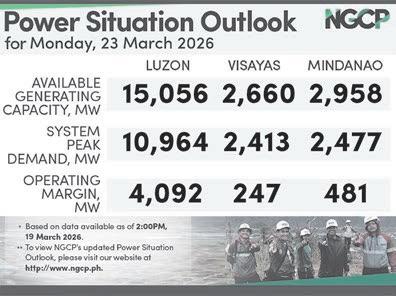
In his vlog on Sunday, the president said at least 23 power projects with a combined capacity of 900 megawatts are expected to come online, while the full capacity of Malampaya natural gas is being utilized to augment electricity supply.
“Regarding the electricity supply, discussions are ongoing with power generation companies to increase the capacity of the national grid over the next 60 days. Twenty-three power projects, with a combined capacity of 900 megawatts, are expected to come online to help boost supply,” said Marcos.
“Coordination is also ongoing to utilize the Malampaya natural gas facility at full capacity to further boost the country’s electricity supply,” he added.
Marcos said the government is also securing the country’s fuel supply through talks with trade partners, including India.
“We are also reaching out to other countries—China, Japan, Thailand, Brunei, and South Korea—about possible supply arrangements,” he added.
“The discussions have been very positive. Thankfully, we have good relations with them, and they are willing
to help us.”
In a report, the Department of Energy confirmed that the Philippines is set to receive 250,000 to 300,000 barrels of diesel next week from a Southeast Asian supplier, though the country was not disclosed. Energy Secretary Sharon Garin said the shipment is part of government efforts to assist private oil companies in securing future fuel.
On public transportation, Marcos announced the suspension of the recently approved fare hike, calling it “not the right time” given current economic pressures. Meanwhile, he said the nationwide free-ride program continues to operate in Metro Manila, Metro Cebu, and Metro Davao.
Beginning March 23, the chief executive said LRT-2 and MRT-3 passengers can avail of a 50-percent discount using the blue Beep cards, while PWDs, students, and senior citizens continue to enjoy discounts through the white Beep cards.
The president also reported ongoing distribution of cash relief and subsidies. Nearly 100,000 tricycle drivers have received their March fuel subsidies, and nationwide rollout for other transportation sector workers is set to begin on April 6. “Rest assured, our fellow citizens in the transportation sector will not be left behind. The government will continue to support them,” Marcos said.
and has been linked to questionable projects, such as the flood control projects flagged as irregular, CPBRD said.
The mechanism has also shifted spending power toward the Executive, allowing discretionary allocations and eroding congressional oversight, the CPBRD said.
In addition, the think tank said it creates fiscal risks by enabling spending beyond programmed, particularly when funded through borrowings, while the implementation of key infrastructure projects has been slowed due to delays in funding.
Higher-than-planned spending, especially when funded through borrowings, could lead to larger annual budget deficits, as this has resulted partly in the failure of the government to meet its target for reducing the budget deficit and the debt-to-GDP ratio, CPBRD added.
The think tank noted that the Philippine framework “departs” from international practices, creating uncertainty in funding and
encouraging discretionary allocation. Moreover, unprogrammed appropriations have also drawn constitutional scrutiny following recent Supreme Court discussions, including separate opinions in cases involving fiscal transfers such as those of the Philippine Health Insurance Corporation.
CPBRD said that even if unprogrammed appropriations are deemed constitutionally permissible, they must be assessed based on their actual fiscal and governance outcomes.
“When excessively large, weakly defined, or financed through borrowing, they risk undermining budget credibility, distorting expenditure priorities, and weakening the accountability mechanisms that underpin democratic budgeting,” it said.
Amid calls for reform, unprogrammed appropriations were reduced to P150.9 billion this year, lower than the proposed P250 billion and the P363.4 billion allocated in the previous year.
The Department of Budget and Management is also pushing to put a limit on unprogrammed appropriations at less than 3 percent of the national budget under the proposed Progressive Budgeting for Better and Modernized Governance Act.
Recovery
in international visitor spending due to the ongoing conflict, “history shows that the sector can recover quickly, especially when governments support travelers through hotel support or repatriation.”
She added: “Our analysis of previous crises demonstrates that security-related incidents often see the fastest tourism recovery times, in some cases as quickly as two months, when governments and industry work together to restore traveler confidence. WTTC commends governments who have worked tirelessly in recent days to support recovery efforts.”
percent this year, far beyond the central bank’s 2 percent to 4 percent target band.
The pace of the Philippine economy’s expansion could slow to 4.4 percent, still under this negative scenario. Nomura has pegged its baseline forecast for the Philippines’s GDP growth at 5.3 percent this year, but under the assumption that Brent crude averages $86 per barrel.
In the negative scenario, “the conflict continues for several months, limiting transportation through the Strait of Hormuz, and/ or harder-to-repair damage to critical GCC energy infrastructure occurs, which significantly constrains the production of oil, gas and other commodities in the Middle East.”
Under this scenario, not only does Brent crude average $100 per barrel this year and gas prices surge, but the sustained energy shock broadens into most other commodity prices—including coal, fertilizer, metals, food and chips— and shipping costs also rise.
As such, Nomura’s country economists expect several countries in Asia to “bear the brunt of the stagflationary shock in the negative scenario, and over half of the central banks to respond with rate hikes.”
Under the positive scenario, wherein Brent averages $75 per barrel, the Philippines’s central bank is expected to keep rates unchanged for the entire year, with a policy rate of 4.25 percent by yearend and inflation at 3.2 percent, well within the BSP’s 2 to 4 percent target band.
The Philippines, under this sce-
nario, is expected to grow by 5.3 percent. At the baseline scenario which assumes Brent averages $86 per barrel, the Philippines’s headline inflation could average at 4.4 percent.
Last week, Zeno Ronald R. Abenoja, BSP Deputy Governor for the Monetary and Economics Sector, said the BSP is looking at the severity and the persistence of oil price spikes.
“So, what we’re looking at is whether there are signs of further disruptions of the initial impact of the oil price increase. And in the second one, how persistent will this impact be. And that will determine how monetary policy will act in the next few quarters.”
Citing BSP Governor Eli M. Remolona Jr., the deputy governor of the central bank said if things are “quite temporary, transitory” and it doesn’t worsen too much in the next few weeks, then the overall inflation number will be “manageable” for the next few years.
However, if further disruption is experienced along the supply chain, particularly oil price spikes that could persist “for some months,” then that may make the seven-man Monetary Board consider policy action moving forward, Abenoja said. (See: https://businessmirror. com.ph/2026/03/18/bsp-eyespersistence-severity-of-pricejolts/)
Despite the recent oil price shocks, analysts told this newspaper that the central bank still has room to keep rates unchanged at its April meeting, thanks to the latest inflation print which has stayed within the central bank’s target band. (See: https://businessmirror.com.ph/2026/03/19/ experts-bsp-can-keep-rates-atapril-meeting/)
She underscored that, “Clear communication, strong coordination between the public and private sectors, and measures that reinforce safety and stability are critical to rebuilding trust with travellers and supporting the sector’s recovery.” Governments across the United Arab Emirates, for instance, quickly announced they were undewriting the extended hotel stays of stranded passengers. They have now partially opened their airspace and using fighter jets to escort commercial aircraft, especially those carrying evacuees. WTTC’s analysis is based on its 2026 pre-conflict forecast for the Middle East, which projected $207 billion in international visitor spending across the region this year. Any disruption to travel flows therefore quickly translates into substantial economic impact across the tourism ecosystem. The WTTC said it continues to monitor developments on behalf of its members and “remains in close contact with governments and industry leaders to support the safety of travelers and the resilience of the global travel and tourism sector.”
reforms do not add to the mental and physical strain of teachers already burdened with administrative work.
“Unlike in tertiary education, teachers in basic education have many responsibilities outside teaching. They have reports to prepare, including those related to the 4Ps,” she said. This also aligns with findings from EDCOM 2, which noted that teachers work an average of 52 hours a week due to non-teaching tasks.
‘Widening gaps’ WITH the shift mandated only for public schools, economists also flagged the risk of widening gaps between public and private school students.
According to Rivera, if private schools do not adopt the three-term system, “learning gaps could widen due to differences in pacing and resources.”
Peña-Reyes said the risk of inequality increases if the shift leads to uneven learning conditions, particularly if public schools face constraints that private institutions do not.
“All told, a dual-calendar system can widen inequality, but only if it leads to unequal learning conditions, not just different schedules. Different calendars alone are manageable, but different quality of learning is dangerous,” he said. To mitigate these risks, he said the government must ensure quality instructional time and consistent implementation across regions.
It should also use breaks for structured remediation, support teachers during the transition, and prioritize measuring actual learning outcomes over calendar compliance, he said.
Pakistan 86th National Day
Pakistan Day: Celebrating Shared Values and Enduring Friendship with the Philippines
PAKISTAN Day is observed on March 23 each year to commemorate the historic resolution adopted in 1940, when the leaders of the All-India Muslim League articulated the aspiration for a separate homeland in the subcontinent, affirming the fundamental right of a people to self-determination — the right to shape their own future with dignity and hope.
At its heart, this day is not only a reflection on history, but also a reaffirmation of the enduring belief that nations are strongest when their people are empowered to determine their own path. It reminds us that lasting progress is born from the collective resolve of a people to define their destiny. This enduring belief continues to guide Pakistan today as it strives to build a forward-looking, inclusive and responsible society.
The foundational vision of Pakistan was shaped by the leadership of Muhammad Ali Jinnah, who believed that a modern state must be anchored in constitutionalism, rule of law, and equal citizenship. His outlook was clear: that faith was a matter of personal conscience, and that the state’s responsibility was to ensure justice, security, and opportunity for all. He envisaged a nation where diversity would be respected, institutions would be strong, and public life would be guided by integrity and discipline. That vision continues to resonate today, reminding us that the true strength of a country lies not merely in its geography or resources, but in the principles upon which it is built.
Like the Philippines, Pakistan is home to a young and energetic population whose talent and ambition are shaping the country’s future. This demographic strength is driving innovation, entrepreneurship, and a growing digital economy, while also reinforcing Pakistan’s commitment to education and skills development. Guided by resilience and reform, Pakistan continues to pursue sustainable growth and constructive engagement with the world. In many ways, the aspirations of our young people — for opportunity, dignity, and progress — reflect a shared spirit that binds our two nations.
Pakistan and the Philippines have enjoyed a warm and resilient partnership for more than seven decades. Diplomatic relations, established in 1949, have steadily deepened through sustained dialogue and cooperation across multiple fields. Our two countries have also worked closely within regional and international frameworks, reflecting a shared commitment to peace, stability, and constructive engagement. Pakistan acknowledges the important role played by the Philippines in the Association of Southeast Asian Nations (ASEAN) as one of its founding members and a key contributor to regional cooperation. Pakistan also warmly congratulates the Philippines on its ASEAN Chairship — an important opportunity to advance dialogue, strengthen regional connectivity, and promote inclusive growth. Parliamentary engagement and high-level exchanges continue to reinforce mutual understanding and trust between Pakistan and the Philippines. In recent years, interactions between legislators and senior officials have added renewed momentum to this relationship. Notably, the visit of former President Gloria Macapagal Arroyo to
Islamabad in 2025 to participate in an international parliamentary conference hosted by Pakistan, and engagements by Pakistani parliamentarians in Manila during regional forums the last year, reflected the shared commitment of both sides to deepen dialogue and cooperation. Such exchanges, supported by formal mechanisms for inter-parliamentary collaboration and regular consultations at multiple levels, have helped sustain a relationship grounded in mutual respect and shared aspirations.
The Second Session of the Pakistan–Philippines Joint Economic Commission (JEC), held in Manila last month, marked an important step towards strengthening economic cooperation between our two countries. The meeting reaffirmed the shared commitment of Pakistan and the Philippines to deepen bilateral trade and investment while strengthening institutional mechanisms for economic collaboration. Both sides acknowledged the complementary nature of their economies and identified significant potential in sectors such as agriculture, pharmaceuticals, textiles, information technology and services. To translate this potential into practical outcomes, the two countries agreed to establish a Joint Working Group under the JEC to address trade facilitation and market access issues, while also encouraging stronger private-sector engagement, including through the revival of the Pakistan–Philippines Joint Business Council. At the same time, Pakistani investors are increasingly contributing to economic activity in the Philippines, particularly in pharmaceuticals, confectionery, textiles and logistics, while new ventures — including the entry of Sazgar’s threewheeler vehicles into the Philippine market — signal growing business confidence and practical cooperation between the private sectors of the two countries. Together, these initiatives reflect a shared determination to translate economic complementarities into tangible partnerships that benefit businesses and communities in both countries.
In this spirit, Pakistan seeks to be a reliable partner in supporting the Philippines’ quest for food security, including through the supply of high-quality rice at scale.
Pakistan remains among the few countries with the capacity to meet large-volume rice demand, complementing regional supply chains and strengthening resilience. An especially interesting aspect of this cooperation is that the IRRI-6 rice variety — originally developed through research collaboration in the Philippines — is now cultivated extensively in Pakistan and exported back to the Philippines, symbolising a full circle of shared innovation and partnership. Such examples highlight how our countries can work together to address global challenges while deepening bilateral ties and contributing to a more cooperative international order.
Pakistan and the Philippines also share a constructive and outward-looking global outlook. Both countries believe in multilateralism, dialogue, and cooperation as the most effective means of addressing complex global challenges. Whether in advancing sustainable development, promoting climate justice, or supporting peaceful resolution of disputes, our nations have consistently underscored the importance of international law and collective responsibility. As active members of the international community, Pakistan and the Philippines continue to contribute to global peacekeeping efforts, development initiatives, and regional stability.
Pakistan and the Philippines are united not only by longstanding diplomatic ties but also by shared values and experiences that shape our outlook for the future. Both countries are resilient democracies with youthful populations and vibrant cultures, facing common challenges such as climate change and the pursuit of sustainable and inclusive growth. From responding to natural disasters to strengthening climate resilience, our societies continue to demonstrate adaptability and determination. At the same time, both nations take pride in their talented human resources, whose contributions at home and abroad reflect a spirit of hard work, innovation, and global engagement. These shared realities foster a natural understanding between our peoples and provide a strong foundation for deeper cooperation based on mutual respect and collective progress.
Beyond official engagement, the relationship is enriched by enduring cultural ties. Our societies celebrate diverse traditions, cuisines, and artistic expressions shaped by centuries of history.
From the historic Walled City of Lahore to the ancient streets of Intramuros in Manila, both countries preserve living reminders of identity and cultural continuity.
Pakistan and the Philippines are also connected through the
strength of their people-to-people ties. Around 2,000 Pakistanis live in the Philippines and a similar number of Filipinos reside in Pakistan, forming vibrant communities that contribute meaningfully to local society and serve as natural bridges of culture, enterprise, and goodwill. Many families today
reflect the closeness between our peoples, with intermarriages symbolising a relationship grounded in mutual respect and shared values.
Cultural exchange, tourism, and wider engagement between our communities continue to deepen understanding and appreciation of each other’s traditions and his-
tories. These human connections — built through everyday interactions, friendships, and shared experiences — remain one of the most enduring foundations of the friendship between Pakistan and the Philippines, and a source of confidence for an even stronger partnership in the years ahead.
Quaid‑e‑Azam arriving for the historic session where the Lahore Resolution was adopted. PHOTOS COURTESY OF THE EMBASSY OF PAKISTAN IN THE PHILIPPINES
Dr. Asima Rabbani, Ambassador Extraordinary and Plenipotentiary of the Islamic Republic of Pakistan to the Philippines.
Pakistan 86th National Day
86 Years Strong: Pakistan celebrates its historic journey
The Embassy of Pakistan highlights the significance of Pakistan Day as a reminder of the country's resilience and national achievements, while reaffirming its dedication to strengthening ties with the Philippines.
By John Eiron R. Francisco
TODAY, March 23, Pakistan, a vibrant Islamic country in South Asia, celebrates a day that helped define its identity.
Pakistanis around the world
pause to honor the Lahore Resolution of 1940, the historic decision that eventually led to the creation of their homeland, and citizens mark the occasion with ceremonies, parades, and patriotic programs.
Th is historic decision, endorsed by Muhammad Ali Jinnah and the Muslim League, called for a separate homeland for Muslims in British India, based on the Two-Nation Theory, which
emphasized cultural, religious, and political differences between Muslims and Hindus.
Pakistan later gained independence on August 14, 1947, and March 23 was first celebrated in 1956 to mark the adoption of the country’s first constitution, though today the date is primarily associated with the Lahore Resolution.
In Lahore, a major city in eastern Pakistan and the provincial capital of Punjab known for its rich
cultural and historical heritage, celebrations centered around the Minar-e-Pakistan (Pakistan Minaret), a towering monument built at the site where the Lahore Resolution was passed.
Honoring heroes
Across Pakistan, the day begins with the hoisting of the national flag, followed by 31-gun salutes in Islamabad and 21-gun salutes in provincial capitals.
Tributes are also paid at the mausoleums of Muhammad Ali Jinnah (the country’s founding father, also known as Quaid-i-Azam) and Allama Iqbal (a poet and philosopher who inspired the idea of Pakistan).
Now marking its 86th Pakistan National Day, the capital also hosted a ceremonial parade along Constitution Avenue, featuring military formations, cultural performances, and an awards ceremony recognizing notable contributions from both civilians and military personnel.
Educational institutions, civic organizations, and media outlets organized debates, festivals, and special broadcasts, while families came together to observe the occasion.
The holiday sees government offices, schools, and most businesses closed, and public transport is often limited. Parks and recreational areas, meanwhile, experience increased visitor traffic as citizens take part in festivities.
Observance in the Philippines
The celebration of Pakistan Day extends beyond national borders. The Pakistani Embassy in the Philippines continues to engage the local community in observing the occasion.
The embassy hosts a flag-raising ceremony at Pakistan House in Makati City, attended by members of the Pakistani community and their families.
Messages from Pakistan’s President, Prime Minister, and Deputy Prime Minister/Foreign Minister are read during the event, underscoring the country’s ongoing commitment to unity, progress, and international friendship.
The embassy also highlights the significance of Pakistan Day as a reminder of the country's resilience
countries’ investment boards and the formation of a Joint Working Group on Investment.
Sectoral talks spanned agriculture, irrigation, halal development, health and pharmaceuticals, banking and taxation, education and TVET, energy, minerals, tourism, and visa facilitation.
In agriculture, officials discussed seed development, plant variety protection, quality assurance, and community-based irrigation initiatives. Halal sector talks focused on compliance training, certification exchanges, and supply
and national achievements, while reaffirming its dedication to strengthening diplomatic, cultural, and economic ties with the Philippines.
Economic Ties in Focus
On February 19, Pakistan and the Philippines explored deeper economic engagement during the second meeting of the Pakistan-Philippines Joint Economic Commission (JEC) in Manila, marking the first such meeting in eight years.
The meeting, co-chaired by Pakistan’s Secretary of Economic Affairs Division Muhammad Humair Karim Kidwai and the Philippines’ Undersecretary for International Trade Atty. Allan B. Gepty was attended by the respective ambassadors and senior officials.
Both sides discussed global economic trends, reviewed bilateral trade and investment ties, and recognized untapped potential for growth.
Pakistan highlighted opportunities in agricultural, halal-certified products, and proposed trade fairs, business exchanges, and a dedicated business forum.
Both governments emphasized the private sector involvement and agreed to reactivate the PakistanPhilippines Joint Business Council.
The discussions also covered investment cooperation, including a proposed memorandum of understanding between the two
chain improvements.
Health and pharmaceutical cooperation included regulatory alignment and facilitating trade in medical devices and medicines. Banking and taxation discussions covered digital payments, remittance corridors, financial innovation, supervisory cooperation, and updating the Double Taxation Agreement.
The meeting concluded with both sides reaffirming their commitment to translating agreements into tangible outcomes and exploring a Preferential Trade Agreement (PTA) to further strengthen economic ties.
Visa Relief for Pakistani Nationals
Meanwhile, the Pakistani Embassy in the Philippines announced via social media that the Philippine Department of Justice has granted visa relief to foreign nationals affected by recent flight cancellations following the exchange of airstrikes in the Middle East.
Under the advisory, all foreign nationals whose authorized stay expired on or after February 28, 2026, may remain in the country until April 1, 2026, without incurring any fees, fines, or penalties.
Pakistani citizens in the Philippines are urged to make necessary travel arrangements within this period to avoid inconvenience.
Embassy officers and staff, led by Chargé d’Affaires a.i. Ms. Zumar-Fatima Shirazi, conduct a flag-raising ceremony in observance of Pakistan National Day 2025.
H.E. Ambassador Asima Rabbani and DFA Undersecretary Ma. Theresa Dizon-De Vega, on November 18, 2025, discuss consular matters and explore opportunities to further strengthen the bilateral cooperation between Pakistan and the Philippines.
On July 10, 2025, H.E. Dr. Asima Rabbani presented her credentials to H.E. President Ferdinand Marcos Jr., followed by a discussion on expanding cooperation and strengthening the diplomatic ties between Pakistan and the Philippines.
On March 23, 2025, the Embassy of Pakistan in Manila commemorated Pakistan National Day, marking the 85th anniversary of the 1940 Lahore Resolution.
Pakistan 86th National Day
FREEDOM, EQUALITY, AND JUSTICE: THE VISION OF FOUNDER OF PAKISTAN QUAID-E-AZAM MUHAMMAD ALI JINNAH
“With faith, discipline and selfless devotion to duty, there is nothing worthwhile that you cannot achieve.”
ON this Pakistan National Day, we honor the vision of the Founder of Pakistan, Quaide-Azam Muhammad Ali Jinnah, reflecting on his ideals for the nation, his perspective on the role of women in society, and his guiding philosophy on life.
His Vision for the Nation
Quaid-e-Azam envisioned a Pakistan founded on freedom, equality, and justice for all. Some of his quotes reflecting the foundational principles of the nation are:
“You are free; you are free to go to your temples. You are free to go to your mosques or to any other places of worship in this State of Pakistan. You may belong to any religion, caste or creed-that has nothing to do with the business of the state.”
“Democracy is in the blood of the Muslims, who look upon complete equality of mankind, and believe in fraternity, equality, and liberty.”
We have undoubtedly achieved Pakistan, and that too without bloody war, practically peacefully, by moral and intellectual force, and with the power of the pen, which is no less mighty than that of the sword and so our righteous cause has triumphed. Are we now going to besmear and tarnish this greatest achievement for which there is no parallel in the history of the world?
Pakistan is now a fait accompli and it can never be undone, besides, it was the only just, honorable, and practical solution of the most complex constitutional problem of this great subcontinent. Let us now plan to build and reconstruct and regenerate our great nation...”
“My message to you all is of hope, courage and confi-
dence. Let us mobilize all our resources in a systematic and organized way and tackle the grave issues that confront us with the grim determination and discipline worthy of a great nation.”
Women and their role in the prosperity of Nations
Quaid-e-Azam strongly believed that the progress of a nation is inseparable from the empowerment of is women.
He has famously made these remarks on women inclusion:
“No nation can ever be worthy of its existence that cannot take its women along with the men. No struggle can ever succeed without women participating side by side with men. There are two powers in the world; one is the sword and the other is the pen. There is great competition and rivalry between the two. There is a third power stronger than both, that of the women.”
“No nation can rise to the height of glory unless your women are side by side with you. We are victims of evil customs. It is a crime against humanity that our women are shut up within the four walls of the houses as prisoners. There is no sanction anywhere for the deplorable condition in which our women have to live.”
His Ideology of Life Jinnah’s personal philosophy continues to inspire generations. Some of his most inspiring sayings are:
“ Think a hundred times before you take a decision, but once that decision is taken, stand by it as one man.” With faith, discipline and selfless devotion to duty, there is nothing worthwhile that you cannot achieve.”
“I have lived as plain
Mr. Jinnah and I hope to die as
Father of the Nation. Founder of Pakistan, Quaid- e-Azam Muhammad Ali Jin- nah
House Justice panel ready to explain Sara impeachment at Supreme Court
By Jovee Marie N. dela Cruz @joveemarie
THE House Committee on Justice is strictly following a rules-based and evidence-driven process in handling the impeachment complaints against Vice President Sara Z. Duterte, and is prepared in case her camp elevates the matter to the Supreme Court (SC), a leader of the House of Representatives said on Sunday.
Party-list Rep. Terry Ridon of Bicol Saro, who chairs the House Committee on Public Accounts and sits as a member of the Justice panel, emphasized that every step taken by the committee is anchored on evidence and existing law.
“Every action of the committee is rules-based and evidencebased. All rulings are grounded on evidence and the law,” Ridon said.
“And if the matter is brought before the Supreme Court, the committee is ready to defend the process in a manner that is proper, fair, and consistent with the Constitution,” he added.
The justice panel is currently conducting hearings on the two remaining impeachment complaints against Duterte that were found sufficient in form, substance, and grounds.
Ridon dismissed claims from the Vice President’s camp that the allegations are mere “legal conclusions or speculation.”
“We have to be very clear—everything that has been discussed previously is not based on speculation; these are based on evidence,” he said.
He cited Commission on Audit (COA) reports and findings from previous proceedings, including hearings by the House Committee on Good Government and Public Accountability, or the Blue-Ribbon committee, which uncovered alleged misuse of confidential funds.
“These are not conjectures. These are supported by official findings,” Ridon stressed. He also pointed to specific bases of the complaints, including Duterte’s Statements of Assets, Liabilities, and Net Worth (SALN), alleged unexplained wealth, and COA audit reports.
“The existence of a SALN is a fact. It cannot be said that there are no facts,” he said. Ridon noted that from 2007 to 2024, Duterte’s estimated
PNP beefs up monitoring of online games over child exploitation concerns
By Rex Anthony Naval
THE National Police (PNP) chief, Gen. Jose Melencio
Nartatez Jr., on Sunday ordered an intensified intelligence monitoring of online gaming applications to determine if they are being used for criminal activities.
Nartatez issued this order after noting that there are gaming platforms with large numbers of minors and expressed concern that these are being used to exploit young gamers.
“Our mandate of serving and protecting the people now encompasses the cyberspace to keep them safe especially for children. This is what modern policing also means and your PNP has been keeping up,” Nartatez said.
March 23, 2026 www.businessmirror.com.ph See “Online games,” B9
He said he already directed the PNP Anti-Cybercrime Group to intensify its monitoring of gaming activities—not just on Roblox, but on other applications as well—to prevent their use in criminal activities. This move came after authorities flagged the popular online gaming platform Roblox for allegedly being used in the exploitation of children.
Reports indicated that predators have taken advantage of the platform’s interactive features to groom and exploit minors.
Nartatez added that the police are already coordinating with the Department of Information and Communications Technology
cumulative salary ranged from P30 million to P40 million, which he said raises questions when compared to her reported net worth of around P88 million in 2025.
He added that the committee plans to subpoena business, tax, and professional records to determine whether the assets can be properly explained.
On the issue of confidential funds, Ridon said the allegations are backed by COA reports, including the disallowance of at least P70 million.
“These are not mere allegations. These are official audit findings,” he said, adding that confidential funds cannot be used for nonconfidential activities such as team building.
At the same time, Ridon assured that due process is being strictly observed.
“We are very careful when it comes to due process,” he said, noting that Duterte has been given opportunities to respond and present evidence at every stage.
No double standard
THE House Committee on Justice has applied the same standards to impeachment complaints against President Marcos and Vice President Sara Duterte, but the key difference lies in the presence of evidence showing direct participation, according to the committee chairman, Batangas Rep. Gerville Luistro.
Luistro rejected claims of double standard, stressing that the panel has been consistent from the outset.
“There is a significant disparity between the impeachment complaint against the President and
that against the Vice President. In the President’s case, there is no evidence showing personal participation in the alleged corruption,” Luistro said in a radio interview.
She explained that the alleged corruption tied to the President was linked to the implementation of the budget, not its approval.
“You cannot question the President’s approval of the General Appropriations Act because that is part of his constitutional duty. The issue is in the implementation—so where is the President’s participation there?” she said.
Luistro emphasized that the same parameters and procedures were applied in both cases.
“From day one, we applied exactly the same standards. Whatever parameters were used for the President were also used for the Vice President. Even the procedures are exactly the same,” she said.
She said the panel looked for proof of personal involvement in the allegations against the president but did not find sufficient evidence.
Luistro added that signing the General Appropriations Act alone cannot be considered proof of corruption, as the alleged wrongdoing did not occur during the approval stage.
Owe
LUISTRO, meanwhile, urged fellow lawmakers to treat the impeachment process as a constitutional duty owed to the Filipino people— not to political figures or groups—as the House prepares for the formal hearings set on March 25.
“This impeachment process is our constitutional duty to the sovereign Filipino people. We do
not owe our fidelity to the president, the vice president, or any religious group. Our accountability is to the Filipino people,” she said.
She emphasized the broader implications of the proceedings.
“What is at stake here is the future of the country,” Luistro said.
Luistro clarified that impeachment is not equivalent to a criminal prosecution but rather a constitutional mechanism to determine whether a public official remains fit to hold office.
“What we are trying to determine is the fitness of a public official to continue serving and to run for public office in the future,” she said.
She stressed that impeachment is guided by constitutional grounds such as culpable violation of the Constitution, betrayal of public trust, graft and corruption, high crimes, and treason.
“These are exclusive grounds. If the complaint falls outside these, it cannot prosper,” she said.
Luistro underscored that public office is a public trust, and officials are accountable to the people at all times.
“Accountability is the opposite of impunity. Public officials must always answer to the Filipino people,” she said. She added that the impeachment proceedings could also shape public perception ahead of the 2028 elections, especially after Duterte signaled her intention to run for president.
“This process gives the Filipino people an opportunity to assess whether the vice president is fit to become the next president,” Luistro said.
House leader urges swift passage of drone program funding bill
AHOUSE of Representatives deputy majority leader on Sunday urged swift approval of a bill allocating funds to the Philippine Unmanned Aerial System Program and Strategic Defense Technology Transfer Program, backing the National Police’s (PNP) use of drones to strengthen maritime patrols against smuggling and other illegal activities.
House Deputy Majority Leader Luigi Villafuerte noted that Gen. Jose Melencio Nartatez Jr., National Police chief, emphasized the importance of modern technology in law enforcement, citing the recent confiscation of over P300 million worth of marijuana in the Cordillera Administrative Region using drones for surveillance in rugged, hard-to-reach terrain.
“The PNP’s initiative reinforces the urgency of our legislative efforts to strengthen national defense and law enforcement capabilities through unmanned aerial systems,” Villafuerte said. He stressed that this aligns with his bills—HB 1362 and HB 1363—which aim to institutionalize the acquisition of drones and rehabilitate old military aircraft.
HB 1362, also called the proposed National Defense Drone Act, proposes the creation of the Philippine Unmanned Aerial System Program (PUASP) and the Strategic Defense Technology Transfer Program (SDTTP). The programs would allocate an initial P10 billion for the acquisition, development, and eventual local manufacture of drones for surveillance, reconnais -
sance, combat, disaster response, medical evacuation, border patrol, and search-and-rescue operations. It also seeks to foster research partnerships with local universities, tech start-ups, and private industry to spur domestic drone innovation.
HB 1363, or the proposed Military Air Asset Rehabilitation and Modernization Act, would establish a Military Air Asset Rehabilitation Program (MAARP) under the Department of National Defense to inspect, evaluate, and recommission old yet operational military aircraft. The bill allocates an initial P5 billion for this program to bolster the Armed Forces’ operational capacity without incurring the cost of purchasing new aircraft.
See “Drone,” B9
Immigration agents nab 2 Chinese men
CEBU CITY—The Bureau of Immigration (BI) arrested two Chinese men in separate operations in Cebu late last week for violation of their visa conditions.
Arrested were Hongyou Zheng in Consolacion and Zunsheng Wu on Colon Street, Cebu City, both holders of 9(g) pre-arranged employment visas. Investigation revealed that both individuals violated the conditions of their stay by engaging in unauthorized business and employment activities
outside of their declared petitioning companies. Zheng was reportedly involved in small-scale scrap trading and retail operations, while Wu was found managing hardware and construction supply businesses without the required permits, including Alien Employment Permits from the Department of Labor and Employment (Dole). Under the law, Immigration 9(g) visa holders are only allowed to work for their approved employers. Engaging in other business or
Campus journalists ask DepEd to revert to old NSPC rules
By Claudeth Mocon-Ciriaco
AS the Department of Education (DepEd) made official the guidelines for the conduct of the 2026 National Schools Press Conference (NSPC), campus journalists from various regions of the country called on Education Secretary Juan Edgardo Angara to revert to the previous practice wherein the top three winners per individual category in the Regional Schools Press Conference (RSPC) will represent their respective regions in the nationa event.
Under DepEd Memorandum 021, s. 2026, issued on March 19, only the first placer per individual category will be able to participate in the NSPC that is scheduled to be held in Ormoc City, Leyte, on April 13-17. Dismayed campus journalists and coaches noted that sending only one participant in the individual categories (Newswriting, Editorial and Column Writing, Feature Writing, Science Writing, Sports Writing, Copy Editing and Headline Writing, and Photojournalism), was observed in 2023. This was during the resumption of face-to-face classes and contests, including the annual NSPC, after nearly three years of lockdown owing to the Covid-19 pandemic. Prior to the pandemic, the top three winners per individual category in the RSPC represented their regions in the NSPC. One of the second placers from Region XVII even appealed to Angara on Facebook: “We’re reaching out with a heavy heart to ask for a change to the 2023 NSPC policy. Limiting participation to only first-place RSPC winners feels incredibly unfair, especially to talented graduating seniors who’ve poured their hearts and years into their craft. It’s heartbreaking to think of their dreams being sidelined.”
“So, wala na talagang pag-asa ang mga second or third placers para makasali sa NSPC sa Ormoc?,” another campus journalist said in a Facebook post. A school paper adviser echoed the same call “Please pakibalik po Secretary Angara ang Top 3 contenders sa NSPC.” Several campus journalists even tagged Angara and DepEd Philippines with their call to allow the Top 3 to represent their respective regions in the NSPC.
“Allowing the top three contestants to compete in the NSPC could actually support the goals of Education Secretary Sonny Angara in improving student development in the country,” said one of those posts tagging Angara and DepEd.
As of press time, the DepEd as well as Angara’s office has yet to issue a comment or reaction on the issue.
employment activities constitutes a violation of Section 37(a)(7) of Commonwealth Act 613, in relation to Republic Act 562. Zheng was allegedly using the alias “Jerry Ty,” which has no official records in government databases, raising questions about possible misrepresentation. Both individuals were also found to have affiliations with FilipinoChinese community organizations in Cebu, allowing them to establish connections within local networks.
However, DepEd Memorandum Order 021, series of 2026 on the holding of this year’s NSPC maintained the 2023 order allowing only the “top regional winner per medium.”
For group categories- radio and television broadcasting, online publishing, and collaborative desktop publishing – the memorandum said one team per medium, composed of seven members, except for online publishing, which “shall have five members.”
This year’s NSPC has the theme “Mapanuri, Mapanindigan, at Mapanagutang Pamamahayag [Critical, Principled, and Accountable Journalism].”
DSWD to expand relief to PU drivers after Holy Week
THE Department of Social Welfare and Development (DSWD) is set to expand the rollout of its cash relief assistance (CRA) program to public utility vehicle (PUV) drivers outside the National Capital Region (NCR) after Holy Week.
In an interview the DSWD spokesperson, Assistant Secretary Irene Dumlao, said preparations are underway for the next phase of implementation, even as payouts continue in Metro Manila.
The department is targeting to begin the expanded distribution immediately after Holy Week, although officials are still consolidating the total number of drivers nationwide. Dumlao said that once the data is finalized, the DSWD will determine the number of days needed to complete the payouts.
The agency will also continue its NCR disbursements following the initial distribution to tricycle drivers. Beginning March 24, around 27,635 Transport Network Vehicle Service (TNVS) drivers are scheduled to receive assistance, followed by more than 21,700 public utility jeepney (PUJ) drivers on March 25. Delivery riders, estimated at 137,700, will receive aid on March 26 and 27, while approximately 27,600 motorcycle taxi drivers are scheduled for payouts on March 28.
Dumlao emphasized that President Marcos has directed the government to ensure that all drivers affected by fuel price increases receive assistance.
The cash relief assistance, amounting to P5,000 per beneficiary, is intended to help drivers cope with the rising costs of gasoline and diesel, as well as support their families’ basic needs.
To ensure efficient and orderly distribution, the DSWD is implementing strict verification protocols, including requiring beneficiaries to appear in person and undergo identity validation to prevent duplication and discrepancies.
The program is part of a broader whole-of-government response, with other sectors receiving support from partner agencies. Taxi drivers are covered by the Department of Transportation (DOTr), while farmers and fisherfolk are assisted by the Department of Agriculture (DA).
The DSWD has advised drivers to coordinate with their respective local governments (LGU) and the Land Transportation Franchising and Regulatory Board (LTFRB) to confirm their inclusion on the official beneficiary list.
Beneficiaries are also reminded to follow their assigned schedules and bring a valid driver’s license along with a photocopy when claiming assistance.
The initiative aims to ease the financial burden on transport workers amid continued increases in fuel prices driven by geopolitical tensions in the Middle East.
Benefit
A TOTAL of 98,007 tricycle drivers in Metro Manila have already received their P5,000 cash relief assistance from the DSWD, marking the completion of the first week of payouts conducted in partnership with local government units.
Crisis Intervention Program (CIP) Director Edwin Morata said this represents 81 percent of the 122,050 drivers listed on the agency’s validated “clean list.” Morata reported that payout operations during the first four days proceeded smoothly and in an orderly manner.
House priority focused on economy–Marcos
By Jovee Marie N. dela Cruz @joveemarie
FOLLOWING the passage of 18 of the 52 Legislative-Executive Development Advisory Council (Ledac) priority measures, a leader of the House of Representatives on Sunday said the chamber’s progress on priority legislation underscores a strategy focused not just on economic recovery but on shielding the country from global shocks while laying the groundwork for long-term growth.
House Majority Leader Ferdinand Alexander A. Marcos said several of the measures prioritized by the House are meant to directly address vulnerabilities exposed by global uncertainties, particularly volatile oil prices and supply chain disruptions.
Among the most critical is the proposed measure allowing the President to suspend or reduce excise taxes on petroleum products, which lawmakers see as a key buffer against inflation and rising transport and food costs.
“We acted with urgency because our people need immediate relief from high fuel prices and the ripple effects on basic goods and services,” Marcos said.
Beyond short-term relief, the House has also advanced reforms aimed at modernizing the economy. These include the
Digital Payments Act to accelerate financial inclusion and efficiency, as well as the Travel Tax Abolition Bill, which is expected to stimulate tourism and consumer spending.
Energy and sustainability measures such as amendments to the Biofuels Act, along with the Wasteto-Energy and Blue Economy bills, are likewise positioned as tools to reduce dependence on imports while opening new industries and investments.
Fiscal and financial reforms are also part of the House’s economic agenda, including the extension of the estate tax amnesty program to improve revenue collection and proposed amendments to the Bank Deposits Secrecy Law to boost transparency and investor confidence.
Marcos noted that while 18
measures have reached advanced stages, several high-impact economic bills remain in the pipeline, including the National Land Use Act, which aims to optimize land utilization for development, and proposed enhancements to the Pantawid Pamilyang Pilipino Program to strengthen social safety nets.
Support for businesses is also being tackled through pending amendments to the Magna Carta for micro, small, medium enterprises, alongside proposals on disaster risk financing to help businesses and communities better withstand economic disruptions.
At the same time, lawmakers continue to deliberate on other structural reforms such as amendments to the Rice Tariffication Law, a general tax amnesty program, and a long-term infrastructure and national development master plan—all seen as critical in shaping the country’s economic direction.
House data shows that from July 2025 to March 2026, a total of 9,632 measures have been filed, reflecting what Marcos described as sustained legislative activity aligned with the demands of the economy.
“The numbers show a working House, but more importantly, they reflect reforms that can help stabilize and grow the economy,” he said.
Marcos emphasized that the Holy Week recess is only a temporary pause, with the House expected to return ready to push forward measures aimed at keeping the economy stable, competitive, and responsive to both global and domestic challenges.
Cebu City launches job program for seniors
By Carmel Pedroza
CEBU CITY—The Cebu City government has rolled out a new employment program aimed at giving senior citizens a chance to remain active in the workforce, with dozens of older residents already taking steps to secure parttime jobs.
On Saturday, a total of 257 applicants joined the screening process for service crew positions under the city’s senior employment initiative. The activity followed an earlier orientation, with participants proceeding to interviews and initial assessments held throughout the day.
Many hopefuls arrived ahead of
schedule, showing strong interest in the opportunity.
The program, spearheaded by the Department of Manpower Development and Placement (DMDP), is open to Cebu City residents aged 60 to 65 who are still fit to work.
Applicants must undergo health checks and complete document verification, with medical requirements provided at no cost through the Cebu City Medical Center.
Out of all applicants, 102 seniors will be chosen and deployed in two groups to various fast-food establishments across the city.
Each selected participant will work for five months, rendering four hours of service per day, five days a week, and will receive wages
based on the current minimum rate.
Cebu City Mayor Nestor Archival emphasized that the initiative supports the city’s push for inclusive growth, ensuring that elderly residents continue to have access to meaningful opportunities.
“Padayon ta sa paghatag og inclusive opportunities para sa atoang mga Sugbuanon [We’ll continue to provide inclusive opportunities for every Cebuano],” Archival said in a statement.
City officials said the local government will guide applicants through each stage of the process and plans to introduce more programs that uphold dignity, productivity, and inclusivity for all sectors.
Carmel Pedroza
Natl, local govts roll out expanded free commute in Cebu
CEBU CITY—A P20 million funding allocation from the Department of Transportation (DOTr) is set to augment expanding “Libreng Sakay” (Free Ride) initiatives across Cebu, as local governments launch coordinated efforts to ease the burden of rising fuel and transportation costs.
Cebu Gov. Pamela Baricuatro said the province is finalizing guidelines for the DOTr-backed program, which will introduce a structured, schedule-based public transport system connecting key areas such as Danao City and Carcar City to Cebu City.
Assistant Provincial Administrator Aldwin Empaces said the system is envisioned to function as a feeder network linking northern and southern areas to main city routes.
At the city level, the Talisay City Government will launch its own Libreng Sakay program starting Monday, March 23, offering free one-way rides for workers and students traveling to Cebu City.
According to Talisay City Mayor Gerald Anthony Gullas, the service will initially deploy two buses, with plans to expand to two buses and four L300 vans after the conclusion of regional athletic events.
Two routes will be served: one via N. Bacalso Avenue terminating at E-Mall, and another via the Cebu South Coastal Road ending at Plaza Independencia. Trips will run every weekday morning with fixed departure times from City Hall.
Meanwhile, the Cebu City government has expanded its own free bus program, adding more routes to accommodate evening commuters.
Fishermen get fuel subsidy; MPTC, SMC give toll rebates
By Ada Pelonia @adapelonia & Lorenz S. Marasigan @lorenzmarasigan
THE Bureau of Fisheries and Aquatic Resources (Bfar) has extended the P50 million fuel subsidy to over 10,000 fishermen to cushion the impact of surging global oil prices on their production.
At the same time, the two biggest tollways operators, Metro Pacific Tollways Corp. and San Miguel Corp., have offered rebates to public utility vehicles and cargo trucks using their expressways. The budget forms part of the P150 million allocated to the Department of Agriculture (DA) in its previous year’s General Appropriations Act (GAA) to disburse to farmers and fisherfolk for fuel assistance.
Of this, P100 million has been released to the DA, with Bfar as the implementing agency for the disbursement of P50 million to fishermen. The remaining will be allotted to farmers.
Agriculture Secretary Francisco Tiu Laurel Jr. said the government would not allow external shocks to derail the livelihood of small-scale fishers.
“Global fuel volatility should not come at the expense of our fisherfolk’s survival,” Tiu Laurel said.
“We are moving promptly to ensure assistance reaches them without delay because keeping our fishing boats running means keeping food on Filipino tables and sustained livelihoods for our fishers.”
Under the program, every qualified fisherman receives a one-time P3,000 subsidy released through cash cards for those with access to fuel stations, while cash vouchers are issued in remote areas.
More than 10,000 fishermen nationwide have served as beneficiaries for the fuel subsidy program, which will run from March 16 to 26.
Central Visayas and Bicol Region have the lion’s share of beneficiaries with 4,356 and 3,334, respectively. Other regions, such as Ilocos Region, Cagayan Valley, Central Luzon, Calabarzon (Cavite, Laguna, Batangas, Rizal and Quezon) and Mimaropa (Mindoro, Marinduque, Romblon and Palawan), Eastern Visayas, and Soccsksargen (South Cotabato, Cotabato, Sultan Kudarat, Sarangani and General Santos), are also covered.
Meanwhile, the Bfar said it is working closely with the Development Bank of the Philippines (DBP) to fast-track the supplemental agreement, unlocking an additional P50 million for some 15,000 more municipal fisherfolk and ensuring the timely release of additional funds.
Tollways relief
THE country’s two largest toll road operators have extended relief to public utility vehicles (PUVs) and cargo trucks using their expressways.
Over the weekend, Metro Pacific Tollways Corp. (MPTC) and San Miguel Corp. (SMC) announced the programs that will take effect MOnday, March 23.
MPTC announced the expansion of its KaBiyahe Rebate Program to cover the Subic-Clark-Tarlac Expressway (Sctex) and Cavite Expressway (Cavitex), in addition to the North Luzon Expressway (Nlex), effective March 23 to May 22.
SMC Infrastructure, meanwhile, will roll out toll rebates for select PUVs and cargo trucks along the South Luzon Expressway (Slex) and Star Tollway beginning the same date.
Transportation Secretary Giovanni Lopez welcomed the moves by both operators.
Nagpapasalamat tayo sa mga toll operators dahil malaking tulong itong mga discount para sa mga PUV drivers. Alam natin ang hirap na dinaranas ng mga nasa transport sector araw-araw. Kaya tuloy-tuloy lang tayo sa pagpapatupad ng mga programang direktang makatutulong sa kanila ,” Lopez said.
Under the MPTC program, qualified Class 2 public utility buses (PUBs) and modern jeepneys, as well as Class 3 vehicles, are eligible for rebates that effectively roll back toll rates to levels prior to the most recent adjustment.
The program covers all passages along Nlex, Sctex, and Cavitex, including the R1 Expressway and R1 Expressway Extension.
Class 3 vehicles must be valid Easytrip subscribers in good standing with sufficient load and must not be enrolled in any other toll rebate or discount programs on MPTC expressways, such as the Toll Exemption for Agricultural Trucks.
Mayor Nestor Archival announced that from Monday to Friday starting at 5:00 p.m., buses will operate on a round-trip basis between City Hall and key areas including Bulacao, Guadalupe, Talamban, and Lahug.
The expansion aims to provide more accessible transportation options for workers heading home, while helping reduce commuting costs.
Alongside free transportation, the Cebu provincial government is also working on complementary support measures, including fuel assistance and a proposed P20per-kilo rice program in coordination with the National Food Authority (NFA).
Guidelines for these subsidies are currently being finalized.
PUBs and modern jeepneys must additionally enroll in the KaBiyahe program by submitting required documents, be accredited operators registered with the Land Transportation Franchising and Regulatory Board (LTFRB), and must likewise not be enrolled in any other toll discount programs on MPTC roads.
The enrollment window for PUBs and modernized jeepneys runs from March 23 to April 5. Vehicles with any citation or traffic violation during the program period will be disqualified.
MPTC also noted that Class 1 Public Utility Jeepneys (PUJs) along northern routes will continue to benefit from the existing Passada Program, while the Abante Program will be reactivated for two months for Cavitex enrollees, giving them rebates equivalent to the difference between current and pre-adjustment rates.
On the south side of Luzon, SMC’s rebate program covers four vehicle classes along Slex and Star Tollway: Class 1 public utility jeepneys and UV Express vans, Class 2 public utility buses and modern jeepneys, and Class 3 cargo trucks and trailers with three or more axles and over 7.5 feet in height.
Like the MPTC program, rebates will amount to the difference between current and previous toll rates, credited on a weekly basis.
To qualify, eligible vehicles must be active Autosweep users in good standing with no unsettled traffic violations across SMC’s expressway network, which includes Slex, Star Tollway, Tplex, Naiax, and the Skyway System.
Tehran strikes near Israeli nuclear research center as Trump threatens attacks on Iran’s power plants
By Samy Magdy, Melanie Lidman & Jill Lawless The Associated Press
CAIRO—Iranian missiles struck two communities in southern Israel late Saturday, leaving buildings shattered and dozens injured in dual attacks not far from Israel’s main nuclear research center, while President Donald Trump warned the US will “obliterate” Iranian power plants if it doesn’t fully open the Strait of Hormuz within 48 hours.
The developments signaled the war was moving in a dangerous new direction at the start of its fourth week.
Trump—who is facing increasing pressure at home to secure the strait as oil prices soar—issued the ultimatum in a social media post while he spent the weekend at his Florida home.
Trump said he’s giving Iran 48 hours to open the vital waterway or face a new round of attacks. He said the US would destroy “various POWER PLANTS, STARTING WITH THE BIGGEST ONE FIRST!”
Iran warned early Sunday that any strike on its energy facilities would prompt attacks on US and Israeli energy and infrastructure assets in the region, according to a statement carried by Iran’s state media and semiofficial outlets, citing an Iranian military spokesperson.
The Strait of Hormuz, which connects the Persian Gulf to the rest of the globe’s oceans, is a critical pathway for the world’s flow of oil. Attacks on commercial ships and threats of further strikes have stopped nearly all tankers from carrying oil, gas
and other goods through the passage. That’s also led to cuts in output from some of the world’s largest producers, because their crude has nowhere to go.
The Iranian strikes in Israel came after Tehran’s main nuclear enrichment site at Natanz was hit earlier in the day.
Israel’s military said it was not able to intercept missiles that hit the southern cities of Dimona and Arad, the largest near the center in Israel’s sparsely populated Negev desert. It was the first time Iranian missiles penetrated Israel’s air defense systems in the area around the nuclear site.
“If the Israeli regime is unable to intercept missiles in the heavily protected Dimona area, it is, operationally, a sign of entering a new phase of the battle,” Iran’s Parliament Speaker Mohammad Bagher Ghalibaf said on X before word of the Arad strike spread.
Israeli Prime Minister Benjamin Netanyahu said more emergency crews were being sent to the scene.
“This is a very difficult evening,” he said.
Rescue workers said the direct hit
in Arad caused widespread damage across at least 10 apartment buildings, three of them badly damaged and in danger of collapsing. At least 64 people were taken to hospitals.
Dimona is about 20 kilometers (12 miles) west of the nuclear research center and Arad around 35 kilometers (22 miles) north.
Israel is believed to be the only Middle East nation with nuclear weapons, though its leaders refuse to confirm or deny their existence. The U.N. nuclear watchdog said on X it had not received reports of damage to the Israeli center or abnormal radiation levels.
A dangerous new direction in the war
“ THE war is not close to ending,” Israel’s army chief, Gen. Eyal Zamir, said earlier in the day.
Iran also targeted the joint U.K.US Diego Garcia military base in the Indian Ocean about 2,500 miles (4,000 kilometers) away, suggesting that Tehran has missiles that can go farther than previously acknowledged — or that it had used its space program for
Trump’s mixed messages on Iran: ‘Winding down’ the war, easing sanctions but adding more troops
By Nicholas Riccardi The Associated Press
PRESIDENT Donald Trump frequently contradicts himself, sometimes in the same speech, social media post or even sentence. Within the space of a few hours Friday, he sent a torrent of mixed signals about the Iran war that raise more questions about the direction of the conflict and his administration’s strategy.
During this time, Trump said he was considering winding down the war, his administration confirmed it was sending more troops to the Middle East and, in an effort to lessen the economic impact on global energy markets, the United States lifted sanctions on some Iranian oil for the first time in decades—relieving some of the pressure that Washington traditionally has used as leverage.
The confusing combination of actions deepens a sense among Trump’s critics that there is no clear, long-term strategy for the war the US and Israel launched against Iran. Now in its fourth week, the war remains on an unpredictable path and a credible endgame is unclear even as the global economy is being roiled.
Just 24 hours after saying the US was thinking of walking away from the conflict, Trump issued another contradictory statement Saturday evening, threatening to escalate the conflict by targeting Iran’s power plants unless the country lets oil shipments pass through the Persian Gulf.
‘Winding down’ the war AFTER another rough day in the financial markets, Trump said Friday afternoon on his social media network: “We are getting very close to meeting our objectives as we consider winding down our great Military efforts in the Middle East.”
Trump contended the US has adequately degraded Iranian naval, missile and indus -
trial capacity and prevented Tehran from acquiring a nuclear weapon.
The Republican president then suggested the US could pull out of the conflict without stabilizing the Strait of Hormuz, the channel through which about one-fifth of the world’s oil supply travels. The strait has been ravaged by Iranian missile, drone and mine attacks during the war.
“The Hormuz Strait will have to be guarded and policed, as necessary, by other Nations who use it—The United States does not!” Trump wrote. But, in another contradiction, he said the US would help if asked, “but it shouldn’t be necessary once Iran’s threat is eradicated.”
While oil that traverses the strait is usually bound for Asia and other places rather than North America, the chaos still affects the United States. Oil is bought and sold globally, so a shortage in oil for Asian countries leads to bidding up prices on oil sold to companies in America, too.
That fact, coupled with an Israeli strike on Iran’s gas fields and an Iranian retaliation that crippled a major terminal to ship liquefied natural gas from Qatar, helped tank US equity markets Friday, with the S&P 500 dropping 1.5%. There also was a sharp increase in US fuel prices.
Trump’s concern about the persistent blockage of the strait erupted Saturday night when the president posted on social media that he’d “hit and obliterate” Iran’s power plants unless the country opens the strait within 48 hours. The threat against Iran’s civilian infrastructure was yet another escalation.
More US military might to the Middle East
EVEN as Trump said the US was close to winding down the war, the administration announced it was sending three more warships to the Middle East with about 2,500 additional Marines. It was the second time
in the week that the administration said it was deploying more forces to the conflict. The military says some 50,000 are supporting the war effort.
Trump has been coy about sending in ground troops, while his administration has hinted at a possible deployment of special forces or similar units.
The Marines being sent to the region are an expeditionary unit designed for quick amphibious landings, but their deployment does not mean a ground invasion is certain.
Analysts have suggested it may require the presence of US forces on the ground to ultimately secure the strait. The surge in troops came just a day after news emerged that the Pentagon was seeking an additional $200 billion from Congress to fund the war. That extraordinarily high number does not suggest that the war was being wound down.
Sanctions on Iranian oil sales
THE administration said it would lift sanctions on the sale of Iranian oil, provided it was already at sea as of Friday. The move was an attempt to help lower skyrocketing energy prices by allowing freer sale of oil that Iran has let pass through the strait. It also extends a financial lifeline to the Iranian government that Trump is targeting.
His administration has tried other methods to lower oil prices. It has tapped the US strategic petroleum reserve and lifted sanctions on some Russian oil. Yet Brent crude remained at $112 per barrel Friday, and analysts say oil prices are likely to remain high for months regardless of the next steps in the war.
The Iranian oil eventually would have reached another country, but now the United States and its allies can bid on it as well, Treasury Secretary Scott Bessent wrote on X.
See “Trump,” A13
an improvised launch.
The US and Israel have offered shifting rationales for the war, from hoping to foment an uprising that topples Iran’s leadership to eliminating its nuclear and missile programs and its support for armed proxies. There have been no signs of an uprising, while internet restrictions limit information from Iran.
The war’s effects are felt far beyond the Middle East, raising food and fuel prices.
It is not clear how much damage Iran has sustained in the US and Israeli strikes that began Feb. 28—or even who is truly in charge. Supreme Leader Ayatollah Mojtaba Khamenei has not been seen in public since being named to the role.
Israel had denied responsibility for attack on Natanz ISRAEL earlier Saturday denied responsibility for the strike on the Natanz nuclear facility, nearly 220 kilometers (135 miles) southeast of Tehran. The Iranian judiciary’s official news agency, Mizan, said there
was no leakage.
The International Atomic Energy Agency has said the bulk of Iran’s estimated 970 pounds (440 kilograms) of enriched uranium is elsewhere, beneath the rubble at its Isfahan facility. It said on X it was looking into the strike.
The Pentagon declined to comment on the strike on Natanz, which was also hit in the first week of the war and in the 12-day war last June. Russian Foreign Ministry spokesperson Maria Zakharova said such strikes posed a “real risk of catastrophic disaster throughout the Middle East.” Iran retaliated hours later.
US can use Diego Garcia base to protect Strait of Hormuz UK officials did not give details of the strike that targeted the Diego Garcia base Friday, which was unsuccessful. Britain’s Ministry of Defense described Iran as “lashing out across the region.”
It’s unclear how close the missiles came to the island. Iran previously asserted that it has limited its missile range to below 2,000 kilometers (over 1,200 miles).
But military experts said Iran may have used its space launch vehicle for an improvised firing. “If you’ve got a space program, you’ve got a ballistic missile program,” said Steve Prest, a retired Royal Navy commodore.
Israel’s army chief, however, said Iran had fired “a two-stage intercontinental ballistic missile.” There was no statement from Iran.
Britain has not participated in US-Israeli attacks but has allowed US bombers to use its bases to attack Iran’s missile sites. On Friday, the U.K. government said bombers could use Diego Garcia to attack sites used to target ships in the Strait of Hormuz.
Global pressure increases to get shipping back on track AS Iran threatens shipping on the
Strait of Hormuz, the United Arab Emirates joined 21 other countries including the U.K., Germany, France and Japan in expressing “readiness to contribute to appropriate efforts to ensure safe passage.”
The Trump administration announced it was temporarily lifting sanctions on Iranian oil that was already loaded on ships as of Friday, but that does not increase oil production, a central factor in surging prices. The oil ministry of Iran, which has evaded sanctions for years, replied that it “essentially has no crude oil left in floating storage.”
The head of US Central Command, Adm. Brad Cooper, asserted that Iran’s ability to attack vessels on the strait had been “degraded.” He said 5,000-pound (2,270-kilogram) bombs were dropped earlier in the week on an underground facility along Iran’s coast used to store antiship cruise missiles and mobile missile launchers.
The US is deploying three more amphibious assault ships and roughly 2,500 additional Marines to the Middle East, an official told The Associated Press. Two other US officials confirmed that ships were deploying, without saying where they were headed. All three spoke on condition of anonymity to discuss the operations. Gulf countries reported more attacks. A missile alert sounded Saturday night in Dubai. Saudi Arabia said it downed 20 drones in its east, home to major oil installations. Iran’s death toll in the war has surpassed 1,500, the state broadcaster reported, citing the health ministry. In Israel, 15 people have been killed by Iranian missiles and four others have died in the occupied West Bank. At least 13 US military members have been killed, along with well over a dozen civilians in Gulf nations.
See “Iran,” A13
Surprise, embarrassment, unease in Japan after Trump uses Pearl Harbor to defend Iran attack
By Foster Klug & Mari Yamaguchi
The Associated Press
TOKYO—Senior US and Japanese officials tend to shy away from anything but very careful public comments about Japan’s 1941 sneak attack on US forces at Pearl Harbor. So there was embarrassment, confusion and unease on Saturday in Japan after President Donald Trump casually used the World War II attack to justify his secrecy before launching the war against Iran.
The Japanese discomfort was compounded by the fact that Japanese Prime Minister Sanae Takaichi was sitting awkwardly at Trump’s side as he spoke.
Partly, the reaction is linked to the crucial security and economic role that the US plays for Japan, its top ally in the region. Put simply, Japan needs to make sure the US relationship thrives. That’s why Takaichi was in Washington.
But it’s also a reflection of just how fresh the political debate about Japan’s role in World War II remains here, even 80 years after its end.
Senior leaders, including Takaichi, have argued that Japan has apologized enough for what happened in the war. Takaichi herself has recently hinted at visiting Tokyo’s controversial Yasukuni Shrine, where Japanese war criminals are honored among the 2.5 million war dead.
It is, however, somewhat startling for Japan to see these history questions spill over into a White House summit.
On Thursday, when asked by a Japanese reporter why he didn’t tell allies in Europe and Asia ahead of the US attack on Iran, Trump cited Pearl Harbor to defend his decision, saying, ‘Who knows better about surprise than Japan? Why didn’t you tell me about Pearl Harbor, OK?”
The liberal leaning Asahi newspaper said in an editorial Saturday that Trump’s com -
ments “should not be overlooked.”
“Making such a remark to justify a sneak attack and boast about its outcome is a piece of nonsense that ignores lessons from history,” Asahi said.
Claims of rudeness
SOCIAL media reaction has ranged from accusations of ignorance and rudeness by the US president to claims that he didn’t see Japan as an equal partner. There were calls for Japan to protest what Trump said.
Tsuneo Watanabe, a senior fellow at the Sasakawa Peace Foundation, said in an online opinion piece published in the Nikkei newspaper Saturday that the comment signaled that Trump was “not bound by existing American common sense.”
“I get the impression that the comment was intended to bring the Japanese reporter (who asked the question) or Ms. Takaichi into complicity in order to justify his ‘sneak attack’ on Iran during diplomatic negotiations and without telling allied countries,” Watanabe said.
There’s also a feeling that an unspoken understanding exists between US and Japanese leaders to tread carefully on the subject.
Both sides need each other, with Washington relying on Japan to host 50,000 troops and an array of powerful hi-tech weapons, and
Japan relying on the US nuclear umbrella to deter hostile, nuclear-armed neighbors. Japan’s post-World War II constitution bans the use of force except for its selfdefense, but Takaichi and other officials are now seeking to expand the military’s role.
When it comes to US-Japan reconciliation, many here look to the example of former leaders Barack Obama and Shinzo Abe, who in 2016 paid tribute together at the Arizona Memorial at Pearl Harbor and at the Hiroshima Peace Park.
Mixed reaction for Japan’s leader TAKAICHI , a hardline conservative, was praised for not reacting to the comments by Trump, letting them pass with a roll of her eyes and a glance at her ministers seated nearby. After all, the goal of her summit was to deepen ties with her most important ally, not debate World War II. She arrived shortly after Trump suggested
Iran war halts Qatar’s helium output, threatening global tech supply chains
LBy Kelvin Chan AP Business Writer
ONDON—Iran’s attack this week on Qatar’s natural gas export facility threatens to disrupt not just world energy markets but also global technology supply chains because the helium it produces is crucial for a range of advanced industries.
Best known as the gas that makes party balloons float, helium is also a key input in chipmaking, space rockets and medical imaging.
Qatar supplies a third of the world’s helium, according to the US Geological Survey, but the nation had to halt production shortly after the war erupted three weeks ago. The latest Iranian strikes against the region’s energy producing infrastructure have added to supply worries, with Qatar’s state-owned gas company saying it would crimp helium exports by 14%.
Here’s a deeper look at helium’s industrial role:
Qatar’s role in helium supply HELIUM is a byproduct of natural gas production, when it’s separated out by cryogenic distillation. Qatar, which sits on the world’s biggest single natural gas field, produces about 30% of global helium supply, according to the US Geological Survey.
Qatar’s helium is produced at its Ras Laffan facility, the world’s largest liquefied natural gas plant. But stateowned energy company QatarGas halted production of LNG and “associated products” on March 2 because of Iran’s drone attacks and two days later declared force majeure, meaning it’s unable to supply contracted customers due to circumstances beyond its control.
After Ras Laffan was hit again by more Iranian strikes on Wednesday and Thursday, QatarGas reported “extensive” damage that will take years to repair and cut annual helium exports by 14%.
“It makes the story worse,” said Phil Kornbluth, president of Kornbluth Helium Consulting. “Your best-case scenario would be you’re back producing some helium in six weeks or something like that. As it looks right now, that’s highly unlikely.”
Helium prices are on the rise
SPOT prices for helium have doubled since the crisis erupted and will probably rise further, Kornbluth said. But spot trading only accounts for about 2% of the total market in normal times, he said. Helium is a thinly traded commodity and is mostly sold through long-term contracts. Still, contract prices “could go up a lot,” Kornbluth said. “There’s lots of room for price increase if this is an extended outage.”
Kornbluth said the shortage hasn’t hit yet, because helium containers that would have been filled when the conflict erupted at the start of March would have still taken several weeks to arrive in Asia.
“Nobody’s run out of helium yet. But it’s a few weeks out when the shortage really hits.”
It’s not just party balloons HELIUM is essential for manufacturing semiconductors, including the cutting-edge chips used for artificial intelligence models produced in Asian fabrication plants.
It’s great at conducting or transferring heat, making it ideal for rapid cooling.
Chipmakers use it to cool wafers — the discs of silicon printed with tiny electronic circuits. Helium is used during the etching process, when material that’s been deposited on a wafer is scraped away to form transistor structures, said Jacob Feldgoise, an analyst at Georgetown University’s Center for Security and Emerging Technology.
During the etching process, “you really want to maintain a constant temperature over the wafer. And in order to do that, you need to be able to draw heat away from the wafer that’s being processed,” said Feldgoise. “Helium is an excellent thermal conductor. And so chip fabs will blow helium over the back of the wafer in order to speed heat removal and keep heat removal consistent.”
Under current semiconductor manufacturing processes, there’s no viable replacement for helium to cool wafers, said Jong-hwan Lee, a professor of semiconductor devices at South Korea’s Sangmyung University.
The medical industry uses helium to cool superconducting magnets powering magnetic resonance imaging machines.
And the space industry uses helium to purge rocket fuel tanks, a demand that is expected to grow because of more frequent launches by companies like SpaceX and Blue Origin.
A complicated supply chain situation
HELIUM’S atomic properties make it tricky to store and transport.
In gas form, helium’s tiny molecules can easily escape containers by leaking through even the smallest of gaps.
Helium is typically chilled by Qatar’s gas company into liquid form and stored in insulated containers for transport through the Strait of Hormuz. The specialized containers can store helium for 35 to 48 days. Any longer and they start warming up, letting the helium transform into gas that escapes through pressure release valves.
About 200 of these containers are stuck in the Middle East, Kornbluth said. They cost about $1 million each, so there aren’t a lot of extra ones sitting around elsewhere.
“It’s going to take a fair amount of time to get these containers out of Qatar and to get them somewhere else where they might be able to be filled with helium,” he said.
“So, this initial period when you lose Qatar supply and have to rejig the supply chain and reposition containers, that’s going to be the worst part of the shortage most likely.”
Other major suppliers of helium THERE only are a handful of countries that produce helium.
The United States is the biggest producer, accounting for 81 million cubic meters last year. Qatar, Algeria and Russia are the other major producers, but Russian supplies are banned under United States and European Union sanctions.
USGS estimates the United States has 8.5 billion cubic meters of recoverable helium in geologic reservoirs, while the rest of the world has 31.3 billion cubic meters.
Asian chipmakers on edge THE war highlights the sprawling global supply chains that underpin South Korea’s semiconductor industry, which has seen a surge in global demand for its chips amid the AI boom.
Fitch Ratings said in a report this week that the country—home to Samsung Electronics and SK Hynix, the world’s largest memory chip makers—is particularly vulnerable to supply shortages because it imports about 65% of its helium from Qatar.
Samsung Electronics and SK Hynix likely have several months of inventory, but it’s crucial that they accelerate efforts to secure alternative sources, Lee said, as the war could drag on and potentially disrupt supplies of more materials beyond helium.
Helium is among 14 semiconductor supply chain materials the Seoul government has flagged for monitoring due to their heavy vulnerability to the war.
“Even disruptions affecting just a handful of materials could destabilize the entire semiconductor manufacturing process as each stage of production depends on the previous one,” Lee said.
Still, a full-blown helium crisis is unlikely, experts said. In the event of a shortage, Kornbluth said the helium industry allocates supplies based on importance so critical industries such as chipmaking and medical would be at the front of the line.
AP writers Kim Tong-hyung in Seoul, South Korea, Chan Ho-him in Hong Kong and Eileen Ng in Kuala Lumpur, Malaysia contributed.
Wave of executions feared in Iran after 3 young men were hanged
By Lee Keath, Julia Frankel & Sarah El Deeb
The Associated Press
BEIRUT—A 19-year-old star wrestler and two other young men were hanged in Iran this week, raising alarm among rights groups that a wave of executions may be underway as authorities facing relentless attacks from the US and Israel seek to squelch public dissent.
The three men are the first to be executed from among the tens of thousands who were arrested during a January crackdown on nationwide protests. Rights groups say more than 100 others could face death sentences.
The wrestler, Saleh Mohammadi, was hanged early Thursday morning—along with Mehdi Qasemi and Saeed Davoudi— in Qom, just south of the capital, Tehran, according to state media. They had been sentenced on charges of “moharabeh,” or “waging war against God,” for allegedly killing two police officers during protests in the city.
Amnesty International said the convictions of the three, and of others arrested during the protests, came in “grossly unfair trials” that used confessions extracted by torture.
The executions were “intended to instill fear in society and deter new protests” amid the US-Israeli war on Iran, said Mahmood Amiry-Moghaddam, director of Iran Human Rights, an Oslo-based group that has documented detentions.
Amiry-Moghaddam said he worries many more “executions of protesters and political prisoners may be imminent.”
At least 27 arrested during protests face death sentences
Amiry-Moghaddam said his group has documented at least 27 death sentences that have been issued against people arrested during the protests. Another 100 face charges that carry the death penalty, and Iranian state media have aired hundreds of forced confessions to crimes punishable by death, he said.
Nationwide protests that began in late December peaked in the first week of January, prompting the deadliest crackdown by Iranian security forces since the Islamic Republic took power in 1979.
A complete death toll has been hard to gauge because of internet restrictions by authorities. The US-based Human Rights Activists New Agency, which relies on a network of contacts inside Iran, said it confirmed that more than 7,000 were killed and that it was investigating thousands more. It said over 50,000 were arrested in just over six weeks. The government acknowledged more than 3,000 were killed.
At the height of the protests, Iranian authorities signaled that fast trials and executions lay ahead.
At the time, US President Donald Trump suggested military action might be an option to stop the deadly crackdown. But he soon announced that he learned that plans for executions were halted, signaling that a military operation was no longer on the table.
Just a month later, Israel and the US
Congress looks for Trump’s exit plan as the Iran war drags on
By Lisa Mascaro AP Congressional Correspondent
ASHINGTON—Presi -
Wdent Donald Trump took the United States to war without a vote of support from Congress, but lawmakers are increasingly questioning when, how and at what cost the war with Iran will come to an end.
Three weeks into the conflict, the toll is becoming apparent. At least 13 US military personnel have died, and more than 230 have been wounded. A $200 billion request from the Pentagon for war funds is pending at the White House. Allies are under attack, oil prices are spiking and thousands of US troops are deploying to the Middle East with no endgame in sight.
“The real question is: What ultimately are we trying to accomplish?” Sen. Thom Tillis, R-N.C., told The Associated Press.
“I generally support anything that takes out the mullahs,” he said. “But at the end of the day, there has to be a kind of strategic articulation of the strategy, what our objectives are.”
Trump said late Friday that he was considering “winding down” the military operations even as he outlined new objectives and goals.
Congress stands still
THE Republican president’s decision to launch the US-Israel-led war with Iran is testing the resolve of the Congress, which is controlled by his party.
Republicans have largely stood by the commander in chief, but will soon be faced with more consequential wartime choices.
Under the War Powers Act, the president can conduct military operations for 60 days without approval from Congress. So far, Republicans have easily voted down several resolutions from Democrats designed to halt the military campaign.
But the administration will need to show a more comprehensive strategy ahead or risk blowback from Congress, lawmakers said, especially as they are simultaneously being asked to approve billions in new spending.
Trump’s quip the war will end “when I feel it in my bones” has drawn alarm.
“When he feels it in his bones? That’s crazy,” said Virginia Sen. Mark Warner, the top Democrat on the Senate Intelligence Committee.
House speaker says mission is ‘all but done’
THE president’s party appears unlikely to directly challenge him, even as the conflict drags on. House Speaker Mike Johnson has said the military operation will be over quickly.
“I do think the original mission is virtually accomplished now,” Johnson, R-La., told the AP and others at the Capitol this week.
“We were trying to take out the
medal at an international youth freestyle wrestling tournament in the Russian city of Krasnoyarsk.
ballistic missiles, and their means of production, and neuter the navy, and those objectives have been met,” he said.
Johnson acknowledged that Iran’s ability to threaten ships in the Strait of Hormuz is “dragging it out a little bit,” especially as US allies have largely rebuffed the president’s request for help.
“As soon as we bring some calm to the situation, I think it’s all but done,” Johnson said.
But the administration’s stated goals—of ending Iran’s ability to obtain a nuclear weapon and degrading its ballistic missile supplies, among others—have perplexed lawmakers as shifting and elusive.
“ Regime change? Not likely. Get rid of the enriched uranium? Not without boots on the ground,” Warner said.
“If I’m advising the president, I would have said: Before you take on a war of choice, make the case clear to the American people what our goals are,” he said.
Congress retains the power of the purse THE Pentagon has told the White House it is seeking an additional $200 billion for the war effort, an extraordinary amount that is unlikely to win support. Senate Democratic leader Chuck Schumer of New York called the amount “preposterous.”
The Defense Department’s approved appropriations from Congress this year are more than $800 billion, and Trump’s tax breaks bill gave the Pentagon an additional $150 billion over the next several years for various upgrades and projects.
Sen. Mazie Hirono, D-Hawaii, said the country has other priorities.
“How about not taking away fundi ng for Medicaid, which will impact millions of people. How about making sure SNAP is funded,” she said, referring to the health care and food assistance programs that were cut as part of last year’s Republican tax reductions.
“These are things that we should be doing for the American people,” she said.
Many lawmakers have recalled the decision by President George W. Bush in the aftermath of the Sep. 11, 2001, attacks to come to Congress to seek an authorization for the use of military force—a vote to support his proposed military actions in Afghanistan and later, Iraq.
Tillis said Trump has latitude under the War Powers Act to conduct the military campaign, but that will soon shift.
“When you get into the 45-day mark, you’ve got to start articulating one of two things—an authorization for the use of military force to sustain it beyond that or a very clear path on exit,” he said.
“Those are really the options the administration needs to be thinking about.”
Rights groups say theocracy has forced confessions from protesters
launched an intense airstrike campaign against Iran, pounding military installations and targeting the top political and security leadership of Iran. The security agencies believed to be responsible for the deadly crackdown on protesters are also being targeted.
War has not stopped Iran’s crackdown on dissent
Despite the war, Iranian authorities have kept up the crackdown on dissent. Authorities say scores have been detained since the war began on Feb. 28, including some who took part in the January protests.
Because of Iran’s internet blackout, there have been scant details about the three men executed Thursday. Amiry-Moghaddam said Davoudi was born on March 20, 2004, meaning he was executed a day before his 22nd birthday. Qasemi’s age was not known, he said.
Mohammadi appeared to be a standout in wrestling, a sport that is wildly popular in Iran. In 2024, he won a bronze
On his Instagram account, Mohammadi posted photos and videos of his matches and his workouts, along with inspirational “nopain-no-gain” messages. In his last post in late December, he posted a video of himself in the gym and wrote: “We endured beyond our imagination. Back again #bodybuilding #training #wrestling.”
“He was full of energy,” said Shiva Amelirad, an Iranian teacher living in Toronto who spoke with Mohammadi in 2022 while he was still in high school.
Amelirad said Mohammadi had participated in anti-government protests that erupted earlier that year when Mahsa Amini died in police custody after being detained for not wearing her headscarf properly.
Those demonstrations were also met with a heavy crackdown by authorities.
She said Mohammadi told her that workouts and eating ice cream were his only ways “to forget all this catastrophe that we are facing.”
“He always tried to show that he was happy,” said Amelirad.
MOHAMMADI Qasemi and Davoudi were arrested in Qom on Jan. 15, according to multiple human rights groups. The circumstances of their arrests are not known, and it is not clear if they knew each other beforehand.
They were charged in the killing of a police officer on Jan. 8 and convicted in early February, according to Amnesty and Iran Human Rights.
During his detention, Mohammadi was beaten and one of his hands broken, Amnesty said in a Feb. 19 open letter to Iran’s judiciary criticizing the prosecution of dozens of arrested protesters. Amnesty said Mohammadi denied the charges and retracted his confessions in court, saying they were extracted under torture.
“Authorities have systematically subjected those arrested in connection to the protests to enforced disappearance, incommunicado detention, torture to extract forced ‘confessions,’” Amnesty said in the letter. Keath reported from Cairo. Frankel from Jerusalem.
THIS April 4, 2009 file photo shows a gas production facility at Ras Laffan, Qatar. AP PHOTOS/MANEESH BAKSHI
Russia thwarts protests over the blocking of messaging app, but frustration persists
By Dasha Litvinova The Associated Press
IN one Russian city, officials blocked a rally due to a “tree inspection.” Elsewhere, they blamed snow removal problems or still-existing Covid-19 restrictions. And in one location, administrators argued that the reason for the protest didn’t exist.
Authorities in nearly a dozen Russian regions in recent weeks cited various excuses to prevent demonstrations against internet censorship and the blocking of the popular messaging app Telegram.
In most cases, they succeeded. Mindful of a crackdown on dissent since the 4-year-old invasion of Ukraine, activists decided not to risk holding unauthorized rallies, even if they weren’t about the war. Some went to court to challenge government refusals to authorize pickets, while others scaled them back to smaller indoor gatherings.
But the disapproval persists across the political spectrum over moves against Russia’s second-most popular messaging app, adding to frustrations over a growing list of various issues that plague the country.
“Clearly the situation has changed, the laws have become stricter, but the protest hasn’t gone anywhere,” said Alexander Sustov, a legislator in Russia’s far eastern Primorye region where a pro-Telegram rally was blocked last month.
“Discontent remains. And any ban only fuels that discontent,” he said. Online control
RESTRICTING Telegram is Russia’s latest move to put the internet under
government control. Thousands of websites and platforms are blocked, as are multiple virtual private networks that allow users to circumvent censorship. Widespread cellphone internet shutdowns leave only a handful of government-approved websites available.
Telegram trails only WhatsApp— also severely restricted—in popularity among Russians, and is widely used by government agencies for their official social media presence, as well as by pro-Kremlin commentators and military bloggers with hundreds of thousands of followers.
Authorities encourage users to switch to MAX, a government-backed messaging app that critics say is a state surveillance tool.
Military bloggers criticize the moves against Telegram, arguing it is an indispensable communications tool for Russian troops in Ukraine and for activists running crowdfunding campaigns to help Moscow’s forces.
The government initially promised not to restrict Telegram on the battlefield, but a different signal later came from the Kremlin.
At a meeting with Russian President Vladimir Putin for International Women’s Day, a servicewoman called Telegram “an adversarial communications tool” and agreed with him when he said that “the use of communications systems that are not ours, not under our control, poses a danger to personnel” in battle.
Unconfirmed media reports predict the coming weeks will see a complete blocking of the app, which in December 2025 had 93.6 million monthly users in Russia, or 76% of the population, according to monitoring group Mediascope.
Protests stifled from Moscow to Siberia BLOCKING Telegram prompted various political forces—including those who support the war or the Kremlin in general—to act.
Widespread dismay and the lack of a black-and-white narrative to justify the restrictions made “people feel like they can afford to protest here,” said political analyst Abbas Gallyamov. Last month, members of Other Russia, an ultranationalist, pro-war group, blocked the entrance to the Moscow office of state media and internet regulator Roskomnadzor with a bicycle cable and displayed a banner saying: “Give us an internet without supervision, (and) Russia without Roskom-disgrace.”
In December, the group hung a banner at the agency’s St. Petersburg office, saying, “Roskomnadzor, ban this banner.”
All were arrested, with the Moscow activists facing criminal charges.
Regional branches of the Communist Party, which generally supports the Kremlin, tried to organize rallies in several places. In Siberia’s Altai region, they were turned down after local officials said claims of an internet clampdown were “at odds with reality.” In southern Krasnodar, a rally for later in March has been authorized on the outskirts of the city.
In the northern cities of NaryanMar and Syktyvkar, Communist Party activists managed to hold pickets, with placards saying, “It is not up to officials to decide what we read,” and “The internet is not a prison.”
But those were exceptions, with authorities elsewhere refusing to allow rallies or blocking them at the last minute.
Organizers in the Ural Mountains city of Perm secured a permit for a March 15 demonstration, but two hours before its start, activists were told of a “potential emergency situation” at the rally site that made it
230 people rescued as flash flooding hits Hawaii and officials warn 120-year-old dam could fail
By Jennifer Sinco Kelleher & Audrey Mcavoy
HThe Associated Press
ONOLULU—Muddy floodwaters from severe rains inundated streets, pushed homes off their foundations, swallowed vehicles and prompted evacuation orders for thousands of residents in towns north of Honolulu on Friday as officials warned of the possible failure of a 120-year-old dam.
Emergency sirens blared along Oahu’s North Shore, where rising waters damaged homes in a community world-renowned for its surfing. Honolulu officials told residents Friday morning to leave the area downstream of Wahiawa dam—long known to be vulnerable—saying it was “at risk of imminent failure.”
More than 230 people were rescued as heavy rains pummeled the Hawaiian island of Oahu and triggered the worst flooding the island has in 20 years, inflicting what the governor said could top $1 billion in damage.
Water levels have been receding at the dam that authorities warned could fail but that could change if more rain falls. In less than 24 hours, water at the dam went from 79 feet to 84 feet—just six feet shy of what it can handle, authorities said.
No deaths reported, but some treated for hypothermia NO deaths were reported and no one was unaccounted for Gov. Josh Green said at a news conference. About 10 people were taken to a hospital with hypothermia, he said. Crew searched by air and by water for people who had been stranded—efforts that were hampered by people flying personal drones to get images of the flooding, he said.
Dozens—if not hundreds—of homes had been damaged but officials have not been able to fully assess the destruction,
Honolulu Mayor Rick Blangiardi said in an afternoon news conference. Some 5,500 people were under evacuation orders.
“There’s no question that the damage done thus far has been catastrophic,” he said.
Blangiardi said officials felt confident in the stability of the dams on the island, but that it was hard to predict how much rain would come and what it might do.
The National Guard and Honolulu Fire Department airlifted 72 children and adults who had been attending a spring break youth camp at a retreat on Oahu’s west coast called Our Lady of Kea’au, according to city and camp officials. The camp is on high ground but authorities didn’t want to leave them there, the mayor said.
Kimberly R.Y. Vierra, a spokesperson for St. Francis Healthcare System of Hawai’i, which owns the retreat property in west Oahu, said floodwaters had cut off the entrance road to the camp.
On Maui, officials issued an evacuation advisory for some Lahaina neighborhoods after nearby retention basins neared capacity. Parts of those neighborhoods were burned by the massive wildfire that destroyed much of Lahaina in 2023.
Keeping a close eye on the dam OFFICIALS have been watching dam levels since a storm last week dumped heavy rain across the state, which led to catastrophic flooding that washed away roads and homes.
Two people were seriously injured in that event—one in the neck and another in the head. A similar but weaker storm was forecast to bring more rain through this weekend.
“It’s going to be a very touch-and-go day,” Hawaii Gov. Josh Green said in a social media post.
Most of the state was under a flood watch, with Haleiwa and Waialua in northern Oahu under a flash flood warning, according to the National Weather Service.
One shelter at Waialua High and Intermediate School was evacuated because of flooding, said Ian Scheuring, a spokesperson for Honolulu. There were about 185 people and 50 pets there who needed to be bussed to another evacuation center, but by midday 54 people still remained in the shelter.
Parts of Oahu received 8 to 12 inches (20 to 30 cm) of rain overnight, further saturating the ground after the storm last weekend. Kaala, the island’s highest peak, got nearly
16 inches (40 cm) in the past day, NWS said.
‘Kona lows’ play a role in deluges
WINTER storm systems known as “Kona lows,” which feature southerly or southwesterly winds that bring in moisture-laden air, were responsible for the deluges. The intensi ty and frequency of heavy rains in Hawaii of have increased amid human-caused global warming, experts say.
As she prepared to evacuate to a friend’s home on higher ground, Waialua resident Kathleen Pahinui told The Associated Press in a phone interview that the aging Wahiawa dam is a concern every time it rains.
“Just pray for us,” she said. “We understand there’s more rain coming.”
The state has said the dam has “high hazard potential,” and that a failure “will result in probable loss of human life.”
Dam dates back to 1906
THE earthen dam was built in 1906 to increase sugar production for the Waialua Agricultural Company, which eventually became a subsidiary of Dole Food Company. It was reconstructed following a collapse in 1921.
The state has sent Dole four notices of deficiency about the dam since 2009 and five years ago fined the company $20,000 for failing to address safety deficiencies on time, according to records.
Afterward, Dole proposed to donate the dam, reservoir and ditch system to the state in exchange for the state’s agreement to repair the spillway to meet and maintain dam safety standards.
The state passed legislation in 2023 authorizing the dam’s acquisition. It also provided $5 million to buy the spillway and $21 million to repair and expand it to comply with dam safety requirements. But the transfer has not been completed. A state board is due to vote on the acquisition next week.
“The dam continues to operate as designed with no indications of damage,” Dole said in an emailed statement.
unsuitable for a gathering.
Some still showed up. Viktor Gilin, 80, unfurled a banner that read, “Vladimir Putin! I demand that you bring back freedom of thought and speech — the internet!” He was swiftly detained and fined.
In the Siberian city of Novosibirsk, 16 people were detained this month at the site of a planned pro-Telegram rally. Although authorization for the protest at that square wasn’t needed, participants arrived to find the site marked off with tape for a purported “tree inspection,” said activist Roman Malozyomov.
Malozyomov and other activists, journalists and some passersby were detained but let go after a few hours. He went straight to the Lenin Square for a one-man picket with a sign proclaiming he wanted to “stay connected,” with the Roskomnadzor logo crossed out.
This week, activists in several regions filed for authorization of more rallies on March 29. Some were swiftly rejected.
Protesting other issues—cautiously RALLIES have been rare since antiwar protests were brutally suppressed in 2022, with political prosecutions skyrocketing and laws restricting dissent multiplying.
Smaller demonstrations persisted in spots, including unauthorized ones. Wives of soldiers picketed at the Kremlin and the Defense Ministry in 2024, and over 1,000 people gathered that same year in the Bashkortostan region to protest the jailing of a local activist, resulting in mass arrests.
Farmers in Siberia protested this month over cattle culling they deem
unwarranted. In northern Komi, workers at a woodworking plant rallied to demand back pay.
Hundreds joined an authorized rally in October in Vladivostok to protest increased car registration fees, one of the largest gatherings in the Pacific coast city in years. In Siberia’s Tomsk, activist Anton Isakov recently managed to organize an authorized demonstration against the blocking of popular online game platform Roblox and another against animal cruelty.
If authorities allow protests, there are ready participants because of the many issues “that people want to speak out about,” he said. His attempts to get a permit for a pro-Telegram rally have been refused so far. Malozyomov, the Novosibirsk activist, said small, authorized rallies on issues such as high utility costs are often allowed there because “the authorities are trying to give people an opportunity to vent, so that the tension doesn’t build up.” Some are trying measures other than rallies.
Konstantin Larionov in Kaluga, southwest of Moscow, and 41 others filed a lawsuit against Roskomnadzor and other government officials last year, arguing that restrictions on Telegram and WhatsApp violate their free speech and privacy rights. Larionov urged others to join by petitioning the court via email, and the number of plaintiffs swelled to 105. He said it was encouraging to see people “from different parts of the country” willing to take part. The court sided with the authorities. Larionov appealed and lost but plans to go all the way up to the Supreme Court.
NBy David Bauder AP Media Writer
EW YORK—In a strongly worded decision this week, a federal judge ordered that the Voice of America—its mission to provide news for countries around the world largely shut down for the past year by the Trump administration—come roaring back to life.
Whether or not that actually happens is anybody’s guess.
The government filed notice Thursday to appeal US District Court Judge Royce C. Lamberth’s order two days earlier to put hundreds of VOA employees who have been on paid leave the past year back to work.
Lamberth had ruled on March 7 that Kari Lake, who was President Donald Trump’s choice to oversee the bureaucratic parent US Agency for Global Media, didn’t have the authority to reduce VOA to a skeleton.
The Voice of America was established as a news source in World War II, beaming reports to many countries that had no tradition of a free press. Before Trump took office again last year, Voice of America was operating in 49 different languages, heard by an estimated 362 million people.
Trump’s team contended that government-run news sources, which also include Radio Free Europe/Radio Liberty, were an example of bloated government and that they wanted news reporting more favorable to the current administration. With a greatly reduced staff, it currently operates in Iran, Afghanistan, China, North Korea and in countries with a large population of Kurds.
Lamberth, in his decision, said Lake had “repeatedly thumbed her nose” at laws mandating VOA’s operation.
Time to turn the page at VOA?
VOA director Michael Abramowitz said legislators in both parties understand the need for a strong operation and have set aside enough funding for the job to be done.
“It is time for all parties to come together and work to rebuild and strengthen the agency,” he said. Don’t expect that to happen soon. “President Trump was elected to eliminate waste, fraud and abuse across the administration, including the Voice of America — and efforts to improve efficiency at USAGM have been a tremendous success,” said White House spokeswoman Anna Kelly. “This will not be the final say on the matter.” Patsy Widakuswara, VOA’s White House bureau chief and a plaintiff in the lawsuit to bring it back, said that “restoring the physical infrastructure is going to take a lot of money and some time but it can be done. What is more difficult is recovering from the trauma that our newsroom has gone through.”
It’s an open question whether the administration wants a real news organization or a mouthpiece, said David Ensor, a former Voice of America director between 2010 and 2014. “We don’t know—maybe no one does at the moment—what the future holds,” he said. The administration’s efforts over the past year to bolster friendly outlets and fight coverage that displeases them offer a clue, even though Congress has required that Voice of America be an objective and unbiased news source. This week it was announced that Christopher Wallace, an executive at the conservative network Newsmax who had previously spent 15 years at Fox News Channel, will be the new deputy director at VOA. Abramowitz didn’t
How Ukraine’s front line became a laboratory for drone innovation
By Hanna Arhirova The Associated Press
KHARKIV, Ukraine—
The night air in eastern Ukraine is crisp, and a myriad of stars scatter above
a small crew of soldiers watching for Iranian-designed Shahed drones that Russia launches in waves.
Such teams are deployed across the country as part of a constantly evolving effort to counter the low-cost loitering munitions that have become a deadly weapon of modern warfare, from Ukraine to the Middle East.
While waiting, the crew from the 127th Brigade tests and fine-tunes their self-made interceptor drones, searching for flaws that could undermine performance once the buzzing threat appears. When Shahed drones first appeared in autumn 2022, Ukraine had few ways to stop them. Today, drone crews intercept them in flight with continually adapting technology.
In recent years, Ukraine’s domestic drone interceptor market has burgeoned, producing some key players who tout their products at international arms shows. But it’s on the front line where small teams have become laboratories of rapid military innovation—grassroots technology born of battlefield necessity that now draw international interest.
President Volodymyr Zelenskyy says US allies in the Middle East have approached Ukraine for help in defending against Iranian drones, the same type that Russia has fired by the tens of thousands in the 4-yearold war.
Iran has also used the same drones in retaliation for joint US-Israeli strikes, at times overwhelming far more sophisticated Western-made air defenses and highlighting the need for cheaper and more flexible countermeasures.
“It’s not like we sat down one day and decided to fight with drones,” said a pilot with Ukraine’s 127th Brigade, sitting at his monitor after completing a preflight check. “We did it because we had nothing else.”
How the drone war began MOMENTS earlier, the pilot carefully landed his interceptor drone to avoid damaging it. He spoke on condition of anonymity because military rules did not allow him to be quoted by name. Though designed to be disposable, limited resources mean Ukrainian crews try to preserve every tool they have, often reusing even single-use drones to study their weaknesses and improve them.
“Just imagine—a Patriot missile costs about $2 million, and here you have a small aircraft worth about $2,200,” the pilot said. “And if it doesn’t hit the target, I can land it, fix it a bit and send it back into the air. The difference is huge. And the effect? Not any worse.”
Ukraine’s 127th Brigade is building an air defense unit centered on interceptor drone crews—a model increasingly adopted across the military.
Leading the brigade’s effort is a 27-year-old captain, who previously served in another formation where he had already helped organize a similar system. He also spoke on condition of anonymity because military rules did not allow him to be quoted by name.
He clearly remembers the moment about two years ago when everything changed. He said he was assigned to lead a group of soldiers ordered to intercept Russian reconnaissance drones using shoulder-fired air-defense missiles.
The approach quickly proved ineffective. Agile drones equipped with cameras could easily maneuver away from the slower, less-flexible weapons, he said.
Determined to find a better solution, the young officer began searching for alternatives, asking fellow soldiers and volunteers supporting the front.
The answer turned out to be simple: another drone.
The captain still remembers the day a Russian Orlan reconnaissance drone hung above a Ukrainian position, transmitting coordinates to guide Russian artillery. A pilot from his unit downed it by using another drone, he added.
“That’s when I realized—this is a drone war. It had begun,” he said. “We had been moving toward it for some time, but that was the moment I saw
it with my own eyes.”
They never found the wreckage of the Orlan, which burned as it fell to the ground.
Downing Shaheds ANOTHER challenge soon emerged: how to intercept the hundreds of fast, durable Shahed drones flying far beyond the front line.
The young captain’s search for a solution led him to the 127th Brigade in Kharkiv and to cooperation with a local defense company. Their joint efforts resulted in aircraft-style interceptor drones capable of matching the speed of the Shaheds.
Kharkiv is not only where they work—it’s where their families live, a city that regularly comes under Shahed attacks.
Working with the company allows soldiers to test interceptor drones in real conditions and quickly refine the technology through direct feedback.
The company’s Skystriker drone differs from more widely known interceptor systems such as Sting or P1-Sun, which are based on modified first-person view, or FPV, drones. Instead, it resembles a small aircraft with wings, allowing it to stay aloft longer.
“Yes, this is a joint effort,” said the director of the company, who spoke on condition he not disclose the name of the firm or his own identity for security reasons.
“It’s not enough just to build it. It has to work—and work properly—and perform real combat tasks,” he said. “That’s why communication with the military is so important. They give us feedback and help us improve it every time.”
Nonprofits and volunteers IN Ukraine, cooperation often goes beyond the military and manufacturers. Volunteers frequently act
as intermediaries between the two, sometimes even helping them find one another.
The Come Back Alive Foundation, a nonprofit think tank and charity that raises money to equip Ukraine’s forces, launched a project called “Dronopad,” loosely translated as “Dronefall,” in summer 2024.
The idea grew from battlefield reports that FPV drone pilots were occasionally able to track and intercept aerial targets—early cases that helped shape efforts to counter the Shaheds.
“At that moment it wasn’t clear whether this was even a scalable solution or just isolated incidents,” said Taras Tymochko, who leads the project. “Our goal was to turn it into a system—to help units that already had their first successful cases build the capability and scale what they had achieved.”
The foundation worked with drone manufacturers to better understand what systems soldiers needed. As the project developed, the capabilities of interceptor drones evolved.
“At some point they were able to reach speeds of more than 200 kilometers per hour (124 mph), which made it possible to intercept targets like Shaheds in the air,” Tymochko said.
The team closely monitored the rapidly growing drone market. A key factor, he said, was ensuring close cooperation between manufacturers and the military so that engineers could receive feedback quickly from battlefield tests.
“It’s always action and counteraction,” Tymochko said, noting both sides develop ways to counter enemy drones and improve their technology to neutralize each other’s responses.
“That cycle is what drives the evolution of drone warfare.”
The technology itself, he said, is not especially difficult to copy. The real value lies in how it is used — and in the experience of the pilots who have learned to operate it effectively.
“People were very skeptical about the technology,” Tymochko said of the early days of interceptor drones.
“Some thought it wouldn’t work, that within a month the Russians would come up with countermeasures and he drones would become useless.”
Nearly two years later, the results suggest otherwise.
“Many people called it air defense for the poor,” he said. “But it turns out that air defense for the poor can sometimes be more effective than air defense for the rich.”
Associated Press journalist Vasilisa Stepanenko contributed to this report.
By Gabriela Aoun Angueira, Thalia Beaty & James Pollard
The Associated Press
ACROSS the country, collections are popping up to help Transportation Security Administration officers who have been without full pay for more than a month due to the partial government shutdown affecting the Department of Homeland Security.
The charity World Central Kitchen, more accustomed to feeding those in war zones and disaster areas, started providing meals to Washington, D.C.-area airports after many TSA officers missed their first full paycheck. On Thursday, Feeding San Diego began distributing 400 boxes with pasta, beans and peanut butter as well as fresh produce like strawberries and potatoes to affected agents near the airport after a request from TSA and the San Diego County Regional Airport Authority.
Nonprofits are stepping in to help and coordinating closely with airports and local TSA offices because ethics rules around giving gifts to federal employees make it difficult for those affected by the shutdown to receive help directly.
Carissa Casares from Feeding San Diego said communicating with the airport means they can better tailor their resources and response to TSA workers’ needs.
“We need to work directly with the people who have direct access to these employees and get this food to them at a time and location that is most convenient to them,” Casares said.
Saturday marks the 36th day that the Department of Homeland Security has been shut down after Democrats refused to fund Immigration and Customs Enforcement and Customs and Border Protection without changes to their operations after the killings of Alex Pretti and Renee Good in Minneapolis.
procedures. They’ve received eviction notices or had cars repossessed. They’re having trouble affording routine items, too.
“People don’t think about the things they just naturally have in their home, like toothpaste, bathroom tissue, milk, detergent, dish liquid,” he said. “I’m sure those things are a necessity for every TSA officer.” Nonetheless, no donation can be as effective as an end to the shutdown.
“The first thing they want is their paycheck,” said Barker. “The money is the most immediate need.”
Coordination between nonprofits and TSA OPERATION Food Search is working closely with TSA to safely deliver food and set up a temporary pantry at St. Louis Lambert International Airport.
The Missouri hunger relief nonprofit’s CEO said it is the first time they’ve distributed directly to TSA employees where they work.
“It removes their need to make an extra trip and drive here,” Kristen Wild said. “So we’re really excited t hat the airport allowed us to directly serve right there.”
They gave away just over half their 400 prepared food bags during a 2-hour period earlier this week, according to Wild. Each bag contained just under $20 worth of nonperishables such as apple sauce, pasta, rice and beans. Rules prohibit federal employees from soliciting or accepting gifts or items of monetary value greater than $20 if the gift is related to their government position. Wild said she thought the $20 limit might be waived since they were distributing food through airportapproved channels.
“We didn’t know for sure,” Wild said.
the Jordan Center for Journalism Advocacy and Innovation at the University of Mississippi. Despite the court decisions, he questions whether the Trump administration would oversee a return to what the organization used to be.
“I’m a bit of a pessimist,” Herman said. “I think it’s going to be very difficult.”
An administration loath to admit defeat BESIDES fighting to shut it down, Trump is loath to admit defeat. Last week, the White House nominated Sarah Rogers, the undersecretary of state for public diplomacy, to run the US Agency for Global Media, putting it more firmly within the administration’s control. Her nomination requires Senate approval.
“Is Marco Rubio’s State Department going to allow objective journalism in 49 languages?” Herman asked. “I don’t think so. I would want that to happen, but that’s a fairy tale.”
In the budget bill passed in February, Congress set aside $200 million for Voice of America’s operation. While that represents about a 25% cut in the agency’s previous appropriation, it sent a bipartisan message of support, said Kate Neeper, VOA’s director of strategy and performance evaluation. Besides being a plaintiff with Widakuswara in the lawsuit to restore the agency, she has helped some of her colleagues deal with some of their own problems over the past year, including immigration issues.
“There is a lot of enthusiasm for going back to work,” she said. “People are eager to show up on Monday.”
The hunger for information from Voice of America in Iran when he was director was a clear example of what the organization meant, Ensor said. Surveys showed that between a quarter and a third of Iran’s households tuned in to VOA once a week, primarily on satellite television. Occasionally the government would crack down and confiscate satellite dishes, but Iranians could usually quickly find replacements, he said.
“I believe in Voice of America as a news organization and as a voice of America,” Ensor said. “It was important, and it can be again.”
Continued from A10
“At present, sanctioned Iranian oil is being hoarded by China on the cheap,” Bessent wrote. “By temporarily unlocking this existing supply for the world, the United States will quickly bring approximately 140 million barrels of oil to global markets, expanding the amount of worldwide energy and helping to relieve the temporary pressures on supply caused by Iran.”
While 140 million barrels may seem like a lot, that is only a couple of days’ worth of oil on the global market.
Patrick De Haan, the head of petroleum analysis at GasBuddy, a US fuel-tracking service, said he does not expect the temporary suspension to have a major impact on gas
Continued from A10
Israeli troops and Hezbollah militants clash in Lebanon
ISRAEL’S military said it was conducting a “targeted ground operation” in southern Lebanon and at least four militants were killed. Hezbollah said its fighters clashed
prices. The de facto closure of the strait has a much greater effect, he said. “Prices will likely still continue to rise so long as the Strait remains silent,” De Haan said.
And the contradictions in the position were obvious in Bessent’s post announcing the move, which labeled Iran “the head of the snake for global terrorism.” He said the administration would take steps to prevent Tehran from cashing in on the sales, but it was unclear how that would be done.
Even among some Republicans, the contradictions triggered rare public skepticism. “Bombing Iran with one hand and buying Iran oil with the other,” Rep. Nancy Mace of South Carolina posted on X Saturday.
AP Business Writer Dee-Ann Durbin in Ann Arbor, Michigan, contributed to this report.
with troops in the southern village of Khiam. Israeli strikes targeting Hezbollah have killed more than 1,000 people and displaced more than 1 million, according to the Lebanese government. Hezbollah’s civilian assets also have been targeted.
Lawless reported from London and Lidman from Jerusalem. Sam Mednick in Tel Aviv, Israel, contributed to this report.
More than 120,000 DHS employees are working without pay, including roughly 50,000 Transportation Security Administration officers as negotiations between lawmakers and the White House on limits to immigration enforcement drag on.
The funding lapse comes just months after a 43-day government shutdown, the longest in the nation’s history, which drove long lines at food banks across the US as over 700,000 federal workers worked without pay.
Rules limit what help TSA officers can accept FOR those wanting to help, it’s not as simple as going to the airport and giving cash or gift cards directly to TSA officers, who are prohibited from accepting gifts at screening locations, according to a DHS spokesperson.
But Aaron Barker, president of the AFGE Local 554 in Georgia, said TSA officer unions don’t have the same restrictions and can accept donations to distribute to their members. Barker recommends those who want to donate look up their local union district on the AFGE website, or give through their local labor council.
“For some people it can be life or death,” said Barker. “It’s just sad and terrible that this is happening.”
Union members have told Barker they’re unable to cover utility bills or pay for their children’s medical
“But to play it safe we just kept it right under the $20 per bag amount so there would be no challenge to it.” Airport communities band together SEATTLE-TACOMA International Airport officials were fielding PETA donations and local food banks’ pallets on Friday afternoon as they stocked their private pantry for offshift TSA staff.
But they’ve also seen dining vendors, usually tasked with feeding hungry travelers, step up. Airport tenants have offered discounts and donated through TSA to cover entire shifts’ meals, according to airport spokesperson Perry Cooper.
“You know a lot of these people,” Cooper said. “You see faces and that throughout the day as you’re wandering through. And then to realize that some of these folks are here and they’re not getting paid, you know, really tugs at
TRAVELLERS line up at the east security checkpoint in Denver International Airport Friday, March 20, 2026, in Denver. AP PHOTO/DAVID ZALUBOWSKI
A SOLDIER of the 127th Separate Territorial Brigade launches a drone to search for Russian attack drones at the front line in the Kharkiv region Saturday, March 14, 2026. AP PHOTO/NIKOLETTA STOYANOVA
Beyond discounts and cakes: The urgent need for elderly care reform editorial
THE numbers feel harsh, but they confirm what generations of Filipinos have long understood: growing old in this country means relying on family, scraping by on meager resources, and hoping that help arrives before it is too late. A landmark study published last year, the “Healthy Aging Program for Pinoy,” or HAPPY Senior Citizens, has resurfaced to deliver a sobering message that deserves more than fleeting attention. The Philippines is aging rapidly, and its systems are not ready.
By 2030, the country could cross the United Nations threshold for an “aging population.” Yet the HAPPY study paints a portrait of elderly Filipinos already left behind. More than half depend on family for financial support. Malnutrition and chronic illness coexist within the same demographic. Most participants had no education beyond elementary school. This is not merely a cultural preference for close-knit households; it is a structural failure made visible in the lives of real people.
The gaps in the retirement system are staggering. The average Social Security System pension hovers around P5,000 monthly, with a third of retirees receiving less than P2,000. Sixty percent of the workforce operates in the informal sector, never consistently contributing to any formal retirement mechanism. For the poorest, the government offers a social pension of P1,000—and as of late 2025, over a million eligible seniors remained on a waitlist. When family becomes the default retirement plan, it is not a testament to Filipino values. It is an indictment of public policy.
The government has not been entirely inactive. Republic Act 9994 grants seniors a 20 percent discount on medicines, transportation, and select services. Local government units in wealthy cities offer cash gifts, free movie passes, and subsidized health care. But these benefits, however welcome to those who receive them, create a dangerous illusion. Birthday cakes and cinema tickets are visible, easy to celebrate, and politically convenient. They signal care without delivering security. And for the majority of Filipino seniors who do not reside in Makati, Quezon City, Manila, or Cebu, these perks are as distant as they are inadequate. Worse, the uneven implementation of even basic benefits—documented by researchers in Eastern Visayas and flagged by the Commission on Audit—reveals a system that looks functional on paper but fractures on the ground. The hard work of structural reform, building a universal retirement system that does not depend on geography or family circumstance, remains undone.
The HAPPY study’s recommendations are measured: nutrition education, community meal programs, policies tailored to different age groups. But these sensible proposals land in a policy environment still catching up. A proposed universal monthly pension remains pending. Universal health care is still being fully implemented. Meanwhile, the senior population continues to rise.
Filipinos deserve more than a patchwork of perks and the quiet expectation that families will fill the void left by an absent safety net. The HAPPY study is not just a collection of findings; it is a warning. The nation faces a choice: it can persist in offering symbolic gestures like ceremonies and discounts, or it can establish the robust infrastructure necessary to prevent its citizens from facing poverty as they age.
Opinion BusinessMirror
Small habits to outsmart soaring gas prices
WRISING SUN
ITH the price of gas shooting up, many Filipinos are feeling the squeeze not just at the pump, but on every peso spent on commuting, food, and utilities. The question becomes very practical: if your company doesn’t allow you to work from home, how can you still save on gas and transportation? And if you’re already working from home, how do you protect yourself from the ripple effects in the form of higher bills and delivery fees?
For those still required to go to the office, the first line of defense is to treat the commute like a budget category, not an inevitability. Staggering your commute can shave fuel use and even fare costs. Carpooling with colleagues or neighbors, even on a rotating basis, can turn a solo
fuel expense into a shared one. If you drive, keeping your tires properly inflated, avoiding unnecessary weight in the trunk, and driving more smoothly can all add up.
Public transport riders can also make tactical choices. Opting for a bus or train that’s slightly longer
but cheaper, or walking a bit farther, can save small amounts that become significant over a month. For those who can, switching to active modes like biking or walking can eliminate fares and fuel costs. Some companies still won’t allow full-t ime WFH, but many entertain hybrid commuting. If you’re a regular commuter, negotiating one or two remote days a week can cut your fuel and transport costs in half for those days and open space for biking or carpooling on the days you do go in.
For workers already working from home, the problem isn’t gas at the pump but high fuel prices pushing up costs elsewhere. Simple habits— turning off routers, fans, and lights when not in use, or using laptops instead of desktops—can reduce the monthly bill.
Next is the food-a nd- supply side. With delivery fees and shipping costs on the rise, the WFH worker can buy in modest bulk—especially
for staples like rice, canned goods, and basic condiments—to reduce the number of trips and the temptation to order home delivery every time hunger strikes. Cooking at home also insulates you from the extra costs built into food- delivery platforms. If you do use delivery, bundling orders with a colleague or neighbor, or waiting for a promo, can offset the added fee. Choosing self - pick-up over delivery whenever possible, even if it means a shared tricycle, can help you control the cost while still saving gas for your own vehicle.
In the end, high fuel prices may be beyond any single worker’s control, but the way we adjust doesn’t have to be. Whether you’re stuck in traffic or stuck at home, the real power lies in small, consistent choices, habits that won’t stop the gas meter from rising, but can turn what feels like a crisis into manageable trade - of fs.
Reevaluating the KP Act: Beyond speed, the real connectivity challenge is trust and stability
TCalso, Dionisio L. Pelayo
Ruben M. Cruz Jr.
Eduardo A. Davad Nonilon G. Reyes
D. Edgard A. Cabangon Benjamin V. Ramos Aldwin Maralit Tolosa Rolando M. Manangan BusinessMirror is
www.businessmirror.com.ph
LITO GAGNI
HE Philippines may soon discover that the race for faster internet has quietly skipped over a more important question: can the connection actually be trusted to stay on?
The debate over connectivity has been dominated by speed. Yet the deeper issue for both consumers and investors is stability—not only in internet service, but in the rules governing the industry itself. In the debate over the Konektadong Pinoy Act, speed became the headline. But in the everyday lives of Filipinos, what matters far more is something less glamorous but infinitely more valuable: stability.
When the Konektadong Pinoy Act (KP Act) was pushed through Congress, the rallying cry was clear and compelling: the Philippines needs faster internet. In a world where digital speed is equated with economic progress, the argument carried enormous political weight. Faster internet promised faster commerce, faster communication, and faster participation in the global digital economy. And so the measure sailed through the legislative process, embraced as a necessary step toward modern connectivity. Yet beneath the urgency for speed lies a quieter question that received far less at -
tention: what kind of connection are we really building?
The debate was framed almost entirely around megabits per second. The promise was velocity— 500 Mbps, gigabit networks, blazing downloads and uploads. But speed, impressive as it sounds, is only one part of the equation. What users actually experience is something else entirely: stability.
A connection that loads instantly but collapses minutes later is not progress. A network that boasts high bandwidth but drops in the middle of a Zoom meeting, an online class, or a financial transaction does not empower the digital economy— it disrupts it. In other words, the real measure of connectivity is not merely how fast the internet begins, but how reliably it stays connected.
This is where the policy conversation should have been anchored from the start.
Telecommunications engineers refer to this as Quality of Experience—the real-world performance that users feel in their daily lives. It includes stability, consistency, la-
tency and reliability. These are the invisible pillars that make digital infrastructure truly useful. Without them, speed becomes a statistic rather than a service.
But the KP Act introduces another dimension to the debate—one that goes beyond technology and touches on governance and investor confidence. Under the previous framework, telecommunications operators required a Congressional franchise, a process that subjected entrants to public scrutiny and regulatory vetting. The system was not perfect, but it provided a measure of accountability and institutional oversight. The KP Act changes that equation. Under the new framework, new telecommunications entrants are no longer required to undergo that Congressional vetting process. Instead, prospective players are given a two-year window simply to register. In theory, the goal is to encourage competition and lower barriers to entry. In practice, however, the shift raises uncomfortable questions.
In an era where digital fraud, cyber-scams, and online identity theft are becoming everyday risks, loosening entry requirements for telecommunications infrastructure may create vulnerabilities that regulators will later struggle to contain.
Connectivity is not merely a commercial service. It is part of a country’s critical infrastructure— the nervous system through which financial transactions, government services, and national communications flow.
Opening that system without robust safeguards may produce unintended consequences. There is also the question of investor confidence. For years, the Philippines has tried to position itself as a stable investment destination. Yet policies that change the rules of engagement mid-stream can send troubling signals to investors who have committed billions of pesos under an earlier regulatory framework.
Consistency in regulation is often as important as the regulations themselves. Because when policy shifts become unpredictable, the risk premium for doing business inevitably rises. And this brings us back to the central issue. The Philippines does not merely need faster internet. It needs trustworthy digital infrastructure. A 500 Mbps connection that falters is less valuable than a slower connection that never fails.
The benchmark should not simply be speed. It should be consistency, reliability, and accountability— the assurance that every Filipino can depend on the network when it matters most. Because in the end, the question is not how fast the internet moves.
The real question is whether the system behind it is stable enough, secure enough, and trustworthy enough to sustain the country’s digital future. And for every Juan, that is what real connectivity should mean. In connectivity, as in governance, the true measure is not how
the system moves—but how
it
Antonio L. Cabangon Chua
Atty. Jose Ferdinand M. Rojas II
Tax accountability begins at the top
IJoel L. Tan-Torres
DEBIT CREDIT
N recent years, tax administration reforms have focused heavily on digitalization, audit strategies, and enforcement tools. While these are necessary, one important reform tool that has remained largely dormant is Revenue Regulations 3-2010. The Regulations issued in February 2010 mandate the submission of the Statement of Management Responsibility (SMR) for Annual Income Tax Returns.
I, as then Bureau of Internal Revenue (BIR) Commissioner, caused the issuance of RR 3-2010 in February 2010. This RR required all taxpayers to submit an SMR, attesting to their tax declaration and compliance, as part of their annual income tax return filing and submission. The intent is to remind the top-level corporate officers of their significant role and responsibility in the accuracy and truthfulness of the income tax return declarations. Unfortunately, when I was replaced by a new BIR Commissioner with the assumption of the Noynoy Aquino administration, this RR and the requirement of submission of the SMR were put in limbo with minimal compliance by taxpayers.
This comatose state of the BIR measure contrasts with a similar regulatory enactment of the Securities and Exchange Commission (SEC). The SEC required the submission of an SMR for financial statements under the SEC Notice dated February 20, 2003. After more than two decades of steady implementation, this SEC requirement has resulted in positive outcomes for the SEC’s mandate. Overall, this led to promoting awareness among corporate officers of their responsibility for the financial statements submitted to the SEC and the general public, resulting in corporations having stronger reporting discipline.
The logic of the SMR in the BIR Regulations is simple yet powerful. It requires senior corporate officers—typically the Chief Executive Officer or the President and Chief Financial Officer, or the Treasurer— to certify that the taxpayer’s tax returns are true, correct, and compliant with tax laws, that financial statements are fairly presented, and that adequate internal controls exist to support reliable reporting. In short, it shifts tax compliance from being a purely technical exercise handled by accountants into a top management-level responsibility.
This approach is consistent with global practices. Across advanced tax administrations, executive accountability is embedded in the tax system. Corporate returns in the United States, Canada, Australia, and the United Kingdom must be signed or declared by senior officers, often under penalty of law. While these jurisdictions may not use a separate certificate like the Philippine SMR, the principle is identical: those who lead the organization must stand behind its tax declarations.
More importantly, international institutions such as the International Monetary Fund, Organization for Economic Cooperation and Development, Asian Development Bank, and World Bank have emphasized that effective tax systems are built not only on enforcement, but on internal governance within taxpayers themselves. Their studies have shown that companies with stronger governance and internal controls exhibit higher levels of compliance, fewer audit adjustments, and more reliable financial and tax reporting.
For the BIR, the reactivation of the SMR during this tax filing period offers several advantages.
First, it promotes ownership of tax compliance at the executive level. When top-level officers are required to sign a certification, they are more likely to ensure that
The Amalekite in us
Mtax positions and compliance are properly reviewed, supported, and documented.
Second, it improves the quality of tax reporting. A certification backed by internal controls and management oversight reduces the likelihood of errors, inconsistencies, and aggressive or unsupported tax positions.
Third, it strengthens the BIR audit effectiveness. A well-implemented SMR system allows the BIR to focus its audit resources on cases where there are indications of weak governance or possible misrepresentation, rather than relying on broad or indiscriminate audit approaches.
However, the attainment of these outcomes depends on how the regulations are implemented.
The SMR must not be treated as a mere compliance formality.
Revenue District Offices and Large Taxpayers units must strictly monitor the submission of the SMR with the annual income tax returns and impose appropriate penalties for non-compliance. More importantly, where certifications are found to be false or misleading, these should trigger targeted audit and enforcement actions.
At the same time, the BIR can modernize the process by integrating the CMR into its electronic filing and data systems. Digital submission will not only ease compliance but also allow the BIR to analyze patterns, identify risk indicators, and incorporate SMR data into its risk-based audit selection models.
The reactivation of RR No. 3-2010 also sends a clear message to taxpayers and practitioners alike: tax compliance is not just about the procedural filing of returns—it is about ensuring that those returns can withstand scrutiny, based on sound systems, proper documentation, and responsible governance. Ultimately, the value of the SMR lies in the behavior and culture it encourages. When management is required to stand behind the company’s tax declarations, compliance becomes more deliberate, more disciplined, and more reliable. In the end, effective tax administration is not achieved solely through more audits or stricter enforcement. It is achieved when compliance is embedded within organizations—when accuracy, transparency, and accountability are part of taxpayer culture.
Reactivating RR 3-2010 is a step in that direction. It is a reminder that while systems and technology are important, true compliance begins with responsibility—and responsibility begins at the top Seen in this context, reactivating RR 3-2010 is not merely administrative housekeeping. It is a move toward aligning the Philippine tax system with international best practices in governance-driven compliance.
Joel L. Tan-Torres was a former Commissioner of the Bureau of Internal Revenue. He has also held various positions, including Dean of the University of the Philippines School of Business, Chairman of the Professional Regulatory Board of Accountancy, Tax partner of Reyes Tacandong & Co., and SyCipGorres and Velayo & Co., and director of various corporate boards. He is a Certified Public Accountant who ranked No. 1 in the CPA Board Examination of
and
1979.
practice in JL2T Consulting and can be contacted at joeltantorres@yahoo.com.
Siegfred Bueno Mison, Esq.
THE PATRIOT
ANY have said that the Filipino is ever forgiving, ever forgetting. Our culture lacks and even despises “killer instinct” so to speak, hence we end up forgiving and forgetting the offenses committed by some of our leaders in the past.
A few decades ago, martial law introduced and perpetuated several abuses in the hands of a powerful few. While the 1986 People Power Revolution managed to overthrow a dictator in the Philippines, some remnants of power remained to the point that another Marcos rose to the highest throne in less than 40 years.
One American friend, who retired from the military and has been based in the Philippines for about 40 years supposedly advised both Aquinos who came to power (Cory, 19861992 and PNoy, 2010-2016) to find all means to insure that the deposed Marcos family cannot recover from a life in exile in Hawaii for many years. Obviously, such advice was not followed to the tee. The 2nd generation managed to come back, little by little, starting from its bailiwick in the Ilocos Region, then to Congress, up to halls of Malacañang.
The family and its cronies were harassed with the creation of a dedicated government agency (PCGG) to recover ill-gotten wealth, yet the Marcos influence was not “decimated” by the wife and son of perhaps the most vocal opposition leader during his time—Senator Benigno Aquino.
From a purely cultural perspective, such a response seems normal and acceptable. After all, historically, despite the abuses committed by the Spanish friars and American colonizers, most Filipinos appear to remain warm and even cozy with the Spaniards and Americans shortly after liberation.
Realizing the evils of power in the hands of one family, the 1986 Constitutional Commission sought to prohibit political dynasties, absolutely. Of course, lawyers can argue the ultimate meaning of the phrase
“as may be defined by law,” embedded in the 1987 Constitution. I think there are petitions pending in the Supreme Court to resolve this issue as to whether Section 26 is self-executing or requires an enabling law. Enter House Bill 8389, which is packaged and promoted to define what constitutes political dynasty. This version restricts relatives from holding offices simultaneously or in immediate succession, such as limiting families to one national post, one provincial, and one city post. For me, the house bill is not a prohibition but a regulation of greed of political families. The bill, as drafted, partially complied with the command against political dynasties since it still allows families to have relatives beyond the second degree in government. Should this bill become a law, our legislators and those involved in the law making process, including our president, may be considered to have betrayed, if not disobeyed, the will of the people as expressed in the 1987 Constitution. Some of our representatives in Congress arguably disobeyed the command of the people they represent since political power in several levels can still remain in one family. The proponent of the bill even justified the basis for the bill, citing that at least 5,000 of the 9,852 officials who are part of political families could be displaced if HB No. 8389 becomes a law.
Rep. Adiong said: “The numbers speak for themselves — and they say the Anti-Political Dynasty Bill will change the landscape of Philippine politics and governance.” This bill, if and when it becomes a law, will have remnants of the evil that our Constitution wanted to eradicate,
completely.
In Biblical history, there was partial compliance and shameless justification that led to the downfall of a leader. King Saul was commanded by God to wipe out the Amalekites and totally destroy all that belongs to them. (1 Samuel 15:3) The specific command was to kill every man, woman, child and animal in the land of the Amalekites. Saul did not follow that command to the letter as he spared the Amalekite King Agag and kept everything that was good - the best of its livestock, supposedly to offer as a sacrifice (1 Samuel 15:8, 21).
While sacrifices sounded appealing during those days, Saul’s supposed good intentions did not change the fact that there was disobedience (1 Samuel 15: 22-23). Due to his selective obedience, which is tantamount to disobedience, Saul lost favor from God. This story of disobedience in the Bible appears strikingly similar to what our current legislators are doing in promoting a toothless anti-dynasty bill. Saul made a mistake by deciding what is right or wrong and justified his act of doing less than what was commanded. The command was to pulverize and annihilate the enemy completely, yet Saul decided to make a few exceptions. Saul kept everything that was good but totally destroyed that was weak. “But Saul and the army spared Agag and the best of the sheep and cattle, the fat calves and lambs—everything that was good. These they were unwilling to destroy completely, but everything that was despised and weak they totally destroyed.” (1 Samuel 15:9). I can surmise that those relatives outside the second degree of consanguinity (nephews, aunts, cousins) in public office are seen as similar to the best of the sheep and cattle, hence they are spared by the ardent proponents of HB 8389. In a spiritual context, there are believers who are plagued by selective obedience similar to what Saul did centuries ago. They obey some commands in the Bible that are universally accepted as evil but disobey other commands. Worse, they make all justifications for their partial disobedience or selective obedience, just as Saul did. They denounce murder, adultery,
and theft, but they keep on lying and cheating.
Murder and adultery can be likened to the “despised” and “worthless” things that Saul willingly destroyed from the Amalekites whereas lying and stealing can be likened to the best of the sheep and cattle that Saul willingly spared for his convenience. The same God who said “thou shall not kill” also gave other commands such as “thou shall not covet” that some believers choose to disregard.
The insatiable greed for power by some legislators in passing a shameless House Bill 8389 is indicative of their covetous behavior. We are all commanded to love one another, yet believers including myself find it difficult to love those who hurt us. I can rationalize and say that at least my inward anger is less sinful than murder. I learned over time that the Bible tells us that if someone has anger or a grudge, they should reconcile with that person first over performing religious rituals. Further, anger is equivalent to murder. Such behavior is similar to what Saul did—sparing Agag, the Amalekite king, despite clear instructions from God. I have been sparing Agag for the most part of my life. Invoking the power of the Holy Spirit that dwells in me, I have stopped those flimsy justifications for my selective disobedience. Over time and through reading and understanding His Word, I know I can slay all the Amalekites within me. All believers can! In the same vein, I am hoping that our law making officials completely obey what was truly intended by the law of the land in inserting the prohibition, not regulation, of political dynasties in the 1987 Constitution.
Siegfred has a diversified set of education and experiences which has made him a game changer and a servant leader in organizations. His professional degrees came from the United States Military Academy at West Point in New York, Ateneo Law School, and University of Southern California, Los Angeles, USA. His corporate experiences include stints as general counsel for the country’s flag carrier, a food exporter with manufacturing plants in Davao and in Laguna, and a sports distributor company. Siegfred is a former soldier and a lawyer by profession, a teacher and inspirational speaker by passion, and a book author and a writer with a mission.
Iran unwilling to talk about Hormuz as regime digs in
By Samy Adghirni, Ewa Krukowska & Irina Vilcu
IRANIAN officials have become reluctant to even discuss reopening the Strait of Hormuz as they focus on surviving the US-Israeli onslaught, according to a person involved in direct, high-level contacts with Tehran.
Energy infrastructure attacks and strikes on high-profile Iranian officials, including the recent killing of security chief Ali Larijani, mark an escalation that is slowing attempts to get commercial ships moving again, the person added, speaking anonymously to discuss private talks.
Oil prices extended gains sharply on the news. Brent crude prices jumped back above $110 a barrel and the most active US crude futures price climbed more than 2.5 percent to trade above $98 a barrel.
Prices jumped even higher after a CBS News report Friday that Pentagon officials have made preparations for a possible deployment of US ground troops into Iran. The report, which cited unnamed sources, noted that it was unclear under what circumstances President Donald Trump would authorize such an operation.
The effective closure of the Strait of Hormuz—a chokepoint for about a fifth of global oil and liquefied natural gas—has sent global energy prices soaring and Trump’s administration scrambling to lower gas prices.
With Iran refusing to negotiate on Hormuz and Trump unwilling—or unable—to negotiate a diplomatic offramp to the conflict, further escalation of the conflict is possible and elevated energy prices could remain a drag on the global economy.
“Nobody wants to be a leader over there anymore. We’re having a hard
time. We want to talk to them, and there’s nobody to talk to,” Trump said Friday. “And you know what? We like it that way.”
Iran’s regime is seen as tightening its grip on power as officials coalesce around the surviving leaders, according to western intelligence assessments and people familiar with the matter. At Hormuz, the country appears to be having a big say over the transits of a handful of vessels that are permitted to pass.
Strikes by US and Israel have killed some of the leaders that used to engage in negotiations with foreign countries, particularly Larijani.
In practical terms, Iran’s current refusal to engage on Hormuz means the UK, France and others have lost momentum for a push to escort vessels through the strait once the war stops, with no end in sight to the violence.
The sentiment is shared across Europe and the Middle East, according to people familiar with the talks. Officials are losing confidence that the US and Israel have an exit plan and see deeper economic disruptions ahead. In Brussels on Thursday, European Union leaders worried about a sustained price shock.
The assessment is a troubling development for Europe, which is trying to simultaneously cut energy costs, rebuild its militaries and increase pressure on Russia to end its
war in Ukraine. None of that works well if the Strait of Hormuz is crippling the economy.
“The real issue now is to assert Europe’s position in this increasingly challenging world and to ensure that we can keep pace, both in terms of our defense capabilities and our energy supply,” German Chancellor Friedrich Merz said Thursday. “All of this is only possible with a strong economy.”
An Iranian foreign ministry spokesman and Tehran’s embassy in London didn’t immediately respond to a request for comment.
Widening war
AT the outset of the war, Iran told regional intermediaries that it was willing to discuss a truce if it had guarantees there will be no further attacks on the country.
That possibility now seems elusive. The war, headed into its fourth week, has killed more than 4,200 people across the region and effectively stalled shipping through the Strait of Hormuz.
While Iran’s attacks on critical energy sites have eased from a peak earlier this week, Brent crude prices maintained their rise after closing on Thursday at the highest since mid-2022.
The crisis is exacerbating global concerns about energy supply, especially after Israel bombed South Pars and Iran attacked Ras Laffan, two major gas facilities. The strikes in Ras Laffan, especially, is changing calculations and effectively removes Qatar from the list of reliable suppliers for a couple of years.
On Thursday, the European Central Bank said a prolonged disruption
would push euro-zone inflation to 6.3 percent and trigger a brief recession.
“This is a clear example of the global consequences of this war,” Swedish Prime Minister Ulf Kristersson said Thursday. “Of course we are worried, and even more so all the countries that are heavily dependent on gas deliveries.”
A senior government official said the world has now learned that Iran knows no limits and that energy infrastructure is no longer safe. One concern is if Iranians destroy infrastructure, then even the Strait reopening won’t have as much impact until repairs are done.
EU countries agree that the gas crunch will also trigger a bidding war with Asia over liquefied natural gas supplies, meaning years of higher inflation. Additionally, it will strip global markets of an LNG supply gut that had been expected—increased US output can only partially compensate for the losses from Qatar. For the EU, that raises questions about whether the continent can actually quit Russian energy once and for all as retaliation for the invasion of Ukraine.
The planned phaseout of Russian gas was based on expectations that the EU could get more supplies from the Middle East and the US. And there’s a growing risk that a planned Russian oil ban will be postponed, people familiar with the matter said. That’s a massive gift for Russia’s Vladimir Putin, who is already benefiting from increased global oil prices that help fund his war in Ukraine. With
from
Monday, March 23, 2026
2nd Front Page
BusinessMirror
EXPERTS TO GOVT: GO BEYOND TWEAKING SCHOOL CALENDAR
By Justine Xyrah Garcia
APUSH to improve learning out-
comes is driving the shift to a three-term school system starting June, but economists warn that without fixing long-standing gaps in the education sector, the reform risks becoming just another calendar adjustment.
Last week, the Department of Economy, Planning, and Development (DepDev) announced that the Economic and Development Council had approved the proposed restructuring of the basic education calendar, describing the move as a “critical step toward improving the country’s education outcomes.”
However, Ateneo de Manila University (ADMU) economist Ser Peña-Reyes said the impact of the shift would likely be “marginal” if not paired with deeper reforms, including strong remediation programs, teacher upskilling, curriculum simplification, as well as adequate funding and monitoring.
“It can help, but only at the margins, unless deeper systemic problems are addressed alongside it,” Peña-Reyes told the BusinessMirror
Under the new calendar, the 201 school days will be divided into three terms. The first term will run from June to September, followed by the second from September to December, and the third from January to March.
Each term will include an instructional block of 54 to 61 days focused on uninterrupted teaching and learning, alongside a two-week enrichment period for remediation, academic recovery, grade processing, and teacher wellness.
Philippine Institute for Development Studies (PIDS) Senior Research Fellow John Paolo R. Rivera warned that the three-term system should not be treated as a quick fix while fundamental issues—such as teacher quality, classroom gaps, and learning poverty—remain unresolved.
“We cannot just experiment on one without adjusting the other elements. Edu-
cation is a system, not a linear thing,” Rivera told the BusinessMirror In February, the Department of Education (DepEd) admitted that the country faces a backlog of around 165,000 classrooms nationwide, alongside a shortage of teachers.
As of May 2025, the agency reported a gap of 30,000 teachers, although the Teachers Dignity Coalition estimates the shortage could be as high as 65,000. For De La Salle University (DLSU) economist Maria Ella C. Oplas, the shift may strain students’ ability to absorb lessons, especially if teaching is compressed into a faster pace.
“I believe the problem is not how many months you teach the subjects, but how you conduct your class. So, if the studentto-teacher ratio is 1:75, how do you expect learning to reach those at the back?” Oplas told this newspaper.
Findings from the Second Congressional Commission on Education (EDCOM 2) report published earlier this year reinforce these concerns. (Related: https://businessmirror.com.ph/2026/02/01/can-educationmess-be-fixed/).
Data showed that proficiency drops sharply as students’ progress through school—from 30.52 percent in Grade 3 to just 0.47 percent by Grade 12. This translates to roughly four out of every 1,000 senior high school students meeting expected learning standards despite years in school.
Earlier findings from the World Bank also point to deep learning gaps. In 2022, it estimated that 90.9 percent of Filipino children suffered from “learning poverty,” or the inability to read and understand a simple, age-appropriate text by age 10. Learning deprivation—the share of children who fail to reach minimum reading proficiency by the end of primary school— was similarly high at 90.4 percent.
Oplas said that instead of changing the calendar, policymakers should focus on improving teaching quality and ensuring that
See “Calendar,” A2
DOE: Certain sectors may buy Euro II fuel products
By Lorenz S. Marasigan
THE Department of Energy (DOE) has authorized the temporary reintroduction of lower-grade Euro II/2 petroleum products for specific transport and industrial sectors, as the government moves to shore up fuel supply security amid escalating gulf tensions that continue to rattle global oil markets.
Department Circular No.
DC2026-03-0010 allows downstream oil industry players to offer Euro II/2 fuels on a controlled and strictly regulated basis, covering vehicle models from 2015 and earlier, traditional jeepneys, power
disrupted by the Iran war. Risks
WHILE Russian oil could ease supply pressures, experts caution that the move carries geopolitical risks.
Dr. Jose Paolo Lim of UA&P noted that if Manila continues to tap Mos-
plants and generators, and the marine and shipping industry.
Energy Secretary Sharon S. Garin said the measure is a “precautionary move” rather than a rollback of existing environmental standards. “We are adopting a prudent and
cow for oil supplies in the further, it could violate sanctions and strain Manila’s Western alliances.
“If it does try to get it from Russia, there will be repercussions when it comes to its allies,” he said. With 90 percent of Asia’s oil supply passing through the vulnerable Strait of Hormuz, analysts stress that Manila must prepare for global shocks—even as it tests the limits of its “independent” foreign policy. Lim also questioned whether the
temporary measure to help ensure an adequate and accessible fuel supply for sectors that may require limited flexibility during this period,” she said. “This interim authority is subject to strict quality controls, clear notification requirements, and appropriate consumer protection measures.”
She said Euro IV/4 standards remain in force under existing laws and regulations, and that the circular does not displace them.
The interim authority applies only to sectors identified in the circular and is narrowly drawn to address supply risks stemming from continued volatility in international petroleum markets.
“Our objective is to uphold fuel supply security while remaining guided by safety, regulatory discipline, and the broader public interest,” she said.
Oil industry participants wishing to offer Euro II/2 fuels must notify the DOE through the Oil Industry Management Bureau and identify
United States could sustain its allies in a severe global crisis. He noted that under a “transactional” Trump administration, Washington would prioritize domestic needs over external commitments. He further pointed to Trump’s “fairly pro-Russia” stance, raising doubts on whether US warnings against Russian oil would translate into actual withdrawal of support— or remain “empty threats.”
Report: PHL property sector has ‘strategic pockets of growth’
DESPITE rising global uncertainties, the Philippine property market is expected to remain steady, supported by domestic demand and ongoing infrastructure development.
Real estate services firm Cushman & Wakefield Philippines said the local property sector continues to show “strategic pockets of growth” even as geopolitical tensions raise concerns over higher construction and operating costs.
“The recent geopolitical developments in the Middle East, particularly concerning energy transit routes, have introduced new inflationary pressures globally. While this may influence local construction and operational costs, the Philippine real estate sector’s strong fundamentals provide a substantial buffer for long-term investments,” said Claro Cordero Jr., director and head of research at Cushman & Wakefield Philippines.
Among the segments expected to drive activity are logistics and industrial spaces, which support warehousing and distribution needs as companies adjust supply chains.
Data centers are also emerging as a key investment area, driven by increasing digital activity and demand for cloud services. The firm noted growing interest from global investors and technology firms, as companies expand capacity to support data processing.
High-end residential properties are expected to maintain demand, partly as a hedge against
inflation, while office demand continues to be supported by the information technology and business process management (ITBPM) sector.
“The Israel-Iran conflict may drive higher operational costs and tighter client budgets for outsourcing, but it could also boost demand for cost-effective solutions, positioning the Philippine IT-BPM sector as a preferred outsourcing destination,” Cordero said.
The firm added that major infrastructure projects, such as the Metro Manila Subway and the North-South Commuter Railway, are expected to improve connectivity and open new areas for development.
Over time, limited new supply in some segments could also encourage renewed development activity once conditions stabilize.
Across Southeast Asia, Cushman & Wakefield said the broader property market remained resilient in 2025 despite global headwinds.
Singapore remained the region’s largest investment market, accounting for about 61 percent of total real estate investment in Southeast Asia.
In the rest of the region, investment growth was led by industrial and logistics assets, reaching $1.3 billion in 2025, up 48 percent from a year earlier. Demand was concentrated in warehouses and distribution facilities, as companies expand storage and delivery networks to support e-commerce and adjust supply chains while increasing manufacturing activity in the region. Justine Xyrah Garcia
which retail outlets will carry the product.
Full segregation of Euro II/2 and Euro IV/4 fuels must be maintained across storage, transport, and retail systems to prevent cross-contamination and misuse.
Garin noted that compliance will be enforced through random product sampling and testing at downstream oil facilities. She warned that fuel adulteration and other violations will be penalized under existing laws.
Retail outlets and fuel stations carrying Euro II/2 products are likewise required to post clear and prominent advisories informing consumers of the fuel’s specification and the need to verify compatibility with their vehicles before purchasing.
The circular was issued after consultations with the oil and automotive industries held from March 16 to 18.
The DOE said in 2018 that motorists will save on fuel costs if they will purchase Euro II products for their vehicles.
Search for alternatives LAZARO confirmed that the DFA, in coordination with the Department of Energy, has already tasked Philippine ambassadors to identify and reach out to alternative oil-producing countries. In another interview with GMA News, she highlighted an ASEAN energy-sharing mechanism signed in 2025, which automatically triggers emergency assistance if any member state’s oil stockpile drops by 10 percent.
By Joel R. San Juan THE Court of Tax Appeals (CTA) has barred the Bureau of Internal Revenue (BIR) from collecting P849.14 million from Eastern Petroleum Corporation representing its supposed deficiency taxes for taxable year 2014.
In a 16-page decision, the CTA’s Special Second Division held that the tax assessments issued by the BIR against Eastern Petroleum are “invalid” due to its failure to provide the due dates for the payment of the subject deficiency taxes. The tax court upheld the oil company’s argument that the final assessment notice (FAN) issued by the BIR is void for being violative of its right to due process.
The petitioner pointed out that it received the formal letter of demand (FLD) and FAN on October 24, 2019 but was issued on October 22, 2019. The FLD and FAN indicated a due date of September 30, 2019 for payment of the deficiency taxes. The oil company pointed out that by indicating a past date as a due date even before the issuance of the FLD/ FAN, it was not really accorded an opportunity to pay for the same nor to refute the assessment as the due date had already passed even before the petitioner received it.
“A due date necessarily implies that payment is fixed at a definite date that will inevitably arrive. If a taxpayer only receives the demand for payment past the due date, then clearly the written demand does not give the taxpayer any time .to consider the demand and prepare for payment when it falls due,” the CTA said.
“The purpose of prior notice is negated. The taxpayer’s right to due process is clearly breached,” it added. Considering that the tax assessments are void, the tax court also ruled
Editor: Jennifer A. Ng
B1 Monday, March 23, 2026
PSE execs’ term to be capped
By VG Cabuag @villygc
SECURITIES and Exchange
Chairman Fran -
Commission
cis E. Lim said the agency will push through with the policy of setting of term limits to the brokerdirector of the Philippine Stock Exchange Inc. (PSE).
“As far as I’m concerned, term limits are non-negotiable. But I’m still listening to their comments. If they have a valid comment, I’ll do it. We’ll consider it,” Lim said.
“It’s still an exposure draft. We will also listen to the market. That’s why we have an exposure draft; so that we can listen to what the market says. But if it’s only up to me,
there’s no term limit; if it’s only up to me. But anyway, I’m openminded,” he added.
Lim said the SEC has yet to receive a counter-proposal.
“We have a proposal; what’s [theirs]? Right? That’s how it is.”
According to the draft of the term limit of the broker directors of an exchange—in this case the PSE—the executive may be elected for a term of one year, subject to a maximum cumulative period of 10 years, whether consecutive or intermittent, in the same exchange.
After serving a cumulative term of five-years, whether consecutive or intermittent, the broker director shall observe a 2-year cooling-off period before he or she can be voted.
The term limits for broker directors seeks to prevent concentration of influence by long-serving directors, reduce regulatory capture through board renewal, enhance investor confidence by ensuring credible and independent oversight and give other brokers a chance to serve on the board of exchanges, thereby bringing in new perspectives and insight into the governance of exchanges.
However, such term limits, according to current PSE Director Ma. Vivian Yuchengco, is “wrong.”
“Number one, we are owners. We’re not just… shareholders of [the] PSE. You know the history, right? We were original owners, then we demutualized, and then we divided it by law. So no matter what, we sit on the board. You can’t limit us,” Yuchengco said.
“Can you limit Tessie Sy, who’s sitting there, or Jaime Zobel? They are owners of Ayala Corp. (for Zobel) and SM (group for Sy). We are the owners of the seat. How can he limit us, right? But you know, I don’t want to be fighting with Francis. I will let the lawyers fight with him. But as long as I’m still able, then I will fight,” Yuchengco told reporters.
She added that capping the term limits of independent directors and broker-directors is not a reform.
“He (Lim) should look at deeper
market issues—more shares, delisting; things like that,” Yuchengco said.
Nonetheless, local business groups have expressed their support for the SEC’s draft memorandum the regulator issued on March 3.
The Shareholders’ Association of the Philippines, for one, said that by instituting these limits, the SEC is laying the groundwork for meaningful board refreshment, preventing entrenchment, and ensuring that new perspectives are consistently integrated into the governance structure of the PSE,
“This regulatory initiative is consistent with globally recognized governance standards, including IOSCO [International Organization of Securities Commissions] principles, which affirm that appropriate board term lengths are critical for ensuring active shareholder participation and fair sectoral representation. It also reflects a clear exercise of the commission’s statutory mandate under the Revised Corporation Code to implement rules consistent with international best practices for the benefit of the investing public,” read a statement the Sharephil issued.
The IOSCO is an association of organizations that regulate the world’s securities and futures markets.
RCR says doubling portfolio size ‘easy’
RL Commercial REIT Corp. (RCR), the real estate investment trust of the Gokongwei’s Robinsons Land Corp. (RLC), said it can easily double its size to about 2 million square meters over the next year.
Jericho P. Go, the company’s president and CEO, said its sponsor, RLC, has about 1.35-million square meters of office and mall spaces.
“We can easily double our portfolio which currently stands at about 1.15 million square meters,” Go said.
He said RLC’s leasing portfolio yet to be infused into RCR include some 250,000 square meters of office spaces and 1.1 million square meters of Robinsons malls scattered all over the country.
Go added that RCR’s office leasing business remains stable, as the equities market has been volatile because of the global oil crisis.
Its blended weighted average lease expiry (WALE) is about four years while occupancy is at a high 96 percent, meaning that its revenues from these are already locked in.
The WALE is a key commercial real estate metric measuring the average time remaining on leases, weighted by income or area
RCR’s mall WALE and occupancy
remains large as these are anchored by Robinsons Retail Holdings Inc. stores that have long-term lease structures, according to the company.
Go said mall tenants pay a minimum rent plus a percentage of sales so revenues are stable even during a rising inflation environment.
The RLC also has a WALE of about four years for its office assets that are not yet infused into RCR although occupancy rate is lower at about 88 percent since some of these buildings are still new and still in their ramp-up leasing phase.
The SEC, last year, approved the infusion by RLC of nine more malls worth P30.67 billion into the RCR as part of plans to triple the its size to P300 billion in three years. RCR’s income last year grew 31 percent to P8.03 billion from the previous year’s P6.13 billion. Revenues last year reached P11.08 billion, a 35 percent increase from the previous year’s P8.18 billion, driven by strategic asset infusions and an occupancy rate of 96 percent.
For the October to December quarter alone, the company said it had P3.42 billion in revenues, a growth of 49 percent from the previous year. VG Cabuag
Roche PHL General Manager Dr. Diana Edralin: Leadership that uplifts lives beyond pharma
By Francine M. Marquez
Leadership in healthcare is not just about innovation; it is also about compassion and building systems that uplift lives.
In BusinessMirror’s “Freshly Brewed” podcast, journalist-host Anne Ruth Dela Cruz, the newspaper’s Health and Fitness editor, sits down with Dr. Diana Edralin, General Manager of Roche Philippines and president of the Pharmaceutical and Healthcare Association of the Philippines (PHAP), to discuss her journey from medical practitioner to leading one of the country’s top healthcare organizations.
In celebration of Women’s Month, Dr. Edralin reflects on leadership, the challenges of the healthcare industry, and empowering the next generation of women leaders.
Before joining the pharmaceutical industry, Dr. Edralin was a practicing specialist in Occupational Medicine. This background, she said, continues to fuel her passion for healthcare.
“As you can see, healthcare continues to be the main challenge, but it also continues to be the main opportunity in changing the lives of Filipinos.”
“When I trained to be a medical doctor, I realized that I would see a hundred patients in a day and make an impact in their lives. When I transitioned to the pharmaceutical industry, I still had that purpose in mind—to
make an impact on the lives of Filipinos, but this time, on a larger scale.” Her medical training also prepared her for leadership.
“Being trained as a doctor gives you a sense of urgency. Healthcare issues cannot wait—you need to act now. It also gives you a better understanding of the pain points in our healthcare system.”
Dr. Edralin has also served as country manager for various pharmaceutical companies and as an Asia-Pacific regional director, experiences she credits for broadening her perspective.
Her clinical experience continues to shape her leadership style.
“At Roche and PHAP, we are very patient-centered. In achieving business goals, we ensure that people are able to live better, longer, and healthier lives,” she explained.
“Being a woman, a doctor, and a physician has also shaped my focus on servant leadership. It is quite different in the corporate world. My goal as a leader is to create an environment where people can shine.”
She added: “Instead of leaders being in
the spotlight, it is about fostering a diverse and inclusive culture where everyone can perform at their best and reach their full potential.”
Private and collaborationspublic
WHEN the pandemic was declared, multisectoral partnerships became more critical, particularly in securing vaccines and RTPCR test kits. This led Roche Philippines to work closely with the Philippine Food and Drug Administration, the Department of Health, and various embassies.
“These collaborations allowed us to move faster and overcome barriers caused by closed borders. Even today, given the situation in the Middle East, we continue to think about supply security. How do we bypass typical trade routes to ensure access to life-saving medicines and innovations?”
She emphasized the importance of planning. “Proper planning ensures a consistent supply, especially for life-saving medicines.”
According to Dr. Edralin, Covid-19 reshaped the industry. “The pandemic was a wake-up call. Regulations need to
be updated because healthcare is dynamic and responsive.”
She pointed out that the number of drugs in the Philippine National Formulary has remained largely unchanged for years.
“We need to ensure that medicines for new diseases are made available to Filipinos.”
She added that the pandemic fostered a shared mission between the public and private sectors.
“When healthcare is at the core, we recognize that all of us can be patients or caregivers. During the pandemic, we were laser-focused on addressing COVID-19— and we were successful in doing so.”
Middle East crisis
WITH the ongoing Middle East conflict and its global economic impact, Dr. Edralin said the pharmaceutical industry remains vigilant.
“We are closely monitoring the situation. At present, PHAP members have stable supplies, but if conditions worsen, we must be ready to adjust. This requires close coordination with the government.”
She stressed the importance of proactive planning.
“Planning supply requirements—for
example, flu vaccines—must be done early. For life-saving medicines like cancer drugs, we need to ensure there is enough supply for the entire year.”
Supporting women leaders
LEADING a major pharmaceutical company and an industry organization requires experience and vision—but for Dr. Edralin, it also means harnessing the strengths of women: empathy, collaboration, mentorship, and tenacity.
“It is always a humbling opportunity, especially since you are elected by your PHAP peers. It brings me back to my mission of servant leadership. As a woman, I strive to create a nurturing culture where all voices are heard.”
She highlighted the importance of open and honest communication.
“Sensitivity to the feelings and needs of others taps into a leader’s vulnerability. As women, that vulnerability can be a strength.”
Dr. Edralin also emphasized the need to support young women.
“Parents should continue encouraging young women to dream and pursue whatever they want to be. Let us not box
them in at an early age.”
“We must create platforms and opportunities that allow them to see their potential—not their barriers.”
She also underscored the importance of allyship.
“We need allies—not just among women, but also among men and across genders—to support our aspirations.”
Reflecting on Women’s Month, she said:
“This year’s theme is ‘Give to Gain.’ To advance diversity, inclusion, and empowerment, we must give more— especially to those who need support.”
“My role now is to give more to society and contribute to nation-building—helping more women make an impact. It also starts at home, with the kind of influence we have on our families and loved ones.”
The bigger picture FOR Dr. Edralin, empowering women in healthcare and STEM begins with opportunity.
“Organizations must give women the chance—not just to take on roles, but to shape them. Leaders should take risks while providing support, because no one is fully ready on day one.”
“In a fast-evolving, AI-driven world, we must create environments where people can take risks, succeed, and even fail—because that is how we learn.”
Ultimately, leadership is about trust.
“We need to build cultures where people feel supported—where they know their leaders have their back.”
As Dr. Edralin demonstrates, leadership goes beyond innovation—it is about compassion, inclusion, and purpose.
“What is important is believing in yourself. There were many times I doubted myself, but what carried me through were my experiences, my values, and the people who believed in me.”
“When you have the opportunity to give, give others that same belief. Express gratitude and support—you never know when your encouragement can change someone’s life.”
• Watch the full episode on BusinessMirror’s YouTube channel. Catch new episodes of “Freshly
Dr. Diana Edralin, General Manager of Roche Philippines and President of the Pharmaceutical and Healthcare Association of the Philippines. talks about innovation and women in healthcare with Anne Ruth Dela Cruz, Health and Fitness Editor of BusinessMirr or.
Dr. Diana Edralin, General Manager of Roche Philippines and President of the Pharmaceutical and Healthcare Association of the Philippines Anne Ruth Dela Cruz, Health and Fitness Editor of BusinessMirror
‘Good management’ can pay off ESG costs–study
By Malou Talosig-Bartolome
RESPONSIBLE business is costly. Publicly-listed corporations in the Philippines face steep expenses in meeting Environmental, Social, and Governance (ESG) standards, which require companies to care for the environment, treat people fairly, and be managed with transparency.
The biggest hurdle is financing. Borrowing in the Philippines is among the most expensive in the region, and this high “weighted average cost of capital” (WACC)—the price companies pay to raise funds—cuts into profits and delays returns on ESG projects.
This is the central finding of a new study, “Governance and Value: A Disaggregated ESG Analysis of Corporate Financial Performance in Philippine Publicly Listed Firms” by Michael Angelo A. Cortez and John Paolo R. Rivera of the Philippine Institute for Development Studies (PIDS).
Strongest pillar Of the three ESG pillars, sound corporate management—governance—is the one that most clearly drives company success. Strong boards, honest reporting, and accountability deliver quick results: higher profits, smoother operations, and stronger investor trust.
Good management also includes strong ethics and compliance policies to prevent corruption, protecting shareholder rights (especially minority investors), and ensuring fair voting practices. Governance is essential to managing risks like fraud, mis -
management, and reputational damage.
“Governance performance emerges as the most consistently significant predictor, demonstrating positive associations with firm growth and market-based metrics,” the authors said.
Over time, good management also improves cash flow, supports expansion, and enforces discipline in investments.
The study calls this “the most substantial dynamic effect among all the ESG pillars.”
Costs, payoffs
ENVIRONMENTAL and social projects matter but take longer to pay off.
Environmental efforts reduce risks and improve long-term valuation, while social initiatives—like workforce training and community programs—boost productivity and reputation over time.
“Social initiatives appear to pay off through improved productivity, fewer disruptions, stronger stakeholder relationships, and enhanced firm reputation,” the study explains.
Without systemic changes, ESG risks becoming a symbolic exercise—reporting sustainability commitments without truly
STOCK-MARKET OUTLOOK
LAST WEEK
changing how they operate.
Some companies also tend to engage in “greenwashing” or exaggerating or misrepresenting environmental or social initiatives to look more sustainable than they really are.
This happens when firms treat ESG as a checklist or PR exercise, filing glossy reports but continuing business as usual.
Safeguard vs. risks
SYMBOLIC compliance creates the appearance of responsibility but doesn’t deliver real financial or social value.
The study stresses that strong governance is the safeguard against these risks.
“Without such systemic adjustments, ESG integration risks remaining largely symbolic, with firms reporting sustainability commitments while continuing to operate within a market structure that rewards short-term CFP over long-term societal value,” Cortez and Rivera warn.
Core feature
TO make ESG truly work, the study urges policymakers and financial institutions to help companies lower borrowing costs through: green bonds; sustainability-linked
loans; and, concessional credit lines “The policy challenge is not to impose ESG as an external compliance burden but to institutionalize it as a core feature of market design, aligning private incentives with public value,” the authors concluded. Their conclusion was based on data culled from analyzing 18 nonfinancial companies listed on the Philippine Stock Exchange from 2015 to 2023.
Using Bloomberg’s ESG scores, they compared environmental, social, and governance ratings against financial measures such as profitability, liquidity, efficiency, growth, and market value. Cortez and Rivera said they also considered borrowing costs, growth in gross domestic product and foreign ownership to see under what conditions ESG mattered most.
SHARE prices fell as persistent risk aversion from the war in the Middle East and a hawkish pause of interest rate increase from the US Federal Reserve dictated market movement last week.
The benchmark Philippine Stock Exchange index shed 40.32 points to close at 6,018.62 points.
The main index was down on Monday, but gained a chunk of its losses during two consecutive days, before closing on the red again on Thursday.
It was a four-day trading week.
Average daily trading reached P6.21 billion, with foreign investors, who accounted for half of the trades, were net sellers at P2.08 billion.
All other sub-indices closed on the red, with the exception of the Services index that closed 34.52 points to close at 2,752.37 points.
The broader All Shares index shed 37.24 to 3,344.87, the Financials index lost 29.02 to 1,906.40, the Industrial index retreated 92.82 to 8,792.53, the Holding Firms index was down 41.89 to 4,635, the Property index declined 37.37 to 1,987.35 and the Mining and Oil index plunged 1,978.53 to 15,984.83.
For the week, losers outnumbered gainers 179 to 66 and 20 shares were unchanged.
The top gainers were IPM Holdings Inc., Dominion Holdings Inc., Prime Media Holdings Inc., Alsons Consolidated Resources Inc., Philippine Realty and Holdings Corp., Philweb Corp. and SOCResources Inc.
The top losers, meanwhile, were Republic Glass Holdings Corp., Philex Mining Corp., APC Group Inc., Atlas Consolidated Mining and Development Corp., Petron Corp., United Paragon Mining Corp. and Nickel Asia Corp.
THIS WEEK
SHARE prices may still go on a downward trend this week as oil prices remain elevated and the peso continues to weaken against the dollar, both of which are expected to raise inflation.
Japhet Louis O. Tantiangco, senior research analyst at Philstocks Financials Inc., said investors are expected to continue monitoring the situation in the Middle East as well as the government’s response to mitigate its effects on the public.
“Any developments that would signal a near end for the war is expected to be received positively. However, lack of such or a further escalation of the conflict is expected to drag the market lower,” Tantiangco said.
Broker 2TradeAsia said that as energy-led inflation begins to erode manufacturing margins globally, the probability of a synchronized recession has increased significantly from February. “We are seeing tell-tale signs of demand destruction in major economies, that is also suggesting that the ‘higher-for-longer’ interest rate narrative is being eclipsed by a ‘lower-for-certain’ outlook, to hedge against what could be months-long conflict in the Middle East,” 2TradeAsia said.
Locally, the inflation shock has moved negative outlook in the medium-term from being a tail risk to the new base-case scenario.
According to the broker, the fiscal side is scrambling to intervene as local pump prices reach unprecedented levels; with delayed transmission of this stimulus, expect an immediate blow to the food basket, which combined with increased transport and logistics costs, will likely put headline inflation well beyond the target band.
The local market’s support is seen at 6,000 points, while resistance is seen at 6,150. The 6,000-support line is expected to be tested further.
STOCK PICKS
BROKER Regina Capital Development Corp. gave a “buy” when support holds on the stock of International Container Terminal Services Inc. (PSE: ICT), last week’s most-actively traded share.
Regina Capital said technical indicators give mixed signals and the stock may continue to trade sideways in the short term with a minor bullish bias.
“Therefore, entries near the support level (of P665 to P681) remain favorable as price may rebound from these levels or extend its consolidation before a clearer trend emerges,” the broker said.
ICTS was last traded at P700 apiece.
Meanwhile, the broker advised to “sell” on rallies on the stock of Bank of the Philippine Islands (PSE: BPI), as its share price continues its downtrend.
“BPI continues to show that the bearish bias remains intact, supported by the indicators. Therefore, selling on rallies remains favorable,” it said.
BPI was last traded at P99. VG Cabuag
Banking&Finance
Budget release expected to spur economic growth
By Reine Juvierre Alberto @reine_alberto
THE Department of Budget and Management (DBM) announced that with the release of 63.5 percent of this year’s record national budget should support government agencies in accelerating their spending and drive economic momentum.
Latest data showed that as of endFebruary, the DBM has allocated a total of P4.311 trillion out of the P6.793-trillion national budget allocated for this year.
In the same month last year, 67 percent of the P6.326-trillion budget had been released. In peso terms, however, this year’s figure is higher than the P4.236 trillion disbursed a year earlier.
The DBM data also showed that 66.1 percent, or P2.910 trillion, of the P4.402 trillion under the 2026 General Appropriations Act (GAA) has been allotted.
Under this, P2.768 trillion went to line departments, while P141.902 billion was set aside for special purpose funds (SPFs).
SPFs refer to budgetary allocations under the GAA earmarked for specific socio-economic activities, including budgetary support for government corporations, local government units, contingent fund, miscellaneous personnel benefits fund, national disaster risk reduction and management fund and pension and gratuity funds.
Meanwhile, 58 percent, or P1.387 trillion, of the P2.390 trillion in
automatic appropriations has been disbursed.
Of the amount, P18.574 billion of the special account in the general fund has been released. The DBM also made available P1.920 billion of the P14.5 billion allocated for the tax expenditures fund.
As early as January, the DBM had fully disbursed the P1.190 trillion allocation for national tax allotment and the entire P93.982 billion in block grants.
The DBM also freed up the entire P82.211 billion in retirement and life insurance premiums of state workers in January, along with an additional P16.89 million to cover the requirements of various government agencies.
However, as of the end of February, no releases have been made from the P480,000 allocated for the pension of former presidents or their widows, the P950 billion for interest payments and the P28.7 billion for net lending.
Moreover, there were some P14.417 billion in other releases during the two-month period, including P4.815 billion for continuing appropriations.
In addition, about P48 million was released under other automatic appropriations for the Armed Forces of the Philippines Modernization Program.
About P9.553 billion in unprogrammed appropriations were also released, which went to the Department of Social Welfare and Development to support foreign-assisted projects.
Defending peso unnecessary on tamed inflation—analysts
By Andrea Louise San Juan
ANALYSTS believe the Bangko Sentral ng Pilipinas can rein in its defense of the peso at the P60-per-dollar level as long as inflation stays within the BSP’s target band.
Jonathan L. Ravelas, senior adviser at Reyes Tacandong & Co., explained that the central bank “doesn’t care” whether the local currency hovers around the P60- or P61-levels.
Ravelas said the movement of the local currency last Thursday shows that it’s a “two-way street.” Meaning, there’s no need for an intervention, he added.
On March 20, the local tender opened at P59.90, weakening to P60.40 at intraday low and closing at P60.10, “What the BSP fears is that it’s just going to go from P59.90 and stays at P60.40 and …doesn’t come down. So I think as long as it’s a two-way street, the BSP does not need to intervene,” Ravelas said.
“I think the market in general
By Rizal Raoul S. Reyes @brownindio
continues to understand the reason why it’s above P60 because oil continues to stay above $100,” he added.
The analyst explained further that the central bank’s main function is “really price stability.”
“It’s just that sometimes people look at the exchange rate as an anchor, but the key anchor that we all look at is really inflation to stay within 2-4 percent,” Ravelas said.
However, he noted that there is a risk of the peso going towards the 61-per-dollar level if the US-Israel war against Iran lasts for three to nine months, pointing to oil as the “high risk on the upside.”
“So if there’s a 3-9 month war, that will most likely, which was my scenario too, extend that war, then the risk towards 61 is there,” he also pointed out.
On March 19, the Philippine peso slumped to a new all-time low as it breached the 60-per-dollar level due to escalating tensions in the Middle East. The conflict has fueled the strength of the dollar as investors poured their assets into “safe haven” currency.
The local currency closed at P60.10 per $1, 58 centavos weaker than its previous finish of P59.52 on Wednesday. ( https://businessmirror. com.ph/2026/03/19/crisis-weakenspeso-to-new-record-low/)
A day before the local currency moved past the P60-per-dollar mark, the BSP issued a statement noting that it operates in the foreign exchange market to “smooth excess volatility and maintain orderly conditions.”
“This is consistent with a flexible exchange rate policy, with intervention limited to tempering large swings that could affect inflation rather than defending any specific level,” the central bank said in its statement on Wednesday.
‘Stress signal’
PHILIPPINE Institute for Development Studies (PIDS) Senior Research Fellow John Paolo R. Rivera said importers should be able to see breaching the 60-per-dollar level as
a “stress signal.”
“It’s because breaching the 60 would mean that their import costs would be higher, that they would need more peso to buy a dollar, to purchase their products, their goods that they are shipping here to the Philippines,” added Rivera.
Importers, he added, would have to prepare for higher costs and prices that they must be charging to consumers.
“So that timing, that balance of how much to pass on to consumers is very critical right now, especially that we know that in these times of uncertainty, demand would actually slow down.”
Rivera illustrated the two effects of a weaker peso. One is direct and the second is what he calls “psychological.”
“So the direct would be, of course, with currency depreciation, input costs would actually increase. But psychologically speaking, firms would tend to expect that prices would continue to increase. So now they are being very cautious about capital expenditure, hiring, even having these programs for firm growth,” he explained. As such, that wait-and-see, cautious behavior, tends to slow down business activities, Rivera said.
Security officers group branches out from BSP roots Central bankers around the world in a tough spot
MONETARY policymakers from the US to Europe to Japan all held the line on interest rates this week as they assess the economic fallout from a war-driven spike in energy costs.
But that could soon change. Money markets are betting on rate hikes by the European Central Bank this year, with the first as soon as next month. The Bank of England shifted to a more hawkish stance and a rate hike is still on the table for the Bank of Japan.
Meanwhile in North America, Federal Reserve officials signaled one rate cut this year, while Bank of Canada policymakers held rates steady and noted they would look beyond the war’s immediate inflation impact as officials focus on downside growth risks.
Central bankers around the world are in a tough spot. While rapidly soaring energy costs risk fueling higher inflation, they could also suppress business activity and household consumption.
Aside from the aforementioned monetary policy decisions, central banks in Taiwan, Sweden, Switzerland, Indonesia, Armenia, Ukraine, the Czech Republic, Uzbekistan, Morocco and Paraguay kept interest rates unchanged. Brazil, Russia and Ghana lowered borrowing costs. Australia raised rates for a second straight meeting, while Iceland also tightened policy.
An Iranian missile strike on the Ras Laffan complex in Qatar inflicted extensive damage to the world’s largest liquefied natural gas plant. Oil loadings on Saudi Arabia’s west coast, a vital export route for the country amid the closure of the Strait of Hormuz, were briefly halted by an attack. European gas futures surged to more than double their pre-war level, and Brent crude topped $119 a barrel at one point on Thursday.
Each week the world’s largest liquefied natural gas plant remains shut, the world loses the equivalent of enough energy to power Sydney’s homes for an entire year. Buyers are now bracing for an outage that could ripple through markets for years.
United States
THE Federal Open Market Committee voted 11-1 to hold the benchmark federal funds rate in a range of 3.5 percent to 3.75 percent. In economic forecasts released with their decision to hold rates steady, officials raised their inflation outlook for 2026 to 2.7 percent from 2.4 percent. Chair Jerome Powell emphasized that to resume lowering rates, officials would have to see progress in reducing inflation, especially goods inflation that has been boosted by tariffs.
US wholesale inflation unexpectedly accelerated in February from a month earlier, reflecting higher costs for goods and services prior to the war in Iran. More than half of the increase in the PPI last month was due to a 0.5 percent advance in services costs. That includes rising costs for traveler accommodation, food wholesaling and investment services.
The idea that spending by rich Americans is driving an ever greater share of economic growth, while people on the low end pull back, has become a staple of economic research and corporate planning. Some analysts push back—arguing that the trend has been exaggerated, or even made up completely.
Asia BOJ Governor Kazuo Ueda kept the possibility of an April interest rate hike on the table after the central bank left policy unchanged Thursday amid uncertainty over the impact of the Middle East conflict on the economic outlook.
Surging global oil prices stemming from the war with Iran have put China on the cusp of exiting a record streak of deflation well ahead of schedule. But it’s not clear if the economy is better off. An official exit from economy-wide deflation would be a big moment for China. Since the country’s Covid reopening in late 2022, a manufacturing glut and sluggish consumer demand have led to intense price wars that eroded company profits and slowed wage growth. Bloomberg
THE Information Security Of-
ficers Group (ISOG), the country’s leading organization of information security practitioners, is officially pivoting from its banking-centric roots to a multi-industry approach in a bid to strengthen the Philippines’s overall digital defense.
ISOG President Luis A. Jacinto pointed to the evolving threat landscape necessitated a broader scope from its original mission.
The organization was originally established to fortify the information security landscape of the banking industry under the mandate of the Bangko Sentral ng Pilipinas (BSP), he explained.
“We’ve decided that it’s high time
that we involve other members from different industries,” Jacinto told reporters on the sidelines of the group’s event in Makati City. “We wanted to make sure that we do not just cover the banking industry or the financial sector, but also other institutions in the country.”
Jacinto said the decision to expand began in 2024, with ISOG formalizing memberships for professionals in manufacturing and other sectors. He said that the financial sector does not exist in a vacuum.
“Finance is not an island. Anything that happens outside the financial institutions will ultimately affect the banks,” he said.
Jacinto cited the telecommunications industry as a critical partner, noting that any disruption in telecoms, which he points out as a key
factor in banking operations, woild directly impact the stability of the financial system.
To facilitate the expansion, ISOG has launched a flagship program and campaign designed to share knowledge and information security best practices across a wider audience. The initiative serves as the primary venue for reaching out to practitioners and the public alike.
The program, which ISOG branded as “I Am Secure,” specifically targets security practitioners, academia, and the youth sector.
“We want to ensure that they are ready and understand how we can be victimized by scammers, fraud, and other schemers in the field,” Jacinto said.
Asked on the growing challenges about the growing reliance on digital
devices, Jacinto was quick to reframe the narrative. Rather than viewing digitalization as a danger, he described it as an essential “direction” for national progress.
From online check deposits to the instant purchase of equipment, he noted that modern business speed would be impossible without a digital-first approach.
“The issue that we have is not digitalization per se, but the unscrupulous people who are trying to take advantage of people’s desire to do things in a faster way,” the ISOG official said. “The digital world is something we need for further technology.”
The “I Am Secure” campaign will culminate in a major event this October, which is expected to gather at least 750 practitioners and stakeholders.
For first time this year, traders bullish on dollar Fed’s Powell lauds Volcker record in face of political pressure
TRADERS turned positive on the US dollar for the first time this year as war in the Middle East jolts energy costs higher and supports the currency’s status as a haven.
Hedge funds, asset managers and other speculators have taken on $6.2-billion worth of wagers that the dollar will strengthen as of March 17, according to Commodity Futures Trading Commission data released on Friday and compiled by Bloomberg. They’d been holding bets on a weaker currency since mid-December.
It marks a shift in sentiment in the $9.5-trillion-a-day foreign-exchange market in the three weeks since the US attacked Iran. Alongside higher oil prices, a Bloomberg gauge of the dollar has risen about 2 percent in March, on pace for its biggest monthly increase since July.
Speculative traders have been pulling back from their negative bets on the dollar, according to CFTC data, after accumulating in mid-February about $22 billion of wagers tied to a weaker greenback.
Since then, the dollar has shown a strong sensitivity to oil, often climbing alongside the price of the commodity. Haven buying has also supported the US currency.
“A shock-type event will have investors taking risk off the table in the initial
stages. In this case, that means offloading short US dollar positions,” said Bipan Rai of BMO Asset Management. “There is the added appeal of liquidity and havenness that should help the dollar.”
The CFTC’s figures offer investors a glimpse into market sentiment, showing how hedge funds and asset managers are positioned in the currency derivatives market.
JPMorgan Chase & Co. strategists last week turned positive on the dollar for the first time in a year and said the currency “stands out as the top defensive play across asset classes when both bonds and equities come under pressure.”
Pressure is mounting on other strategists who came into 2026 with expectations that the dollar would slide as the Federal Reserve lowered interest rates. But angst that a protracted conflict could keep energy costs elevated and ignite inflation has led traders to fully erased bets on rate reductions in the US. On Friday, bond traders lifted their wagers on a Fed rate increase by October to 50 percent.
“The war in Iran, and subsequent price surge in oil/energy markets, has blown the multiple-cut narrative to pieces and therefore accelerated the unwind in dollar shorts as traders reposition for rate hikes,” said Andrew Hazlett, a foreign-exchange trader at Monex Inc.
The Bloomberg Spot Dollar Index rose 0.5 percent on Friday. Bloomberg
FEDERAL Reserve Chair-
man Jerome Powell on Saturday lauded the policy record of the late Fed Chair Paul Volcker, who raised interest rates and sparked a recession to tame the high inflation that took off during the 1970s.
In pre-recorded video remarks to the American Society for Public Administration’s annual conference—which honored Powell with the Paul Volcker Public Integrity Award—the Fed chair credited his predecessor for acting with courage and integrity while in office.
“Paul Volcker set an example that all public servants should emulate. His actions remind us that independence and integrity are inseparable—we need independence to do what is right, and we need integrity to use that independence wisely,” Powell said.
“Ultimately, each of us will want to look back at the arc of our lives and know that we did what was the right thing.”
The Fed has come in for aggressive criticism since Donald Trump returned to the White House as the president assailed the central bank for not lowering interest
rates fast enough. A Department of Justice investigation linked to the cost of renovating the Fed’s headquarters has become the latest flash point between Powell and the White House. Powell said this week he plans to stay at the central bank after his term as chair expires in May, at least until that investigation is complete.
In his Saturday remarks, Powell said Volcker set the standard for public policymakers to follow.
“Despite political pressure and a painful recession, he held firm to his commitment to bring inflation down,” Powell said. “His willingness to resist shortterm pressures in the interest of achieving lasting price stability demonstrated the courage and long-term perspective that define principled public service.” Bloomberg
Why women are key to Manila’s UN Security Council campaign
As the Philippines campaigns for a coveted Security Council seat, it is touting Filipina peacekeepers and a hard‑won autonomy deal at home as proof it can help reshape how the UN keeps the peace.
THE Philippines is turning to a diplomatic asset as it campaigns for a coveted seat on the United Nations Security Council: its women in uniform.
At a time when most UN peacekeeping contingents remain overwhelmingly male, Manila has begun to present Filipina soldiers and police officers as proof that it can bring a different voice, and a different kind of credibility, to the Council’s debates on war and peace.
President Ferdinand Marcos
Jr. has spent recent weeks ask ing other governments to back the Philippines’ bid for a nonper manent Security Council seat for 2027–2028, arguing that the coun try’s long record in peacekeeping and its experience in resolving its own internal conflicts make it well suited to help navigate a turbulent world.
In meetings at UN headquar ters in New York, Secretary Gen eral António Guterres has praised Manila’s role as a “bridge builder” and its support for international law, including the UN Convention on the Law of the Sea, an implicit reference to the country’s South China Sea arbitration case against Beijing.
Manila has framed its candi dacy around three watchwords: partner, pathfinder and peacemak er, and officials say a greater de ployment of women peacekeepers is central to that pitch.
The Philippines has taken part in UN peacekeeping missions since the early 1960s, sending troops, police and civilian experts to con flict zones from the Middle East to Africa.
In recent years, however, se nior officials have publicly com
mitted to increasing the number of women in those deployments, arguing that they bring skills vital to modern operations, including dealing with survivors of sexual violence and building trust with lo cal communities.
Maria Antonia Yulo‑Loyzaga, the environment secretary who has represented the Philippines at several UN meetings on peace and security, told the Security Council last year that Manila wants “more professional peacekeepers on the ground, most especially highly trained women peacekeepers with nothing to prove and much com passion to share.”
Officials have promised that a formed police unit the country plans to contribute will be com manded by a woman and organized into three all‑female platoons, an unusually high level of female rep resentation for a single UN unit.
The Philippine campaign comes as the United Nations struggles to meet its own targets for female participation in peace keeping. As of 2025, women made up roughly one in ten uniformed peacekeepers worldwide, well be low the organization’s goals for both military and police contin gents.
Research has suggested that even modest increases in the pro portion of women in a unit can have measurable effects, including a sharp drop in allegations of sexu al exploitation and abuse.
Advocates argue that women peacekeepers are often better posi tioned to interact with women and
children in conservative societies, gather information about security risks and encourage local women to join their own police and armed forces, strengthening institutions long after the UN mission leaves.
Philippine officials also point to their country’s own peace pro cess in the southern region of Min danao as evidence that women’s participation is not just symbolic.
The Philippines is also point ing to its own troubled south as ev idence that it knows what it means to turn war into politics. In the Bangsamoro Autonomous Region in Muslim Mindanao, a half‑centu ry separatist conflict with the Moro Islamic Liberation Front has been recast through a 2014 peace accord that swapped insurgency for a new Muslim‑majority autonomous gov ernment with wider self‑rule. Rati fied in a 2019 plebiscite, the deal created a transitional parliament and cabinet now preparing for the region’s first regular elections, while tens of thousands of former fighters are being gradually decom missioned and their camps con verted into civilian communities under international monitoring.
Women were visible at ev ery stage. Miriam Coronel‑Ferrer chaired the government panel that sealed the accord, and Bangsam oro women’s groups helped sell the settlement in villages long
wary of Manila. The Bangsamoro law reserves space for women and other sectors in the regional par liament and cabinet and set up a Bangsamoro Women Commission, making the region one of the coun try’s most explicit experiments in linking gender equality with peacebuilding. This is an experi ence Philippine diplomats now cite when they argue that more women in blue helmets, and more women at negotiating tables, can change how the Security Council does its work.
Foreign Secretary Maria The resa Lazaro, speaking at last year’s General Assembly, told world lead ers that the Philippines’ bid for the Council is rooted in the “depth of experience earned from our strug gles for peace” at home.
Winning a Council seat is no simple task. Manila will need a two‑thirds majority in the General Assembly vote in June, in a region al group where other Asian states may quietly harbor their own am bitions.
W hile the Philippines is far from the largest troop contributor to UN operations, diplomats say its emphasis on gender parity, and its willingness to send all‑female or female‑commanded units, helps distinguish it in a crowded field.
The country is one of the UN’s original founding members, and
President Marcos has cast it as an advocate for the “Global South” that can speak for smaller and de veloping countries in debates often dominated by the five permanent Council members.
Supporters argue that a state actively pushing women into front line UN roles could strengthen the Council’s often rhetorical commit ment to the Women, Peace and Security agenda, a series of resolu tions that call for women’s full par ticipation in peace processes and protection from conflict‑related violence.
Yet even as Manila highlights the women it is sending abroad, questions remain about how much difference they, and any single country, can make to a peacekeep ing system wrestling with deeper problems.
Many missions have been dogged by scandals over sexual abuse and by charges that they have failed to protect civilians de spite robust mandates, eroding lo cal support for the blue helmets.
Host governments from Mali to the Democratic Republic of Congo have become more resistant to long‑term UN deployments, some times expelling missions outright, while major powers on the Council have grown more reluctant to au thorize expansive new operations.
In that context, scholars warn that simply increasing the number of women in uniform will not resolve the structural issues that limit what peacekeepers can achieve, from underfunding and weak logistics to the absence of political strategy from the Coun cil itself. Women peacekeepers of ten face their own obstacles inside male‑dominated national mili taries and police forces, including slower promotion, harassment and limited access to training and com mand roles.
If the Philippines succeeds in its campaign, it will join the Coun cil at a moment of intense pressure on the UN system, with wars rag
ing in Europe, the Middle East and parts of Africa and deep divisions among the major powers.
President Marcos has said he wants his country to help “mitigate divisive rhetoric” and offer “bal anced viewpoints” in those debates, promising that Manila would treat a Council seat not as a right but as “a privilege earned through sus tained, meaningful and concrete collaboration.”
Philippine officials say that in cludes using their term to push for more effective, better‑resourced peace operations and for stronger accountability mechanisms when peacekeepers commit abuses, is sues closely watched by countries that host deployments. Advocates for women in peacekeeping say they would also expect Manila to press the Council to move beyond symbolic commitments to quotas, and to insist that mandates, bud gets and mission leadership posts all reflect the gender‑equality lan guage the Council routinely en dorses.
For now, the Philippines is still in the courtship phase, work ing the diplomatic corridors of New York and regional capitals for votes while showcasing the women it has already sent, and plans to send, to distant conflict zones.
If its bid succeeds, those same women may become a quiet mea sure of whether the country trans lates campaign slogans into policy, whether it continues to expand training and support for female sol diers and officers, pushes for their promotion at home and abroad and uses its Council term to demand that other states do the same. From Manila’s southern fron tier, Philippine officials are bet ting that that home‑grown experi ment in autonomy, and the women who helped build it, can bolster their case for a louder voice on the world’s top security body.
Text & Photos by Troi Santos
Marina Antonio and her fashion dynasty
THIS Women’s Month presented the perfect opportunity to celebrate the phenomenal fashion designer Marina Antonio, who is being given a fitting tribute by the women she nurtured, influenced and inspired—her daughter Malu Veloso, grandchildren Vicky and Letlet Veloso, and great-grandchild Hannah Barrera.
Love, Marina, a charming coffee-table book, explores the glamorous life and colorful times of Marina Reyes Antonio (1910-2006) and all her passions—family, fashion, flowers, and food.
“She was way ahead of her time, living out sustainability and doing good ecological practice. She worked from home, maintained a garden of native flowers and fruit trees, and recycled scraps of expensive fabrics into hand-formed flowers,” said Vicky Veloso-Barrera, Marina’s eldest grandchild and the author of the book.
“The most important thing I’ve done for my family, from my grandparents to my children, is to archive my memories of them in containers, drawers and organizers. There are photographs, mementos, clippings, award certificates and much more. The archives of my Lola Marina form the basis of this book. The stories they tell are given life, a guide to the living,” wrote Vicky, who dabbled in fashion design with her sister Letlet before she went back to her first love of writing.
Marina, together with her husband, the National Artist for Architecture Pablo S. Antonio, started a clan of highly creative talents—three generations of architects, fashion designers, and landscape and visual artists are following in their footsteps. Marina herself would also be nominated for the National Artist award.
The book, as much a family album, a gardening guide, a cookbook as well as a useful reference for local fashion history, is published by the Far Eastern University (FEU), in partnership with Tesoros, and was launched on March 3 at Tesoros Makati. It is edited by Thelma San Juan.
DESIGNING WOMEN
MARINA emerged into Manila’s fashion scene before Pacita Longos, whose innovation of the traditional terno made it less cumbersome, and after Salvacion Lim Higgins, who was renowned for her sculptural creations and later declared Nation Artist for Fashion, Marina’s contemporaries included Segundina Noguera of Tres Chic, Eve de Jesus of Eve’s, Carol Guerrero, R.T. Paras (whose descendant, Roy Gonzalez, designed for the House of Jean Patou), Victoria Galang of Madonna’s School of Costume Design, Baby Gazom of New Yorker, and Carolina Celestino of Carolina’s on Quean Boulevard.
“This list is by no means complete,” Vicky Veloso wrote. “These Filipino women designed in an era when fashion was glamorous and exciting, when one attended balls and benefits in meticulously crafted gowns. Rather than have fashion shows, which back New York Met Gala is today.”
For Marina Antonio and her designing clan, the heart of it all has always been the personalized, madeto-order.
“Even in a busy world where prét-a-porter thrives for its ease and convenience, there will always be a market for the client who wants to sit down with the designer of one’s choice. Nothing quite compares to being able to discuss one’s dream gown that could be adjusted to suit the wearer’s individual preference,
her Lola Marina one day. As the eldest grandchild, the writer and the archivist of the family, all she needed was the right timing. The book is a love letter to her Lola Marina.
“Fashion is a country I can never leave because it was established in our clan way before I was born, by my great grandmother, Adriana del Rosario. But it was my Lola Marina Reyes Antonio who brought it to the fore. She inspired her daughter, my mother Malu Veloso, and me and my sister Letlet to love
Summer is the perfect time for a Sunnies Picnic
THE success of Sunnies Picnic is proof that metro dwellers are looking for open green spaces where they can hang out and spend time with friends. The Philippines is a country that’s perfect for picnics because of the sunny weather and beautiful sunsets.
On March 15, Sunnies hosted its first-ever Sunnies Picnic at Ayala Triangle Gardens in Makati. While it was more Coachella than the outdoor picnics of my youth, credit goes to Sunnies Studios for transforming the park into an outdoor gathering made even more chill by music, food and drinks, and time spent together.
The event served as the launch of summer
selections from Sunnies Studios, Sunnies Flask, and Sunnies Face, at 20 percent off for that day only.
Guests also got to shop the Sunnies Picnic Shop, limited-edition summer merch designed for the season. These include the pink-and-white picnic mats, travel carriers, mesh totes, giant totes (so big they’d fit two small dogs), and other summer stuff.
Guests also got dibs on Sunnies Studios’ summer collection, including new tinted sunglasses like Coco and Stevie, and Anti-Rad Adaptive styles Selene and Nia, along with new Sunnies Flask colors in Bonbon, Limeade, and Cornbread.
Following the event, the Sunnies Picnic Shop, along with Sunnies Studios and Sunnies Flask’s summer collections, became available in select Sunnies stores nationwide. Limited-edition summer drinks from Sunnies Coffee were also available in stores after being launched at the picnic.
Throughout the day, Ayala Triangle Gardens gradually filled as people spread across the open grounds.
Picnic mats and lounge spaces became gathering spots as friends, families and pets enjoyed the good weather (rare in March) and food and drinks from the different booths.
The event also marked the debut of the Sunnies x Islander collection, introduced in three colorways— Whale Shark (grey and light blue), Sorbetes (pink and cream), and Isla (light blue and pink)—inspired by island adventures, seaside daydreams, and tropical wanderings. The collection became a crowd favorite and sold-out during the event. The lines for buying the Sunnies x Islander collaboration is still available for pre-order in limited quantities on TikTok Shop. Music carried the atmosphere from afternoon into evening, with DJ sets from Tall Bibi, Ean Mayor, Quark, Subicbae, and Butta B providing a steady soundtrack as people moved through the space. Food and drinks were available across the park throughout the afternoon, with a wide range of vendors offering picnic favorites and sweet treats. Savory bites came from Booya Bagel, the Sunnies Hotdog cart by Berry’s Deli, Fiasfud, Empanada by Bolzico Beef, Bun Run, Jabroni’s, Grazing Box MNL, and Century Tuna.
For dessert, guests enjoyed frozen yogurt and ice cream from llaollao, Pinkerton, Bubu, and Poppy’s Halo-Halo, along with cookies from Kind Cookie and sweets from Candy
the beauty of fabrics, to enjoy creating new forms of embellishment, all with the goal of making other women feel confident and good about themselves,” Vicky revealed.
Complementing the book launch was a fashion presentation featuring their creations, reflecting the evolution of the Filipiniana and couture craftsmanship. The FEU Chorale accompanied the sartorial showcase.
Marina’s love of the Filipiniana was expressed through masterful construction, her signature delicate hand-rolled floral embellishments, and fine hand paintings, all hallmarks of her timeless elegance. Malu Veloso brought romance and femininity to life through lace, embroidery, and intricate beadwork. Letlet Veloso presented her bold, adventurous and imaginative take on formal wear. Representing the fourth generation, Hannah Barrera, Vicky’s daughter, explored the sculptural possibilities of haute couture.
A NEW HOME AT TESOROS
TESOROS is not just a venue for retail, but a space where design and talent thrive through its “Diseño and Talento” talks. It recently celebrated its 80 years in business, flourishing at the time when Marina Antonio was making waves in the Manila fashion
“Such heritage is more than just about nostalgia. Rather, these brands remain part of the Filipino cultural landscape because of the transformative leadership of the families that run these brands, to remain relevant and contemporary,” said Beng Tesoro in her welcome speech.
“For at Tesoros, we carry only the best. Our souvenirs, houseware, and traditional crafts are of museum-quality craftsmanship. Our modern apparel preserves textile integrity and artisanal tradition,” Beng Tesoro added. “For the Marina Antonio, Malu Veloso and Lettlet Veloso collections, who among us is not familiar with their exquisite designs and beauty of their creations that have clothed many of Manila’s stylish ladies?”
MARINA THE MARVELOUS
AS a mother of six, Marina knew what the woman’s body goes through, and became known for making clothes flattering for those imperfect bodies. A very observant Vicky recalled her lola’s meticulous methods:
“Marina would do the sketch and set a fitting date. Embellishment would be discussed, and often the brides themselves would request her hand-rolled roses and sampaguitas.
“Marina Antonio drew much inspiration from the greenery that surrounded and filled her home. Flowers in varied hues and shapes, as well as vines and leaves, found their way into her designs.
“Colors matter, and Marina Antonio was partial to lilac, lavender and violet. She liked multi-hued pastels. She loved putting touches of color on bridal gowns, something not yet done hack then.
“She was not a visual artist, but she loved to paint the gowns herself.
“My lola’s story continues to have relevance, because her lifestyle, which she lived beginning almost a century ago, was sustainable and environment-conscious even long before the challenges of climate change and economic uncertainties afflicted our world.”
Love, Marina is available for purchase through TAMS Bookstore at TamsBookstore@feu.edu.ph and at Tesoros 1016, A. Arnaiz Avenue, Makati City.
Corner. Drinks were available throughout the day with Nutrifizz, Yo Coco, and Vita Coco, while Oatside partnered with Yardstick to serve coffee across the park. Palm Tree Abbey was also at the picnic serving a selection of beer.
Beyond food, the picnic featured several lifestyle and community vendors. Gentle Walker, Porta, Zee. Dog, and Vital Recipe offered pet accessories and treats, while Common Room hosted craft activities for guests throughout the picnic.
Pajama Art and Angel Studios also drew live portraits during the event, while Flosbloom invited visitors to create their own flower bouquets at its booth.
Beyond the Booth set up a photobooth
Bolzico, Mond Gutierrez, and Laureen Uy. Also spotted were AC Bonifacio, Mags Ford, volleyball player Fifi Sharma, Gabs Gibbs, Yanna Cowper, and Jeline Catt.
PRESIDENT Ferdinand Marcos Jr. on Sunday assured the public that the government is taking “proactive measures” to stabilize prices of essential goods and secure critical agricultural inputs, including fertilizer, amid global supply challenges.
In his vlog, Marcos said the government is closely monitoring the price movements of petroleumbased fertilizers.
“We are already in talks with various fertilizer-producing countries. Supply is stable through
April, but we are preparing for May and June,” he said.
The Department of Agriculture (DA) said it is “actively working” to ensure adequate fertilizer supply as oil-driven price increases threaten local farm production.
Fertilizer shock escalates as new supply risks emerge
THE war in the Middle East has created major disruptions to global supplies of nitrogen-based crop nutrients. Now a potentially bigger threat is emerging in another important part of the fertilizer market.
The focus since the conflict began has been on urea, a key nitrogen fertilizer used on corn. Prices for the nutrient have surged as the war blocks shipments through the Strait of Hormuz, sending farmers scrambling to procure supplies. What’s been largely overlooked in the chaos is the risk to phosphate fertilizers key for crops like soybeans, a cornerstone of food production.
The Middle East accounts for only about a fifth of global trade for three key phosphate products, according to The Fertilizer Institute. But almost half of the world’s supply of sulfur which is turned into sulfuric acid for the processing of phosphate fertilizer comes from countries in the Middle East vulnerable to disruptions in the Strait of Hormuz.
The effects along the supply chain could start to be “exponential” if the conflict continues for much longer, once producers work through existing sulfur and sulfuric acid reserves, said Andy Hemphill, who covers sulfuric acid markets for commodity pricing platform ICIS.
That’s bad news for the global food supply, which counts on phosphate to support the growth of everything from soybeans to potatoes. The conflict is already raising concerns over inflation and food security. It’s also the latest threat to US farmers, who were already weathering years of high production costs. Nearly 80 percent of the US’s phosphorus is applied to its soy and corn fields, which in turn are processed both into livestock feed and fuel. Even before the conflict, supplies of both phosphate and sulfur were already tight. Sulfur prices had surged to record highs, driven in part by demand from the mining industry, which uses sulfuric acid to extract metals such as copper and nickel. Russian exports have been constrained by the war in Ukraine and an export ban, while China has curbed phosphate shipments to prioritize domestic use.
US policy has added further strain.
Duties imposed in 2023 on Moroccan phosphate still in place and broader tariffs implemented last year by President Donald Trump have limited imports.
“Phosphate had plenty of problems of its own before the war started. This war has just made the bad situation worse,” said Josh Linville, vice president for fertilizers at brokerage StoneX Group. “I would dare say it’s almost in worse shape than what urea, nitrogen is in today.”
Efforts were made to rebuild inventories, particularly of phosphates, after fertilizer was exempted from some tariffs late last year, said Veronica Nigh, chief economist at The Fertilizer Institute. But she said the real challenge is on sulfur supplies. The conflict in Israel had already raised sulfur prices
Agriculture Secretary Francisco Tiu Laurel Jr. said the country is coordinating with major fertilizer-producing nations, including China, Russia, India, and Belarus, to secure shipments of urea and other critical farm inputs.
He noted that the Chinese ambassador confirmed continued agricultural cooperation, while talks with other countries are ongoing.
The DA warned that global fertilizer prices have surged in response to geopolitical tensions in the Middle East, including disruptions near the Strait of Hormuz, a key oil transit route. He said the tension in the Middle East has resulted in the price of fertilizers doubling to $800 per ton from $400 per ton before the crisis.
While the agency has secured over 80 percent of requirements
through September, he warned of delivery risks amid the spike in prices. Suppliers that fail to meet obligations could face permanent blacklisting, he added. Last week, the DA official con -
firmed there was a slight increase in the price of rice due to higher global oil prices. Also, Marcos made an assurance that the government is “actively monitoring” and stabilizing prices
of basic commodities, particularly rice, while stepping up support for farmers and fisherfolk affected by rising costs of production.
He also highlighted ongoing efforts to support farmers, including fuel subsidies for farmers and fisherfolk, and an additional P50 million allocated to regional field offices to strengthen on-theground assistance.
Marcos said that the P20-perkilogram rice program is ongoing in 177 local government units (LGUs) and may be expanded further. A temporary price cap on rice is also under discussion to prevent price surges.
“In terms of rice, we have no problem. Supply is sufficient, and prices are under control.” The DA said it submitted the proposed price cap to Malacañang last Wednesday.
Report: Mideast crisis threatens food production in Asia
BMI said.
so much that some phosphate production had shut down.
“Sulfur is used for a lot of things, and if we are in a situation where we are in a constrained supply situation, fertilizer may not be the first use case of that sulfur,” Nigh said. “It could be a more prolonged problem.”
Sulfur contracts in Tampa a key US benchmark that is settled quarterly reached a record price in late January, according to Bloomberg Green Markets data going back to 2012. New Orleans prices for diammonium phosphate, the world’s most common phosphate fertilizer, are at a nearly four-month high.
Fertilizer producers will be squeezed as competing buyers, particularly mining companies, will be able to pay more, said Faraz Ahmed, a director at Montage Commodities, a trading house based in the United Arab Emirates. The impact to phosphate fertilizer prices could come as soon as April, when India typically steps up purchases for its domestic production a move that could push the market in “panic mode,” he said.
The situation is intensifying calls in the US for more stability in the markets. Farmers depend on three main families of fertilizer products: nitrogen, phosphate and potash. Only the latter, which is largely sourced from Canada and is applied alongside phosphate to soy crops, is largely insulated from the current global supply shock.
Farm groups are urging the government to suspend duties on fertilizer from Morocco, which holds the world’s largest phosphate rock reserves, arguing that high prices and geopolitical risks have already reduced the need for protectionist measures.
Those duties put in place in 2021 after Florida-based Mosaic Co. asked the Commerce Department for an investigation are currently under review. The American Farm Bureau Federation asked Trump to temporarily suspend such fees, while a coalition of the US’s biggest farm groups last week asked fertilizer manufacturers Mosaic and JR Simplot Co. to withdraw their support of the duties. The companies on March 17 sent letters to the Commerce Department saying they intended to participate in the agency’s review.
Meanwhile, affordability is already curbing demand. David Delaney, chief executive officer of phosphate producer Itafos Inc., said he expected US phosphate use to fall about 20 percent in the 12 months ending in June. Supply constraints could push that decline further especially if farmers plant more soybeans instead of corn to avoid high nitrogen costs.
“It’s going to be tight through spring, through summer and through the fall,” said Delaney. “Will there be enough to get through spring with a 20-percent cutback?
By Ada Pelonia @adapelonia
WITH the Middle East war likely to stretch beyond the previous short-lived projection, an international research firm warned that this could ripple through key commodities, such as fertilizers, in Asia Pacific (APAC) economies, including the Philippines.
The BMI, a unit of Fitch Solutions, reported that the recent Iranian attack on the Ras Laffan LNG facilities, in retaliation for an Israeli attack on its South Pars gas field, further escalates the conflict.
Ras Laffan is the world’s largest liquefied natural gas (LNG) export terminal, according to the BMI, accounting for around 20 percent of global supply.
“The likelihood of the war being short-lived as our base case assumes is receding and the risk
of APAC economies encountering physical shortages of key commodities is rising,” the BMI said.
“Beyond the likelihood of energy shortages, gas is a feedstock for fertilizer production and current shortages could jeopardize food supply later in 2026/2027.”
While the disruption is “not new,” as the report indicated that QatarEnergy had already declared force majeure following the initial drone strikes on March 2, the “extensive damage” to Ras Laffan changes things.
The research firm stressed that even if the war were to end now, “risks to LNG supplies may continue beyond the war.”
“This is highly consequential: APAC economies now confront rising risks of physical shortages of not just energy in the form of oil and gas, but also of fertilizers and—by extension—food possibly later in the year.”
Gulf Cooperation Council (GCC), an alliance of six Middle Eastern countries, serves as a key supplier of nitrogen fertilizer, according to the firm. Gas is a key input for manufacturing nitrogen fertilizers.
With Qatar Fertiliser Company alone supplying 14 percent of global urea, the BMI noted that as much as a third of global nitrogen fertilizer trade could be disrupted by a sustained disruption to gas supplies.
As such, the BMI said APAC’s exposure is “acute,” since Asian countries receive 35 percent of GCC urea exports, 53 percent of sulphur shipments, and 64 percent of ammonia exports.
“The timing is bad. The disruption falls close to key sowing seasons across the region. Mainland China, India, Thailand, the Philippines, Vietnam, Pakistan and Sri Lanka plant rice and corn primarily in April and May,” the
“The disruption coincides with key planting and fertilizer application periods across the region, potentially affecting yields if shortages persist through the growing season.”
Major importers like India and China, however, maintain strategic nitrogen fertilizer stockpiles and prioritize food security, “which should mitigate the most severe scenarios, with our view that both countries have the stockpiles to stave off a potential sharp retreat in application rates for the upcoming harvests,” the BMI said.
The Philippines has been scrambling to secure additional fertilizer supplies as oil-driven price spikes pose a threat to local farm output, with the Department of Agriculture in talks with several countries, including China and India, to ensure steady shipments of the farm input.
‘Weather, water access influence rice planting decision’
EXPERTS said a number of factors may explain the gap between the size of farms actually planted with rice and farmers’ planting intentions for the first quarter.
Based on data released recently by the Philippine Statistics Authority (PSA), of the farmer’s planting intentions for January to March at 1.01 million hectares perceived area, only 402,170 hectares or 39.9 percent have been actually planted.
PSA told the BusinessMirror via email that 60.1 percent of the planting intentions in the reference period were not realized.
It also noted that the 1.2 million hectares of standing rice crop as of February consists of 811,000 hectares of standing crop last De -
cember that were not harvested yet, and the 402,000 hectares of actual plantings.
“(However,) the 60.1 percent remaining planting intention may still be realized between March to June 2026,” the PSA told this newspaper.
While the area actually planted may seem “low,” Roehlano Briones, a senior research fellow at the Philippine Institute for Development Studies (Pids), said this is not new.
“That seems to be on the low side, but it has been known to happen in the past,” Briones told the BusinessMirror. “Perhaps some farmers are delaying their planting, anticipating water availability.”
For his part, economist Bruce Tolentino attributed this to farm -
ers’ varying schedules.
“Rice farmers across the country cultivate their fields at different schedules, depending on the weather in their specific areas, the extent and efficiency of irrigation services, and the variety planted,” he told this newspaper.
He added that there was “no fixed rate” of actual planting for the dry season, since “it has been changing along with climate change, the introduction of new varieties, and irrigation development.”
Earlier, the PSA said the country’s harvest of rice may decline in the first quarter based on its estimate of standing crops as of February 1 (See: https://businessmirror. com.ph/2026/03/16/unhusked-rice-cornoutput-may-fall-in-q1-psa-data/).
Palay production in the first quarter is projected to reach 4.36 million metric tons (MMT), 7.1 percent lower than the 4.7 MMT recorded a year ago. This figure is also 1.9 percent lower than the agency’s earlier projection of 4.45 MMT as of January 1. The estimated harvest area is expected to shrink to 1.08 million hectares, 6.2 percent smaller than the previous year’s 1.15 million hectares.
Yield per hectare may also fall slightly to 4.06 metric tons (MT) from last year’s 4.09 MT. As of February 1, around 264,570 hectares, or roughly 24.6 percent of the updated harvest area, had already been harvested, which yielded 981,640 MT of unmilled rice. Ada Pelonia
Greenhouse, tissue culture lab to rise in Batangas
TBy Jonathan L. Mayuga @jonlmayuga
HE Department of Agrarian Reform (DAR) has begun the construction of a greenhouse facility and tissue culture laboratory in Barangay Banilad, Nasugbu, Batangas, following a simple groundbreaking ceremony to provide farmers with high-quality planting materials and boost the income of agrarian reform beneficiaries in the province.
The initiative is being implemented under the Sustainable and Resilient Agrarian Reform Communities
(SuRe ARCs) Project and will benefit members of the Kamahari Agribased Multi-Purpose Cooperative, which has 971 members, including 138 agrarian reform beneficiaries (ARBs).
Provincial Agrarian Reform Program Officer (PARPO) II John Erick M. Sawal said the new facilities will help farmers grow high-value crops using modern and climate-smart farming technologies.
The greenhouse will provide a controlled environment for crop production, protecting plants from unpredictable weather and helping farmers increase productivity. Meanwhile, the tissue culture labo -
ratory will produce disease-free, high-quality seedlings, resulting in better harvests and higher income for cooperative members.
“With these facilities, our farmers will have better access to modern technology that can help increase their production and improve their livelihood,” Sawal said.
Kamahari Chairman Marlon T. Taguinod welcomed the project, saying it will help the cooperative produce more high-value crops while promoting sustainable farming practices that will benefit both farmers and the community.
The project forms part of DAR’s continuing efforts, under the leader-
ship of Secretary Conrado Estrella III, to strengthen agrarian reform communities by providing farmers with modern facilities and support services that improve productivity and income opportunities.
Several DAR officials, including OIC-Chief Helen Paule, PARPO I Cherry Saloma, ARPO II Gina Maria Ramiro, and Chief Ma attended the ceremony Rabino, OIC-PARPO I Atty. Emaculada Mendoza, and Focal Point Person Adora SJ Ocampo. Representatives from the local government were also present, including Nasugbu Municipal Agriculture Officer Lora Destreza and Banilad
AKOS STILLER/BLOOMBERG
Villafuerte emphasized the strategic importance of these initiatives, especially amid ongoing tensions in the West Philippine Sea.
Villafuerte also highlighted President Marcos’ commitment to modernize both the AFP and PNP, expressing hope that the administration will support the combined P15 billion proposal for drone acquisition and aircraft rehabilitation.
Drones, or unmanned aerial vehicles, allow operators to conduct surveillance, monitor environmental changes, perform search-andrescue operations, and support military and law enforcement missions remotely. Villafuerte stressed that integrating these technologies will provide the AFP and PNP with advanced capabilities for defense, security, and public service.
“Our military, defense, and police establishments should have the wherewithal to acquire, deploy, and integrate—and later on build our own—UAVs or drones to strengthen the combat, surveillance, medivac, patrol, and disaster response, among others, of our military and police forces,” said Villafuerte.
Cruz
Jovee Marie N. dela
(DICT) and the Cybercrime Investigation and Coordinating Center (CICC) to investigate illegal activities on Roblox.
“The PNP is coordinating with other agencies, such as the DICT and the CICC, to investigate the extent to which Roblox may be used for possible crimes, including sexual predation, grooming, and exploitation of minors,” Nartatez said.
“We will not allow our children to be exposed and exploited in this kind of online environment,” he added.
The CICC has reportedly given Roblox until the end of the month to explain to Philippine authorities the measures it is implementing to make the platform a safe space for children as part of a broader government effort to ensure online spaces are secure for young users.
The PNP reiterated that these efforts are not limited to Roblox as other online gaming and social platforms are also under close surveillance.
Asean urged to act on space debris risks
By Bless Aubrey Ogerio
THE risk from space debris is rising as global rocket launches accelerate, prompting Southeast Asian nations to strengthen coordination on monitoring and managing objects in orbit and during reentry, a Philippine space official warned.
At the opening of a regional seminar-workshop in Manila, the Philippine Space Agency (PhilSA) highlighted hazards posed by debris from rocket staging and the uncontrolled return of large rocket components, which could threaten satellites, aircraft and communities on the ground. PhilSA Deputy Director General Marc Caesar Talampas said the region should expand its approach to space safety beyond tracking objects in orbit to covering their entire lifecycle.
“The Philippines invites our Asean [Association of Southeast Asian Nations] partners to consider broadening the scope of our regional SSA/STM [Space Situational Awareness and Space Traffic Management] framework to include the complete arc of a space object’s life—from launch through reentry—and to explore how our region can develop coordinated protocols and capabilities
that protect both our space assets and our people on the ground,” Talampas said.
The agency also mounted an exhibit during the event showcasing government efforts to monitor rocket launches and debris that may fall within Philippine territory.
Following the seminar, PhilSA signed apact with the United Nations Office for Outer Space Affairs to expand cooperation in areas such as space law, the use of satellite data for disaster response, capacity-building and public engagement.
Among the initiatives are a public lecture series on space law and the international release of a Philippine-developed children’s activity book on the subject, which will be translated into six languages— Arabic, Chinese, English, French, Russian and Spanish.
Moreover, as the Philippines chairs Asean this year, PhilSA is
Remote villages get cheaper drinking water
By Jonathan L. Mayuga @jonlmayuga
also proposing an Asean Declaration on Space Cooperation to strengthen regional collaboration in space science, technology and governance.
PhilSA ad interim Director General Gay Jane Perez said the proposed declaration aims to enhance the region’s ability to use space technologies for disaster resilience, environmental sustainability and economic development.
For his part, Asean SecretaryGeneral Kao Kim Hourn said the issue has direct implications for the region, noting that economies, transport systems and digital infrastructure increasingly rely on space-based services.
“As Asean’s space capabilities mature, the ambition must be matched with stewardship. This is what makes the anticipated Asean Leaders’ Declaration on Space Cooperation the most consequential commitment in this domain this year,” he said.
He added that the declaration would formalize the region’s intent to pursue responsible and secure space governance.
For United Nations Office for Outer Space Affairs Director Aarti Holla-Maini, coordination among space operators remains key to minimizing risks.
“Space traffic coordination allows data to be translated into action. When operators communicate with each other, they can maneuver safely out of each other’s way,” she said.
So far, Asean as a bloc has been focusing on diplomacy, humanitarian concerns and regional stability.
Pampanga launches country’s first floating clinic
By Joel P. Mapiles
SASMUAN, Pampanga—In a province where rivers weave through communities and the sea defines daily life, healthcare has long been a distant shore for many.
On Thursday, that distance began to close. The Provincial Government of Pampanga unveiled the Kalingang Kapampangan Floating Clinic—the first of its kind in the Philippines—transforming a humble barge into a lifeline for coastal and hard-to-reach villages.
The BI noted that some overseas Chinese organizations have historically been linked to China’s United Front Work system, which aims to build influence among overseas communities – raising potential national security concerns. Both Zheng and Wu are now in BI custody and undergoing immigration inquest proceedings. The bureau reiterated its commitment to enforcing immigration laws and monitoring foreign nationals whose activities may pose legal or security risks. Carmel Pedroza
Vehicles with Autosweep To Go accounts must complete full account verification at Autosweep customer service centers, while cash-paying vehicles must enroll in Autosweep and submit documentary requirements including valid certificates of public convenience issued by the LTFRB.
Enrollment runs from March 23 to April 4, with rebates applied retroactively from the date of complete document submission.
More than a medical facility, it is a promise: that care will no longer depend on geography. Floating quietly along Pampanga’s waterways, the 112-square-meter clinic carries with it services once accessible only after hours of travel and added expense.
Now, residents can receive laboratory tests, consultations, and treatment steps away from their homes or docks.
For fisherfolk, mothers, and the elderly who once had to journey inland for even basic check-ups, the clinic brings relief not just to the body, but to the burden of distance. Inside, it functions like a compact
However, initial assessments recorded 18,344 variances at the 17 LGUs in Metro Manila, referring to drivers who were unable to claim their assistance during the scheduled payouts. In Muntinlupa City, local officials will continue distribution next week to cover around 6,000 remaining tricycle drivers. Morata assured that all unpaid
health center—equipped for blood extraction, electrocardiogram, Xray, and ultrasound, alongside OBGyne consultations, dental and eye care services, minor procedures, and a pharmacy.
All services are offered free of charge under the province’s Alagang Nanay Preventive Healthcare Program, reinforcing a shift toward early detection and communitybased care.
The project is the brainchild of Gov. Lilia Pineda and Vice Gov. Dennis Pineda, whose leadership has consistently focused on bringing government services closer to the people - this time, quite literally, across the water.
“This is about making healthcare reachable for every Kapampangan,” the governor said, emphasizing that no one should be left behind because of where they live.
The clinic’s inauguration in barangay Malusac in this town gathered key figures, including former President and now Pampanga Rep. Gloria Arroyo, national health partners, and local officials—signaling strong collaboration between provincial and national agencies. But beyond the ceremony, the impact
beneficiaries in the clean list will be given another schedule, along with additional qualified drivers to be endorsed by LGUs and their respective Tricycle Operators and Drivers Associations (Todas).
He explained that some drivers were excluded from the clean list owing to incomplete information identified during the cross-matching process, while others proceeded to payout sites despite not being included on the official list.
To address this, the DSWD, in coordination with LGUs, will
was immediate.
On its first day of operation, the floating clinic served around 200 patients—each one a story of access restored. For many, it was their first time receiving comprehensive medical attention without the strain of travel. Vice Governor Pineda described the moment as the fulfillment of a long-held vision for coastal communities.
“Our dream is simple,” he said. “That you no longer have to spend money or travel far just to take care of your health needs.”
The Department of Health in Central Luzon echoed its support, noting that innovations like the floating clinic play a crucial role in closing healthcare gaps in geographically isolated areas.
In the coming months, the clinic will continue its journey—docking in different barangays, staying for days or even weeks depending on demand, ensuring that every patient is seen and served.
As it moves from shore to shore, the floating clinic redefines public service - not as something people must seek out, but something that comes to them. In Pampanga, healing now flows with the tide.
conduct special payout days to accommodate affected beneficiaries, as directed by Secretary Rex Gatchalian.
The department will also continue working with LGUs and Todas to update and validate the list of qualified beneficiaries who were not included in the initial submission to the DSWD Central Office.
The LTFRB is currently finalizing the list of eligible PUV drivers in coordination with the DSWD and local governments to ensure accurate and efficient implementation.
THE Department of Environment and Natural Resources (DENR) said clean drinking water is now accessible to some of the most isolated barangays in the country.
And the good news is that the water is much cheaper than commercial water in other areas, the DENR’s Water Resource Management Office (WRMO) revealed.
For residents served by local water districts, the WRMO has provided high-grade refilling equipment. With the barangays getting drinking water on site, the retail price of drinking water was slashed to a fixed P15 per container, nearly half the commercial rate.
In 2025, this equipment was installed in remote water districts in Zamboanga del Sur, Lanao del Norte, Leyte, Negros Oriental, and Cagayan. The barangays collect the fees, which are then used for the maintenance and operation of the water system.
In addition, remote island communities in Romblon, Sorsogon, Occidental Mindoro, Bohol, and Zamboanga City that previously paid between P50 and P70 for a 5-gallon container are now accessing safe water for just P20 to P25 under the WRMO’s Water Filtration Program.
In 2026, two additional sites have been made operational in Bohol and Bulacan while the remaining sites are nearing completion, such as those selected in Zamboanga City, Occidental Mindoro, Palawan, and Eastern Samar.
Environment Secretary Juan Miguel Cuna credited these operational gains to the vision of President Marcos, adding that these results are the product of the President’s direct “marching orders” to improve processes and strengthen monitoring.
As of May 2025, the DENR has completed 66 georesistivity site surveys at no cost to local governments, a technical service valued at P23.1 million. These surveys identify viable groundwater resources before drilling, which reduces uncertainty and minimizes potential risks for community projects.
The DENR has also successfully launched the Infiltration Gallery Project, which taps into naturally filtered subsurface river flows (hyporheic zone) to provide sustainable water for 79,420 beneficiaries. Meanwhile, utilizing the National Natural Resource Geospatial Database, the DENR now maps all natural assets to ensure that national infrastructure development is grounded in hard data. By the end of 2026, the WRMO’s cumulative efforts are projected to provide safe water access to a total of 440,904 individuals nationwide.
The 2026 phase is backed by a P256.9 million allocation to reach 220,027 new beneficiaries.
According to the DENR, the deployment of high-performance filtration and desalination systems to 59 additional barangays in water-stressed regions like Bohol, Palawan, Cebu, and Masbate will be pursued this year, while providing financial assistance to 13 additional Water Districts to extend service grids into unserved outskirt barangays.
Also this year, the DENR is gunning for the completion of spring water systems in 11 additional sites, with 2026 installations featuring a micro-hydropower component to provide simultaneous water and energy solutions.
“The creation of the WRMO under the President’s mandate has allowed us to move from being mere regulators to being systemsbuilders,” he added. Beyond immediate cost savings, the agency has utilized scientific precision to secure long-term supply through the following achievements.
PHL islands fixed-link project moves forward
ALONG-PLANNED fixed link connecting the Philippines’ three major island groups is moving a step closer to realization, as a feasibility study for a proposed Luzon–Visayas long-span bridge or undersea road tunnel is set to begin this year, while a separate study for a Visayas–Mindanao crossing is scheduled for 2027, a leader of the House of Representatives said on Sunday.
House of Representatives Minority Leader Marcelino Libanan said the two feasibility studies will be conducted sequentially as part of efforts to establish permanent land connections among Luzon, the Visayas, and Mindanao.
“The feasibility studies for the twin projects will be carried out one after the other,” Libanan, the nominee of the party-list group 4Ps, said. Libanan issued the statement after members of Congress and provincial governors from Eastern Visayas met with Public Works Secretary Vivencio Dizon.
“Secretary Dizon assured us during the meeting that the proposed Luzon–Visayas bridge or undersea motor vehicle tunnel will undergo a feasibility study this year after Congress allocated P130 million to fund it,” Libanan said.
“We in Congress are firmly committed to pursue these transformative projects that will link Luzon, the Visayas, and Mindanao through fixed and permanent structures,” he added.
Also present at the March 10 meeting with Dizon at the DPWH regional office in Tacloban City were Rep. Christopher Sheen Gonzales of Eastern Samar; Gov. Ralph Vincent Evardone of Eastern Samar; Gov. Harris Ongchuan of Northern Samar; Rep. Edwin Ongchuan of Northern Samar; Stephen James Tan and Reynolds Michael Tan of Samar; Gov. Sharee Ann Tan of Samar and Gov. Jericho Petilla of Leyte.
Libanan is the principal author of House Bill 4589, which proposes the construction of a bridge or undersea tunnel linking Sorsogon and Northern Samar. He also authored House Bill 4950, which calls for a similar crossing between Southern Leyte and Surigao del Norte.
“We envision the projects paving the way for the full economic integration of Luzon, the Visayas, and Mindanao,” Libanan said.
“By creating a direct, safe, and dependable land passage between the country’s three main island groups, these links will transform the movement of people, goods, and services nationwide,” he said.
Libanan added that the projects are expected to boost trade, stimulate local economies, and enhance the country’s overall business competitiveness.
“They will also strengthen domestic tourism by opening vital gateways for direct land travel,” he added.
Libanan added that the projects would also allow faster disaster response, improve national defense mobility, and promote stronger territorial cohesion.
“These are strategic investments in the country’s long-term development and will help ensure balanced economic growth across all regions, as mandated by the Constitution,” he added.
At present, transportation between Luzon, the Visayas, and Mindanao relies heavily on roll-on/roll-off (Roro) ferry services, which are vulnerable to capacity limits, weather disruptions, and delays that affect the movement of passengers and cargo. Currently, ferries connect Luzon and the Visayas mainly through routes from Matnog to Allen
PhilHealth assures uninterrupted frontline services amid gov’t-wide energy conservation measures
The Philippine Health Insurance Corporation (PhilHealth) assured members that all frontline and hospital-based services will continue operating on a regular five-day schedule even as the agency implements adjusted work arrangements for select administrative and backoffice personnel beginning March 9, 2026.
Under the arrangement, administrative and back-office personnel will observe a compressed onsite schedule from Monday to Thursday, with a 10-hour workday. Meanwhile, frontline offices and critical operational units will maintain their regular Monday-to-Friday operations to ensure uninterrupted service to members.
PhilHealth guaranteed members that the following services will remain fully operational throughout the five-
day workweek:
• PhilHealth CARES Nurses and P-Malasakit personnel in hospitals
• Local Health Insurance Offices (LHIOs), PhilHealth Business Centers, Satellite Offices, and Hospital Desks
• Claims Processing (Benefit Administration Section) and Information Technology (IT)
•Legal and Field Operations
While administrative personnel will observe a compressed onsite schedule, PhilHealth emphasized that personnel will remain reachable and responsive on Fridays for urgent operational requirements and member concerns.
The adjusted work arrangement forms part of the government’s nationwide energy
conservation efforts in response to rising global oil prices and is in compliance with Malacañang Memorandum Circular No. 114, which directs government agencies to adopt flexible work arrangements to reduce fuel consumption and electricity use by 10 to 20 percent.
Dr. Edwin Mercado, PhilHealth President and CEO, underscored that the agency’s commitment to public service remains constant despite the adjustments.
“The efficiency offered by this arrangement must translate into better, more focused service delivery,” added Dr. Mercado. “Our digital portals and frontline desks remain your reliable partners in health, every day of the business week.”
Erceflora strengthens commitment to gut health education this Batang Matatag Day 2026
PERSISTENT gaps in water, sanitation, and hygiene
(WASH) facilities in schools continue to put Filipino children at risk of preventable infections. In the Philippines, diarrhea remains one of the leading causes of illness and hospitalization nationwide, with studies linking around 80 percent of diarrhea-related deaths to poor access to safe water and sanitation. This recent health concern shows how unsafe water and poor hygiene continue to expose children to avoidable infections.
Enter “Batang Matatag,” Erceflora’s flagship advocacy, tackling child mortality from diarrhea by flipping the script, from treatment to prevention. The initiative champions gut health awareness, hygiene education, and improved sanitation, reaching over 200,000 children across different regions in the Philippines since its launch in 2022.
“Batang Matatag reflects our commitment to protecting children not just through treatment, but through prevention—empowering communities with the knowledge, habits, and support to build strong foundations for lifelong health and resilience. Real change begins with the small things families do every day, it
starts at home, in schools, and in everyday choices,” said Rica Mateo, Erceflora ASEA Zone Brand Lead. The Batang Matatag initiative by Erceflora has built WASH facilities and donated refrigerated drinking fountains to over 104 schools across BARMM, Luzon, and Rizal, helping drive measurable health gains and improving everyday environments where children learn and grow. A 20 percent decline in diarrhea cases in partner Rizal schools and a 50 percente reduction in BARMM schools have been observed during School Year 2024–2025.
Looking ahead, Erceflora aims to reach 150,000 students and healthcare providers in 2026 as the program expands across Rizal and Metro Manila, strengthening its mission to build more resilient children through better gut health and hygiene practices.
“Being Batang Matatag starts with taking care of one’s body, but this mission goes far beyond any single product or organization. We call on parents, educators, and partners to work with us—because building stronger, healthier children is a shared responsibility we cannot achieve alone,” Opella Healthcare Philippines
Country Head, Emma Valette emphasized.
Five years in, Batang Matatag isn’t slowing down—it’s scaling up. Batang Matatag Day 2026 marks a renewed push to expand the program’s reach, highlighted by a visit from Opella Healthcare’s executive leaders, CEO Julie Van-Ongevalle, Chief Growth Officer Alberto Hernandez, and Chief Strategy and Corporate Affairs Officer Matthieu Brucker, and partnerships with seven new schools, including Maharlika Integrated School in Taguig.
There, 200 Grade 2 and 3 learners joined interactive activities, including the Batang Matatag Bus sessions on proper handwashing, to promote healthy habits early and strengthen well-being at its foundation.
“For the past five years, in partnership with Manila Water Foundation, schools, and communities across BARMM and Luzon, we’ve been helping children look after their health, especially their gut health, which supports 70 percent of immunity. We want more kids across the Philippines to know this and be truly Batang Matatag. We’re committed to reaching even more this year,” Carol-Ann Stewart, Opella Healthcare AMEA President, noted.
For partner schools, the impact is already tangible and points to what sustained investment can achieve.
“Batang Matatag’s services and contributions came at a crucial time, enabling us to provide improved drinking and washing facilities that will have a lasting impact on our school community. We are honored to be among the program’s beneficiaries. More than the resources, your commitment has brought joy to our learners and strengthened an environment where they can thrive, grow, and build healthier habits for the future,” said Dr. Romeo O. Olalo, Principal of Maharlika Integrated School.
PHINMA Hospitality breaks ground on TRYP by Wyndham Bacolod in Saludad
by Wyndham Bacolod last March 4, 2026, in the Saludad township of PHINMA Properties.
The new hotel is both the flagship hospitality partner of Saludad and PHINMA Hospitality’s third TRYP establishment in the country, making it a significant milestone for the PHINMA Group. Present during the ceremony were executives of PHINMA Corp., PHINMA Hospitality, and JEPP Property Corp., the joint venture partner of PHINMA Hospitality for TRYP Bacolod. Bacolod City Mayor Greg Gasataya also joined the event. TRYP’s entry into Bacolod introduces a lifestyle hotel experience for Bacolodnons that blends global standards with the distinctive culture, energy, and creative spirit of the City of Smiles. Drawing from the identity of its hotels’ locations, TRYP Bacolod will also showcase PHINMA Hospitality’s commitment to providing tailor-fit stays customized to guests’ needs –creating local job opportunities and supporting regional development in the process.
TOYOTA Motor Philippines (TMP) recently honored its top-performing dealers and outstanding individual achievers for their 2025 results at the Toyota Dealer Conference and Toyota Outstanding Performers in Sales and Service (TOPS) Awards. The event brought together dealer heads nationwide to recognize their efforts made in sales, service, customer satisfaction, and overall operations.
The annual event reviews Toyota’s 2025 year in performance while recognizing the teams who keep showrooms running, service bays full, and customers coming back. TOPS Awards, on the other hand, upholds high standards across the dealer network, with benchmarks spanning sales results, service quality, customer experience, and operational discipline, making it one of the network’s most anticipated programs.
TMP Chairman Alfred V. Ty shared, “Let us continue to create happiness and mobility for all. As one Toyota, let us continue to be the number one in the hearts, minds, and homes of every Filipino.”
TMP also recognized Team Toyota Philippines’ Marketing Professionals (MPs) and Service Advisors (SAs) under the Toyota Outstanding Performers in Sales and Service (TOPS) program for their contributions to the company’s 2025 performance in sales and after-sales.
“Creating ever better cars is our DNA,” said TMP President Masando Hashimoto. “But our mission goes beyond that: to evolve Toyota’s role in the lives of our
customers. As Global Chairman Akio shared at the recent Japan Mobility Show, creating ever better cars, we are evolving, from providing Mobility for All to enabling Mobility for each unique customer.” He added. The following Marketing Professionals and Service Advisors were recognized during the Toyota Outstanding Performers in Sales and Service (TOPS) awards: Amid the evolving landscape, Toyota Motor Philippines continues to work closely with its dealer network to deliver quality vehicles and exceptional customer experiences nationwide.
“We are in a long-distance race,” shared Toyota Dealers Association of the Philippines (TDAP) President Mr. Jimmy Yaokasin. “One marked
President and CEO of Wilcon Depot, marked the official opening of the ribboncutting ceremony of Wilcon’s booth. She shared, “Being part of this year’s exhibition is especially meaningful to us, as its theme, ‘’Building Opportunities, Sustaining
“The goal is not just to build another hotel in Bacolod, but to build a hotel that feels unmistakably Bacolod. Bacolod is a city with strong identity and forward momentum, and TRYP was designed to reflect both,” said PHINMA Hospitality Chairman and CEO Jose Mari del Rosario. As such, the new TRYP hotel reflects the MassKara
and the region’s
empowering homeowners by delivering groundbreaking solutions and qualified expertise to make their dream homes a reality. The venue welcomed over 180,000 guests, including industry leaders, suppliers, and visitors, all connected through various opportunities and meaningful interaction. Running from March 12 to 15, 2026, from 10 am to 7 pm, the
The groundbreaking of TRYP by Wyndham Bacolod in Saludad was attended by, from left, PHINMA Microtel
Director Ar. Luis Nakpil, PHINMA Hospitality Management Company President and COO Dean Cid, PHINMA Microtel Hotels Director Miguel del Rosario, PHINMA Hospitality and PHINMA Microtel Hotels CEO Jose Mari del Rosario, PHINMA Corp.
What PR pros need to know about new PRSA AI ethics guidelines
FOR too long, Andrea Gils Monzon says in an article in prnewsonline.com, PR professionals have been navigating AI adoption alone—making judgment calls in the moment, hoping for the best, and end up as a cautionary tale in someone else’s ethics presentation.
That uncertainty ends now as the PRSA’s Board of Ethics and Professional Standards (BEPS) released the updated “Promise & Pitfalls: The Ethical Use of AI for Public Relations Practitioners” late last year.
Monzon, a long time PRSA member and a current national board member, who has BEPS committee members, describes it as “practical handbook the profession desperately needs as AI tools moved from emerging trend to daily reality.”
Here, she shares some excerpts with her article PRSA Updates AI Ethics Guidelines: What PR Pros Need to Know.
n When to disclose AI use: Transparency guidelines
PRSA’s AI Ethics Guidelines states: “Be transparent about the use of AI in most public relations practices. Clearly disclose when content, decisions, or interactions are significantly influenced or generated by AI, especially
SOUR BANGKOK’S NICHA WITAYAPAISITSAN AND THIRAWAT PRASERTSANG
SCORE YOUNG LOTUS DOUBLE WIN WITH ‘WATCH LIKE ME’ FOR YOUTUBE
TWENTY-NINE young creatives from 15 cities—including Bangkok, Colombo, Dhaka, Guangzhou, Gurugram, Ho Chi Minh, Hong Kong, Jakarta, Kuala Lumpur, Manila, Riyadh, Seoul, Singapore, Taipei, and Tokyo—completed the ADFEST 2026 Young Lotus Workshop.
ADFEST Chairman Vinit Suraphongchai welcomed the participants to ADFEST before the start of the two-day workshop.
“Young Lotus is at the heart of ADFEST. Local advertising associations from the region screen and select a representative young creative team to attend the Young Lotus Workshop and the ADFEST three-day event, all expenses paid. The bonds and connections these individuals make during this time can last their whole career. We see it as a public service and contri -
bution to the future health of the industry,” Vinit said.
“This year, we were very lucky to engage a team from Google to project-manage the Young Lotus Workshop. They have a lot of technology expertise and knowledge in the digital area, which is ideal for this generation of young creatives.”
Hosted by Google, this year’s Young Lotus Workshop was titled “UNBOUND: The Next Era of Creative Culture,” where ‘Unbound’ describes the next era of creative culture. The eight-person Google team was led by Chairperson Geia Lopez, Head of Creative and Creator Partnerships, Google Southeast Asia.
Geia explained her team’s approach, saying, “We see AI as a multiplier for human ingenuity. Our big opportunity is using this technology to fuse brand storytelling directly into the heart of culture, allowing bold ideas to scale faster than ever to build lasting cultural relevance. It is our collective mission to navigate this shift thoughtfully, ensuring that as we embrace the speed of AI, we continue to cultivate the emotional resonance and authentic connections that anchor every successful campaign.”
When asked what inspired her about the Young Lotus Workshop,
when this information could impact how messages are perceived, how relationships are built and how trust is maintained.”
Transparency is not always a yes-or-no decision, and it exists on a continuum. The guide acknowledges what we all know from experience: If AI is used to support your thinking and the final product is meaningfully shaped by human input, disclosure may not always be required. The key question is whether AI use could affect trust, transparency, or audience understanding.
n Common AI questions for PR professionals
FROM the guide’s FAQ section
1) “Is it ethical to use AI to draft a press release?”
Yes, if it’s accurate, reviewed by a huma and aligned with the
Geia said, “What excites me most is seeing this next generation seamlessly blend human creativity with the power of creators and AI. This year is special because of our theme, ‘Unbound’. It is an invitation for the creative community to let their ideas run free on the boundless canvas that is YouTube. We are currently witnessing the first spark of a new era; the generative AI tools we see today are merely the tip of the iceberg, and the pace of innovation will only accelerate. The real impact happens when we approach this technology with playfulness and experimentation.”
“I say to our young talent: ‘Take these tools and ignite a revolution. You are the architects of this new creative renaissance, and the future is yours to write.’
Running the Young Lotus Workshop
THE 15 Young Lotus teams first enjoyed a series of talks and workshops hosted by Google’s experienced creative, strategy, and planning leaders. They were then given a real brief for a real client, and just 24 hours to develop a creative solution.
Wei Watthanasittha, Creative Partnership Lead, Google Southeast Asia, managed the Young Lotus Workshop over two days.
PRSA Code of Ethics
2) “Can I use public AI tools for client work?”
Only if the tool doesn’t store or reuse inputs, and you’re not entering confidential data.
3) “Should I tell my clients I’m using AI?”
Transparency builds trust. Disclose AI use in deliverable contacts, especially when the tool makes a meaningful contribution to the outcome.
n How to lead AI adoption with integrity
THE revised guide includes a “How To” section which includes practical roadmaps for leading AI adoption with integrity.
The guidance is straight-forward. “If a vendor can’t answer transparently about data handling and ethical safeguards, reconsider. If heir platform re -
He said, “Today’s young creatives are totally digitally native — they grew up with the entire world in their pockets. That endless access is exactly what allows them to be completely UNBOUND from legacy constraints, limitations, and outdated agency beliefs. Honestly, I spent this week learning from them. So, rather than giving a top-down directive on what they need, I’d rather highlight the three core skills that I saw.”
Wei said he saw the following qualities in the young minds who participated in the workshop:
Unfiltered originality
“EVERY single one of them flexes their raw identity, and it’s a beautiful thing. My biggest hope is that they protect and refine that authenticity over time. Because as we enter an era where access to tech levels the playing field and makes everything else constant, your originality is the only variable.”
Unapologetic bravery
“THEY are fearless in aiming for the unachievable. Their creative process is completely fluid — they don’t see borders between URL and IRL. They mash up brands, everyday people, and creator culture
places, rather than augments, professional judgement—walk away.”
Perhaps most valuable is translating PRSA’s Code of Ethics into AI specific guidance. The revised framework introduces new case examples. And a cost-benefit analysis to help practitioners evaluate AI’s impact on creativity, workflow, and public trust.
n The future of AI in PR:
Emerging ethics challenges AS AI continues to evolve, the guide does not pretend to have all the answers. With this, the PRSA’s Board of Ethics and Professional Standards will continue providing guidance as relevant issues arise.
The reality, says Monzon, is that AI isn’t slowing down. As the guide states, AI agents are
in entirely fresh ways. They don’t see silos; they just see a canvas.”
Radical openness
“THEY don’t fear the tech; they exploit it. They have a radical openness to master new tools the second they drop. Watching them completely embrace GenAI to amplify their human-led ideas—and achieve absolute greatness on a hyper-short turnaround time— was the ultimate flex.”
2026 Young Lotus Workshop Winners NICHA WITAYAPAISITSAN, Copywriter, and Thirawat Prasertsang, Art Director at SOUR Bangkok, wonthis year’s Young Lotus Workshop with their work called “Watch Like Me.”
They received the trophy during the Lotus Awards Presentation on Saturday, March 21, the final day of ADFEST 2026.
“First off, massive respect to all the teams. The energy was unmatched, the vibes were immaculate, and the fresh perspectives gave us all life. But the judges were unanimous: the winning work just hit different. They absolutely cracked the YouTube brand love brief with a distinguished approach that stood out in three key ways,” said Wei Watthanasittha, Creative Partnership Lead at
working across platforms, responding to headlines, communicating messages, and managing real-time interactions faster than humans can react. A communicator’s role is expanding beyond message management into system design— governing voice, curating reputation, and embedding ethics into every interaction.
n Leading the profession forward ADMIT it or not, the AI ship has sailed. The guide helps professionals use it ethically, strategically, strategically and in ways that can compromise our profession.
AI, after all, is a tool. And as PR and communication professionals are trusted strategic advisors, this updated guidance gives professionals the framework to use judgement, apply ethical principles, and lead with transparency as AI becomes embedded in their daily work.
Most importantly, says Monzon, it positions PR professionals exactly where they belong in this transformation: not as bystanders watching technology reshape communication and trust, but as ethical leaders who determine who this gets used.
PR Matters is a roundtable column by members of the local chapter of the United Kingdom-based International Public Relations Association (IPRA), the world’s premier association for senior professionals around the world. Millie Dizon, the Senior Vice President for Marketing and Communications of SM, is the former local chair.
We are devoting a special column each month to answer the reader’s questions about public relations. Please send your comments and questions to askipraphil@gmail.com.
Google Southeast Asia, and this year’s Young Lotus Workshop Manager. Below are the three standout qualities cited by Wei:
Flipping the script on algorithms
“WHILE others viewed the algorithm as a liability or something to fight against, the winners understood the assignment. They treated it as a massive asset, actively using it to respond to exactly what Gen Z needs.”
Giving brand love a new aura
“THEY gave YouTube a completely new energy when it comes to brand love, delivering it in the most unexpected forms. It wasn’t just a broadcast; the work was inherently social, deeply conversational, totally actionable, and built to be sustainable.”
Elevated platform usage
“THEIR use of the YouTube platform had a brilliant twist. They flexed a perfectly thought-out ecosystem—starting with a deep respect for privacy preferences, which is a non-negotiable for Gen Z. From there, they transformed YouTube into a strategic canvas, seamlessly weaving in creator culture and celebrity amplification to scale the impact.”
B12 Monday, March 23, 2026 | Editor: Jun Lomibao
Poland—Armand
ORUN,
TDuplantis won another pole vault world title after he was pushed all the way by Greece’s Emmanouil Karalis on Saturday.
D uplantis won his fourth consecutive world indoor championships with a tournament record vault of 6.25 meters, a 10 centimeter improvement on his winning height a year ago in Nanjing. The pair left behind the field at 6.05.
D uplantis cleared his first attempts at 6.10, 6.15 and then 6.25, when he wobbled the bar.
K aralis passed at 6.10 and 6.15, and missed his attempts at 6.25, finishing runner-up for a second straight year.
D uplantis put away his pole, foregoing attempts at 6.32 to break his world record of 6.31 that he set last week at the Swedish meeting named after him, the Mondo Classic. I am proud to have come through for the win. Today, it was about the battle. It was a tough competition and that is why I didn’t go for a world record,” Duplantis said. “After all those jumps it was difficult to go back to back. You only get three minutes on the clock, which is not full rest at all. I had some lactic acid in my legs by that point.”
K aralis was runner-up at 6.05 and Australia’s Kurtis Marschall third with a personal-best 6.00, marking the first time in history that three vaulters surpassed six meters in the same indoor contest.
For the first time in history, three athletes surpassed 6.0 meters in the same indoor contest—Duplantis, Karalis and Marschall.
Sondre Guttormsen, Zachery Bradford, Baptiste Thiery, Menno Vloon and Thibaut Collet also went clear at 5.85m.
It was the first time that eight men had surpassed 5.85m in the same pole vault competition—remarkable depth given that when the World Indoors was last held in Poland in 2014, the gold medal was won with 5.80m.
It was Duplantis’s ninth senior global title—the last time he was beaten at a global or continental championships was back in 2019, but since then, he has won 11 major titles. Jumping first in the order and having Manolo jump as well as he was made it difficult but also fun and challenging,” said the three-time winner of the World Athlete of the Year Award. “I am proud of the way we jumped and proud to have come through for the win.”
Today, it was about the battle; it was a tough competition and that is why I didn’t
Is he human? Duplantis again king of indoors
go for a world record,” he said. “After all those jumps, it was difficult to go back to back. You only get three minutes on the clock, which is not full rest at all. I had
Eala progresses in Miami Open
ALEX EALA talked about how she progressed from last year’s tournament after she advanced to the round of 16 of the Miami Open following a 6-3, 7-6 (2) victory over Poland’s Magda Linette on Sunday in Miami, Florida.
“ I think I have matured a lot [from] last year,” she told the Women’s Tennis Association (WTA). “I have been put in high-pressure moments which is I am so thankful for.” Talk about high pressure moments and Eala, 20 and ranked No. 29 by the WTA, got two already in Miami.
It took three hours and 20 minutes for her to dispose of Laura Siegemund,
senior, on Thursday, 6-7(8), 6-3, 6-3. A gainst Linette, also older at 34 with more grand slam experience, Eala had to scrape bottom to earn the second set and the match at the Hard Rock Stadium for a roundof-16 duel on Monday against Karolina Muchova of Czechia.
some lactic acid in my legs by that point.” Duplantis added: “The arena in Torun has a special place in my heart—it changed my life as this is where I set my
first world record,” he added. “It is great to come back here and compete in front of this crowd. Perhaps a few of them saw me set that first record as well. It is not my last competition in Poland this year because I will be coming back for the Diamond League in Silesia.” AP and worldathletics.org
Avaricio leads field in Lakewood C
HANELLE AVARICIO, Daniella Uy, Mafy Singson and Yvon Bisera step into the spotlight at the International Container Terminal Services Inc. (ICTSI) Lakewood Championship not just to chase a title but to ignite momentum for a defining stretch in their careers.
“ She is such a fighter,” Eala said of WTA No. 50 Linette during the postmatch interview. “She always put me in difficult positions. I really enjoyed the battle. I like to think that I need to be aggressive and I have an amazing team that really help me to be in that level.” Eala needs to beat Muchova to match her campaign last year when she made the semifinals but lost to major winner Jessica Pegula. Josef Ramos
UP next for Alex Eala is an opponent from Czechia,
Fresh off securing coveted cards on the China Ladies Professional Golf Association (LPGA) Tour, the four Ladies Philippine Golf Tour (LPGT) standouts are using the season-opening P1.2 million event beginning Tuesday at Lakewood Golf and Country Club in Cabanatuan City as a crucial launchpad. Their stint abroad begins next month during the LPGT break for the Junior PGT, making the 54-hole championship sponsored by ICTSI, more than just an early-season test.
Reig sends strong message with victory in Davao
Quezon
Global Hoops experience
IN the past week where we staged the 2026 Global Hoops International Showcase (GHIS), I got to talk to many parents and their kids as well as coaches and managers about their participation in the event.
And it was quite a revelation for not only them, but also for me. O ne parent has been here for the past three editions of the GHIS, each time with a different son. But the third time could be the proverbial charm as her youngest son has been invited several times for a tryout with a college. I magine, they all went abroad for a
of basketball, it doesn’t mean it is their goal in life. I do get it. After all, every year, less than 10 players are recruited whether for high school or college ball. O ne kid said that during the whole trip from Europe to the
(4:36:02) in one of the most fiercely contested races in the event’s local history. R eig set the tone early and glided through the waters in 31:58 to carve out a crucial early gap. W hile Dayshaun Ramos logged the
Philippines, all he could think
Defending Order of Merit champion Sarah Ababa looms as a major threat while Tiffany Lee returns with unfinished business after falling short in a dramatic sudden-death playoff to Chihiro Ikeda in last year’s inaugural staging of the event organized by Pilipinas Golf Tournaments Inc. Veteran campaigners Princess Superal and Harmie Constantino add even more firepower and with Ikeda skipping her title defense, the door is wide open.
Lois Kaye Go, Kim Seoyun, Marvi Monsalve, Kayla Nocum, Gretchen Villacencio and Martina Miñoza are all poised to contend, while Velinda Castil, Pamela Mariano, Monica Mandario, Angela Mangana and club bet Jules Gaerlan look to shake up the leaderboard with breakout performances.
fastest swim of the day at 30:35 while competing in the Filipino Elite Category, it was Reig who positioned himself best among the title contenders, putting significant distance between himself and Lukosz (34:16) while also gaining the edge over Santiago (39:47). The bike leg turned into a high-speed chase under the sweltering Davao sun, with Lukosz—the 2022 full Ironman Subic champion—dominating in 2:16:58 and Santiago surging in 2:20:21.
we never gave it a chance.”
Th at parents also related that going abroad was also a gamble. Not everyone makes it after all. It isn’t for everyone. Many come home, homesick and unhappy. Family is important. That is underscored throughout.
O ne couple said they had not been back in like over two decades. After all, they no longer have family here as everyone is abroad. Global Hoops was an interesting proposition for them and their son. It reconnects or reestablishes something from their past. Back in North America, Europe, Asia, or
the Bangkok Southeast Asian Games last December and also a Paris Olympianranked 30th out of 46 athletes in the heats of the men’s 60 meters hurdles to ruled later in the day by hometown Pole bet Jakub Szymanski ( (7.40). Jessica Laurence (7.37)
Karolina Muchova. IG PHOTO
CHANELLE AVARICIO wants to jumpstart bid. LPGT PHOTO
IRIENOLD REIG JR. chalks up breakthrough win. SEI PHOTO
‘Pogi,’ finally, wins MilanSan Remo Bloodied, bruised and battered Tadej Pogacar finally wins the Milan-San Remo race—the world champion recovers from a crash about 30 kilometers from the finish to edge out Tom Pidcock on the line and win the race known as La Classicissima for the first time on Saturday in Italy. Milan-San Remo is one of the longest oneday classics in Europe at almost 300 kilometers and the first of the season. AP
ERNEST JOHN “EJ” OBIENA winds up sharing ninth place in Torun. FACEBOOK PHOTO
ARMAND DUPLANTIS wins his fourth consecutive world indoor championships with a tournament record of 6.25 meters, a 10 centimeter improvement on his winning height a year ago in Nanjing. AP