THE Philippines’s central bank is unlikely to respond right away to recent oil price shocks, likely keeping interest rates unchanged at the upcoming April 23 policy meeting while it gauges how oil price spikes feed into transport, electricity, and food distribution, according to experts.
In a message sent to the BusinessMirror, Philippine Institute for Development Studies (PIDS) Senior Research Fellow John Paolo Rivera said the Bangko Sentral ng Pilipinas (BSP) still has room
to keep rates unchanged in April, thanks to the latest inflation print which has stayed within the central bank’s target band.
“February inflation at 2.4 percent remains within the 2-4 percent target and the BSP has already shifted to a more cautious, risk-management stance as its easing cycle nears the end,” Rivera told this newspaper.
“The next MB policy meeting is on April 23 so a pause would be consistent with a wait-and- see approach while the BSP assesses oil, peso, and external risks,” he also pointed out.
Ateneo De Manila University
(ADMU) Department of Economics Associate Professor Luis F. Dumlao explained to the BusinessMirror that “Monetary policy can tame demand-driven inflation, but ill-advised to tame supply shock-driven inflation.”
“Since the present inflation is supply shock-driven, policy can only tame inflation at the risk of slowing growth or even causing recession,” added Dumlao.
For his part, Jonathan L. Ravelas, senior adviser at Reyes Tacandong & Co., told the BusinessMirror : “BSP will hold and be cautious” at the Monetary Board’s April 23 meeting.
Meanwhile, in its latest Emerging Markets Economics Update, London-based think tank Capital Economics said it explored how central banks should respond to an energy shock. As such, it grouped central banks into four broad categories.
The think tank grouped the Philippines’s central bank with Indonesia’s central bank, saying these banks are unlikely to respond immediately, “but where a prolonged period of high energy prices would trigger tightening.”
“In the Philippines, heavy reliance on imported energy could
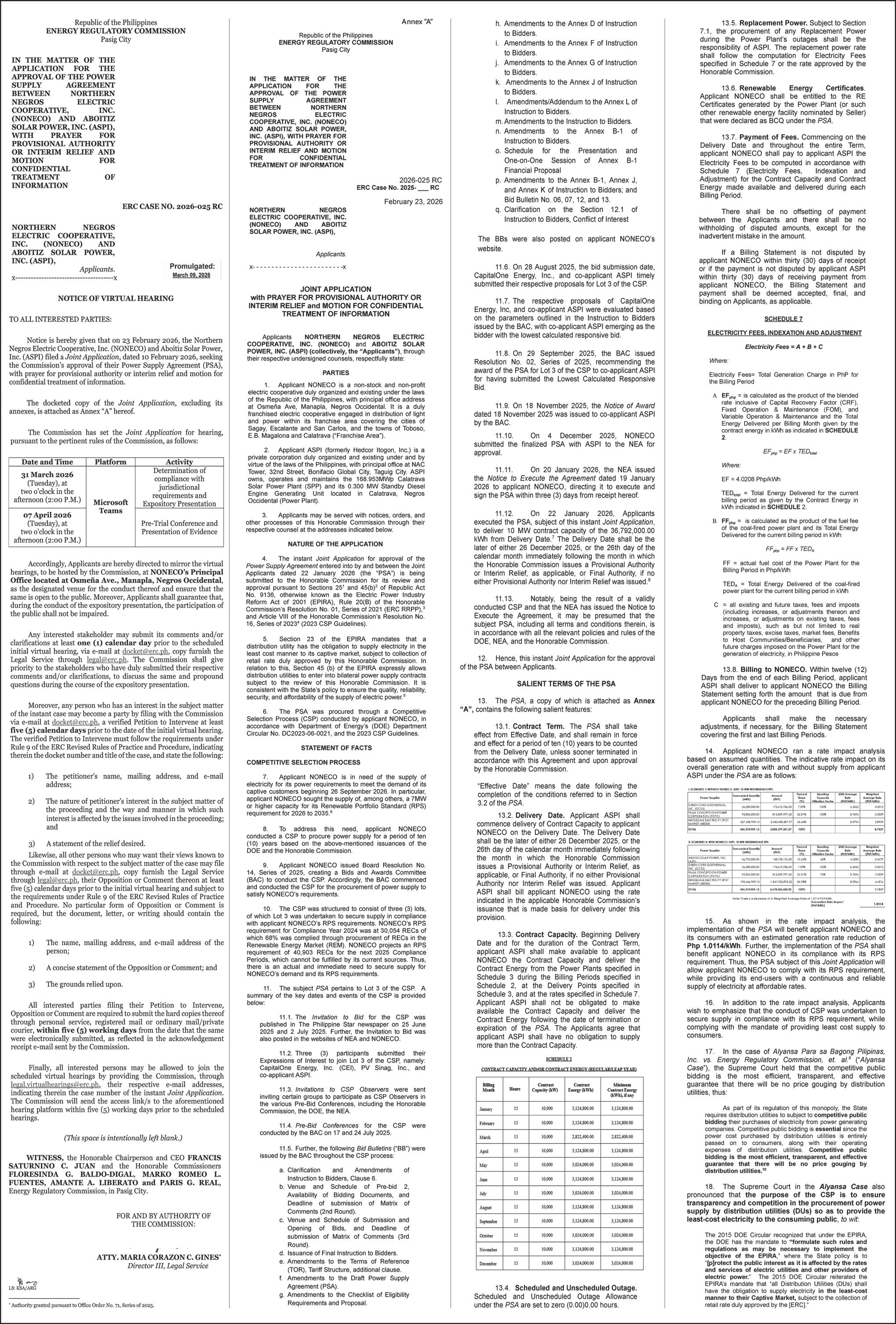
CRISIS WEAKENS PESO
THEPhilippine peso slumped to a new all-time low as it breached the 60-to-the-dollar level on Thursday due to escalating tensions in the Middle East which fueled the strength of the dollar as investors pour their assets into the “safe haven” currency.
Data from the Bankers’ Association of the Philippines (BAP) showed the peso closed at P60.10 per $1 on Thursday, 58 centavos weaker than its previous finish of P59.52 on Wednesday.
Analysts said the peso weakened on Thursday as global crude oil prices went up after Iran launched retaliatory attacks on some energy facilities across Middle East, including Qatar.
Jonathan L. Ravelas, senior adviser at Reyes Tacandong & Co. described the latest movement of the local currency as a “kneejerk reaction” to the retaliation by Iran.
“If this escalates, we could see it staying above 60,” he added.
Nearly three weeks into the Middle East conflict, analysts pointed out that some investors are becoming “risk-averse” as they become more prudent in handling their assets amid the uncertain global environment.
Philippine Institute for Development Studies (PIDS) Senior Research Fellow John Paolo Rivera told the BusinessMirror that the peso’s depreciation is “likely driven by a combination of strong dollar demand, elevated oil prices,
and global risk aversion.” Rivera noted that higher oil prices expand the Philippines’s import bill, raising demand for dollars, while geopolitical tensions push investors toward safe haven assets like the US dollar.
“This puts sustained pressure on emerging market currencies, like the Philippine peso,” he also told this newspaper. For his part, Rizal Commercial Banking Corporation (RCBC) chief economist Michael L. Ricafort said there is “some hedging amid geopolitical uncertainties as a matter of prudence.”
Meanwhile, Rivera said the strengthening of the greenback after the US Federal Reserve kept rates steady put pressure on the Philippine peso.
“Fed holding rates steady can still support dollar strength, especially if markets interpret it as a signal that US rates will remain higher for longer,” he added. He pointed out that this widens the interest rate differential with the Philippines and encourages capital to “stay in or flow back” to dollar assets, contributing to peso weakness.
By Reine Juvierre S. Alberto @reine_alberto
Tdigital interactive goods and service activities; advertising, research and development, and other artistic service activities; symbols and images and other related activities; media publishing and printing activities; music, arts and entertainment activities; visual arts activities; traditional cultural expression activities; and art galleries, museums, ballrooms, conventions
and trade shows, and related activities. Among these creative industries, symbols and images, and other related activities accounted for the largest share at P670.15 billion or 31.6 percent of the total gross value added of the creative economy in 2025. This was trailed by digital interactive goods and service activities with 19.7-percent share and advertising, research and development, and other artistic service activities with 15.9-percent share.
Meanwhile, employment in cre -
ative industries dropped to 8.71 million in 2025 from 8.74 million in 2024, posting an annual decline of 0.4 percent. The share of employment in creative industries to the total employment in the country was recorded at 17.8 percent in 2025. Of the creative industries, traditional cultural expression activities posted the highest share to the total employment in creative industries at 33.0 percent in 2025.
Symbols and images and other related activities contributed 27.1 percent, while advertising, re -
search and development, and other artistic service activities shared 23.7 percent. Furthermore, creative collective consumption rose by 2 percent to P16.49 billion in 2025 from P16.17 billion in 2024.
Exports of creative goods amounted to P320.06 billion, while exports of creative services stood at P426.99 billion in 2025. Meanwhile, imports of creative goods and imports of creative services reached P711.48 billion and P138.00 billion, respectively, in 2025.
By Samuel P. Medenilla @sam_medenilla
AS tensions in the Middle East continue to disrupt global petroleum supply chains, President Ferdinand Marcos Jr. wants the country to have sufficient raw materials to run its power plants for up to two to three months.
In an interview with reporters in Bataan on Thursday, the chief executive said he wants to increase the country’s stockpile of the said raw materials to last beyond just a month in case the conflict in the Middle East will last for months.
“We have already secured the Philippines’s stockpiles [of the said materials] abroad and we have given permission to bring them back so that we can use them to extend our stockpile from 30 days up to two to three months,” Marcos said, partly in Filipino.
Currently, the President said the country has sufficient supply of the materials, but added that they are still in talks with other friendly countries to acquire more, including coal.
He noted that while his administration is trying to move away from using coal-powered plants, it is considering the said facilities as possible power sources, amid the ongoing Middle East crisis. The armed conflict in the region started after the United States and Israel attacked Iran, which subsequently restricted the passage of ships in the Strait of Hormuz, an important waterway for the global oil supply chain.
The US initially estimated the conflict would last only for four to five weeks. However, some analysts warned that the tension in the region can last longer.
“We’ll open up again the importation...the buying of coal so that our power plants will not run out of power,” Marcos said.
In 2024, the Department of Energy reported that the country has 9 coal-fired power plants. To help reduce the country’s
By Andrea E. San Juan @andreasanjuan
What I really care about is how to bring those high-tech from China to Philippines such as the digital economy, green energy, solar, advanced agriculture...We want to share our technology with Philippines.”
Drawing from his 23 years of USChina diplomacy, Jing summarized his approach as “words for words, actions for actions, talk for talk, cooperation for cooperation.”
He vowed to push back against disinformation: “If you want to spread fake news, incite kind of hatred between the two peoples or avert confrontation between the two sides, we feel we have the responsibility to stand up firmly... clearly say no to that and push back.” Ultimately, Jing concluded: “Diplomacy, everything is based on reciprocity. You respect us, we respect you. You help us, we help you.”
To keep plane fares stable, DOTr to cut fees for carriers
By Samuel P. Medenilla @sam_medenilla
THE Department of Transportation (DOTr), through its attached agencies, will cut fees for air carriers and its passengers to keep the price of plane fares stable amid the ongoing Middle East crisis.
The agency made the announcement during President Ferdinand Marcos Jr’s meeting with members of the Private Sector Advisory Council (PSAC) from the air transport sector on Wednesday. It disclosed that the Civil Aviation
stable and don’t rise too much, we should be okay,” he said.
Recent developments suggest short-term price stability may hold.
Manufacturers have committed to keeping prices of essential goods unchanged for at least 30 days, with some pledging to extend this to 60 days, following a March 16 meeting convened by Trade Secretary Ma. Cristina Roque with producers of items such as canned goods, bread, bottled water, instant noodles and
Authority of the Philippines (CAAP) has approved the reduction of passenger service and airport navigation charges in government-operated airports.
“This will provide temporary cushioning for airlines and passengers as
other staples.
Yet, for Lim, it remains too early to determine worst-case scenarios, though companies have begun revisiting contingency plans as uncertainties persist.
“It’s hard to think right now about what the worst-case scenario might be...it’s still too early,” he said. Pro -
a result of a gradual increase in airfare prices and granting of temporary relief to businesses,” the Presidential Communications Office (PCO) said in a statement.
Another measure which is expected to keep the air fares stable, was the decision of the Civil Aeronautics Board (CAB) to adopt a 15-day airfare price monitoring and implementation cycle for the imposition of passenger and cargo fuel surcharges on domestic and international flights.
Both initiatives were in line with the directive made by Marcos on Monday to mitigate the impact of the Middle East armed conflict on air transport.
The conflict, which started after the United States and Israel attacked Iran, has resulted in a surge in global oil prices.
longed disruptions, he added, could eventually affect retail activity and consumer spending.
For now, he said, businesses are focusing on maintaining operations while preparing for possible shifts in demand and cost structures in the coming months.
New trade partners
MEANWHILE , ongoing global tensions may also push companies to explore new trade partners beyond traditional markets as part of their survival options, FPI’s Lee said.
On smuggling, she said higher import costs could make illicit trade more expensive, although risks remain if price gaps widen.
“When you have a large gap between the legitimate and the ones that is being smuggled, that gap actually is an incentive for smugglers to be coming in,” she said, noting that proposals to raise certain taxes should be studied carefully.
The House of Representatives on Wednesday agreed to adopt the Senate-approved measure authorizing President Ferdinand Marcos Jr. to temporarily lift excise taxes on fuel in times of
Marcos’ latest meeting with PSAC members aims to come out with other measures to address the “rising fuel costs and to ensure affordability, operational stability, and minimal disruption to mobility and supply chains.”
“President Marcos also underscored the administration’s commitment to work closely with the aviation sector in pursuing other measures to secure a steady supply of oil and fuel amidst global tightening and to cushion the impact of price increases to the traveling public,” PCO said.
Since the Philippines currently relies heavily on Middle East countries for its petroleum products, Marcos said his administration is now seeking alternative sources for the country’s fuel needs.
national or global economic crises, as Congress moved to expedite the bill’s passage after it was tagged as urgent by Malacañang.
Meanwhile, the peso weakened to a record P60.10 against the dollar on Thursday, reflecting global market movements amid geopolitical tensions. Per Lee, the depreciation was expected, as investors typically turn to the US dollar during periods of uncertainty. “No, not really worried. But, you know, that comes without saying because here, there’s this war that’s going on. So, that’s as expected,” she said.
In addition, businesses, for her, are preparing for continued volatility, with a stronger dollar increasing the cost of imported inputs and production.
“But, you know, with the stronger dollar, that’s where actually is part of the issue....The only thing now is for businesses and manufacturers actually to tighten their belts right now because that’s expected,” Lee said.
‘Prepare, not panic’ ACCORDING to former House Committee on Ways and Means chairman Joey Sarte Salceda, Filipinos must “prepare [and] not panic” after the local currency moved past the 60-level-to-the-dollar.
He cited the “structural features” of the Philippine economy that create “partial, automatic offsets,” the most important of which are remittances from overseas Filipino workers (OFWs).
“Overseas Filipino workers earn in foreign currencies and send them home. Every dollar remitted converts into more pesos than before,” Salceda said.
Citing data from the Bangko Sentral ng Pilipinas (BSP), Salceda said cash remittances grew 3.5 percent to $3.02 billion in January 2026 alone.
“The weaker peso contributed directly to that nominal increase,” he said.
Salceda said that while the Middle East hosts roughly 40 percent of all OFWs, the tail risks from the “conflict zone” is real, but manageable as long as “we do not see mass repatriations.”
Meanwhile, he also raised the importance of promoting local semiconductor and electronics, the country’s top commodity export.
“The same countercyclical logic applies to semiconductor and electronics exports, which are denominated in dollars. When the peso weakens, our peso-cost producers receive more pesos for every dollar of exported value,” Salceda said.
“With global semiconductor demand projected to expand this year, this is a moment to push harder on export promotion, not retreat,” he added.
Another policy response, he noted, is what he called the “most underexplored” which is inbound tourism.
push the current account deficit deeper into negative territory,” Capital Economics said.
Rivera explained to this newspaper that if the current account (CA) moves deeper into deficit, “It means the Philippines needs more foreign exchange to pay for imports than it earns from exports and other inflows.”
“That can put pressure on the peso, raise external financing needs, and make the economy more sensitive to shifts in investor sentiment and global rates,” added Rivera.
March inflation
MEANWHILE , when asked if there’s a possibility that the country’s headline inflation could breach the 4-percent level in March or the upper limit of BSP’s target band, experts shared mixed views, with their forecasts ranging from “will definitely breach 3 percent” to 4.2 percent.
Dumlao told this newspaper the Philippines’s headline inflation for March “will definitely breach 3 percent” while Ravelas said it could fall within the 3.6 percent to 4.2 percent band.
For Rivera, it’s possible for March inflation to breach 4 percent “but not yet the base case.”
“To jump to the upper end of target that quickly, oil price increases would need to be large,
sustained, and passed through broadly into transport, electricity, and food distribution,” the PIDS senior research fellow explained.
According to Rivera, what could temper the risk of inflation jumping to the upper end of the target are “still soft domestic demand, manageable inflation expectations, and any temporary government cushioning measures.”
He added that a fuel excise tax adjustment could help “at the margin, but it would not fully offset a prolonged global oil shock.”
Monetary policy path
AMID the conflict in the Middle East that began February 28, Rivera described the country’s monetary policy path as “more cautious and data-dependent,” while Ravelas said it is “likely unchanged unless inflation breaks the band.”
Despite this, Rivera said the central bank can still ease later in 2026 if inflation stays contained and growth remains soft.
“But the Middle East conflict and energy shock reduce room for aggressive cuts because they raise the risk of imported inflation and currency volatility,” added Rivera.
In short, he pointed out: “The easing cycle is not necessarily over, but the bar for additional cuts is now higher.”
“The Philippines closed 2025 with 6.48 million visitor arrivals, barely 0.76 percent above 2024—well short of targets. The DOT [Department of Tourism] has set a revised 6.7 million arrival goal for 2026. But the peso at 60 is now doing something no promotional campaign could: it is making the Philippines dramatically cheaper for every inbound traveler earning in a stronger currency. A Korean, Japanese, or European tourist gets roughly seven to eight percent more value for their money today than they did twelve months ago. That is a structural price discount that goes directly into their decision to book,” Salceda said. With the peso likely to test sixtytwo before it “stabilizes,” the lawmaker said: “That is not a catastrophe.” “The exchange rate simply adjusts to the facts on the ground. And we can either adjust our own strategies in light of this, or change the facts that the currency adjusts to,” he added.
dependence on fossil fuels such as coal, Marcos said the government will continue to push increasing the share of renewable energy, which includes solar power, in the country’s energy mix.
Earlier this month, Marcos approved Memorandum Circular No. 114, which aims to reduce the country’s energy consumption in anticipation of the impact of the Middle East crisis on fuel prices and supplies.
The issuance directed government agencies to reduce their electricity consumption and fuel costs by 10 to 20 percent.
www.businessmirror.com.ph
Sandiganbayan junks Jack Lam’s plea to junk bribery case
‘Sara skating on thin ice if she snubs impeach proceedings’
lenges before the Supreme Court.
TBy Joel R. San Juan @jrsanjuan1573
HE Sandiganbayan has junked the motion filed by Chinese gambling tycoon Jack Lam seeking the dismissal of the criminal complaint filed against him in connection with the P50 million bribery scandal involving two fraternity brothers of former President Rodrigo Duterte in 2016.
In a seven-page resolution, the Sandiganbayan Sixth Division also denied Lam’s plea to lift the hold departure order (HDO) issued against him, citing his failure to cite any valid ground in support of his request.
Lam has been charged with violation of Presidential Decree 46 before the Sandiganbayan for allegedly giving P50 million to former Immigration Deputy Commissioners Al Argosino and Michael Robles, through middleman Wenceslaso “Wally” Sombero Jr., in exchange for freeing over 1,300 undocumented Chinese workers at the Fontana Leisure Park and Casino in Clark Field, Pampanga.
PD No. 46 punishes “any public official or employee, whether of the national or local governments, to receive, directly or indirectly, and for private persons to give, or offer to give, any gift, present or other valuable thing on any occasion, including Christmas, when such gift, present or other
valuable thing is given by reason of his official position, regardless of whether or not the same is for past favor or favors or the giver hopes or expects to receive a favor or better treatment in the future from the public official or employee concerned in the discharge of his official functions.”
It also prohibits the throwing of parties or entertainments in honor of the official or employee or his immediate relatives.
In his motion to quash, Lam argued that the facts contained in the information do not constitute an offense and that the antigraft court has no jurisdiction over the case.
Lam said PD No. 46 covered only pubic officials and employees and not private individuals like him.
Furthermore, the gambling tycoon said the information failed to cite specific allegations as to his participation, except that the alleged money given to Argosino and Robles came from him although there was no evidence presented that would show that he transacted with the two former BI officials.
Lam also called as “capricious and whimsical exercise of jurisdiction” his inclusion as an accused in the bribery scandal and the issuance of an HDO against him despite the apparent lack of prima facie evidence with reasonable certainty of conviction.
See “Jack Lam,” A11
PHL’s vast territory requires large MRF fleet–Teodoro
ECRETARY of National Defense
SGilberto Teodoro said the Philippines’ vast territory requires it to have a large fleet of multi-role fighters (MRFs) to fully protect it from hostile intruders.
“May minimum impact quantity kung mag-order ka. Hindi naman puedeng umorder ka ngayon ng konti, susunod mo [pagkatapos] ng ilang taon, dahil ang presyo nung ay tritriple. May minimum force size nakailangan[There is a so-called minimum impact quantity needed if you are ordering such assets. You cannot contract for a few, and order again a few years later as the price for this kind of equipment will triple],” he said.
And for the Philippines, a minimum force requirement of 40 MRFs is needed, although Teodoro said the number is still small. Ang force size na hinihingi namin ay
40 pero kung titingnan niyo, maliit pa din iyon [The force size we are asking is 40 but if you look at it, it still small],” he said, noting that other countries have MRF force size orders ranging from 100 to 220 units.
Asked if he is okay with increasing this proposal to 75 MRFs, which is equivalent to an air wing, Teodoro said he is amenable to this.
Sana. Ang Thailand [umorder ng] 100, nagdagdag pa yata ng 50 [I hope so. Thailand, I think, ordered 100 and added another 50],” he said. Teodoro vowed to expedite the program if and when funding is approved and released for a “sufficient quantity” of MRFs.
Groups seek deeper probe of San Mateo garbageslide
TWO environmental advocacy groups called on authorities on Thursday to investigate the operations at the San Mateo Landfill in Rizal province and determine its compliance with environmental laws.
The call for an independent and transparent investigation was made by Buklod Tao Inc. and the EcoWaste Coalition, as it also awaits the result of the investigation on other landfill incidents. Specifically, the groups want the Department of Environment and Natural Resources (DENR) and the local govovernment of San Mateo, Rizal, to look into the compliance or non-compliance of the New San Mateo Landfill with the conditions, restrictions, and commitments as indicated on its Environmental Compliance Certificate (ECC).
Buklod Tao Inc. in a letter sent to San Mateo Mayor Bartolome Rivera Jr., sought an inquiry following reports that the landfill facility has expanded beyond its approved area of 401,478 square meters. Any expansion, the group insisted, must undergo Environmental Impact Assessment (EIA) and obtain approval from concerned agencies, including the DENR’s Environmental Management Bureau (DENREMB). Buklod Tao president Fe Doromal and
founder Noli Abinales signed the letter dated March 10, 2026. Aside from the alleged unauthorized expansion of the facility, Buklod Tao Inc. echoed the concerns raised by residents in adjacent communities, such as the strong foul odor, increase in flies and other pests, and possible seeping of leachate to the streams and water sources as a result of the landfill operations, which are also observed as getting closer to where people live.
The EcoWaste Coalition, which counts on Buklod Tao among its members, supports the following demands that uphold the people’s right to a clean, healthy, and sustainable environment:
n Conduct an independent inspection and analysis of the current area of operations of the said landfill;
n Investigate the landfill facility’s compliance with the terms and conditions of its ECC;
n Publicly disclose the findings to address the concerns of the residents; and to
n Strengthen the municipality’s ecological solid waste management program in line with the national policy.
By Jovee Marie N. dela Cruz @joveemarie
THE chairperson of the House of Representatives Committee on Justice on Thursday said Vice President
Sara Duterte’s absence from the next phase of impeachment proceedings could leave the allegations against her unchallenged and accelerate the case’s transmission to the Senate if no counter-evidence is presented.
Batangas Rep. Gerville Luistro said the panel’s finding that the third and fourth impeachment complaints were sufficient in grounds was largely due to the respondent’s failure to directly address the allegations.
She said that the process is crucial for Duterte, as it gives her camp the opportunity to respond to the charges before the case reaches the House plenary and possibly the Senate.
“If their position is not to participate, then that is tantamount to saying that this will be transmitted to the Senate because the complainant’s evidence remains unrebutted,” Luistro said in an interview.
“That’s why it’s important for the Vice President to avail [herself] of this opportunity during the hearing proper to present her evidence. Otherwise, the complainant’s evidence will appear unrebutted, unchallenged, and uncontested,” she added.
Luistro emphasized that attending the hearings remains Duterte’s choice but underscored that due process has been afforded.
DILG files charges vs 45 former, current BFP officials over firetruck deals
By Jonathan L. Mayuga @jonlmayuga
THE Department of the Interior and Local Government (DILG) is set to file charges at the Ombudsman against 45 current and former officials of the Bureau of Fire Protection (BFP) over the alleged anomalous procurement of firetrucks from 2018 to 2024.
The complaint identified former BFPchiefs Leonardo R. Bañago and Louie S. Puracan, as well as suspended Fire Director Jesus Fernandez, along with members of the Bids and Awards Committee, Technical Working Group, and Technical Specifications Committee, among the respondents.
See “MRF,” A4 See “DILG,” A4
The said officials were allegedly involved during the procurement cycles in question. Also implicated are private suppliers Palmer Asia Inc. and F. Cura Industries, along with other individuals who may have conspired in the alleged scheme.
According to the complaint, officials allegedly tailored technical specifications for firetrucks over several years to favor only two suppliers, effectively restricting competition. The case cites a sharp increase in the cost of 1,000-gallon firetrucks, from P5.975 million per unit in 2014 to nearly P15 million in 2024, despite the absence of any documented market study or justification.
The complaint further details serious lapses in the procurement process, including the absence of proper deliberations and official records, failure of oversight bodies to conduct an independent review of technical specifications, and pre-bid conferences that did not meaningfully address bidders’ queries or result in the issuance of required bid bulletins.
Findings from the Bureau of Customs also flagged the same suppliers for undervaluing import declarations by more than 30 percent and failing to present key financial documents during audit proceedings.
“What is important is that we are giving her the opportunity. Whether she attends or not is her decision. For the Justice Committee, what matters is that we have afforded her the right to due process,” she said.
She described the hearing proper as a “minitrial,” where both parties can present witnesses and evidence before the panel determines probable cause.
She likened the proceedings to a preliminary investigation in a criminal case, noting that lawyer participation is not yet encouraged at this stage.
“It is better for the Vice President to personally participate so she can present her evidence and witnesses. This will be considered in determining whether probable cause exists. How can she present evidence if she does not attend and lawyers are not yet allowed to actively participate?” Luistro said.
Unanswered
THE House Committee on Justice on Wednesday declared the impeachment complaints against Duterte sufficient in grounds after her response failed to directly address the allegations, effectively leaving them unchallenged, said Luistro. Luistro noted that during deliberations, several members observed the absence of a clear defense.
“From what I heard during the deliberations, there was no defense presented. The allegations of offenses were not answered. So for the members, the allegations in the complaint
stood because they were not questioned, rebutted, or addressed,” she said.
This prompted the complainants to waive their right to reply.
She added that Duterte’s response focused mainly on claims of due process violations and failure to state ultimate facts – issues she said fall outside the committee’s jurisdiction.
Despite the ongoing proceedings, Luistro clarified that the House panel is not acting as an impeachment court, noting that a full trial is the prerogative of the Senate.
The committee has scheduled the hearing proper on March 25, April 14, 22, and 29.
Careful handling
LUISTRO said adopting a “very conservative” and rules-based approach in handling the impeachment complaints ensures a thorough, fair process that can withstand legal scrutiny.
Luistro emphasized that the committee has been deliberate in strictly following impeachment rules, particularly after an earlier complaint in the 19th Congress was declared unconstitutional on technical grounds.
She said members are now exercising heightened caution in complying with every procedural requirement.
“And of course, the justice members now are very cautious. They are very cautious in complying with every step of the rules of impeachment of the House of Representatives,” Luistro said.
According to Luistro, the panel’s methodical approach is intended to avoid potential chal-
“That’s why I always say we have been very conservative in our approach in these impeachment complaints because we do not want to be a subject matter again of another petition possibility to declaration of unconstitutionality of any stage of the impeachment proceeding,” Luistro added.
Public airing
MANILA Rep. Joel Chua said the next House hearing could mark the first full public airing of initial evidence supporting the impeachment complaints.
Chua explained that the current process allows for the presentation and discussion of evidence even before the case reaches the Senate.
“At this stage, we are only determining probable cause. After establishing sufficiency in grounds, we will proceed with formal hearings on the scheduled dates,” Chua said. He noted that, unlike previous expectations that evidence would primarily be presented during a Senate trial, the House proceedings now provide an earlier venue to lay out the factual basis of the complaint.
“What we are doing here is essentially a recital of facts to establish that an offense may have been committed,” he said. Chua stressed that the proceedings are not yet a trial but a determination of whether there is sufficient basis for the case to move forward.
Marcos mulls govt spending boost
By Samuel P. Medenilla @sam_medenilla
TO keep the country’s economic growth target on track despite the Middle East crisis, President Marcos is eyeing to boost government spending on infrastructures and healthcare programs and minimize its energy expenses.
Marcos made the statement at the sidelines of the inspection of prefabricated classrooms, the presentation and turnover of learning resources, and observation of the implementation of the Yaman ng Kalusugan Program (Yakap) at Kalinga Caravan at the
Mariveles National High School - Cabcaben Annex in Mariveles, Bataan, on Thursday.
“We have to accelerate all of these [projects] because of the oil crisis that is happening—we are facing problems because of the war in the Middle East,” Marcos said partly in Filipino in an interview with reporters at the sidelines of the event.
Economists have warned that tighter credit, higher oil prices, and delays in government infrastructure spending can slowdown economic growth. The government reduced its infrastructure spending last year after it initiated a crackdown on anomalous flood control projects.
PHL-Canada relations reaches high point
By Rizal Raoul Reyes @brownindio
THE diplomatic relations between the Philippines and Canada recently reached a high point as Manila is now positioned as a “priority partner” in Ottawa’s newly unveiled strategy that would safeguard both national security and economic prosperity in the Indo-Pacific.
In a recent high-level strategic dialogue, defense and trade officials from both the Philippines and Canada detailed a “generational opportunity” to align Ottawa’s industrial capacity with Philippine national security especially amid the global uncertainties caused by the Middle East conflict.
Canada’s department of national defense policy officer Sara Schlemm said the country was moving toward a “build-partner-buy” framework led by the newly launched Defense Investment Agency (DIA).
Schlemm said the framework puts importance on domestic production alongside partnerships with trusted allies like the Philippines to reduce its vulnerabilities to international pressures.
“We see Canada’s defense industry as playing a powerful dual role in securing our nation while also acting as a very powerful catalyst for economic growth and jobs,” Schlemm said. “Crucially, we know that we cannot achieve these ends alone...the Philippines is one of Canada’s most important defense partners in the Indo-Pacific.”
“Where Canada lacks the capability to build domestically or where there is advantage to working jointly with partners, it will pursue partnerships with trusted partners and multinational firms to deliver the capabilities needed by the Canadian Armed Forces,” she added.
“As we seek greater opportunities for collaboration that will strengthen Canada’s security, we note that the Philippines is one of Canada’s most important defense partners in the Indo-Pacific and a stated priority partner for defense cooperation in the Indo-Pacific strategy.”
Schelmm said the Philippines and Canada could work closely on the Maritime Domain Awareness (MDA). Both nations, characterized by exceptionally long coastlines, are prioritizing the joint development of sensors, artificial intelligence (AI), and uncrewed autonomous systems.
Both Schlemm and Trade Undersecretary Ceferino Rodolfo noted that these priorities aligned perfectly with the Philippines’ upcoming 2026 Asean (Association of Southeast Asian Nation) chairmanship, which will focus on strengthening supply chain
security and integrating AI into national frameworks.
Furthemore, the signing of the Visiting Forces Agreement (VFA) between Canada and the Philippines in November 2025 also marked a historic turning point for the bilateral relationship.
Once brought into force, Schlemm said, the VFA will serve as the primary mechanism for requirements discovery, allowing both nations to better understand their respective armed forces’ future needs and co-develop capabilities accordingly.
In addition to maritime security, officials identified cyber defense as an “ample opportunity” for collaboration, ensuring that digital networks and the flow of capital remain resilient against international pressures.
Schlemm noted that Canada was currently developing AI as a sovereign capability with a rigorous focus on “protecting and growing Canadian intellectual property, as well as data,” and which could soon provide a framework for deeper collaboration with the Philippines.
Industry leader and Lambay Group CEO Tony Gaffney underscored the economic stakes of this digital alliance, stating that “digital resilience is a key neighbor of economic resilience” and that “AI trust” is the foundation of both.
Gaffney warned that the collective security of digital infrastructure, including power and networks, is only as strong as its weakest link, noting that if any element fails, “it obstructs resilience” for the entire nation.
From the Philippine perspective, Information and Communications Technology
Undersecretary Sarah Sison highlighted the practical steps needed to secure these networks, specifically requesting Canadian expertise in “advanced data center standards” to strengthen digital infrastructure supply chains.
Undersecretary Ceferino Rodolfo, meanwhile, called for the establishment of “tangible partnerships between our universities along the lines of AI and cyber security” within the next 12 months to ensure the next generation of workers can maintain and defend these strategic digital assets.
Stratbase Institute President Victor Andres Manhit said these strategic engagements were essential for the country’s long-term stability.
“Economic security is national security,” Manhit said. “As a geostrategic nation at the heart of the Indo-Pacific, we must strengthen our resilience through cooperation with likeminded partners like Canada.”
“By aligning our interests, we are not only protecting our vital sea lanes and digital infrastructure but also generating the highquality investments and jobs that will sustain
The Marcos administration has ramped up the completion of construction projects this year, which includes new classrooms. The President said he was pleased with the design and manufacturing method used for the new learning facilities in Bataan, which he said are built to be disaster-resilient.
Marcos said the new classrooms, which have a 20 year warranty, can withstand a Magnitude 8 earthquake, typhoons with 300 kilometers per hour winds.
“So, these [new classrooms] have better design and also faster to produce. That’s what we’re looking at now,” Marcos said in Filipino. He said the government is also expanding
its healthcare programs through the Yakap initiative, which brings free medical consultations and basic healthcare in public schools to make the services accessible to students, as well as, its teaching and nonteaching personnel.
As the government starts distributing cash aid to public utility vehicles drivers, who were affected by high pump prices, Marcos said the government is also trying to reduce its energy expenses.
Earlier this month, Malacañang issued Memorandum Circular 114, which directed government agencies to conserve and reduce electricity consumption and fuel costs by 10
to 20 percent and to prohibit non-essential government travel and activities.
Marcos reiterated the government is closely monitoring the impact of the Middle East crisis on the country’s fuel and food supplies.
“So far, our supplies and stockpiles of oil and food are sufficient. So we are just watching the price now,” he said.
He said the government is currently looking for other sources of petroleum products since the country currently relies on Middle East countries for its fuel supplies in case the armed conflict in the region will persist for months.
Envoy pitches PHL as potential manufacturing destination for China’s electric vehicle industry
BEIJING—Speaking at one of China’s biggest electric vehicle (EV) industry forum, Philippine Ambassador to China Jaime A. FlorCruz pitched the Philippines as an ideal partner and investment destination for Chinese EV companies.
“I invite Chinese EV companies to invest, manufacture, partner, and innovate in the Philippines,” he told the over 100 attendees of the China International New Energy Vehicle Technology, Parts, and Services Exhibition (CINEVE) 2026, one of China’s largest EV industry events, held at the New China International Exhibition Center in Beijing.
FlorCruz highlighted the Philippines’ growing vehicle market and its potential role in regional EV supply chains, noting opportunities for cooperation in vehicle assembly, battery technologies, EV components, and related supply-chain industries.
He cited the Philippines’ skilled, Englishproficient workforce, competitive operating
costs, and the growing industrial zones ready to host Chinese EV companies poised to go overseas.
He also credited the government’s strong support through tax incentives, duty-free importation, and streamlined investment policies and rules. “Our aim is to create an ecosystem conducive to partnerships and collaborations, so find your right partners and let us prosper together in the Philippines,” he said.
FlorCruz addressed industry leaders, manufacturers, and suppliers from across the EV value chain during the event’s New Energy Vehicle Supply Chain Conference and Overseas Development Forum.
On the sidelines of the exhibition, the Philippine Trade and Investment Center (PTIC) in Beijing organized the Philippines-China Business Cooperation Conference, which brought together Chinese companies active in EV manufacturing, batteries, and related
technologies. The Philippines also mounted a national booth at the exhibition, where representatives engaged with industry participants and promoted investment opportunities in the country’s emerging EV ecosystem.
The Philippine Embassy’s Economic and Trade Counsellor Glenn Peñaranda, speaking to a group of EV industry leaders, underscored strong domestic demand for vehicles and supportive government policies in the Philippines. He noted that growing interest from international manufacturers creates favorable conditions for greater participation in EV manufacturing and supply chains in the Philippines.
As the global transition toward cleaner mobility accelerates, he said, the Philippines continues to position itself as a promising partner for Chinese companies seeking to expand in Southeast Asia’s dynamic electric mobility market.
CV strengthens bid to be premier MICE hub
By Carmel Pedroza
CEBU CITY—Central Visayas is steadily carving out a reputation as one of Asia’s emerging hubs for Meetings, Incentives, Conventions and Events (MICE), fueled by strong collaboration between public and private stakeholders and a growing calendar of high-profile gatherings.
Gelena Asis-Dimpas, the officer-incharge regional director of the Department of Tourism Central Visayas (DOT-7), attributed the region’s upward trajectory to close cooperation across sectors.
“The private sector here is so remarkably involved in improving both infrastructure and systems and this energy propels us forward in MICE tourism,” Asis-Dimpas said.
Supporting these efforts is the Cebu MICE Alliance, which plays a central role in raising service standards and promoting the destination globally.
In partnership with the Cebu Chamber of Commerce and Industry, the alliance introduced the Cebu MICE Guide 2025—a comprehensive 200-page resource featuring around 300 venues, hotels and service providers catering to MICE and destination wedding markets—during the Asean (Association of Southeast Asian Nations) Tourism Forum (ATF) 2026. The guide is available in both print and digital formats.
Among the standout properties featured were Shangri-La Mactan Cebu and Bai Hotel in Cebu, along with The Bellevue Resort in Bohol.
These establishments were recognized at the Sixth Annual World MICE Awards as top MICE venues for the 2026–2028 period, underscoring the region’s growing credibility on the global stage.
Long dominated by regional heavyweights such as Singapore, Bangkok, Ho Chi Minh, Kuala Lumpur and Bali, the MICE landscape is beginning to shift as destinations like Cebu and Bohol build momentum through strategic initiatives, infrastructure development and aggressive event bidding.
At the start of 2026, Cebu hosted two major Asean gatherings: the Asean Foreign Ministers Retreat and the ATF.
Meanwhile, Panglao in Bohol welcomed delegates for the First Asean Senior Economic Officials’ Meeting, reinforcing Central Visayas’ capacity to stage high-level international events.
The region’s event pipeline remains robust.
Among the highlights are the 11th International Travel Festival held at the Waterfront Cebu City Hotel from March 13 to 15, and the Sports Tourism Forum Cebu at Nustar Resort Hotel on March 18.
Upcoming events include the Sinag Liga Asya (SLA) Junior World Showcase in
July, Build Better 2026 and the Bjorn Again ABBA Concert Tour in August, and the Asian Carriers Conference in September.
Tourism stakeholders are also actively pursuing bids for regional and global events slated for 2027 and 2028.
The Sports Tourism Forum aims to deepen understanding of how destinations can position themselves for sports-driven travel, while the SLA Junior World Showcase brings together top young Filipino basketball talents from around the world for competition and cultural reconnection.
Cebu’s competitive edge lies in its blend of heritage attractions, strong connectivity and expanding event infrastructure.
The Mactan-Cebu International Airport handles more than 300 international and over 1,000 domestic flights weekly, supporting the steady influx of delegates and visitors.
Complementing this is a workforce of more than 10,000 professionals trained in delivering the Filipino Brand of Service Excellence.
Bohol, on the other hand, leverages its distinction as the Philippines’ first Unesco (United Nations Educational, Scientific and Cultural Organization) Global Geopark, offering visitors a mix of natural wonders and community-based sustainability initiatives that appeal to both leisure and business travelers.
www.businessmirror.com.ph
Continued from A3
Republic Act 9003, or the Ecological Solid Waste Management Act, emphasizes waste prevention, volume and toxic reduction, segregation at source, recycling and composting over landfill disposal, the groups reminded.
Buklod Tao Inc. highlighted that practical, community-based solutions already exist. Drawing from over its three decades of experience, the group has promoted household and community-level composting systems that reduce methane emissions and landfill dependency.
In its letter to Mayor Buklod Tao Inc., conveyed its readiness to dialogue and collaborate with the municipal government in order to protect public health and the environment.
The EcoWaste Coalition and Buklod Tao Inc. strongly objected to reported plans to construct a Waste-to-Energy (WtE) incineration plant either in Montalban or San Mateo, noting that this could pose additional health and environmental problems to the people, while undermining the shift to people-centered zero waste solutions.
Jonathan L. Mayuga
DILG.
Continued from A3
The respondents are facing both administrative and criminal charges, including grave misconduct, serious dishonesty, gross neglect of duty, conduct prejudicial to the best interest of the service, and violation of Section 3(e) of Republic Act 3019 or the Anti-Graft and Corrupt Practices Act.
The DILG stressed that the case goes beyond procurement violations and speaks directly to the safety of Filipino communities.
“Hindi dapat nalalagay sa alanganin ang buhay ng ating mga kababayan dahil sa iregularidad. Every procurement must be aboveboard, transparent, and anchored on the public interest,” Interior Secretary Juanito Victor Remulla said.
The DILG, likewise, reaffirmed its commitment to strengthen internal controls and institutional safeguards across its attached agencies to prevent similar incidents and restore public trust in government systems.
Continued from A3
“Kung i-release sa akin iyong pera, mabilispaiyansaalas-kuwatro [If the funds are released, that will be done quickly],” he said.
Earlier, Teodoro said he wants the proposed MRF program to proceed as a full package with airborne warning and control system (Awacs) and aerial tankers for mid-air refueling platforms.
Having these platforms, he said, would ensure that the MRF program, once acquisition is completed, is “operational as a force package.”
Awacs are generally large aircraft fitted with airborne radars capable of early warning and detecting aircraft, ships, vehicles, and missiles at long range.
It is also used to direct friendly fighter and attack aircraft to specific targets and serve airborne radar pickets or surveillance assets. Aside from these aircraft, Teodoro said, the Philippines also needs tanker aircraft for its proposed MRFs for sustainment purposes, as this capability will extend the aircraft’s range.
Aerial tankers are large aircraft capable of transferring fuel to fighter and attack aircraft through a probe-and-drogue system. PNA
Legislators seek ban on reconnection fees
By Jovee Marie N. dela Cruz @joveemarie
LAWMAKERS on Thursday filed a measure seeking to prohibit the collection of reconnection fees for electricity, water, telecommunications, and internet services, amid rising costs of essential utilities driven by higher fuel prices.
NTF-ELCAC exec says Amnesty Program a success
ARANKING official of the Na-
tional Task Force to End Lo -
cal Communist Armed Conflict (NTF-ELCAC) on Thursday said the government’s Amnesty Program has emerged as a resounding success, with more than 16,000 former rebels stepping forward to reclaim peaceful lives—prompting authorities to push for its continuation for another two years, or until 2028, as more applicants are expected in the coming months.
NTF-ELCAC executive director
Undersecretary Ernesto Torres Jr., in a statement, said the overwhelming response to the program underscores a decisive shift on the ground, where former members of the Communist Party of the Philippines–New People’s Army–National Democratic Front (CPP-NPA-NDF) are choosing peace over armed struggle.
“The numbers speak for themselves. This is not failure—this is a quiet but decisive victory for peace,” Torres said, even as he dismissed claims by the CPP that the amnesty initiative is an “epic fail.”
He stressed that the Amnesty Program is voluntary and grounded in law, with no coercion involved.
“No one is forced to apply. They come forward on their own, acknowledge their past, and submit to a legitimate legal process. If this were truly a failure, there would be no applicants. Yet thousands have stepped forward nationwide,” he said.
Torres noted that the government has already received 16,003 applications, far exceeding the initial projection of 10,000. Of these, 13,633 were actual combatants and supporters of the armed struggle under the CPP-NPA-NDF.
For her part, National Amnesty Commission chairperson Atty. Leah Tanodra-Armamento affirmed that the surge in applications reflects growing trust in the process, as former rebels realize they can pursue their advocacies without violence and without endangering their families.
“We received a total of 16,003 applications—far exceeding expectations. This shows that more and more are choosing peace and lawful engagement over armed struggle,” Armamento said.
Amid the surge in applications, Armamento disclosed that an extension of the amnesty period—originally set to lapse under Executive Order No. 47—is now in motion, with a recommendation from the Executive Committee, NTF-ELCAC and awaiting the President’s approval and signature.
“We are inviting everyone—even though the application period was supposed to have ended, we now have a recommendation for extension which is awaiting the President’s signature,” she said.
The extension will cover another two years, up to 2028, through another proclamation aligned with the end of President Ferdinand Marcos Jr.’s term, ensuring continuity without the need for a yearly congressional concurrence.
“In the meantime, we continue to accept applications and mark them as provisionally accepted,” Armamento added.
The NAC chief also highlighted the government’s “Aftercare for Grantees of Amnesty” program, which provides a comprehensive pathway for reintegration, including the dismissal of pending cases and the clearing of records from the National Bureau of Investigation and the Philippine National Police.
“This is not just amnesty—it is a real second chance,” she said. “We are removing the fear, restoring dignity, and allowing them to live normal lives in their communities.” Armamento noted that the program has already uncovered cases where applicants had multiple pending charges they were unaware of—one even having as many as 80—which are now being addressed through government support mechanisms. Rex Anthony Naval
DBM: Agencies limited to 5 priority proposals for 2027 budget amid tight fiscal space
By Reine Juvierre S. Alberto @reine_alberto
THE Department of Budget and Management (DBM) has instructed government agencies to limit their Tier 2 budget proposals to a maximum of five, due to the tight fiscal space for 2027.
Acting Budget Secretary Rolando U. Toledo issued a memo directing all departments, agencies and other entities to submit
their Tier 2 budget proposals on or before April 24, 2026.
During the Tier 2 phase of budget preparation, the resources available in the fiscal space are allocated to address the government’s priority new activities or to scale up existing activities.
Under this stage, agencies must submit their proposals for new or expanded programs, activities and projects, which are aligned with the priorities of the current administration, implementation-
ready and focused on high-impact sectors.
Agencies are also asked to limit their proposals to a maximum of five and prioritize them, given the limited fiscal space.
The DBM will also consider the absorptive capacity of agencies, as well as the order of prioritization of their budget proposals by straight ranking.
Moreover, the Tier 2 budget proposals must include supporting documents, such as feasibility
MRT-3, LRT-2 to offer 50% discount to all passengers starting March 23
By Lorenz S. Marasigan @lorenzmarasigan
THE Department of Transportation (DOTr) will implement a 50-percent fare discount for all passengers of the Metro Rail Transit Line 3 (MRT 3) and Light Rail Transit Line 2 (LRT 2) beginning Monday, March 23.
Transportation Secretary Giovanni “Banoy” Lopez said the fare reduction aims to cushion the effects of the rising fuel costs, en -
couraging car owners to use public transport to save on petrol.
“The government is doing everything to ease the hardships of Filipinos amid the turmoil in the Middle East. Continuous travel and cheaper fares are our priority, which is why we are giving a 50-percent discount on MRT 3 and LRT 2 for everyone,” Lopez said.
The existing 50-percent discount for holders of white beep cards — covering senior citizens,
studies, detailed engineering designs, annual procurement plans, computation of the proposed amount, cost-benefit analysis, detailed work and financial plans and right-of-way acquisitions, among others.
“As the country is nearing the final phase of implementing the [Philippine Development Plan] 2023-2028, the Marcos Jr. Administration shall focus resources on strategic sectors to achieve social and economic transformation—
building a prosperous, inclusive, and resilient Philippines,” the DBM said. These priorities should be in human capital development; such as in education, health, social protection, jobs; food security; infrastructure; digitalization; and climate and disaster resilience.
Based on the government’s budget documents, the 2027 national expenditure program is set
by
Arenas, Frasco, Benitez named as new House deputy speakers
Tpersons with disabilities (PWDs), and students — remains in effect.
Regular passengers may use blue beep cards to automatically avail of the discount, while those without beep cards may purchase single-journey tickets also priced at half the standard fare.
The DOTr is separately in talks with the management of LRT Line 1 on extending a similar discounted fare scheme to that line. LRT 1 is operated by private concessionaire Light Rail Manila Corp.
House panel OKs bill modernizing Philippine civil registry system
By Jovee Marie N. Dela Cruz @joveemarie
THE House Committee on Population and Family Relations has approved
a substitute bill aimed at modernizing the country’s civil registry system, in a move seen to address long-standing deficiencies in the registration of births and deaths affecting millions of Filipinos.
The panel consolidated more than 29 measures, including House Bill 5213 principally authored by Leyte 1st District Rep. Ferdinand Martin Romualdez, along with TINGOG Party-list Reps. Yedda Marie Romualdez, Andrew Julian Romualdez, and Jude Acidre.
The proposed Philippine Civil Registry Act seeks to amend Republic Act No. 3753, a decades-old measure governing the registration of vital events such as births,
TO fast-track water infrastructure in underserved provinces, the Department of Environment and Natural Resources (DENR), through its Water Resources Management Office (WRMO), will cut the red tape across the agency’s regulatory framework, Secretary Juan Miguel Cuna announced.
The Department has empowered its regional offices to function as “permitting accelerators” and is establishing One-Stop Kiosks to allow communities to track their applications and access technical data with greater transparency.
Created under President Ferdinand Marcos Jr’s Executive Order No. 22, signed in April 2023, the WRMO harmonizes the fragmented water management across various agencies, including the National Water Resources Board (NWRB), Metropolitan Waterworks and Sewerage System (MWSS), Local Water Utilities Administration (LWUA), and Laguna Lake Development Authority (LLDA). The WRMO exercises administrative oversight over these water agencies.
System check, water bankruptcy SPEAKING at the 2026 World Water Day
marriages, and deaths.
Under the substitute bill, key reforms include streamlining late and delayed registration, enhancing inter-agency data sharing, and accelerating the digitalization of civil registry processes—particularly to improve access in geographically isolated and disadvantaged areas.
The measure is part of the priority agenda of the Legislative-Executive Development Advisory Council under the administration of Ferdinand Marcos Jr.
TINGOG Rep. Acidre, vice chairperson of the committee, said the approval marks a significant step toward closing persistent gaps in civil registration.
“For many Filipinos, the challenge is not just access to services, but access to recognition,” Acidre said.
He noted that incomplete and delayed registration continues to limit access to edu -
event, Secretary Cuna described the current state of water resources as a “system check” for the nation.
“Look at your kitchen tap: does it have the steady pressure of a reliable machine, or is it showing the signs of a failing system?”
Cuna asked, noting that the country is facing “water bankruptcy”—a structural imbalance where consumption outpaces natural replenishment.
To reverse this, the DENR-WRMO is executing the final phase of a P485-million roadmap.
Retooling the Infrastructure Pipeline for 2026
THE 2026 tactical roadmap focuses on deploying high-performance systems to 59 additional barangays in water-stressed regions, including Bohol, Palawan, Cebu, and Masbate. Key components of this engineering push include:
Water Filtration Expansion: The WRMO will install desalination and freshwater filtration systems in 59 target sites to provide potable water at costs reduced to P20–25 per container, down from the previous P50–70
Water District Support: The agency has proposed financial assistance for 13 addi -
cation, healthcare, and social protection, particularly in underserved communities.
“This is where policy must meet lived experience. We are not just updating a law—we are correcting a system that, for too long, has left some Filipinos unseen and underserved,” he said.
Acidre emphasized that a reliable civil registry system is crucial to improving governance and service delivery.
“Good policy begins with good data, and good data begins with complete and accurate registration. If we want the government to respond effectively, we must ensure that no Filipino is left behind—that every Filipino is counted and recognized,” he said.
The committee-approved measure will be prepared for a committee report and elevated for plenary deliberations when session resumes in May.
tional Water Districts to extend service grids into unserved outskirt barangays.
Furthermore, 25 target sites are slated for new water refilling equipment to provide drinking water at a fixed price of P16 per container.
Alternative Source Development: By December 2026, the DENR will complete eight major infiltration gallery projects. These systems utilize hyporheic flow—the subsurface movement of rivers—to provide a naturally filtered, climate-resilient water source in provinces like Occidental Mindoro and Ilocos Norte.
Upland Resilienc e: Systems in 11 additional barangay sites across Kalinga, Benguet, and Sarangani will be completed, with 2026 installations integrating a micro-hydropower component to provide simultaneous water and energy solutions.
Precision and technical governance
THE DENR is currently conducting georesistivity surveys across 28 priority sites to identify viable groundwater resources before any drilling begins, a process Cuna says “reduces uncertainty and minimizes potential risks.”
See “DENR,” A13
HE House of Representatives has elected three new deputy speakers, further strengthening its leadership lineup.
Named to the posts last Wednesday were Pangasinan Rep. Maria Rachel Arenas, Cebu Rep. Vincent Franco “Duke” Frasco, and Bacolod Rep. Alfredo “Albee” Benitez.
Deputy speakers are among the highestranking officials of the chamber, tasked with presiding over plenary sessions in the absence of the Speaker. South Cotabato Rep. Ferdinand Hernandez currently serves as senior deputy speaker.
Aside from steering deliberations, deputy speakers also help monitor, coordinate, and facilitate action on legislative measures, as well as address the requests and concerns of fellow lawmakers from their respective constituencies.
Under the leadership of Speaker Faustino “Bojie” Dy III, the House has maintained strong legislative momentum, approving on third and final reading 17 out of 52 priority measures identified by the LegislativeExecutive Development Advisory Council (LEDAC) prior to the break.
Among the key measures passed were House Bill (HB) 8418, which seeks to authorize the President to suspend excise taxes on oil products during emergencies; HB 8477, or the Presidential Merit Scholarship Program Act; HB 8468, which aims to institutionalize digital payments in government
transactions; and HB 8389, or the proposed Anti-Political Dynasty Act, among others. The House is set to resume session on May 4, 2026.
For his part, Benitez expressed gratitude to Dy for the trust and vowed to uphold his new role with integrity and commitment.
“I sincerely thank Speaker Faustino ‘Bojie’ Dy III for his trust in my ability and passion to serve. I accept this appointment with humility and a deep sense of responsibility—not only to the House, but also to the people of Bacolod who have entrusted me with the privilege to represent them,” Benitez said. He emphasized that his appointment serves both as a mandate to continue delivering for Bacolod and an opportunity to contribute more meaningfully to nationbuilding.
“As I serve in this expanded capacity, I remain firmly committed to ensuring that the needs of Bacolodnons are addressed, while helping shape policies that uplift communities across the Visayas and the entire country,” he added. Benitez also assured that he would work to strengthen cooperation within the chamber and help restore public trust in the institution.
“I will do my utmost to make the House of Representatives a strong and reliable partner in our shared aspirations for inclusive and sustained progress,” he said. Jovee Marie N. Dela Cruz
CBy Henry Empeño
LARK FREEPORT The Subic–Clark Alliance for Development (SCAD) in collaboration with the Securities and Exchange Commission (SEC) extension office in Tarlac has opened a SCAD-SEC Help Desk here to bring services closer to businesses and investors in the Subic-Clark economic corridor.
Located at the BCDA Corporate Center, One West Aeropark, Clark Freeport Zone, the help desk serves as a convenient channel for businesses seeking assistance on SEC registrations, compliance requirements, and other corporate regulatory concerns.
SCAD Executive Director Atty. Carminda Z. Fabros said in a statement that the initiative embodies the shared commitment of the two agencies to advance ease of doing business, improve access to regulatory support, and foster the continued growth and development of enterprises.
“The collaboration between the SEC and SCAD was conceptualized to provide information and assist businesses, with the mutual aim of boosting investor confidence and accelerating investments across the Subic–Clark economic corridor,” Fabros added.
Launched last March 11, the SCAD-SEC Help Desk makes it easier for corporations to comply with regulatory requirements and access timely assistance, said SEC Tarlac
Director Richard R. Laus.
“Through this partnership with SCAD, we aim to enhance efficiency, strengthen investor confidence, and support the continued growth of businesses in the region,” Laus said, emphasizing the importance of improving service delivery and strengthening investor confidence in the Subic-Clark area.
Fabros said SCAD Legal Counsel Atty. Aliw V. Del Rosario has outlined the processes for inquiries, assistance requests, and coordination with the SEC, as well as the support services available to locators and stakeholders during the March 11 launch. The launch was attended by representatives of the American Chamber of Commerce of the Philippines, Inc. (AmCham)-North Luzon, Freeport Area of Bataan Investors and Locators Association, Inc. (FABILA), and Clark Investors and Locators Association (CILA). Participants from the Subic Bay Freeport Chamber of Commerce, the Department of Trade and Industry’s Foreign Trade Service Corps, as well as Subic and Clark locator companies also joined the launching via Zoom. Locators and stakeholders may visit the SCAD–SEC Help Desk at the SCAD Office, G/F, Bldg. 2519-A, Samat St., Phil. Cyber Technopark Complex, Clark Freeport Zone, or contact the office through 0945-395-2983
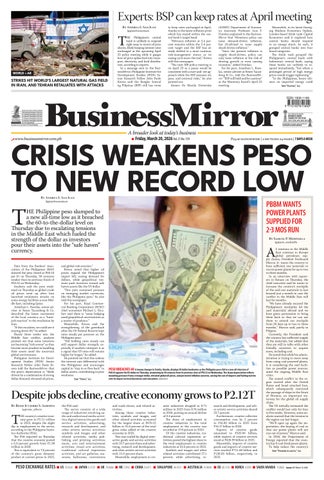
Strikes hit world’s largest natural gas field in Iran, and Tehran retaliates with attacks
By Jon Gambrell, Sam Metz & Julie Watson The Associated Press
DUBAI, United Arab Emirates—Iran broadened its strikes on major energy facilities in the Middle East, eliciting strong warnings Thursday from Gulf Arab states that called it a dangerous escalation that threatened to draw them into direct combat with Tehran.
The strikes come after Israel killed Iran’s intelligence minister and reportedly attacked the world’s largest natural gas field in Iran as the war escalated pressure on the region’s economic lifeblood: energy.
Qatar, Saudi Arabia and the United Arab Emirates all denounced the Iranian attacks targeting their natural gas fields, with Saudi Arabia’s top diplomat saying assaults on the kingdom meant “what little trust there was before has completely been shattered.”
It remains unclear what steps the Gulf Arab states might take militarily as they’ve sought not to enter combat alongside the United States and Israel in the war, now in its third week. While Israel did not claim the South Pars gas field attack, Defense Minister Israel Katz promised more “surprises” after saying it killed Iran’s intelligence minister, Esmail Khatib, in an earlier airstrike as it works to decapitate the leadership of Tehran’s theocracy.
Iran condemned the strike on South Pars, with Iranian President Masoud Pezeshkian warning of “uncontrollable consequences” that “could engulf the entire world.”
In Washington, President Donald Trump said that Israel would not attack South Pars again, but warned on social media that if Iran continued striking Qatar’s energy infrastructure, the US would retaliate and “massively blow up the entirety” of the field.
“I do not want to authorize this level of violence and destruction because of the long-term implications that it will have on the future of Iran,” Trump said on social media. Oil prices surge amid attacks on major energy supplies
THE United States was informed about Israel’s plans to strike Iran’s massive South Pars natural gas field, but did not take part in it, according to a person familiar with the matter. The person, who was not authorized to comment publicly and spoke on condition of anonymity, would not say if the Trump administration agreed with the Israeli decision to at -
tack the gas field—part of the world’s largest such resource and a pillar of Iran’s energy supplies.
Iran escalated strikes on its Persian Gulf neighbors’ energy facilities, hitting gas facilities in Qatar after Israel launched the attack against the South Pars offshore natural gas field it shares with Doha. Qatar in response ordered Iranian Embassy officials to leave the country within 24 hours.
Tehran also struck the Habshan gas facility and Bab field in the United Arab Emirates, which the government there called a “dangerous escalation” in the Islamic Republic’s war against Israel and the United States. Authorities in Abu Dhabi say the gas operations had been shut down after interceptions over the sites.
The attacks on Qatar and the United Arab Emirates are ratcheting up pressure on the Gulf Arab states, which have been defending against Iranian attacks since the war began on Feb. 28 but haven’t taken any offensive action against Iran as their military bases, civilian sites and energy operations have come under attack.
The price of oil surged another 5% to over $108 a barrel on international markets as Iran continued to squeeze the Strait of Hormuz shipping channel—through which one-fifth of the world’s oil travels.
As the Trump administration looks for ways to boost oil supplies, the Treasury Department eased sanctions on Venezuela Wednesday, saying US companies will be allowed to do business with the country’s stateowned oil and gas company.
A day earlier, Israel killed top Iranian security official Ali Larijani and the head of the paramilitary Revolutionary Guard’s Basij force, Gen. Gholam Reza Soleimani.
Iran retaliated by unleashing missile strikes against Israel. Israel said an Iranian missile hit the occupied
BBy Elaine Kurtenbach & David Mchugh AP Business Writers
ANGKOK—Global oil and natural gas prices soared Thursday after Iran attacked a key natural gas facility in Qatar that can supply one-fifth of the worlds gas as well as two oil refineries in Kuwait.
The attacks added to fears the energy crisis triggered by the closure of the Strait of Hormuz to tanker traffic may be longer and more extensive than feared, with lasting damage to oil and gas production. Brent crude, the international benchmark, rose to $116.38 per barrel, up from under $73 per barrel on the eve of the war.
The European TTF benchmark for natural gas prices traded 24% higher on Thursday.
The Iranian attack hit the Ras Laffan terminal for shipping out liquefied natural gas in Qatar. Qatar normally supplies some 20% of the world’s consumption of LNG, which can be carried by ship. The facility shut down after a drone attack. The closure of the Strait of Hormuz to most tanker traffic also left the gas with nowhere to go.
If the disruptions from Iran’s attacks on its Gulf Arab neighbors’ energy infrastructure keep oil and gas prices high for long, they could create a debilitating wave of
inflation for the global economy.
US benchmark crude oil gained 1.1% to $96.45 a barrel early Thursday, while the Henry Hub future contract, the benchmark for US natural gas, gained 5.1%. As oil and gas prices spiked, world shares retreated and US futures edged 0.2% lower.
Germany’s DAX lost 2.1% to 23,015.40 and the CAC 40 in Paris fell 1.5% to 7,848.88. Britain’s FTSE 100 shed 1.7% to 10,134.02. In Asian share trading, Tokyo’s Nikkei 225 fell 3.4% to 53,372.53 as the Bank of Japan opted to keep its benchmark interest rate on hold at 0.75%, citing the war with Iran as one factor.
In its monetary policy statement, the BOJ said that “in the wake of increased tension in the Middle East, global financial and capital markets have been volatile and crude oil prices have risen significantly; future developments warrant attention.”
Higher oil prices are a heavy burden for Japan, which like South Korea and Taiwan depends on imports of most raw materials for industries that rely heavily on oil and its derivatives. The Kospi in Seoul lost 2.7% to 5,763.22.
In Hong Kong, the Hang Seng slipped 2% to 25,500.58, while the Shanghai Composite index shed 1.4% to 4,006.55. Australia’s S&P/ASX 200 lost 1.7% to 8,497.80 and Taiwan’s Taiex fell 1.9%.
West Bank, marking the territory’s first fatalities during the Iran war, though missile debris has damaged homes and businesses.
Iran also attacked Saudi Arabia’s vast Eastern Province, home to many of its oil fields, as well as Kuwait, Bahrain and the United Arab Emirates.
First fatalities reported in West Bank during Iran war THE Palestinian Red Crescent said at least three people were killed in the occupied West Bank town of Beit Awa as Iran fired missiles toward Israel. At least 13 others were injured. Earlier authorities said at least four people had died, but they adjusted the number as crew assessed the scene. The Israeli military told The Associated Press an Iranian missile — not shrapnel from an interception — hit in the West Bank. Officials described it as a cluster munition that got past Israel’s air defense system. Gulf countries’ oil facilities take more hits QATAR Energy said on X that a missile hit its massive Ras Laffan liquefied natural gas facility, sparking a fire that caused “extensive” damage before it was extinguished. The company had already halted production there because of Iranian attacks.
The company warned Thursday that additional Iranian missile attacks damaged more liquefied natural gas sites in the energy-rich nation, “causing sizable fires and extensive further damage” but no injuries and crews were battling the blazes. An attack set a ship ablaze early Thursday off the coast of the United Arab Emirates, authorities said. The British military’s United Kingdom Maritime Trade Operations center said that “a vessel has been hit by an unknown projectile, which has resulted in a fire onboard.”
See “Tehran,” A11
In India, which has also suffered from shocks to supplies of oil and gas, the Sensex lost 2.7%.
“The combination of higher oil, rising US yields, and a stronger dollar is acting as a macro wrecking ball across Asian assets and currencies,” Stephen Innes of SPI Asset Management said in a commentary.
Editor: Angel R. Calso
Japan Prime Minister Takaichi meets with Trump as he seeks help securing the Strait of Hormuz
By Michelle L. Price & Didi Tang The Associated Press
WASHINGTON—The meeting that Japanese Prime Minister Sanae Takaichi will have at the White House on Thursday originally seemed like a prime opportunity to have President Donald Trump’s ear before he embarked on a trip to China.
But now, the war in Iran and Trump’s unsuccessful call for Japan and other nations to help protect the Strait of Hormuz means the China trip has been delayed and Takaichi may be likely to get an earful.
Trump has repeatedly complained on camera and online that US allies, including Japan, have rejected his request to help safeguard the critical waterway for oil and gas transport.
“In fact, speaking as President of the United States of America, by far the Most Powerful Country Anywhere in the World, WE DO NOT NEED THE HELP OF ANYONE!” Trump exclaimed on Truth Social after his initial call for help was rebuffed.
The prime minister acknowledged before she left Japan that she expects her meeting with Trump will be “very difficult.” She and her ministers have denied that Washington officially requested Japanese warships for the USIsraeli operation.
Japan, a key US ally in Asia, is one of the countries that Trump namechecked on Tuesday as he railed against the lack of help with the Strait of Hormuz before declaring the help wasn’t needed.
Trump is expected to put “enormous pressure” on Takaichi, said Kurt Camp -
bell, the former US deputy secretary of state in the Biden administration who is now chair of The Asia Group.
Campbell said he’s never seen a meeting between US and Japanese leaders carrying such high stakes. In order to press for Japan’s interests, he said, Takaichi will want to find a way to suggest that Japan is a part of the US plan in the Middle East.
“She’s going to want to come out of that as a partner in this case and realize that if she can do that, that she can translate that potentially into the president listening more to Japanese concerns about Taiwan or other issues,” Campbell said.
The constraints on Japan’s involvement in Iran include a provision in its post-World War II constitution that bans the use of force except to defend its territory. The country’s military is called the Self-Defense Force.
Christopher Johnstone, a partner and chair of the defense and national security practice at The Asia Group, said Japan could help with minesweeping, and has had “a small naval presence” in the region as part of an anti-piracy mission for at least a decade. But to join the US mission would require Takaichi to clear “an exceptionally high bar politically to invoke
collective self-defense” that has never been done before.
Takaichi wanted to focus on trade and security in the Indo-Pacific region
TAKAICHI , who had her first meeting with Trump in October in Tokyo, is Japan’s first female prime minister and a protégé of former leader Shinzo Abe, who developed a close relationship with Trump. She is also a hardline conservative and longtime supporter of Taiwan whose comments about Japan’s willingness to provide military support to the island have heightened tensions with China.
Ahead of her meeting with Trump, Takaichi had sought to focus on trade, strengthening the US-Japan relationship and security concerns. Japanese officials said the two sides would work to deepen cooperation in regional security, critical minerals, energy and dealing with China.
China views self-governed Taiwan, which the US relies on for its production of computer chips, as its sovereign territory and has said it would take it
by force if needed.
But beyond questions about helping with the Strait of Hormuz, the global implications of the Iran war have also put the Japanese leader in a tougher spot with Trump as she seeks to ensure US commitment to the IndoPacific region.
Japan considers China a growing security threat and has pushed a military buildup on southwestern islands near the East China Sea. But the US has shifted some troops stationed in Japan to the Middle East, removing a check against China’s power.
Takaichi is expected to raise concerns about troop shifts with Trump because they are coming at the same time China is launching a large number of exercises around Taiwan.
“This raises the prospect that— once again—the United States will be distracted and bogged down in the Middle East at a time when the deterrence problem in East Asia has never been greater,” Johnstone said.
Associated Press writer Mari Yamaguchi in Tokyo contributed to this report.
Concern, anger and hope simmer in Cuba after Trump calls for ‘imminent action’ against govt
By Milexsy Durán The Associated Press
HAVANA—A mix of uncertainty, anger and hope simmered in Cuba on Wednesday following comments by US President Donald Trump this week saying that Washington could take “imminent action” against the island’s government.
Trump, whose government has come at its Caribbean adversary more aggressively than any US government in recent history, has effectively cut Cuba off from key oil shipments in an effort to force regime change. The blockade has had devastating effects on the civilians Trump and Secretary of State Marco Rubio say they want to help, leaving many desperate.
Island-wide blackouts have roiled Cubans already grappling with years of crisis, and lack of gasoline and basic resources has crippled hospital and slashed public transport.
Matilde Visoso, a single mother caring for a sick daughter, said she’s been left reeling by the island’s spiraling crisis, and wants change in the Caribbean nation.
“Cuba is waiting for Trump and Marco Rubio, because we can’t wait any longer. It’s too much—there is a lot of repression, there is a lot of hunger,” the 64-year-old homemaker said. “Cuba is in tears.”
Political tensions soar between US and Cuba
TRUMP has said he can do “whatever he wants” with Cuba. The administration is looking for President Miguel Díaz-Canel to leave as the US continues negotiating with the Cuban government, according to a US official and a source with knowledge of talks between Washington and Havana. They spoke on condition of anonymity because they weren’t authorized to discuss sensitive talks.
No details have been offered about
who the administration might like to see in power.
US Secretary of State Marco Rubio also said the Cuban government’s socialist economic model needs to “change dramatically.” While the Cuban government places heavy restrictions on the country’s private sector, decades of US sanctions have crippled Cuba’s economy.
The administration’s pressure on Cuba came more than two months after his administration’s military raid that captured then Venezuelan President Nicolás Maduro in January, and a few weeks after the launch of joint US-Israeli military strikes against Iran on Feb. 28.
Díaz-Canel lashed back at Trump’s comments late Tuesday night, writing on a post on X that the Trump administration “publicly threatens” Cuba’s government almost daily with overthrowing it, and any act of aggression “will clash with an impregnable resistance.”
The Cuban government also sharply criticized Costa Rica’s decision to close its embassy in Cuba on Wednesday, saying in a statement it was an “arbitrary decision” made under pressure by the US in an effort to isolate the island.
‘No one knows what is going to happen’
OTHERS like 62-year-old doctor Jesús García cast doubt that the Trump administration would remove Díaz-Canel from power or intervene in Cuba, rolling his eyes at Trump comments.
“Americans can say whatever they want. The ones who decide what is done here in Cuba are the Cuban people,” García said.
What seemed to connect pretty much everyone in Cuba was a deep sense of uncertainty in the face of seismic shifts. Cubans have grown accustomed to endemic crisis on the island, and drawing up new ways to adapt to ever-shifting challenges. But many say things have reached a break-
ing point and are demanding answers from a government increasingly backed into a corner.
One small relief has been aid shipments from activist groups and allied governments like Mexico. Overnight, five tons of medical equipment, solar panels and other aid arrived to the island, according to Cuban state television. But such shipments are only a fraction of what is needed and don’t solve the country’s wider struggle to keep the lights on.
María del Carmen Companioni, 51, said in the face of a political back and forth between the two government, regular Cubans like her are left struggling with the soaring prices and no clear pathway forward.
“Really, all of this has people very alarmed and in a bad state. No one knows what is going to happen,” she said.
Seung Min Kim, Aamer Madhani and Will Weissert contributed to this report from Washington.
European Union summit will focus on Iran war and Ukraine loan blocked by Hungary
By Sam Mcneil & Lorne Cook
The Associated Press
BRUSSELS—European Union leaders are holding a summit in Brussels on Thursday for talks on the Iran war, energy prices, migration and an enormous loan for war-ravaged Ukraine being held up by Hungary. Many of those leaders have deflected entreaties by US President Donald Trump to send military assets to secure the Strait of Hormuz, a key waterway for the global flow of oil, gas and fertilizer.
Rising energy prices because of the war and fears in Europe of a new refugee crisis have pushed leaders to make the Middle East one of the top priorities at the summit.
The European Commission, the EU’s executive branch, has floated the idea of a “toolbox” of measures to lower energy prices for leaders to discuss because no single policy will work across the myriad markets in the 27-nation bloc to blunt economic shocks from the war, according to a senior European diplomat who wasn’t authorized to be publicly named so spoke on condition of anonymity.
The summit will also focus on a longbrewing standoff between Hungarian Prime Minister Viktor Orbán and most other EU nations.
The last EU summit was held in December at a Belgian castle, where the leaders including Orbán agreed to a 90 billion-euro ($104 billion) loan for Ukraine for help overcoming a budget shortfall in the country as it grapples with a grinding war with Russia.
But a month later, Orbán backtracked after the Druzhba oil pipeline was disabled in January after what Ukrainian officials said was a Russian drone attack. The pro-Russia leader, who has held office in Hungary since 2010, is running an aggressive media campaign villainizing both Brussels and Kyiv as he seeks reelection next month.
“If there is no oil, there is no money,” Orbán said in a social media post on Tuesday.
To get Ukraine the much-needed loan, EU leaders and diplomats will lobby Orbán and Slovakia’s prime minister,
Robert Fico, whose government has also taken pro-Russia stances.
On Tuesday, European Commission President Ursula von der Leyen offered for the EU to pay to repair the Druzhba pipeline and the development of alternative fuel lines for Hungary and Slovakia. Ukrainian President Volodymyr Zelenskyy said that any obstruction to the loan is “absolutely unfair” and that there is “no alternative” for the embattled nation than those funds as it faces a severe budget crisis because of the war, which began on Feb. 24, 2022.
“There may be alternatives in terms of financing mechanisms, but there is simply no alternative to strengthening our army,” Zelenksyy said on Wednesday.
German Chancellor Friedrich Merz told lawmakers in Berlin on Wednesday that the EU must swiftly reach an agreement on the 20th package of sanctions against Russia and the loan.
He said that he would “advocate for that emphatically” in Brussels and that “we must not take into consideration a single country in the European Union that is currently setting up this blockade in Europe now for domestic political reasons and because of an election campaign that is being conducted there.”
Merz said, in urging for more sanctions, that “the needs of the moment call for us to increase the pressure on Moscow together – the US and the European partners together.”
Karel Janicek in Prague, Geir Moulson in Berlin, and Illia Novikov in Kyiv, Ukraine, contributed to this report.
EUROPEAN Commission President Ursula von der Leyen delivers a statement during a media conference at EU headquarters in Brussels, Wednesday, March 18, 2026. AP PHOTO/VIRGINIA MAYO
JAPANESE Prime Minister Sanae Takaichi gestures as US President Donald Trump delivers his speech during their visit to the aircraft carrier USS George Washington at the US Navy’s Yokosuka base in Yokosuka, south of Tokyo, on Oct. 28, 2025. AP PHOTO/EUGENE HOSHIKO
World Happiness Report highlights social media’s negative impact, ranks Finland as happiest country
By Kostya Manenkov & Kirsten Grieshaber
The Associated Press
HELSINKI—Heavy social media use contributes to a stark decline in wellbeing among young people, with the effects particularly worrying in teenage girls in English-speaking countries and Western Europe, according to the World Happiness Report 2026 published Thursday.
The annual report, published by the Wellbeing Research Centre at the University of Oxford, also found that Finland is the happiest land in the world for the ninth year in a row, with other Nordic countries such as Iceland, Denmark, Sweden and Norway ranking among the top 10 countries.
It highlighted how life evaluations among under 25-year-olds in the United States, Canada, Australia and New Zealand have dropped significantly over the past decade, and suggested that long hours spent scrolling through social media is a key factor in that trend.
Costa Rica jumps to 4th place; Nordic countries stay on top
A NEW entry to the top five on the list is Costa Rica, which climbed to fourth place this year after rising through the ranks from
23rd place in 2023.
The report attributes that to well-being boosts from family bonds and other social connections.
“We think it’s because of the quality of their social lives and the stability that they currently enjoy,” said Jan-Emmanuel De Neve, an Oxford economics professor who directs the Wellbeing Research Centre and co-edits the World Happiness Report.
“Latin America more generally has strong family ties, strong social ties, a great level of social capital, as a sociologist would call it, more so than in other places,” he added.
The report said Finland and the other Northern European countries’ steady ranking on top is related to a combination of wealth, its equal distribution, having a welfare state that protects people from the risks of recessions, and a healthy life expectancy.
As in previous years, nations in or near zones of major conflict remain at the foot of the rankings. Afghanistan is ranked as the unhappiest country again, followed by Sierra Leone and Malawi in Africa.
Country rankings were based on answers given by around 100,000 people in 140 countries and territories who were asked to rate their own lives. The study was done in partnership with the analytics firm Gallup and the U.N.
Sustainable Development Solutions Network. In most countries, approximately 1,000 people are contacted by telephone or face-toface each year.
Teenage girls especially vulnerable RESPONDENTS were asked to evaluate their lives on a scale from 0 to 10. Among under-25s in English-speaking and Western European countries, that score dropped by almost one point over the past decade.
The report said the negative correlation between well-being and extensive social media use is particularly concerning among teenage girls. For example, it said that 15-year-old girls who use social media for five hours or more reported a drop in life satisfaction, compared to others who use it less.
Young people who use social media for less than one hour per day report the highest levels of well-being, researchers said, higher than those who do not use social media at all. But adolescents are spending an estimated average of 2.5 hours a day on social media. “It is clear that we should look as much as possible to put the ‘social’ back into social media,” De Neve said.
Algorithmic feeds and influencers seen as culprits RESEARCHERS noted that in some parts of
the world, such as the Middle East and South America, the links between social media use and well-being are more positive—and youth well-being has not fallen despite heavy social media use.
The report said this is due to many factors that differ between continents, but concluded that heavy social media use in some countries is an important contributing factor to the decline in youth well-being.
It said the most problematic platforms are those with algorithmic feeds, feature influencers and where the main material is visual, because they encourage social comparisons.
Those who use platforms that mainly facilitate communication do better.
The 2026 rankings mark the second year in a row that none of the English-speaking countries appear in the top 10. The United States is at 23rd place, Canada is at 25th and Britain at 29th.
The report, with its focus on social media, comes at a time when more and more countries have banned or are considering bans of social media for minors.
Grieshaber reported from Berlin.
A WOMAN walks past the Helsinki Cathedral in Helsinki, May 29, 2023. AP PHOTO/PAVEL GOLOVKIN
Israel is rapidly killing Iran’s top leaders; experts warn the strategy could backfire
By Sam Metz The Associated Press
ISRAEL has killed one senior Iranian leader after another in airstrikes as it seeks to topple the Islamic Republic. But its past experience of targeting senior militants shows the strategy has limits and can sometimes backfire.
Israel killed Hezbollah leader Hassan Nasrallah. The group still fires rockets.
It took out Hamas’ top brass. The group still controls half of Gaza and has not laid down arms.
As a strategy, targeted killing has rarely been employed against a state. While it may provide tangible achievements that leaders can brand as victories—especially in wars with no clear endgame—it rarely addresses the underlying grievances that propel conflicts.
Jon Alterman, chair of Global Security and Geostrategy at the Center for Strategic and International Studies, said the impact of targeted killings often fades over time. He noted that Iran’s government and military are made up of several overlapping institutions that have so far survived waves of punishing US and Israeli strikes. “Even dictators need to rely on entire networks that support them,” he said.
Iran’s Supreme Leader Ayatollah Ali Khamenei was killed in the opening salvo of the war. He has been replaced by his son, Mojtaba,
who is seen as even less compromising. Iran’s Revolutionary Guard has continued to fire waves of missiles at Israel and neighboring Gulf states—and effectively choke off the Strait of Hormuz—after top commanders have been killed or driven underground.
An age-old tactic
ISRAEL has carried out dozens of targeted killings throughout its history, but Palestinian and Lebanese militant groups have often endured and grown even more powerful after the loss of top leaders.
Take Hezbollah, for example. An Israeli airstrike killed its then-leader Abbas Musawi in southern Lebanon in 1992. Under Nasrallah, his charismatic replacement, Hezbollah grew into the region’s most powerful armed group and fought Israel to a bloody stalemate in 2006.
Nasrallah and nearly all of his deputies were killed in the 2024 war between Israel and Hezbollah. The Iran-backed group suffered other major losses that year, but resumed missile and drone attacks on Israel
days after the start of the current war. Hamas has lost one leader after another. Israel killed its founder and spiritual leader, Sheikh Ahmed Yassin, in a 2004 airstrike. Nearly all the architects of the group’s Oct. 7, 2023, attack on Israel have since been killed. Both groups have pressed on, fueled by the decades-old grievances stemming from the Israeli-Palestinian conflict.
The United States has also resorted to targeted killings against al-Qaida and the Islamic State group, taking out Osama bin Laden in a 2011 raid in Pakistan and IS founder Abu Bakr al-Baghdadi in 2019. Both groups
have been vastly diminished, but only after yearslong wars involving ground forces.
It’s rarely been used against states, and results are mixed
ISRAELI Prime Minister Benjamin Netanyahu says the killing of Iran’s leaders is aimed at weakening the government so that Iranians can rise up and overthrow it, ideally replacing it with a friendly government in the mold of the pro-Western monarchy overthrown in 1979.
There’s been no sign of such an uprising since the war began, after Iranian authorities crushed mass pro -
Hollowed out: State Department’s Middle East Bureau struggles to manage Iran war
By Byron Tau The Associated Press
WASHINGTON—In the escalating war in Iran, the State Department’s Bureau of Near Eastern Affairs would ordinarily be at the center of the geopolitical fray. Typically led by a veteran diplomat, the bureau’s role would be to coordinate US foreign policy across an 18-country region, much of which has become a chaotic battlefield scarred by drone and missile strikes as the US and Israel remain locked in conflict with Iran.
The Trump administration for a time put Mora Namdar, a lawyer of Iranian descent with limited management experience, in charge before later moving her to a different post. One of her credentials was her contribution to Project 2025, a conservative think tank’s blueprint for the second Trump administration. Namdar’s last Senate-confirmed predecessor was a longtime Middle East expert who had been with the department since 1984 and had served as the US ambassador to the United Arab Emirates.
Now that bureau is also working with far fewer resources. The administration’s most recent budget proposed a 40% cut to the bureau, though Congress eventually enacted less dramatic cuts. The administration also eliminated the dedicated Iran office, merging it with the Iraq office. Staff reductions and management choices hamper emergency response
THESE kinds of personnel and management choices — coupled with President Donald Trump’s moves to shrink government and confine decision-making to a tight circle — are limiting the ability of the United States to handle a global emergency, according to interviews with more than a dozen current and former US officials, many of whom recently left government.
In divisions of the State Department that typically would handle the Iran response, numerous veteran diplomats with decades of collective experience were fired, retired or were reassigned — replaced by more junior officials or political appointees. The administration cut more than 80 staffers in Near Eastern Affairs, according to numbers compiled by a State Department employee who was terminated last year based on surveys of colleagues. (The department does not
release official figures on Foreign Service officer staffing levels but did not dispute the number.)
The Trump administration has left the assistant secretary position in charge of Near Eastern Affairs vacant, along with key ambassadorships in the Middle East. Four of the five supervisors in the bureau have temporary titles.
The current and former officials, some of whom asked for anonymity to discuss sensitive internal matters during an active conflict, paint a portrait of an understaffed government workforce struggling to execute the president’s agenda. Those who remain tell colleagues that their analysis, recommendations and advice go unheeded.
The State Department vigorously disputed those assessments.
“As far as we can tell, AP’s entire ‘report’ on the evacuations does not include any conversations with people actually involved. Instead, it relies on ‘outside’ or ‘former official’ sources that have no idea what they are talking about. We walked AP through specific inaccuracy after specific inaccuracy—indeed how the whole premise was wrong,” State Department spokesman Tommy Pigott said.
More than 3,800 State Dept. employees departed since Trump took office
THE State Department saw a departure of more than 3,800 employees since Trump took office through a combination of reductions in force, staffers taking the Fork in the Road deferred resignation plan and ordinary retirements. According to estimates by the American Foreign Service Association, the labor union that represents foreign service officers, senior foreign service ranks were disproportionately represented in the layoffs compared to their share of the overall workforce.
“He’s making choices without the larger expertise of the United States government that would flag issues of consequence,” said Max Stier, CEO of the nonpartisan Partnership for Public Service, a nonprofit group that studies federal workforce issues. “Sometimes government is slow-moving because there are a lot of different factors that need to be balanced against each other.”
For instance, the administration appears to have been caught off guard by what would happen once the US struck Iran—something Trump himself acknowledged this week when he expressed sur-
prise that Tehran retaliated with strikes on American allies in the region. “Nobody expected that. We were shocked. They fought back,” Trump told reporters this week.
Pigott said staffing reductions “are not having any negative impact on our ability to respond to this operation, our ability to plan, and our ability to execute in service to Americans.” He added that the department “rejects the premise that key decisions were made without meaningful input from experienced professionals.”
But Iranian retaliation on US allies was predictable, according to former officials, as well as previous wargames and conflict models run by both the US military and private organizations. The National Security Council, which Trump has pared, typically would have presented the president with analysis from experts within the bureaucracy.
Instead, decisions are made by a small group of officials close to the president without the planning or coordination of the larger machinery of government, including Secretary of State Marco Rubio, who also serves as the president’s national security adviser.
“In the Trump Administration, decisions are made by President Trump and senior administration officials and not by no-name bureaucrat leakers who whine to the press about not being consulted about highly classified operations,” White House spokesperson Dylan Johnson said.
Advice from career officials often went unheeded “IN the time that I was there, there was no policy process to speak of,” said Chris Backemeyer, who served in Near Eastern Affairs as a deputy assistant secretary of state before resigning last year. Backemeyer was a major proponent of the Iran deal that Trump abandoned. He recently left government to run for Congress as a Democrat in Nebraska.
“They did not want to hear any advice from career people,” said Backemeyer.
Namdar was later moved to be the head of consular affairs, the part of the department responsible for providing assistance to American citizens overseas and issuing visas to foreign visitors.
When the US made the decision to strike Iran, Ambassador to Israel Mike Huckabee offered embassy staff in Jerusalem the opportunity to evacuate—a sign that he knew strikes were coming. But some other embassies in the region did not make similar arrangements—leaving
tests in January.
US President Donald Trump has at times suggested the war is aimed at elevating a more moderate leader from within Iran’s government, but the end result could be a more radical one — or outright chaos if the state implodes.
In the modern era, it’s rare for one nation to assassinate leaders of another.
Congo’s Prime Minister Patrice Lumumba was overthrown and killed in 1961 in a plot backed by the CIA and Belgium. The African country went on to experience decades of authoritarian rule, civil war and instability.
NATO’s 2011 intervention in Libya paved the way for rebels to capture and kill longtime dictator Moammar Gadhafi. After more than a decade of fighting and instability, that country is still divided. Iraq was plunged into similar chaos when the 2003 US-led invasion dismantled Saddam Hussein’s government and led to his detention and eventual hanging.
The question is who comes after YOSSI Kuperwasser, the former head of Israel’s military intelligence research division, said targeted killings can be an effective tool but are not a “cure for all problems.”
“These operations by themselves don’t dramatically change the ability of those organizations to cause damage and to carry out attacks,” he said. “But it’s important for Israel to weaken its enemies.”
In Gaza, Lebanon and now Iran, he noted, Israel has taken out dozens of figures, reshaping the leadership structure in lasting ways. In Iran, “maybe there’s not ‘regime change’
Jack Lam. . .
Continued from A3
nonessential personnel and their families stranded in a war zone.
The department said it has been issuing travel warnings since January and was fully staffed to handle the crisis the moment the strikes were launched.
Evacuation planning was chaotic
STILL , little planning appears to have gone into how to evacuate the Americans who were living, working, visiting or studying in many of the countries that became engulfed in the conflict—in part because the White House seems to have underestimated the possibility of the strikes expanding into a prolonged multicountry war, as evidenced by Trump’s own remarks.
After Iranian attacks on allies like Saudi Arabia, Qatar and the United Arab Emirates, the State Department began calling for Americans to leave the region. But numerous former Consular Affairs staffers say such planning should have begun long before US strikes started.
In a statement posted to social media, Namdar only told Americans to evacuate several days into the conflict, when airspace was largely closed and many commercial flights were unavailable.
“The messaging that went out to American citizens—after the US struck Iran—was woefully late and, initially, confusing,” said Yael Lempert, who served as US ambassador to Jordan until 2025. Lempert is one of five former ambassadors expected to speak about the department’s failures at an event Thursday at the American Academy of Diplomacy in Washington.
Other poorly executed evacuations, such the Biden administration’s withdrawal from Afghanistan, have drawn criticism.
But this time they’re compounded by the loss of experienced people, officials say. Consular Affairs has lost more than 150 jobs in the Trump administration due to a combination of reductions in force, dismissals of probationary employees and retirements, according to a US official who asked for anonymity—though other parts of the department were hit much harder.
The department notes that it has offered assistance to nearly 50,000 Americans impacted by the conflict, with more than 60 flights evacuating citizens from the region. In total, the department says more than 70,000 Americans have been able to return home since the outbreak of hostilities on Feb. 28.
yet, but there is ‘change in regime.’ The people are not the same people,” he said.
A senior Israeli intelligence official told The Associated Press that Israel’s decapitation strikes in Iran had degraded political leaders’ ability to issue orders to the military, form policy and make decisions. The official spoke on condition of anonymity to discuss classified assessments.
But killing leaders can also backfire, radicalizing followers, elevating more extreme successors or turning slain leaders into martyrs with enduring influence.
Northeastern University political scientist Max Abrahms said data from Afghanistan, Pakistan, Israel and the Palestinian territories shows violence against civilians spikes after targeted killings.
“Leadership decapitation is risky,” he said. “When you take out a leader that prefers some degree of restraint and had influence over subordinates, then there’s a very good chance that, upon that person’s death, you’re going to see even more extreme tactics.” Targeted killings can create leadership vacuums and the potential for change, but only when coupled with a coherent political strategy, said Mohanad Hage Ali, deputy director of the Carnegie Middle East Center in Beirut.
“You can decapitate an organization or defeat it militarily, but if you don’t follow through politically, it doesn’t work. And it’s hard to see how this goes much further,” he said.
Associated Press writer Josef Federman in Jerusalem contributed.
“Moreover, he is charged to have conspired with his co-accused Argosino and Robles, who were public officials, and with accused Sombero,” it added.
In denying Lam’s motion, the Sandiganbayan stressed that PD 46 covers not only public officers and employees but also private individuals.
“Furthermore, that accused Lam is not a public official or employee is of no moment because the offender in violation of Presidential Decree No. 46 may be a public official or employee, or a private person,” the resolution reads.
Reconnection. . .
Continued from A4
Under the measure, reconnection fees for accounts disconnected due to nonpayment will be prohibited, provided that all outstanding balances, including lawful interest or penalties, have been fully paid. Existing provisions covering fraud, illegal use, and safety-related disconnections will remain in effect.
Continued from A8
It said the vessel was just off the coast of Khor Fakkan in the UAE, near the mouth of the Strait of Hormuz.
Over 20 vessels have been attacked during the Iran war so far as Tehran tries to effectively close the waterway, which leads from the Persian Gulf to the open ocean. Iran insists the waterway is open, just not to the US or its allies.
Iran launches more multiplewarhead missiles at Israel
RESPONDING to the killing of Larijani, the paramilitary Revolutionary Guard said Wednesday it had attacked central Israel with multiple-warhead missiles that have a better chance of evading defense systems.
Larijani a senior policy adviser to the late Supreme Leader Ali Khamenei was sanctioned by the US Treasury in January for his role “coordinating” Iran’s violent suppression of nationwide protests. Iranian Supreme Leader Ayatollah
It can be recalled that in 2011, the Sixth Division found Argosino, Robles and Sombero guilty of plunder and graft and sentenced them to at least 50 years of imprisonment. The two former BI officials had earlier surrendered to the Department of Justice (DOJ) at least P30 million of the P50 million they received from Lam.
Acidre said the proposal forms part of a broader review of policy responses to fuel price volatility and its effects on essential services.
“Electricity, water, telecommunications, and internet services are now integral to daily life,” Acidre added. “Policy adjustments should be responsive to how these costs are felt by Filipino households, while ensuring that services remain accessible and affordable.”
Mojtaba Khamenei expressed condolences for the slaying of Larijani, saying in a statement published in Iranian media that his killing “shows the extent of his importance and the hatred of the enemies of Islam towards him.”
The younger Khamenei has not made a public appearance since his father was killed in the war’s opening salvos, during which he reportedly was also wounded.
More than 1,300 people in Iran have been killed during the war. Israeli strikes have displaced more than 1 million Lebanese—roughly 20% of the population—according to the Lebanese government, which says 968 people have been killed. In Israel, 14 people have been killed by Iranian missile fire. At least 13 US military members have been killed.
Metz reported from Ramallah, West Bank, and Watson from San Diego. Associated Press writers Samy Magdy in Cairo, Qassim Abdul-Zahra in Baghdad, Julia Frankel in Jerusalem, Darlene Superville, Aamer Mahdani and Michelle L. Price in Washington, and Sally Abou AlJoud in Beirut contributed to this report.
A MOURNER holds a poster depicting Ayatollah Mojtaba Khamenei, right, the successor to his late father Ayatollah Ali Khamenei, left, as supreme leader, during the funeral procession for senior Iranian military officials and civilians killed during the US-Israel campaign in Tehran, Iran, March 11, 2026. AP PHOTO/VAHID SALEMI
Tiu Laurel files cyber libel cases vs Co, Baligod over statements of 18 ‘marines’
AAnswering the life call: Lessons from San Andres Fire Volunteers
By Ada Pelonia @adapelonia
GRICULTURE Secretary Francisco Tiu
Laurel Jr. has filed separate cyber libel complaints against former lawmaker Zaldy Co and lawyer Levito Baligod for implicating him in alleged importation irregularities and ‘luggage deliveries’ of cash.
PNP eyes use of patrol vehicles in ferrying stranded passengers
THE National Police (PNP) is mulling to make its patrol cars more multipurpose vehicles as it is now studying how these law enforcement vehicles can help transport stranded commuters amid strain in public transport due to rising fuel costs.
In a statement on Thursday, the PNP Chief, Gen. Jose Melencio Nartatez Jr., said the organization is exploring the use of beat patrol assets to fetch stranded commuters.
“We are currently evaluating our assets to see where we can deploy our patrol vehicles to assist without compromising response time. Our goal here is simply to bridge the gap,” he added.
“While our primary duty is security, our beat patrollers are instructed to assist stranded commuters as part of our community-oriented policing,” Nartatez stressed.
President Marcos earlier announced that the national government will roll out Libreng Sakay programs and fuel subsidies to help transport workers and commuters cope with rising fuel prices caused by the ongoing Middle East conflict.
Transport groups have warned of possible service disruptions, prompting government agencies to look for stopgap measures to keep commuters moving.
Nartatez said coordination is underway with transport and local authorities to align routes and deployment for the Libreng Sakay program in support of the national government’s efforts to maximize the assistance to commuters. Rex Anthony Naval
He said this stemmed from a joint affidavit by 18 former “marines,” represented by their legal counsel Baligod, alleging that they picked up cash in his Forbes Park house on a weekly basis.
“I haven’t lived in that house since 2018, because I live in another place in Makati, Tiu Laurel told reporters. “I don’t know any
Tiu Laurel filed the cases before the Makati City Prosecutor’s Office on Thursday, refuting claims of his involvement in the distribution of luggage filled with cash to public officials.
of those 18 […] even if they check the logs of that village’s gate, I don’t often go to that place.”
The DA chief also accused Baligod of repeatedly making allegations—through press briefings and social media—claiming “anomalies” and unlawful acts with the agency, including the alleged diversion and misappropriation of public funds.
“I first saw these statements online at my residence in Makati City, which falls under
the jurisdiction of this fiscal’s office,” he said. “These statements are false, malicious, and calculated to dishonor and discredit. They not only target my personal integrity but also undermine public confidence in the agency.”
Furthermore, Tiu Laurel filed a case against Co over his videotaped allegations in 2025 that the First Lady had interfered in agency matters and her brother, Martin Araneta, had been involved in onion importation or smuggling issues.
He also described this filing as a follow-up to his earlier challenge for Co to step forward and substantiate his claims.
“This feels like a distraction from the work I need to do as Agriculture Secretary, especially during these challenging times.
But I will no longer allow myself to be their punching bag,” he said.
Under the law, cyber libel is punishable by imprisonment of up to 12 years or fines of up to P1.5 million or both.
Govt vows to fast-track release of cash assistance
THE national government has committed to fast-track the release of cash relief assistance (CRA) for jeepney and other public utility vehicle (PUV) drivers affected by rising fuel prices, with the goal of completing payouts in the National Capital Region (NCR) by Holy Week, an official said.
Social Welfare Secretary Rexlon Gatchalian said the agency is mobilizing all personnel and resources, in coordination with local governments (LGUs), to ensure the immediate distribution of aid.
During a meeting on Wednesday with officers of the Lupang Pangako Everlasting Litex Jeepney Operators and Drivers Association, Gatchalian assured drivers that eligibility will be based on official records.
“As long as you are driving here, and you were submitted to us by the LTFRB [Land
Transportation Franchising and Regulatory Board and are on our list, it doesn’t matter where you came from or where you work. What’s important is that you have a driver’s license,” Gatchalian told members of the group.
The cash aid is being provided under the Assistance to Individuals in Crisis Situations (AICS) program, following the directive of President Marcos to utilize available government funds to support the transport sector amid rising fuel costs and increasing prices of basic goods.
To prevent duplication, Gatchalian said the DSWD is implementing a verification system that cross-checks beneficiary lists from the Land
Transportation Franchising and Regulatory Board (LTFRB) and LGUs. Regional offices have also begun consolidating lists of PUV drivers nationwide to speed up the payout process.
Gatchalian emphasized the need to account for differences among transport groups, noting that associations such as tricycle operators and drivers associations (Toda), Jeepney Operators and Drivers Association (Joda), and ride-hailing services have distinct operational structures that require tailored government responses.
He stressed that the immediate priority is to deliver financial assistance to help drivers meet daily needs, including food and education expenses of their children.
The DSWD chief also raised concern over
drivers leaving the transport sector for other jobs, such as construction, due to high fuel prices and mounting operational costs.
“What’s concerning here is that if our public utility vehicles stop operating, we know that all of us who rely on public transportation will be affected. That’s why I am here to assure them that the national government is listening, with eyes and ears open, and is ready to help,” Gatchalian pointed out.
The DSWD is also coordinating with other government agencies to implement additional support measures, including possible reductions in toll fees and regulatory costs, as part of a whole-of-government approach to ease the burden on the transport sector.
Cruz
Jovee Marie N. dela
DTI, sellers group act on online product misuse
THE government and a direct selling industry group have agreed to work together to address the unauthorized online sale of products, a practice seen to undermine legitimate businesses and weaken consumer trust in digital platforms.
The Department of Trade and Industry’s E-Commerce Bureau (ECB) signed a pact with the Direct Selling Association of the Philippines (Dsap), outlining joint efforts focused on information sharing, consumer education and capacity building.
Officials said the initiative aims to curb
the online sale of products from direct selling companies without proper authorization, while strengthening safeguards in the country’s growing e-commerce space.
According to ECB Director Eryl Royce Nagtalon, this highlights the need for closer coordination between regulators and industry players in addressing challenges in online trade.
“This partnership with Dsap is a recognition that effective e-commerce governance requires collaboration. The government cannot do this alone,” Nagtalon said.
“The goal of this partnership is not only to
address unauthorized online selling of direct selling companies’ products, more importantly, this is about building trust in the digital marketplace,” he added.
For its part, Dsap said the initiative supports efforts to promote ethical and responsible business practices, particularly as more companies shift to online platforms.
Dsap chairman Joey Sarmiento said the partnership reflects a shared effort to improve accountability in digital commerce.
“This partnership between Dsap and the DTI E-Commerce Bureau reflects a shared vision of a
digital marketplace built on trust, accountability, and responsible innovation,” Sarmiento said.
“As the direct selling industry continues to embrace digital platforms, collaboration between the private sector and government is essential to safeguard consumers, protect legitimate businesses, and elevate the standards of e-commerce in the Philippines,” he added.
The DTI said it will continue working with industry groups and other stakeholders to strengthen oversight of online transactions and ensure a fair and safe marketplace for consumers and businesses.
The agreement is aligned with Republic Act 11967, or the Internet Transactions Act, which seeks to enhance consumer protection and promote fair competition in e-commerce. Bless Aubrey Ogerio
AS the country observes Fire Prevention Month, communities are reminded that safety begins with vigilance, preparedness, and collective responsibility.
In the heart of Manila’s Fifth District, quiet heroism thrives. Every cry of fire sets off a chain of swift, coordinated action from the San Andres Manila Fire and Rescue Volunteer Association, Inc. (SAMFRVAI). For decades, these volunteers have answered the call— not for recognition or reward, but for the safety and well-being of the communities they serve. Their mission was strengthened in January this year when Metrobank Foundation (MBFI) supported the brigade with an 8,000-liter capacity fire tanker, enhancing their ability to respond to emergencies.
For volunteers like John Michael Reyes, fire marshal director and public information officer with 31 years of service, and James Paul Benzon, training officer, officerin-charge, and director with 27 years in the brigade, the additional equipment represents more than just an operational upgrade—it reinforces their commitment to serve.
“The tanker is a symbol of trust and partnership,” Reyes says. “Every deployment must be professional, purposeful, and with care. It reminds us that our responsibility is to the community.”
For Philip Francisco U. Dy, president of MBFI, the partnership reflects the importance of supporting responders and promoting preparedness among the public.
“Fire Prevention Month reminds us that safety is a shared responsibility. By supporting community-based responders like SAMFRVAI, we hope to empower those on the frontlines while encouraging every household to remain vigilant and prepared.”
Months after ‘rest,’ former DENR chief Loyzaga gets new post in Malacañang
By Samuel P. Medenilla
@sam_medenilla
MONTHS after taking a “rest” from public service, former Environment Secretary Maria Antonia Yulo-Loyzaga is back in the Marcos administration as Special Envoy for Disaster Risk Reduction and Management (DRRM).
During her oath-taking ceremony last Wednesday in Malacañang, President Fer -
dinand Marcos said he is confident Loyzaga will be able to enhance the government’s disaster resilience initiatives in her newly created government position.
“The President also conveyed his full support for the new special envoy as she advances the administration’s agenda on climate action, renewable energy integration, and disaster risk reduction,” the Presidential Communications Office (PCO) said in a statement.
DepEd brings one-stop shop to schools to fast-track graduate employment
By Claudeth Mocon-Ciriaco
T@claudethmc3
O eliminate the steep financial and bureaucratic barriers facing graduating Senior High School (SHS) students, the Department of Education (DepEd) on Thursday rolled out the Bagong Pilipinas Serbisyo Fair (BPSF) across three key public schools in Metro Manila, a onestop shop directly addresses the struggle of SHS Technical-Vocational-Livelihood (TVL) graduates and Alternative Learning System (ALS) learners.
DepEd noted that SHS - TVL and ALS learners often miss job opportunities due to the high cost and complexity of securing pre-employment documents.
Following a directive from President Ferdinand Marcos Jr. to align the K-12 curriculum with industry needs and remove barriers to work, DepEd is bringing government services straight to school grounds to ensure graduates are workforce-ready.
“We are bringing the government closer to our learners to ensure that their transition from the classroom to the workplace is seamless and cost-free, as envisioned by President Marcos,” Secretary Juan Edgardo “Sonny” Angara said.
He added, “Through these reforms and partnerships, we are transforming our graduates into highly employable assets who are ready to contribute to our nation’s growth.”
Conducted in partnership with the Department of Labor and Employment (DOLE) and other government agencies, the initiative provides a critical solution for families, especially amid spiraling fuel prices due to the Middle East conflict, by saving each student upwards of P1,000 in clearance fees and transportation costs.
By offering essential clearances and certificates for free as mandated under the First Time Jobseekers Assistance Act, the program also removes the added burden of multiple trips and significant transportation expenses.
Across the three venues, the Bagong Pilipinas Serbisyo Fair is expected to serve around 488 beneficiaries in Tala National High School in Caloocan City; 290 in Makati High School in Barangay Poblacion; and 397 in Mataas na Paaralang Neptali Gonzales in Mandaluyong City.
Beyond documents, the initiative also includes industry-aligned job matching and career guidance to bridge the gap between education and real-world employment.
Backed by huge private sector support, the Bagong Pilipinas Serbisyo Fair features dozens of employers offering vacancies.
With about 550,000 SHS-TVL students set to graduate nationwide, DepEd remains committed to scaling the Bagong Pilipinas Serbisyo Fairs to sustain the momentum of the President’s employability agenda.
Marcos to Army: Press on vs internal threats amid online coup rumors
PRESIDENT Ferdinand Marcos has ordered the Philippine Army (PA) to continue its campaign against “internal security threats” amid recent coup rumors circulating online.
“The Philippine Army must continue to build on the significant gains that we have achieved in internal security and work with law enforcement agencies to address emerging threats,” the Chief Executive said during the 129th Philippine Army Founding Anniversary celebration at the Philippine Army Headquarters in Taguig City last Thursday.
He noted the Department of National Defense (DND) as well as other branches of the Armed Forces of the Philippines (AFP), which includes PA, “are monitoring developments on the ground” on possible internal security threats.
Marcos recognized the important role of PA in safeguarding the country’s borders by protecting its maritime borders and anti-communism efforts.
He reiterated his commitment to the capacity building initiatives of PA.
“To meet this challenge, this Administration remains steadfast in modernizing the Armed Forces of the Philippines, while advancing meaningful peace-building initiatives at the grassroots,” Marcos said.
“We also invest in capacity-building through interagency exercises among the AFP, the PNP, Philippine Coast Guard, and this we have been doing since 2025. These efforts deepen coordination and readiness
DENR. . .
Continued from A5
across all our institutions,” he added.
He urged members of the PA to remain professional and maintain their integrity, and dedication to fair and effective leadership so they will remain trusted by the public.
“You have earned the trust of the Filipino people through your steadfast service. Every day offers an opportunity to deepen and uphold that trust,” Marcos said.
“A forward-looking Philippine Army stands firm in defense while remaining compassionate in the fulfillment of your duty,” he added.
The President issued the said statements after DND Secretary Gilberto C. Teodoro, Jr. earlier said there is no credible piece of evidence to prove the allegations made by retired military general and United People’s Initiative convener Romeo Poquiz that there is a “third force” which will try to take over the government by staging a coup and ruling via military-civilian junta.
AFP also said the said rumors, which have circulated online, are unvalidated.
Amid the said coup claims, security around Malacañang was heightened recently with the deployment of additional fortifications and security personnel in its surrounding areas.
Palace Press Officer Claire Castro, however, earlier clarified the deployment around the Palace was only part of a “security exercise to test the operational readiness of personnel and units.” Samuel Medenilla
“President Marcos expressed confidence that Yulo-Loyzaga will champion sound environmental governance and help build a more resilient Philippines,” it added.
Loyzaga served as secretary of the Department of Environment and Natural Resources (DENR) from 2022 to May 2025, when she departed the Cabinet.
She was among those affected after President Ferdinand Marcos initiated a
crackdown on inefficient members of his Cabinet last year.
At that time, the Palace said Loyzaga will be taking a “rest” from public service after facing criticism for allegedly spending most of her time abroad and has “underperformed.”
Prior to serving as head of DENR, Loyzaga served as a director at the United Nations International Office for Disaster Risk Reduction (UNDRR) Alliance for
Disaster Resilient Societies, president of the National Resilience Council, and executive director of the Manila Observatory from 2007 to 2016.
She earned a Bachelor of Arts in Political Science from Ateneo de Manila University and a Master of Arts in Government from Georgetown University in Washington, D.C.
Aside
Beyond awareness: Villar pushes for veterinary clinics, stray animal adoption to solve rabies crisis
TBy Butch Fernandez @butchfBM
HE country badly needs a holistic and decisive legislative response to the country’s rabies crisis, moving beyond awareness to concrete medical and veterinary solutions, according to Senator Mark Villar, who delivered a privilege speech highlighting Rabies Awareness Month. Villar shared the heartbreaking story of Jamaica Seraspe, a young student who succumbed to the virus after being bitten by a stray dog. The senator said, “she represents a critical public health gap where immediate
medical attention and animal vaccination could have saved a life.”
Despite a 65-percent decrease in cases for this year, there is still a high incidence of rabies in the Philippines, he noted, the country ranks 6th in rabies incidence worldwide, experiencing strains in its healthcare support for rabies-related incidents and animal vaccination monitoring.
To address the root causes, Mark Villar reiterates his previously filed bills that seek to address the inter-related issues and challenges we face concerning animals. First, Senate Bill No. 255, or the Animal Medical Center Act, will mandate
the establishment of veterinary clinics in every city and municipality to provide affordable vaccines and healthcare, ensuring farmers and pet owners have local access to preventive care.
Second, Senate Bill No. 591, or the Stray Animal Adoption Incentives, aims to manage the 13.11 million stray animals in by incentivizing adoption, reducing the population of potential rabies carriers, while promoting animal welfare.
The speech also touched on his personal advocacy, noting his successful adoption of shelter dogs Hay and Jill via the PAWSsion Project. Villar also emphasized that while
the government must provide vaccines, pet owners must share responsibility.
IlangkabataannatuladniJamaicapa ba ang babawian ng buhay dahil walang sapat na akses sa lunas? Kung ang asong nakakagat kay Jamaica ay nabakunahan lamang,marahilaybuhaypasiyangayon,” Villar stressed.
Villar sincerely hopes that the Senate will act on this pressing issue about rabies. He believes that it is high time for legislative actions that will strengthen animal welfare, enhance public health protection, and ultimately prevent the loss of both human and animal lives.
NBI files charges vs civil registry officials in N. Cotabato for issuing fraudulent birth registration to foreign nationals
THE National Bureau of Investigation (NBI) on Thursday said it has recommended the filing of criminal charges against civil registry officials and private individuals in North Cotabato who were allegedly involved in the issuance of fraudulent birth registrations to foreign nationals.
In a statement, the NBI said the involved individuals are facing charges for violations of Republic Act No. 3753 (the Civil Register Law), Republic Act No. 3019 (the Anti-Graft and Corrupt Practices Act), and Republic Act No. 6713 (the Code of Conduct and Ethical Standards for Public Officials and Employees).
Likewise, the involved parties face charges for the falsification of public documents and perjury under the Revised Penal Code.
The NBI, however, did not release the names of the responsible individuals.
The charges stemmed from the investigation conducted by the NBI in close coordination with the Philippine Statistics Authority (PSA) which centered on the systemic irregularities within the Local Civil Registry Offices of Pikit and Aleosan, North Cotabato.
The PSA, according to the NBI, has flagged over 50,000 potentially fraudulent birth records across more than 1,600 registry offices nationwide.
The municipalities of Pikit and Aleosan were specifically identified as high-risk areas, leading to the NBI’s intensive and successful operation in the region.
Investigation revealed a conspiracy involving local civil registrars, their staff, and a retired municipal civil registrar who acted as a private facilitator.
The NBI said these individuals allegedly bypassed legal protocols to process the late registration of Certificates of Live Birth (COLB) using falsified and fabricated supporting documents.
Evidence gathered by the NBI-CEMRO indicates that foreign nationals, primarily of Chinese origin, were the primary
infrastructure,
beneficiaries of this scheme.
“By using fictitious identities, these individuals obtained Filipino civil status, effectively exploiting the system to
gain Filipino citizenship under false pretenses,” the statement reads.
NBI Director Melvin A. Matibag said holding the said individuals accountable
for the illegal scheme is a matter of national security since these fraudulent activities expose government systems to potential exploitation.
Joel R. San Juan
Blueprint for balanced progress: Public-private partnerships as the key to regional development
THE recent pronouncements by Department of Economy, Planning, and Development (DepDev) Secretary Arsenio M. Balisacan signal a vital shift in perspective for the Philippine development landscape. By placing a renewed emphasis on publicprivate partnerships (PPPs) and the critical role of Regional Development Councils (RDCs), the administration is acknowledging a fundamental truth: national economic growth cannot be sustained if it remains concentrated in metropolitan hubs. If the government is serious about translating macroeconomic victories into grassroots prosperity, fostering stronger collaboration with the private sector at the regional level is not just an option—it is an economic imperative. (Read the BusinessMirror story: “To push regional growth, DepDev pushes more PPPs,” March 17, 2026).
For decades, the Philippine economic narrative has been dominated by the Metro Manila juggernaut. However, Secretary Balisacan’s recent remarks, highlighted during the 17th RDC-PSR National Convention, offer a roadmap for a more inclusive future. His focus on ensuring that national priorities “translate into concrete projects and investments in cities, provinces, and communities” is a welcome course correction. It recognizes that innovation and development are most meaningful not in spreadsheets in Manila boardrooms, but where they are “most directly felt—in our cities, provinces, and communities.”
The case for this regional focus is compelling, backed by both data and recent successes. Balisacan pointed to the Davao Region, which emerged as the fourth fastestgrowing economy in the country with a 6.3 percent GDP growth in 2024. This achievement proves that when regions are empowered and strategically developed, they can become powerful engines of national growth. It is a testament to what happens when local planning meets effective execution.
Yet, to replicate this success, the government cannot and should not go it alone. The DepDev’s push for deeper engagement with the Private Sector Representatives (PSRs) within the RDCs is strategically sound. The private sector brings more than just capital to the table; it offers innovation, efficiency, and a pragmatic understanding of market needs. By integrating private sector insights into the crafting of Regional Development Plans and Investment Programs, the government ensures that public spending is not only aligned with local needs but is also economically viable and sustainable. The timing of this push is also bolstered by the findings of the Asean+3 Macroeconomic Research Office (Amro). The study’s recommendation to diversify infrastructure spending and direct it toward less-developed regions is a data-driven mandate that DepDev must heed. The revelation that nearly 41 percent of the country’s Infrastructure Flagship Projects (IFPs) are concentrated in Central Luzon and Metro Manila highlights the very imbalance the government now seeks to correct. Amro’s insight that infrastructure spending by LGUs is closely linked with regional economic performance validates the DepDev’s strategy of empowering local coordination. Infrastructure is the skeleton of the economy, and as Amro notes, regions with significant deficits suffer from bottlenecks that stifle economic activity. By channeling PPPs toward these lagging regions, the government can unlock their latent potential. This means building the roads, ports, and digital connectivity that allow farmers to bring goods to market, and that attract investors to set up shop outside traditional industrial estates.
However, for this vision to succeed, the synergy between national agencies, LGUs, and the private sector must be seamless. As DepDev’s regional offices act as the technical secretariat for the RDCs, they must be empowered to cut through red tape and ensure that planning cycles lead to actual ground-breaking. The private sector, for its part, must look beyond short-term returns and recognize the long-term value of investing in the countryside.
Secretary Balisacan’s commitment to strengthening this engagement is a promising step toward an archipelago where progress is not a view from the capital, but a reality for every province. By marrying the government’s vision with the private sector’s dynamism, we can finally build an economy that rises together.
BusinessMirror
T. Anthony C. Cabangon
Lourdes M.
Writs of Amparo and Habeas Data to protect the rights to life, liberty, security, and informational privacy
TAmicus Cuariae
HE Writs of Amparo (2007) and Habeas Data (2008) are legal remedies created by the Supreme Court to protect the constitutional rights to life, liberty, security, and informational privacy.
This was reiterated in a resolution issued by the SC on May 6, 2025 entitled “In The Matter of the Issuance of the Writs of Amparo and Habeas Data for Castro and Tamano v. Lt. Col. Dela Cruz, et al. (GR 269249 & 276602 ).
The writs were created by virtue of the SC’s power to promulgate rules concerning the protection and enforcement of constitutional rights.
The writ of amparo, which literally means “protection,” serves as a safeguard of individuals against threats to or violations of their right to life, liberty, or security, particularly in cases of extrajudicial killings and enforced disappearances. The writ helps break the cycle of impunity and facilitates the investigation and punishment of perpetrators.
The writ of habeas data, on the other hand, safeguards the right to privacy, especially against the unlawful collection, use, or disclosure of personal information that may endanger life, liberty, or security.
The SC clarified that at the ini-
tial stage, prima facie evidence, or evidence that is good and sufficient on its face, is enough to justify the immediate issuance of the writs.
By contrast, the privilege of the writ, which provides continued or permanent protection, is granted only after a hearing where the court determines, based on substantial evidence, whether such protection is warranted. Substantial evidence is evidence that a reasonable mind might accept as adequate to support a conclusion.
The point of amparo and habeas data cases is the determination of the responsibility and accountability of the State in alleged violations or threatened violations of one’s constitutional rights to life, liberty, or security, or to privacy thereof.
It is not a ruling on liability, as amparo and habeas data proceedings are not civil, criminal, or administrative in nature.
The State forces are directed to explain this responsibility and accountability upon the issuance of
the writs, whereas such responsibility and accountability is established upon the issuance of the privilege of the writs.
Both may be filed with the Regional Trial Court, Court of Appeals, Sandiganbayan, or the Supreme Court.
Amparo is preventive as it seeks to stop the expectation of impunity in committing offenses that violates a person’s right to live and be free. Amparo is also curative, in that it facilitates subsequent punishment of perpetrators through investigation and action. Amparo deters anyone from committing or threatening with acts detrimental to someone’s life, liberty, and security.
Once it is granted, amparo activates a full defensive shield over the physical person of its recipient. It shall necessarily restrict the State forces from going near the individual: temporarily, if the writ of amparo is issued outrightly and motu proprio, or permanently, if the privilege of the writ of amparo is granted upon a finding of substantial evidence after the conduct of a summary hearing.
The instruction for the State forces in an amparo petition to steer clear of the private individual’s whereabouts, if there is no legal reason to approach them, is impliedly, automatically, and inevitably issued upon a grant of the writ or the privilege of the writ of amparo.
This imperative of safe space is a relief that need not be expressly sought by or given to an amparo
Missiles, markets, and misery
TEduardo A. Davad Nonilon G. Reyes
D. Edgard A. Cabangon Benjamin V. Ramos Aldwin Maralit Tolosa
Rolando M. Manangan
BusinessMirror is published daily by the Philippine Business Daily Mirror Publishing, Inc., with offices on the 3rd floor of Dominga
817-1351, 817-2807. (Circulation) 893-1662; 814-0134 to 36. E-mail: news.businessmirror@gmail.com www.businessmirror.com.ph
HE distance between Iran and the Philippines is roughly 7,000 kilometers—far beyond the reach of even Iran’s longest-range missiles, which can travel around 2,000 to 2,500 kilometers. In military terms, the Philippines lies well outside the battlefield.
But the economics of war travel much farther than missiles ever could.
They move through oil markets, shipping routes, insurance premiums, and currency exchanges. A missile launched thousands of kilometers away may never reach Philippine shores—but the economic shock it sets in motion can still arrive much sooner at your friendly neighborhood Metro Manila diesel pump.
The transmission mechanism is well understood in global energy markets. When conflict threatens oil-producing regions or vital
shipping routes, traders immediately price in the risk of disruption. Tankers passing through chokepoints such as the Strait of Hormuz, through which roughly a fifth of the world’s oil supply flows, face higher insurance costs and potential delays. Those risks are quickly embedded in global crude prices and eventually reflected in refined fuel markets across Asia.
By the time diesel reaches trading hubs like Singapore and eventually Philippine depots, the geopolitical shock has already been priced in. The impact is no longer theoreti-
cal. Since the start of 2026, diesel prices in Metro Manila have roughly doubled—a year-to-date increase of over P57 per liter, driven by 11 consecutive weeks of price hikes and no sign of relief in sight. The DOE has issued projections suggesting further double-digit increases ahead. That trajectory is not an anomaly; it is the predictable arithmetic of geopolitical risk landing on an economy structurally exposed to imported fuel. For many households, the geopolitical shock arrives in three successive waves: first in transport cost, then in food prices, and finally in electricity bills. Diesel powers much of the country’s logistics network— from jeepneys and buses to trucks and cargo vessels carrying agricultural goods across the archipelago. When diesel prices rise, fare increases follow almost immediately, and the higher cost of moving goods quickly filters through supply chains into the price of food on the table. Electricity prices then follow with a lag. Coal and liquefied natural gas (LNG) do not move independently of oil.
When a geopolitical shock drives crude prices upward, it simultane-
grantee for it to be effective. In a sense, amparo exists to revive the true definition of the verb, “to salvage,” a term that originally means, “to save,” but which has ironically regressed to connote its violent antonym in the local parlance, “to summarily execute,” as a reflection of the unfortunate and grim realities in the Filipino society.
A person seeking the protective ambit of a writ of amparo need not await the inimical outcomes of being red-tagged to come to pass to be entitled to the writ, said SC Senior Associate Justice Marvic Leonen in Deduro v. Maj. Gen. Vinoya (GR 254753, July 04, 2023).
He noted that “the heightened risk of danger or death brought about being labeled as a Communist, a Communist sympathizer, or even merely being adjacent to a Communist cause should be seriously considered by judges in amparo proceedings.”
Leonen added: “Amparo is a remedy designed for events that reside in legal penumbra. Those conditions, which, though ambiguously legal, incrementally create the vulnerabilities that will, with the certainty of experience, lead to the person’s harassment, disappearance, or death. Certainly, ‘red baiting’ is quintessentially paradigmatic of these cases.”
Atty. Dennis R. Gorecho heads the Seafarers’ Division of the Sapalo Velez Bundang Bulilan Law Offices. For comments, e-mail info@sapalovelez. com, or call 0908-8665786.
ously tightens the market for all traded energy commodities. Shipping costs for coal and LNG cargoes rise alongside oil freight rates, and buyers competing for spot LNG cargoes face the same supply anxieties that drive up crude benchmarks. For Filipino households already absorbing higher transport fares and food prices, the electricity bill arriving weeks later completes a trifecta of inflation from a single geopolitical event. So why does the Philippines get hit so hard? The answer lies in a set of overlapping structural vulnerabilities. The Philippines produces almost no domestic oil—unlike Malaysia, Indonesia, or Vietnam, it is a pure price taker in global energy markets, with no buffer of domestic supply to soften an external shock. Domestic refining capacity has steadily declined over two decades as refineries closed or were converted into import terminals, deepening the country’s reliance on finished fuel cargoes that travel through the very shipping lanes most disrupted by conflict. See “Eagle Watch,” A11
WATCH
Atty. Laurence Rogero
Dennis Gorecho
A flag without billboards: The Eala effect The fleeting crisis of ‘ngani’
By Pablo S. Trillana III
TENNIS used to run on a tidy, expensive formula: Top‑10 names, prime courts, sponsor glare—then the crowd arrives, obedient as a marketing calendar.
Alexandra “Alex” Eala is bending that formula in full daylight.
Not with noise. With pull.
You see it first in places tennis doesn’t usually measure: the practice courts. Front Office Sports described hundreds packing a tiny practice court at Indian Wells for Eala—while, on adjacent courts, men’s stars Alexan der Zverev and Taylor Fritz drew only a handful. That’s the inversion in one photograph: the “warm‑up” suddenly louder than the marquee.
Then you see it at night, when the desert air thins and most crowds go home. In ESPN’s profile of “The Alex Eala Effect,” Eala herself spoke of fans who stayed up late, stayed in the cold, and kept cheering anyway—be cause for them it wasn’t just a match; it was a moment worth paying for with discomfort.
This is not hype. It is recogni tion—haruyo and haraya, the quick ening of the heart and the widening of imagination.
Miami 2025: when the story be came the headline
The ignition was Miami 2025: the night a Philippine wildcard did the unthinkable and beat world No. 2 Iga Świątek to reach the semifinals. Reuters called it the biggest win of her young career. It felt bigger than that—like an entire nation learning that it is allowed to belong in a sport that once looked like a gated village. From that moment on, people didn’t just watch her results. They followed her.
Melbourne 2026: the queue, the chants, the flags In January, the Australian Open supplied the next proof. Associated Press wrote about the long queue outside the court where Eala was making her main‑draw debut—fans chanting her name, waving Philip pine flags, turning a tennis court into something like a football terrace.
This matters because it reveals what’s new: Eala isn’t only collecting points. She is collecting people—and not only Filipinos. She is collecting anyone who recognizes the moral grammar of effort: the ordinary face of discipline, the unglamorous repeat‑work, the courage to stand there alone and keep taking the ball.
Dubai: the diaspora becomes visible
Dubai then showed what happens when the Filipino diaspora—mobile, working, often unseen—suddenly sees itself reflected on a global stage. The Dubai Duty Free Tennis Cham pionships itself highlighted the Fili pino fans cheering her on in 2026. This is the quiet cultural revo lution Eala has unleashed: tennis becomes less of a club and more of a commons. A sport where a people scattered across continents can gath er again—physically, not just online.
And yes, the “too loud” debate surfaced, as it always does when new believers arrive. BusinessMirror captured the friction: some scold Filipino fans for being unfamiliar with tennis etiquette; others point out—correctly—that what’s hap pening is simply tennis learning to breathe in a larger room.
A sport that complains about new people caring is a sport forgetting why it exists. Oregon: when institutions follow
Eagle Watch. . .
continued from A10
Since the Oil Deregulation Law of 1998, prices have tracked inter national benchmarks in near real t ime—a reform that improved effi ciency and competition, but that also means global price movements reach the pump with almost no lag. Strate gic fuel buffers are thin: while Japan and South Korea maintain reserves covering many months of consump
the human wave
Before the Sunshine Swing, Eala visited Nike’s world headquarters in Oregon; Philippine coverage described the warm welcome and framed it as a symbolic moment ahead of Indian Wells and Miami— an unmistakable sign that institu tions recognize what they are dealing with now: not merely a player, but a gravitational field.
Here is the new order of things: the crowd forms first; the institu tions adjust second.
Indian Wells: compassion in the middle of competition
Then came the moment that made her “pull” feel almost inevitable. Coco Gauff retired at Indian Wells with se vere arm pain—Reuters quoted Gauff saying it felt like her arm was “on fire.” Eala advanced, but what people carried away was not triumphalism; it was her composure and empathy.
Tennis.com captured the same tone: Eala steady, grateful, and hu man in a situation where many would be tempted to turn the spotlight into a personal parade.
That is what crowds are buying now. Not just winners. Character. Pansit, lumpia, and the secret of Filipino affection
And because Filipinos express pride the old way—through hospi tality—one of the most telling “fan” stories is also the most domestic.
The WTA reported that doubles star Desirae Krawczyk shared how her Filipina mother wanted to cook Eala pancit and lumpia, and that Eala was touched by the gesture.
That small detail does what a thousand press releases cannot: it translates global sport into human belonging. Not branding. Not gloss. A kitchen, a bowl, a welcome. Miami Open 2026: center court, not because of seeding—but because of people
Now we arrive back in Miami— only this time, Eala returns not as a romantic wildcard, but as a seeded player (No. 32), with a first‑round bye, carrying the memory of that 2025 run like a lantern. And the tournament itself is act ing accordingly. Miami Open tour nament director James Blake said they will “need” Eala on center court because she has “so many fans world wide,” and that it may feel like home matches for players like her because Miami is a cultural melting pot.
That line is the whole thesis in one breath: the crowd is now part of the ranking.
Where this is going
Tennis history is full of champi ons. What’s rarer is a player who be comes a gathering point—a person who makes strangers feel like kin for two hours, who makes a prac tice court feel like a pilgrimage, who makes the sport feel newly available.
Eala is only 20—still, as we Filipi nos say, a young girl from the islands. Yet she has already done something the old model can’t easily explain: she draws without needing to be manufactured.
Crowds come because they finally recognize themselves on the court— work, humility, warmth, quiet fire. And once people recognize them selves, no billboard can compete with that.
tion, the Philippines typically holds roughly two months of commercial inventory, providing limited protec tion against prolonged disruptions. Two further forces compound the problem. Because crude oil is priced in US dollars, the peso’s exchange rate acts as a multiplier: when the currency weakens, each barrel of imported oil costs more in local terms even if the dollar price of oil has not moved. And unlike a coun try with a contiguous land mass, the Philippines cannot substitute rail
WTito Genova Valiente
ANNOTATIONS
HEN was it we woke up to the loud mouth of this Melai pontificating, nay, nearly screaming as always, about the ill use of this word “ngani”? Her issue was that the word should have been “gani,” following their usage. The response to the comedienne was tremendous. I don’t have any record of her being annoyed at the said reception but, were she miffed, she should have paused and thought it over. For, when you think about it, that must have been one of those rare moments when something intelligent confronted her.
In fact, the reactions of those who bristled at Melay’s ignorance dripping with a bit of arrogance (I am doing an executive summary of the online rejoinders made against her claim), disproved my own un acknowledged nescience. And this was the notion that Linguistics was such an esoteric discipline (paging the indomitable Tuting Hernandez!).
“Ngani” or “gani”—the concern brought me back to Tokyo several earthquakes ago. For the uninitiated, Japanese newscasts do not merely allow the reading of the news. After the details of events are delivered, one or two experts gather in a hud dle to comment on what transpired. Then, another resource speaker is summoned, who ushers in charts or PowerPoint presentations. For the majority of Filipinos, this is a tad boring. Nothing about “nagbabagang mga balita,” which I freely translate as “news in conflagration.” Or of “ balitang hindi natutulog,” which I will leave as is if only to save us from embarrassment.
All this leaves us with a sigh: there are too many experts in this land. Or maybe this is not expertise but what academics term as linguistic identity. We are ready to die or be angry when our language, which is our marker of identity, is challenged by another. In the case of “ngani,” many of us think it is mainly used
Trump
Pby Bikolanos. My memory, however, takes me back to the time we were new in Naga City, where, for the sake of mini imperialism, the lan guage is dubbed “Central Bikol. We left the island but carried with us “gani,” the “g” stub born and loved. With the debate, other people came forward with their versions of “ngani” vs. “gani.” There is nothing wrong with the debate even if some of the respondents have turned pompous in their positioning. What made the discussion silly is the absence of a critical lens to track the exchanges. This lens could have readily al lowed what Jeremiah Cor dial, who worships at the shrine of Linguistics, calls “linguistic misattribution.”
This means the words being contended do not originate from Bikol. Or, for this en terprise to gain fruition, everything becomes hypothetical when the ori gin of languages is concerned. In my case, my fondness for Hi ligaynon has nurtured in me a love for “gani.” While my usage of the same in Tigaonon, the language of Ticao Island, is instinctive with the said language being my first, the “gani” I utter when I am in Sagay is more
piquant. It is not used to agree with or to emphasize; my “gani” among the mangroves and sugarcane plan tations is suffused with romance for a newly acquired word. I do not link it with the Bikol language variant nor do I need to recall any island of my birth.
With that in mind, I do not agree with my fellow Bikolanos who tire lessly point out the grammatical use of “ngani” or “gani.” I would rather embrace the words of philomath and almanac m aker, Ben Schott, who said: “I have always loved the fluidity of language—delighting in dialects, dictionaries, slang and neologisms.”
Who complained when even your friends developed the hab it of saying “ kasi safety” (which means, “because it’s safe”). Or, the first time you were in Manila, and you heard the radio announcer or your neighbor say “langgonisa” and “bonggavilla.”
tas.” Take it or leave it. The inverse of t his must be the battlecry of Melai who was used to her language being the popular origin of neologisms. The Cebuanos have nothing to fear.
In the 60s and well into the 70s, the movie reporter and later the philanthropist behind the Home of the Golden Gays, and Giovanni Calvo, the so c alled film journal ist whose TV show featured a gos sipy parrot, developed a galaxy of words and phrases. These clusters of vocabulary gravitated around double meanings and innuendoes. The two were photo l inguists, ex cavating their background, and sur facing with gems that sparkled and caused blindness among the prudes of those generations. Some of the words that survived the onslaught of political correctness are: “Daku,” which has metamorphosed to “Daks” and “Dyutay” to “Juts.” Let’s not for get the immortal “Gurang,” which should have been claimed by the Bikolanos as well.
My friends are teasing me about our (Bikolano’s) avid claim of own ership with regard to “ngani.” These friends are saying how, finally, Bikol is now the source of new words, how ever contentious. This republic may have forgotten that to the order of things, this peninsula has contrib uted the vociferous “Oragon,” which might as well be equivalent to “gravi
seeks de-escalation
By Josh Wingrove, Jennifer A. Dlouhy, Eltaf Najafizada & Devika Krishna Kumar
RESIDENT Donald Trump pressed for a de escalation of at tacks on Middle East energy assets after Iranian and Israeli strikes on major gas hubs jolted global markets.
Qatar’s Ras Laffan Industrial City— the complex home to the world’s largest liquefied natural gas export plant—suf fered “extensive damage” after an Ira nian attack that sparked a fire, officials said. Israel carried out a strike on South Pars, Trump said. The gas field is a core part of Iran’s energy infrastructure.
Trump said in a social media post that the US wasn’t involved in the South Pars attack, adding that Israel would refrain from further strikes on the site.
He said any additional attacks by Iran on Qatar’s LNG facilities would prompt the US to “massively blow up the entirety” of the South Pars field. Oil pared gains and US stock index futures rose after his comments.
The strikes followed a warning from Tehran hours earlier that energy facili ties in Gulf countries would be consid ered “legitimate targets.” Facilities in Qatar, Saudi Arabia and the United Arab Emirates were on a list of sites at risk of Iranian airstrikes, the semi official Tasnim news agency reported.
Oil prices have surged about 50 per cent since the start of the war, which
or pipeline logistics for diesel—the archipelago geography makes fuel an irreplaceable input at virtually every node of the supply chain, from fishing boats and irrigation pumps to delivery trucks navigating 7,000 islands. When diesel prices rise, the increase does not stay at the pump. It spreads through the entire price system.
The Family Income and Expen diture Survey (FIES), conducted by the Philippine Statistics Authority, provides the most granular picture
As for Jeremiah Cordial. Not even the distance from Papua, New Guinea, where he currently works as a lec turer, could stop him from wrestling (always with his intellect) against the con tents from GMA 7. One of these contents has to do with the Bikol language as the world’s angry language. That conclusion must have been the result of a selec tive if not perfunctory fieldwork. To this, Cordial countered how “Bikol has an angry register, which is just one aspect of the language.” He underscores how the angry regis ter is not unique to Bikol and points to the term as a misnomer. In this young man’s analysis and the active social media, we will find enlightenment, also annoyance, and hopefully an understanding of who we are as a people.
E-mail: titovaliente@yahoo.com
after Iran, Israel strike gas hubs
tion after Iran halted gas supplies—the latest example of how other Middle East countries are becoming embroiled in the 19 d ay conflict.
has choked off the Strait of Hormuz to shipping and cut oil and gas production across the Middle East.
The strikes on energy assets have complicated US efforts to stabilize markets and contain the impact on consumers. Trump temporarily waived a century o ld shipping mandate to lower the cost of transporting energy goods around the US. Vice President JD Vance and other top administration of ficials plan to meet with oil executives Thursday, according to people familiar with the matter.
Trump has also expressed frustration with countries rejecting his calls to help secure the Strait of Hormuz, the crucial waterway for oil shipments in the Middle East, which remains largely impassable.
Iranian President Masoud Pezeshki an said attacks on the country’s energy infrastructure would “yield nothing” for the US, Israel and their supporters. “This will complicate the situation & could have uncontrollable consequenc es, the scope of which could engulf the entire world.”
Iraq reported a loss of power genera
available of how Filipino households actually spend their money across different income deciles. Its findings are instructive—and sobering— when placed against the backdrop of fuel d riven inflation. Among households in the bot tom two income deciles—those earning below the poverty thresh old—food alone accounts for well over half of total expenditure—a share that rises sharply as income falls, consistent with Engel’s Law. Transportation and utilities (includ
Trump sought to distance the US from the South Pars strike, saying his coun try “knew nothing about this particular attack” by Israel, adding only a small section had been hit. The US was aware of the operation but didn’t participate, a person familiar with the matter said.
Anwar Gargash, a top adviser to UAE President Sheikh Mohamed bin Zayed, signaled that the UAE may be willing to help secure the strait.
Israeli warplanes also struck tar gets in northern Iran for the first time, according to the Israel Defense Forces.
Countries continue to vie for access and control in the Strait of Hormuz. The US said it dropped 5,000 pound bunker buster munitions on Iranian missile sites near the waterway late Tuesday. Russia said it planned to provide naval convoys to protect merchant ships.
Iran has been moving its own oil through the strait at close to prewar lev els. Crude loadings at Kharg Island also appear to be continuing undisturbed despite US strikes on the export hub.
Trump has suggested that he is reluctant to carry out direct attacks on sites that would harm global supply.
Iran set a massive natural gas field in the UAE ablaze this week as it stepped up its retaliation.
Israel’s targeting of the South Pars field “is a dangerous and irresponsible step,” Qatar Foreign Ministry spokes person Majed Al Ansari said in a post on X. The South Pars attack signals a shift toward degrading Iran’s economic in frastructure and curbing its ability to fight, according to Hamidreza Azizi, a visiting fellow at the German Institute for International and Security Affairs in Berlin.
“South Pars is central to Iran’s gas supply and, by extension, to electricity generation and industrial activity,” Azizi said by email. “Even limited or tempo rary disruptions can translate into power shortages, industrial slowdowns, and broader economic strain.”
There were other signs Wednesday that the war was intensifying. Iran launched fresh waves of missiles and drones at the UAE, Saudi Arabia and Kuwait after confirming the assassi nation of its security chief, Ali Lari jani. It also struck Tel Aviv, killing two people. Israel and the US maintained their bombardment of Iran. With assistance from Tony Capaccio, John Harney, Cedric Sam, Michelle Jamrisko, Jennah Haque, Romy Varghese, Sherif Tarek, Fiona MacDonald,
ing electricity) claim a significant further portion. This means that for the poorest Filipino families, the overwhelming share of their budget is directly exposed to fuel pr ice inflation. When a geopoliti cal shock raises the price of diesel, it does not merely inconvenience these households. It forces immedi ate, painful trade offs: fewer meals, reduced portions, children pulled from school to cut costs, or pro ductive assets—a tricycle, a small boat—left idle because the fuel to run
Patrick Sykes, Kateryna Kadabashy, Dan Williams, Magdalena Del Valle, Omar Tamo, John Bowker, Mike Cohen, Jon Herskovitz, Michael Heath, Skylar Woodhouse and Jamie Tarabay /Bloomberg
Friday, March 20, 2026
DHSUD, NBI JOIN FORCES VS. INCREASING PROPERTY SCAMS
By Bless Aubrey Ogerio @blessogerio
AMID continued reports
of property buyers fall-
ing victim to fraudulent transactions, the Department of Human Settlements and Urban Development (DHSUD) said it is stepping up enforcement against real estate scams through closer coordination with the National Bureau of Investigation (NBI).
In a statement released Wednesday, the DHSUD said Housing Secretary Jose Ramon Aliling recently met with NBI Director Melvin Matibag to discuss joint actions aimed at addressing real estate malpractices and pursuing erring individuals and groups.
“It is a big help to have the NBI with us in protecting our property buyers. We can further intensify the campaign against scammers,” Aliling said, mostly in Filipino.
Real estate scams have been a concern for the agency in recent years.
In 2022, the DHSUD even organized the National Task Force on Anti-Illegal Real Estate Practice, bringing together key agencies including the NBI, Department of Justice, Department of the Interior and Local Government, Department of
Environment and Natural Resources, Land Registration Authority, Professional Regulation Commission, and the Philippine National Police to curb illegal transactions.
Aliling said the NBI’s investigative and law enforcement functions will complement the department’s regulatory role, particularly in handling cases involving fraudulent real estate activities.
He also underscored the need for sustained interagency coordination.
“We need to work together to safeguard the rights of real property buyers, ensuring that the government remains proactive in curbing fraudulent activities and in advancing safe, secure, and legitimate housing for every Filipino,” he said. In an earlier advisory, the DHSUD said buyers should exercise due diligence by following the “DREAM” reminder before entering into property transactions—demand legal documents from developers, brokers or agents; read and understand contract provisions; ensure and engage only with legitimate developers, brokers and salespersons; ask questions; and move by visiting and inspecting project sites—to avoid falling prey to scams.
BusinessMirror
Fuel, forex pressures force firms into tightening belts
By Bless Aubrey Ogerio
MANUFACTURERS and local businesses are tightening their belts as rising fuel costs and a weaker peso begin to weigh on operations, a Federation of Philippine Industries (FPI) head said.
FPI chairman Elizabeth Lee said that companies are now focusing on cost-cutting and efficiency measures to manage mounting expenses.
“Actually, it’s really being more efficient,” Lee told reporters on the sidelines of the industry’s event in Taguig on Thursday. “Some of the basic things would be if there’s no need for, let’s say, for example, travel, then you would actually postpone your travel. But really, to conservation.”
She said firms are closely managing electricity and fuel use as input costs rise, while some are adopting measures such as carpooling and adjusting worker arrangements to reduce transport expenses.
Yet, the FPI chair was confident that manufacturers have sufficient inventories and can continue operating, noting that production cycles in the sector are typically long-term.
“Tightening your belt in terms of efficiencies—we have no choice. We have to do it right now. But it’s not letting go of people,” Lee said.
“It’s not something like if there is a spike in oil prices, you’re going to shut down or close your factory. It doesn’t work that way. There are some mitigating factors that we can do,” she added.
Workweek tweaks
COMPANIES, meanwhile, are exploring shorter workweeks and
PHL, China nearing Coast Guard cooperation pact
By Malou Talosig-Bartolome
THE Philippines and China are close to sealing a landmark Coast Guard cooperation agreement, with the text now “95 percent complete,” Chinese Ambassador to Manila Jing Quan said, signaling a possible easing of maritime tensions.
The Philippine and Chinese Coast Guards have repeatedly clashed in contested waters over the past few years. Incidents have included the use of water cannons and ramming of Philippine vessels, harassment of Filipino fishermen near Scarborough Shoal, and dangerous maneuvers to block resupply missions at Second Thomas Shoal.
Speaking before the Rotary Club of Manila, Jing noted the Memorandum of Understanding could be finalized after the next round of political dialogues. He stressed that instead of con-
frontation, “the two coast guards should collaborate on positive initiatives such as environmental protection, trash collection, and searchand-rescue operations.” The agreement comes as talks on the long-delayed South China Sea Code of Conduct (COC) gain momentum.
Jing admitted that 13 years of negotiations have been “too long,” but said China is ready to conclude the deal.
With the Philippines chairing Asean this year, member-states have already held three rounds of discussions. Jing highlighted that differences between Asean and Beijing are narrowing, with positions “moving toward each other.”
Still, he pointed to hurdles, saying Vietnam is “asking for too much.”
According to Jing, the COC would provide clear rules of engagement at sea and create a “longterm foundation” for bilateral ties to “prevent some intervention
from other borders.”
Approach to disputes
THE envoy outlined a four-point strategy: direct bilateral talks, joint cooperation, avoidance of provocation, and maintaining the status quo when solutions are elusive.
“No one from two sides want to fight. No one... Nobody wants to use force. Even China...when you use force, you hurt your relations with your neighbor for long, long time,” he warned.
“If we cannot find a solution through talks, what we should do, my view is keep the status quo... neither side should provoke each other, challenge each other, keep a safe distance with each other,” he added.
Jing underscored that “the maritime issue South China Sea is just a small part of the relations; they cannot dominate the whole relations.”
He argued that ordinary citizens care more about food, jobs, fuel, and
daily needs than territorial disputes.
“People here they care about not just some rocks, reefs. They care about food, job, products, gas, diesel. They care about whether they will have a decent better life,” he said.
He urged officials to prioritize national interests over geopolitical alignments.
“Some people I heard talking about ‘Oh our policy like the pro-US or pro-China.’ Why shouldn’t you choose a policy that’s pro- Philippines, pro-yourself?”
Rebuilding exchanges, economic ties
THE ambassador said his focus extends to people-to-people exchanges and economic cooperation.
He is working to liberalize visa policies for Filipinos and reopen direct flights to China.
On trade, Jing emphasized technology transfer. “I really do not care too much about the normal trade...
more flexible arrangements as part of early responses to rising costs and global uncertainties, according to the Management Association of the Philippines (MAP).
According to MAP President Donald Lim, discussions within the private sector have begun around adopting hybrid arrangements, such as three to four days on-site work and one to two days remote, but he emphasized that any shift would be driven by the private sector.
“I think right now the knee-jerk reaction is really just because the government moved first and adopted the four-day setup. So we’re going to see more discussions on that,” Lim told reporters on the sidelines of the MAP general membership meeting on Wednesday in Taguig City.
“But of course, nothing yet carved in stone since everyone is still exploring what would be the implication,” he added.
Firms, he said, are drawing from their experience during the Covid-19 pandemic, when remote and flexible work arrangements became widespread.
“We were trained, in a way, during Covid...unlike Covid, when you
really couldn’t go out because of the virus. This, somehow, is going to be a different play altogether,” he said, noting that companies are now focused on managing employee costs and mobility as commuting becomes more expensive.
Businesses are also adjusting planning cycles more frequently, shifting from monthly to weekly assessments as conditions remain volatile.
“Now our planning has become more or less weekly...I would assume everyone’s management committee meetings are where these topics are being discussed,” Lim said, referring to ongoing discussions on operations, employees and consumer demand.
He added that companies remain in a “wait-and-see” mode as geopolitical tensions continue, with firms still assessing potential impacts on supply chains and consumption. “I think right now we are just in the very early stages of shock,” he said. The MAP chief also identified food prices as a key concern, noting that stability in basic goods would help prevent broader economic disruptions. “If food prices remain
US attack on Iran tied to rivalry with China, says defense analyst
By Malou Talosig-Bartolome
“IT’S all about China.”
This is the theory of retired Navy Rear Admiral Rommel Jude Ong, who warned that the United States’s confrontation with Iran cannot be understood apart from its rivalry with Beijing.
Ong, now professor of Praxis at the Ateneo School of Government, told faculty and students at the University of Asia and the Pacific (UA&P) that Washington’s military playbook in the Middle East is shaped by China’s global maritime strategy and energy needs.
“[The] US does not see Iran because of Iran. The US sees Iran in the context of China,” Ong said.
CRINK Nexus, the Iran–China link ONG described the “CRINK nexus”— China, Russia, Iran, and North Korea—as a convergence of convenience that complicates Western deterrence.
“China is the economic and diplomatic heavyweight, Russia the military power, Iran the disruptor, and North Korea the partner in trade and technology,” he explained.
Iran’s oil exports, he added, sustain China’s economy through sanctionevasion networks, while Beijing provides diplomatic cover.
“Iran is not just a disruptor; it is a piece of China’s larger puzzle against the US,” Ong said.
Iran’s strategy, US response FROM Washington’s perspective, Iran destabilizes the region through proxies such as Hamas, Hezbollah, and the Houthis. Ong noted the Islamic Revolutionary Guard Corps (IRGC) answers directly to clerics, not the state.
“If you keep eliminating the political leaders, who will you talk to later on? The IRGC,” he cautioned.
He criticized the Trump administration’s reliance on “decapitation strikes,” warning that adversaries adapt quickly.
“The problem with this type of mission planning is the adversaries are not stupid. They also have an agile mind,” he said.
Economic shockwaves ONG underscored the global impact of the Strait of Hormuz, where 20 percent of the world’s oil supply passes.
“We might say we won’t be hit by ballistic missiles from Iran, but we will be hit on the economic side,” he warned, citing rising oil prices, inflation, and shipping costs already felt in the Philippines.
Iran’s use of cheap drones and missiles in overwhelming numbers, he added, exposes vulnerabilities in US supply chains.
“Wars are not done with one cartridge in the printer. You need a room full of cartridges ready for change,” Ong said.
Lessons for the Philippines ONG urged policymakers to embrace the Philippines’s role as a “middle power.”
“Because of that shyness or lack of confidence, we tend to think like a small power. And if you think like a small power, you come up with small power strategies,” he said. He highlighted seven maritime chokepoints in the Philippines, three of which—the Luzon Strait, Mindoro Strait, and Balabac Strait—are critical to China’s naval movements.
“Iran has one chokepoint, the Strait of Hormuz. The Philippines has seven,” Ong noted, drawing parallels with Manila’s acquisition of BrahMos missiles for deterrence.
A test of credibility ONG concluded that the Iran war is reshaping Middle Eastern dynamics and testing US credibility as a global security guarantor.
“If the US loses, it will lose credibility among the Gulf states. The dynamic within the Middle East will change,” he said.
For the Philippines, Ong—who once commanded the Naval Intelligence Security Forces and Naval Forces West—stressed vigilance and strategic foresight.
“We need to learn to think big in all aspects,” he urged, warning that the economic and diplomatic fallout from the Iran war will continue to reverberate across Asia.
Editor: Jennifer A. Ng
FDC income hits record ₧15B despite headwinds last year
By VG Cabuag @villygc
FILINVEST
Development
Corp.
(FDC), the holding firm of the Gotianun Group, said its attributable income last year jumped by 24 percent to a record high of P15 billion from the P12.13 billion recorded in 2024.
Revenues and other income grew
6 percent to P120.6 billion in 2025 from P113.4 billion in the previous year.
“As we commemorated our 70th anniversary in 2025, this record performance underscores our capacity to adapt to changing environments and capitalize on opportunities as they arise,” FDC President and CEO Rhoda A. Huang said.
Growth was broad-based with the banking, real estate and power subsidiaries boosting the company’s performance last year.
Banking and financial services delivered a net income contribution to the group of P7 billion, or 40 percent of FDC’s bottom line. The power subsidiary contributed P4.9 billion in net income or 28 percent of total. The property business, composed
of the real estate and hospitality segments, delivered a combined P4.9 billion, also 28 percent of total.
The balance of 4 percent came from other businesses.
EastWest Bank, on a standalone basis, achieved a record net income of P9.2 billion in 2025, 21 percent higher than the prior year, driven by steady growth in consumer loans and strong deposit generation.
EastWest has secured major distinctions at the 19th Annual Alpha Southeast Asia Best Deal and Solution Awards and ESG Awards 2025, as it played a key role in Maynilad Water Services Inc.’s landmark P34.3 billion initial public offering.
The deal also earned the Best IPO for Retail Investors in Asia 2025 and Best Equity/IPO Deal of the Year in the Philippines 2025.
Power unit FDC Utilities Inc. recorded a net income contribution of P4.9 billion, a 14 percent increase compared to 2024. Revenues and other income, however, declined by 27
percent to P17.9 billion in 2025 due to reduced spot market activity and lower coal cost pass-through rates.
This impact was mitigated by a reduction in operational expenses, the company said.
Its real estate business, which includes Filinvest Land Inc., Filinvest Alabang Inc. and Filinvest REIT Corp. generated P4.6 billion in net income, a 21 percent rise from the P3.8 billion earned the previous year.
Hotel operations under Filinvest Hospitality Corp. contributed P264 million in net income, supported by revenues reaching P3.8 billion during the year.
Stable domestic tourism strengthened occupancy rates and drove increases in average room rates across its seven properties.
The company’s portfolio encompasses approximately 1,800 rooms distributed among seven hotels located in seven cities and five regions, operating under the Crimson, Quest, and Timberland Highlands brands.
More Power turns to AI for analytics
By Lorenz S. Marasigan
@lorenzmarasigan
MORE Electric and Power Corp. is rolling out artificial intelligence (AI) and advanced metering infrastructure (AMI) across its power distribution network in Iloilo City, as the utility moves to modernize operations ahead of tightening supply conditions in the Visayas region.
The distribution utility said AIpowered analytics would allow it to detect technical faults earlier, improve real-time grid monitoring, and speed up outage response. The system also enables remote reconnection and better data visibility for both engineers and field personnel.
More Power is also upgrading its control centers and deploying smart
By Henry Empeño
SUBIC Bay Freeport – Subic Bay Marine Exploratorium Inc. (SBMEI), operator of popular tourism attractions here, has settled a P239.56-million investment claim by a venture company, finally ending a two-decades old dispute that cast a shadow over the largest tourism establishment in this Freeport.
SBMEI President and CEO Robert Ianne Gonzaga said on Wednesday that his firm has arrived at a compromise agreement with HS Equities Ltd. for the full conversion of the latter’s multi-million investment claim into SBMEI shares.
Gonzaga and HS Equities President Virginia Dio signed the agreement last March 13, following the approval of the settlement plan by the incumbent SBMEI Board of Directors in a special board meeting last February 27.
“All five incumbent directors voted in favor of the settlement: Chairperson Susan L. Dudley, Directors Eric Montandon, Gail Laule, and Terry Nichoson and myself as President and CEO,” Gonzaga told BusinessMirror. “Nobody dissented nor abstained during voting.”
SBMEI, incorporated in 2001, operates the Ocean Adventure marine theme park, Camayan Beach Resort, Adventure Beach Waterpark, and Adventure Cove, all located in a sprawling complex at Ilanin Forest
ACER Group founder Dr. Stan Shih has reconnected with former senator and now Red Cross Chairman Richard Gordon after 30 years.
“It was truly such a joy to reconnect with my dear friend Dr. Stan Shih, whom I last met 30 years ago, and his lovely wife Carolyn. Being together again, sharing stories and laughter, felt like no time had passed,” said Gordon.
grid solutions to reduce service disruptions.
On the consumer side, smart meters will give households and businesses real-time data on their electricity consumption, allowing them to manage usage and costs More efficiently.
“Through the introduction of AI and AMI, we can offer quicker responses to customer concerns, provide more transparency in energy use, and help our consumers manage their power more efficiently,” More Power President and CEO Roel Z. Castro said.
He said the technology would also support its workforce by automating routine processes and freeing personnel to focus on More complex tasks such as system maintenance and field operations.
Castro added that More Power is investing in physical infrastructure to keep pace with Iloilo’s growing electricity demand.
This includes the construction of new substations and an expanded renewable energy supply serving rapidly developing areas such as Santa Barbara, San Miguel, and other districts in Iloilo’s second and fourth congressional districts.
The push comes as power supply forecasts for the Visayas tighten in 2026, driven by rapid urbanization and economic growth in the region.
The Energy Regulatory Commission (ERC) has flagged the need for smarter resource management and more resilient infrastructure to prevent shortages and service interruptions.
“As More Power moves forward
West here. Gonzaga, who became SBMEI’s first Filipino CEO in 2017, said the SBMEI-HS Equities deal is another turning point in the history of the firm, which had hurdled the impact of the Covid-19 pandemic on its four properties, and renegotiated a more supportive relationship with the Subic Bay Metropolitan Authority (SBMA) under his watch. “What was done to Ms. Dio should never have happened. She believed in this company before most of us were even part of it. We owed her this, and now we have settled what we owed her.”
The debt-for-equity swap ended an acrimonious legal battle that bedeviled the SBMEI since 2002 when HS Equities, an investment firm registered in the British Virgin Islands, made its original investment of $2.15 million for the development and operation of the Subic marine theme park.
In 2013, Dio accused then SBMEI Chairman and CEO Timothy
Desmond of defrauding her and HS Equities of $1.15 million and $1 million, respectively, for the marine park project. Dio’s feud with Desmond resurfaced recently when the latter, who was convicted of fraud over his dealings with Dio and jailed thereafter, tried to convene a stockholders’ meeting last month.
Dio slammed the meeting as “illegal and an apparent bid to seize control of the company,” pointing out that Desmond holds only 1.08 percent of the total shares.
Gonzaga said the SBMEI board declared Desmond’s stockholders’ meeting as “void on multiple grounds.” For her part, Dio said her claims were intended not as a constraint, but a support for the SBMEI.
“I did not come here today to ask for money,” Dio reportedly stated during the signing of the settlement.
“My blood and sweat are in this company. I came to make sure the truth comes out and to move the company forward.”
with its plans for 2026, we are not only preparing for immediate expansion but also future-proofing Iloilo’s energy system, creating a smart, resilient, and sustainable electricity grid for years to come,” he said.
“Stan, Acer Group founder, a visionary who helped revolutionize Taiwan’s tech industry and put it on the world map, yet remains remarkably humble, is someone I am proud to call a friend.
As we reminisced about our journey in Subic Bay, I was reminded of the faith he placed in us during one of our most uncertain times, when we were still recovering from the eruption of Mt. Pinatubo.” In 1995, Acer made its largest investment outside Taiwan by establishing a manufacturing facility in Subic. “Stan and Carolyn personally came, got to know our people, understood our vision, and stood by us, believing in what we were building even when many doubted.” “Reconnecting after so many years, looking back on how far we’ve come, and simply being together again are what I truly treasure.”
DR . Stan Shih, founder of Taiwan-based Acer Group (left) and former senator and Red Cross Chairman Richard Gordon. CONTRIBUTED PHOTO
SUBIC Bay Marine Exploratorium Inc. operates a sprawling tourism complex near Ilanin Bay in Subic, including the popular Ocean Adventure marine theme park. (TAKTIKOM PHOTO)
Banking&Finance
High commodity prices to slow insurance sales
HE Pru Life Insurance Corp.
Tof UK (Pru Life UK) sees weakening demand for insurance products as consumers tighten spending amid rising commodity prices driven by the Middle East war.
In a news briefing last Thursday, Pru Life UK Chief Investment Officer
Princess Charm B. Balingit said purchasing power for insurance products may be curbed as commodity prices increase.
Still, Balingit sees the situation as an opportunity for insurers.
“The more that we face these types of risks, the more that we face these types of vulnerabilities, the more you get to understand what protection really means—and that’s where we come in,” Balingit said.
However, Pru Life UK has temporarily suspended the issuance of new policies for residents, overseas Filipino workers, and travelers bound for the Middle East as it reassesses risks linked to the conflict.
Pru Life UK Senior Vice President and Chief Actuary Glolibeth H. Villahermosa said the escalation of the war in the Middle East is not typically factored into standard insurance pricing.
“Escalations or war in the Middle East are not something we normally price for, so it’s not a complete closure of the gates—we are just being prudent at this time,” Villahermosa said.
Clients are advised to defer applications until conditions stabilize, Villahermosa said, stressing that the insurer is not outright rejecting ap -
plications but taking a more cautious approach in risk assessment.
Reinsurers have also urged insurers to exercise greater prudence in assessing risks in the Middle East, as these are not yet included in their existing portfolio, Villahermosa added.
“It’s all about managing the risks,”
Francis Ortega, Pru Life UK Senior Adviser to the CEO, added. “But if we’ve already issued a policy, then we don’t cancel it. We make sure that our obligation stays.”
For new applications, approval will depend on factors such as location and occupation, and decisions will be made on a case-by-case basis.
“But for example, going to a place where there is more fighting going on, then we assess the risk and probably there is a decision not to accept the policy,” Ortega added.
Meanwhile, Pru Life UK remained the top life insurer in the Philippines in terms of new business annual premium equivalent (Nbape) in 2025, its fifth time in securing the spot.
Pru Life UK’s Nbape amounted to P10 billion, a 2-percent increase from the previous year’s P9.8 billion, contributing to a 13 percent market share. The insurer processed over 13,400 claims, disbursing P2.8 billion to policyholders.
Pru Life UK’s total premium income also rose by 9.7 percent year-onyear to P52.840 billion from P48.152 billion. Its net income jumped by 61.6 percent to P7.103 billion from P4.393 billion in the previous year.
Reine Juvierre S. Alberto
PDIC says within target with liquidation plans
THE Philippine Deposit Insurance Corp. (PDIC) filed last year about 46 asset distribution plans (ADPs) in liquidation courts across the country to expedite the release of payments to creditors of closed banks.
A statement issued by the PDIC last Thursday read that the staterun insurer completed the filing of the plans, which is the primary legal mechanism through which assets of closed banks are distributed.
The filings include 20 final ADPs and 26 partial ADPs, with each plan detailing how assets will be allocated based on their estimated realizable value as of a defined cutoff date.
The PDIC files either partial ADPs—covering specific assets already realized or liquidated—or final ADPs, which account for all remaining assets.
“Filing these ADPs with the liquidation courts is a critical milestone, as liquidation court approval is required before any payments can be released to settle creditors’ claims,” read the statement issued by the PDIC.
As of the end of last year, there were 303 closed banks, for a total of 1,245 banking units, under PDIC
briefs
➔ Thrift bank to focus on SEMEs
liquidation. The total includes 64 closed banks whose final ADPs are pending with their respective liquidation courts.
As the statutory liquidator of closed banks, PDIC will distribute liquidation proceeds and recovered bank assets to creditors once these ADPs are approved by the liquidat ion courts.
All distributions strictly follow the “Rules on Concurrence and Preference of Credits” under the Philippine Civil Code, along with other applicable banking and liquidation laws, the PDIC noted.
“Every ADP we file brings creditors and uninsured depositors closer to receiving what is lawfully due to them. This is at the heart of the mandate of the PDIC—ensuring that closed bank stakeholders are paid in a timely, transparent, and orderly manner,” PDIC President and CEO Roberto B. Tan was quoted as saying through the statement.
“Meeting our ADP target for 2025 reflects the corporation’s strong momentum in advancing liquidation proceedings and settlement of claims of creditors and uninsured depositors,” Tan added. Reine Juvierre S. Alberto
Govt sticks with bond issue plan even as war continues
By Reine Juvierre Alberto @reine_alberto
THE government will continue as intended with its plans to issue global bonds in the second half of the year despite the escalation of conflict in the Middle East that have roiled global markets.
On the sidelines of the Insurance Commission’s anniversary event last Monday, National Treasurer Sharon P. Almanza told the BusinessMirror that the government will return to the international debt market in the second semester.
“Yes. So far, as is pa rin,” Almanza said, when asked if the Bureau of the Treasury (BTr) will proceed as sched-
BPI Direct BanKo Inc., A Savings Bank (BanKo) announced plans to focus on self-employed micro-entrepreneurs (SEMEs) after loans to the latter hit P23.7 billion last year. A statement issued by the thrift bank last Wednesday read that the plan includes adding more branches and digital onboarding “capabilities” as well as introducing more QR-enabled processes. The lender didn’t say how many branches it plans to open. According to the thrift bank, the SEMEs include farmers, fisherfolk, sari-sari store owners, TODA members, market vendors, and C2D salaried individuals. According to the lender, it has more than 1.4 million clients and 412 branches nationwide. Andrea E. San Juan
➔ Citi PH bags awards
Citibank N.A. (Manila branch) announced it was recognized as the Philippines’s “Best Transaction Bank,” by Euromoney Ltd., “highlighting the strength of the franchise in supporting clients in the areas of e-commerce, bank-to-bank cross-border flows, and digital trade solutions. “As a global bank, Citi endeavors to consistently bring trends and best practices across industries. Citi poises itself as the client’s trusted advisor delivering treasury and working capital solutions that align with clients business growth objectives,” Arlene Nethercott, services country head for the Philippines, was quoted in a statement as saying.
uled with its issuance of global bonds given headwinds fanned by the conflict in the Middle East.
Almanza said the government is keeping the US dollar, Japanese yen and Euro bond markets under its watch.
“[There’s] no harm in trying. I’m sure they’re getting indications of pricing,” Ed Francisco, president of
PhilGuarantee, Sterling Bank ink financing pact
OFFICIALS of state-run Philippine Guarantee Corp. (PhilGuarantee) and executives of the Sterling Bank of Asia Inc. signed a P5-billion housing retail guarantee facility to expand access to home financing.
PhilGuarantee Senior Vice President Teresito Cayo A. Butardo was quoted in the statement as giving highlight to the broader impact of the program amid global uncertainties.
“As a GOCC [government-owned and -controlled corporation] attached to the Department of Finance, PhilGuarantee provides credit guarantees that reduce the risks of lending to sectors vital to economic growth, particularly housing, which is often underserved,” added Butardo, who heads PhilGuarantee’s Housing Guarantee Group.
Sterling Bank President and CEO Cecilio D. San Pedro was quoted in the same statement as saying that PhilGuarantee provides “an important mechanism that enables banks to extend housing loans with greater confidence and reach more deserving borrowers. “
“This partnership allows us to do what the banks are meant to do. Support aspirations while ensuring
that lending remains prudent and sustainable,” San Pedro said.
PhilGuarantee President and CEO Alberto E. Pascual said through the statement that the agreement is a reaffirmation of PhilGuarantee’s long-standing relationship with Sterling Bank, which began in 2007. Pascual didn’t disclose the value of the agreement.
He said the agreement is expected to support PhilGuarantee’s mandate to strengthen the country’s credit delivery system, particularly in sectors such as housing that require sustained financing support.
In 2025, loans backed by PhilGuarantee amounted to P311.191 billion, up by 13.52 percent from the P274.12 billion in the same period in 2024.
The bulk of the guarantees, amounting to P299.34 billion, went to housing loans. This supported 640,804 socialized and low-cost housing.
PhilGuarantee provides credit guarantees to banks and financial institutions to help manage credit risk and encourage lending to key sectors and projects that contribute to economic growth and social development. Reine Juvierre S. Alberto
TBy Lorenz S. Marasigan @lorenzmarasigan
HE chief of the Land Transportation Franchising and Regulatory Board has ordered regional directors to fast-track the updating and submission of e-wallet data as the agency races to distribute fuel subsidies to public transport operators and drivers reeling from the effects of the gulf war crisis.
LTFRB Chairman Vigor D. Mendoza II said he has directed all regional offices to strengthen coordination with local government units (LGUs) and the Department of Social Welfare and Development (DSWD) to streamline the distribution process.
Mendoza said in Filipino the process could be hastened if the LTFRB and the DSWD cooperate.
“Mas mapapabilis ang lahat ng proseso kung magtutulungan tayo. On the part of the government, we are exerting all the measures to facilitate the distribution process,” he said.
The directive comes as the LTFRB pushes e-wallet accounts as the primary channel for releasing cash assistance, which Mendoza described
as the fastest and most convenient option since beneficiaries would no longer have to line up at physical distribution venues.
The agency has already invited qualified e-money issuers to serve as payment channel providers for the program.
For drivers and operators without e-wallet access or who are not comfortable using digital payment platforms, the LTFRB said cash assistance can still be claimed at distribution sites to be designated by local government units and the DSWD.
The fuel subsidy program began its Metro Manila rollout last Tuesday, initially covering tricycle drivers.
The crisis has pushed fuel costs higher, squeezing public transport operators and drivers who absorb much of the price volatility before any fare adjustments can take effect.
The government initially approved fare increases across all land public transport modes at an average of 19 percent, but quickly suspended it before the adjustments were rolled out.
BDO Capital and Investment Corp., said, noting that country risk premiums are likely to rise.
Global investors’ appetite for Republic of the Philippines (ROP) bonds remains strong, Almanza said, regardless of the volatility in the world economy.
However, she acknowledged a risk-off sentiment among local investors, with demand for government securities weakening in recent weeks.
“When there is already certainty, hopefully… it will return; their appetite will come back,” Almanza said. Local investors have been demanding higher returns, with the 10-year bond yield rising by as much as 80 basis points in recent Treasury auctions, where the government has made only partial awards.
Finance Secretary Frederick D. Go said the government will have to accommodate investors asking for higher yields.
“It’s a balancing act. We just have to reject if the bids are too aggressive,” Go said in an interview with Bloomberg Television’s Haslinda Amin.
This year, the government will borrow a total of P2.682 trillion, of which 77 percent will be sourced locally while the remaining 23 percent will come from foreign sources. Almanza said the borrowing mix remains unchanged for now, as the Development Budget Coordination Committee has yet to reassess the economic outlook.
“We’re hopeful that maybe we’ll still be able to execute our borrowing strategy,” Almanza said. Go said that the government’s borrowing needs could stay unchanged if savings materialize now that the President has called on government offices to save on expenditures.
Digital Transformation for Associations: Start with foundation, not the facade
IN a recent episode of the “PCAAE Podcast, Association Matters,”
I had the opportunity to speak with Mr. Jason Morris, founder and CEO of Membes (Asset Media Pty. Ltd.), an Australian-based association management platform provider, about a topic that has quickly moved from optional to essential: digital transformation. Our conversation was not about chasing trends or adopting technology for its own sake. Instead, it offered a clear and practical message for association leaders: digital transformation is not about what members see first, but about what associations build first.
One of the most important takeaways from Jason was this: digital transformation begins with data. He compared it to building a house: you cannot focus on aesthetics without first establishing a strong foundation. For associations, that foundation is their member and stakeholder data. This means understanding what data is being collected, where it is stored, how securely it is managed, and how effectively it can be used. Many associations today still rely on fragmented systems such as Excel spreadsheets, website plugins, stand-alone event platforms, or disconnected communication tools. While these may serve immediate needs, they limit the association’s ability to gain meaningful insights, automate processes, and deliver personalized value to members.
Jason emphasized the importance of centralizing data into a secure, unified system. When data is centralized, associations can crossreference information, generate useful reports, improve communication, and prepare for emerging technologies such as artificial intelligence, which relies heavily on structured and accessible data.
Another key insight from our discussion is the most common mistake associations make in their digital transformation journey: focusing on building a website first. It is understandable. A website is visible. It represents the association’s brand and public image. But Jason offered a powerful analogy: building a website before fixing back-end systems is like plugging in a lamp without installing the electrical wiring. The result may look impressive, but it lacks the infrastructure to function effectively. Instead, associations should prioritize back-,end processes: mem-
bership management, renewals, communications, and engagement workflows. These “behind-thescenes” systems are what truly drive efficiency, scalability, and member experience. Equally important is avoiding the trap of using multiple disconnected platforms.
Jason described the need for a “hub-and-spoke” model, where a central system serves as the core, with other tools integrated around it. This ensures consistency, reduces maintenance complexity, and enables associations to operate more strategically.
Building digital capability, however, is not simply a technical exercise; it is a strategic one. Associations must begin by defining their objectives. What are they trying to achieve? Is it improving member engagement? Increasing operational efficiency? Scaling services without increasing costs? Strengthening community connections? Technology should serve these goals, not the other way around. When associations clarify their priorities, digital transformation becomes more focused and achievable. It becomes a roadmap rather than a reaction. Technology then becomes an enabler of growth, allowing associations to serve members better, operate more efficiently, and remain relevant in a rapidly evolving environment.
Perhaps the most important lesson from my conversation with Jason is this: digital transformation is not about technology alone; it is about readiness. Associations that invest in strong data foundations, clear strategic objectives, and integrated systems position themselves not just for digital transformation but for long-term sustainability and relevance.
In today’s digital era, the question is no longer whether associations should transform, but whether they are building on the right foundation.
Octavio Peralta is founder and volunteer CEO of the Philippine Council of
Octavio Peralta
A ssociation World
Are you being love bombed?
The red �lags of this romance doomed to fail
IF you’ve ever been catfished, breadcrumbed, benched, and pocketed in your quest to find The One, meeting a potential partner who likes to lavish you with gifts and praises, send sweet texts or calls “just because,” and boldly declare you a soulmate to the world even if you’ve just known each other for weeks sounds like a keeper, right?
Not so fast, warns Carmina Charmaine G. Bernardo, MD, of the country’s top hospital Makati Medical Center (MakatiMed, www.makatimed.net.
ph). While they might be doing all the right moves to make you feel attractive, needed and special, that too-good-to-be-true Prince or Princess Charming could actually be exhibiting signs of love bombing, a manipulative form of dating to gain the upper hand in a relationship.
“Love bombing involves showering a potential love interest with presents, romantic gestures, flattering words, and undivided attention—acts guaranteed to sweep you off your feet in the heady days of courtship,” says Bernardo. “The goal of the love bomber isn’t love per se, but to have control over you so that you develop an emotional attachment toward them.”
Whether they’re aware of it or not, a love bomber acts out of narcissism, stemming likely from past traumas. But it’s just a façade to what they’re really feeling. “As arrogant or entitled as they appear, love bombers are very insecure,” explains Bernardo. “They have a fear of being undesired.”
As such, people who have no regard for anybody’s feelings but their own will eventually behave in the most unloving ways. They may suddenly withdraw their affection so you blame yourself, or make you feel guilty when your “me time” doesn’t include them. Love bombers are also into gaslighting, twisting conversations in such a way that you question your sanity. The worst ones will resort to physical abuse, then beg for forgiveness and promise to change, only to repeat the cycle.
■ Is it love—or love bombing? How to tell a love bomber from someone who loves sincerely? Be observant. “Everybody goes all out at the ‘getting to know you’ stage of dating,” says Bernardo. “But I’d like to believe that you’ll eventually figure out the frogs from the princes. Listen to your gut. Being in a good
relationship feels light yet secure, happy, trusting and respectful.” Whether you’re dating a potential love bomber or the real Mr. or Miss Right, it’s important not to lose yourself in any relationship. “That way, it will be easy to leave a toxic, abusive partner. Before you love someone else, you have to love yourself first and more,” points out Bernardo.
■ Spend time apart. In a fresh romance, couples act as if they’re joined at the hip. “As in love as you are, remember: You had a life before this relationship,” says Bernardo. “Don’t neglect your family and friends. Be present in lunches and dinners at home, catch up with the gang on weekends, and please—don’t hog conversations with stories about your new boyfriend or girlfriend. I’m sure everybody’s happy for you, but if that’s all you’re going to talk about, you’ll slowly turn people off.”
■ Pursue your passions. “Points to you for keeping an open mind and trying to make your partner’s hobbies your own. But maintain personal interests too,” advises Bernardo. “In a mall, for
GRAB, MOVE IT PARTNER WITH
ARK,
instance, agree to hang out in your respective domains: He at the sports shops and you in a bookstore. Then meet up for coffee and talk about what you did and discovered.”
■ Speak up. There’s a tendency to agree with everything your new partner says. Perhaps you think it’s smart or cute, or you’re afraid to offend them. A loving partner will allow you to express yourself freely. “If you need time alone, if you want to eat elsewhere, if you think things are going too fast, then stand your ground and speak up in a respectful manner,” says Bernardo. “Your thoughts and feelings are valid too, and if your partner values you, they’ll listen and hopefully yield.”
■ Have a life. “People like to credit their Significant Other for completing them, when in truth, it’s you who completes you,” underlines Bernardo. “When you accept and are at peace with yourself, thrive in a fulfilling career, enjoy the support of family and friends, and have personal goals to look forward to, a loving partner is icing on the cake.”
DRIVE URBAN FOOD SECURITY AMONG RIDER COMMUNITIES
GRAB Philippines and Move It have partnered with social impact innovator ARK Solves to launch a community-led food security program aimed at helping gig worker communities build more sustainable and self-reliant food sources.
At the center of the partnership is Feed Back, ARK Solves’ flagship community exchange program that enables families to grow fresh produce at home and share excess harvests with their neighbors, helping strengthen food access at the community level. The collaboration comes amid continuing concerns over food security in the Philippines. While government data showed food inflation easing to 0.7 percent in January 2026, down from 1.2 percent in December 2025 and 4.0 percent a year earlier, the Department of Agriculture said
the gains remain fragile and could easily be undone by renewed supply disruptions.
Grab Philippines managing director Ronald Roda shares: “Grab remains committed to helping our driver- and delivery-partners and their families stay resilient in the face of shifting macroeconomic realities. Beyond ensuring that livelihood opportunities on our platform remain viable, we believe it is equally important to introduce support programs that reinforce their long-term well-being. Through our partnership with ARK Solves, we hope to help more gig worker families build more sustainable lives and greater food security for the future.”
The partnership was formally launched with the support of the local government units of Montalban, San Mateo, and Antipolo
in Rizal, where the program will be piloted among Grab and Move It’s rider community. So far, almost 700 community leaders and rider-partners from the platforms have signed up and begun receiving seeds, along with training on how to grow food and compost even in small spaces.
“Community has always been at the heart of Move It. Our rider-partners look out for each other, and we see that every day in how they support one another on and off the road,” highlights Move It general manager Wayne Jacinto. “Our role is not just to recognize that strong sense of solidarity, but to help harness it so riders can come together and co-create sustainable programs that support their everyday needs.” Over the course of the 16-week program, participating riders will
help expand access to fresh produce within their households and communities. Once harvests are ready, they will lead weekly exchange activities in their neighborhoods, allowing families and neighbors to share surplus crops with one another.
“This partnership is a major milestone, as we work with Grab and Move It in showcasing how we can enable Feed Back’s impact to thrive wherever it is needed the most, including urban areas,” says Ayesha Vera-Yu, CEO and co-founder of ARK. Following the initial rollout, Grab, Move It and ARK Solves plan to expand the program to more driver- and rider-rich communities in the months ahead, applying lessons from the pilot to improve the model as it scales.
More information is available via info@ arksolves.org or fb.com/ARKSolves
over brute force. ★★
LEO (July 23-Aug. 22): Read between the lines, get the lowdown and make choices according to facts and figures. Pour your energy into learning and considering every angle before moving forward with your plans. Make your presence and wisdom felt by those you encounter, and the support you require will follow.
VIRGO (Aug. 23-Sept. 22): Professions, people and places that offer diversity and enrich your
will entice you. Participating in something meaningful will encourage personal and financial growth if you use your skills to help others. A closer look at global struggles will encourage physical action. Take the high road, and make a difference. A collective move will far exceed a solo act. ★★★
LIBRA (Sept. 23-Oct. 22): Put domestic plans in motion. Whether you accommodate your personal needs or expand your options to raise your income or lifestyle, the outcome will favor you. Nurture relationships, build a strong bond with those you share money, emotions and pastimes with, and enrich your life while making memories. Personal gain, love and romance are in the stars. ★★★
SCORPIO (Oct. 23-Nov. 21): Communication is the best route forward. Live and learn from experience and interacting with others, and you will instinctively know how to handle the people and situations you encounter. Pour your energy into creating a space to meet your needs. Whether it’s a workspace, a relaxation area or a mini gym, the offshoot will be a wiser, healthier self. ★★★
SAGITTARIUS (Nov. 22-Dec. 21): Less talk and more action will lead to positive change. It’s how you treat those you live with or near that will make your life more difficult or easygoing. A creative skill you possess is worth more than you realize. Explore and expand your talents, and experience the art of turning something you enjoy into a masterpiece. ★★★★★
CAPRICORN (Dec. 22-Jan. 19): Appreciate the little joys in life. Refuse to let negativity overrule
New book ‘On Air Na! Pinoy News Anchors Live!’ explores the evolving world of news anchoring in the Philippines
A GROUNDBREAKING contribution to Philippine media literature, On Air Na! Pinoy News Anchors Live! has been released as the first comprehensive guidebook on news anchoring in the country. Published by the University of Santo Tomas, the book was officially launched on December 15, 2025 at the UST campus.
Written by Jose Maria G. Carlos, former assistant vice president for news at CNN Philippines, the book traces the evolution of news anchoring in Philippine media, delving into the ethical, editorial, and production challenges that news anchors face today. It also examines the critical success factors behind building an effective and credible career in news broadcasting.
Drawing from over 40 years of experience in broadcast journalism, Carlos presents a rich tapestry of insights from 31 past and present news anchors representing leading networks. Among those featured are Korina Sanchez and Pinky Webb (Bilyonaryo Channel), Pia Hontiveros and Rico Hizon (formerly CNN Philippines), Julius Babao (TV5), Atom Araullo (GMA), and Alvin Elchico (ABS-CBN). The book also includes perspectives from 10 news managers and executive producers from mainstream media on how they guide and support anchors in their professional journeys.
The publication arrives at a pivotal moment for Philippine media. As news anchors increasingly take on field reporting and multimedia work, they are confronted with new realities—the rise of artificial intelligence, the growing influence of digital news creators and influencers, and the declining dominance of television as a primary source of information. The book discusses these challenges and ways to address them.
“These developments put to the test the role of news anchors as trusted sources of information,” Carlos explains. “They must uphold ethical and professional standards, maintain mental and physical discipline, and contribute meaningfully to their network’s performance. I wanted to remind anchors of the crucial role they play in society and inspire a renewed commitment to excellence.”
Beyond its relevance to practitioners, On Air Na! Pinoy News Anchors Live! is envisioned as an essential resource for academics, researchers, students of media and communication, and members of the general public seeking to deepen their understanding of broadcast journalism and enhance their media literacy.
OPEN YOUR HEART WITH SEARCHLIGHT PICTURES’ ‘RENTAL FAMILY’ ON DISNEY+ DISCOVER a heartfelt story of empathy and human connection as Searchlight Pictures’ Rental Family began streaming on Hulu on Disney+ on March 18.
Set in modern-day Tokyo, Rental Family stars Academy Award–winning Brendan Fraser as a once-promising American actor searching for purpose and belonging in a society where he feels increasingly adrift. An unexpected acting call leads him to a “rental family” agency, where he is hired to step into surrogate roles for strangers seeking connection. As performance blurs into reality, the experience awakens his empathy and compassion, drawing him deeply into his clients’ lives and pulling him off-script whenever his heart takes over. Searchlight Pictures’ Rental Family from Hikari has captured the hearts of audiences and critics alike. Following its World Premiere at the Toronto International Film Festival, it went on to win numerous festival audience awards including at the Chicago, Woodstock, Middleburg, Hawaii and Heartland Film Festivals. The film was praised as “universally resonant” (Clayton Davis, Variety) and “poignant and humorous” (Frank Scheck, The Hollywood Reporter). Directed, co-written and produced by Hikari, Rental Family also stars Emmy nominee Takehiro Hira, Mari Yamamoto, newcomer Shannon Mahina Gorman, who was nominated for a CCA Award for her performance in the film, and iconic actor Akira Emoto. With a screenplay by Hikari and Stephen Blahut, the film is produced by Sight Unseen Pictures’ Eddie Vaisman and Julia Lebedev, as well as Knockonwood’s Shin Yamaguchi.
Show BusinessMirror
Saved by the Devil: ‘Sinners’ as cinema
IS there life after a vampire’s bite?
Apparently, there is. And it is not only life but a lot of bawdy dancing, drinking, and lustful singing! It’s not your ordinary—albeit feverish and joyful—singing but singing the blues. And the blues is that music that, according to Odetta Holmes, is “a celebration because when you take sorrow and turn it into music, you transform it.” To Wynton Marsalis, “the pain and struggle in the blues is that universal pain that comes from having your heart broken.”
Sorrow and struggle—these elements and more are the flesh and blood in which this tremblingly original story of redemption and condemnation, this recovery of the histories of persecution and enslavement, and, however obscure and contentious, the origin tale of a kind of music, are implicated. But the thread that sets apart the narrative embedded in this film, called Sinners, is how the same has summoned the “vampire” not merely as a trope but as a recurring image in the socio-economic and politicocultural realities of historical moments in the Deep South of the 1930s.
If the vampire is here, can its object of desire be far behind?
This desideratum comes in the person of Victor Frankenstein: where he is, the monster he created will follow him. In the gilded plot of Dracula, there is Elisabeth, who, upon her death, pushed the Count to curse God. That act mutated the man into a vampire; in that status he recognizes his reincarnated wife in Mina, the being he will always stalk through smoke and fire
In Sinners, it’s young Sammie with his guitar and his obsession with the blues, the devil’s music. Showing his father his innate skill with the Bible, Sammie surprisingly leaves the altar of his father’s church in haste to seek not the teachings of the “Lawd” but the rhythm of the sinful blues. His father is quick to counter Sammie’s plans by warning him how his guitar—an obvious metonymy for his brand of music and the lifestyle that goes with it—will enable the devil to follow him.
Thus begins the adventure not only of the young man but of the twins, Stack and Smoke, as they move in a universe where the battle between good and evil prefigures the more gripping corporeality of racism, poverty, and other signs of social exclusion.
Before the vampires appear, there are beings who are the least we expect to explain how othering is really at the core of the suffering on this dark side of the moon. They are sprawled all over the landscape of the Mississippi delta: the Irishman who comes with his music, the Chinese couple and their daughter who will supply the food for the impending party, the lovely girl still pining for the love of one of the twins, the “Hoodo” healer who knows the power of garlic, especially the pickled ones, the Indigenous Americans who are several times disenfranchised, and many more characters.
Now, you may ask, what’s the white man got to do with the politics of the Blacks? The social history of migration rears its bright head: the Irish in the 1930s were transitioning from being at one of the lowest
tiers of a nation about to become an empire. A white man at the margins? This was the irony and the black population has to have a transcendental reason to justify their aversion to them, even if they have to conjure supernatural causes. Thus, in the person of Remmick, the vampire will be formed. At this point the metaphor of social stratification moves away from the domain of the sociological and into the gothic realm of horror.
drawn to shut off the profane/beast. No monster shall penetrate the hallowed ring. In an articulation of this, a conceit is generated to settle the issue of the Irish entering mainstream society: they become creatures with hideous powers. Despite that, Remmick and his fledglings cannot enter the magical sphere, which is now a juke joint, the place where the blues rule over all music.
Speaking of the blues, how can we ever talk about this tradition if we don’t pay homage to Robert Johnson? Mythologized, Johnson is the man who meets the Devil in exchange for a gift in music. Indeed, there was a real Robert Johnson; as regards the part of the Devil at the crossroads, there’s a whole slew of legends enough to fill a long procession of events.
If you don’t believe me, listen to Johnson’s immortal blues: “Early this mornin’/when you knocked upon my door/Early this mornin, ooh/when you knocked upon my door/And I said, “Hello, Satan,”/I believe it’s time to go.” If you still have doubts, you can ask Bob Dylan, Eric Clapton, the Rolling Stones, and Led Zeppelin
characters with bravado and tour de force, his two voices relentless as a warrior for a dirge he never thought will make him more immortal than the blues. The supporting cast wear their ideology and their fears on their sleeves. But let’s be more insular: there are Filipinos in the production. There is Hailee Steinfeld whose maternal grandfather, Ricardo Domasin, is from Panglao, Bohol. Zinzi Coogler, as producer, made history as the first person of Filipino descent to be nominated for the Oscars. Much written already is Autumn Durald Arkapaw, who became the first woman of color and the first woman in history to win Best Cinematography.
The film garnered a record 16 nominations at the 98th Academy Awards. It won four: Best Actor (Jordan), Best Original Screenplay (Ryan Coogler, who also directed the film and was nominated for it), Best Cinematography (Arkapaw), and Best Original Score (Ludwig Goransson).
Sinners was initially released under Warner Bros. It currently streams via HBO.
Henri G sings the ‘what ifs’ of romance in the new song ‘Hindi Ko Masabi’
GMA Playlist artist and proud trans singer Henri G has officially entered her R&B era. Following the release of her debut ballad, she returns with “Hindi Ko Masabi,” which captures the coldness and jitters of an unspoken love and adoration.
“Hindi Ko Masabi” encapsulates the lingering push and pull of confessing and questioning one’s love for the other. The song acts as a direct message to the person she wants to confess to, along with the denials and realizations of loving someone from afar.
The song was written and composed by Roxanne E. Fabian, produced by Rocky S. Gacho, and mastered by Harry A. Bernardino. Henri G. shares that the single is incredibly different from her debut ballad single.
“It’s a song about the ‘what ifs’ and the ‘almost’ of a romantic confession to someone. Confessing was one of the longest battles I experienced. Sometimes I get shy to say what I truly feel because sometimes I can’t show it,” she says.
The singer’s favorite line is these painful words
that fully grasp the whole essence of the song: “ ko masabing mahal kita.”
“I find the lyric disheartening, as it creates the question, ‘Why? Why can’t I say that I love you?’” she says. Henri G. wishes that the listeners hold on to the song as inspiration to have a stronger heart when confessing their love to someone they value. She says, “I hope that whatever you want to confess, you find the courage to do so.”
As an emerging trans artist in the industry, Henri G is immensely delighted to be working with GMA Playlist again, which, for her, is a comfortable platform for expressing herself across different music genres. “As a transgender woman, I am incredibly happy that I was given another chance to release my music.”
“Hindi Ko Masabi” by Henri G is now available on major streaming platforms worldwide. More information can be found on www. gmanetwork.com.
DoubleDragon’s Hotel101-Madrid is now open to serve guests
DoubleDragon Corporation’s subsidiary Hotel101 Global Holdings Corp. (NASDAQ Ticker: HBNB) (“Hotel101” or “Hotel101 Global”), a leading assetlight, prop-tech hospitality platform pioneering a global standardized “condotel” business model listed on the Nasdaq Stock Exchange, recently announced the official opening and unveiling of Hotel101-Madrid, its first European project and the first Filipino homegrown hotel brand to operate outside the Philippines.
The 680-room Hotel101-Madrid is now open for bookings in the dynamic Valdebebas district of Madrid, directly beside the iconic Ciudad Real Madrid training complex and in close proximity to the new Formula 1 Madrid Grand Prix circuit. This landmark opening represents a historic milestone for the company and will make history today as the first-ever Filipino homegrown hotel brand to operate overseas.
Strategically located just minutes from Madrid-Barajas International Airport, across the train station and close to IFEMA the largest convention complex in Spain, the property offers exceptional connectivity and easy access
the city center, business districts, and major attractions. It is perfectly positioned to serve both leisure and business travelers seeking modern, affordable, and high-quality accommodations in Spain’s vibrant capital.
Key location advantages include:
Prime Valdebebas Position: Direct proximity to Madrid-Barajas Airport and IFEMA, with excellent public transport links and free-flowing access to the city center.
Adjacent to World-Class Sports Venues: Located right beside the famous Ciudad Real Madrid (Real Madrid’s training complex) and in close to the new Formula 1 Madrid Grand Prix circuit, a unique advantage for sports fans and major event visitors.
Proximity to Major Attractions & Events: Ideal base for visitors attending worldclass events, business meetings,
and tourism in Madrid.
Hotel101 Madrid features its signature “HappyRoom” units, each equipped with a kitchenette, and delivers 4-star amenities at truly affordable prices. These include swimming pools, function rooms, a business centre, fullsize gym, the all-day dining restaurant HBNB Kitchen operated by the awardwinning Grupo La Sucursal from Valencia, convenience store, laundry room, over 200 parking spaces and 24/7 reception, offering guests the exact same Hotel101 experience found at every property worldwide.
Hotel101-Madrid, with 680 rooms, is one of the Top 5 largest hotels in the whole of Spain. The hotel is now operational and will begin generating recurring revenue forming a key part of Hotel101 Global’s global expansion strategy.
Sun Life Grepa emerges as fastest-growing life insurer
reached P1.60 billion, representing a growth of 17% from the previous year. These results highlighted the company’s sustained financial strength, disciplined execution, and growing relevance in an increasingly competitive insurance landscape. The company’s momentum was supported by the introduction and continued strength of solutions that address the diverse and evolving priorities of Filipinos. Products such as Sun Grepa CashBack Protect, Sun Grepa Secure Income, and SLG Global Tech Fund expanded Sun Life Grepa’s portfolio, offering clients more opportunities to combine protection, guaranteed income, savings, and investment to help them build financial security at every stage of life. Beyond business growth, Sun Life Grepa sustained its commitment to financial inclusion through collaboration with organizations such as Ahon Sa Hirap (ASHI) and ASA Philippines. These partnerships support underserved communities by promoting financial education and expanding access to insurance protection, helping empower more Filipinos to secure their financial future.
Sun Life Grepa’s strong performance in 2025 reflects its continued focus on delivering relevant solutions, strengthening client relationships, and expanding access to life insurance protection. As the company build on its momentum, it remains committed to helping more Filipinos achieve lifetime financial security and live healthier lives, while reinforcing its position as one of the fastestgrowing and most dynamic life insurers in the country.
Golden Haven Koronadal offers “Libreng Burol” with every memorial lot purchase
GOLDEN Haven Memorial Park Koronadal is strengthening its commitment to compassionate and practical memorialization planning by offering a Free Wake Benefit with every memorial lot purchase. This added benefit aims to ease both the emotional and financial burden families often face during times of loss, reinforcing the importance of planning ahead.
Located at Purok Kalinisan, Barangay Paraiso, Koronadal City, Golden Haven Koronadal provides families with a serene, well-maintained resting place designed to honor life with dignity and respect. The newly introduced Free Wake Benefit ensures that families are supported not only with a memorial lot investment, but also with essential services when they are needed most.
The wake services included in the benefit will be professionally handled by Golden Haven Koronadal’s trusted local mortuary partner, ensuring timely, respectful, and quality service rooted in local expertise and community care. By working with a local mortuary partner, Golden Haven ensures that families receive culturally sensitive and accessible support during a difficult time.
“This benefit is part of our continuing effort to make memorialization planning more comprehensive and supportive,” Golden Haven Vismin Operations, Emelia Lustado said. “By planning ahead, families are able to protect their loved ones from rushed decisions, unexpected expenses, and unnecessary stress.”
Golden Haven Memorial Park Koronadal continues to advocate for proactive memorial planning as an act of love, responsibility, and foresight—offering peace of mind today and care when it matters most. For inquiries and more information, you may contact Golden Haven Koronadal at 0919-096-8718 or by visiting www.goldenhaven.com.ph/ memorial-park/koronadal. Golden Haven Koronadal
SAMSUNG Electronics Philippines is making it more accessible for Filipino entrepreneurs to set up their own business with the launch of its Commercial Laundry Washer and Dryer. The launch will bring together a broad ecosystem of industry partners to support the development of structured commercial laundry operations in the Philippines.
The initiative will be formally introduced during the “Smart Wash Business Solutions” event on March 25, 2026 at the SMX Convention Center at the Mall of Asia, where Samsung and its partners will demonstrate how coordinated support systems can help enable modern commercial laundry facilities.
Authorized dealers, connectivity providers, utilities partners, consultation services, and other industry participants involved in deploying Samsung’s commercial laundry system will be present. Leading the deployment is CYA Industries, a veteran in premium appliance distribution since 2001. CYA oversees the critical phases of installation, system configuration, and operational onboarding, ensuring every facility is optimized for peak performance from day one.
From installation and system configuration to connectivity and operational onboarding, Samsung’s service partners provide a turnkey solution where experts handle the infrastructure, allowing owners to simply “turn
the key”. This collaborative environment ensures that business owners can focus on growth while Samsung’s partners support the operational needs of commercial laundry facilities.
Samsung’s commercial laundry system, powered by the SmartThings app, integrates connected machines with operational monitoring capabilities, allowing operators to track machine activity, manage cycles, and monitor system performance.
By combining this intelligent technology with a partnersupported framework, Samsung also hopes to encourage entrepreneurs, property developers, and facility managers to consider opportunities in the commercial laundry sector. By bringing together equipment, connectivity, infrastructure support, and operational guidance within a coordinated framework, the initiative helps simplify what has traditionally been a complex process of setting up and managing commercial laundry operations.
This initiative reflects the vision of Samsung Philippines President Roman Han, “Our goal is to empower every sector with innovations that make work smarter, businesses more efficient, and environments more connected.”
To know more about Samsung’s Commercial Laundry Washer and Dryer, please visit https://www.samsung. com/ph/washers-and-dryers/commercial-laundry/
MAGGI Philippines, the trusted kitchen partner of Filipino home cooks, together with the Nestlé Wellness Campus and in partnership with the Department of Education, held the MAGGI Sarap Sustansya Cook-Off 2026 at the Center for Culinary Arts (CCA) Manila, Taguig City. Bringing together public school students in Grades 7 to 10 from across Luzon, Visayas, and Mindanao, MAGGI Sarap Sustansya Cook-Off is a celebration of creativity, nutrition, and the goodness of homemade meals. This program is part of the broader Nestlé Wellness Campus initiative, which has been running for 13 years to promote health and nutrition education among Filipino youth in over 26,000 public schools nationwide.
With only a P500 budget and using the vegetables harvested from their school’s Gulayan sa Paaralan supported by MAGGI, and from their own home gardens, each team of three students was tasked to create a dish that was both nutritious and delicious for the division-level competition.
To further strengthen their skills, the selected students learned from the MAGGI Sarap Sustansya Kusinaskwela videos, gaining practical tips on meal planning, smart palengke shopping, and efficient kitchen techniques. At the grand finals, finalists were challenged to prepare a complete menu, consisting of protein, vegetables, carbohydrates, dessert, and beverage, for a family of four within 90 minutes to cook and a budget of 1,000 pesos. The challenge emphasized the importance of balanced meals guided by the Go, Grow, Glow food groups and the Pinggang Pinoy recommendations of the Food and Nutrition Research Institute (FNRI).
Leading food influencers and chefs, including Juan Miguel Fernandez (Juan Big Bite), Juri Imao (JUJUMAO), and Cath Chen, served as Culinary Mentors to the students, sharing professional cooking techniques, food safety practices, and creative ways to elevate their simple ingredients. Meanwhile, renowned chefs Chef Tatung, Chef Miggy Moreno, and Chef Jackie Ang Po served as judges for the cook-off. Together, their guidance and feedback helped build the students’ confidence in the kitchen and inspired them to transform affordable ingredients into dishes their families would enjoy.
Emerging as the National Grand Champion was Concepcion National High School, consisting of Grade 9 to 10 students Princess Sherry Fay De Los Santos, Alfamie
Figura, and Beverly Jane Vertidazo and coached by teacher Grechie Cortel from SDO Southern Leyte, Eastern Visayas Region, impressing the judges with their winning dishes, Blueternate Coconut Cooler, Tomato Tsoko Crunch Tartlet, Lankaube Nutri Rice, Cheesy Triple Green Lumpia Rolls, and Crispy Tilapia Fillet, which all stood out for their creativity, nutritional value, and delicious flavors. Following as runner-up winners were Malinao School for Philippine Craftsmen, from SDO Aklan, Western Visayas Region, and Donsol National Comprehensive High School from SDO Sorsogon Province, Bicol Region, bagging 2nd runner-up and 1st runner-up, respectively.
“We were able to gain a lot of cooking techniques in our journey, such as finding out new methods in making our meals more nutritious. This opportunity also allowed us to experiment and learn how to better balance out flavors, prioritizing taste, in which MAGGI enabled our dishes to be more delicious, while still remaining healthy,” said Grechie Cortel of the winning team, highlighting how the MAGGI Sarap Sustansya Cook-Off has not only helped equip students with essential skills but also encouraged healthier eating habits, and strengthened their appreciation for nutritious meals.
“At MAGGI, we firmly believe that every Filipino deserves access to food that is not only delicious and nutritious but also affordable. These three fundamental elements are crucial for making mealtimes more enjoyable and wholesome for all,” said Christopher Nazareno, Head of Brand MarketingCulinary Solutions at Nestlé Philippines. Additionally, MAGGI recognized select schools as People’s Choice National Winners, based on votes from the team’s
Actual photo of the lobby of 680-room Hotel101-Madrid to
Concepcion National High School of Region VIII bagged the top spot in the MAGGI Sarap Sustansya National Cook-Off, accompanied by MAGGI brand representatives and food content creator Cath Chen who served as the team’s mentor, and judges Chef Tatung, Chef Jackie Ang Po, and Chef Miggy Moreno.
Motoring
Denza rolls out in the Philippines, all-new D9 DM-i leads the charge
a distinctive finish.
PTEXT &
PHOTOS
BY RANDY S. PEREGRINO
REMIUM new energy vehicle
brand Denza has officially entered the Philippine market. Its arrival in the local automotive scene signals a new chapter in the country’s electrified mobility story.
Established in 2010 as a joint venture between BYD and Mercedes-Benz, the brand has steadily evolved from its early focus on premium electric sedans into a full-fledged lineup of intelligent, electrified vehicles. With its heritage rooted in German engineering and Chinese innovation, Denza embodies a fusion of luxury, technology, and sustainability—qualities that resonate with today’s Filipino motorists.
Leading its local entry is the all-new Denza D9 DM-i, a flagship electrified MPV. Combining a sophisticated exterior with a spacious, tech-laden cabin, the D9 DM-i showcases Denza’s mastery of design and practicality. Its plug-in hybrid system delivers both efficiency and long-range confidence, making it a compelling choice for executives and families alike.
Guided by its philosophy, “Technology Drives Elegance,” Denza reshapes travel with innovation and design. The D9 DM-i fuses advanced electrified performance, contemporary styling, and premium comfort—transforming every journey into a purposeful, elevated experience for discerning Filipino motorists.
“Today marks an important milestone for DENZA in the Philippines. We are introducing a brand for individuals who seek a premium mobility experience— where innovation enhances comfort, every detail is carefully considered, and every journey feels refined and effortless. The D9 is just the beginning of our commitment to delivering this, and we look forward to expanding our presence
in the months ahead,” said Adam Hu, country head of BYD and DENZA Philippines.
Previewed alongside the D9 are the upcoming Z9 GT, B5, and B8 models that promise to expand Denza’s footprint in the crossover and SUV segments. With bold styling, advanced driver-assistance features, and electrified powertrains, these upcoming models are poised to challenge established players while offering Filipino buyers fresh alternatives in premium mobility.
The luxury MPV rolls on 18-inch stylish alloy wheels wrapped in 235/60 R18 series tires. Every design element reflects Denza’s philosophy of “Technology Drives Elegance,” ensuring the D9 DM-i stands out not only as a premium electrified MPV but also as a statement of contemporary luxury on Philippine roads.
During the launch, Liu Xueliang, general manager of the BYD Asia-Pacific Sales Division, highlighted the brand’s
CONTEMPORARY ELEGANCE
THE all-new Denza D9 DM-i makes a commanding impression with exterior styling that blends elegance and modernity. Its full-size MPV proportions are accentuated by a bold front fascia, highlighted by a wide grille, and signature LED lighting that projects confidence and sophistication.
Sleek character lines flow seamlessly along the body, creating a refined silhouette that balances presence with aerodynamic efficiency. Chrome accents and premium detailing further elevate its upscale appeal, while the sculpted rear integrates wraparound LED taillamps for
400 hp and 681 N-m of torque, translating to smooth yet confident acceleration and a top speed of 180 km/h. With its capable All-Wheel Drive, the D9 DM-i delivers
contemporary design. At the center, a 15.6-inch infotainment display anchors the dashboard, complemented by dual 12.8-inch rear entertainment screens and a 14-speaker Dynaudio system for immersive audio.
long-term vision: “DENZA was created to offer a new interpretation of modern mobility— where advanced electrification and elegant design come together to create meaningful experiences. The D9 represents that vision, and we are excited for Filipino customers to experience what the brand stands for.”
ZERO RANGE ANXIETY WITH CLASS
AT its core is the advanced Super DM-i system, which pairs a 1.5-liter turbocharged gasoline engine with dual high-performance electric motors. This intelligent system produces an impressive
Campi milestone award; momentous TGR blast-off
THE Chamber of Automotive Manufacturers of the Philippines, Inc. (Campi) is not just about producing vehicles, about selling cars.
It’s also about helping make our environment worthwhile to live in.
For this, Campi was recognized as one of the Environmental Sustainability Partners at the recent 2026 Gawad Kabalikat sa Kapaligiran of the Department of Environment and Natural Resources –Environmental Management Bureau (DENR-EMB). Take a bow, Jing (Atienza, Campi president).
The EMB recognition acknowledges organizations and partners that demonstrate strong environmental performance, support sustainability initiatives and uphold environmental regulations.
COLLABORATION
THE Awards ceremony highlighted the importance of collaboration among government, industry and communities in protecting natural resources and improving environmental quality.
Said Elvin Luciano: “For Campi, the recognition underscores the value of close coordination between regulators and the automotive sector in advancing national industry growth.”
Luciano, of course, is the senior vice president for corporate affairs of Toyota Motor Philippines (TMP) under the wings of the eminent Jojo Villanueva.
He has committed to extend assistance to Campi’s strategies in a bid to make the association constantly
grounded and relevant to the changing times.
“I have always admired Sir Jing’s work ethics and it always gives me joy to be of help to his vision and mission as Campi president,” said Elvin on the side lines of last weekend’s blast-off of the TGR Philippine Racing Cup at Riverpark in Gen. Trias, Cavite, where the Tamaraw One-Make-Race (OMR) was officially launched to a smashing success to the immense joy of TMP president Masando Hashimoto. Never mind that Hashimoto-san suffered a minor accident on board his Tamaraw, smarting from the incident with a 12th-place finish among 16 participants.
“Getting to be a habit?” said Ira Panganiban in jest—referring to another mishap suffered by Hashimoto-san last year at Villar City, also in Cavite.
Hashimoto smiled off the dig with his usual sporting gesture of a slight wave of the hand during
architecture, the D9 achieves a refined balance of efficiency, safety, adaptability, and ride comfort. Reinforcing its commitment to reliability, Denza provides an 8-year or 160,000-kilometer battery warranty, giving customers peace of mind as they embrace the future of new energy mobility.
PREMIUM CABIN EXPERIENCE
INSIDE, the DENZA D9 DM-i delivers a cabin focused on comfort and precision. All three rows are finished in Nappa leather, underscoring a clean,
the press conference on March 14 at the wind-swept, massively assembled multiple-tent-laden trackfestival arena.
SUSTAINABILITY
GOING back to Campi’s environmental award, Luciano continued that “sustainability is one of the strategic pillars supporting Campi’s vision of fostering mobility transition in the Philippines. It stands alongside Technology and Innovation, Vehicle and Road Safety, and Industry Development in serving as the organization’s framework to establish automotive as a key sector with significant economic and societal contribution.”
Jing Atienza, being also the TMP executive vice president besides holding the critical post of chieftain of Toyota Tech School in Santa Rosa City in Laguna, is known to seriously advocate clean air environment “at all times.”
With the award from DENR, underscored is “Campi’s advocacy for a multi pathway approach to carbon neutrality, guided by a technology-neutral strategy to ensure a balanced transition towards electrification.”
Second-row passengers enjoy zero-gravity executive seats with 10-way power adjustment, extendable leg rests, and heating, ventilation, and massage functions.
Integrated armrest screens allow easy customization of seating preferences.
Practical touches include a smart refrigerator, wireless charging, power sliding doors, and multi-color ambient lighting, all enhancing the lounge-like atmosphere.
Extending convenience beyond the cabin, the DENZA App enables owners to monitor vehicle status, track location, manage charging, and control key functions remotely via smartphone.
PRICING AND COLORS
THE all-new Denza D9 DM-i retails at P4.298 million. Colors available are Whale Sea Blue, Cosmos Black, Arctic White, and Starry Night Grey.
Said Luciano: “Campi also supports policy research for carbon neutral fuels and sustainable and renewable energy. The organization aims to leverage its international partnerships and maximize industry dialogues to learn best practices and policy approaches towards promoting a circular economy in the automotive industry.”
MILESTONE
FOR his part, Atty. Rhys Alexei Y. Murillo, Campi vice president, said: “The award is a milestone achievement for Campi. Sustainability is an important pillar of the automotive industry and requires a shared blueprint for change. We thank the DENR for this recognition, which motivates us to push the boundaries even further and driving meaningful changes within the Automotive Industry.”
Finally, Jing Atienza said: “Through continued innovation, collaboration and responsible business practices, Campi and its member companies remain dedicated to contributing to a cleaner, more sustainable future for the Philippines.”
Well said, Jing.
PEE STOP While the new RAV 4 and Urban Cruiser were instant head-turners at the kickoff of the TGR Philippine Racing Cup last weekend at Riverpark Federal Land in Cavite, also a star in its own right was the Lexus “Showroom” featuring world-class models whetting the appetite of car enthusiasts. Not only that. The Venchie Italian ice cream at the Lexus hospitality tent was also a big hit, attracting customers in droves to the delight of Lexus president Carlo Ablaza. I missed Toyota top gun Vince Socco by a few minutes; we would have had an ice cream nibbling contest—impromptu! Cheers!
he Filipinas placed third in Group A behind South Korea and Australia and had to wait until the last group-stage game to know if they’d advance to the quarterfinals as one of the two best third-place teams. Six teams were guaranteed Women’s World Cup places from the continental championship—Australia, Japan, China and South Korea were assured places as quarterfinal winners and the quarterfinal losers went into playoffs at the Gold Coast for two more spots.
W ith a view to World Cup qualifying, Philippines coach Mark Torcaso rotated his team in the quarterfinals and it resulted in a 7-0 loss to Japan, Asia’s top-ranked women’s team.
W ith a first-choice starting lineup restored on Thursday, Philippines had too much fire power for Uzbekistan.
WHEN Philippine Sports Commission (PSC) chairman Patrick Gregorio embarked on a whirlwind journey across Davao, Iloilo and Cebu, it wasn’t just a barnstorming tour of facilities and forums, it was a voyage into the heart of Philippine sports tourism. E ach stop revealed how local passion, cultural heritage and institutional collaboration
By Josef Ramos
BOL—tall and very lanky at 7-foot-3—makes
Filipinas return to World Cup!
N orth Korea played Taiwan in a night match with the winner clinching a World Cup spot.
T he two Asian Cup playoff losers still have another route to the global tournament via interconfederation playoffs. Torcaso initially gave credit to Guy, an 18-year old German-born Filipina midfielder, playing for the Brown Bears in Brown University Rhode Island.
are transforming cities into destinations where athletic dreams and tourism converge. I n Davao City, the soon-to-rise University of the Philippines (UP) Mindanao Aquatics Center gleams as a symbol of promise.
W ith its final roofing and furnishings underway, the facility is poised to become a regional hub for swimming, drawing athletes and visitors alike in a collaborative effort among the PSC, UP and the Department of Public Works and Highways. With the strong support of our partner universities in Mindanao, we are discovering more young athletes who thrive in premium training environments,’’ said Gregorio, standing alongside Chancellor Lyre Murao and university officials.
These institutions provide the ideal setting for new talent to flourish, ensuring that the next generation of champions emerges from the region’s rich pool of potential,” added Gregorio.
“ We came here with a young squad, aged between 18 and 24,” Torcaso said. “To have future stars to start at the world stage, and play well in big games, and for the World Cup is a testament to her and her family.”
T he Filipinas—whose campaign is supported by the Philippine Sports Commission and the Philippine Football Federation—are seeing action in the World Cup for
B eyond aquatics, Davao pulsed with energy as the National Open for Sambo unfolded at Sta. Ana National High School.
I nternational experts from Malaysia and Indonesia led clinics and workshops, while world-ranked athletes Sydney Sy Tancontian and Chino Sy Tancontian inspired young sambo grapplers.
T he three-day event—supported by Gregorio, City Sports Development
OIC Michael Aportadera, Principal Welito Rosal and Pilipinas Sambo Federation Inc. president Paolo Tancontian—is proof that the martial art’s rise can ignite community pride and attract global attention.
“ When it is your passion, when it is the sport that you love, it deserves all the support and assistance the PSC can provide,” said Gregorio, pledging continued backing for sambo’s grassroots programs and international ambitions.
I loilo City, long celebrated as a
the second time after 2023. The victory was a milestone for the Philippines which lost thrice to Uzbekistan since 1997 and the last of those losses were in a friendly last October at the Rizal Memorial Stadium ended in a 2-all draw.
Aussies vs Japanese in final TOURNAMENT host Australia and two-time champion Japan will meet
football stronghold, emerged as a sports tourism powerhouse during the Visayas Sports Summit.
W ith Governor Arthur Defensor Jr. and more than 175 sports and tourism professionals all over Visayas in attendance, discussions spanned coaching academies, sports science, and athlete welfare.
PSC commissioners Matthew Gaston and Walter Torres, alongside sports leaders National Academy of Sports executive director Francis “Kiko” Diaz, Karate Pilipinas president Richard Lim, Pilipinas Sepak Takraw president Karen Caballero, Philippine Sports Institute director Pearl Managuelod and Association of Boxing Alliances of the Philippines president Marcus Manalo, joined the dialogue.
Brutal climbs, breakneck sprints mark 2026 MPTC Tour of Luzon –Perez
in Saturday’s final at Sydney’s Stadium Australia after semifinal wins. Japan beat 2022 runner-up South Korea, 4-1, in Sydney on Wednesday, a night after Sam Kerr ‹s Australia lineup edged defending champion China, 2-1, in
American Bol, son of the late National Basketball Association towering icon Manute Bol, is comfortable with a running game.
Running game and fast transition game is actually his forte,” Lastimosa said of Bol, one of the tallest imports in the league that’s celebrating its 50th anniversary. “It’s his style, but we expect Rain or Shine to be more physical and that is why we must be ready.”
L astimosa added: “We must remember though that an actual game is different from a practice game.”
The TNT-Rain or Shine game is set at 5:15 p.m. with Barangay Ginebra San Miguel also playing its first match in the conference against a skidding Macau Black Bears 7:30 p.m. Bol was an early bird last month and immediately joined TNT’s training camp at the Inspire Academy in Calamba. He was road-tested in a tuneup game against Meralco but TNT coaches didn’t give any details except for the former Phoenix Suns player—2024-25 season with 6.8 points and 2.9 rebounds averages—sinking three to five consecutive shots from the three-point zone.
Bol is expected to look good with Jayson Castro now back in harness from a year’s layoff because of a knee injury.
R ain or Shine coach Yeng Guiao could only theorized Bol.
We know almost nothing about Bol and TNT is playing its first game and they might be a little rusty,” Guiao said. “Bol may look for some adjustments to the local conditions, that we can use to our advantage.”
R ain or Shine debuted in the Commissioner’s Cup with a 116-109 win over Macau Black Bears last week behind Jaylen Johnson’s 29 points, 24 rebounds and six assists.
Ginebra will be parading Isaac Go who has recovered from a knee surgery that sidelined him for a year.
Macau is coming off two painfully close losses so we expect them to be highly motivated,” Ginebra coach Tim Cone said. “They have great talent and a balanced lineup and will be tough to defend.”
We cannot afford first game jitters and need to hit the ground running,” he added.
Macau’s other loss came at the hands of Converge, 94-102.
BRUTAL climbs and breakneck sprints characterize the MPTC Tour of Luzon 2026 edition that returns this summer all of 14 stages traversing 13 provinces and five of the main island’s eight regions with a total pedaling distance of 1,815.80 kilometers.
“ It’s a balance of a route for the climbers and sprinters,” said Arrey Perez, Tour of Luzon CEO and Chief Organizer Arrey Perez, as he stressed on the unpredictability of this generation’s Tour of Luzon again presented by MPTC, or the Metro Pacific Tollways Corp.
Teamwork will play a crucial role in the race with the domestiques expected to do a challenging task to bring their respective team’s in the GC [general classification],” Perez added.
D ubbed “A Heritage in Motion” from last year’s “The Great Revival,” the tour kicks off April 29 at CaSobe in Calatagan for its Calabarzon sojourn and will go north in Central Luzon and Cagayan Valley before heading westward in the Ilocos Region and Cordillera Autonomous Region until the May 13 Stage 14 finale at Scout Hill inside John Hay Hotels in Baguio City.
Just how tough and challenging is the race in terms of the King of the Mountain classification are the 25 climbs,” Perez said, adding “and the Sprints, there are 16 in all spread over the 14 stages. The race: Stage 1 CaSoBe (Calatagan) to Tagaytay City (150.10 kms), Stage 2 Clark to New Clark City (43.40 kms, team time trial), Stage 3 New Clark City to Palayan City (140.10 kms), Stage 4 Palayan City to Bayombong (165.80 kms) and Stage 5 Santiago City to Tuguegarao City (130.60 kms).
Stage 6 from Tuguegarao City to Pagudpud is the longest at 228.90 kms (road) marked by two KOM points, followed by the first of two individual time trial (ITT) races in Stage 7 Pagudpud circuit (22.90 kms) and a rest day on May 6 (Pagudpud). The tour resumes May 7 with Stage 8 from Pagudpud to last year’s kickoff in Paoay (157.40 kms), Stage 9 from Laoag City to Candon City (142.60), a brutal climb from Candon City to Bessang Pass in Cervantes, Ilocos Sur for Stage 10 (131.20 kms), Stage 11 from Candon City to San Juan (158.70 kms), Stage 12 from Agoo to Daang Kalikasan in Mangatarem (146.40 kms), Stage 13 ITT along the Lingayen-Binmaley Baywalk (20.00 kms) and finally the queen stage, the final Stage 14 from Lingayen to John Hay Hotels via Kennon Road. O rganizers have prepared an animination of the routes through the Tour of Luzon website which will be out today (Friday, March 20).
Perez said the 20-team benchmark—seven riders to a team— could be breached after several other teams—including foreign squads— continue to inquire about their participation.
Five foreign squads have so far registered with Perez announcing the roster this Tuesday (March 24) during the Philippine Sportswriters Association Forum. The executives of the cities and municipalities and provinces— Batangas, Cavite, Pampanga, Nueva Ecija, Nueva Viscaya, Isabela, Cagayan, Ilocos Norte, Ilocos Sur, La Union, Pangasinan and Benguet—have enthusiastically welcomed the Tour of Luzon to their local government units.
TOUR of Luzon CEO and Chief Organizer Arrey Perez emphasizes the tough challenges of the race. TOL PHOTO
PHILIPPINE Sports Commission chairman Patrick Gregorio: The next generation of champions emerges from the regions’ rich pool of potential. PSC PHOTO
BOL BOL (left) converses with Jordan Heading during one of the Tropang 5Gs training session. TNT FACEBOOK PHOTO