media partner of the year
United nations
2015 environmental Media Award leadership award 2008
BusinessMirror
www.businessmirror.com.ph
A broader look at today’s business n
Sunday, March 18, 2018 Vol. 13 No. 158
2016 ejap journalism awards
business news source of the year
P25.00 nationwide | 2 sections 20 pages | 7 days a week
WHEN CAN COMMUTERS FIND LIGHT AT THE END OF THE MRT 3 TUNNEL?
Supparsorn | Dreamstime.com
From bad to worse to...
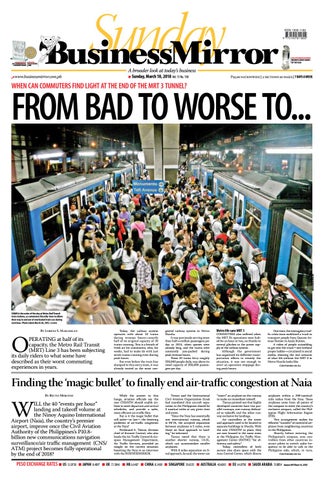
Chaos is the order of the day at Metro Rail Transit train stations, as commuters literally have to elbow their way in and out of overloaded train cars during rush hour. Photo taken March 28, 2013. ED DAVAD
O
By Lorenz S. Marasigan
PERATING at half of its capacity, the Metro Rail Transit (MRT) Line 3 has been subjecting its daily riders to what some have described as their worst commuting experiences in years.
Today, the railway system operates with about 10 trains during revenue hours—exactly half of its original capacity of 20 trains running. This is a breath of fresh air for commuters, who, for weeks, had to make do with just seven trains running even during peak hours. But even before the train line slumped to this sorry state, it was already touted as the most con-
gested railway system in Metro Manila. It was previously serving more than half-a-million passengers per day in 2015, when queues were already long, and the trains were constantly jam-packed during peak revenue hours. These 20 trains ferry roughly 550,000 people daily, way above its rated capacity of 350,000 passengers per day.
Metro life sans MRT 3
Commuters also suffered when the MRT 3’s operations were halted for an hour or two, no thanks to several glitches in the power supply of the railway system. Although the government has organized its different transportation offices to remedy the situation, it was not enough to avert an operation stoppage during peak hours.
One time, the interagency traffic crisis team mobilized a truck to transport people from Quezon Avenue Station to Ayala Station. A video of people scrambling to get into the truck—one without proper ladder—circulated in social media, showing the real scenario of what life without the MRT 3 in Metro Manila looks like. Continued on A2
Finding the ‘magic bullet’ to finally end air-traffic congestion at Naia
W
By Recto Mercene
ill the 40 “events per hour” landing and takeoff volume at the Ninoy Aquino International Airport (Naia), the country’s premier airport, improve once the Civil Aviation Authority of the Philippines’s P10.8billion new communications navigation surveillance/air traffic management (CNS/ ATM) project becomes fully operational by the end of 2018? PESO exchange rates n US 52.0730
While the answer to this hangs, aviation officials say the new CNS/ATM should enable airlines to meet departure and arrival schedules, and provide a safer, more efficient air-traffic flow. But is it the magic bullet that will solve—at last— the festering problems of air-traffic congestion at the Naia? Ferdinand A. Tienzo, division chief of Enroute Control, who also heads the Air Traffic Control & Airspace Management Department, Air Traffic Services, provided an insight on the current situation besetting the Naia in an interview with the BUSINESSMIRROR.
Tienzo said the International Civil Aviation Organization (Icao) had mandated that aircraft separation in the Philippines should be 5 nautical miles at any given time and event. “Since the Naia has essentially one international runway, which is 06-24, the accepted separation between airplanes is 5 miles, even those on final approach to landing,” he informed. Tienzo noted that there is another shorter runway, 13-31, which can accommodate smaller airplanes. With 8 miles separation on final approach, he said, the tower can
“insert” an airplane on the runway to make an immediate takeoff. Tienzo pointed out that highly developed countries have two parallel runways, one runway dedicated to takeoffs and the other runway exclusive for landings. Air controllers at the tower and approach used to be located in separate buildings in Manila. With the new CNS/ATM in place, they are now housed in the same room at the Philippine Air Traffic Management Center (PATMC) “for efficiency and safety.” Today, controllers of both sectors also share space with the Area Control Center, which directs
airplanes within a 200-nauticalmile radius from the Naia. These airplanes come from all points of the compass to enter the country’s exclusive airspace, called the Philippine Flight Information Region (FIR). This arrangement makes for efficient “transfer” of control of airplanes from neighboring countries to the Philippines. Shortly before entering the Philippines’s airspace, area controllers from other countries instruct pilots to switch radio frequency to be able to talk to the Philippine side, which, in turn, Continued on A2
n japan 0.4897 n UK 72.5846 n HK 6.6407 n CHINA 8.2400 n singapore 39.6535 n australia 40.6065 n EU 64.0758 n SAUDI arabia 13.8854
Source: BSP (March 16, 2018 )
NewsSunday BusinessMirror
A2 Sunday, March 18, 2018
www.businessmirror.com.ph
From bad to worse to... Continued from A1
This prompted Filipinos to call on the government to stop treating its citizens as such, that they don’t deserve a broken train line.
Service improvement target
Fortunately, there exists a list of what the government and the private sector are doing to improve the current situation of the MRT 3, Department of Transportation (DOTr) Undersecretary Timothy John R. Batan said in a text message to the BusinessMirror.
Metro Pacific ready to be onboard
For one, there exists the unsolicited proposal of Metro Pacific Light Rail Corp. The group submitted in 2017 a P30-billion unsolicited proposal that involves the expansion of the capacity of the railway system by adding more coaches to each train, allowing it to carry more cars at faster intervals. It will double the capacity of the line to 700,000 passengers a day, from the current 350,000 passengers daily. The multimillion-dollar expansion is deemed as an all-encompassing deal, including the improvement of the reliability of rolling stock, the upgrading of power supply, the upgrading of stations and the replacement of rails, which will allow the company to operate the new trains purchased by the government from Chinese
train manufacturer Dalian. Unsolicited proposals are required, under the law, to be subjected to a Swiss Challenge, wherein other groups can offer a similar proposal, and the original proponent can present a counteroffer. The government awarded the original-proponent status to the company last year.
Ready to implement
DAVID J. NICOL, who sits as chief finance officer at Metro Pacific Investments Corp., said his group is ready to implement the said offer in the next two months, should the government hasten its approval. “We’ve done all of our due diligence on the line and we could start it as soon as May, if all the regulatory clearances will be ready to go,” he told the BusinessMirror. The unsolicited proposal for the MRT 3 mimicked the same provisions under its concession agreement for the Light Rail Transit (LRT) 1 operations and modernization deal, which it bagged in 2014 via the Public-Private Partnership Program. It means that instead of having a different operator and maintenance provider, the group will be the one to do both, something that the Sobrepeña group has been pushing for since the government forcibly took over the upkeep of the facility in 2012. “From my perspective, we can take it up in May, and we are now
in March. So that’s about eight to 10 weeks from now—we could be working on it. Well, that needs a lot of regulatory hurdles by the government, if they want, if they have other things in mind, it might take a little longer,” Nicol said.
Negotiated Japanese deal
ANOTHER one on the table is the negotiated deal with the Japanese government. From its initial talks with the Japan International Cooperation Agency (Jica), the Philippine government is seeking to be granted an official development assistance (ODA) financing package for the overhaul and maintenance of the MRT 3. “The Japan ODA-financed rehabilitation and maintenance project is intended to ‘fix everything that needs to be fixed’ in the MRT 3 through a well-qualified, experienced and single-point-ofresponsibility rehabilitation and maintenance service provider,” Batan said. The government is currently directly engaging Sumitomo Corp. and its technical partner Mitsubishi Heavy Industries for the upkeep of the MRT 3. The two companies designed, built and maintained the MRT 3 in its first 12 years of operations. Sumitomo’s maintenance contract was terminated in 2012, after the previous government decided to take over the said component
despite contrary provisions in the build-lease-transfer (BLT) contract with MRT Corp. (MRTC). “No more of the recent year’s ‘chop chop’ approach in fixing and rehabilitating the MRT 3, which has led to unnecessary implementation difficulties and, in certain cases, implementation failure,” Batan said. Currently, a team of Japanese engineers are evaluating the kinks of the train line. “The due diligence study of the MRT 3 is being conducted by the Japanese government to identify the needed rehabilitation works to be done by the new rehabilitation and maintenance service provider,” said Aly V. Narvaez, a spokesman of the MRT 3. The new rehabilitation and maintenance service provider will be mobilized after securing the loan agreement from Japan.
Sustainable delivery
The third part involves government action in maintaining the line. Currently, a maintenance team from the government oversees the upkeep of the train line. Busan Universal Rail Inc. used to maintain the railway system, but its contract was terminated last October due to its alleged failure to properly deliver the provisions of its contract. This maintenance transition program involves procuring needed spare parts to restore and continue the operations of the MRT 3. “The Metro Pacific unsolicited proposal for the 30-year operations and maintenance of the MRT 3, the Japan ODA-financed three-year rehabilitation and maintenance project of the MRT 3 and the DOTr’s maintenance transition program are all part of the DOTr’s comprehensive and long-term strategy for
fixing the MRT 3, and ensuring its sustainable delivery of reliable and convenient service to the commuting public,” Batan said.
Overlapping, but harmonious
Batan said the government should have the Japanese companies onboard by May, when it targets to have at least 15 trains running during revenue hours. “The 30-year operations and maintenance project will ensure that after ‘everything that needs to be fixed is fixed,’ and ‘even while the fix is ongoing,’ a similarly wellqualified, experienced, robustly capitalized and single-point-of-responsibility operations and maintenance concessionaire will deliver reliable, convenient, and measurable service to the MRT 3’s passengers,” Batan said. The provider will be subject to defined Key Performance Indicators, these KPIs will be closely monitored by the government, he said, and failure to meet them will be subject to financial penalty. Batan noted, however, that there will be a time when the Japanese and Filipino deals will overlap, but noted that the two can work together to further improve the MRT 3’s operations. “There will be an overlap in the period between the Japan-ODA financed rehabilitation and maintenance provider and the O&M provider,” he said. “During the overlap period, the Japanese rehabilitation and maintenance provider and the O&M provider will be closely working together, with the O&M provider directly managing the former.” The Japanese maintenance provider will be mobilized for three years to May 2021. “The concession period of the O&M provider will be 30 years starting in the fourth quarter of 2018,” Batan said.
Best value
Nicol noted that his group may be willing to work with the Japanese contractors, as this could mean that the government and the Filipino people will get the best value out of the two deals. “I think that by combining forces, we can potentially get the very best solution for the public. The reason I said that we should acknowledge the benefit of the longterm financing from Japan, on one hand,” he said. “On the other hand, I think we should acknowledge that the process that’s been made on the LRT 1 has been quite substantial, and if we look at the news flow even next month, you will see a significant increase even in the track speed— suddenly commuters feel their commutes are a lot faster—and I think, operationally, we have a lot to bring and from a public perspective I think we can get the best value across a combination, possibly,” Nicol added. Since it started operating and maintaining the LRT 1, the operations of the said railway system has improved markedly. It also made a lot of improvements in the stations, and refurbished almost two dozen train cars that are now working normally. “I think the government is eagerly wanting to find a solution to this. That’s no question. The question is how they decided the best way to do it—not yet,” Nicol said, referring to the MRT 3. For now, while these are still in the works, MRT 3 commuters must make do with available options: regular taxis, air-conditioned and non-air-conditioned buses, ride-sharing services like Uber and Grab, point-to-point buses, or brave the long queues of the MRT 3.
Finding the ‘magic bullet’ to finally end air-traffic congestion at Naia Continued from A1
instructs the pilot what altitude and direction to take. Pilots understand the sequence they have to undergo on the way to their destinations in the Philippines. It could either be the Naia or any of the other airports like Laoag, Clark, Subic and Cebu, and the rest of the airports in the Visayas and Mindanao. The sequence is from area control to approach to tower. As the pilots get nearer to their destination, they slowly descend, while avoiding other airplanes leaving the Philippine airspace. For aircraft leaving the Naia, the sequence for pilots talking to controllers is reversed, from the tower to approach to area control. Once the arriving pilot sees the runway, usually within 10 miles from the airport, he is directed to change frequency again to talk to the Manila tower for landing clearance. Area control in Clark, Subic, Cebu, Davao, Kalibo and Zamboanga are located in the provinces before. Today they are all housed inside the P48-million PATMC. Previously, area control in Manila, Cebu and Laoag could only “see” on radar airplanes within 200 nautical miles of their respective radar coverage. Today, air controllers could see the outline of the entire Philippines, Tienzo said. Cecilio M. Ortiz, CNS/ATM project director, provided the BusinessMirror with a background of
the satellite-based system. He said the Manila FIR has an area of 809,967 square nautical miles. “The Philippine FIR is at the crossroad of Southeast Asia, Northeast Asia and Central West Pacific Regions.” Ortiz added that the Asia-Pacific region has the world’s fastestgrowing international and domestic air passengers. He said the new CNS/ATM “is based on the sophisticated four-dimensional trajectory calculation of the aircraft and has the capability for leading-edge Multi-Sensor Tracking System that processes information from different types of sensors— such as Primary Radars, Secondary Radars, Automatic Dependent Surveillance-Broadcast, and Automatic Dependent Surveillance-Contract— aside from various computer-aided safety measures.” Ortiz said today, Philippine air controllers have a view of the entire Philippine area of responsibility and could see in real time all airplanes in the air, “even those flying on visual.” This has been made possible because modern aircraft are equipped with a transponder, a device that, when activated by the pilot, will show their identification, altitude, heading and other vital information. Manila International Airport Authority General Manager Ed Monreal said once the P311-million rapid-exit taxiway is in place by end of the year, there is a pos-
sibility that the runway events per hour could be increased. “There will be some improvements, but as to how many [event per hour] we can’t say,” he said. “It will be constructed in a way that airplanes are able to exit the runway at a faster speed because of the slight deviation of the taxiway to the runway, unlike the 90-degree turn required for old-style taxiways,” Monreal said. As to criticisms that the new CNS/ATM would be obsolete in a few years because the next generation (NexGen) system would be mandated by the Icao, Ortiz said: “The manufacturer of the CNS/ ATM has ensured [us] of available equipment upgrade for the next 15 years.” Ortiz clarified that, like any modern equipment, the CNS/ATM could be upgraded to meet the demands of the coming years. He added that the Advanced Air Traffic Management system will enable flexible air route selection in response to possible changes in weather, traffic and airspace conditions that would result in enhanced air-traffic safety, reduction of delays and improved airport/airspace efficiency. On the other hand, the efficient and reliable data link communication systems will overcome the shortcomings of existing voice communication systems. “This will result in the reduction of air-traffic controller/pilot workloads and less human error.”
www.businessmirror.com.ph
The World BusinessMirror
Putin’s presidency lifts Russia’s richest dozen by $29.5 billion
A
group of Russia’s wealthiest people added $29.5 billion to their collective net worth during President Vladimir Putin’s latest presidential term, recouping steep losses following his annexation of Crimea. Of the 12 Russians listed on the Bloomberg Billionaires Index in 2012, when Putin took office, nine have expanded their fortunes, led by metals tycoon V ladimir Potanin, who added $6.4 billion. Mikhail Prokhorov, his former partner in MMC Norilsk Nickel PJSC and a Putin rival during that year’s elections, lost $1.6 billion. The group’s six-year gains are short of the $33.2 billion that Amazon.com Inc. Founder Jeff
Bezos, the world’s richest person, added to his fortune just this year. The dozen Russians did well during the first two years of Putin’s term, but took severe losses after the 2014 crisis in Ukraine that were exacerbated by subsequent sanctions and plunging energy prices. The group’s fortunes, which bottomed out at a combined $115 billion in January 2016, are now benefiting from higher commodity prices and a rebound in Russian equity markets. Putin was president from 2000 to 2008, before being appointed prime minister. He reclaimed the presidency in 2012 and is widely expected to win the March 18 election and a new six-year term.
D
A3
Traders beware: Political black swan looms over yen and Nikkei
T
he scandal embroiling Prime Minister Shinzo Abe’s administration may be more serious than some investors realize, raising the potential for a rapid move in Japanese markets to discount the potential for a surprise end to the champions of Abenomics.
Bloomberg News
Hike in airline hiring stirs interest in aspiring pilots
A LL A S—Major US airlines are hiring pilots at a rate not seen since before 9/11, and that is encouraging more young people to consider a career in the cockpit. Hiring is likely to remain brisk for years. Smaller airlines in the US are struggling with a shortage that will continue as they lose pilots to the bigger carriers, which, in turn, will need to replace thousands of retiring pilots over the next few years. Aircraft maker Boeing predicts that the US will need 117,000 new pilots by 2036. Just a decade ago thousands of pilots were furloughed and some abandoned the profession. The shortage has been felt most keenly at regional carriers where many pilots start their airline careers. Last summer Alaska Airlines subsidiary Horizon Air canceled more than 300 flights over two months for lack of pilots. Republic Airways filed for bankruptcy protection in 2016, citing a pilot shortage that forced it to ground flights. Many regional carr iers f ly smaller planes for American Eagle, Delta Connection and United Express. Signing bonuses and higher pay have helped them hire more than 17,000 pilots in the past four years, but that only replaced those who moved up to the major carriers, according to the Regional Airline Association. Demand at the major airlines is expected to grow as thousands of pilots at American, Delta, United and Southwest hit the US mandatory pilot-retirement age of 65 in the next several years. American Airlines CEO Doug Parker believes the industr y will cope. “Economics is going to take care of this, and I think that’s what is happening now,” Parker says. “The [flight] schools are starting to fill up with people who realize, ‘If I can get myself to 1,500 hours [the minimum flight hours needed to get an airline-pilot license], I can be assured of a career as a pilot.’ That’s not something people could convince themselves of from 9/11 on until now.” Pilot hiring nosedived after the September 11, 2001, terror attacks that led to a decline in travel, and again during the global financial crisis in 2008 and 2009. Major US airlines hired only 30 pilots in 2009, according to Future & Active Pilot Advisors, a career-counseling business for pilots. The job market didn’t pick up significantly until around 2014. Last year 10 of the largest US passenger and cargo airlines hired 4,988 pilots, the most since 2000 when they hired 5,105. “It’s the best sellers’ market I have seen in the last 45 years of monitoring airline pilot hiring,” says Louis Smith, a retired airline pilot who runs the pilotcounseling outfit.
Sunday, March 18, 2018
Smith says forums for aspiring pilots that once drew a couple dozen people now sometimes attract more than 150. Some hope to make a mid-career change, which was rare just a few years ago. Aaron Ludomirski is one of those career-changers. The 31 year old from Asbury Park, New Jersey, says he always wanted to be a pilot, but studied business instead because the bleak job opportunities for pilots in the years after 9/11 didn’t justify the cost of school and flight training. After college he started an online marketing business. “Year after year I found myself less and less satisfied with my work,” he says. “I started thinking about what kind of career would really lead me to feeling fulfilled and accomplished, and I kept coming back to aviation.” Ludomirski did some fresh research and learned that pilots were back in demand—and more would be retiring in the next few years. He quit his job and went to flight school. Now he is working as a flight instructor to gain the required flying time for an airline pilot. “I can interview for and even accept a conditional letter of employment and know I have my dream job lined up for me when I’m ready,” he says. Applications for commercial aviation majors at the University of North Dakota, a big aeronautical school, have more than doubled in the last three years, says Elizabeth Bjerke, an aviation professor and one of the authors of the university’s widely watched forecast on pilot supply. Some students graduate early to take advantage of the job market and the chance to move up the seniority list quickly because so many older pilots are retiring. “Our graduates will fly at the regionals for a very short period,” Bjerke says. “They are getting picked up by the major carriers in their mid-20s, which would have been just crazy to think of 15 or 20 years ago.” Michael Wiggins, chairman of the aeronautical science department at Embry-Riddle Aeronautical University, says his school’s graduates are getting multiple job offers from regional airlines. Pilots who become captains on jumbo jets that fly international routes can earn more than $300,000 a year. But for anyone starting out in the profession, the training is expensive—upward of $100,000. A few years ago, those who made it faced starting pay for first officers or copilots at regional airlines in the low-$20,000s. With bonuses and higher hourly rates, some regionals now claim to offer starting pay of $80,000 or more, but even that might not be enough to meet future demand. AP
W hile Abe has faced down political controversy and public protests repeatedly in his morethan-five-years in power, the doctoring of a Finance Ministry document relating to a controversial land sale presents a more serious threat, according to political analysts. And at this point, markets haven’t priced in the idea of a resignation by stalwart Abe supporter Taro Aso, the finance minister, or the potential for Abe to lose office later this year. “For global investors, Abenomics equals a higher dollaryen, a higher Nikkei and a better Japanese economy,” said Tohru Sasaki, head of Japan markets research at JPMorgan Chase & Co. in Tokyo. “The perception of foreign investors will change drastically” if it looks like Abe will be forced from power, said Sasaki, who previously worked at the Bank of Japan (BOJ). Weeks of turmoil could result in markets, though the impact would probably be short-lived, Sasaki says—akin to the brief surges in the yen after Britain’s Brexit vote in June 2016 and Donald J. Trump’s election victory in
November 2016. A political overhaul probably won’t be a game changer for economic policy and Japan’s fundamentals, yen experts say. First off, lawmakers are poised to endorse BOJ Governor Haruhiko Kuroda for another five-year term, and confirm two deputies who have fully backed the reflationary stimulus of the past half-decade. Second , t he L ibera l Demo c r a t i c P a r t y ( L DP) h e a v y weights who cou ld w in a n aut u m n leadersh ip se lec t ion wou ld h ave l it t le i ncent ive to
aba ndon t he A benom ic s pro g ra m t h at ’s he lped d r ive f ive n at io n a l e l e c t io n v i c t o r i e s . Cor porate prof its h ave soa red to record s, a nd t he economy su st a i ned it s longest e x pa nsion si nce t he 19 8 0 s, t h a n k s, i n pa r t, to a d ra m at ic wea kening in t he yen t hat bega n when investors bega n pr icing in A be s wee pi ng to power i n 2012. “ The market has apparently assumed Abe will win his third term of LDP presidency in September,” Shusuke Yamada, a currency and equity strategist at
For global investors, Abenomics equals a higher dollar-yen, a higher Nikkei and a better Japanese economy. The perception of foreign investors will change drastically [if it looks like Abe will be forced from power].”—Sasaki
Bank of America Merrill Lynch in Tokyo, wrote in a note on Thursday. “Pricing this out would quite likely lead to lower equities and a stronger yen.” Ya m ad a adv i sed w atc h i ng this weekend ’s pol l numbers for Abe. A “re-test” of ¥105 per dollar could come if ratings fall sharply, he wrote. The yen approached 105 last week, and hasn’t traded past that level since November 2016. Japan’s currency has already been strengthening this year— up 6.3 percent, bearing the brunt of the dollar’s slump on concerns about deepening US borrowing needs, given the American trade and fiscal deficits. That could raise the risk of one-sided moves on any political repricing—even if fundamental economic policy is unlikely to change. Markets have mispriced assumptions of policy change based on politics in the past. When an advocate of intervention to drive down the yen lost a leadership selection in 2010, and the yen then surged as traders assumed yen sales were off the table, Japan, indeed, intervened. Bloomberg News
Pipe dream? Hong Kong architect proposes low-cost tube homes By Josie Wong & Kelvin Chan The Associated Press
H
ONG KONG —Hong Kong’s notoriously expensive housing makes owning an affordable home a pipe dream for many residents. A loc a l a rc h itec t h a s pro posed a novel idea to help a lle v i ate t h at problem: Bu i lding stylish micro-apartment s i nside g i a nt conc rete d ra i n age pipes. Ja mes L aw ’s OPod Tub e Housing is still just at the conceptual stage, but it’s attracted attention as an innovative, though untested, way to deal with housing shortages. At 100 square feet, or 9.3 square meters, the tube houses are not that much smaller than Hong Kong’s infamous “cubicle homes”—older apartments subdivided into cramped and squalid living spaces. They’re roomier than other types of tenement housing, such as so-called “coffin” and “cage” homes. The idea came to Law when he spotted some leftover storm sewer drain pipes at a construction site. They might be converted into “really cute micro-living architecture,” he said. Law has only built a prototype to test public interest, but has already received inquiries from around the world. There’s a lot crammed into the OPod. It consists of two sections of 2.5 meter, or about 8 feet, diameter pipes fitted with glass doors on both ends. A living area inside includes a bench that converts into a bed,
In this March 13, photo, Arch. James Law sits at an OPod tube house in Hong Kong’s industrial area of Kwun Tong. Hong Kong’s notoriously expensive housing makes owning an affordable home a pipe dream for many residents. But the local architect proposed a novel idea to help alleviate the problem: Building stylish micro-apartments inside giant concrete drainage pipes. AP
opposite shelves on the facing, curving wall. A not her shel f f its a ba r fridge and a microwave next to a galley sink beneath an airconditioner. A tiled bathroom at the end includes a combined shower and toilet. The OPod cost $15,000 to build. Law said he envisions renting them out for less than $400 a month to recent graduates on low incomes tr ying
to get a foot on the housing ladder. That’s a fraction of the market rate. “My dream is the OPods will be a new kind of living for young people just starting out in life,” Law said. It’s less a long-term solution to Hong Kong’s housing crisis than a novel way to make use of leftover spaces where conventional housing doesn’t
fit. The pipe homes could be st ac ked into gaps bet ween bui ld ings, under highway overpasses or on the roofs of existing buildings. “This kind of house is really portable. We [can] actually make it in a construction site and then we lift it onto a truck and we can deliver it any where,” Law said. “So it represents a new, affordable architecture.”
A4
The World BusinessMirror
Sunday, March 18, 2018
A self-assured Putin seems confident of electoral victory
N
By Vladimir Isachenkov | The Associated Press
IZHNY TAGIL, Russia— Vladimir Putin walks briskly to a group of factory workers, who ask him for a water-treatment facility, new equipment to reduce toxic emissions and a sports arena for their children in this Ural mountains city. He promises, benevolently, to do all that and more. Put in’s self-assurance and relaxed demeanor ref lects the stress-free campaign he has run ahead of today’s (Sunday) election that is certain to catapult him to another six-year presidential term. The victory will put the Russian leader on track to become the nation’s longest-serving ruler since Josef Stalin. “ W hat beautif u l stuf f you make here: trams and tanks and railway cars,” Putin tells the workers at the Uralvagonzavod plant in Nizhny Tagil, mixing jokes with his promises. In return, they pledge to vote for him. The 65-year-old president has made many such trips across the vast country, reaching out to various social groups and industrial sectors. Unlike the 2012 election, when Putin often looked tense and nervous amid massive protests of his rule, he faces no such threats this year—even with an anemic economy and spiraling tensions with the West. Putin’s popularity soared after Russia annexed Ukraine’s Crime an Peninsula in 2014, and his ratings still top 80 percent, buttressed by flattering coverage of his activities by state-controlled media, amid bitter showdowns with the West. Kremlin political strategists have set a magic number of “7070”—securing a turnout of 70 percent of the electorate and winning 70 percent of the vote. Such a result would show that Putin’s popularity hasn’t waned, 18 years after his first election. By reaching those numbers against seven challengers, it would also strengthen his hand as he ponders his next move: get rid of term limits to allow him to remain president past 2024, shift into another position of power, or choose a dependable successor. “It’s a quick campaign aiming at a high degree of legitimacy,” said Alexander Baunov, an analyst with the Carnegie Moscow Center. “The high legitimacy is to be ensured with a solid turnout, which should be transparent and verifiable.” But despite broad support for the president, public apathy still presents a major problem for the Kremlin. While opinion surveys indicate a strong majority of Russians back Putin, many see the outcome as predetermined and simply won’t bother to vote. Many others are resentful and indifferent, long having lost hope for positive change. That’s why boosting turnout has become the No. 1 objective for Putin’s spin doctors. “They need a high turnout in order to demonstrate support,” said Dmitry Oreshkin, a Moscowbased political expert. “A low turnout could be seen as Putin’s weakness.” To show the consequences of failing to vote, a YouTube video plays on stereotypes popular in Russia: A man in his 50s too lazy
to vote wakes up to a knock on his door from soldiers sent by the new president to round up everyone under 60 for military service. One of the soldiers is black, in an apparent mockery of diversity. The frightened man rushes to the kitchen, where his wife introduces him to his future gay partner, in line with the new president’s directive. The video ends with the man realizing it was all a nightmare, and he rushes to the polls. While there is no evidence the video was produced by the government, it fits in with Kremlin propaganda. Putin has emphasized the need for stability and continuity, tapping fears rooted in the public memory of post-Soviet economic and political meltdowns. “People fear change and they vote for Putin,” Baunov said. The most vocal Putin critic, 41-year-old opposition leader Alexei Navalny, could have injected some real competition in the race, but he was barred from running by a criminal conviction widely seen as political punishment. He has called for boycotting the vote. O t he r c h a l le n ge r s he lp e d create a semblance of competition, reaching out to those who resent Putin.
O ne i s Pave l Gr ud i n i n , a 57-year-old millionaire director of a strawberry farm. Nominated by the Communist Party, Grudinin sports a Stalin-like moustache and promises more socia l pr iv ileges, cater ing to Communist supporters who still represent a sizable chunk of the electorate. His image of a successful manager who cares for his workers resonates with many older voters who crave Soviet-era stability and social benefits. A quick r ise in Gr udinin’s popularity worried the Kremlin, and in an apparent attempt to cut him down to size, state TV and other media ran exposes about his Swiss bank accounts to dull his populist image. Another highly visible challenger i s K sen i a Sobc h a k , a 36-year-old TV personality who is the daughter of Putin’s former patron. Witty and sharp-tongued, Sobchak cast herself as a champion of liberal freedoms, seeking to win over some of Navalny’s supporters and others who are disenchanted with Putin. Sobchak has denied colluding with the Kremlin, but many say her candidacy helps Putin add a democratic veneer to the campaign. “Sobchak works perfectly in her niche; she’s controllable and honest at the same time. It’s the combination of honesty and controllability that the presidential administration needs,” Baunov said. “A victory wouldn’t look strong without a competition.” She has gone to great lengths to prove that she’s not a Kremlin project, criticizing Putin’s policies, including the annexation of Crimea. She even filed a lawsuit to remove Putin from the race, arguing that he doesn’t have the right under the constitution to seek a fourth term. Russia’s highest court quickly shot it down.
They need a high turnout in order to demonstrate support. A low turnout could be seen as Putin’s weakness.”—Oreshkin
In this March 1 file photo, journalists watch as Russian President Vladimir Putin gives his annual state of the nation address in Manezh in Moscow, Russia. Putin seems self-assured and confident of victory in the election on Sunday, March 18, even as the Kremlin works hard to bolster turnout to make the result as impressive as possible. Unlike the 2012 balloting, when he often looked tense and nervous amid massive protests of his rule, Putin faces no such threats this time, despite an anemic economy and spiraling tensions with the West. AP/Alexander Zemlianichenko, File
While Sobchak and Grudinin u se d st rong rhetor ic , P ut i n sought to mobilize his base with promises of economic recovery and social benefits. He pledged to increase wages, invest more money in health care and education, repair roads and build new infrastructure. On his trips across Russia, he also vowed to help fund important local projects, such as the Nizhny Tagil water treatment facility. In a bid to underline the annexation of Crimea as a key Putin success, the election was set on the anniversary of the territory’s incorporation into Russia. While the enthusiasm over the takeover of Crimea has abated, polls show that most Russians see it as a major achievement. “It has raised his popularity to incredible levels,” Baunov said. Putin also has exploited Russians’ fears and national pride by pointing to what he described as US plans to isolate the country and gain a military advantage over it. In a dramatic state of the nation speech earlier this month, Putin unveiled an array of new nuclear weapons that he said have no equal and would make US missile defense useless. He called them a tribute to efforts by tens of thousands of workers and engineers. “Even I was stunned when I realized the massive scope of that effort,” Putin told the enthusiastic employees in Nizhny Tagil. Days before the vote, statecontrolled TV also released new, fawning documentaries about Putin, casting him as a man of the people who is proud of his working-class roots and ability to overcome any challenge. In the films, Putin revealed a tiny bit more of his tightly guarded past. He said he opted for judo in his teens after he had his nose broken at a boxing session, told a harrowing tale about a rat chasing him in a run-down apartment building entrance when he was a boy, and talked about his patriotic hopes as a young KGB officer. Asked by an interviewer if it’s possible to argue with him, Putin said: “It’s better not to do it, of course.” After a pause, he added: “I’m joking.”
Editor: Lyn Ressureccion | www.businessmirror.com.ph
Why Moscow will never say sorry for attack on former spy, daughter
M
OSCOW—Cruising toward a certain victory in this Sunday’s presidential election, President Vladimir Putin briefly dropped his image as Russia’s tough but merciful czar to make clear that he could forgive misdeeds by wayward subjects, but “not everything.” Asked what could not be forgiven, Putin said bluntly, “Betrayal.” Putin’s unforgiving contempt for treachery, displayed in a new hagiographic film released this week, provides the emotional and political backdrop to a pattern of Russian behavior that, Prime Minister Theresa May of Britain announced on Monday, made it “highly likely” that Moscow was responsible for a March 4 nerveagent attack in Salisbury, England, on Sergei Skripal and his daughter, Yulia. Viewed from London, the attack on Skripal, a former colonel in Russian military intelligence who was recruited as a spy by Britain, was in May’s words, an “indiscriminate and reckless act” that “put the lives of innocent civilians at risk,” while sending Russia’s relations with the West into yet another downward spiral. Britain followed through on those allegations on Wednesday, expelling 23 Russian diplomats and outlining an array of other actions it would take. But do not expect any apologies or even a serious discussion from Moscow. From the Kremlin’s perspective, said Mark Galeotti, a Russia expert at the Institute of International Relations in Prague, it plays into “the central geopolitical narrative of the current incarnation of Putinism: Russia is just too formidable and fearsome to be ignored. This is all about demonstrating that Russia not only has capacity to act but the will to act, too.” Far from damaging Putin, with just days to go before Russia’s presidential election, the accusations leveled at Moscow by Britain only reinforce Putin’s position that Russia is a besieged fortress under constant threat from enemies within and outside its borders. While steadfastly denying any involvement in the attack, the Kremlin has added the episode to a daily diet of news on state news media outlets that showcase what Putin, in a recent state of the nation address in Moscow, described as Russia’s invincible might and its readiness to strike back at enemies wherever they are. Like the new missile systems unveiled by Putin in that speech, the attack on Skripal has only added to the president’s stature, at least among his base at home, as a fearless defender of the nation ready to do anything, no matter how risky, to assert Russia’s status as a great power to be feared. Rather than bow to British demands for an explanation of how a Russian-made military nerve agent ended up in Salisbur y, Moscow went on the offensive. Foreign Minister Sergey Lavrov on Tuesday dismissed British accusations as “nonsense” and demanded that Britain hand over the ner ve agent used against Skripal and his daughter. Russia, he added, had so far “received an incoherent response, which amounts to a rejection of our legitimate demands.” Just as Britain did earlier to Russia’s ambassador in London, the K remlin on Tuesday summoned the British ambassador to Moscow to demand an explanation. Vladislav Inozemtsev, a Russia scholar currently at the Polish Institute of Advanced Studies in Warsaw, said the nerve-agent episode showed that “talking to Mr.
Putin has become senseless.” The Russian president and his senior officials, he said, would “never assume responsibility,” whatever the facts were, and would only gloat over the suffering of a traitorous former spy—still unconscious and in critical condition—while blaming Britain for it. “They will stick to the thesis that Westerners kill agents they do not need anymore and then blame Russia,” Inozemtsev said. Russia under Putin, said Galeotti, an expert on Russia’s security services, “has given up on winning respect through soft power and is pursuing what I call ‘dark power.’” This approach, which involves Russia throwing its weight around and then reveling in the outrage this causes, Galeotti added in a telephone interview, “plays into Putin’s own natural instincts that a great power is one that is feared. It is better and much easier to be feared than loved.” Of all the virtues in which Putin takes pride, none has more importance to the Russian leader—a veteran of a Soviet security apparatus built around a cult of loyalty to the state—than his commitment to the idea that nobody, especially not spies who defy their vows, can escape punishment for betrayal. Answering questions from citizens in a 2010 phone-in program, Putin praised intelligence officers as “people who lay their whole lives on the altar of the Fatherland” and denounced those who betrayed this mission as “pigs,” whose fate would be so miserable that they would “regret a thousand times” their treachery. Skripal, who was convicted of high treason in Russia in 2004 and then allowed to settle in Britain after a 2010 spy swap, was a case study of all that Putin loathes. Skripal almost certainly had no more Russian secrets to betray when he was attacked with a nerve agent identified as one of a Russian-produced class of chemicals known as Novichok. But he still represented an affront to the principle that betrayal must never go unpunished: He was alive and living comfortably in a pleasant English cathedral town. As happened after accusations that Russia was responsible for the 2006 murder in London by radioactive poisoning of another intelligence turncoat, Alexander Litvinenko, the downing of a Malaysian passenger aircraft over Ukraine in 2014 and meddling in America’s 2016 presidential election, officials and state news media outlets in Moscow responded with a barrage of denials and mockery to the latest outrage. They have scoffed at the idea Russia could possibly have had any role in the attack on Skripal and even suggested that the whole episode might have been fabricated. The Russian Embassy in London, in sneering statements on its website and Twitter feed, refers to the “Sergei Skripal Case,” using quotation marks to suggest it does not believe there really is such a case. Russia has yet to address in any detail the main piece of evidence pointing to a Russian hand—that Novichok agents have been produced only in Russia—and has instead developed conspiracy theories involving Ukraine, British revenge for past athletic defeats before this year’s World Cup soccer tournament in Russia and other far-fetched explanations. Moscow has been exasperated that its denials are not taken seriously and have been mocked re lent lessly u nder a Tw it ter hashtag, #Russiadenies, even though officials have in the past acknowledged what they had earlier denied. New York Times News Service
Sports BusinessMirror
Editor: Jun Lomibao | mirror_sports@yahoo.com.ph
Sunday, March 18, 2018
A5
TRYING TO HAVE FUN P
By John Nicholson The Associated Press
HOENIX—Michelle Wie is trying to have fun— and stay healthy. “My goal is to play the whole year and not to take an extended break during the season,” Wie said at the Bank of Hope Founders Cup. “That would be my whole goal. Keep my organs in my body.” Organs? Yep, last August—a week after helping the US win the Solheim Cup—she had her appendix removed after being stricken before the final round of the Canadian Pacific Women’s Open. She has recently fought arthritis in her hands, first with cortisone and now with collagen injections. She also is off to a fast start this season, winning the HSBC Women’s World Championship two weeks ago in Singapore for her fifth career victory and first since the 2014 US Women’s Open. “I’ve working really hard on my putting,” Wie said. “During the off-season, I putt and chip for at least five hours a day. I just put in the time. It feels good that it’s paying off.... I think being confident with your putter, it brings a different mindset into the game.” Now 28, she has spent more than half of her life in the spotlight. That has made her health and game struggles more difficult—and made her stronger. “I think the first down really shocked me. I took it really hard and it wasn’t easy,” Wie said. “Then you start to realize that life doesn’t really happen that way. You start to hear about other people going through injuries and stuff like that. Then you see some people and their life seems so easy. Everyone has their own struggles. I think my struggles have just been very publicized and very public. “After the first time it gets easier, and then it gets harder and then it gets easier. I just draw strength from knowing that I’ve done it before and I have reached very lows and I’ve pulled myself out of it. I definitely have a lot of confidence from that, just knowing from experience that I can.” She will open play on Thursday at Desert Ridge in a group with Bahamas winner Brittany Lincicome and Women’s Australian Open champion Jin Young Ko. “I always think the best is in front of me,” Wie said. “That’s why I practice and work so hard.” Defending champion Anna Nordqvist will play alongside Thailand winner Jessica Korda and Ariya Jutanugarn the first two days. Nordqvist starred at Arizona State, and Coach Missy Farr-Kaye and some the defending National Collegiate Athletic Association champion Sun Devils watched the Swede’s practice round on Tuesday. “ASU is always going to be family to me,” Nordqvist said. “I came here when I was 18 years old. I was very shy. I wouldn’t speak up. I was not very mature.... Just to have a lot people caring about you and still do, that means a lot.” KORDA SISTERS Nelly Korda, Jessica’s 19-year-old sister, is trying to rebound after missing a chance for her first tour victory in the Singapore event. Needing a birdie on the final hole to force a playoff with Wie, Nelly missed an eight-footer.
“My emotions were flowing,” Nelly said. “I saw Jess behind the green when I was walking up to 18 and I had to hold back some tears. I think like when I just missed that putt and I saw her and she gave me the hug I just completely lost it. I had a couple tears going down my face.” Her 25-year-old sister cheered her up. “I told her that she shot under par, she definitely didn’t lose it and that her time will come,” Jessica said. “This is all a learning experience. When she is in that position next time, she’ll know better. She’ll know how she’s feeling. She can prepare better for it and kind of feed off that experience.” They’ll play in consecutive groups on Thursday and Friday, with Nelly joining Inbee Park and Sung Hyun Park.
SMART CANDY OUTSMARTS ’EM S C Stockfarm-raised Smart Candy scored a sweet and emphatic win in the Philippine Racing Commission (Philracom) 3YO Local Fillies and Colts Stakes Race recently at the San Lazaro Leisure Park in Carmona, Cavite. Smart Candy rushed into a swift start, leaving the field following his trail. Her quick burst of speed surprised no one, even winning jockey Kelvin Abobo, who knows the capability of his filly to sustain a good lead and he used it to the hilt as part of their game plan. When it was over, Smart Candy was eight lengths ahead of her closest pursuers. “My instruction was to jump the gun on
MICHELLE WIE: My goal is to play the whole year and not to take an extended break during the season. AP
Lady Archers stake lead against Lady Tamaraws
D
EFENDING champion De La Salle tries to extend its grip of the solo lead when it faces Far Eastern University (FEU) in Season 80 University Athletic Association of the Philippines women’s volleyball action today at the Filoil Flying V Centre in San Juan City. The Lady Spikers, who have won seven of their nine games, are gunning for their fourth straight win against the No. 3 Lady Tamaraws (6-3) in the 4 p.m. battle. University of the East (UE), on the other hand, targets its third straight win and a season sweep against struggling Adamson University at 2 p.m. Oozing with confidence after winning their first back-to-back matches in six years, the
seventh place Lady Warriors (2-6) try to keep their slim Final Four hopes alive against the Lady Falcons, who are on a two-game skid to be at fifth place with a 3-5 card. “Perseverance and patience, these are the reasons why the girls are improving,” said UE interim Coach and Athletic Director Rod Roque, who turned the Lady Warriors from cellar dwellers into probable contenders. “I am very happy because all of them are obedient and have become players now.” The day’s second match features two of the best serving and receiving teams in the league. The Lady Tamaraws served 19 aces to push University of Santo Tomas to the brink of elimination with a 25-21, 25-21, 25-23
victory last Wednesday. The Lady Spikers, on the other hand, nailed 15 service aces to make a short work of University of the Philippines, 25-15, 25-19, 25-19, in their last outing. De La Salle Head Coach Ramil de Jesus is happy to see his wards—led by Majoy Baron, Kianna Dy, Des Cheng, Michelle Cobb and Dawn Macandili—playing well again. But he stressed that repeating their 25-22, 25-17, 24-26, 23-25, 15-7 first-round win over FEU would not be easy. “FEU is also good in terms of blockings, service and receive and they have veteran players,” de Jesus said. “The outcome of our game will depend on whoever receives the ball better.” Lance Agcaoili
Fifa lifts suspension of Pakistan federation
Z
URICH—Fifa has lifted the Pakistan soccer federation’s suspension, which had been imposed last October because of outside interference by a court. Fifa says the federation has this month “successfully taken back control” of its offices and accounts from a court-
appointed administrator. Pakistan teams and officials can resume taking part in international games and meetings, including voting for the 2026 World Cup host on June 13, in Moscow. The North American bid by the United States, Canada and Mexico is
competing against Morocco. Pakistan’s men’s national team has not played since 2015, according to Fifa’s web site, and is ranked No. 203 among 211 members. Rules imposed by Fifa and its members prohibit outside influence on their independence. AP
everyone because my horse is at its best when it’s in front,” said the 34-year-old Abobo, who won for Smart Candy owner SC Stockfarm of Oliver Velasquez the top purse of P600,000 from the total guaranteed purse of P1 million that was up for grabs in the stakes race. The three-year-old dark bay filly reached the finish line of the 1,500-meter course in one minute, 32.6 seconds. The battle for the second proved to be more tense as Here’s ToLife (jockey EP Nahilat and owner Jose Quiros) nipped Perlas ng Silanganan in a photo finish for the P225,000 runner-up prize. Third placer Perlas ng Silanganan earned P125,000 for owner Hermie Esguerra, while fourth placer Misha, who placed second in the first leg, took home P50,000 for owner Leonardo Javier Jr.
SC Stockfarm-raised Smart Candy wins by eight lengths.
First-leg winner and the Napoleon Magno-owned Probinsyano with jockey Mark Angelo Alvarez aboard was out of the top 5. It was the longest race that Smart Candy ran this year and so far, she had already finished on top of five races. In February Smart Candy topped the 1,300-meter course of two three-year-old races and two 1,000-meter races in January, with Abobo also on top. Abobo also guided Crème Brule to second place behind Play It Safe in the NPJAI Trophy Race, also on Sunday. But with Brilliance, Abobo came up empty-handed in the 2018 Philracom-Manila Horsepower Organization Race, which Manda ruled.
Faith A6 Sunday, March 18, 2018
Sunday
www.businessmirror.com.ph • Editor: Lyn Resurreccion
Francis at 5: Paradigm shift in mercy, migrants, marriage
V
ATICAN CITY—Whenever Pope Francis visits prisons, during his whirlwind trips to the world’s peripheries or at a nearby jailhouse in Rome, he always tells inmates that he, too, could have ended up behind bars: “Why you and not me?” he asks. T hat humble empathy and the ease with which he walks in others’ shoes has won Francis admirers around the globe and confirmed his place as a consummate champion of the poor and disenfranchised. But as he marks the fifth anniversary of his election on Tuesday and looks ahead to an already troubled 2018, Francis faces criticism for both the merciful causes he has embraced and the ones he has neglected. Wit h women and se x ua l abuse topping the latter list, a consensus v iew is forming that histor y’s first Latin A mer ican pope is, perhaps, a v ictim of unrea l ist ic e x pectat ions and his ow n cu lture. Nevertheless, Francis’s first five years have been a dizzying introduction to a new kind of pope, one who prizes straight talk over theology and mercy over morals—all for the sake of making the Church a more welcoming place for those who have felt excluded. “I think he’s fantastic, very human, very simple,” Marina Borges Martinez, a 77-year-old retiree, said as she headed into evening Mass at a church in São Paulo, Brazil. “I think he’s managed to bring more people into the church with the way he is.” Many point to his now-famous “Who am I to judge?” comment about a gay priest as the turning point that disaffected Catholics had longed for and were unsure they would ever see. Others hold out Francis’s cautious opening to allowing Catholics who remarry outside the church to receive Communion as his single most revolutionary step. It was contained in a footnote to his 2016 document “The Joy of Love.” “I have met people who told me they returned to the Catholic faith because of this pope,” said Ugandan Archbishop John Baptist Odama, who heads the local conference of Catholic bishops. “Simple as he may be, he has passed a ver y power f u l message about ou r God who loves
ever ybody a nd who wa nts t he sa lvat ion of ever yone.” Another area in which Francis has sought change extends into global politics, with his demand for governments and individuals to treat migrants as brothers and sisters in need, not as threats to society’s well-being and security. A f ter a v isit to a ref ugee camp in Lesbos, Greece, Francis brought a dozen Syrian Muslim refugees home with him on the papal plane. The Vatican has turned over three apartments to refugee families. Two African migrants recently joined the Vatican athletics team. His call has gone largely unanswered in much of Europe and the United States, though, where opposing immigration has become a tool in political campaigns. Ita lians in the pope’s backyard voted over whelmingly t h i s mont h for pa r t ies t h at have promised to crack dow n on migration, including w ith forced ex pu lsions. T he Pe w R ese a rc h Center found that while Francis still enjoys a consistently high 84-percent favorability ratings among US Catholics, an increasing number on the political right believe him to be “too liberal” and naÏve. Despite all the talk of “the Francis effect” bringing Catholics back to church, Pew found no evidence of a rise in self-proclaimed Catholics or Mass-goers. Whether he ultimately will be remembered as a unifying or divisive figure, the world has gotten to know the man formerly known as Jorge Mario Bergoglio, the son of Italian immigrants to Argentina who emerged on the loggia of Saint Peter’s Basilica as pope on March 13, 2013, and quipped that his brother cardinals had to search to the “end of the Earth” to
Pope Francis listens to applause before addressing a joint meeting of Congress on Capitol Hill in Washington on September 24, 2015, making history as the first pontiff to do so. Pope Francis’s humble sense of empathy won him admirers around the globe, but as he marks his fifth anniversary on March 13, criticism is growing for the merciful causes he has embraced, and those he has neglected. AP/Alessandra Tarantino
find a new leader. There have been magical moments: When Francis wept hearing the life story of an Albanian priest who was tortured during communist rule, and later made the clergyman a cardinal. W hen his whisper y voice weakened as he met with Myanmar’s Rohingya refugees and told them, “ The presence of God today is also called Rohingya.” But not all are pleased. When Francis created room for remarried Catholics to receive Communion, a few dozen traditionalist academics and clergy accused him of heresy. Four of his cardinals formally asked for clarification. Conservatives in the US and Europe wrung their hands trying to square how Christ’s vicar on Earth could seemingly condone adultery under the guise of mercy. “At the end of the day, ‘The Joy of Love’ is the result of a new paradigm that Pope Francis is bringing forward,” said Cardinal Pietro Parolin, the Vatican secretary of state. “Probably the difficulty that exists in the church is due to this change of attitude that the pope is asking for.” One cause Francis is accused of neglecting reared its head last week. A coalition of Catholic women gathered at Francis’s own Jesuit headquarters in Rome to demand he provide women with a voice and a place at the decision-making table in the Catholic Church. “Women’s right to equality aris-
I have met people who told me they returned to the Catholic faith because of this pope.”—Odama
es organically from divine justice. It does not and should not depend on ad hoc papal benevolence or magnaminity,” former Irish President Mary McAleese said. To be fair, Francis appointed a study commission on ordaini ng women deacons. He h a s named a woman to head the Vatican City’s biggest cash cow, the Vatican Museums. He empowered ordinar y pr iests, not just bishops, to absolve women who have had abortions and put Mar y Magdalene on a par with the male apostles by declaring a feast day in her honor. But no woman heads a Holy See office, no woman sits on his k itchen cabinet. T he Vatican’s women’s magazine ran a scathing ex posé this month of how nuns are treated like indentured ser vants by the bishops and cardina ls they ser ve. The other major unmet expectation is on the clerical sex-abuse front. Francis set the bar high when he vowed “zero tolerance” for abuse, created an ad-hoc commission of experts to advise him and publicly pledged that bishops would be held accountable when they botched cases. But he scrapped a planned tribunal to judge those bishops, allowed his advisory commission to lapse and, most recently, shocked even his closest advisers by callously dismissing accusations of cover-up lodged by victims of Chile’s most notorious predator priest. T he episode further cemented t he i mpression t h at the 81-year-old Jesuit simply hasn’t grasped how important the scandal is in many parts of the world, and how his papacy will be judged by it. AP
Holy Week reflection in Santiago City
T
The 80-feet-high statue of Christ at the peak of a hill in Santiago City in Isabela province.
he faithful may want to try new sites for quiet time and space for prayer, reflection or retreat during the Holy Week. Santiago City in Isabela province in the north offers some interesting places for such purposes. The Calvary Hills and the Chapel of Transfiguration at Dariuk Hills, Balintokatok, a pilgrimage site every Holy Week, has lifesized Stations of the Cross from the foot of the hill to its peak. There is also the 80-feet-high statue of Christ—a crimson-caped version of Brazil’s most famous landmark, Christ the Redeemer— in the “Dambana” (altar) at the peak of a hill. The statue is at the end of a trail from Punta Amelita Garden Resort, a nature haven 15 minutes away from Santiago City.
Nestled in a valley ringed by verdant mountains, with fresh water springs feeding a fertile plateau, the resort has a chapel dedicated to Our Lady of Manaoag. The resort, named after Amelita Sison-Navarro, Santiago’s mayor for three terms, was the family’s former 37-hectare pastureland that was converted into a worldclass destination. It is ideal for religious retreats and reflections, vacations, seminars, socials, conferences, conferences, field trips, honeymoons, ecotourism and nature adventures. It can sleep 120 guests (from deluxe to standard rooms, dormitories, picnic huts or a tree house) and accommodate up to 500 people for events. Guests can have their Holy Week reflection and commune
with nature away from the hustle and bustle of the city with all the conveniences of urban amenities—from air-conditioned rooms, hot and cold showers, to Wi-fi and five-star cuisine. S a nt i a go C it y a l s o of fe r s Holy Week guests the following attractions: Museo de Pattaradd ay on Tur ingan Street that houses ethnic artifacts, Chinese porcelain and antique furniture; Balay na Santiago, cit y museum, art center and librar y that houses ethnic and heirloom artifacts; Timpuyog Village, a cluster of houses typical of the indigenous people of the region; and Santiago Concrete Water Tank turned into the Philippines’s Tallest Mural and a City Heritage Treasure, among others.
5th Sunday of Lent: ‘John 12: 20-33’
We wish to see Jesus Msgr. Josefino S. Ramirez SUNDAY GOSPEL IN OUR LIFE
W
hen Jesus heard that a group of Greeks wanted to meet with Him, it reminded Him that His mission was reaching its final stage. “The hour has come for the Son of Man to be glorified.” The glory we know is a far cry from how Jesus explains it. “I tell you the truth, unless a kernel of wheat falls to the ground and dies, it remains only a single seed. But if it dies, it produces many seeds.” I think we can all admit that it’s hard for us humans to embrace glory in death. Think about the times we didn’t want to see the doctor when we’re sick or when we cry at the death of a loved one. What is so glorious about death? Jesus wants us to know that the purpose of His coming to this world was to be buried. Jesus came to die to pay for our sins. But death would not be the end of His existence. Just as a seed that is buried sprouts and grows into a tree, so Jesus would come back to life and bear fruit, eternal life for all those who believe in Him. Therefore, His death on the cross was not a defeat; it was essential in fulfilling His mission. The death of a believer is not the end. Our life in God’s presence has just begun. “Whoever loves his life loses it, and whoever hates his life in this world will keep it for eternal life.”
How does this verse apply to our life? What we need to understand in this passage is that God is not telling us to enjoy life or make it worth living. We are not to turn our backs on God’s goodness to us. Remember what Jesus said, that He came that we may have light and life more abundantly. Let us not take it literally to hate our life in this world so we may keep it forever. It simply means we do not allow anything we do to keep or hinder us from being committed believers. To motivate ourselves to do something good for someone even if we don’t feel like it. To go out of our way just to ensure that someone is doing okay. Simple acts of kindness and compassion interspersed as we live the day. If we want to find glory, we don’t look where the world looks. The world thinks that money, a stable, high-paying job and good looks are glorious. These things only give us fading glory. We keep up with the chase of a better house, a better job, a nicer car, things that we feel can make a glorious life. The life we have now is only a seed for the eternal life God has intended for us to have. Real glory comes from serving God and one another, as Jesus says. Knowing that our purpose in life is to serve God moves us to pray that His name be glorified in all that we say and do.
Saint Joseph, patron for a happy death By Corazon Damo-Santiago
M
any people in Nazareth and other places where Mosaic Law, or Law of Moses, was observed died with Joseph. God made known this fact to Joseph who wished to carry out his assignment as Patron of The Dying. God revealed to Joseph that He was appointing him as special mediator and patron for a happy death. Joseph showed a great concern for the dying, assisting and praying for their salvation.
‘God will add’
Saint Joseph is a descendant of King David. His father, Jacob, and mother, Rachael, who led holy lives also came from the family of David. Joseph means “May Yahweh add.” Joseph had two guardian angels, according to Abbess Ma. Cecilia Baij, OSB in The Life of Saint Joseph. God assigned an angel to speak to him in his dreams and instruct him in all circumstances required of him to be more pleasing to God. It is not surprising then that his first words were “My God.” A cheerful patient child with a peaceful demeanor, he often hid himself, be on his knees to pray. At 12, he lea r ned a t rade f rom t he v i l l age a r t i sa ns a nd bec a me a “son of t he l aw,” at tend i ng Jer u sa lem’s re l ig iou s ser v ices a nd t he g reat fest iv a l s — t h at Pa s s o v e r, Pe nt e cost a nd of t he Taber n ac les. By divine inspiration, when the time for Mary to be married was decreed, the high priest of the temple gathered together all men in Jerusalem who were descendants of the tribe of Judah and the race of David. W hile all the men were in prayer, the branch held by Joseph blossomed, a pure, white, lily f lower and a white dove descended on Joseph ’s head. Heaven has spoken. Joseph is heaven’s chosen spouse for the Blessed Virgin Mary.
Happy death
In the last years of his life, Joseph was aff licted with fever, violent headaches and very painful rheumatism which greatly weakened him.
Saint Joseph with the Infant Jesus, oil on canvas by Guido Reni (c 1635)
Jesus, according to Baij, allowed Joseph to suffer tremendously for him “to accumulate more merit, thus, to be in the highest place in heaven next to our Lady.” T he room fu l l of angels glowed brilliantly while Joseph was dy ing. Joseph Chorpenning, OSFS, in The Holy Family, wrote: “Mary sat at the head of the bed holding him in her arms. Jesus stood just below her near Joseph’s breast. So solemn was the scene when Jesus lays Joseph down, embraces Mary who was brokenhearted and went near Him. Jesus raised His voice to be heard by Joseph, who was sinking in the arms of death. “Go before Me, and tell the patriarchs that the Savior is in the world and the Kingdom of Heaven will soon be opened to them. Go Father, My Blessing accompany you.” In A Manual of Practical Devotion to Saint Joseph, Fr. Anthony Joseph Patrignan, SJ, narrated the anguish of the Blessed Mother and Jesus as they closed his eyes. “Jesus Himself washed this virginal body, crossed the hands over the breast. Both paid Joseph the tribute of their tears.” Then Jesus blessed Joseph’s from the corruption of the tomb. Saint Jerome said that Saint Joseph was buried in the Garden of Gethsemane. And Jesus, on the night of His agony in the garden, “made the choice of that spot for prayer.” Santiago is a former regional director of the Department of Education National Capital Region. She is currently a faculty member of Mater Redemptoris Collegium in Calauan, Laguna, and of Mater Redemptoris College in San Jose City, Nueva Ecija.
Tourism&Entertainment BusinessMirror
Editor: Carla Mortel-Baricaua
Sunday, March 18, 2018
A7
A Voyage to Varanasi: One of the Oldest Cities in the World
One of the standout attractions in Sarnath is the giant stupa overlooking the complex.
I
Sarnath is one of pilgrimage sites Buddhists visit as a sign of their devotion.
The ghats are bustling with activity, whether locals performing rituals or cleansing their bodies from sin.
Story & photos by Joshua Berida
passed the initial shock of traveling around India after staying a few days in Calcutta. I got used to the almost nonexistent traffic rules, cabs with no or just one side mirror, the varying degrees of tidiness and untidiness of the streets, and the general chaos of the bazaars and narrow alleys. I was ready for my trip to the centuries-old city of Varanasi.
A Visit to Varanasi
Howrah Station was a microcosm of Calcutta, chaotic and in-yourface. There seemed to be an ordered chaos where people knew where they needed to be. Amid this confusion, I managed to find the platform for my train ride to Varanasi. The journey from Calcutta to Varanasi took longer than expected. I arrived at my destination a couple of hours later than the estimated time of arrival. As soon as I left the cabin, several drivers rushed at us passengers, eager to offer their services. I was too tired to say no to all of them, and just picked a random driver to
Devotees make a pilgrimage to Sarnath as part of their devotion to Buddhism.
take me to my accommodation. “What a way to start my trip to Varanasi,” I thought.
One of India’s holiest cities
Varanasi, or also known as Benares, is one of the holiest and oldest cities in India. Situated next to the Ganges River, the city is a popular pilgrimage ground for many Indians. The river is a life-giving force to locals and devotees alike, whether it is for a practical reason (the Ganges is a water source) or a spiritual one. The ghats, a place with steps that lead to the river, lining the river are a distinct characteristic of Varanasi. Some of the primary uses of these places are for bathing or performing puja (worship) rituals for locals, visi-
Locals also use the river for washing their clothes and for other household chores.
tors and devotees. I had the option to walk along them, or take the boat ride at dawn or just before sunset, I decided to do both. I joined a group at the hostel I was staying in for a boat ride that passed by the ghats at dawn and during blue hour. It was quite an experience to be boating on the Ganges River. It was winter time when I visited, but despite the single-digit tem-
peratures, there were people bathing at the crack of dawn, stripped to their underwear or as little clothing as possible. Locals brushed their teeth using the river’s water, washed their clothes, or performed an act of cleansing before worship. There were also cremations and rituals performed at different times of the day. A walk along the ghats by the river is also quite the experience.
Cows walk around and left alone to go about their business; locals willing to give them food when passing their houses. Devotees leave behind wreaths of flowers or offerings by the Ganges, or follow holy men seeking wise advice. The Ganges is life and death to the locals and devotees. Here, they try to leave behind their old selves in search of renewal; some find it and never return, while others keep coming back because, to them, the journey is the destination. Some lay their loved ones to rest in the embrace of Mother Ganga, set afloat on the river or their ashes released in the waters.
Buddhism’s roots and devotion
Just around 10 kilometers from Varanasi is Sarnath, a significant place for Buddhists. This was the place where Buddha first imparted his knowledge about the Dhamma. The site is an important pilgrimage
destination for devotees. I went with a group to see Sarnath and the ancient relics of Buddhism in the complex. There were practitioners and monks coming and going, leaving their offerings and saying their prayers. The area reminded me of the other ancient Buddhist sites I’ve been to in Asia, the ruinous state of some artifacts and the stupa didn’t detract from its old world appeal. A trip to Varanasi and Sarnath is like traveling back or getting lost in time. A lot of it has stayed the same, the act of cleansing performed by holy men and devotees, the bathing and washing in the river and the sacredness of cows, but manages to feel different. The ghats, stupas and Buddhist relics have withstood centuries. Though their façades have been rebuilt and renovated; the seekers of enlightenment that comes from the east and west have remained the same.
A walk through Villa Escudero’s cultural and historical relics Story & photos by Marky Ramone Go
here’s only one country I haven’t been to. Nepal. I don’t know why—I just haven’t had the chance”—Don Ado told us after he overheard me asking my friend Karla “Can you guess how many countries he had traveled to?” It wasn’t a question concocted out of the blue. I wondered about it after surveying through the massive art, historic, religious and souvenir collection housed inside Don Ado’s private mansion.
tales behind most of his collections. At one point he pointed at the centuries-old wooden arch adorned with intricate carvings “I got that at Yogyakarta. I passed by it near a temple and asked the caretaker if I can buy it. The next day I came in with a truck ready to haul it.” With my mind blown away and jaw almost dropped to the floor, we ended our tour only to know we have yet to see the real collection of the Escudero family, all of which are kept but available for public viewing, at the Escudero Private Museum. “Now the real tour begins,” Don Ado tells us.
A one-man curator
Pink church-like museum
‘T
Inheriting a flair for collecting mementoes of significance from his parents Arsenio and Rosario Escudero, the founders of Villa Escudero, Don Conrado (Ado) multiplied the family’s collection through his own passion of assembling relics with traditional, spiritual, artistic and historical importance. His house is dotted from wall to wall of items brought from all over the world. The hallway leading to the master’s and guest rooms is decked with paintings from prominent painters, such as Fernando Amorsolo and Felix Resureccion Hidalgo, just to mention a few. Deep inside, you will find the spacious living room filled with sculptures, statues, paintings, old photographs, colonial furniture and other whathaves one only sees inside a museum. I also find truly remarkable the absolute sharpness of Don Ado’s memory in recalling the
The house of Don Ado mimics a museum with its bounteous historical and cultural collection.
Did you know that the original altar of Quiapo Church is still in well-preserved condition and sits inside the Escudero Museum? No thanks to the church’s postwar parish priest who wanted to replace the original altar with a new one, and thanks to the Escudero family for recognizing the importance of conserving the original altar, it can now be found as a striking centerpiece surrounded by other religious and historical pieces. Information overload and visual feast surely await every visitor who enters the doors of the Escudero Private Museum since it is stacked from wall to wall, ground to ceiling on both floors with stunning and interesting pieces. There is also a section dedicated to taxidermy, where animals like the Philippine Eagle, the Tamaraw and many others are well preserved,
The original altar of Quiapo Church.
most of which were from the many hunting soirees of the Escudero patriarch from the decades preceding WWII. While I find all the facts explained to us by Chef Cocoy Ventura III, Villa Escudero’s executive chef, hard to digest all at once, I welcomed all my newfound knowledge because it felt like going on a time travel through Philippine history.
The Heritage houses
“But wait, there’s more” rang in my head as we found ourselves being indulged with a very enlightening walking tour around the sprawling, well-manicured garden of the Escudero Ancestral mansion, where the other surviving sisters of Don Ado reside. Not open for tourists, we were lucky enough to get inside with the permission from Don Ado. Made mostly from the rare red narra, this pink and white mansion has a short flight of stairs leading to the front door. Once inside, you will quickly notice the dark-brown wooden floor and thick marble tabletops. Hanging lavish chandeliers, artworks from famed artists, iron candle stands, religious statues such as a life-size Nuestra Señora de Paloma made of solid ivory, and a sleeping Sto Niño (Santo Niño Dormido) are just some of the eye-popping collections. Casa Consuelo is an ancestral house originally constructed in Pampanga in the latter part of the 1800s and used to be owned by then-Angeles City Mayor Don Esteban Gomez and his wife Doña
Josefa Pamintuan de Gomez. It was bought and transferred to the Villa Escudero piece by piece and reconstructed to its present site. Today, it stands as a perfect accompaniment to the Escudero ancestral house and museum, exemplifying the colonial architecture, specifically embodying the floral style prevalent in the late 19th century. Unlike the Escudero ancestral mansion, Casa Consuelo is included, along with the main museum, in the heritage tours being offered by Villa Escudero to its guests. With wide windows and a roomy layout, the sunlight seeps through and brightens its interiors adorned with mostly wooden materials and antique furniture. Various rooms are aligned with the square-shaped hallway overlooking an expansive lobby. Imprints from the works of art from the who’s who of the art world are kept in posterity inside the Casa Consuelo. Isabelo Tampinco’s sculptures, Chinese artisan Ah Tay’s carved four-poster bed and pieces from renowned European furniture maker August Thonet are just some of the prized items. More than a place to unwind and relax close to nature, Villa Escudero, as I discovered, is also all about digging deep into our rich culture. If these beautiful vestiges of the past—which the Escuderos have collected and stored—could talk, their stories might even last a lifetime’s worth of listening. In the meantime, if you chance upon him, let Don Ado tell his fascinating stories.
The Villa Escudero Museum as it appears like a Spanish-era church.
marian Orchad
Lima Park’s religious bike tour hits the road for 5th year
T
he Lent is a season for contemplation and acts of devotion. There are various expressions of faith and in Batangas, a spiritual journey can start with a two-wheel pilgrimage. This is the annual “Bisikleta Iglesia,” which will kick off on March 24, Saturday, at 5:30 a.m. The 52-kilometer religious and heritage tour will be led by running priest Fr. Robert Reyes, OFM. This is the second time that Father Reyes is joining the Bisikleta Iglesia, an event staged by Lima Park Hotel. Participants will have stopovers at seven churches, namely, Sto. Niño Parish Church; Marian Orchard; Divino Amor Chapel-Redemptorist; Parish of Mary Mediatrix of All Grace; Our Lady of Mount Carmel Monastery; Metropolitan Cathedral
of San Sebastian; and Parish Church of Saint Therese of the Child Jesus. Last year the event gathered over 150 cyclists from Batangas, Bulacan, Cavite and Manila. Cyclists from different age brackets came— the youngest participant was EJ Yabut, 11 years old, and the oldest was Efren Evangelista, 67 years old. The event’s registration fee is P398, inclusive of breakfast, packed snack and buffet lunch. The first 100 registrants will receive commemorative Bisikleta Iglesia jerseys. There will also be a chance to win Lima Park Hotel gift certificates and other goodies. The Bisikleta Iglesia Weekend package is priced at P3,472, with a maximum of four guests who can enjoy an overnight stay in a Superior Room, complete with breakfast meals for two.
Science
BusinessMirror
A8 Sunday, March 18, 2018
Sunday
www.businessmirror.com.ph • Editor: Lyn Resurreccion
The proposed law will institutionalize the program that will encourage Filipino scientists abroad to return and contribute to research and development
Balik Scientist bill gets bicam panel’s nod
T
By Nelson S. Badilla | Correspondent
he Balik Scientist Program of the Department of Science and Technology (DOST) will finally be institutionalized and strengthened in order to encourage the Filipino scientists who have been working in foreign countries to return to the Philippines so they could participate and contribute to the development of the country. Science Secretary Fortunato T. de la Peña pointed this out after the Philippine Congress’s Bicameral Conference Committee approved the proposed Balik Scientist Act on March 6. “It is very crucial to strengthen the Balik Scientist Program of the DOST because we have areas that lack experts. Examples are space technology and artificial intelligence, which are just starting. It is very crucial to have enough human resource in these fields to help us in conducting various research and development projects,” de la Peña said in Filipino in a news release. De la Peña has been supporting the passage of the bill, since he was a DOST undersecretary some years back. The proposed Balik Scientist Act, also known as Senate Bill 1533, is expected to become a law by April or May once President Duterte signs it. “Upon transmittal of all the documents to Malacañang, which will take a few weeks, then, in 30 days, if there is no veto message,
we expect that he will sign this and it should be a law by April or May. I don’t see any reason for the President [Duterte] not to approve this law. We all know that he would like to see all greatest Filipino minds to stay in the country to contribute to economic development,” said Sen. Paulo Benigno A. Aquino IV, principal author of the bill in the Senate, as quoted in the news release. Aquino’s counterpart in the House of Representatives is Rep. Erico Aristotle C. Aumentado of the Second District of Bohol. The Balik Scientist Program was first established in 1975 when then-President Ferdinand E. Marcos issued Presidential Decree 819. Its importance was given attention in 1993 by thenPresident Fidel V. Ramos when he issued Executive Order 130. According to the DOST, it would institutionalize the Balik Scientist Program because it will definitely encourage Filipino scientists to return and contribute to research
PHL-Australia proj explores soil mgt to increase vegetable production
V
egetable productivity in most parts of the southern Philippines is hampered by low nutrient availability in the soil. Overapplication of mineral fertilizers and unbalanced nutrients are also major concerns in vegetable production. These fertilizer-use practices take a large share of the total cost of production inputs. A project has been addressing these concerns through research activities that have been ongoing since 2014. Titled, “Soil and nutrient management strategies for sustainable vegetable production in southern Philippines,” the project compares the productive capacity, soil fertility and economics of conventional, organic and protected vegetable-production systems in the southern Philippines. Initiatives are also in place to identify key soil and nutritional constraints to vegetable production. The project is funded by the Australian Center for International Agricultural Research (Aciar) and comonitored by the Department of Science and TechnologyPhilippine Council for Agriculture, Aquatic and Natural Resources Research and Development (DOST-PCAARRD). The project is being implemented by researchers from the Visayas State University (VSU), Bureau of Soils and Water Management, University of the Philippines Los Baños and Landcare Foundation of the Philippines Inc. It is in partnership with the University of Queensland and Queensland Department of Agriculture, Fisheries and Forestry. It is focused in priority areas of Leyte, Northern Mindanao and Bohol in selected vegetable crops, including tomato, bell pepper, eggplant, squash and cabbage. The project has identified the optimal rates of nitrogen that can be applied in peppers and eggplant for conventional production. In the organic production system, it has also determined the optimal rates of chicken dung that can be applied, with eggplant as test species. The findings will aid in assessing the economics of organic and conventional vegetable-production systems and will
contribute in maximizing yield. Changes in soil fertility under conventional, protected cropping, and organic systems are also being observed. Nutrient schedules (budgets) along with nitrogen and phosphorus levels in conventional and protected cropping systems are being compared in experiments. The findings will be used to develop improved and targeted site-specific nutrient-management strategies. Through the project, key constraints in vegetable-production systems have also been identified through surveys in Leyte, Claveria, Bukidnon, Bohol and Samar. Interviews with 91 vegetable farmers from the areas confirmed that poor soil fertility is perceived as a major constraint and main driver in overapplication of fertilizers, which unnecessarily raises input cost. As part of the project’s capacity-building efforts, 10 Filipino project team members were trained in Australia. The training included laboratory-based studies and covered field experimental sites, commercial farming operations and landscape-production issues. Twenty-five farmer-cooperators from Samar, Leyte and Bohol also underwent a training on “Soil fertility assessment for improved crop nutrient management in vegetable production,” which was led by Landcare Foundation in partnership with VSU. The team seeks to develop, publish and disseminate soil- and nutrient-management strategies and materials for profitable smallholder vegetable production by the end of its implementation in 2018. These efforts, among many others, are expected to contribute in reducing input costs of farmers and increasing crop yield. The project activities are aligned with the main goal of the program, “AciarPCAARRD Horticulture Program on Fruits and Vegetables Phase 2,” to improve food security and livelihood of farmers in the southern Philippines, with the soils project being one of its ten components. S&T Media Service
Science Secretary Fortunato T. de la Peña (center) explains some of the provisions of the proposed Balik Scientist Act before Sen. Paulo Benigno A. Aquino IV (second from right, back to the camera) and Sen. Maria Lourdes Nancy S. Binay (right, back to the camera) during the recent Bicameral Conference Committee meeting at Senate of the Philippines in Pasay City. Allan Mauro V. Marfal and Henry A. de Leon/S&T Media Service
that will help address development gaps in the Philippines. The proposed law would give more incentives to returning Filipino experts, scientists, inventors and engineers. One of its salient points is that a returning scientist who will work for DOST’s projects will enjoy various compensations that include tax and duty exemptions to importation of professional equipment and materials, free medical and
accident insurance covering the award period, reimbursement of expenses for baggage related to scientific projects and even exemption from “renouncing their oath of allegiance to the country where they took the oath.” The scientists would also have an opportunity to participate in DOST’s Grants-in-Aid research and development. The grant may be provided to the scientist and released through
It is very crucial to strengthen the Balik Scientist Program of the DOST because we have areas that lack experts.”—de la Peña
the host institution for the implementation of the project in accordance with relevant government regulations and the need of the program involved. The benefits that the returning scientists will get also incude special working and nonworking visas, a round-trip airfare from a foreign country to the Philippines, exemption from local travel tax and DOST-subsidized visa application. Another benefit the returning Filipino scientists will enjoy include relocation benefits—such as support in securing job opportunities for the spouse of the awardee and admission support for the children of awardees in preferred schools, relocation allowance and monthly housing or accommodation allowance, and funding for
the establishment and development of a facility or laboratory as stipulated in the propose law. At the same time, the proposed law said a nonbachelor’s degree graduate but with extensive experience in important fields can also be considered a Balik Scientist, therefore, can apply for the program. On top of that, it will give priority to scientists who have expertise in the fields of space, technology, artificial intelligence, biomedical engineering, energy agriculture and food technology, biotechnology, information and communications technology, pharmaceutical, disaster mitigation and management, environment and natural resources, electronics, genomics, health, manufacturing, nanotechnology, cyber security and semiconductors, as all of these fields are very important to the country, in general. Aquino said, “Institutionalizing the Balik Scientist Program of DOST is one way of showing that we recognize the importance of our scientists and engineers abroad, especially on how their knowledge, expertise and experience could help a lot in order to address some of the pressing problems of different areas in the country, particularly in the urban part.” Rep. Joey S. Salceda of the Second District of Albay told the BusinessMirror on March 12 that the Balik-Scientist Act will “encourage Filipino scientists and technologists abroad to come home, share their expertise and help speed up the country’s development in exchange for a package of benefits that is globally competitive.” Salceda also pointed out that the proposed law would trigger the flow of modern technologies in various fields in the country.
Hawking taught us a lot about how to live By Dennis Overbye
New York Times News Service
S
t e ph e n H aw k i n g, the English cosmologist and black hole maven, liked to say he was born 300 years to the day after Galileo died, and he died on Wednesday, 139 years after Albert Einstein was born. That was a fitting bookend. In the popular press, he was often referred to as the greatest physicist since Einstein. That, he always said, was media hype, driven by the public’s thirst for heroes. As someone who might have contributed in some small way over the years to this impression, I have to say I agree. History will pass judgment on that dubious and problematic distinction.But Hawking’s life was Einsteinian, and he was a hero, not just for what he taught about the universe, but for what he taught us about how to live. Whether or not he overturned the universe, he did overturn our imaginations. To the public, however, he was, in Homer Simpson’s words, “the wheelchair guy,” who, despite being slowly paralyzed by Lou Gehrig’s disease, amyotrophic lateral sclerosis, to the point where he could move only an eyeball, roamed the world and figuratively the universe, married twice, fathered three children, wrote best-sellers and nurtured generations of graduate students. He was the kind of guy who showed up at his own 60th birthday party with a broken leg after flipping his wheelchair trying to take a street corner too fast, a guy whose eyes lit up with a mischievous grin at good and bad jokes. He mingled with kings and presidents and the Dallas Cowboys cheerleaders. He had hoped someday to take a trip to the edge of space on Richard Branson’s Virgin Galactic spaceship. He preferred to be called Stephen. He was proud of being a family man. “His sense of humor was legendary,” said Kip Thorne, his old friend and recent Nobel laureate from Caltech, with whom he collaborated on the seeds of what would become the movie Interstellar.
“When he started a sentence, laboriously on his computer, I never knew whether it would end in a deep pearl of wisdom or an off-the-wall joke,” Thorne said in an e-mail. To scientists, however, he will be forever known for finding a relation between gravity—in the form of Einstein’s general theory of relativity—that bends the cosmos and determines its destiny and the atomic randomness that lives inside it, swept helplessly along in the river of time. Like Einstein, and Galileo, he did his greatest work on gravity, a force we all feel in our bones, a force that, Einstein decreed, would even bend starlight, leaving, “lights all askew in the heavens.” As a result, Hawking became an icon of mystery and curiosity and determination to understand this place we are in. “Determination” is the key word here. Like Einstein, who portrayed himself as a slow learner who never let go once he had seized on some question, Hawking was legendarily, even irritatingly, stubborn. Without that iron will, frustrating as it was to even his best friends at times, Hawking probably would have vanished into his own black hole a long time ago. He was only 22, a lackadaisical graduate student, when he was given a diagnosis of Lou Gehrig’s disease, which usually kills in two to five years. By the time he died, he had lived with it for half a century, and doctors had added the word “atypical” to his diagnosis. As if that explained anything at all. I was an assistant typesetter at Sky and Telescope magazine, hungry for action, when I first glimpsed Hawking whirring in his electric wheelchair through a ballroom in Boston’s Copley Plaza Hotel in 1976. It struck me as the most dramatic moment I had experienced in science. I felt like I had somehow known him forever. The genius, the brilliant mind trapped in a wrecked body, are archetypes of literature and folklore. Of course, I didn’t know him at all. He was there to talk about black holes, the scariest things that otherwise sober physicists had ever dreamed up.
Black holes, objects so dense that not even light can escape them, are the most extreme manifestations of gravity. You didn’t need to understand the mathematics to grasp the notion of gaping maws sitting at the bottoms of galaxies or at the end of time, or the sixfoot-deep hole with your own name on it. Einstein himself had rejected the notion, but in the early-1970s astronomers were finding black-hole candidates all over the sky. The universe was rife with death. In my own hopelessly romantic eyes, Hawking in the Copley Plaza will always be Saint George in a wheelchair, sallying forth to slay the black-hole dragon. In intricate calculations that even his friends doubted he could perform, Hawking discovered that black holes were not black at all when quantum rules were taken into consideration, but were, in fact, fountains of energy, fizzing faintly with particles and radiation. Over vast eons they would eventually explode, giving back to the universe all the mass and energy that had once disappeared, in a sort of cosmic reincarnation. In a statement that felt like it was about much more than just mathematics, Dennis Sciama, Hawking’s former Cambridge professor, called Hawking’s discovery “the most beautiful paper” in the history of physics. Saint George had slain the dragon. He could talk back then, and a colleague and I spent some time after his speech sticking a pencil in his tie to make it stand up, in defiance of gravity. My article about all this got me promoted at the magazine. A year later, I was on a plane to England to do an in-depth profile. Later on, Hawking was one of the main characters in my book, Lonely Hearts of the Cosmos. He didn’t always appreciate the attention. He was mad when he came home one day in Cambridge and found me interviewing Jane, his wife at the time. And, frustrated by my obstinate refusal to understand some point of quantum physics (that I still don’t understand), he ran over my toes in an elevator with his wheelchair.
As he continued to outlive the odds and progressed from a cane to a wheelchair and from grunting to a computerized voice synthesizer operated first by a thumb and then by an eyeball, it was hard not to think of him as his own best metaphor, a man with one foot in his own black hole. But Hawking was not interested in being anyone’s metaphor. “I’ve always found a way to communicate,” he once told me. He was not about to surrender his narrative or anything else without a good fight. There were, for example, what have been called the “black hole wars.” His breakthrough calculation had come with a huge price tag for physics. When black holes exploded, all the information about what had fallen into them would be erased. “God not only plays dice with the universe,” Hawking said in 1976, paraphrasing Einstein and outraging many physicists for whom it is an article of principle that they can untangle the history of the universe, “but sometimes he throws them where they can’t be seen.” And so, the fight was on. Two years later, Hawking, who made an art form of admitting his mistakes, said he had been wrong. But it turned out that nothing had been settled. Also like Einstein, even when he made a mistake, Hawking was being productive. How and if information gets in or out of a black hole is now one of the thorniest, most profound and hotly debated questions in physics. Its resolution, most agree, will likely require a—dare I call it Einsteinian— revolution in how we view space and time. The universe, they say, might be a hologram. It is hard not to perceive, peeking out from behind the math and inscrutable space-time diagrams on which this debate takes place, the need and desire of all humans for some kind of reassurance that death be not final, that something is left behind. The black hole has now claimed Hawking from his life on the boundary of oblivion. And there is, indeed, something left behind: a mischievous grin and a great, great mystery.
Journey
»life on the go
BusinessMirror
Editor: Tet Andolong
Sunday, March 18, 2018
A9
Tara let’s sa Antipolo
T
By Bernard L. Supetran
here was a time when the resort town of Antipolo was considered “out-of-town”, which lured Metro Manilans for a weekend getaway because of its cool climate, lush greeneries, rolling hills, and kasuy and suman.
Callospa Resort
Located at the Metro’s eastern doorstep, it was known for the picture-pretty Hinulugang Taktak and the Our Lady of Peace and Good Voyage Shrine, which commands a centuries-old devotion. The song entitled “Antipolo,” composed by German San Jose in 1929 and popularized by the Mabuhay Singers, captures the town’s bucolic allure that have endeared it to excursionists. While Antipolo has morphed into an urban center, it has somehow retained its idyllic charm, which still casts a spell on baby boomers and Gen X-ers that a good number of them made it their home. It takes pride in its cozy spas, art colonies, specialty restaurants, boutique hotels, farm-tourism sites, and nature-themed hideaways, and a unique blend of modern living and countryside allure. Now a 20-year-old city, Antipolo is reliving its glory days to be a topof-mind destination in her own way. Here are some of the must-see places in case you blinked in the past two decades and missed these hideaways.
Luljetta’s Hanging Gardens Spa
This tropical-themed resort is a worthy stopover for a hearty meal, a massage or a full spa treatment. Built on a cliff using Cordillera architectural principles, it boasts of an Instagram-worthy view of the Metro skyline and Laguna Lake while you laze in an infinity pool or get a hydromassage. A part of a recreational complex that covers the Loreland Farm Resort and the Camp Tipolo Adventureland, it boasts of wellappointed family suites and dining areas-cum-art galleries.
Pinto Art Museum
It boasts of a wide array of contemporary paintings, murals, sculptures and mixed media art works spread out in six galleries. Its white-washed, Mediterraneanstyle buildings, mini-amphitheaters and European cuisine transports you to the Greek island of
Crescent Moon pottery works and dining area
Luljetta’s Hanging Gardens
Santorini.
Boso-Boso
The barangay where Antipolo started, its heart is the restored Nuestra Señora de la Annunciata stone church, the parish community dating back to the 17th century. The village is a mountain pass where the four-lane Marilaque Highway cuts through, with bulalo and grilleries, retreat houses and resorts, with Boso-Boso Highlands Resort and Hotel dominating the landscape. Situated at one of the highest points in the area, it offers breathtaking views of both the east and west ridges. The Victorian-style hotel, a favorite breakfast stopover for bikers and road trippers, has an adjacent recreational park—The Hidden Paradise, which has swimming pools, a zipline and a Statue of Liberty replica. There are occasional acoustic musical nights to serve as a nocturnal watering hole in the highlands.
Boso Boso Highlands Resort & Hotel
If you’re a swimming pool buff, this inland resort can be your paradise with its seven themed pools spread out in its sprawling 3-hectare hilly terrain. Coined from the Samareño word bosay, which means waterfalls, the owner is recreating the refreshing feeling of frolicking in the cool waters back in his hometown. Arguably the biggest of its kind, this family-oriented resort boasts of spacious hotel-type rooms, private villas with pools, and an assortment of swimming pools where young and old alike can go hopping. For night swimming, it’s got an indoor pool also that simulates a disco bar with its strobe lights. In between dipping in pools, you can stroll at the vast complex and be fascinated by the mini zoo and aviary at a shaded nook.
residence. But upon setting foot, this man-made oasis surrounded by flowers, mist and cascades is a place of wellness and tranquility for your body and spirit. The brainchild of award-winning entrepreneur Gelly Garcia, known as the “Spa Queen,” it is perhaps the ultimate spa during its heydays in the early 2000s with its stateof-the-art equipment, Europeantrained therapists and fusion treatments combined from the world’s best massage styles using natural herb and fruit extracts. The spa has become a favorite venue for exchanging vows, proposing marriages, corporate incentives, and spa dates for couples and friends. It has spawned the stylish Callospa Residences nearby, which is ideal as pre- and post-wedding accommodation.
Bosay Resort
Callospa Resort
The first of its kind before the town became vogue as a spa retreat, this is a compact garden spa, which, at first, appears to be a gated affluent
Marison’s
Antipolo has become a culinary colony with dining outlets that put a fresh twist to old-time favorites. A homegrown brand, which has tickled
Marison’s signature dishes
“Tayo na sa Antipolo at doon maligo tayo Sa batis na kung tawagin ay Hinulugang Taktak At doon tayo kumain ng mangga, suman, kasoy at balimbing Kaya't magmadali na at tayo’y tutuloy na sa Antipolo” the taste buds of locals and visitors alike is Marison’s restaurant, which has three stores in the city’s malls. Opened in 2013, it just thought of offering the Antipolo crowd food on a par with Manila restos. But it later turned out that people from their big city were going out of the way to sample its talked-about family recipes and fusion creations of
its award-winning chefs. Start with appetizers, such as organic balut tempura, crispy crablets or bagnet chips, and sink your teeth into the best-selling sinaing na buntot ng tuna, crispy tripe or seafood kare-kare, or Angus beef Bicol Express. Wrap up the meal with their rendition of halo-halo and macadamia sansrival for dessert.
Bosay Resort
Crescent Moon Café
Tucked in the interiors of the city, this quaint resto offers a feast for the senses with its Southeast Asian cuisine specialties, and remarkable pottery works. The place is also the workshop and showroom of stoneware ceramics artist Lanelle Fernando, daughter of the late National Artist for Sculpture Napoleon Abueva. The Glass Bar is a watering hole and creative space where guests can try their hand at various arts and crafts and is venue for creative workshops and exchanges. It serves homemade suman and baked goods, coffee, tea, juices, smoothies, and craft beer from a local brewer. It offers lunch buffet on weekends, but is only open from Wednesday to Sunday and closes at 5 p.m. Decades after the “Tayo na sa Antipolo” song, the invitation still stands to visit or revisit the city for a bit of nostalgia and fun, but this time with a modernized lingo— Tara Let’s sa Antipolo.
Journey
»life on the go
A10 Sunday, March 18, 2018
Editor: Tet Andolong
DOT pursues alternative livelihood during Boracay ‘upgrading’
O
VER P56 billion of tourist spending is at stake during the imminent Boracay Island rehabilitation and restoration, but the Department of Tourism (DOT) is now collaborating with the Department of Labor and Employment (DOLE) to address the issue. Tourism Secretary Corazon T. Teo recognizes the possible effects, including job displacements and economic dislocation, of the the current upgrading of Boracay, and is already looking at alternative means of livelihood and employment. “We are aware of the situation of Boracay but we cannot just discount the thousands of employees and their families and the economic contribution of the island through its tourist receipts and job employment. We have to strike a balance between the environment and the economy,” Teo said. Boracay Island welcomed over 2 million local and foreign tourists last year for a 16-percent growth from 2016. Boracay also employed the most for the Western Visayas region last year with 17,737 direct tourism employment accounting to 66 percent of the whole region. DOT Regional Director for Western Visayas Atty. Helen Catalbas shared that most of the workers at the island are from other places like Cebu, Negros, Manila, and other provinces in Luzon. The DOT Regional Office 6 is already in coordination with other local government units in efforts to relocate employees that may be laid off during the Boracay rehabilitation. “Those who will be affected can work with the demolition of
illegal structures and the construction of the improved sewage system and road infrastructure,” Teo added. Hotel and tourism establishments can for the meantime polish and update their facilities and manpower during the reported Boracay upgrading. The DOT is also studying tax holidays and incentives for those business and employees affected. Skills development trainings and seminars for front liners and other tourism ambassadors are also being planned. The DOT holds regular consultation meetings with tourism stakeholders including tour operators and travel agency associations in pacifying the effects to the domestic and international tourist market. Meanwhile, the DOT remains steadfast in its support to the Department of Environment and Natural Resources in its pursue to solve the environment woes of the island and the Department of the Interior and Local Government in apprehension of those who violated and abused the law. The tourism department is also gearing up to the launching of the ‘new’ Boracay after its renovation and upgrading. “After the six-month timeline set by President Duterte, we look forward to introducing to the world the ‘new’ and improved Boracay,” Teo added.
“We have to strike a balance between the environment and the economy” Tourism Secretary Wanda Corazon T. Teo said.
Sen. Cynthia A. Villar, chairman of the Committee on Environment and Natural Resources, leads the Senate inquiry on the Boracay issue.
Hong Kong celebrates the Year of the Dog
F
EATURING nine festive floats and 25 local and international performing groups, including world champions and world-record holders, the 2018 Cathay Pacific International Chinese New Year Parade was staged on the first day of the Year of the Earth Dog (February 16) in Tsim Sha Tsui. Organized by the Hong Kong Tourism Board (HKTB), the parade featured fascinating performances and stunts to present a vibrant Chinese New Year’s celebration for visitors and local residents alike. This year marked the 23rd edition of the parade, with Cathay Pacific Airways as the title sponsor for the 20th consecutive year, and China Construction Bank (Asia) as the route sponsor for the fourth year in a row. The launch ceremony of the Parade was attended by Edward Yau, secretary for Commerce and Economic Development of the HKSAR Government; Paulo Pong, HKTB board member and chairman of the Product and Event Committee; Rupert Hogg, CEO of Cathay Pacific Airways; and Anthony Lau, HKTB executive director. Themed “Best Fortune.
Jardine Distribution Inc. celebrates a productive 2017 by treating its well-trusted distributors and dealer partners to an “Amazing Asian Cruise” from Hong Kong to Naha in Okinawa, Japan.
JDI, partners celebrate ‘Amazing Asian Cruise’ Route sponsor China Construction Bank (Asia) debuts with its float “Cruise of New Year Fortune,” designed like a spectacular cruise ship, wishing visitors and local residents a prosperous New Year.
World Party,” the parade had been scaled up to feature the strongest ever international cast, consisting of a number of world champions and world record holders, including: the XPOGO Stunt Team from the United States, holder of 13 Guinness World Records; Diaboloism from Taiwan, world champions in Diabolo; award winning and world-record holder Zee Comedy Magic and Zeejay Juggler from the Czech Republic; Unicycle Circus Theatre Witty Look from Japan,
the winner of various international busking awards; and Jugglers Vision from Japan, a three-time national juggling winner in Japan. To bring additional surprise to visitors and local residents, the HKTB invited young pop idol Jackson Wang to join HKTB on its float in the role of “Hong Kong Tourism Envoy,” for the very first time. Spectators got to interact with Jackson along the parade route to celebrate the Year of the Dog in an exciting atmosphere.
I
N celebration of a fruitful 2017, trusted agro-industry leader Jardine Distribution Inc. (JDI) indulged its loyal distributors and dealer partners in a fun-filled, weeklong Asian cruise aboard Costa Cruises Italy’s Costa Fortuna, which set sail from Hong Kong to Naha in Okinawa, Japan. The JDI-sponsored event, dubbed “All Aboard! Amazing Asian Cruise,” took place recently and drew 250 enthusiastic distributors and partners from different parts of the country. JDI President Edwin Hernandez said the cruise was a fulfillment of a trip incentive for a “very productive” 2017 for JDI and its partners. This was especially sig-
nificant, coming as it did after a challenging time for the company, and its partners due to weather and productivity problems that afflicted the agro-industry during the previous year. “The Amazing Asian Cruise was JDI’s way of giving back to our valued distributors and partners who contributed towards a successful 2017,” Hernandez said. “We felt that these hardworking men and women deserved some pampering and a most memorable break even just for a week. “With 2018 underway, we are now more determined than ever to fortify our partnership with our distributors and Filipino farmers. We will ensure their continuous access
to world-class products that aid in maximizing their production. Noting the large number of partners who joined the recent trip, Hernandez is confident of their continuous support this year “as we remain focused on uplifting the quality of life of Filipino farmers and their families.” JDI represents a number of local and global companies that provide world-class crop protection and construction chemical products. They are focused on the safe use of these products, providing technical support, and with due consideration of environmental protection. www.jardinedistribution.com.
Journey
»life on the go
Editor: Tet Andolong
BusinessMirror
Sunday, March 18, 2018 A11
DoubleDragon’s Hotel 101-Fort is fast on the rise
Nature-rich getaway
at Princesa Garden Island
A
N upscale, 4-hectare resort that cares for the environment, Princesa Garden Island Resort and Spa, which is approximately five minutes away from the Puerto Princesa Airport in the heart of Puerto Princesa City, Palawan, isn’t just close to nature but it practically blends into the picturesque scenery. Being part of nature makes it much easier to care for its surroundings. The 1,640-squaremeter chlorine-free pool, for instance, uses nothing but natural
sea-salt water. The resort also has its own water-treatment and desalinization facility, ensuring only the cleanest water is used. And solar panels provide ample heating.
Blending with nature makes it a cinch for guests to escape completely from the outside world. Sure, the resort has a host of Water Villas and Pool Access rooms that are larger than your average hotel room, complete with modern conveniences like Wi-fi and the like. Yet, guests can still get away from the hustle and bustle by engaging in the various relaxing and invigorating activities that cater to every member of the family. Those that want to engage in leisure sports can go biking around the resort. Water sports are, likewise, aplenty, particularly the nonmotorized kind, such as kayaking or stand-up paddles. And the kids can cool off at the kiddie pool while their parents unwind at the Jacuzzi. Apart from sports, art lovers will have a treat at the Art Village, while those that want to play a game of chess can do so—outdoors, using the Jumbo Chess Board, as well as billiards,
darts and other activities for those that simply want to chill. Princesa Garden Island Resort and Spa is not simply about sports and leisure. Those folks that want to celebrate special occasions can do so at either the Hari Ballroom or Reyna Function Rooms. The former, in particular, is perfect for large parties, as it can sit up to 420 guests. Food lovers, meanwhile, will have a treat at any of the dining establishments that serve a wide range of world-class cuisine to satisfy any palate. And one can nourish one’s spirit at the chapel—a perfect place to reflect on life’s journey to get you back on track once you return to the real world. Princesa Garden Island Resort and Spa lets you escape from the world, allowing you to fully recharge while indulging in the things that you love where it has a natural, picture-perfect backdrop to boot. www.princesagardenisland.com.
H
OTEL 101, the flagship homegrown brand of Hotel of Asia Inc., a subsidiary of publicly listed real-estate firm DoubleDragon Properties Corp., adds to its growing portfolio of hotel properties with the ongoing construction of Hotel 101-Fort. Rising at 33 stories and standing on a prime 1,224-squaremeter prime corner lot, Hotel 101-Fort is envisioned to be a premier business and leisure hotel. Once completed in 2020, Hotel 101-Fort will house a total of 606 well-appointed hotel rooms, a three-level podium with specialty retail shops and dining outlets and a full amenity floor. Furthermore, Hotel 101-Fort is centrally located and is but a stone’s throw away from Bonifacio Global City’s shopping and dining district, which is sure to attract the burgeoning tourist market. With this, Hotel 101 offers the utmost comfort, privacy and convenience. Apart from the solid backing of DoubleDragon Properties Corp., what sets Hotel 101 apart from the rest is the unique and worry-free investment opportunity that the company offers, allowing investors the once-ina-lifetime opportunity to part-
ner with a fast-growing hotel and hospitality brand and contribute to the robust Philippine tourism industry. Investors are assured of 30 percent of the total gross room revenues (excluding taxes), with Hotel 101 overseeing operating expenses, unit repairs and maintenance for the utmost peace of mind. A premium-grade hotel unit under your name, meanwhile, lets you to stay for free for 10 days in a year—while consistently earning from your unit all year round. “We envision Hotel 101 to become the largest and most recognized hotel chain in the Philippines, with Hotel 101-Fort standing as one of our premium, flagship properties,” shared Edgar Sia II, chairman of DoubleDragon. “Its enviable location puts you at the center of business and pleasure.” Hotel 101-Fort is the second Hotel 101 project to launch in the Philippines. Presently, Hotel 101-Manila at the Mall of Asia Complex is already in full operation, with other properties in Davao and Boracay in various stages of construction and development. By 2020 the company expects 5,000 rooms in operation across the country.
Amorita Resort wins second straight Asean Green Hotel Award
A
MORITA Resort, Bohol’s premier luxury resort in Panglao Island, was once again recognized as an Asean Green Hotel. In a recent ceremony in Manila, the Philippine Department of Tourism recognized Amorita Resort as one of ten Asean Green Hotel awardees from the Philippines whose environmental efforts met the criteria set by the Asean Tourism Standard. Amorita Resort, the flagship property of boutique hotel group OneOf Collection, was also one of the top 5 Philippine properties presented with the Asean Green Hotel Award 2018-2020, at the recently concluded Asean Tourism Forum
in Chiang Mai, Thailand. The Asean Green Hotel Standard is intended to establish a professional “green hotel operation” that includes an environmental plan benefitting not only the hotel itself but its environment and communities. The award recognizes accommodation establishments committed to operate with environmentfriendly principles and practices. In a statement, Atty. Lucas Niccolo Cauton III, CEO of One-OF Collection, said that Amorita Resort’s operations are anchored on the principles of sustainable tourism. “For our second win, we have made a lot
of improvements on our green initiatives. Investments in local farming are now supplying produce for farm-to-table dining experiences at our restaurant. Our organic garden now produces herbs for morning tea for guests to enjoy. We expanded our rainwater-catchment facility and upgraded to more efficient water-heater systems, which have led to 17-percent reduction on power consumption and 21-percent reduction on water consumption. We are now using more recyclable materials in our continuous effort to minimize use of plastic, thereby reducing waste. Our staff also went
through intensive environmentconservation training, and we are now supporting Turo-Turismo, a local project that aims to enhance the hospitality skills of our youth. These are all on top of continuous activities, such as our weekly beach cleanup and bookreading project under our corporate sustainability program called Project Echo—short for actions and initiatives on environment, community and heritage by One-Of Collection. We recognize that our responsibility goes beyond our resort; it’s linking our business goals to the communities to create a positive long-lasting impact.”
Joy Anne Denoga, vice president of sales and marketing of Amorita Resorts Manila, and Atty. Nikki Cauton III of One-OF Collection
Journey BusinessMirror
»life on the go
A12
BusinessMirror
Sunday, March 18, 2018
Editor: Tet Andolong
Have crypto, will travel
REP. Seth Frederick P. Jalosjos of the First District of Zamboanga del Norte
josef Werker, director, NOAH Foundation
Emil Banno, president, JCash Inc.
Arvie de Vera, head of fintech and partnerships, Union Bank of the Philippines
Tadashi Izumi, cryptocurrency evangelist and principal marketer of NOAH Coin
Miguel Cuneta, cofounder and chief community officer, Satoshi Citadel Industries
T
THE TOURISM ADVOCATE
HERE used to be a time when they would say “American Express, don’t leave home without it,” but very soon, they may be saying that about cryptocurrency as developers rapidly recognize the potential of a system that requires no currency exchange.
Oneness in travel indeed. Cryptocurrency is actually a new kind of technology, and technologies emerge from a need to solve problems. We invent things to solve problems. Cars, airplanes, telephones, etc. So, what problem do cryptocurrencies solve? Miguel Cuneta of Satoshi Citadel Industries said, “It’s called the Double Spending Problem. Basically, anything digital can be copied identically, making digital money easy to counterfeit and use more than once. The only solution we had was to have a trusted third party in between every transaction to ensure that the transactions were valid. The problem with
this is that an even bigger problem arose—the problem of trust. These centralized third parties became central points of failure.” Cuneta added, “With the advent of blockchain and cryptocurrencies, the end result is that the cryptocurrency sent is received by the other person without needing to trust the first person or needing to be face to face with him or her. All of this happens automatically and programmatically, within seconds, with settlement happening within minutes.” With cryptocurrencies representing a paradigm shift in the way people engage in trade and commerce, we can only imagine the
Cathy Yang paying for services with a Bitcoin wallet
Dakak Park and Beach Resort
impact this technology can have in unlocking travel to the farthest corners of the world. Have you, at one point, found yourself in a beautiful destination off the beaten track that you would want to indulge in but weren’t able to because the cash you brought with you wasn’t enough? And that there are no ATM facilities nearby or a money changer. That’s a bummer, right? But now, technology has found an answer for that. For, as long as you have your electronic wallet with sufficient Bitcoins, you’re good to go. Welcome to the world of cryptocurrency. A couple of days ago, I had the privilege of returning to Japan for the first Philippines-Japan Forum organized by the Noah Foundation and was in the company of cryptocurrency, block chain technology and Fintech rockstars. Japan is the perfect venue for this forum—it is the global powerhouse in cryptocurrency. Its people have completely embraced the use of Bitcoins in their daily lives. Whether they are paying for their nail service, massage, shopping, even for grubs and drinks— there are thousands of establishments in Japan that now accept Bitcoin as payment. ANC’s Cathy Yang was with us during the Japan trip and was thrilled when she personally expe-
rienced her first Bitcoin transaction for a massage. Cathy shared, “The process is straightforward and efficient. I just downloaded the app to open my Bitcoin wallet, the amount is shown, and I just select pay and payment is transmitted.” The transaction was done in a matter of seconds. Emil Banno, president of JCash and a partner of NOAH Foundation, adds that utilizing investment technology will unlock the full financial potential of the Philippines. “Blockchain is actually not revolutionary, it’s evolutionary. Ever since money started, ever since money was taken off the gold reserve, we’ve been moving forward to this direction for the longest time.” Arvie de Vera, head of fintech and partnerships at the Union Bank of the Philippines, gives his view on how the traditional financial industry should adapt to the rapid rise of blockchain and cryptocurrency technologies: “The banks are building more branches, putting up more ATM machines; that’s the direction the banks are taking, and that’s not what the consumers want…” “We are building a blockchainbased network, we are going to onboard the rural bank into a blockchain network and there we will be able to send funds to each other real time. With that network, rural banks and their customers can
now have access to universal banking products and services. At the same time, rural banks who are in those far, flung areas can now offer their counters their connected networks to banks, nonbanks…. That is the vision of what we are trying to build.” And, yes, the Philippines will soon be crypto-powered, too, and it will start in Mindanao, specifically in Dakak, one of the first travel destinations that will start accepting NOAH Coins. NOAH Coin Director Josef Werker said, “Those who have acquired NOAH Coins need not worry anymore about yen or pesos when they visit Dakak. They can use their NOAH Coins to pay for everything, get discounts, freebies and special experiences that you can’t get if you paid in cash.” He explained that the NOAH Coin is inspired by the Hong Kong octopus card that allows tourists to many points of access to shop, transportation and entertainment. The NOAH Foundation will also be building a NOAH City in Horizon Manila and definitely where NOAH coins will be the primary mode of payment. “Our efforts are firmly planted in a forward-facing vision of the Philippines—One where traditionally overlooked regions suddenly tap into the world economy. Where the perennially impoverished can finally taste prosper-
ity without having to leave their homeland and families behind,” Werker added. The vision of the NOAH Foundation, according to Werker, is to empower opportunities with an economy augmented by cryptocurrency. Japan’s cryptocurrency evangelist Tadashi Izumi, NOAH Coin marketer, said that NOAH coin will be beneficial for both the Philippines and Japan. “The Philippines has many social issues, and we hope to use the NOAH coins for the betterment of the Philippine society,” Tadashi added. Rep. Bullet Jalosjos of the First District of Zamboanga del Norte whose family owns the Dakak Beach Resort, is overjoyed that NOAH Foundation has chosen Dakak, in Dapitan, Zamboanga del Norte, as part of the NOAH ecosystem. He said they’re excited to experience a boost in Mindanao tourism latched on tokenized payments. What these guys at NOAH Foundation are doing is a solid case for cryptocurrencies helping communities, and I am just so overjoyed that they fell in love with Mindanao as the first region to experience cryptocurrency here in the Philippines. So, for wanderlusts like me, welcome to the future of travel where you just need to store Bitcoins in your electronic wallet, and you’re all set to go.