ITHIN the Asean-5 bloc, Japan-based think tank Nomura said it remains “cautious” on how the conflict in Iran poses “significant” risks to the inflation outlook and external balances of the Philippines. Given the “surge” in oil prices due to the ongoing conflict in the Middle East, Nomura said its clients think the Bangko Sentral ng Pilipinas (BSP) could now turn hawkish, likely being among the first to hike interest rates within the region.
“We remain bullish on Singapore and Malaysia but cautious on Thailand, Indonesia and the Philippines,” Nomura said.
The think tank divulged what sets apart the two Asean countries from Thailand, Indonesia and the Philippines, saying “main differentiators” range from domestic drivers to “exposures to external factors.”
As for the Philippines, Nomura pointed out: “The conflict in Iran poses significant risks to the inflation outlook and external balances.”
The think tank said the nearterm growth outlook remains “weak” due to the ongoing corrup -
tion scandal, further stressing: “The resolution remains uncertain and domestic political risks are rising.”
Nomura said its clients in London shared their cautious outlook on Indonesia, Thailand and the Philippines.
The think tank underscored that amid these developments, it sees “central bank divergence,” pointing out that the rate cutting cycles of BSP and BOT (Bank of Thailand) are over.
Nomura said its clients agreed that the BSP could be among the first to deliver a hike on interest rates, likely earlier than (Bank Indonesia) BI, given the impact of
rising energy prices on inflation and BSP’s “orthodox” inflationtargeting mandate.
“We received questions on why BSP recently changed to become more interventionist in FX markets and whether its reserve adequacy ratio is high enough to keep USD/PHP below 60.0. Some clients raised questions about rising domestic political risks,” Nomura said. In an earlier commentary, Nomura said it raised its inflation forecast for the Philippines for 2026.
“Reflecting the changes to our oil price assumptions, we raise
By Andrea E. San Juan @andreasanjuan
ANALYSTS
are wary over the “uncertainty” in remittance transactions and worker deployment amid the crisis in the Middle East and how these developments could jolt the Philippine economy.
Despite the slight uptick in cash remittances in January 2026, analysts remained concerned over the path ahead as the ongoing war in the Middle East continues to impact economies, in this case the Philippines—a country reliant on migration and remittances. Institute for Migration and Development Issues (IMDI) Executive Director Jeremaiah M. Opiniano laid out to the BusinessMirror the potential impact of the “crisis” in the Middle East, which he pointed out houses the “biggest bulk of our migrant workers/temporary migrants population.” Opiniano pointed out: “January figures are just taking off from previous months. Levels of cash remittances in previous months have accounted for depreciating peso-dollar exchange rates. That may help explain the rises, in nominal dollar terms, of cash remittances to
TEven amid the weakening of the local currency, Ravelas described the recent movements of the peso as “knee-jerk actions only,” adding that there would be no interventions needed.
Meanwhile, Union Bank of the Philippines said in its latest commentary: “For now, the [Bangko Sentral ng Pilipinas] BSP’s primary anti-inflation tool is foreign ex-
HE Philippine peso plunged to a new record low as it closed at P59.87 against the dollar on Monday, with the “fog of war” keeping investors on the edge. Data from the Bankers’ Association of the Philippines (BAP) showed the peso closed at P59.87 per $1 on Monday. This is 13 centavos weaker than its previous finish of P59.735 on Friday. Jonathan L. Ravelas, senior adviser at Reyes Tacandong & Co. said: “The peso weakened anew to 59.87 as the fog of war keeps investors on the edge.” Ravelas expects the currency to trade within 59.600-59.000 levels in the near term, “as uncertainty persists.” The peso hit an intraday high of P59.95 per dollar and traded for as low as P59.7 per greenback on Monday. The local currency has weakened for the fourth straight trading day on Monday, March 16, due to continued elevation of oil prices and “fragile” global risk sentiment which emerged due to the ongoing conflict in the Middle East. Prior to this downtrend, the peso took a one-day break from its eight-day losing streak against the greenback on March 10.
change stabilization.”
“By leaning against peso weakness and guiding USDPHP toward 58 or lower during risk-on rallies, the central bank is using its sizeable FX reserves and strong gold position to contain second-round effects and keep forward inflation expectations anchored,” it added.
Michael L. Ricafort, chief econo -
mist of Rizal Commercial Banking Corp. (RCBC) noted that while the local currency weakened for the fourth straight trading day, this was “tempered in a more positive context by confirmed BSP intervention.”
Ricafort said the central bank intervened in the foreign exchange market.
BSP Gov. Eli Remolona was quoted in a Bloomberg report as saying: “Since the dollar is down, I assume some intervention can push the peso back down below 60.”
Philippine Institute for Development Studies (PIDS) Senior Research Fellow John Paolo R. Rivera earlier said the Philippine peso could test the 60 level in the near term, especially if oil prices remain elevated and global risk sentiment stays “fragile.”
By Justine Xyrah Garcia
THE Department of Economy, Planning, and Development (DepDev) is seeking stronger collaboration with the private sector through publicprivate partnerships (PPPs) to accelerate regional growth.
DepDev Secretary Arsenio
However, Rivera noted that movements around that level will hinge on the BSP policy signals, US dollar supply from remittances, and possible foreign exchange market interventions to smooth excessive volatility.
Andrea E. San Juan
DA eyes rice price ceiling as ME war triggers spikes
By Ada Pelonia @adapelonia
public participation; limits oversight and weakens accountability in the allocation of public resources,” the circular stated.
“The publication of budget proposals is a concrete measure to advance these principles by ensuring that critical fiscal information is available to the public at the earliest stage of the budget process,” the circular read.
THE Department of Agriculture (DA) is mulling over imposing a raft of measures to temper the surge in retail rice prices driven by global tensions, including a price ceiling on imports of the staple grain.
Agriculture Secretary Francisco Tiu Laurel Jr. said freight rates from Vietnam have doubled following the conflict in the Middle East, pushing the landed cost of imported DT8 variety to nearly $500 per metric ton (MT).
Despite this, the DA chief stressed that retail prices ranging from P60 to P65 per kilo reported in some markets are “profiteering,” as it goes beyond the reasonable maximum price of P48 to P50 per kilo.
With this, Tiu Laurel said the government is considering a price cap of P50 per kilo on imported rice, a level that will not be detrimental to palay farmgate prices.
“We’re studying the imposition of a price cap on imported rice, which is enforceable, possibly at P50 per kilo,” Tiu Laurel told reporters on the sidelines of an investment forum launch in Asian Development Bank on Monday.
He said the agency is looking at the legality of a price ceiling and, if legally permissible, will recommend this to President Ferdinand Marcos Jr. Tiu Laurel is also eyeing a price cap on local rice, but stressed that this will likely be imposed following harvest to avoid profiteering.
Furthermore, the DA chief said the agency, through the Food Terminal Inc. (FTI) and Planters Products Inc. (PPI) has been purchasing rice from local importers and selling it at P45 and P48 per kilo.
Rice at these prices is being sold in Metro Manila, with the DA eyeing to extend this to Southern Luzon, Cebu, and other major cities.
Currently, Tiu Laurel said the ongoing dry season harvest could temper the rising retail prices of the staple grain.
The prevailing retail price of premium rice stood at P60 per kilo; well-milled at P48 per kilo; and regular milled at P41.5 per kilo, based on the latest government monitoring report.
partial adjustment of excise tax rates, depending on the situation. Each action is limited to a maximum of six months unless extended or terminated earlier by Congress through a joint resolution, with an overall cap of one calendar year for cumulative suspensions or reductions. Excise taxes are automatically reinstated when the conditions for relief no longer exist. To ensure accountability, the president, through the secretary of finance, must report to the House and Senate within 15 days of any action and monthly thereafter, detailing the rationale, estimated revenue impact, and expected effects on inflation, fuel prices, and the economy.
The Department of Finance, Department of Budget and Management, Department of Economy, Planning, and Development, Department of Energy, and the Bangko Sentral ng Pilipinas, in coordination with the Bureau of Internal Revenue and Bureau of Customs, are tasked to issue the implementing rules and regulations within 15 days from the law’s effectivity. The bill limits the president’s authority to exercise these powers until December 31, 2028, ensuring the measure remains time-bound.
the Philippines.”
Data from the Bangko Sentral ng Pilipinas (BSP) showed cash remittances sent by Overseas Filipino (OF) reached $3.02 billion in January 2026, 3.42 percent higher than the $2.92 billion in January 2025. The cash remittances sent by Filipinos working abroad in January 2026, however, was 14.2 percent lower than the $3.52 billion in December 2025.
plained that while OFWS’ income remains “resilient” based on the latest data, “Looking ahead, the Middle East conflict adds uncertainty and could cause month-to -month volatility.”
Jonathan L. Ravelas, senior adviser at Reyes Tacandong & Co. ex-
Added Ravelad: “Unless it leads to widespread job losses or payment disruptions, full-year remittance growth should stay positive.”
Potential economic impact
TWO weeks since a major attack on Iran was launched by Israel and the United States, Opiniano said, “We may see short-term impacts on cash remittances from the Middle East.”
BSP data showed that in January 2026, 17 percent of cash remittances came from Filipinos working in the Middle East, amounting to $516.51 million.
The United States remained the top source of cash remittances to the Philippines, amounting to $1.21 billion or 40 percent of cash remittances.
Within the year, Opiniano underscored the need to “better monitor” how the deployment of new-hire and rehired migrant workers (including seafarers)—whose ships, he said, pass through the Strait of Hormuz— will slow down.
“If the Middle East labor market will become constricted and tight given the crisis, where will Filipino workers go? Now that DMW has received countries from Europe and other parts which need Filipino workers, can these countries fill up the slack from the a ffected Gulf countries?,” Opiniano asked aloud.
Opiniano described this recent crisis as “perhaps the toughest to handle since the 1990 US-Iraq war.”
He explained that the evacuation protocols will be “tougher” today since airstrips and sea passageways are places of possible engagement between warring countries.
As such, Opiniano said: “More than the cash remittances that may be lost as the crisis drags on, bankers and stakeholders should
worry more about the well-being of the Filipino workers still there and who have returned home.”
Further, he said the crisis should remind the Philippines that the country’s reliance with migration and remittances “is not always there.”
Back home, Opiniano underscored that economic reforms remain “paramount.”
For instance, he said: “Improving the agricultural sector, galvanizing the manufacturing sector, directing surplus migrant remittances to savings, investments and enterprises, and easing the costs of doing business.”
“Meanwhile, the welfare and rights of our compatriots abroad have to be addressed while our civil servants abroad try to reach out to Filipinos,” added Opiniano.
Moving forward, he underscored the importance of keeping an eye on future data on remittances and worker deployment.
“But we watch over March 2026 data on remittances and possibly worker deployment. Given the crisis, DMW had issued deployment bans to crisis- a ffected countries,” Opiniano said.
He also warned that the current crisis may even outpace the level of return migrations during the Covid-19 pandemic.
“Repatriations have not yet reached the scale that runs similar [to] the return migrations during the Covid-19 pandemic, or the 2008-2009 global economic crisis. Perhaps the current numbers of return migrations may be similar to the Israel-Palestine conflict that began October 2003, but soon the current crisis will outpace the numbers from that conflict,” Opiniano also told this newspaper.
Monsod pushes other options INSTEAD of a blanket tax suspension, Monsod wants the government to roll out targeted assistance programs aimed at the most vulnerable households.
Support, she added, should focus on the “bottom 50 percent of the population who will not essentially be able to afford these higher prices that they are facing.”
Similar concerns were raised by the Asian Development Bank (ADB, which said targeted food or income subsidies for vulnerable households would deliver better social outcomes than suspending fuel excise taxes
Estimates from the Department of Economy, Planning, and Development (DepDev) show that suspending fuel excise taxes could lead to P43.3 billion in revenue losses if implemented from March to May.
If the suspension extends until September, the government could lose as much as P105.9 billion in revenues.
Confidential funds, wealth tax BEYOND targeted assistance, Monsod said the government could raise funds by removing confidential and intelligence funds from agencies that do not directly handle national security functions.
She noted that about P10.2 billion was allocated for confidential and intelligence funds in the 2025 national budget, but only around P4 billion went to agencies directly involved in security operations, such as the military, police, the National Intelligence Coordinating Agency, and the Philippine Coast Guard.
and where development outcomes are most directly felt—in our cities, provinces, and communities,” Balisacan said during the 17th Regional Development Council–Private Sector Representatives (RDC-PSR) National Convention last week.
The country’s chief economist also said that the government will continue working closely with private sector partners and regional leaders to help translate development plans into tangible projects on the ground.
“We remain committed to strengthening engagement with private sector partners and regional stakeholders as we advance our national and regional development agenda,” Balisacan said.
Balisacan cited the Davao Region as an example of how regional development efforts can translate into economic gains. The region emerged as the fourth fastest-growing economy in the country after posting 6.3 percent gross domestic product (GDP) growth in 2024, generating
roughly P1.03 trillion in economic output. The push for stronger regional coordination comes as the Asean+3 Macroeconomic Research Office (Amro) recently noted that the Philippine government should diversify its infrastructure spending and give greater attention to lessdeveloped regions to further strengthen economic growth.
Using regional data covering 2009 to 2024, the study found that infrastructure spending by local government units (LGUs) is closely linked with stronger economic performance at the regional level. Amro said directing infrastructure investment toward regions with larger infrastructure deficits could help ease bottlenecks that limit economic activity and market access.
Based on DepDev data, nearly 41 percent, or 62 of the country’s 149 regionspecific Infrastructure Flagship Projects (IFPs), are located in Central Luzon and Metro Manila alone.
The remaining P6 billion, she said, was allocated to other offices, including the Office of the President and the Office of the Vice President. These allocations could be redirected to programs that support vulnerable households affected by rising prices, Monsod said. She also proposed imposing a onetime wealth tax on the country’s richest individuals to help fund government assistance programs. Under her proposal, individuals with wealth exceeding P1 billion would be taxed 1 percent on the amount above that threshold, those with more than P2 billion would pay 2 percent on wealth exceeding P2 billion, while those with P3 billion or more would be taxed 3 percent on wealth beyond that level.
Monsod said the tax would apply only to the 50 richest Filipinos and would be imposed as a one-time measure during the current economic pressures. Estimates suggest such a tax could generate around P137 billion in revenues.
“The top 50 Filipinos are going to be helping the bottom 50 percent of our people, meaning to say that it’s about 55 to 60 million people...without hindering our budget,” Monsod said.
Davao City puts up 24/7 hotline for OFWs in ME
By Manuel T. Cayon @awimailbox Mindanao Bureau Chief
DAVAO CITY—The city government put up a roundthe-clock facility to connect migrant Filipinos and overseas Filipino workers in the Middle East with the families left behind here, the Philippine Information Agency said.
The City Social Welfare and Development Office (CSWDO) OFW Families’ Welfare and Crisis Center was opened on March 2 to provide a 24/7 hotline for OFWs and their families, said Rosevic Joey Jayme, the overseer of the crisis center.
Jayme said the hotline has already received calls from OFWs in the Middle East and also their families here in Davao. The city also maintains a Facebook page handling messages from OFWs and their families.
“We even have overseas calls where we can hear explosions around them. The OFWs are grateful that they have someone to call,” she added.
“The hotline is open 24/7, and we provide psychological first aid to our distressed OFWs and the families here in Davao City who are worried about their family members working in the conflict area,” she said.
The hotline also will refer requests for repatriation and on-ground assistance to the Overseas Workers Welfare Administration (OWWA) and the Department of Migrant Workers (DMW). It has already received three repatriation requests..
She said they also had 13 walkins from OFW families in this city. Jayme says their office will assess the families’ eligibility for AICS (Assistance to Individuals in Crisis Situations) and medical assistance from the CSWDO.
“Because we have family members who are dependent on the remittance from the OFWs,” Jayme said.
The OFW Families Welfare and Crisis Center can be reached through mobile number (0962)996-6520, landline (082) 295-3500. Facebook page: OFW Families’ Welfare and Crisis Center, Davao City. Email address: ofwcenter.davaocity@gmail.com
SC upholds Manila’s garbage fee increase
By Joel R. San Juan @jrsanjuan1573
THE Supreme Court has junked the petition by a concerned citizen seeking to declare as unconstitutional a Manila City ordinance increasing garbage collection fees by more than 1,000 percent for being unconstitutional.
In a resolution released on Monday, the SC en banc dismissed the petition filed by John Barry T. Tayam against Manila City Mayor Francisco M. Domagoso and the City Council on two grounds—lack of legal standing and for violating the doctrine of hierarchy of courts.
In his petition, Tayam asked the Court to waive its rules on legal standing and hear the case in the interest of the public and the cleanliness of the country’s capital.
Subject of his petition is the constitutionality and legality of Manila City Ordinance 9151 or the “Revised Schedule of Garbage Collection Fees in the City of
DSWD opens payout sites for cash assistance to tricycle drivers in MM
By Jovee Marie N. Dela Cruz | @joveemarie
THE Department of Social Welfare and Development (DSWD) announced on Monday that 30 payout sites have been identified for the distribution of cash relief assistance (CRA) to around 139,000 tricycle drivers operating in Metro Manila.
At a joint news conference with Transportation acting Secretary Giovanni Lopez and Land Transportation Franchising and Regulatory Board (LTFRB) Chairperson Vigor Mendoza II, Social Welfare Secretary Rex Gatchalian said the payout for tricycle drivers will begin on Tuesday and will be conducted simultaneously across the 17 local governments (LGUs) in the National Capital Region (NCR).
The P5,000 assistance, provided under the DSWD’s Assistance to Individuals in Crisis Situation (AICS) program, aims to help public utility vehicle (PUV) drivers
cope with the impact of rising oil prices brought about by ongoing geopolitical tensions in the Persian Gulf region.
“Distribution will start [Tuesday] as initially planned. We expect to complete the assistance for tricycle drivers by Thursday. Based on the lists from local governments, the target is around 139,000 NCR-based tricycle drivers. We will operate in 30 identified sites across the 17 LGUs,” Gatchalian said.
The DSWD chief urged drivers to proceed only to their assigned payout sites on their scheduled dates to ensure an orderly distribution and avoid disruptions
to transportation services.
He noted that the payout sites will operate in batches, with separate schedules in the morning and afternoon.
Gatchalian also assured other PUV sectors—including jeepney, taxi, bus, and transport network vehicle service (TNVS) drivers— that the CRA distribution will be expanded once the lists of beneficiaries are finalized and validated.
He said payouts for jeepney drivers in NCR are targeted to begin next Monday, after which assistance for other transport sectors will follow.
For drivers in other provinces and cities, the DSWD has already begun gathering and validating beneficiary lists through its regional field offices.
“We will roll this out tomorrow for tricycle drivers in Metro Manila for three days. By Monday, we will start with jeepney drivers, and other sectors will follow. At the same time, payouts outside Metro Manila will also begin as soon as the lists are completed,” Gatchalian said.
He listed the 30 designated payout venues across Metro Manila where eligible tricycle drivers may claim their assistance.
Remulla: Authorities going after
‘big fish’ in
illegal drug trade
IBy Jonathan L. Mayuga @jonlmayuga
NTERIOR Secretary Juanito
Victor Remulla vowed to go after the “big fish” as authorities intensify the campaign against the illegal drug trade.
This, as the police recently intercepted P6.2 billion worth of suspected methamphetamine hydrochloride of shabu off the coast of Occidental Mindoro, one of the largest drug hauls in recent months.
The successful operation is another major blow to international drug syndicates, Remulla said.
He said the anti-illegal drug operations under the Marcos administration reflect the government’s intensified campaign against large-scale drug trafficking while upholding due process and respect for human rights.
“We are going after the big fish,” Remulla said.
“We are not looking for fishball vendors, pedicab drivers, ordinary workers with one gram of shabu. We are looking for [people who are] big time,” Remulla said.
Around 910 kilograms of suspected methamphetamine
Manila” which was enacted on November 27, 2025.
The ordinance amended the Garbage Collection Fee provision under Section 144, Article H of the 2013 Omnibus Revenue Code. Tayam, a resident of Las Piñas City, argued that the ordinance was invalid because it was approved without publication, in violation of Article 2 of the Civil Code and Section 187 of the Local Government Code (LGC).
The petitioner also claimed that the ordinance violated Section 13(b)(3) of the LGC because the increased fees exceed the cost of waste regulation in Manila.
He further argued that the measure violated Republic Act 9003, or the Ecological Solid Waste Management Act, by disregarding the role of barangays in waste management and the policy promoting waste reuse and recycling.
In rejecting the petition, the SC pointed out that the petition
hydrochloride were intercepted by the authorities in Occidental Mindoro after a twin-engine speedboat ran aground in sitio Agbaritre, barangay Harrison, Paluan, Occidental Mindoro on March 10.
Barangay officials and soldiers from the Philippine Army’s 76th Infantry Battalion were the first to respond. Pursuit operations were then launched by the National Police (PNP), Coast Guard (PCG), and other law enforcement agencies.
Forty sacks of suspected shabu tested positive in initial field tests, showing more than 90 percent purity.
Four suspects were arrested during the operation, including two Chinese nationals and two Filipino boat captains. Authorities are now pursuing a Chinese woman believed to be the leader of the group while financial tracking is underway to identify the wider network behind the smuggling attempt.
Recovered equipment included a Starlink modem, satellite phones, hand flares, batteries, and safety gear, pointing to the involvement of a sophisticated international syndicate.
failed to meet the requirements for judicial review.
The SC pointed out that Tayam had no legal standing to file the petition, considering that the assailed ordinance applies only to businesses, service agencies, and residences in Manila.
“By his own admission, petitioner is not a resident of the City of Manila. Neither did he allege that he is operating a business or a service agency within the City of Manila. At most, as alleged in the Petition, he is only a ‘tourist’ sojourning in the City of Manila. Clearly, petitioner is not among the covered persons under the assailed Ordinance who may suffer any direct injury as a result of the regulation’s implementation,” the decision read.
The Court explained that to have legal standing, a petitioner must show a personal and substantial interest in the case, such that they will suffer because of the government act being questioned.
Initial markings on the sacks suggest the drugs may have originated from Vietnam, though authorities are still verifying.
Investigators believe the drugs were transferred from larger vessels in international waters to smaller speedboats that attempted to move the illegal cargo toward the coast.
Remulla also commended residents who helped authorities recover sacks and report suspicious activity.
“My appeal to the coastal communities is, whenever you see something suspicious, report it to the PNP. You can trust them,” he said.
The government is also strengthening maritime monitoring capabilities, including the planned deployment of long-range drones and satellite technology to track suspicious vessels.
“With a cleaner organization and a more determined focus, and with the combined efforts of the PNP, Pdea [Drug Enforcement Agency], AFP [Armed Forces], PCG, and local officials, we are slowly but surely winning the drug war,” Remulla said.
“Drug usage is down, crime is down. Our streets are safer, and our country is safer,” he added.
In Caloocan City, the payout sites are Buena Park in Barangay 80; UE Subdivision Clubhouse 964; Pacquiao Covered Court Sports Complex in Bagumbong; and Glorietta Park in Barangay 187, Tala.
In Las Piñas City, the payout will be held at the Aguilar Sports Complex in Pilar Village, while Makati City will conduct its distribution at the Makati City Quadrangle. In Malabon City, the distribution site is the Malabon Sports Complex in Oval, Barangay Hulong Duhat, and in Mandaluyong City, it will take place at the Mandaluyong College of Science and Technology Gymnasium.
The City of Manila will have four payout locations: Patricia Paraiso Sports Complex on Flora Street in Tondo; Barangay 377 Covered Court on Pampanga Street in Sta. Cruz; Dakota Covered Court in Barangay 659, Ermita; and ASAC Covered Court in Barangay 627, M. Araullo Street, Sta. Mesa. In Marikina City, the payout will be held at the Marikina Convention Center Plenary Hall, while Muntinlupa City will use the Muntinlupa Sports Complex. Navotas City will conduct its payout at the Navotas Convention Center.
For Parañaque City, two sites were identified: Palanyag Gym in Barangay San Dionisio and Don Bosco Gym in Barangay Don Bosco. The venue in Pasay City is the Cuneta Astrodome, while Pasig City will host payouts at Pineda Multipurpose Hall in Barangay Pineda and Damayan Multipurpose Hall in Barangay Pinagbuhatan. In Pateros, the payout will be held at the Pateros Sports Complex in San Pedro.
Quezon City has several venues, including the Former District Action Office in Barangay Katipunan; SB Park in Batasan Hills; the 5K People’s Park Covered Court in Barangay Milagrosa; Risen Garden at Quezon City Hall in Diliman; Buenamar Park in Barangay Novaliches Proper; and SB Park in Barangay Tandang Sora. Meanwhile, in San Juan City, the payout will take place at the Makabagong San Juan Theater of the National Government Agency, while in Taguig, it will be held at the Lakeshore Activity Center (LAC), Gate 3 on C6 Road in Barangay Lower Bicutan. In Valenzuela City, the assistance will be distributed at the Valenzuela City Amphitheater and the ALERT Multipurpose Hall.
Holding of joint military exercises undeterred by high oil prices–Navy
unforeseen circumstances.
ARANKING Navy (PN) official on Monday said there is still no planned reduction of its joint exercises with other countries amid steady oil price increases.
“So far, wala pa tayong indicators na merong reduction [we have no indicators that there will be a reduction]. Katunayan [in fact], today, as we speak, we have a ship in Australia to participate in Exercise Kakadu and a fleet review over there,” the PN spokesperson for the West Philippine Sea (WPS), Rear Adm. Roy Vincent Trinidad, said.
Trinidad was referring to the guided missile frigate, BRP Diego Silang (FFG-7), which is in Australia for the on going International Fleet Review and the biennial Multilateral Naval Exercise Kakadu scheduled for March 8 to 30.
The ship and its contingent left for Naval Operating Base Subic in Zambales on March 2 and arrived in Darwin, Australia, on March 6.
Trinidad also said that there are more exercises scheduled for this year, which they plan to carry out unless cancelled due to
“There are more coming up for this year, and unless there will be drastic changes—all of these have been planned, have been preplanned and pre-approved—they will be executed,” he said. Meanwhile, Trinidad said the PN has already implemented energy conservation measures in line with ongoing government efforts to reduce fuel consumption.
“Simple tasks that could conserve fuel, conserve energy, have already been implemented. As to the operational matters of the AFP [Armed Forces], I would like to say that sovereignty has no price,” he said. Trinidad assured that patrols in the WPS, the Northern Islands, Bajo de Masinloc and other areas will continue, along with security operations on the ground involving other Philippine forces.
“Our patrols, our operations will continue sapagkat ito ang mandato natin [because this is our mandate]. And again, there is no price for protecting our sovereignty,” he added. PNA with Rex Anthony Naval
NUP mulls transfer to minority bloc at House
THE 41-member National Unity Party (NUP) in the House of Representatives is considering moving to the minority bloc owing to alleged “dissatisfaction” with the leadership of Speaker Faustino Dy III.
Deputy Speaker Ronaldo Puno said the party plans to discuss the possible move during the coming six-week Lenten recess.
Puno said NUP members feel that the Speaker has not sufficiently consulted lawmakers about the challenges they face in their districts.
“This recess, we will hold meetings and discuss the situation because, you know, we hope that he, as our leader, should lead. But it seems that the members of
Congress are not being consulted to understand the problems we constantly face,” Puno said.
He added that some lawmakers feel disconnected from the leadership despite their continued support in recent months.
The NUP is the second-largest political party in the more than 300-member House of Representatives of the Philippines, next to the Lakas–Christian Muslim Democrats (Lakas-CMD).
He raised concerns that the Department of Budget and Management (DBM) has yet to release funds for infrastructure and social service programs across various congressional districts. According to him, many allocations have been marked “For Later Release”
(FLR), leaving projects stalled. Puno said several programs have been affected, including infrastructure projects and social assistance initiatives such as the Assistance to Individuals in Crisis Situation (AICS), the Medical Assistance to Indigent and Financially Incapacitated Patients Program (Maifip), and the Tulong Panghanapbuhay sa Ating Disadvantaged-Displaced Workers (Tupad).
Puno said the DBM should explain why funds have not been downloaded to agencies and local districts, noting that lawmakers are struggling to answer constituents whose projects and assistance programs remain pending.
Jovee Marie N. dela Cruz
DA seeks P1-B private sector investments to boost exports
By Ada Pelonia
THE Department of Agriculture (DA) is seeking at least P1 billion investments from the private sector through a national investment forum to boost exports of key high-value commodities.
Agriculture Secretary Francisco Tiu Laurel Jr. said securing a minimum of P1 billion investment in the DA’s coming national investment forum will enhance cacao, mango, seaweed, and coffee industries.
The forum is anchored on the United Nations Food and Agriculture Organization’s (FAO) global Hand-
in-Hand (HIH) initiative that presents agricultural projects to private investors.
The DA explained that the initiative links data-driven agricultural priorities with financing and technical expertise.
Bringing the forum to the Philippines, Tiu Laurel said, would
bridge the gap between global capital and local stakeholders.
“We want to grow these industries as soon as possible,” Tiu Laurel told reporters on the sidelines of the national investment forum launch in Asian Development Bank on Monday.
“We see their potential in the international and local markets and we want to grab the opportunity to export more, so we really need private sector investment,” he added.
The DA said the forum will spotlight high-impact projects in priority commodities, including farm production and processing to logistics and value-chain development, where development banks and private investors increasingly see commercial potential.
The emphasis on private-
AI is not a ‘Best Buddy’
By Henry J. Schumacher
THE phenomenon of seeing
AI as a “best buddy” is particularly widespread among younger people. Seventy-two percent of teenagers in the United States have already used AI chatbots as a substitute for friends.
Some executives also believe that using AI could solve all problems in a business context. One thing is certain: in clearly defined fields of application, algorithms already achieve incredible things today. But when AI applications write software code that is transferred into production systems untested and without expert supervision, greater efficiency can quickly turn into greater risk—errors and security vulnerabilities can arise.
That can quickly bring entire IT systems to a standstill. Apparently, many people prefer to ignore this danger for now. Fixing the resulting errors could become a costly affair. So, we urgently need to differentiate:
Which problems should I trust AI with? And for which must I, as a human, remain in the lead?
I AM not writing this text to argue against the use of AI. That would not only be foolish but also ridiculous. But the often-promoted unlimited benefits should be put into perspective from time to time. It helps to pause
occasionally and consider not only opportunities but also risks.
That is sometimes not so easy.
Anyone who regularly uses ChatGPT or its improvements knows its advantages. It cites sources you might never have thought of. It makes connections you might never have considered. You almost feel as if you are exchanging ideas with an all-knowing person.
How enriching BUT that is exactly where the temptation begins: “We mistake the echo for a soulmate, the algorithm for an intellect.”
As long as you are familiar with a subject, you can usually evaluate the suggested sources reasonably well. But where contextual knowledge is lacking, it is easy to go astray. Prompting must be learned. And many people forget—while they are still typing— that the algorithm sometimes invents
answers simply to “please” the person writing the prompt. How important context is was recently described to me by a young social worker. He and his team look after children and teenagers after school. In the past, the focus was on lunch, homework, games, and sports. Today, conversations often begin with helping the kids interpret—or correct—what they have “learned” through chatbots and social media.
It quickly becomes clear which “bubbles” the kids are moving in: It is exhausting, but also rewarding, because the young people engage in the debates and even enjoy the discussion rounds with real people.
IN everyday work life, it is also clear that complex problems cannot be solved by AI alone. The availability of high-quality data remains a challenge, and human judgment is crucial.
The knowledge and experience of employees, their ability to interpret information, and not least personal interaction all remain relevant. And AI also reveals what kinds of personalities we deal with at work: Can they reflect—or do they only react?
Are they trapped in the vanity of their own echo chambers, or do they retain the ability to think
sector participation acknowledges that public funds alone cannot transform rural economies, according to the agency.
“Through this forum, we redefine Philippine agriculture from being a legacy of the past to a sustainable engine for growth,” Tiu Laurel said.
Andrew Jeffries, ADB country director for the Philippines, said this would help the country’s agrifood system whose growth has been hampered by decades-long structural constraints.
Such challenges limited farmers’ incomes and contributed to some persistent price volatility, he added.
Jeffries said the ADB is supporting the Philippines in key areas that strengthen climate and disaster resilience, modernize agri-food value chains and logistics systems, and improve nutrition.
Congressman urges Senate to approve bill on power, telecom cables safety
By Jovee Marie N. Dela Cruz @joveemarie
ALAWMAKER on Monday urged the Senate to swiftly approve a counterpart measure that would require electricity distribution firms, cable operators, and telecommunications companies to take full responsibility for the safety and proper management of their overhead power and communication lines.
Camarines Sur Rep. Migz Villafuerte, chairman of the House of Representatives Committee on Information and Communications Technology (ICT), made the appeal following the chamber’s unanimous approval on third and final reading of House Bill 7565, also known as the Safe Overhead Electric Distribution, Cable and Communication Lines Act.
The measure was approved by a 223-0 vote.
The bill addresses the widespread problem of so-called “spaghetti wires”—tangled, dangling overhead cables commonly seen in urban areas—which pose both safety risks and visual clutter in many communities.
independently?
One thing will probably remain the same even in the age of AI: It is the human being who makes the difference! FOR as long as people can remember, they have wanted to know what the future holds. Yet in the age of artificial intelligence, almost all predictions are now failing. Developments are progressing faster, more broadly, and more profoundly than we ever imagined—and everything suggests that this pace will continue to accelerate. AI is increasingly entering our lives and communities.
Precisely for this reason, it is so important that we actively engage with the interface between humans and AI. How can we empower people so that AI supports them rather than replaces them?
Let me add a bad news which appeared today: Happy (and safe) shooting: AI chatbots help plot attacks!!!
From school shootings to synagogue bombings, leading AI chatbbots helped researchers plot violent attacks
In other words: AI is not a ‘Best Buddy’; we must stay in control.
I am looking forward to your comments; contact me at hjschumacher59@ gmail.com
Marcos certifies urgent bill amending biofuels law
By Samuel P. Medenilla
AS fuel pump prices continue to rise amid the ongoing Middle East crisis, President Marcos has certified as urgent
Senate Bill 1965 to amend the Biofuels Act of 2006 to help stabilize the oil prices.
On Monday, Palace Press Office Claire Castro confirmed that the Chief Executive certified as urgent the measure “to mitigate the impact
of rising fuel prices amid escalating geopolitical tensions and volatility in global markets.”
Marcos said he also hopes the bill will help boost the country’s resilience to future disruptions in energy supply.
“Pursuant to the provisions of Article VI, Section 26 [2] of the 1987 Constitution, I hereby certify to the necessity of the immediate enactment of Senate Bill 1965,” he said in a letter addressed to Senate President Senator Vicente C. Sotto III dated 16 March 2026.
Under SB 1965, the President, upon the recommendation of the National Biofuels Board (NBB) and the Department of Energy may authorize through an Executive Order (EO), for a period not longer than one year the importation of biofuel components such as bioethanol and biodiesel regardless of the supply level of locally produced biofuel components if the price of blended gasoline or diesel engine
fuels or both is higher by at least 5 percent compared to pure gasoline or diesel engine fuel or both.
The proceeds from tariffs and taxes in the importation of biofuel components during the effectivity of the EO will be used for the implementation for amelioration program for farmers and workers in the domestic biofuels industry by the Department of Social Welfare and Development.
Aside from SB 1965, Marcos also certified as urgent House Bill 8418, which will grant him special powers to suspend or adjust excise taxes on petroleum products.
He earlier said both bills are part of the government response to minimize the economic impact of the surge in global oil prices after the United States and Israel launched joint airstrikes against Israel.
The Department of Energy (DOE) has announced that there will be another wave of oil price hikes in the coming days.
Villafuerte said HB 7565 mandates utility companies to regularly inspect their overhead lines, remove unused or dangling cables, properly bundle active lines, replace damaged or leaning poles, and comply with the height clearance standards set under the Philippine Electrical Code.
Violators of the proposed law would face escalating penalties, starting with fines ranging from P250,000 to P500,000 for the first offense, P500,000 to P1 million for the second, and P1 million to P2 million for the third and subsequent violations.
The bill was endorsed in plenary after being approved in a joint hearing of the House Committee on ICT and the House Committee on Energy chaired by Palawan Rep. Jose Alvarez.
Meanwhile, House Majority Floor Leader Ferdinand Alexander Marcos, a principal author of the measure, said the bill directly addresses long-standing public safety concerns by making utilities accountable for maintaining safe and orderly systems.
“We are setting uniform standards and meaningful penalties so that compliance becomes the norm, not the exception. This is about protecting lives, safeguarding property, and ensuring that our infrastructure keeps pace with development,” he added.
HB 7565 also institutionalizes regular inspections by requiring electricity distribution, cable, and telecommunications companies to conduct periodic audits of their overhead lines and coordinate cleanup and rehabilitation activities in their service areas.
Under the proposal, monitoring and service teams will be established in every city and town to conduct semi-annual inspections, oversee the removal of unused cables, and monitor the replacement of defective poles and unsafe installations.
Local governments will also play a key role in enforcing the law. The bill authorizes LGUs to pass implementing ordinances within 60 days after the implementing rules and regulations take effect and allows them to withhold or deny the renewal of business permits of utilities that fail to comply with safety standards.
The measure further proposes the creation of an inter-agency committee that will set standards for overhead installations of cables, poles, and related equipment. The panel would include representatives from the Energy Regulatory Commission, National Telecommunications Commission, Department of the Interior and Local Government, Department of Information and Communications Technology, and National Transmission Corporation, among other agencies.
HB 7565 consolidated several similar proposals filed by lawmakers, including bills authored by Reps. Jurdin Jesus Romualdo of Camiguin, Jaime Fresnedi of Muntinlupa, Antonino Roman III of Bataan, Agatha Paula Cruz of Bulacan, and Christopherson Yap of Southern Leyte.
Romualdo said the measure aims to make communities safer by addressing overhead hazards that have caused injuries, deaths, and property damage.
Fresnedi, for his part, noted that tangled and low-hanging wires create visual clutter and pose serious threats to public safety.
Roman emphasized the need for periodic inspections to ensure strict compliance with the standards set under the Philippine Electrical Code, which was adopted by the Professional Regulation Commission pursuant to Republic Act 7920.
Lawmakers said the measure is especially important in a disasterprone country like the Philippines, where poorly maintained utility poles and cables can become additional hazards during storms and other natural calamities.
Govt, gaming developers sign deal
By Bless Aubrey Ogerio
THE government and the local video game industry have agreed to step up cooperation aimed at expanding opportunities for Filipino game developers and improving the sector’s global reach.
The Department of Trade and Industry (DTI) signed a memorandum of understanding with the Game Developers Association of the Philippines (Gdap) on March 9, outlining joint initiatives intended to support the country’s growing game development community.
Under the agreement, the programs include organizing industry events, offering training and capacity-building activities, creating opportunities for international market access and promoting platforms that showcase games developed in the country.
“By strengthening collaboration between government and industry, we create more opportunities for studios to grow, for creators to innovate, and for new talent to emerge,” Trade and Industry Assistant Secretary Nylah Rizza Bautista said during the signing ceremony.
For its part, Gdap underscored the need for sustained cooperation among stakeholders as the industry aims to become more competitive internationally. Gdap President James Ronald Lo said the group views the trade department as a key partner in efforts to support the country’s creative industries and expand opportunities for Filipino developers. Lo said the partnership reflects a shared objective of advancing the Philippine game development sector while opening more avenues for local talent. In addition to industry programs, the collaboration also seeks to encourage knowledge exchange, support emerging developers and strengthen linkages between game studios and educational institutions.
It also aims to raise the international profile of Filipino game developers as the sector continues to grow. The agreement forms part of broader efforts under the Philippine Creative Industries Development Act and the DTI’s Malikhaing Pinoy program, which seeks to strengthen the country’s creative sectors.
@sam_medenilla
DAR, WB to expand support for ARBs
THE Department of Agrarian Reform (DAR), in partnership with the World Bank (WB), is gearing up to enhance support for Agrarian Reform Beneficiaries (ARBs) through the proposed Inclusive Partnerships for Agrarian Reform Communities (IPARC) Project.
In a statement, the DAR said the initiative builds on the progress of the Support to Parcelization of Lands for Individual Titling (SPLIT) Project. This major government program issues individual land titles to ARBs nationwide.
While the SPLIT Project focuses on improving land tenure security, the IPARC Project aims to help farmers maximize the potential of their awarded lands by making them more productive, profitable, and sustainable.
Under the leadership of Secretary Conrado M. Estrella III, DAR continues to promote programs that link secure land ownership with stronger agricultural development and improved livelihood opportunities for farmer-beneficiaries.
As part of the preparations for the proposed initiative, representatives from the World Bank and DAR conducted the first Commodity Cluster Farm (CCF) visit in Region 1, focusing on cluster farms in Ilocos Norte. The activity was carried out with the participation of the DAR Regional Office I and the DAR Provincial Office of Ilocos Norte.
“This is a project that I think is a super important addition to Project SPLIT. It is sort of like the second piece of SPLIT. Now that you have the title, what’s next? Let’s try to support you and make sure your land is more profitable and more sustainable, and that you can pass it on to your heirs,” Sarah Antos, World Bank Senior Land Administration Specialist and Task Team Leader said.
The three-day visit aimed to assess the readiness of ARBs, agrarian reform beneficiary organizations (ARBOs), and local stakeholders for the potential implementation of IPARC.
Among the sites visited were the BBMD Cluster, Carasi-Piddig Cluster, and Pagudpud-Dumalneg Cluster, which are predominantly engaged in palay production.
During the visit, ARBs and ARBO representatives participated in focus group discussions with officials from the World Bank, DAR, local government units (LGUs), and other stakeholders. The discussions provided farmers with the opportunity to share their experiences, identify key challenges, and align development priorities within the cluster farms based on the current conditions on the ground.
The consultations also explored ways to strengthen agricultural value chains, improve farm productivity, and expand market opportunities for farmers in agrarian reform communities.
Across Region 1, a total of 39 commodity cluster farms have been identified, with 13 located in Ilocos Norte. Around 7,573 recipients of electronic land titles in the province are expected to benefit from the proposed IPARC initiative once implemented.
The continuing collaboration between DAR and the World Bank ensures that ARBs not only receive secure land titles but also gain access to the support services needed to sustain agricultural production and improve their incomes.
Jonathan L. Mayuga
Malay LGU disregards Remulla order, stands firm on Boracay fees
By Ma. Stella F. Arnaldo Special to the BusinessMirror
THE local government of Malay in Aklan has refused to lower the many fees it collects on tourist activities and operators on Boracay Island, even as it recently imposed an even higher fee on its online digital payments service.
In a Viber message, Region 6 (Western Visayas) Director Ma. Crisanta Rodriguez of the Department of Tourism (DOT) told the BusinessMirror, “We just received their decision last week. Unfortunately, the LGU [local government unit] won’t budge.”
Starting March 1, the LGU has also started collecting an P85convenience fee on visitors using its digital payments system (Boracay i-Pass), which many tourists use to pay for various entry fees to the island, according to island stakeholders. The convenience fee
used to be P35 on the LGU’s old Boracay e-app, as per a list collected by the DOT.
The LGU stands to collect at least P85 million in convenience fees on just 1 million tourists alone this year. Malay has not said how it will spend the collected fee. Malay Mayor Frolibar S. Bautista signed Executive Order No. 45 on December 3, 2025 ordering the use of a cashless payment system for all entry fees at the Tabon Port and Caticlan Jetty Port. It said an unnamed “System Integrator” provides the digital payments service “at no cost to the municipality of Malay.”
Both decisions were made just as Boracay is expected to host thousands of bakasyonistas this Semana Santa (Holy Week). Last year, 60,000 tourists flocked to the island, breaching anew its carrying capacity.
Disregards Remulla order THE LGU’s recent decisions directly
contravene the order of Interior Secretary Juanito Victor C. Remulla in February 2025 to reduce many of its fees charged on tourist activities or impose a collection moratorium. Remulla gave the LGU a two-week deadline to do this in preparation for the Holy Week break then.
A few months later, he also urged other LGUs to remove indiscriminate taxes and fees that deterred tourism investors. (See. “DILG moves to convince LGUs to help support tourism by cutting taxes, fees,” in the BusinessMirror, July 3, 2025.)
Meanwhile, Rodriguez said she was still verifying the P85convenience fee, “since we were not finished a copy” of any memo from the LGU. A copy of a hotel’s internal memo posted by several tour operators on Facebook detailed the new convenience fee as “an additional charge” on its guests due to an LGU order.
Marcos leads turnover of solar-powered learning spaces in Bogo
By Claudeth Mocon-Ciriaco @claudethmc3
THE Department of Education (DepEd) turned over new Learning Continuity Spaces (LCS) facilities in public schools in Bogo City and Masbate to address critical classroom shortages caused by recent natural disasters, equipped with solar-powered setups and internet connectivity to ensure education remains unhampered.
On Monday, President Ferdinand R. Marcos Jr., together with First Lady Louise AranetaMarcos and Education Secretary Juan Edgardo ‘Sonny’ Angara, led the inspection of the prefabricated modular learning spaces at Marcelo B. Fernan–Polambato Elementary School in Barangay Polambato, Bogo City.
This initiative directly addresses the disruption of classes for 90 learners in two elementary schools in Bogo City following a 6.9-magnitude earthquake, and 270 students in six public schools in Masbate affected by typhoon “Opong” both in September 2025.
Simultaneously, a YAKAP Caravan was conducted at the school, providing 200 beneficiaries with health services including medical consultations, free medicines, and laboratory services.
An LCS facility was also con -
City and Masbate
structed at the Binabag Elementary School in Barangay Binabag, Bogo City. During an earlier visit to Masbate, President Marcos, together with Angara, inspected the LCS installation at the Paniqui National High School in Barangay Panique, Aroroy.
LCS facilities also provided critical relief to Calolod Elementary School and Electo T. Verano Elementary School in the province. Additional LCS units were deployed to B. Titong High School, Asid Integrated School, and Luy-A Elementary School to restore learning environments.
Angara said these climateresilient structures, which can be installed within two weeks, represent the administration’s proactive stance on school safety and recovery.
“This project reflects the
marching orders of President Marcos to ensure that no Filipino learner is left behind, even in the face of the most challenging calamities,” said Angara.
He added, “By integrating solar power and digital tools into these temporary spaces, we are not just rebuilding classrooms, but building a more resilient future for our children.”
The initiative also serves as a direct response to the President’s directive to slash the national classroom shortage through the use of fast-tracked, disaster-resilient infrastructure.
Under the 2026 Disaster Preparedness and Response Fund, DepEd is targeting the construction of 1,380 LCS units nationwide to bypass traditional construction delays and provide immediate relief to high-risk areas.
Around 55K cops and auxiliaries to be deployed for summer months
By Rex Anthony Naval
THE Philippine National Po -
lice (PNP) on Monday said that around 55,000 police officers and so-called “force multipliers” will be deployed from March 29 to May 31 as part of “Opan Ligtas Sumvac 2026.” This deployment will ensure that travellers during Holy Week and the summer vacation travellers are fully protected, PNPPublic Safety Division-Directorate for Operations chief, Col. Anna Liza Macapinlac, said in a press briefing.
This year’s operation, Macapinlac said the PNP will deploy 36,163 personnel, another 4,788 operatives from augmented units, and 14,088 members from auxiliary groups and force multipliers to help secure places of convergence such as tourist destinations and transport centers.
“Among our key operational measures is the ensuring of maximum police presence in strategic locations to deter criminal activities and to immediately respond to public concerns,” she added.
And while no threats are monitored for the Holy Week and
summer vacation holidays, Macapinlac said all police units will be on heightened alert starting March 29.
She also said the police community relations units are tasked to conduct a massive information campaign to raise public awareness and promote safety reminders during this period.
Macapinlac added the PNP AntiCybercrime Group was ordered to intensify cyber patrolling and information dissemination on fraudulent travel offers, fake online bookings,
Through the Boracay i-Pass, visitors can pay for the terminal fee (P300), environmental fee (P150 for local/P300 for foreigners), boat transfer(P50-P100), and land transport (P150-P700) fees online. After payment of said fees including the P85-convenience fee, a unique QR code will be generated that will be emailed to the guest (or the hotel arranging the transfers and entry fees) that promises a quicker entry to the island.
Other fees collected
BORACAY Foundation Inc. chairman Dindo Salazar confirmed the new convenience fee and stressed its payment was “not mandatory” as “guests can still opt to pay for the fees on site [i.e. at the jetty port],” upon arrival.
As per DOT, other fees collected by the LGU include a P100 snorkeling fee on visitors, while tour guides pay an undetermined
amount for island hopping and picnic activities for guests; film/ TV/advertising crew P20,000P50,000; group activities for outdoor events P500-P1,500; license fees for tourism establishments P100-P1,400; special weddings P5,000; special lunch/dinner at front beach P5,000/hour plus P150 certification fee; fireworks display P1,000 plus P150 certification fee; P100 entrance fee for various local tourist sites, among others
Data provided by the Malay Tourism Office (MTO) reported tourist arrivals to the island rose nearly 4 percent to 2.16 million in 2025 year on year. Of total arrivals, some 1.77 million were domestic tourists, while the rest, around 390,000, were foreign travelers.
Boracay was named by Condé Nast Traveler among the world’s top islands in its Reader’ Choice Awards in 2025.
Senators press govt on contingency for economic fallout, including comprehensive belt tightening
By Butch Fernandez @butchfBM
SENATORS on Monday weighed in on the urgency required by the impact of the war in the Middle East, prodding government to roll out contingencies for a looming economic crisis, including a comprehensive belttightening plan.
Senate Minority Leader Alan Peter Cayetano is pushing for the creation of a National Contingency Framework, warning that global conflicts and economic disruptions could put millions of overseas Filipino workers (OFWs) at risk.
For his part, Sen. Sherwin Gatchalian called on the government to immediately implement aggressive belt-tightening measures, warning that the continuing conflict in the Middle East could pose serious risks to the country’s
economic stability. Volatilities that continue to impact the global oil market and the country’s heavy dependence on imported fuel make the country more vulnerable to downside risks, Gatchalian said. Such belt-tightening measures could include energy-saving measures on top of the four-day workweek that many government agencies have begun to implement. He said the government could also devise an arrangement that would encourage carpooling and a return to virtual meetings adopted during the COVID-19 pandemic. Government agencies, he added, should also limit official travel, suspend non-essential activities, or vehicle purchases and equipment upgrades that are not critical to conserve energy and reduce operational costs.
DOLE amends DILEEP to promote skills training and job linkage
By Justine Xyrah Garcia
THE Department of Labor and Employment (DOLE) has revised the guidelines of its livelihood and emergency employment program, introducing provisions on skills training and employment facilitation as part of updated rules governing assistance to disadvantaged workers.
The amendments were issued through revised guidelines for the DOLE Integrated Livelihood and Emergency Employment Program (DILEEP), which serves as the umbrella program for the agency’s livelihood and emergency employment initiatives.
Among the key changes is the expansion of the program’s objectives, which now include providing income opportunities through entrepreneurship, community-based employment, skills acquisition, and linkage to employment facilitation services.
The earlier guidelines mainly emphasized entrepreneurship and emergency employment.
The updated rules also highlight the promotion of sustainable livelihood activities and social enterprises, reinforcing the program’s framework of supporting disadvantaged workers through communitybased economic activities. The revised guidelines likewise broaden the types of projects that may be supported under the Tulong Panghanapbuhay sa Ating Disadvantaged/Displaced Workers (Tupad) program.
Aside from community-based initiatives, eligible activities now also include those related to environmental conservation and rehabilitation, and administrative, clerical, or logistical support to eligible projects.
“Under no circumstances shall a beneficiary be deployed as substitute for regular, contractual, or job order positions,” the agency said. Changes were also introduced to clarify eligibility for the emergency employment component of the program.
See “Fallout,” A11
A6 Tuesday, March 17, 2026
Editor: Angel R. Calso
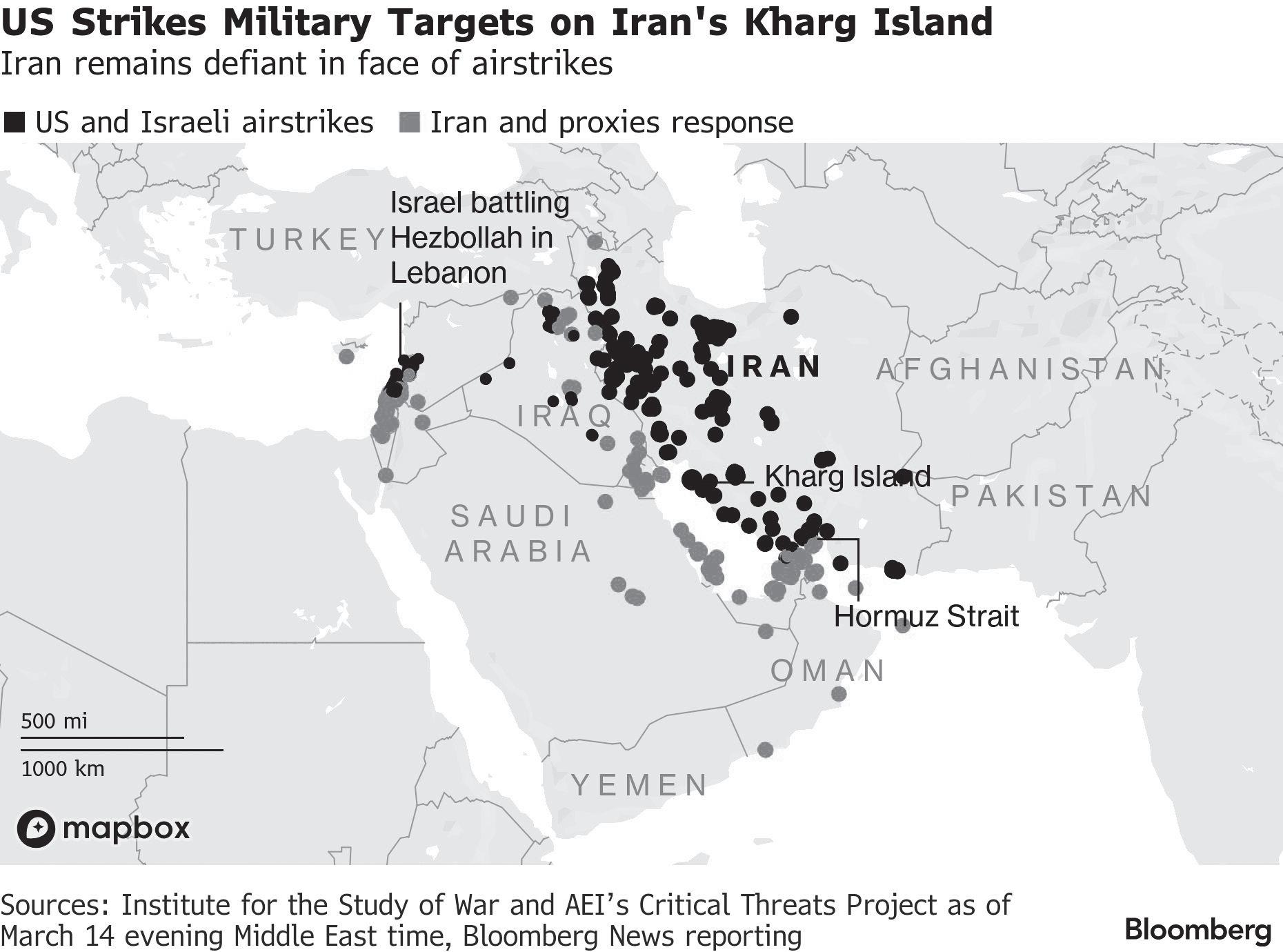
Trump demands naval coalition as Iran strikes Gulf states, oil surges past $105
By The Associated Press
UNITED STATES Presi -
dent Donald Trump said
he has demanded about seven countries send warships to keep the Strait of Hormuz open as Iranian strikes continued to rain down on Gulf countries Monday.
Dubai International Airport, the world’s busiest, gradually restarted operations after a drone struck a fuel tank and started a fire. Authorities said it was quickly contained and no injuries were reported.
Tehran has accused the United States without evidence of using “ports, docks and hideouts” in the United Arab Emirates to launch strikes on Kharg Island, home to the main terminal handling Iran’s oil exports evidence, as oil prices soared. Brent crude oil was trading near $105 per barrel on Monday.
Trump said the US is negotiating with countries heavily reliant on Middle East crude to join a coalition to police the waterway where about one-fifth the world’s traded oil normally flows, but declined to name them.
Israeli strikes have deepened Lebanon’s humanitarian crisis, with more than 850 people killed and over 850,000 displaced.
Here is the latest:
Drone strike starts fire at UAE oil facility
A FIRE broke out Monday following a drone attack on an industrial oil facility in Fujairah, one of the United Arab Emirates’ seven emirates, authorities said.
The Media Office in Fujairah said a drone targeted the Fujairah Oil Industry Zone, causing an “advanced” fire.
No casualties were reported.
UAE says Palestinian killed in Abu Dhabi missile attack
A PALESTINIAN civilian was killed in a missile attack early Monday in the United Arab Emirates capital Abu Dhabi, authorities said.
The Abu Dhabi Media Office said a missile fell on a civilian vehicle in Al Bahyah area.
The death raised the toll to seven people in the UAE since the beginning of the war Feb. 28, authorities said.
EU weighs naval missions to reopen strait
THE European Union is weighing two types of naval missions to help reopen the Strait of Hormuz.
“It is in our interest to keep the Strait of Hormuz open, and that’s why we are also discussing what we can do in this regard from the European side,” said Kaja Kallas, the EU’s foreign policy chief. She made the announcement ahead of a gathering of the bloc’s foreign ministers in Brussels on Monday.
Rising prices for energy and fertilizers has brought the war in Iran to the top of their agenda, she said.
Kallas said the EU could expand its Aspides naval mission to protect shipping in the Red Sea up into the Persian Gulf or form a “coalition of the willing” with member nations contributing military capacity on an ad hoc basis.
Saudi Arabia reports drone attacks
SAUDI ARABIA says it intercepted three drones Monday morning over the capital Riyadh and the nation’s oil-rich western region.
The Saudi Defense Ministry
says no casualties or damage were reported.
The ministry reports more than 60 drones attacked the Gulf country within a few hours.
Some flights resume at Dubai airport
UNITED ARAB EMIRATES officials say Dubai International Airport has gradually resumed some flights hours after a drone strike.
Dubai Civil Aviation Authority announced flights are operating to selected destinations, according to the Dubai Media Office.
Emirates airline says limited operations have resumed at the airport.
A drone struck a fuel tank at the airport early Monday, causing a fire and forcing the temporary suspension of flights.
Brent crude trades near $105 BRENT crude oil is trading near the $105 per barrel level on Monday.
A barrel of Brent, the international standard, was up 1.6% at $104.73, dipping slightly after opening above $106 per barrel. It’s up more than 40% since the war began.
Share prices in Asia were mixed and US futures advanced.
Emirates flights to remain suspended
HOURS after a drone strike sparked a fire at Dubai’s main airport, Emirates says in its latest update that all of its flights there “remain suspended until further notice.”
The airline says it is working with authorities to restart operations when possible. It urged passengers not to travel to the airport.
Dubai International Airport is the world’s busiest airport for international travel and a key hub for many routes linking the East and West.
UAE intercepts more drone and missile attacks
THE United Arab Emirates’ Defense Ministry said forces were intercepting Iranian missiles and drones Monday morning.
Earlier, a drone hit a fuel tank at the Dubai International Airport.
Trump suggests he may delay his trip to China
TRUMP is suggesting he may delay his much-anticipated
Myanmar’s parliament meets for first time in 5 years with military controlling most
NAYPYITAW, Myanmar—
Myanmar opened its first parliamentary session in more than five years on Monday following an election that did not include major opposition parties, ensuring that the ruling military is set to retain a firm grasp on power.
The military blocked Myanmar’s last parliament from convening when it seized power from the last legitimately elected government of Aung San Suu Kyi in February 2021, and has governed without a legislature since then. It touted elections held in late December and January as a step toward the return of democracy.
But the military and its allies hold nearly 90% of the seats in the two-chamber parliament, while Myanmar’s former ruling National League for Democracy and other major opposition parties were either blocked from running or refused to compete under conditions they deemed unfair.
Delegates wearing traditional attire arrived in the capital, Naypyitaw, on Monday for the opening session of the 373-seat lower house, which convened in the tightly guarded parliamentary complex, newly renovated after being badly damaged by last year’s earthquake.
Security forces sealed roads leading to the parliament, and vehicles were searched for explosives before entering.
The new Parliament’s first task is to elect a speaker for each chamber, then elect a president and two vice presidents.
During Monday’s session, Khin Yi, the chairman of the militarybacked Union Solidarity and Development Party, was elected as speaker of the lower house. He is a former general and police chief, widely regarded as a close ally of Senior Gen. Min Aung Hlaing, the country’s military ruler.
Maung Maung Ohn, also a former general and ex-information
minister, was elected deputy speaker.
The 213-seat upper house is scheduled to open Wednesday, with 14 regional parliaments set to convene two days after that.
A quarter of the available seats in the upper and lower houses—166 seats—were reserved for the military by the military-written constitution, and the USDP won 339 of the rest. Twenty-one other parties won between one and 20 seats each.
Phased elections were held in December and January in 263 of the country’s 330 townships.
Critics described the vote organized by the military government
seats
as an effort to legitimize its rule.
The 2021 coup triggered widespread opposition that dragged Myanmar into a civil war.
Tom Andrews, a special rapporteur working with the U.N. human rights office, has urged the international community to reject the election results and any power arrangements that follow.
Min Aung Hlaing, who heads the current military government, is widely expected to assume the presidency.
However, the constitution bars a president from serving concurrently as the army’s commander-in-chief—Myanmar’s most powerful post—raising questions about whether he would relinquish that role.
Suu Kyi, Myanmar’s 80-yearold former leader, is serving a 27-year prison term on charges widely viewed as spurious and politically motivated. Her party won landslide victories in the 2015 and 2020 elections, but was forced to dissolve in 2023 after refusing to register under new military rules.
An opposition shadow parliament, formed by elected lawmakers who were blocked from taking their seats when the military seized power in 2021, also held an online session on Monday. It claims it is the country’s sole legitimate parliament. AP
visit to China at the end of the month as he seeks to ramp up the pressure on Beijing to help reopen the Strait of Hormuz and calm oil prices.
In an interview Sunday with the Financial Times, Trump said China’s reliance on oil from the Middle East means it ought to help with a new coalition he is trying to put together to get oil tanker traffic moving through the strait after Iran’s threats have throttled global flows of oil.
Trump said “we’d like to know” before the trip whether Beijing will help.
“We may delay,” Trump said in the interview.
Trump’s new comments came as US Treasury Secretary Scott Bessent was meeting with Chinese Vice Premier He Lifeng on Monday in Paris for a new round of trade talks that were meant to pave the way for Trump’s Beijing trip.
Saudi crown prince speaks with UAE president MOHAMMED BIN SALMAN and Mohamed bin Zayed Al Nahyan discussed the latest regional developments in a phone call, Saudi Arabia’s Foreign Ministry said in a statement early Monday.
The two leaders said the continued “Iranian attacks against Gulf Cooperation Council countries represent a dangerous escalation that threatens regional security and stability,” adding that GCC states will continue efforts to defend their countries.
Road and tunnel to Dubai International Airport closed EMIRATI authorities have closed the main road and tunnel leading to Dubai International Airport.
Dubai Police urged drivers to use alternative roads.
Authorities said earlier a drone hit a fuel tank at the airport, causing fire with no casualties.
Saudi air defenses down large drone attack
SAUDI ARABIA’S Defense Ministry said early Monday it downed an additional large barrage of 35 drones in the country’s eastern region, one of the kingdom’s least dense, close to Iran and home to major oil installations.
This brings the total number of drones intercepted to at least 60 in the last few hours.
The ministry did not immediately report casualties or damage.
Australia not sending warship to Strait of Hormuz, minister says THE Australian government says a warship won’t be sent to the Middle East to keep the Strait of Hormuz open to international shipping.
US President Donald Trump said that he has demanded about seven countries send warships to keep the Strait of Hormuz open, as Iranian strikes continued to rain down on Gulf countries.
Australia’s Transport Minister Catherine King told Australian Broadcasting Corp. on Monday she was not aware of Australia receiving such a request.
“We won’t be sending a ship to the Strait of Hormuz. We know how incredibly important that is, but that’s not something that we’ve been asked or that we’re contributing to,” King said.
Australia said last week it was providing the UAE with an air force surveillance jet and airto-air missiles to defend against Iranian attacks.
But a government statement said Australia was “not taking offensive action against Iran.”
Republicans shut down debate on Iran conflict, defying Democratic demands
By Stephen Groves The Associated Press
WASHINGTON—The United States’ war with Iran is entering its third week, but Congress has yet to publicly test the Trump administration’s case for the conflict.
Republicans in Congress have so far side-stepped public debate over the war, even as Senate Democrats reach for every tool at their disposal to demand hearings with Trump administration officials. Increasingly frustrated, Democrats are threatening this week to force a series of votes on the war, hoping that the effort to gum up the Senate’s voting schedule will prod Republicans to action.
“We’ve had no oversight whatsoever over what the executive is doing as we’re spending a billion dollars a day, and we have failed to have any real substantive debate or discussion,” said Sen. Cory Booker, D-N.J. The role of Congress in the deliberations is an unsettled question with enormous stakes, given that lawmakers have the power to shape the trajectory of the conflict as it grows in cost and casualties. So far, 13 military members have been killed and billions of dollars have been spent, but President Donald Trump has not sought congressional approval for attacking Iran.
As the 17th day of the conflict dawned Monday, Republican lawmakers remained mostly resistant to the idea of quickly forcing public testimony before Congress.
How GOP leaders are handling calls for hearings SENATE Majority Leader John Thune told
reporters last week that he didn’t expect public hearings specifically on the Iran war, but noted it would inevitably come up in the regular rhythm of testimony on military policy and spending.
“They have briefed us,” Thune, R-S.D., said, pointing to classified briefings from the Trump administration. Those sessions have been held behind closed doors and most lawmakers refuse to disclose more than the broad topics of discussion.
Thune also noted there have been regular news conferences from Defense Secretary Pete Hegseth and Gen. Dan Caine, chairman of the Joint Chiefs of Staff. They are “answering the hard questions that are being asked,” Thune said.
The GOP chairs of committees dealing with national security have also said they don’t have plans in the near term to hold hearings specifically on the war, though some acknowledged the value of lawmaker questioning.
Sen. Roger Wicker, the chair of the Senate Armed Services Committee, argued that the regular run of hearings on Capitol Hill would provide lawmakers with plentiful opportunities to ask questions.
“We’re going to conduct generous oversight, thorough oversight,” said Wicker, R-Miss.
Some Republicans are looking ahead to an expected supplemental budget request from the Trump administration to cover the costs of the war. That request, however, is likely weeks away and faces a difficult path through Congress.
Democrats have pointed out that the
A CARGO ship sails in the Arabian Gulf towards Strait of Hormuz in United Arab Emirates, Sunday, March 15, 2026. AP/ALTAF QADRI
US and Chinese officials commence trade talks in Paris, setting the stage for Trump-Xi meeting
BEIJING—Representatives from Beijing and Washington began their economic and trade talks in Paris on Sunday, paving the way for US President Donald Trump’s state visit to Beijing to meet Chinese leader Xi Jinping in about two weeks.
The delegations, led by US Treasury Secretary Scott Bessent and Chinese Vice Premier He Lifeng, convened in the French capital in the morning, China’s official news agency Xinhua reported. The White House has said that Trump will travel to China from March 31 to April 2, though Beijing has not officially confirmed it.
Bessent said on Thursday that his
team will continue to deliver results that put America’s farmers, workers and businesses first. The US Treasury Department said Bessent will meet He on Sunday and Monday.
China’s commerce ministry said Friday the two sides are set to discuss “trade and economic issues of mutual concern.”
Trump’s visit to China will be the first for a US president since
he went in his first term in 2017. It will come five months after the two leaders met in the South Korean city of Busan and agreed to a one-year truce in a trade war that
temporarily saw tit-for-tat tariffs soar to triple digits before the two sides climbed down.
See “Trump-Xi,” A9
Israeli soldiers fire on family car in occupied West Bank,
By Sam Metz & Aref Tuffaha
Tfour
Associated Press
killing 4
including two children, the Palestinian Authority’s Health Ministry said. The Palestinian Red Crescent rescue service said that Ali and Waed Odeh, and two of their four children, were shot in the head. The Odehs’ two surviving children had shrapnel wounds that were examined by
the group said, accusing
of delaying ambulances dispatched to the scene. Israel’s military and police said in a joint statement Sunday that forces opened fire after a car accelerated toward them in Tammun. They said the forces were pursuing suspects accused of “terrorist activity” and that the shooting was under investigation.
See “West Bank,” A9
UNITED STATES Secretary of the Treasury Scott Bessent, left, shakes hands with Chinese Vice Premier He Lifeng, right, during a bilateral meeting between the United States and China, in Geneva, Switzerland, on Saturday, May 10, 2025. MARTIAL TREZZINI/KEYSTONE VIA AP
A8 Tuesday, March 17, 2026
France bolsters military presence in Middle East, as Macron prepares for postwar diplomatic talks
PBy Sylvie Corbet The Associated Press
ARIS—France’s government is bolstering the country’s military presence in the Middle East, dispatching its aircraft carrier and other warships, while President Emmanuel Macron engages with key players in the conflict, including Iran, in a bid to position Paris for future diplomatic talks.
Macron said that France’s military involvement is strictly “defensive” and aims to avoid making the country a party to the war. He reaffirmed that position after one French soldier was killed Thursday in a drone attack in Iraq.
“We are not at war with anyone,” Macron said. Still, the large-scale deployment of the French navy—which he described as “unprecedented”—has made France the European nation with the most prominent presence in the region.
Visiting the Charles de Gaulle aircraft carrier last week, Macron said that its presence in the Mediterranean demonstrates “France’s strength: a balancing power, a force for peace.”
Here’s what to know about Macron’ strategy.
France’s large naval deployment MACRON announced the deployment to the eastern Mediterranean and the wider Middle East of eight warships, two helicopter carriers and the nuclear-powered aircraft carrier Charles de Gaulle with its 20 Rafale fighter jets.
The French frigate Languedoc arrived off Cyprus, a fellow European Union member, to bolster anti-drone and anti-missile defenses. Cyprus and France signed a new strategic partnership in December. Macron also said that two French frigates have been dispatched to the Red Sea to help ensure maritime security and freedom of navigation.
Macron said that the warship deployment is intended to allow France “to respond to emergency situations” and evacuate French nationals if necessary.
France has more than 400,000 citizens in the Middle East—more than any other European country—including more than half in Israel and over 60,000 in the United Arab Emirates.
Other European nations, including Spain, Italy, the Netherlands and Greece, have deployed frigates in the region.
The French navy’s swift deployment contrasts with the United Kingdom’s delay in sending the HMS Dragon destroyer, which left Portsmouth, England, on March 10.
U.K. opposition parties have accused Prime Minister Keir Starmer’s government of moving too slowly to protect British bases in Cyprus and allies in the Middle East. The U.K. government also has sent Typhoon and F-35 fighter jets, helicopters and air defense systems to the region to
help intercept Iranian missiles and drones.
Defending Gulf allies
FRANCE has key defense agreements with several countries in the region, including Qatar, Kuwait and the UAE, where it maintains a permanent base in Abu Dhabi.
France’s military, which has air and naval forces there, doubled the number of Rafale fighter jets stationed on site to 12.
French authorities acknowledged that Rafale jets intercepted drones targeting the UAE since the beginning of the war.
“We stand by the side of our allies and our friends,” Macron said during his visit to the Charles de Gaulle. “There have been some interceptions that have continued in recent days.”
“We do so within the framework of our partnerships,” he said, without providing further details.
French forces are also deployed in Jordan and Iraq.
On Thursday, one French soldier was
killed and several others injured in a drone attack in the region of Irbil, in northern Iraq. They were training Iraqi units as part of a multinational counterterrorism mission in the country.
Former President François Hollande, who led France from 2012 to 2017, said that it was important for France to show it can protect its nationals and reassure its partners, but warned of the risks.
“We must be careful—it’s always a risky operation—to make sure our warships are not targeted,” Hollande said. “Because if they are attacked, we have to fire back.”
Historic ties with Lebanon
MACRON is leading a diplomatic effort to try to halt the conflict in Lebanon, where at least 850 people have been killed and hundreds of thousands displaced as the Hezbollah militant group entered a new round of fighting with Israel. Macron urged Hezbollah to stop fighting and called on Israel to renounce any ground offensive.
France supports the Lebanese military as authorities have pledged to “take control” of positions held by Hezbollah and assume full responsibility for security in the country, Macron said. Hezbollah’s arsenal notably includes exploding drones, similar to the ones used by Iran.
France has traditionally been a key supporter of Lebanon, a former French protectorate, and maintains 800 troops in the U.N. peacekeeping force there. The French government provided the country with armored vehicles and operational military support.
France sent 60 tons of emergency aid to Lebanon last week on a humanitarian flight to Beirut, authorities said. The shipment included medicines, medical equipment, a mobile health unit, shelter materials, basic necessities and infant formula.
Maintaining contact with Iran MACRON was the first Western leader
See “France,” A9
www.businessmirror.com.ph
. .
Continued from A8
to speak with Iranian President Masoud Pezeshkian since the war began.
He said he urged Iran to halt strikes against countries in the region. Since the phone call on March 8, this appeal had gone unanswered.
Macron stressed that “a diplomatic solution” is needed to end the escalation and said that he and Pezeshkian agreed to remain in contact.
Macron also spoke with Israeli Prime Minister Benjamin Netanyahu and US President Donald Trump, though there were no signs of de-escalation.
France hopes diplomatic efforts could bear fruit once the most intense phase of the conflict subsides, which could take weeks or months.
Macron is also promoting an international effort to secure the Strait of Hormuz,
The World
a key energy corridor, so oil, gas and goods can flow freely again “when circumstances permit.” He has suggested countries could use warships to escort tankers and container ships once fighting eases.
Political analyst Bertrand Badie, an international relations professor at Sciences Po Paris, said Macron has long sought to assert France’s role on the global stage. With low approval ratings at home and about a year left in his term, Macron may have the most to gain among European leaders by pursuing diplomacy, Badie said.
“At this point, we are forced to scale back our expectations—drastically,” he said. “From a diplomatic standpoint, what leverage does France really have?”
“My assessment is that this crisis cannot be resolved by French remedies,” Badie said. “There is no point in having any illusions.”
Jill Lawless contributed to this report from London.
Tricky negotiations begin Monday to renew trade pact between US, Mexico and Canada
By Paul Wiseman & María Verza The Associated Press
WASHINGTON—Every day more than $4 billion worth of goods cross the United States’ borders with Canada and Mexico—US auto parts headed for car factories in northern Mexico, cartons of Mexican avocados bound for California supermarkets, Canadian aluminum destined to become cans of Campbell Soup.
Much of this bustling cross-border commerce is duty-free, thanks to the USMexico-Canada Agreement, or USMCA, that President Donald Trump negotiated with America’s northern and southern neighbors during his first term.
improve it; under a convoluted renewal process, they have until 2036 to reach an agreement—or the pact expires.
Meantime, any USMCA country can pull out of the pact provided it gives its two partners six months’ notice—an option that Canada and Mexico, heavily dependent on trade with the United States, fear the impulsive Trump might end up choosing.
At stake is $1.6 trillion worth of annual trade in goods between the United States and its two USMCA partners. Mexico and Canada are far ahead of China in both exports to and imports from the United States. American farmers are especially keen to see the deal renewed: Last year, they shipped nearly $31 billion in agricultural products to Mexico and $28 billion to Canada.
with rare support from Republicans and Democrats alike, ended up being very similar to NAFTA. But it did contain provisions designed to encourage factories in the region to pay higher wages and make sure that more of what they made originated in North America.
The new pact updated North American trade rules for the digital age. The USMCA, for instance, bars the United States, Mexico and Canada from slamming each other with import taxes on music, software, games and other products sold electronically.
A proud Trump declared the USMCA “the fairest, most balanced and beneficial trade agreement we have ever signed.’’
access to Canada’s protected dairy market for US farmers.
Mexico’s core priorities are to avoid a major rewrite of the agreement and to make rules of origin more flexible—allowing imports of parts from outside North America when they are not available in the region.
Mexican negotiators also want assurances that anything agreed to will stick, providing insurance against Trump’s unpredictability and his enthusiasm for tariffs.
Continued from A7
Still, trade remains a source of tensions. The commerce ministry hit back against the Trump administration’s new trade investigation into 16 trading partners, which included China. The investigation— which came after a Supreme Court ruling struck down Trump’s sweeping global tariffs that were imposed last year—could pave the way for new tariffs.
The US also launched a separate investigation into the import of goods made with forced labor from countries including China.
China said Monday that it had already made representations over concerns about the new investigation to the US. “It’s a mistake on top of a mistake, that severely harms the global supply chain’s safety and stability,” according to a statement from the Ministry of Commerce.
Another issue that could be discussed is the Iran war, especially when global anxiety
West Bank. . .
Continued from A7
Najah al-Subhi, who lost her son and grandchildren, told The Associated Press the family had gone to a mall in Nablus to buy clothes for Eid al-Fitr, the holiday marking the end of the Muslim holy month of Ramadan this week. She said the two surviving children sustained shrapnel wounds in the eye and the head.
Sameer Basharat, Tammun’s mayor, said he heard about what happened to the Odeh family in the middle of the night, noting that their car was shot in the town’s center, where the Israeli army maintains a daily military presence.
The town is among several that Israel has remained in for more than a year after launching an offensive in parts of the northern West Bank last year as part of an effort to confront militants.
Beyond the shooting, Basharat said that over the past year residents have been evicted by the army and denied access to the town’s farmland, while Israel has been seizing land in preparation for the anticipated construction of a new fence that would divide the Jordan Valley. Additionally, Tammun has faced frequent raids and road closures, affecting life and livelihoods of people in the town who on Sunday “are experiencing deep sorrow over what happened to the family,” Basharat said.
The Israeli rights group B’tselem said the Odeh family’s car was riddled with bullets and Israeli forces had “violently
Continued from A6 Trump-Xi.
Pentagon has already received additional funding from Republicans’ marquee tax cut law that was passed last year and provided funding for GOP priorities, including at the Pentagon.
Wariness growing from some Republicans
STILL , agitation from a few Republicans at the lack of high-level responses from the Trump administration is starting to show,
is soaring over oil prices and supplies. Trump said Saturday that he hopes China, France, Japan, South Korea, the United Kingdom and others will send warships to keep the Strait of Hormuz “open and safe.”
Before Sunday’s talks, Gary Ng, a senior economist at French bank Natixis and a research fellow at the Central European Institute of Asian Studies, said the Paris meeting is likely the most important bilateral one before the Xi-Trump summit.
The key issue is “whether China and the US can agree on what is agreed and manage disagreement. Iran is a new factor, but Beijing is more concerned about the flip-flopping of US policies,” he said.
Last week, Chinese Foreign Minister Wang Yi said it would be a “big year” for China-US relations. While he did not confirm the state visit, Wang said that “the agenda of high-level exchange is already on the table.” Bessent and He have led trade negotiations between the countries since last year, having met in Geneva, London, Stockholm, Madrid and Kuala Lumpur, Malaysia. AP
interrogated” one of the surviving children who was wounded.
“No effective mechanism exists to hold those responsible to account,” the group said.
Israeli soldiers accused of harming Palestinians are rarely penalized and were indicted in fewer than 1% of cases based on 2,427 complaints alleging wrongdoing between 2016 and 2024, according to Israeli rights group Yesh Din.
The members of the Odeh family were the latest casualties in the occupied West Bank, where Israeli settlers and soldiers had previously shot and killed at least eight Palestinians since the start of the Iran war.
Since Israel and the US attacked Iran on Feb. 28, Israeli authorities have restricted movement across the West Bank, intermittently closing hundreds of gates and checkpoints on roads used by residents, ambulances and commercial traffic. The barriers have tightened movement and made emergency response significantly more difficult, the Red Crescent told AP last week.
Yesh Din said on Wednesday that it had documented 109 incidents of settler violence in the occupied West Bank in dozens of Palestinian communities since the start of the war.
The United Nations Office for the Coordination of Humanitarian Affairs has recorded 18 Palestinians killed in the occupied West Bank since the start of 2026, including eight by Israeli settlers.
Metz reported from Ramallah, West Bank.
especially as they brace for a hefty war bill from the administration.
“I don’t want to just be given the invoice from the Department of Defense, saying this is what it’s going to cost,” said Sen. Lisa Murkowski, R-Alaska. “I want them to be engaged with us.”
She added that it was important for lawmakers to get information both in classified briefings and public hearings “so that the public can better understand this, too.”
Another GOP senator on the powerful Appropriations Committee, Louisiana’s John Kennedy, exited a classified briefing last week fuming that it had been a “total
But the future of the USMCA, which took effect July 1, 2020, is cloudy as the three countries begin what could be a tempestuous attempt to renew the pact this year. The United States is demanding changes to the treaty, and the top US trade negotiator told Politico in December that Trump would be willing to pull the United States out of the pact if he can’t get the deal he wants. Trump also suggested last fall that the United States could negotiate separate deals with Canada and Mexico, ending the three-country North American bloc that previous administrations saw as crucial to competing economically with China and the European Union.
The talks kick off Monday between US and Mexican trade officials.
The North American economies could agree to renew USMCA as it is for another 16 years—a prospect that appears unlikely. Or they could keep working on ways to
US imports from Canada and Mexico were spared the worst of Trump’s 2025 tariffs; many goods compliant with USMCA rules continued to enter the United States duty free. Still, a number of products did not get protection from the US levies, including medium- and heavy-duty trucks, which face a 25% tariff. A 50% tariff on steel, aluminum and copper remains in effect, as does a 17% tariff on Mexican tomatoes.
The USMCA replaced the 1994 North American Free Trade Agreement negotiated by President George H.W. Bush and signed into law by President Bill Clinton.
Trump and other critics had criticized NAFTA as a killer of US jobs because it encouraged US companies to relocate factories south of the border to take advantage of low-wage Mexican labor and then send goods back to the United States duty free.
The USMCA, ratified by Congress
But the president’s enthusiasm seems to have waned. In January, he expressed little interest in the upcoming talks to renew the agreement. The effort, he said, offered “no real advantage to us. It’s irrelevant to me.’’
The USMCA did little to ease one of Trump’s biggest complaints: The US deficit in the trade of goods with Mexico, which rose last year to a record $197 billion as the United States reduced its reliance on Chinese imports. The US also ran a merchandise trade deficit with Canada of $46.4 billion last year, a decrease from 2024.
“Improvements are required for it to deliver the high-wage US manufacturing powerhouse and balanced trade (Trump) promised and we need,” said Lori Wallach, director of the Rethink Trade program at the American Economic Liberties Project.
The United States plans to push for a series of changes, including stronger rules to ensure that goods from China won’t slip into the United States under USMCA; to encourage more production in the United States; and to ensure more
Mexico wants to minimize tariffs as much as possible. Mexican Economy Secretary Marcelo Ebrard said Mexico wants to strengthen the dispute resolution system already in place under the treaty. That would not eliminate the possibility of tariffs, but it would provide clear, swift channels for seeking solutions when problems arise, he said.
Mexican President Claudia Sheinbaum’s administration will have to simultaneously manage existing security issues, which are ongoing after the killing of Jalisco New Generation Cartel’s leader in late February, and which could influence economic matters.
Mexico anticipates that Canada will join the talks later, but its top priority in the coming months is to reach agreements and maintain the free trade with the United States, its main commercial partner. Mexico is pushing the idea that the treaty is also good for the US. “The integration of our countries is an absolute prerequisite for the United States to remain competitive,” Ebrard said recently. “We must move forward together; otherwise, we will not succeed.”
Verza reported from Mexico City.
The Polish miracle: From the ashes of Communism to a top 20 economy
By Claudia Ciobanu & David Mchugh
The Associated Press
POZNAN, Poland—A generation ago, Poland rationed sugar and flour while its citizens were paid onetenth what West Germans earned. Today its economy has edged past Switzerland to become the world’s 20th largest with over $1 trillion in annual output.
It’s a historic leap from the postCommunist ruins of 1989-1990 to today’s European growth champion that economists say has lessons on how to bring prosperity to ordinary people— and that the Trump administration says should be recognized by Poland’s presence at a summit of the Group of 20 leading economies later this year.
The transformation is reflected in people like Joanna Kowalska, an engineer from Poznan, a town of half a million people midway between Berlin and Warsaw. She returned home after five years in the US.
“I get asked often if I’m missing something by coming back to Poland, and, to be honest, I feel it’s the other way around,” Kowalska said. “We are ahead of the United States in so many areas.”
Kowalska works at the Poznan Supercomputing and Networking Center, which is developing the first artificial intelligence factory in Poland and integrating it with a quantum computer, one of 10 on the continent financed by a European Union program.
Kowalska worked for Microsoft in the US after graduating from the Poznan University of Technology in a job she saw as a “dream
waste of time” because the officials were not able to provide the answers that top-level Cabinet officials could.
Republicans have almost uniformly backed Trump’s decision to launch an attack on Iran, though many are wary of a lengthy conflict. Trump has cycled through different objectives for the war, ranging from crippling Iran’s military capabilities to a demand for “unconditional surrender.”
“I think we have to let the objective play out as far as we can, and if then the effort gets murky on how to get to the objective, that might be a good time to have some hearings, but it’s too early,” said Sen. Cynthis
come true.”
But she missed having a “sense of mission,” she said.
“Especially when it comes to artificial intelligence, the technology started developing so rapidly in Poland,” Kowalska added. “So, it was very tempting to come back.”
Multiple factors in breaking out of poverty
THE guest invitation to the G20 summit is mostly symbolic; no guest country has been promoted to full member since the original G20 met at the finance minister level in 1999, and that would take a consensus decision of all the members. Moreover, the original countries were chosen not just by GDP rank, but by their “systemic significance” in the global economy.
But the gesture reflects a statistical truth: In 35 years—a little less than one person’s working lifetime—Poland’s per capita gross domestic product rose to $55,340 in 2025, or 85% of the EU average. That’s up from $6,730 in 1990, or 38% of the EU average and now roughly equal to Japan’s $52,039, according to International Monetary Fund figures measured in today’s dollars and adjusted for Poland’s lower cost of living.
Poland’s economy has grown an average 3.8% a year since joining the EU in 2004, easily beating the European average of 1.8%.
It wasn’t simply one factor that helped Poland break out of the poverty trap, says Marcin Piątkowski of Warsaw’s Kozminski University and author of a book on the country’s economic rise.
Lummis, a Wyoming Republican. But as the midterm elections approach, Republicans are also aware that public support for the war remains tepid.
“I wish we could disclose a lot of this publicly because it would make it a whole lot easier to explain to the American people,” said Sen. Mike Rounds, R-S.D., adding that classified briefings were necessary to protect US service members now that the war is under way.
How Democrats may force a debate DEMOCRATS , meanwhile, are threatening to
One of the most important factors was rapidly building a strong institutional framework for business, he said. That included independent courts, an antimonopoly agency to ensure fair competition, and strong regulation to keep troubled banks from choking off credit.
As a result, the economy wasn’t hijacked by corrupt practices and oligarchs, as happened elsewhere in the postCommunist world.
Poland also benefited from billions of euros in EU aid, both before and after it joined the bloc in 2004 and gained access to its huge single market.
Above all, there was the broad consensus, from across the country’s political spectrum, that Poland’s long-term goal was joining the EU.
“Poles knew where they were going,” Piątkowski said. “Poland downloaded the institutions and the rules of the game, and even some cultural norms that the West spent 500 years developing.”
As oppressive as it was, communism contributed by breaking down old social barriers and opening higher education to factory and farmworkers who had no chance before. A post-Communist boom in higher education means half of young people now has degrees.
“Young Poles are, for instance, better educated than young Germans,” Piatkowski said, but earn half what Germans do. That’s “an unbeatable combination” for attracting investors, he said.
An electric bus ride to success SOLARIS , a company founded in 1996 in Poznan by Krzysztof Olszewski, is one
do just about everything in their power to bring attention to the war, even if it means repeatedly forcing votes that fail.
A group of six Democrats has said that unless hearings are scheduled with Hegseth, Secretary of State Marco Rubio and other Cabinet officials, they will call up daily votes on a series of war powers resolutions that if passed would require Trump to gain congressional approval before carrying out any more attacks on Iran. Similar resolutions have already been rejected by both chambers in the Republican-controlled Congress. The votes, however, would eat up
of the leading manufacturers of electric buses in Europe with a market share of around 15%. Its story shows one hallmark of Poland’s success: entrepreneurship, or the willingness to take risks and build something new.
Educated as an engineer under the Communist government, Olszewski opened a car repair shop where he used spare parts from West Germany to fix Polish cars. While most enterprises were nationalized, authorities gave permission to small-scale private workshops like his to operate, according to Katarzyna Szarzec, an economist at the Poznan University of Economics and Business. “These were enclaves of private entrepreneurship,” she said.
In 1996, Olszewski opened a subsidiary of the German bus company Neoplan and started producing for the Polish market.
“Poland’s entry to the EU in 2004 gave us credibility and access to a vast, open European market with the free movement of goods, services and people,” said Mateusz Figaszewski, responsible for institutional relations.
Then came a risky decision to start producing electric buses in 2011, a time when few in Europe were experimenting with the technology. Figaszewski said larger companies in the West had more to lose if switching to electric vehicles didn’t work out. “It became an opportunity to achieve technological leadership ahead of the market,” he said.
McHugh reported from Frankfurt, Germany.
valuable time on the Senate floor and set the ground for a debate on the conflict just as Senate Republicans plan to
March 17, 2026
After DOT shakeup, Marcos urges tourism sector to close ‘wide gap’ with regional rivals like Thailand
By Samuel P. Medenilla
@sam_medenilla
ON the heels of the recent leadership change in the Department of Tourism (DOT), President Ferdinand Marcos called for elevating the Philippines’ tourism sector as it faces intense “pressure” from other countries.
The Chief Executive made the statement during the inauguration of the Mactan Expo Center, which will serve as venue for the
upcoming Association of Southeast Asian Nations (ASEAN) Summit, in Lapu-Lapu City, Cebu last Monday.
“Our tourism industry is now under a great deal of pressure from what is happening [in the tourism sector].
And last year, we only welcomed 6 million people. Just to give you a frame of reference, Thailand welcomes 30 million tourists every year. So we need to close a really wide gap,” Marcos said in Filipino during the event.
The DOT reported the country only welcomed 5.87 million
Sen. Bam calls bullying a ‘crisis,’ seeks stronger protection for students
THE growing incidence of bullying, both online and offline, is a “crisis,” according to Senator Bam Aquino, who stressed the urgent need for stronger action and protection for students as it poses serious risks to their safety, well-being, and learning.
At Monday’s hearing of the Senate Committee on Basic Education, which he chairs, Aquino said the prevalence of bullying has earned the country the “Bullying Capital of the World” tag.
Mayroon pong krisis sa pambubully sa ilang mga eskuwelahan sa ating bansa. [There is a crisis of bullying in our schools],” he said, citing studies showing that bullying remains widespread among Filipino students.
He cited the Southeast Asia Primary Learning Metrics (SEA-PLM) report saying that about 50 percent of Grade 5 students in the Philippines experienced bullying at least once a month as of 2024. Meanwhile, data from the Programme for International Student Assessment (PISA) shows that one in three Filipino students report experiencing bullying in school, with about 43 percent of girls and 53 percent of boys reporting repeated incidents within a month.
“The bullying we are seeing is not just physical, or shaming someone fac e to face. It also includes online bullying, or in social media. The bullying does not stop in the school, and many young people feel they have no one to turn to,” he pointed out, speaking partly in Filipino.
Aquino said his concern stems not only from his role as a lawmaker but also from his role as a father who wants to ensure that his children grow up in a safe environment for learning.
“When my eldest child was born, I promised to protect her and do everything to make sure he has the best opportunities in life. I believe this is also the dream of every parent for their child,” Aquino said during the committee hearing, referring to his daughter, Rory.
Aside from determining the extent of bullying in schools, the hearing also aims to explore reforms to strengthen protection for students, amid concerns that schools are becoming spaces where some students experience fear instead of safe environments that nurture learning and growth.
“We called this hearing because of the rising concern that our schools and public places are becoming havens for bullying. Instead of nurturing g learning, innovation and empathy, our schools are becoming spaces for fear,” he stressed.
Aquino also cited findings from the Second Congressional Commission on Education (EDCOM), which link bullying to lower literacy levels, poorer academic performance, and higher rates of absenteeism—all of which can lead to lasting trauma among students.
“When our children are bullied, we are forming a generation steeped in trauma. Instead of embracing education, the youth are scared of the very spaces for learning,” Aquino stressed.
“As a father and a Filipino, I want a world that is peaceful and free of violence against children. This begins with the home and of course the school, the second home of most youths. This should be a safe space, a peaceful place for students, teachers and anyone who wishes to access our education system.”Butch Fernandez
inbound tourists, which is still significantly lower compared to the 8.3 million in 2019 before the global pandemic.
While the agency was still under former DOT Secretary Christina G. Frasco, it was targeting 6.7 million visitor arrivals this year.
Last week, Malacañang announced Frasco was appointed by President Ferdinand Marcos as Presidential Adviser for Sustainable and Resilient Communities. DOT
Undersecretary Verna Buensuceso was designated as the temporary
officer-in-charge of the agency.
Since last year, there were several rumors of Frasco’s departure from DOT due to the country’s low tourism arrivals, as well as her controversial photos, which were used for the country’s tourism promotion materials.
Marcos is optimistic the country can attract more tourists, especially with the completion of the Megaworld Corporation’s Mactan Expo in Lapu-Lapu City. He said the new convention center will not only be used during the first
leg of the country’s hosting of the ASEAN Summit on May 8, but also future meetings, incentives, conferences, and exhibitions (MICE) in the province.
The second part of the ASEAN Summit will be held at the newly renovated Philippine International Convention Center in Metro Manila in November.
“Mactan Expo is one of the projects that will further enhance our tourism sector,” Marcos said.
Marikina launches ‘bike to work’ challenge for city employees amid fuel price hikes
By Claudeth Mocon-Ciriaco @claudethmc3
THE city government of Marikina on Monday launched a biking challenge, encouraging city hall employees to bike to work amid ongoing oil and fuel price surges.
Marikina Mayor Marjorie Ann “Maan” Teodoro said the “Padyak Papasok: Bike to Work Marikina” is also part of efforts to strengthen alternative transport and promote active mobility.
“ Ang Marikina ay matagal nang bike-friendly city. Pero ngayon, gusto nating lalo pa itong palakasin. Higit pa sa challenge, ang gusto natin ay mas malusog na pamahalaan at mas sustainable na lungsod,” Teodoro said during the flag-raising ceremony. She added that the initiative was introduced as a friendly challenge to encourage city hall employees to use alternative modes of transportation.
Running until December 2026, city hall offices and departments will compete to record the highest number of employees who bike to work and
the most number of days employees participate in the challenge.
According to the mayor, the department with the largest percentage of employees who biked to work will receive awards and incentives at the end of the year.
It also provides an opportunity to further develop the city’s biking culture and infrastructure while advancing active mobility among Marikina residents.
Inatasan na natin ang Marikina Bikeways Office na siguraduhin na fully functional ang lahat ng endof-trip facilities para sa ating mga empleyado—lalo na ang facility sa Engineering Compound sa Barangay Sto. Niño— para kung may gustong mag-bike papasok sa trabaho, may lugar para magbihis, magpahinga, at maghanda sa trabaho,” the mayor said.
Likewise, the local chief executive directed the deployment of more bike racks near schools across the city and encouraged businesses to install bike parking facilities in their establishments to welcome more bikers.
The biking challenge
complements the city government’s four-day workweek schedule implemented under Executive Order (EO) No. 05, Series of 2026, signed by Teodoro on March 9 to conserve energy and reduce electricity consumption at City Hall.
On March 9, Teodoro signed Executive Order (EO) No. 05, Series of 2026, implementing a four-day workweek following President Marcos’ directive to conserve energy and reduce fuel use amid rising global oil prices linked to the Middle East crisis.
Under the policy, city government offices will operate from Monday to Thursday, 8 a.m. to 7 p.m., enabling employees to complete the 40-hour workweek while lowering electricity consumption through the weekly shutdown of government offices every Friday.
She noted that essential services and field operations, including the Disaster Risk Reduction and Management Office (DRRM), street maintenance teams, and public safety units, will continue to operate without interruption.
TBy Jonathan L. Mayuga @jonlmayuga
HE Department of the Interior and Local Government (DILG) said the Unified 911 Philippine emergency hotline system launched by the agency on September 11 last year is helping ensure faster coordination between citizens, police, and emergency responders to save lives, particularly in road crashes.
Initiated under President Ferdinand R. Marcos Jr.’s directive to modernize public safety, the Unified 911 system was implemented in partnership with PLDT Inc. and NGA 91, replacing over 30 fragmented local emergency hotlines with one national emergency hotline.
According to the DILG, earlier this year, the government tallied 1,113 road crash incidents following the holiday rush.
The DILG said the National Call Center handled multiple emergency calls related to vehicular accidents, facilitating the rapid dispatch of police and emergency response teams.
In Biñan City, Laguna, a victim reported sustaining a minor knee injury after being struck by a public utility jeepney (PUJ). Responding police personnel administered first aid and assisted both parties at the police station to resolve the incident.
In Alitagtag, Batangas, a motorcycle collided with an automobile during a dragnet and hot pursuit operation, leaving two individuals injured after the car fled the scene. Police quickly brought the victims to a nearby hospital while authorities continued efforts to identify the driver.
Meanwhile, personnel from the Makilala Police Station in North Cotabato rescued a driver after his
DILG’s centralized emergency system brings help faster, saves lives See “DILG,” A11 See “DOT,” A11
Decisive leadership key to earning OFWs’ trust during crises, think tank says
By Samuel P. Medenilla @sam_medenilla
ASOCIO -cultural think tank said that in times of crisis such as the ongoing Middle East conflict, overseas Filipino workers (OFWs) look up to decisive leadership rather than just existing services to measure the effectiveness of government response to their plight.
In its study, “From Economic Importance to Leadership Readiness,” the research firm The Fourth Wall conducted an economic analysis, reviewing government
Cops. . .
Continued from A5 and other online scams, to protect the public from fraud and travelrelated scams.
All police regional offices were also directed to conduct regular inspections and mobile patrols to ensure maximum police presence in crowded places such as bus terminals, seaports, airports, and other transport hubs.
The summer months bring a surge in travel as families take advantage of the long holidays and school break to visit their provinces, attend reunions, and enjoy vacations in resorts, beaches, and other tourist destinations.
Several significant national events also fall within this period, including Philippine Veterans Week, Araw ng Kagitingan, Labor Day, Flores de Mayo, and the solemn observance of Holy Week from March 30 to April 3. .
DOLE. . .
Continued from A5
The rules also clarify eligibility for the emergency employment component, stating that only one member per family may avail of the assistance.
DOLE defines a family as a nuclear household composed of parents or legally recognized guardians and their biological, adopted or legally entrusted children living in the same dwelling unit.
A solo parent or single legal guardian with their child or children is, likewise, considered a family.
The guidelines also clarify the processing of applications and wage payments for Tupad, including provisions allowing beneficiaries to authorize representatives to claim wages upon presentation of required identification documents.
Continued from A10
10-wheeler truck fell off a cliff. The victim was immediately transported to the municipal hospital for treatment.
“These incidents highlight how faster coordination through Unified 911 can mean the difference between life and death during emergencies on the road,” the DILG said.
Last year, President Marcos called for stronger action to prevent further loss of lives caused by road accidents following deadly incidents at the SCTEX toll plaza and NAIA Terminal 1 that claimed 12 lives.
The government subsequently launched the Metro Manila Road Safety Plan 2024 to 2028, which seeks to reduce road crash fatalities by at least 35 percent by 2028.
Along with Unified 911, authorities continue to strengthen road safety programs aimed at improving emergency response and protecting motorists and commuters.
migration systems, and “social listening” to assess the factors, which affect OFW trusts on institutions.
It reviewed the comments of OFWs on social media platforms like Facebook, Twitter, and Reddit since 2016 related to government migration services, welfare support, documentation processes, leadership, as well as institutional responses.
Among the highlights of the report was how OFWs valued “representational legitimacy as a core expectation.”
It said OFWs have a positive perception to leaders, who provide
“reliable service delivery and process discipline, strong cross-agency coordination, visible on-the-ground responsiveness during distress cases, and other leadership traits associated with credible migrant advocacy.”
“Our findings show a clear trend. When documentation is slow, when hotlines are unresponsive, or when agencies fail to coordinate during an emergency, migrants don’t turn to ‘administrative complexity’ but to national leadership. In the eyes of the OFWs, the quality of their service signals their government’s priorities,” The Fourth Wall
Research Director John Brylle L. Bae said.
“This gap is magnified during times of heightened geopolitical risk. In volatile environments, OFWs are not looking for policy mandates, but a clear, visible, and decisive presence from their government. Thus, they often look for credible champions—leaders who can mobilize institutions quickly and visibly when workers face risk abroad,” he added.
The new report also noted that the government needs to focus on the reliability rather than the expansion of its existing structures
Senate passes GIDA Schools Act on 3rd reading to help education in marginalized communities
SBy Butch Fernandez @butchfBM
ENATE Bill No. 1937, or the “GIDA Schools Act,” hurdled third and final reading on Monday, March 16, 2026. Sponsored by Second Congressional Commission (EDCOM II) CoChairperson Senator Bam Aquino, the landmark legislation seeks to institutionalize crucial support for public basic education schools in Geographically Isolated and Disadvantaged Areas (GIDA).
The passage of SBN 1937 is seen as a monumental step in ensuring that the constitutional right to quality education reaches every Filipino child, no matter how remote their community. The bill comprehensively targets schools facing severe geographic, infrastructural, and access-related barriers, specifically those that endure a lack of electricity, have makeshift or multigrade classrooms, or require more than an hour of travel to reach.
In its Final Report, EDCOM II found that learners in GIDA, or “last mile schools,” suffer from acute proficiency gaps. For instance, in the Grade 10 and Grade 12 National Achievement Tests (NAT), these students are heavily concentrated in the low and notproficient bands, with almost none achieving proficiency, and
Fallout. . .
Continued from A5
Meanwhile, Cayetano filed Senate Resolution No. 343, which urges the Executive Branch to establish a national framework and develop a comprehensive National Contingencies Plan to strengthen the country’s preparedness for major domestic and international crises.
“Instabilities, armed conflict, and war directly affect the welfare and employment of millions of OFWs across the Middle East and other regions, potentially affecting the livelihoods of millions of Filipino families dependent on remittances,” he said. Under the measure, the government is urged to craft a
a staggering 81.59% below the minimum proficiency threshold.
Key provisions of SBN 1937 seek to reverse this, with crucial supports including:
National Accessibility Standards and Mapping: The bill mandates a National GIDA Schools Mapping System for targeted resource allocation. It also enforces a strict accessibility standard, ensuring students have access to a school within a 3-kilometer walkable distance, or are otherwise provided with safe transportation arrangements.
Whole-of-Government Infrastructure Support: Recognizing that education access goes beyond school walls, the bill requires the Department of Education (DepEd) to collaborate with the DPWH for access roads, the DOE and NEA for electricity, and the DICT for internet connectivity.
Context-Responsive Facilities: SBN 1937 ensures that school buildings are durable, disaster-resilient, and culturally suitable, even allowing for the use of sustainable, locally sourced materials like engineered bamboo when compliant with safety metrics.
Comprehensive Support for Teachers: To attract and retain quality educators in remote areas, the bill provides a robust support package. This includes
contingency plan ASAP that would allow the Philippines to anticipate, prepare for, respond to, and recover from large-scale crises through a whole-of-government and whole-of-nation approach.
Cayetano noted that millions of OFWs are deployed in various parts of the world, many of them in regions vulnerable to political and economic disruptions, making their safety and livelihood a national concern during times of crisis.
The establishment of an efficient framework, he explained, would help ensure that government agencies can coordinate quickly and effectively during crises affecting Filipinos abroad.
Citing data from the Bangko Sentral ng Pilipinas (BSP) that showed total cash remittances
additional compensation (hardship allowance, hazard pay, relocation assistance), housing and accommodation support, and targeted scholarships.
Localized and Inclusive Recruitment: The legislation prioritizes hiring qualified teachers who reside in the local community and speak the local language. It also mandates the integration of Indigenous Knowledge Systems and Practices (IKSP) into the curriculum and allows for the engagement of community elders as Indigenous Knowledge Educators.
SBN 1937 was approved in substitution of several Senate Bills and took into consideration House Bill No. 4745 (the Last Mile Schools Act). SBN 1937 is also principally authored by EDCOM
2 Co-Chairperson Sen. Loren Legarda, co-authored by Minority Leader and EDCOM Commissioner Sen. Alan Peter Cayetano, and cosponsored by Commissioner Sen. Joel Villanueva.
EDCOM 2 urges the swift harmonization of the Senate and House versions of the bill to ensure its immediate enactment into law. By investing in resilient school infrastructure, access roads, and our frontline educators, the GIDA Schools Act will finally bring quality education to the “last mile” and ensure that no Filipino learner is left behind.
from OFWs reached a record
$35.63 billion in 2025, Cayetano emphasized their significant contribution to the national economy.
Because of this, the senator said the government must ensure that Filipinos working overseas are protected and supported during emergencies, including situations that may require evacuation, repatriation, or economic assistance.
“It highlights not just the gravity of the economic benefits that they selflessly bring to our nation, but also underscores the need for the State to reciprocate their sacrifices now more than ever, and protect them in times of crisis or uncertainty abroad,” he said.
Cayetano’s measure drew support from all senators and was formally adopted by the Senate.
on the OFW welfare, protection and reintegration.
It urged the government to improve accessibility and responsiveness of OFW assistance channels, simplifying documentation and service processes across agencies, ensuring consistent protection and support across overseas posts, and strengthening reintegration pathways for returnees.
The report stressed the importance for the government to prioritized the well-being of the OFWs, who contributed 7.3 percent of the country’s gross domestic product last year through their US$35.63
billion remittances last year, according to data from the Bangko Sentral ng Pilipinas.
The Fourth Wall announced the release of its new report as the government continues to repatriate hundreds of OFWs in the Middle East, who were affected by the ongoing armed conflict of Iran against the United States and Israel.
The Department of Migrant Workers (DMW) has recently reported it has brought home around 800 OFWs and their dependents from the said region in its two chartered flights.
Reading crisis in BARMM: 3 of 4 students in Tawi-Tawi lag behind
By Claudeth Mocon-Ciriaco @claudethmc3
THE Second Congressional Commission on Education (EDCOM 2) announced over the weekend that its Comprehensive Rapid Literacy Assessment (CRLA) has identified specific areas in Mindanao with notably high concentrations of struggling readers.
Based on the report, Tawi Tawi has the highest prevalence of struggling readers with 75.6 percent, followed by Maguindanao del Norte with 65.38.
Other areas in Mindanao with students who find it difficult to read are:
Special Geographic Area in North Cotabato (64.49 percent); Zamboanga City (60.72 percent), Sarangani (60.57 percent); Sulu
(59.63 percent); Maguindanao del Sur (58.46 percent); Lamitan City (57.77 percent); Basilan (57.59 percent) and; Davao Occidental (57.17 percent). Meanwhile, the divisions with lowest percentage of struggling readers are:
Sto. Tomas City with 23.42 percent; Batanes (24.38 percent); Bohol (25.46 percent); Mt. Province (26.32 percent); Valenzuela City (27.44 percent); Cavite City (29.58 percent); Tuguegarao City (29.8 percent); Malolos City (30.09 percent); Leyte (30. 80 percent) and ; Carmona City (31.19 percent). Ito ang Top 10 DepEd Divisions na may pinakamataas at pinakamababang porsiyento ng struggling readers sa bansa, base sa Comprehensive Rapid Literacy Assessment na isinagawa sa umpisa ng SY 20252026 ,” Edcom 2 stated.
Greenhouse and tissue culture facility to boost farmers’ income in Quezon ARC
THE Department of Agrarian Reform (DAR) recently held a groundbreaking ceremony for a greenhouse facility with a tissue culture laboratory under the Sustainable and Resilient Agrarian Reform Communities (SuRe ARCs) Project in Sampaloc, Quezon.
The project will benefit agrarian reform beneficiaries (ARBs) in Barangay Caldong by improving access to high-quality planting materials and climate-resilient farming facilities.
Funded through the Agrarian Reform Fund (ARF) and implemented by the DAR Region IV-A (Calabarzon), the project supports the directive of DAR Secretary Conrado Estrella III to strengthen assistance to farmers trough providing agricultural facilities and sustainable infrastructure that increase productivity and income.
Once completed, the facility will help ARBs produce and have access to quality planting materials through culture technology. The greenhouse will also enable yearround cultivation in a protected environment, helping farmers
Palace dismisses coup rumors, cites President’s Cebu visit as proof
MALACAÑANG on Monday denied rumors of an alleged coup attempt, dismissing speculation triggered by photos showing heightened security around the presidential compound as nothing more than a regular security exercise.
“If there is such talk of a coup... the President will not leave for Cebu and will just monitor in
Malacañang,” Palace Press Officer Claire Castro said in Filipino in a statement to reporters.
President Ferdinand Marcos attended several events in Cebu last Monday including the inauguration of the Mactan Expo Center, inspection of the turnover of Learning Continuity Space and the rollout of the Yakap at Kalinga Caravan, witnessed the mass oath-taking of 3,325
newly promoted teachers and school heads, and inspected the eGovPH Hub in Cebu.
“President Marcos, Jr. has worked all day in Cebu...Let us refrain from making stories,” Castro said.
She made the statement after clarifying that the additional fortifications as well as security in the Mendiola gate of Malacañang, which was shown in a photo published in
a broadsheet last Monday, was only part of a regular security exercise.
Some video bloggers and social media accounts have allegedly hyped the said photo as a sign of possible security concerns in the Palace.
“It is just part of security exercise to test the operational readiness of personnel and units,” Castro said. Samuel P. Medenilla
manage climate-related risks and maintain stable harvests. Local government officials, ARBs, and DAR personnel, led by Provincial Agrarian Reform Program Officer Karolina Erika Buted of Quezon I, joined the ceremony, underscoring strong community and institutional support for the initiative.
“This facility is an important step in giving our farmers better tools and opportunities to succeed,” Buted said. “Through quality planting materials and climate-resilient facilities, we hope to help ensure more stable harvests, higher productivity, and better income for our agrarian reform beneficiaries and their families.”
The SuRe ARCs Project aims to strengthen Agrarian Reform Communities through infrastructure and support services that improve productivity and market access. Another greenhouse facility under the same project will also be established in Barangay Tagumpay, Real, Quezon, extending the project’s benefits to more farming communities in the province.
Jonathan L. Mayuga
“This is a big boost to our tourism industry. We have to develop our tourism industry. We have such competition around our region,” he added. While in Cebu, Marcos also inspected the turnover and inspection of Learning Continuity Space and the rollout of the Yakap at Kalinga Caravan at the Marcelo B. FernanPolambato Elementary School in Bogo City. He also witnessed the mass oath-taking of 3,325 newly promoted teachers and school heads from 44 municipalities in Cebu at the International Eucharistic Congress Convention Center in Cebu City.
THE Philippines can no longer applaud GDP growth while ignoring the warning from the latest labor force survey, which points to a troubling trend of jobless—and possibly job-reducing—expansion.
The January 2026 figures from the Philippine Statistics Authority are stark: nearly 3 million Filipinos unemployed—the highest jobless rate since June 2022. While the headline unemployment rate of 5.8 percent may seem like a single-digit statistic, the human toll behind it—790,000 more Filipinos without work than last year, and 413,000 more than just three months ago—tells a story of a labor market in distress. (Read the BusinessMirror story: Jobless rate hits 5.8%, highest since June 2022, March 14, 2026).
For years, economists and civil society groups have warned that the quality of the country’s growth was deteriorating. That warning has now become a reality. The economy grew by only 4.4 percent in 2025, but more troubling than the GDP slowdown is the fact that the economy created a paltry 172,000 jobs for the entire year. As IBON Foundation pointed out, this is barely a quarter of the historical average and one of the weakest performances in a quarter-century.
This is the anatomy of jobless growth: an economy that moves forward, but leaves its workforce behind.
The data reveals deeper structural fissures. While 1.09 million workers were pushed into short-term or contractual arrangements, nearly 2 million permanent positions vanished. This isn’t just a problem of quantity; it is a crisis of quality. Filipinos are not only struggling to find work; those who are employed are increasingly forced into precarious, low-productivity service jobs with no security and no benefits. The services sector now accounts for nearly 64 percent of employment—a figure that suggests a shrinking industrial base rather than a thriving post-industrial economy.
To blame this solely on the end of the holiday season, as some might be tempted to do, is to ignore the obvious. The surge in discouraged workers— those who have given up looking entirely—and the sharp increase in people actively seeking work but failing to find it indicate a systemic failure of job absorption.
External shocks are compounding the domestic weakness. The crisis in the Middle East and the resulting oil price spikes threaten to tip a fragile economy into recession. As former Socioeconomic Planning Secretary Dante Canlas warned, if these shocks persist, they could drag down GDP and, consequently, employment further. The manufacturing, transport, and tourism sectors— already fragile—are sitting on a powder keg of rising operational costs.
To its credit, the Department of Economy, Planning and Development has acknowledged the need for safety nets. Fuel subsidies and emergency employment are necessary, but they are bandages, not cures. They protect the patient from bleeding out, but they do not treat the underlying disease.
The disease is an economy that has failed to transition from consumptiondriven growth to investment-led expansion. It is a system that allows the industrial sector to stagnate while relying on the informal service sector and overseas remittances to mask domestic unemployment.
Secretary Arsenio Balisacan said the priority is to “create more and better jobs at home.” This is the right rhetoric, but it must be matched with action. The government cannot simply wait for external risks to subside. It must aggressively court manufacturing investments, cut red tape for small and medium enterprises that are the actual engines of employment, and revisit an education system that still produces graduates mismatched with market needs.
The 2.96 million unemployed Filipinos are more than just a figure to be managed—they represent a flashing red alert for both the economy and the administration. If this warning goes unheeded, the so-called “jobless growth” of today could very well become the prelude to a “lost decade” tomorrow.
Opinion
The birds know; we don’t
WT. Anthony C. Cabangon
Lourdes M. Fernandez
Jennifer A. Ng Vittorio V. Vitug
Eduardo A. Davad Nonilon G. Reyes
D. Edgard A. Cabangon Benjamin V. Ramos Aldwin Maralit Tolosa
Rolando M. Manangan
BusinessMirror is published daily by the Philippine Business Daily Mirror Publishing, Inc., with offices on the 3rd floor of Dominga Building III 2113 Chino
(Circulation) 893-1662; 814-0134 to 36. E-mail: news.businessmirror@gmail.com www.businessmirror.com.ph
John Mangun
OUTSIDE THE BOX
E have seen it all before. The birds abandon the trees first, not all at once, but in small, unsettled groups, scattering without apparent reason. The jungle goes quiet. And then, some time later, the Tyrannosaurus rex crashes in while the characters on screen are still looking at their compasses.
The three great modern financial collapses followed this script with uncomfortable precision.
The 1997 Asian crisis had its warnings in the currencies. Thailand, Indonesia, and South Korea pegged their currencies to the dollar while running large current account deficits, a structure requiring permanent good luck. Foreign borrowing was short-term and dollar-denominated. The assets being financed were long-term and priced in local currency. When the baht/dollar peg broke in mid-1997, it was not a trigger. It was the moment when the “It’s all good” fiction became impossible.
The dot-com collapse surprised no one who was reading balance sheets rather than share prices. The Nasdaq was trading at 200 times earnings by early 2000. Corporate insiders had already sold their own stock at double the rate of the two preceding years. Telecom firms borrowed $500 billion to build infrastructure that would take a decade to justify, at costs their revenue model could not repay. The ones paying attention were already out.
The 2008 collapse may be the most thoroughly pre-announced
catastrophe in financial history. US home prices had risen 124 percent nationally between 1997 and 2006 with no income growth to support them. Delinquency rates were climbing through 2006. On August 9, 2007, BNP Paribas stopped withdrawals from three funds holding €1.6 billion in assets, telling investors it could no longer calculate what those assets were worth. The birds, of course, were long gone. Which brings us to the present, and to some birds that deserve attention. These are not obscure vehicles. BlackRock’s HPS Corporate Lending Fund provides direct loans to mid-sized companies, giving its investors exposure to corporate debt outside the traditional banking system. Cliffwater is an independent fund manager with its Corporate Lending Fund among the largest available to individual investors. The North Haven Private Income Fund is Morgan Stanley’s private credit vehicle, designed to give wealthy individuals access to direct corporate lending. Between the three of them, they manage roughly $67 billion.
The 2008 collapse may be the most thoroughly pre-announced catastrophe in financial history. US home prices had risen 124 percent nationally between 1997 and 2006 with no income growth to support them. Delinquency rates were climbing through 2006. On August 9, 2007, BNP Paribas stopped withdrawals from three funds holding €1.6 billion in assets, telling investors it could no longer calculate what those assets were worth. The birds, of course, were long gone.
In the first quarter of this year, BlackRock capped withdrawals from its $26 billion fund after redemption requests reached 9.3 percent of outstanding shares, nearly double its established quarterly limit. Investors asked for $1.2 billion; they received $620 million.
Within hours, Cliffwater restricted withdrawals from its US$33 billion fund after requests hit 14 percent of shares, also honoring roughly half. Morgan Stanley followed, limiting redemptions from its $7.6 billion fund after requests reached 10.9 percent, again fulfilling less than half.
Three of the world’s largest private credit funds, in the same quarter, told investors they cannot have their money back on schedule. The explanation from each was orderly and professional. The withdrawal “gates” are designed features, not malfunctions. Everything is functioning as intended.
What connected 1997, 2000, and 2008, and what connects them to today? The only thing that provides
life for all investments: liquidity. Liquidity dies before markets collapse. Liquidity is the one vital assumption every investor makes when putting money into the game. It is the belief that when you decide to sell, someone will buy, and when you decide to leave, the door will open. In a true liquidity crisis, there is no buyer at any price. The asset does not lose value. It loses the ability to have value at all, because value requires a transaction and the transaction has become impossible. In a full liquidity crisis, there is no door.
Three of the world’s largest private credit funds have just told their investors the door is narrow. In 1997, in 2000, and in 2008, that is precisely how it started. The professionals were calm. The explanations were reasonable. And then the jungle stopped being quiet. The ones who got out early were the ones who were already watching the birds. The Philippines has been here before too. In 1997, the peso lost a third of its value in months, interest rates spiked to defend it, and an economy growing at five percent went into reverse. The BSP has more tools today and the country carries less foreign debt than it did then. But domestic credit is expanding faster than the economy and the peso remains sensitive to any serious shift in global risk appetite. The question for Filipino investors and savers is not whether events in New York and London are relevant to Manila. They always have been. The question is, this time, are we watching the birds?
E-mail me at mangun@gmail.com. Follow me on Twitter @mangunonmarkets. PSE stock-market information and technical analysis provided by AAA Southeast Equities Inc.
China’s ‘supergrid’ gives Xi buffer against energy shocks
CHINA’S long-running effort to build out its energy sources is getting fresh momentum from the war in the Middle East, reinforcing a strategy that’s sent grid operators on a bond-selling binge and funneled hundreds of billions of dollars into the market.
The world’s No. 2 economy has become one of the biggest investors in power grids globally, spending heavily in recent years on infrastructure to absorb more renewables and curb its reliance on imports. Financing that growth has turned state-owned grid operators into the country’s biggest bond issuers, with sales hitting unprecedented levels and yields near historic lows.
The heavy investments highlight the central role of grids in Beijing’s strategy, which involves moving energy like wind and solar power from remote western regions into China’s industrial heartlands. Given the shock of oil supply disruptions, analysts say the pace of growth is
likely to accelerate.
“China’s infrastructure build out is far more efficient than that of most countries, and the power grid is no exception,” said Penny Chen, a senior director with Fitch Ratings. As surging power prices become a binding constraint on AI and manufacturing ambitions elsewhere, that advantage is set to widen.
Already, the country’s two largest grid operators—State Grid Corp. of China and China Southern Power Grid Co.—have issued 92.5 billion yuan ($13.5 billion) of domestic bonds so far this year, on top of a record 901 billion yuan sold in 2025, according to Bloomberg compiled data. The notes have been priced at an average 1.7 per-
The efforts are part of a plan by China to spend roughly 5 trillion yuan into electricity networks over the next five years, compounding record grid investment and borrowing since 2024 when transmission bottlenecks became more acute. The funds will be used to help build a supergrid to ensure renewable generation is properly transported.
cent so far this year, an all-time low. State Grid operates power lines covering more than 80 percent of the country, delivering electricity to more than 1 billion people. Southern Grid handles most of the rest of the nation, including the economic powerhouse Guangdong. State Grid did not immediately respond to a request seeking comment. The rush to fund power infra-
structure has allowed State Grid, the world’s largest utility firm, to regain the title as the country’s largest bond issuer since 2024, overtaking major commercial banks and the state railway builder. The firm issued a record 754.5 billion yuan of bonds domestically last year alone, almost tripling the previous year’s
provinces. The efforts are part of a plan by
Japan defense minister says no plans to send ships to Hormuz
By Sakura Murakami
defense minister said the nation currently has no plans to send warships to the Strait of Hormuz after US President Donald Trump put pressure on Tokyo to do so ahead of a summit meeting with Prime Minister Sanae Takaichi later this week.
“What is most important is to put our efforts, including our diplomatic efforts, into calming the situation,” Defense Minister Shinjiro Koizumi said in parliament on Monday, following a phone call overnight with US Defense Secretary Pete Hegseth. Takaichi echoed that message, saying she aimed to discuss the matter with Trump with that goal in mind during her talks with the president in Washington.
Japan’s prime minister could face further pressure from Trump to take action when they meet at the White House. The demand has put Takaichi in an awkward spot as she considers the legal and political implications of sending ships while trying to avoid Trump’s demand overshadowing her first summit talks with him in Washington.
“We are currently examining what can be done to protect Japanrelated vessels and the lives of their crew, though of course it will be within the limits of Japan’s laws,” Takaichi said.
She avoided giving a direct answer when asked how she would respond should Trump ask directly for support during her visit to Washington.
“That request hasn’t officially been made yet, so it’s hard to answer that question based on a hypothetical situation. The Japanese government is currently considering how to respond to the situation,” she said.
Japan is reliant on the Middle East for about 90 percent of its oil, making it a stakeholder in the conflict, while it also has strict laws in place forbidding it from involvement in active conflict unless its own existence is deemed under threat.
Koizumi said that broadly speaking it is possible to conduct a maritime security operation with SelfDefense Force ships in special circumstances where Japanese ships need protection, Japanese lives or assets are at risk, or there is a need to maintain stability. But Koizumi declined to comment on whether the current situation in Iran warranted such a mission.
“I will refrain from responding to the hypothetical question of whether the SDF can take such action, given the situation in Iran is shifting minute by minute, moment to moment,” he said.
Japan has a pacifist constitution that strictly limits the country’s use
China to spend roughly 5 trillion yuan into electricity networks over the next five years, compounding record grid investment and borrowing since 2024 when transmission bottlenecks became more acute. The funds will be used to help build a supergrid to ensure renewable generation is properly transported.
State Grid reported fixed-asset investment of 75.7 billion yuan ($11 billion) in the first two months of the year, up 81 percent from a year earlier, according to a company statement on Saturday. The firm is prioritizing ultra-high-voltage transmission lines, backbone grid upgrades and distribution-network projects.
In some ways, the grid investments highlight how energy security—once viewed as a lofty, long-term goal of President Xi Jinping—is now becoming an immediate and crucial source of economic insulation. China is keen to blunt impacts of a shortage of oil and gas experienced by neighbors like Japan and South Korea.
State Grid and Southern Power Grid are set to spend nearly 1 tril-
Opinion
Tax incentives of Registered Business Enterprises
EJapan is reliant on the Middle East for about 90 percent of its oil, making it a stakeholder in the conflict, while it also has strict laws in place forbidding it from involvement in active conflict unless its own existence is deemed under threat.
of force to self-defense. Reinterpretations and tweaks to the legal framework over past decades have lowered the bar for some of those limits, but the threshold for involvement in an active conflict in which Japan isn’t directly under attack remains high.
The ruling Liberal Democratic Party’s policy chief Takayuki Kobayashi on Sunday downplayed the possibility that Japan would send warships to secure the Strait of Hormuz anytime soon, saying it would be a “challenging” decision that faced a high hurdle.
“I think this is a decision that must be made very carefully given the ongoing conflict,” Kobayashi said.
Japan’s first overseas military deployment since World War II was the deployment of six minesweeper ships to the Persian Gulf in April 1991. That took place more than a month after the US wrapped up its Desert Storm operations that concluded the Gulf War.
Last week, Takaichi said that Japan wasn’t planning to send minesweepers to the Middle East given the conflict there is ongoing.
In the phone call between Hegseth and Koizumi on Sunday evening, the US defense secretary provided an update on the latest in the Middle East and spoke of the outlook, according to a statement released by Japan’s Defense Ministry. Koizumi sought to continue communicating with the US and other related countries on the matter, the statement said.
Hegseth also said that “the situation in the Middle East is not one that changes the posture of the US military in Japan, and that they will continue to be fully prepared,” according to the statement.
The reassurance comes amid concerns over whether more US firepower will be shifted to the Middle East for military operations against Iran if the war drags on. With assistance from Kyoko Shimodoi/Bloomberg
lion yuan this year, with investment expected to keep rising through the end of the decade. According to Fitch’s Chen, state-owned grid firms tend to have robust balance sheets, which leaves adequate room to take on additional leverage. State Grid’s adjusted funds from operations cover interest expense roughly 14 times, exceeding the single-digit ratios of many overseas power utilities, according to S&P Global Ratings. But cheap and plentiful electricity requires more than just heavy spending. China’s transmission and battery-storage assets are underutilized, and the path to market reforms that would unlock them remains unclear. Questions are also mounting over how state grids will pay back record debt loads, especially if efficiency fails to improve. Still, the recent disruptions in the Strait of Hormuz underscore the logic behind China’s strategy. “These incidents highlight the importance of localizing energy sources to ensure security and stability,” said Lin Boqiang, director of the China Institute for Studies in Energy Policy at Xiamen University. China’s shift toward green energy is the right strategic move, he added. Bloomberg
Atty. Mabel L. Buted
TAX LAW FOR BUSINESS
NTERPRISES whose projects or activities are approved under the Strategic Investment Priority Plan of the government are qualified for tax incentives. The SIPP is a three-year blueprint that identifies the country’s key or priority economic activities and sectors which can qualify for fiscal incentives. As of this writing, the latest SIPP was the SIPP released in 2022. The supposed 2025 SIPP has not yet been released, as it is still undergoing public consultation and finalization.
Similar to the 2022 SIPP, the projects or activities in the proposed 2025 SIPP are categorized into industry tiers—Tier I, Tier II and Tier III, depending on the industry priorities.
Under the draft 2025 SIPP, Tier I covers (a) those that address modern basic needs such as processing and commercial production of agriculture, fishery and forestry products and value-added manufacturing activities, creative/knowledge-based services like software development, healthcare and disaster risk reduction management services, certain services on infrastructure and logistics, and energy projects; and (b) sustainability-driven industries (i.e., bulk water treatment and supply, industrial waste and wastewater treatment, and assembly of goods leading to energy conservation and reduction of pollution).
Tier II are (a) defense-related activities; (b) those that address gaps on the industrial value chain that include all logic and circuit design techniques required to design integrated circuits, manufacture of products like iron and steel and chemicals not locally produced and other import substituting activities, crude oil refining, sustainability activities related to the use and
establishment of energy efficient transport vehicles and infrastructure, waste management, disposal and recycling, and health-related activities such as herbal medicines, active pharmaceutical ingredients and specialty hospitals, and (c) products and services critical to the country’s food security or in support of green/ organic agriculture.
Tier III are projects focusing on innovation. It covers (a) innovationrelated activities like research and development (i.e., clinical trials on emerging or novel pharmaceutical products), commercialization of patents, industrial designs, copyrights, and utility models, cybersecurity related IT-BPM services, artificial intelligence, establishment and operation of data center facilities, and modern biotechnology, and (b) establishment of innovation support facilities.
The tax incentives may be granted either by the Fiscal Incentives Review Board (FIRB) or an Investment Promotion Agency (IPA). IPAs grant incentives for investments amounting to P15 billion and below, while FIRB approves the incentives for investments with more than P15 billion in amount. Enterprises with incentives approved by the FIRB and
The tax incentives may be granted either by the Fiscal Incentives Review Board or an Investment Promotion Agency. IPAs grant incentives for investments amounting to P15 billion and below, while FIRB approves the incentives for investments with more than P15 billion in amount. Enterprises with incentives approved by the FIRB and industries belonging to Tier III enjoy longer period of availment for the incentives granted.
industries belonging to Tier III enjoy longer period of availment for the incentives granted.
In general, RBEs are entitled to enjoy income tax holiday (ITH) during the first few years of their operations (4 to 7 years). During this period, they will be exempted from paying income tax, but subject to all other kinds of taxes, fees and charges, both national and local.
After the period of ITH entitlement, the registered enterprises will enjoy either (a) the 5 percent Special Corporate Income Tax (SCIT) rate on their gross income or (b) the 20 percent regular tax rate to be applied on the net taxable income.
Enterprises availing of the 5 percent SCIT are exempt from payment of all kinds of national and local taxes, fees and charges imposed by the local government unit (LGU) such as local business tax, mayor’s permit fees and garbage fees. On the other hand, enterprises paying the 20 percent income tax are entitled to the enhanced deductions (ED) on some of the incurred expenses in computing the net taxable income. These EDs are provided in the law and they include additional deductions on electricity costs, depreciation on production machinery and equipment, labor, training, and research and development.
Modi walks fine line between Iran and US as war hits economy
By Shruti Srivastava & Sudhi Ranjan Sen
INDIA’S Prime Minister Narendra Modi is stepping up engagement with Iran as a worsening conflict in the Middle East causes severe gas shortages in the country and threatens economic growth, testing New Delhi’s relations with the US.
Modi’s government said Saturday it secured the safe transit of two tankers carrying liquefied petroleum gas through the Strait of Hormuz, which has been all but closed for two weeks after the US and Israel launched airstrikes against Iran. India is among only a few nations, including China and Russia, which has had ships pass through the strait safely since the war began.
Although initially remaining silent on the strikes against Iran, India is now intensifying its diplomacy as the fighting worsens and panic spreads to energy and financial markets. India is the secondlargest importer of LPG in the world and is suffering acute shortages of the fuel, used in cooking gas and industrial processes. India also imports almost 90 percent of its oil, so crude prices above $100 will push up inflation and pressure the currency, which is already trading at record lows.
At the same time, New Delhi is trying to manage its relations with the US, a close strategic and economic partner. Earlier this month, the US allowed India to buy Russian oil again, reversing its stance from last year when the Trump administration used tariffs to pressure New Delhi to halt the purchases. The US is India’s biggest export market, and the two sides are negotiating a trade deal to lower tariffs.
“India has been trying to balance its ties both with the US and Iran,” said Nitin Pai, founder of Takshashila Institution, a think tank based in Bengaluru. “Passage of ships from Hormuz indicate that the diplomacy
is working.”
Modi’s call with Iranian President Masoud Pezeshkian last week was “damage control” and shows New Delhi is trying to “hedge” its position having earlier faced criticism for appearing to side with the US and Israel, said Pai. “The government has very clearly decided that it is tilting on the side of the US and Israel,” he said. “That is a strategic bet. But when you take a bet like that you also have to hedge. I think the hedging was not done adequately. That hedging has started now.”
Iranian sailors
INDIA’S Foreign Minister Subrahmanyam Jaishankar spoke to his Iranian counterpart Abbas Araghchi at least four times since the fighting began, while Modi spoke with Iran’s leader on March 12.
After the flurry of talks, India announced it secured the safe passage for the two LPG tankers, which had signaled they were Indian government vessels when passing through the strait. Several other vessels remain stuck in the Persian Gulf carrying crude, LPG and liquefied natural gas.
In an interview with the Financial Times on Sunday, Jaishankar said his direct talks with Iran had “yielded some results,” adding that there is no “blanket arrangement” with Tehran for Indian-flagged ships and that “every ship movement is an individual happening.”
New Delhi also agreed to allow about 180 Iranian sailors, who had
The RBEs can choose, however, to avail the SCIT or the ED outright, without opting to avail of the ITH first. These SCIT or ED incentives can be enjoyed up to 10 to 27 years. Entities under the ITH or ED regime are qualified to pay RBE local tax (RBELT) of not more than 2 percent of their gross income in lieu of payment of all local taxes and local fees and charges imposed by the LGU. However, the payment must be imposed first by the LGU through the enactment of an ordinance. In such case, if the RBELT is paid, the RBE would no longer be required to pay the usual local taxes, fees and charges imposed by the concerned LGU. The enterprises are also entitled to incentives on VAT and duties. All RBEs which are considered export enterprises and high-value domestic market enterprises are subject to 0 percent VAT on their local purchases of goods and services and are exempt from VAT on their importations, provided that these are directly attributable to the registered project or activity. Further, all RBEs are exempt from duties on importation of capital equipment, raw materials, spare parts, and accessories for their registered project or activity, provided that the imported items are directly attributable to the registered project or activity. Qualified RBEs can enjoy these VAT and duties incentives during the period of their registrations.
The author is a partner of Du-Baladad and Associates Law Offices (BDB Law) (www.bdblaw. com.ph).
The article is for general information only and is not intended, nor should be construed as a substitute for tax, legal, or financial advice on any specific matter. Applicability of this article to any actual or particular tax or legal issue should be supported, therefore, by a professional study or advice. If you have any comments or questions concerning the article, you may e-mail the author at mabel.buted@ bdblaw.com.ph or call 8403-2001 local 160.
Although initially remaining silent on the strikes against Iran, India is now intensifying its diplomacy as the fighting worsens and panic spreads to energy and financial markets. India is the second-largest importer of LPG in the world and is suffering acute shortages of the fuel, used in cooking gas and industrial processes. India also imports almost 90 percent of its oil, so crude prices above $100 will push up inflation and pressure the currency, which is already trading at record lows.
been docked in the western port city of Kochi, to return to their country. The sailors were aboard the IRIS Lavan when the naval vessel had sought refuge in India because of technical difficulties. A second ship had docked in Sri Lanka, and a third, the IRIS Dena with a crew of more than 100, was destroyed by a US submarine torpedo in the Indian Ocean. The first test of New Delhi’s diplomatic tightrope will be in the BRICS forum, which India chairs this year. Iran is a member of the group and wants the organization to condemn the military action by the US and Israel. That could prove tricky given the expanded BRICS grouping also includes Saudi Arabia and the United Arab Emirates—two nations that have been targeted by Iranian strikes in the conflict.
Randhir Jaiswal, a spokesman for India’s Ministry of External Affairs, said the involvement of the various parties has made it difficult for BRICS to find consensus on the matter.
“Some members of the BRICS are directly involved in the current situation in the West Asia region, which has impacted forging a consensus
on a common BRICS position on the ongoing conflict,” he told reporters on Saturday. “As chair of BRICS, India has been facilitating discussions among members through Sherpa channel.” Indian officials say the economy can weather the energy crisis, even though there will likely be a shortterm hit to output. To cushion the fallout, Finance Minister Nirmala Sitharaman announced a $6.2 billion economic stabilization fund to give the government additional fiscal headroom to respond. The government is also considering support measures for exporters similar to those rolled out during the Covid pandemic six years ago—such as a moratorium on loan repayments and extending the time that exporters must repatriate their proceeds from overseas sales.
On Friday, Goldman Sachs Group Inc. lowered India’s growth forecast for the year to 6.5 percent from 7 percent, and predicted inflation will accelerate toward the central bank’s 4 percent target as crude oil prices soar.
Almost all of India’s exports to countries in the Gulf Cooperation Council—Saudi Arabia, UAE, Qatar, Kuwait, Oman and Bahrain—pass through the Strait of Hormuz, totaling about 14 percent of India’s total exports. India is also heavily reliant on remittances from its almost 10 million workers in the Middle East— accounting for about 40 percent of India’s total remittance receipts annually, according to Goldman Sachs.
“In this war, we’re all collateral damage,” said Ashok Malik, a partner at the Asia Group. Given India’s close ties with countries in the Gulf, “the fact that their economic interests have suffered in this war has hurt us directly,” he said, through links such as remittances, investments, supply chains, and trade.
Tuesday, March 17, 2026
2nd Front
BusinessMirror
‘BUDGET PROPOSALS MUST BE POSTED ON WEBSITES’
By Reine Juvierre S. Alberto @reine_alberto
THE Department of Bud-
get and Management (DBM) is mandating all government agencies to post their budget proposals on their respective websites purportedly to promote transparency in the use of public funds.
Acting Budget Secretary Rolando U. Toledo issued a circular last Monday requiring all national government agencies and state-run corporations to publish their budget proposals online starting with the 2027 budget cycle.
The DBM directive aims to strengthen accountability in the management of public resources, while encouraging citizen participation in the budget process by ensuring that information published online is accessible, understandable and usable.
Agencies are instructed to upload their budget proposals within 30 days after submitting them to the DBM.
The documents, including the Budget Preparation (BP) Form 201 and other relevant materials, must be posted on the agencies’ official websites in open data formats.
Further, agencies are required to ensure that documents post-
ed online are exact copies of the budget proposals submitted to the DBM through the Online Submission of Budget Proposals system and of the signed and endorsed hard copies officially transmitted to the agency.
In publishing the documents, agencies must comply with the Data Privacy Act of 2012, with the names of individuals appearing in budget documents, such as retirees listed in certain forms, being redacted or shaded to safeguard privacy.
“Non-compliance with this Circular shall be considered in the performance assessment of the agency concerned, consistent with applicable performance management systems,” the document read.
Compliance, meanwhile, will be considered in the review of agencies’ proposed budgets, without prejudice to possible administrative sanctions under existing laws and regulations.
At present, major budget documents such as the National Expenditure Program, the Budget of Expenditures and Sources of Financing and the General Appropriations Act are made available online, but other key budget-related documents remain largely inaccessible.
“This gap restricts informed
See “Budget,” A2
Slow growth ‘unintended’ effect of fuel tax halt, cut
By Jovee Marie N. dela Cruz & Justine Xyrah Garcia
THEHouse of Representatives on Monday approved on third and final reading a bill authorizing President Ferdinand R. Marcos Jr. to temporarily suspend or reduce excise taxes on petroleum products, as lawmakers move to provide the government with a faster policy response to spikes in global oil prices.
This, even as a former top economist of the government warned of “unintended consequences” of cutting excise taxes on fuel. Former National Economic and Development Authority (Neda) chief Solita C. Monsod among such “unintended consequences” is weaker economic growth due to reduced government spending.
House Majority Leader Ferdinand Alexander “Sandro” Marcos of Ilocos Norte, one of the principal authors of the fuel tax measure along with Speaker Faustino “Bojie” Dy III
and House Committee on Ways and Means Chairman Miro Quimbo, said House Bill 8418 would allow the government to respond quickly when global disruptions cause sudden increases in fuel prices.
Leyte Rep. Ferdinand Martin G. Romualdez, also one of the authors, said people would soon get relief from rising fuel prices.
“Another big-time fuel increase is set to take effect tomorrow [Tuesday]. This should prompt us, members of the House and the Senate, to
expedite the final approval of this measure, which PBBM has certified as urgent,” he said.
Once the President signs the bill into law, he can already declare a state of national emergency and suspect fuel excise levies, according to Romualdez.
“That will provide much-needed relief to motorists and consumers in terms of a fuel price reduction of P6 to P10,” he said.
‘Unintended consequences’
FORMER Neda director-general Monsod, however, is not as upbeat about the bill as its authors.
She said the reduction or suspension of fuel excise taxes would shrink government revenues that finance public programs and infrastructure projects.
“Because if you remove the fuel oil tax, what will you do to those government projects or expenditures that depend on that tax? Government spending will go down again so we are going to be reducing our growth even more,” Monsod said in a video commentary posted on Monday.
Monsod explained that while suspending fuel excise taxes could provide relief to poor households, the policy may also disproportionately benefit wealthier groups that
Mactan Expo, to host
By Carmel Pedroza
LAPU -LAPU CITY, Cebu— President Ferdinand Marcos Jr. on Monday lauded the private sector for completing the Mactan Expo Center in less than two years, saying the new convention facility will play a key role when the Philippines hosts the Asean Summit in May.
Speaking at the inauguration of the facility, Marcos praised developers for delivering the project quickly, noting that the government and private sector each have strengths when it comes to building major infrastructure.
“Two years ang project. There are things government does well, and there are also things the private sector does well,” the President said, thanking the developers for ensuring the venue would be ready in time for the summit’s opening ceremonies.
The facility, located in Lapu-Lapu City, will host key activities during the 45th Asean Summit, including plenary meetings and a gala dinner expected to gather more than a thousand participants, along with leaders and delegations from across Southeast Asia.
Marcos said Cebu was selected
May Asean gab, done in less than 2 years
as the summit venue after the government looked for a location outside Metro Manila capable of hosting heads of state and their delegations.
“We asked ourselves where in the Philippines we could bring our guests. The only place that we could look at was here in Lapu-Lapu City,” he said in his speech.
Tourism boost for Cebu BEYOND the summit, Marcos said the new convention center is expected to strengthen Cebu’s position as a major tourism hub in the country.
“This will be a big draw,” the President said, adding that facilities such as the Mactan Expo Center can help expand the Philippines’ meetings, incentives, conferences and exhibitions (MICE) industry. He noted that tourism remains a major growth sector for the country, but said the Philippines still lags behind regional neighbors in visitor arrivals.
“Our tourism industry is now under great pressure. We welcome around six million tourists, while Thailand welcomes about 30 million every year. A facility such as this is an encouraging sign,” Marcos said.
The President added that Cebu has long played a major role in the country’s tourism industry because of its accessibility, natural attractions and hospitality.
“Cebu is a beautiful place. The people are warm, and travelers look for destinations that are easy to reach. Cebu will always play a very large part in tourism,” he concluded.
The project was developed by Alliance Global Group, whose president and chief executive Kevin Tan said the facility was built following discussions with the President after the ASEAN Summit in Indonesia in 2023.
Tan said plans for a convention center in Cebu had existed even before the pandemic but were put on hold before being revived and expanded.
“We revisited those plans and put everything back in motion. We made it bigger, improved the specifications and expanded the design,” he said.
The project broke ground with a capsule-laying ceremony on April 27, 2024 and was completed in under two years.
At the heart of the complex is a pillarless ballroom designed to host large gatherings such as ple -
nary meetings and gala dinners for international events. This can accommodate close to 3,000 people for a theatre-type set-up.
The facility also highlights Cebuano culture, with local artists commissioned to incorporate regional artistry into its design.
“Cebu is ready to welcome delegates to the 45th Asean Summit. This place stands here because of your vision,” Tan said Preparing for the summit
MARCOS said preparations for the regional summit have been under way since January, with the government coordinating logistics for hundreds of meetings and highlevel delegations.
He noted that hosting the event requires extensive arrangements, including accommodations and security for heads of state and their delegations.
“We’re expecting around 650 meetings, and each leader must have a presidential suite. The logistics are quite daunting,” he said.
Still, the President expressed confidence that the Philippines is ready to host the gathering and showcase the country to visiting leaders and delegates.
“Now that this convention cen-
ter has been built, we have completed the preparations for May,” Marcos said.
He added that while the facility will serve as a key venue for the Asean meetings, its long-term value lies in its continued use after the summit.
“After this is over, the Mactan Expo will still be here to welcome visitors from all around the world,” Marcos concluded.
consume more fuel.
Certified urgent
CERTIFIED urgent by the president, the bill was was approved Monday with 247 votes in favor, 3 against, and no abstentions, granting the president the authority to suspend or reduce excise taxes on petroleum products during national or global economic emergencies.
The proposal seeks to amend Section 148 of the National Internal Revenue Code of 1997 to enable the government to provide immediate relief without waiting for months for new legislation during a crisis. Two main triggers are outlined in the bill: when the average Dubai crude oil price, based on the mean of Platts Singapore, reaches or exceeds $80 per barrel for the month immediately preceding the issuance of the suspension or reduction order and when a state of national emergency or calamity is declared and results in extraordinary increases in domestic pump prices, as certified by the Secretary of Energy. The suspension or reduction may target specific petroleum products and can be implemented as a full or
Laguna opens iconic Anilag, with heritage, faith as focus
By Mary Jade Jadormio
THE province of Laguna on Monday opened the Anilag Festival with a Holy Mass that highlighted the role of faith in the province’s history and identity.
The Mass formed part of the festival’s soft opening held at the festival grounds.
In his homily, the priest said the celebration is also a reminder of the connection between “life and belief.”
“The truth about what we celebrate today is the intersection between life and belief,” he said.
He said much of Laguna’s faith tradition was shaped by Franciscan missionaries who helped spread Catholicism in many towns in the province.
“Whether we like it or not, who we are, partly, is what we believe,” the priest said.
He added that faith also shapes how people live their lives.
“To truly believe means to fully live,” he said. The priest also addressed doctors and health officials present at the Mass.
“You do your best. But at the end, it is still in God’s hands,” he said. He also spoke about the resilience of farmers, noting that Filipino farmers continue to plant despite frequent typhoons.
“Even when you have typhoons, you continue to grow what you grow,” he said.
“Every time you fall, you stand up again.”
After the Mass, the province proceeded with the opening rites of the festival, including a flag ceremony and the presentation of festival candidates.
further our CPI inflation forecast for 2026 to 4.4 percent from 3.2 percent,” the Japan-based think tank said.
“Our higher CPI inflation forecast for 2026 reflects a quick and full pass-through from rising oil prices although partly mitigated by a likely temporary cut in fuel excise taxes, as proposed by President Marcos, and Congress is likely to grant him that emergency power,” Nomura said last week.
Officials also launched Laguna’s pilgrimage tourism and package tour program as part of the day’s activities. Among those present were Sol Aragones, Santa Cruz Mayor Marilid Alarba and Department of Health Undersecretary Eric Tayag, along with provincial officials and health workers. The Anilag Festival, short for “Ani ng Laguna,” celebrates the province’s agricultural harvest, culture and local industries.
Editor: Jennifer A. Ng
Companies
BusinessMirror
B1 Tuesday, March 17, 2026
SMC: Strong 2025 results due to diversified portfolio
By VG Cabuag @villygc
CONGLOMERATE San Miguel Corp. (SMC) said its net income last year reached P94.7 billion, more than double than the P36.67 billion recorded in 2024, supported by gains from the fair valuation of investments and foreign exchange movements.
Core net income grew by half to P79.6 billion from P52.34 billion in the previous year, on stronger profitability across its businesses, improved margins and continued cost discipline, the company said.
Operating income rose 13 percent to P181.6 billion from P160.81 billion previously.
Consolidated revenues reached P1.5 trillion, a slight fall from the previous P1.57 billion on the impact of softer crude prices and the de-consolidation of the Ilijan and
Excellent Energy Resources Inc. (EERI) power facilities.
“Our 2025 performance shows the value of having a diversified portfolio and a clear focus on execution,” company chairman and CEO Ramon S. Ang said.
“The strength of our businesses allowed us to navigate market changes, improve profitability, and remain disciplined in how we invest. Moving forward, we will continue to strengthen our businesses and pursue opportunities that create longterm value,” he said.
San Miguel Global Power’s revenues fell 23 percent to P157.2 billion from the previous P205.09 billion, with offtake volumes declining 20 percent to 29.2 million megawatt (MW) hour, primarily due to the divestment and resulting deconsolidation of the Ilijan and EERI power plants.
Excluding this impact, volumes remained stable, it said.
Strong output from the Masinloc plant, higher generation from San Roque, and the full-year contribution of the 600-MW Mariveles power plant and BESS facilities, or battery energy storage system, supported overall performance, the company said.
Operating income rose 8 percent to P43.8 billion from the previous P40.45 billion, with margins expanding to 28 percent from 20 percent on the back of higher blended margins across the portfolio, with the full-year contribution of new plants and facilities.
Net income jumped almost four times to P48.3 billion from P12.38 billion, supported by a P21.9-illion gain from the chromite transaction.
Excluding this one-off gain, net income doubled to P26.4 billion.
SMC Infrastructure sustained its growth trajectory, with revenues rising 7 percent to P40.2 billion from the previous P37.52 billion, driven by higher traffic volumes across all toll roads. Combined average daily traffic reached 1.08 million vehicles, up 5 percent from the same period last year.
Operating income went up by 9 percent to P22.1 billion from the previous P20.29 billion, while net income rose 5 percent to P14.8 billion.
The company’s cement business, which includes Eagle Cement Corp., Northern Cement Corp. and Southern Concrete Industries Inc., reported consolidated revenues of P33.2 billion in 2025, down 5 percent year-on-year from P34.93 billion.
The company said this is due to softer demand and lower average selling prices amid the continuous influx of traded imports. This was partially offset by stable sales volume.
Operating income fell P6.3 billion, 4 percent lower than the previous P6.55 billion.
PHC listing on PSE gets SEC nod
THE Securities and Exchange Commission (SEC) has approved the listing of PNB Holdings Corp. (PHC) on the Philippine Stock Exchange by way of introduction.
The said mode allows existing shares to be listed sans an initial public offering to raise fresh capital.
The SEC during its en banc meeting on March 12 has approved the registration statement of the real estate arm of Philippine National Bank (PNB) covering up to 46.93 billion common shares.
The initial listing price for the common shares will be P1.20 each, for a total listing price of P56.32 billion.
The listing comes after PNB, the parent company, declared in 2021 property dividends for its stockholders, covering 51 percent of its shares in PNB Holdings. Once the property dividends are fully distributed, the company will expand its shareholder list to over 30,000 PNB shareholders.
As of February, PNB has completed the distribution of 98.08 percent of the property dividends,
Manila Water Company Inc. is confident of meeting its growing customers in the East Zome with 24/7 sufficient water supply, including the hot dry season months ahead, citing the preparations the company made last year.
with the remaining 1.92 percent undistributed shares comprising less than one percent of the outstanding shares of PNB Holdings.
The PSE’s amended rules on listing by way of introduction allows the listing of securities of an unlisted issuer when the securities are distributed by way of property dividend by a listed issuer to its own shareholders.
Last month, the company said it continued to see “strong tenant growth” at PNB Makati Center, as Ayala Avenue evolves into a more
lifestyle-driven, experience-oriented central business district.
“With 94 percent occupancy, the property is capturing sustained interest from corporate, wellness, and lifestyle brands seeking strategic, high-value locations in the corridor.”
It announced that it will introduce new food and beverage concepts as it converts a portion of PNB Makati Center’s ground floor into dedicated F&B and retail spaces that will further enhance the street-level experience along Ayala Avenue. VG Cabuag
Manila Water: Capex plan prevents dry taps Hon Hai sees AI growth in 2026
HON Hai Precision Industry Co. is projecting strong sales growth in 2026 after posting disappointing quarterly earnings, seeking to dispel concerns about demand for the Nvidia Corp.-powered servers that underpin AI data centers.
The Nvidia partner’s
The company said it rolled out a “robust capital expenditure (capex) program” last year with a strong focus on securing new and additional water sources and reinforcing critical infrastructure to ensure 24/7 water service across the East Zone service area, as it anticipates increasing demand, especially during the summer months.
Manila Water’s East Zone concession serves over 7.8 million people across a 1,400-square-kilometer area covering 24 cities and municipalities in Metro Manila and Rizal.
“The 2025 capex program reflected Manila Water’s focus on service reliability and long-term water security across its concession.”
A key objective of the investment rollout was to diversify water supply sources and help ease pressure on Angat Dam by developing alternative and complementary raw water facilities that would cater to the demand of communities located at the farthest and most elevated areas of the East Zone.
A significant portion of the 2025 capital outlay was allocated to the development and expansion of raw water sources. Investments in water source projects totaled over P12.4 billion, covering a mix of treatment facilities and upstream developments designed to
strengthen supply availability, particularly during peak consumption periods.
Key initiatives included the continued development of the Wawa water supply system, encompassing the Wawa - Kaysakat facilities, Kaliwa -Wawa common facilities, and Phase 1 of the Wawa-Pasig treatment plant. These projects accounted for a substantial share of the Company’s water source investments and were positioned to support long-term supply requirements in Metro Manila and nearby areas, while providing additional capacity that helps reduce dependence on a single source.
Allocations for other source-related facilities such as East Bay and Calawis further supported Manila Water’s approach to diversifying and reinforcing its water supply portfolio. Together, these projects strengthen the Company’s ability to manage seasonal demand shifts and maintain reliable water service during the dry months.
Taken together, Manila Water’s
L2025 capex program reflected a focused investment approach centered on water security and infrastructure resilience.
“The company strengthened its capacity to respond to increasing demand of the current 7.8 million population it now services, mitigate supply risks amidst challenges of climate change, and support the long-term needs of the communities it serves, especially with expanding urbanization in Rizal Province.”
Aside from Angat Dam, Manila Water currently gets additional raw water supply from Laguna Lake through its Cardona Water Supply System and East Bay Phase 1 Water Supply System. The Calawis Water Treatment Plant also provides at least 80 million liters per day. Recently, Manila Water also began to take over the operations of Upper Wawa Dam, which can supply an additional 710 million liters per day to Rizal Province to lessen the dependency on Angat Dam.
By Lenie Lectura @llectura
AGUNASOL Corp., a unit of MGen Renewable Energy Inc. (MGreen), has proposed the construction of a solar power project in Concepcion, Iloilo worth P8.4 billion.
The company said the 192-megawatt (MW) Concepcion Solar Power Project will support the national goal of accelerating renewable energy (RE) deployment through marketbased mechanisms led by the Department of Energy (DOE) and could align with future rounds of the Green Energy Auction (GEA) program.
In addition, the solar project may consider the Retail Electricity Supply (RES) option as part of its offtake market strategy under the Retail Competition and Open Access (RCOA) framework established by the Electric Power Industry Reform Act, which allows eligible electricity consumers to choose their preferred electricity supplier instead of being restricted to distribution utilities (DU).
“In support of the Philippines’s renewable energy agenda, LagunaSol intends to establish a utility-scale solar facility comprising approximately 300,960 photovoltaic modules with an individual capacity of 640Wp, installed over about 135 hectares of land.
The resulting 192-MW installation is designed to provide large-scale clean power generation and contribute to improved electricity supply reliability within the Visayas grid,”
the company said in a filing. The Concepcion solar power project is targeted to start commercial operations in November 2027. The project’s schedule aligns with the GEA-4 delivery period of 2026 to 2029. LagunaSol said this project will address growing electricity demand, improve energy security, and reduce dependence on fossil fuel-based generation, particularly within the Visayas grid.
Projections indicate that installed capacity requirements in the Visayas are expected to increase substantially, from 3,971MW in 2022 to approximately 47,450 MW by 2050. To support grid stability alongside this expansion, the required capacity for battery energy storage systems (BESS) is likewise projected to increase to 969 MW from 35 MW by 2050.
Demand projections further show that the Visayas grid is expected to experience a slightly higher average annual growth rate of approximately 4.5 percent, compared to the Luzon grid.
“To meet projected demand and maintain the required reserve margin up to 2030, an estimated 1,700 MW of new generation capacity will be required.
While the development of new capacity entails higher construction costs, it is necessary to accommodate increasing electricity demand and ensure system reliability in the region. Solar power offers a scalable and environmentally sound option to help meet these requirements,” it added.
Pag-IBIG Fund Central Luzon housing fair in Pampanga to feature over 20,000 homes
MORE than 20,000 affordable housing units across Central Luzon will be made available to aspiring homeowners during the Pag-IBIG Regional Housing Fair for Central Luzon, to be held on March 18 and 19 in Pampanga, including homes with monthly payments as low as P3,411 under the government’s Expanded Pambansang Pabahay para sa Pilipino Program. The two-day event, to be held at the LausGroup Event Centre, is being organized by Pag-IBIG Fund in partnership with the Department of Human Settlements and Urban Development. More than 40 developers and housing agencies are expected to join, allowing prospective buyers to explore thousands of house-and-lot and socialized housing options from across the region in one venue, with on-site assistance for housing loan applications.
Department of Human Settlements and Urban Development Secretary and Pag-IBIG Fund Board Chairman Jose Ramon P. Aliling said the housing fair supports the government’s continuing push to make decent and affordable housing more accessible to Filipinos.
“Through the Expanded Pambansang Pabahay para sa Pilipino Program, we are making homeownership more accessible to more Filipino families. By bringing developers, financing institutions and government agencies together in one venue, the Pag-IBIG Housing Fair gives aspiring homeowners an easier way to explore affordable options that match their needs and financial capacity. This initiative supports the directive of President Ferdinand R. Marcos Jr. to help ensure that every Filipino family has access to safe, decent and affordable housing,” Aliling said.
The fair will feature socialized housing units from participating developers with monthly payments as low as P3,411 through the Expanded
4PH Program’s 3% subsidized interest rate, allowing families earning at least P11,443 a month to qualify for a housing loan. Selected house-andlot units priced at up to P1.8 million will also be offered by participating developers at a promotional 4.5% interest rate, with monthly payments starting at P9,120.
Pag-IBIG Fund Chief Executive Officer Marilene C. Acosta said the event marks the start of a broader effort to bring housing opportunities closer to members across the country.
“This Central Luzon Housing Fair is the first in a series of regional housing fairs that Pag-IBIG Fund will hold to bring housing opportunities closer to our members. By bringing together housing units from across the region in one venue and pairing them with affordable Pag-IBIG housing loan terms, we are helping make homeownership more accessible to Filipino workers and their families under the Marcos Administration’s Expanded Pambansang Pabahay para sa Pilipino Program, or Expanded 4PH," Acosta said.
“With our Lingkod Pag-IBIG team on site to provide end-to-end assistance, from initial inquiry to housing loan guidance, members can more easily explore their options and take concrete steps toward owning a home,” she added. Apart from housing projects offered by participating developers, Pag-IBIG Fund will also feature over 3,000 acquired assets at discounted prices, along with promotional offers from participating developers. The fair is open to the public free of charge starting at 8 a.m. on both days. Attendees are encouraged to bring one valid ID and proof of income, such as a recent payslip or income tax return, for initial
Banking&Finance
PHL to keep revenue target despite war risks
By Reine Juvierre Alberto @reine_alberto
FINANCE Secretary Frederick D.
Go said the government is still sticking to its revenue target “for now” even as Philippine economic growth is seen to hit below 5 percent on the assumption the war against Iran persists.
On the sidelines of the Insurance Commission’s (IC) anniversary last Monday, Go told the BusinessMirror that this year’s revenue target of P4.824 trillion will not be adjusted. The current target is lower than
Tackling debt amid rising costs: Practical strategies for financial relief
AS the cost of living rises, many Filipinos are feeling the squeeze on their daily budgets. Essentials like food, transportation, and utilities are steadily increasing. This leaves little room for discretionary spending and makes it harder to manage existing debts.
From credit card bills to personal loans and mortgages, debt can become overwhelming if not handled wisely. However, with the right approach and mindset, paying off debt is possible.
1. Use the “Debt Snowball Method.” One effective way to manage debt is through the “Debt Snowball Method.”
Start by listing all your debts from the smallest balance to the largest. Focus on paying off the smallest debt first while continuing to make minimum payments on the rest. Once you clear the smallest debt, apply the money you were using for it to the next smallest debt. This creates a “snowball” effect that grows over time.
This method is especially motivating because it allows for early wins. Paying off even one small debt can provide a psychological boost, reinforcing your commitment and making it easier to stay disciplined. While some experts recommend tackling the highestinterest debt first, the snowball method works for many because it combines tangible results with emotional motivation.
2. Use windfalls for big payments. Bonuses, or any unexpected income can be powerful tools for debt repayment if used wisely. Rather than spending these funds on lifestyle upgrades or non-essential purchases, consider directing them toward significant lump-sum payments on high-interest debts. For instance, if you receive a year-end bonus, using it to reduce credit card debt can save you thousands of pesos in interest over time. Windfalls are most effective when used strategically. They can accelerate your journey to financial freedom by significantly reducing a debt or even clearing one entirely. The key is to resist the urge to treat these funds as extra spending money and view them as an opportunity to lighten your financial load.
3. Explore side income opportunities. With the rising cost of living, supplementing your main income can greatly help in paying down debt.
Side hustles, freelancing, online selling, tutoring, or using your professional skills for consulting work can provide extra cash specifically for debt repayment. Dedicating a few hours each week to a side project can help you move faster toward financial freedom.
For example, someone skilled in graphic design or social media management could take on small
the earlier P4.983-trillion goal set by the Development Budget Coordination Committee (DBCC), which previously trimmed its economic growth outlook for 2026 to 5 to 6 percent amid lingering global uncertainties in trade and investment.
“We’re not adjusting our revenue targets. For January and February [this year], we exceeded our targets for both the [Bureau of Internal Revenue] and the [Bureau of Customs],” Go, who co-chairs the DBCC, told the BusinessMirror.
For this year, the BIR is expected to collect P3.579 trillion while the BOC has a target of P1.003 trillion.
Go said the Department of Finance (DOF) is “studying many op -
projects online. Those knowledgeable in finance or business might consider consulting or coaching services. This not only generates additional income but also offers opportunities for skill development and networking that can benefit you in the long run.
4. Be mindful of everyday spending. Paying down debt becomes easier when you are thoughtful about your daily spending.
Adjusting your lifestyle does not mean depriving yourself. It means making small, deliberate choices that free up money for your financial goals. Simple actions like cooking at home more often, reducing subscription services, taking public transportation instead of ridehailing, and being selective with discretionary purchases can add up over time.
Creating a monthly budget that clearly defines essential and non-essential expenses ensures that money is available for debt repayment. Tracking your spending can reveal areas where minor changes could make a significant difference, allowing you to allocate more to your debts without feeling deprived.
5. Consistency is key. Consistency is perhaps the most critical factor in paying off debt.
Paying slightly more than the minimum each month, even if it seems small, reduces your principal balance faster and lessens the total interest you pay. Over time, disciplined, consistent payments build momentum, helping you gradually eliminate debt and regain financial control. Even modest monthly contributions can compound into substantial progress over time. The key is to stay committed, focus on your financial goals, and celebrate milestones along the way.
Rising costs do not have to trap you in debt forever. By prioritizing your debts, using windfalls wisely, exploring extra income streams, and making thoughtful spending choices, you can take control of your finances. Debt may feel overwhelming at times, but with a clear plan, consistent effort, and a disciplined approach, financial freedom is within reach. The sooner you start, the sooner you can enjoy the peace of mind that comes with being debt-free.
Karlo Biglang-awa is a Registered
tions” for other revenue sources to shore up collections amid expectations of slower economic growth, dragged by the conflict in the Middle East. As the economy recovers from the impact of the flood control scandal, economic growth could be dragged down by the ongoing tensions in the Middle East.
Department of Economy, Planning and Development Secretary Arsenio M. Balisacan has said that the DBCC is still targeting an economic growth of 5 percent to 6 percent. However, if the US war against Iran persists, growth could slip below the lower-end of the target.
(See: https://businessmirror.com.
ph/2026/03/11/growth-could-
slip-below-5-on-long-mideastwar-balisacan/)
To provide relief to the public as oil prices rise, the government is considering reducing the excise tax on fuel products, with President Ferdinand R. Marcos Jr. already certifying the measure as urgent.
Based on DOF’s estimates, suspending fuel excise taxes from May to December alone could result in about P136 billion in foregone revenues. Finance officials added that part of the losses may be offset by additional value-added tax collections if oil prices continue to rise.
Go clarified that the proposal, which is backed by the DBCC, would grant the President the authority to
suspend fuel excise taxes if the price of Dubai crude oil exceeds $80 per barrel for 30 days.
“Then if that event happens, the DBCC can recommend to the President the reduction of excise taxes. It’s as simple as that,” Go said, noting that the war had only been ongoing for 16 days.
“Nobody knows what will happen. Nobody knows how much the price of oil will be. Nobody knows how long this war will last,” added the DOF chief.
“All of these depend on how much the price of oil will be and how long it will last. Unless you have the answer to those two questions, we cannot answer with certainty,” he said.
T-bill rates rise as investors sought higher returns
RATES on short-dated government securities continued to rise for the third straight week as investors sought higher returns amid inflation risks driven by higher global oil prices and escalating conflict in the Middle East, which produces about 30 percent of the world’s total supply of the black gold.
Last Monday, the Bureau of the Treasury failed again to raise the full P27 billion in Treasury bills (T-bills), marking the second straight week of making partial awards.
The auction committee only generated P19.23 billion from investors, out of the P27-billion it intended to borrow, as average rates across all three tenors rose for the third consecutive week this March.
According to Michael L. Ricafort, chief economist at Rizal Commercial Banking Corp., the increase in T-bill yields started after the conflict in the Middle East broke out.
“Higher global and local petroleum prices could also lead to higher transport fares, wages, and other affected goods and services or second-round inflation effects,” Ricafort said.
“[It] would also lead to higher inflation expectations as well; thereby could even lead to potential [Bangko Sentral ng Pilipinas] rate hike/s to fulfill its price stability/stable inflation mandate,” he added.
BSP Governor Eli M. Remolona
Jr. has signaled a possible rate hike if oil prices sustain above $100 per barrel that would risk breaking the central bank’s 2-percent to 4-percent inflation target range.
Meanwhile, the Department of Economy, Planning and Development (DepDev) also estimated that inflation could rise to 4.5 percent to 5.1 percent in March. That moderate scenario assumes global crude oil prices average around $100 per barrel as tensions persist while supply disruptions remain limited.
Under a more severe scenario in which the conflict escalates and crude prices reach as high as $140 per barrel, inflation could climb to 6.3 to 7.5 percent, with full-year inflation averaging 4 to 4.2 percent in the moderate case and 4.5 to 4.8 percent in the severe scenario.
In terms of gross domestic product (GDP), the persistent tensions in the Middle East and continued increase in global oil prices could pull economic growth down to 5 percent.
DepDev Secretary Arsenio M. Balisacan said the economic team is still targeting a GDP growth of 5 percent to 6 percent this year.
“We’ll be assessing the situation when the new number comes in May,
Bills seen helping OFWs manage money OK’d
By Butch Fernandez @butchfBM
LAST Monday, the Senate approved two proposed bills expected to help overseas Filipino workers (OFWs) and their families manage their finances.
Sen. Rafael “Raffy” T. Tulfo, sponsor and author of Senate Bill (SB) 1910, said his proposed measure aims to ensure that OFWs can manage, grow, and safeguard their hard-earned money.
Under the bill, also known as the “Free OFW Financial Education Act,” all OFWs are required to undergo comprehensive financial literacy seminars integrated into pre-departure orientation, postarrival training and pre-migration orientation seminars and family learning sessions.
The training on money management, investing, consumer protection, and entrepreneurship will be free of charge.
The measure also aims to provide online access to financial advisors and certified counselors so OFWs and their families can receive guidance anywhere. Funding for the implementation of the Act shall be included in the annual General Appropriations Act to ensure the sustained implementation of programs and services under the national plan. Meanwhile, SB 1917, or the “Overseas Filipino Workers’ Remittance Protection Act,” also secured the Senate nod last Monday.
The proposed measure, principally sponsored and authored by Senator Joel Villanueva, seeks to streamline remittance charges, re-
quire full disclosure of fee structures, and mandate stakeholder consultations before any adjustments to fees are made. The bill also prohibits sudden, unilateral changes in charges and sets penalties for violators.
Beyond fee regulation, the measure requires the Department of Migrant Workers and the Overseas Workers Welfare Administration to conduct financial literacy programs for OFWs and their families, so that remittances translate into long-term financial security rather than stopgap income.
Villanueva, the chairman of the Senate committee on banks, financial institutions and currencies, emphasized that the bill is not intended to target the industry.
The senator cited the continuing conflict in the Middle East, where a large concentration of Filipino workers is deployed, as among the reasons the bill’s passage is urgent. He noted that the executive branch cited the need to protect remittance flows from the region, directing government agencies to ease the financial burden on OFWs amid the volatility there.
“Our responsibility does not end with the deployment or rescue of OFWs. It extends to ensuring that the fruits of their labor reach their families with dignity and fairness.”
“The passage of this bill brings us one step closer to a more just and protective system for our OFWs. Yet, it is also a reminder of our continuing responsibility to create opportunities here at home, so that one day, no Filipino will be compelled to leave the country in search of livelihood,” Villanueva said.
but with this impact that we are seeing, that could push us back below 5,” Balisacan said.
T-bill yields
YIELDS on the short-term debt notes are now at their highest levels in about three to five months, after previously hitting 3-year lows, Ricafort said.
This also follows the increase in secondary market yields, which rose by 0.26 basis points to 0.36 basis points week-on-week, he added.
Tenders for all three tenors totaled P36.790 billion, or 1.3 times the programmed amount.
The committee awarded P8.710 billion in 91-day T-bills, as bids amounted to P18.130 billion or twice the P9-billion it intended to borrow.
Average investors’ asking yield for the 91-day tenor settled at 4.900 percent, up by 22.3 basis points from last week’s average rate of 4.677 percent. The highest rate was recorded at 4.950 percent, while the lowest rate was at 4.750 percent.
For the 182-day government securities, the auction committee accepted P6.3 billion of the P9-billion offering. The tenor received tenders worth P11.3 billion.
Investors demanded yields for as high as 5 percent to as low as 4.850 percent. The average yield stood at 4.948 percent, higher by 15.3 basis
points from 4.795 percent in the previous week.
Meanwhile, the 364-day T-bills had investors bidding P7.360 billion, of which P4.790 billion was awarded. The Treasury planned to raise P9 billion through the tenor. The debt instrument fetched an average yield of 5.066 percent, up from last week’s 4.849 percent by 21.7 basis points. Accepted yields ranged from 5 percent to 5.1 percent. The average yields of all three tenors were higher than the secondary benchmark rates. The Philippine Bloomberg Valuation (PHP BVAL) rates for the comparable tenor were as follows: 4.858 percent for threemonth, 4.853 percent for six-month and 5.030 percent for 1-year.
The Treasury aims to raise as much as P248 billion from the sale of T-bills and Treasury bonds (T-bonds) this month to plug the government’s budget deficit.
Of the total amount, P108 billion will be generated through T-bills while P140 billion will come from T-bonds.
This year, the government seeks to borrow a total of P2.682 trillion, following a 77:23 financing mix in favor of domestic sources.
The government’s outstanding debt reached P18.133 trillion as of end-January, higher by 11.16 percent year-on-year. Reine Juvierre S. Alberto
Sumitomo names Corporate Banking Business head in PH
THE Sumitomo Mitsui Banking Corp.-Manila Branch (SMBC) announced last Monday the appointment of Maria Angelica C. Balangue as Head of Corporate Banking Department in the Philippines, effective March 16.
Her appointment underscores SMBC’s continued focus on strengthening its Corporate Banking presence in the Philippines and supporting the long-term growth and success of its clients. This appointment is subject to regulatory approval by the Bangko Sentral ng Pilipinas (BSP), the Tokyo, Japan-headquartered lender said through the statement.
According to SMBC, Balangue succeeds Ruben Victa who is retiring after five years of distinguished service with the bank, during which he played a key role in strengthening the bank’s corporate banking franchise in the Philippines.
Based in Manila, Balangue is expected “to drive the strategic direction of SMBC’s corporate banking in the Philippines and enhance the delivery of integrated solutions to its corporate and institutional customers.”
Reporting to Hiroyasu Kanda, Managing Director and Country Head of Philippines, and Joyce Tee, Head of Corporate Banking Department Asia Pacific, she will also work closely with regional teams to expand cross-market opportunities for the bank. Balangue has over two decades of experience across leading financial institutions, with strong expertise in corporate banking, capital markets origination, and relationship management. Most recently, she served as Corporate Banking Team Head at
BDO Unibank Inc., where she led a team focused on corporate lending and project financing. She also formerly held various leadership roles at global and regional banks, such as the Union Bank of the Philippines, China Bank Capital Corp., and ING Bank.
“We are delighted to welcome Angelica to SMBC. With her track record in leading transformation initiatives, managing major portfolios, and executing milestone transactions across the region, we are wellpositioned to grow key sectors in the Philippines and deepen our client relationships,” Kanda was quoted in the statement as saying.
“Corporate banking remains a strategic growth engine for SMBC in Asia Pacific. Under Angelica’s leadership, we will continue to leverage our global network and close collaboration with our partner bank in the Philippines, the Rizal Commercial Banking Corp., to expand our large corporate business and elevate customer satisfaction locally and across the region,” Tee was quoted in the statement as saying.
PERSONAL FINANCE
Karlo Biglang-Awa
BALANGUE
Art BusinessMirror
ROJO GALERIE took art outside its gallery walls in Pasig and into the heart of Makati once again with its second annual one-day pop art exhibition over the weekend. The event was mounted at ODD Café in Salcedo Village on March 15, in collaboration with The Outdoor Archivists, a collective “known for documenting culture, place, and fleeting moments through their explorations beyond the city.”
COLLECTING the Moment: Art Exhibitions in Print, a display of gallery posters personally collected by art patroness, writer and cultural worker Purita Kalaw-Ledesma, tours viewers through the evolution of modern and contemporary art in the Philippines.
“Exhibition posters are designed for immediacy. They announce, invite and communicate a show through the interplay of graphic design, text and image,” curatorial consultant Anna Rosete explained.
“While they help shape an artist’s identity and situate a body of work within its historical moment, they are also ephemeral—often disappearing once the exhibition ends, surviving only in memory,” she added.
The display features a total of 130 print materials, which range from typography, imagery, and graphic design—each a reflection of shifting popular aesthetics, curatorial approaches, and cultural conversations across time.
“The exhibit is a literal interpretation of Rojo Galerie’s mission to present out-of-the-box art showcases,” said gallery owner Rey Castillo. “By taking this unorthodox approach, we also bring art closer to the community, making it more accessible to everyone, as it should always be.”
Off the Page featured a dynamic selection of drawings and paper-based works where sketch-like gestures evolve into expressive narratives that seem ready to leap beyond their frames. Each piece captures the moment when an imagined concept is translated into an executed idea, wherein the story has just taken shape but is ready to grow outside the margins.
Cyrill Mustera’s pieces highlight his signature character that bears the weight of his stories in expressive eyes. Various items frame his face in the show, matching his mood, from the promise of a blooming flower to the languor of a pillow. Opposite these works are those of Boom, whose series honors the beginning of the artist’s journey. The whimsical portraits serve as visual, personal diaries that find the
light of day for the first time. Lastly, Gabo Corpuz’s New Me Starter Pack is a tangible interpretation of grit and determination, with a character eager to start fresh and own his chosen path.
Aside from Off the Page, Rojo Galerie’s one-day pop art exhibition also featured other artists from Rouge Gallery, Gallery Jose, and The Outdoor Archivists. There were several booths as well that presented more items and activities for guests, including Rogue Gallery’s group show of 30 local artists to celebrate the 30th anniversary of the Pokemon franchise. Meanwhile, The Outdoor showcased scenic en plein air artworks as the group’s artistic way of memorializing places, or at least the ideas of them.
According to Castillo, the Rojo Galerie owner, they will continue to pursue more events and executions that support their cause of promoting art in more creative and less traditional ways.
“This one-day pop art exhibit serves as a testament to what we do at Rojo Galerie,” he said. “We aren’t afraid to try new things and see how far we can go.”
“Displayed on tables designed by curator and creative director Gabriel Lichauco as a nod to the library, the posters form an open archive—one that reveals how moments of artistic production, debate and community were once shared in print,” Rosete noted.
Spanning the 1970s and 1980s, the pieces, many of which were donated to the Kalaw-Ledesma Foundation Inc., reflect two pivotal decades in Philippine cultural history.
“During the 1970s, visual culture often conveyed ideals of discipline, order, and refinement under Martial Law,” Rosete explained. “In the 1980s, as the country moved toward democracy following EDSA, these visual languages became more varied and open, expressing a broader and more democratic cultural identity.”
The expert likewise expounded how, for students of art, design, and visual culture, these posters depicted exhibitions framing artistic value and authorship.
“They document first solo shows, group
exhibitions, and landmark retrospectives— moments when artists claimed space, audiences gathered, and art history quietly took shape,” she added.
“While the exhibitions were temporary, this collection preserves what once passed, inviting new readings of how art is introduced, remembered and sustained.”
The initiative, which is co-presented by the Kalaw-Ledesma Foundation Inc. and the De La Salle-College of Saint Benilde (DLSCSB) Center for Campus Exhibitions, is part of Art Fair Philippines 2026 Collectors Circle Program and 10 Days of Art with support from Art Caravan PH.
Collecting the Moment: Art Exhibitions in Print is ongoing and open to the public until March 31, 2026, from 10 am to 5 pm.
It is on view at A1201 Benilde Design + Arts Campus, 950 Pablo Ocampo Street, Malate, Manila.
More information is available at www. facebook.com/benilde.ccexhibitions.
one of your fans. Consistency will help you gain favors, support and a voice in situations that can influence your lifestyle. Partnerships, commitment and contracts look promising. ★★★
VIRGO (Aug. 23-Sept. 22): When opportunity knocks, open the door. He who hesitates will get left behind. Set up meetings, ask tough questions and make your position clear. A change is within reach; all you must do is recognize the signals and respond. Fact-check, get what you want in writing, stick to your budget and make realistic plans.
LIBRA (Sept. 23-Oct. 22): Engage in events that interest you. The information you gather will help build a foundation for something that excites you. Taking an interest in and learning the ins and outs of something you are considering will turn an ordinary day into something extraordinary. Follow your instincts and make things happen. Seize the moment and enjoy the ride. ★★★
SCORPIO (Oct. 23-Nov. 21): Home improvements will make life easier if you stick to your budget. Engage in activities that nourish the soul and support a healthy body and lifestyle. Speak from the heart, and clear up any issues that may stand between you and someone you love and respect. Look at every possibility and eliminate what’s irrelevant. ★★★★★
SAGITTARIUS (Nov. 22-Dec. 21): Avoid sharing personal information or secrets that someone can use against you. Pay attention to what’s happening at home, and protect the people and possessions that are meaningful to you. Listen to what others say, but don’t believe everything you hear. A change regarding joint endeavors or shared expenses can save you from loss. ★★
CAPRICORN (Dec. 22-Jan. 19): Shy
Show
‘One Battle After Another’ triumphs at 98th Academy Awards in coronation for Paul Thomas Anderson
By Jake Coyle The Associated Press
OS ANGELES—Paul Thomas Anderson’s
LOne Battle After Another was crowned best picture at the 98th Academy Awards, handing Hollywood’s top honor to a comic, multigenerational American saga of political resistance. The ceremony on Sunday, which also saw Michael B. Jordan win best actor and Sinners cinematographer Autumn Durald Arkapaw make Oscar history as the first female director of photography to win the award, was a long-in-coming coronation for Anderson, a San Fernando Valley native who made his first short at age 18 and has been one of America’s most lionized filmmakers for decades. Before Sunday, Anderson had never won an Oscar. But One Battle After Another the favorite coming in, won six Oscars, including best director and best adapted screenplay for Anderson, the Oscars’ first trophy for best casting and best supporting actor for an absent Sean Penn.
“I wrote this movie for my kids to say sorry for the housekeeping mess that we left in this world— we’re handing off to them,” said Anderson while accepting the screenplay trophy. “But also with the encouragement that they will be the generation that hopefully brings us some common sense and decency.”
Ryan Coogler’s Jim Crow-set, blues-soaked vampire tale Sinners, which came in with a record 16 nominations, also landed some big and even historic wins. Coogler, the widely loved filmmaker, won the first Oscar in an unblemished career that started out with Jordan in 2013’s Fruitvale Station Arkapaw was also the first Black person to win for best cinematography. Only the fourth female cinematographer ever nominated, her win was a longin-coming triumph for women behind the camera.
“I really want all the women in room to stand up,” said Arkapaw. “Because I don’t feel like I get here without you guys.” And Jordan, one of Hollywood’s most liked leading men, won best actor in one of the night’s closest races. The Dolby Theatre rose to its feet in the most thunderous applause of the night.
“Yo, momma, what’s up?” said Jordan after staggering to the stage.
The Oscar night belonged to Warner Bros., the studio of One Battle After Another and Sinners, which scored a record-tying 11 wins. It was an oddly poignant note of triumph for the fabled studio, which weeks earlier agreed to a sale to Paramount Skydance, David Ellison’s rapidly assembled media monolith. The $111 billion deal, which awaits regulatory approval, has Hollywood bracing for more layoffs. But Sinners and One Battle After Another—the muchacclaimed heavyweights of the season—were each Hollywood anomalies: big-budget originals born from a personal vision. In a year where anxiety over studio contraction and the rise of artificial intelligence often
consumed the industry, both films gave Hollywood fresh hope.
Jessie Buckley won best actress performance as Agnes Shakespeare in making her the first Irish performer to ever win in the category. At an Oscars where no other acting award seemed a sure thing, Buckley cruised into Sunday’s Oscars at the Dolby Theatre as the overwhelming favorite. “It’s Mother’s Day in the UK,” said Buckley on the stage. “I would like to dedicated this to the beautiful chaos of a mother’s heart.”
‘KPOP’ AND ‘FRANKENSTEIN’ WIN FOR NETFLIX
FROM the start, when host Conan O’Brien sprinted through the year’s nominees as Amy Madigan’s character in the horror thriller in a pre-taped bit, Sunday’s ceremony was quirky, a little clunky and preoccupied with the shifting place of movies in culture. There was, of all things, a tie for best live-action short film.
As expected, the Netflix sensation Hunters, 2025’s most-watched film, won best animated feature, as well as best song for “Golden.” It was a big win for Netflix but a more qualified victory for the movie’s producer, Sony Pictures. Though it developed and produced the film, Sony sold to the streaming giant instead of giving it a theatrical release.
On Netflix, KPop Demon Hunters phenomenon and the streaming platform’s biggest hit. It has more than 325 million views and counting.
“This is for Korea and Koreans everywhere,” said co-director Maggie Kang. Another Netflix release, Guillermo del Toro’s Frankenstein picked up three awards for its lavish craft, for costume design, makeup and hairstyling, and for production design.
Amy Madigan won best supporting actress for her performance in the horror thriller Weapons, a win that came 40 years after the 75-year-old actor was first nominated, in 1986, for Twice in a Lifetime. Letting out a giant laugh as she hit the stage, Madigan exclaimed, “This is great!” O’Brien presides over a ceremony shadowed by politics
Hosting for the second time, O’Brien began the Dolby Theatre show alluding to “chaotic and frightening times.” But he argued that the current geopolitical climate made the Oscars all the more resonate as a globally unifying force.
“We pay tribute tonight, not just to film, but to the ideals of global artistry, collaboration, patience, resilience and that rarest of qualities today— optimism,” O’Brien said. “We’re going to celebrate. Not because we think all is well, but because we work, and hope, for better.”
Throughout the show, O’Brien hit a number of targets, like Timothée Chalamet—who again missed out on winning his first Oscar, this time for Marty Supreme—for his diss of opera and ballet. But the ceremony seldom wasn’t shadowed by politics,
A new leaf turns for Ahtisa Manalo
EVERY change marks a fresh beginning. Reflecting upon personal experiences, taking risks, following one’s inner voice, and making bold choices are what truly set the foundation for growth and personal fulfilment.
Beauty queen Ahtisa Manalo recently signed up with Sparkle, the management arm of GMA Network. Her decision to turn a new leaf is not only significant, but it can be transformative and resolute, and we hope it can carry her to paths of more discoveries and purpose.
We believe that Manalo is fully aware that the allure of a clean slate is always captivating. It introduces new settings, new characters, surprising twists, and unknown plots, very similar to how a narrative progresses and develops in many drama programs on television. For sure, Manalo has also prepared well mentally and emotionally before taking this plunge into showbiz territory.
Her many precious learnings in pageantry has built both confidence and character. The confidence required to strut across the stage, answer impromptu questions, and navigate a highly
competitive environment filled with media scrutiny, interviews, fashion shows, and high profile events are unparalleled.
And after every pageant, whether one walks away or not with the crown, scepter, prizes and title, learnings were made. Every pageant experience teaches these ladies, and more recently including gorgeous men, to be comfortable in the spotlight, to always be on their toes, to embrace challenges and to always project confidence even in unfamiliar territories—skills that turn into character-building and formation.
In the case of Manalo, who has experienced winning, losing and being almost triumphant in the international pageant arena, she has built enough character and confidence that makes her ready for show business.
“I’d like to explore the world of entertainment while I still can, while I am still able, because for sure there will be many great opportunities that will be presented to me. I am fully aware that being a beauty queen does not always guarantee automatic success especially in show business, because destiny also plays a big part if you will make it big or not,” Manalo articulated.
Which brings to mind many who have come before Manalo who were also lured by the entertainment industry but only a few really reached big-time status.
Miss International of 2016 Kylie Versoza did a few forgettable roles on TV after her reign, went sexy in a few Vivamax flicks, had a short-lived romantic liaison with actor Jake Cuenca, graced a few red carpet events at top-tier international film festivals, but never really took off as an actress. There’s nothing wrong with that, especially now that fate had led the 33-year-old beauty into the loving arms of her businessman fiancé
Joachim Trier, whose Norwegian family drama Sentimental Value won best international film, quoted James Baldwin in his acceptance speech: “All adults are responsible for all children,” he said. “Let’s not vote for politicians that don’t take this seriously into account.”
Presenter Jimmy Kimmel, whose late-night show last year was suspended after comments he made about Charlie Kirk’s killing, was among the most blunt. “There are some countries that don’t support free speech,” said Kimmel. “I’m not at liberty to say which. Let’s just leave it at North Korea and CBS.”
Shortly after, Mr. Nobody Against Putin, a film about a Russian primary schoolteacher who documents his students’ indoctrination to support Russia’s war with Ukraine, won best documentary.
“Mr. Nobody Against Putin is about how you lose your country,” co-director said. “And what we saw when working with this footage is that you lose it through countless, small, little acts of complicity.”
“We all face a moral choice,” he added, “but, luckily, a nobody is more powerful than you think.”
TRIBUTES TO REINER, REDFORD AND OTHERS
ELEGY also marked the Oscars. Producers expanded the in memoriam segment following a year that featured the deaths of so many Hollywood legends, including Keaton, Robert Duvall and Redford. Barbra Streisand spoke about Redford, her The Way We Were
Emil Eriksen, who proposed to her during their recent trip to to Côte d’Azur in France
Then there is Maxine Medina, who also gave show business a try and landed several important supporting roles in many GMA Network-produced TV series. Medina, who represented the country in the 2016 Miss Universe pageant held in Manila, is now enjoying motherhood after giving birth to her son Timothy Mateus Ezekiel with businessman Timmy Llana in late 2024. Before Llana came into her life, Medina had a long romantic relationship with modelactor Marx Topacio, who also appears in many GMA
“Bob had real backbone,” said Streisand, who called Redford “an intellectual cowboy” before singing a few bars of The Way We Were.
Billy Crystal paid tribute to Rob and Michele Reiner, who were killed in their home in December. Crystal is a close friend of Rob Reiner’s who memorably starred in 1989’s When Harry Met Sally...and 1987’s Princess Bride. In his moving remarks, Crystal quoted the latter. “All we can say is: Buddy, how much fun we had storming the castle,” said Crystal.
THEATRICAL BESTS STREAMING, AGAIN YET, again, the night’s final award again didn’t go to a streaming release; Apple’s CODA remains the only streaming film to achieve that distinction. Sinners and One Battle After Another were both theatrical releases shot on film.
Apple’s top contender this time, the Formula One race drama F1, a movie that it partnered with Warner Bros. to distribute theatrically, won for best sound.
The lone blockbuster of the year to go home with a win was Avatar: Fire and Ash, for visual effects.
Some of O’Brien’s best digs came at the expense of the streamers. Netflix chief Ted Sarandos, he joked, was in a theater for the first time. The host also lamented the lack of nominees for Amazon MGM: “Why isn’t the website I order toilet paper from winning more Oscars?”
“I’m honored to be the last human host of the Academy Awards,” said O’Brien. “Next year it’s going to be a Waymo in a tux.”
projects up to now.
We also thought of Precious Lara Quigaman, a Miss International titleholder who is now a resident in Canada with her former actor-husband Marco Alcaraz and their three boys Noah, Tobias and Moses. Quigaman also took the showbiz route after her reign and enjoyed her many acting assignments while she was still Philippine-based.
There were also some queens in recent years who started out as actors first before heeding the call of pageantry like Michelle Dee and Maegan Young but who were never classified as A-list actresses.
It is good that Ahtisa Manalo is grounded and very realistic in the way she thinks. With the new contract that she signed with Sparkle, the reigning Miss Universe Philippines is bound to go full speed ahead after she passes on her crown this summer.
“I am excited with what lies ahead. New beginnings always excite me. I’d like to see and discover what this chapter has in store for me. I’d like to be an active participant in charting my new career with Sparkle and with GMA Network. The opportunities are vast and I pray that I will be guided in all the decisions I have to make, as far as what projects and roles to take on,” she effused.
We reckon that the beauty in evolving lies in uncertainty and that true art lies in realizing that uncertainty is not a hurdle but a vast expanse of potential. And our ability to embrace uncertainty can unlock the vast reservoir of our potential. We wish Ahtisa Manalo well as she turns on this new leaf in her life. We hope that that she will continue to tell more stories of growth, inspiration and aspiration, this time in the often chaotic
MURPHY and Paul Thomas Anderson, winners for One Battle After Another, which won the Oscar for Best Picture, Best Adapted Screenplay, Best Director, Best Supporting Actor for Sean Penn, and Best Casting. PHOTOS FROM AP ➋ MICHAEL B. JORDAN and Jessie Buckley with their Oscars for Best Actor for Sinners
Veterans Bank, AFP sign agreement to expand financial services for military personnel
Philippine Veterans Bank (PVB) formalized its partnership with the Armed Forces of the Philippines (AFP) with the signing of a Memorandum of Agreement between bank officials led by PVB President Eulogio Catabran III and AFP Chief of Staff General Romeo Brawner Jr.
The agreement enables PVB to extend consumer loan services such housing, salary and auto loans to both active and retired AFP personnel thereby expanding access to financial solutions to members of the military community. Additionally, this paves the way for PVB to offer other banking solutions to the various institutions of the armed forces such as payroll services, digital banking, the installation of ATMs in military camps, among others.
For PVB, the signing of the MOA with the AFP reaffirms the Bank’s steadfast commitment to supporting the financial and banking needs of our country’s defenders.
According to President Catabran:
“As we move forward, this agreement brings us significantly closer to realizing our purpose: to be a trusted financial partner of the military community, grounded in service, stability, and shared commitment to nation-building.”
He added that the signing of the MOA with AFP is not just a transactional development but strategic affirmation of PVB’s aspiration to be the bank for the military, thereby strengthening its institutional relevance, deepening its engagement with the defense community, and reinforcing PVB’s mandate
Elino Castro (Assistant District Engineer, DPWH).
NLEX, government continue ‘Oplan Kontra Baha’ efforts in Manila
METRO Pacific Tollways Corporation (MPTC), through its subsidiary NLEX Corporation, is reinforcing its commitment to flood mitigation by actively supporting the government’s
to serve those who dedicate their lives to national security.
Others present during the milestone agreement signing held at the AFP-GHQ included Col. Benito Ramos Jr., Head Executive Assistant, Office of the Chief of Staff; PVB Director VAdm. Alberto Carlos (Ret.); PVB SVP Philip Pabelico, Head of Consumer Lending Group; VP Sheryl Syjueco, Unsecured Loans (Salary and Pension) Division Head; and PVB Consultants Eva Magno and Capt. Elpidio Misolas Jr. (Ret).
From Rush Hour to Happy Hour: Wind Down After Work at Richmonde
FOR many office workers in the city, the hours after work are less about grand plans and more about finding the perfect place that will let them shift from deadlines to downtime with ease.
Conveniently located at the center of the metro’s business hubs, Richmonde Hotel Ortigas and Eastwood Richmonde Hotel’s bars present reliable after-hours spaces where familiar flavors, fun entertainment, and reasonable prices help guests leave the stress of the day behind.
The Exchange at Richmonde Hotel Ortigas: Trade Meetings to Music for Stress-free Weeknights
Offering a cozy setting that feels instantly welcoming, The Exchange is an inviting refuge for those looking to shake off the workday without the intensity of a frenzied nightlife. Soft lighting, the low hum of conversation, and the occasional bursts of laughter create an atmosphere that is lively without being overwhelming. Open from 4 pm Wednesdays to Fridays with no door charge or minimum spend required, guests can switch from office form to relaxation mode without missing a beat.
Each night brings its own rhythm. Open Mic Wednesdays transform the bar into an impromptu stage where guests trade the day’s tension for favorite karaoke anthems. Chill & Jam Thursdays introduce a more relaxed tempo, with pianist Bobbet Bernadas accompanying singers in a way that feels spontaneous yet intimate. By Retro Fridays, the mood lifts with the familiar beats of ’80s classics performed live by the Big Bash Band, drawing smiles, nostalgic singalongs, and sometimes even dance floor showdowns.
Happy Hour is served from 6 pm to 9 pm at P725 nett with a choice of unlimited local beer or bottomless featured cocktail paired with a comforting bar chow. “We see a lot of guests coming straight from
work, still in their office attire,” shares the F&B Manager Ria Rosal. “They don’t want anything complicated; they just want something easy and genuine.”
“It’s my go-to spot after work because it’s accessible, safe, and the vibe is just right—not too loud, not too formal,” says a regular patron. “You can drop by alone or with colleagues, and the vibe always helps you reset.” Eastwood Café+Bar at Eastwood Richmonde Hotel: Clock Out then Chill Out, Alfresco Style
Tucked in the heart of Eastwood City, Eastwood Café+Bar offers a different kind of after-work mood—one that leans into open-air comfort. This restobar’s alfresco area invites guests to settle into the evening breeze, with the gentle clink of glasses and easy conversation creating a laid-back backdrop for relaxation.
From Thursdays to Saturdays, the Double Delight Happy Hour, available from 6 pm to 9 pm, taps into the natural rhythm of the workweek, when teams begin winding down from deadlines and colleagues look forward to transitioning into the weekend. With Buy 1, Get 1 offers on local beers and well-loved cocktails such as margaritas, mango daiquiris, lychee blanco, and creamy brandy for only P285 nett, the promotion keeps things simple and inexpensive, perfect for spontaneous catch-ups or last-minute plans. Complimentary snacks like kropek and spicy peanuts add to the easygoing atmosphere, encouraging guests to settle in and stay.
“We wanted to give guests their own hangout spot,” relays the F&B Manager Dave Bañez. “A place where conversations flow naturally as the evening unfolds without pressure.”
To help organize large, hassle-free gatherings, the bar can serve up an alfresco pica-pica buffet for those customary team dinners, milestone celebrations, or casual bonding nights with officemates during the week. It highlights Filipino pub grub favorites with flavors that feel familiar yet are thoroughly satisfying. A minimum reservation for 30 persons is required for the buffet at rates as low as P1,000 per person.
A Comfortable Pause Between Work and Home
In neighborhoods defined by movement and productivity, both bars offer something increasingly valuable: a convenient pause. With accessible locations, relaxed ambiance, and approachable pricing, Richmonde Hotels continue to create after-work experiences that feel less like an occasion and more like a pleasant habit. For inquiries and table reservations, contact The Exchange at Richmonde Hotel Ortigas at (632) 8638 7777 or (63) 917 534 4352, and Eastwood Café+Bar at Eastwood Richmonde Hotel at (632) 8570 7777 or (63) 917 821 0333. For more information, log on to www.richmondehotelortigas.com.ph and www. eastwoodrichmondehotel.com.ph.
One Meralco Foundation brightens low income homes in Pasig City
collaboration, we are confident that more Filipino communities will reap the benefits of our programs.”
“At the heart of this initiative is promoting
We all know that using jumpers or submeters is dangerous aside from the fact that submeters are also costly. In my conversations with local officials, Meralco, and One Meralco Foundation, we recognized the need to establish this project so that the electricity service here will finally be safe and legal under Meralco,” Sotto said in Tagalog. Meralco’s Geluz, meanwhile, reaffirmed the distribution utility’s commitment to delivering continuous, reliable, and safe electricity service to customers.
“We are here to work with our local government units to help improve the lives of the communities we serve,” he said in Tagalog. “With their support and
“Christmas is indeed brighter in these Pasig households. The colorful lights illuminating these households are not just symbols of the season, but a testament to our shared bayanihan—a commitment to lighting up the path for one another. We are honored to extend this gift of light to our neighbors across Pasig City, empowering them to be more productive and meaningfully contribute to their communities,” said OMF’s Tarayao. Under the Household Electrification Program, OMF has energized more than 80,000 households, contributing to the national government’s aim of 100% nationwide electrification in the Philippines by 2028. This initiative has empowered residents to become more productive, creating impactful change and uplifting the lives of thousands of Filipinos.
“Oplan Kontra Baha.”
Launched by President Ferdinand R. Marcos Jr. in November 2025, Oplan Kontra Baha is a nationwide program aimed at reducing flooding in Metro Manila and other flood-prone areas. The initiative focuses on clearing waterways to improve water flow and protect vulnerable communities, particularly during the typhoon season.
In Manila, NLEX has started the clearing and cleaning operations of four waterways, Maligaya Creek, Estero de Tutuban, Estero de Sampaloc, and Estero de Valencia, with operations targeted for completion before the rainy season.
The program is a collaborative effort with the Department of Public Works and Highways (DPWH), Metropolitan Manila Development Authority (MMDA), Department of Transportation (DOTr), Toll Regulatory
Board (TRB), the Department of Environment and Natural Resources (DENR), and the City of Manila LGU. Outside Manila, NLEX began cleaning waterways in Valenzuela and Meycauayan in August 2025, deploying personnel, amphibious backhoes, barges, and dump trucks to haul over 500 truckloads of trash and debris. Since the launch of Oplan Kontra Baha, NLEX has also been tasked with clearing three more sites in Valenzuela, seven in Caloocan, and four in Manila, covering over 16,000 linear meters of waterways. Almost 200 personnel are mobilized to access and remove debris from narrow, hardto-reach areas.
NLEX President and General Manager Luis S. Reñon emphasized the value of collaboration: “Sustainable and effective solutions are achievable through collaboration. Keeping waterways clear helps prevent flooding and protects both infrastructure and communities.” Together with its government partners, MPTC and NLEX help build safer, flood-resilient communities.
Holiday Inn & Suites Makati achieves EDGE Zero-Carbon Certification
HOLIDAY Inn & Suites Makati proudly announces that it has been awarded the prestigious EDGE Zero-Carbon Certification by the Philippine Green Building Initiative (PGBI), marking a significant milestone in the hotel’s sustainability journey and reinforcing its commitment to climate action and responsible hospitality.
EDGE Zero-Carbon is the highest level of certification under the EDGE (Excellence in Design for Greater Efficiencies) framework developed by the International Finance Corporation (IFC). It recognizes buildings that achieve substantial energy efficiency improvements and operate on 100 percent renewable energy, effectively neutralizing operational carbon emissions.
Holiday Inn & Suites Makati achieved 40.10 percent energy savings, translating to 2,592,195 kWh/year in reduced energy consumption, with a final Energy Use Intensity (EUI) of 146.3 kWh/m²/year. These results were made possible through a combination of energy-efficient building systems and the use of 100 percent offsite renewable energy generation, enabling the hotel to reach zero operational carbon emissions.
At Holiday Inn & Suites Makati, the transformation was guided not only by design and functionality, but by purpose. Through IHG’s Journey to Tomorrow, the hotel has implemented a range of sustainable initiatives including LED lighting, renewable energy solutions, solar panels, and efficient water systems, among others. These efforts significantly reduce energy use, conserve water, and lower the hotel’s carbon footprint—
because caring for guests also means caring for the environment and the community.
“This achievement reflects our strong commitment to sustainability and our responsibility to reduce our environmental footprint,” said Andy Belmonte, General Manager. “Being EDGE Zero-Carbon certified means that we are not only operating more efficiently, but we are also actively contributing to the global effort to combat climate change. It’s a proud moment for our entire team and for sustainable hospitality in the Philippines.”
With this certification, Holiday Inn & Suites Makati joins a growing global community of zero-carbon buildings, demonstrating leadership in energy efficiency, renewable energy adoption, and climate resilience within the hospitality sector.
For more information, visit www.ihg. com/holidayinn/makati.com or to book your stay, call +63 2 7909 0888 or email hism.reservations@ihg.com. Follow @ holidayinnmakati on Facebook, Instagram, and TikTok.
In the photo are, from left, Metro Pacific Tollways Corp. officers with Engr. Romeo F. Sison, (Chief of Bureau of Equipment, DPWH); Pey Gutierrez (Office of the Secretary, DPWH); Engr. Alan Gatpolintan (Assistant City Engineer, Manila); Engr. Armando Andres (City Engineer, Manila); Gilbert Sta. Maria (MPTC President and CEO); Luis Reñon (NLEX President & GM); Romando Artes (MMDA Chairman); Sherwin Galleros (Assistant Regional Director, NCR); Atty. Victor Nuñez (MMDA Traffic Enforcement Group Director); Adelaida Rodriguez (Barangay 184 Chairman); Revelyn Alegoria (Barangay 199 Chairman); Jocelyn Corpuz (Barangay 178 Chairman), Engr. Dennis Sandoval (District Engineer, DPWH); Engr. Erik Tolentino - (Asst. Director of Bureau of Equipment, DPWH; and Engr.
The Exchange at Richmonde Hotel Ortigas
Pasig City Mayor Ma. Regis “Vico” N. Sotto (sixth from right, third row), Meralco Chief Revenue Officer and OMF Trustee Engr. Ferdinand O. Geluz (fourth from right, third row), and Meralco Chief Corporate Social Responsibility Officer and OMF President Jeffrey
(fifth from right, third row) led
Trump leaves allies and foes guessing on endgame for Iran
By Peter Martin, Fiona MacDonald, Donato Paolo Mancini & Alberto Nardelli
AS the US-Israeli war on Iran enters its third week, pressure is growing on the person in the best position to end it: Donald Trump.
But the US president’s evershifting explanations for why he went to war leave friends and adversaries at a loss to forecast when he’ll be ready to stop. And even if he does, Iran has shown little willingness to go along.
Trump has gone from declaring the war over soon to calling on European and Gulf allies to help. They’re reluctant, and the likes of Russia are benefiting.
The state of play was exemplified by a recent call with Group of Seven leaders where Trump was repeatedly pressed by European counterparts about his endgame, according to people familiar with the exchange. He said he couldn’t discuss the war’s objectives on the call, but told the leaders he had several in mind and wanted the conflict to end soon.
The past 48 hours have only deepened the confusion among once-stalwart allies.
Conversations with several officials since Trump told Fox News that the war would end when he felt it “in my bones” paint a picture of bewilderment and shock. No one seems ready to rally to his call to deploy scant resources to help reopen the virtually shut Strait of Hormuz, the conduit for a fifth of global oil and a large share of liquefied natural gas.
A White House official said the US’s objectives are to destroy Iran’s missile capability and navy, in addition to ensuring that the country can never obtain a
nuclear weapon. The US is also seeking to make sure that the Iranian regime can no longer fund proxy groups in other countries.
The coalition-based operation will continue until Trump determines those objectives have been met, the official said.
Meanwhile, backchannels to Iran are proliferating as countries from India to Turkey seek safe passage for ships through Hormuz.
Even Japan, which rarely wants to appear out of lockstep with the US, said through a senior official that efforts to escort ships face “high hurdles.” That amounts to a polite “no” that reverberates across countries the US failed to consult on the war that it launched Feb. 28 and is now set to last several weeks.
Trump told the Financial Times on Sunday that he may delay a planned summit with China’s Xi Jinping if it doesn’t help the US open up Hormuz and that European allies need to step up in particular.
“If there’s no response or if it’s a negative response I think it will be very bad for the future of NATO,” he told the paper.
He subsequently told reporters on Air Force One that it would be interesting “to see what country wouldn’t help with a very small endeavor” to get oil tankers flowing through the Strait of Hormuz.
Trump also took direct aim at the UK prime minister, saying he
told Keir Starmer that the US “will remember” if it gets support for the war or not.
Trump told reporters that the US is in talks with “about seven countries” about forming a coalition to secure the strait and escort ships through the corridor.
Tehran’s forces fire missiles and drones daily at targets across the Mideast despite punishing US and Israeli attacks—and Trump’s claims of victory. Iran’s stranglehold on shipping in the strait has driven oil prices above $100 a barrel, shaking economies worldwide and threatening Trump’s political prospects at home. Even one of Trump’s own advisers went public Friday, calling on him to declare victory and end the fighting.
The latest escalation in US military activity may represent the peak of the campaign—an intense surge designed to degrade remaining Iranian capabilities, according to European officials speaking on condition of anonymity to discuss their governments’ views.
While they discount as exaggerated Trump’s claims that the strikes have destroyed Iran’s military capabilities, the European officials see that rhetoric as potentially laying the groundwork for Washington to declare the operation complete.
“There are strong motivators on all sides to conclude the military phase of the mission expeditiously,” said Victoria Coates, a former Trump deputy national security adviser now at the Heritage Foundation. It is Trump who has “dominant leverage to set the terms of any negotiations,” she added.
A senior Arabian Gulf official warned that it would ultimately only be the sustained rise in oil prices that would force Trump to stop fighting and claim victory, leaving regional allies to deal with the residual threat from a wounded and angry Iran.
For the moment, Trump is vowing to continue the campaign, claiming he’s not ready for a deal—though Iran is. Officials in Tehran remain convinced they can outlast the mercurial US leader, but the damage is mounting.
Trump pivoted sharply over the weekend to calling for other countries to join the fray to reopen the strait—a possibility seen in those capitals as ranging from questionable to fanciful. From his Florida golf course, Trump sent a string of mixed messages on social media, calling for support in a war he’s said repeatedly he’s
won, and for help in a strait his administration has insisted remains open. He claimed Saturday that Iran wanted a deal, which Iran dismissed.
But Trump’s attempt to wave away concerns with declarations of swift military victory and economic recovery has been stretched thin, with at least 13 Americans killed so far and Trump forced to scramble to ease oil price spikes that further imperil Republicans’ fortunes in a midterm election year. So far, administration efforts to ease the oil-market impact haven’t led to a lasting drop in prices.
Over the weekend, the White House reiterated that the campaign was planned to last four to six weeks but is ahead of schedule. “We expect that the global economy is going to have a big positive shock as soon as this is over,” National Economic Council Director Kevin Hassett told CBS’s Face the Nation.
Trump’s own political coalition is showing signs of strain. David Sacks, Trump’s AI czar, said on a podcast published Friday that he agreed “we should try to find the off-ramp,” saying Iran’s military has been degraded. “This is a good time to declare victory and get out, and that is clearly what the markets would like to see,” he said, warning the conflict could spiral further.
And Vice President JD Vance, an avowed skeptic of foreign incursions, has neither embraced the endeavor fully nor criticized it publicly.
Still, Senator Lindsey Graham, a staunch Trump ally and proxy, praised the president’s decision to bomb parts of Kharg Island, ending a social media post Saturday with the words of the motto of the US Marine Corps—a nod to the possibility that the US may soon deploy troops on the ground. The US is sending a Marine Expeditionary Force to the region, officials said Friday.
The US struck military targets on the island, but left intact its oil
facilities, which carry the bulk of Iran’s exports.
The International Energy Agency has warned the war may already represent the largest supply disruption in the history of the global oil market. US gasoline prices have already risen sharply—about 65 cents a gallon since the war began. Public support for the war also appears limited, with recent polls showing Americans divided or leaning against the conflict.
“He was hoping this would be a very quick war,” Vali Nasr, an Iran specialist and former Obama administration official who is now a professor at the Johns Hopkins School of Advanced International Studies, told Bloomberg’s Mishal Husain. “Now this war has gone out of his control. It’s longer, messier and is exacting a cost.”
Some Gulf officials say they have little visibility into Washington’s plans and privately express frustration that the war was launched without meaningful consultation. They say the conflict has underscored how little influence Gulf governments currently have over decisions driving the war, despite their efforts to court the Trump administration with pledges of investment.
“The Gulf states want normalcy: peace and calm to refocus on their national transformation plans,” said Bader Al-Saif, an assistant professor at Kuwait University and an associate fellow at Chatham House. “That requires a major reset to their security arrangements with Western partners and it also requires dialog with Iran.”
The war may prove difficult to end for a simple reason: Washington and Tehran are measuring victory by different standards.
For all the US success in striking Iranian military targets, Tehran still has ways to hit back. Even with much of its conventional power damaged,
The International Energy Agency has warned the war may already represent the largest supply disruption in the history of the global oil market. US gasoline prices have already risen sharply—about 65 cents a gallon since the war began. Public support for the war also appears limited, with recent polls showing Americans divided or leaning against the conflict.
Iran can impose costs through proxy attacks, harassment of shipping and disruption to regional energy flows. Iran does not need to defeat the US militarily to claim success: Surviving the war may be enough.
“Their calculation is that this is about who has a higher threshold of pain,” said Nasr, the Iran specialist. “They think the United States and Israel can dash a lot faster, but they’re not really longdistance runners.”
Iranian officials have also made clear they are not seeking a quick ceasefire. Senior leaders have framed the conflict as a moment to restore deterrence against the US and Israel and ensure Iran cannot be attacked again.
Iranian Supreme Leader Mojtaba Khamenei said last week the country’s goal was to continue an “effective defense that makes the enemy regret” its actions. “We will extract reparations,” he said in a written statement.
“They may well think they’ve crossed a Rubicon in terms of their ability to inflate the world oil price with relatively simple means,” said Simon Gass, a former UK ambassador to Iran. Still, countries including Oman, Saudi Arabia and Turkey are exploring channels to reduce tensions and stabilize shipping through the Strait of Hormuz, while European governments are trying to keep back channels open with Iranian intermediaries, officials said. So far, the efforts remain tentative. European officials say Iran has focused its early messages on two demands: compensation for wartime damage and guarantees against future attacks. Both are likely to be non-starters with the White House.
At the same time, the battlefield could still widen. Israel has expanded operations in Lebanon, while Iraqi militias have signaled a new phase of attacks on US and other foreign targets— leaving any diplomatic opening fragile.
An end to the fighting may also come without negotiations, if Trump decides he’s achieved his goals - or had enough pain.
“The president has destroyed most of Iran’s military and naval power and set back its nuclear program for years,” said Elliott Abrams, who served as the Trump administration’s special representative for Iran. “He could stop any time he decides to do so and claim a victory.” With assistance from Alex
Wickham, Patrick Sykes, Jon Herskovitz, Laura Davison, Josh Wingrove, Jeff Mason, Kevin Whitelaw, Selcan Hacaoglu and Courtney McBride / Bloomberg
PRESIDENT Trump takes questions from the media before boarding Air Force One at Joint Base Andrews, Maryland, on March 13. BLOOMBERG
ISRAELI authorities work at the site of a blaze caused by fragments from an Iranian projectile in Tel Aviv on March 15. BLOOMBERG
Is sports world softening up on athletes from Russia?
MANCHESTER, England—The world of sport appears to be softening the hardline stance it took when Russia invaded Ukraine in 2022.
Russian athletes are back competing under their own flag at the Paralympics, FIFA president Gianni Infantino said the international ban on Russian soccer teams “has not achieved anything” and his counterpart at the International Olympic Committee (IOC), Kirsty Coventry, insists all athletes should be allowed to “compete freely.” Oleksandr Usyk remains as resolute as ever.
“My opinion has not changed— this should not be happening,” the Ukrainian heavyweight world boxing champion told The Associated Press.
“People who support the killing of others, the bombing of civilian cities, hospitals, schools, and everything else should not have the right to take part in the Olympic Games.” Usyk has been a defiant symbol of his country’s strength during the conflict, establishing himself as the most dominant heavyweight of his era. He is widely regarded as one of the greatest boxers in history as a unified champion at two weights.
He proudly wraps himself in his
Coach Charles: No complaining about 2-0 start
By Josef Ramos
GOING 2-0 to start the Commissioner’s Cup comes as a boon for Phoenix Super LPG head coach Charles Tiu—but keeping the streak going is another thing.
“I’m happy with the result and you cannot complain at 2-0,” Tiu told the BusinessMirror on Monday, adding that there’s nothing to brag about their first two wins in the 50 th Philippine Basketball Association mid-season tournament.
Phoenix slipped past Magnolia, 10198, last Friday and routed Titan Ultra, 109-76, last Sunday to join Terrafirma and NLEX atop the standings.
“The challenge now is how to follow up these two wins. This is nothing if we start losing,” said Tiu, who now sits as consultant of the College of Saint Benilde Blazers in the National Collegiate Athletic Association.
Phoenix is in its best start in the Commissioner’s Cup although the team went 5-0 in the 2019 Philippine Cup under then head coach Louie Alas.
“So we’ll take this one game at a time and let’s see what we can improve on more for the rest of the season,” the first-time PBA coach said. “But the players are responding very well.” Phoenix is winning games behind hardworking import James Dickey—he had 20 points, 26 rebounds and five assists against Magnolia and made 17 points, grrabbed 17 rebounds, dished out six assists had four steals with four blocks against Titan Ultra.
What also impresses Tiu are combo guards Ricci Rivero and Evan Nelle. Both had 10 points against Magnolia, with Rivero scattering a team-high 18 points with nine rebounds and four assists and Nelle igniting Phoenix’s offense with three four-point shots for 14 points and eight assists against the Giant Risers.
Fierce,
Russian athletes have previously been allowed to compete as as individual neutral athletes during the ban. But a speech by Coventry, the new IOC president, during the Winter Olympics last month was widely interpreted as paving the way to Russia taking part in the Los Angeles Summer Games in 2028.
She said athletes should not be held back “by the politics or divisions of their governments.”
Her comments appear to be the direction of travel in the world of sport.
In an interview with Sky News last month Infantino said world soccer’s governing body FIFA should “definitely” look at lifting its ban on Russia.
The 39-year-old Usyk says sport should continue to take a stand.
“The Olympic Games were created as games of peace,” he said. “But now someone who kills on another person’s orders and launches missiles at another country is allowed to take part in sport—that is complete absurdity. AP country’s flag after each win—a show of solidarity toward his compatriots fighting on the home front. No surprise, then, that he has strong views on Russia’s readmission to the world of elite sport. The Russian national anthem has rung out at gold medal ceremonies at the Paralympics in Milan Cortina for the first time in more than a decade.
remains dominant in
Uunpredictable Ironman 70.3 Davao up Sunday
Ram Mannath, Greece’s Dimitrios Papadimitriou and Australia’s Benedict Carlie. Defending the home turf are Irienold Reig Jr., John Rey Rasay, Christian Seguia, James Usman and Julian Teves.
NIVERSITY of the East (UE) extended two of its championship dynasties by claiming the collegiate men’s and high school boys’ titles of the University Athletic Association of the Philippines Season 88 fencing tournament on Sunday at the Makati Coliseum.
The Red Warriors secured their 13th straight UAAP men’s title, while the Junior Warriors kept the longest league streak alive with a 14th consecutive crown.
The men captured their second gold of the season—bouncing back from a gold-less sabre individual campaign— with a triumph in the team event to virtually seal the championship.
Rookie and national team upstart Khiane Felipe led the charge in the Red Warriors’ 45–27 domination of individual champion Kurt Mauruquez–led De La Salle University in the final, making amends for his earlier shaky individual performance. The gold-winning squad also featured elder Felipe Nicollei, Christian Anthony Concepcion, and Charles Babatio—the quartet that helped UE build an insurmountable 2–3–2 medal tally.
“We’re happy with the results that we’ve been achieving and we accept the fact that we can’t win them all, but we always give out best effort,” said Nicollei Felipe on the recordextending championship with a day to go and with their main weapon, foil, yet to be
Spikers
contested on Monday.
“Thank God we’re champions again,” he added.
James Lim and the Junior Warriors swept the day’s golds to boost their medal tally to 3–2–1 (gold-silverbronze)—two golds ahead of the competition with only the foil team event also remaining on Monday—to grab their 14th straight crown.
Two-time boys MVP Lim and Brynt Gale paced the squads that claimed the epee team final, 45–21, over University of Santo Tomas and the sabre team gold, 45–38, over the Ateneo. University of the Philippines, meanwhile, retained the foil team title after Nana Carbonell led her squad with a 45–25 win over UE.
Opao Cantantan and the Junior Lady Warriors, on the other hand, kept their championship hopes alive with a dominant 45–14 rout of De La Salle Zobel. De La Salle ran second with a 1–2–2 tally, followed by UP (1–1–2) and UST (1–0–3) in the men’s conrest, while PAREF Southridge School and De La Salle Zobel each earned a bronze, setting up an exciting battle for the boys’ second spot.
UP led the women’s race
ARECORD field faces a punishing four-day test starting Tuesday as the Philippine Golf Tour (PGT) Qualifying School unwraps with only 30 coveted cards available for the upcoming season at the Splendido Golf Club in Laurel, Batangas.
Multi-leg winner Ira Alido headlines the huge 124-player cast that includes Ferdie Aunzo, Leandro Bagtas, Ramil Bisera, Jobim Carlos, Anthony Fernando, Albin Engino, Enrico Gallardo, Leonard Lofranco, Jonas Magcalayo, Tom Marcelo, Ivan Monsalve, Carlos Paking, Bobe Salahog, Boni Salahog, Kuresh Samanodi and John Michael Uy.
A strong international presence further raises the stakes with 43 foreign hopefuls—also a Q-School record—joining the chase. Among the veterans seeking to reclaim their status are Robert Pactolerin, Rey Pagunsan and Richard Sinfuego. Leading the overseas contingent are South Korea’s Kim Tae Won, Japan’s Kento Watanabe, Daiya Suzuki and former Q-School medalist Toru Nakajima, Americans Riley Keagle and MJ Fecundo, Ireland’s Liam Cully, Singapore’s Lukeshvarunaa Elangkovan, Australian Sam Gervinas and Frenchman Ugo Ottogalli. The PGT—sponsored by the International Container Terminal Services Inc. and organized by Pilipinas Golf Tournaments