was sourced locally to reduce foreign exchange risks, while the remaining 20.47 percent came from foreign lenders. On one hand, gross domestic
borrowings increased by 9.72 percent year-on-year to P2.110 trillion from P1.923 trillion. This is slightly below the government’s target of generating P2.111 trillion for the year.
Declining borrowing costs enabled the government to raise P156.3 billion in net Treasury bills, P1.229 trillion in fixed-rate Treasury bonds, P300 billion from fixed-rate Treasury notes and
On the other hand,
nal borrowings declined by 15.27 percent year-on-year to P543.243 billion from P641.171 billion. This comes after the P213.082billion program loans secured and the P191.965-billion multi-tranche global bonds issued by the government were both below target.
By Lenie Lectura @llectura
CONSUMERS
should brace for spiraling fuel prices this week and possibly higher power rates that could be reflected in their succeeding electric bills.
Based on initial estimates provided by Rino Abad, DOE (Department of Energy)-Oil Industry Management Bureau director, in a radio interview on Saturday, diesel per liter may shoot up by P19, gasoline may go up by P9 per liter, and kerosene by as much as P31 per liter. The final oil price hikes will be announced Monday. Oil firms adjust their pump prices every week to reflect movements in the world oil market. From March 6 to 9, gasoline products range from P49 to as high as P76.5 per liter, diesel costs anywhere from P49 to P74.81 per liter, while kerosene price is at least P78.9 to as high as P99.89 per liter.
By Ma. Stella F. Arnaldo
Special to the BusinessMirror
THE ongoing war (not war) launched by the United States and Israel against Iran, has dragged almost all the surrounding Gulf Cooperation Council states, closing airspace and stranding travelers in the region, Europe, and upsetting coming trips of Filipinos to that part of the world.
Leading outbound company Rajah Travel Corp., for example, has had to work double-time to assist their clients currently stranded abroad to ensure they are able to
“We recognize that the industry operates under challenging global conditions, and we appreciate those who continue to act responsibly. At
proceed with their trips to Europe or come home to Manila. Its president, Aileen Clemente told the BusinessMirror, for those stranded in Europe, “Luckily, we were able to move those flying via Middle East rebooked to other carriers that pass the polar routes. Others have also been extended for their hotel stays, or moved to other hotels.”
She explained that those in Europe were able to refund their partially-used tickets, “then asked to be rebooked on Asian and US carriers. So for carriers, which still had large numbers of
By Malou Talosig-Bartolome
AFORMER senior US State Department official warned that Washington’s military attention and assets are being “pulled dramatically towards the Middle East and Latin America,” draining vital resources from the Indo-Pacific command.
Against this backdrop of uncertain US prioritization, defense and business leaders are urgently shifting focus to protecting the region’s critical infrastructure—undersea cables and energy transit routes—that underpin global economic survival.
Maritime security
DANNY Russel, fellow at the Asia Society Policy Institute in New York, emphasized that maritime security is no longer just about naval ships; it is the “circulatory system” of the region.
This system encompasses ports, logistics hubs, energy flows, and resilient undersea and digital infrastructure, which serve as the “lifeblood of IndoPacific security and global prosperity.”
In a forum on Friday, sponsored
by think tanks Stratbase ADR Institute and Japan Institute for International Affairs, Russel warned of a sharp disconnect in Washington.
Aggressive tariffs and rhetoric labeling allies as “freeloaders” have eroded trust in the US’ commitment to a Free and Open Indo-Pacific.
As a result, nations are hedging— self-censoring to avoid Chinese retaliation and dealing with Beijing bilaterally, a dynamic that leaves individual states at a disadvantage.
He further cautioned that the upcoming US presidential visit to Beijing will serve as a “stress test” for the region.
He predicted the administration would likely focus on limited commercial deals—commodity sales and Boeing aircraft transactions— rather than addressing structural geopolitical challenges.
“Stabilizing isn’t the same as stability,” Russel said, warning that trade truces merely provide breathing space for military buildups.
Economic stakes too high to ignore PHILIPPINE National Security Ad-
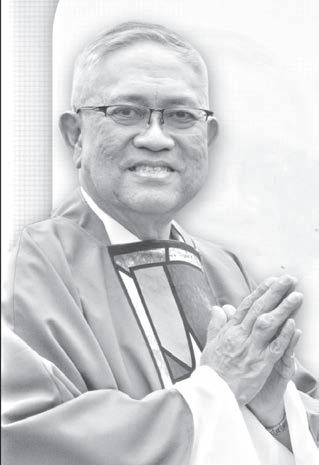
DOMINIC Edgard Angeles Cabangon, Chairman of the ALC Group of Companies, passed away on Sunday, March 8, 2026. He was 61 years old. Born on April 9, 1964, he was the son of Antonio L. Ca-
Ambas
and founder of the ALC Group of Companies, and Bienvenida Angeles Cabangon. Cabangon led the ALC Group, a diversified conglomerate with interests in media, insurance, pre-need services, automotive dealerships, banking and finance, pawnshops, hotels, real estate, and memorial care. Among its companies are Eternal Gardens Memorial Park Corporation, Isuzu Gencars, Inc., Aliw Broadcasting Corporation, Philippines
visor Eduardo Año highlighted the scale of dependency: “Over 60 per-
Manufacturing sector seen vulnerable in 4-day work week
By Bless Aubrey Ogerio @blessogerio
BUSINESS groups have raised concerns about the potential impact of a four-day workweek on the manufacturing sector, saying production-driven industries face operational realities that differ from service-oriented businesses. Starting Monday, March 9, government agencies will temporarily shift to a four-day workweek as part of energy conservation measures amid uncertainties tied to tensions in the Middle East.
The Federation of Philippine Industries (FPI) said any change in work arrangements should be carefully studied to avoid disruptions to production output, delivery schedules and supply chain operations.
The group noted that productivity and cost considerations would be key factors in assessing proposals to adopt a shorter workweek.
“The impact may differ significantly for manufacturing, where continuous production requirements are a central consideration,” FPI chairperson Elizabeth Lee said in a statement.
“Possible effects on supply chain stability, delivery timelines, and competitiveness relative to regional peers should be thoughtfully assessed,” she added.
For Lee, pilot programs and datadriven evaluation could help assess the feasibility of broader implementation.
Service-oriented and knowledgebased sectors, she added, may be better positioned to adopt flexible or hybrid work arrangements depending on their operational
PH remains well-positioned to absorb external shocks in the near term.
a significant cushion, so while reserves could fluctuate due to higher oil imports or forex interventions,
Rizal Commercial Banking Corp. (RCBC) chief economist Michael L. Ricafort said the monthly increase in the GIR to new record highs again is largely due to the contin-
needs.
On the other hand, the Philippine Chamber of Commerce and Industry (PCCI) echoed similar concerns. The manufacturing sector, for them, could be among those most affected by reduced workdays.
In a statement, the PCCI said it supports the intent of the measure to promote energy efficiency, cut operating costs and support employee well-being, but stressed the need for a balanced and evidencebased approach that takes into account the conditions of different industries.
“For manufacturing, we have been operating on limited resources and further reducing the number of work days could affect our commitments,” PCCI president Ferdinand Ferrer said.
“We are not against the implementation of flexible work arrange -
ued month-on-month increase in gold holdings, by US$2.4 billion or an 11.6-percent increase to a new record high of US$23.1 billion. Ricafort also explained that foreign exchange holdings went up by 7.57 percent or by $92 million month-on-month to $1.307 billion.
Indo-Pacific sea lanes while the vast majority of global digital traffic travels through submarine cables beneath these waters.”
ments, but there should be proper consultation with various stakeholders and [decisions must be] supported with data to ensure that industries with specific operational requirements will not be adversely affected,” he added.
The PCCI expressed willingness to work closely with policymakers, labor groups and industry stakeholders to ensure beneficial work arrangements.
The country remains vulnerable to energy disruptions as it imports most of its crude oil from the Middle East and still relies partly on oil-fired power plants for electricity.
Globally, several countries have tested compressed or reduced workweeks through pilot programs. Within Southeast Asia, however, no country has adopted a universal four-day workweek across all sectors.
However, foreign investments saw a 2.8-percent decline or a reduction of $2.737 billion to $83.650 billion. Ricafort traced this to the increased US/global market volatility in view of geopolitical risks since January 2026 such as events involving Iran, Greenland, Venezuela, among others.
He warned that disruptions to these routes would have “systemic rather than regional” consequences, reverberating across financial markets and global logistics.
“Before a kinetic engagement happens, what I can say is that that is the first infrastructure that will be hit,” said retired Major General Restituto Padilla Jr., executive director for corporate public policy risk and sustainability of conglomerate PTC Group. With US resources stretched thin, governments are urging the private sector to step up.
Padilla stressed the importance of “helping private sector be part of the protective umbrella that watches and monitors our undersea cables”, urging governments to incentivize businesses to join the defense industrial base.
Japan’s contributions to resilience
JAPANESE Ambassador Endo Kazuya emphasized that “enhancing economic resilience has become an increasingly critical priority.”
He noted that Japanese businesses are already contributing to the development and maintenance of undersea cable networks in the Philippines, while also investing in liquefied natural gas (LNG) facilities to secure energy transit. Endo pointed to broader Japanese support for Philippine infrastructure, including the Metro Manila Subway and Mindanao highway projects, alongside supply chain diversification in nickel production and LPG terminals.
Building regional capacity FORMER Navy vice commander Rear Admiral Rommel Jude Ong, senior research fellow of Ateneo School of Government (ASOG), called for a “whole-of-nation approach” that integrates supply chains among allied nations. One urged stakeholders to invest in shipbuilding and repair hubs, maritime domain awareness infrastructure, and complementary industries to ensure the region can sustain its own security architecture without over-reliance on outside powers.
Año also pressed for regional integration of surveillance systems, including satellite monitoring, AIenabled anomaly detection, and data fusion centers, to create a common operating picture across the Indo-Pacific.
the same time, we will not allow any party to take advantage of the situation. Fair pricing and adequate supply are a commitment to every Filipino whose daily needs depend on it,” DOE Secretary Sharon S. Garin said.
Senator Sherwin Gatchalian urged the DOE to strictly monitor retailers and oil companies for possible profiteering amid what he described as an “energy crisis” stemming from the escalating conflict in the Middle East.
See related story in A5 Economy, “Lacson, Gatchalian warn vs profiteers.”
The DOE earlier said that oil companies have an inventory of about 50 days, so they should not jack up pump prices that quickly.
Data from Gatchalian’s office show that from January to March 4, gasoline pump prices increased by 13.7 percent, from P55 to P62 per liter. Diesel prices rose by 41.4 percent, from P54 to P76 per liter, while kerosene prices went up by 43 percent, from P79 to P114 per liter.
The DOE has already sought the assistance of the Department of the Interior and Local Government (DILG) and the Philippine National Police (PNP) in intensifying monitoring activities at gasoline stations nationwide. The DOE field offices in Luzon, Visayas and Mindanao have ramped up on-site inspections to verify compliance with fuel pricing directives and the responsible sale of petroleum products.
The DOE had ordered oil companies, gasoline stations, and downstream oil industry participants to strictly comply with existing fuel pricing rules and anti-hoarding regulations amid continued monitoring of global oil market developments.
Under the directive of President Ferdinand R. Marcos Jr., the DOE issued the order to ensure the orderly sale and distribution of petroleum products and to prevent hoarding, profiteering, and any premature or unauthorized price. The government will not tolerate any attempt to exploit the present situation at the expense of the Filipino public.
Gasoline stations are not allowed to implement unsched-
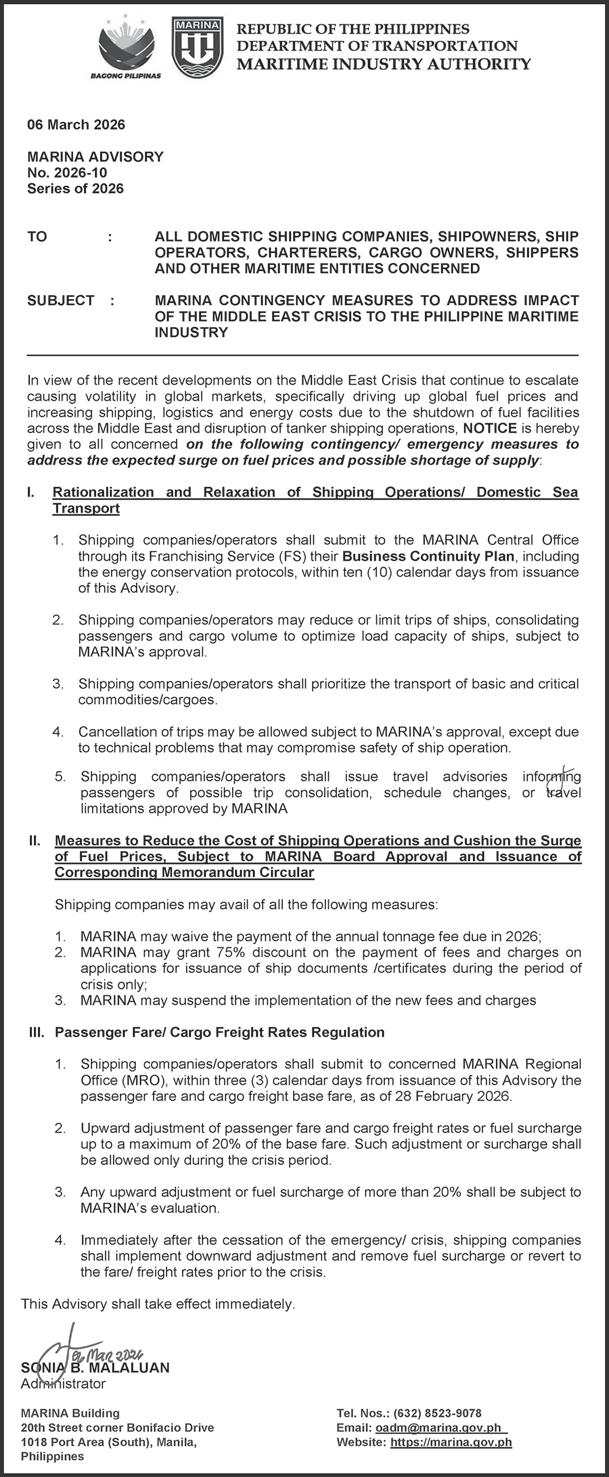
Operators are also required to submit a Business Continuity Plan, including energy conservation protocols, to the Marina Central Office within 10 calendar days from issuance of the advisory.
uled or unauthorized price increases outside established pricing adjustments. Oil companies have likewise been directed to ensure that their company-owned and dealer-operated stations strictly comply with DOE directives, including any duly authorized staggered price adjustments, where applicable.
Under Batas Pambansa Blg. 33, as amended by Presidential Decree No. 1865, hoarding and other abnormal or illegal sales practices involving petroleum products are prohibited. In line with this, the DOE reminded all concerned establishments that acts intended to withhold supply, manipulate distribution, or circumvent lawful pricing and sales practices are subject to corresponding administrative and criminal sanctions under existing laws.
Further, all retail stations must dispense petroleum products in accordance with existing rules and safety regulations to prevent any hoarding activities. Gasoline stations shall only dispense directly to the vehicle fuel tank, and container-loading of petroleum products is prohibited, unless otherwise provided. The agency warned against practices such as improper container loading, “bote-bote” sales, and the filling of drums, gallons, or other containers for purposes of stockpiling, where consumers and preserve the fair distribution of fuel in the market.
Violations may result in the revocation of the certificate of compliance or license to operate, suspension or cancellation of business permits, and the imposition of other applicable administrative or criminal penalties under existing laws and regulations.
Meanwhile, the Energy Regulatory Commission (ERC) met with the Independent Electricity Market Operator of the Philippines (IEMOP) to discuss electricity market simulations assessing the potential impacts of escalating tensions in the Middle East on Philippine power prices.
IEMOP presented projections indicating that higher global fuel prices could place upward pressure on electricity prices in the Wholesale Electricity Spot Market (WESM), particularly if global supply disruptions persist.
The simulations presented by IEMOP examined scenarios involving increases in international coal, oil, and liquefied natural gas (LNG) prices, as well as possible supply constraints in the power system.
The analysis indicated that higher fuel costs could lead to increased
WESM clearing prices as generators reflect higher fuel costs in their market offers.
“This is part of our proactive approach,” ERC Chairperson and CEO Atty. Francis Saturnino C. Juan said. “We conduct stress tests to understand possible risks early and ensure that consumer protection mechanisms are in place should global fuel volatility persist,” he added. Global fuel markets have experienced volatility amid heightened geopolitical tensions affecting global oil and LNG supply routes, including developments around the Strait of Hormuz—a key maritime corridor through which about onefifth of global oil and LNG shipments pass.
The Philippines’ energy mix relies significantly on coal and LNG, making the power sector sensitive to international commodity price movements.
According to IEMOP’s analysis, higher fuel costs alone may exert upward pressure on prices in the WESM, where electricity is traded in real time. Price pressures may intensify under scenarios involving forced outages of large generating units, which could tighten supply.
A forced outage refers to the unexpected shutdown of a power plant due to technical issues. When supply becomes constrained, more expensive generators may set the market price.
The ERC emphasized that existing regulatory safeguards and market protection mechanisms remain operational, including the secondary price cap (SPC) mechanism, which is automatically triggered if sustained price spikes breach regulatory thresholds.
The commission also directed IEMOP and ERC Market Operations Service (MOS) to closely monitor market activities and promptly report any unusual or suspicious behavior in the market. The directive aims to ensure that no participant abuses market power or takes advantage of prevailing market conditions, particularly during periods of heightened global fuel price volatility.
The ERC added that early assessment of potential market scenarios allow the ERC to prepare mitigating or contingency measures, if warranted, to help cushion the impact of external shocks on electricity consumers. “Our priority is to protect consumers from undue price volatility while ensuring a stable and reliable power supply. Preparedness remains important given the Philippines’ exposure to global energy markets,” said the ERC chief.
Lawmakers brace for online manipulation as impeachment proceedings vs VP start
By Jovee Marie N. dela Cruz @joveemarie
LAWMAKERS on Sunday warned that deepfakes, trolls, and disinformation could intensify online as the House of Representatives moves ahead with impeachment proceedings against Vice President Sara Z. Duterte amid growing public attention on the case.
At the same time, the Makabayan bloc rejected Duterte’s claim that the House inquiry into her confidential funds was politically motivated.
House Committee on Suffrage and Electoral Reforms Chairman Zia Alonto Adiong said the spread of manipulated content and false narratives is already expected as political tensions rise. Adiong, who represents Lanao
del Sur, said he expected the situation, even sharing that some of his colleagues jokingly told him that at least it also helps unemployed people since they are being paid to work as trolls.
The warning came as the House Committee on Justice formally began deliberations on the impeachment complaints against Duterte after determining that the complaints were sufficient in form and substance.
Adiong said the current political climate makes the spread of misleading online content almost inevitable but urged the public to remain cautious and critical when consuming information on social media.
He said he had already expected such incidents, noting that this has become a common practice nowadays. However, he emphasized that the public should also
be more discerning, critical, careful, and thorough in evaluating what they see online, as much of the information circulating there is inaccurate and untrue.
The lawmaker also noted that he was surprised by the level of support the impeachment process received at the committee level, where 54 members voted during the proceedings.
Under the Constitution, at least one-third of all members of the House must support the impeachment complaint before it can be transmitted to the Senate for trial.
Stop
LAWMAKERS from the Makabayan bloc urged the Vice President to stop portraying herself as a “victim” and instead answer questions about the use of her confidential funds.
In a joint statement, Party-list
Former rebel fighters rebuild lives
MORE than 27,500 former members of armed groups have begun rebuilding their lives through the Department of Social Welfare and Development’s (DSWD) Peace and Development–Buong Bansa Mapayapa (PDBBM) program, a key government initiative aimed at fostering long-term peace in conflict-affected communities, the agency said.
The beneficiaries include 25,759 former members of the Moro Islamic Liberation Front (MILF), the Alex Boncayao Brigade (ABB)—the urban hit squad of the Communist Party of the Philippines (CPP)—and members of disbanded private armed groups in several regions.
In a statement, Director Miramel Laxa, national program manager of the PDBBM, emphasized the importance of the initiative in promoting inclusive,
sustainable, and communitydriven peace while helping former fighters transition to productive civilian lives.
Program data indicate that 27,589 out of 32,315 target beneficiaries are currently under DSWD’s case management, which assesses their needs and ensures they receive appropriate services.
The PDBBM program began in 2024, with pilot areas in Region 9 (Zamboanga Peninsula), Cagayan de Oro in Region 10 (Northern Mindanao), and Region 12 or Soccsksargen (South Cotabato, Cotabato, Sultan Kudarat, Sarangani and General Santos) in Koronadal, where the concentration of decommissioned combatants was highest. It has since expanded to cover Region 3 (Central Luzon), Region 4 or Calabarzon (Cavite, Laguna, Batangas, Rizal and Quezon), Region 4B or Mimaropa (Mindoro, Marinduque, Romblon
and Palawan), Region 6 (Western Visayas), and the Negros Island Region (NIR).
Under the program, the government provides several forms of assistance designed to help former rebel-fighters establish sustainable sources of income and rebuild stable lives with families and communities.
Among the primary support mechanisms is the Seed Capital Fund (SCF), which provides startup capital for small businesses and livelihood projects; beneficiaries may also participate in cash-for-work (CFW) activities linked to infrastructure projects in areas covered by the government’s Payapa at Masaganang Pamayanan (Pamana) Program, allowing participants to earn income while contributing to community development.
To ensure sustained reintegration, the program assigns a social
Legislator welcomes launching of anti-fake news campaign
THE chairman of the House Committee on Information and Communications Technology on Sunday said that the Presidential Communications Office’s (PCO) “Oplan Kontra Fake News,” which is strongly backed by nine broadsheets, is a key initiative in promoting responsible journalism and curbing the online spread of disinformation and misinformation.
Camarines Sur Rep. Migz Villafuerte said the PCO’s plan to formalize a Memorandum of Understanding (MOU) with nine
major broadsheets in the country will “significantly strengthen efforts by both the government and the private sector to curb fake news deliberately circulated by partisan or interest groups.”
He added that the initiative is expected to improve coordination in addressing false information on digital platforms, ensuring that the public can better discern legitimate news from fabricated reports.
The lawmaker also urged the PCO to expand the campaign by involving
more legacy media organizations and coordinating with major digital platforms, including Meta and Google, to mount a unified effort against online disinformation.
“We hope the PCO will be relentless in broadening this initiative by engaging many other institutions in legacy media and going ahead on its plan to coordinate with digital platforms such as Meta and Google in pursuit of a unified drive against disinformation and misinformation that are undermining public discernment of what is legitimate or fake news,” said Villafuerte.
Villafuerte noted that his panel, together with the House Committee on Public Information, is drafting a substitute bill to address disinformation and misinformation, aiming to strike a balance between penalizing fake news and protecting free speech.
The statement came following the launch of “Oplan Kontra Fake News” at Kalayaan Hall in Malacañang, where nine major newspaper publishers pledged support for the campaign.
Representatives from the B usiness M irror , The Philippine Star, Philippine Daily Inquirer, Manila Bulletin, Manila Standard, BusinessWorld, Malaya Business Insight, Daily Tribune, and The Manila Times signed an MOU with the PCO on February 4 to reinforce efforts against false information.
worker to former fighters to conduct monitoring and case management, where they will coordinate with partner government agencies, including the Department of Labor and Employment (Dole), Department of Trade and Industry (DTI), and Technical Education and Skills Development Authority (Tesda) for additional skills training, employment opportunities, and livelihood assistance.
The program also plans to implement peace education, helping participants internalize the values of peace and behavior change to sustain the government’s peacebuilding efforts.
Beneficiaries will undergo evaluation using the Social Welfare and Development Indicator (SWDI), the same tool used in the Pantawid Pamilyang Pilipino Program (4Ps), to measure progress toward self-sufficiency.
Jovee Marie N. dela Cruz
DOH warns vs rabies
THE Department of Health (DOH) reminded the public over the weekend to get their pets vaccinated against rabies after the department reported a total of 17 cases of human rabies from January 4 to February 21, 2026.
This data, the DOH said, is lower by 65 percent as compared to the 49 cases recorded in the same period last year.
“Halos pantay ang kaso mula sa alaga o domestic pets at galang hayop o stray animals,” the DOH said.
Meanwhile, 13 or 76 percent of the total number of cases were from unvaccinated pets.
“Rabies is a viral infection that can be transmitted to humans through animal bites or even scratches, most commonly by dogs and cats,” said Health Secretary Teodoro J. Herbosa in one of his recent interviews.
The DOH said that rabies is preventable, and vaccination is the most effective measure to protect animals and humans.
“Death caused by rabies is inevitable once infection begins, that’s why we urge all pet owners to be responsible and get their pets vaccinated against rabies. This not only protects the animals but also significantly reduces the risk of transmission to humans,” Herbosa added.
Claudeth Mocon-Ciriaco
Reps. Antonio Tinio of ACT Teachers, Sarah Jane Elago of Gabriela, and Renee Louise Co Kabataan rejected Duterte’s claim that the House inquiry into her confidential funds was politically motivated.
“We, the Makabayan bloc, reject Vice President Sara Duterte’s recycled claim that the House inquiry on her confidential funds was a political weapon and a supposed ‘conspiracy’ against her. These are rehashed lines— ‘gasgas na script’—meant to evade accountability by playing the victim,” the lawmakers said in a joint statement. They emphasized that confidential funds involve public money and therefore must be subject to scrutiny.
“Confidential funds involve public money. When millions are requested, rushed, and shrouded
in secrecy, the Filipino people have every right to demand answers,” the statement said. The Makabayan lawmakers also disputed Duterte’s claim that impeachment proceedings were initiated before evidence surfaced, saying concerns were raised owing to red flags surrounding the size, release, and purpose of the funds. They clarified that audit findings from the Commission on Audit do not automatically clear officials of possible wrongdoing. They also criticized what they described as Duterte’s attacks and red-tagging against Makabayan members.
The group added that Congress has a constitutional duty to exercise oversight over public funds and called on the vice president to personally address the issues raised before the House panel.
Taguig drug bust bags 2 cops, cohorts
By Rex Anthony Naval
TWO rogue police officers and their civilian accomplices were arrested by the combined forces of the Taguig City Police Station (TCPS) and the National Police Drug Enforcement Group (Pdeg) in a drug bust operation in the locality on Saturday afternoon.
In a statement, the TCPS said the operation was conducted at around 4:27 p.m. on March 7 in front of Landers, Arca South, Taguig City, where authorities arrested two Taguig policemen along with several civilian suspects.
The operation led to the recovery of around 100 grams of suspected methamphetamine hydrochloride or shabu with an estimated Dangerous Drugs Board value of P680,000, along with National Police (PNP)-issued firearms, cellular telephones, and identification cards.
As this developed, the local government of Taguig condemned the involvement of police personnel assigned in the city, reiterating that it maintains zero tolerance
for illegal drugs and any form of misconduct in law enforcement.
Mayor Lani Cayetano said the incident reinforces the importance of efforts to keep law enforcement institutions accountable and trustworthy, noting that she has long urged authorities to ensure that the police force remains disciplined and free from illegal activities.
“Illegal drugs have no place in Taguig. Those who are sworn to enforce the law must be held to the highest standards,” she added.
Likewise, Cayetano expressed full support for the ongoing efforts of the PNP and the Southern Police District to cleanse their ranks and take decisive action against erring personnel.
“We commend the PNP for taking strong action. Efforts to cleanse the ranks are essential to maintaining the public’s trust. Peace and order remain the foundation of a Transformative, Lively, and Caring City. The people of Taguig deserve law enforcers who uphold integrity, professionalism, and the rule of law,” she added
DILG: 800 tourist cops to secure key
destinations
By Jonathan L. Mayuga @jonlmayuga
EIGHT hundred policemen will be deployed to major tourism areas in the country to strengthen safety and security, Interior Juanito Victor Remulla said.
The deployment will begin in April, following the approval of President Marcos Jr. and will be done in coordination with the Department of Tourism (DOT).
“The President has approved my plan that beginning April, we will launch together with the Department of Tourism the tourist police,” Remulla said.
The initiative aims to increase
police visibility in high-traffic tourist areas, deter criminal activity, and ensure faster emergency response while creating a safe and welcoming environment for both visitors and local businesses.
Remulla said the 800 tourist police officers will be equipped with motorcycles to improve mobility in crowded tourist sites and remote scenic areas. The National Police (PNP) will distribute new motorcycle units dedicated for the deployment.
Initial rollout sites include Bonifacio Global City (BGC), Poblacion in Makati, Boracay, Siargao, Cebu, Bohol, and Puerto Princesa.
Visayas ferry operators hike fares, reduce trips
By Carmel Pedroza
EBU CITY—Several fer -
Cry operators serving key inter-island routes in the Visayas have announced fare increases, temporary surcharges, and trip cancellations as the ongoing crisis in the Middle East continues to drive global fuel prices higher, placing pressure on local maritime transport operations.
FastCat, one of the country’s major roll-on/roll-off ferry operators, confirmed that it implemented an updated fare matrix for passengers and vehicles effective March 6, 2026, citing a sharp spike in fuel costs.
In a travel advisory, the company said the adjustment was necessary to sustain operations and maintain safety standards amid the surge in global fuel prices.
“While we always strive to keep our services affordable, the recent 40 percent surge in global fuel costs—driven by the ongoing situation in the Middle East—has significantly impacted our operational expenses,” the company said.
FastCat added that the fare adjustment will help ensure continued vessel maintenance, fleet reliability, and compliance with safety certifications while maintaining its commitment to providing safe
and efficient inter-island travel.
The company did not immediately disclose the full details of the new fare matrix but said the revised rates now apply to both passengers and vehicles on all its routes.
Meanwhile, high-speed ferry operator OceanJet announced the temporary cancellation of several trips between Cebu and nearby destinations owing to what it described as an ongoing fuel crisis affecting operations.
The cancellations began on March 6 and will last until March 20.
Among the trips cancelled on March 6 were the Cebu to
Palompon trip at 10:00 a.m., Palompon to Cebu at 1:30 p.m., and Cebu to Getafe at 6:45 p.m.
Additional cancellations scheduled for March 7 include the Getafe to Cebu trip at 6:30 a.m., Cebu to Palompon at 10:00 a.m., Palompon to Cebu at 1:30 p.m., and Cebu to Getafe at 6:45 p.m.
OceanJet advised affected passengers that they are entitled to a full refund or may reschedule their trips without additional charges.
Passengers may process their refund or rebooking requests at the company’s ticketing offices or through its hotline.
Speed up delivery of services, PSA told
RESIDENT Marcos on Sun -
Pday ordered the Philippine Statistics Authority (PSA) to make civil registry services faster and more accessible, particularly for the correction of birth certificates, as part of the government’s broader push toward digitalization and improved public service.
Addressing public concerns about the challenges in obtaining documents and applying for identification cards ( IDs)—especially
among vulnerable groups and residents of Geographically Isolated and Disadvantaged Areas (Gidas)— Marcos emphasized the need to streamline government processes. In his BBM Vlog 278: Sagot sa Polisiya, uploaded on YouTube, he highlighted ongoing efforts to enhance the country’s digital services, including the eGov app, a one-stop mobile platform that simplifies transactions with various government agencies.
“I believe that with the improvements we’ve already made through eGov and the internet, this should be one of the services we no longer worry about. It’s a basic requirement, yet people spend hours lining up for a single document,” the president said.
“Let’s make full use of these tools, and as the national government, we should make the process easier. PSA, simplify it. Speed it up,” he added.
The President noted that the
PSA recently launched the PSA eCertificate service, enabling Filipinos to request digital copies of birth certificates, marriage certificates, and other civil registry documents. He emphasized that this digital service should eventually be standard across all PSA offices and that physical document requests should also be accommodated at any branch for added convenience.
Lacson, Gatchalian warn vs profiteers
By Butch Fernandez @butchfBM
AS surging oil prices arising from the Middle East war are starting to be felt at the pump this week, senators on Sunday raised the alarm against profiteers and urged both government agencies and the public to be vigilant against these.
Senate President Pro Tempore Panfilo M. Lacson called on the public to report gas stations that prematurely increase fuel prices, amid reports that some establishments have already raised pump prices ahead of scheduled adjustments.
Prematurely increasing fuel prices violates Republic Act 8479, or the Downstream Oil Industry Deregulation Act of 1998; and Republic Act 7394, or the Consumer Act of the Philippines, Lacson warned.
The public can report violations to the National Police (PNP) and local governments, he added.
“Amid reports that some gasoline stations have already increased prices, they must be reported to authorities. Here’s why—Raising prices ahead of schedule or hoarding fuel may be liable for: 1) Hoarding & Profiteering—RA 8479; and 2) Unfair or deceptive sales practice—RA 7394,” Lacson said on his X account late Saturday.
“[You can report violations to the] PNP or LGU’s. As per DOE Secretary Sharon Garin, they have cascaded instructions to the PNP, LGUs, etc. to monitor and report violations so appropriate criminal and administrative proceedings may be initiated against erring gas station operators,” the senator said.
See “Spike,” A6
First Gen celebrates 50 years of EDC, introduces unified brand
By Vincent Peter Rivera
ENERGY Development Corpo-
ration (EDC), a subsidiary of First Gen Corporation (First Gen) and the world’s largest vertically integrated geothermal company, officially commemorated its 50th anniversary of providing renewable energy to the Philippines on Thursday.
For five decades, EDC has taken pride in the exploration, development, and optimization of geothermal steam fields in the country. To date, it remains the country’s only natural baseload source of renewable power.
As it enters its 50th year, EDC has officially commenced its first international exploration drilling in Indonesia, targeting six prospective sites with a potential capacity of 440 MW.
“From the very beginning, the mandate of EDC was clear: harness indigenous resources and develop a homegrown power supply that will make the country’s energy grid resilient and secure,” said First Gen Chairman Federico Lopez.
Established on March 5, 1976, under Presidential Decree 927, EDC was created to generate geothermal power and reduce the country’s reliance on imported oil. In 2007, the company became a subsidiary of First Gen following its privatization by the government.
“EDC has been integral to First Gen’s credibility as a clean energy leader, and we are proud of this land-
mark in our country’s renewable energy journey,” added Lopez.
As the largest renewable energy provider in the Philippines, EDC currently operates 13 integrated geothermal power stations with a total installed capacity of 1,388.8 megawatts (MW), delivering clean and affordable energy to Filipino businesses and communities.
A new era of unified identity
Alongside the milestone, First Gen unveiled its new “First Gen Group” brand. This unified identity brings together the company’s power generation, supply, and solutions portfolio, placing its renewable energy assets at the core of operations.
“This step is about clarity for our employees, partners, customers, and the communities we serve regarding who we are, what we stand for, and how we work together,” said First Gen President Giles Puno, emphasizing that the move reinforces the company’s leadership and integrated approach to the evolving energy market.
Under the new branding, all 28 solar, wind, hydro, and geothermal
See “PSA,” A6
See “Ferry,” A6
‘Persistent pattern of coercion’ in WPS must not be normalized–think tank
SBy Rizal Raoul Reyes @brownindio
TRATBASE Institute President Victor Andres Manhit on Friday emphasized that the “persistent pattern of coercion” in the West Philippine Sea must not be normalized or tolerated and instead confronted with “firm, coordinated, and decisive measures” from both the Philippines and other like-minded nations.
In his opening remarks at a high-level symposium titled, “Safeguarding the Maritime Domain for the Free and Open Indo-Pacific” held in Makati City, Manhit assailed the “clear and escalating pattern of coercion” involving Chinese state and state-linked ships in the West Philippine Sea.
Citing Coast Guard (PCD) data, Manhit said there were 64 illegal, coercive, aggressive and deceptive (Icad) actions against Philippine missions or vessels in 2025 alone, which involved dangerous maneuvers, shadowing, water cannon attacks, collisions, radio challenges, and live-fire exercises.
“These are only the incidents that were reported and made public. Far from the cameras and the headlines, many more acts of intimidation occur at sea—often involving Filipino fishermen and frontline personnel who continue to operate under constant pressure and uncertainty,” Manhit said.
“The growing frequency and intensity of these incidents are deeply alarming. Such behavior, as we have stressed time and again, should not and cannot be normalized
Warranty, product quality complaints top DTI cases
By Bless Aubrey Ogerio
COMPLAINTS involving product services and warranties, product quality and safety, and sales promotions made up the bulk of consumer cases handled by the Department of Trade and Industry (DTI), as the agency reported a significant reduction in its pending complaints.
The DTI said these issues commonly affect consumers’ ability to obtain refunds, address defective products, or pursue warranty and replacement claims.
Through a nationwide Mediation Marathon conducted from February 23 to 27, the agency said it was able to reduce its case backlog from 1,236 as of December 31, 2025, to 573 as of February 27. The remaining complaints are still undergoing mediation.
The effort was led by the DTI’s Fair Trade Group (FTG) and Regional Operations Group (ROG), which mobilized 30 mediation officers from regional offices.
The DTI also met withe-commerce platforms Shopee, Lazada and Foodpanda to discuss ways to expedite handling digital consumer cases.
“Recognizing that a substantial number of complaints stem from online transactions, the DTI engaged these platforms in a dialogue where they committed to strengthen their internal teams, augment capacity, and expedite the resolution of pending claims,” the agency said.
DTI said the reduction in pending complaints is expected to shorten waiting times for consumers seeking refunds, replacements, or other remedies.
Marcos: Do not use natl govt aid programs for political promotion
By Jovee Marie N. dela Cruz @joveemarie
PRESIDENT Marcos on Sunday emphasized the need to speed up the distribution of government assistance and ensure that aid programs funded by the national government are not used for political promotion.
In BBMVLOG 278: Sagot sa Polisiya, Marcos said the government is looking at ways to streamline the delivery of aid to beneficiaries—particularly senior citizens—while exploring the use of digital platforms to make the process faster and more efficient.
The President also encouraged the people to continue sharing their concerns and suggestions with the government, assuring the public that their voices are being heard and acted upon.
“We are here to listen and take action... whether the concern is big or small,” Marcos said, noting that any concern that burdens people’s daily lives deserves attention from the government.
Marcos said he was surprised by the volume of public feedback following his previous vlog on policy issues, which drew more than 70,000 reactions and nearly 12,000 comments.
Continued from A5
The President also underscored the need for all government agencies to recognize digital documents as valid documents.
“In truth, many eGov services just need to be fully integrated into the workflows of different offices. We must be open to integration if we want our digitization program to succeed,” he added.
While acknowledging that in-person verification may still be necessary in some cases to prevent fraudulent registrations— citing the Alice Guo case as an example—he stressed that such measures should not create unnecessary obstacles.
Addressing concerns for individuals lacking proper documentation, the President highlighted the Department of Social Welfare and Development’s (DSWD) programs to assist marginalized sectors in obtaining IDs and civil
or tolerated. It must be met with firm, coordinated, and decisive measures to end this persistent pattern of coercion,” he added.
National Security Advisor Eduardo Año said they remained “deeply concerned” by these continuing Icad tactics by China, including coercive activities “designed to alter facts on the water while remaining below the threshold of armed conflict.”
Furthermore, Año stressed that the 2016 Arbitral Award “was clear...it invalidated China’s illegal nine now 10-dash line claim or the expansive maritime claims unsupported by the [United Nations Convention on the Laws of the Sea] Unclos—affirming the Philippines’ sovereign rights within its exclusive economic zone [EEZ] and clarifying the legal status of certain maritime features.”
“More fundamentally, it reinforced the principle that disputes must be resolved through law rather than force,” he added.
Manhit added that the Philippines “cannot—and should not—stand alone” in the efforts to promote a free, open, and rulesbased Indo-Pacific region, through which nearly two-thirds of global trade passes.
“This is why the issue before us is not solely a Philippine concern. It is a regional and global one,” he said.
“Safeguarding the maritime domain is not simply about defending territory. It is about defending the principles that allow nations—large and small—to coexist peacefully: respect for international law, freedom of navigation, and the peaceful management of disputes.”
Manhit said the vital element was to forge stronger and more coordinated partnerships among like-minded nations—including the United States, Australia, Japan, Canada, New Zealand, France, and India—that “believe in openness, transparency, and the peaceful resolution of disputes.”
Hosted by Stratbase Institute and the Japan Institute of International Affairs, the symposium brought together leading scholars, policymakers, and practitioners across the Indo-Pacific region to discuss how countries in the region could better cooperate within the Free and Open IndoPacific (FOIP) framework, which marks its 10th anniversary this year.
“It is only right that you express your sentiments. There is no big or small concern— anything that weighs on people’s daily lives is a problem. And we are here to listen and take action on those matters,” the president added as he read some of the comments.
He stressed that the distribution of government aid should focus solely on delivering assistance, adding that speeches and other activities unrelated to aid distribution should no longer be part of the process. Marcos underscored that public services must not be used for personal promotion or political gain by government officials.
Marcos also pointed out that existing rules already prohibit such practices, citing guidelines issued by the Department of the Interior and Local Government and provisions in the General Appropriations Act governing the proper use of public funds. To further improve efficiency, Marcos said the government is studying the possibility of digitizing the distribution of assistance through digital payment platforms such as GCash.
He added that some local government units, including Makati, have begun testing similar systems that other local governments may study and adopt to improve the delivery of government assistance.
registry documents. This includes the Pag-abot ID for street dwellers, which can serve as a supporting document for other IDs.
The DSWD also has a co-location program that brings PSA assistance to DSWD payout sites, allowing beneficiaries to secure documents such as birth certificates and national IDs.
“The PSA has also simplified the process of obtaining a National ID. Any document with your name, birth date, address, photo, or signature—even a thumbmark, such as a Barangay Clearance—can now be accepted,” the President said.
“For fellow citizens in marginalized sectors or living in Gidas, if you have a barangay clearance, you can now obtain a National ID,” he added.
For those outside the poorest sectors, President Marcos encouraged the use of government digital services, including the PSA’s e-Certificate program, to make document processing easier and more convenient. Jovee Marie N. dela Cruz
By Carmel Pedroza
CEBU CITY—The town of Daanbantayan in northern Cebu has imposed a temporary purchasing limit on rice as local governments across Central Visayas implement measures to stabilize supplies, monitor prices, and conserve energy amid global economic uncertainties linked to tensions in the Middle East.
The restriction was agreed upon during a meeting between local officials and business establishments on Saturday as authorities moved to prevent hoarding and manage the supply of basic commodities.
Under the temporary measure, consumers are allowed to purchase only one 50-kilogram sack of rice per family.
Legitimate rice retailers—including those supplying island barangays—will still be permitted to buy more than one sack to ensure continued distribution to communities.
Mayor Gilbert Arrabis Jr. met with business owners, particularly rice sellers, after retailers raised concerns about limited rice deliveries from suppliers in Cebu City and increasing procurement costs believed to be linked to disruptions in global supply chains.
Arrabis warned against hoarding and profiteering, stressing that such practices are punishable under existing laws. He urged business owners to maintain fair pricing and to regularly update the local government on their supply status so authorities can respond quickly if shortages arise.
To strengthen enforcement, the mayor also ordered the creation of a local task force that will monitor prices of rice and other basic commodities.
He, likewise, appealed to residents to avoid panic buying, saying unnecessary stockpiling could further strain available supplies.
“The local government is actively working to mitigate the effects of the crisis and will coordinate with national agencies to maintain a stable supply of essential commodities,” Arrabis said.
Ample supply
DESPITE concerns raised by some retailers, the Department of Trade and Industry in Central Visayas (DTI-7) assured the public that basic commodities in Cebu and Bohol remain adequately supplied and that market conditions
Spike. . .
Continued from A5
Meanwhile, Sen. Sherwin Gatchalian urged the Department of Energy to strictly monitor retailers and oil companies for possible profiteering amid what he described as an “energy crisis” stemming from the escalating conflict in the Middle East.
Energy Director Rino Abad had earlier explained that the government has no control over the pricing of petroleum products owing to the Oil Deregulation Law. To this, Gatchalian replied partly in Filipino, “I won’t take ‘no’ for an answer because the consumers are being abused.”
“The price increase in the world market has just been announced, but some retailers have already raised their prices. This is profiteering. They cannot raise prices right away because the stocks they hold now were bought at a lower price. They should sell at a reasonable price,” noted Gatchalian, vice chair of the Senate Committee on Energy.
The DOE earlier said that oil companies have an inventory of about 50 days, so they
are stable.
In a statement released March 6, the regional office said its latest price monitoring showed sufficient stocks and buffer supplies of basic necessities and prime commodities across major supermarkets, groceries, and other retail outlets.
“In light of recent developments in the Middle East, DTI-7 reassures the public that the prices of basic necessities and prime commodities under its jurisdiction remain stable,” the agency said.
DTI-7 added that distribution channels remain fully operational and retailers continue to comply with Suggested Retail Prices (SRP) for covered commodities.
The agency also encouraged consumers to remain calm and practice responsible purchasing while it continues to coordinate with retailers, distributors, and local government units to ensure fair trade practices and the steady availability of essential goods.
Local governments in Cebu have also stepped up their monitoring mechanisms.
In Lapu-Lapu City, Mayor Cindi King Chan ordered a strengthened daily price monitoring system in supermarkets and public markets as part of the city’s preparedness measures.
The initiative, implemented with the DTI Cebu Provincial Division and the city’s Public Market Administration Office, aims to ensure transparent pricing of basic commodities.
City officials have also directed the LapuLapu City Information Office to display updated price information through LED platforms in public markets so consumers can easily track prevailing prices.
Chan urged the public to report any instances of overpricing or unfair market practices, emphasizing that consumer protection remains a priority.
Meanwhile, Mandaue City has created a Price Monitoring Task Force to guard against overpricing and ensure compliance with national price regulations.
The task force was organized during a special meeting of the city’s Price Monitoring Council convened by Thadeo “Jonkie” Ouano and presided over by Executive Secretary Riczen Gingoyon.
Participating agencies include the Department of Trade and Industry, Department of Agriculture, the City Health Office, City Market Office, Business Permit and Licensing Office, the
should not jack up pump prices that quickly.
Data from Gatchalian’s office show that from January to March 4, gasoline pump prices increased by 13.7 percent, from P55 to P62 per liter. Diesel prices rose by 41.4 percent, from P54 to P76 per liter, while kerosene prices went up by 43 percent, from P79 to P114 per liter.
Meanwhile, Lacson stressed that consumer vigilance and prompt reporting of irregularities can help authorities enforce the law and protect the public from abusive pricing practices.
RA 8479 prohibits cartelization, predatory pricing, and other anti-competitive practices to protect consumers. Meanwhile, RA 7394 protects consumers from deceptive, unfair, and unconscionable sales practices.
Filipinos are bracing for another round of fuel price hikes as crude oil prices surge amid concerns over possible supply disruptions stemming from tensions in the Middle East. Earlier reports indicated prices of kerosene may go up by P24.92 per liter; diesel by P19.62
Now, the framework must “evolve at this juncture...[as] the world has changed considerably” since its inception, said Japanese Ambassador to the Philippines Endo Kazuya. He stressed that Japan “places the utmost value on its collaboration with the Philippines” and that like-minded partners “must work together to uphold and reinforce a free and open international order.”
Endo noted, for example, that they anticipate “strengthened participation” of the Japan Self-Defense Forces in the upcoming Balikatan exercises.
Introduced by former Japanese Prime Minister Shinzo Abe in 2016, the FOIP covers three pillars: the promotion and establishment of fundamental values like rule of law and freedom of navigation; pursuit of economic prosperity; and commitment for peace and stability.
Cebu town imposes rice rationing
Mandaue City Police Office, and the Mandaue Chamber of Commerce and Industry.
Authorities said the task force will conduct random weekly inspections, while the City Market and Agriculture offices will intensify daily monitoring of prices in markets and retail establishments.
Officials warned that businesses found hoarding or overpricing goods could face penalties under the Price Act of the Philippines and the Anti-Agricultural Economic Sabotage Act, which carry fines of up to P2 million and possible imprisonment of up to 15 years.
Four-day workweek
LOCAL governments, meanwhile, have begun implementing compressed workweek arrangements as part of energy conservation measures allowed under Memorandum Circular 114 issued by the Office of the President.
In southern Cebu, the town of Santander announced that local government offices will shift to a four-day workweek starting March 9, 2026, operating from 8 a.m. to 8 p.m., Monday to Thursday, while offices will be closed from Friday to Sunday.
The municipal government clarified that essential services—including health, public safety, and emergency response—will continue operating without interruption.
The town of Compostela in northern Cebu has also adopted a compressed schedule for its local government offices whose office hours will be from 7 a.m. to 6 p.m., Monday to Thursday starting Monday, March 9, 2026.
Meanwhile, the provincial government of Bohol has implemented a four-day onsite work arrangement beginning March 9, with offices operating from 7 a.m. to 6 p.m., Monday to Thursday, under a memorandum order issued by the Office of the Governor.
The arrangement is intended to reduce energy consumption and transportation fuel use while maintaining government services.
In Cebu province, Gov. Pamela Baricuatro said the provincial government is also studying the possibility of adopting a similar work arrangement as part of broader measures to address challenges brought about by the ongoing global crisis.
Baricuatro said the provincial government is gathering public feedback as it evaluates the potential benefits and concerns of a compressed workweek for provincial offices.
DILG.
Continued from A4
In addition to strengthening security, the tourist police will also promote the country’s central emergency hotline to ensure visitors can quickly reach authorities during emergencies.
“Every tourist that arrives in the Philippines will be given the calling card of 911. Para alam nila na we have a 3-minute response time kahit nasaan sila sa Pilipinas,” Remulla explained.
In 2025, the government’s Unified 911 system recorded a 97 percent response efficiency rate for nearly four million calls received nationwide. The system has also handled incidents in several tourist destinations, in line with the directive of President Marcos to prioritize tourism safety. Remulla said strengthening tourism safety also brings economic benefits, particularly to the country’s middle class.
“When you improve tourism, it’s the middle class that benefits. They contribute the most, and they get the very least benefit. We have to strengthen the middle class and make the country better,” he said.
At the event, PCO Secretary Dave Gomez announced the creation of an Anti-Fake News Desk, where citizens can report suspicious online content. The PCO will evaluate these reports and, if necessary, refer them to agencies such as the Department of Information and Communications Technology (DICT) and the Department of Justice (DOJ) for action. Villafuerte said Congress is supporting the campaign through the ICT and Public Information committees, which have formed a technical working group (TWG) to consolidate over 10 proposed measures into a single substitute bill for the“Fake News and Digital Disinformation Act.” He emphasized that the legislation seeks not only to penalize purveyors of false information but also to foster an environment where truth prevails and public trust in credible information is restored.
“The rapid spread of misinformation and fake news poses a serious threat to democratic institutions, public health, and social cohesion,” Villafuerte said.
The proposed Anti-Fake News and Digital Disinformation Act is among 12 priority bills identified by President Ferdinand R. Marcos Jr. during the third Legislative-Executive Development Advisory Council (Ledac) meeting of the 20th Congress. House Bill 6314, authored by Villafuerte with Deputy Majority Leader Luigi Villafuerte, Camarines Sur Rep. Tsuyoshi Anthony Horibata, and Bicol Saro Party-list Rep. Terry Ridon, highlights the significant impact of fake news and disinformation on communication, elections, public health, security, and democratic governance.
Citing a 2025 Social Weather Stations survey, the bill notes that 65 percent of Filipinos find it difficult to distinguish real news from fake, while 59 percent consider online disinformation a serious problem. Another 2025 survey by Publicus Asia found that 68 percent of respondents rely on search engines for political and current affairs information, followed by Facebook at 66 percent and television at 65 percent. Jovee Marie N. dela Cruz
Continued from A5
Editor: Angel R. Calso
The World
Oil and gas prices surge as Iran sustains missile and drone strikes on Arab states
By Cathy Bussewitz AP Business Writer
NEW YORK—The price of oil surged higher and showed no signs of halting its rapid climb a week after the US and Israel launched major attacks on Iran that escalated into a war in the Middle East.
The conflict, in which nearly every country in the Middle East has sustained damage from missiles or drone strikes, has left ships that carry roughly 20 million barrels of oil a day stranded in the Persian Gulf, unable to safely pass through the Strait of Hormuz, the narrow mouth of the Gulf that is bordered on its north side by Iran. The shipping disruption and damage to key Middle East oil and gas facilities has interrupted supplies from some of the world’s largest oil producers. Kuwait, for example, said on Saturday that it would reduce its oil production as a “precautionary” measure due to the war, which could jolt global energy markets even further. Oil prices surpassed $90 a barrel Friday, with American crude settling at $90.90, up 36% from a week ago, and Brent, the international standard, climbing 27% over the course
of the week to land at $92.69.
The fallout is ratcheting up what consumers and business will pay for gasoline, diesel and jet fuel, with some drivers already feeling it at the pump.
“It’s crazy. It’s not needed, especially at a time when people are already struggling, but not unexpected from all this turmoil that’s going on,” said Mark Doran, who was pumping gas in Middlebury, Vermont Friday.
“I don’t think there’s been an end in sight to any Middle East conflict that’s been started by us, so the fact that they say that there’s going to be an end that quickly is not believable, and the Middle East is, you know, a place that the US is not going to solve.”
President Donald Trump said Monday that the US expected its military operations against Iran to last four to five weeks but has “the capability to go far longer.” On Friday, Trump appeared to rule out talks with Iran absent its “unconditional surrender.”
“The more news we get, the more it seems like this is going to last a really long time,” said Al Salazar, head of macro oil and gas research at Enverus. In the US, a gallon of regular gasoline rose to $3.41 on Saturday, up about 43 cents from a week ago,
according to AAA motor club. Diesel was selling for $4.51 a gallon Saturday, up about 75 cents from last week.
The price shocks were felt even more heavily in Europe and Asia, markets that rely more heavily on energy supplies from the Middle East. Diesel prices doubled in Europe, and jet fuel prices rose by close to 200% in Asia, according to Claudio Galimberti, chief economist at Rystad Energy.
Energy prices climbed throughout the week as Iran launched a series of retaliatory attacks, including a drone strike on the US Embassy
At least 10 killed in Ukraine’s Kharkiv City as Russian missile hits apartment building
KBy Susie Blann The Associated Press
YIV, Ukraine—Two children were among at least 10 people killed on Saturday in a Russian missile that hit a five-story residential building in Ukraine’s second-largest city, Kharkiv, officials said. Sixteen others were wounded.
President Volodymyr Zelenskyy condemned the attack and called for an international response. He said that Russia struck Ukraine overnight with 29 missiles and 480 drones, targeting energy facilities in Kyiv and other central regions and with damage reported in at least seven other locations across the country.
According to preliminary data, air defense systems downed 19 missiles and 453 drones with hits from 9 missiles and 26 strike drones recorded at 22 locations.
In Kharkiv, in Ukraine’s northeast, emergency workers were combing the rubble, looking for survivors. Among the dead was a primary schoolteacher and her son, a second-grade student, who were
killed in their home and an eighth-grader who also died with her mother, according to the city’s mayor, Ihor Terekhov.
The regional Prosecutors’s Office said the building was hit by a new Russian cruise missile, known as Izdeliye-30. Ukrainian reports said that the new subsonic airlaunched weapon that Russia has recently started to use against Ukraine has a range of 1,500 kilometers (930 miles) and is equipped with a new satellite navigation system more resistant to jamming.
In the Kyiv region, damage from debris was reported in three districts, according to local authorities. In the southern Odesa region, 80 firefighters were called in to help battle massive fires at infrastructure facilities following an attack with multiple drones. Ukraine’s state rail operator Ukrzaliznytsia said damage to the rail infrastructure forced changes to a number of routes in the center-west of the country. Russia’s Defense Ministry said the overnight strike targeted Ukrainian military factories, energy facilities and air bases.
“There must be a response from part-
ners to these savage strikes against life,” Zelenskyy said in a post on X. “Russia has not abandoned its attempts to destroy Ukraine’s residential and critical infrastructure, and therefore support must continue. We count on active work with the European Union to guarantee greater protection for our people. am grateful to everyone who helps strengthen our protection.”
Russia has fired tens of thousands of Iranian-designed drones at Ukraine since it invaded its neighbor just over four years. It has launched a large-scale domestic production of them and battered Ukraine with hundreds of drones in a single night— more than were used during some entire months in 2024.
Iran has responded to joint US-Israeli strikes by launching the same type of Shahed drones at countries in the Middle East.
Zelenskyy said he had received a US request for support to defend against the Iranian drones in the Middle East and had given the order for equipment to be provided along with Ukrainian experts.
Israel hits Lebanon, Tehran oil depot as desalination plants become targets
By The Associated Press
ISRAEL on Sunday struck southern Lebanon, Beirut and an oil storage facility in Tehran as the war in the Middle East keeps escalating, and Prime Minister Benjamin Netanyahu promised “many surprises” for the next phase of the conflict. Iran also hit a desalination plant in Bahrain. Earlier Sunday, Iran’s Foreign Minister Abbas Araghchi said a US airstrike damaged an Iranian desalination plant on Qeshm Island, warning that in doing so “the US set this precedent, not Iran.” Such infrastructure is critical for drinking water supplies in the parched deserts of the Gulf.
An Israeli attack on an oil storage facility in Tehran sent up pillars of fire that could be seen in Associated Press video as a glow against the Saturday night sky. It appeared to be the first time a civil industrial facility has been targeted in the war. The war, which erupted on Feb. 28 after joint US-Israeli strikes hit Iran, has so far killed at least 1,230 people in the
Islamic Republic, more than 300 in Lebanon and around a dozen in Israel, according to officials. Here is the latest:
Iran’s president threatens more attacks on US targets
IRAN’S president has threatened to step up attacks on American targets throughout the Middle East as the US and Israel press ahead with their air campaign.
“When we are attacked, we have no choice but to respond. The more pressure they impose on us, the stronger our response will naturally be,” President Masoud Pezeshkian said in video comments Sunday. “Our Iran, our country, will not bow easily in the face of bullying, oppression or aggression—and it never has.”
Pezeshkian appeared to be backtracking from conciliatory comments toward his Gulf neighbors on Saturday. Those comments, in which he appeared to apologize for attacks on their soil, were quickly contradicted by Iranian hard-liners. Pezeshkian said Iran is not looking for a battle against neighboring Arab
countries, many of which host American military bases. “They are our brothers,” he said, accusing the US of trying to pit the region’s countries against one another. Many Iranian attacks have gone beyond US bases in the region, striking energy facilities, hotels and cities.
Tehran is shrouded in smoke after strikes hit oil depots THE sky over Iran’s capital was blanketed with smoke Sunday morning, hours after Israeli strikes hit oil facilities in Tehran, Associated Press footage showed. Fars news agency reported that Saturday’s strikes hit four oil storage facilities and an oil production transfer center in Tehran and Alborz. Four tanker drivers in the center were killed, it reported. The strikes sent up pillars of fire that could be seen in AP video as a glow against the Saturday night sky. It appeared to be the first time a civil industrial facility has been targeted in the war.
See “Israel,” A8
in Saudi Arabia, and the conflict widened. Iran also hit a major refinery in Saudi Arabia and a liquefied natural gas (LNG) facility in Qatar, halting flows of refined products and taking about 20% of the world’s LNG supply offline.
“We keep seeing news of vessels being hit or refineries or pipelines, so the list is very long,” Galimberti said. As a result, roughly 9 million barrels of oil per day are off the market because of facilities being hit or producers taking precautionary measures, he said.
“Right now, with all of this shut in, we are in a situation of extreme deficit.”
The US is a net exporter of oil, but that does not mean it is immune to increases in the price of oil or gasoline, or that its producers can just make up the difference.
Oil is traded on global markets, so even the oil produced in the US has risen in price based on what’s happening in the Middle East. And for many American oil producers, “if you put more wells in the ground, there’s about a six-month lag before you get that production uplift,” Salazar said.
In addition, the US can’t simply turn all of its crude oil into gasoline. That’s because most of the oil produced in the US is light, sweet crude, and refineries on the East and West coasts are primarily designed to process heavier, sour crude. As a result, the US exports some of its crude oil and imports some refined products such as gasoline.
Jerry Dalpiaz of Covington, Louisiana, said he started filling up his cars and gas cans on “the day that they announced that the United States has started military operations against Iran” because he assumed gas prices would climb.
“I can weather the storm because I’m in good financial position, but I feel sorry for my fellow citizens who are living paycheck to paycheck because they have to drive to get to work and
they have to change their oil and all those things,” Dalpiaz said. “And they need some relief and it doesn’t seem to be coming anytime soon.”
Trump issued a plan Friday to insure losses up to approximately $20 billion in the Gulf region, aiming to restore confidence in maritime trade, help stabilize international commerce and support American and allied businesses operating in the Middle East. But some energy experts said extra insurance won’t solve the problem.
“The problem is that in the oil trading, oil shipping world, people are worried about counterterrorism,” said Amy Jaffe, director of the Energy, Climate Justice and Sustainability Lab at New York University, adding that they’re worried about automated drone speedboats, weapon-carrying, flying drones and mines or other devices. “In order for the United States to create the atmosphere that solves the current bottleneck at the Strait of Hormuz, there has to be some credible demonstration of solutions to the counter-terrorism problem.”
Associated Press journalists Amanda Swinhart in Middlebury, Vermont, Stephen Smith in Covington, Louisiana, Josef Federman in Jerusalem and Stan
Choe and Wyatte Grantham-Philips in New York contributed to this report.
GAS prices are manually increased in Beverly Hills, Calif., Tuesday, March 3, 2026. AP PHOTO/DAMIAN DOVARGANES
Monday, March 9, 2026
Profiting from conflict: How the Iran war is fueling Russia’s war machine in Ukraine
By Vladimir Isachenkov
The Associated Press
MOSCOW—As US and Israeli missiles and bombs rain on Iran, Russia has responded with words of indignation but no visible action to support its Middle Eastern ally.
That cautious stance is driven by President Vladimir Putin’s focus on Ukraine and his apparent hope that the Iran war will play into Moscow’s hands by boosting its oil revenues and eroding Western support for Kyiv.
Putin sent his condolences to Iran’s President Masoud Pezeshkian, condemning the killing of Iranian Supreme Leader Ayatollah Ali Khamenei last weekend as a “cynical violation of all norms of human morality and international law.”
While Moscow’s failure to help another ally after the 2024 ouster of former Syrian ruler Bashar Assad and January’s US arrest of Venezuelan leader Nicolas Maduro highlighted the limits to its influence, the Kremlin expects to reap benefits from the Iran war.
Russia already is profiting from a surge in energy prices over the war’s disruptions to tanker traffic through the Strait of Hormuz and damage to energy facilities in Gulf countries. If hostilities escalate, a continued windfall would help fill Moscow’s coffers to finance military operations in Ukraine and patch the budget deficit.
The Kremlin also hopes the Iran war will distract global attention from Ukraine, deplete Western arsenals and force the US and its NATO allies to reduce military sup -
port for Kyiv.
A swift Russian rebuke HOURS after the war began Feb. 28, the Russian Foreign Ministry denounced the US and Israeli attack on Iran as a “deliberate, premeditated, and unprovoked act of armed aggression against a sovereign and independent U.N. member state, in direct violation of the fundamental principles and norms of international law.”
A week into the war, Putin had a call with Pezeshkian, saying Moscow wants to see a quick end to hostilities. But before that, he had a series of calls with Gulf leaders in an apparent bid to cement ties with the countries that are increasingly important for Moscow as part of the Opec+ grouping controlling global oil prices and key trade partners helping bypass Western sanctions. The Kremlin said Putin will convey to Tehran the Gulf leaders’ “deep concern about the strikes on their infrastructure” and “make every effort to facilitate at least minor easing of tensions.”
In a subsequent call with his Iranian counterpart, Russia’s Foreign Minister Sergey Lavrov “underscored the priority of ensuring the safety of civilians and protecting civilian infrastructure in all the countries of the region.”
Mark Galeotti, an expert on Russian politics who heads the Mayak Intelligence consultancy, noted that “Russia has actually been quite an effective operator within the Middle East.” He said that as the war escalates, many regional powers may have reason “to look a little bit more to Moscow.”
Uneasy partners
WHILE Moscow and Tehran signed a “comprehensive strategic partnership” treaty in January 2025, their relationship had a troubled past and remained tinged with rivalry.
Even though Russia and Iran shared opposition to the Western-led “rulesbased order,” “Iran was always something of a strategic frenemy” to Russia, Galeotti said in a recent podcast.
Tensions ran high between Moscow and Tehran during the Cold War, when Shah Mohammad Reza Pahlavi was a staunch US ally. When Ayatollah Ruhollah Khomeini led the 1979 Islamic Revolution, branding the US as the “Great Satan,” he labeled the Soviet Union as the “Lesser Satan.”
Russia-Iran ties warmed quickly after the USSR’s 1991 breakup as Moscow became an important trade partner and helped build Iran’s first nuclear power plant in Bushehr. When Syria’s civil war erupted in 2011, Russia and Iran pooled efforts to shore up Assad’s government but failed to prevent the swift collapse of his rule in December 2024.
After Putin sent troops into Ukraine in February 2022, Tehran provided Russia with Shahed drones and later licensed their production in Russia.
But even as it has built ties with Iran, Russia also has remained friendly with Israel, angering many in the Iranian leadership who were suspicious of Moscow’s intentions.
“Russia’s relationship with Iran, despite the latter’s staunch opposition to the US, has always been complex and challenging,” Moscow-based military analyst Sergei Poletaev said in a commentary.
When the US and Israel struck Iran in June 2025, Russian officials underlined that their “strategic partnership” didn’t envisage mutual military assistance in
₧2.65T…
Continued from A1
Project loans, meanwhile, were above the P61.712-billion target, after the government obtained P138.196 billion in 2025.
Still, gross external borrowings overshot the government’s P488.174-billion program for the year.
According to Michael L. Ricafort, chief economist at Rizal Commercial Banking Corp., the increased borrowing level was consistent with the wider budget deficit at P1.576 trillion in 2025, which required the government to raise additional funds.
Ricafort said the government has been reducing its reliance on foreign borrowings in recent years to limit foreign exchange risks, while interest rate cuts by the Bangko Sentral ng Pilipinas and the US Federal Reserve helped ease borrowing costs.
“National government borrowings could have been higher had it not been for the NG
case of aggression.
Asked Thursday whether Moscow could go beyond rhetoric and provide Iran with weapons, Kremlin spokesman Dmitry Peskov responded that it has received no such requests from Tehran.
On Friday, two officials familiar with US intelligence told The Associated Press that Russia has provided Iran with information that could help Tehran strike American warships, aircraft and other assets in the region.
The people, who were not authorized to comment publicly on the sensitive matter and spoke on the condition of anonymity, cautioned that the US intelligence has not uncovered that Russia is directing Iran on what to do with the information.
Peskov said Friday that Russia is “in dialogue with the Iranian side, with representatives of the Iranian leadership, and will certainly continue this dialogue.”
Pressed on whether Russia has provided any military or intelligence assistance to Tehran since the war’s start, he refrained from comment.
Little damage seen to Putin’s authority
WHILE Khamenei’s killing revived talk of Russia’s failure to protect an ally, some observers warned against exaggerating the damage to Putin’s authority.
Galeotti noted that Russia and Iran “were always very pragmatic allies rather than anything else.”
“Iran is a rival for authority in the Middle East and indeed within the South Caucasus,” he said. “If this regime doesn’t actually fall, but has its wings clipped, from Russia’s point of view that actually might make it a rather more amenable temporary strategic partner.”
Aamer Madhani in Washington contributed.
underspending in the latter part of 2025, largely due to the anomalous flood-control projects,” Ricafort noted.
Looking ahead, the economist said the government’s borrowings would be a function of financing budget deficits through additional debt, as well as to catch up for the underspending in the latter part of last year.
Geopolitical risks, especially in Iran, could lead to higher world oil and commodity prices and affect interest rates and exchange rate volatility, Ricafort added.
This 2026, the government will borrow a total of P2.682 trillion, following a 77:33 financing mix in favor of domestic sources.
External borrowings will be higher at P627.104 billion compared to last year’s target, while the government will raise P2.054 trillion, slightly lower than the previous year’s goal.
The government’s outstanding debt reached P18.133 trillion as of end-January and is seen to settle at P19.057 trillion at the end of 2026.
China signals hope for improved ties ahead of US presidential visit
By Huizhong Wu The Associated Press
BEIJING—China said it hopes this year will be a “landmark year” for its relationship with its biggest competitor, the US, striking a largely positive tone ahead of an expected summit between the leaders of the two countries later this month.
China’s Foreign Minister Wang Yi, speaking Sunday at a press briefing on the sidelines of an annual meeting of China’s ceremonial legislature, said that it was a “big year” for the relationship between the two world powers. He said that that while there are many differences, “the two heads of state have personally maintained good exchanges at the highest level,” providing a level of “strategic guarantee” for the bilateral relationship.
US President Donald Trump is due to visit Beijing for a summit with China’s President Xi Jinping at the end of March. While Wang did not confirm the visit, he signaled that Beijing is looking for a less fraught relationship.
“The agenda for high-level exchanges is already on our table. What needs to be done now is for both sides to make thorough preparations for this, foster a suitable atmosphere, manage existing differences, and eliminate unnecessary distractions,” said Wang. “China’s attitude has always been positive and open, and the key is for the US side to meet us halfway.”
The two countries have been at loggerheads for years, especially since Trump launched a trade war with China during his first term. Last year, he hit China with the highest trade duties of his worldwide tariffs, citing a major trade imbalance with the country. Trump and Xi agreed to a temporary
Vacation…
Continued from A1
available seats, our clients paid less than US$1,000 [roughly P59,000], but the later ones averaged $1,000 to $3,000 [P177,000].”
A number of them, she noted, were stranded on an average of three to five days, but there were those who were able to rebook in other airlines immediately, “because they informed us early.”
Not covered by insurance
CLEMENTE underscored that, “Travel insurance does not cover ‘Acts of God,’ war or terrorism, and outbreaks, so any costs ensuing from these situations really have to be borne by the passengers. So our job is to minimize whatever exposure they may have.”
For her clients stranded in the Middle East, like Dubai and Qatar, she explained: “We tried bussing and moving them to the immediate nearby countries and flew them out via Turkish, Oman, and Ethiopian Airlines.” Some of them were on the way back to Manila, while others were still going onward to Europe. But, “there are others who are waiting it out there,” she said.
In the days after the war on Iran broke, GCC states closed their airspaces to protect inbound and outbound air passengers. The governments of Dubai and Abu Dhabi, in the United Arab Emirates (UAE) quickly announced that stranded passengers will be hosted for free in the hotels they were currently booked in.
Should we proceed?
EMIRATES Airlines, for one, swiftly offered refunds to their passengers on unused sectors of their tickets. Many of the passengers, according to other industry sources, used these to rebook in other carriers.
In a separate interview, Ritchie Tuaño, general manager of Asiareps Travel Services
trade truce last October that hit pause on the highest of the tariffs, but did not resolve any of the deeper underlying issues. Wang’s comments reflected a China that views itself on the ascendant. In this role, it would defend the position of the United Nations, which is undergoing layoffs and reductions after the US withdrew from multiple UN initiatives.
Beijing is one of the five members of the UN Security Council that holds a permanent seat and veto power, and has been able to leverage its position to build relationships, while also filing a diplomatic void left by the US since Trump’s first term. The minister spoke about the Global Governance Initiative, a security initiative that China’s Xi first unveiled last September. Beijing is now saying that the initiative will center the United Nations. “The clearest signal from global governance initiatives is that the UN’s leading role must be upheld and cannot be shaken; its core role should be strengthened, not weakened.”
“Although the UN is not perfect, without it the world would only be worse. Bypassing the UN to set up alternative arrangements, going one’s own way, or cobbling together various small groupings will win no support and are not sustainable,” he also said. Wang also reiterated his call for an immediate stop to military actions in Iran.
“This is a war that shouldn’t have happened, and is one that doesn’t bring any benefit to anyone,” said Wang, without mentioning the US by name, he issued a thinly-veiled criticism. “Might does not equal right, and the world cannot revert to the law of the jungle.”
AP video producer Liu Zheng contributed to this report.
Inc., said his clients—a family of 13 traveling to Spain on April 7—are faced with a dilemma as they are booked via Etihad Airways, another flag carrier of the UAE.
“Most of the Middle East carriers are refunding only up to a certain dates. In the case of my client, they are not offered to refund this early for them to find alternative flights, while seats are still available and cheaper. They will allow cancellation and refund closer to the date [of departure], where one would not find alternative flights or if they do, at a very high price,” he added.
The family, he noted, are still pushing through with their trip, since they will also be unable to cancel the hotels and tours that have been booked for them. “These are not affected by the current crisis and operating normally.”
Tips for the still stranded FOR travelers still stranded but don’t have travel agents to turn to, Clemente offers this expert advice:
n Ensure that the airline has your complete and updated information details so they can contact you regarding any flight updates.
n Read your travel insurance document thoroughly. While travel insurance doesn’t normally cover war, there may be payouts on some derivatives. For example, some insurers may consider your flight cancellation as a “travel interruption,” so you may get some reimbursement.
n Do not cancel your flight if it falls outside of those dates already declared by the airlines as cancelled and charges are waived. If you cancel outside of the declared dates, this is called “voluntary cancellation” and will be subject to fees.
n Lastly, try not to stay in an American/ Israeli/Iranian (or any of those involved in the war)-branded hotels because these may be considered as war targets.
Dreaded pest infests coco trees in Mindanao
TBy Ada Pelonia @adapelonia
HE coconut scale insect (CSI), an invasive pest that causes low yield, have infested more trees in the Visayas and Mindanao, according to the Philippine Coconut Authority (PCA).
PCA said in its latest report that the pest has attacked 687,344 coconut trees as of February. This is nearly 11 percent higher than the 619,366 recorded in December 2025, prompting the agency to ensure close monitoring and immediate control interventions to curb its spread.
Treatment measures consist of leaf pruning, spraying, and the release of biological control agents.
PCA said its technical teams have conducted several field visits in Sulu and Lanao del Sur to assess the magnitude of infestation and institute containment interventions.
The government has initially earmarked P1.5 million to address the CSI concern in these provinces, according to the agency.
Authority (FPA) the certification of controlled chemicals such as Lambda-cyhalothrin and CropGuard and Starkle to control the spread of CSI.
“PCA continues to pursue ongoing and approved research collaborations with DOST-PCAARRD aimed at strengthening CSI mitigation strategies,” it said.
Newly affected areas include Sulu (22,000 palms), Lanao del Sur (32,688 palms), Eastern Samar (54 palms), Zamboanga del Norte (6,402 palms), and Zamboanga del Sur (10,280 palms).
Furthermore, the PCA said 29,341 palms at the Zamboanga Research Center (ZRC) were recorded as infested as of February, with 1,764 palms tagged as fully recovered.
Of the total infested palms nationwide, the PCA said 449,442 have undergone treatment, with 278,048 palms showing signs of recovery, corresponding to a recovery rate of 61.86 percent relative to treated palms.
DAR new orders seen improving operations
By Jonathan L. Mayuga @jonlmayuga
THE Department of Agrarian Reform (DAR) has issued new directives to improve field operations and enhance services under the Comprehensive Agrarian Reform Program (Carp). The new measures ensure that Agrarian Reform Beneficiaries (ARBs) feel the immediate benefits of land ownership, DAR said in a statement.
The directive was handed down through the Undersecretary for the Field Operations Kazel Celeste.
A major step forward is the continued digitalization of agrarian reform records. Through the National Shapefiles Database, DAR is now digitally storing land titles and Land Acquisition and Distribution (LAD) documents including Emancipation Patents (EPs) and Certificates of Land Ownership Award (CLOAs) issued from 2022 to 2026.
The system allows landholdings to be geospatially verified and securely stored, reducing errors, preventing duplication, and making records easier to access.
For ARBs, this means faster verification of land documents and more secure and protected land titles; reduced number of processing days, and transparent, reliable records.
Orientation programs for field offices will begin rolling out this March to ensure smooth implementation.
Celeste said delivering agrarian reform services requires strong coordination with partner agencies such as the Department of Environment and Natural Resources (DENR), Land Registration Authority (LRA), Land Bank of the Philippines (LBP), Local Government Units (LGUs), and Civil Society Organizations (CSOs).
“Harmony with partner agencies is not optional,” she said.
Celeste said when one agency
experiences delays, ARBs also wait longer for land titles, compensation processes, and support services. Cross-learning sessions this year aim to identify bottlenecks and resolve recurring issues faster.
“Stronger partnerships mean quicker processing, smoother transactions, and more responsive service for farmer-beneficiaries.”
The official also encouraged two-way mentorship within DAR. Senior officials share institutional knowledge and experience, while younger personnel contribute fresh ideas and digital skills.
By combining experience with innovation, DAR aims to remain responsive and adaptive ensuring that policies and processes translate into concrete benefits for ARBs on the ground.
Compensation
TO prevent delays, DAR continues to streamline documentation and payment processes. Through DAR Memorandum Circular No. 3, Series of 2025, documentary requirements for landowner compensation claims have been simplified. The agency is also working closely with the Land Bank of the Philippines to monitor payment progress.
A Power BI dashboard will soon allow real-time tracking of Landowner’s Compensation (LOC) payments helping prevent backlogs and ensuring accountability.
Funding support from AgriAgra will help complete PostLAD documentation and payment processing, further clearing pending claims and improving efficiency.
With clearer work structures, performance indicators, and coordination across regional and provincial offices, DAR aims to significantly reduce processing time in the coming years.
Celeste szaid modernization, strong partnerships, and operational efficiency will guide field operations moving forward.
All affected palms have undergone leaf pruning, spraying, and the rearing and release of biological control agents, the PCA said.
“It is noted that above-average temperatures and lower precipitation at the start of the year have
contributed to the increased rate of infestation in the Zamboanga Peninsula.”
For 2026, the agency noted that a proposed allocation of P35 million from the 2022 Natural Disaster Risk Reduction and Management-Coconut Development Management Plan (NDRRM-CDMP) has been earmarked to intensify CSI control initiatives.
The PCA said these will support the production of biological control agents, oil spraying operations, and the conduct of training for its regional focal persons using Rapid Ground Assessment, which has been completed to strengthen regional capacity in assessing CSI infestation levels.
The agency also recommended to the Fertilizer and Pesticide
“The production of biological control agents remains a key component of current interventions, underscoring management’s commitment to a science-based, coordinated, and sustained approach in protecting the country’s coconut industry from the destructive impact of CSI infestation.”
CSI is one of the most destructive and persistent pests of field crops due to their high reproductive potential and manner of feeding, leading to stunting and yield loss.
Fertilizer, coconut oil prices higher in February—report
THE average international prices of commodities exported and imported by the Philippines rose in February, according to a World Bank report. Figures from the World Bank showed that the average quotations for fertilizers such as DAP and urea--critical farm inputs imported by the Philippines--recorded increases.
The price of DAP grew by 3.76 percent to $626.5 per metric ton (MT) from $603.8 per MT last month, while urea went up by 8.13 percent to $472 per MT from $436.5 per MT a year ago.
Prices of these fertilizers have been on an upward trend for the past three months, based on World Bank data, with the United StatesIran conflict in the Middle East threatening to fuel price surges.
Philippine government officials
and industry sources have raised an alarm over the potential impact of the US-Iran war on the country’s farm sector should it drag on, as fertilizer serves as a key input for food production.
Historically, any disruption along the Strait of Hormuz—a critical chokepoint for global oil trade—sparked hikes in global crude prices, tightening energy markets and intensifying volatility across commodities.
Analysts, however, noted that the gravity of the conflict on the agriculture sector would depend on the conflict’s duration.
World Bank figures also showed that the average quotation for coconut oil, the country’s top agricultural export, went up by 13.52 percent to $2,259 per MT from last year’s $1,990 per MT.
United Coconut Association of
the Philippines (Ucap) Chairman Marco Reyes expects global coconut oil prices to soften this year from previous record-highs, owing to a rebound in output of the Philippines, a major supplier of the commodity (See: https://businessmirror.com.ph/2026/03/04/cocooil-prices-soften-as-phl-outputrebounds/).
“The severe effects of El Niño over the past 2 years, which resulted in record-high prices and a substantial drop in yields, are already over,” Reyes told the BusinessMirror.
“The coconut trees have already fully recovered [and] will go on a cyclical two-year improved yield and harvest.”
Such an improvement in local coconut supply and softening prices would persist for the rest of 2026, Reyes said, barring disastrous typhoons that could cut
yields. Meanwhile, World Bank figures showed that the average prices of some metals also sustained their increase in February. The average price of aluminum jumped by 15.31 percent to $3,065 per MT last month from $2,658 per MT last year, while copper quotations surged by 38.8 percent to $12,951 per MT from $9,331 per MT.
Following previous declines, the World Bank noted that the average quotation for nickel rose by 12.33 percent to $17,173 per MT from $15,288 per MT in the previous year.
Average tin and zinc prices also leaped by 52.97 percent to $48,694 per MT from $31,833 per MT and 18.71 percent to $3,324 per MT from $2,800 per MT, respectively.
DA set to scrutinize fertilizer from govt suppliers
THE Department of Agriculture (DA) has launched a probe into several fertilizer suppliers with government contracts and temporarily halted the release of their stocks following complaints over substandard products.
Agriculture Secretary Francisco Tiu Laurel Jr. directed procurement and warehouse officials to suspend the distribution of fertilizer from the companies as the DA and Fertilizer and Pesticide Authority (FPA) conduct a full review.
The review will determine whether the products flagged in preliminary FPA quality tests meet government standards, he explained.
The DA said firms named in the probe include Agri -V ictorious Trading Corp., DQB Green Agricultural Products Trading, Valap Incorporated, Dos Asia Chemical Trading Corporation, and Rova
Fertilizer Manufacturing.
Under Tiu Laurel’s directive, no fertilizer stocks from the flagged suppliers may be released, distributed, or used until the review is completed and clearance is issued by the Office of the Secretary.
All DA personnel should also report pending deliveries, ongoing transactions, and related documentation to facilitate a comprehensive assessment.
“We agreed to pay the price they bid, yet they delivered substandard products. That is highway robbery, and we will not allow it. They have no shame,” the DA chief said.
While the agency did not specify the exact nature of the complaints, the DA said this move signals a tougher stance on supplier accountability and input quality, “a long-standing concern among farmers relying on governmentsupported fertilizer programs to manage rising production costs.”
Last week, the agency issued a formal show-cause order against an alleged illegal fertilizer manufacturer in Mindanao.
The FPA ordered DQB Green Agricultural Products Trading in Makilala, North Cotabato, to explain why it should not be sanctioned for violating Presidential Decree 1144 and Memorandum Circular 23.
The DA said the order stemmed from a surprise inspection by the FPA last February 20, triggered by an anonymous complaint alleging illegal fertilizer production.
Inspectors confirmed that the establishment was manufacturing and rebagging fertilizer products without a valid License to Operate (LTO).
The DA noted that authorities immediately issued a Stop Use, Move, and Sale (SUMS) Order covering 1,352 bags of fertilizer found at the Makilala facility, halting their distribution and sale.
The agency said products included Takada 14-14-14, a formulation registered under Valap Inc., whose LTO had expired in January, while DQB itself holds no valid LTO for the production site.
The FPA said the manufacturing equipment used failed to meet regulatory standards, and the operation employed the banned “spinning palanggana” method, a process suspended due to repeated laboratory failures and off-specification nutrient content.
Furthermore, the FPA flagged DQB’s participation in government bidding activities despite regulatory lapses.
The agency said DQB has been given five working days to submit a written explanation. Failure to respond, the FPA warned, will be construed as a waiver of its right to be heard, clearing the path for sanctions as regulators tighten oversight of the fertilizer trade. Ada Pelonia
Iran conflict sparks global rush for critical fertilizers
CHET Edinger had already bought most of the fertilizer for his corn and soybean farm last year, but on Monday morning, with war breaking out in the Middle East, he rushed to secure a last few truckloads of urea for the tens of thousands of acres he cultivates near Mitchell, South Dakota.
“We grabbed what we needed,” he said by phone. It cost 22 per -
cent more than late last year “the highest price I ever had to pay.”
The US and Israel’s attacks on Iran, and Tehran’s retaliation across the Middle East, have disrupted supplies of fertilizer, and farmers worldwide are rushing to secure critical nutrients. Around a third of global fertilizer supply passes through the Strait of Hormuz, a nautical passage between the Persian Gulf and the Arabian
Sea, which Iran has promised to shut to shipping. Prices of natural gas a crucial element in fertilizer production are soaring globally.
The conflict has come at a sensitive moment for global agriculture. The cost of fertilizers is already high. Farmers in the northern hemisphere are about to begin fertilizing their fields, while winter-crop planting is approaching in the southern hemi -
sphere.
The disruption is particularly frustrating for farmers in the US, who have been suffering for years from low crop prices and high input costs, as well as trade volatility since President Donald Trump took office.
“I don’t want to say it’s catastrophic, but it could not come at a worse time,” said Bloomberg Intelligence analyst Alexis Max -
well. “Escalating attacks in the Middle East are creating a global chokepoint for farmers.”
If the disruption continues, it could add to inflationary pressures, just as the world is slowly recovering from a period of prolonged rising food prices caused by the Covid-19 pandemic, the war in Ukraine and extreme weather shocks.
“Without fertilizer your yields go down. If your yields go down, then there’s less grain or rice or any food on the market,” said Philip Sunderland, a fertilizer trader at Aquifert. “There might be a lag of between six to nine months between getting the greens out of the ground and putting the food on your table. But you can expect inflation going through the roof around Christmas time.” Bloomberg News
Ada Pelonia
WWW.DOST.GOV.PH
The retirement mirage: Aspiration alone won’t secure our golden years
THE dream of a tranquil retirement—spent pursuing hobbies, prioritizing health, and enjoying the fruits of decades of labor—is a universal aspiration. Yet, for the vast majority of Filipinos, recent data suggests this “golden year” fantasy is rapidly becoming a financial mirage. The latest retirement study by Sun Life paints a stark and sobering picture: a nation caught between high hopes and harsh realities, where inflation, poor planning, and familial duty are colliding to create a looming retirement crisis. (Read the BusinessMirror story: “Most Pinoys see financial problems after retirement,” March 5, 2026).
The headline statistic is jarring: 72 percent of Filipinos expect to work past retirement age not by choice, but out of financial necessity. This isn’t a matter of wanting to stay active; it is a matter of survival. When nearly three-quarters of the population cannot envision a future where they stop working, it signals a fundamental breakdown in financial security.
This precarious position is the result of a perfect storm of economic headwinds and behavioral blind spots. Primarily, Filipinos are losing a battle against a silent wealth eroder: inflation. The study reveals that 42 percent of those whose retirement fell short of expectations failed to plan for rising living costs. Retirees are discovering that the peso they saved a decade ago buys significantly less today, forcing them to lower their standards of living just to get by.
Furthermore, the data exposes a chronic underestimation of longevity and expense. Thirty percent of current retirees admit their expenses are higher than expected, and 44 percent miscalculated how long their savings would actually last. But perhaps the most culturally specific and challenging aspect of the Filipino retirement dilemma is the “sandwich generation” burden. Retirement in the country is rarely just about the individual. The study highlights that 77 percent of Filipinos expect to continue providing for offspring or family members even after they have stopped working. The concept of “utang na loob” (debt of gratitude) and close family ties, while beautiful, places an immense financial strain on the elderly. Many are forced to delay their own rest or downgrade their lifestyle to support aging parents and young grandchildren simultaneously. The retirement fund becomes a communal pot, drained faster than actuarial tables would predict.
Compounding these economic and social pressures is a lack of disciplined, long-term planning. A staggering 37 percent of Filipinos only begin planning within two years of retirement—a timeframe far too short to accumulate meaningful wealth. With 25 percent admitting to making no plans at all, it is no wonder that only a quarter of the population feels confident about their future. The message from the Sun Life study is clear: aspiration is not a strategy. The government, financial institutions, and individuals all have a role to play in bridging this “preparedness gap.” There is a need for more robust social safety nets and pension schemes that actually keep pace with inflation. The financial sector must continue to democratize access to investment products and financial literacy, making planning accessible to the masa, not just the elite. However, the ultimate responsibility lies with the individual. We must shift our mindset from short-term gratification to long-term security. We must treat retirement planning not as a distant thought for “later,” but as an urgent, monthly bill that must be paid. We must educate ourselves on the difference between saving and investing, and we must learn to say “no” to immediate wants to say “yes” to a future of dignity.
The dream of a retirement spent on our own terms is worth fighting for. But without a strong financial foundation built today, most Filipinos will find that the only thing waiting for them in their golden years is another day at work.
BusinessMirror
Opinion
Filipina leaders: Acts of strength in uncertain times
ARISING SUN
S Women’s Month unfolds, let’s zoom in on the quiet revolution led by Filipina women—masters at juggling work, family, and advocacy amid a world in flux. These are the women in high-rise Dubai flats or Riyadh hospitals, wiring money home while scanning news alerts, finding ways to keep hope alive amid the chaos.
Picture our OFWs clocking 12hour shifts as domestic helpers, nurses, or tutors in the Middle East, their P800 billion in yearly remittances—about 10 percent of our GDP— aren’t abstract statistics; they’re the jeepney down payment or capital money for a sari-sari store, or the review center fees for a child eyeing nursing school. And when tensions simmer, these women don’t freeze. Amid the escalating Middle East
crisis, Filipina diplomats and workers have likewise stepped up with quiet resolve. Philippine Foreign Affairs Secretary Teresita Daza-Lazaro, a veteran career diplomat and former Ambassador to Chile, coordinated directly with Israel’s Foreign Minister Gideon Sa’ar after an Iranian missile killed Mary Ann Velasquez Rivera, a Pangasinan caregiver whose “unbelievable humanity” in refusing to abandon her elderly patient earned
PT. Anthony C. Cabangon
Lourdes M. Fernandez
Jennifer A. Ng Vittorio V. Vitug
Lorenzo M. Lomibao Jr., Gerard S. Ramos Lyn B. Resurreccion, Dennis D. Estopace
Angel R. Calso, Dionisio L. Pelayo Ruben M. Cruz Jr.
Eduardo A. Davad Nonilon G. Reyes
D. Edgard A. Cabangon Benjamin V. Ramos Aldwin Maralit Tolosa
Rolando M. Manangan
BusinessMirror is published daily by the Philippine Business Daily Mirror Publishing, Inc., with offices on the 3rd floor of Dominga Building III 2113 Chino Roces Avenue corner De La Rosa Street, Makati City, Philippines. Tel. Nos. (Editorial) 817-9467; 813-0725. Fax line: 813-7025. (Advertising Sales) 893-2019; 817-1351, 817-2807. (Circulation) 893-1662; 814-0134 to 36. E-mail: news.businessmirror@gmail.com www.businessmirror.com.ph
Inc.–Sun Valley Drive KM-15, South Superhighway,
Ultimately, this is about preparation rather than fear. The Philippines has faced periods of oil volatility before and has learned from them. Acting early and thoughtfully now can help protect jobs, keep costs more manageable, and support a steadier, more resilient economy in the months ahead.
posthumous recognition as a victim of hostile action, underscoring the personal toll on 1.1 million landbased OFWs. In Oman, a high-risk hotspot hosting 45,000 Filipinos pre-pandemic, Ambassador Imelda M. Panolong—the first Filipina Muslim career ambassador—oversees safety protocols, drawing on her prior Jeddah Consul General role where she orchestrated the 2017 repatriation of 683 OFWs from collapsing Saudi firms like Oger and Binladin Group during economic downturns.
Enterprising ex-OFWs like the Cebu-linked couple who pivoted from Dubai layoffs to a booming ukay-ukay business generating P300K-P450K monthly via nationwide shipments, embodies the reintegration grit amid broader disruptions. They are able to transform peril into persistence. Then there’s Sweet Rose D. Montepio, who came home to Davao del Norte with callused hands after six years scrubbing floors and folding linens in Saudi and the UAE. Instead of sinking into nostalgia, she eyed the plastic strap waste piling up in markets—those tough neon bands from balikbayan boxes—and wove them into sturdy, waterproof tote bags. Her “upcycled warriors,” she calls them, sold first to local vendors then exploded online, clinching the “LIKHAng Kababaihan 2025” grand prize: P500K and a spotlight on sustainable hustle. Now, Rose hosts weekend huddles in her barangay, teaching ex-OFWs to source scraps from palengkes and to stitch
See “Rojas,” A11
LITO GAGNI
HILIPPINE politics rarely pauses long enough for rivals to share the same stage. Yet that was precisely the scene in Malacañang last month when mayors from across the political spectrum gathered to witness the launch of a program designed to remove politics from the delivery of public funds.
T he initiative—Sa Bagong Pilipinas: Bawat Bayan Makikinabang— aims to accelerate the release of the Local Government Support Fund, which was increased from P34.82 billion to nearly P58 billion this year, which effectively mandated local governments greater capacity to fund projects directly. The enhanced fund allows local governments to implement priority programs ranging from farm-to-market roads and health stations to electrification projects and food assistance for vulnerable households.
But the most striking feature of the event was not the budget figure. It was the political tableau. Among those present were Manila Mayor Isko Moreno and Naga City Mayor Leni Robredo—both former presidential rivals of President Ferdinand Marcos Jr.—alongside reform-minded local leaders such as Quezon City Mayor Joy Belmonte, Baguio City Mayor Benjamin Magalong, and Pasig City Mayor Vico Sotto.
T heir presence underscored the central message of the initiative: the program is meant to function without partisan filters. Funds will be downloaded directly to local governments provided they meet the requirements of transparency, accountability, and alignment with national priorities.
If implemented as intended, the initiative could quietly redraw one of the unwritten rules of Philippine governance. For decades, the pace of development projects has often depended on the gravitational pull of politics—who one knows, which office one appeals to, and how successfully local leaders navigate the corridors of national power. Direct funding to local governments, however, shifts the center of gravity. It allows public service to travel a straighter road, one less detoured by political considerations.
T his means that local executives will have a lot more funds this year at least for their priority programs
The initiative—Sa Bagong Pilipinas: Bawat Bayan Makikinabang—aims to accelerate the release of the Local Government Support Fund, which was increased from P34.82 billion to nearly P58 billion this year, which effectively mandated local governments greater capacity to fund projects directly. The enhanced fund allows local governments to implement priority programs ranging from farm-tomarket roads and health stations to electrification projects and food assistance for vulnerable households.
and projects, including distribution of free rice to qualified beneficiaries; construction of health stations and farm-to-market roads; establishment of multipurpose halls and sports centers that could be used as evacuation centers during calamities; and water supply and electrification systems.
For many local executives, the shift could remove a longstanding bottleneck in governance. Instead of lobbying national agencies for funding approvals, mayors can move forward with projects they believe are most needed in their communities—from water systems to evacuation centers.
A s Pasig City Mayor Vico Sotto put it during the event, the system ensures that funds already allocated for local governments reach them
without the need to “beg” or navigate political considerations. Local officials, after all, are often in the best position to determine what their communities require.
T he scale of the funding signals that the initiative is more than symbolic. Nearly P58 billion has been allocated under the Local Government Support Fund, channeling resources into programs ranging from financial assistance to the Growth Equity Fund, the Barangay Development Program, and participatory budgeting initiatives.
T he funding support comes at an opportune time with the geopolitical crisis playing out in the Middle East. For one, among the early beneficiaries of the expanded LGSF are some five million families who stand to get 60 kilos of free rice each, as part of the Marcos administration’s efforts to help poor households meet their needs. And there is more.
T he resources arrive on top of the P1.19 trillion in National Tax Allotment already earmarked for local governments under the 2026 national budget. Taken together, the figures reveal a decisive shift in the architecture of governance: more resources moving outward, closer to the communities they are meant to serve, and fewer reasons for local leaders to navigate the traditional crossroads where development once met politics.
I n practical terms, the policy represents a decisive pivot toward deeper devolution. By channeling resources more directly to local gov-
Atty. Jose Ferdinand M. Rojas II
Pest control, not machine guns: Proportional reform for Philippine tax administration
IDEBIT CREDIT
Part three
CONTINUE my discussion on the appropriate response to the proposal to convert the tax collection agencies, the Bureau of Internal Revenue (BIR) included, into a National Revenue Authority (NRA). My thesis is that a surgical or machine-gun move of abolishing the BIR is not necessary. Instead, several proportionate actions can be taken.
As discussed in last week’s column, a no-nonsense digitalization of the BIR may be pursued. However, while digitization is necessary, it is not sufficient. A revenue system also needs a credible mechanism to protect taxpayer rights and to correct systemic failures. One proportional reform, therefore, is to legislate for the creation of a Taxpayer Advocate Office (TAO) to look after the interests of taxpayers when engaging with the BIR.
A pending Senate bill—Senate Bill No. 844—proposes a “Taxpayer’s Bill of Rights and Obligations” and creates the Office of the National Taxpayer Advocate. The proposed TAO is mandated to respond to what taxpayers complain about most: providing legal and procedural advice, representing low-income taxpayers in tax cases, and conducting information and education programs on tax laws and remedies.
The proposal to create a TAO is not new. In the Senate, the legislative idea can be traced to the 16th Congress, when Senator Ralph Recto filed Senate Bill No. 718 in August 2013. The concept resurfaced in later Congresses, including the 17th Congress, and gained more concrete legislative traction in the 19th Congress through Senate Bill No. 1199 and later the consolidated Senate Bill No. 1806, which was sponsored, deliberated upon, and eventually approved by the Senate on third reading. However, because it was not enacted before the close of the 19th Congress, the measure effectively lapsed and therefore had to be re-filed in the 20th Congress. Presently, there is now a fresh Senate version, Senate Bill No. 844, filed on August 4, 2025 by Senator Jinggoy Ejercito Estrada. In the House of Representatives, the counterpart is House Bill No. 956 filed by Congressman Crispin Diego Remulla, and was referred to the Committee on Ways and Means on July 1, 2025. This legislative history shows that the idea of a taxpayer advocate is no longer experimental. It is already a studied, repeatedly endorsed reform whose continued pendency reflects not a lack of policy basis, but the unfinished work of legislative follow-through. International experience provides compelling justification for the creation of a TAO. In the United States, the Internal Revenue Service (IRS) Taxpayer Advocate Service (TAS) origin go back to the Office of the Taxpayer Ombudsman and was ultimately converted to TAS on July 30, 1996. The TAS operates as an independent organization within the IRS but reports directly to Congress. Even
If the objective is to achieve NRA-like outcomes, the TAO is precisely the kind of proportional reform that raises both fairness for taxpayers and efficiency for the BIR. This delivers the outcomes taxpayers want from an NRA—without burning down the house to kill the pests.
then, as these were developing in the IRS, I, as then Assistant Commissioner of the Management and Planning of the BIR, was following these developments and was convinced that this approach would be appropriate for adoption in the BIR.
Similar arrangements exist in other jurisdictions. The Australian Taxation Office maintains an Inspector-General of Taxation and Taxation Ombudsman, while the United Kingdom operates the Adjudicator’s Office to review taxpayer complaints against HM Revenue & Customs.
These institutions share common objectives: ensuring fairness in administrative decision-making, improving service delivery, and strengthening taxpayer confidence and trust in the tax system. The TAOs also perform a broader systemic advocacy function. They identify recurring problems in tax administration and service processes, recommend administrative and legislative changes, and submit reports directly to Congress on the most serious problems affecting taxpayers for legislative action. From a public administration perspective, the most significant value of a taxpayer advocate institution lies in its ability to function as a diagnostic and reform-oriented body focused on taxpayers’ concerns.
If the objective is to achieve NRAlike outcomes, the TAO is precisely the kind of proportional reform that raises both fairness for taxpayers and efficiency for the BIR. This delivers the outcomes taxpayers want from an NRA—without burning down the house to kill the pests.
To be continued
Joel L. Tan-Torres was a former Commissioner of the Bureau of Internal Revenue. He has also held various positions, including Dean of the University of the Philippines School of Business, Chairman of the Professional Regulatory Board of Accountancy, Tax partner of Reyes Tacandong & Co., and SyCipGorres and Velayo & Co., and director of various corporate boards. He is a Certified Public Accountant who ranked No. 1 in the CPA Board Examination of May 1979. He has his own tax and consultancy practice in JL2T Consulting and can be contacted at joeltantorres@yahoo.com.
Security detail
ISiegfred
THE PATRIOT
T was the 1989 assassination of Colonel James Rowe, a US Special Forces officer assigned to the Joint United States Military Assistance Group (JUSMAG), that prompted—and arguably justified— the wave of increased security details for many government officials. Rowe was described as a counterinsurgency expert who was credited with the training of the highly successful Special Operations Team (SOT) as part of Operation Plan Lambat Bitag in the late eighties.
As a young lieutenant, I led the conduct of these SOT programs in rebel-infested barangays in Bataan. They truly worked! Due to his significant contributions, Rowe became a target, not only by the communist insurgents but also by anti-government people who wanted to return to the corrupt Marcos authoritarian rule.
Col. Rowe, despite a supposed bullet-proof vehicle and a trained security driver, was killed by a “Sparrow” unit, the urban assassins of the New People’s Army (NPA) sometime in April 1989.
Not long after the killing of Col. Rowe, government decided to deploy security detail for every key government official depending on the threat level. Back then, the intelligence community assessed the extent of the risk and the danger for every Filipino fighting against enemies of the State, which, in the late 80s to the 90s, included Muslim fanatic secessionists and ultrarightist groups.
Over time, security details were extended to members of the Cabinet, particularly those in the defense and security sectors. For whatever reason, members of Congress were afforded security detail, either from the police or the military. Seconded from the PNP/AFP to critical government offices, these bodyguards evolved or metamorphosed to private armies wherein officials in local government units started employing
their own security detail.
Given the warlord or fiefdom conditions in the far-flung provinces, politicians began the practice of having a significant number of security personnel, either from the police or from private agencies or both. Fast forward to today, this practice has led to abuses, the most recent of which involved a governor from a province in Central Luzon. Woefully, even undersecretaries, assistant secretaries, directors, and other government officials with little or no threat against themselves for actions in their official capacities, have their own security arrangements. I personally know some of them who always travel with “wang-wang” (car sirens) in bullet-proof vehicles, with back-up cars and motorcycles to boot! Again, I understand if there are threats owing to their official functions like those in law enforcement running against criminal syndicates. But to members of Congress or local government units whose security risks come from their political rivals, I cannot justify their disproportionately large security contingent, especially if their bodyguards are paid from government funds.
In recent history, there have been more abuses committed by those using security personnel than those assassination attempts against them. Of course, the rocket attack against the mayor of Sharif Aguak in Mindanao last January 2026 highlighted the need for additional protection.
I feel disgusted seeing one whole table of security personnel dining in a fancy restaurant or luxurious resorts while their VIP bosses (or their wives and children) are not doing official business. Before, there was one backup vehicle at most; these days there’s a convoy of vehicles, all using government funds to pay for fuel, toll fees, parking, and other expenses for the unnecessarily large security detail.
Yet, I feel triggered whenever I see the abuse of this privilege, especially when I hear wang-wang on Sundays or after-office hours.
I feel disgusted seeing one whole table of security personnel dining in a fancy restaurant or luxurious resorts while their VIP bosses (or their wives and children) are not doing official business. Before, there was one backup vehicle at most; these days there’s a convoy of vehicles, all using government funds to pay for fuel, toll fees, parking, and other expenses for the unnecessarily large security detail.
These are dangerous days, especially for those seeking changes in government. The lives of those against corruption or for those who clamor for transparency are at risk. But there are also some who are at risk due to their own doing. They just got greedier than usual or abused the system simply because they can.
Hence, the likes of Zaldy Co, Harry Roque, and Atong Ang, are seeking refuge or protection elsewhere. No amount of security detail can help them now as they all breached their threshold of greed for money or power or influence.
Such unfortunate events are rooted from abuse. May we all be reminded that our lives are not dependent on any circumstance. My pastor-friend taught me that my life, as in anyone else’s, is in the hands of God!
Continued from A10
them into bags. Her ledgers show women like her heading 40 percent of our small enterprises, per PSA data—agri-tech co-ops or Lazada dropshippers.
Filipina women, with their unflinching resolve, weave distant tremors and struggles into enduring
Sstrength—remittances that build homes, innovations born from exile, and leadership that shields the vulnerable.
This Women’s Month, their stories remind us that in a world that is sometimes overshadowed by darkness, it’s the steady hands of the Filipina— OFW, entrepreneur, diplomat—that chart the surest path forward, turning collective trials into a legacy of hope for generations to come. Rojas. . .
Trump’s attacks on Spain hand struggling Sanchez unlikely boost
By Daniel Basteiro
PAIN’S Prime Minister Pedro Sánchez, written off numerous times since taking office in 2018, is grabbing the political lifeline unwittingly thrown his way by Donald Trump.
The prime minister’s inner circle believes his opposition to the war in Iran—and to Trump—could put the government on a path toward an unlikely electoral recovery ahead of 2027, when the next general election is due.
“It’s a clear opportunity,” said Cristina Monge, a politics professor at Complutense University of Madrid. “Spain is an openly pacifist country. If international tensions persist or escalate and everything revolves around Trumpism, Sánchez can present himself as the alternative.”
The US president on Tuesday issued a sharp rebuke of Spain, calling it a “terrible” ally and threatening to “cut off all dealings” over its refusal to allow the US to use its two military bases in the country for the offensive in Iran. “They have great people, but they don’t have great leadership,” Trump said.
That gave the Socialist Sánchez a chance to engage in the patriotic theater typically dominated by the right. This Thursday, senior party officials have even worn T-shirts bearing the Spanish flag—a symbol
Gagni.
. . Continued from A10
ernments—the front line of public service delivery—the administration hopes to accelerate the imple-
usually claimed by conservatives— to a parliamentary session and a minister made it their profile picture on social media.
“We are not going to be complicit in something that is harmful to the world and contrary to our values and interests simply out of fear of someone’s retaliation,” Sánchez said in a speech Wednesday. It is “naive,” he added, to think that “blind and servile compliance is a way to lead.”
Officials close to Sánchez say that they believe that each time Trump attacks the Spanish government, it gives them a bump in the polls. At the same time, the prime minister is not actively seeking confrontation with the White House, said the officials, who asked not to be named discussing private analysis.
Sánchez has repeatedly clashed with the US since Trump’s return to office last year. He was the only NATO leader to reject new targets for defense spending, he pledged a crackdown on social media platforms and enthusiastically pursued closer ties with China.
After sliding in the polls last year, Sánchez’s Socialist party has
mentation of projects that affect communities most immediately. W hether the initiative ultimately succeeds will depend on discipline in both transparency and implementation. Yet the image of political rivals standing together in the
In our more recent Bible study, we learned that the day of death is already on God’s appointment book (“Just as people are destined to die once, and after that to face judgment,” Hebrews 9:27 ). While death befall on us all, we are not excused from taking care of ourselves or exercise common sense.
As I turn 60 in a few days, having an appointed end of days does not mean I will not use medical means to take care of my health. I avoid unnecessary risks to my health by exercising regularly and eating the right foods. If I were still in government and part of law enforcement, I will likely use (not abuse) reasonable security measures to mitigate the risks against my enemies, even though I know that my life in on God’s timetable.
More importantly, knowing that death is certain, believers can be more calm and rest in the knowledge that they have eternal life as they place their trust on Jesus. No amount of threat from evil forces can match the “security detail” that our Lord has left in us—the Holy Spirit! In the Bible, Romans 8:10 tells us, “But if Christ is in you, then even though your body is subject to death because of sin, the Spirit gives life because of righteousness.”
There is no need for any protective security detail, except the Word of God which will constantly guide our thoughts and actions. So, why worry? Why fear? Whenever we have the Spirit of God in us, we are not only safe, but we are saved.
Siegfred has a diversified set of education and experiences which has made him a game changer and a servant leader in organizations. His professional degrees came from the United States Military Academy at West Point in New York, Ateneo Law School, and University of Southern California, Los Angeles, USA. His corporate experiences include stints as general counsel for the country’s flag carrier, a food exporter with manufacturing plants in Davao and in Laguna, and a sports distributor company. Siegfred is a former soldier and a lawyer by profession, a teacher and inspirational speaker by passion, and a book author and a writer with a mission.
Preacher George Whitfield, who faced constant persecution and threat, during his life, once said, “I am immortal, until God is finished with me.”
The US president on Tuesday issued a sharp rebuke of Spain, calling it a “terrible” ally and threatening to “cut off all dealings” over its refusal to allow the US to use its two military bases in the country for the offensive in Iran. “They have great people, but they don’t have great leadership,” Trump said.
stabilized at around 28 percent, according to recent surveys by 40db. That’s about two points behind the main center right opposition. However, a steady increase in support for the nationalist group Vox puts the right-wing bloc on course for a clear majority at the next election.
According to a poll released this Friday, 68 percent of Spaniards oppose the US and Israeli strike on Iran, while only 23 percent openly support it. More respondents back Sánchez’s stance than disapprove of it, whereas the opposition leader— who has criticized the government’s position—receives poor ratings from those surveyed by 40db in a poll published by El País newspaper.
Moreover, Trump is unpopular in Spain. Some 76 percent of Spaniards have a negative or very negative view of the US president, according to the official pollster. A separate survey
same hall offered a glimpse of what governance might look like when public service is allowed to move faster than politics. If the policy endures, it may prove that the most meaningful reforms are sometimes the quiet ones—the
by think tank Real Instituto Elcano gave Trump a rating of 2.5 out of 10 among Spaniards, lower than that of China’s president Xi Jinping.
“Looking at the polls published by various media outlets, it is clear that the Government of Spain is not only on the side of international law but also on the side of a very broad majority of Spaniards who are clearly expressing their opposition to this illegal intervention,” the prime minister said at a Friday press conference.
Sánchez has noted Mark Carney’s rise in Canada, where he gained in the polls after refusing to yield to Trump’s threats, officials said. Support from leaders such as Emmanuel Macron and from European institutions also helps, Monge said, because it shows Sánchez is not alone.
Sánchez himself has invoked the spirit of the 2003 “No to War” protests that brought hundreds of thousands onto Spain’s streets. At the time, conservative Prime Minister José María Aznar aligned with US President George W. Bush in the overthrow of Saddam Hussein over alleged weapons of mass destruction.
Three days before Spain’s 2004 general election, a jihadist attack killed nearly 200 people in Madrid. Aznar’s government initially played down evidence of the perpetrators’ identity, a move that contributed to an unexpected Socialist victory. Bloomberg
kind that simply allow the government to reach people without first passing through the filters of power. If sustained, the reform may prove that the shortest path between government and the people is the one that bypasses politics altogether.
Joel L. Tan-Torres
Bueno Mison, Esq.
Monday, March 9, 2026
2nd Front Page
BusinessMirror
ELECTRICITY PRICES IN WESM EASE SLIGHTLY IN FEBRUARY
By Lenie Lectura
ELECTRICITY prices in the Wholesale Electricity Spot Market (WESM) slightly fell by 1.8 percent to P3.5 per kilowatt hour (kWh) in February from P3.56 per kWh a month ago due to improved supply conditions in Luzon that helped stabilize overall market outcomes despite tighter supply conditions in other regions.
WESM operator, Independent Electricity Market Operator of the Philippines (IEMOP), reported on Sunday that average available power supply in all three grids increased to 19,992 megawatts (MW) in February, representing a 4.4-percent increase from January 2026. Electricity demand also increased but at a slower pace, reaching 12,874 MW, or 3.1 percent higher than the previous month.
Because supply increased faster than demand, the system maintained a larger buffer of available generation capacity. This improvement contributed to a decline in the system-wide average electricity price to P3.50 per kWh.
In Luzon, electricity demand increased by 442 MW, while available generation increased more significantly by 1,058 MW as several generating plants returned to service following planned maintenance and outages. As a result, Luzon’s supply margin improved by 732 MW, which helped reduce the region’s average market price to P2.69 per kWh, down from P3.25 per kWh in January. However, supply margins in the Visayas and Mindanao declined slightly for the billing period January 26 to February 25 due to higher levels of generating unit outages and variations in electricity transfers between regions.
These conditions resulted in higher regional prices, with average market prices in the Visayas and Mindanao rising to approximately P5.25–P5.37 per kWh, compared with P4.24–P4.27 per kWh in January 2026.
Under normal operating conditions, the Visayas grid receives additional electricity from Luzon through the Leyte–Luzon transmission interconnection. During February, however, this link frequently operated near its transfer limit, reducing the amount of lower-cost electricity that could flow from Luzon to the Visayas.
Similarly, the Mindanao–Visayas interconnection also experienced periods of constrained transfers. These transmission limitations contributed to differences in electricity prices across the three grids.
IEMOP said several power plants across Luzon, Visayas, and Mindanao experienced both planned maintenance outages and unexpected shutdowns. Under these tighter supply conditions in certain areas, higher-cost generating units were dispatched more frequently, particularly during periods of higher demand.
Renewable energy (RE) sources accounted for approximately 27 percent of total electricity generation during February. While coal remained the largest source of generation, its share declined compared to the previous month. Meanwhile, generation from natural gas, hydro, and solar plants increased, reflecting improved operating conditions and seasonal variations in renewable output.
IEMOP said it continues to closely monitor electricity supply and demand conditions in coordination with the system operator and market participants to support the reliable and efficient operation of the power system.
Prolonged Mideast conflict could dent PHL reserves
By Andrea E. San Juan @andreasanjuan
DESPITE
the “ample” dollar reserves of the Philippines, analysts warned that prolonged periods of conflict in the Middle East, especially if it pushes global oil prices higher, could “gradually” affect the country’s buffers against external shocks.
Jonathan L. Ravelas, senior adviser at Reyes Tacandong & Co., told the BusinessMirror on Sunday that amid the conflict in the Middle East, the country’s dollar reserves “may ease at the margin, but a sharp decline is unlikely unless we see a prolonged oil shock or a sudden loss of market confidence.”
This was echoed by Philippine Institute for Development Studies (PIDS) Senior Research Fellow John Paolo R. Rivera, who explained that while latest data from the Bangko Sentral ng Pilipinas (BSP) showed
that the current reserve level of the country can cover 7.5 months’ worth of imports of goods and payments, “sustained” geopolitical conflict could slowly put pressure on the country’s reserves.
“Since the Philippines is a net oil importer, higher crude prices increase the country’s import bill, meaning more dollars are needed to pay for energy imports,” Rivera told this newspaper.
“This raises demand for forex currency and may widen the trade deficit. If BSP intervenes in the
forex market to prevent sharp PHP depreciation, it may use part of the GIR to supply USD to the market,” added the senior research fellow of the state-run think tank.
Rivera further noted that episodes of “global risk aversion” may trigger capital outflows, which could also put pressure on reserves.
Local experts raised these points even as preliminary BSP data showed the country’s Gross International Reserves (GIR) reached an “all-time high” of $112.72 billion as of end-February 2026.
According to the BSP, this level provides a “robust” external liquidity buffer, equivalent to 7.5 months’ worth of imports of goods and payments of services and primary income.
“GIR consist of foreign- denominated securities, foreign exchange, and other reserve assets, including gold. These reserves serve as a buffer against external economic shocks, enabling a country to pay for its imports, service its foreign debt obligations, and stabilize its currency,” the central bank explained.
The country’s $112.72-billion reserves as of end-February 2026 is .1 percent or $105 million higher
PEZA investments for early ’26 drop to ₧35B
By Bless Aubrey Ogerio @blessogerio
INVESTMENT approvals by the Philippine Economic Zone Authority (PEZA) fell by 33 percent in the first two months of 2026, totaling P35.37 billion across 52 new and expansion projects.
The investment promotion agency said the approved investments were lower than the P52.93 billion recorded in the same period last year, when 39 projects were approved.
Despite the decline in value, PEZA said the projects approved from January to February are expected to generate more than 5,049 direct jobs for Filipinos and produce projected exports amounting to $10.442 billion.
Most of the approved projects are in manufacturing, with 20 investments, followed by ecozone development with 12 and information technology and business process management (IT-BPM) with seven, among other sectors.
Leading sources of investments included South Korea, Indonesia, the British Virgin Islands, China and Japan.
For February alone, the PEZA Board approved 34 new and expansion projects amounting to P22.505 billion in investments. The amount was slightly lower than the P22.78 billion recorded in February last year, although the number of projects increased from 26.
The February approvals are projected to generate $10.382 billion in exports and create 4,044 direct jobs.
Of the 34 projects approved during the month, 13 are export manufacturing ventures, five are IT-BPM projects, five involve facilities development, two are in logistics, one is a domestic market project, one is tourism-related and seven are ecozone development initiatives.
These projects will be located across several regions, including Metro Manila, Calabarzon, Central Luzon, Cagayan Valley, Central and Western Visayas and the
Ilocos Region.
PEZA also reported that three major ventures are expected to bring in a combined P18.367 billion in investments through upcoming projects in Bulacan, Pampanga and Tarlac.
PEZA director general Tereso Panga said the agency remains cautiously optimistic about achieving double-digit growth in investment approvals this year despite global uncertainties.
“We remain focused on opening new frontiers in ecozone development by broadening industry participation, deepening regional expansion, and strengthening the overall competitiveness of our investment ecosystem,” Panga said.
For her part, Trade Secretary Maria Cristina Roque, who also serves as chair of the PEZA Board, emphasized the need to accelerate the expansion of economic zones to attract more high-value and export-oriented investments and support regional growth.
Regarding recent geopolitical tensions, PEZA said global developments could affect investment flows in the coming months. The agency also cited volatility in global energy markets as a potential risk to supply chains and investor sentiment.
The agency noted that escalating conflicts in the Middle East and other regions have pushed up global oil prices and created logistical challenges that may affect export-oriented industries.
“The Authority is closely monitoring global economic developments and stands ready to recalibrate its investment targets if necessary to reflect evolving market conditions,” Panga said.
“Our focus remains on sustaining investor confidence while ensuring that our projections remain realistic and responsive to global economic shifts,” he added.
The Philippines remains exposed to energy supply disrup
tions as it imports most of its
than the $112.61 billion as of endJanuary 2026. This is also nearly 5 percent higher than the $107.395 GIR in February 2025. Despite raising the concern on a potential protracted conflict in the Middle East, analysts noted that the BSP has sufficient reserves.
“The BSP has ample reserves and has been clear it won’t burn GIR just to fight global pressures like higher oil prices or a strong dollar. Intervention will stay measured and tactical,” Ravelas said.
“I don’t expect a significant drawdown in GIR,” he also noted. For Rivera’s part, “At 7.5 months of import cover, the reserve level is well above the commonly accepted adequacy benchmark of around three months.”
“This gives BSP enough room to smooth excessive forex rate volatility, stabilize investor confidence, and ensure that the country can continue paying for essential imports even during periods of global uncertainty, such as the current tensions in the Middle East,” he added. That said, Rivera underscored that the current GIR level provides
Marina clears fuel surcharge, fare tweaks for shippers
By Lorenz S. Marasigan
THE Maritime Industry Authority (Marina) is allowing domestic shipping companies to impose fuel surcharges or fare adjustments of up to 20 percent of base fares as part of contingency measures issued in response to the escalating Middle East crisis. Under Advisory No. 2026-10 dated March 6, the agency directed all domestic shipping companies, shipowners, operators, charterers, cargo owners, and shippers to implement emergency protocols to cushion the impact of rising global fuel prices and possible supply disruptions stemming from the shutdown of fuel facilities and disruptions in tanker shipping operations in the Middle East. Any fare or surcharge increase beyond 20 percent will be subject to Marina’s evaluation. Once the crisis subsides, operators must remove fuel surcharges and revert to precrisis passenger and cargo rates, based on February 28, 2026 base fares. Furthermore, Marina is also considering the waiver of the 2026 Annual Tonnage Fee, a 75-percent discount on fees and charges for the issuance of ship documents and certificates during the crisis period, and the suspension of new fees and charges—all “subject to approval by the Marina Board and the issuance of a corresponding memorandum circular.”
“Marina is closely monitoring the evolving situation in the Middle East and its potential effects on global fuel prices and shipping operations. Through these contingency measures, we aim to ensure the continued movement of passengers and essential goods across the country while providing necessary support to the domestic shipping industry during this period of uncertainty,” Marina Administrator Sonia B. Malaluan said. On the operational side, shipping companies may consolidate or reduce trips to optimize vessel load capacity and fuel consumption, subject to Marina approval, but must prioritize the transport of basic and critical commodities.
Editor: Jennifer A. Ng
Companies
BusinessMirror
B1 Monday, March 9, 2026
First Gen earmarks ₧41.7B for ‘26 capex spending plan
By Lenie Lectura @llectura
FIRST Gen Corp. is earmarking P41.7 billion in capital expenditures (capex) this year, 22-percent higher than last year’s P33.5 billion, to achieve its renewable energy (RE) transition goals.
The Lopez-led firm, which is celebrating the 50th anniversary of its geothermal unit, is also setting aside $30 million to jumpstart its geothermal drilling in Indonesia. Moreover, It will energize a 50-megawatt (MW) solar power project in Batangas and will work on improving the performance of existing geothermal power plants.
“We hope to start at least one drill, the first well, this year. And then maybe two or three more next year. There are six sites that we’re looking at. The first one will be somewhere in West Java, which is good because the main demand center is in Java. So, if we’re successful, then that will be the first well we will be drilling through our joint venture,” said Puno.
Energy Development Corp. (EDC), the geothermal arm of First Gen, entered into a strategic joint venture (JV) with Indonesia’s PT DSSR Daya Mas Sakti (DSSR), a subsidiary of Sinar Mas Group, to develop geothermal projects in Indonesia. Puno said EDC’s entry in Indonesia will be a collaboration instead of competition.
“I never see it as a competition because I see it as we need to produce as much as we can 24/7
baseload RE. Even for a country like Indonesia, who’s the second largest in the world versus ours, which is the third largest. For a company like First Gen to be involved in the second and third largest markets, or potential for geothermal, I think that’s a privilege that we cannot waste. It’s an opportunity we cannot waste. So, we have to make sure that we start now,” Puno said.
EDC was granted surface exploration and drilling rights, also known as the preliminary survey assignments plus exploration (PSPE), for two greenfield geothermal projects in Indonesia. These are the Koto Sani Tanjung Bingkung and Bora Pulu. EDC also has a concession in Graho Nayabu in Sumatra, Indonesia. It has over 1,464.5 MW total installed capacity that accounts for almost 20 percent of the country’s total installed RE capacity. Its 1,169.85MW geothermal portfolio comprises 80 percent of the country’s total installed geothermal capacity, making the Philippines the third largest geothermal producer in the world.
Continued on B2
TBy VG Cabuag @villygc
HE Securities and Exchange Commission (SEC) has cancelled the corporate registration of MCM Royalty Legacy International Inc. for its unauthorized solicitation of investments from the public.
In an order, the SEC’s Enforcement and Investor Protection Department found MCM Royalty to be offering securities without prior registration and license from the SEC.
The company and its president, officers and directors were directed to pay a P1-million fine. Its officials were also disqualified from being a director of a corporation for a period of five years from the issuance of the order.
MCM Royalty was a company engaged in the wholesale trading of goods and merchandise, with the secondary purpose of engaging in online advertising and e-commerce, according to its articles of incorporation.
The company was explicitly prohibited from soliciting, accepting or taking investment contracts from the public and issuing investment contracts.
Investigation by the SEC showed that the company was en -
gaged in the selling of investment contracts in the form of franchise agreements in its alleged businesses, which included travel and tours ticketing services, bills payment, e-loading services and wellness products. Under its scheme, investors were enticed to invest in the company with guaranteed profits, depending on the packages offered. Its investment scheme was also considered as fraudulent under the Securities Regulation Code, as it resembled a Ponzi scheme, wherein a company offers impossibly high returns, but the profit given to early investors are derived from the contribution of later investors.
“The investment scheme of [MCM Royalty] also operates to defraud investors as it deceives the investing public by making it appear that they have the authority to deal in securities. This also amounts to serious misrepresentation as to what they can do or are doing to the damage and prejudice of the investing public,” the order read.
The Resuron story: From parents’ search for their kids’ skin worries to a proudly Pinoy, science-backed skincare line
By Francine M. Marquez
Skincare today is no longer just about aesthetics. It’s about science, discipline, and intentional self-care, particularly for women balancing multiple roles at home and at work.
In the latest episode of BusinessMirror’s digital show, “Freshly Brewed,” Justine Xyrah Garcia, host and BusinessMirror’s Macroeconomy Reporter, sat down with Marion Navarro, Vice President of Resuron Philippines Corp., to talk about the latter’s vision of building a science-backed skincare brand built on trust and long-term care.
After 30 years in the pharmaceutical industry, Marion and husband Redel opted for early retirement to explore entrepreneurship.
The couple decided to venture into the skincare business for a compelling reason: their children, Reinier, Summer, and Ryon, who were the inspiration behind the name Resuron. Navarro related that their children have influenced their business decisions.
Navarro related, “When they were young, they really had very dry, asthmatic skin. We were purchasing imported skincare brands to address their dry skin. The soaps and lotions were expensive and difficult to sustain. That’s one of the reasons why we thought of creating a skincare line to address our own kids’ skin concerns. We wanted it to be sustainable, effective, and safe. The family became a guinea pig for the products.”
“When we saw that six to eight months of application brought wonders to their skin, we said we were ready to launch and share our products with other kids with similar skin conditions.”
“So, instead of rebranding, we thought of creating our own because we saw an opportunity that’s untapped by current brands. And that’s what led us to formulate our own despite the difficulty of entering the market. Creating a niche and tapping into the need for solutions to skincare dilemmas, we had that to offer. We are taking the risk, and we’re full force into it.” When they began the business, the couple thought of focusing on creating a soap for hyperpigmented skin. Navarro observed that mothers have to deal with dark spots or hyperpigmented skin after giving birth. In the course of their survey, however, other opportunities came up.
“Different ages, different genders require different types of skincare sets or solutions. That prompted us to create our own sets. So from one set, we developed four sets catering to the different segments of the skincare industry.”
In 2024, Resuron Philippines Corp. was founded in Pasig City. The following year, 2025, the company expanded its collaboration with skincare and health specialists.
“It took us close to two years to complete the sets. So, within those two years of collaborating with skincare experts, dermatologists, and formulators, we were guided to come up with
The skincare market is saturated, from established brands to online, but the couple was determined to penetrate the market with their own product. “We were thinking that if we were just one of those distributors distributing known brands already, we wouldn’t make a dent in the market.”
the right type of sets depending on skincare needs and the market segment.”
Navarro said all products are backed by science. “We made sure that the key actives we put in have their own clinical studies, making sure that the product delivers its promise. Once you’re science-backed, the trust is engraved on the product.”
No quick fixes
NAVARRO doesn’t promise their products are a miracle solution. Instead, she said that the efficacy of the soaps, toners and creams will happen over time. She advised, “Like any skincare care routine, you really have to embrace it. Be dedicated to it. Consistency in routine is important.”
The Resuron founders also conducted a pilot test among end-users who tried the products for a week to a month. Navarro stressed, “This was to make sure we get raw, organic feedback from real users even before we launch the products.”
The end-users were selected according to the ages and genders that corresponded with the four product sets.
“We are very blessed to have good reviews on their use of the products. Close to one week after using the sets, they have already seen a good improvement in their skin. That really built our confidence in pursuing the launch last year.”
Made for Women... and Men, too OFFERING solutions to different skincare conditions, the four Resuron sets are For Moms
by Mom, Sum’r Shine Beautiful Set, Even Out Brightening Set, and R&Sons No Fuss Skincare for Men.
The For Moms by Mom set was inspired by Marion’s personal skincare journey.
“When entered menopause in my 40s after a hysterectomy, my skin really changed. I had combination skin, dark skin, and the age spots really started showing. A lot of local brands didn’t work for me, so I resorted to buying the imported ones. But they were very expensive. For a mom like me, putting money in a little skincare is over the top.”
Besides the pricey foreign brands, Marion also knew that mothers have little time for themselves. “A lot of skincare trends would give you layers or a five or seven-step regimen. It’s too much. You rush to work, and when you’re already home, you’re tired. No more time for those layers.”
But with For Moms by Mom set, “The rejuvenation is just three simple steps. The inspiration is to allow women to have time for themselves and for them to create that ‘me time.’ The steps are as simple and straightforward as possible.”
The simplicity of this three-step process is founded on Resuron’s “skinimalism” philosophy, which believes in presenting fewer products that multitask, said Navarro.
For Moms by Mom comes in a neat box and is priced at P1,600. Sold as a set, it comes with a glycerine Gentle Bar soap, a sprayable alcoholfree Toner Essence for the face and neck, a Firming
Butter with a good mix of tripeptides, retinol, and sunscreen (SPF 40). The products are lightly scented with vanilla, as does its oats-derived, sulfate-free Intimate Wash. Complimenting this special set is the Even Out Brightening Set, available at P750. It comes with a glycerine-based Even Out soap, Dark Spot Corrector, and Even Out Deo Roll-on.
“These are highly recommended to moms with shadows underarms or dark inner thighs because of hormonal changes as seen in pregnancy. The Even Out glycerine soap has salicylic acid, which helps to exfoliate faster dead skin cells. The Dark Spot Corrector addresses those hyperpigmented areas. It doesn’t promise overnight improvement or lighter skin, but it promises an even skin tone. We also opted to add an anti-perspirant, the ingredients of which are similar to the dark spot corrector.”
A special ingredient in the dark spot corrector is the seven-flower extract exclusively flown in from the Swiss Alps. “Combined with niacinamide and CICA extract. It helps tone down the inflammation of the skin. And once it’s exfoliated, it brings out new skin,” Navarro added. The Sum’r shine, Beautiful set, priced at P1,200, comes with a glycerine Clarifying Soap, sprayable Toner Mist, and Milk Serum. For young women aged 16 to 30, Sum’r Set was formulated for oily or acne-prone skin. It offers a simple and straightforward three-step-routine. The set is inspired by Navarro’s daughter, Summer, who is an active teenager. “When
my daughter goes home straight from school, she has different activities for the day, and so she can be very tired. She doesn’t have the time to do all these skincare steps. But she really likes to take
address odor-causing bacteria at the cleansing stage. Then, we lock in the moisture with a 3-in-1 serum, moisturizer, and further protects the skin with its sunscreen with SPF 40. Skincare doesn’t have to be complicated.”
Celebrating Filipino RESURON is a new player in the industry, but its solid product proposition is gaining a steady presence in the market. Navarro said that this is only the beginning of its quest to further promote skincare and wellness.
“Eventually, we’ll expand to supplements for men’s and women’s health. It’s really the portfolio, but we’re starting off with the skincare sets. We believe wellness starts from within, and you complement it with whatever you apply topically for yourself.”
A homegrown brand made by Filipinos for Filipinos, the Resuron
Marion Navarro, Vice President of Resuron Philippines Corp
Marion Navarro, Vice President of Resuron Philippines Corp.,, talks about science based skincare with Justine Xyrah Garcia, BusinessMirror's Macroeconomy reporter.
Banking&Finance
Iran war risks delaying rebound—economists
By Reine Juvierre Alberto @reine_alberto
WHILE infrastructure spending could support the Philippine economy in reaching the government’s growth target in the second half of the year, the ongoing war against Iran threatens to delay the rebound, according to experts.
Economists Domini S. Velasquez and Robert Dan J. Roces said in a televised news program that recovery could begin in the latter half of 2026. China Banking Corp. Chief Economist Velasquez said gross domestic product (GDP) growth in the second semester could reach at least 5 percent, within the government’s 5 to 6 percent target range.
“We think infrastructure is now moving. After the investigations, there might be more spending in infrastructure, maybe in the second half of the year,” Velasquez, who previously served as chief economist of the Department of Finance, said. Since this year’s budget is 7-percent higher than the previous year’s, Velasquez said the government has more room for spending.
She added that had infrastructure spending remained the same as in 2024, GDP growth could have reached around 5.1 percent. “It seems really intentional to make sure that the spending would go to proper projects, actual projects.”
Roces, group economist of SM Investments, said that despite the 3-percent growth in the fourth quarter, private consumption—the main engine of the economy—remained “decent.”
“Right now, the data shows that we could recover by the second half. It might be more mathematical ver-
sus reality on the ground. It could be year-on-year effects,” Roces said.
While he expressed confident that private consumption remains strong, the Philippines also needs more manufacturing to sustain growth.
Factored in WITH the tensions in the Middle East, however, former Finance Secretary Margarito B. Teves said this could delay the Philippine economy’s recovery.
“I think we can still attain 4 percent for the year, despite the Middle East crisis. Hopefully, it will not be too long,” Teves said in a separate televised news program.
While some Asean neighbors, such as Vietnam, are doing “much better” than the Philippines, Teves said other countries have also fallen below 4-percent growth.
Teves said that a growth of anywhere between 4 and 5 percent will be “somewhat tolerable” given that the Middle East conflict is “so dynamic.”
What should be done, Roces said, is for the government to sustain the reform momentum that began following the lessons of the flood control scandal.
“That will lead to lesser investor friction,” Roces said.” So hopefully that will attract more foreign direct investments as well.”
For Velasquez, the President must focus on completing ongoing projects during the last two remaining years of his administration.
“It’s not going to be starting another project that we won’t be able to finish … But really finishing everything that’s on the table right now, and that will actually boost investor confidence,” Velasquez said.
US offers $20B reinsurance plan to spur Gulf oil flow
THE Trump administration announced a $20-billion reinsurance program aimed at reviving shipping in the Strait of Hormuz, where traffic has all but stopped amid the US and Israeli attacks on Iran.
The US International Development Finance Corp. said last Friday it is deploying maritime reinsurance, including war risk, in the Persian Gulf region to stabilize commerce. The facility will insure losses up to about $20 billion “on a rolling basis” and will apply only to vessels for now, according to a statement.
The announcement comes days after President Donald Trump ordered the DFC to offer insurance “at a very reasonable price” to ensure the flow of energy and other commercial trade in the Gulf as oil prices soar. His comments came after some governments, including the US, had suggested insurance availability was blocking transit. Trump also said the US military may escort ships in the Strait but no plans have yet been announced.
The strait carries about a fifth of global oil flows, as well as gas, fertilizer
and other products. Iran has threatened to strike vessels seeking to transit the waterway, fueling a surge in prices for oil and other fuels.
“DFC and Treasury are coordinating closely with Centcom on next steps in the implementation of this plan,” the development agency said, referring to the US military’s Central Command (Centcom). The DFC said it has identified “bestin-class, preferred American insurance partners.”
Even before the DFC announcement, private insurance companies were continuing to offer premiums for vessels looking to move through the region.
The Lloyd’s Market Association said on Thursday offers are being made, while broker Arthur J. Gallagher & Co. said the London insurance market is willing and able to cover ships looking to pass through the strait.
Insurers have expressed interest in partnering with DFC to offer the reinsurance, according to an agency official.
The structure of the program reflected extensive conversations the agency had with insurers, the official said. Bloomberg
BSP monitoring Iran war’s risks on OFW remittances
By Andrea San Juan
THE Bangko Sentral ng Pilipinas (BSP) is monitoring how the US war on Iran would disrupt the flow of overseas Filipino workers’ (OFWs) remittances, which constitute 18 percent of the total amount they send home.
In a televised interview on Friday, BSP Governor Eli M. Remolona Jr. expressed ‘concern’ when quizzed on which downside risks the central bank is preparing for amid the violence escalating in the Middle East.
“There’s some downside risks in terms of demand for our labor services. We’re a major exporter of labor services. We have 2.5 million Filipinos in the Middle East,” Remolona said.
“And they send a lot of money home…about 18 percent of remittances come from the Middle East.
‘Fuel
SSo that’s a concern,” the central bank governor added.
However, Remolona said the BSP’s current priority is government’s ability to keep the Filipinos in the Middle East “out of harm’s way and possibly bring them home.”
The BSP chief emphasized, nevertheless, that the money sent by Filipino migrant workers in the warstricken Middle East to the homeland is “very, very significant” in terms of volume.
“So that’s the main issue in that respect. But the bigger issue is the inflationary consequences, the pos-
sible inflationary consequences,” added Remolona. Data from the BSP showed overseas Filipino cash remittances hit an all-time high of $35.63 billion in the January to December 2025 period.
The United States remained the top source of cash remittances to the Philippines, with $14.15 billion. This was fol lowed by the Middle East region, with a $6.48 billion amount of money sent home in 2025.
Among the countries in the Middle East, Saudi Arabia had the biggest share with $2.342 billion in remittances. The United Arab Emirates follows with $1.637 billion, Qatar with $1.038 billion and Kuwait with $620.82 million.
Analysts earlier explained to the BusinessMirror that OFW remittances are expected to “hold up well” as long as the conflict would not drag on for months but underscored the need to closely monitor “employment risks” for OFWs over time.
“If disruptions directly affect Gulf economies where many OFWs are, there could be employment risks over time,” Philippine Institute for Development Studies (PIDS) Senior Research Fellow John Paolo
R. Rivera told the BusinessMirror. “However, historically, remittances have been resilient, and in periods of uncertainty, some OFWs even send more as precautionary support to families.” (Read also https://businessmirror.com.ph/2026/03/02/ ofw-remittances-to-hold-upwell-if-middle-east-war-is-notprolonged/)
Aside from OFW remittances, the BSP governor earlier sounded the alarm on the effect of the strength of the US dollar alongside a “persistent” rise in the price of oil, saying this could cause concern about inflation. Remolona said should the price of oil shoot up to $100 per barrel, the Philippines may begin to breach the BSP’s “tolerance range” or the 4-percent ceiling of the central bank’s target band of 2 to 4 percent. Should the inflation rate get past the inflation target ceiling, Remolona said: “Then we have to do something with monetary policy,” adding that the central bank may have to consider a rate hike. (Read also https://businessmirror.com.ph/2026/03/07/bsptracks-oil-dollar-as-peso-breaches-%e2%82%b1591/)
excise tax suspension requires fiscal discipline’
USPENDING fuel excise taxes to protect consumers from rising oil prices amid tensions in the Middle East could muddle the country’s fiscal metrics unless the state first cut spending or tap contingency funds, according to former Finance Secretary Margarito B. Teves.
In a recent televised news program, Teves said suspending collection of fuel excise tax could worsen the deficit as a share of gross domestic product (GDP) and debt-toGDP ratio.
“[These metrics] will increase unless there is a corresponding reduction of expenditures on some other items; that’s the only way,” he said.
The deficit-to-GDP ratio slightly eased last year to 5.63 percent from 5.70 percent in 2024. However, the
debt-to-GDP ratio rose to its highest in 15 years to 63.2 percent last year from 60.7 percent in 2024.
Teves’s comment came after President Ferdinand R. Marcos Jr. said he is considering asking Congress to grant him special powers to temporarily reduce fuel excise taxes.
Finance Secretary Frederick D. Go said the economic team is moving to work with Congress to secure the authority should the price of Dubai crude oil exceed $80 per barrel.
Teves said maintaining fiscal discipline would require expenditure reductions elsewhere, similar to managing household finances.
The former Finance chief said should government suspend exacting fuel excise taxes, it would be difficult for the state to finding other
revenue sources to make up for the losses.
“When the economy slows down, there is a correlation in terms of the amount of taxes that you can collect during difficult times compared to times when the economy is moving faster,” Teves said.
He proposes setting a time limit for the suspension since the proposal seems to be “unclear” as to how long the suspension will last or what kind of power the President will have.
“There are so many other options, but I’d like to see immediate action right now on the use of some of the funds that are available,” Teves added citing the contingency and confidential funds held by government agencies, as well as unconditional cash transfers.
These options could free up about P80 billion without immediately affecting the excise tax system, he said.
“Why don’t we start on that and then work on determining whether we should really suspend the collection of excise taxes?” Teves said.
He also emphasized civil society must monitor government spending to ensure that public finances are given to the “right persons.”
“Governance is still an important issue here. With limited funds, I think we should be more careful about the use of these,” Teves said. “ Besides, we don’t know whether this is going to be temporary or over a longer period, but we should start having that kind of discipline and rigorous monitoring.” Reine Juvierre S. Alberto
Security Bank, VeritasPay enter into digital POS deal
THE Security Bank Corp.
(PSE:SECB) announced last week it has partnered with VeritasPay Philippines Inc. to expand access to modern point-of-sale (POS) payment solutions for Micro, Small, and Medium Enterprises (MSMEs) across the Philippines
APAIR of inflation reports, including the Federal Reserve’s preferred price gauge, surface in the coming week after a dismal February jobs report that challenged perceptions the labor market is stabilizing. The consumer price index report on Wednesday is projected to show a core inflation measure, which strips out volatile food and energy costs, rose just 0.2 percent in February. That would suggest some easing in price pressures before the outbreak of the war in Iran introduced new uncertainty about the inflation outlook.
Data out Friday, however, will likely paint a picture of more stubborn inflation. Economists see the Fed’s favored core personal consumption expenditures price index up 0.4 percent again in January. Compared with the same month last year, the median forecast calls for a 3 percent increase—little changed from the
end of 2024.
The latest readings on inflation cover periods before the US and Israel started a bombing campaign against Iran. With military operations ongoing, and no indications of how long they’ll continue, oil prices have soared as a swath of refineries in the region reduce output.
Americans are already paying more to drive following one of the biggest weekly increases in retail gasoline prices since 2005, when Hurricane Katrina shut refineries along the Gulf Coast. The spike in prices at the pump will likely translate into higher overall inflation in March. With annual inflation holding above the Fed’s 2 percent goal, policymakers are likely to keep interest rates unchanged at their March 17-18 meeting. US central bankers in the coming week will observe a blackout period that prohibits comments about the economy or mon-
According to the bank, VeritasPay’s POS platform includes a merchant dashboard that provides visibility of transactions and daily payment reconciliation. The bank expects the latter would help business owners manage collections and monitor cash flow “more efficiently.”
The bank didn’t disclose the value
A statement issued by the lender read that the agreement allows MSME clients of Security Bank to access VeritasPay’s POS terminals at preferential rates. This is done through the bank’s referral program, the lender added.
of the agreement.
According to the lender, Security Bank’s BusinessPlus accountholders may avail of exclusive discounts on VeritasPay POS terminals. The discounts include 5 percent for one-time outright purchases and 10 percent for monthly leasing options on eligible devices.
Existing Security Bank clients may coordinate with their Branch Managers or visit any Security Bank
branch to learn more about VeritasPay enabled POS solutions.
“Beyond financing, businesses today need tools that help them manage everyday operations,” Security Bank First Vice-President Leo Xerxes C. Cimagala was quoted in the statement as saying. “By connecting our clients to VeritasPay’s POS solutions, we’re helping them streamline collections, improve cash flow visibility, and operate more efficiently.”
Inflation gauges to surface after dismal report reframes jobs mart perceptions
etary policy. The PCE price figures for January are part of the government’s income and spending report. Economists forecast little change in inflationadjusted consumer spending for the month. They’ll also monitor dispos-
able income data to help gauge shoppers’ buying power in the coming months as the labor market struggles for momentum. Also on Friday, January job openings figures will further illustrate the level of demand for labor. The
same day, the University of Michigan’s preliminary March survey of consumers will offer a fresh look at how Americans view the impact of the Iran conflict on their wallets, as well as an update on their attitudes about the job market and inflation.
Statistics Canada will release February jobs data after January’s roughly 25,000-job loss and a 6.5 percent unemployment rate flattered by falling participation. US tariffs may keep weighing on hiring, while slower immigration constrains labor-force growth. January’s trade report will show whether Canada’s deficit kept narrowing and if an export rebound led by gold shipments to non-US markets persisted.
Elsewhere, Chinese inflation, Japanese wage numbers, UK gross domestic product, German factory orders and Mexican consumer prices may be among the highlights.
Asia ASIA’S policymakers head into the week facing a fresh geopolitical shock—and the risk of an energy price surge—at a time when domestic demand across parts of the region remains uneven and fragile. With many economies heavily reliant on Middle Eastern oil, any sustained price surge would pose a dual threat—squeezing growth while complicating inflation dynamics. Japan sets the tone early with wages, current-account and trade figures on Monday, followed by final fourthquarter GDP the following day. Household spending and private demand will be scrutinized for signs that the economy can withstand higher import costs should oil prices stay elevated. Later in the week, producer prices and machinery orders will offer further clues
REGIME CHANGE:
Simple in theory, messy in practice
By Tim Sullivan The Associated Press
BARELY an hour after the first US and Israeli missiles struck Iran, President Donald Trump made clear he hoped for regime change. “Now is the time to seize control of your destiny,” he told the Iranian people in a video. “This is the moment for action. Do not let it pass.”
Doesn’t sound complicated. After all, with Iran’s fundamentally unpopular government weakened by fierce airstrikes, some of its top leaders dead or missing and Washington signaling support, how hard could it be to overthrow a repressive regime?
Possibly very hard. So says history.
Washington has a long, complicated past when it comes to regime change. There was Vietnam in the 1960s and 70s, and Panama in 1989. There was Nicaragua in the 1980s, Iraq and Afghanistan in the years after 9/11, and Venezuela just weeks ago.
There was also Iran. In 1953, the CIA helped engineer a coup that toppled Iran’s democratically elected leader and gave near-absolute power to Shah Mohammad Reza Pahlavi. But as with the shah, who was overthrown in Iran’s 1979 Islamic Revolution after decades of increasingly unpopular rule, regime change rarely goes as planned.
Attempts to usher in US-friendly governments often start with clear intentions, whether hope for democracy in Iraq or backing an anti-Communist leader in Congo at the Cold War’s height. But often those intentions stumble into a political quagmire where democratic dreams turn into civil war, once-compliant dictators become embarrassments and American soldiers return home in body bags.
That history has long been a Trump talking point. “We must abandon the failed policy of nation building and regime change,” he said in 2016.
“In the end, the so-called ‘nation-builders’ wrecked far more nations than they built,” he said in a 2025 speech in Saudi Arabia, deriding US efforts in Afghanistan and Iraq. The “interventionists were intervening in complex societies that they did not even understand.” Now, after Saturday’s actions, a key question emerges: Does today’s US government understand what it’s getting into?
It’s unclear what regime change would even mean IRAN’S economy is in shambles and dissent
remains strong even after a brutal January crackdown on protests left thousands of people dead and tens of thousands under arrest.
Many of the nation’s key military proxies and allies—Hamas in Gaza, Hezbollah in Lebanon, the Assad government in Syria—have been weakened or eliminated. And early Sunday, Iranian state media confirmed Israel and the United States had killed Supreme Leader Ayatollah Ali Khamenei.
The United States hasn’t laid out a postwar vision and doesn’t necessarily even want a complete overthrow of the Iranian leadership.
As in Venezuela, it may already have potential allies in the government willing to step into a power vacuum.
“But there’s a lot that needs to happen between now and a possible scenario along these lines,” said Jonathan Schanzer, executive director at the Foundation for Defense of Democracies, a Washington think tank that is deeply critical of the Iranian government. “There needs to be a sense that there is no salvation for the regime as such, and that they will need to work with the United States.”
In a country where the core leaders are deeply united by ideology and religion, that may be extremely difficult.
“The question to my mind right now is have we been able to penetrate the ranks of the regime that are not true believers that are more pragmatic,” Schanzer said. “Because I don’t be -
lieve that the true believers will flip.”
It’s simply too early to know if—or how much—the political winds are shifting in Tehran. The leaders who come next could turn out to be equally repressive or seen domestically as an illegitimate US stooge.
“We’ll see whether elements of the regime start moving against each other,” said Phillips O’Brien, professor of strategic studies at the University of St. Andrews in Scotland. “Air power can damage a leadership,” he said.
“But it can’t guarantee that you’ll bring in something new.”
US intervention in Latin America has a long history IN Latin America, Washington’s history of intervention in goes back a long way—to when President James Monroe claimed the hemisphere as part of the US sphere of influence more than 200 years ago.
If the Monroe Doctrine began as a way to
keep European countries out of the region, by the 20th century it was justifying everything from coups in Central America to the failed Bay of Pigs invasion of Cuba in 1961. Very often, historians say, that intervention led to violence, bloodshed and mass human rights violations. Therein, they say, lies a lesson. Direct US involvement has rarely “resulted in long-term democratic stability,” said Christopher Sabatini, a senior fellow for Latin America at the London think tank Chatham House. He points to Guatemala, where U.S. intervention in the 1950s led to a civil war that didn’t end for 40 years and left more than 200,000 people dead.
Or there’s Nicaragua, where backing of the Contra rebels against the Sandinista government in the 1980s contributed to a prolonged civil conflict that devastated the economy, caused tens of thousands of deaths and deepened political polarization.
While large-scale, overt US involvement in the region mostly petered out after the Cold War, Trump has rekindled the legacy.
Since assuming office last year, Trump launched boat strikes against alleged drug traffickers in the Caribbean, ordered a naval blockade on Venezuelan oil exports and got involved in electoral politics in Honduras and Argentina. Then, on Jan. 3, US forces captured Venezuelan strongman leader Nicolás Maduro, flying him to the US to face drug and weapons charges.
What followed in Caracas may signal what the White House hopes will happen in Tehran. Many observers thought the US would back María Corina Machado, who has long been the face of political resistance in Venezuela. Instead, Washington effectively sidelined her and has repeatedly shown a willingness to work with President Delcy Rodríguez, who had been Maduro’s second-in-command.
“There are those who could claim that what we did in Venezuela is not regime change,” said Schanzer, at the Foundation for Defense of Democracies. “The regime is still in place. There’s just one person that’s missing.”
Tim Sullivan has reported from more than 35 countries for The Associated Press since 1993. Danica Kirka in London and Eléonore Hughes in Rio de Janeiro contributed to this report.
A MEMBER of the Iranian community touches a poster during a rally outside the Iranian embassy in Bucharest, Romania, Thursday, March 5, 2026. AP/ANDREEA ALEXANDRU
RESIDENTS look at the damage caused by a US air strike in the village of Deh Sabz, north of the Afghan capital Kabul on Oct. 10, 2001. AP/AMIR SHAH
HERE’S HOW YOU CAN GO GLAM WITH YOUR FAVE ANIME
HERE’S something beauty enthusiasts and anime fans alike can be excited about: Careline, one of the most established and trusted Filipino beauty brands, is sailing once again with yet another fun collaboration, this time with one of the most watched anime nationwide—One Piece!
Known for its affordable, high-quality, shade-inclusive, and widely accessible products, the Careline x One Piece collaboration is a continuation of the makeup brand’s legacy of serving every Filipina’s beauty needs with carefully curated products suited for the Filipina skin tones.
To wit, the long-lasting Eyeshadow Palette delivers rich dimensions and striking shades with different textures, ensuring vibrant color payoff with nine-hour wear. Take your makeup look to the next level with the Volumizing Mascara that lifts, lengthens and volumizes lashes to their fullest potential. But if you want a more natural look, go for the Clear Mascara—a lightweight formula that nourishes and tames for smooth, healthy, and clump-free lashes.
Add edge and intensity to your eyes with a swipe of the waterproof and smudge-proof Gel Liner in Deep Black or Neutral Nude shades. It glides on silky smooth for a sharp or natural definition that guarantees to stay put. Complete your eye look with the highly-pigmented 12-hour wear Brow Tattoo in Taupe or Truffle shades; or for more natural-looking brows, the Microtip Ended Liner in Matte Taupe and Ancient Copper shades allows you to mimic real brow hairs so you can go from natural soft strokes to bold, snatched brows.
These and more make up the fun and affordable Careline x One Piece collaboration that is perfect for humid weather and everyday use. All products are available online through Carelines flagship stores on TikTok Shop, Shopee, Lazada, and in select physical stores in Metro Manila and major cities.
COS UNVEILS SPRING SUMMER 2026 CAMPAIGN STARRING ALEXANDER SKARSGÅRD
GLOBAL London-based fashion brand COS (cos.com) unveils its Spring Summer 2026 campaign fronted by acclaimed actor Alexander Skarsgård, Korean actor Park Gyuyoung, and models Vittoria Ceretti and Taemin Park. Rooted in exceptional craftsmanship and enduring style, the collection advances the modern wardrobe through exquisite materiality, artful cuts and thoughtful detailing—encapsulating the house’s distinctive design handwriting.
Shot by renowned photographer Karim Sadli, the Spring Summer 2026 campaign features a series of striking portraits that sets the tone for the season, expressing quiet confidence and subtle attitude.
A refined palette of grounded neutrals shapes the collection, with head-to-toe monochromatic looks taking center stage. Surface texture adds depth and dimension, from supple leather and croc-effect finishes to breathable linens. Heritage references emerge through pinstripes and herringbone, grounding the collection in tradition while reinforcing a modern sensibility.
Drawing on the effortless elegance of 1980s styling, the collection is defined by set dressing, statement outerwear and refined layering pieces. Tailoring sits at the core, as classic codes are reimagined through contemporary volume and proportion; strong shoulders and high necklines empower the wearer, while fluid silhouettes introduce understated ease. The COS Spring Summer 2026 collection will be presented at an off-schedule show in Seoul, South Korea on March 25 and will be streamed live on COS channels.
Sinelas.atbp: Steady steps toward ‘slow fashion’
THE creative enclaves of Liliw in Laguna and Lake Sebu in Cotabato find their stylish footing in Sinelas.atbp, an emerging brand of fashionable handicrafts.
Designed for comfort, beauty and sustainability, Sinelas was founded in August 2025 by Amelita Revilla with a simple goal in mind.
“I wanted to start a small business of my own, and what began as a personal dream slowly grew into something bigger after I met people who opened doors to opportunities that helped shape the brand into what it is today. What started as a small idea almost feels like a happy coincidence—or perhaps even a small miracle,” revealed Revilla, whose business base is in Liliw.
A friend named Pinky Esturco introduced Revilla to an indigenous designer known to work closely with the T’boli ethnolinguistic group thriving around Lake Sebu, Jared Servano. “Amy started manufacturing Sinelas because she believed it is distinctly Filipino. But she wanted variety in the footwear designs, so we incorporated colors to make the footwear more festive,” Servano said of the duo’s collaboration.
At the onset, Revilla was instantly impressed with Servano’s aesthetics and artistry. Besides being one of the top three finalists in Project Runway Philippines Season 4 (2015), Servano is also heavily involved in the Lake Sebu School of Living Traditions (SLT), a T’boli cultural center that caters to the need of transferring Indigenous Knowledge Skills and Practices (IKSP) to young children and the youth.
“Part of the inspiration behind the footwear comes from the culture and craftsmanship of Lake Sebu, the home to the T’boli people who are known for their colorful traditions, detailed crafts, and strong connection to their culture,” explained Servano.
One of the T’boli’s most famous creations is the T’nalak cloth, which is woven from abaca fibers by women called Dreamweavers. Local folklore says that the designs of the cloth come to the weavers in their dreams guided by the spirit of dreams Fu Dalu.
“Each T’nalak cloth is unique. No two pieces are the same. Each one reflects the creativity, stories and environment of the T’boli people,” stressed Servano, who also advocated for indigenous textiles at his TernoCon 2025 finals collection.
“Sinelas.atbp is inspired by this spirit of artistry. The brand wants to bring a touch of Filipino culture into modern footwear. In today’s fast-moving world, it offers footwear that is simple, meaningful and comfortable while still honoring the richness of Filipino culture,” added Revilla in a statement issued at the press launch of Sinelas footwear at Guevarra’s Restaurant in San Juan on March 3.
It was also announced that the footwear range will be complemented with the At Iba Pa ready-to-
MALBON Philippines recently launched its Asiaexclusive Year of the Horse collection. The collection, available in the Philippines, Vietnam, and China, combines the flair of streetwear with the elegance and sophistication of the sport of golf.
The collection includes tracksuits, track pants and jackets with subtle detailing to commemorate the Year of the Horse, which is characterized by dynamism and constant change. There are other lifestyle staples in the collection such as short skirts and bags, perfect for standing out on and off the fairway.
“As the lines between sportS, fashion and culture continue to blur, Malbon reinforces its position as more than a golf brand—it is a lifestyle movement redefining how the game is lived and worn,” said Malbon in a press release. The brand launched the collection on February 18
wear line, which is a collaboration with Sofia Jude, Servano’s daughter, the visionary behind the brand Anore. An award-winning designer herself, she won at the Econest Design Competition and was a finalist in the Hibla National Competition.
The father-and-daughter tandem is fresh from their show on February 21 at Saint Andrew’s Church in Hampstead during London Fashion Week in the United Kingdom, where Sofia used Sinelas footwear for her sold-out collection.
“Sofia has a huge contribution in Sinelas when we were doing the footwear line. During the creative process, I relied on her contemporary approach to design and fashion, being herself a young mind bursting with ideas,” proud father Jared shared. To cater to a growing clientele, a Sinelas.atbp
Malbon drops Year of the Horse collection
at the Malbon flagship store in Bonifacio Global City. The event’s highlights included an exciting ang pao reveal moment, where one guest won a full Malbon outfit. Upon entering, each guest was handed a Malbon ang pao and told not to open it until they were told to do so.
There was also a traditional dragon dance performance and a live Chinese calligraphy station creating personalized prosperity phrases. Malbon also put up a lazy Susan-inspired photo installation celebrating gathering and family.
For guests, there was a snack station featuring Lunar New Year delicacies and a custom mocktail tea bar in collaboration with premium milk tea brand Chagee.
Of course, there was a golf simulator activation where guests competed in short-course challenges. To complete the multi-sensory experience, Malbon put up horse-and-rope fixtures, campaign window decals, and immersive visual merchandising.
The Year of the Horse Collection is now available at the Malbon Philippines flagship store.
With an estimated 1.3 to 1.5 million FilipinoChinese residents nationwide, the Lunar New Year remains one of the country’s most significant cultural celebrations. Malbon’s activation recognized the community as a
physical store will open on March 16, 2026, at UG14, Royal Mansion, Wack Wack Road, in Mandaluyong. “Sinelas.atbp is more than just footwear. It also supports the artisan katutubo communities of Lake Sebu by preserving their ‘dreamweaving’ traditions, and improving their livelihoods. And lastly, Sinelas. atbp promotes ‘slow fashion,’ by advocating for slow, handmade and sustainable fashion that helps keep traditional methods alive,” said Revilla.
Servano echoes the sentiment: “Slow fashion has become an advocacy for me to preserve our traditions, heritage and environment. Production is definitely slow, but the end products promote our culture.
The cloth we use in Sinelas are created through the process of the much-treasured loom-weaving that has been passed on from generation to generation.”
ONE Piece x Careline Eyeshadow Palette
TOYOTA GAZOO Racing Philippine
Cup to open 2026 season with street race in Riverpark, Cavite
Motorsports fans are up for another thrilling season of the TOYOTA GAZOO Racing (TGR) Philippine Cup with the debut of a new racing machine! The first race weekend, happening on March 13 to 15, 2026, will be seeing the Tamaraw OMR or one-make-race car on the streets of Riverpark, Cavite, for its first official circuit race. Admission is free.
Toyota Motor Philippines (TMP) has been holding the TGR Philippine Cup, its premier one-make-race series, since 2014 as a way to bring the thrill of motorsports closer to Filipinos. Last year, more than 12,000 spectators enjoyed exciting races and driving exhibitions, musical performances by OMP rockstars, vehicle displays, and more, when the racing action was brought to the south of Manila in Bacoor, Cavite.
Now in its 12th season, the TGR Philippine Cup is officially adding the Next Generation Tamaraw OMR to its lineup of locally made racing vehicles, alongside the Vios OMR. As a one-makerace event, same-spec Tamaraw OMRs will be going wheel-to-wheel in Sprint Races, showcasing driver skill and grit.
The Tamaraw OMR was previewed to racing fans as the Tamaraw Racing Concept last year and has since been developed through continuous testing on track. In February 2026, TMP made the Tamaraw Race Car Package available to interested racers and racing teams.
The new locally made racing platform will be highlighting the event in the
Sprint Race under a new racing class – the Tamaraw Racing Class. Racing for Team TOYOTA GAZOO Racing Philippines is TMP President Masando Hashimoto, along with new racers Chenee Jimenez, Alex Lim also known as Banaweboy, Justin Buzzhype, Enzo Ison and Will Lucas. They will be up against former Vios Cup champions from other top racing teams in the Philippines such as Iñigo Anton, Dominic Ochoa, Alain Alzona and Jesse Garcia.
The Sporting Class, Super Sporting Class, and Legacy Class will also be returning to the streets with the Vios OMR in the Sprint Races. The 2026 grid will be seeing 30 racers pushing their limits for better on the tracks.
Fans can expect adrenaline-packed action as the racing vehicles take on the 2.4km street track located in Riverpark, a Federal Land Community in General Trias, Cavite, 35 minutes away from Metro Manila.
There will also be displays of TMP’s Toyota GR performance vehicles, Lexus favorites, as well as soon-to-be-launched Toyota vehicles such as the RAV4 and Urban Cruiser.
Those who want to get a feel of what it’s like to be a racer can head over the e-Motorsports display, where they can try their hand at the sim racing rigs. Original GR merchandise will also be available for purchase at the event.
Members of Toyota car clubs can also look forward to an exclusive track day where they can experience the streets of Riverpark with their performance vehicles.
“It will be another thrilling year as we kick off a GRipping and GRitty season of the TGR Philippine Cup! By adding new playgrounds in Cavite and Batangas, it will surely make the hearts of all motorsports fans race. I recently tried out the Tamaraw OMR in a drift track in Pampanga and it really made me wow! I cannot wait for more people to experience what this car can do when pushed to its limits!” shared TMP President Masando Hashimoto.
Interested event goers can get their FREE passes at https://www.tgrphcup. com/
Race Weekend 1 of the 2026 TGR Philippine Cup will be broadcast live on the TOYOTA GAZOO Racing Philippines Facebook and YouTube pages. The live stream will start at 9 am.
The TOYOTA GAZOO Racing Philippine Cup is brought to you by Official Tire Partner GT Radial and Official Fuel & Lubricants Partner Petron. In cooperation with MOMO Italy, ROTA, Toyota Financial Services Philippines, Autoplus, Sparco Philippines, and PIAA. This event is also supported by 3M, AVT, QUAD, Tuason Racing Sports Unlimited, Brakes by AutoPerformance, OMP, myToyota Wallet, Kinto One, and AutoQuix.
For more information on the TGR Philippine Cup and other TGR events, follow TOYOTA GAZOO Racing on Facebook and Instagram and TMP’s official pages—Toyota Motor Philippines on Facebook and Instagram, ToyotaMotorPH on X, and join the Viber community at Toyota PH.
LaVie Resort & Casino Manila welcomes the Lunar New Year with a spectacle of heritage, high celebration
IN a city where hospitality meets heritage, LaVie Resort & Casino Manila ushered in the Lunar New Year with a celebration that blended cultural reverence with modern luxury, reaffirming its place as one of Manila’s emerging lifestyle destinations.
On February 25, 2026, the integrated resort transformed into a vibrant stage of tradition and spectacle. Distinguished dignitaries, industry leaders, partners, and VIP guests gathered in an atmosphere charged with optimism, ceremony, and refined festivity, marking not just the turn of the lunar calendar, but a renewed commitment to prosperity and shared success.
Among the honored guests were Ivannovich Agote, Regulation Division Chief of the Department of Tourism, Edwin Tan, and Jun, underscoring the celebration’s significance within the broader tourism landscape. The program then moved to one of its most significant highlights, the Eye Dotting Ceremony. Rooted in Chinese tradition, this ritual symbolizes the awakening of the lion, believed to
bring protection, luck, and prosperity.
The program unfolded with a dynamic performance by the LaVie Vibes dancers, whose contemporary interpretation of festive movement set an energetic yet elegant tone. What followed was a symbolic gathering of leadership and partners, a visual testament to unity, collaboration, and forward momentum.
At the heart of the celebration was the Lion and Dragon Dance Exhibition. Accompanied by the resonant cadence of traditional drums, the performance moved powerfully through the property, a ritual long believed to drive away misfortune and invite strength, courage, and abundance. The ceremonial Fruit Offering further enriched the experience, representing harmony, prosperity, and flourishing ventures in the year ahead.
A defining moment came with the Eye Dotting Ceremony, a revered tradition symbolizing the awakening of the lion. With deliberate strokes, blessings were invoked over the resort, its guests, and the year to come, reinforcing LaVie’s vision of sustained growth and positive transformation.
The celebration extended outdoors with a Firecracker Ceremony and Parade, where dramatic bursts echoed across the grounds, signaling the dispelling of negative energy and the arrival of good fortune. The lion dancers’ procession through key areas of the resort carried these blessings throughout the property, creating an immersive experience for guests.
Adding a personalized dimension to the festivities, tarot readers were available throughout the afternoon, offering curated insights for guests seeking clarity and intention as they entered the new year.
The evening concluded with a grand lion dance finale, a crescendo of movement, sound, and celebration, leaving guests with a palpable sense of anticipation for what lies ahead.
As the Year of the Horse begins, LaVie Resort & Casino Manila positions itself not only as a premier gaming and hospitality destination, but as a cultural crossroads, where global traditions are honored, experiences are elevated, and prosperity is shared.
WizFlo Hand Shower: American Standard’s latest addition to boost the shower experience
SINCE 1875, American Standard has been providing simple solutions to improve daily moments at home.
Centered on thoughtful, user-centric innovations, the brand has established its place in the homes of Filipino families for its purposeful design and trusted quality. Now in its 150th year, American Standard achieves another milestone with the introduction of its latest innovation - the WizFlo Hand Shower.
One common challenge Filipino homes face is low water pressure. When water pressure dips, simple inconveniences accumulate, causing daily rituals to feel a little less enjoyable and affecting personal hygiene. As today’s world becomes more fast-paced, adaptable household items have become a must.
The WizFlo Hand Shower from American Standard delivers a steady, strong flow that turns everyday showers into self-care moments. Designed to effortlessly “wiz” through shower routines with ease, transforming each moment into pockets of relaxation and satisfaction.
“At American Standard, innovation is about purposefully enhancing daily experiences via addressing actual needs or pain points. Across APAC, including the Philippines, low water pressure remains a challenge, so people are less likely to enjoy the personal hygiene and health benefits of a strong shower. The new WizFlo Hand Showers feature a micro-perforated spray face with embedded PressurePlus™ technology, that optimizes the flow through precision-engineered nozzles for a powerful yet water-efficient spray,” said Antoine Besseyre des Horts, Leader of LIXIL Global Design in Asia.
Available in four hand shower variations—WizFlo, WizFlo Flex, WizFlo Duo, and WizFlo Duo Flex—the range stays true to the dependable quality American Standard is known for.
The WizFlo keeps things simple and reliable. It’s the hand shower standard for effortless maintenance and relaxed baths with its EasyClean twist-off feature, designed for easy use.
pressure that suits them
For those who
dual-purpose products, the
Duo can switch from hand shower to Jet Spray mode with a quick twist, making it ideal for switching from baths to convenient bathroom cleanups. And for homes that want the most versatility in one piece, WizFlo Duo Flex brings together all these features: strong flow, adjustable pressure, a targeted jet spray, and easy upkeep.
“The openable spray face ensures easy
By
inviting
with dependable
and pioneering technology, WizFlo hand showers elevate daily shower routines,” said Antoine Besseyre des Horts. Even something as understated as a hand shower upgrade can bring a surprising improvement to daily comfort. To discover how WizFlo is able to elevate a modern Filipino home’s daily routine, visit the nearest authorized American Standard retailer or explore and learn more about the full collection online.
On the other hand, the WizFlo Flex brings a hint of personalization. Equipped with an adjustable pressure ring, it allows each family member to choose the water WizFlo Hand Shower’s Pressure Set features an
Tai Chi with Timothée Puget at Sunshine Place starts on March 11
EVERY Wednesday starting March 11, 2026 from 9 am to 10 am, Timothée Puget (Teacher Tim) will conduct an eight-session Tai Chi workshop at Sunshine Place.
Tai Chi is a gentle Chinese internal art that combines slow, flowing movements with mindful breathing and focused awareness. It is designed to improve overall health while keeping both the body and mind calm and balanced. Because the movements are smooth, controlled, and low impact, Tai Chi is especially suitable for seniors and individuals who prefer light exercise that is easy on the joints.
Classes focus on proper posture, alignment, and coordinated breathing. Movements are taught step by
Gushcloud International is Global Partner for the 23rd Unforgettable Awards in Hollywood
THE Unforgettable Awards 2026 names Gushcloud International as a global partner of the show. The annual awards, which happened on March 7, 2026, honors Asian and Pacific Islander excellence across film, television, and culture. This year’s awardees include internationally acclaimed figures such as Chloé Zhao, Bowen Yang, Daniel Dae Kim, and Park Chan-wook, alongside top voices across entertainment and digital space.
Founded in 2002, the Unforgettable Awards is widely regarded as Hollywood’s premier and longest-running annual celebration honoring Asian and Pacific Islander excellence across film, television, and culture. Now in its 23rd year, the 2026 ceremony will take place at the Fairmont Century Plaza in Los Angeles and will stream globally as a special on GoldenTV.
Through this partnership, Gushcloud International supported this year’s ceremony with global amplification,
commercialization of the show, digital visibility by leveraging Gushcloud’s 13 offices globally, exclusive creators and media capabilities.
“The Unforgettable Awards has become a powerful symbol of recognition and cultural progress for the Asian community. Joining this year’s ceremony alongside Character Media and Golden TV reflects our shared vision to champion Asian talent globally. As a creator first company, we believe that the next generation of film and television talent will come from the creator ecosystem,” said Althea Lim, Group CEO & Co-Founder of Gushcloud International. The theme for 2026 was “Passion” as the show aims to recognize creatives, storytellers, and cultural leaders whose work continues to shape the global cultural landscape. This year’s honorees were selected by a selection committee co-chaired by Simu Liu and Fala Chen and includes Agnes Lew, Adele Lim, Awkwafina, Bao Nguyen, Benedict Wong, Bing Chen, Brandon
Rieggs, Bretman Rock, Celine Song, Daniel Henney, Daniel Wu, Domee Shi, Janet Yang, Jeanne Yang, Jennifer Yuh Nelson, Jeremy Tran, Jessica Gao, Jessica Henwick, Jinny Howe, Joan Chen, Jodi Long, Joseph Lee, Julia Cho, Julia Gouw, Ken Jeong, Kevin Kwan, Leonardo Nam, Maitreyi Ramakrishnan, Miranda Kwok, Nico Santos, Nina Yang, Norman Chen, Phil Wang, Phillip Sun, Randall Park, Rebecca Sun, Samantha Quan, Shannon Lee, and Takashi Cheng. CEO of Golden TV, Takashi Cheng said, “Unforgettable Awards is not just Asian Americans’ biggest night in Hollywood. It is a global stage for Asian voices, talent, and cultural influence. As we celebrate 23 years of excellence, our partnership with Gushcloud marks a bold new chapter in expanding our reach across Southeast Asia, North Asia, the Middle East, and South Asia. Together, we are building a powerful bridge between continents, amplifying stories that shape culture, and uniting Asian communities around the world through one unforgettable platform.”
step, allowing participants to learn at a comfortable pace. The sequences are gradual and easy to follow, making Tai Chi accessible even for beginners with no prior experience.
With regular practice, Tai Chi can help improve balance, flexibility, strength, coordination, and circulation. It may also reduce stress, enhance mental clarity, and promote better relaxation and sleep. More than just physical exercise, Tai Chi cultivates calmness, body awareness, and steady focus, supporting longterm vitality, resilience, and overall well-being. Born in Switzerland in 1992 to a Swiss father and Filipino mother, Timothée Puget grew up between Europe and the Philippines, shaping his connection to both cultures. He has practiced Tai Chi and Qi Gong since 2011, beginning in the Philippines under Sifu Rudolph Petalver, and later completed a three-year Qi Gong instructor certification in France in 2017 under Sifu Thierry Doctrinal.
Since 2017, he has been teaching Tai Chi, Qi Gong, and Meditation, focusing on relaxation, alignment, breathwork, structural integrity, and internal energy cultivation to support long-term vitality and resilience. In 2023, he founded Golden Elixir Internal Arts to provide structured training for modern practitioners and is currently affiliated with the Chuang Cheng Academy under Sifu Liang De Hua, continuing his traditional Tai Chi studies while promoting practical wellness.
Sunshine Place members get four free sessions while non-members get two sessions. To know more and to enroll, please contact M. (0917) 801 6440 or email hello@sunshineplaceph.com. Follow Sunshine Place: http://www. sunshineplaceph.com/ , FB@SunshinePlace56Jupiter, IG @sunshineplaceph, YT Sunshine Place: Senior Recreation Center, and Hashtag #sunshineplacephonline #sunshineneverstopshining #SunshineBelieveinYourself #SunshineDontGiveUp #SunshineIamFittoFight
How to apply Lenten fasting practices to our work in PR
AFTER the festive Christmas season, considered the happiest time of the year by most Filipinos, came the raucous celebration of the Chinese Lunar New Year, along with endless ‘feng shui’ tips for all members of the Chinese zodiac. The fun and gaiety of such events were then relegated to our collective memories as we solemnly embarked on a new cycle of life with a deepening trust in the Lord’s goodness and in his infinite love for us.
For Catholics, especially, a new season has unfolded, one that may be considered a time of blooming and possibly our version of springtime because Lent inspires us to approach God and our lives with renewed sincerity of heart and faith. Indeed, Lent is a time for reflecting on what we consider important and on how we intend to live and move forward.
I read somewhere that Lent is “not a season of pageantry but a season of possible transformation” and I must agree. More than outward practices of piety and devotion such as going to church more often, attending retreats, fasting and abstaining from meat and lavish meals, I believe that true transformation should start from the heart and the mind. We may take tiny steps that will possibly help us become better persons, both in our personal lives, in our work, and in our families, and even as citizens of our country and the global community.
Here, I would like to refer to a timely message that I recently received from a co-worker in Church who shared the following fasting ideas from our beloved Pope Francis, whose many beautiful and timeless affirmations continue to circulate, reminding us what a blessing he was during
WOMEN ARTISTS EXPLORE
MATERIAL AND FORM IN THIS EXHIBIT AT MET MANILA
MATERIAL Instincts is an exhibit that presents a compelling exploration of postpainterly abstraction through tactile and process-driven practices.
Curated by Bambina Olivares, the exhibition brings together four Filipina artists—Olivia d’Aboville, Mari -
onne Contreras, Monica Delgado, and Michelle Pérez—in dialogue with Peter Zimmermann’s exhibit featuring newly developed sticker-based installation work, Painting Rules.
The juxtaposition of these practices highlights the diverse ways artists interrogate surface, volume, and material presence, creating a dynamic conversation between tactility, process, and abstraction. At the heart of Material Instincts is an emphasis on materiality and process. Across the exhibition, textiles and paint are sliced, shaped, stretched, layered, tufted,
his time on Earth.
I have chosen five fasting ideas and will try to relate these to situations that we may encounter in the workplace.
“Fast from hurting words and say kind words.”
THIS may apply to office supervisors or bosses who often need to correct or discipline their staff, and to workers who may have difficulties with their fellow team members. Instead of calling them out with hurtful words, you may try to express an admonition in a more kindly manner. And if you must express your disappointment, please do it in private. It does not take too much effort to spare them from humiliation or embarrassment. By simply being kind, you convey the lesson while gaining more respect among your employees.
“Fast from selfishness and be compassionate to others.”
WHEN we happen to be more creative, imaginative, and resourceful than our co-workers, remember that teamwork is all about sharing concepts and ideas rather than trying to grab sole credit for accomplishments. Selfishness is being self-centered and greedy. Compassion is thinking of how you can help others grow professionally.
“Fast from pessimism and be filled with hope.”
IT is always more inspiring to work with people who are optimistic and who can see potentially good results rather than with someone who’s always pointing out what can possibly go wrong. During team discussions, there will always be one or two participants who will douse everyone’s enthusiasm by anticipating potential setbacks or negative outcomes. While looking at an idea from all angles can ensure better results, you can try to contribute your thoughts to build on the original idea, and encourage other team members to do the same. Group effort always makes a concept stronger. Expressing hope and looking at the positive side is ultimately more productive than being critical and pessimistic.
“Fast from grudges and be reconciled.”
THIS must be one of the most difficult to fast from, particu -
pleated, and folded, allowing the physical properties of each medium to determine the form and visual language of the work. Rather than treating materials as mere vehicles for imagery, the artists foreground their inherent plasticity and three-dimensional presence.
Textile becomes a site of experimentation in d’Aboville’s practice, where she navigates the relationship between the organic and the synthetic through what she calls “textile paintings.”
Her works are simultaneously delicate and bold,
larly past hurts that were deeply personal, causing you to wallow in a long-held grudge against the offending party. One can’t readily forgive and forget because “sama ng loob” takes time to get over with. But during Lent, try not to dwell on it, especially when the one who hurt you is someone that you have to deal with regularly. This becomes even more critical when it’s a client or someone whose approval you actually need. “Be reconciled” is a challenging choice but it could turn out to be emotionally liberating as you let go of anger and resentment.
“Fast from pressures and be prayerful.”
WE always work under pressure due to relentless deadlines, conflicts in schedules, and overbearing bosses and clients. If we can prepare early and deliver our work ahead of deadlines, it would lift unnecessary burden from our shoulders and pleasantly surprise our bosses and clients. We may likewise arrange a more manageable timeline to allow us to work well in advance
reflecting a nuanced understanding of the material’s potential to convey both texture and conceptual depth.
Contreras, on the other hand, explores the tactile and emotional potential of yarn and felt, creating works that reflect on memory, its fragility, and the enduring narratives of womanhood and girlhood—often using ecoprinting and botanical contact processes to produce her own textiles.
By employing eco-printing and botanical contact processes to produce her own textiles, Contreras embeds layers of
and submit what is expected of us ahead of the deadline. However, the best antidote to toxic pressures is to pray, pray, pray because it not only keeps you sane and connected to God or a Higher Being; it also relieves you of a feeling of helplessness and undue stress. Prayers have been known to work wonders! I personally believe in the power of prayers so if you have not discovered their many benefits yet, please start your prayer routine as soon as possible.
Finally, allow me to share a few Lenten messages I have gathered from three priests that I personally follow and respect. I believe that their simple and down-to-earth reminders during their homilies at mass or even when you talk to them can be applicable to our own daily principles and practices, not only this Lenten season but all year round.
Monsignor Gerry Santos, Parish Priest of St. Andrew’s Parish in Bel Air: “Fast from anger...Feast on joy.”
meaning that are both personal and universal. The resulting pieces evoke a sense of intimacy, inviting viewers to engage with their softness, tension, and intricacy.
Working primarily with paint, Delgado and Pérez push the medium beyond the pictorial plane. Delgado approaches acrylic with a sculptural sensibility, treating paint as a substance to be built, layered, and physically shaped. Pérez’s work similarly embraces a “materialist” approach to painting, emphasizing the physical presence of paint as an object rather than an image.
Father Tito Caluag, Executive Director of Caritas Philippines:
“When someone is angry with you, be kind or good to them.” Daigin mo ang kasamaan ng kabutihan . [Overcome evil or wrongdoing with kindness.”]
“Be generous. Go the extra mile and give more than expected. If they ask for one, give them two or more.”
Maging bukas palad. [Be open with your generosity and learn how to give.”]
Father Rodel Paulino, Parish Priest of St. James the Great:
“Lessen your talk and listen more. Stop talking and give yourself more quiet time to listen to what God is telling you. He is always there for you and all you have to do is stop all the noise so you can connect to Him who is always listening. Less words. More meditation.”
The above are all simple fasting suggestions and basic practices that should not be too hard to start and maintain even beyond the Lenten season.
Once again, I recommend and practice the power of prayers for all of us who believe in God. When in doubt, when you’re faced with seemingly difficult decisions or situations that are no longer within your control, and if you’ve already done your best but are still faced with a dilemma, then offer your prayers to God who is, thankfully, always there to help us. Maybe He won’t give us the answers we expect, but He will definitely listen and before you know it, the situation has resolved itself.
To end, an oft-quoted saying of mine is, “In advertising, you pay. In PR, you PRay.“
PR Matters is a roundtable column by members of the local chapter of the United Kingdom-based International Public Relations Association (Ipra), the world’s premiere association for senior communications professionals around the world. Joy Lumawig- Buensalido is the President and CEO of Buensalido PR and Communications. She was past Chairman of the IPRA Philippine chapter for two terms.
PR Matters is devoting a special column each month to answer our readers’ questions about public relations. Please send your questions or comments to askipraphil@ gmail.com.
Together, the artists offer a fresh perspective on post-painterly abstraction— one where the medium itself dictates form, structure, and meaning, and where process becomes as visible as the final work.
Material Instincts celebrates the intuitive, handson engagement of artists with their materials, underscoring the poetic possibilities inherent in tactile exploration. The exhibit, which opened on February 10 at the Metropolitan Museum of Manila in Bonifacio Global City, Taguig. runs until April 30.
MSGR. Gerry Santos
P OPE Francis
FR. Rodel Paulino
FR. Tito Caluag
NU, UE complete cast in UAAP tennis semis
EFENDING champion
DNational University and University of the East completed the semifinal cast in the University Athletic Association of the Philippines Season 88 tennis with solid performances on Sunday at Colegio San Agustin Bulacan. The Bulldogs bounced back from Saturday’s setback against University of Santo Tomas with a commanding 5-0 victory over the Adamson Soaring Falcons. The Red Warriors also recovered from a tough loss to University of the Philippines, overpowering the De La Salle University Green Tennisters, 4-1. Meanwhile, UP moved closer to a twice-to-beat advantage in the Final Four, dominating Ateneo, 5-0, to remain in first place.
N U improved to 7-2, tied for second with La Salle, while the Red Warriors improved to 6-3 for fourth spot.
Isaac Lim scored a 6-0, 6-3 victory over John Kenneth Jumamoy as NU notched its fifth consecutive Final Four appearance.
“ We’re gunning for at least top two and the twice-to-beat. I think we can do it,” NU coach Bobby Esquivel said.
A lex Acabo breezed past Vinz Bering, 6-0, 6-1, and Andrei Padao scored a 6-1, 6-2 win over Neo Maratas. Even with the tie already decided, Bulldogs Angil Balaoing and Christian Padilla added to the margin with a 6-2, 6-2 triumph over Herald Aton and Albretch Job, while Jules Lazaro and Miguel Vicencio won, 6-2, 3-6, 10-7, over Nikko Lumahang and Miecoz Candelasa.
W ith the losses, Adamson fell to 2-8, and DLSU dropped to 3-7, eliminating both squads from Final Four contention.
M arc Suson sealed the Red Warriors’ win, defeating JT Bernardo 6-4, 6-2 in the third singles to earn UE’s fifth straight Final Four appearance.
R ed Warrior JB Aguilar opened the tie with a dominant 6-0, 6-0 win over Rupert Tortal in first singles. Gerald Gemida kept UE in control, beating Yassan Al-Anazi 6-1, 6-1 in the second singles to make it 2-0.
In a thrilling first doubles match, Allyson Cabanilla and Kent Morales turned back EJ Geluz and Daniel Estanislao 7-6(5), 1-6, 10-5.
W ith the tie already decided, Fernando Po and Marcus Guinoo earned a point for the Green Tennisters by defeating RJ Baje and Kian Sanchez 6-4, 6-2. U P continued their strong form as Loucas Fernandez opened the tie with a 6-0, 6-0 win over JB Cuarto in third singles. Andrei Jarata quickly doubled the Fighting Maroons’ advantage, cruising past JC Pabillore 6-1, 6-1 in first singles.
Ateneo avoided a sweep as JD Velez outlasted Miguel Iglupas 2-6, 7-6(3), ret. A llen Rombawa and Rafael Liangco overpow ered Gabby Calilung and Lukas Yupangco, 6-1, 6-1. Fighting Maroons Carl Tan and Raymund Goco won by walkover in the second doubles. The Blue Eagles remained winless after 10 ties.
Tough early test for Eala
By Josef T. Ramos
AALL is set for a week of spirited competition, friendship and celebration as the Southwoods Invitational 2026, the premier member-guest tournament of Manila Southwoods Golf and Country Club, fires off on March 16 at the club’s renowned Masters and Legends courses in Carmona, Cavite.
M ore than just a tournament, the annual gathering has evolved into one of the most anticipated social and sporting events in Philippine golf, bringing together members
and their guests for a unique blend of competition, camaraderie and fellowship.
O rganizers expect another banner field in the six-day event, with around 400 pairs projected to participate based on the initial registration tally 10 days before the event. The strong turnout underscores the tournament’s reputation as one of the country’s most sought-after member-guest events.
To accommodate the large field, tournament organizers will employ sequential tee times on both courses
On Turcios & other Pinoys in the UFC
I AM bummed out by Filipino-American mixed martial arts fighter Ricky Turcios’ loss to Alberto Montes last Sunday in UFC 326. With 40 seconds left in the second round, Montes slipped in a chokehold on Turcios for a win in his UFC debut.
Montes improved his MMA record to 11-1 while Turcios dropped to a 12-6 slate, his third consecutive loss in the UFC.
In his six UFC matches, Turcios is a poor 2-4.
I h ave been following Turcios since he won the bantamweight title in The Ultimate Fighter 29. It is entirely possible that UFC will let him go after this loss. And I felt pained after learning of the negative result. I first interviewed Turcios before he defeated Brady Hiestand in his UFC debut following that sterling TUF
And since then before every match, I got to speak and write about him; thus, befriend him. A fter
beginning at 6:20 a.m. from Monday through Friday (March 16 to 20). The format will shift to shotgun starts on Saturday, with players teeing off at 7 a.m. at the Masters and 7:30 a.m. at the Legends int the tournament backed by the AMSI Group of Companies (Calamba Doctors Hospital), Huawei/LF Joy Solar and CWC as Platinum sponsors with Bebang’s Halo-Halo, Coca Cola Bottlers Philippines Inc. Lavie Kitchenwares and Malveda Properties as Gold sponsors.
BAGUIO CITY’S Joshua Ramos added to his growing triathlon credentials with a gutsy performance, unleashing a decisive surge in the closing run to outlast fellow national team standouts and capture the Filipino Elite Category crown at the 5150 Triathlon Guimaras on Sunday. R amos battled through the demanding championship course to prevail in two hours and 14 minutes over the grueling Olympic-distance test, which consisted of a 1.5km swim, 40km bike, and 10km run.
E arly morning rain greeted the athletes before the swim, but the conditions quickly changed as the rain gave way to searing heat that persisted throughout the bike and run segments, further testing the competitors’ endurance and race strategies.
R amos, 24, showed both tactical discipline and staying power, posting the fastest run split of 38:50 to secure a convincing two-minute victory over Matthew Hermosa, who clocked 39:07 in the run to finish second overall in 2:16:18.
K im Remolino placed third in
Still, Ramos saved his strongest push for the final stage, unleashing everything he had left to dominate the closing run and add another major title to his growing trophy collection. The victory carried extra significance as the Filipino Elite division, backed by the Philippine Sports Commission, also served as a platform to inspire aspiring triathletes eager to follow the footsteps of the country’s top endurance athletes.
It feels great. It’s always an honor to race alongside them,” said Ramos. “The course was really challenging, but I enjoyed it.”
O n the women’s side, Erika Burgos raced unopposed in the Filipino Elite category, posting an impressive 2:36:30 clocking.
A side from the trophies and the bragging rights of becoming the first 5150 Guimaras champions, Ramos and Burgos also received P10,000 each from the organizing Sunrise Events Inc.
R amos said the race conditions added another layer of difficulty.
Chargers put off Solar Spikers Rachel Victoria Jorvina
The last fighter with Filipino blood in the UFC is Punahele Soriano. Like Tavares, Soriano has shown terrific bounce back abilities. The Hawaiian-born Soriano tasted victory in his first two UFC matches then went 1-4 and was in danger of getting dropped. In a stroke of good fortune, Soriano won his last four fights to improve his
and was named a rising star not just in Australia, but also the world. Unfortunately, Culibao lost his last three matches and has not fought since August of 2024.
M iddleweight Fil-Am Brad Tavares was another up-andcoming fighter when he went 7-1 in the UFC. As he climbed up in his division’s ranks, that meant taking on the really good fighters. He lost two straight, then defeated Nate Marquardt in the biggest win of his career at that point. But Australian Robert Whittaker knocked him out in the first round of the next match. Tavares showed his recuperative powers are no joke when he won his next four fights. Then he lost to Israel Adesanya who was in peak form. Tavares showed his fighting heart by winning a few more and grabbing another impressive win over former champion Chris Weidman. But since 2024, Brad is 1-3.
The man nicknamed “the Sluggernaut”—Jonny Parsons, won in his UFC debut in July of 2023 but has not hit the Octagon since after several fight cancellations.
JOSHUA RAMOS shines in the Olympicdistance triathlon. 5150 GUIMARAS