WITH the impact of the conflict in the Middle East not yet taken into account in the February inflation print, the central bank said it is “closely monitoring” recent developments in the region to watch out if the oil price hikes lead to “broader” price pressures.
On Thursday, the Philippine Statistics Authority (PSA) reported that headline inflation accelerated to 2.4 percent in February, driven mainly by faster price increases in food and non-alcoholic beverages.
The latest inflation print is the fastest in 13 months or since January 2025.
This is within the Bangko Sentral ng Pilipinas’ (BSP) forecast range of 2.3 to 3.1 percent for the month.
Meanwhile, the central bank said average inflation in January to February stood at 2.2 percent, still within the BSP’s target range of 2 to 4 percent.
BSP also noted that inflation for households with incomes in the lowest 30 percent of the population also rose from 1.6 percent in January to 2.5 percent in February.
“Higher food prices accounted for most of the increase in head-
line inflation. Inflation for vegetables, fish, and seafood rose due to weather-related disruptions and the implementation of the closed fishing season,” the BSP said in a statement on Thursday.
Meanwhile, rice inflation continued to decline, although at a slower pace, reflecting “tighter” supply conditions following the import restrictions imposed in late 2025 and the ongoing lean season.
Inflation for non-food items also increased, particularly housing, water, electricity, gas and other fuels, as well as restaurants and accommodation services.
On a month-on-month season-
ally adjusted basis, headline inflation increased from 0.1 percent in January to 0.4 percent in February. Meanwhile, year-on-year core inflation, which excludes volatile prices of food and energy, also accelerated from 2.8 percent in January to 2.9 percent in February, the BSP also noted.
Given these developments in the country’s headline inflation, the Monetary Board, the highest policymaking body of the central bank, said it will remain vigilant and continue to be guided by incoming data. “The BSP is also closely monitoring recent developments in the Middle
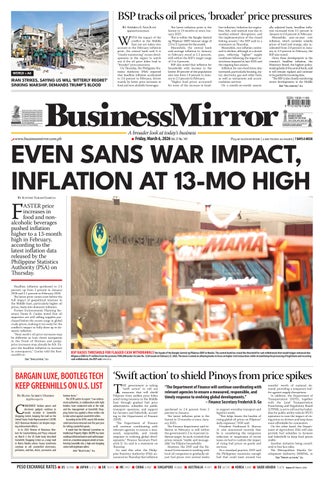
EVEN SANS WAR IMPACT, INFLATION
FASTER
price increases in food and nonalcoholic beverages pushed inflation higher to a 13-month high in February, according to the latest inflation data released by the Philippine Statistics Authority (PSA) on Thursday.
Headline inflation quickened to 2.4 percent, up from 2 percent in January 2026 and 2.1 percent in February 2026. The latest print comes even before the full impact of geopolitical tensions in the Middle East, particularly higher oil prices, feeds into domestic inflation.
Former Socioeconomic Planning Secretary Dante B. Canlas noted that oil importers are still selling supplies purchased before the recent surge in global crude prices, making it too early for the conflict’s impact to fully show up in domestic inflation.
“Next week’s oil-price increases may be different as Iran closes navigation in the Strait of Hormuz and pumpprice increases may already be felt. Expect the headline inflation to increase in consequence,” Canlas told the BusinessMirror
sellers. According to the USTR, nearly 300 vendor stalls have been removed over the past year for selling counterfeit goods. It noted that the National Committee on Intellectual Property Rights (NCIPR) has been working with brand owners and mall management on a transition program aimed at transforming
into a high-end shopping center with legitimate sellers.
THE government is taking
“swift action” to roll out measures that will shield Filipinos from sudden price hikes amid rising tensions in the Middle East through gradual fuel price adjustments, subsidies for public transport operators, and support for farmers and fisherfolk, according to the Department of Finance (DOF).
“The Department of Finance will continue coordinating with relevant agencies to ensure a measured, responsible, and timely response to evolving global developments,” Finance Secretary Frederick D. Go said in a statement on Thursday.
Go said this after the Philippine Statistics Authority (PSA) announced on Thursday that inflation
“The Department of Finance will continue coordinating with relevant agencies to ensure a measured, responsible, and timely response to evolving global developments.” – Finance Secretary Frederick D. Go
quickened to 2.4 percent from 2 percent in January.
The latest inflation print is the fastest in 13 months or since January 2025.
The Finance department said inflation in February is still within the government’s 2 to 4 percent inflation target. As such, it noted that prices remain “stable and manageable” for Filipino households.
However, the DOF said the National Government is working with local oil companies to gradually adjust fuel prices over several weeks
In addition, the
to support everyday transport and logistics needs.
“This helps lessen the burden of rising global oil prices on Filipinos’ daily expenses,” DOF said.
President Ferdinand R. Marcos Jr. also announced recently that he is considering the temporary reduction or suspension of excise taxes on fuel to cushion the impact of rising fuel prices on goods and services.
As a standard practice, DOF said the Philippines maintains enough fuel that could meet around two
By Justine Xyrah Garcia
By Bless Aubrey Ogerio
Poor-quality seeds, fertilizer under govt programs probed
By Ada Pelonia @adapelonia
THEDepartment of Agriculture (DA) has ordered a nationwide survey of farmer-beneficiaries as it escalates its probe into alleged substandard seeds, questionable fertilizer grades, and unreliable farm machinery distributed under government programs.
Agriculture Secretary Francisco
Tiu Laurel Jr. said complaints raised by a farmers’ group are being taken seriously, though regular audits have not flagged systemic irregularities.
Despite this, he ordered a sweeping region-by-region survey of recipients of machinery, post-harvest facilities, seeds, and fertilizers distributed by
Bootleg…
the DA and attached agencies, including the Philippine Center for Postharvest Development and Mechanization. Farmers (PhilMech).
Furthermore, cooperatives will be asked about equipment performance, spare parts availability, after-sales service, and overall satisfaction.
“We want to hear from the actual
beneficiaries,” Tiu Laurel said. “If there is a problem with after-sales service or if the equipment has defects, it will show up in the survey.”
He stressed that the agency cannot rely on unsubstantiated complaints, even as allegations of corruption and graft surface.
“The group is to replace anecdote with verifiable data,” he added.
Meanwhile, Tiu Laurel pushed back against claims that procurement favored a single supplier, noting that machinery has been sourced from multiple global brands, including Kubota and Yanmar, and rice processing technologies from Buhler Group and Satake.
He also acknowledged reports of isolated breakdowns, including a Chinese-brand combine harvester cited in media interviews, adding that each case would be reviewed. Suppliers with weak service networks or contract violations could face penalties or blacklisting.
The review also covers seeds and fer-
tilizers, according to the DA.
While rejecting proposals for a voucher-based seed system, Tiu Laurel said the agency has started using Intervention Monitoring Cards (IMCs) under an improved system as a more transparent and accountable mechanism for delivering fertilizer assistance.
He said the agency will conduct a pilot this year in Southern Leyte, with a full nationwide rollout planned in 2027 if the system proves feasible at the national level.
The DA aims to complete the probe within March and submit a formal report to President Ferdinand Marcos Jr. and the Congressional oversight committees in Agriculture after the Holy Week.
“We are not sweeping anything under the rug,” Tiu Laurel said. “If there are shortcomings or wrongdoings, we will address them.”
PSA data showed food and non-alcoholic beverages index rose 1.8 percent in February, accounting for 65.6 percent of the overall uptick in inflation.
The increase was largely due to a slower decline in the prices of cereals and cereal products, which posted a -1.3 percent inflation rate, particularly rice.
Price increases also accelerated in vegetables, tubers and cooking bananas, which rose 6.1 percent, especially tomatoes, and fish and other seafood, which climbed 7.7 percent.
This was followed by housing, water, electricity, gas and other fuels (HWEGO), which posted a 3.5-percent inflation rate and accounted for 10.6 percent of the overall increase in inflation.
Restaurants and accommodation services also contributed to the uptick, registering a 4.4-percent inflation rate and accounting for 9.6 percent of the overall rise in prices.
Domestic drivers, for now
PHILIPPINE Institute for Development Studies (PIDS) Senior Research
Fellow John Paolo R. Rivera told the BusinessMirror that the latest drivers of inflation remain largely domestic.
“These sectors tend to respond more immediately to local supply dynamics, weather conditions, and operational costs rather than directly to geopolitical developments,” Rivera said, adding that spillover risks remain possible through fuel prices.
whether movements in consumer prices are temporary or part of a more sustained trend, an important factor in setting monetary policy. Canlas said the increase in core inflation could indicate that geopolitical tensions involving the United States, Israel, and Iran are already influencing price expectations, even if the impact has yet to fully show up in headline inflation.
Meanwhile, Agonia said prolonged tensions in the Middle East could further push core inflation higher as broader price pressures build across sectors.
“We may expect core inflation to continue rising if the Middle East conflict is not resolved soon and secondround inflation effects start to materialize,” Agonia said.
De La Salle University (DLSU) economist Ma. Ella C. Oplas shared a similar view, noting that both domestic and global developments could continue to push core inflation higher.
“Expect core inflation to continue soaring higher than headline inflation because of what’s happening to the country both local and international. The war in UAE affects oil prices...production of food and other goods, so there is really nowhere to go but higher,” Oplas told the BusinessMirror Data from the PSA showed that cereals, which includes rice, are excluded from the computation of core inflation as well as meat and fish that are fresh, chilled or frozen; and fresh dates, figs and tropical fruits.
“Although right holders have welcomed these developments, they also continue to observe a significant number of counterfeit goods and continue to wait and see if the transition program will
The USTR added that the committee is also coordinating with mall management and the city government to establish a pilot NCIPR Help Desk at the site.
resolve their concerns about the volume of counterfeit goods,” the USTR said. Greenhills was the only physical market in the Philippines cited in the 2024 report and was also included in the 2022 and 2023 editions.
Following the release of the report, the Intel-
lectual Property Office of the Philippines (IPOPHL) said the government’s efforts go beyond simply being removed from international watch lists.
In a statement on Thursday, the agency said the NCIPR’s goal is to push for lasting reforms so that Greenhills Shopping Center will eventually be recognized as a legitimate retail hub known for “quality” and “trust.”
“Such transformation will not happen overnight, but with sustained cooperation, consistent enforcement, and accountable governance policies institutionalized, it is achievable,” the IPOPHL statement reads.
Protecting intellectual property, they said, requires not only a whole-of-government approach but also broader participation from businesses and the public.
The IPOPHL and the NCIPR affirmed their continuous pursuance of “steady, practical progress,” with concrete actions and measurable results expected in the coming months.
As part of these enforcement efforts, the NCIPR reported that authorities confiscated counterfeit goods worth $291.85 million from January to June 2025.
In a separate operation, the Bureau of Customs (BOC) also seized about $1.7 million worth of bags, clothing, and accessories bearing fake trademarks of luxury brands.
As of October 2025, the BOC accounted for the largest share of seizures through border enforcement, while the Philippine National Police and the National Bureau of Investigation conducted raids in key markets, including Greenhills, 168 Mall and 999 Mall.
IPOPHL also reported progress under its E-Commerce Memorandum of Understanding, with signatories increasing to 108 from 43 in the previous reporting period.
Online platforms have also enhanced detection systems and seller verification measures, with Lazada reporting to have proactively removed 85.5 percent of infringing listings, while Shopee achieved a 93.6 percent takedown rate.
Since implementing the Rules on Voluntary Administrative Site Blocking in 2024, IPOPHL’s orders have led to restricted access to about 30 websites.
The Notorious Markets List identifies prominent examples of online and physical markets where pirated or counterfeit goods are reportedly available or where operators are seen to facilitate or benefit from such activities.
The USTR initiated the 2025 review in August 2025 through a request for public comments published in the Federal Register.
This year’s report includes 37 online markets and 32 physical markets worldwide that are reported to engage in or facilitate substantial trademark counterfeiting or copyright piracy.
The issue focus section examines piracy of live sports broadcasts and the broader challenges of protecting copyright in the digital environment.
The USTR began identifying notorious markets in its Special 301 Report in 2006 and has published a separate annual Notorious Markets List since 2011 to raise public awareness and encourage stronger intellectual property enforcement.
While the Philippines has remained off the USTR’s Special 301 Watch List for 12 consecutive years, certain domestic and online markets continue to be monitored due to recurring intellectual property concerns.
He added that global developments—particularly oil prices—pose a potential risk to inflation in the coming months.
University of Asia and the Pacific (UA&P) economist Marco Antonio Agonia, meanwhile, believes both domestic and external factors likely influenced the latest inflation print.
“The February inflation reading likely only captured the beginning stages of tensions in the Middle East. While the HWEGO segment ticked up, global crude oil prices then only reflected the rising military buildup and faltering negotiations between the US and Iran, not the newfound escalation,” Agonia told the BusinessMirror
Core inflation
BEYOND headline inflation, economists are also watching core inflation, which edged up to 2.9 percent in February, from 2.8 percent in January and 2.4 percent a year earlier.
According to an earlier study of Bangko Sentral ng Pilipinas’s (BSP) Department of Economic Research, core inflation—which excludes volatile food items such as rice and energy— provides a clearer view of the “underlying movement in consumer prices” by removing items prone to temporary price swings.
BSP said tracking core inflation allows policymakers to determine
PSA data showed core inflation also excludes other vegetables that are fresh or chilled; fresh or chilled fruitbearing vegetables; electricity; liquefied hydrocarbons; diesel; and gasoline.
Government take THE Department of Economy, Planning, and Development (DepDev) said it is closely monitoring geopolitical tensions abroad to ensure inflation remains manageable.
“Overall price conditions remain stable. However, we are mindful of recent geopolitical developments, which we are closely monitoring, along with domestic supply conditions of key commodities,” DepDev Secretary Arsenio M. Balisacan said.
Balisacan said the government has several contingency measures in place, including the possible suspension of excise taxes on petroleum products should global oil prices breach $80 per barrel.
To curb fuel consumption, the government is also preparing demandside measures in the public sector, including deploying shuttle buses, encouraging carpooling, and implementing flexible work arrangements.
“We are ready to deploy timely and targeted interventions should external shocks intensify. Our priority is to protect vulnerable households, support affected industries, and sustain the country’s growth momentum amid global uncertainties,” Balisacan said.
for more than a month or two months, there could be already second-round effects to food and other items in the Consumer Price Index (CPI) that are affected by oil.
East to the extent that the rise in the price of oil leads to broader price pressures,” the central bank said.
The BSP also noted that it will ensure that policy settings remain in line with its pursuit of price stability conducive to sustainable growth and development.
Jonathan Ravelas, senior adviser at Reyes Tacandong & Co. said:
“While inflation remains manageable, the third straight monthly uptick tells us upside risks are building—especially if global oil supply disruptions persist.”
From a policy standpoint, Ravelas still sees room for one more 25-basispoint BSP rate cut in 2026 but he underscored that policymakers will need to stay data-dependent.
Bank of the Philippine Islands (BPI)
Lead Economist Emilio S. Neri J. said if the escalation in the Middle East holds
“If it’s a protracted event and if our OFWs are forced to go home because the friends of the West in the Middle East are also being threatened by a conflict, then that could have a more enduring effect on inflation and not only stop the BSP from cutting rates...maybe consider a very small probability of a hike later this year,” Neri said in a televised interview on Thursday.
De La Salle University economist Maria Ella Oplas, meanwhile, told this newspaper: “This is the time that the strength of BSP to manage inflation through monetary policy will be tested.”
“The BSP can still opt for open market operation to fuel fiscal reforms but the question is, will people let go of their liquidity in these chaotic times?” Oplas also told this newspaper.
April or early May.
“The government is closely monitoring
www.businessmirror.com.ph
Another criminal case filed against 18 former ‘marines’
FBy Joel R. San Juan @jrsanjuan1573
ORMER senator Antonio
Trillanes IV on Thursday filed perjury, cyber libel and other criminal complaints against the 18 alleged former members of the Marine Corps in connection with their accusations that he received US$2 million to help personnel of the International Criminal Court (ICC) in investigating the killings that happened during the drug war campaign of the Duterte administration.
Trillanes filed the perjury complaint before the Department of Justice (DOJ) against the “ex-marines” identified as Belnard Tube, Rosebert Waupan, Benny Bulontate, Johnny Buduan, Rodante Orbillo, Reyneboy Julian, Chrstopher Esquivel, George Villalon Jr., Romeo Rommel Bobares, Gil Navidad, Anselmo Taberdo, Joey Cadioa, Rommel Galapon, Cecilio Larroder Jr., Bernard Gumban, Crisanie Dado, Fidel Corpuz, Walter Manalansan for giving false testimonies implicating him in the bribery scheme involving ICC investigators.
The former ‘marines’ have filed a complaint-affidavit before the Office of the Ombudsman claiming that they delivered suitcases of cash amounting to more than P800 billion to lawmakers and government officials, including President Marcos and former Speaker Martin Romualdez from 2022 to 2025.
In their joint affidavit, the 18 said that they previously worked as personal assistants or security consultants of resigned Party-list Rep. Zaldy Co of Ako Bicol.
They alleged that part of their duties were to escort Co’s executive assistants in delivering numerous luggage, paper bags, envelopes full of cash to several political figures including Trillanes, allegedly to fund the hotel accommodations of investigators from the ICC.
“Let me be clear: I did not receive $2 million, nor any amount, from Zaldy Co for the ICC personnel or any other purpose,” the former senator said. “These people are peddling a pathetic lie,” he added.
Trillanes, however, admitted actively communicating with the ICC since 2017 being a complainant against the former President but stressed there was nothing illegal about it.
“I have not done anything criminal, I have not done anything illegal,” Trillanes told reporters.
Trillanes directly pointed to the Duterte camp as behind the 18 “ex-marines” accusations, claiming that it would be used to weaken the prosecution’s case in the crimes against humanity filed against the former President before the ICC.
“The group behind this move is the Duterte camp. Investigations are ongoing and we are learning a lot,” Trillanes.
See “Marines,” A4
Chief fire marshal on carpet over ₧14.7-million ‘payoff’
By Jonathan L. Mayuga @jonlmayuga
THE Department of the In -
terior and Local Government (DILG) has filed administrative and criminal complaints before the Office of the Ombudsman against Bureau of Fire Protection (BFP) Director Jesus Fernandez over an alleged P14.752-million bribery scheme tied to the procurement of 132 Type 1 Basic Life Support ambulances for the agency.
The charges stemmed from an internal investigation that uncovered an alleged pattern of irregularities in the procurement process, which was supposed to strengthen the BFP’s emergency medical response capability.
The BFP has been under fire from no less than Interior Secretary Juanito Victor C. Remulla, who vowed to go after corrupt officials of the organization, including fire inspectors and members of the bids and awards committee.
The DILG is in the process of investigating and building up cases against erring officials of the BFP.
“Ambulances are meant to save lives. Public funds intended for emergency response will never be allowed to become vehicles for corruption,” Remulla said.
“We will pursue the truth and ensure full accountability,” Remulla said in a statement.
Administrative charges filed against Fernandez include grave misconduct, serious dishonesty, and conduct prejudicial to the best interests of the service. The criminal complaints include violations of Section 3(e) of Republic Act 3019 (the Anti-Graft and Corrupt Practices Act), Direct Bribery, Malversation of Public Funds, and Conspiracy.
Other government officials and private individuals connected to the transaction have also been
House Justice panel to VP Sara: Answer impeachment complaints
By Jovee Marie N. dela Cruz @joveemarie
THE House Committee on Justice on Thursday formally served a notice directing Vice President Sara Z. Duterte to respond to two verified impeachment complaints earlier found sufficient in form and substance, emphasizing that there will be “no delays, no shortcuts” in the impeachment proceedings against her.
In a “Notice to Respondent” dated March 4, 2026, and addressed to the Office of the Vice President at Cybergate Plaza in Mandaluyong City, the committee ordered Duterte to submit her verified answer within the period prescribed under the House Rules on Impeachment Proceedings. Records indicate that the document was received by the Office of the Vice President at 10:44 a.m. on March 5, 2026.
“Accordingly, you are hereby directed to file your Verified Answer to the abovementioned complaints within a non-extendible period of ten [10] calendar days from receipt of this notice and to serve a copy of your Verified Answer upon the complainants within the same
impleaded as the investigation continues.
The DILG has, likewise, requested the Office of the Ombudsman to place Fernandez under preventive suspension to protect the integrity of the proceedings.
Records show that the September 2024 procurement of 132 Type 1 Basic Life Support ambulances was allegedly manipulated to favor a pre-selected supplier.
During the investigation, the DILG gathered evidence that the supplier entered into a joint venture with an automotive company in October 2024 solely to qualify for bidding requirements. Investigators believe the arrangement served as a legal front to secure control of the project.
Further investion indicate that in November 2024, during a meeting in Quezon City, Fernandez, who was then serving as Chairperson of the BFP Bids and Awards Committee, allegedly received P6 million in a suitcase and another P4.752 million in a bag.
In September 2025, he allegedly received an additional P4 million in cash during a separate meeting.
The total documented payoffs amount to P14.752 million.
The complaints are supported by a sworn testimony from the supplier’s representative detailing how the “SOP” payments were computed and delivered, as well as an affidavit from the automotive company’s manager describing how the joint venture arrangement was used to secure the contract.
Remulla said the case demonstrates the Department’s firm stance against corruption within the ranks of public service.
“There is no room in government for anyone who treats public funds as personal profit,” he said.
The DILG reiterated its zerotolerance policy against corruption and committed to full transparency as the case proceeds before the Office of the Ombudsman.
period as required under Sec. 6 of the Rules,” the notice read.
The document was signed by House Committee on Justice Chairperson Gerville Luistro, who represents Batangas.
The notice cited the panel’s earlier determination declaring the impeachment complaints sufficient in form and substance pursuant to Sections 4 and 5, Rule III of the Rules of Procedure in Impeachment Proceedings of the House of Representatives.
Two verified complaints were specifically identified in the document: “In the Matter of the Impeachment of Sara Zimmerman Duterte as Vice President of the Republic of the Philippines,” filed by Reverend Father Joel Saballa et al, and “In the Matter of the Im -
peachment of the Vice President of the Republic of the Philippines, Sara Zimmerman Duterte,” filed by Atty. Nathaniel G. Cabrera.
The committee warned that failure to respond within the prescribed period would have legal consequences.
“Failure on your part to file the Verified Answer within the period herein provided shall be deemed a waiver of your right to file the same, and you shall be considered to have interposed a general denial to the allegations contained in the Impeachment Complaints,” it stated.
Copies of the impeachment complaints were enclosed with the notice.
Under House rules, the respondent must first submit a verified answer before the committee proceeds to the next phase of deliberations on the complaints.
No delays
LUISTRO also assured the public that the House Justice Committee intends to keep the impeachment proceedings moving without unnecessary delays.
Luistro said the panel is prepared to continue its hearings on the impeachment complaints against Duterte even during the upcoming congressional recess.
Congress is scheduled to go on recess starting March 18 for Holy Week and will reconvene on May 4 before adjourning sine die on June 5. Lawmakers will then return on July 27 for the opening
AFP supports all measures vs espionage, similar threats
By Rex Anthony Naval
THE military supports all measures being undertaken by the government to counter espionage and other similar threats to the country’s security, the spokesperson of the Armed Forces (AFP) said on Thursday.
Col. Francel Margareth Padilla, spokesperson for the AFP, made the statement even as she said that the military is aware of reports regarding the dismantling of an alleged espionage network operating within the country.
“Authorities have uncovered and disrupted activities involving Filipino nationals cooperating with investigators, which appear to be linked to foreign-directed malign activities,” she added.
Padilla said this development highlights how modern espionage increasingly utilizes cyber and
technological methods, making vigilance and inter-agency cooperation more important than ever.
She added that this situation was detected and addressed through coordinated government action among relevant security and law enforcement agencies.
“The AFP supports ongoing efforts to strengthen safeguards that protect our national security, including the continuing improvement of legal and institutional frameworks to address evolving threats,” Padilla also said.
For security reasons, Padilla said the AFP cannot cannot disclose further operational details.
“At the same time, the Philippines continues to maintain constructive diplomatic engagement with all countries,” she added.
Palace calls for vigilance
MALACAÑANG on Thursday
called on all government agencies to be vigilant against possible espionage activities in their offices following the arrest of Filipinos, who engaged in foreign-directed spying.
Palace Press Officer Claire Castro issued the statement after the National Security Council (NSC) confirmed a news report that the said arrested were government workers with access to sensitive information and documents.
NSC said the government workers, which it did not identify, were determined to have links to the People’s Republic of China.
Castro said the threat from the said spies were detected though the government’s Insider Threat Program.
“In this context, the Palace reminds everyone in government
“AFP,” A4
Military sees more interoperability drills
MORE interoperability drills among the air and naval forces of the Philippines, Australia, Japan, and the United States can be expected in the coming months following the conclusion of the Third Multilateral Joint Staff Talks among the militaries of the four nations, the Armed Forces (AFP) said on Thursday.
Aside from Filipino military representatives, also present during the meeting from March 2 to 3 were ranking officers of the Australian Defense Force, the Japan Self-Defense Force, and the US
Indo-Pacific Command.
“The Multilateral Joint Staff Talks serve as a key platform for senior military leaders and planners to enhance coordination, improve interoperability, and reinforce mutual understanding among like-minded nations,” the AFP said in a statement.
“The talks underscored the continued commitment of the four nations’ armed forces to strengthen defense cooperation and advance shared security interests in the Indo-Pacific Region.”
Incidentally, Australia, Japan, and the US are among the most
of the Second Regular Session of the 20th Congress and the fifth State of the Nation Address of President Marcos.
“In my perspective as justice chair, I do not want to cause any delay to this proceeding. And that is why I am inclined to continue the hearing even during recess,” Luistro said in an interview.
Luistro said continuing the hearings is necessary to prevent the impeachment proceedings from further dividing government institutions and distracting the public.
She emphasized that while the committee wants to avoid delays, it will not compromise fairness and due process.
Under the House Rules on Impeachment, the Vice President must file her answer with the committee and furnish copies to the complainants.
The complainants will then have three calendar days to submit their reply.
Duterte will also have three calendar days to file her rejoinder after receiving the reply.
Luistro said these exchanges of responsive pleadings are part of the procedural safeguards before the committee proceeds with the hearings.
Once the hearings are completed, the House Committee on Justice will determine whether probable cause exists to elevate the impeachment case to the Senate for trial.
PNP backs PCO, newspapers’ campaign against fake news
THE National Police (PNP) on Thursday committed its full resources to the national government’s intensified campaign against misinformation. In a statement, the PNP said it has streamlined its operations to support the recent alliance between the Presidential Communications Office (PCO) and various newspaper outlets to fight the proliferation of false information, particularly on social media. Gen. Jose Melencio Nartatez Jr., PNP chief, said the force is ready to provide the technical and enforcement backbone for this partnership.
Bulacan vice mayors going home–Remulla
Tinvolved countries in the Philippines’ multilateral maritime cooperative activities (MMCAs) in the West Philippine Sea (WPS).
On February 15 to 16, naval and air units of the Philippines, Australia, and the US took part in the 14th MMCA, the first of its kind this year, in the WPS.
This was followed by the 15th MMCA on Feb. 20 to 26, involving military units of the Philippines, Japan, and the US. These drills are aimed at enhancing the interoperability of
HE 11 vice mayors from Bulacan who were in Dubai when the war broke out in the Middle East are on their way home, Local Government Secretary Juanito Victor Remulla said. Remulla said the vice mayors have already secured their flights. He clarified that the vice mayors had travel authority from the Department of the Interior and Local Government and were on their “personal” or private capacity when they went to Dubai, but were stranded when the United States and Israel attacked Iran on February 28.
A4
Friday, March 6, 2026
Fuel price surge prompts legislators to push WFH, online class modes
By Butch Fernandez @butchfBM & Jovee Marie N. dela Cruz @joveemarie
ALAWMAKER has proposed a temporary shift to workfrom-home arrangements and online classes to help cushion the impact on the public of a possible surge in fuel prices triggered by the escalating conflict in the Middle East.
Parañaque Rep. Brian Raymund Yamsuan said both the government and private sector should begin preparing contingency measures to reduce transportation costs for workers and students should global oil prices continue to spike.
“We should act fast to ease the burden on our countrymen if oil prices continue to spike. We call on the government and the private sector to start planning the temporary transition to work-fromhome setups for employees and for schools to prepare for online classes,” Yamsuan said.
“These are the steps we can immediately take to help our fellow Filipinos who will be the first to feel the impact of the continued rise in oil prices
if the crisis in the Middle East drags on,” Yamsuan added. Yamsuan noted that the transport sector would likely be among the first to feel the effects of rising fuel prices, which could trigger a chain reaction in the prices of food, electricity, and other basic commodities.
At the Upper Chamber, Sen. Joel Villanueva urged both the government and the private sector to expand the use of work-from-home arrangement and other flexible work schemes. “These measures will help reduce fuel consumption and shield Filipinos from the burden of rising oil prices brought about by the widening conflict in the Middle East,” he said.
Villanueva, principal author and sponsor of Republic Act 11165 or the Work-From-Home law, said the measure provides a ready policy framework that can be maximized to lessen commuting demand at a time when global oil prices are climbing due to geopolitical tensions in the Middle East.
Signed into law in 2018, the law institutionalized work-fromhome arrangements in the private sector, allowing employees to perform their duties from alternative workplaces using
PNP eyes EV prowl cars
By Rex Anthony Naval
WITH fuel prices ex -
pected to spiral within the next few weeks the National Police (PNP) chief, Gen. Jose Melencio Nartatez Jr., on Thursday ordered a comprehensive study on the possible integration of electric vehicles (EVs) into the police fleet amid concerns on the potential supply disruptions of petroleum products.
Nartatez, in a statement, acknowledged that the conflict will likely affect the supply of petroleum products and raise operational costs for law enforcement.
“For an agency that is depen -
Jonvic.
Continued from A3
“Last time I was told is that they already have tickets,” he said.
Meanwhile, Remulla said one mayor who was earlier reported to have been stranded in Dubai never left the country.
“There was confusion. I was told there was a travel authority, but I haven’t confirmed whether she actually left. It’s my fault, and I apologize to the good mayor,” he said.
Meanwhile, Remulla enjoined local governments (LGU) and all DILG offices and attached agencies to implement an austerity program in line with President
dent on fuel in its daily operation, we view the Middle East tensions as a wake-up call for us to revisit the policy on patrol vehicle procurement. But we need to conduct our own study and assessment first on whether or not electric vehicles are practical, reliable and suitable to the daily routine of our personnel on the ground,” he added Nartatez said every increase in price of petroleum products is an added expense to the operational cost in every police unit. Experts earlier warned that a prolonged conflict in the Middle East will affect the global oil trade and eventually result in a surge of prices of petroleum products.
Marcos’s directive.
He said an order will be handed down by the DILG Central Office to all Regional Offices, attached agencies, and LGUs, enjoining various unit heads to implement austerity measures.
The officials said the “adjustments” to spending on seminars and workshops that used to be held in hotels must stop.
Mahal kasi ang mga seminars and workshops na iyan,” he said.
“Definitely, there will be an adjustment. By the way, it’s not just us. All Departments have been instructed to cut down on costs, too,” he said.
Remulla had earlier said that 12 Bulacan officials—1 mayor and 11 vice mayors were stranded in Dubai. Jonathan L. Mayuga
telecommunications and digital technology.
Villanueva noted that the law is implemented by the Department of Labor and Employment (Dole) for the private sector, while work arrangements in government offices fall under the jurisdiction of the Civil Service Commission (CSC). The commission promulgated similar rules on work-fromhome and alternative work arrangements.
The senator emphasized that aside from work from home schemes, both the government and the private sector could also adopt other alternative work arrangements that reduce commuting demand, such as hybrid work setups, compressed workweeks, staggered working hours, and flexible schedules.
“These alternative work arrangements can help decongest our roads, lower fuel consumption, and allow workers to save on transportation costs,” Villanueva said. He noted that millions of Filipino workers commute daily, particularly in Metro Manila, where heavy traffic leads to higher fuel consumption and longer travel times.
Encouraging remote work and
flexible schedules, he said, could significantly reduce daily travel while improving productivity.
Villanueva added that maximizing work from home and other flexible work arrangements can serve as a timely response to global uncertainties affecting energy prices while also advancing longterm goals such as easing traffic congestion and improving worklife balance for Filipino employees.
“As we navigate the effects of rising oil prices, we must maximize policies already in place that benefit workers, businesses, and the broader economy,” he said.
Inquiry
MEANWHILE, Party-list Rep. Nathan Oducado of 1Tahanan has filed House Resolution 825 seeking a congressional inquiry, in aid of legislation, into the looming oil price increases driven by global geopolitical tensions and market volatility.
Oducado said the House must examine possible measures to shield Filipino consumers from sudden spikes in fuel prices that could further strain household budgets and small businesses.
The resolution cited escalating geopolitical tensions in the Middle
East, including recent military actions involving the United States, Israel, and Iran, which have heightened fears of disruptions in the Strait of Hormuz – a critical passage that carries about 20 percent of the world’s seaborne oil supply.
“We cannot ignore these global developments because they directly affect the cost of living in our country,” Oducado said. “Congress must study policy options that can shield consumers without putting our economy at risk,” Oducado said.
The measure also recalled the former Oil Price Stabilization Fund, which accumulated significant deficits and posed fiscal risks, as noted in studies by the Philippine Institute for Development Studies.
“We must learn from past mistakes and design smarter solutions that truly benefit the public,” Oducado said.
Under House Resolution 825, lawmakers are urged to assess modern financial risk management tools such as oil hedging instruments and other policy options that could help cushion the impact of oil price spikes on the Philippine economy and Filipino consumers.
Marcos extends term of Edcom II
MAJOR reforms in the Philippine education system are set to continue and deepen after President Marcos signed a law extending the mandate of the Second Congressional Commission on Education (Edcom II), House Speaker Faustino G. Dy III said on Thursday.
Marcos, on Wedneday, signed Republic Act 12315, which extends Edcom II’s mandate beyond its initial three-year term for another two years to allow further research, consultations, and oversight of education reforms.
“The President’s signing of the law extending Edcom II shows a shared commitment between Congress and the administration: we are serious about sustaining reforms in education,” Dy said.
He emphasized that the extension ensures ongoing reforms are completed and strengthened, providing lasting benefits to students, teachers, and families.
“This is not just a procedural extension. It is a clear signal that the reforms we started must be deepened and completed, with
Continued from A3
the participating military forces. Meanwhile, the Navy’s most modern and up-to-date warship, the guidedmissile frigate BRP Diego Silang (FFG-7), is now on its way to Sydney, Australia, to take part in this year’s iteration of Multilateral Naval Exercise Kakadu 2026.
In a Facebook post, the Naval Defense Command said the ship, its crew, and the embarked Naval Task Group 80.6 departed Naval Operating Base Subic, Zambales on March 2. Kakadu is a biennial naval exercise hosted by the Royal Australian Navy.
Aside from drills scheduled for Kakadu, the PN contingent will also take part in the International Fleet Review (IFR), where 21 countries will participate.
These countries include Canada, France, the US, Japan, Singapore, India, Indonesia,
long-term impact on the education sector,” he said.
The Speaker also highlighted Congress’ support for education through the historic 2026 General Appropriations Act, which allocates over P1.3 trillion—the largest in Philippine history— for programs in basic education, higher education, and technicalvocational training.
Under RA 12315, Edcom II will continue pursuing reforms aligning curricula, teaching methods, and assessments with global standards. The commission is also tasked with addressing gaps in school facilities, learning resources, and teacher training while updating the national education agenda to incorporate digital technologies, artificial intelligence, and green solutions.
House Committee on Higher and Technical Education chairperson, Party-list Rep. Jude Acidre of Tingog, co-chair of Ecom II, welcomed the extension, saying it guarantees continuity in the country’s efforts to tackle longstanding education challenges.
The law amends RA 11899 to allow Edcom II to sustain
Malaysia, Bolivia, Vietnam, the Philippines, Thailand, Sri Lanka, Fiji, Micronesia, Kiribati, Tonga, Papua New Guinea, Cook Islands, Samoa, and Australia. Kakadu 2026 is scheduled for the last week of March.
Before the contingent’s departure, the Navy flag officer in command, Vice Admiral Jose Ma. Ambrosio Ezpeleta, ordered all personnel to “demonstrate professionalism and operational excellence in the series of multilateral exercise activities.”
Likewise, Ezpeleta said that BRP Diego Silang is among the most advanced warships of the Philippine Navy, capable of undertaking complex and high-end naval operations.
He said participation in the IFR and Kakadu demonstrates the PN’s commitment to enhance maritime cooperation, strengthen defense diplomacy, and improve warfighting proficiency alongside allied and partner navies. PNA
www.businessmirror.com.ph
Continued from A3
He also expressed belief that some of the 18 Marines would eventually confess the people behind them, their real motives and how much they received in exchange of coming out.
When asked if he has evidence to back his claim against the Duterte camp, Trillanes replied : “They stand to benefit most from this…and there are information linking them.”
Meanwhile, Ombudsman Jesus Crispin Remulla said investigators are eying not only political angle motive but also “economic motives” behind the public appearance of the 18.
“We are looking into various personalities. It’s political, some of them have economic motives,” Remulla said on the sidelines of the First Department of Justice Anti-Corruption Workshop and Summit.
“They are trying to create political tipping point…I think we know who’s behind it. We have to prove it. So we’re not alleging anything now,” he added.
Remulla recently confirmed the claim of the “marines” that he met with investigators from the International Criminal Court during his term as Justice secretary.
Continued from A3
“We are intensifying our 24/7 cyber patrolling, and we are prepared to link our monitoring systems with the AntiFake News Desk of the Presidential Communications Office for faster response,” he said.
oversight of reforms and guide the implementation of a longterm national education agenda. Acidre also praised the collaborative work of his co-chairs—Pasig Rep. Roman Romulo, Sens. Benigno Agapito Aquino and Loren Legarda, and Executive Director Karol Mark Yee in steering research, consultations, and policy development.
“Education reform requires a whole-of-government approach. The progress of Edcom II reflects the cooperation of our education agencies, our commissioners, and the many stakeholders committed to strengthening the system,” Acidre said.
Under the law, Edcom II will continue working closely with key education and development agencies—including the Department of Education, Commission on Higher Education, Technical Education and Skills Development Authority, Department of Science and Technology, and Department of Labor and Employment—to advance reforms across basic education, higher education, and technicalvocational training.
Jovee Marie N. dela Cruz
Continued from A3
to be cautious and critical,” she said in Filipino in a statement released to Palace reporters last Thursday.
“Guard your offices, protect sensitive government information, and ensure it is not compromised by actors who could pose a threat to national security,” she added.
For its part, the NSC assured that there are safeguards in place to prevent spying activities in the government.
However, it urged Congress to pass the new Anti-Espionage Bill to replace the Commonwealth Act 616 and the Anti-Foreign Malign Influence and Interference Act to strengthen the country’s counter-
Noting that the battle against false information starts at the grassroots level, Nartatez instructed all police units to use their official social media pages to immediately debunk local rumors.
These units are also tasked to coordinate closely with community leaders to stop the spread of viral hoaxes.
“Spreading fake news and wrong and malicious information is not only a public safety concern, but could also involve national security matters. We will continue to do our part in ensuring the protection of the public in cyberspace,” the PNP chief said.
On Wednesday, the PCO signed a memorandum of understanding with top newspaper organizations in the country to combat misinformation and disinformation on digital platforms.
The partnership aims to monitor and verify news circulating in both traditional and digital media, ensuring that the public receives accurate information. PNA
terrorism response.
“When passed into law, these measures would expand the investigative powers of the government, allow the prevention and disruption of hostile operations and networks, and protect our sensitive information and critical infrastructure,” NSC said.
Earlier, the Nationa Security Council (NSC) confirmed that government authorities have uncovered a serious national security matter involving espionage and foreign-directed malign activities in the country linked to the People’s Republic of China. It also said that the operations of these individuals acting on the behest of Chinese Intelligence have been addressed and terminated.
Escudero: Amend TRAIN Law to give President ‘automatic authority’ to suspend fuel taxes
By Butch Fernandez @butchfBM & Jovee Marie N. Dela Cruz @joveemarie
OT ad hoc fixes.
NSenator Chiz Escudero on Wednesday has called for amendments to the Tax Reform for Acceleration and Inclusion (TRAIN) Law that will empower the President to suspend or low er excise and value‑added taxes (VAT) on fuel whenever global oil prices exceed the benchmark assumptions for Dubai crude set in the government’s Budget of Expenditures and Sources of Fi nancing (BESF).
According to Escudero, the cur rent safeguard in the TRAIN Law or Republic Act No. 10963 is “too narrow” and requires specific con ditions before excise taxes can be suspended. A broader amendment is needed, he argued, to ensure faster relief for consumers during oil shocks caused by force majeure events such as wars or global crises.
He said it has always been his position to grant the President au tomatic authority to suspend tax impositions to protect the public from sudden fuel price increases.
“The law should be amended to automatically give the Presi dent that power to suspend or lower excise and VAT rates when
prices exceed the estimated range of Dubai crude oil based on the BESF, which guides gov ernment budget assumptions,” he said.
“The government cannot enjoy a windfall in excise taxes at the ex pense of the public because of the increase in prices brought about by force majeure,” Escudero added.
The senator’s proposal comes as President Marcos announced that he will ask Congress for emergency powers to reduce excise taxes on petroleum products if Dubai crude exceeds $80 per barrel, a move the Chief Executive envisioned will help protect the Filipino people from the impact of rising global oil prices.
Escudero said that while the President’s request for emergency powers is a step in the right direc tion, a permanent amendment would be more effective.
“We should not wait for every crisis to pass through Congress be fore action can be taken. The law must already provide the President with the automatic authority to act when conditions demand it,” he pointed out.
Fast-track a measure A LAWMAKER on Thursday urged Congress to fast t rack a measure granting the president authority to temporarily suspend or reduce
Rice price hike reports surface in Mandaue; Cebu govt assures stable supply, warns vs profiteering
By Carmel Pedroza
CEBU CITY—Reports of ris
ing rice prices in Mandaue City have prompted lo cal officials to convene the Local Price Monitoring Council, even as Cebu Governor Pamela Baricuatro assured the public that rice and fuel supply across the province remain stable.
According to the Mandaue City Public Affairs Office, Mayor Thad eo Ouano has called for an urgent meeting on Thursday, March 5, 2026, to verify reports of price increases in basic commodities, particularly rice products, circu lating in local markets.
Atty. Sally Malig o n, city ad ministrator, said the council will validate the reported price adjust ments and determine appropriate actions to protect consumers from possible overpricing.
Baricuatro assures stable supply, warns vs profiteering AMID these developments, Cebu Gov. Pamela Baricuatro on Wednesday, March 4, reiterated that there is no shortage of rice and fuel in Cebu Province despite rising global tensions and the ongoing armed conflict in the Middle East.
Citing data from the De partment of Agriculture (DA), the governor said supply re mains sufficient in the coming months.
“There is no need for panic buying. There is no shortage of rice, and there is no shortage of fuel. Nothing at all,” Baricuatro said during a press briefing at the Capitol.
“There is nothing to be worried about, and we are on top of the situation,” she added.
She acknowledged, however, that some private retailers may be taking advantage of global un certainties to justify price hikes.
Wala may shortage of rice diri, pero naa lang gyod tay mga retailers who are taking advan tage of the situation nga nag i ncrease sad sila sa ilang prices [There’s no rice shortage here, but there are retailers who are taking advantage of the situa tion and implemented a price increase],” she said.
While the provincial govern ment sees no immediate need to impose price control measures, Baricuatro warned that authori ties are closely monitoring the market and will not tolerate profi teering.
“Watch out because we are mon itoring you, and we are urging you to please do not take advantage of the situation because we will really run after you,” she added.
On March 2, the governor signed Executive Order No. 15, mandating proactive measures to mitigate potential economic, en ergy, food security, public safety, and welfare impacts of the Middle East conflict on Cebu.
The Capitol is coordinating with the Department of Trade and In dustry (DTI) and other agencies to intensify price monitoring.
Local Price Coordinating Coun cils have been directed to convene and act swiftly against hoarding, profiteering, and price manipu lation.
The order also instructs pro vincial offices to prepare con tingency measures for possible returning overseas Filipino workers (OFWs), including the establishment of an assistance and repatriation desk in coordi nation with the Overseas Work ers Welfare Administration (OWWA) and livelihood reinte gration programs in partnership with the Technical Education and Skills Development Authority (TESDA).
excise taxes on petroleum prod ucts, citing the rising conflict in the Middle East and its potential impact on local fuel prices.
In a statement, Batangas Rep. Ryan Recto, who anticipated the need for a flexible government re sponse as early as November 2025, filed House Bill No. 5961 to provide a legal mechanism for the admin istration to act swiftly in shielding Filipino consumers from sudden spikes in oil costs.
“The current statutory excise tax regime imposes a fixed per l iter tax that provides a stable revenue stream but lacks the flexibility to mitigate the sudden and severe inflationary impact of global price volatility,” Recto said in the bill’s explanatory note.
He noted that prior safeguards under the TRAIN Act have largely expired, leaving the country ex posed to inflationary pressures when international tensions dis rupt oil markets.
The bill proposes an amend ment to Section 48 of the National Internal Revenue Code (NIRC), al lowing the president, on the rec ommendation of the secretary of Finance, to suspend or reduce fuel excise taxes by up to 50 percent. Such action would consider public interest, inflationary impact, and government revenue and could be lifted once conditions normalize.
Importantly, the measure sets a trigger point: the authority to ad just taxes would only apply when Dubai crude oil, based on the Platts Singapore (MOPS) average, reaches or exceeds US $80 per barrel.
With the Philippines importing nearly all of its petroleum, Recto emphasized that the measure is vi tal to protect families and business es from sudden fuel price shocks that ripple across transportation and everyday goods.
The bill is now awaiting discus sion in the House Committee on Ways and Means.
Earlier, Marikina Rep. Miro S. Quimbo, chairman of the House Committee on Ways and Means, filed House Bill No. 8257 seeking to grant the President authority to temporarily suspend or reduce excise taxes on petroleum products during national or global economic emergencies.
Quimbo said the measure would also amend Section 148 of the NIRC to establish a lawful and condition al mechanism for suspending fuel excise taxes when extraordinary circumstances arise.
He underscored that the Con stitution vests in Congress the ex clusive power to impose and adjust taxes, including excise taxes on petroleum products. However, he noted that Congress has histori cally crafted mechanisms during
times of crisis to allow the govern ment to respond swiftly in order to protect consumers and preserve macroeconomic stability.
Special powers
PARANAQUE Rep. Bryan Yamsuan also backed the call of President Marcos for special powers that would allow the government to temporarily reduce or suspend ex cise taxes on petroleum products during national or global crises.
Yamsuan said such authority would enable the government to respond quickly to oil price shocks and help shield vulnerable sectors from the economic fallout of pro longed global supply disruptions.
“We are all hoping that the US I sraeli conflict with Iran will be resolved soon. But if tensions escalate, we need to be prepared to ease the economic burden of our countrymen who would have to bear the brunt of the effects of the possible sustained spike in fuel prices,” Yamsuan added.
Yamsuan welcomed reports that the President was ready to certify as urgent the measure that aims to grant special powers to the Chief Executive to temporar ily reduce or suspend the excise taxes on petroleum products in cases of national or global emer gencies, such as the ongoing war in the Middle East.
299 OFWs repatriated as Middle East crisis worsens, Marcos vows continued support
By Samuel P. Medenilla @sam_medenilla
MALACAÑANG announced that 299 overseas Filipino workers (OFWs) displaced by the ongoing crisis in the Middle East have been repatriated.
Citing the Department of Mi grant Workers (DMW), Presi dential Communications Office (PCO) Secretary Dave M. Gomez said the 299 Filipinos arrived at the at Ninoy Aquino International Airport Terminal 3 on Thursday morning via Emirates EK336 from Dubai (DXB) to Manila (MNL).
In a post in its social media
page, DMW said among those re patriated were 23 OFWs and two children.
“As directed by President Fer dinand Marcos Jr., the DMW and OWWA will continue to provide on t he ground support and repa triation assistance to OFWs [over seas Filipino workers] caught in the Middle East,” it said.
The returnees were given fi nancial aid, accommodation, and transport services, medical assis tance and psychosocial support.
Last Wednesday, the Overseas Workers Welfare Administration (OWWA) reported there were over 1,000 OFWs, who are seeking to be
repatriated after joint air strikes from the United States and Israel against Iran.
Iran retaliated by launching at tacks to its neighboring countries with US bases resulting in restric tions on air travel in the region.
Most or 278 of the said OFWs, who are requesting for repatria tion were from Bahrain and Abu Dhabi with 246. The other requests were from Dubai (231), Qatar (173), Kuwait (62), Israel (46), and Lebanon (5).
Marcos said the government is ready to bring home the affected Filipinos in the Middle East as soon as it is safe to do so.
In Congress, similar proposals are already being pushed by law makers, including a Senate mea sure filed by Sen. Benigno Agapito Aquino and a counterpart bill in troduced in the House by Marikina Rep. Federico Quimbo.
The surge in crude oil prices comes amid fears that Iran could restrict access to the Strait of Hor muz, a strategic passage where about one f ifth of the world’s oil supply is transported.
According to the Department of Energy, fuel prices in the country could increase by as much as P10 per liter in the coming weeks if ten sions in the Middle East continue to escalate.
Cayetanos push bill to reduce fuel SENATE Minority Leader Alan Peter Cayetano and Senator Pia Cayetano on Wednesday filed a bill seeking to allow the automatic suspension or reduction of excise taxes on fuel amid spikes in global oil prices triggered by escalating tensions in the Middle East. Senate Bill No. 1927 seeks to amend Section 148 of the Na tional Internal Revenue Code of 1997, as amended by Republic Act No. 10963 or the TRAIN Law, to grant the President the authority to suspend or reduce fuel excise taxes once global oil prices hit a specified threshold.
Iran strikes, saying US will ‘bitterly regret’ sinking warship, demands Trump’s blood
By Jon Gambrell, David Rising, Elena Becatoros & Samy Magdy
The Associated Press
UBAI, United Arab Emirates—Iran
Dlaunched a new wave of attacks
Thursday morning at Israeli and American bases and threatened that the United States would “bitterly regret” torpedoing an Iranian warship in the Indian Ocean and a religious leader called for “Trump’s blood,” while Israel said it had begun a “large-scale” attack on Tehran. Israel announced multiple incoming missile attacks and air sirens sounded in Tel Aviv and Jerusalem. Iranian state television said additional strikes also targeted US bases. The Israeli military said it launched targeted attacks in Lebanon at the Iranian-backed Hezbollah militant group a “large-scale wave of strikes against infrastructure” in Iran’s capital, without elaborating. Explosions were heard in multiple locations in Tehran a short time later.
The US Navy sank the Iranian frigate IRIS Dena Tuesday night in the Indian Ocean, kill -
ing at least 87 Iranian sailors, which Iranian Foreign Minister Abbas Araghchi decried Thursday as “an atrocity at sea.” “Frigate Dena, a guest of India’s Navy carrying almost 130 sailors, was struck in international waters without warning,” he wrote on social media. “Mark my words: The US will come to bitterly regret (the)
precedent it has set.”
Ayatollah Abdollah Javadi Amoli, in one of the few clerical statements so far from Iran, said the country was “on the verge of a great test” and called on state television for “the shedding of Zionist blood, the shedding of Trump’s blood.”
“Fight the oppressive America, his
blood is on my shoulders,’” he said in a rare call for violence from an ayatollah, one of the highest ranks within the clergy of Shiite Islam.
The US and Israel launched the war Saturday, targeting Iran’s leadership and killing Iranian Supreme Leader Ayatollah Ali Khamenei, as well as its missile arsenal and nuclear program. Leaders have suggested that toppling the government is a goal, but the exact aims and timelines have repeatedly shifted, signaling an open-ended conflict.
The war has killed more than 1,000 people in Iran, more than 70 in Lebanon and around a dozen in Israel, according to officials in those countries. It has disrupted the supply of the world’s oil and gas, snarled international shipping and stranded hundreds of thousands of travelers in the Middle East.
Threats expanding across the Middle East
A DRONE crashed Thursday near the airport in Nakhchivan, an Azerbaijan exclave that borders the north of Iran and is separated from the rest of the country by Armenia.
Another drone fell near a school and two
civilians were injured, Azerbaijan’s Foreign Ministry said.
Iran has not acknowledged targeting Azerbaijan, but its attacks have spread erratically as the war has gone on involving regional countries and beyond.
Qatar evacuated residents near the US Embassy in Doha as a temporary precaution and fighter jets could be heard overhead early in the United Arab Emirates city of Dubai.
Saudi Arabia said it destroyed a drone in its province bordering Jordan, and a new attack off the coast of Kuwait appeared to expand the area where commercial shipping was in danger.
An explosion rocked the area early Thursday, according to the United Kingdom Maritime Trade Operations Center run by the British military. It said a tanker apparently came under attack, but the agency did not offer a cause. Iran in the past has attacked ships by attaching limpet mines to them.
Prior attacks since fighting began Saturday have happened in the Gulf of Oman and the Strait of Hormuz, which connects it to the Persian Gulf and through which about a fifth of the world’s oil is shipped.
US stocks rebounded Wednesday after oil prices stopped spiking and reports gave encouraging updates on the American economy. But oil prices resumed their ascent early Thursday and Brent crude, the international standard, is now up some 15% from the start of the conflict as Iranian attacks have disrupted traffic through the strait.
Buildings of Iranian military and security forces targeted US Defense Secretary Pete Hegseth said a torpedo from an American submarine sank an Iranian warship Tuesday night in the Indian Ocean. Sri Lankan authorities said 32 crew members were rescued, while its navy recovered 87 bodies.
The Iranian ship was on its way back from participating in a February exercise hosted by the Indian navy. The US Navy also participated in the same exercise with a P-8A Poseidon aircraft, which is employed for anti-submarine and anti-surface warfare as well as surveillance and reconnaissance.
See “Iran,” A9
The World BusinessMirror
Hormuz Strait stranglehold: War sends oil and gas prices soaring, Asia exposed
AN employee fills up the fuel tank of a car at a gas station in Jakarta, Indonesia, Tuesday, March 3, 2026. AP PHOTO/ACHMAD IBRAHIM
By Anton L. Delgado & Aniruddha Ghosal
BThe Associated Press
ANGKOK—Global energy trade is in turmoil as war around the Persian Gulf chokes off oil and natural gas shipments, causing prices to soar.
Asia is the most exposed since it relies heavily on imported fuel, much of it shipped through the Strait of Hormuz, the narrow passageway that carries a fifth of global trade in crude oil and liquified natural gas, or LNG.
About 13 million barrels of oil per day moved through the corridor in 2025, according to energy consultancy Kpler. That’s about a third of all seaborne crude, the unrefined petroleum that is processed into fuels such as gasoline and diesel.
Roughly a fifth of the world’s LNG, natural gas cooled into liquid form for easier storage and transport, also flows through the straits.
More than 80% of the LNG shipped through the strait in 2024 went to Asia, according to the US Energy Information Administration. Since the Iran war began, the price of Brent crude, the international standard, has jumped 15% to about $84 per barrel, the highest level since July 2024.
US President Donald Trump said Tuesday the US will offer risk insurance to shippers and may deploy its navy to protect vessels if needed. But the disruptions are cascading beyond the region. When supply tightens, richer nations outbid poorer ones for scarce cargoes, leaving more vulnerable economies short of fuel. This was seen during past energy shocks caused by Russia’s invasion of Ukraine in 2022.
“The crisis, with the closure of the Hormuz Strait as the latest development, would not only raise oil and gas prices but also grind global economic activity to a halt,” said Zulfikar Yurnaidi, with the Association of Southeast Asian Nations ‘ Center for Energy.
China and India potentially face big risks
FOR Asia’s two most populous countries, their huge scale magnifies the risks.
China is the world’s largest crude oil importer and India comes in third. Sustained spikes in oil prices would ripple through their broader economies, straining transport, industry and households.
China is the biggest buyer of Iranian oil, but Beijing has prioritized energy security and has alternatives, including major use of renewables. It imported about 1.4 million barrels per day from Iran last year, roughly 13% of its total seaborne crude imports, according to Kpler.
Most of those shipments are already at sea and will cover another four to five months of demand, Kpler estimates. China also has substantial strategic petroleum reserves, though the exact amount is a state secret.
It can buy more from Russia: China’s independent refiners—also known in the industry as ‘teapots’—have been the key buyers for Iranian, Russian and Venezuelan oil, often at big discounts due to risks associated with Western sanctions. Despite war-related disruptions, global supplies are sufficient overall.
“It is therefore unlikely that China would struggle to source enough crude to power its economy or meet domestic demand,” said Muyu Xu, a senior crude oil analyst at Kpler. “The real question is at what price.” India might resume purchases of Russian
crude oil, despite pressure from Trump not to.
It has enough crude reserves to last less than a month. The next two weeks will be critical and the situation could deteriorate quickly, driving up fuel costs and broader inflation if the conflict drags on, according to energy analyst Vibhuti Garg with the Institute for Energy Economics and Financial Analysis, or IEEFA, in Delhi.
“It is a very, very volatile situation,” Garg said.
The main risk is higher prices for perishable foods vulnerable to supply shocks. At the same time, a weaker rupee and higher borrowing costs could slow the economy, she said.
Japan, South Korea and Taiwan are most exposed
FEW regions are as exposed to Middle East energy flow disruptions as East Asia.
Japan imported 2.34 million barrels of crude per day in January, about 95% of its total imports that month, according to its Ministry of Economy, Trade and Industry.
Japan is often ranked as the world’s secondlargest LNG importer.
South Korea relies nearly entirely on energy imports. The Korea International Trade Association says it gets around 70% of its crude oil and 20% of its LNG from the Middle East.
Taiwan also imports nearly all of its LNG.
It has been trying to reduce its reliance on the Middle East but still sources about onethird from Qatar, which halted LNG production after attacks on its facilities.
Japan and South Korea have large energy supply stockpiles. While Taiwan announced that it has enough supplies for March and contingency plans for the future.
But analysts say reserves are temporary buffers and energy-intensive industries, like Taiwan’s semiconductor industry, remain vulnerable.
Governments are in “hope for the best, prepare for the worst” mode, said Grant Hauber, with IEEFA, warning some may regret not diversifying sooner into renewables, a “natural hedge” against disruption.
Fossil fuels dominate the energy mix in all three East Asian economies. Renewables provide under 10% of power in South Korea and Taiwan and about 22% in Japan, according to the International Energy Agency.
Southeast Asia braces for energy issues DEVELOPING, energy-hungry countries in Southeast Asia face the risk of being outbid by richer nations as supplies tighten.
In Singapore, officials have warned businesses and households to brace for higher energy bills.
In Manila, authorities banned non-essential travel and personal use of government cars to cut fuel use.
In Thailand, officials have urged the public to save energy, as motorists lined up at filling stations as prices climbed.
Full-time delivery riders and drivers—essential to keeping goods and people moving through Thailand’s congested urban centers—depend on fuel to earn a living. In the northern city of Chiang Rai, 64-year-old taxi driver Sommit Sutar said he can’t see how to conserve fuel and still work.
“Gasoline was already expensive. This war will make the problem even worse,” Sutar said.
Ghosal reported from Hanoi, Vietnam. Associated Press business writer Chan Ho-him in Hong Kong contributed to this report.
Repatriation flights soar as nations race to bring citizens home from Middle East
By Rio Yamat & R.j. Rico
The Associated Press
EXPLOSIONS in the sky woke
Cory McKane on Saturday, turning a quick visit to Dubai before a friend’s wedding in India into a tense, multi-day search for a way out of the United Arab Emirates as the Iran war expanded.
With few options, McKane and his friends eventually drove a rental car to the Oman border, where taxi drivers were charging up to $650 to take people to Muscat International Airport. The journey to Muscat took 10 hours but paid off: McKane secured a last-minute flight to India, arriving Wednesday exhausted but relieved.
Hundreds of thousands of travelers found themselves similarly stranded in the Middle East after Israel and the United States attacked Iran on Saturday and Iran struck back on Gulf states and Israel. With much of the region’s airspace closed and airstrikes intensifying, governments from North America and Africa to Europe and Southeast Asia continued their race Wednesday to bring their citizens home.
Officials chartered jets or deployed military aircraft, routing stranded travelers through Oman, Egypt and Saudi Arabia—key exit points where planes could land and take off.
A plane carrying French citizens from Oman and then Egypt landed in Paris early Wednesday, the first of several expected repatriation flights organized by France. A group of students returned to Italy after their government evacuated them from Dubai. More than 200 people from 16 countries departed Iran by land through neighboring Turkmenistan despite the former Soviet country’s strict visa policies.
Even as repatriation efforts gained momentum, many travelers faced the choice of waiting or trying to secure seats on the diminished number of commercial flights operating.
More than 23,000 of the roughly 44,000 flights scheduled to fly to or from the Middle East between the start of the war and Thursday have been canceled, according to aviation analytics firm Cirium. Flight-tracking service FlightAware reported more than 2,400 flight cancellations worldwide on Wednesday, down from about
3,150 on Monday.
Recovery flights underway FRANCE estimates about 400,000 of its citizens are in parts of the Mideast affected by the conflict, either as residents or travelers.
Eleonore Caroit, the minister responsible for French nationals abroad, said about 100 seats on the country’s first evacuation flight were reserved for vulnerable passengers, including families with children, older people and those with medical conditions.
Two more flights were expected Wednesday — a military aircraft carrying 180 French citizens from the UAE city of Abu Dhabi and a charter bringing 205 people from Israel.
The US State Department says 18,000 Americans have returned safely, including 8,500 on Tuesday. President Donald Trump’s top spokes -
woman, meanwhile, pushed back Wednesday against criticism that the administration had not done enough to help Americans leave.
Karolyn Leavitt, the press secretary, insisted that “there have been plans in place.”
“We will help every single American who wants to come home if they’re making that request of the State Department,” she said, adding that a department hotline message advising callers not to rely on US government assistance had been corrected.
Mexican President Claudia Sheinbaum said nearly 280 citizens had been evacuated.
Around 15,000 people have left Israel through land crossings into Jordan and Egypt. Israel’s Ministry of Tourism is running buses to the southern border with Egypt transport tourists.
Britain said a charter flight would depart Oman late Wednesday to bring back some of the thousands of U.K. nationals in the Gulf. The U.K. Foreign Office said more than 130,000 British nationals in the Middle East had registered their presence with the government since Saturday, though officials said not all are trying to leave.
Ireland’s foreign minister said Emirates airline would operate a flight from Dubai to Dublin on Wednesday. A charter flight is also planned to evacuate 280 people from Oman in the coming days. Officials said an estimated 22,000 to 23,000 Irish citizens were in the Middle East.
Norway said it was sending an “emergency team” to Dubai to reinforce an embassy staff assisting about 1,500 Norwegians registered in the city.
On Indonesia’s resort island of Bali, about 6,000 people were stranded after their flights to Dubai, Abu Dhabi and Doha, Qatar, were canceled. Many were tourists from Europe or the US trying to connect through those Middle Eastern airports.
South Africa’s Foreign Ministry urged citizens to take advantage of the limited commercial flights after putting its own evacuation plans on hold due to the airspace closures.
Scrambling for plane tickets AIRSPACE closures and restrictions remained in place Wednesday across most of the Middle East, according to flight-tracking service Flightradar24.
Notices from Iran, Iraq, Qatar, Bahrain, Kuwait and Syria said the countries’ no-fly zones would last until at least early next week.
The United Arab Emirates’ airspace is partially closed, and Saudi Arabia
continues to partially restrict routes near its border with Iraq and along the Persian Gulf. Israel prepared for a phased reopening that would allow incoming carrying returning citizens starting early Thursday. Jordan lifted its previous nighttime flight ban, restoring 24-hour operations. Some of the aviation notices governing the closures allow authorities to reopen or restrict portions of airspace on short notice depending on security conditions, meaning flight schedules can quickly change as the conflict continues to unfold. Commercial airlines have resumed limited service, but seats filled quickly. British Airways said its flights scheduled to depart Muscat through Saturday were fully booked and that it would add service “if we are able to.” Etihad Airways and Emirates, based in Abu Dhabi and Dubai, said their commercial flights were still suspended due to regional airspace closures, although both airlines operated a small number of repatriation and cargo flights.
Fabio Falasca, a 28-year-old entrepreneur from Rome, was stranded in Dubai with a friend when the conflict erupted over the weekend. He spent Saturday night sleeping in an underground parking lot.
Yamat reported from Las Vegas and Rico from Atlanta. Contributing to this report were Associated Press journalists Samuel Petrequin in Paris; Melanie Lidman in Tel Aviv, Israel; Sylvia Hui, Brian Melley and Bridget Virgo in London; Jamey Keaten in Geneva; Gerald Imray in Johannesburg, South Africa; and Alexander Vershinin in Ashgabat, Turkmenistan.
US sinking of Iranian warship piles pressure on India’s Modi
TBy Dan Strumpf & Sudhi Ranjan Sen
HE US sinking of an Iranian warship off Sri Lanka’s coast expands the deepening Middle East war to India’s doorstep, unsettling New Delhi’s calibrated approach to the conflict as Iran vowed to avenge the attack.
A US submarine sank the Iranian frigate IRIS Dena off the coast of Sri Lanka on Wednesday, with 32 sailors rescued and more than 100 missing or dead. The
episode was the first time since World War II that an American submarine had attacked a surface vessel, US Defense Secretary Pete Hegseth said.
Iran vowed to retaliate, with Foreign Minister Abbas Araghchi calling the attack an “atrocity” that the US “will come to bitterly regret.” Separately, a Sri Lankan official said Thursday that a second Iranian warship was in its waters.
The US attack took place just days after the Iranian ship had participated in a flagship Indian naval exercise at the
invitation of New Delhi, alongside Indian and other foreign warships, including from the US. The incident expands the geography of the conflict to an area squarely within India’s strategic neighborhood and puts the government of Prime Minister Narendra Modi in a difficult position as it continues to avoid taking firm sides in the widening Middle East conflict.
“The US is saying that Iranian assets anywhere in the world are a legitimate target,” said David Brewster, senior research fellow at the National Security College of Australian National University. “This would also make it easier for the Iranians to take a similar approach.”
The US action was embarrassing to India and amounted to the war reaching a territory where India tries to project itself as the preferred security partner for smaller nations such as Sri Lanka, according to serving and retired Indian officials, who declined to be named because of the sensitivity of the issue.
Based on the vessel’s course, these people said, it appears the Iranian crew didn’t expect hostile action, otherwise it would have sailed closer to the coast or merged with international shipping traffic where it would have been more difficult for the US submarine to strike.
Modi’s government hasn’t directly responded to the US sinking of the naval vessel. At a joint briefing with Finland’s President Alexander Stubb on Thursday, Modi called for dialog and diplomacy to end global conflicts from Ukraine to West Asia.
“We both agree that military conflict alone cannot yield a solution to any issue,” he said. “Be it Ukraine or West Asia, we will continue to support efforts to bring a quick end to the conflict and achieve lasting peace.”
The US Embassy in New Delhi referred questions on whether India was informed of military activities in the region to the Defense Department, which didn’t immediately respond.
Exclusive zones
A Sri Lankan cabinet spokesman told parliament on Thursday that a second Iranian vessel was within Sri Lanka’s exclusive economic zone, and the government is making “maximum interventions” to protect lives and ensure regional security.
The presence of a US submarine in the area raises concerns over trade routes, as well as highlighting strategic risks for India, which often conducts joint patrols with Sri Lanka in the waters.
The incident “just demonstrates once more that navies do not fight like armies, lobbing men, machines, and ordnance across a line on the land, but engage wherever the enemy or his commerce might be found,” said Pradeep Chauhan, a retired vice admiral in India’s navy. “With China and Russia sending naval forces into the area, the situation is fraught with great risk for everyone.”
The IRIS Dena was in India Feb. 15 to 25 to participate in the International Fleet Review, alongside vessels from 40 other countries including the US and Russia. The exercise took place in Visakhapatnam, an eastern city known for its beaches and coastal tourist sites, and that is the headquarters of the Indian Navy’s Eastern Naval Command, Residents of the city were left stunned by the news of the Iranian ship’s destruction, The Hindu newspaper reported Thursday. A former Indian naval official recalled that both Iran and the US had participated in the naval exercises and officers from both countries had stayed in the same hotels in the city, according to the newspaper. Sailors aboard the IRIS Dena had visited several tourist spots, including a major Hindu monument.
A post on social media by the Eastern Naval Command during the exercise contained a photo of sailors posing atop the deck on the Iranian vessel, and hailed “long-standing cultural links between the two nations.”
THE episode highlights the increasingly expansive approach of the US’s campaign against Iran. While the sinking of the frigate occurred in international waters, it also took place within Sri Lanka’s socalled exclusive economic zone. Such zones are areas defined under international law that give states rights over maritime resources. While they aren’t technically part of a nation’s sovereign territory, some countries such as China and India have objected to other nations using such zones for military purposes, while the US says military activities are permitted in the zones.
See “Warship,”
China sets lower economic growth target of 4.5% to 5% for 2026 as challenges loom
By Ken Moritsugu & Chan Ho-Him The Associated Press
BEIJING—China signaled continuity rather than change for its economy, announcing Thursday a slightly lower target for growth this year in the midst of a property slump and other headwinds at home and growing uncertainty abroad.
Premier Li Qiang announced a target of 4.5% to 5% annual growth in his report presented to the opening session of this year’s meeting of the National People’s Congress. That compares to actual 5% growth last year and a target of about 5% in the three years before. It’s the lowest growth target since 1991.
“While recognizing our achievements, we are also clear-eyed about the difficulties and challenges we face,” Li said, reading much of the 35-page report in a more than hourlong address.
China’s leaders are striving to balance pursuit of two goals: reviving the flagging economy by boosting domestic spending while also furthering top leader Xi Jinping’s ambitions to build China into a global leader in AI, robotics and other advanced technologies. In line with the government’s approach in recent years, the annual report Thursday indicated it would continue to support domestic demand but not unleash any major new stimulus to boost growth in the short term.
China faces “a grave and complex landscape”
In its draft budget for 2026, the government also trimmed China’s annual increase in defense spending to 7%, down from 7.2% in recent years. The nearly 3,000-member Congress, a largely ceremonial body that endorses policies set by Communist Party leaders, is due to approve the annual report and budget at its closing session next week, along with a five-year plan setting policy priorities until 2030.
China is grappling with tariff wars and ac -
Millions left without power after major blackout hits Cuba’s western region
By Milexsy Durán & Dánica Coto
The Associated Press
HAVANA—A blackout left millions of people without power in Havana and the rest of western Cuba on Wednesday in the latest outage on an island struggling with dwindling oil reserves and a crumbling electric grid.
Government radio station Radio Rebelde quoted an energy official as saying that it could take at least 72 hours to restore operations at one of Cuba’s largest thermoelectric power plants, where a shutdown sparked the outage.
The government’s electric utility said on social platform X that the outage affected people from the western town of Pinar del Rio to the central town of Camaguey.
Energy and Mines Minister Vicente de la O Levy wrote on X late Wednesday that the government was powering critical infrastructure in the affected region as two power plants came online. Such infrastructure includes hospitals and medical clinics.
“We are working to restore the National Electric System amid a complex energy situation,” he wrote earlier on X.
The US Embassy warned people to “prepare for significant disruptions” and conserve fuel, water, food and mobile phone batteries. “Cuba’s national power grid is increasingly unreliable, and scheduled and unscheduled power outages are prolonged and a daily occurrence across the country, including Havana,” it said on X.
‘We’ll have to eat bread again’
BY late afternoon, the government said crews had restored power to 2.5% of Havana, or some 21,100 customers, noting that efforts were gradual and tied to what the system’s conditions would allow. It did not provide updated numbers by late Wednesday night.
“We trust in the experience and effort of the electrical workers to overcome this situation in the
shortest possible time,” Prime Minister Manuel Marrero Cruz wrote on X. As night fell, people across Havana lingered on doorsteps and used wood or charcoal to prepare “caldosas,” a popular soup shared among neighbors who contribute items including vegetables, chicken and meat. A group of musicians along the city’s famed seawall played into the night.
Others played dominoes by a rechargeable lightbulb.
“With the power outages, this is the only thing we young people have to distract ourselves,” Jeferson Silvera said.
Daily, prolonged outages have become so common in Cuba that 66-year-old Genoveva Torres was waiting for power to return at night as usual to cook dinner. She was perturbed when told about the massive blackout.
“My God, until when?” she exclaimed. “Then we won’t eat. We’ll have to eat bread again.”
State media reported that the outage was caused by a shutdown of the Antonio Guiteras thermoelectric power plant east of Havana following a leak in its boiler.
Radio Rebelde quoted the plant’s technical director Román Pérez Castañeda as saying that crews must first locate the fault before repairing it and restarting the unit.
Pérez Castañeda said that a pipe burst in the boiler, causing a water leak and subsequent fire that was extinguished without major damage, according to Radio Rebelde.
The outage caught 63-year-old Odalis Sánchez out on the street with her grandson. She was unable to walk because of a recent operation, so she called someone for a ride home.
Some 200 people waited at a bus stop near her, but buses were not running given a lack of fuel, so they tried to get a ride via any means available, including hitchhiking.
See “Cuba,” A11
tual wars. Like much of Asia, it depends heavily on oil and natural gas from the Middle East, and the war in the Middle East has driven up prices and threatened supplies.
The report said that free trade is under severe threat, noting rising geopolitical risks. At home, it highlighted an “acute” imbalance between strong manufacturing supply and weak demand and the challenge of shifting to new drivers of growth.
“Rarely in many years have we encountered
such a grave and complex landscape, where external shocks and challenges were intertwined with numerous domestic difficulties,” Li said in his report.
Boosting consumption will take time WITH the domestic economy in the doldrums, China has maintained growth by exporting. Its trade surplus surged to a record of nearly $1.2 trillion last year, though exports to the U.S. fell after President Donald Trump sharply raised tariffs. But the surge in exports to other countries has met pushback from governments worried about their own industries and workers.
Li pledged to improve living standards and boost consumer spending, which has lagged as Chinese have tightened their belts, feeling the pinch from a property slump weighing on home prices that has wiped out hundreds of thousands of jobs.
The report said the government would issue 250 billion yuan ($36 billion) in bonds for rebates to consumers who trade-in cars, appliances and other products for new ones.
City-specific policies to control new housing supply and reduce unsold properties will be used to stabilize the market, Li said.
Those are real concerns, said He Meiru, a real estate agent in southern China. His monthly income is hovering around 10,000 yuan ($1,400)—less than a third of five years earlier and he said he’s lucky if he completes one deal every two months. “It’s been a tough
Canadian and Australian leaders urge war de-escalation,
By Rod Mcguirk The Associated Press
ELBOURNE, Australia — The Cana -
Mdian and Australian prime ministers on Thursday called for a de-escalation of the Iran war but added the Iranians must never gain a nuclear weapon.
Canada’s Mark Carney and his Australian counterpart Anthony Albanese discussed the war during their meeting in Australia’s capital, Canberra.
The meeting came after news that a US submarine sank an Iranian warship in the Indian Ocean and Turkey said NATO defenses intercepted a ballistic missile launched from Iran before it entered Turkey’s airspace.
Iran...
Continued from A6
Shifting timelines for US operations
DURING his Pentagon briefing, Hegseth did not give a definitive timeline for US operations, which
Trump has said could last for a month or longer.
“You can say four weeks, but it could be six. It could be eight. It could be three,” Hegseth said.
“Ultimately, we set the pace and the tempo. The enemy is off balance, and we’re going to keep them off balance.”
US and Israeli military officials say launches from Iran have declined as their attacks have taken out ballistic missiles, launchers and drones. Israel’s Homefront Command announced it was easing restrictions that closed workplaces nationwide. It said workplaces could reopen Thursday if there is a shelter nearby. Schools would remain closed.
Still, explosions sounded early Thursday in Israel, which said its defensive systems were moving to intercept at least three waves of Iranian missiles.
At least 1,045 people have been killed in Iran,
“We want to see a broader de-escalation of these hostilities with a broader group of countries than just the direct belligerents involved,” Carney said at a press conference with Albanese.
“We stress that that cannot be achieved unless we’re in a position that Iran’s ability to acquire a nuclear weapon, develop a nuclear weapon, and to export terrorism, is ended. So that process must lead to those outcomes,” Carney added.
He said the six-nation Gulf Cooperation Council, which were “showing tremendous restraint,” should become involved in the deescalation process.
Albanese said: “The world wants to see a de-escalation and wants to see Iran cease to
the country’s Foundation of Martyrs and Veterans Affairs said Wednesday. Eleven people have died in Israel. Six US troops have been killed, including a major whose identity was released Wednesday.
Another eight people were killed in Lebanon, including two in a building struck by the Israeli military in the Beddawi refugee camp in the coastal city of Tripoli on Thursday and three on a coastal highway, authorities said. The Israeli military did not immediately say who it targeted in the strikes.
In two near-simultaneous Israeli drone strikes in Beirut’s southern suburbs late Wednesday, two vehicles were hit, killing three people and wounding six, the health ministry said. The Israeli military said it targeted a Hezbollah member, adding that further details would follow.
Israel’s military also said it had hit “several command centers” used by Hezbollah in Beirut and showed video footage of a building being hit, but provided no further details.
Iran’s clerics are choosing a new supreme leader IRAN’S leaders are scrambling to replace Khame -
period for many—jobs are hard to find, people don’t have money,” he said.
Apart from recovery for the property market, social welfare spending and improved job security are needed to get families to spend more of their savings, said Ecaterina Bigos of AXA Investment Managers.
“Reviving domestic demand is key for sustained long-term growth, however, redirecting China toward higher levels of domestic consumption will take time,” she said.
China has purged its military leadership THE increase in defense spending to 1.9 trillion yuan ($270 billion) comes against the background of a widespread purge of military officials over corruption charges.
Analysts believe the dismissals are meant both to reform and modernize the military and to ensure Communist Party control over the People’s Liberation Army.
Nine military officers were among 19 delegates dismissed from the National People’s Congress ahead of this year’s meeting. This year’s report to the Congress repeated the government’s commitment to “the Party’s absolute leadership over the people’s armed forces.” Then it added a new line: “Guided by the principle of ensuring political loyalty in the military, we will continue to improve military political conduct.”
Chan reported from Hong Kong. Associated Press writer Huizhong Wu contributed.
reaffirm Iran nuclear red line
spread the destinations of its attacks.”
“We’re seeing Gulf states, that have not been involved, attacked across the board, including the attacks on civilian and tourist areas as well. But we also want to see the objectives achieved. I want to see the possibility of Iran getting a nuclear weapon removed once and for all,” Albanese said.
Questioned by a reporter, Carney could not rule out the Canadian military ever becoming involved in the conflict.
“You’ve asked a fundamental hypothetical in a conflict that can spread very broadly,” Carney said.
“So one can never categorically rule out participation. We will stand by our allies when it makes sense,” he added.
nei, who ruled the country for 37 years. It is only the second time since the 1979 Islamic Revolution that a new supreme leader is being chosen.
Rising reported from Bangkok, Becatoros from Athens, Greece, and Magdy from Cairo. Associated Press writers Sally Abou AlJoud in Beirut, Lebanon, Elaine Kurtenbach in Bangkok, Melanie Lidman in Tel Aviv, Israel, Julia Frankel in Jerusalem and Giovanna Dell’Orto in Miami contributed to this report.
CHINESE President Xi Jinping, second from left, and Chinese Premier Li Qiang, second from right, stand as they sing the national anthem during the opening session of the National People’s Congress (NPC) in Beijing, Thursday, March 5, 2026. AP
PHOTO/ANDY WONG
Marcos signs law extending EDCOM 2 term and integrating AI into education roadmap
By Samuel P. Medenilla @sam_medenilla
PRESIDENT
Ferdinand
Marcos has signed a new law extending the term of the Second Congressional Commission on Education (EDCOM 2) by another two years and updating its responsibilities to include integrating new developments such as Artificial Intelligence in the government education roadmap.
Last Wednesday, the Chief Executive signed Republic Act (RA) 12315, which amended RA 11899, by prolonging the threeyear term of EDCOM 2, which
ended last December.
“Upon completion of the initial three-year mandate, the Commission shall continue to operate for an additional period of two years
to conduct further research and consultations as may be necessary, and to exercise oversight over the implementation of the National Education and Workforce Development Plans [NATPLAN],” the law stated.
It submitted its final report to Marcos last January, which includes the 10-year NATPLAN to help address the country’s “learning crisis.”
The updated education system, which is aligned with international standards, is expected to help in boosting the country’s competitiveness and workforce readiness.
EDCOM 2 was created to develop long-term and sustainable solutions to existing educationrelated problems in school infrastructures, learning resources, training, and the professional development of teachers and school leaders to create a safe, inclusive, and effective learning
environment.
Under RA 12315, it will also be tasked to future-proof the education system by ensuring it will include new advancements in artificial intelligence, digital and green technologies, and other emerging innovations.
To achieve the said task, it will work with key government agencies such as the Department of Education, Commission on Higher Education, Technical Education and Skills Development Authority, Department of Social Welfare and Development, and Department of Health, as well as Congress and other partners.
For this year, the funding for the operations of EDCOM 2 will be sourced from the Senate and House of Representatives’ available budgets.
After that, the amount needed to implement RA12315 will be included in the annual national budget.
Comelec sets 80 seats for 2026 BARMM parliamentary elections
By Mary Jade Jadormio
HE Commission on Elec -
Ttions (Comelec) has set the allocation of seats for the Bangsamoro Autonomous Region in Muslim Mindanao (BARMM) Parliament for the 2026 elections.
In a resolution, the poll body said the BARMM Parliament will have 80 members, in line with the Bangsamoro Organic Law.
Of the total seats, 40 will be for party representatives, 32 for parliamentary district representatives, and eight for sectoral representatives, according to the
resolution.
Half of the members of the parliament are elected through a proportional representation system based on political parties.
Meanwhile, up to 40 percent of the members will come from single-member parliamentary districts across the BARMM.
Comelec said the 32 district seats are distributed among the provinces and areas in the region. Lanao del Sur will have nine seats, while Maguindanao del Norte and Maguindanao del Sur will each have five seats. Basilan and Tawi-Tawi will have four seats each, while Cotabato
City will have three seats and the Special Geographic Areas will have two seats.
The remaining eight seats are reserved for sectoral representatives, including two seats each for non-Moro indigenous peoples and settler communities.
The sectors for women, youth, traditional leaders and the ulama will have one seat each.
The poll body noted that the allocation took into account recent developments in the region’s political structure, including the reconstitution of parliamentary districts.
The resolution also cited a
2024 Supreme Court ruling declaring that Sulu is not part of the BARMM, which affected the composition of the parliamentary districts.
Meanwhile, Malacañang earlier declared March 14 a special nonworking day in the second legislative district of Antipolo City.
Under Proclamation No. 1173, signed by Acting Executive Secretary Ralph G. Recto by authority of President Ferdinand R. Marcos Jr., the holiday will allow voters in the district to participate in the special election for the House seat left vacant by the death of the incumbent lawmaker.
Angara urges private schools to ensure SHS voucher program is ‘corruption-free'
By Claudeth Mocon-Ciriaco
T@claudethmc3
O ensure smoother voucher delivery for learners, Education Secretary Juan Edgardo “Sonny” Angara discussed with private school partners on how they can work together to ensure that the implementation of the Senior High School (SHS) Voucher Program remains corruption-free.
“ Sa ngayon, nakatutok tayo sa
pagpapabuti at pagpapalawig ng implementasyon ng ating voucher programs sa bansa . And it begins with meaningful conversations with our leaders in private education institutions to ensure that our priorities are aligned in implementing the program,” Angara said after the Private Education Assistance Committee (PEAC) convened for the 351st time on Thursday. Aside from the smooth delivery of the SHS voucher program,
Angara also pushed forward another key reform as he directed the Department’s Management Committee to enhance the classroom observation system under the Teacher Growth and Performance framework, aiming to strengthening instructional support systems for teachers across schools.
DepEd also noted that the new guidelines for the Expanded Government Assistance to Students and Teachers in Private Education (E-GASTPE) will prioritize learn -
ers from middle-income and lowincome households.
The meeting was also attended by Catholic Educational Association of the Philippines (CEAP) President Fr. Karel S. San Juan, SJ; PEAC Regional Secretariat XI Regional Program Director Sr. Ma. Marissa R. Viri, RVM; school heads of GASTPE-participating schools in Davao; and other officers and trustees of regional associations.
PhilSA and partners develop framework for rocket devt
By Jonathan L. Mayuga @jonlmayuga
THE Philippine Space Agency (PhilSA) is eyeing to establish a framework for rocket development, training, and experimental rocket launches in the Philippines.
Philsa recently signed a memorandum of understanding with the Department of Information and Communications Technology (DICT), Cagayan Economic Zone Authority (Ceza), Ascend International Gateway, Inc., and the Republic of Korea’s (ROK) Perigee Aerospace Inc. to collaborate on the ambitious objectives.
In a statement, PhilSA said these initiatives will demonstrate the viability of the establishment and operation of a Philippine spaceport, to position the country as a gateway to space in the region. With the Pacific Ocean to its east and its proximity to the equator, the Philippines is well positioned to ensure safe and secure rocket launch and recovery operations over open waters, helping to reduce costs, improve launch efficiency, and create opportunities for research and commercial space activities.
The MOU was signed by PhilSA ad interim Director General Gay Jane P. Perez, ICT Secretary Henry R. Aguda, Ceza Administrator and Chief Executive Office Katrina Ponce Enrile, Perigee Aerospace CEO Dong Yoon Shin, and Ascend International Gateway President Ramon C. Garcia Jr. during the Philippines–Korea Business Forum held on March 4 in Manila.
Witnessing the signing of the MOU were Trade and Industry (DTI) Secretary Ma. Cristina A. Roque and the ROK Minister of Trade, Industry and Resources (Motir) Kim Jung-kwan.
The event coincided with the State Visit of Korean President Lee Jae Myung to the Philippines.
The agreement builds on the rocket technology know-how transfer and training program undertaken by PhilSA engineers in the Republic of Korea from October to November 2025, in collaboration with Perigee Aerospace. The program equipped the engineers with foundational and applied knowledge in launch vehicle systems through lectures and hands-on experience in rocket assembly and testing.
These initiatives lay the groundwork for future activities, including possible localized assembly, testing, and launch operations in the Philippines. During his message at the Philippines–Korea Business Forum, President Marcos underscored that the business agreements signed across various industries, including shipbuilding, nuclear energy, aerospace, critical minerals supply chains, retail, and health and wellness, “demonstrate our enthusiasm for our private sector to deepen our strong economic relations.”
“All of these will ripple into significant partnerships that will generate projects, investments, and of course, livelihoods,” the President said.
Through training, international collaboration, and private sector participation, PhilSA and its partners continue to strengthen the Philippines’ capabilities in space research, engineering, and rocket and satellite development.
DOJ dismisses two VAWC cases filed against Filipino-Indian businessman for being fabricated
scene.
TBy Joel R. San Juan @jrsanjuan1573
HE Department of Justice
(DOJ) has dismissed the two separate complaints for violation of Republic Act 9262 or the Anti-Violence Against Women and their Children Act of 2004 filed against Filipino-Indian businessman Rajiv Prem Chandiramani by his estranged wife.
In a 16-page resolution, the DOJ- Provincial Prosecution Office of Bohol, through OIC Provincial Prosecutor Eric Ucat, held that allegations of physical harm, verbal abuse, threats, abandonment, or neglect by the complainant, Vicki Narwani, against Chandiramani were “fabricated.”
“Allowing the complaint to proceed would give premium to fabrication over fact, conjecture over evidence, and narrative over proof an outcome wholly inconsistent
with the principles of due process and the orderly administration of justice,” the resolution read.
“While Republic Act No. 9262 remains a vital instrument for the protection of genuine victims, it was never intended to serve as a talisman to sustain legally untenable, manufactured, or unsupported claims, nor as a vehicle to elevate fabricated testimony above objective truth,” it added.
In her complaint subscribed on December 4, 2025 or more than seven years from the time the alleged offenses were committed, Narwani claimed that Chandiramani hurled insults and invectives at her in the present of their minor son while they were on vacation in Bohol, Panglao on May 10, 2018.
The complainant further claimed that Chandiramin became more violent when she tried to pacify her and threatened to inflict further harm on her while tightly
grabbing her.
Due to the commotion, resort employees called the authorities to intervene and questioned them about what happened.
She added that the police officers advised her to file a formal complaint but did not do so at that time out of fear for her own safety and that of her son.
The next day, the complainant claimed that the respondent abandoned them without any explanation or concern for their well-being.
The complainant submitted as evidence the sworn statement of Police Staff Sergeant Rommel Roy Villareal, screenshots of text messages, and psychological report, among others, to support her complaint.
Villareal claimed to have received a call on May 11, 2018 from an unidentified employee of the resort requesting police assistance and immediately responded to the
However, the DOJ held that the sworn statement of Villareal is “pure hearsay,” noting the absence of blotter entry, a dispatch log, an incident report and other documentation about the incident.
“A careful dispassionate scrutiny of his affidavit, however, reveals grave, fundamental, and irreconcilable defects that altogether obliterate its credibility,” the resolution stated.
“Taken together, the affidavit is not evidence of genuine police response but a contrived document designed to create the illusion of corroboration,” it added.
On the other hand, the provincial prosecutor called the psychological report submitted by the complainant as “evidentially bankrupt.”
“Though presented as an expert evaluation, it is wholly dependent on the complainant’s unilateral narration and utterly fails to iden-
tify much less analyze the alleged Panglao, Bohol incident as a factual course of any psychological or emotional injury,” the resolution pointed out.
Meanwhile, the DOJ-Office of the Provincial Prosecutor of Pampanga also dismissed a similar complaint for physical abuse under the VAWC law filed by Narwani against Chandiramani.
In a 10-page resolution, Associate Prosecutor Mayda LintagUrsua, held that the allegations of the complainant were “couched in general terms lacking details that support each allegation making them less credible.”
The prosecutor did not give merit to the complainant’s claim that she had been undergoing therapy because of the abuses she experienced from her former husband, noting that her psychological report shows she had her consultations only 11 years after the Pampanga incident.
In her complaint, Narwani alleged that Chandiramani slapped and hit her face while at a gas station while hurling invectives at her. She said she was seven months pregnant at that time.
The respondent, through his lawyer, Jose Mari Magsalin, denied all the accusations of the complainant.
The prosecutor noted that the complainant failed to present evidence that would corroborate her accusations.
“Complainant should have subjected herself to a medical examination right after the incident considering she was seven months pregnant at that time,” the resolution read.
“This incident could have greatly affected the health of the baby in her womb at that time if indeed she was greatly affected by the said incident and had been subjected to physical violence,” it added.
See “Angara,” A11
See “PhilSa,” A11
House refers Suntay to ethics panel for Anne Curtis remark during impeachment hearing
By Jovee Marie N. Dela Cruz @joveemarie
THE House of Representatives has ordered a formal ethics investigation into controversial remarks made by Quezon City 4th District Rep. Jesus “Bong” Suntay during a committee hearing on the impeachment complaints against Vice President Sara Z. Duterte, after several lawmakers condemned the statements as disrespectful toward women.
The plenary took action after House Committee on Women and Gender Equality Chair Ann Matibag of Laguna delivered a privilege speech denouncing Suntay’s remarks and called for
Warship.
Continued from A8
Modi backlash
MODI’S government is already weathering criticism at home for not explicitly condemning the US and Israeli strikes on Iran. Modi had visited Israel and met with Prime Minister Benjamin Netanyahu shortly before the joint US-Israeli strikes, prompting criticism from opposition figures that the visit provided tacit approval for the attacks. New Delhi has historical ties with Iran and had previously bought large quantities of its oil. At the same time, Modi faces precarious relations with the Trump administration after it slapped punitive 50% tariffs on Indian exports last year, before abruptly unveiling a trade deal that reduced the duties.
Cuba. . .
Continued from A9
“I need to be able to get home to see what I can do,” Sánchez said. “Without power, you can’t do anything. My grandson also is studying and I have to make him food. Public transportation isn’t helping.”
‘We have to move forward’
IT is the second such outage to affect western Cuba in three months.
The outage in early December lasted nearly 12 hours. Officials said a fault in a transmission line linking two power plants caused an overload and led to the collapse of the energy system’s western sector.
Authorities have noted that some thermoelectric plants have been operating for over 30 years and receive little maintenance given the high cost. US sanctions also have prevented the government from buying new equipment and specialized parts, officials say.
AFP. . .
Continued from A4
India’s response to the Iran crisis shows it’s trying to balance ties with key regional actors while safeguarding citizens and preserving energy, security and investment interests, according to Bloomberg Economics.
“The episode risks frictions with Washington and domestic embarrassment for Indian Prime Minister Narendra Modi’s government,” Chetna Kumar and Adam Farrar, geoeconomics analysts for Bloomberg Economics, wrote Thursday.
While the strike on the vessel sets an uncomfortable precedent and increases political pressure on the Indian and Sri Lankan governments over the war, “we don’t see it as an indicator that the conflict is widening to South Asia,” they said. With assistance from Anand Menon, Shadab Nazmi, Anusha Ondaatjie and Jon Herskovitz/Bloomberg
Cuba also is struggling with dwindling oil reserves after the US attacked Venezuela in early January, which halted critical petroleum shipments from the South America country. Later that month, US President Donald Trump threatened to impose tariffs on any country that would sell or supply Cuba with oil.
Ernesto Couto Martínez, 76, was trying to find a ride home and said he would confront the latest outage “with the spirit that all Cubans have.”
“We must keep fighting. There’s no other way,” he said. “We have to move forward, blockade or no blockade.”
Last month, Cuba’s government implemented austere fuel-saving measures and warned that jet fuel wouldn’t be available at nine airports until mid-March.
Prior to the attack on Venezuela, the island already was struggling with a crumbling electric grid, generation deficits and interruptions in fuel supplies.
Coto reported from San José, Costa Rica.
“For reasons of national security, we cannot discuss identities, methods, or timelines so as not to jeopardize on-going operations. Nonetheless, necessary actions have been taken against the individuals concerned—all Filipino nationals—who have all confessed their complicity in espionage activities and are cooperating with authorities” the NSC emphasized. The agency added that apprehension of these individuals is a result of joint operations by various national government agencies under the Insider Threat Program.
the issue to be referred to the House Committee on Ethics and Privileges.
Assistant Majority Leader Ysabel Maria Zamora of San Juan, who also serves as vice chair of the Women and Gender Equality panel, subsequently moved to formally refer Matibag’s privilege speech to the ethics committee.
Deputy Speaker Janette Garin of Iloilo, who was presiding over the session, asked if there were any objections. Hearing none, she declared the motion approved and referred the matter to the Committee on Ethics and Privileges. Zamora then moved to authorize the ethics panel to convene a hearing to assess Suntay’s actions and statements in relation to Matibag’s question of privilege, require the Quezon City lawmaker to appear before the committee, and immediately report its findings and recommendations to the
Continued from A5
During the Sectoral Cooperation presentations, Clark Development Corporation (CDC) President and CEO Atty. Agnes VST Devanadera underscored how Clark’s integrated system of aviation, logistics, and master-planned infrastructure continues to support Korean locators, who remain the top foreign investors inside the Freeport.
“Clark’s gateway status translates into competitive connectivity across air, road, and logistics networks, lower development and
Continued from A5
Lapu-Lapu declares state of preparedness
IN Lapu-Lapu City, the city government has declared a State of Preparedness in light of the anticipated impact of global fuel price hikes.
Calling on “beloved Oponganons,” city officials, through a statement released by the LapuLapu City Information Office, urged residents to plan trips wisely, limit unnecessary travel, consider carpooling, walking, or biking, and conserve electricity and water.
The advisory also encouraged
Continued from A10
With its strategic location, expanding technical workforce, and commitment to cooperative development, the Philippines is wellpositioned to become a strategic, safe, and sustainable gateway to space for the region and the world. The MOU and its collaboration for rocket development and experimental launches are pivotal steps towards establishing a Philippine spaceport and advancing the country’s space industry.
The program seeks to protect national security sensitive information, capabilities, and operations from foreign espionage, turn-coercion, and malicious or negligent compromise. The program covers many government agencies handling sensitive information.
“We assure the public that safe -
plenary. The motion was, likewise, approved without objection.
The controversy stemmed from Tuesday’s hearing of the House Committee on Justice on the impeachment complaints against Duterte.
During the hearing, Suntay— while defending the vice president against allegations that she threatened to have President Ferdinand R. Marcos Jr. and other officials assassinated—used an analogy involving actress Anne Curtis to argue that imagination alone should not be treated as a real act in determining legal liability.
Recounting an encounter at a shopping mall, Suntay said he felt a surge of desire upon seeing the actress and imagined what might happen but stressed that such thoughts existed only in his imagination and should not be the basis for legal liability.
The remark immediately drew objections from lawmakers,
operational risks through masterplanning, confidence in continuity, governance, policy support, and strategic access to the full Luzon market from a single hub,” the Clark chief executive said.
Atty. Devanadera also emphasized Clark’s commitment to regulatory certainty and investment promotion, supporting the Marcos administration’s Corporate Recovery and Tax Incentives for Enterprises to Maximize Opportunities for Reinvigorating the Economy (CREATE MORE) Act.
“Now, we continue to strengthen investor confidence because connectivity is reinforced not only by roads
households to avoid panic buying, reduce food waste, support local produce and vendors, and practice proper waste segregation and recycling.
“This is a time for responsibility and solidarity. We must act with discipline, foresight, and unity to protect our community from undue hardship,” the city government said, while expressing hopes for peace and safety in the Middle East.
Cebu City in heightened preparedness
MEANWHILE , Cebu City placed itself under a Heightened State of Economic and Operational Preparedness as of March 4.
Continued from A10
Angara also convened DepEd’s National Management Committee members to discuss how the agency can further improve classroom teaching observations while avoiding unnecessary stress among public school teachers.
In response to this concern, the Department is currently working on a policy
guards are in place and working, and our security agencies remain proactive and vigilant leading to the success of Philippine counterintelligence operations,” the NSC said.
prompting Zamora, who also sits as vice chair of the justice panel, to move that the statement be stricken from the record.
In her privilege speech, Matibag said the issue goes beyond a single remark and reflects the culture of respect that lawmakers must uphold.
Several lawmakers expressed support for Matibag’s call.
According to Gabriela Party-list Rep. Sarah Jane Elago, remarks that objectify women could normalize harassment and discrimination.
Akbayan Party-list Reps. Percival Cendaña and Dadah Kiram Ismula also urged lawmakers to lead by example in advancing gender equality, saying disrespectful remarks toward women should not be tolerated in public institutions.
and roadways, but by institutional reliability and regulatory clarity,” she added, highlighting CDC’s flagship programs such as the Business One-Stop Shop and Business Interdependence System.
The forum included a high-level Memorandum of Understanding (MOU) Signing Ceremony where the Philippine Department of Trade and Industry (DTI) and the Korean Ministry of Trade, Industry, and Energy (MOTIE) formalized several agreements aimed at expanding industrial cooperation, technology exchange, and supply chain resilience.
Co-organized by the Philippine
In a public advisory issued at 8:10 a.m. by Mayor Nestor Archival, the city government warned that global fuel price increases could affect transportation, food, and basic commodities in the coming weeks. All city departments have been directed to strictly manage fuel consumption, ensuring government vehicles are used efficiently and only for essential services to protect public funds and maintain uninterrupted delivery of services.
City officials also flagged the potential rise in garbage disposal costs.
With residual waste now being transferred to Aloguinsan, hauling and fuel expenses could in -
that focuses on teachers’ growth and performance.
The framework highlights four key components— Learner Evidence, Professional Artifacts, Collaboration and Professional Engagement, and a Single Classroom Observation—each weighted at 25 percent, ensuring that no single measure disproportionately determines a teacher’s performance rating.
Furthermore, the proposed policy seeks to promote
ery human being deserves to be treated with dignity,” while Kabataan Party-list Rep. Renee Louise Co stressed that lawmakers must set a good example for younger generations.
For his part, Suntay apologized to those who were offended by his remarks, saying the analogy may have been inappropriate but was not intended to cause harm.
Meanwhile, Women’s rights groups on Thursday filed an ethics complaint against Suntay over his controversial remarks about Curtis, with Gabriela Rep. Sarah Elago joining the advocates. Among those who led the filing were Gert Libang, National Chairperson of GABRIELA National Alliance; Fran Reyes, spokesperson of Gabriela Youth; Liza Maza, president of Koalisyong Makabayan; and Jacq Ruiz, spokesperson of Kilusan ng Manggagawang Kababaihan (KMK).
Chamber of Commerce and Industry and the Federation of Korean Industries, the 2026 PhilippinesKorea Business Forum marks a new chapter in the 77-year diplomatic relationship between the two nations. Following FTA enactment, the forum serves as a critical platform for bilateral cooperation in core sectors including critical minerals, defense manufacturing, infrastructure, and consumer goods. The event highlights the shared vision of both presidents to transform the Philippines into a regional manufacturing and logistics powerhouse through Korean technology and investment.
crease the current P500 million annual garbage budget to as much as P1 billion, and possibly P1.5 to P2 billion depending on fuel prices. Residents were urged to practice waste segregation, compost biodegradable waste, and recycle to reduce landfill volume and associated costs.
The city also encouraged households to start backyard or container gardening to cushion possible food price increases and to conserve electricity and water by turning off unused appliances and avoiding unnecessary consumption.
“This is a call for discipline, preparedness, and unity. Cebu City remains stable, proactive, and ready,” the advisory stated.
teachers’ professional growth, ensure fairness, manage workload effectively, and ultimately improve learning outcomes.
“Muli, patuloy tayong magsusulong ng mga polisiya at programa para sa ikabubuti ng ating mga kaguruan President Bongbong Marcos has emphasized time and again the need to protect the welfare of our teachers— and we remain steadfast in carrying out this directive,” Angara said.
Likewise, the SC also appealed to Congress to prioritize the approval of two new pieces of legislation which would strengthen the country’s ability to protect the country’s sovereignty, democratic institutions, and security from covert or deceptive foreign state activities, namely. These are the new Anti-Espionage bill to replace Commonwealth Act 616 passed way back during the American period, and the proposed Anti-Foreign Malign Influence and Interference Act.
“When passed into the law, these measures would expand the investigative powers of the government, allow the prevention and disruption of hostile operations and networks, and protect our sensitive information and critical infrastructure,” the NSC concluded. With Samuel P. Medenilla
Supermarket squeeze: Why the middle-class spending slowdown is a national emergency
THE supermarket sector is sounding the alarm, and policymakers and citizens alike should take heed. According to the Philippine Amalgamated Supermarkets Association (PAGASA), the 2025 holiday season—typically the sector’s strongest period—delivered a disappointing performance far below expectations. Middleincome families, the backbone of everyday grocery spending, pulled back sharply, a cautionary trend that has carried into the early months of 2026. As PAGASA President Steven T. Cua candidly shared, supermarkets felt not just a “pinch” but a real “blow” during what should have been peak sales. (Read the BusinessMirror story: Supermarkets reel from low spending, see trend lingering, March 2, 2026).
This subdued consumer behavior stems from a toxic mix of factors: lingering negative political sentiment, perceptions of corruption that erode public trust, slower-than-anticipated economic momentum, and the direct pressure of rising operational costs for businesses. Cua highlighted how social media amplification of political noise has compounded the issue, turning public frustration into tangible restraint at the checkout counter.
Compounding the demand-side weakness is the supply-side burden from last year’s P50 daily minimum wage increase in key areas like Metro Manila (under Wage Order NCR-26, effective mid-2025). While higher wages are essential for improving living standards—especially for low- and middle-income workers—the abrupt cost hike has strained supermarket margins already squeezed by inflation in goods, logistics, and utilities. Some operators resorted to layoffs or reduced hours, a painful but predictable response when sales fail to offset added payroll expenses. As Cua noted, trimming staff by even small numbers (e.g., letting go of just 5 to 15 people per store) signals deeper distress for wage earners and their families.
This creates a vicious cycle: cautious consumers spend less—retailers cut costs and jobs—household incomes weaken—spending stays suppressed. The middle class, already stretched thin, finds itself caught in the squeeze—needing higher pay to keep up with living costs but facing job insecurity when businesses struggle to absorb mandated increases without corresponding revenue growth. Government and business leaders must break this cycle through smarter, balanced approaches rather than finger-pointing. First, restoring public confidence is non-negotiable. Swift, transparent action against corruption scandals (including those that reportedly stalled infrastructure spending and dragged Q4 2025 growth to just 3 percent) would do more to revive spending than any stimulus package. When Filipinos believe governance serves the public good, discretionary purchases—including holiday and everyday grocery items—tend to follow. Second, wage policy needs nuance. A one-size-fits-all national mandate risks pushing vulnerable small and independent supermarkets (which dominate local communities) toward contraction or closure. Staggered increases, targeted relief for MSMEs (such as temporary tax credits or payroll subsidies tied to employment retention), or productivity-linked bonuses could achieve social goals without mass layoffs.
Third, supermarkets themselves must adapt. The rise of hard discounters and value-focused formats shows consumers are price-sensitive; traditional players should accelerate private-label offerings, loyalty programs, and efficiency gains to protect margins without passing every cost increase to shoppers.
The current “wait-and-see” mode gripping the sector is understandable but unsustainable. If unaddressed, prolonged weak consumption threatens not just supermarket jobs but the broader ecosystem—farmers, suppliers, transporters, and the communities these stores serve.
Filipinos deserve both decent livelihoods and vibrant local economies. Achieving that balance requires political stability, prudent economic management, and collaborative policymaking that listens to both workers and businesses. Until trust is rebuilt and pressures eased on both sides of the cash register, the shelves may stay fuller than the shopping carts—and that’s a loss for everyone.
BusinessMirror
The war of the crocodile marks
THE legal battle of the crocodile marks was used in one of the three questions on intellectual property law in the 2025 bar exams.
In Question No. 12, XYZ Inc. filed before the Intellectual Property Office (IPO) Trademark Application No. 1-2025-12345 for the mark “TURTLE AND DEVICE.” XYZ Inc.’s mark is an image of a turtle with the word “Turtle” on its side.
ABC Inc. opposed the application, alleging that XYZ Inc.’s mark is confusingly similar or identical to its own mark, which is an image of a tortoise sans any accompanying words.
In its defense, XYZ Inc. argued that the entirety or totality, not just the dominant part, of the marks should be considered in determining whether there is infringement.
The question was lifted from the case of Lacoste S.A. v. Crocodile International Pte Ltd., (GR 223270 November 6, 2023 ) wherein French fashion giant Lacoste S.A. lost a protracted trademark dispute over the use of a crocodile logo in the Philippines.
A trademark is a word, a group
of words, sign, symbol, logo or a combination thereof that identifies and differentiates the source of the goods or services of one entity from those of others.
A trademark protects a business’s brand identity in the marketplace.
Aside from being a source-identifier, differentiator, quality indicator, and an advertising device, a protective mark may also bring another stream of income to the owner through licensing or franchising.
In determining similarity and likelihood of confusion, case law has developed the Dominancy Test and the Holistic or Totality Test.
The Dominancy Test focuses on the similarity of the prevalent or dominant features of the competing trademarks that might cause confusion, mistake, and deception in the mind of the purchasing public.
Duplication or imitation is not necessary; neither is it required that the mark sought to be registered suggests an effort to imitate. Given more
The Iran war and the domestic economy
TT. Anthony C. Cabangon
Lourdes M. Fernandez Jennifer A. Ng Vittorio V. Vitug
Eduardo A. Davad Nonilon G. Reyes
D. Edgard A. Cabangon Benjamin V. Ramos Aldwin Maralit Tolosa Rolando M. Manangan
BusinessMirror is published daily by the Philippine Business Daily Mirror
Inc., with offices on the 3rd floor of Dominga Building III 2113 Chino Roces Avenue corner De La Rosa Street, Makati City, Philippines. Tel. Nos. (Editorial) 817-9467; 813-0725. Fax line: 813-7025. (Advertising Sales) 893-2019; 817-1351, 817-2807. (Circulation) 893-1662; 814-0134 to 36. E-mail: news.businessmirror@gmail.com www.businessmirror.com.ph Printed by BROWN MADONNA Press,
EAGLE WATCH
HE recent escalation of the long simmering conflict between the US and Israel, on the one hand, and Iran, on the other, could have adverse consequences for the Philippine economy, depending on how long it lasts.
The main channels would be through oil-price induced inflation, increased global uncertainty and risks, and potentially on the deployment and remittances of overseas Filipino workers (OFWs).
T he Iran war, as it is being called in popular media, has already ensnared other countries, mainly those in the Gulf region, which also happen to be our main source of imported oil and also the main destination region of our OFWs.
Fears of such potential negative impacts are already reflected in the movements of the stock market index and the peso-dollar exchange rate.
The stock market can be viewed as a bellwether of the economy, indicating expectations about how profitable domestic firms will be in the future. The Philippine Stock Exchange Index (PSEi) has dropped sharply from 6,583 on February 27 to 6,260 on March 4, equivalent to almost a 5 percent decline in the index following Israel’s and the US’s initial attack on Iran on February 28. Similarly, exchange rate movements reflect market expectations and risk sentiment, with the domestic currency appreciating when there is high demand for it due to positive growth expectations or reduced risk. After appreciating a lmost continuously against the dollar
in the month of February, from P58.96 on February 2 to P57.55 on February 27, the peso has since retreated. As of March 4, the peso-dollar exchange rate was at P58.57.
Inflation. Philippine fuel prices have noticeably increased since the last week of February. The pump price for gasoline has risen by approximately P2 per liter and that for diesel by approximately P1 per liter as of the first few days of March. Further increases in fuel prices could possibly follow if the war drags on.
Fuel price hikes increase the cost of production for manufacturing firms, the energy costs of households, and transportation costs. Manufacturing firms and transport operators may bear temporary hikes in oil prices that are eventually reversed but not protracted increases. Already the Land Transportation Franchising and Regulatory Board has said it is considering provisional fare increases for public transport if fuel prices continue to rise amid the Middle East conflict.
If households have to spend more on electricity and transportation because of fuel price hikes, that means they have less money to spend on other commodities and services, potentially dragging down real consumption.
Uncertainty and risks. The war has undoubtedly increased global economic uncertainty, likely delaying planned investments and possibly raising interest rates moving forward. If not actually raising interest rates, the war could delay interest rate cuts by the Bangko Sentral ng Pilipinas (BSP), which means that the cost of borrowing and investments will be higher than it would have been without the war. Again, these could be expected to lower both consumption and investments. OFW deployment and remittances. The Middle East is the destination for more than half of land based OFWs. In 2025, 1.113 million (52 percent) of a total of 2.154 million deployed land based OFWs went to the Middle East, according to data from the Department of Migrant Workers (DMW). In 2024, it was 1.001 million (55 percent) out of 1.827 million. While there’s no official OFW deployment to Iran since June 2025 because of a ban on deployment to the country imposed by the DMW, four of the top seven destination countries of OFWs are Middle East countries that have been involved as targets because they host US bases. These are the UAE (18 percent of total deployment), Saudi Arabia (18 percent), Qatar (7 percent), and Kuwait (5 percent).
Since the war has started, the deployment of OFWs to the Middle East has stopped. The Iran war has lasted a week already. Based on the 2025 deployment figures from the DMW, roughly 21,400 OFWs are deployed to the Middle East every week. [This is simply the total land based deployment to the Middle East divided by 52.]
This means that an estimated 21,400 OFWs, both new hires and rehires, are already indirectly but strongly affected by the war, unable to assume their jobs and start earning salary. And each week
consideration are the aural and visual impressions created by the marks on the buyers of goods, giving little weight to factors like prices, quality, sales outlets, and market segments. In contrast, the Holistic or Totality Test considers the entirety of the marks as applied to the products, including the labels and packaging, and focuses not only on the predominant words but also on the other features appearing on both labels to determine whether one is confusingly similar to the other as to mislead the ordinary purchaser. The “ordinary purchaser” refers to one “accustomed to buy, and therefore to some extent familiar with, the goods in question.”
The Dominancy Test was used by the Supreme Court in the Lacoste case when it held that the likelihood of confusion between Lacoste’s and Crocodile’s marks is nil as there exist distinct visual differences both in appearance and overall commercial impression.
See “Gorecho,” A13
that the war drags on, another 21,400 OFWs will be affected. According to BSP data, in 2025 the Middle East was the source for OFW cash remittances amounting to $6.481 billion, about 18 percent of total remittances. This is possibly an underestimate because of operational issues associated with recording the source of remittances, which is sometimes recorded not as the migrant’s host country but rather the country of the financial intermediary. Historically, remittances have been steady and robust to various temporary shocks, including incidences of conflicts in the past. Remittances also depend mainly on the stock of OFWs in the region rather than the flow, which is what deployment is. Of course, it is not perfectly robust to shock and if the Iran war drags for a long time and further escalates, resulting in large scale repatriation, it will affect the stock of OFWs in the region and what they earn and thus the remittances they can send. There is no consensus on how long the war will last, with projections lasting from a few weeks, including by President Trump, to much longer, but possibly at lower intensity. It is one of those external shocks that we have no control over. In the meantime, we can only try to cushion the effects on the country by carefully managing oil supply and price pass-through, say through staggered fuel price hikes, and designing targeted and time-bound subsidies for highly affected groups (e.g. public transport drivers, affected OFWs), and anchoring inflation expectations, and then hope the war does not last much longer.
Dr. Geoffrey Ducanes
Amicus Cuariae
Dennis Gorecho
www.news.businessmirror@gmail.com
Poverty in a woman’s face
By Senator Risa Hontiveros
LONG before I entered public office, and even now, in conversations with women from different communities, most do not speak about ambition. Their main priority, as women, is always survival.
They speak about school fees that need to be paid, maintenance medicines that have to be stretched until the next payday, and household budgets that never quite match the cost of living. They speak about leaving for work in the morning and coming home not to rest, but to begin another shift: cooking, caregiving, tending to children, checking on the elderly, and holding together a household already strained by “the invisible hand of the market.”
From married women, to solo mothers, to our daughters, our sisters, even elderly women still cooking and minding grandchildren—they step up when our institutions fail.
There is a name for this pattern: the feminization of poverty. It means poverty cuts us women more deeply and persistently than men. Not because women work less. Not because women contribute less.
But because much of what women do is rendered as invisible, sometimes even totally erased. It is as if our labor of holding everything together does not count.
And yet the truth is many men, children, and families are only able to keep pursuing their dreams because a woman, somewhere, is quietly managing everything else.
I met an incredibly hardworking mother and a fellow solo parent, Ate Lina, whose child is in Grade 7. She works full-time as a kasambahay. She wakes up before sunrise to prepare her child for school, then goes to work herself. In the afternoon, she goes live on social media and sells whatever products she can. On weekends, she takes extra cleaning jobs in other people’s homes. She is trying to save for her child’s college education, while also sending money for her mother’s needs. But here’s the rub: when we talk about the economy, Ate Lina—and all other women like her—disappear.
We measure economic progress by Gross Domestic Product, employment rates, corporate growth, and stock indices. That’s standard. But those numbers do not fully see Ate Lina.
Unlike a regular office shift, this kind of labor does not clock out at 5 p.m. It is on call 24/7 and often comes with real risks and hazards, including the quiet cost of putting herself last.
How do you measure the value of caring for your own child, looking after your mother, plus the weight of holding your family together? The meals you plan and cook before dawn? The laundry folded late at night? The side hustles pieced together just to make it through the month?
The form, arrangement, general appearance, and overall presentation of their marks are evidently dissimilar, thus, the propensity to mistake one for the other is very low.
The Court noted that Lacoste’s “saurian” figure is facing to the right, meaning the head is at the right side while the tail is at the left side, and is aligned horizontally. On the other hand, Crocodile’s “saurian” figure, is facing to the left, meaning the head is at the left side while the tail is at the right side. Both the “saurian” figure and the word “Crocodile” in stylized format on top of it are tilted in that the right side’s alignment is higher than the left side.
The “saurian” figures in both marks are easily distinguishable from one another, considering that in Lacoste’ s mark, the “saurian” figure is solid, except for the crocodile scutes found on the body and the base of the tail which are depicted in white inverted triangles.
There are also crocodile scutes protruding from the tail of Lacoste’s
Blood moon, comets, and vanishing Virgins
Which GDP metric captures the invisible work that keeps life moving?
This is a huge part of why metrics on labor force participation among women remain lower than men’s. Even now, as we navigate a more digital and automated economy, the gap persists. Ironically, even as technology advances, women are still at risk of losing our income.
Artificial intelligence is slowly taking over tasks in administrative support, clerical work, and routine service roles—jobs where many women are employed. A single mother working as an administrative assistant may soon lose her job when the company she works for adopts AI tools for e-mail handling, scheduling, and invoicing. And when she is displaced, she loses stable income and may be forced into the precarious gig economy.
Meanwhile, the work that keeps homes, families, and communities alive, like caregiving and household management, cannot simply be automated. They require human presence and empathy, which AI cannot provide.
So yes, this Women’s Month, we continue to celebrate women who have broken ceilings and opened doors in their respective fields. We deserve it.
But Women’s Month isn’t just for women who have already “made it.” It is also for all women like Ate Lina, who are just trying to make it through the week.
If we are serious about women’s empowerment, we need more than slogans and annual activations. Society cannot keep punishing women, while also depending on our invisible labor. We need to make sure women have access to childcare, eldercare, community health support, social protection systems, and flexible work arrangements.
Women should be able to participate more in education and training systems for the jobs of the future so that we will not use AI, but help build the technologies behind it.
And finally, we need to retire the outdated mindset that caregiving is simply “women’s work.” Homemaking is the responsibility of the whole family, so boys and men must be expected to step up at home. It is not extraordinary. It should be normal.
Women like Ate Lina should not be left to carry the heaviest burdens alone. Things can only change the moment we finally see her work for what it is: real, valuable, and worthy of dignity. It is time we strongly support women who have spent their lives supporting everyone else.
“saurian” figure. Meanwhile, the “saurian” figure in Crocodile’s mark is not solid, but rather, more like a drawing.
Unlike Lacoste’s “saurian” figure, Crocodile’s “saurian” figure does not have crocodile scutes, whether protruding or not; and instead, is depicted with various scale patterns from the base of the head up to the tail. Absent showing of fraud and misrepresentation to the public, the Court said that it should allow enterprises, to enter the Philippine market through, among others, the registration of their trademarks.
SC Senior Associate Justice Marvic Leonen said in an earlier case that “Even if products are found to be in the same market, in all cases of unfair competition, competition should be presumed. Courts should take care not to interfere in a free and fair market, or to foster monopolistic practices. Instead, they should confine themselves to prevent fraud and misrepresentation on the public.”
Tito Genova Valiente ANNOTATIONS
OUR moon turned bloody red last Tuesday, March 3, 2026. For those active on the Internet, and there are from 97 to 98 million in the Philippines, and the millions (hopefully) who read and listen to the news, they knew of the phenomenon. But for all the information, an eclipse that transforms the usually pale yellow face of the moon slowly, the event remains disputably a mystery. No science can ever diminish the awe that the sight of a round, red celestial body can cause in us.
In our household or “chat-hood,” linked as we are through GCs or group chats, we were all anticipating the rise of the blood moon. When it happened an hour after dusk, I began to receive photos from nieces and nephews images of this phantom moon the degree of ruddiness of which was inversely proportional to the level of mobile phone sophistication.
Hating to be sidelined, I went out to my small porch and lazily looked up. I saw only a solitary star. I went back to my living room but the photos kept coming, and to contribute to the growing discussion, I offered a muted “scary.” Indeed, the sight of this blood moon was terrifying. What if it does not regain its eternal pallor? Then, good, I wanted to reply. Paleness after all is weakness; red, as Nick Joaquin rhapsodizes, “assaults; rains fire, blood, excites, devours…” But it was my only sister commenting and we shared a childhood that witnessed not only eclipses, both lunar and solar, but also comets. Comets were special to all of us in the family. There was my father who tagged for us constellations, rescuing from anonymity the more staid Big Dipper and Crux or Southern Cross and regaling us with the supernal bios of Orion the Hunter and Ursa Minor. Then there was my grandmother on my mother’s side
who read clouds and winds and the blooms that dot the field fronting our home. Interestingly, our grandfather (still from mother’s side) was what you may call at present, an organic skeptic. He was also a quiet agnostic. He was a natural “amigo de contradiccion,” one who leaned always to opposing views. This was quite unexpected because my grandfather’s mother was a popular healer in the island of Ticao. She was part of a tandem noted for healing afflictions using herbs, “oracion,” and other, for lack of a better term, folk methods. In fact, it was much bruited that this cousin of my great-great grandmother kept anthropomorphic figures in his massive “baul.” The closest that you could describe them were “wooden dolls.” My great-great grandmother was not wanting in pharmacopeia—outside of the herbs she hauled when she moved from a child’s home to another were her leeches that enabled her to predict the weather or the onset of rainy days, among many other prognostications. The rest of us were caught in the
middle of all this—consumers of things ethereal, supernatural, and proto-scientific.
The late 60s and especially the 70s made our childhood and youth special.
In the late 60s, we were already aware of comets. The grandmother would recall how they were scared when a comet swung over the island. Think of a population in the 1910 and 1920, bereft of any logical explanation. She remembered how the crowd of men were brandishing their swords aimed at the glowing tail of the comet. Apparently, there was a belief that a long-tailed comet meant ominous foreboding. By the
ening!” She was saying something grim and hideous would follow after the comet, its tail dripping silver toxin onto the land. This was 1971. By September of 1972, martial law was a sword slashing people and mutilating freedom.
70s, the same grandmother—Lola Miling—was standing right beside us, saying in the Tigaonon language, “kamakaharadluk!” “This is fright-
In Naga City, where we lived in the 1970s, there was a series of events that involved what people generally called apparitions. These came in the form of a floating figure appearing on the lower horizon of a generally dark sky. For some reason, those who witnessed “it” first immediately gave the form an identity: She is the Virgin! The Virgin of Peñafrancia! Our Ina (Our Mother). The succeeding fortuitous spectators readily succumbed to the earlier attestant. Other viewers were seeing details. The triangular light with fuzzy, aureole-like spread where the head may be was declared as the crown of the Virgin. The site of the light-apparition was unpredictable. No medium came forward to claim knowledge of the sacred phenomenon. No visionary was ever identified. This event went on and on intermittently till 1972. Then it suddenly vanished. On September 16, 1972, the Colgante Bridge in Naga City collapsed in the middle of the return of the Virgin to her shrine by the river. This was a Saturday. A week after, on a silent Saturday—no newscast—we, who were then preparing for ROTC, were asked to go home. It was martial law. The dictator was wise. He proclaimed Martial Law on September 21, 1972, Thursday, and proceeded to arrest those he saw who were against his government. The rest of the republic was made aware of it on Saturday. Darkness followed when the lights were snuffed out. As always.
E-mail: titovaliente@yahoo.com
Soaring power prices have US politicians searching for solutions
By Mark Chediak
US politicians are scrambling to tame the soaring cost of electricity that threatens to upend this year’s congressional elections.
The Energy Department has loaned $26.5 billion—the most in its history—to help a big Southeastern utility reduce the cost of building new power plants in Georgia and Alabama. Meanwhile, the nation’s biggest grid operator has proposed capping wholesale prices and some governors are weighing utility rate freezes as a way to keep a lid on electricity costs.
The affordability problem is prompting a White House meeting Wednesday with technology executives. Trump wants the companies to sign pledges committing to foot the power bill for energy-hungry data centers, which are blamed for driving up electricity costs. Expected attendees include Amazon.com Inc., Meta Platforms Inc., Microsoft Corp. and Google parent Alphabet Inc., a White House official said.
Americans increasingly are balking at the idea of paying for the electricity and other resource needs of technology firms. Utilities traditionally have spread the cost of adding a new big electricity user such as a factory among all of its customers. But that model is starting to break in the age of AI data centers.
The moves so far to curb utility rate hikes, however, may only slow the rise of power prices for consumers, which have climbed by more than 30 percent since 2020. And, if the promises of tech giants are anything like the ones from OpenAI and Microsoft, they will be nonbinding.
“It’s gotten very political and the companies are saying, ‘Don’t worry, we aren’t going to shift costs,’” said Paul Patterson, an analyst at Glenrock Associates. “But the devil is in the details and there is a lot of debate going
on regarding those details.”
Data centers being developed today are poised to draw as much power as an American city with costs in the billions of dollars. They can require expensive upgrades before connecting to the local utility grid. A Bloomberg News investigation last year found electricity bills are 267 percent higher than five years ago in areas near significant data center activity.
“The challenge here is the 100plus year old utility business model is designed to socialize the cost of our power system,” said Ari Peskoe, director of the Electricity Law Initiative at Harvard Law School. “That model doesn’t work when you have to pay billions of dollars to serve one customer.”
In the second quarter of 2025 alone, an estimated $98 billion in US data center projects were blocked or delayed, more than the total for all prior quarters since 2023, according to Data Center Watch, a monitor run by AI intelligence company 10a Labs. Trump, during his State of the Union address last week, said, “We’re telling the major tech companies that they have the obligation to provide for their own power needs.” Meta, Amazon and OpenAI said Tuesday they will attend the event and sign the pledge. Google declined to comment. Microsoft didn’t immediately return a request for comment.
“President Trump’s ratepayer protection pledge will deliver more affordable, reliable, and secure energy for the American people and help stop the rising electricity prices that started during the previous administration,” Energy Secretary Chris Wright said in a statement provided
Americans increasingly are balking at the idea of paying for the electricity and other resource needs of technology firms. Utilities traditionally have spread the cost of adding a new big electricity user such as a factory among all of its customers. But that model is starting to break in the age of AI data centers.
to Bloomberg News. “This plan will strengthen American energy dominance, while also ensuring the United States wins the AI race.”
It will be tricky, however, to determine which expenses should and can be shouldered by the data center developers, such as the costs to build new transmission lines. In wholesale power markets like PJM Interconnection, which serves 65 million people in the Midwest and Mid-Atlantic, those kinds of capital costs will be shared by all consumers for now, barring any major rule changes.
“The ratepayer protection plan is a show designed to sweep this issue under the rug and show the White House has solved the problem,” Peskoe said.
“The White House has no real authority here aside from the bully pulpit.”
The technology pledges won’t have much meaning until utilities are filing contracts with federal and state regulators that force data centers to be responsible for the costs, Peskoe added.
The ratepayer pledge requires the companies that signed it to negotiate separate rate structures with utilities and state governments and commit to pay these rates for the power and related infrastructure brought online to service their data centers, whether they use the electricity or not, according to a White House official.
The official pointed to a plan floated in January by Trump and governors from Mid-Atlantic states that would compel tech companies to pay to build
power plants in the PJM market as a way to ease wholesale price increases, although that move also would require a number of regulatory changes. PJM plans to extend caps on future wholesale power market auctions, although they are set at high levels. In addition, the Trump administration is tapping the government’s balance sheet to help reduce the financing costs of power infrastructure. The Energy Department said its loan to Southern Co. will result in a $300 million reduction in the company’s interest expenses, helping “expedite lower electricity costs for customers.”
Some utilities in states including Ohio, Michigan and Virginia are moving to require data center developers to pay for their share of grid upgrades or commit to take-or-pay contracts where they promise to cover the expense of their projected electricity demand even if it less than forecast. Those agreements, however, have yet to be tested over time and don’t cover all of the costs.
“The goal is to make sure consumers have some protection up front,” said Derrick Flakoll, an analyst for BloombergNEF. In Texas, data centers are now required to reduce their demand during periods of grid stress as a way to prevent wholesale price spikes. Federal regulators are looking at a similar arrangement for PJM.
Other states are taking a more populist approach. In New Jersey, Governor Mikie Sherrill, who won her election on a promise to make power bills more affordable, issued an executive order in January freezing utility rate hikes. That same month, New York Governor Kathy Hochul unveiled a ratepayer protection plan that includes greater scrutiny of utility rate increase requests. With assistance from Carmen Arroyo, Matt Day, Riley Griffin, Rachel Metz and Jennifer A. Dlouhy/Bloomberg
Friday, March 6, 2026
2nd Front
BusinessMirror
21% SOKOR VISITORS’ DROP SPURS RAMP-UP IN PHL EFFORT
By Ma. Stella F. Arnaldo Special to the BusinessMirror
ITH tourists from South Korea
Wcontinuing to decline, the Department of Tourism (DOT) and the private sector are collaborating to aggressively promote the Philippines and keep it top of mind among foreign visitors.
In a news statement, Tourism Secretary Christina Garcia Frasco said the DOT office in South Korea has partnered with “major airlines and 15 major South Korean travel agencies to promote the Philippines by offering discounted airfares and region-specific promotional packages” primarily to key destinations such as Manila, Cebu, Bohol, Boracay, and Clark in Pampanga.
She added that other initiatives to help boost travel demand in this specific market include installing urban outdoor advertising and undertaking digital campaigns.
She noted that the Philippines will also participate in key travel and tourism exhibitions such as the Seoul International Travel Fair (SITF) and the Korea International Boat Show (KIBS), as well as several underwater sports expositions, to promote the Philippines’s marine, diving, and golf experiences.
Last year, arrivals from South Korea fell by 20.5 percent to 1.25 million, hounded by fears for their safety, as petty thievery appears to have risen even in posh enclaves like Bonifacio Global City, where these visitor stay.
The DOT’s announcement comes on the heels of the recent visit of South Korean President Lee Jae Myung in the country, with President Ferdinand R. Marcos Jr. emphasizing South Koreans’ appreciation of the Philippines as a destination.
“It is also my pleasure to note the growing appreciation of Koreans for the Philippines, our world-renowned mangoes, the
beauty of our tourist destinations, and most importantly, the exceptional talent and hospitality of Filipinos,” said Marcos Jr. during the two leaders’ bilateral meeting in Malacañang.
Frasco, who attended the meetings, also said: “South Korea remains one of the Philippines’ most vital and valued tourism markets. The enduring friendship between our two nations is reflected not only in our shared history and cultural exchanges but also in the millions of South Korean travelers who choose the Philippines as their preferred destination year after year.”
She added: “Their deep appreciation for our pristine beaches, world-class dive sites, vibrant festivals, and the warmth and hospitality of the Filipino people has significantly contributed to the growth and resilience of our tourism industry.”
Despite their slipping arrivals in the country, South Koreans continue to be the top visitor market in the Philippines, and accounted for 21.34 percent of the 5.87 million total tourists who visited in 2025.
The DOT said South Koreans have favored traveling to the National Capital Region, which includes Metro Manila; Central Visayas; and Western Visayas. Bohol, for instance, is a choice destination, where tourists engage in island-hopping and snorkeling activities. The DOT added that more South Koreans are also linking up major cities like Manila or Cebu with Bohol, in multi-destination trips. This shows “evolving traveler preferences toward more diverse and experience-oriented travel,” said the agency.
The DOT also said it is expanding its golf tourism offerings in Clark to entice more South Koreans—many of whom are aficionados of the sport—as well as English as a Second Language (ESL) programs and longstay visits “to increase the Philippines’s appeal beyond leisure.”
PNOC eyes purchase of 1-M barrels of diesel from allies
By Lenie Lectura @llectura
STATE-RUN
Philippine National Oil Company (PNOC) may procure at least 1 million barrels of diesel from neighboring countries and sell to oil companies at no additional cost, an official from the Department of Energy (DOE) said late Thursday.
“This is still on the table. That is the directive of the secretary. We need to prepare,” DOE -Oil Management Bureau Director Rino Abad, who was referring to DOE Secretary Sharon Garin, told reporters on late Thursday. The DOE chief is also the PNOC chairperson.
He said PNOC will utilize its own funds to procure diesel possibly from South Korea, Japan, Singapore, Malaysia, Indonesia, and even as far as Canada. More important, Abad said the government will not profit from the sale to oil companies. This move, Abad stressed, is meant to augment supply in case oil firms will encounter difficulties in securing their respective supply requirements.
“This is at no cost to them. This
is a standby reserve and could be used to distribute to the private oil sector who will be needing the supply in case there is disruption in their commercial contracts,” said Abad.
The country, he said, consumes around 33 million liters of diesel, or around 200,000 barrels a day. “If we have 1 million barrels of diesel that will give us roughly five days of supply,” Abad said. If permitted, securing at least 3 million barrels of diesel from other countries will be enough to augment the country’s diesel consumption for about 15 days.
This plan, said Abad, will still be finalized and approved. “The advantage is security. It is only being increased through the govern-
ment’s effort. It will still be sold at the same cost even if the situation becomes stable later on. So, I see no reason why oil firms will reject this.
It’s not as if we did not do nothing.
This is an extraordinary time,” said Abad.
Staggered price hikes
MEANWHILE , oil firms will implement starting next week staggered price increases, according to Garin. In a radio interview, Garin said this was an understanding forged with representatives of oil companies during a meeting. “We talked about staggering of oil prices as well as discounts. They are amenable. This is a voluntary thing they do... They have always responded positively,” she said. The final price will still have to be determined on Saturday as this week’s oil trading has yet to be concluded. Oil firms implement price adjustments every week to reflect movements in the world oil market.
Lands for RE exempt from DA ban
LBy Ada Pelonia @adapelonia
ANDS to be used for renewable energy and socialized housing projects will be exempted from the moratorium on applications for new agricultural land reclassification under a new circular from the Department of Agriculture.
Agriculture Secretary Francisco Tiu Laurel Jr. signed Department Circular (DC) 11, authorizing the exemption of certain lands “in the interest of service and for the unhindered execution of government mandates.”
Under the circular, lands that will be directly used for renewable energy projects, as certified by the Department of Energy (DOE) or any appropriate authority, are exempted.
Furthermore, lands to be used for approved socialized housing projects and other similar projects are also included in the exemption— provided, however, that the projects are implemented or certified by the National Housing Authority (NHA), the Department of Human Settlements and Urban Development (DHSUD), or any appropriate authority.
In January, the DA issued DC 1, which imposed a moratorium on the acceptance and processing of Land-Use Reclassification Certification applications until June 2026.
Tiu Laurel explained that the move would provide the agency with elbow room to reassess its regulatory framework and tighten oversight amid growing demands from urban expansion and infrastructure projects that “have been eating into farm areas.”
With this, applications already submitted before the freeze will be processed, while appeals are put on hold until the moratorium is lifted.
The policy shift comes amid rising concerns about unchecked land conversion, according to the DA.
“There is a need to impose a moratorium on the acceptance and processing of applications for Land-Use Reclassification Certification, and to revisit and review the policies to strengthen DA oversight, ensure consistency, and protect agricultural lands from undue conversion,” Tiu Laurel said.
Citing analysts’ warnings, the DA noted that continued loss of productive farmland could erode the country’s ability to grow staples and
weaken food self-sufficiency, leading to overdependence on imports.
With food demand expanding and global markets prone to shocks, policymakers see agricultural land preservation as a strategic buffer against volatility and price spikes, the DA said. It added that agricultural
Editor: Jennifer A. Ng
AboitizPower profit plunges on ‘one-off losses’ last year
By Lenie Lectura @llectura
ABOITIZ Power Corp. reported a 43-percent decline in net income last year to P19.5 billion from P33.9 billion in 2024, citing one-off losses, as well as the partial impairment of GNPower Mariveles Energy Center Ltd. Co. (GMEC).
However, core net income remained steady at P33.1 billion from P33.7 billion in 2024. Core profit would have been higher by 2 percent if the impact of the depreciation and interest expenses of GNPower Dinginin Ltd. Co., which the company only started recognizing in March 2024, was excluded.
The power firm also booked P79.6 billion in EBITDA, up 9 percent from P73.3 billion in 2024. Fresh contributions from Chromite Gas Holdings, Inc. (CGHI), the delivery of new solar plants--159 megawatt-peak (MWp) Laoag, 45-MWp Armenia, and 173-MWp Calatrava-- and the
increase in contracted capacity during the second half of 2025 more than offset the impact of weaker spot market prices.
Energy sales volume for its generation business reached 43,718 gigawatt-hours (GWh) for the full year of 2025, up 21 percent from 36,004 GWh in 2024. As a result, the EBITDA (Earnings before Interest, Taxes, Depreciation and Amortization) of AboitizPower’s generation and retail supply business rose by 11 percent to P73.7 billion in 2025, from P66.1 billion in 2024.
For its distribution business, energy sales rose by four percent yearon-year to 6,927 GWh in 2025, compared to 6,631 GWh in 2024.
EBITDA reached P23.3 billion in the last quarter of 2025, representing a 5-percent increase from the P22.2 billion reported for the third quarter of 2025, and 35 percent higher than
the P17.2 billion reported for the same period in 2024. The growth was driven by higher margins in the company’s power generation segment, primarily attributable to an increase in the contracted capacity.
The strong EBITDA performance translated to a core net income of P10 billion for the fourth quarter of 2025, 54 percent higher than the P6.5 billion reported for the same period in 2024.
During the quarter, AboitizPower recognized P13.9 billion in non-recurring losses, “mostly related to the partial impairment of goodwill arising from the acquisition of GMEC.”
After accounting for impairments, forex losses, and other nonrecurring items, the company recorded a net loss of P3.9 billion for the fourth quarter of 2025, reversing the P6.6 billion net income posted for the fourth quarter of 2024.
PCC clears DoubleDragon, Injap deal
By Bless Aubrey Ogerio @blessogerio
THE Philippine Competi -
tion Commission (PCC) has cleared the proposed acquisition by DoubleDragon Corp. of shares in MerryMart Consumer Corp., ruling that the transaction is unlikely to substantially lessen competition in relevant markets.
In a decision issued ahead of the mandated review period for Phase 1, the PCC’s Mergers and Acquisitions Office evaluated the deal’s potential impact on competition in the markets for leasing commercial spaces and warehouse facilities to grocery and convenience stores in areas where DoubleDragon’s subsidiaries operate.
DoubleDragon is a diversified real estate developer with businesses spanning retail complexes, office
ACEN unit to build BESS in Zambales
SANMAR Solar Inc., a unit of ACEN Corp., is planning to put up a 2,000-megawatt hour (MWh) battery energy storage system (BESS) in San Marcelino, Zambales which would cost P15.88 million.
The proposed BESS will be located within the 586.738-megawatt peak (MWp) existing San Marcelino solar power project.
“The BESS is intended to support and optimize the operation of the existing solar facility by enhancing energy storage and grid support capabilities,” it said in a filing.
The BESS, which stores energy harnessed from the solar plant during daytime, can supply power to the grid when supply from the solar plant is inadequate or during peak demand, when most needed.
Phase 1 (282 MW) and Phase 2 (102 MW) of the solar power project are already operational while Phase 3 (200 MW) is under construction and is expected to be commercially operating in the third quarter of 2027. Lenie Lectura
ICTSI allots more funds for projects
By Lorenz S. Marasigan @lorenzmarasigan
GLOBAL port operator International Container Terminal Services Inc. (ICTSI) is raising its capital spending for 2026 as it pushes ahead with expansion projects across its international terminal network.
spaces, industrial facilities, and hospitality ventures.
Among its subsidiaries are CityMall Commercial Centers, which operate malls across the country, and CentralHub Industrial Centers, which run warehouse complexes in the Philippines.
MerryMart, meanwhile, is a retail chain focused on consumer goods, operating supermarkets and convenience stores nationwide.
The PCC said its review examined both the “upstream” markets, covering the supply of commercial spaces and warehouse facilities, and the “downstream” markets involving grocery stores and convenience outlets that lease those spaces.
“This assessment considered both the upstream markets, which include the supply of commercial spaces and general warehouse facilities, and
the downstream markets, which include grocery stores and convenience stores,” it said.
As part of the review, the PCC conducted consultations with industry stakeholders, including major retail competitors, customers, and relevant government agencies.
The antitrust agency noted that strong players remain active in both upstream and downstream markets, which limits the ability of DoubleDragon and MerryMart to restrict access to spaces or facilities for competing retailers or to limit consumer choices in the retail sector.
Because of these market conditions, the PCC said the companies would remain effectively constrained from engaging in “input foreclosure,” which involves restricting rivals’ access to essential facilities, as well as “customer foreclosure,” which could
limit consumer options in retail. Financial data released by DoubleDragon also showed strong growth in its operations. For the first quarter of 2025, the company reported consolidated net income of P2.05 billion, up 245 percent from the same period a year earlier.
Total consolidated revenues more than doubled to P4.45 billion, driven largely by a 69-percent increase in sales of units under its Hotel101 brand, supported by overseas projects.
As of March 31 last year, DoubleDragon reported a total equity of P102.1 billion. Its net debt-toequity ratio stood at 0.76 times, which the company said remains among the lowest levels for publicly listed firms in the Philippines.
PLDT blocks more child porn sites
PLDT Inc. and its wireless unit Smart Communications Inc. blocked 83,000 attempts to access child sexual abuse and exploitation materials (CSAEM) online in January alone, marking a 50-percent decline from the same period in 2025 as the group’s child protection infrastructure continued to mature.
The figure brings to 2 million the total number of blacklisted URLs and illicit online child-related content intercepted by the PLDT Group since it launched its Child Protection Platform in 2021.
“As technology enablers, PLDT and Smart recognize their role in providing a safe digital space that allows children to grow and pursue their passions,” said Roby T. Alampay, FVP and Head of Public Engagement at PLDT and Smart.
“PLDT and Smart’s pioneering CSAEM blocking tool has empowered the Group to clamp down on the accessibility of images depicting online child sexual abuse and exploitation of children (OSAEC).”
Unlike conventional content filters that block entire websites, the platform intercepts illicit material at the specific URL or digital
“hash” level, redirecting users to a warning page without disrupting access to legitimate content on the same domain.
The system draws on real-time intelligence from global partners, including the Internet Watch Foundation and the Canadian Centre for Child Protection’s Project Arachnid, which feed continuously updated data and automated detection tools into the group’s Cyber Security Operations Group.
Beyond its own network defenses, Alampay said the group’s corporate arm PLDT Enterprise supports the Council for the Welfare of Children’s Makabata Helpline 1383, the na-
tional reporting and referral system for child protection cases.
The helpline logged over a thousand reports in 2024 involving sexual, physical, and psychological abuse, as well as custody disputes.
PLDT Enterprise also partnered with the Department of the Interior and Local Government (DILG) and the Bureau of Fire Protection (BFP) in 2025 to roll out Unified 911, a cloudbased emergency response platform hosted on ePLDT’s Pilipinas Cloud.
The system integrates voice, digital and video reporting, GPS-based location tracking, and CCTV connectivity to link police, fire, medical and rescue services nationwide.
The group also promoted digital literacy and online safety habits, training nearly 59,000 individuals in 2025 on data protection, scam awareness, and responsible online behavior.
“We work with parents, schools, communities and government to raise awareness on OSAEC and collaborate with partners who champion children’s rights and safety,” Alampay said. “Technology—when guided by proper safeguards and responsible use—empowers young Filipinos to learn, build skills, and reach their full potential.” Lorenz S. Marasigan
The Enrique K. Razon Jr.-led company said it has earmarked $740 million in capital expenditures for 2026, higher than the $650.44 million spent in 2025, as it continues to expand capacity and upgrade facilities across several key terminals worldwide.
The planned investments will fund the completion of Phase 3B of the Contecon Manzanillo terminal in Mexico, ongoing expansions at the Manila International Container Terminal, Manila North Harbor Port, Mindanao Container Terminal, and South Luzon Container Terminal in the Philippines, as well as projects at ICTSI Rio in Brazil and ICTSI DR Congo.
The spending program will also cover equipment acquisitions and maintenance capex, along with new expansion projects at terminals in Honduras, Australia and Ecuador, and further development phases in
Mexico. “We remain confident that we can capitalize on the opportunities across our markets. With a robust balance sheet, healthy pipeline of strategic expansions and deep bench of operational talent across our terminals, ICTSI is well positioned to continue executing our long-term strategy and create sustainable value for our shareholders,” Razon said. The higher capital spending comes as ICTSI reported strong financial results for 2025.
Net income attributable to equity holders rose 23 percent to $1.05 billion, from $849.80 million in 2024, driven mainly by higher operating income across its global terminal portfolio.
Revenues from port operations climbed 18 percent to $3.23 billion, up 18 percent from $2.74 billion in the previous year, supported by higher cargo volumes, a more favorable container mix, tariff adjustments and increased ancillary service revenues at several terminals.
ICTSI handled 14.50 million twenty-foot equivalent units (TEUs) in 2025, an 11-percent increase from the 13.07 million TEUs recorded in 2024.
Continued on B2
PHOTO FROM WWW.ICTSI.COM
PHOTO FROM WWW.UNICEF.ORG
Banking&Finance
DBM clarifies NTA issue after politicians file case
By Andrea San Juan
THE Department of Budget and Management (DBM)
recently explained the National Tax Allotment (NTA) is not legislated as part of the General Appropriations Act (GAA) in the same manner as national government agency appropriations.
“The inclusion of the NTA amount in the annual budget documents does not mean that it is being ‘appropriated’ in the discretionary sense contemplated for executive departments and agencies,” read a statement the DBM issued last Thursday.
The clarification was made by DBM after the Philippine Councilors League (PCL) filed a petition before the Supreme Court (SC) last Tuesday. The organization of elected politicians wants the SC to declare as unconstitutional the inclusion of the P1.19 trillion NTA for local governments (LGU) as part of the 2026 GAA.
In a 31-page petition, the PCL, together with Batangas Vice Governor Hermilando I. Mandanas, argued that the NTA is not a national expenditure subject to legislative appropriation, but rather a constitutionally-mandated share that must be automatically released to LGUs.
The petitioners named Executive Secretary Ralph G. Recto, Finance Secretary Frederick D. Go, Acting Budget and Management Secretary Rolando U. Toledo, National Treasurer Sharon P. Almanza, and Department of Economy, Planning and Development Secretary Arsenio M. Balisacan as respondents.
The petition sought the High Court’s ruling on whether the respondents committed grave abuse of discretion in disregarding Section 6, Article X of the 1987 Constitution.
The said provision states: “Local government units shall have a just share, as determined by law, in the national taxes which shall be automatically released to them.”
The petitioners said the respondents violated the said constitutional provision when they coursed the share of LGUs in the GAA that, they claimed, resulted in the unconstitutional reduction of the share.
In its statement, the DBM said the GAA legislates agency appropriations—that is, amounts that fund national government programs and operations subject to budget execution rules.
“The NTA, by contrast, is not dependent on annual legislative discretion; is not subject to executive veto as a program item; is not conditioned upon agency performance or compliance; and is not diminished or adjusted during budget execution,” the agency tasked to manage the national budget underscored.
Rather, DBM said the NTA is implemented alongside the GAA “for purposes of transparency, accounting, and fiscal programming.”
According to the DBM, the NTA’s reflection in the budget of expenditures and sources of financing and other budget documents submitted to Congress by the President pursuant to the latter’s constitutional duty ensures: full disclosure of government fiscal flows; accurate deficit and cash programming computations; and, compliance with constitutional requirements governing disbursements from the National Treasury.
“It bears emphasizing that all
national taxes are first collected by the Bureau of Internal Revenue and the Bureau of Customs and remitted to the National Treasury, consistent with Article VI, Section 29(1) of the Constitution, which states that no money shall be paid out of the Treasury except in pursuance of an appropriation made by law,” the DBM pointed out.
The NTA is then computed based on the statutory formula and automatically released, the agency also noted.
Further, the DBM said recording the NTA within the national fiscal framework does not transform it into a discretionary national fund.
“It remains a constitutionally mandated transfer,” it added.
Local autonomy THE DBM also refuted the allegation that local autonomy was impaired.
“The suggestion that including the NTA in the budget framework subjects it to executive control or diminishes local autonomy is not supported by law or practice,” the budget agency said. The DBM asserted that the percentage formula is fixed by statute, adding, “The base is defined by law and clarified by jurisprudence. The release is automatic.”
Moreover, the agency said neither the executive nor Congress exercises discretion to suspend or condition the NTA once it is determined in accordance with the formula prescribed under the Local Government Code.
Likewise, the DBM added, treatment of the NTA must be interpreted in Mandanas wherein the Supreme Court expressly “commands the automatic release without need of further action of the just shares [of LGUs] in the national taxes, through their respective provincial, city, municipal, or barangay treasurers, as the case may be, on a quarterly basis but not beyond five days from the end of each quarter,” as directed in Section 6, Article X of the 1987 Constitution and Section 286 of Republic Act (RA) 7160 (Local Government Code) and operationalized by Article 383 of the implementing rules and regulations of RA 7160.
The DBM also pointed out that far from weakening local autonomy, “the transparent presentation of the NTA within the national budget strengthens fiscal predictability for LGUs and reinforces responsible macro-fiscal management for the country as a whole.”
The DBM said it “fully respects” the constitutional mand ate to ensure the automatic release of the LGUs’ just share in national taxes.
“The Department likewise remains committed to transparency, sound public financial management, and faithful adherence to Supreme Court jurisprudence,” it added.
The agency further pointed out that National Tax Allotment is not a discretionary appropriation under the General Appropriations Act.
“It is a constitutional obligation implemented in coordination with, but not created by, the annual budget law,” said DBM.
Inasmuch as a case has been filed, the budget agency, through the Office of the Solicitor General, will follow the judicial process.
“We will direct our legal team to thoroughly study the issues raised and to submit the Government’s arguments in the appropriate proceedings. We remain steadfast in upholding both local autonomy and fiscal discipline under the rule of law,” read the DBM’s statement.
‘Bank Secrecy law exception includes impeachment case’
By Jovee Marie N. dela Cruz @joveemarie
THE House Committee on Justice has the authority to compel the submission of bank records and summon key witnesses as it reviews impeachment complaints against Vice President Sara Z. Duterte, the panel chairman said on Thursday.
Batangas Rep. Gerville A. Luistro emphasized that impeachment proceedings are an exception to Republic Act (RA) 1405 or the Bank Secrecy law.
Luistro explained that the committee is vested with the “power of compulsory process,” which allows it to require relevant documents, including bank records, and to call witnesses to testify during hearings.
“And we also have to understand that the Justice Committee has been granted by law the power of compul-
sory process. This is what we call the issuance of a subpoena duces tecum if it pertains to relevant documents,” Luistro said in an interview.
She noted that both parties in the impeachment proceedings may file motions to invoke this authority, depending on the evidence they wish to present.
When asked whether bank secrecy could prevent access to financial records, Luistro clarified that impeachment serves as a legal exception.
“So both parties actually can file the necessary motion in order that
Bitcoin sapped
after $73K rise in risk asset rebound
THE Bitcoin topped $73,000 as markets recovered after being roiled by the war with Iran, but already the token is under pressure again.
The original cryptocurrency dropped as much as 1.8 percent on Thursday, after advancing 8 percent on Wednesday during US hours. It was trading at $72,500 as of 6:40 a.m. in London, having climbed as high as $73,544 during Asia trading.
Earlier in the week, Bitcoin appeared stable relative to other assets, which saw significant selloffs as soon as markets reopened following US and Israeli strikes on Iran over the weekend. By Thursday, however, stocks were rebounding. Korea’s Kospi index jumped 11 percent, while Japan’s Nikkei 225 rose 4.2 percent.
With Bitcoin also rallying, crypto executives saw cause for optimism.
Richard Galvin, co-founder of hedge fund DACM, pointed to Bitcoin’s premium on Coinbase, which had reversed from a discount on Sunday, as indicative of an improving mood in the US.
“Sentiment is turning bullish again in the crypto world,” said Caroline Mauron, co-founder of Orbit Markets.
In recent days, Bitcoin has even outperformed gold, to which the digital asset is often compared but seldom resembles. Since Friday, the day before the strikes, gold has fallen nearly 2 percent, while Bitcoin is up more than 10 percent in the same period. Until this week, the trend in recent months had largely been the opposite, as bullion repeatedly hit record prices while Bitcoin tumbled.
So far in March, investors have poured more than $1.1 billion into US Bitcoin exchange-traded funds, including $462 million on Wednesday, according to data compiled by Bloomberg. Flows into or out of those products are seen as a key barometer of confidence in the market.
Even so, traders are wary of continued volatility.
“Trading could still be choppy given the geopolitical tensions and macro uncertainties, but the market appears to have turned a corner for now,” Mauron said.
DTI opens fund offering OFWs loans for business
By Bless Aubrey Ogerio
OVERSEAS Filipino workers (OFWs) looking to start businesses in the Philippines may borrow as much as P20 million under a new loan facility launched by the Department of Trade and Industry (DTI).
According to the DTI, about P2 billion has been earmarked for the “OFW Negosyo Fund” through its financing arm, the Small Business Corp. (SBCorp). Applications for the loan program will open on March 12.
The agency said the facility aims to provide financing for OFWs who plan to set up businesses upon returning to the country, including those who may be displaced from overseas jobs due to external developments such as tensions in the Middle East.
“We are committed to opening doors for OFWs ready to come home and invest in their own country, especially when external crises force their hand,” Trade Secretary Maria Cristina Roque said.
“Access to capital is often the biggest
barrier during these uncertain transitions. Through DTI-SBCorp, we’ve tailored this fund to equip them with the resources to build, hire, and secure their families’ futures—no matter the circumstances,” Roque added.
Under the program, loan amounts range from P30,000 to P20 million, depending on the scale of the proposed business.
Borrowers will be given a one-year grace period during which no payments on principal or interest will be required. Repayment terms may extend up to five years, with flexible options depending on the loan product.
Loans of up to P5 million will not require collateral.
OFWs may apply through SBCorp’s mobie app or through the web platform at app.sbcorp.ph. Online registration is also available.
Those who need assistance in preparing business plans or navigating DTI programs may seek help at any of the 1,431 Negosyo Centers nationwide, the agency said.
they may avail of the compulsory process of the Justice Committee,” said the panel chairman. “The exception to the Bank Secrecy Law is impeachment proceedings.”
She added that complainants are not expected to submit bank records with their initial complaints, as doing so would violate the law. Instead, the committee itself may request such documents through its subpoena power.
“As a matter of fact, that is the reason why in yesterday’s (Wednesday) hearing, I volunteered to the members of the Justice Committee. The information that the records of the bank are protected by the Bank Secrecy Law and we cannot, therefore, expect the complainants to have attached already the bank records because that is prohibited. As a matter of fact, impeachment is the only avenue where you can look into and avail of the documents without violating the Bank Secrecy Law,” Luistro said.
“The only way to obtain copies of bank documents is through the compulsory process of the Justice Committee, which compels the bank to produce these records via subpoena duces tecum,” she explained.
‘Third stage’ THE House Committee on Justice has advanced the impeachment proceedings against Duterte to what its chair called the “third stage,” formally requiring her to submit a response within a strict 10-day period. The committee also reminded the public that it has a 60-session-day deadline to present its report to the plenary. Luistro confirmed that notice had already been served to the vice president after the panel deemed two impeachment complaints sufficient in form and substance.
She explained that the process has now entered a stage where the parties exchange pleadings and begin submitting evidence to the committee. The panel chairman also emphasized that while the 10-day period for filing responsive pleadings is counted in calendar days, the broader deadline for the committee’s work is measured in session days.
“The only prescriptive period provided by the rules is the 60 session days within which the Justice Committee should transmit its report to the plenary,” Luistro said, clarifying that the calendar days apply only to the filing of responsive pleadings, not the overall committee timeline.
Relationship and Relevance: New Rules of Volunteer Leadership
IN a recent episode of the “PCAAE Podcast: Association Matters,” we sat down with Rizchelle Sampang-Manaog, executive director of the CFA Society Philippines (CFA), to talk about a question many association leaders quietly wrestle with: How do we sustainably lead volunteers in today’s professional world? What emerged from our conversation was a powerful shift in mindset.
Volunteerism is not about extracting time or goodwill, she said, but about cultivating partnership grounded in relationship and relevance. For associations that want long-term impact, this shift changes everything.
Rizchelle offered a simple but transformative reframing: volunteerism is not free labor. It is a partnership between the member and the organization. In professional associations especially, the organization exists for its members. This reality alone should shape how we design engagement.
Today’s volunteers are motivated in highly contextual, not linear, ways. We can no longer assume that a member who volunteers today will do so consistently at the same level over the next two years. Professionals move through seasons: building technical expertise, taking on leadership roles, navigating personal transitions, or even working abroad before returning home. Engagement rises and falls with life stages.
The responsibility of management is not to “get more time” from members, but to align opportunities with where they are in their professional journey. This requires intentional knowledge, not demographic data in aggregate, but genuine familiarity with individuals. When volunteer roles respect both a member’s capacity and career trajectory, engagement becomes sustainable rather than transactional.
At the CFA, there is no rigid formula for volunteer recruitment. Instead, there is continuous engagement and deep institutional knowledge. With staff tenure ranging from four to 18 years, the team has built strong relationships with its members. When a new initiative arises, the CFA identifies who possesses the right expertise or leadership capacity. It begins practically,
i.e., consulting active volunteers who understand their peers’ strengths. Rizchelle, however, is equally aware of the risk: relying only on familiar names can limit inclusion.
To keep the system open, the organization uses both formal and informal channels: website signups, public calls for volunteers during events, board members and staff intentionally mingling to identify emerging leaders, and targeted invitations for specific roles. Flexibility and responsiveness, not rigidity, define their approach.
Recognition also plays a role. While volunteers already receive tokens of appreciation, letters, and public acknowledgment, CFA is exploring more formal recognition mechanisms, such as a Volunteer of the Year program. Gratitude reinforces partnership.
When I asked Rizchelle about the role of management and staff, she distilled it into two anchor words: relationship and relevance. Relationship builds trust. It requires time, presence, and a genuine desire to support members’ professional growth. Relevance ensures that volunteer work provides value to the individual, not just to the organization. Perhaps the most important insight is this: volunteer engagement is cyclical. A member may step back due to career demands or overseas opportunities. But if trust has been nurtured, they can return, two years later, five years later, and say, “I’m back.” That is the true measure of sustainable volunteer leadership. Not constant activity, but enduring connection. For association executives and board leaders, the message is clear. Volunteer strategy is not an operational afterthought. It is a governance priority.
Octavio Peralta
A ssociation World
When war hits the wallet
RE we close to World War III?
AIt seems that everytime conflicts in the Middle East erupt, we feel the world edging toward the brink of complete obliteration. In the region swirls the world’s extreme differences—be it politics, religion, or economics. Any wrong word thoughtlessly uttered, or a misstep in an action taken can ignite a shitstorm of disagreement that even the most consummate diplomats will have difficulty tamping down.
And the problem is, when conflagrations arise in that part of the world, the rest of the world is affected—no matter how far we live from that region.
While Iran’s missiles will definitely not reach us, despite what certain people seem to believe (check your atlas, kids), we will certainly be impacted by higher crude oil prices as we import over 90 percent of our energy needs from the Middle East. And this doesn’t have anything to do how friendly we are to the United States, Ma’am.
We have yet to hear from Bangko Sentral ng Pilipinas Gov. Eli Remolona on the possible impact of this latest skirmish on the economy, but he did say after the last Monetary Board policy meeting that the institution’s usual path toward easing—by cutting interest rates to stimulate economic growth—is “less certain,” stressing that its primary mandate is to manage inflation.
But as is the usual, all bets are off when the price of oil is factored in the economic equation. It’s just common sense to anticipate higher consumer prices when there are problems with the supply of crude oil. (Prior to Israel’s bombing of Iran, the BSP had projected the average inflation this year between 2 and 4 percent.)
Even though members of the Organization of the Petroleum Exporting Countries have committed to produce more oil while the regional dispute is ongoing, transporting the barrels we need out of there will likely be problematic with Iran declaring the closure of the Strait of Hormuz. So eventually, expect your P1,000-basket of groceries at the supermarket to be further whittled down to probably half of your usual purchases.
Finance Secretary Frederick Go appears to be confident about where this war is headed, even though the rest of the country’s economists are on edge. He told reporters recently that the impact of the conflict on the economy “should be temporary and
not significant,” and underscored that the country has enough oil reserves to cover 50 to 60 days of consumption.
Well, let’s hope that the dispute is resolved quickly, because frankly, none of our wallets can afford any more increases in the prices of consumer goods and services.
Higher oil prices will mean a surge in power rates, and at this point, we are starting to use more cooling devices like electric fans and airconditioners for longer periods, as we try to chase after the cool Siberian winds, which have suddenly dissipated. (I remember praying through my nose for the power my airconditioner consumed last summer and that certainly was not a good look.)
Thus, it’s a good call on the part of President Bongbong Marcos to seek emergency powers so he can order a cut in the excise tax on imported oil, if its price exceeds US$80 per barrel, from the current $72$76 per barrel level.
This will result in an immediate a reduction in gasoline prices by P10 per liter, and diesel by P6 per liter. However, a 12-percent value-added tax still remains, but since it is imposed on the final landed oil price, the retail price will supposedly be lower as well.
The cost of power in the Philippines is among the highest in Southeast Asia, whether or not there are conflicts in the Middle East, such that foreign businesses find it difficult to defend to any move to invest here despite our strong English-speaking skills and relatively low wages. (Corruption has never been a reason for not investing in a country. More often than not, such practices are already inputted by investors in their cost of doing business, as long as
these are predictable amounts.)
According to the BSP, foreign direct investments in the Philippines reached just $7.1 billion in the first 11 months to November 2025, which was 22-percent lower, year-on-year. So obviously, the current tax framework isn’t working out well for us. Perhaps our economic managers need to restudy the TRAIN Law and work out a way to lessen our energy costs to attract more investors, and lift us up from the economic rut we are in, World War III or not.
As for our some 2.4 million kababayan working in the Middle East, I have faith they will tough this one out, as they have done in previous conflicts in the region and in the world. Local economists are crying further peso depreciation, as they predict remittances could falter, eventually cutting local consumption, and thus slowing economic growth.
But as in previous instances, remittances from overseas Filipino workers (OFW) are among the resilient sources of the country’s growth. Even if they are personally affected by financial worries, trust our kababayan abroad to continue sending the same amounts of subsidies to their families here.
BSP data showed during the Gulf War in the 1990s, annual remittances from the Middle East grew by double-digit levels from $1.2 billion in 1990 to $2.2 billion in 1992. At the initial year of the pandemic, OFW remittances from the Middle East slipped to $5.1 billion in 2020 from $5.37 billion the previous year with many of our kababayan losing their jobs and forced to come home. By 2022, the remittances from the region recovered to $5.82 billion, exceeding
STUDIES for the Future, an interdisciplinary exhibition produced by the Center for Campus Exhibitions (CCX) of De La Salle-College of Saint Benilde (DLS-CSB), gathered artist-educators in an exploration of how imaginations may shape futures in the making. Through the creations of faculty members of the School of Arts, Culture, and Performance, School of Environment and Design, School of New Media Arts, and School of Management and Information Technology, the show asked vital questions and offered works which linger in
speculation, hesitation and play.
It included the pioneering creations of graphic designer Carlo Vergara; filmmaker and writer Craig Lines; digital creative, playwright and film academic Ed Cabagnot; architect and designer Gab Brioso; and visual and sound artist Kaloy Olavides. Cinematographer Martika Ramirez Escobar; playwright, designer and scholar Tim Dacanay; dance artist and performer Tinnie Crame; theater director, designer and actor Tuxqs Rutaquio; and documentary photography Veejay Villafranca completed the diverse roster.
The showroom featured design, media, performance, and other related disciplines which reflected on questions, tensions and possibilities that define the present. It likewise opened pathways toward what comes next. With uncertainty as a generative terrain for collective inquiry, each project posited how the future is not a destination, but an ongoing process which requires new forms of collaboration. Studies for the Future also extended the conversations of the Br. Andrew Gonzalez FSC Academia-Industry Conference (BAGCON) 2025, with the conference’s
explorations of education, culture, technology and industry. The exhibition investigated how campuses, communities, and industries reorganize and probe how agency and authorship might be reframed in an age defined by automation and uncertainty. The display was part of Benilde Ideas, a series of pocket exhibitions and presentations which foreground both intellectual and imaginative labor through the works of Benildean learners and educators.
More information can be found via ccexhibitions@benilde.edu.ph.
and only promise what’s feasible. ★★
LEO (July 23-Aug. 22): Change your routine; make room for whatever brings meaningful results. It’s up to you to take responsibility for your happiness. Refuse to let others take over or dictate how you use your time or money. Be open to suggestions, learn on the go and pay attention to maintaining healthy relationships. ★★★★
VIRGO (Aug. 23-Sept. 22): Partnerships will require your attention, discretion and hard choices. When in doubt, go directly to the source, ask questions and make decisions for the right reasons. A change of scenery will free your mind of drama and help you think clearly. Put emotions aside, avoid joint ventures and shared expenses, and use common sense. ★★★
LIBRA (Sept. 23-Oct. 22): Let your creative imagination lead the way. Dazzle those you encounter with your insight and unique alternatives. Spend more time rearranging your space to accommodate what you want to pursue. Keep life and your plans affordable and straightforward. Don’t feel obliged to participate in indulgent behavior or give in to someone using emotional manipulation.
SCORPIO (Oct. 23-Nov. 21): Take the plunge and try something new. Social events will lead to interesting talks, friendships and pastimes that bring you satisfaction, confidence and drive. Keep your emotions under control, and put your energy into home and self-improvements that eliminate stress. Put your best foot forward, and your ideas and desires in motion. ★★★
SAGITTARIUS (Nov. 22-Dec. 21): Refuse to let anger capture your attention. Concentrate on getting positive results by doing what’s right and best for you. Walk away from unsavory situations and people who try to push you in a direction that doesn’t suit your plans. A change in how you apply your skills and expertise to your work responsibilities will pay off. ★★★★
CAPRICORN (Dec. 22-Jan. 19): Go over your expenses, and put a plan in place to pay down debt. Don’t believe what others tell you; verify facts before you make a move. An emotional situation can turn into a costly incident if you aren’t careful. Assess whatever situation you encounter, and protect yourself from false claims. ★★
AQUARIUS (Jan. 20-Feb. 18): Engage in events that lead to information, connections and people who can help you transform your life. Use your skills for something that excites you, and explore what’s available that can help you raise your profile, qualifications and earning potential. Leave nothing to chance, and protect your
Shifting regions; Decentering Philippine cinema
FROM the recently held Margaha Film Festival, two unforgettable entries were from the category “Philippine Shorts,” as differentiated against the Sagaynon Shorts. The former used to be categorized as an “open division” and was created to enable filmmakers from other regions to join as well as compete; the latter was only for those from the city of Sagay. The demarcation is clear, and there’s no confusion nor debate at all with regard to said divisions.
For those who have been engaged with the holding of film festivals in the regions, popularly known as Cinema Rehiyon (this specifically pertains to those films under the auspices of the National Commission for Culture and the Arts), the presence of an Open or Invitational category had always been a contentious issue. Up to a particular festival, the approach by regional festivals, i.e. Margaha Filmfest, was of the purist kind. If the festival was held, let’s say, in Northern Luzon, then only filmmakers from that region could submit and participate. The classification
GMA NETWORK WELCOMES SOKA GAKKAI; RANKS NO. 25 IN TUBULAR LEADERSHIP WORLDWIDE FOR JANUARY 2026
THE country’s leading media company, GMA Network received representatives from Soka Gakkai, a Japan-based organization engaged in peace, culture, and educational initiatives worldwide, during a courtesy call held at the GMA Network Center on February 25. The visit commemorated past collaborations between the two institutions, including initiatives that brought valuescentered storytelling to Filipino audiences, such as the airing of the children’s story collection Happy Tales in 2004. As the Philippines’ most trusted broadcast network, GMA remains committed to informing, educating, and entertaining Filipinos across platforms.
Photographed from left are GMA Network senior assistant vice president for program management department Concie Agnes; vice president for program management Mitzi G. Garcia; assistant vice president for GMA Integrated News Antonio T. Magsumbol; first vice president and head of international operations Joseph T. Francia; Sokka Gakkai International-Philippines general director Hisako Alcantara; vice general director Dalisay Serrano; Sokka Gakkai Japan’s Ko-Ichi Kawabe; and Hiromi Hashide.
Meanwhile, GMA Network also continues to lead in the digital space. According to data from global analytics company Tubular Labs, the network placed No. 25 in the Tubular Leadership Worldwide Ranking for January 2026. The strong performance of GMA Network reinforces its position as the highest-ranking media company in Southeast Asia in the Entertainment and Media Category of Tubular Labs. In January 2026, GMA Network’s official social media properties amassed a total of 5.81 billion video views: 2.81 billion on Facebook, 2.09 billion on TikTok, 739 million on YouTube, and 178 million on Instagram.
GMA Network’s remarkable start to the year in the digital space promises to deliver even more innovative content in 2026 and also aims to further deepen its connection with audiences through fresh narratives, groundbreaking collaborations, and multiplatform experiences.
WHEN WAR HITS THE
prepandemic levels. Meanwhile, let’s cross our fingers and hope for the easing of tensions in the Middle East quickly, even as we prepare for the worst. So maybe let’s all start cutting down on our supermarket non-essentials like the candy and chichiria (sorry, kids!), and trim our airconditioning time, as we try to get used to the sticky, humid heat again. Ick.
even was whittled down to a province, in which case some festivals were only limited to that province or, in some cases, district. This situation got to a point where only those films that passed through the respective festival directors were allowed entry to the festival. We, who were part of the circuit, were not conscious that we were gatekeeping.
There was a context to the complexion and contour of the regional film festivals then. There was also the rationale. Cinema Rehiyon was addressing a problem or reading a diagnosis. This was the condition of centralization—the fact that short films were fully developed in the Metro Manila area. This was true in terms of funding and other enabling elements, like fully developed film schools and evolved major film festivals. Meanwhile, in the peripheries, there was a dearth of festivals or, at least, exhibition opportunities of this rapidly popular (in the Philippines, to clarify) cinematic form called “short film.” Economical in terms of production, the short film immediately became the go-to communication tool of young filmmakers. Cultural workers, film critics and film educators also began to realize the wealth of unexplored themes and nearly exotic (because they were not generally known) subject matters that were out there in distant towns and villages.
What began as a troubling question for us, the Executive Committee on Cinema under NCCA, turned into an unintended consequence of minds asking: What is regional cinema? The proverbial bothering sand-in-oyster had become now a cluster of lustrous pearls that could bravely string together the islands and their people. Stuck in the big cities of
Metro Manila, it could not be denied that short as well as full-length feature films were not only having a limited audience; they were not representations of the “worlds” out there.
As these film festivals dedicated to short films slowly produced their documents, the rest of the Philippines gradually became aware of hitherto unheard languages and idiolects spoken by native speakers. In our own country, we had to grapple and get used to subtitles. It was not only the splendor of languages that took our breaths away but also the mystery and inscrutability of rituals, manners and undiscovered art traditions that had long existed in the margins but were being told and visualized for new audiences. A brave new world.
Certainly, we need to support these endeavors. These historical and social factors drawn as they are in this column cursorily can best explain the ascendancy of festivals organized outside Manila, the films in them bearers of politics and cultures from fresh and unchartered viewpoints. You can almost say, overnight we were looking at how it was to be Filipino or an inhabitant of this archipelago.
Without the benefit of any kind of cultural legislation, or of a managed processing among festival directors and other stakeholders, we all woke up to a world of regions where the old boundaries between the local/native and the national/outsider became blurred and non-imperative.
Soon, Sagay City’s Margaha Film Festival (the new appellation courtesy of an official statement by the city in Negros Occidental) began last year introducing an Open category. This year, it has continued the
The hallmark of being Hilda Koronel
IN the frenetic whirl of the entertainment business, where new stars emerge almost monthly and popularity can fade as quickly as it ignites, there will always be special individuals who steadfastly refuse to recede from the public eye.
One of the rare ones is Hilda Koronel, a true icon who has illuminated our screens for many decades, yet somehow remains remarkably relevant and beloved.
Truth be told, it is never easy to stay in the spotlight. Especially in the entertainment business where change is always constant and the landscape has always been unpredictable. While some have failed attempts at comebacks, and others might have returned to establish a much more fulfilling career than the ones they put a halt to, there are a few that triumphantly shake the ground every time they decide to take on a project after a long hiatus.
Such is the case of the now legendary actor, a name that has long been associated with premium and prestige in Philippine cinema. Koronel is back with a titular role on the big screen, produced by The IdeaFirst Company and helmed by writer-director Jun Robles Lana. Titled Sisa, but is in no way related to the tragic character in Jose Rizal’s novel Noli Me Tangere, the movie opens in local cinemas this week.
We had merienda cena with Koronel at a serene oasis recently, both delighted that we have reconnected after years of not seeing each other, since she decided to permanently live in the United States many decades ago.
One of the most elusive traits she has, still deeply felt despite the many years of absence, is Koronel’s timeless charisma. It’s a magnetic appeal that transcends physical appearance, time and evolution. Perhaps it is the wisdom gleaned from her many precious life experiences that led to her now uncomplicated and blissful life overseas.
“My life in the United States is very simple. I have full control of my time. I enjoy the little things that I keep myself busy with—taking care of my plants, maintain the peace, the harmony and the good energy in my house, being a mother to my children and enjoying the company of my small circle of friends. I go out with them, I watch Netflix, I read, I cook, I feed the birds, the squirrels and even the racoons that come by—it’s as normal as life can get!” she volunteered.
When the offer to do Sisa came about, and filmmaker Jun Robles Lana and producer Perci Intalan sent her the script, Koronel knew instantly
that she had to accept. “The script is wonderfully written, my character is complex yet interesting, the progression of the narrative is clear and logical. I started to visualize the scenes while reading it. When a material affects me this way, I know right away that I had to do it.”
shooting her scenes. “There were delays when our set that they had to build and create was washed out by torrential rains; there were also days when it was extremely hot and humid, but everyone just pushed forward until we shot all the scenes. The experience was all worth it especially when I saw the film in its entirety.”
practice. One of the entries from Philippine Shorts, which is equivalent to the Open division, was a short film acclaimed by jurors and organizers as aspirational. Titled Coding si Papa, it is a story of a single father who drives a tricycle as his source of livelihood. He has one son, Gelo, a little boy busy memorizing the poem he wrote for his father. On the day of the presentation in his school, we see Gelo as a fairy, a female fairy in a lilac shift dress. Two outstanding elements appear in this moment: Gelo never displays any feminine gestures or gait as a fairy; the audience seems to take it for granted that the boy in front of them is dressed as a girl. What about Gelo’s father?
Directed by Michael Pogoy and produced by Miko Biong, Coding si Papa tells that signs and symbols— or codes—about ourselves are human constructs we create. The filmmakers, young as they may be, seem to understand that we can always destroy these constructs when they do not make us humans anymore. And that we are free to create more constructs to affirm the splendid variations of being a person. Coding si Papa was given the Jury Prize under Philippine Shorts. With regards to the previously mentioned statement from Sagay City, allow me to quote from the said document: “Margaha has always been a celebration of community cinema—stories shaped by our shores, our mountains and streets, and our shared histories—and this naming affirms that identity.
Shifting or decentralized, cinema will always remain a potent social force.
someone like Koronel to sustain her love for cinema and acting. In real life and the many characters she has given her heart, soul and voice to on the big screen, her profound connection with the creative processes required and the people embroiled in her world is very evident. “I get involved with the process. I guess everyone who has a role in the making of a movie should put their hearts and minds wholeheartedly in order for the creation process to be pleasant and ultimately be productive, all focusing on your skills, even if it seems that you have reached the pinnacle of success. Always, always be consistent and always be real,” Koronel emphasized.
Hilda Koronel is one who does not need a title attached to her name because she is a living testament to resilience, integrity, dedication, and an enduring relevance that keeps her shining brightly in the world of cinema, defying the relentless march of time, a true hallmark of being a screen legend.
Vivant lights the last mile in Palawan
The aquamarine seas that surround Canipo Island in Coron are beautiful, but it is also a barrier. For the children of Canipo Integrated School, geography has long shaped what they can and cannot reach. Classrooms rely on daylight. Some digital tools remain a stretch. Learning opportunities that are common on the mainland are hard to access.
It is not because of the lack of potential. It is because of the lack of stable power.
That reality began to change. Through Project Liadlaw, the flagship initiative of Vivant Foundation, Inc. (VFI), an 18.7 kWp solar electrification system was turned over to Canipo Integrated School. The project, valued at P3.6 million now provides clean and reliable electricity to classrooms, teachers, and students who have long studied at the edge of opportunity.
Canipo Integrated School is a place of promise. Teachers are committed. Students are eager to learn. Yet the school’s remote geography has widened the digital divide year after year. Without dependable power, access to computers and connectivity; modern learning tools remained limited.
The solar installation was implemented by the foundation in collaboration with Calamian Islands Power Corporation (CIPC), a subsidiary of Vivant Energy, and the DepEd Schools Division of Palawan.
For Vivant Energy, the project embodies a deeper purpose.
“Vivant goes where others hesitate,” said Eric Omamalin, CIPC President. “Energizing last-mile areas has always been part of our mission. Projects like this help equalize opportunities to progress for all, especially for communities that are often beyond the reach of conventional power.”
Vivant has maintained a strong presence in Palawan powering
turnover.
households and businesses in the islands of the north through Calamian Islands Power Corporation (CIPC) and the mainland Palawan through Delta P, Inc. (DPI).
The foundation has been supporting the Coron Islands since 2015 through various community initiatives. The Canipo solar electrification project marks VFI’s 14th initiative in the Coron Islands and its second project in the municipality.
In 2024, the Foundation also donated a literacy resource grant to Canipo Integrated School to help strengthen learning resources. The electrification project that followed completed the picture, ensuring the school now has both the tools and the power to unlock possibilities seen beyond reach before.
Project Liadlaw was designed precisely for communities like Canipo.
The program activation was recognized as the Outstanding Corporate Social Responsibility (CSR) Award at Guild Awards of the League of Corporate Foundations (LCF) in 2019 and 2025.
But for Vivant Foundation, the real reward is the impact on the ground.
“More than the accolades, it is the realities of missionary areas like Canipo that fuel our work,” said Shem Jose Garcia, Executive Director of Vivant Foundation.
“This is why we continue to live out our mission to improve everyday living. We believe that progress starts when it is supported by reliable energy.”
For the local government, the project represents more than an infrastructure upgrade. It is an investment in the future
of Canipo’s children.
“Our students have always had talent and potential,” said Canipo Integrated School Teacher-In-Charge Rosemarie Canenea. “What they needed was the opportunity to grow beyond the limits of our location. With this solar project, that potential can finally be liberated. It gives our young people the chance to dream bigger and reach farther.”
Today, evenings in Canipo Integrated School look different. Lights remain on after sunset. Children can stay curious independent of daylight. Teachers can prepare lessons without worrying about limited generator hours. Students can explore new ways of learning that were once impossible to sustain.
Across the Philippines, many schools face the same challenges Canipo once did. Limited electricity narrows access to technology and opportunity. Project Liadlaw was created to answer that gap with practical, renewable solutions.
The Canipo project stands as a reminder that creating solutions for our changing world often begins in the most remote places. By bringing solar power to the island, Vivant Foundation and Vivant Energy are helping ensure that distance no longer dictates destiny.
In Canipo, clean energy now powers more than lights and devices. It powers confidence, curiosity, and hope. For Vivant, nation-building includes every island, every classroom, and every child.
And in places like Canipo, it is clear that progress starts where the grid ends.
Cetaphil encourages proactive sensitive skin protection with soothing and comforting line
FOR many people, skincare only becomes a priority when the skin starts to react. Redness appears. Irritation flares up. The skin barrier isn’t functioning as it should. By then, routines shift into problem-solving mode: focused on calming symptoms rather than preventing them.
Cetaphil, the #1 dermatologist-recommended brand for sensitive skin, wants to change this behavior.
Daily exposure to pollution, UV radiation, fluctuating temperatures, and harsh skincare ingredients can gradually compromise the skin’s protective barrier. At the same time, internal and lifestyle influences such as stress, lack of sleep, diet, and over-exfoliating further can damage the skin. As these stressors accumulate, the skin becomes more reactive, more sensitive, and more prone to flare-ups.
As the authority on sensitive skin, Cetaphil believes that proactive care, rather than reactive, is key to maintaining a strong, calm skin barrier long before visible symptoms appear. The first crucial step is awareness: understanding what triggers your skin and learning how to avoid or manage those stressors.
This belief is at the heart of the Cetaphil Soothing and Comforting Line, a range specifically developed to support sensitive skin exposed to daily triggers. Designed with gentle, dermatologist-tested formulations, the line helps soothe irritation, strengthen the skin barrier, and protect against recurring sensitivity: supporting long-term skin comfort rather than short-term relief.
At the launch event hosted by Cetaphil Brand Ambassador Bianca Gonzalez, on hand was Dr. Paola Alipit, who reinforced the triggers behind skin redness: “There are a lot of reasons behind skin redness, for example psychologic: every time you have anxiety or stress, you notice a flushed look. Also it can be environmental: UV exposure, pollution, extreme weather changes.”
Dr. Alipit also mentioned certain skincare ingredients can play a part: harsh acids can contribute to a weakening of the skin barrier. To be proactive about your skin choices, she recommended Cica: “Cica is centella asiatica, a common ingredient that is anti-inflammatory. It addresses cells and enzymes in the skin that reduce inflammation. Asides from that, it also restores the skin barrier, helping moisturize it.”
She also cautioned that any sort of redness in the skin signals cellular inflammation. “If you have cellular inflammation, chronic inflammation occurs later on, which can lead to premature aging.”
By reinforcing the skin barrier and minimizing exposure to known triggers, the Cetaphil Soothing & Comfort Line helps prevent the cycle of repeated irritation that can lead to lasting sensitivity, discomfort and inflammation:
The Cetaphil Cica Soothing & Comforting Balancing Toner is a toner that is specially formulated for sensitive and redness-prone skin. Infused with centella asiatica (CICA) extract, allantoin, and hyaluronic acid, it helps to rebalance, hydrate, and soothe the skin while reinforcing its natural barrier.
The Cetaphil Cica Soothing & Comforting Serum is an ultra-lightweight serum for sensitive and redness-prone skin. Powered by the Power Trio Blend of Centella Asiatica (CICA) extract, Pentavitin and Allantoin, it delivers deep hydration while helping to restore the skin’s moisture barrier for long-lasting protection and visibly reduce redness. This is the most powerful combination available in the skincare market.
The Cetaphil Cica Soothing & Comforting Balancing Face Cream is a lightweight, dermatologist-tested cream designed to instantly hydrate and soothe sensitive skin. Powered by a blend of Centella Asiatica (CICA) extract, Allantoin, and Ceramides, it helps visibly reduce redness, improve skin texture, restore the skin’s protective barrier, and complete skin recovery in just 3 days
Cetaphil’s message is clear: skincare should not start when redness appears. It should start with understanding your skin and being proactive with use of the Cetaphil Soothing & Comforting line.
Fellow brand ambassador Jessica Wilson concurred. At the event, she said it’s important to manage your skin and care for it, even if you can see there are no obvious problems. “You never want your skin care to be a band-aid solution, because if you start caring for your skin when the problems show, when it starts to sting, when it feels, then it’s too late. Don’t start when it’s an emergency.”
Sharing their testimonies on the product was Bea Escudero and Mika Reins. Both women shared the impact of their work lives on their skin: Bea is a courtside reporter, which means under any given situation, she is often under bright camera lights, or covering sports from an outdoor pitch. Mika, meanwhile, is often dealing with quick and often make-up changes. Both deal with skin redness, which has been alleviated by the Soothing and Comforting line.
Mika said that as a model, she normally gets flushed, irritated skin. What she really appreciates with her Soothing and Comforting routine is that the products are fragrance free. “I appreciate that the products are fragrance free, and non-irritating for me. And they really work under my makeup, they’re not piling on my skin under layers of foundation and concealer.”
Through education, science-backed formulations, and a proactive approach to sensitive skin care, Cetaphil continues to empower people to move from reacting to flare-ups toward building resilient, comfortable skin every day—because when you know your skin triggers, you give your skin the strength it needs to stay calm, balanced, and protected.
Cetaphil Cica Soothing and Comforting is available at all leading retailers and online at Shopee, Lazada and TikTok Shop.
PCPPI supports LLDA solid waste recovery mission in Quezon City
PEPSI-Cola Products Philippines, Inc. (PCPPI) supported the Abot-Kamay Para sa Laguna de Bay: Mission in Action – Solid Waste Recovery initiative led by the Laguna Lake Development Authority (LLDA), reinforcing its commitment to environmental stewardship and community partnership.
Held at Sitios Riverview and View River in Barangay Batasan Hills, Quezon City, the cleanup effort gathered around 300 volunteers from various organizations who worked together to remove plastic waste and other debris from waterways that flow into Laguna de Bay. The activity resulted in the recovery of approximately 1,140 kilograms of waste, helping prevent further pollution of the lake system.
Representing PCPPI at the event, Environment, Health, Safety & Security (EHSS) Principal Engr. Fernando Ramos reaffirmed the company’s commitment to environmental
protection and pledged continued support for LLDA initiatives that protect vital water systems and surrounding communities.
PCPPI also provided refreshing beverages to help keep volunteers hydrated throughout the activity.
The collaboration forms part of PCPPI’s broader environmental, social, and governance (ESG) commitments, including participation in LLDA’s Adopt-a-River program and ongoing efforts to reduce pollution and promote responsible water stewardship in communities connected to the lake system.
PCPPI is the exclusive manufacturer of PepsiCo beverages in the Philippines, with products such as Pepsi, Mountain Dew, 7Up, Mirinda, Mug, Gatorade, Sting, Tropicana, Lipton Iced Tea, Milkis, Chum Churum, Saero, and Premier. More information about PCPPI and its products is available via www. pepsiphilippines.com.
SM Foundation boosts community health with medical missions across Metro Manila, Leyte
CONTINUING its commitment to bringing quality healthcare closer to grassroots communities, SM Foundation (SMFI) successfully conducted a series of medical missions this January 2026, serving over 2,000 beneficiaries across Quezon City and the province of Leyte.
Through its long-running Health and Medical Programs, SM Foundation deployed its mobile clinics and volunteer teams to provide essential medical services, ranging from primary consultations to diagnostic tests, ensuring that vulnerable populations have access to vital healthcare.
The January leg kicked off in San Vicente, Quezon City, where 289 residents received medical attention. The mission was made possible through a collaboration with the LGU of Quezon City and New Willore Pharma Corp.
The foundation then extended its reach to the Visayas region, conducting three consecutive missions in Leyte:
January 27: At SM Center Ormoc, 654 patients were served in partnership with the LGU of Ormoc and the Ormoc City Medical Society.
January 28: In San Jose District, Tacloban City, 508 beneficiaries received care through the support of the LGU of Tacloban and the local Health Center.
January 29: The series concluded in Brgy. Rizal, Palompon, where 602 residents were reached with the help of the LGU of Palompon and BDO Network Bank.
Beneficiaries across these locations were provided with a variety of free services, including: Medical consultations and dental check-ups
Chest X-rays and Electrocardiograms (ECG) via the SM Foundation Mobile Clinic Basic laboratory tests (glucose, uric acid, and cholesterol screening)
In a productive start to 2026, SM Foundation successfully reached over 2,000 beneficiaries across Quezon City and Leyte through its series of medical missions
Free medicines and vitamins under the “Gamot Para sa Kapwa” initiative “By bringing these missions directly to the communities, we aim to promote preventive healthcare and alleviate the financial burden on families who have limited access to medical facilities,” said Connie Angeles, SM Foundation Executive Director for Health and Medical Programs.
Since its inception,
Unleash PH holds Pet Gala 2.0, a bigger celebration of community, creativity, pet innovation
FOLLOWING the resounding success of last year’s Pet Gala, Unleash PH Super App proudly held the return of its most anticipated annual celebration — Unleash Pet Gala 2.0.
The inaugural gala brought together pet enthusiasts, celebrities, partner merchants, and industry leaders in a vibrant night of style, connection, and innovation. It also made history with the launch of the first-ever Pet Fashion Show, a highlight that captured the hearts of fur parents and fashion lovers alike.
This year, Pet Gala 2.0 was even more meaningful and dynamic, spotlighting milestones that reflect Unleash PH’s growing community and expanding ecosystem.
Event highlights include: Recognition of Newly Onboarded Partner Merchants. Unleash PH formally recognized and celebrated its newest partner merchants, whose collaboration strengthens the platform’s mission to provide accessible, innovative services for pet owners nationwide Welcoming of a New Member of the Board of Directors. The gala marked the official introduction of a new member of the Board of Directors, reinforcing the organization’s leadership and vision for sustainable growth in the pet care industry.
Community Leader Award. A distinguished award was conferred upon an outstanding
community leader who has demonstrated exceptional commitment to animal welfare and pet community development.
New Feature Release Announcement Guests witnessed the unveiling of a new feature within the Unleash PH Super App — a milestone that underscores the company’s dedication to innovation and digital empowerment for fur parents and merchants alike.
The highlight of the evening was the muchawaited PAWScars, the first-ever short film competition dedicated to celebrating stories of furbabies. This groundbreaking initiative merges pet love with cinematic storytelling, giving pet parents and creators a platform to showcase heartfelt, humorous, and inspiring narratives.
Serving as jurors for the PAWScars are three esteemed figures in Philippine cinema: Joey Reyes, Arvin Belarmino and Joseph Abello. Their expertise and creative insight elevated the competition, ensuring that the winning entries embody excellence in storytelling and artistic merit.
Unleash Pet Gala 2.0 is more than a social event; it is a celebration of innovation, partnership, and the shared passion that binds the pet-loving community. As Unleash PH continues to expand its reach and services, the gala stands as a testament to the power of collaboration between pet owners, businesses, creatives, and advocates.
In the photo are, from left, Coron School of Fisheries Head Teacher II Iniego Husayan Jr., Calamian Island
Power Corporation President Eric Omamalin, Canipo Integrated School Teach-In-Charge Rosemarie Canenea, Vivant Foundation, Inc., Executive Director Shem Jose Garcia, BISELCO General Manager Ruth Fortes with Canipo LGU members at the solar electrification
BusinessMirror
Motoring
Power Tractire Inc. brings global tire brand Giti to the Philippines
Story & photos by Randy S. Peregrino
THE Philippine automotive landscape welcomes a new global player as Power Tractire Inc. (PTTI) officially launches the Giti Tire brand in the country. This exclusive partnership marks a significant milestone for both companies, combining PTTI’s nationwide distribution strength with Giti’s global reputation for innovation, quality, and sustainability.
PTTI: A LEGACY OF GROWTH AND EXPERTISE
FOUNDED in 1996, Power Tractire Inc. has steadily evolved from a modest retreading operation into one of the country’s leading tire distributors. With nearly three decades of hands-on experience, PTTI has built its reputation on technical expertise, operational excellence, and a deep understanding of the Philippine automotive market. Today, the company supports more than 300 dealer partners nationwide, backed by over 200 skilled employees and 30,000 square meters of strategically located warehouse facilities. This infrastructure ensures speed, reliability, and consistent inventory support across both urban centers and provincial markets. Beyond distribution, PTTI has also elevated the local retail experience. The establishment of the country’s first Pirelli Performance Center set a new benchmark in premium tire retail, underscoring the company’s commitment to innovation and customer satisfaction.
GITI TIRE: A GLOBAL FORCE
IN INNOVATION
Recognition of Giti’s leadership is reflected in its accolades. The company holds the Ecovadis Platinum Medal, placing it among the top 1 percent of tire manufacturers worldwide for ESG practices. According to the Brand Finance Automotive Industry 2024 report, Giti ranks 9th among tire brands and 7th in brand strength, with a remarkable 16 percent year-on-year growth. It is also one of only ten tire brands globally approved for use in FIA Formula races, reinforcing its credibility in motorsports.
ON the other side of the partnership stands Giti Tire, a global manufacturer with a presence in more than 130 markets worldwide. Established in 1951 and headquartered in Singapore, Giti has grown into a powerhouse with over 28,000 employees and five world-class manufacturing facilities. Its advanced R&D centers in Germany, the USA, China, and Indonesia drive continuous innovation, ensuring products meet the demands of modern mobility.
Giti’s reputation extends far beyond consumer markets. The brand is a trusted Original Equipment supplier to leading global car manufacturers, with many of its models are factory-fitted on electric vehicles. This is particularly significant, as EVs place greater torque and weight demands on tires due to instant acceleration and battery load. Giti’s proven durability, structural strength, and wear resistance make it a natural fit for this growing segment.
Dip
A TIMELY ENTRY INTO THE PHILIPPINE MARKET
GITI’S arrival comes at a pivotal time. Demand for reliable, performancedriven tires continues to rise, fueled by the growth of SUVs, all-terrain vehicles, and electric mobility. Positioned at a competitive mid-level price point, Giti offers Filipino consumers a compelling blend of global engineering standards and everyday value.
Thousands of tires have already been allocated and distributed through PTTI’s nationwide network, ensuring availability through authorized dealer partners. Backed by advanced Germanengineered technology and PTTI’s logistical strength, Giti enters the market with immediate operational capability and broad geographic reach.
tailored to today’s diverse automotive needs.
This complements PTTI’s existing portfolio, which includes internationally recognized brands, such as Pirelli, Lassa, Austone, and Prinx. Together, these offerings allow dealers to compete effectively across premium, prestige, and value-driven segments.
A COMPREHENSIVE PORTFOLIO FOR EVERY SEGMENT
GITI’S lineup spans passenger cars,
Beyond passenger vehicles, PTTI also addresses the strength of the Philippine two-wheel market through its motorcycle
in sales nothing to worry about; Xpander No. 1
THE dip of vehicle sales in January is but natural. The industry is still reeling from the shopping spree triggered traditionally by the Christmas festival. It’s that season when the manic mood has always been punctuated by the inebriated adage, “everything must go.” For, in case you have forgotten, we still own—proudly—the record of being the world’s longest celebrator of the Yuletide, from September to December. Savings usually get drained during so-called ’ber months." So, stop pouting.
Move on. As the Chamber of Automotive Manufacturers of the Philippines Inc. (Campi), Truck Manufacturers
Association (TMA) and other available industry data said it: January 2026 sold 35,053 units.
This is a decline of 26 percent from the previous month’s 47,371 units sold—or 10 percent lower than January’s recorded sales last year.
Campi president Jose Maria Atienza said there’s no surprise there, citing the usual yearend rush in the automotive market that saw December 2025 figures hitting a sales record since 2017.
Atienza said January 2026 sales level still indicates that the industry is on pace to meet its yearend goal of surpassing 500,000 sales.
I can believe that as there’s still 11 months to go.
Already, Campi and TMA combined for 33,696 units sold in January 2026, including 2,610 electrified vehicles—higher than the 1,600 sold in the same month last year.
This number represents 7.75 percent of the total CAMPI-TMA vehicle sales.
Again, Toyota set the pace, capturing a market share of 48.51 percent, followed by Mitsubishi 20.78 percent, Suzuki 4.88 percent, Nissan 4.72 percent and Ford 3.77 percent.
XPANDER NO. 1
motorcycle tire brand, and Greaves precision parts. The company further enhances its portfolio with highperformance lubricants and care products from Eurol, Power Up, and Greaves, enabling dealers to deliver a complete service offering.
BUILDING PARTNERSHIPS, DRIVING GROWTH
AT its core, PTTI operates on a philosophy of mutual growth. The company’s mission
(MMPC) has announced that its Mitsubishi Xpander has claimed the lofty position as No. 1 selling vehicle in the Philippines for 2025. It sold a total of 28,081 units, while also securing its position as the best-selling Multi-Purpose Vehicle (MPV) for three consecutive years.
Said MMPC’s Nelda Castro: “This is a testament to the model’s strong appeal and the trust of Filipino car buyers not just to the model, but also to the Mitsubishi brand.”
The Xpander’s latest enhancement is its Active Yaw Control for advanced safety and driving stability features.
This is in addition to the vehicle’s high ground clearance and robust suspension system, making it suitable for both urban and provincial driving. The Xpander is also equipped with features that provide peace of mind for both drivers and passengers – an important consideration for Filipino families. Powered by a fuel-efficient and reliable engine, the Mitsubishi Xpander offers a smooth and confident drive while keeping ownership costs manageable.
“The Mitsubishi Xpander was designed with family lifestyles in mind, from daily city driving to family road trips. Apart from the Mitsubishi brand being a trusted car brand by Filipino families
goes beyond moving products—it is about building long-term partnerships anchored in trusted brands, strong logistics, and market expertise. The launch of Giti Tire reinforces this commitment, expanding access to world-class tire technology for Filipino
The response from dealers and industry stakeholders has been overwhelmingly positive, signaling a promising trajectory for the brand. With strong dealer participation and nationwide distribution already underway, Giti’s entry underscores growing trust in both the brand and
A NEW CHAPTER IN PHILIPPINE
THE partnership between PTTI and Giti Tire represents more than a business expansion—it is a strategic alignment of global innovation and local expertise. For Filipino motorists, it means greater access to high-quality, performance-driven tires at competitive prices. For dealers, it strengthens their ability to serve customers with a broader, more versatile portfolio.
As Giti establishes its presence in the Philippines, supported by PTTI’s nationwide reach and operational strength, the future looks promising. Together, they set the stage for a new chapter in the country’s automotive journey—one defined by reliability, innovation, and shared growth.
for six decades, we believe that Xpander’s timeless aesthetic appeal, unmatched comfort both for driver and passengers, efficient performance, and worryfree ownership support thru our aftersales and dealer network are the perfect recipe for a lifetime companion which is what Filipinos are looking for,” said MMPC president and CEO Ritsu Imaeda. To celebrate this milestone, MMPC is offering a promo savings of up to ₱120,000 until March 2026. What are you waiting for?
PEE STOP Froy Dytianquin will have his hands full as he takes an active role in the star-studded staging today, March 6, of the 5th Levy P. Laus Memorial Cup at the exclusive Pradera Golf Course in Lubao, Pampanga. Proceeds of the event will go to the Levy P. Laus Foundation Inc. In his celebrated lifetime, Levy had stood tall as a gentleman and as a businessman with a big heart. I miss him...Here’s looking forward to the launch of the TGR Philippine Racing Festival, a four-leg spectacle, that begins in Riverbank Cavite March 13-15, according to Allana Faith Rufo. The new season will feature the fullblown Tamaraw contest in another OMR (One-MakeRace) platform that Toyota Motor Philippines has been pioneering for the longest time. Cheers!
PTTI CEO Robert So and GiTi ASEAN Sales Lead Nik Goh. PTTI
B8 Friday, March 6, 2026
OLD COAST, Australia—
GSouth Korea scored two quick goals to take a commanding lead after 15 minutes before finishing off a 3-0 win over Philippines on Thursday, making it back-to-back Group A victories for the 2022 runners-up at the Women’s Asian Cup.
Jeon Yu-gyeong opened the scoring in the 12th minute and Park Soo-jeong doubled the lead in the 15th. M un Eun-Ju put the result beyond doubt in the 56th with a close-range volley.
Mun scored moments after Olivia McDaniel made an impressive fingertip save to deny Son Hwa-yeon’s curling left-foot shot.
The South Koreans scored from the resulting corner with Mun pouncing after McDaniel punched away the curling incoming kick but not getting it clear of the box.
Gecosala seeks redemption in Digos netfest
KRELZ GECOSALA returns to action with renewed determination as he seeks to bounce back from last week’s setback and pursue another double in the boys’ singles of the MJFC Digos City National Junior Tennis Championships at the Digos City Tennis Club in Davao del Sur. The Group 2 tournament—fourth stop of the five-leg Mindanao swing of the country’s longest-running junior talent search sponsored by Palawan Pawnshop—kicked off Thursday amid heightened interest following a major shakeup in last week’s leg in Matalam, Cotabato.
Gecosala swept the 16- and 18-andunder titles in General Santos City and Isulan in Sultan Kudarat.
But his streak ended in Matalam when fellow Midsayap (Cotabato) standout Shaun Globasa denied him the crown in the premier division.
W ith Globasa skipping this week’s leg, Gecosala has a chance at redemption, although he faces a strong lineup of challengers including Kurt Alcantara, Stephen Fuertes and Selwyn Sanke.
T he Midsayap ace will also face a different set of rivals in the 16-andunder division where Jiulius Otoc, Carl Eduarte and Ynigo Calingasan are all eager to mount their own title campaigns in the Philippine Tennis Association Group 2 tournament hosted by Digos City Mayor Josef Cagas and sanctioned by Universal Tennis Ranking.
The race for top honors in the girls’ division is also wide open with Olongapo City’s Jan Cadee Dagoon opting to take a break after completing a third straight double-title sweep in the 16- and 18-andunder categories of the series presented by Dunlop and backed by ICON Golf and Sports and the Palawan Pawnshop Group of Companies.
T he Palawan Pawnshop-Palawan Express Pera Padala circuit, initiated by Palawan Pawnshop president and CEO Bobby Castro, features 60 junior tournaments and 12 Open events this season.
in must-win vs Iran Sports
S outh Korea leads Group A with six goals from two wins following its opening 3-0 result against Iran on Monday. The Philippines’s bid for a quarterfinal spot is precarious after losing to the Koreans after an opening 1-0 loss to Australia. Australia, the 2023 World Cup semifinalist, played Iran later Thursday at Gold Coast.
In her pre-match news conference, striker Sara Didar choked back tears as she shared the concerns of her Iranian team for their families and loved ones amid the war at home while they’re away contesting the continental championship. The Philippines faces a do-or-die game against Iran to keep alive its bid toi make the next stage. The two best third-placers advance to the Round of Eight. In Group B openers on Tuesday, Myong Yu Jong had a first-half hat trick in North Korea’s 3-0 win over Uzbekistan and defending champion China beat Bangladesh 2-0. I n Group C, Japan beat Taiwan 2-0 and Vietnam edged India 2-1 with a goal in stoppage time to edge India 2-1 at Perth on Wednesday. AP
All set in City of Candon for PBA All-Star Weekend
By Josef Ramos
CANDON City welcomed on Thursday the Philippine Basketball Association (PBA) contingent for the annual All-Star Weekend that coincides on a year when the league and the premiere Ilocos Sur city are celebrating milestones.
“This is very meaningful to our people that the PBA All-Star Games are happening here,” Candon City Mayor Eric Singson told the press conference that ushered in the All-Star at the iconic Hotel Van Gogh.
Meralco’s CJ Cansino, NLEX’s Xyrus Torres, Phoenix’s Francis Escandor, Rain or Shine’s Andrei Caracut, San Miguel Beer’s Marcio Lassiter, Terrafirma’s Jerrick Ahanmisi and Titan’s King Caralipio will go after the scalp of defending Three-Point King Calvin Oftana of TNT.
T NT coach Chot Reyes, meanwhile, will coach the South team composed of nine-time Most Valuable Player June Mar Fajardo, Oftana, JB Bahio, Caelan Tiongson, Rey Nambatac, Leonard Santillan, RJ Abarrientos, Robert Bolick, Scottie Thompson, Roger Pogoy, Jericho Cruz and Alec Stockton.
Turcios faces crucial bout in UFC 326
By Rick Olivares
lost to Aiemann Zahabi and bounced back,” he said of his recovery powers. Yet, he took losses in his last two UFC matches—a rear-naked choke to Raul Rosas Jr. in 2024 and a unanimous decision to Benardo Sopaj in January of 2025.
Young aces eye Asia spotlight as Pickle fest returns to Cebu
CEBU takes center stage anew as it hosts the Kosmas Pickle Fest 2026—bannered by the Pickleball Champions League (PCL) Rising Stars U19 Sectional Tournament—beginning March 11 at the Net and Paddle courts in Cebu City.
Fresh off a highly successful staging in Davao City, organizers Kosmas Athletic Ventures Corp. (KAVC) and Sunrise Events Inc. are setting the stage for another blockbuster five-day celebration of one of the world’s fastest-rising sports.
The Cebu leg marks a symbolic homecoming for pickleball, which was first introduced to the Philippines through a clinic in the Queen City of the South in 2016 and 10 years later, the sport has exploded in participation and popularity with more than 320 registered clubs nationwide and a steadily growing grassroots and competitive base.
B acked by PCL Asia, the Rising Stars U19 Sectional Tournament offers a structured and credible development pathway for young athletes culminating in a coveted berth to the PCL Asia Grand Finals on Hainan Island, China, this April.
Pickleball’s growth over the last decade has been nothing short of phenomenal.
From a single introductory clinic in Cebu to more than 320 clubs nationwide, the sport has truly
captured the imagination of Filipino athletes,” said KAVC Operations Director Richard Bachmann.
The recent Davao leg underscored the depth of emerging Filipino talent with Team Velaris—composed of Shesha Bree Biñas, Chrystelle Marjh Elisan, Izzy Lacida and Jacob Cagas— edging the SABR squad, 23-21, in a thrilling finale at Pickletown to clinch the gold medal and secure a slot in the Asia Grand Finals.
A long with the qualification came a $1,000 development grant from the Asia Elite Pickleball Academy (AEPA), plus full support from PCL Asia covering airfare, accommodations and local transportation.
This went through.... Zus Coffee’s Riza Nogales’s spike goes through Cignal’s Jacqueline Acuña’s hands but the Super Spikers go on to win, 25-18, 25-23, 25-22, in the Premier Volleyball League All-Filipino Conference at the Filoil Centre in San Juan on Thursday. Cignal, at 5-2 wonlost, is at solo third while Zus drops to a fourth straight loss for a 1-6 card. PVL IMAGES
“We are incredibly grateful because this is historic—we are celebrating our silver anniversary and the PBA its golden anniversary,” Singson said. Candon became a city on March 28, 2001.
The people of Candon and Ilocos Sur are up for the thrills of the All-Star weekend that begins Friday— Three-Point Shootout, Obstacle Challenge Guard and Big Man Edition, Blitz Game between the Rookies and Sophomores against the Juniors and the North vs South main event.
Ginebra’s Ralph Cu, Blackwater’s Sedrick Barefield, Converge’s Juan Gomez de Liaño, Magnolia’s Javi Gomez’s de Liaño,
They will go up against the North squad of San Miguel Beer coach Leo Austria—Chris Newsome, Calvin Abueva, CJ Perez, Stephen Holt, Adrian Nocum, Gian Mamuyac, Justin Arana, Justine Baltazar, Juan Gomez de Liaño, Don Trollano and CJ Cansino.
We are here to give the fans the game that they deserve in the PBA All-Star Game,” TNT’s Nambatac said. “They voted for us to be here, so it is our responsibility to show some effort.” T here will also be the Daily Fantasy Shooting Star Contest on Sunday, as well as a motorcade, school visits, plus three-planting program, meet-andgreet and referees and coaches’ clinics.
R osas Jr. has been impressive himself and is now in the main card. Turcios, a Houston (Texas) native, goes up against Alberto Montes who will finally be making his UFC debut after a couple of match postponements as well. Hence, now, a do-or-die match. Turcios doesn’t believe that ring rust will be a factor. I work out every day and am always prepared,” he said. Montes is also coming off a 17-month layoff in what will be his UFC debut. Not that it means anything. When Turcios battled Zahabi, the latter was making his UFC debut. Since that win over Turcios, Zahabi is now 6-0 in the UFC. Montes himself is a submission specialist who likes to slip the choke on his opponents. His [Montes] base is jiu jitsu. I am a black belt in jiu jitsu so I am familiar with those submission techniques,” he said. “God willing, I will get the win and get back on track.”
THE Philippines’s Ariana Markey kicks the ball as South Korea’s Kim Jin-hui (left) watches during their Women’s Asia Cup match in Robina, Australia, Thursday. AP