conflict escalates and Iran cranks up threats to vessels transiting through the chokepoint.
On Sunday, a trickle of vessels were moving out of the waterway, which is crucial for the flow of oil and gas, according to ship-tracking data, even if none appeared to be entering. A small oil tanker, which appears to be sanctioned
by the US for helping Iran export fuels, was targeted off Oman’s northern coast, though it was unclear who was behind the attack.
Mohsen Rezaei, a member of the Expediency Discernment Council that advises Iran’s supreme leader, said on state TV that “no American ship is allowed to enter the Persian Gulf.” Multiple ships have reported a day earlier hearing radio broadcasts purporting to come from the Iranian navy announcing that transit through the waterway was banned, although no official communication was made.
The Strait of Hormuz is a crucial chokepoint for energy markets
because a fifth of the world’s seaborne oil and liquefied natural gas typically passes through each day. It’s unclear how long the disruption may last, and some vessels are continuing to sail through, though far fewer than would be normal.
Iran’s semi-official Tasnim news agency, describing the waterway as effectively shut, said on Saturday that the country’s Revolutionary Guard warned ships that transiting Hormuz is not safe.
German container liner HapagLloyd AG subsequently said it is suspending transits through Hormuz due to its “official closure.”
France’s CMA CGM SA, the
world’s third-largest container line, told vessels in the Persian Gulf to take shelter immediately and suspended passage through the Suez Canal. Traffic had already reduced significantly in the wake of the attacks, and Bloomberg reported earlier that tankers were piling up both inside and outside of the entrance into the strait. The US issued a warning to shipping that vessels in the region should stay 30 nautical miles away from its military assets.
Japanese giant Nippon Yusen KK has told its fleet not to navigate Hormuz, while Greece told its
‘MIDEAST WAR DISRUPTS TRADE, ENERGY MARKETS’
THEPhilippine Exporters Confederation Inc. (Philexport) warned on Sunday that the aftermath of the weekend’s attacks by the United States and Israel on Iran— and Iran’s countermoves like attacks on Middle East countries hosting US bases and restricting the Strait of Hormuz— has already disrupted airspace and logistics routes while fueling volatility in energy markets. These are developments that could ripple through international supply chains if hostilities intensify, the group said in a statement.
“These developments risk pushing up global inflation and weakening economic growth,” the group pointed out.
Slower growth and higher costs could weigh on trade flows worldwide, it added.
By Carmel Pedroza
tive in a rapidly shifting global landscape.
Survey reflects business sentiment HELD from January 10 to February 11, 2026, the survey gathered responses from 107 CEOs and senior business leaders across Cebu, most of whom represent mediumsized enterprises with annual sales ranging from P15 million to P100 million. Now on its third run—following inaugural efforts in 2019 and a second round in 2023—the survey aims to shape strategies and inform the broader public about the state of Cebu’s business climate.
By Andrea E. San Juan
PERSISTENT oil price strength could raise the likelihood of inflation readings to hit the ceiling of the Bangko Sentral ng Pilipinas’ (BSP) target by the second half of this year, if not earlier, according to analysts.
According to the latest inflation outlook of the Union Bank of the Philippines (UBP): “With rice deflation expected to fade and climate-related agricultural disruptions likely as the 3Q monsoon season approaches, persistent oil price strength would only tighten the path for inflation—raising the probability of readings near the upper bound of the BSP’s target by 2H26, if not earlier.”
The bank said, however, that near-term inflation dynamics remain “supportive” despite rising uncertainties in the second half. It further explained that the headline 2-percent year-on-year print suggests that price pressures are beginning to normalize.
“These readings remain well anchored within the BSP’s target range and do not threaten the low rate environment that continues to fuel the search for undervalued index names although the outlook for the second half is destined for the upper half of the BSP’s target range,” the UBP said.
For his part, Jonathan Ravelas, senior adviser at Reyes Tacandong & Co. told the BusinessMirror that the main inflation risk right now is oil.
“Any escalation in the Middle East—especially if it disrupts supply routes—raises global oil prices, which quickly feed into fuel, transport, electricity, and eventually food costs here at home,” Ravelas told this newspaper. He said hitting the upper end of the BSP’s 2 to 4 percent target is possible, but he noted that “breaching 4 percent is not my base case.”
“That would likely require oil prices to spike sharply and stay elevated, or a significant peso weakening on top of that,” Ravelas explained. For now, the analyst said softer domestic demand and BSP “vigilance” should keep inflation
By Bless Aubrey Ogerio
ESCALATION AFTER KHAMENEI’S DEATH Government
WAITING WHILE WAR IS WAGED Overseas Filipino Workers stay inside the OFW lounge at NAIA Terminal 3 waiting for announcements of their respective flights going to the Middle East. At least 23 international flights have been cancelled while three were diverted due to the exchange of airstrikes in the Middle East, the Civil Aviation Authority of the Philippines (CAAP) said Sunday, March 1. NONIE REYES
For the Philippines, which relies heavily on imported oil, higher fuel prices would translate directly into increased production, transport and logistics expenses, eroding exporters’ price competitiveness in overseas markets, said the group.
Sectors such as electronics, garments, processed food and furniture are particularly exposed, Philexport said, as they may face higher shipping rates, insurance premiums and longer transit times if routes are rerouted or disrupted.
Past episodes of tension in the re-
gion have already resulted in freight and security surcharges, which could re-emerge and constrain trade and tourism.
The group also flagged the risk of softer demand abroad, as currency volatility and inflationary pressures could dampen consumer spending, especially in energydependent economies in Asia and Europe.
Beyond indirect effects, Philexport said Philippine exports to the Middle East itself remain vulnerable.
In response, Philexport urged the government to closely monitor developments and consider mitigating measures.
“The organization likewise calls on exporters to review supply chains,
Ships avoid Strait of Hormuz…
vast merchant fleet to reassess passage, according to a circular seen by Bloomberg. One owner had said they interpreted the US advisory as effectively closing the waterway.
The warning from Greece’s shipping ministry also told ships to be ready to use “conventional” navigation methods that don’t use electronics, citing the risk of interference while sailing in the region.
The UKMTO and the multinational Joint Maritime Information Center had also warned of electronic interference to navigational systems.
Global oil trade disruption
A PROLONGED disruption would
be seismic for the global oil trade. Futures markets are closed on Saturday and Sunday, giving reduced insight into how traders are really pricing risk. However, a retail trading product, run by IG Group Ltd., was pricing West Texas Intermediate roughly 9 percent higher on Sunday. Hormuz is also a vital transit route for LNG. Qatar is the world’s second-largest LNG exporter, making up 20 percent of supply last year, and the country’s shipments must pass through the Strait to reach buyers in Asia and Europe.
Several container ships have also either halted, or U-turned
hedge against cost volatility where possible, and explore alternative routes and markets,” it said.
Philippine exporters had earlier entered the year with cautious relief even as fresh geopolitical tensions from Washington to the Middle East kept cost pressures and market uncertainty in play.
Philexport vice president Flordeliza Leong said the reduction of US tariffs on Philippine goods provides welcome support for exporters, particularly amid lingering global uncertainty.
“When the tariff was at 19 percent in 2025, when we were bracing for the worst, exports actually still increased—exceeding the target,” Leong told reporters in a business
while transiting, ship tracking data showed.
Some shipowners were considering canceling already-fixed voyages into the Middle East, shipbrokers said, citing a war clause that gives them the right to do so should hostilities break out between a list of countries including the US and Iran. This could tighten the supply of vessels in the region, further supporting high freight rates that have recently soared to the highest level in years.
A build-up in vessels halting voyages toward Hormuz from the east had been going on for most of the week, tanker tracking data compiled by Bloomberg show.
With assistance from Anthony Di Paola,
forum event on Friday in Makati City.
The latest tariff adjustment followed a ruling by the US Supreme Court, which found that former US President Donald Trump exceeded his authority by invoking emergency powers to impose reciprocal tariffs globally.
Beyond tariffs, exporters are also watching rising oil prices, which Leong said would inevitably weigh on operations through higher fuel and logistics costs. “It will hurt. It will hurt, definitely,” she said.
Earlier this week, the Department of Energy said global oil prices are being driven higher by
geopolitical risks, citing tensions involving the Iranian naval drills in the Strait of Hormuz, joint exercises with Russia and China and the Russia-Ukraine conflict.
In a report by BusinessMirror, economists have warned that higher global oil prices pose an upside risk to domestic inflation, potentially adding pressure on businesses. (See: https://businessmirror.com. ph/2026/02/27/world-oilprices-pose-risk-to-local-inflation/)
Still, the Philexport vice president assured that exporters are responding by working closely with overseas buyers to manage added costs.
percent, as early as April of this year, “largely contingent” on the rice demand-supply dynamics in the coming months.
within target, though closer to the top than bottom.
As such, Ravelas pointed out that the key thing to watch is whether higher oil prices become persistent rather than temporary.
In a statement on Friday, the central bank said it projects February 2026 inflation to be within the range of 2.3 to 3.1 percent.
According to the BSP, “Upward price pressures could stem from higher prices of rice and fish, elevated domestic petroleum prices, and increased electricity charges in Meralco-serviced areas.”
In January 2026, prices of commodities went up by an average of 2 percent. The January 2026 reading was also the highest in 11 months, or since the 2.1 percent recorded in February 2025.
Meanwhile, Bank of the Philippine Islands (BPI) Lead Economist Emilio S. Neri Jr. raised the possibility that headline inflation could approach or even breach 4
“February headline inflation likely accelerated to 3 percent y-oy [0.7 percent month-on-month], mainly driven by sustained rice and energy pressures, including a 4 percent m-o-m rise in wellmilled rice prices amid delayed January import arrivals following the lifting of the rice import ban, and firmer oil prices with WTI reaching $65/bbl [7-month high], offsetting easing costs in other key food items such as vegetables,” added Neri.
Neri said “if realized, headline inflation could approach or breach 4 percent as early as April, largely contingent on the rice demand-supply dynamics in the coming months, which we continue to monitor closely.”
around nine months, provided prospective adoptive parents complete all required documents and assessments.
may legally surrender the child to the agency, which will handle the formal adoption process. The procedure typically takes
The NACC also said it has repeatedly written to Meta seeking a crackdown on Facebook groups facilitating these transactions but has yet to receive a response.
figure fell to just 15 percent. Similarly, satisfaction with property registration processes declined from 26 percent in 2024 to 18 percent in 2026.
CCCI President Jay Yuvallos said the survey has evolved since its inception in 2019 to address key issues within the community.
“For 2025, our focus is on ease of doing business. This topic is critical to every entrepreneur. The ability to start and grow a business should not be hindered by unnecessary barriers,” Yuvallos said.
He added that amid recent corruption issues nationwide, the country needs “meaningful change,” emphasizing that governance reforms are foundational to economic growth.
“We’re not talking about politics—we mind governance,” he stressed.
Confidence remains high, but... FROM 96 percent in 2024, confidence in business prospects over the next 12 months dropped to 87 percent in 2026.
While 87 percent remains substantially higher than national confidence levels, the decline signals growing concern.
The top issues keeping business leaders up at night are uncertain economic growth (51 percent) and geopolitical uncertainty (50 percent).
Global isolationism, shifting trade dynamics, and evolving bilateral agreements among major powers have contributed to unpredictability in the business environment.
“The tariff is just the tip of the iceberg,” Aldie Garcia, vice chairman and assurance managing partner at Isla Lipana & Co./PwC Philippines, noted, pointing to broader geopolitical shifts that are “rewriting the playbook of international relations.”
Satisfaction with services dips
THE findings related to business dealings with government agencies were also presented.
In 2024, at least 28 percent of respondents said they were satisfied with their overall experience transacting with government agencies for permits and approvals. By 2026, that
about, right? If the locals are afraid to invest.”
Impact of oil price spikes CUA also factored in the potential impact of the oil price spikes stemming from the ongoing tension between the United States and Iran.
“Of course we don’t have control over that but that’s an indication where our expenses go. Transportation, right? It eats into our daily wage earner’s budget. There’s no relief for that,” said Cua. He also noted that consumers may look for other alternatives once prices of oil have gone up, which could lead to lower sales in supermarkets.
“The cost of transportation, traffic, parking, queues in supermarkets, right? So you will look for other alternatives, right? The hard discounters people go there, park, buy just a few items that are cheaper than in regular supermarket and then they leave,” added Cua.
According to the January 2026 Business Expectations Survey released by the Bangko Sentral ng Pilipinas (BSP) last Friday, business sentiment in the Philippines was “upbeat” in the first month of the year.
“The current-month confidence index [CI] was positive at 0.9 percent in January 2026. A positive CI means more respondents are optimistic than pessimistic,” the BSP said in its survey. This, however, was lower than 29.7 percent recorded in the fourth quarter of 2025.
Nonetheless, business sentiment showed signs of recovery as the three-month-ahead and the yearahead CIs rose to 33.3 percent and 38.6 percent, respectively, the central bank pointed out. According to BSP, the continued positive outlook in January 2026 is supported by expectations of higher consumer demand and enhancements in business processes.
Meanwhile, stronger consumer demand and sales, improved domestic economic conditions, and more favorable investment prospects lifted business confidence for the next quarter and over the next 12 months.
At least 70 percent of the Philippines’ Gross Domestic Product (GDP) is driven by consumption, experts during the business forum repeatedly said.
When rating overall experience, the top three agencies with the highest satisfaction levels were:
n Department of Trade and Industry (DTI)—0 percent
n Securities and Exchange Commission (SEC)—39 percent
n Social Security System (SSS)—36 percent
However, dissatisfaction ratings were highest for:
n Department of Public Works and Highways (DPWH) – 52 percent
n Bureau of Internal Revenue (BIR)—44 percent
n Local Government Units (LGUs)—39 percent
Turnaround time
WHILE DTI, the Department of Labor and Employment (DOLE), and SSS received relatively better ratings, BIR and LGUs posted 60 percent dissatisfaction ratings for slow processing times.
“From the point of view of business, time is of the essence. Time is money,” Garcia noted, highlighting that delays directly translate to financial losses.
Business leaders pointed out that the agencies with the lowest satisfaction ratings are also those with which entrepreneurs interact most frequently—particularly the BIR when paying taxes; and LGUs when securing permits.
“The numbers are not very different from the national level,” Garcia said.
“The problem is not localized to Cebu—it is nationwide. Something has to be done if we want the business environment to be more conducive for growth and expansion,” he added.
Innovation, adaptation under way DESPITE operational frustrations, Cebu businesses are adapting.
Ninety-two percent of respondents said
“While
Business
and
“Digitalization
he
It’s
He warned that without significant improvements, Cebu—and the Philippines as a whole— risks falling further behind more competitive economies in East Asia.
“Global competition is an everyday thing for us now,” he said. “If we don’t shape up, we have a lot of catching up to do.”
Optimism with urgency DESPITE the challenges, business leaders insist they remain hopeful.
“Are we still optimistic? We don’t have a choice,” Yuvallos said.
“This survey demonstrates in quantifiable terms that governance is the foundation for growth,” he added. He called on both public and private stakeholders to prioritize ease of doing business reforms, reduce the cost of doing business, and invest in research and development, digitalization, and artificial intelligence.
“Otherwise, we will see a very different Philippines 10 years from now,” he said.
Brendan Murray, Mia Dawkins, Serene Cheong, Prejula Prem, Ben Bartenstein and Stephen Stapczynski / Bloomberg
Tulfo seeks recovery plan for aspiring OFWs stranded by Mideast war
By Butch Fernandez @butchfBM
SENATE Foreign Relations Pan-
el Chairman Erwin Tulfo on Sunday called on the Department of Migrant Workers (DMW) and the Overseas Workers Welfare Administration (OWWA) to initiate a recovery plan for Filipinos whose flight schedules for work in the Middle East were disrupted by the escalation of military activities in the region.
At the same time, Tulfo and two other senators, Francis Pangilinan and win Gatchalian, urged the government to activate contingency plans for the impact of global oil prices that are expected to spike even more after the US and Israel attacked Iran, and the latter staged counterstrikes in Mideast countries hosting US bases. These countries lso host large numbers of overseas Filipino workers (OFWs).
“While we are concerned about our fellow Filipinos who are caught in the conflict in countries affected by the airstrikes in the Middle East, we also call on the Department of Migrant Workers and the Overseas Workers Welfare Administration to also give attention to Filipinos who were about to leave the country for work, but had to stay due to the ongoing unrest in the region,” said Tulfo. According to the OFWs supposedly bound for the Middle East, Philippine government agencies have yet to issue any notice to address their situation and their respective recruitment agencies have yet to provide a clear plan on their deployment.
Tulfo, sponsor of the DMW’s and Owwa’s budget for 2026, proposed the utilization of the P2 billion Agarang Kalinga at Saklolo para sa mga OFWs na Nangangailangan (Aksyon) Fund to provide relief to the affected OFWs.
“We are calling on the Department of Migrant Workers to give importance to our Overseas Filipino Workers who are affected by this crisis as part of our commitment to protecting our workers,” he added.
As soon as the “major combat operations” started, Tulfo said his office had been “continuously in touch with the Department of Foreign Affairs and the Department of Migrant Workers in activating measures without delay, including the preparation and implementation of
immediate repatriation plans for those who wish to return home.”
Prepare for evacuation
SEN. Sherwin Gatchalian urged the DMW to initiate preparations for the repatriation of Filipino workers in Iran, Israel, and other countries in the Middle east amid escalating conflict in the region.
“The Aksyon Fund under the DMW is used for the repatriation of OFWs and other forms of emergency assistance for those in distress,” said Gatchalian, Senate Finance committee chairman. The Finance committee increased the Aksyon Fund by P800 million from P1.2 billion to P2 billion.
“Our priority is the safety of our OFWs. The government must be ready to repatriate those affected,” Gatchalian said, after the United States and Israel launched a “preemptive strike” on Iran, prompting missile attacks on Qatar, the United Arab Emirates, Bahrain, and Kuwait, hosts to U.S. military bases.
The DMW reported that there are approximately 2.443 million Filipinos in the Middle East.
Gatchalian, meanwhile, also urged the Land Transportation Regulatory and Franchising Board (LTFRB) to immediately prepare for the efficient and timely implementation of the Pantawid-Pasada program amid expectations of further oil price hikes.
A total of P2.497 billion is available for disbursement under the Pantawid Pasada program.
Citing a certain spike in petroleum prices, Sen. Francis Pangilinan pressed for the immediate activation of the fuel subsidy for drivers of tricycles, jeepneys and buses, as well as for farmers and fishers who need fuel for their tractors and boats.
Pangoilinan also sought the immediate suspension of the excise tax on diesel and kerosene to serve as buffer when fuel prices soar.
Pangilinan also urged all diplomatic posts in the Middle East to immediately activate their crisis protocol for at least two million Filipinos living and working in the region.
He also advised OFWs to get in touch immediately with community leaders in their areas to prepare for more efficient evacuation or repatriation, when these become necessary.
Marcos: Pinoys in Middle East safe despite strikes
PRESIDENT Marcos assured the public that Filipinos in the Middle East are safe after recent strikes involving Israel, the United States, and Iran, with no reported Filipino casualties as of Sunday morning.
Acting on real-time updates from Philippine embassies, Marcos said the government relocated nationals to secure locations, including designated bomb shelters, and advised them to stay clear of American military installations. Heightened alert status remains in place across diplomatic posts as authorities continue to track developments.
“I believe you have already heard that Israel and the United States bombed Iran. Iran, in turn, responded by bombing American bases in the United Arab Emirates, in Bahrain, in Oman, and, of course, in Israel. We know that there are very many Filipinos there in the Middle East. I’m sure you are worried about your acquaintances, friends, and relatives who are there,” Marcos said in a video message.
“In our latest report, our fellow
‘Sara candidacy announcement irrelevant to impeachment trial’
By Jovee Marie N. dela Cruz @joveemarie
AS the House Committee on Justice begins hearings on the four impeachment complaints filed against Vice President Sara Z. Duterte on Monday, a House leader dismissed as “irrelevant” claims that her intention to run for president in 2028 could affect the committee’s proceedings, rejecting speculation that her political plans might influence lawmakers.
In a news forum over the weekend, House Committee on Public Accounts Chairman Terry Ridon of the Bicol Saro party-list group said lawmakers are “laser-focused” on determining the sufficiency in form and substance of the complaints, rather than on Duterte’s future political plans.
“I think Vice President Sara Duterte’s declaration to run for president is irrelevant to the disposition of the House Committee on Justice and the House in general regarding her own impeachment,” Ridon said.
Ridon issued the statement after members of the National Unity Party (NUP) indicated they would likely exercise a conscience vote, waiting for the evidence before deciding, sparking questions on
whether Duterte’s early presidential announcement could sway lawmakers.
The House Committee on Justice, chaired by Batangas Rep. Gerville Luistro, is set to begin deliberations on Monday on four verified complaints accusing Duterte of culpable violation of the Constitution, betrayal of public trust, graft and corruption, bribery, and other high crimes.
Ridon emphasized that the committee’s initial task is strictly to assess sufficiency in form and substance, the constitutional thresholds required before proceedings can advance.
“We will deliberate on it and vote on those two points [this] week. And if this moves forward
toward full proceedings after determining the substance, then we will see the outcome at the end of the Justice Committee’s deliberations this coming Wednesday,” Ridon said.
He also drew a clear distinction between Duterte’s future electoral plans and alleged past misconduct.
“The declaration of the Vice President relating to her presidency in 2028 is forward-looking. No question about it. But the impeachment proceeding deals with things that are being alleged that she had done previously. So, I think the committee will focus on that, and the House will ultimately focus on that,” Ridon said.
In the same media forum, Fr. Joel Saballa, one of the complainants in the third impeachment complaint filed by religious groups, said their case remains strong and urged lawmakers to decide based on merit rather than political considerations.
“So if the congressmen believe in what we presented last year, we won’t have a hard time getting their support or votes because this isn’t politically motivated. It has substance and proper form,” Saballa said.
The complaints center on the alleged misuse and liquidation of confidential and intelligence funds, purportedly fabricated or incomplete documents, refusal to fully cooperate with congressional inquiries, and claims of unexplained wealth and omissions in her Statements of Assets, Liabilities, and Net Worth (SALN).
Delfin Lee, son, 3 others walk free
By Ashley J. Manabat
MABALACAT
CITY—A
trial court in Pampanga has dismissed the estafa case against property developer Delfin Lee, his son and three others, citing insufficiency of evidence.
In a 100-page resolution, Acting Presiding Judge Joel Bantasan of Branch 42 Regional Trial Court Branch 42 in the Third Judicial Region granted the separate demurrers to evidence filed in July 2025 and ordered the dismissal of the criminal case.
Filipinos are in safe areas. They have gone to bomb shelters where they are, and they are staying away from American bases so they won’t be near danger [zones]. We will continue reporting as updates come in to me,” he added.
The President emphasized that the government has been closely monitoring the situation in the Middle East since the conflict began, with Philippine embassies and labor attachés placed on heightened alert starting late Saturday to ensure the safety and welfare of Filipinos in the region.
“I would like to report to our fellow Filipinos that as of now, as of 9:00 o’clock [a.m.] Sunday, we have not received any report of Filipino casualties. No Filipinos have died. No Filipinos have been injured,” Marcos noted.
“At present, we continue to monitor the situation to ensure that our fellow Filipinos in the Middle East are in good condition. We are keeping constant watch because this requires continuous monitoring, and it is not yet over,” the President said.
N. dela Cruz
Jovee Marie
The court ruled that the prosecution “failed to establish the elements of the crime of estafa under Article 315 (2) (a) of the Revised Penal Code, or any lesser offense necessarily included therein,” warranting dismissal of the case on demurrer.
The resolution granted three separate demurrers to evidence dated July 17, July 19 and July 21, 2025.
The case against Delfin Sy Lee, Dexter Lim Lee, Christina Iliarte
Sagun, Cristina dela Cruz Salagan and lawyer Alex Madrina Alvarez was dismissed for insufficiency of evidence, according to the court order.
The court said the resolution of the accused’s separate demurrers settles only the criminal action and is without prejudice to any civil actions arising from other independent causes of action or sources of obligation.
The prosecution and defense agreed that the court would take judicial notice of Civil Case 101120, titled “Globe Asiatique Realty Holdings Corp. and Delfin Lee v Home Development Mutual Fund (Pag-IBIG Fund), its Board of Trustees and Emma Linda Faria,” which was the subject of a summary judgment before a Regional Trial Court in Makati City.
The Pampanga court said the outcome of that civil case would govern the parties’ respective civil claims arising from their contracts.
In 2018, the Supreme Court downgraded the charge against Lee from syndicated estafa to
simple estafa in connection with the Globe Asiatique housing projects in Bacolor, Pampanga, and Mabalacat City. The downgrading allowed Lee to post bail for provisional liberty.
Lee had been indicted in connection with the multibillionpeso housing project developed by Globe Asiatique Realty Holdings Corp.
Previous rulings by the Court of Appeals of the Philippines and the Regional Trial Court in Makati had cleared Lee. The Home Development Mutual Fund and the Office of the Solicitor General had earlier stated in court proceedings that there was no P6.6 billion loss or damage incurred by the government in relation to the case.
In a statement, Lee said the latest ruling “finally settled” the remaining case against him and denied allegations of a multibillion-peso housing anomaly.
The court also ordered the release of cash bonds posted by the accused amounting to P120,000 and P100,000, upon presentation of official receipts.
Coordinate
RIDON also confirmed that the House will coordinate with the courts and the Bureau of Jail Management and Penology (BJMP) to secure detained witness Ramil Madriaga should he be invited to testify. Madriaga, described as the alleged “bagman” of the Vice President, is currently detained in Taguig City for a separate criminal case. Madriaga’s affidavit, part of the impeachment complaints, reportedly details the handling and movement of confidential funds in Duterte’s previous offices, naming individuals allegedly involved and referencing documents that support the claims. Ridon said the affidavit represents the most significant new development in the case. It reportedly details how certain funds were withdrawn or transferred, names individuals allegedly involved, and references documents meant to support claims that the transactions were carried out with knowledge or authority of the Vice President. Ridon said the Madriaga affidavit represents the most significant new development in the current impeachment case. However, Ridon stressed that Madriaga cannot yet be called to testify, as the House Committee on Justice must first determine sufficiency in form and sufficiency in substance.
He explained that if both thresholds are met, the vice president will be formally given the opportunity to respond before full hearings begin.
PCG appoints Recto auxiliary rear admiral
EXECUTIVE Secretary Ralph G. Recto officially joined the Coast Guard Auxiliary (PCGA) as an auxiliary vice admiral, underscoring the administration’s intensified focus on maritime security and coastal protection.
Recto received the rank during his donning and oathtaking ceremony on Friday aboard BRP Teresa Magbanua (MRRV-9701).
“As I don this uniform that now rests on my shoulders, I do so with humility, with duty, and with responsibility. This is not a cosplay. But a commitment,” Recto said.
“We will secure our seas. We will support our Coast Guard. And we will defend what is ours,” he added.
Recto said the honor reflects a broader national effort to strengthen maritime governance as the Philippines expands investments in the PCG.
House committees drafting substitute bill vs fake news
TWO House panels are intensifying efforts to craft a substitute bill penalizing fake news, citing the unchecked spread of false information as a “grave threat” to democracy, public health, and social cohesion, a lawmaker said on Sunday.
Camarines Sur Rep. Migz Villafuerte, chairman of the House Committee on Information and Communications Technology (ICT), said a technical working group (TWG) formed jointly with the Committee on Public Informa -
tion is “hammering out a substitute bill in place of over 10 similar measures” to strike a balance between combating disinformation and protecting free speech.
House Majority Leader Ferdinand Alexander Marcos is among the authors of other anti-fake news bills in Congress.
During a recent joint hearing, Villafuerte said the TWG is “working on a substitute bill geared to address the proliferation of false information and ensure accountability for those who deliberately
mislead the public.”
“Alongside imposing punitive action against peddlers of disinformation or misinformation, this proposed ‘Fake News and Digital Disinformation Act’ is also about fostering an environment where truth prevails, and trust in our sources of legitimate information is enhanced or restored,” Villafuerte said.
Villafuerte added the urgency of the measure: “We now stand at a critical juncture where the rapid spread of misinformation and fake
news poses a significant threat to our democratic institutions, public health, and social cohesion.” The joint hearing was held with Parañaque Rep. Brian Raymund Yamsuan as vice chairman of the House public information panel. The Public Information committee is chaired by Cagayan de Oro Rep. Lordan Suan, while Bulacan Rep. Agatha Paula Cruz leads the TWG tasked with drafting the substitute bill.
Salceda calls on govt to immediately take remedial measures on Iran attack
By Jovee Marie N. dela Cruz @joveemarie
ORMER lawmaker and economist
FJoey Sarte Salceda on Sunday urged the government to immediately implement fuel subsidies, develop evacuation plans for overseas Filipino workers, and fast-track energy security measures amid escalating military actions against Iran. He warned that rising fuel prices could hit key sectors hard and stressed the need for swift government action to avert widespread economic strain.
In an analysis, Salceda said air and sea strikes led by the United States, supported by Israel, mark a significant escalation of conflict in the Gulf region. He warned the development could trigger sharp oil price increases with direct consequences for the Philippines, which imports nearly all of its crude oil.
Salceda recommended immediate activation of existing fuel assistance programs for public transport drivers, farmers, and fisherfolk, saying waiting for higher price thresholds would delay relief. He also urged Congress to consider a temporary reduction in excise taxes on diesel and kerosene to mitigate inflationary pressure.
The TRAIN Law currently imposes P10 per liter on gasoline, P6 per liter on diesel, and P5 per liter on kerosene.
“Even a partial, time-bound reduction on diesel and kerosene could provide immediate relief to the transport and
agriculture sectors, the two most exposed to fuel price shocks. The estimated cost of P5 to P8 billion per month in forgone revenue is significant, but the alternative is a cascading inflationary spiral that will cost the economy far more,” Salceda said.
“Activate the fuel subsidy now. Do not wait for $80. The Department of Energy has previously said that the trigger for the fuel subsidy program is when crude breaches $80 per barrel. That was a reasonable benchmark for a peacetime market. We are no longer in peacetime. The trajectory of this conflict makes $80 not a question of if, but when, possibly within days,” he added.
He noted that higher pump prices increase value-added tax collections, which could help finance targeted subsidies for affected sectors.
“The BIR is targeting P360 billion in excise tax collections for 2026, up from P303 billion in 2024. If oil prices surge, the VAT windfall alone could partially offset the cost of targeted subsidies,” he said.
The economist said the crisis highlights long-term structural vulnerabilities in the country’s energy system, including heavy dependence on imported fuel and the projected depletion of the Malampaya gas field by 2027. He urged faster development of renewable energy, liquefied natural gas infrastructure, and domestic resource exploration, including in the West Philippine Sea.
Salceda warned that sustained oil price increases would raise operating costs across
Chinese hardware maker plugs into Batangas economic zone
By Bless Aubrey Ogerio
ACHINESE export-oriented manufacturer is entering the Philippine manufacturing sector with an investment exceeding P200 million, adding to the country’s growing base of precision electronics producers.
The Philippine Economic Zone Authority (Peza) has formalized a registration agreement with Helioway Precision Hardware (Phils) Corporation, which is scheduled to begin commercial operations in August 2026.
The project is expected to generate more than 140 jobs for Filipino workers.
“Helioway’s registration further strengthens our country’s position as a trusted hub for high-value, exportoriented manufacturing in Asia,” Peza Director General Tereso Panga said.
Helioway will locate its operations at the Lima Technology Center-Special Economic Zone (LTC-SEZ), where it plans to manufacture camera frames, printer die-casting parts, projector frames, servo motors and related precision components for export markets.
Government records show the company was registered with the Securities and Exchange Commission in late 2025, indicating its recent establishment in the country ahead of its planned production rollout.
Peza said the project adds momentum
to the country’s precision electronics and components manufacturing segment at a time when global supply chains are being reorganized and firms are diversifying production locations.
Last week, US President Donald Trump announced plans to raise the US global tariff to a maximum of 15 percent from the current 10 percent after the US Supreme Court ruling declared it ‘unlawful.’
For Peza, Helioway’s operations are expected to support local supplier networks and strengthen the integration of Peza-registered companies into global electronics value chains.
The investment follows other recent developments in the sector, including the transfer last month of TDK’s Camera Module Actuator business to Acutek Corporation through a company division, underscoring continued activity in electronics manufacturing within economic zones.
China is the Philippines’ top import source, accounting for $3.31 billion or 28.9 percent of total imports.
Meanwhile, broader manufacturing conditions in the country have shown signs of improvement.
Data from Standard & Poor’s (S&P) Global Market Intelligence showed that the Philippines’ Purchasing Managers’ Index climbed to a nine-month high of 52.9 in January, up from 50.2 in December, indicating a faster pace of expansion in manufacturing activity.
transport, agriculture, logistics, electricity generation, and small businesses, potentially driving inflation and slowing economic activity.
He said the government must combine immediate relief measures with long-term reforms to reduce dependence on imported fossil fuels.
According to Salceda, the global benchmark Brent crude had already risen to about $72 per barrel prior to the strikes, reflecting market uncertainty. Salceda said further escalation, particularly any disruption of the Strait of Hormuz, could significantly restrict global supply. The corridor handles about 20 percent of the world’s oil shipments.
The Philippines sources a large share of its crude from Gulf exporters, including Saudi Arabia and the United Arab Emirates, making it vulnerable to supply shocks and higher shipping costs.
Salceda said that during last year’s Israel–Iran exchange of strikes in June 2025, oil prices jumped by more than 10% within hours, with Brent briefly settling near $74. Analysts from Goldman Sachs and Oxford Economics warned then that a prolonged escalation could drive crude to “$90 or even $100 per barrel,” especially if Iran retaliated by disrupting the Strait of Hormuz.
He added that “today’s escalation is qualitatively different from June 2025,” describing the earlier confrontation as limited, while the current situation involves full-spectrum air and sea combat aimed at regime change.
Salceda noted that Iran’s parliament had already authorized a closure of the Strait of Hormuz, warning that if Tehran follows through, roughly 20% of global oil supply—about 20 million barrels per day—could be affected. He said even a partial blockade or higher insurance and shipping costs could quickly add $8 to $12 per barrel, with a possible spike above $100 in a worst-case scenario.
Sectoral impact
SALCEDA noted that fuel is the largest expense for Filipino fishers, accounting for 50 to 60 percent of operating costs for motorized municipal boats and even more for commercial trawlers. “A P5-per-liter increase in diesel can wipe out the daily margin on a catch that nets only P2,000 for a crew of five to eight,” he said. He recommended frontloading and expanding the Bureau of Fisheries and Aquatic Resources’ (Bfar) P600-million fuel subsidy using a time-bound voucher system to reach boat captains before further pump hikes.
For farmers, Salceda highlighted diesel’s role in powering mechanized land preparation, irrigation, and post-harvest operations. Fuel and related inputs like fertilizers represent 30 to 40 percent of total production costs. He urged Congress to authorize immediate release of the Department of Agriculture’s fuel discount program ahead of the wet-season planting window to prevent potential delays that could affect the next harvest.
The transport sector, Salceda said, is also highly vulnerable. Jeepney and UV Express operators spend 40 to 50 percent of daily revenue on fuel, leaving little margin under regulated fares. Provincial bus, tricycle, and freight operators face similar exposure.
Salceda called for immediate activation of the Pantawid Pasada program and the adoption of an automatic fare adjustment mechanism linked to crude prices.
Logistics and domestic shipping costs are, likewise, rising, with bunker fuel accounting for 40 to 55 percent of operating costs for inter-island vessels. Rising shipping and trucking costs feed directly into consumer prices, especially in Visayas and Mindanao. Salceda recommended a freight rate stabilization dialogue and accelerated expansion of the RoRo network to reduce fuel burn.
Electricity generation in off-grid islands remains vulnerable, as oil-fired and diesel plants pass 60 to 70 percent of fuel costs to consumers. With the Malampaya gas field nearing depletion by 2027, Salceda urged the Department of Energy to fast-track LNG terminals and renewable capacity.
He said small and medium enterprises, particularly outside Metro Manila, face rising fuel and energy costs of 15 to 25 percent of total expenses, threatening layoffs and closures. Salceda recommended activating a resilience window under the Pondo sa Pagbabago at Pag-asenso (P3) program to provide concessional workingcapital loans.
Justice remains elusive for victims of Verde Island Passage oil spill
By Jonathan L. Mayuga @jonlmayuga
THREE years after a disastrous oil spill that affected the Verde Island Passage (VIP), fishermen’s groups, academe, environmental advocates, and government officials said justice remains elusive for the affected communities.
To commemorate the tragic incident, the group came together at disaster’s Ground Zero in Mindoro, to call for justice, and the immediate rehabilitation and long-term protection of the marine corridor.
“Today, we stand not only to remember the devastation that befell the VIP and its communities, but to continue in calling for justice that delivers fair compensation to those affected and holds the corporations responsible accountable for the damages inflicted upon the marine ecosystem of the VIP and the communities relying on it,” Fr. Edwin Gariguez, lead convener of the group Protect VIP said.
Accounts from affected fishermen reveal that they are still awaiting compensation.
On December 9, 2025 affected fishermen filed a class suit before the Regional Trial Court in Pinamalayan demanding accountability from MT Princess Empress shipowner RDC Reield Marine Services
Continued from A3
He highlighted the P42.52-billion allocation for the PCG this year, aimed at boosting manpower, operational readiness, and long-term capability development.
“It forms part of the President’s broader goal: to bridge troubled waters and usher in an era of maritime prosperity,” he said.
The funding will support the recruitment of trained and qualified personnel and the creation of new positions, laying the groundwork for a standing force of 108,867 uniformed personnel — equivalent to three
Inc., charterer and San Miguel Corporation subsidiary SL Harbor Bulk Terminal Corporation, insurer The Shipowners’ Club, and the International Oil Pollution Compensation Funds (IOPC).
Aldrin Villanueva, president of Koalisyon ng mga Mangingisda Apektado ng Oil Spill (Kmaos), said the affected communities, including their livelihoods, have not yet recovered from the oil spill’s adverse impact.
“Until now, I have thirsted for justice. Until now, many have yet to receive compensation,” he said.
The oil spill incurred P41.2 billion worth of environmental and socio-economic damages, according to a study by the Center for Energy, Ecology, and Development (CEED).
“The 2023 oil spill is a consequence of massive industrialization and concentration of polluting industries in the VIP. When there is heavy traffic of ships carrying toxic cargo traversing this marine corridor, there are more chances for such disasters to happen. If this exposure to threats of fossil fuel pollution continues, there is no doubt that the VIP will experience more oil spills in the future. The best move we can do now is to push for protecting the VIP,” said Gerry Arances, Executive Director of the Center for Energy, Ecology, and Development (CEED).
Coast Guardians for every kilometer of the country’s coastline.
Recto said sustained Maintenance and Other Operating Expenses (MOOE) will ensure uninterrupted operations, alongside continued investments in fleet modernization, the construction of a new PCG Headquarters, and the completion of the PCG Hospital.
“With these investments, you will be better positioned as part of our arsenal for peace. It is an arsenal meant to preserve stability and secure harmony at sea and along our shores,” Recto said. The PCG commandant, Adm. Ronnie Gil L. Gavan, for his part, expressed appreciation for the Executive Secretary’s
“As we continue to demand that our cries for justice be heard, we also pray for the full recovery of the damaged ecosystems and livelihoods caused by this oil spill. True recovery is not simply about moving on, but also putting in lasting protection to ensure that similar disasters will not be repeated. A crucial first step is designating the VIP as a protected area under the Expanded National Integrated Protected Areas System [Enipas] Act,” Gariguez added.
The commemoration was organized by Protect VIP, CEED, and the local government of Pola—the town hardest hit by the 2023 oil spill. Before the event, the local government of Pola conducted a symbolic marathon, “Takbo ng Pagbangon.”
“Ang Verde Island Passage ay kailangang protektahan. Hindi lang iyon, kailangan ding protektahan ang ating mga mangingisda—sa buong Pilipinas , not only in Pola, not only in Oriental Mindoro,” said Mayor Jennifer Cruz of Pola, Oriental Mindoro.
The event was joined by representatives from Kmaos, Bukluran ng Mangingisda sa Batangas (BMB), Mindoro State University, Department of Environment and Natural Resources Mimaropa (Mindoro, Marinduque, Romblon and Palawan), and the Coast Guard (PCG).
continued support for the Coast Guard’s modernization efforts, emphasizing the importance of sustained institutional backing in strengthening maritime capability.
Also inducted into the PCGA Executive Squadron were Budget Secretary Rolando U. Toledo, who was conferred the rank of auxiliary rear admiral. Senior Deputy Executive Secretary Maria Luwalhati Dorotan-Tiuseco, DBM Assistant Secretary Andrea Celene M. Magtalas, Mr. Luis Manzano, Office of the Executive Secretary Director IV Cherry Mae Gonzales, and DBM Assistant Director Robin T. Gumasing were conferred the rank of auxiliary commodore. Jovee Marie N. dela Cruz
THE National Mapping and Resource Information Authority (Namria) is eyeing a stronger partnership with the International Hydrographic Organization (IHO) on maritime-related matters, following its nomination to the IHO Council for 2026-2029. This, as Rear Adm. Luigi Sinapi, IHO director, is set to pay a courtesy visit to Namria in Taguig on March 5, to explore partnership opportunities, Namria Administrator Peter N. Tiangco said.
“We will talk about, among others, the IHO-Namaria partnership on maritime-related matters,” Tiangco said.
Tiangco also announced Namria’s nomination to the IHO Council for 2026-2029. In a statement, Namria welcomed the nomination, stating that with its nomination, it will be an opportunity to be part of the international organization.
“As a premier archipelagic nation, the Philippines is not just watching the tide – we are helping steer the ship.”
“The IHO sets global standards for the charts and data that ships around the world rely on. By joining the Council, the Philippines moves from merely following international maritime standards to helping shape them,”Tiangco said. By shaping global maritime standards rather than just following them, Namria ensures that international policies reflect the unique needs of the Philippine archipelago. It also means better data or precise charts for the vast maritime territories of the Philippines, improved navigation for the country’s seafarers, fishers, and travelers, a more resilient Blue Economy, and more secure maritime borders.
More importantly, Tiangco said the nomination represents a commitment to the entire region.
He said as a member of the Council, Namria will advocate regional leadership, bringing East Asian perspectives to global ocean governance, and push for technology sharing and training for developing coastal nations.
Namria, he added, will advocate world-class hydrography to protect the country’s maritime resources for the next generation. Jonathan L. Mayuga
Namria eyes stronger partnership with IHO Fake
news.
Continued from A3
Villafuerte issued the statement as President Marcos, in the third LegislativeExecutive Development Advisory Council (Ledac) meeting of the 20th Congress, listed the “Anti-Fake News and Digital Disinformation Act” among 12 priority bills.
He said the TWG is consulting stakeholders from government, media, cybersecurity and tech groups, civil society, and social media platforms to fine-tune the proposal. In his House Bill 6314, Villafuerte noted that fake news has “dramatically affected communication, security, elections, public health, and democracy worldwide.” A 2025 Social Weather Stations survey found that 65 percent of Filipinos had difficulty distinguishing real from fake news, while 59 percent considered disinformation online a “serious” problem.
The bill seeks to comprehensively address the spread of false information and malicious online activities. It defines key terms such as “fake news,”“disinformation,” “social media platforms,” “cyber-enabled dissemination,” and “malicious intent.” The bill identifies prohibited acts, including the malicious publication of false information, incitement to violence, promotion of hate speech, and the operation of troll farms or bot networks.
It imposes penalties, which may include fines, imprisonment, or both, to be enforced under the jurisdiction of the Regional Trial Courts, while also specifying circumstances for maximum penalties, exceptions, and avenues for judicial recourse. Additionally, the bill requires social media platforms operating in the Philippines to designate liaison officers to the Department of Information and Communications Technology (DICT) to ensure compliance and moderation of malicious disinformation. To oversee implementation and enforcement, the bill proposes the creation of a Joint Congressional Oversight Committee. Jovee Marie N. dela Cruz
Pork, chicken drive meat imports in January
TBy Ada Pelonia @adapelonia
HE Philippines’ meat imports rose by 4.23 percent in January, owing to its huge purchases of pork and chicken shipments from abroad.
Data from the Bureau of Animal Industry (BAI) showed that the country imported 143,842 metric tons (MT) of meat products last month, higher than the 137,999 MT recorded in the same period last year.
has peaked. “However, the entry of new players from South America may affect the dynamics in the coming months.”
Other meat shipments, such buffalo and lamb, also posted increases in January when it went up to 3,471 MT from 1,932 MT and 74 MT from 65 MT, respectively. BAI data also showed a leap in duck shipments, skyrocketing to 388 MT from 18 MT in 2025, the bulk of which consisted of whole duck at 361 MT.
Chicken shipments rose by nearly 9 percent to 49,701 MT in the reference month from 45,631 MT in 2025. Mechanically deboned meat (MDM) consisted of the bulk of shipments at 28,645 MT, followed by chicken leg quarter at 10,005 MT.
Meat Importers and Traders As -
Pork imports grew by 6.42 percent to 74,971 MT in January from 70,449 MT in the previous year. A chunk of the imports were pork cuts and offals at 30,554 MT and 21,551 MT, respectively.
sociation (Mita) President Emeritus
Jesus Cham said the entry of some pork and chicken shipments last month might have been intended for the peak holiday season but arrived late.
“Whole chicken went up nearly 10 times. Perhaps these loads were
intended for the last Christmas season, but arrived late due to port congestion,” he said.
“As with whole chicken, the relatively smaller volume [for pork] last December may indicate some intended arrivals spilled into the new year.”
PHL seen forging regionalization pact with Germany
GERMANY will likely secure a regionalization agreement with the Philippines this year for its pork shipments, a ranking official from the Department of Agriculture (DA) said.
Agriculture Undersecretary Constante Palabrica said the Bureau of Animal Industry (BAI) is currently reviewing Germany’s application for regionalization. The European country was a key supplier of pork for the Philippines until 2020, when the DA banned German meat products due to an outbreak of African swine fever (ASF). The ban remains in place.
“The process for regionalization is rigorous, that’s why we can’t give it to Germany yet. I would say [it’s possible] for the next three months,” Palabrica told reporters in a recent interview.
Earlier, local meat processors lobbied for the regionalization agreement between the Philippines and Germany given the good qualities of German pork.
“What we urgently need is the regionalization agreement with Germany, both for poultry and pork,” Philippine Association of Meat Processors Inc. (Pampi) Director Jet Ambalada said.
In 2025, the DA updated its
guidelines for implementing bilateral regionalization, allowing trade partners to maintain exports of hogs and pork products to the Philippines despite ASF cases.
The circular outlined the requirements for accredited countries to secure bilateral recognition of areas free of the deadly hog disease.
“The regionalization agreement shall apply to administrative regions located outside the restricted regions that have been declared free from ASF by the veterinary authority of the exporting country, and whose status is duly
recognized by the BAI.”
Under this agreement, the Philippines will restrict shipments of hogs and their products only from certain areas with confirmed ASF cases instead of imposing a country-wide ban.
The move aims to cushion the impact of import bans on the country’s trade and food security, while safeguarding the domestic swine industry.
Poland recently joined the growing list of DA-accredited countries that have secured bilateral regionalization for ASF-free areas, which includes Canada and Russia.
Ada Pelonia
DA stops distribution of fertilizer in Mindoro
THE Department of Agriculture (DA) has ordered the immediate halt to fertilizer delivery in Mindoro for violation of Fertilizer and Pesticide Authority (FPA) rules.
The FPA stopped the distribution and use of over 11,000 bags of fertilizer in Oriental and Occidental Mindoro after uncovering violations that could trigger sanctions and possible blacklisting of the supplier.
The agency said Agri-Victorious Trading Corp. secured a contract to supply fertilizer under the DA’s program in Mindoro.
While post-incident laboratory testing showed that the nutrient content and agronomic effectiveness of the fertilizer met required standards, the DA said regulators found that the products were delivered in sacks, indicating an expired
Certificate of Product Registration (CPR) from the FPA.
Currently, the agency noted that FPA is conducting an investigation and gathering relevant documents to determine the appropriate legal actions against the supplier.
A total of 11,353 bags are now covered by a Stop Use, Move, and Sale (SUMS) order, effectively freezing inventoried stocks pending further regulatory action.
“The figure refers only to inventoried stocks under government monitoring and does not include volumes already distributed to farmer-beneficiaries before the expired registration was detected and the SUMS order issued,” the DA said.
Agriculture Secretary Francisco Tiu Laurel Jr. said compliance with registration requirements is
“non-negotiable.”
“Farmers depend on us to ensure that every input they receive is properly registered, validated, and safe. Any product without a valid registration has no place in the market.”
FPA Executive Director Glenn Estrada said enforcement and technical validation teams were immediately activated upon confirmation of the expired registration.
The agency has issued a showcause order and served notices of violation on the winning supplier, requiring it to explain possible lapses in compliance. Laboratory analyses were conducted to validate product conformity with bid specifications, it added.
For his part, DA Mimaropa Regional Executive Director Christopher Bañas said government funds
have not been released to pay for the questioned fertilizer delivery, noting that payment safeguards are built into procurement contracts to ensure delivery and rules compliance.
He then assured farmers who may have already received fertilizer from earlier batches that laboratory tests confirmed the nutrient content meets prescribed standards.
Bañas said local government units were instructed to secure existing stocks and coordinate closely with the DA regional office while regulators complete verification and determine accountability.
“Further directives are expected once the investigation is concluded, as authorities balance enforcement, due process, and the need to protect both farmers and public funds.” Ada Pelonia
From record highs, beef imports plunged by 23.43 percent to 15,233 MT from 19,895 MT a year ago, the bulk of which consisted of beef cuts at 10,233 MT.
Cham said beef shipments also declined on a monthly basis, likely reinforcing the view that volume
“Whole duck continued to grow, but the importers seem to be struggling with the market,” Cham said.
The Philippines continues to buy imported pork to plug the gap in domestic output caused by African swine fever (ASF), a disease that is fatal to hogs. The disease was first detected in Rizal in 2019.
FAO report: More than half of Pinoys fear losing land, home
THE Philippines had the highest number of people who expressed fear that they will lose their land or home, according to a global report published by the Food and Agriculture Organization of the United Nations (FAO).
FAO said its analysis was based on 108 countries covered in the 2024 Prindex survey. Prindex, a global data initiative on tenure security, indicated that the Philippines, Iran and Jordan had the largest share of their adult population feeling tenure insecurity at 56 percent, 48 percent, and 46 percent, respectively.
“The lowest levels of tenure insecurity were recorded in Bulgaria [7 percent], Republic of Moldova [7 percent], and Lithuania [6 percent],” the report read.
In terms of regions, overall tenure insecurity among the assessed population is highest in the Middle East and North Africa (29 percent), East Asia (26 percent), and subSaharan Africa (26 percent), while South Asia has the lowest level of insecurity (18 percent).
Between 2020 and 2024, the share of the global adult population who reported feeling insecure about their rights to land and housing property increased from 19 percent to 23 percent.
Citing data from Prindex, besides increased displacement, FAO noted that the most frequent cause of insecurity is related to the lack of financial resources, for example, to pay rent, mortgage, property tax or utilities.
“This likely reflects the fact that between the two rounds of data collection, the world had been impacted by a series of negative shocks, including the Covid-19 pandemic and numerous conflicts.”
Between 2019 and 2024, an additional 23 million people were pushed into extreme poverty, and by the end of 2023, 120 million people were forcibly displaced worldwide, according to FAO.
The figures are part of a report titled “Status of Land Tenure and Governance,” released by FAO last February 25. The report was produced by the Food and Agriculture Organization of the United Nations (FAO), the International Land Coalition (ILC) and the
French agricultural research and cooperation organization, CIRAD.
It noted that some 1.1 billion people— almost one in four of all adults—consider it likely they could lose the rights to some or all of their land and housing within the next five years.
FAO said tenure security is a “crucial catalyst” of responsible land governance, and rights over the control of land and decisionmaking about its use enables better productive and environmentally sustainable decisions, fosters stability and peace and gives people the confidence to invest.
While there has been some progress in establishing and expanding land tenure security and governance at the international and national policy levels, it has been slow, and its impact on the ground even slower, underscoring the need for stronger political commitment and inclusive policies, according to the UN agency.
“Land insecurity is one of the most damaging forms of inequality, paid for in lower productivity, weaker resilience, and poorer nutrition. Secure land tenure enables sustainable investment and is the difference between short-term survival and long-term food security,” said FAO Chief Economist Maximo Torero Cullen.
“Too many people still live with the fear of losing their land and homes, with women and young people remaining among the most excluded—a reality that undermines food security, climate action and biodiversity protection, and shows why secure land rights are foundational to achieving all three,” said Marcy Vigoda, Director, International Land Coalition.
FAO said the report is the first comprehensive global stocktake designed to track how land is owned, used and governed. It draws on a wide set of inputs, complements two decades of guidance embedded most notably in the Voluntary Guidelines on the Responsible Governance of Tenure of Land, Fisheries and Forests, and responds to the growing demand to link land rights with climate action, biodiversity protection, gender equality and rural transformation.
Clark backs agro-chemical supply chain through COEX lease renewal
CLARK Freeport–For 25 years, a locator inside Clark Freeport Zone has been producing agro-chemical packaging to support agriculture, one of the national government’s priority sectors.
COEX Inc., which manufactures co-extruded bottles for fertilizers and pesticides, began its Clark lease in 2001 as a local supplier for a global biotechnology company. Today, the firm provides barrier packaging for pesticides and herbicides, helping safeguard the fertilizer supply chain.
“As we grow together, a lot of other people benefit from this. Your decision to come to Clark and renew your place in Clark is something that we value,” Clark
Development Corporation (CDC) President and CEO Agnes VST Devanadera said during COEX Inc.’s 25-year lease renewal with CDC last February 19. CDC under Devanadera has affirmed its commitment to food security and agricultural resilience, priorities of the Marcos administration. COEX Inc.’s lease renewal supports this agenda while contributing to the Freeport’s economy.
“That’s our role in the system: we provide the proper packaging [for the agricultural industry]. So through the years, we have slowly improved, the capacity has improved, thank you to the support of CDC, we’re able to do this gradually,” COEX Inc. President and CEO Willie Haw Go said.
“This is our role—low key, but solid. It is something meaningful. This is our place under the sun, and I’m happy to share all of this with you,” he added. Also present at the lease renewal were CDC Vice President for
Monday, March 2, 2026
Iran’s supreme leader, security adviser, chief of staff killed in US-Israeli attack
By The Associated Press
IRANIAN Supreme Leader
Ayatollah Ali Khamenei was killed in a major attack on Iran launched by Israel and the United States, throwing the future of the Islamic Republic into doubt and raising the risk of regional instability.
Iranian state television and the state-run IRNA news announced the 86-year-old’s death early Sunday.
President Donald Trump had announced his death hours earlier, saying it gave Iranians their “greatest chance” to “take back” their country.
The announcements came after a joint US and Israeli aerial bombardment that targeted Iranian military and governmental sites. Trump said the “heavy and pinpoint bombing” was to continue through the week or as long as necessary.
The strikes opened a stunning new chapter in US intervention in Iran, marking the second time in eight months that the Trump administration has attacked the country during talks over its nuclear program. The reported killing of Khamenei after decades in power appeared certain to create a significant leadership vacuum given the absence of a known successor and because the Supreme Leader had final say on all major policies.
On Sunday, Iran’s paramilitary Revolutionary Guard threatened to launch its “most-intense offensive operation” ever targeting Israel and US bases. Here’s the latest:
Head of Iran’s Revolutionary Guard and top security adviser killed in US-Israeli strikes
THE head of Iran’s Revolutionary Guard and a top security adviser to the late Supreme Leader Ayatollah Ali Khamenei were killed in AmericanIsrael airstrikes on the country, state media reported Sunday.
The state-run IRNA news agency announced the death of Maj. Gen. Mohammad Pakpour, who took over as the Guard’s top commander after Israel killed its past commander in the 12-day June war. Also killed was Ali Shamkhani, long a figurehead within Iran’s security establishment, IRNA said. Shamkhani was wounded in the June war.
Argentina’s president lauds joint operations that lead to Iranian leader’s death
PRESIDENT Javier Milei praised the joint operation carried out by the United States and Israel that resulted in the death of Iran’s Supreme Leader Ayatollah Ali Khamenei, whom he described as “one of the most evil, violent, and cruel individuals in modern history.”
In his statement, Milei also recalled the 1994 attack on the Argentine Jewish community center, known as AMIA, in Buenos Aires. The bombing killed 85 people and injured hundreds, marking one of the deadliest attacks in the country’s history.
The president reaffirmed that pursuing justice for the victims of the AMIA bombing remains a state policy. “We will continue until the last person responsible pays with his freedom or his life for this horrific crime,” Milei said.
China organizing evacuations from Iran
A CHINESE organization is registering Chinese citizens in Iran for evacuation to neighboring countries, according to a media report.
More than 200 Chinese are scattered across Iran, Tan Kai, the presi -
dent of the Iran Federation of Chinese Organizations, told the Global Times newspaper. The group is making evacuation preparations at the instruction of the Chinese Embassy, Tan said.
An embassy statement said the land borders with Azerbaijan, Armenia and Turkey were open for individuals wishing to depart on their own.
In Israel, the Chinese embassy advised citizens to move to safe areas away from the centers of Tel Aviv, Haifa and Jerusalem and airports, power stations and similar sites. It said it would begin registering citizens on Sunday who wish to evacuate to Egypt and cannot do so on their own.
Council formed to govern Iran after Khamenei’s killing A council has formed to govern Iran after the killing of Iran’s Supreme Leader Ayatollah Ali Khamenei. That council is enshrined in law in the Islamic Republic. It is made up of Iran’s sitting president, the head of the country’s judiciary and a member of the Guardian Council chosen by Iran’s Expediency Council, which advises the supreme leader and settles disputes with parliament. Iran’s reformist President Masoud Pezeshkian and hardline judiciary chief Gholamhossein Mohseni Ejei are on it.
Iranian law says the Assembly of Experts “must, as soon as possible,” pick a new supreme leader.
Debris from aerial interception spark fire at Dubai’s Jebel Ali Port DUBAI authorities say that debris from an aerial interception sparked a fire at Dubai’s Jebel Ali Port, the city’s main sea terminal and a major global transshipment hub.
The Dubai Media Office says emergency crews responded immediately to the blaze on one of the port’s berths and were working to contain it.
The sprawling Jebel Ali, which sits between Dubai’s two man-made palm-shaped islands, is the world’s busiest port outside of East Asia. The best known of those islands, the Palm Jumeirah, was also struck.
Dubai officials earlier reported that debris from an intercepted drone also caused a fire on the facade of the city’s iconic Burj Al Arab hotel.
The media office also said Dubai International Airport was damaged and that four employees were injured.
Iran’s Revolutionary Guard threatens ‘most-intense offensive operation’ ever IRAN’S paramilitary Revolutionary Guard threatened Sunday to launch its “most-intense offensive operation” ever after the killing of Supreme Leader Ayatollah Ali Khamenei.
“The most-intense offensive operation in the history of the armed forces of the Islamic Republic of Iran will begin in moments, targeting (Israel) and American terrorist bases,” it said.
Mourners raised a black flag over the Imam Reza shrine in Mashhad, Iran’s second-largest city and a major pilgrimage site for Shiite Muslims.
Global shipping firm tells its vessels in the Persian Gulf to shelter A GLOBAL shipping firm has instruct -
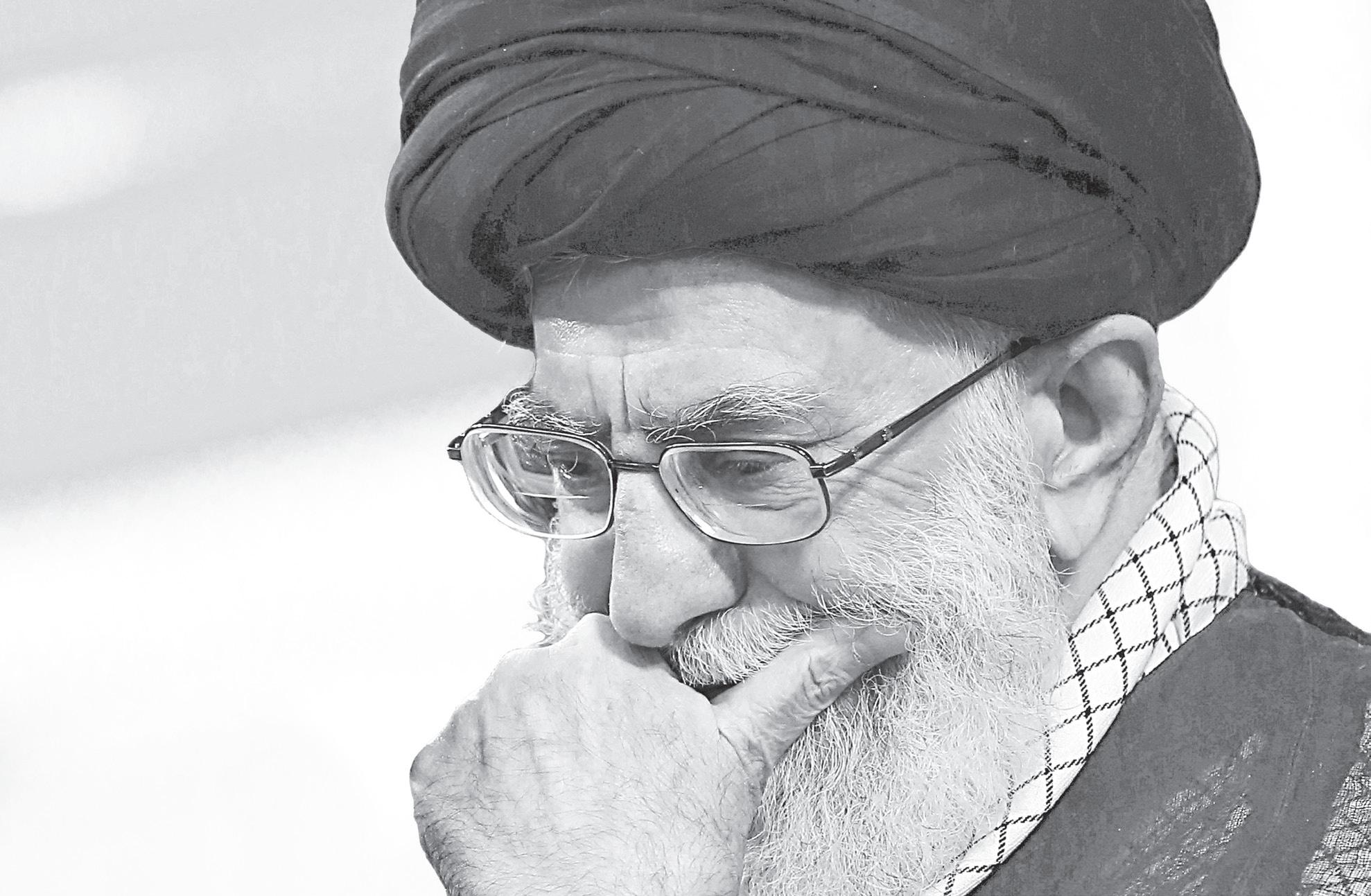
IN this photo released by an official website of the office of the Iranian supreme leader, Supreme Leader Ayatollah Ali Khamenei listens to a speaker during a meeting with a group of university students in Tehran, Iran, May 28, 2018. OFFICE OF THE IRANIAN SUPREME LEADER VIA AP
ed its vessels inside the Persian Gulf, and bound to the Persian Gulf, to shelter, citing the rapid military escalation between the US, Israel and Iran, and restrictions on traffic through the strategic Strait of Hormuz.
The company, CMA CGM, said on its website that it has suspended the passage of its vessels through the Suez Canal, a crucial waterway connecting the Red and Mediterranean seas.
“Vessels will be rerouted via the Cape of Good Hope,” it said.
IRAN’S paramilitary Revolutionary Guard warned Sunday that a “severe, decisive and regret-inducing punishment” would be coming over Supreme Leader Ayatollah Ali Khamenei’s killing.
The Guard, which answered only to Khamenei, issued the statement after state media acknowledged the 86-year-old leader’s killing.
The Islamic Revolutionary Guard Corps, the Armed Forces of the Islamic Republic of Iran, and what it called the vast popular Basij forces will powerfully continue the path of their leader in defending his legacy, standing firm against internal and external plots and delivering what it described as a lesson-giving punishment to aggressors against the Islamic homeland, it added.
Iran’s Cabinet warns that ‘great crime’ will not go unanswered IRAN’S Cabinet warned early Sunday that this “great crime will never go unanswered” after a US-Israeli campaign killed Supreme Leader Ayatollah Ali Khamenei.
The statement came after Iranian state media reported Khamenei, 86, had been killed in an airstrike targeting his compound in downtown Tehran.
On Iranian state television, an anchor broke in to read the announcement of Khamenei’s death.
“To the noble and proud people of Iran: With the ultimate grief and sorrow this is to inform you that following the barbaric attack by the criminal governments of America and the evil Zionist regime, the true example of faith, jihad and resistance, the Supreme Leader of the Revolution Grand Ayatollah Khamenei achieved the blessing of martyrdom,” the anchor said.
Daughter, son-in-law of Khamenei killed in US-Israeli attacks THE daughter and son-in-law of Iranian Supreme Leader Ali Khamenei were killed in the US-Israeli attacks in Iran, according to semi-official news agency.
Also killed in Saturday’s attacks were a grandchild and a daughterin-law, Fars News Agency, citing un -
identified sources. The agency didn’t provide further details.
Iran’s government declared 40 days of public mourning and a seven-day nationwide public holiday to commemorate Khamenei’s death.
Iran state TV says Khamenei was at his Tehran compound when attack began
IRANIAN state television described Ayatollah Ali Khamenei as being at his compound in downtown Tehran when the initial attack began. Satellite photos from Airbus showed the site heavily bombed.
The death of Iran’s Supreme Leader at his office “showed that he consistently stood among the people and at the forefront of his responsibilities, confronting what officials call global arrogance,” state TV said.
Iranian state media announces Ayatollah Ali Khamenei’s death IRAN’S Supreme Leader Ayatollah Ali Khamenei, 86, is dead, Iranian state media reported.
State television and the state-run IRNA news agency reported his death, without elaborating on a cause of death.
US President Donald Trump had said he’d been killed in a joint AmericanIsraeli operation targeting Iran.
Australia’s prime minister says he supports US actions
AUSTRALIAN Prime Minister Anthony Albanese said he supports US actions to prevent Iran threatening international peace and security.
“We support the United States acting to prevent Iran from obtaining a nuclear weapon and to prevent Iran continuing to threaten international peace and security,” Albanese posted on social media on Saturday.
Arab League says Arab-Israeli conflict has expanded into ‘full-scale regional war’
THE Arab League said the Israeli-US airstrikes on Iran are “a moment when the Arab-Israeli conflict has expanded into a full-scale regional war.”
Maged Abdelaziz, the 22-nation league’s UN observer, accused Israel of using the Iran war to evade ending its occupation of Palestinian territories and prevent the establishment of an independent Palestinian state—and to impose its “hegemony on the Middle East by using military means.”
Despite the announcement of some progress in US-Iranian talks in Geneva two days ago, he told an emergency meeting of the UN Security Council Saturday that Israel launched “a wanton military attack” claiming it “was intended to prevent Iran from acquiring nuclear weapons.”
“At the same time, Israel itself refuses to join the Nuclear Non-Proliferation Treaty,” he said., and it refuses to subject its nuclear facilities to the
International Atomic Energy Agency’s nuclear safeguards regime.
International Atomic Energy Agency to hold special session on Monday
THE Board of Governors of the International Atomic Energy Agency will convene a special session at its headquarters in Vienna on Monday morning following a request from the Russian Federation, the U.N. nuclear watchdog said in a press release.
In a diplomatic note dated Feb. 28 and seen by the Associated Press, Russia’s Permanent Mission to the International Organizations in Vienna requested the convening of the special session “on matters related to military strikes of the United States and Israel against the territory of the Islamic Republic of Iran that started in the morning of 28 February 2026, preceded by repeated open threats of such action, including against nuclear facilities under the IAEA safeguards.”
The special session of the Board of Governors will take place before the already scheduled regular session of the Board on Monday, the IAEA said.
Iranian, US ambassador have tense back-and-forth in UN Security Council session
IN a rare and colorful exchange, the representatives of the United States and Iran exchanged warnings and direct rebuffs toward the end of the emergency session on Iran as military aggression between their countries risked spilling into a regional war.
After US Ambassador Mike Waltz responded to Iranian claims that America had violated international law, Tehran’s diplomat to the UN asked to speak again to issue a warning: “I advise to the representative of the United States to be polite. It will be better for yourself and the country you represent.”
Waltz responded immediately, saying, “This representative sits here, in this body, representing a regime that has killed tens of thousands of its own people, and imprisoned many more, simply for wanting freedom from your entire tyranny.”
Israel says it acted against an `existential threat’
ISRAEL’S U.N. Ambassador Danny Danon told an emergency meeting of the Security Council that Iranian chants of “Death to Israel, Death to America” and the burning of both countries’ flags were acts of “statesanctioned hatred” and preparation for action.
“But today, alongside our ally the United States, we acted to stop … an existential threat before it became irreversible,” he said, stressing that Israel didn’t act on impulse or for aggression. “We acted out of necessity,” he said.
Danon said “diplomacy was exhausted.” Addressing the Iranian people, he said the operation is directed “at a regime that has silenced you” and Israel stands “with you.”
Syria condemns Iranian attacks on Gulf monarchies
SYRIA’S Foreign Ministry said in a statement that it “strongly condemns the Iranian attacks that targeted the sovereignty and security” of Gulf monarchies hit by barrages of Iranian missiles.
Under Bashar Assad, Syria was among Iran’s closest regional allies and a staunch critic of Israel, yet the statement made no mention of the Israeli or US strikes that began the day, reflecting the new government’s efforts to rebuild ties with regional economic heavyweights and the United States.
Iranian diplomat says hundreds of civilians killed or wounded AMIR Saeid Iravani, Iranian ambassador to the U.N., said hundreds of civilians have been killed or injured on the first day of the United States and Israel’s “unprovoked and premeditated aggression against Iran.”
“The aggression and atrocious crimes of the United States regime and the Israeli regime, and their deliberate and persistent targeting of civilian infrastructure, are ongoing,” he said during the emergency Security Council session. “This is not only an act of aggression; it is a war crime and a crime against humanity.”
Israel says woman in the Tel Aviv area died from Iranian missile attack
ISRAEL’S rescue services, Magen David Adom, said Saturday night that a woman in the Tel Aviv area had died after being injured in an Iranian missile attack.
It was the first death announced in Israel since the exchange of missiles began Saturday morning. It came after a heavy barrage of Iranian missiles targeted central Israel, damaging buildings and setting fires.
The service did not immediately identify the woman or give more details on what happened.
Magen David Adom says it has so far treated at least 90 people lightly injured in Israel and one man who was seriously injured.
Iranian official says Israel and US will ‘regret their actions’ ALI LARIJANI, the secretary of Iran’s National Security Council, said Saturday that Israel and America will “regret their actions.”
“The brave soldiers and the great nation of Iran will deliver an unforgettable lesson to the hellish international oppressors,” Larijani posted on X.
Rubio cancels planned visit to Israel next week after Iran attacks US Secretary of State Marco Rubio has canceled a planned trip to Israel early next week following US and Israeli military strikes on Iran. The State Department said the trip that had been set for Monday and Tuesday was now off. There was no indication if it would be rescheduled.
“Due to current circumstances, Secretary Rubio will no longer travel to Israel on March 2,” said Dylan Johnson, the assistant Secretary of State for public affairs.
Dubai airport says 4 injured in ballistic missile attack DUBAI International Airport—the largest in the United Arab Emirates and one of the busiest in the world— said Saturday that four people were injured as the Emirates condemned what it called a “blatant attack involving Iranian ballistic missiles.” See “Iran,” A8
Angel R. Calso
Iran fires missiles at Israel and Gulf states after US-Israel joint attack kills Khamenei
By Jon Gambrell, Melanie Lidman, Josh Boak & Eric Tucker
The Associated Press
UBAI , United Arab Emir -
Dates—Iran fired missiles at targets in Israel and Gulf Arab states Sunday after vowing massive retaliation for the killing of Supreme Leader Ayatollah Ali Khamenei by the United States and Israel, prompting US President Donald Trump to threaten Tehran against further escalation.
Iran acknowledged Khamenei’s death in the joint Israeli-American airstrike Saturday at his Tehran office hours, which has thrown the future of the Islamic Republic into question and raised the risk of regional instability.
The 86-year-old’s death at his office “showed that he consistently stood among the people and at the forefront of his responsibilities, confronting what officials call global arrogance,” Iranian state TV said.
Trump said the killing of Khamenei gave Iranians their “greatest chance” to “take back” their country.
“Khamenei, one of the most evil people in History, is dead,” Trump wrote in a social media post.
Iran’s Cabinet vowed that this “great crime will never go unanswered” and the paramilitary Revolutionary Guard threatened to launch its “most intense offensive operation” ever, targeting Israeli and American bases.
“You have crossed our red line and must pay the price,” Iran’s parliamentary speaker, Mohammad Bagher Qalibaf said in a televised address Sunday. “We will deliver such devastating blows that you yourselves will be driven to beg.”
“Iran just stated that they are going to hit very hard today, harder than they have ever hit before,” Trump fired back in a social media post. “THEY BETTER NOT DO THAT, HOWEVER, BECAUSE IF THEY DO, WE WILL HIT THEM WITH A FORCE THAT HAS NEVER BEEN SEEN BEFORE!”
Iran retaliates
AFTER the initial strikes, Iran immediately launched missiles and drones toward Israel and US military installations in Bahrain, Kuwait and Qatar. The Israeli military said Iran fired dozens of missiles at Israel, with many intercepted. The Magen David Adom rescue service said Saturday night that a woman in the Tel Aviv area died after being wounded in an Iranian missile attack.
Flights across the Middle East were disrupted, and air defense fire thudded over Dubai, the United Arab Emirates’ commercial capital, with explosions continuing into Sunday morning.
Shrapnel from an Iranian missile attack on the UAE capital killed one person, state media said, and debris from aerial interceptions caused fires at the city’s main port and on the facade of the iconic Burj Al Arab hotel.
The attack on Iran opened a stunning new chapter in US intervention, and carried the potential for retaliatory violence and a wider war, representing a startling flex of military might for an American president who swept into office on an “America First” platform and vowed to keep out of “forever wars.”
The killing of Khamenei in the second Trump administration assault on Iran in eight months appeared certain to create a leadership vacuum, given the absence of a known successor and because the supreme leader had final say on all major policies during his decades in power. He led Iran’s clerical establishment and the Revolutionary Guard, the two main centers of power in the governing theocracy.
“This is the single greatest chance for the Iranian people to take back their Country,” Trump said.
Iran quickly formed a council to govern the country until a new supreme leader is chosen.
State media also reported the deaths of the head of Iran’s Revolutionary Guard and a top security adviser to Khamenei in airstrikes. Maj. Gen. Mohammad Pakpour took over as the Guard’s top commander after Israel killed its past commander in the 12day war last June. The adviser, Ali
Shamkhani, had long been a figurehead within Iran’s security establishment, IRNA said.
As reports trickled out about Khamenei’s death, eyewitnesses in Tehran told The Associated Press that some residents were rejoicing, cheering from rooftops, blowing whistles and letting out ululations.
Mourners raised a black mourning flag over the Imam Reza shrine in Mashhad, Iran’s second-largest city and a major pilgrimage site for Shiite Muslims. The Iranian government declared 40 days of public mourning and a seven-day nationwide public holiday to commemorate Khamenei’s death.
Citing unidentified sources, the semiofficial Fars news agency, believed to be close to the Revolutionary Guard, reported that several relatives of Khamenei were also killed, including a daughter, son-in-law, daughterin-law and grandchild.
Strikes were planned for months
THE joint US-Israel operation, which officials say was planned for months, took place Saturday during the Muslim holy fasting month of Ramadan and at the start of the Iranian workweek. It followed stilted negotiations and warnings from Trump, who last year trumpeted his administration’s success in incapacitating the country’s nuclear program but nonetheless cast the latest round as necessary to head off its potential resurgence.
About 12 hours after the attacks began, the US military reported no US casualties and minimal damage at US bases despite “hundreds of Iranian missile and drone attacks.” It said targets in Iran included Revolutionary Guard command facilities, air defense systems, missile and drone launch sites, and military airfields.
Israel, for its part, said it had killed the commander of the Revolutionary Guard Corps and the country’s defense minister, as well as the secretary of the Iranian Security Council, a close adviser to Khamenei.
An Iranian diplomat told the United Nations Security Council that
hundreds of civilians were killed and wounded in the strikes. Iran retaliated by firing missiles and drones toward Israel and at US military bases in the region, and exchanges of fire continued into the night.
Some of the first strikes on Iran appeared to hit near the offices of Khamenei, the second leader of the Islamic Republic who succeeded Ayatollah Ruhollah Khomeini, the leader of the 1979 Islamic Revolution. Israeli officials confirmed the death, followed by Trump.
Democrats decried that Trump had taken action without congressional authorization. White House spokesperson Karoline Leavitt said the administration had briefed several Republican and Democratic leaders in Congress in advance.
Tensions soared as US built up military forces
TENSIONS have soared in recent weeks as the Trump administration built up the largest force of American warships and aircraft in the Middle East in decades. The president insisted he wanted a deal to constrain Iran’s nuclear program while the country struggled with growing dissent following nationwide protests.
Though Trump had pronounced the Iranian nuclear program obliterated in strikes last year, the country was rebuilding infrastructure that it had lost, according to a senior US official who spoke to reporters on condition of anonymity to discuss Trump’s decision-making process. The official said intelligence showed that Iran had developed the capability to produce its own high-quality centrifuges, an important step in developing the highly enriched uranium needed for weapons.
Iran had said it hoped to avert a war, but it maintained its right to enrich uranium.
Iran has said it has not enriched since June, but it has blocked international inspectors from visiting the sites the US bombed. Satellite photos analyzed by AP have shown new activity at two of those sites, suggesting Iran
Hundreds of thousands of Middle East travelers stranded by flight disruptions after attack on Iran
By Cara Rubinsky, Marc Levy & Josh Funk
The Associated Press
LONDON—America and Israel’s attack on Iran disrupted flights across the Middle East and beyond Saturday as countries around the region closed their airspace and key airports that connect Europe, Africa and the West to Asia were directly hit by strikes.
Hundreds of thousands of travelers were either stranded or diverted to other airports after Israel, Qatar, Syria, Iran, Iraq, Kuwait and Bahrain closed their airspace. There also was no flight activity over the United Arab Emirates, flight tracking website FlightRadar24 said, after the government there announced a “temporary and partial closure” of its airspace.
That led to the closure of key hub airports in Dubai, Abu Dhabi and Doha, and the cancellation of more than 1,800 flights by major Middle Eastern airlines. The three major airlines that operate at those airports—Emirates, Qatar Airways and Etihad—typically have about 90,000 passengers per day crossing through those hubs and even more travelers headed to destinations in the Middle East, according to aviation analytics firm Cirium.
Two airports in the United Arab Emirates reported incidents as the government there condemned what it called a “blatant attack involving Iranian ballistic missiles” on Saturday.
Officials at Dubai International Airport—the largest in the United Arab Emir -
ates and one of the busiest in the world—
said four people were injured, while Zayed International Airport in Abu Dhabi said that one person was killed and seven others were
injured in a drone strike. Strikes were also reported at Kuwait International Airport.
Though Iran did not publicly claim responsibility, the scope of retaliatory strikes that Gulf nations attributed to Iran extended beyond the American bases that it previously said it would target.
“For travelers, there’s no way to sugarcoat this,” said Henry Harteveldt, an airline industry analyst and president of Atmosphere Research Group. “You should prepare for delays or cancellations for the next few days as these attacks evolve and hopefully end.”
Airlines that are crossing the Middle East will have to reroute flights around the conflict with many flights headed south over Saudi Arabia. That will add hours to those flights and consume additional fuel, adding to the costs airlines will have to absorb. So ticket prices could quickly start to increase if the conflict lingers.
The added flights will also put pressure on air traffic controllers in Saudi Arabia who might have to slow traffic to make sure they can handle it safely. And the countries that closed their airspace will miss out on the overflight fees airlines pay for crossing overhead.
But Mike McCormick, who used to oversee air traffic control for the Federal Aviation Administration before he retired and is now a professor at Embry-Riddle Aeronautical University, said over the next few days these countries might be able to reopen parts of their airspace once American and Israeli officials share with the airlines where military flights are operating and how capable Iran remains at firing missiles.
“Those countries then will be able to go through and say, okay, we can reopen this portion of our space but we’ll keep this por -
tion of our airspace closed,” McCormick said.
“So I think what we’ll see in the next 24 to 36 hours how the use of airspace evolves as the kinetic activity gets more well defined and as the capability of Iran to actually shoot missiles and create additional risk is diminished due to the attacks.”
But it is unclear how long the disruption to flight operations could last. For comparison, the Israeli and US attack on Iran in June 2025 lasted 12 days.
‘No one knows’ THE situation was changing quickly and airlines urged passengers to check their flight status online before heading to the airport.
Some airlines issued waivers to affected travelers that will allow them to rebook their flight plans without paying extra fees or higher fares.
Jonathan Escott and his fiancé had arrived at the airport in Newcastle, England, on Saturday only to find out that his direct flight to Dubai on Emirates airline was canceled, leaving everyone on the flight stuck there.
Escott left to go back to where he was staying with family, about an hour from the airport, but has no idea when he may be able to travel.
“No one knows,” Escott said. “No one really knows what’s going on with the conflict, really. Not Emirates, Emirates don’t have a clue. No one has a clue.”
At least 145 planes that were en route to cities like Tel Aviv and Dubai early Saturday were diverted to airports in cities like Athens, Istanbul or Rome, according to FlightAware. Others turned around and returned to where they took off from. One plane spent nearly 15 hours in the air after leaving Philadelphia and getting all the way to Spain before turning around and returning to where it started.
TRACES of an air defense missile interception is seen over Tel Aviv, Israel, Saturday, Feb. 28, 2026. AP PHOTO/OHAD ZWIGENBERG
is trying to assess and potentially recover material.
Attack was coordinated between Israel and US ISRAEL said the operation had been planned for months with the United States. Air Force pilots struck “hundreds of targets across Iran,” Israeli military chief of staff Lt. Gen. Eyal Zamir said in a statement. Targets in the Israeli campaign included Iran’s military, symbols of government and intelligence targets, according to an official briefed on the operation, who spoke on condition of anonymity to discuss nonpublic information on the attack.
Trump acknowledged Saturday that there could be American casualties, saying “that often happens in war.” He said he was aiming to “annihilate” the Iranian navy and destroy regional proxies supported by Tehran. He called on the paramilitary Iranian Revolutionary Guard to lay down arms, saying members would be given immunity or face “certain death” if they did not. In southern Iran, at least 115 people were reported killed when a girls’ school was struck, and dozens more were wounded, the local governor told Iranian state TV. US Central Command spokesperson Capt. Tim Hawkins said he was “aware of reports” that a girls’ school was struck and that officials were looking into them.
Iran’s state news agency IRNA said at least 15 people were killed in the southwest, quoting the governor of the Lamerd region, Ali Alizadeh,
as saying a sports hall, two residential areas and a hall near a school were hit.
Effects could extend to markets and other countries THE strikes could rattle global markets, particularly if Iran makes the Strait of Hormuz unsafe for commercial traffic. A third of worldwide oil exports transported by sea passed through the strait in 2025. Saudi Arabia said Iran targeted its capital and eastern region in an attack that was repelled. Bahrain said a missile attack targeted the US Navy’s 5th Fleet headquarters in the island kingdom, and three buildings were damaged in the capital, Manama, and Muharraq city by drone strikes and debris from an intercepted missile. Kuwait’s civil aviation authority said a drone targeted the main international airport, injuring several employees. Kuwait’s state-run news agency said three troops were injured by shrapnel from strikes that hit Ali Al-Salem air base. Explosions could also be heard in Qatar. Jordan said it “dealt with” 49 drones and ballistic missiles.
Lidman reported from Tel Aviv. Boak reported from West Palm Beach, Florida. Tucker reported from Washington. Associated Press writers Joe Federman in Jerusalem, Aamer Madhani and Konstantin Toropin in Washington, Sam Mednick in Tel Aviv, Farnoush Amiri in New York, David Rising in Bangkok and AP journalists around the world contributed to this report.
Numerous airlines canceled international flights to Dubai through the weekend, as India’s civil aviation agency designated much of the Middle East—including skies above Jordan, Saudi Arabia and Lebanon—as a high-security risk zone at all altitudes. Air India canceled all flights to Mideast destinations. Turkish Airlines said flights to Lebanon, Syria, Iraq, Iran and Jordan were suspended until Monday and flights to Qatar, Kuwait, Bahrain, the United Arab Emirates and Oman were suspended.
The airline said additional cancellations may be announced, and many other airlines were suspending flights into the region through the weekend.
Travelers advised to be ‘very creative’
US-BASED Delta Air Lines and United Airlines suspended flights to Tel Aviv at least through the weekend. Dutch airline KLM had already announced earlier in the week that it was suspending flights to and from Tel Aviv.
Airlines including Lufthansa, Air France, Transavia and Pegasus canceled all flights to Lebanon, while American Airlines suspended flights from Philadelphia to Doha.
Virgin Atlantic said it would avoid flying over Iraq, meaning flights to and from India, the Maldives and Riyadh could take slightly longer. The airline already was not flying over Iran and said all flights would carry appropriate fuel in case they need to reroute on short notice.
Levy reported from Harrisburg, Pennsylvania, and Funk reported from Omaha, Nebraska. Associated Press writers Adam Schreck in Bangkok and Sam Metz in Ramallah, West Bank contributed
Monday, March 2, 2026
World leaders react cautiously to US and Israeli strikes, death of Iran Supreme Leader Khamenei
By Claudia Ciobanu, Sam Mcneil & Sam Metz
BThe Associated Press
RUSSELS—How long will it last? Will it grow?
What will the conflict and the reported death of Iran’s Supreme Leader Ayatollah Ali Khamenei mean to us, and to global security overall? Those questions echoed across the Middle East and the planet Saturday as world leaders reacted warily to US and Israeli strikes on Iran.
US President Donald Trump said on social media that Khamenei was dead, calling it “the single greatest chance for the Iranian people to take back their Country.” Iranian state media said early Sunday the 86-year-old leader had died without elaborating on a cause.
Israeli officials previously told The Associated Press on condition of anonymity that Khamenei was dead. And Israeli Prime Minister Benjamin Netanyahu, in a televised address, said there were “growing signs” that Khamenei had been killed when Israel struck his com
pound early Saturday.
The apparent demise of the second leader of the Islamic Republic, who had no designated successor, would likely throw its future into uncertainty—and exacerbate already growing concerns of a broader conflict. The UN Security Council scheduled an emergency meeting.
Perhaps cautious about upsetting already strained relations with Trump, many nations abstained from commenting directly or pointedly on the joint strikes but condemned Tehran’s retaliation. Similarly to Europeans, governments across the Middle East condemned Iran’s strikes on Arab neighbors while staying silent on the US and Israeli military action.
Other countries were more explicit: Australia and Canada expressed open support for the US strikes, while Russia and China responded with direct criticism.
The US and Israel launched a major attack on Iran on Saturday, and Trump called on the Iranian public to “seize control of your destiny” by rising up against the Islamic theocracy that has ruled the nation since 1979. Iran retaliated by firing missiles and drones toward Israel and US military bases in the Middle East.
Some leaders urge resumption of talks
IN a statement, British Prime Minister Keir Starmer, French President
Emmanuel Macron and German Chancellor Friedrich Merz called on the US and Iran to resume talks and said they favored a negotiated settlement. They said their countries didn’t take part in the strikes on Iran but are in close contact with the US, Israel and partners in the region. The three countries have led efforts to reach a negotiated solution over Iran’s nuclear program.
“We condemn Iranian attacks on countries in the region in the strongest terms. Iran must refrain from indiscriminate military strikes,” they said. “Ultimately, the Iranian people must be allowed to determine their future,” they said.
Later, at an emergency security meeting, Macron said France was “neither warned nor involved” in the strikes. He called for intensified efforts for a negotiated solution, saying “no one can think that the questions of Iran’s nuclear program, ballistic activity, regional destabilization will be settled by strikes alone.”
The 22-nation Arab League called the Iranian attacks “a blatant violation of the sovereignty of countries that advocate for peace and strive for stability.” That coalition of nations has historically condemned both Israel and Iran for actions it says risk destabilizing the region.
Morocco, Jordan, Syria and the United Arab Emirates denounced Iranian strikes targeting US military bases in the region including in Kuwait, Bahrain, Qatar and the Emirates.
Under former President Bashar Assad, Syria was among Iran’s closest regional allies and a staunch critic of Israel, yet a statement from its foreign ministry singularly condemned Iran, reflecting the new government’s efforts to rebuild ties with regional economic heavyweights and the United States.
Saudi Arabia said it “condemns and denounces in the strongest terms the treacherous Iranian ag -
BRITISH Prime Minister Sir Keir Starmer speaks with students and staff, during a visit to the Walbottle Academy Campus in Newcastle-uponTyne, England, Thursday, Feb. 26, 2026. SCOTT HEPPELL/ PA VIA AP
gression and the blatant violation of sovereignty.” Oman, which has been mediating the talks between Iran and the US, said in a statement that the US action “constitutes a violation of the rules of international law and the principle of settling disputes through peaceful means, rather than through hostility and the shedding of blood.”
Careful wording is (mostly) the order of the day
NEW Zealand refrained from fullthroated support but acknowledged Saturday that the US and Israeli attacks were keeping the Iranian regime from remaining an ongoing threat.
“The legitimacy of a government rests on the support of its people,”
New Zealand Prime Minister Christopher Luxon and Foreign Minister Winston Peters said in a joint statement. “The Iranian regime has long since lost that support.”
Countries in Europe and the Middle East used careful wording, avoiding perceptions that they either support unilateral American action or are directly condemning the United States.
Others were more blunt. Russia’s Foreign Ministry called the strikes “a pre-planned and unprovoked act of armed aggression against a sovereign and independent UN member state.”
The ministry accused Washington and Tel Aviv of “hiding behind” concerns about Iran’s nuclear program while actually pursuing regime change.
Similarly, China’s government said it was “highly concerned” about the US and Israeli strikes on Iran and called for an immediate halt to the military action and a return to negotiations. “Iran’s sovereignty, security and territorial integrity should be respected,” a Chinese Foreign Ministry statement said.
Despite recent tensions with the US, Canada too expressed its support for the military action. “The Islamic Republic of Iran is the principal source of instability and terror
Strikes were also reported at other commercial airports in the region, including Kuwait International. Other airports closed and canceled flights.
Trump says bombing of Iran will continue through week or longer US President Donald Trump in his social media post said the death of Iran’s Supreme Leader Ali Khamenei would not bring an end to the joint airstrikes by the US and Israel.
“The heavy and pinpoint bombing, however, will continue, uninterrupted throughout the week or as long as necessary to achieve our objective of PEACE THROUGHOUT THE MIDDLE EAST AND, INDEED, THE WORLD!” Trump said.
The president stresses that his hope was for the Iranian government to join with the opposition.
UN chief calls for end to hostilities, return to US-Iran talks
SECRETARY-GENERAL Antonio Guterres told an emergency meeting of the U.N. Security Council on the US and Israeli airstrikes that “everything must be done to prevent a further escalation.”
throughout the Middle East,” Prime Minister Mark Carney said.
And the UN Security Council scheduled an emergency meeting on the US and Israeli attacks on Iran, at the request of Bahrain and France.
Concerns expressed of ‘new, extensive’ war PALESTINIANS in the occupied West Bank said they were largely unfazed as war erupted Saturday, barely pausing as booms echoed across the sky from Israel’s Iron Dome intercepting missiles overhead.
Unlike Israel, Palestinian cities have no warning sirens or bomb shelters, despite the risk of falling debris or errant missiles. As people sheltered less than 10 miles (16 kilometers) away in Jerusalem, streets in Ramallah swarmed with shoppers browsing meat counters, vegetable stalls and Ramadan sweets, some stopping to record the sounds of distant sirens and missile interceptions.
But as Israel closed checkpoints to the movement of people and goods on Saturday, gas stations saw longer-than-usual lines as residents filled spare canisters in case of supply disruptions.
The Palestinian Authority, in a statement, condemned the Iranian attacks on Arab nations, many which have historically helped underwrite its finances. It made no mention of the Israeli or US strikes.
Nervousness is perceptible across multiple countries. Norwegian Foreign Minister Espen Barth Eide told Norwegian broadcaster NRK that he was concerned the failure of negotiations between the US and Iran meant a “new, extensive war in the Middle East.”
The Nobel Peace Prize-winning International Campaign to Abolish Nuclear Weapons condemned the US and Israeli strikes on Iran in harsher words. “These attacks are totally irresponsible and risk provoking further escalation as well as increasing the danger of nuclear proliferation and the use of nuclear weapons,” said its executive director, Melissa Parke.
Ciobanu reported from Warsaw and Metz from Ramallah. Associated Press writers Josef Federman in Jerusalem, Melanie Lidman in Tel Aviv, Angela Charlton in Paris, Paolo Santalucia in Rome, Suman Naishadham in Madrid, Elise Morton and Krutika Pathi in London, Jamey Keaten in Geneva, Eileen Ng in Kuala Lumpur, Fatma Khaled and Sam Magdy in Cairo, Ken Moritsugu in Beijing, Adam Schreck in Bangkok and Rod McGuirk in Melbourne, Australia, contributed to this report.
violating Iran’s sovereignty and territorial integrity and international law, including the U.N. Charter—and he also condemned Iran’s retaliatory attacks for violating the sovereignty and territorial integrity of Bahrain, Iraq, Jordan, Kuwait, Qatar, Saudi Arabia, and the United Arab Emirates.
Shrapnel from Iranian missile attack injures man in Tel Aviv area
ISRAEL’S Magen David Adom rescue service says rocket shrapnel from the latest Iranian missile attack has seriously injured a man in the Tel Aviv area. It marks the first serious injury to be reported in Israel since the exchange of missiles began. Magen David Adom says it has also treated 90 casualties, all in mild condition. No one has been killed in Israel.
Israel’s UN ambassador calls condemnation of airstrikes ‘hypocrisy’
DANNY DANON told reporters ahead of an emergency meeting of the U.N. Security Council that Iran is responsible for escalating actions by its proxies and its nuclear and missile programs, and “now Israel and the US act to prevent an irreversible and immediate threat.”
Iran’s supreme leader succession: Who’s next and how is it decided?
By Jon Gambrell The Associated Press
DUBAI, United Arab Emirates—The death of Iran’s Supreme Leader Ayatollah Ali Khamenei after almost 37 years in power raises paramount questions about the country’s future. The contours of a complex succession process began to take shape the morning after Khamenei’s assassination.
Here is what to know:
A temporary leadership council assumes duties
AS outlined in its constitution, Iran on Sunday formed a council to assume leadership duties and govern the country.
The council is made up of Iran’s sitting president, the head of the country’s judiciary and a member of the Guardian Council chosen by Iran’s Expediency Council, which advises the supreme leader and settles disputes with parliament.
Iran’s reformist President Masoud Pezeshkian and hardline judiciary chief Gholamhossein Mohseni Ejei are its members who will step in and “temporarily assume all the duties of leadership.”
A panel of clerics selects a new supreme leader
THOUGH the leadership council will govern in the interim, an 88-member panel called the Assembly of Experts “must, as soon as possible” pick a new supreme leader under Iranian law.
The panel consists entirely of Shiite clerics who are popularly elected every eight years and whose candidacies are approved by the Guardian Council, Iran’s constitutional watchdog. That body is known for disqualifying candidates in various elections in Iran and the Assembly of Experts is no different. The Guardian Council barred former Iranian President Hassan Rouhani, a relative moderate whose administration struck the 2015 nuclear deal with world powers, from election for the Assembly of Experts in March 2024.
Khamenei’s son could be a possible contender CLERICAL deliberations about succession and machinations over it take place far from the public eye, making it hard to gauge who may be a top contender.
Previously, it was thought Khamenei’s protégé, hardline President Ebrahim Raisi, may try to take the mantle. However, he was killed in a May 2024 helicopter crash. That has left one of Khamenei’s sons, Mojtaba, a 56-year-old Shiite cleric, as a potential candidate, though he has never held government office. But a father-toson transfer in the case of a supreme leader could spark anger, not only among Iranians already critical of clerical rule, but also among supporters of the system. Some may see it as un-Islamic and in line with creating a new, religious dynasty after the 1979 collapse of the US-backed Shah Mohammad Reza Pahlavi’s government.
A transition like this has happened only once before There has been only one other transfer of power in the office of supreme leader of Iran, the paramount decision-maker since the country’s 1979 Islamic Revolution. In 1989, Grand Ayatollah Ruhollah Khomeini died at age 86 after being the figurehead of the revolution and leading Iran through its bloody eight-year war with Iraq. This transition now comes after Israel launched a 12-day war against Iran in June 2025 as well.
The vast powers of a supreme leader THE supreme leader is at the heart of Iran’s complex power-sharing Shiite theocracy and has final say over all matters of state. He also serves as the commander-in-chief of the country’s military and the powerful Revolutionary Guard, a paramilitary force that the United States designated a terrorist organization in 2019 and which Khamenei empowered during his rule. The Guard, which has led the self-described “Axis of Resistance,” a series of militant groups and allies across the Middle East meant to counter the US and Israel, also has extensive wealth and holdings in Iran.
to enable the right conditions for the people of Iran and stability for the region.”
How long will it take? “As long as it will take to achieve the goals,” Danon replied.
Everyone is watching the situation on the ground, he said, and “the time for the Iranian people to take control of the future is very soon.
Most of Iran’s senior leadership is ‘gone’—Trump
ASKED about reports that Iranian Supreme Leader Ali Khamenei was killed in airstrikes on Saturday, President Donald Trump said: “We feel that that is a correct story.”
In a brief phone interview with NBC News, Trump said “a large amount of leadership” of Iran had been killed, adding: “I don’t mean like two people.” He also said “most” of Iran’s senior leadership is “gone,” including many people who make decisions.
Asked who might now become Iran’s new supreme leader, Trump joked, “I don’t know. But at some point they’ll be calling me to ask who I’d like” before noting he was being “only being a little sarcastic” in suggesting that.
Iran’s defense minister and Revolutionary Guard commander killed, says Israel
“The alternative,” he warned, “is a potential wider conflict with grave consequences for civilians and regional stability.”
Guterres reiterated his earlier condemnation of the US and Israeli airstrikes for
See “Iran,” A9 Iran... Continued from A6
He did not respond to a question asking whether he could confirm the death of Iran’s supreme leader. But he said: “We will continue to target the leadership of the radical regime and we will do whatever necessary
ISRAEL’S military has named some of the top members of Iran’s leadership it says were killed in its first round of Saturday strikes on Iran.
Neither Iran nor the US commented on or confirmed the claims.
Israel said the strikes killed Mohammad Pakpour, the commander of the Iranian Revolu -
tionary Guard Corps and Iran’s Defense Minister Aziz Nasirzadeh. The military also said its strikes took out Ali Shamkhani, the secretary of the Iranian Security Council and a close adviser to Supreme Leader Ali Khamenei, and Mohammad Shirazi, the head of Khamenei’s military bureau.
Khamenei is dead, Israeli officials tell AP ISRAELI officials told The Associated Press Saturday that Supreme Leader Ayatollah Ali Khamenei is dead. There was no immediate comment from the US or Iran on his status. The killing of the second leader of the Islamic Republic, who had no designated successor, would throw its future into doubt. In a nationally televised address, Israeli Prime Minister Benjamin Netanyahu said there were “growing signs” that Khamenei had been killed when Israel struck his compound early Saturday. Shortly after the address, two Israeli officials said Israel had confirmed his death. The officials both spoke on condition of anonymity pending a formal announcement and gave no further details.
Iraqi group claims drone attack on US base in Irbil A GROUP calling itself the Islamic Resistance in Iraq-Brigades of the Guardians of Blood in a statement claimed that it launched a drone attack on a US base in Irbil, the capital of Iraq’s semi-autonomous northern Kurdish region.
The World
War powers clash deepens after Trump orders attack on Iran without congressional approval
By Lisa Mascaro AP Congressional Correspondent
WASHINGTON—Key members of Congress are demanding a swift vote on a war powers resolution that would restrain President Donald Trump’s military attack on Iran unless the administration wins their approval for what they warn is a potentially illegal campaign that risks pulling the United States into a deeper Middle East conflict.
Both the House and Senate, where the president’s Republican Party has a slim majority, had already drafted such resolutions long before the strikes Saturday. Now they are ready to plunge into a rare war powers debate next week that will serve as a referendum on Trump’s decision to go it alone on military action without formal authorization from Congress.
“Has President Trump learned nothing from decades of US meddling in Iran and forever wars in the Middle East?” said Sen. Tim Kaine, D-Va., a leader in the bipartisan effort. He said the strikes on Iran were “a colossal mistake.” In the House, Reps. Ro Khanna, D-Calif., and Thomas Massie, R-Ky., are demanding Congress go on record with a public vote on their own bipartisan measure. “Congress must convene on Monday to vote,” Khanna said, “to stop this.”
Massie blasted Trump’s own presidential campaign slogan and said: “This is not ‘America First.’” But most Republicans, particularly their leaders, welcomed Trump’s move against Iran. Many cited the longtime US adversary’s nuclear programs and missile capabilities as requiring a military response.
“Well done, Mr. President,” said Sen. Lindsey Graham, R-S.C. “As I watch and monitor this historic operation, I’m in awe of President Trump’s determination to be a man of peace but at the end of the day, evil’s worst nightmare.”
War powers debate tests Congress
THE administration’s decision to launch, with Israel, what appears to be an open-ended joint military operation aimed at changing the government in Tehran is testing the Constitution’s separation of powers in deep and dramatic ways. Nearly two months earlier, Trump ordered US strikes that toppled Venezuelan leader Nicolás Maduro.
While presidents have the authority as the commander in chief to conduct certain strategic military operations on their own, the Constitution vests Congress with the power to wage war. Before the Iraq War began in March 2003, Republican President George W. Bush made a monthslong push to secure congressional authorization. No such vote was attempted on Iran, and an earlier Senate effort to halt Trump’s actions after last summer’s strike on Iran failed.
The congressional debate over war powers would mostly be symbolic. Even if a resolution were to
pass the narrowly split Congress, Trump likely would veto it and Congress would not have the two-thirds majority needed to overturn that rejection. Congress has often failed to block other US military actions, including in a Senate vote on Venezuela, but the roll calls stand as a public record.
Republican leaders back Trump’s action
THE response by House Speaker Mike Johnson reflected the party’s long-standing views. Iran, he said, is facing “the severe consequences of its evil actions.”
Johnson, R-La., said the leaders of the House and Senate and the respective intelligence committees had been briefed in detail earlier in the week that military action “may become necessary” to protect US troops and citizens in Iran. He said he received updates from Secretary of State Marco Rubio and will stay in “close contact” with Trump and the Defense Department “as this operation proceeds.”
US and Israel clash with Iran at Security Council emergency meeting; UN chief condemns attacks
By Edith M. Lederer & Farnoush Amiri
UThe Associated Press
NITED NATIONS—The United States and Israel clashed with Iran at an emergency meeting of the UN Security Council on Saturday where the U.N. chief and many countries urged a halt to their attacks and a return to negotiations to prevent the conflict from spreading further into the region and beyond.
Secretary-General António Guterres told the council that everything must be done to prevent an escalation. “The alternative,” he warned, “is a potential wider conflict with grave consequences for civilians and regional stability.”
Guterres said the US and Israeli airstrikes violated international law, including the U.N. Charter. He also condemned Iran’s retaliatory attacks for violating the sovereignty and territorial integrity of Bahrain, Iraq, Jordan, Kuwait, Qatar, Saudi Arabia and the United Arab Emirates.
The US ambassador to the United Nations, Mike Waltz, insisted the US military action was lawful.
“Iran cannot have a nuclear weapon,” he told the council. “That principle is not a matter of politics. It’s a matter of global security. And to that end, the United States is taking lawful actions.”
Israel’s UN Ambassador Danny Danon defended the airstrikes as necessary to stop an existential threat.
“We are stopping extremism before it becomes unstoppable,” he said. “We will ensure that no radical regime armed with nuclear weapons and ballistic missiles can threaten our people or the entire world.”
Amir Saeid Iravani, Iran’s ambassador to the UN, told the council that the air-
strikes have killed and injured hundreds of Iranian civilians, which he called a war crime and a crime against humanity.
He blasted the UN and the Security Council, its most powerful body, for not heeding Tehran’s warnings about the “warmongering statements” by the US in recent weeks and urged the council to act now.
“The issue before the council is straightforward: whether any member state may, including a permanent member of this council, through the use of force, coercion or aggression, determine the political future or system of another state or impose control over its affairs,” Iravani said.
During his speech, the Iranian diplomat did not mention or comment on President Donald Trump’s statement that Supreme Leader Ayatollah Ali Khamenei was killed in the strikes, although Iranian state media later confirmed his death. The assassination of the second leader of the Islamic Republic, who had no designated successor, raised the prospects of a protracted conflict given Iranian threats of retaliation.
Iranian and US ambassadors have tense back-and-forth
IN a rare exchange, the US and Iranian ambassadors traded warnings and direct rebuffs toward the end of the emergency session as military aggression between their countries risked spilling into a regional war.
After Waltz responded to Iranian claims that the US had violated international law, Iravani asked to speak again to issue a warning: “I advise to the representative of the United States to be polite. It will be better for yourself and the country you represent.”
Waltz responded immediately, saying, “This representative sits here, in this body, representing a regime that has killed tens of thousands of its own people, and imprisoned many more, simply for wanting freedom from your entire tyranny.”
Other Security Council members speak up RUSSIA’S ambassador condemned the USIsraeli airstrikes, while China’s ambassador was more measured in his criticism.
“We demand that the United States and Israel immediately cease their aggressive actions,” Russian UN Ambassador Vassily Nebenzia said. “We insist on the immediate resumption of political and diplomatic settlement efforts…based on international law, mutual respect and a balance of interests.”
China’s UN Ambassador Fu Cong said China was very concerned by “the sudden escalation of regional tensions” and supported Russia’s call for a return to diplomatic negotiations.
Amiri reported from Atlanta.
Iran... Continued from A8
Earlier Saturday, a number of missiles and drones were intercepted over Irbil.
The Islamic Resistance in Iraq is an umbrella group of Iran-backed militias that has previously launched attacks on US bases in Iraq and Syria.
Iran’s conventional missile capability was an ‘intolerable’ risk, says US official
A SENIOR Trump administration official says Iran’s conventional missile capability presented an “intolerable” risk to the US, and that that reality has since been demonstrated by Tehran’s strikes around the region after the US-Israeli attack.
On a call with reporters, the official said Secretary of State Marco Rubio had briefed top leaders in Congress. Rubio made it clear then that Iran was ready to use conventional missiles against US forces in the Middle East, the official said.
The official—who spoke on condition of anonymity to discuss details about Trump’s decision-making process that have not been publicly disclosed—added that Iran’s unwillingness to discuss ballistic missiles in previous negotiations left Trump no option but to proceed militarily.
Separately, Trump administration officials said on a phone call with reporters that they offered Iran many ways to have a peaceful nuclear program that could be used for civilian purposes.
Thune said he looked forward to administration officials briefing all senators—a signal that lawmakers are seeking more answers to their questions about Trump’s plans ahead.
But the officials said it was clear to them that Iran wanted enriched uranium for a nuclear weapon. The Trump administration officials said that Iran met their offers with “games, tricks, stall tactics.”
The officials requested anonymity to describe the rationale behind the joint military strikes on Iranian targets by the US and Israel.
Pro-Iran protests in Baghdad HUNDREDS of people demonstrated in Baghdad in support of Iran and against the attacks launched by Israel and the US. Demonstrators carried posters of Iran’s Supreme Leader Ayatollah Ali Khamenei, slain Iranian Gen. Qassem Soleimani, former Hezbollah leader Hassan Nasrallah, and the high Shia cleric Grand Ayatollah Ali al-Sistani.
Demonstrators clashed with anti-riot police several times in the demonstration that was held near the heavily fortified Green Zone in the Iraqi capital.
US posts aerial footage showing strikes on variety of targets AERIAL footage posted to social media by US Central Command showed US munitions striking what appeared to be a variety of targets from drones to buildings. The video montage was released Saturday afternoon. It showed black and white aerial footage of what appeared to be a drone on a runway,
EU foreign ministers to hold virtual meeting on Sunday EUROPEAN Union foreign ministers will meet virtually on Sunday to discuss the unfurling conflict in the Middle East, the bloc’s top diplomat said. EU foreign policy chief Kaja Kallas said in a social media post that she would hold a meet of the Foreign Affairs Council to work toward a de-escalation.
Senate Majority Leader John Thune, RS.D., commended Trump “for taking action to thwart these threats.”
Associated Press writers Mary Clare Jalonick and Matt Brown contributed to this report.
THE US Capitol is photographed Friday, Feb. 27, 2026, in Washington. AP PHOTO/RAHMAT GUL
UN Secretary-General Antonio Guterres attends the opening of the 61st session of the United Nations Human Rights Council at the European headquarters of the United Nations in Geneva, Monday, Feb. 23, 2026. VALENTIN FLAURAUD/KEYSTONE VIA AP
Classroom crisis: Can PPP finally bridge the gap?
THE country’s persistent classroom shortage remains one of the most glaring barriers to delivering quality basic education. A recent report from the Philippine Institute for Development Studies projects a deficit of 58,000 to 81,000 classrooms by 2040—even as birth rates decline and enrollment pressures ease in some areas. Compounding this are aging school infrastructures: tens of thousands of buildings face condemnation in the coming years, turning a backlog into a dual crisis of quantity and quality.
Education Secretary Juan Edgardo “Sonny” Angara has rightly spotlighted this emergency, urging deeper collaboration with the private sector during his address at the ASEAN Editors Forum in Makati. His emphasis on PublicPrivate Partnerships (PPPs) marks a pragmatic pivot: the government alone cannot close a gap estimated in the hundreds of thousands at current construction paces. Through the PPP for School Infrastructure Program (PSIP), DepEd plans to deliver over 16,000 new classrooms in high-need areas, backed by a total project cost of P105.7 billion. Under the Build-Lease-andTransfer model, private partners finance, construct, and maintain facilities, with DepEd making payments over 15 years from its regular budget upon satisfactory delivery and performance. (Read the BusinessMirror story, “Angara calls for stronger private sector ties to fast-track education reforms via PPPs,” February 24, 2026).
This approach carries clear advantages. It accelerates infrastructure rollout beyond what annual appropriations allow, taps private-sector efficiency and expertise, and shifts focus from mere physical structures to holistic human development—as Angara noted in highlighting President Marcos’ priority on people-centered progress. In high-density regions like NCR, Calabarzon, BARMM, and parts of Mindanao, where elementary-level congestion remains acute, rapid classroom addition could immediately improve learning conditions, reduce teacher overload, and help narrow achievement gaps.
Yet enthusiasm for PPPs must be tempered with realism and safeguards. Past PPP experiences in the country have sometimes suffered from high costs, opaque terms, long-term fiscal burdens, or uneven risk allocation. A 15-year payment commitment ties future budgets, potentially crowding out other urgent needs—teacher salaries, learning materials, digital access, or repairs for non-PPP facilities. Transparency is non-negotiable: contract details, costbenefit analyses, and performance metrics must be public to prevent sweetheart deals or inflated pricing.
Moreover, PPPs address symptoms more than root causes. The classroom crisis stems from decades of chronic underinvestment in education—Philippine spending has hovered well below the global benchmark of 6 percent of GDP. While private capital can bridge short-term gaps, sustainable progress demands structural reform: significantly higher public allocations for education, streamlined DepEd procurement, decentralized planning that responds to regional demographics, and a long-term national school infrastructure roadmap that accounts for aging buildings and climate vulnerabilities.
Secretary Angara’s push for private-sector engagement is a welcome step in the right direction—bold, timely, and aligned with the urgency of the learning crisis. If executed with rigor, accountability, and complementary public reforms, the PSIP and similar initiatives could finally turn the tide on overcrowded, dilapidated classrooms. Our children deserve learning environments that inspire rather than constrain. The time for decisive, multistakeholder action is now; half-measures will only perpetuate the deficit for another generation.
Opinion BusinessMirror
Navigating the oil surge
TRISING SUN
HE US-Israel strikes on Iran have pushed global oil prices to about $73 per barrel for Brent crude—up noticeably since the start of the year—with the real possibility of hitting $80 or more as worries over the Strait of Hormuz continue. At the same time, this difficult moment also gives the Philippines a chance to rethink and strengthen its energy security for the long term.
Because we rely so much on oil from the Middle East, we’re likely to see gasoline go up by roughly P1.50 to P2.00 per liter and diesel by around P0.80 to P1.20 per liter starting March 3. Those increases will show up in everyday life: higher prices for food, fares, and electricity, and a gentle push upward on inflation that could bring the Bangko Sentral ng Pilipinas’ 2026 forecast closer to the mid-3 percent range, while slightly trimming economic growth
TT.
by around 0.5 percent to 1 percent.
Even so, the economy is not starting from zero. OFW remittances and strong export sectors help provide a cushion, giving us room to act early and smart. With the right policies, we can use this period of Middle East tensions, shipping disruptions, and reduced Iranian supply to reduce our vulnerabilities instead of simply absorbing the shock.
In the most likely short-term scenario—over the next one to three
months—price pressures should remain manageable. Inflation could stay within 3.5 percent to 4 percent, fuel prices might rise by 10 percent to 15 percent, and overall growth might soften by only about 0.3 percent. These numbers are uncomfortable but still within a range that can be managed if OPEC+ uses its spare capacity, tensions cool somewhat, and BSP keeps monetary policy steady.
For the government, there are clear priorities. Authorities can prepare to release the P2.5 billion fuel subsidy for public transport and farmers if oil breaks past $80 per barrel. They can work closely with the Department of Energy and oil firms so price increases are phased in more gradually, keep a close eye on stockpiles, bring together the economic team to fast-track solar and wind projects, look for new suppliers beyond the Gulf, give BSP enough room to respond flexibly, and use rice reserves to help keep food prices in check.
Businesses also have options. They can manage risk by hedging fuel costs, shifting to more efficient
LITO GAGNI
HE country’s energy future is supposed to be colored green. Renewables will be 35 percent of the power mix by 2030 and half the grid by 2040 as part of our global climate commitments. The direction appears settled: the Philippine grid is meant to grow cleaner with time.
But the power sector does not move on presentations. And the space between projection and contract is where lies the real policy test. Thus the recent 200-megawatt supply agreement between Manila Electric Co. and a coal-fired generator of San Miguel Corp. illustrates that distance. A procurement framed around renewable capacity may ultimately be satisfied by fossil generation—a detail that transforms the transaction from a routine award into a structural question about the coherence of reform.
Under the National Renewable Energy Program, distribution utilities are supposed to steadily increase their procurement of renewable energy each year. That is the transition policy. And yet, policy is tested not in press statements but in contracts.
And in this regard the Meralco PSA deal with Sual Power Inc., a coal-fired generator within the SMC group, raises a structural question: when a procurement is framed as
renewable energy capacity, can the contract ultimately permit fossilsourced supply? That question is not rhetorical. It goes to the heart of the Electric Power Industry Reform Act (EPIRA).
EPIRA was enacted in 2001 to dismantle the old vertically integrated model of the power sector, where generation, transmission, and distribution were often economically intertwined. The law introduced structural separation. Distribution utilities such as Meralco were required to procure power through transparent and competitive processes. Cross-ownership limitations were imposed to prevent any single group from dominating multiple segments of the value chain in a way that could distort pricing or suppress competition.
The philosophy was simple: No utility should be in a position to favor affiliated generators in a manner that weakens market discipline.
Even where legal corporate separations exist, the reform intent was
In the bid documentation, renewable energy is spelled out in the contract capacity. Yet contract provisions appear to allow the supplier to deliver capacity from a generating facility other than the one nominated in the bid, provided contract volume is satisfied. If renewable capacity is solicited but coal capacity is delivered, the competitive field shifts.
to preserve both independence and the appearance of independence. Market credibility depends on both.
In the bid documentation, renewable energy is spelled out in the contract capacity. Yet contract provisions appear to allow the supplier to deliver capacity from a generating facility other than the one nominated in the bid, provided contract volume is satisfied. If renewable capacity is solicited but coal capacity is delivered, the competitive field shifts.
A 200-megawatt agreement is not incidental. It influences portfolio composition, long-term compliance with Renewable Portfolio Standards, and ultimately tariff outcomes for consumers. Thus, the government’s 35-percent RE target by 2030 requires sustained, incremental procurement of clean capacity. Every major supply agreement either advances or delays that trajectory.
If large-scale procurement mechanisms can be structured in a manner that technically satisfies bidding rules while permitting fossil substi-
or biofuel-powered fleets, widening their supplier base, investing in solar to soften the blow of rising power rates, being transparent when they need to adjust prices, and building up cash buffers to handle swings in the exchange rate. For ordinary Filipinos, small practical changes can make a difference. Choosing to carpool, ride public transport, or use e-trikes can reduce fuel expenses; keeping a modest stock of non-perishables at home and switching to energy-efficient appliances or small solar setups can help lower monthly bills; and setting aside savings in cash or gold equal to three to six months of expenses, while keeping an eye on OFW remittances, can provide an extra layer of security for families. Ultimately, this is about preparation rather than fear. The Philippines has faced periods of oil volatility before and has learned from them. Acting early and thoughtfully now can help protect jobs, keep costs more manageable, and support a steadier, more resilient economy in the months ahead.
tution, then the renewable transition risks becoming procedural rather than transformational.
When declared national direction points toward renewable acceleration, but procurement outcomes reinforce coal dependence, regulators must reconcile the divergence. The Department of Energy and the Energy Regulatory Commission are therefore called not to inflame, but to clarify: Was the competitive selection process aligned with Renewable Portfolio obligations? Did the structure preserve the independence envisioned by EPIRA’s crossownership safeguards? Does the award advance or dilute the 2030 and 2040 renewable targets? Energy reform, after all, was designed to prevent precisely the perception that procurement outcomes could be influenced by structural alignment among dominant market players. In a sector where billions of pesos and long-term tariffs are at stake, credibility is capital. And credibility rests on coherence between policy direction and contractual execution. If the renewable transition is to be real, it must be visible not only in targets—but in awards.
The Senate Blue Ribbon issue IN Philippine politics, investigations often unfold in public view long before conclusions are reached. With hearings televised, impressions are formed quickly and accusations amplified.
But when the noise settles, what ultimately matters is not the vol-
Cabangon
Atty. Jose Ferdinand M. Rojas II
Pest control, not machine guns: Proportional reform for Philippine tax administration
CDEBIT CREDIT
Part two
ALLS to abolish the Bureau of Internal Revenue (BIR) and create a National Revenue Authority (NRA) often come from a real frustration: taxpayers want fewer face-to-face transactions, the public is afraid of BIR enforcement actions (even though valid), and the government wants fewer tax leakages and more integrity. I believe there is no need to abolish institutions to achieve those outcomes. Instead, we need to digitize tax administration—at scale— guided by data governance, operating systems upgrade, and clearlydefined service standards, then fund it properly.
The BIR already has the blueprint, and it is not new. The BIR’s Digital Transformation (DX) Roadmap 2020 to 2030 was prescribed under Revenue Memorandum Order (RMO) No. 27-2020 under the then BIR Commissioner Caesar Dulay. Under Commissioner Romeo Lumagui, Jr., the DX Roadmap was revisited and enhanced under RMO No. 422022. More. The BIR adopted a new DX Roadmap for CY 2025 to 2028 under RMO No. 48-2024. Perhaps, BIR Commissioner Charlito “Charlie” Mendoza should have his information technology people review the DX Roadmap towards updating this in light of the current developments. What has been missing historically in the BIR DX transformation is not vision, but deeper commitment from top management, faster and disciplined delivery, and sustained financing. I see promise in the two latter obstacles.
On the problem of limited and sustained financing, this may be a thing of the past. The Asian Development Bank (ADB) had approved support for Domestic Resource Mobilization (DRM) and tax administration modernization. In 2023, ADB approved a US$400-million loan under the DRM program (Subprogram 1), which includes funding for the digital transformation initiative of the BIR. ADB sources disclose that the BIR digital transformation involves upgrades of six core modules —Online Registration and Update System, Electronic Filing and Payment System, Electronic Invoicing System, Internal Revenue Integrated System, online withholding, and the taxpayer ledger. But digitization is not merely “buying software.” If we want outcomes equivalent to an NRA—integrity, professionalism, faster service, fewer leakages—then the DX agenda must be executed with four non-negotiables.
One: Data first, not apps first. In the upgrade of the BIR system, there should be a “single taxpayer view” —a clean master data environment where identity, registration status, filing history, payment history, invoicing footprints, third-party information linkages, and enforcement actions are linked. Without this, every new system becomes another silo. With this, data management and applications can be enhanced.
Two: Governance and cybersecurity as core deliverables. A modern revenue authority—whether called BIR or NRA—will be a data-rich target of cyber-criminals. Funding must explicitly include security architecture, continuous monitoring, incident response, and access controls. The reform metric should not only be “how many systems were launched,” but “how secure and reliable are these.”
Three: Compliance by design. BIR enforcement should be focused on taxpayers who can and should pay the most—those with high economic footprint but chronically underdeclared income. Data-matching (through e-invoicing, withholding of tax information, and third-party linkages) makes concealment harder and risk selection more precise. With
Be like Joey
IThe easiest way to win voluntary compliance is to reduce transaction costs: faster release of tax clearances and rulings, fewer visits, predictable refunds, and fair treatment in engagements with BIR. Digitization must be measured by turnaround times and reduced touchpoints—not by press releases.
that precision, the BIR can reduce indiscriminate “mass audits” of micro and small enterprises who are simply trying to earn a living, and instead concentrate audits and enforcement on sophisticated noncompliance where the revenue stakes—and deterrence effects—are highest. The forthcoming E-invoicing compliance should not be treated as mere reporting. It should become the engine for third-party matching and underreporting anomaly detection, feeding risk-based audit selection and curbing the market for fake receipts.
Four: Service standards that taxpayers can feel. The easiest way to win voluntary compliance is to reduce transaction costs: faster release of tax clearances and rulings, fewer visits, predictable refunds, and fair treatment in engagements with BIR. Digitization must be measured by turnaround times and reduced touchpoints—not by press releases.
This is where the current public interest in the NRA becomes useful. Instead of debating “abolish or retain,” the stakeholders in the BIR can be rallied behind concrete performance commitments: a taxpayer portal that works, end-to-end digital payments, data-driven risk scoring, a rationalized BIR enforcement including Lettters of Authority investigation, and predictable service timelines. If these can be delivered, the rationale for institutional abolition weakens. If this cannot be delivered, then no new logo—or new authority name—will improve the dire situation.
In the next parts of this series, I will discuss three other proportionate actions that achieve the NRA’s desired outcomes without demolishing institutions: (1) legislating a Taxpayer Advocate Office and a Taxpayer Bill of Rights; (2) tightening high-discretion points in audit and enforcement to shrink the “negotiation space”; and (3) creating a skills-based special compensation and hiring track (within civil service guardrails) to attract IT, AI, data, and forensic talent needed to run a modern revenue system.
To be continued
Joel L. Tan-Torres was a former Commissioner of the Bureau of Internal Revenue. He has also held various positions, including Dean of the University of the Philippines School of Business, Chairman of the Professional Regulatory Board of Accountancy, Tax partner of Reyes Tacandong & Co., and SyCipGorres and Velayo & Co., and director of various corporate boards. He is a Certified Public Accountant who ranked No. 1 in the CPA Board Examination of May 1979. He has his own tax and consultancy practice in JL2T Consulting and can be contacted at joeltantorres@yahoo.com.
Siegfred Bueno Mison, Esq.
THE PATRIOT
N my quest to cut down work and spend more quality time, I recently moved to the south where I met some new friends. One of those newfound friends is Paolo, who recently retired after more than 30 years in one company. Like me, he has “retired” from full time work and appears to look for the next big thing in life. I think he is considering doing something beyond any financial or professional gain.
Paolo has been Christ’s follower for some time now. Since he retired, he has been immersing himself with God’s Word, rather intensely and passionately, with the end in view of sharing the gospel with others, starting in his posh neighborhood in Silang, Cavite.
I admire how he has realigned and reoriented his mindset from doing worldly activities to pursuing things that are pleasing to God. From my perspective, Paolo is a gifted coach, mentor, and counselor. After all, he has led the Human Resources Department in a large and respectable multinational company.
As I turn 60 in a few days, I think I am in a similar path as Paolo, although he is younger than me. We are both trying to discover whatever talents we have been gifted with and maximize them while we still can. After all, I recently learned that biblically speaking, we ought to live up to 70 or 80 years old as Psalms 90:10 tells us, “Our days may come to seventy years, or eighty, if our strength endures; yet the best of them are but trouble and sorrow, for they quickly pass, and we fly away.”
We all die; someday, somehow. Just like Dean Joey. The Ateneo Law School (ALS) community is grieving with the loss of an exemplary leader, Dean Jose Maria “Joey” Hofilena.
Despite his impeccable accomplishments in the legal profession, he remained very humble in leading, encouraging and inspiring the faculty, the admin, the students, and the alumni of the school.
Like an any servant leader, he commanded yet listened to his flock (admin and faculty). Like any coach, he is cordial and friendly to his players (students), but kept a professional distance. Like any ambassador, he knew how to engage and interact with stakeholders (other schools and the alumni), not only promoting the school, in particular, but the legal education, in general.
I am fortunate to have a few conversations with Dean Joey whose interpersonal skills are just as extraordinary as his professional experience in the practice of law. What made Dean Joey stand out is the amount of time and energy he spent in ALS and the passion in being a leader whose heart is truly to serve others.
Weeks before his scheduled visit to the hospital, he even attended several school activities (testimonial dinner for Bar passers, for instance). Truly, he lived up to the promise in the Bible, as if Dean Joey knew or anticipated his death after a complicated surgery—“For I am already being poured out like a drink offering, and the time for my departure
I am fortunate to have a few conversations with Dean Joey whose interpersonal skills are just as extraordinary as his professional experience in the practice of law. What made Dean Joey stand out is the amount of time and energy he spent in ALS and the passion in being a leader whose heart is truly to serve others.
is near. (2 Timothy 4:6). Like the “energizer bunny,” Dean Joey poured his life in serving ALS. As such, many can attest that Dean Joey can proudly say—“I have fought the good fight, I have finished the race, I have kept the faith.” (2 Timothy 4:7 ). He poured his heart out in serving others, especially those in Ateneo.
When I was in the Bureau of Immigration a few years ago, my personal mantra was to leave everything behind a little better than you found them. For some of my colleagues in government, my pace was too fast as if I was trying to do a lot within the limited time I had in the bureaucracy. I guess I did, to the point of getting frustrated when others around me were not on the same page and same pace as I was.
Looking back, 10 years after my service, I can reframe my exaggerated determination in making others around me better. I considered my opportunity to lead as finite, as in any position of responsibility. I wanted to get rid of corrupt people and processes, for the sake of my beloved country and fellow Filipinos, just like my father Salvador tried to do when he was in another Bureau (Customs).
Now, with the help of my pastormentor, I can see my limited service to the country from God’s perspective. I know that winter is coming. We all die someday; for me, it can be someday soon. I do not know how far in the race have I traveled and endured. I am not sure whether there
will be other opportunities to serve others in the horizon. One thing is certain as I deeply reflect on the need to appreciate every day I have been given—“Teach me, Lord, to number my days that I may get a heart of wisdom.” (Psalms 90:12). Perhaps my friend Paolo is doing the same thing. Maybe Dean Joey thought of that too, days going into his surgery.
Having a heart of wisdom allows all of us to realize that while each day is very brief, every minute or second is priceless, if spent loving God and loving others. In his short life filled with earthly achievements, I think Dean Joey made use of his God-given talents to the fullest and lived a good life loving others first. He truly obeyed God’s command in 1 John 2:15 —“Do not love this world nor the things it offers you, for when you love the world, you do not have the love of the Father in you.”
In having the love of our Almighty God in Dean Joey, he managed to truly love being a leader, a teacher, a mentor, a dean, and a good example of how to finish the race, pleasing Him in the process. I hope and pray that leaders will emulate what Dean Joey has done for Ateneo Law School. Or better yet, let us all hope and pray that leaders, in government or elsewhere, genuinely follow the example of Jesus Christ—the ultimate and best Dean ever in this school called Life.
Siegfred has a diversified set of education and experiences which has made him a game changer and a servant leader in organizations. His professional degrees came from the United States Military Academy at West Point in New York, Ateneo Law School, and University of Southern California, Los Angeles, USA. His corporate experiences include stints as general counsel for the country’s flag carrier, a food exporter with manufacturing plants in Davao and in Laguna, and a sports distributor company. Siegfred is a former soldier and a lawyer by profession, a teacher and inspirational speaker by passion, and a book author and a writer with a mission.
Bridging ambitions: Why the Korean partnership is vital to our ASEAN leadership
By George T. Barcelon
AS the Philippines prepares to welcome South Korean President Lee Jae-myung this March, the Philippine business community finds itself at a vital juncture of economic diplomacy and regional leadership. This milestone comes at a time of profound transformation, where the traditional alliance between our two nations is rapidly evolving into a sophisticated, high-technology partnership capable of anchoring the Philippines’s broader economic ambitions.
The Philippine Chamber of Commerce and Industry (PCCI) has long maintained that our nation’s economic framework must reflect 21st-century global realities. As I emphasized during public consultations before the House Committee on Constitutional Amendments last December, we remain committed to a transparent process of enhancing competitiveness. While we advocate for the full implementation of existing liberalization laws, such as the Public Service Act and the Retail Trade Liberalization Act, the arrival of a global leader like President Lee necessitates a forward-looking environment that rewards innovation and investment stability.
For example, to attract high-value investments in semiconductors, green energy, and digital infrastructure, we must do more than just invite capital; we must signal that the Philippines is “open for business” in a manner that is both predictable and sustainable. Our Korean counterparts look for consistency in
Gagni. . . Continued from A10
ume of allegation but the substance of official findings. The Senate Blue Ribbon Committee’s partial report on alleged flood-control irregulari-
the “rules of the game,” and it is our duty to ensure that our regulatory landscape meets these international benchmarks.
This visit is not merely a diplomatic courtesy but a strategic alignment. As we look toward our 2026 ASEAN Chairship, the Philippines must demonstrate that it can lead by example. By deepening our ties with Seoul, we are positioning ourselves as the “middle power” bridge between East Asian capital and the burgeoning Southeast Asian market. Our leadership in ASEAN will be defined by how well we integrate regional supply chains, and there is no better partner than South Korea—a nation that transformed itself from an agrarian society to a global tech titan—to help us script our own success story.
Our engagement with our Korean partners is built on a foundation of successful collaboration, most notably the 2024 Philippines-Republic of Korea Business Forum organized by the PCCI and the Federation of
ties is a reminder of that distinction. For all the attention surrounding the inquiry, the report itself stops short of linking former Speaker Ferdinand Martin Romualdez to wrongdoing. For Lacson, there was no corroboration made on the testimony of a witness saying that he sent
Korean Industries (FKI). That landmark event allowed us to showcase our policy reforms and economic programs directly to the foreign investors and decision makers who participated. Through panel discussions on core industries, the energy sector, and the Philippines-Korea Free Trade Agreement (PH-KR FTA), we witnessed firsthand the potential for Filipino MSMEs to tap into Korean global value chains. This momentum was further bolstered by the “CREATE More” international roadshow, which strategically chose Seoul as its inaugural stop in April last year—a testament to our commitment to offering a world-class fiscal incentive regime that responds to the needs of modern industry.
It is this spirit of collaboration that we now carry into the Philippines’ 2026 ASEAN chairship. As the lead nation for the region, we have a unique opportunity to shape the agenda for a “Digital ASEAN”—one that dovetails perfectly with Korea’s prowess in digital technology, artificial intelligence, and innovation. “Bridging Ambitions” must translate into tangible collaboration: connecting the vibrant Filipino talent pool with Korea’s cutting-edge R&D ecosystem. We envision a future where “Made in the Philippines” is synonymous with high-value, technologydriven products powered by Korean innovation—reinforcing supply chains, boosting competitiveness, and lifting the broader region’s economic profile.
suitcases of money to the house of Romualdez. Lacson is emphatic on the fact that there was no corroborative evidence.
“So how will we treat them? Because their names were mentioned, they will be mentioned in the committee report. But the recommenda-
At the same time, cooperation between our two nations extends well beyond trade to a shared commitment to inclusive, sustainable and smart development. By responsibly harnessing AI and advanced digital technologies, we can tackle longstanding structural challenges— from high energy costs and logistical bottlenecks to persistent productivity gaps—that have constrained growth. The PCCI remains particularly bullish on expanding collaboration with Korean private sector in high-value manufacturing, logistics, critical minerals and energy, as well as digital transformation and the creative industries. Through deeper economic collaboration and digital integration, the Philippines and Korea can build a more agile, innovative and resilient ASEAN in the years ahead. As we move through the Year of the Fire Horse—a symbol of rapid change and fresh opportunity— the private sector, and the PCCI in particular, stands ready to facilitate this transition. Our role is to turn diplomatic goodwill into tangible trade milestones and “dirt-breaking” projects. Let us gallop toward this future with the confidence that, together with our Korean partners, we are building a Philippines that is not only resilient and innovative but one that is truly globally competitive.
The author is Chairman Emeritus of the Philippine Chamber of Commerce and Industry.
tion is further fact-finding inquiry,” Lacson said. Romualdez denied receiving suitcases of money from Co’s exsecurity consultant, a testimony that, for Lacson, did not pass the test as there was no one who corroborated the claim.
Joel L. Tan-Torres
Monday, March 2, 2026
2nd Front
BusinessMirror
MONEY WOES CITED FOR RISE IN ONLINE ‘SALE’ OF BABIES
By Justine Xyrah Garcia
FINANCIAL hardship is emerging as the most common reason parents resort to selling their children online, as authorities flag a steady rise in cases involving babies traded through social media.
A quick search of Facebook groups shows infants in the Philippines being offered in exchange for cash ranging from P8,000 to as much as P130,000.
The Department of Social Welfare and Development’s National Authority for Child Care (NACC) said these online transactions have prompted a series of entrapment operations since 2024. Based on its data, seven anti–online baby selling entrapment operations were conducted in the first three months of 2026 alone—nearly matching the eight operations in the whole of 2025 and exceeding the five recorded in 2024.
At least 22 minors, some as young as two months old, have been rescued, while more than 33 individuals—mostly biological mothers—have been arrested.
NACC Assistant Secretary Rowena Macalintal said lack of money is the most frequently cited reason behind these cases.
“Many say they have children
who are sick, they need bail money for a spouse, funds for a parent’s hospital treatment, some did not realize they were pregnant, some need capital for a food cart business, money to pay placement fees for overseas work, some were abandoned by their husbands, and others need to pay off debts,” Macalintal said, mostly in Filipino. Macalintal, however, stressed that financial hardship does not justify the act.
“They [babies] are not products, they are not commodities for sale. It is our obligation to protect and care for our children. And if we are going through a crisis, selling our children is not an option,” she said. “If poverty is our reason, the government has assistance that can help us get through this crisis.”
Online selling of children is strictly prohibited in the Philippines. Both buyers and sellers may face charges of human trafficking or illegal adoption, along with possible violations of the Anti-Child Abuse Law and the Anti-Cybercrime Act. Illegal adoption alone carries penalties of six to 12 years imprisonment.
The NACC said parents who can no longer care for their child
Supermarkets reel from low spending, see trend lingering
By Andrea E. San Juan @andreasanjuan
LOCAL
supermarkets felt the blow of the worse-than-expected consumer spending in the holiday season of 2025, saying middle-income earners in the country are reining in spending their money because of the negative, corruption-rooted political sentiment in the country, alongside the recent wage increase.
The supermarket industry said this consumer pulse is seen to persist in the first few months of 2026 as local groceries are also on a “wait and see” mode.
“We felt the blow, not the pinch during Christmas because it’s peak season. Yung malalaban mo na dapat malakas ang benta [At that time of the year when you know sales should be robust],” Philippine Amalgamated Supermarkets Association (PAGASA) president Steven
T. Cua told reporters on the sidelines of Looking Ahead: Philippines 2026, A Thought Leaders Business Forum last Friday.
Asked if they experienced a worsethan-expected holiday spending in December last year, Cua said: “Yes. Nabigla kami nitong huli. [We were taken by surprise],” adding that previous buyers in the supermarkets have started buying from distributors instead.
Meanwhile, he also pointed to
LBy Ada Pelonia
OCAL pork producers bucked the government’s proposed five-minute inspection of imported agricultural containers in the first border facilities slated to begin operations in 2027, wary that this might still enable the entry of transboundary diseases.
National Federation of Hog Farmers Inc. (NatFed) Vice Chairman Alfred Ng said the Philippine Council for Agriculture and Fisheries (PCAF) recently held a presentation regarding the Cold Examination Facility for Agriculture (Cefa). Ng said the Department of Agriculture’s (DA) policy-making arm pointed out that roughly 60 minutes will be allocated to inspect and release the container, including five minutes for the X-ray. While this could help curb the
technical smuggling of pork and other farm products, Ng warned that it might leave transboundary disease unnoticed.
“What we are concerned about, however, is the biosafe facility emphasized more on the speedy release of the goods rather than thorough inspection of the goods,”
Ng said, noting that the proposed move would prevent congestion.
“It’s too fast [...] I think they have to revise the whole concept since five minutes isn’t enough,” he said. Based on the presentation, Ng noted that the facilities will be constructed at ports, particularly the Manila International Container Port (MICP), the Port of Subic, and the Port of Davao.
‘No idea of 5-minute x-ray’ FOR his part, Agriculture Secretary Francisco Tiu Laurel Jr. denied the
proposed five-minute inspection, maintaining that preventing the entry of transboundary diseases remains the primary purpose of Cefas, which will be built in ports.
“There’s no idea of five minutes for X-ray as of this time,” Tiu Laurel recently told the BusinessMirror With the target to operationalize the Cefas by March 2027, the DA chief said the agency will release a set of guidelines covering its operations before the end of this year.
Earlier, Tiu Laurel said the government has allocated P1.2 billion to bankroll the three Cefas, estimated to cost around P313 million each.
He stressed that the Cefa should be established inside the ports so that potentially smuggled farm items would be seized before leaving the facility. (See: https://businessmirror.com.ph/2025/09/01/costconcerns-shift-das-cold-storage-
plans-away-from-angat/)
The Cefa in Angat, Bulacan, which did not push through due to bidding and logistics issues, will be better suited for rendering and destruction of goods.
Tiu Laurel also said the border inspection facilities at these ports would mainly check potentially smuggled goods based on their risk.
“It should only be risk-based... if we’ve already flagged the country or the shipment is questionable, then only then should the shipment be checked. We cannot check all shipments as costs will increase,” he told reporters in a previous interview.
Cefa has been touted as a facility with state-of-the-art testing laboratories to prevent the entry of transboundary diseases and prevent the smuggling of farm goods.
the increase in wages, imposed last year, among the challenges faced by local grocery stores.
“Number one. Employment is important. We’re talking about the middle class And those wage earners,, that 50- peso increase last year. We’re struggling hard [to comply].
You don’t hear people airing…but we’re having a hard time,” added Cua, partly in Filipino
He said some supermarkets even had to lay off workers due to the P50 increase in the daily minimum wage.
“So, did they lay off people? Some did, like I said, because there was no sales. Out of 52 counters, you only open 15, so you have to reduce the work force, right? So, that doesn’t augur well for our middle-income, for our wage earners,” the president of the supermarket sector group said.
In July 2025, the Department of Labor and Employment (DOLE) announced that more than a million minimum wage earners in the National Capital Region would start receiving a P50 daily pay increase.
The increase marks the biggest wage adjustment ever approved by Metro Manila’s Regional Tripartite
Wages and Productivity Board (RTWPB).
Under Wage Order No. NCR-26, the RTWPB raised the daily minimum wage for non-agricultural workers from P645 to P695. The wage hike took effect on July 18, 2025. (See: https://businessmirror.com.ph/2025/07/01/doleorders-%E2%82%B150-wagehike-for-ncr-workers/)
Cua also pointed out that while the Bangko Sentral ng Pilipinas (BSP) has cut key interest rates anew by 25 basis points (bps), he noted that “It’s important that it’s not just the lending rates...that’s for the business people. But for those in the middle-income [bracket], the scams are another thing.” Meanwhile, when asked by a BSP official if the supermarket industry will see better data and consumer sentiment in the first few months of 2026, Cua said “They [our members] said there’s uncertainty. They’re all like that. What’s bad with uncertainty is you don’t want to expand if you don’t expand, how will our economy grow? How will you generate employment? What consumer-driven economy are we talking
FFW pushes ₧200 wage hike; group wants regional wage boards to set rates
ALABOR group is pushing for an immediate wage hike of up to P200 for private sector minimum wage earners, even as the House of Representatives moves to fast-track a national wage policy.
The Federation of Free Workers (FFW) said standardizing wages nationwide will not be enough if workers continue to grapple with eroding purchasing power.
FFW President Sonny G. Matula welcomed the House’s initiative, but stressed that a uniform wage structure must come with a meaningful increase to help restore what he described as the “lost purchasing power of Filipino workers.”
However, the Semiconductor and Electronics Industries in the Philippines Foundation, Inc. (SEIPI) thinks that having regional wage-setting bodies is better than imposing a national minimum wage.
SEIPI pointed out that as productivity levels vary across regions, a single national wage is unsuitable for the sector, citing concerns over competitiveness and operating costs.
In Matula’s view, without an actual pay hike, workers will continue to struggle with rising prices of food, utilities and housing— even if regional wage rates are abolished and replaced with a single national rate.
“National minimum wage is a timely proposal and a structural reform. But workers cannot eat structure—they need salary. Without an immediate P100 to P200 increase, the family remains hungry even if the wage is national,” Matula said, partly in Filipino.
The House consolidated last week several pending measures before the Committee on Labor and Employment into what is now House Bill No. 8081, or the proposed National Minimum Wage Act. Under HB 8081, the National Wages and Productivity Commission (NWPC) will determine the initial national minimum wage.
The rate must be “equivalent to the highest prevailing statutory minimum wage among all regions” at the time the law takes effect and should not be “lower than the prevailing minimum wage in the National Capital Region [NCR].”
At present, the NCR posts the highest daily minimum wage in the country at P695.
Matula argued that many workers remain far below the estimated family living wage of P1,253 a day, leaving them unable to afford basic nutritional requirements for their families.
“Delays in granting meaningful increases will only deepen poverty, hunger, and indebtedness among working households...A national wage policy is welcome reform, but without immediate relief, purchasing power will remain weak and inequality will persist,” he said.
Data from independent think tank IBON Foundation showed that as of January, the average daily nominal wage rate was P503, P750 short of the estimated family living wage. There are more than 4.5 million minimum wage earners nationwide, per the Department of Labor and Employment (DOLE).
Regional wage boards IN batting for regional wage boards instead of a uniform. National wage hike, Cristjan Bael, SEIPI associate business lead for external affairs, told reporters recently, “We want the regions to enact the minimum wage based on productivity levels. Not all regions have the same productivity levels. Therefore, they don’t have the same level of output.” Wage policy, he added, cannot be viewed in isolation. “We need to look at it in a macroeconomic perspective—where we are at power costs, water, logistics,” he said.
“We’re already high in those areas as well, plus in this area. We’re already high in operating costs. So it doesn’t make us competitive already,” he added.
For Bael, SEIPI’s approach does not alter the existing framework under the regional tripartite boards.
“We believe that the solution, as what we’ve said in the Senate, is not really national minimum wage. It’s more of empowering the regional tripartite wage boards,” he explained. These boards, he noted, are better positioned to calibrate wage adjustments based on local conditions. Moreover, Bael stressed that a blanket wage hike, such as raising all sectors to P695, would not address structural issues in the industry.
Last week, House Speaker Faustino Dy III fast-tracked a comprehensive overhaul of the country’s wage system. The measure would consolidate multiple bills aimed at creating a single national minimum wage and abolishing the regional tripartite boards.
The representative directed it to be placed
COLORS OF BAGUIO! The 30th Panagbenga Flower Festival is in full bloom! Twenty vibrant contingents from schools and tribes take to the streets on Sunday, March 1, showcasing their cultural pride and creativity. MAU VICTA
Editor: Jennifer A. Ng
Meralco bidding delay means lost opportunities, says exec
By Lenie Lectura @llectura
DELAYS in the bidding process will result in delayed investment and even missed market opportunities, according to an official of the Manila Electric Co. (Meralco).
“We’re sending the message to the investors to please invest in the Philippines. We’re opening up opportunity for you to invest in generation, which is the CSP [competitive selection process]. But with the delay, the investment is also delayed,” said Meralco Senior Vice President and Head of Regulatory Management Jose Ronald Valles.
Valles was referring to the pending issuance of certificates of conformity (CoC) for three CSPs. These are the 600-megawatt (MW) baseload for supply starting 2028, 900-MW baseload for supply starting 2030, and 450-MW mid-merit, with the first 300 MW to be supplied starting 2028 and the remaining 150 MW to be supplied by 2029.
“We have always informed them
that the delay in your approval of the TOR [terms of reference] will result in the delay in the commercial operations date [COD]. They’re saying they’re still reviewing it and they’re still waiting for the PCC approval,” added Valles.
A CoC should be issued by the Department of Energy (DOE) prior to the conduct of a CSP. However, the DOE is still waiting clearance and comments from the Philippine Competition Commission (PCC) and the Energy Regulatory Commission (ERC) to prevent future legal challenges.
DOE Undersecretary Mario Marasigan said a previous interview that the agency is taking a “cautious and aligned approach” with the PCC to avoid having their
approval overturned later. It can be recalled that Meralco voluntarily submitted its CSP terms to the PCC for review to ensure transparency.
“I’m still waiting for the DOE approval, which is still waiting for the PCC comments. And my concern right now is because of the delay and the timing of the filing of our revised power supply procurement plan [PSPP], there might be some changes already.
For example, the 600 MW and the 900 MW, including the 450-MW mid-merit, we were supposed to have concluded the CSP for those three last year. We’re almost a year delayed already so that means the COD will also have to be adjusted by at least a year. So that’s my concern. We have not finalized yet the new PSPP, but I think there will be movements,” said Valles. The PSPP is the distribution utility’s plan for the acquisition of a variety of demand-side and supplyside resources to cost-effectively meet the electricity needs of its customers. Valles said that once the green light for the three CSPs is issued then Meralco will just have to inform the DOE of the changes without the need to refile the CSP applications.
When asked about Meralco’s options in case the biddings are further
delayed Valles said, “We feel that after June if we still lack the capacity, if there’s a need to add more, then we will explore our options. We can apply for emergency power supply agreement.” The CSP is meant to secure long-term power supply agreements (PSAs), aiming to find the lowest-cost power sources to meet its customers’ needs. It is designed to ensure transparency and fairness in the selection of power suppliers.
Just recently, Meralco concluded the CSP for the 200-MW baseload requirement intended for its Renewable Portfolio Standards (RPS) compliance. Sual Power Inc.’s (SPI) offer of P4.2955 per kilowatt hour (kWh) for the entire 200-MW requirement was declared as the best bid among the 10 companies that submitted bids last month.
The RPS, meanwhile, mandates electricity suppliers to source a portion of their requirements from RE. This is in line with the government’s goal to increase the share of renewable energy in the country’s energy mix to 35 percent by 2030 and 50 percent by 2040. Currently, the RPS requirement increases by 2.52 percent per annum.
Continued on B2
THE state-run National Home Mortgage Finance Corporation (NHMFC) is taking a significant step toward strengthening its commitment to transparency, technological resilience, and modernization of its housing finance securitization through the signing of a Memorandum of Agreement with Bayanichain Tech Inc. (BYC Ventures). Anchored on its cloud-based digitalization agenda and aligned with the thrust of
is designed to support secure borrower records management, lifecycle monitoring of housing receivables,
‘To make people happy’: Riesa hotel group’s mastered simplicity—and why it works
By Francine Medina
TAs simple as that formula may sound, it’s the basic philosophy that has turned Riesa Management, Inc., which has been running hotels and restaurants since 2017, into a growing company. In the latest episode of “Freshly Brewed,” BusinessMirror’s weekly digital show, Anthony Raymond, COO of Riesa Management Inc., unpacks the philosophy of “mastered simplicity” and how its guest-first design is reshaping boutique hospitality in the Philippines. Joining him is host Anne Ruth Dela Cruz, BusinessMirror’s Wine and Dine editor. Riesa Management, Inc. is a forwardthinking family hospitality group led by its president and CEO Philippe Andre Lhuiller. It has three boutique hotels, three restaurants, and upcoming creative concepts under its growing portfolio of properties and services. Under its ownership are La Planta Hotel in Bais City, Negros Oriental; Hotel Dumaguete in Dumaguete City; and Cala Laiya in Batangas.
It also operates the popular Isla Cafe, offering Negrense and international favorites, with locations in Dumaguete and Metro Manila (Arcovia and Westgate).
Also under its wing are La Mensa Italian Chophouse, an Italian steakhouse located
in Dumaguete, and Hawker B’s, a Singapore hawker center in Dumaguete. All these establishments, each with a unique value proposition, share the philosophy of “mastered simplicity.”
“At Riesa Management, we wanted to simplify our processes, business planning, and strategies, all the way to our food. We developed ‘mastered simplicity’ as our philosophy, which also became our business model—how we do things in our company and how I do things in my personal life. It’s about trying to simplify things and not overthink,” explained Anthony.
Besides its properties, Riesa is also involved in management consultancy, brand design, culinary services, and support services in the hospitality community. Along with its mindset, Riesa Management also positions itself as a partner in growth.
“After the pandemic, there have been a lot more partnerships and collaborations. Before, many hospitality and restaurant brands kept their secrets close to their chests. Now, there’s more unity and camaraderie among hotel and restaurant brands. There is an effort to make sure they all succeed.
“It’s a very challenging industry, and I think partnering and collaborating with
other hotels, GMs, and CEOs benefits all of us. Now, there are breakfasts, lunches, and dinners with groups of GMs and CEOs discussing industry-related topics. I think it’s very valuable to express your thoughts with other hoteliers.”
Good food, good location
From Cala Laiya’s private estate and the modern Hotel Dumaguete to the former electrical supply building-turned-cozy La Planta Hotel, excellent food is the collective signature of all three properties.
“I believe that our food across our brands is impeccable, and that is our standard. That is our philosophy. We always believe that food is the key aspect that keeps guests coming back. If you’re a business owner or an entrepreneur, you understand the value of food to guests.
“For us, I’ve always believed that it’s not the Italian marble in your lobby or the TV in front of your bathtub. It is the food in your restaurant, the food in your hotel, that brings people back.”
Anthony knows serving well-prepared dishes matters, having previously worked as a corporate chef for another hotel chain and as a chef in various establishments in the Philippines and abroad.
“Yes, it’s my background. It makes it easier for us. But it’s also for those who are new to it—those in the rooms division who thought rooms would be the key aspect. We
shifted our focus, and it has been a huge advantage for all of us as we use it as our vehicle in driving our goals forward.
“The consistency of our food and the innovations we put together—we take them very seriously. How we translate that into operations and training, we take to heart.”
Unique locations are another key aspect that sets the Riesa hospitality group apart.
Anthony noted, “We believed it would be to our advantage to bring people to places that are off the beaten path. In today’s world, millennials and Gen Z are looking for places they haven’t been to but have heard about. Travelers today are more adventurous in exploring new destinations.”
Experiences that immerse travelers in local culture are part of what makes a stay more meaningful, Anthony explained. The unique locations of their hotels encourage travelers to enjoy not just the beautiful natural surroundings but also to learn more about the locale.
Food becomes an entry point to discovery. “I think especially here in the Philippines, every province has a unique dish that defines the region. When you go to Bicol, everyone’s looking for Bicol Express. You go to Pampanga, everyone’s looking for sisig. When you travel to Batangas, to a resort in Laiya, you see signs of lomi along the way. In your location, you have to provide the signature dish of that region.
“So if you’re going to Batangas, we have a phenomenal lomi dish. When you
go to Dumaguete, we love tocino. But in Dumaguete, tocino is called pork barbecue, served on a stick. You have hundreds of tocinohan eateries everywhere. We wanted to make our tocino is unique, and that’s what we offer at Hotel Dumaguete.
“You have to elevate the local cuisine, making sure that tourists and guests try the signature dish of the region,” he stated.
People-focused culture Hospitality is ultimately about people, and at Riesa, it also endeavors to cultivate that people-centered culture internally.
“We want to make sure you’re not just a number. We value the grit of Filipino workers—individuals who travel three to four hours to work, take two to three jeepney rides, and wake up at four or five in the morning just to start their day at nine. The ownership and management team embrace and honor that. We understand the hard work that they place, and we live that every day. If anything, the Riesa group’s mission says it all: to make people happy. It’s another simplified adage that the team transforms into a lived practice.
“We have a quote in our office: ‘The most noble art is that which makes others happy.’ I got that from ‘The Greatest Showman.’ That was exactly the quote I wanted at Riesa.
“It’s something we remind each other of every day. Why are we doing this? What
drives us? Many companies forget their vision and mission. We try to keep ours as simple as possible: to make people happy. The more you embrace that, the easier it is to move forward.”
Creating happy moments also extends to guest experiences, Anthony said. He cited a recent guest at Cala Laiya who went fishing. The guest, an advocate of fishing, caught a large sea bream and asked Anthony if he could have it steamed or grilled.
“I said yes, absolutely. These small experiences resonate with our guests. We want to keep that going. Compared to many cookie-cutter hotels, boutique hotels have more versatility to offer personalized services.” Understanding that their properties cannot operate in isolation but must cooperate with their surrounding neighbors, engagement with the community is another vital aspect of good leadership.
“Where you are located, you have to understand the schools, businesses, hospitals, and banks. Every institution within a five-mile radius includes people who will come to your restaurant or hotel. For us, providing jobs and opportunities and giving back to the community is one of the most essential aspects of hotel leadership.” With a clear vision and mission of simplified mastery, the Riesa group is poised to offer more exciting services and activities—slowly but surely. Rather than opening a new property, the company is keen on expanding into new segments such as youth sports. In the pipeline is a pickleball court currently being built in Dumaguete. The group has also partnered with Bynum Faith Foundation, founded by professional Filipino-American football player Camryn Bynum, who will soon bring flag football to the Philippines.
“We are also collaborating with a few camping enthusiasts. That’s one of the fun parts of being a boutique hotel—you can reach out in more versatile directions and work with different groups instead of just focusing on restaurants,” he added.
“My business partner has other properties across the Philippines, but we try not to overexpand because we are still young. We’re focusing on consistency and operational efficiency. That is what keeps us going and ensures our standards do not drop.”
Anthony Raymond, COO of Riesa Management Inc Anne Ruth Dela Cruz, BusinessMirror's Wine and Dine editor
Anthony Raymond, COO of Riesa Management Inc., talks about making their guests happy by mastering simplicity with Anne Ruth Dela Cruz, BusinessMirror's Wine and Dine editor.
Taxes paid by Toyota PHL hit record high last year
By Bless Aubrey Ogerio @blessogerio
SUSTAINED import activity and steady vehicle demand allowed Toyota Motor Philippines (TMP) to increase its contribution to the duties collected by the Bureau of Customs (BOC) which recorded a tax haul of P934.4 billion in 2025.
In its release last February 27, Toyota reported that its contribution rose by 1.9 percent from the previous year.
The automaker was recognized as the Top 2 Importer for 2025 during the 124th founding anniversary of the BoC last February 12 in Pasay City, where it announced that it remitted P52.517 billion in duties and taxes last year, up from P43.91 billion in 2024. The figure was the highest since it began operating in the country.
Meralco bidding delay means lost opportunities, says exec
Continued from B1
MAP [maximum average price] rate translation.”
Meralco’s average distribution tariff application is based on the company’s revenue requirement, primarily to fund its proposed 1RP capital expenditure (capex) totaling P272.2 billion.
There are other CSPs that are lined up for the year. Aside from the three pending CSPs, Meralco is preparing for a 300MW CSP. “But we cannot proceed unless and until the DOE approves the first three,” Valles added.
that commercial vehicles drove market growth, posting a 7-percent increase in unit sales and accounting for the bulk of industry volume during the year.
1RP application
MERALCO also awaits a favorable decision from the ERC for its application of annual revenue requirement (ARR) and performance incentive scheme (PIS) for the first regulatory period (1RP) covering July 1, 2026 to June 30, 2030.
ing operations are based.
According to TMP, its performance mirrored the broader resilience of the local automotive sector. Industry-wide vehicle sales reached 491,395 units in 2025, supported by firm consumer demand and continued fleet purchases.
Data from the Chamber of Automotive Manufacturers of the Philippines Inc. (Campi) showed
It trailed only Petron Corp., which topped the list with P88.963 billion in remittances, while Pilipinas Shell Petroleum Corp. placed third with P38.298 billion.
STOCK-MARKET OUTLOOK
LAST WEEK
SHARE prices posted gains, with the main index returning to the 6,600-point level as investor sentiment improved on good corporate results and the appreciation of the peso.
The benchmark Philippine Stock Exchange index gained 146.12 points to close at 6,611.24. The main index was up almost all week long except on Friday when it gave up some points as trading activities have also strengthened, reflecting active market participation. Average value of trade was also higher at P8.32 billion. Foreign investors, who cornered 51 percent of the trades, were net buyers at P5.07 billion. Other sub-indices ended in the green, with the exception of the Financials index that lost
Alongside conventional vehicles, TMP reported a 39-percent expansion in its electrified vehicle sales, covering hybrid and battery electric models under the Toyota and Lexus brands.
The company said demand for electrified options continued to gain traction as buyers looked for more fuel-efficient and loweremission vehicles.
Beyond its national tax contributions, TMP remains a major economic anchor in Laguna, where its headquarters and manufactur -
10.27 points to close at 2,168.20 points. The broader All Shares index gained 70.56 to 3,641.24, the Industrial index rose 276.45 to 9,449.09, the Holding Firms index added 120.62 to 5,219.57, the Property index climbed 13.29 to 2,194.72, the Services index increased 135.78 to 2,850.06 and the Mining and Oil index soared 1,124.32.
For the week, gainers edged losers 148 to 72 and 38 shares were unchanged.
Top gainers were Uniholdings Inc., Benguet Corp. B shares, Philweb Corp., Discovery World Corp., DigiPlus Interactive Corp., Philcomsat Holdings Corp. and Alliance Select Foods International Inc.
Top losers, meanwhile, were Prime Media Holdings Inc., PTFC Redevelopment Corp., TKC Metals Corp., Keppel Philippines Properties Inc., Arthaland Corp., Lodestar Investment Holdings Corp. and Philippine Infradev Holdings Inc.
THIS WEEK
SHARE prices may fall mainly as a result of the escalation of tensions in the Middle East following the United States’ and Israel’s attack on Iran, and also Iran’s retaliatory attacks on US facilities located in its neighbors--United Arab Emirates, Qatar and Kuwait.
Japhet Louis O. Tantiangco, senior research analyst at Philstocks Financials Inc., said this is expected to pose downside risks to the local market.
This week, investors are still expected to monitor 2025 corporate reports.
“Optimistic anticipation of such following the robust results seen recently may still give support to the local market. The peso’s appreciation, if it continues, is also expected to help the local bourse.”
Broker 2TradeAsia said the upcoming release of manufacturing and services PMI data from many countries will serve as an important health check for global growth.
“These will be the prelude to
Based on a Philippine Statistics Authority report, Laguna remained the country’s largest provincial economy and the only province to surpass P1 trillion in economic output, accounting for 4.9 percent of gross domestic product.
The province ranked third overall among local economies, behind Quezon City and Makati City.
“TMP’s continued investments, employment generation, supply chain activity, and technology introduction contribute meaningfully to this regional strength, reinforcing its long-term commitment to nation-building,” the company said in a statement.
Friday’s US payrolls data, with markets still hypersensitive to employment resilience as a proxy for the Fed’s ‘higher-for-longer’ conviction. Locally, the Thursday release of February inflation data remains the primary domestic catalyst.”
Chartwise, Tantiangco said with the market’s recent ascent, it has now entered the 6,550 to 6,800 trading range.
“The key for the market now is to sustain its ground at the 6,550 level. The bourse is trading above its 10-day, 50-day, and 200-day exponential moving averages reflecting positive momentum.”
Immediate support for the main index is seen at 6,300 points, and resistance at 6,700 points.
STOCK PICKS
BROKER Unicapital Securities Inc. said it expects more real estate investment trusts (REITs) to continue diversifying their portfolios by increasing exposure to asset classes beyond office.
It said over the past year, Areit Inc., RL Commercial REIT Inc. (RCR) and to some extent Filinvest REIT Corp. have injected retail assets into their respective portfolios to capitalize on resilient consumer spending while mitigating the structural headwinds facing the office sector.
“REITs under our coverage are meeting expectations, supported by contributions from newly acquired assets and sustained rental escalations,” it said. “On rents, we expect an average increase of 5 percent this year, driven by builtin rent escalations and selective mark-to-market opportunities amid stable tenant demand.”
“We forecast average occupancy rates to remain healthy at 93 percent, supported by lease renewals and continued demand from BPO and traditional tenants.” It gave a buy rating on Areit shares, which closed at P42.05 apiece; hold rating on RCR, which closed at P7.56 apiece; and buy rating on Filreit which ended the week’s trade at P3.02 apiece. VG Cabuag
“Around June to July, we expect a decision from the ERC. The ERC shortened the process already. They have removed the public consultation on the draft determination. So, it’s a final determination and there will be no separate filing also for the
The 1RP application considered capex and operational expenditure need to modernize and strengthen the distribution network and support customer empowerment and renewable energy programs that were not yet implemented during the last ERC-approved performance-based regulation reset in 2010, as well as electrification initiatives for customers in remote and protected areas, for which Meralco has proposed the deployment of solar home systems. Hearings for the 1RP application are scheduled to begin this month.
Govt cash utilization rate slowed to 42.2% end-Jan
THE cash utilization rate of government agencies slowed to 42.2 percent as of the end of January, despite the higher cash releases by the Department of Budget and Management (DBM).
Data from the DBM showed that notices of cash allocation (NCAs) released to state agencies rose by 7.31 percent to P322.672 billion as of end-January 2026 from P300.669 billion in the same period last year.
Of the amount of NCAs released to government agencies, these state units had spent P136.294 billion, resulting in a 42.2-percent NCA utilization rate. The rate is much slower than the 78 percent recorded in the same period a year ago. The remaining unused NCAs amounted to P186.377 billion.
“Initial monitoring suggests that a significant portion of the slower utilization may be attributed to reduced disbursement levels in certain large infrastructure-implementing agencies, particularly those affected by ongoing reviews and recalibrations in flood control and other major public works programs,” read the DBM’s response to a query from the BusinessMirror.
Given the size of their allocations, the DBM said even temporary changes can significantly affect the overall utilization rate.
DepEd got highest NCA DBM data showed that among line agencies, the Department of Education received the highest NCA releases, amounting to P67.376 billion, followed by the Department of Social Welfare and Development (P35.107 billion) and the Department of Interior and Local Government (P25.146 billion).
Overall, line departments utilized a total of P132.866 billion of the P212.039 billion released as of end-January, translating to a 62.7 billion in NCA utilization rate.
Among these agencies, the Commission on Elections (Comelec) posted the highest cash utilization rate at 97.6 percent or P359.864 billion of the P368.765 billion disbursed.
The Comelec was trailed by the Commission on Audit, posting a 95.1 percent NCA utilization rate, and the Department of Foreign Affairs, with 90.9 percent. The Department of Labor and Employment, in contrast, recorded the lowest NCA utilization rate at 20.2 percent.
“It is also important to contextualize the timing. Historically, agency disbursements tend to be lower during the first quarter of the fiscal year,” the DBM noted.
This is due to budget realignment,
cash programming adjustments, updating work and procurement plans, as well as compliance with regulations, it added.
“January figures, therefore, often reflect normal seasonal spending patterns rather than structural underspending,” the DBM clarified.
Meanwhile, NCAs released for budgetary support to governmentowned and -controlled corporations amounted to P3.357 billion, of which 100 percent was utilized.
Strikingly, only P70.130 million or only 0.1 percent of the P107.274 billion in NCAs released as allocations to local government units (LGUs) was utilized.
The DBM explained that the low utilization rate reflects timing considerations, as many transfers to LGUs are project-based and subject to compliance and documentation prerequisites prior to actual obligation and disbursement.
‘Not a cause for alarm’ ACCORDING to the DBM, the low January data do not yet capture the full spending cycle of agencies. The DBM also noted that disbursement performance is assessed on a quarterly basis.
“This should not immediately be interpreted as underspending or a cause for alarm,” since spending usually accelerates by March as implementation gains traction, read the agency’s reply to the BusinessMirror
“We continue to closely monitor agency performance to ensure that programmed expenditures are executed in line with fiscal targets and development priorities,” the DBM added.
An NCA is a disbursement authority issued by the DBM to government agencies to cover their operating expenses, the purchase of supplies and materials and to fund programs and projects.
A cash utilization rate measures the percentage of released funds (specifically Notices of Cash Allocation or NCAs in government contexts) that agencies have actually spent or disbursed. It indicates how effectively government agencies utilize their budget, with a high rate (e.g., 99 percent) showing strong fund absorption and efficient, timely project implementation. (Seehttps://businessmirror. com.ph/2025/10/25/govt-agencies-cash-utilization-rate-slowsto-97-3/#:~:text=DESPITE%20 the%20increase%20in%20 cash,Communications%20Technology%20at%2071.6%20percent) Reine Juvierre S. Alberto
EXCLUSIVE
Fund manager pins income slip to weak economy, jobs
By Reine Juvierre Alberto @reine_alberto
AS weaker economic conditions strained household finances, the Home Development Mutual Fund, or Pag-IBIG Fund, saw its net income slip due to members’ ability to repay their loans.
Pag-IBIG CEO Marilene C. Acosta told the BusinessMirror last Friday that the agency has set aside nearly P4 billion as additional loan loss provisions in 2025.
Acosta said that the provisions are reviewed regularly and could be reduced if economic conditions improve.
The economy grew 3 percent in the fourth quarter of 2025—the weakest since the third quarter of 2011, excluding pandemic years. This pulled
the full-year growth down to 4.4 percent from 5.7 percent in 2024.
“It’s not in any way attributed to our loan portfolio, but to economic overlay—meaning what is happening to the economy,” Acosta said in the vernacular.
“When economic conditions are like this, many people end up losing their jobs. And when they lose their jobs, it affects their ability to pay their loans,” she told the BusinessMirror
TOURISM LEADER This February 26, 2026, photo courtesy of the Philippine Amusement and Gaming Corp. shows Pagcor Chairman and CEO Alejandro H. Tengco delivering his acceptance speech at the 32nd “Skål International Makati Tourism Personality Awards.” “While many see us primarily as a gaming regulator, we see ourselves as partners in promoting destinations, creating jobs, and strengthening the tourism ecosystem that improves the lives of millions of Filipinos,” Tengco said. CREDIT: PHILIPPINE AMUSEMENT AND GAMING CORP.
SEC to lift moratorium on online lenders
By VG Cabuag @villygc
THE Securities and Exchange Commission announced plans to lift a moratorium on online lending platforms by April to allow the entry of new players.
SEC Commissioner Rogelio V. Quevedo said this is timely as the agency’s rules are now stricter on financial and lending companies.
“The SEC has also been very strict in revoking the certificates of registration of various financial lending companies,” Quevedo said, adding that most of these lenders now operate online.
The SEC has maintained a moratorium on the registration of new online lending platforms since November 2, 2021, to curb abusive practices. Only registered apps operator as of that date were permitted to operate to this day.
However, Quevedo said there is a need to integrate all credit information in the country and the agency is studying the use of technologies to strengthen borrower identity and data integrity.
The SEC chairs the Credit Information Corp., a government controlled corporation, while the private sector has the Credit Information
Bureau Inc., now called CIBI Information Inc.
Quevedo said it is time to give more teeth to these agencies so as good borrowers will not shoulder the burden of high rates due to the practice of bad borrowers.
The SEC wants current rates— capped by the government at 15 percent a month—lowered to 12 percent per month starting April this year.
“We are all aware that the banks do not even share credit information of their clients among each other, so they limit the information to themselves; and they said this is covered by the Data Privacy Law,” Quevedo said.
“When lenders lack reliable credit history, risk premiums increase. Improving information sharing can help address that gap and support more affordable, responsible lending,” he added.
“Creditworthiness is no longer defined solely by past loans,” said Rafael Luigi S. Montemayor, co-founder of Salmon lending application, which is operated by Sunprime Finance Inc.
“Everyday financial signals – mobile usage, utility payments, loyalty programs, even gym memberships –can help distinguish reliable payers from risky ones,” Montemayor said.
“The real challenge isn’t customer
willingness; people are open to sharing their data. It’s the absence of a standardized, secure framework, with government-mandated participation from institutions. Without clear rules and required participation, valuable data remains siloed, limiting responsible access to credit and slowing true financial inclusion,” he added.
Meanwhile, according to Pavel Fedorov, co-founder of Salmon, secure and standardized API (application programing interface) access to customer transaction data is fundamental to operationalizing the “Open Finance Framework.” An API is a set of rules and protocols that allows different software applications to communicate and exchange data with each other.
“Customers must be able to securely direct their machine-readable data to financial service providers of their choice,” Fedorov added.
Cambodia, for instance, implemented a regulator-enforced datasharing frameworks, which have expanded credit access and lower the rates to as low as 6 percent.
“As the example of Cambodia shows, borrowing rates are to go down many fold when individuals are empowered to securely share their transaction data from institutions it is currently locked in,” Fedorov said.
TThe economic slowdown weighed heavily on labor market conditions, as there were about 2.14 million jobless Filipinos in 2025, equivalent to a 4.19 percent unemployment rate.
Meanwhile, the economy generated just 172,000 additional jobs last year—the lowest in recent years— and a sharp drop from 664,000 new jobs in 2024.
Acosta added that collections in December were also weaker than expected due to the long holiday break, with many borrowers paying only in early January.
Had these payments been recorded earlier, Pag-IBIG’s performing loans would have appeared stronger at 94.3 percent from the final figure of 93.58 percent.
Despite these developments, Acosta said the fund remains financially sound and expects earnings to recover as economic conditions stabilize.
“Even if we release more affordable loans, we have to balance that
with investments that bring higher yields,” she said.
Offering a subsidized 3-percent annual interest rate under the Expanded Pambansang Pabahay Para sa Pilipino Program, Acosta said Pag-IBIG will rely on higher-yield investments and short-term loans to offset the impact of low-interest housing programs.
Pag-IBIG has recently invested P10 billion via subscription to perpetual preferred shares issued by Megawide Dreamrise Residences Inc. to deliver at least 7,000 housing units over the next two to three years. Under its charter, Pag-IBIG is mandated to invest 70 percent of its investible funds in housing. On housing development, Acosta still challenges developers to build more socialized housing, or else PagIBIG will step in.
“If they still don’t move that fast, maybe. But we have other options (modalities) anyway,” Acosta said, including partnerships with cooperatives and employee groups.
MUTUAL benefit associations (MBAs) in the Philippines posted a combined net surplus of P7.561 billion in 2025, according to the Insurance Commission (IC). MBAs are non-stock and nonprofit organization that provides insurance, financial aid and benefits to its members, often funded through contributions or assessments rather than fixed premiums.
IC data showed that the sector’s surplus rose by 5.56 percent to P7.561 billion in 2025 from P7.163 billion a year ago. Net surplus represents the excess of revenues over expenses and benefit payments and serves as a key indicator of an MBA’s capacity to sustain member benefits and absorb financial risks.
Total assets of MBAs amounted to P179.883 billion, up by 9.97 percent
year-on-year from P163.575 billion. Total liabilities, meanwhile, grew by 11.5 percent to P107.378 billion from P96.301 billion in the previous year. These resulted in a total fund balance of P72.504 billion, higher by 7.77 percent from P67.274 billion in 2024. Moreover, total contributions collected from members increased by 2.5 percent year-on-year to P16.951 billion, while benefit payments likewise climbed by 6.26 percent to P8.231 billion, reflecting higher claims utilization.
Invested assets of the industry stood at P167.325 billion, up by 9.69 percent from P152.538 billion a year ago. As of 2025, there were 39 licensed MBAs in the country, down by 9.30 percent from 43 licensed companies in 2024. Reine Juvierre S. Alberto
By Rizal Raoul S. Reyes @brownindio
HE Philippines has rapidly transformed from a cashheavy society into a global leader in digital asset adoption, believes an executive of an Atlanta, Georgia-based financial technology firm.
According to Krishnaraj Tantri, Global Payments Inc. senior vice president for South and Southeast Asia, the country has emerged as a “major crypto market consistently outperforming regional peers in grassroots engagement.”
Tantri said that as of early 2026, the trajectory of cryptocurrency in the Philippines is defined by three pillars: financial inclusion for the youth, a revolution in remittances, and a bold move toward institutional integration.
The numbers reflect a significant shift in the Filipino financial psyche, he added citing a 2025 Chainalysis Global Crypto Adoption Index that ranked the Philippines 9th worldwide.
According to Tantri, the movement is spearheaded by the youth. Roughly 10 percent of the population—over 12 million people—are now engaged with digital assets. This
number is projected to climb to 12.8 million by the end of 2026.
Data shows that nearly half (46 percent) of crypto owners are aged 18–34.
This tech-savvy cohort is moving away from traditional banking in favor of decentralized and digital-first solutions.
For the millions of Overseas Filipino Workers (OFWs) who remit approximately $38.3 billion annually, Tantri said cryptocurrency is no longer just a speculative investment; it is a utility.
“Stablecoins have become a faster, cheaper option for many OFWs,” notes Tantri.
By using assets like USD Coin (USDC)—which was integrated into the GCash ecosystem in late 2025— Tantri said Filipinos can bypass high transaction fees and the slow processing times of traditional crossborder banking. This “retail-driven” demand ensures that crypto remains a practical tool for everyday financial survival and growth.
He said the most telling sign of maturity in the Philippine market is the entry of traditional financial giants.
Nonetheless, the Monetary Board of the Bangko Sentral ng Pilipinas
(BSP) in August last year approved the extension of the moratorium on granting new licenses for virtual asset service providers (VASPs) for an indefinite period.
“The extension of the moratorium considers the heightened risks associated with virtual assets (VAs) and underscores the BSP’s commitment to protect consumers and uphold the stability and integrity of the financial system,” read a document issued by the central bank.
The BSP refers to VAs as “any digital representation of value that can be digitally traded, transferred, or used for payment, such as, but not limited to, cryptocurrencies. VASPs are entities that facilitate the exchange or transfer of VAs, such as, but not limited to cryptocurrency exchanges.”
Tantri mused he expects the integration of cryptocurrency to bleed into the retail sector. He said he anticipates a future where agentic AI—autonomous AI agents—will work alongside blockchain to handle complex retail tasks.
“We are moving toward a reality where “Autonomous Checkout & Finance” can process “buy now, pay later” requests or apply overlapping discounts via crypto-rails in mere seconds,” he added.
CODE RED: What to know about Defense Production Act and the Pentagon’s Anthropic ultimatum
By Wyatte Grantham-Philips The Associated Press
NEW YORK—Defense
Secretary
Pete Hegseth gave Anthropic an ultimatum this week: Open its artificial intelligence technology for unrestricted military use by Friday, or risk losing its government contract.
Defense officials in the Trump administration also warned they could designate Anthropic, which makes the AI chatbot Claude, as a supply chain risk—or invoke a Cold War-era law called the Defense Production Act to give the military more sweeping authority to use its products, even if the company doesn’t approve.
Some experts say that using the law this way would be unprecedented, and could bring future legal challenges. The government’s efforts to essentially force Anthropic’s hand also underscore a wider, contentious debate over AI’s role in national security.
Here’s what we know.
What is the Defense Production Act?
THE Defense Production Act gives the federal government broad authority to direct private companies to meet the needs of national defense.
The act was signed by President Harry S. Truman in 1950 amid supply concerns during the Korean War. But over its now decades-long history, the law’s powers have been invoked not only in times of war but also for domestic emergency preparedness, as well as recovery from terrorist attacks and natural disasters.
One of the act’s provisions allows the president to require companies to prioritize government contracts and
orders deemed necessary for national defense, with the goal of ensuring the private sector is producing enough goods needed during war or other emergencies. Other provisions give the president the ability to use loans and additional incentives to increase production of critical goods, and authorize the government to establish voluntary agreements with private industry.
The DPA is “one of the government’s most powerful and adaptable industrial policy tools,” said Joel Dodge, an attorney and the director of industrial policy and economic security at the Vanderbilt Policy Accelerator.
Anthropic is the last of its AI peers to not supply its technology to a new U.S. military internal network. CEO Dario Amodei repeatedly has made clear his ethical concerns about unchecked government use of AI, including the dangers of fully autonomous armed drones and of AIassisted mass surveillance that could track dissent.
The Pentagon has maintained that it has no interest in using AI for mass surveillance or to develop autonomous weapons to operate without human involvement.
and co-founder
An
VID-19 pandemic. And during 2022’s nationwide baby formula shortage, Biden used the law to speed production of formula and authorize flights to import supply from overseas.
Biden also invoked the DPA in a 2023 executive order on AI, notably in efforts to require that companies share safety test results and other information with the government. Trump repealed the order at the start of his second term.
the law. According to congressional documents, its next expiration date is slated for Sept. 30 of this year. Depending on how the Defense Department’s reported demands unfold, Anthropic could be at the top of lawmakers’ minds.
Possible next steps for Anthropic IF the Defense Department uses the DPA provision aimed at prioritizing government contracts and ordering production of certain goods— which the Anthropic case suggests it would—a company can push back if the requested product isn’t something it already produces, Dodge and others say, or if it deems the terms to be unreasonable. But the government may try and overrule that, notes Charlie Bullock, senior research fellow at the Institute for Law & AI.
gon in Washington, Jan. 15, 2026. AP/KEVIN WOLF
If the Defense Department does invoke the DPA to give the military more authority to use Anthropic’s products without its approval, that could mean forcing the company to adapt its model to the Pentagon’s needs without built-in safety limits, or remove certain ethical restrictions from the company’s contract language.
it has never been used to compel a company to produce a product that it’s deemed unsafe, or to dictate its terms of service.”
Experts like Dodge say both would be “without precedent under the history of the DPA.”
“It’s a powerful law,” he said. ”(But)
How has this law been used in the past?
TRUMP in his first term and former President Joe Biden invoked the DPA to boost supplies to combat the CO -
Decades ago, the administrations of both President Bill Clinton and George W. Bush used the DPA to ensure that electricity and natural gas shippers continued supplying California utilities amid an energy crisis. And the law was used after Hurricane Maria struck Puerto Rico in 2017 to prioritize contracts for food, bottled water, manufactured housing units and the restoration of electrical systems.
The DPA requires periodic reauthorization to remain in effect, which can expand or refine the scope of
“If neither side backs down, it seems realistic that there would be litigation between Anthropic and the government,” Bullock said. Some have also noted tension between the Pentagon’s warning that it could designate Anthropic as a supply chain risk while also indicating its products are so important to national defense that it needs to invoke the DPA — two assertions that seem at odds with each other. Defense officials appeared to be backing away from the DPA option on Thursday, when Chief Pentagon spokesperson Sean Parnell wrote on social media that if Anthropic didn’t agree to cooperate by 5:01 p.m. ET on Friday, “we will terminate our partnership with Anthropic and deem them a supply chain risk.”
“We will not let ANY company dictate the terms regarding how we make operational decisions,” Parnell added. Dodge thinks the administration is counting on “a lot of forces” as it aims to get Anthropic to bend on Friday.
PAGES from the Anthropic website and the company’s logos are displayed on a computer screen in New York on Thursday, Feb. 26, 2026. AP/PATRICK SISON
DARIO AMODEI, CEO
of
thropic, attends the annual meeting of the World Economic Forum in Davos, Switzerland, Jan. 23, 2025. AP/MARKUS SCHREIBER
DEFENSE Secretary Pete Hegseth stands outside the Pentagon during a welcome ceremony for the Japanese defense minister at the Penta-
Style
Miss Universe Philippines 2026 early bets and biases
EVEN after the scandal-ridden edition last year, 51 beautiful Filipinas still want to become the next Miss Universe. This list is in no way definitive of who the Miss Universe Philippines (MUPH) frontrunners are, but rather a rundown of contenders whom I have had personal encounters with before the press presentation on February 16 held at the City of Dreams hotel.
MUPH CABANATUAN
PRINCESS RYLA HERNANDEZ
THE administration information management honors graduate met with select media on January 29 as soon as she arrived from Canada.
“I think I should be the next Miss Universe Philippines because I bring a new global perspective to the organization. As someone who has had the opportunity to live in different countries, I have touched the lives of different people and I think it’s very important to start that conversation,” said Princess Ryla, 22, who will also represents the Filipino Society of Alberta, Canada.
“With how big Miss Universe Philippines is, I think it’s such a big opportunity to talk about this issue, which is cultural misunderstanding. And that’s why I strongly advocate for cultural diversity and intercultural understanding,” the newbie queen said. “At the end of the day, I might come from different parts of the world, but my heart will always and forever be the Philippines.”
MUPH CAVITE QUEENS
ON January 24 at Fernwood Gardens, Tagaytay, Jencel Manansala Caña of Cavite City was crowned Miss Universe Philippines-Province of Cavite; Tyra Jane Godino was crowned Miss Universe PhilippinesDasmariñas City; and Felicia Fran Aldana was crowned Miss Universe Philippines-Bacoor City. Crowned with the three queens were MUPH Cavite Tourism Angela Andrist (General Trias); MUPH Cavite Charity Clytemestra Miaflor Juan (General Trias); First Runner-Up Lianah Joy Trias (Cavite City); and Second Runner-Up Narriet Nicole Gamilla (Indang).
Besides Laguna, Cavite is also fielding three candidates to MUPH 2026. The socialiteentrepreneur-philanthropist Lynn Bautista owns the three Cavite titles, and with the Muntinlupa license, she has perhaps the most franchisees for MUPH 2026.
“MUPH Cavite 2026 honors women who are confident in their individuality, unafraid to embrace the challenges, and ready to inspire with their voice, vision and values,” said Lynn, who is herself a Noble Queen of the Philippines.
MUPH COTABATO CLARISSA WESTRAM
THIS gorgeous half-German, 24, is a magna cum laude graduate with a Bachelor of Science in Public Administration degree from the University of the Philippines Diliman. I met her at the Mutya ng Banisilan pageant on February 7 in North Cotabato, where she was a co-host and I was part of the selection panel.
“I feel super ecstatic because I’ll be representing not only myself but the province of Cotabato because it’s been 14 years since the last time that our province has been represented on the national stage,” Clarissa said on a video for MUPH.
MUPH LA UNION BEA
MILLAN-WINDORSKI
TOTALLY in awe when I first saw the beautiful and articulate Bea at the Miss Earth 2025 Terno Competition on October 22 last year at the DENR compound in Quezon City.
Then reigning as Miss Earth Water 2024, she co-hosted the event with Miss Earth 2024 Jessica Lane of Australia and Miss Earth Air Hrafnhildur Haraldsdóttir of Iceland.
Back then, I knew Bea, 24, was from Wisconsin, but I didn’t know she was half-Filipina. And when
‘It Girls’ go for Belo Body Reset
individual goals, health history, and lived experiences.
After the consultation, a program is designed and tailored to the patient’s unique needs with a menu of treatments designed to support their journey
comfortably, safely, and sustainably.
Solenn Heussaff, Liz Uy, Isabelle Daza, and Georgina Wilson have grown in the public eye, becoming mothers, business founders, and creatives. Known as the “It Girls,” Solenn, Liz, Isabelle, and Georgina are also Belo Babies. Through Belo Body Reset, they have explored doctor-recommended programs suited to their needs and lifestyles.
Artist, host and entrepreneur Solenn Heusaff turns to Prime Contour X for non-invasive body and skin contouring. The treatment targets localized fat, supports skin tightening, and improves texture while reducing the appearance of cellulite. With zero downtime, it supports post-pregnancy or post-weight loss concerns without interrupting daily life.
Stylist Liz Uy balances long hours on set with motherhood and entrepreneurship. Her program includes the Body Reset Drip, a in-clinic IV infusion designed to support metabolism, enhance energy, and improve fat-to-energy conversion. The drip also supports liver function and muscle recovery so it’s ideal for someone like Liz.
she joined MUPH, she became the “Girl to Beat.” Still, she has to contend with detractors saying she’s not Filipina enough. She posted this on her Instagram:
“This is for every Filipino who’s ever packed a suitcase with more sacrifice than clothes. As someone who’s family history is shaped by migration, I grew up honoring the courage, homesickness, and hard work of Filipino immigrants. I carry their stories with pride.
“Which is why I chose to come back home. We must honor our migrant workers not with just praise, but also protection. With stronger safeguards, real support systems, and dignity in every work place, across every country.
“And we build here, too. We create the opportunities and a future for the Philippines where leaving is a choice, not a necessity. Coming home is
For content creator and entrepreneur Isabelle Daza, whose work includes travel, hosting, and on-camera appearances, metabolic balance is an essential. Belo’s Metabolic Reset is a doctorsupervised program involving Mounjaro, a prescription medication administered through injections. Designed to support appetite regulation and metabolic balance, the program focuses on gradual, medically guided weight management under professional supervision complemented by a healthy and active lifestyle. Model and entrepreneur Georgina Wilson goes for V-Contour, a physicianperformed treatment that delivers targeted sculpting through localized injections. The treatment addresses stubborn fat, fluid retention, and mild skin laxity while supporting skin texture and vitality. What these treatments share is a commitment to effectiveness guided by medical expertise. Each ambassador followed a program selected to suit her needs, reinforcing how the Body Reset program is designed to work: Personalized, considered, and never one-size-fits-all.
my way of honoring their sacrifices, and a promise to work toward a future where families don’t have to be separated to succeed.”
MUPH MANILA JUSTINE FELIZARTA
DESPITE being busy with her advocacy of distributing medicines to the needy, Justine is plunging headon once again to pageantry. She has competed at Binibining Pilipinas twice, was Miss Tourism World 2022 first runner-up and Century Tuna Superbods 2024.
“I’m ready to be the next Miss Universe Philippines 2026 because I am a woman of determination and a modern Filipina who builds, who serves, and who has a strong purpose that’s rooted in service. And the Miss Universe Organization is looking for core values like empowerment, leadership and impact. And in the time that I was away from pageantry, I have grown to learn all those attributes,” said Justine, 31, at her special presscon on February 20 at the Wack-Wack Golf and Country Club in Mandaluyong.
“And I want to make sure that I take this responsibility seriously, to make sure that I encourage others to pursue their dreams as a leader, to be impactful in their purpose. And now that I’ve found my purpose in my voice, I want to show the universe that once a Filipina stands in her purpose, the universe cannot ignore it.”
MUPH MUNTINLUPA ADELA MAE MARSHALL
THE statuesque Fil-British beauty, 28, was a runnerup at Asia’s Next Top Model Season 6 in 2018. Adela Mae is one of four wards of the socialite Lynn Bautista. Of her official headshot, Adela Mae stated on her Instagram: “But behind the glam is every version of the girl I’ve ever been. To the ones who were told they were too much to handle, yet somehow still not enough to choose. To the quiet dreamers. To the loud believers. To the bookworms who became brave. To the soft girls who discovered their fire.
“You do not have to shrink to be loved. You do not have to choose one dimension of yourself to be worthy. You are allowed to be intelligent and glamorous. Soft and strong. Composed and unapologetically bold. You are not confusing—you are complex. And that is your power. This crown is for every version of you.”
MUPH TAGUIG YSABELLA YSMAEL
BELLA, then a stunning teenager, sometimes tagged along at media events with her mom (Ika Roxas Ysmael) and aunt (Rosary Ysmael), who are PR mavens. Now 25, Bella is an elegant throwback to the bygone days when the daughters of de buena familias dominated the pageant scene. She is the granddaughter of screen legend Marita Zobel, and also a niece of Miss Universe 1973 Margarita Roxas Moran.
After an MUPH pocket event, she ruminated on Instagram: “One of the things that stuck with me after yesterday’s session with @voltairetayag is the realization that making your dreams come true doesn’t require you to pretend. You don’t need to play a character who you think deserves that dream.
“That dream is yours, and the way to it is to simply be you. Growing up as a ballerina, it’s become second nature for me to play a role or a character when I’m ‘on stage.’ However, after yesterday’s session, my thought was this: How do I stop playing a character and start being authentically me?
“One of my life mentors, my ballet teacher @ericamjacinto, always says, ‘Be you, bravely,’ and that’s something I’d like to share with you: Be you— despite the doubts, the fears, or the unknown.
“Be you, bravely.”
BELO Body Reset by the Belo Medical Group is an expert-led, personalized weight management program that emphasizes the importance of medical guidance. Every patient under the program begins their journey with a consultation, during which doctors look at
FROM left: Isabelle Daza, Solenn Heussaff, Georgina Wilson, and Liz Uy are all “Belo Babies” PHOTO FROM BELO MEDICAL GROUP
THE EARLY FAVES La Union’s Bea Millan-Windorski (makeup: Mickey See; hair : Renz Pangilinan; stylist: Perry Tabora; associate: Kris De Leon; photo: Seven Barreto; creative direction: Eugene David); Cotabato’s Clarissa Westram (photography/hair and makeup: Nanan Villalba); Taguig’s Ysabella Ysmael (photography: @jai_murcillo; designer: @ajjavierph; stylist: @_regicruz_; creative director: Jan Saga; hair: @ hairstyledbymjrone; makeup: @donaldlapez; styling director: @duds_santiago); Cabanatuan’s Princess Ryla Hernandez (photography: Ezel John); Cavite Queens (Ezel John); Manila’s Justine Felizarta (Ezel John); and Muntinlupa’s Adela Mae Marshall with franchisee Lynn Bautista (Ezel John)
DOH Ilocos deploys 20 new doctors to strengthen primary care in the region
The Department of Health (DOH) –Ilocos Region has deployed 20 newly appointed government physicians during an oath-taking ceremony led by Regional Director Paula Paz M. Sydiongco, reinforcing the agency’s commitment to accessible, equitable, and quality healthcare in every Ilocano community.
The newly deployed doctors will be assigned to geographically isolated and disadvantaged areas (GIDAs), rural health units, and government hospitals across the Ilocos Region to augment frontline services, strengthen primary care delivery, and expand preventive and promotive health programs.
“Today is not just an oath-taking; it is a commitment to service. Our 20 new doctors represent hope for communities that have long waited for consistent and accessible medical care. Their deployment ensures that quality healthcare moves closer to the homes of our fellow Ilocanos,” Sydiongco stated.
She emphasized that the strategic placement of doctors in underserved municipalities will directly support
disease prevention, maternal and child health services, non-communicable disease management, and emergency response capabilities.
“We are strengthening the foundation of our health system which is primary care. By deploying doctors where they are needed most, we are closing service gaps and ensuring that no patient is left behind because of geography or economic status,” she added.
The deployment aligns with DOH’s continuing efforts to bolster human resources for health as a key pillar of health systems resilience. Beyond clinical services, the new physicians are expected to collaborate with local government units, health workers, and community stakeholders to implement
priority public health programs and improve health outcomes.
Local officials and health partners expressed strong support for the initiative, noting that the additional doctors will significantly decongest facilities and improve service turnaround times, particularly in remote municipalities.
The ceremony concluded with the formal oath-taking, symbolizing the doctors’ pledge to uphold the highest standards of professionalism, integrity, and compassionate care.
As DOH Ilocos continues to strengthen its workforce and reaffirms its mission of bringing government health services closer to every family and ensuring that quality healthcare is not a privilege, but a right
Project re_haven advances community led reuse ecosystem in Baguio City
PROJECT Reuse Haven for All: Strengthening CommunityBased Networks for a Scalable Reuse Ecosystem,” also known as Project re_haven, convened a successful stakeholder consultation in Barangay Gibraltar, Baguio City, one of the pilot communities for the initiative’s rollout.
Project re_haven forms part of the EU-PH Green Economy Partnership, funded by the European Union in the Philippines under the EU’s Global Gateway initiative and spearheaded by the Department of Environment and Natural Resources (DENR). The project supports a green, just, and sustainable future by strengthening communitybased systems that promote reuse and reduce plastic waste.
The consultation gathered barangay officials, residents, potential partner organizations, and private sector representatives to explore practical, community-driven solutions for reducing plastic pollution and promoting reuse and refill practices. The activity builds on the momentum of the Circular Solutions Innovation Challenge, funded by the European Union and implemented by UNDP, which highlights innovative business models that advance sustainability and lay the groundwork for more inclusive and circular cities.
Among the private sector participants was NutriAsia, makers of some of the Philippines’ most recognized condiments and sauces. The
company joined the consultation to better understand how it can support the implementation of Project re_ haven and contribute to communitybased plastic reuse initiatives.
Through direct engagement with local stakeholders, NutriAsia reaffirmed its commitment to environmental stewardship and to supporting grassroots efforts that encourage refill and reuse systems.
“In order to address the plastic pollution crisis, we need every stakeholder to do their share. This consultation with leaders of Brgy. Gibraltar allowed the project leads to engage with stakeholders so they can better understand and appreciate the project and how it can impact their community,” said Wally Panganiban, Corporate Affairs Manager of NutriAsia.
The consultation also underscored the role of local innovators in strengthening the reuse ecosystem.
Tingi Station, co-founded by Elke Kayle Cadangen, was highlighted as a homegrown example of circular economy principles in action. Inspired by her childhood experiences growing up near Baguio’s former dumpsite in Irisan, Cadangen established Tingi Station in 2022 to promote zero-waste shopping and reusable packaging.
The store has since become a model for sustainable retail practices in the city, demonstrating how grassroots innovation can complement larger environmental initiatives like Project re_haven.
Students from 4 universities win top awards at Inventi Hackathon 2025
Another key participant was Salin PH, led by CEO Krishia Ellis, who also serves as a consultant for Project re_haven. Ellis emphasized the importance of behavioral change in tackling plastic waste.
“At Salin PH, we believe that plastic reuse is not just about reducing waste; it’s about reshaping consumption habits and empowering communities to choose sustainability every day. We are very happy with the re_haven initiative, and we are committed to helping reuse and refill become the default approach in reducing plastic waste at the source,” Ellis said.
Barangay Gibraltar was selected as a pilot site due to its active civic engagement and strong commitment to environmental initiatives. Hon. Nemesio Huag, Punong Barangay of Gibraltar, expressed full support for the project.
“Project re_haven is more than just an environmental program — it is a call for unity. By working together, we can make Gibraltar a model barangay for plastic reuse and sustainability, ensuring that our youth inherit a cleaner and greener future,” he said.
SB Member Grace Mayos (Women and Youth) highlighted the important role of young people and women in driving sustainable change, noting that their creativity and energy are essential in shifting community culture toward reuse. Meanwhile, SB Member Zenaida Dana (Environment) emphasized that environmental stewardship begins at the barangay level, and that Project re_haven provides local governments with practical tools to contribute to broader sustainability goals.
The consultation marks a significant step in building inclusive, communityled solutions aligned with Baguio City’s environmental agenda and the broader vision of the EU-PH Green Economy Partnership. In the coming months, Project re_haven will continue engaging additional barangays, strengthening a growing network of communities committed to reuse, resilience, and sustainability.
Project re_haven is a communitybased reuse ecosystem initiative designed to advance circular economy practices at the grassroots level. By working closely with barangays and local stakeholders, the initiative seeks to reduce plastic waste, promote resource efficiency, and foster longterm environmental stewardship within communities.
Ydata across departments for seamless coordination. Special Awards Innovation Award: Team EskwAIM • Sustainability Award: Team Turbo Rats, DLSU Creativity Award: Team CTRL ALT Elite, Pamantasan ng Lungsod ng Maynila Participants shared over ₱80,000 in prizes, with opportunities for mentorship and collaboration with INVENTI’s technology team.
“The teams demonstrated world-class talent,” said Francis Henares, CEO of Inventi Asia. “Filipino developers continue to shape how technology transforms property management and the places where we live and work.” CTO Nooky Umali highlighted the rise of AI-driven solutions: “Teams that tapped into agentic AI clearly stood out — these capabilities are the building blocks of a true smart city.”
THE Federation of Indian Chambers of Commerce (Phil.), Inc. (FICCI) is pleased to announce the appointment of its new Board of Directors for the 2026-2028 term. Led by President Vishal Hathiramani, the board is committed to driving growth, innovation, and excellence in the business community.
The new board has presented a 12-point manifesto outlining their strategic priorities, including business expansion, knowledge sharing, and corporate social responsibility. Key initiatives include increasing membership by 30 percent,
Inventi Hackathon 2025 Top Finalist, together with other participants and the Inventi Asia Team.
From Left to Right: SB Member Grace Mayos, Gibraltar PWD Sector Head, Mrs. Emily Malecdan, Barangay Captain Nemesio Huag, Krishia Ellis, CEO of Salin PH, Elke Kayle Cadangen, President of Green Haven / Tingi Station, SB Member Zenaida Dana, and Wally Panganiban, Nutriasia Corporate Affairs Manager. “
A New PR playbook on Cancel Culture
FOR many years, brands and public figures feared cancel culture—defined as the modern digital age phenomenon of collectively boycotting, publicly sharing, or withdrawing support for individuals, brands, or organizations following actions and speech deemed offensive.
Often occurring in social media, it acts as a form of social pressure, aiming to enforce accountability, though it is frequently criticized as being a toxic form of censorship.
Disguised as a tool for social justice, this has caused corporate boycotts, cancelling brands when they cross social norms. Being cancelled can also lead to mental problems like severe anxiety, depression, and trauma, even suicide.
This caused PR teams sleepless nights, and forced them to be trained to brace for backlash, issue swift apologies, and retreat to safer ground.
But something seems to have changed, says Meghan Tisinger, in an article in PR News.
Today, “we’re seeing companies caught up in culture war crossfire adopt different strategies,” she says. “When a brand’s statement or action or advertisement inadvertently provokes a cultural backlash from certain sectors of their market.”
Today, rather than apologize and go underground, “companies are embracing the challenge, using it to energize new market opportunities, and burnish their reputation with new audiences.”
She cites the recent American Eagle and Sydney Sweeny example, where a caption “good jeans” ignited backlash. The usual critics called the language racially coded, tone deaf and reflective of exclusionary ideals of farright cultural narratives. Instead of acknowledging the concerns raised, the company issued a brief statement saying:
n JOLLIBEE BREAKS INTO GLOBAL TOP 5 STRONGEST RESTAURANT BRANDS
MANILA, PHILIPPINES—Jollibee, the flagship brand of the Jollibee Group, has been ranked the fifth-strongest restaurant brand worldwide in the Brand Finance Restaurants 25 2026 report, reinforcing the brand’s growing global competitiveness and resonance across markets.
The 2026 ranking marks a significant rise from ninth place in 2025, reflecting a measurable strengthening of Jollibee’s global brand equity. Its Brand Strength Index (BSI)
“The campaign is and always about jeans. Her jeans. Her story ...Great jeans look good on everyone.”
The result? A wave of on-line counter messaging: the hashtag #IStandWithSydney trended, American Eagle saw a spike in social engagement, and a boost in stock value.
“This moment demands a rethinking of the traditional crisis communications playbook,” says Tisinger, Managing Director at Leidar USA. “It’s no longer just to monitor and respond. The new skill is mobilizing your allies in real time.”
The new reality is that “crisis communication is not about managing your critics and weathering a storm. The right strategy may be to mobilize new supporters and attempt to bring more people into your narrative, reflect your corporate values, and ultimately, be visibly supported by audiences you want to retain or attract.”
For risk-averse companies,
improved to 87.9/100 from 83.9 the previous year—one of the most notable gains among ranked restaurant brands—indicating increased consumer familiarity, preference, and advocacy across both established and emerging markets.
In the same report, Brand Finance also noted that Jollibee remains the Philippines’s sole representative among the world’s 25 most valuable restaurant brands, and the only Philippine and Southeast Asian brand included in the global ranking.
Ernesto Tanmantiong, Global President and Chief Executive Officer of the Jollibee Group, said the recognition underscores the brand’s rising global competitiveness and equity.
“Being ranked among the
world’s strongest restaurant brands by Brand Finance signals that Jollibee is winning in superior taste and strengthening consumer preference across markets. It reflects the trust we have built, the disciplined execution of our teams, and the growing power of our brand as we continue to deliver joyful experiences to customers worldwide,” Tanmantiong said.
Strengthened global equity
BRAND Finance reported that Jollibee’s brand value rose by 32 percent to USD 3.3 billion in 2026, placing it 18th among the world’s 25 most valuable restaurant brands. As part of its brand strength assessment, Brand Finance cited Jollibee’s AAA brand strength rating, reflecting strong customer
she shares some tips in her article Are We in the Opposite of Cancel Culture? that may require both mindset and strategy.
n Anticipate the flashpoints USE market research to prepare your rebuttal, messaging and be ready to pivot. Create the narrative response in advance to give the news media a different angle to cover, give your fans and influencers content to make it easy for them to defend you on message.
n Arm your allies before the headlines break YOUR loyalists—whether customers, ambassadors or partners, shouldn’t be caught off guard. They should be activated. Brief them in advance, share internal value statements. Provide FAQs. Guide them on the language to respond confidently, before critics dominate the conversation.
n Treat defense as a core communications strategy
T HERE’S been a shift in crisis
trust, emotional connection, and price acceptance in its home market and other key markets, including Singapore and Vietnam.
The year-on-year improvement in brand strength signals that Jollibee is not only expanding its footprint but also deepening its ability to influence customer choice— an important driver of longterm earnings quality, pricing resilience, and franchise attractiveness. This progression positions the brand alongside more established global players in terms of consumer affinity, despite differences in scale.
Brand Finance noted that as the only Philippine and Southeast Asian brand in the global ranking, Jollibee’s performance underscores the
communication. It used to be reactive: apologize, explain, retreat. Today it’s not just about playing defense, but leveraging unintended controversy into an offensive strategy. Identify who will defend you. Equip them. Repost their comments.
n Monitor both outrage and advocacy YOUR social listening shouldn’t just track negative sentiment. It should also identify your defenders. Are they aligned with your brand voice? Are they credible? How can you amplify them without fanning the flames?
Not quite, says Tisinger. “But we’re definitely in a new era. One where polarization is performance, backlash is strategy, and your defenders matter more than your critics.: It may be time to update the playbook.
PR Matters is a roundtable column by members of the local chapter of the United Kingdom-based International Public Relations Association (IPRA), the world’s premier association for senior professionals around the world. Millie Dizon, the Senior Vice President for Marketing and Communications of SM, is the former local chair.
n Reputation Management is a Team Sport THE difference between surviving and spiraling about quieting people who are outraged. It’s about empowering and activating vocal supporters to speak up for you. Silence is a risk. Critics will fill the vacuum with their own point of view. In the end, loyalty is the currency that can be leveraged to balance the narrative. So, are we in the opposite of cancel culture?
We are devoting a special column each month to answer the reader’s questions about public relations. Please send your comments and questions to askipraphil@gmail.com.
ability of home-grown brands to compete internationally through disciplined execution while sustaining strong brand equity and expectations for future earnings. Its continued expansion across Asia, North America, and the Middle East has strengthened long-term growth visibility while preserving brand leadership in its core market.
“We remain focused on building scalable operating systems, reinforcing brand fundamentals, and delivering consistent, superior taste across markets. With disciplined expansion, we are positioning our brands to grow sustainably, compete globally, and create long-term value for our stakeholders, including investors and franchise partners,” Tanmantiong added.
Jollibee’s growing global recognition is reinforced by recent accolades across key international markets. In the United States, the brand was named among the best fastfood fried chicken chains by USA Today, while Eater spotlighted it as a must-visit destination for its iconic Chickenjoy and distinctly Filipino flavors. The brand has also earned recognition in Hong Kong and Singapore, and in Kuwait, where Jollibee was ranked among the top 10 brands for best customer service—underscoring its growing consumer preference and consistent delivery of superior taste and joyful service across markets.
To learn more about Jollibee Group, visit www.jollibeegroup.com
John Hay: Premiere sports tourism hub
APSC
role in
played an
as
“That is why we are here today,” Gregorio said. “This project, too, is a responsibility built on trust and hope.” Gregorio signed the agreement during the groundbreaking with BCDA chairman Hilario Paredes and BCDA president and CEO Joshua Bingcang on Saturday along with John Hay Management Corp. president Manjit Singh Reandi, BCDA SVP Mark Torres and PSC commissioners Fritz Gaston and Walter Torres.
“Many of our athletes from the Cordillera region have to travel far and train without stability,” Paredes said. “A regional training ground here in John Hay changes that. It gives our athletes not just from Northern Luzon, but all over the Philippines a place they can call their own.” Unlike traditional single-sport venues, the John Hay Sports Center is envisioned as a multi-disciplinary training facility. It will accommodate basketball,
volleyball, futsal, netball, handball and floorball, among others, providing athletes with a high-altitude training environment long recognized for building endurance and competitive edge.
“Let me state this clearly. This milestone was made possible because we chose to work together,” Paredes said. “No politics, no personal agenda, just one goal to support Filipino athletes.”
The concept responds directly to the needs of schools, professional teams and national sports associations seeking centralized and high-quality training camps within the country.
Gregorio got the inspiration from Anton Montinola of Far Eastern University and a member of the University Athletic Association of the Philippines board, who underscored the demand for a high-end, high-altitude facility for precompetition training camps.
Gregorio said: “The vision is clear: instead of sending athletes overseas for training camps, teams can now converge in Baguio, benefiting from its cool climate, elevation, and proven training tradition.”
“With this facility, we tell our athletes that they are truly valued,” Bingcang said. “Thanks to PSC, they really ensure that grassroots development reaches the entire nation, because this facility will not only serve Baguio but the entire region as well.”
Gregorio, also the chairman of the National Sports Tourism Inter Agency Committee (NST-IAC), added with optimism— and a touch of challenge—that the project timeline could be accelerated with a target completion of 12 to 16 months.
Baguio City’s reputation as a training ground for athletes is deeply rooted. Its altitude, cooler temperatures, and serene environment have long attracted boxers, runners and national teams preparing for major competitions.
“I think you will all agree that Baguio City and John Hay are ideal sports tourism destinations,” Gregorio said. “We can’t commit a mistake on that and we don’t need to think twice.”
LOCAL groups and enthusiasts traversed the newly-lit bicycle lanes stretching from Champagnat Street in Barangay Marikina Heights to Goodrich Village Subdivision in Barangay Concepcion Uno in Marikina City on Fridayn night.
Organized by the Marikina Bikeways Office (MBO), Marikina
THIS past Sunday morning, I came across a video about the tragic case of Mike Turner who died during a hike back in 1998. Turner was a 48-year old, six-foot-six man who went on a nine-day hike with his dog, Andy, in the Fitzpatrick Wilderness located in the Shoshone National Forest in the American state of Wyoming. He divulged his plan to his wife and family who were to meet him at a certain point after nine days. He did caution them that if he didn’t show up, they were to alert the authorities. On the third day of his hike, Andy took off in pursuit of something and Turner gave chase. He found his dog in an area off his intended route and was littered with boulders. While trying to catch up, he slipped and fell, and found his legs wedged between two boulders.
He kept himself going by covering himself with his protective gear, eating his food provisions, and melting what ice he could for water. But even that eventually ran out. He was discovered a few days later—still alive by another hiker. It took some three days before that hiker could reach help and by the time they returned, Turner had passed away.
TBy Josef Ramos
ERRAFIRMA head coach Ronald Tubid is optimistic the Dyip are headed for a long ride in Season 50 Philippine Basketball Association (PBA) Commissioner’s Cup action that begins on March 11 at the Ninoy Aquino Stadium.
“We got a very good preparation this time unlike the last conference where we were on the rush,” Tubid told the BusinessMirror on Sunday. “We got the pieces, too, for us to be more competitive.”
“But our goal is simple: Be competitive one game at a time,” added the former University of the East standout.
Mayor Maan Teodoro and First District
Rep. Marcy Teodoro led the ceremonial lighting of the newly-installed lamps along the bike lane that line creeks and passes through tunnels.
“This is more than beautification of our bikeways,” Mayor Teodoro said.
“This if for the benefit of our bikers so they could ride safely at night.”
The bike lane stretches 2.6
In the first few days that Turner was trapped between the boulders, he was able to write down in his journal everything that happened to him so there would be no mystery for his family to fret about.
The risks of solo hiking are that should something happen, there is no one who will help. And I immediately thought of 23-year-old Aubrey Sacco
With top overall pick, 6-foot-10 Geo Chiu, and import 7-footer Mubashar Ali in harness, Tubid said they’ll be all out to erase the stigma of a disappointing 1-10 record in the Philippine Cup— their lone victory came at the expense of NLEX, 97-91, last October 12 behind JM Bravo’s 18 points and eight rebounds and Mark Nonoy’s 13 assists. Chiu—now free from his obligations with the Abra Weavers in the Maharlika Pilipinas Basketball League—and Ali are expected to provide depth in the shaded area with 6-foot-7 Ben Adamos, who the Dyip got in a trade deal with Barangay Ginebra San Miguel for 6-foot-5 Kemark Carino only last Friday.
“We needed another big man and we believe that Ben Adamos will provide us the best result that we want,” Tubid said.
kilometers with eight more kilometers undergoing construction, according to Marikina City’s Bikeways Office, which also bared that the city’s bike lanes are some 70 kilometers long.
The local chief executive emphasized that developing an integrated mobility ecosystem through expanding and maintaining the city’s bike lanes benefits not only bikers but
“He’s the kind of player who can score and rebound if at any opportunity.”
Tubid also signed up burly 6-foot-3 Shawn Umali to run the fastbreak.
Terrafirma, now under team governor Pido Jarencio, plays Titan Ultra with its 6-foot-11 import Michael Gilmore in the first game at 5:15 p.m. on opening day.
“Mubashar Ali is providing us leadership and he’s not just a big man but also a good facilitator on the floor,” Tubid said. “We’re looking forward to a good conference, everybody is excited to compete.”
The Dyip also have brothers Jerrick—the team’s best performer in the all-Filipino tournament with averages of 15.1 points, 4.1 rebounds and 2.1 assists—and Maverick Ahanmisi, Aljon Mariano and Joseph Eriobu.
also joggers and pedestrians.
“Bike lanes are something intentional,” Mayor Teodoro said. “It should be planned and funded. It should interconnect our barangays, our streets and it should be sustainable.”
Rep. Teodoro said the refurbishment of bike lanes forms part of a broader citywide drive to strengthen active mobility infrastructure, citing the End-ofTrip facility near City Hall and the continuing Car-Free Sundays program.
who disappeared during a trek in Langtang, Nepal back in 2010. After spending some time backpacking in Southeast Asia after her graduation from college, she went to Nepal.
She was last seen at the Lama Hotel located at Langtang National Park on April 22, 2010.
Not only did the family search for her in Nepal, but they also got the American government and local officials involved. And to this day, there has been nothing. No sighting. No information. And one arrested for any crime if there was something at all.
Five years after Aubrey’s disappearance, I interviewed her grieving mother, Corrine, via Skype, and wrote about what happened from a mother’s point of view. It is one of my most read articles with over a million reads. I must clarify that I didn’t do it for reads, but to keep the story alive. Even if I am several thousand miles away from the Saccos, I feel for them like any parents would when one’s child is missing. And everyone once in a while, I think of Aubrey and the family she left behind.
I can understand the need to be alone, and to trek or hike by oneself as I have done it many times before (the last was in 2015 up in Mountain Province). To commune with nature is an incredible experience. Even on the occasions I have done it, I realize the risks.
Quibingco and Patricia Calma, on the other hand, edged Sherry Nacilla and Rose Ann Mendez, 15-13, to snatch the 35+ women’s doubles title. Gerard Pinili and Nikki Pinili completed a dominant mixed doubles run in the same age group via a 15-4 over Zaldis Mendez Sr. and Ann Mendez. In the 50+ men’s doubles, Mark Mariveles and Ramil Leonida delivered the most decisive result—15-1 over Shane Maxino and Raeq Llaguno, 15-1.
I never took anything for granted and always left a trail and markers so I know where I passed. I make sure that I also pass on information to people I trust on where I am or will be,
PHILIPPINE Sports Commission (PSC) chairman Patrick Gregorio (third from left) and Bases Conversion and Development Authority (BCDA) president and CEO chairman Hilario Paredes lead the memorandum of agreement signing ceremony with (from left) BCDA SVP Mark Torres, John Hay Management Corp. president Manjit Singh Reandi, BCDA president and CEO Joshua Bingcang and PSC commissioners Mathew
COACH Ronald Tubid: We’re better prepared this time. PBA PHOTO
THE lamps aren’t
Tigresses beat Lady Eagles University of Santo Tomas’s Christine Gulagula returns with her forehand and her partnership with Justine Maneja yields a 6-3, 7-5 victory against Ateneo’s Althea Martirez and Chelsea Roque for a 4-1 victory by the España-based school in the tie in the Unievrsity Athletic Association of the
PATRICIA CALMA and Rochelleen Quibingco in action in the 35+ High Intermediate women’s doubles. KAVC PHOTO