

Budget deficit seen to widen through mid 2028
By Reine Juvierre S. Alberto @reine_alberto
THE Philippines’s budget deficit will widen in peso terms through the end of the Marcos Jr. administration, instead of narrowing as previously planned to support economic growth and allow higher spending to cushion the impact of the Middle East war and El Niño.
This year, the Philippines is projected to run a deficit of P1.658 trillion, or 5.4 percent of the gross domestic product (GDP), according to a memo released by the Department of Budget and Management bearing the latest adjusted assumptions of the Development Budget Coordination Committee (DBCC).
The latest forecast is higher than the P1.611-trillion deficit, or

By Andrea E. San Juan
COST-DRIVEN
trade imbalances and tighter financial conditions are seen to weigh on the country’s external position in 2026 and 2027.
The Bangko Sentral ng Pilipinas (BSP) said this as it revised anew its forecast for the country’s overall Balance of Payments (BOP) position for this year and next year. Latest projections by the central bank showed that BOP is expected to widen to a $10.7-billion deficit this year. For 2027, the BSP’s forecast revealed the country’s BOP could further go deeper into an $11-billion deficit.
“Looking ahead, the Philippines’s external position is expected to remain under pressure in
2026–2027, as cost-driven trade imbalances and tighter financial conditions continue to shape both current account and financing dynamics,” the BSP said in a statement over the weekend. The central bank also noted that the current account deficit is projected to widen relative to 2025, “though less than earlier expected as weaker domestic demand tempers import growth while export performance remains constrained.”
By Bless Aubrey Ogerio @blessogerio
THE Philippines has joined a United Statesled initiative to strengthen trusted artificial intelligence (AI) supply chains, signing a joint declaration that seeks to promote secure cross-border technology networks while supporting a pro-innovation approach to AI development.
The commitment was announced following the 2026 Pax Silica Summit, where nearly three dozen economies endorsed the Joint Statement on AI Op -
portunity, aligning on policies aimed at supporting AI developers, startups and private-sector innovation while protecting global AI supply chains.
The Philippines was among the signatories, together with the United States, Japan, Singapore, India, Australia, the United Kingdom, Germany, South Korea and several other partner economies.
The latest commitment builds on the country’s formal accession to the US-backed Pax Silica initiative in April, when it also unveiled plans for a 4,000-acre

5.3 percent of GDP, that the DBCC set in its previous meeting in December.
Based on the adjusted targets, the budget hole is projected to stretch until 2028—P1.695 trillion in 2027 and P1.722 trillion in 2028—before contracting in 2029 and 2030.
As a share of GDP, however, it continues to narrow from 5.1 percent in 2027, 4.8 percent in 2028, 4.2 percent in 2029 and 3.5 percent in 2030.
The document read that the upward revision reflects a “more realistic” fiscal stance, while remaining “fully aligned” with growth-enhancing fiscal consolidation.
“The government has less room for policy slippage,” Domini S.D. Velasquez, chief economist at Chinabank, said, even if the def -
icit-to-GDP ratio is projected to narrow through 2030.
“Any significant deviation from its fiscal targets or a prolonged period of weaker-than-expected growth could undermine investor confidence, increase borrowing costs, and put pressure on the country’s sovereign credit rating,” Velasquez told the BusinessMirror
The revision comes after the economic managers trimmed the GDP growth target to a range of 3.5 to 4.5 percent in 2026, on account of the Middle East conflict, weak consumer and business confidence and the intensification of El Niño. GDP growth is expected to recover beginning 2027, with a target range of 5 to 6 percent until 2030.
Revenue, spending targets changed WITH these changes, the revenue
collection target for 2026 is lowered to P4.807 trillion compared to the previous target of P4.824 trillion. However, spending is higher at P6.465 trillion—up from the P6.434-trillion target earlier—to prioritize infrastructure, human capital and agriculture. With economic growth slowing in the past quarters, the government is trying to form some recovery in the second half by spending more, Leonardo A. Lanzona, economist at the Ateneo de Manila University, explained. This recovery assumes that ramping up deficits financed by loans at higher levels before the flood control scandal will catapult the economy back to its previous trajectory, Lanzona noted.




By Bless Aubrey Ogerio @blessogerio
SUSTAINING reforms to attract investment and facilitate trade should remain a priority for the Philippines, the European Union (EU) said during the country’s Trade Policy Review at the World Trade Organization (WTO).
Speaking on behalf of the EU during the review in Geneva on June 24, Ambassador María Martin-Prat said the bloc welcomed the Philippines’s efforts to modernize its economy but sought further information on several policy areas affecting trade and investment.
“The EU greatly values the Philippines’s commitment to this transparency exercise,” Martin-Prat
said, describing the Philippines as a longstanding partner with whom the bloc shares interests in sustainable economic growth, regional stability and a rules-based international trading system.
The EU acknowledged recent reforms in the country, including amendments to the Foreign Investments Act, the Public Service Act and the Retail Trade Liberalization Act, as well as the creation of Green Lanes for Strategic Investments, saying these measures could help integrate the country more deeply into regional and global value chains.
However, it said further clarification was needed on how the government intends to address longstanding issues affecting the investment climate, including regulatory and
administrative complexity, infrastructure and logistics constraints and restrictions on foreign participation in certain sectors.
The bloc also sought updates on measures to improve transparency and reduce administrative burdens under the revised Government Procurement Act, as well as efforts to streamline border procedures to lower costs and improve predictability for traders.
In agriculture, the EU requested additional information on policies affecting trade, particularly sanitary and phytosanitary measures and market access conditions.
It also asked for clarification on government initiatives supporting strategic industries, including the Tatak Pinoy Act, and how such
measures would remain consistent with the Philippines’ commitments under WTO rules. Bilateral trade between the Philippines and the 27-member European Union grew 4.5 percent to €17.6 billion in 2025. The EU also affirmed its support for the country’s participation in the multilateral trading system, citing the country’s acceptance of the WTO Agreement on Fisheries Subsidies in 2024 and its participation in the Agreement on Electronic Commerce. Martin-Prat said the EU continues to value its longstanding trade relationship with the Philippines under the Generalised Scheme of Preferences Plus (GSP+), which has supported Philippine exports and
NEW EARTH QUEEN CROWNED The new environmental ambassadors of the Philippines pose after the coronation of the Miss Philippines Earth 2026 pageant at the Malitbog Cultural Center in Malitbog, Bukidnon, on June 27. From left are Miss Philippines EcoTourism 2026 Roveelaine Eve Castillo of Siocon, Zamboanga del Norte; Miss Philippines Water 2026 Alyssa Mildred Villariña of Mandaluyong City; Miss Philippines Earth 2026 Rina Andrea de los Santos of Ballesteros, Cagayan; Miss Philippines Air 2026 Prima Joy Alamban of Tumauini, Isabela; and Miss Philippines Fire 2026 Patricia Anne Nichole Bangug of Agoo, La Union. De los Santos, a community tour guide, will represent the Philippines at the Miss Earth 2026 international pageant after winning the national title with an advocacy centered on environmental stewardship and sustainable tourism.
integration into global markets.
The bloc likewise welcomed the renewed momentum in negotiations for a Philippines-European Union Free Trade Agreement (FTA).
“An FTA has the potential to further deepen economic ties, create new opportunities on both sides, and strengthen economic resilience in an increasingly uncertain global environment,” the envoy said.
The Department of Trade and Industry is targeting the conclusion of FTA negotiations during the next round of talks scheduled from June 29 to July 3, following the sixth negotiating round in May.
If concluded, the agreement would become the Philippines’s largest and most comprehensive trade pact, providing permanent market access to the EU’s nearly 450 million consumers and eventually replacing the current GSP+ trade arrangement.
Polish producers ask PHL to use town-level poultry ban
By Ada Pelonia @adapelonia
WARSAW, Poland—Polish
producers urged the Philippine government to scale down further the county-level regionalization scheme for bird flu to the municipal level to enable more efficient trade in poultry products.
Beginning with a region-wide regionalization agreement with the Philippines, National Poultry Council President Dariusz Goszczyński said this has been downsized to the county level in 2025 following governmentto-government negotiations.
“We have 16 regions in Poland. If you have big regions, even one
ic Corridor. The proposed industrial hub is intended to support investments in artificial intelligence, semiconductors, critical minerals, advanced manufacturing and resilient supply chains.
outbreak blocks the entire region. It’s not efficient, and it’s difficult to maintain flexible collaboration with,” Goszczyński told the BusinessMirror in an interview here.
“With 300 counties, it’s much easier and more efficient to collaborate in case of avian influenza outbreaks,” he said. Goszczyński, however, said the or-
During a visit to the Philippines in May, US Under Secretary of State for Economic Affairs Jacob Helberg said more than a dozen American companies, including several billion-dollar firms, had expressed interest in par-

ganization has called for reducing the scheme’s coverage to the municipality level.
The bid to scale down to the municipality level stemmed from having a few poultry plants in one county, which still presents a problem in case of outbreaks.
“We have zones, which are smaller than counties. That’s why we’re still asking Filipino authorities to [downsize] to municipalities or follow the European Union approach, which is through zoning,” he said.
While the EU regulation of zoning within a 10-kilometer radius would be the “best approach,” Goszczyński acknowledged that the Philippines has its own set of regulations.
“I fully understand that Filipinos have their own regulations, and we must respect them. So, if it’s not possible to set up regionalization on the zone level, we can talk about municipalities.”
ticipating in both the Pax Silica initiative and the Luzon Economic Corridor.
Launched by Helberg in December last year, Pax Silica serves as the US State Department’s flagship initiative on AI and supply chain security.
The program seeks to deepen economic security cooperation among allies and trusted partners across critical minerals, energy inputs, advanced manufacturing, semiconductors, AI and technology infrastructure.
The joint statement emphasized policies that encourage innovation while strengthening the resilience and security of global AI supply chains.
Separately, the summit expanded the Pax Silica partnership itself, with 10 additional economies signing the Pax Silica Declaration. The new members are Argentina, Chile, Costa Rica, El Salvador, the European Union, Germany, Greece, Kazakhstan, the Netherlands and Panama. Their accession brings the number of Pax Silica signatories to 24, including the Philippines, Australia, Finland, India, Israel, Japan, Norway, Qatar, South Korea, Singapore, Sweden, the United Arab Emirates, the United Kingdom and the United States. Taiwan has separately endorsed the declaration’s principles through a joint statement with the United States.
Poland is the Philippines’s third-largest supplier of chicken meat, especially for mechanically deboned meat (MDM).
The European nation secured system accreditation from the Department of Agriculture (DA) and inked a regionalization agreement with the Philippines for poultry in 2023.
Under a regionalization agreement, the Philippines will restrict shipments of poultry products only from areas with active cases of bird flu instead of imposing a country-wide ban. This ensures continued trade despite the presence of bird flu.
In 2025, the Philippines’s chicken meat arrivals stood at 540,522 metric tons (MT), with Brazil holding the lion’s share at 248,226 MT, based on government data. This was followed by the United States at 201,418 MT and Poland at 37,284 MT.
The US State Department also announced plans for a pilot AI assistance project in Panama that aims to strengthen AI supply chain security through a digital platform that would verify and trace shipments of semiconductors, critical minerals, AI infrastructure and related products.
According to the department, the proposed platform would integrate with customs, port operators and logistics systems to speed up the movement of vetted shipments.
If successful, the pilot could later be expanded to other Pax Silica partner economies, including the Philippines.
The summit also launched the Foundry School initiative, a workforce development program created by the US State Department in partnership with Stanford University.
The initiative will develop an advanced manufacturing curriculum that educational institutions across Pax Silica economies may adopt to help train future industrial, technology and policy leaders in fields considered critical to economic competitiveness and national security.
The US State Department described Pax Silica as a “positivesum partnership” designed to help participating economies remain competitive while building secure and resilient technology supply chains.
“Unfortunately, with higher inflation and with more intense supply side constraints, the deficits which have worked well before will only lead to greater aggregate demand and even more inflation,” Lanzona said. Such an expansionary fiscal stance appears at odds with the Bangko Sentral ng Pilipinas’s relatively tight monetary policy, Lanzona said, “leading to nowhere.”
‘Eliminate corruption, attract private investments’ WHILE government spending can help support the economy, Lanzona cautioned that relying on fiscal stimulus alone may not be sustainable given the country’s already heavy debt burden.
“If we intend to practice fiscal discipline combined with large debt servicing, the funds left for recovery cannot be sustained,” Lanzona said.
“It is better for the government to focus on institutional reforms to eliminate corruption and attract private investments to finance the recovery,” he added.
The widening of the fiscal gap is concerning, Lanzona said, and is unlikely to narrow unless the government obtains more private investments.
“The way to recover is through greater private sector partnerships, which can be accomplished by more institutional reforms,” he added. What does all this mean?
DESPITE the downward revision of macroeconomic assumptions and fiscal targets, it is responsible economic management to ensure these remain realistic and responsive to evolving conditions, John Paolo R. Rivera, senior research fellow at the Philippine Institute for Development Studies, told the BusinessMirror
Revisions matter for ordinary Filipinos because they influence government spending priorities, infrastructure investments, social programs and, ultimately, the pace of job creation, Rivera said.
While the lower growth assumptions point to a more challenging economic environment, Rivera said the accompanying fiscal adjustments are intended to keep public finances sustainable.
“What’s important is not simply that the assumptions change but that policies are recalibrated accordingly,” Rivera said, as realistic assumptions help policymakers make better-informed decisions and respond more effectively to emerging risks.
“It is better to have realistic assumptions than overly optimistic ones,” he said. “What ordinary Filipinos should pay attention to is why the targets were revised and how the government responds.”
BSP said elevated global energy prices continue to exert adverse terms-of-trade pressures, sustaining the trade deficit despite softer demand.
“Structural import requirements—particularly for energy and investment-related goods—limit the pace of adjustment, while gains in electronics are partly offset by climate-related risks to agriculture exports, easing commodity price support, and slower global trade,” the central bank explained.
Meanwhile, BSP said non-trade inflows such as remittances and BPO revenues are expected to provide “only a partial offset” and may show signs of moderation.
“Remittance growth is seen to slow due to reduced deployment, particularly to the Middle East; IT-BPM earnings are likely to be tempered by AI-related restructuring and weaker investment; and tourism recovery is expected to remain gradual amid high travel costs,” the central bank pointed out.
On the financing side, inflows are expected to remain “positive but moderated,” reflecting tighter global liquidity, higher-forlonger interest rates, and increased “investor selectivity.”
“[Foreign direct investments] FDI is likely to remain constrained by cautious global invest-
ment behavior and domestic structural challenges, while portfolio flows are expected to remain volatile and sensitive to global risk sentiment and financial conditions,” BSP said. Although some recovery is anticipated in 2027 which is expected to be supported by improving global conditions and “structural catalysts” such as bond index inclusion and sectoral investment pipelines, the BSP said the rebound in inflows is likely to be “gradual and uneven.”
Q1 2026 BOP developments
IN the first quarter of 2026, the central bank expected the BOP deficit widening to only $7.8 billion this year.
However, in the first five months of 2026, the country’s cumulative deficit already hit $7.3 billion, exceeding the $5.66-billion gap for all of 2025.
The BSP explained the country’s BOP deficit in the first quarter of this year was driven by higher import costs and weaker capital inflows.
“The Middle East crisis raised fuel and commodity prices, increasing the import bill, while also dampening financial inflows through weaker other investment flows and subdued foreign direct investment [FDI],” the central bank underscored.
In the first three months of the year, the current account deficit widened to 4.8 percent of GDP, reflecting the impact of elevated import costs on the trade balance alongside weaker income and services balances.
“Imports expanded due to higher fuel and
commodity prices and continued demand for capital and intermediate goods, including mineral fuels, telecommunications equipment, electrical machinery, and semiconductor inputs,”
Economic Security Zone in New Clark City under the Luzon Econom-
Erwin Tulfo panel to seek total review of juvenile law implementation

By Butch Fernandez @butchfBM
THE Senate Committee on Social Justice, Welfare, and Rural Development will conduct a total review of the implementation of Republic Act 9344 or the Juvenile Justice and Welfare Act of 2006, which has again become a point of debate after the June 22 school shooting by minors that killed three pupils in Leyte, and the foiled “copycat” attack a few days later, flagged through an online threat by another minor.
PNP to strengthen coordination with schools, local execs
By Rex Anthony Naval
THE national police (pnp)
chief, gen. Jose Melencio
Nartatez Jr., On Sunday said that the force will beef up coordination with schools and local authorities to create a safer environment for students inside and outside of school premises.
In a statement, Nartatez said he has ordered all regional offices and local stations to establish regular coordination with department of education (DepEd) and commission on higher education ( CHED ) officials on student safety.
This is in wake of recent incidents of school violence and accidents involving students.
“We encourage schools to coordinate with local police stations before conducting major off-campus activities so that proper security assessments, emergency response planning, traffic management, and coordination with rescue and medical services can be undertaken,” Nartatez said.
“Prevention begins with strong partnership and advance planning,” he underscored.
President Marcos earlier called for a whole-of-society effort to protect students following recent deadly incidents involving minors.
He ordered concerned government agencies to strengthen school safety measures and urged schools to strictly enforce safety protocols during classes and school activities.
Deped has sought updated safety protocols and increased police visibility after the fatal shooting inside a school in tacloban city that claimed the lives of three students.
Police forces all over the country have been directed to coordinate with school authorities in their respective areas of responsibility for stronger coordination and reporting systems.
Police commanders were also tasked to include schools in the conduct of police visibility planning and implementation.
Meanwhile, Nartatez added that the recent drowning incident involving Ateneo De Manila university student-athletes also highlighted the need for stronger coordination before school activities are carried out, particularly those held outside school premises.
“Every tragic incident involving students reminds us that safety must always come first. We will strengthen coordination with DepEd, CHED and local government units to ensure that proper security and safety measures are in place for the safety of learners, especially major off-campus activities,” the PNP chief said.
The legislative scrutiny comes in the wake of alarming, high-profile crimes involving minors such as the Tacloban shootout and and the stabbing incidents in Negros Occidental and Cavite.
The panel’s chairman, Sen. Erwin Tulfo, said Sunday, “I have repeatedly raised the alarm about the implementation of this law because on a practical sense, there are really glaring gaps in its implementation.”
Tulfo said the review is something that he has been pushing for long before he entered public office. “Even before I became a public servant, I witnessed the harsh realities of this law on the ground. For years, helpless victims of minor-led crimes flooded our public service shows who feel completely helpless because of the Juvenile
law implementation,” he stressed. As early as 2019 during his tenure as a hard-hitting media personality, Tulfo slammed the law’s enforcement, specifically citing the lack of funding for Bahay Pagasa centers and even questioning the reality of enforcing the current age of criminal liability.
His perspective was further cemented during his stint as Secretary of the Department of Social Welfare and Development (DSWD), where he witnessed firsthand the systemic failures of the law’s implementation.
Now in the Senate, Tulfo is capitalizing on his committee’s mandate to overhaul the broken system. The panel’s review will zero in on the severe shortage of functional Bahay Pag-asa facilities, the effectiveness of inter -
vention programs for Children in Conflict with the Law (CICL) and Children at Risk (CAR), and the enforcement of strict parental accountability, among other issues.
Tulfo’s review centers mainly on the implementation, amid the dismay expressed by his majority peers in the Senate over the apparent efforts by some quarters to discredit, or overhaul the law itself by twisting some provisions.
Tulfo clarified that his panel is set on fixing broken enforcement mechanisms to strike a balance between absolute justice for the victims and genuine rehabilitation for minors.
“This review will cover all bases. We are actively getting insights from law experts, law enforcement, social welfare groups, the church, medical professionals, and
Right-of-way woes beset LRT-1 extension project
By Jovee Marie N. dela Cruz @joveemarie
THE multibillion-peso LRT1 Cavite Extension Project may not be completed before the end of President Marcos’s term in June 2028 owing to unresolved right-of-way (ROW) issues, a lawmaker revealed on Sunday. Las Piñas Rep. Mark Anthony Santos said the delay stems from the failure to finalize a Right-ofWay Usage Agreement ( ROWUA ) with the Villar Group, which remains unsigned despite repeated directives from the President for the Department of Transportation (DOTr) to address project
bottlenecks.
Santos noted that despite Marcos’ directive to the Department of Transportation (DOTr) to immediately resolve the bottlenecks affecting the project, the proposed Right-of-Way Usage Agreement ( ROWUA ) with the Villar Group remains unsigned, continuing to delay implementation.
The LRTA disclosed that multiple technical meetings involving the DOTr, LRTA, Light Rail Manila Corporation (LRMC), and representatives of the Villar Group from September 2021 to June 2025 have failed to produce a signed agreement.
The LRMC, the project’s private
concessionaire, maintained that construction of Phase 2 cannot proceed until the government secures 100 percent of the required ROW. It assured that once the full right-of-way is turned over, construction can begin immediately and be completed within three to four years, with full project completion targeted by 2031.
Earlier, Santos wrote to the President urging immediate intervention to address the decades-long delay of the railway project.
The lawmaker stressed that accountability should be pursued if evidence shows that any party’s actions or inaction contributed to
the prolonged delay. The delay has affected Phase 2 of the P64.915-billion project, which includes the Las Piñas and Zapote stations.
The LRTA said that if the agreement is not finalized, the government may have to revert to the previously approved 2022 alignment, requiring another round of redesigns, feasibility studies, and technical assessments that would result in additional costs and further delays.
Malacañang, for its part, maintained that the government is not responsible for the delays in the implementation of the LRT-1 Cavite Extension Project.
House prosecution panel ready for long-drawn impeach trial
THE House of Representatives prosecution panel is prepared to pursue the impeachment trial of Vice President Sara Z. Duterte for as long as necessary, a House prosecutor said on Sunday.
The issue arose after Senate President Sherwin Gatchalian earlier said the trial could run for as long as eight months.
“None of us will back out,” Manila Rep. Joel Chua, one of the prosecutors, said in a radio interview when asked if the prosecution is ready for a trial that could last up to seven or eight months.
“We will simply do everything within our capacity to present to the Filipino people and the impeachment court all the evidence for each article,” he added.
Chua clarified, however, that the prosecution’s proposed 62 presentation days should not be interpreted as the total duration of the trial.
“That does not necessarily mean all of those days will be followed,” he said.
Pagasa
THE Philippine Atmospheric, Geophysical, and Astronomical Services Administration (Pagasa) will roll out its new impact-based forecast (IBF) for severe winds beginning July.
The IBF is a system that projects the severity of damage extreme weather events may bring to specific localities. It identifies where a weather-related hazard, like severe winds, may occur and suggests appropriate actions that a city or municipality could follow three to five days before it even happens.
At a media workshop on Multi-Hazard Impact-based Forecasting and Early Warning System (MHIBFEWS) on Saturday, Pagasa Deputy Administrator Roy Badilla said the issuance of “Severe Winds IBF” represents the state weather bureau’s effort to improve the way it communicates risks and enable local
He explained that the estimate assumes only one witness per hearing, but the timeline could be shortened if two or three witnesses are presented in a single day.
Chua also said the prosecution may choose not to present all four Articles of Impeachment if the evidence already introduced is sufficient to secure a conviction.
“If, for example, after presenting two articles, we believe we already have the numbers and the evidence is very strong, we may decide to waive the remaining articles,” he said.
He further explained the increase in documentary evidence during pre-trial proceedings.
Chua said the prosecution has around 4,000 acknowledgement receipts linked to confidential funds. However, because the defense opted for separate marking instead of a common marking process, the number of documents effectively doubled.
“With common marking, both the defense and prosecution can
actors to prepare ahead.
“Instead of simply telling people what weather to expect, we are moving towards explaining what those weather conditions could mean for communities, who may be affected, what the likely impacts are, and what the actions should be taken before hazard becomes disaster,” he said.
The IBF will complement and be released alongside Pagasa’s regular weather forecasts, advisories, and bulletins.
Under the MHIBFEWS project, Pagasa is piloting four IBFs for severe winds, raininduced landslides, storm surge, and flooding in Tuguegarao; Legazpi; Palo, Leyte; and New Bataan, Davao de Oro.
The Pagasa Weather Services and MHIBFEWS chief, Thelma Cinco, said the bureau hopes to do a similar nationwide rollout for Storm Surge IBF after the Severe Winds IBF.
mark the same document together,” he said. “But since the defense preferred separate marking, the 4,000 documents became 8,000.”
The Senate Impeachment Court is set to begin the trial proper on July 6. Duterte faces allegations that include misuse of confidential funds, unexplained wealth, bribery involving Department of Education personnel, and threats against top government officials.
Pre-trial order
FOLLOWING the completion of pretrial proceedings, the House prosecution panel is now awaiting the Senate impeachment court’s pretrial order, a key document expected to define the direction of the trial.
House trial spokesperson and Lanao del Sur Rep. Zia Alonto Adiong said the order will summarize all matters discussed during the pretrial conference, including stipulations of fact and written submissions from both the prosecution and the defense.
“The pre-trial order is essentially
“[For] storm surge, we started with Palo [in Leyte], but we’re trying to have it nationwide. It takes time so perhaps next year, it would be available. There’s a plan to have it next year,” she said in a separate interview.
What it is vs. what it will do
THE IBF shifts away from “hazard-based” forecast and answers what the weather “will do” instead of simply identifying what it “will be.” By doing so, it enables communities and local governments (LGU) to plan and make “risk-informed decisions” before the cyclone hits their area.
These so-called anticipatory action may range from conducting preemptive evacuation, early harvesting, house strengthening, up to releasing emergency funds.
parents themselves. We need every perspective on the table because we are not just looking at the fine print of the law—we are fixing a broken reality on the ground.” The committee will focus on reviewing the lack of Bahay Pag-asa, how intervention programs are applied to the Children in Conflict with the Law (CICL) or Children at Risk (CAR), and how parental accountability are being enforced. The panel will likewise review revisit the contentious provisions of the law such as the age threshold for criminal liability—a matter that could put him on the other end of the debate with his majority peers like Sens. Francis Pangilinan and Anna Theresia Hontiveros. Pangilinan is main author
BI warns OFWs against leaving through backdoor
Tthe summation of everything discussed during the pre-trial conference,” Adiong said during a news forum in Quezon City over the weekend.
He explained that the purpose of the pre-trial conference is to simplify the issues that will be tackled during the trial.
“Pre-trial conference is basically a simplification of the discussion in the court,” he said. Adiong noted that matters agreed upon by both parties will no longer need to be litigated, allowing the court to focus on disputed issues.
Directives, parameters
THE order will also outline the court’s directives, define the parameters of the proceedings, and guide both panels on how the trial will proceed.
“It will indicate the court’s directives, the parameters, what has been accepted, and what issues will be included for the guidance of both
A Pagasa-issued IBF assesses the risk of a hazard (e.g., severe winds, storm surge, flooding or landslide) to a city or municipality based on its exposure and vulnerability to it.
The potential damage is then categorized and color-coded depending on four “levels of impact severity” from minimal (green), minor (yellow), significant (orange) to severe (red).
The weather bureau said recent extreme events, such as Super Typhoons Yolanda and Odette, have highlighted the scale of losses when early actions are insufficient or delayed.
In a 2022 report, the World Meteorological Organization and the United Nations Office for Disaster Risk Reduction said countries with multi-hazard early warning systems lowered disast er-related mortality compared to countries without them. PNA
By Joel R. San Juan @jrsanjuan1573
HE Bureau of Immigration (BI) has warned overseas Filipino workers (OFWs) against leaving the country via backdoor exits following the repatriation of 11 Filipinos from Kota Kinabalu, Malaysia, on June 16.
The repatriated Filipino workers arrived at the Ninoy Aquino International Airport (NAIA) Terminal 1 aboard a Philippines AirAsia flight.
The BI said information provided by the OFWs showed that six of them managed to leave the country through backdoor exits, bypassing legal procedures before seeking work in Malaysia.
The repatriates worked in various occupations, including construction, mechanical, and maritime-related jobs, while one female repatriate was recruited as an entertainer.
BI authorities said most of the repatriates claimed that they did not receive any salary during their employment abroad.
Immigration Commissioner Joel Anthony Viado said the case highlights the risks faced by Filipinos who leave the country through backdoor routes in search of overseas employment.
“Unscrupulous recruiters continue to prey on Filipinos by promising jobs abroad while encouraging them to bypass legal departure processes,” Viado said.
“Those who take these illegal routes often end up vulnerable to exploitation, unpaid labor, abuse, and abandonment, with little protection from authorities. We strongly urge our kababayans to pursue overseas employment only through legal and documented channels,” he added.
DBy Manuel T. Cayon @awimailbox
AVAO CITY—A magnitude 6.6 earthquake shook the southeastern portion of Mindanao
Review of 20-year-old Jpepa finally advances
By Bless Aubrey Ogerio
THE Philippines and Japan are aiming to conclude negotiations on the long-delayed review of their bilateral free trade agreement by November, with discussions now underway, Trade Secretary Ma. Cristina Roque said.
Roque confirmed that negotiations are already ongoing and expressed optimism that both sides could sign the revised agreement before the end of the year, although she acknowledged that outstanding issues could still affect the timetable.
Worker
J“The one moving forward is the Jpepa [Japan-Philippines Economic Partnership Agreement]. That’s the one moving forward,” Roque told reporters.
“We’re already talking. We hope to fully get it signed by November. But I can’t really say for sure because sometimes there are other issues there,” she added.
Asked whether the target referred to concluding the review, Roque replied: “To conclude. To sign. That’s the date they gave.”
The review covers the JapanPhilippines Economic Partnership Agreement, the country’s first bilateral free trade agreement, which was signed in 2006 and took effect in 2008.
The accord was originally
scheduled for its first review in 2011, with succeeding reviews every five years thereafter.
Roque said agricultural products, particularly bananas, remain among the Philippines’ priorities in the negotiations, while Japan is pushing issues concerning the automotive sector. “Bananas are an important part. On their side, it’s [automotive],” she said.
In October, Agriculture Secretary Francisco Tiu Laurel Jr. said that the country will explore possible concessions it can offer Japan as it seeks lower tariffs on banana exports under the bilateral trade agreement.
Canada trip
ROQUE at the same time said her
training trails pre-pandemic pace–PSA
OB-RELATED training among local establishments continued to recover in 2023 but remained below pre-pandemic levels, with the number of larger firms providing employee training still 17.1 percent lower than in 2019, according to the Philippine Statistics Authority (PSA).
Data from the 2023-2024 Integrated Survey on Labor and Employment (Isle) showed that 15,674 establishments employing 20 or more workers conducted job-related training in 2023. This was up 36 percent from 11,526 in 2021 as companies resumed workforce development following the pandemic.
Despite the rebound, the figure remained 2,683 establishments short of the 18,357 recorded in 2019, indicating that employersponsored training has yet to fully recover to pre-pandemic levels,
the PSA said.
The latest survey also expanded its coverage to include formal establishments employing at least 10 workers. Across all establishments with 10 or more employees, 27,572 firms, or 28.6 percent of the country’s 96,409 formal establishments, provided job-related training in 2023.
The Electricity, Gas, Steam and Air Conditioning Supply sector posted the highest share of establishments offering training, with 52 percent providing jobrelated programs for employees. Agriculture, Forestry and Fishing recorded the lowest proportion at 19.2 percent.
By company size, large establishments employing at least 200 workers were the most likely to provide training, with 45.5 percent conducting employee development programs. Medium-sized firms fol-
Forest rangers, policemen nab illegal logger, seize hot lumber
AJOINT enforcement operation of the Department of Environment and Natural Resources (DENR) and the National Police (PNP) resulted in the arrest of alone person and the confiscation of illegally possessed forest products.
The joint anti-illegal logging operation was conducted late last week in sitio Aplaya, barangay Don Pedro, Mansalay, Oriental Mindoro.
The coordinated operation between DENR’s Community Environment and Natural Resources Office in Roxas town and the Mansalay municipal police led to the seizure of 52 pieces of assorted illegally sawn lumber consisting of Mahogany, Gmelina, Ipil-ipil, and Lawaan, with a total volume of 446.51 board feet and an estimated market value of P17,860.40. Authorities also confiscated an unfinished wooden boat believed to have been intended for transporting the illegally sourced forest products.
lowed at 38.7 percent, while small establishments posted 27.2 percent. Regionally, the Cordillera Administrative Region recorded the highest proportion of establishments offering job-related training at 41.6 percent, followed by Davao Region and Cagayan Valley at 40 percent each.
The survey also found that one in every four workers in formal establishments received job-related training during the year.
Of the country’s 6.14 million employees working in formal establishments, 1.53 million, or 25 percent, underwent training in 2023.
Electricity, Gas, Steam and Air Conditioning Supply had the highest share of trained workers at 64 percent, followed by Arts, Entertainment and Recreation at 61 percent, and Mining and Quarrying at 57 percent. Agriculture, Forestry and Fishing posted the
lowest share at 11.1 percent.
Rank-and-file employees accounted for the bulk of workers who received training, representing 75.4 percent or 1.16 million of the total. Supervisors and foremen comprised 14.2 percent, while managers and executives accounted for 10.4 percent.
More than half, or 55.4 percent, of establishments that conducted training relied on in-house programs. Local private training institutions were tapped by 40.5 percent of firms, while 26.7 percent used government training institutions.
The PSA also reported that the average cost of job-related training reached P2,455 per employee in 2023. Mining and Quarrying recorded the highest average training cost at P12,356 per employee, while Manufacturing spent the least at P1,103.
upcoming official visit to Canada with President Marcos from July 1 to 4 will focus on attracting investments and advancing negotiations for a separate free trade agreement between the two countries.
She, however, clarified that no agreement would be signed during the trip. “Not yet,” Roque said when asked if the Philippines and Canada would sign a free trade agreement during the visit.
Instead, the government is seeking additional investments from Canadian companies, particularly in agriculture, technology and energy. “We hope to get investments,” she said.
Roque added that negotiations on the proposed Philippines-Can -
ada free trade agreement are already at an advanced stage. “The FTA with Canada—we’re very close to concluding...it’s very close,” she said.
In April, Trade Undersecretary Allan Gepty said negotiations with Canada have progressed faster than the Philippines’ other free trade agreement talks, although he stressed that the pace would not come at the expense of a comprehensive and balanced deal.
Marcos is scheduled to visit Canada at the invitation of Canadian Prime Minister Mark Carney. Both leaders are expected to discuss ways to deepen bilateral ties and expand cooperation in key strategic sectors.
Senate prods ERC to fast-track switching of power-suppliers
SENATE President Sherwin Gatchalian has urged the Energy Regulatory Commission (ERC) to shorten the turnaround time for switching electricity suppliers, saying this is crucial to ensure more consumers benefit from the expanded retail electricity market.
The call follows the ERC’s move to lower the contestability threshold from 500 kiloWatts (KW) to 100 KW, allowing more small businesses, schools, and households to choose a Retail Electricity Supplier (RES) instead of remaining with their Distribution Utility (DU).
“Opening the market is a big step, but we need to make switching faster and easier. Right now, it can take weeks. Kapag pinabilis ang proseso, mas maraming konsyumer ang magkakaroon ng pagkakataong pumili ng ibang supplier
Legislator calls for faster, simpler permit systems for solar rooftops
ng kuryente bukod sa kanilang distribution utility, gaya ng Meralco. Kaya mas madali nilang maa-access ang presyong mas competitive at mas malinis na mapagkukunan ng enerhiya ,” Gatchalian said. [If the process is fast-tracked, more consumers can have the options to pick the other suppliers besides their distribution utility, like Meralco. Thus, they can access the more competitive and cleaner energy source they want]. This reform, he stressed, “comes at a critical time as we accelerate our transition to renewable energy. Making switching seamless will help drive demand for cleaner and more affordable power.” He expressed hope that “more people can benefit from cheaper electricity and clean energy” if the process of electricity switching were fast-tracked.
TBy Butch Fernandez @butchfBM
Cenro-Roxas said that the successful operation reflects the strong collaboration between DENR and the PNP in combating illegal logging and protecting the province’s remaining forest resources. The office likewise commended the Mansalay Municipal Police Station for its swift response and continued partnership in enforcing environmental laws.
Cenro-Roxas also called on the public to actively support forest protection efforts by reporting illegal logging, unauthorized transport of timber, and other environmental violations to the nearest DENR office or law enforcement authorities. Jonathan L. Mayuga
The arrested individual failed to present permits and transport documents required under existing forestry laws. Charges for violation of Presidential Decree 705, otherwise known as the Revised Forestry Code of the Philippines, are now being prepared. The confiscated forest products and the unfinished boat were turned over to Cenro-Roxas for inventory, documentation, and disposition in accordance with existing laws and regulations.

HE Department of Energy (DOE), local governments (LGUs), and distribution utilities (DUs) were urged at the weekend to reduce red tape and simplify the requirements for installing rooftop solar systems in the race to ramp up coverage of renewable energy systems and reduce pressure on the existing power grids.
Senate President Sherwin Gatchalian said that while rooftop solar can help consumers lower their electricity bills, ease pressure on the power grid during periods of high demand, and reduce the country’s dependence on imported fossil fuels, the red tape is slowing the transition. He stressed that these benefits would remain
the prosecution and the defense,” he said.
Adiong clarified that the clerk of court does not have the authority to resolve contested pleadings or evidentiary matters.
The prosecution expects the pre-trial order to also address the written comments and requests submitted by both parties after the pre-trial proceedings.
Adiong emphasized the importance of the document, saying it will establish the working framework ahead of the July 6 trial—identi-
out of reach for many Filipinos unless permits are streamlined, requirements are standardized, and processing times for solar installations are shortened.
“The problem with solar rooftops is red tape. The DOE should reduce the number of steps that must be taken and the requirements people must produce if they want to install solar panels,” Gatchalian said, noting that cumbersome procedures continue to discourage households, businesses, schools, and government offices from shifting to solar energy.
The Senate President cited Pakistan as an example of how rooftop solar can expand rapidly when consumers are given a practical and affordable way to reduce electricity costs and lessen their dependence on an unreliable power grid.
fying which facts no longer need to be proven, which issues remain contested, and what evidence may be presented.
The Senate impeachment court will ultimately decide whether a former court sheriff who asked to be excluded from the proceedings will testify in the impeachment trial, Adiong said.
This came after former Davao City court sheriff Abe Andres, one of the prosecution’s listed witnesses, appealed to be excluded, describing the case as a “partisan political matter.”
Adiong said the prosecution understands Andres’ hesitation.
“We understand Mr. Andres’ ap -
He said the Philippines can draw lessons from Pakistan’s largely consumer-driven solar boom by removing unnecessary barriers and making rooftop solar more accessible to households, businesses, and public institutions.
The country’s largest distribution utility, Meralco, had recently been saying it fully supports the transition to solar energy for homes, even while advising consumers to make sure they get sound technical advice for installing solar systems in their homes in order to avoid accidents like fires.
The Meralco Foundation had pioneered since a decade ago in installing solar systems for remote, isolated villages, especially small islands in a bid to speed up the goal for full electrification across the country.
prehension. What he experienced was something deeply personal and not easy to relive,” he said.
He added that the incident was embarrassing on a personal level, noting that Andres was simply performing his duty in enforcing a court order when the incident occurred.
Andres was punched by Duterte during a demolition operation involving informal settlers in 2011. He now works as a human-resource management officer at the Supreme Court.
The prosecution included Andres as a potential witness for Article IV, not to revisit the 2011 incident itself, but to help establish alleged patterns of behavior.
of the law, while Hontiveros is a child-rights advocate who chairs the Senate Committee on Women, Children and Family Relations.
“Is the age threshold on criminal liability still realistic given the signs of the times? Are parents of these CICLs being held accountable enough? Are the rehabilitation facilities even existing, let alone working?” Tulfo asked aloud.
Tycoon wants PHL to slash palm oil imports
TBy Ada Pelonia @adapelonia
HE Philippines has the potential to expand its palm oil plantations and eventually minimize its reliance on imports which depletes the country’s foreign exchange reserves, according to an industry leader.
Tycoon Isidro A. Consunji noted that the Philippines consumes 1.1 million metric tons (MMT) of palm oil per year, with domestic production at a measly 100,000 metric tons (MT), or 9 percent of local demand.
“The rest of 91 percent, roughly $1.5 billion a year, we import. Every dollar of import is a job, a farm, a community, and foreign exchange savings that could have happened here,” Consunji said during a recent agribusiness forum organized by the University of Asia and the Pacific-Center for Food and Agri Business.
The chairman and CEO of DMCI Holdings noted that many areas
in the Visayas and Mindanao are suitable for oil palm cultivation.
“Large parts of Mindanao and Visayas have the rainfall and soil elevation that oil palm needs. The opportunity is here. The question is whether we’re willing to build the industry.”
Consunji, who is also a director of Sirawai Palm and Rubber Corp. (SPRC), said his company has offered to support farmers in Mindanao via its plant now, pay later scheme as production capital is the “biggest barrier” to cultivating palm oil.
“We provide the seedling and technical support that the farmer needs to start, and the farmer needs only to start repaying when
Food-producing nations in Asia face drought risks–FAO
THE Food and Agriculture Organization of the United Nations (FAO) said food-producing nations in Asia are at risk of experiencing severe drought due to El Niño and significantly reduce crops, such as rice and maize.
A new El Niño phase is likely to begin within weeks, putting agriculture on alert around the world. New analyses by experts at FAO allow for detailed mapping of where El Nino-linked drought is most likely to impact crops and pasturelands.
As the World Meteorological Organization (WMO) forecasts a stronger-than-usual cycle, FAO said its analysis draws on 41 years of historical satellite imagery from its Agricultural Stress Index System (ASIS), tracing where strong and very strong El Niño Southern Oscillation (ENSO) events tend to cause the most severe drought.
“The risks are sharpest in the Sahel, across Southern Africa, in South and Southeast Asia, and in Central America’s Dry Corridor and the Caribbean, where some agricultural and pastureland areas face more than a 50 percent chance of drought over the coming months.”
Many of the same regions were hit hard during the El Niño events of 2015–16 and 2023–24. El Niño cycles expose the same vulnerabilities and tend to trigger failed harvests, livestock losses, rising household debt, and migration in search of food and water. In 2015–16 alone, El Niño affected more than 60 million people and prompted $5 billion in humanitarian appeals across 23 countries.
Risks are now skewed to the upside as climate extremes increasingly collide with conflict and economic stress. “This isn’t like previous El Niños. The planet is much warmer today, and with conflict and food insecurity widespread, this new phase will hit hardest in places that are already vulnerable and have limited coping capacity,” said Jorge Alvar-Beltrán, FAO Natural Resources Officer.
FAO said risk is rarely about rainfall deficits alone. A moderate drought can be devastating in places already facing conflict

the trees start producing, usually after about four or five years. The economics for the farmer are compelling.”
He said a well-managed oil palm plantation can generate an annual net income of roughly P40,000 to P60,000 pesos once in production.
“This is at least twice what many coconut oil farmers earn, which is typically P20,000 to
and chronic hunger, where crops depend entirely on rainfall, livestock holds much of a household’s wealth, and families have little margin for recovery. More than 80 percent of drought impacts on agriculture are projected to hit in low- and middle-income countries.
“A farmer might first lose crops, then livestock, and with that their entire livelihood,” said Alvar-Beltrán. “With cascading impacts of multiple crises already evident, there is an urgent need to act early.”
In Asia, the risk extends to critical global markets. El Niño can weaken the summer monsoon across much of India, putting rainfed crops such as rice and maize under stress during the critical growing season. In 2015, maize and rice output fell in major producing countries, pushing up prices for key food commodity crops.
“This time, agricultural drought risk runs from Pakistan and India through to Myanmar, Thailand, Cambodia and Vietnam and further to the East including the Philippines, Indonesia and TimorLeste,” FAO said.
In Central America and the Caribbean, FAO said drought risks can quickly translate into hunger. The 2015–16 El Niño left 3.5 million people food insecure across Central America’s Dry Corridor, while in Haiti harvests collapsed by up to 70 percent, doubling food insecurity in a matter of months.
“Current forecasts point to a 70 percent probability of below-normal rainfall across the region. The risk of agricultural drought is highest along the Dry Corridor, Colombia and Venezuela and in Cuba, the Dominican Republic, and Haiti.”
In response to the growing threat, FAO and the World Food Programme have launched a joint anticipatory action appeal seeking $202 million to protect 8.8 million people across 22 high-risk countries from the potential impact of a strong El Niño weather pattern.
The appeal aims to scale up early interventions including support to farmers and pastoralists, anticipatory cash assistance, and strengthened early warning systems before droughts, floods and storms escalate into humanitarian emergencies.
P30,000 per hectare per year. And this is in marginal land as well,” Consunji said. “Since palm oil requires continuous planting, harvesting, transport, and milling, the income is more regular and predictable.”
He noted that the Philippines needs an additional 400,000 hectares of oil palm plantations to meet domestic requirements.
“For now, our focus is on palm oil because we believe the industry’s potential is still far from being fully realized.”
Last February, the Department of Agriculture (DA) said it is aiming to significantly increase funding for the fledgling oil palm sector in 2027 after this year’s proposed P1 billion allocation was slashed to just P79 million.
The DA said in a statement that it is eyeing a P1.2-billion budget next year to bankroll fertilizer assistance, accelerate area expansion, and boost farm productivity.
“Let’s invest where farmers earn,” Agriculture Secretary Francisco P. Tiu Laurel Jr. said during a strategy meeting, framing palm oil development as part of a broader push to align public spending with profitability data.
Oil palm yields average about 3.8 MT per hectare, compared with less than one metric ton per hectare for coconut. As a result, palm oil farmers earn at least double the roughly P90,000 that coconut farmers earn annually.
Philippine Coconut Authority
Administrator Dexter Buted said the agency is laying the groundwork to develop the industry by cultivating planting materials locally.
Oil palm currently covers about 100,000 hectares nationwide, most of them in Mindanao.
There are 11 palm oil mills and five refineries nationwide, including a modern P600- million facility in Sultan Kudarat backed by the Land Bank of the Philippines and the DA.
Govt to focus on rehabilitation of Banaue rice terraces
THE Department of Agriculture (DA) has ramped up efforts to preserve the Ifugao Rice Terraces, as climate pressures, aging infrastructure, and shifting farm economics threaten the agricultural landscape.
The DA made the pronouncement as local officials called for the rice terraces’ rehabilitation amid farmers shifting to planting vegetables due to water constraints and the prospect of higher incomes.
In a recent visit to Banaue, Agriculture Secretary Francisco Tiu Laurel Jr. said the Ifugao Rice Terraces serve as a living agricultural system that sustains food production, tourism, and rural livelihoods.
“Our goal is to ensure that
preservation goes hand in hand with modernization by helping farmers become more productive, climate-resilient, and profitable while protecting a heritage that has sustained generations,” he said in a statement.
“Our heirloom rice presents a significant opportunity for export, and we are determined to position it as a premium Philippine product recognized worldwide.”
Despite this, the DA noted that sections of the landscape showed signs of strain from damaged stone walls, deteriorating irrigation systems, and unpredictable weather patterns.
Terrace rehabilitation and irrigation restoration, however, are
complicated by Unesco preservation requirements that limit the use of non-traditional materials in restoration work.
“The trend highlights a broader economic reality. Preserving heritage agriculture will require making it financially viable for farming families who face rising production costs and changing market conditions.”
The agency allocated over P218.8 million in 2026 to support rice, corn, high-value crops, livestock, climate adaptation, and farmer development programs, which is expected to benefit over 400 farmers’ organizations and agricultural communities across the province.
Beyond this, the DA has also
funneled resources to several projects through the Philippine Rural Development Project (PRDP), aimed at improving market access, reducing transport costs, and increasing farm productivity. For 2027, the agency said it has an endorsed proposal worth P147 million for rice terrace restoration in the Cordillera, including P68 million for Ifugao and P30 million for the rehabilitation of two agricultural tramlines.
“The DA’s goal is not simply about preserving a world-renowned landscape. It is about ensuring that one of the country’s oldest farming systems remains economically relevant and productive in the decades ahead.” Ada Pelonia
Fertilizer relief to aid Brazil corn while soy farming struggles
THE easing of a global fertilizer crunch following the reopening of the Strait of Hormuz is welcome news to agriculture powerhouse Brazil as the nation prepares for a new planting season.
One catch is that the relief is arriving too late to be of much benefit to the country’s top export product soybeans, coming only in time to aid corn, a more locally consumed crop.
A major fertilizer buyer, Brazil relies on imports for roughly 80 percent of its needs. With most of the nation’s farmers harvesting multiple crops each season, Brazil is also one of the world’s top consumers at this time of year. That makes the nation a case study for how the Middle East conflict is affecting global food supplies, with long-lasting volatility even after a US-Iran deal was announced.
The flow of vessels through the Strait of Hormuz has a direct impact on supplies of urea, a key source of nitrogen used in corn production. Prices for that ingredient had already been falling, with lower costs coming just in time to aid Brazil’s winter corn crop, as farmers still have time to stock up on fertilizer before plantings start in January.
This year through May, Brazilian imports of the top sources of nitrogen are at the lowest in six years, according to StoneX data.

Now, the industry is expected to accelerate the pace of shipments, increasing supplies in time for growers planting the corn that largely goes to Brazilian chicken breeders and ethanol plants.
“Everybody was holding to the idea they’d have to reduce fertilizer, but this deal (in Iran) has changed the conversation,” said farmer Cayron Giacomelli, who grows soy and corn in the state of Mato Grosso. That will make a difference for the winter corn crop next year, although it may have a lower impact for soy, he added.
Soybeans, Brazil’s top export crop, will be planted starting in September. Not only is there less time for imports, but that crop is highly dependent on phosphate, a type of fertilizer that’s set to face
tighter supplies for longer.
“We’ll probably see disruptions and delays in fertilizer deliveries for the soybean crop, as well as a decline in fertilizer use,” said Daniele Siqueira, an analyst at AgRural.
The recent idling of Brazilian fertilizer plants owned by US-based producer Mosaic Co. also adds complications. That comes as sulfur, which is used in the production of phosphate fertilizer, has become more costly. Sulfur prices were already elevated due to increased demand from metals mining, but the conflict in the Middle East has pushed them even higher. Nearly half of the world’s sulfur trade is vulnerable to disruptions in the Strait of Hormuz.
“We don’t know how quickly the sulfur will be moved out of
the Middle East, or which customers will be prioritized,” StoneX analyst Tomás Pernias said. “Historically, the phosphate fertilizer market has exhibited greater price rigidity.”
Mosaic said in a note that it has initiated the idling and demobilizing process of its Araxá complex in Brazil. The company has also idled related mining activities in a unit in Patrocínio. “The company continues to invest in solutions that help farmers differentiate themselves through increased productivity,” Mosaic said. While it’s still possible that Brazil could get fresh cargoes over the course of the next month, costs could still be elevated. Freight rates remain an issue, as arrivals of products outside the typical window of shipments would face lower availability of trucks moving goods to the countryside, said Green Markets analyst Mony Belon. With weakness in soybean prices and farmer finances stretched in the country, volatility in fertilizer markets means farmers may stick to the plans of reducing applications ahead of the soy planting season.
“Farmers won’t buy at those costs,” says Lucas Beber, a farmer and the president of soybean growers group Aprosoja Mato Grosso. “Many are talking about reducing applications, which will impact the coming soy harvests.” Bloomberg News
PHOTO FROM WWW.DA.GOV.PH
A CORN field ready for harvest in front of a silo near Luis Eduardo
Magalhaes, Bahia state, Brazil, on Thursday, March 5, 2026. BLOOMBERG
Iran attacks Bahrain and Kuwait following US strikes, threatens to end talks to end the war
By Jon Gambrell & Konstantin Toropin The Associated Press
DUBAI, United Arab Emirates—Iran’s paramilitary Revolutionary Guard launched drone and missile attacks Sunday targeting Bahrain and Kuwait in response to US airstrikes that hit the Islamic Republic, and threatened a “complete halt” could come to negotiations to end the war if Washington continues its attacks.
Efforts to reopen the Strait of Hormuz, the narrow mouth of the Persian Gulf that once carried a fifth of the world’s oil and natural gas, without Iran’s direct oversight sparked the crossfire now gripping the region. A multinational maritime body overseen by the US Navy said Saturday that it would expand a route near Oman in the Strait of Hormuz to allow for both inbound and outbound traffic—setting up a new flashpoint with Tehran.
Iran insists it alone must govern the strait after the war, upending decades of the world considering that the strait was international waters free for all, despite its sitting in Iran and Oman’s territorial waters. Tehran has twice attacked vessels going through the Oman route, backed by a United Nations agency, in recent days.
Early Sunday, the US military’s Central Command said it struck Iranian military “surveillance infrastructure, communication systems, air defense sites, drone storage facilities and minelayer capabilities” following an attack on a ship at sea early Saturday morning. That ship, the Panamanian-flagged tanker Kiku, carried crude oil for the state-run energy company of Qatar, a key negotiator between Iran and the United States.
In a social media post, Trump said the US had “struck Iranian missile and drone storage locations, and coastal radar sites, for violating

the Cease Fire Agreement, AGAIN!” He warned of a point where the US may no longer be able to be reasonable “and will be forced to militarily complete the job.”
“If that happens, the Islamic Republic of Iran will no longer exist!” Trump wrote on Truth Social. The incident follows a similar back and forth that occurred just days prior when an Iranian drone struck a merchant vessel off the coast of Oman on Thursday and the US military retaliated with strikes.
US says strikes were a response to Iranian attack on oil tanker
ACCORDING to ship tracking websites, the Kiku left a Qatari oil field in the middle of the Persian Gulf earlier in the week and was bound for

a port in the United Arab Emirates that sits on the Gulf of Oman, just on the other side of the Strait of Hormuz.
It appeared to be attempting to use a route that was established near the coast of Oman that is serving as an alternative to the route sanctioned by Iran that runs through its own waters.
The US military said that “Iran had a chance to honor the ceasefire agreement” but “elected not to” when its forces attacked the Kiku.
Iran state TV reported explosions in an area just north of the Strait of Hormuz.
After the US strikes early Sunday, Kuwait’s military said air defenses intercepted incoming Iranian drones and missiles. It offered no immediate information on any damage. Kuwait is home to a major US Army base.

Bahrain condemns Iran’s drone attack EARLIER on Saturday, a statement from Bahrain’s Foreign Ministry said a “number of Iranian drones” targeted the country. It called the attack “a flagrant threat to the security of citizens and residents.” There were no immediate reports of damage.
Iran’s paramilitary Revolutionary Guard earlier issued a statement carried by the state-run IRNA news agency saying it had targeted several locations “of the US terrorist army in the region.” It did not name what areas were targeted.
Bahrain has been one of the strongest critics of Iran and is home to the US Navy’s 5th Fleet. It just hosted US Secretary of State Marco Rubio for a meeting of the Gulf Cooperation Council’s foreign ministers, which ended with a call for an end to Iran’s attacks and for the strait to be completely open.
Overnight into Saturday, the US military’s Central Command said it had struck Iranian missile and drone locations and coastal radar sites.
US Vice President JD Vance, who has led the negotiations with Iran, said on social media Friday night that Iran should “pick up the phone” if there are disagreements about the ceasefire agreement, “but violence will be met with violence.”
The US and Iran are negotiating terms of the deal including issues such as getting ships through the strait that’s vital to global supplies of oil and natural gas and addressing the future of Iran’s nuclear program and stockpile of highly enriched uranium.
Under the interim deal, the two sides have 60 days to work out the details. Ending the fighting in Lebanon between Israel and the Iranian-backed Hezbollah militant group is a key part of the deal.
Ship comes under attack as strait route expands
THE British military’s United Kingdom Maritime Trade Operations center said that a tanker was attacked Saturday in the strait, with the crew safe and no environmental damage reported. No one immediately claimed the strike, but suspicion fell on Iran.
Just after that report, the Joint Maritime Information Center, overseen by the US Navy, said the route near Oman’s shore is expanding to allow for inbound and outbound traffic.
Iran has insisted that ships must obey its orders and warned it will start charging fees for transit through the strait. However, ships have been increasingly trying to leave the Gulf in recent days.
Ebrahim Azizi, who heads the Iranian parliament’s national security commission, wrote Friday that “the Strait of Hormuz is governed by Iran, so: Respect the rules.”
The US and Gulf Arab states have rejected Iran’s demands. The strait is considered as an international waterway, despite being the territorial waters of Iran and Oman.
The Joint Maritime Information Center warned that the threat to ships was “substantial,” adding that “mariners are advised of the existence of mines and should expect a naval presence as clearance operations continue.”
The International Maritime Organization on Friday halted a new effort to evacuate ships said it won’t resume until there are guarantees that the other ships won’t be attacked. It said about 115 ships have been able to move out of the strait in recent days.
Toropin reported from Washington, Associated Press writer Ali Swenson in New York contributed to this report.

UKRAINE said it used Flamingo missiles to attack a military plant in Russia’s Volgograd and drones to strike an oil station in the Vladimir region close to Moscow, as Kyiv aims to bring Moscow to the negotiating table to end the war.
“Tonight, FP-5 Flamingo missiles successfully hit the Titan-Barrikady plant in Volgograd,” President Volodymyr Zelenskyy said in a Telegram statement. “This is a large industrial complex where the enemy manufactures artillery systems and special military equipment, including elements of missile launchers.”
“It is our pressure that lays the foundation every day for a just peace to finally be achieved,” Zelenskyy added.
Separately, Ukraine’s Security Service said its drones hit the Vtorovo station, part of the oil-product pipeline infrastructure that delivers fuel to regions around Moscow and to Russia’s Baltic port of Primorsk. The strike was part of Zelenskyy’s 40-day “influence operation,” aimed at bringing Russia to the negotiating table to end the war, the Security Service said.
It’s the second time this month that Ukraine has attacked the Vtorovo station, Ukraine’s Security Service said. Russia’s oil-pipeline operator Transneft PJSC, which runs the infrastructure, did not immediately
respond to a Bloomberg request for a comment sent outside normal business hours.
Kyiv has ramped up attacks on Russia’s industrial and oil
European heat crisis deepens: Switzerland, Denmark, and Czech Republic set new highs
By Kirsten Grieshaber, Sylvia Hui & John Leicester
BThe Associated Press
ERLIN—Temperatures soared to record highs from Switzerland to the Czech Republic and Denmark on Saturday, as a heat wave that baked western European countries this week moved to central and eastern parts of the continent.
Unusually high temperatures were recorded even in the Nordic countries not known for sweltering summers. Denmark’s Meteorological Institute reported a record 37 degrees Celsius (98.6 degrees Fahrenheit) in Ødum north of Aarhus—the warmest day since records there began in 1874.
In Switzerland, a record 38.8 C (101.8 F) was set in the city of Basel.
Germany’s famous Autobahn was overwhelmed, too, as temperatures were expected to hit 40 C (104 F). In two places outside Berlin, the concrete of the A2 burst due to the high temperatures and the highway had to be closed. Other highway damage was reported across the country, according to the German daily Bild.
Train operator Deutsche Bahn and other rail companies advised against all nonessential train travel this weekend.
“Germany’s transportation infrastructure is being severely affected by the recordbreaking heat this weekend,” Deutsche Bahn said in a statement.
The Czech Republic also saw its hottest day on record, with 40.8 C (105.4 F) in the northern town of Doksany. Forecasters said it may still rise.
Residents evacuated from German nursing home
IN the western German city of Dormagen, dozens of residents of a nursing home were

evacuated for medical care due to dangerous heat conditions in the building.
The local fire department reported that temperatures inside the home had reached 35 C (95 F). Air conditioning is not widespread in Germany and many countries in Europe because the continent is largely unused to such oppressive heat.
A resident at the home died overnight, but it was not yet clear whether the heat was the cause, a city spokesperson told German news agency dpa.
Hospitals under intense pressure in France IN France, multiple towns in the east of the country saw their highest-ever temperatures Saturday, with some above 40 C (104 F) even though the worst of the heat wave was starting to pass in some regions.
Paris and 36 other regions, stretching from the center to the east and northeast, remained in the extreme-heat red zone on
Saturday, down from a peak on Thursday of 72 regions that were under such warnings. The capital continued to see unrelenting pressure on its hospitals, with a second consecutive day of nearly 3,000 people seeking care in public hospital emergency rooms, about a third more than normal.
The Paris public hospital authority, APHP, said it activated its emergency response plan across all 38 hospitals to cope. Phone calls to its medical dispatch centers were up nearly 80% compared with the same period in 2025, it said.
Concerns that hospitals could be overwhelmed prompted the postponement of the Paris Pride march for LGBTQ+ rights on Saturday, and a three-day music festival was canceled.
The temperatures this week have been higher than those during a historic 2003 heat wave that was blamed for 15,000 heat-related deaths, many of them older people. The APHP’s director, Nicolas Revel, said he doesn’t

expect as many deaths this time, at least in Paris hospitals, in part because treatment for overheating has since improved.
During another exceptionally hot summer last year, more than 5,700 deaths were attributed to heat, according to France’s public health authority.
“I think we’ll be situated, clearly, between 2025 and without necessarily reaching the catastrophic level of 2003. But we have to expect that there will still be many deaths,” he said.
UK temperatures easing after 3 record heat days IN the UK, sweltering conditions are expected to gradually ease this weekend though an amber warning—one step down from red—remained in place until Saturday night.
Britons struggled to cope this week as the record June temperature was smashed three days in a row. Friday was confirmed as the country’s hottest June day on record, with a provisional temperature of 37.3 C (99 F) recorded in eastern England.
It was more than 1 C hotter than the longstanding record for June heat in the U.K., set in the summer of 1976.
On Saturday, police said the bodies of a 22-year-old man and a 15-year-old boy were recovered from a lake and a river. The deaths bring the total number of U.K. heat-related fatalities this week to four.
Authorities in the U.K. have warned people to take extra care when swimming in unsupervised areas following the deaths of around 40 people in France over the past week.
Hui reported from London and Leicester from Paris. Associated Press journalists Trisha Thomas in Rome, Suman Naishadham in Madrid and Karel Janicek in Prague contributed to this report.
Frustration grows in Venezuela as earthquake death toll reaches 1,430
By Regina Garcia Cano, Andry Rincón & Megan Janetsky
The Associated Press
LA GUAIRA, Venezuela—Tensions flared Saturday as desperation grew in Ven -
ezuela’s state of La Guaira as rescuers and civilians searched for earthquake survivors and the death toll rose sharply to 1,430.
Venezuela’s government said families reported at least 68,900 people missing, three days after the one-two punch of 7.2 and 7.5 magnitude earthquakes devastated the South American nation.
Venezuelans looking for loved ones and neighbors used shovels, heavy equipment, ropes and bare hands atop mounds of toppled concrete throughout La Guaira, one of the hardest-hit states.
Tensions peaked over what many Venezuelans viewed as an inadequate response by the government, whose soldiers, firefighters, police and military cadets were evidently underprepared to respond to the scope of the tragedy.
Frustration was amplified by efforts to project the image of a robust state response.
“There’s a pile of bodies over there from last night. Newborn babies,” said Mileidy Romero, who was among those searching in the seaside town of Caraballeada. “At 8 p.m. (yesterday) there were people alive down there, and they haven’t bothered to rescue them. We’ve located several bodies, and they haven’t helped us recover them either. What are they waiting for?”
Aid agencies consider the first 48 to 72 hours as crucial for retrieving people alive, though that can be extended if they have access to food and water. A growing number of international rescue teams were joining the effort. Venezuelan officials said 17 flights carrying more than 1,600 rescue team members had touched down by Saturday.
A man is pulled alive from the rubble
ACTING President Delcy Rodríguez said on state television that more than 14,000 members of the military and police are patrolling the area, where access is now blocked and special permits are required to enter.
Some people climbed the remnants of buildings and cried out names, hoping for any proof of life. Dust coated coastal communities. In punishing heat, more people wore masks as the stench of decomposition spread.
With the absence of hard hats, rescuers and civilians used motorcycle helmets as they searched piles of debris that were once people’s belongings: Eddie Murphy and Nemo DVDs, a kitchen sink, mattresses and shoes. Some, frustrated by the government’s response, blocked an excavator from leaving the site of a collapse and pulled the operator from its cabin shortly after state workers took selfies in front of flattened buildings and left without helping. The ruling party’s officials often take selfies to show participation in government-related events. A few feet away, at least five bodies lay wrapped in blankets. A member of the crowd, Yeison Marcano, said those searching had received some assistance from an investigation unit but neither police nor the National Guard helped.
“They came to eat arepas and take pictures to make it look like they were working,” Marcano said. “They didn’t even get their uniforms dirty like we have. We’ve been here for three days.”
Janetsky reported from Mexico City. Associated Press journalists Juan Pablo Arraez and Matías Delacroix in
aira, Venezuela, Clara Preve in Buenos Aires, Argentina, and Ali Swenson in Washington contributed to this report.

The confidence cliff: How low must we go?
THE BSP’s latest Consumer Expectations Survey delivers a sobering message: Filipino households are feeling the squeeze, and they don’t believe government has their back.When consumer confidence plunges to its lowest point since the dark days of the pandemic, we must pay attention. The drop to -42 percent in the second quarter of 2026—a precipitous fall from -15.8 percent just three months earlier—is a resounding expression of public anxiety that demands an urgent and substantive response from policymakers. (Read the BusinessMirror story: “Consumer confidence at lowest since Q4 2020,” June 27, 2026).
Filipino consumers find themselves caught between two powerful forces. First, external pressures: the ongoing Middle East conflict has sent shockwaves through global energy markets, driving up fuel costs that cascade through every sector of our economy. When transportation costs rise, so too does the price of every good that reaches our tables and homes.
Second, and perhaps more troubling, are internal failures. The BSP survey explicitly identifies “insufficient government policies and programs to cushion the impact of rising prices” as a primary concern. This is not an abstract complaint—it is an indictment. At a time when families are forced to allocate larger shares of their income to basic necessities, the absence of effective relief measures is not merely disappointing; it is unacceptable.
The survey reveals a deeply interconnected web of anxieties. Rising unemployment expectations, fears of a weaker peso, and reduced inclination to save or borrow paint a picture of households in survival mode.
This loss of confidence has real economic consequences. When consumers tighten their belts, businesses suffer. When businesses suffer, employment declines. When employment declines, consumer confidence erodes further. This is a cycle that feeds on itself, and it is precisely the kind of situation that demands proactive government intervention.
What makes this development particularly concerning is the gap between what is needed and what has been delivered. The BSP, to its credit, has identified these headwinds and signaled its commitment to monitoring the situation. But monetary policy alone cannot solve this crisis.
We need to see a comprehensive package of fiscal measures: targeted subsidies for affected sectors, strategic fuel price interventions, expanded food assistance programs, and concrete anti-corruption initiatives that address one of the public’s stated concerns. The government’s response must demonstrate that it understands the gravity of the situation and has both the will and the capacity to act.The Consumer Expectations Survey exists as a forward-looking tool to inform monetary policy. But the message from consumers extends far beyond the BSP’s purview. It is a call for coordinated action across all branches of government.
We cannot control global events. We cannot single-handedly end conflicts halfway around the world. But we can control how we respond to them. We can design and implement policies that buffer our people from the worst shocks. We can demonstrate that we understand the daily struggles of Filipino families. We can rebuild the trust that has clearly eroded.
The pandemic-era consumer confidence lows were a reflection of unprecedented global crisis. That we are approaching those same depths now, without a global health emergency to explain it, should serve as a wake-up call. Filipino families are telling us they are hurting and that our existing measures are insufficient. The question is whether our leaders are listening—and whether they are prepared to act.

When a school becomes a crime scene

TRISING SUN
HE shooting at San Jose National High School in Tacloban, which took the lives of three students and left others wounded, is not an event we can simply let pass into memory and move on from. It would be easy, and human, to feel only shock and grief and then return to our routines once the news fades. But that response would fail the students who survived, the families who buried their children, and the community still trying to make sense of what happened in a place that was supposed to be safe. This tragedy is not an isolated anomaly but a warning sign, a crack revealing deeper fractures in the society our children are growing up in. Warning signs demand action, not just mourning.
Action must begin at home. Schools and teachers are often expected to carry the full weight of shaping a child’s character, but no teacher can undo what a child experiences, or fails to experience, in their home. Parents and guardians hold the most fundamental respon-
sibility in a child’s life: knowing what their children are watching online, who they’re spending time with, and how they’re processing the world around them.
This isn’t about surveillance for its own sake, but about presence. A child who is seen, who is asked how
their day went, who is taught respect through example rather than lecture, is a child far less likely to feel invisible enough to turn to violence. A home rooted in genuine connection and care is the first line of defense a young person has before they ever step into the world outside.Second, the law itself deserves scrutiny. The Juvenile Justice and Welfare Act, intended to balance accountability with the recognition that children’s brains and judgment are still developing, may contain gaps that allow young offenders to evade meaningful consequences. Reviewing this law isn’t about punishing children as if they were adults, but about ensuring that the law actually does what it was designed to do—protect both the rights of young offenders and the safety of their classmates. Third, physical and psychological security in schools must be treated as a shared community project, not an institution’s burden. Administrators, parents, barangay officials, teachers, and students all have a role to play in noticing the early signs of trouble: withdrawal, sudden aggres-
sion, isolation, or a student being bullied without anyone stepping in. These signs are rarely silent; they are simply unheard. Building a real system for noticing and responding to them, before a crisis and not after, could be the difference between an intervention and a tragedy. We also cannot ignore the influence of violent digital spaces like graphic video games, disturbing online communities, and content that normalizes violence as spectacle. Addressing this requires more than blame. It requires investment in mental health support: counselors, psychologists, and safe spaces for students carrying trauma, depression, or family hardship. And the Anti-Bullying Act needs far stronger enforcement, because this tragedy is proof that good intentions on paper are not the same as protection in practice.Above all, the safety of our children cannot be outsourced to one sector alone. It is a responsibility shared by every parent, every teacher, every neighbor, and every citizen who claims to care about the kind of world we are raising the next generation in.
Ambassador Antonio L. Cabangon Chua
T. Anthony C. Cabangon
Lourdes

CORPORATE disputes are often dismissed as family quarrels, boardroom rivalries or clashes among powerful personalities. They should not be.
Eduardo A. Davad Nonilon G. Reyes
D. Edgard A. Cabangon Benjamin V. Ramos Aldwin Maralit Tolosa Rolando M. Manangan
BusinessMirror is published daily by the Philippine Business Daily Mirror Publishing, Inc., with offices on the 3rd floor of Dominga Building III 2113 Chino Roces Avenue corner De La Rosa Street, Makati City, Philippines. Tel. Nos. (Editorial) 817-9467; 813-0725. Fax line: 813-7025. (Advertising Sales) 893-2019; 817-1351, 817-2807. (Circulation) 893-1662; 814-0134 to 36. E-mail: news.businessmirror@gmail.com www.businessmirror.com.ph


The moment the Securities and Exchange Commission publicly announces that it will look into allegations involving a listed company, the conversation necessarily changes. Whether the complaint ultimately succeeds or fails will be determined by evidence and due process. But the decision to examine the allegations itself underscores an important principle: governance is not merely an internal corporate affair when public investors are involved.
That is why the SEC Chairman’s confirmation that the commission will look into the complaint filed by ABS-CBN director Federico “Piki” Lopez deserves careful attention. The issue is no longer simply about disagreements inside one of the country’s most prominent business families. It is about whether the country’s disclosure rules, corporate governance standards and investorprotection mechanisms function the way they were designed to function.
Listed companies occupy a special position in the economy. There is a reason why securities laws place extraordinary importance on what is called material information. The phrase may sound technical, but its underlying philosophy is remarkably simple.
Material information is any fact that a reasonable investor would consider important in deciding whether to buy, hold or sell a security. It is information capable of altering an investment decision because it changes one’s understanding of a company’s risks, opportunities or financial condition. In that sense, material information is far more than a regulatory requirement. It is an act of fairness. The stock market functions because millions of investment decisions are made by people who do not sit inside boardrooms. They rely not on privileged conversations but on disclosures released to everyone at the same time. Disclosure is there-
fore the great equalizer of the capital market. It narrows the distance between those who manage corporations and those who entrust their savings to them.
One might even say that material information is the language through which corporations speak truthfully to their owners. That is an important distinction.
Unlike closely held corporations, they raise capital from thousands of investors who make decisions based on information that companies are legally required to disclose. Every peso invested in the stock market carries an implicit promise—that material information will be disclosed accurately, promptly and fairly so that no investor operates in the dark. That promise forms the foundation of confidence in the capital market. It is for this reason that the allegations raised in the SEC complaint extend beyond questions of executive compensation or corporate spending. Among the issues raised are whether certain material information should have been disclosed to the investing public and whether transactions were reported in a manner consistent with both the Securities Regulation Code and the Revised Corporation Code.
These allegations remain allegations. They have yet to be proven. Equally, however, they cannot simply be brushed aside now that the country’s chief corporate regulator
has indicated that they merit examination. The SEC’s role is neither to vindicate nor to condemn any party. Its responsibility is to establish facts, determine whether existing laws were observed and reassure investors that Philippine capital markets operate under rules rather than personalities. That distinction matters enormously. Markets function because investors trust that regulators will intervene when credible governance questions arise—not to punish success, nor to settle boardroom politics, but to preserve confidence in the integrity of public markets.
History offers countless examples of corporations whose greatest losses did not begin with weak earnings. They began when confidence quietly eroded because investors believed transparency had been compromised. Financial capital is mobile. Trust is even more so. Once investors begin questioning whether disclosures are complete or whether governance mechanisms remain effective, the cost extends well beyond a single corporation. Confidence in the broader market can also suffer. This is why the SEC investigation should not be viewed as a spectacle but as an institutional process. If the allegations prove unfounded, a thorough investigation will help restore confidence by clearing those involved. If violations are estab -
Atty. Jose Ferdinand M. Rojas II
AI’s energy crunch has investors searching for next IPO winners
By Emily Forgash & Will Wade
THE artificial intelligence boom has a power problem, and Wall Street is betting billions on companies that promise to solve it— even if some of the technology hasn’t been fully developed yet.
At least 10 power infrastructure and clean technology companies have gone public so far this year, including geothermal firm Fervo Energy Co., which soared 35 percent on its first day of trading. The firms raised upwards of $11.6 billion so far in 2026, the most on record for the sector.
The IPO market has been heating up with data centers in the US expected to need more than 77 gigawatts of capacity in 2030, up from 41 gigawatts in 2025, according to BloombergNEF estimates.
But the enthusiasm comes with risks. Wild swings in SpaceX stock after Elon Musk’s aerospace and AI conglomerate made its historic debut warn of the perils investors face when they make bets on high-risk, high-reward clean energy.
“You’ll have likely some winners and roadkill along the way,” said Jeff Osborne, a managing director at TD Cowen.
Cash-rich firms like Meta Platforms Inc., Amazon.com Inc. and Microsoft Corp., with their willingness to tolerate risk and underwrite innovation, have juiced the rush to list.
“There’s going to be more of it, and it’s going to be led and enabled by the hyperscale community,” said Jefferies analyst Julien DumoulinSmith, referring to investment in clean tech. “This is the culmination of years of grinding work to commercialize technologies and find offtakers.”
When private capital isn’t enough, not-yet-profitable companies turn to the public market. Fervo raised $1.89 billion from eager investors in May—even though its geothermal technology hasn’t yet reached a commercial scale.
New technologies “don’t have access to the same capitalization tools,” said David Ulrey, Fervo’s chief financial officer.
Fervo and other geothermal firms have benefited from a supportive White House. President Donald Trump has been even more vocal in touting nuclear power plants as a key source of energy for data centers. Even the renewable technologies that Trump has attacked, like wind and solar, can excite markets if they promise to supply AI data centers.
The same goes for power infrastructure suppliers. Forgent Power Solutions Inc., a maker of electrical equipment and systems for data centers, has more than doubled since its February IPO, while Madison Air Solutions Corp., which sells liquid, hybrid and air cooling products for data centers, raised $2.23 billion in April in the biggest US listing of an industrial firm in close to three decades. The excitement has allowed newly public companies to return to the market. Since its February IPO, Forgent has listed two more equity offerings for roughly $3 billion. Even industry stalwarts are raising more cash. Constellation Energy Corp., the largest nuclear operator in the US, offered shares worth about $3.1 billion in June.
“Capital is concentrating around companies perceived as important to AI deployment and infrastructure build-out,” said Natalie Hwang, founding managing partner at investment firm Apeira Capital Advisors. If this next series of thematic IPOs does well, “that can boost confidence for a broader set of companies.”
But some worry SpaceX and the next mega IPOs, namely OpenAI and Anthropic, will tax investors’ capacity to keep buying other stocks.
“The most vulnerable stocks should logically be those which have drawn the highest incremental inflows of late, which are the AI picks and shovels plays, as well as of course the hyperscalers,” Christopher Wood at Jefferies wrote in a note to clients before SpaceX’s debut. The recent market selloff also shows how quickly the market can change its mind about AI.
Some companies are struggling to make it through the long, complicated IPO process, which comes with much scrutiny and due diligence, according to John Vetterli, partner and co-lead of global capital markets practice at the law firm White & Case.
That scrutiny can be daunting.
Deep Fission Inc., an advanced nuclear technology company, raised $40 million in its June IPO, significantly less than the $156 million the company had initially targeted.
For companies still years away from commercialization, a faster, less rigorous route to the market exists. A special purpose acquisition company merger lets a company enter the public markets without a traditional IPO’s vetting.
General Fusion Inc. plans to merge with a blank check company at a $1 billion valuation in the coming weeks. The Canadian company is working to build a power plant that uses nuclear fusion, a lofty goal for a process that’s never been achieved outside of a few times in a lab. Projections for when the US will achieve nuclear fusion range from several years to a decade or more.
“Investors in SPACs may have a higher appetite for that kind of risk,” said Nandan Nelivigi, a partner in the project development and finance group at White & Case.
General Fusion’s Chief Executive Officer Greg Twinney sees it differently. The company has been working on this technology for a very long time, he said, and going public lets the firm communicate with a “broader set of investors.”
Companies that have gone public via SPAC deals can be volatile. ESS Tech Inc., a battery-storage technology firm, went public via a SPAC in 2021. Its market value peaked at $2.5 billion shortly after the deal closed. It’s now worth less than $25 million.
Meanwhile, more IPOs are coming, including Standard Nuclear Inc., a maker of fuel for advanced nuclear reactors. With assistance from Anthony Hughes /Bloomberg
Patchwork solutions again?

Elished, enforcement strengthens— not weakens—the credibility of Philippine markets because it demonstrates that no listed corporation stands beyond regulatory scrutiny. Either outcome serves investors better than uncertainty. Ultimately, this episode presents an oppor -
Siegfred Bueno Mison, Esq.
THE PATRIOT
First of two parts
VEN before investigators had completed their work, the Tacloban City mayor was already suggesting that online content may have influenced the suspects. Days after the shooting in a school in Tacloban City that has thus far claimed three lives, police filed murder charges against one but not the other.
Under Republic Act No. 9344, children below 15 years of age are exempt from criminal liability and are instead subjected to intervention and rehabilitation programs. Hence, the 15-year-old suspect was charged, but the 14-year-old suspect was not because he falls below the age of criminal responsibility under Philippine law.
Investigators likewise reported that the younger suspect appeared to have been “heavily influenced” by online content, citing his alleged posts of violent material on social media. Authorities once again responded in typical fashion: a kneejerk reaction of proposing a ban on violent online games, revisiting calls to lower the age of criminal responsibility, and suggesting another Senate investigation.
While online content should certainly be examined, blaming a computer screen before establishing the facts is both premature and convenient. It diverts attention from more difficult but fundamental questions. There is little reason to convene another Senate inquiry unless investigators can first establish that this incident reflects a broader nationwide pattern of youth violence directly linked to online content.
Bullying has existed for generations, yet effective interventions remain inconsistent. Unless the underlying causes of youth violence are confronted, no amount of legislation will prevent similar tragedies. Any Senate hearing that is not guided by psychologists, behavioral scientists, educators, and child development experts can just be another political exercise rather than a genuine search for solutions.
The media, often with little serious analysis, unintentionally compounds the problem by giving politicians another platform to demonstrate compassion instead of accountability. Violence does not exist in isolation. Like corruption, it is learned and reinforced by the environment in which people live.
Societies influence behavior, especially among the young, whose values are first shaped by their families, schools, and communities. For instance, South Korea is widely recognized for its intolerance of corruption. Former leaders have resigned in disgrace, while others have been prosecuted and imprisoned. In contrast, the flood control anomalies in the Philippines did not develop overnight. They were cultivated by
unscrupulous politicians and private contractors who thrived in an environment where accountability was weak.
Corruption became deeply entrenched during the Marcos Sr. administration under martial law. Although reform efforts were pursued under succeeding administrations, old habits proved difficult to break. Subsequent governments continued to face allegations of corruption, often without meaningful convictions of high-ranking officials.
President Benigno Aquino III sought to strengthen good governance but achieved only limited success, while the Duterte administration was filled with pandemic-related controversies involving public funds. Today, many Filipinos perceive that corruption has once again become deeply embedded in government.
Whether that perception is accurate or not, it influences how citizens, especially the youth, view justice, power, and accountability. The same principle applies elsewhere. Graduates of the Philippine Military Academy are rigorously trained and indoctrinated in the values of courage, integrity, and loyalty. While inside the academy, discipline is expected. Yet some eventually compromise those values after entering institutions where unethical conduct is tolerated or even rewarded.
The culture of pakikisama, admirable in promoting harmony, can also encourage individuals to continue wrongful behavior. When loyalty to relationships becomes more important than loyalty to principle, misconduct flourishes.
Enter the bully in society. Bullies find strength in others who tolerate them. Bullying, similar to corruption, has likewise evolved into a serious social problem. Some victims eventually retaliate against their tormentors, while others turn their pain inward, sometimes with tragic consequences.
Whether bullying ultimately proves to be the decisive factor in the Tacloban shooting remains for investigators to determine. Yet it deserves at least as much attention as online content.
My pastor friend reminded me that any struggle against this broken world extends beyond individual acts of violence. Scripture in Ephesians 6:11–12 tells us: “Put on the full armor of God, so that you can take your stand against the devil’s schemes. For our struggle is not against flesh and
While online content should certainly be examined, blaming a computer screen before establishing the facts is both premature and convenient. It diverts attention from more difficult but fundamental questions. There is little reason to convene another Senate inquiry unless investigators can first establish that this incident reflects a broader nationwide pattern of youth violence directly linked to online content.
blood, but against the rulers, against the authorities, against the powers of this dark world and against the spiritual forces of evil in the heavenly realms.”
The enemy often works through broken relationships, corrupt institutions, and destructive influences. There is a much larger enemy at hand as the physical bully does not stand alone. God’s Word calls us not only to resist evil personally through His Armor, but also to build communities founded on accountability.
Likewise, Proverbs 22:10 teaches: “Drive out the mocker, and out goes strife; quarrels and insults are ended.” I have witnessed firsthand the craftiness of bullies, both young and old, directed at myself and those I love. Bullies manipulate and thrive on intimidation. Scripture teaches us to reject their influence, not by imitating their behavior, but by refusing to allow hatred and resentment to consume us. God’s Word tells us that the wisest response is to walk away and deny them the power they seek over us.
The 15-year-old suspect was reportedly described as someone who refused to let insults pass unanswered. Friends portrayed him as disciplined and reserved, influenced perhaps by his grandfather’s military bearing. One of them reportedly remarked, “I couldn’t think that someone could do such a heinous thing.” Yet it happened. The suspect did not walk away, took matters against the bully, and went on a violent shooting in a school.
The greater lesson is that the problem extends far beyond violent games or social media. Proliferation of bullying in school reflects the kind of society we have built, one wherein the Armor of God is too often absent from our homes, schools, and institutions. In simpler terms, the recent shooting may ultimately reflect the inadequacy of society’s response to bullying, the normalization of impunity, and the erosion of accountability.
When children see and observe powerful individuals evade responsibility and conclude that consequences are negotiable, they adapt or worse, imitate. They absorb distorted ideas about power, control, and justice from the examples set before them. No ban on violent games and no legislative patchwork can prevent youth violence by themselves. Unless we confront the deeper culture that tolerates bullying, ignores the abuse
UK prioritizes high-speed boats, drones in defense funding shift
By Giulia Morpurgo
THE UK government will commit more than £500 million ($660 million) to transform its elite Commando Force, as it shifts defense spending to focus more on the front line and Nato security.
Defense Secretary Dan Jarvis, who took up the post just weeks ago after predecessor John Healey quit in a row over defense funding, has reworked a long-delayed investment plan to prioritize the army’s rapid-reaction force and strengthen Nato’s deterrence and defense in the Arctic region, known in military terms as the High North, according to a statement on Saturday.
The force will be equipped with new high-speed boats, which could be used to seize Russian shadow fleet
tankers and for other similar operations. The UK will collaborate with Norway on this program, according to the statement. It will also get lethal strike drones and larger amphibious transport ships as Britain works on creating a new combined fleet with the Netherlands, it said.
The Defense Investment Plan
“will prioritize getting the latest kit into the hands of our frontline forces, so they can continue their vital work in an increasingly dangerous world,”
of power, and selectively enforces accountability, tragedies like the Tacloban shooting will continue to occur. The recurring problem with our response to national tragedies is that we often legislate after every crisis instead of evaluating whether existing institutions simply failed. After every shocking incident, proposals are discussed or hastily introduced, such as new laws, stricter penalties, additional regulations, and, worse, Senate inquiries. These measures create the impression that government is acting decisively. Yet, the Philippines is not suffering from a shortage of laws. It suffers from inconsistent enforcement and the absence of sustained intervention long before violence occurs.
Most importantly, the moral fiber to curb this behavioral pattern sustained by a culture of “pakikisama” exacerbates the problem. Schools already possess mechanisms to address bullying, guidance counseling, and behavioral concerns. Local governments have social welfare offices tasked to protect vulnerable children. Law enforcement has responsibilities that extend beyond solving crimes after they occur. Families bear the primary responsibility of shaping a child’s character, while churches play indispensable roles in reinforcing moral values. When each institution performs its duties belatedly, as in only after a tragedy, government merely reacts to the consequences instead of preventing the causes. The Tacloban shooting should therefore prompt policymakers to move beyond symbolic responses like visiting the school or giving aid and comfort to the families. Instead of immediately banning online games or lowering the age of criminal responsibility, policymakers should strengthen school-based mental health programs and improve anti-bullying interventions. I would go as far as providing greater parental and student awareness of the Armor of God. Prevention rarely attracts headlines, yet it is invariably more effective than any remedial measure, post tragedy. Ultimately, every society also teaches its children through the conduct of its role models. When children repeatedly observe that bullies are tolerated, public officials evade accountability, corruption goes unpunished, and laws are selectively enforced, they internalize those realities. Society cannot expect young people to respect accountability when they seldom witness it being practiced by those entrusted to lead.
(Next up, patchworks that work!)
Siegfred has a diversified set of education and experiences which has made him a game changer and a servant leader in organizations. His professional degrees came from the United States Military Academy at West Point in New York, Ateneo Law School, and University of Southern California, Los Angeles, USA. His corporate experiences include stints as general counsel for the country’s flag carrier, a food exporter with manufacturing plants in Davao and in Laguna, and a sports distributor company. Siegfred is
The force will be equipped with new high-speed boats, which could be used to seize Russian shadow fleet tankers and for other similar operations. The UK will collaborate with Norway on this program, according to the statement.
lion offered to Healey, who stepped down in protest at funding he said failed to meet Britain’s defense needs. The squeeze was in part driven by the revelation in December that the 10-year spending plan faced a £28 billion shortfall. Healey had pushed for the Treasury to make up the gap, but was re -
Monday, June 29, 2026
U.S. GRANTS AGENCY APPROVES PHL ENERGY REFORM PROGRAM
By Malou Talosig-Bartolome
THE United States Mil
lennium Challenge Cor
poration (MCC), a gov ernment agency that provides large‑scale grants to partner countries, has approved a new program to help the Philippines lower electricity costs and im prove energy reliability.
The MCC Board of Directors cleared the Philippines Thresh old Program at its June 24 meet ing in Washington.
The initiative will support reforms in the energy sector, strengthen institutions, and attract investment to modern ize power governance. It also opens opportunities for Amer ican businesses to participate in the country’s energy transi tion.
Deputy Secretary of State Christopher Landau, who chairs the MCC Board, said the pro gram reflects the strength of US–Philippines ties.
“By strengthening energy se curity, this program will help unlock US private‑sector in vestment and support lasting, broad‑based growth across the Philippines,” Landau said.
The program responds directly to findings in MCC’s Philippines Constraints Analysis Report
(2024), which identified the high cost and unreliability of power as one of the country’s most binding obstacles to growth.
The report also flagged weak local governance, transport bot tlenecks outside Metro Manila, and low productivity in agricul ture as barriers to inclusive de velopment.
MCC’s selection process is known to be highly rigorous.
Countries must pass an an nual scorecard that measures performance on governance, economic freedom, and invest ments in people.
For fiscal year 2026, the Phil ippines met the threshold cri teria, including indicators on controlling corruption, rule of law, and fiscal policy, before be ing declared eligible for program development.
This strict vetting ensures MCC funds go only to partners committed to reforms and ac countable governance.
Since its creation in 2004, MCC has invested more than $17 billion in 76 programs worldwide, funding infrastruc ture, policy reforms, and insti tutional strengthening. Its grants are structured to spur economic modernization while advancing US strategic in terests.
BusinessMirror
DOT mounts ‘Discover More to Love’ drive at no extra cost
By Ma. Stella F. Arnaldo Special to the BusinessMirror
NOadditonal government funds were used to develop and introduce the new “Discover More to Love” domestic travel campaign of the Department of Tourism (DOT), which was formally launched on Friday.
This was underscored by Acting Tourism Secretary Ma. Bernadita Angara Mathay at the opening of the three d ay 4th Central Philip pines Tourism Expo (CPTEX) in Sta. Rosa, Laguna. “[‘Discover More to Love’] was brought to life by our in house team at no extra cost. That is just the level of expertise in house, and to level up further...we asked each regional director to work closely with tourism stakehold ers to identify and develop hidden gems in their region that deserve great attention,” she said. “Discover” is not a new tourism brand either. “It is a domestic tourism campaign under that same [‘Love the Philippines’] brand created to encour age more Filipinos to explore more of our own country and discover more
reasons to love the Philippines,” she stressed, trying to counter disinfor mation being spread by some quar ters that DOT was “[scrapping] the existing domestic campaign, [and spending] taxpayers’ money on a fresh rebrand.”
The domestic travel campaign went live over the weekend via the DOT’s main portal tourism.gov.ph offering exclusive discounts from hotels and airlines, along with trav el deals from online travel agencies. Financial technology apps and pay ment sites such as Visa, Mastercard, and Alipay, are also participating in the campaign “to make paying and booking easier,” said the DOT chief.
‘Creatives developed inhouse’ THE campaign will run from July to
November 2026, typically the lean months in a year for travel due to school and the rainy season. (See, “PHL hotels, carriers, DMCs offer discounts to boost local travel,” in the BusinessMirror, June 24, 2026.)
Posting on Facebook, DOT As sistant Secretary for Branding Ren Sapitan said, “The conceptualiza tion, creative materials, and website development were all undertaken in house by the DOT. The campaign assets utilize stock footage already owned by the Department, and the work was accomplished through the efforts of our existing personnel.”
He added that, “More than a mar keting campaign, ‘Discover More to Love’ is a promotional initiative de signed to generate actual purchases and bookings. Its success will ulti mately be measured not by impres sions or reach, but by its ability to drive travelers to destinations, at tractions, accommodations, and experiences across the country. The campaign aims to achieve tangible economic opportunities, especially for the small and community based tourism enterprises, family r un businesses, and local operators in the provinces that rely on tourism for livelihood.”
The DOT has yet to officially re lease data for 2025, but said there were 134 million domestic trips taken in the country in 2024, up 9.7
percent from over 122 million do mestic trips in prepandemic 2019. Domestic spend up 5.16% SEPARATELY, the Philippine Statis tics Authority reported that domes tic travelers spent P3.26 trillion in 2025, up 5.16 percent from P3.1 trillion in 2019.
The total share of tourism to the local economic output, as ex pressed in the gross domestic prod uct (GDP), was only 8.1 percent last year, versus 12.7 percent in 2019, the latter driven mainly by spend ing of foreign tourists. The same PSA data showed some 7.7 million persons were employed in the tourism industry last year, up 35 percent from 5.7 million in pre pandemic 2019. Meanwhile, in her speech, Ang ara Mathay noted that “one of the greatest advantages of domestic tourism today is every traveler can become an ambassador for the Phil ippines...[Through our platform, we hope], you can easily see new des tinations, select a package that fits your budget and interest. And when you discover something new, please share it with your families, friends, and on social media. With each sto ry you share, you encourage more Filipinos and our friends in other parts of the world to discover, and love the Philipines.”
Outstanding Troop Leader Marielle De Guzman: ‘Girl Scout promise, law remind us that kindness, service are timeless’
By Francine M. Marquez
For 86 years, the Girl Scouts of the Philippines (GSP) has helped shape generations of young Filipinas into leaders, community builders, and responsible citizens. Through activities that promote service, self-discovery, and leadership, the organization continues to provide young women with opportunities to grow and contribute to their communities.
These themes took center stage in the latest episode of “Freshly Brewed,” BusinessMirror’s weekly podcast, where host Justine Xyrah Garcia sat down with Marielle Lia Annika De Guzman, the GSP’s National Outstanding Troop Leader for 2025. In the wide-ranging conversation, De Guzman reflected on her journey in scouting, her work with deaf Girl Scouts, and why the movement’s values remain relevant in today’s rapidly changing world.
As the GSP celebrates its 86th founding anniversary, De Guzman believes the organization’s enduring relevance lies in its commitment to principles that transcend generations.
“In a fast-changing world, the Girl Scout Promise and Law are reminders that service, leadership, and kindness are always important and timeless,” De Guzman said.
Honoring the Legacy THE anniversary, she added, is an opportunity to honor the legacy of those who helped build the movement and ensure that its mission continues to inspire young girls today. Founded on the principles of civic responsibility,

leadership development, nationalism, and community service, the GSP remains one of the country’s most respected youth organizations. Its iconic three-finger salute symbolizes the three pillars of the Girl Scout Promise: duty to God and country, helping other people, and obeying the Girl Scout Law. For De Guzman, those principles have shaped much of her life.
She first joined the Girl Scouts as a fourth grader. At the time, she knew little about the movement beyond the uniform, badges, and activities that came with membership.
“No one really explained to me what Girl Scouts was all about,” she recalled with a laugh. “The teacher just told us to pay an amount and we would receive our ID and uniform.”
Lifelong commitment STILL, wearing the familiar green uniform gave her a sense of pride and belonging. What began as a childhood activity eventually developed into a lifelong commitment.
By high school, she had become a leader of her


Senior Girl Scout troop. Years later, when she entered the teaching profession, she found herself returning to the movement, this time as a troop leader.
“That was the start of my Girl Scouting journey,” she said.
Initially, she viewed the role as another responsibility attached to her profession as an educator. But as she spent more time mentoring girls and participating in scouting activities, her perspective changed.
“As I started working with the girls, learning with them and discovering things with them, it didn’t feel like an obligation anymore. It became a natural part of my life.”
Today, De Guzman serves as a faculty member of the Philippine School for the Deaf (PSD), where she mentors deaf Girl Scouts and helps create opportunities for them to participate fully in the movement.
Power of inclusion WORKING with students with disabilities has not only shaped her leadership style but also deepened her appreciation for the transformative power of inclusion.
“Just looking at my girls has a different impact on me,” she said. “They are my inspiration. They help shape the kind of leader I am—more understanding, more flexible.”
She hopes her students see in her a message that extends beyond scouting activities and leadership exercises.
“I want to show them that it’s okay if you lack something. It’s okay to commit mistakes. It’s okay that you’re different from others.”
While some people assume working with students with disabilities is difficult, De Guzman prefers to focus on the rewards.
“People always tell us it must be a tough job,” she said. “But that’s the last thing we think about because it’s joyful.”
Perspective
CHALLENGES are inevitable, she acknowledged, but perspective makes a difference.
“Hirap is part of life. But when we choose to see positive things and choose to find happiness in everything, hirapbecomes invisible to us.”
That outlook has helped her build meaningful relationships with her students and guide them through programs that develop confidence, independence, and leadership skills.
Her dedication eventually earned her the distinction of National Outstanding Troop Leader for 2025, the highest award given by the GSP to troop leaders who demonstrate exceptional mentorship and sustained community impact.
Yet De Guzman remains characteristically humble about the recognition.
“Winning the award is just an added bonus,” she said. “The real deal is focusing on your initiatives and what you believe in, which is serving the community.”
Even after receiving official notice of the award, she found it difficult to believe she had been selected.
“I know there are many troop leaders who are outstanding,” she said. “Everyone can be outstanding.”
Reflection
FOR her, the award is less a personal achievement
than a reflection of the girls she has mentored throughout the years.
“It doesn’t really talk about us. It talks about the girls that we mentored—their struggles, challenges, and excitement whenever they do projects. Without them, I wouldn’t be named National Outstanding Troop Leader.”
Among her most memorable experiences was helping support the school’s first Chief Girl Scout and the first Chief Girl Scout with a disability in the Philippines. Watching that student grow into a successful adult remains one of the most rewarding moments of her career.
“She still comes back and helps with projects,” De
Guzman said. “Looking back, she says that’s where she started, and now she wants to do the same thing for the new girls.”
Stories like these continue to reinforce the importance of scouting as a platform for personal growth and leadership development.
Experience, she said, remains one of the movement’s greatest teachers.
Practical skills
THROUGH camping activities, community projects, financial literacy programs, and entrepreneurial initiatives, girls learn practical skills while discovering their strengths and interests.
“Girl Scouting offers many opportunities for girls to discover themselves,” she said. “The GSP gives girls time to learn about themselves and learn from other people.”
This commitment to self-discovery has become even more important in today’s digital environment, where young people often face pressure to define themselves quickly and compare their lives with others online.
According to De Guzman, Girl Scouting provides a healthy balance by creating opportunities for meaningful, face-to-face experiences and community engagement.
One of the movement’s greatest strengths, she noted, is that it remains both girl-led and girl-centered.
In an era shaped by social media, the organization offers girls a supportive environment where they can develop confidence, share their concerns, and learn leadership without the pressure of online validation.
“Sometimes, we need a safe space,” she said. “Girl Scouting is a very safe space for girls to have their voice, share their struggles, and become leaders.”
they understand the world?” she asked. Girl Scouting, she emphasized, offers a safe environment where girls can learn new skills, discover different cultures, and build confidence while remaining grounded in values.
De Guzman emphasized that while the world continues to evolve, the movement’s mission remains the same:
Marielle Lia Annika De Guzman, Girl Scouts of the Philippines' National Outstanding Troop Leader for 2025 Justine Xyrah Garica, BusinessMirror's Macroeconomy reporter
Marielle Lia Annika De Guzman, Girl Scouts of the Philippines' National Outstanding Troop Leader for 2025, talks about the legacy of girl scouting with Justine Xyrah Garica, BusinessMirror's Macroeconomy reporter.
Editor: Jennifer A. Ng
NTC set to collect ₧3.77B in fees from Now Telecom

By Lorenz S. Marasigan @lorenzmarasigan
THE National Telecommunications Commission (NTC) said over the weekend that it will move to collect over P3.77 billion in outstanding fees from Now Telecom Co. Inc. after the Supreme Court (SC) denied with finality the firm’s motion for reconsideration.
tional paid-in capital resulting from the conversion should be excluded from the SRF computation. The high court ruled that when Now Telecom converted its creditors’ liabilities into stock subscriptions, a corresponding increase in capital stock occurred in consideration for the extinguishment of those liabilities, making the converted amounts part of its paid stocks.
“inoperative” over supposed multiple regulatory violations, non-compliance with rollout commitments and unpaid fees.
In a 45-page order, the regulatory body said the telco failed to meet critical conditions tied to its license, including deploying promised infrastructure, utilizing its assigned spectrum, and settling regulatory obligations.
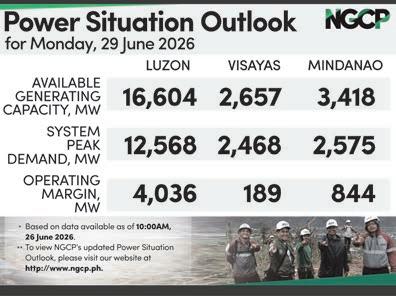
The SC’s recently-issued resolution affirmed the NTC’s decisions to disqualify the company from a third-generation (3G) frequency assignment. The High Court directed the entry of final judgment following the consolidated decision issued in 2023. The 2023 decision sustained the NTC’s assessment and imposition of Supervision and Regulation Fees (SRF) and Spectrum User Fees (SUF) arising from Now Telecom’s debt-toequity conversion.
Rockport
By Lenie Lectura @llectura
ROCKPORT Power Inc. is expanding its presence as a retail electricity supplier (RES) by partnering with local utilities to offer competitive electricity rates through various governmentled programs.
As a licensed RES, Rockport Power is authorized to directly sell and supply electricity to contestable customers.
Rockport Power said it has partnered with the Manila Electric Co., Batangas I Electric Cooperative, Inc., and Nueva Ecija II Electric Cooperative, Inc.-Area 2. It has also teamed up with the Zamboanga City Electric Cooperative.
Through these partnerships, Rockport Power said it is making the government’s energy choice programs more accessible to the public, helping customers lower their electricity bills by choosing their own energy supplier.
“The NTC will follow the Supreme Court’s direction and collect Now Telecom’s outstanding SRF liabilities, which, as of 30 September 2025, has reached P3,769,408,931.66, including penalties,” the agency said. The SC found no merit in the company’s argument that addi -
The SC also upheld Now Telecom’s disqualification from the 3G frequency assignment due to its refusal to settle outstanding SUF and SRF obligations. In its decision, the court noted that as of December 2005, Next Mobile had unpaid SRF of P126,094,195.67 and unpaid SUF of P9,674,190.00, and that the company failed to pay these fees even under protest.
The NTC announced in April 2025 that it revoked Now Telecom’s authority to operate a nationwide mobile telecommunications network, declaring its provisional authority
“Now Telecom’s provisional authority… is hereby deemed inoperative in view of its expiration/nonextension of its provision authority,” the NTC said, noting that the firm had not met the terms set out in prior rulings issued in September and December 2020, which have since attained finality.
The NTC found that despite receiving its provisional authority in 2020, Now Telecom had deployed only six of the 2,306 base stations it committed to build under its 2017 Revised Rollout Plan–and none were operational on the assigned frequencies.
Power ties up with utilities
These programs include the Retail Competition and Open Access (RCOA), which allows large-scale power users to shop for the best rates, Green Energy Option Program (GEOP), which gives customers the choice to switch to purely renewable energy sources, and the Retail Aggregation Program (RAP), which enables smaller customers to group together to negotiate lower electricity prices.
By facilitating these options, the company said it aims to move customers away from traditional, single-source supply options towards optimized, cost-effective energy solutions.
“We see our role not just as a supplier, but as a partner in helping Filipinos find real savings,” Rockport Power president Marvee Espejo said. “By working with local utilities, we are helping customers unlock more competitive and optimized energy solutions.”
Espejo noted that strong collaboration with these local dis -
tributors is essential to building a market that responds to what customers actually need. it pointed out that by increasing its presence in these service areas, Rockport Power aims to raise awareness that customers are no longer stuck with a single traditional supply option.
“Our goal is to make these programs accessible and practical options for anyone seeking to cut their energy costs.”
Last week, the Energy Regulatory Commission (ERC) announced It lowered the threshold under RCOA and RAP to 100 kilowatts (kW) from 500 kW.
Under the 100-kW threshold, 77 contestable customers are scheduled for their initial RCOA switch—58 in Luzon and 19 in the Visayas—bringing the total number of initial RCOA switches across all threshold levels to 96 customers. Meanwhile, 11 Retail Aggregated Groups (RAGs), including consumers at the household level, are scheduled for their initial
switch under RAP—all located in Luzon—bringing the total number of initial RAP switches to 40 RAGs.
Qualified medium-sized commercial establishments, schools, hospitals, office buildings, hotels, manufacturing facilities, and other electricity users may now directly contract with their preferred RES.
“The lowering of the contestability threshold to 100 kilowatts is more than a regulatory milestone—it is a milestone for Filipino consumers. For the first time, residential communities are participating in the competitive retail market through aggregation, extending the power of choice beyond large corporations and industrial customers to ordinary households.
This reform empowers consumers to seek electricity solutions that best fit their needs while encouraging suppliers to compete through better prices, innovative products, and improved customer service,” said ERC Chairman and CEO Francis Saturnino Juan.
ERC names top 5 power generation firms in PHL
THE power unit of the Aboitiz Group has once again claimed the top spot as the country’s largest power generation company (genco), with a market share of 24.3 percent, data from the Energy Regulatory Commission (ERC) showed.
Aboitiz Group’s power business registered 6,850.63 megawatts (MW) of installed capacity nationwide.
In the second spot is conglomerate San Miguel Corp. (SMC), with a market share of 19.62 percent, representing 5,533.08 MW of capacity.
With a market share of 10.74 percent, First Gen Corp. of the Lopez Group came in third, with a nationwide capacity of 3,028.41 MW. Ayala Corp.’s power business unit, ACEN Corp. registered a market share of 6.91 percent, representing 1,948.68 MW of installed capacity.
In fifth place is the power generation business of the Manila Electric Co. (Meralco) with a 6.7-percent market share, representing an installed capacity of 1,889.67 MW.
Under the Electric Power Industry Reform Act (EPIRA) of 2001, no single company or related group may own, operate, or control more than 30 percent of the installed generating capacity (IGC). The ERC annually sets the IGC and market share limitation (MSL) per grid and for the national grid.
For this year, the IGC and MSL for the national grid are set at 28,197.04 MW with a 25-percent market share limit equivalent to 7,049.26MW. On a per grid basis, Luzon’s IGC is set at 20,422.80MW with a 30 percent MSL equivalent to 6,126.84MW; Visayas grid at 3,478.32MW with a limit of 1,043.49MW; Mindanao grid at 4,295.91MW with a limit of 1,288.77MW.
The caps on how much a power firm can operate nationwide are determined every year by the ERC to strengthen transparency, competition, and long-term energy security for consumers and industry stakeholders alike.
“Healthy competition in the power sector is essential to en -
suring reliable electricity supply and protecting consumers from unreasonable prices. By regularly updating the Installed Generating Capacity and Market Share Limitation, the ERC helps prevent market dominance and promotes a level playing field for all industry participants,” ERC Chairman and CEO Francis Saturnino C. Juan said.
Index tweak MEANWHILE , Juan said the commission is looking at tweaking the reliability index on power plant outages amid the frequency of red and yellow alerts in the Visayas power grid.
“We will rationalize it. It’s not really going up or down, but we’re making it more commensurate to the violation and its impact,” he said.
Under the reliability index implemented since 2020, power generation companies are allowed to go offline for a certain number of days per year.
For instance, a power plant fueled by pulverized coal, is allowed to be out of service for 44.7 days –
comprising of 27.9 days of planned outages and 16.8 days of forced or unplanned outages.
Coal plants running on circulating fluidized bed (CFB) technology, the allowable outages shall be for aggregate 32.3 days with 15.4 days of planned outages and 16.9 days of unplanned outages.
Geothermal plants are only allowed to be out for 19.7 days, with six days for planned outages and 13.7 days unplanned.
Combined cycle plants are permitted for total outages of 20.2 days with 12.5 days for planned outages and 7.7 days for forced outages.
The gas turbine plants have total outages of 29.2 days, or 6.5 days of planned and 22.7 days of unplanned outages.
Diesel plants could go offline for 19 days, comprising of five days of planned and 14 days of forced outages. For geothermal facilities, they are allowed to have total outages of 19.7 dayssix days of planned and 13.7 days of unplanned outages.

By VG Cabuag @villygc

THE Securities and Exchange Commission (SEC) has warned the public against investing in in Empire X Capital, an entity that solicits investments through social media platforms.
The agency said the entity headed by a certain Xavier Montes offers investment amounts ranging from P300 to P5,000, depending on the selected plan.
The investment packages purportedly guarantee returns of 25 percent after six days and 70 percent after 18 days.
“Investors are allegedly encouraged to participate in a referral program, through which they may earn commissions amounting to 7 percent, 3 percent and 2 percent based on the investments made by referred individuals,” the agency said.
It said an investment contract exists when there is an investment or placement of money in a common enterprise with a reasonable expectation of profits to be derived from the efforts of others.
“The scheme employed by Empire X Capital bears the characteristics of a Ponzi scheme, where monies from new investors are utilized to pay purported profits to earlier investors.”
Such schemes are designed primarily to benefit top recruiters and early participants and become unsustainable and detrimental to later investors once recruitment of new investors declines.
The offering and selling of securities in the form of investment contracts through a Ponzi scheme, being fraudulent and unsustainable in nature, will not be allowed by the SEC.
It said the agency does not issue a
Tlicense to sell securities to the public to persons or entities engaged in such business or schemes.
The Financial Products and Services Consumer Protection Act also prohibits investment fraud, which includes any deceptive solicitation of investments from the public such as Ponzi schemes and other similar schemes involving the promise or offer of profits or returns sourced from investments or contributions made by investors themselves, as well as the offering or selling of investment schemes without the necessary license or permit from the SEC.
Meanwhile, the agency warned the public against dealing with a website operating under the name CLI Finance Incorporation, a name that resembles a legitimate company named as CLI Finance Inc., which is a registered lending firm.
The company has informed the SEC that it is not affiliated, connected or associated with the website bearing the clifinanceincorporation.com/ cli-finance-incorporations.
“(T)he subject website appears to be using the name, SEC registration information and other corporate details of CLI Finance Inc. without CLI Finance Inc.’s authority or consent,” the SEC said.
CLI Finance, the legitimate firm, said it does not maintain any office at the addresses indicated on the website and that it does not operate any online lending application, online lending platform, or loan website. It added that no online lending platform affiliated with CLI Finance Inc. appears in the SEC’s list of recorded online lending platforms and that the company maintains only its official Facebook page and has not authorized the operation of the subject website.

The voices of working children: Understanding the reality of child labor
ON a rainy Monday morning, a young boy boards a bus carrying a basket of rice cakes, calling out “Puto, suman, sapin-sapin kayo diyan!” as he moves through the aisle. He appears to be no older than eight years old.
This reflects a reality where, while many children spend their time in school and with their families, others work at an early age to help support themselves or their households. For these children, responsibilities begin much earlier than they should.
Child labor extends beyond economic hardship; it is fundamentally a human rights issue that can perpetuate cycles of poverty and inequality across generations.
The United Nations Children’s Fund (Unicef) defines child labor as work performed by children, defined as any person under the age of 18, who is too young for the task or work that is inherently hazardous to their health, safety, or moral development. It is critical to differentiate child labor from activities that can positively contribute to a child’s growth, for example, light housework or taking on a summer job while school is out. These types of tasks help children develop skills and responsibility.
However, child labor crosses the line into exploitation when it jeopardizes a child’s physical, emotional, or psychological well-being. At its worst, it can amount to actual slavery, including the buying and selling of children. In many places, children are trafficked to forcibly recruited into armed conflict, used in the production and trafficking of drugs, or offered into prostitution.
According to the latest data from the International Labor Organization (ILO) and Unicef, 138 million children worldwide were engaged in child labor in 2024. A staggering 61 percent worked in agriculture, while 27 percent toiled in the services sector, including domestic labor and market selling. Another 13 percent worked in industries such as mining and manufacturing; jobs often fraught with hazards.
According to the Philippine Statistical Authority (PSA), the Philippines has a declining rate of working children. In 2024, the number of working children dropped to 861,000, down from 1.09 million in 2023. Male children comprised 61.8 percent of this group, a consistent trend over the years. Children engaged in scavenging trash to sell, working as vendors, house helpers, and other similar roles contribute significantly to the service sector, which employs the largest share of working children at 50.4 percent. This is followed by the agriculture sector, accounting for 40.7 percent, where children toil as farmhands on fields, participate in livestock raising, and work in fisheries. The industry sector, particularly in mining and construction, employs 8.9 percent of working children. These declines reflect ongoing efforts to combat child labor and promote education and better opportunities for youth. Continued collaboration and proactive measures are essential to sustain this positive trend and further safeguard the rights of children in the future.
The Philippines also has established a strong legal and policy framework to combat child labor, particularly its worst forms such as hazardous work, trafficking, forced labor, and exploitation. Key legislations include the Anti-Child Labor Law (RA 9231), which prohibits the employment of children under 15 years old except under limited circumstances, restricts hazardous work, and protects children’s access to education. This is complemented by Special Protection of Children Against Abuse, Exploitation and Discrimination Act (RA 7610), the Labor Code of the Philippines, and the AntiTrafficking in Persons Act (RA 9208), which provide additional safeguards against child exploitation. Government-led initiatives fur-

ther support these efforts. The Philippine Program Against Child Labor serves as the national framework for prevention and intervention, while Sagip Batang Manggagawa rescues children from dangerous working conditions. Programs such as the Child Labor Prevention and Elimination Program and the Pantawid Pamilyang Pilipino Program (4Ps) address the root causes of child labor through education, livelihood assistance, and social protection. In addition, the Philippines also upholds international commitments through the ratification of key ILO conventions aimed at eliminating child labor in all its forms.
Alongside government efforts, businesses have a vital role to play in the fight against child labor. While governments establish laws and policies to protect children, companies are responsible for ensuring that their operations and supply chains are free from child labor and other human rights violations. One of the principles of the “United Nations Global Compact” is the effective abolition of child labor. Association with child labor can lead to reputational risks and damage for businesses. Taking proactive action against child labor not only protects children’s rights but also responds to the growing expectations of investors, customers, regulators, and other stakeholders for responsible business conduct.
In 2024, the European Commission launched the Corporate Sustainability Due Diligence Directive that promotes sustainable and responsible operations across the supply chain. This includes environmental impact, labor rights violations, and human rights issues. Through effective human rights due diligence, supplier screening, and ongoing monitoring, organizations can identify areas where child labor risks may exist and implement measures to prevent and address them. Awareness and training programs for employees, suppliers, and business partners further strengthen responsible labor practices and help build a culture of accountability throughout the value chain. As ESG and sustainability considerations become increasingly important, businesses are expected to demonstrate a commitment to ethical and transparent operations.
R.G. Manabat & Co. is committed to maintaining strong human rights standards throughout our operations and business relationships. We ensure that our operations, as well as our partners, clients, vendors, and the entire supply chain, adhere to ethical business practices that safeguard children and prevent any form of harm. Through ESG services, we also empower other organizations to adopt the same high ethical standards. These collective efforts help foster an environment where children’s rights, well-being, and development are protected. Together, let us create a world that is livable. A place where children are free to explore, play, and enjoy life as they move toward a brighter future.
© 2026 R.G. Manabat & Co., a Philippine partnership and a member firm of the KPMG global organization of independent member firms affiliated with KPMG International Ltd., a private English company limited by guarantee. All rights reserved. This article is for general information purposes only and should not be considered as professional advice to a specific issue or entity. The views and opinions expressed herein are those of the author and do not necessarily represent KPMG International, R.G. Manabat & Co. or the BusinessMirror. For more information, you may reach out through ph-kpmgmla@kpmg.com, social media or visit www.home.kpmg/ph.
DBCC revises inflation, oil, exchange rate assumptions
By Andrea E. San Juan
GOVERNMENT economic managers expect inflation to stay elevated until next year because of high global commodity prices and supply shocks arising from the Middle East conflict, the revised macroeconomic assumptions of the Development Budget Coordination Committee (DBCC) showed.
“Looking ahead, inflation rate assumptions are expected to follow a higher path due to elevated global commodity prices and supply shocks arising from the ongoing Middle East conflict,” read a memorandum
issued by the Department of Budget and Management (DBM), the agency heading the DBCC. The macroeconomic assumptions by the state’s economic team showed that inflation could average at 6 per-
cent to 7 percent this year. For next year, economic managers expect inflation to average at 4 percent to 5 percent.
Inflation, based on these revised forecasts, is only seen to return to the 2-percent to 4-percent target band of the BSP in 2028.
Tied to the reset in the inflation forecast is the expectation of the economic team for the price of oil to stay elevated this year.
As the International Energy Agency (IEA) warned that global oil supply and inventories may take time to fully recover and stockpiles may remain under “significant strain,” the DBCC noted that global prices are still expected to be elevated based on “Dubai Crude Oil” (DCO) futures prices.
In view of these developments, the assumptions for the DCO prices were revised upward to US$80 to 100/barrel of crude oil (bbl) for 2026, US$70 to 90/bbl for 2027, and US$60 to US$80/
bbl for
2028-2030,” the memorandum issued by the DBM read. The DBCC also revised upwards its forecast on the peso-dollar exchange rates to P60 to P62 against the dollar over the medium-term. Government economists believes the local currency is expected to trade within this range until 2030.
“Looking ahead, the peso-dollar exchange rate assumptions were revised upward to P60.00 to 62.00/ US$1 over the medium-term, as depreciation pressure could persist amid prolonged Middle East tensions, elevated domestic inflation risks, and subdued growth prospects that may weigh on market sentiment,” the DBCC noted. Data from the Bankers Association of the Philippines (BAP) showed the Philippine peso closed at P61.29 against the greenback on June 26. The rate remained unchanged compared to its previous finish on Thursday.
Property prices recover after two quarters of decline
HIGHER property prices in the National Capital Region led the quarter-on-quarter recovery in nationwide property prices in the first quarter of 2026, reversing two consecutive quarters of negative outturns, data from the Bangko Sentral ng Pilipinas (BSP) revealed.
Residential property price index (RPPI) in the Philippines grew 5.6 percent in the first quarter of 2026, a reversal of the -1.3 percent in the fourth quarter of 2025 and the -3.8 percent in the third quarter of last year.
According to the central bank, the RPPI is a measure of the average change in the prices of various types of housing units over time, calculated
using data on actual housing loans from banks. According to the BSP, the index is among the key indicators used to assess the country’s real estate and credit market conditions.
The growth in property prices in the National Capital Region (NCR) in the first quarter of 2026 was at 10.4 percent while property prices in Areas outside the NCR (AONCR) climbed by 2.5 percent compared to a quarter ago.
Across the country, the BSP noted that property prices increased for both houses and condominium.
“The increase was led by condominium prices, which rebounded strongly on a quarter-on-quarter basis after three consecutive quarters of decline,” the central bank noted.
BSP pushing for fair, transparent digital transaction fees
THE Bangko Sentral ng
Pilipinas (BSP) expects its new measures lowering interbank fees would lead to “fair and transparent” fees in digital transactions.
The central bank said it will also require BSP-supervised financial institutions (BSFIs) to be prepared to show how they compute their costs.
Under Circular 1238, fees for person-to-person e-payments across banks, e-wallet operators, and other payment service providers (PSPs) should not be “materially different” from fees within the same institution.
“Transfers within one bank or e-wallet are often free,” the central bank said adding that any difference in pricing should mainly reflect fees paid to the network switch operator.
The BancNet platform is the designated clearing switch operator for InstaPay while the Philippine Clearing House Corp. (PCHC) is the switch operator for PESONet.
The central bank said these institutions “must now also have an analysis of their costs for delivering electronic payment products and services.”
“The BSP may require this in the conduct of its oversight activities,” according to the central bank.
BSP Governor Eli M. Remolona Jr. said lower fees will encourage more citizens and businesses to use and benefit from digital
transactions.
“The BSP sees this as a step toward making digital transactions even more mainstream. At the same time, greater adoption can help improve efficiency across the payments system, reducing costs for everyone,” added Remolona.
The central bank expects that service fees for electronic payments be lower than the fees collected from transactions made over-the-counter as electronic payments are considered to provide “more efficient and cost-effective” means of delivering service.
According to the central bank, the circular addresses findings from the BSP’s Consumer Expectations Survey in the fourth quarter of 2025.
The survey revealed that one in three Filipino consumers consider high fees as a “leading barrier” to using digital payments more frequently.
The circular on pricing digital transaction fees amends the “National Retail Payment System Framework” and the “Regulatory Framework for Merchant Payment Acceptance Activities,” the BSP noted.
The circular also makes another amendment to the latter framework to expand transaction points where users can make digital payments.
Both amendments are needed to speed up the growth of the digital ecosystem, the circular read. Andrea E. San Juan
According to the BSP, the increase in prices was backed by the “broader recovery” in the property sector, alongside developers’ “aggressive promotional offers and more flexible payment terms, particularly for ready-for-occupancy units.”
Data from the central bank showed condominium prices in the Philippines grew by 11.1 percent in the first quarter of 2026, reversing the two straight quarters of negative outcomes in the third and fourth quarter of 2025.
Meanwhile, house prices inched up 0.8 percent, also reversing the negative outturns in the third and fourth quarter of 2025.
In the first quarter of 2026, BSP data showed houses in the NCR re-
corded the highest median price at P8.36 million, well above the national median at P3.39 million, while houses in Other Areas in the Philippines posted the lowest median price, at P2.41 million.
Across most areas, the median price of condominium units generally exceeded that of houses, the BSP said. Amid rising property prices, however, the central bank said residential real estate loans contracted on a quarterly basis across all areas and housing types.
“This reflected continued consumer pessimism toward property purchases and tighter bank credit standards, which weighed on loan demand,” the BSP noted. Andrea E. San Juan
BIS warns: AI bust risks ripple effects from growth to credit
AN artificial-intelligence bust, inflation and fiscal stress are among the most alarming threats to global prosperity at present, the Bank for International Settlements warned.
In its annual report published on Sunday, the Basel-based institution cited those on a list of “pressure points” that currently “demand attention,” with underlying financial vulnerabilities lurking that could amplify any shock.
“The global economy remains caught in the crosscurrents of progress and peril,” Basel officials said in the report. “Resilience is being increasingly tested and strained.”
The assessment highlighted AI-led risks prominently in a report that arrived on the eve of the European Central Bank’s three-day annual symposium in Sintra, where a host of global policymakers will also scrutinize such stability dangers closely.
“Disappointment in returns could trigger a sudden pullback in financing and turn the capex boom into a protracted investment bust, with potential knock-on effects on financial conditions,” the BIS said, before observing that “a major equity-market correction could have larger macroeconomic consequences today than in the past.”
The Basel officials went on to note that other assets could face similar dangers, and highlighted credit in particular.
“Repricing of risk this time, whether triggered by higher interest rates or an AI bust, has the potential to be similarly disruptive” in that segment to the 2008 Global Financial Crisis, the BIS said.
On AI specifically, officials highlighted vulnerabilities linked to funding, including complex arrangements such so-called “circular financing” deals that can mix equity and debt with supplier-client contracts.
For instance, chipmakers and hyperscalers take stakes in AI labs or neocloud providers, who in turn commit to multi-year purchases of chips or computing power, the BIS said. Data center construction is more frequently outsourced to third parties that
lease facilities back to hyperscalers on longterm contracts with embedded exit clauses.
“The terms of such deals are typically poorly disclosed, with risks of the same asset being pledged multiple times,” officials wrote.
The BIS’s separate warning of a possible return of inflation jars with some initial optimism that the current energy shock caused by the Middle East crisis might recede. Signs of progress over a peace deal this week brought the oil price down to levels below where they were when the Iran war broke out in late February.
BIS officials, in tune with peers at institutions such as the ECB, worry that the disruption to energy supplies may not be over, that infrastructure will take time to rebuild, and that existing impacts could linger.
That followed US data last week showing prices rising at the fastest pace in more than three years, and precedes numbers in coming days that may show euro-zone inflation still far above officials’ 2% target.
The last cost-of-living shock in 2022 “is still in the memory of economic agents,” BIS chief Pablo Hernandez de Cos told reporters, noting that this can mean a “higher probability of second-round effects.”
The BIS also highlighted what has become a familiar warning about how fiscal dangers posed by high sovereign debts still loom large, with added complications given the other risks.
Echoing counterparts such as the Parisbased OECD, it pointed to how fleet-footed investors have become much more prominent as buyers of government bonds, often using funding that can quickly unwind when conditions deteriorate.
“These hedge funds employ highly leveraged strategies that rely on short-term financing on favorable terms, creating risks of fire sales and de-leveraging feedback loops,” the BIS said. “Financial stresses can now propagate quickly and broadly through funding markets, across borders and between banks and non-banks.” Bloomberg
BUILT TO BREAK: Older buildings and substandard construction left Venezuela vulnerable to earthquakes
By Garance Burke, Michael Biesecker & Byron Tau
The Associated Press
OLDER buildings, substandard construction and geography left many neighborhoods in Venezuela vulnerable to strong earthquakes like the ones that struck the country this week.
Engineers and other experts said the backto-back earthquakes on Wednesday were among the most intense to hit the country in more than a century, leveling buildings and leaving more than 900 dead with the number expected to rise. Videos and satellite imagery from the disaster zone reviewed by The Associated Press reveal scores of multistory buildings had collapsed.
Microsoft’s AI for Good Lab analyzed satellite imagery of Catia La Mar in La Guaira state, one of the hardest hit cities along the Caribbean coast. Using AI-based damage assessment models, Microsoft determined that about a third of the city’s nearly 30,000 structures were damaged.
Among the factors that left so many structures at risk: Some housing complexes in northern Venezuela were constructed quickly during recent oil booms, and builders may not have adhered to best practices that mitigate the risks of serious seismic activity, according to experts.
Engineers said that older housing erected in the 1950s and 1960s—before modern earthquake standards were adopted—may not have been retrofitted to survive such violent shaking. And many buildings were constructed on geography and soft soils that compound the danger of the earthquakes, the experts said.
Tall buildings and older concrete contributed to damage
DAVID COCKE , a structural engineer in California and former president of the Earthquake Engineering Research Institute, said that a combination of soft soils, tall towers and older concrete structures contributed to the wide -

spread damage, particularly when buildings pancaked, or collapsed floor-by-floor.
“They just don’t have the more modern reinforcing steel connections that we put in those kinds of buildings today,” said Cocke.
Since the 1970s, engineers have known that concrete buildings are particularly susceptible to earthquakes and seek to reinforce new construction with steel. While many rich nations have forced property owners to retrofit or tear down dangerous buildings, many poorer or middle income countries have lagged in enforcing upgrades as they battled more immediate woes.
“Some of the more advanced countries like Japan and New Zealand and the U.S. have made those changes, but some of the other countries have not,” Cocke said. “It’s a very typical kind of construction all over the world.”
‘Soft stories’ and soft soil played a role OTHER experts noted that a number of buildings that collapsed also had non-structural
walls comprised of heavy bricks, or they had “soft stories” in which their ground floors consisted of garages or similar open spaces. Such construction increases the risk of pancaking, they said.
“Soft stories are a huge problem everywhere in the world,” said Eduardo Miranda, a professor of civil and environmental engineering at Stanford University. “And in Venezuela, they are particularly prevalent, and if you combine softer soils with a soft story, buildings can collapse.”
Marcos Ferreira, a geophysicist and researcher at the Geological Survey of Brazil, said the destruction in Venezuela was compounded by the back-to-back quakes, known as a doublet. A similar incident took place in Turkey and Syria in 2023, killing almost 60,000 people.
“It is as if I am screaming and then someone starts screaming, too,” Ferreira said. “That amplifies the vibration and adds to the potential hazard.”



buildings also collapsed
government officials took steps following a deadly 1967 quake to update building codes. But it is unclear how many buildings were retrofitted to comply with those rules. In late 1999, former President Hugo
“Something
Newer
VENEZUELAN
Chávez’s first year in office, floods and landslides destroyed housing, including in coastal northern Venezuela. The government went on a building spree to replaced
of the civil engineering school at Pontifical Catholic University of Valparaíso, Chile. Some of the newer buildings appear to also have collapsed.
RESIDENTS and rescue workers search through the rubble two days after an earthquake struck La Guaira, Venezuela, Friday, June 26, 2026. AP/JUAN PABLO ARRAEZ
RESCUE workers search through the rubble three days after earthquakes struck Catia La Mar, Venezuela, Saturday, June 27, 2026. AP/FERNANDO VERGARA
HOUSES damaged by the earthquakes are seen three days after earthquakes struck Catia La Mar, Venezuela, Saturday, June 27, 2026. AP/MATIAS DELACROIX
COLLAPSED buildings are seen a day after earthquakes struck La Guaira, Venezuela, Thursday, June 25, 2026. AP/JUAN PABLO ARRAEZ
Designer and Muse: Boyet Fajardo and Melanie Marquez

BALLET-INSPIRED SHOES IN NEW

THIS year is the 70th anniversary of the normalization of diplomatic relations between the Philippines and Japan, with the theme of the celebration being “Weaving the Future Together: Peace, Prosperity, Possibilities.”
To celebrate this milestone, fashion designer Boyet Fajardo unveiled his Holiday 2026 Collection, inspired by the Japanese ethos, featuring the iconic Melanie Marquez, who was crowned Miss International 1979 in Shiba Park, Tokyo.
THE ORIENT EXPRESSED
JAPANESE designs have always been part of my collections. They are timeless, geometric, linear, and dramatic,” said Fajardo, a pret-a-porter impresario who remains one of the most successful in a niche market. “I feel excited about this collection. I was never excited about my photo shoots before, but now I am.”
An astute businessman as much as a highly creative individual, Fajardo is the pioneer of plussized fashion whose pieces are carried by Robinsons, SM, Landmark, Sta. Lucia Malls, KCC Mall in Mindanao, G Malls in the Visayas, and in other select department stores nationwide.
He felt that women who were on the bigger side also deserve to wear beautiful outfits as much as the slender types. His new collection, besides enticing his captured plus-sized sector, is also for the woman of a certain aura who has embraced aging gracefully, as exemplified by the eternally stylish Melanie.

“The collection highlights my 48 years in the fashion industry—through all the struggles—as my journey speaks volumes of my acumen throughout all the generations I’ve served: from the baby boomers to the millennials, and now the younger crowd,” he shared. The designs, he emphasized, are limitededition pieces and are all locally made. He also included menswear in the mix, modeled by Arjay Espartero.
“I always want movement—constant movement— and never remain at a standstill, even during the global pandemic. I’ll do the things I’ve been dreaming to do all my life,” Fajardo said. “The collection is a culmination of almost five decades of work. I want to be an inspiration, despite my shortcomings and physical infirmities, like my eyesight and upper left extremity.”
MUSE IMMORTAL
FAJARDO specifically handpicked Melanie to lead his holiday 2026 campaign. A teenager when she won the country’s third Miss International crown, she has passed on her remarkable beauty-queen legacy to her daughter, Michelle Marquez Dee (Miss World 2019 Top 12 and Miss Universe 2023 Top 10), and niece, Teresita Ssen Marquez (Reina HispanoAmericana 2017).
Melanie also went on to win the Glamorous Woman of Italy title and Face of the ‘80s in New York; which led to her stint in the Supermodel of the World 1986, where she was hailed as the model with the most beautiful hair by Clairol. “I think my X-Factor comes from professionalism, coupled with my dedication
4 trends in scalp and hair care

previously been used only for skin care. The skinification of hair refers to “borrowing” skin care principles and applying them to haircare. Selsun Blue is the Shampoo Brand of the Year at the Watsons HWB 2025 and 2026, and this is proof that people are addressing their scalp problems before anything else. Other ingredients-led hair care brands that Watsons consumers go for are Head & Shoulders Clinical for dermatologist-grade scalp treatment; L’Oreal Elseve AntiHairfall Resist for science-backed strengthening; Hair System by Watsons / Naturals by Watsons for accessible scalp care; and Luxe Organix and Khaokho Talaypu for natural-meetsfunctional solutions.
Another trend that haircare enthusiasts are going for is Japanese hair care, which is built on the philosophy of “scalp first, hair second.” The Japanese avoid over-cleansing and go for products that nurture the scalp as it is the foundation of healthy hair. Japanese hair care makes use of gentle techniques that minimize damage and nutrient-rich ingredients from nature. Some of the most popular Japanese brands at Watsons are Tsubaki (well-known for camellia oil luxury nourishment), viral hair mask Fino, and Ma Cherie,

After the easy-breezy editorial, Melanie turned wistful: “God will give you that brilliance, then your personality and good heart will glow. People around you think you don’t seem to age. And you are not bothered by material things. Let’s live within our means. You’ll find peace and contentment.” GOLDEN!
“COMPETE only with yourself, rather than with others. It brings out the optimum in you,” Fajardo declared, as he gears up for his golden anniversary in the garments business. “Fashion is my passion, so the best is yet to come.” He is forever grateful for his lucrative—and colorful and controversial—career.
“I can and I always say that I don’t compete with anyone, but to inspire the newbies and provide them with the correct positive mental attitude to last in this field,” a humbled Fajardo offered in a previous interview. “This feeling has made me more inspired and I’m grateful that my employees are always with me in all my plans.”
For several years, he has been an ardent advocate for persons with disability (PWDs), having worked with the Ephpheta Foundation for the blind. He has a special heart for people who have this disability because he has suffered from blindness as well.
“There are so many people who are blind simply because of poverty. What can I do? My heart breaks for them. They go blind because they can’t afford a simple cataract or glaucoma operation. This sparked
loved by consumers for its fragrance and the shine it provides hair. Watsons also welcomes the new era of hair protection and lightweight styling. These products create a physical barrier against moisture loss and damage while using tools. Dove UV Spray/Peptide Range provides protection and repair, Sunsilk Mist is for lightweight everyday styling, and fan favorite Vitress is an anti-frizz and shine staple. Scalp and hair care enthusiasts also await Exclusive and First-to-Launch Only at Watsons because this
After this, he expanded his outreach even to those who can’t walk and PWDs who wouldn’t be eligible for employment simply because of their disability.
“I had made a name doing plus-sized clothing, but I’m also advocating for the rights of PWDs, as I was also born with polio, and working against fashion discrimination on a bigger scale,” he shared.
As his creative process goes, he adapts the same ethic when making ready-to-wear (RTW) or madeto-order clothes: “The design should be practical, wearable, timeless in nature. The designs we make are meant to last if well taken care of, because of our strict quality control and our love for our craft,” Fajardo said. “The men are very traditional and practical though with a twist.”
He stressed, however: “I only do RTW clothes specifically for the plus-sized, and luxe wear for their slim counterparts. We also do men’s clothing but only focus on making suits. We basically follow trends from the dictates of the world’s fashion capitals. Millennials today have different perceptions of what is basically their fashion instinct, somewhat like easy does it, where comfort and individuality are most important.”
“[I have been in the fashion business for so long], and I don’t want to rely on famous names. Basta ako, I’m doing all of this to please God and not them,” Fajardo has consistently said. “I am doing this so God will be so pleased that I’m giving back. It’s payback time.”

PhilHealth, CHR unite to champion healthcare as a fundamental human right
In a landmark collaboration bridging public health and social justice, the Philippine Health Insurance Corporation (PhilHealth) and the Commission on Human Rights (CHR) joined forces recently for a learning forum titled “Health as a Human Right: Bridging the Healthcare Divide.”
The forum brought together health and social justice leaders and civil society organizations (CSOs) to reinforce a critical principle that access to quality healthcare is a fundamental human right and a core state obligation.
Discussions focused on the urgent need to shift the national healthcare paradigm away from purely treating illnesses toward robust, state-funded investment in preventive and primary healthcare.
The joint initiative aligns with global efforts by the World Health Organization (WHO) and the Office of the United Nations High Commissioner for Human Rights (OHCHR) to mainstream human rights in health governance and Universal Health Care (UHC) implementation. By anchoring domestic healthcare delivery on a rightsbased framework, PhilHealth and CHR

aim to improve equitable access to care especially for the marginalized, vulnerable communities.
The forum highlighted the Yaman ng Kalusugan Program (YAKAP) as one of the government’s critical programs for the progressive realization of UHC. By making primary care access points and preventive care more available, the state ensures that every Filipino is protected from financial burden due to medical emergencies.
“Healthcare is a cornerstone of human dignity,” said PhilHealth President and CEO Dr. Edwin M. Mercado, who is leading the activity. “Through PhilHealth YAKAP, we are transforming our healthcare system to ensure that primary and preventive care are accessible to every Filipino, regardless of their economic status. This is our commitment to fulfilling the promise

SAMSUNG Electro-Mechanics Philippines Corporation (SEMPHIL) formally launched its APEX (Accelerating Partnerships Towards Excellence) Academe Partnership Program, bringing together leading universities, technical institutions, and government stakeholders in a unified effort to help prepare the next generation of Filipino engineers and manufacturing professionals.
The program was formally introduced during the Memorandum of Agreement signing ceremony held at SEMPHIL’s manufacturing facility in Calamba, Laguna, marking a significant step in strengthening collaboration between industry and academia.
Participating institutions include Mapua Malayan Colleges Laguna, Mapua University, MFI Polytechnic Institute Inc., Mindanao State University-Iligan, TESDA CALABARZON, and University of the Philippines Diliman.
The initiative builds upon SEMPHIL’s longstanding commitment to education, technical training, and workforce development. Over the years, the company has invested in programs that support students, employees, and future professionals through scholarships, continuing education opportunities, and industry-based learning experiences.
As manufacturing technologies continue to evolve and industries increasingly require specialized skills, closer collaboration between educational institutions and industry partners has become more important than ever. Through this partnership program, SEMPHIL seeks to help bridge that gap by creating opportunities for students to acquire practical exposure, industry insights, and career pathways that align with the demands of modern manufacturing.
“APEX reflects our belief that developing talent is a shared
of Universal Health Care.”
CHR Commissioner Judge Maria Amifaith S. Fider-Reyes (Ret.), who co-led the forum, emphasized that the right to health is inextricably linked to the dignity and right to life itself.
The Commission reiterates its commitment to working alongside PhilHealth, civil society, and all stakeholders in ensuring that the right to health is not an abstract promise but a lived reality for every Filipino.
Moving forward, PhilHealth and the CHR intend to institutionalize this partnership and deepen engagement with civil society. This sustained collaboration ensures that Filipinos are not only aware of their health rights but can fully maximize the expanded primary care benefits available under the YAKAP initiative.
responsibility,” said Mr. Ryu Kyeongwoo, President, SEMPHIL. “By strengthening our partnerships with academic institutions and training organizations, we hope to help equip future engineers and professionals with the knowledge, skills, and experiences they need to succeed in an increasingly competitive global environment.”
The initiative expands on SEMPHIL’s existing programs, including Dream Campus, which supports employees pursuing higher education; the Applied Industry-Based Technician Program developed with MFI Foundation; and the SEED Scholarship Program, which provides educational opportunities for deserving students pursuing engineering-related disciplines.
The launch also highlights the growing role of Laguna and the CALABARZON region as a center for advanced manufacturing and technological innovation. With the continued expansion of industrial locators and export-oriented industries, demand for highly skilled Filipino talent continues to rise across engineering, electronics, automation, and technical fields.
As one of the country’s leading electronics manufacturing companies, SEMPHIL recognizes that investing in education is an investment in the long-term competitiveness of Philippine industry.
“Our goal extends beyond supporting individual student. We want to contribute to building a stronger talent pipeline that will help sustain the growth of Philippine manufacturing and create meaningful opportunities for future generations,” Mr. Kyeongwoo added.
GSIS welcomes Ricardo Blancaflor as new board chairperson of BOT
THE Government Service Insurance System (GSIS) welcomed Atty. Ricardo R. Blancaflor as the new chairperson of its Board of Trustees on June 10, 2026, succeeding Rodney Del Rosario Jr.
“The GSIS looks forward to working closely with Chairperson Blancaflor as we continue to strengthen the Fund, expand benefits for our members and pensioners, and pursue innovations that improve public service,” Veloso said.
“He has the full support and cooperation of Management and the Board of Trustees as we build on the gains already achieved and take the GSIS to even greater heights.” Blancaflor brings a strong record in government service, legal work and policy leadership, which is expected to support the Board in guiding GSIS as it strengthens its ginhawa programs and services for government workers and pensioners. Veloso also paid tribute to Del Rosario’s leadership during his tenure as Board

Belmont Hotel Manila offers convenient EV charging near NAIA Terminal 3
AS Belmont Hotel Manila continues to strengthen its sustainability efforts and support more responsible travel experiences, the hotel remains committed to initiatives that create a positive impact on both guests and the environment. One of these initiatives is its Electric Vehicle (EV) Charging Station, offering travelers a convenient and eco-conscious way to stay powered while on the move.
First launched in September 2024 in partnership with Solarius EV, the facility marked a milestone for the hotel as the first property under Megaworld Hotels & Resorts to introduce an EV charging station. Located at Basement 2 of Belmont Hotel Manila, the facility features a Type 2 charger compatible with most electric and hybrid electric vehicles available in the Philippine market today.
Strategically situated in Newport City, just across NAIA Terminal 3 via Runway Manila, the EV Charging Station offers a practical solution for modern travelers and EV owners. Whether checking in for a stay, waiting for arriving passengers, or taking a break before their next journey, guests can conveniently charge their vehicles while enjoying the hotel’s facilities and services.
To access the charging station, users simply need to download the Solarius EV Charging mobile application, allowing them to initiate and monitor charging sessions directly from their smartphones. Checkedin guests may also enjoy complimentary use of the charging station during their stay, adding further value and convenience to their experience.
As electric vehicle adoption continues to grow in the Philippines, accessible charging infrastructure plays an increasingly important role in supporting sustainable mobility. By providing this facility within

The EV Charging Station located at Basement 2 of Belmont Hotel Manila
one of Metro Manila’s key travel gateways, Belmont Hotel Manila contributes to the growing ecosystem that encourages cleaner transportation alternatives.
The initiative also reflects the shared commitment of Megaworld Hotels & Resorts’ Mindful Travel campaign, which promotes more conscious and meaningful travel experiences through sustainable practices and responsible hospitality. While delivering comfort and convenience, Belmont Hotel Manila continues to explore innovative ways to reduce environmental impact and create positive change for future generations.
Through thoughtful initiatives such as its EV Charging Station, Belmont Hotel Manila demonstrates that sustainability can be seamlessly integrated into the guest journey, allowing travelers to recharge not only their vehicles but also their commitment to a greener future.

AS part of its continuing commitment to sustainability and community engagement, Savoy Hotel Manila recently brought its Plant a Sampaguita advocacy to two of Pasay City’s most treasured heritage institutions, helping preserve a beloved symbol of Filipino culture for future generations.
Last June 3, 2026, the leaders and associates of Savoy Hotel Manila embarked on a meaningful journey to the Unang Paaralang Bayan ng Pasay and the Philippine School for the Deaf, both historic institutions with more than a century of history and service to the community.
The first stop was the Unang Paaralang Bayan ng Pasay along P. Burgos Street, where the team was warmly welcomed by Principal Errol Ruiz. The school generously provided an elevated plant box where Sampaguita seedlings were planted. During the visit, Principal Ruiz also shared the institution’s inspiring role as an Alternative Learning System (ALS) Community Center, helping underprivileged individuals complete their high school education through government-supported programs.
The advocacy continued at the Philippine School for the Deaf, another historic institution established in 1907.
With the support of Principal Jordan Madronio, Savoy Hotel Manila installed another Sampaguita plant box on the school’s beautifully maintained grounds and planted a new set of seedlings, further strengthening efforts to propagate the country’s national flower.
Both schools embraced the advocacy, recognizing the importance of preserving the Sampaguita, a flower long cherished as a symbol of love, honor, dignity, and healing.
As its presence gradually diminishes in many communities, initiatives such as Plant a Sampaguita help ensure that
this treasured part of Filipino heritage continues to flourish.
“We believe that hospitality extends beyond our hotel walls,” shared Den Navarro, General Manager of Savoy Hotel Manila. “Just as we care for our Guests, we also have a responsibility to care for our communities, our environment, and the heritage that defines us as Filipinos. Through initiatives such as Plant a Sampaguita, we hope to create a lasting impact that future generations can continue to enjoy and appreciate.”
The day became even more memorable with a courtesy visit to Pasay City Mayor Emi Calixto-Rubiano, a strong advocate of green tourism and heritage preservation.
The hotel team was honored to share the advocacy with the Mayor and grateful for her encouragement and support in helping propagate the Sampaguita throughout Pasay City.
The Plant a Sampaguita initiative forms part of the MEGreen Program of Megaworld Hotels & Resorts, which champions sustainability, environmental stewardship, and community development across its properties.
Savoy Hotel Manila extends its sincere appreciation to the Office of the Mayor, the Pasay City Tourism and Cultural Development Office, Principal Errol Ruiz and the administration of the Unang Paaralang Bayan ng Pasay, as well as Principal Jordan Madronio and the Philippine School for the Deaf, for their invaluable support in making this meaningful initiative possible. Together, these efforts plant more than flowers; they cultivate pride in Filipino heritage, strengthen community partnerships, and inspire future generations to protect and celebrate the symbols that make the Philippines truly unique.
Planting sampaguita, preserving Filipino heritage
SEMPHIL launches academe partnership program to build next generation of Filipino engineers
In the photo are, from left, GSIS Trustee Gilbert Sadsad, President and General Manager Wick Veloso, Chairperson Ricardo Blancaflor, and Trustee Rolando Toledo during the welcome of Blancaflor as the new GSIS Board chairperson.

Read books for a longer life…and other amazing health benefits

IT’S been a long day. The pressures of the daily grind are weighing you down and you need to decompress. As a writer, publisher, and avid reader of books, I would spur you to try reading as a welcome break. Whether you sneak in a few chapters of a riveting suspense thriller in between tasks, or wind down with a light, feel-good romance novel at home, reading gives you a chance to immerse yourself in whole new worlds and be enthralled by stories of fictional characters.
I also think that more people must be urged to consider leisurely reading as beneficial for body, mind, and spirit, especially when it’s a regular part of their routine.
One of the biggest advantages that reading can give you is a full brain workout, according to Dr. Cymbeline Perez-Santiago, who heads the Neurology Unit of Makati Medical Center. We all know that reading broadens one’s knowledge and vocabulary, which is very helpful in everything from hurdling exams to seeking job opportunities, and to dealing with life in general.
But beyond all these, the doctor underscores how reading helps develop empathy, the ability that basically puts yourself in other people’s shoes and better understand what their perspectives are. Experts call it “theory of mind,” which refers to skills that help us build, navigate, and maintain social relationships.
Considering the recent Edcom 2 report findings on how the Philippines is currently facing a learning crisis with 87 percent of students as old as Grade 11 being non-independent readers (meaning they have difficulty explaining what they’ve read). In the light of such findings, Dr. Santiago drives home another crucial point, referencing a 2020 study where
researchers noted that increased grey matter in the left superior temporal cortex part of the brain, which is crucial to cognitive function, is linked to better reading performance among children.
For members of the older generation, the doctor further points out that keeping the mind engaged through book reading delays cognitive decline. It was also shown to positively impact physical and mental health.
Indeed, reading books may even add years to your life! In a Yale study, people added an average of 23 months to their lifespan when they read 30 minutes a day. That’s just 30 minutes out of the many hours we devote to any number of things, so surely we can manage this, right? Still another survey, done in 2017, tracked over 3,000 adults in a 12-year period, revealing that those who specifically read books had a 20 percent reduction in mortality. Clearly, we should read books more for a long and healthy life.
What is it about reading books that makes our minds work differently?
DR. Perez-Santiago asserts that long-form content such as books “trains us to focus and pay attention at a time when the digital world’s fast-paced, short-form content has reduced our attention span. Reading books also strengthens memory, challenges your analytical thinking, and makes you a better writer.”
Speaking of being a better writer, reading words as opposed to looking at illustrations or watching videos drives us to use our imagination to supply the imagery that corresponds with the sentences. I don’t think I’ve ever met a writer who didn’t start off as a bookworm and continues to consume written material for their work or at their own leisure.
Unfortunately, many of us are all too often caught in the grip of modern life and can’t seem to find the time to pick up a book. A national readership survey commissioned by the National Book Development Board in 2023 found that the number of Filipino adults who read non-school books in the past 12 months was 42 percent, a far cry from the 80 percent who read books in 2017.
But with reading books granting innumerable benefits for our health and wellness, how can we
pursue it amidst the distractions of everyday life? Dr. Perez-Santiago says the trick is to make it an enjoyable experience—or something to look forward to. And I agree, so I’ve put together some tips that have always worked for me.
1. Have a book on hand and keep it in places where you spend a lot of time so it’s easy to pull it out. You could put it on the side table near your comfy couch, or at your desk drawer at work or even in your car. You could also keep one in your tote if it’s a handy paperback.
It also doesn't have to be a physical book, though of course I’m quite partial to them. You can have e-books on your mobile phone or your tablet. Put them in the device you often use so you can take it everywhere, even when you travel.
2. Make use of ‘downtimes’ by getting in a few pages of your current read. When you’re waiting at your doctor’s clinic, at the bank, or just have a bit of break between engagements, read your book. You might be surprised by how much progress you make, and how it kills boredom.
3. Set your own reading goals and go along at your own pace. No need to pressure yourself. Reading is supposed to be relaxing and enjoyable. Choose quicker reads like short stories if you’re not up to diving into lengthy novels. You can eventually build up your focus and boost your attention span for longer stories if you want to.
Dr. Perez-Santiago points out that there are no rules that say you must finish one book a week or that you should finish one book before moving on to another. Read books in whatever situation you choose; what’s important is that you do.
Since my team and I are voracious readers, I thought of asking some of them for book recommendations to help those who want to get into reading but don’t know where to start. These reads can also give you insights into the various industries we communicators work in. Check out our book list:
1. Young Jane Young by Gabrielle Zevin. RELEASED in 2017, this multiPOV novel tackles the double
standards women face in the workplace, the unfailing love of mothers, and the humanity that exists behind newspaper headlines.
2. Reportage on Crime by Quijano de Manila. THIS is a 13-narrative anthology of Filipino true crime, written by National Artist for Literature Nick Joaquin during his time as a journalist.
3. What I Talk About When I Talk About Running by Haruki Murakami.
A SHORT ode to running’s impact on the author’s life and work, both to keep fit and as a fitting analogy to the discipline and endurance that both long-distance running and the creative process of novel writing entail.
4. Yesteryear by Caro Claire Burke. AN American tradwife influencer suddenly wakes up in 1855 and finds herself without the comforts of her modern conveniences and her followers. Definitely one of 2026’s most talked about books (Anne Hathway has already bought the film rights and will be playing the main character), this is a surprising and thoughtprovoking satire on the tradwife movement and influencer culture.
5. Yellowface by R. F. Kuang. A WHITE woman steals the unpublished manuscript of a celebrated Chinese-American novelist, re-edits it, and passes it as her own. Despite the main character being kind of despicable and delulu, this is an illuminating story tackling race and online cancel culture. Also, this is a vivid depiction of what the book publishing industry is like!
6. Dungeon Crawler Carl by Matt Dinniman. IF you don’t like books but like video games or reality shows, try this zany Lit RPG series about Carl and his ex-girlfriend’s cat Princess Donut as they are whisked away to an alien-run dungeon maze streamed across the galaxy. Aside from trying to survive deadly battles and kill final bosses, Carl and Princess Donut also have to navigate their reputations when they make media appearances and consult with their manager and PR representatives.
The Elephant
A COLLECTION of short stories that’s a bit bonkers, all brilliant, and creatively inspiring.
8. Hakuda Photo Studio by Her Taeyeon. SET in Jeju, this feel-good piece of Korean literature that reminds us of the charm of small towns, taking things slow, and intentional photography.
9. Daisy Jones & The Six by Taylor Jenkins Reid. AN oral history of a fictional 1970s band loosely inspired by Fleetwood Mac, documented through individual interviews with band members who shared their own account of the band’s origin, success, and eventual breakup.
10. PR Matters: A Communicator’s Guide to the Dynamic World of Public Relations.
WE support our own! This is the first PR book that can be used not only by teachers who teach PR and communications, but also by their students who may want to look at tips from seasoned PR professionals on how to navigate a career in public relations. A finalist at the National Book Award Professions category, this compilation of articles covers an extensive range of communications subjects, and gives a comprehensive overview of the PR industry—its basics and strategies and its uplifting success stories.
Special thanks to the Buensalido PR team—Guia Santiago, Monique Buensalido, Trisha MacasJoyas and Jv Ramos—for sharing their book recommendations.
PR Matters is a roundtable column by members of the local chapter of the United Kingdom-based International Public Relations Association (Ipra), the world’s premiere association for senior communications professionals around the world. Joy Lumawig-Buensalido is the President and CEO of Buensalido PR and Communications. She was past Chairman of the IPRA Philippine chapter for two terms.
PR Matters is devoting a special column each month to answer our readers’ questions about public relations. Please send your questions or comments to askipraphil@gmail. com.
7.
Vanishes by Haruki Murakami.


ERNEST JOHN “EJ” OBIENA has left Formia for Athens hoping to flap his wings further to shake off the worse jump of his world-class career—a 5.42-meter leap that put him ninth and last in the Wanda Diamond League in Doha last
TRUE to its commitment to providing financial protection to Filipino families, Fortune Life Insurance Company presented the accident insurance benefit to Rovelyn Baterbonia—mother of the late Rene Clert Baterbonia—in Talacogon, Agusan del Sur, recently.
I n 2025, the late Baterbonia received a Fortune Life Personal Accident (PA) Insurance Card during his recognition as the Palarang Pambansa Most Valuable Player in Ilocos Norte. Fortune Life supports this annual
youth sports event by sponsoring corporate giveaways and PA cards as raffle prizes or additional rewards for young athletes.
A gency Manager Febelita Soria and Insurance Specialist Dodith Puricallan from the Fortune Life Butuan branch, visited Baterbonia’s hometown to personally hand over the benefit check to his mother.
The gesture reflects the company’s unwavering commitment to supporting Filipino families in times of need.

Brownlee vows to get back at Tall Blacks
By Josef Ramos
IT’S payback time for Justin Brownlee when the men’s national team takes on New Zealand anew in the International Basketball Federation (FIBA) 2027 World Cup Asia Qualifiers this Friday. Brownlee only had four points on 2-of-10 shooting when Gilas Pilipinas took a 66-69 beating at the hands of the Tall Blacks in the second window of the qualifiers last February 23 at the SM Mall of Asia Arena. That measly four points are hardly found in Brownlee’s resumé—he’s averaged in the vicinity of 20 points in FIBA games—thus, the 38-year-old naturalized player stressed they need to match up against the Kiwis—physically.
We know they are a physical team, so we really need to match up with their physicality and understand how to play through,” said the Barangay Ginebra San Miguel resident import.
We must not give up and aggressively sustain our defense all the t ime,” he said.
able to bounce back with 20 points, but the Philippines ended up losing by a mile, 66-93, in the match also played at the MOA Arena last March 3. We must be aggressive,” he stressed. “No matter what they do, as far as guarding us, we must be aggressive all the time.”
The Philippines is 2-2 won-lost, the same record as New Zealand, with Australia unbeaten at 4-0 in Group A and regardless of the outcome of the matches, they’ll be marching to the next round except for Guam which has been eliminated with a 0-4 record.

A gainst Australia which Gilas will also play next week, Brownlee was

AThe wold No. 36 Philippines plays No. 24 New Zealand on Friday in the third window in Auckland and No. 6 Australia on July 6 in Perth. W ith Brownlee in the pool of head coach Tim Cone are June Mar Fajardo, Carl Tamayo, Dwight Ramos, Justin Baltazar, Juan Gomez de Liaño, RJ Abarrientos, Troy Rosario, Kevin Quiambao, AJ Edu, Chris Newsome and Mike Philips. They trained for four days at the Brisbane Bullets High Performance Center and are flying to Aukland for two pickup games against New Zealand pro teams Manawatu Jets and Franklin Bulls early next week.

THE Philippine Olympic Committee (POC) has identified on Friday the members of the men’s and women’s volleyball pools—head coaches and athletes—for the Aichi-Nagoya 20th Asian Games.
The pools are composed mostly of the players who saw action in the FIVB Men’s World Championship the country hosted last September and the Bangkok Southeast Asian Games last December.
A ccording to POC president Abraham “Bambol” Tolentino, POC secretary-general Atty. Wharton has sent out letters informing the reappointment of Italian Angiolino Frigoni and Japanese Takayuki Minowa as head coaches of the Alas Pilipinas Men and Women, respectively, to the Asian Games set from September 19 to October 4.
T he head coaches’ appointment take effect on July 1 and expire on October 15. At the same time, the
POC has also sought the full support of the Premiere Volleyball League through its president Ricky Palou and commissioner Sherwin Malonzo for the Alas Women, most of who are playing for PVL teams.
Named to the women’s pool are Jia De Guzman, Justine Yliyzeth Jazareno, Jennifer Nierva, Dawn Nicole Catindig, Mhicaela Belen, Eya Laure, Angel Anne Canino, Thea Gagate, Fifi Sharma, Vanessa Gandler, Alleiah Jan Malaluan, Amie Provido, Nina Ytang, Janette Panaga, Erika Santos, Arah Panique, Marionne Angelique Alba, Maria Angelica Cayuna, Shaira Jardio, Dell Palomata, Shaina Marie Nitura and Alyssa Jae Solomon.
The men’s squad is made up of Bryan Bagunas, Marck Jesus Espejo, Lloyd Josafat, Jude Garcia, Michaelo Buddin, Leo Ordiales, Al Bukharie Sali, Rwenzmel Taguibolos, Ave Joshua Retamar, Josh Ybañez, Adrian Villados, Vince Patrick Lorenzo, Kristofer Rodge Alejos and Trevor Torio.
NGELO QUE prefers not to make bold predictions heading into unfamiliar territory in the International Container Terminal Services Inc. Pinewoods Challenge which starts Tuesday at the Pinewoods Golf and Country Club in Baguio City. “ I’ve never played Pinewoods so I’ll have to see it first before making any comment over how I would assess my chances,” said Que, who won at Caliraya Springs ahead of the third leg of this year’s Philippine Golf Tour.
When accusation is a stretch
I HAVE my misgivings about the Criminal Investigation and Detection’s (CIDG) findings on Ateneo’s team building in Aurora.
A s everyone knows they recommended charges based on violation of the Anti-Hazing Law. My take on this is reckless imprudence. By saying that the Ateneo players were subjected to hazing in my opinion is a long stretch.
A fter the investigation by the Aurora police saying that the tragedy was “purely accidental” based on initial statements, it still required more investigation if there was negligence. Then the Aurora police chief was supposedly sacked. W hy because his statements did not follow the narrative that investigators are pushing which is a violation of the antihazing law?
I f hindi pa tapos, bakit early this week, CIDG was already releasing statements “hindi aksidente?”

Q ue and the rest of the field will get their first competitive look at one of Sta. Lucia’s premier courses during Monday’s traditional pro-am, where they will team up with guest amateurs in the 18-hole event that doubles as the players’ final tune-up. M ore importantly, it will provide the pros a valuable opportunity to familiarize themselves with the par-72 mountain l ayout before the P2.5-million championship begins.

W hen I think of the line of questioning—asking what the rookies were told to do, were they segregated from the veterans, about matters unrelated to the incident—how did they still arrive at the hazing conclusion? W hen asked what the rookies did, they said they set the table and washed the plates. They shared rooms with the veterans. There were no physical beatings of any sort. There never was even all these years.
The sea water training constitutes hazing because there was allegedly a deliberate attempt to cause suffering. How so in waist deep water? As the players said, the water wasn’t rough until the rogue waves.

The POC is tasked to manage the country’s national volleyball team program while the national federation is suspended by the FIVB—it’s also the POC’s task to supervise and managed national teams in all sports for the Olympics, Asian Games and SEA Games.
T he deadly for the submission of the Entry By Names to the AichiNagoya Organizing Committee is Wednesday (July 1).


the National Sports Tourism Interagency Committee led by PSC chairman Patrick Gregorio. R anked No. 7 in the world, Torres had literally a knockout performance, striking with a picrture perfect right roundhouse kick to the head of Kazakhstan’s Zhadyra Paiyz barely seconds into their women’s 50kg
They are pointing to intense physical activity (waking up early in the morning to run and play physical games) as another reason?
R eally? This is sports. It isn’t just strength and conditioning but also mental toughness. There isn’t one coach on this planet that does not have intense physical activities. You cannot tell me the police, or the military do not go through the same and they do so to weed out those not tough enough.
W hat are the conflicting statements—that Tab Baldwin said there were no past incidents that created the idea of drowning? Okay, so. There goes the notion that things are scripted. I am not saying Tab or the players are wrong. Maybe he forgot. Was he asked about the past players’ comments?
I d islike Secretary Jonvic Remulla’s statement making it seem like the “BEBOB” or “Blue Eagles Band of Brothers” is like a fraternity. It is a shared experience that bonds them—the training, hardship, the games, the journey.
A ll sports teams go through strenuous training designed to test their limits. I find it amusing that the cops cannot appreciate that. So, what kind of training do they do—play patty cake?
I n hazing—even in the new defined law—there is intent
combat sambo final match. Taking stock of the condition of Paiyz, who stayed on her knees and looked glassy-eyed from the hit, the referee stopped the fight and declared the Filipina fighter the winner by an 8-0 count for the gold. In gesture of concern and sportsmanship, Torres then stooped down beside her fallen foe to see if she was okay. I nspired by her national teammate’s sterling outing, Cortez struck hard and early in fashion in an emphatic 9-2 triumph over
to hurt. There was none so in Aurora. Granted going into the water is a colossal mistake since there was a tsunami warning after the GenSan earthquake. It was negligence, outright stupidity, and irresponsibility. Yet as the activity began, how
PRINCESS AUMAGEL CORTEZ (left) drapes herself with the country’s colors and Aislinn Agnes Yap rejoices after winning their respective events. PSC PHOTO
ANGELO QUE and the rest of the field will get their first competitive look at the mountain top course. PGT PHOTO