



By Claudeth Mocon-Ciriaco
MARLON, 22, became emotional while driving his car with his nanny as he saw sugar cane laborers, including a few children, on the roadside of the southern part of Negros Occidental province.
“I could have been one of them, but thank God, I was not deprived of education, ” Marlon uttered as he recalled the life-changing privilege given to him at a young age, after an affluent family offered to sponsor his education upon seeing his family’s severe poverty. Marlon’s parents, with six children, back then, were seasonal workers in a sugarcane plantation in Negros, known as the “Sugar Bowl” of the Philippines.
Marlon considers the family who sent him to school as his “second parents.” As friends with the sugarcane landowner whom his parents were working for, they happened to see Marlon helping his parents during one of their visits. When he was nine years old, he was sent to school by his “second parents.” He stayed with them in their house in the city proper, and they would send him back home to his parents during weekends and holidays. They sent him to a private school when he was in elementary, complete with a nanny and a driv-

er. He is currently taking up an allied medical course and is about to graduate next year.
While Marlon is blessed enough to have a good “second family” who provided him with the care, protection, and opportunities needed to build a secure future, Randy, 10, is the opposite picture.
Vulnerable to the heat or the rain, Randy will roam around the streets in one of the cities of Negros province to sell native delicacies like puto and kakanin, every day. When asked why he is not in school, he answered, “ Wala kami kwarta [We don’t have money].”
Randy is staying with his grandmother who started sewing clothes after his parents separated and started their respective families.
Marlon and Randy are just two examples of children engaged in child labor. “Child labor” refers to any work or economic activity performed by a child that subjects him/her to any form of exploitation or harmful to his/her health and safety or physical, mental or psychosocial development.

For decades, the scourge of child labor has been a blot on the Philippines’ campaign to protect child welfare. The government touts an interagency approach to make sure the thousands forced to work at a tender age have real, manageable choices to ensure a better future.
Multilayered approach
ACCORDING to Department of Social Welfare and Development (DSWD) Undersecretary Edu Punay, the Department employs a multilayered approach to combat child labor in the Philippines, focusing on withdrawal, prevention, and reintegration.
The department’s Strategic Helpdesks for Information, Education, Livelihood, and other Developmental Interventions (SHIELD) is the primary program specifically designed to address child labor at the community level. It specifically targets the “worst forms” of child labor, such as mining, deep-sea fishing, and hazardous commercial agriculture.
The following are the components of the program:
· Child Labor Local Registry: Establishing a database at the barangay level to identify and profile child laborers and those at risk.
· Barangay Helpdesks: Setting up physical helpdesks in local government units (LGUs) where cases can be reported and managed.
· Organizing, Advocacy and Capability Building: Activities targeting child laborers, their families, employers (e.g., hacienderos, contractors, financiers) and service providers to raise their awareness on the issues, laws, hazards of child labor and proper case management of child laborers.
In addition, Punay said, the DSWD leverages its existing social protection programs to address the main cause of child labor, which is poverty.
By providing conditional cash transfers for health and education under the Pantawid Pamilyang Pilipino Program, DSWD incentivizes families to keep children in school.
Pantawid beneficiaries also undergo mandatory Family Development Sessions (FDS) that now include modules on the negative effects of child labor, teaching parents about children’s rights.
Parents of identified child laborers are prioritized for livelihood grants and skills training to ensure the family has a stable income without relying on the child’s labor.
The Pag-Abot program targets children who work and live on the streets (vending, scavenging, or caroling).
Punay told the BusinessMirror that the causes of child labor in the Philippines are a complex mix of economic factors, systemic gaps, and long-standing social traditions.
These include:
· Economic Vulnerability. Poverty remains the primary driver, forcing families to rely on children as additional breadwinners to afford basic needs like food and shelter. When parents face unemployment or low wages, children become a vital “safety net” to augment the household income.
· Educational Costs and Barriers. Although public school is free, the “hidden costs” of uniforms, supplies, and transportation are often too high for the poorest families. In remote areas, the lack of accessible schools makes manual
labor seem like a more practical or immediate alternative to education.
· Social and Cultural Expectations. Cultural values such as utang na loob (debt of gratitude) often normalize children “helping out” as a sign of family duty and industry. In large households, older children are frequently expected to work to fund the needs or schooling of their younger siblings.
· Environmental Factors and Industry Demand. Frequent natural disasters, like typhoons, often destroy family livelihoods, pushing children into the workforce to help recover lost assets.
Additionally, industries such as agriculture and small-scale mining seek out children as a source of cheap, compliant labor.
· Emerging Digital Exploitation. The rise of the internet has facilitated Online Sexual Abuse and Exploitation of Children (OSAEC), which some families see as a highpaying alternative to manual labor. Because this work happens behind closed doors, it is a growing and particularly dangerous form of modern child labor.
Sadly, OSAEC has so thrived in the Philippines, especially in poor villages in remote areas down south, that the country has been tagged as a sort of hot zone for online abuse.
Number of working children ACCORDING to the preliminary results of the Special Release on Working Children Situation published by the Philippine Statistics Authority on May 14, 2025, there were 31.54 million children 5 to 17

years old in 2024, of which 863,000 (2.7 percent) were working children. The number is widely seen as underreported.
Of this number, around 513,000 (59.4 percent) were engaged in child labor. This was lower than the reported working children 5 to 17 years old engaged in
child labor in 2022 at 828,000 and in 2023 at 678,000.
Classified by a broad industry group, about 64.2 percent of child laborers were in the agriculture sector, 28.9 percent were in the services sector, and 6.9 percent were in the industry sector.
More boys were engaged in child labor compared to girls: 345,000 or 69.1 percent of the child laborers were boys while 513,000 or 30.9 percent were girls.
Across age groups, the largest proportion of working children engaged in child labor were 15 to 17 years of age at 78.8 percent.
Worst forms of child labor
THE following are considered the worst forms of child labor:
· All forms of slavery, as defined under the “Anti-trafficking in Persons Act of 2003,” or practices similar to slavery such as sale and trafficking of children, debt bondage and forced or compulsory labor, including recruitment of children for use in armed conflict; or
· Use, procuring, offering or exposing of a child for prostitution, for the production of pornography or for pornographic performances; or
· Use, procuring or offering of a child for illegal or illicit activities, including the production and trafficking of dangerous drugs and volatile substances prohibited under existing laws; or
· Work which, by its nature or the circumstances in which it is carried out, is hazardous or likely to be harmful to the health, safety or morals of children
Children in the Bangsamoro region
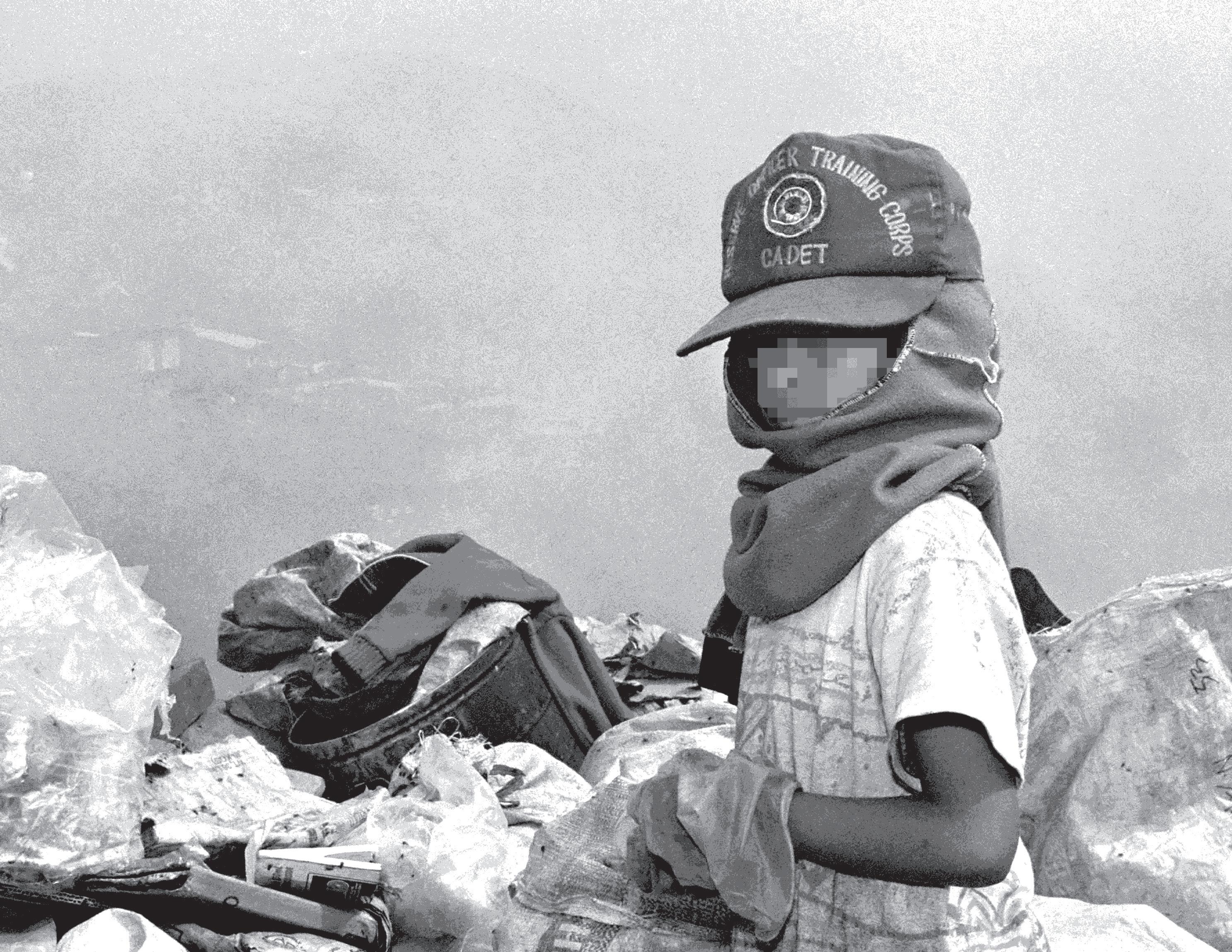
IN the Bangsamoro region of southern Philippines, a former scavenger recalls: “We lived near the garbage dump. We were scavengers.”
Exposed to numerous toxins in the air and the surfaces they touched, these scavengers collected plastics and cans for sale.
The Bangsamoro region is largely agriculture-based, with children often trapped in child labor.
“Since I was 12, I have been working daily 7:00 a.m. to 11:30 a.m., then returned at 12:30 p.m. until 3:30 p.m,” another one said.
Child labor strips children of their rights to protection, learning and health. Change restores them. Now, initiatives are being pushed to replace danger with opportunity.
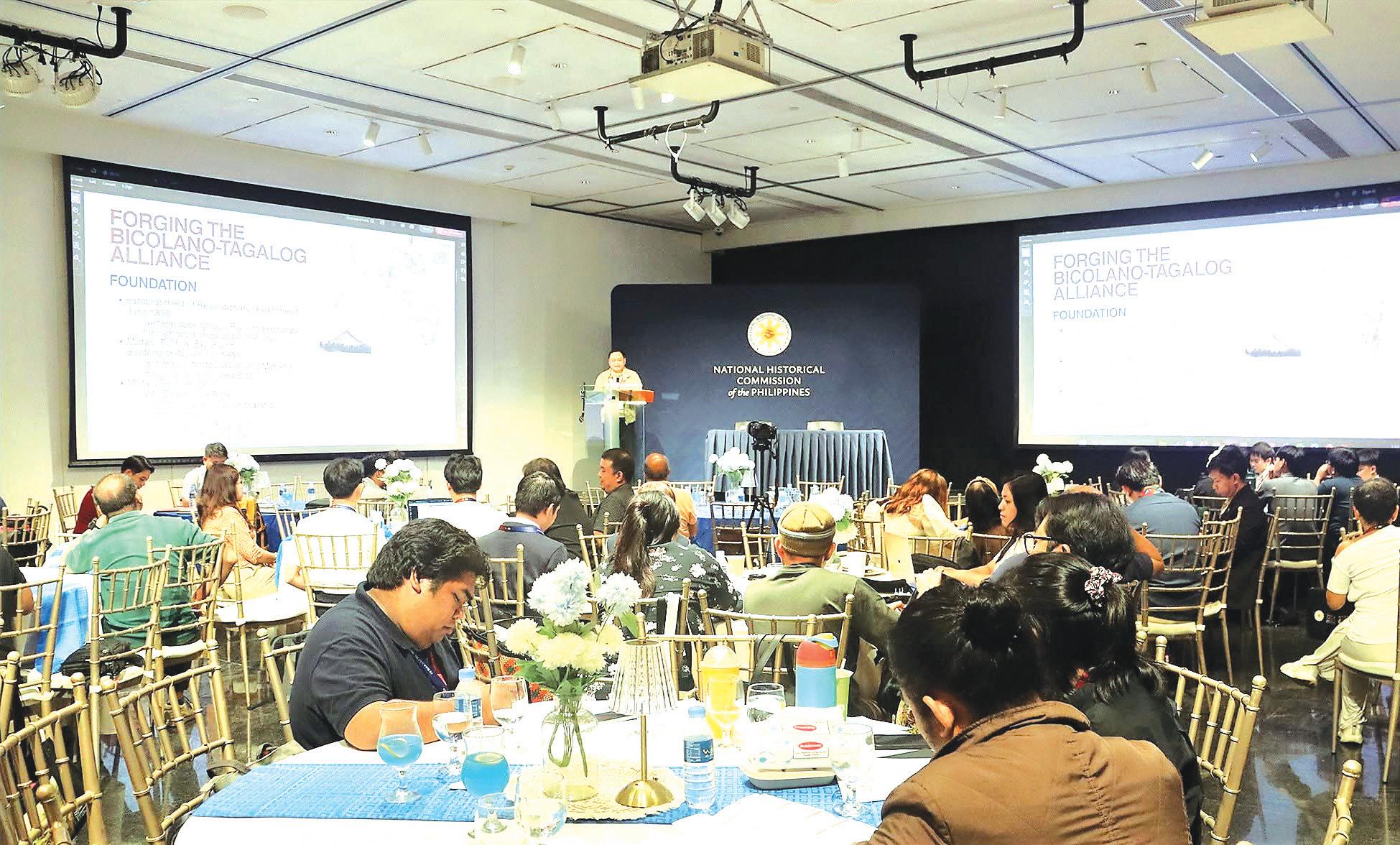
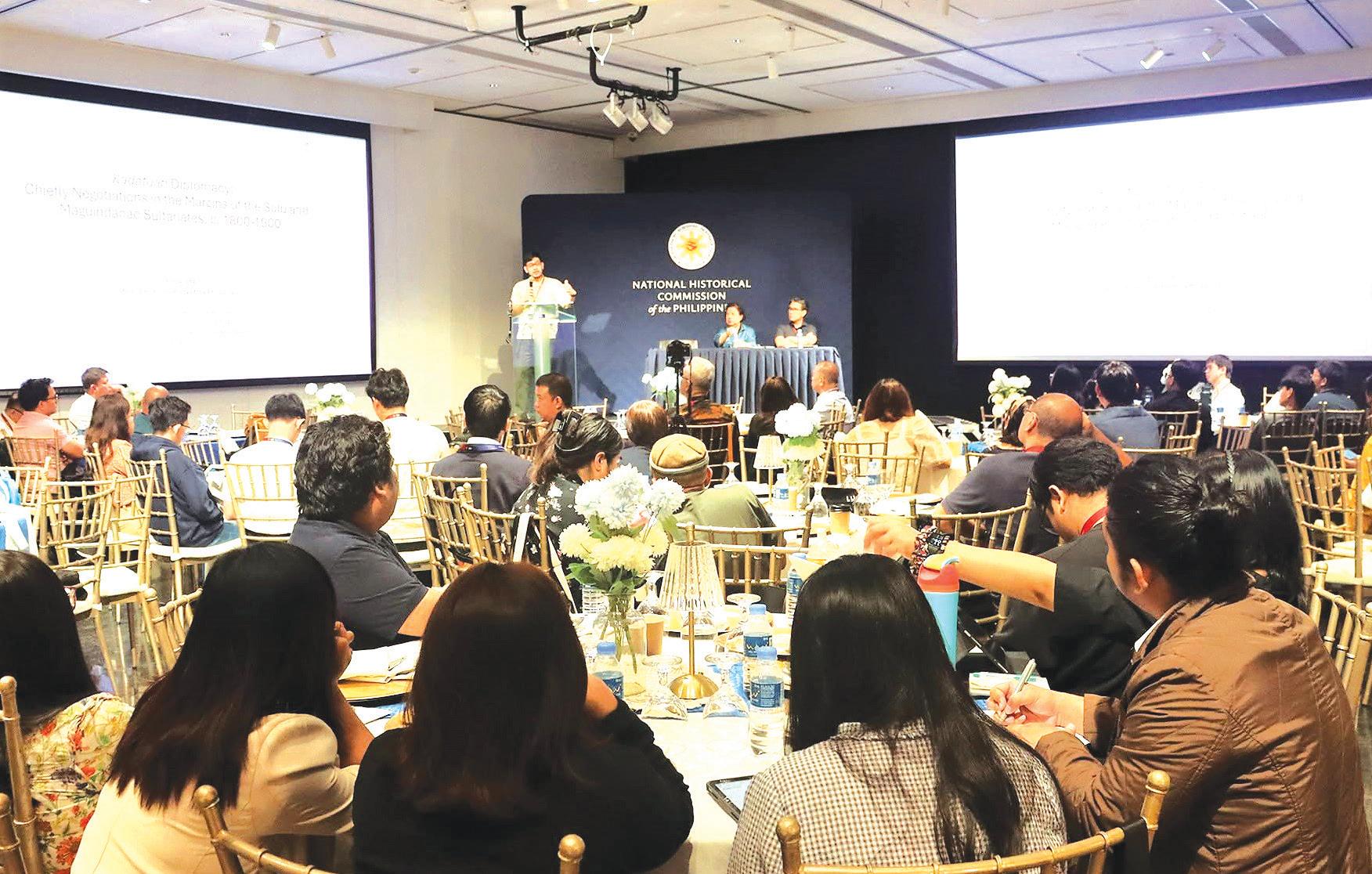
The film Learning Not Labor directed by Tu Alid Alfonso, spotlights this shift as part of the International Labour Organization’s (ILO) Voice of Action series ahead of the 6th Global Conference on the Elimination of Child Labour
and challenge child labor through education, arts, and the media.
Interagency effort, access to education
TO address the issue of child labor, an interagency effort is crucial. Besides DSWD and DOLE and the local BARMM labor ministry, the DepEd said that they have implemented several initiatives aimed at reintegrating learners engaged in child labor activities into the formal education system, with emphasis on flexible learning modalities.
These initiatives align with DepEd’s commitment as a member of the National Council Against Child Labor (NCACL).
As part of its mandate, DepEd’s role involves ensuring children’s right to education, preventing dropouts, implementing policies against child labor, and developing strategies for child-focused interventions.
Among the key initiatives include:
• ALS. Offers a non-formal education using a flexible, modular, and community-based approach for out-of-school children.
on February 11-13, 2026, in Marrakech, Morocco.
It showcases the ILO Japan’s project Achieving Reduction of Child Labour in Support of Education (ARISE), for sustainable livelihoods like mushroom farming in Barangay Looy, South Upi, Maguindanao del Sur.
These livelihoods free families from child labor while the Alternative Learning System (ALS) returns out-of-school youth to education.
Indeed, one can only hope the data are accurate and not underreported: child labor in the Philippines has declined from 828,000 in 2022 to 509,000 in 2024, per Philippine Statistics Authority data. Majority engage in hazardous work, often scavenging or farming.
Bangsamoro’s poverty and decades of armed conflict amplify risks. In response, the ILO Japan ARISE Project helps improve access to education, provide sustainable livelihoods for economic empowerment and social mobilization, and strengthens policies and institution building.
The Supporting Children’s Rights through Education, the Arts and the Media (SCREAM) programs and the Bangsamoro Labour and Employment Code (BLEC) have been cited as further building safeguards.
The ALS bridges gaps. Learners pass Accreditation and Equivalency (A&E) exams to advance; elementary passers enter junior high, then senior high or formal school. One student confessed: “I felt envious of my colleagues who were studying, even though they are already old. I decided to join them and enrolled in ALS.”
The BLEC provisions also cover minimum employment age, skills training and out-of-school aid, preventing child labor.
From dumps to dreams AMONG the advocates to end child labor, Cotabato City Councilor Shalimar Candao is worth citing: she champions action via the Cotabato City Council Against Child Labor. She prioritized “relocating the families living inside the dump site.”
According to a Labour and Employment Ministry official, “Under the BLEC, we have a provision for the apprenticeship of our youth. And for those children at risk of child labor, we also have interventions.”
Director Tu Alid Alfonso observes, “These stories show policy and community interventions creatively uniting to reclaim childhoods. Bangsamoro leads the way to Marrakech.”
Safe housing, schools and livelihoods let families thrive. SCREAM empowers youth to spot
• ALS-Integrated Education and Skill Training (ALS-EST). Provides older working children with practical skills and learning opportunities to improve their future employment prospects.
• Establishment of the Learner Rights and Protection Division (LRPD). Created to promote a safe, inclusive, and protective learning environment, ensuring that all children, including children at risk of or engaged in child labor, can access education free from discrimination or abuse.
• Government Assistance and Subsidies (GAS). Provides financial support to help learners meet educational needs and ensure continued access to quality learning.
• Last Mile School Program. Seeks to address educational gaps by delivering quality education to learners in remote or Geographically Isolated, Disadvantaged, and Conflict-Affected Areas (GIDCA) or indigenous communities, ensuring equitable access to learning.
• Inclusive Education Program. Includes Madarasah Education Program and Indigenous Peoples Education (IPEd) program, designed to address learners’ backgrounds and circumstances, helping them to be engaged in education.
• Development of Session Guides Addressing Child Labor, especially its Worst Form. Online Sexual Abuse or Exploitation of Children and Child Online Sexual Abuse or Exploitation Material (OSEAC-CSAEM) aims to equip teaching and nonteaching personnel with knowledge and skills in properly addressing RP concerns, including the development of interventions and referral strategies.
• Establishment of the Learners TeleSafe Contact Center Helpline (LTCCH), a dedicated reporting channel where learners, teaching and non-teaching personnel, parents, and stakeholders can safely report all forms of abuse, neglect, discrimination, violence, and bullying.
Filipino children face all sorts of terrible handicaps as they grow bigger and older. Severe stunting, for one, was recently flagged by local and international authorities as a serious risk to learners’ health and ability to absorb good education.
Worse, for many young Filipinos, the scourge of child labor further deepens their disadvantage as they seek to use education to pave the way for a better future. Every day, thousands of young people juggle the demands of highly hazardous, tedious work while struggling to keep up with formal schooling.
It’s enough to make one weep. But for them, there is no choice.
Editor: Angel R. Calso
By Jim Mustian & Joshua Goodman The Associated Press
ALBUQUERQUE, N.M.—Even as it battled the deadliest drug epidemic in American history, the US Drug Enforcement Administration permitted hundreds of thousands of fentanyl pills to hit the streets of New Mexico between 2023 and 2025, according to three current and former DEA agents and government records reviewed by The Associated Press.
DEA agents repeatedly monitored shipments of fentanyl pills— but did not seize them—as federal prosecutors sought to bring bigger criminal cases against traffickers of a synthetic opioid that the White House last year designated a “ weapon of mass destruction.”
Agents and experts, however, said the tactic amounted to a gamble with public safety that potentially imperiled communities in and around Albuquerque and may have violated US Justice Department rules intended to safeguard the public.
“We poisoned our community to make cases,” DEA Special Agent David Howell told AP in a series of interviews in New Mexico.
“Through our own willful blindness, we get to say, ‘We don’t really know what happened to the drugs.’ But we 100% got people killed.”
The DEA has long contended it would not be plausible to seize every shipment of every drug. But the strategy of allowing staggering amounts of counterfeit painkillers to hit the streets shocked several veteran agents who spoke with AP.
Ridding the streets of illicit fentanyl, manufactured mostly in Mexican labs, became DEA’s top priority over the past decade as overdose deaths surged. At the same time, its lethality—a few milligrams can kill the average adult—upended time-tested tactics that had been used to combat drugs like cocaine and heroin. Those methods have included allowing drug transactions to be completed so agents might follow the narcotics through the supply chain. Fentanyl, however, is so dangerous that the US Justice Department developed guidelines for agents in such circumstances, encouraging them to seize the opioid whenever “practicable.”
Albuquerque, which has a neighborhood so besieged by drugs it’s known as “War Zone,” and other regions in New Mexico remain at the epicenter of the fentanyl epidemic. While overdose deaths nationwide fell 14% last year, government data show New Mexico tallied a 21% spike.
Alex Uballez, who served as US attorney in New Mexico from 2022 through last year, said authorities at times allowed drug shipments to go unseized as part of a broader effort to gather intelligence and build cases against major drug traffickers. He said the approach reflected his office’s limited resources and his belief that prosecuting larger organizations can have a bigger impact than interdicting every suspected drug transaction.
Last year, DEA recorded the largest fentanyl bust in its history in Albuquerque.
“The bigger fish are worth
catching,” Uballez said, “and that will save more lives.”
The DEA said in a statement that “the investigative decisions at issue were lawful, reasonable under the circumstances and consistent with Department guidance.”
“Public descriptions suggesting that DEA knowingly permitted fentanyl to reach communities are false and fundamentally mischaracterize the facts,” DEA spokesperson Amanda Wozniak wrote in an email. She said the investigations involved court-authorized wiretaps “in which agents and prosecutors conducted real-time surveillance, intelligence gathering, and operational analysis targeting larger drug trafficking organizations.”
Precise intelligence on drug deliveries
IN some cases, the DEA had such detailed intelligence about drug deliveries that agents were able to tally precise pill counts, according to reports reviewed by AP.
Agents, for example, deciphered coded chatter over cellphones and closely surveilled a transaction at a mobile home park in Albuquerque in June 2023, according to a 66-page report reviewed by AP.
Agents wrote in the report that traffickers delivered 74,000 pills as part of that deal, a figure federal prosecutors later confirmed in a court filing.
Days earlier, another DEA report showed, investigators watched the same distribution ring deliver a spare tire hiding another suspected fentanyl shipment that similarly went unseized.
“We did nothing, but sit back and watch,” said Howell, who filed an official whistleblower complaint in 2023 to bring attention to what he thought was a tactic that risked public safety.
Months passed before federal authorities busted the traffickers, and Howell, who participated in the surveillance, said authorities today cannot account for the unseized shipments.
“It’s outrageous to put that many lives at risk in hopes of making a big case,” said Tristan Leavitt, president of Empower Oversight, a whistleblower advocacy group that has asked the Senate Judiciary Committee and Justice Department’s Office of Inspector General to investigate Howell’s claims.
A former DEA supervisor, speaking on condition of anonymity for fear of retaliation, said he and his Albuquerque colleagues allowed “millions” of pills to go unseized during a multi-state investigation last year.
Howell reported in his whistleblower disclosures that agents on that case permitted the delivery of at least 1.8 million fentanyl pills.
That investigation, the former supervisor and Howell told AP, culminated in the largest fentanyl bust in DEA history, a takedown announced in May 2025 by thenAttorney General Pam Bondi that resulted in the seizure of more than 3 million pills.
“The amount we ultimately seized was hitting the streets every month while that case was going on,” the former supervisor said, adding that the DEA could have dismantled the organization six months earlier.
The US Attorney’s Office in Albuquerque did not answer questions about the unseized fentanyl shipments but, in a statement to AP, said the “conduct” Howell brought to light happened during the prior administration.
“The current leadership of this office is focused on aggressively investigating and prosecuting fentanyl trafficking and disrupting the criminal organizations responsible for distributing these drugs,” Tessa DuBerry, a spokesperson for the office, wrote in an email.
Uballez, the former US attorney, said estimated pill counts “based on intercepted phone calls are not reliable.”
“I don’t think I’d contest that drugs are ‘walked,’” he said, referring to the law enforcement tactic of allowing contraband to go unseized to further an investigation. “How much and how frequently—and with what certainty—is incredibly difficult to answer in retrospect.”
To seize or not to seize AS fentanyl overdoses became an epidemic over the last decade, the US Justice Department developed an internal playbook for combatting the deadliest drug ever to cross the Mexican border.
The game plan coincided with a publicity campaign that warned Americans that “One Pill Can Kill,” a DEA effort to highlight fentanyl’s unique dangers.
Adopted in 2017, the department’s two-page “Fentanyl Protocols” called on agents to “seize or otherwise prevent the distribution” of fentanyl “as soon as practicable.” The rules, which have not previously been made public, said that “protecting public safety is paramount,” irrespective of whether seizures compromise investigations.
The Justice Department rewrote the rules in 2024 to afford law enforcement more discretion in such cases. The updated protocols say investigators “may exercise discretion in determining whether to take action to prevent the trafficking of fentanyl,” balancing public safety risks against “the benefits to be achieved through preserving the investigation.”
The DEA rarely discusses the tactic of allowing drugs to go unseized. Its agent manual describes taking drugs off the street as “the usual course of action” but adds “there may be instances where the investigative objectives can be better achieved by not doing so.”
The agency has long used “controlled deliveries” in which constant surveillance of the drugs— and often replacing them with fake narcotics—is followed by a takedown to recover them, according to current and former agents.
In interviews, several current and former agents likened the decision to permit fentanyl to hit the streets to the infamous “Operation Fast and Furious,” a 2011 gun-walking scandal in which straw buyers smuggled some 2,000

assault weapons into Mexico with the intent of tracing the firearms to cartel leaders.
The Bureau of Alcohol, Tobacco, Firearms and Explosives was savaged with bipartisan criticism after two of those guns surfaced at the scene of the fatal shooting of a Border Patrol agent, and the Justice Department explicitly forbid agents from allowing firearms to be trafficked.
Blowing the whistle HOWELL became so unnerved by his agency’s failure to seize fen -
tanyl that he began flagging overdose deaths that might have been caused by the very pills DEA permitted to flow to dealers. One of those cases included a 15-monthold toddler who died after ingesting burned fentanyl residue last year in Española, a New Mexico town ravaged by grinding poverty and addiction.
Howell, who joined DEA 19 years ago after a decade in the Navy, took his allegations to the US Office of Special Counsel. The agency, tasked with protecting whistleblowers, initially found a “substantial likelihood of wrongdoing” and asked the Justice Department to investigate.
In early 2024, Howell told the Justice Department’s Office of Professional Responsibility that DEA agents had observed—yet not seized—separate deliveries of 150,000 and 50,000 fentanyl pills.
DEA and federal prosecutors, he added, “are placing themselves in a precarious position where they will not be able to prove that the fentanyl they could have stopped did not result in the death of a person.”
The Justice Department’s Office of Professional Responsibility
found in 2024 that the DEA and US attorney’s office had made reasonable decisions in deciding to allow drugs to go unseized and that their inaction posed no “specific danger to public health.”
The Office of Special Counsel, which critics say rarely pushes back on agency findings, deemed the Justice Department’s report reasonable.
Howell, meanwhile, paid a price after coming forward. The DEA relegated him to desk duty for more than a year and docked his performance evaluations, according to Howell and DEA records. Internal records also show prosecutors barred him from testifying in federal court, citing his “pattern of refusing to heed” admonitions to allow drugs to go unseized during long-term investigations. Pointing to DEA’s own “One Pill Can Kill” campaign, current and former agents said they could not understand the watchdog’s finding that the tactics had not put the public in danger. They noted the drug is so dangerous it has to be handled in a specialized laboratory.
Goodman reported from Miami.

By Laura Dhillon Kane
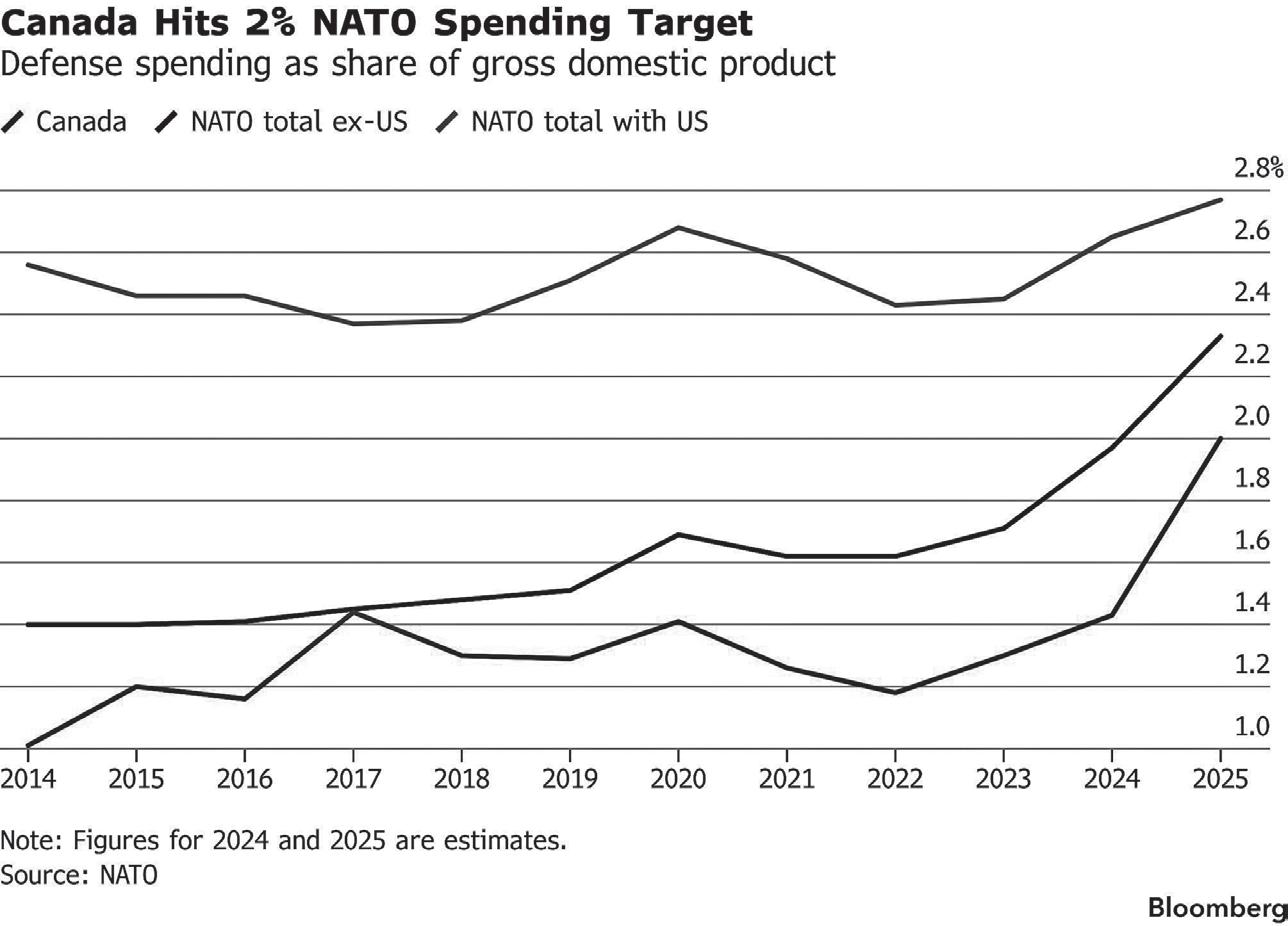
IN late May, a South Korean attack submarine slipped into a harbor in Victoria, British Columbia—a floating sales pitch for one of the largest military contracts in Canadian history.
Days later in Ottawa, Germany’s defense minister stood alongside his Canadian counterpart, making a different case: that the future of Canada’s navy lies in closer alignment with Europe, and with a German-made sub.
Canada is close to a decision on who will win the order to build as many as a dozen vessels, and the political and financial stakes are large. One executive involved in the process estimates the contract may ultimately be worth more than C$100 billion ($70.4 billion) when decades of support and maintenance are included.
It’s also a test of Prime Minister Mark Carney’s strategy of trying to leverage a new foreign policy and defense spending into economic gains. The former central banker won power last year by persuad -
ing voters he could protect Canada from President Donald Trump’s tariff assaults by forging stronger relationships with the rest of the world.
Spending heavily on military equipment and troops is a sharp pivot away from the approach of his predecessor, Justin Trudeau—one Carney hopes to convert into investment and manufacturing and technology jobs. So his cabinet has been squeezing the Germans and South Koreans to offer sweeteners in their bids, such as automotive investment, that might help Canada offset the economic damage done by Trump’s trade war. Like all political strategies, it involves tradeoffs. The submarine decision forces Carney into a choice between a rising Asian
LBy Danica Kirka
The Associated Press
ONDON—Simon Boyd’s firm makes prefabricated steel structures on the south coast of England and ships them to customers as far away as Ghana and Barbados. Mike Hawes represents Britain’s carmakers as the head of the Society of Motor Manufacturers and Traders.
The business leaders were on different sides of the debate when Britain voted to leave the European Union in 2016. But 10 years later they are both frustrated by Brexit.
A decade ago, backers promised that Brexit would be the key to a bright new future where, freed from the edicts of EU bureaucrats, Britain
would regain control of its laws and its borders and the economy would boom. But the reality failed to live up to the hype as Britain struggled to adjust to life without unfettered access to the 27-nation free trade bloc and its market of 450 million people.
Economic growth is anemic, taxes are high, public services are creaking and successive governments have been unable to stem the flow of migrants who wash up on the English Channel coast in inflatable boats. As a result, it’s not exactly a happy anniversary.
“No, it’s not delivered everything that was said it would deliver on the tin, but it is delivering,” Boyd told The Associated Press.
“It’s very sluggish. You only need to look at the statistics to see that.”

economic powerhouse that Canada wants to get closer to, and longtime allies in the North Atlantic Treaty Organization. It will affect the country’s military capabilities, industrial base and alliances for decades.
For months, Canada has been wooed by South Korea’s Hanwha Ocean Co. and HD Hyundai Heavy Industries Co., facing off against a German-Norwegian group led by Thyssenkrupp Marine Systems. Both bidders have put forward sweeping proposals that go well beyond submarines.
Two distinct visions have emerged. Hanwha is offering a submarine design already in service, promising faster delivery—a claim it underscored by docking its KSS-III in Victoria that day.
The TKMS bid, centered on the Type 212CD being developed by Germany and Norway, emphasizes interoperability with NATO allies and deeper strategic alignment with Europe, a message reinforced in Ottawa by German Defense Minister Boris Pistorius.
The submarine contract is a rare prize—the largest of its kind currently on the global market—and it may become the biggest defense purchase in Canadian history, according to David Perry, president of the Canadian Global Affairs Institute. Factoring in decades of operation and maintenance, the total cost may approach C$120 billion, he said.
“We’re really looking at cementing a combination of an economic partnership and a strategic political partnership with whoever wins this thing for the next 75 years,” he said.
The competition has unfolded across continents. Carney and other senior officials have traveled to Korea, Germany and Norway, while delegations from each country have made a series of trips to Canada. The campaign has blended defense arguments with economic diplomacy, as each side positions itself not just as a supplier, but as
Boyd, the managing director of REIDSteel, which employs about 130 people at a plant in Christchurch, England, still stands behind his decision to support Brexit, but blames lackluster results on politicians who weren’t committed to delivering. Britain has also experienced unexpected challenges over the past 10 years, from the Covid-19 pandemic to the wars in Ukraine and the Middle East, Boyd said.
Economists see fundamental issues
THE Brexit vote quickly increased costs for businesses as they prepared for an uncertain future during years of negotiation over the U.K.’s new relationship with the EU. Then, when Britain finally left the bloc on Jan. 31, 2020, new rules governing trade in goods and services made it more expensive and time-consuming to do business with European partners.
Creon Butler, who leads the global economy and finance program at Chatham House, a London-based think tank, said there


a long-term partner.
The German government is confident Canada will choose its bid, and that Pistorius’s lobbying will pay off, according to a person familiar with the matter who was not authorized to speak publicly.
South Korean President Lee Jae Myung has also raised the deal with Carney, but told reporters he “couldn’t really gauge the outcome.”
“Overall, expectations are fairly high, but it’s not easy to be optimistic,” Lee said. “It’s been very hard to get a clear read on the situation.”
Aging fleet CANADA sped up the procurement, and there’s no time to waste. Despite having the world’s longest coastline, spanning three oceans, it has just one seaworthy submarine today, Carney has previously said. And it’s under pressure from the US to spend more on defending its vast Arctic reaches, which are drawing ever more attention from Russia and China.
Hanwha has pledged to deliver four submarines by 2035. The German-Norwegian boats, still under development, trail slightly—though both countries have pledged to transfer one of their own subs to Canada, narrowing
were long-term consequences to leaving the European single market.
“Whatever was promised, whatever one hoped for, (you have) to accept that it has been a major loss of wealth and prosperity for us through the choice we made to leave,” he said.
“That’s a decision the British public have made, and they’re entitled to make it, but it does make us poorer,” he added.
By most measures, the British economy today is weaker than it would have been without Brexit, according to a recent report published by the National Bureau of Economic Research in Cambridge, Massachusetts.
The report, compiled by researchers in Britain, Germany and the US, compares the performance of the U.K. economy to 33 other countries, including its European neighbors, the US, Canada and Japan.
Brexit has reduced Britain’s gross domestic product, a broad measure of economic output, by 6% to 8%, investment by 12% to 13% and productivity by 3% to 4%, the researchers concluded.


the gap by enabling delivery of four vessels by 2036.
Vice-Admiral Angus Topshee, commander of the Royal Canadian Navy, has described both designs as “excellent.” Hanwha’s larger KSS-III features vertical missile launch capability, while the TKMS Type 212CD is designed to make detection extremely difficult.
So the decision may come down to economics, and Carney’s government has been forceful in pushing the bidding groups to add sweeteners that help Canadian industries that have been hurt by US tariffs, such as steel and autos.
South Korea and Germany are both large auto exporters. At one point, Industry Minister Melanie Joly declared, “we want a car plant” tied to the procurement. Hanwha responded with a pitch to build armored vehicles in Canada—if it wins the submarine contract.
Both bidders lined up a broad array of conditional partnerships, including AI deals with Canadian firm Cohere Inc. and agreements tied to Canada’s ambitions for sovereign space launch. TKMS signed up with E3 Lithium to incorporate Canadian critical minerals into its supply chain and turned to firms such as CAE Inc. and Seaspan Corp.
Carmakers had many challenges
BRITAIN’S carmakers were early and outspoken opponents of Brexit, arguing that increased red tape surrounding shipments of parts and finished vehicles would damage an industry built on a network of interlinked factories in multiple European countries.
Those concerns reduced investment in the U.K. auto industry because international carmakers were less likely to see Britain as an attractive way into the European market. As a result, the industry is hoping that international trade deals will help boost demand for its products.
“We have been able to move with the times, so to speak, but undoubtedly it’s putting us at more cost into the industry, more pressure,” Hawes said.
Brexit supporters trumpeted the freedom to negotiate its own trade agreements as one of the primary benefits of leaving the EU, and Britain has since signed dozens of deals with countries ranging from Australia to India to the United States.
But EU countries still account for 41% of Britain’s exports and half its imports, according to the latest government figures.
During more than 50 years as a member of the EU and its predecessors, many British businesses also came to rely on Europe as a source of cheap labor, especially after the bloc’s eastward expansion in 2004.
That pipeline dried up after Brexit ended the free movement of labor, one of the bloc’s founding principals.
The owners of Britain’s curry restaurants, an integral part of communities from Aberdeen in
to support the fleet. Hanwha, for its part, teamed with Algoma Steel Group Inc. on materials supply and tapped Babcock Canada for training and sustainment.
Perry, of the Canadian Global Affairs Institute, said the scale of Canada’s demands is unusual.
“There’s not a precedent for it,” he said, adding that the structure of the competition—narrowed to two strong contenders with no clear front-runner—has escalated the stakes.
For South Korea, winning the deal would help establish it as a major submarine exporter, said Philippe Lagassé, an associate professor at Carleton University. For Germany, the commercial stakes are lower, he said—it’s already an established maker of submarines with NATO ties.
The two campaigns have struck different tones. Lagassé described South Korea’s campaign as energetic and high-profile—including television ads that feature one of Canada’s most famous broadcasters—while Germany’s has appeared more restrained. The Germans “find a lot of the showmanship distasteful,” he said. Those differences have even prompted discussion of an unusual compromise: splitting the fleet, with German submarines assigned to the Atlantic coast and South Korean vessels to the Pacific. Defense experts and government officials—including Carney himself—have cast doubt on that idea, which would add complexity and cost.
Both bidders have invested heavily in the competition, raising expectations and deepening engagement with Canada.
“There will be a diplomatic repair priority for whoever doesn’t win this contract,” said Roland Paris, an international affairs professor at the University of Ottawa. With assistance from Laura Alviž, Soo-Hyang Choi, Brian Platt, Thomas Seal and Mario Baker Ramirez/Bloomberg
Scotland to Aberystwyth in Wales, have been especially hard hit by the loss of Eastern European workers who went home rather than deal with burdensome new visa requirements. And they’re furious because the industry backed Brexit after assurances it would lead to more visas for South Asian cooks, something that hasn’t happened.
“We feel betrayed,” said Oli Khan, president of the Bangladesh Caterers Association UK, who serves up tandoori lamb chops, vegetable biryani and chili paneer at his restaurant in Stevenage, north of London.
In an effort to

AMID the skyrocketing costs of electric bills, the Built Environment Laboratory (BEL) was opened recently in Cagayan de Oro City to help reduce electricity consumption among households and commercial buildings through strategized shading and ventilation.
BEL is among the 60 laboratories funded through the Institution Development Program of the Department of Science and Technology-Philippine Council for Industry, Energy, and Emerging Technology Research and Development (DOST-PCIEERD).
It is equipped with advanced laboratory tools and software that support research and development (R&D) studies related to heating, ventilation, and air conditioning systems, human comfort, productivity, and building efficiency.
According to Prof. Richard Jayson Varela of the University of Science and Technology of the Southern Philippines (USTP) and the project leader, the new studies to develop solutions to improve energy efficiency and indoor comfort will contribute to the modernization of existing building infrastructure in Cagayan de Oro City.
The Dr. Ricardo E. Rotoras Memorial Hall, which is used for large events and activities at USTP, has poor airflow and thermal discomfort due to the blockage of natural ventilation openings.
By using airflow simulation tools, such as Computational Fluid Dynamics and Building Energy Modeling, they experts were able to map out how the air enters, moves, and exits the building. From this, the researchers were able to redesign the building with passive ventilation strategies, which can reduce cooling energy demand by up to 68 percent.
“Before we bring these energysaving solutions to a wider scale, we take the time to carefully test and validate them, to make sure they truly work in real settings. That is why the Built Environment Laboratory was established,”
‘Kapihan’
IN an effort to bridge the knowledge gap and curb the spread of misinformation and disinformation regarding agricultural innovation, the International Service for the Acquisition of Agri-biotech Applications, Inc. (ISAAA Inc.), partnered with the Department of Agriculture’s Philippine Agriculture and Fisheries Biotechnology Program (DA Biotech Program) in hosting the “Conversations on Agri-biotech: A Kapihan Session with the Media” on June 11 at a hotel in Quezon City. The event marked the second installment of the Kapihan series that brought together media practitioners from both print and radio media agencies. Representatives included those from the BusinessMirror, Philippine Star, DZXL-Ang Ating Katipunan, Tuklasin Natin, Syensya Na TekNo Pa, Radyo Henyo-DZRH, DA-Agriculture and Fisheries Information Division, and the Department of Development Broadcasting and Telecommunication, College of Development Communication in the University of the Philippines Los Baños.
DOST-PCIEERD Deputy Executive Director and OIC, Engr. Niñaliza H. Escorial said.
“By investing in this facility, we are not only supporting our researchers and engineers, but we are also making sure that the solutions they develop genuinely improve the comfort and everyday experience of the people who use these spaces,” Escorial added.
Among the studies conducted under the new R&D facility is the integration of mechanical design, sensor-based automation, and adaptive shading layers in smart blinds to balance indoor thermal levels and minimize the reliance on cooling devices, which contribute to higher energy consumption.
“What stands out in this initiative is the researchers’ attention to everyday realities, how heat, airflow, and comfort affect those who use these spaces daily. Their work brings us closer to solutions that truly respond to people’s needs,” said DOST Undersecretary Dr. Leah J. Buendia for Research and Development.
In the 2024 data of the Department of Energy (DOE), commercial and residential buildings account for 54 percent of the consumption of the country’s total energy production.
Currently, the country faces power interruptions due to higher energy demand. In the fourth quarter, El Niño is expected to occur, which can trigger more power alerts according to DOE.
“The initiative comes at a critical time, as the Philippines continues to face increasing pressure on its power supply system driven by population growth, rapid urbanization, and heightened cooling demand during hotter seasons,” said Science Secretary Renato U. Solidum Jr.
“With BEL, we can strengthen our capacity to generate solutions to this problem not only within the university but also communities and industries facing rising energy costs,” Solidum added.
“As media reports shape public beliefs and opinions, we acknowledge the importance of information literacy on biotechnology to effectively counter misinformation and disinformation. As ISAAA is firmly committed to providing different stakeholders with factual and verified information on biotechnology, we strongly believe that engaging the media can close the knowledge gaps about the technology,” said Panfilo de Guzman, Senior Associate Scientist at ISAAA Inc. Dr. Abraham J. Manalo, an Assistant Professor at the University of the Philippines Diliman and executive secretary of the Biotechnology Coalition of the Philippines, shared compelling, localized data demonstrating the tangible socio-economic benefits of genetically modified (GM) crops in the Philippines. Manalo highlighted that while agricultural land remains the same, GM corn has significantly boosted national production, yielding an estimated income gain of approximately P70,000 per hectare, according to studies.

THE record-breaking heat that’s scorching Europe day and night this month would not have been possible without climate change, according to a new study.
The World Weather Attribution rapid study released Friday found that the heat would have been virtually impossible just five decades ago, and is 200 times more likely today than it would have been 20 years ago.
Millions in France, Italy, Spain, the United Kingdom and elsewhere in Europe are experiencing extreme temperatures and humidity this week associated with a heat dome.
Daytime temperatures have topped 40 degrees Celsius (104 Fahrenheit) in many places, while high nighttime temperatures have also made it harder to cool down and recover.
The scientists estimated that a heat wave with similar characteristics occurring in the climate of June 1976 would have been about 3.5ºC (6.3ºF) cooler during the day and about 2ºC cooler (3.6ºF) in 2003.
The nighttime temperatures would have been about 2.4ºC (4.3ºF) cooler in June 1976 and about 1.3ºC (2.3ºF) cooler in 2003. They chose 1976 and 2003 for comparison because those years saw extreme heat in Europe.
“The increase in temperatures was so dramatic that we would have expected to have never seen this event in the 1976 climate,” said the study’s lead author Theodore Keeping, also a climate scientist at the Centre for En -
vironmental Policy at Imperial College London.
“And it would also still have been very, very rare, even 23 years ago in 2003,” Keeping said.
Climate change is the driving force behind the heat WORLD Weather Attribution, a Europe-based collaborative of scientists who study the causes of global extreme weather events, began assessing in 2015 the extent to which those could be attributed to climate change caused by the burning of fossil fuels such as coal, oil and gas.
The organization’s rapid attribution studies, including this one, aren’t peer-reviewed but use peerreviewed methodology.
The current study used observed temperature data and forecasts for an analysis of the heat wave that started on June 18.
It also found that 45 percent of the 850 cities analyzed across 30 European countries have broken, or are expected to hit, records for heat stress levels, a measure that includes humidity and temperature.
“It directly relates to the heat stress on the human body and our ability to cool ourselves down, and it’s a really good metric for the expected health impacts we expect to see from this heat wave,” Keeping said. Heat and humidity make for a dangerous combination for humans.
Ultimately, this marks the most severe heat wave to have ever been recorded in this region of Europe and most severe humid heat event,

WWA researchers said.
Europe is especially unequipped for these extreme temperatures
EUROPE is the world’s fastestwarming continent, with temperatures increasing at twice the speed as the global average since the 1980s, according to the European Union’s Copernicus Climate Change Service. I n a separate study last year, WWA researchers found there were about 1,500 climate changecaused deaths during a European heat wave last summer.
This week, weather agencies across Europe have issued red alerts about heat risks, and sporting events, schools, public transportation and attractions have been limited as a result.
Many of these countries do not have widespread air conditioning or other infrastructure to account for warmer climates.
France, which has been bearing much of the brunt of the heat wave, recorded its hottest day ever this week, and has also reported 40 deaths from drownings as people seek cooling relief.
The WWA scientists said the current El Niño warming cycle did not influence this heat.
Europe also experienced record-shattering high temperatures in May. Typically, Europe does not see dramatically warmer weather until July and August.
The findings of the study released Friday are reasonable, but may downplay climate change’s role in the heat, said Michael Mann, a climate scientist at the University of Pennsylvania who was not involved in the research.
“If anything, this latest assessment—and all similar assessments—are actually underestimating the role that climate change is playing here,” said Mann, who has separately studied how climate change is increasing heat stress in North America. Keeping, the study author, said the Europe heat wave shows the need to adapt infrastructure and behavior to extreme temperatures.
“We need to expect them to happen. They’re only going to become more frequent in the near term,” Keeping said. “We also need to address the source of climate change as well. And that is very simply carbon emissions from burning fossil fuels.”
Alexa St. John/Associated Press
SEN . Francis “Kiko” Pangilinan filed a Senate resolution commending the six Filipino scientists who have been named by the “Asian Scientist Magazine” among the 2026 Asian Scientist 100 honorees.
Proposed Senate Resolution 462, filed on June 17, recognized Dr. Marcela M. Navasero, Dr. Romulo G. Davide, Dr. Mary Donnabelle L. Balela, Dr. Garry A. Benico, Dr. Aurelio A. de los Reyes V, and Dr. May Anne E. Mata for bringing “immense pride and prestige” to the country.
“Their dedication to scientific excellence and innovation will inspire future generations of Filipinos to pursue careers in science, technology, engineering, and mathematics,” Pangilinan said.
In the resolution, the lawmaker highlighted the diverse fields represented by the Filipino honorees, including agricultural science, environmental protection, marine and aquatic biosciences, mathematical sciences, and infectious disease modeling.
Furthermore, he highlighted homegrown innovations, known as “Pinoy Biotek,” such as UPLB’s Bacillus thurigiensis

Navasero led research on natural pest control and agricultural biosecurity; Davide is hailed as the “Father of Philippine Nematology” for his work in plant pathology and nematology; Balela developed modular kapok booms for marine oil spills; and Benico
(Bt) eggplant, Philippine Fiber Industry Development Authority’s Bt cotton, and Philippine Rice Research Institute and In -

led studies on taxonomy and diversity of harmful microalgae.
De los Reyes is being cited for his work on infectious disease modeling and translating biological processes into dynamical systems and equations, while Mata did research in
ternational Rice Research Institute’s Golden (Malusog) Rice and high-iron and zinc rice.
Ma. Lorelie U. Agbagala, Assistant Scientist at the Department of Science and Technology and the head of the secretariat of the National Committee on Biosafety of the Philippines, tackled the inherent challenges of reporting on complex scientific topics.
Agbagala urged media practitioners to avoid “red flag reporting traps” such as false balance, exaggeration, and sensationalism.
In her presentation on the case of Bt talong and Golden Rice, she emphasized that the words used by journalists directly impact policy outcomes and farmers’ livelihoods.
An open forum addressed pressing regulatory and local governance issues, specifically concerning local government units that maintain anti-GM ordinances.
Dr. Ernelea Cao and Dr. Lourdes Taylo noted that while the Philippines has a rigorous, legally resilient regulatory framework that can withstand judicial scrutiny,
infectious disease modeling and analysis, applied mathematics, mathematical biology, and operations research.
The Asian Scientist 100 recognized top researchers and scientific leaders in the Asia-Pacific region who have advanced scientific knowledge and innovation to protect people and the environment, have received a national or international award from a recognized body, and have made significant scientific discoveries.
“This recognition proves that Filipino ingenuity and talent can compete with the best in the region and the world. It is also a reminder of the need for us to support research and development and strengthen our scientific and academic institutions to create opportunities for Filipinos to contribute to nation-building through science,” Pangilinan said. The Asian Scientist Magazine published its eighth edition of the Asian Scientist 100. It is an annual list that honors the most outstanding researchers and scientists in the Asia Pacific region.
community-level engagement remains paramount.
Through provincial lecture caravans and multi-sectoral briefings, scientists are actively translating complex technical data into laymanized languages, effectively turning initial skepticism into trust and high demand among local farmers. Manalo predicted inevitable growth, greater public acceptance, and the integration of artificial intelligence within the biotechnology sector in the next decade. To sustain this momentum, stakeholder groups called for continuous public engagement and the eventual enactment of a codified, legislative biotech law.
DA Biotech Program’s Director, Dr. Paul C. Limson issued a call to action, emphasizing that progress must be driven by evidence rather than fear.
“We need to continue providing discussion platforms to discuss vital, fact-based conversations,
A6 Sunday, June 28, 2026

Editor: Lyn Resurreccion • www.businessmirror.com.ph
FOLLOWING a series of violent incidents in schools, the country’s association of Catholic learning institutions has called for a “holistic reform” of the education system that goes beyond academic performance and job readiness.
The Catholic Educational Association of the Philippines (CEAP), in a statement said reforms must strengthen character formation, emotional well-being and social responsibility among learners.
“integral human development” in ongoing policy reforms.
“CEAP calls on the government, DepEd, CHEd, and all stakeholders for urgent, holistic reform that prioritizes integral human development over purely technical goals,” it added.
It also called on families and communities to take a more active role in shaping young people’s values, communication skills and emotional stability.
“We reaffirm our commitment to forming men and women for others through faith, reason, and compassion,” CEAP said.

On June 16, seven Grade 5 pupils at Bethel Academy in General Trias, Cavite, were hurt when attacked by a Grade 8 student allegedly armed with a kitchen knife.
CEAP said the series of violent incidents inside school campuses is alarming, noting that educational institutions are meant to be safe spaces for children.
“These recent events further remind us that education reform must continue to uphold a holistic view of the learner–one that advances academic achievement and workforce readiness while also nurturing character, values, emotional well-being, and social responsibility,” CEAP said.
The group urged the Department of Education (DepEd), Commission on Higher Education (CHEd) and other government agencies to prioritize what it called
THE head of the Catholic Bishops’ Conference of the Philippines (CBCP) has expressed support behind an interreligious rally to call for measures against corruption and political dynasties.
Archbishop Gilbert Garcera, CBCP president, described the “White Ribbon March” set on June 28 at the EDSA People Power Monument as a nonpartisan expression of concern for justice and integrity.
“Those who, guided by their conscience and local circumstances, wish to participate in this peaceful gathering may do so prayerfully and respectfully,” Garcera said in a pastoral message issued on June 22. He urged the faithful to remain steadfast despite widespread concerns over corruption, injustice and declining public trust in institutions.
“Let us not lose hope,” he said, calling on Catholics to draw strength from worship and prayer amid social challenges.
Garcera also underscored the central role of the Eucharist in moral renewal, saying: “The power of the Eucharist renews hearts and transforms lives, enabling us to become instruments of justice, reconciliation, and hope.” He further cited the nationwide pilgrimage of the image of Our Lady

of Guadalupe as a source of spiritual guidance and protection, praying that she “intercede for our people, guide our leaders, and lead us closer to her Son, Jesus Christ.”
Organizers said the rally, led by the Inter-Religious Leaders Council for National Transformation, aims to mobilize public support for electoral reforms while raising concern over entrenched governance problems, including corruption and political dynasties.
At the EDSA site, organizers expect at least 10,000 participants for the demonstration, which they said builds on last year’s “Trillion Peso March” protests and events marking the 40th anniversary of the 1986 People Power Revolution on February 25. CBCP News

BISHOP Jose Elmer Mangalinao of Bayombong announced Wednesday that a court dismissed charges against him and other environmental advocates opposing a mining exploration project in Kasibu, Nueva Vizcaya.
In a statement, he welcomed the ruling, calling it “a victory for truth, justice, and the collective efforts of communities who courageously stand to protect our land, water and future generations.”
“Today, we give thanks to God and to all of you. The court has dismissed the case filed against us and our fellow watershed defenders,” Mangalinao said. He said the decision was more than a legal victory, describing it as an affirmation of the rights of communities working to protect natural resources and local livelihoods.
The bishop credited the legal team and supporters who stood with the environmental advocates throughout the case,
saying their efforts helped defend not only individual rights but also environmental justice and the common good. He said the dismissal should serve as a reminder that protecting watersheds, the environment and sources of livelihood is “not a crime.”
“It is a shared responsibility,” Mangalinao said.
The 66-year-old bishop said environmental defenders would continue their work through peaceful and lawful means.
“We hold no resentment toward anyone. Instead, we move forward with renewed commitment to peaceful advocacy, environmental stewardship and the protection of the sacred gift of creation,” he added.
“The struggle continues, but today we pause to thank God and all who stood with us…and every supporter who believed in our cause,” he also said. CBCP
CEAP issued the statement a day after a shooting incident inside San Jose National High School in Tacloban City that killed three students and wounded 15 others.
Police said two suspects, aged 14 and 15, were arrested and placed
under the custody of the City Social Welfare and Development Office while investigations continue. The statement also cited earlier
incidents, including a June 19 stabbing at Cavite National High School in Cavite City that left an 18-yearold student injured.
“CEAP expresses profound alarm and deep sorrow over the recent stabbing and shooting incidents on separate school campuses,” it said. “These tragic events, which claimed lives and inflicted serious injuries, mark a harrowing escalation from bullying and peer conflicts to outright killings.”
“Schools, meant to be sanctuaries of learning, growth, and formation, are now turning into places of fear and violence,” it added. CBCP News
VATICAN CITY—A breakaway group of traditionalist Catholics will challenge Pope Leo XIV’s authority next week by consecrating four bishops without his consent. Rather than shying away from the confrontation, the Society of St. Pius X seems intent on embracing its notoriety.
The group, which celebrates the traditional Latin Mass and rejects the modernizing reforms of the Catholic Church, is planning a highly organized, four-day, livestreamed extravaganza for the consecrations at its Swiss seminary—complete with a souvenir wine set offered to those attending.
The July 1 event, nearly four decades after the group first became a thorn in the Vatican’s side, suggests it is leaning in even more ardently to its schismatic status for a new generation of Catholics who prefer their Masses in Latin and don’t mind that their bishops are out of communion with Rome.
“To me, they look really like Traditionalism 2.0,” said Massimo Faggioli, professor of theology at Villanova University, Leo’s alma mater.
The group, known as the SSPX, has embraced a digital branding of its religious identity, despite its antimodern, integralist agenda.
“Their game is not about getting back into the fold, but getting back into the monopoly of that ultratraditionalist identity,” Faggioli said.
An initial break with Rome THE SSPX was founded in Écône, Switzerland, in 1970 in opposition to the reforms of the 1960s Second Vatican Council, the church meetings that, among other things, allowed Mass to be celebrated in the vernacular rather than Latin.
The group first broke with Rome in 1988 when its founder, Archbishop Marcel Lefebvre, consecrated four bishops without papal consent.
The Vatican promptly excommunicated Lefebvre and the four other bishops, and the group today still has no legal status in the church.
Yet in the decades since that original schismatic act, the group has continued to grow, with schools, seminaries and parishes around the world and branches of priests, nuns and lay Catholics who are attached to the traditional Latin Mass.
The growth poses a threat to the Holy See since the SSPX amounts to a parallel, ultra-Catholic church: Today the SSPX counts two bishops, 733 priests, 264 seminarians, 145 religious brothers, 88 oblates and 250 religious sisters representing 50 nationalities, according to SSPX statistics.
Next week, their numbers will grow with ordinations of a handful of new priests and four new bishops: Pascal
Schreiber of Switzerland, Michael Goldade of the United States, and Michel Poinsinet de Sivry and Marc Hanappier, both of France.
The Vatican has already warned that such consecrations constitute a “schismatic act” and a “grave offense to God” that incurs automatic excommunication, or a casting out of communion under the pope, for the four bishops and those who perform the rite.
A planned consecration to save souls
THE SSPX superior, the Rev. Davide Pagliarani, has justified the consecrations by arguing that the SSPX’s two surviving bishops from the original 1988 consecrations are old and can’t minister to such a global reality. He has invoked what he calls a “state of necessity” to save souls.
For the SSPX, the post-Vatican II church is awash in heresies and has strayed from core tenets of the Catholic faith.
After Pagliarani announced the consecrations, the Vatican invited him for talks. But the same theological and practical problems that have prevented rapprochement for 50 years left the two sides at an impasse.
In announcing the names of the four new bishops last month, the SSPX insisted that it is not seeking to claim power or jurisdiction from Leo or “establish a parallel authority within the church.”
“The ceremony of July 1st will have no other purpose than to ensure the continued administration of the sacraments of Holy Orders and Confirmation, together with those sacramentals reserved to bishops, according to the traditional rite of the Holy Roman Church and the immemorial Faith,” the SSPX statement said.
The website for the event suggests months of preparation for thousands of people to attend: Registered participants can book accommodation at more than a dozen nearby hotels
and family homes; they can request carpooling options from more than 100 locations; and prepay daily lunches via a festival-style wristband.
And then there is the wine.
Registered participants can “take home a memory of this historic event” by purchasing a limited edition set of four bottles of wine. Each bottle features a bishop-themed label: an image of a bishop’s pointed miter hat, his ring, cross or crozier staff.
The 75 Swiss franc ($92.50) “Cuvee des Sacres” gift box—Pinot noir, Syrah, Petit Arvine and Fendant—is available for pickup on site.
That level of organization suggests “they never had any idea of walking back” the plans, Faggioli said.
The pope seems OK to move on
THE consecrations pose a direct challenge to church unity and Leo’s authority, since papal consent for new bishops is a fundamental expression of his authority, and is required to guarantee apostolic succession—the lineage of bishops from Christ’s original apostles.
The American pope, however, seems resigned that the ceremony will go ahead and that the SSPX will suffer the consequences.
Leo said last week he was considering a new appeal to the SSPX to back off its threat.
“But it is their choice. We need to realize what this means for them and for the church,” Leo told reporters.
Division among Christians, he said, is always painful.
“However, they refuse to accept certain fundamental elements of the church, starting with various points of the Second Vatican Council. And while regret that choice, we must move forward.”
Other traditionalists react with both dismay and sympathy
FROM the start of his pontificate, Leo
has sought to pacify relations with Catholic traditionalists that worsened under Pope Francis.
While the Argentine pope had offered some concessions to the SSPX, he cracked down on the spread of the old Latin Mass among other traditionalists in communion with Rome.
These Catholic traditionalists opposed Francis’ crackdown and sympathize to some extent with the SSPX arguments about a “crisis” in the church today. But they haven’t gone to the SSPX and are firm that the consecrations are an unlawful act of disobedience.
Joseph Shaw, head of the Latin Mass Society of England and Wales, said the consecrations were intended to be very public, unlike unauthorized ordinations by other fringe groups “that take place in hotel rooms.”
“There’s a general principle that Catholics have a right to know that their sacraments are valid,” he said. “And they [the SSPX] have the resources to do it nicely.”
Luigi Casalini, of the Messa in Latino (Latin Mass) blog, said the consecrations are “grievously unlawful” and that the SSPX claim of a “state of necessity” to justify them is unfounded.
But he also accused the Vatican of a double standard: threatening SSPX bishops with excommunication for their ultra-orthodox deviation from Rome, while actively negotiating with German bishops on their ultraprogressive reforms that also run afoul of Catholic doctrine.
With days to go before the ceremony, the SSPX on Wednesday penned a “profession of faith,” and sent it to Leo and all the world’s cardinals.
In the text, the SSPX insisted that its traditionalist approach was the only response “to the chief errors and gravest dangers of our time,” which it identified as liberalism, modernism and ecumenism, among other things.
Nicole Winfield/Associated Press


Editor: Lyn Resurreccion

By Jonathan L. Mayuga
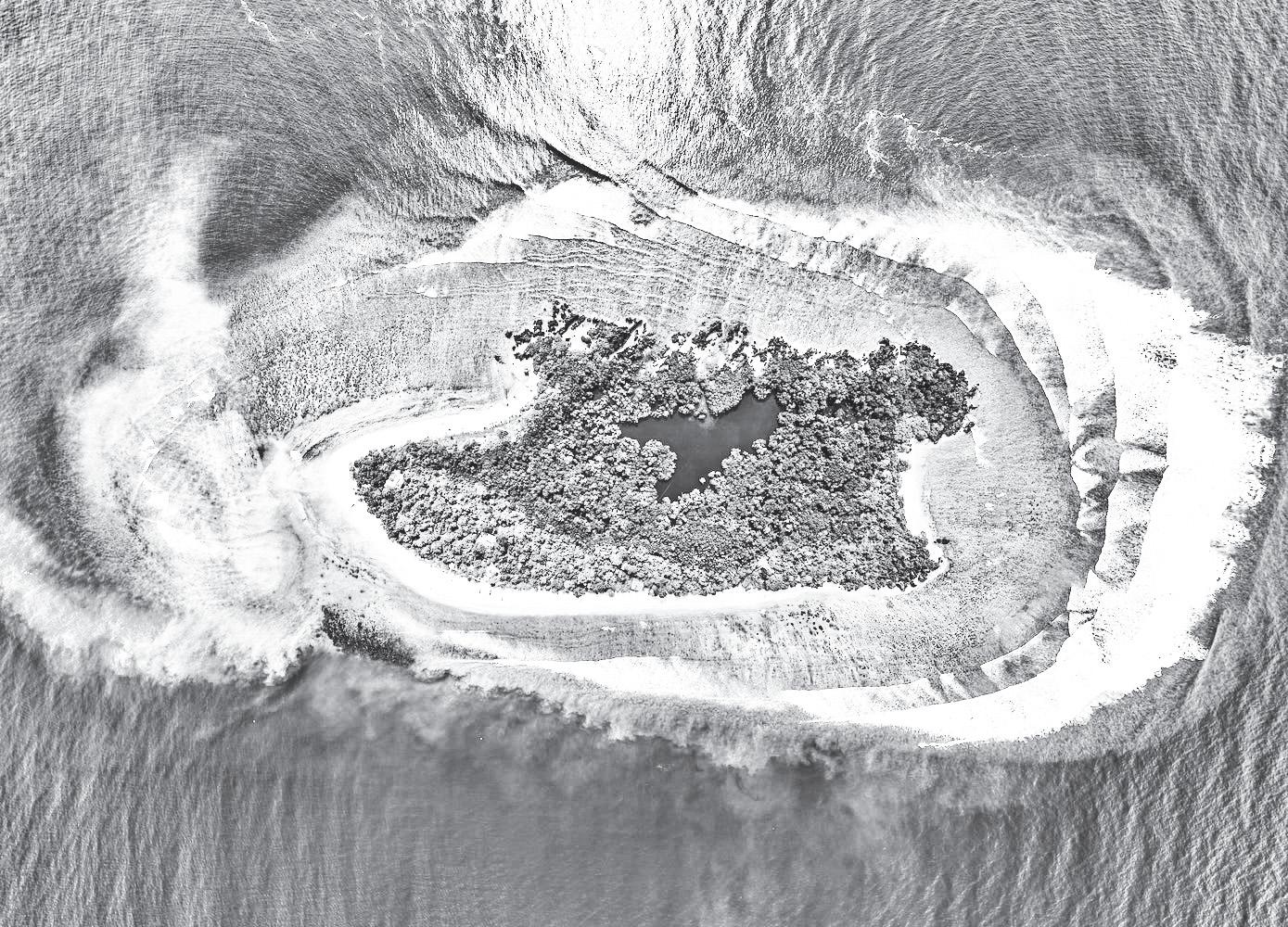
ATOWN in Occidental Mindoro, known for its unique and rich biodiversity, was declared a Unesco Biosphere Reserve during the 38th International Coordinating Council of the Man and the Biosphere Program of the United Nations Educational, Scientific, and Cultural Organization. The declaration coincided with the global celebration of World Environment Day on June 5.
Spanning an area of roughly 2,188 square kilometers, the municipality of Sablayan, a first-class coastal municipality in the province of Occidental Mindoro, is the largest in the Philippines by land area.
Jubilant stakeholders in Sablayan are not stopping here, as the town’s local chief executive said part of the ambitious plan is to earn the title of Unesco World Heritage Site.
Philippines’ 5th Unesco Biosphere Reserve
WITH the declaration, the Matibay na Bayan ng Sablayan Biosphere Reserve (MBSBR) became the fifth Unesco Biosphere Reserve in the Philippines. The four others are Puerto Galera in Oriental Mindoro; Palawan, the country’s last ecological frontier famously known for the Puerto Princesa Subterranean River and Tubbataha Reefs Natural Park; Albay province, home to the Mayon Volcano; and the Apayao in the Cordillera Administrative Region in Northern Luzon, a habitat of the Philippine Eagle.
Considered the gateway to the famous Apo Reef Natural Park (ARNP), the largest contiguous coral reef system in the Philippines and the second-largest in the world, and home to the Mounts Iglit-Baco Natural Park (MIBNP), the last remaining habitat of the Philippine tamaraw, the rarest land mammal in the world, Sablayan is a worldclass ecotourism hub. ARNP and MIBNP serve as the core protected zone under the Matibay na Bayan ng Sablayan Biosphere Reserve.
Valuable conservation areas THESE prestigious protected areas—one an underwater marine sanctuary and the other a massive mountain range—are both Asean Heritage Parks (AHPs) and are considered model conservation areas in the Philippines.
Besides the ARNP and MIBNP, Sablayan is strictly protecting and conserving the Francis Burton Harrison Game Refuge and Bird Sanctuary, Mindoro Pines Forest, Upper Amnay Watershed Region, and the SiburanAruyan-Dangari-Iyason-Kinarawan Critical Habitat, the only remaining lowland forest in Sablayan.
Some of these areas have reported sightings of the Philippine tamaraw, also called the Mindoro dwarf buffalo.
Rich biodiversity INTERNATIONAL biodiversity expert Theresa Mundita S. Lim said Sablayan is a known range of the tamaraw and encompasses two major protected areas: the terrestrial Mounts Iglit-Baco Natural Park and the marine Apo Reef Natural Park.
She recalled that in 2016, scientists also discovered new species of bats in Sablayan and found that the municipality is home to one of the highest diversities of native mammals in Mindoro.
“Apo Reef, for its part, is a rich and highly productive marine ecosystem. It also serves as an important breeding and nursery ground for ecologically significant marine species, including sharks and manta rays,” Lim said, sharing that she personally observed its magnificent beauty and amazing biodiversity during monitoring visits while serving as former Department of Environment and Natural Resources-Biodiversity Management Bureau (DENR-BMB) director.
Lim added that Sablayan was also selected as a reintroduction site for rehabilitated Nicobar pigeons because of its suitable habitat conditions and its remaining capacity to support the recovery and survival of wildlife populations.
Home to IP communities, island ecosystem SHE said equally important, Sablayan is
home to Indigenous peoples (IP) communities who are integral to the cultural and ecological heritage of Mindoro.
“The Mangyans have coexisted with the island’s rich biodiversity for generations, guided by traditional knowledge systems and a deep relationship with the land, forests, and natural resources. Their role in sustaining this landscape must be recognized and respected. However, the ecological richness of Sablayan also comes with increasing vulnerability,” she explained.
According to Lim, like many island ecosystems, Sablayan faces pressures from in-migration, unsustainable tourism, encroachment, habitat degradation and loss, and the introduction of pests, diseases, and invasive species.
“These threats can weaken ecological resilience and place both biodiversity and local communities at risk. Hopefully, the declaration of Sablayan as a Unesco Biosphere Reserve will bring greater attention to the importance and vulnerability of island ecosystems, strengthen vigilance, and promote collective responsibility in protecting not only Sablayan’s biodiversity but also the traditional ways of life and knowledge systems that have contributed to its conservation. With this, Sablayan can become a true model of people living in harmony with nature,” said Lim, former Asean Centre for Biodiversity executive director.
THE DENR in the Southwestern Tagalog Region consisting of Mindoro, Mariduque, Romblon and Palawan (DENR-Mimaropa) welcomes the declaration and joins the people of Sablayan in celebrating the designation of the prestigious title.
“The designation marks a significant milestone in the collective efforts of government agencies, local government units, indigenous peoples, local communities, conservation advocates, and development partners to protect and sustainably manage one of the Philippines’ most important biodiversity landscapes,” DENR-Mimaropa said in a Facebook post on June 5.
According to the DENR-Mimaropa Office, a Unesco Biosphere Reserve is a globally

recognized area under Unesco’s Man and the Biosphere Programme that demonstrates how biodiversity conservation, sustainable development, and community well-being can thrive together through responsible stewardship and collaborative governance.
“The recognition highlights the exceptional ecological significance of Apo Reef Natural Park and Mounts Iglit-Baco Natural Park,” it said.
KATHY LENE CIELO, executive director of the Mindoro Biodiversity Conservation Foundation Inc. (MBCFI), said Sablayan’s designation as a Unesco Biosphere Reserve is a victory for the people of Sablayan as well as for environmental advocates who continue to help protect and conserve the town’s rich biodiversity.
As Mindoro’s staunch conservation advocate, MBCFI sits as a member of Mindoro’s Protected Area Management Board as mandated by the National Integrated Protected Area System Act.
Cielo said the holistic approach in biodiversity conservation made Sablayan a perfect candidate for the prestigious Unesco Biosphere Reserve title, and credited the local government of Sablayan and the town’s people for working hand in hand to achieve its goal.
INTERVIEWED by the B usiness M irror
Sablayan Mayor Walter B. Marquez said the recognition was not based only on the beauty of Sablayan, but also to the resilience and discipline of its citizens.
“The ‘Resilient Town’ is a promise that, as we progress, we do not sacrifice nature.
For the Sablayeños, this means more opportunities in eco-tourism, research, and green jobs, while protecting our land and livelihood for the next generation,” he said via email to the B usiness M irror
Under the Biosphere Reserve and ISO 14001, or Environment Management System, the mayor said the town’s governance will become more integrated and science-based.
“We will have clearer zoning—core,
buffer, and transition zones—and stricter monitoring by our Menro [Municipal Environment and Natural Resources Office], tourism, IPAO [Indigenous Peoples Affairs Office], agriculture, and MBSBR TWG [technical working group]. We will no longer work in silos. One plan, one direction,” Marquez said.
Enormous benefits
MARQUEZ said environmental protection and conservation bring enormous benefits to the community.
In a telephone interview on June 17, the mayor said livelihood, eco-tourism projects, organic farming, and sustainable fisheries will increase because of the strong protection and conservation measures implemented in Sablayan.
“With a healthy environment, clean water, our farmers will continue to farm,” he said in Filipino.
With the new designation, the mayor said he expects more training and even scholarships from Unesco and international partners like Itaipu Binacional to pour in.
More importantly, he said Sablayan’s communities are safer from floods and landslides ”because we are protecting our watershed and forests.”
MARQUEZ said with the full support and cooperation of the people, nothing is impossible, saying that they are now eyeing the prestigious title of a Unesco World Heritage Site.
“It’s our next target,” he quipped.
He said the resident are always being involved by the local government in every endeavour, every step of the way.
“Whenever we have a new ordinance, or policy; if we have a program or project, the communities are consulted,” he said. “And they are very supportive,” he said.
He added: “Through our barangay assemblies, IP consultations with the Mangyans, and school campaigns, we have instilled that the MBSBR is not about ‘forbidding everything.’ It is about the ‘proper use of resources.’ They are cooperative because they see the benefits firsthand—clean water, more fish, and the
Threats and challenges
SABLAYAN’S rich biodiversity, however, is not oblivious to threats, including illegal logging, slash-and-burn farming, overfishing, and destructive fishing methods.
Asked what needs to be protected in Sablayan the most, Marquez said it is the so-called lifelines—the Mount Iglit-Baco Natural Park and Sadik Critical Habitat for the Tamaraw, the Apo Reef Natural Park— one of the largest coral reefs in the world, and its precious watershed forests that provide water to the entire town.
“Let us protect the culture and knowledge of our indigenous Mangyan people. They are the first guardians of the forest,” he added.
Endeavors to protect these lifelines are fully supported by the Sablayan local government unit (LGU), through budget allocation for forest guards and coastal law enforcers.
In terms of policy, ordinances passed and approved by the municipal council are aligned with MBSBR.
With the huge gap in manpower, protecting the town’s over 2,244 sq km of terrestrial land area alone is a big challenge.
“That is why this is one of our proposals to Unesco, DENR, and private partners— additional rangers, drones, and better logistics. Protection is an investment, not an expense,” he said.
According to Marquez, the Sablayan LGU continues to implement policies and programs, including anti-mining, strict implementation of the 15-kilometer municipal water for fishermen, a gradual shift to renewable energy, and climate justice advocacy.
He said Sablayan’s greening program requires no huge amount of fund.
“Every Sablayan citizen plants 10 trees every year. It started under my term as mayor in 2022,” he said.
“On Arbor Day, we all go out to plant trees; that’s why our forest is expanding,” he added.
FOR the first time, San Pablo City in Laguna hosted a global event—the 12th International Workshop on Volcanic Lakes organized by the Commission on Volcanic Lakes of the International Association of Volcanology and the Chemistry of the Earth’s Interior.
Thirty-nine foreign scientists visited two of the city’s seven crater lakes—Pandin Lake and Mojicap Lake—that became the center of global scientific attention recently. Scientists from Italy, France, Chile, El Salvador, the United States, and Indonesia joined their Filipino counterparts to study the unique characteristics of San Pablo’s volcanic lakes. During the workshop, the researchers
collected water samples to conduct scientific analysis aimed at understanding the lakes’ physical and chemical properties.
According to Dr. Raymond Maximo of the Department of Science and Technology’s Philippine Institute of Volcanology and Seismology (DOST-Phivolcs), the international workshop examined the characteristics and chemical composition of the lake waters. Maximo explained that by analyzing the collected samples, scientists hope to gain a deeper understanding of the current condition of the volcanic lakes and the natural processes that influence them. For the participating international scientists, the research carries importance beyond academic study.
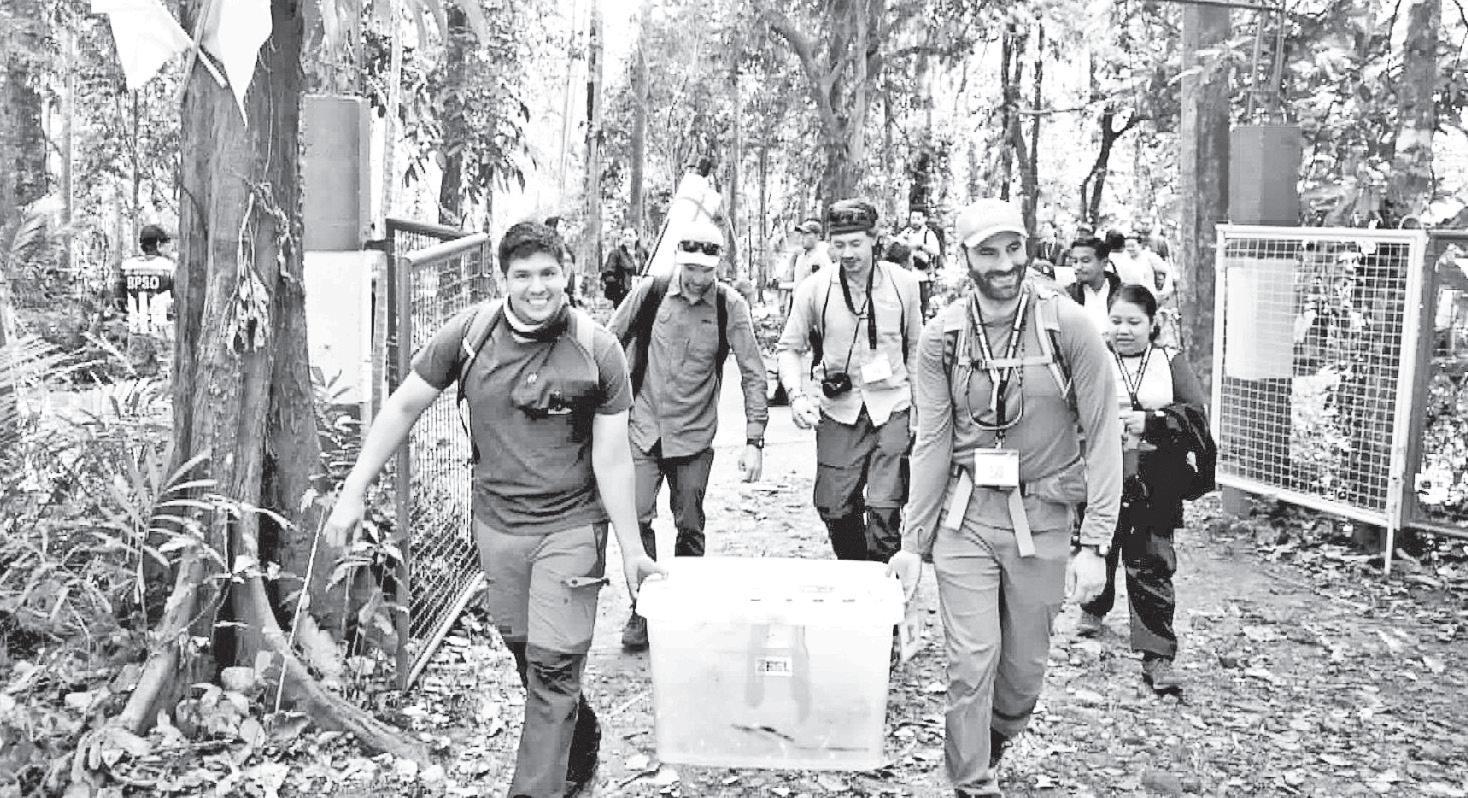
Dr. Rebecca Biagi, a scientist from the University of Florence in Italy, emphasized that the results of their analysis could help local communities better understand the condition of their lakes and the importance of protecting them.
The historic workshop not only showcased international scientific collaboration but also strengthened environmental awareness in San Pablo City. The city’s lakes—formed by volcanic activity—serve as vital ecosystems that support biodiversity, tourism, and the livelihoods of local communities.
San Pablo City Mayor Najie B. Gapangada welcomed the visiting scientists and expressed his appreciation for their presence in the city.
He noted that hosting the first international workshop on volcanic lakes was both timely and significant, as the protection and preservation of the city’s seven lakes is one of the city government’s key environmental priorities.
Najie said that by bringing together global scientific expertise and local environmental commitment, the workshop highlighted the importance of researchdriven conservation.
“As scientists continue to analyze the samples they collected, their findings are expected to provide valuable insights that will help safeguard San Pablo’s volcanic lakes for future generations,” the Mayor emphasized.


“Today
chief executive Ross Hutchins said, adding that the renaming reflects the organization’s “global nature.”
Wimbledon, where Serena Williams will play singles after nearly four years away, starts on Monday.
By Claire Rush The Associated Press
BEAVERTON, Oregon— Heat. Moisture. National pride. These were top of mind as Nike designed its uniform kits for this year’s World Cup, including for football powerhouses France and Brazil as well as the US and Canada in their role as host nations.
In a tournament that has seen storm delays and temperatures hovering around 90 degrees Fahrenheit (32 Celsius) in some locations, the first step was to ensure players’ performance and comfort.
Phil McCartney, chief innovation, design and product officer for Nike, said the company worked with athletes, coaches and football federations to understand
Tit into big business that eventually landed in the Olympics with its risk-taking, counterculture vibe, will debut its multimillion-dollar reboot with nothing less than the future of one of the sports industry’s bestrecognized brands at stake. Sports like snowboarding, skateboarding and BMX biking that were founded on a spirit of devilmay-care individuality are becoming team enterprises. Those same sports that were founded on the idea that it was more about hanging out and doing cool stuff than medals, money and winning are now building franchises that organizers say are selling as part of eight-figure transactions. The debut of the new team concept, scheduled to cover both the upcoming summer and winter seasons, was set for Friday in Sacramento, California. Among the headliners are skateboarding’s Nyjah Huston, Garrett Reynolds and Chloe Covell.
WYNDHAM CLARK made what could have been a blowout into quite a nail-biter. In the end, Clark held on for a wire to wire win at one of the toughest courses in the US Open rota.
Shinnecock Hills played fair this year. Unlike in previous hostings, the course wasn’t ridiculously set up. Yes the rough was penal, the effective landing areas on the greens were small, but good play was rewarded with par, and great shots yielded birdies. Not too many birdies, of course. The lowest round for the week was a six-under 64, shot in the first round by eventual champion, Wyndham Clark. The next three days was a different story. The opening round began as expected, with the leaders hovering at around two to three under par. The fog delay in the morning pushed tee times up and the wind, which was supposed to blow steady, suddenly died down late in the afternoon.
This didn’t mean that Shinnecock became easy, but lower scores were suddenly possible.
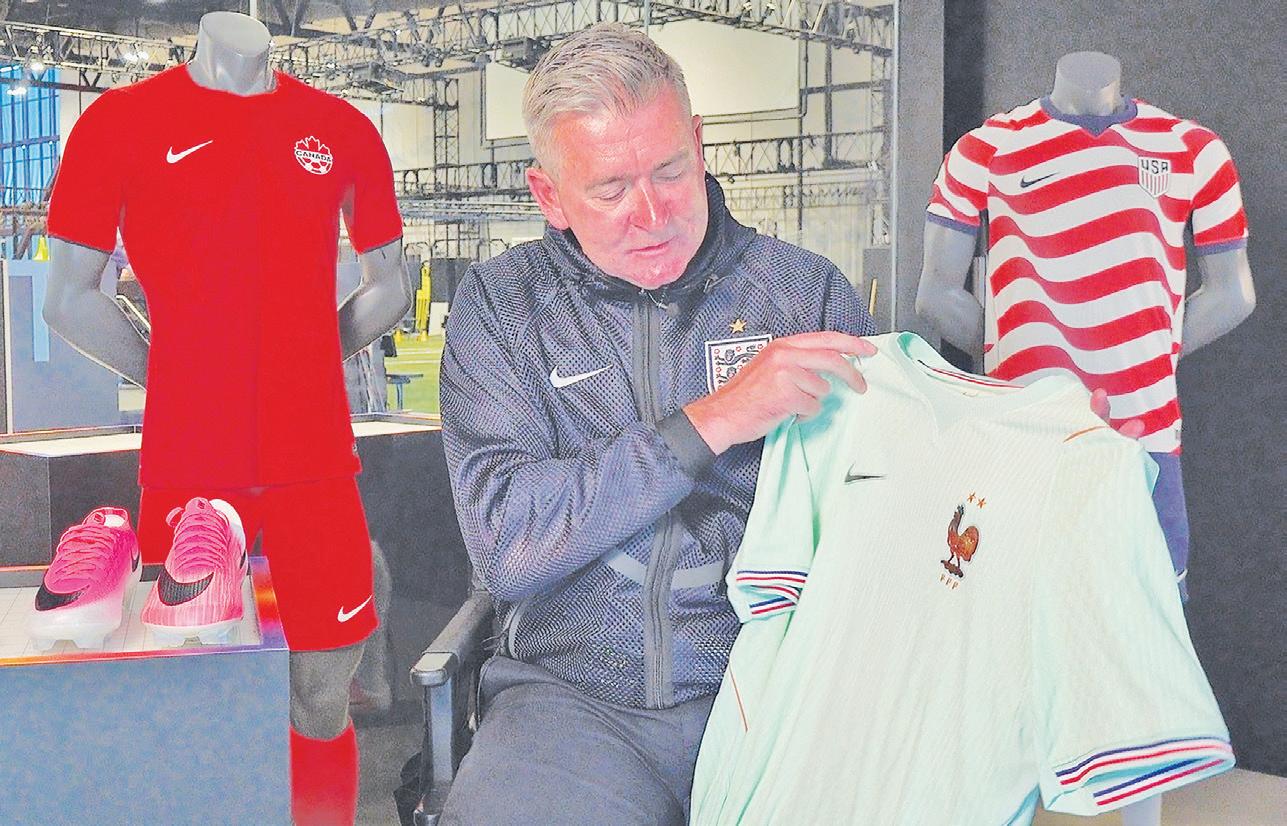
The way the jerseys are knit, with mesh stitching in certain areas allowing more air flow, helps get that thermal regulation that all the players have been asking for.
how uniforms affect the game.
“We also talk to fans—so what does it mean to wear a Uruguay jersey, what does it mean to represent France, what does it mean to play for Canada?” McCartney told The Associated Press. “We take that and we merge that with all the science and the innovation to make sure that we have beautiful designs.”
Adidas, which designed jerseys for defending champion Argentina, host nation

Mexico and Colombia, also unveiled cooling gear for the tournament. Puma designed the kits for Portugal as well as Morocco and Senegal, the two finalists at the most recent African Cup of Nations. While the three companies are behind most of this year’s kits, some teams are sporting uniforms designed by other apparel makers.
Thermal chambers replicate the effects of heat and humidity on apparel donned by people or robot mannequins.
“We take motion-capture to see how they’re moving in the kit, how the kits are responding,” McCartney said. “We also use the thermal chambers that we have to test the kit’s breathability, to test wicking and moisture management.” For the World Cup kits, Nike engineered a
that all the
McCartney
have been asking
Despite all the
the
of the kit was still a bit bumpy. During matches earlier this year, bulges could be seen in the shoulder seams on jerseys for teams including France and Uruguay, the Guardian reported.
When asked by AP, Nike said it was able to identify the issue before the start of the World Cup, and
Designs
“We
inspiration from lots of different places, from the past, from art, from music, from culture, so anything that gets us connected to the country we really want to harness,” Phil McCartney said.

Thermal chambers and robot mannequins ON a recent morning, Phil McCartney spoke from the sports research lab at Nike’s headquarters just outside Portland, Oregon, where experimentation helped the kits come to life. The indoor facility includes a 200-meter track, a small football pitch and a basketball court, with hundreds of motion-capture cameras placed throughout.
Eileen Gu, Chloe Kim, Mark McMorris and Scotty James are among those signed up for the winter portion. “I love working on big ideas, and this is a big idea,” said Jeremy Bloom, the Olympic freestyle skier and former National Football League (NFL) receiver who was hired by MSP Sports Capital shortly after they bought a majority stake in the X Games from ESPN in 2022. “But ideas are only worth the word on the page. The execution of ideas is always the hardest part.”

France’s away kit, for example, is a light green akin to the Statue of Liberty, which France gifted to the US in the late 19th century. The interior tag features the word “Liberté” inside a silhouette of the monument’s crown. On the front of the jersey there’s a rooster—an emblem of the national team and the country itself—and two stars representing France’s two previous World Cup victories. France’s home kit features a collar— as does Uruguay’s. The decision to use collars comes from the federations, Nike said, with France leaning into its history as a fashion capital and Uruguay looking to evoke a more classic football look. In previous decades, many uniforms included collars.
US’s Nyjah Huston competes in men’s skateboard street preliminaries at the Paris 2024 Olympics on July 29, 2024 in France as Australia’s Chloe Covell participates in the women’s finals at the Street Skateboarding Worlds in Rome Sunday. AP Does X Games really need reboot? WHAT was wrong with the X Games? Nothing, really. The winter version, traditionally held in Aspen, Colorado, drew 50,000 fans this year and ratings on ESPN and ABC rose 48 percent. But when MSP—which has stakes in F1, and Premier League soccer teams among its investments— bought the property in 2022, it had a bigger vision.
incident. And for an already fragile player, it felt like the end of the world.
While tantrums are part of
golf seems to hold their professionals to a higher standard. Or maybe it was a case of an already unpopular, uncharismatic player being caught with an offense. Whatever the case, Clark was vilified after the locker


Wine industry chases younger drinkers with playful approach
JUNE 28, 2026 | soundstrip.businessmirror@gmail.com
Story by Patrick Villanueva
ONCE is a coincidence, twice is a pattern.
The Nation’s Girl Group BINI – completed by Gwen, Sheena, Mikha, Aiah, Stacey, Jhoanna, Maloi, and Colet – is about to embark on yet another historic milestone for the Philippines, as they will hold their second consecutive world tour with “Signals,” spanning multiple countries from Asia, United States, Europe, and Australia.
The massive success of their first world tour snowballed their name globally, earning them an entry in Coachella, the biggest musical stage in the world. The girls are also booked for an appearance for Summer Sonic Festival in Japan later this year. Moreover, their guesting in Grammy Museum and Billboard proved that they are one of the rising stars in the world.
Still, a second one is no joke. In their docuseries about the first one, fans would know that it was not all sunshine and rainbows. It was filled with fatigue, hurt, and heartbreaks. Hence, we ask the question, can they pull it off this time?

Publisher :
T. Anthony C. Cabangon
Lourdes M. Fernandez
Editor-In-Chief :
Concept :
Aldwin M. Tolosa
Y2Z Editor :
SoundStrip Editor : Group Creative Director : Graphic Designers :
Jt Nisay
Edwin P. Sallan
Eduardo A. Davad
Chow Jarlego
Niggel Figueroa
Contributing Writers :
Tony M. Maghirang
Rick Olivares
Jingo Zapata
Reine Juvierre S. Alberto
John Eiron R. Francisco
Patrick Villanueva
Ana Zoe V. Davad
Justine Xyrah Garcia
Ginger Franz S. Ocampo
Trixzy Leigh Bonotan
Bless Aubrey Ogerio
Photographers :
Bernard P. Testa
Nonie Reyes
Y2Z & SOUNDSTRIP are published and distributed free every Sunday by the Philippine Business Daily Mirror Publishing Inc. as a project of the
The Philippine Business Mirror Publishing, Inc., with offices on the 3rd Floor of Dominga Building III 2113 Chino Roces Avenue corner Dela Rosa Street, Makati City, Philippines. Tel. Nos. (Editorial) 817-9467; 813-0725. Fax line: 813-7025
Advertising Sales: 893-2019; 817-1351,817-2807. Circulation: 893-1662; 814-0134 to 36. www.businessmirror.com.ph
Tour and pressure
THE first success can be called a fluke, but a second one should be called a declaration, not only for BINI but also for P-pop, that the Philippines is oozing with talents waiting to be discovered and acknowledged worldwide.
And that’s exactly where pressure comes from. After all, BINI is not only representing themselves but also the country. As of the moment, there are two powerhouses in BINI and SB19, and the former is about to take a massive leap with its second world tour.
Meanwhile, their first world tour, despite being a success, had a lot going on backstage. With heartbreaks, disappointment, and injury, there were moments where it could all go downhill, with no room to recover.
However, all of it was not enough to break up the group as they pushed through a successful World Tour, even getting a warm welcome fan meet, and a year-end party to kickoff what would transpire the following year.
ANSWERING the question, it’s a massive yes. As their set and presentation for the BINI Signals World Tour are a massive upgrade from their predecessors, showing a massive growth for the girl group.
Their act 1 encompassed loved songs from the group, with some making its return on the big stage. With the playlist of Unang Kilig, I Feel Good, Ang Huling Cha Cha, Lagi, Diyan Ka Lang, Na Na Na, Katabi, and Sweet Tooth, the set felt comfortable and easy to digest, while also surpassing the group’s standard for each song.
Act 1 also played the songs for their EP with the same name, Signals. Playing Sugar Rush, Step Back, Honey Honey, and Tic Tac Toe, BINI’s new era leaned on becoming sweet, with the exception of Step Back, where it is loud, chaotic, and fast. It was my favorite from the set, though, as it showed a style akin to hip hop.
Meanwhile, their second set was a callback for modern OPM, with BINI splitting to two groups, with the first having Aiah, Sheena, Colet, and Jhoanna. This group was stunning, from their visuals and presentation to their song selection “Duyan” by OPM’s Princess of Pop Sarah Geronimo. It was an ethereal feeling, seeing and hearing them act soft and romantic during this performance.
On the other hand, the group of Gwen, Mikha,




Stacey, and Maloi performed a 2010 classic, playing Donnalyn Bartolome’s “Kakaibabe.” Rapping and singing this classic brought everyone back from this era, being that they grew up with this music as well.
And as for their last set of performances, the arena got a taste of what it felt like to be in the audience of Coachella. The last 45 minutes or so of the concert was their Coachella set, not only the music but also the choreography and costumes, and let me tell you, experiencing it live was far better than watching it on YouTube.
Meanwhile, BINI also showcased a teaser and choreography of “A Parallel World,” their original song for Dreamworks’ “Forgotten Island,” a 2026 animated film with massive ties to Filipino folklore.



she added.
Katrina Rauto, a fan converted during BINI’s Coachella stint, shared that she discovered the group in April and has ever since idolized the group. Being that Signals was her first time watching BINI live, she maintained that she believes that BINI would continue to have success globally.
“It’s my first time watching them live. Comparing it to their online performance, their energy was super high. You can see that the crowd enjoyed everything,” Katrina shared. “Their energy, confidence, and stage presence, you can feel their passion through their performances,”
“I expect to see them more globally. I hope their wishes come true, and I believe that they will kill it on their Super Sonic performance. And for them to get more international performances,” Katrina replied on what her expectations were for BINI moving forward.
BINI is way past from being a one hit wonder, as they have proven time and time again that they are ready to dominate the global stage. While BINIverse may be called a coincidence, Signals might become the pattern that will set for their third to become their legacy. And fans can expect more from this girl group, as they slowly rise to become worldwide phenoms in the music scene.
Story and photos by Manuel T. Cayon
DAVAO CITY - A group of fresh faces is making ripples in the local girl pop scene with eyes to break into Asian entertainment with light pastel and denim wear as the girl group brand.
The group YUDI has lined up four original pop genre songs and a coterie of moves and dances in its debut on Friday at a suburban night joint here with a string of festivals across Mindanao already lined up for the girls way during their training days.
Elise, Iris, Yurim and Vivi composed the group, selected from among the 800 aspirants from as far as Manila who came here for audition last year. Except for Vivi who hails from Tagum City, the capital of Davao del Norte, the rest all came from here. Two of them are college graduates, including Elise, a licensed pharmacist, and two are still in college.
Among them Yuri is the more experienced, being in a girl group already, while the others have their share of public performances in community and school events.
“They are past their shy days and they are well-rounded entertainers,” manager Kevin, owner and manager of UD Entertainment told BusinessMirror on Wednesday.
The girls rendered a short rendition of
their original song and danced before a media briefing at the Habi at Kape store at the Abreeza Ayala Mall here as a preview of their debut on Friday.
Their manager said he has been in the music and film talent industry since 2018 managing events for both Filipino, Japanese and other Asian musical concerts and events in Metro Manila. Last year, he formed the girl group and talents from the Visayas and Manila came to Davao City to audition.
Though he kept the venture under wraps, entertainment companies have already sent feelers to him to accommodate his ward. Cites and provincial capitals across Mindanao have also pre-booked the group YUDI for their events but he said he would send his wards only after the YUDI is launched formally as the official girl group brand. Their first public performance will start in the string of festivals in July and August.
Kevin said the YUDI will also break into the Asian girl group pop scene soon.









SHAUN, the globally acclaimed singer-songwriter and producer with over 1.9 billion cumulative streams, has officially released his new EP, LAST PAGE.
LAST PAGE is a deeply personal project where SHAUN weaves together his past memories through a diverse sonic spectrum. Departing from his previous pop-centric style, SHAUN has placed a more profound, rock-based band sound at the forefront of this album. This shift marks a significant evolution in his career, drawing from his rich experience as a former band member to bridge his musical roots with the present.
The EP features five tracks that showcase SHAUN’s unique sensibilities and sincere messaging. The title track, “Out of Control,” stands out with its witty title and rich, explosive sound, vividly delivering SHAUN’s expanded musical spectrum to listeners.
Notably, this EP serves as the grand finale to his pre-release trilogy that has built anticipation over the past months. The journey that began with the powerful band sound of “Pixels”, followed by the dreamy emotional depths of “Night Walk”, and the reflective record of “Diary”, is now seamlessly completed as a single masterpiece under the title LAST PAGE.
Since transitioning to an independent path as a self-producing artist, SHAUN has taken full control of the production process to tell his story more directly than ever before. Having maintained close communication with fans through platforms like Naver Chzzk and online concerts, he is set to hold a solo concert at Sinchon Wonderloc Hall on May 10th to commemorate the album release. The concert will feature a full band live set, providing a stage for SHAUN to personally unveil the new tracks to his fans.
SHAUN’s evolved musical world in the new EP LAST PAGE is now available for streaming on all major global music platforms.
By J.M. Hirsch
The Associated Press
BOSTON—Which wine pairs well with Shark Week? Does a pinot noir have enough acidity to cut through the grime of a Tough Mudder race? Is a big, brassy cabernet bold enough of a quaff for a night of naming dead rodents after an ex?
And is a wine named SEX too provocative or not provocative enough?
Absurd as they may sound, these are the questions haunting wine marketers grappling with slumping sales and increasingly elusive drinkers. How consumers—especially younger drinkers—answer them will determine whether an industry long defined by fuddy-duddy pretense can find its footing in 2026 and beyond.
“That self-important way that wine can refer to itself—we’re really trying to tip that on its head,” said Helen Kurtz, chief of marketing for The Wine Group, which hopes that offerings such as its easy-drinking Cupcake Vineyards wines can attract a generation that came of age on Frappuccinos and gas station BuzzBallz.
“It’s about being less serious about ourselves, because that’s what this consumer is demanding,” she said.
By which she means partnering the company’s MD 20/20 (yes, it’s a wine) with World Wrestling Entertainment matches (“Mad Dog Enters the Ring”), and launching the aptly named Fuel by Franzia line of boxed wine beverages for NASCAR (“Full Throttle Flavor”).
Alcohol consumption has dropped
IT’S a fresh lesson on the importance of finding your customer rather than hoping they find you. Because almost across the board, alcohol consumption is down, a trend that accelerated post-pandemic. A host of factors is at play, including aging Boomers seeking healthier lifestyles, Gen Z’s gravitation to low- and no-alcohol beverages, and widening availability of alternatives such as marijuana.
Each segment of the alcohol industry— valued at around $560 billion in the U.S.— is responding differently. Hard liquor, for example, has found a rare growth category in ready-to-drink canned cocktails. But the wine industry faces its own constellation of challenges, many of its own making.

For anyone new to wine—particularly much-coveted 20-somethings—finding one’s way can be daunting, something of a Château du Stuffy effect.
“You’ve got a bunch of things, what you might call friction points, with wine, that are particularly salient to younger consumers,” including cost and drinkability, said Christian Miller, director of research for the Wine Market Council.
A pretentious image keeps some customers away
WINE , from the labels to the language used to describe it, historically has leaned pricy and pretentious (looking at you, “notes of asphalt and barnyard”). Wine trends also have favored boozy and bracing styles, a hard sell for folks used to sipping hard seltzers at the club.
Fewer than a third of Gen-Z households own a corkscrew, according to a trends report by the British household products company Lakeland. Even simply trying a wine comes with a gatekeeper: Hard liquor is easy to sample at a bar or as single-shot nips; most wine requires a full-bottle commitment.
A cadre of wineries has begun pushing the bounds of wine culture by ditching the fussy façade in favor of a sassy vibe and accessible language. Price matters, too (the sweet spot seems to be the $8 to $20 a bottle range), but not nearly so much as the message.
It’s about using contemporary communication to pitch “something that’s been made for centuries,” said Charles Smith, founder of House of Smith, the company behind younger, shopper-
friendly brands such as Kung Fu Girl Riesling and SEX Rosé. “My mantra is always to communicate the language of wine to everyone because not everyone speaks wine. The wine should be a reflection of the consumer who is going to buy it.”
white and “just the right amount of bite.”
“The viewer base of Shark Week lines up really, really nicely with who we know our consumer to be,” LaBounty said. “It’s another way to meet them where they are already versus kind of asking them to come to us.”
‘The No. 1 goal is to disrupt the shelf because it is so crowded, and sassiness is a way to do that.’
Can tie-ins to pop culture make wine more relatable?
BOGLE Family Wine Collection has leaned in with its Juggernaut Wines. Adorned with almost graphically violent labels showcasing alpha predators—a shark, a grizzly, an orca, a lion and some sort of particularly angry bird of prey—the bottles are a far cry from the placid villas and languorous ladies plastered across so many wines.
The other side of it is getting those bottles into spaces not traditionally associated with wine, said Jessica LaBounty, the company’s marketing director. For two years, Juggernaut has announced “Adventure awaits” as it sponsored the grueling Tough Mudder races. They’ve also done placements at zoos that host nights where people can name dead rodents and insects after former partners and feed them to the animals. Cheers…?
And this year, it’s Discovery network’s Shark Week. Juggernaut’s chardonnay label sports an especially snappish great

Learning to speak Gen Z is key THE goal is to bridge a generational divide in which wine got lost. Younger drinkers don’t and won’t talk about wine the way older drinkers do. To point, there’s a clever social media meme about a Millennial marketing team pitching wine vs. a Gen-Z social media team. The Millennial effort goes on at length about terroir and full-bodied flavors. Gen-Z’s pitch? “it’s giving… yummy.”
Vibe is everything for Bread & Butter Wines, with the tagline, “Don’t overthink it.” As in, pair their red blend with a candy charcuterie board. Or their pinot noir with a Thanksgiving leftovers sandwich. Want fries with that? Try their prosecco.
“The No. 1 goal is to disrupt the shelf because it is so crowded,” said Caitlin Ward, brand and digital marketing director. “Sassiness is a way to do that.”
n Cover photo by Kenzhar Sharap on Pexels.com
By Brian Ong
THERE is a particular kind of chef who does not cook to impress — one who cooks because they simply cannot help it. Chef Jeramie Go is that kind of chef. Classically trained in French techniques and forged in the demanding kitchens of Toronto, Canada — where he spent more than 17 years working across various restaurants and establishments — Go is not the type to chase recognition. And yet, recognition found him anyway, all the way in the highlands of Mindanao.
Go’s return to the Philippines in 2021 was, like so many stories of that era, precipitated by the pandemic. After nearly two decades in Canada, he came home with his family, seeking a slower pace and a chance to finally be present. As he also mentioned during his past interviews and confirmed during my talk with him and his wife Kristine: “When we were moving back, we were talking about what kind of restaurant we would put up. I said, ‘let’s just do what we serve in our home in Canada.’” It was a deceptively simple idea that would quietly shake up Davao’s culinary landscape.
The Pilgrim’s Road


to’s multicultural food scene, Pilgrim operates as a chef-driven restaurant in BuDa, offering hearty, comfort-focused cooking well-suited to its cool mountain setting, working with quality ingredients from local partner farmers to produce seasonal dishes. It has since been recognized in the Tatler Philippines Dining Guide, cementing Go’s reputation as one of the more compelling culinary voices to emerge from Mindanao in recent years.



Rising Further: Grateful Bread and Bairrada PILGRIM was only the beginning. Their second concept, Grateful Bread, brought Canadian baked goods to the neighborhood of Davao — a bakery that introduced the city to naturally leavened loaves and pastries shaped by Go’s years in a country where bread culture runs deep. Together, Pilgrim and Grateful Bread have been redefining Davao’s food scene by blending international techniques with local flavors. Then came Bairrada Churrasqueira, the most personal concept yet. The idea was to open a small neighborhood grill serving one of the family’s favorite dishes: Portuguese piri-piri chicken, alongside grilled sardines, bacalhau, and pastel de nata. Tucked inside The Compound in Matina, Bairrada Churrasqueira is quietly serving some of the most honest, fire-cooked meals in Davao. It has since been
By Anne Ruth Dela Cruz
Anya
Tagaytay, evolution is
of the
Beginning July 1, 2026, guests will discover a refreshed menu that introduces a collection of new dishes while preserving the restaurant’s well-loved signatures—a balancing act that reflects both creativity and consistency. The menu update is not a complete overhaul. Instead, it follows a philosophy that has guided the restaurant since it opened four years ago: refine what works, improve what doesn’t, and continue surprising guests.
“Every year we change around 30 percent of the menu,” said Mikel Arriete, General Manager of Anya Resort Tagaytay and a chef himself. “We retain the things that were better and then we replace the ones that we think didn’t work as well.”
Intensive evaluation process
THE annual refresh is the result of an intensive evaluation process led by Chef Chele Gonzalez and
his team. According to Arriete, menu development involves extensive tasting sessions, discussions, and careful consideration of guest preferences.
“The other day we were here, we tried around 40 dishes,” he shared. “Once we tried everything, we sat down and went one by one. This one yes, this one no, this one we might do like this or like that. Out of the 40, maybe we ended up with 25 dishes.” The result is a menu that showcases Chef Chele’s signature creativity while remaining approachable to the restaurant’s broad clientele.
Unlike standalone fine-dining establishments that cater primarily to gastronomes, Samira serves a diverse audience. Some diners specifically travel to Tagaytay to experience Chef Chele’s cuisine, while others discover the restaurant as guests of Anya Resort. That reality influences how new dishes are developed.
“Whenever I talk with Chele, I always tell him that I want to have fun starters,” Arriete said. “Fun means tasty shapes, bombs, something that creates an emotion. It can be the presentation, it can be the flavor. Then the main course should be more traditional. Because we’re in a hotel and our clientele is very wide.”
Opening selections
THE philosophy is immediately evident in the menu’s opening selections.
A quartet of bites—including Salmon Tapioca, Fish Tostada, Chorizo Explosion and Chili Crab Bomb—sets a playful tone for the meal. The dishes are designed to spark curiosity and conversation before diners move on to more substantial courses.
Among the highlights is Tuna Tataki with Watermelon Gazpacho, which pairs seared yellowfin tuna with refreshing watermelon and tomato gazpacho, pickled onions and cilantro. The dish delivers brightness and acidity, making it particularly suited to Tagaytay’s cool climate.
The seafood offerings continue with Pan Seared Local Seabass served with romesco sauce, charred leeks and mushrooms, showcasing the restaurant’s commitment to combining familiar ingredients with refined techniques.
One of the standout dishes from the tasting menu is the Grilled Tiger Prawns and Uni Rice, where creamy sea urchin rice enriched with Parmesan cheese, caramelized onions and white wine is topped with charred prawns. Rich and indulgent, the dish reflects Chef Chele’s ability to blend Mediterranean influences with contemporary flavors.
FOR meat lovers, the aptly named “Ribs Feast” presents two distinct interpretations of slowcooked and fire-roasted meats.
The Fire Roasted Back Ribs arrive glazed in barbecue sauce and paired with mojo verde and mashed potatoes, while the Charred Short Ribs highlight the restaurant’s mastery of wood-fire cooking—a hallmark of Samira’s culinary identity.
The meal concludes with a Pumpkin Crème Brûlée served with cerveza negra ice cream, vanilla crumbles and chocolate ganache. The dessert offers a satisfying balance of sweetness, bitterness and texture while providing a uniquely Filipino twist to a classic European favorite.
Despite the new additions, longtime patrons need not worry about losing the dishes that first drew them to Samira.
After four years of operations, the restaurant has developed a loyal following that regularly returns for its signature offerings.
“We already have regular guests,” Arriete said. “They are looking for the paellas, they are looking for the steaks. We have one dish that is
grilled, the whole fish. It’s one of the best sellers. Or the pulpo, the grilled octopus. It’s one of the best sellers also.”
Unique position
THIS balance between innovation and familiarity has helped Samira carve out a unique position in Tagaytay’s increasingly competitive dining scene. The restaurant offers guests multiple ways to experience its cuisine—from a sixcourse tasting menu and grill-focused offerings to a more relaxed à la carte selection. Such flexibility allows diners to choose between a special-occasion gastronomic journey or a casual meal built around Chef Chele’s celebrated flavors.
As Anya Resort Tagaytay marks its ninth anniversary this July and Samira celebrates its fourth year, the menu refresh serves as a reminder that great restaurants thrive not only by preserving their strengths but also by continuously reinventing themselves.
For Chef Chele Gonzalez and the team behind Samira, that means keeping diners coming back—not just for the dishes they already love, but for the new ones waiting to be discovered.
starter. Kalamata and green olives, feta, and pickled onion layered over fresh tomatoes — honest and bright, the kind of salad that reminds you that the best produce needs little intervention. Sourcing matters here; Bairrada Churrasqueira, alongside Pilgrim and Grateful Bread, sources from local Davao farms championing high-value heirloom vegetables. “Almost 95 percent of our ingredients are sourced locally,” says Go. Three Beef Empanadas (P245) arrived fat and satisfying, filled with a savory blend of beef, peppers, and Granny Smith apple — the fruit’s tartness cutting through the richness in a way that felt classically South American, served with salsa criolla. The Chimichurri Beef Bites (P365) continued in that vein: beef fingers over mashed potato, crowned with caramelized onion and blistered tomatoes, the chimichurri doing the work of brightening every bite. Then came the centerpiece: the Piri-Piri Chicken (Frango Piri-Piri) (P965) — a whole cut up charcoal-grilled bird doused in piri-piri sauce, served with rice, potatoes, and tomatoes. Chef Jeramie is particular about this dish. As he explains it, piri-piri chicken is to the Portuguese what lechon manok is to Filipinos — a beloved, deeply personal staple. What makes it different from the peri-peri familiar to most Filipino diners is its provenance: piri-piri traces its lineage to South Africa, brought back to Portugal and refined over generations into something distinctly their own. The chicken at Bairrada honors that lineage — charred at the edges, deeply marinated, its heat calibrated (mild, medium, or spicy) without losing the complexity underneath. Clearly, a simple dish done right, and a winner for me.
The Salted Cod & Potato Hash (Bacalhau à Brás) (P345) was equally compelling — shredded salted cod folded with onion, egg, and potato crisps, punctuated by olives, its textures in quiet conversation with each other. This is a dish that has fed generations of Portuguese families, and Bairrada treats it with appropriate reverence.
The Grilled Pork Belly & Beans (Feijoada) (P495) rounded out the savory courses: stewed white beans, a perfectly cooked egg, and rice alongside slow-cooked pork belly — the kind of dish that demands you slow down. And then, for a satisfying close: the Pastel de Nata (P45 each), those iconic egg custard tarts with their caramelized, slightly blistered tops, and the Serradura (P275) — sawdust pudding layered with crushed Marie biscuit and whipped cream, a Portuguese dessert so deceptively simple that its perfection almost sneaks up on you.
What Bairrada Means for Davao THERE is a recurring theme in everything Chef Jeramie touches: the willingness to ask Davao to meet the world halfway, and the patience to wait for the city to arrive. Bairrada is the
By John Eiron R. Francisco
METRO Manila’s dining landscape is often defined by extremes, with restaurants built for the masses and venues reserved for a select few. Some establishments, however, offer a more measured approach, where thoughtfully crafted cuisine is complemented by a setting that encourages diners to slow down and savor the experience.
Among the latest additions to this space is Miss Money Penny’s Recipe, which opened on June 17, 2026, at Seascape Village in Pasay City. Situated on the ground floor of Your Majesty The Royal Enclave, the restaurant occupies a discreet corner of the complex, which offers a sense of seclusion rarely found in the city’s more crowded dining destinations.
“We want guests to enjoy not just the food, but also the company of the people they’re sharing the table with,” Sous Chef Rey Santos told BusinessMirror in an exclusive interview, speaking partly in Filipino.
With seating for 50 to 60 guests, the restaurant features carefully curated interiors, plush furnishings, and attentive hospitality, which creates a setting that feels polished without being overly formal.
Name inspiration ITS name is inspired by Miss Moneypenny, the iconic character from
the James Bond universe, a subtle nod to the owner’s admiration for the franchise, with British influences thoughtfully woven throughout the restaurant’s identity.
While Seascape Village has long been recognized for its Asian dining concepts, Miss Money Penny’s Recipe introduces a different culinary direction with its British, Mediterranean, and Westerninspired menu.
Santos emphasized that the restaurant is not intended to compete with existing establishments but to complement the area’s evolving food scene by giving guests an alternative selection of flavors and dishes.
Among its highlights are premium steaks sourced from the United States and Australia, including select cuts that undergo a 30-day


dry-aging process to develop deeper flavor, tenderness, and character. The dry-aged porterhouse, rib-eye, and wagyu selections serve as some of the restaurant’s centerpiece offerings, prepared for diners seeking a more elevated steak experience.
“Our goal is to become known for serving some of the finest steaks in Pasay and the surrounding area,” Santos said. “We hope to continue earning our guests’ trust and, in time, bring this experience to more locations.”
International dishes
BEYOND its steaks, the kitchen explores a range of international dishes that highlight the restaurant’s diverse influences. Guests can find British staples such as the Shepherd’s Pie, Fish and Chips, Bangers and Mash, and the traditional Sun-

day Roast, alongside more refined plates like Grilled Lamb Chops, Beef Wellington, and Herb Almond Crusted Seabass.
The menu also extends to freshly prepared made to order pizzas, with the kitchen crafting each one upon request rather than relying on pre-made preparations. Its pasta selection features both familiar favorites and more distinctive creations, including the Truffle Pasta made with fresh mushrooms and a rich truffle-based cream sauce.
Seafood selections, handcrafted sandwiches, burgers, and all-day breakfast offerings further expand the menu, complemented by a beverage selection featuring coffee, non-coffee drinks, refreshments, and wines.
Designed for different kinds of visits, the restaurant welcomes
guests from 11 am to 10 pm daily, whether for a relaxed lunch, an intimate dinner, or a longer gathering after exploring nearby attractions and destinations within the complex.
Return visits FOR Santos, however, the restaurant’s goal extends beyond introducing new dishes to the dining scene. More than creating a onetime experience, the team hopes to build a place that guests will continue to return to.
“Our goal is for guests to come back after experiencing our food. We want them to remember the flavors and consider us one of the places they would choose whenever they want a great meal,” Santos shared.
“When people compare their dining experiences, we hope ours becomes one of the restaurants they think of and want to return to.”
While expansion remains part of the group’s long-term vision, Santos emphasized that their immediate focus is building a strong foundation for the restaurant before bringing the concept to other locations.
Meanwhile, as the restaurant continues to build connections with its neighboring establishments, it has also introduced partnerships that complement the overall experience within the area. One such collaboration is with Pickle Bay, a pickleball facility located just a few meters away from Miss Money Penny’s Recipe.
Through this partnership, guests who book paid pickleball sessions can enjoy complimentary bev-
erages at the restaurant, including coffee, iced tea, or select cocktails.
More collaborations
SANTOS added that guests can look forward to more initiatives, collaborations, and thoughtfully curated menu offerings in the coming months as the restaurant continues to establish its presence within the local dining scene.
Miss Money Penny’s Recipe is part of Your Majesty Leisure Corporation’s broader lifestyle destination, where dining and entertainment come together within one space. Located in the same building are two other concepts that offer guests different experiences beyond the table.
Upstairs, Tora Tora Superclub offers a high-energy nightlife experience with immersive music, modern club interiors, and VIP accommodations for up to 200 guests. Also within the complex is 10 Downing Street KTV, a luxury karaoke and private entertainment venue featuring premium
nightlife, the development aims to offer a more complete experience that extends beyond a single meal.
By Anne Ruth Dela Cruz
SINGAPORE— At Mount Elizabeth Hospital, patient experience extends far beyond the consultation room. From redesigned wards and digitally enabled services to advanced medical technologies, the hospital’s recently completed SG$350 million Project Renaissance was undertaken to enhance the delivery of care while improving the overall patient journey. Yet one of the most memorable examples of this commitment can be found not in an operating theater or diagnostic suite, but on the dining table.
After all, as Yong Yih Ming, Chief Operating Officer of IHH Healthcare Singapore and Chief Executive Officer of Mount Elizabeth Hospital, pointed out during a recent media visit, food remains one of healthcare’s most common challenges.
“Number one patient complaint is food,” Yong said with a smile.
The statement resonated with journalists from Indonesia, the Philippines and Vietnam who were gathered at the hospital as part of a media tour showcasing the completion of Project Renaissance. This writer was among those who were part of the media tour and we were served a meal that challenged conventional notions of hospital food.
The dining experience began with Crispy Prawns Wasabi, delicately paired with mango salsa and wasabi aioli. This was followed by a hearty Double-Boiled Abalone with Chicken Soup, prepared with dried scallops, lotus seeds and apple. For this writer, this was the best dish of the meal with a broth that was full of flavor and basically really delicious. According to Executive Chef Lawrence Tay, the soup stock alone requires six to eight hours of cooking, resulting in a rich yet comforting broth.
FOR the main course, guests sampled Javanese Belado Pasta with wok-tossed mushrooms, a dish that blended Western and Indonesian influences through a flavorful belado-style sauce. Another highlight was the Rack of Lamb served with leek potatoes and broccolini. Tay explained that the lamb was carefully trimmed to remove excess fat, producing a tender cut without the strong flavor that often discourages some diners from ordering lamb.
The meal concluded with a serving of traditional Nyonya Ondeh Ondeh accompanied by a fresh fruit medley, offering a taste of
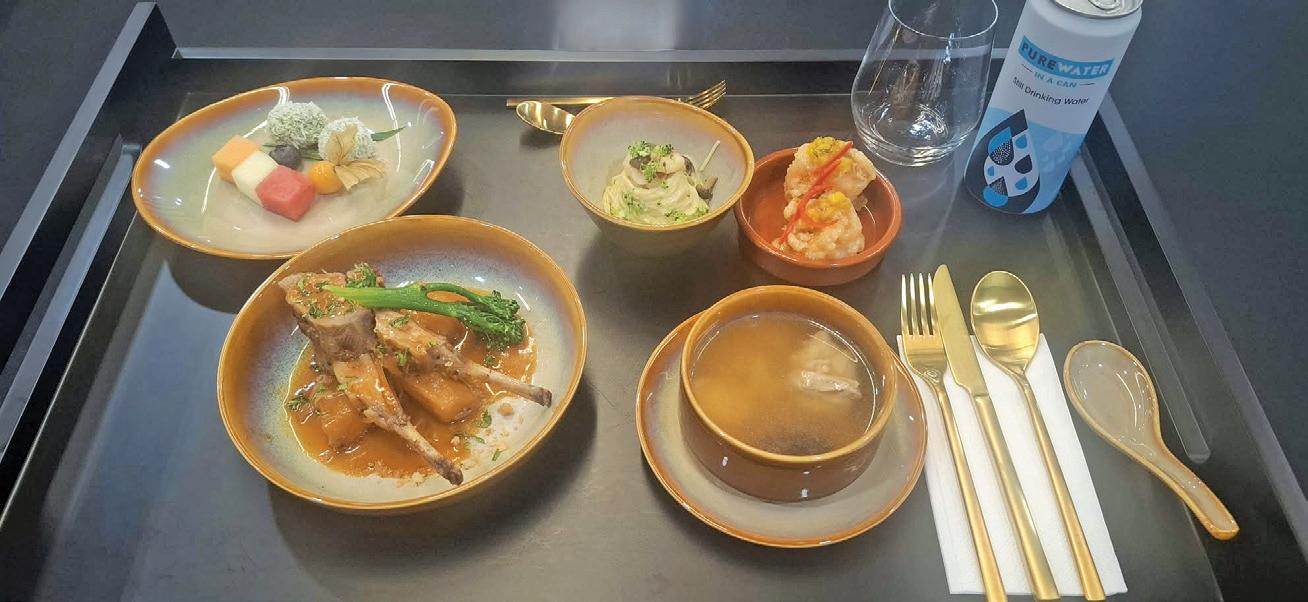
Singapore’s multicultural culinary heritage.
What made the menu remarkable was not simply its restaurant-quality presentation. According to Yong, these were dishes that patients themselves could order during their stay.
“These are actually patient food,” he explained.
Opportunity to provide comfort
FOR Mount Elizabeth, food is more than a daily necessity. It is an integral part of the patient experience and an opportunity to provide comfort, familiarity and care during what is often a stressful period in a person’s life. Patients admitted to the hospital come from diverse cultural backgrounds and dietary traditions. Indonesia, the Philippines and Vietnam are among Mount Elizabeth’s top international patient markets, making it essential for the hospital to accommodate a wide range of tastes and preferences. Recognizing this diversity, the hospital works to ensure that meals cater to different cultures, dietary requirements and religious considerations.
“We put in a lot of effort to make sure the food is something that the patient can remember,” Yong said. That effort goes beyond creating flavorful dishes. Every menu item developed by the culinary team undergoes review by dietitians to ensure that nutritional requirements are met and that meals remain suitable for patients’ medical conditions.
Like many healthcare institutions, Mount Elizabeth also offers therapeutic diets for patients recovering from procedures or managing
specific health conditions. These meal plans are prescribed by physicians and dietitians and tailored according to each patient’s needs.
“Food prepared by our chefs will go through a dietitian to make sure they are healthy and good enough for our patients,” Yong explained.
Combine nutrition with culinary excellence
THE hospital’s culinary program is led by Tay, whose team includes professionals from ho-
tel and restaurant backgrounds. Their goal is to combine nutrition with culinary excellence while taking patient preferences into account.
For Tay, creating hospital menus involves continuous refinement based on feedback from those who matter most—the patients themselves. “In the patient menu, it’s really based on what patients like and dislike,” he said. “Then we change.”
The menu served during the media visit was the result of that ongoing process.
The dishes also reflected the hospital’s in-
ternational patient profile. The Javanese Belado Pasta, for example, was inspired by Indonesian flavors. While pasta is traditionally associated with Western cuisine, Tay and his team incorporated belado-style elements to create a dish that would resonate with regional tastes while maintaining nutritional balance.
Similarly, the Rack of Lamb demonstrated the team’s attention to patient preferences. Tay noted that many diners tend to avoid lamb because of its strong aroma. To address this, the culinary team carefully selects and trims the meat to reduce excess fat while preserving tenderness and flavor.
Meal presentation
BEYOND flavor and nutrition, Mount Elizabeth also pays close attention to how meals are presented. Unlike many hospitals that serve food on plastic trays with disposable utensils, the hospital uses proper dining ware and restaurant-style plating. Meals are arranged with the same attention to detail one might expect in a hotel restaurant.
“So that is how we differentiate ourselves,” Yong said.
The result is an experience that often surprises patients and visitors alike.
“Sometimes people say because we present the food this way, your hospital is very expensive,” Yong noted. “Actually, it’s not. It’s just how we present the food.”
The approach aligns closely with the
philosophy behind Project Renaissance, which sought not only to modernize infrastructure and clinical facilities but also to elevate the overall patient experience. Throughout the transformed campus, Mount Elizabeth has introduced innovations aimed at making healthcare more seamless, efficient and patient-centered—from digital platforms that simplify service requests to redesigned care environments that improve comfort and convenience.
Same philosophy
FOOD, it turns out, is another expression of that same philosophy.
After all, while patients may spend only a fraction of their day undergoing tests, consultations or treatments, they interact with their meals several times daily. Those moments become part of how they remember their stay and how they perceive the care they receive. For Mount Elizabeth Hospital, every meal is therefore more than nourishment. It is an opportunity to provide reassurance, comfort and a sense of normalcy—one carefully prepared plate at a time.
In an increasingly competitive healthcare landscape, that attention to detail may seem small. Yet it reflects a broader understanding that healing involves more than medical expertise alone. Sometimes, it begins with something as simple as a thoughtfully prepared meal served with care.
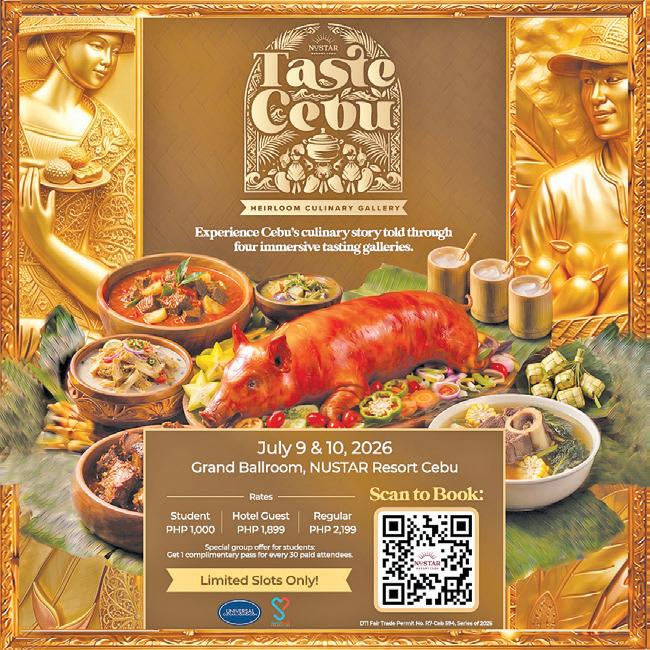
author and food historian Louella Theresa A. Eslao-Alix, Taste Cebu: Heirloom Culinary Gallery brings together food, history, and storytelling in a format that goes beyond the meal itself, allowing guests to experience and understand the cultural
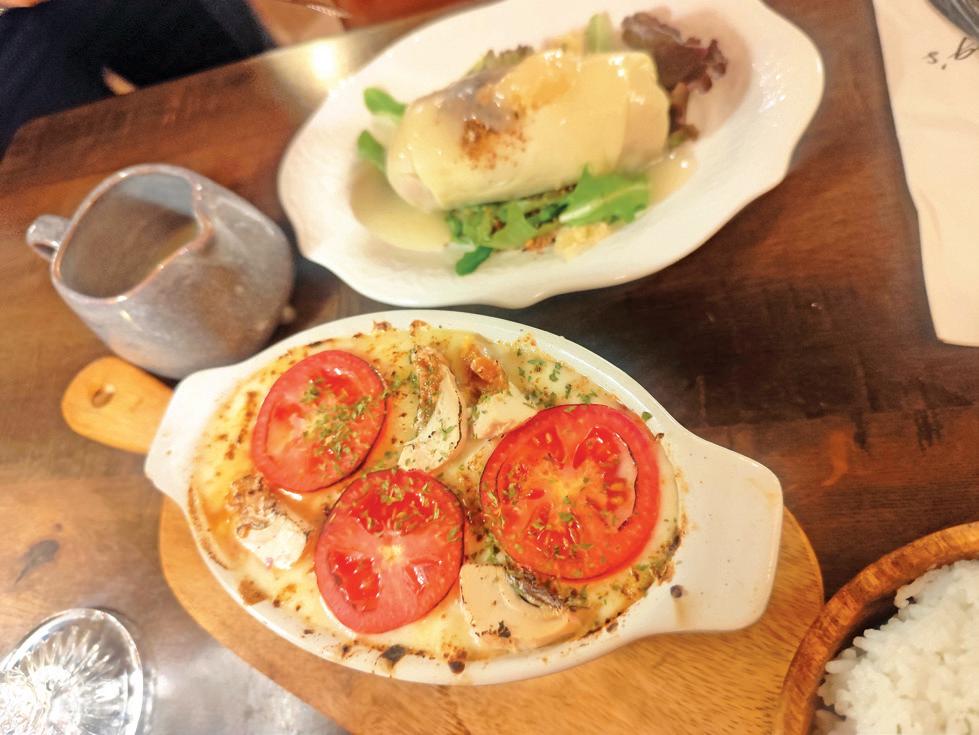


Text and photos by
Francine M. Marquez
THE first thing that catches the eye at Tatung’s, Chef
Myke Tatung’s newly opened restaurant at Gateway Mall in Cubao, Quezon City, are the impeccably set tables. Each one is adorned with crystal water goblets, retro-style crystal table lamps, and multi-ply napkins imprinted with Tatung’s name. Solihiya chairs and elegant chandeliers further enhance the refined table styling.
Yet, the restaurant also evokes a cozy ambience, inviting diners to feel at ease in this restful corner of the bustling mall.
Tatung’s stands where the chef’s former cafe, Tindeli, was once located. Tindeli was part of Palenque, a one-stop dining destination with outlets ran and owned by chefs.
When the mall announced Palenque’s closure last December, Chef Tatung faced a dilemma. He had to choose between opening a new restaurant and not reopening at all. But in a matter of time, Chef Tatung got the chance to use Tin-
deli’s former space. And thus was launched his restaurant called Tatung’s.
“At Tatung’s, we cherish the memories of food and home. And I also like to call it a multigenerational table. It’s a Filipino experience that is not stuck in time. It is not just your lola’s table. It is our table,” he explained.
Thoughtful cuisine THE menu at Tatung’s is diverse, offering everything from appetizers, salads, pizzas, the chef’s signature dishes, pancit and pasta, seafood, grilled items, dessert, to fresh fruit beverages and cocktails. Diners can also avail themselves of ensaimada, breads, and other deli items at Tindeli, which is now a mini-store inside Tatung’s. Here, tastes and flavors are familiar, enlivened by Chef Tatung’s seasoned techniques and well-mastered skills sharpened through two decades of experience. Veering away from dishes with explosive presentations and flavors, food here is meant to be savored mindfully, engaging the senses, while memories of food
deliciously unravel and offer joyful sustenance. Simply put, it’s Filipino food done well.
Chef Tatung shares his life story through his cuisine, recreating recipes from his two places of provenance, Cebu and Bicol.
The Lumpiang Ubod (P360), for instance, consists of hearts of palm and fresh vegetables served with Cebu-style garlicky cream sauce.
The Whole Pampano sa Gata (P710), Pampano braised in coconut sauce with tomato, ginger, onions, and shrimp, is a recollection of helping his Bicolana Lola Juanita baste big fish as it simmers in its thick sauce.
Meanwhile, the fork-tender Twice-Cooked Humba (P550), consists of braised then crisped pork belly with soy, garlic, vinegar, with fried bananas on the side. Chef Tatung remembers his Lola Natividad in Cebu cooking the dish for Sunday gatherings.
Tatung’s dishes, served family-style and good for three to four portions, are anchored on time-honored heritage recipes with subtle innovations.
“I still want to keep the food
accessible, and in a way, homey and familiar. I don’t want to make Filipino food that disconnects Filipinos from their memory. Sometimes when you enter a high-end restaurant, and when you taste the food, it’s so conceptual that the narrative is lost. The chef may have his own story, but for the diner, there is no insight gained, and that sense of nostalgia is lost. That’s what I’m trying to avoid.”
Succulent oysters flown fresh from Aklan are baked and topped with kesong puti (P550), while the crispy Calamari Frito (P620) is so addictive, especially when dipped in spiced vinegar.
Besides signature dishes like Crispy Kare Kare (P795) and Pork Sisig (P560), the Kalderetang Baka with Queso de Bola (P690) is festive in its rich tomato sauce and made even richer with aged Edam cheese.
Chef Tatung also delivers unexpected flavors and techniques while staying true to the taste profile of the original dish: Bibingkang Talong (P490) is tortang talong reimagined as a casserole, indulgent with layers of ground pork, tomatoes, and kesong puti. Sisig
By Vincent Peter Rivera
CAFÉ hopping is a major trend right now, especially among the younger generations. Particularly in the bustling district of Makati—where Legazpi’s relaxed, hipster aesthetic and the New York-like streets of Salcedo draw crowds for a quality brew—great coffee will find you in no time.
But if you’re planning to refresh your caffeine routine with something entirely new, a modern-style Japanese food hub just introduced an inventive fusion of two distinct culinary cultures.
Located along Ayala Triangle Gardens lies Kazu Café, an all-day dining spot that recently launched “The Miko Calo Menu.” This new lineup features 13 meticulously curated French-Japanese dishes, comprising eight brunch items and five desserts, crafted by the award-winning Chef Miko Calo.
Operating under Nippon Hasha Inc., the Manila-based restaurant group behind renowned Japanese concepts like Ramen Yushoken, Mendokoro Ramenba, Marudori, and Kazunori, Kazu Café serves as the spin-off of Kazunori designed to highlight the brand’s modernity and unique offerings.
During his introduction, Nippon Hasha Inc. co-founder, president, and CEO Ryan K. Cruz personified the distinct identity of the café.
“So if I were to describe Kazu Café as a person, it would be a very young Japanese woman who has traveled the world,” said Cruz. “She still respects Japanese balance, harmony, and tradition, but she knows that there are things out there that are also fantastic and great that you can incorporate into what you are doing.”
That very description became the core of the latest menu.
Story behind creation
TO bring this vision to life, Cruz revealed that Chef Miko Calo was their top priority. The partnership centers on Yoshoku, a style of Japanese cooking that adapts Western dishes to local tastes.
Rather than a superficial “fusion,” the menu seamlessly marries French techniques with Japanese culinary traditions and sensibilities. “We wanted actual discipline applied to the concept,” Cruz noted.
This approach fits Chef Miko perfectly.
A top graduate of FERRANDI Paris who spent seven years at L’Atelier de Joël Robuchon across

Europe and Asia, she is best known locally for Metronome and Taquería Franco (which earned a Michelin Bib Gourmand distinction in 2026).
Though not formally trained in Japanese cuisine, Chef Miko found harmony by digging into her core strength.
“What I started with is just to really dig down to my core competency, which is French cuisine, and kind of intertwine that with my love for Japanese cuisine,” Chef Miko explained.
“There are similarities in the philosophy of the way they cook... That’s what we’re trying to do here, to marry it seamlessly where it actually makes sense.”
For Kazu Café, already led by Chef Kazunori Kuramochi who interprets Western café fare through a Japanese lens, this menu is a continuous extension of their culinary identity.
Kazu Café x Chef Miko Calo menu FOLLOWING a deliberate and precise conceptualization process, the collaboration has culminated in a 13-dish showcase of both savory brunches and delightful desserts.
To open the palate, the menu introduces a trio of tarte fines—elegant, flaky puff pastry rounds that trade traditional French toppings for bold, unexpected Eastern profiles. Guests can choose between the Spicy Salmon Tarte Fine, which balances marinated spicy salmon with a herbed cream cheese, and the rich, savory-sweet Unagi Tarte Fine, which pairs tender grilled eel with bleu cheese and a red onion fondant. For a more comforting slice, the Mabo

Reblochon Tarte Fine tops its buttery pastry base with a spicy pork ragù, melted Reblochon cheese, and a crisp potato nest.
Moving deeper into the brunch menu, Chef Miko introduces soul-warming dishes that deliver a satisfying burst of cross-cultural flavors. A clear standout is the signature Pâté de Campagne Sando, built around a house-made French country pâté that takes three full days to prepare. Nestled inside pillowy Japanese shokupan (milk bread) alongside sharp umeboshi and pickled vegetables, it represents the absolute embodiment of rich French charcuterie meeting accessible café culture.
The comforting crossovers continue with the Croque Monsieur Sando, a reimagining of the classic French grilled cheese that layers nama ham and Emmental cheese inside shokupan, complemented by a rich béchamel sauce, a touch of karashi mustard, and a side of comforting tonjiru pork and vegetable soup.
This sits alongside the French Onion Maze Soba, hailed as the clearest expression of the menu’s central idea, which captures the exact soul of French onion soup by tossing brothless noodles with a sweet onion fondant, a rich demi-glace, and a cloud-like Gruyère espuma.
Rounding out the savory lineup are the Kazu Curry Parmentier that layers curried beef ragù under whipped potato purée and a gratinéed Gruyère cheese and the Steak & Eggs featuring seared flank steak drizzled with a decadent Café de Paris sauce along -

side a soft egg over a bed of rice.
To complete the experience and conclude the meal on a high note, guests can indulge in the menu’s various sweet offerings. The desserts begin with the Yuzu French Toast, featuring a custard-soaked brioche filled with fresh yuzu curd and topped with an airy meringue.
Traditional Japanese tea found its way in a familiar Italian dessert with the Hojicha Tiramisu, where ladyfingers are soaked in hojicha, layered with orange-kissed mascarpone cream, and punctuated by a passionfruit gelée.
Then, the Matcha Raspberry Crêpe Brûlée hides earthy matcha ganache, velvety diplomat cream, and tart raspberry gel beneath a glassy, caramelized sugar crust. While the Kurogoma Tarte Tatin updates a deeply caramelized French apple classic with the nutty, bitter crunch of a black sesame brittle.
Finally, the menu reaches its peak with the showstopping Mont Blanc Kakigori, a refreshing mountain of shaved milk ice layered with rich chestnut cream, a tart blackcurrant compote, and a toasted sesame crème anglaise.
So, if you want to add a fresh experience to your list of must-try cafés in Makati, this is an entry you shouldn’t miss. Available daily from 8 am to 3 pm at Kazu Café’s Ayala Triangle Gardens location, this exclusive chef-led menu will run for a limited three months, after which all 13 dishes will permanently join the standard Kazu Café lineup.
and Kabute Pizza (P750) consists of crispy pork sisig, roasted mushrooms, with chili and calamansi.
For a sweet ending, one can’t go wrong with two of his signature cakes, Tablea Cake (P280 a slice) with native tsokolate from Bohol Dalareich Chocolate House. The ganache is thick and melts in the mouth, the cake is light, and the buttercream filling is smooth and not cloyingly sweet. The Halaya Cake (P270 per slice) is heavenly with house-made ube halaya used as creamy icing and as a thick filling.
While food sets the pace for a cherished experience, the true luxury is the bonding and connection made over a shared meal.
“The food is familiar, but it’s the experience and the company that we want to focus on. The food may be good, but it doesn’t try to grab too much of your attention. You’ll pay attention to the taste of the food during the first bites and then go back to your conversation. The food doesn’t try to be the star of the entire experience,” explained Chef Tatung.
“Even with the restaurant’s style of service, we want the staff
to be attentive but not fussy. It’s not about us but about the diner. I’ve reached a point where I understand that, as a diner, I don’t need a performance to make me enjoy my meal,” he continued.
Definitely, Chef Tatung has come home to Tatung’s and hopes those who spend a moment here would also feel the same. With a note of reflection, Chef Tatung ponders, “This is my healing place because this was my original dream when I started. But because I wasn’t getting my wish for the longest time, sometimes I think it won’t happen anymore, or that it’s not meant for me.
“But dreams can come true as long as you stop resisting the opportunities that come your way. Months before we opened, I thought it was the end of it all. But when I saw a glimmer of light, I just trusted and followed what was given to me on a daily basis. So imagine if I just gave it up, then it would be the end of it all. There really is light at the end of the tunnel, and for as long as you stay true to your vision and values,” said Chef Tatung.
Okada Manila opens Curry Corner, bringing authentic Indian flavors to Its dining collection
OKADA Manila, the Philippines’ largest Forbes 5-Star integrated resort for seven consecutive years, introduces Curry Corner, a dining concept centered on the rich traditions of Indian cuisine.
From aromatic curries to regional specialties, the new outlet highlights India’s culinary heritage, complemented by select Pan-Asian favorites.
Located at The Food Court on the Upper Ground Floor of the Casino Coral Wing, Curry Corner brings Indian flavors within easy reach of the gaming floor. Open daily from 11 am to 5 am, it serves lunch, dinner, late-night meals, and hearty breaks between rounds of play.
At the helm is Chef de Cuisine Surjeet Singh, who leads both Curry Corner and the Indian offerings at Medley Buffet. An Indian Specialist Chef with more than 20 years of experience across 5-star hotels in Asia, Chef Surjeet brings extensive knowledge of regional Indian cooking, traditional spice work, and time-honored recipes.
“Through Curry Corner, we want to enrich the culinary experiences at Okada Manila with the warmth, depth, and authenticity of Indian cuisine,” said Chef Surjeet. “Each dish is guided by traditional techniques, balanced spices, and the regional flavors that make Indian cooking so beloved.”
Beyond its bold flavors, curry
carries a sense of comfort shaped by generations of home kitchens, regional recipes, and shared meals. At Curry Corner, that spirit is served in generous, freshly prepared plates made for guests craving something warm, hearty, and deeply satisfying.
Indian curry sets are served in a dabba, a traditional Indian tiered lunch carrier, accompanied by pappadum, a crisp lentil wafer, and a choice of roti canai, steamed jasmine rice, or saffron basmati rice. Signature selections include Murgh Makhani, featuring chicken simmered in a tomatobutter curry, and Ghosht Vindaloo, lamb cooked in tangy red chili gravy.
Complementing the Indian menu are Pan-Asian curry dishes such as Thai-style vegetable green curry and Malaysian chicken curry, both served with steamed jasmine rice.
Reward Circle members can enjoy up to 25 percent off at Curry Corner. Guests may sign up for Reward Circle to access dining privileges, exclusive offers, and more benefits across Okada Manila at okdmnl.ph/RCSignUp.
Curry Corner adds another layer to the Okada Manila journey, where dining, gaming, signature attractions, stays, and attentive service come together in one Forbes 5-Star destination.
Discover more experiences at Okada Manila: https://okadamanila. com/dine/.

By Brian Ong
ON the sidelines of Art Osaka 2026, a return pilgrimage to a beloved Osaka classic — and a long-overdue first encounter with the city’s highest-rated ramen.
Osaka is an Artist Haven
ART fairs have a way of sharpening the appetite — all that concentrated looking, all that careful attention to color and form and meaning, and suddenly the body reminds you that it has needs of its own. That was the rhythm of Art Osaka 2026, held from May 28 to June 1, 2026, at the Expanded Section in Creative Center Osaka and at the Galleries Section in Congrès Square Grand Green Osaka.
It was our first time attending Art Osaka, and this year’s edition carried particular significance for Filipino visitors. Among the 52 galleries presenting in the fair’s Galleries Section, Manila’s own Galerie Stephanie stood out as the only Philippine gallery in the lineup, placing Filipino contemporary art within a regional conversation that otherwise leaned heavily Japanese and Korean. Between gallery walks and artist talks, my brother Jason and I carved out time for a more primal form of appreciation: proper Osaka ramen. Osaka, beyond the fair, makes the question of where to eat easy and impossible at once. Easy, because the city is arguably Japan’s most unpretentious food capital, a place where extraordinary cooking happens in spaces no larger than a closet. Impossible, because there are simply too many extraordinary options for a finite number of meals.
We did our homework the way most food-serious travelers do these days — through Tabelog, Japan’s most trusted restaurant review platform, where ratings are notoriously hard to come by and a score above 3.50 already signals something worth seeking out.
Two ramen shops made it onto our short list, both within walking distance of each other. Between them, they offered two very different arguments for what makes a bowl of ramen great: one built on the quiet authority of consistency, the other on obsessive, almost scientific ingredient layering. Both were worth every bit of the trip, and the wait.
Ramen Yashichi: An Eleven-Year Reunion
SOME restaurants earn a place in memory not because they dazzle, but because they satisfy so completely and so honestly that you find yourself thinking about them years later. Ramen Yashichi, rated 3.74 on Tabelog, is that kind of place for me.
I first sat down at Yashichi in February of 2015, on my maiden trip to Osaka, when the city still felt like a revelation. I lined up for almost an hour in the rain with not a single tourist in sight.

I remember the bowl from that visit the way you remember certain meals: not with photographic precision, but with a kind of bodily recall, an impression of warmth and depth. So, when this year’s Art Osaka trip brought me back more than a decade later, a return visit was never in question. This time, I brought my brother Jason. It did not disappoint. We ordered the chicken paitan shoyu ramen. The broth is the soul of this bowl — a chicken-based paitan that manages to be both silky and substantive, with a milky opacity that comes from long, patient simmering. The shoyu element gives the broth its backbone: a clean, savory edge that cuts through the richness without overwhelming it, a balance that looks effortless but almost certainly takes years to perfect. The noodles are well-calibrated, firm enough to hold their own in the broth. What struck me most was not any single component but the overall consistency of the experience. More than a decade had passed, and yet here was the same reassuring bowl, the same quiet, unfussy hospitality.
Watching Jason work through his bowl, nodding slowly in the way people do when food exceeds expectations they did not realize they had set so high, was its own small reward. Some places earn their reputations honestly and then spend years simply maintaining the standard. Ramen Yashichi is one of those places.
Mugi to Mensuke: Osaka’s BestRated, and the Wait to Prove It JUST a few storefronts away from Yashichi sits a ramen shop of an entirely different register — one that, on paper, makes an even bolder claim. Mugi to Mensuke carries a Tabelog score of 3.83, an extraordinary number, high enough to qualify, by most measures, as the best-rated ramen shop in Osaka. We had filed it away as an ambitious add-on, unsure whether we would manage to fit it in. In the end, we made a separate day of it. The queue outside, at virtually any hour of the day, tells you everything about how seriously Osaka diners take that rating. We arrived expecting a wait and still underestimated it. We waited just over an hour. It is the kind of queue that separates the serious from the merely curious. By the time we were finally seated, I had watched a small parade of regulars arrive, assess the line without flinching, and take their place at the back. There is something clarifying about that — a collective agreement that certain things are worth waiting for. The bowl that rewarded our patience was the Special Kiji Shoyu Soba. The broth is built from varieties of local Japanese chicken — horo horo chicken, mensuke chicken, and hinai chicken — each contributing

its own distinct quality to the final composition. The result is a soup of remarkable layering. The wellaged soy sauce tare gives the broth its spine and its finish, while the toppings — three types of chashu, Wagyu beef wontons, and a small piece of crispy duck sprinkled with black pepper — add a touch of indulgence. The noodles are pleasantly chewy, the kind that push back gently when bit-

ten — a textural counterpoint to the smooth, almost velvet broth. It is a ramen that rewards slow eating. To call it the best ramen in Osaka, as Tabelog’s numbers suggest, feels both accurate and somehow incomplete — the kind of superlative that flattens what is actually a very specific, very considered culinary statement. What Mugi to Mensuke offers is
not just a great bowl of ramen; it is a precise argument for what ramen can be when made with obsessive care for ingredient sourcing and technical execution.
Art, Appetite, and the Logic of the Line THERE is a particular pleasure in building a trip around two different kinds of looking — at art, and at a
Tsurumaru Udon x Tempura open for franchising as demand for authentic Japanese
comfort food grows


By Anne Ruth Dela Cruz
THE appetite for authentic Japanese cuisine continues to grow among Filipino diners, and The Cabalen Group is positioning one of its fastest-growing brands to meet that demand.
Tsurumaru Udon x Tempura, the Japanese fastcasual dining concept operated in the Philippines by The Cabalen Group in partnership with Japan’s Fujio Food Group, is now actively seeking franchise partners as it accelerates its nationwide expansion. The move comes as the brand gains traction among diners looking for freshly prepared Japanese comfort food served in an accessible and casual setting. But beyond the business opportunity lies the heart of the brand itself: authentic Osakastyle dining built on craftsmanship, freshness and tradition.
Established in the Philippines in 2019 with its flagship branch at Robinsons Place Manila, Tsurumaru introduced a concept that was still relatively uncommon in the local dining scene—a fast-casual Japanese restaurant centered on freshly made udon. While the brand’s growth was initially slowed by the pandemic, it has steadily expanded its footprint and now operates eight branches across the country.
FOR Jinger Panganiban-Lopez, Head of Marketing of The Cabalen Group, one of the biggest reasons The Cabalen Group embraced the brand was its unwavering commitment to authenticity.
“It’s really the artistry and the authenticity of the brand,” she said. That authenticity is evident in what many consider the soul of the restaurant: its signature udon. Unlike conventional noodles, Tsurumaru’s udon is prepared fresh every day using traditional Japanese techniques. The dough is carefully prepared, rested, cut and cooked daily to achieve the distinct chewy texture that authentic Japanese udon lovers seek.
“We really do our udon fresh. Every day, we have batch cooking of fresh udon,” Panganiban-Lopez said.
Beyond the noodles
THE commitment to quality extends beyond the noodles. Tsurumaru prepares its dishes throughout the day using carefully selected ingredients and avoids artificial flavor enhancers.
“There’s no MSG. It’s really healthy. You’ll feel it even in our soup base. It’s not salty because it’s really natural,” she explained.

Even as the brand expands, maintaining these standards remains a priority.
“The mantra of the brand to stay like that remains the same,” she added.
That dedication to freshness and consistency has helped make Tsurumaru a favorite destination for diners seeking genuine Japanese comfort food at an accessible price point.
Among the restaurant’s bestselling udon dishes are the Beef Sukiyaki Udon, Chicken Paitan Udon and Tempura Miso Udon. Guests also flock to its growing selection of donburi rice bowls, including Teriyaki Chicken Don, Beef Yakiniku Don and Gyuudon. Other customer favorites include Karaage Curry Rice, Katsu Curry Rice, Seafood Yakiudon, Beef Kimchi Yakiudon, Ebi Tempura and Salmon Omusubi.
Japanese curry TSURUMARU has also introduced Filipino diners to Japanese curry, which differs significantly from its Thai and Indian counterparts.
“The Japanese curry is milder. It’s more refined,” Panganiban-Lopez said, noting how its rich yet approachable flavor profile has resonated with local diners. The restaurant has steadily expanded its
menu. Osaka is a city that rewards both. Art Osaka this year brought together a strong field of regional galleries and international participants, and the fair’s dual-venue setup across Creative Center Osaka and Grand Green Osaka gave it a certain expansiveness that suited the work on view.
Art Osaka itself offered plenty to think about — a fair that retained a sense of discovery, the feeling that there are still things to be found rather than simply confirmed. The showcase of Filipino artists featured by Galerie Stephanie — Kim Borja, June Digan, Wrenn, Gaby Prado, Naburok, and Jezzel Wee — representing a slice of contemporary Filipino practice on Japanese soil, was one of those discoveries, a reminder that the region’s art conversation is widening to include voices from Manila.
Between the galleries and artist conversations, the bowls of ramen we chased down became their own kind of exhibit: intimate, immediate, requiring no wall text to be understood. You either taste what the kitchen is doing, or you do not.
Sometimes the most honest form of cultural immersion is not a gallery at all, but a line of locals who clearly know something you should, and a bowl of soup that makes the wait feel, in hindsight, like the shortest part of the afternoon. Returning to Yashichi after eleven years reminded me why certain places stay with us long after a trip ends.
Discovering Mugi to Mensuke for the first time reminded me why it is worth continuing to look, even in a city you think you already know well. And watching Filipino artists hold their own in a Japanese exhibition hall reminded me that the things we travel for — recognition, discovery, the occasional reunion with something familiar — rarely arrive separately.
Both Ramen Yashichi and Mugi to Mensuke are located in Osaka. Check Tabelog for current hours and to manage your queue expectations accordingly — and be prepared to wait. The good ones always have a line.
offerings beyond udon, adding donburi, yakiudon and other Japanese favorites to cater to a broader market. The growing popularity of Japanese culture among Filipinos—from anime and J-pop to Japanese cuisine—has also helped fuel interest in the brand.
Now, The Cabalen Group is preparing for the next stage of growth.
“We’re really gearing towards expansion of the brand,” Jinger said. The company is actively looking for qualified franchise partners in key growth areas, particularly in Southern Luzon and emerging provincial markets. Cebu is among the locations being explored as Tsurumaru strengthens its presence outside Metro Manila.
Business model
PART of the brand’s appeal, according to Panganiban-Lopez, is its business model.
“It’s a fast-casual concept.
Successful partners will receive operational support, marketing assistance and training from The Cabalen Group. The company also prefers to work with operators who have a strong understanding of their local markets.
“We prefer to get franchises that are really local. They will be able to manage the community here,” Panganiban-Lopez explained. For The Cabalen Group, the expansion of Tsurumaru is about more than opening additional stores. It is about bringing a slice of Osaka’s everyday dining culture to more Filipino communities.
Positioned as “Japan’s Everyday Favorites,” Tsurumaru continues to win over diners through freshly made noodles, carefully prepared dishes and a commitment to authentic Japanese flavors. As the brand opens its doors to franchise partners, more Filipinos may soon discover why a simple bowl of freshly made udon can be both comforting and unforgettable.


Sunday, June 28, 2026 |
Edited by Jose F. Lacaba
Why our past remains our most critical

AS the Philippines navigates a complex period of political noise and legislative turmoil, the recently concluded Panagriing, A Nation Still Rising: The Closing Conference of the 125th Anniversary of the Philippine Independence and Nationhood 2023-2026 serves as a vital reminder of our collective roots.
The national conference, which served as the official closing event for the three-year commemoration of the 125th Anniversary of Philippine Independence and Nationhood (#PH125), offered not just a historical retrospective, but it also provided a necessary mirror to our present.
The National Historical Commission (NHC) partnered with the Ayala Foundation, the Ayala Museum, and
the member-affiliates of the Local Historical Committees Network in holding the event from May 25 to 26. Coined from the Ilocano word which means “to be roused from sleep” or “arising,” Panagriing brought together more than 20 historians, researchers, and cultural workers to explore the enduring, multi-regional legacies of the Philippine Revolution, the PhilippineAmerican War, and the First Philip -
pine Republic beyond 1901. A MULTITUDE OF VOICES
THE hybrid conference, which was free and open to the public, provided a sweeping, inclusive look at the foundational years of the republic (1896–1901) from various regional lenses.
The first day kicked off with welcome remarks from Senior Director for Arts and Culture Jorell M. Legaspi of the Ayala Foundation. NHCP Deputy Executive Director for Programs and Projects Alvin R. Alcid read a message from NHCP Chairperson Regalado Trota Jose Jr.
“For when the Filipino comes to fully realize the meaning and depth of His/Her freedom as understood through history, she/he is awakened from ako to a higher consciousness of tayo. It is an awakening that stirs us to unite, to dream beyond the present, to dare what has been untried, to uphold Freedom as a precious gift, and to defend it with our entire being,” Jose shared in his message.
Dr. Maria Serena I. Diokno, Professor Emeritus from the Department of History, University of the Philippines Diliman, in The Paradox
of Our Struggles for Independence and Dr. Reynaldo C. Ileto, Honorary Professor from the School of Culture, History and Language, The Australian National University, in Santa Iglesia or Asemblea Filipina?
Two Paths to Nation-making and their Significance for the Present, delivered powerful keynote addresses.
Session 1 (From Kawit to Isabela: The Path of Philippine Nationhood ) featured insights from Dr. Emmanuel Franco Calairo of De La Salle University-Dasmariñas on Cavite and Isabela, Dr. Jaime B. Veneracion of University of the Philippines Diliman on Central Luzon, Dr. Melchor E. Orpilla of Pangasinan Polytechnic College and Komisyon sa Wikang Filipino on Aguinaldo and the Pangasinan-Ilocos campaign, and Merlisa Parcon-Ligero of the National Commission for Culture and the Arts on the First Philippine Republic in the mountains of Kalinga.
Sessions 2 and 3 (Historiographical Inquiry of Visayas and Mindanao Local History of Philippine Independence and Nationhood ) decentralized the traditional Manila-centric narrative. Scholars like Dr. Rolando O. Borrinaga of University of the Phil-
ippines Manila, Atty. Bryner L. Diaz of Cebu City Cultural and Historical Affairs Office, and Asst. Prof. Kyle Philip M. Ravena of University of the Philippines Visayas mapped out the fierce revolutionary campaigns in Leyte and Samar, Cebu, and Iloilo, respectively. Meanwhile, Asst. Prof. Rey Luis A. Montesclaros of Mindanao State University–Iligan Institute of Technology, Rene Michael D. Baños of Northern Mindanao Heritage Network, and Dr. Neil Martial D. Santillan of UP Diliman, highlighted the critical, often overlooked Maranao resistance and the early raising of the Philippine flag in Mindanao.
DIPLOMACY, RESISTANCE, PUBLIC HISTORY
THE second day shifted focus toward institutional memory and survival beyond early structural collapses. Dr. Ricardo T. Jose of the Department of History, UP Diliman, opened the second day with an important lecture on Philippine Diplomacy and Diplomats and Their Role in Making the Philippine Nation, 1898 Onwards
Session 4 (Philippine Nationhood Overseas) dove into revolutionary diplomacy, with the discussions of Dr. Ma. Luisa T. Camagay on The Hong Kong Junta and its Diplomatic Activities, Dr. Ruel V. Pagunsan on Apolinario Mabini’s transition negotiations in Negotiating Independence: Diplomacy and Nationhood in the Period of Transition, and Dr. Ariel C. Lopez on the sophisticated Kadatuan diplomacy: Diplomatic agency of the chiefly elite in Mindanao and Sulu, c. 1830-1930. Dr. Pagunsan is the current Chairperson, Dr. Camagay is a Professor Emeritus, and Dr. Lopez is an Assistant Professor of the Department of History, UP Diliman. Session 5 ( The Light Remains Aflame: Resistance Beyond 1901) honored the persistent armed resistance after the capture of Emilio Aguinaldo in 1901, with papers presented by Cavite Provincial Board Member Aidel Paul G. Belamide on Gen. Vito Belarmino and the combined Bikolano and Tagalog forces from 1899 to 1901, and Gabriel Malvar of University of Makati on his grandfather Gen. Miguel Malvar’s leadership takeover.
Continued on page 2
Sunday, June 28, 2026
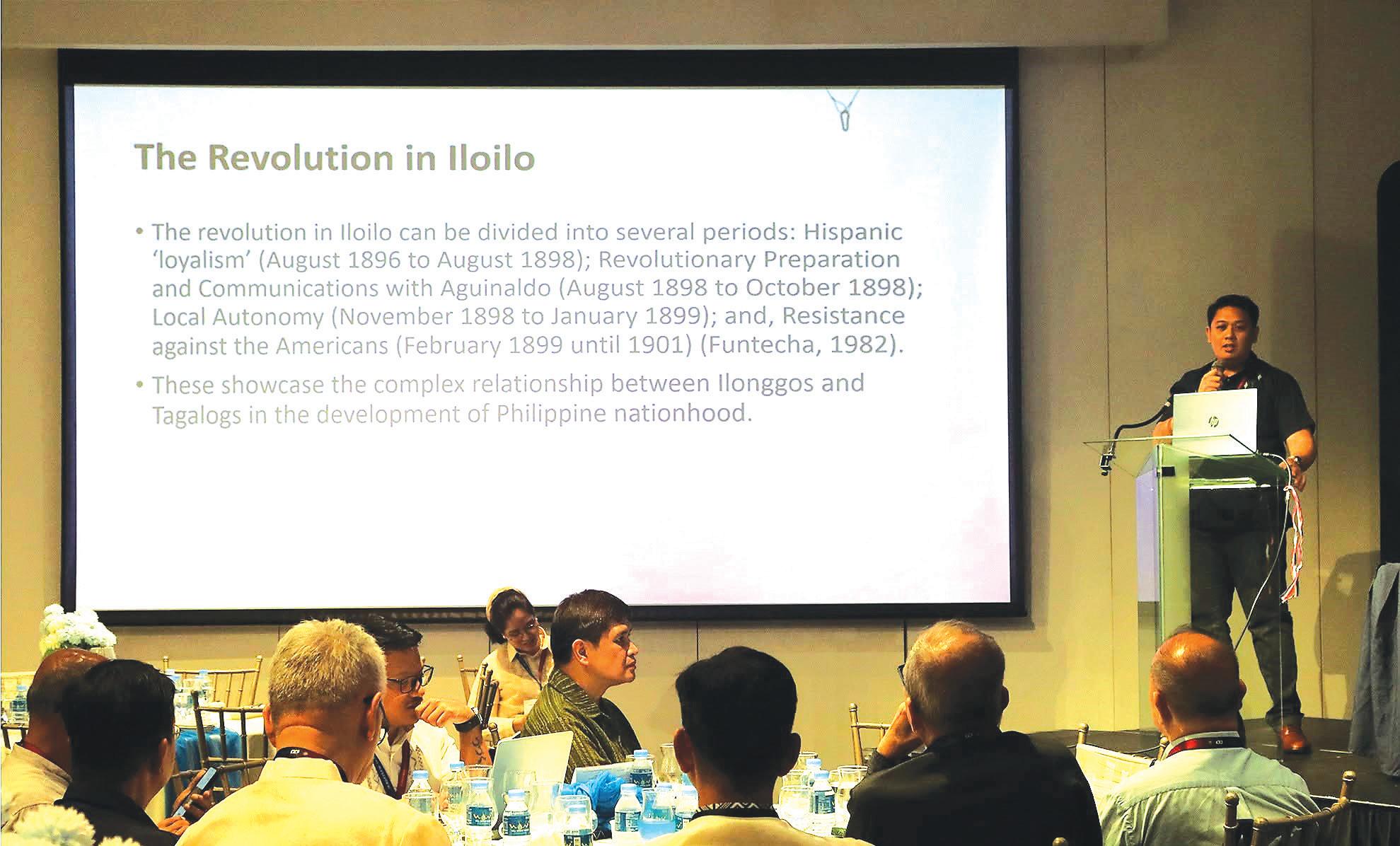
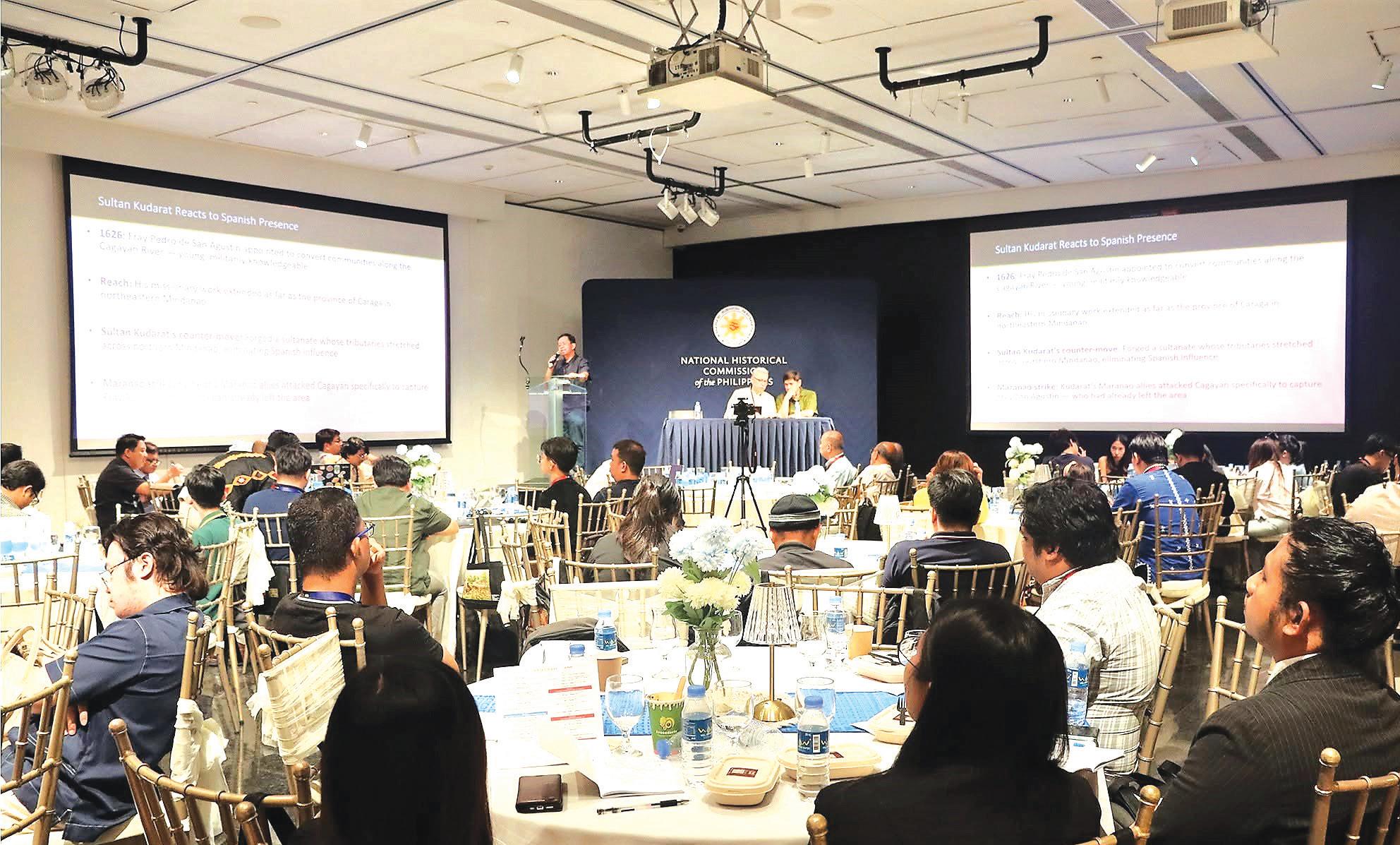


Continued from page 6
Session 6 (Public Historiography of PH125 ) closed the conference by examining how history lives in the public consciousness today.
Dr. Ian Christopher B. Alfonso discussed revolutionary symbols, while Marinella Andrea C. Mina’s In 60 Snapshots: Popularizing the Story of Philippine Nationhood through the Ayala Museum Diorama Experience and Maria Cecilia I. Ayson’s Filipinas Heritage Library as Memory Keeper of Philippine History and Nation highlighted the roles of their respective institutions as modern memory keepers. National Artist for Dance Alice Reyes concluded the panel by sharing the intersection of performance and public history through the Alice Reyes Dance Philippines (ARDP) experience.
NHCP Executive Director Carminda R. Arevalo expressed deep appreciation to their partners in her closing message. She also invited fellow students of history, cultural workers, educators, and lovers of our nation to use the moment “to reflect
in the past that was shared with us, in the present that we inhabit, and in the future that we face.”
VALUE OF THE PAST PANAGRIING is a timely reminder of the cyclical nature of political unrest. Amid today’s noisy legislative battles and shifting political alliances, the event underscored the timeless maxim, “Those who cannot remember the past are condemned to repeat it.”
Speakers and organizers stressed that grounding the public in rigorous local and national history is the ultimate defense against collective amnesia and contemporary political instability.
The phrase “let history be the judge,” which echoed throughout the sessions, reminds us that while the present may be clouded by temporary chaos, immediate bias, and political noise, the long-term perspective of history inevitably uncovers objective truths.
Despite the current polarization witnessed in the Philippine government and our society in general,
the conference left attendees with a profound sense of reassurance that the writing of Philippine history is in good hands.
Renowned Philippine historian Teodoro A. Agoncillo noted that while history is never entirely objective, the absolute role of the Filipino historian is to tell the truth as anchored by documentary evidence.
Guided by the same philosophy, a new generation of scholars is actively safeguarding the national narrative.
The Panagriing conference proved that the spirit of resistance and nation-building remains a continuous, unbroken thread. As the three-year #PH125 milestone commemoration ended, the takeaway for the audience was clear.
Political squabbles and spectacles will dominate the daily news cycle, but the foundations of Philippine history remain secure, rigorously defended by historians dedicated to uncovering local truths and reminding the nation of who it belongs to.