

LINGERING
second-round effects from war-related supply shocks prompted the Monetary Board to raise the key policy rate by 25 basis points for the second time this year.

second-round effects from war-related supply shocks prompted the Monetary Board to raise the key policy rate by 25 basis points for the second time this year.
By Samuel P. Medenilla
last
imports stood at only US$34.5 million. Since it peaked in 2018 at US$1.4 billion, Philippines-Russia trade continued to dwindle to its current level.
The biggest decline happened in 2022, when countries imposed trade sanctions against Russia after it attacked Ukraine. From US$662.3 million, the value of the country’s total trade with Russia dropped to US$207.9 million the following year.
Putin said the necessary mechanisms already exist to raise the trade volume.
“Effective mechanisms of applied cooperation are in place. This includes, the joint RussiaPhilippine Commission on Trade and Economic Cooperation,” Putin said in Russian through a translator during his bilateral talk with Marcos at the sidelines of the Association of Southeast
Asian Nation (Asean)-Russia Commemorative Summit in Kazan, Russia.
“Today, we have a good opportunity, Mr. President, to evaluate the current stage of Russia-Philippines cooperation,” he added.
Marcos agreed with Putin, saying that during the Joint Commission on Trade and Economic Cooperation (JCTEC), held in Moscow in September, “structural issues” on Philippines-Russia trade were already addressed. He said the Philippines is now ready to explore joint ventures to help both countries achieve energy and food security.
“And as you have mentioned, Your Excellency, we—there are many potential areas that I think we should still open to explore and think that the present level of trade, although it is steady, think that this is—there is a great deal more that we can do,” Marcos said.
The chief executive noted that the several memoranda of understanding (MOU) signed during the bilateral meeting—on innovation, retail products, cosmetics, food processing, and industrial collabora-



By Ma. Stella F. Arnaldo
Special to the BusinessMirror
THE Philippines has topped the list of the 20 best countries in the world to retire this year.
The list was drawn up by the Expatriate Group, a specialist provider of international health insurance serving expatriates and retirees across more than 180 countries. A unit of the United Kingdom-based insurance broker, the Specialist Risk Group (SRG), the Expatriate Group gave the Philippines an overall score of 78 out of 100. It cited the Philippines’s special
visa for retirees, low cost of living, and the relatively effortless integration of expats into the culture as among the reasons it topped the list ahead of countries like Thailand, Colombia, Portugal, South Africa, and other retirement havens in Europe and Southeast Asia.
“The country’s Special Resident Retiree’s Visa [SRRV] is among the most accessible retirement programs we assessed. Applicants aged 50 and over who receive a pension can qualify with a fixed deposit of US$15,000 [around £11,000], and successful applicants benefit from long-term residency without


By Mary Jade Jadormio
DETERMINING whether users are genuinely teenagers while preserving their privacy remains one of the biggest challenges facing social media platforms, Meta said on Tuesday as it rolled out enhanced safety features for young users in the Philippines.
Speaking during the launch of Screen Smart, Meta’s digital literacy initiative, Meta Head of Safety Policy for Asia Pacific Malina Enlund said technology companies continue to grapple with how to accurately identify young users without requiring excessive personal information.
“It is very difficult to find a privacy-preserving way that is accurate to determine a person’s age,” Enlund said.
The event also marked the Philippine rollout of Meta’s revamped Teen Accounts, a set of built-in protections designed to create safer and more age-appropriate experi-
ences for users aged 13 to 17 on Instagram and Facebook.
The initiative was launched in partnership with government agencies, youth organizations and child rights advocates amid growing global concerns over children’s exposure to harmful online content and increasing calls in some countries for stricter social media regulations.
Enlund said Meta currently relies on a combination of declared age, behavioral signals and verification processes to determine whether users may have misrepresented their age. Under the system, users who attempt to change their age information may be directed to a verification process that can include facial age estimation technology or the submission of supporting documents.
She acknowledged, however, that requiring government-issued identification creates privacy concerns, particularly for younger users.

Instead, Meta is advocating for age signals to come from app stores, which already collect age-related information during device setup.
“The age signal should come from the app store,” she said, adding that a centralized system would help platforms provide age-appropriate protections without repeatedly requiring users to submit sensitive personal information.
According to Enlund, Meta developed Teen Accounts after years of consultation with parents, child-safety experts and advocacy groups who expressed concern that many safety tools were difficult to locate or activate.
The company said parents consistently identified three major concerns: who their children interact with online, the type of content they are exposed to, and the amount of time they spend on social media.
To address these concerns, Teen Accounts automatically place younger users in private accounts, restrict direct messages from strangers, limit exposure to sensitive content, activate hidden-word protections for offensive messages, and provide reminders after prolonged use.
The system also includes a sleep mode that automatically silences notifications overnight, while parents can impose additional restrictions depending on their children’s needs.
Enlund said the goal is to make safety settings automatic rather than requiring parents and teenagers to navigate dozens of optional features on their own.
“Teens online have a safe, age-appropriate experience online,” she said, describing the objective behind the Teen Accounts program.
She noted that online safety cannot be achieved by technology companies alone and requires cooperation among governments, educators, parents, civil society organizations and the technology sector.
“It takes a village,” Enlund said. “We don’t have the answers, but many of you in the audience have a piece of the answers.”
Meta said it hopes the initiative will encourage other digital platforms to adopt similar default protections for young users as online safety concerns continue to evolve.
By Mary Jade Jadormio
LABOR groups pressed for a P200 daily minimum wage increase on Thursday as the National Capital Region Regional Tripartite Wages and Productivity Board (RTWPB-NCR) conducted a public hearing on wage adjustment petitions.
Workers’ purchasing power has continued to decline amid sustained increases in the prices of food, transport, housing, and other basic needs, according to labor organizations backing the proposed hike.
Partido Manggagawa (PM) backed the petition filed by the Kapatiran ng mga Unyon at Samahang Manggagawa, saying that current wage levels are no longer sufficient to keep up with inflation and the cost-of-living crisis.
“The P200 wage increase is a necessary step to address the rapid decline
in the purchasing power of wages. The economy cannot grow if the very people who create wealth continue to be underpaid,” PM said in a statement.
The labor group also pushed back against arguments that substantial wage increases could lead to job losses, saying such claims have long been used to justify modest wage adjustments.
They said higher wages would instead stimulate domestic demand and help boost local economic activity, particularly in sectors dependent on household spending.
Labor organizations have repeatedly raised concerns that previous wage adjustments have not kept pace with inflation, leaving minimum wage earners increasingly vulnerable to poverty.
They also noted that the rising cost of essential goods continues to outstrip wage growth, forcing many workers to rely on loans and addition-
El Niño,” added the central bank governor.
Remolona said these on Thursday after the Monetary Board, the highest policy-making decision body of the BSP, decided to raise the central bank’s Target Reverse Repurchase (RRP) Rate by 25 basis points to 4.75 percent.
“So far, we haven’t [taken that into account]. It’s a big risk. We know that this one could be unusually big. So it is a big risk, but we’re still analyzing the potential effects of
The central bank also said in its statement that the interest rates on the overnight deposit and lending facilities were adjusted to 4.25 percent

al work to make ends meet.
During the hearing, labor groups reiterated that wage-setting mechanisms should reflect actual living costs rather than conservative adjustments that fail to close the gap between wages and basic needs.
The P200 petition is among several proposals being evaluated by the wage board, which is mandated to review wage levels in the region based on economic conditions and employer capacity.
Labor groups said they expect the board to consider not only business conditions but also the urgency of addressing declining real wages in Metro Manila.
The Trade Union Congress of the Philippines (TUCP), meanwhile, urged Acting Labor Secretary Francis “Tol” Tolentino to
and 5.25 percent, respectively.
Higher inflation path
GIVEN these inflationary pressures, latest projections by the central bank showed a slight uptick in average inflation for 2026 and 2027.
Zeno Ronald R. Abenoja, BSP Deputy Governor for the Monetary and Economics Sector, noted the central bank raised its 2026 headline inflation forecast to 6.4 percent from the 6.3 percent in the April 23 policy meeting. For 2027, he said average inflation is now expected to reach about 4.5 percent. In the previous policy meeting, the BSP pegged next year’s inflation at 4.3 percent.
Meanwhile, the BSP signaled that inflation could only go back within the 2 to 4 percent target band by 2028.
“For 2028, the first time that we will be sharing our forecast for 2028, it could hover around 3.1 percent,” Abenoja said.
“I think the Governor emphasized this characterization of the outlook on inflation. It continues to be elevated but by 2028, we hope to be within the tolerance range in terms of average inflation,” added the BSP deputy governor for Monetary and Economics Sector.
US-Iran cease-fire not yet a breather EVEN now with the cease-fire between the United States and Iran being signed, Remolona said the Philippines would need several months to “rebuild the infrastructure” before the price of oil moves back to the levels prior to the conflict.
As such, the chief of the Philippines’s central bank admitted that while the Monetary Board has “a lot” of tightening space, the length of the tightening cycle is still uncertain.
“It depends. Analyzing this is somewhat challenging for any central bank. And so we’re looking for higher frequency data so that we have a better sense of where prices are going, not just oil prices, but the reaction to oil prices has been quicker than we had anticipated,” Remolona emphasized.
However, he dropped a hint that the BSP may be leaning towards “small moves” than big moves, pointing out that the latter tend to disturb the markets if you reverse them.
“The problem with big moves is it tends to disturb the markets if you reverse them. So it’s better to do small moves in the same direction than a big move up and then a big move down. That’s more disruptive to markets,” added the BSP chief.
Meanwhile, when asked what would justify the end of the tightening cycle, Remolona replied, “the art of monetary policy.”
He said: “We look at many, many data points. The economy has many, many moving parts. We run our models. We run them again. We try different data points. We add things to the model. We add uncertainty. We add confidence, different things. And then there’s a judg-
take a more active role in supporting a substantial wage increase.
“Workers demand and deserve that new Labor Secretary Tolentino not merely do his job but rise above it,” TUCP said in a statement.
The hearing forms part of ongoing consultations under the country’s wage-fixing system, where labor, employers, and government representatives deliberate on possible adjustments.
For labor groups, however, the central issue remains the same: ensuring that minimum wages are enough to support a dignified standard of living amid persistent price increases.
They said the outcome of the petition will be closely watched by workers across sectors who continue to struggle with stagnant pay and rising living costs.
ment on what you do. So that’s the way, that’s the art of monetary policy.”
Spillover effects
REMOLONA expressed hope that the Monetary Board’s policy action on Thursday, “will help keep inflation expectations anchored and will mitigate the risk of second-round effects.”
The central bank chief also noted that this policy move is “carefully measured” in order to lend some support to fiscal policy in stimulating consumption and investment.
Remolona said the Monetary Board would like to monitor “especially the second-round effects.”
“When you have a global supply shock and then our share of global demand for that commodity is tiny, it’s 4 percent, there’s nothing monetary policy can do about that shock itself,” the BSP governor explained.
But that shock, he pointed out, affects the prices of other commodities.
“It affects the price of fertilizer. It affects the price of food for which monetary policy can have an effect. We focus on those things. So we focus on the second-round effects rather than the supply shock itself because that’s what we can affect,”
Remolona underscored further.
Abenoja said the BSP has observed that while the direct effect has been felt, “it will be a few more months until we see the spillover effects of the direct effect of the supply shocks.”
“That will be reflected in the core inflation in succeeding months. So it is possible that we could be a little above the 4-percent range for the rest of this year. We are looking very closely at this rate of spillover,” the BSP deputy governor also noted.
Data from the Philippine Statistics Authority (PSA) revealed that while headline inflation eased to 6.8 percent in may, core inflation accelerated to 4.1 percent, the fastest in 2 years and 4 months.
The worst may not be over TOWARDS the end of the policy meeting, the BSP governor was asked if the worst is over for the Philippines as far as inflation is concerned after headline inflation eased to 6.8 percent in May prior to hitting 7.2 percent in April.
The governor responded: “I won’t say the worst is over. We don’t know. We don’t know. I hope it’s over, but we don’t really know.” Moving forward, Remolona underscored that the Monetary Board will continue to be vigilant and guided by incoming data.
In its April 23 policy meeting, the MB noted that a rate hike was deemed necessary as a “timely” and “preemptive” policy action to keep prices stable with Remolona saying the inflation outlook has “deteriorated” amid the ongoing conflict in the Middle East. (See: https://businessmirror. com.ph/2026/04/24/price-shocks-prompttweaks-to-key-rates/)
the burden of annual visa renewals. Processing times typically range from four to eight weeks,” said the Expatriate Group.
The group also cited the Englishspeaking medical professionals in the country, and relative access to modern private hospitals that are accredited with most major international health insurance programs, as long as the retiree stays in major cities like Manila and Cebu. With a medium range in major-range score of 12 out of 20, the group noted the significant gap between healthcare facilities in urban and rural areas, “so location is an important consideration for retirees.”
Living in the Philippines is quite affordable and remains one of the country’s biggest strengths, said the group. A retired couple can live comfortably in the country for around £750-£1,000 ($998-$1330) a month, although the group pointed out that it is more expensive to retire in Manila, “than in the smaller cities and coastal communities.”
The group said UK retirees will feel right at home in the Philippines as most locals speak English. “Combined with a well-established expat population across Manila, Cebu, and popular island destinations, this makes the transition to life overseas much easier than in many competing retirement destinations,” the group added.
The group underscored that while the Philippines is the best destination for retirement, expats must “ensure your health insurance is robust enough to bridge the gap between excellent urban healthcare and more limited provision elsewhere.”
How countries were scored THE Expatriate Group’s Retirement Abroad Index 2026 aims to evaluate the factors that matter most when relocating overseas in later life. Rather than focusing solely on lifestyle considerations, the index assesses the practical realities retirees face, including healthcare access, visa requirements, living costs, and the ease of settling into a new country. “Each country was scored across five equally weighted pillars. Every pillar was worth up to 20 points, creating a maximum possible score of 100. The countries were then ranked according to their combined score.”
The Philippines scored the highest in cost of living, with 18 out of 20 points, and lowest, at 12 out of 20 points, in healthcare quality.
The SRRV is administered by the Philippine Retirement Authority (PRA), an attached agency of the Department of Tourism. There are about 62,003 active foreign retirees in the Philippines, coming from 150 countries. Last year, PRA was able convince 3,720 foreign nationals to retire in the country, just 2.4 percent less than those who retired last year.
PRA General Manager Roberto Z. Zozobrado told the BusinessMirror, the lower number of foreign retirees last year was from “cancellations of potential Chinese retirees due to the negative publicity caused by the POGO (Philippine Offshore Gaming Operations) problem. [But] we’re doing very well this year. Figures show that as of June 15, we are 54 percent ahead of the same period last year.”
Of the total active foreign retirees, 40.37 percent are from mainland China, followed by South Korea 11.3 percent, India 10.31 percent, the United States 7.75 percent, Taiwan 5.04 percent, Japan 3.77 percent, Hong Kong 3.77 percent, UK 2.5 percent, Germany 1.8 percent, Australia 1.58 percent, and others 11.87 percent. Zozobrado said PRA’s marketing efforts are currently focused on attracting retirees from Europe, the US, Canada, and Australia.
while the Philippines is open to importing its poultry and meat products.
“And they know that in the Philippines— when the ‘Ber’ months arrive, the price of meat increases and Russia is preparing to export meat to the Philippines for the holiday season,” he said in a video interview posted by the Presidential Communication Office in its social media page. Tourism was another sector where Manila is currently seeking to expand its collabora-
tion with Moscow, according to Bailen. Last year, he said IrAero, a Siberian airline, already started chartering direct flights from Irkutsk and Khabarovsk to Kalibo, Aklan. Another Russian airline, S7 Airlines, has a pending application with the Civil Aeronautics Board of the Philippines to offer flights from the cities of Irkutsk, Vladivostok and Kabarovsk to Manila and to Cebu. If the application is approved, he said it will bring more high-spending Russian tourists to the country.
“So that is what we are still developing in terms of economic relationship [with Russia]. Tourism is a very important part of the eco -
nomic relationship and there is great potential, aside from the traditional exports, imports of oil, energy, and food,” Bailen said. The diplomat admitted certain “challenges” when it comes to Manila’s possible cooperation with Moscow, on defense and security since the former opposed the latter’s attack on Ukraine. However, he said there are still ongoing talks between the two parties when it comes to counterterrorism or issues like maritime security within Asean’s jurisdiction.
“So, our discussions while we are not procuring or buying arms, discussions are ongoing to have cooperation with them for mutual interest on defense and security,” Bailen said.
AHOUSE of Repesentatives
impeachment trial spokesperson on Thursday expressed concern that the defense pre-trial brief filed on behalf of Vice President Sara Z. Duterte appears intended to create confusion rather than provide clarity, describing it as “a smoke screen, not a flashlight.”
Lanao del Sur Rep. Zia Alonto Adiong explained that pre-trial proceedings are meant to narrow down the issues, identify relevant evidence, and ensure an orderly and efficient trial.
“A pre-trial brief should be a flashlight. It should shine light on the issues. It should help the court, the parties, and the Filipino people understand what the evidence is and what facts are actually in dispute,” Adiong said.
“Unfortunately, after reading this filing, many Filipinos may
conclude that what was submitted is not a flashlight, but a smoke screen,” he said. He added that people want to understand where the public funds went.
“They want to know how questioned expenditures will be explained. They want to know how allegations involving unexplained wealth will be addressed. They want to know how the evidence supporting the Articles of Impeachment will be rebutted,” said Adiong.
“Those are the questions that matter. Those are the questions ordinary Filipinos have been asking for months,” Adiong added.
Despite the length of the document and the extensive list of witnesses and exhibits, Adiong noted that the public still cannot clearly determine how the Vice
President intends to answer the core allegations.
“If there are answers, the public expects to see at least a glimpse of them. If there are explanations, the public expects to see where they are headed,” Adiong said.
“Instead, what many see is a document that makes the issues more complicated without making them any clearer,” Adiong said.
The Mindanao lawmaker warned that the filing risks creating the impression that the goal is not to clarify the truth but to bury it under volume and procedure.
“A flashlight helps people see. Smoke makes it harder to see. That is why many people are beginning to ask whether the goal here is to explain the allegations or simply to make them harder to follow,” he said.
Adiong emphasized that the House prosecution panel fully
By Rex Anthony Naval
THE National Police (PNP)
on Thursday said that it has not received any formal communication regarding arrest warrants issued against some personalities by the International Criminal Court (ICC).
In a statement, the National Police Chief, Gen. Jose Melencio Nartatez Jr., said they have yet to receive any official document that would require police action.
“As of this time, the PNP has not received any official communication, documentation, or directive from any government agency regarding the alleged ICC warrants. We rely on formal processes and verified information, not speculation or social media posts,” he added.
He issued the statement amid a circulating social media post claiming that an arrest warrant was already issued against a lawmaker and two former police officials.
Since there is no official document forwarded to the PNP yet, Nartatez said no special instructions have been issued to police units to monitor or track any individual in connection with such rumors.
Filipino, American troops do operational maneuver drills in Luzon training sites
SOLDIERS from the Army (PA) and their American counterparts strengthened their combined operational readiness in Salaknib Phase 2’s Operational Maneuver (Opman) phase in various training sites in Luzon from June 1 to 16.
“As the Opman unfolded over the twoweek period, participating forces integrated advanced technology, strategic mobility, and combined-arms capabilities into a single synchronized operation across Luzon,” the Army spokesperson, Col. Louie Dema-ala, said in a statement on Thursday.
He added the drills tested the ability of US and Philippine forces to rapidly integrate capabilities, conduct long-range movements, and execute combined operations across multiple environments.
“The mission incorporated maritime security operations, ground maneuver, strategic airlift, precision fires and air assault operations, reinforcing the enduring partnership between the two allied nations,” Dema-ala said. Exercise “Salaknib”highlights the enduring Philippine-United States alliance, enhancing interoperability and readiness through combined arms operations, multi-domain integration, and humanitarian assistance efforts for regional stability.
Salaknib Phase 2 formally started mid-May and is scheduled to end in July while Salaknib Phase 1 took place from April 6 to 17. Rex Anthony Naval
Nartatez said the PNP continues to coordinate with the Departments of the Interior and Local Government and of Justice, National Bureau of Investigation, and Bureau of Immigration for situational awareness should any formal request emerge from competent authorities.
He stressed that the PNP remains prepared to carry out its duties whenever required by law.
However, any action by the police must be based on legitimate orders and properly transmitted documents, Nartatez noted.
“The PNP will perform its mandate in accordance with the Constitution, existing laws, and established procedures. We will neither preempt the process nor neglect our responsibilities,” he added.
Malacañang, meanwhile, refuted claims that the Marcos administration is using the ICC as a political weapon against its political opponents.
This came after Davao City Rep. Paolo Duterte alleged that the government is “weaponizing” the ICC to suppress and silence members of the opposition.
Duterte said he had received information from a “highly reliable
source” about the ICC’s issuance of a warrant of arrest against Sen. Christopher Lawrence Go.
Go is a former aide to former President Rodrigo R. Duterte, who has been detained at the ICC facility in The Hague, the Netherlands for alleged crimes against humanity linked to his anti-drug campaign.
In an interview in Kazan, Russia, Palace Press Officer Claire Castro debunked the allegation, noting that the cases filed against Duterte and other respondents, including Go, were filed in 2017, five years before Marcos assumed the presidency.
First of all, we know that the ICC is a court. And there is a case—one that was filed by our fellow Filipino regarding alleged abuses related to extra-judicial killings. Let us not forget that,” Castro said in Filipino.
“And if a valid warrant of arrest were issued, it remains valid. They [ICC] simply want accountability she added,” also in Filipino.
Castro noted that under Republic Act 9851, the Philippines may surrender or extradite a suspected or accused person in the
PHLPost honors Cagayan de Oro’s Legacy with commemorative stamp
THE Philippine Postal Corporation (PHLPost) unveiled a commemorative postage stamp on June 15 to mark the 75th Charter Anniversary of Cagayan de Oro City, celebrating the city’s rich history, cultural heritage, and remarkable journey as one of Mindanao’s leading centers of growth and development.
Issued as part of the city’s milestone celebration, the commemorative stamp pays tribute to Cagayan de Oro’s enduring contributions to the country’s historical, cultural, and economic landscape. Through this special stamp, PHLPost helps preserve and share the story of the city with audiences across the Philippines and around the world.
The stamp features the historic Executive Building; a prominent landmark built in 1940 on the site of the former Casa Real. Deeply rooted in the city’s history, the structure stands as a symbol of public service, good governance, resilience, and progress through the decades. Beyond their postal function, commemorative stamps serve as lasting records of people, places, and events that have shaped the nation. Through philately, PHLPost continues to promote Philippine heritage and preserve stories that form part of the country’s collective memory.
respects the vice president’s constitutional rights.
“She deserves due process. She deserves every opportunity to answer the charges,” he said.
“But the Filipino people deserve answers as well. The Constitution protects the right to defend oneself. It also demands accountability from those entrusted with public office,” he said.
‘Mockery’
HOUSE trial spokesperson, Partylist Rep. Renee Co of Kabataan, also raised serious concerns, saying the defense pre-trial brief appears to undermine the very purpose of pre-trial proceedings.
“Pre-trial is not a mere paperwork exercise,” Co said. “When a filing relies heavily on duplication while offering little guidance on
See “Sara,” A9
By Butch Fernandez @butchfBM

ASIDE from electing a Presiding Officer, the Impeachment Court trying the case of Vice President Sara Duterte may designate an Impeachment Manager to ensure the smooth flow of the proceedings, Sen. Panfilo M. Lacson said on Thursday.
The Impeachment Manager would act as a “quarterback” who will assist the Presiding Officer, similar to the role of the Majority Leader in the Senate, Lacson said.
Titingnan namin kung puwedeng makapagtalaga rin kami ng isang Impeachment Manager. Iyan ang puwede para mag-quarterback kung overwhelmed ang Presiding Officer, pero may nag-assist sa floor. Parang siya ang conductor safloor, ikanga,parangmajority leader [We are studying appointing an Impeachment Manager to quarterback the proceedings especially if the Presiding Officer is overwhelmed. The Impeachment Manager’s role would be similar to that of the Majority Leader],” he said in a radio interview.
While the majority bloc was reported to be eyeing Sen. Francis Escudero as Presiding Officer—a matter that newly elected Senate President Sherwin Gatchalian declined to confirm—it is also considering Sen. Francis Pangilinan as Impeachment Manager. Both Escudero and Pangilinan are lawyers, Lacson noted.

The commemorative stamp was designed by Jericho Valjusto “Jake” Vamenta, with layout by Jose Antonio Jayme. The artwork captures the enduring spirit and historical significance of Cagayan de Oro City as it celebrates 75 years of cityhood.
“Postage stamps are more than collectibles; they are enduring records of our nation’s heritage. Every stamp tells a story,” PHLPost said.
By Jovee Marie N. dela Cruz @joveemarie
THE Senate, as Impeachment Court started on Thursday the pre-trial conference for the trial of Vice President Sara Z. Duterte, marking the initial step before the full trial proceedings begin. The preliminary meeting was presided over by Senate Secretary and Clerk of Court Renato Bantug Jr., together with Deputy Clerks of Court Marivic Laurel-Garcia and Maria Valentina Cruz.
Representing the prosecution, the House panel of the House of Representatives, led by Batangas Rep. Gerville Luistro, attended the
PRESIDENT Ferdinand R. Marcos Jr.'s Expanded Pambansang Pabahay para sa Pilipino Program continues to make homeownership more affordable for Filipino workers as Pag-IBIG Fund offers promotional housing loan rates for members buying homes above the socialized housing price ceiling up to P10 million, officials announced.
The new promotional rates build on Pag-IBIG Fund’s earlier move to increase its maximum housing loan amount to P10 million per borrower, which gave members more financing options for homes that better match their needs, income and family situation.
Department of Human Settlements and Urban Development Secretary and Pag-IBIG Fund Board
Chairman Jose Ramon P. Aliling said the promotional rates form part of Pag-IBIG Fund’s continuing efforts under the Marcos administration’s Expanded 4PH Program, which has widened access to affordable home financing, revitalized the housing industry, and continues to help more Filipino families achieve homeownership.
However, Lacson also pointed out that the election of the Presiding Officer would be on July 6, when the Impeachment Court convenes for the trial.
“The Presiding Officer is just one vote, he can be overruled by [the other senator judges] on the floor,” Lacson added.
“In his first news conference as newly elected Senate President, Gatchalian said Thursday he would rather wait for the members’ decision on whether or not to appoint a presiding officer other than the Senate President.
I don’t want to preempt the Presiding Officer discussion, senators still have to discuss that. Under the rules, it’s the Senate President who will preside, unless the Senate decides otherwise.”
“Are you okay if Senator Chiz is Presiding Officer?” a reporter asked, and Gatchalian replied, “pag-uusapanmuna we will discuss. But right now, as it stands in the rules, I will preside.”
Number of senator-judges
LACSON also voiced concern over the possible “absurdity” of the Impeachment Court being reduced to a mere formality for acquittal if at least nine
“We continue to heed the directive of President Marcos to make decent and affordable homes more accessible to Filipino families,” Aliling said. “Under Expanded 4PH, Pag-IBIG Fund has made socialized housing more affordable for low-income earners through our 3 percent subsidized housing loan rate for eligible socialized housing borrowers. We then increased our housing loan limit to P10 million per borrower to give more members, particularly those in the middle class, a better opportunity to choose a home that matches their needs and capacity. Now, through these promotional rates, we are making those housing options even more affordable so more Filipino workers can take the next step toward owning a home.”
Under the promotional rates, housing loan or installment amounts above the socialized housing price ceiling, currently up to P950,000 for house-and-lot units and up to P1.8 million for condominium units, and up to the low-cost housing ceiling of P2.5 million shall have an interest rate of 4.5 percent per annum, fixed for three years. Meanwhile, housing loan or installment amounts above the P2.5 million low-cost housing ceiling up to P10 million shall have an interest rate of 5.75 percent per
session. The defense team for Sara Z. Duterte, headed by Michael Poa also participated in the proceedings. The pre-trial conference serves as the organizing stage for both sides, where issues such as proposed stipulations, witness lists, and documentary evidence are discussed ahead of the formal convening of the Impeachment Court composed of senator-judges. House prosecutors have said they are prepared to present evidence supporting all four articles of impeachment against Duterte, which include allegations of misuse
See “Pre-trial,” A9
annum, also fixed for three years. After the three-year fixed period, the loan shall be repriced based on the borrower’s chosen repricing period. Pag-IBIG Fund Chief Executive Officer Marilene C. Acosta said the lower rates will be felt directly by members through reduced monthly amortizations, especially during the first three years of their housing loan. For example, a P2.5 million loan payable over 30 years will have an estimated monthly amortization of about P12,667 under the new 4.5 percent promotional rate, compared to about P15,393 under the previous 6.25 percent rate, or savings of around P2,726 per month. Meanwhile, a P10 million loan payable over 30 years will have an estimated monthly amortization of about P58,357 under the new 5.75 percent promotional rate, compared to about P61,572 under the previous 6.25 percent rate, or savings of around P3,215 per month.
“We know that buying a home is one of the biggest and most important decisions a family will make,” Acosta said. “By lowering our threeyear fixed rates from 6.25 percent to as low as 4.5 percent, we are helping our members save on their monthly amortization during the first three years of their loan. These savings can help families manage their daily needs, or even be set aside in their Pag-IBIG Regular Savings or MP2 Savings so they can better prepare for the future while taking the important step toward owning a home.”
Qualified members may avail of the promotional rates for PagIBIG Housing Loan and Pag-IBIG Acquired Assets Long-Term Installment Payment applications received until Dec. 31, 2026.
“Affordable home financing and saving for the future are at the heart of Pag-IBIG Fund’s mandates, and we know that our members have different needs, incomes and capacities,” Acosta said. “That is why we continue to offer programs that respond to them, from the 3 percent subsidized rate for eligible socialized housing borrowers, to expanded financing of up to P10 million, and now these promotional rates for members buying homes above the socialized housing ceiling. Our goal is to make homeownership more affordable for more Filipino workers, while helping them keep more of their hardearned money for
By Butch Fernandez @butchfBM
SEN. Francis Pangilinan’s proposed twin measures to renationalize agricultural extension services and strengthen agricultural cooperatives took a step forward on Wednesday as the Senate passed them on second reading.
The measures—Senate Bill 1991, or the Agriculture and Fisheries Extension Act, and Senate Bill 1990, or the Agricultural Cooperatives Act—were tackled during a Senate special session weeks after an impasse in the Senate leadership. These are intended to bolster the agriculture and fisheries
sectors, improve the incomes of farmers and fishermen, expand market access, and improve local food production. “We owe these measures to our farmers and fishers. When we were campaigning, our promise was to help uplift their livelihood and well-being. Passage of the bills
fulfills that promise,” Pangilinan said in Filipino.
The senator, who advocated for food security during the 2022 and 2025 campaigns, explained that the renationalization of agricultural extension services and the reestablishment of the Bureau of Agriculture Cooperatives will provide critical government support to the country’s agriculture and fisheries sectors.
Renationalizing, the extension services for farmers and fisherfolk means they will have access to technical assistance, training, modern farming practices, veterinary services, pest management, and new technologies down to the municipal level, he explained.
At the same time, reestablishing the Bureau of Agriculture Cooperatives would strengthen farmers’ and fishermen’s capacity to organize themselves and compete effectively.
As a cooperative, they can buy inputs at lower prices, access credit more easily, invest in equipment nd machinery, process their products, and negotiate better prices in the market, Pangilinan said.
These translate into higher and more stable incomes for farmers and fishermen.
These measures complement Republic Act 11321, or the Sagip Saka Act, a 2019 law Pangilinan authored and helped pass, allowing national government agencies and local government units to buy directly from accredited farmers’ and fishermen’s cooperatives.
While the Sagip Saka Act addresses the demand side by creating assured markets for agricultural products, Senate Bills 1990 and 1991 strengthen the supply side by helping farmers and fisherfolk improve production, access government support services, and build stronger cooperatives.
THE Department of Environment and Natural Resources (DENR) on Thursday commended the National Bureau of Investigation–Mimaropa (Mindoro, Marinduque, Romblon, Palawan) for its successful operation against the illegal sale of chainsaws in Pinamalayan, Oriental Mindoro.
The DENR said the operation is a critical step in protecting the region’s forests and strengthening the country’s climate resilience.
The operation carried out early this month, supports the DENR’s intensified campaign against illegal logging and complements the ongoing initiatives of DENR-Mimaropa under Regional Executive Director Felix Mirasol, who has been pushing for stronger multi-agency coordination to curb forest degradation across the region.
Chainsaw is strictly regulated in the Philippines. Under the Chainsaw Act of 2002, officially known as Republic Act 9175, the ownership, possession, sale, importation, and use of chainsaws in the Philippines is strictly regulated.
The law was enacted to prevent
‘Cebu
Cthese tools from being used in illegal logging and unauthorized clearing of forest lands.
Environmant Secretary Juan Miguel Cuna said, “We thank the NBI for standing with us. Protecting our forests is not just an environmental duty –it is a climate and public safety imperative.”
Acting on intelligence reports of unauthorized chainsaw distribution linked to illegal logging activities, NBI operatives, armed with a search warrant, stormed the Kimala Trading Corporation on A. Mabini Boulevard, Poblacion, Zone II, Pinamalayan.
The operation led to the arrest of the establishment’s operators, Matt Jefferson Go and Miriam Go, after NBI agents seized three high-powered chainsaw units from the store. Before the raid, operatives had already conducted a test-buy, successfully purchasing a PowerHouse Built Tough 58CC gasoline chainsaw that was being sold commercially without authorization. The search and seizure were witnessed by barangay officials and fully documented using alternative recording devices in accordance with Supreme Court guidelines.
The crackdown followed an investigation launched in April 2026 targeting unregistered chainsaw sales to walkin buyers—transactions often linked to illegal logging in protected areas of Mimaropa.
A Verification Certificate issued by Mirasol through Community Environment and Natural Resources Officer Amor D. Asi confirmed that Kimala Trading Corporation had no permit or authority to trade, sell, distribute, or possess chainsaws. Only one licensed chainsaw dealer is authorized to operate in the southern part of Oriental Mindoro.
Cuna emphasized that illegal chainsaw distribution fuels forest loss, which in turn worsens flooding, landslides, and climate-driven disasters.
The respondents were processed at the NBI-Mimaropa Regional Office and recommended for inquest before the Provincial Prosecutor’s Office. Prosecutors found reasonable certainty of conviction for violation of Section 7(a) of Republic Act No. 9175 (Chainsaw Act of 2002).
Both respondents posted P108,000.00 bail each. If convicted, they face imprisonment, fines,
and forfeiture of the seized chainsaws in favor of the government.
Under Section 7(a) of the Chainsaw Act, it is unlawful to sell, distribute, or possess a chainsaw without the necessary DENR authorization. Violations carry penalties of up to six years imprisonment, substantial fines, and automatic confiscation of the chainsaw units.
The law was enacted to ensure that chainsaws—powerful tools capable of rapid forest destruction—are strictly monitored and used only for legitimate purposes such as tree farming, orchard management, and authorized land clearing.
The DENR in a statement reiterated that the unauthorized sale, distribution, possession, or trading of chainsaws is a criminal offense. Hardware stores and commercial establishments must secure proper permits from the DENR before handling chainsaws.
“We will continue working with law enforcement agencies to ensure that illegal chainsaws do not enter our forests. The law is clear—and we will enforce it,” Cuna said. Jonathan L. Mayuga
EBU CITY—As artificial intelligence reshapes industries worldwide, Cebu is emerging as a region that embraces technological innovation without losing sight of its people, culture, and creativity, according to Mata Technologies Inc. Co-Founder and Chief Operating Officer Ryan Tan Yu.
Speaking before business leaders and stakeholders during the Cebu Business Month (CBM) 2026 Technology and Innovation Forum on Thursday, Tan Yu described the growing debate surrounding artificial intelligence as one of the defining questions facing organizations today: whether, when, and how AI should be used.
“To AI or not to AI” has become a question discussed in boardrooms, workplaces, and even everyday life, he said, noting that while AI presents significant opportunities, its adoption requires careful consideration.
Tan Yu argued that history has consistently shown innovation to be “undefeated,” citing the rise of e-commerce platforms such as Lazada and Shopee, which were once dismissed as temporary trends before becoming integral to modern commerce.
However, he stressed that embracing innovation should not come at the expense of tradition.
“Just because something is new, better, or quicker doesn’t mean we abandon what brought us here. The best way to predict the future is to create it,” he said.
According to Tan Yu, AI delivers the greatest value when used as a tool that enhances human capability rather than as a replacement for human talent.
H e pointed to several high-profile cases where organizations faced criticism after relying too heavily on AI-generated content or replacing creative professionals with automated systems.
Among the examples he cited were marketing campaigns and promotional projects that generated public backlash after audiences perceived them as lacking authenticity or quality.
S uch cases, he said, demonstrate how seemingly minor decisions can lead to significant reputational and business consequences.
Despite these challenges, Tan Yu rejected the notion that AI will inevitably reduce opportunities.
Inst ead, he argued that businesses and communities can use the technology to expand productivity and create new value.
He highlighted Cebu as an example of a region choosing to harness AI while
investing in human talent.
“Cebu has begun to implement AI, but in a way that strengthens rather than replaces its people,” he said.
Tan Yu noted that Cebu’s youthful demographic profile gives it a unique advantage.
W ith an average age significantly younger than many developed economies such as Japan, Singapore, and South Korea, Cebu possesses a workforce eager to learn, adapt, and compete in an increasingly digital world.
He described Cebu as a “determined entrant” among more mature economies, drawing strength from its youthful population, English proficiency, and cultural adaptability.
The technology executive also pointed to several recent initiatives that showcased Cebu’s approach.
When Cebu welcomed delegates and visitors for major international engagements earlier this year, organizers resisted relying solely on AI-generated content.
Inst ead, they conducted fieldwork, coordinated directly with local government units, and prioritized authentic local experiences.
In the creative sector, Tan Yu said Cebu responded to the rise of AI-generated art not by eliminating creative jobs but by
BAI: What widespread ASF outbreak in NV?
By Ada Pelonia @adapelonia
THE Bureau of Animal Industry (BAI) allayed concerns over reports of ongoing widespread African swine fever (ASF) outbreak in Nueva Vizcaya, with cases previously detected already contained.
BAI said reports were isolated cases that have been promptly addressed and remain under control, with no evidence of transmission or spread in the province.
Citing data from the Provincial Veterinary Services Office (PVSO), BAI said 23 ASF cases were reported this year in the towns of Kasibu, Bayombong, and Villaverde.
Veterinary authorities said the detections were localized and have been effectively managed through surveillance, movement control, and disease containment measures, BAI added.
The ASF case reported in Kasibu in February 2026 has been contained through the coordinated response of the PVSO, the DA Regional Field Office (RFO), and the BAI.
“The case involved a single farmer and is no longer active based on current monitoring and surveillance results.”
With this, the agency assured the public and the domestic hog industry that veterinary authorities continue to closely monitor the situation and implement appropriate control measures to prevent disease spread.
“Farmers are encouraged to immediately report suspected cases and strictly observe farm biosecurity protocols to support the early detection and rapid containment of ASF,” BAI said.
Local vaccine
THE Department of Agriculture (DA) recently set aside P140.9 million to bankroll the development of locally produced animal vaccines and shield the livestock sector from transboundary animal diseases.
Agriculture Secretary Francisco Tiu Laurel Jr. led the signing of an agreement establishing the Animal Vaccine Development Program (AVDP), a collaboration among the agency’s National Livestock Program, the Bureau of Animal Industry (BAI), the Philippine Carabao Center (PCC), and Central Luzon State University (CLSU).
“Investing in science, research, and innovation is critical to protecting livelihoods, strengthening our food systems, and building a more resilient future for the livestock sector,” Tiu Laurel said.
The AVDP aims to develop vaccines against some of the livestock sector’s most destructive diseases, including African swine fever (ASF) and foot-and-mouth disease (FMD) while bolstering the country’s capacity for animal health research and innovation.
The program is backed by a total investment of P140.9 million over three years, which includes P77.6 million in 2026, P30.6 million in 2027, and P32.7 million in 2028.
Latest data from the BAI showed that 7 provinces have active ASF cases, such as Pangasinan, Romblon, Albay, Northern Samar, Agusan del Norte, Agusan del Sur, and Surigao del Sur.
Cebu to set up first halal slaughterhouse in Visayas
By Carmel Pedroza
Celevating human creativity.
H e cited a 72-hour art initiative that brought together artists from across Cebu to produce hand-drawn works as part of the city’s commitment to its identity as a UNESCO Creative City.
“We didn’t want to welcome ASEAN delegates and ministers from around the world with AI-generated visuals. We wanted everything to be hand-drawn as a statement of our genuine creative culture,” he said.
Tan Yu emphasized that competing directly against AI in tasks that machines perform best is neither realistic nor productive.
Inst ead, he believes Cebu’s competitive advantage lies in directing, managing, and enhancing AI through human skills and creativity.
“We cannot play tug-of-war with a robot. But given our English proficiency, cultural adaptability, and creative strengths, we are best positioned not to compete with AI, but to drive it,” he said.
He concluded by urging businesses and institutions to view AI not as a substitute for people but as a tool that can amplify human potential, positioning Cebu to play a leading role in the next wave of technological transformation. Carmel Pedroza
EBU CITY—Cebu province is set to establish the first halal slaughterhouse in the Visayas, a landmark project expected to strengthen the region’s halal industry, improve food accessibility for Muslim communities, and open new opportunities for tourism and international investment.
The facility, which is scheduled to break ground next year is expected to address a long-standing gap in the Visayas, where businesses and consumers currently depend on halal-certified slaughterhouses in Mindanao for meat products that comply with Islamic dietary requirements.
According to Mary Rose Vincoy, head of the Provincial Veterinarian Office (PVO), the project fulfills one of the commitments made by the provincial government to Cebu’s Muslim population.
The slaughterhouse will operate under strict regulations, combining modern food safety systems, animal welfare standards, and sanitation protocols with adherence to Islamic principles governing halal meat production.
The availability of a Halalcompliant slaughterhouse in Cebu is expected to support local businesses seeking access to the expanding Halal market and enhance the province’s appeal to visitors from Muslim-majority countries. This project also aligns with broader efforts to position Cebu as a destination for Halal tourism, international conventions, and business events involving delegates from the Middle East and Southeast Asia.
In April, Department of Tourism Undersecretary Myra Paz Valderrosa-Abubakar met with Governor Pamela Baricuatro to explore potential areas of cooperation, including initiatives aimed at strengthening Halal tourism in the province.
Once operational, the facility is expected to become a key piece of infrastructure supporting Cebu’s goal of becoming a more inclusive and globally competitive destination while meeting the growing demand for Halal-certified products in the Visayas.
Vincoy said the provincial government is working closely with several national government agencies, as well as the National Commission on Muslim Filipinos, to complete the necessary preparations ahead of construction. She noted that coordination efforts and community consultations are already underway to ensure the project is ready for implementation by next year. Beyond serving the needs of Muslim consumers, provincial officials see the facility as a catalyst for economic growth.
Sen. Bong Go continues birthday tradition as he marks celebration with pediatric patients at PCMC
SENATOR Christopher “Bong” Go marked his birthday celebration at the Philippine Children’s Medical Center (PCMC) on Tuesday, June 16, by extending assistance to 120 pediatric patients and recognizing the work of medical personnel, Malasakit Center staff, social workers, parents, and partner groups helping children undergoing treatment.
The activity, held at PCMC, included 70 cancer patients, 38 patients from a mix of nephrology, outpatient department, emergency room, and general services, and 12 admitted patients.
Children received grocery packs and meals. They have likewise received toys and balls for basketball or volleyball.
The event formed part of Go’s long-running practice of spending his birthday with children and patients instead of holding a personal celebration, a tradition he has repeatedly traced to former president Rodrigo Duterte’s own practice of avoiding birthday parties and spending time with patients, especially children with cancer.
Go previously explained this practice during a PCMC birthday visit, saying he learned from Duterte’s example.
Tuwing kaarawan ko, hindi talaga ako nag-celebrate, nagtatago lang ako. Dahil hindi po ako nagbibirthday party,” Go said in a previous PCMC visit. “Simula bata pa po ako, hindi po talaga ako nag bi-birthday party. Gusto ko po nasa bahay lang at magdasal. Kasi nung panahon ni Pangulong Duterte, hindi talaga siya nagpa-party. Kaya ako rin, nahiya naman po ako. Kung hindi siya nagpa -party, s’yempre, sino ba naman ako para magparty?”
“Gaya po ng Pangulo, for the past 20 years, I do not celebrate my birthday,” Go said then. He also said that he found meaning in using his birthday to share assistance with others.
Para sa akin, masaya po akong nakakapasaya po tayo ng tao. Yun po ang fulfillment ko po na pasayahin kayo. Kasi para po sa akin, hindi naman namin madadala lahat ang mga biyayang ibinigay sa amin ni Pangulong Duterte. Hindi na namin madadala yan sa pagtanda namin ,” he said. “ Kaya habang buhay po kami, gusto ko pong i-share ko sa inyo ang anumang blessings na dumating sa amin ,” Go added. The June 16 activity again placed focus on children facing serious medical conditions, particularly cancer patients and patients with kidneyrelated health concerns.
Highlighting the deep impact of the senator’s regular visits, a young patient named John Paul Culiao took the opportunity to express his gratitude and share inspiring words with his fellow patients.
John Paul, who has known the senator since 2018 through his own treatment at PCMC, shared a special birthday dedication to Go, whom he fondly considers a close friend: “To best friend Bong Go, despite na may karamdaman ka, na kaya mo pa ring magpasaya ng mga cancer patients, at walang sawang pagtutulong. I wish you happy, happiest birthday. I wish you a long life, good health, and many blessings. Happy, happiest birthday uli, best friend. Sana magkita tayo uli.”
By Jovee Marie N. Dela Cruz @joveemarie
THE Senate and the House of Representatives have ratified the Bicameral Conference Committee Report on the proposed amendments to the Universal Access to Quality Tertiary Education Act (UAQTEA), moving the measure closer to enactment and paving the way for more targeted support for poor and vulnerable learners.
House Committee on Higher and Technical Education Chairperson and TINGOG Party-list Rep. Jude Acidre, the principal author and sponsor of the measure in the House, said the proposed UAQTEA Amendments Act strengthens Re -
public Act No. 10931, or the Free Higher Education Law, by ensuring that government assistance is better directed to students who need it most.
“This is a meaningful step forward for Filipino students and
their families. It brings us closer to a higher education system that gives greater priority to those who have less in life and greater support to those who struggle the most to stay in school,” Acidre said.
With the bicameral approval, the enrolled bill will be transmitted to the Office of the President for the President’s signature.
Under the proposed amendments, the Tertiary Education Subsidy will be expanded and better targeted to disadvantaged learners, with strengthened provisions to ensure support for qualified graduates from the Pantawid Pamilyang Pilipino Program (4Ps) households. A new private education assistance program will also be established for disadvantaged students enrolled in priority programs.
The reconciled version of the bill places students from 4Ps households at the top of the TES priority list, a reform aimed at ensuring that those facing the greatest financial barriers are
TBy Jonathan L. Mayuga @jonlmayuga
HE death toll in the magnitude 7.8 offshore earthquake off Maasim, Sarangani Province on June 8 has reached 78, the National Disaster Risk Reduction and Management Council (NDRRMC) said.
The NDRRMC said 7 of 10 added to the list of fatalities dug up during retrieval operations, while the 3 others were earlier reported missing.
Search and retrieval operations are ongoing for the 30 reported missing persons.
The earthquake, the strongest since the 1976 magnitude 8 Moro Gulf earthquake and tsunami,
injured 1,339 persons.
According to the NDRRMC, the number of affected people continues to increase.
As of Thursday, the NDRRMC said a total of 357 families or 1.5 million persons have been affected.
There are currently 47 different evacuation centers that serve as temporary homes to 5,000 families, whose houses were destroyed during the earthquake.
So far, the NDRRMC said reports from various cities and municipalities indicate that 13,700 houses were totally damaged, while 61,000 houses were partially damaged.
A total of 774 public and private
infrastructure were damaged by the earthquake, with a total estimated cost of P1.29 billion.
The NDRRMC said 14 towns in the provinces of Davao Occidental, Sarangani, and South Cotabato, which were hardest hit by the earthquake, remain under a state of calamity.
Southern Mindanao continues to experience aftershocks, gripping the quake-affected communities 10 days after the June 8 earthquake, derailing search and retrieval operations.
So far, the government has provided a total of P176.8 million worth of assistance to affected families, and an additional P8.1 million to local government units.
THE Department of Environment and Natural Resources (DENR) was recently recognized as the Top 3 Most Improved Agency by the Anti-Red Tape Authority (ARTA) for significantly enhancing its frontline services and streamlining government processes in line with the administration’s push for faster and more efficient public service delivery.
The recognition was conferred during the culminating activity of Ease of Doing Business (EODB) Month where ARTA led by Director General Secretary Ernesto Perez honored national government agencies that demonstrated measurable improvements in reducing citizen complaints from 2024 to 2025, and in delivering responsive, efficient, and citizencentered services.
The DENR was recognized for significantly enhancing its front -
line services and streamlining government processes.
DENR Secretary Juan Miguel Cuna welcomed the recognition, describing it as a testament to the Department’s continuing reforms to improve service delivery while ensuring compliance with environmental laws and policies.
Among the Department’s key initiatives supporting Ease-ofDoing-Business is the DENR Express Permitting on Wheels (POW), which brings environmental permitting and other frontline services directly to local government units and communities nationwide. Through mobile service hubs staffed by technical personnel, applicants can process permits, secure clearances, receive real-time document validation, and obtain technical assistance without having to travel to DENR offices.
The initiative helps reduce
processing delays and costs for applicants, minimizes repeated visits to government offices, and provides hands-on assistance to individuals who may have limited access to digital platforms.
Observed every May, Ease of Doing Business Month promotes the government’s efforts to strengthen service delivery, improve bureaucratic efficiency, and foster a more business-friendly environment.
Under Republic Act 9485 or the Anti-Red Tape Act of 2007, government offices and agencies, including local government units and governmentowned or -controlled corporations that provide frontline services, are mandated to improve efficiency in the delivery of government service to the public by reducing bureaucratic red tape and preventing graft and corruption. Jonathan L. Mayuga
given priority access to education support. It also provides for a private education assistance program that will extend government grants to disadvantaged students enrolled in priority courses in CHED-recognized private higher education institutions and TESDA-registered technical-vocational institutions, subject to quality standards and pilot implementation before full rollout.
Acidre, who also serves as EDCOM II co-chairperson, said the measure—identified as both a LEDAC priority and an EDCOM II reform initiative—strengthens the intent of the Free Higher Education Law by making state support more responsive to actual student needs.
“Access to higher education must mean more than admission to college or university. It must also mean giving students a real chance to stay, continue, and graduate,” Acidre said. He, likewise, emphasized that
the reform must be supported by strong accountability mechanisms, clear implementing rules, adequate funding, reliable data systems, inter-agency coordination, and sustained congressional oversight.
“Every peso must go where it can make the greatest difference. Every qualified student must have a fair chance. Every agency involved must be ready to do its part,” Acidre said.
“Implementation must be serious. Oversight must be consistent. And our commitment must remain firm: that no poor learner is left standing outside the gates of opportunity,” he added. Acidre expressed gratitude to lawmakers from both chambers, education stakeholders, student groups, higher education institutions, and government agencies that contributed to the passage of the measure.
“We receive this milestone with gratitude, and we move forward with resolve,” Acidre said.
PNP more than ready to join govt disaster preparedness programs
By Rex Anthony Naval
PHILIPPINE National Police (PNP) chief Gen. Jose Melencio Nartatez Jr. said the service is more than ready to participate in the government’s disaster response preparedness as the country observes the 2nd quarter National Simultaneous Drill (NSED) this Thursday.
He also added that all police units have been directed to actively take part in the nationwide exercise to ensure a swift and coordinated response during actual earthquakes.
“The magnitude 7.8 earthquake in Mindanao sent a clear message that this kind of activity should not be taken for granted. This is a life-saving drill and on the part of the PNP, we want to go beyond by coming up with measures for quick and coordinated response to assist as many of our kababayan,” Nartatez said.
Local police are usually the first responders in natural calamities and other disasters as revealed in the past incidents—typhoons, volcano eruption and recently the strong earthquake that hit Sarangani and nearby areas.
Immediately after the tremor, police were immediately seen assisting injured victims, securing collapsed damages and leading the initial search and rescue operations.
The 2nd quarter NSED, conducted in coordination with member agencies of the National Disaster Risk Reduction and Management Council, aims to beef up preparedness activities to strengthen inter-agency response during disasters.
A simulated magnitude 7.2 earthquake scenario along the West Valley Fault was the scenario for the 2nd quarter NSED.
Nartatez said the earthquake drill underscores the importance of communication and teamwork, especially after a strong earthquake recently struck several provinces in Mindanao, which highlighted the need for sustained preparedness measures among responders.
He said police commanders in urban areas should be active in this kind of activity in order to raise awareness on what police forces would do in worst-case scenarios.
“Time is of the essence during critical moments right after strong earthquakes. Hindi puwede na kasama ang mga pulis na magpapanic. Instead, police forces must take the lead in immediate response to ensure the safety of the public,” Nartatez noted. He added that participation in the exercise also ensures the safety and readiness of police personnel in real emergency situations.
Marcos declares June 24 special non-working day in Manila
RESIDENTS and workers based in Manila will have special nonworking holiday next week as the city celebrates its 455th Founding anniversary under a new issuance from Malacañang.
Last Tuesday, Acting Executive Secretary Ralph G. Recto signed Proclamation No. 1320 declaring the special holiday on Manila on June 24, 2026.
Under the one-page issuance, Recto said President Ferdinand Marcos authorized the special holiday to allow the people in Manila to participate in its founding anniversary festivities. Among the highlights of the celebration is Manila City Mayor Francisco “Isko” Moreno Domagoso’s State of the City Address, which he will deliver at the Quirino Grandstand that day. Samuel P. Medenilla
June 19, 2026
CBy Ada Pelonia @adapelonia
HILE secured a regionalization agreement with the Philippines, ensuring continued poultry trade despite bird flu outbreaks.
Agriculture Secretary Francisco Tiu Laurel Jr. signed Department Circular (DC) 30, which granted Chile bilateral recognition of regionalization for Highly Pathogenic Avian Influenza (HPAI).
part of efforts to evaluate the measures it has implemented against bird flu.
Chile received individual accreditation for 13 of its foreign meat establishments (FMEs) from the Department of Agriculture (DA) in 2025, allowing them to export beef, pork, and chicken meat into the Philippines. Under the circular, the Philippines requested documents from the South American nation’s veterinary authorities as
The Bureau of Animal Industry (BAI), an attached agency of the DA, reviewed the country’s application for bilateral recognition of regionalization for HPAI.
BAI noted that Chile “maintains sufficient veterinary oversight and has established necessary control and mitigating measures against HPAI.”
As such, the circular stated that this ensures a low risk of importing live poultry, day-old chicks, eggs, and semen from identified proposed zones for recognition.
All poultry import transactions should follow the bilaterally agreed import terms and conditions on regionalization, as well as the existing rules and regulations, the DA said.
THE Makati city government began distributing the first tranche of its Solo Parent Subsidy on Wednesday, crediting P5,000 each to 2,584 registered solo parents. Recipients were required to have an active Solo Parent ID and a verified GCash account to qualify.
“Solo parents carry a weight that most people do not fully see. They raise their children, manage their households, and hold their families together, often with very little support. This subsidy is our way of telling every solo parent in Makati: we see you, and this city has your back,” said Makati Mayor Maria Lourdes Nancy Binay.
Under City Ordinance No. 2025-A-026, also known as the Makati City Solo Parents Empowerment Program, the cash incentive is part of an annual benefit of P10,000 disbursed in two equal tranches — the
Sfirst on or before July 1 and the second on or before December 1 of each year.
The subsidy is intended to ease the financial burden on solo parents in Makati and support them in meeting the needs of their families.
To receive the subsidy, solo parents must have a valid Solo Parent identification card issued by the Makati Social Welfare Department (MSWD) and ensure that their GCash account is fully verified.
Solo parents who registered before June 1 are entitled to both the midyear and year-end incentives, while those who registered between June 1 and November 1 are eligible only for the year-end tranche.
The Makati City Solo Parents Empowerment Program goes beyond financial assistance. Under the ordinance, solo parents and their dependents are also
entitled to priority access to livelihood and skills training, educational assistance, healthcare services, PhilHealth coverage, psychosocial counseling, employment and work re-entry programs, and housing assistance.
“This program is not just about the cash; it is about giving solo parents a real chance to get ahead. We want them to have access to jobs, to training, to healthcare, and to a future where they and their children can thrive. The City of Makati will continue to build programs that reflect our commitment to inclusive and compassionate governance,” Binay added.
The 2,584 solo parents are among the first batch of recipients whose applications were approved until April 30.
Those who have applied for the benefit from May 1 to June 30 will comprise the
second batch of recipients who will receive the same in August.
Binay also underscored that the program is fully aligned with the provisions of the Expanded Solo Parents Welfare Act (R.A. No. 11861), solidifying Makati’s long-standing tradition of progressive and inclusive social welfare.
Apart from the annual incentive, a monthly cash subsidy of P1,000.00 is also being provided to 1,700 solo parents who are certified Makati residents earning minimum wage and below, and are not recipients of any other regular government cash assistance program.
Solo parents who have concerns or need assistance with their subsidy may contact the Makati Social Welfare Department at 8870-1651 or 8870-1239 Claudeth Mocon-Ciriaco
brings river cleanup program to Cebu to help ease flooding
AN Miguel Corporation (SMC) launched its Butuanon River cleanup in Mandaue City, Cebu, expanding the company's long-running Better Rivers PH program in support of the government’s Oplan Kontra
Baha initiative. The project will cover a four-kilometer section of the river from its mouth, where heavy siltation and waste buildup have restricted water flow to the Mactan Channel.


The Butuanon River was among the waterways that overflowed in November 2025 during Typhoon Tino, which brought more than a month’s worth of rain and caused widespread flooding in Mandaue.
SMC Chairman and CEO Ramon S. Ang said the company will undertake the cleanup at no cost to the government, following the flooding experienced by residents.
“Mandaue has long been home to San Miguel and to generations of our employees, and we are glad to support the government in this effort to help reduce flooding and protect communities,”Ang said.
SMC, which operates several major facilities in Mandaue, is implementing the project inpartnership with the Department of Public Works and
Highways (DPWH), which leads Oplan Kontra Baha, and the Mandaue City government.The project was launched at the Eco Learning Center inside the San Miguel Eco Park in Mandaue. Those in attendance included Mandaue Mayor Thadeo Jovito “Jonkie” Ouano, Rep.Emmarie OuanoDizon, DPWH Undersecretary Charles Calima, other officials of DPWH andthe Mandaue City government, and representatives from the Department of Environment and Natural Resources.
SMC was represented by Jimmy O. Lu, vice president and overall project manager of Better Rivers PH, San Miguel Brewery Inc. (SMBI) Plant Manager Villamor Tuazon, and representatives of other SMC businesses operating in the city.
See “SMC,” A9

A regionalization agreement means the Philippines will restrict shipments of the commodity only from areas with confirmed cases of bird flu rather than impose a countrywide ban. The move ensures sustained poultry trade, since imposing a temporary ban on the entire country limits sources of raw materials, which could potentially affect prices.
“The occurrence of HPAI from exporting countries and the imposition of a whole country temporary ban limits the sources of day-old chicks, parent stocks and poultry meat, which in turn affects the prices.” Chile has been added into other DAaccredited nations that have already secured a regionalization agreement with the Philippines, including Brazil, the Czech Republic, Russia, Poland, France, the Netherlands, the United Kingdom, and Belgium.
Drilon warns Senate power struggle far from over amid impeachment, ‘28 election
By Butch Fernandez @butchfBM
THE election of Senator Sherwin Gatchalian as Senate President may have settled the immediate leadership question in the chamber, but not the deeper political struggle that threatens to destabilize one of the country’s most important democratic institutions, according to former Senate President Franklin Drilon.
Speaking on ANC Headstart, Drilon described the current Senate as the most unstable he has seen since the restoration of democracy in 1986, citing an increasingly polarized political environment, the looming impeachment trial of Vice President Sara Duterte, and maneuvering ahead of the 2028 presidential elections.
“I have never seen a Senate since 1986 more unstable than what we have today,” Drilon said.
The veteran lawmaker, who served 24 years in the Senate and eight and a half years as Senate President, noted that the chamber had just witnessed an unprecedented turnover in leadership.
“I don’t know, I may be wrong, but in the history of the Senate, this is the first time that we have a Senate President for two weeks after that he was changed,” he said. “For my eight years as Senate President, I was changed only four times. Here, after 21 days, we have a new President of the Senate.”
While extending his congratulations to Gatchalian, whom he described as possessing “all the qualities fitted for the job,” Drilon said the new Senate leader faces a challenge far greater than winning an election.
His task, Drilon said, is to stabilize an institution that remains deeply divided.
‘The bickering will not stop’ DRILON cautioned that the leadership change would not end the political infighting that has gripped the Senate in recent weeks.
“Let us not kid ourselves,” he said. “There will be a continuous struggle for the Senate presidency because of the impeachment and the 2028 election.”
According to Drilon, control of the Senate carries extraordinary significance because it will influence both the impeachment trial of the Vice President and the broader political contest expected to culminate in the 2028 presidential race.
“The control of this institution would play a critical role as to who will control the country in 2028,” he said.
The former Senate President urged Gatchalian to strengthen the majority coalition by convincing at least one or two more senators to join its ranks. Without a wider margin, he warned, the chamber could remain vulnerable to another leadership challenge.
“What is important for Senator Win and his group to do is add one or two more to provide some stability in the structure of the Senate, especially with the upcoming impeachment trial,” he said.
Drilon also appealed to his former colleagues not to lose sight of what he called their “higher calling.”
“Running the Senate today is the art of the possible,” he said. “But our friends in the Senate should not forget that there is a higher calling — the country, the national interest.”


Editor: Angel R. Calso

By Michelle L. Price, Matthew Lee, Jon Gambrell, Samy Magdy & Mike Catalini
The Associated Press
WASHINGTON—President Donald Trump signed an agreement with Iran on Wednesday that calls for Tehran to dilute its stockpile of highly enriched uranium and waives US-backed sanctions on the country, immediately allowing Iran to sell its oil freely in a major concession from Washington, according to details released by both countries.
The initial deal to end the war takes “immediate effect” after leaders from both countries signed it, Pakistani Prime Minister Shehbaz Sharif, who helped mediate the agreement, said online.
The agreement calls for a permanent end to hostilities and starts a 60d ay negotiating clock to reach a final deal on the future of Iran’s nuclear program, though Trump left the door open to resume attacks. It appears to offer Iran several benefits up front while extracting little in return.
The deal has been shrouded in secrecy and confusion for days. US officials refused to disclose the terms even a fter saying Trump and Vice President JD Vance digitally signed it over the weekend. Trump signed a physical copy Wednesday while dining with French President Emmanuel Macron at Versailles, the palace where many historic agreements have been signed over the centuries, ending wars or territorial disputes.
T he White House had planned a signing ceremony on Friday in Switzerland, but its fate is now uncertain, w ith conflicting information from the US, Iran and Pakistan.
“It’s signed,” Trump said as he left the dinner at Versailles, which followed his trip to the Group of Seven summit in France.
In a video posted online by a White House aide, Trump was seen seated at a table next to Macron signing a paper copy of the agreement. Trump then handed the document and pen to Secretary of State Marco Rubio as people i n the room applauded.
“This was not easy,” Trump said right before he signed it, according to a video posted to social media by Macron.
In Tehran, a stone-faced President
Masoud Pezeshkian signed the deal on behalf of Iran, according to the staterun IRNA news agency, which posted an image of him holding up the deal with his signature and Trump’s.
Text of the agreement still has not been formally released by the Americans. US officials dictated draft language to journalists after days of secrecy, speaking on condition of anonymity. Iranian state media has released text that largely tracked what the US put out.
The deal will stop the fighting and start more negotiations MUCH of the agreement would restore the status quo before the war, including ending hostilities, restarting talks b etween the US and Iran over Tehran’s nuclear program, and reopening the Strait of Hormuz, the crucial passage for the world’s oil and natural g as whose closure created a historic energy crisis.
The agreement opens the strait without tolls for two months, but does not preclude fees in the future, according to the drafts from both countries. I n return, the US will move to waive, but not eliminate, some wide-ranging sanctions against Iran. The deal also affirms a commitment to Lebanon’s territorial integrity i n the face of Israel’s invasion against the Hezbollah militant group. That is one of the most delicate parts of the agreement because Israel has maintained it will continue to defend itself a nd to occupy vast swaths of Lebanon. Iran has said Israel must withdraw under the deal, a condition Israel has already rejected.
The US and Israel went to war Feb. 28 in part to prevent Iran from ever getting a nuclear weapon. Trump has cited various goals for the war, includ -
ing at times vowing it would end Iran’s nuclear and missile programs and its support for Hezbollah and other proxy groups. He also suggested it could lead to toppling the Iranian government.
The interim deal falls short of all those goals, but Trump hailed it as “very strong.”
He also opened the door to abandoning it: “It’s a memorandum of understanding, and if I don’t like it, we’ll go b ack to shooting at them, dropping bombs.”
The US agreement to immediately allow Iran to sell its oil freely and the offer to eventually lift all sanctions are major concessions that go beyond the terms of Iran’s 2015 nuclear deal with world powers. Trump withdrew America from that Obama-era pact in his first term, declaring it the “worst deal ever.”
Iran maintains its nuclear program is peaceful, though it is the only country to enrich uranium to 60% purity w ithout a weapons program, according to the International Atomic Energy Agency. The interim deal calls for the IAEA to monitor the “downblending” of that uranium in Iran, without e laborating.
The accord likely will draw intense opposition in Washington, and it appears to be a major setback for Israeli P rime Minister Benjamin Netanyahu, who has come under criticism at home from the media, his opponents and even some allies as details emerge.
Under the Obama-era nuclear agreement with Iran that Trump pulled out of, Iran also agreed to restrictions on its nuclear program and promised never to build an atomic weapon in exchange for the lifting of economic sanctions.
Major concessions have been offered to Iran
SOME concessions to Iran—including the full lifting of sanctions and the release of frozen assets—would happen g radually and be linked to progress in the nuclear talks, according to Pakistani officials. They outlined some of t he deal’s major points on condition of anonymity because of the sensitivity of the issue.
But in the meantime, the US will issue waivers to sanctions that allow Iran to sell oil freely.
The Islamic Republic’s oil export revenues in 2024 were more than $46 billion. Its main buyer of oil, China, is believed to have bought at belowmarket prices because of its willingness to ignore the sanctions.
G ranting oil waivers at the start of the 60-day talks strips the US of a major
point of leverage. Only at the conclusion of the overall deal in 2015 were s anctions on Iran’s oil lifted.
The interim deal also opens the door to ending all sanctions Iran faces from the US and at the UN—including those over Tehran’s weapons programs and human rights abuses—though it says the schedule for that will be worked out later. Still, that far surpasses the 2015 deal, which only lifted some sanctions in exchange for Iran drastically re ducing its enrichment and stockpile of uranium.
The accord would also provide Iran with at least $300 billion to rebuild— an extraordinary figure and another major benefit for Iran. The money also appears dependent on the progress of further negotiations.
Vance has said Gulf Arab nations would invest that amount. But Gulf countries would likely be reluctant to help Iran after Iranian attacks in the war destroyed oil facilities and other sites in their territory.
Trump reiterated Wednesday that the US would not contribute and said it was up to other countries if they wanted to invest.
The pact would provide relief to the global economy
THE initial deal provides a major win for the global economy—the reopening of the Strait of Hormuz, the narrow mouth of the Persian Gulf through w hich a fifth of all traded oil and natural gas once passed before the war b egan. Since then, Iranian attacks on shipping and the threat to vessels effectively shut the strait.
T he strait’s closure drove up energy prices around the world and made m any basics, including food, more expensive. Iran let through some vessels t hat paid tolls, something never done before in the strait, which has long been considered an international waterway.
The US later provided military support to get other tankers out, but traffic was nowhere near levels before the war.
The deal also says the US will lift a blockade imposed on Iranian ports and that the strait will return to its prewar traffic levels in 30 days, while acknowledging Iranian mines may need to be destroyed.
Gambrell reported from Dubai, United Arab Emirates; Magdy reported from Cairo and Catalini reported from Morrisville, Pennsylvania. Associated Press writers Aamer Madhani in Evianles-Bains, France, Darlene Superville in Geneva, Angela Charlton in Paris and Munir Ahmed in Islamabad contributed to this story.

By The Associated Press
UKRAINE hit a major Moscow oil refinery for a second time in a week and disrupted commercial flights at Moscow airports in one of its biggest drone attacks since Russia’s all-out invasion of its neighbor more than four years ago, Russian officials said Thursday.
The attack came hours after Ukrainian President Volodymyr Zelenskyy said he had held “an important coordination call” with US President Donald Trump and French President Emmanuel Macron that may “bring about significant change.”
Zelenskyy said Wednesday his country had won key pledges of further support from world leaders attending the G7 summit in France, including the United States.
Images and video released by the Russian media showed massive fires raging at the Moscow Oil Refinery, located about 15 kilometers (9 miles) from the Kremlin. Thick black clouds of smoke rose over the city.
The Moscow Oil Refinery is one of Russia’s biggest refineries, according to its official website, and accounts for more than a third of the fuel market of the capital region. It was last attacked by Ukrainian drones on June 16, catching fire, but officials said the blaze was swiftly put out.
Ukraine has repeatedly targeted Russia’s oil facilities, aiming to cut Moscow’s revenue for the war and make Russians feel the consequences of the invasion.
Flights from four Moscow airports were temporarily halted, transport and aviation authorities said.
In the surrounding Moscow region, a drone hit a residential building in the town of Zhukovsky, and the building was being evacuated,

according to Gov. Andrei Vorobyov.
Elsewhere in the region, drone debris hit private houses, a car, a fitness center, an unspecified industrial facility and a large mall, whose roof caught fire, Vorobyov said. One woman was injured, he said.
Ukrainian drone attack embarrasses Putin again
THE Russian Defense Ministry said that its air defenses overnight shot down 555 Ukrainian drones over multiple regions, with almost 200 intercepted as they were approaching the Russian capital.
That was roughly double the number of drones that Russia launched at Ukraine overnight, according to the Ukrainian air force.
The attack was the latest embarrassment for Russian President Vladimir Putin, after a Ukrainian drone attack on his hometown of St. Petersburg earlier this month just as he held a showcase economic forum in the city with foreign VIP visitors.
Putin on Thursday was in Kazan, some 700 kilometers (430 miles) east of Moscow, hosting leaders of the Association of Southeast Asian Nations as Russia seeks to bolster business and other ties with the nations of the regional bloc.
Zelenskyy said the attack on Moscow was part of Ukraine’s efforts to force Putin to the negotiating table.
“This is a fully justified response to Russian attacks on our cities and communities, and another important result of our warriors’
Taiwan needs US weapons for self-defense as China threat
By Didi Tang The Associated Press
ASHINGTON—Taiwan needs to
Wpurchase American weapons to ensure its self-defense in the face of a growing threat from Beijing, the island’s top diplomat in the US said, adding that he has seen no change in Washington’s policy toward the self-governing island that China claims as its own.
A $14-billion arms sale package to Taiwan is still in limbo after President Donald Trump returned from Beijing in May and said he had discussed the proposal “in great detail” with Chinese leader Xi Jinping, heightening anxieties in Taiwan and raising concerns among lawmakers on the Capitol Hill.
“We need those arms for defensive purposes,” Alexander Yui Tah-ray, who heads the Taipei Economic and Cultural Representative Office in the US, told The Associated Press in an interview Wednesday in Washington. “We’re trying to increase our defense expenditure. We try to increase our ability to defend ourselves better and survive times of crisis.”
The United States, like most countries, does not officially recognize Taiwan as a country. China prohibits any state it has diplomatic relations with from having formal ties with Taipei. But the US is the island’s strongest informal backer and arms provider.
Yui, while not formally an ambassador to the US, acts as Taiwan’s top envoy in Washington.
The Trump administration has not moved forward with the $14 billion weapons sale proposal approved by senior lawmakers earlier this year. Trump has described the sale as a “very good negotiating chip” with China.
Washington is obligated by domestic law to provide Taiwan with sufficient hardware to deter aggression from China, which claims sovereignty over the island and vows to seize it, by force if necessary, to achieve what it considers to be unification. Beijing has always opposed US arms sales to Taiwan, which has never been under China’s communist rule.
Taiwanese diplomat says the island won’t wait for ‘the US cavalry’ YUI said Taiwan is aware that it must defend its territory.
“This is our responsibility, so we will not wait and depend for the US cavalry to come
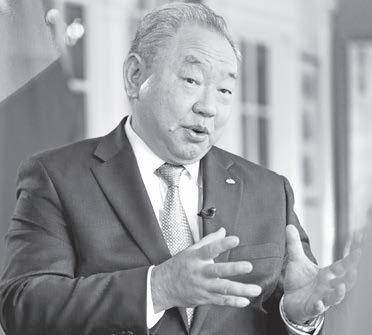
and save us,” he said. “That’s why we’re willing to acquire, to buy US equipment and arms to make ourselves stronger.”
Yui said the weapons sales need to be “commensurate” to the threat level, which is “actually pretty high” from China.
“First and foremost, we’re not the aggressors. It is the People’s Republic of China who is sending all the planes and ships,” he said. “They’re the ones huffing and puffing. They are the ones who’s trying to annihilate our freedom and democracy in Taiwan.”
China sends warships and military aircraft near Taiwan almost daily and has conducted major military exercises around the island in recent years.
Beijing sees the island as a core interest and has criticized those supporting Taiwanese independence for causing instability in the Taiwan Strait. The Chinese Embassy in Washington didn’t immediately respond to a message seeking comment.
Taiwan diplomat sees no change in the US position toward the island
Yui stressed that there had been no changes to the US position on Taiwan and that the Taiwanese government will respect the Trump administration’s “tempo” in making announcements.
The arms sale has broad support in Congress, with lawmakers raising concerns to Secretary of State Marco Rubio at a hearing this month. Rubio affirmed that US policy on Taiwan has not changed and that Washington does not “consult with the Chinese on these arms deals.”
“We’re aware of their position. They talk about it all the time,” Rubio said of Beijing. “They are not negotiated, and they are not consulted.”
Rubio said the proposal was not held up but under review and that the administration had other factors to weigh.
“It includes the availability of the stocks in the short term,” Rubio said of US weapons stockpiles, which have been drawn down during the Iran war. “We have to balance that with our own procurement process.”
The administration did approve a separate $11 billion arms sale package to Taiwan in December that included high-mobility artillery rocket systems, or HIMARS, and howitzers.
Taiwan’s President Lai Ching-te on Thursday told reporters his administration maintains close contact with the US.
“We hope the arms purchase from the US can be approved as soon as possible,” he said.
Yui is navigating the second Trump presidency YUI arrived in Washington in late 2023 during Joe Biden’s presidency. Biden had said several times that he would send troops to the island if Beijing attacked.
Now, Yui is navigating the caprices of the second Trump administration, which has struck a more conciliatory tone with Beijing following an intense trade war marked by tit-for-tat tariffs.
As much as Trump has raised eyebrows by ignoring a Reagan-era promise not to agree to prior consultation with Beijing on arms sales to Taiwan, he also said he could call Taiwan’s President Lai, breaking a decades-long practice that no sitting US president has directly spoken with the leader of the island.
In its national defense strategy published in January, the Pentagon said it seeks to deter China through strength, not confrontation. It says the US “will build, posture, and sustain a strong denial defense” along a strategic line of islands, including Taiwan, to keep China out of the wider Pacific Ocean.
Yui ascribed what appears to be mixed messages to Trump’s outside-of-the-box style but expressed confidence in Taiwan-US relations.
“It’s important to look at the actions, what is happening, not just the rhetoric,” Yui said.
“The big stick is still there.”
Associated Press writer Simina Mistreanu in Taipei, Taiwan contributed to this report.
work against facilities that sustain Russia’s war machine,” the Ukrainian leader said on social media. “It is time the war ended, and Russia must take the necessary steps in diplomacy.”
Ukrainian Foreign Minister Andrii Sybiha said on X: “One of the most popular questions asked by Muscovites this morning is ‘What is going on?’ I can answer. Your country started a war of aggression against ours. For years, it has been killing our people. Now that you know what’s going on, ask Putin when he is planning to end it.”
Ukraine disrupts Russian supply lines with drones AS well as gaining pledges of more diplomatic and military help from Western supporters at the G7 summit, Ukraine recently has gained momentum on the battlefield against Russia’s bigger army thanks to its high-tech drones, Western officials and analysts say.
As well as disrupting Russian oil production, longer-range drone strikes are choking Russian supply lines in occupied regions of Ukraine.
Macron said the G7 summit was “very important for Ukraine” because its supporters— crucially including the United States—vowed to help it, although the French president provided no details. The US under Trump has cut back assistance to Ukraine, leaving the Europeans as the biggest suppliers of military and financial aid. Trump and Zelenskyy have had an at times strained relationship.
“America is with us on Ukraine, that is very important,” Macron said.
“And now we will continue to advance to help Ukraine to resist” and to build up its “capacity to defend itself and capacity to counterattack,” Macron told reporters as he and Trump left the Palace of Versailles near Paris.

new trade routes with Gulf
India to bolster energy security
By Menelaos Hadjicostis The Associated Press
NICOSIA, Cyprus—The Iran war ‘s shock to global fuel prices has reinforced Europe’s stance that it must forge alternative trade and energy routes to the Strait of Hormuz.
Here is a look at what the European Union is contemplating to bolster its energy security and minimize the impact of future conflicts as it turns to Gulf states and India.
A corridor to India is one option EUROPEAN Commission President Ursula von der Leyen has expressed renewed interest in what is known as the India-Middle-East-Europe Economic Corridor. She told G7 leaders at this week’s summit that “alternative export routes have been created that are more resilient and offer choices” while “other routes will be built—for example, a typical one is IMEC.” IMEC is seen as potentially offering the EU greater economic resilience, supply-chain diversification and energy security to bolster the bloc’s strategic autonomy at a time when Russia shows few signs of curbing its belligerence and the US chips away at strategic bonds.
While the EU itself has supported IMEC through a memorandum of understanding, only a handful of its 27 member states are formal signatories. But behind the scenes, political commitment to IMEC is strong, according to a high-ranking EU diplomat who spoke on condition of anonymity because he wasn’t authorized to disclose the contents of confidential discussions.
“The focus now is on translating that vision into practical implementation across its three pillars: transport and trade connectivity, energy connectivity and digital connectivity,” said the diplomat, who has participated in high-level meetings to discuss the initiative. It could involve new pipelines and transmission cables, among other infrastructure.
The EU’s press office declined to provide a prospective timeline for the project.
IMEC would pass through Israel and enjoys its support. Israeli Prime Minister Benjamin Netanyahu last year said he had spoken with his Indian counterpart Narendra Modi about IMEC, calling it “a very revolutionary and transformative development that we want to bring into place.”
Lianne Pollak-David, co-founder of the Israel-based Coalition for Regional Security, told a recent online briefing that US leadership would be key to moving IMEC forward by helping in the normalization of relations between Israel and Saudi Arabia, an essential player in the project.
“Without normalization between Israel and Saudi Arabia, IMEC cannot be truly realized,” she said.
Saudi Arabia has said it will only normalize relations with Israel if accompanied by a clear pathway to Palestinian statehood, something Netanyahu opposes. It remains unclear how the Iran war, launched by the US and Israel and damaging to Gulf Arab countries, may influence Saudi Arabia’s thinking.
Asked about their position regarding IMEC, Saudi officials declined to comment.
Skirting Middle Eastern trouble spots is a goal
DEIR AL-BALAH, Gaza Strip—Israeli operations in the Gaza Strip have killed 1,005 Palestinians since a ceasefire was reached between Israel and the militant group Hamas last October, the Gaza Health Ministry said Wednesday. The enclave has seen near-daily strikes, as well as shelling and gunfire along the boundary that divides Gaza into Israeli and Palestinian-controlled zones. The most recent deaths were recorded after a series of Israeli drone strikes in the past few days on towns and refugee camps in central Gaza and Gaza City. Also Wednesday, an Israeli strike killed two Palestinians and wounded six others in Khan Younis in southern Gaza, health officials at Nasser Hospital said. The Israeli military acknowledged carrying out the strike and said the target was a “terrorist,” but didn’t elaborate. Families at the hospital said the strike targeted a group of people near the beach in the sprawling tent camp of Muwasi, where hundreds of thousands of displaced Palestinians live.
Israel has said it is continuing to operate against Hamas and allied militants in Gaza and has expanded the amount of territory it controls inside the strip. Both sides have accused the other of violating the ceasefire.
In a separate statement Wednesday, the Israeli military said that it killed two militants from Hamas and Palestinian Islamic Jihad in strikes over the weekend.
Gaza’s Health Ministry on Sunday said the death toll from the
and
and
VON DER LEYEN has said the EU in the first 54 days of the Iran war shelled out 25 billion euros ($29 billion) more to import oil and gas while facing the risk of a longerterm jet fuel shortage.
She and European Council President Antonio Costa said during an EU leaders’ meeting in April that the bloc is “ready to team up with Gulf countries” to help set up new energy infrastructure circumventing conflict hot spots like the Strait of Hormuz.
The value of such alternatives is evident in the EastWest Pipeline running across Saudi Arabia from its eastern oil fields to the Red Sea. After the Iran war started, Aramco ramped up transport to the maximum capacity of 7 million barrels of oil per day.
The leaders of G7 nations are discussing ways of financing and building infrastructure, “sometimes on the terrestrial part, that will be able to go outside of the track of the Strait of Hormuz,” French Foreign Ministry spokesperson Pascal Confavreux told The Associated Press. Neither Von der Leyen nor Costa have provided specifics on EU-backed projects, which could also form part of IMEC. But an EU official told the AP that the bloc would encourage European companies to invest in renewable energy projects in the Gulf to supply the EU’s energy demand. The official spoke on condition of anonymity because they can’t speak about the EU’s plans publicly. Getting the EU involved with collaborative projects in Gulf countries will take time, according to Gabriel Mitchell, an analyst with the German Marshall Fund t hink tank. The most likely projects in the near term are oil and gas pipelines, which have the shortest construction timeline, and subsidizing repairs at Gulf facilities that Tehran targeted during the war.
Associated Press writers Sam McNeil in Brussels and John Leicester in Paris contributed to t his report.
By Jovee Marie N. Dela Cruz @joveemarie
PRESIDENT Marcos has assigned a key role to local governments (LGUs) in implementing the government’s newly expanded investment promotion program, which now prioritizes emerging sectors such as artificial intelligence (AI), cybersecurity, carbon capture, renewable energy (RE), electric vehicles (EVs), and digital infrastructure, lawmakers said on Thursday. C amarines Sur Reps. Luis Miguel Villafuerte and Vincenzo Luis Villafuerte said
Memorandum Order 47, recently issued by the President, upgrades the 2026 Strategic Investment Priority Plan (SIPP) by expanding the list of industries and projects eligible for fiscal incentives under Republic Act 12066, or the Corporate Recovery and Tax Incentives for Enterprises to Maximize Opportunities for Reinvigorating the Economy (CREATE MORE) Act.
Miguel, chairman of the House Committee on Information and Communications Technology (ICT), said MO 47 directs investment promotion agencies (IPAs) to “facilitate and expedite, to the extent possible, the establishment and implementation of registered
projects or activities,” including coordinating with LGUs and other government agencies through one-stop action centers.
He added that the updated SIPP, approved by the president upon the recommendation of the Board of Investments (BOI), now serves as the government’s guide in identifying priority sectors—including emerging and frontier industries—that qualify for fiscal incentives under the CREATE law.
For his part, Vincenzo said MO 47 also directs LGUs and government agencies to coordinate closely with IPAs and comply with Republic Act 11032, or the Ease of
Doing Business and Efficient Government Service Delivery Act of 2018, particularly in streamlining the processing of permits, licenses, and other requirements.
As a deputy majority leader, Vincenzo emphasized that the directive reinforces the need for efficient and transparent government services to attract more investments.
Miguel said the updated SIPP—formulated by the BOI in consultation with the inter-agency Fiscal Incentives Review Board (FIRB)—aims to attract more investments and accelerate the country’s economic transformation by creating jobs, upskilling workers, and
By Bless Aubrey Ogerio
THE Department of Education (DepEd) expects the wider rollout of its artificial intelligence (AI)powered student health screening tool by early 2027, as the agency continues pilot testing the system designed to help schools identify learners at risk of malnutrition. DepEd AI research adviser Rafaelita Aldaba said Project Sigla, an AI-based growth screening tool, remains in the pilot stage after initial testing in two schools in the National Capital Region (NCR) before the end of the previous school year.
“Full implementation will be early next year. Right now, it’s in the pilot stage. Then, there will be validation testing to improve the system and ensure that it will work efficiently,” Aldaba told reporters.
The project will undergo further testing in eight additional NCR schools before potential expansion to schools outside the region, she said.
Aldaba said the additional validation is needed to ensure the system meets standards on ethics, privacy, security, and fairness before it is scaled nationwide.
“Because, of course, you’re using AI. So, there are principles—ethics, privacy, security—and ensuring that the system is fair, that it’s not biased to certain types of characteristics,” she said.
Project Sigla is among the platforms being developed by the Education Center for AI Research (Ecair), which uses artificial intelligence to address challenges faced by schools and learners.
The tool aims to reduce the burden on teachers who currently manually measure students’ height and weight to identify possible cases of undernutrition or overweight. Through the system, teachers can use a mobile application to capture images and input data, which will then be processed to assess the likelihood that a child may be at risk.
duplication of witnesses and evidence already identified by the prosecution,” she said.
Continued from A3
the actual factual defense to be presented, it risks defeating the very purpose for which pre-trial exists.”
“It is not a procedural hurdle to be cleared or a compliance requirement to be satisfied through volume alone. It is a vital stage of the impeachment process designed to assist the Court in identifying the issues, evaluating the evidence, and ultimately arriving at the truth,” she said.
Co said a review of the filing raises troubling questions about whether that objective is being met.
“Instead of clearly setting forth the factual defense that will be presented, much of the filing appears to rely on sweeping reservations, generic descriptions, and extensive
of 24 Senator-Judges were detained and suspended by the Sandiganbayan as in the case of Sen. Jose Ejercito alias Jinggoy Estrada, who the anti-graft court preventively suspended last Tuesday. Lacson said the Supreme Court may need to intervene to address the situation. He pointed out that while the Supreme Court cannot
“If that is indeed the case, then one must ask, how does this assist the Court?
How does this advance the search for truth?” Co asked.
She warned that such an approach may make proceedings more complicated rather than more focused.
“Pre-trial is supposed to illuminate. It is supposed to clarify, and the Filipino people are entitled to know the issues,” she said.
“To be candid, there is a growing concern that the Defense Pre-Trial Brief makes a mockery of the very process it is supposed to assist. Instead of illuminating the path to trial, it appears to cloud it,” she said. She emphasized that impeachment is a constitutional proceeding of the highest importance and must be treated accordingly.
“The issues before the Court involve public
intervene in the operation of the Impeachment Court, it can do so if the issue of grave abuse of authority is raised.
“Iyan na nga ang posibleng absurdity na mangyari, assuming na at least nine senatorjudges ang ma-suspend. The trial will be a mere formality for acquittal. I’d rather leave it to the wisdom of the Court to come up with a practical necessity to intervene,” Lacson said in a post on X. Ano ang saysay na impeachment trial kung 15 lang ang senator-judges na present
Aldaba said the technology could help teachers spend less time on administrative tasks while allowing earlier intervention for learners who may have health-related concerns affecting their ability to learn.
“[When a child] is hungry, they cannot concentrate and focus. The likelihood that they will not learn becomes higher,” she said. “We know that we have an education crisis.”
Beyond nutrition monitoring, Ecair is also developing other AI-based platforms, including systems aimed at identifying learning difficulties such as dyslexia and assessing the impact of natural disasters on school facilities.
One of these is Project Ligtas, a multihazard analytics platform that helps track school resilience and assess possible effects of earthquakes, typhoons, and floods.
Aldaba said Ligtas is already being used within the DepEd Central Office to identify areas affected by disasters and estimate
trust, public accountability, and the integrity of public office. They are too important for submissions that create the appearance of engagement while withholding meaningful clarity,” she said.
“The Filipino people deserve a process that seeks truth rather than obscures it. The Constitution deserves better than a pre-trial process that risks becoming an exercise in form rather than substance,” Co said.
‘Ampaw’
DEPUTY Speaker Paolo Ortega V, for his part, said the defense pre-trial brief appears to suffer from a problem easily recognized by ordinary Filipinos.
“In Ilocos, we have one word for that: ampaw—it looks big, but it feels light because there’s almost nothing inside,” Ortega said.
Ortega, who represents La Union, made
atpuwedengbumoto?Anoangsaysay?Sabi ko, formality na ang acquittal, bakit pa tayo mag-trial? Sodiyandapatmag-intervene ang Korte Suprema [For what will the impeachment trial be for if only 15 senator judges can vote, and 16 votes are needed to convict? The trial could be reduced to a formality for acquittal. So the Supreme Court may need to intervene],” he added in an interview.
“Mas mainam nang sila na ang maginterpret niyan Dahil kung kami, maraming question, kasi pulitika iyan. Samantalang
potential damage to schools.
She said the platform could help improve disaster response by allowing authorities to determine which areas are most affected instead of relying only on broader assessments.
“It can help anticipate the situation in different places and at the same time estimate the damage so that you can prepare the schools that will be affected,” she said.
Aldaba said the success of AI-based systems depends not only on the technology itself but also on integration across different DepEd offices to ensure wider adoption.
“It is not just Ecair. There are internal DepEd offices involved because otherwise, it is difficult to create a system where it is stand-alone,” she said.
The agency is also ensuring that the use of learner data complies with privacy requirements, noting that children’s information will only be included with proper consent.
the remark after reviewing the defense submission before the Senate impeachment court. “Seventy-two pages. More than a hundred witnesses. Hundreds of documents. At first glance, it looks strong. But when you start looking for the actual defense, that’s when the problem becomes clear,” he said.
According to Ortega, much of the filing consists of witnesses and documents already identified by the prosecution.
He said ordinary Filipinos may not be lawyers, but they can recognize when a lengthy document fails to provide real answers.
He added that the filing gives the impression that the defense is trying to create the appearance of substance rather than presenting a clear factual response.
Ortega said both the Senate Impeachment Court and the Filipino people deserve a straightforward presentation of facts.
Jovee Marie N. dela Cruz
ang Korte Suprema, they’re beyond politics [It is better that the Supreme Court interpret it. The Impeachment Court can have its own interpretation but many questions can be raised. But the High Court is perceived to be beyond politics],” Lacson said. For his part, Gatchalian said in Thursday’s news conference that as far as he is concerned, the Constitution is clear: “In my opinion, the constitution is clear, two-thirds of all members, that is 16, so we have to follow the Constitution.”
promoting higher-value enterprises.
The President approved the SIPP in May and directed concerned government agencies to issue the necessary regulations to ensure its synchronized and integrated implementation.
Under MO 47, the FIRB and IPAs are tasked with granting appropriate fiscal incentives to registered business enterprises (RBEs) for approved projects listed under the SIPP.
The order also states that projects will be prioritized based on the national industrial strategy outlined in the SIPP, which defines the coverage of investment tiers and the conditions for qualifying activities.
of confidential funds, unexplained wealth, bribery, and threats against top government officials.
‘Admit or deny?’
DURING the meeting, Poa said both parties agreed to streamline the process by submitting their comments on proposed stipulations—whether these would be admitted or denied—by Monday. He described the session as generally orderly and aimed at expediting the proceedings, noting that such exchanges are standard in pre-trial settings.
“Usually, when it comes to proposed stipulations, each stipulation will be admitted or denied. So to speed up our discussion, we both agreed that we will just submit our comments to the proposed stipulations, whether we admit or deny, by Monday. And that’s what we heard in the order,” he added.
Philippines to an appropriate international court or another state pursuant to applicable extradition laws and treaties.
Castro lamented that the issue related to the implementation of ICC warrants against individuals linked to the drug war of the previous administration was being used to incite division among Filipinos.
Why do you always blame the court? Why do we blame the administration? Don’t forget that the case was filed in 2017. So, it has not been weaponized. The concerns of our fellow
SMBI, which operates the SMB Mandaue Brewery, will provide at least six excavators and several barges for the project. The equipment will be used to remove silt, waste and soil deposits that have reduced the river’s capacity, based on initial assessments by SMC. The company said the Butuanon River has conditions similar to several heavily silted rivers it has previously cleaned. Its mouth has been blocked by silt and waste, limiting outflow to the Mactan Channel, while upstream soil deposits could eventually contribute to renewed blockage downstream if not removed.
Since 2020, SMC has removed nearly 9.2 million metric tons of silt and waste from
Poa also explained that the pre-trial brief includes the statement of the case, proposed stipulations, witness lists, and documentary evidence from both sides. He said both panels agreed on measures intended to speed up the proceedings, including the gradual marking of documents.
When asked about potential points of contention, Poa said the discussions were not tense and remained within normal expectations for a pre-trial conference. He also declined to specify the number of witnesses, noting that both sides have submitted lists, including reserved witnesses. On the possible duration of the impeachment trial, Poa said it remains uncertain and will depend on the volume of evidence and witnesses to be presented. He declined to give a specific timeline but acknowledged it could extend beyond several months.
“We don’t have an idea yet. That will really depend on the witnesses represented. I don’t want to give an estimate. We might make a mistake,” he said.
Filipinos just need to be addressed,” she said.
“Those who need to be held accountable should be held accountable. If a name needs to be cleared, then it should be cleared. What is happening here is that the issue is being used to provoke fellow Filipinos and shift the discussion toward sovereignty,” Castro added. Castro said the public has seen how the warrants of arrest are being implemented, citing efforts to serve a similar warrant against Sen. Ronald dela Rosa, who was the country’s top police official when the anti-drug campaign was launched.
She, however, said operational matters concerning such cases are best addressed by the Department of Justice. With PNA
more than 190 kilometers of river channels at no cost to government and taxpayers. The work has covered the Tullahan, Pasig, San Juan, Pampanga and Meycauayan rivers, as wellas waterways in Bulacan, Laguna, Muntinlupa, Las Piñas and Parañaque. SMC has also continued maintenance cleanups in previously cleared waterways to help sustain their flood carrying capacity.
“Our work in other rivers has shown that cleanup has to go beyond what people see on the surface. The important part is removing the buildup that has made the river narrower and shallower over time, so it can carry more water during heavy rains,” Ang said. “With our facilities, people and equipment already in Mandaue, we wanted to put that experience to work in support of the city and its communities.

IT was a straightforward cybersecurity advisory, the kind issued daily by banks, government agencies, and utility companies worldwide. Meralco reminded customers not to post images of their electric bills on social media. The reasons were clear, practical, and rooted in genuine risk: Customer Account Numbers can enable impersonation; meter numbers plus addresses reveal consumption patterns; names and billing periods create complete identity kits for scammers; and for business owners, TINs become weapons of fraud.
Yet within hours, what should have been an uncontroversial data privacy reminder was twisted into a narrative that Meralco was trying to silence customer complaints. This is not just wrong—it is dangerously misleading.
We have all witnessed how social media transforms neutral information into ammunition. A kernel of truth—“Meralco advises against posting bills”—gets stripped of context, amplified by bad actors, and reframed as censorship. The goal is not accuracy but engagement. Algorithms reward the loudest voices, not the most responsible ones.
But here is the critical fact that got buried: Meralco never told customers to stop discussing their bills. It told them to stop posting images of their bills without protecting sensitive information. The distinction is not subtle. Recommending that customers blur account numbers and addresses is not silencing dissent—it is preventing identity theft.
Consider how we treat other sensitive documents. Most people would never post a passport, a visa, or a boarding pass online without redacting personal details. We instinctively protect banking statements, medical records, and government IDs. An electric bill contains the same category of sensitive data: your legal name, your physical address, account identifiers, and sometimes tax identification numbers. In the hands of scammers, these details become puzzle pieces. A fraudster with your name, address, and account number can call you pretending to be a Meralco representative, citing your exact consumption data to sound legitimate. The goal? Extract a credit card number, a one-time password, or a payment to a fake account. This is not hypothetical—it happens every day.
The irony is painful. The same social media platforms where outrage spreads are the hunting grounds for identity thieves. Many Filipinos have learned this the hard way: data posted carelessly gets harvested, sold on dark web forums, and weaponized months later when victims have long forgotten what they shared.
Meralco’s advisory offered practical alternatives: disclose only the total amount due if you wish to discuss billing charges; blur or redact sensitive fields before posting any image; and report concerns privately through official channels like the verified Meralco Facebook page, X account @meralco, or hotline 16211. These are not unreasonable requests. They are basic digital hygiene.
This incident reveals a deeper sickness in our online culture. We have become so conditioned to suspicion that even well-intentioned warnings are automatically read as oppressive. Trolls and coordinated networks exploit this reflex, manufacturing outrage where none exists, because outrage drives clicks, and clicks drive revenue. But we cannot allow cynicism to paralyze responsible communication. Companies and government agencies must continue issuing cybersecurity reminders, even knowing that some will deliberately misinterpret them. The solution to disinformation is not silence—it is digital literacy, critical thinking, and citizens willing to pause before clicking “share.”
Before posting any document online, ask yourself: Would I hand this paper to a stranger on the street? If the answer is no, redact it or don’t post it. Your electric bill, your bank statement, your government ID—these are not conversation pieces. They are keys to your identity.
Meralco was right to warn customers. The only thing dangerous about that warning is the false narrative built around it. Let us not reward misinformation with amplification. Let us instead protect our data, think before we post, and recognize that sometimes a cybersecurity reminder is exactly what it appears to be—a reminder, not a conspiracy.

‘Kapit tuko’ to one’s identity, values, and beliefs amidst the Marawi siege

REMINISCED about my 2023 visit to Marawi City, which was the focus of two plays featured in the 21st Virgin Lab fest: BALOS by Neil Arkhe Azcuna and HARAM by Alab Usman.
BALOS centers on four medical workers who are faced with the dilemma of treating a wounded fighter. They must decide between staying silent to save lives and speaking up at the risk of exposing everyone’s refuge.
HARAM explores the complex intersections of faith and identity through three interconnected vignettes, focusing on queer Muslims struggling to navigate love and religion across borders and barriers. It delves into religious anxiety, the pain of being labeled haram (forbidden), and the ways some queer individuals continue to hold on to their faith.
Marawi landed in headlines due to
the so-called “Marawi siege” that was a five-month-long armed conflict in Marawi that started on May 23, 2017. The armed conflict was between Philippine government security forces and the militants affiliated with the Islamic State, including the Maute and Abu Sayyaf Salafi jihadist groups.
President Rodrigo Duterte declared martial law through Proclamation No. 216 across the entire island of Mindanao on May 23, 2017, following attacks by the ISIS-linked Maute group in Marawi City.
Upon the declaration, AFP (Armed Forces of the Philippines) were mobilized to counterattack the enemy’s force in the city. Within the following
SC Senior Associate Justice Marvic Leonen was the lone dissenter who voted to completely nullify Duterte’s declaration of martial law across the entire Mindanao during the 2017 Marawi siege. He argued that the Maute group’s actions amounted to acts of terrorism rather than actual rebellion, and that ordinary police powers were sufficient to address them.
days, airplanes would start bombing the whole city making sure to crush every site suspected to be the hiding places of the terrorist group members.
The military rule, which resulted in a devastating five-month siege, was extended multiple times by Congress and remained in effect until December 31, 2019.
President Duterte proceeded with the declaration of Martial law not just in Marawi City but in the whole Island of Mindanao even prolonging its original effectiveness of 60 days to one year, noting that it is for the recovery of the affected area and to fully “crush insurgency.”
The estimated casualties reported were 978 militants killed; 12 militants captured; 168 government forces killed; 1,400+ government forces wounded and 87 civilians dead.
Thousands of Marawi residents were forced to leave their homes and their livelihood in order to take refuge from the war.
The battle left the city in ruins with 95 percent of the structures within Ground Zero (4 square kilometers) of the main battle area being heavily damaged or completely collapsed.
On July 4, 2017, the Supreme Court voted 11-3-1 to dismiss petitions challenging Proclamation No. 216, affirming the President’s wide discretion in declaring martial law and determining its territorial scope to quell rebellion.
SC Senior Associate Justice Marvic Leonen was the lone dissenter who voted to completely nullify Duterte’s declaration of martial law across the entire Mindanao during the 2017 Marawi siege. He argued that the Maute group’s actions amounted to acts of terrorism rather than actual rebellion, and that ordinary police powers were sufficient to See “Gorecho,” A11
Carvana’s new-car push aims to upend traditional dealerships
OAngel R. Calso, Dionisio L. Pelayo Ruben M. Cruz Jr.
By David Welch & Joe Lovinger
NLINE used-car retailer Carvana Co. has made a rapid push into new-car sales, having acquired seven stores in the last 18 months, and it’s ripping up everything about how new cars are sold.
Just don’t call them dealerships. The company describes the locations as “Test Drive Centers.” The lots are “Playgrounds.” There are no sales people and the so-called “advocates” make far less than the sales staff in a traditional dealership. And it’s nohaggle, fixed-price selling.
If Carvana’s play works, the company could start to turn the world of auto sales upside down at as many dealers as manufacturers will let them buy. Already, its stores rank among the top in the US for Stellantis NV brands while Carvana has been growing revenue at about 40 percent every quarter focusing mostly on used cars.
“When we first bought our test site in Casa Grande, Arizona, the first basic premise was we didn’t want commissioned sales people, we want advocates,” said Tom Taira, president of special projects for Carvana. “Our mission is to change the way people buy cars. Somebody will be there to greet you but not to follow you around.”


The retailer laid out details of its new-car business for the first
time at a media event in Dallas on Tuesday. Part of the plan is about pushing growth for a company that needs to keep putting up big revenue numbers to justify a stock valuation that far exceeds that of rival CarMax Inc. and dealer chains like AutoNation Inc.
If a customer walks into one of Carvana’s new stores—which all sell Stellantis’ Chrysler, Dodge, Jeep and Ram brands—they will be greeted by an advocate rather than a glad-handing commissioned sales person. The advocates are often hanging around a cube-shaped kiosk in the middle of the showroom, a concept similar to Apple Inc.’s Genius Bar, where customers can scan a code and start browsing dealer inventory.
Customers can look at cars on the lot and scan QR codes to get information on the vehicles, and request a test drive. But they have to buy the car online.
Staffers make between $17 and $24 an hour, said a company spokeswoman. That would mean a top annual salary of around $50,000. Commissioned salespeople in dealerships
can earn $60,000 to $80,000 and top performers can easily make more than $100,000.
“We want a place that’s low friction, low pressure,” Taira said. “We want a welcoming space and we want people to spend time here.”
Carvana shares declined 5 percent at 10:19 a.m. in New York. The stock has come down this year since reaching a record high in January, falling about 20 percent.
WHAT Carvana has discovered since buying the seven dealerships starting last year is that customers go on the app intending to buy, say, a used Jeep Wrangler. Instead, they end up finding a new one that they like. Taira said three-quarters of its new-car buyers started on the Carvana app or website shopping used cars.
Matt Bowers, owner of Matt Bowers Auto Group, bought a ChryslerDodge-Jeep-Ram dealer just a few miles from Carvana’s new Dallas location in October, a month after Carvana moved in.
“I’ve had very little competition from them,” Bowers said in an interview. “Their sales are up and my sales are up over the previous owners. I think the people who choose them are in rural areas.”
Many of Carvana’s buyers live far from a dealership. The company is
using its huge logistics network of trucks to ship cars sometimes well more than 100 miles. Taira said the company’s goal is to let customers surf the inventory in multiple stores and shipping cars to buyers located between its different dealers. So customers in the southern US could shop inventory in the stores in Arizona, Dallas and Atlanta.
An influx of new-car buyers will help Carvana grow its lending business simultaneously, which is where it makes most of its money. In the fourth quarter, the company made about 95 percent of its $333 million in adjusted net income from selling loans to investors.
Bowers has another theory. Carvana is using its Stellantis dealerships to test direct sales for a company that doesn’t want to use traditional dealers. The company was granted the right to buy shares in Jeff Bezos-backed electric vehicle startup Slate. That could pave the way for selling its electric vehicles directly to consumers on its website.
“I think Carvana wants to sell directly to the public with Slate or Volkswagen’s Scout or the Chinese,” Bowers said. “The hardest part for those companies is how do they handle retail and trade-ins and repairs. I think this is Carvana’s audition for that.” With assistance from Ryan Beene/Bloomberg
To forget Rizal is to forget
By Bryan Jayson T. Borja
AS we commemorate today the 165th birth anniversary of Dr. Jose Rizal, it is fitting that we reflect not only on the man himself but on why his life and ideas remain essential to the Filipino nation.
On this day, the whole province of Laguna pauses in remembrance. Schools, institutions, local governments, and communities observe a holiday in honor of the province’s most illustrious son. More than a celebration of a hero, it is a reaffirmation of the values Rizal stood for: love of country, intellectual excellence, civic responsibility, and faith in the Filipino people.
This year’s commemoration comes at an important moment. Recent debates on the restructuring of General Education subjects in higher education have raised concerns among educators, historians, and cultural workers about the place of history, humanities, and citizenship education in our schools. At the same time, public discourse is increasingly shaped by polarization, misinformation, and competing narratives about our past and present.
These realities remind us why Rizal remains relevant.
It is worth recalling that among the principal authors and champions of the Rizal Law, Republic Act No. 1425, was Congressman Jacobo Z. Gonzales of Biñan, Laguna. Enacted in 1956, the law required the study of Rizal’s life, works, and writings because our leaders understood that education was not only about preparing Filipinos for employment. It was also about preparing them for citizenship.
For us in Biñan, this history carries a special meaning.
Rizal’s connection to our city goes far deeper than the years he spent here as a student. Both of his parents traced their roots to Biñan, and members of both his maternal and paternal families served as town mayors during the Spanish colonial period. His grandparents and great-grandparents helped shape the community that would later shape him.
Long before he became the national hero of the Philippines, Rizal was, in many ways, a son of Biñan.
It is therefore fitting that a Biñanense legislator would later help secure Rizal’s permanent place in Philippine education. The story of Rizal, the story of Biñan, and the story of Philippine nationhood have long been intertwined.
But beyond local pride lies a larger national truth.
Rizal is not studied simply because he is a hero. He is studied because he teaches us how to think. Through his writings, he challenged abuses of power, questioned accepted truths, exposed social injustice, and encouraged Filipinos to
. . continued from A10
address them.
While Chief Justice Maria Lourdes Sereno and Senior Associate Justice Antonio Carpio voted to limit martial law to specific areas of Mindanao (such as Marawi, Lanao del Sur, Maguindanao, and Sulu), Leonen was the only Justice who sought to strike down the proclamation completely. Leonen maintained that the threats posed by ISIS-inspired groups did not meet the stringent constitutional requirement of “actual rebellion.” Haram and Balos comprise two of the three one-act plays for VLF Set B under the title “Kapit Tuko” centering on individuals who refuse to let go—whether of dogma, God, love, or personal needs.
“Kapit-tuko” is a term popularly used in Tagalog culture that means to “hold on like a gecko” or overly clingy on what defines them: be it their identity, values, beliefs, and who they love, as well as the cost of hold-

IThis year’s commemoration comes at an important moment. Recent debates on the restructuring of General Education subjects in higher education have raised concerns among educators, historians, and cultural workers about the place of history, humanities, and citizenship education in our schools. At the same time, public discourse is increasingly shaped by polarization, misinformation, and competing narratives about our past and present.
become active participants in shaping their nation’s future. He taught us that genuine patriotism requires critical thinking, moral courage, and an informed citizenry.
Those lessons are especially important today.
As Senate hearings dominate headlines, as public officials exchange accusations, and as social media increasingly shapes public opinion, Filipinos are constantly confronted with competing versions of truth. More than ever, we need citizens who can examine evidence, understand context, and think critically about the issues confronting our nation.That is precisely what the study of Rizal encourages. History is not merely the study of the past. It is the memory of a people. It is how a nation understands its struggles, appreciates its freedoms, and imagines its future.
A people disconnected from their history become vulnerable to forgetting who they are.
This is why the humanities, literature, history, arts, and Rizal studies continue to matter. These disciplines help form not only skilled professionals but thoughtful citizens. They cultivate empathy, discernment, historical awareness, and civic responsibility—qualities that every democracy requires.
As Laguna honors its greatest son today, perhaps the question before us is not whether Rizal deserves a place in our classrooms.The better question is whether we can afford to need him less.
For in an age marked by disinformation, historical distortion, and growing division, we do not need less Rizal.
We need Rizal more than ever.
Note: Please visit the newly-opened Jacobo Gonzales Memorial Room at the Historic Alberto Mansion in Biñan City—Tuesday to Sunday 9 a.m. to 4 p.m. Free admission.
ing onto these definitions. Established in 2005 by the Cultural Center of the Philippines (CCP), VLF is known as the Philippines’ only festival dedicated to “untried, untested, and unstaged one-act plays” showcasing diverse voices that touch on complex human experiences and social issues.
This year’s VLF carried the theme “Hubo’t Hubad” with the aim of “stripping down all pretense of innocence while showcasing the bold Filipino voice and spirit.”
The plays are grouped into four thematic sets labeled A, B, C, D (Tengang Kawali, Kapit Tuko, Balat Kalabaw, Pusong Mamon) with each set featuring three new plays plus set E (Dilang Matalim) which revisits standout plays from previous years. VLF XXI will run from June 3 to 28, 2026 at the Tanghalang Ignacio Gimenez (CCP Black Box Theater).
Atty. Dennis R. Gorecho heads the Seafarers’ Division of the Sapalo Velez Bundang Bulilan Law Offices. For comments, e-mail info@sapalovelez.com, or call 0908-8665786.
Tito
Genova Valiente
T all began with a photo of my grandfather, Elpidio Alindogan Genova. With floods and typhoons always threatening the region, I thought it wise to post online my grandfather’s photograph taken when he was 70 years old and retired from his work after serving the government for more than 40 years.
I was surprised to see my Lolo’s image gaining responses from friends, acquaintances and strangers. Are people that interested in the past that they would find meaning in a person who definitely lived in an era we could imagine or read about in books? I was only sure of one thing: he lived through famine, two wars, and the vulnerabilities of an age when knowledge was weaponized by the Americans and rendered limited. I am also certain my Lolo Pidio would have been flattered and happy with that photo and the generous responses it had gathered day after day. In that photograph, he naturally showed the character of being “imponente,” or imposing, an adjective that he loved to use to describe politicians and, at that time, veterans who fought in the Philippine-Spanish war, and, subsequently, the Filipino-American war. Quezon was imponente; Osmeña was.
My grandfather was proud of one thing, that he was born in 1900. “You don’t need to count with your fingers to know my age,” he would boast every now and then. Whatever the year now, that would be how old he was.
He was right there at the beginning of the “taming” of the Philippine Islands, with the new colonizers policing not only perceived political enemies and revolutionaries but also the notion of savages who knew nothing about health and sanitation. The Philippines was also in transit between the Spanish health practices and the Americans strong on germs and bacteria.
The report of Worcester with all its prejudices firmed up the Americans’ resolve to clean the Filipinos. For several years, there were grave outbreaks of infectious diseases. The entire archipelago witnessed and felt epidemics of cholera El-tor, smallpox dysentery and, in some places, afflictions brought about by bubonic plague. This was the milieu where my grandfather lived from childhood up to adulthood. In this era, all diseases were infectious. The cause was coming from outside—a dirty
house, germs, etc.
The American health program was heavily militarized. Recalling with no bitterness, Lolo Pidio amusingly recalled how little boys were caught by the Americans as if they were dogs. They all ended up in tents, where doctors were ready with injections or vaccines. The health policy this time took a slightly caring character: American colonialists would only be safe if around them were healthy white man’s burden.
Lolo Pidio was the first Inspector de Salud in the entire island of Ticao. He was a strict figure of authority in the small island of Ticao, officious to a point. These character traits seemingly unreasonable from another perspective did become irrational to us who lived around him. One day, to help ease his work the main office of the Department of Health sent him a bike, with hardy wheels, its seat distinctively black and tough. The whole neighborhood of relatives was all excited to try it. Lolo Pidio said no. He kept it in our home, the brown paper wrapping still intact when he returned it during his retirement. My Lolo Pidio was a gentleman, a romancer, a person who was always “gracioso.”
He was already in his 20s, and my grandmother Emilia was 14 or 15 then when they became engaged, and later married.
“How did you court Lola?” We would repeatedly ask him to tell the almost ancient lore. The first time I heard the story, I thought it was cheesy and corny. But as the first years went by, my Lolo Pidio’s remembrance of that wondrous afternoon by a river now gone, was a quick way to make him smile.
The story was, Lolo Pidio had been eyeing Emilia, a dark-skinned beauty with a dulcet voice, like her sisters and female cousins. The day came when he mustered enough courage to follow—not even talk—Emilia and cousins to the river. Lolo Pidio placed himself at the bend of the clear river where he could spy on his beloved (to
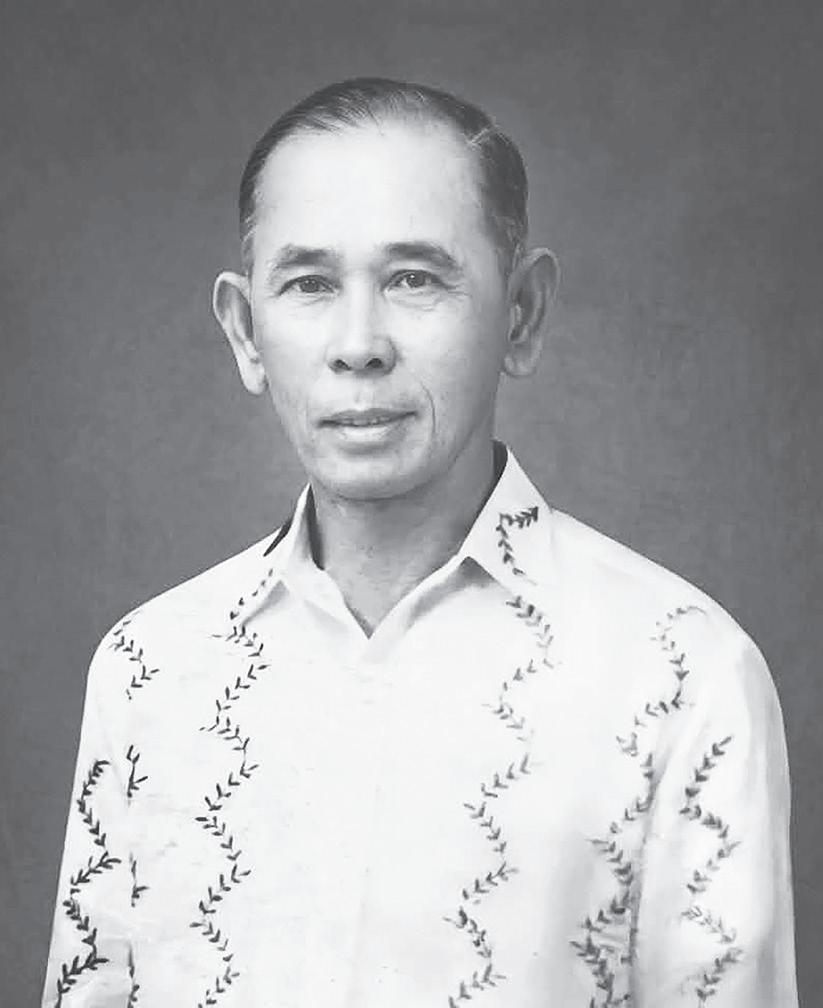
him) as she washed her clothes. The old bamboo clumps covered the sun where it would dapple but in Lolo Pidio’s timid heart, something gilded and pure was near to bursting. Then he started his mission. He began floating on the river flowers he had earlier gathered, hoping that the very young Emilia would pick one and put on her hair.
The story ends there always like a mystery. Did the young Elpidio succeed in his grand love project? Well, they got married so the blooms on the river must have conspired to bless the two lovers.
After the engagement, which was really an agreement between two formidable mothers: Lola Angge for Lolo and Lola Cristina for Emilia. What followed was the “pag-aagad,” a ritual servicing by the future groom. This consisted of chopping woods and bringing them to the home of the future bride. In the absence of faucets and water supply at various homes, Lolo Pidio would fetch water for Emilia’s household, and put them in huge “tapayan” and “tibor,” huge storage jars. Lola Cristina would then ask or force members of the household to take a bath and use up all the waters. Thus began again the task for the helpless Elpidio, to bring in more water.
Elpidio must have loved Emilia that much.
G7 aims to see China supply no more than 60% of rare earths
By Michael Nienaber and Andrea Palasciano
THE Group of Seven countries have agreed that no single country should supply more than 60 percent of their imports of rare earths by 2030 in an effort to reduce their reliance on China.
The target will apply to rare earths and permanent magnets, the G7 leaders said Wednesday in a statement issued at a summit in Evian, France. Beyond 2030 they will aim to further reduce their dependencies with a view to limiting exposure to 50 percent as soon as possible, the statement said. Bloomberg reported the pledge earlier on Wednesday.
For other critical minerals, leaders promised to nail down specific targets by the end of the year.
The leaders also discussed plans to introduce quotas in some industrial sectors, in what appeared to be a nod to the need for defense manufacturers in particular to reduce their reliance on China. They also pledged to set up a platform to combine efforts to increase the supply from recycling and new mining projects.
One G7 official, who asked not to be identified discussing private conversations, said the critical minerals plan was one issue the leaders
could fully agree on at a meeting dominated by questions surrounding the peace deal between the US and Iran. Another official said that the members were all aligned on the need to diversify their suppliers of critical minerals so that they would be less vulnerable to interruptions.
“We agreed in various formats to work even more closely together on critical raw materials,” German Chancellor Friedrich Merz told reporters in Evian. “We had very indepth discussions with our guests about how we can diversify.”
The 2030 deadline is likely to prove an ambitious target, given that many prospective developers are delaying projects in the face of funding constraints, regulatory hurdles, social opposition and technical setbacks. One of the official said it’s unlikely that countries will deliver without setting quotas at least for some industries, like defense. China imposed sweeping export
One G7 official, who asked not to be identified discussing private conversations, said the critical minerals plan was one issue the leaders could fully agree on at a meeting dominated by questions surrounding the peace deal between the US and Iran. Another official said that the members were all aligned on the need to diversify their suppliers of critical minerals so that they would be less vulnerable to interruptions.
controls on most critical minerals and rare earths last year which threatened to halt manufacturing lines around the world and underlined for officials the leverage Beijing has accrued through its nearmonopoly on supplies.
Chinese export controls
CHINA also hit Japan with a wideranging ban on products that can be used in either civilian or military equipment following a spat over Taiwan this year. The need to diversify away from China is a familiar one for Japan, which
When Lolo Pidio was still working, it was our duty to collect him from his office near the municipio. This was for him to be able to join us for lunch, otherwise he would forget the break. He just worked on and on. We loved going to his office because underneath its floor lived the town fool. “Don’t worry, he won’t harm you,” Lolo Pidio would assure us. Lolo Pidio was not a picky eater. There must always be “sabaw” or soup and steamed vegetables. He ate chicken (native only for a long time), no pork, and every now and then, beef. Okra, simply steamed, was part of his eating habit. He must always have desserts, nothing fancy. His wish began with “Bunguran,” a kind of banana that remained green even when it had fully ripened. In its absence, Lolo Pidio would look for “Kalamay” or “Sangkaka,” a hardened raw, unrefined sugar from the cane juice. When all else failed, he would scoop white sugar from the small container.
When the day is clear and I happen to look up at the sky, I would always notice bloom clouds. Anything that’s shaped like a flower. Then I think of the young Elpidio letting go of those tiny clouds to float in the sea of eternity, while Emilia waits for them at the bend of the sky.
E-mail: titovaliente@yahoo.com
was hit with an export ban of critical minerals back in 2010 following a maritime border dispute. That sparked a long effort by Japan to try to reduce its reliance on China for rare earths, but it still sources around 75 percent of its imports from its neighbor. While most critical minerals markets are small and individual projects can deliver a major supply boost to global supplies, vast amounts of capital and technical expertise would be needed to ramp up output in all of the critical-minerals markets that China dominates. What’s more, rare-earth mining and refining are environmentally damaging, costly, and timeconsuming activities, so building alternative supply chains could take many years.
A 2025 International Energy Agency report found that China controlled roughly 70 percent of the market for refining processes for the majority of critical minerals. For some specific substances, China’s dominance is even higher. It produces 85 percent of processed cobalt and 99 percent of primary gallium, the report said. With assistance from Sakura Murakami, Donato Paolo Mancini and Mark Burton/Bloomberg
Friday, June 19, 2026
By Mary Jade Jadormio
ANATIONAL labor roadmap framed for a “just transition” has quietly sharpened its focus on where Filipino workers are most exposed—and most likely to be left behind.
The Department of Labor and Employment (DOLE) has secured approval for the Philippine Roadmap for the Global Accelerator (GA) on Jobs and Social Protection for Just Transitions, a framework that seeks to align employment, safety, and social protection with rapid economic and technological change.
Approved by the Trabaho Para sa Bayan–Inter-Agency Council (TPB-IAC) on June 17, the plan positions itself as a response to overlapping disruptions: digitalization, climate risks, and persistent labor vulnerabilities.
At its core, the roadmap attempts to solve a familiar problem in Philippine labor policy, growth that does not automatically translate into protection.
DOLE said the framework prioritizes two sectors most exposed to transition shocks: construction and transportation.
These industries, while essential to infrastructure expansion and mobility, continue to grapple with safety gaps, informal arrangements, and uneven compliance with occupational standards.
The department is now pushing tighter enforcement of occupational safety and health (OSH) rules, particularly in construction sites where recent incidents have renewed scrutiny on contractor accountability.
But beyond compliance, the roadmap signals a shift toward future labor demand,
particularly in green and digital skills.
A key pillar of the framework is the development of “just transition” programs, which aim to reskill workers displaced or at risk of displacement due to automation and environmental shifts.
The plan also integrates climate-resilient transport systems and local green manufacturing initiatives, linking labor policy with broader sustainability goals.
Another major component is social protection expansion, especially for workers in informal, contractual, and platform-based employment who often fall outside traditional safety nets.
Tolentino has previously emphasized the need to strengthen protections for digital platform workers, including more accessible grievance and reporting mechanisms for workplace concerns.
The roadmap also pushes systemic reforms in labor market information systems, infrastructure investment alignment, and stronger support for micro, small, and medium enterprises.
Funding will come from national government allocations and development partners, underscoring the state’s reliance on blended financing for long-term labor reform.
By 2028, DOLE envisions wider, potentially universal, social protection coverage, but the timeline hinges on coordination across agencies that have historically moved at uneven speeds.
For now, the roadmap reads less like a finished policy and more like a warning: that the country’s workforce transition is already underway, and protection systems are racing to catch up.
By Bless Aubrey Ogerio @blessogerio
THEPhilippines’s recent manufacturing gains may strengthen its position as an investment destination, but sustaining that momentum will depend on how the country navigates a more complicated global environment, according to a local think tank.
The Institute for Risk and Strategic Studies Inc., also known as Salceda Research, said the country must maintain credibility among key economic partners while pursuing domestic reforms that support industrial growth.
“The answer is not to weaken our alliances or to pretend that geopolitics does not matter,” said Joey Salceda, chair of the research group.
“It is to know what we need, deal where we must, and remain credible to the countries that matter most

for technology, capital, and highvalue manufacturing.”
The country’s manufacturing sector has shown stronger momentum in recent months, with output growth accelerating from 2.6 percent in January 2026 to 5.1 percent in February, 13.1 percent in March, and 14.7 percent in April.
Approved foreign investments in manufacturing also increased in recent years, rising from P37.8 billion in 2022 to P110.9 billion in 2023 and P126.1 billion in 2024—the highest level since 2016, according to the study.
Export performance likewise improved, with Philippine exports reaching $84.5 billion in 2025, up
15.2 percent from $73.3 billion in 2024. The group noted that this exceeded the sector’s 15-year compound annual growth rate of 3.35 percent.
Salceda Research attributed part of the improvement to reforms in the country’s investment incentives system, particularly through the implementation of the Corporate Recovery and Tax Incentives for Enterprises (CREATE) and CREATE MORE laws.
The group said the earlier implementation of CREATE created challenges for exporters and manufacturers due to restrictions on VAT zero-rating rules, particularly the requirement that purchases must be “directly and exclusively used” for registered activities.
These limitations affected business cash flow and the competitiveness of firms using the Philippines as an export base, it said.
The CREATE MORE law later adjusted the incentives framework, which the group said helped make tax support more accessible for qualified enterprises.
Further, based on Fiscal Incentives Review Board (FIRB) data cited by the group, projects approved under CREATE and CREATE MORE generated an average of 392.3 jobs per enterprise, compared with 101.7 jobs under the previous incentives regime.
The group also said tax expenditure per job declined from P1.58 million to P821,854, while gross value added per peso of tax expenditure increased from P2.63 to P3.94.
However, Salceda Research said stronger domestic policies must be paired with a strategy that accounts for global risks affecting trade and investment decisions.
Manufacturing, it said, is now operating within a landscape influenced by competing trade blocs, geopolitical tensions, resource constraints, and supply chain vulnerabilities.
The group cited the Philippines’s response to disruptions involving the Strait of Hormuz as an example of balancing economic interests and diplomatic relationships. It said Manila was able to secure assurances for Philippine-flagged vessels, energy sources, and Filipino seafarers while maintaining ties with traditional partners.
Moreover, similar challenges could emerge as the country manages economic relations with major players such as China and Russia, particularly as businesses reassess supply chains and sourcing strategies.
“As we get our domestic policy right, the next challenge is the global environment in which that policy has to operate,” Salceda said.

Editor: Jennifer A. Ng


PTBy VG Cabuag @villygc
HE Securities and Exchange Commission (SEC) has extended its discounted fees for the registration of securities for micro, small and medium enterprises (MSMEs) until the end of the year bid to encourage these firms to raise funds through the capital market.
The memorandum circular extends the effectivity of the 50-percent discount given to MSMEs for the registration of securities until December 31, 2026.
This covers the registration of securities by corporations for the purpose of public offering, including those registered through the SEC’s streamlined processes for power
generation and distribution utility companies, real estate developers and/or managers in relation to rental pool deals, agri-business firms and hospitals.
The discounted rate for registration of securities runs alongside the 20 percent discount granted to MSMEs formalizing their corporate registration. In addition, MSMEs that increased their authorized capital stock through amendments of their articles of incorporation were able to benefit from a 25-percent discount on filing fees until December 31, 2025.
The SEC so far has granted around P139.6 million in discounts for MSMEs since the reduced rates were first introduced on July 16 last year.
The memorandum circular adopts
THE International Criminal Police Organization (Interpol) has issued a red notice against Maria Francesca Tan, following a request by the Securities and Exchange Commission (SEC), in a bid to bring her before the Philippine courts over her alleged role in a large-scale fraudulent investment scheme.
Published last May 25, the red notice serves as a request to law enforcement globally to locate and arrest a wanted individual pending
extradition, surrender or similar legal action, and is based on an arrest warrant or court order issued by judicial authorities in the requesting country.
Tan, who is the chief executive officer of Maria Francesca Tan (MFT) Group of Companies Inc., currently has a standing warrant of arrest issued by Taguig City Regional Trial Court Branch 70 for violations of the Securities Regulation Code. A court in Lipa City, Batangas has also issued an arrest warrant against
the classification of MSMEs based on asset size provided under the Magna Carta for Micro, Small and Medium Enterprises.
Under the law, micro enterprises refer to companies with an asset size of up to P3 million, up to P15 million for small-sized businesses, and up to P100 million for medium-sized enterprises.
Applicants seeking to avail of the discounted securities registration filing fee are required to submit a Certification of MSME Qualification, executed by the company’s president or treasurer.
They should also have a paid-up capital of P25 million, except for those filing through the streamlined registration of securities process for agri-businesses.
her in March 2025 for syndicated estafa, with no bail recommended.
The case stemmed from a criminal complaint filed by the SEC before the Department of Justice in April 2024 against MFT Group and Foundry Ventures I Inc. over their illegal investment-taking activities.
State prosecutors in May last year indicted Tan along with the officers of MFT Group and Foundry Ventures.
Under the scheme, MFT Group, which later transitioned to Foundry Ventures, promised investors a guar-
‘Tech workers who don’t embrace AI face triple the layoff risk’
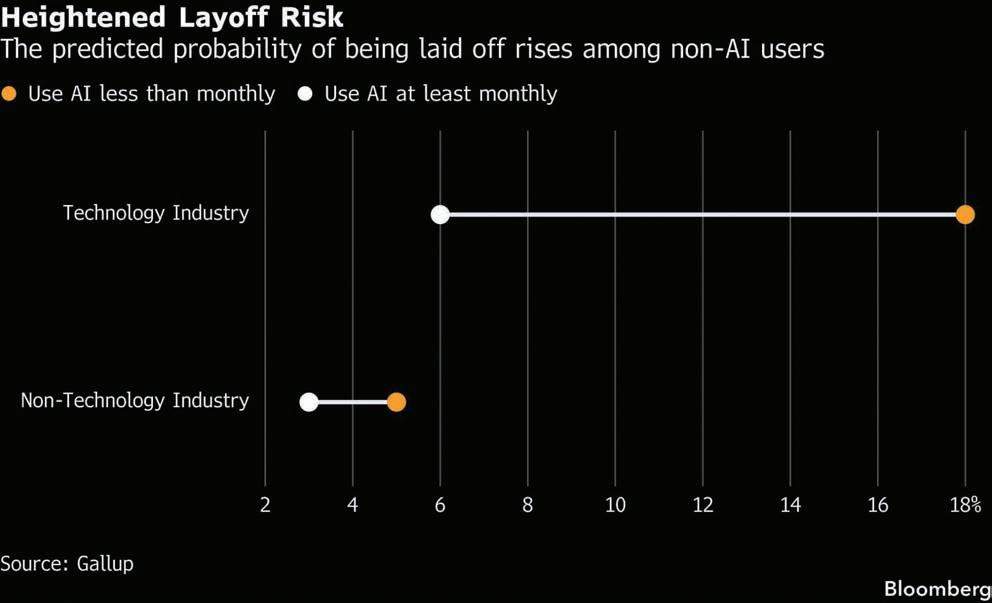
FOR tech workers, artificial intelligence may be delivering a benefit that goes beyond efficiency: a lower risk of being laid off. New research from Gallup finds that tech workers who aren’t regular AI users are three times more likely to lose their jobs than their peers. Among US tech workers who use AI at least monthly, the predicted probability of being laid off is about 6 percent, compared with 18 percent for workers who use the technology less often. The estimates are based on a survey data in February involving more than 23,000 US workers, including 660 respondents who reported being unemployed after their jobs were eliminated. Gallup collected data on how often employed and displaced
workers used AI — from daily to not at all — and then used a statistical model to estimate how factors such as AI-use frequency and industry were associated with the likelihood of job loss.
Outside the tech industry, infrequent AI users also face a higher layoff risk than their peers, Gallup said, though the gap is smaller. The link between AI use and job security held even after accounting for factors such as age, education and the sector in which one works, according to the researchers, suggesting that employees who don’t use AI are “more vulnerable in the job market.”
The findings also indicate that AI adoption is becoming a fault line inside companies, one that’s increasingly affecting individual careers.
anteed return ranging from 12 percent to 18 percent of the amount invested. Their investments will allegedly be used to finance the purchase orders for projects of the companies’ subsidiaries.
Additionally, prosecution said the investment-taking activity of MFT Group and Foundry Ventures is similar to a Ponzi scheme, a type of investment fraud that uses the contributions of new investors as payment for returns to existing investors. VG Cabuag
RIME Infrastructure Capital Inc., a company owned by billionaire Enrique K. Razon Jr., made a strong debut in the 2026 Fortune Southeast Asia (SEA) 500, securing the 246th spot on the list.
The Fortune Southeast Asia list ranked the region’s top 500 companies by total revenue for the 2025 fiscal year.
The company’s inclusion underscores its “strong commitment” in building and operating critical infrastructure that supports national growth and regional competitiveness, Prime Infra President and CEO Guillaume Lucci said.
“Our entry into the Fortune Southeast Asia 500 is a testament to the momentum that we have built. This milestone is led by a purpose-driven team dedicated to excellence and united by our vision to support nation-building through vital infrastructure projects.”
Prime Infra is a leading infrastructure developer and operator that has presence in water, energy, and waste management. Its business units include East Zone concessionaire Manila Water Co. Inc., Prime Energy, Prime CoreGen, Ahunan Power, Olympia Violago Water and Power, Prime Solar,Prime Waste, and SierraCol Energy. Last month, Prime CoreGen said it may participate in the planned auction for mid-merit natural gas, which plays a critical role to ensuring grid stability and as the energy mix shifts.
“I think it’s a very appropri -

ate and relevant initiative by the DOE to address grid stability in the face of increasing variable renewable energy (VRE) in the country,” said Prime CoreGen President Jose Victor Emmanuel A. de Dios.
Prime Infra joined two other Razon Group companies on the Fortune Southeast Asia list. Port operator International Container Terminal Services Inc. was ranked 113th and Bloomberry Resorts Inc., the operator of Solaire Resorts and Casino, was at 303rd. The annual Fortune Southeast Asia 500 list ranks leading companies in various sectors across Thailand, Indonesia, Singapore, Malaysia, Vietnam, the Philippines and Cambodia. Now on its third year, the list emphasizes the region’s evolving corporate landscape, highlighting how traditional commodity and energy giants continue to dominate revenues while emerging growth increasingly comes from industries such as banking, technology, telecommunications, aviation, and digital services. VG Cabuag
Employers are already screening candidates for a certain level of AI fluency, and the Gallup report suggests the technology may also be influencing which workers companies choose to retain when they downsize. Meanwhile, executives continue to press employees to use AI, even as public perceptions of the technology have soured and concerns about job losses have intensified.
Even so, only about 1 percent of laid-off workers attributed their job loss directly to AI. The most commonly cited reasons were more general, including organizational restructuring, cost-cutting and economic conditions. The data point may “understate AI’s indirect influence” in companies’ layoff decisions, the researchers said.

THE government is doubling down on its enforcement efforts against the persistent illicit tobacco trade that undermines government revenues, legitimate businesses and the livelihoods of farmers in the Philippines.
During the third “International Tobacco Summit” last Thursday, Bureau of Customs (BOC) Deputy Commissioner for Intelligence Group Emmanuel Luis D. Licup reported that the bureau seized a total of P7.2 billion in smuggled cigarettes and vape products as of May.
For the five-month period, about P5.6-billion worth of illegal cigarettes and P1.6-billion worth of vape products were intercepted, Licup said.
“A successful anti-illicit trade campaign does not end at the port, warehouse, checkpoints, or interception sites. The ultimate measure of success is accountability,” he added.
As such, the BOC is cooperating with the Department of Justice (DOJ), the National Bureau of Investigation (NBI), and the National Prosecution Service (NPS).
“This collaborative approach ensures that our law enforcement actions translate into strong, prosecutable cases and sends a clear message that illicit traders will not only lose their goods, they will also face the full force of the law,” Licup said.
The BOC, the NPS and the NBI, also formed a tripartite collaboration to escalate investigative processes and build a strong enforcement ecosystem.
Police unit
THE Bureau of Internal Revenue (BIR) is looking to set up a police unit to enforce the tax code provisions related to excise taxes.
“I believe that will help the BIR in enforcing our excise tax laws, especially when our revenue officers visit the premises of some of those engaging in illicit trade,” BIR Assistant Commissioner for the Enforcement and Advocacy Service James H. Roldan said during the summit.
However, the lack of intelligence funds and the need for more personnel and stronger investigative capabilities deter the BIR from going after “big fishes.”
As a result, retailers usually become the target because the BIR conducts regular tax mapping. The big fishes, or smugglers, are pursued by the BOC and other enforcement agencies.
Destruction is also becoming an increasingly important component of the BIR’s enforcement efforts, with 14 million packs of cigarettes worth about P2 billion destroyed in 2024.
The BIR has also filed before the DOJ a total of 310 cases with an estimated tax liability of about P17 billion from 2023 to 2026.
Build the scale
MEANWHILE, Finance Undersecretary for Revenue Operations Group Rolando U. Ligon said illicit trade takes advantage of gaps in trust, enforcement and predictability.
“Our job is to close those gaps and make compliance easier for all,” Ligon said.
He calls on the private sector to help build the scale and confidence that make the market stronger.
“To our government partners, keep tightening coordination, improving consistency in enforcement and reducing friction so those who follow the rules can move faster and with greater certainty,” Ligon said.
“To our government partners, keep tightening coordination, improving consistency in enforcement, and reducing friction so those who follow the rules can move faster and with greater certainty,” he added.
According to a report by the EU-Asean Business Council and Euromonitor International Ltd., the Philippine government lost an estimated P141 billion in government revenues from illicit tobacco products over the past two years.
“The fight against illicit tobacco trade is not only a matter of regulation or enforcement,” National Tobacco Administration CEO and Administrator Belinda S. Sanchez said.
“It is a matter of protecting livelihoods, safeguarding public revenues, upholding the rule of law, and securing the future of communities that depend on the legitimate tobacco industry,” she added.
Reine Juvierre S. Alberto
By Andrea E. San Juan
RIDING on the currency volatility, the asset and wealth management arm of the Bank of the Philippine Islands’ (BPI) launched last Thursday its “Peso Class Fund” the company bets will allow local investors get global exposure and diversify assets.
According to BPI Wealth-A Trust Corp. Chief Investment Officer Luis Antonio P. Zialcita, the bank launched the fund that, he says, “essentially gives clients access to these funds through their pesos.”
Zialcita said that with these funds, investors are exposed to foreign exchange. As such, when the dollar is strengthening against the peso, returns are slightly higher. But when the dollar weakens against the peso, returns may be lower.
Chiming in, Irene L. Ang, head of the firm’s Personal Wealth unit, said this type of equity fund would enable clients to “invest their pesos straight and then be invested in these global equity opportunities.” Against the backdrop of a volatile environment, Zialcita said these funds offer clients “broad diversification” to a key asset class. He added that this type of fund is “foreign exchange exposure.”

By Reine Juvierre Alberto @reine_alberto
FINANCE Secretary Frederick D. Go is obsessed and upset.
Go told reporters last Tuesday that said he is “obsessing” over the “very high” digital transaction costs in the country.
“I get upset when I see that the transaction cost can go as high as P50,” Go said, noting that transfers normally cost P10 to P20 per transaction.
Digital transactions with the government also carry convenience fees, which range around P50 or more, while overseas Filipinos have reported to the Finance secretary that they pay around 8 to 10 percent in remittance fees when sending money home.
“Our objective is simple: digital payment should be fast, secure, convenient, and affordable,” Go said adding he wants slash digital transaction fees slashed to as low as P2 and eventually make remittances cheaper for overseas Filipinos.
To note, digital transaction fees
are under the purview of the central bank and which the Monetary Board addresses. Go sits in the MB, the policy-making body of the Bangko Sentral ng Pilipinas, as member.
To meet Go’s objective, the Land Bank of the Philippines, which is supervised by the Department of Finance, reduced InstaPay transfer fees by half for person-to-person transactions.
Transfer fees for person-to-government transactions through QRPh were also waived until December 31, 2026.
Securing the participation of a major player could encourage competition among banks, Go said, and put pressure on government agencies that continue to impose high convenience fees on digital payments.

ALERT An image of Bitcoin and other cryptocurrency tokens displayed at the Token2049 conference in Singapore, on October 1, 2025. The Monetary Authority of Singapore added Bybit Fintech Ltd. to its investor alert list on Wednesday, as the city-state steps up scrutiny of unlicensed cryptocurrency exchanges. Bybit—a global cryptocurrency exchange—has never been licensed to operate in the city. PHOTOGRAPHER: SUHAIMI ABDULLAH/BLOOMBERG
CBS says to focus on asset protection amid volatility
The government has also been in talks with the Bankers Association of the Philippines and Fintech Alliance to bring down both fees in digital transactions and overseas Filipino remittances, Go said.
Go said the goal is not necessarily to eliminate fees altogether because payment switches and processors still incur costs, but to significantly reduce charges.
Moratorium on hikes
MEANWHILE, the MB has lifted the moratorium on increases in fees for InstaPay and PesoNet transactions.
In a memorandum signed by BSP Deputy Governor Memento E. Tangonan, the BSP said the move is anchored on the implementation of zero fees for small merchant payments and the establishment of a pricing structure for person-to-person electronic fund transfers.
The BSP said financial institutions must adopt a reasonable and fair market-based pricing mechanism, designed to uphold fairness across end-user groups.
“The service fees for electronic payments are expected to be lower
than the fees collected from transactions made manually or over-thecounter (OTC) as electronic payments are considered to provide more efficient and cost-effective means of delivering service,” the BSP said. Lifting the moratorium enables a more responsive and sustainable pricing environment, while ensuring that adequate regulatory oversight and consumer protection mechanisms remain firmly in place, the BSP added.
Moreover, the central bank earlier called on financial institutions to temporarily suspend fees and charges on online banking platforms or emoney services, including InstaPay and PesoNet, during the national energy crisis.
“Lower-cost digital transactions may help consumers and businesses by reducing the need for transportation to banks and e-money service providers,” the BSP said.
Combined transactions in InstaPay and PesoNet amounted to P2.792 trillion in May 2026. This is higher by 41 percent than the P1.980 trillion in transactions during the same period a year ago.
IN one of the recent episodes of the PCAAE podcast “Association Matters,” I had the pleasure of speaking with Petra Hemmes, Executive Director of the Dutch Chamber of Commerce in Singapore, on a topic that many associations today continue to grapple with: how to build communities that are not only connected, but also informed, inspired, and genuinely engaged. What struck me most during our conversation was that despite the rapid evolution of technology, member expectations, and communication platforms, Petra kept returning to one deceptively simple principle: listening.
In an era where associations are constantly pressured to innovate, launch bigger events, and create more content, Petra’s insights served as a refreshing reminder that community-building is not always about scale. More often, it is about consistency, relevance, and human connection.


national business ecosystem has encouraged the Dutch Chamber to work closely with other chambers, business groups, and institutions such as the Singapore Economic Development Board and the Singapore Tourism Board. Petra shared how even simple coffee meetings among entrepreneurs from different chambers can become valuable support systems, especially for startup founders navigating unfamiliar territory.
“And one of the key insights that we’ve gathered for emerging markets such as the Philippines, foreign exchange exposure is a key diversifier. So in actuality, it benefits the overall portfolio to have foreign exchange risk,” added BPI Wealth’s Chief Investment Officer.
For her part, Ang expressed confidence that since this type of fund has a minimum initial investment amount of P1,000, this type of fund can reach a “large” potential customer base.
“We can just look at the bank’s customers, the 18.8 million customers of the bank. Basically, about 15 million of that is retail,” said Ang. Zialcita added that this type of fund “should really appeal to the masses,” adding this is a “perfect opportunity for the normal investor to get global exposure.”
“When we’re exposed to the foreign exchange risk, it actually aids in the aim of diversification. A lot of the benefits of diversification to international assets comes from the currency exposure,” added Zialcita. He added that this is a “better way” to diversify portfolios of investors across geographies, sectors and currencies.
Zialcita underscored that “ultimately, portfolios are better prepared regardless of the market conditions.”
By VG Cabuag @villygc
CHINA Bank Savings Corp., the retail lending arm of Sy-led China Banking Corp., would give more emphasis on its risk management policies and approaches and put more focus on its asset preservation strategies, according to its executives.
CBS Chairman Ricardo R. Chua said the bank’s plans, such as expansion of distribution network, are being reviewed regularly in light of the geopolitical tensions in the Middle East and the “uncertainties” brought about by the political development in the country.
“While we observe this short term downturn in the economy, we continue to address the long term structural need of the bank. We continue to expand our distribution network and at the same time pursue and address the needs of our SME (small, medium enterprises) customers,” Chua said.
CBS President James Christian T. Dee said the bank’s operating environment is more challenging today with slower growth, higher inflation and continued global uncertainty.
“That said, we remain cautiously optimistic. Our first quarter performance was in line with expectations,” Dee said.
Asset quality remains healthy and deposits continue to grow, he added.
The bank will continue to invest
in its branch network as it see opportunities to expand its reach and better serve customers.
“We opened five new branches and upgraded 10 branch light units for a total of 15 branch openings so far this year. As a subsidiary of China Banking Corp., we benefit from the strength and stability of a well-established banking group,” Dee said.
He added the bank has identified a few additional locations, but declined to state where these branches will be.
“Overall, while we maintain mindful of the risks, we believe the bank is well-positioned to navigate the current environment and continue to grow responsibly,” Dee said adding that the bank, so far, has not yet experienced significant signs of stress in its portfolio.
He said the bank’s non-performing loan ratio stood at 2.9 percent as of March, well below the thrift bank industry average of 6.3 percent. Deposits, meanwhile, grew 12 percent year-on-year to P191.4 billion, he added.
“As a prudent measure, we increased provisions for credit losses in the first quarter to more than double the level recorded in the same period last year. This strengthens our balance sheet and ensures we remain prepared for potential risks,” Dee said. “Overall, our portfolio remains healthy, customer activity remains strong, and we continue to balance prudent risk management with sustainable growth.”
According to Petra, one of the biggest mistakes associations can make is assuming that yesterday’s strategy will automatically remain effective tomorrow. The business and professional landscape changes quickly. What members found valuable six months ago may no longer be relevant today. This is why, she emphasized, associations must continuously keep their “finger on the pulse” by staying close to their members and stakeholders.
What I found particularly noteworthy was how the Dutch Chamber operationalizes this philosophy. Instead of relying solely on formal surveys, they cultivate regular conversations through volunteer-led committees focused on areas such as technology, sustainability, and startups and SMEs. These committees are not merely symbolic structures; they become living platforms where members discuss current challenges, exchange ideas, and shape future activities. The chamber then translates these discussions into meaningful events, newsletters, and online content that directly reflect member interests. This approach reinforces a powerful lesson for associations everywhere: engagement cannot be manufactured from the top down. It grows when members feel heard and see their concerns reflected in the organization’s programs and priorities.
Another important takeaway from the conversation was the value of collaboration. Singapore’s highly inter-
I particularly appreciated her observation that entrepreneurs often need peers just as much as they need formal business opportunities. Sometimes, the most meaningful engagement comes not from grand conferences, but from practical conversations about everyday challenges such as opening a bank account, understanding regulations, or simply learning from another entrepreneur’s experience.
Perhaps the most inspiring part of our discussion was learning that the Dutch Chamber accomplishes all of this with a remarkably lean team of fewer than three full-time staff supported by an active board. It demonstrates that building a vibrant association community is not purely dependent on large budgets or manpower. What matters more is curiosity, responsiveness, and a genuine commitment to understanding members’ realities. As Petra succinctly put it, consistency matters more than spectacle. A small monthly engagement can create far more lasting impact than a single large event followed by months of silence.
For associations seeking to remain relevant in today’s fast-changing environment, that may well be the most important lesson of all: listen continuously, engage consistently, and build community one meaningful conversation at a time.
Octavio Peralta is

ONE can’t help but be affected by the recent deaths of Ateneo men’s varsity basketball players Rene Baterbonia and Divine Abili. We might not know them personally, but their stories are common to many families here, where poverty affects 70 percent of the population. Both barely out of their teens, each carried the hopes and dreams of their respective families: to earn a good college education, thereafter work in the big city, help in their siblings’ education, then lift their people up and out of their miserable lives in their backwater towns.
But as we now know, it wasn’t meant to be. Whether it was hubris on the part of the Ateneo Blue Eagles coaching staff led by Coach Tab Baldwin, unpreparedness or neglect on the university administration (or the resort which hosted the team), or who knows? It may been the impact of the Mindanao earthquake on the size of the waves along the coast of Aurora, whatever—Rene and Divine are now gone.
In fact, if it were not for the intervention of Fate, more players would not have survived.
I just watched the recent podcast of journalist Pia Hontiveros with players Kieffer Alas and Sam Reyes, and the latter admitted he thought he was going to die as well, as he kept getting swept away farther and farther from the shore. (tinyurl.com/4hvtzcu3)
Kieffer, on the other hand, said he couldn’t swim, like a few other players. Did they disclose this to the coaches? And granted that they did, why was the coaching staff only equipped with “a few salbabida and volleyballs” as rescue equipment?
Also from the boys’ narration, there was only one lifeguard at Hermanos Leisure Resort who was on the shore before they went out for their exercise. (See“AteneodrowninghighlightsgapsinDOT accreditation,”BUSINESSMIRROR,June15,2026.)
By the boys’ account, the one who actually saved many of their colleagues was EJ Kapihe, a Hawaiian who is used to swimming in the strong waves of his islands. He was relentless in rescuing his fellow players even as he grew increasingly tired.
It’s evident Kieffer and Sam feel tortured by the fact they survived, while two of their teammates did not. While in their minds they know what happened was not their fault, in their hearts they must feel a wrenching, sickening loss that has pushed them to feel they probably could have done more to save Rene and Divine.
But I am glad they have come forward to discuss what happened at the team-building session. It is part of their healing and recovery. And while it may take a long time for them to be mentally well again, I pray they do not give in to the despair.
To those who know these boys and the other surviving players, please give them tight hugs and constantly whisper to them words of encouragement. They desperately need to know we care, and they will be alright.
■■■ BEING in the communications profession, I found it

quite distressing how the Ateneo management took its sweet time to address the drowning and deaths of Rene and Divine.
I understand that there are legal bases that must be covered, and keeping quiet might have been the best strategy to protect the university from a lawsuit. Sure, management posted updates on Ateneo’s Facebook page, but these were empty and disembodied messages when what the public needed was an actual person, a face to explain what had happened.
I don’t doubt that Baldwin and the university officials were torn up over the drownings. And I also trusted that Ateneo was deep into investigating why what everyone thought to be a seeminly innocuous team-building sesssion, ended in disaster. But when emotions are involved and video clips of young men and their limp bodies being pulled to dry land become viral, Ateneo should have faced the issue squarely, backed with their “man for others” ethos, and shown its heart as well.
I’m pretty sure communications professionals, and that includes journalists and public relations practitioners, will always look back on this Ateneo drowning as among the worst cases in crisis PR management. It shouldn’t have taken management more than a day to get a timeline of the events in Aurora.
But at the onset, management should have hired a crisis PR manager to help them prepare a proper media communications plan, because it was obvious the university’s own internal communications/PR manager was ill-equipped for the job.
The hired crisis PR manager would have advised the university to come clean. Honesty is always the best policy in these troubling cases. Baldwin or any Ateneo management representative could have come forward the next day after the deaths became public, expressed sympathy to the families and to the Ateneo community, stated the facts behind the accident, then made a vow that a deeper investigation will be pursued to find out who may be at fault, as well as offer a promise of reforms.
At the very least, the president of Ateneo should have resigned to assure the public of an impartial internal investigation. It’s bad enough that the management’s handling of the deaths of the players,


and of their relationship with Rene’s mother (and Divine’s family) were reportedly wanting. It was a wasted opportunity to show Ateneo’s sense of community and empathy with the families of the deceased.
Moving forward, management—along with the now-resigned Baldwin and team manager Epok Quimpo—should be open to any external investigation, whether it be by the Philippine National Police or National Bureau of Investigation. Separately, it’s a welcome move on the part of the ballplayers to make an appearance before these bodies to shed light on that fateful day in Aurora.
The PNP and NBI must also call in for questioning the local disaster and risk reduction management staff in Aurora, who, by Sam and Kieffer’s accounts, told the coach giving Divine CPR to stop so that the latter could be rushed to the hospital, instead of stabilizing him first. (Sam had disclosed he heard that Divine still had a pulse.)
Of course, none of these questions, investigations, or possible reforms will bring Rene and Divine back. Two young men are gone. Two families are grieving. And a basketball team that should have been preparing for another season is instead struggling to make sense of a tragedy that will stay with them for the rest of their lives.
But if there is any consolation to be found amid such harrowing loss, it is that their deaths should not be in vain.
I am hopeful that all universities—not just Ateneo—will take a hard look at their riskmanagement protocols. Also, this should be a wake-up call for resorts and tourism establishments to comply with safety standards and government accreditation requirements.
This ought to remind coaches, administrators and organizers that team-building activities, no matter how routine they may seem, require the same level of preparation and care as any competitive event.
Most of all, let us remember Rene and Divine not merely as statistics in a drowning incident or names on a police report. They were sons. Brothers. Friends. Teammates. Young men with dreams that stretched far beyond the shoreline of that tumultous beach in Aurora.
you took your time to let the facts unfold. Your patience will lead to a surprising opportunity. ★★★
LIBRA (Sept. 23-Oct. 22): Keep a close watch over your investments, possessions and reputation. Not everyone will be on Team Libra. Hold your cards close to your chest, and fact-check every piece of information that comes your way. Any changes you make will require a healthy intuition and the ability to sprint when the time is right. Self-improvement and love are favored. ★★★
SCORPIO (Oct. 23-Nov. 21): Make it happen. Exploit your skills and experience to the limit, and you’ll surpass anyone who wants to compete with or challenge you. Staying power, along with vision and being able to reach your goals, will lead to satisfaction and gratitude. Look for unique outlets to disperse anxiety and anger. Physical and social events are favored. ★★★★
SAGITTARIUS (Nov. 22-Dec. 21): Take a moment to breathe, rethink your goals and to take the path least anticipated by others. A change is heading your way that may not be to your liking, but hindsight will make you think otherwise once the dust settles. Go with the flow, stick close to home and protect what matters most to you. ★★
CAPRICORN (Dec. 22-Jan. 19): Search for opportunities, and speak passionately about how you feel, what you care about most and how you intend to proceed. Refuse to let your emotions lead to financial or personal loss. Don’t pay for someone else’s mistake; offer suggestions, but don’t do the work for them. Conversations will be misleading; wait for verification before you share or act. ★★★★★
AQUARIUS (Jan. 20-Feb. 18): Shift your attention to what’s necessary before you make a move. Getting things right the first time is essential if you want to make the most of a volatile situation. Keep your plans a secret and your responsibilities up to date. Anger will not solve anything, but compromise will. The intent is to ensure the result favors everyone. ★★★
PISCES (Feb. 19-March 20): Take time to research. Being well-informed is the key to better outcomes. Conversations with those with common goals will offer insight into how you can expand your interests and create a sustainable lifestyle that satisfies your


RENOWNED Italian composers Lorenzo Travaglini and Davide Sammarchi recently imparted their artistic expertise to the young breed of Filipino musicians in a series of specialized workshops in Manila.
Dubbed Music Production in a Global Context and Human Electronic, the initiative was spearheaded by the Music Production Program of the De La Salle-College of Saint Benilde (DLS-CSB) in collaboration with creative powerhouses Neoclassica Asia and Bosco Studio.
“Its core mission was to foster meaningful connections between international visionaries and local talent,” noted Patrick Frias, the program chairperson.
“By bringing in Italian sound architects such as Tavaglini and Sammarchi, the workshop aimed to dismantle geographical barriers, proving that music is the only true universal language.”
During the immersive masterclass, the students’ learnings transcended basic theory for they engaged in in-depth discussions on composition, production techniques, and the evolving landscape of contemporary music.
The two-part session led by Travaglin, a distinguished producer and sound designer from Emilia-Romagna, delved into the mechanics of contemporary music creation and the complexities of the industry.
In the third class, Sammarchi promoted cohesion between acoustic sensibilities and modern soundscapes. He highlighted that human warmth and tactile soul can be incorporated in electronic music.
He also mentored the participants on how to narrow the gap between a man’s intuition and machine-born sound.
The acclaimed pianist and music producer from Tuscany focused his curriculum on a revolutionary instrument called ROLI Seaboard, which is vital to his modern musical expression.
The course was “a bridge built on sound, designed to connect cultures, foster creative communities, and fundamentally rethink how music is created and experienced in our modern world,” Frias elaborated.

HE “White Terror” of the late 1940s in Taiwan occupies a core space of generations of Taiwanese. We practically know nothing much about it.
The late 1940s saw Mainland China in social and political chaos. It was beginning to consolidate its power: joining the Korean War as proxy, and eventually taking Russia as a role model for hegemony. Along the way, its leader, Mao, created rapid, radical programs, with some contributing to the great superpower that China has become, and with other edicts eradicating the middle class and the peasants.
At the same time as the development of China, another “China” was creating its own territory. This was Taiwan, the small island occupied by Chiang Kai Shek in his retreat from the mainland. In this island, all Communists are suspects; if your words and writings happened to be critical of the new state of Taiwan, you were assumed to be Communist by the Kuomintang. There seemed to be no gray area, that space which could nurture freedom and eventual happiness.
This was the historical setting of A Foggy Tale. And yet we do not find here the grandeur of a narrative paying obeisance to a monolithic history. What we are reminded of is that historians can write volumes of information and still leave the ordinary people’s own stories, dismissed as trivial and unnecessary sources of insights. Fit for a diary for private, shamed reading.
The Taiwanese film A Foggy Tale thus graciously and sadly inserts into the period of the White Terror. The film itself is structured as a journey, which follows the enchanting turns of a fairy tale. Unlike Joseph Campbell’s monomyth, there is no hero in A Foggy Tale. What we have is an Everyman/ Everywoman on her own to claim her brother’s body who was executed by the state out to preserve or demand loyalty, obedience and, ultimately, respect to a government.
The film begins with a steady look to the horizon, with the scenario so undisturbed it looks more like a still shot or a painting of sedate still life. Nearly monochrome in the veridian tone except for the white space in the middle, which stands for the road. The gaze stays there for a long time, on the right is a clump of trees, shrubs and bushes, and on the left is a sugar cane plantation. It takes awhile for us to see a figure moving, then walking towards us. It takes again a few seconds for us to see a girl in an oversized, old duffel coat, or what looks like a duffel coat. Around her, the coat looks even worn and dusty.
The girl turns suddenly to the left and begins to thresh her way deeper into the forest of sugarcane. She reaches a part where seemingly the sugarcanes have been bent so as to allow anyone to peep through it and perhaps look for someone. Hiding.
Yue finds a young man deep among the sugarcanes. It’s her brother Yun, already a fugitive because the State considers his drawings criminal as they celebrate being free. We see Yun as a student scholar. He is wearing a black jacket and under it a long-sleeved shirt, both soiled now because he has

been holed in deep in the plantation.
Yue obviously idolizes his brother; her brother is fond of her. This initiates the fairy tale, not in the frothy sense of it but in the structure the film follows. Yun tells his sister about the ambition of waters to be clouds that could hover and observe things. In freedom.
Eventually, Yun gets caught.
Back in the village, Yue overhears the tragic news—her brother has been executed by the Kuomintang. Yue takes it upon herself to travel to Taipei so she could recover her brother’s remains and give him a decent burial. With a few coins to her, two sweet potatoes, a watch given to her by her brother, who explained how it was not only for telling time but also for crossing spaces, till they reached the future. That distant horizon is the 1980s where freedom would be present for everyone.
A happy ending? No.
In Taipei, Yue encounters misfortune after misfortune. But she meets enemies who want to do her harm; she also befriends the trishaw driver who calls her an idiot. And we believe Kung-Tao, himself always under surveillance by the two members of the State Police, officious and unreasonable, backed as they are by a gripping Martial Law. Yue also gets to ride with a chicken. Things lighten up a bit when Yue finally sees and meets Hsia, her sister who was given up for adoption in Taipei. Hsia has become a dancer/ singer in a small theater.
A Foggy Tale bears the soft bones of a fable and a fairy tale, but deep in its heart lies undiscovered the spirit of a political tragedy that has left a trauma in a nation. Historical accounts can rationalize the errors of the past or justify its mistakes. Memory of the most personal kind can remain hidden until cinema recovers it and puts the events for people to remember—or forget.
Kung Tao played by Will Or is the anomalous character—he is unpredictable: good now, bad later. In the end, he helps Yue a lot.
Hsia is played by 9m88. Exposed to the city life at an early age and dabbling in prostitution every now and then, her Hsia has remained pure. She welcomes her sister and becomes the most protective person around her. As the brother running from the State, Tseng Jing-hua initiates the quest, the main
‘Heart World’ takes final bow; GMA partners with Viva Music
HEART EVANGELISTA is taking fans to one last adventure in Heart World Season 2, as it marks its finale this Saturday. Heart and her team look back on her whirlwind life adventures—from globe-trotting escapades and dazzling fashion runs, to cherished moments with her loved ones throughout the season. But as the reality show comes to an end, Heart enters her first-ever game show hosting era. She treats her supporters to an exclusive behind-the-scenes look at her newest project, The People Have Spoken Heart also shares glimpses from the music video she recently shot with John Prats, sparking excitement among their loyal shippers.
The finale episode of Heart World Season 2 airs this Saturday at 9:30 pm on GMA Network. Meanwhile, GMA Network, through GMV Studios, signed a 50-50 joint venture agreement with Viva Music Group for music-related businesses, including music production, recording, marketing, promotion and distribution, artist management, and music publishing.

Marking a bold new chapter in the network’s strategic expansion in the entertainment industry, this landmark business venture builds on the successful collaboration between GMA Network Inc. and Viva Communications Inc. in recent years. Through this venture, GMA brings
and
of
and
complemented by Viva Music Group’s diverse catalogue, network of chart-topping artists, and production expertise. The contract-signing brought together GMA senior vice president Annette Gozon-Valdes, Sparkle GMA Artist Center first vice president Joy Marcelo, and Sparkle Talent Management assistant vice president Tracy Garcia, alongside Viva Group of Companies chairman of the board and CEO Vicente del Rosario Jr., Vicor Music president and COO Antonio M. Ocampo, and Viva Records Corp. president Verb Through GMA Music, GMA Network’s music arm, this collaboration with Viva Music Group underscores GMA’s commitment to celebrating the world-class artistry of Filipino musicians. By spearheading expanded opportunities for local artists, GMA Network reaffirms its role as a champion of the Philippine music industry. Also present during the signing were Viva Communications Inc. president Vincent del Rosario and Studio Viva president and COO Valerie del Rosario. In a show of support for GMA Network’s creative venture, Sparkle consultant Lawrence Tan and Sparkle artists Ysabel Ortega, Jeff Moses, Anthony Rosaldo, Princess Aliyah, Vianna Ricafranca, and Sparkle’s P-pop girl group Dollipop were also in attendance.
movement in the tale. Fans would maybe remember him as Birdy in the 2020 film Your Name Engraved Herein, the highest-grossing LGBTQ film in Taiwan. The Yue of Caitlin Fang is the trickster in the film.
A tanned face, a sometimes annoying look plastered on that raggedy doll of a head, her dumbness either allows her to navigate the Martial Law era or puts her and whoever is beside her in terrifying situations. And yet she manages to squeeze her way out of these—alive and not necessarily wiser. It is when she cries that we look at her again and notice how humane she is.
A Foggy Tale is directed by Chen Yu-shun. It received 11 nominations in the Golden Horse and won four: Best Narrative Film, Best Screenplay, Best Makeup and Best Costume Design.
A Foggy Tale streams on Netflix.

THE starlet is reportedly behind the online attacks on another starlet from a different network. Starlet 1 has been featured in this space as the one who was super-obsessed with her screen partner. However, that obsession was not reciprocated. When Starlet 1’s screen partner met Starlet 2, he was smitten. There are rumors that they’re now dating and that’s something that displeased Starlet 1. She did something that she’s done before and that is to employ troll farms to bash Starlet 2 online. So if you see numerous online attacks on beautiful and kind Starlet 2, you know who is to blame.
THE beauty queen-influencer and the very talented photographer are no longer following each other on social media. The speculation is that they’ve blocked each other. This is strange because the photographer is usually well-liked in the business. He’s everybody’s friend. It is the beauty queen who appears to be very picky when it comes to the people she works with. For example, she used to work with a makeup artist and a hairstylist but suddenly she was seen with a new glam team. One of the members of her new team has had problems with other celebrities.
THE sports figure, even before all the controversy happened, already had reputation as a creepy old man. He is said to have interacted with young girls, some of them minors. It’s not clear if these interactions went beyond phone messages but some of the girls are coming forward just to say that he allegedly made them feel uncomfortable. We also don’t know if he was just creepy or downright abusive.
THE actress definitely dodged a bullet when her relationship with the rich guy failed, not that she was ever with him for money because she has lots of her own. The conflict in the relationship was rooted in family and how the guy’s parents are so choosy about who their son ends up with. The actress’ biggest revenge is that they live in fear because of her. They’re scared that she might grant someone an interview and reveal everything. Public sympathy is on the actress’ side. Yes,
Meralco PowerGen Corporation (MGEN) recently announced the appointment of Mr. Arnel L. Santos as President and Chief Executive Officer (CEO) of MGEN Thermal Energy, Inc., effective 1 July 2026.
The appointment coincides with the Securities and Exchange Commission (SEC)’s approval of the corporate name change of Global Business Power Corporation (GBP) to MGEN Thermal Energy, Inc., marking a significant milestone in the company’s evolution. The new name reinforces its strategic alignment within the broader MGEN portfolio and reflects its role as MGEN’s dedicated thermal power generation platform.
Santos succeeds Felino “Lino” Bernardo, whose leadership strengthened MGEN Thermal’s operational foundation and reinforced its role as a reliable and significant contributor to the broader MGEN portfolio.
Santos brings more than three decades of leadership experience across the global energy, refining, petrochemicals, and industrial technology sectors, with a strong track record in improving asset performance, strengthening safety culture, and driving operational excellence in complex, capitalintensive environments.
Prior to his appointment, Santos served as SVP - Chief Operating Officer of MGEN Thermal. He earned his Bachelor of Science in Chemical Engineering, cum laude, from the University of the Philippines.
As part of the leadership transition, MGEN also named Sam Manlosa as Chief Operating Officer (COO) of MGEN Thermal Energy, Inc., effective July 1, 2026. Together with Santos,
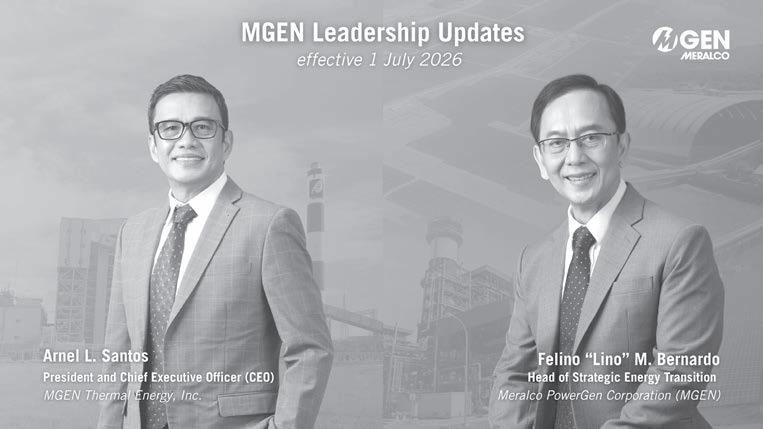
New
appointments
long-term value creation.
Manlosa will help lead MGEN Thermal’s next phase of growth and transformation focusing on operational excellence, asset reliability, and the adoption of best-in-class thermal power generation practices.
Complementing these leadership changes, outgoing MGEN Thermal President and CEO
Felino M. Bernardo will assume the role of Head of Strategic Energy Transition at MGEN under a two-year engagement from July 1, 2026 to June 30, 2028, where he will help advance the company’s long-term growth and transition agenda across the broader portfolio.
In this role, Bernardo will lead the strategic development and management of MGEN’s power generation project pipeline, including project identification, feasibility studies, execution strategies, and growth initiatives across key developments such as Atimonan One Energy, expansion project in Toledo, and other strategic initiatives aligned with MGEN’s long-term energy ambitions.
Bernardo will oversee projects across

THE journey of plastic packaging after its use is more intricate than often perceived.
While proper segregation should be a crucial first step, ensuring that plastic is effectively recovered and repurposed requires a robust system and collaborative effort that extends beyond the household bin.
Mondelēz International in the Philippines is committed to helping foster greater understanding and driving tangible solutions for a more circular economy, emphasizing the critical role of robust recovery systems and shared responsibility.
Globally and across the Philippines, challenges persist in waste collection, sorting, and recycling infrastructure. Plastic is a valuable resource because it provides protection and safety, particularly for food. This means that when post-consumer plastic waste is not diverted from nature, this resource is not able to reach its full potential for reuse and repurpose. Instead, a significant portion may unfortunately find their way into environments where they shouldn’t be.
This reality underscores the urgent need for comprehensive solutions:
Landfills: Where buried waste can release greenhouse gases.
Waterways and Oceans: Plastic pollution that leaks into our oceans which may harm marine life and human health.
Nature: Littering landscapes, impacting ecosystems.
Flexible plastics, a common packaging format for many everyday products, present a unique set of challenges in their recovery due to their lightweight nature. Recognizing this industry-wide hurdle, Mondelēz International is actively investing in solutions and partnerships focused on reducing plastic use and improving the collection and recovery of these materials, moving beyond traditional recycling limitations to ensure they find new purpose. In line with this, globally in
2025 the company surpassed its goal to reduce virgin plastic use by five percent versus 2020 and achieved a reduction of approximately 11.5 percent.
As conversations around sustainability and waste continue to grow, the company is encouraging greater awareness around what truly happens to plastic waste after disposal and why recovery systems matter just as much as segregation.
Mondelēz International in the Philippines understands that addressing plastic waste requires a multifaceted approach. Beyond reducing its plastic footprint and encouraging proper segregation, the company is deeply committed to fostering greater awareness and building robust recovery systems.
As Aleli Arcilla, Managing Director, explains: “Plastic waste management is a shared responsibility that goes beyond simply throwing waste away. Recovery only becomes possible when consumers, communities, companies, waste workers, and government all participate in systems that allow plastic to be collected, diverted, and processed responsibly.” Republic Act No. 11898, or the Extended Producer Responsibility (EPR) Act of 2022, requires large companies to be involved in the collection of the post-consumer plastic packaging they introduce into the market through the products they sell. The law aims to strengthen plastic recovery and diversion systems in the country and accelerate the shift toward a more circular economy by involving all stakeholders in the change.
In support of this effort, Mondelēz International has partnered with PCX Markets since 2023 to help recover and divert the equivalent amount of its annual post-consumer plastic packaging introduced into the Philippine market. This includes flexible packaging, which is diverted from nature and given new purpose through the work of local waste diverters in the country. The company’s efforts have been recognized
the full lifecycle from development and construction through commissioning and operational handover, while driving stakeholder coordination critical to successful project delivery. He will also lead nuclear energy development studies, serve as strategic adviser on LNG and indigenous gas initiatives, and help strengthen organizational capability by mentoring future leaders within the Project Development and Execution function to support leadership continuity and long-term organizational readiness.
“This leadership transition positions us strongly for both today’s operational priorities and tomorrow’s growth opportunities. Arnel will lead MGEN Thermal with a focus on reliability, operational excellence, and sustainable performance, while Lino’s expanded mandate at MGEN enables us to accelerate strategic initiatives that will shape the future of our portfolio and the country’s energy sector,” said Emmanuel V. Rubio, MGEN President and CEO.
through the Plastic Cleanup Partner badge, a recognition given to organizations supporting sustained and verified plastic recovery and diversion initiatives.
However, the company emphasizes that plastic recovery cannot be solved by certifications or compliance alone. “What we have learned is that collection is often the hardest part of the equation,” Arcilla added. “Even the best intentions cannot succeed without accessible systems, community participation, and strong partnerships on the ground.”
To help strengthen plastic recovery efforts at the community level, Mondelēz International supports initiatives such as Trash Right, its environmental education and plastic collection program with Save Philippine Seas. The program has engaged public elementary schools in Parañaque City to help educate students and teachers about waste segregation, recovery, and environmental responsibility. The Company also supports the YouTube series Miming and Friends, which has videos tackling sustainability issues in a simple and understandable way, to engage children and their families into being part of the solution for waste management problems.
More importantly, the company also supports collection of plastics through the Aling Tindera program, which provides homeowners in Parañaque City an accessible way to ensure the plastic they segregate at home gets properly diverted and reused. In 2025 through its two sponsored community collection sites, the company was able to help divert 24,000 kgs of plastic waste away from nature and repurposed for other uses. This was accomplished in partnership with the organization HOPE.
Last January 2026, the company was also recognized by the Department of Environment and Natural Resources for complying with and supporting the EPR Law. Internally, the Company has also implemented its zero waste to landfill commitment in its Parañaque manufacturing plant since 2022 and has proper waste segregation in its commercial office.
Globally, Mondelēz International continues to work toward reducing virgin plastic use and designing more of its packaging for recyclability as part of its broader Sustainable Snacking strategy. As of the end of 2025 globally, some 96% of the company’s product packaging is designed to be recyclable.
For Mondelēz International, the bigger goal is not simply compliance but helping contribute to practical and scalable systems that prevent plastic waste from leaking into the environment.
“The future of plastic recovery will depend on whether we can build systems that people can realistically participate in every day,” said Arcilla. “Solving plastic waste will require shared accountability, continuous innovation, and collaboration across sectors. No single organization can do it alone.”

DepEd, Roche partner to boost breast, cervical cancer care for female personnel
THE Department of Education (DepEd) and Roche (Philippines) Inc. have officially teamed up to improve healthcare outcomes for women in the education sector facing breast and cervical cancer.
On May 4, 2026, the two organizations signed a Memorandum of Understanding (MOU) to advance the 2030 Mission Leapfrog Project (MLP). This public-private partnership aims to boost cancer education, early screening, and treatment access for DepEd’s massive workforce, which includes approximately 800,000 women.
DepEd Secretary Sonny Angara and Roche (Philippines) Inc. General Manager Dr. Diana Edralin formalized the agreement at the DepEd Central Office in Makati City. The project fully supports the goals of the National Integrated Cancer Control Act (NICCA) and the Universal Health Care Law (UHC).
The primary objective is to establish a systematic, end-to-end care process so that cancer patients are continuously guided from early detection to treatment and through recovery.
“Our collaboration with DepEd on Mission Leapfrog is a critical step in advancing Universal Health Care. By focusing on women’s health, we are protecting the backbone of our education system. We are working to create a robust, funded referral network that supports our DepEd teachers and nonteaching staff. With breast cancer incidence remaining high, we must care for our educators so they can care for our children. Our goal is to bridge the gap in the cancer patient journey—standardizing education, screening, and treatment to make health equity a lasting reality,” Dr. Edralin states.
The program leverages a successful pilot run in Tacloban City, where a localized approach drastically reduced patient waiting times and improved treatment retention.
Reflecting on the urgency of the initiative, Angara emphasized the demographic reality of the education sector and the severe vulnerabilities educators face.
“When we look at the demographic landscape of our education sector, a striking reality emerges: approximately 80 percent of our nationwide teaching force consists of women.
Safeguarding their health isn’t just an isolated medical initiative; it is an absolute necessity for sustaining our entire school system,” Angara said.
He stressed that a severe illness like cancer represents a
COUPLES for Christ (CFC), one of the world’s largest Catholic global lay communities, proudly marks its milestone 45th anniversary from June 13 to June 20, 2026. Gathering under the theme “One Family,” anchored on CFC’s annual theme “In Illo Uno Unum” (In the One, we are one!), the week-long celebration will transform premium venues across Metro Manila and Central Luzon into an exciting showcase of faith, family renewal, and service to the poor.
“As ‘One Family,’ we are not only looking back in profound gratitude for 45 years of God’s unchanging faithfulness, but we are also boldly looking forward, re-igniting our twin missionary pillars of Building the Church of the Home and Building the Church of the Poor in a modern world,” said Jaime M. Ilagan, Executive Director of Couples for Christ. Moving with a singular heart toward its golden jubilee, CFC blends deep spiritual milestones with vibrant, meaningful festivities. Each day highlights a unique festival theme, reflecting the universality of the Church and the beauty of diversity within unity.
The dynamic lineup of upcoming public and community events features: June 15 | ANCOP Golf (Villamor Air Base, Pasay City): A charity sports tournament bringing together members and benefactors from 5:30 am to 3 pm to raise critical funds for scholars’ education. June 16 | Leadership Formation Activities & 45th Anniversary Art Exhibit Launch (SPACE at One Ayala, Makati City): A Day for Harvest Festival – Shepherds at the forefront of evangelization will gather for the Chapter Leaders’ Summit from 8 am to 5 pm. They will be joined in the evening by more leaders for the International Mission Core Gathering. Both events aim to strengthen leaders’ zeal for mission. Simultaneously, the 45th Anniversary Art Exhibit will launch onsite (running June 16 to 18 and online June 12 to 30), showcasing original, faith-inspired works by homegrown CFC artists and master Filipino painters to raise seed funding for the future CFC Complex legacy home. June 17 | Family Ministries Summit and Meaningful Performances (SPACE at One Ayala, Makati City): A day of youthful and creative energy with Sinulog Venice Carnival – The Family Ministries Summit runs from 8 am to 12 pm to equip leaders serving in CFC Family Ministries. Beginning at 1 pm, the venue
profoundly catastrophic event, explaining how the sudden financial burden can devastate families, including the “near poor” households who are abruptly plunged into true poverty the moment a major disease strikes the family. Angara noted the value of this public-private collaboration, acknowledging the mutual insights gained, particularly in understanding how clinical screening must be paired with dedicated counseling to help teachers overcome the deep-seated fear that comes with a potential diagnosis.
“My role here was simple: I merely opened the door to facilitate this alliance. While saving even a handful of lives makes every bit of this institutional effort entirely worthwhile, I am deeply optimistic that this framework will allow us to achieve far greater, far-reaching outcomes for our workforce,” Angara said.
“We are deeply grateful for the Department of Education’s openness to collaborate and for recognizing the vital importance of our mission. By integrating breast and cervical cancer services into the lives of our educators, we aren’t just addressing women’s health—we are investing in a sustainable, tangible system. Through our teachers, we create a powerful multiplier effect that extends wellness from the classroom to the community,” said Dr. Edralin. Following the signing, DepEd hosted a Partners’ Appreciation Program in Mandaluyong City on May 8, awarding Roche a plaque of recognition for its outstanding support of quality education. During the appreciation event, Angara highlighted their shared long-term vision: “Our partnership with each one of you is a continuous crossing across many bridges. Education is a shared vision, and nation-building begins when we choose to work together.”
Ultimately, the partnership through the 2030 Mission Leapfrog represents a critical step toward safeguarding the health of the women who shape the nation’s future. By establishing a fully funded and accessible cancer care pathway, the initiative alleviates immense financial and emotional burdens, ensuring female personnel can continue their vital work.
As this effort expands from a successful pilot into a broader national movement, it stands as a powerful reminder that investing in the well-being of teaching and non-teaching staff is a direct investment in the foundation of the country’s education system.
will transform into a musical stage for Family is a Gift’s “Star of 45,” which presents an inspiring story confronting modern familial crises. Finally, at 6:30 pm, the first-ever “Symphony of Prayer: Songs of Glory through the Years” debuts, featuring a full orchestra elevating decades of beloved community worship anthems into a high-art symphonic experience.
June 18 Digital Mission Appreciation and Clergy-Lay Congress (SPACE at One Ayala, Makati City): A day that celebrates blossoming of faith and mission with Feria de las Flores – The Digital Mission Appreciation from 7:30 am to 12 pm will honor what CFC have done over the years in its evangelization work in the digital space and campaign even more for a continued effort to share Christ online. This will be followed by the ClergyLay Congress with over 150 bishops and clergy, and 700 global CFC leaders. Under the banner “Clergy-Lay: One in Christ in His Heart for the Poor,” the summit will forge actionable blueprints for the material, moral, and spiritual care of marginalized global communities.
June 20 | CFC KPP Summit, and Stewardship, Oneness and Interdepe odence Summit (Government Building, New Clark City, Capas, Tarlac): Both events aim to empower leaders, grounding them in the mission of strengthening families as the foundation of both Church and society, while reinforcing that CFC is one global community in this mission.
June 20 | 45th Anniversary Main Celebration (New Clark City Athletics Stadium, Capas, Tarlac): As the culminating event, it will bring together over 20,000 members, families, and guests from around the world. It will feature messages from esteemed guests and CFC leaders, live performances, a parade of lanterns from international representatives, a praisefest, and a fireworks display. The pinnacle of this celebration is the Holy Mass, to be presided over by Bishop Dario Gervasi, Adjunct Secretary of the Dicastery


2011 Hall of Fame

ROAD safety remains one of the most pressing challenges in the country’s transport sector. It is not simply a matter of infrastructure or regulation, but a discipline that requires education, preparedness, and shared accountability. This was the central message reinforced by the Truck Manufacturers Association, Inc. (TMA) as it joined the Department of Transportation (DOTr) in marking National Road Safety Month. Through two major initiatives—a cooperative training program and active participation in the National Road Safety Summit—TMA underscored its role as an industry association committed to safer and more responsible mobility. Representing commercial vehicle manufacturers and distributors, the group continues to advocate that safety must be embedded in daily operations, not treated as an occasional campaign.
TRAINING TRANSPORT COOPERATIVES
ON May 21, 2026, TMA, in partnership with DOTr, the Land Transportation Franchising and Regulatory Board (LTFRB), and Deutsche Gesellschaft für Internationale Zusammenarbeit (GIZ), conducted the National Road Safety Training for members of the Lungsod Silangan Transport Service & MultiPurpose Cooperative (LSTSMPC) in Antipolo, Rizal.
The program was designed to strengthen awareness and practical understanding among drivers, operators, and mechanics. Sessions covered modern PUV standards, vehicle safety
troubleshooting, pre-drive inspection, and eco-driving practices. These modules equipped participants with knowledge directly applicable to their daily operations, reinforcing safety as a discipline rather than a compliance requirement.
TMA’s involvement reflected three pillars under the Philippine Road Safety Action Plan (PRSAP): capacity-building through training, support for vehicle inspection and validation awareness, and promotion of information and advocacy.
In his remarks, TMA President Robert Carlos emphasized the shared nature of the responsibility.
“Road safety is a collective duty.
Every driver, operator, manufacturer, and stakeholder has a role in creating safer roads and more reliable transport services. Through initiatives like this, we hope to empower transport communities with practical knowledge that improves both vehicle readiness and driving discipline,” he said.
LTFRB executive director Atty.
Sherwin Vizconde, likewise, recognized the importance of collaboration. “We are thankful to TMA for helping extend road safety education directly to transport cooperatives and drivers. Programs like this show how government and the private sector can work together to build a stronger culture of safety on our roads,” he noted.
INDUSTRY PRESENCE AT THE SUMMIT
FOLLOWING the training program, TMA further strengthened its support by joining the National Road Safety Summit on May 26, the culminating activity of the campaign led by DOTr.

platform to showcase initiatives and to reinforce collective action toward safer, more sustainable mobility nationwide. Through its exhibit participation, TMA highlighted the role of commercial vehicle manufacturers in promoting safer transport operations. The association emphasized continuous driver education, proper vehicle maintenance, and industry-government collaboration. Beyond technology, the exhibit underscored that road safety is embedded in daily operational practices and shared accountability across the transport ecosystem.
at the grassroots level. By focusing on transport cooperatives and their members, the association illustrated how safety advocacy can reach communities directly engaged in daily mobility.
SUSTAINING THE ADVOCACY
THE National Road Safety Month activities reaffirmed TMA’s commitment to advancing responsible mobility. Its dual participation—through cooperative training and summit engagement— reflected a balanced approach that combines education, advocacy, and collaboration.
ONE thing I love about car companies is when they go out of their way to show affection to Mother Nature. They usually do it through a tree-planting program. Which is really nice.
I’ve been to several tree-planting programs from invites by giant firms like Toyota and Isuzu. I particularly cherished the one with Isuzu because of the location of the activity: Hundred Islands in Alaminos, Pangasinan—Pangasinan being my home province.
It was raining then when we arrived in Lucap, the jump-off point to Hundred Islands. But that did not deter us from proceeding with the mission.
Wearing our raincoats and knee-high boots provided by Yvonne Linchangco and Art Balmadrid, we rode on motorized bancas to get to the place where we planted seedlings (yes, seedlings, not trees—treeplanting is a misnomer?) to an area reserved for mangroves. As we all know, mangroves are where our fishes lay their eggs.
We braved driving rains, even lightning, but it was worth the effort.
One of my dearest buddies in that seedlingplanting activity was the late Butch “Elvis” Gamboa, the father of the iconic “Motoring Today” television show. We had so much fun together, capping our day with ice-cold beer when we got back at Lucap, with broiled bangus as our pulutan. That was more than 10 years ago and I believe the mangroves have grown to maturity. I’ve done my part. As my buddy, Elvis,

said it then: “To love Mother Nature is to preserve a generation’s future.” And while we are at it, I raise a glass to Honda Foundation Inc. (HFI) for its recent Mother Nature activity.
As part of its five-year, seedling-planting (not tree-planting, please?) and livelihood program, the HFI facilitated the planting of 2,000 seedlings in the Sierra Madre Mountains only last June 2 at Barangay Magsaysay, Siniloan, Laguna.
Danielle Ann Pabalan said the long-term initiative is in partnership with the Department of Environment and Natural Resources (DENR) and the Magsaysay Coconut Farmers Association (MACOFA), with support from the local government of Siniloan.
“Under the DENR’s National Greening Program, the project aims to combat deforestation by sustaining the growth and survival of 14,000 fruitbearing trees planted since the program began in
2024,” said Ann.
The program has achieved its target with the addition of these newly-planted seedlings. By restoring environmental quality, the program also helps provide local communities with fresher air, cleaner water and natural flood control.
This initiative reflects HFI’s commitment to ensuring that “Honda remains a company that wants society to exist.”
“HFI’s efforts also contribute to the realization of Honda’s 2050 Zero Carbon vision,” Ann said.
The recent activity was held in celebration of Arbor Day, an annual seedling-planting event in the Philippines every June. It was attended by 80 volunteers, including HFI members, partners from DENR and MACOFA, and other representatives from the government sector.
Members of HFI include Honda Cars Philippines, Inc (HCPI), HFI, Honda Trading Philippines Ecozone Corp. (HTPE) and Honda Logistics Philippines, Inc. (HLPH). HFI can be reached at telelephone nos. (02)-85816700 to 6799 and 0917-578-8723.
ROBINSONS-AYALA PARTNERSHIP
ROBINSONS Land Corp. (RLC) and ACMobility, the mobility arm of the Ayala Group, have forged a partnership to build infrastructure for electric vehicles (EV) now enjoying a sales surge amid the skyrocketing prices of fossil fuel.
campaign but a continuing responsibility.
industry partners to strengthen transport safety, improve operational standards, and create long-term value for Filipino communities.
As the country faces growing mobility demands, initiatives like these remind stakeholders that safety is not confined to infrastructure or technology. It is a shared discipline, practiced daily by drivers, operators, manufacturers, and regulators alike. By embedding safety into operations and reinforcing collaboration, TMA’s advocacy helps build a transport system that is not only efficient but also secure and reliable for all road users.
In a statement, RLC said it would erect some 500 EV charging stations this year for use by private vehicle owners, commercial fleets, tenants, residents and mall visitors.
The planned tie-up is expected to accelerate the expansion of Go-Charge, RLC’s EV charging initiative nationwide.
“RLC has always believed in creating developments that are ready for the future and responsive to the needs of the communities we serves,” said RLC president and CEO Mybelle ArgonGoBio.
ACMobility said the partnership will build what it calls the “Philippine EV Spine” for charging network from Pagudpud to Pagadian.
“Our partnership comes at such a pivotal time,” said ACMobility CEO Jaime Alfonso Zobel de Ayala.
“There is a clear intent among Filipinos to shift to EVs...With more charging points available from Pagudpud in the North to Pagadian in the South, we will enable worry-free EV powered drives.” Well, good luck, guys.
PEE STOP As we seriously tackle the nagging issue of availability of charging stations across the archipelago for our EVs, another factor that needs to be addressed with similar urgency is how and where to dump dead batteries and other EV components deemed poisonous to our environment. Toyota takes the lead on this. Cheers!
B8 Friday, June 19, 2026
TIM CONE has barely shaken off the residues from Wednesday night’s celebration of Barangay Ginebra San Miguel’s conquest of the Commissioner’s Cup as the Philippine Basketball Association’s most successful head coach went down to serious business anew.
Cone started charting the final stretch of preparations for the Philippines’s campaign against Australia and New Zealand in the second window of the FIBA World Cup Asia Qualifiers—both on the road— that starts early next month.
He plans to bring the team down under this Tuesday to acclimatize.
“ We want to go down there a little early and try to catch up with the weather,” Cone said. “It’s too cold in Auckland right now.”
Samahang Basketbol ng Pilipinas executive director Erika Dy announced before noon Thursday Cone’s final 12 for the qualifiers—Ginebra main guys Scottie Thompson, Troy Rosario, RJ Abarrientos and naturalized Justin Brownlee, Mike Philips, Justin Baltazar, Carl Tamayo, June Mar Fajardo, Chris Newsome, AJ Edu, Kevin Quiambao and Dwight Ramos. Seven-foot-3 Kai Sotto is not on the team anew because’s he has prioritized the National Basketball Association Summer League and 6-foot-10 Quentin Milloria-Brown’s nursing a back injury.
T he Philippines plays the New Zealand Tall Blacks on July 3 in Auckland and the Australian Boomers on July 6 in Perth.
T he Philippines is tied with New Zealand in Group A at 2-2 wonlost, while Australia is undefeated in four games and Guam down the standings with 0-4. Josef Ramos
mirror_sports@yahoo.com.ph

By Josef Ramos
Philippine Basketball Association (PBA) Season 50 Commissioner’s Cup crown via an 88-76 Game 7 victory before a crowd of 24,617 crowd at the Mall of Asia Arena in Pasay City on Wednesday night. A nd head coach Tim Cone heaped all the praises he can think about Ginebra’s resident import of 10 years, Justin Brownlee, who simply did “Justin
Brownlee things” with his 30 points, 14 rebounds and five assists in a yeoman’s job that saw him resting on the bench for only a minute the entire match.
It’s really hard not to put him there… there was Tony Harris, Norman Black, Sean Chambers, and I know I miss a few others like Billy Ray Bates,” said Cone, who also did “Tim Cone things” after he snatched his eighth title with Ginebra and 26th overall in the league.
But it’s hard to argue against seven championships, about the numbers he puts up especially in this era,” added Cone, who’s seen
practically all of the PBA as head coach for 37 of the league’s 50 years. In era where players are bigger and stronger, imports cannot dominate the way they used to do,” Cone said. “But defense nowadays has become sophisticated and imports cannot dominate…but Justin is different.”
C one stressed: “In my mind at this point, he is the G.O.A.T. [Greatest Of All Time]…In my opinion, he is the G.O.A.T.” I n his 13th conference in 10 years in the league, Brownlee has emerged as the only gold standard among

imports—in this Commissioner’s Cup Finals, he averaged 36.5 points, 9.1 rebounds, and 5.1 assists highlighted by back-to-back 50-pointers underlined by a career-high 54 points in Ginebra’s 100-95 Game 5 victory.
At 38, Brownlee has surpassed by two the six titles won by Chambers, Cone’s Best Import at Alaska.
So what’s next for Cone?
I think people are asking me about championship. I answer the next one is going to be my favorite, it is all about moving forward, and it never gets old,” he said.
By Mary Jade Jadormio

ATENEO de Manila University could face liabilities if ongoing labor proceedings i nvolving former basketball coach Tab Baldwin establish violations of employment regulations, Acting Labor Secretary Francis Tolentino said on Thursday.
‘Magnificent
THE fifth enshrinement to the Philippine Sports Hall of Fame features a well-selected “Magnificent Seven” who will be honored by the Philippine Sports Commission (PSC) on Saturday at the PSC House inside the Rizal Memorial Sports Complex in Manila.
To be enshrined are Olympic boxing silver medalist Mansueto “Onyok” Velasco, basketball great Ramon Fernandez, Paralympics powerlifting bronze medalist Adeline Dumapong-Ancheta, former ace Cecil Mamiit of tennis and Isidro Del Prado of athletics, two-sport athletes Bea Lucero-Lhuillier (gymnastics and taekwondo) and the late Eduardo Pacheco (basketball and football).
PSC chairman Patrick Gregorio and Philippine Olympic Committee (POC) president Abraham Tolentino lead the Philippine sports community in welcoming all seven personalities into the pantheon of greats.
First Lady Liza Araneta-Marcos will deliver a special message during the presentation to be hosted by Dyan Castillejo and Quinito Henson.
T he list was first announced last April and the enshrinement ceremony set in May, but, with the exception of Pacheco, the PSC wanted all i nductees to be present.
Tolentino said the Department of Labor and Employment (DOLE) is still conducting proceedings related to Baldwin’s work permit status and has yet to reach any conclusion on the matter.
T he labor chief, however, outlined possible consequences should v iolations be established through the administrative process.
Definitely, but I do not want to preempt it,” Tolentino said when asked whether administrative liabilities could be imposed if lapses are found. A ccording to Tolentino, sanctions may not be limited to the foreign

THE Philippine Sports Commission’s Anna Christine Abellana (left) and Jan Errol Facundo expound on the Hall of Fame ceremony. PSA PHOTO
“ That’s the order of chairman Pató [Gregorio]. He wants everyone to be here, that’s why we have to address the dates and invitations,” Anna Christine Abellana of the PSC’s Office of Deputy Executive Director-Bureau on Coordinating Secretariat and Support Services told this week’s s Philippine Sportswriters Association Forum at the PSC Media Room.
The 49-year-old Mamiit, a six-time Southeast Asian Games gold medalist and two-time Asian Games bronze winner, is coming over from the US to personally witness his enshrinement. He [Mamiit] has already confirmed, and he’ll be arriving on the 19th from the United States,” Abellana said in the session presented by San Miguel Corporation, PSC, POC, Milo and the country’s 24/7 sports app ArenaPlus.
coach involved but could also extend to the employer depending on the findings of the investigation.
H e said one possible consequence could be restrictions on obtaining future Alien Employment Permits (AEP) f or foreign coaches found to have violated existing labor regulations.
Within five years, foreigners can no longer reapply to enter the Philippines or coach in the Philippines using an AEP,” Tolentino said.
T he labor secretary added that employers may likewise face administrative sanctions if found liable for v iolations related to the hiring of
foreign nationals.
And then likewise, the employer cannot hire foreign coach within a 10year period,” he said. Tolentino noted that civil liabilities may also arise separately from t he administrative proceedings, although such matters would ultimately fall under the jurisdiction of t he courts.
T he labor chief cited previous court decisions involving schools and administrators to illustrate how institutions may be held accountable under certain circumstances.
H e stressed, however, that DOLE’s
ongoing inquiry is focused on determining compliance with labor and e mployment requirements and should not be confused with any separate civil or judicial proceedings.
Tolentino reiterated that coaches are not automatically exempt from work permit requirements simply because they are affiliated with educational institutions.
H e explained that while some foreign faculty members may qualify for exemptions under existing regulations, athletic coaches perform functions different from classroom instructors and professors.
By Aldrin Quinto
WITH quick reaction and impeccable timing, USA dominated Czechia, 25-17, 25-12, 25-16, on Thursday to sustain its drive in the Women’s Volleyball Nations League on Thursday at the PhilSports Arena in Pasig City.
Jordan Thompson sustained her scoring touch to lead the US offense, while Chiaka Ogbogu anchored the net defense in their fifth victory in six matches in the FIVB’s premier annual international competition.
Much like their straightsets rout of the Dominican Republic in the opener of the Pasig City leg presented by the Philippine Sports Commission, the USA fired on all c ylinders and never let up. Thompson came up with 15 points on 14 attacks and a block, while Ogbogu led the way as the USA stymied the Czech hitters, posting six of the USA’s 12 blocks.

Casuga, Pilac catch last bus to JPGT Finals
JACOB CASUGA and Quincy Pilac produced the most valuable runner-up finishes of their young careers, weathering a nerve-racking battle for qualification and squeezing into the Elite Junior Philippine Golf Tour (JPGT) Finals by the slimmest of margins after a dramatic Luzon Series finale at the International Container Terminal Services Inc. Eagle Ridge JPGT Championship in General Trias on Thursday.
W ith their championship hopes hanging by a thread, Casuga and Pilac rose to the occasion, each finishing second in their respective divisions to secure enough ranking points and claim the fourth and final Luzon berths to the North vs. South Finals set August 17 to 20 at Pueblo de Oro Golf and Country Club. The fight for qualification proved every bit as intense as the tournament itself at
The USA firmed up its place among the leaders ahead of the final in Macau featuring the top eight from the elite field of 12. Idle Japan is unbeaten in five matches. Brazil, seeing action this week in the Ankara leg in Turkey, is the only other team with a better record at 5-0.
A lthough dominated in nearly all departments, Czechia actually put up a stiff challenge before absorbing its third loss in six outings.
Czechia, which placed an impressive 11th in the VNL last season after earning its place in the top annual international competition by ruling the Challenger Cup 2024 in Manila, matched the USA’ eight service aces. No Czech player reached double figures, however, with Magdalena Jehlarova scoring eight, while Ela Koulisiani and Monika Brancuska scored seven each.
C zechia, which bowed to world No. 1 and defending champion Italy on Wednesday, battles Philippine fan favorite Japan on Friday. The USA gets a break on Friday before taking on Italy on Saturday.